/













































Tags: наука науковедение русский язык английский язык английская научная лексика
Year: 1989



Text
                    A GODMAN/EMF PAYNE
LONGMAN
DICTIONARY
OF
SCIENTIFIC
USAGE
The Reprint Edition
LONGMAN GROUP LIMITED, HARLOW
RUSSKY YAZYK PUBLISHERS
MOSCOW
1989
ГОДМАН А, ПЕЙН ЕМФ
ТОЛКОВЫЙ
СЛОВАРЬ
АНГЛИЙСКОЙ
НАУЧНОЙ
ЛЕКСИКИ
Стереотипное издание
ЛОНГМАН ТРУП ЛИМИТЕД, ХАРЛОУ
МОСКВА
„РУССКИЙ ЯЗЫК”
198 9
ББК 72
Г 59
Годман А, Пейн ЕМФ
А	Толковый словарь английской научной лексики.—М.: Рус.
яз., 1989—728 с.
Данный словарь — переиздание в СССР словаря, впервые выпущен-
ного в 1979 г. английским издательством „Лонгман”.
Словарь содержит около 8500 толкований с иллюстрациями наибо-
лее распространенных терминов по математике, физике, химии, биоло-
гии, медицине, а также около 1300 общенаучных терминов, широко
используемых в эксперименте, измерениях, при описании различных
процессов, законов и т. д.
Словарь снабжен указателем английских терминов.
Предназначен студентам, аспирантам для активизации знания анг-
лийской научной терминологии. Может быть полезен переводчикам.
Распространяется только на территории СССР и НРБ.
2200000000—238
015(01)—^9
231—88
ББК 72+81.2Англ.—4
Годман А, Пейн ЕМФ
ТОЛКОВЫЙ СЛОВАРЬ АНГЛИЙСКОЙ НАУЧНОЙ ЛЕКСИКИ
Редакция научно-технических словарей
на английском языке
Редактор Н. Ю. Юрченко
Технический редактор И. В. Богачева
Художественный редактор В. С. Голубев
ИБ № 4991
Подписано в печать 15.05.89. Формат 60x90/16. Бумага офсетная № 1. Гарни-
тура тайме. Печать офсетная (с готовых диапозитивов). Усл. печ. л. 45,5.
Усл. кр.-отт. 45,5. Уч.-изд. л. 88,8. Тираж 40 000 экз. (II завод 20 001 -
40 000 экз.) Заказ № 1633. Цена 5 р. 90 к. Издательство „Русский язык” В/О
„Совэкспорткнига” Государственного комитета СССР по делам издательств,
полиграфии и книжной торговли. 103012 Москва, Старопанский пер., д. 1/5.
Отпечатано с готовых диапозитивов в Тульской типографии „Союзполиграф-
прома” Государственного комитета СССР по делам издательств, полиграфии
и книжной торговли. 300600 Тула, проспект Ленина, 109. Изготовлено в
ордена Трудового Красного Знамени Московской типографии № 7 „Искра
революции” В/О „Совэкспорткнига” Государственного комитета СССР по
делам издательств, полиграфии и книжной торговли. 121019 Москва, Акса-
ков пер., 13.
С Longman Group Limned, 19';9
С- Издательство ..Русскии яияк", 1987
About this dictionary
This is a reference book and practical aid for students studying science
through English during their final years at secondary school and for those
students using English in their first year at a University but whose
education has been in a language other than English. The book.will also
be of use to those for whom English is not their first language, but are
working in the scientific field and need access to English material. It will
also be helpful to those teaching English to science students.
The contents of the book
All the entries in the book are arranged into sets of terms that are closely
related in meaning or subject area. This allows an entry to be compared or
contrasted with related entries to make the meaning of a term clearer.
There are two main sections in the book. The first comprises over 1300
basic terms commonly used in all branches of science, and which have
different, and usually more precise, meanings in scientific contexts than
they have in general speech. Included in this section are 180 prefixes,
suffixes and general affixes of use in understanding many scientific terms.
The second section defines over 8500 technical terms from the fields of
biology, chemistry and physics. The entries contain other information,
besides the definition, which will be of assistance in the usage of the term.
The terms for biology, chemistry and physics are not divided into three
separate sections; instead the sets of terms are presented according to an
overall framework of scientific principles, as can be seen in the list of
Contents.
The Contents shows the arrangement of terms in different subject
areas. Each area is indicated by a two letter code, and within such an area
or set, the terms are numbered consecutively. The set codes are placed at
the top of each page showing the numbers of the terms covered. An
alphabetical index at the back of the book lists all the terms and their
place in the book, and indicates the subject field of the term where
relevant.
How to use this book
There are several ways of using this book.
1	Finding the meaning of a term when reading
a)	Look for the term in the alphabetical index, pp. 61 5ff.
b)	If there is more than one reference, choose the correct field, either
biology (Bio.), chemistry (Ch.), or physics (Ph.), and if necessary, the
correct word class, e.g. noun (n.), verb(u), or adjective (adj.). Note
the set code, e.g. natural is coded AB025.
c)	Use the letters to find the set, and then the number to find the term’s
position in it.
d)	Read the definition and any examples.
e)	Look at the entries above and/or below in the set, as these will show
differences in meaning useful in understanding the term.
2	Using a term when writing
a) Find the term, as explained above.
b) Study the use of the term in the examples.
About this dictionary
c) Note any collocations and information about how the term should be
used.
3	Searching for an unknown term when writing
This is best shown by example. Suppose the term cluster for a group of
flowers on a stalk is known, but a term is needed for a group of flowers
growing thickly on a particular piece of ground.
a)	Look for the term cluster in the alphabetical index.
b)	Find the term from the set code.
c)	By reading the definition of cluster and the definitions of related terms,
it can be seen that clump, just below cluster in the set, is the correct
term to use.
4	Revising the terms of a particular topic
a)	Select the subject area either from the list of Contents, or by selecting
key terms from the alphabetical index.
b)	Find the relevant part of the dictionary and study the terms. This will,
in many cases, provide a revision, or summary, of the topic.
The definition
Each definition gives as much information as possible about the meaning
and behaviour of the term. The definition itself is usually supplemented
by typical examples of the term in context. Many definitions also carry
examples of the term’s collocation, that is the combination or phrase in
whichjhe term most frequently appears. Related forms of the headword
(see Appendix 1) are shown when they are used in scientific contexts. If a
related form is defined elsewhere in the dictionary it appears in small
capital letters.
References
Other terms that add to the reader’s understanding of the definition are
shown at the end of the entry. These references are marked with arrows to
indicate their position in the dictionary. A downward pointing arrow (1)
indicates that the term is defined later in the same section of a set; an
upward pointing arrow (j) indicates that the term is defined earlier in the
set. An arrow pointing sideways (—») is a cross-reference to a term in a
different section of the set, or a member of another set; in either case the
term must be located by means of the alphabetical index.
Many references are marked to show they have a meaning that stands
in a particular relation to the term; for example, it may be opposite, or be
very similar, in meaning. The following abbreviations are used to show
these relationships (see also Appendix 2).
Ag gradable antonym
An non-gradable antonym
Cm complementary term
(as in opposite terms such as high and
low between which there is a
continuous gradation of change)
(as in opposite terms such as plastic and
elastic between which there is a
discontinuity in the change)
(as when two terms cannot function
independently of each other, such as
lock and key, male and female)
About this dictionary
Cn converse term	(as in two terms between which there is a reference point, such as above and below)
Cs	consequent term	(as when one term follows on from another, as solution follows on from solvation)
H hyponym	(a term whose meaning is included in the meaning of another term, as the meanings of red, blue and green are included in the term coloured)
I incompatible term	(a term that involves the complete denial of its opposite, for example, a perfect vacuum is incompatible with matter)
P polar term	(a term that cannot exist independently of another term; for example, the north pole and the south pole of a magnet are polar terms)
Sn cognate term	(as when terms have some element of meaning in common, such as ejection and exudation)
Sample entry book position code, headword and word class (part of speech) definition	AB025 natural (adj.) Describes substances existing in nature, substances produced by nature, or processes taking place without human action,
examples of the term in context	e.g. a natural gas which exists in pockets in the earth; b natural science is all sciences concerned with the physical world; c natural frequency is the frequency of vibration of a body when it is not affected by outside sources; d natural radioactivity is the radioactivity from naturally occurring substances
collocation	O natural gas is a naturally occurring substance
related forms references	—naturally (adv.) i ARTIFICIAL (I) • IMITATION • FREE • DISCRETE • AVAILABLE2 • MATERIAL2 • COMPOSED OF • IMPURE | MATTER —» SYNTHETIC
Contents
Basic Terms
Set Code
AA Space
AB Matter
AC Shape
AD Existence
AE Constitution
AF Movement
AG Change
AH Time
AJ Process
AK Knowledge
AL Word Analysis
AM Statement
AN Measurement
AP Relationship
AQ Experiment
Scientific Terms
Set Code
BA Physical Properties
BB Chemical Technique
BC Classification of Matter
BD Chemical Nomenclature
BE General Macrostructure
BF Surface Phenomena
BG Crystal Structure
BH Polymers and Glasses
CA General Taxonomy
CB Plant Taxonomy
CC Animal Taxonomy
CD General Morphology
CE Plant Morphology
CF Animal Morphology
CG Anatomical Terms
CH Plant Anatomy
CJ Animal Anatomy
CK Skeletal Anatomy
CL Histology
CM Epithelial Tissue
CN Connective Tissue
CP Muscular Tissue
CQ Nervous Tissue
CR Blood Tissue
CS Plant Tissue
CT Cytology
CLJ Cell Division and Function
DA Chemical Bonds
DB Atomic Structure
DC Molecular Structure
DD Solutions
DE Colloids
DF Ionic Theory
EA Laws of Motion
EB Forces
EC Projectiles, Friction
ED Molecular Theory
EE Kinetic Theory
EF Chromatography
EG Conductance and
Electrolysis
FA Growth
FB Movement
FC Locomotion
FD Sensitivity
FE Internal Environment
FF Excretion
FG Function
FH Soil Transpiration
GA Ecology
GB Agriculture
HA Irritability
HB Nervous System
HC Sight
HD Hearing
HE Sense Organs
J A Endocrinology
JB Immunity
3C Pathogenicity
JD Hygiene
KA Chemical Reactions
KB Chemical Equilibrium
КС Reaction Mechanism
KD Physical Equilibrium
KE Elasticity
KF Hydrostatics
KG Measurement, SI units
LA Thermal Expansion,
Temperature
LB Transfer of Heat
LC Chemical Energy
LD Thermochemistry
vi
Contents
MA Metabolism MB Nutrition MC Photosynthesis MD Nutrients ME Mouth and Teeth MF Gut MG Digestion MH Diet MJ Respiration	PA Animal Vascular Systems PB Plant Vascular Systems QA Energy QB Magnetism QC Electrostatics RA Evolution SA Reproduction SB Sexual Reproduction
NA Work NB Wave Motion NC Electromagnetic Waves ND Light NE Radiation NF Radioactivity NG Mass Spectroscopy NH Sound NJ Current Electricity NK Electromagnetism NL Electronics NM Radio NN Chemical Laws	SC Asexual Reproduction SD Alternation of Generations SE Genital Organs SF Flowers SG Life Cycles SH General Embryology SJ Mammalian Embryology TA Heredity ТВ Nucleic Functions TC Genes UA Chemical Potential
Appendices
1.	Related forms
2.	References and relationships of terms
3.	Abbreviations
4.	Prefixes for SI Units
5.	1) SlUnits
2)	Quantities, units and symbols
3)	Letters used as symbols for quantities
6.	Important values, constants, and standards
7.	Common alloys
8.	Table of chemical elements
9.	Ionization energies of selected elements
10.	Standard electrode and redox potentials
11.	The Greek alphabet
12.	Naming chemical compounds
Appendix 1
Related forms
Related forms of terms are obtained by affixation. In section AL (Word
Analysis) the affixes especially used for scientific terms have been
described. Terms which are formed by affixation are also called deriva-
tives. The affixes described below are some of those occurring in general
speech which are useful for scientific terms. These affixes do not cover the
full range of the English language as some have been omitted because
they are unimportant as far as scientific terms are concerned. For those
interested, a fuller statement of affixation in the English language is given
in A Grammar of Contemporary English (R. Quirk, S. Greenbaum, G.
Leech, and J. Svartvik, Longman, 1972)
Examples of derivation
fraction (noun) -* fraction-ate (verb) -* fraction-at-ing (adjective)
fraction-al (adjective) fraction-at-ion (noun)
Examples of related forms
The most important derivative for scientific terms is ‘fractionate’, hence
the related forms are: fraction, fractional, fractionation, fractionating. In
the entry for fractionate (BB044)the related forms are shown in bold
italics when the term is not described elsewhere and in small capitals
when the term is described in another entry.
viii
Prefixes
Negative Prefixes
PREFIX	MEANING	ADDED TO	EXAMPLE	COMMENT
un-	‘the opposite	adjectives	stable	with gradable
	of’ ‘not’	-ed or -ing	-♦ unstable combined	adjectives
		participles	—♦ uncombined saturated -♦ unsaturated
non-	‘not’	adjectives	polar	with non-
			—> nonpolar	gradable adjectives
		nouns	metal —» non-metal
in-	as for un-	adjectives	soluble	note change
			—» insoluble	to im- before
			miscible	m/b/p, to il-
			—» immiscible	before 1, and
			reversible -♦ irreversible	ir- before r
dis-	as for un-	adjectives	charged	note borrowed
			-* discharged	forms, e.g.
		verbs	charge	associate
			—» discharge	dissociate
		abstract	continuity
		nouns	-♦ discontinuity
-	‘lacking in’	adjectives	sexual
an-	‘lack of’	nouns	—> asexual symmetry —* asymmetry
Prefixes which Reverse the State or Process
PREFIX	MEANING	ADDED TO	EXAMPLE	COMMENT
de-	‘to reverse the action’ ‘to remove’	verbs abstract nouns derived from verbs	hydrate —» dehydrate activation —» deactivation
dig-	similar to de-	verb, hence participles noun	connect —» disconnect connected —» disconnected connecting —» disconnecting
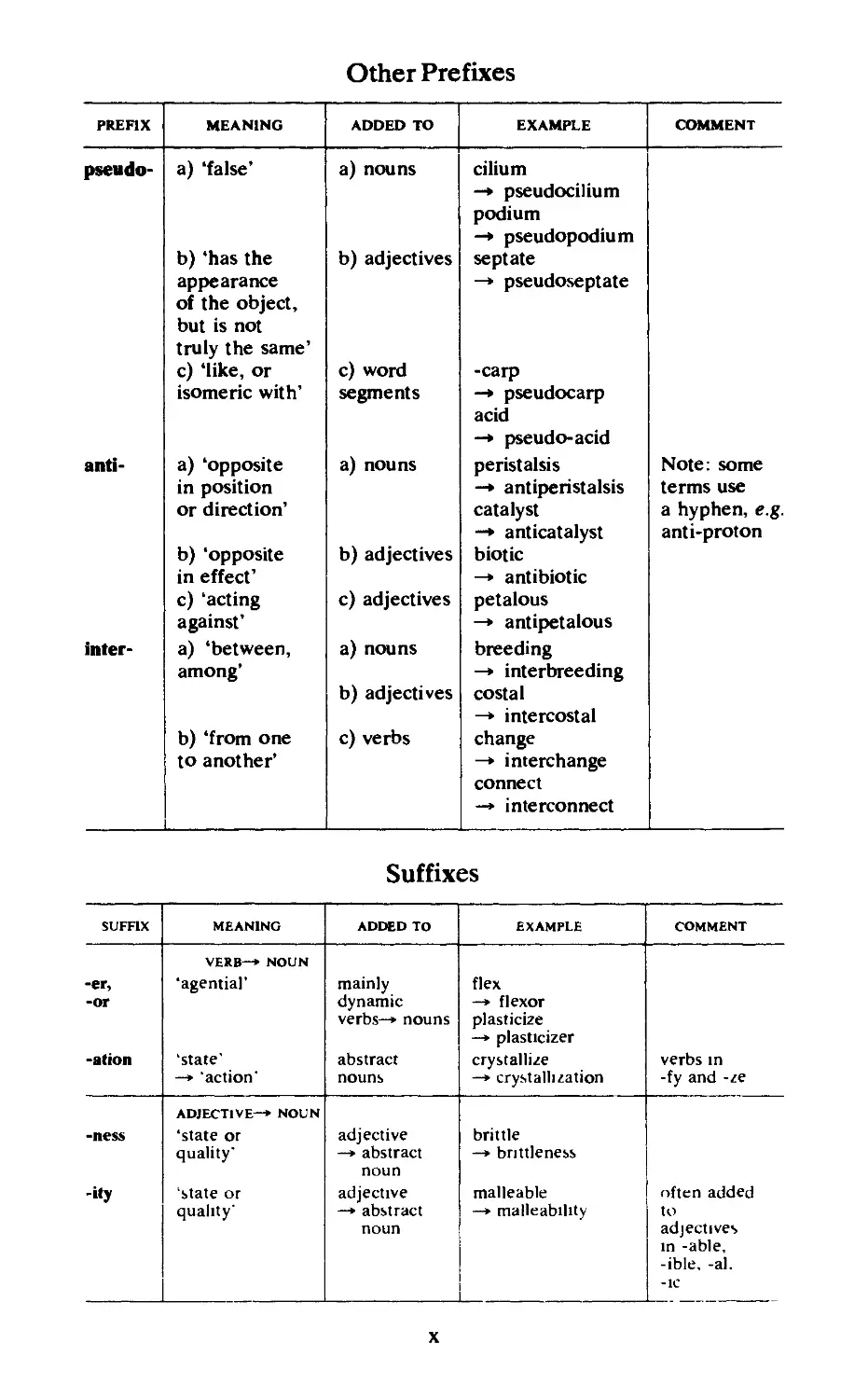
Other Prefixes
PREFIX	MEANING	ADDED TO	EXAMPLE	COMMENT
pseudo-	a) ‘false’	a) nouns	cilium —» pseudocilium podium —» pseudopodium
	b) ‘has the	b) adjectives	septate
	appearance of the object, but is not truly the same’		—» pseudoseptate
	c) ‘like, or	c) word	-carp
	isomeric with’	segments	—» pseudocarp acid
			—» pseudo-acid
anti-	a) ‘opposite	a) nouns	peristalsis	Note: some
	in position		—» antiperistalsis	terms use
	or direction’		catalyst	a hyphen, e.g.
			—» anticatalyst	anti-proton
	b) ‘opposite	b) adjectives	biotic
	in effect’		—» antibiotic
	c) ‘acting	c) adjectives	petalous
	against’		—» antipetalous
inter-	a) ‘between,	a) nouns	breeding
	among*	b) adjectives	—» interbreeding costal
			—» intercostal
	b) ‘from one	c) verbs	change
	to another’		—» interchange connect —» interconnect
Suffixes
SUFFIX	MEANING	ADDED TO	EXAMPLE	COMMENT
-er, -or -ation	VERB—* NOUN ‘agential’ ‘state’ —* ‘action’	mainly dynamic verbs-* nouns abstract nouns	flex —* flexor plasticize —* plasticizer crystallize —» crystallization	verbs in -fy and -ze
-ness -ity	ADJECTIVE—* NOUN ‘state or quality* ‘state or quality’	adjective —* abstract noun adjective —* abstract noun	brittle —* brittleness malleable —* malleability	often added to adjectives in -able, -ible, -al. -1C
X
Prefixes
SUFFIX	MEANING	ADDED TO	EXAMPLE	COMMENT
-ity -ize	VERB FORMING 'causative' 'causative'	noun/ adjective -* verbs (v.J.) noun —* verb (v.t.)	acid —* acidify colour —* decolorize platinum —* platinize carbon —» carbonize crystal -» crystallize	Note: many borrowed words change the stem, e.g. liquid -» liquefy
-ary	NOUN—* ADJECTIVE ‘producing' ‘connected with'	noun —► adjective	saliva —► salivary
-able	SOME OTHER ADJECTIVE FORMING SUFFIXES 'able to be' ‘worthy of being' 'ought to be'	transitive verbs —* adjectives	reverse —► reversible vary -» variable	many borrowed words, e.g. edible mutable
'У	ADVERB FORMING SUFFIXES 'in a manner'	adjective —* adverb of manner	explosive —►explosively
In the examples given it is usually clear that the affix has been added to
a word already known. There are some suffixes which appear quite often
but the original word (underlying form) is less easily identified.
Explosives and explosion obviously have a connection; -iveoccurs quite
often and so does - ion. Both the two words have explos-. This is not a word
in English now. In meaning explode seems very close. This change, ex-
plode to explosion, took place before the word was borrowed.
In scientific English there are many words like this, borrowed long ago
from Latin or Greek, already changed in their original languages: -al, -ic,
and -ous (-ious, -eous) are examples of endings. To all of these -ity can be
added.
cause - causal - causality
(electr) - electric - electricity
curio - curious - curiosity
-al, -ic, -ive form gradable adjectives
-ous forms non-gradable adjectives
See also Section AL in the Basic Terms.
Appendix 2
References and relationships of terms
1. Many references are marked to show that they have a meaning that
stands in a particular relation to the defined term. The following
abbreviations are used to show these relations,
Ag Gradable antonyms as in opposite terms, such as high and low, be-
tween which there is a continuous change. The use of either of these
terms is subjectively assessed by the observer. For example, if
observer A is higher than observer B, then an object between them
is low to observer A and high to observer B, Other examples of
gradable antonyms include: hot and cold', accurate and inaccurate;
elementary and advanced.
An Non-gradable antonyms as in opposite terms, such as elastic and
plastic, between which the change is marked by a discontinuity. The
use of these terms is assessed objectively and is independent of the
observer. For example, a material can be either elastic or plastic and
empirical observation will determine which it is, as in the case of a
copper wire which is elastic under stress up to a certain limit
(marking the discontinuity) and then becomes plastic when the
elastic limit is exceeded.
Cn Converse terms such as above and below which imply there is a refer-
ence point between the two states to which the terms refer, e.g.
above and below the melting point of ice, in which the melting point
of ice is the reference point between the two states of water,
I Incompatible terms such as matter and vacuum, between which no
change is possible, and the possibility of one denies the possibility of
the other for whatever is under discussion. For example, crystalline
and amorphous are incompatible, as a crystalline substance such as
sodium chloride cannot be amorphous, and the existence of the
crystalline substance denies the possibility of there being
amorphous sodium chloride.
Cm Complementary terms such as lock and key, which cannot function
independently of each other. They can exist separately from each
other, but must be together in order to function.
P Polar terms such as north and south, when describing the poles of a
magnet, which cannot exist independently of each other. For
example, anode and cathode are polar terms, as one cannot exist
without the other in an experiment on electric current.
Cs Consequent terms such as stress and strain, which imply that in a
process one condition is the consequence of the other. For example,
when a stress is applied to a wire, the wire experiences a strain, and
the strain is the consequence of the stress. Note that stress is not the
consequent of strain.
H Hyponyms such as blue and coloured, in which the meaning of one
term is included in the meaning of the other. For example, a col-
oured object can be red, blue, green or any other colour. Blue is a
hyponym of coloured as its meaning is included in the meaning of
coloured. Note that coloured is not a hyponym of blue.
xii
Appendix 2
Sn Cognate terms such as replace and exchange, which have some ele-
ment of meaning in common. More than two terms can show a cog-
nate relation, e.g. improve, enhance, assist, aid, advance, all have an
element in common of causing a process to function better, but they
differ in the manner by which the process becomes better.
2. The references with arrows pointing upwards (f) and downwards (i)
belong to the same section of a set and hence these terms will generally
show some form of cognate relation, although other relations are not
excluded. The cross-references with an arrow pointing across (—») indi-
cate the term is in another section or another set, but a knowledge of its
meaning is useful in further clarifying the term which is defined.
xiii
Appendix 3
Abbreviations
Abbreviations used in the index and in the definitions
(Bio.)
(Ch.) > indicates the term is used in biology, chemistry, or physics.
(Ph.) J
Note:	The same term may have different meanings in different sub-
jects, e.g. ‘nucleus’ can have different meanings, in biology,
physics, and chemistry. When a headword appears in more
than one place in the dictionary, it is numbered, e.g., nucleus1,
nucleus2, etc. If no label is given for any of the three sciences,
then the term is used generally.
(G.S.) abbreviation for ‘General Speech’; it indicates the use of the
term in written Standard English. If no (G.S.) definition of the
term is given, its meaning can be found in a standard word list.
(n.) a noun, noun phrase, or noun group, e.g. thermodynamics is a
noun; second law of thermodynamics is a noun phrase; leaf
movement is a noun group.
(pl.) the plural of a noun when it does not follow the general rules,
e.g. stoma (n.,pl. stomata).
(n.pl.) a noun which occurs in the plural, e.g. thermodynamics.
(adj.) an adjective or a part of a verb used as an adjective, e.g. regular
(adj.): fractionating (adj.) as in fractionating column: varied
(adj.) as in varied p.d.
(v.t.,i.) a verb which can be used transitively or intransitively.
(v.i.)	a verb with an intransitive use.
(v.t.)	a verb with a transitive use.
(adv.)	an adverb.
(pre.)	indicates a group of letters which form a prefix.
(suff.)	indicates a group of letters which form a suffix.
(abbr.)	indicates an abbreviation.
Common abbreviations used in science
abs.	absolute	d.	decomposed
a.c.	alternating current	d.c.	direct current
anhyd.	anhydrous	decomp.decomposition
a.p.	atmospheric pressure	dil.	dilute
approx, approximately		dist.	distilled
aq.	aqueous	eg-	(exempli gratia)
b.p.	boiling point		for example
cg-	centre of gravity	e.m.f.	electromotive force
coeff.	coefficient	eqn.	equation
cone.	concentrated	expt.	experiment
concn.	concentration	f'g	figure (diagram)
const.	constant	f.p.	freezing point
crit.	critical	f.s.d.	full-scale deflection
cryst.	crystalline	h.	hour
xiv
Appendix 3
hyd.	hydrated	r.m.m.	relative molecular mass
i.e.	(id est) that is	r.m.s.	root rn^an square
insol.	insoluble	sol.	soluble
i.r.	infra-red	soln.	solution
liq.	liquid	sp.	specific
M.A.	mechanical advantage	sq.	square
max.	maximum	s.t.p.	standard temperature
min.	minimum		and pressure
m.p.	melting point	temp.	temperature
p.d.	potential difference	U.V.	ultra-violet
ppt.	precipitate	vac.	vacuum
r.a.m.	relative atomic mass	v.d.	vapour density
r.d.	relative density	V.R.	velocity ratio
r.h.	relative humidity	wt.	weight
xv
Appendix 4
Prefixes for SI units
MULTIPLE	PREFIX	SYMBOL
1012	tera	T
109	giga	G
106	mega	M
103	kilo	к
10~3	milli	tn
10~6	micro	M-
10~9	nano	n
IO-12	pico	p
xvi
Appendix 5
1)	SI units
Basic units
Systfcme International d’Unit6s (SI) was adopted in 1960 by an interna-
tional committee as a basic system of units. SI is based on seven basic
units, each of which is defined with great accuracy. These units are:
the metre - defined from a wavelength in the spectrum of
krypton
the kilogramme - defined from the mass of a prototype
the second - defined from a frequency in the spectrum of
caesium
the ampere - defined from a newton and a metre
the kelvin - defined from the freezing point of water in
contact with ice
the mole - defined from the carbon-12 isotope
the candela - a measurement of intensity of light
All other SI units are derived from these basic units. Under the system,
each physical quantity has only one particular unit for its measurement,
e.g. a length is only measured in metres. If the number employed with a
basic unit is very large, or very small, then one of the prefixes given in
Appendix 4 can be used, e.g. km or jxm are used instead of metres. When
numbersarewrittenwithunits,a decimal point is used to indicate a fraction
of a unit, but no comma is used to separate multiples of a thousand: a
space is used instead for numbers over 10 000. Here are some examples:
Two thousand three hundred and twenty one metres is: 2321 m; this is
preferably written as: 2-321 km.
Twenty three thousand and forty one metres is: 23 041 m; this is prefer-
ably written as 23 041 km.
For decimal fractions, groups of three figures are also used,
e.g. 2-301 206 s.
Symbols for physical quantities
The symbol for a physical quantity is a single letter taken from the Latin
or the Greek alphabet. When printed, the letter is in italics. Thus t indi-
cates time. As time is measured in seconds (the SI unit), there is no need
to state the unit.
For example:
‘a time t seconds’ is INCORRECT.
‘a time f is CORRECT.
‘pV = rTwhere p is the pressure, Vthe volume, r the gas constant, and T
the thermodynamic temperature’ is CORRECT, as p, V, r, Tcan only be
measured in Nm~2; m3; N.m; a ratio. A list of SI symbols for physical
quantities is given in Appendices 5.2 and 5.3. Occasionally, to avoid
confusion, other symbols may be adopted, as for example in the wheel
and axle where r and R are used for different radii. Alternatively, and r2
could be used, but since R cannot be confused in this instance with any
other physical quantity, it is convenient to use it.
xvii
Appendix 5
Use of the word ‘specific’
This has been restricted to the meaning ‘divided by mass’. Thus heat
capacity is applicable to an object of a given material and specific heat
capacity is the heat capacity per kilogramme of the material. The exten-
sive quantity is denoted by a capital letter, e.g. heat capacity has the
symbol C, and the specific quantity is denoted by the corresponding lower
case (i.e. small) letter, e.g. specific heat capacity is denoted by c,
so C/m = c.
Symbols for units
These symbols are printed in roman, or upright, type. They remain unal-
tered in singular and plural and do not have a full stop after the symbol,
except at the end of a sentence, e.g. 5 mm and 1 mm are correct symbols.
Symbols that are derived from the name of a person have a capital letter,
or begin with a capital letter, although the unit is not written with a capital
letter. Examples are J for joule (named after Joule, the physicist); N for
newton (named after Newton, the mathematician). All other symbols use
lower case letters, e.g. s for second, m for metre.
Prefixes for units
The prefixes are written with no space between the letters, e.g. kN for
kilonewtons, nm for nanometres.
Multiplication and division of units
The method of expressing the multiplication of units is:
A x n or A.n or An (with one space between)
The division of units is shown as:
m/s or m s'1 (with one space between)
This avoids confusion in cases such as:
ms'1 and m s~‘
the first is read as ‘per millisecond’, the second as metres per second.
With two units in the divisor, negative indices are preferable as ambiguity
is avoided, e.g.
J K~‘ kg-1 is preferable to J/K kg.
Recommended mathematical symbols
In addition to the normal symbols, used in arithmetic, the following are
used with SI units:
	not equal to	>		larger than
	approximately equal to	^5	larger than or equal to
ОС	proportional to		much larger than
	smaller than		identical to or equivalent to
	smaller than or equal to	T	increases
	much smaller than	1	decreases
xviii
Appendix 5
2)	Quantities, units and symbols
QUANTITY	SYMBOL		S 1 UNIT	S4	'MBOL	DERIVATION
acceleration	a	m s~2			velocity/time
acceleration due to	g	m s~2	—	velocity/time
gravity
amount of substance n		mole	mol	mole fraction (n) used
amplification factor		a ratio	—	—
angle	01,<₽1,«1	—	—	—
of incidence	i	degree or radian		—
of refraction	r	degree or radian		—
Bragg	e	number	—	—
critical	c	degree or radian		—
anode slope	Ra	ohm	n	AV«/A4
resistance
area	A	metres squared	m2	/ x b
atomic number	Z	a number	—	number of protons
Avogadro constant	l,na	number	—	—
breadth	b	metre	m	fundamental unit
capacitance	c	farad	F	charge/p.d.
charge, electric	о	coulomb	C	current x time
on electron	e	coulomb	C	1-6 x 10~,9C
conductance	G	ohm-1	fl-'	reciprocal of resistance
current, electric	I	ampere	A	fundamental unit
decay constant	X	a ratio	—	—
density	P	kg m“3	—	m/V
distance along path	s	metre	m	fundamental unit
efficiency	V	a ratio	—	work output/work input
electrochemical	z	gC"1	—	mass/charge
equivalent electromotive force	E	volt	V	energy/charge
electron	e
energy	E	joule	J	N m
kinetic	Ek	joule	J	N m. Ek = imv2
potential	EP	joule	J	N m. Ep= mgh
Faraday constant	F	coulomb mol-1	C mol"	1 96 500 С тоГ1
field strength, elec-	E	V m“*	—	potential gradient:
trie				p.d./dist.
magnetic	H	ampere- turns	—	current x no. of turns
flux, magnetic	Ф	weber	Wb	e.m.f./rate of change of
				flux
flux density	В	tesla	T	flux/area
focal length	f	metre	m	—
force	F	newton	N	kg m s"2
free energy	AG	joule	J
frequency	f	hertz	Hz	oscillations/time
xix
Appendix 5
QUANTITY	SYMBOL		SI UNIT	SYMBOL	DERIVATION
gas constant	r	joule	J	energy
half-life,radioactivity Ц		second	s	fundamental unit
heat capacity	c	J K~‘	—	quantity of heat/temp.
				rise
heat of reaction		joule	J	heat energy
heat capacity, specifier		J K~‘ kg-‘	—	heat capacity/mass
heat, quantity of	4	joule	J	energy
height	h	metre	m	fundamental unit
image distance	V	metre	m	fundamental unit
inductance, mutual	M	henry	H	induced e.m.f./rate of
				change of current
self	L	henry	H	—
intensity of radiation/		a number	—
latent heat	L	joule	J	quantity of heat
—, specific	I	J kg’1	—	quantity of heat
—, molar	Lm	joule mol 1	J	quantity of heat
length	I	metre	m	fundamental unit
magnetizing force	H	ampere- turns	—	—
magnetic moment	m	Wbm	—	torque in unit magnetic
				field
magnification, linear	m	a ratio	—	—
mass	m	kilogramme	kg	fundamental unit
— number	A	a number	—	number of neutrons +
		(dm3)		protons
molar volume	vm		—	volume of 1 mole
molar solution	M	a ratio	—	moles/dm3
moment of force	—	N m	—	force x perp, distance
neutron number	N	a number	—	number of neutrons
number	n	—	—	—
— of molecules	N	—	—	—
— of turns on coil	n	a number	—	—
— order of spectrum p		a number	—	—
object distance	и	metre	m	fundamental unit
peak current	h	ampere	A	see current
peak e.m.f.	Eo	volt	V	see e.m.f.
period	T	second	s	fundamental unit
permeability	P-	H m"1	—	henry/metre
— of vacuum		H m1	—	—
—, relative		a ratio	—	— M
permittivity	e	F m1	—	farad/metre
— of vacuum	So	F m'1	—	farad/metre
—, relative	e.	a ratio	—	e, = ту
potential, electric	V	volt	V	energy/charge
potential difference	V	volt	V	energy/charge
power	p	watt	w	Js1
pressure	p	pascal	Pa	N m”2: force/area
radius	r	metre	m	fundamental unit
reactance	X	ohm	n
refractive index	n	a ratio	—	—
resistance	R	ohm	n	p.d./current
resistivity, electrical	P	ohm-metre	———	resistance x length
relative density	d	a ratio	—	Psut/Pwaier
хх
Appendix 5
QUANTITY	SYMBOL	SI UNIT	SYMBOL	DERIVATION
r.m.s. current	^rms	ampere	A	see current
r.m.s. voltage	v r rms	volt	V	see e.m.f.
slit separation	S	metre	m	fundamental unit
tension	T	newton	N	see force
temperature, Celsius в		degree C	°C	from kelvin
temp, interval	6	degree	° or К	—
temp, absolute	T	kelvin	К	fundamental unit
thickness	d	metre	m	fundamental unit
time	t	second	s	fundamental unit
torque	T	Nm	—	see moment
turns ratio	T	a ratio	—	^sec/^prim
(unit of electricity)	—	kW h	—	kilowatt x hour
velocity	U, V	m s”1	—	distance/time
—, angular	(0	second”1	s”1	angle/time
— of e.m. waves	c	m s”1	—	—
— of sound	V	m s”1	—	—
volume	V	metre cubed	m3	1 X ь X h
wavelength	X	metre	m	fundamental unit
work	w	joule	J	force x distance (N m)
weight	w	newton	N	kg m s”2 or mg
xxi
Appendix 5
3)	Letters used as symbols for quantities
LETTER	QUANTITY
A	area, mass number
a	acceleration
В	magnetic flux density
b	breadth
C	capacitance, heat capacity
c	specific heat capacity, velocity of e.m. waves in
vacuum, critical angle
d	relative density, thickness, distance apart
E	energy, electric field strength, electromotive
force. Ek kinetic energy, Ep potential energy,
Eopeake.m.f.
e	charge on electron (or proton), an electron
F	Faraday constant, force
f	frequency, focal length
G	free energy (AG), conductance
g	acceleration due to gravity
H	magnetic field strength, magnetizing force, heat
of reaction (AH)
h	height
I	intensity of radiation, electric current.
/0 peak current
i	angle of incidence
к	a constant
L	self inductance, latent heat, Avogadro constant.
Lm molar latent heat
I	length, specific latent heat
M	mutual inductance, molarsolution
m	mass, electromagnetic moment, magnification
N	number of molecules, neutron number.
N4 = Avogadro constant
n	a number, refractive index, number of moles, a
neutron
P	power
p	pressure, order of a spectrum, a proton
О	electric charge
q	quantity of heat
R resistance. RA anode slope resistance, molar gas constant
r angle of refraction, gas constant (nR), radius
s distance along a path, slit separation
T	period, thermodynamic (absolute) temperature,
torque, tension, turns ratio
t	time, tt half-life
и	initial velocity, velocity of molecules, object
distance
V	volume, electrical potential, potential
difference. Vm molar volume
v velocity, image distance, velocity of sound
W	weight
w	work
xxii
Appendix 5
LETTER
QUANTITY
X	reactance
Z	atomic number
z	charge on ion, electrochemical equivalent
a	an angle
Д	an increment (finite)
e	permittivity
Tj	efficiency
0 temperature (Celsius), temperature difference,
an angle, Bragg angle
X	wavelength, decay constant
/x	permeability, amplification factor
tt	ratio of circumference to diameter of circle
p	density, resistivity
Ф	magnetic flux
<p	an angle
ш	angular velocity
xxiii
Appendix 6
Important values, constants and standards
1.	s.t ,p. = standard temperature and pressure, expressed as 1 • 00 atm or
760 mmHg or 101 kPa(= kN m-2)(Pa = pascal)
and
0°Cor273-15K
2.	Temperature of triple point of water, 273 • 16 К
3.	Gasconstant, 8-314J K_| mol-1
4.	Standard volume of a mole of gas at s.t.p., 22-4 dm3
5.	The Faraday constant, F, 9-65 x 104СтоГ‘
6.	The Avogadro constant, L, 6-02 x 1023 тоГ1
7.	The Planck constant, h, 6-63 x 10-34Js
8.	Speed of light, c, 3-00 x 108ms_|
9.	Mass of proton, [H, 1-67 x 10-27kg
mass of neutron, on, 1-67 x 10-27kg
mass of electron, _°e, 9-11 x 10-3lkg
electronic charge, e, —1-60 x 10-I9C
10.	lcal = 4-18J
11.	leV=l-60x 10-,9J
12.	Specificheat capacity ofwater, 4-18 Jg_| K_|
13.	Ionic product of water, Kw= 1 008 x 10-14 mol2 dm-6, at 289 К
(25 °C)
xxiv
Appendix?
Common alloys
NAME OF ALLOY	APPROXIMATE PERCENTAGE COMPOSITION	USES
Brass	Cu 65-90; Zn 35-10	Decorative metal work
Bronze —common— —aluminium— —coinage—	Cu92;Sn6;Zn2 Cu90;Al 10 Cu95;Sn4;Zn 1	Machinery; decorative metal work Castings—resists chemical wear Coins; medals
Dentists' Amalgam	Hg70;Cu30	Dental fillings
Duralumin	Al 94; Cu 5; Mn 0-5; Mg 0'5	Building of aeroplanes, railway coaches and ships
Electron	Mg93;Zn5;Cu2	Aeroplane frames
Gold —coinage— —dental—	Au90;Cu 10 Au58;Cu 14-28; Ag 28-14	Coinage Dental caps
Lead —battery plates— —type metal— —solder—	Pb94;Sb6 Pb58;Sn26;Sbl5;Cu 1 Pb67;Sn33	Storage batteries Printing industry For joining metals
Magnalium	Al 70-90; Mg 30-10	Scientific apparatus, and castings
Manganin	Cu 82*5; Mn 16; Ni 1-5	Electrical apparatus— it has a fairly constant electrical resistance
Silver —coinage—	Ag90;Cul0	Coinage
XXV
Appendix 8
Table of chemical elements
ELEMENT	SYMBOL	ATOMIC NUMBER	REL. ATOMIC MASS	OXIDATION NUMBER
actinium	Ac	89	227-00	—
aluminium	Al	13	26-98	3
americium	Am	95	243 00	—
antimony	Sb	51	121-75	3,5
argon	A	18	39-95	0
arsenic	As	33	74-92	3,5
astatine	At	85	210-00	—
barium	Ba	56	137-34	2
berkelium	Bk	97	249-00	—
beryllium	Be	4	9-01	2
bismuth	Bi	83	208-98	3,5
boron	В	5	10-81	3
bromine	Br	35	79-91	1,3,5,7
cadmium	Cd	48	112-40	2
calcium	Ca	20	40-08	2
californium	Cf	98	251-00	—
carbon	C	6	1201	2,4
cerium	Ce	58	140-12	3,4
caesium	Cs	55	132-91	1
chlorine	Cl	17	35-45	1,3,5,7
chromium	Cr	24	51-99	2,3,6
cobalt	Co	27	58-93	2,3
columbium, see
niobium
copper	Cu	29	63-54	1,2
curium	Cm	96	247-00	—
dysprosium	Dy	66	162-5	3
einsteinium	Es	99	254-00	—
erbium	Er	68	167-26	3
europium	Eu	63	151-96	2,3
fermium	Fm	100	253-00	—
fluorine	F	9	18-99	1
francium	Fr	87	223-00	1
gadolinium	Gd	64	157-25	3
gallium	Ga	31	69-72	2,3
germanium	Ge	32	72-59	4
gold	Au	79	196-97	1,3
hafnium	Hf	72	178-49	4
helium	He	2	4-00	0
holmium	Ho	67	164-93	3
hydrogen	H	1	1 00	1
indium	In	49	114-82	3
iodine	I	53	126-90	1,3,5,7
iridium	Ir	77	192-20	3,4
iron	Fe	26	55-85	2,3
krypton	Kr	36	83-80	0
lanthanum	La	57	138-91	3
lead	Pb	82	207-19	2,4
XXVI
Appendix 8
ELEMENT	SYMBOL	ATOMIC NUMBER	REL. ATOMIC MASS	OXIDATION NUMBER
lithium	Li	3	6-94	1
lutetium	Lu	71	174-97	3
magnesium	Mg	12	24-31	2
manganese	Mn	25	54-94	2,3,4,6,7
mendelevium	Md	101	256-00	—
mercury	Hg	80	200-59	1,2
molybdenum	Mo	42	95-94	3,4,5,6
neodymium	Nd	60	144-27	3
neon	Ne	10	20-18	0
neptunium	Np	93	237-00	—
nickel	Ni	28	58-71	2,3
niobium (columbium)	Nb	41	92-91	3,4,5
nitrogen	N	7	14-01	3,5
nobelium	No	102	254-00	—
osmium	Os	76	190-20	2,3,4,6,8
oxygen	О	8	15-99	2
palladium	Pd	46	106-40	2,3,4
phosphorus	P	15	30-97	3,5
platinum	Pt	78	195-09	2,4
plutonium	Pu	94	242-00	—
polonium	Po	84	210-00	—
potassium	К	19	39-10	1
praseodymium	Pr	59	140-91	3
promethium	Pm	61	147-00	3
protactinium	Pa	91	231-00	—
radium	Ra	88	226 00	2
radon	Rn	86	222-00	0
rhenium	Re	75	186-22	4,6,7
rhodium	Rh	45	102-91	3,4
rubidium	Rb	37	85-47	1
ruthenium	Ru	44	101-07	3,4,6,8
samarium	Sm	62	150-35	2,3
scandium	Sc	21	44-97	3
selenium	Se	34	78-96	2,4,6
silicon	Si	14	28-09	4
silver	Ag	47	107-87	1
sodium	Na	11	22-98	1
strontium	Sr	38	87-62	2
sulphur	S	16	32-06	2,4,6
tantalum	Ta	73	180-95	5
technetium	Tc	43	99-00	—
tellurium	Те	52	127-60	2,4,6
terbium	Tb	65	158-92	3
thallium	T1	81	204-37	1,3
thorium	Th	90	232-04	4
thulium	Tm	69	168-93	3
tin	Sn	50	118-69	2,4
titanium	Ti	22	47-90	3,4
tungsten (wolfram)	W	74	183-85	6
uranium	U	92	238-03	4,6
 anadium	V	23	50-94	2,3,4,5
xenon	Xe	54	131-30	0
vtrerbium	Yb	70	173-04	3
\XVI1
Appendix 8
ELEMENT	SYMBOL	ATOMIC NUMBER	REL. ATOMIC MASS	OXIDATION NUMBER
yttrium	Y	39	88-91	3
zinc	Zn	30	65-37	2
zirconium	Zr	40	91-22	4
xxviii
Appendix 9
Ionization energies (1st, 2nd and 3rd) of selected elements,
in kJ mol-1
	ATOMIC NUMBER	FIRST	SECOND	THIRD
H	1	1310	—	—
He	2	2370	5250	—
Li	3	519	7300	11800
Be	4	900	1760	14800
в	5	799	2420	3660
C	6	1090	2350	4610
N	7	1400	2860	4590
О	8	1310	3390	5320
F	9	1680	3370	6040
Ne	10	2080	3950	6150
Na	11	494	4560	6940
Mg	12	736	1450	7740
Al	13	577	1820	2740
Si	14	786	1580	3230
P	15	1060	1900	2920
S	16	1000	2260	3390
Cl	17	1260	2300	3850
Ar	18	1520	2660	3950
К	19	418	3070	4600
Ca	20	590	1150	4940
Cr	24	653	1590	2990
Mn	25	716	1510	3250
Fe	26	762	1560	2960
Ni	28	736	1750	3390
Cu	29	745	1960	3550
Zn	30	908	1730	3828
As	33	966	1950	2730
Br	35	1140	2080	3460
Sr	38	548	1060	4120
Sn	50	707	1410	2940
Sb	51	833	1590	2440
I	53	1010	1840	2040
Ba	56	502	966	3390
Pb	82	716	1450	3080
Bi	83	774	1610	2460
xxix
Appendix 10
Useful standard electrode and redox potentials
(at 298 К = 25°C)
Electrode reaction
Ag++e~ -> Ag	+0-80
AgCl+e" -> Ag+CT	+0-22
Ag(NH3)2++e- -> Ag+2NH3	+0-37
Al3++3e~ -> Al	-1-66
Ba2++2e" -> Ba	-2-90
Be2++2e~ Be	-1-85
lBr2+e" -> Br~	+ 107
Ca2++2e“ -> Ca	-2-87
Ce4++e~ -> Ce3+	+ 1-45
JCl2+e- -> СГ	+ 1-36
HOCl+H++e~ -> JC12+H2O	+ 1-64
Cr3++3e- -> Cr	-0-74
Cr3++e- -> Cr2+	-0-41
JCr2O2-+7H++3e- -> Cr3+ + 7/2H2O	+ 1-33
Cu2++2e~ — Cu	+0-34
Cu2++e" -> Cu+	+0-15
Cu(NH3H++2e~ -+ Cu+4NH3	-0-05
D++e~ —> |D2	-0-003
|F2+e“ -> F"	+2-87
Fe2++2e~ —> Fe	-0-44
Fe3++3e~ -> Fe	-0-04
Fe3++e~ -> Fe2+	+0-77
Fe(CN)£-+e- -> Fe(CN)J_	+0-36
H++e" -> iH2	000
|H2+e" -> H~	-2-25
|I2+e~ —> I-	+0-54
IO3-+6H*+5e-	|I2+3H2O	+ 1-19
K++e“ К	-2-92
Li++e~ —> Li	-304
Mg2++2e_ —> Mg	-2-38
Mn2++2e“ Mn	-118
MnO2+4H++2e	Mn2++2H2O	+ 1-23
MnO^+e- —> МпОд	+0-56
MnO;+4H+ + 3e	MnO2+2H2O	+ 1-67
MnO4+8H++5e	Mn2++4H2O	+ 1-52
HNO2+H++e NO+H2O	+0-99
NOf+ 2H++e	NO2+H2O	+0-81
NO3+3H++2e HNO2 + H2O	+0-94
NO3-+4H++3e- NO+2H2O	+0-96
NO3+5H++4e	|N2O+5/2H2O	+ 111
NO34-6H++5e- -> |N2+3H2O	+ 1-24
NO3-+10H++8e“ NH; + 3H2O	+0-87
Na++e~ —> Na	-2-71
Ni2++2e" -> Ni	-0-25
XXX
Appendix 10
|H2O2+H++e- -> H2O	+1-77
iO2+2H++2e—> H2O	+1-23
Ю2 + Н2О+2е -> 2ОН-	+0-40
О2+2Н++2е~ —> Н2О2	+0-68
О3+2Н++2е~ -> О2+Н2О	+2 07
РЬ2++2е~ —> РЬ	-0-13
Pb4++2e_ —> Pb2+	+1-69
РЬО2+4Н++2е_ —> Pb2+ + 2H2O	+1-47
S+2e~ —> S2~	-0-51
S+2H++2e“ —> H2S	+014
SO^+4H++2e -> H2SO3+H2O	+017
iS4Oj“+e~ — S2Oi~	+0-09
Sn2+ + 2e~->Sn	-014
Sn4+ + 2e^Sn2+	+0-15
Zn2‘+2e ->Zn	-0-76
xxxi
Appendix 11
The Greek alphabet
CAPITAL SMALL	NAME	ENGLISH EQUIVALENT

a	alpha	a
p	beta	b
У	gamma	g
s	delta	d
e	epsilon	e (short)
c	zeta	z
4	eta	e (long)
6	theta	th
i	iota	i
к	kappa	к
X	lambda	1
	mu	m
V	nu	n
4	xi	X
0	omicron	о (short)
n	P*	P
p	rho	r
a	sigma	s
r	tau	t
0	upsilon	u
Ф	phi	Ph
X	chi	ch
	psi	ps
<0	omega	о (long)
Appendix 12
Naming chemical compounds
In this book the authors have used the systematic names recommended
by the commissions of the International Union of Pure and Applied
Chemistry (IUPAC) and the rules relating to these names. Because there
is a variety of practice in different countries, and within different coun-
tries, in the use of chemical names, an appendix is included here which
gives the more common of the changes from the traditional unsystematic
names formerly used to the present IUPAC recommendations.
Rules for naming inorganic compounds
Metal ions
a)	Metals of fixed oxidation state: the name, by itself, of the metal is
used. For example: sodium nitrate; aluminium chloride.
b)	Metals of variable oxidation state: a Roman numeral is used after the
name of the metal to indicate its oxidation state. For example:
FeCl2 iron (II) chloride
FeCl3 iron (III) chloride
CuCl copper (I) chloride
Acids and their ions
a)	Binary acids retain the systematic ending -ide for their ions, e.g.
chloride, bromide ions.
b)	Oxoacids (acids containing oxygen) and their ions are described in
terms of the oxidation number of the non-metal forming the acid. If
the non-metal has a fixed oxidation number, the name by itself is
used.
Formula of ion	Recommended name	Former name
COJ	carbonate	carbonate
C1O-J	chlorate (V)	chlorate
C1O-	chlorate (I)	hypochlorite
NOj	nitrate (V)	nitrate
NO2	nitrate (III)	nitrite
poj-	phosphate (V)	orthophosphate
so2~	sulphate (VI)	sulphate
so]	sulphate (IV)	sulphite
c) The corresponding acids are named from the ions, with the exception
of binary acids.
Formula of acid	Recommended name	Former name
HC1	hydrochloric acid	hydrochloric acid
HClOj	chloric (V) acid	chloric acid
HC1O	chloric (I) acid	hypochlorous acid
HNO3	nitric (V) acid	nitric acid
hno2	nitric (III) acid	nitrous acid
<[) The oxoacids of metals and their ions are described in terms of the
oxidation state of the metal. For metals of fixed oxidation state, the
Roman numeral indicating the oxidation state is usually omitted.
xxxiii
Appendix 12
The names of the ions are formed in the following way:
i)	In the anion the ending of the name of the metal (-ium) is
replaced by the ending -ate, e.g.
aluminium becomes aluminate
chromium becomes chromate
manganese becomes manganate
or
ii)	the ending -ate is added to the name of the metal, e.g.
zinc becomes zincate
or
iii)	the following exceptions are made to the rule:
copper becomes cuprate (from cuprum)
gold becomes aurate (from aurum)
iron becomes ferrate (from ferrum)
lead becomes plumbate (from plumbum)
silver becomes argentate (from argentum)
tin becomes stannate (from stannum)
examples:
Formula of ion	Recommended name	Former name
CrO4_	chromate (VI)	chromate
Cr2O|	dichromate (VI)	dichromate
Mnor	manganate (VI)	manganate
MnO4	manganate (VII)	permanganate
Snor	stannate (IV)	stannate
SnOf	stannate (II)	stannite
ZnO2_	zincate	zincate
Salts, other than binary compounds
a) The following examples indicate the use of numerical prefixes in
describing compounds:
Formula NaHSO4 Na2HPO4	Recommended name	Former name sodium hydrogen sulphate sodium bisulphate disodium hydrogen	sodium hydrogen phosphate (V)	orthophosphate
Ca(HCO3)2	calcium hydrogen	calcium bicarbonate carbonate
Fe3O4	iron (II) diiron (III)	ferrosoferric oxide oxide	(magnetic oxide of iron)
Na3PO4	trisodium phosphate (V) sodium orthophosphate
b)	Hydrates are indicated by adding a hyphen to the name of the
anhydrous substance, then an Arabic numeral stating the
stoichiometric proportion of water, followed by a hyphen, and then
the word ‘water’, e.g.
CaSO4, JH2O is calcium sulphate (Vl)-J-water
CuSO4, 5H2O is copper (II) sulphate (VI)-5-water
When the extent of hydration is not known, or uncertain, the term
‘hydrated’ is placed before the name of the anhydrous substance.
c)	Complex ions, coordination compounds
The ions or groups of atoms attached to a central’ atom are listed in
xxxiv
Appendix 12
alphabetical order with numerical prefixes giving the number of such
ions or groups. Water is indicated by the word ‘aqua’.
examples:
Formula	Recommended name	Former name
[Cu(4H2O)]2+ tetraaqua copper (II)		hydrated cupric ion
	ion
K4Fe(CN)6	(tetra)potassium		potassium
	hexacyanoferrate (II)	ferrocyanide
K3Fe(CN)6	(tri)potassium		potassium
	hexacyanoferrate (III) ferricyanide
Na2Fe(NO)(CN)5(di)sodium		sodium
	pentacyanonitrosyl- ferrate (II)	nitroprusside
[Cu(NH3)4]SO4 tetraammine copper (II) Cuprammonium
	sulphate (VI)	sulphate
Non-metal compounds
When the stoichiometrical proportions of a molecule are known, the proportions are shown by Greek numerical prefixes; in some cases, the prefix mono- is not used. If discrete molecules of a compound have a doubtful existence, then the oxidation number of the least electronega- tive element is indicated by a Roman numeral.
examples:
Formula	Recommended name	Former name
CO2	carbon dioxide	carbon dioxide
CO	carbon monoxide	carbon monoxide
n2o	dinitrogen oxide	nitrous oxide
NO	nitrogen oxide	nitric oxide
no2	nitrogen dioxide	nitrogen dioxide (nitrogen peroxide)
SO2	sulphur dioxide	sulphur dioxide
so3	sulphur (VI) oxide	sulphur trioxide
N2O4	dinitrogen tetroxide	nitrogen tetroxide
S2C12	disulphur dichloride	sulphur monochloride
SO2C12	sulphur dichloride	sulphuryl chloride
	dioxide
PC13	phosphorus trichloride	phosphorus trichloride
PC15	phosphorus pentachloride	phosphorus pentachloride
Metallic oxides
Na2O2	sodium peroxide	sodium peroxide
MnO2	manganese (IV) oxide	manganese dioxide
Cr2O3	chromium (III) oxide	chromium sesquioxide
Rules for naming organic compounds Systematic names
These names are built up by joining syllables derived from the following
rules:
a) A syllable is used to denote the number of carbon atoms in the
longest unbranched carbon chain in the compound. The number of
XXXV
Appendix 12
carbon atoms thus formulates a saturated hydrocarbon and the
specific compound is regarded as a substituted hydrocarbon.
The systematic syllables are:
Syllable: meth- eth- prop- but- pent- hex- hept- oct- non- dec-
No. of
C atoms: 123456789	10
b) A syllable to indicate the type of bond between the carbon atoms:
Bond:	single	double	triple
Syllable:	-an-	-en-	-yn-
c) A syllable to indicate a functional group:
Formula	Group name	Syllable
СлН2л+1	hydrocarbon chain	-yi
—OH	alcohol	-ol
—CHO	aldehyde	-al
=co	ketone	-one
—COOH	carboxylic acid	f -oic acid \-carboxylic acid
—Cl	chloride	chloro-
—nh2	amino	f -amine \amino-
—conh2	amide	-amide
— ^Hal	acyl halide	-oyl halide
—ON	nitrile (cyanide)	-onitrile
—no2	nitro	nitro-
—SH	mercaptan	-thiol
Hydrocarbon chains
In a branching chain, the syllable for the number of carbon atoms is
joined to the syllable -yl; e.g. methyl; ethyl; propyl. The carbon atom in
the longest chain, to which the branch chain is bonded, is numbered, for
hydrocarbons, from either end, and this number is indicated by an Arabic
numeral placed in front of the branch chain syllable. For carbon chains
possessing a functional group, the carbon atom attached to the functional
group is numbered 1, and the remaining atoms in the chain are then num-
bered consecutively. Example of a branched chain hydrocarbon:
CH3CH2CH(C3H7)CH2CH2CH3 3-propyl hexane
or 4-propyl hexane
(6 carbon atoms in the longest chain, so a substituted hexane; the branch
chain is attached to the 3rd atom from one end or the 4th from the other.)
Example of a branched chain substituted hydrocarbon:
CH3CH2CH(C3H7)CH2CH2CH2OH 4-propyl hexan-l-ol
(Substituted hexane; numbered 1 from the carbon atom in the functional
group of an alcohol; -l-ol shows the functional group; 4-propyl indicates
the branch chain.)
Halogen compounds
a) Greek prefixes are used to indicate the number of halogen atoms,
except for a monosubstituted compound, e.g.
xxxvi
Appendix 12
Formula	Systematic name	Former name
CH3C1	chloromethane	methyl chloride
CH2C12	dichloromethane	methylene dichloride
CHC13	trichloro meth ane	chloroform
CC14	tetrachloromethane	carbon tetrachloride
CH3Br	bromomethane	methyl bromide
CH3I	iodomethane	methyl iodide
b) Arabic numerals are used to denote the carbon atoms in the carbon
chain, to which halogen atoms are bonded, e.g.
Formula	Systematic name	Former Name
CH2Br 1	1,2-dibromoethane	ethylene dibromide
1 CH2Br
CHBr2 1	1,1 -dibromoethane	ethylidene dibromide
1 CH3
C3H7C1	1-chloropropane	n-propyl chloride
CH3CHI.CH3	2-iodopropane	isopropyl iodide
Alcohols
Homologous series of primary, secondary, and tertiary alcohols are given
systematic names as below:
Formula	Systematic name	Former name
CH3OH	methanol	methyl alcohol
C2H5OH	ethanol	ethyl alcohol
C3H7OH	propanol	propyl alcohol
CH3CHOH.CH	3 propan-2-ol	isopropyl alcohol
CH3CH.CH3CH2OH 2-methyl		isobutyl alcohol
	propan-l-ol
CH2OH	ethan-l,2-diol	ethyl glycol
CH2OH
CH2OH |	propan-1,2,3-triol	glycerol
CHOH 1
1 CH2OH
Aldehydes and ketones
Formula	Systematic Name	Former Name
HCHO	methanal	formaldehyde
CH3CHO	ethanal	acetaldehyde
C,H5CHO	propanal	propaldehyde
(CH3)2CO	propanone	acetone
Carboxylic acids
Homologous series of carboxylic acids, and substituted acids, are given
systematic names as below. When numbering carbon atoms, that of the
carboxyl group is taken as 1, e.g.
xxxvii
Appendix 12
Formula		Recommended name		Former name
CHjCOOH		ethanoic acid		acetic acid
CH3CH2CH2COOH		butanoic acid		butyric acid
CH3CH2CH.NH2COOH		2-aminobutanoic		a aminobutyric
		acid		acid
CH2C1CH2CH.		2-amino-4-		1-amino 3-chloro
nh2cooh		chlorobutanoic		butyric acid
		acid
COOH.COOH		ethanedioic acid		oxalic acid
CH(OH)COOH.CHOH.		2,3-dihydroxy		tartaric acid
COOH		butanedioic acid
CH2COOH.CH(OH)		2-hydroxypropane-		citric acid
COOH.CH2COOH		1,2,3 -tricarboxylic
		acid
C17H35COOH		octadecanoic acid		stearic acid
C15H31COOH		hexadecanoic acid		palmitic acid
CH3(CH2)7CH=		octadec-9-enoic		oleic acid
CH(CH2)7COOH		acid
Other aliphatic compounds
Formula	Recommended name		Former name
C2H5NH2	ethylamine		ethylamine
C2HsNH3C1	ethylammonium		ethylamine
	chloride		hydrochloride
ch3conh2	ethanamide		acetamide
CH3COC1	ethanoyl chloride		acetyl chloride
CH3CQ
(J	ethanoic anhydride		acetic anhydride
CH3CO
c2h5cn	propanonitrile		ethyl cyanide
c2h5nc	isocyanoethane		ethyl isocyanide
c2h5no2	nitroethane		nitroethane
C2H5SH	ethanthiol		ethyl mercaptan
Aromatic compounds
a)	Aromatic compounds without side chains are named with benzene as
the root with the following prefixes and suffixes to indicate func-
tional groups. With two substituted groups, the carbon atom of one
group is labelled 1, and the others 2-6 respectively, with the second
or third group placed as close as possible to the first group. If the side
chains form homologues of benzene, the compounds are named as
alkylbenzenes. The following examples illustrate these rules.
Formula
сгн,
COOH
CHO
Recommended name
ethyl benzene
benzenecarboxylic
acid
benzenecarbaldehyde
Former name
ethylbenzene
benzoic acid
benzaldehyde
	Appendix 12
0”	chlorobenzene	chlorobenzene
0™’	benzenecarboxamide benzamide
О’"-	nitrobenzene	nitrobenzene
	1,2-dichlorobenzene orthodichloro- benzene
NO, On°>	1,3-dinitrobenzenef	metadinitro- benzene
a 0 a COOH I^JCOOH	1,4-dichlorobenzene	paradichloro- benzene benzene-1,2-	phthalic acid dicarboxylic acid
OH 0°H	benzene-l,3-diol	resorcinol
	methyl benzene	toluene
CH, O^H,	1,3-dimethyl-	metaxylene benzene
COOH OOH	2-hydroxybenzene- salicylic acid carboxylic acid
b)	Aromatic compounds with side chains containing functional groups
are named as phenyl substituted aliphatic compounds taking C6H5 as
the phenyl group. The name thus recommended places emphasis on
the part of the structure most likely to take part in reactions. The
following examples illustrate these rules.
Formula '’OH	Recommended name Former name phenol	phenol (compare benzene- 1,3-diol)
Appendix 12
|NH2	phenylamine	aniline
|COCH3	phenylethanone	acetophenone
CH2OH	phenylmethanol	benzyl alcohol
]CH~CH2	phenylethene	styrene
diphenylmethanone benzophenone
^och,	methoxybenzene anisole
Fused aromatic rings
The terms naphthalene and anthracene are used-


Basic Terms
Space
AAOOl space1 (л.) 1 That which objects
occupy as a result of their volume, i.e. any
solid object occupies space. The amount of
space occupied is the volume of the object.
No two objects can be in the same region of
space at the same time. Space is said to have
three dimensions, i.e. any solid object has
three dimensions (length, width and
height). 2 A part or portion of space; a
volume, area or length that may be empty or
occupied by something, e.g. a a space on the
shelf between two bottles into which some-
thing may be put; b a blank space on an
examination paper (part of the paper with
no writing on it). 3 The universe, containing
the galaxies, stars, planets, and other stellar
objects. 4 A period of time, e.g. a the space
between two events; b he finished the work
in a short space of time О three-
dimensional space; a space between two
objects; a space of two hours —space (i>.) -
SPATIAL (.adj.) i PLACE • BOUNDARY • PATH
RANGE • SURFACE1 • SPACE2 • OCCUPY • SPATIAL
• EXTENSIVE • SURROUNDINGS • JOIN1 • CRACK
MATTER • FORM* • CAUSE • WHOLE
AA002 place (л.) 1A part of space; an area
or volume of space either occupied by an
object or organism or unoccupied, e.g. a a
laboratory is a place where experiments are
performed; b every student has his own
place in the classroom —place (v.)
1 POSITION (Sn) • POINT • IN SITU • OCCUPATION
• OCCUPANT • VACATION • EVACUATION
f SPACE1 —» LOCATION1 (Sn) • site1 (Sn) •
SITUATION (Sn)
AA003 position (л.) Position is place in
relation to other objects or individuals. It is
a part in relation to the configuration of the
whole; also, for individual animals, it is the
configuration of the body as modified by the
parts, e.g. a the properties of an element de-
pend upon its position in the periodic table
(its place in relation to other elements);
b an animal takes up different positions
such as lying, sitting, crouching (the animal
takes up different configurations of its
body); c the position of the image formed by
a lens from an object is fixed in relation to
the lens and object О to locate the position
of an image —position (i>.) f place (Sn)
—» location (Sn) • SITUATION (Sn)
CONFIGURATION
AA004 point (n.) 1 A point has a definite
position but no size (extent in space); it is
the intersection of two lines. 2 A definite
value of some measured quantity, e.g. a the
point at which water boils (the temperature
at which it boils); ban event occurs at a defi-
nite point in time, f place • position
A A005 in situ (adv.) In the place where it is
needed, e.g. in the thermit welding process
molten iron is produced in situ (at the point
a here the molten iron is needed to join
together two pieces of steel), f place
AA006 occupation (л.) The state of being
in a given position or place, or moving into a
given position or place. —occupant (л.)
OCCUPY (l>.) i VACATION (Cn) f PLACE
—» OCCUPY
AA007 occupant (л.) The object or
organism that is in a given position or place.
—OCCUPATION (л.) OCCUPY (l>.) f PLACE •
POSITION
AA008 vacation (л.) The action of vacating
a place or position, e.g. the vacation of
Europe by migratory birds when they fly to
Africa, j EVACUATION (H), VACATE f PLACE
AA009 evacuation (л.) 1 The removal of
gas or vapour from a container, e.g. the
evacuation of a bell jar by a vacuum pump.
The focus is on the removal of as much gas
or vapour as possible so as to leave a
vacuum. 2 The removal of a solid or liquid
from an organism. The focus is on the
removal of as much material as possible so
as to leave nothing behind, e.g. the evacua-
tion of the rectum caused by a drug or by a
natural process, f place
AA010 boundary (л.) A boundary marks, 1
the line dividing one area from another; 2
the surface dividing one volume or one
space from another. In contrast to a limit, a
boundary can be crossed, e.g. there is no dis-
tinct boundary between the size of particles
in a fine suspension and in a sol □
the face of a glass block marks the boundary
between the two optical media —bounding
(adj.) BOUND (v.) 1 LIMIT • EXTENT f SPACE1
AA011 limit (n.) 1 A point, line or surface
beyond which it is not possible to go. 2 A
value of a quantity or period of time that is
the largest or smallest possible value, e.g. a
the limit of magnification of an optical
microscope is approximately 2000 x; it is
not possible to reach a larger value of
magnification; ft the limits of human hearing
are frequencies of 20 Hz and 20,000 Hz;
sound cannot be heard at frequencies below
20 Hz or at frequencies above 20,000 Hz □
for hearing, 20 Hz is the lower limit of fre-
quency and 20,000 Hz is the upper limit.
Contrast boundary and limit: when
boundary is used the focus may be on either
side or on both sides but with limit the focus
is on one side only. —limit (v.) limited,
limiting (adj.) f boundary
AA012 extent (n.) The space between
limits, or the time between limits, or the
time between events, e.g. a chlorine is used
in industry to a greater extent than bromine
because it is found naturally in greater
abundance (the extent is defined by the
limit of the number of reactions for which it
can be used); ft the extent of the chemical
reaction between nitrogen and hydrogen is
determined by the equilibrium mixture
АА013
Space
2
under given conditions (a limit is set by the
composition of the equilibrium mixture
under the given conditions) О pollination
takes place to a greater or lesser extent
depending upon atmospheric conditions; the
extent to which hydrogen and nitrogen react
1 RANGE • SPREAD* • SCOPE t BOUNDARY
AA013 path (л.) An actual or hypothetical
line in space along which an object or a
radiation may travel, e.g. a the path of a
projectile from a gun; b the path of a ray of
light through a glass prism; c the path of an
electron in a magnetic field; d the path of a
planet round the sun. 1 track* (Sn) • course
(Sn) f SPACE* —» DIRECTION
AA014 track1 (л.) The visible evidence left
behind along the path of an object, particle,
animal, or radiation. A track implies motion
of the object, particle or animal making the
track. Contrast trace, which is discon-
tinuous and does not necessarily imply
motion. —track2 (u.) 1 course (Sn) f path
(Sn)
AA01S course (л.) The path travelled in
space and time, i.e. the series of changes that
take place when anything happens, e.g. a
the course of a chemical reaction is the set of
changes, i.e. the stages by which the reaction
proceeds; b the course of a disease is the set
of changes in the condition of the patient О
during the course of a chemical reaction; in
the course of an experiment f path (Sn)
track* (Sn)
AA016 range (л.) 1 The maximum distance
that anything can travel or be ejected, e.g.
the range of an alpha particle in air is about
7cm (this is the distance it moves before it is
stopped); it is the extent of the movement. 2
The area of land over which a plant grows,
e g. the range of a date palm is the geog-
raphical areas over which it is found; it is the
extent of the distribution. 3 The set of
values (between two limits) of a quantity for
which an event occurs or operates, e.g. athe
range of normal human hearing is from
20 Hz to 20 000 Hz; b the range of tem-
perature most suitable for bacterial growth
is 25°C^0°C О 3 cm is within the range of
an alpha particle in air, but 20 cm is out of
range; a wide range of readings was taken,
not a narrow range; the temperature falls out-
side the range of the thermometer j spread* •
SWEEP* • SCOPE | SPACE*
AA017 spread* (л.) 1 A distribution or
dispersion of magnitudes about a central or
mean value □ a spread of values resulting
from a number of measurements 2 (G.S.) A
thin layer, (the result of spreading).
—spread (u.) f range  extent
ЛА018 sweep* (л.) The extent of the
angular motion of an object (similar to the
movement of a broom), e.g. athe sweepof a
radar beam in a circle; b the sweepof a tele-
scope through an angle □ the aeroplane
was within the sweep of the radar beam, but
the helicopter was outside the sweep. —sweep
(l\) J RANGE
AA019 scope (л.) The extent of a process,
plan or study, in operation or in time, deter-
mined and limited by an observer, but with
free choice within limits, e.g. the scope of an
experiment is the range of results expected,
and may be limited by the time available О
such results are within the scope of the experi-
ment; such work is outside the scope of the
apparatus f range (Sn)  extent (Sn)
AA020 surface1 (л.) A surface has length
and breadth, but no depth, i.e. it has only
two dimensions. A surface is the outside
boundary of a solid, or the upper boundary
of a liquid, where the liquid is in contact
with the air or with its vapour, e.g. the sur-
face of a cube has six faces of equal area.
1 AREA* • REGION* • ZONE* • VOLUME • PATCH
f SPACE* —» SOLID*
AA021 area1 (л.) An extent in two-
dimensional space, i.e. an extent on a sur-
face, distinguished from its surroundings by
observable limits, e.g. a a triangular area is
bounded by three straight lines; b an area
bounded by a river on one side and by hills
on the other side. Area is measured in
metres squared (tn2). f surface*
AA022 region1 (л.) An extent on a surface
or in three-dimensional space, distin-
guished from its surroundings by its fea-
tures, or by conditions operating in it. The
extent need not have clearly defined limits,
nor a clearly defined shape, e.g. a the ionos-
phere is a region of the atmosphere where
the air is ionized by ultra-violet rays from
the sun (a feature) and in which conditions
are right for reflecting radio waves; b a
meristematic tissue is a region of growth in
plants (a characteristic feature; here three-
dimensional space refers to a body).
—REGIONAL (adj.) f SURFACE*
AA023 zone1 (л.) 1 (G.S.) An area, origi-
nally with the shape of a band or strip, and
still used with this meaning in geographical
contexts; it now more often has a focus on
features and conditions distinguishing the
zone from its surroundings, e.g. a the two
polar zones bounded by the arctic and
antarctic circles (geographical term with the
zone in the shape of a band); b the date-
palm zone of the earth (a zone defined by
the conditions which favour the growth of
date palms); c the rain-forest zone of
vegetation in tropical countries. 2 (Bio.) A
region differentiated from its surroundings
by its function and its features. The term is
also used as a sub-division of a region, e.g. a
the zone of elongation just behind the
growing tip of a root or stem (the zone is
defined by the function and features of the
cells in the zone); b the savannah region is
divided into zones, one of which is the
Sudan zone — in this zone, the vegetation
has been modified by centuries of habita-
tion (a zone defined by its features). —zone
(v ) zoned, zonal (adj.) J surface j zone2
^.A024 volume (л ) A measure of the space
occupied by a solid or a liquid, or the quan-
tity of substance or material contained in a
vessel or container, e.g. a the volume of a
cube of metal with sides of 3 cm is 27 cm', b
a bottle contains 1 dm' of sodium chloride
SIZE & RELATED TERMS
АА025
Space
4
solution; this is the volume of the liquid in
the bottle; c the vital capacity of a human
being is approximately 5 dm3; this is the
volume of air contained in the lungs when
fully expanded, f surface1
AA025 patch (л.) A small, irregular area on
a surface, e.g. a a patch of hard skin on a
person’s foot; b a bald patch (a patch
without hair) on the skin of a cat; c a patch
of light reflected from a mirror onto a wall,
f SURFACE1
AA026 space2 (also space out) (u.r.) 1 To
arrange objects so that there are spaces be-
tween them; to separate by spaces, e.g. to
space plants in the earth. 2 To arrange
events so that they are separated by a space
of time, e.g. to space out the readings of an
experiment so they are taken at 10-minute
intervals. 1 zone2 • track3 • plot f space1
AA027 zone2 (v.r.) To limit areas of the
ground for particular purposes, mainly in
towns, e.g. to establish an industrial zone in
a town (an area reserved for factories and
industries generally); in this case, the condi-
tions which distinguish the zone are made
artificially by man. —zone (л.) f space2
AA028 track3 (v.t.) To follow the track of a
particle, object or organism, e.g. a to track
an animal by following its footprints; b to
track a particle by observing lines of
condensation formed in a bubble chamber.
--TRACK (Л.) f SPACE2
AA029 plot (v.r.) 1 To record the track of a
particle or an object, e.g. to follow the track
of a rocket by observations made with
instruments and to record the track on a
plan or map. 2 To calculate points on the
path to be followed by an object and to
record those points, e.g. a to plot the course
to be followed by a ship from one port to
another port by marking points on a map; b
to plot points on graph paper after cal-
culating the position of the points. —plot
(Л.) f SPACE2
AA030 occupy (v.t.) To be in a particular
position or place. The focus is on the object
or organism and not on the position, e.g. a
an electron occupies an orbital; b a
cotyledon occupies a position on a seedling
above the root. —occupant, occupation
(л.) occupied (adj.) 1 vacate (Cn) •
EXHAUST1 • EVACUATE • DISLOCATE
ESTABLISH f SPACE1
AA031 vacate (v.t.) To leave empty; to go
away from, e.g. some birds vacate their nests
when their young are old enough to fly. The
focus is on the process of leaving, f occupy
(Cn)
AA032 exhaust* (v.t.) 1 To remove gas
from a vessel or from an engine. The focus is
on the gas being removed, e.g. a vacuum is
created by exhausting air from a container.
2 To consume completely, e.g. the birds
died because their food supply was
exhausted, i.e. they had no more food to eat.
—EXHAUST (n.) 1 EVACUATE j OCCUPY
AA033 evacaate (v.t.) 1 (G.S.) To remove
the contents or occupants from a space
which they usually occupy, e.g. the animals
were evacuated from the game park
(leaving the game park empty). 2 (Ch.,Ph.)
To remove a gas from a vessel leaving
behind more empty space. The focus is on
the space left behind, e.g. air is evacuated
from a flask (tending to leave a vacuum).
Compare exhaust and evacuate: the flask is
evacuated using a pump and in the process
the air is exhausted from the flask.
—evacuation (л.) f occupy
AA034 dislocate (v.t.) To cause a part of a
structure to move out of position by the
application of stress, e.g. a to dislocate a
joint out of its^ocket; b to dislocate a crystal
by causing it to shear (moving some of the
atoms out of position). —dislocation (л.)
^dislocated (adj.) f occupy
AA035 establish (v.t.) 1 (Of organisms) to
make a place a permanent home for oneself,
e.g. when plants establish themselves in a
place they can grow there permanently and
reproduce. 2 To make strong, secure or
permanent, e.g. plants establish strong roots
if the conditions are right. 3 To make a
theory or hypothesis accepted, e.g. the exis-
tence of the electron has been established
beyond all doubt (nobody believes that
electrons do not exist). —establishment^)
I OCCUPY —» PERPETUAL
AA036 extensive (adj.) Covering a wide
area, e.g. a the distribution of the earth-
worm is extensive: it can be found
throughout the world; b in the nineteenth
century there was extensive use of opium as
a household medicine. —extensively (adv.)
1 VOLUMINOUS f SPACE1 —» EXTENDED •
INTENSIVE (Ag)
AA037 voluminous (adj.) Having large
volume, e.g. the action of concentrated sul-
phuric acid on sugar produces heat, steam
and a voluminous mass of carbon (the
carbon has a large volume for its mass).
—volume (n.) voluminously (adv.)
f EXTENSIVE
AA038 spatial (adj.) Describes an arrange-
ment in space, or the extent in space.
—space (n.) space {v.) spatially (adv.)
1 REGULAR1 • MARGINAL f SPACE1
AA039 regular* (adj.) Describes objects
separated by equal differences in space, or
occurrences with equal differences in time,
e.g. a telegraph poles at regular intervals; b
a telephone ringing at regular intervals,
f SPATIAL
AA040 marginal (adj.) 1 Describes the
narrow area round the edge of a flat surface,
e.g. the marginal part of a leaf comprises the
actual edge and a narrow band inside the
edge; this part is the leaf margin. 2
Describes conditions reaching a limit or a
boundary, e.g. a marginal environment fora
plant species consists of land and other fac-
tors such that the species might just survive,
i.e. the conditions are on the boundary bet-
ween adverse and suitable. —margin (л.)
j SPATIAL
AA041 surroundings (n.pl.) All the objects
which may act on a system. See
ENVIRONMENT1. 1 ENVIRONMENT1 • SITUATION
5
Space
AA0S5
• POLLUTION' • LOCATE • SINGLE f SPACE1
—► THERMODYNAMICS
AA042 environment1 (n.) The active items
of the surroundings of an organism that
affect the organism. Factors in the environ-
ment include temperature, humidity, the
presence of other organisms and the pre-
sence of physical objects; all these can have
an effect on the behaviour and existence of
the organism. Contrast surroundings which
may or may not affect the organism, e.g. a
tree is part of the surroundings of an animal
if it has no effect on the animal’s life. If it
provides food, shade or shelter, it is part of
the animal’s environment. —environmental
(adj.) 1 CIRCUMSTANCES (Sn) • ISOLATION
f SURROUNDINGS (Sn)
AA043 circumstances (n.pl.) Those items
which make up the total environment of an
object, substance or organism, and which
may or nifty not have an effect on a process
in which the object, substance or organism
is involved. Contrast conditions, which are
those items of circumstances that have an
effect on a process in which the object, sub-
stance or organism is involved О certain
actions take place under specific circum-
stances; in the circumstances prevailing at
the time —circumstantial (adj.) f en-
vironment1 —» conditions (H)
AA044 isolation (n.) 1 A process by which
an individual or an object can be placed
alone and apart from its usual environment,
e.g. a the isolation of an infectious person
(away from other people); b the isolation of
an induced positive charge (away from the
negative charge). 2 The state in which an
individual or object is placed apart, e.g. an
infectious person is put in isolation О an
obiect is placed in isolation —isolate (v.)
isolating, isolated (adj.) f environment1
—» ISOLATE
AA045 situation (n.) 1A part of space or a
spot in space occupied by an object,
organism or structure. A situation is a place
or position and is known by its surround-
ings, e.g. the situation of the centrosome of a
cell is close to the nucleus. 2 The combina-
tion of circumstances at a given place and
time, e.g. in Dalton’s time the situation was
that people thought that atoms were small
indestructible particles. —situate (v.)
situated (adj.) 1 location1 (Sn) • site1 (Sn)
j SURROUNDINGS
AA046 location* (n.) 1 A place; a part of
space or point in space where objects,
organisms, fields or events may be found.
e g. the location of the cleavage planes in a
crystal may be found by splitting the crystal.
2 The act or process of finding the position
of an object, organism, field or event. The
focus is on the place and not on the
surroundings. —locate (v.) located (adj.)
i SITE1 (Sn) т SITUATION (Sn) LOCATE
ЛА047 site1 (n.) A fixed position where an
object, structure or tissue is placed or where
something happens, e.g. a bone marrow is
the site where red blood cells form; b
adsorption of gas occurs at definite sites on
the surface of a solid (gas molecules are held
on atoms of the solid). The focus is on what
occupies the site and not on the location or
the situation. —site (v.) sited (adj.)
f situation (Sn) • location1 (Sn)
AA048 pollution* (n.) The process of
making an environment unhealthy or
impure, e.g. waste gases from factory chim-
neys may cause pollution in the air. —pol-
lute (v.) polluted (adj.) f environment1
AA049 locate (v.t.) To search for, and find,
a position or an object, e.g. a to locate the
connecting screws in their holes (finding a
position): b to locate a source of infection in
the body (finding a stated object).
1 SITE2 t SURROUNDINGS
AA050 site2 (v.t.) To put something in an
appropriate or suitable situation, especially
something large, such as a house, factory,
machine, f locate
AA051 single (adj.) Describes one object,
organism, action or process which is sepa-
rate from others, e.g. a separate experi-
ments are carried out on photosynthesis,
each single experiment determines one
condition for photosynthesis to take place.
Note that several objects, etc., can be
described as single, and each one is consi-
dered separately; it does not exclude other
single objects from a group, which may also
be considered. —singly (adv.) 1 sole 1 (Sn) •
SOLITARY (Sn; • LONE (Sn) • ISOLATED •
SEGREGATED • UNIQUE f SURROUNDINGS
—» PARTICULAR
AA0S2 sole1 (adj.) Describes one object,
organism or unit, which is separate from
others. The focus is on one, and excludes all
others in the group, e.g. he was the sole sur-
vivor from the accident (the others could
have survived, but only one survived).
—solely (adv.) 1 solitary (Sn) J single
AA053 solitary (adj.) (Of organisms)
living or existing alone and apart from
others of the same kind. For animals the
term describes the usual behaviour of the
•species, e.g. the mason wasp is a solitary
insect (it lives by itself and does not form a
community as do some other wasps), j lone
f single
AA054 lone (adj.) Describes objects or
organisms that are apart in space,
configuration or time, i.e. that are found or
live apart from others of the same kind, e.g.
a lone pair of electrons is a pair of electrons
apart from other electrons in the electron
shell as they are not taking part in a bond.
For animals the term describes an animal by
itself, but usually found in a herd, e.g. a lone
wolf is one living alone, having left the pack.
Compare solitary in which there is no com-
munity for the organism to live with,
j SINGLE ' SOLITARY (Sn)
AAOSS isolated (adj.) Separated or kept
apart from others of the same kind or from
the usual or natural environment, e.g. an
isolated sample of pure octane (a sample
separated from a mixture with other
hydrocarbons;. —isolation (n.) isolate
(v.) j SEGREGATED (Sn) t S1NG1E
ONLY & RELATED TERMS
7
Space
A A 071
AA056 segregated (adj.) Separated from a
main group of objects or organisms by a
deliberate action, e.g. a segregated group of
infected guinea pigs (separated from the
main collection to avoid infection).
—segregation (л.) segregate (it.) f single
isolated (Sn)
AA057 unique (adj.) Being the only one of
its kind, e.g. a when a mathematical equa-
tion has one solution, and only one solution
is possible, the solution is unique; b mercury
is unique in being the only metallic element
that is liquid at room temperature.
—uniquely (adv.) f single
AA0S8 join’ (v.t.,i.) 1 (v.t.) To put two си-
тоге things together and make them into
one different thing, e.g. a four hydrogen
atoms are joined (by 4 covalent bonds) to
one carbon atom to make a methane
molecule; b very many potassium ions and
chloride ions are joined to form an ionic
potassium chloride crystal; c two pieces of
iron can be joined together by welding; d
several pieces of string can be joined by
tieing to form one longer piece of string □
to join objects together. 2 (it.i.) To be joined
together; to come together and form one,
e.g. carbon and hydrogen atoms join
together to form molecules —join, joint,
JUNCTION (Л.) JOINED (adj.) i JUNCTION •
COMBINATION • CLUSTER • UNITE • MERGE •
CONNECTIVE1 f SPACE1
A A059 junction ( n.) A point or pl ace where
two or more objects or structures are joined
together, e.g. a two roads meet at a junc-
tion; b the point at which two blood vessels
meet, or from which they depart, is a junc-
tion; c two wires of different metals joined
at one end form a junction of a thermo-
couple. i CONFLUENCE • JOINT1 • JOIN2 • BOND
• CONNECTION • INCLINATION1 f JOIN1
AA060 confluence (n.) The junction of two
channels at which fluids meet and flow
onwards together, e.g. a the confluence of
the caval veins occurs at the right atrium; b
the confluence of two rivers (the place
where one joins the other). —confluent
(adj.) f junction
AA061 joint* (n.) The point at which two or
more objects are joined. The joint can be
fixed, in which case the objects are immov-
able relative to one another, or the joint can
be movable, in which case the objects move
relative to one another. A joint is a structure
in which the parts are discontinuous, e g. a
two pieces of wood are fixed together by a
joint; b two parts of a limb are joined
at a movable joint. —jointed (adj.)
f junction
AA062 join2 (л.) The place at which two
objects are joined together, e.g. the mark or
line which is the visible indication that two
objects are joined together. —join (v.)
? junction
AA063 bond (n.) A substance or structure
which fixes two objects firmly together. A
bond forms a continuous solid structure, e.g.
an adhesive between two pieces of wood
forms a bond between them П to form a
bond between two objects —bond (it.) bonded
(adj.) f JUNCTION -» CHEMICAL BOND
AA064 connection (л.) A physical object
which joins two or more other objects, e.g. a
piece of wire joining two resistors is a
connection. 2 A link between physical
quantities, facts, statements, concepts or
propositions, e.g. a there is a connection
between mass and volume for any pure sub-
stance; b there is no connection between the
size of a man’s foot and the colour of his
eyes; c there is a connection between the
blood group of a child and the blood group
of his parents О a loose connection in the
circuit; a connection between the compo-
nents; to make a connection between parts
—connected, connective (adj.) f junction
-» connect1
AA065 inclination* (л.) The angle at which
two lines, or two planes, meet; the angle
which a slope makes with a vertical or a
horizontal line. —incline (л.) incline (v.)
inclined (adj.) f junction
AA066 combination (л.) The act or process
in which substances, objects, effects or
properties are joined together or act
together, e.g. a sodium and chlorine form
sodium chloride by chemical combination
(joining together to form a new substance
with different properties); combination of
resistors in series (joining in a line) pro-
duces a total resistance equal to the sum of
the resistances joined; cthe combination of
forces acting on a body gives a resultant
force (the forces act together); daluminium
alloys show a combination of strength with
lightness (both properties are present in the
alloy, i.e. they act together). —combine (v.)
4 unification • union f join1
AA067 unification (л.) The formation of a
stable unit by joining parts or components
together for the purpose of a definite func-
tion, e.g. the principles of the conservation
of mass and of the conservation of energy
underwent unification in Einstein’s post-
ulate of the equivalence of mass and energy.
—unify (v.) unified (adj.) f combination
AA068 union (л.) 1 The part, component
or structure used to unify a system, e.g. a
piece of tubing which connects two hy-
draulic systems to unify them into one
system is a union. 2 The act or process of
unification, e.g. the union of gametes to
form a zygote, a new individual,
j COMBINA 1 ION
A A069 cluster (л.) A group of objects con-
nected together either in fact, or abstractly,
e g. a a cluster of flowers as in an umbel; b a
cluster of terms, connected in meaning.
—cluster (v.) 1 bunch1 • clump3
COl LECTION I JOIN1 —► UMBEL
AA070 bunch* (л.) A group of similar
objects either collected together or coming
together because of external conditions, e.g.
a a bunch of flowers has been picked and
collected; b electrons in a klystron are
brought together in a bunch. —buncher (n.)
bunch (v.) f CLUSTER -» KLYSTRON
AA071 clump3 (n.) A small group of trees
АА072
Space
8
or herbs growing in the ground very closely
together, so that they form a dense mass of
vegetation, f cluster
AA072 collection (л.) A group of objects
which have been brought together; the term
implies that each item is of importance, and
may be kept and labelled separately. —col-
lect (v) t CLUSTER • BUNCH' (H)
AA073anite (v.t.,i.) 1 (t>./.)Tobecomeone
unit; to join together to become one, e.g.
ions of opposite charge unite to form an
ionic crystal. 2 (i>. i.) To act together, e.g. the
defences of the body unite to overcome the
attack of bacteria. 3 (v.t.) To cause to unite.
—unity (Л.) i BLEND • COUPLE1 f JOIN1
AA074 blend (u.t.) To mix varieties of the
same substance or similar forms of energy to
produce a homogeneous whole which
retains some or all of the properties of the
original, e.g. the brain blends together the
coloured images on a Newton disc when it is
rapidly rotated, finally producing a white
image —blend (n.) □ to blend two sub-
stances together, f unite
AA075 couple1 ( v. t.) To join two objects or
structures together or to link two systems so
that they affect each other, e.g. a to couple
two railway carriages (join two objects); b
to couple two electrical circuits through a
transformer (the primary and secondary
coils are not directly connected, but the
magnetic field produced in one coil induces
a current in the other), f unite -» in-
terconnect
AA076 merge (v.t.,i.) 1 (v.i.) To come
together with a gradual change in pattern so
that individual objects and organisms
cannot be easily distinguished, e.g. a the
markings on a zebra or tiger allow it to
merge into the background (it is difficult to
see it against the background); ithe lines in
the spectrum of a molecule may merge to
form a continuous band (the lines are so
close together that individual lines cannot
be seen; instead they appear as a continuous
band) О lines merge together; a zebra
merges into the background 2 (v.t.) To cause
to merge, i coalesce • bunch2 f join1
AA077 coalesce (v.i.) To grow together to
become one entity, e.g. small drops of I iquid
may coalesce to form larger drops.
—coalescence (n.) f merge
AA078 bunch2 (v.t.,i.) To bring together, or
to come together, to form a bunch, j merge
AA079 connective1 (adj.) Describes that
which connects two objects or structures,
e.g. connective tissue connects two other tis-
sues. 1 INTERCONNECTED • ADJACENT
BOUND1 f JOIN1
AA080 interconnected (adj.) Describes
two systems which are connected together,
e.g. the various systems of the body (diges-
tive, nervous, circulatory) are intercon-
nected. The focus is on the mutual relation
of the functions of the systems,
f CONNECTIVE1
AA081 adjacent (adj.) (Of two objects)
side by side, touching, or near together with
nothing between them, e.g. a violet and
indigo are adjacent colours in the visible
spectrum; b adjacent angles are angles with
a line or plane in common and a common
vertex; c adjacent faces of a solid are faces
that come together at a common side,
f CONNECTIVE1
AA082 bo a nd1 (adj.) Describes two objects
which are firmly held together by a struc-
ture, e.g. a sodium ion and a chlorine ion are
bound together in a crystal of sodium
chloride by an ionic bond, f connective*
—» CHEMICAL BOND • FREE (An)
AA083 crack (n.) A narrow, shallow
opening on the surface of an object or
tissue. A crack is formed in a fragile or
brittle object by a blow; it is formed in a
tissue by dryness or by shrinking; it is pro-
duced on a surface by uneven tensions.
—crack (v.) cracked (adj.) i fissure -
CREVICE • CLEFT f SPACE1 —► SEPARATION •
FRACTURE • FAULT
AA084 fissure (n.) 1 An opdfiing which is
deeper than a crack and occurs № a natural
structure. The focus is on the depth of the
fissure from the surface, e.g. a fissures on
the lip which develop from cracks; Ь s fis-
sure in rock. 2 An opening which may divide
a structure into two portions, e.g. the fissure
between the lobes of the brain (in this case it
is a normal structure), f crack
AA085 crevice (n.) A long broad crack,
usually in the face of a cliff. A crevice is
large enough for soil to gather and plants to
root in the soil, f crack
AA086 cleft (л.) An opening which is both
wider and deeper than a crack and may
occur in a natural structure, so that the
structure is divided into two portions, e.g. a
cleft in a rock. In biological terms, a cleft can
imply an abnormal structure, e.g. a cleft in a
palate. J crack
9
Matter
AB014
Matter
ABOOl matter (n.) That which occupies
space at any given time and is observable or
detectable, e.g. any object or any material
or any organism is composed of matter; all
substances, compounds and elements are
matter. Matter has a structure; different
types of matter have different structures but
all matter is considered to be composed of
discrete particles (atoms). The quantity of
matter may be measured by its mass or its
volume or its amount of substance
О gas, liquid and solid are all states of
matter —material (adj.) i material’
ENTITY • IMPURITY • CRUMBLE • CONSIST OF •
NATURAL  COARSE*  MOBILE  FORM3
CONSISTENCY2 • POUND • POROUS1 • FRIABLE •
PROPERTY —» SPACE*
AB002 material* (n.) A material is any type
of matter that can be named. A material has
properties, by which it can be recognized,
but which are variable, e.g. a wood is a
material with distinctive properties yet all
the properties of different types of wood are
not the same; b leather is a material and can
be either soft or hard. To contrast substance
with material: a substance has a definite
chemical composition, although the
composition may be too complex to record
with ease (e.g. DNA), and fixed properties,
but a material has a chemical composition
and properties which are variable within
limits. —material (adj.) i substance (Sn) •
ELEMENT* • SOLID* • FLUID* • LIQUID* • GAS*
f MATTER
AB003 substance (n.) A substance is any
type of matter that can be named. A sub-
stance has properties that can be described,
so that the substance can be identified, e.g.
iron, salt and haemoglobin are all sub-
stances О a named substance; a known sub-
stance; an unknown substance f material*
(Sn) —» chemical • COMPOUND
AB004 element* (n.) A basic constituent of
a chemical compound or a basic component
of a branch of study, e.g. the elements of
arithmetic set out the basic rules and opera-
tions used in arithmetic. —elementary
(adj.) f material* -» element2
АВЙ9О5 solid* (n.) Matter with a definitive
volume and shape. The solid state is one of
the states of matter, e.g. ice, glass, and coal
are all solids. The structure of a solid is
determined by the arrangement in space
of its molecules, atoms or ions, which
cannot move freely but vibrate about a fixed
position. Solids are either crystalline solids
or amorphous solids (including glasses and
polymers). —solid (adj.) solidify (v.)
I material’ -» crystal • glass • polymer
AB006 fluid* (n.) Matter that does not have
a fixed shape. Both a liquid and a gas are
fluids. The essential property of a fluid is its
ability to flow along a channel or a tube. In
biology and in general speech, the term fluid
is often used to mean liquid only —fluid
(adj) j material*
AB007 liquid* (n.) Matter with a definite
volume but no definite shape. The liquid
state is one of the states of matter, e.g. water
and mercury at room temperature are
liquids. In this state a substance takes on the
shape of the containing vessel. It is disting-
uished from a gas by not expanding to fill
the containing vessel, i.e. it retains its own
volume at any given temperature. —liquefy
(v.) liquefaction (n.) f material*
—► LIQUEFACTION
AB008 gas* (n.) Matter with neither defi-
nite volume nor definite shape. The gaseous
state is one of the states of matter, e.g. hy-
drogen and oxygen at room temperature are
gases. In this state, a substance expands to
fill the containing vessel. An amount of gas
has a fixed mass, but no fixed volume; the
volume changes with temperature and
pressure. —gaseous (adj.) f material*
—» VAPOUR
AB009 entity (n.) A piece or a particle of
matter existing complete in itself, indepen-
dently of the existence of all other matter,
e.g. the nucleus of an atom was once thought
to contain electrons which neutralized some
of the protons. Chadwick proved the exis-
tence of the neutron as a separate entity, i.e.
the neutron existed complete in itself
independently of the existence of other
atomic particles. The entity of the neutron is
its real existence. | body* • rigid body
elastic body • body2 • particle • fragment •
CRUMB • GRAIN  GRANULE I MATTER
—» IDENTITY • EXISTENCE
AB010 body* (n.) A single piece of matter
used as a suitable reference for discussion. It
is often not necessary to state any of the
dimensions of the body or to state the mass
or composition of the body, e.g. when a
force acts on a body it changes the
momentum of the body О a moving body; a
falling body; a body at rest | particle (H)
f ENTITY
AB011 rigid body (n.) A body, the shape
and size of which are not perceptibly
changed by any force applied to the body.
All real bodies are deformed or distorted
slightly by any force f entity
AB012 elastic body (n.) A body that
changes its shape and size when a force is
applied and then returns to the original
shape and size when the force is no longer
applied, f entity
AB013 body2 (n.) The main part of an
animal excluding its appendages, such as
arms, legs and head; the whole of an animal
which has no appendages; the main stem of
a plant. The term is not exact. Body is used
to describe the whole material organism,
especially for the human body, but it is also
used to describe all parts of the organism
excluding the head, f entity -» trunk
• APPENDAGES
AB014 particle (n.) 1 (G.S.) A very small
piece of matter. 2 (Ph.) A piece of matter
АВ015
Matter
10
that is assumed to have mass but is so small
it is assumed not to have dimensions, i.e. it is
considered to be a point, f entity
—► FUNDAMENTAL1
AB015 fragment (л.) A piece broken off
from a whole; an incomplete or an isolated
part of a whole. —fragmentation (n.)
fragment (t>.) fragmented (adj.) f entity
AB016 crumb (n.) A particle or a small
fragment such as breaks off by rubbing.
—crumble (i>.) crumbling, crumbly (adj?)
f ENTITY
AB017 grain (n.) 1 A minute, hard particle
of matter, as in grains of sand or grains of
salt. 2 A seed of a cereal. —granulate (v.)
granular (adj.) f entity • particle (Sn)
AB018 granule (n.) 1 A small piece of
matter made up of a number of grains held
together. Granules resemble particles in a
very coarse powder, so coarse that it can no
longer be called a powder. A substance
composed of such granules is between a
powder and an aggregate. 2 A small grain,
e.g. the cytoplasm of animal cells often
appears to contain microscopic particles
referred to as granules. These particles are
much smaller than other particles that are
visible and referred to as grains.
—GRANULAR (adj.) f ENTITY
AB019 impurity (n.) A small amount of
substance present in another substance, e.g.
silver is a common impurity in unrefined
lead. —impure (adj.) f matter —► impure
AB020 crumble (v.t.,i.) 1 (v.t.) To break a
solid into crumbs by pressure and rubbing. 2
(v.t.) (Of a solid) to become broken into
crumbs; to fall into small pieces. 1 dis-
integrate • PERISH f MATTER —► CRUMB
AB021 disintegrate (v.i.) (Of materials) to
cease to be a recognisable whole, i.e. to lose
form by breaking up into small pieces, e.g. a
during testing, a small sample of concrete
disintegrates under pressure and breaks
into small pieces; b a piece of cotton cloth,
when soaked in acid, quickly disintegrates
into small pieces. —disintegration (n.)
T CRUMBLE
AB022 perish (v.i.) (Of a material) to lose
its distinctive properties making it no longer
of use, e.g. a rubber perishes on heating or
with age, losing its elasticity and no longer
of use; b canvas perishes with exposure to
rain, air and sunlight. The focus is on the
loss of distinctive properties. —perishable
(adj.) f CRUMBLE -» DURABLE (I)
AB023 consist of (v.i.) To be made up of,
with all the constituents named, e.g. water
consists of hydrogen and oxygen, i contain
t MATTER
AB024 contain (v.t.) 1 (Of a vessel) to hold
a substance, or to hold a certain amount of
substance, e.g. the beaker contains three
grams of sulphur. 2 (Of a mixture) to pos-
sess certain substances, e.g. milk contains
fat and sugar. Contrast consist of and con-
tain: gunpowder consists of sulphur, char-
coal and nitre (only these substances are
used in gunpowder); gunpowder contains
sulphur, i.e. only some of the constituents
are named. —contaiuer (n.) f consist of
—► COMPOSED OF • CONSTITUENT
AB025 natural (adj.) Describes substances
existing in nature, substances produced by
nature, or processes taking place without
human action, e.g. a natural gas which exists
in pockets in the earth; b natural science is
all sciences concerned with the physical
world; c natural frequency is the frequency
of vibration of a body when it is not affected
by outside sources; dnatural radioactivity is
the radioactivity from naturally occurring
substances О natural gas is a naturally
occurring substance —naturally (adv.)
1 ARTIFICIAL (I)  IMITATION  FREE  DISCRETE
• AVAILABLE2 • MATERIAL2 • COMPOSED OF •
IMPURE f MATTER —► SYNTHETIC
AB026 artificial (adj.) Describes a sub-
stance, material or object made by man to
take the place of one which is found in
nature. The chemical composition is usually
not the same, e.g. artificial radioactive sub-
stances; artificial diamonds; artificial silk
О nylon is an artificial fibre —artificially
(adv.) f NATURAL (I) -» SYNTHETIC
AB027 imitation (adj.) Describes a mate-
rial or substance which is like a real material
or substance in appearance, but is made
from a different material or substance, e.g.
imitation leather is usually made from a
plastic substance. Contrast artificial and
imitation: artificial diamonds have been
manufactured (as opposed to natural
diamonds) and have the properties of
diamonds, but not necessarily their appear-
ance, while imitation diamonds have the
appearance of diamonds but not necessarily
the properties of natural diamonds.
—imitate (v.) imitation (n.) imitative (adj.)
f NATURAL
AB028 free (adj.) 1 Describes the state of a
particle or an object that is not tied or bound
by force (universal forces, such as gravity,
excluded). The term describes a compara-
tive state, as it is impossible in the physical
world to have no forces acting, e.g. a an ion
in a crystal of sodium chloride is bound by
strong forces, but an ion in a solution of
sodium chloride is free, and can move when
a potential difference is applied to the solu-
tion. (The ion in solution is a free ion; the
force of gravity and the attractive forces of
other ions still act on it, but compared with
an ion in the crystal, the ion in the solution is
free to move), b Electrons in a solid metal
are free (no one electron is bound to any
particular metal nucleus; the electrons
move when a potential difference is applied
to the metal). 2 Describes an element that
is not combined in a compound, e.g. free
sulphur is the element sulphur; the sulphur
in sulphuric acid (H2SO4) is not free but is
combined with other elements. 3 (Of ani-
mate objects) being able to move, or act,
under their own volition. This also describes
a comparative state, as social instincts and
enemies prevent the animal from being able
to act solely under its own volition.
-freedom (n.) free. sei fp.ee (v.) T nat
11
Matter
AB048
AB029 discrete (adj.) Describes matter or
energy that occurs in individual units which
cannot be further divided, e.g. a Planck
stated that energy does not flow continu-
ously from hot bodies but comes off in
quanta, i.e. energy is discrete and not con-
tinuous (the unit is the quantum, and it
cannot be subdivided); b the charge on an
electron is 1-6 x 10" ’’coulomb; this charge
is discrete and cannot be furtherdivided; ca
gas is composed of discrete molecules or
atoms, f NATURAL -» DIVERGENT • SEPARATE •
CONTINUOUS (An)
AB030 available* (adj.) Describes anything
that can be used if required, e.g. ebleaching
powder will set free chlorine which can be
used for bleaching or sterilizing; only part of
the chlorine in bleaching powder can be set
free; this is the available chlorine; 4 water is
available from a piped supply, f natural
AB031 material2 (adj.) Of, to do with, or
consisting of matter, e g. a air is a material
medium for sound waves, i.e. the medium
consists of a substance, air, which is matter,
since it has mass and occupies space; b a
material object occupies space. —material
(n.) f NATURAL
AB032 composed of (adj.) Made up of,
either with the parts chemically combined,
mixed, or put in a definite arrangement.
T NATURAL —» COMPOSITION
AB033 impure (adj.) The opposite of pnre.
Describes a substance containing small
amounts of other substances (impurities^,
e.g. a the copper extracted from ore is
impure and must be refined; b ethyl
ethanoate (ethyl acetate) formed during the
usual preparation is impure and must be
purified. —impurity (n.) f natural
—► PURE (I) • REFINED (I)
AB034 coarse1 (adj.) 1 Describes particles
that are large and rough or a powder made
up of large, rough particles. 2 Describes
threads, filaments, etc., that have a fairly
large diameter and a rough surface, e.g. a
the coarse hair that covers the bodies of ani-
mals; b string is coarser than thread.
—coarseness (n.) coarsely (adv.) I fine'
(An) • GRANULAR • GRANULATED J MATTER
AB035 fine* (adj.) 1 Describes particles
that are small or a powder made up of small
particles. 2 Describes threads, filaments,
etc., that have fairly small diameter and a
smooth surface, e.g. a the threads of a
spider's web are very fine; b a diffraction
grating is ruled with many fine lines (about
500 per mm), —fineness (n.) refine (v.)
t coarse' (An)
AB036 granular (adj.) Consisting of grains
or granules, i.e. descriptive of a coarse
powder; a surface or structure which
appears as if composed of grams, e.g. a the
endoplasm of certain animal cells is
granular in appearance, i.e. it appears to
contain many granules (descriptive of a
structure!; b the scar tissue in a wound is not
smooth, but consists of many small promi-
nences; it is described as granular tissue
(descriptive of a surface). —granule (n.)
f COARSE1
AB037 granninted (adj.) 1 Formed from
grains, e.g. granulated sugar. 2 Having a
rough surface in which grains or granules
can be seen, e.g. granulated zinc, f coarse*
AB038 mobile4 (adj.) Capable of easy
movement. Mobile liquids are liquids that
flow easily, e.g. water is mobile in contrast
with treacle, which is viscons О the mobile
phase —mobility (adj.) | perishable
T matter -» viscous (An)
AB039 perishable (aaj.) Describes natural
substances which have the disposition to
lose their natural properties or to decay, e.g.
a natural rubber is perishable as long use
causes it to lose its property of elasticity; b
fish is readily perishable as, if it is left at
room temperature, it soon putrefies.
—perish (v.) perished (adj.) f mobile4
AB040 form3 (n.) A particular physical
state of a substance. The form of a substance
may be its state of matter (solid, liquid or
gas), its crystal structure, or its state of
aggregation, e.g. a ammonia gas, liquid
ammonia and aqueous ammonia are three
forms of the compound; 4 zinc metal can be
obtained in granulated form or in powder
form. The difference between form2 and
form3 should be noted, i.e. form3 is not a
generalization of shape or property or struc-
ture; it is a general description of the phys-
ical appearance. | aggregate2  powder1
PASTE • FOIL T MATTER —► FORM2
AB041 aggregate2 (n.) A heterogeneous
mass of parts or particles; the term implies
the formation of a whole without an inti-
mate mixing of constituents. —aggregate
(ti.) aggregative (adj.) f form3
AB042 powder* (n.) A mass of dry, solid
particles, so fine that they cannot be felt
individually when the powder is rubbed bet-
ween the fingers; it is produced by the
grinding or crushing of a solid substance О
the crystals were reduced to a powder by
grinding; crystals of sodium carbonate left in
air fall lo a powder —powder (v.) powdery
(adj.) T form' -* particle
AB043 paste (n.) A mixture of a solid and a
liquid that forms a sticky mass which
adheres together, —pasty (adj.) T form3
AB044 foil (n.) A very thin smooth sheet of
inetal. t form3
AB04S consistency2 (n.) The degree of
coherence of a colloidal or fluid material,
e.g. a the consistency of a jelly; 4the consis-
tency of a thick paste or a thin paste; c the
consistency of cream. J matter
AB046 pound (v.t.) To hit with heavy
blows, e.g. using a large hammer. 1 powder3
 PULVERIZE ' TRITURATE f FORM’ —• CRUSH
(Sn) • GRIND (Sn)
AB047 powder3 (v. t.) To reduce a solid sub-
stance to a powder; the method is not indi-
cated. — POWDER (n.) 1 PULVERIZE (Sn)
I POUND
AB048 pulverize (r.r.) To reduce a solid
substance to a powder by pounding it into
fine particles —pulverization (n ) f pound
АВ049
Matter
12
-► GRIND
AB049 triturate (v.t.) To mix two or more
solids or a solid and a liquid by grinding
them together. —trituration (л.) f found
AB050 porous1 (adj.) Describes a material
full of pores (minute holes) through which
pure liquids, solutions or gases can pass, e.g.
a brick is porous; a piece of glass is not.
—porosity, FORE (n.) i PERFORATE
PERFORATED • NON-FOROUS (I) f FORM3
—► FORE
AB051 perforate (adj.) Describes a biolog-
ical structure having pores, f porous
AB052 perforated (adj.) 1 Describes a flat
piece of material that has many small holes
(perforations) which have been made
deliberately to pass right through. 2
Describes a structure of an animal which has
a hole in it, caused by a wound or a
pathological condition, e.g. an ear-drum can
be perforated either because a sharp
instrument has pierced it, or because an
infection has ruptured it. —perforate (v.)
perforation (n.) f forous
AB053 non-porons (adj.) (Of a solid)
without pores; not porous, f forous (I)
AB054 Mabie (adj.) Able to be crumbled
easily; crumbly О loam is a friable soil
—friability (n.) i crumbled (Cs) f form1
—» CRUMB
AB055 crumbled (adj.) Describes a solid
substance or solid material that has crum-
bled or has been crumbled, f friable
-» CRUMBLE
AB056 property (n.) One of the ways in
which an object, substance, material, force
or wave motion can be recognized, by
appearance or behaviour. The properties of
a substance are physical or chemical. Exam-
ples of physical properties include: size,
shape, smell, colour, solubility, melting
point, boiling point. Chemical properties
include reactions which change one sub-
stance into other different substances, e.g.
the substance copper (II) carbonate is
changed by heat into the substances copper
(II) oxide and carbon dioxide; this is a
chemical property of copper (II) carbonate
1 INTENSIVE PROPERTY • EXTENSIVE PROPERTY
• NATURE2 • BEHAVIOUR2 • MASS  ELASTIC1 •
PHYSICAL —► MATTER
AB057 intensive property (n.) A property
which depends on the amount of matter, e.g.
mass, volume, area, length, heat capacity
and electrical resistance all depend on the
amount of matter, f property
AB058 extensive property (n.) A property
which does not depend on the amount of
matter, e.g. colour, density, melting point
and boiling point are all independent of the
amount of matter, e.g. the boiling point of
3 g of water is the same as the boiling point
of 6 g of water, f property
AB059 nature2 (n.) The combination of
essential qualities and properties of matter
or energy, e.g. a it is part of the nature of
reflected light to be polarized; b the ability
to exist in different crystal forms is part of
the nature of sulphur; c that an image
formed by a lens should be real or virtual,
magnified or diminished, erect or inverted,
is the nature of the image О the nature of
i FEATURE2 • ATTRIBUTE f PROPERTY
-» DISPOSITION QUALITY1 • CHARACTERISTIC1 •
FUNCTION1
AB060 feature2 (n.) One of the distinctive
properties of an object, especially an impor-
tant property О external features; important
features f nature2
AB061 attribute (n.) An essential and
permanent quality, e.g. the ability to walk
on two legs is an attribute of man and the
apes, t NATURE2
AB062 behaviour2 (n.) The characteristic
reactions produced by outside agents or by
the environment on an object, substance or
radiation, e.g. a the behaviour of the halo-
gens with solutions of alkalis; b the
behaviour of a compass in a magnetic field;
c the behaviour of electrons in a magnetic
field; d the behaviour of light at an air-glass
surface. —behave (v.) f property
—» REACTION • BEHAVIOUR1
AB063 mass (n.) One of the fundamental
properties of matter, i.e. all matter pos-
sesses mass; it is that property of a piece of
matter which causes it to be attracted to any
other piece of matter by gravitational force.
The force attracting an object to the earth is
the object’s weight. The mass of an object
also measures its inertia, i.e. the resistance
to a force applied to set it in motion or
change its motion. Mass is measured in
kilogrammes. 1 refractivity
REFRACTORINESS f PROPERTY
AB064 refractivity (n.) 1 The property of
materials and substances to refract light. 2
A measure of the refractive power of a
material or substance; it is numerically
equal to (n - 1) where n is the Refractive
Index of the material or substance.
—REFRACTORINESS,	REFRACTION (n.)
REFRACTORY (adj.) REFRACT (v.) f MASS
—» REFRACT  REFRACTIVE INDEX
AB065 refractoriness (n.) The property of
materials and substances of being able to be
heated to a high temperature without
melting and without losing their other
properties, e.g. the bricks used for building
houses exhibit refractoriness, f mass
—» REFRACTORY
AB066 elastic1 (adj.)Able to recover the
original size or shape after being distorted.
—elasticity (n.) i plastic1 (An)  ductile2 •
INELASTIC (Ag) t PROPERTY
AB067 plastic1 (adj.) De scribes a substance
which is able to have its shape changed in
any direction by pressure, without being
broken, and which is able to keep that shape
when the pressure is removed, e.g. plas-
ticene is a plastic substance. Contrast malle-
able, which describes a substance that can
have its shape changed by hammering or by
rolling. —PIAST1C1TY (n.) f ELASTIC1 (An)
-» MALLEABLE (H)
AB068 ductile2 (adj.) Describes a sub-
stance or material that can be drawn out
into a wire (one of the distinctive physical
13
Shape
AC006
properties of metals), e.g. copper is ductile.
—ductility (л.) f ELASTIC1
AB069 inelastic (adj.) Describes a solid
which is apparently not elastic, as far as can
be observed. All solids are either elastic or
plastic, but an elastic solid for which the
distortion is so small as to be negligible is
called inelastic, e.g. concrete is usually
considered to be inelastic since the distor-
tion from a force is so small that it can be
ignored for most considerations; the
breaking point is reached before distortion
becomes important, f elastic1 (Ag)
AB070 physical (adj.) Concerning proper-
ties, behaviour or qualities that do not
involve the formation of new substances. In
a physical change no new substances are
formed but the substance may change its
state or its crystal structure. 1 physical
APPEARANCE  CHEMICAL* • BIOLOGICAL
BIOCHEMICAL f PROPERTY —» PHYSICAL
CHANGE • PHYSICAL NATURE
AB071 physical appearance (л.) The visible
physical properties of matter, e.g. the shape,
colour or surface of a piece of matter,
f PHYSICAL
AB072 chemical1 (adj.) Concerning the
production of new substances, by the
interaction between substances, or by the
effect of heat energy or electrical energy on
substances, e.g. a in a chemical change, new
substances are formed; b in a chemical reac-
tion substances interact to form new sub-
stances; cchemical energy is the energy pro-
duced or which can be produced by a chem-
ical reaction, —chemical (л.) f physical
AB073 biological (adj.) Of or to do with
living organisms or with the study of living
organisms, e.g. a the biological factors of an
environment consist of the plants and ani-
mals in the environment; 4decay is a biolog-
ical process, f PHYSICAL
AB074 biochemical (adj.) Of or to do with
the chemical reactions in living organisms,
e.g. the biochemical reactions in the
decomposition of proteins to amino acids,
f PHYSICAL
Shape
AC001 form* (л.) Form is a generalization
of shape, e.g. each horse has its own indi-
vidual shape, but there are a.large number
of possible shapes that have the form of a
horse. A knowledge of the form of a horse
allows us to distinguish it from other ani-
mals; a knowledge of the shape of a horse
allows us to distinguish it from other horses
О form of —form (i>.) formal, formless
(adj.) | FORM2 • DEFORMATION • DISTORTION1 •
DEFORMITY • DEFORMABILITY • FEATURE1 •
ARRANGEMENT  NETWORK  DEFORM
RETICULAR  INITIAL  DEFORMED  QUALITY1 •
PERFECTION • STRATUM1 • ANNULUS f SPACE1
AC002 form2 (n.) The general overall
character of an object, substance or energy.
It is a generalization of other properties
besides shape, e.g. a solid sulphur exists in
two crystalline forms (rhombic and mono-
clinic). Each form has its own crystal struc-
ture and physical properties, but is still sul-
phur. Rhombic and monoclinic sulphur are
different forms of the same substance, b
Heat is a form of eneigy with different
properties from other forms of energy, such
as mechanical eneigy and electrical eneigy.
Contrast form and type: form is often used
when a change from one form to the other is
possible, e.g. rhombic and monoclinic sul-
phur are different forms of sulphur but sul -
phur and iron are different types of matter
(it is possible to change rhombic sulphur
into monoclinic sulphur but it is not possible
to change sulphur into iron; the difference
between sulphur and iron isgreater than the
difference between rhombic and monoclinic
sulphur). Heat, mechanical energy, and
electrical energy are different forms of
energy, f form1
AC003 deformation (n.) 1 The process in
which an object’s shape or form is changed
permanently, e.g. the deformation of a
rubber band by an excessive force, causing a
permanent change in shape. 2 The amount
by which an object is deformed from its
natural state, e.g. when a metal wire is
extended beyond its elastic limit, the
increase in length is the deformation, e.g. a
deformation of 3 cm on stretching a long
wire, f form1
AC004 distortion1 (л.) 1 The process of
temporarily changing the shape, form or
nature of an object, e.g. the distortion of a
rubber band by a moderate force; when the
force is removed the rubber band returns to
its original shape. 2 The amount by which
anything is distorted from its original form;
the distortion may be observable only in
qualitative terms, e.g. excessive distortion
of sound by an amplification system. —dis-
tort (v.) distorted (adj.)t form1
AC005 deformity (л.) The state of a whole
or a part being deformed; the abnormal
shape of a part caused by deforming, e.g. a
when a metal wire is extended beyond its
elastic limit, the increase in length is the
deformity; b a person with one finger mis-
sing has a deformity; the deformity is the
missing finger.	—deformation,
DEFORMABILITY (л.) DEFORM (v.) f FORM1
AC006 deformability (л.) The extent to
which an object, substance or material can
be deformed by a force, e.g. the deforma-
bility of copper is greater than the deforma-
bility of stone (it iseasier to deform copper),
f FORM1
АС007
Shape
14
AC007 feature1 (л.) One of the properties,
qualities or other details of form or function
possessed by substances, organisms or
radiations. | characteristic1 f form1
-» EXTERNAL FEATURES  FUNCTION • CLASSIFY
AC008 characteristic* (л.) A quality, prop-
erty or other feature that distinguishes an
individual from the other members of its
group, or a group of organisms from all
other groups of organisms. The term is
mainly applied to living organisms: contrast
property which is only applied to non-living
matter О the characteristic of
—CHARACTERISTIC (adj.) f FEATURE*
-» NATURE • PROPERTY • QUALITY
AC009 arrangement (л.) The way in which
objects are placed, e.g. a the arrangement of
houses in a town; b the arrangement of ions
in a crystal. —arrange (v.) J structure1 •
CONFIGURATION • SYSTEM1 • PATTERN •
HIERARCHY f FORM1
A CO 10 structure* (л.) Any arranged collec-
tion or combination of connected and
dependent parts, e.g. a the structure of a
crystal; b the structure of an atom. 2 (Bio.)
The arrangement of the component parts of
a cell, tissue, organ, system oroiganisin, e.g.
a the structure of bone; b the structure of
the kidney. —structure ( v.) structural (adj.)
f ARRANGEMENT —» STRUCTURE2 • CRYSTAL
STRUCTURE • ATOMIC STRUCTURE
AC011 configuration (n.) The arrangement
in the three dimensions of space of the parts
or units of a whole to make an external form
which can be recognized. The arrangement
of such parts or units may be represented by
a model or diagram in three dimensions.
The configuration is the relative position of
such parts or units, e.g. a configuration of
atoms in a molecule; b the configuration of
the ions in a sodium chloride crystal; c the
configuration of valency electrons in a
carbon atom can be represented by a model
with a central core; d the configuration of a
magnetic field is shown in a diagram by lines
of force, t ARRANGEMENT —» FORM1
AC012 system* (л.) 1 A set of objects or
substances which are associated and
interdependent and governed by physical
laws, forming a whole, e.g. the solar system
comprising the sun and the planets (objects)
is governed by the law of universal gravita-
tion, and forms a unit (the whole). 2 A set of
objects or structures, associated and
interconnected so as to form a complex
whole. It may, with a definite function, con-
tain components that are exchangeable and
interchanging. The focus is on the function
of the system as a whole, e.g. a the electrical
system of a car provides a spark forcoinbus-
tionof fuel (a complex structure of wires); b
the circulatory system of a mammal supplies
the function of oxygen transport (a complex
interconnected vascular system in which red
blood cells carry out the function). 3 A
formal well-defined method of classifica-
tion, nomenclature or notation, e.g. a the
system of classifying elements by the
Periodic Law, b the system of classifying
organisms by Binomial Nomenclature; cthe
system of number notation using Arabic
numerals; dthelUPACsystemof classifica-
tion of chemical compounds (it follows a set
of defined rules). —systematization (n.)
systematize (v.) systematic, systemic (adj.)
I ARRANGEMENT-» SYSTEM2 • METHOD • CHAOS
(An)
AC013 pattern (n.) A repeated or regular
arrangement of objects, events, properties,
behaviour or characteristics. A pattern can
be formed by repeated arrangements in
space (configurations), e.g. the sodium and
chloride ions in sodium chloride crystals
form a three-dimensional pattern; b X-rays
passed through a crystal form a pattern of
spots on a photographic film; the recurrent
configurations form a static pattern, i.e. a
pattern which is standing still and can be
seen all at once. A pattern of recurrent
events or processes is a dynamic pattern, i.e.
a pattern which appears at regular intervals
of time, e.g. the distribution of mosquitoes
spreading malaria in Ceylon depends on the
rainfall; during the rainy season many
people suffer from malaria. This forms a
pattern of malarial disease (a dynamic pat-
tern of processes with a time interval related
to the climate of the country). Properties,
characteristics, behaviour, etc., can also
form a pattern if they are regular or
repeated in some way, e.g. the halogen ele-
ments have a pattern of reactivity (the reac-
tions of chlorine and its compounds are
similar to those of bromine and its com-
pounds, etc.). 1 web f arrangement
—» LATTICE  GRATING
AC014 hierarchy (n.) A set of organisms or
principles arranged in ascending or
descending order of authority or function,
e.g. the hierarchy of feeding: predators feed
on herbivores; herbivores feed on plants О
the terms are arranged in a hierarchy
—hierarchical (adj.) f arrangement
AC015 network (n.) 1 The actual structure
that forms a net, e.g. a the string in a fishing
net forms the network; b the small veins in a
leaf are a network of veins. The focus is on
the elements that form the net, in the second
case the small veins. 2 Any structure or
system resembling a network, having a
number of parts connected together in some
way, e.g. a a network of railways; b a net-
work of radio stations (connected together
to broadcast the same programme); c a net-
work of resistors (resistors connected
together in a certain way by conductors).
1 WEB1 • RETICULATION (Sn) • MESH • GAUZE
T form1
AC016 web* (n.) A type of net similar to a
spider's web. A web has a centre from which
the net radiates, and the network is also
interconnected in two ways’; one radially,
and one peripherally, i.e, at a common level
or distance from the centre. When the term
is applied in a food web, the elements are
seen as, a a hierarchy of feeding (radial
connection) and. Ziinterconnectionbetween
the same level of feeding (peripheral
15
Shape
AC033
connection), f network —► food web
AC017 reticulation (n.) The arrangement
of a structure that forms a net, e.g. the small
veins in a leaf form a network; the arrange-
ment of the veins is a reticulation. The focus
is on the type of connecting system, e.g. leaf
veins can form a reticulation or a system of
parallel bundles. Both network and
reticulation imply a two-dimensional struc-
ture, usually on a surface. —reticulate (v.)
RETICULAR, RETICULATE, RETICULATED (adj.)
f NETWORK -» FOWDER1
AC018 mesh (n.) 1 The holes in a net, or
network. 2 A measure of the size of the
holes in a net, usually expressed as the
number of holes per cm. 3 A measure of the
size of grains and granules, measured by the
mesh of a sieve which just allows them to
pass through, f network
AC019 gauze (n.) A thin material loosely
woven out of fine threads or wires, e.g.
copper gauze, woven from copper wires.
The size of the spaces between the wires
measures the mesh, e.g. a fine wire gauze
has very small spaces and thus a small mesh.
I NETWORK -» FOWDER1
AC020 deform (v.t.) To change the form or
shape of an object or organism perma-
nently, so that the system cannot return to
its original or natural shape, e.g. a stretching
a rubber band beyond its elastic limit
deforms the band because it cannot return
to its original shape; b force deforms a piece
of plasticene. —deformation, deformity,
DEFORMABILITY (n.) DEFORMED, DEFORMABLE
(adj.) 1 DISTORT (Sn) ' RESTORE f FORM1
AC021 distort (v.t.) To change the shape,
form or nature of an object, system, light or
sound. When anything is distorted its orig-
inal or natural form is changed, but the orig-
inal can usually still be recognized, e.g. a a
loudspeaker may distort a person’s voice
but the words may still be understood; b
spherical aberration in a lens may distort an
image but the image is still similar to the
object; c stretching a rubber band distorts
the band; its elasticity restores it to its orig-
inal shape, providing the elastic limit is not
exceeded. —distortion (n.) distorted(adj.)
1 restore (Cn) f deform (Sn)
AC022 restore (v.t.) 1 To return objects to
their original position or shape, e.g. a the
force of elasticity restores a body to its orig-
inal shape after a tensile force has ceased; b
when a stable body is displaced, the force of
gravity restores it to its original position. 2
To return a state of affairs to an original
state, e.g. a passing an electric current
through an accumulator restores the elec-
trodes to their condition before discharge; b
medicines are used to restore a person to
health; c the compensatory action of
sweating restores the temperature of a
mammal to its normal level. —restoration
(n.) restorative, restoring (adj.) f deform
distort (Cn)
AC023 reticular (adj.) Of or to do with a
network, or reticulation, e g. reticular tissue
in lymphatic vessels 1 reticulate
RETICULATED • PROMINENT • CHARACTERISTIC2
f FORM1
AC024 reticulate (adj.)_ Possessing a
reticulation or reticular structure, or having
reticular markings or appearance, e.g. a the
nucleus in a cell appears reticulate. The
term is used to describe living organisms, in
which the reticulation appears naturally,
t RETICULAR
AC025 reticulated (adj.) Possessing a
reticulation that has been made, e.g. reticu-
lated drainage ditches are used in a large
field (they have been dug in that arrange-
ment). f RETICULAR
AC026 prominent (adj.) Describes any
structure projecting out and thus easily
seen, e.g. a beak is a prominent fekture of
some birds such as the eagle, f reticular
AC027 characteristic1 (adj.) Describes a
property, feature or quality that disting-
uishes an object or an organism from all
other objects or organisms, e.g. a respira-
tion is a characteristic feature of all living
organisms; b the production of positive ions
is a characteristic property of all metals; c
lustre is a characteristic quality of all metals,
f FORM1
AC028 initial (adj.) Describes the first posi-
tion in an arrangement or the first event at
the beginning of a process, e.g. a the first
letter of a word is the initial letter; b the first
reading or result in an experiment is the ini-
tial reading; cthe temperature at the start of
a process is the initial temperature. —ini-
tially (adv.) 1 FINAL • INTERMEDIATE
ULTIMATE1 f FORM1
AC029 final (adj.) Describes the last posi-
tion in an arrangement or the last event or
stage in a process as far as the observer is
concerned, e.g. the final stage in distillation
is the collection of the distillate. —finality
(n.) finally (adv.) f initial
AC030 intermediate (adj.) Describes any
position, event or stage between the initial
and final ones, f initial
AC031 ultimate* (adj.) Describes that
which is last in time, and beyond which it is
not possible to go either in perception or in
thought, e.g. a the ultimate questions for
which there are no explanations; b the ulti-
mate spread of a species of predator
depends solely on the availability of prey,
f initial
AC032 deformed (adj.) Describes an
object, organism orpart of an object, or part
of an organism, which is out of its natural
shape, e.g, a a baby bom with no fingers is
deformed; b a crystal in which growth is not
regular, but is disoriented at a particular
boundary, is deformed. Both of these exam-
ples are those of deformation arising from
natural causes. An object which has been
altered out of its original shape by a force is
also deformed. 1 distorted (Sn)
f FORM1
AC033 distorted (adj.) 1 Describes an
elastic solid that has beenmade out of shape
by an external force, e.g. when a steel spring
is stretched by a force it is distorted. 2
АС034
Shape
16
Describes sounds or light images which
have been put out of their original form, e.g.
an irregularly shaped mirror produces a dis-
torted unage of an object, f deformed
AC034 quality* (n.) One of the properties
by which an object, substance, sound or
light can be recognized and described
according to its appearance or behaviour. A
quality of an object or radiation is a prop-
erty or characteristic that can vary, e.g. a the
Cof a chemical is one of its qualities.
is a scale with pure at the top and
decreasing purity down the scale, b Lustre is
a quality of metals; some metals have a high
degree of lustre, some are less lustrous, and
some are not lustrous at all; c temperature is
a quality (hot or cold) which may be made
numerical on a temperature scale.
—qualitative (adj.) qualitatively (adv.)
| COLOURED • TRANSPARENT  QUALITATIVE
—» OBSERVATION • ABSTRACTION  PERCEPT
CONCEPT
AC035 coloured (adj.) Describes an object,
or light, which has colour, without naming
the colour, e.g. a coloured precipitate can be
blue, red, green, etc. Coloured is usually
contrasted with white, while black is
included with the true colours, i.e. a black
Precipitate is called a coloured precipitate.
COLOURLESS (I) • CLEAR1 • WHITE f QUALITY1
AC036 colourless (adj.) Describes a solid,
liquid, or gas, which has no colour, e.g. a
water is colourless; b air is colourless; c a
diamond is colourless, f coloured (I)
AC037 dear1 (adj.) Describes a liquid
which is transparent. The liquid may becol-
oured or colourless, e.g. copper (II) sul-
phate is blue, but the solution is clear; simi-
larly water is clear although it is colourless,
f COLOURED —► OPALESCENT (Ag)
AC038 white (adj.) Describes a solid or
liquid which reflects all light, e.g. milk is
white, chalk is white. To contrast white and
colouriess: milk is white but water is colour-
less. t COLOURED
AC039 transparent (adj.) 1 Describes an
object or medium through which light can
travel with the smallest amount of scat-
tering, e.g. water is a transparent medium. It
is possible to see clearly through a transpa-
rent object. 2 Describes an object or
medium which allows the passage of other
radiation, e.g. lithium is transparent to X-
rays (X-rays can pass through lithium).
1 OPAQUE (Ag)  TRANSLUCENT (Sn)
OPALESCENT FROSTED  IRIDESCENT
f QUALITY1
AC040 opaque ( adj.) 1 Describes an object
or medium which does not allow the passage
of light of wave length in the visible range,
e.g. a piece of cardboard is opaque (it is not
possible to see through it). 2 Describes a
medium or object which does not allow the
passage of any other specified radiation, e.g.
lead is opaque to X-rays (X-rays cannot
pass through lead), f transparent (Ag)
AC041 translucent (adj.) Describes an
object or medium in which the particles are
sufficiently large to scatter light passing
through it, so preventing any image of
objects being formed on the other side.
Thus it is not possible to see clearly through
a translucent medium, although light can
pass through. Solids and liquids can be
translucent, e.g. ground glass and milk are
translucent mediums (or media), f trans-
parent (Sn)
AC042 opalescent (adj.) Describes a
translucent substance which has a milk-like
colour and may be iridescent, e.g. most elec-
tric light bulbs are opalescent. —opales-
cence (П.) 1 IRIDESCENT f TRANSPARENT
AC043 frosted (adj.) Describes the surface
of a piece of glass which has been made
rough so that the glass is no longer transpa-
rent, but is translucent instead. An image
can be formed on a frosted surface, as on a
screen, f transparent -» image
AC044 iridescent (adj.) Describes a surface
having colours like those on a soap bubble,
i.e. the colours change with the direction of
observation or with the direction of light.
The colours are caused by the interference
of light waves reflected from the two sides of
a very thin surface, e.g. the feathers of some
birds are iridescent. —iridescence (n.)
iridesce (v.) f transparent
AC045 qualitative (adj.) Describes experi-
ments, observations or results, in which no
measurements are involved. Qualitative
experiments produce descriptive observa-
tions, not numerical values, e.g. a a qualita-
tive experiment on the germination of seeds
gives information on the conditions of
germination; b an experiment demon-
strating that the change in the volume of a
gas causes a change in pressure is qualitative
if the pressures and volumes are not mea-
sured; it gives a qualitative description of
the system. Qualitative analysis in
chemistry leads to information about the
identity of the substances present but not
the amount of each substance □ a qualita-
tive description; a qualitative approach
f QUALITY1
AC046 perfection (n.) The state or quality
of being perfect. 1 imperfection • perfect1
T FORM1
AC047 imperfection (n.) Anything causing
departure from perfection. Imperfections
may be flaws, defects, faults or deficiencies.
—imperfect (adj.) 1 defect (Sn) • fault
(Sn)  FLAW(H) • DEFICIENCY (H) • DISORDER1
(H) f PERFECTION
AC048 defect (n.) An imperfection caused
by a missing part, property, or characteristic
essential to the whole for perfection, e.g. a
the mass defect is the slight difference bet-
ween the actual mass of an isotope, and the
sum of the masses of neutrons and protons
in the nucleus; ba crystal lattice with a hole
which should be occupied by an ion has a
defect; c a defect in vision is caused by the
loss in elasticity (a property) of the crystal-
line lens. A defect is made good when the
missing part is added О a serious defect in
vision; a minor defect in the design of a
loudspeaker—defective (ad/.) 1 fault (Sn)
17
Shape
AC069
f IMPERFECTION (Sn)
AC049 fault (n.) An imperfection in any
apparatus, piece of machinery or electrical
circuit which interferes with its normal func-
tion. Normally the fault can be corrected,
e.g. a loose connection in an ammeter is a
fault causing the ammeter not to function
properly О a major fault is more difficult to
correct than a minor fault; a trivial fault can
easily be located, and is not serious —faulty
(adj.) t imperfection (Sn)  defect (Sn)
AC050 flaw (л.) A discontinuity or lack of
cohesion, in a solid material or structure,
causing a structural weakness; a flaw may be
a crack, fracture or fissure. —flawed (adj.)
I IMPERFECTION
AC051 deficiency (n.) A lack of some
quality or constituent causing imperfection,
e.g. insufficient meat may cause a deficiency
of protein in the diet (the diet contains pro-
tein but not enough for perfection). A defi-
ciency disease, such as scurvy or beri beri, is
a disease caused by lack of some vitamin or
mineral salt in the diet. Contrast deficiency
with defect: a deficiency is a lack in the
quality of some part of a whole. A defect is a
fault or imperfection that may be caused by
a deficiency or by some other effect, e.g. the
lack of a pointer in an ammeter is a defect
(lack of a part) О a gross deficiency or
severe deficiency of protein causes
kwashiorkor; a mild deficiency of protein
produces little effect, f imperfection
-» DEFICIENT
AC052 disorder1 (n.) A lack of order; an
absence of any pattern or regular arrange-
ment, e.g. a when a crystal melts, disorder is
produced in the particles, which lose their
fixed locations in the crystal lattice; b iron
filings on a piece of paper with a magnet
underneath set themselves in the pattern of
the magnetic field; when the magnet is
removed and the paper shaken, the pattern
is destroyed and the iron filings are in dis-
order. f IMPERFECTION -» STATE OF AFFAIRS
AC053 perfect1 (adj.) Describes the pre-
sence in an object or organism of every part,
property, and characteristic essential to its
finished or fully developed state, and to its
proper function, e.g. a a perfect sphere; b a
perfect set of teeth. —perfection (n.)
PERFECT (v.) 1 IDEAL • IMPERFECT (An) • NON-
IDEAL t PERFECTION —* PERFECT2
AC054 ideal (adj.) Describes an object,
event, process, system, theory, that is per-
fect, especially a hypothetical one which
could not actually exist. —ideality (n.)
1 NON-1DEAL (Cn) f PERFECT1 —► HYPOTHESIS
AC055 imperfect (adj.) Describes an
object, configuration, sequence, process or
quality that is not perfect. —imperfection
(n.) f perfect1 (An)
AC056 non-ideal (adj.) Describes a natural
object, event or process, which does not
reach a state of hypothetical perfection in
real existence, e.g. any real gas is anon-ideal
gas as it does not conform perfectly to
Boyle’s Law. f ideal (Cn)  perfect1
AC057 stratum1 (n.,pl. strata) A layer of
material with approximately parallel sur-
faces, usually with layers of dinerent mate-
rials on either side. | concentric t form1
AC058 concentric (adj.) Having the same
centre or axis, e.g. in the Frasch process for
the extraction of sulphur three concentric
tubes are used one inside the other. The
tubes have the same axis and a cross-section
shows three concentric circles. —concen-
tricity (n.) f STRATUM1
AC059 annulus (n.,pl. annuli, annuluses) A
circular ring-shaped structure; the diameter
is much greater than its length. —annular
(adj.) 1 TUBE • CHANNEL • CYLINDRICAL •
TUBULAR f FORM1 -» CYLINDER
AC060 tube (n.) A hollow cylinder with its
length much greater than its diameter. The
focus is on the structure. —tubing (n.)
TUBULAR, TUBULATE, TUB1FORM (adj.)
1 TUBULE • PIPE (Sn) • TUBING • PIPING • DUCT
f ANNULUS -» CYLINDER
AC061 tubule (n.) A tube of very fine
diameter, f tube -* capillary tube
AC062 pipe (n.) A tube used for the
conduction of fluids; the focus is on the
function of conducting substances. Com-
pare tube and pipe: a pipe is used to conduct
fluids, but a tube does not necessarily con-
duct fluids. —piping (n.) pipe (v.) f tube
AC063 tubing (n.) Material in the form of a
tube or tubes, e.g. rubber tubing or glass
tubing is used in scientific experiments
(such tubing is of assorted sizes and lengths)
О a length of tubing suitable to join two con-
tainers; a piece of copper tubing to act as a
safety tube f tube
AC064 piping (n.) Material in the form of a
pipe or pipes, or a system of pipes joined
together, e.g. the piping used in a water-
supply system, f tube
AC065 duct (n.) A pipe with an outlet, dis-
charging fluids from one system to another,
e.g. a the bile duct discharges bile from the
liver into the alimentary canal; b a hot-air
duct is a pipe which discharges hot air from a
heating device into a room. —ductless (n.)
duct (v.) | tube
AC066 channel (л.) A passage along or
through which movement can occur; the
channel has the disposition to guide a
moving object or fluid, e.g. when an artery is
blocked, blood finds new channels through
tissues (the focus is on the continuity of
movement of the blood). The focus is on the
movement. —channel (v.) 1 canal
canaliculus1  groove f annulus
AC067 canal (n.) A tube or other passage of
varying structure along which a fluid or sub-
stance can move in one direction, especially
in a living organism, e.g. the alimentary
canal is for the passage of food. The
focus is on the substance conducted.
—canaliculus (n.) f channel
AC068 canaliculus1 (n.,pl. canaliculi) A
very small canal, of the same structure
throughout, f channel
AC069 groove (n.) A narrow depression in
a solid or tissue; it is of definite length and
the focus is on its structure. Compare
АС070
Shape
18
channel, which is similar in shape, when
small, but the focus is on the movement of
objects in the channel, e.g. a record has a
continuous spiral groove (structure); the
groove acts as a channel for a stylus
gunophone needle (focus on movement)
□ a deep groove cut in a piece of wood; a
shallow groove cut in the surface of a piece of
metal; to cut a groove —grooved (adj}
t CHANNEL -» FURROW (Sn)
AC070 cylindrical (adj.) Possessing the
external shape of a cylinder. J annular1
f ANNULUS -» CYLINDER
AC071 annular1 (adj.) Shaped like an
annulus, f cylindrical  annulus
AC072 tubular (adj.) 1 Having the form of
a tube. 2 Consisting of tubes. I tubulate -
TUBIFORM f ANNULUS -» CYLINDER •
VASCULAR
AC073 tubulate (adj.) Constructed with
tubes; having a structure consisting of tubes,
fTUBULAR
AC074 tublfonn (adj.) Having the form of a
tube, f TUBULAR
Existence
AD001 cause (v.t.) To make an event or a
process occur or take place, e.g. a a stress
applied to an elastic solid causes an exten-
sion; the stress is the cause and the exten-
sion is the effect; b heat causes the expan-
sion of a metal. —cause (n.) 1 existence  be
• HAPPEN • CONTACT1 • FORMATION1 • START •
FORM5 • BECOME • HEAT f SPACE1 —► PROCESS '
EVENT
AD002 existence (n.) The state of existing
in the world of space and time, having
characteristics or properties by which to be
identified, e.g. a our senses inform us of the
existence of water which we identify by its
properties; b the existence of the electron is
based upon indirect observation of its
effects; c the existence of extinct animals
is based on evidence from fossils.
1 OCCURRENCE f CAUSE
AD003 occurrence (n.) 1 The fact of occur-
ring in a place, e.g. the occurrence of coal in
North Europe has been a known fact for
over four hundred years. 2 The act of occur-
ring in time, e.g. the occurrence of an eclipse
of the sun on a particular date. 1 be  happen
t CAUSE
AD004 be (v.i.) 1 To exist in a specified
place, e.g. the acid is in the bottle and the
bottle is on the table. 2 To exist or take place
at a specified time, e.g. the eclipse of the sun
is tomorrow. 3 The verb ‘to be’ is used to
join words or phrases that have the same
meaning or are equivalent in some way, e.g.
a the liquid is pure (liquid is the subject and
pure is one of its qualities); copper is a metal
(copper belongs to the class of metals); c
tungsten is a hard metal (tungsten and a
hard metal are equivalent; —being (n.)
1 EXIST • TAKE PLACE • EXTEND3 • EFFECT2 •
ACCOMPLISH • ACHIEVE ? CAUSE
AD005 exist (v.i.) 1 To be real, i.e. to be
perceivable by the senses, e.g. a hydrogen
chloride exists but helium chloride does not
exist (there is a compound hydrogen
chloride but there is no compound helium
chloride). 2 To continue to be over a period
of time, e.g. Eohippus, the ancestor of the
modern horse, existed only during the
Eocene epoch. 3 To be found or occur
under certain conditions, e.g. sulphur exists
in different allotropic forms (the form
depends on the way it is made), f be -» find
AD006 take place (v.i.) (took place) (Of an
event) to start to be, to come into being,
especially when planned, e.g. a a chemical
reaction takes place as part of a controlled
experiment; b iron and sulphur mixed
together do not react, but when the mixture
is heated, the reaction takes place, as
planned. 1 happen  occur f be
AD007 extend3 (v.t.,i.) 1 (v.i.) To take up
space between two points or limits, or to
take up time between limits, e.g. a the small
intestine extends from the stomach to the
colon; b the biting activity of anopheline
mosquitoes generally extends from sunset
to sunrise. 2 (v.t.) To cause to extend.
—extent (n.) f be —► extend1
AD008 effect2 (v. t.) To cause an observable
change or an effect. The focus is on the
agent being sufficiently strong to cause the
change or effect, e.g. a a temperature above
900“C is required to effect the decomposi-
tion of calcium carbonate (a temperature
below this is not sufficiently high to cause
the complete decomposition); b the
decolorization of potassium manganate
(VII) is not effected by propanone
(acetone). —effect (n.) f be
AD009 accomplish (v. t.) To bring a process
to an intended and satisfactory conclusion.
The focus is on the satisfactory completion,
e.g. after seven years work, С. T. R. Wilson
accomplished his purpose in producing a
cloud chamber for the examination of the
tracks of atomic particles, f be
AD010 achieve (v.t.) To bring a process to a
conclusion by obtaining a result. The focus
is on the effort needed to complete the pro-
cess, e.g. Madame Curie finally achieved the
separation of radium bromide from barium
bromide by fractional crystallization over a
period of four years. —achievement (n.)
T BE
AD011 happen (i.i.) (Of an event) to come
into being unexpectedly; the focus is on the
event, e.g. an accident happened yesterday
in the street. Contrast accidents occur fre-
quently at that point (it is not possible to say
when an accident will happen, but because
19
Existence
AD022
of the frequency, it can be predicted that
accidents will occur at that point). —hap-
pening (n.) 1 OCCUR • FIND • RECUR2 • BRING
ABOUT • INFLUENCE • INDUCE • ENCOURAGE •
FAVOUR f CAUSE —» OCCURRENCE
AD012 occnr (v.i.) 1 To be present in a cer-
tain place, e.g. coal occurs in North Europe.
Contrast occur and exist: coal occurs in
North Europe; coal exists on the earth but
naturally occurring coal does not exist on
the moon. 2 (Of events) to be present at a
certain time; the term suggests that the
events can be predicted, e.g. eclipses of the
moon occur each year. Contrast occnr and
take place: a reaction takes place; it does
not occur because it did not exist before and
was not planned. Contrast also occnr and
happen: with occur the focus is on what
occurs, e.g. an eclipse of the moon occurs;
with happen, the focus is on the event and its
unexpected nature. —occurrence (n.)
1 RECUR2 f HAPPEN • BE • EXIST
AD013 find (v.t.) (found) To meet by acci-
dent or after a search. In passive sentences,
find corresponds to the verbs occnr, exist
and live, e.g. a coal occurs in Europe or coal
is found in Europe; b sulphur exists in
several forms or sulphur is found in several
forms; c kangaroos live in Australia or kan-
garoos are found in Australia. J happen •
occur —» LIVE1
AD014 recnr2 (v.i.) To occur again and
again; often at regular intervals of time, e.g.
the appearances of Halley’s comet recur
every 75 years. —recurrence (n.) recurring
(adj.) t HAPPEN • OCCUR
AD015 bring abont (v.t.) When particular
conditions or factors are followed by a
specific cause to produce an observed event
or process, the conditions or factors bring
about the event. The conditions or factors
may be regarded as a secondary cause of the
effect, e.g. a the change from moist to and
conditions (the factor) of the climate may
have brought about the extinction of the
dinosaurs; the cause of the dinosaurs
becoming extinct was their inability to adapt
to the new conditions; 6 the decrease in the
intensity of light (the conditions) in the
evening brings about a nastic movement (an
event) in some plants whereby the leaves
fold up and reduce the surface area; the
cause of the movement is a change in turgor
of the cells at the base of the leaf. J happen
AD016 influence (v.t.) (Of an object,
organism, substance or condition) to act
upon an object, organism or system,
without any direct or obvious connection
between the action and its effect, e.g. a a
piece of iron is influenced by a magnet
(magnetism is induced in the iron although
there is no physical connection between the
iron and the magnet); 6 the tides are influ-
enced by the moon (the position of the
moon causes the tides by its gravitational
pull, although there is no obvious connec-
tion); c a catalyst influences the rate of a
i hemical reaction (the catalyst increases the
Kite without changing itself chemically)
—influence (n.) J happen
AD017 indnce (v.t.) To obtain an effect in
an object or organism in a manner where
there is no apparent connection between
the agent causing the effect and the object
or organism in which the effect is observed,
e.g. a a magnet induces magnetism in apiece
of soft iron which is not in contact with it; b
small doses of toxins induce a host to
manufacture anti-toxins. The focus is on the
effect obtained. Contrast influence in which
the focus is on the agent, e.g. the magnet
influences the soft iron, but magnetism is
induced in the soft iron. —induced (adj.)
INDUCTION (n.) J HAPPEN
AD018 enconrage (v.t.) To cause a natural
process to occur more quickly or with better
results, e.g. a removing the apical bud
encourages the growth of lateral buds
(lateral buds grow naturally but more are
produced if the apical bud is removed); b
scratching the side of a test tube encourages
crystals to form from a supersaturated
solution (crystals may form anyway in time
but the scratching encourages them to form
more quickly). —encouragement (n.)
f HAPPEN -» DISCOURAGE (Cn)
AD019 favonr (v.t.) To provide suitable
conditions for a natural process, e.g. a in a
solution containing Zn2’ ions, the presence
of excess hydroxyl ions favours the forma-
tion of ZnO2 ions; b a high humidity
favours the growth of a colony of bacteria.
—FAVOURABLE	(adj.) J HAPPEN
—» FAVOURABLE
AD020 contact1 (n.) The state or condition
of touching. An electrical contact implies
that electric current can flow because two
objects are touching, e.g. a a plate of zinc in
contact with a solution of a zinc salt means
that the plate and the solution are touching,
but does not indicate whether the plate is
immersed in the solution or not; b gases
come into contact with a catalyst. Note that
radiation and energy cannot come into con-
tact with matter; only material substances
can come into contact □ an electrical con-
tact is made when a switch is closed; undis-
solved solid is in contact with a saturated
solution; a contact is broken when a switch is
opened; sulphur crystals heated out of contact
with the air, melt to liquid sulphur—contact
(V.) 1 FORMATION1 • START • FORM5 f CAUSE
AD021 formation' (n.) The act of being
formed. J contact1 —» production
MANUFACTURE • PREPARATION
AD022 start (v.t.,i.) 1 (v.t.) To change from
inaction to action, e.g. a the water started to
boil when the correct temperature was
reached; 6 the reaction started immediately
the bromine was added. 2 (v.i.) To come
into operation, e.g. an electric motor starts
when the current is switched on. 3 (v.t.) To
cause to start, e.g. a the student started an
experiment; b the driver turned the key to
start the engine. Contrast start and begin:
begin (making) the engine, i.e. building the
engine; start the engine i.e. so that it is
functioning —start (n.) Note also the
AD023
Existence
20
contrasting pairs: start and stop; begin and
end; commence and conclude. I begin
COMMENCE • INITIATE • STOP (Cn) • END •
FINISH (Cn) • CONCLUDE • TERMINATE J CAUSE
AD023 begin (v.t.,i.) (began, begnn) 1 <c’.i.)
To come into being. The first step in an
action, process or operation is the begin-
ning. The term is used of a definite moment
in time, e.g. a life begins and ends (life
occupies a definite period of time for an
individual); b boiling begins when bubbles
of vapour are formed throughout the liquid
(the process is brought into being at an
observable moment in time) □ the
temperature began to rise; the temperature
began rising. 2 (.v.t.) To cause to begin.
—beginning (n.) j end (Cn) J start
AD024 commence (v.t.,i.) To begin. Com-
mence and begin are very similar in
meaning except that commence is more
formal and implies a specific action □ he
commenced studying —commencement (n.)
1 CONCLUDE (Cn) f START
AD025 initiate (v.t.) To cause to start, by an
agent (the initiator), which then has no
further part in the action, e.g. ultra-violet
light decomposes chlorine molecules to
chlorine atoms; the chlorine atoms react
with hydrogen molecules to form hydrogen
chloride and hydrogen atoms; the hydrogen
atoms react with chlorine molecules to form
hydrogen chloride and chlorine atoms; the
process continues in a chain reaction; the
original chlorine atoms (formed by u.v.
light) initiate the chain reaction, but there-
after have no part in the reaction.
—initiator, initiation (n.) J start
—» INHIBIT (Cn) • TERMINATE (n.)
AD026 stop (v.t.,i.) : о go, or to cause to go,
from action to inaction; the disposition to
inaction is also implied, e.g. a when it is no
longer heated, water stops boiling (it goes
from action to inaction); b stop the engine
(the engine is caused to go from action to
inaction); c we stopped heating before we
added the iodine (action to inaction on
heating). J start (C'i)
AD027 end (v.t.,i.) 1 (v.t.) To cause a state
of affairs to exist no longer, e.g. heavy rain
ended the drought. 2 (v.i.) (Of a state of
affairs) to exist no longer, e.g. a the experi-
ment ended with an explosion; b I shall
leave the laboratory when the experiment
ends. 3 (v.i.) (Of objects) to reach a limit,
e.g. the animal’s tracks end here. The focus
of the term is on the state of affairsnot being
likely to exist again, e.g,the school term
ends in December (the same school term
cannot exist again). —end, ending (n.)
J START • BEGIN (Cn)
AD028 finish (v.t.) To bring a process or a
sequeoce of events to completion, with the
focus on the ending of the process, e.g. a he
finished the preparation of magnesium
oxide before he used it to make magnesium
nitrate; b the experiment was easily finished
in three hours. Contrast finish and stop: a he
finished making the engine (the engine was
complete, ready for use, and he stopped
work); b he stopped making the engine (he
stopped work, and as finishing was not men-
tioned, it is implied that the engine was not
complete). —finish (n.) finished (adj.)
f START
AD029 conclude (v.t.) To finish a process
or a sequence of events with a specific
action, with the focus on the action which
finishes the process, e.g. Thomson con-
cluded his experiments on the nature of
positive rays by studying the double lines
formed by neon. —conclusion (n.) J start •
commence (Cn)
AD030 terminate (v.t.) To stop a process or
a sequence of events before sufficient time
has been taken to finish it, e.g. a the distilla-
tion of the mixture was terminated before
all the ethanol was distilled off because the
supply of gas was cut off; b in an abortion a
pregnancy is terminated, i.e. stopped before
the full period of gestation. The focus is on
the time being shortened. To contrast stop,
end, finish, condnde, terminate: a the
master stopped the distillation experiment
because the flask cracked (focus on action);
b he ended the series of experiments on
distillation as he had all the information he
needed (focus on no furtherexperiments); c
he finished the distillation experiment and
weighed the distillate (focus on comple-
tion); d he concluded the distillation experi-
ment by testing the purity of the distillate
(focus on final stage); e he terminated the
distillation experiment because other
experiments needed his attention (focus on
shortage of time). —termination (n.)
f START
AD031 form5 (v.t.,i.) 1 (v.i.) To come into
being in place or time, e.g. a a magnetic field
forms around an electrical conductor; b
crystals formed in the solution as it cooled. 2
(v.t.) To cause to form; to make exist, e.g. a
petrol forms an inflammable vapour; b a
triangle is formed by three intersecting
lines. —FORM, FORMATION (n.) 1 CONNECT1 •
COHERE ' ADHERE f CAUSE ' BE
AD032 connect1 (v.t.) 1 To join together,
e.g. to connect components in an electrical
circuit. 2 To establish a relation between
different concepts or different occurrences,
e.g. to connect the tides with the motion of
the moon (to think that the tides may be
influenced by the moon). —connection
(n.) connective (adj.) f form5
AD033 cohere (v.i.) (Of particles of the
same material or substance) to hold
together, e.g. the particles (molecules) of
water cohere. The term implies the particles
cannot be separated by a large physical
force. —cohesion (n.) cohesive (adj.)
f FORM5
AD034 adhere (v.i.) 1 To stick or to remain
attached to, e g a precipitate will adhere to
the side of a beaker. 2 (Of particles) to hold
together when particles of different mate-
rials or substances, e.g. particles (mol-
cules) of water adhere to the particles
in the surface of glass. The term implies in
each case that the particlescan be separated
21
Existence
ADM9
by physical force. —adhesion (n.) adhesive
(adj.) j form5
AD035 become (v.i.) (became, become) To
change from one state to another, e.g. a
when heated strongly, blue crystals of hyd-
rated copper (II) sulphate become white
crystals of anhydrous copper (II) sulphate; b
when placed in a magnetic field, a piece of
iron becomes magnetized. I evolution1
SURVIVOR • LIVE1 • GROW2 J CAUSE
AD036 evolution1 (n.) The process in which
a gas is formed and bubbles off, e.g. a when
dilute hydrochloric add reacts with calcium
caroonate there is a rapid evolution of gas; b
when the cap is removed from a soda water
bottle there is a brisk evolution of carbon
dioxide (carbon dioxide is dissolved under
pressure and comes out of solution when the
pressure is removed) □ a steady/brisk/rapid
evolution of 1 EFFERVESCENCE J BECOME
AD037 effervescence (n.) The production
in a liquid of a great number of bubbles
which rise to the surface of the liquid, e.g. a
when a bottle of soda water or other carbo-
nated drink is opened; b when zinc reacts
with warm dilute sulphuric acid. —effer-
vesce (v.) effervescing, effervescent (adj.)
J EVOLUTION1
AD038 survivor (n.) An organism that has
survived certain circumstances or condi-
tions, e.g. a the survivors of the motor car
accident (circumstances); b the plants which
were the survivors from the drought (condi-
tions). I SURVIVAL1 t BECOME
AD039 survival1 (n.) The state of surviving,
e.g. the survival of the best adapted indi-
viduals is the basis of Darwin’s theory of
natural selection. J survivor
AD040 live1 (v.i.) To exist and to exhibit
the characteristics of living organisms, e.g.
metabolism, irritability, growth, and in most
cases, reproduction. —life (n.) alive, living
(adj.) 1 GROW1 • UNFOLD  DEVELOP1 •
EVOLVE1 • ARISE • SURVIVE • PERSIST •
WITHSTAND1 J BECOME —> BE • OCCUR • FIND •
TOLERATE
AD041 grow1 (v.i.) (grew, grown) (Of
organisms or crystals) to increase in size, as
a natural process, by meansof an increase in
the number and size of individual cells or
particles. —growth (n.) growing (adj.)
t LIVE1 -» CRYSTAL
AD042 unfold (v.i.) To open slowly and
spread out, e.g. a bud unfolds to form a leaf.
The term implies the appearance of a struc-
ture that was previously hidden.
—unfolding (n.) f LIVE1
AD043 develop1 (v.i.) 1 To go through a
natural process of change with several
stages, in which different parts grow or
form, e.g. contractile roots develop on a
corm; in this process, the roots first arise on
the upper surface of the corm, then grow
downwards, then the upper parts of the
roots contract (new, previously latent, func-
tion) and pull the corm downwards; this
describes four stages of change, in which
new structures appear with latent functions.
2 (Of theories or ideas) to be changed in
stages over a period of time. Theories of
electrolysis have developed since Arrhenius
postulated the existence of ions; in these
theories new concepts have been formed,
such as electrode potential, ionic mobility
and the electrochemical series.
—development (n.) developing (adj.)
f LIVE1 ’ GROW1 (Sn) -» DEVELOP2 • CHANGE2
(Sn)
AD044 evolve* (v.t.) To give off a gas
continuously, or to give out a form of energy
continuously, e.g. a zinc reacts with dilute
sulphuric acid (chemical process) and hyd-
rogen is evolved; b heat is evolved in many
chemical reactions. Contrast evolve and
give off: evolve implies a slower rate than
give off, and also continuity in the process
□ with a greater concentration of acid, hy-
drogen was evolved briskly —evolution (n.)
f LIVE1 —» EVOLVE2 • GIVE OUT • GIVE OFF
AD045 arise (v.i.) To come into being; to
begin at a certain time or place, e.g. a cur-
rents arise in the endolymph of the semi-
circular canals (the start of the event) when
the head is moved (cause or source); 6eddy
currents arise (start of event) in a metal con-
ductor swinging between the poles of a
magnet (cause); c contractile roots (biolog-
ical structure) arise on the upper surface of
corms, t live1
AD046 survive (v.i.) To continue to live
under adverse conditions or through
adverse conditions, e.g. a very few plants
survived the severe drought (very few were
alive at the end of the drought); 6 most fish
spawn are eaten by predators—the few that
survive grow to maturity. —survival,
survivor (n.) f LIVE1
AD047 persist (v.i.) To continue to exist, or
to occur again and again, in spite of efforts
to remove it, or of it being unwanted, e.g. a
some weeds persist in spite of efforts to kill
them by herbicides; b in some countries,
malaria persists although attempts to eradi-
cate it have been made. —persistence (n.)
persistent (adj.) J live1
AD048 withstand1 (v.t.) (withstood, with-
stood) 1 (Of inanimate objects) to resist
change caused by a force or a form of
energy, e.g. a a concrete pillar withstands a
force of compression without breaking; b
tungsten can withstand a high temperature
without melting. 2 (Of organisms) to be
unaffected by adverse conditions, e.g. a
cactus plant can withstand severe drought
and remain alive. Note the difference bet-
ween withstand and survive: a plant with-
stands drought, but to survive drought the
plant must continue to live until the drought
is ended, so although the plant can with-
stand drought it may not be able to survive a
prolonged drought, f live1 —» tolerate
AD049 grow2 (v.t..i.) (grew, grown) 1 (v.i.)
(Of organisms) to develop to maturity. 2
(v.t.) To cause plants to grow by putting
seeds in the ground and making sure that
the conditions are suitable. —growth (n.)
J. GIVE RISE TO  EVO1 VE2 • ELABORATE1 '
REFINE1 • PERFECT2 f BECOME
N)
N)
23
Existence
AD068
AD050 give rise to (v.t.) To cause to arise,
e.g. a the movement of the head gives rise to
currents in endolymph; 6 the swinging of a
conductor in a magnetic field gives rise to
eddy currents; cthe upper surface of a corm
gives rise to contractile roots. The focus is
on the agent or source. Give rise to, cause,
and produce are compared as follows: cause
is used for bringing effects or processes into
being, e.g. alternating currents can cause
eddy currents in a conductor. Produce is
also used for effects and for substances and
objects and implies the effect, etc., is to be
used, e.g. a alternating currents produce
eddy currents, used in an induction furnace;
b petrol produces a heavy inflammable
vapour. Give rise to is used in place of both
cause and produce and often implies that
the cause is an indirect one, i.e. there may be
intermediate stages between the original
cause and the final effect. J grow2 —» cause
(Sn) • produce (Sn)
AD051 evolve2 (v.t.) To develop a plan,
idea, or theory, e.g. to evolve a plan of
investigation, f grow2
A DOS 2 elaborate1 (v.t.) To add fine detail
to an existing process, e.g. to elaborate a
technique for the separation of alkanes
from crude oil. Contrast develop, in which a
simple process is changed to a complex pro-
cess, and elaborate, in which detail is added
to a complex process. —elaboration (n.)
J grow2 —» develop2 (Sn)
AD053 refine* (v.t.) To remove unwanted
and irrelevant detail, ambiguities, or vague-
ness from processes, states and concepts,
e.g. the concept of electric current has been
refined from the vague concept of fluids
with particular properties, to the modern
concept of a flow of electrons. —refinement
(П.) J GROW2
AD054 perfect2 (v.t.) To remove defects
and faults from an object, action, processor
state, e.g. in perfecting a technique, the
technique is first elaborated, then refined,
until it can be refined no further.
—perfection (n.) perfect (adj.) J grow2
AD055 heat (v.t.) To make an object or
substance hot, i.e. not able to be touched by
hand. When an object is heated its tempera-
ture is raised □ a flask is heated strongly
—heat, heater (n.) j jacket • burn • boil1 •
INFLAMMABLE • LAGGED —» CAUSE
AD056 jacket (n.) A surrounding protec-
tion which may be used for lagging. It usu-
ally has a special shape and may be made to
fit a particular vessel. The term is also used
of any container surrounding a piece of
apparatus, e.g. a the water jacket of a con-
denser; b a jacket containing a vapour to
maintain a high temperature, f heat
; LAGGED
AD057 burn (v.i.) (burnt or burned) To be
m a state of producing flame, heat, and
often smoke. Something is usually con-
sumed (used up). Burning requires sub-
stances or material which will take fire It
dso requires oxygen or some other suitable
oxidising agent (oxidant). Most frequently
things bum in air using the oxygen of the air.
There is a chemical reaction implied, e.g.
phosphorus burns in air (phosphorus com-
bines with oxygen). —bum (n.) 1 ignite •
WARM • CHAR • GLOW* • EXTINGUISH f HEAT
AD058 ignite (v.t.,i.) 1 (v.t.) To set on fire.
2 (ui.) To begin to bum. —ignition (n.)
T BURN
AD059 warm (v.t.) To supply only suffi-
cient heat to raise the temperature so that a
solid or liquid can be touched without pain
or discomfort. Compare heat where the
temperature produced is high enough to
cause pain when the heated object is
touched. —warmth (n.) warm (adj.) f burn
AD060 char (v.t.) (charred) To change to
carbon, either by heating or by the action of
a powerful dehydrating agent, e.g. a cane
sugar (sucrose) when strongly heated is
charred to a black mass of carbon; b sucrose
when mixed with concentrated sulphuric
acid is also charred to a black mass of
carbon; c when acted upon by hot concen-
trated sulphuric acid, ethanol shows evi-
dence of charring, i.e. it chars. —charred
(adj.) f burn
AD061 glow* (v.i.) To give out light
because of heat or a chemical reaction pro-
ducing heat, e.g. a a piece of iron glows
when heated to 1000°C; bwhen hydrogen is
passed over heated copper oxide the whole
mass glows as the reaction takes place; ca
piece of charcoal glows when heated in air
or oxygen to 700°C (approx.); chemical
reaction also takes place as the charcoal is
converted to carbon dioxide. —glow (n.)
glowing (adj.) $ burn
AD062 extinguish (v.t.) To stop a fire, or to
stop a flame burning, e.g. a lighted splint is
extinguished if piaced in carbon dioxide.
—extinction, extinguisher (n.) J burn
AD063 boil* (v.t.,i.) 1 (v.i.) (Of a liquid) to
change from a liquid to a gas at the boiling
point, i.e. at the temperature at which the
vapour pressure is equal to the external
pressure and bubbles of vapour form
throughout the liquid, e.g. water boils at
100°C. 2 (t:.r.) To cause a liquid to boil,
j BUBBl E 1 J НЕлТ —» BOILING POINT • BOIL*
AD064 bubble1 (l’.i.) To form bubbles, as in
boiling water; sometimes used of the sound
made when a liquid is bubbling □ the liquid
was bubbling as the gas came off—bubble
(n.) bubbling (adj.) $ boil1
AD065 inflammable (adj.) Describes mate-
rials or substances which easily take fire and
produce flame, e.g. ether is an inflammable
substance □ a highly inflammable sub-
stance —inflammability ,(n.) 1 non-
inflammable (I)  FLAMMABLE  CONSUMED
SUPERHEATED1 $ HEAT
AD066 non-inflammable (adj.) Describes
materials which do not take fire and pro-
duce flame, e.g. asbestos is a non-
inflammable solid, J INFLAMMABLE (I)
AD067 flammable (adj.) Inflammable; the
term is often used in technical literature.
—flammability (n.) f inflammable (Sn)
AD068 consumed (adj.) Completely
AD069
Existence
24
used up; converted completely Into some
other form. —consume (v.) $ inflammable
AD069 superheated* (adj.) 1 Heated above
the boiling point without boiling taking
place, e.g. superheated water is produced
under pressure. 2 Heated further, e.g.
superheated steam is producing by heating
the steam above 100°C. —superheat (v.)
f INFLAMMABLE
AD070 lagged (adj.) Covered, to prevent
the loss of heat to the surroundings or the
gain of heat from the surroundings. —lag
(l>.) LAGGING (n.) $ HEAT
Constitution
AE001 whole (n.) A piece of matter,
object, configuration, sequence, or process,
that is complete in itself, e.g. a the whole of
the apparatus used for distillation; b the
whole of the electrical circuit used to deter-
mine the resistance of a resistor; cthe whole
of the circulatory system of a mammal con-
sists of two parts, the pulmonary circulation
and the systemic circulation □ the whole of
the magnetic flux remains in the laminated
core —whole (adj.) j part (I) • component3 •
AGGREGATE1 • INCLUDE • SEPARATE2
ESSENTIAL • SEPARATE3 • INCLUSIVE J SPACE
AE002 part (n.) 1 Any organ or external
feature of an organism which can be recog-
nized separately, e.g. an arm, the chest, and
a finger are all parts of the body. 2 Any one
of several objects or quantities, not neces-
sarily equal, which together make up a
whole, e.g. a a carbon atom is part of a
molecule of carbon dioxide; b part of the
energy used by a machine is used in over-
coming friction; c a kidney is divided into
two parts, a cortex and a medulla. The use of
part implies it cannot easily be separated
physically from the whole, i.c. the division is
a theoretical one and not a physical or actual
one. 3 A share with others in an action or
process, e.g. the part played by an enzyme in
a biochemical reaction □ the part played by
an indicator in a titration; several types of
bacteria take part in the nitrogen cycle; the
catalyst has an important part in the Haber
process; a diode can take the partofa rectifier
in a circuit —part (v.) partly (adv.)
1 FORTION (Sn) • DETAIL t WHOLE (I)
-4- SHARE • INCLUDE
AE003 portion (n.) One of several quan-
tities, usually but not necessarily equal, into
which a whole is physically divided, e.g. a
dividing a filtrate into three equal portions:
b dividing a solid product into four portions.
The use of portion implies that the whole is
readily divided physically for a particular
purpose, e.g. testing each portion separately
with a different test. —apportion (v.)1 r-« rt
(Sn)  whole (I)
AE004 detail (n.) A small part or a small
feature of an object, process, individual,
sequence or configuration; the parts oi fea-
tures are not necessarily equally important,
e.g. a details of the external features of an
animal include the various parts of the body,
and their location, colour, size, covering tis-
sues. and structural tissues; the amount of
detail given in a description can vary
depending on what is required; b details of
an experiment (a process) include a descrip-
tion of the apparatus and a full account of
the operations carried out, including any
special conditions. □ in detail; minor
details are left out of a brief description;
essential details must be included in a
description —detail (v.) detailed (adj.)
J PART
AE005 component3 (n.) A part of a struc-
ture or system which with other parts
ensures the function of the whole, e.g. a the
components of an electrical circuit include
cells, resistors, switches and galvanometers;
fra machine has components (or component
parts), j INGREDIENT • CONSTITUENT1 • ITEM •
MEMBER $ WHOLE
AE006 ingredient (n.) One of a number of
substances or other items used to make a
mixture or present in a mixture. The sub-
stances are called ingredients before
mixing. After mixing they are constituents
of the mixture. $ component1
AE007 constituent* (я.) A part of a mixture
after mixing has taken place ; the substances
in a mixture are its constituents. Compare
ingredients, the substances assembled to
prepare the mixture. —constituent (adj.)
t COMPONENT3
AE0U8 item (n.) A single object, unit oi
individual in a list or collection, e.g. a collec-
tion of leaves in э biological study contained
six items, - itemize (v.) * component3
-» TERM • UNIT
AE009 member (n.) A single unit or an
individual belonging to a .set, group, class, or
other collection of objects, organisms oi
items, e. g. a the number 4 is a member of the
set of even numbers; b a horse is a member
of the class of mammals; c chlorine is a
member of the family of halogens
t COMPONENT3
AE010 aggregate* (n.) The sum of distinct
individuals or objects in a group or collec-
tion having regard to the effect of the result,
e.g. the aggregate of marks in all subjects
must be greater than S(>0 for the candidate
ro pass (a collection of marks is used, and
the result has a definite effect).
—aggregate (v ) aggregated (adj I
4 CONTENT t WHOLE
AE011 content! n ) That which is contained
in something, e.g a the vitamin content of
soya bean к high; b the solid content oi tht
25
Movement
A FOCI
mixture is 60%. J aggregate1
AE012 include (t>.r.) To contain as a
member of a class or to contain as a part of a
whole, e.g. a the metals include copper; ba
switch is included in the electrical circuit.
—inclusion (n.) includible, inclusive (adj.)
j comprise • mix $ whole -» exclude (I) •
INCLUSIVE • CONSIST OF • CONTAIN
AE013 comprise (v.t.) To be made up of; to
consist of; to include in a class or category;
to contain as parts of a whole, e.g. a halo-
gens comprise fluorine, chlorine, bromine,
iodine; 6 the genus Equuscomprises horses,
mules, asses, zebras. When using comprise,
all members ot the class or category must be
stated; compare include, where one
member is shown to be in the class or
category. $ include
AE014 mix (v.t.,i.) 1 (v.t.) To put ingre-
dients together to make a mixture. 2 (v.i.)
(Of ingredients) to come together to form a
mixture, e.g. petrol and air mix in the car-
burettor of an engine. —mix (n.)
1 SEPARATE2 (An) J INCLUDE
AE015 separate2 (v.t.,i.) 1 (v.t.) To divide a
mixture into its constituents or to remove
one constituent from a mixture, e.g. a to
separate a mixture of hydrocarbons by
distillation; b to separate octane from a hy-
drocarbon mixture. 2 (v.t.) To set apart or
keep apart, e.g. to separate two solutions by
a semipermeable membrane. Here the
focus is on the agent that keeps them apart
(the membrane). 3 (v.i.) To come apart: to
become separated, e.g. a a mixture of
phenol and water separates as the tempera-
ture is lowered; b a substance may separate
from solution as a precipitate. —separate
(adj.) SEPARATION (n.) J WHOLE
AE016 essential (adj.) Any part of a whole
is essential if, when removed, the identity of
the whole is destroyed, i.e. the whole can no
longer be identified, e.g. a wick is essential
to a candle (if the wick is removed, only a
block of paraffin wax is left, which cannot be
identified as a candle) □ essential to (Note:
very cannot be used with essential; a part is
either essential or not.) —essentially (adv.)
j CONSTITUENT2 J WHOLE —» NECESSARY
AE017 constituent’ (adj.) Describes a sub-
stance which is a constituent of a mixture, or
describes an atom combined in a com-
pound, e.g. a constituent atom is a compo-
nent of the molecule. J essential
AE018 separate’ (adj.) Describes the state
of forms of matter or of organisms, or of
activities when they exist apart as units in
time or space, e.g. a separate laboratories
are used for physics and chemistry; b sepa-
rate experiments are carried out on
photosynthesis to determine the necessary
conditions □ the chemistry laboratory is
separate from the physics laboratory
j SEPARABLE • SEPARATED • DISCONTINUOUS
f WHOLE —» DIFFERENT • DISTINCT •
DIVERGENT • DISPARATE
AE019 separable (adj.) Describes any part
of a whole that can be separated, e.g.
isotopes of elements are separable by mass
spectrometry. $ separate’
AE020 separated (ady'.)Describes a part or
parts that has been removed from a whole,
e.g. when petrol and water are put in a
separating funnel, water is drawn off; water
is the separated fraction. J separate’
AE021 discontinuous (adj.) Describes
matter with boundaries in space and sepa-
rated from other pieces of matter, e.g. at the
grain boundary of a metal crystal, the crystal
structure is discontinuous and the grain
boundary is a discontinuity in the arrange-
ment of the metal ions. J separate’
—» CONTINUOUS (I) • DISCRETE
AE022 inclusive (adj.) Describes a class,
group, or whole, which contains a specified
member or part, e.g. a the alkali metals are
inclusive of lithium; b the listed components
of the electrical circuit are inclusive of
switches: c the kingdom of Protozoa is
inclusive ol bacteria. Note the difference
between inclusive and included: bacteria
are included in the kingdom of Protozoa О
the category of metals is inclusive of
antimony j exclusive (I)  collective
J WHOLE
AE023 exclusive (adj.) Describes a class,
group or whole which does not contain a
specified member or part, e.g. the listed
components of the electrical circuit are
exclusive of the necessary amount of wire to
connect the components, i.e. the wire is ex-
cluded from the list of components □ the
category of non-metals is exclusive of arsenic
T 1 NIC i rsivt (1)
AE024 collective (adj.) Describes the name
tor a category of objects or organisms, e.g. a
alkane is the collective term for saturated
aliphatic hydrocarbons of the general for-
mula	b appendage is a collective
term lorthi chief structures arising from the
trunk ol an organism. J inci usive
—» category
Movement
AF001 travel (v.i.) (travelled) To move
from one point in space to another point,
e g a the earth travels tn its orbit round the
sun m accordance with the laws governing
gravitational attraction; b light waves travel
in straight lines; c a neutron travels along a
path. The focus is on the moving object and
not on the conditions determining its path.
Contrast guide in which the focus is on the
conditions determining the path. 1 deviate1
DEVIATE2  RETARDATION2 • STATIONARY •
DIVERGENT  MOVE1 • MOVE • CHANGE1 •
AF002
Movement
26
ошажАТв • give off  discharge' • ехтжаст1
• INSERT • FENETRATB -* INCREASE1
AFM2 deviate1 (v.i.) To fail to conform to
an expected prediction that » based on a
law, principle, theory or pattern, e.g. a real
gases deviate from Boyle’s Law, i.e. the
results do not conform to the relationship
between pressure and volume at high
pressures; b in a series of readings of poten-
tial difference and current in the measure-
ment of resistance, the results for the value
of the resistance may deviate from its mean
value because of experimental error; c a
lone animal deviates from the normal pat-
tern of behaviour of animals in a pack.
—deviation, deviant (n.) I diverge •
CONVERGE ’ INCLINE • DECLINE1 f TRAVEL
AF003 diverge (v.1.,1.) 1 (v.i.) (Of two or
more paths, either real or figurative,
starting from a point or source) to separate
continuously, e.g. a the paths of two balls
diverge after they collide; b the paths of
evolution of man and apes diverged from a
common ancestor (the paths are not real
paths but figurative paths). Contrast this
sense of diverge with deviate. Diverge is
used for two paths moving apart and the
focus is on the separation and the continuity
of the paths. For deviate, the focus is on the
process causing deviation and implies
discontinuity of the path. Deviate is used for
one path moving away from another, e.g
the path deviated from a straight line. 2
(v.i.) (Of a beam of radiation) togrow wider
the further it travels, e.g. a beam of light
diverges after passing through a concave
lens. 3 (v.f.) To move away or separate from
a set path, or to become different from a
standard, e.g. a the path of an electron may
diverge from a straight line if it is deflected
by a magnetic field; b the results of an
experiment may diverge (become different)
from the expected results if errors occur. 4
(v.t.) To cause todiverge, e.g. a concave lens
diverges a beam of light, —divergence (n.)
DIVERGING, DIVERGENT (adj.) j CONVERGE
(An) J deviate1
AF004 converge (v.t.,i.) 1 (v.i.) To move
closer together towards a point, e.g. the
paths of two balls converge before they col-
lide. 2 (v.i.) (Of a beam of radiation) to
become narrower the further it travels, e.g.
a beam of light converges after passing
through a convex lens. 3 (v.t.) To cause to
converge, e.g, a convex lens converges a
beam of light. —convergence (n.)
converging, convergent (adj.) f deviate' -
diverge (An)
AF005 incline (v.t..i.) 1 (v.i.) To be in an
upwards direction from the horizontal; to
slope upwards. The angle between the
direction and the horizontal is the angle of
inclination. 2 (v. t.) To cause a line or surface
to slope upwards. —inclination (n.)
inclined (adj.) | decline' (An) J deviate1
AF006 decline1 (v.i.) To be in a downward
direction from the horizontal; to slope
downwards. The angle between the direc-
tion and the horizontal is the angle of
declination. —declination (n.) f deviate'
INCLINE (An)
AF007 deviate1 (v.t.) To make a change in
the direction of the path of a radiation or a
moving object, e.g. a a prism deviates a
beam of light; b a moving ion is deviated by
electric and magnetic fields. —deviation
(n.) 1 deflect  divert  shunt1  reflect1
f TRAVEL
AF008 deflect (v.t.) To cause a change in
direction of a moving object, stream of
particles, beam of radiation, or a stationary
object. The term implies an agent causing
the deflection, and the focus is on the
change of direction, e.g. a a ball is deflected
on hitting a wall; Да-rays are deflected by a
strong magnetic field; ca compass needle is
deflected when a magnet is brought near (a
change in direction of a stationary object).
—deflection (n.) deflected (adj.) $ deviate2
AF009 divert (v.t.) To cause a temporary
change in the path of a moving object, with
the object rejoining the original path, e.g. an
obstacle diverts an animal in search of food;
the animal goes round the obstacle. —diver-
sion (n.) diverted (adj.) | shunt1 (H)
J deviate2 .
AF010 shunt1 (v.t.) To divert a portion of a
whole from its main path to a subsidiary
path, e.g. a todivert a portion of a train from
a main line to a side track; hto divert part of
an electric current from the main circuit
through a resistor connected in parallel.
—shunt (n.) J deviate2
AF011 reflect1 (v.t.) To change the direc-
tion of light, other radiation, or moving
objects by a surface or interface. The object
or radiation has its general direction
reversed by the surface, e.g. a mirror reflects
light. —reflection, reflexion (n.) reflected
(adj.) J deviate2
AFO 12 retardation2 (n.) 1 (Ph.) The slowing
down of the motion of a body, i.e.
decreasing its velocity; the slowing down of
the rate of working of an engine. 2 (Ch.)
The slowing down of a chemical action. 3
(Bio.) The slowing down of the growth of an
organism. —retard (v.) retarder (n.) re-
tarded (adj.) $ TRAVEL —> ACCELERATION (1)
AFO 13 stationary (adj.) Describes an
object which is not in motion, j motionless
J TRAVEL
AF014 motionless (adj.) Describes an
animal making no movements of any kind at
all. The animal must also be stationary as
none of its appendages are moving, e.g. a a
predator, such as a tiger, is motionless just
before it springs on its prey; b a lizard
remains motionless when attacked by a
bird—a bird sees any movement clearly
but a motionless object is difficult for it to
see. Contrast still and motionless: when an
animal is still it makes small movements,
such as the twitching of muscles, but when
motionless, no movements at all.
J STATIONARY
AF015 divergent (adj.) Describes beams of
radiation, streams of moving objects, paths,
or directions, that diverge, e.g. a a divergent
27
Moveneat
AF027
beam of light becomes broader the further it
travels; b vertebrates and invertebrates fol-
lowed divergent paths of evolution.
—divergency (n.) diverge (t>.) j con-
vergent (I) f travel —» separate2
AF016 convergent (adj.) Describes a
difference in direction such that twoobjects
move, or two waves of a wave motion
become, nearer together the more they
travel, e.g. a a convergent beam of light
becomes narrower the further it travels; b
convergent paths of evolution are followed
when organisms belonging to different
groups develop similar characteristics.
—convergence (n.) J divergent (I)
AF017 move* (v.t.) To cause a change in
place or position, e.g. a the student moved
the beaker from the tripod to the bench (a
change of place); b the student moved the
resistors from parallel positions to series
positions (a change of positions). —move,
movement (n.) moveable (adj.) i transfer •
SHIFT1 • REPLACE1 • ACTUATE (Sn) • TURN1
(Sn) • DISTURBANCE • CARRIER3 • PORTABLE •
REPLACEABLE1 T TRAVEL —» MOVEMENT •
MOTION • MOBILE ’ INTRODUCE
AF018 transfer (v.t.) To move matter or
energy from one place to another place. The
emphasis is on the original and final place
and nothing is implied about the means of
moving the matter or energy nor about the
medium through which they move, e.g. a to
transfer the liquid from the beaker to the
flask; Ь transfer the electric charge from the
spherical conductor to the hollow con-
ductor; c heat is transferred by conduction,
convection, or radiation from the source to
the place of observation. —transfer,
transference (и.) transferable (adj.)
1 TRANSPORT ' TRANSIOC ATE ' CARRY •
CONVEY (Sn) ' CONDUCT ' TRANSMIT | MOVE1
AF019 transport (v.t.) To move matter, or
energy, from one place to another using an
unnamed but implied agent or instrument,
e.g. tn the higher animals oxygen is trans-
ported to all tissues from a respiratory organ
(this implies a circulatory system, without
stating so, but states that oxygen is moved
from one place to another). —transport
(n.) transport (adj.) $ transfer
AF020 translocate (v.t.) To move matter
from one specified place to another by
means of an unnamed, but implied agent,
e g. a mineral salts are translocated from the
root of a plant to the leaves; b part of a
chromosome is translocated into a different
part of another chromosome Note matter
is transported in a circulatory system, as the
matter is delivered *o various different
places, hut in translocation the matter is
taken from one place to be delivered to a
specified place LZ] mineral ions are translo-
cated from the rout to the leaf
-i«ansiocation (n ) translocatory (adj)
j TRANSHR —♦ 1 ОС AI ION
AF021 carry (v l.) To move matter or
energy using a named agent or named
mstiument. e g да chloride ion carries elec-
tric charge equal to the charge on one elec-
tron (the ion is the agent and moves electric
charge: no mention is made of the place); b
oxygen is carried by the blood. —carrier,
carriage (n.) $ transfer
AF022 convey (v.t.) To move matter or
energy from one specific place to another
specific place, using a named agent or
named instrument, e.g. a during electrolysis
negative electric charge is conveyed by
anions from the bulk of the solution of an
electrolyte to the anode; 6electric charge is
conveyed from a charged conductor to an
electroscope by a proof plane; c motor
nerves convey impulses from the brain to
muscles. —conveyance (n.) $ transfer
AF023 conduct (v.t.) To guide the flow of a
fluid, electricity or heat, e.g. a a rubber tube
conducts water from a tap to a condenser , Ь
a pipe conducts steam from a boiler to a tur-
bine; c a metal cable conducts electricity
from a generator to a house; d copper con-
ducts electricity.	—conducting (adj.)
t transfer
AF024 transmit (v.t.) (transmitted) To pass
on energy from point to point, through a
medium; it can be a material medium (a
substance) or a vacuum (i.e. space), e.g. a
space (between the sun and the earth) trans-
mits heat radiation; Ь a liquid transmits a
pressure; c air (a material medium) trans-
mits sound; d a shaft transmits power from
the engine to the wheels of a motor car (the
engine drives the wheels by means of the
shaft, so the shaft is the means of transmit-
ting power). —transmission (n.) trans-
mitter (n.) transmissible (adj.) trans-
missibility (n.) | transfer —* emit (Cs)
• propagate
AF025 shift1 (v.t.) To make a change in the
position of an object without implying any-
thing about its final position. The term
implies a relatively small movement, with
the emphasis on the movement or the need
for the movement, e.g. shift the beaker away
from the flame (its final position is not
stated: it is a small movement). Note the fol-
lowing differences: a remove the bottle
from the cupboard (the bottle is taken away
from a place and nothing is put in its place);
b shift the bottle on the shelf to make room
for the beakers (a relatively small move-
ment changes the position of the bottle;
there is a need for the movement; nothing is
implied about the final position); ctransfer
the bottle from cupboard A to cupboard В
(the bottle is moved from one particular
place to another particular place; nothing is
said about the means of moving the bottle).
—shift (n.) shifting (adj.) j remove (Sn)
DISTURB | MOVE* —* POSITION
AF026 remove (v.t.) To move an object or
an individual away from its place or posi-
tion, e.g a remove the cork from the bottle
and pour out the liquid, bcarbon dioxide is
removed from the air by passing air through
a solution of sodium hydroxide. —removal
(n.) I replace' (Cn) f shift' (Sn)
AF*027 disturb (v.t) To cause to change
troni a position of rest or from an orderly
head term
motion unemphasized
no named
agent
shift —I transfer
--Л1-
.	trans
fransportl Iocate
remove
move (v.t.)
motion
empha-
sized
’ agent
named I ntoving
agent I_ _______
i agent
' stationary
carry convey
transmit | conduct
MOVE AND
RELATED TERMS
exchange1
inter
change '
| replace —substitute
displace substitute
position	I J nothing same different
, one wav reciprocal' . . ® 1
unempha / r in lts purpose . purpose
sized |। — ---------------------1 place |— — —L --------------- _
object in its place
from X to Y
from X only
position emphasized
object emphasized
causing
motion
causing
movement
causing
action
move (v.t.)
impel
propel
actuate |
drive —[ activate
agent
present
at start
only
agent 1 result
always I empha-
present I sized
action
emphasized
№027	Movement
29
Movement
AF039
pattern, e.g. a if a stone is dropped into a
bucket of water, the water surface is dis-
turbed (its state of rest is caused to change);
b in certain reversible gaseous reactions a
change of pressure disturbs the equilibrium
and the equilibrium shifts in the direction
which tends to nullify the disturbance; c if a
wave of compression passes through a gas,
the molecules are disturbed, i.e. moved
from the pattern of motion of the uncom-
pressed gas. —disturbance (n.) disturbing
(adj.) j shift1
AF028 replace1 (v.t.) 1 To put an object
back in its own place, e.g. replace the
stopper in the bottle after use (the stopper is
put back in its place). 2 To remove an object
and put another in its place, e.g. replace the
worn out cork with a new one. —replace-
ment (n.) REPLACEABLE (adj.) j DISPLACE
(Sn) • SUBSTITUTE (Sn) • exchange (Sn)
INTERCHANGE (Sn) f MOVE1
AF029 displace (v.t.) To move an object or
piece of matter away and take its place, e.g.
a zinc displaces hydrogen from hydrogen
chloride (hydrogen is present and zinc takes
its place by pushing the hydrogen out); ban
object submerged in water displaces its own
volume of water (the object takes the place
of the water, by pushing the water away); c
air is displaced when a gas is collected in a
gas-jar. —displacement (n.) displaceable
(adj.) J replace' (Cs)
AF030 substitute (v.t.,i.) 1 (v.t.) To replace
an object or matter by another object, or
other matter, such that the object or matter
replacing the original has a different, but
not wholly different, character or nature
from that of the original, e.g. a a long glass
tube can substitute for a water-condenser in
a distillation apparatus (the character and
nature of the tube differ from that of the
condenser; the tube is not as efficient as the
condenser, but it can be used for the same
purpose); ba rubber bung can substitute for
a glass stopper in a graduated flask (the
nature of the bung differs from that of the
stopper, but their method of use is similar).
2 (v.i.) To be substituted for something О
an ammeter substitutes for a galvanometer; a
galvanometer is substituted by an ammeter
—substitute, substitution (n.) subst it vi-
able (adj.) $ REPLACE1 (Sn) —> SUBSTITUTION
AF031 exchange (v.t.) To cause two diffe-
rent objects to change places with each
other. Let object A be at place X and object
В at place Y. When A and В are exchanged.
A goes to Y and В goes to X, e.g. tn ion
exchange, calcium ions in hard water go to a
zeolite resin in the water softener, and
sodium ions go from the zeolite to the water
(sodium and calcium ions are exchanged)
О calcium tons are exchanged for sodium
tons tn a water softener —exchange (n.)
exchangeable (adj.) 1 interchange (H)
J replace' (Sn) • DISPLACE (Sn)
AF032 interchange (v.t.) Toexchange iden-
tical objects, or objects with the same
action, eg. a diodes and copper oxide
rectifiers can be interchanged from the
point of view of their function of rectifica-
tion; from the point of view of their ability
to pass an electric current they are non-
interchangeable; b when a liquid is in
equilibrium with its vapour, the molecules
in the liquid interchange with the molecules
in the vapour □ a flat-bottom flask cannot
be interchanged for a distillation flask
—interchange (n.) J replace1
AF033 actuate (v.t.) To keep an object in
movement, or mechanism in operation, e.g.
a the spring of a clock actuates the
mechanism which turns the hands; b an
electric current actuates the mechanism of a
galvanometer and moves the pointer.
—actuation (n.) 1 drive (Sn)  impel
PROJECT • PROPEL • ACTIVATE J MOVE1
AF034 drive (v.t.) (drove,driven) To main-
tain an action or a process in operation, with
the agent always present, e.g. a the engine of
a motor car drives thj; wheels of the car by
means of a driving-shaft; b maintaining a
sufficiently high temperature drives to
completion the reaction between potassium
manganate (VII) and ethanedioic (oxalic)
acid. —drive, driver (n.) driving (adj.)
t ACTUATE
AF035 impel (ti.L) (impelled) To start an
object in motion by applying a force, with
the agent only starting the action, e.g. a
force of collision impels an object along its
path. —impulse, impulsion, impeller (n.)
impelled (adj.) J, propel (Sn) J actuate
AF036 project (v.t.) To impel an object in a
definite direction or to aim a beam of radia-
tion in a particular direction, e.g. a to pro-
ject a stone upwards (a force impels the
stone); b to project a rocket at an angle to
the horizontal, and at an angle to the
equator (the direction is completely
specified); cto project the image from a lens
onto a screen (light, a radiation, is aimed in
a particular direction). —projection,
projectile, projector (n.) projective, pro-
jected i adj.) J ACTUATE • IMPEL (Sn) —» EJECT
(Cs)
AF037 propel (v.t.) To maintain an object
in forward motion with the agent causing
the motion always present, e.g. a jet engine
propels an aeroplane. —propeller.
PROPULSION, PROPELLANT (n.) propelled
(adf.) j aciuate • impel (Sn)
AF038 activate (ti e) To cause a substance
or object to be active, e.g. a to activate char-
coal to increase its powers of absorption; b
thrombokinase activates prothrombin to
form thrombin in the formation of blood
clots; c a high temperature may be needed
to activate molecules or atoms so they have
sufficient energy to react. —activation (n.)
T ACT L AIE
AF039 turn1 (v.t.) 1 To cause an object to
change direction about a line (axis) inside its
body, or about a line (axis) outside its body.
e.g a the man turns the steering wheel of a
motor car (axis in the wheel), b the
mechanic turns the nut with a spanner. 2To
change the form or appearance of an object,
e.g. a heat turns blue hydrated copper
AF040
Movement
30
sulphate into white anhydrous copper
sulphate; b acid turns blue litmus red. Note;
the term can be used as in the examples
above, but there are more suitable terms
that can be used, as explained below.
—turn (n.) 1 ROTATE (Sn) • REVOLVE (Sn) •
SPIN (Sn) • TWIST (Sn) • WHIRL J MOVE1
—» CHANCE1 (Sn) • CONVERT (Sn) • TURN2
AF040 rotate (ti.L.i.) 1 (v.i.) (Of a body) to
turn about a line (axis) going through the
body, e.g. a a wheel rotates about its axle; b
the earth rotates about its axis. 2 (v.t.) To
cause to rotate. —rotation, rotor (n.)
rotating, rotative, rotational, rotatory (adj.)
J turn” (Sn) 4 REVOLVE (Sn) • SPIN (Sn)
AF041 revolve (v.i.) (Of a body} to turn
around a point or line (axis) outside itself,
e.g. the earth revolves around the sun.
—revolution (n.) revolving (adj.) t turn*
(Sn)
AF042 spin (v.t.,i.) To rotate with a quick
motion; to rotate with a quick motion while
moving in a curved or straight line, e.g. a the
wheels of a car spin when they slip on a wet
road; b an electron, or other sub-atomic
particle, possibly spins on its axis—this spin-
ning may be responsible for its magnetic
moment, c to spin a gyroscope on its axis.
—spin (n.) spinning (adj.) J turn1 (Sn)
AF043 twist (u.l.l) 1 (v.t.) To turn the end
of a long straight solid while keeping the
other end stationary, or to turn the opposite
ends in opposite directions. 2 (v.i.) To
become twisted, e.g. the beam twisted out of
shape. —twist (n.) twisted (adj.) f turn1
AF044 whirl (v.t.,i.) 1 (v.i.) To revolve at a
high speed; this kind of movement is
associated with a strong force and the axis of
revolution may also move along a line, e.g.
in a whirlwind, dust particles whirl into the
air; the particles revolve about the axis of
the whirlwind, and the axis moves over the
earth. 2 (v.t.) To cause to revolve at a high
speed. —whirl (n.) t turn1
AF045 disturbance (n.) The state of being
disturbed, e.g. a vibrating body compresses
air molecules together; this disturbance is
then transmitted as a pulse of compression.
—DISTURB (V.) 4 PERTURBATION • CARRIAGE •
PROPULSION J MOVE1
AF046 perturbation (n.) A disturbance in
the regular pattern of a motion; it implies
the action of a force, e.g. the moon in its
path round the Earth may be disturbed by
the gravitational field of another planet and
deviate from its regular path; this deviation
is a perturbation. —perturbative (adj.)
J DISTURBANCE
AF047 carriage (n.) The process of carrying
performed by an agent, e.g. the carriage of
negative electric charge by a chloride ion in
Solution, J DISTURBANCE
AF048 propulsion (n.) The action of
propelling an object, e.g. ajet engine is used
for the propulsion of an aeroplane.
J DISTURBANCE —» PROPELLANT
AF049 carrier1 (n.) The agent performing
the action of carrying, e g. a chloride ion in
solution is a carrier of negative electric
charge, 4 propeller J move1
AF050 propeller (n.) A rotating part with
blades, of a machine, which propels a ship or
an aeroplane. J carrier3 —» propellant
AF051 portable (adj.) Describes a device or
instrument that can be transported, e.g. an
aneroid barometer is portable whereas a
mercury barometer is not portable, i.e. the
aneroid barometer can be moved from
place to place with ease and then used. The
existence of a portable type of an instru-
ment or device implies the existence of one
that is not portable. J move1
AF052 replaceable1 (adj.) Describes an
object that can be easily replaced,
j IRREPLACEABLE (I) J MOVE1
AF053 irreplaceable (adj.) Describes an
object that cannot be replaced, e.g. do not
break the barometer as it is irreplaceable
until next year (a broken barometer is of no
use, and it is not possible to get another
barometer to use instead of the broken one
until next year). J replaceable* (I)
AF054 move2 (v.i.) To change place or
position, e.g. a the man moved from one
house to the other (the man changed from
one place to another); 6 the cat moved from
a sitting to a lying position (the cat changed
from one position to another).—movement
(n.) moving (adj.) 4 shift2 (Sn) • flow •
turn2 } travel —» movement • motion •
MOBILE • MOTILE • walk (Sn) • run (Sn) • FLY
(Sn) • SWIM (Sn) • JUMP (Sn) • FALL (Sn) •
SLIDE (Sn)
AF055 shift2 (v.i.) (Of an object) to change
position, implying a relatively small move-
ment ; the focus is on the movement and not
on the position, e g. in a polar bond, the
electrons shift towards the atom with the
greater electron attraction (the movement
is small, and is a change in position without
emphasis on the final position). Contrast
transfer: an electron is transferred from one
atom to another in an ionic bond (emphasis
is on the final position of the electron).
—shift (n.) t move2
AF056 flow (v.i.) (Oi a fluid, heat, or elec-
tricity) to move along a pipe ot channel, or
over a surface, or through a hole or medium
О gas flow*. along the pipe —flow (n.) 4 drip
• trickle • percolate } MOVE2
AF057 drip (v.t.,i.) 1 (v.i.) (Of liquids) to
flow in separate drops, e.g. water drips from
a leaking joint in a pipe. 2 (v.t.) To cause to
flow in small drops, e.g to drip a liquid into
a flask from a pipette. —drip (n ) f now
—» LEAK
AF058 trickle (c t) (Of liquids) to flow
slowly, in a narrow stream, e.g a filtrate
trickles down the stem of a glass funnel
—trickle (n ) 1 flow
AF059 percolate (r i ) (Of liquids) to flow
slowly through the spaces tn a porous solid
or through the spaces in a layet of stones or
large panicles. —percolation (n) per-
colating (adj) 1 flow -» OOZE SEEP
AF06W turn2 (v.i.) 1 (Of a body) to move
through an angle, either keeping in the same
position, le turning about a line (axis)
31
Movement
AF070
inside the body, or changing position, i.e.
turning about a line (axis) outside the body,
e.g. a the earth turns about its axis (axis
inside); b the earth turns around the sun
(axis outside); cthe minute hand of a clock
turns round once in an hour. 2 To change
into another form or to change in appear-
ance, e.g. a sulphur can turn from one
crystalline form into another; b litmus turns
blue with alkalis; c a larva turns into a pupa.
—TURN (n.) 1 SET1 • DRIFT • TEND • BIAS1
J MOVE2 —» TURN1
AF061 set1 (v.i.) To take or have a fixed
direction, e.g. a an ocean current which sets
in a North-East direction; b a compass
needle sets in the direction of a magnetic
field. —sei (n.) 4 bias
AF062 drift (v.i.) 1 To be in slow motion
because of an external force, e.g. a a boat
drifts with the tide; b when an electric
potential is applied to a conductor electrons
drift towards the positive pole. 2 To move
from a true course slowly because of a side-
ways force, or because of spin producing
such a force, e.g. a projectile spinning in a
clockwise direction, viewed from behind,
drifts off course to the right. —drift (n.)
4 bias1 (Cs) J TURN2
AF063 tend (v.i.) 1 To have a possible
effect or possible behaviour; to be disposed
to some action or behaviour. The term is
used for potential changes, that do not
necessarily have to occur, e.g. a force is that
which changes, or tends to change, a body’s
state of rest (an opposing force, such as fric-
tion, may prevent the body being moved,
but if this opposing force is not present the
force will move the body); b a bar magnet
tends to become weaker owing to self-
demagnetization (generally speaking, bar
magnets grow weaker with time because of
self-demagnetization). 2 (Of a dependent
variable quantity) to approach a limiting
value as a result of a change in the indepen-
dent variable quantity, e.g. a as the resis-
tance (independent variable) in a circuit is
increased the current (dependent variable)
tends to zero (as the resistance becomes
very high the current becomes very small,
i.e. not measurable); b the man tends to be
careless (he can become careless unless
checked) О the reaction tends to be vigorous
—tendency (n.) J set1
AF064 bias1 (v.t.) To cause an object to
drift from its course by weighting it on one
side, i.e. the object does not travel in a
straight line; to apply a force which causes
such a drift, or gives a tendency to a definite
action, e.g. to bias the grid of an electronic
valve by applying a negative potential which
reduces the flow of electrons if they are
attracted to the anode of the valve, —bias
(n ) t TURN’  DRIFl (Cs)
AF065 change* (v.t.) 1 To make an essential
difference to an object, configuration, state,
process, quantity or quality, e.g. a to change
the state of a substance from solid to liquid;
b to change the nature of steel by tempering;
c to change the course of a reaction. 2 1 о
replace one object by another, e.g. change
the old cork in the bottle for a new one. □
to change one object for another; to change
over to a better method of preparation
—change (n.) changeable, changing (adj.)
4 CONVERT • MODIFY • SET2 • CHANGE2
• TARGET1 • PARALLEL* t TRAVEL
AF066 convert (v.i.) To change the chem-
ical, or physical, character of matter; to
change in character or function, e.g. a to
convert water to steam; b to convert a gal-
vanometer to an ammeter; cto convert one
allotropic form of sulphur to another; dio
convert ammonia to nitric acid by the
catalytic oxidation of ammonia. —con-
vener, conversion (n.) convenable (adj.)
4 TRANSFORM • TRANSMUTE • BREAK DOWN •
f CHANGE1
AF067 transform (v.t.) To change an entity
from one form into another (the meaning of
form is here restricted to a generalization of
properties), e.g. to transform one form of
energy into another form, as in trans-
forming electrical energy into light (the
properties of the entity, energy, are
changed). Note: in describing changes of
chemicals or of atomic structure, convert is
used, e.g. rhombic sulphur is converted into
monoclinic sulphur. In describing changes
in the form and structure of organisms,
metamorphose is used, e.g. a larva meta-
morphoses into a pupa. —transform-
ation (n.) TRANSFORMER (n.) 4 CONVERT
—» METAMORPHOSE  TRANSFORMER
AF068 transmute (v.t.) To change one ele-
ment into another, either naturally as occurs
in radioactivity, or artificially by bom-
barding atoms of an element with neutrons,
e.g. magnesium is transmuted to sodium by
the bombardment of neutrons. 4 convert
—» radioactivity
AF069 break down (v.t.,i.) (broke down,
broken down) 1 (v.i.) To disintegrate,
decompose, or decay. A general term that
does not distinguish between physical,
chemical, or biological change, e.g. a rocks
break down into small fragments owing to
climatic conditions (weathering causes
physical disintegration); b lead (II) nitrate
breaks down on heating into lead (II) oxide
and nitrogen (IV) oxide (nitrogen dioxide)
(chemical decomposition); call dead organ-
isms bleak down with the formation of
carbon dioxide (biological decay). 2 (v.t.)
(Of machines and engines) to stop working,
e.g. the electric motor broke down because
the armature became too hot. 3 (v.t.) To
cause to disintegrate or decompose, e.g. a
bile salts break dow n fat into small globules
(cause physical disintegration); b heating
breaks down lead (11) nitrate into lead (11)
oxide and nitrogen (IV) oxide (nitrogen
dioxide) (causes it to decompose); c lipase
breaks down fat into glycerol and a fatty
acid (chemical decomposition), f converi
—' DIST1N1EGRAT E  DECOMPOSE • DECAY
AF070 modify (v.t.) Го alter an object,
configuration or process to restrict its use
for a particular purpose. Modify implies
AF070
Movement
32
state				 change ' (v.i.)	occur- rence spon- taneous
property object process quantity quality conditions			vary
configuration		accommodate
organisms	metamorphose
essen-
tials
details
CHANGE & RELATED TERMS
33
Movement
AF082
that the purpose of the object, configura-
tion or process is not basically changed, but
only restricted and that the alterations
affect the whole, not just a part, e.g. a
distillation apparatus is modified for use
with steam distillation. —modification (n.)
modifiable (adj.) | alter' (Sn) • adjust -
VARY' (Sn) • ADAPT (Sn) • ACCOMMODATE
f CHANGE1
AF071 alter1 (v.t.) To make a difference in
detail but not in essential characteristics, so
that there is no change of identity of an
object, configuration or process, e.g. a alter
the temperature of the reaction from 20°C
to 50°C; b when rhombic sulphur is con-
verted to monoclinic sulphur, the
configuration of the sulphur molecules in
the crystal structure is altered. —alteration
(n.) f modify (Sn)
AF072 adjust (v.t.) To make a small altera-
tion in a device, mechanism, process or
instrument to make it function or to
improve its function. The term also implies
the correction of a fault, e.g. a adjust the
objective lens of a microscope to bring an
object into focus (make a small change in
the position of the objective lens); badjust a
terminal which has a loose contact (correct a
fault). —adjustment (n.) adjustable (adj.)
f MODIFY
AF073 vary1 (i>.l)Tomake adifference in a
quantity, quality or conditions. The term
implies that a set of different quantities or
conditions is used, e.g. to vary the
temperature of the gas and measure its
volume at each of the different tempera-
tures; b to vary the conditions to determine
those favouring the germination of seeds.
—variation, variable (n.) variable (adj.)
I MODIFY
AF074 adapt (v.t.) To alter a part of, or to
add a part to, an object, configuration, or
process, so that it becomes more suitable for
a purpose other than its original purpose, or
so that it meets new conditions, e.g. awide-
mouth flask is adapted to form a refluxing
apparatus by joining the flask to a con-
denser with an adaptor, —adaptor (n.)
adaptable (adj.) J modify (Sn)-*conform •
RECONCILE • ADAPTATION
AF075 accommodate (u.r.) (Of an organism
or structure) to adjust to the environment.
e.g. the eye accommodates to objects in its
environment by adjusting the focal length ot
the crystalline lens, bringing the object into
focus on the retina. Note, a part is adjusted
so that the whole becomes accommodated
-ACCOMMODATION fn.j f MODIFY
AF076set2(u t.) 1 To fix the position, place,
direction or value of a variable quantity, by
changing the position, place, direction or
value to that which is required for a definite
purpose, e.g. a to set the variable resistor to
produce a current of 5 A in the circuit, b
to set the plane of the coil in the magnetic
meridian. 2 To stait an action which then
continues, e.g. a set the pendulum swinging,
b set the magnesium alight by applying a
flame О a mrce seis a body in motion, и
group of objects correctly arranged is set in
order; when zinc acts in hydrochloric acid,
hydrogen is set free; ethanol healed in a
basin is easily set on fire —setting (n.) sei
(adj.) 4 AIM • DIRECT • ORIENT f CHANGE1
—>SET UP
AF077 aim (v.t.) To point a device after
making a careful estimation. The device
may either be for propelling or impelling
objects, or for emitting radiation or energy.
The estimation is needed to make sure that
the object or radiation arrives at a chosen
point, e.g. a to aim an electron gun at an X-
ray target; bto aim a hose-pipe at a house,
so that a jet of water from the pipe is
directed onto the house □ a gun is aimed at
a target —aim (n.) f set2
AF078 direct ( v. I.) To sum a source of a jet
of fluid, or a stream of radiation or energy,
so that the fluid, radiation, or energy arrives
at a chosen point or area (the target). It is
the fluid or the radiation that is directed
when the source is turned, e.g. a to direct a
jet of water at a burning fire; b to direct a
beam of light at a mirror or an instrument; c
to direct the flame from a blow-lamp onto a
glass surface □ direct a beam of hghl at a
target; direct a beam of light onto a house;
direct a beam of light towards a house
—DIRECTION (n.) f SET2
AF079 orient (v.t.) To place an object in a
certain direction in relation to an accepted
reference or direction, e.g. a to orient a map
so that geographical north on the map coin-
cides with the geographical meridian; b to
orient a magnetic coil with its plane at right
angles to the magnetic meridian. —orienta-
tion (n.) oriented (adj.) f set2 (Sn)
AF080 change2 (v.i.) (Of an object, sub-
stance, configuration, state, process
quality, quantity or organism) to undergo a
process in which a difference arises, either
in essentials or details, e.g. when a solid
melts it changes from a solid to a liquid П a
pupa changes into an adult —change (n.)
changeable (adj.) | alter2 • vary2 •
FLUCTUATE f CHANGE1 —» CONVERT •
METAMORPHOSE
AF08I alter2 (v.i.) To become different in
detail hut not in essential characteristics, so
that there is no change in identity of an
object, configuration, process, quality, or
quantity, e.g a the resistance of a piece of
win alters with a change in temperature
(only one change, of resistance) —altera-
tion (n ) ) <HANGF
AF082 vary2 (v.i.) Describes a process by
which a difference in detail only arises in an
object, configuration, quantity, quality, or
between organisms, eg a the atmospheric
temperature varies from day to day; b the
giccn coloni of leaves varies from one
species ot a plant to another; c the size of
seeds varies for individual plants of the
same species It can also imply a difference
from the normal or the usual, e.g, a the
normal temperature of a human being is
37°C but a person's temperature can vary
between 36°C and 40°C; b the normal
AF083
Movement
34
voltage of the supply from the mains
electrical supply is 240 V, but this voltage
may vary above and below this value.
—variation (n.) variety (n.) variant (n.)
varying (adj.) f change2
AF083 flnctnate (v.t.) To vary above and
below an expected value of a physical quan-
tity, or of a number, in an uneven and
irregular manner, e.g. in a humid hot
country the temperature fluctuates about a
mean value. —fluctuation (n.) fluctuating
(adj.) J vary2
AF084 target1 (n.) The chosen point or area
at which a device is aimed, or at which a jet
of fluid or stream of radiation is directed.
1 DIRECTION • ANGLE J CHANGE2
AF085 direction1 (n.) 1 The straight line
between a source or origin and a target. 2
The action or function of directing,
t TARGET1
AF086 angle (n.) A measure of achange in
orientation. It is usually measured as the
amount of turning about a point of a line or
plane, f target1
AF087 parallel* (adj.) Describes two
straight lines or two plane surfaces, or aline
and a plane surface, which are at the same
distance throughout their length or area,
e.g. a straight railway lines are parallel to
each other; b the top and bottom surfaces of
a rectangular box are parallel to each other.
—parallelism (n.) j perpendicular •
OBLIQUE  skew • VERTICAL • HORIZONTAL •
NORMAL2 • TILTED J CHANGE2
AF088 perpendicular (adj.) Describes a
straight line which makes an angle of 90°
with another straight line or with a plane
surface. It also describes a plane surface
which makes an angle of 90° with another
plane surface, e.g. a the walls of a room are
perpendicular to the floor; b two straight
lines on a graph can be perpendicular to
each other □ line AB is perpendicular to
line CD —perpendicular (n.) j parallel1
AF089 obliqne (adj.) Describes a straight
line which meets another straight line or a
plane surface at an angle other than 90°. e g.
two straight lines on a graph inclined at 30°
to each other are oblique lines □ the two
lines are oblique J parallel1
AF090 skew (adj.) Describes two straight
lines which are not parallel to each other
drawn in three dimensions so that they
never meet however far they are
lengthened. J parallel'
AF091 vertical (adj.) Describes the direc-
tion, at any point on the Earth, which points
towards the centre of the Earth. If a heavy
mass is suspended on a piece of string, the
string takes up a vertical position when at
rest, —vertical (n.) $ PARAt i El '
AF092 horizontal (adj.) Describes a direc-
tion perpendicular to a vertical direction,
e.g. the surface of water in a container is
horizontal. —horizontal (n.) J parai.i ы 1
AF093 normal2 (adj.) Describes a straight
line which is perpendicular to a plane or to
another line, e g. a a vertical line is drawn
normal to a horizontal plane, b any line
drawn through the centre of a circle is
normal to the circumference. —normal (n.)
f parallel1
AF094 tilted (adj.) Describes a surface
which is inclined to the horizontal, e.g. a
table lifted at one end is tilted. J parallel1
AF095 originate (v.t.,i.) 1 (v.i.) To come
from an origin, e.g. the energy in coal origi-
nates from the sun (the sun was the original
source of the energy, used to make plants
grow; the plants later were converted into
coal). 2 (v.i.) (Of theories and ideas) to
develop from a starting point, e.g. the
hypothesis of the electron originated in J. J.
Thomson’s experiments. 3 (v.t.) To invent
or start a theory or idea, e.g. to originate an
atomic theory. —originator (n.) 1 emit •
DERIVE3 • ISSUE J TRAVEL
AF096 emit (v.t.) To give out from asource
energy, light, radiation, matter, sound, gas
or odour, e.g. a a heated filament emits elec-
trons; b a gong emits sound waves when
struck; ccertain sweat glands emit adistinc-
tive odour when an animal is frightened.
Contrast emit and evolve: emit implies that
no agent is required, e.g. a volcano emits
clouds of sulphur dioxide. Evolve implies a
process with an agent, e.g. hot concentrated
sulphuric acid on copper evolves sulphur
dioxide. —emission, emitter (n.) emitted
(adj.) f originate
AF097 derive3 (v.t.,i.) 1 (v.t.) To obtain or
develop from another form or from a
related material or related organism, e.g. a
electrical energy is derived from heat; b
benzene carboxylic acid is derived from
toluene (methyl benzene) (obtained from
toluene by reaction; the chemical structures
are related); c the wing of a bird is derived
from the forelimb of its prehistoric ances-
tors (indicates the evolutionary descent of
the wing). 2 (v.i.) To be derived, e.g. ben-
zene carboxylic acid derives from methyl
benzene. —derivation (n.) derivative (n.)
derived (adj.) J originate
AF098 issue (v.i.) To come out or to flow
out from a place, the term usually implies
coming out of an opening, e g. wait until
steam issues freely before connecting the
apparatus □ water issues from a tap—issue
(n.) 1 emanate (Sn)  emerge (Sn)  ooze •
exude J originate
AF099 emanate (r.i) (Of a form of energy,
a gas. or anything invisible) to come from a
source, e.g. radon gas emanates from
radium when it undergoes radioactive
decay. — emanation (n.) J emit (Sn) - issue
AF100 emerge (r.i.) (Of an object,
organism or radiation) to come out from
being hidden or out of sight without any
change of form, e.g. a a butterfly imago
emerges from its pupal case (the imago is
fully developed, hence no change of form);
6 a ray o! light emerges from a glass block 2
(Of an idea hi abstract relation) to become
known or understood, r e the idea was
hidden but is now clear, e.g. the relation be-
tween sunlight and photosynthesis emerges
from studying ihe results of suitable
Movement	AF100
COME OUT & RELATED TERMS
AF101
Movement
36
experiments. —emergence (n.) emergent
(adj.) J issue
AF101 ooze (v.i.) (Of a viscous liquid) to
flow slowly, e.g, blood oozes out of a small
cut. j exude (Sn) J issue —> percolate
AF102exnde (v.t.,i.) 1 (v.i.) To come out of
a surface, slowly in small drops, i.e. as a fluid
emerging from numerous, and almost invis-
ible, small openings, e.g, a resin produced in
some trees exudes over the bark; b sweat
exudes from the skin. 2 (v.t.) To cause a
liquid to exude, e.g. to exude resin.
—exudation, exudate (n.) exuded (adj.)
t issue • ooze (Sn)
AF103 give off (v.t.) (Of an object,
organism or process) to cause to come from
itself; to release, e.g, when steam rises from
boiling water, the boiling water is said to
give off steam. The term can be used for any
gas or odour, which similarly comes from an
object or chemical process, e.g, a animals
recognise each other by the odour they give
off; о when zinc is added to dilute sulphuric
acid, hydrogen is given off. j give out •
RELEASE • LIBERATE^ -» EVOLVE3
AF104 give out (v.t.) (Of an object, source
or process) to cause energy to come from
itself, e.g. when light comes from a lamp, the
lamp is said to give out light. The term can
be used for other forms of energy which
similarly come from an object, or other
source or process, e.g. a a fire gives out heat;
b a candle gives out light; c a piece of
uranium gives out radiation; d some chem-
ical reactions give out heat. Note the differ-
ence between give ont and emit; a candle
gives out light, but hot particles of carbon in
the flame emit light, i.e. emit needs a
defined source; give out is a diffuse term.
J GIVE OFF —> TAKE IN (An)
AF105 release (v.t.) To set free from a
physical tie or restraint, e.g. when the tap of
a gas cylinder is opened, the gas in it is
released. —release (n.) J give off
AF106 liberate2 (v.t.) 1 To set free by the
loosening of ties, bonds or constraints. The
focus is on the loosening of the bonds, e g. a
capsule fruit, when ripe, splits and liberates
the seeds. 2 To give off a gas by the breaking
of chemical bonds, e.g. solid lead nitrate
liberates nitrogen dioxide and oxygen on
heating. Compare give off: lead (П) nitrate
gives off nitrogen dioxide and oxygen on
heating; this is a general observation
without the implication that bonds have
been broken. —liberation (n.) T give off
AF107 discharge* (v.t..t.) 1 (v.t.) To empty
some or all of the contents from acontaining
vessel or structure, or from a biological
structure or organ, e.g. a a boil discharges
pus; h the contents of the bladder are dis-
charged during urination; c eat thing a
charged capacitor discharges it. 2 (v.i.) To
be discharged, e g, liquid discharges from a
vessel. —discharge (n.) | leak (Sn) - expei
(Sn) J TRAVEL —» RETAIN (An)
AF108 leak (v.t.,i.) 1 (v.i.) (Of gases,
liquids and radiations) to escape through a
small hole or crack in a containing vessel or
barrier, e.g, a gas leaks out of a crack in a
pipe; Eradiation may leak through a defec-
tive screen. 2 (v.i.) (Of a vessel or structure)
to allow to leak, e.g. a cracked beaker leaks.
3 (v.t.) To allow gas, liquid or radiation to
leak, e.g. a cracked rubber tubing leaks
water; b to leak a gas into a reaction vessel,
i.e. to let gas in slowly through a small hole
or tube. —leak (n.) leaky, leaking (adj.)
1 spurt • ejaculate  gush f discharge* •
-» EFFUSE
AF109 spurt (v.i.) To throw out a stream or
jet of liquid or gas through a cut, hole or
opening. The pressure causing the spurting
originates inside the containing structure
and the process is sudden, e.g. a blood
spurts from a cut artery (blood pressure
within the body causes the spurting); b
pressure of steam inside a steam-can may
sometimes cause water to spurt out of the
safety tube. —spurt (n.)J leak —> squirt
(Sn)
AF110 ejaculate (v.t.) To cause to spurt out
with some force; it implies an interrupted
stream of liquid, e.g, semen is ejaculated
from a penis; compare sperms are dis-
charged from a cloaca, J leak - spurt (Sn)
AF111 gnsh (v.t.) (Of liquids) to flow out in
a copious stream from an opening. The term
implies pressure behind the flow, and the
pressure originates within the containing
structure or vessel, e.g. oil gushes out of an
oil-well (pressure originates in the under-
ground supply of oil) □ to gush out of; to
gush from J leak
AF112 expei (t>.t) To drive out by applying
a continuing force. The term implies a
strong force, but does not imply consider-
able speed, e.g, a by compressing the chest,
air is expelled from the lungs (the compres-
sion is continuous; the speed of the air is not
great); b compressed air in the chamber of a
force pump expels water on the upstroke of
the pump (the speed of the water is not
great); c an extractor fan expels air from a
room (continuous action of the fan) □ to
expel from —expulsion (n.) expulsive,
expelled (adj.) i eject (Sn) - extrude -
SQUIRT • EXPRESS • EFFUSE - FLUSH
t DISCHARGE*
AF113 eject (v.t.) To throw out by applying
a sudden force. The term implies a strong
force producing considerable speed, e.g. a
the spores of a fern are ejected from the
sporangium (they are thrown out with
considerable force in order to scatter them);
b in the decay of radium, an alpha-particle is
ejected from the nucleus of the atom
(considerable force is required to remove
the alpha-particles) Г1 to eject from—ejec-
tion, ejector (n.) ejective, ejected (adj.)
J EXPEL (Sn)
AF1 14 extrude (v.t.) To force a hot or soft
solid through an orifice to form a shaped
solid on hardening, eg a some metalscan
be extruded through an orifice to form a rod
or a tube; b molten rock is extruded through
an opening in the earth’s crust □ to extrude
from; to extrude through —extrusion (n )
Movement	AF114
DISCHARGE & RELATED TERMS
AF115
Movement
38
extrusive, extruded (adj,) f expel
AF115 squirt (v.t.) To eject a thin stream of
liquid through a narrow orifice by pressure,
e.g. a pushing the handle of a syringe squirts
water through the nozzle; b an octopus
squirts ink at its enemies (muscularcontrac-
tion supplies the pressure), t expel • spurt
(Sn)
AF116 express (v.t.) To apply pressure in
order to obtain a liquid extract, e.g. pressing
olives to express olive oil. —expression (n.)
J EXPEL
AF117 effuse (i>,r.) (Of a gas) to pass
through a small hole or a porous material,
under pressure to escape. Diffuse implies a
similar process, involving movement of the
gas molecules, but the escape of gas is
caused by molecular movement not
pressure, f expel • leak (Sn) —> diffuse’
(Sn)
AF118 flush (v.t.) To remove or clean by a
rush of water, e.g. drains are flushed with
water to remove dirt. J expel
AF119 extract* (v.t.) 1 To remove an object
by pulling or by suction from within a con-
taining structure, e.g. a a dentist extracts a
tooth (by pulling it out); b a fan extracts air
from a room. 2 To obtain by separating, e.g.
to extract a metal from its ore.
—EXTRACTION (л.) 1 ERADICATE • ELIMINATE
t TRAVEL -> REMOVE (Sn) • EXTRACT2
AF120 eradicate (v.i.) To remove forcibly
and completely an object, idea, or concept,
which has established itself and is undesir-
able, e.g. a campaign to eradicate malaria
from a country (implies that a great deal of
effort is necessary, that no trace of malaria
remains and that malaria is an undesirable
disease). —eradication (n.) eradicable
(adj.) 4 ELIMINATE (Sn) f EXTRACT1
AF121 eliminate (v.t.) To remove an
object, substance, statement, or mathemat-
ical quantity, which is irrelevant, unsuccess-
ful, unnecessary or undesirable. The term
does not indicate how it is to be done, i.e. the
focus is on the removal, and not on the
method employed, e.g. a the badminton
team was eliminated from the World
Championship (it was unsuccessful); b
toxins from pathogens are eliminated from
the body (toxins are undesirable); c extinct
species of animals have been eliminated
(the species was unsuccessful); da source of
error is eliminated in order to improve
results (error is undesirable) □ to eliminate
from —elimination (n.) 4 exclude • except
J EXTRACT1
AF122 exdude (t>.r.) To put out, leave out,
or keep out, e.g. in the preparation of
anhydrous ferric chloride, a drying .tube is
attached to the exit from the receiver to ex-
clude atmospheric moisture. —exclusion
(n.) exclusive (adj.) f eliminate—» include
(I)
AF123 except (v.t.) Not to include in a
discussion, consideration, or statement, e.g.
a lithium carbonate is excepted from the
rule that the carbonates of the alkali metals
arc not decomposed by heat (a statement in
which a substance is not included); b the
earth’s magnetic field is usually excepted
when discussing electromagnetic
phenomena such as the principle of the
generator (a discussion with a condition not
included); c the duck-billed platypus is
excepted from the rule that mammals are
viviparous. —exception (n.) except (prep.)
except that, except for (conj.) $ eliminate
-> INCLUDE (An)
AF124 insert (v.t.) To put a solid object in a
fixed position between or amongst other
objects, e.g. to insert an additional resistor
in an electrical circuit □ to insert a capacitor
between two others; to insert an additional
result amongst others —insertion (n.)
4 introduce (Sn) • interpose (Sn)
f TRAVEL
AF125 introduce (v.t.) To put a liquid or a
solid into a receptacle or a vessel when some
skill or a special technique is necessary, e.g.
phosphorous pentoxide is a difficult sub-
stance to handle, it can be put in a beaker,
but it has to be introduced into a distillation
flask, using a paper funnel and glass rod □
to introduce into —introduction (n.) 4 take
IN 4 INSERT (Sn)
AF126 take in (v.t.) (Of plants and animals)
to cause substances to enter the organism
through an action or biological process, e.g.
a a man takes in food through his mouth; fra
plant takes in mineral salts from the soil by
diffusion. Although an organism usually
takes in substances for nourishment, it may
also take in harmful substances. The focus is
on the activity of the organism. 4 introduce
—> GIVE OUT (Cn)
AF127 interpose (v.t.) To put an obstruc-
tion, or solid object, between two other
objects to protect one object from the other,
or to hinder the action of one object on
another, e.g. a to interpose a lead screen
between a radioactive source and an
observer; b to interpose a medium of high
dielectric constant (relative permittivity)
between two electric charges to reduce the
force between the charges □ to interpose
between —interposition (n.) 4 insert (Sn)
AF128 penetrate (v.t.) To go into or
through a substance or a tissue because of a
force being applied, or because of energy
being used in the penetration. The focus is
on the agent that penetrates, e.g. a y-rays
penetrate steel to a greater depth than X-
rays; b hookworm larvae penetrate through
the skin and tissues of a person’s foot.
—PENETRATION (П.) PENETRATED. PEN-
ETRABLE, penetrating (adj.) unpenet-
rated(adj.) 4 pierce  puncture  rupture •
PERMEATE • PENETRATION • PFNE1RAT1NG •
PERMEABLE f TRAVEL
AF129 pierce (v 1.) To go right through a
surface or a material, usually by means of a
sharp instrument, and with force applied to
the instrument. The focus is on the surface
or material, e.g. a the proboscis of a mos-
quito pierces the skin of a person when
taking a blood meal; b hookworm larvae
pierce the skin of a person's foot, re the
39
Movement
AF146
focus is on the site of entry - the skin - but
not on the hookworm having entered the
person’s foot. —pierced (adj.) 4 puncture
(Sn) f PENETRATE
AF134) puncture (v.t.) Toftakeasmallhole
in a surface or a bounding membrane, e.g. a
flea bites its host and punctures the skin.
Thefocus is on the hole that has been made.
—puncture (n.) punctured (adj.)
J PENETRATE -* MEMBRANE
AF131 rupture (t>.) 1 (v.t.) To break by pul-
ling or forcing apart. The result, a rupture, is
a torn hole in a bounding surface, e.g. a the
ear-drum can be ruptured by a sharp blow,
either by an instrument or by high air
pressure; b the skin over a boil is ruptured
when the boil bursts; c if the force on a
semipermeable membrane, caused by
osmotic pressure, reaches a very high level,
the membrane is ruptured. 2 (u.r.) To be
broken in this way, e.g. an eardrum ruptures
as a result of a sharp blow. —rupture (n.)
f PENETRATE
AF132 permeate (v.t.) To pass all over or
into a material or substance by panicle
diffusion. The term implies a lack of force,
as does diffusion, but diffusion refers to the
molecular state of the spreading substance.
The permeating substance does not pass
through the material. A stationary phase,
such as sand, is usually permeated
throughout by a fluid phase, such as water
or air, e.g. rain water permeates the soil.
—permeation (n.) permeating (adj.) per-
meated (adj.) 4 SEEP • IMPREGNATE • PERVADE
(Sn) t PENETRATE —> DIFFUSION
AF133seep (v.i.) (Of a fluid) to pass slowly
through a porous material. The fluid can
seep in all directions, including upwards,
and follows a general course guided by
gravity, pressure, or the nature of the mate-
rial. The focus is on the slowness of the
movement and on the fluid. Contrast per-
meate in which the fluid passes all over the
material, e.g. a petroleum seeps up through
sand from a natural deposit; b contaminated
water escapes from a damaged sewer and
seeps through the soil □ to seep through
—SEEPAGE (n.) 4 PERMEATE —> PERCOLATE
(Sn)
AF134 impregnate (v.t.) To cause to fill
every part of a substance or structure. The
focus is on an implied agent, e.g. a wooden
poles are impregnated with tar to prevent
them from rotting (a human agent has con-
ducted the process); b the cell walls of older
plant cells are impregnated with lignin
(implied agent has caused the process and
the whole of the cell-wall is impregnated
with lignin) □ to impregnate with
—impregnation (n.) impregnated (adj.)
7 PERMEATE
AF135 pervade (v.t.) To pass all over a
space so that the concentration is uniform;
the space is most commonly filled with air,
e g. a hydrogen sulphide gas pervades the
•iir in a laboratory; b sound pervades a large
room. 4 PERMEATE
AF136 penetration (n.) 1 The action of
penetrating. 2 The extent of penetrating,
e.g. the maximum penetration of a-rays into
steel is 15 cm. 4 permeability • seepage
J PENETRATE
AF137 permeability (n.) The disposition of
a material to pass a fluid or a solute through
itself. The fluid first of all permeates the
material until the material is saturated, and
the excess fluid then passes through the
material, e.g. when equal quantities of water
are poured onto equal quantities of sand
and clay, water passes through the sand
more quickly than through the clay; the
permeability of sand is greater than that of
clay. 4 PERMEABLE t PENETRATION
AF138 seepage (n.) 1 Small pools of liquid
which are the result of seeping, e.g. small
seepages of water exposed to sunlight are
used by some anopheline mosquitoes for
breeding. 2 The action of seeping, f pen-
etration t SEEP
AF139 penetrating (adj.) Describes an
agent, especially radiation, with the power
to penetrate, e.g. X-rays with short
wavelengths are very penetrating (they can
pass through solids). 4 penetrated •
PENETRABLE • IMPENETRABLE 4 PENETRATE
AF140 penetrated (adj.) Describes a sub-
stance or tissue that has undergone penetra-
tion. 4 PENETRATING
AF141 penetrable (adj.) Describes a sub-
stance or tissue that can be penetrated by a
named agent □ flesh is penetrable by X-
rays, but bones are not 4 impenetrable
J PENETRATING
AF142 impenetrable (adj.) Describes a
material, structure, or tissue that is not able
to be penetrated, e.g. a sheet of paper is
impenetrable to a-rays, i.e. the sheet of
paper stops a-rays. 4 penetrating •
PENETRABLE (An)
AF143 permeable (adj.) Capable of
allowing fluid substances to pass through,
usually by a process of particle diffusion in
materials, by molecular diffusion in artifi-
cial membranes, and by active or passive
transport in biological membranes, e.g. a
sand is more permeable to water than clay,
i.e. it allows water to pass through more
easily; b a permeable membrane allows
water and solutes to pass through it □ a
membrane which is permeable to ethanol
—PERMEABILITY (n.) 4 SEMIPERMEABLE •
IMPERMEABLE (An) • IMPERVIOUS1
DIFFERENTIALLY PERMEABLE 4 PENETRATE •
PERMEABILITY —> MEMBRANE
AF144 semipermeable (adj.) Describes a
membrane which is permeable to solvents
but not to solutes. A semipermeable mem-
brane is used in osmosis. 4 differentially
PERMEABLE $ PERMEABLE
AF145 Impermeable (adj.) Not allowing
fluid substances to pass through, e.g. a an
impermeable membrane does not allow sol-
vents or solutes to pass through; b an
impermeable rock does not allow water to
pass through it □ the rock is impermeable to
water 4 permeable (An)
AF146 impervious1 (adj.) Describes a
AF147
Movement
40
surface that does not allow fluids to pass
through it, e.g. a the layer of cork round a
tree trunk is impervious to water; b the
cuticle of a leaf is impervious to water □
waterproof cloth is impervious to rainwater
f PERMEABLE
AF147 differentially permeable (adj.)
Describes a membrane which is permeable
to some substances and semipermeable to
some solvents. Only membranes of living
cells are differentially permeable. The
permeability of a biological membrane can
vary between wide limits, depending on cell
activity, and can change from semipermea-
bility to permeability. J permeable
Change
AG001 increase* (v.t.) To cause to become
greater in mass, length, area, volume, time,
rate, number, amount or magnitude. The
changes are caused by either a controlled
change in conditions, or an addition to the
material or energy present, e.g. a heating a
metal rod (controlled change of condition)
increases the length of the rod; b adding a
second resistor in series to an electrical cir-
cuit increases the resistance in the circuit
(addition causing an increase in magnitude)
□ to increase by —increase (n.) increased
(adj.) 4 enlarge • elongate  magnify •
DEVELOP2 • INCREASE2 • MAGNIFICATION1 •
EXTENDED • MAGNIFIED • DECREASE1 (Cn) •
VIBRATE —> TRAVEL
AG002 enlarge (v.t.) To make larger; to
increase the area or size of, e.g. a to enlarge
a hole in a cork; 6 to enlarge a diagram; cto
enlarge the aperture of a lens; d certain dis-
eases enlarge the liver. —enlargement (n.)
enlarged (adj.) | dilate1 • distend - inflate
J INCREASE1 —» REDUCE (Cn)
AG003 dilate1 (v.t.) To increase the
diameter of a tube, pipe, aperture or orifice,
e.g. a TNT dilates the arteries in the body; b
eyedrops dilate the pupil of the eye. —dila-
tion (n.) dilatation (n.) dilated (adj.)
J ENLARGE —> CONSTRICT (Cn)
AG004 distend (v.t.,i.) 1 (v.t.) To cause a
receptacle to swell because of internal
pressure from a gas, or from solid or liquid
contents, e.g., the intestines are distended
by gaseous products of bacterial
decomposition. Distend implies an increase
in volume, or size, beyond the normal limits.
2 (v.i.) To swell of its own accord, e.g. the
stomach distends when too much is eaten.
—distention (n.) dislended(ad).) f eni arge
-> SWELL
AG005 inflate (v.t.) To distend a receptacle
with a gas by artificial means, e.g. a pumping
air into a balloon inflates it: b air blown into
the lungs inflates them. inflation (n.)
inflated, Inflatable (adj.) f enlarge
-» DEFLATE (Cn)
AG006 elongate (v t..i.) 1 (v.t) To increase
in length by applying a force, e g. a rubber
band is elongated by stretching. Note: a
rubber band is lengthened by adding
another piece of rubber band, but the
rubber band is elongated by pulling the ends
apart. 2 (u.r.) To become stretched, e.g. a
spring elongates when a force is applied to
one end. —elongation (n.) j lengthen •
PROLONG • EXTEND1 • PRODUCE2 • PRODUCE
BACKWARDS 4 INCREASE1
AG007 lengthen (v.l.,i.) 1 (v.t.) To increase
the length of an object by addition. Note; an
object is lengthened but its length is
increased, e.g. a pendulum is lengthened
when its length is increased by 5 cm. 2 (v.t.)
To increase in time, e.g. to lengthen the
period of a pendulum by lengthening the
pendulum, i.e. to make the time of swing
longer by making the pendulum longer. 3
(v.i.) To grow longer, e.g. the days lengthen
as summer approaches (the days become
longer and the nights shorter), f elongate
-> SHORTEN (Cn)
AG008 prolong (l’.l) To lengthen the time
of a process, especially beyond what is
useful or desirable. Contrast lengthen and
prolong; a lengthening the time of distilla-
tion can be carried out by heating more
slowly; b the time of distillation can be pro-
longed beyond the point at which useful
distillation has ceased О to prolong beyond
the point of usefulness —prolongation (n.)
prolonged (adj.) f elongate
AG009 extend* (u.L) To increase in area,
length, lange, time, or use; the increase can
be by addition, or by application of a force,
or by the use of an appropriate instrument,
e.g. a the poles of a magnet are extended by
adding two soft-iron pole pieces to concen-
trate the magnetic field; b a spring is
extended by applying a force to one end; c
the range of reading of a galvanometer is
extended by the use of shunts and multi-
pliers; d the period of observation must be
extended until the reaction is complete
--extension (n.) f elongate —» curtail
(Cn)
AG010 produce2 (v.t.) To lengthen a line •
a gtaph in the direction in which it wasongi
naUy drawn, or in which a variable increases
in magnitude, e.g. a to produce the line
forming the base of a triangle to make one
external angle of a triangle; 6 having plotted
a straight line to relate pressure and ther
modynamic temperature of a gas between
2 73 К and 3 73 K, to produce the line to a
tempera'urc of 400 К to determine the
pressure at that temperature (the line is pro-
duced but the pressure for that temperature
is extrapolated). T elongate lengthen
(Sn) — EXTRAPOLATE
AG010
INCREASE & RELATED TERMS
AG011
Change
42
A GO 11 produce backwards (v.t.) To
lengthen a line or a graph in the opposite
direction to which it was originally drawn,
or in which a variable decreases in mag-
nitude, e.g. a a line AB is drawn from A to
B; if the line is lengthened from the point A,
the line AB is produced backwards; b
having plotted a straight line to relate
pressure and thermodynamic temperature
of a gas between 273 К and 373 K, to
lengthen the graph to zero pressure to
determine the absolute zero of temperature
(the line is produced backwards but the
temperature for that pressure is extra-
polated). t ELONGATE -» EXTRAPOLATE
AG012 magnify (v.t.) To make, or be able
to make, the size of an object appear larger
when seen through an optical device, e.g. a
microscope magnifies small objects О the
object is magnified by the system of lenses
—magnification (л.) magnified (adj.)
1 AMPLIFY • MULTIPLY • AUGMENT f INCREASE'
• ENLARGE —» DIMINISH (On)
AG013 amplify (v.t.) To increase the mag-
nitude of a form of energy, especially energy
travelling in waves, e.g. a a speaking-
trumpet or loud-hailer amplifies the sound
of the human voice for those purposes when
the voice would not be heard; b a triode
valve is used to amplify voltage changes
which otherwise would be too small.
—amplification (n.) amplified (adj.)
t MAGNIFY —> ABATE (Cn)
AG014 multiply (v.i.) To increase in
number by a natural process, e.g. sexual or
asexual reproduction of animals (natural
process) increases the number of offspring
and the animals multiply. —multiplication
(n.) t MAGNIFY —» DWINDLE (Cn) • PROPAGATE
AG015 angment (v.t.) To increase in
number or size by addition; the addition
increases the effect of the objects present,
e.g. a furnace is heated by a number of bur-
ners, but as the heating effect is insufficient
for the particular purpose, several more
burners are added and they augment the
heating effect. —augmentation (n.)
f MAGNIFY —> DIMINISH (Cn)
AG016 develop2 (v.t.,i.) 1 (v.t.) To cause
to change through several stages, and to
produce a complex structure or function
from a simple structure or function, e.g. a
engineers developed a jet engine from a
simple rocket; b scientists develop new
drugs from simpler chemical compounds; c
Einstein developed a complex theory from
simple ideas and observations. 2 (v.i.) To
change in stages and become more complex
or useful О to develop a laboratory process
into an industrial process; to develop an
industrial process from a laboratory process
—DEVELOPMENT (л.) 1 EVOLVE1 • EVOLVE*
t INCREASE1 -» DEVELOP1 • ELABORATE2 •
REFINE • PERFECT2
AG017 evolve3 (v.t.,i.) 1 (v.i.) To change
continuously to foim a new state where the
state had not existed before, e g. a plan of
investigation evolved after the scientists had
examined the pieliminary results of their
experiments (previously there had been no
plan; a continuous change in their thoughts
took place as the plan evolved). Contrast
develop; if the scientists had had an initial
simple plan, then they would have
developed a more complex plan of investiga-
tion. 2 (v.t.) To produce by continuous
change, e.g. Einstein evolved the theory of
relativity. —evolution (л.) f develop2 (Sn)
AG018 evolve4 (v.i.) (Of organisms) to
change continuously and slowly to form new
species, e.g. the modern horse evolved from
Eohippus, an animal about 30 cm high with
five toes, living in the Eocene age (the
modern horse did not exist before it
evolved; the process of change was slow and
continuous) О modern birds have evolved
from reptiles —evolution (л.) f develop2
AG019 increase1 (v.i.) To become greater
in mass, length, area, volume, time, rate
number, amount or magnitude. The
changes can be observed and are due to a
change in conditions only, e.g. a an iron bar
increases in length when it becomes hot
(change in condition); 6 the speed (a rate) of
a motor car increases when the amount of
petrol supplied to the engine is increased О
the length increases by 5 mm; the force
increases from 10 N to 15 N —increase
(л.) 1 EXPAND • DILATE2 • SWELL • ACCUMU-
LATE f INCREASE1 —> DECREASE2 (Cn)
AG020 expand (v.t.,i.) 1 (v.i.) To become
larger as a result of alterations in the
external conditions; to increase in length,
area, or volume, e.g. a a copper rod expands
(becomes longer) when it is heated; b a gas
expands (increases its volume) when the
pressure on it is reduced; c a coiled spring
expands (grows longer) when a force
compressing it is removed. 2 (v.t.) To cause
to expand, e.g. to expand a gasby heating it.
—expansion (л.) expanding, expanded
(adj.) 1 SWELL • ACCUMULATE f INCREASE1
—» CONTRACT (Cn)
AG021 dilate2 (v.i.) To increase in area or
volume either by a natural process or
because of a change in external conditions,
e.g. a the pupil of the eye dilates when the
iris musclescontract (a natural process); ba
liquid dilates (increases in volume) when
the temperature is raised (a change in
external conditions) —dilation, dilation
(Л.) f INCREASE1
AG022 swell (v.i.) To become bigger
because of internal pressure, e.g. the flesh
round a dislocated joint swells (the size of
the flesh round the joint increases beyond
the normal size) О after a sting from an
insect the flesh round the puncture swells up
—swelling (n.) swollen (adj.) f increase1
—» SHRINK (Cn) • TUMESCENCE
AG023 accumulate (r.L.r.) To collect
together or to increase a quantity over a
period of time, eg. о a secondary cell
accumulates electric charge by storing it as
the products of electrolysis; the process
takes several hours; b radiation from
radioactive substances accumulates in the
body and the absorption of small datlv
43
Change
AGO35
quantities of radiation can add up to a total
quantity harmful to the body.
—accumulator, accumulation (n.) cumula-
tive (adj.) f INCREASE1
AG024 magnification1 (л.) 1 The act or
process of magnifying or the amount by
which an object is magnified. 2 A measure
of the ability of an optical instrument to
magnify objects; the magnifying power or
the lateral magnification. —magnified
(adj.) 1 EXPANSION f INCREASE1
AG025 expansion (n.) 1 The act or process
of making a length, area or volume,
greater, e.g. the expansion in length is
accompanied by a contraction in width. 2
The difference in length, area or volume,
before and after these quantities have
increased because the material has
expanded, f magnification1
AG026 extended (adj.) Stretched out or
increased in length, especially to the fullest
limit, e.g. an extended arm reaches out as far
as possible. Contrast stretched or stretched
out, which indicate extension, but not to the
fullest extent, j extensible • extendible -
EXTENSILE • t INCREASE1 —» EXTEND •
EXTENSOR • EXTENSIVE
AG027 extensible (adj.) Capable of being
extended, e.g. a rubber band or a metal
spring, is extensible, as a force pulling at the
end can extend the rubber band or spring. A
piece of stone is not extensible, f extended
AG028 extendible (adj.) An alternative
term for extensible (T).
AG029 extensile (adj.) Capable of stretch-
ing out, protruding or giving a greater
range, e.g. a the anterior part of an earth-
worm is extensile and it extends itself in
locomotion (the anterior part becomes
longer by it stretching itself); b an arm is
extensile as it extends itself by muscular
effort when straightening out. J extended
AG030 magnified (adj.) Made larger or
greater, or made to appear larger, e.g. a
magnified image seen through a lens. Note
the difference between magnified and en-
larged: a a micro-organism seen through a
microscope appears magnified, a magnified
image of the object is seen; b a micro-
organism projected on a screen by a micro-
projector forms an enlarged picture; the
image is real, not seen through the optical
device, so is an enlarged picture of the
object j increase' -> diminished
AG031 decrease1 (v.i.) To cause to become
smaller in mass, length, area, volume, time,
rate, number, amount or magnitude The
changes arc caused by either a controlled
change in conditions, or a subtraction from
the material, or eneigy, present, e g. a
cooling a metal rod (controlled change of
condition) decreases the length of the rod. b
irmoung a resistor m series from an elec-
iiieal circuit decrease- the resistance in the
• ircuit tsubtraction causing a decrease in
magnitude) Decrease implies a continuous
process Note, decrease is used m a similar
wav to increase, e.g. to decrease the
drimeier of a pipe or to deci ease the pipe in
diameter О the lengthofthe rod is decreased
by 5 mm by cooling; lowering the temperature
by 80°C decreases the volume of the liquid
by 5 cm3 —decrease (n.) decreased (adj.)
1 LESSEN • SHORTEN • DEFLATE • DECREASE1
• CONTRACTABLE f INCREASE1 (Cn)
AG032 lessen (v.t.,i.) 1 (v.t.) To make less.
Compare lessen with rednce and decrease.
Lessen is used when it means ‘make smaller
in number’, e.g. a to lessen the number of
breakages in the laboratory (make the
number less); b lowering the pressure on a
gas lessens the probability of molecules col-
liding (makes the probability - a number -
less). Lessen can not be used with physical
quantities; one can not say ‘lessen the
pressure’ or ‘lessen the temperature’ - here
lower should be used. Lessen can be used of
uncountable effects or processes, e.g. a a
fever lessens when the temperature
decreases; b the effect of a magnetic field is
lessened by shielding the apparatus. 2 (v.i.)
To become less. 1 reduce • diminish1
f DECREASE1
AG033 rednce (v.t.) To make smaller a
mass, length, area, volume, number,
amount or magnitude, or to decrease a time
or rate. The term implies going from one
specific state, level, or measurement, to
another, e.g. to reduce the temperature
from 40°C to 30°C. The process implied is
discontinuous and the term may also imply
making smaller a quantity which has previ-
ously been made greater, or returning a
quantity to its normal value, e.g. when a
flask containing air under pressure is
uncorked, the pressure of the air in the flask
is reduced to atmospheric pressure. The
changes which cause something to be
reduced are caused either by a controlled
change in conditions or by subtraction, e.g.
a reduce the length of the pendulum by
intervals of 5 cm; b increasing the mag-
nifying power of a microscope reduces the
area of the field of view; c increasing the
pressure of a gas reduces its volume; d
carnivores reduce the number of herbi-
vores, e lowering the temperature below the
optimum value reduces the amount of
ammonia formed front nitrogen and hyd-
rogen in the equilibrium mixture; / the use
of a catalyst often reduces the time needed
lor a chemical reaction □ the length is
reduced by 5 cm, the length is reduced to 3 m
—reduction (n.) reducing, reduced (adj.)
| LESSEN • INCREASE1 (Cn) • ENLARGE
(Cn) • EXTEND (Cn)
AG034 diminish1 (v. t.) To decrease in
number by subtraction or to make the size
of an object appear smaller, e.g. a a furnace
is heated by a number of burners, but as the
healing effect is too great, several burners
arc removed, and the heating effect is
diminished (the final result leaves a com
plete unit); о an image which is diminished
in size is still a complete unit. —diminution
(П.) DIMINISHED (adj.) t LESSEN • AUGMENT
(Cn) • MAGNIFY (Cn)
AG035 shorten (v.t.) To decrease some-
AG035
45
Change
AG048
thing in length or time, especially to reduce
by cutting off. Note: an object is shortened
when its length is reduced, j curtail
CONSTRICT f DECREASE1 • LENGTHEN (Cn)
AG036 curtail (v.t.) To shorten something
in length or time, but the term also implies
that the cutting off impairs the result, e.g.
when an experiment is curtailed, it is com-
pleted by taking fewer readings than were
originally planned; the experiment is
finished in less time, but the results will not
be as good as planned. Compare shorten
and curtail: Shortening the time'of distilla-
tion cad be carried?out by increasing the
quantity of heafsupplied (the full amount of
pistillate is collected in less time); curtailing
the time of distillation is done by stopping
the distillation before all the distillate has
been collected (less time, but the result is
impaired). —curtailment (л.) curtailed
(adj.) j SHORTEN -» prolong (Cn)
AG037 constrict (u.t.) To decrease the
diameter of a tube, pipe, aperture or
orifice, e.g. when the external temperature
falls the blood capillaries under the skin are
constricted. —constriction (n.) constricted
(adj.) t shorten -» dilate (Cn)
AG038 deflate (v.t.,i.) 1 (t>.t.) To reduce the
size of a receptacle by artificial means by
removing gas, e.g. a allowing air to escape
from a balloon deflates the balloon; b the
lungs are deflated when air is forced out
from them. 2 (v.i.) To become smaller
because of loss of gas, e.g. a leaking tyre will
slowly deflate. —deflation (n.) deflatable,
deflated (adj.) 1 abate • contract • shrink
f decrease' -> inflate (Cn)
AG039 abate (v.t.,i.) 1 (u.t.) To decrease
the magnitude of a force or of energy
because the existing magnitude is too great
or excessive; the force or energy is reduced
to a reasonable level, or desired magnitude.
2 (v.i.) To decrease from an excessive level,
e.g. a storm abates. —abatement (n.)
abating, abated (adj.) J deflate-» amplify
(Cn)
AG040 decrease2 (v.i.) To become smaller
in mass, length, area, volume, time, rate,
number, amount or magnitude. The
changes can be observed and are due to a
change in conditions only, e.g. a an iron bar
decreases in length when it cools; b the rate
of a chemical reaction decreases when the
temperature falls; c the time to deposit a
mole of copper atoms decreases as the elec-
tric current increases □ the length decreases
by 5 mm; the force decreases from 15 N to
ION----DECREASE (n.) 1 DIMINISH2 • CONTRACT
• SHRINK • DWINDLE • FADE f DECREASE*
• INCREASE2 (Cn)
AG041 diminish2 (v.i.) To grow less, i.e. to
undergo a continuous process of decreasing,
e.g. during evaporation the volume of liquid
diminishes. Note the difference between
diminish, rednce, and decrease, all of which
can be used with the same variables, e.g. a
leak in a balloon leads to a diminishing
pressure; if a definite volume of air is let out
oi the balloon, the pressure is reduced. If air
is let out of the balloon (the manner and
amount not specified) the pressure
decteases. —diminution (n.) diminishing
(adj.) f DECREASE2
AG042 contract ( v.i.) To become smaller as
a result of alterations in the external condi-
tions; to decrease in length, area, or volume,
e.g. a a copper rod contracts (becomes
shorter) when it is cooled; b a gas contracts
(decreases its volume) as its temperature
falls. —contraction (n.) contracting, con-
tracted (adj.) f DECREASE2 -> EXPAND (Cn)
AG043 shrink (v.t.,i.) (shrank, shrank) 1
(v.i.) To decrease by a natural process, e.g. a
the skin of a fruit shrinks when it dries, pro-
ducing splits in the skin (the normal size of
the skin is that needed to cover the fruit; the
skin becomes smaller when dry); b washing
too often may make clothes shrink (no
longer their correct or normal size). 2 (t>.r.)
To cause an object by an alteratio n in condi-
tions to decrease in area, volume or size
beyond its normal limit. —shrinkage (n.)
shrunken (adj.) J decrease2 -> swell (Cn) •
STRETCH (Cn)
AG044 dwindle (v.i.) To decrease steadily
in number, area or volume until the quan-
tity approaches zero, e.g. the number of
tigers in the world is dwindling rapidly and
the animals may one day become extinct.
—dwindling (n.) dwindling (adj.)
J DECREASE2—> MULTIPLY (Cn)
AG045 lade (v.t.,i.) 1 (v.i.) To become
reduced in intensity, e.g. a a radio signal
fades; b a colour fades; flight from an elec-
tric light bulb fades as the voltage is low-
ered. 2 (v.t.) To cause to fade, e.g. sunlight
can fade colours. J decrease2 —> intensity
AG046 contractable (adj.) Able to be made
less in length, area or volume by an agent,
e.g. a a metal rod is contractable, as cooling
the rod makes it contract; b a liquid is
contractable, as cooling the liquid reduces
its volume, j contractile • shrinkable •
diminished f decrease2
AG047 contractile (adj.) Having the ability
to become contracted, e.g. a muscle cells
have the ability to contract themselves when
stimulated by a nerve; such cells are
contractile; b the endodermal cells of a
coelenterate are contractile; when stimu-
lated their contraction shortens the
organism, J contractable
AG048 shrinkable (adj.) Describes a solid
material that can have its area, volume, or
size, decreased either by a suitable agent, or
under certain conditions; the process of
shrinking has not yet taken place. Contrast
shrunken which describes the material
when the process of shrinking has been
completed, and shrinking when the process
is taking place, e.g. a newly manufactured
cotton cloth is shrinkable; when placed in
water it shrinks; b a shrunken piece of cloth
will not shrink further; c a shrinking cotton
thread exerts a tension. Note the difference
between shrinkable and contractable: if a
material is contractable, it can also be
expandable when conditionschange, i.e. the
AG049
Change
46
reverse process can take place; if a material
is shrinkable, the process cannot be
reversed, the material can only shrink, or
stay as it is. J contractable
AG049 diminished (adj.) Made smaller or
less, or made to appear smaller, e.g. a a
diminished signal from an inefficient elec-
tronic circuit; b a diminished image seen
through a lens. Note the difference between
diminiidied and reduced: a an image seen
through a concave lens appears diminished;
a diminished image of the object is seen
through the lens; о a real image of the sun
formed on a screen by a convex lens is a
reduced image; the image is not seen
through the lens so it is an image of
the object which is reduced in size,
f CONTRACTABLE -> MAGNIFIED
AG050 vibrate (v.t.,i.) 1 (v.i.) (Of an elastic
medium) to move in a characteristic regular
way, or to change shape, about an average
position. The simplest example is a beam
clamped at one end with the other end
moving up and down quickly. A gas or
liquid can also vibrate because of elasticity;
sound waves are vibrations moving through
a fluid as the molecules move backwards
and forwards. 2 (v.t.) To cause to vibrate,
e.g. to vibrate a diaphragm by applying an
oscillating electric field □ a tuning fork vib-
rates at a fixed frequency —vibration, vib-
rator, vibrancy (n.) vibrant, vibrating,
vibratile, vibrational, vibratory (adj.)
j OSCILLATE (Sn) • UNDULATE • FLUTTER1 •
SEE-SAW • PULSE1 • UNDULATORY1 • PULS-
ATING f INCREASE1
AG051 oscillate (v.t.,i.) 1 (v.i.) (Of a body)
to move backwards and forwards, or up and
down in a regular way, about an average
position, e.g. a a pendulum oscillates about
a mean position; bin a solid molecules oscil-
late about mean positions. 2 (v.i.) (Of quan-
tities or values) to increase and decrease
regularly, e.g. a in electromagnetic waves
electric and magnetic fields oscillate
(increase and decrease regularly); b an
oscillating electric current repeatedly
increases and decreases. 3 (v.i.) (Of anelec-
trical circuit) to produce an oscillating cur-
rent or voltage. 4 (v.t.) To cause to oscil-
late. Vibrate is used when the body iselastic
and the elasticity of the material is the force
restoring the original position or shape.
Oscillate (2,3) is used to describe increasing
and decreasing values i.e. ‘the electric cur-
rent oscillates’ is correct but ‘the electric
current vibrates' is not. Note also that oscil-
late (2) is similar in meaning to alternate
when applied to an electric signal. Alter-
nate, however, is used when the signal
changes direction, whereas oscillate can be
used for changing direction and also for the
current going up and down in value without
decreasing to zero □ the circuit oscillates at
a high frequency or oscillates with a high fre-
quency —oscillation, oscillator (n.)
OSCILLATORY, OSCULATING ) SWEEP2 SCAN
t VIBRATE (Sn) —» FLUCTUATE
AG052 sweep2 (v t ,i ) 1 (v i ) Io move
continuously round a circle, or to and fro
between the limits of an arc of a circle, so as
to pass over all points of the circle or arc, e.g.
a radar beam from a rotating aerial sweeps
through a circle and so scans each point over
which it passes. 2 (v.t.) To cause to move in
this way, e.g. to sweep a radar beam □ the
light sweeps through a small arc—sweep(n.)
sweeping (adj.) J oscillate
AG053 scan (v.t.) To sweep from side to
side, observing or affecting each part of the
track, e.g. a to sweep a television camera
from side to side in successively lower
sweeps to cover the surface of an object and
so build up a picture from a series of picture
elements, each originating from a point on
the object; bin nuclear magnetic resonance,
an additional weak magnetic field is applied
with varying frequencies in a given range;
the range is scanned to determine the
frequencies at which resonance occurs.
—scan (n.) J oscillate
AG054 nndnlate (v.i.) 1 (Of a surface) to
have the appearance of waves. 2 To move in
smooth fairly long waves, e.g. a string undu-
lates when fixed at one end and shaken at
the other. —undulation (n.) undulatory
(adj.) J, PULSATE • THROB f VIBRATE
A GOSS pulsate (v.i.) To emit or to possess
any form of pulses in a regular rhythm; to
expand and contract in a regular rhythm; to
move backwards and forwards in a regular
rhythm, e.g. a a pulsar (type of star) pulsates
(emits short bursts of radiation at regular
intervals of time); b the human heart pul-
sates.	—PULSATION	(n.) PULSATORY,
PULSATING, PULSAT1VE, PULSATILE (adj.)
f UNDULATE
AG056 throb (v.i.) 1 To pulsate, especially
with a loud sound of low frequency, e.g.
heavy machinery can throb when in opera-
tion. 2 (Of the heart) to beat more strongly
than usual, giving an increased flow of
blood. —throb (n.) T UNDUt.ATE
AG057 flutter1 (v.t.,i.) 1 (v.i ) To vibrate in
a quick, irregular manner; the term implies
small, weak moi ements, e g. a a bird's wings
flutter when it is bathing; bwhen a person’s
pulse flutters it is weak with an irregular
beat. 2 (v.t.) To cause to flutter, e.g. the bird
fluttered its wings. —flutter (n.) 1 flicker
f VIBRATE
AG058 flicker (n.i.) To vary repeatedly in
intensity, as of light from bright to dim and
back to bright, e.g. a candle flame flickers
when a sudden flow of air blows over it
f FLUTTER1
AG059 see-saw (n.) A plank suppot ted al
the middle with a person sitting on each end
so that one person goes up as the other
person goes down. The teim is uses! to indi-
cate a reciprocal effect between twoobjects,
processes, forces, or conditions, e g. the see-
saw of curiosity and tear exhibited by an
animal towards an unknown object. 4, zig-
zag J VIBRATE
AG060 zig-zag (n,) A line or track that
alternates from side to side "about its direc-
tion of movement with the changes of direc-
47
Change
AG061
tion forming acute angles; neither the
angles nor the lines between them usually
have any regularity, e.g. the track of a sailing
ship sailing into the wind, f sbb-saw
pulse
AG061 pnlse* (n.) A brief increase in a
quantity which is normally constant; its
essential characteristics are an increase, a
finite duration, and a decay. | pulsation
f VIBRATE
AG062 pulsation (n.) The process of pro-
ducing pulses, t pulse'
AG063 nndnlatory* (adj.) Describes any
motion which has the appearance of a wave
motion, e.g. the undulatory movement of
cilia or of the feet of a caterpillar, f vibrate
AG064 pulsating* (adj.) Describes any
quantity, or structure, which pulsates with a
regular rhythm or periodicity, e.g. a a pul-
sating electric current is unidirectional and
has periodic increases in magnitude; its
value never falls to zero; b a pulsating vac-
uole expands and contracts with a regular
rhythm; the vacuole never contracts suffi-
ciently to disappear. 1 pulsatory •
PULSAT1VE • PULSATILE f VIBRATE
AG065 pulsatory (adj.) Describes any pro-
cess, or structure, associated with pulsation,
e.g. the pulsatory nature of the flow of blood
in the arteries, f pulsating*
AG066 pnlsative (adj.) Describes an agent
causing pulsation, e.g. a pulsative electric
circuit producing a pulsating current,
f PULSATING*
AG067 pulsatile (adj.) Describes any
autoagent producing a pulsatory process,
e.g. the heart is a pulsatile organ as it pro-
duces by itself a pulsating flow of blood,
f pulsating*
AG068 cut (u.L) To use a sharp instrument,
e.g. a knife, scissors or scalpel, or a tool,
such as an axe, spade or shears, for one of
the following purposes:
To ent into: to make an opening in the sur-
face of solid material; the opening is either
shallow or deep. Similar terms: slit, incise,
slash.
To cut throngh: to divide solid material into
two parts. Similar terms: sever, split, deave.
Го cut off: to remove a portion of a whole.
Similar terms: hack, slice, shear, dip, shave,
crop, prune, lop, amputate.
To cut np: to divide solid material into many
small pieces. Similar terms: mince, shred.
To cut open: to make an'opening in the sur-
face to examine the inside. Similar term:
dissect
To cut out: to remove a part which is near
the surface. Similar term: excise.
To cut to shape: to make a particular shape
from a piece of solid material. Similar
terms: hew, trim, carve. —cutting, cut(n.)
cut (adj.) I slit* • dissect • slice • divide
SPREAD* • BREAK f TRAVEL
AG069 slit* (u.r.) To make a long, straight,
narrow cut in a surface; to cut into strips; to
tear lengthwise, e.g. to slit open the wall of a
frog’s abdomen. Note: to slash implies a
quick, inaccurate cut О Io slit open the skin
of a rabbit —slit (n.) slitlike (adj.) | incise
(Sn) • CLEAVE t CUT
AG070 indse (u.r.) To make an accurate,
narrow, cut in a surface; it may be straight or
curved, long or short; it is made as part of a
surgical operation, or for biological pur-
poses. —incision (n.) incised (adj.) f slit1
(Sn)
AG071 deave (v.t.,i.) 1 (u.r.) To make a
«lean and accurate cut through a solid, using
a heavy blow, e.g. to cleave a crystal in two
pieces along a plane of the crystal (the cut
must be in the correct plane, and force must
be used to make the cut). 2 (v.i.) To become
cleaved, e.g. a diamond cleaves along cer-
tain crystal planes О to cleave along a line
of a solid —cleavage (n.) cleft, cloven
(adj.) f slit* -» split (Sn)
AG072 dissed (u.t.) To cut open an
organism in order to display or show the
parts or anatomy of it. Both skill and
training are required for dissecting О the
man dissects out the liver from a rabbit; he
dissects a frog to examine its circulatory
system —dissection (n.) dissected (adj.)
1 prune • lop f cut
AG073 prune (v. t.) To cut off branches and
to remove twigs from a tree or bush in order
to encourage the correct growth of the tree
or bush or to improve its shape, e.g. to prune
an apple tree so that it produces more fruit,
f DISSECT
AG074 lop (u.r.) (lopped) 1 To cut a branch
off a tree. 2 To cut off a part, especially with
a single heavy blow, as with an axe □ Io lop
a branch off a tree; to lop off a branch
1 AMPUTATE f DISSECT
AG075 slice (t>. I.) To cut thin flat pieces
from a larger piece of a solid, e.g. to cut thin
flat pieces off the end of a plant stem □ to
slice off a piece from a stem; he slices a stem
into small pieces —slice (n.) slicing, sliced
(adj.) 1 SHAVE • EXCISE • AMPUTATE • SEVER
f CUT
AG076 shave (u.r.) 1 To remove a small,
very thin slice from a solid by scraping
along the surface, e.g. a a carpenter's plane
shaves wood; b a razor shaves hair from
skin. Note the difference between slice and
shave. Slice means to cut across the solid;
shave means to cut along the surface □ the
man shaves off a beard; the man is shaving;
the barber shaves the man. 2 To come very
AG076
00
length- wise cut	across cut	into small portions	for investi- gation	removing unwanted part	forming a shape
CUT & RELATED TERMS
49
Change
AGO77
close to a surface while in motion without
actually touching the surface —shaving,
shave (л.) shaved (adj.) f slice (Sn)
AG077 excise (v.t.) To cut away by surgery
and to remove an unwanted piece from a
whole; the surrounding material is incised
and the piece removed, e.g. to excise a cyst
from a muscle. —excision (n.) excised(adj)
f SLICE
AG078 amputate (v.t.) To remove a limb or
appendage of an animal by a surgical opera-
tion. —amputation (n.) amputated (adj.)
f SLICE
AG079 sever (v.t.) To cut through an
object, e.g. a to sever an artery while dissec-
ting an animal (by accident); b to sever a
piece of thread (on purpose). —severance
(n.) severed (adj.) t slice
AG080 divide (v.t.,i.) 1 (v.t.) To cut, break,
or otherwise make a whole into several
different quantities or categories. The
quantities so formed are fractions of the
whole; the categories so formed are sections
of the whole. When a whole is divided, por-
tions are formed, e.g. a a filtrate is divided
into three portions; b the elements are
divided into the categories of metals and
non-metals. 2 (v.i.) To become or be able to
be divided, e.g. the elements divide into
metals and non-metals. To distinguish
divide and separate: an apple can be divided
into two or more portions, each portion is a
fraction of the apple; its parts consist of
skin, flesh, core, pips and stalk, and these
parts can be separated from each other.
Separate is more likely to be used when
different items are taken away and kept
apart, e.g. to separate oil from water. Divide
is more usual for cutting or breaking up a
whole into portions, e.g. to divide a litre of
water into ten equal parts. —division (n.)
1 SEPARATE1 (Sn) • SHARE f CUT
AG081 separate* (v.t.) To take a part away
from a whole. The part removed must have
some unity of be an entity, e.g. a to separate
sheep from goats (the whole is a herd, sheep
have a unity, they form a group of recogniz-
able similar, animals, and so the sheep can
be separated); b petrol can be separated
from water using a separating funnel (the
petrol and the water are immiscible and so
have separate entities) О oil is separated
from water —separation (n.) separate,
SEPARATED, SEPARABLE (adj.) 1 DISPERSE '
SCATTER  DISSIPATE f DIVIDE (Sn)
AG082 disperse (v.I.) To separate the parts
or individual units of a whole from one
another and to spread them. The focus is on
the agent of dispersion, not on the parts, or
units, dispersed, e.g. a light is dispersed by a
prism (white light is separated into the col-
ours of the spectrum, and the action of the
prism is under consideration); b seeds are
dispersed by various agents, e.g. wind,
water, animals, etc.; c small droplets of an
immiscible liquid can be dispersed in water
to form a colloid. —dispersai , dispersion
(n.) dispersed (adj.) | scatter (Sn)
f SEPARATE1
AG083 scatter (u.r.) To disperse the parts
or individual units of a whole in a random
manner; the term may imply the use of
force, or of an obstruction scattering the
parts or units of a moving whole; the focus is
on the process, e.g. a a seed capsule breaks
and scatters the seeds on the ground; b air
molecules in the sky scatter light with
frequencies corresponding to the blue
region of the visible spectrum, giving the sky
its blue colour. (The molecules are an
obstruction to light waves in the blue region
of the spectrum and they cause random
scattering.) —scatter (n.) scattered (adj.)
f SEPARATE1
A GO 84 dissipate (v.t.) To disperse' until
objects or substances are no longer observ-
able or energy is no longer effective, e.g. a
the sun dissipates mist (the mist vanishes
and is no longer visible); b vapour is dissi-
pated in evaporation (the vapour vanishes
into the atmosphere); c electrical energy is
dissipated in the form of heat from a trans-
former (electrical energy is lost, and so
wasted); d some of the energy of rocket
propulsion is dissipated as light, seen in the
flame of the exhaust (this energy is not
available as useful work, and so is wasted).
Note that the term often implies waste or
loss of something useful. —dissipation (n.)
dissipated (adj.) f separate1  scatter (Sn)
AG085 share (i>.t.) To use or to possess
objects, materials, or energy, in common,
with the original remaining as a whole, e.g. a
two atoms share a pair of electrons (both
atoms use the electrons to form a bond;
both atoms possess the two electrons for
completion of their electron shells); b the
parent birds and their offspring share a nest
(they use the nest in common; the nest is not
divided, or cut up to give each a portion).
—shared (adj.) share (n.) 1 share out
DISTRIBUTE f DIVIDE
AG086 share ont (v.t.) To divide and give a
portion or share to an individual or to a unit,
i.e. the original no longer remains as a whole
П share out the lime among the pupils
—share (n.) f share
AG087 distribute (u.r.) 1 To give out por-
tions or shares to different people, or to
place portions or items in different loca-
tions, e.g. a to distribute books among the
pupils (give each pupil a book); 6 to distri-
bute a substance between three test tubes
(place portions in three different test tubes).
2 To spread along a line, over an area, or
throughout a volume, e.g. a electric charge
distributes itself uniformly over a surface, b
in an electrolyte ions are distributed
throughout the solution; c the energy of a
gas is distributed over the gas molecules
(spread out over the molecules so that each
molecule has part of the total energy); da
plant distributed over a wide area □ objects
are distributed among individuals; electrical
energy is distributed to consumers; charge is
distributed over a surface; ions are distributed
throughout a volume —distribution
(n.) distributed, distributive (adj)
head term		sej	wrote1	divide	share
deliberate action	definite goal		spread ——	- distribute	share out
	indefinite goal	dis	terse
random action		SOI	iter
wasteful action		dissipate
		parts or units		portions	whole
		<•	subjects or objects of the verb	►
DIVIDE & RELATED TERMS
51
Change
AG099
1 SPREAD2 (Sn) f SHARE
AG088 spread2 (v.t.,i.) 1 (v.i.) To separate
or move so as to cover an areaortobe found
throughout a volume, e.g. a electric charge
spreads over a conductor (moves so as to
cover the surface); bions spread through a
solution (move so that they are found at all
points in the solution); c plants spread over
an area by dispersion of seeds; d a disease
can spread by contact between infected
people. 2 (u.i.) (also spread ont) To move
further apart, e.g. as pressure is reduced on
a gas the volume increases and the
molecules spread out (move further apart).
3 (v.t.) To cause to spread; to cover with a
layer of liquid, powder, etc., e.g. a to spread
paint on a surface; b to spread disease.
—spread, spreading (n.) spreading (adj.)
j PROPAGATE • DIFFUSE1 J CUT • DIS-
PERSE (Sn) • SCATTER (Sn)
AG089 propagate (v.t.,i.) 1 (v.i.) (Of
plants) to spread; to produce new plants,
e.g. some plants propagate by runners and
others by seeds. 2 (u.f.) (Of sound, light or
other forms of energy) to travel or spread,
e.g. a sound propagates by longitudinal
pressure waves; b light propagates by elec-
tromagnetic waves. 3 (v.t.) To cause to
propagate, e.g. a to propagate trees by
grafting; b to propagate sound through air.
Compare propagate with transmit: sound
propagates by longitudinal waves through
air; sound is transmitted by air.
—propagation (n.) propagative (adj.)
i DISSEMINATE (Sn) f SPREAD2 —» PROPAGA-
TION1 • TRANSMIT
AG090 disseminate (u.r.,i.) 1 (u.t.) To prop-
agate plants by the dispersal of seeds. 2 ( v.t.)
To spread, usually in a random fashion, but
with the implication that a further process
will take place, i.e. a similarity to the
germination of the seed after its dispersal.
—dissemination (n.) disseminated (adj.)
J PROPAGATE (Sn) —► SCATTER (Sn)
AG091 diffuse1 (v.t.,i.) 1 (v.i.) To move and
spread over an area or through a volume by
random movement of particles, atoms,
molecules or ions, e.g. a smoke diffuses
through the air; b solute molecules diffuse
through a solution. The process (diffusion)
continues by random kinetic motion until all
the particles are uniformly spread. 2 (v.i.)
(Of light) to be scattered in all directions to
give uniform indirect illumination rather
than direct illumination. 3 (u.t.) To cause
light to diffuse, e.g. by reflection from a
rough surface or passage through a trans-
lucent material О the solute molecules dif-
fused throughout the solvent; the molecules
diffused through the liquid —diffusion (n.)
diffused (adj.) 1 radiate2 • circulate
J SPREAD2 (Sn) -» EFFUSE
AG092 radiate2 (t.r.,i.)Tospread outwards
from a source, eg. a the sun radiates light
and heat: b a radioactive source radiates
either alpha or beta rays, but not both.
radiation, radiator (n.) radiant,
radiated (ad/.) j diffuse1 -» emit (Sn) •
1manatf
AG093 circulate (v.t.,i.) 1 (v.i.) To move
continuously and repeatedly round a real or
imaginary path, e.g. a blood circulates
through the heart, arteries, capillaries and
veins, repeatedly passing through the heart;
b nitrogen circulates between the atmos-
phere and the nitrogenous compounds in
both living organisms and the soil (an imagi-
nary path). 2 (u.r.) To cause to move in this
way О blood circulates through the arterial
and venous systems; cold salt water circu-
lates round a refrigeration system
—circulation, circulator (n.) cir-
culatory, circulated, circulating (adj.)
f DIFFUSE1 —» CYCLE
AG094 break (v.t.,i.) (broke, broken) 1
(v.i.) To become smaller parts from a
whole; to separate into two parts because of
an applied force, e.g. a a glass beaker falls
onto the ground and breaks into pieces; b a
force which is too heavy is applied to a rope
and the rope breaks into two. 2 (u.r.) To
cause to become smaller parts or fragments
from a whole solid because of an applied
force, e.g. the metal cylinder fell onto the
flask and broke it into small pieces
—breaking (adj.) break (n.) j snap1 •
fracture f CUT
AG095 snap1 (v.t.,i.) 1 (u.r.) To break a
rigid solid cleanly in two, accompanied by a
loud sharp noise, by applying a force. 2 (v.i.)
To break in this way, e.g. a wire snaps under
too much tension (a pulling force).
—snapped (adj.) snap (n.) j shatter
t BREAK —► RUPTURE
AG096 shatter (v.t.,i.) 1 (u.r.) To break a
solid suddenly into small pieces using a
heavy blow or by applied strain. Compare
shatter with cleave: noth imply a heavy
blow; with shatter, no skill is implied and
the result is many fragments; with cleave,
skill is required to determine the correct
direction, and the solid is separated into two
pieces with smooth plane surfaces. 2 (v.i.)
To break into pieces as a result of a blow or
strain □ to shatter into fragments —shat-
tered (adj.) J snap1 -- CLEAVE
AG097 fracture (u.r.,i.) 1 (u.r.) To cause an
irregular break in a rigid solid, without
necessarily separating the portions, e.g. a to
fracture a piece of glass (cause to break into
irregular pieces); bto fracture a bone (cause
an irregular break or crack in the bone). 2
(v.i) To be fractured; to suffer an irregular
break —fracture (n.) fractured (adj.)
f BREAK
AG098 shock (n.) A sudden force applied
to an object, or a sudden and unexpected
harmful event happening to an organism,
e.g. a a hammer hitting a piece of metal
causes a shock which spreads through the
metal: b being badly bitten by an animal
causes a	shock	to a	person
□ a sudden passage of electric current
through an animal causes shock —shock (v.)
1 JAR • SHAKE • COLLIDE1 • REST1 • SEVERE •
HEAD ON J TRAVEI. —» CUT • DAMAGE
AG099 jar (v.t.) (jarred) To shock by a
sudden push or collison. e.g. amniotic fluid
AG100
Change
52
prevents jar (л.), j jolt • jerk t shock
AG100 jolt (ut.) To give a sudden push to
an object; to cause to move quickly by a
force, e.g. when a locomotive hits a truck,
the truck is jolted forwards. —jolt(n.) J jar
AG101 jerk (ut. ) To give a sudden sharp
pull on an object, e.g. a.freely falling weight
attached to a trolley by a stringpassingover
a pulley, jerks the trolley into motion. Con-
trast jolt which is a push on an object. —jerk
(«.) f JAR
AG102 shake (shook, shaken) (u.t.) To
move an object quickly from side to side, up
and down, or backwards and forwards, e.g.
a to shake a test-tube; b to shake a clinical
thermometer so that the mercury goes
down. —shake (л.) j stir • agitate J shock
AG103 stir (u.t.) (stirred) To move an
implement, such as a spoon or other device,
in a circular motion in a liquid or powder so
that the constituents are mixed together.
—stir, stirrer (л.) J shake
AG104 agitate (e.t.) To cause a fluid to
move by shaking the container, e.g. a to agi-
tate a solution in a test-tube by shaking the
test-tube; 6 to agitate the surface of a liquid
by means of a vibrating tuning fork.
—agitation (л.) J shake
AGIOS collide1 (i>.L,i.) (Of two bodies in
motion) to meet and hit each other, e.g. a
two motor cars in motion collide at a road
junction; b a neutron collides with a nucleus
О one truck collided with another truck
—collision (л.) j strike f SHOCK
AG106 strike (u.t.) To hit a stationary
object violently, e.g. a a stream of electrons
strikes a metal target and X-rays are
emitted; b a hammer of an electric bell
strikes a gong. J cc ..ide
AG107 rest1 (л.) A state of being without
motion, as seen by an observer, e.g. a man
observes a block of wood on a table; it is not
moving, so it is at rest to the observer О the
trolley is at rest on the table J shock
-» STATIONARY • EQUILIBRIUM
AG108 severe (adj.) Describes very serious
damage or injury to an object or an
organism resulting from a force, condition
or event, e.g. a severe damage to a motor car
usually results from its collision with a fast
moving lorry; b severe droughtcauses many
plants to die; c he has a severe attack of
smallpox and is seriously ill. —severity (л.)
severely (adj.) j violent  slight (Ag)
f SHOCK —» ACUTE
AG109 violent (adj.) Describes an event in
which a large quantity of energy is released
in a short time, e.g. a a violent reaction takes
place when potassium metal is added to
water; the potassium melts and the hyd-
rogen takes fire; b a violent storm caused
severe damage; c a violent collision broke
the axle of the motor car. Contrast severe
where the focus is on the recipient; in
violent the focus is on the agent. —violence
(n.) violently (adj.) f severe
AG110 slight (adj.) Describes a force, or
the effect of a force, which has a small mag-
nitude, e.g. a asthe train started slowly, only
a slight jolt was felt; b if the speed of the
electrons ejected from the cathode is too
low, their slight force is insufficient to pro-
duce X-rays from a target. —slightness (n.)
f severe (Ag)
AG111 bead on (adv.) Describes the way in
which two objects collide when they meet
travelling along the same straight line in
opposite directions. I sideways on J shock
AG112 sideways on (adv.) Describes the
way in which two objects collide when one
object hits a second object on its side,
f HEAD ON
AG113 damage (u.t.) To cause an object to
be no longer perfect; to cause malfunction,
e.g. a the student stretched the spring
balance beyond its limit and damaged the
spring; 6 the microscope was damaged when
it fell to the ground, as the base was bent; c
lack of vitamin B, damages the liver.
—damage (л.) damaged (adj.) I injure
DETERIORATE • DETRIMENT • HARMFUL •
HARMLESS • WORN J TRAVEL • SHOCK
AG114 injure (v.I.) To cause an individual
or organ to be no longer perfect, e.g. the
man’s leg was injured when he fell from the
window (the leg could suffer abrasions,
scratches, broken bones, etc.). The term is
used for all external occurrences and
general internal occurrences. Specific
organs and tissues require the term damage,
e.g. the man had severe internal injuries and
his left kidney was badly damaged. —injury
(Л.) 1 HARM • IMPAIR1 • DEGRADE • DESTROY
f DAMAGE
AG115 harm (u.I.) To cause damage or
injury; the focus is on the agent causing
damage or injury. Contrast both damage
and injury where the focus is on the reci-
pient, e.g. a a snake will not harm a person if
he does not attack it; boverloading harms a
spring balance (focus on overloading) as it
damages the spring (focus on spring)
—harm (n.) harmful, harmless (adj.)
J INJURE
AG116 impair1 (v.t.) To cause any object or
process to function less well, e.g. a a faulty
transistor impairs the functioning of a radio;
b a heavy blow on the ear impaired his
hearing (his ear did not function properly),
f INJURE
AG117 degrade (i t ) 1 To make a chemical
compound simpler by decomposition, e.g.
to degrade proteins into amino acids (sim-
pler compounds). 2 To break an aggregate
of particles into particles, e.g. rocks are
degraded by weathering into rock particles.
3 To reduce a form of energy into a less
useful form, e.g. chemical energy in fuel is
degraded into heat energy. The process
involves an increase of entropy. —degrada-
tion (л.) degradable, поп-degradable (adj.)
f INJURE —» AGGREGATE (I)
AG118 destroy (v.t.) Tobring toanend the
independent existence of an object,
organism, property, configuration, process
or sequence, e.g. a the magnetism of a bar
magnet is destroyed by heating; b the box
was destroyed by fire; c a crystal lattice is
53
Change
AG136
destroyed when a crystal dissolves in a sol-
vent. —destruction (л.) destructible,
INDESTRUCTIBLE, DESTRUCTIVE (adj.)
J INIURE
AG119 deteriorate (v.i.) To become slowly
less effective, efficient or useful; (of condi-
tions) to become worse in a continuous
fashion, e.g. a a dry cell deteriorates with
storage; b the magnetic properties of a
magnet deteriorate if it is dropped often; cif
the speed of the wind increases, conditions
for flying deteriorate. Contrast deteriorate
and impair: hearing deteriorates with age
(no agent, focus on process), while a heavy
blow on the ear may impair hearing (focus
on agent). —deterioration (n.) | de-
generate* • DECLINE2 f INIURE
AG120 degenerate1 (v.i.) 1 (Of organs or
tissues) to function less well, e.g. increasing
presence of fat in the liver causes it to
degenerate. 2 To become less complex in
organization or structure; to become less
advanced, e.g. many parasites have
degenerated from free-living ancestors.
Degeneration, in this sense, is the opposite
of evolution. 3 To fall to a lower potential
energy. —DEGENERATION, DEGENERACY (Л.)
DEGENERATE, DEGENERATIVE (adj.)
J DETERIORATE
AG121 decline2 (v.i.) To decrease continu-
ously in number or efficiency; declining is a
continuous process and implies that a peak
has been reached and passed, e.g. the birth-
rate declines when the number of live births
continuously decreases О the population in
Europe is declining steadily; last year there
was a sharp decline in the death rate
—decline	(n.) declining (adj.)
J DETERIORATE -» DECREASE • RISE (An)
AG122 detriment (л.) The result of an
object, organism, process, property, or
configuration being impaired. The focus is
on the recipient; contrast harm where the
focus is on the agent, e.g. a the student over-
loaded the spring balance to the detriment
of the spring (focus on the spring); b he
received a heavy blow on the ear to the
detriment of his hearing (his hearing was
impaired) О his activities were to the detri-
ment of his health —detrimental (adj.)
1 DEGENERATION • DEGENERACY J IMPAIR' •
DAMAGE
AG123 degeneration (л.) The process of
degenerating, e.g. the degeneration of the
peripheral nervous system that takes place
in leprosy. J DETRIMENT
AG124 degeneracy (л.) The state reached
after a process of degeneration.
J DETRIMENT
AG125 harmful (adj.) Describes an agent
causing harm, e.g. aspirin in large quantities
can be harmful to the digestive organs.
( DETRIMENTAL • DESTRUCTIBLE • INDES-
IRUCTIBLE  DESTRUCTIVE • DEGENERATIVE
DEGENERATE2 J DAMAGE —» HARMLESS
(An)
AG126 detrimental (adj.) Describes
events, processes, or conditions which
mpair objects or organisms; the focus is on
the recipient, e.g. the loudness of the explo-
sion had a detrimental effect on his hearing
О noise is detrimental to hearing J harmful
AG127 destructible (adj.) Describes any
object or material that may be destroyed,
j INDESTRUCTIBLE (I) J HARMFUL
AG128 indestructible (adj.) Describes an
object that cannot be destroyed, e.g. a some
types of plastics are indestructible by all
known chemical or biological agents; b
teeth, unlike bones, are indestructible by
fire О glass is indestructible by most
concentrated acids J harmful
DESTRUCTIBLE (I)
AG129 destructive (adj.) Describes an
agent that destroys, e.g. a a destructive
explosion is one that destroys all objects
near it; b concentrated nitric acid is a
destructive chemical. —destructiveness(n.)
j HARMFUL
AG130 degenerative (adj.) Describes an
agent leading to, or causing, degeneracy,
e.g. leprosy is a degenerative disease as it
causes degeneracy of the peripheral
nervous system. J harmful
AG131 degenerate2 (adj.) Describes an
organism, organ, tissue or form of energy
which has gone through a process of
degeneration and reached a state of degen-
eracy. J HARMFUL
AG132 harmless (adj.) Describes any agent
which is not capable of causing harm, e.g. a
grass snakes are harmless; b raw eggs are a
harmless antidote to many poisons’, csalt is
a harmless chemical. J damage —» harmful
(An)
AG133 worn (adj.) Reduced in size and
hence weak or impaired by constant use,
e.g. the axle of a pulley is worn by use and
should be replaced. —wear (n.) wear (v.)
j WORN-OUT J DAMAGE -» EROSION
AG134 worn-out (adj.) Describes an object
which has worn so much that it is no longer
of any use, e.g. the bicycle tyre is worn-out
and must be replaced. Compare worn which
may imply the possibility of repair but
worn-out is used when the object cannot be
repaired. J worn
AG135 improve (v.t.,i.) 1 (v.i.) To become
better in function, e.g. a when a shunt is
used the sensitivity of an ammeter
improves; b soil improves when fertilizer is
added. 2 (v.t.) To make better, e.g. ethe use
of a shunt improves the sensitivity of an
ammeter; b the addition of humus improves
the quality of soil. —improvement (л.)
j PROGRESS  ENRICH - RETREAT ’ AID2 -
UNAIDED J TRAVEL
AG136 progress (v.i.) To go from one stage
to the next, usually implying improvement
towards an aim or movement forward in
space as seen by an observer, e.g. a a child
progresses from crawling to walking to run-
ning (improvement implied); b as the
experiment progresses more results are
obtained О the method pro-
gresses from simple stages to difficult stages
—progression (n.) progressive (adj.)
i ADVANCE ’ ENHANCE • AID1 • ASSIST
AG137
Change
54
f IMPROVE
AG137 advance (v.t.i.) 1 (u.r.) To cause to
move forward in space or in time, e.g. a
when the ignition system of a motorcar is
advanced, the petrol/air mixture is sparked
before the piston has completed the
compression stroke; b the work of J. J.
Thomson advanced scientific knowledge. 2
(u.i.) To become better, e.g. scientific know-
ledge advanced because of Einstein's theory
of relativity. —advance, advancement (n.)
advanced (adj.) J progress —► retreat (1)
AG138 enhance (u.r.) To increase or
improve an existing effect or process,
e.g.anti-diuretic hormone enhances water
retention by the kidney (the process exists
already, and the retention is increased).
—enhancement (n.) J progress
AG139 aid1 (u.r.) To give indirect help by
means of an object or device, e.g. a specta-
cles aid a person’s vision; b a.catalyst aids a
reaction to take place more quickly
although it does not itself take part in the
reaction; c fertilizers aid the growth of
plants. The focus is on the object or device.
To contrast help and aid: spectacles aid a
person’s vision (focus on spectacles) but a
person's vision is helped by spectacles
(focus on the vision, as the focus in helping
is on the recipient). J progress
AG140 assist (u.r.) To give direct help by
taking part in a process, but being of secon-
dary importance, e.g. a a promoter assists a
catalyst in a chemical reaction, i.e. the
catalyst is of primary importance and the
promoter of secondary importance; b a
bright light assists the eyes to read small
print (the light takes partin the process). To
contrast aid and assist: exercise aids the
digestion of food (exercise does not take
part in the digestion) while roughage in the
diet assists digestion (the roughage takes
part, although a subsidiary part, in pro-
moting peristalsis). —assistance (n.) J pro-
gress
AG141 enrich (u.r.) To raise the proportion
of an important constituent in a mixture,
e.g. a to enrich a mixture of petrol and air by
supplying more petrol or less air, so that the
mixture is enriched with petrol; b to enrich
sulphide ores by concentrating by flotation
of the sulphide required for extraction of
the metal. —enrichment (n.) j renew
t IMPROVE
AG142 renew (u.r.) To replace a worn-out
part or a non-functioning device by a new
part or device, e.g. a to renew a washer on a
tap is to put a new washer in place of the
worn-out washer; b to renew a burnt-out
fuse. —renewal (n.) J enrich -» replace1
AG143 retreat (u.i.) To go back from a
position because of an opposing force or
adverse factor, e.g. the larvae of houseflies
retreat from sunlight, j withdraw • retard
J IMPROVE -» ADVANCE (1)
AG144 withdraw (u.r.) (withdrew, with-
drawn) To remove an object from within a
place or from a position; the focus is on the
action, e.g. after stinging its victim, a wasp
withdraws the sting. To contrast remove
and withdraw: air is removed from the bell
jar leaving a vacuum; air is withdrawn from
the bell jar using an electric pump, but a
vacuum is not necessarily formed. —with-
drawal (л.) f retreat
AG145 retard (u.r.) To make a process or
motion become slower, e.g. a the presence
of an inert gas in an electric lamp bulb
retards the ejection of electrons from the
hot filament; b friction between surfaces
retards the motion of an object sliding down
an inclined plane. —retardation (л.)
f retreat
AG146 aid2 (n.) An object or device which
aids a process, e.g. a a visual aid is an object
which aids the process of learning; b a
hearing aid is a device which aids the pro-
cess of hearing, J improve
AG147 unaided (adj.) Describes a sense or
a process which operates withoutan aid, e.g.
observation by the naked eye, without the
aid of a microscope or hand lens, isobserva-
tion by unaided vision. J improve
AG148 possess (u.r.) To have, with the
disposition to lose, transfer or change, e.g. a
a metal sphere after contact with a charged
rod possesses an electric charge itself (the
sphere can lose the charge); b a body in
motion possesses kinetic energy (the energy
can change on collision). To contrast have
and possess: a particle in a colloidal solution
has mass (which it cannot lose) and usually
possesses charge (which it can lose).
—possession (n.) j obtain1 • donate •
RECOVER2 f TRAVEL
AG149 obtain1 (u.r.) To get an object, sub-
stance, or energy from a source purpose-
fully and using an agent; the agent is not
necessarily stated, e.g. a we obtain hyd-
rogen from an acid using zinc as an agent for
the reaction; b we obtain electrical energy
from a primary cell; c the body obtains
amino acids from protein using digestive
enzymes as agents О hydrogen is obtained
from hydrochloric acid; hydrogen is obtained
by the action of zinc on hydrochloric acid
1 acquire f POSSESS
AG150 acquire (u.r.) 1 To getby meansof a
process or a change in property or
configuration, e.g. when a glass rod is
rubbed with a silk cloth the glass rod
acquires an electric charge (the focus is on
the process of rubbing to produce a fric-
tional electric charge; the glass rod gets a
change in its properties). 2 (Of animals) to
get a disposition, e.g. a bird acquires the
ability to fly. 3 (Of human beings) to get an
object, e.g. the farmer acquires a piece of
land. In each case the focus is on getting by
means of a process, although the process is
not necessarily indicated or stated.
—acquisition (n.) acquired (adj.) J obtain1
AG151 donate (v.t.) To give to when the
circumstances are suitable or considered
suitable, e.g. a a molecule of ammonia
donaies its lone pair of electrons to a hyd-
rogen ion (the empty s-orbital in the hyd-
rogen ion provides the suitable circum-
55
Tiine
AH003
stances); b the man donates blood to a
patient in hospital (the patient is of a
compatible blood group, i.e. the suitable
circumstances for transfusion). —donor,
donation (n.) j accept (Cs)  reject  retain
• IMPART1 f POSSESS
AG152 accept (v.t.) 1 To take an object
when it is donated, e.g. a a molecule accepts
a lone pair of electrons from a donor atom; b
a patient’s body accepts a blood transfusion
from a donor. 2 To agree with a statement
after examining the evidence in support of
the statement, e.g. to accept Ohm’s Law as
true after examining the experimental evi-
dence. —accept, acceptance, acceptability
(n.) acceptable, accepted (adj.) j reject (I)
f donate
AG153 reject (v.t.) 1 To throw away an
object or material that is not wanted, e.g. a
carnivorous animal rejects substances, such
as cellulose, which it cannot digest. 2 To
refuse to accept, e.g. a the tissues of an
animal may reject organs transplanted from
a donor; b X-rays are used to examine the
thickness of sheet metal, and the machine
rejects specimens with a thickness outside
the limits of suitability; c Lavoisier rejected
previous theories of oxidation processes, as
he refused to accept the theories after ex-
amining the evidence. —rejection (n.)
T DONATE • ACCEPT (I)
AG154 retain (v.t.) To continue possessing
an object, substance, property or energy,
when there is the disposition to lose the
object, etc., e.g. a a charged electroscope
retains its charge provided the insulation at
its base is adequate, so that the charge does
not leak to earth; b after collision, the truck
still retained some of its kinetic energy; c
lagging retains heat in steam pipes. —reten-
tion, retentivity (n.) t donate
AG155 impart1 (v.t.) To share a quality
with an object, e.g. an sodium salt heated in,
a flame imparts a golden yellow colour to)
the flame; о when a truck in motion collides
with a stationary truck, it imparts energy to
the stationary truck; c garlic imparts its
flavour to food. J donate
AG156 recover1 (v.i.) To return to an initial
state, e.g. a after stretching a spring within
its limit of elasticity, it recovers to its orig-
inal length; b after being ill with malaria a
patient recovers to full health providing he
receives correct medical care. —recovery
(n.) J possess
Time
AH001 time1 (n.) 1 The measurement by
which it is possible to judge how quickly or
how slowly a change occurs. We think of
time as something passing from past to
future irreversibly and we are aware of it
passing by observing changes or processes,
e.g. time passes as an organism grows older
or as a piece of wood burns. Time is a con-
tinuous dimension in which events occur (to
give a full description of any event it is
necessary to describe its position, using the
dimensions of space, and its time). Time is
measured by comparison with a standard,
such as the swing of a pendulum, the rota-
tion or revolution of the earth, or the vibra-
tion of a standard frequency of elec-
tromagnetic radiation. 2 The passing of time
during a given change or between two given
events, e.g. a the time of growth was two
weeks (while growth was taking place two
weeks passed); b the time between the start
of the chemical reaction and its end was six
minutes. A definite part of time (as mea-
sured between two events) is called a length
of time or a period of time. 3 A point on a
scale measuring time, usually measured
from some arbitrary starting point, e.g. the
time when the liquid started to boil was
recorded (measured from the start of the
experiment) A definite point is called a
point in time or a point of time. The time of
day is a point in time measured in hours,
minutes, and seconds from midnight or mid-
day, e.g. the time of the lecture is lOo’clock.
4 (often times) A period of time (usually
years) in the past in which there were similar
conditions. The history of the earth is mea-
sured on a geographical time scale using
very large units of time. 5 A method of
measurement of time, e.g. a solar time (time
measured by the sun); b sidereal time (time
measured by the stars); c atomic time (time
measured by the spectra of atoms) О time
passes as changes occur; the time taken for
the experiment was three minutes; the elapsed
time was three minutes —пме (v.) timed
(adj.) j period1 • event • age • origin' •
elapse • latent • eventual • periodic' •
stage —» PROCESS* • need' • ORDER
AH002 period1 (n.) 1 A length of time; the
time passing during a change or between
two events, e.g. a the half-value period of a
radioactive element is the time taken for
decay of 50% of the original amount; b the
liquid was heated continuously for a period
of six hours; cunstable fundamental parti-
cles exist for a very short period of time. 2
The time taken for one complete stage
(cycle) in a process that repeats itself, e.g.
the period of a pendulum is the time from
the beginning to the end of one oscillation.
—periodicity (n.) periodic (adj.)
1 DURATION • INTERVAL1 J TIME1
AH003 duration (n.) The period of time
which marks the extent of a process, e.g. the
duration of the chemical reaction between
АН004
Time
56
nitrogen and hydrogen is the period of time
taken for the equilibrium mixture to be
formed from the reactants. To distinguish
extent and duration: the extent of the
academic year is from September to June;
its duration is 10 months (extent states the
limits in time, duration is a measure of the
time). —durability (n.) durable (adj.)
f PERIOD1 —» EXTENT
AH004 interval* (n.) A period of time be-
tween two events or the space between two
points, e.g. a antibiotics must be taken at
regular intervals (every four hours); b the
posts in a fence are put in at regular intervals
(every two metres). J period*
AH005 event (n.) Any change or occur-
rence that takes place at a definite place and
time, e.g. when heat is supplied to water it
boils; the boiling of the water is an event. In
the event of (something happening) = if
something should happen, e.g. in the event
of fire, use the fire extinguisher (if there is a
fire, use the fire extinguisher). —eventu-
ality (n.) eventuate (v.) eventual (adj.)
eventually (adv.) I occasion J period
—► EFFECT
AH006 occasion (n.) The time at which an
event takes place, e.g. on the occasion of the
last lunar eclipse, observations were made
in both Europe and Asia. J event
AH007 age (n.) 1 (G.S.) The number of
years for which an object has existed or for
which an organism has lived. Small periods
of time are not described as an age, e.g. a
butterfly, living for a day, does not have an
age but has a lifespan. Subatomic particles
and radioactive species are said to have a
half-life. 2 (Geology) A very long period of
time in the history of the earth; a geological
age, e.g. the carboniferous age which lasted
for about 80 million years and occurred
about 310 million years ago. 3 Ethnology)
A period of time based upon cultural
criteria, e.g. a the neolithic age when man
made flint implements; b the iron age after
the d iscovery of iro n smelti ng by the Hittites
О the man is 40 years of age; the man is
aged 40 years —age (v.) aged (adj.) j. life-
span • EPOCH • ERA f TIME1 —» GEOLOGY •
ETHNOLOGY • RADIOACTIVE • SPECIES
AH008 lifespan (n.) The period of time be-
tween the birth and the death of an
organism, e.g. a the lifespan of a butterfly
can be 24 hours; b the lifespan of man is
generally considered to be about 70 years.
T AGE
AH009 epoch (n.) 1 (In geology) an extent
of time which is a sub-division of a Period,
e.g. the Eocene epoch, which lasted for
approximately 20 million years, is a sub-
division of the Tertiary Period. 2 (G.S.) Any
important period of years, especially one
started by an important event, e.g. the
invention of the telephone opened a new
epoch in communications, f age
AH010 era (n.) 1 (In geology) the largest
geological division of time; there are four
eras described in the existence of the earth,
and each era is sub-divided into Periods, e.g.
the most recent Era is the Cenozoic Era,
divided into the Tertiary and Quaternary
Periods. The length of the Cenozoic Era is
approximately 90 million years. 2 (G.S.)
Any important period of years, especially
one noted for some special conditions or
events, e.g. the era of space exploration,
f AGE
AH011 origin* (n.) A beginning from which
something has developed or been formed.
The origin of something is the cause of its
existence, e.g. a the origin of coal is plant
remains deposited some 300 million years
ago; b in his book The Origin of Species
Darwin discussed how different species had
developed from common ancestors (by
evolution). Note the difference between
origin and source: origin stresses the begin-
ning of something in the past, e.g. the origin
of coal 300 million years ago. Source is usu-
ally used for the place from which some-
thing comes, e.g. a coal mine is a source of
coal О crude oil has its origin in decayed
animal remains —originate (v.) original
(adj.) j source' f period'
AHO 12 source* (n.) A place from which
something comes or is emitted. A source is
not restricted to a point in time; it can be
past, present or future, e.g. a a metal at a
high temperature is a source of light and a
source of electrons (the light and the elec-
trons are emitted); b at one time, wood was
the main source of heat; at present, coal and
oil are the main sources of heat and energy;
in the future, atomic fusion may be the main
source of energy О sea-water is a major
source of salt; the Gossage process is a minor
source of sodium hydroxide; hydrogen fusion
is a potential source of energy; the sea is an
unlimited source of bromine f origin'
AH013 elapse (v.i.) (Of time) to pass unob-
served, especially for a specific period, e.g.
an observer sets up an experiment on
osmosis; he allows time for an osmotic rise
to reach an equilibrium with the solution;
during that time the observer carries out
another activity - the observer has allowed
time to elapse for the experiment on
osmosis. —lapse (n.) 1 interrupt J time1
AH014 interrupt (e.L) To make a break in a
process or series of events if the process or
series of events goes on after the break, e.g.
electric current is interrupted by a make-
and-break mechanism, i.e. the current is
stopped and then started again. —interrupt-
ion (n.) interrupted (adj.) f elapse
AH015 latent (adj.) Present but not active
or perceived, e.g. a latent image on a photo-
graphic film is one that cannot be seen
(developing the film makes the image vis-
ible). Contrast potential: there may be a
latent source of oil underthe sea, although it
has not yet been discovered; if it is disco-
vered, but not used, it becomes a potential
source of oil. 1 temporary • permanent' •
DURABLE • PERPETUAL • PROTRACTED J TIME1
—» LATENT HEAT
AH016 temporary (adj.) Describes an
object or condition that exists for a limited
57
Tiine
AH030
time, the limits of time depending on the
circumstances, e.g. a small wooden hut can
be used as a temporary classroom until a
new school is built, 1 permanent1 (I)
f LATENT
AH017 permanent1 (adj.) Describes an
object or condition that exists for an un-
limited time according to the circumstances,
e.g. a house is permanent because it is built
of durable materials (the durable materials
are the factor in the circumstances and the
house lasts as long as the materials do).
—permanence (n.) f latent • temporary (I)
AH018 durable (adj.) Capable of lasting a
long time; not wearing or perishing easily,
e.g. a stone or a wall made of stone is dur-
able. —durability (n.) J latent —► per-
ishable (I)
AH019 perpetual (adj.) Describes a move-
ment or process that continues without
end; perpetual motion - continuous motion
without an external source of energy - is
denied by the second law of ther-
modynamics. —perpetuate (v.) J latent
—» ESTABLISH
AH020 protracted (adj.) Describes a pro-
cess which takes a long period of time, when
the process could have been finished in a
much shorter time, e.g. a protracted experi-
ment on the function of chlorophyll in
photosynthesis in which the experiment
lasted for five days, although sufficient
useful results could have been obtained in
two days. —protraction (n.) protract (v.)
flatent
AH021 eventual (adj.) Describes a result or
state produced by completion of a process
or action. The term implies that a period of
time passes before the result is reached, e.g.
the eventual result of exposing a pellet of
sodium hydroxide to the atmosphere is
sodium carbonate monohydrate crystals.
—eventually (adv.) I sudden • abrupt •
INSTANTANEOUS • RAPID • FAST • QUICK • BRIEF
f TIME1
AH022 sudden (adj.) Describes an event or
change that takes place without warning or
without preparation; the term implies that
the event or change takes place very
quickly, e.g. a the sudden appearance of
smoke from the car engine frightened the
driver (the focus is on the quickness of the
event); b the sudden appearance of a
precipitate in an ionic reaction (the precipi-
tate appears instantaneously). —suddenly
(adv.) f EVENTUAL
AH023 abrupt (adj.) Describes the
breaking off or cessation of a process when
the event (breaking-off or cessation) takes
place very quickly or instantaneously, e.g.
applying the brakes quickly brings a car to
an abrupt halt (the cessation of motion).
The focus is on the quickness of the event
and on the time before the event, e.g. the
motion of the car is under consideration and
no consideration is given to events after the
halting of the car. Contrast sudden and
abrupt: sudden describes any change that
lakes place quickly and can be used for pro-
cesses starting, e.g. a sudden explosion.
Abrupt is used for the end of a process, e.g.
the reaction came to an abrupt end, or for a
change in a continuing process, e.g. an
abrupt increase in the rate of reaction. The
focus is on events before the change,
f EVENTUAL
AH024 instantaneous (adj.) Describes an
event that takes place with a duration so
short that the period is not normally percep-
tible, e.g. the formation of a precipitate
when two suitable ions are brought in con-
tact in solution is considered to be instan-
taneous; it would require very sensitive
apparatus to detect the duration of the reac-
tion (of the order of 10-4 sec).—instant (n.)
f EVENTUAL —» PROTRACTED (An) • SIM-
ULTANEOUS
AH025 rapid (adj.) 1 Describes a repeating
event with a high frequency, e.g. a a rapid
pulse (a high frequency of heart beat as
measured in the wrist or elsewhere); b the
rapid vibration of an insect’s wings (a high
frequency of vibration). 2 (G.S.) Describes
motion or a process that takes place very
quickly. —rapidity (n.) rapidly (adv.)
f EVENTUAL -» SLOW (Ag)
AH026 fast (adj.) Describes an object in
motion or a process in operation when the
speed or the rate of change is high, e.g. a a
fast car is capable of a high speed; b a fast
chemical reaction is capable of a high rate of
reaction. J eventual —► slow (Ag)
AH027 quick (adj.) Describes a movement
or process which has a short duration, e.g. a
the reaction is quick to reach equilibrium
(the time taken to reach equilibrium is
short); b a quick jump by an animal on to its
prey. —quickness (n.) quickly (adj.)
f EVENTUAL -» SLOW (Ag)
AH028 brief (adj.) Describes a short dura-
tion; the term is also applied to processes,
e.g. writing a brief account means that the
process should be of short duration, i.e. not
too much time should be spent on it but it
should be complete О a brief interval of
time, —brevity (n.) briefly (adj.)
T eventual -» extended (Ag) • pro-
tracted (Ag)
AH029 periodic1 (adj.) Describes an event
that occurs at regular intervals of time, the
interval of time being a period, e.g. a the
periodic motion of the earth round the sun
(occurs at regular intervals of the year); b
the periodic alternation of a current in alter-
nating current (the potential of the supply
changes from a maximum, to a minimum, to
a maximum, in a defined period of time);
the focus is on the regular intervals of occur-
rence. —periodicity (n.) periodically (adv.)
j. INTERMITTENT • SLOW J TIME1 —» APERIODIC
(Cn)
AH030 intermittent (adj.) Describes a pro-
cess or series of events which take place at
intervals of time, i.e. the process or series of
events is interrupted from time to time. The
focus is on the interrupted nature of the pro-
cess or series of events, e.g. a an electrical
interrupter gives an intermittent current;
АН031
Time
58
b the light from a traffic indicator on a
car is intermittent (the indicator has a con-
tinual display for the time it is switched on
but the light appears at intervals; c an
intermittent current is always in the same
direction but flows for an interval and
is then interrupted and this state of
affairs is repeated. —intermittently (adv.)
f PERIODIC1
AH031 slow (adj.) 1 Describes a repeating
event with a low frequency, e.g. a slow pulse
(a low frequency of heart beat as measured
on the wrist). 2 Describes a movement or
process which has a long duration, e.g. the
reaction is slow to reach equilibrium (the
time taken to reach equilibrium is long). 3
Describes an object in motion or a process
in operation when the speed or rate of
change is low, e.g. a slow chemical reaction
is only capable of a low rate of reaction.
—slowness (n.) slow down (v.) T periodic1
f QUICK ( Ag) • FAST (Ag) • RAPID (Ag)
AH032 stage (n.) A division in space or
time in a particular piece of work, or in a
particular process, or in the development of
a particular organism, e.g. a a bus route is
divided into stages (there are actual lengths
of road along which a bus travels); b there
are four stages in the life cycle of certain
insects (development of an organism); cthe
stages in the contact process are (i) purifica-
tion of raw materials (ii) passage through
the heat exchanger (iii) the catalysed reac-
tion (iv) absorption of the product (four-
stages in a process). —staging (n.)
j RECUR1  FOLLOWING  SIMULTANEOUS
PRIMITIVE t TIME1
AH033 recur1 (v.i.) (Of an event) to occur
again either once or several times, as a result
of a predictable natural process, e.g. in some
types of malaria a fever recurs every forty-
eight hours (a natural process, with no
apparent agent, and the event is predict-
able). —recurrence (n.) recurrent (adj.)
1 REPEAT f STAGE —► OCCUR
AH034 repeat (v.t.) To do or say something
again, e.g. a the man repeated the experi-
ment; b the process was repeated with
greater success. —repetition (n.) repetitive,
repetitious (adj.) J recur*
AH035 following (adj.) Describes objects
or events that follow other objects or events
in space or time. —follow (v.) I successive •
SUCCEEDING • CONSECUTIVE • CONTINUOUS •
CONTINUAL • CONTINUOUSLY • CONTINUALLY
f STAGE —» ORDER
AH036 successive (adj.) Describes similar
states of affairs following one another in
time, e.g. a carrying out successive experi-
ments (one experiment is carried out at a
time and the experiments are carried out
one after the other); binsects follow succes-
sive stages of development in their life
cycles (the stages are states of affairs and
follow one another in time). —succession
(n.) succeed (v.) succeeding (adj.) succes-
sively (adv.) J FOLLOWING
AH037 succeeding (adj.) Describes a state
of affairs which follows another, e.g. if В fol-
lows A then В is the succeeding state of
affairs after A. —succeed (v.) f following
AH038 consecutive (adj.) Describes similar
events in a defined order in which one event
follows immediately after another event,
e.g. a the seven consecutive segments (9 to
15) of the earthworm contain the gonads
(all segments are joined one immediately
after the other); b obtaining three consecu-
tive burette readings which only differ by
0*2 cm3 (the readings are written down and
are perceptible at the same time; they are
only consecutive when taken as a whole
set). Contrast successive and consecutive:
in 1967,1968,1969 the harvests were poor;
they were successive harvests in three
consecutive years. The harvest is a state of
affairs appearing at three different times;
the years follow immediately one after the
Other, f FOLLOWING
AH039 continuous (adj.) Describes matter
or energy that goes on without a break, e.g.
a a continuous line is one without a break; b
a continuous flow of water from a tap
(matter without a break); c a continuous
flow of electricity from a cell (energy
without a break); d continuous flow
methods of measuring specific heat capacity
(this depends on the substance flowing
without break); e a continuous supply of
oxygen (matter without a break).
J FOLLOWING
AH040 continual (adj.) Describes a state of
affairs that goes on in time, e.g. a continual
rain can cause a flood (a state of affairs
going on for a long time); b an electric bat-
tery provides a continual source of electrical
energy (the source goes on in time); c fer-
tility of the soil is said to depend on the con-
tinual existence of earthworms in the
ground (a state of affairs going on in time).
Contrast continuous and continual: the con-
tinuous flow of water (matter without a
break) through a dam provides a continual
source (state of affairs in time) of hydro-
electric power, f FOLLOWING
AH041 continuously (adv.) Describes a
process or series of events that continue
without interruption, e.g. a a bell rings
continuously if it does not stop at all
(although it is described as a continual
ringing of the bell as it goes on in time); ban
electric cell supplies current continuously to
a connected circuit (the flow of electric cur-
rent is continuous and without interrup-
tion). —continue (v.) continuous (adj.)
f FOLLOWING
AH042 continually (adv.) Describes a pro-
cess or series of events that continues with
interruption, e.g. a a bell rings continually if
it rings and stops, ringsand stops, and soon;
b the dog barked continually for three hours
(because he took a breath between each
bark). The focus is on the duration of the
process or series of events. —continue (v.)
CONTINUAL (adj.) f FOLLOWING
AH043 simultaneous (adj.) Describes two
or more events taking place at the same time
as far as an observer can perceive (the
59
Process
AJ001
observer and the events must be in the same
frame of reference). This is the case in most
practical observations. If the frames of
reference are in motion with respect to one
another then more complex considera-
tions are involved. —simultaneity (n.)
1 PRECEDING J STAGE —» ORDER
INSTANTANEOUS (Sn)
AH044 preceding {adj.) Describes an event
or a position in a sequence which comes
immediately before an event or a position
under reference, e.g. in the sequence 2,4,6,
8, 10, 12, if 10 is the number under refer-
ence then 8 is the preceding term and 2,4,6,
8, are the preceding terms. (Note 2,4,6, are
not preceding terms unless the number 8 is
included). J simultaneous
AH045 primitive (adj.) 1 Describes the ear-
liest stages in the development of a biolog-
ical structure or of a species of organism
which has not evolved in comparison with
other related organisms, e.g. a the primitive
wing bud of a very young bird; b the king
crab is a primitive creature as it has existed
in its present form, i.e. not evolved, for mill-
ions of years. 2 Describes a very simple pro-
cess when more advanced processes are
available, e.g. a primitive method of refining
copper by stirring the molten metal with
poles of green wood. —primitiveness (n.)
j OBSOLETE1 • MODERN • UP TO DATE J STAGE
—» PRIMORDIA
AH046 obsolete1 (adj.) Describes a device,
tool, instrument or term, which is no longer
used, or is no longer in existence, e.g. a a
tangent galvanometer was an instrument
used to measure electric current but it is
now obsolete as it has been replaced by the
moving coil galvanometer; b the term ‘con-
denser is now obsolete as it has been
replaced by the term ‘capacitor’. —obsoles-
cence (n.) J PRIMITIVE —» OBSOLETE2
AH047 modern (adj.) Describes nomencla-
tures, systems, methods, hypotheses,
theories, terms and objects which are in use
at the present time, e.g. a the modern
system of measurement uses SI units (in
contrast to the CGS system which is now
obsolete); b in modern nomenclature
copper (II) sulphate has replaced the obso-
lete cupric sulphate; c in modern theory on
atomic structure, electrons occupy orbitals.
—modernize (v.) I up to date (Sn)
J primitive • obsolete1 (An)
AH048 up to date (adj.) Describes
methods, hypotheses, theories and terms
which have only just come into existence.
An up-to-date method is the newest of
modern methods. J primitive • modern (Sn)
Process
AJ001 process1 (n.) 1 A continuous change
made up of a connected and related series of
events; a process has a beginning in time
and a completion, when the process stops
(this is the definition used in the description
of terms in this book). 2 In chemistry the
AJ002
Process
60
term has a restricted -meaning used to
describe the manufacture, preparation, or
isolation of compounds, e.g. a the Haber
process for manufacturing ammonia; b the
preparation of ethyl ethanoate (acetate)
includes the processes of refluxing the reac-
tants, distilling the product, ana purifying
the product. —process (t>.) 1 operation •
BEHAVIOUR1 - BARRIER • DERIVE1 • PREVENT '
OPERATIVE • SIMPLE • INVOLVED IN • ACTION1 •
USE • NEED1 —» TIME • EVENT
AJ002 operation (n.) 1 The act or state of
working. The operation of a machine,
apparatus, device, etc., is the actual process
of working, e.g. the operation of an ignition
coil in a motor car makes the spark that
ignites the fuel (the function of the coil is to
make the spark but the spark only occurs
when the coil is in operation). 2 A step in a
practical process, e.g. a the preparation of
ethanol is completed in two operations, i.e.
the reaction to produce ethanol and its
purification; b the focussing of a microscope
is an operation □ the chemical plant is in
full operation this year and was in partial
operation last year; the chemical plant can be
put into operation —operate (t>.)
operational (adj.) operative (adj.)
j METHOD • PROCEDURE • ROUTINE •
PREPARATION • PRODUCT1 • PRODUCTION
t PROCESS1 —> FUNCTION
AJ003 method (n.) A particular way of
operating or of carrying out a process, e.g. a
the method of locomotion of a fish (the way
a fish moves); b a method of finding the
focal length of a lens (one particular process
for finding the focal length); c the simplest
method of preparing copper (II) sulphate in
the laboratory is from copper (11) oxide and
dilute sulphuric (VI) acid (H2SO4(aq)).
—methodical (adj.) j mode J operation
-» SYSTEM • RULE
AJ004 procedure (n.) The practical steps
followed when carrying out a process, e.g.
the procedure for the neutralization of a
given volume of hydrochloric acid with
sodium hydroxide solution (specific details
on the use of a pipette and a burette etc. are
needed). Compare the method of preparing
sodium chloride in which hydrochloric acid
is neutralized with sodium hydroxide solu-
tion. Detailed practical steps are not
given □ the procedure to be followed
includes crystallization; in spite of carrying
out the correct procedure, the experiment
failed; an incorrect procedure may result in a
poor yield or may produce a bad result
j ROUTINE (Sn) J OPERATION
AJ005 rodtine (n.) A procedure which has
been developed for repeated use, e.g. the
routine to be followed when analysing a
mixture of chemical compounds.
J OPERATION • PROCEDURE (Sn)
AJ006 preparation (n.) 1 The stages in pre-
paring an object, e.g. the preparation of a
solution for titration involves cleaning the
apparatus, weighing the solute, making the
solution. 2 A substance prepared for a
reason or a definite purpose, e.g. a a
specimen of ethyl ethanoate obtained by
experiment is a preparation; it can be used
to find the properties of the substance or to
give evidence of a student carrying out suit-
able practical work; b pharmaceutical drugs
are known as preparations, f operation
AJ007 product* (n.) The end result of a pro-
cess is its product. In a manufacturing pro-
cess the results can be a main product, a by-
product or a waste-product, e.g. the pro-
duct of the Haber process is liquid
ammonia; it is the only product, so it is not
called the main product; b in the Castner-
Kellner process for manufacturing sodium
hydroxide by an electrolytic method, the
main product was originally sodium hy-
droxide, while hydrogen and chlorine were
by-products, but now chlorine is the main
product and the others are by-products.
J OPERATION
A J008 production (n.) The making of a pro-
duct, usually restricted to manufacturing
processes or mining processes, e.g. the
production of sodium hydroxide is mainly
carried out by an electrolytic process and
not by the Gossage process. The focus is on
obtaining the product. Contrast operation
in which the focus is on carrying out the pro-
cess, e.g. the operation of the Castner-
Kellner process can be dangerous if either
hydrogen or chlorine escapes from the
plant, although this would not affect the
production of sodium hydroxide.
T OPERATION
AJ009 behaviour1 (n.) The reactions or
responses of an individual or of a group of
organisms to the environment, i.e. to light,
to sound, to chemicals, to touch, to the pre-
sence of other organisms, and also to
specific situations, e.g. a the behaviour of
insect larvae towards light; b the mating
behaviour of birds. —behave (v.) 1 mode •
WAY • MANNER J PROCESS1 —» REACTION •
RESPONSE • STIMULUS • PATTERN • INSTINCT •
INNATE • HABIT • REFLEX ACTION
A J010 mode (n.) 1 (Of inanimate objects) a
manner in which a process is carried out, e.g.
the mode of vibraiion of a spring describes
the way in which the spring is vibrating once
the vibration has been initiated. Compare
the method of making a spring vibrate; here
an agent is necessary to cause the vibration.
2 (Of animate objects) the manner in which
a course of action is followed as the result of
instinct or behaviour, e.g. the mode of
locomotion of a frog on land is by jumping.
J BEHAVIOUR1 —> WAY (Sn) • MANNER (Sn)
AJ011 way (n.) 1 The series of actions
which are carried out when the directions
for a process are followed, e.g. the correct
way to connect a water condenser is to con-
nect the lower entry tube to a tap and the
upper exit tube to the drain in a sink □ the
way i n which the circuit is connected is impor-
tant 2 (G.S.) A road, path or direction in
which to travel. J manner (Sn) J behaviour'
AJ012 manner (n.) 1 The actual actions of a
person when following directions or instruc-
tions. These actions can be described as
61
Process
AJ022
careful or careless, good or poor, etc., e.g.
the careless manner in which the student
Conducted his experiment produced poor
results □ the manner in which the man
tested for starch was very careful. 2 (Of ani-
mals) the way in which they behave, e.g. the
manner in which some birds feed their
young. In this use, manner and way are
interchangeable. J behaviour1 • way (Sn)
AJ013 barrier (n.) A physical obstruction to
the flow of fluid which can be passed over if
the force of the flow is sufficiently great, e.g.
walls made of sand-bags form a barrier
against the water from an overflowing river.
The term is used in a number of figurative
senses, e.g. the activation energy barrier is a
level of energy which must be reached
before a chemical reaction can take place.
J PROCESS1
AJ014 derive* (v.t.) To obtain A from В by
a series of steps; the term implies an origin,
or a source, or an underlying form, e.g. ethe
unit of density is derived from the units for
mass and volume; b the formula for the
relationship between the pressure and
volume of a fixed mass of gas at constant
temperature can be derived from experi-
mental evidence; the experimental evi-
dence is the source, the steps in the deriva-
tion are (i) measurement and recording of
pressures and volumes (ii) plotting graphs
of the data (iii) abstracting the mathemat-
ical relationship (iv) constructing the for-
mula; cthe general formula for pressure and
volume of a gas can be derived from the first
principles of the Kinetic Theory of gases; d
methylamine can be derived from methane
(the underlying form is the structure of
methane) □ to derive a theory from facts
—derivation, derivative (n.) derived (adj.)
1 OPERATE • PROMOTE • PROVIDE •
MANUFACTURE • PREPARE • PRODUCE1 • FORM4 •
MAINTAIN • CONTROL • REGULATE •
COMPENSATE J PROCESS1 —» DERIVATIVE •
DERIVED UNITS ' DEDUCE ' DETERMINE '
DERIVE2
AJ015 operate (t>.L,i.) 1 (v.t.) To make a
mechanism function, e.g. a to operate a
clutch on a motor car so that it is carrying
out its function of engaging the engine with
the wheels; 6 to operate a machine. 2 (t>.i.)
To take effect; to be carryingout a function,
e.g. a hydrogen peroxide operates as a
reducing agent on potassium manganate
(VII); 0 if the ignition coil of a motor car
does not operate properly, the engine will
not start □ the clutch operates on the
transmission о/ a motor car; sulphur dioxide
operates as an oxidising agent on hydrogen
sulphide; the driving mechanism operates
smoothly J DERIVE1 —» ACTUATE
AJ016 promote (v.t.) To initiate and to
cause a primary effect to continue until its
natural end isreached; the primary effect, in
turn, causes a secondary effect, which is
observed; an agent promotes the secondary
effect, e.g. auxin initiates cell elongation in
plants and causes it to continue; the elonga-
tion causes plant growth; auxin thus pro-
motes plant growth. —promoter, promotion
(n.) t DERIVE1 —» PROMOTER
AJ017 provide (v.t.) To make available
material, energy or a state of affairs to meet
a specific need or demand, e.g. a trees pro-
vide shade (shade is a state of affairs, the
shade is available when anyone needs it); b
the insolubility of barium sulphate provides
a means of separating barium ions from
magnesium ions. Contrast supply: the renal
artery supplies blood to the kidney (a con-
tinuous observable process satisfying a
need). —provision (n.) J derive1
AJ018 manufacture (v.t.) 1 (G.S.) To make
a product on a large scale by a process
having a number of stages; a continuous
supply of the product is formed, e.g. to
manufacture sulphuric acid by the Contact
Process. 2 (Bio.) To make a continuous
supply of a product by a process having a
number of steps; the product is to ensure the
functioning of a living organism, e.g. starch
is manufactured in the leaves of a plant by
the process of photosynthesis. —manufac-
ture (n.) J derive1
AJ019 prepare (v.t.) 1 To make an object
ready for use, e.g. a to prepare a solution for
a titration experiment; 6 to prepare a metal
surface for soldering by cleaning it with
add; c to prepare soil for germination
experiments by sterilizing it with crude
disinfectant. 2 To make a substance for a
definite purpose, e.g. a to prepare Fehling’s
solution in order to test for the presence of
redudng sugars; b to prepare pure copper
(П) sulphate crystals to use in a copper vol-
tameter. —preparation (n.) J derive1
AJ020 produce* (t>.L) To make new sub-
stances by a chemical reaction or to make
new substances, materials or objects by a
process, e.g. a the reaction between zinc and
hydrochloric acid produces hydrogen; 6 the
Haber process produces ammonia; c a fer-
tile soil produces heavy crops (fertile soil
implies the possibility of many biochemical
processes); d some species of birds only pro-
duce one egg for hatching (the bird is a
combination of complex biological pro-
cesses). Note the difference between pre-
pare and produce: when copper (II) sul-
phate is prepared, the focus is on the
method of making the substance, but when
copper (II) sulphate is produced, the focus
is on the result. —product, production,
productivity (n.) J derive1 —» productivity
AJ021 form4 (v.t.) To bring into existence,
e.g. a when silver nitrate solution is added to
sodium chloride solution a white precipitate
is formed (the precipitate is brought into
existence); b when an electric current is
passed through a solenoid a magnetic flux is
formed in the solenoid; c during metamor-
phosis of a pupa an imago is formed,
t DERIVE1
AJ022 maintain (v.t.) To cause to remain
unchanged or undamaged, e.g. a to main-
tain a water-bath at a constant temperature
(temperature remains unchanged); b to
maintain a supply of electric current; c to
AJ023
Process
62
maintain apparatus, i.e. to keep the
apparatus undamaged and functioning.
—maintenance (n.) J derive' —»concerned
WITH ' RESPONSIBLE FOR
AJ023 control (v.t.) To start, stop, increase
and decrease a process, e.g. secretion by the
adrenal medulla is controlled by the brain
(the secretion can be started or stopped and
the rate of secretion increased or
decreased). Contrast concerned with,
responsible for, and control: the nervous
system of an animal is concerned with
immediate adjustments to a changing
environment, the muscles are usually
responsible for this adjustment, and the
brain controls the extent of the adjustment.
—control (n.) J derive'
AJ024 regulate (v.t.) To maintain a quan-
tity at a required level, e.g. a to regulate the
flow of water through a pipe (maintain a
constant rate of flow); 6 specific hormones
regulate the concentration of glucose in the
blood at a level between narrow limits. Con-
trast regulate, maintain and control: a ther-
mostat controls the quantity of electric cur-
rent (starts, stops the current) passing
through a heating coil, and then regulates
the temperature of the water (quantity at
required level) in a water bath, and the
water bath is maintained at a constant
temperature. —regulation (n.) J derive'
AJ025 compensate (v.t.) To adjust a con-
verse action or an effect, which maintains a
process or a situation as it originally existed,
e.g. a the balance wheel of a watch expands
with a rising temperature but the circumfer-
ence of the wheel consists of a bimetallic
strip which curls with rising temperature
and compensates for the expansion of the
radius of the wheel, so that the wheel has the
same period of rotation; b loss of sight is
usually compensated by an improvement in
hearing □ a gap is left between railway lines
to compensate for expansion —compensa-
tion (n.) compensatory (ad/.) J derive'
AJ026 prevent (v.t.) To cause not to
happen. In order to prevent an act or to pre-
vent a process from taking place, an agent,
animate or inanimate, must take action or
be in action beforehand so that the act or
process does not happen, e.g. a glass beads
are placed in a flask to prevent bumping
when a liquid boils (the beads are the agent
placed beforehand and the process of
bumping is not allowed to take place); b
immunization of a person prevents the
onset of a particular disease (antigens in the
innoculation cause an increase in antibodies
which does not allow the disease to
develop); c accidents in the laboratory can
be prevented by the proper training of stu-
dents. Contrast stop and prevent: the man
stopped the fight (the fight was taking
place); the man prevented the fight (the
fight did not start). —prevention (n.)
preventable, preventive (adj.) j inhibit -
OBSTRUCT • BLOCK • INTERFERE f PROCESS1
—» FAVOUR (I)
AJ027 inhibit (v. t.) To slow down or to stop
a process during its operation, e.g. a the pre-
sence of oxygen in a mixture of hydrogen
and chlorine inhibits the formation of hyd-
rogen chloride (the process is slowed
down); b lack of nutrients in the soil inhibits
the growth of plants (the growth is slowed
down or stopped). Contrast prevent and
inhibit: adverse conditions may prevent
germination (process does not take place)
and can inhibit growth (process slowed
down). —inhibitor (n.) inhibitory (adj.)
J PREVENT —> ENCOURAGE (I)
AJ028 obstruct (v.t.) To prevent or to stop
the free flow of a fluid in a channel, or of a
stream of objects or particles, or of radia-
tion (electromagnetic waves), e.g. a a clot of
blood obstructs the free flow of blood in a
blood vessel; b buildings obstruct radio
waves of ultra-high frequency. The focus is
on the flow. —obstruction (n.) obstructive
(adj.) J PREVENT
AJ029 block (v.t.) To close a channel or
passage and so prevent any object or fluid
from passing through, e.g. a a clot of blood
blocks an artery; о a capacitor blocks the
passage of direct current. The focus is on the
channel or passage-way. Contrast block and
obstruct: if an artery is blocked no blood
flows. There may be an obstruction in the
artery which lessens the flow. The flow of
blood is obstructed. J prevent
AJ030 interfere (v.i.) To affect the normal
course of a process so that the process is
altered, slowed down, stopped, masked, or
obscured, e.g. a the presence of nitrite ions
interferes with the brown ring test for nit-
rate ions (the nitrite ion masks the presence
of the nitrate ion and the result is obscure);
b a cell infected by viruses produces a pro-
tein which interferes with glycolysis in the
cell (the process of glycolysis is slowed
down); c radio waves reflected from the
upper atmosphere interfere with the ground
wave and cause fading □ impurities may
interfere with the properties of a material
—interference (n.) interfering (adj.)
J PREVENT
AJ031 operative (adj.) Describes the cause
of a particular effect, or the cause of a func-
tion being carried out, e.g. dilute acid cata-
lyses the hydrolysis of esters, and the hyd-
rogen ions are the operative agents, i.e. the
hydrogen ions cause the acid to function
as the catalyst, j operational f pro-
cess'
AJ032 operational (adj.) Capable of per-
forming its function, e.g. the chemical plant
for the production of sulphuric acid is
operational, i.e. it can carry out its function
of making the add - it can be put into opera-
tion. J operative
AJ033 simple (adj.) The term has various
uses containing such ideas as: easy to under-
stand; uncomplicated; not separated into
parts; not possessing any smaller unit or
division. Simple can be contrasted with
compound, complicated, complex, or intri-
cate, and the use varies according to
collocation; the collocational uses will be
63
Process
AJ043
found under the main word, e.g. for simple
pendulum, look up pendulum. 1 complex (I)
COMPLICATED (Ag) INTRICATE
STRAIGHTFORWARD • CRUDE J PROCESS1
—» ELEMENTARY • PRIMITIVE
AJ034 complex (adj.) Describes a struc-
ture, system, or process, in which simpler
parts are joined, or combined, in an orderly
way to form a whole, e.g. a a protein has a
complex molecule because the molecule is
formed from the combination of simpler
parts (different amino acids) which are
arranged in a definite order. —complexity,
complex (n.) complex (t>.) J simple (I)
AJ035 complicated (adj.) Describes a state,
situation or condition for which it may be
difficult to understand the connection bet-
ween the various parts; the various parts
may all appear to be equally important, e.g.
a the reaction between ethanol and concen-
trated sulphuric acid is a complicated pro-
cess because it is difficult to understand how
the reaction produces such products as
ethanol, ethyl hydrogen sulphate, diethyl
ether, carbon, and tar with only a slight
variation in conditions; the two reactants
appear to be of equal importance; b a
complicated diagram (not a complex
diagram) is one in which it is difficult to
understand the connection between the var-
ious parts, which all appear equally impor-
tant to an observer □ the complicated
nature of amino acids; the diagram of the
roads in a big city forms a complicated pat-
tern —complicate (v.) complication (n.)
J SIMPLE (Ag) -» STRAIGHTFORWARD (Ag)
AJ036 intricate (adj.) Describes a process,
sequence or configuration in which steps
must be taken by an observer to carry out
the process or to follow the sequence or the
configuration, e.g. an intricate calculation is
one in which a person must follow carefully
a correct sequence of steps in order to
obtain a correct result. Note the following
difference: a complicated fracture has
blood vessels and nerves as well as bones
involved; an intricate surgical operation is
needed to investigate a complicated frac-
ture. Complicated describes the state of the
fracture; intricate describes the process of
investigation of the limb: a complicated
problem (a state) but an intricate calcula-
tion (a process). —intricacy (n.) intricately
(adv.) J simple
AJ037 straightforward (adj.) Describes a
state of affairs, a situation or a condition
when it is easy to understand the connection
between the various parts, e.g. a the reac-
tion between sodium chloride and silver nit-
rate in solution is a straightforward process
as the reaction is easy to understand; b a
straightforward diagram can be understood
easily as the connection between the various
parts can be seen without difficulty. To con-
trast simple and straightforward: a simple
diagram has few parts or may not be separ-
able into parts; a straightforward diagram
can have many parts, but both types of
diagram can be easily understood. J simple
(Sn) • complicated (Ag)
AJ038 crude (adj.) 1 Describes a chemical
substance when mixed with impurities, e.g.
a crude copper (II) sulphate is mixed with
earth and other substances; b crude oil is
obtained direct from deposits in the ground;
it needs refining by distillation to obtain
pure products. 2 Describes a device, instru-
ment or apparatus which carries out a pro-
cess, but a process that is unsatisfactory or
wasteful, e.g. a compass in a coil of wire is a
crude instrument for detecting electric cur-
rent, as it is insensitive to small currents.
—crudity (n.) J SIMPLE
AJ039 involved in (adj.) Describes that
which is connected with a process. The term
describes that which appears between the
cause and the effect with no stated connec-
tion with either. It is only used predica-
tively, e.g. the vitamins are involved in a
number of different types of reactions in the
cells of the body (neither the cause nor the
effect of the reaction is stated). —involve-
ment (in) (n.) 1 CONCERNED WITH •
RESPONSIBLE FOR J PROCESS1
AJ040 concerned with (adj.) Describes that
which is connected with the end point of a
complex process, or a series of processes;
the term implies that it is one of several fac-
tors and that it is more important than those
which may only be involved in the process,
e.g. a various hormones are produced by the
placenta and are concerned with its mainte-
nance during pregnancy (a complex process
with other hormones involved in the pro-
cess); b thermodynamics is concerned with
the study of matter in the macroscopic state.
J INVOLVED IN
AJ041 responsible for (adj.) Describes an
act, fact, condition or event which is the
cause of, or leads to, a particular effect; the
focus is on the agent, e.g. a in a mixture of
sodium hydroxide solution and a fat, it is the
hydroxyl ions which are responsible for
hydrolysing the fat; bincreasing the period
of daylight by means of artificial light is
responsible for an increase in the number of
eggs laid by a hen. —responsibility (n.)
J INVOLVED IN —» CONTROL
AJ042 action1 (n.) 1 The process of acting,
e.g. if substance A acts on substance B, this
is the action of A on B. 2The way something
acts, e.g. the action of the heart is the way in
which the heart acts. 3 (Ph.) The effect of a
force, e.g. a the action of a force at a point; b
the action of a force on a body produces an
equal and opposite reaction, j function1 •
CONDITION • FEEDBACK • EFFECT1 • ACT •
AFFECT • NECESSARY POTENTIAL1
REPELLENT J PROCESS1
AJ043 function1 (n.) The way in which an
object, or an artifact or part of an artifact, or
part of an organism acts to carry out its pur-
pose, e.g. a the function of a clutch in a
motor car is to connect and disconnect, as
needed, the engine from the gearbox; bthe
function of a galvanometer is to detect the
flow of an electric current; c a function of
the liver is to convert glucose to glycogen for
AJ044
Process
64
the storage of carbohydrate □ when a
muscle actually contracts, it is discharging its
function —functional (adj.) j agent •
APPLICATION • ASSOCIATION3 $ ACTION
AJ044 agent (n.) An element, compound,
substance, or radiation, which can produce
a named chemical or physical effect, e.g. a
an oxidizing agent effects oxidation; b light
is the agent producing photosynthesis.
J FUNCTION1 —» EFFECT
A J045 accessory (n.) An object which aids
or helps but is not necessary, e.g. a an
adaptor is a useful accessory to a water con-
denser; b a set of shunts are useful acces-
sories for converting a galvanometer to an
ammeter. J function*
AJ046 application (n.) 1 The act of causing
a force, potential, or field to act at a point or
surface on a body, e.g. a the application of a
force at a point; b the application of a high
voltage to an electrode. 2 The act of coating
or treating with a chemical, e.g the applica-
tion of a conducting layer to a glass screen. 3
The making use of a substance, effect, etc.,
e.g. the common pump is an application of
atmospheric pressure (it makes use of
atmospheric pressure in its action).
J FUNCTION*
AJ047 association3 (n.) 1 (G.S.) The pro-
cess of coming together for a common pur-
pose, e.g. the students of English met to
form a literary association. 2 (Ch.) The pro-
cess by which two or more molecules join
together. 3 The process of relating two con-
cepts, e.g. the theory of electrode potentials
is an association of the theory of the elec-
trolytic cell and the theory of electrolysis □
an association between two things; the
association of one thing with another
T FUNCTION* —» DISSOCIATION (An) •
COLL1GATTVE PROPERTIES
AJ048 condition (n.) Conditions are those
items which make up the environment of an
object, substance or organism and which
may have an effect on a process in which the
object, substance or organism is involved.
Conditions may be necessary in which case
the process will only begin and continue if
the conditions are present. Conditions may
be adverse in which case the process will not
begin, or will stop because the conditions
are present. Examples of conditions in
chemistry are; the nature of the reactants,
the temperature, the pressure, the intensity
of light, the presence of the atmosphere,
and the humidity of the atmosphere. Exam-
ples of conditions in biology are; tempera-
ture, light intensity, humidity, presence of
air, and presence of nutrients. Examples of
conditions: a the presence of oxygen (air)
and water are necessary conditions for the
rusting of iron; b a temperature above 50°C
is an adverse condition for bacterial organ-
isms.] FACTOR • NECESSITY J ACTION1
AJ049 factor (n.) A factor is one of a
number of possible causes that can produce
an effect or affect a change, e.g. a tempera-
ture, concentration, and presence ot a
catalyst, are three factors affecting the rate
of a chemical reaction; b the length, the ten-
sion, and the mass per unit length, are three
factors affecting the frequency of vibration
of a stretched string; ca characteristic of an
organism is controlled by a pair of
character-producing factors. A factor may
vary, as for example, raising the tempera-
ture of a reaction by 10°C normally doubles
the rate of reaction. To contrast factor with
condition: the presence of water is a neces-
sary condition for the rusting of iron; the
temperature of thq^urroundings is a factor
affecting the rate of rusting, f condition
AJ050 necessity (n.) A cause, factor, condi-
tion or agent which is necessary for a pro-
cess to take place, and without which it will
not take place, e.g. oxygen is a necessity for
the rusting of iron, j necessary f condition
AJ051 feedback (n.) The action by which
the output of a process is coupled to the
input. If an increase in the output causes a
decrease in the input, the feedback is nega-
tive (as in a governor). If an increase in the
output causes an increase in the input, the
feedback is positive (as in an amplifier). E.g.
a decrease in the concentration of carbon
dioxide in the blood decreases the rate of
respiration, and respiration itself decreases
the concentration of carbon dioxide; this is
positive feedback. The rate of respiration
gradually falls to normal after the
concentration of carbon dioxide has been
temporarily increased by physical exercise,
j. GOVERNOR t ACTION*
AJ052 governor (n.) A device which uses
negative feedback to maintain the speed of
a machine or engine at a constant value.
When the speed increases, the governor
decreases the fuel supply (the input); when
the speed decreases the governor increases
the fuel supply, f feedback
AJ053 effect* (n.) 1 An effect is an observ-
able or a measurable change produced by a
cause, e.g. a heat can have severaleffectson
a substance - expansion, change of state,
and decomposition; heat is the cause of
these effects; b nitric acid has no effect on
aluminium, i.e. there is no observable or
measurable change; c a stimulus is a cause
and a nervous impulse is the effect. 2 A
specific phenomenon, named after its dis-
coverer, e.g. the Bemouilli effect, named
after Bemouilli, concerned with the fall
in pressure (the effect) of a fluid flowing
through a constriction (the cause) in a pipe.
—effect(v.) effective (adj.) ] consequence
• ATTRACTION • REPULSION* • REPULSION2 •
REPELLANT f ACTION1
AJ054 consequence (n.) An effect or result
which follows on from a preceding cause.
eg. a the consequence of heating a given
copper rod is that it undergoes oxidation (an
effect) and forms an oxide (a result); 6 the
consequence of heating a copper rod above
its melting point is that it undergoes a
change of state (an effect) and becomes a
liquid (an effect) О the consequence of
earing a poor diet is malnutrition J effect1
AJ055 attraction (n.) 1 A physical process
' 65
Process
AJ071
in which two or more objects pull on
each other, i.e. attract each other. The
action is mutual, e.g. a a magnet attracts a
piece of iron (the iron also exerts a force on
the magnet); A the sun and the earth attract
each other. 2 An action in which an
organism is attracted by an object, i.e. it
moves towards or tends to stay near the
object, e.g. a moth is attracted by the scent
of a flower. —attract (e.) attractive (adj.)
J. REPULSION1 (Cn) f EFFECT1
AJ056 repulsion* (n.) The process that
takes place when В repels A or when В and
A mutually repel each other, e.g. when a
positive electrode repels a positive ion a
process of repulsion takes place between
them. —repulsive (adj.) J effect1
AJ057 repulsion1 (n.) The act of В when В
repulses A, e.g. when the human body
repulses an attack by bacteria the body
exhibits repulsion towards the - attack.
J EFFECT1
AJ058 repellent (n.) Any object or sub-
stance which repels, e.g. the waxy cuticle of
a leaf is a water repellant; A silicones are a
class of substances which are water repel-
lants. f EFFECT1
AJ059 act (v.i.) To cause a chemical or
physical change, or to have a physical effect
□ a force acts at a point; a force acts in a
given direction; hydrochloric acid acts on
magnesium metal —action, activity,
AGENT (n.) ACTIVE (adj.) i ACT AS • APPLY •
ASSOCIATE • ASSOCIATE WITH • DISPENSE WITH
J ACTION* —► REACT • ACTIVATE
AJ060 act as (v.i.) To perform the function
of something specified, e.g. carbon
monoxide can act as a reducing agent, J act
• FUNCTION*
AJ061 apply (v.t.) 1 To cause a force, field
or potential to act, e.g. a to apply a potential
to an electrode; A a force of 10 newtons was
applied at the point shown. 2 To treat with;
to put on or to put into contact with, e.g.
paint was applied to the surface of the door.
3 To make use of, e.g. physicists have
applied the theory of relativity to the
motion of particles. —application (n.)
applied (adj.) f act
AJ062 associate (v.i.) 1 (G.S.) To come to-
gether for a common purpose. 2 (Ch.) Two
or more like molecules associate when they
join together to form a single molecule of a
higher relative molecular mass. The action
of association is readily reversible and
depends only on the physical conditions,
e.g. ethanoic acid molecules associate in
solution in benzene. —association (n.)
associated (adj.) T act-» dissociate (An) •
CONDENSE  POLYMERIZE • COMBINE
AJ063 associate with (v.i.) To relate one
concept with another, e.g. to associate mus-
cular action with movement. f ACT
• CONCEPT
AJ064 dispense with (v.t.) To use no longer
an object which has been replaced by
.mother object, e.g. the student dispensed
with his alcohol burner when he was sup-
plied with a gas burner, f act
AJ065 affect (v.t.) To act upon an object,
individual, or substance, and to cause a
change, e.g. a lack of sunlight affects the
growth of a plant; b the application of heat
affects the rate of a chemical reaction; c the
passage of an electric current through a
resistor affects the temperature of the
resistor. J. OBTAIN2 • ATTRACT • REPEL •
REPULSE • PREFER J ACTION*
AJ066 obtain2 (v.t.) To get possession of an
object, process, radiation, or form of
energy, when there is a purpose and an
agent is used to do so; the agent is not
necessarily named. E.g. a we obtain hyd-
rogen from an acid, (using zinc as an agent
for the reaction); b we obtain electrical
energy from a primary cell; c the body
obtains amino acids from protein, (using
digestive enzymes as agents) □ hydrogen is
obtained from hydrochloric acid; hydrogen
is obtained by the action of zinc on hydro-
chloric acid f affect -♦ acquire (Sn) •
possess
AJ067 attract (v.t.) 1 (Of an object) to pull
an object towards itself, e.g. a magnet
attracts a piece of iron (it pulls it with a
force). 2 To cause to come towards itself,
e.g. a light will attract insects. —attraction
(n.) attractive (adj.) J. repel (Cn)  repulse
(Cn) J AFFECT
AJ068 repel (v.t.) 1 (Of an object) to cause
to go away from itself, e.g. a positive elec-
trode repels a positive charge (it pushes it
with a force). If A and В mutually repel they
both provide the stimulus and both go away
from each other, e.g. like electric charges
mutually repel each other. 2 To cause dis-
like, e.g. the smell of hydrogen sulphide
repelled the boy (the boy moved away as
though pushed by a force). —repellant,
REPELLENT (n.,adj.), REPULSION (n.)
repulsive (adj.) j repulse (Sn) J affect
AJ069 repulse (v.t.) To cause to go away,
e.g. the non-specific body defences repulse
the attack of bacteria. If В repulses A then
A provides the stimulus and В reacts to
drive away A (the attack of bacteria pro-
vides the stimulus and the body reacts by
driving away the attack, i.e. by repulsing the
attack). —repulsion (n.) repulsive (adj.)
T affect • repel (Sn)
AJ070 prefer (v.t.) (Of animals) to like a
condition, type of food, or course of action,
better than an alternative. To prefer a
condition, etc., implies that the animal is
capable of making a choice, and hence has a
developed brain, e.g. a polar bears prefer
living in a cold climate; b many monkeys
prefer travelling from tree to tree to walking
on the ground О a horse prefers eating short
grass to eating long grass —preference (n.)
preferred, preferable (adj.) "f affect
AJ071 necessary (adj.) Describes a cause or
agent, without which a process will not take
place, e.g. oxygen is necessary for iron to
rust; oxygen is an agent—it is necessary
because without oxygen the process of
rusting will not take place. Note the differ-
ence between essential and necessary:
AJ072
Process
66
essential describes a state, but necessary
describes a process, e.g. an embryo is an
essential part of a living seed (a state). The
presence of water is necessary to the
germination of the seed (a process) □ waler
is necessary to the germination of a seed
(with nouns); water is necessary for the seed
to germinate (with noun + action)
j UNNECESSARY (An) • PREFERENTIAL
f ACTION1 -* NEEDED (Sn) • REQUIRED (Sn) •
ESSENTIAL • CONDITIONS „
AJ072 unnecessary (adj.) Not necessary.
Describes a cause or agent without which a
process will still take place, e.g. the presence
of nitrogen is unnecessary for iron to rust,
f NECESSARY (An)
AJ073 preferential (adj.) Describes one
course of action out of several possible
courses of action which is followed because
of existing conditions, e.g. a the preferential
discharge of hydrogen instead of sodium
because of the lower electrode potential of
hydrogen; b when the insulation on the
wires in a domestic wiring system is dam-
aged, a preferential circuit to earth may be
formed and a short circuit then takes place.
J NECESSARY
AJ074 potential1 (adj.) (G.S.) Having the
power or ability to perform an action, or to
develop a quantity or quality, with the
power or ability present but not acting nor
actual, e.g. a carbon monoxide from motor
car exhausts is a potential danger to health,
i.e. the danger is present but does not
become actual until it is breathed in suffi-
cient quantities; b sea water is a potential
source of magnesium, i.e. the source is pre-
sent but not yet developed as a source of a
large quantity of magnesium. —potentiality
(n) POTENT (adj.) 1 DISPENSABLE
INDISPENSABLE DISPOSABLE J ACTION1
—> LATENT (Sn)
AJ075 dispensable (adj.) Describes an
object which is or has become unnecessary
for one’s purpose, e.g. after supplying a
laboratory with gas burners and a supply of
gas, alcohol burners become dispensable.
—DISPENSE WITH (v.) | INDISPENSABLE (I) •
DISPOSABLE (H) f POTENTIAL1
AJ076 indispensable (adj.) Describes an
object which is or has become necessary for
one’s purpose. The focus is on the fact that
the loss of the object hinders a process, e.g. a
clinical thermometer is indispensable for
measuring a patient's temperature, i.e. it is
almost impossible to measure the tempera-
ture accurately without a clinical ther-
mometer. —indispeusability (n.) f po-
tential1 • dispensable (1)
AJ077 disposable (ad).) Describes a
dispensable object which has only been
used once and then is thrown away, e.g. a
disposable syringe used once only to give
an injection and then thrown away.
I POTENTIAL1 • DISPENSABLE (H)
AJ078 repellent (ad).) Describes the nature
of В when it repels A. e.g. the waxy cuticle
of a leaf is repellent to water (the nature of
the cuticle is repellent because it is waxy and
so causes the water to go away),
j REPULSIVE1 • REPULSIVE2 J ACTION1	/
AJ079 repulsive1 (adj.) If one body repels
another body a force of repulsion exists bet-
ween them; this is a repulsive force.
J REPELLENT
AJ080 repulsive2 (adj.) Describes the effect
of В on A when В repulses A, e.g. the odour
of some flowers is repulsive to some insects
(the odour has the effect of repulsing the
insect). J REPELLENT
AJ081 use (v.t.) To cause to act for a par-
ticular purpose, e.g. a a man uses his legs for
walking; b chlorine is used as a bleaching
agent for cotton; c a simple pendulum is
used to determine the acceleration due to
gravity; d a scientist uses a thermometer to
measure temperature (the scientist causes
the thermometer to act as an instrument for
measuring temperature). —use (n.) useful,
useless(adj-) J. industry • expend f process1
AJ082 industry (n.) Large scale processes
to make chemicals, materials or machinery.
The chemical industry manufactures heavy
chemicals, Fine chemicals, pharmaceutical
chemicals and other materials. The
engineering industry manufactures motor
cars, engines, ships, machinery and other
mechanical objects. —industrial (adj.)
T USE
AJ083 expend (v.t.) To use energy or mate-
rials for a definite purpose until the supply is
usually, but not necessarily, finished, e.g. a
the zinc case of a dry Leclanchd cell is
expended in providing an electric current
(materials expended); b energy is expended
in transporting ions across a membrane
from a solution of low concentration to a
solution of higher concentration. —expense
(n.) expendable (adj.) J. consume1 ' deplete
• EXHAUST2 • EXPLOIT J USE
AJ084 consume.1 (v.t.) To use materials or
energy so that they no longer exist in their
original form, e.g. a a herbivorous animal
consumes a large quantity of grass every day
(the grass has been used as food and no
longer exists as grass); Лап electric iron con-
sumes only a little electrical energy. Con-
trast expend: in expend, the focus is on the
energy or material being used; in consume,
the focus is on the object or organism using
the energy or material, e.g. a an electric fire
consumes 2 kW an hour (focus on the fire),
but 5 kW an hour is expended in using an
electric stove (focus on the electrical power
used); b an elephant consumes a lot of grass
as it expends a lot of energy moving from
place to place.	—consumption (n.)
CONSUMED (adj.) f EXPEND -* CONSUMED
AJ085 deplete (t.r.) To consume until only
a little remains, e.g. a during a period of
starvation, the fat reserve of an animal is
depleted (very little fat remains); A growing
too man;, crops on land depletes the avail-
able nitrates and other mineral salts in the
soil. The focus is on the small quantity left
after use. —depletion (n.) f expend
AJ086 exhaust2 (v.t.) To consume, or to
remove, until nothing is left, e.g when a
67
Knowledge
A KOOS
predator has eaten all its available prey, its
food supply is exhausted. —exhaustion (n.)
f EXPEND
AJ087 exploit (v.t.) To make maximum use
of circumstances, or favourable conditions,
when these occur, e.g. a xeromorphic
plants, except succulents, exploit periods of
favourable moisture conditions by photo-
synthesising, and therefore transpiring,
rapidly; b people exploit the natural
resources of a country (circumstances).
—exploitation (n.) J expend
AJ088 need* (n.) Any substance, radiation
or condition that is necessary for a process
to occur, e.g. water is a need of plants □
needs are supplied; a plant in need of water
—NEED (v.) j REQUIREMENT • NEED2 •
AVAILABLE1 J TIME-» ENOUGH
AJ089 requirement (n.) Anything that is
necessary or desirable for a process to
occur, e.g. the requirements of a plant are
air, water and mineral salts; they are also
the needs of the plant. To contrast need and
requirement— Need implies a permanent
state, i.e. water is a continual need of a
plant. Requirement implies an intermittent
state, e.g. manuring is a requirement for
strong plant growth, i.e. it is done intermit-
tently. Plants require water when the soil is
dry, i.e. not a permanent state □ air is a
requirement for plants; requirements are sup-
plied | REQUISITE (Sn) • PREREQUISITE J NEED1
—> NECESSITY
AJ090 requisite (n.) A required material
object, e.g. potash is a requisite for strong
plant growth. The distinction between
requisite and requirement is not always
made, and requirement is often used for
both □ both animal and vegetable proteins
are requisites for a balanced diet
f REQUIREMENT (Sn)
A J 091 prerequisite (n.) An object, sub-
stance or condition, that is required before
a process can take place, e.g. moisture and
warmth are two prerequisites for the
germination of seeds, J requirement
AJ092 need2 (v.t.) To be in a state in which
some agent or cause must be supplied so
that an important or vital process can con-
tinue, e.g. a the plant needs water or it will
wither and die; b a diabetic patient needs
insulin to maintain the glucose balance.
—NEED (n.) I REQUIRE (Sn) J NEED1
AJ093 require (v.t.) To have the property
or characteristic which will ensure that a
potential process will take place, e.g. a
plants require water to ensure that the
transpiration flow takes place; bneutraliza-
tion of an acid requires the correct amount
of alkali; c a force of 3 kN is required to
break the wire. Compare need and require;
with need there must be an absence of some
substance or condition which is necessary
and the term is used frequently of vital pro-
cesses. Require is used where there is a
potential process, e.g. there is no need for a
wire to break and a certain force is required
to break it. —requirement (n.) requisite,
prerequisite (adj.) J need (v.) Sn
AJ094 available1 (adj.) Describes material
or energy that can be used as and when
needed, e.g. a electrical energy is available
from a simple cell; b plant nutrients are
available in fertile soil. —availability (n.)
f NEED1
Knowledge
AK001 knowledge (n.) The ability to make
true statements and defend them as true.
The statements include empirical
generalisations, hypotheses and theories:
the sum of knowledge is a collection of all
statements whether arising from direct
observation or as part of systematic truth.
—know (V.) I NATURE1. • INVESTIGATE •
EXPLORATORY • PERCEPT • WORD CLASS •
—> AFFIXATION • SCIENTIFIC WORD BUILDING
• STATEMENT • OBSERVATION • EMPIRICAL
GENERALIZATION • HYPOTHESIS • THEORY1
AK002 nature* (n.) The whole physical
world including both living and non-living
material, and radiation, but excluding
objects made by men. Science is the
explanation, in its own terms, of nature.
—NATURAL	(adj.) 1 PHENOMENON
OBSERVATION J KNOWLEDGE
AK003 phenomenon (n., pl. phenomena)
Any property we have knowledge of,
directly or indirectly, through our senses,
e.g. magnetism, mass, atmospheric
pressure, electricity and gravitation are all
phenomena □ we observe phenomena;
natural phenomena —phenomenological
(adj) J NATURE1
AK004 observation (n.) The intentional use
of the senses, or the extended senses, for a
special purpose, e.g. a when a seed is germi-
nated, astudent recordsobservationson the
events and the changes in form which take
place; b when lead (II) nitrate is heated, a
student makes observations on changes in
colour and production of a gas with observ-
able properties, such as colour, odour,
action on litmus, action on a glowing splint:
c when a solid is heated to its melting point,
a student makes an observation of a change
in state. —observable (adj.) observe (v.)
OBSERVER, OBSERVABLES (n.) ( NATURE1
| PERCEPT • PERCEIVE -♦ READING • RESULT
• RECORD • INFERENCE • TEST
AK005 investigate (v.t.) To make a careful
study by means of observation, experi-
mental tests and deductions from recorded
facts, e.g. to investigate the properties of a
magnet is to make observations on the
АК006
Knowledge
68
effect of the magnet on various objects, to
record the facts, deduce the properties and
test the properties to confirm them.
—investigation, investigator (n.) inves-
tigating (adj.) 1 EXPLORE • INQUIRE
f KNOWLEDGE
AK006 explore (v.t.) To use the senses or
extended senses of sight and touch, or to use
an instrument for obtaining and recording
facts about an object, an organism, a prop-
erty, a configuration, or a process, for the
purpose of obtaining further knowledge
about it, e.g. a to explore a wound with a
probe to determine the extent and nature of
it; b to use a search coil and galvanometer to
explore a magnetic field. —exploration (n.)
exploratory (adj.) J investigate
AK007 inquire (v.i.) To ask for information
or to seek information from persons or
records, e.g. to inquire into the possibility of
building a nuclear power station. Also
enquire. —inquiry, inquirer (n.)
f INVESTIGATE
AK008 enquire (v.t.) A less frequent
alternative for inquire. —enquiry, enquirer
(П.) f INVESTIGATE
AK009 exploratory (adj.) Describes an
object or process used for the purpose of
exploring and obtaining information, e.g. an
exploratory coil used to explore the
distribution of intensity of a magnetic field,
f KNOWLEDGE
AK010 percept (n.) What is observed by
the senses produces a sensation; the
interpretation of the sensation by the mind
is a percept, e.g. a baby sees a'lot of marks
on a newspaper (he sees only strange marks
on the paper); a schoolboy not only sees the
marks, but perceives the letters and words.
J. CONCEPT • TERM • STATE OF AFFAIRS •
PERCEIVE • OBSCURE1 • PERCEPTIBLE1 •
OBSCURE2 f KNOWLEDGE
AK011 concept (n.) An idea or mental
image in the mind when a person thinks of
an object, property, configuration, collec-
tion, process or sequence. Simple concepts
can be formed of objects which people can
see or experience directly; when they have
formed a concept they can recognize or
represent the object, process, etc. For
example, a horse is an object with certain
properties (e.g. colour) and a configuration
(shape). A person perceives these and is
able to identify the object by isolating it
from its surroundings. This permits the
person to form a concept of the object in the
mind. This concept permits him to recognise
the object on another occasion and to repre-
sent it when it is not present so that he can
think about it. This means he has a concept
which he can discuss with other people by
using the term ‘horse’. Every person has a
large collection of concepts, each with its
own term, which permits him to discuss
them with other people. By taking two or
more concepts a person can abstract other
concepts. For example, the concept of a
quadruped can be abstracted from the con-
cepts of horse, dog, cat, etc The abstraction
of concepts can be illustrated by thinking/
about how we arrive at the concept of heat.;
The senses perceive something througn
feeling a sensation, seeing a change of state
or colour, seeing an expansion, observing
instruments or apparatus which extend the
senses. Identification of these ieads to the
forming of simple concepts. From similar
simple concepts, the concepts of expansion,
conduction, convection, and radiation, are
abstracted. Further abstractions from these
concepts lead to the formation of concepts
of temperature (a quality), quantity and
transfer. The final abstraction is a concept
of heat which permits recognition and
representation of any of the concepts
described above, together with their
relationships. 1 observables - disposition •
THEORETICAL CONCEPT J PERCEPT —> IDENTIFY
AK012 observables (n.pl.) Concepts which
have a direct link with perception, i.e. which
can be observed by the senses or by the
extended senses, as with telescopes, micro-
scopes and other scientific instruments, e.g.
the concept of a horse, a stone or a car are
observables. J concept
AK013 disposition (n.) A disposition is the
concept of a property which is not open to
observation at all times, e.g. the solubility of
sugar is 203.9 g in 100 g of water at 20°C.
This statement is true whether we are
observing the solubility or not. Solubility is
a disposition of sugar. Other examples of
dispositions are: pathogenicity, infectivity,
conductivity, recessivity, permeability, elas-
ticity. T concept
AK014 theoretical concept (n.) A concept
which has no direct link with perception,
e.g. the theoretical concept of the molecule;
the theoretical term is the word ‘molecule’.
Other theoretical concepts are: the concept
of photon, the concept of gene, the concept
of a bond.f concept
AK015 term (n.) A word or group of words
used to represent a concept. The term
relates the concept to the percept, and
allows the members of a group with the
same language to discuss the concept, e.g.
the term ‘horse’ represents the same con-
cept to all people in the same social group
(those who use the English language).
When a group consists of scientists, they will
have a number of concepts of their own for
which they will have special terms, or if they
use terms from the common language they
will give them more precise and limited
definitions. In scientific language the fol-
lowing terms are used: observation terms,
disposition terms and theoretical terms.
J. OBSERVATION TERMS • DISPOSITION TERMS '
THEORETICAL TERMS f PERCEPT
AK016 observation terms (n.pl.) These are
the terms (words) used for observables.
They can also be described as terms which
name percepts, e.g. cat (seeing); musical
note (hearing); chlorine (seeing and smel-
ling); sour (tasting), f term
AK017 disposition terms (n.pl.) These are
terms used for dispositions, e g. soluble,
69
Knowledge
AK033
.pathogenic, infective, conducting, reces-
sive, permeable, elastic. They describe the
property when it is observable. J term
AK018 theoretical terms (n.pl.) These are
the terms used for theoretical concepts, e.g.
the words photon, molecule, electron,
f TERM
A KO 19 state of affairs (n ) A set of percepts
in relation; it is the counterpart in percep-
tion of the sentence in language, e.g. the cat
sal on the grass is a sentence; the event is the
state of affairs which is perceived,
j OBSERVER • AUDIENCE J PERCEPT
AK020 observer (n.) A person who
observes. If an observation is objective, it
does not depend on the thoughts or ideas of
the observer and the same observation can
be made and confirmed by any observer. If
the observation is subjective, it will depend
upon the observer. Scientific observations
should always be objective. —observation
(n.) observe (t>.) J state of affairs
AK021 audience (n.) A collection of people
listening to a person or persons speaking or
playing music, e.g. a the audience for a
person speaking about the experimental
evidence for sub-atomic particles; b an
audience for a person playing the
pianoforte. J state of affairs
AK022 perceive (v.t.) To be aware by the
senses of an object, property, configuration,
collection, process, sequence or event,
through isolating the object, etc. from its
surroundings, e.g. when a person sees,
smells something, hears a sound, or touches
something, then he is perceiving. —percept,
perception (n.) perceptual, perceptible
(adj.) j observe • exhibit • display
T PERCEPT —* SENSE • SENSATION
AK023 observe (i>.l) To perceive in a spe-
cial way, concentrating on particular
phenomena with a view to describing or
understanding them, e.g. a a man sees a star
as he sees a passing bird but when he
observes a star, he isolates the star from the
rest of his percepts, examines it carefully,
and describes it and its motion accurately in
the terms available in astronomy.
—OBSERVATION (n.)J PERCEIVE
AK024 exhibit (v.t.) When a property, the
concept of which is a disposition, is open to
observation, the property is said to be exhi-
bited, e.g. a when sugar is dissolved in
water, its property of solubility, which is a
disposition, is exhibited; belectrovalency is
a disposition; when iron forms iron (11) sul-
phate it exhibits an electrovalency of 2;
when iron forms iron (Ill) sulphate it
exhibits an electrovalency of 3: iron can
thus exhibit a variable electrovalency.
—exhibition (n.) 1 display (Sn) f perceive
AK025 display (v.t.) To show an object or
an action so that attention is drawn to it, or
so that it is seen to the best advantage, e.g
male weaver birds, when courting, display
wing beating to attract a female bird's atten-
tion. —display (n.) f perceive • exhibit(Sn)
—> EXPOSE
AK026 obscure' (v.t.) To make difficult
to see clearly or fully; the term is applied to
objects, ideas and statements, e.g. a in a
solar eclipse the moon obscures the sun; Aif
the errors in the readings recorded in an
experiment are large any relation between
the variables is obscured. —obscure (adj.)
1 MASK • SUPPRESS • REVEAL f PERCEPT
—* CLARIFY (Ag)
AK027 mask (v.t.) To prevent from being
seen; the term is used when one effect is not
seen because of a stronger, overlying effect,
e.g. a the yellow coloration of a flame by a
sodium compound would mask the lilac
coloration of the potassium flame; b the
effect of a fungal organism on a plant can
mask the effect of a second parasite,
t OBSCURE
AK028 suppress1 (v. t.) To prevent an action
or a process from starting or continuing, e.g.
a a capacitor is connected in parallel with
the contacts of a make-and-break circuit to
suppress sparking when the circuit is
broken; b a suppressor is connected to an
electric motor to suppress interference to
radio reception; c if sodium ethanoate is
added to ethanoic acid, the ethanoate ions
from the sodium ethanoate suppress the
ionization of the ethanoic acid. —suppressor
(n.) suppressive (adj.) J obscure1 1 reveal
(An) —> SUPPRESS2
AK029 reveal (v.t.) To allow or to cause to
be seen, by the removal of a barrier or
obstacle, a percept, idea, or thought, which
was previously hidden, e.g. a when a bud
unfolds it reveals the stigma and stamens
previously hidden within the petals; b a
study of radioactivity revealed previously
unknown facts about the structure of the
atom. J obscure1 • suppress1 (An)
AK030 perceptible1 (adj.) Able to be per-
ceived, and hence able to be isolated from a
similar object, e.g. a colour change can be
perceived, i.e. the colour change is percep-
tible. f percept
AK031 obscure2 (adj.) Describes objects,
concepts, propositions, and other terms or
statements which are difficult to see or
understand, e.g. a an obscure term is one
which is rarely used and not often under-
stood (the defect is lack of use); b an ob-
scure relation exists between air pollution
and some types of mental illness (difficult to
see and not readily understood), j clear2
(Ag) J PERCEPT -♦ DISTINCT (Ag) • EVIDENT
(Ag)
AK032 clear2 (adj.) Describes an object
that can be seen with ease, or a statement,
principle, or theory, that can be easily
understood, e.g. a a clear image of the moon
was formed on the screen by the lens; b the
definition of an ideal gas is quite clear as
long as the Kinetic Theory of Gases is
understood. —clarity (n.) f obscure2 (An)
-» CLARIFY • CLEAR1
AK033 word class (n.) A set of words which
display the same function in a sentence. The
important word classes in English are noun,
pronoun, verb, adjective, adverb, preposi-
tion, and article. These classes are also
АК034
Knowledge
70
called parts of speech. 1 abbreviation
FOCUS f KNOWLEDGE
AK034 abbreviation (n.) A well-known
word or group of words shortened to one or
a few letters; sometimes these are Latin
expressions. The common abbreviations
used in this book are listed in Appendix 3.
1 STAND FOR f WORD CLASS
AK035 stand for (v.t.) To represent by a
symbol or letter, e.g. a the letter /stands for
electric current in scientific formulae; b an
abbreviation stands for a word or group of
words; cthe symbol x stands for multiplica-
tion. f ABBREVIATION
AK036 focus1 (n.) The direction of a per-
son’s attention to a particular part of a pro-
cess, or to a state of affairs. In a process
there is generally an agent carrying out the/
process, and a recipient on whom the pro-/
cess operates. Focus can direct attention to
the agent, or the recipient, or the process,
e.g. the flow of water in a pipe can be
stopped by an object in the pipe. The focus
is on the flow of water when the term
obstruct is used, and on the pipe when the
term block is used, e.g. the flow of water is
obstructed directs attention to the stopping
of the flow of water. Saying that the pipe is
blocked directs attention to the object
blocking the pipe and there need not be any
flow through the pipe to be stopped, f word
class
Word Analysis
AL001 affixation (n.) A process in which
new words are formed by adding groups of
letters (affixes) to a shorter word or base.
The affixes can be placed at the beginning of
the base or at the end, e.g.
noun	friend
noun —» adjective	(friend)-ly
adjective —» adjective un-(friend)-ly
adjective —» noun un-(friend-li)-ness
—affix (n.) affix (v.) j prefix • suffix •
HYPO- • TRANS- • ORTHO- • RETRO • C1RCUM- •
MONO- • UNI- • HAPLO- • HETERO- • CHRON- •
AUTO • CHROM- • DYS- • AER- • PHOTO- • -IVE •
-OSE • -IVOROUS • -ESCENCE • -GRAM
—► KNOWLEDGE
AL002 prefix (n.) If the affix is added to the
beginning of the word it is called a prefix,
e.g. active —»inactive (the reverse of active),
f AFFIXATION
AL003 suffix (n.) If the affix is added to the
end of the word it is called a suffix,
e.g. reverse (v.) —» reversible (adj.)
f AFFIXATION
AL004 hypo- (pre.) Under; lower in posi-
tion; less in quantity or effect, e.g.
hypopharyngeal, under the pharynx (posi-
tion); hypogynous, receptacle under the
ovary (position); hypotonic, has a lower
osmotic pressure (measurement or quan-
tity); hypofunction, functions less actively
than normal (produces lesser effect). The
term is contrasted in position, quantity or
effect by hyper-, e.g. hyperpharyngeal,
hypertonic, hyperfunction. It is contrasted
in position by epi-, e.g. epigynous. With
quantities, both hypo- and hyper- are con-
trasted with iso-, e.g, isotonic. 1 hyper- (Cn)
• iso- (An) • epi- (Cn) • sub- (Sn) • supra-
SUPER- f AFFIXATION
AL005 hyper- (pre.) Over; higher in posi-
tion; more in quantity or effect, e.g. hyper-
pharyngeal, above or ventral to the pharynx
(position); hypertonic, has a higher osmotic
pressure (measurement or quantity);
hyperfunction, functions more actively than
normal (produces greater effect);
hypeiparasite, a parasitic animal which is
itself a parasite on a parasite. The term is
contrasted with hypo, e.g. hypopharyngeal,
hypotonic, hypofunction, and with iso-, e.g.
isotonic. 1 supra- (Sn) • super- (Sn) • iso-
(An) f hypo- (Cn)
AL006 iso- (pre.) Equal in quantity or
measurement; identical in structure, e.g.
isotonic, has an equal osmotic pressure
(quantity); isodont, having teeth all iden-
tical, i.e. identical structure and size;
isomorphic, having an identical structure.
The term is contrasted for quantity by
hyper- and hypo-, and for structure with
hetero- and homo-, e.g. heterodont and
homodont, f hypo- (An) • hyper- (An)
—» homo- (Sn)
AL007 epi- (pre.) Upon, or on the surface
of, e.g. epigynous, receptacle above or upon
the ovary (position); epiphyte, plant that
grows on the surface of another plant,
f hypo- (Cn)
AL008 sub- (pre.) Beneath in position, or
smaller in structure, importance or degree,
e.g. subclavian, underneath the clavicle
(position); subdermal, beneath the dermis
(position); subatomic, smaller in structure
than atomic; subspecies, a division of
species (degree in taxonomy); subacumi-
nate. somewhat tapering (less in degree
than tapering); subsonic, less than the speed
of sound. To contrast hypo- and sub- in
hypodermal and subdermal: hypodermal is
derived from hypodermis, an underlayer of
the dermis; subdermal is derived from sub-
and dermis and describes a region below the
hypodermis. | supra- (Cn) • super- (Cn)
f hypo- (Sn)
AL009 snpra- (pre.) Above (mainly used in
anatomical terms), e.g. supraclavicular,
above the clavicle; suprarenal, above the
kidney. 1 super- (Sn) f hypo- • hyper- (Sn) •
sub- (Cn)
71
Word Analysis
AL032
AL010 super- (pre.) Greater in quantity or
quality, especially in relation to a given
Standard or measure, or greater in effect;
also above in position, similar to supra-, e.g.
supercooled, cooled below the normal
temperature for liquefaction or solidifica-
tion (greater cooling); supersonic, greater
than the speed of sound; superglottis, above
the glotis. The term is contrasted with sub-,
e.g. supersonic, subsonic, f hypo- • hyper-
(Sn) • sub- (Cn)
AL011 trans- (pre.) Across; on the side of,
e.g. transmedian, across the middle plane;
transfusion, passing a liquid from one place
to another; transarrangement, two muta-
tions carried on different chromosomes of a
pair of chromosomes, j cis- (Cn) • para- •
AMPHI- • AB- • AD- • LONGI- • PER- • DIA-
f AFFIXATION
AL012 cis- (pre.) On the same side as, e.g.
cisarrangement, two mutations carried on
one chromosome of a pair, f trans- (Cn)
AL013 para- (pre.) By, or at the side of,
e.g.paramastoid, at the side of the mastoid;
paranucleus, a micronucleus at the side of a
nucleus; paraphysis, a side-shoot, or out-
growth; paravertebral, alongside the ver-
tebral column. T TRANS-
AL014 amphi- (pre.) On both sides, e.g.
amp/ugenous, growing on both sides of a
structure, such as a leaf; amphfstomatic,
having stomata on both surfaces of a leaf;
amphitrichous, having flagella at both ends,
f TRANS-
AL015 ab- (pre.) Awayfrom; on the oppo-
site side of, e.g. abterminal, from the end
inwards; aboral, on the opposite side from
the mouth, j ad- (Cn) f trans-
AL016 ad- (pre.) To or on the side of, e.g.
admedial, towards the middle; adrectal,
near to the rectum; adoral, on the same side
as the mouth, f trans- • ab- (Cn)
AL017 longl- (pre.) Along; lengthwise;
long, e.g. /ongirostral, having a long beak;
longitudinal, along the axis of a body; Ion-
gicorn, possessing long antennae (of
insects), f trans- (An)
AL018 per- (pre.) Through, e.g. perfoliate,
through a leaf, as of stems; perennial, living
through a season, or through a number of
years; also in verbs such as; percolate, per-
forate, perspire. 1 dla- (Sn) f trans-
AL019 dia- (pre.) Across or through, e.g.
diaphragm, a partition across a body;
diameter, a straight line across the centre of
a circle; diathermy, the passing of heat
through a body, f trans- • per- (Sn)
AL020 ortho- (pre.) Straight; upright; at
right angles, e.g. ortnoblastic, possessing a
straight germ band; orthogenesis, evolution
in a fixed direction; orthotropic, growing
vertically upwards, orthogonal, at right
angles, j ankylo- (Cn)  plagio- (Cn) •
CATA- • APO- • TELE- • ULTRA- • INFRA-
t AFFIXATION
AL021 ankylo-, anchylo- (pre.) Bent or
crooked, e g. anky/oblastic, possessing a
crooked germ band; ankyroid, hook-
shaped t ORTHO- (An)
AL022 plagio- (pre.) Oblique, e.g. plagio-
tropous, growing at an oblique angle,
f ortho- (An)
AL023 cata-, kata- (pre.) Down; against,
e.g. catopetalous, having petals united with
the base of stamens; catadromous, growing
downwards; cataract, a waterfall;
catabolism, breaking down, f ortho-
AL024 apo- (pre.) Away from, and thus
without, e.g. apotypic, divergingawayfrom
a typical specimen of an organism;
apophysis, an outgrowth away from a main
structure; aposporogony, away from
sporogony, i.e. sporogony is absent;
apogamy, sexual reproduction without the
aid of sexual organs, f ortho- —» a- (Sn)
AL025 tele- (pre.) Far away; at a distance,
e.g. le/ereceptor, a sense organ receiving
stimuli from a distance; telescope, a device
for viewing distant objects, f ortho-
AL026 nltra- (pre.) Beyond, e.g. ultraviolet,
beyond the visible (violet) wavelengths of
electromagnetic waves; ultramicroscope, a
device which permits objects to be seen
which are too small to be seen by an ordi-
nary microscope, j infra- (An) f ortho-
А1Л27 infra- (pre.) Below, e.g. infrabran-
chial, below the gills; infracostal, below the
ribs; infrared, below the visible (red)
wavelengths of electromagnetic waves,
f ortho- • ultra- (An)
AL028 retro- (pre.) Backwards; behind,
e.g. retrocurved, bent backwards; retrogres-
sive, moving backwards in development, i.e.
degenerating; retropharyngeal, behind the
pharynx, j COUNTER- • SYN- • CO- • COENO- •
PAN- • A- • RE- (Sn) f AFFIXATION —» PRO- (Cn)
AL029 connter- (pre.) Acting or moving
against, or moving in the opposite direction,
e.g. counterpoise, a weight acting against
another weight, to balance it; countenrrita-
tion, the use of an irritant to draw blood
away from an inflammation; counterclock-
wise, in the opposite direction to clockwise,
f RETRO- • ANTI- (Sn)
AL030 syn-, sym- (pre.) Joined or together
in time or space, e.g. synapse, the structure
joining two nerves; synchronous, at the
same time, together in time; synergic,
working together; symphysis, a growing
together of two bones; symbiosis, living
together, for mutual benefit, of two organ-
isms. j CO- (Sn) • COENO- (Sn) f RETRO-
AL031 co- (pre.) Sharing in common;
acting together, e.g. coenzyme, a substance
which acts together with an enzyme; coac-
tion, the reciprocal action of an organism on
a community; codominant, one of two
equally dominant genes, acting together in
an individual. Also found in verbs such as;
coalesce, coagulate, cohere, coincide.
| COENO- f SYN- (Sn)  RETRO-
AL032 coeno- (pre.) Sharing in common,
e.g. coenoblast, a germ-layer from which
both endoderm and mesoderm develop;
coenosite, an organism habitually sharing
food with another organism; coenogamete,
a multi-nuclear gamete (the nuclei share the
gamete in common), f retro-
AL033
Word Analysb
72
AL033 pan- (pre.) All; every; completely,
e.g. panchromatic, reacts to light of all col-
ours, pandemic (of disease) attacks people
over a wide area, usually world-wide,
f retro-
AL034 a- (pre.) Without, e.g. aphyllous,
state of being without leaves; achromatic,
being without colour; acrania, being
without part or all of the skull at birth,
f RETRO-
AL035 re- (pre.) Again; repeat, e.g.
«distillation, to distil a second time; recur-
rent, to occur again and again; regenerate,
to give back, or to make again, a substance,
or a form of energy, f retro- (Sn)
A 14)36 dream- (pre.) Going round, or
around; around about a structure, e.g.
circumferential, describes cartilage sur-
rounding a bony fossa; circumvallation,
encircling by tissues, as of amoeboid organ-
isms in engulfing; circumpolar, describes
organisms found in polar regions, i.e. about
the Poles. 1 peri- (Sn) • ecto- • endo- • exo- •
MESO- f AFFIXATION
AL037 peri- (pre.) Going around a struc-
ture, e.g. perimysium connective tissue
enclosing fibres to form muscles; perichon-
drium, a fibrous membrane enclosing car-
tilage; perigonium, a ring of leaves round
the base of an archegonium. f circum- (Sn)
AL038 ecto- (pre.) Outer or outside struc-
ture, e.g. ectoderm, the outer layer of a
diploblastic, or triploblastic, animal;
ectoparasite, a parasite living on the
exterior, or outside surface, of a host;
ectophloic, with phloem outside the xylem.
Contrast epi-, meaning on: epiphyte (a
plant living on other plants for support);
ectophyte (plant parasite living outside
plants or animals). 1 endo- (Cn) • exo- (Sn)
• meso- (An) f CIRCUM-
AL039 endo- (pre.) Inner, or inside struc-
ture; inwards, e.g. endoderm, the inner layer
of a diploblastic or triploblastic animal;
endoparasite, a parasite living inside a host;
endosmosis, diffusion inwards through a
semi-permeable membrane; endothermic,
taking heat in. j exo- (Cn) • meso- (An)
f ecto- (Cn)  ClRCUM-
AL040 exo- (pre.) Outwards, e.g. exoderm,
the outer layer of sponges; exoparasite, an
ectoparasite; exosmosis, diffusion outwards
through a semi-permeable membrane;
exophytic, of or to do with the exterior or
outside surface of plants; exothermic, giving
heat out. f circum- • endo- (Cn) • ecio-
(Sn)
AL041 meso- (pre.) In the middle of a struc-
ture; intermediate in place, quality or
quantity, e.g. mesoderm, the middle layer of
a triploblastic animal; mesobranchial, the
middle region of a gill; mesomorphic,
having an intermediate structure between
extremes; mesopelagic. inhabiting an inter-
mediate ocean depth (between 200 and
1000 metres); meson, an elementary par-
ticle, intermediate in mass between an elec-
tron and a proton, f circum-  ecto- (An) •
endo- (An)
AL042 mono- (pre.) One; single, e.g.
monodactylous, having only one digit os
claw; monochromatic, being composed of
only one colour; monomer, a simple
molecule of a substance, capable of com-
bining with itself to form polymers;
monadelphous, having the stamens united
to form a tube. (Note: if the basic term
begins with a vowel, the prefix is mon-). The
prefix mono- is derived from the Greek
word for one; there are corresponding pre-
fixes for the Greek words, two, three, many,
etc., given in the group of words below. If a
term can be prefixed by several number
indicators, then these should all be derived
from the same language, and are taken from
the group below. The biological sciences
almost always use the Greek number
derivatives; the physical sciences mainly use
Greek number derivatives, but occasionally
use Latin number derivatives, j di- • tri- •
TETRA-  PENTA- • HEXA- • OCTO- • DECA- •
HEMI- f AFFIXATION
AL043 di- (pre.) Two; twice, e.g. di-
chromatic, being composed of two colours;
dimer, a substance with molecules formed
from two simpler molecules; dioecious,
describes animal species with separate
males and females, and plants with male and
female flowers on separate plants;
diadelphous, stamens in two groups, formed
by the joining of their stems, f mono-
AL044 tri- (pre.) Three; threefold, e.g. tri-
chromatic, being composed of three col-
ours; trimer, a substance with molecules
formed from three simpler molecules; tri-
oecious, a plant with male, female, and
hermaphrodite flowers on separate plants;
triadelphous, with stamens united by their
filaments into three bundles, f mono-
AL045 tetra- (pre.) Four, e.g. tetradac-
tylous, having four digits on an appendage;
retrandrous, having four stamens; retramor-
phic, having four different forms; renode, a
thermionic valve with four electrodes,
f MONO-
AL046 penta- (pre.) Five, e.g. pentadac-
tylous, having five digits on an appendage;
penladelphous, having stamens united into
five clusters of united filaments; pentan-
drous, having five stamens; pentode, a ther-
mionic valve with five electrodes, f mono-
AL047 hexa- (pre.) Six, e.g. hexagynous,
having six pistils; hexapod, having six legs;
hexomerous, arranged in sixes, or occurring
in sixes; hexahydrate, hydrate with six
molecules of water of crystallization com-
bined with one molecule of the substance;
hexode, a thermionic valve with six elec-
trodes. f MONO-
AL048 octo- (pre.) Eight, e.g. octogynous,
having eight pistils; oclandrous, having
eight stamens; octopod, having eight legs;
octet, a group of eight electrons which fill an
outer valency shell; octode, a thermionic
valve with eight electrodes, f mono-
AL049 deca-, deka- (pre.) Ten, e.g.
decandrous, having ten stamens;
decamerous, with parts arranged in tens;
73
Word Analysis
AL070
decapod (of crustaceans) with five pairs of
legs, f mono*
AL050 hemi- (pre.) A half, e.g. hemisphere,
half a sphere; nemimetatnorphosis, incom-
plete metamorphosis in which the pupal
stage is omitted; hemihydrate, a hydrate in
which two molecules of the substance share
one molecule of water of crystallization;
hemisome, a symmetrical half of an animal
about a median vertical plane, f mono-
AL051 nnl- (pre.) One; single, e.g. uninuc-
leate, having one nucleus; unilateral,
arranged on one side only; unicellular, con-
sisting of only one cell; univariant, having
only one degree of freedom. The prefix nm-
is derived from the Latin word for one. The
corresponding prefixes for the Latin words,
two, three, etc. are given in the group below.
1 BI- • TER- • QUADRI- • QUIN- • DEC- ' CENT- •
MILLI- • SEMI- f AFFIXATION
AL052 Ы- (pre.) Two; twice, e.g. Amuclear,
having two nuclei; hicellular, composed of
two cells; Aivariant, having two degrees of
freedom; bilateral, having two sides
symmetrical about an axis, f uni-
AC053 ter- (pre.) Three; third, e.g. tertiary,
third in order of development, such as ter-
tiary roots developed from secondary roots;
ternary, arranged in threes, f uni-
AL054 qnadri- (pre.) Four; square; at right
angles, e.g. quaarifid, deeply cleft into four
parts; quadruped, animal with four legs;
quadrat, a small square or rectangular area
selected for biological observations, f uni-
AL055 qnln- (pre.) Five, e.g. quinate, five
leaflets growing from one point; quinquefid,
deeply cleft into five parts; quintuplet, a
group of five similar or identical objects,
f UNI-
AL056dec- (pre.)Ten; tenth, e.g. decern fid,
cleft into ten segments; decade, a group of
ten, particularly ten years; decapod, an
animal with ten legs; decimolar, with one
tenth of a mole; decimal, a system of tenths,
f UNI-
AL057 cent- (pre.) One hundred; a hun-
dredth, e.g. century, a hundred years;
centimetre, a hundredth of a metre;
centipede, an arthropod with many feet, but
not as many as a millipede, f uni-
AL058 urilli- (pre.) A thousand; a
thousandth, e.g. millimetre, one thousandth
of a metre; md/enium, thousand years; mil-
lipede, arthropod with numerous legs,
f UNl-
AL059 semi- (pre.) Half, but also means
partly, or with restrictions, e.g. semilunar,
half-moon shaped; semioviparous, between
oviparous and viviparous, as a marsupial
whose young are not fully developed when
born; semiconductor, a material with a high
electrical resistance at normal tempera'
tures, but a low resistance at high tempera-
tures, i.e. between a conductor and an
insulator; semipermeable, permeable to
water and other solvents, but impermeable
to solutes, f uni-
A1,060 hapio- (pre.) Simple; single, e.g.
hnp/ocaulescent, having a simple axis ie
capable of producing seed on the main axis;
haplodont, having molars with simple
crowns (no cusps); haplopetalous, having a
single row of petals; haplostemonous,
having one whorl of stamehs; haploid, the
typical number of chromosomes in a germ-
cell. 1 DIPLO- • DUPLI- • TRIPLO- • OLIGO- •
OMNI- • POLY- ' MULTI- • MYRIA- f AFFIXATION
AL061 dipio- (pre.) Double, e.g.
diplocaulescent, having secondary stems;
diplostemonous, with stamens in two
whorls; diploid, having a double set of
chromosomes, as in somatic cells; diplo-
blastic, having two distinct germ-layers,
f HAPLO-
AL062 dnpii- (pre.) Double, e.g. duplicity,
condition of being two-fold, as in cories and
rods for vision; duplet, a pair of electrons;
duplicate, to make double the number,
f HAPLO-
AL063 triple- (pre.) Threefold, e.g. triplo-
stichous, arranged in three rows; triploid,
with three times the number of haploid
chromosomes; triploblastic, having three
distinct germ-layers, f haplo-
AL064 oligo- (pre.) A few; little, e.g. oligo-
stemonous, having few stamens;
oligorhizous, having few roots; o/igandrous,
having few stamens; o/igocarpous, having
few carpels; oligotrophic, providing little, or
inadequate, nourishment, f haplo-
AL065 omni- (pre.) All, e.g. omnivorous,
eating animal and plant tissues; omnicolous,
capable of growing on different substrata;
omnigenous, composed of all types,
f HAPLO-
AL066 poly- (pre.) Many, e.g. polydactyl,
having more than five digits or more digits
than normal; polypod, having many feet;
polyadelphous, having stamens united by
their filaments into three or more groups;
polyandrous, having twenty or more sta-
mens; polychromatic, having a number of
colours; polymer, a substance with a
molecule formed from many simpler
molecules by polymerizing; polygon, a
plane figure with a number of straight sides.
J HAPLO-
AL067 mnlti- (pre.) Many, e.g. mul-
ticauline, with many stems; muldnucleate,
with several, or many, nuclei (alternative
for polykaric); multifoliate, with many leaf-
lets; mulwlobulate, having many lobes,
f HAPLO-
AL068 myria- (pre.) Many; innumerable,
e.g. mynapoda, arthropods with numerous
legs, including centipedes and millipedes;
myriophylloid, having a much-divided
thallus. f hapLo-
AL069 hetero- (pre.) Other; different, e.g.
heterok ary otic, having genetically dissimilar
nuclei in a multinucleate cell; heteromor-
phic, having a number of different forms,
Ziererogamete, one of dissimilar conjugating
gametes j homo- (Cn) • holo- • mer-
MACRO-  MEGA-  MICRO- f AFFIXATION
AL070 homo- (pre.) The same; alike, e.g.
homomorphic, of similar size and structure,
homogamete, gametes of one type only.
AL071
Word Analysis
74
homodont, having teeth which are all alike,
f hetero- (Cn) —► iso- (Sn)
AL071 holo- (pre.) Complete; whole, e.g.
hotophytic, obtaining the whole of its food
in the manner of a green plant;
hofometabola, (in insects) undergoing com-
plete metamorphosis; ho/oparasite, a para-
site which cannot exist without a host, i.e.
completely, or wholly, parasitic, j mer-
(An) f HETERO----> HEMI- (An)
AL072 mer- (pre.) A part, e.g. meroblastic,
ova undergoing partial cleavage; merome, a
body segment; merozygote, a zygote con-
taining only part of the genome of one of the
two uniting gametes, t hetero-
AL073 macro- (pre.) Great; large, e.g.
macrogamete, the larger of two conjugating
gametes; macroscopic, large enough to be
seen by the eye; macrostomatous, with a
very large mouth. 1 mega- (Sn) • micro-
(Cn) f HETERO-
AL074 mega- (pre.) Great; larger than
normal, e.g. megagamete, alternative term
for macrogamete; megaloblast, a large
erythroblast; megakaryocyte, an amoebbid
Jiant cell, with a large lobed nucleus.
MICRO- (Cn) J HETERO • MACRO- (Sn)
AL075 micro- (pre.) Small, especially too
small to be seen by the naked eye, e.g.
microblast, an erythroblast smaller than
usual; microgamete, the smaller of two con-
jugating gametes; microscopic, too small to
be seen without a microscope; micrastome,
a small mouth or opening. J mega- (Cn) •
MACRO- (Cn) • HETERO-
AL076 chron- (pre.) Time, e.g. chronology,
the study of time measurement; chronic,
describes a disease lasting a long time;
chronotropic, affecting the rate of action,
i.e. by changing the time, j archb- • proto- •
PRO- • POST- • ANTE • PRE • META- J AFFIXATION
AL077 arche- (pre.) First; earliest; begin-
ning; primitive (and hence chief in some
words), e.g. archencephalon, the primitive
fore-brain or cerebrum; archenteron, the
cavity of a gastrula, which develops into the
primitive gut of the embryo; archetype (also
architype), an original type from which
other types have developed. J chron-
AL078 proto- (pre.) Original, or first, e.g.
protoblast, the original single-cell stage,
from which an embryo develops; prorogyny,
condition of hermaphrodite organisms in
which female elements mature and degen-
erate before male elements mature; pro-
tomitosis, original form of mitosis, as in
slime fungi with cruciform divisions; pro-
totype, the First specimen of a type of
artefact, f chron-
A 14)79 pro- (pre.) In front of; before; for,
e.g. proenzyme, a substance from which an
enzyme is formed, i.e. before the enzyme;
prolapse, slipping forward, out of place;
proclimax, a stage in a sere which appears
instead of the usual climactic climax; pro
gnathous, jaws projecting forward; pro-
gnosis, a statement on the future develop-
ment of a disease. J chron-
AL080 post- (pre.) After in time; behind, at
the back of, in position, e.g. poslembryonic,
the ages, or stages, succeeding the
embryonic; postmortem, an examination
after death; poslcerebral, posterior to the
brain; pos/branchial, behind the gills.
1 ANTE- (Cn)  PRE (Cn) f CHRON-
AL081 pre- (pre.) Before in time; in front
of, e.g. prefoliation, the grouping of leaves in
a bud, i.e. before the leaves develop from
the bud; prenatal, taking place during the
period before birth; premandibular,
anterior to a mandible; prehepatic, part of
digestive tract anterior to the liver; and also
in verbs such as precede, predict, prefabri-
cate, premeditate, prepare. 1 post- (Cn)
f chron-
A 14)8 2 ante- (pre.) Coming before, in time
or in place, e.g. antenatal, the period of time
before birth; anzelabrum, the anterior por-
tion of an insect labrum, when differen-
tiated; anterior, the head end of an animal,
f chron-  post (Cn)
AL083 meta- (pre.) After or behind; a
change; among; between, e.g. metacarpal,
bones after the wrist; metabranchial, post-
erior region of the gill; melochroic,
changing colour, as older tissues in fungi do;
metachrosis, ability to change skin colour;
meracentric, having centromeres at, or near,
the middle; metagenesis, alternation of
sexual and asexual generations, J chron-
A 14)84 auto- (pre.) Self; caused by, from,
itself, e.g. autocatalysis, catalysis of a reac-
tion by one of the products of the reaction;
autogamy, fertilization of a flower by pollen
produced by itself; autolysis, self-digestion
of a cell by action of enzymes it has pro-
duced itself. 1 CONTRA- • NEO- f AFFIXATION
A 14)85 contra- (pre.) Opposite in direction
or function, e.g. contraception, the action of
preventing conception during copulation;
contralateral, situated on the opposite side,
f AUTO-
AL086 neo- (pre.) new, e.g. neocyte, an
immature white blood cell; neogenesis,
formation of new tissue; neonatal, recently
born or newly hatched. J auto-
A 14)87 chrom- (pre.) Colour, e.g.
chromatic, to do with colours; chromatism,
abnormal coloration of a part of a plant,
normally green; chromoplast, a coloured
plastid. 1 ERYTHR- • CHLORO- • LEUCO-. •
MELAN- f AFFIXATION
AL088erythr- (pre.) Red, e.g. erythrocyte.a
red blood cell; erythrism, a condition in
which hair or feathers are extremely red;
erythrophore, a reddish-purple pigment-
containing cell in certain fish. J chrom-
AL089 chloro- (pre.) Green, e.g. ch/orine,a
yellow-green gas; ch/orocruonn, a green
respiratory pigment in certain worms;
chlorophyll, green pigment in leaves,
f CHROM-
AL090 leuco- (pre.) White, e.g. leucocyte, a
white blood cell; leucoplast, a colourless
plastid; feucocarpous, with white fruit,
f CHROM-
A 14)91 melan- (pre.) Black, e.g. melanin, a
black or dark-brown pigment, present
75
Word Analysis
AL114
in the skin, hair, feathers, of animals;
me/anophore, a black pigment cell;
me/anospermous, describes seaweeds with
dark-coloured spores. J chrom-
AL092 dys- (pre.) Pain; difficulty; out of
order; ill, e.g. dysfunction, not functioning
properly; dysmenorrhoea, painful and dif-
ficult menstruation; dysentery, inflamma-
tion and pain in the intestines, caused by
disease, j path- • -asis • -ins • -algia •
-AEMIA • -ECTOMY f AFFIXATION
AL093 path- (pre.) Suffering, and hence
diseased condition, e.g. pathological, dis-
eased, unhealthy; pathogenic, disease-
producing. J DYS-
A 1.094 -asis, -osis (suff.) A diseased condi-
tion, either named from the part affected,
or from the causative agent, e.g. try-
panosomiasis, infected by trypanosomes,
causing disease; filariasis, infected by fila-
rial worms; dermatosis, any disease of the
skin; ketosis, excessive formation of
ketones in the body, arising from incom-
plete oxidation of fats, J dys-
AL095 -itis (suff.) Inflammation of a
named part, e.g. hepatitis, inflammation of
the liver; dermatitis, inflammation of the
skin; enteritis, inflammation of the intes-
tines. J DYS-
AL096 -algia (suff.) Pain, e.g. neuralgia,
pain in a nerve. J dys-
AL097 -aemia (suff.) To do with blood, e.g.
leukaemia, blood condition in which leuco-
cytes are overproduced; hypoglycaemia,
too little sugar in the blood; septicaemia,
blood-poisoning. J dys-
AL098 -ectomy (suff.) Removal by surgical
operation, e.g. vasectomy, cutting of the vas
deferens to sterilize a male; appendectomy,
removal of the appendix; hysterectomy,
removal of the uterus. J dys-
AL099 aer- (pre.) Air; of air, e.g. aerial,
inhabiting the air, as of roots and stems;
aerobic, living only in presence of atmos-
pheric oxygen; aerate, to bubble or pass air
through a liquid. 1 pneumo- - an emo- -
AQUA- • HYDR- • HYGRO- • BENTH- • RHEO-
J AFFIXATION
AL100 pneumo-, pneumat- (pre.) Air,
breath, or gas, e.g. pneumatics, the study of
devices and machines which use air or gas to
produce a force; pneumatograph, an instru-
ment which records chest movements in
breathing; pneumostome, an aperture
through which air passes to a respiratory
mantle cavity in some gastropods, f aer-
AL101 anemo- (pre.) The wind; by the
wind, e.g. anemometer, an instrument for
measuring wind speed; anemophily, plant
fertilization by wind. J aer-
AL102 aqua- (pre.) Water; of water, e.g.
aquatic, living in water; aqueduct, a channel
or tube for conducting water; aqueous,
watery, or a solution in water. J aer-
AL103 hydr- (pre.) Water; liquids gener-
ally, e g. hydrolysis, '.he splitting of a com-
pound by water, usually requiring a catalyst;
hydrophobe, avoiding water, or repelling
water; hydrometer, an instrument for
measuring the densities of liquids, J aer-
AL104 hygro- (pre.) Wet; damp; humid,
e.g. hygrokinesis, movement in response to
changes in humidity; hygrometer, instru-
ment for measuring humidity; hygroscopic,
sensitive to moisture, or attracting and
retaining moisture, J aer-
AL105 benth- (pre.) The depth of the sea,
the sea-bed, or a river-bed, e.g. benthic,
living on the sea-bed; benthon, the flora and
fauna of the sea-bed. J aer-
AL106 rheo- (pre.) Flowing; a current, e.g.
rheotaxis, locomotor response to a current
of water or air; rheostat, a variable resis-
tance for adjusting the flow of electric cur-
rent; rheometer, an instrument for
measuring the rate of flow of blood, J aer-
AL107 photo- (pre.) Light; using light, e.g.
photogen, an organ or substance producing
light; photometer, an instrument for
measuring the intensity of light; photo-
philous, thriving in strong light, j heli- -
THERM- • GEO- • XERO- • HALO-J AFFIXATION
AL108 hell- (pre.) The sun; to do with the
sun, e.g. heliophilous, a plant adapted to live
in bright sunlight; heliotaxis, locomotor
response to the stimulus of sunlight; heliog-
raph, an instrument using sunlight to send
messages. J photo-
AL109 therm-, thermo- (pre.) Heat, e.g.
thermometer, an instrument for measuring
temperature; thermoelectricity, an electric
current produced by heating a junction of
two different metals; thermolabile, readily
changing its nature when heated; ther-
mochemistry, the study of heat changes
accompanying chemical reactions, J photo-
AL110 geo- (pre.) The Earth, or to do with
the earth, e.g. geophyte, a land plant; geo-
tropism, growing down towards the Earth;
geocarpic, having fruits which ripen under
the ground, f PHOTO-
AL111 xero- (pre.) Dry, e.g. xerophyte, a
plant growing in dry conditions such as a
desert; xerophobous, not tolerating
drought; xerophthalma, a disease of the
conjunctiva in which it becomes dry and
hard. J PHOTO-
AL112 halo- (pre.) Common salt; salty; to
do with salt, e.g. halophyte, a plant capable
of living in salt-impregnated soils; halo-
plankton, minute organisms found in the
sea; halogen, chemical elements similar to
chlorine, i.e. ‘salt-producers’ because of the
similarity of their salts to sodium chloride,
or common salt. J photo-
AL113 -ive (suff.) 1 Replaces -ion in nouns,
forming an adjective with the meaning
‘describes that which brings about the effect
described by the noun', e.g. digestion -
digestive (that which brings about digestion,
such as a digestive juice); conduction -
conductive (brings about conduction);
nutrition - nutritive (brings about nutri-
tion). 2 Forms a noun from the adjective,
e.g. a purgative is a substance that brings
about purgation, j -ous • -al • -ate •
-ACEOUS f AFFIXATION —► KNOWLEDGE
AL114 -ous (suff.) Generally indicates
ALUS
Word Analysis
76
possession, or state, e.g. tendril-tendrillous
(state of possessing tendrils); sympetalous,
having fused petals, f -ive
AL115 -al (suff.) Of, or to do with; a
general descriptive adjective, e.g. dental, of
or to do with teeth (compare with dentate);
septa/, of or to do with septa or partitions
(compare with septate); branchia/, of or to
do with gills, f -ive
AL116 -ate (suff) Describes a charac-
teristic feature of a structure, e.g. verte-
brate, possessing vertebrae, characteristic
of its structure; dentate, with teeth as a
characteristic feature; septate, describes
a structure characterized by septa. J -ive
AL117 -aceous (suff.) Having the
characteristics of, e.g. herbaceous, having
the characteristics of a herb; mem-
branaceous, having the characteristics of a
membrane. T -ive
AL118 -ose' (suff) Covered in; full of;
having many of; usually as a distinctive fea-
ture, e.g. lacunose, pitted with small cavities
(lacuna, a hole); ramose, very much bran-
ched (ramus, a branch); pilose, covered in
hair, hairy (pilus, a hair); setose, covered
with bristles, bristly (seta, a bristle).
1 -IGEROUS • -IFEROUS • -IPAROUS • -IFORM
• -OID J -ous (Sn) • -aceous (Sn) •
AFFIXATION
AL119 -igerous (suff.) To bear on, or m, a
structure, e.g. ramigerous, bears branches;
piligerous, bears hairs; setigerous, bears
bristles. This suffix is less common than
-iferous. 1 -iferous (Sn) J -ose*
AL120 -iferous (suff.) To bear; to conduct ;
to produce, e.g. ramiferous, bears branches;
setiferous, bears, or produces, bristles;
piliferous, produces hairs; seminiferous,
produces, and conducts, semen; uriniferous,
produces and conducts, urine. The suffix is
more common than -igerous and -iparous,
and does not usually distinguish between
the functions of bearing and producing; it
always describes a state of affairs, i.e. in
ramiferous, the plant so described has bran-
ches. 1 -IPAROUS (Sn) t -OSE* • -IGEROUS (Sn)
AL121 -iparous (suff.) Having the disposi-
tion to produce, e.g. ramiparous, having the
disposition to produce branches (not neces-
sarily possessing branches); muciparous,
having the disposition to produce mucus (as
required by conditions); oviparous, egg-
producing, i.e. a disposition, as the function
is not continuous, j -ose* • -iferous (Sn)
AL122 -iform (suff.) Having the form of,
e.g. ramiform, like a branch; piliform,
having the form of a hair; petalifenn, with
the form of a petal; reniform, kidney-
shaped. f-OSE*
AL123 -oid (suff.) Resembling in shape,
but not in function, or resembling in proper-
ties, e. g. petaloid, like a petal in shape, but
describes a structure other than in flowers;
rhizoic/, resembles a root in its branching
structure; ovoid, resembles the shape of an
egg; metallord, resembles a metal in proper-
ties. J -OSE*
AL124 -ivorous, -ivore (suff) Eating the
named major source of food; -ivorous
describes the eating habits, -ivore names the
type of animal, e.g. insectivorous, describes
an insect-eating animal or plant; carnivore,
a meat-eating animal; herbivorous,
describes a plant-eating animal; omnivore,
names an animal eating both plants and
meat, j -phagous (Sn) • -icide • -clast
• -LYSIS • -PHOBE • -PHILE
AL125 -phagous, -phage, -phagy (suff.)
Eating the named major source of food;
-phagous describes the eating habits,
-phage names the type of organism, -phagy
names the phenomenon, e.g. sarcophagous,
meat-eating; entomophagous, insect-
eating; entomophagy, the phenomenon of
existing on a diet of insects; phytophagous,
plant-eating; erythrop/iage, a cell
destroying erythrocytes by ingestion;
haematophagous, describes an organism
feeding on blood, J -ivorous (Sn)
AL126 -icide (suff) A killer of a named
animal, e.g. insecticide, a substance which
kills insects; molluscicide, a substance which
kills molluscs; larvicide, a substance which
kills larvae; homicide, a person who kills a
human being, f -ivorous
AL127 -ciast, -clasis (suff.) A destroyer; an
agent which breaks down materials; -ciast
names the agent of destruction, -clasis the
action of destruction, e.g. chondroc/asl, a
cell which destroys cartilage matrix;
haemoc/dsis, the destruction of blood cells;
osteoclast, a cell which destroys bone
matrix. 1 -lysin, lysis (Sn) J -ivorous
—» -blast (An)
AL128 -lysis, -lytic, -lyse, -lysin (suff.) The
break-down of a cell, tissue, or substance to
set free the contents, or different sub-
stances, especially into solution; -lysis is the
action of breaking down; -lytic describes the
agent; -lyse is the verb of action; -lysin
names the agent, e.g. cytolysis, the dissolu-
tion, or breaking down, of a cell;
haemo/ylic, describes an agent that breaks
down and dissolves the contents of erythro-
cytes; bacterio/ysin, is the name of any sub-
stance which breaks down a bacterial cell by
lysis; osteolysis, the breaking down of bone
matrix; pyrolysis, the breaking down of a
compound by heat; electrolyse, to break
down a compound by an electric current,
f -ivorous • -clast • -clasis (Sn)
AL129 -phobe, -phobia, -phobic (suff.) A
dislike of named conditions; -phobe names
the organism, -phobia names the
phenomenon, -phobic describes the
organism, e.g. photophobe, an organism
which dislikes light, and thrives in the dark;
hydrophobic, describes a substance, such as
a colloid, not readily dissolving in water;
lyophobe, a colloid readily coming out of
solution (dislikes the solvent). J. -PHiLE(Cn)
f -ivorous
AL130 -phile, -phily, -philic, -philous
(suff.) A like of, or a preference for, a
named condition; -phile names the organ-
ism, -phily names the phenomenon, -philic
and -philous describes the organism,
77
Word Analysis
AL144
e.g. photophilous describes an organism
seeking or thriving in light; hydrophyte, a
colloid with a strong liking for water; sym-
phily, the relation in which an animal likes,
and lives in, the society of other animals;
halophile, a plant preferring to live in salt
water; lyophilic, describes a colloid going
readily into solution, t -ivorous • -phobe
(Cn)
AL131 -escence (suff.) A process of
development or growth, e.g. turgescence,
the state of becoming turgid; senescence,
growing old; luminescence, the process of
giving out light; turgescent, becoming
turgid; luminescent, giving out light.
—ESCENT (suff.) 4 -STASIS • -GENESIS • -AD
AL132 -stasis (suff.) A stopping, slowing
down, or standing still, e.g. bacteriostasis,
stopping bacterial growth, so that the
population stands still; haemostasis, stop-
ping bleeding; thermostat, a device for
maintaining a constant temperature;
hydrostatic, to do with liquids at rest.
—STAT, STATIC (suff.) f -ESCENCE
AL133 -genesis (suff.) Formation; process
of development; act of production, e.g.
spermatogenesis, the producing of sper-
matozoa; oogenesis, the production of ova;
heterogenesis, alternation of generations,
f -ESCENCE
AL134 -ad (suff.) To, in the direction of;
used to replace -al in adjectives to form an
adverb, e.g. each testis lies dorsolateral (in
a dorsolateral direction), f -escence
AL135 -gram (suff.) That which is written
or drawn, e. g. sphygmogram, a record of the
pulse made by a sphygmograph; car-
diogram, a record of die heart-beat; tele-
gram, a message written down by a tele-
graph ; spectrogram, a photograph of a spec-
trum. I -GRAPH • -METER • -SCOPE • -METRY •
-SCOPY
AL136 -graph (suff.) That which writes or
draws, e.g. sphygmograph, an instrument
for recording the pulse; cardiograph, an
instrument for recording heart-beat; baro-
graph, an instrument which makes a written
record of atmospheric pressure, f -gram
AL137 -meter (suff.) An instrument which
measures accurately, e.g. ammeter, mea-
sures electric current in amperes; ohmeter,
measures electrical resistance in ohms;
barometer, measures atmospheric pressure;
pyrometer, measures high temperatures.
J -GRAM
AL138 -scope (suff.) An instrument for
observation and for qualitative measure-
ment, e.g. spectroscope, an instrument for
forming and observing spectra (contrast
spectrometer, for making accurate
measurements on spectra); thermoscope, an
instrument for detecting, but not
measuring, changes in temperature;
galvanoscope, an instrument for detecting
electric current, f -gram
AL139 -metry (suff.) The science of
measurement, e.g. hygrometry, the science
of measuring humidity; geometry, the sci-
ence of measuring the earth; pyrometry, the
science of measuring high temperatures,
f -GRAM
AL140 -scopy (suff.) Indicates the using of
an instrument for observation, e.g. spectro-
scopy, using a spectroscope; microscopy,
using a microscope, f -gram
AL141 scientific word building (n.) Words
in science, as in other branches of know-
ledge, are either simple, e.g. carry, cold,
atom, or complex. Complex words are
either composite or compound. A compo-
site word is formed from a simple word with
one, or more, affixes, e.g. inborn, crystallize,
superconduction. Compound words are
either simple words joined together, e.g.
test-tube, corkborer, or are formed from
one, two, or more, meaningful segments
which do not themselves exist as simple
words. These segments are mainly derived
from Greek words, although there are some
derived from Latin words; they are used in
certain combinations for special science
terms. The following examples illustrate the
way in which compound words are formed;
a knowledge of such segments is useful in
trying to understand the meaning of a term,
but they should not be used to build words,
as only certain combinations are permis-
sible. The compound words formed from
segments undergo affixation in the normal
way to become composite words, e. g. a gam
is a segment meaning fertilization; gen is a
segment meaning to produce; sis is a seg-
ment meaning a state; gamogenesis is sexual
reproduction; bcyto means a cell; lysmeans
to dissolve ; sis means a state; cytolysis is cell
dissolution; c patho means disease, suf-
fering; gen means produce; pathogen is an
agent causing disease; pathogenic (adj.)
uses the -ic adjective-forming suffix. I gen •
AUX • COEL • HAEM • HIST • OSTEO • PTERA •
PHYLL f KNOWLEDGE
AL142 gen Connected with production or
formation, e.g. generator, a device for pro-
ducing steam, electric current, or a gas;
gene, a unit factor of inheritance;
syngenetic, reproducing sexually; pathogen,
a micro-organism causing disease;
perigenous, growing on all sides of a struc-
ture. 4 GON • GAM • ANDR • GYN f SCIENTIFIC
WORD BUILDING
AL143 gon Connected with reproduction,
e.g. gonoduct, a duct leading from a gonad
to the exterior; gonidiferous, producing
gonidia—minute reproductive bodies erf
bacteria; archegonium, a female gametan-
gium in lower plants; schizogony, cleavage
multiplication in unicellular animals.
4 -gam- (Sn) T GEN
AL144 gam Connected with reproduction
resulting from fertilization, e.g. gamic, fer-
tilized; gamete, a sexual reproductive cell;
anisogametism, the production of both
macrogametes and microgametes; macro-
gamete, the larger of two conjugants; syn-
gametic, describes the union of
morphologically similar sex cells;
polygamous, describes individuals with
more than one mate at a time; monogamy,
AL145
Word Analysis
78
the state of mating with one member only of
the opposite sex. f gam (Sn) - gen
ALIAS andr Male; male characteristics or
structures, e.g. androgyne, an individual
plant bearing separate male and female
flowers; gynandromorph, an individual with
a spatial mosiac of male and female
characteristics; holandric describes a
characteristic transmitted through Y-
chromosomes; polyandrous desdbes a
female mating with more than one male;
monandry, the state of mating with one
male, j gyn (An) f gen
AL146 gyn Female; female characteristics
or structures, e.g. gynatrium, a female gen-
ital pouch; gynandrous, having stamens
fused with pistils; heterogynous, describes a
species with two types of female; polygyny,
the state of mating with more than one
female, f andr (An) - gen
AL147 aux To grow; to increase, e.g. auxin,
growth-regulating hormone in plants; aux-
otonic, induced by growth; heteroaurin,
growth-promoting hormone extracted from
fungi. I KIN • BIO f SCIENTIFIC WORD BUILDING
AL148 kin Motion; movement, e.g. kinetic,
of, or to do with, or caused by, motion;
kinaesthetic, sense of movement; hyg-
rokinesis, movement in response to a
change in humidity; thrombokinase, an
enzyme participating in blood clotting,
f AUX
AL149 bio To do with life; living, e.g.
biosynthesis, synthesis of chemical com-
pounds by living organisms; biopsy,
examination of living organs, tissues; sym-
biosis, two organisms living in mutually
beneficial partnership; aerobiotic, living
mainly in the air; antibiont, any antibiotic
organism, f aux
AL150 coel A hollow or cavity, e.g.
coelenteron, body cavity of coelenterates;
coelomoduct, a duct from the body cavity to
the exterior; haemocoei, expanded portion
of blood system which replaces the true
coelom; acoelomate, without a true coelom,
j THECA • ZYG • MORPH • KARY J SCIENTIFIC
WORD BUILDING
AL151 theca A receptacle, vessel or con-
tainer, e.g. thecal, surrounded by a protec-
tive membrane; rhecosporous, having
spores enclosed; spermatheca, a sac for
storing spermatozoa; karotheca, nuclear
membrane; endothecium, inner coat of a
cell in an anther, f coel
AL152 zyg A yoke, joining two parts, e g.
zygomorphic, having bilateral symmetry;
zygote, a cell formed by the union of two
sex-cells; homozygous, having identical
genes for a given characteristic; hetero-
zygote, an organism with allelomorphs of
a gene. J coel
AL153 morph Shape; form; forming, e.g.
morphogenesis, origin of development of
organs or parts of organisms; morphology,
the study of the shape of organisms, and
crystalline structures; polymorphism,
occurrence of different forms of individuals
m the same species; allelomorph, one of a
pair of alternative genes, f coel
AL154 kary, cary Nucleus of a cell; a nut,
e.g. karyokinesis, division of a cell into two
haploid daughter cells; karyoplasm, the
substance in a cell nucleus; caryopsis, a
cereal grain; heterokaryosis, having geneti-
cally dissimilar nuclei; hemikaryon, a nuc-
leus with a haploid number of chromo-
somes. f COEL
AL155 cary Alternative spelling for kary.
f COEL
AL156 haem* Blood, e.g. haemal, to do
with blood, or blood vessels; haemoglobin,
respiratory pigment in blood; antihaem-
orrhagic, promoting blood clotting.
4 CHONDR • DERM • CYT • BLAST f SCIENTIFIC
WORD BUILDING
AL157 chondr Cartilage; cartilage forming,
e.g. chondroclast, a cell destroying cartilage
matrix; chondrocyte, a cartilage cell;
perichondrium, fibrous membrane sur-
rounding cartilage, f haem*
AL158 derm The skin, e.g. dermatosis, any
disease of the skin; dermatophyte, a fungal
parasite on the skin; epidermis, the outer
layer of the skin; endoderm, the innermost
layer of a triploblastic embryo, f haem*
AL159 cyt Cell, e.g. cytoplasm, protoplasm
in a cell apart from the nucleus; cytostome,
mouth of a unicellular animal; pinocyiosis,
ingestion of droplets by cells; leucocyte, a
white blood cell, f haem*
AL160 blast A bud, germ, group of cells, си-
се 11, forming the first stage in development,
e.g. blastocyte, any undifferentiated cell in
an embryo; Wastogenesis, reproduction by
budding; chondroWasr, a cartilage-
producing cell; diploh/asric, having only
ectoderm and endoderm, as in coelenter-
ates. t haem*
AL161 hist Tissues of living organisms, e.g.
histoblast, a unit of tissue; histology, the
study of tissues and of tissues in organs;
antihistamine, a substance which prevents
the action of a histamine, j plasm - lip -
MYEL - MYO f SCIENTIFIC WORD BUILDING
AL162 plasm Formed or shaped, usually
referring to the living cell substance in aU
organisms, e.g. plasmodium, a multinu-
cleate mass of protoplasm; protoplasm, the
living substance of a cell; plasmagene, a
heritable protein unit in cytoplasm;
pseudoplasmodium, an aggregation of plas-
modia without fusion of their protoplasm,
f HIST
AL163 lip Fat, or fatty substance, e.g.
lipase, a fat-splitting enzyme; lipocyte, a cell
containing fat; phospholipids, a fat con-
taining nitrogen and a phosphate group.
J HIST
AL164 inyel The marrow of a bone, or a
soft substance surrounded by bone, or a
substance similar to marrow, e.g. myelo-
blast, an undifferentiated cell of bone
marrow; myetocoel, the canal of the spinal
cord; poliomyelitis, inflammation of the
grey matter in the spinal cord. J hist
AL165 myo Muscle, e.g. myocyte, a
contractile cell, or a muscle cell:
79
Word Analysis
AL184
myohaematin, a pigment of muscle tissue;
neuromyal, junction of end plate of nerve
and muscle as a functional unit;
endomysium, connective tissue binding
muscle fibre, J hist
AL166 osteo Bone, e.g. osteology, the study
of the structure and development of bones;
osteocyte, a bone cell, surrounded by bone
matrix; periosteum, fibrous membrane
investing a bone, j hen - entero - gastro -
HEPAT f SCIENTIFIC WORD BUILDING
AL167 ren, rem A kidney, e.g. reniculus, a
kidney lobe; suprarenal, glands situated
near the kidneys; renal, of, or to do with, the
kidneys; interrenal, describes a gland of
elasmobranchs, representing the adrenal
cortex of vertebrates. J osteo
AL168 entero, enter The gut, particularly
the intestines, e.g. enteron, the gut of ani-
mals; enterocoel, a coelom arising as a
pouch-like outgrowth; coelenteron, the
body cavity, in diploblastic animals, in
which food is digested; dysentery,
inflammation of the intestines caused by
disease, J osteo
AL169 gustro, gastr The stomach, or to do
with digestion, e.g. gastral, to do with the
stomach; gostzula, a cup-shaped embryo,
formed by invagination from a blastula;
hypogastrium, the lower region of the
stomach; gastropoda, a class of Molluscs,
means ‘stomach-foot’. J osteo
AL170 hepat Liver, or to do with the liver,
e.g. hepatic, to do with the liver; hepatology,
the study of the structure and functions of
the liver. J osteo
AL171 ptera, pter A wing, or a structure
resembling a wing, e.g. pteropodium, a
winged foot, as possessed by some bats;
pterygotous, having wings, describing
insects; pterygoid, describes a wing-like pro-
cess of a bone; exopterygota, a class of
insects in which the wings develop from
folds on the outside of the body; Diptera,
order of insects with two wings, j pinna1 •
DACTYL • POD1 • CAUD • SOM • GNATH • STOM
f SCIENTIFIC WORD BUILDING
AL172 pinna1 A feather, or any feather-
like part such as a leaf, or a fin, e.g. pinnate,
describes a compound leaf divided in a
feathery manner; pinnule, a secondary
leaflet on a compound leaf; bipinnate,
having leaflets growing in pairs on paired
stems; pinnatiped, having lobed toes, as cer-
tain birds, f PTERA
AL173 dactyl A digit on an appendage,
such as a finger, or toe, e.g. dactylor, of or
describing a finger or digit; dactylus, part of
the tarsus of an insect; pentadactyfism, the
state of possessing five digits on all four
limbs of a vertebrate; monodactylous, with
one digit, or one claw only; tetradactyl,
having four digits on an appendage, J ptera
AL174 pod1 A foot, e.g. podite, the walking
leg of a crab; pseudopodium, a projection of
protoplasm used for locomotion in
amoeboid movement; propodium, the
anterior part of the foot of a mollusc;
cephalopod, a marine mollusc with mus
cular arms on head region, f ptera
AL175 caud A tail, e.g. cauda, a tail, or a
tail-like appendage; caudostyle, a terminal
structure in some parasitic amoeboid ani-
mals; ecaudate, without a tail, J ptera
AL176 som The body of an organism as dis-
tinct from the parts concerned with
reproduction, e.g. somatic, to do with the
body, as opposed to germinal', soma, the
body of an animal or a plant as a whole,
except the germinal cells; chromosome, a
rod-like coloured body in a nucleus;
hyposomite, ventral part of a body segment.
J PTERA
AL177 gnath To do with the jaw, or biting,
e.g. gnalhostomatous, with jaws at the
mouth; gnathites, the buccal appendages of
arthropods; holognathous, having the jaw
in one piece; agnathostomatous, having a
mouth without jaws, f ptera
AL178 atom A mouth, or opening, e.g.
stomions, dermal pores in a developing
sponge; stomatai, like, or to do with, the
openings (stomata) in a leaf surface; hypo-
stomatous, having stomata on the under
surface of a leaf; anastomose, (of ramifica-
tion of vessels) to unite through many
mouths; peristome, region surrounding the
mouth, f PTERA
AL179 phyll A leaf, or leaf-like, e.g. phyl-
lome, the leaf structures of a plant, as a
whole; phydopodous, having leaf-like
swimming feet; megaphydous, having rela-
tively large leaves on a plant; mesophyll, the
spongy middle layer of a leaf; sporophyll, a
leaf bearing a sporangium, j carp - ram -
CAUL2 • RMZ • PHYTO J SCIENTIFIC WORD
BUILDING
AL180 carp A fruit, e.g. carpophagous,
feeding on fruit; caipogenous, growing on,
or in, fruit such as fungi; mesocarp, the
middle layer of the pericarp of a fruit;
acroca/pic, bearing fruit which terminates
the axis. The segment carp also denotes the
wrist, as in carpal, a wrist bone, but deriva-
tives are less common, t phyll
AL181 ram A branch, e.g. ramification, the
state of being much branched; ramus, any
branch-like structure; multiramose, much
branched. J phyll
AL182 caul2 A stem, or a stalk, e.g.
caulotaxis, the arrangement of branches on
a stem; caulome, the stem structure of a
plant as a whole; multicaufine, with many
stems; amplexicaul, surrounding the stem,
as of leaf-base, J phyll
AL183 rhiz A root, e.g. rhizomorph, a root-
like hypha in certain fungi; rhizogenic, root
producing, as certain plant cells; phyl-
lorhiza, a young leaf with a root; coleorhiza,
the thin outer layer of a root on a young
plant, f phyll
AL184 phyto, phyte A plant, e.g.
phytoparasite, any parasitic plant;
phytomer, a structural unit of a plant; cor-
mophyte, a plant possessing stem and root;
holophyric, obtaining the whole of its food
in the manner of a plant, J phyi t
АМ001
80
Statement
AM001 statement (n.) A statement is the
vehicle by which we move from thought to
language; it finds expression as a spoken or
written sentence, e.g. the sentence ‘The
horse is a quadruped’ is a statement in the
English language which refers to a collec-
tion of related concepts in thought. Diffe-
rent sentences in different languages,
including the languages of symbols, are
statements of the same related concepts in
thought. A statement can be discussed or
explained; it can be true or false О a state-
ment is made by a person —state (t>.)
1 STUDY1 • ASSERTION • GENERALIZATION
STUDY2 • STATE1 • FUNDAMENTAL1 • APPARENT
 ORDINARY • CRITERION —» KNOWLEDGE
PERCEPT
AM002 study* (n.) The seeking of know-
ledge or the acquiring of information in
some branch of learning, e.g. the study of
electricity. —study (t>.) student (n.)
1 ASSUMPTION • POSTULATE • DISTINCTION •
INFERENCE  EVIDENCE ' DEDUCTION '
INDUCTION1 • CONCLUSION J STATEMENT
AM003 assumption (n.) That which is
assumed, i.e. a fact that is taken to be
true without evidence О an unwar-
ranted/correct/valid/basic/incorrect assump-
tion J STUDY1
AM004 postulate (n.) An underlying
assumption taken as the basis of an action or
as the basis for a process of thought; the
postulate is accepted as true, and it is
accepted that the postulate cannot be
proved, e.g. the existence of space is a post-
ulate. Compare an assumption, which can
be brought in at any stage of a process of
thought or a particular discussion, but a
postulate has to be a necessary starting
point of a discussion or process of thought.
—postulate (t>.) J study1 —» assume
AM005 distinction (n.) A difference
showing that one object or concept is unlike
another. Those properties, features, or
qualities which distinguish A from В or
make the distinction between A and B. To
make a distinction between A and В is to
distinguish A from В О a clear/slight
distinction; to make/draw a distinction; a
distinction between t study1 —» distinguish
AM006 inference (n.) The act or result of
forming conclusions by logical reasoning.
An inference is a statement which we can
make about a subset because we have
information about another subset or the
total set. There are three typesof inference.
Direct inference The properties of a
subset are known; we infer that the proper-
ties of the total set are the same, e.g. an
observer determines the properties of a
sample of water (such as colour, taste,
odour, density). He infers that all water
everywhere has the same properties.
Inverse inference The properties of a
total set are known; we infer that the
properties of a subset are known, e.g. the
properties of lead (II) nitrate are known (in
this case, the total set of all lead (II) nitrate
everywhere); we infer (hat any particular
sample of lead (II) nitrate will have the
same properties.
Predictive inference. The properties of a
subset A are known; the properties of a
subset В are determined. If the properties of
the two subsets are the same, we infer that
both belong to the same total set, e.g. an
observer knows the properties of a sample
of lead (II) nitrate (such as on heating it
decomposes to liberate nitrogen dioxide
and oxygen and to form lead (II) oxide). He
observes the properties of a sample sub-
stance. If its properties are the same as those
of the sample of lead (II) nitrate, he infers
that the sample substance is lead (II) nitrate
О to make an inference 1 deduction (H) •
INDUCTION* (H) J STUDY1 —» OBSERVATION •
TEST
AM007 evidence (n.) The observations or
generalizations on which a law, hypothesis,
principle, or theoiy may be based, e.g. a the
theory of evolution is based on evidence
from fossils (observations), from compara-
tive anatomy (generalizations), and from
vestigial organs (observations); b evidence
for the wave theory of light is obtained from
experimental observations on interference
and diffraction О evidence for a theory or
evidence against a theory can be obtained
from observations; evidence is advanced in
support of the theory of evolution; evidence
can be offered, put forward, or provided; in
qualitative analysis, the absence of a precipi-
tate is negative evidence that certain tons are
not present; the observations on diffraction
are positive evidence for the wave theory of
light —evident (adj.) J study1
AM008 deduction (n.) Coming to the
conclusion using known or supposed facts.
A deduction is an inverse inference in which
all the facts are known or supposed to be
true О to make a deduction; deductive
reasoning/inference —deduce (t>.) deductive
(adj.) J study1
AM009 induction* (n.) The process of
making a generalization from a particular
sample. It is an example of direct inference.
—inductive (adj.) f STUDY1
AM010 conclusion (n.) A decision arrived
at by reason О to draw a conclusion —con-
clude (v.) conclusive (adj.) conclusively
(adv.) t study1
AM011 assertion (n.) A definite statement
declared to be true. —assert (v.) 1 account
GENERALIZATION f STATEMENT
—»fundamental
AM012 account (n.) A statement which
describes an event, process or behaviour
and explains the underlying reasons, e.g.
giving an account of the oxides of lead
means describing the events (reactions) in
which the oxides take part and explaining
the reasons for their behaviour О to give/
81
Statement
AM028
write an account; a brief/detailed/full
account f ASSERTION
AM013 generalization (n.) The process or
result of making a statement about a class of
objects from a statement about one indi-
vidual object or it statement about a few
individuals. A generalization is a jump from
a number of singular statements to a uni-
versal statement.
A singular statinent is one made about
individual objects, organisms, concepts, e.g.
‘this man has hair’ is a singular statement
about one particular man; it is based on
observations. Similar statements can be
made about other men, or other animals,
e.g. this cat has hair.
A universal statement is one made about
a whole class of objects, organisms, etc., e.g.
all men have hair and all mammals have hair
are universal statements made by
generalization of the singular statements
above. Note that generalizations are not
necessarily true. They are only true within
the limits of the original observations.
1 EMPIRICAL GENERALIZATION • RULE1
f STATEMENT —» HYPOTHESIS
AM014 empirical generalization (n.) A
generalization made from observation or
experimental evidence, f generalization
AMOIS rule1 (n.) A statement of the
method to determine the relation between
specified physical quantities, or a
generalization founded on observations,
e.g. a Fleming’s Left-Hand Rule in which
the thumb and first two fingers are placed
mutually at right angles to represent the
movement of a conductor and the two phys-
ical quantities of electric current and
magnetic field (the rule determines the rela-
tion between the quantities), f general-
ization • METHOD
AM016 study2 (v.t.) 1 To make a study of a
subject, e.g. to study physics. 2 To observe
carefully and closely in order to perceive
details, e.g. to study an object mounted
under a micro-scope. 1 assume  speculate
DISTINGUISH  RECONCILE  ABSTRACT1
f STATEMENT
AM017 assume (v.t.) To take a statement or
a fact to be true for the purpose of a par-
ticular discussion, and not necessarily to
have to prove or to show it to be true during
the discussion, e.g. a assume molecules to be
completely elastic in gaseous collisions; b
assume the formula for the volume of a
sphere in a calculation; c assume the value
of gravitational acceleration to be 10 m s-2
(correct value is 9.780 m s-2 at the equator)
in order to • make calculation easier.
—assumption (n.) assumed (adj.) ? study2
AM018 speculate (v.i.) 1 To think very
carefully about considering all the pos-
sibilities and probabilities. 2 To think about
or reflect upon a matter, especially some-
thing involving guesswork, imaginative
hypothesis, or inference from incomplete
evidence. —speculation (n.) speculative
(adj.) J study*
AM019 distinguish (v.t.,i.) To recognize a
difference between forms of matter or
forms at radiation as we perceive them or
think about them О distinguish between A
and B; distinguish A from В —distinction
(n.) distinguishable, distinguishing,
DISTINCTIVE (adj.) f STUDY2 -» CONTRAST •
COMPARE
AM020 reconcile (u.r.) To remove an appa-
rent difference at opinion, or fact, between
two statements in order to bring the state-
ments into correspondence, e.g. to modify a
theory or a law to reconcile it with further
experimental evidence, such as the
modification of Boyle’s Law (1662) by
van der Waals (1873) which reconciles the
results of Andrews’ experiments (1869)
with the Gas Law. —reconciliation (n.)
T STUDY2 —» MODIFY
AM021 abstract1 (v.t.) To take a unifying
concept from a collection of associated con-
cepts, e.g. a liquid is heated in a flask and
boils; the vapour is led through a condenser;
the condensed liquid is collected in a
receiver. Each part of the process has its
own concepts, which are associated in the
process. A unifying, (or more basic concept)
of distillation is abstracted from these
associated concepts. Abstraction is a pro-
cess of thought; and the final abstraction is
not identical to any one percept. The
abstraction of the term, cat, after seeing
many cats, gives rise to a concept for which
there is no actual percept. A typical cat can
be drawn, which everyone will recognise,
although no such particular cat exists.
—abstraction (n.) abstract (adj.) f study2
—» CONCRETE
AM022 state1 (v.t.) To make a statement,
e.g. Boyle’s Law can be stated both in words
and in symbols. —statement (n.) 1 assert •
EXPLAIN  COMMENT • DISCUSS • ACCOUNT FOR •
DEDUCE • CLARIFY f STATEMENT
AM023 assert (v.t.) To make a statement
and say that it is true. —assertion (n.)
f STATE1
AM024 explain (v.t.) To make a statement
or series of statements and to give reasons
for each assertion О explain in full or exp-
lain in detail the application of Boyle’s Law
to a поп-ideal gas; explain briefly the differ-
ence between an ideal and a поп-ideal gas
—explanation (n.) explanatory (adj.)
f STATE1
AM025 comment (v.i.) To write a brief
explanation as to the truth or falsity of a
given statement О to comment on/about
—COMMENT (n.) f STATE1
AM026 discuss (v.t.,i.) To put forward
reasons for and against a statement in
spoken words or in writing О to discuss in
detail f state1
AM027 account for (v.t.) To give reasons
for a set of assertions or a state of affairs,
f STATE1
AM028 deduce (v.t.) To use known or sup-
posed facts to form a conclusion. The
conclusion must be supported by all the
facts, e.g. to take a series of readings from
the electric current passing through a
АМ029
Statement
82
resistor when the potential difference is
varied (the known facts) and to deduce that
the current is directly proportional to the
potential difference. —deduction (n.)
deductive (adj.') f state*
AM029 darify (v.t.) To make clear, e.g. the
distinction between real and virtual images
can be clarified by drawing ray diagrams.
—clarification (n.) f state* —» clear2
AM030 fundamental* (adj.) Describes an
object, process or idea that cannot be
derived, over which we have no choice, i.e.
one that is a foundation or base for other
objects, processes or ideas, e.g. a funda-
mental partides are the sub-atomic parti-
cles that make up all matter; b fundamental
quantities are physical quantities on which
other physical quantities are based. | basic*
 SPECIAL  GENERAL • COMMON  COMMONLY
PARTICULAR • DISTINCTIVE • ANOMALOUS •
VITAL* t STATEMENT
AM031 basic* (adj.) A chosen fact, idea or
concept is basic if it forms a foundation or
beginning to the development of an
investigation, study, theory or any process
of thought О a basic assumption; the basic
facts; the basic principles; a basic concept;
the basic idea, f fundamental-» essential
AM032 special (adj.) 1 (G.S.) Marked off
from the others of the same kind by some
distinguishing feature or quality. 2 (Ph.)
(Of a law or theory) having a limited
application, e.g.Snell’s Law states the rela-
tion between the angle of incidence and the
angle of refraction; this is the general
application. A special application of the
Law is the angle of incidence (the critical
angle) which gives an angle of refraction of
90° for light passing from a dense to a less
dense medium. In many instances the spe-
cial case has a specific term to describe it.
—specialization (n.) specialize (v.)
T FUNDAMENTAL* —» UNIVERSAL
AM033 general (adj.) 1 (Bio., Ch., Ph.)
Describes properties, characteristics, and
qualities which are common to individuals
or items in a category. The term contrasts
with particular which describes additional
properties, etc., which apply to an indi-
vidual or an item in the category, e.g. the
general properties of acids are common to
all acids; any one acid has its own particular
properties in addition to the general proper-
ties. A general statement is true in most
cases, but not without exception, e.g. it is
generally true that metals displace hyd-
rogen from acids, but there are exceptions
to this rule. Here the term is in contrast with
universal, where there are noexceptions О
a general description 2 (Ph.) Describes a
theory that can be used in all cases. This is in
contrast with special which describes a
theory, of limited application. —gen-
eralization (n.) generalize (t>.) f funda-
mental
AM034 common (adj.) 1 Describes a prop-
erty, feature, etc., belonging to two or more
objects, substances, or organisms, e.g. a a
common feature of reptiles is that they are
all completely covered with scales, i.e. this
feature of scalesis common to al 1 reptiles, or,
being completely covered with scales is a
feature in common which all reptiles have; b
the core of a transformer and a resistor have
a common connection to earth, i.e. they
both use the same connection. 2 (G.S.)
Found everywhere, of frequent occurrence,
or of frequent use, e. g. the Common African
Toad (found everywhere in Africa, and
more often than other species of toads).
—commonly (adj.) f fundamental*
—» RARE (An)
AM035 commonly (adv.) More frequently;
the use of this term sometimes suggests that
exceptions may be found to the statement,
e.g. the statement ‘Toads are found more
commonly during the wet season’ also sug-
gests that toads are found outside the wet
season, but in fewer numbers,
f FUNDAMENTAL*
AM036 particular (adj.) Describes a defi-
nite individual, item in a category, member,
or a definite sub-set of members, in a set. A
particular item is an item considered by
itself or distinguished from other members
of the group, e.g. the study of the properties
of particular acids, such as hydrochloric,
sulphuric, ethanoic, shows their own par-
ticular properties; those properties they
have in common are the general properties
of acids О a particular individual in a group
—particularize (v.) T fundamental*
AM037 distinctive (adj.) Describes those
properties, features, or qualities which are
readily perceivable and are the most
obvious, e.g. a ammonia has a distinctive
smell; b a tiger has distinctive markings; c
polished copper has a distinctive lustre,
f FUNDAMENTAL* ' DISTINGUISH
AM038 anomalons (adj.) Describes any
property of an object, or any property or
behaviour of a substance, or any behaviour
of an individual, that does not follow a
general rule or is not representative of its
class, e.g. a the general rule is that the
density of liquids increases as their
temperature decreases, but the behaviour
of water is anomalous, as it has a maximum
density at 4°C; b the duck-billed platypus is
a mammal which is not representative of its
class as it lays eggs; its behaviour is
anomalous. —anomaly (n.) f funda-
mental*
AM039 vital* (adj.) Describes an object,
radiation or process which is absolutely
necessary for some stated process or effect
to occur or take place, e.g. chlorophyll is
vital in photosynthesis (photosynthesis will
not take place if chlorophyll is not present)
О a vital role f fundamental
AM040 apparent (adj.) Describes a prop-
erty, quantity or measurement that appears
to be correct to the senses or by experiment,
but is not supported by scientific evidence
or is known not to be absolutely true, e.g. a
the solid had an apparent loss of weight
when it was heated (the loss of weight
appeared to occur, but was not conclusively
83
Statement
AM053
proved); b the apparent relative molecular
mass (molecular weight) of an electrolyte
may differ from the actual (true) relative
molecular mass because of ionization in
solution. 2 Describes something that is
clearly seen and accepted to be true, e.g. it is
apparent that Dalton’s view of the atom can
no longer be held. 1 plausible • dubious •
UNWARRANTED • EVIDENT • EXPLANATORY
f STATEMENT
AM041 plausible (adj.) An argument or
statement is plausible if it appears to have
no obvious faults and can reasonably be
accepted as true. —plausibility (n.)
f APPARENT
AM042 dubious (adj.) A statement is
dubious if its value or truth is uncertain, but
the person reading or hearing the statement
varies between accepting and doubting it.
Thus doubtful is more definite in meaning
than dubious, e.g. an observer does not
know whether to accept a dubious value of
the resistance of a resistor, but if the value
is doubtful, he does not accept it. —dubiety
(n.) f APPARENT
AM043 unwarranted (adj.) Any
generalization, or assumption, for which no
adequate reason or basis of fact can be
given, is said to be unwarranted, f apparent
AM044 evident (adj.) Describes a fact,
statement or state of affairs which is sup-
ported by evidence, i.e. the evidence shows
why the fact, etc., is true, e.g. measurements
on the osmotic pressure of electrolytes in
solution show that the number of particles
present is greater than the theoretical
number of molecules, so it is evident that
there is dissociation of the electrolyte into
ions. To contrast evident and apparent;
when a body is weighed in air and then
weighed submerged in water, there is an
apparent loss in weight (as observed by the
senses) but according to scientific study
there is no evident loss in weight as the
weight of an object is constant at any one
place. T apparent
AM04S explanatory (adj.) Having the pur-
pose of explanation, e.g. a an explanatory
note to a text; b an explanatory diagram to
explain structure and function. —explain
(t>.) J APPARENT
AM046 ordinary (adj.) Describes an object
which has not been especially made for a
purpose, i.e. it is of general use and not
made for a particular function, e.g. a an
ordinary flask can be used for a variety of
purposes, as distinct from a distillation
flask, or a graduated flask, each of which is
used for a special purpose; b an ordinary
diet contains the foods usually available and
eaten in a country, as distinct from a fatty
diet, containing more fat, or a special diet,
for a sick person. | elementary • advanced
f SPECIAL (Ag) • STATEMENT
AM047 elementary (adj.) Describes ele-
ments of a study or subject. | advanced
(Ag) f ORDINARY
AM048 advanced (adj.) Describes a later
stage of study or development than elemen-
tary or initial, e.g. a an advanced study of
physics is at a stage much beyond an
elementary stage; b an advanced stage of
tuberculosis indicates a considerable
development of the disease in an individual,
f ORDINARY • ELEMENTARY (Ag)
AM049 criterion (n., pl. criteria) A rule,
principle, definition or standard used to
test or to assess a statement, fact or object
for placing it into a class, e.g. a the criteria
for assessing the accuracy of a measurement
(the measurement is classed as accurate,
approximate, correct, inaccurate, etc.); b
the criteria for classifying a word as a noun,
verb, adjective, etc.; c the criteria for deter-
mining whether a substance functions as an
acid; different criteria give rise to different
classes of acids. 1 converse  order
REVERSE • OBJECTIVE • VICE VERSA • CONCRETE
 LAW T STATEMENT
AM050 converse (n.) A relation of actions
or statements which are equal ano opposite
in all respects, e.g. a the relation between
increase and decrease is a converse relation,
so decrease is the converse of increase, as
the actions are equal and opposite in all
respects; b if the line AB is perpendicular to
the line CD then the converse is true, i.e. the
line CD is perpendicular to the line AB; c
dehydration is the converse of hydration.
—converse (adj.) 1 contrary f criterion
AM051 contrary (n.) The opposite, with an
implied contradiction, e.g. it was originally
believed by chemists that atoms were
indivisible, according to Dalton’s theory,
but demonstration to the contrary was given
by Rutherford in 1908 when he observed
the disintegration of radioactive atoms О
the toad’s skin is not wet, but, on the contrary,
it is dry —contrary (adj.) f converse
—» CONTRADICT
AM052 order1 (n.) 1 A state in which the
units of a whole are arranged, form a pat-
tern or sequence, or are associated
according to one or more definite rules. The
pattern or sequence can be either in space or
in time. 2 A state of affairs in which every
unit is in its proper place and performs its
proper function, e.g. a the ions in an ionic
crystal are arranged in a definite order, such
as in a face-centred cube of sodium
chloride, with definite rules defining the
crystal structure; b the names of the chem-
ical elements can be put in an alphabetical
order; c the various stages in an organic
preparation must be carried out in the cor-
rect order; d an engine that ceases working
is said to be out of order, i.e. everything is
not performing its proper function, but
when functioning again is said to be in
working order. —ordered (adj.) | disorder3
• CONFUSION • CHAOS • PROBABILITY
J CRITERION
AM053 disorder3 (n.) A lack of order in a
system or an arrangement. Disorder can
exist in varying degrees, e.g. a in the liquid
state ions or molecules display less order
than in the corresponding solid state, so the
ions and molecules display a limited
АМ054
Statement
84
disorder; b if some names in an alphabetical
list are out of order, then a certain degree of
disorder exists in the list О disorder of ions
or molecules is brought about by melting a
solid f ORDER1
AM054 confusion (n.) A state of being
thrown into disorder, or in which it is not
possible to distinguish order, e.g. in the
absence of sufficient knowledge confusion
exists in classifying a specimen as a butterfly
or a moth. —confuse (v.) confused (.adj.)
f ORDER*
AM055 chaos (n.) A state in which there is
no order at all, and no connection between
any units of a whole; it is the extreme form
of disorder, e.g. in the gaseous state ions and
molecules display no order at all; they are in
a state of chaos. —chaotic (adj.) f order'
AM056 probability (n.) The mathematical
expression of chance. When a coin is
thrown, there are two possible results and
each result has an equal chance. The proba-
bility of one side of the coin appearing
uppermost is 1 chance out of two chances;
the probability is the fraction '/i. f order1
AM057 reverse (v.t.) To make a process go
back in the direction from which it came,
e.g. a driving a car backwards is reversing
the car; b making a chemical reaction pro-
ceed in the opposite direction is reversing
the reaction, such as hydrolysis reverses the
reaction of esterification. —reverse (n.)
reversible (adj.) f criterion - converse
AM058 objective* (adj.) Describes a deci-
sion which is reached from empirical
methods based on observations. The deci-
sion is thus independent of the observer’s
opinions, e.g. a all quantities are objective
as their determination is based on empirical
results; b all chemical tests are objective as
they are carried out by experiment. —objec-
tivity (n.) 1 SUBJECTIVE • RANDOM
f CRITERION
AM059 subjective (adj.) Describes a deci-
sion which is reached by an observer
forming a personal opinion, e.g. a all qual-
ities are subjective as their observation is
based on the observei’s opinion; b the smell
of garlic is pleasant to some observers and
unpleasant to other observers; this is a
subjective opinion; c some properties of a
substance (odour, colour) form a subjective
test, other properties (density, boiling
point, etc.) form objective tests. Identifica-
tion usually relies on objective tests,
f objective’
AM060 random (adj.) Describes an action,
event, process or state which follows no
rule, and exhibits no order, e.g. a atoms of
radioactive elements disintegrate in a
random manner, i.e. there is no order in
time at which the disintegrations occur; b a
random choice of a name from a list has no
greater chance of being taken than any
other name; c n atural selection of organisms
is a random process; d when two dice are
thrown the result is random, i.e. no
combination has a greater chance of
appearing than any other combination. A
random event cannot be predicted. —ran-
domize (v.) f OBJECTIVE1 • CHAOS
AMOtil vice versa (adv.)Introduces a con-
verse relation without repeating the oppo-
site statement, e.g. a iron reacts with steam
and vice versa (steam reacts with iron); b a
varying electric field produces a varying
magnetic flux, and vice versa. J criterion
• CONVERSE
AM062 concrete (adj.) Describes that
which consists of matter in contrast to that
which describes the qualities and attributes
of that matter, e.g. a bunsen burner is con-
crete but the hotness of its flame is an
abstraction. 1 real1  abstract2 • imaginary
f CRITERION
AM063 real* (adj.) 1 Describes anything
that exists, but is not necessarily observable,
nor is it necessarily material, e.g. a a real
image formed by a lens is observable and
does exist but is not material; b a beam of
electrons can be demonstrated to have a
real existence and can be considered to be
material, but it is not directly observable.
Contrast concrete and real: both describe
existence, but a concrete object is always
material, while a real object may not be
material or observable. 2 (G.S.) Describes
any inanimate object that is what it is stated
to be, e.g. shoes made of real leather (as
opposed to imitation leather). —reality (n.)
| IMAGINARY (I) f CONCRETE -» IMITATION
(I) • VIRTUAL (I)
AM064 abstract2 (adj.) 1 Describes an
entity which only exists in thought and has
no concrete existence, e.g. beauty is
abstract. 2 Describes a noun that is the
name of a quality, attribute, or abstraction,
e.g. redness and happiness are abstract
nouns, f CONCRETE (I)
AM065 imaginary (adj.) Describes some-
thing that is an invention of the mind, and
has no real existence. An imaginary number
is one involving the number \r7~l , usually
represented by i; no real root can be
extracted from this number, f concrete •
REAL1 (I)  ABSTRACT2 (I)
AM066 law (n.) A law is an empirical
generalization, either affirmative or condi-
tional, that is accepted as true, e.g. a
(affirmative statement) the extension of a
spring is proportional to the load (Hooke’s
Law); b (conditional statement) for a given
mass of gas if the temperature remains con-
stant, then the volume of the gas is inversely
proportional to the pressure (Boyle’s Law).
I HYPOTHESIS  PRINCIPLE • PHYSICAL
PRINCIPLES • THEORY • ANALOGY1 • DEFINE •
OBEY2 • UNIVERSAL f CRITERION
AM067 hypothesis (n.) A hypothesis is any
sentence which has as a consequence at least
one empirical generalization. In addition, a
statement which contradicts the hypothesis
cannot be proved after a definite number of
observations. A hypothesis always contains
theoretical terms, e.g. Avogadro’s
Hypothesis: the sentence ’Equal volumes
of all gases at the same temperature and
pressure contain the same number of
85
Statement
AM072
molecules*, is the hypothesis. The theoret-
ical term is molecule. The empirical
generalization which is a consequence of the
hypothesis is 32 g of oxygen, 28 g of nit-
rogen, 2 g of hydrogen, at standard
temperature and pressure, each have a
volume of 22.4 dm3. The contradiction
would be ‘At the same temperature and
pressure all gases contain different numbers
of molecules’. This statement would require
as many observations as there are gases at
every possible temperature and pressure.
Each of these observations would need to
be confirmed by a number of different
observers О to advance a hypothesis; to put
forward a hypothesis —hypothetical (adj.)
f LAW
AM068 principle (n.) Principles are
hypotheses accepted as suitable starting
points for theoretical work, e.g. the prin-
ciple of the conservation of energy. A prin-
ciple turns into a law if what before could
not be observed becomes observable by
virtue of some advance in experimental
technique. Avogadro’s Hypothesis is now
known as Avogadro’s Principle as it is used
as a starting point for theoretical work on
gases О to formulate a principle J law
AM069 physical principles (n.pl.) The
fundamental truths or propositions on
which physics depends, e.g. the physical
principle involved in the motor car is the
principle of work J law —» chemical
PRINCIPLES
AM070 theory (n.) 1 Theory is a structure
in which each step depends on preceding
steps. The structure can be stated in terms of
concepts in relation. The whole structure
rests upon observations and on theoretical
assumptions. The advantages of scientific
theory are that it can be used for the
description, the classification, and the
explanation of observed events. It can also
be used for the prediction of future events.
Take the Kinetic Theory of gases as an
example. Step 1: observations are made on
the pressure, volume, temperature, and
mass of samples of different gases. These
are the empirical foundations of the theory.
Step 2: concepts of pressure, volume,
temperature and mass are formulated. Step
3: the theoretical concept of the molecule is
introduced and it is given theoretical
properties. Step 4: concepts arising from
Newton’s Principles (momentum, force,
energy) are introduced. These are related to
the concepts of pressure, volume, and
temperature. These relations lead to the
final statement of the theory in mathemat-
ical terms. Step 5:pV= 7nmir. Steps 2 to5
are the structure of the theory. This state-
ment can be used to explain: Boyle’s Law,
Charles’ Law, Graham’s Law of Diffusion,
and the evaporation of liquids. It can be
used to predict the velocities of molecules in
specific gases at certain temperatures. 2 The
process of investigation by logical or
mathematical reasoning, rather than by
experiment. Also the principles and
reasoning associated with a practical pro-
cess, e.g. the theory of an experiment to
determine refractive index may depend on
Snell’s law and the principle of no-parallax.
3 An idea or thought about the reasons for
or causes behind a phenomenon. In this
sense theory is used in the same way as
hypothesis, e.g. my theory is that all solids
have an absorbed layer of gas on their sur-
face О in theory the melting point of a solid
changes with pressure but in practice this
effect can often be neglected —theoretical
(adj.) theoretically (adv.) f law
AM071 analogy* (n.) If two processes are
alike there is an analogy between them.
Analogies are often used in science to help
to understand difficult concepts. They do so
by showing the similarities between the dif-
ficult concept and others that are more
easily understood, e.g. the concept of colli-
sion between molecules of a gas is more
easily understood if we think of it as similar
to the collision of steel balls. An analogy is
drawn between gas molecules and steel
balls', this is an analogy of physical princi-
ples. An analogy can be drawn between the
structure of an atom and that of the solar
system; this is an analogy of structure. An
analogy can be drawn between the way of
working of a heart and that of a pump; this is
an analogy of functions О an analogy is
drawn between the earth rotating round the
sun, and electrons rotating round a nucleus;
an analogy between two processes; a false
anology of structure; a limited analogy bet-
ween processes 1 model • definition f law
AM072 model (n.) A model is a physical
device which represents an object. By
examining the model we can find out facts
about the object, e.g. a model of a bridge; a
model of the solar system. Such models are
called representational models, and they
can be described as true, adequate, distorted,
or analogue models.
A true model is one made accurately to a
known scale (also known as a scale model),
e.g. a model of a bridge in which the length,
breadth, and thickness of each part in the
model is exactly 7>oo of the corresponding
measurement in the bridge.
An adequate model is one in which only
some of the measurements or characteris-
tics are made to a scale, but sufficient detail
is given for the purpose of the model.
A distorted model is one which uses diffe-
rent scales for different characteristics or
measurements, e.g. a model of the solar
system in which the distances between the
planets is on one scale, but the spheres
representing the planets are on a different
scale because otherwise they would be too
small to see.
An analogue model represents an
analogy with the object. For example there
is an analogy between the diffusion of
molecules in a gas and the movement of a
swarm of bees. The movement of the swarm
of bees is the model; the diffusion of gas
molecules is the object. An analogue model
АМ073
Statement
86
need not be built, but only described.
A theoretical model describes an object
or a system by using observables, the
behaviour of which explai ns various proper-
ties shown by the object or system. The
model is uot built, only discussed. Usually
the theoretical model uses an analogy of the
object or system, e.g. a the Kinetic Theory
of Gases uses a billiard ball model to
describe the structure of a gas. A billiard
ball is au observable, and the behaviour of
the billiard balls explains the properties of
the gas. lu a theoretical model, the
characteristics of the observables must be
stated, i.e. that billiard balls have the
characteristic of being perfectly elastic; b
the passage of an electric current through
metals is explained by the free-electron
model of metals. Note the difference bet-
ween a theoretical model and an analogue
representational model. In a representa-
tional model, steel balls moving on a tray
represent gas molecules, and no
characteristics are stated. In the theoretical
model the behaviour of the billiard balls
describes the behaviour of the gas
molecules. The description of the behaviour
is more accurate than the representation of
the behaviour of gas molecules, f analogy1
• THEORY —» OBSERVABLES
AM073 definition (n.) The statement by
which a term is defined is called a definition,
e.g. ‘density is mass per unit volume’ is a
definition of density, f analogy'
AM074 define (t>.r.) To state, in known
terms, a clear description of a concept or the
limits of a concept, and to give the new con-
cept a specific term, which allows members
of the group of scientists to discuss the con-
cept without misunderstanding. Observa-
tion, disposition, and theoretical terms can
be defined. Terms defined include: units of
measurement; quantities; categories of sub-
stances, and properties and dispositions,
e.g. a the unit of electric current is defined in
terms of conductors, their arrangements in
space, their dimensions, and of the force
acting on them—the term, атрёге, is given
to the concept of a unit of electric current; b
work is a physical quantity, defined in terms
of force and distance, both of which must be
precisely known terms—the concept of the
quantity is given the term work; c an ele-
ment is a category of substance defined in
terms of chemical observation, or atomic
structure; d viability is a disposition of living
organisms defined in observation terms; e
density is a property defined in observation
terms of mass and volume. —definition
(n.) defined, definable (adj.) | predict
RECAPITULATE • PUT FORWARD  EXEMPLIFY
CONTRADICT  DISCREDIT f LAW
AM075 predict (v.t.) To give a description
of future events in which certain principles
and conditions are assumed to be valid. If
the principles and conditions are fulfilled
then the event will follow, e.g. a it is possible
to predict the effect of a given stress on an
elastic solid—the principle involved is
Hooke’s Law, the conditions those which
apply to elastic solids under stress; b it is
possible to predict that monoclinic crystals
of beta-sulphur will be deposited by a satu-
rated solution of sulphur in toluene at
115°C. The principles involved are those
relating to the formation of crystals. The
relevant condition is that 115°C is above the
transition point for alpha-sulphur to beta-
sulphur. —prediction (n.) predictable (adj.)
J DEFINE
AM076 recapitulate (v.t.) Torepeat a state-
ment or a process, step by step, e.g. a the
teacher recapitulated the necessary steps
for conducting the experiment after a
preliminary discussion; b the embryo of a
mammal recapitulates its history of evolu-
tion. J DEFINE —» RECAPITULATION THEORY
AM077 put forward (v.t.) To state a theory,
opinion or proposal for discussion by
others; such a theory, etc., is usually tenta-
tive, e.g. a a proposal of a third type of
atomic particle, called a neutron, was put
forward to explain the fact that a helium
nucleus had a charge of +2 and a mass
number of 4; b Heisenberg put forward the
principle that the position and velocity of an
electron could not both be stated accurately
at a particular instant, J define
AM078 exemplify (v.t.) To give examples
to make clear a description, statement, or
discussion, which is difficult to understand
because it is too general in nature or not in a
person’s usual experience. To give exam-
ples which serve as a particular case, or a
particular description of a point under
discussion, e.g. the behaviour of the col-
oured manganate (VII) ion (MnO4 ), when
a crystal of potassium manganate (VII) is
placed in a beaker of water, exemplifies the
process of diffusion (the coloured manga-
nate (VII) ion spreads slowly through the
solution), f DEFINE —» ILLUSTRATE
AM079 contradict (v.t.) 1 To say that a
statement is untrue, e.g. Lavoisier con-
tradicted earlier chemical theories by
asserting his theory of oxidation. 2 (Of facts
or statements) to be contrary to a related set
of facts, etc., e.g. the times taken for a sheet
of paper and for a metal sphere to fall to the
ground from the same height are different
and this fact appears to contradict thestate-
ment that all bodies in the same place have
the same acceleration due to gravity,
f DEFINE —» CONTRARY
AM080 discredit (v.t.) To state, with or
without evidence, that a theory is inade-
quate or invalid, e.g. the theory that the
earth was the centre of the universe was
discredited by Galileo using the evidence
from Copernicus (Galileo showed from the
evidence that the original theory was
invalid), J define
AM081 obey2 (v.t.) To agree with a prin-
ciple or follow a law. Substances or mate-
rials under test obey the law relating to
relevant measurements when the observed
results show significant agreement with
values predicted from the relevant law, e.g.
87
Measurement
AN006
an elastic solid obeys Hooke’s law below the
limit of proportionality. —obedience (n.)
f LAW
AM082 universal (ad/.) Describes a law or
rule which is valid in all cases, i.e. there are
no exceptions. A statement is universal if it
has no exceptions. Contrast universal with
general, which describes a statement true in
most cases, but able to have exceptions.
Universal also describes that which exists or
occurs everywhere, e.g. gravitation is a
universal force because it exists everywhere
throughout the universe. The term also
describes that which involves the whole of a
category, e.g. universal indicator is used to
test all the values in the class of pH values.
—universality (n.) 1 valid • authentic
LIMITED*  INVALID • TENTATIVE • TAKEN TOO
FAR J LAW —» SPECIAL • PARTICULAR • GENERAL
AM083 valid (adj.) Describes a statement,
conclusion, result or experiment that is
correct, accurate or in agreement with
experience, e.g. avalid result of an experi-
ment is a result* without any significant
error. —validity (n.) J universal
—» INVALID (Ag)
AM084 authentic (adj.) Describes a state-
ment containing facts which are true and
correct; the statement can be trusted and is
reliable as a source of information for
further work. —authenticate (v.) authen-
ticity (n.) J UNIVERSAL -» FICTITIOUS (I)
AM085 limited* (adj.) Describes the
application of a law, rule, or theory, or the
use of devices, within stated circumstances,
e.g. a Boyle’s Law is only applicable to ideal
gases, i.e. Boyle’s Law is limited to ideal
gases; b the mercury thermometer is limited
in use within a certain range of tempera-
tures; c ammeters and voltmeters have a
limited range (they can be used only for a
certain range of measurement); d the
Kinetic Theory is limited to ideal gases (it
does not give true results for real gases).
Note: limits are the conditions of limitation.
—limitation, limit (n.) limit (v.) limiting
(adj.) J UNIVERSAL (I) -» PARTICULAR •
SPECIAL
AM086 invalid (adj.) Describes a state-
ment, conclusion, result or experiment
against which objection can be made. The
term implies that the statement, etc., is one
which cannot be accepted in all circum-
stances. Compare the use of ‘not valid*, e.g.
Boyle’s Law is valid at normal and low
pressures, but the Law is not valid at high
pressures. J universal • valid (Ag)
AM087 tentative (adj.) Describes a state-
ment or an arrangement which may be
further modified if found not to be satisfac-
tory or valid, e.g. a all hypotheses are tenta-
tive because they may ultimately be found
to be unsatisfactory; Dalton’s Atomic
Theory (really a hypothesis) was tentative
and later found to be unsatisfactory as it did
not explain the existence of isotopes; b a
tentative arrangement of the chemical ele-
ments was made by Mendeleef in 1879 and
it has now been modified in the light of the
present knowledge of atomic structure,
f universal
AM088 taken too far (adj.) 1 Describes a
process continued beyond the point chosen,
e.g. a in an experiment on the elasticity of a
wire, if the experiment is continued beyond
the elastic limit of the wire it has been taken
too far; b in the preparation of ethanal
(acetaldehyde) it is important that the
oxidation is not taken too far, otherwise
ethanoic (acetic) acid is formed. 2 Describes
a discussion extended beyond the limit of
scientific validity, e.g. when using the
analogy of an electron as being a minute
sphere carrying a negative electric charge,
an attempt to find the radius of the electron
is taking the analogy too far. J universal
Measurement
AN001 sum (n.) The arithmetical addition
of like quantities; the addition of two or
more vectors, e.g. a the sum of 4 and 5, b the
sum of the masses of the reactants; c the sum
of two velocities; d the sum of a mathemat-
ical series О 4 added to 5 makes 9. which is
the sum of 4 and 5 1 total3 • precision •
SCALE* • ZERO2 • TOTAL* • PRECISE • IMPRECISE •
QUANTITY
AN002 total3 (n.) The sum of a number of
items, e.g. a when the marks on an examina-
tion script are added the result is a total; b
when a sample of the population of a habitat
is taken, the observer can arrive at an esti-
mate of the total. —total (v.) total (adj.)
f SUM
AN003 precision (n.) 1 The quality of being
precise Describes an instrument or a
machine which has the smallest possible
error in its readings, measurements or
method of working, e.g. a a precision instru-
ment: b a precision machine. 1 accuracy
SIGNIFICANT FIGURES ' APPROXIMATION f SUM
AN004 accuracy (n.) The quality of being
accurate, i accurate J precision
AN005 significant figures (n.) Figures
which have meaning; the significance of
figures can only be given accurately in all
cases if the number is expressed in standard
form, f precision
AN006 approximation (n.) 1 A value or a
statement which is near enough to the true
value or the exact statement for the purpose
of the observer. 2 A process of using succes-
sive values, step by step, to obtain a result
for a calculation which gets nearer and
nearer to the correct result. Each value used
in the calculation depends on the preceding
AN007
Measurement
88
result. The final result is still approximate,
but more accurate than any preceding
result. J PRECISION
AN007 scale* (a.) A set of steps rising from
a low value to a high value.. A numerical
scale may be marked on either a straight or a
curved line, with the distances between the
markings depending on a mathematical rule
□ a rough scale; a linear scale; an exponen-
tial scale; a logarithmic scale 1 nought
ZERO* • MAGNITUDE • CORRECTION • LEVEL •
ORIGIN3 J SUM —» QUALITY • QUANTITY • UNIT
AN008 nought (n.) The name of the symbol
‘0* in a number, e.g. the middle figure of the
number 102 is nought, J scale*
AN009 zero1 (n.) A point on any scale from
which positive units are marked off or mea-
sured in one direction and negative units in
the opposite direction. The symbol for zero
is ‘O’, and the name of this symbol is nought
□ to set an instrument at zero —zero (u.)
zero (adj.) f scale* —» origin
AN010 magnitude (n.) A point on a scale
represented by a number or ratio, e.g. the
ratio of a mass m, to a specified mass m0
(т/Шо) is the magnitude of mass. If the
specified mass is a kilogramme and the ratio
is 2, then the measured mass is 2 kilo-
grammes, which is the magnitude of its
mass. Using a Celsius scale of temperature,
the boiling point of water is 100°C, on the
thermodynamic scale of temperature it is
373-16 K. Magnitudes are represented by
numbers, on suitable scales, for all quan-
tities. Magnitude of a star The brightness of
stars placed on a scale of brightness, e. g. star
of the first magnitude includes the brightest
star of all. The absolute magnitude of a star
measures the comparative brightness as if
all stars were at the same distance (10
parsecs) from the Earth, f scale* —» unit
(H) • value (H)
AN011 correction (n.) The alteration,
adjustment or addition made to a
measurement or statement to make it cor-
rect, e.g. the end correction to the length of
a pipe to obtain the true value of the length
of the resonating air column, t scale*
AN012 level (n.) One of a series of specified
stages at which the magnitude of a quantity
has a fixed value for a definite purpose or
under specified conditions, e.g. a a hotel has
floors at different levels (the height of each
floor from the ground floor has a fixed value
and represents a stage in ascending height);
b the extra-nuclear electrons of an atom
have a series of energy levels (fixed values
of energy) and the electron cannot have an
energy value between levels; cthe tempera-
ture must reach a certain level for a piece of
magnesium to bum; d the temperature of
oxygen must be reduced to a certain level
before the gas can be liquified; c if the
concentration of sugar in the blood falls
below a certain level, the person becomes
UnCOnsciOUS. T SCALE*
AN013 origin3 (n.) A point of reference in
space from which any other point in space
can be described. It is used in a limited way
in mathematics as the point from which the
magnitude at two variables can be mea-
sured in order to draw a graphical
representation of their relation, f scale*
AN014 zero2 (v.t.) To adjust a pointer
reading ora scale reading on an instrument
before it is used so that the pointer or the
reference mark is at a reading of zero (0), or
at any other selected point on the scale for
the purpose of the experiment or recording
a reading. 1 correct2 J sum
ANO 15 correct2 (v.t.) 1 To remove errors so
that a true measurement or result is
obtained or a true statement is made, e.g. a
to correct an experimental measurement of
the pressure of a gas by adding the atmos-
pheric pressure to give the true pressure of
the gas; b a burette reading is corrected by
taking away the zero reading. 2 To remove
errors in statements or calculations, J zero2
AN016 total* (adj.) 1 Describes a result
obtained by addition or the sum of quan-
tities, e.g. a the total pressure is the sum of
the partial pressures; b the total mass of the
reactants is equal to the total mass of the
products; c the total effect of a number of
non-parallel forces acting on a body is given
by the resultant force (vectorial addition). 2
Describes being complete, leaving out
nothing; the whole is comprised of separate
individual objects or items, e.g. a a total
eclipse; b the total population; c total
internal reflection. | entire* • partial(I) •
complete T SUM
AN017 entire* (adj.) Implies completeness
or perfection of a whole from which nothing
has been taken and to which nothing can be
added, e.g. the entire community of a
habitat (no individuals have been taken
away and no individual can be added to the
community, otherwise a different com-
munity is formed). Note: to distinguish bet-
ween total and entire: a the total population
implies the individuals are countable as a
whole and are not interrelated, in contrast
to the entire community where the indi-
viduals are interrelated; b the entire charge
on a proof plane can be given to a hollow
conductor; the total charge on the hollow
conductor results from the transfer of
several charges from the proof plane.
1 PARTIAL (I) f TOTAL*
AN018 partial (adj.) Describes an object,
configuration or process, which is not com-
plete in itself, e.g. a a partial eclipse of the
moon —contrast total eclipse; b a bell-jar
evacuated to a partial vacuum, i.e. not a
complete vacuum; c ether and water are
partially miscible, i.e. not miscible at all
temperatures or in all proportions. J total
complete (I)
AN019 complete (adj.) Describes an
object, process, sequence, configuration or
collection in which every part, event or
item is present to make a whole. The focus
is on all the individual parts, events or items
being present, with none missing, e.g. the
community of a beehive is complete when
all the bees have returned. Tocontrast com-
89
Measurement
AN031
plete and entire: the complete experiment
for the determination of the coefficient of
elasticity requires readings to be taken with
both increasing and decreasing tensile
forces and the entire experiment can be
finished in three hours. —comptofon (n.)
complete (t>.) J total
AN020 precise (adj.) Describes astatement
which is complete in all possible details, and
without error. Note: to distinguish between
precise and exact: the exact description of a
horse must give the properties which it must
possess to be included in the species Equus
caballus. This description does not distin-
guish between a horse and a pony. A precise
description is needed to describe a horse or
a pony by giving further details О a precise
description —precision (и.) 1 accurate -
EXACT • CORRECT* • APPROXIMATE • AC-
CEPTABLE • FINE2 • COARSE2 • IMPRECISE (Ag)
T SUM
AN021 accurate (adj.) 1 Describes a
measurement which is as correct as the
limits of measurement of an instrument
make possible. An accurate measurement
should give the limits of accuracy as well as
the magnitude of a quantity. 2 An accurate
statement contains the truth as far as is
known, e.g. Boyle made an accurate state-
ment of his Law, which was consistent with
the knowledge of gases in the seventeenth
century. Boyle’s Law is now known not to
be generally accurate. —accuracy (n.)
1 APPROXIMATE (I) • EXACT (Sn) f PRECISE
(Sn) —» INACCURATE (Ag)
AN022 exact (adj.) Describes a statement
which is complete and accurate in the rele-
vant detail, and without error, e.g. in Men-
del’s experiments on heredity, the theoret-
ical ratio of phenotypes was 3:1, the exact
results he obtained included a ratio of
787:277, i.e. 2-84:1. —exactness (n.)
| CORRECT* • INEXACT (Ag) f PRECISE •
ACCURATE (Sn)
AN023 correct* (adj.) 1 Describes a
measurement, number, statement, or result,
which is in agreement with an accepted
observation or statement, e.g. a determina-
tion of the acceleration due to gravity gives
a result of 9-81 m s2; this is both a correct
measurement of, and a correct result for,
the acceleration, and when expressed in
words is a correct statement, provided that
it is accepted that the acceleration due to
gravity at that particular place is 9-81
m s . 2 Describes a calculation in which
there are no errors, e.g. 23 = 8 is a correct
calculation. —correctness, correction (n.)
correct (v.) f PRECISE
AN024 approximate (adj.) Being near a
true value, or near enough for the purpose
of measurement, e.g. a an exact measure-
ment of a mass of a solid cannot be made for
the purpose of making a solution; a mass is
taken which is approximately correct, and
then measured accurately; the purpose in
this case is to make a solution, and the
chosen mass must be near enough to the
required needs for preparation of a suitable
solution; b the velocity of light is (2 -997925
± 0-000003) x 108 in s~* when measured
accurately; approximate values can be
taken for the velocity such as 2-998 x 108,
or 3-0 x io8 m s"‘. These approximate
values are correct to four and two figures
respectively, f precise • accurate (I)
AN025 acceptable (adj.) Able to be
accepted or received; results are acceptable
if numerical values are between agreed
limits of accuracy. There are acceptable
standards of purity for analytical and
pharmaceutical chemicals, stating the
percentage of impurity, f precise
AN026 fine2 (adj.) Very sensitive or accu-
rate, e.g. the fine adjustment of a micro-
scope is used to focus the instrument accu-
rately after the approximate focus has been
found. —fineness (n.) 1 coarse2 (Ag)
f PRECISE —» SENSITIVE
AN027 coarse2 (adj.) Not very sensitive or
accurate, e.g. a coarse adjustment on a
microscope is a knob used to find the
approximate focus. —coarseness (n.)
f PRECISE • FINE2 (Ag) —» SENSITIVE
AN028 imprecise (adj.) Describes a state-
ment which does not give all details, and can
contain errors, e.g. an imprecise description
of a gas may omit its colour or density or
may give these facts incorrectly. The focus is
on the lack of sufficient detail. —imprecis-
ion (n.) I inaccurate (Sn) - inexact (Sn)
f SUM • PRECISE (Ag) —» DETAIL
AN029 inaccurate (adj.) 1 Describes a
measurement which is not correct because
the instrument used for measurement is not
giving a true reading, because the observer
reads the instrument incorrectly, or because
the instrument is not capable of reading to a
required degree of accuracy, e.g. a
determination of the speed of sound by
timing an echo with a stop watch gives an
inaccurate result. 2 Describes a statement
which can be shown to be not true, e.g.
Boyle’s Law is now known to be an inaccu-
rate statement for all conditions experi-
enced by a gas. —inaccuracy (n.)
f IMPRECISE (Sn) • ACCURATE (Ag)
AN030 inexact (adj.) Describes a number
which is not exact, e.g. in Mendel’s experi-
ments an inexact value of the ratio of
phenotypes was 3:1; although an inexact
value was used, it was taken as an accept-
able approximation, t imprecise (Sn) •
EXACT (I)
AN031 quantity (n.) 1 Any measurement of
matter or radiation, either direct or indirect,
is a quantity. Examples of quantities are:
mass, length, time, velocity, electriccurrent,
latent heat, angle of incidence, magnetic
flux, coefficient of expansion, atomic
number, wavelength, intensity of sound,
amount of substance, and number. Some
quantities are measured in units, other
quantities are numbers, e.g. length is mea-
sured in metres, relative density is a
number. 2 A measure of matter that does
not give the units of measurement. Quantity
cannot be used with countables, e.g. a
AN032
Measurement
90
quantity of water; this could be measured by
any of the quantities of mass, volume, or
amount of substance. The term quantity
must not be used where mass, or volume, is
needed in the context □ a small quantity;
an exact quantity; an unspecified quantity;
equal quantities; a large quantity; a specified
quantity; a given quantity; a measured quan-
tity; a variable quantity —quantify (t>.)
QUANTITATIVE (adj.) I FUNDAMENTAL
QUANTITIES  BASIC QUANTITIES  DERIVED
QUANTITIES • AMOUNT (Sn) • INCREASE3 •
VARIATION* • SPECIFIC2 • CONVENTION •
READING • TRACE* T SUM
AN032 fundamental quantities (n.pl.)
These are mass, length and time. All other
physical quantities can be related to these
three fundamental quantities. In the phys-
ical world, we have no choice over these
quantities, f quantity
AN033 basic quantities (n.pl.) these are
chosen quantities which are taken as
independent measurements. In SI units
the basic quantities are electric current,
temperature, amount of substance, and
luminous intensity, f quantity —» si unit
AN034 derived quantities (n.pl.) These
quantities are measured in terms of the
fundamental and basic quantities, e.g.
density, velocity, force and resistance are
derived quantities, f quantity
AN035 amount (n.) An unstated mass or
volume of a solid or a liquid. The term
cannot be used with countables and must
not be used as a synonym for mass or
volume or number of. The amount of sub-
stance is a physical quantity which is
proportional to the number of specified
particles of the substance. The particles
include molecules, atoms, ions, radicals,
electrons, photons, or any specified group
of such particles. The amount of a substance
is usually measured in moles; it is not the
same as the mass of a substance, e.g. 1 mole
of water molecules has a mass of 18 g, 2
moles a mass of 36 g. 1 mole of oxygen
molecules has a mass of 32 g, i mole a mass
of 16 g. I UNIT • VALUE • RATIO • PROPORTION
f quantity (Sn)
AN036 unit (n.) A well-defined, unvarying,
reproducible, and universally available
value of a quantity is accepted as a unit of
that quantity. Units are usually agreed
internationally. The ratio of any othervalue
of the quantity to the accepted unit value is
the magnitude of the quantity. For instance,
there is a block of metal agreed as the
international prototype of the kilogram; it is
an unvarying universally available value of
the quantity, mass. The magnitude of all
other masses is measured as the ratio of
their masses to the unit mass. О a system of
Units f AMOUNT —» MAGNITUDE
AN037 value (n.) The numerical part of a
measurement of a quantity, e.g. 6-3 metres
is a measurement of the quantity, length;
the metre is the unit of measurement and
6- 3 is the numerical value. Temperatures of
30°C and 86°F each have different numer-
ical values and different units, but both have
the same magnitude. The magnitude of
some quantities, e.g. relative density, is
measured by a value only as the quantity has
no units О measure the solubility at two
intermediate values between 50°C and
100°C; the recommended values of physical
constants include the mass of the electron
—evaluate (t>.) f amount -» range
AN038 ratio (n.) The ratio of two quantities
is the fraction obtained by dividing the first
quantity by the second quantity and then
simplifying the fraction, e.g. a the ratio of
56 g to 48 g is -7-5— = 1, written as 7:6; ft the
ratio of 25 m to 65 m is 5 : 13. f amount
AN039 proportion (n.) Proportion is acon-
tinued ratio, e.g. 4:3 = 16; 12 = 20:15, are
in proportion, f amount
AN040 increase3 (n.) The difference in
mass, length, area, volume, time, rate,
number, amount or magnitude before and
after these quantities have increased, e.g.
the length is increased from 3 m to 5 m; the
increase is 2 m О there is an increase in
length; the increase in area is 2 m2; the
number of cases of malaria is on the increase;
there was an increase of 30 cases last week
1 INCREMENT • DECREASE3 (Cn) • DECREMENT •
NOTHING • EXCESS' • SOMETHING J QUANTITY
AN041 increment (n.) A definite, con-
trolled or finite increase in a number, or in
the magnitude of a variable quantity, or of
its dependent variable. An increment is
generally small in relation to the number or
magnitude under observation; it also forms
a series of regular additions, e.g. a the angle
of incidence is increased in increments of 5°;
b the mass is increased by equal increments
from 10 g to 100 g. 1 decrement (Cn)
f INCREASE3
AN042 decrease3 (n.) The difference in
mass, length, area, volume, time, rate,
number, amount, or magnitude, before and
after these quantities have decreased, e.g.
the length is decreased from 5 m to 3 m; the
decrease is 2 m □ there is a decrease in
length; the decrease in area is 2 m2; the
number of cases of malaria is on the
decrease; there was a decrease of 20 cases
last week f increase3 (Cn)
AN043 decrement (n.) A definite, con-
trolled, or finite decrease in a number, or in
the magnitude of a variable quantity or of its
dependent variable. A decrement is usually
small in relation to the number or mag-
nitude under observation; it can also form a
series of regular subtractions, e.g. a the
potential difference is decreased by decre-
ments of 2 V; b regular decrements in the
length of a pendulum produce diminishing
decrements in the period of oscillation,
f increment (Cn) • increase’
AN044 nothing (л.) If there is no percep-
tible matter or radiation at a particular
place, there is nothing at that place, e.g. a
flask which is empty contains air; when the
air is pumped out there is nothing m the
flask. (In general speech if the flask contains
91
Measurement
AN057
only air it is described as having nothing in
it) □ the oscillations die away to nothing
| SOMETHING (I) t INCREASE3 —» NIL  NULL
 ZERO1
AN045 excess1 (n.) The amount beyond a
limit or beyond what is needed, e.g. a a
speed of 70 km h-1 is 20 km h-1 in excess
of a speed limit of 50 km h-'; b in order to
be certain of dissolving 10 g of magnesium
an excess of hydrochloric acid is used,
t INCREASE3
AN046 something (n.) A term that can be
used in place of an object, configuration,
collection, process, or sequence, when the
object has an indefinite nature or has not
been identified, e.g. a put something in the
distillation flask to stop the liquid boiling
violently; b there is something affecting the
compass reading; c the animal is carrying
something in its mouth, j increase3
AN047 variation1 (n.) 1 The extent by
which a quantity or a condition is varied or
changed by an observer, e.g. a avariationm
the pressure on a gas changes its volume; b
an observer varies the resistance in an elec-
trical circuit in order to produce a variation
in the current flowing in the circuit, the
e.m.f. being constant; c an observer can
make a variation in the rate of reaction by
changing the temperature at which the reac-
tion takes place. 2 The extent to which
natural phenomena vary, e.g. a the daily
variation in temperature can affect the
growth of plants; Athe variation of pH of the
soil depends upon the nature of the rocks
from which the soil was formed. <—variable
(n.,adj.) vary (ti.) 1 fluctuation
ALTERATION • RATE f QUANTITY
AN048 fluctuation (n.) One of a number of
uneven and irregular variations above and
below an expected value of a physical quan-
tity as measured by an instrument. The
fluctuations are usually between certain
limits. The potential difference between the
terminals of a mains supply of electric cur-
rent may show fluctuations as the demand
for current increases and decreases О vio-
lent fluctuations are between wide limits;
wild fluctuations are between wide limits and
of frequent occurrence; rapid fluctuations are
of frequent occurrence; minor fluctuations
are small and may be neglected; a fluctua-
tion in voltage; to show fluctuations —fluc-
tuate (t>) fluctuating (adj.) f variation1
AN049 alteration (n.) 1 The single event in
which an object, condition, configuration,
or process, is altered, e.g. the alteration of
the pressure from 100 kPa to 120 kPa in an
experiment. 2 Ihe result of alteration, e.g
the alteration of the pressure was insuffi-
cient to produce an effect. | variation
—» ALTER1 !'
AN050 rate (n.) A measurement of the
change in a quantity in a stated period of
lime, e.g. a the rate of a chemical reaction is
measured by the change in amount of the
reactants in a given period of time; b ihe
birth rate stales the numbel of live births in
1 year; c the rate of descent of an aeroplane
is measured in metres of height per second,
f VARIATION
AN051 reach (ti.r.)Tocome to a place or to
come to a definite value of a quantity, e.g. a
to reach a town after travelling along a road;
b to reach a critical stress when extending an
elastic solid. 4. exceed f quantity
AN052 exceed (t>.l.) To increase above a
certain value, or to go beyond certain condi-
tions, e.g. a if the speed limit on a road is 50
km h-1 then any speed greater than 50
km h"1 exceeds the speed limit; b the upper
limit of audibility is about 20 kHz (20000
cycles per second) and any frequency above
20 kHz exceeds the limit of audibility; c if
the rating of an electrical fuse, is exceeded,
the fuse will melt. T reach
AN053 quantitative (adj.) Describing
something that is concerned with the
measurement of a quantity, e.g. a in the
electrolysis of an electrolyte, quantitative
measurements of mass and volume of the
products can be made, quantitative
measurements of electric current and
potential difference can be made, and time
can be recorded; b in an experiment on the
geimination of seeds, the percentage suc-
cess of germination (by seed count) can be
determined under different conditions
(such as measured temperature, measured
humidity); this is a quantitative experiment
on germination: c the measurements of
pressure and volume for a sample of gas is a
quantitative experiment leading to the
establishment of the mathematical relation-
ship of Boyle’s Law. 1 macroscopic •
MICROSCOPIC f QUANTITY
AN054 macroscopic (adj.) 1 Describes
objects observable by the unaided eye, in
contrast to microscopic objects which are
unobservable by the unaided eye. 2
Describes the properties of a substance in
bulk, i.e. the usual properties of the sub-
stance, in contrast to the properties of the
molecules or atoms of the substance. Thus
the macroscopic properties of a gas include
the temperature, pressure, volume and
composition. I microscopic (Ag)
T QUANTITATIVE
AN055 microscopic (adj.) 1 Unobservable
or imperceptible by the unaided eye;
observable only by using a lens or micro-
scope. 2 Describes the properties of a
substance by the behaviour of its atoms, in
contrast to the bulk properties, f quan-
titative • macroscopic (Ag)
AN056 specific1 (adj.) Describes proper-
ties. characteristics, effects or processes that
are chosen or special and thus different
from other similar qualities, properties, etc.,
e g. a a specific pressure, i.e. 760 mm of
mercury, is chosen as ihe standard pressure
for any gas; b all liquids have a specific
temperature at which they freeze; i.e. a
temperature that is special to a particular
liquid. —specifically (adj.) | significant •
PERCEPTIBLE2 • APPRECIABLE1 • SPECIFIED •
CERTAIN • GIVEN f QUANTITY
4.N057 significant (adj.) An event is
ANO 58
Measurement
92
significant if it can be recognized as a sign
that a change from the normal is taking
place, i.e. the event has meaning, e.g. a there
is a normal day-to-day variation in the
atmospheric pressure, usually accepted as
3-5 cm above and below 76-0 cm of mer-
cury. A variation of 8-0 cm below 76-0 cm is
significant; it is a sign of a typhoon or hur-
ricane, although the latter may not yet be
apparent, but it is the reason for and the
cause of the significant change in atmos-
pheric pressure; b there is a slight variation
of body temperature during the day; any
other change of temperature is significant
but only to a trained observer who can inter-
pret the meaning. —significance (n.)
f SPECIFIC1 —» VARIATION • VARIABLE
AN058 perceptible2 (adj.) Able to be per-
ceived or measured. A change which is
barely perceptible is only just detectable.
J SPECIFIC* —» IMPERCEPTIBLE (Ag)
AN059 appreciable1 (adj.) A change which
is large or important enough to be taken
into account, e.g. an appreciable rise in
temperature is a change important enough
to be noticed as it may upset the course of a
reaction, f specific1 —» negligible (Ag)
AN060 specified (adj.) Describes the exact
value of a quantity or describes the condi-
tions for observations, e.g. a specified
amounts of sulphur, charcoal and nitre, are
mixed to form gunpowder; b 50 cm3 is a
specified volume of a liquid; c the change of
volume of a gas with a change of pressure is
measured at a specified temperature (a
condition of the experiment). —Specify (v.)
specification (n.) t specific1 j. unspecified
(I)
ANOtil certain (adj.) Describes a value or a
condition in a similar manner to the adjec-
tive specified but without stating the value
or the condition. The term implies that a
value could be known, e.g. a at a certain
temperature ice will melt to form water; the
temperature depends upon the external
pressure (the value of the temperature can
be specified if the pressure is known); b at a
certain stress a brass wire will stop behaving
as an elastic solid and will behave as a plastic
solid (the stress can be specified if the
composition of the brass is known),
f SPECIFIC1
AN062 given (adj.) Describes a specified
value or definite conditions for the purpose
of calculation, prediction, or definition, e.g.
for a given mass of gas, the temperature
remaining constant, the pressure and
volume are in inverse relation, f specific1
AN063 specific2 (adj.) Used before the
name of an extensive physical quantity to
mean ‘divided by mass’, e.g. heat capacity is
a property of an object; specific heat
capacity is the heat capacity per unit mass
and is a property of the substance of which
the object is made. j. ranging • critical •
IMPERCEPTIBLE • NEGLIGIBLE • UNSPECIFIED
f QUANTITY
AN064 ranging (part.) Being able to have
nany different kinds, but the number of
kinds being between two limits, e.g. ranging
from dark red to light red, so no other
colour can be used - dark red and light red
being the limits of the range, f specific2
AN065 critical (adj.) Describes the value of
a quantity at which an important or funda-
mental change in properties or conditions
takes place, e.g. a the critical stress at which
an elastic solid becomes plastic; 6 the critical
temperature of a gas, above which the gas
cannot be liquified by pressure alone,
f specific2
AN066 imperceptible (adj.) Describes a
change in a quantity or a quality that cannot
be detected by an observer, e.g. when using
an ammeter measuring up to 1 ampere, a
change in current of 1 milliampere produces
an imperceptible change in the reading of
the instrument, i.e. the observer cannot per-
ceive the change in reading. —impercepti-
bility (n.) f specific2 • perceptible2 (Ag)
AN067 negligible (adj.) Describes a change
in a quantity, usually a very small change,
which will not be needed in a calculation, or
in the development of a theory, e.g. when
measuring the resistance of a resistor, the
current passing through the resistor heats it,
and then alters the resistance (which
increases with temperature) but for most
measurements the change in resistance is
negligible, i.e. so small it does not affect the
measurement, 'f specific2
AN068 unspecified (adj.) Describes a
quantity for which no value is given or a
condition about which no information is
given, e.g. sulphur, charcoal and nitre are the
constituents of gunpowder is a statement
about unspecified quantities of each sub-
stance. f specific2
AN069 convention (n.) An arbitrary and
constantly observed usage, e.g. a an electric
current is thought of as flowing from posi-
tive to negative (an arbitrary choice of
direction, observed in rules) although elec-
trons travel from negative to positive; b
positive electrical terminals are marked
with red and negative ones with black; cthe
letters Na are by convention the symbol
for sodium □ by convention, the standard
electrode potential is always measured at
25°C —conventional (adj.) j. symbol
STANDARD1 • CONSISTENCY1 • ALTERNATIVE •
STANDARDIZE • INVARIABLE • ARBITRARY •
VARIABLE2 t QUANTITY —» RULE (Sn)
AN070 symbol (n.) A letter or character
that stands for a quantity, unit of measure-
ment, mathematical operation, piece of
scientific apparatus, a chemical element,
etc., e.g. a m stands formass, b kg stands for
kilogramme; c x stands for multiply; d +
stands for an electric cell; e Na stands for a
sodium atom or a mole of sodium atoms;/<5
stands for a male individual, f convention
AN071 standard* (n.) An object or sub-
stance chosen to provide the unit of
measurement for a physical quantity, e.g. a
the standard of mass is apiece of platinum-
iridium alloy, i.e. an object of mass 1 kg; b
the standard of length is defined from the
93
Measurement
AN082
wavelength of a specified line in the spec-
trum of krypton-86 (a substance).
Absolute standards are standards chosen
to provide the unit of measurement of a
quantity, such as those described above.
Reference standards are compared with
absolute standards, and used for checking
accurate or precision instruments. Thus a
standard metre length of platinum is
checked against the absolute standard and
used for calibrating measuring instruments.
1 CONSTANT1 • NORM • VARIABLE1
INDEPENDENT VARIABLE • DEPENDENT VAR-
IABLE t CONVENTION
AN072 constant' (n.) The numerical value
of a physical quantity for a specified sub-
stance or radiation is known as a constant.
For constants associated with specified sub-
stances or radiations the numerical value is
dependent on the conditions of measure-
ment and the value is stated for standard
conditions, e.g. the density of water is
1-0 g cm"3 at 4°C. A universal constant is a
constant that is independent of substance,
radiation or conditions, e.g. a the mass of
an electron; b the Faraday constant; c the
Avogadro constant. 1 constant2 f stan-
dard1
AN073 uorm (n.) An empirical generaliza-
tion, concerning a variable, stated as a rule,
or law, or given as an example; a norm is
obtained from a series of observations on a
natural occurrence, extending over a period
of time. It is a measure of a quantity, or a
quality, or it is a statement of behaviour, e.g.
a the norm for body temperature of human
beings is 37°C (many observations have
indicated that a healthy person can be
expected to have this temperature); b a
norm of behaviour is a regular, usual pat-
tern of behaviour. —normality (n.) normal
(adj.) t standard'
AN074 variable' (n.) A quantity which can
change in magnitude because of a change in
a related quantity. The volume of a gas is a
variable because it is changed by change in
pressure applied to the gas, and the volume
and pressure of a gas are related. (The
relationship is stated in Boyle’s Law.)
Pressure is avariable as the pressure applied
to the gas can be controlled. Both pressure
and volume are quantities, f standard1 (n.)
AN075 independent variable (n.) Two
quantities related in magnitude to each
other by a defined relationship (a law) may
be considered to have an independent and a
dependent variable. The independent vari-
able is, 1 a variable that cannot be changed
in magnitude by a change in the other quan-
tity. e.g. in the relationship between the
pressure and volume of a fixed mass of gas
at a constant temperature, pressure causes a
change in volume, but the volume cannot be
changed to cause a change in pressure, so
pressure is the independent variable; 2 the
variable that is controlled in an experiment
il both quantities can cause a change in the
relationship, e g. if in an experiment, diffe-
rent potential differences are applied to a
resistor to change the current in the resistor,
then the independent variable is considered
to be the potential difference. By conven-
tion, the magnitude of the independent
variable is shown on the x-axis in a graphical
plot of the relationship, f standard'
AN076 dependent variable (n.) The vari-
able which depends on the independent
variable. Its magnitude is shown on the y-
axis of a graphical plot. f standard'
AN077 consistency' (n.) The quality of
being consistent, e.g. a set of experiments
show consistency О the results have a high
degree of consistency; the readings exhibit a
low degree of consistency 1 inconsistency
(Ag) t CONVENTION
AN078 inconsistency (n.) The quality of not
being consistent, e.g. a if the readings of a
burette for the volume of an acid to neut-
ralize a given volume of alkali differ by 0-4
cm3 from each other, then the readings show
an inconsistency; bit the readings for poten-
tial difference and current are inconsistent
with the expected results from Ohm’s Law,
then the results show a degree of inconsis-
tency. f CONSISTENCY1 (Ag)
AN079 alternative (n.) If there are two
choices in any state of affairs, one is the
alternative of the other, e.g. a there are two
methods of preparing sulphuric acid indust-
rially, the Contact Process and the Lead
Chamber Process; these are alternatives for
the production of the acid; b some
coelenterates have alternative morpholog-
ical structures, as they exist as polyps or
medusae. —alternative (adj.) 1 positive' •
NEGATIVE1 f CONVENTION
AN080 positive1 (adj.) If alternatives have
a polar relationship, i.e. one cannot exist
without the other, then one alternative is
described as positive and the other as nega-
tive. The description is a convention, e.g. a
positive electric charge is only called posi-
tive by convention; b two conjugating
hyphae of different strains of a fungus are
called positive and negative. If one of the
alternatives exhibits a tendency to donate, it
is called positive, e.g. one of two con-
jugating bacteria which passes its chromatin
thread into the other bacterium is called an
F’ (or positive) bacterium. | negative' (P)
T ALTERNATIVE
AN081 negative* (adj.) Describes the polar
alternative of positive, f alternative •
positive1 (P)
ANO82 standardize (t.r.) 1 To measure a
specific quantity against a standard, e.g. a
the student standardized the concentration
of an iodine solution against a solution of
sodium thiosulphate (VI) of known stan-
dard; b a resistor is standardized, i.e. its
resistance determined accurately, against a
standard resistor using a metre bridge. 2 To
cause to conform to, or to fit, an accepted
standard, e.g. a there is a standard test for
the amount of sugar in urine which standar-
dizes the amount for the purposes of uros-
copy; b the makers of scientific glassware
have standardized the size of beakers at 100
AN083
Measurement
94
cm3, 250 cm3, 600 cm3, etc. 1 normalize
f CONVENTION
AN083 normalize (v.t.) To make normal or
to cause to function in a normal way, e.g.
spectacles normalize vision for eyes suf-
fering from defects, i.e. the spectacles give
the person normal vision. J standardize
AN084 invariable (adj.) Describes a quan-
tity which cannot change in magnitude
under given circumstances, e.g. in experi-
ments on a given mass of gas to determine
the effect of temperature on pressure and
volume, the mass is invariable. 1 variable2
AN085 fixed (adj.) Describes one of a
number of variables arbitrarily made
unchanging under certain conditions for the
purpose of a definition, a discussion or
investigation. The variables for a gas are
pressure, volume, temperature, and mass,
so in the Gas Laws the variable of mass is
fixed (made unchanging), which allows the
relation between the other variables to be
examined. Note that volume is inversely
proportional to pressure at a constant
temperature because the act ofchanging the
pressure may change the temperature
unless steps are taken to maintain tempera-
ture at a constant value throughout the
experiment. —fix (v.) 1 constant (Sn) •
STEADY (Sn) t INVARIABLE —» UNVARYING
(Sn) • VARYING (I)
AN086 uniform (adj.) Describes a constant
value of a quantity or a quality distributed
over a space or area, or along a line, e.g. a a
uniform concentration of a solute distri-
buted over the whole of a solution (distribu-
tion over space); b a surface of uniform
colour (the colour does not change over the
whole area); c a particle with a uniform vel-
ocity (the velocity does not change along the
line of motion of the particle). Note the
difference between uniform andcoustaut: a
beaker of water kept at a constant tempera-
ture (the temperature of the water does not
change); a beaker of water at a uniform
temperature (the temperature at all parts of
the water is the same). —uniformity (n.)
t INVARIABLE -» HOMOGENEOUS (H)
AN087 consistent (adj.) Agreeing within
the limits of accepted numerical accuracy;
agreeing within the limits of an accepted
pattern of behaviour. Thus the reading
obtained for the magnitude of the current
flowing through a given resistor and the
readings for the potential difference bet-
ween the ends of the resistor are consistent
with Ohm’s Law if, when plotted on a suit-
able graph, they lie on a straight line within
the limits of experimental accuracy (The
readings are consistent with the require-
ments of a named law.) If the limit of accu-
racy of reading a burette is 0.05 cm’, and
three readings of a titration exercise do not
differ by more than 0.05 cm’, then the read-
ings are consistent. (The readings are
consistent with one another) FJ the results
are consistent with Hooke’s La w -—inconsis-
tent (ad].} consistency (n.) * invariabie
-» INCONSISTENCY (Ag) ' ACCURATE
AN088 regular1 (adj.) Describes occur-
rences with approximately equal differ-
ences in time or space between them, e.g. a
an alternating current has a regular change
in voltage (equal differences in time); b in
the Contact Process for the manufacture of
sulphuric acid, a regular supply of sulphur is
needed (the sulphur is supplied every week
or every month, or at any other fixed
interval of time); c the ions in a crystal of
sodium chloride are arranged in a regular
pattern (corresponding differences in dis-
tance are identical). To contrast regular and
steady: a a steady supply of sulphur for the
Contact Process implies the same quantity
at regular intervals; b an electric current
may vary at regular intervals, but a steady
current does not vary. —regularity (n.)
| IRREGULAR f INVARIABLE
AN089 irregular (adj.) Exhibiting no reg-
ular features in a pattern, either in time or m
space. For instance, an amorphous sub-
stance has an irregular arrangement of
atoms whereas a crystal has a regular
arrangement, f invariable  regular2 (I)
AN090 constant1 (adj.) Describes an
unchanging value of a physical quantity, e.g.
a a water bath kept at a constant tempera-
ture by a thermostat; b the constant-volume
air thermometer; c a generator maintaining
a supply of electric current at a constant vol -
tage. | steady (Sn) J invariable • uniform
(Cs) • FIXED (Sn) -» VARYING (I)
AN091 steady (adj.) Reaching a certain
value and remaining at that value, although
with a disposition to vary; it implies the use
of measuring instruments, e.g. a distillation
takes place at a steady temperature; b a
steady flow of gas takes place during diffu-
sion; c a steady increase in pressure (the rate
of increase remains constant), f invariable
• FIXED (Sn) • CONSTANT2 (Sit) -» FLUC-
TUATING (T)
AN092 average (adj.) Describes a
measurement which is obtained by adding
together a number of varying measure-
ments and dividing by the number of
measurements, e.g. if the temperature ar
noon on three successive days is 26°C,
28°C and 25°C, the average temperature
for the three days is:
(26 + 28 + 25)/3 = 26-3°C.
f INVARIABLE
AN093 arbitrary (adj.) Chosen for conveni-
ence or by decision with no relation to any
theory, e g. the upper and lower fixed points
of the. Celsius temperature scale are arbit-
rary because they were originally chosen for
convenience, unlike the thermodynamic
temperature scale which is based on
Charles’ Law, b the scale of electrode
potentials has an arbitrary zero for hyd-
rogen. ) STANDARD2 • NORMAL1 • ABNORMAI •
SUBNORMA! • DEPENDENT • ABSOl lri E (An) •
ADOPTED T CONVENTION
AN094 standard1 (adj) 1 Describes the
physical quantity for which there is a stan-
dard. e.g. standard metre. 2 An instrument
oi a piece of apparatus having a stated
95
Measurement
AN104
measurement of a physical quantity, e.g. a
volume (a standard pipette which delivers
25 cm3 of liquid); b standard cell (a Weston
Cadmium cell which has an e.m.f. of
1.0186 volts at 20°C); c standard resistor,
i.e. a standard resistor of resistance 200
ohms at 20°C against which other resis-
tances can be standardized. 3 Conditions
chosen arbitrarily for the description of
states and state functions, e.g. a the volume
of a gas is stated as at 273 К and 760 mm
(101 325 N m"2); b the standard enthalpy
of a compound AH* is given at 298 К and 1
atm pressure (101 325 N m"2). —stan-
dardization, standard (n.) standardize (t>.)
| ARBITRARY
AN095 normal1 (adj.) Implies being of a
norm, against which are examined all pos-
sible values of a variable. Those values
which agree, or those patterns which con-
form, within accepted limits, are called
normal, e.g. a the normal temperature of a
human being is 37°C; b the normal
behaviour of a wolf is to be a member of a
pack (a pattern of behaviour); c the normal
limits of audibility for a human being are 30
Hz for the lower limit, and between 20 kHz
and 30 kHz for the upper limit (these limits
vary for individuals). To contrast normal,
average, and standard: the normal room
temperature in a temperate climate is
accepted as 18°C (an indefinite number of
observations has led to this statement, and it
is a value over which an observer has no
control); the average temperature for the
month of November in Cornwall was 10° C
(a result obtained from the arithmetic
average of a definite number of readings);
the standard temperature for measuring
certain chemical quantities such as enthalpy
or entropy is 25°C (the value has been fixed
arbitrarily) О above normal; below normal
1 ABNORMAL (An) ' SUBNORMAL (An)
f ARBITRARY
AN096 abnormal (adj.) Describes appreci-
able departure from a norm, e.g. a a lone
wolf exhibits abnormal behaviour (normal
behaviour described as belonging to a
pack); b gigantism and dwarfism are both
abnormal conditions of growth (a pattern of
normal growth can be stated). —abnor-
mality (П.) f NORMAL* (An) • ARBITRARY
AN097 subnormal (adj.) Describes a condi-
tion below normal where normality has a
numerical value, e.g. a subnormal growth in
a plant which has been starved of nutrients
(a norm of height can be stated); b a sub-
normal level of glucose in the blood is a
symptom of certain diseases (the normal
level of glucose is defined within narrow
limits of concentration). J normal* (An) •
ARBITRARY
AN098 dependent (adj.) Describes a
relationship between two variables. If A is
dependent on B, then a change in В causes a
change in A □ the volume of a gas is depen-
dent on its pressure 1 independent (I)
T ARBITRARY
AN099 absolute (adj.) 1 (Ph.) Describes a
unit of measurement defined from the
fundamental units of mass, length and time,
or an experimental measurement which
does not depend on the characteristics of
the apparatus, e.g. a the absolute tempera-
ture scale which is defined from the ther-
modynamic considerations of the mass and
volume of a gas does not depend on the
physical properties of water as does the Cel-
sius scale; b the absolute pressure of a gas is
measured in units of force per unit area in
relation to no pressure at all, whereas an
apparatus usually measures the pressure
above or below atmospheric pressure; c
electric current can be measured by amme-
ters and galvanometers, but such measure-
ments depend on the characteristics and
inherent errors of the instruments, but an
absolute measurement uses a current
balance in which current is measured in
terms of a known weight expressed in new-
tons, the absolute unit of force. 2 (Ch.)
Describes a substance which is not mixed
with other substances, e.g. absolute alcohol
consists of ethanol only, f arbitrary (An)
AN100 adopted (adj.) Describes systems of
units, nomenclature, conventions and stan-
dards which have been accepted
internationally, or by members of a group of
scientists or engineers, and taken for scien-
tific use by the group, e.g. the S.I. units (a
coherent system) were proposed by an
international body of scientists and have
been adopted by a number of scientists at a
national level. —adoption (n.) adopt (v.)
T ARBITRARY
AN101 variable2 (adj.) Describes a quan-
tity which can be changed in magnitude, or
conditions which can be changed, e.g. a
pressure is a variable quantity; b tempera-
ture is a variable condition; c the potent-
ial difference applied to a resistor is
variable, as the p.d. can be varied. The
changes are controlled by an observer.
—variability (n.) 1 independent (I) •
VARYING (Sn) • FLUCTUATING • UNVARYING
(An) f CONVENTION
AN102 independent (adj.) Not dependent.
A is independent of В if a change in В causes
no change in A □ independent of all other
quantities. J variable2 —» dependent (I)
AN103 varying (adj.) Describes a quantity
or condition which changes and cannot be
controlled by an observer, e.g. a alternating
current has a varying voltage (the voltage is
not controlled by an observer); b the
temperature of the atmosphere is a varying
condition in biological experiments (atmo-
spheric temperature cannot be controlled).
Note the difference between variable and
varying: the pressure in the tyres of a car is
variable (air can be pumped in or let out);
the atmospheric pressure was varying
throughout the day (there is no control over
it). 1 UNVARYING (An) f VARIABLE2
AN104 fluctuating (adj.) Describes a quan-
tity or a reading which is varying above and
below an average value, f variable2
—» FLUCTUATION
AN105
Measurement
96
AN105 unvarying (adj.) Describes a quan-
tity, reading or condition which has the
disposition to vary, but under observation
does not vary, e.g. the atmospheric pressure
was unvarying throughout the whole
experiment, f variable5 - varying (An)
AN106 reading (n.) An observation of
measurement on an instrument which pos-
sesses a numerical scale and a means of indi-
cating a point on that scale, e.g. the thread of
mercury indicates a point on a scale of
temperature; that point is the thermometer
reading О to take a reading; errors in
reading; a series of readings I result1 •
RESULT2 • MEASUREMENT • DETERMINATION1 •
READ • EXTRAPOLATE • NIL J CONVENTION
-♦ RECORD (Sn) • INSTRUMENT
AN107 resnlt* (n.) The actual observed or
measured change produced by a cause. To
compare effect with resnlt: a if copper is
heated in air, it is oxidized; heating m air is
the cause; the oxidation of copper is the
observed effect; copper oxide is the actual
result; b heating copper causes expansion
and/or a change of state and/or oxidation
(these are effects and the focus is on the
agent, heat); c the expansion of copper is
caused by heating it, or by applying a
stretching force (heat, or a stretching force,
is the cause; expansion is the effect; the
measured increase in length is the result),
f READING
AN108 resnlt2 (и.) 1 The numerical value
produced from the readings in a quantita-
tive experiment. 2 The collection of
observations and inferences obtained in a
qualitative experiment. f reading
—» INFERENCE • OBSERVATION • QUANTI-
TATIVE • QUALITATIVE
AN 109 measurement (n.) 1 The result of
measuring, e.g. a measurement of a length.
2 The abstract process of measuring, e.g. the
measurement of resistivity (no experi-
mental detail is given and no particular
material is mentioned). In this case
measurement applies equally well ro exten-
sive and intensive properties, j. measure1
J READING -♦ PROPERTY
AN110 determination' (n.) The actual car-
rying out of an experiment to determine the
value of a physical quantity, e.g. an experi-
ment on the determination of the accelera-
tion due to gravity. | reading
AN111 read (u.r.) To observe the measure-
ment of a quantity using an instrument
Examples of instruments which are read aie
balances, hydrometers, thermometers,
barometers, ammeters, voltmeters, clocks,
lightmeters. An observer reads a ther-
mometer to measure a temperature and
reads off a particular temperature such as
the boiling point of a liquid, and records that
temperature О ro read off a length on a
rule; to read off an angle on a protractor
j MEASURE1 • RECORD • DETERMINE • IABULAfE
• VERIFY J READING
AN112 measure' (v.t.) To find the value ot
a property by comparing its magnitude with
a standard, e g. a to measure the volume ot
an object by comparing its magnitude with
the standard of measurement, i.e. the cubic
metre; b to measure the electrical resistance
of a metallic conductor by comparing its
magnitude with the standard, i.e. the ohm.
1 DETERMINE J READ -♦ CALIBRATE • VERIFY •
DETECT
AN113 record (v.t.) To write down
observations and measurements. T read
—» OBSERVATION
AN114 determine (v.t.) To find out pre-
cisely the value of a property by making a
series of observations, e.g. a to determine
precisely the density of a piece of copper by
measuring its mass and its volume; 6 deter-
mine the resistivity of a specific material by
measuring the resistance of a wire. 2 To be
the cause of; to govern. If A depends on B,
then the magnitude of В determines the
magnitude of A, e.g. for a given mass of gas
at a constant temperature, the volume of the
gas is determined by its pressure.
—determination (n.) J read
ANUS tabulate (v.t.) To set out in a table,
e.g. the results should be tabulated in four
columns to show p, V, 1/V and p V for each
set of readings. —tabulation (n.) tabulated
(adj.) J READ
AN116 verify (v.t.) To make observations
under experimental conditions which
repeat the work of previous observers, in
order to show that the previous observa-
tions or generalizations were true, e.g. a to
make observations on current and potential
difference with respect to a series of resis-
tors and to show the results are consistent
with Ohm’s Law is to verify the law; b an
experiment was conducted to verify the
statement that chlorine is a more powerful
oxidizing agent than bromine. Note that
rules and laws can be verified, but hypo-
theses and theories cannot be verified.
—verification (n.) f read
AN117 extrapolate (v.t.) When a series of
experimental results showing the relation
between two variables is obtained, the
upper and lower values of the independent
variable fix the limits of the experimental
observations. If a graphical relation is estab-
lished between the two variables, it is
assumed that the relation is true above and
below the limits of observation. If a value,
not observed experimentally, and lyingout-
side the observed limits of the dependent or
independent variable is required, it can be
found from the graphical relation. To carry
out this process of evaluation is to extrapo-
late, e.g. in an experiment, electric current is
lound to be proportional to potential differ-
ence across the ends of a resistor The limits
of p.d. observed experimentally are 0-5 V to
50 V. If the current for a p d. of 75 V has to
be known, the value is extrapolated Note
that extrapolation can yield an incorrect
result, as the graphical or mathematical
relation may not be true at very high or very
low values ot the independent variable
4. tNTERPOl АГЕ (IJ t READING
AN118 interpolate (t I) When a series of
97
Measurement
AN130
experimental results showing the relation
between two variables is obtained, the
upper and lower values of the independent
variable fix the limits of the experimental
observations. If a value, not observed
experimentally, but lying between the
observed limits of the dependent or
independent variable is required, it can be
found from the graphical relation estab-
lished by the experimental results. To carry
out this process of evaluation is to interpo-
late, e.g. in an experiment on Boyle’s Law,
the upper and lower limits of pressure are
200 cm and 30 cm of mercury. A graph of
the results can be used to determine the
volume of the gas at 160 cm if no experi-
mental result at this pressure has been
obtained. The magnitude of the volume is
interpolated from the results. —interpola-
tion (n.) f EXTRAPOLATE (I)
AN119 nil (adj.) Describes a physical quan-
tity which has a value of nought, e.g. a if no
current passes in an electric circuit, it is
called a nil current. Contrast this with nega-
tive. If qualitative tests are made for the
presence of arsenic as an impurity in a
mineral, and no arsenic is found, it is a nega-
tive result, as opposed to a positive result
when arsenic is found; ft if a quantitative test
is made on the level of radioactivity from a
mineral and no radiation is detected, a nil
result is recorded; c if there are no people
admitted to hospital, a nil return is made О
a nil value was recorded; a nil reading was
obtained 1 null J reading -♦ nought
AN120 nnll (adj.) Describes a method of
measurement in which the quantity being
measured is balanced against a similar
quantity so that the measuring instrument
records a nil quantity, e.g. in a poten-
tiometer the e.m.f. of an electric cell (the
quantity being measured) is balanced
against the e.m.f. of a standard electric cell
(a similar quantity) so that a galvanometer
records a nil current (a nil quantity) О a
potentiometer is a null method of measure-
ment —nullify (v.) J NIL —» NULL POINT •
NULL DEFLECTION
AN121 trace' (n.) A very small amount; the
term is often used of an impurity.
1 EXUBERANT • PLENTY OF • ENOUGH • LACK OF
f QUANTITY -♦ PURE
AN122 exnberant (adj.) Describes the pro-
cess of growing vigorously; the result is lux-
uriant growth or abundant progeny. The
focus is in the growth process, e g. the
exuberant growth of trees in tropical rain
forests. —exuberance (n.) 1 proi ific •
LUXURIANT • LUSH • PROFUSE • EXCESSIVE •
EXCEEDINGLY f TRACE1
AN123 prolific (adj.) Describes the state of
being able to reproduce abundant offspring,
fruit, or spores, e.g. some birds are so pro-
lific that the flocks become immense; the
emphasis is on the number of progeny,
t EXUBERANT —» FERTILE • PROLIFERATE •
PROGENY
AN124 luxuriant (adj.) 1 Describes the
state of a plant in which the vegetative
organs are more developed than the
reproductive organs, because of exuberant
growth, e.g. the luxuriant growth in a trop-
ical rain forest arises from the ample supply
of nutrients and water. 2 Describes a thick
growth of fur or hair on an animal, e.g. a
male lion has a luxuriant mane (of hair)
growing at the back of his head and neck.
J LUSH (Sn) J EXUBERANT
AN125 Insh (adj.) Describes luxuriant
growth with the added implication of
quality, e.g. in a lush growth of grass in a
field, the grass is both luxuriant and succu-
lent (the quality) and has reached perfec-
tion for the grazing of cattle, j luxuriant
(Sn) • EXUBERANT
AN126 profnse (adj.) Describes the state of
being produced or given out in great abun-
dance. The term implies that more is pro-
duced than is normal or necessary, e.g. a
wind-pollinated flowers are profuse in their
production of pollen (the pollen is abun-
dant, only a small fraction is used for
pollination, hence most of the quantity is
wasted); ft profuse sweating occurs in
feverish patients. —profusion (n.)
1 ABUNDANT (Sn) J EXUBERANT
AN127 excessive (adj.) Describes a quan-
tity or process which is much greater than
normal, and is undesirable or harmful, e.g. a
an excessive electric current passed through
an ammeter destroys the instrument. (If the
ammeter measures 0- 1 amperes, and a cur-
rent of 10 amperes is passed through the
ammeter, the current is excessive); ft an
excessive quantity of vitamin A is toxic; c
exposure to excessive radiation from
radioactive waves may cause leukaemia; d
excessive rainfall may damage crops.
1 ABUNDANT (Sn) J EXUBERANT
AN128 exceedingly (adv.) To a great
extent; extremely; used to modify adjec-
tives which form gradable antonyms (coded
Ag). Compare excessively, which implies
too much or more than is wanted, e.g. there
is an exceedingly high temperature in the
sun (very high temperature); the tempera-
ture of a resistance may become excessively
high if too much current passes, i.e. it
becomes too high and may damage the
lesistor. t EXUBERANT -♦ EXCEED
AN129 plenty (of) More than is needed or
required; more than usual, e.g. if there is
plenty of water, a plant has its need supplied
and there is some left over. The term can
only be used attributively. 1 ample (Sn)
PLENTIFUL1 (Sn) • ABUNDANT (Sn) • COPIOUS •
DENSE- • ENOUGH (An) • LACK OF (I) f TRACE1
AN130 ample (adj.) Describes the quantity
of an uncountable, e.g. water, salt, courage,
that supplies more than is needed or is
required, e.g. a plants have ample water in
tropical rain forests (more water is supplied
as rain than is needed by plants, or required
by a particular plant); ft there are ample
reserves of coal in North Europe to last for
the next hundred years (coal is an uncount-
able, more is available than will be needed
oi required); c there is ample space for
AN131
Measurement
98
setting up the apparatus (space is here an
uncountable noun). The term can be used
attributively and predicatively in all situa-
tions. 1 ENOUGH (An) • ADEQUATE (An) •
SUFFICIENT (An) f PLENTY (Of)
—» INADEQUATE (I)
AN131 plentiful1 (adj.) Describes the
condition of material objects or substances
greater in quantity than usual. The objects
or substances have a potential use.
The term is used predicatively with nouns or
attributively with some quantifying adjec-
tival phrases, e.g. a a plentiful supply of
oxygen is available from a gas-cylinder
(compared with other methods of obtaining
oxygen which give only a limited supply, the
cylinder gives a plentiful supply)—the
oxygen is to be put to use; b carbon dioxide
is formed when carbon burns in a plentiful
supply of air; c wood is plentiful in Canada
(it is put to use) О a plentiful supply of
oxygen 1 scarce (An) f plenty of (Sn)
AN132 abnudaut (adj.) Describes the
condition of being very plentiful in quantity.
The term is used predicatively with nouns,
or attributively with some quantifying
adjectival phrases; it is not used with num-
bers. It implies distribution over an area,
and when used predicatively has no implica-
tion of potential use, e.g. a in temperate cli-
mates, flowers are abundant in the Spring
(very plentiful, widely distributed, no
implied use); b oxygen is the most abundant
of the elements (no implied use, with
distribution); c some iron ores are compara-
tively abundant in Europe (the ores exist in
plentiful quantities but are not necessarily
mined) О an abundant supply —abun-
dance (n.) abundantly (adv.) • | rare
(An) f PLENTY OF • PROFUSE (Sn)
AN133 copions (adj.) Describes a plentiful
flow of a fluid, measured in quantity and
rate. The term can be used attributively and
predicatively with nouns for processes indi-
cating a fluid flow, attributively with some
quantifying adjectival phrases, and with the
term ‘flow’, e.g. a copious urination is
observed in diabetics (noun of process); b a
copious evolution of hydrogen is obtained
when magnesium reacts with mineral acids;
c a copious supply of drinking water (it flows
in great quantity). 1 scanty (An) J pi enty
of
AN134 dense2 (adj.) (Of plants) growing
very close together, and hence abundantly.
The term also implies that it is not possible
to see through the growth, i.e. it is difficult
to penetrate, e g. a a dense mass of shrubs
hiding other vegetation; b the dense vegeta-
tion growing in a forest and preventing an
easy passage through the forest. —density
(n.) densely (adv.) f plenty of -♦ thick
(Sn)
AN135 enough (adj.) Describes the quan-
tity or quality that is required to suppl} a
need, e.g a plant needs water; if it has
enough water, its needs are supplied П the
man has enough food; the quantity of food is
enough 1 SUFFICIENT (Sn)  REQUIRED
ADEQUATE f TRACE1
AN136 sufficient (adj.) Describes the
quantity or quality needed. Sufficient and
enough are almost identical in meaning but
there are differences in the uses in sen-
tences. Both adjectives are used predica-
tively, e.g. the water was sufficient (or
enough) to dissolve the salt. When used
attributively, both adjectives can be used to
qualify nouns for objects, substances or
concepts, e.g. there is sufficient (or enough)
water to dissolve the salt. Enough can not be
used to qualify nouns for quantities, such as
‘amount’, ‘quantity’, ‘supply’, ‘flow’, etc.
Thus one can say ‘there is a sufficient supply
for my needs” but not "“there is an enough
supply’. —sufficiency (n.) suffice (v.)
1 ADEQUATE (Sn) - INSUFFICIENT (An)
f ENOUGH (Sn)
AN137 reqnired (adj.) Describes a quantity
or quality that is equal to a requirement.
1 ADEQUATE T ENOUGH
AN138 adeqnate (adj.) Describes a quan-
tity or quality that is equal to a requirement.
The actual quantity at the time of descrip-
tion may not be known, but is measurable
against the requirement of the given situa-
tion, e.g. a the variable resistor is adjusted
to give an adequate current to provide a
full-scale deflection on the instrument (the
current is exactly equal to that required); b
the volume of water must be adequate just
to dissolve the solid (neither too much, nor
too little). Contrast reqnired which has a
similar meaning to adequate, but implies
the quantity is known, e.g. a add an ade-
quate volume of acid to neutralize the alkali
(the volume of alkali is not stated, and so the
volume of acid is unknown when making the
statement); b add the required volume of
acid to neutralize the alkali in the flask (the
volume of alkali is now known, and hence
the volume of acid will be specific). —ade-
?UOCy (n.) | DEFICIENT (Sn) ' INADEQUATE
Sn) • INSUFFICIENT (Sn) J ENOUGH •
SUFFICIENT (Sn) • REQUIRED (Sn) • AMPLE
(An)
AN139 lack (of) (adj ) Describes the quan-
tity of a substance or the quality of an
abstraction that is not enough to supply a
need, e.g. if there is a lack of water, the plant
does not have its need supplied. The phrase
cannot be used predicatively О there is a
lack of sunshine in cold weather; the lack of
warmth prevents the plant from growing
—lack (n.) lack (г.) 1 inadequate (Sn) •
DEFICIENT (Sn) • insufficient (Sn) • SCANTY •
SPARING • SCARCE • RARE • SPARSE ' MEAGRE. •
TRACE2 t TRACE1 • PLENTY OF (An)  AMPLE
(An)
AN 140 inadequate (ad)) Describe'- a quan-
tity of a substance or a quality of an abstrac-
tion that is less than a need or a require-
ment The need or requirement is known, or
is obvious at the time of making the state-
ment, e g a the volume of acid was inade-
quate to neutralize the alkali completely (it
did not meet the requirement of the acid for
the purpose:; b the heat supply was
Measurement	AN140
normal/equal	less			too little
____c*nrkiioh _	lack nf lacking

Miiuuini
adequate''\1>(^				_ crflntv

required			insufficient
		SC	arce
			\ rare
		SCI	ln*y \
		sparse
	mes	igre


I -TOUGH & RE1 AI ED TERMS
AN141
Measurement
100
inadequate to maintain the liquid at its
boiling point (a definite quantity of heat was
required, and the supply was not equal to
that quantity); c his knowledge of differen-
tial equations was inadequate for solving
the problem (not equal to the required
knowledge). —inadequacy (n.) 1 deficient
(Sn) • INSUFFICIENT (Sn) • SCANTY • SCARCE •
RARE • SPARSE  MEAGRE • TRACE2 f SUFFICIENT
(An) • ADEQUATE (An) • LACK OF
AN141 deficient (adj.) Describes a material
or abstraction that is lacking in quantity in
some part of it, so that the whole does not
meet a requirement, e.g. a diet deficient in
iron can cause anaemia (the diet is the
whole, iron is part of the diet, iron is lacking
so that the diet does not meet nutritional
requirements). Compare deficient, inade-
quate, and insufficient. A diet with insuffi-
cient iron can cause anaemia - it is a defi-
cient diet. Note that insufficient is used to
qualify the part missing; deficient qualifies
the whole. Both inadequate and deficient
describe something that does not meet the
requirement. Deficient is used when one of
the essential parts is missing, e.g. deficient
food supply. Inadequate is more general,
e.g. an inadequate food supply may lack
necessary constituents, or it may lack total
quantity О a diet deficient in calcium may
lead to rickets —deficiency (n.) deficit (n.)
| insufficient (Sn) f inadequate (Sn) •
LACK OF
AN142 insufficient (adj.) Describes a quan-
tity of a substance or the quality of a
theoretical concept that does not meet a
requirement; it qualifies the part that is
lacking, not the whole, e.g. there is insuffi-
cient protein in the diet (the requirement is
not met, and the part of the diet that is
lacking is described, not the diet). The term
can be used as a true adjective, andqualifies
a noun from a material object. —insuffi-
ciency (n.) t AMPLE (An) • SUFFICIENT (An) •
LACK OF • INADEQUATE (Sn) • DEFICIENT (Sn)
AN143 scanty (adj.) Describes the condi-
tion in which the quantity of material
objects or substances, or an extent, or a flow
of a fluid, is not sufficient for a requirement,
or is below the average measure. The
term is used predicatively or attributively
with a quantifying phrase, e.g. a the yield
of crystals was scanty (insufficient for a
requirement); b a scanty supply of food pre-
vents an increase in an animal population
(insufficient quantity); c scanty flow of
urine is a symptom of malaria (flow of fluid
below average). —scantiness (n.) scantily
(adv.) T LACK OF • DEFICIENT • copious (An)
AN144 sparing (adj.) Describes an action
ora process using matter or energy in small
quantities only; the term is more frequently
used as the adverb, sparingly, e.g. silver nit-
rate solution is used sparingly in chemical
tests owing to its high cost. To contrast
sparing and scanty: although the Solvay
process is sparing in its use of ammonia,
owing to ammonia being recycled in the
process, a scanty supply of ammonia from
the manufacturer could hinder the opera-
tion of the process О the Solway process is
sparing of ammonia; the process uses
ammonia sparingly; be sparing with the use >
of ammonia in cleaning clothes J lack of
AN14S scarce (adj.) Describes the condi-
tion in which material objects are difficult to
obtain; the shortage is often a temporary
one. The term is used predicatively, e.g.
bananas are scarce this month (a temporary
shortage). Contrast rare and limited; rare is
used when the condition is permanent and
usually occurs naturally; limited is used
when circumstances or conditions place a
limit on the number or quantity of objects,
organisms or substances; scarce when the
focus is on the temporary nature of the
condition. —scarcity, scarceness (n.) J lack
OF • PLENTIFUL (An)
AN146 rare (adj.) Describes the condition
of being uncommon or small in quantity.
The term is used attributively or predica-
tively but is not used with quantifying adjec-
tival phrases; thus one can say ‘elephants
are rare’, but not “the number of elephants
is rare’. It implies limited distribution over a
wide area; it also describes an occurrence
which happens very infrequently, e.g. a
reptiles are rare in cold climates (there are
few of them, and the few are distributed
over a wide area); b xenon is a rare gas in the
atmosphere (only a small quantity is distri-
buted over tiie whole atmosphere); c it is
rare for an electric light bulb to burn out in
less than 50 hours (a very infrequent occurr-
ence). —rarity, rareness (n.) rarefy (t>.)
J LACK OF • ABUNDANT (An) • PROFUSE (An)
AN147 sparse (adj.) Describes a distribu-
tion of objects widely scattered over an
area; it does not imply that the number or
quantity is insufficient or inadequate, e.g. a
a skin covered in sparse hair (hair is distri-
buted over the skin, and the quantity in any
one area is less than would be expected); b a
sparse distribution of carnivores over a
given territory is to be expected (the area is
small, the condition is neither temporary
nor permanent, there are few carnivores,
and the focus is on the distribution over the
area). —sparseness (n.) J lack of •
DEFICIENT • SCANTY (Sn) • RARE (Sn) • DENSE
(An) • abundant (An) —» limited (Sn)
AN148 meagre (adj.) Describes an absence
of quality necessary for the completeness of
a material object or idea, e.g. a meagre diet
does not satisfy the requirements of an indi-
vidual (the diet may be sufficient but lacking
in quality, e.g. the quantity of protein may
be sufficient, but the quality of protein may
be poor, such as too much vegetable pro-
tein). I LACK OF
AN149 trace2 (adj.) Occurring in very small
amounts, e.g. a trace element is a chemical
element present in very small quantities
(necessary in foodstuffs for animals Or in
soil for plant growth), f lack of
101
Relattoaship
AP012
Relationship
AP001 relation (n.) A connection between
qualities, phenomena and ideas. When A
and В are related there is a relation between
them, e.g, there is a relation between the
volume of a fixed mass of gas and its
pressure at a constant temperature О a
relation between two phenomena | re-
lationship  CORRESPONDENCE  RELATE
COMPARE  RELATIVE  DIFFERENT  ALIKE
IDENTITY —► QUANTITY
AP002 relationship (n.) When there is a
relation between A and B, a relationship
exists between them. The relationship is the
type of relation, e.g. the relationship bet-
ween the volume and pressure of a fixed
mass of gas, at a constant temperature, is an
inverse proportionality. There is a numer-
ical relationship between A and В when the
relation between A and В can be stated in
numbers, e.g. if the relation between A and
В is that A is doubled when В is doubled,
then the relationship between A and В is
one of direct proportionality. | contrast1 •
REFERENCE • POLE1 f RELATION
AP003 contrast1 (n.) 1 A statement of
differences between two objects, sub-
stances, organisms or radiations; there are
usually some features in common when a
contrast is made. 2 The existence of differ-
ences between two objects, substances,
organisms or radiations, e.g. a the contrast
of light and shade; b the range of y-rays is in
marked contrast to the range of a-rays, i.e.
there is a great difference between the
ranges of the two types of ray О there is a
sharp contrast between fluorine and the
remainder of the halogens; there is a marked
contrast between the locomotion of a snake
and of all other reptiles 1 compare
t RELATIONSHIP
A POO 4 reference (n.) 1 A statement,
generalization or state of affairs to which a
person is referred, e.g. a the description of
the properties of iodine contained a refer-
ence to the properties of chlorine; b a
description of the digestive system of herbi-
vores usually contains a reference to the
bacterial decomposition of cellulose. 2
Used in the expression with reference to.
Attention is directed to the main subject
under discussion, or to be used in discus-
sion, e.g. a with reference to the process of
sulphonation, it is suggested that there are
two possible mechanisms; b explain the
ability of metals to conduct electric current
with reference to the mobility of electrons; c
explain the mechanism of respiration with
especial reference to the role of diffusion.
T RELATIONSHIP —» REFER
AP005 pole1 (n.) One of a pair of opposites
which cannot be separated from each other,
e.g. a the negative and positive poles of a
battery, cell, etc.; b the N and S poles of the
earth or of a magnet. —polarity (n.) polar
(adj.) f RELATIONSHIP
AP006 correspondence (n.) The state of
corresponding, e.g. a there is correspon-
dence of function between the gill of a fish
and the lung of a mammal; b there is no
correspondence between the skeleton of an
insect and the skeleton of a vertebrate О
there is correspondence between the two
structures —correspond (t>.) | congruity
CONGRUENCE  CONFORMITY  ACCORDANCE
AGREEMENT J RELATION —► CORRESPOND
AP007 congruity (n.) A relationship of
one-to-one correspondence in the
characteristics, properties, qualities or fea-
tures of an object or concept under
discussion; it is not a correspondence in all
such detail, e.g. two triangles of identical
shape can show congruity, but if one is red
and one is blue they are not identical. —con-
gruent (adj.) t CORRESPONDENCE
A POO 8 congruence (n.) An alternative term
for congruity, but usually reserved for
geometrical congruity, i.e. identical
geometric shape, f correspondence
AP009 conformity (n.) Agreement with the
predictions of a given law, principle or pat-
tern of behaviour, e.g. a the results obtained
for the extension of a spring under a load are
in conformity with Hooke’s Law, as long as
the elastic limit is not exceeded; b real gases
do not conform to Boyle’s Law, i.e. when
measurements are taken of volume and
pressure, the results are not in agreement
with Boyle’s Law—a real gas does not
behave in accordance with Boyle’s Law О
the results are in conformity with
Archimedes’ Principle —conform (t>.)
f CORRESPONDENCE
AP010 accordance (n.) The state of fol-
lowing an accepted or defined course of
behaviour, e.g. a in accordance with the
instructions, the solute is added to hot water
(an accepted course of behaviour); b a
permanent gas at low pressure expands in
accordance with Boyle’s Law (a defined
course of behaviour) О in accordance with
Ohm’s Law, the current increases when the
potential difference is increased J cor-
respondence
AP011 agreement (n.) The state of being
identical or equal to. A set of results is in
agreement with another set of results if the
corresponding values lie within acceptable
limits of accuracy. A set of results is in
agreement with a law or principle if the
results could be predicted by the law or
principle, i.e. they do not show the law to be
false О in agreement with —agree (t>.)
f CORRESPONDENCE
AP012 relate (v.t.) To relate A to В is to
find and to make a connection between the
concept of A and the concept of B, e.g. the
volume of a fixed mass of gas can be related
to the pressure of the gas at a constant
temperature, i.e. a connection is found, and
made, between the concept of volume of a
gas and the concept of its pressure □ to
relate to —relation, relationship,
АР013
Relationship
102
interrelation, relativity (n.) relative
(adj,) | DEPEND • CORRESPOND • RECIPROCATE •
OBEY1 • CONFORM • REFER f , RELATION
—► CONCEPT
AP013 depend on/npon (v.t.) To be con-
nected with or have a relationship to. If
A depends on B, then there is a relation bet-
ween A and В such that a change in В pro-
duces a change in A. A cannot change by
itself; it can only change when В changes.
For example, the volume of a fixed mass of
gas depends upon its pressure and its
temperature. If neither pressure nor
temperature is altered, the volume cannot
be changed. If either pressure or tempera-
ture is changed, the volume is changed О
the current depends upon the resistance in cir-
cuit; the current depends on the resistance in
circuit. —dependent (adj.) f relate —» in-
dependent (I) • VARY
AP014 correspond (v.i.) To be alike in
some way without being identical, e.g. to
have the same structure, function, or situa-
tion. A corresponds to В if A matches В in
structure, or in function, or in situation, e.g.
a the rudder of a ship corresponds to the tail
of a fish (function of steering and situation);
b the wing of a bird corresponds to the
forearm of a primate (structure); c the two
ears of a mammal occupy corresponding
positions on opposite sides of its head
(situation) О the gill of a fish corresponds
to the lung of a bird —correspondence (n.)
corresponding (adj.) f relate
CORRESPONDENCE —» MATCH (Sn)
AP015 reciprocate (v.i.) 1 To go backwards
and forwards, up and down, i.e. to alternate
in diametrically opposed directions, e.g. the
piston in an engine reciprocates. 2 If A per-
forms an action on B, and B, in return, per-
forms the identical action on A, then В
reciprocates the action of A. —reciprocity,
reciprocator(n.) reciprocal (adj.) f relate
AP016 obey1 (v.t.) To show significant
agreement between measured values and
values predicted from a law, principle or
rule, e.g. an elastic solid obeys Hooke’s Law
below the limit of elasticity, i.e. any
measurements made of an extended solid
are in significant agreement with predic-
tions of these measurements from applying
Hooke’s Law. —obedience (n.) f relate
AP017 conform (v.i.) To be in agreement
with the predictions of a given law or prin-
ciple, or pattern of behaviour, e.g. a the
extension of a spring under a given load
conforms with Hooke’s Law provided the
elastic limit is not exceeded; b non-ideal
gases do not conform to Boyle’s Law, i.e.
the experimental results are not in agree-
ment with the predicted results О the par-
ticular rat’s behaviour did not conform to the
nornlal pattern of behaviour: the variation of
electric current with potential difference
across the resistor conformed with Ohm's
Law—conformity (n.) | relaif.
AP018 refer (t’.L) To direct attention to a
statement, generalization or state of
affairs, e g. a when considering the proper-
ties of chlorine it is useful to refer to the
general properties of the halogens', b the
meaning of the term ‘identical’ is made
clearer by referring to the term ‘similar’; c
the description of atomic structure referred/
the reader to the properties of electric
charge □ the teacher referred the pupil to'
his results —reference (n.) referable (adj.)
J RELATE
AP019 compare (v.t.) 1 Compare to To
point to the likenesses or similarities,
without giving any detail of these likenesses
or similarities, e.g. to compare a toad to a
frog. 2 Compare with To note the differ-
ences and similarities between two or more
objects or concepts. If A is compared with
B, then each property, feature, charac-
teristic and disposition of A and В is
examined in detail to show similarities and
differences, e.g. when comparing a toad
with a frog we have, a both have four digits
on the hand (a similarity); the digits on a
frog’s feet are joined by a thin web
throughout their length, but the digits on a
toad’s foot are joined by a web at the base
only (a difference); b a toad’s skin is very
dry and very rough, but a frog's skin is
smooth and slimy (a difference). —com-
parison (n.) comparable (adj.) compara-
tively (adv.) 1 contrast2 (H) • match •
POLARIZE (H) f RELATION
AP020 contrast2 (t>.r.,i.) 1 (ti.r.) To point to
differences between two or more objects. If
A is contrasted with B, then each property,
feature, characteristic and disposition of A
and В is examined in detail to show differ-
ences only, e.g. when a toad is contrasted
with a frog we have, a a toad’s skin is dry and
very rough, but a frog’s skin is slimy; (frogs
have simple teeth in the upper jaw and on
the roof of the mouth, but toads do not. 2
(v.i.) To show difference when compared.
—contrast (n.) contrasting (adj.) j com-
pare
AP021 match (v.t .i.) To choose or tohave a
quantity, quality, property, pattern, sequ-
ence of events or process which is identical
with, or similar to, a given quantity, quality,
etc., e.g. a to choose a standard resistor for a
metre bridge which matches an unknown
resistor so that a suitable balance point is
obtained on the metre wire; (the pattern of
stripes on a tiger’s body matches the pattern
of the plant growth in jungle; c to choose
experimental conditions for studying the
growth of a plant which match the normal
conditions of its growth. —match (n.)
f compare
AP022 polarize (v.l..i.) 1 (v.t.) To separate
and group two opposite and opposing states
or entities so that two clear gtoups are
perceptible as two distinct ‘poles’ 2(i’.i)1o
separate into groups. —poi arity,
POLARIZATION (n.) POI AR (adj.) J COMPARE
AP023 relative (ad/.) 1 The term is applied
lo a physical property when the property
itself is expressed as a ratio of the same
property of a standaid substance, e.g. a the
relative density of copper is the ratio of the
103
Relationship
А РОЗО
density of copper to the density of water,
(density is the common property; water is
(the standard substance); b the relative
atomic mass of copper is the ratio of the
mass of one atom of copper to 1/12 the mass
of one atom of carbon-12 (mass is the
common property; carbon-12 the standard
substance). 2 Not independent; considered
in relation to something else, e.g. terms such
as denser, heavier, sweeter, etc., are relative
terms. The term, relative, also describes a
quantity or a quality as perceived by an
observer, e.g. the relative vetocity of an
aeroplane as seen by an observer on a
moving ship; the aeroplane is said to be
moving relative to the observer (relative to
is a compound preposition). 1 reciprocal •
MUTUAL • PROPORTIONAL f RELATION
—» ABSOLUTE (I)
AP024 reciprocal (adj.) Describes a
relationship between objects, systems, etc.,
in which each has the same effect on the
other. When A performs an action on B,
and В reciprocates, then В performs a recip-
rocal action, e.g. two like electrostatic
charges, A and B, repel each other; A and В
have a reciprocal repulsion; A has a recip-
rocal repulsion for В (implies В repels A as
well as A repels В). 1 mutual (H)
f RELATIVE
AP025 mutual (adj.) Describes the
relationship between A and В when the
relationship is regarded as a two-way pro-
cess from both sides at the same time.
Mutual replaces the phrase ‘each other’,
and can only be used with A and В together,
e.g. the repulsion of two like electrostatic
charges, A and B, is mutual; A and В have a
mutual repulsion (a repulsion for each
other). A and В also have a reciprocal
repulsion, so mutual and reciprocal are
interchangeable in this description, but
when either A or В is considered atone, only
reciprocal can be used, i.e. A has a recip-
rocal repulsion for B, but A cannot have a
mutual repulsion for B. Mutual is preferred
to reciprocal in most contexts where both
could be used. | relative
AP026 proportional (adj.) Describes a
simple arithmetic relation between two or
more quantities. The relation can be a direct
proportion or it can be an inverse propor-
tion.
Directly proportional As quantity x
increases, quantity у increases so that the
ratio x/y is constant, e.g. mass is directly
proportional to volume for solids and
liquids, so that the ratio mass/volume is con-
stant on any observation; mass and volume,
are thus directly proportional.
Inversely proportional As quantity x
increases, quantity у decreases so that the
product xy is constant, eg. the volume of a
given mass of gas is inversely proportional
to the pressure (at constant temperature),
so the product of volume and pressure is
constant for any observation. The volume of
i gas is thus inversely proportional to its
pressure
The volume of a gas is inversely propor-
tional to its pressure and directly propor-
tional to its absolute temperature.
—proportionality (n.) f relative
AP027 different (adj.) A is different from В
if both have basic properties, qualities,
characteristics or features which are not
alike, e.g. a three different methods of pre-
paring copper (II) oxide (different fea-
tures) ; b iron is different from brass (diffe-
rent basic properties and qualities). Diffe-
rent is the most general term to show two or
more things are not alike; different, dispa-
rate, and divergent, are used to compare two
objects of discussion; distinct, separate, and
discrete, are used to distinguish one object
of discussion from others О black copper
oxide is different from red copper oxide; black
and red copper oxides are different —differ-
ence (n.) differ (v.) | distinct (Sn) •
DISSIMILAR • DISPARATE (Sn) • CONTRASTING •
SIMILAR (An)  ALIKE (An) ' COMPARABLE
(An) f RELATION -* IDENTICAL (I) •
DIVERGENT (Sn) • SEPARATE (Sn)
AP028 distinct (adj.) Describes forms of
matter or forms of radiation or organisms
that can be distinguished by properties, fea-
tures or qualities. The forms of matter may
be related or connected, e.g. there are three
common varieties of malaria caused by
three distinct species of a protozoan, Plas-
modium. (It needs careful observation to
distinguish the different species, but they
are distinct; they are related by their
characteristics and features as belonging to
the same genus) О one species of mosquito
is distinct from another —distinction (n.)
distinctive (adj.) J different -♦ separate •
separable (Sn)
AP029 dissimilar (adj.) A and В are dis-
similar when they have more differences
than likenesses. Contrast unlike, different,
and dissimilar. Unlike: A and В have a
common category, but differ in basic fea-
tures, e.g. unlike electrical charges
(common category of electric charge, basic
difference of positive and negative). Dis-
similar- A and В have some features in
common but more features are not common
(its use is not common). Different: A and В
have one or more basic features which place
them apart, e.g. a two different like electric
charges (both have the same sign, but not
the same magnitude); b iron and copper
have different chemical properties (two
metals with some similar physical features,
but with basic properties by which they can
be distinguished). | similar (I) f different
(Sn) —► unlike (Sn)
AP030 disparate (adj.) Describes the
properties, qualities or characteristics of A
and В when there is a big quantitative or
qualitative difference between a property,
quality or characteristic of each of them,
e.g there is a disparate growth shown bet-
ween a seedling grown in the light and one
grown m the dark (the growth of one
seedling is out of proportion to the growth
of the other, the one in the dark growing
А РОЗО	Relationhip	104
one object		saa	ne
two or more	general description			^hke alike ^4.					different
objects	specific description	deni	kal		similar	comparable	unlike	dissimilar
		not distinguishable			many points in common	some points in common	opposites	many points of difference
					distinguishable		<	some relationship	►
SAME & RELATED TERMS
105
Relationship
AP040
much longer). 1 comparable (I) f different
(Sn) • DISTINCT (Sn) -♦ SEPARATE
AP031 contrasting (adj.) Describes a not-
able difference and draws attention to the
difference, e.g. blue and red are contrasting
colours, i.e. there is a noticeable difference
between these colours and attention is
drawn to the difference when the colours
are placed side by side, f different
AP032 alike (adj.j If A is like B, then A and
В are alike. Like is used to qualify a noun;
alike must be used with the verb 'to be’. For
two things to be alike, there must be a one to
one correspondence in distinctive proper-
ties, qualities, characteristics or features,
but not necessarily in small detail. (A
correspondence in all detail makes A and В
identical). For example, the reactions of
sodium and potassium with water are alike
in the formation of the hydroxide and the
evolution of hydrogen (no distinction bet-
ween the results); the reactions are different
in the vigour of the reaction, and the
combustibility of the hydrogen evolved; for
this reason the reactions are alike (a
distinction can be drawn between the reac-
tions, but they have several features in
common). —likeness (л.) 1 similar (Sn) •
IDENTICAL • COMPARABLE • APPROPRIATE
T RELATION
AP033 similar (adj.) A is similar to В if both
have many like properties, qualities or
characteristics, but each has some proper-
ties, qualities or characteristics which are
not alike, so that A can be distinguished
from B, e.g. a the properties of the halogens
are similar (yet each halogen can be disting-
uished from the others); b all birds have
similar characteristics, e.g. they all have
beaks, but they do not all have webbed feet,
i.e. one kind of bird can be distinguished
from another. To distinguish between same,
identical and similar— a for objects and
organisms, (1) The man wore the same hat
yesterday and today (he had only one hat),
(2) The man wore identical hats yesterday
and today (he had two hats, but it was not
possible to distinguish between them) (3)
The man wore similar hats yesterday and
today (he had two hats which were alike, hut
it was possible to distinguish between
them), b for properties, qualities, quan-
tities, characteristics, (1) Two flowers can
have the same colour or the colourof each of
two flowers is identical (same and identical
are interchangeable in use here.) (2) Two
flowers can have similar colours, e.g two
kinds of yellow. —similarity (n.) similarly
(adv.) | 1DENTICAI (H) T ALIKE  DISSIMILAR
(An) -♦ CLASS  TYPE  CATEGORY
AP034 identical (adj.) Agreeing entirely in
material constitution, qualities and
meaning. For two things to be identical,
there must be a one to one cotrespondence
tor all properties; that is, if A and В are
identical, then A and В have the same
number of properties, and these properties
не exactly the same J aiiki
\P035 comparable (adj) I Describes
properties, qualities or characteristics that
can be compared, e.g. a the properties of the
alkali metals are comparable, as the proper-
ties of each metal are similar to one another;
b the wings of birds and the forelegs of
quadrupeds are comparable from the point
of view of their skeletal structure. 2
Describes quantities that do not differ
greatly in magnitude, e.g. a the body
temperatures of all mammals are compar-
able (they range between 36°C and 40°C); b
the electric currents used in electrical
appliances are comparable (they range bet-
ween 5 A and 13 A) when compared with
the current taken by electromagnets, e.g, of
the order of 100 A. | alike
AP036 appropriate (adj.) Describes an
object, action, process or arrangement
which is especially or solely suitable for the
occasion or situation, e.g. a any converging
lens (positive lens) is suitable for improving
the eyesight of a person with long sight, but
a converging lens of the correct focal length
is appropriate for use in his spectacles; b an
ester is formed from the appropriate alcohol
and appropriate organic acid, f alike
AP037 identity (n.) The sum of the
characteristics and qualities which make an
organism	or object what it is.
| Cl ASS1F1CATION1 • TEST1 • SAMPLE1 • CLASSIFY
TEST2 IDENTIFIABLE | RELATION
—► EXISTENCE
APO38 classification1 (n.) 1 The action of
classifying, i.e. putting members into
categories. 2 The result of classifying, e.g.
the classification of plants and animals in
biology is important in teaching biology.
| CATEGORY CLASS1 f IDENTITY
-♦ CLASSIFICATION"
AP039 category (n.) One of the divisions in
a system of classification; a category is
always an abstraction; it details the essential
properties for class membership, e.g. all
metals differ one from the other, but the
abstraction of the concept metal’ forms the
category As the theory of a science
develops and changes, the categories of the
theory also change. For example, the
categories of metal and non-metal are not
so important in modern theories of
chemistry; modern categories of elements
are based on the groups of the Periodic
System. The categories of classification in
biology are kingdom, phylum, class, order,
family, genus and species; these categories
are based on theories of the structure of
organisms. —categorize (i) | classi-
h< ATION1
AP040 class1 (n.) A class is a group or
collection of objects, substances, radiations
or organisms chosen because of their
similarities. The types of similarities are. a
genetic similarity, i.e. a similarity of origin,
or source; b structural similarity, i.e simi-
larity between objects or organisms, having
similar parts, or similar relations between
their parts; c functional similarity, i.e. simi-
larity of behaviour. A class may contain
mans individuals if few similautics are used
АР041
Relationship
106
to define it, and few individuals if many
similarities are used to define it. For
example, a radioactive radiations (a class of
radiations with the same origin); b crystal-
line compounds (a class of compounds with
similar structure); c muscle cells (a class of
cells with the same behaviour); dacids are a
class of chemical compounds defined from
their property of forming hydrogen ions in
aqueous solution; carboxylic acids have a
narrower definition as they must also
include a carboxyl group; amino acids have
a still narrower definition as they must also
include an amino group. As the similarities
increase and the definition becomes nar-
rower the number of members of the class
becomes smaller О a sub-class; a restricted
class; a limited class —classify, class (t>.)
classifiable (adj.) 1 type (Sn) f classi-
fication1  CATEGORY (Sn) —» CLASS2
AP041 test* (n.) The act of using a reagent
or reagents to identify a substance or a
group of substances. The test allows an
observation to be made and the observation
suggests an inference. Some tests give an
answer immediately, e.g. the test for
chloride ions in solution; other tests may tell
us that the substance is one of a small group
of substances, or perhaps there is some
slight doubt about the identity of the sub-
stance. A final test which leaves no doubt
and confirms the original inference is called
a confirmatory test ЁЗ to carry out a test on a
sample; to apply a test to a sample —test (t>.)
1 IDENTIFICATION  RECOGNITION f CLASS-
IFICATION1 -» INFERENCE
AP042 identification (n.) The process of
identifying. J test1 —» identify
AP043 recognition (n.) The act or process
of knowing or identifying from past experi-
ence. Recognition assumes a previous
identification, e.g. the recognition of a gas
by its smell is possible if the smell has been
identified on a previous occasion, f test1
AP044 sample1 (n.) A small portion taken
from a whole, by which the characteristics of
the whole can be found, i.e. the characteris-
tics of the whole are unknown, and are
investigated from the sample, e.g. a a small
portion of blood is taken for investigating a
person’s health (a blood sample); b in the
manufacture of dnigs, a small portion of the
product is taken at suitable intervals to test
its purity; the purity of the sample is
representative of the purity of the whole
product О to take a sample; to test a random
sample —sample (t>.) I specimen  type
T classification1
AP045 specimen (n.) A portion or an indi-
vidual taken to be a representative of a
whole or group. The characteristics of the
whole or group are known and the specimen
is selected for the purpose of instruction or
examination, e.g. a a chicken is a suitable
specimen for the study of the general
external features of a bird; ba portion of salt
is a suitable specimen for the study of
crystalline structure. J sample1
AP046 type (л)1 A specimen, or an indi-
vidual, with the essential properties,
characteristics or structures of the class or
group of which it is a member, e.g. a
ethanoic acid as a type of carboxylic acid; b a
cockroach is a type of insect. 2 An example
or form of; here the term is usedin the same
way as kind, e.g. a type of bottle with a long
neck. —typical (adj.) typify (t>.) f sample1
AP047 classify (v.t.) To put members into
their categories according to their nature,
structure or properties, e.g. a putting
copper into the category of metals because
of its characteristic properties; b putting a
horse into the category of mammals because
of its characteristic features; c putting
graphite into the category of conductors,
because of its property of conducting an
electric current О copper is classified as a
metal —classification (n.) f classi-
fication1
AP048 test2 ( v.t.) To apply a procedure to a
piece of apparatus or to an instrument to
make sure it is in good working order, e.g. a
to test an apparatus for airtightness; 6 to test
an ammeter to see that it is working О the
instrument is under test —test, testing (n.)
| identify  recognize  sample2
REPRESENT1 J CLASSIFICATION1 —» CALIBRATE
AP049 identify (u.r.) 1 (Bio., Ch., Ph.) To
give a name to a piece of matter, a process,
or a radiation, by comparing it with a like
piece of matter, process, or radiation, whose
properties are known, e.g. a solid which has
the same properties as copper (II) sulphate
crystals, such as a blue colour, the same
crystalline shape, the same solubility, and
the same chemical reactions, is identified as
copper (II) sulphate crystals. A bacterium is
identified by finding its characteristics and
so naming it. 2 (G.S.) To isolate an object,
process, or radiation, from among a number
of objects, processes, and radiations, by
using either the senses or instruments which
extend the senses, e.g. a in identifying
almost all radiations, no senses are suitable,
but a photographic plate, through a
developed image, extends the sense of sight;
b in identifying an organ in a dissection, the
object has been isolated. —identification,
identity (n.) identifiable (adj.) 1 re-
cognize (Sn) f TEST2
AP050 recognize (t>.r.) To know from past
experience. If an object, property, sequ-
ence, configuration, quality, or charac-
teristic has been previously identified, then
subsequently it can be matched against the
identification to be recognized, e.g. to
recognize a tiger, the animal must have been
previously identified, i.e. isolated from all
other species of animals on a previous occa-
sion. — recognition (n.) recognizable (adj.)
f TEST2  IDENTIFY (Sn)
AP051 sample2 (v.t.) To take samples; the
method of selection of the samples depends
upon the nature of the material, or of the
population, and the requirements to obtain
representative samples, —sampling (n.)
T TEST2
AP052 represent' (t> r.) To be a particular
107
Experiment
AQ008
example of a kind or class of objects or indi-
viduals, e.g. a the properties of chlorine can
be taken to represent the properties of the
halogens; b the external features of a
chicken can be taken to represent the
general external features of a bird.
—representative (n.) representative (adj.)
J TEST2
AP053 Identifiable (adj.) Able to be iden-
tified. | UNIDENTIFIABLE (An) f CLASSI-
FICATION
AP054 unidentifiable (adj.) Describes an
object, event, process or radiation which
cannot be identified owing to lack of
information or incomplete observation,
f IDENTIFIABLE (An)
Experiment
AQ001 experiment (n.) ‘An experiment is
an artificial device for putting the observer
in a favourable position with respect to
nature’ (Caws). An experiment is an opera-
tion carried out to study by observation the
behaviour of substances, materials or
organisms under definite circumstances.
The circumstances are controlled by the
observer to isolate that part of a
phenomenon or reaction he wishes to
observe and the conditions under which
they happen, e.g. a an experiment to deter-
mine the modulus of elasticity of steel (elas-
ticity is the phenomenon, and the observer
makes suitable apparatus, such that only
this phenomenon with regard to steel is
observed); b the study of the behaviour of
sodium chloride when it reacts with sul-
phuric acid; c the study of the behaviour of
plants when fertilizers are added to the soil.
The object of an experiment is to obtain
new knowledge. Experiments may lead to
new empirical generalizations or may test
hypotheses and theories. —experimental
(adj.) experiment (v.) 1 tool - mechanism1 -
SJET UP  MECHANICAL1 • EXPERIMENTAL
TECHNIQUE  ILLUSTRATION
AQ002 tool (n.) An object which is held in
the hand or hands, and is used to assist a
person in doing manual work, e.g. a chisel, a
screwdriver, and pliers. In general speech
the difference between tool and instrument
implies that the work carried out with an
instrument is more delicate, and requires
more knowledge. | machine  instrument
(Sn)  METER f EXPERIMENT
AQ003 machine (n.) 1 (Ph.) A device by
means of which a force applied at one point
can be used to overcome a force at another
point, e.g. a lever, a system of pulleys, a
screw, a wheel and axle. 2 (G.S.) A device,
or a system of devices, made of intercon-
nected parts, which takes in some form of
energy, modifies the energy, and delivers
the energy in a suitable form for a desired
effect. The motor car is a machine; it takes
in chemical energy in the form of petrol,
and, by a system of interconnected parts,
transforms the chemical energy into kinetic
energy, which is then transmitted through
other interconnected parts to the wheels,
where motion is given to ihe car: motion is
the desired effect. —machinery (л.)
i DEVICE t ТОО1 -» ENGINE (Sn)  MOTOR (Sil)
AQ004 instrument (л.) 1 (G.S.) An object
used by a person for making, doing, or
effecting something, e.g. a musical instru-
ment for making music; dissecting instru-
ments for carrying out a dissection. 2 (Bio.,
Ch., Ph.) The term, scientific instrument,
implies that the device is used for detecting,
measuring, or recording. Examples are
Geiger counter, photometer, electroscope,
spectroscope, spectrometer, ammeter, ther-
mometer, barometer, barograph. Instru-
ments used, a for qualitative measurements
have the ending -scope; b for quantitative
measurements have the ending -meter; ctor
recording quantitative measurement have
the ending -graph. For example: a spectro-
scope examines a spectrum qualitatively; a
spectrometer measures the wavelengths of
light in a spectrum. A barometer measures
quantitatively the atmospheric pressure; a
barograph records the quantitative
measurements of atmospheric pressure on a
graph. J tool -» APPARATUS
AQ005 meter (n.) An instrument which
measures a variable quantity, usually having
a scale with a moving pointer, e.g. a a
speedometer measures speed (speed can
vary); b an ammeter measures electric cur-
rent (electric current can vary), f tool
AQ006 mechanism1 (n.) 1 A structure of
movable parts which interact mechanically,
e.g. a the mechanism of a clock; b the
mechanism of a typewriter. 2 The chain of
events in a particular process, e.g. a the
mechanism is the chain of events in a com-
plex machine; b the mechanism of gravita-
tional force is unknown, i.e. the chain of
events producing attraction between an
object and the earth is unknown. 1 device
APPARATUS • COUNTERPOISE J EXPERIMENT •
TOOL • MACHINE
AQ007 device (n.) An object cleverly or
especially made for a special purpose, e.g. a
a thermostat is a device for maintaining a
constant temperature; b a compass in a coil
of wire is a simple device for detecting an
electric current. —devise(v.) j mechanism1
AQ008 apparatus (n.,pl. apparatus or
apparatuses) Scientific apparatus describes
all objects, tools, instruments and
machines used in the laboratory for scien-
tific work, e.g. test tube, beaker, photo-
meter, flask, condenser, resistor, electrical
cell, gas burners П the /tpparoms for
AQ009
Experiment
108
distillation is assembled f mechanism1
—» TOOL (H) • INSTRUMENT (H) • MACHINE
(H)
AQ009 counterpoise (л.) An equal or
balancing mass or force. In chemistry a
counterpoise is used for practical purposes
when weighing out chemicals to avoid
weighing the container. Modem single pan
balances make this unnecessary. —counter-
poise (t>.) f mechanism1
AQ010 set np (t>.r.) 1 To collect and tocon-
nect together separate pieces of apparatus
to make a whole apparatus ready for an
experiment, e.g. to take a flask, a condenser,
a tripod, a burner, a thermometer, and a
receiver, and to connect them together cor-
rectly, is to set up an apparatus for distilla-
tion. 2 To provide suitable conditions for a
biological experiment, e.g. seeds are
planted in sand and watered with solutions
containing different nutrients to set up an
experiment on plant nutrition. 1 calibrate
CARRY OUT ‘ DEMONSTRATE f EXPERIMENT
AQ011 calibrate (t>.r.) To make a scale on
an instrument or measuring device so that
the instrument or device can be used to
measure the magnitude of quantities in
specified units, e.g. a mercury thermometer
is calibrated by making marks against the
level of the mercury at the temperatures of
freezing water (ice point) and of boiling
water (steam point), and then dividing the
distance between these marks into 100 divi-
sions, forming a Celsius scale of tempera-
ture. —calibration (n.) J set up
AQ012 cany ont (v.t.) To bring a process,
experiment, or investigation to its comple-
tion, e.g. a the preparation of sulphur (VI)
oxide is carried out in the laboratory by pas-
sing a mixture of sulphur dioxide and
oxygen over a catalyst of vanadium pen-
toxide at a temperature of 450°C and col-
lecting the product in a vessel cooled in a
freezing mixture; b an investigation into the
factors affecting photosynthesis is carried
out by setting up experiments showing the
effect of sunlight, chlorophyll, and carbon
dioxide on photosynthesis, and recording
the results, j set up
AQ013 demonstrate (v.t.) To show clearly
and to explain by experiments, displaying
examples, or by a mathematical proof, e.g. a
the manufacture of sulphuric acid by the
contact process can be demonstrated by a
working model of the plant; 6the properties
of elasticity and plasticity can be demon-
strated by displaying samples of materials
with these properties; c Euclid demon-
strated that the sum of the angles of a
triangle is equal to two right angles, f set up
AQ014 mechanical1 (adj.) 1 Describes a
process or function using machines or
machinery, or describes a device which is a
machine, e.g. mechanical skills, mechanical
method, a mechanical stirrer, a mechanical
mixture. 2 Concerning the processes of
mechanics, e.g. a the mechanical advantage
of a machine is the load divided by the
effort; b mechanical energy which is poten-
tial energy or kinetic energy. | sensitive2
EFFICIENT f EXPERIMENT -» MECHANICS •
ELECTRICAL	(Sn)	•	THERMAL	(Sn)	•
ACOUSTICAL	(Sn)	•	MAGNETIC	(Sn)	•
ELECTROMAGNETIC (Sn)  RADIANT (Sn)
AQ015 sensitive2 (adj.) Describes a scien-
tific instrument which gives a perceptible
increase- in a reading for a very small
increase in the force or quantities of energy
being measured, e.g, a sensitive balance
measures very small differences in weight.
—sensitivity (n.) f mechanical'
AQ016 efficient (adj.) Describes a
machine, piece of apparatus or device which
performs an operation with a satisfactory or
successful result, e.g. a an efficient machine
wastes very tittle of the work put into it; b a
non-magnetic metal sheet is an efficient
screen for magnetic fields with a high fre-
quency alternating magnetic flux, as eddy
currents prevent the magnetic flux pene-
trating into the metal sheet. —efficiency
(n.) f MECHANICAL* -» EFFICIENCY
AQ017 experimental (adj.) Of or to do with
experiment or an experiment, e.g. a experi-
mental evidence is evidence obtained by
experiment; b experimental techniques are
techniques used in experiments,
f EXPERIMENT
AQ018 technique ( n.) A technique includes
the knowledge of a subject together with the
necessary mechanical or manipulative skills
to carry out an activity in that subject. For
example there is a technique, a for growing
large crystals of inorganic salts; this
involves, (i) a knowledge of the subject
crystallization, (ii) the manipulative skill to
prepare a suitable solution and assemble the
necessary apparatus; b for dissecting the
alimentary canal of a frog; this involves, (i) a
knowledge of the anatomy of the frog, (ii)
the necessary manipulative skill to cut the
tissues. A method or procedure for carrying
out an operation. | manipulation -
DIRECTION2 • INSTRUCTION • COLLECT •
DETECT J EXPERIMENT
AQ019 manipulation (n.) 1 The method of
handling apparatus, instruments and mate-
rials in an experiment. 2 The manipulation
of a formula is the rearranging of the for-
mula to make it useful for a particular
calculation. —manipulate (v.) manipula-
tive (adj.) f TECHNIQUE
AQ020 direction2 (n.) One of a list of
actions in the correct order in which they
have to be carried out. The term is used to
describe the actions of practical work and
also the path to be followed to reach a
required point in space, e.g. a the directions
to set up the apparatus for the determina-
tion of the acceleration due to gravity; 6the
directions to find a particular bird’s nest in a
habitat О follow die directions carefully
—direct (v.) f technique
AQ021 instruction (n.) One of a list of
actions in the correct order in which they
have to be carried out together with the
reason for the actions. Compare directions
in which the reasons for carrying out the
109
Experiment
AQ034
actions are not given, e.g. the instructions to
set up and use the apparatus for the
determination of the acceleration due to
gravity includes the purpose of the parts of
the apparatus О follow the instructions
f TECHNIQUE • DIRECTION (H)
AQ022 collect (v.t.,i.) 1 (v.t.) (Ch.) To iso-
late from the products of a reaction, by
using a suitable technique, one or more sub-
stances which are required as a specimen,
e.g. a collecting gases over water; b col-
lecting a distillate in a receiver; c collecting
crystals by pouring off the supernatant
liquid. 2 (u.r.) (Bio.) Togather some objects
together for a purpose, e.g. collecting
butterflies for examination under a hand
lens. 3 (u.i.) (Bio., Ch., Ph.) To gather or
come together, e.g. a bubbles collect on the
electrode of a simple cell when it is working;
b a sediment collects at the bottom of the
flask; c houseflies collect on refuse dumps.
—collection (л.) I UTILIZE • MANIPULATE •
MOUNT* • INSTRUCT f TECHNIQUE —» GROUP •
SPECIMEN
AQ023 utilize (v.t.) To use for practical or
profitable purpose, e.g. the slow combus-
tion of phosphorus at room temperature is
utilized in a method for finding the
composition of the air. —utilization, utility
(л.) utilizable (adj.) f collect —» apply
AQ024 manipulate (v.t.) To work by some
manual process, i.e. using the hand. Ibis can
also be by use of an instrument which is
itself worked by hand, e.g. the glass blower
manipulates his iron tube to give the molten
glass its shapes. The word is also used of
handling apparatus in the laboratory.
—MANIPULATION (л.) f COLLECT
AQ025 mount1 (v.t.) To plan and arrange,
e.g. to mount an experiment to measure the
velocity of light. J collect
AQ026 instruct (v.t.) To teach the methods
of a technique to a person, e.g. to instruct a
pupil in the technique of fractional distilla-
tion О the man instructed his pupil in the
solution of quadratic equations —instruction
(n.) f COLLECT
AQ027 detect (v.t.) To observe positive
signs by suitably designed tests which lead
to the discovery of the presence, or the
identification, of a substance, object,
organism or radiation, e.g. a to detect the
presence of arsenic in a herbicide; b to
detect the presence of dissolved ions in a
sample of water; c to detect pathogens in the
blood; d to detect X-rays by a photographic
plate. —detection (n.) f technique
-♦ EXPERIMENT
AQ028 illustration (л.) 1 An example in
words, a picture, or a diagram or sketch,
that helps an explanation to be vivid and
clearer. 2 (G.S.) A picture used to make a
description, or statement, or discussion,
easier to understand. | sketch  illustrate
 SKETCHY J EXPERIMENT
AQ029 sketch (л.) A drawing of the main
lines or main features of objects, or a des-
cription in words, main features or main
points, with the result that a clear, but not
detailed, picture or account is given, e.g. a a
sketch of the apparatus used for distillation
(the drawing is not accurate, but shows
sufficient detail for a clear understanding of
the apparatus.); b a sketch of the layout of
an electrical circuit for measuring the e.m.f.
of a cell (symbols are used for each device
and connections are indicated by lines); c a
sketch of the distribution of plants in an area
(the map of the area is not detailed, and
need not be to scale, but sufficient points are
shown for the description to be followed).
—sketch (v.) sketchy (adj.) | outline •
DIAGRAM • SUMMARY  LABEL1 f ILLUSTRATION
AQ030 outline (л.) A drawing showing the
outside boundaries of an object, or a brief
description, in words, giving a summary of a
process, e.g. a a diagram of a flask showing
its outline; b an outline of the process for
extracting iron from its ores (only the main
features of the process are summarized).
Note: sketch is used for descriptions of
objects and fixed structures, but outline is
used for descriptions of methods and pro-
cesses. —outline (v.) | summary f sketch
AQ031 diagram (л.) A drawing, consisting
of lines, which represents an object, state or
process, and is concerned with an explana-
tion of the object, etc., more than with a
representation. The explanation is some-
times made clear by labels, e.g. a a diagram
of an electric cell uses lines to show the parts
of the cell, and each part is described by a
label to make the drawing easily under-
stood; b a diagram of a flower shows the
arrangement of the parts, with each part
clearly labelled О draw a diagram of the
apparatus; a well-labelled diagram of the
kidney I label1 • represent" f sketch
—♦ FLOW DIAGRAM  FLORAL DIAGRAM
AQ032 summary (л.) A short account
giving the important facts only and not
giving any detail, e.g. at the end of a section
of a textbook, a summary states the impor-
tant laws, theories and facts that have been
described in detail, f sketch
AQ033 label* (л.) A description, usually
one word, written by the side of a diagram,
sketch, or drawing, with a line drawn to the
part it describes, e.g. a drawing of a plant
cell with a label cell wall connected by a line
to the outer edge of the cell. —label (v.)
labelled (adj.) f sketch
AQ034 illustrate (v.t.) To give examples
helped by pictures, sketches or diagrams,
not only to make a description clear, but
also to make the explanation detailed and
real. If a general statement is illustrated
with diagrams the explanation is clearer
than if it is only exemplified, e.g. the be-
haviour of a crystal of potassium manga-
nate (VII) in a beaker of water provides an
example of the diffusion, and it can be
stated to exemplify diffusion. If this
example is used to illustrate the term diffu-
sion then a more detailed statement,
describing the movement of the ions, and
the final result, should be given. Diagrams
or sketches can be used to make the details
AQ035	Experiment	110
of the movement of ions clearer than the use
of words alone. —illustration (n.) illus-
trated (adj,) 1 REPRESENT2  LABEL2
T ILLUSTRATION
AQ035 represent2 (v.t.) To serve as a like-
ness of a concept, either by putting before
the senses a diagram, outline, sketch, pic-
ture, description, or by the imagination, e.g.
a an outline drawing of a flask in a distilla-
tion apparatus represents the flask (when
the drawing is seen, it enables the observer
to think about the flask)-, b the drawing of a
carbon atom represents the atom (it serves
as a likeness for the theoretical concept of
the atom). (Note the difference between a
symbol and a representation: C is the
symbol for a carbon atom - it is a convention
that C stands for a carbon atom in a for-
mula; a representation of a carbon atom is a
picture of the atom.) c A straight line can
represent a force in magnitude and direc-
tion. —representatton (n.) representative
(adj.) f ILLUSTRATE
AQ036 label2 ( v.t.) To write labels on a
diagram, sketch or drawing, e.g. to draw the
apparatus for distillation and then label the
flask, the condenser and the receiver. A
fully labelled diagram is one in which every
possible part and process have been given a
label, f ILLUSTRATE
AQ037 sketchy (adj.) A drawing, descrip-
tion, statement or discussion that lacks
detail. 1 fully f illustration
AQ038 fully (adv.) Completely, e.g. a fully
labelled diagram is one which has been
completely labelled in al! detail, J sketchy
—» inadequately (Ag)
Scientific Terms
Physical Properties
BA001 physical property (n.) A property of
an object or material that involves no chem-
ical change. The object retains its character
throughout the events in which it takes part
and does not change chemically. 1 lustre
GRADATION  IMPART2 • FUSE1  LUSTROUS
DULL  MACROSCOPIC PROPERTIES
BA002 lustre (n.) The quality possessed by
a surface of shining by reflected light О a
metallic lustre; a pearly lustre; a silky lustre;
a waxy lustre. —lustrous (adj.) 1 fusibility
• VISCOSITY2 • MALLEABILITY • DUCTILITY
f PHYSICAL PROPERTY
BA003 fusibility (n.) The disposition of
being able to melt; a measure of the ease
with which a solid substance will become
molten when heated. —fuse (v.) fusible
(adj.) f lustre
BA004 viscosity2 (n.) The disposition of
resisting flow, e.g. treacle has a high vis-
cosity. —viscous (adj.) f LUSTRE
BA005 malleability (n.) The disposition of
being malleable; it is one of the physical
properties of metals. —malleable (adj.)
J LUSTRE
BA006 ductility (n.) The disposition to be
drawn out into a wire. —ductile (adj.)
f LUSTRE
BA007 gradation (n.) The perceptible pas-
sing from one state to another, e.g. the
gradation of physical properties in the
paraffin series - increase in the number of
carbon atoms is accompanied by rise in
boiling point, t physical property
BA008 impart2 (u.r.) To give to something
or someone, some immaterial gift or
disposition, e.g. a to impart knowledge; b
cloves impart their flavour to food; c the
property of solubility in water is imparted to
the lower alcohols by the —OH group.
1 PREDOMINATE J PHYSICAL PROPERTY
BA009 predominate (u.r.) To exert a
marked influence over or in contrast to
other factors, e.g. in the higher alcohol
C7H1SOH the influence of the carbon chain
(C7H|5) predominates over the —OH
group so that the compound is insoluble in
water. —predominant (adj.) t impart2
BA010 fuse* (u.r.,i.) 1 (v.i.) To melt; the
term is often used of substances that exist as
powders or small particles; in melting they
form a single mass. 2 (u.r.) To cause a sub-
stance to melt. The term is also used in the
sense of to join together by melting.
—fusibility (n.) J physical property
-♦ LIQUEFY (Sn) melt’ (Sn)
BA011 decolorize (u.r.) To take away
colour from; the term usually implies
changing a coloured compound into a
colourless one, e.g. when purple acidified
potassium manganate (VII) solution is
decolorized, it is converted into a pale pink
manganese (II) salt; this in dilute solution
appears colourless. —decolorization (n.)
1 bleach2 —» isolate
BA012 bleach2 (u.r.) See bleach1 (BB052).
—» ISOLATE
BA013 lustrous (adj.) Describes materials
which possess a surface which reflects, e.g. a
a lustrous silver spoon reflects light; b
relished brass is lustrous. —lustre (n.)
FUSIBLE • VISCOUS1 • MALLEABLE • DUCTILE1 •
ABRASIVE f PHYSICAL PROPERTY
BA014 fusible (adj.) Easily fused, i.e.
changed into a liquid state, e.g. fusible slag is
that mixture of silicates which will become
molten and so can be separated, i.e. the slag
separated from the pig iron in the blast fur-
nace. —FUSE1 (u.) I INFUSIBLE (An)
f LUSTROUS
BA015 viscous* (adj) Flowing slowly;
having a; high viscosity. —viscosity (n.)
1 MOBILE (Ag) J LUSTROUS
BA016 malleable (adj.) Describes sub-
stances which can have their shape changed
permanently by the application of stress,
such as hammering or pressing into thin
sheets, e.g. copper is malleable because it
can be hammered into thin sheets.
—MALLEABILITY (n.) 1 BRITTLE (I)
f LUSTROUS
BA017 ductile* (adj.) Possessing properties
which allow the materia! to be drawn out
into a wire. —ductility (n.) f lustrous
BA018 abrasive (n.) A material which
wears down other materials by friction.
—ABRASION (n.) J LUSTROUS
BA019 excess2 (n.) More than enough todo
the job, e.g. a if an excess of hydrochloric
acid is added all the calcium carbonate will
dissolve; b when methane is burned in an
excess of oxygen (or burned in excess
oxygen) carbon dioxide and water are
fotmed □ excess of; in excess —excessive,
excess (adj.) J physical property
BA020 dull (adj.) Describes a surface from
which light is not reflected except in a dif-
fuse manner; the surface doesnot shine, e.g.
lead exposed to the air for some time has a
dull surface. 1 infusible  mobile2  brittle
REFRACTORY1 f PHYSICAL PROPERTY
BA021 infusible (adj.) Describes a solid
which cannot be changed under normal
conditions into a liquid; the term can also be
applied to a substance which changes
directly from solid to vapour. Here the focus
is on the non-production of a liquid, e.g.
mercuric chloride forms two white com-
pounds with ammonia, fusible white
precipitate which does form a liquid and
infusible white precipitate which does not.
T FUSIBLE (An)
BA022 mobile2 (adj.) Describes something
> or a substance, such as a liquid, which can
move or be moved easily and freely, e.g.
when sulphur is heated gently an amber
111
ВА023
Physical Properties
112
mobile liquid is formed which moves easily
in the tube when it is tilted. —mobility (n.)
| Dull • viscous* (Ag)
BA023 brittle (adj.) Describes a substance
which breaks into pieces under stress, e.g. a
crystal of rhombic sulphur is brittle; b a
piece of glass is brittle. —brittleness (n.)
f DULL ' DUCTILE* (I) • MALLEABLE (I)
BA024 refractory* (adj.) Describes mate-
rials which can be heated to high tempera-
tures without damage and are also resistant
to corrosion by materials in contact with
them. There are three types, a acid refrac-
tgry materials, e.g. fire clay; b neutral
refractory materials, e.g. graphite, chromite
and some carbides; c basic refractory mate-
rials, e.g. lime, magnesia and alumina.
—REFRACTORY (n.) f INFUSIBLE (H) • DULL
BA025 macroscopic properties (n.pl.) The
features of the physical world which are
most obvious to us. Properties such as
pressure, volume, temperature, composi-
tion and mass, are macroscopic properties.
They are the properties of matter in bulk
rather than those of individual isolated
molecules. 1 density2 - dense*  microscopic
PROPERTIES (I) J PHYSICAL PROPERTY
-» THERMODYNAMICS
BA026 density1 (n.) The density of a sub-
stance is its mass per unit volume, e.g. the
density of copper at 20°C is 8-96 g cm"3, i.e.
1 cm3 of copper at 20°C has a mass of 8.96 g.
In SI units the density may be expressed in
kilogrammes per cubic metre (kg m"3). In
the case of gases density is usually shown as
a dm"3 (g 1"*) at s.t.p. —dense (adj.)
J SPECIFIC GRAVITY • VAPOUR DENSITY*
j MACROSCOPIC PROPERTIES
BA027 relative density2 (n.) The ratio of
the mass of any volume of a substance to the
mass of an equal volume of water at a stated
temperature:
relative density
mass of given volume of substance
mass of an equal volume of water
f DENSITY2
BA028 specific gravity (n.) An obsolete
name for relative density2
В A029 vapour density* (n.) The density of a
gas or vapour divided by the density of hy-
drogen, e.g.
density of CO2 at s.t.p. = 1-97 g dm 3
density of H2 at s.t.p. = 0-089 g dm"3
vapour density of CO2 = 1-97/0-089 =
22. f DENSITY2
BA030 dense* (adj.) 1 Closely packed. 2
Having a density greater than that of water;
the term is used in the deuser form, e.g. a
carbon dioxide is denser than air; b gold is
denser than copper. It is also used in the
converse less deuse form, e.g. a sodium is
less dense than water; b hydrogen is less
dense than air. | elastic2 f macroscopic
PROPERTIES
BA031 elastic1 (adj.) Describes a substance
which can recover its original shape after
distortion, e.g. rubber is elastic.
—ELASTICITY (П.) J DENSE*
BA032 microscopic properties (n.p/.)
Those underlying and invisible properties
which cause the easily observable macro-
scopic properties, e.g. the form of bonding
in a compound which will determine
behaviour with an electric current and
melting point, f physical property
Chemical Technique
BB001 chemical technique (n.) A chemical
technique includes the knowledge of the
appropriate branch of chemistry together
with the necessary mechanical or manipula-
tive skills to carry on activity in that subject.
E.g. a The technique of extraction in
organic chemistry involves a knowledge of
miscibility of liquids, such as ether and
water, and the solubilities of solids in water
and other solvents, such as phenol in water
and ether, b The technique of separation
requires knowledge of the properties of the
substances to be separated as well as the
skills involved. Thus the separation of
ethene (CjH4) and ethyne (C2H2) and
ethane (C2H6) requires the knowledge that
ethene forms an addition compound with
bromine, and that ethyne forms a com-
pound with silver, whereas ethane does not.
The manipulative skills in handling gases
are also needed. 1 generator2 • filtration •
DISTILLATION • ANALYSIS • GRADUATION •
REPLACE2 • ISOLATE • REFINED • VOLUMETRIC •
DISTILLING -♦ PROCESS3 • PHYSICAL PROPERTY
BB002 generator1 (n.) Any apparatus
which will produce or make a named gas in
quantity. Gas generators can be used for
making CO2, H2S and H,. —generate (t>.)
GENERATION (n.) I BOIL2 ' ACIDIFICATION •
neutralization* separation
generating vessel • BUMPING -♦ CHEMICAL
TECHNIQUE
BB003 generation* (n.) The process of pro-
ducing or forming gases, e.g. the generation
of hydrogen sulphide is usually carried out
in a Kipps apparatus. —generate (v.)
generator (n.) f generator2
BB004 boil1 (n.) The state of a liquid which
is boiling; the stale of a liquid when it is
boiled О the water is on the boil; we brought
the liquid to the boil before adding the solid;
add the wild when the water comes to the
boil, do not let the water go off the boil, —boil
(l.) BOlt ING. boiled (adj.) * generaior2
—♦ BOtt.tNG POINT
BB005 acidification (n ) The process of
113
Chemical Technique
BB024
making a solution acid, i.e. having a H1’
concentration greater than 10“7 moles per
dm3 (litre) or showing an acid reaction to
indicators. —acidify (t>.) acid (n.) acid
ACIDIC (adj.) J GENERATOR2
BB006 neutralization* (n.) The process of
making a solution neutral, e.g. the
neutralization of an acid by an alkali, by a
carbonate (solid or in solution), or by a
base. —neutralize (t>.) neutral (adj.)
f GENERATOR2 -» ACID • BASE3 • ALKALI • PH
BB007 separation (n.) A process by which
substances are separated, e.g. a crystals are
separated from mother liquor; b distillation
is a process of separation of two or more
liquids. —separate (t>.) separable (adj.)
i GENERATOR2
BOOK generating vessel (n.) Usually a
flask in which a gas or recoverable product
is being formed, f generator2
В BO 09 bumping (n.) In a liquid at its boiling
point some parts of the liquid are at a higher
temperature than the boiling point. Form-
ation of bubbles of vapour should begin but
will not do so unless there are nuclei for the
bubbles to form on. When they do form the
pressure inside will be high and the bubble
will expand rapidly causing the whole liquid
and container to jump up. Pieces of broken
porcelain or porous pot will stop bumping
by providing nuclei. —bump (v.)
t generator2
BB010 filtration (n.) A process for
separating a solid from a liquid when the
two are mixed and the solid is insoluble in
the liquid. The mixture is passed through a
porous material. In the laboratory this is
usually a filter paper. For coarse filtration
glass wool can be used, especially if the
liquid is corrosive. Specially prepared filters
of sintered glass are also used for accurate
work. Beds of sand are used for filtering
water for the public supply. —filter (t>.)
FILTER, FILTRATE (n.) | FILTRATE • RESIDUE •
DECANTATION SUPERNATANT LIQUID •
FRACTIONAL CRYSTALLIZATION • SUBLIMATION
- MOTHER LIQUOR CHEMICAL TECHNIQUE
BB011 filtrate (n.) The liquid part of a mix-
ture which passes through the filter paper or
other porous material during filtration.
—FILTER (v.) RLTRATION, FILTER (fl.)
f RLTRATION
BB012 residue (n.) Solid material left
behind after some process, e.g. a after filtra-
tion, i.e. on the filter paper or other filter; b
after distillation, i.e. the residue in the distil-
ling flask; c after decantation; d after
evaporation. —residual (adj.) f rltration
BB013 decantation (n.) The process of
pouring off a liquid from a solid sediment.
The process is often carried out when the
solid has to be washed. Decantation implies
that a precipitate has settled onto the
bottom of the vessel. —decant (v.)
f FILTRATION
BB014 supernatant liquid (n.) The liquid
which stands in a vessel above a settled
precipitate or sediment. It is the liquid
which is poured off during decantation.
J FILTRATION
BB015 fractional crystallization (n.) A pro-
cess suitable for separating substances with
solubilities of nearly the same value. It
involves a series of recrystallizations
separating crystals and mother liquor. At
each stage the crystals will be enriched in
one component and the mother liquor will
be enriched in the other component. Mme
Curie separated radium bromide and
barium bromide in this way.
J FILTRATION
BB016 sublimation (n.) A process in which
a solid changes directly to a vapour, without
first forming a liquid. Carbon dioxide and
iodine are examples of solids that undergo
sublimation. —sublime (t>.) sublimed (adj.)
J FILTRATION
BB017 mother liquor (n.) The liquid (solu-
tion) remaining after crystals have formed,
f FILTRATION
BB018 distillation (n.) The process of con-
verting a liquid into a vapour and then
condensing the vapour back to a liquid.
Usually the process is used as a method of
purification or of separation of two liquids.
—distil (t>.) distilling (adj.) distillate (n.)
I FRACTIONAL DISTILLATION	DRY
DISTILLATION • VACUUM DISTILLATION  STEAM
DISTILLATION • DESTRUCTIVE DISTILLATION •
FRACTIONATING COLUMN  FRACTION
BB019 fractional distillation (n.) A process
of distillation carried out using a special
neck or extension to a distilling flask to
enable separate portions (fractions) of
different volatility to be collected at diffe-
rent temperatures, f distillation
BB020 dry distillation (n.) A process of
heating a solid to form a vapour which distils
over, e.g. the preparation of propanone
(acetone) by dry distillation of calcium
ethanoate (acetate), f distillation
BB021 vacuum distillation (n.) Distillation
under reduced pressure, thus reducing the
boiling point of the substance. This is a
method which is useful for substances which
decompose at temperatures below their
boiling point at atmospheric pressure,
t distillation
BB022 steam distillation (n.) The distilla-
tion of a liquid which is immiscible with
water by blowing steam through the heated
liquid. The vapour of the liquid and the
steam pass together into the condenser so
that the liquid and water are collected
together, e.g. aniline can be steam distilled,
f DISTILLATION
BB023 destructive distillation (n.) The pro-
cess of heating organic solids or liquids to
such temperatures that decomposition
results, with the production of a residue
(solid or viscous liquid) and a distillate,
sometimes with a gas as well, e.g. destruc-
tive distillation of coal leaves coke as a
residue. The distillate contains several frac-
tions and coal gas and ammonia are also
produced, f distillation
BB024 fractionating column (n.) An exten-
sion added to the neck of a distilling flask so
ВВ025
Chemical Technique
114
that partial condensation of vapour may
occur at a number of points. This leads to
the enrichment of less volatile constituents
in the condensate and enrichment of the
more volatile constituents in the vapour,
t DISTILLATION
BB025 traction (n.) A portion of distillate
collected during fractional distillation, e.g.
the fraction collected between 90*C and
95'C. —fractionate (u.r.) fractionation
(n.) t DISTILLATION
BB026 analysis (и.) A process or processes
by which the identity of a substance, the
composition of a mixture, the constituents
and structure of a compound, or the
concentration of a solution may be deter-
mined О a chemist carries out an analysis
—analyse (u.) analytical (adj.)
1 SYNTHESIS • QUANTITATIVE ANALYSIS •
QUALITATIVE ANALYSIS	VOLUMETRIC
ANALYSIS	GRAVIMETRIC ANALYSIS
PURIFICATION • SEMI-MICRO METHOD • PURITY
f CHEMICAL TECHNIQUE
BB027 synthesis (и.) 1 The building up of a
compound, by chemical processes, starting
from its elements, e.g. making ammonia
from nitrogen and hydrogen is a synthesis. 2
The building up by laboratory processes of a
compound usually found in a natural form.
Vitamin В and indigo dye are examples of
natural compounds obtained by synthesis.
—synthesize (t>.) synthetic (adj.) J an-
alysis
BB028 quantitative analysis (л.) The
determination by accurate measurement of
the composition by mass (gravimetric) or by
volume (volumetric), of samples of chem-
ical substances. Quantitative analysis shows
how much of the substance is present.
J ANALYSIS 1 VOLUMETRIC ANALYSIS
GRAVIMETRIC ANALYSIS
BB029 qualitative analysis (л.) The
determination of the chemical composition
of a sample of material, using chemical tests
or physical methods of detection. Qualita-
tive analysis of a substance shows what com-
pound it is or what chemicals it contains,
f ANALYSIS
BB030 volumetric analysis (n.) A method
of analysis which uses solutions of known
concentration, i.e. standard solutions for
titration against solutions of unknown
concentrations. The reactions may be of a
number of different kinds. Concentrations
may be given in g dm"3 or mol dm-3. They
may also be expressed as molarity and as M
value, e.g. IM; 0.1M. J analysis
BB031 gravimetric analysis (n.) A method
of analysis which depends upon precipita-
tion and weighing of precipitates, e.g. the
percentage of silver in a sample of ore may
be determined by a gravimetric method
involving the precipitation of silver
chloride, f analysis
BB032 purification (n.) A general term for
the various processes by which a pure sub-
stance is isolated at the end of a preparation,
as a final process in extraction of an element
or manufacture of a substance, e.g. a the
purification of metallic copper by elec-
trolysis using impure copper as the anode; b
the purification of hydrogen peroxide by
distillation under reduced pressure.
—PURIFY (v.t.) PURE (adj.) J ANALYSIS
BB033 semi-micro method (n.) A method
of analysis or preparation using small quan-
tities of materials and small-scale
apparatus, f analysis
BB034 purity (n.) This term has a rather
special meamng in chemistry. It accepts the
fact that 100% purity must be a rare attain-
ment - that very small amounts of impurity
will usually be present. The purity (i.e.
percentage purity) is usually given on a con-
tainer by the supplier. An A.R. reagent is
guaranteed a high degree of purity suitable
for certain analytical purposes. Technical
and commercial chemicals are for coarse
work, i.e. agricultural salt or technical
copper sulphate. Pharmaceutical standards
of purity are laid down for chemicals used as
medicines. —purify (t>.) purification (n.)
pure (adj.) J ANALYSIS
BB035 graduation (n.) One of the equally
spaced marks made on a vessel or other
piece of apparatus to show a scale of
measurement. 1 titration  titration
VALUE • TITRE f CHEMICAL TECHNIQUE
BB036 titration (л.) The process of running
one solution into another solution to
achieve a point at which reaction between
the solutions is complete, in such a way that
the volumes of the two solutions may be
known. Titrations can be carried out with
acid-alkali reactions and redox reactions.
—titrate (v.) J graduation • volumetric
analysis • neutralization1
BB037 titration value (n.) The value in cm3
of the amount of a solution delivered by a
burette during titration, J graduation
VOLUMETRIC ANALYSIS
BB038 titre (n.) The volume of solution run
from a burette during a titration, J grad-
uation
BB039 replace2 (v.t.) To substitute one
group or atom by another in a chemical
reaction, e.g. one of the hydrogen atoms of
methane is replaced by an —OH group to
form methanol. This is an imaginary process
in this case as the replacement does not take
place directly. The term is also used of
replacement of hydrogen in acids by metals.
—replacement (n.) replaceable (adj.)
1 GENERATE • BUBBLE4 • BOIL3  DISTIL •
FRACTIONATE • DECANT • FILTER3 • SUBLIME
J CHEMICAL TECHNIQUE
BB040 generate (v.t.) To produce a gas by a
chemical reaction. —generation (n.)
GENERATOR (n.) f REPLACE2
BB041 bubble4 (v.t.) To cause a stream of
bubbles to pass through a liquid, e.g. air
is passed through (bubbled through) a
solution of sodium hydroxide to remove
carbon dioxide. —bubble (n.) bubbling (n.)
f REPLACE2
BB042 boil3 (v.t.,i.) 1 (v.t.) To heat a liquid
to its boiling point and to maintain it at that
temperature. 2 (v.i) (Of a liquid) to
115
Chemical Technique
BB060
undergo the process of boiling; to change
from a liquid to a vapour at the boiling
point. —boiling (adj.) boil (л.) boiling (л.)
f REPLACE2 BOILING POINT
BB043 distil (v.t.,i.) 1 (v.t.) To heat a liquid
so that it undergoes the process of distilla-
tion; to separate a mixture by distillation. 2
(v.i.) (Of a liquid) to undergo distillation.
—distillation, distillate (n.) distilling
(adj.) J REPLACE2
BB044 fractionate (v.t.) To separate by
fractional distillation. —fraction,
fractionation (n.) f replace2
BB045 decant (v.t.) To pour off a liquid to
leave an undisturbed sediment, e.g. after
precipitating barium sulphate from solution
it is allowed to settle; the liquid above the
settled precipitate is then poured off:
the liquid is decanted. —decantation (n.)
f REPLACE2
BB046 filter3 (v.t.) To pour a mixture of a
liquid and an insoluble solid through a filter
(filter paper, glass wool, sintered glass filter,
etc.) to separate the liquid from the solid.
—filtration (n.) filter (n.) filtered (adj.)
J REPLACE2
BB047 sublime (v.t.,i.) 1 (v.i.) To change
from the solid state to the gaseous state
directly, e.g. iodine sublimes when heated. 2
(v.t.) To cause to change from solid to gas
directly. —sublimation (n.) sublimed (adj.)
f REPLACE2 —* CHANGE OF STATE
BB048 isolate (v.t.) To obtain an element
from one of its compounds or to separate a
pure substance from a mixture of substances
(or from a mineral or ore), e.g. Mme Curie
separated radium bromide from barium
bromide in her isolation of radium.
—isolation (ft.) isolating (adj.) 1 refine2 •
PURIFY  NEUTRALIZE  BLEACH1 f CHEMICAL
TECHNIQUE
BB049 refine2 (v.t.) 1 To remove impurities
or coarse parts from a substance or to sepa-
rate the various parts of a mixture, e.g. to
refine sugar, to refine oil. 2 To make some-
thing more efficient, more delicate, more
accurate, e.g. a a more refined method of
finding the composition of the air; b a more
refined apparatus for determining the
osmotic pressure of a solution. —refining
(n.) refined (adj.) refinery (nj
f ISOLATE
BB050 purify (v.t.) To make pure by
removing impurities, e.g. a to purify
ethanol, its main impurity, water, must be
removed; this is done by fractional distilla-
tion. drying over calcium oxide, and final
distillation from calcium metal; b commer-
cial copper sulphate is purified by
crystallization. —purification, purity (n.)
pure, purified (adj.) f isolate
BB051 neutralize (v.t.) To make neutral.
To balance the concentration of H+ or OH
so that a solution is neither acid nor
alkaline. A base (CuO). a carbonate
(CuCO,hJ), Na2CO3(aql, or an alkaline solu-
tion, may be added to a solution of sulphuric
acid to neutralize it. f isolate
BB052 bleach1 (v.t) To remove colour
from. The term has a similar meaning to
decolorize. It is normally used of materials
which carry a coloured substance which is
acted upon by the bleach (a bleaching liquid
or gas), e.g. a litmus paper is bleached by
chlorine - litmus paper is an absorbent
white paper carrying either blue or red
litmus (azolitmin); the chlorine acts with the
azolitmin; b straw is cellulose with a yellow
colouring - sulphur dioxide reacts with the
yellow colouring, changing it to a colourless
compound. In contrast, sulphur dioxide
decolorizes potassium manganate (VII) in a
direct reaction between MnOj (coloured)
and SO2 to form Mn2+ (colourless).
Bleaching usually leaves the material white
or near white. Decolorization leaves the
substance colourless. —bleach (n.)
bleaching, bleached (adj.)^ isolate
BB053 refined (adj.) 1 (Of a material)
purified. 2 (Of a piece of apparatus or a
technique), allowing more precise and accu-
rate measurements to be made, more deli-
cate work to be done, etc. 1 boiled  pure •
PURIFIED • APPRECIABLE2 • LIMITED2
PLENTIFUL2 • EXCESS3 • ACIDIFIED f CHEMICAL
TECHNIQUE
BB054 boiled (adj.) Describes a liquid
(usually watpr) which has been through the
process of boiling. For water this indicates
that the liquid has been freed from dissolved
gases. —boil (t>.) J refined
BB055 pure (adj.) Applied to an element or
compound which is made up of, a only
atoms of the element; b only ions or
molecules of the compound, e g. a pure gold
is a sample of gold which does not contain
any other element; b a sample of pure water
(i.e. chemically pure water) should contain
only molecules of H2O. Such extreme
conditions are rarely attained but a percen-
tage purity is usually stated for a chemical
substance according to its use. —purity (n.)
purify (v.) purified (adj.) t refined
—* IMPURE (I) • CONTAMINATED1 (I)
BB056 purified (adj.) Describes a sub-
stance which has undergone a number of
processes to make it pure, f refined
BB057 appreciable2 (adj.) Large or impor-
tant enough to be taken into account, e.g.
chlorine is better collected over hot water
becuase of the appreciable solubility of the
gas in cold water, J refined
BB058 limited2 (adj.) Describes the state of
one of the substances in a reaction when
there is not enough of the substance pre-
sent. Thus, when carbon burns in a limited
supply of air, carbon monoxide is formed.
When carbon is burned in a plentiful supply
of air, carbon dioxide is formed, f refined
BB059 plentiful2 (adj.) Describes a sub-
stance, the quantity of which is more than is
needed for the purpose, e.g. a substance
heated in a plentiful supply of oxygen.
—plenty (n.) J REFINED
BB060 excess3 (adj.) More than is neces-
sary or required. The term is always used
attributively. e.g. the oxygen not taken up in
a reaction is excess oxygen —excess (n.)
ВВ061
Chemical Technique
116
f REFINED
BB061 acidified (adj.) Describes a solution
to which an add has been added so that
there is an excess of hydrogen ions (H*).
—acidify (t>.) ACIDIFICATION (n.)T REFINED
BB062 volumetric (adj.) Involving the use
of volumes. Volumetric methods of chem-
ical investigation are methods which use
exactly measured volumes of solutions of
known concentrations. 1 gravimetric (Cm)
• GRADUATED • CALCINED • STOUT-WALLED •
THIN-WALLED J CHEMICAL TECHNIQUE •
ANALYSIS
BB063 gravimetric (adj.) Involving the use
of weighing. Gravimetric methods of chem-
ical investigation are methods which use
measurement of masses of reactants and
products. A gravimetric analysis tries to
separate the constituents of a mixture or a
compound in order to find the masses of the
constituents, f volumetric
BB064 graduated (adj.) Marked to receive
or deliver a stated volume of liquid or gas.
Examples of graduated vessels include the
burette, pipette, measuring cylinder and
measuring flask. The term is also applied to
a piece of apparatus marked with a scale,
e.g. a thermometer is graduated in degrees.
—graduate (v.) graduation (п.) f vol-
umetric VOLUMETRIC ANALYSIS
graduation
BB065 calcined (adj.) Describes a sub-
stance that has been heated to a high
temperature to drive off volatile substances
or to cause oxidation of metals. A powder
(or calx) is the product, ^-calcine (v.)
i volumetric —* fused1
BB066 stout-walled (adj.) Having a wall
made of strong .„aterial to withstand
pressure. Liquid sulphur dioxide is stored in
stout-walled glass siphons (bottles), f vol-
umetric
BB067 thin-walled (adj.) Describes flasks,
test tubes, etc., made of very thin glass.
Thin-walled vessels can withstand changes
in temperature when they are heated.
J volumetric
BB068 distilling (adj.) Describes apparatus
used in distillation, e.g. a distilling flask.
—distil (t>.) distillation, distillate (n.)
| SEPARATING f FRACTIONATE • DISTIL •
CHEMICAL TECHNIQUE
BB069 separating (adj.) Describes a piece
of apparatus used in separation. A
separating funnel is a piece of apparatus
used for separating immiscible liquids.
—SEPARATE (t>.) SEPARATION (n.) f DIS-
TILLING
BB070 screen2 (n.) A mesh of wire for
separating coarser particles from finer
particles. -» solid2
BB071 chemical reaction (n.) A process in
which a chemical change takes place. It is
marked by the production of a new sub-
stance, or substances, and by energy
changes. 1 reaction2
BB072 reaction2 (n.) A process in which
two substances undergo mutual change in
structure and energy content. 1 reactant
REAGENT - PRODUCT2 • ACTION3 J CHEMICAL
REACTION
BB073 reactant (n.) One of the substances
involved in a chemical reaction, e.g. dilute
sulphuric acid and zinc are the reactants in a
reaction for the making of zinc sulphate and
hydrogen. J reaction2
BB074 reagent (n.) A substance which
added to another or other substances causes
a chemical reaction, e.g. bromine is a re-
agent which when added to ethene causes a
chemical reaction, forming 1, 2-dibromo-
ethane. Reagents are of two types, elec-
trophilic and nucleophilic, f reaction2
BB075 product2 (л.) A substance that
results from a chemical reaction, e.g. when
dilute sulphuric acid and zinc react, one of
the products is hydrogen. J reaction2
BB076 action3 (n.) Tne effect of one sub-
stance upon another, e.g. the action of zinc
on dilute sulphuric acid produces hydrogen.
J REACTION2
BB077 react (v.i.) To behave in such away
with another substance so that there are
energy changes and new substances are
formed, e.g. bromine and ethene react to
form 1, 2-dibromoethane (bromine reacts
with ethene to form 1, 2-dibromoethane)
О to react with another substance
—reaction, reactant, tucnvm, reac-
tance, reactor (n.) reactive (adj.) 1 act on •
COMBINE • TREAT1 f CHEMICAL REACTION
BB078 act on (v.t.) To behave in such away
to another substance that a change takes
place in its structure and its internal energy,
e.g. zinc acts on dilute sulphuric acid,
forming hydrogen. J react
BB079 combine (v.i.) (Of elements) to join
by forming bonds; (of compounds) to form
by addition, e.g. a sodium and chlorine com-
bine by the formation of ionic bonds be-
tween their atoms; b hydrogen and chlorine
combine with the formation of covalent
bonds; c ethene and bromine combine by
addition, forming 1, 2-dibromoethane.
--COMBINATION (n.) COMBINED (adj.) J REACT
BB080 treat* (v.t.) To add a reagent, a solu-
tion, or a liquid, to another substance so as
to cause a chemical change, e.g. an
ammonium salt is treated with sodium hyd-
roxide solution to obtain ammonia gas.
f REACT
BB081 process2 (n.) A set of operations for
the manufacture, preparation, or isolation,
of compounds, e.g. a the Haber process for
the manufacture of ammonia; b the
preparation of ethyl ethanoate includes the
processes of refluxing the reactants, distil-
ling the products, and purifying the final
product. —PROCESS (v.) X HEAVY CHEMICAL •
RAW MATERIALS • O1I7FROTH FLOTATION •
BLAST FURNACE • TECHNICAL • HABER PROCESS
 BOSCH PROCESS • TONNAGE OXYGEN • COAT1 •
CRACKING • VULCANIZATION • DYE J CHEMICAL
TECHNIQUE -* MANUFACTURE
BB082 heavy chemical (n.) An essential
chemical needed for industry, e.g. sulphuric
acid used in the paint industry and in the
making of detergents; sodium carbonate
117
Chemical Technique
ВВ103
and sodium sulphate used in glass making;
nitric acid for fertilizers and in the manufac-
ture of explosives. 1 fine chemical
PHARMACEUTICAL CHEMICAL t PROCESS2
BB083 fine chemical (л.) A chemical
manufactured for special use, even in small
quantities. Such chemicals are usually veiy
pure, e.g. analytical reagents are fine chemi-
cals. J HEAVY CHEMICAL
BB084 pharmaceutical chemical (л.) A
substance of natural or synthetic origin used
for medicinal purposes, f heavy chemical
BB085 raw materials (n./rf.) Materials and
substances which form the starting point for
the manufacture of pure and refined sub-
stances or materials, e.g. the raw materials
necessary for the manufacture of iron are
iron ore, coke and limestone. 1 by-product
• WASTE PRODUCT J PROCESS2
BB086 by-product (n.) A substance pro-
duced during the manufacture of another
substance, e.g. sodium hydroxide is pro-
duced as a by-product during the manufac-
ture of chlorine by the electrolysis of brine,
f RAW MATERIALS
BB087 waste product (n.) Unwanted pro-
ducts that are produced in an industrial
chemical process, e.g. slag from the extrac-
tion of iron is a waste product. Some waste
products are converted to useful substances,
or important elements in the waste product
are recovered. J raw materials
BB088 smelting (n.) The melting of an ore
together with a chemical change such that
the constituents of the liquid mix are diffe-
rent from those at the start of the process,
e.g. tin (IV) oxide (SnO2) melts at 1130°C;
mixed with coke (carbon), reduction takes
place and molten tin (m.p. 232°C) is
formed. —smelt (v.) -* manufacture
BB089 clinker (n.) The hard fusible massof
non-combustible material found at the
bottom of a boiler fire. It consists of earthy
material - mainly silica and silicates fused
together. J smelting -♦ manufacture
BB090 extraction* (n.) The process by
which an element is obtained from the
earth's crust, either as the element, e.g. gold
and sulphur, or by way of one of its ores, e.g.
copper from copper pyrites. —extract (t>.)
f SMELTING -* MANUFACTURE • ORE • MINERAL
BB091 slag (n.) The waste product from the
blast furnace in the extraction of iron. It
consists mainly of calcium silicate formed by
the reaction of calcium oxide with the acidic
earthy material in the iron ore. f smelting
BB092 plant2 (n.) The collection of build-
ings, machinery and devices which are used
for the manufacture of some chemical,
device, material or product, e.g. the plant
for producing sulphuric acid by the contact
process. | froth flotation • oil/froth
FLOTATION f PROCESS2
BB093 froth flotation (n.) See oil/froth
FLOTATION. | OIL/FROTH FLOTATION f PRO-
CESS2
BB094 oil/froth flotation (n.) A process of
separation used industrially, especially for
the concentration of sulphide ores by the
1633
formation of a stable foam in which the
particles collect in the liquid-air interfaces
of the bubbles. Frothing agents are added to
stabilize the foam. Collectors are used to
vary the wetting behaviour on the surface of
the sulphides. Activators and depresaon
make the action of collectors more selective
and so enable specific separations to be
made, f process2
BB095 blast furnace (n.) A vertical furnace
through which a blast (strong current) of air
or gas passes, e.g. iron is extracted from iron
ore in a blast furnace. At the correct
temperature, the air blast produces carbon
monoxide to reduce the iron oxide.
| REVERBERATORY FURNACE f PROCESS2
BB096 reverberatory furnace (n.) A fur-
nace with a shallow hearth with a low arched
roof from which the heat of reaction is
reflected down on to the reactants, J blast
furnace
BB097 concentrate1 (л.) 1 A concentrated
material, such as lime juice, which will later
be diluted with water. 2 The result of
concentration, e.g. in the extraction of lead
from its ore, galena, the required active con-
stituent lead sulphide, PbS, is made a
concentrate by oil flotation. —con-
centrate (t>.) CONCENTRATION (n.)
CONCENTRATED (adj.) -* CONCENTRATE2
BB098 recover* (v.t.) To purify and use
again one or more of the waste products of
an industrial chemical process, J process2
BB099 technical (adj.) Describes a grade of
purity for chemicals between coarse and
pharmaceutical. Technical chemicals are
usually adequate for demonstration pur-
poses but are not adequate for analytical
purposes. J. SPENT • CONTAMINATED*
BB100 spent (adj.) Used up; having the
essential constituent removed or replaced
so that what is left no longer performs its
original function, e.g. a spent oxide is the
material left after iron (III) oxide has been
used to purify coal gas by removing sulphur
compounds: it contains such a high percen-
tage of sulphur as to be no further use; b
spent acid is a liquid in which the acid con-
tent has been reduced beyond the point of
usefulness for the specific purpose, e.g. the
weak acid left in a Kipps apparatus after use
for some time, f technical
BB101 contaminated* (adj.) Containing a
small quantity of an impurity.
—CONTAMINATE (t>.) CONTAMINATION (it.)
T TECHNICAL • PURE
BB102 Haber process (n.) A process for the
manufacture of ammonia by synthesis from
nitrogen and hydrogen. Three parts of hy-
drogen and one part of nitrogen at a
pressure of 250 to 1000 atmospheres are
passed over a catalyst of iron mixed with
promoters, such as aluminium oxide, at a
temperature of 500°C. The ammonia is
separated as a liquid and the remaining
gases are recirculated. J. contact process -
SOLVAY PROCESS
BB103 contact process (n.) A process for
the manufacture of sulphuric acid by first
ВВ104
Chemical Technique
118
making sulphur trioxide and absorbing it in
concentrated sulphuric acid. This forms
H2S2O7, fuming sulphuric acid. On reaction
with water sulphuric add is formed.
SO3 + H2SO4 -> H2S2O7
H2S2O7 + H2O — 2H2SO4
The sulphur trioxide is obtained by pas-
sing SO2 and excess air, both purified and
dried, over a catalyst of vanadium pen-
toxide (V2O3) at 5Q0'C. J HABER PROCESS
BB104 Solvay process (n.) A process used
for the manufacture of sodium carbonate
decahydrate. A saturated solution of
sodium chloride is saturated with ammonia
gas. The cooled liquid is passed down a
column against a rising current of carbon
dioxide. Sodium hydrogen carbonate (only
slightly soluble in cola water) is precipi-
tated. The sludge is heated to form a crude
sodium carbonate. This is then recrystal-
lized to give the sodium carbonate decahy-
drate. The overall equation is:
H2O + NaCl + NH3 + CO2
-♦ NaHCO3 I + NH4C1
f HABER PROCESS
BB105 Deacon process (n.) A method
formerly used for the manufacture of
chlorine by oxidation of hydrogen chloride
with air over a catalyst of copper (II)
chloride. Because hydrogen chloride is now
readily available as a by-product the process
has been revived. Better conversion has
been obtained by using a copper catalyst
containing one or more rare-earth chlorides
on a silica gel support, f haber process
BB106 Bosch process (и.) A process using
water gas for making hydrogen. The water
gas is mixed with steam and passed over a
catalyst of iron with traces of chromium
(III) oxide as a promoter at 450°C. This
latter reaction is:
CO + H2O CO2 + H2
There are a number of methods of
removing the carbon dioxide. The one fre-
quently used is washing the gases with hot
potassium carbonate solution under
pressure. Instead of water gas it is now more
usual to use a mixture of methane (natural
gas) and steam passed over a nickel catalyst
at 900°C. Naphtha and steam with nickel at
800°C is also used. 1 water-gas shift
REACTION  LEAD CHAMBER PROCESS  GOSS AGE
PROCESS T PROCESS2
BB107 water-gas shift reaction (n.) The
conversion of a mixture of carbon monoxide
and hydrogen into carbon dioxide and more
hydrogen by adding steam and using a
catalyst of iron (III) oxide:
H2 + CO + H2O CO2 + 2H2.
f BOSCH PROCESS
BB108 lead chamber process (n.) A process
for the manufacture of sulphuric acid by
oxidizing sulphur dioxide and water using
nitrogen monoxide as an oxygen carrier.
The reactions are:
i——S*2NO + O2 -♦ 2NO2
H2O 4 SO2 + NO2 -» H2SO4 + NO
The layout of the process is designed to
avoid loss of reaction products, f bosch
process
BB109 Gossage process (n.) A process for
the manufacture of sodium hydroxide by
119
Chemical Technique
ВВ127
boiling a suspension of calcium hydroxide in
water with sodium carbonate in solution.
The calcium carbonate is filtered off and the
filtrate evaporated. This process has been
replaced by the Kellner-Solvay process. It is
used sometimes when sodium carbonate is
formed in an industrial process and can be
recycled for use again as sodium hydroxide,
f BOSCH PROCESS
BB110 Kellner-Solvay process A method
for the manufacture of sodium hydroxide by
the electrolysis of brine (concentrated
sodium chloride solution) using a mercury
cathode. Chlorine is formed at the anode.
This substance, which was once a by-
product, has now become an important pro-
duct, and the process is commonly used
for the manufacture of chlorine.
f BOSCH PROCESS
BB111 tonnage oxygen (n.) Oxygen used in
the manufacture of steel, so called because
it is used in such large quantities that it is
measured in tonnes. Г fumigation'  water
GAS • SYNTHESIS GAS • TINNING -» PROCESS2
BB112 fumigation* (n.) The process of fil-
ling a room, etc, with fumes to destroy bac-
teria or vermin. Poisonous gases are usually
used for this purpose. —fumigate (t>.)
f TONNAGE OXYGEN -* BACTERIA • VERMIN
BB113 water gas (n.) A mixture of carbon
monoxide and hydrogen obtained by pas-
sing steam over white-hot coke. It is a useful
fuel gas and can be used as a starting point
for the manufacture of hydrogen, J bosch
PROCESS  TONNAGE OXYGEN
BB114 synthesis gas (n.) The mixture of
carbon monoxide (CO) and hydrogen (H2)
formed when methane (CH4) and steam are
passed over a nickel catalyst at 700°C. The
reaction is:
.CH^) + H2O(.) -* COW + 3H2(g)
The mixture can be used for the manufac-
ture of hydrogen by addition of more steam
and an iron (III) oxide catalyst at 300°C
which converts carbon monoxide and steam
to hydrogen and carbon dioxide:
C9(S).+ H2°<g) “* C92 + ^2 .
By adjusting the proportions of carbon
monoxide and hydrogen and using a catalyst
of ZnO (zinc oxide) at 300"C, methanol can
be obtained:
CO(,» + 2H2(g) -♦ CH3OH(1)
f TONNAGE OXYGEN
BB115 tinning (n.) A process for putting a
very thin coating of tin on to the surface of
iron to protect the iron from rusting. —tin
(t>.) tin (n.) t TONNAGE OXYGEN
BB116 coat* (u.r.) To cover with a thin
outer layer of some material. —coat,
coating (n.) coated (adj.) 1 galvanize
SHERARDIZE • TIN -♦ PROCESS2 • LAYER •
JACKET
BB117 galvanize (v.t.) To cover a metal
(usually iron) with a very thin layer of zinc
by dipping iron sheets into molten zinc.
—galvanized (adj.) f coat1
BB118 sherardize (v.t.) Tocoat an article of
iron or other metals with a coating of zinc by
heating the articles in a closed vessel with
zinc dust. The temperature is slightly below
the melting point of zinc, f coat1
BB119 tin (v.t.) To cover a sheet of iron
with a coating of tin. The sheet of iron is
treated to clean the surface; it is then dipped
into a bath of molten tin. f coat*
BB120 cracking (n.) The decomposition by
heat of a petroleum fraction into substances
of lower molecular weight. Sometimes a
catalyst is used, —crack (t>.) | recycling
EXTRACTION2 • SALTING OUT -» PROCESS2 •
FRACTION
BB121 recycling (n.) A process in which a
by-product is converted into an initial reac-
tant and used again in a further batch of
reactants, e.g. in the extraction of phenols
from coal tar, sodium hydroxide is used to
react with the phenol:
C6H3OH + NaOH -» C6H3ONa + H,O
Phenol is a weaker acid than H2CO3. CO2
is blown into the solution of C6H3ONa:
2C6H3.ONa + CO2 + H2O
-» 2C6H3OH + Na2CO3
The sodium carbonate is then converted
back to sodium hydroxide by the Gossage
process. The sodium hydroxide so obtained
is recycled. —recycle (u.) f cracking
BB122 extraction2 (n.) A process by which
a metal is obtained from its ore, or a non-
metal from a suitable substance, or a com-
pound from a mineral containing the com-
pound, is called extraction, e.g. a the
manufacture of aluminium from bauxite is
an extraction; b bromine is obtained from
Stassfurt carnallite which contains mag-
nesium bromide - it is extracted from the
carnallite; c sodium nitrate is extracted from
Chile saltpetre. —extract (v.t.) f cracking
BB123 salting out (n.) 1 (Of hydrophilic
colloids) the coagulation of the colloidal
particles by the addition of an electrolyte
solution of nigh concentration, e.g. soap can
be salted out of a colloidal solution. 2 (Of
solutions of non-electrolytes) the decrease
of the solubility of the non-electrolyte by
the addition of a high concentration of
sodium chloride, e.g. the solubility of
phenylamine (aniline) in water can be very
much reduced by adding sodium chloride;
the aniline is salted out. f cracking
BB124 vulcanization (n.) The process of
converting weak plastic inelastic raw rubber
into a strong elastic non-plastic material.
There are a number of processes for doing
this, of which heating the rubber with sul-
phur is the main one. —vulcanize (t>.)
1 COPOLYMERIZATION • TRANSESTERIFICATION
-* rtDCtS#  PLASTIC3
BB125 copolymerization (n.) A process by
which copolymers are formed, i.e. the
monomers are molecules of two kinds.
—COPOLYMER (П.) J VULCANIZATION
BB126 transesterification (n.) A process of
refluxing an ester of one alcohol with
another alcohol in the presence of a suitable
eaialyst. J vulcanization
BB127 dye (n.) A substance which can give
colour to materials, e.g. textiles, paper and
plastics. They may be of natural origin but
ВВ128
Chemical Technique
120
modern dyes are usually synthetic. Dyes
may be classified according to their chem-
ical constitution or according to the manner
of their application to the material.
1 MORDANT  PIGMENT
BB128 mordant (и.) A substance used with
a group of dyes which cannot dye a material
directly. The mordant is applied first to the
fabric. The dye then forms a compound with
the mordant. This compound is called a
lake. With acid dyes, metallic hydroxides
(Chromium, aluminium, iron, tin) are used
as mordants; with basic dyes, the mordant is
usually tannic acid, f dye
BB129 pigment (n.) A solid substance
which may be of organic or inorganic origin.
Pigments do not dissolve in water. They are
used for colouring paints, varnishes, etc.
| DYE
Classification of Matter
BC001 states of matter (n.pl.) There are
three states of matter: solid, liquid and gas
(vapour). Matter can only exist in one of
these states. 1 solid2 • liquid2 • gas2 •
CHEMICAL STRUCTURE -* INORGANIC
NOMENCLATURE  PERIODIC SYSTEM  ORGANIC
NOMENCLATURE
BC002 solid2 (и.) A solid is a substance with
a definite shape. All the entities (atom, ion,
or molecule) in a solid have definite posi-
tions about which they can vibrate. They
have no other motion. True solids have a
crystalline structure. The term ‘amorphous
solid' is applied to glasses and polymers with
no regular structure. —solidify (t>.)
solidification (n.) solid (adj.) Iore • state
OF DIVISION • METASTABLE • FUSED1 • ORGANIC1
f STATES OF MATTER -* LIQUID2 • GAS2 •
CHEMICAL STRUCTURE
BC003 ore (n.) A compound of a metal
which occurs naturally and from which the
metal can be extracted, e.g. haematite is a
compound of iron; iron is extracted from
it. I MINERAL  CHEMICAL3 f SOLID2
-* CONCENTRATE1
BC004 mineral (n.) Any naturally occur-
ring substance which is not animal or plant.
It includes ores, petroleum, natural gas, and
coal. Many such substances are obtained by
mining. —mineral (adj.) ( ore -> mineral
OIL  MINERAL ACID - INORGANIC
BC005 chemical’ (n.) A general term used
for any element or compound, f ore
-♦ SUBSTANCE  FINE CHEMICALS • ELEMENT2
COMPOUND1
BC006 state of division (n.) The extent to
which a large piece of solid matter has been
divided up into smaller pieces, e.g. calcium
carbonate may exist as large lumps, chips,
granules, or powder. These are different
possible states of division in which calcium
carbonate may be used. 1 lump - powder2
f SOLID2
BC007 lump (n.) A large irregular piece of
solid of irregular shape, e.g. a lump of coal
or a lump of wood or rock. —lumpy (adj.)
T STATE OF DIVISION -♦ GRAIN (Sn) •
GRANULE (Sn)
BC008 powder2 (n.) A solid substance in
which the particles are very small, so small
in fact that they cannot be seen with the
naked eye. Powders can often flow like
liquids О a fine powder; a coarse powder
—powder (t>.) powdered, powdery (adj.)
f STATE OF DIVISION
BC009 metastable (adj.) A metastable
form or state is one which will tend to
change to a stable form or state, e.g. white
phosphorous is a metastable form - it will
tend to change to red phosphorus (the
stable form). 1 massive  amorphous f state
OF DIVISION
BC010 massive (adj.) Describes the state of
being in large pieces, e.g. a large crystal of
quartz is a massive form of silicon dioxide
(SiO2). f STATE OF DIVISION • METASTABLE
BCOll amorphous (adj.) Describes a solid
which has no crystalline structure. The two
main classes of amorphous solids are glasses
and polymers (rubbers), f metastable
-* crystalline (I)
BC012 fused1 (adj.) 1 Used in the same
sense as molten, e.g. lead dioxide with fused
sodium hydroxide. There is however the
suggestion that two or more substances are
together in a mixture in these circum-
stances. 2 Describes certain solid substances
which have been raised to high tempera-
tures and reduced to a molten or viscous
condition and then allowed to cool and sol-
idify, e.g. fused silica; fused calcium
chloride. —fuse (t>.) | finely divided
COMBINED  NITROGENOUS ' UNCOMBINED '
NATIVE  MOLECULAR f SOLID2
BC013 finely divided (adj.) Ground to a
powder containing very small particles.
Such small particles may also be obtained by
special methods of preparation, e.g. a finely
divided iron may be made by heating iron
(II) oxalate in a stream of hydrogen; b finely
divided nickel is used as a catalyst in the
hydrogenation of oils, f fused1
BC014 combined (adj.) Being part of a
compound, e.g. the element sodium is
always found in nature in the combined
state; it is never found as the metal. —com-
bine (v.) COMBINATION (n.) 1 UNCOMBINED (I)
f FUSED1 —► COMPOUND1
BC015 nitrogenous (adj.) Containing nit-
rogen in a chemically combined form, e g.
ammonium sulphate is a nitrogenous fer-
tilizer. f fused'
121
Classification of Matter
BCO36
BC016 nncombined (adj.) Not in the com-
bined state, i.e. existing as the element itself,
f FUSED*  COMBINED (I)
BC017 native (adj.) Describes an element
when it is found in nature as the element,
uncombined with other elements. Copper,
silver, gold and sulphur are all examples of
elements that occur native. J fused*
BC018 molecular (adj.) Concerned with
molecules, e.g. a the molecular shape of
PC13 is trigonal bipyramid; b C2H6 is the
molecular formula of ethane; c when ben-
zene solidifies it forms molecular crystals.
—molecule (n.) f fused*
BC019 organic* (adj.) Describes that
branch of chemistry which deals with the
carbon compounds, excluding the oxides of
carbon, carbonic acid, and the carbonates.
1 INORGANIC (I) f STATES OF MATTER
BC020 inorganic (adj.) Describes that
branch of chemistry which makes a study of
the elements and their compounds, other
than carbon and its compounds. It includes,
however, oxides of carbon and metal carbo-
nates. f organic* (I)
BC021 liquid2 (n.) A substance which takes
up the shape of the vessel in which it is
placed. The liquid state is intermediate be-
tween the solid and gaseous states but it is
closer in properties to the solid state in
many ways. The average distance between
atoms, ions or molecules is not very diffe-
rent from that in a solid. The forces between
atoms, ions or molecules are also not
greatly different from those in a solid. There
is also evidence of an orderly structure in a
liquid. Like a solid, a liquid is not easily
compressible. —liquefy, liquidize (t>.)
liquefaction (n.) liquid, liquefiable (adj.)
1 LIQUID3 f STATES OF MATTER  SOLID2 -* GAS2
 CHEMICAL STRUCTURE
BC022 liquid3 (adj.) Possessing the proper-
ties of a liquid, e.g. mercury is a liquid metal,
i.e. at room temperature the substance has
the properties of a liquid. —liquefy (t>.)
LIQUID (П.) 1 VOLATILE • MISCIBLE •
IMMISCIBLE - BOILING* - CAUSTIC - BLAND •
MILD • CORROSIVE f LIQUID2
BC023 volatile (ad/.) Describes a substance
which readily evaporates and diffuses at
ordinary atmospheric temperatures and
pressures О ether is a highly volatile sub-
stance —volatility, volatilization (n.) vol-
atilize (v.) volatilizable (adj.) f liquid3
-» EVAPORATE12 • SUBLIME
BC024 miscible (adj.) Used of liquids which
can be mixed completely together without
an interface between the two liquids. The
resuli is indistinguishable visibly from a
single liquid. J. immiscible (I) f liquid3
BC025 immiscible (adj) Used of liquids
which do not mix. The less dense liquid
forms a layer above the denser liquid and
there is a visible interface, f liquid3 (adj.)
miscible (I)
BC026 boiling* (adj.) Describes a liquid at
its boiling point showing the observable
signs of boiling. The liquid is turning into a
gas through the formation of bubbles
throughout the liquid!. —boil (v.) f liquid3
BC027 caustic (adj.) Describes an agent
which readily attacks and destroys the sur-
face of living tissue, especially animal flesh.
The term is usually applied to alkalis; it is
never applied to acids О a caustic alkali
has a corrosive action on human flesh
—CAUSTICITY (n.) CAUSTICIZE (t>.) 1 MILD
(An)  CORROSIVE t LIQUID3
BC028 bland (adj.) Soothing and non-
irritating, e.g. milk is a bland liquid. Bland is
similar in meaning to soft but soft implies
positive qualities whereas bland implies
absence of harsh qualities, J liquid3 (adj.)
BC029 mild (adj.) Intermediate in proper-
ties between strong and weak. It is used in
chemistry in such collocations as, a mild
steel (a steel with less carbon, in contrast
with hard steel); b mild alkali (neither
strong nor weak), J liquid3
BC030 corrosive (adj.) Describes an agent
which readily attacks and destroys the sur-
face of living and non-living materials. A
corrosive reaction is not necessarily corro-
sion. Concentrated mineral acids are corro-
sive because they attack living protein and
carbohydrate. A corrosive poison destroys
the lining of the stomach, f liquid3 - caustic
(«)
BC031 gas2 (n.) A substance which
occupies in a continuous manner the whole
space in which it is placed, however large or
small the space may be. A gas is the most
diffuse state of matter and its atoms,
molecules or ions, have almost unrestricted
motion. Both a gas and a vapour exist in the
gaseous state. A gas exists above the critical
temperature. A vapour exists below the
critical temperature. Oxygen and hydrogen
are typical gases. —gaseous (adj.) 1 vapour
• BUBBLE* • PERMANENT2 • GASEOUS--» SOLID2
LIQUID2 • CHEMICAL STRUCTURE • STATES OF
MATTER
BC032 vapour (n.) A substance in the
gaseous state which separates into two
phases when compressed. Below the critical
temperature gases become vapours.
—vaporize (t>.) vaporization (n.) | fluid2
| GAS2
BC033 fluid2 (n.) A substance which flows.
Both liquids and gases fall into this group.
—fluidity (n.) fluid (adj.) f vapour
BC034 bubble* (n.) A small volume, of gas
surrounded by a liquid. The liquid may be in
bulk or a thin film, as in a soap bubble.
—BUBBLE (V.) T GAS2 -* EFFERVESCENCE
BC035 permanent2 (adj.) Describes gases
which are not easily liquefied. These are the
gases like oxygen, hydrogen and nitrogen
which have critical temperatures well below
the usual atmospheric temperatures. These
may be compared with sulphur dioxide,
ammonia and nitrogen dioxide, which are
easily liquefied. In particular, permanent
gases cannot be liquefied by pressures alone
at ordinary temperatures, f gas2 • vapour
-* permanent'
BC036 noble (adj.) Describes the gases of
group VIII: helium, neon, argon, krypton.
ВС037
Classification of Matter
122
xenon and radon. They do not (apart from
krypton and xenon) take part in chemical
reactions. They are monatomic. Their outer
electron shells contain only paired electrons
О argon is a noble gas 2 Describes the
metals gold, platinum, etc., which do not
react with ordinary acids. Gold win react
with a mixture of concentrated nitric add
and concentrated hydrochloric add (aqua
regia) □ gold is a noble metal 1 inert1
f PERMANENT2
BC037 inert1 (adj.) Describes the gases,
helium, neon, argon, krypton, and xenon,
which do not normally form chemical com-
pounds. Krypton and xenon are now known
to form a few compounds, f permanent2
BC038 gaseous (adj.) Describes a sub-
stance in the form of a gas or a process
involving gases, e.g. the contact process for
the manufacture of sulphuric acid is based
on a gaseous reaction between sulphur
dioxide and oxygen. —gas (n.) J gas2 •
VAPOUR
BC039 chemical structure (n.) A regularly
arranged collection of or combination of
connected and dependent parts, the parts
being chemical entities. Atoms form a
molecule in which the atoms will be
arranged in space. They are combined
together, held by forces which act between
atoms. Atoms themselves have structure
because they consist of a number of entities
(fundamental particles) arranged and
dependent upon one another. A complex
organic compound is a collection of atoms
and radicals (sometimes ions) fitted
together in a three dimensional pattern each
part connected to other parts and depen-
dent upon its place in the whole. Chemical
structure may be illustrated by a structural
formula. 1 element4  metal • species2 •
ACIDIC • TRIVIAL —» STATES OF MATTER
BC040 element4 (n.) An element is a sub-
stance of which all the atoms have the same
nuclear charge. 1 compound1  mixture
CONSTITUENT2 I CHEMICAL STRUCTURE
—» ATOMIC STRUCTURE
BC041 compound* (n.) A substance formed
when atoms of different elements join
together. J element4 —» molecule
BC042 mixture (n.) A piece of matter which
consists of two or more separate elements or
compounds. A mixture is usually contrasted
with a pure substance which contains only
one element or one compound О an inti-
mate mixture is one in which the ingredients
are as nearly homogeneously distributed as
possible —mix (v.) mixed (adj.) f element4
BC043 constituent2 (n.) Part of a compound
or a mixture (including true and colloidal
solutions, and suspensions). The con-
stituents of a compound can include ele-
ments, functional groups, simpler com-
pounds, e.g. amino acids in proteins,
monomers or ions. —constitute (v.)
constitution (n.) T ELEMENT4 —» PART •
INGREDIENT
BC044 metal (n.) Metal/nonmetal is a
convenient way to classify the elements.
Like so many such classifications it is only
an approximate division. There are ele-
ments which show certain characteristics of
nonmetals and vice-versa. The metals of
group I are chemically characteristic metals
though they lack some physical characteris-
tics. The most important distinction is that
metals form positive ions when they enter
into chemical reactions. They also conduct
electricity and heat. They are lustrous,
malleable, and ductile. These physical
properties arise mainly from their structure.
Nonmetals which have certain features of
metal structure may conduct electricity, e.g.
graphite. Metals in general form oxides
which show basic properties. Their com-
pounds with nonmetals' have a salt-like
character. With the exception of mercury
they are solid. They have low ionization
energy and low electronegativity. In general
speech the term metal is used for solids
which conduct electricity, which have lustre,
and are ductile and malleable. This includes
alloys such as steels, brass and solder.
1 NONMETAL  METALLOID  ALLOY T CHEMICAL
STRUCTURE -* INORGANIC NOMENCLATURE
BC045 nonmetal (n.) Nonmetals are by
definition those elements which are not
metals. They may be solid, liquid, or gas.
Their physical properties depend upon their
structure, e.g. diamond is lustrous, graphite
less so. Sulphur a (rhombic) is lustrous.
They are not ductile or malleable (usually
they are brittle). Apart from graphite they
do not conduct electricity. When they enter
into chemical reactions they form negative
ions (note that hydrogen normally forms
positive ions but can form negative ions).
Their oxides are usually acidic and soluble
in water, though some, such as carbon
monoxide (CO) and nitrogen oxide (NO),
are insoluble and neutral. They have high
ionization energies and high elec-
tronegativity. f METAL -» INORGANIC
NOMENCLATURE
BC046 metalloid (n.) An element which has
properties intermediate between those of a
metallic element and a nonmetallic ele-
ment. Antimony is a metalloid; it is lustrous
but brittle. It forms a molecule Sb4 in the
vapour state and has a density 6-7 g cm-3.
The metal has a * small but measurable
conductivity and forms a chloride (SbCl3)
which is a low melting point solid and a
chloride (SbCl3) which is a fuming liquid.
The oxide Sb4O6 is amphoteric. Like ni-
trogen, phosphorus and arsenic, it forms a
gaseous hydride, f metal
BC047 alloy (n.) A mixture of two or more
metals or of a metal and one or more non-
metals. The result is very much like a solu-
tion, in being homogeneous. The alloy often
possesses properties like those of its con-
stituents, e.g. solder has the low melting
point of lead with the hardness of tin.
f METAL
BC048 species2 (n.) Chemical species are
entities that take part in chemical reactions.
They include atoms, molecules, ions, free
123
Chemical Nomenclature
BD003
radicals, and activated atoms or molecules.
1 ATOM  MOLECULE • FREE RADICAL
J CHEMICAL STRUCTURE —» ION
BC049 atom (n.) The smallest particle of an
element which can be said to exhibit the
properties of the element. It consists of a
nucleus and extra-nuclear electrons. The
nucleus carries a positive charge. The elec-
tron carries a negative charge. The atom
itself is electrostatically neutral. —atomic
(adj.) T ELEMENT4  SPECIES2
BC050 molecule (n.) The smallest group of
combined atoms of either an element or
compound which can have a free existence.
The sulphur molecule in the solid state is Sg;
the chlorine molecule is Cl2; the inert gases
are monatomic. Atoms in molecules are
bound by covalent bonds. Ionic compounds
do not form molecules. —molecular (adj.)
J SPECIES2 —» COMPOUND • COVALENT
BC051 free radical (n.) An atom or group of
atoms with unpaired electrons. Such radi-
cals are especially reactive. Many of these
are only recognised as intermediate pro-
ducts in reactions, e.g. CH3. Some free radi-
cals, e.g. NO and NO2, are quite stable.
J SPECIES2 —» RADICAL
BC052 acidic (adj.) 1 Having properties
characteristic of an acid; containing an acid,
e.g. a sulphuric acid is an acidic compound;
b an acidic solution of hydrogen chloride. 2
Forming an acid when dissolved in water,
e.g. carbon dioxide is an acidic oxide.
1 BASIC2 • ALKALINE (I) • AMPHOTERIC • ACTIVE
• METALLIC
BC053 basic2 (adj.) Describes a substance
which has the properties of a base or a sub-
stance similar to a base, e.g. a oxides of
metals are basic oxides; b some of the less
electropositive metals form basic salts
with OH- ions in their structure, e.g. basic
zinc carbonate 2ZnCO3.3Zn (OH)2; c basic
slag is a base which is alkaline in nature, in
contrast to an acid slag, f acidic
BC054 alkaline (adj.) Having properties
characteristic of an alkali; containing an
alkali, e.g. a sodium hydroxide is alkaline; b
an alkaline solution of ammonia in water О
a weakly, (or strongly), alkaline solution; the
solution is alkaline to litmus—alkali, alka-
linity (n.) J ACIDIC (I) —» ALKALI • ACID ’
NEUTRAL1
BC055 amphoteric (adj.) Showing both
acidic and basic properties, e.g. zinc hy-
droxide in acid solution (HC1) forms zinc
chloride solution. Zinc hydroxide in
alkaline solution (NaOH) forms sodium
zincate solution, f acidic
BC056 active (adj.) Describes that part of a
mixture which has the particular properties
or function which the mixture as a whole
exhibits, e.g. the active constituent (or prin-
ciple) of baking powder is sodium hydrogen
carbonate, f acidic
BC057 metallic (adj.) 1 Having the proper-
ties of a metal. 2 Describes a compound of a
metal. The adjective is often used to distin-
guish the compound from an analogous
non-metal compound, e.g. magnesium
chloride is a metallic chloride. —mbtXl (n.)
f acidic
BC058 trivial (adj.) Describes names of
chemical compounds that are traditional for
well known compounds. Acetic acid is a tri-
vial name in contrast to ethanoic acid.
1 chemical2 pharmaceutical
TRADITIONAL • SYSTEMATIC f CHEMICAL
STRUCTURE
BC059 chemical2 (adj.) Having to do with
chemistry; involving diemical principles О
the chemical nature of a substance J trivial
BC060 pharmaceutical (adj.) Describes a
branch of chemical science which concerns
itself with chemical substances used for
medical purposes. Pharmaceutical names
are the special names given to chemicals,
e.g. Ferri et Ammon. Citras is iron (III)
ammonium citrate. —pharmacy (n.)
J TRIVIAL
BC061 traditional (adj.) Describes chem-
ical names used in the past, e.g. cupric sul-
phate is the traditional name for what is now
called copper (II) sulphate; ethyl alcohol is
the traditional name for what is now called
ethanol; nitrous acid is the traditional name
for what is now called nitric (III) acid.
1 TRIVIAL
BC062 systematic (adj.) Describes a type of
naming of compounds based on a special
international agreed system, the IUPAC
System, e.g. CH3COOH is called ethanoic
acid, it being thought of as derived from an
alkane with two carbon atoms. The -oic
shows the presence of one — O.OH group,
f TRIVIAL
Chemical Nomenclature
BD001 inorganic nomenclature (n.) The
system of names used in inorganic chemistry
for elements and compounds. The names of
compounds may be, a trivial names, e.g.
green vitriol; b traditional names, e.g.
ferrous sulphate; c systematic names, e.g.
iron (II) sulphate; d classification names,
e g salt, ionic compound, sulphate, transi-
tion element, etc. j oxide • acid • salt •
HAtOGFN • SU1 PH IDE • AMMINE • INDICATOR •
IONIC —» STATES OF MATTER • PHYSICAL
PROPERTY
BD002 oxide (n.) A compound of oxygen
and another element (metallic or non-
metallic), e.g. the compound between mag-
nesium and oxygen is magnesium oxide
Mg!'O2 . | BASE2 • HYDROXIDE • ALKALI •
BASIC OXIDE • PEROXIDE  AMPHOTERIC OXIDE
f INORGANIC NOMENCLATURE
BD003 base3 (n.) A compound which reacts
BD004
Chemical Nomenclature
124
with acids to form a salt and water only.
Bases are usually oxides and hydroxides of
metals. —basic (adj.) basicity (n.) T oxide
BD004 hydroxide (n.) A compound of a
metal ion with the ion OH-, e.g. Na+OH'
sodium hydroxide, Fe3+(OH-)3 iron (III)
hydroxide. Soluble hydroxides which con-
tain free OH- ions in solution show the
properties of alkalis, J oxide
В DOOS alkali (n.) A compound soluble in
water forming a solution containing OH- as
the only negative ions. An alkali is a soluble
base. Alkalis may be strong or weak. Strong
alkalis are fully ionized in solution, e.g.
Na+OH-. A weak alkali is only partly
ionized in solution, e.g. NH4OH ammonium
hydroxide, f oxide
BD006 basic oxide (n.) An oxide which,
with an acid, forms a salt. Oxides of metals
are basic oxides, e.g. CuO copper oxide.
Basic oxides which are soluble in water form
alkaline hydroxides, J base3
BD007 higher oxide (n.) An oxide in which
the metal or nonmetal has a higher oxida-
tion state than the standard value for the
element, e.g. the standard oxidation state of
chromium is 3, as in Cr2O3; chromium also
has oxides CrO3 and CrO3, which show
higher oxidation states; these are said to be
higher oxides, f oxide
BD008 peroxide (n.) Oxides which with
cold dilute sulphuric acid form hydrogen
peroxide. They contain the ion (O—O)2-.
f OXIDE
BD009 amphoteric oxide (n.) An oxide
which can behave either as an acidic oxide
or a basic oxide. Such oxides may be soluble
in both acids and strong alkalis, e.g. zinc
oxide (ZnO) is an amphoteric oxide:
ZnO + 2HC -» ZnCl2 + H2O
ZnO + 2NaOH -» Na2ZnO2 + H2O
f OXIDE
BD010 acid (n.) A covalent compound
which when dissolved in water (or other
ionizing solvent) produces a solution con-
taining hydrogen ions as the only positive
ions; a compound which contains hydrogen,
all or part of which can be replaced directly
or indirectly by a metal forming a salt. Acids
may be strong or weak, dilute or concen-
trated. Strong or weak refer to the degree of
ionization of the acid. Hydrochloric acid is a
strong acid - it is fully ionized in solution.
Ethanoic (acetic) acid is a weak acid - it is
only partially ionized. Dilute and concen-
trated are terms which refer to concentra-
tions, which may be expressed as grams per
cubic decimetre or molarities (M value).
—acidify (v.) acid, acidic (adj.)
ACIDIFICATION (n.) 1 MINERAL ACID • ACIDIC
OXIDE • BASICITY
BD011 mineral acid (n.) An acid which has,
as the central atom in the molecule, an atom
of an element other than carbon. Sulphuric
acid, hydrochloric acid, and nitric acid are
three important mineral acids, f acid
BD012 acidic oxide (n.) An oxide which
dissolves in water to form an acid. Such
oxides are oxides of nonmetals. Sulphur
dioxide (SO2) is an acidic oxide:
SO2 + H2O H2SO3 2H+ + so2
J ACID
BD013 basicity (n.) The number of hy-
drogen ions obtainable from one molecule
of an acid. One molecule of H2SO4 m water
produces two hydrogen ions; it therefore
has a basicity of 2. —basic (adj.) T acid
BD014 salt (n.) A compound obtained
when all or part of the replaceable hydrogen
atoms in a molecule of an acid are replaced
directly or indirectly by a metal. Salts may
be normal salts or acid salts. Salts are nearly
always solid ionic compounds. | normal
SALT  ACID SALT  BASIC SALT • SALT HYDRATE
DOUBLE SALT f INORGANIC NOMENCLATURE
BD015 normal salt (n.) A normal salt is one
in which all the replaceable hydrogen atoms
in a molecule of an acid have been replaced
by a metal. The term is only used for acids
with basicity greater than one. T salt
BD016 acid salt (n.) An acid salt is formed
when only part of the replaceable hydrogen
in an acid is replaced by a metal. The anion
of an acid salt (in solution) may be acidic or
it may be alkaline, e.g. a the hydrogen
sulphate ion (HSO4) is acidic; b the hy-
drogen carbonate ion (HCO5) is alkaline,
f SALT
BD017 basic salt (n.) A salt of a weakly
electropositive element, such as Cu, which
in neutral or weakly alkaline solution often
forms an insoluble precipitate. These are a
complex of the original salt with the hy-
droxide or oxide of the metal:
Cu4(OH)6SO4 is basic copper (II) sulphate;
Mg(OH)Cl is basic magnesium chloride.
J SALT
BD018 salt hydrate (n.) A salt which has
water of crystallization, f salt
BD019 double safe (n.) A compound that is
a mixture of two simple salts crystallized
together. A solution of a double salt is
simply a solution of all the ions of the simple
salts. Iron (II) ammonium sulphate -
FeSO4. (NH4)2SO4.6H2O - is an example of
a double salt, J salt
BD020 halogen (n.) An element belonging
to group VII of the periodic table. The well
known members are fluorine, chlorine,
bromine and iodine. 1 halide  alkali
METALS • ALKALINE EARTH METALS • COINAGE
METALS f INORGANIC NOMENCLATURE
BD021 halide (n.) Any compound which
has a halogen element atom(s) joined to a
metal, nonmetal, alkyl radical (group), etc.
NaCl is a metal halide. CH3C1 is an alkyl
halide, f halogen
BD022 chloride (n.) A compound of an ele-
ment with the nonmetallic element
chlorine. With metals, the chlorides are usu-
125
Chemical Nomenclature
BD031
ally ionic. With nonmetals they are co-
valent, e.g.:
ionic chloride Na*CT
covalent chloride S2C12(1.
covalent chlorides with chain structure
(Bed,),
In organic nomenclature the traditional
names are as chlorides. Thus C2H3C1 is ethyl
chloride. The systematic names are as
chloro- compounds. C2H3C1 is chloro-
ethane. T HALOGEN
BD023 bromide (n.) A compound of an ele-
ment with the nonmetallic element
bromine. With metals the bromides are usu-
ally ionic. With nonmetals they are co-
valent, e.g.:
ionic bromide K*Br-
covalent bromide PBr3
chain structures CuBr2
J HALOGEN
BD024 iodide (n.) A compound of an ele-
ment with the nonmetallic element iodine.
With metals the'iodides are usually ionic;
with nonmetals they are covalent, e.g.:
ionic iodide K*I-
covalent iodide PI3
f HALOGEN
BD025 alkali metals (n.pl.) The elements of
group I of the periodic table. They all have
one s electron in their outer shells. They
form positive ions of oxidation state I. Their
oxides are soluble in water to form alkalis.
The alkali metals are lithium (Li), sodium
(Na), potassium (K), rubidium (Rb),
caesium (Cs) and francium (Fr). f halogen
BD026 alkaline earth metals (n.pl.) The
elements of group II of the periodic table.
Their oxides (originally called earths) form
alkalis with water although they (the
oxides) are not very soluble in water. TTiey
all have two s electrons in their outer shells.
They form positive ions of oxidation state
II. The alkaline earth metals are beryllium
(Be), magnesium (Mg), calcium (Ca),
strontium (Sr), barium (Ba) and radium
(Ra). f HALOGEN
BD027 coinage metals (n.pl.) As the name
implies they are the traditional metals used
for coins. Inis is not, however, the case now
in most parts of the world. They form a
group of 3 metals as the seventh group of
the transition elements in the periodic table.
They form positive ions but show variable
oxidation states. The elements are copper
(Cu), silver (Ag) and gold (Au). Copper
shows oxidation states I and II (Cu* and
Cu2*). Silver shows oxidation states I and II
(Ag* and Ag2*, although Ag* is the more
usual). Gold shows oxidation states I and III
(Au* and Au3*), f halogen
BD028 sulphide (n.) A compound of an ele-
ment with the nonmetallic element sulphur.
With metals it forms ionic compounds, e.g.
Ca2*S2-, calcium sulphide, giant structures,
e.g. FeS, iron II sulphide, and covalent
molecules with other nonmetals, e.g. CS2>
carbon disulphide. The ionic sulphides can
be described as the salts of the weak acid
H2S. 1 SULPHATE  SULPHITE • THIOSULPHATE
CARBONATE  NITRATE J CHLORIDE • BROMIDE
IODIDE  INORGANIC NOMENCLATURE
BD029 sulphate (n.) A compound of a
metal containing the ion SO; (sulphate
ion), e.g. magnesium sulphate Mg2*SOJ-.
The structural formula of the ion is:
SULPHATE ION
Sulphates may be described as salts of sul-
phuric acid (sulphuric(VI) acid). J sulphide
BD030 sulphite (n.) A compound of a metal
containing the ion SOj (sulphite ion), e.g.
sodium sulphite (Na*)2SOJ- The structural
formula of the ion is:
pyramidal
SULPHITE ION
Sulphites may be described as salts of sul-
phurous (sulphuric (IV)) acid, f sulphide
BD031 thiosulphate (n.) A compound of a
metal containing the ion S2Oj . The struc-
tural fonpula of the ion is:
BDO32
Chemical Nomenclature
126
Thiosulphates may be described as the
salts of thiosulphunc acid. Compare the
structure of the ion with that of SOJ-.
f SULPHIDE
BD032 carbonate (n.) A compound of a
metal containing the ion COj (carbonate
ion), e.g. calcium carbonate Ca2+COj“. The
structural formula of the ion is:
О
O =C^
О
CARBONATE ION
Carbonates may be described as salts of
carbonic acid (a very weak acid which exists
only in solution), J sulphide
BD033 iritrate (n.) A compound of a metal
containing the ion NO, (nitrate ion), e.g.
sodium nitrate Na+NO,. The structural
formula of the ion is:
Nitrates may be described as salts of nitric
acid. Covalent nitrates also exist; e.g.
glyceryl trinitrate (nitroglycerine explosive)
and fluorine nitrate, NO,F. f sulphide
BD034 nitrite (n.) A compound of a meta!
with the ion NO’2 (nitrite ion), e.g. potas-
sium nitrite K+NOj. The structural for-
mula of the ion is:
NITRITE ION
Nitrites may be described as the salts of
nitrous acid HNO2 which exists in solution
at temperatures around 0°C. Covalent nit-
rites of structure RON=O isomeric with
nitro compounds also exist, e.g.
C2H3ON=O, ethyl nitrite, f sulphide
BD035 ammine (n.) A compound con-
taining the group —NH, joined to a metal
atom by a coordinate bond (dative covalent
bond), e.g. [Cu(NH,)4]2+, the tetrammine
copper (II) ion. J inorganic nomenclature
BD036 indicator (n.) A substance which
has different colours in different environ-
ments. These environments in elementary
studies are usually acidic and alkaline solu-
tions. Universal indicator gives a series of
colours for a specific range of hydrogen ion
concentrations (pH value), e.g. pH 2 red,
pH 4 pink, pH 6 orange, pH 7 greenish
yellow, pH 8 green, etc. Common acid/al-
kali indicators are litmus, methyl orange
and phenolphthalein. J inorganic
NOMENCLATURE
BD037 ionic (adj.) Describes a bond, com-
pound, reaction or equation, etc., in which
ions are involved, e.g. a K+CT is an ionic
compound; b the bond between the sodium
and chlorine in sodium chloride is an ionic
bond; c the reaction between calcium
choride solution and sodium carbonate
solution is an ionic reaction between the cal-
cium ion and the carbonate ion; d the reac-
tion between magnesium and an acid is rep-
resented by the ionic equation:
M8(S) + 2Щ.Ч) -> Mg2f,q) + H2(g)
О the ionic character of a bond —ionize
(u.) ION (n.) 1 COVALENT (Ag) J INORGANIC
NOMENCLATURE
BD038 covalent (adj.) Describes a bond,
compound, reaction, etc., which does not
involve ions, e.g. a the bond between carbon
and hydrogen in methane (CH4) is a co-
valent bond; ftsulphur dioxide (SO2) is a co-
valent compound; c the reaction between
ammonia (NH,) and HC1 dissolved in
toluene is a covalent reaction. —covalency
(n.) T ionic (Ag)
BD039 periodic system (n.) A system of
classification based originally on Men-
deldeff’s periodic law which suggested a
periodicity of properties based upon atomic
weights (relative atomic mass). There were
a number of difficulties in the classification
which were removed by basing classification
on atomic number. Since atomic number is
equal to the number of extra-nuclear elec-
trons the classification is really based on the
extra-nuclear electron structure. The
system provides for groups (vertical
arrangements) and periods (horizontal
arrangements) thus building up the periodic
table. 1 periodic table • group' • PERIOD2
—» STATES OF MATTER
127
Chemical Nomenclature
BD042
BD040 periodic table (n.)
1	2											3	4	5	6	7	8
1 H																1 H	2 He
3 Li	4 Be											5 В	6 C	7 N	8 О	9 F	10 Ne
11 Na	12 Mg	transition series										13 Al	14 Si	15 P	16 s	17 C!	18 Ar
19 К	20 Ca	21 Sc	22 Ti	23 V	24 Cr	25 Mn	26 Fe	27 Co	28 Ni	29 Cu	30 Zn	31 Ga	32 Ge	33 As	34 Se	35 Br	36 Kr
37 Rb	38 Sr	39 Y	40 Zr	41 Nb	42 Mo	43 Tc	44 Ru	45 Rh	46 Pd	47 Ag	48 Cd	49 In	50 Sn	51 Sb	52. Те	53 I	54 Xe
55 Cs	56 Ba	57 * 71	72 Hf	73 Ta	74 W	75 Re	76 Os	77 Ir	78 Pt	79 Au	80 Hg	81 Tl	82 Pb	83 Bi	84 Po	85 At	86 Rn
87 88 89
Fr Ra t
103
lanthanides and actinides (inner transition series)
*	57 La	58 Ce	59 Pr	60 Nd	61 Pm	62 Sm	63 Eu	64 Gd	65 Tb	66 Dy	67 Ho	68 Er	69 Tm	70 Yb	71 Lu
t	89 Ac	90 Th	91 Pa	92 U	93 Np	94 Pu	95 Am	96 Cm	97 Bk	98 Cf	99 Es	100 Fm	101 Md	102 No	103 Lw
1 PERIODICITY  TRANSITION SERIES • LANTHANIDES  ACTINIDES f PERIODIC SYSTEM
BD041 periodicity (n.) (In a chemical con-
text) a regular occurrence of similar proper-
ties of elements with increasing atomic
numbers. The elements of atomic number 3,
11 and 19 are all alkali metals with the phys-
ical and chemical properties of those ele-
ments. Periodicity is caused by the distribu-
tion of electrons in energy levels (orbitals).
—PERIOD	(n.) PERIODIC (adj.)
f PERIODIC TABLE
BD042 transition series (n.) There are three
normal transition series corresponding to
three periods of elements: from atomic
number 21 to 30; from 39 to 48; and from
72 to 80. Each series contains 10 elements,
and there are three elements in each group
down the table. The first transition series is
in the fourth period of the periodic table
(note that periods 1,2, and 3 have no transi-
tion elements). The first transition series,
Electron Distribution of Ca. Sc and Mn
BD043
Chemical Nomenclature
128
from 21 to 30, contains the elements scan-
dium, titanium, vanadium, chromium, man-
ganese, iron, cobalt, nickel, copper, and
zinc. Note that there is a fourth transition
series - only two members, with atomic
numbers 104 and 105, have so far been
discovered (see periodic table opposite).
Transition series occur because of the
possibility of electrons filling orbitals. The
energy level of the 4s orbital is lower than
those of the 3d orbital. When the 4s orbital
has been filled, in forming potassium and
calcium, the next electron (for scandium)
goes into the 3d orbital. The first transition
series is a series in which the 3dorbitals are
being filled. The electron distribution for
calcium, scandium, and manganese is shown
opposite. Transition elements are charac-
terized by variable valency, complex ion
formation, and the ability to form coloured
compounds.
In addition to the normal transition series
there are two inner transition series - from
atomic number 57 to 71 and from 89 to 103.
In these, / orbitals are being filled. The two
series are called the lanthanide series and
the actinide series respectively, f periodic
TABLE
BD043 lanthanides (n.pl.) The set of 14 ele-
ments which follow lanthanum in period 6
of the periodic table. They represent the fil-
ling of the 5/ orbital by electrons. This set
was formerly called the rare-earth group of
elements. They are sometimes referred to as
the inner transition series, f periodic table
BD044 actinides (n.pl.) The set of fourteen
elements which follow actinium in period 7
of the periodic table. They represent the
filling of the 6/ orbitals. They form a sec-
ond period in the inner transition series,
f PERIODIC TABLE
BD045 group1 (n.) A vertical arrangement
of elements in the periodic classification in
columns. The elements Li, Na, K, Rb, Cs
and Fr are in group I of the periodic table.
1 S-BLOCK ELEMENTS  Р-В1.ОСК ELEMENTS
D-BLOCK ELEMENTS • F-BLOCK ELEMENTS
f PERIODIC SYSTEM
BD046 s-biock elements (n.pl.) That sec-
tion of the periodic table whose elements
have completed electron shells with their
outer electron orbitals containing one or
two s electrons. This section includes the
elements of group I and group II of the
periodic table, f group' —> atomic
structure
BD047 p-biock elements (n.pl.) The ele-
ments of groups III to VII! inclusive in the
period table. They are called p-b!ock ele-
ments because the outermost electrons
occupy p-orbita!s. Their properties are
thereby characterized by the number and
arrangement of p electrons. | group1
—> ATOMIC STRUCTURE
BD048 d-Ыоск elements (n pl.) The ele-
ments of the transition series whose out-
most electron shell contains s electrons but
p-BLOCK ELEMENTS
the penultimate shell contains from one to
ten d electrons. The properties of this block
of elements are characterized by the
number and arrapgement of their d elec-
trons. t GROUP1 —» ATOMIC STRUCTURE
BD049 /-Mock elements (n.pl.) Elements
belonging to the lanthanides and actinides.
Their structure depends on the filling of /-
orbitals, t group1 —» atomic structure
BD050 period2 (n.) The periods of the
periodic table of the elements are sets of
elements in horizontal arrangements. The
elements of period 2 are lithium, beryllium,
boron, carbon, nitrogen, oxygen, fluorine
and neon. There is a gradual change of
character in the elements as one passes from
left to right - from chemically characteristic
metal to characteristic nonmetal, f periodic
table • GROUP1
BD051 organic nomenclature (n.) The
names used in organic chemistry. These
may be: a trivial names, e.g. cane sugar,
urea; b traditional names, e.g. acetic acid,
ethylene; c systematic names, e.g. ethanoic
acid, ethene; d classification names, e.g.
alkane, amide, aliphatic compound, cyclic
compound. | aliphatic compound •
GENERAL FORMULA • CHAIN • HOMOLOGOUS2 •
ADDITION1 • HOMOLOGOUS SERIES—» STATES OF
MATTER
BD052 aliphatic compound (n.) An organic
compound that does not contain benzene
rings tn its molecules. Most aliphatic com-
pounds have open chains of atoms - either
straight chains or branched chains. Some
are alicyclic. The name comes from the fact
that the first compounds studied were
obtained from fats and fatty acids. | aro-
matic COMPOUND • ALICYCLIC COMPOUND •
HETEROCYCLIC COMPOUND • SINGLE BOND •
DOUBLE BOND • TRIPLE BOND  BENZENE RING
I ORGANIC NOMENCLATURE
BD053 aromatic compound (n.) Anorganic
compound that contains a ring of carbon
atoms with alternating double and single
bonds. The simplest example is benzene;
other aromatic compounds are naphthalene
and anthracene. / aliphatic compound
BD054 alicyclic compound (n.) A com-
pound that has a closed ring of carbon
atoms, but does not have alternating double
and single bonds. Alicyclic compounds are
129
Chemical Nomenclature
BD061
aliphatic and cyclic. Common examples are
cyclopropane and cyclohexane:
ment requires the carbon atom to be in its
sp1 state. In ethene the double bond is this
type:
cyclopropane
cyclohexane
t aliphatic compound —> UNSATURATED
BD058 triple bond (n.) A covalent bond
formed by three shared pairs of electrons. A
triple bond exists in nitrogen molecules,
N»N. In the triple bond between two
carbon atoms, the three bonds are one a and
two it bonds, as
H—C = ’’’ С — H ethyne
f ALIPHATIC COMPOUND
BD055 heterocyclic compound (n.) An
organic compound with molecules that have
a ring of atoms containing other atoms than
carbon:
t ALIPHATIC compound -» unsaturated
BD059 benzene ring (n.) The formula
worked out by Кеки!ё for benzene contains
three double bonds. A hexagon of six
carbon atoms with alternate double and
single bonds is a benzene ring:
furan
thiophene
H
H—C---C—H
II	II
H —C	C—H
v /
S’ X
H C	CH
I	II
H
Kakuli formula
H
pyrrole
f ALIPHATIC COMPOUND
BD056 single bond (n.) A covalent bond
between two atoms formed by two atoms
sharing a pair of electrons. In methane
(CH4) there are 4 single bonds:
H
I
H —с —H
I
H
The term would be incorrectly used of an
ionic bond, f aliphatic compound
-» covalent bond
BD057 double bond (n.) A covalent bond
formed by two shared pairs of electrons as
in:
л	л
An important type of double bond is
formed between two carbon atoms. The
bonds are not equivalent. One is a a bond
and the other a ir bond. Such an arrange-
In fact the bonds in the benzene ring are all
of equal length. It is usual to think of the six
carbon atoms joined by six bonds, and the
bonds combining together to give a single
delocalized bond of 6 electrons. This is rep-
resented in formulae by a hexagon with a
circle inside it.
modern
representation
f ALIPHATIC COMPOUND -♦ CHEMICAL BOND
BD060 general formula (n.) A general for-
mula of a series is one which allows the
writing of the formula of any member of the
series. The genei al formula of the alkanes is
СПН>Г<, where n can be any number from 1
upwards. If n is 1 the first member’s formula
is CH4. methane. If n is 16 the compound
will be C16H,4, hexadecane. The general
formula of the primary amines is
C„H2„^NH2 1 homologue’  functional
GROUP  RADICAL t ORGANIC NOMENCLATURE
BD061 homologue3 (n.) A member of a
homologous series when compared with
another member or other members.
—homologous (adj.) f general formula
BD062
Chenrical Nomenclature
130
BD062 functional group (n.) An atom or
group of atoms which governs the
behaviour of the molecules of members of a
homologous series, e.g. —OH is the
functional group of the alcohols. The
characteristic properties of the alcohols are
due to the —OH group, f general formula
BD063 radical (n.) A group of atoms which
is often found unchanged in a group of com-
pounds and also persists unchanged through
a chemical reaction or series of reactions.
Many of them are in fact ions, the atoms of
which are covalently bonded together, e.g.
sulphate radical (ion), ammonium radical
(ion). The term can apply also to oiganic
groups, especially such groups as CH3-,
C6H3-, CH3CO, etc. | GENERAL FORMULA
BD064 chain (n.) A number of atoms
joined together in a line. A chain may
be straight or unbranched as in:
CH3—CH2—CH2—CH3.
Alternately it may be branched:
CH,
^CH=CH2 —CH,
CH,
1 STRAIGHT CHAIN • BRANCHED CHAIN • RING
(I) J ORGANIC NOMENCLATURE
BD065 straight chain (n.) A chain of carbon
atoms in which any one carbon atom is not
attached to more than two other carbon
atoms, e.g. in butane:
H H H H
H—C—C—C—C—H
Illi
H H H H
butane
—straight chain (adj.) 1 branched chain
(I) f chain
BD066 branched chain (n.) A chain of
carbon atoms which is not straight. Some
carbon atoms may have 3 or 4 carbon atoms
attached directly to them:
H
I
H	H—C—H
I I
H — c------C------H
I I
4	H—с—H
I
H
methyl propene
—branched chain (adj.) f chain (H) •
STRAIGHT CHAIN (I)
BD067 ring (n.) A chain of carbon atoms
may be joined together to form a ring struc-
ture. The best known of these is the benzene
ring with 6 carbon atoms.
H
I
H—C	C—H
I	II
pyridine
J CHAIN (I)
BD068 aromaticity (n.) The property of
having aromatic character, referring to the
properties associated with benzene and
other aromatic compounds. Aromaticity
may include, a unexpected chemical
properties, e.g. unusual behaviour of the
double bond; b a molecule of large reso-
nance energy, J chain
BD069 homologous2 (adj.) Corresponding
in structure, relationship or value; used
especially in chemistry of series of organic
compounds which have a single general for-
mula and the same functional group, diffe-
ring in molecular formula by —CH2—. The
alcohols are a homologous series with the
general formula C„H2„+JOH, functional
group —OH. Methanol, CH3OH, and
ethanol, C2HSOH, two members of the
series, differ by —CH2— in molecular for-
mula. —HOMOLOGUE (n.) J ORGANIC
NOMENCLATURE
BD070 addition1 (adj.) Applied to a com-
pound it means formed by an addition pro-
cess. Applied to a reaction it means
resulting in an addition compound, e.g. a
1, 2-dibromoethane is an addition com-
pound; b the reaction of ethene with
bromine is an addition reaction; c the reac-
tion between ethanal (acetaldehyde) and
sodium bisulphite is an addition reaction
producing ethanal bisulphite compound, an
addition compound.
CHjCHO + NaHSO3
-» CH3CHOH.SO3Na
--ADDITION (n.) 1 CYCLIC J ORGANIC
NOMENCLATURE
BD071 cyclic (n.) Describes a chemical
compound in which the molecule is made up
of one or more rings of atoms, e.g. benzene
is a cyclic compound. A cyclic process is one
which passes through a number of stages
ending up with a product which can be
removed and other reactants which can be
used again for another round (or cycle) of
the process. —cycle (n.) cycle, recycle (v.)
f ADDITION1
BD072 homologous series (n.) A series of
organic compounds in which the com-
pounds have relative molecular masses
which differ by 14 from the preceding
member in the series Members of the series
can be represenied by a general formula and
have similar structures, show a regular
gradation of physical properties (e.g. m.p.,
b.p., solubility), have similar chemical
properties and can be prepared by similar
131
Chemical Nomenclature
BDM1
methods. The alkanes form an homologous
series with general formula С„Н2л+2; the
relative molecular masses of the first four
members are 16, Э0, 44 and 58. Boiling
points increase with increase in the number
of carbon atoms, etc. Other series are:
alkenes СлН2л
alcohols СлН2л+1ОН
alkynes C„H2„_2
fatty acids С„Н2л+1.СООН
amines C„H2„+1.NH2
1 HYDROCARBON  ALCOHOL  ALKYL HALIDE
NITRILE ' ESTER  ALKYL • SATURATED2
-* CARBOHYDRATE1 • SUGAR  HEXOSE1  FAT1
BD073 hydrocarbon (n.) Acompoundcon-
taining only carbon atoms and hydrogen
atoms. Hydrocarbons are covalent com-
pounds. They include alkanes, alkenes,
alkynes, and benzene hydrocarbons.
1 ALKANE (H)  ALKENE (H) • ALKYNE (H)
t HOMOLOGOUS SERIES
BD074 alkane (n.) A straight-chain or
branched-chain hydrocarbon containing
only single bonds and of general formula
C„H2„+2. The first four members are named
methane, ethane, propane and butane.
Thereafter they are named -ane preceded
by the Greek number prefix which indicates
the number of carbon atoms, e.g. heptane
C7H16, heptacontane C70H142.
f HYDROCARBON
BD075 alkene (n.) A straight-chain or
branched-chain hydiocarbon with one
double bond. Alkenes have the general for-
mula C„H2„. When more than one form is
possible, as in butene, the systematic
naming is:
H	H
xc = c
нх	H
ethene
H
\ I
c=c—с —H
/ I I
H H
propene
branched-chain hydrocarbon that contains
one triple bond. Alkynes have the general
formula C„H2„_2, e.g.
acetylene (ethyne) H—C=C—H
methyl acetylene (propyne) CH3—C=C—H
but-1-yne CH3—CH2—C=C—H
but-2-yne CH3C=CCH3
T HYDROCARBON  ALKANE (Sn)
BD077 paraffin (n.) Traditional name for
an alkane; originally used because of their
comparative unreactivity (small affinity),
f HYDROCARBON  ALKANE (Sn)
BD078 olefine or olefin (n.) Traditional
name for an alkene, J hydrocarbon -
ALKENE (Sn)
BD079 alcohol (n.) An organic compound
which contains one or more hydroxyl
groups (—OH). The alcohols are hydroxy
derivatives of alkanes. They form the
homologous series С„Н2л+1ОН. They can
be classified by the nature of the carbon
atom to which they are attached:
primary:
secondary:
tertiary:
r-ch2oh
R\
/СН (OH)
Rz
Rx
R-C(OH)
Rx
They can also be classified according to the
number of hydroxyl groups:
monohydric
dihydric
trihydric
C2H5OH ethanol
CH2OH 1, 2-dihydroxy ethane
CH2OH ethane-1, 2-diol
(ethylene glycol)
CH2OH prOpane_j 2, 3-triol
choh (g'ycero')
I
CH2OH
H H
I I /
H—c—c—c=c
but-1-ene
H	H
I	I
H—c—c=c—с—н
Illi
H H H H
but-2-ene
f hydrocarbon
BD076 alkyne (n.) A straight-chain or
| ALDEHYDE • KETONE • CARBOXYLIC ACID •
EI HER I HOMOLOGOUS SERIES
BD080 aldehyde (n.) A compound that is
the first oxidation product of a primary
alcohol. The functional group is:
О
I!
— C — H
A systematic naming uses -al after the
corresponding alkane:
CHjCHO ethanal
(traditional: acetaldehyde) named after the
acid to which it is converted on oxidation.
T ALCOHOL
BD081 ketone (n.) The first oxidation
BDO82
Chemical Nomenclature
132
product of secondary alcohols. The func-
tional group is —CO.
Ketones have the general structure:
О
II
R —C —R,
О
II
CH, — C — CH, is dimethyl ketone (acetone)
propenone
formed by substituting a halogen atom into
an alkane. The traditional method of
naming is by analogy with inorganic halides,
e.g.
CHjCl chloromethane (methyl chloride)
CH3.CH2.CH2C1 1-chloropropane
(propyl chloride)
CH3v
J^CHCl 2-chloropropane
CH3 (isopropylchloride).
where R and R, may be hydrocarbon radi-
cals, aliphatic or aromatic. The ketones of a
simple structure may be named by R and R,
of their structure, or a systematic name may
indicate the position of the —CO group:
О
II
C^H, — C — C,H, is diethyl ketone
pentane-3-one
f ALCOHOL
BD082 carboxylic acid (n.) An acid which
contains the group
—COOH or—СГ
XO-H
m its structure. The H is the replaceable
hydrogen atom, f alcohol
BD083 ether (n.) These are compounds of
general structure R—-O—Rf. The best
known is:
H H	H H
II	II
H—с—с—о—C—C—H
II	II
H H	H H
diethyl ether (ethane ethoxide)
Diethyl ether is commonly called ether. R
and R, can represent aliphatic or aromatic
radicals. If R and R, are different groups the
ethers are called mixed or unsymmetrical
ethers, e.g.
H	H	H
I	I	I
H—C—O—C—C—H
I	I	I
H	H	H
methyl ethyi ether (methane ethoxide)
J ALCOHOL
BD084 alkyl halide (n.) A compound
f ALCOHOL
BD085 haloform (n.) A compound of the
structure CHX3 in which X may be chlorine,
bromine or iodine. The commonest
example is chloroform (CHC13, tri-
chloromethane). J ALKYL HALIDE
В DO86 nitrile (n j A compound containing
the group —C*N. The compound
C2Hj—C«N is called propanonitrile
(propano because there are 3 carbon
atoms). J. AMINE • AMIDE • AMINO ACID1 '
ALKYL CYANIDE J HOMOLOGOUS SERIES
BD087 amine (n.) A compound containing
the amino (—NH2) functional group,
f NITRILE
BD088 amide (n.) A compound which con-
tains the group —CO.NH2 e.g. ethanamide.
f NITRILE
BD089 amino add1 (n.) A carboxylic acid m
which one hydrogen of the hydrocarbon
radical has been replaced by —NH2
(amino). Amino acids are important
because they form the essential units of pro-
teins. The simplest is glycine,
NH2CH2COOH, which is also called
aminoacetic acid (traditional) and
aminoethanoic acid (systematic), f nitrile
BD090 alkyl cyanide (n.) The traditional
name Used for a nitrile, e.g. C2HS—C«N.
propanonitrile, used to be called (and still is
by many) ethyl cyanide, f nitrile • alkyl
halide
BD091 ester (n.) A compound formed
when all or part of the replaceable hydrogen
of an acid is replaced by an alkyl or aryl
group. The acid may be inorganic or organic
although the most important esters are
formed with organic carboxylic acids. The
ester may also be seen as a compound be-
tween an acid and an alcohol. Most such
reactions are reversible:
esterification
acid + alcohol	ester + water
hydrolysis
—esterify (t>.) esterification (n.) 1 fat1 • oil1
J homologous series
BD092 fat1 (n.) Fats are esters of glycerol
with various organic acids. In the fats the
organic acids are saturated acids. They are
133
Chemical Nomendatnre
BD106
almost always straight chain. The important
acids are:
CUH23COOH
C13H27COOH
dodecanoic acid
(lauric acid)
tetradecanoic
(myristic acid)
hexadecanoic acid
(palmitic acid)
octadecanoic acid
(stearic acid)
C13H31COOH
C17H33COOH
CH2O.OC.C17H33
CH.O.OC.C17H33 tristearin
CH2O.OC.C17H33
Fats can exist which have different acid
groups attached to the glycerol. Fats are
usually solid at ordinary temperatures,
t ESTER
BD093 oil1 (n.) Oils are esters of glycerol
with unsaturated acids, of which the most
usually occurring are oleic acid, linoleic
acid, and linolenic acid. The systematic
names are too difficult for this book. Oleic
acid has one double bond, linoleic has two
double bonds, and linolenic has three
double bonds, f fat
BD094 alkyl (adj.) A group with the
general formula CJi2„+1—. An alkyl group
results from a corresponding alkane
(C„H2n+2) by removal of a hydrogen atom
CH4 ------► CH3-
methane
CH3.CH2.CH3
* CHj.CH2.CH2
propane
CH3
> CH2
CH3
(chioro)methane
(chioro)propane
CH3
>CH-
CH3
2.(chioro)propene
propene
J. ARYL • ACYL J HOMOLOGOUS SERIES
BD095 aryl (adj.) A group formed by
removal of a hydrogen atom from an
aromatic hydrocarbon. Removal of a hy-
drogen atom from benzene gives the phenyl
group, C6H3—. f ALKYL
BD096 acyl (adj.) A group formed by
removal of —OH from a carboxylic acid.
Removal of —OH from ethanoic (acetic)
acid gives the ethanoyl (acetyl) group,
CH3CO.
О
П
CH3-C-
J ALKYL
BD097 saturated2 (adj.) Having all the val-
ence electrons of the carbon atoms paired
(all the valencies of carbon satisfied). It
implies the absence of double or triple
bonds between carbon atoms. Alkanes and
their derivatives are saturated compounds
О a saturated fat is one formed from a satu-
rated add, i.e. one in which the carbon chain
has only —C—C— bonds. 1 unsaturated
(I) f HOMOLOGUE
BD098 unsaturated (adj.) Describes an
organic compound which contains one or
more double bonds (or triple bonds) be-
tween carbon atoms. These double bonds
will be one а-bond and one w-bond. The
triple bond will be one а-bond and two rr-
bonds. The reactivity of the alkenes is due to
the unsaturated nature of these compounds.
J SATURATED2 (I)
BD099 carbohydrate1 (n.) Substances of
the general formula C.,(H2O)r This is why
they are called carbohydrates. Carbohyd-
rates are either sugars or polysaccharides.
(Note this excludes methanal (formal-
dehyde) CH2O and ethanoic acid, C2H4O2.)
—» HOMOLOGOUS SERIES
BD100 sugars (n.pl.) A group of crystal-
line compounds which have a sweet taste
and are soluble in water. The sugars are
carbohydrates. Glucose and sucrose are
common examples. J. polysaccharide1 •
DISACCHARIDE1 • MONOSACCHARIDE* —» HOMO-
LOGOUS SERIES
BD101 polysaccharide* (n.) One of a group
of carbohydrates that are more complex
than sugars, usually non-crystalline and not
sweet. They are usually not soluble in water.
On hydrolysis they produce a number of
monosaccharide molecules. Starch
(C6H10O3)„ and cellulose are common
examples, f sugars
BD102 disaccharide* (n.) A sugar which
yields two monosaccharide sugars on hyd-
rolysis. Disaccharides have the formula
C12H22O„. Sucrose and maltose are
common examples, J sugars
BD103 monosaccharide* (n.) A sugar
which cannot be hydrolysed into smaller
molecules. Monosaccharides have the
general formula C„H2„O„ where n is 3-10.
Most monosaccharides are pentoses (5) and
hexoses (6), e.g. glucose C6H12O6. f sugars
BD104 hexose1 (n.) One ci a group of
monosaccharides of formula C6H12O6. They
fall into two classes, aldohexoses and
ketohexoses. Glucose is an example of a
hexose which is an aldose, i.e. an
aldohexose. Fructose is an example of a
hexose which is a ketose, i.e. a ketohexose.
J. PENTOSE1 ' REDUCING SUGAR  ALDOSE •
KETOSE -♦ ORGANIC NOMENCLATURE
BD105 pentose* (n.) One of a group of
monosaccharides with formula C3Hi0O3.
They fall into two classes, aldopentoses and
ketopentoses. Ribose is an aldopentose; it is
an aldose and a pentose. All the ketopen-
toses are synthetic except L-xylulose.
f HEXOSE1
BD106 reducing sugar (n.) A sugar which
has the property of reducing Fehlings or
BD107
Chemical Nomenclature
134
Benedict’s solution to copper (I) oxide.
Glucose is a reducing sugar, J hexose*
—» REDUCING AGENT • REDUCTION
BD107 aldose (n.) If a monosaccharide has
a molecule which contains the —CHO
group, it is called an aldose. Glucose is an
example of an aldose:
CHO
I
H—C—OH
I
HO —C —H
I
H—C —OH
I
H —C —OH
I
CHjOH
f HEXOSE*
BD108 ketose (n.) A monosaccharide
which contains a carbonyl group (> С = O).
Fructose is an example of a ketose:
CHjOH
I
c=o
I
HO —C —H
I
H —C —OH
I
H —c —OH
I
CHjOH
f HEXOSE*
General Macrostructure
BE001 macrostmcture (n.) The external
and observable features of structures, e.g.
the triclinic crystal form of CuSO4.5H2O
is a feature of its macrostructure.
J. POLYMORPHISM1  FORMULA*  ISOMERISM
-* CRYSTAL STRUCTURE
BE002 polymorphism* (n.) The disposition
of substances to exist in more than one
crystalline fopn. The term applies to both
elements and compounds in the solid state,
e.g. a red mercury (II) iodide changes to a
yellow form at 120°C; b calcium carbonate
may be found in two crystalline forms as cal-
cite and aragonite. Polymorphism may be of
two kinds, enantiotropy and monotropy.
Allotropy is a special form of poly-
morphism. —POLYMORPHIC (adj.) POLY-
MORPH (n.) 1 ALLOTROPY • ENANTIOTROPY •
MONOTROPY T MACROSTRUCTURE
BE003 allotropy (n.) This is the disposition
of an element to exist in two or more forms
without change of state. If the forms are
crystalline forms they may also be called
polymorphic, e.g. a the element sulphur
exists in two solid forms - rhombic sulphur
(Sa) and monoclinic sulphur (Sp); hthe ele-
ment carbon exists in two crystalline forms,
diamond and graphite; c the element
oxygen exists in two gaseous forms, O2 and
O3; d liquid sulphur contains three allo-
tropes, SX, S/x and Sr;; it is probable that
SX = S8 and Si) к S4; the molecular state of
S|x is not known О diamond and graphite
are allotropes of carbon, i.e. they are al-
lotrope forms of carbon; carbon exhibits
allotropy —allotrope (n.) allotropic (adj.)
t polymorphism'
BE004 enantiotropy (n.) A type of
polymorphism in which the change between
forms is reversible - one form being stable
above the transition point and the other
stable below it. Sulphur exhibits enantio-
trophy - Sa is the stable form below 95.5°C;
Sp is the stable form above 95.5°C. The
transition temperature is below the melting
point of either form. —enantiotropic
(adj.) f polymorphism*
BE005 monotropy (n.) A type of
polymorphism in which the change is not
reversible and one form is always the un-
stable form which will change to the stable
form. This change may be extremely slow
and may take place at any temperature.
There is no transition temperature, e.g. both
carbon and phosphorus exhibit monotropy.
In the case of carbon, diamond is the un-
stable form. In the case of phosphorus, the
white phosphorus is the unstable form. The
unstable form has the higher energy con-
tent. —monotropic (adj.) f polymorphism*
BE006 dynamic allotropy (n.) A form of
allotropy in which dynamic equilibrium
exists between the different allotropes.
J POLYMORPHISM*
BE007 formula* (n.,pl. formulae or for-
mulus) A collection of chemical symbols
and numbers which gives information about
the composition and structure of an element
or compound, e.g. the formula for copper
(II) sulphate crystals is CuSO4.5H2O; the
formula for rhombic sulphur is Sg; the for-
mula for sodium chloride is Na+Cl~ (or
NaCl). 1 EMPIRICAL FORMULA  MOLECULAR
formula structural formula
f MACROSTRUCTURE
BE008 empirical formula (n.)The simplest
formula which can be written for a com-
pound using its composition by weight. It
135
Chemical Nomendature
BE020
gives the elements contained in the com-
pound and their simplest ratio, f formula1
BE009 molecular formula (n.) A formula
which gives the elements and the number of
atoms of each present in a molecule of a
covalent compound, e.g. C6H12O6 is the
molecular formula of glucose; CH2O is the
empirical formula, f formula1
BE010 structural formula (n.) A formula
which shows how the elements are grouped
and how the bonds are distributed in a
molecule. The structural formula for
ethanoic (acetic) acid is CH3COOH or:
ethanoic add
For sulphuric acid the molecular formula is:
H-O О
H-O^
sulphuric add
f FORMULA1
BE011 isomerism (n.) The property of
having the same molecular formula but
different structural formulae, e.g. there are
two alcohols with molecular formula
C3H7OH:
H	H	H
I	I	I
H — C — C — C — OH propan-1-ol
I	I	I	CH,.CH,.CHjOH
H	H	H
H	H	H
I	I	I
H — C —- C	— C — H	ргорап-2-ol
I	I	I	CH,.CH(OH)CH3
H	OH	H
—isomer (n.) isomeric (adj.) 1 ISOMER
t MACROSTRUCTURE
BE012 isomer (n.) One of two or more
compounds which have the same molecular
formula but different structural formulae,
eg. propan 2-ol is an isomer of propan-1-
ol. —isomerism (n.) isomeric (ad).)
i allotrope
BE013 ionization isomer (n.) Ionization
isomers are forms of compounds which have
the same molecular formula but exist in
isomers, usually of different colours, which
ionize in different ways, CrCl3.6H,O exists
in three forms, one violet, one pale green,
one dark green; they have the ionic for-
mulae:
[Cr(H2O)J3+ За-
violet
[Cr(H2O)3a]2+ 2Q-H2O
pale green
[Cr(H2O)4Cl2]+ а-.2н2о
dark green
Oiromium sulphate also forms ionization
isomers, f isomerism
BE014 allotrope (n.) One of the forms of an
element which shows allotropy, e.g.
rhombic sulphur (Sa) is an allotrope of sul-
phur. f ISOMERISM
BE015 revert (t>.i.) To go back to a previous
state, e.g. rhombic sulphur is the stable form
at ordinary temperatures (below 95°C).
Monoclinic sulphur (the stable form above
95°C) when cooled suddenly, remains as
monoclinic but slowly reverts to the
rhombic form. —» macrostructure
BE016 polymorphic1 (adj.) Describes a cry-
stalline form of an element or compound,
or the element or compound itself, which
exhibits polymorphism, e.g. a red mercury
(II) iodide is a polymorphic form of mercury
(II) iodide, i.e. it is a polymorph; b the ele-
ment sulphur is polymorphic. —poly-
morphism, POLYMORPH (n.)	1 ALLO-
TROPIC  ENANTIOTROPIC  MONOTROPIC
ISOMERIC —» MACROSTRUCTURE
BE017 allotropic (adj.) Describes a form of
an element in a given state which exhibits
allotropy, e.g. a diamond is an allotropic
form or modification of carbon, i.e. it is an
allotrope of carbon; b ozone (O3) is an
allotrope of oxygen—it is an allotropic form
of oxygen. —allotropy (n.) allotrope (n.)
f POLYMORPHIC1
BE018 enantiotropic (adj.) Describes those
forms of elements or compounds, or the ele-
ments or compounds themselves, which
exhibit enantiotropy, e.g. a Sa and Ss are
enantiotropic forms of sulphur; b sulphur is
an enantiotropic element. —enantiotropy
(n) f POLYMORPHIC1
BE019 monotropic (adj.) Describes the
form of an element or compound, or the ele-
ment or compound themselves, which
exhibits monotropy, e.g. a red and white
phosphorus are monotropic forms of phos-
phorus; b phosphorus is a monotropic ele-
ment. T POLYMORPHIC1
BE020 isomeric (adj.) Describes the forms
of a compound which show isomerism, e.g.
dimethyl ether (CH3OCH3) and ethanol
(C2H5OH) are isomeric, f polymorphic1
BF001	StvbcePhenomena	136
Surface Phenomena
BF001 lurface phenomena (n.pi.)
Phenomena that depend on the properties
of the surface of a solid or liquid. The
properties of a substance are often quite
different at its surface from those inside the
substance. This is because an atom or
molecule inside the substance has forces all
around it; at the surface the forces are un-
balanced, they act only towards the inside
of the substance, on one side of the atom
or molecule. Because of this, surfaces have
special properties; they are different from
the properties of the substance as a whole
(the bulk properties). Thus, melting or elas-
ticity are not surface phenomena because
they depend on the whole material. Fric-
tion, surface tension, and the photoelectric
effect are surface properties, because they
depend on processes that take place at the
surface of the material. These are physical
properties. Surface phenomena may also be
chemical effects, e.g. tarnishing and other
forms of corrosion, adsorption, and
catalysis. 1 adsorption1  surface-acting
AGENT • PHASE2 • TARNISH1-2 • PASSIVE
—» MACROSTRUCTURE
BF002 adsorption1 (n.) The formation of a
thin layer of a substance attached to the sur-
face of a solid or liquid, e.g. a clean metal
surface in contact with a gas is quickly
covered by a thin layer of the gas; molecules
of the gas are held on the surface by physical
or chemical forces. Often the layer is only
one molecule thick (unimolecular layer); in
some cases it may be two or more molecules
thick (multimolecular layer). Contrast
adsorption and absorption: in adsorption
the substance is held on the surface, in
absorption it penetrates into the interior of
the material. —adsorb (t>.) f surface
PHENOMENA 1 PHYSICAL ADSORPTION
CHEMISORPTION  SORBENT
BF003 physical adsorption (n.) An adsorp-
tion process that is rapid, reversible, and not
chemically specific. There is a relation bet-
ween the ease of adsorption and the readi-
ness of the gas (vapour) to condense to a
liquid. The forces which hold the gas
molecules on the surface are van der Waals
forces, e.g. water vapour is adsorbed into
the surface of wood charcoal. In physical
adsorption the amount of gas adsorbed usu-
ally decreases as the temperature rises.
1 CHEMISORPTION (I) J ADSORPTION1
BF004 physisorption (n.) Alternative term
for PHYSICAL ADSORPTION (T).
BF005 chemisorption (n.) An adsorption
process that involves the formation of a sur-
face compound. The adsorbed molecules
are held on the surface by chemical bonds,
e.g. hydrogen adsorbs on nickel surfaces by
forming atoms which make bonds to the
nickel atoms on the surface. The rate of
chemisorption is often very fast, but in some
cases it is slow and increases as the tempera-
ture rises. —chemisorb (u.) f ad-
sorption1 • PHYSICAL ADSORPTION (I)
BF006 sorbent (n.) Any material that is
used to absorb or adsorb another substance.
J ADSORPTION1 —» CHROMATOGRAPHY • THIN-
LAYER CHROMATOGRAPHY
BF007 surface-acting agent (n.) A com-
pound which lowers the surface tension of
water when the compound is dissolved in
water. The molecules of the compound
concentrate in the surface layers in prefer-
ence to water molecules. Detergents and
soaps are common examples of surface-
acting agents. —» surface tension
BF008 soap2 (n.) Any metallic salt of a fatty
acid. The term is usually applied to the
water soluble soaps of which the most
important are the sodium and potassium
soaps. Only the water-soluble soaps have
detergent properties. Hard soaps are usu-
ally sodium salts and soft soaps are potas-
sium salts. The most usual acids involved
are stearic (octadecanoic) acid
C17H33COOH, and palmitic (hexadecanoic)
acid C13H31COOH.f surface-acting agent
BF009 detergent (n.) Any substance used
for cleansing. Detergents include soaps, but
the term is often used for synthetic deter-
gents (made from sulphonic acids). All
detergents are surface-acting agents. Their
molecules consist of long hydrocarbon
chains (which are insoluble in water)
attached to acidic groups (which are soluble
in water). f surface-acting agent
BF010 ion exchange (n.) A process rep-
resented by the equation:
R-----H+ + Na+ R----------Na+ + H+
If Na+ is present in excess, i.e. if R - H1- is
washed with a solution containing Na+, then
exchange takes place. R may be a cross-
linked polymer with a group of the гуре
—(SO2O)~H+ (an ion exchange resin). This
process is cation exchange. Similarly the
end group may be a negative ion as in
—[N(CH3)3]+OH~, in which case anion
exchange occurs. —ion exchanger (n.)
—» surface tension
BF011 phase2 (n.) Any part of a system
which is homogeneous and divided from
any other homogeneous portion of the
system by a boundary, e.g. a in a closed
vessel, ice, water, and water vapour at
1.5 mm Hg pressure and0.0075°C are three
phases - a solid phase, a liquid phase, and a
gaseous phase; b phenol and water at room
temperature do not mix; a mixture of the
two forms two liquid phases. 1 interface
f SURFACE PHENOMENA
BF012 interface (n.) The boundary bet-
ween phases in a heterogeneous system, e.g.
a in a vessel containing water and water
vapour, the surface of the liquid is the inter-
face between the two phases (the liquid
phase and gaseous phase); b a gas bubble in
water, e.g. oxygen bubbling through water,
can be seen as a small sphere as though sur-
rounded by a skin, the interface between gas
137	Crystal Structure	BG006
and liquid. —interfacial (adj.) J phase2
—» BOUNDARY  HETEROGENOUS
BF013 tarnish1 (n.) A thin film of oxide or
sulphide formed on the surface of a lustrous
metal causing the surface to become dull or
to change colour. Silver and copper form
tarnish in air but pure gold and platinum do
not —tarnish (t>.) tarnished (adj.)
X CORROSION (Sn) f SURFACE PHENOMENA
BF014 mst1 (n.) An hydrated oxide of iron,
Fe2O3.xH2O, formed as a reddish-brown
incrustation on the surface of iron in moist
air. —rusting (n.) rust (v.) rusty (adj.)
f TARNISH1
BF015 corrosion (n.) The process by which
the surface of a metal is destroyed by chem-
ical action, leaving the surface pitted.
—CORRODE (v.) CORROSIVE (adj.) T TARNISH1
BF016 tarnish2 (v.t.,i.) 1 (v.i.) To form a
dull layer on the surface by reaction with
oxygen or sulphur compound, e.g. silver tar-
nishes in air by forming a layer of silver sul-
phide. 2 (v.t.) To cause a dull layer to form
on (a metal), e.g. sulphur tarnishes silver.
—TARNISH (П.) X CORRODE*  RUST2 f SURFACE
PHENOMENA
BF017 corrode1 (v.t.i.) 1 (v.i.) To undergo
corrosion, e.g. a iron corrodes in air forming
rust; b lead corrodes in soft water; c copper
corrodes in the atmosphere forming a green
coating on the surface. 2 (v.t.) To bring
about corrosion of (a solid), e.g. the atmos-
pheric gases corrode iron. —corrosion (n.)
CORROSIVE (adj.) X RUST2 (H) f TARNISH2 (H)
BF018 rust2 (v.t.,i.) 1 (v.i.) To become
coated with rust, e.g. iron rusts in moist air.
2 (v.t.) To cause iron to become coated with
rust, e.g. moist air rusts iron. —rust (n.)
T TARNISH2
BF019 passive (adj.) Unreactive because
of the formation of a thin layer of oxide
which stops further chemical reaction.
Aluminium becomes passive in air by
formation of a thin transparent layer of
aluminium oxide. Pure iron becomes pas-
sive in concentrated nitric acid. О to render
iron passive —passivity (n.) f surface
PHENOMENA
Crystal Structure
BG001 crystal structure (n.) A crystal has
both internal and external structure. The
internal structure is the arrangement of
ions, atoms, or molecules in a regularly
repeated pattern. The external structure is
the geometric shape of a crystal, determined
from the arrangement of crystal faces and
symmetry of the crystal. External structure
depends upon internal structure. Structures
may be named from, a the internal pattern,
e.g. cubic close packing; b a common com-
pound with that structure, e.g. sodium
chloride structure. X lattice • crystal •
CRYSTAL CHEMISTRY • CRYSTALLIZE
CRYSTALLINE • ANHYDROUS -» MACRO-
STRUCTURE
BG002 lattice (n.) A regular geometrical
arrangement of points in space. X crystal
LATTICE • CRYSTAL SYSTEMS • CRYSTAL
SYMMETRY • CRYSTAL FACE • CLEAVAGE PLANE
• SLIP PLANE • WATER OF CRYSTALLIZATION
T CRYSTAL STRUCTURE
BG003 crystal lattice (n.) A lattice of points
in space representing the positions of the
atoms, ions, or molecules forming the cry-
stal. The crystal can be ionic, metallic, giant
molecular, or molecular. A lattice extends
continuously in three dimensions as far as
the boundary of the crystal. A lattice is a
geometric pattern of ions, atoms, or
molecules in a crystal, f lattice
-» LATTICE ENERGY
BG004 cp’stal systems (n.pl.) Crystals are
grouped into seven major systems: cubic,
tetragonal, orthorhombic, monoclinic,
rhombohedral or trigonal, hexagonal and
triclinic. The groups are made on the basis
of symmetry, f lattice
BG005 crystal symmetry (n.) Symmetry of
the external shape and internal structure of
a crystal. A crystal can have a plane or
planes of symmetry, an axis or axes of sym-
metry, or a centre of symmetry, f lattice
-* SYMMETRY
BG006 crystal face (n.) A plane surface of a
crystal. The simplest crystal shape is a cube.
It has six plane faces and each face is at right
angles to an intersecting face. The faces of a
crystal intersect (meet) at an angle,
f lattice
cubic
tetragonal
orthorhombic
BG007
Crystal Structure
138
system	axes	angles
cubic	a = b = c	a = 3 = у = 90*
tetragonal	a = b # c	a = p = у = 90*
orthorhombic	a # b # c	a = P = у ~ 90*
monociinic	a * b * c	a = у = 90*; 3 # 90*
rhombo hedral
or trigonal	a = b = c	a == P == у # 90*
hexagonal	a = b # c	a = p = 90*; у = 120*
triclinic	a # b # c	a # p # у # 90*
CRYSTAL SYSTEMS
BG007 cleavage plane (n.) A plane inside a
crystal along which a crystal can be split
(cleaved). The cleavage plane is formed in
the internal structure by particles in planes
in the crystal lattice. A blow not in the
cleavage plane shatters (as opposed to
cleaves) a crystal into tiny pieces, f lattice
BG008 slip plane (n.) A plane inside a
crystal along which one part of the crystal
can move relative to another when a stress is
applied. Part of the crystal lattice on one
side of the plane slips over the part on the
other side. Slip takes place in the direction
of close packing of the planes; it is the pro-
cess responsible for the ductility of metals.
T LATTICE —» DUCTILE1
shear stress
SLIP PLANE
BG009 water of crystallization (n.) A fixed
amount of water associated with crystals
(built into the crystal structure) when the
crystals are obtained from solution in water;
removal of this water alters the structure of
the crystal, eg. copper (П) sulphate forms
blue crystals, CuSO4.5H2O; when its water
of crystallization is removed it becomes a
white powder, CuSO4; in the blue crystals
four of the H2O molecules are joined to the
copper ion by coordinate bonds:
H2O
I
H2O -» Cu «- H2O
T
H2O
2+
The fifth water molecule is held in position
by hydrogen bonds, f lattice
BG010 crystal (n.) A regularly shaped piece
of a substance with naturally formed plane
faces. The angles between corresponding
faces of a crystal are the same in all crystals
of the same substance. —crystallization
(n.) crystallize (it.) crystalline (adj.)
crystalloid (n.) crystalloid (adj.)
1 CRYSTALLIZATION • CRYSTAL NUCLEUS •
CRYSTAL GRAIN X-RAY DIFFRACTION
f CRYSTAL STRUCTURE
BG011 giant structure (n.) Ionic, metal, and
giant molecular (macromolecular) crystals
have a giant structure. Such crystals have no
discrete molecules; the bonds between the
atoms or ions extend throughout the whole
crystal, so that it is like a single, very large
molecule, f crystal
BG012 giant molecular crystal (n.) A type
of crystal composed of atoms held together
by covalent bonds. The covalent bonds join
all the atoms together throughout the whole
crystal. This makes the crystal very strong
and hard. Diamond has a giant molecular
crystal composed of carbon atoms.
T CRYSTAL
BG013 metal crystal (n.) A type of crystal
formed by metallic elements. The crystal is
composed of a lattice of positively charged
metal ions held together by a cloud of elec-
trons, which can move through the lattice.
This accounts for the ability of metals to
conduct heat and electricity, f crystal
BG014 molecular crystal1 (n.) A type of
139
Crystal Structure
BG024
crystal composed of individual molecules.
The molecules themselves have covalent
bonds, as in carbon dioxide, O=C=O. In
the crystal the molecules are held together
by weak physical forces (van der Waals
forces). The crystal is thus formed of an
arrangement of molecules. Molecular crys-
tals are soft and have low melting points as a
result of the weak van der Waals forces,
t CRYSTAL
BG015 crystallization (n.) The process of
making, forming, or producing crystals.
—CRYSTALLIZE (u.) f CRYSTAL
BG016 crystal nucleus (n., p/. crystal nudei)
A small particle or point on which a crystal
can start to grow. A nucleus for growth is
one of the following, a a face of an existing
crystal; b a foreign body, e.g. a dust particle
in a solution; c a point on the surface of the
vessel containing asolution or a molten sub-
stance. f CRYSTAL
BG017 crystal grain (n.) In many crystalline
materials the substance does not form a
single crystal in which the atoms have a reg-
ular arrangement throughout the whole
solid. Instead, a piece of substance is made
up of many small regions (crystal grains) all
joined together. The grains meet at grain
boundaries.
f CRYSTAL
CRYSTAL GRAIN
BG018 X-ray diffraction (n.) X-ray waves
have a much shorter wavelength than visible
light waves. X-rays will not therefore be dif-
fracted by a diffraction grating of the ordi-
nary kind. Ionic crystals contain ions
arranged in planes closer together than the
wavelength of X-rays. X-rays will therefore
produce diffraction patterns when passed
through a crystal. If the wavelength of the
X-rays is known then X-ray diffraction pro-
vides useful means of investigating crystal
structure, f CRYSTAL
BG019 crystal chemistry (n.) The study of
the relations between the structure of crys-
tals and their chemical properties, f crystal
STRUCTURE
BG020 crystalloid' (n.) Any substance that
passes through a permeable membrane and
forms crystals from a solution of the sub-
stance. Any substance that forms a true
solution rather than a colloidal solution.
—CRYSTALLOID (adj.) f CRYSTAL STRUCTURE
—» COLLOID (I)
layer* of Iona In crystal
diffraction of X-rays by a calcite crystal
X-RAY DIFFRACTION
BG021 crystallize (v.t.,i.) 1 (u.i.) To form
into crystals, e.g. copper sulphate crystal-
lizes from water. 2 (v.t.) To cause to form
crystals, e.g. to crystallize sugar from solu-
tion □ alums crystallize in the form of
octahedra; to crystallize out of a solution
—CRYSTAL (n.) CRYSTALLINE, Crystalliz-
able, crystallizing (adj.) 1 seed*
t CRYSTAL STRUCTURE
BG022 seed1 (v.t.) To add a small crystal of
a pure compound to a solution of the com-
pound in order to start crystallization. The
seed crystal acts as a crystal nucleus. —seed
(n.) T CRYSTALLIZE
BG023 crystalline (adj.) Crystalline mate-
rials have a regular crystal lattice. They do
not necessarily form single regular crystals,
e.g. all metals are crystalline because
the atoms have a regular arrangement.
1 CRYSTALLOID2 f CRYSTAL STRUCTURE
—► AMORPHOUS (An)
BG024 crystalloid1 (adj.) Having the
properties of a crystalloid. —crystalloid
(n.) | crystalloid1  crystaliine
BG025
Crystal Structure
140
BG025 anhydrous (adj.) Having no water
of crystallization. Ionic compounds which
contain water of crystallization in their
structure can lose this water and become
anhydrous, eg. sodium sulphate decahyd-
rate (sodium sulphate 10 water)
Na2SO4.10H2O,, loses water to form
anhydrous sodium sulphate, Na2SO4.
f CRYSTAL STRUCTURE X HYDRATED1
BG026 hydrated* (adj.) Being associated
with water molecules', die term is applied to,
a ions, as in hydrated copper ion, also called
copper aqua ion; b crystals, e.g. hydrated
sodium carbonate, f anhydrous (I)
Polymers and Glasses
BH001 polymers and glasses Amorphous
solids in which there is no long range order.
Polymers are described below. The glasses
consist of a framework of silica (SiO4 tet-
rahedra in cross-linked layers) with cations
bonded into the structure. Common glass is
made by fusing sand, limestone and sodium
carbonate. This is a glass with a low soft-
ening point. If the limestone is replaced by
oxides of aluminium and boron, a borosili-
cate glass is formed which is hard and has a
high softening point. If lead oxide is added a
glass of high refractive index is formed.
X POLYMERIZATION ' POLYMERIZE ' PLASTIC3
PLASTIC2
BH002 polymerization (n.) A process that
leads to the formation of macromolecules
(large molecules) made up of repeated
structural units (men). These mers are pro-
vided by the reacting monomers bqt are not
structurally identical with them, e.g. ethene
(ethylene) is a monomer:
H\	/Н
H'	XH
On polymerization the mers are:
H H
I I
—c—c—
I I
H H
BH006 emulsion polymerization (n.) A
process in which an aqueous solution of the
monomer and a water-soluble initiator are
mixed. On polymerization a colloidal
dispersion of polymer is formed in the
water, f polymerization
BH007 initiator (n.) A substance which is
added to a monomer to start the chain reac-
tion in some forms of polymerization, e.g.
benzoyl peroxide is the initiator in the
polymerization of vinyl compounds,
j polymerization
BH008 dimer (n.) A molecule (or com-
pound) formed by the joining of two
molecules of the same substance, e.g.
ethanoic (acetic) acid exists as a dimer in
solution in benzene as a result of hydrogen
bonds between the molecules. —dimeric
(adj.) dimerize (v.) f polymerization
BH009 monomer (n.) The original com-
pound from which a polymer is formed, e.g.
ethylene (ethene) ts die monomer from
which polyethylene is formed. Sometimes
the polymerization goes only to one or two
molecules, e.g. the monomer CH3COOH,
ethanoic (acetic) acid, forms the dimer
(CH3COOH)2 in suitable circumstances.
When the addition polymer contains only
two mers the process is usually called
association or dimerization. —monomeric
(adj.) f polymerization
BH010 mer (n.) A structural unit which is
repeated a very large number of times in a
polymer, e.g. in the polymer:
The polymer is:
Y fl Y '
H—c—c—c—
I I I
H L H H
n
the mer is the repeated unit:
—POLYMERIZE (v.) X POLYMERIZE  PLASTIC3
BH003 mass polymerization (n.) A process
in which a bulk monomer is converted to a
polymer. J POLYMERIZATION
BH004 solution polymerization (n.) A pro-
cess in which a monomer is converted into a
polymer in solution, f polymerization
BH005 suspension polymerization (n.) A
process in which the monomer containing
the initiator is polymerized while dispersed
in an inert liquid, t polymerization
T POLYMERIZATION
BH011 natural polymer (n.) A polymer
which occurs naturally, e.g. proteins, starch,
cellulose, and dextran, f polymerization
BH012 addition polymer (n.) A polymer
formed when two or more simple molecules
(monomers) join together to form a new
141
General Taxonomy
CA004
compound having the same empirical for-
mula but a much higher relative molecular
mass. They are characterized by the
extremely rapid rate of their formation.
T POLYMERIZATION
BH013 condensation polymer (л.) A
polymer formed by chemical condensation,
i.e. by removal of small molecules such as
H2O, HC1, NH3. The structural units (mers)
have no structural identity with the
monomers. Terylene is an example; the mer
is—
-O.CH2.CH2.O.CO.O.CO-
the monomers are—
HO.CH2.CH2.OH and HO.CO.OCOOH.
J POLYMERIZATION
BH014 copolymer (л.) A copolymer is
formed by using two or more different
monomers, e.g. vinyl chloride-vinyl acetate
copolymer. —copolymerization (л.)
copolymerize (v.) J polymerization
BH015 link2 (л.) A bond or short chain of
atoms joining other chains together. Cross-
lialdng is the formation of links between
chains of a polymer. The process converts a
thermoplastic material to a thermosetting
form, e.g. in the vulcanization of rubber,
sulphur cross-links the polymer chains.
J POLYMERIZATION
BH016 polymerize (v.L.i.) 1 (v.i.) To form
into a polymer, e.g. ethene (ethylene)
polymerizes to polyethylene (polythene). 2
(v.t.) To cause to form into a polymer, e.g. to
ralymerize ethene. —polymerization (л.)
CONDENSE2 J POLYMERIZATION
BH017 condense2 (v.t.,i.) 1 (v.i.) (Of
molecules) to join together to form a larger
molecule and a small molecule such as H2O,
HO, or NH3. 2 (v.t.) To cause molecules to
join together in this way. —condensation
(Л.) f POLYMERIZE
BH018 plastic2 (л.) A member of a class of
artificial materials, usually made from
organic chemicals. They are polymers in
structure. They possess the disposition of
being easily deformed and moulded at suit-
able temperatures. (Metal and rubber
are excluded from this classification).
1 THERMOPLASTIC • THERMOSETTING PLASTIC •
PLASTICITY2 • PLASTICIZER
BH019 thermoplastic (л.) A type of plastic
that can be softened by heating, moulded
into shape, and hardened by chilling.
Thermoplastics dan again be softened by
heating and the process can be repeated,
e.g. polythene, polyvinyl chloride, and
perspex, are thermoplastics. These mate-
rials consist of linear polymers; they are sol-
uble in organic solvents, f plastic2
BH020 thermosetting plastic (л.) A type of
plastic that can be heat-treated only once.
The plastic then hardens (by cross-linking)
and cannot be softened by further heat, e.g.
phenol-methanal resin. Thermosetting
plastics are insoluble in organic solvents,
f PLASTIC3
BH021 plasticity2 (л.) The property
(disposition) of being able to undergo
deformation under a stress without
returning to the original shape when the
stress is removed, f plastic3 -♦ elas-
ticity (1)
BH022 plasticizer (л.) A chemical additive
which gives a plastic the correct consistency
to allow its use for special purposes and
under special conditions. —plasticize (v.)
f PLASTIC3
BH023 plastic2 (adj.) Describes a material
which changes its shape under a stress but
does not return to its original shape when
the stress is removed. —plasticity (adj.)
f POLYMERIZATION -» ELASTIC2 (I)
General Taxonomy
CA001 taxonomy (л.) The study of the
categorization and classification of living
and extinct organisms. Classical taxonomy
is based on morphological and anatomical
differences and resemblances. Cytotax-
onomy is based on the characters of somatic
chromosomes. Experimental taxonomy is
based on the identification of evolutionary
units, as determined experimentally.
—taxon (л.) taxonomic (adj.) j taxon
SPECIES1 • TRIBE • CLASSIFICATION2
COENOSPECIES • GROUP3  MONOPHYLETIC
PHENETIC • SPECIFIC3 • PROTISTA • BACTERIUM
—» PLANT KINGDOM  ANIMAL KINGDOM
CATEGORY • CLASSIFY
CA002 taxon (л.) Any unit of classification
used for living organisms, e.g. bacteria is a
taxon. A formal taxon is one in current use
in classification, e.g. algae is no longer used
as a formal taxon as this group of organisms
has been split into distinctive named divi-
sions. However algae is still used as a
general taxon. | group2 f taxonomy
CA003 group2 (л.) 1 A number of indi-
viduals or objects near together, e.g. a group
of trees. 2 A number of individuals or
objects which possess similar properties or
characteristics, e.g. a the group of bacteria
that take part in the fixation of atmospheric
nitrogen; b the group of alkali metals.
—group (v.) grouped (adj.) f taxon
-» CLUMP  CLUSTER • BUNCH • COLLECTION
CATEGORY
CA004 species* (n.,pl. species) A species is
a group of organisms which can reproduce
sexually and produce fertile offspring. They
cannot breed with other species to produce
fertile offspring, although they can breed
with members of the same genus to produce
sterile offspring (e.g. a horse and a donkey
СА005
General Taxonomy
142
can breed a mule). The characteristics of a
species are controlled by the gene pool of
the members, resulting in great similarities
in genetic composition and few differences
in characteristics. When a species is wide-
spread, local differences may arise through
mutations, and sub-species can be formed.
If reproductive isolation occurs because of
geographical factors then the differences
can increase and new species can be formed.
Unless cross-fertilization occurs freely in
sexual reproduction, the concept of a
species as a breeding unit no longer holds,
and the description of a species must be
determined on the basis of structural differ-
ences alone. A complete definition of
species is thus difficult when applied to all
organisms. —specific (adj.) I variety •
GENUS • FAMILY • ORDER2 • CLASS2 • PHYLUM
• KINGDOM • DIVISION J TAXONOMY -» GENE
POOL
CA005 variety (n.) A sub-group found
within a species; the members of the sub-
group differ distinctly from other varieties
of the same species. The characteristics of a
variety are passed on to the offspring. The
term is used for all plants and many animals.
For domestic animals the term breed is used
instead of variety. For man, the different
races are varieties of the human species.
Individuals from different varieties of a
species can produce offspring of a mixed
variety, f species1
CA006 genus (n.,pl. genera) Usually a
group of closely related species although a
genus may consist of one species only.
Members of the same genus may be able to
interbreed; if they do, the offspring are
always sterile in animals, but not always so
in plants. All members of a genus bear the
same generic name and this is the first name
in the binomial nomenclature, e.g. Equus
caballus is a horse; Equus asinus is a
donkey. Both animals belong to the same
genus Equus-, they can breed to form a mule,
a sterile animal □ zebras and horses belong
to the same genus —generic (adj.) j bi-
nomial NOMENCLATURE f SPECIES1
CA007 fassily (n.) A category in the
classification of organisms; it consists of a
number of closely related genera. Several
families form an order. In zoological
nomenclature, the names of families end in
-Idae (e.g. Bovidae). In botanical nomen-
clature, the names of families end in
-aceae (e.g. Rosaceae) or in -ae (e.g.
Leguminosae). f species'
CA008 order2 (n.) A category in classifica-
tion consisting of one or several families.
Similar orders are grouped into a class. In
zoological nomenclature, the names of
orders end in -a. In botanical nomenclature,
the names of orders end in -ales. —ordinal
(adj.) f species'
CA009 class2 (n.) A category used in
classification. One or several closely related
classes are grouped in a phylum, or a sub-
phylum, e.g. vertebrates, f species'
СЛОЮ phylum (n.,pl phyla) All mem-
bers of a phylum have certain common fea-
tures although they may differ greatly in
detail of form and structure, e.g. the phylum
of Arthropoda includes all animals with
jointed legs and exoskeletons; in the tradi-
tional system the phylum of Angiospermae
includes all plants with flowers, and with
ovules formed in a closed cavity. In plant
classification a phylum is often called a divi-
sion. —phyletic (adj.) T species1
СЛОИ kingdom (n.) The first category for
classifying living organisms. The two main
kingdoms are the plant and animal king-
doms, (Plantae and Animalia respectively)
distinguished by their methods of nutrition.
A third kingdom of Protista is often added
for the unicellular organisms, such as bac-
teria, which are difficult to classify as either
plants or animals, as they have features
found in both. The animal kingdom is
divided into three sub-kingdoms: Protozoa,
Parazoa, and Metazoa. The plant kingdom
can be divided into three sub-kingdoms:
Thallophyta, Archegoniatae, and Sper-
matophyte. f species'
CA012 division (n.) A category used in the
taxonomy of plants; it is equivalent to a
phylum. Either division or phylum is used in
different systems of classification, f species '
CA013 tribe (n.) (In classification) a sub-
division of a sub-family for groups of closely
related genera of plants. The name of a tribe
ends in -eae. j paramorph f taxonomy
CA014 paramerph (n.) Any variant of a
species; a form resulting from environ-
mental factors without changes produced
genetically. The term is used particularly to
define a variant whose status cannot be
defined accuiately because of lack of suffi-
cient data, f tribe
CA015 classification2 (n.) All living organ-
isms can first be classified into kingdoms,
then into phyla, which are sub-divided into
classes. Classes are divided into orders,
orders are divided into families, families are
divided into genera, and genera are divided
into species. Each group in the hierarchy
can be sub-divided, e.g. a phylum is divided
into sub-phyla, j binomial nomenclature
SYSTEMATICS • PHYLETIC CLASSIFICATION •
PHYLOGENY1 • BIOSYSTEMATICS • KEY •
PHYLOGENETIC CLASSIFICATION f TAXONOMY
-» CLASSIFY
CA016 hinossial nomenclature (n.) A
system of naming all organisms with two
Latin names. The second name is a specific
name describing the species; the first name
is a generic name (name of a genus). The
first name is spelt with a capital letter, the
second with a small letter, and it is cus-
tomary to write the name in italics, e.g. Felis
domesticus is the scientific name for a
domestic cat; Delonis regia is the scientific
name for the Hamboyant tree,
t CLASSIFICATION2
CA017 systematics (n. sing.) The study of
the classification of organisms, i.e. a term
synonymous with taxonomy, but more often
used for the study of the phylogeny.
143
General Taxonomy
CA042
identification, and nomenclature, as well as
the classification, of organisms. T clas-
sification2
CA018 phyletic classification (л.) A
classification of plants based on their
development from ancestral forms, J clas-
sification2 —* PHENETIC
CAO 19 phylogeny* (n.) The evolutionary
history and relationships of a group of
organisms. —phylogenetic (adj.) J clas-
sification2 -» ONTOGENY
CA020 biosystematics (n. sing.) The study
of the evolution of taxons, often used in
experimental methods of identification and
nomenclature, t classification2
CA021 key (л.) A list of plants or animals
arranged in order of botanical classification,
with sufficient description under each term
to allow an organism to be identified,
f CLASSIFICATION2
CA022 phylogenetic classification (л.)
Alternative term for phyletic
CLASSIFICATION, f- CLASSIFICATION2
CA023 coenospedes (n.,pl. coenospedes)
A group of plant species able to form fertile
hybrids with each other, j ecospecies
ECOTYPE  DEME  GAMODEME • CYTODEME
f TAXONOMY
CA024 ecospedes (л.,pi. ecospedes) A
group of plants containing one or more
ecotypes', its members can reproduce to give
fertile offspring. A number of ecospedes
form a coenospecies. An ecospecies is
approximately equivalent to a plant species.
T COENOSPECIES
CA025 ecotype (л.) An ecotype consists of
organisms that have physiological or
morphological characteristics adapting
them to their habitat. A member of one
ecotype can cross freely with a member of
other ecotypes, J coenospecies
CA026 deme (л.) A basic unit in experi-
mental taxonomy of closely related indi-
viduals with clearly definable genetical,
cytological, or other characteristics.
J coenospecies
CA027 gamodeme (л.) A group of indi-
viduals categorized by genetic characteris-
tics. f COENOSPECIES —» GENETIC
CA028 cytodeme (л.) A group of indi-
viduals categorized by cytological
characteristics. T coenospecies
—» cytological
CA029 group3 (v.t.,i.) 1 (v.t.) To place
physically near together. 2 (v.t.) To
categorize. 3 (v.i.) To come together; to
form a group □ to group together all bacteria
to form a category; to group yeasts with the
fungi. J taxonomy
CA030 monophyletic (adj.) A
monophyletic group of animals or plants
have descended from a common ancestor,
which is a member of the same taxon.
! POLYPHYLETIC (An) f TAXONOMY
CA031 polyphyletic (adj.) A polyphyletic
group of animals or plants have descended
from more than one ancestor; convergent
evolution may account for the classification,
e g. the phylum. Polyzoa are usually consi-
dered to be polyphyletic. f monophyletic
(An)
CA032 phenetic (adj.) 1 Describes
classifications made on maximum observ-
able similarity. 2 Describes such relation-
ships. T TAXONOMY
CA033 specific3 (adj.) Of or to do with a
species, e.g. a specific plant cross uses plants
of the same species. | interspecific f tax-
onomy
CA034 interspecific (adj.) Describes a rela-
tion between two species, e.g. an inter-
specific animal hybrid is one produced by
parents from two different species.
T SPECIFIC3
CA035 Protista (n.pl.) A group of organ-
isms (in present systems of classification a
kingdom) containing organisms of simple
biological organization, particularly those
which are difficult to classify as either plants
or animals, e.g. bacteria. Protista is gener-
ally taken to include non-cellular (alterna-
tively, unicellular), coenocytic, and
multicellular organisms, such as bacteria,
protozoa, and slime fungi. —protistology
(л.) i PROTIST • PROTOZOA (H) • CYST2 •
ENCYST2 ' PROTOZOAN2 • CYSTIC -♦ BACTERIA •
ALGAE ' FUNGI • SLIME FUNGI • PROTOPHYTA
(H)
CA036 protist (л.) Formerly a member of
the kingdom of Protista, e.g. a bacterium, a
protozoan, an alga, a fungus, or a slime
fungus; now restricted to protozoans, bac-
teria, unicellular algae and fungi, j PRO-
TOPHYTA ' PROTOPHYTE • PROTOPHYTON •
ANT1PHYTA ' UNICELL f PROTISTA
CA037 protophyta (n.pl., sing, pro-
tophyton) 1 Unicellular or non-cellular
plants, or simple vegetative organisms,
including the unicellular algae and fungi. 2
The gametophytes in the antithetic alterna-
tion of generations. —protophyte (n.)
protophytic (adj.) j antiphyta1 f PROTIST
-» GAMETOPHYTE • ANTITHETIC
CA038 protophyte (n.) A member of the
protophyta; the term is applied to a single
organism or a species, f protist
CA039 protophyton (n.,pl. protophyta)
One unicellular (or non-cellular) indepen-
dent. individual protophytic organism, iso-
lated for the purpose of observation,
t PROTIST
CA040 antiphyta (n.pl., sing, antiphyton)
The sporophytes in the antithetic alterna-
tion of generations. —antiphyte (л.)
antiphytic (adj.) f protist  protophyta
CA041 unicell (л.) An individual organism
consisting of one cell, e.g. a member of the
phylum Protozoa, f protist
CA042 Protozoa (n.pl.) A sub-kingdom of
animal classification consisting of one
phylum divided into 4 classes based on
methods of locomotion. All the protozoa
are non-cellular and may possess more than
one nucleus. The classes are: Sarcodina
which possess pseudopodia (e.g. Amoeba);
Flagellata which possess flagella (e.g.
Chlamydomanas, Euglena); Ciliata which
possess cilia (e.g. Paramecium); Sporozoa
СА043
General Taxonomy
144
which are inert, with no means of locomo-
tion, almost all its members are parasitic
(e.g. Plasmodium). —protozoon (n.)
PROTOZOAN (Л.) PROTOZOAN (adj.)
PROTOZOAL (adj.) j PROTOZOAN1
PROTOZOON  PLASMODROMA J PROTISTA
CA043 protozoan1 (л.) A member of the
phylum Protozoa, either a single organism
or a species. The protoplasm in a protozoan
is differentiated to carry out all life pro-
cesses, and is not the equivalent of the
protoplasm in a cell of a multicellular
animal which is specialized for only some
processes, f protozoa
CA044 protozoon (n.,pl. protozoa) One
non-cellular (or unicellular) independent,
individual organism, indicated for the pur-
pose of observation, e.g. a plasmodia cause
malaria; a protozoon enters a red blood cell
and reproduces asexually while feeding on
the red blood cell. Compare, b malaria is
caused by a protozoan, of the genus Plas-
modium. Protozoan is also sometimes used
in this sense, f protozoa
CA045 Plasmodroma (n.pl.) A sub-phylum
of Protozoa; its members have either
pseudopodia or flagella as locomotory
organs, or possess no locomotory organs.
The other sub-phylum of Protozoa is
Ciliophora. Plasmodroma is not a taxon,
t PROTOZOA
CA046 cyst2 (л.) 1 The membrane
enclosing a resting protozoan or any other
unicell in adverse conditions. 2 A sac-like
structure, without an opening, enclosing a
liquid, such as lymph, formed by inflamma-
tion in body tissues. 3 A bladder; used
sometimes of the gall bladder and the uri-
nary bladder. —cystic (adj.) cystous (adj.)
cystoid (adj.) encyst (v.) 1 pro-
tista
CA047 encyst2 (v.t.,i.) (Of a cell) to enclose
or become enclosed in a cyst, f protista
CA048 protozoan2 (adj.) Of or to do with
Protozoa, e.g. the protozoan body is consi-
dered to be non-cellular. | protozoal
f protista
CA049 protozoal (adj.) Coming or
originating from Protozoa, e.g. a protozoal
infection is one caused by a protozoan,
f PROTOZOAN2
CA050 cystic (adj.) 1 Of or to do with cysts.
2 Of or to do with the gall-bladder or the
urinary bladder. 1 cystous • cystoid
T protista
CA051 cystous (adj.) Containing cysts;
used to describe a tissue or organ, f cystic
CA052 cystoid (adj.) Resembling a cyst.
T cystic
CA053 Sarcodina (n.pl.) A class of the
phylum Protozoa; its members utilize
pseudopodia for locomotion and ingestion.
The pseudopodia may be short and blunt, or
thread-like and anastomosing, or stiff and
rod-like. The single cell may be naked, or
encased in a simple or complex shell.
Reproduction is by binary fission. Its mem-
bers include Amoeba, foraminiferans, and
radiolarians. i rhizopoda  amoeba
f PROTISTA —» PSEUDOPODIUM1
CA054 Rhizopoda (n.pl.) 1 A class of the
phylum Protozoa; its members are proto-
zoans, which move by means of
pseudopodia. 2 Alternative term for Sar-
codina. In some classifications, Rhizopoda
are a sub-class of Sarcodina, based on the
organisms possessing rhizopodia instead of
blunt, short pseudopodia; the other sub-
class is the Actinopoda, which includes the
Radiolaria. j radiolaria  foraminifera
T sarcodina -» rhizopodium
CA055 Radiolaria (n.pl.) An order of the
class Rhizopoda; the members are plank-
tonic protozoans with internal siliceous
skeletons. They are characterized by a
middle mass of protoplasm, surrounded by
a wall of thin, horn-like substance, and an
outer mass of protoplasm from which arise
numerous thread-like pseudopodia; the
outer mass and pseudopodia are supported
by a complex network of siliceous material.
The skeletons of silica have been important
in forming ooze on the sea-bed, and in
forming flint. —radiolarian (n.) radiola-
rian (adj.) J rhizopoda
CA056 Foraminifera (n.pl.) A group of the
class Rhizopoda; its members are mostly
marine, forming chambered calcareous
shells and possessing fine, thread-like
rhizopodia passing through holes
(foramina) in the shell. Colonial forms exist,
forming shells about 2-3 cm in diameter;
the remainder mostly have microscopic
shells. The shells of dead animals accumu-
late and form deep-sea oozes. The shells
form an important part of chalk deposits.
—foraminiferan (л.) foraminiferan (adj.)
t rhizopoda
CA057 Amoeha (n.pl. amoebae) A
member of a genus of the group Sarcodina.
An amoeba is a small unicellular animal
which moves by pseudopodia, and presents
a constantly changing shape. The flowing of
semi-liquid protoplasm effects the change
in shape. —amoeboid (adj.) f sarcodina
—> ENOULF1
CA058 Flagellate (n.pl.) A class of the
phylum Protozoa; the members possess
flagella which are used for locomotion.
1 MASTIGOPHORA	TRYPANOSOME
TRYPANOSOMIASIS f PROTISTA —► FLAOELLUM
CA059 Mastigophora (n.pl.) Alternative
term for FLAGELLATA. | FLAGELLATE*
f FLAGELLATA
CA060 flagellate* (л.) A member of the
class Flagellata. f mastigophora
CA061 trypanosome (л.) A member of the
genus Trypanosoma, flagellate protozoa,
parasitic in vertebrate blood. A thin, mem-
branous crest, an expansion of the flagellum
along one side of the body, assists in the
swimming movements of the animal.
Trypanosomes have tsetse flies and other
biting insects as vectors, and the protozoa
are parasitic in the gut of the insect.
Trypanosomes cause disease, e.g. sleeping
sickness in man. —trypanosomiasis (n.)
1 TRYPANOSOMA) Fl AGEE LATA
145
General Taxonomy
CA082
CA062 Trypanosoma (n.) A genus of pro-
tozoa described under trypanosome,
t TRYPANOSOME
CA063 trypanosomiasis (n.) An infection
caused by trypanosomes, J flagellata
CA064 Ciliophora (n.pl.) A sub-phylum of
Protozoa; its members have cilia as
locomotory organs in motile species, and in
sedentary species use the cilia for sweeping
food into their mouths. In some classifica-
tions, Ciliophora are a class in the phylum
Protozoa. Ciliophora are divided into two
classes (or two groups), Ciliata and Suc-
toria. —ciliopnoran (n.) 1 ciliata
f PROTISTA —► CILIUM
CA065 Ciliata (n.pl.) A class of the sub-
phylum Ciliophora; its members possess
cilia throughout their life. 1 suctoria
CILIATE*  INFUSORIA J CILIOPHORA
CA066 Suctoria (n.pl.) A class of the sub-
phylum Ciliophora; its members possess
cilia only in their immature forms, f ciliata
CA067 dHate* (m) A member of the class
Ciliata. f ciliata
CA068 infusoria (n.pl.) 1 The microscopic
organisms that appear in an infusion of
organic material, e.g. hay. The organisms
include various Protozoa and Rotifera. 2
An alternative term, now rare, for
CILIOPHORA. t CILIATA
CA069 Sporozoa (n.pl.) A class of the
phylum Protozoa; all its members are para-
sites; some are amoeboid but all members
have no means of locomotion in the adult
stage. The majority of the organisms live
inside the host’s cells at some stage of their
life-cycle; there is a characteristic alterna-
tion of generations with an asexual form in
an intermediate host and a sexual form in a
primary host. The life-cycle passes through
several well-defined stages, including
sporozoite, trophozoite, merozoite,
gametocyte, gamete, zygote, e.g. in Plas-
modium, the causative agent of malaria.
—sporozoan (n.) sporozoan (adj.) sporozoic
(adj.) sporozous (adj.) f protista —> sporo-
zoite
CA070 bacterium (n.pl.) bacteria A unicel-
lular, procaryotic, microscopic organism,
surrounded by a cell membrane, distinct
from both plants and animals, usually
classed with Protista. It possesses a rigid cell
wall which may, or may not, be enclosed in a
capsule or a slime layer; on the cell wall
there may be one or more flagella, or no
flagella; the presence of flagella make the
bacterium motile; without flagella it is non-
motile. Fimbriae may be borne on the cell
membrane. In the bacterial cell there is no
nucleus and no nuclear membrane; genetic
material is in the form of a chromatin
thread. Reproduction is generally asexual
by binary fission, but conjugation can take
place between different strains of some
species of bacteria. A few bacteria are
autotrophic, using bacteriochlorophyll to
obtain energy from sunlight, but most are
saprophytic or parasitic. Bacterial activity is
responsible for most of the cyclic processes
concerning elements in nature, e.g. nitrogen
and carbon cycles. Bacteria can cause dis-
ease in man and other animals, and in
plants. The average bacterium is about
0-5-2-0 pm in breadth, with lengths varying
up to about 10 pm. Bacteria are widely dis-
persed, and are found in very large numbers
in suitable habitats, e.g. 1 cm3 soil may con-
tain several hundred million bacteria. Bac-
teria can be either aerobic or anaerobic.
—bacterial (adj.) | eubacteria - PRO-
TOTROPH • BACTERIOLOGY • MONOTRICH-
OUS • MESOPHILIC J TAXONOMY —* AEROBIC
• PROCARYOTIC • FIMBRIA
CA071 eubacteria (n.pl.) True bacteria,
characterized by rigid cell walls, and the
possession of flagella in motile forms; cell
division is always by transverse binary fis-
sion. The term does not include
spirochaetes. J bacterium
CA072 prototroph (n.) A strain of micro-
organism, e.g. alga, bacterium, fungus,
having no nutritional requirements other
than those required by a wild type of the
organism. —prototrophic (adj.) | auxo-
TROPH (An) t BACTERIUM
CA073 auxotroph (n.) A strain of micro-
organism which requires growth factors not
needed by prototrophs. t prototroph (An)
CA074 bacteriology (n.) The study of bac-
teria. —bacteriological (adj.) f bacterium
CA075 monotrichous (adj.) Describes a
bacterium with one flagellum. 1 lopho-
TR1CHOUS • AMPHITRICHOUS • PERITRICHOUS •
ATRICHOUS f BACTERIUM
CA076 lophotrichous (adj.) Describes a
bacterium with a tuft of flagella at one end.
f MONOTRICHOUS
CA077 amphitrichous (adj.) Describes a
bacterium with a tuft of flagella at both
ends, f monotrichous
CA078 peritrichous (adj.) Descibes a bac-
terium with flagella over the entire surface,
f MONOTRICHOUS
CA079 atrichous (adj.) Describes a bac-
terium with no flagella, f monotrichous
CA080 mesophillc (adj.) (Of micro-
organisms) having an optimum temperature
for growth between 25°C and 40°C.
—mesophile (n.) | thermophilic1
PSYCHROPH1L1C f BACTERIUM
CA081 thermophilic1 (adj.) (Of micro-
organisms) having an optimum temperature
for growth above45°C. —thermophile (n.)
T MESOPHILIC
CA082 psychrophilic (adj.) (Of micro-
organisms) having an optimum temperature
for growth below 20°C. —-psychrophile (n.)
f MESOPHILIC
СВ001
146
Plant Taxonomy
CBOO1 plant kingdom (л.) The group of
living organisms with the characteristics of
manufacturing all their food from simple
inorganic substances, having no power of
locomotion. Modern classification systems
divide the plant kingdom into two sub-
kingdoms, Thallophyta and Embryophyta.
The older classification system of plants, i.e.
Thallophyta, Archegoniata and Sper-
matophyte, is shown together with the
modem classification, i.e. Thallophyta and
Embryophyta. The diagram (see next page)
indicates how the more important taxons,
e.g. Algae, Bryophyta, etc., are arranged
within these two systems. 1 thallophyta
EMBRYOPHYTA  MYXOMYCOPHYTA • VASCULAR
PLANTS -* ALGAE • FUNGI • LICHENES •
BRYOPHYTA • PTERIDOPHYTA  GYMNOSPERMAE
ANGIOSPERMAE	DICOTYLEDONEAE
-♦ TAXONOMY
CB002 Thallophyta (n.) A division of the
plant kingdom which includes all plants
consisting of a thallus, e.g. algae, fungi,
lichens, slime fungi. Modern systems of
classification have replaced this division by
a number of divisions based on evolutionary
development. The thallophytes vary in size
from microscopic, unicellular plants, to
giant seaweeds, up to 70 metres in length.
Asexual reproduction is by binary fission,
gemmation, or by spores or zoospores.
Sexual reproduction can be either
isogamous or anisogamous. Modern
classification systems regard Thallophyta as
one of two sub-kingdoms of plants, the
other sub-kingdom being Embryophyta.
—THALLOPHYTE (n.) 1 ARCHEGONIATAE •
SPERMATOPHYTA f. PLANT KINGDOM
CB003 Archegoniatae (n.pf.) In some
classifications, a sub-kingdom of plants
whose members are characterized by
possession of an archegonium as a female
sex-organ; it is composed of two divisions,
Bryophyta and Pteridophyta. Gymno-
sperms also possess an archegonium, but
are not included. Modern systematics leaves
Bryophyta as a division (or phylum), and
groups Pteridophyta with Spermatophyte in
Tracheophyta; Archegoniatae is then dis-
carded. —archegoniate (n., adj.) f thal-
lophyta
CB004 Spermatophyta (n.pl.) A sub-
kingdom of the plant kingdom; its members
are the seed plants. The sub-kingdom is
divided into two phyla: Angiospermae and
Gymnospermae. In other classifications,
the spermatophytes are included with the
ferns in a sub-division (sub-phylum),
Pteropsida. The spermatophytes include all
the trees, shrubs, grasses, and flowering
plants. Characteristics of the group are, a
a body organized into root, stem, and leaf; b
a well-developed vascular system; c the
plants are heterosporous; d a dominant
sporophyte generation, and a reduced
gametophyte generation; e they produce
seeds, containing an embryo protected by
the seed coat. —spermatophyte (л.)
f THALLOPHYTA
CB005 Embryophyta (n.pl.) A group of
plants, almost all terrestrial; their
characteristics are, a they possess multicel-
lular sex organs; b they possess an embryo.
The group includes the mosses and liver-
worts, the fems and the spermatophytes
(seed plants). In modern classifications
Embryophyta is one of two sub-kingdoms
and contains the divisions (or phyla)
Bryophyta and Tracheophyta. The other
sub-kingdom in this classification is Thal-
lophyta. —embryophyte (n.)
1 TRACHEOPHYTA  PTEROPSIDA  LYCOPSIDA
• PSILOPSIDA1 • SPHENOPSIDA f PLANT KINGDOM
CB006 Tracheophyta (n.pl.) A division of
the plant kingdom; its members include all
plants with a vascular system for conducting
water and food solutions. It groups together
the older taxons of Pteridophyta and Sper-
matophyta. The division includes four sub-
divisions; Lycopsida, Psilopsida, Pterop-
sida, Sphenopsida. The sub-division Psilop-
sida includes primitive vascular plants, most
of which are extinct. —tracheophyte (n.)
J EMBRYOPHYTA
CB007 Pteropsida (n.pl.) A sub-division
(sub-phylum) of Tracheophyta; its mem-
bers include the ferns and the sper-
matophytes. Characteristics of the group
are, a they are sporophytes with true roots,
stems and leaves; b both homosporous and
heterosporous forms exist. The sub-division
comprises three classes; Filicales or
Filicineae, Gymnospermae and Angio-
spermae. Most classifications restrict the
Pteropsida to the ferns, f embryophyta
CB008 Lycopsida (n.pl.) A sub-division of
Tracheophyta which includes the
Lycopodiales. f embryophyta —> lyco-
POD1ALES
CB009 Psilopsida1 (n.pl.) A sub-division of
Tracheophyta. f embryophyta —> psil-
opsida2
CB010 Sphenopsida (n.pl.) A sub-division
of Tracheophyta which includes the
Equisetales, f embryophyta—> equisetales
СВОИ Myxomycophyta (n.pl.) A division
of the plant kingdom, although the tax-
onomy is uncertain; the members have both
plant and animal characteristics, and have
been classified as both Mycetozoa in the
class Sarcodina and Myxomycetes in the
division Fungi. Characteristics are that, a its
members possess a vegetative form in which
the organism forms a plasmodium; b the
plasmodium exhibits amoeboid locomotion
and method of feeding; c during reproduc-
tion, the plasmodium forms a sporangium;
spores in some genera have cellulose walls;
e the spores germinate to form myx-
amoebae; f the myxamoebae fuse to form a
Plant Kingdom
----Cyanophyta — —|
----Chlorophyta-----1
----Chryaophyta-----1
—— traditional
Monocoty ledonae
----Phaoophyta — -J
---- Rhodophyta-----1
----Charophyta------1
— — — modem
Dieotyladonae
----Euglenophyta—
----Pyrrhophyta — -I
ALTERNATIVE SYSTEMS OF CLASSIFICATION OF PLANTS
СВ012
Plant Taxonoay
148
zygote; g the zygote grows into a plas-
modium. The amoeboid plasmodium is an
animal characteristic; the formation of
spores, especially with cellulose walls, is a
plant characteristic. The term is extended in
some classifications, to include the cellular
slime fungi and the net slime fungi. The
myxamoebae, being zoospores, are formed
when conditions are adverse. —myxo-
mychophyte (n.) 1 slime fungi • slime
MOULD -* PLASMODIUM
CB012 slime fungi (n.pl.) Alternative term
for MYXOMYCOPHYTA (J).
CB013 slime mould (n.) Alternative term
for MYXOMYCOPHYTA (J).
CB014 vascular plants (n.pl.) Plants with a
vascular system, including the fems,
gymnosperms, and angiosperms; it ex-
cludes bryophytes, fungi, and algae.
1 PHANEROGAMIA • CRYPTOGAM1A J PLANT
KINGDOM  TRACHEOPHYTA
CB015 Phanerogamia (n.pl.) An old taxon
for seed plants (Gymnospermae and
Angiospermae), so called because their
reproductive organs are clearly visible.
Phanerogams are now called sper-
matophytes. —phanerogam (n.) T vascular
PLANTS
CB016 Cryptogamia (n.pl.) An old taxon
for all plants other than Phanerogamia, i.e.
the group comprising Thallophyta,
Bryophyta, and Pteridophyta, so called
because their reproductive organs are not
readily visible. —cryptogam (n.) f vascular
plants
CB017 Algae (n.pl.) A group of simple,
photosynthetic plants without stems, roots,
or leaves; the plant body is a thallus, either
unicellular or mul’-'-ellular. The multicel-
lular forins are either filamentous, with
chains of cells, or flattened and ribbon-like
with a complex structure. Characteristics of
the plants in this group are that, a they are
all aquatic plants, marine or fresh-water, or
live in damp environments; b they have no
vascular system; c they reproduce by binary
division, or conjugation, or by the produc-
tion of zoospores or male and female
gametes; d they all possess a form of
chlorophyll for photosynthesis. Algae was
formerly regarded as a phylum (or division)
of the sub-kingdom Thallophyta, composed
of eight classes, but the difference between
the members is now considered sufficiently
great to raise the classes to division
(phylum) status. The differences are based
on structure: whether it is flagellate or
not, the chemical nature of the cell wall,
and the photosynthetic pigments. The eight
groups are: Charophyta, Chlorophyta,
Chrysophyta, Cyanophyta, Euglenophyta,
Phaeophyta, Pyrrophyta, Rhodophyta.
—alga (n.) algal (adj.) algoid (adj.)
j CYANOPHYTA	CHLOROPHYTA
CHRYSOPHYTA • CHAROPHYTA J PLANT
KINGDOM
CB018 Cyanophyta (n.pl.) A division of
algal plants; its members are the blue-green
algae, found mainly in fresh water, although
some species are marine. Its characteristics
are that, a they possess phycocyanin.^ blue
water-soluble pigment, which gives most
members a blue-green colour; other pig-
ments are also present in different propor-
tions in different species, producing diffe-
rent colours, such as red, yellow, green,
purple, and black; b they store a form of
starch, glycogen, not found in other plants,
as a food reserve; c their cell wall contains
cellulose and pectin, and their colonies and
filaments are surrounded by a gelatinous
sheath; d they are unicellular, solitary, or
colonial organisms; e their cell structure is
procaryotic, exhibiting resemblances to
bacteria, but thought to be of a distinct
evolutionary descent; f they are all non-
flagellate; g they reproduce by binary fis-
sion, but evidence exists for a form of
conjugation. The members are often plank-
tonic and are widely dispersed; some fix
atmospheric nitrogen, and are important in
paddy fields. 1 cyanophyceae  myxophyta
• BLUE-GREEN ALGAE f ALGAE —► PRO-
CARYOTIC
CB019 Cyanophyceae (n.pl.) In classifica-
tions which regard algae as a division, the
blue-green algae are placed in the class
Cyanophyceae. f cyanophyta
CB020 Myxophyta (n.pl.) Alternative term
for CYANOPHYTA. —myXOphyte (n.) T CYAN-
OPHYTA
CB021 blue-green algae (n.pl.) Alternative
term for CYANOPHYTA. f CYANOPHYTA
CB022 Chlorophyta (n.pl.) A division of
algal plants; its members are the green
algae, and include Pleurococcus, a unicel-
lular organism; Chlamydomonas, a unicel-
lular, flagellate organism; Pandorina, a
colonial organism composed of 16 separate
cells; Spirogyra, a filamentous organism
composed of a chain of cells; Vaucneria, a
filamentous organism, with strands not
divided into cells; sea-lettuce (Ulva), with a
flat, leaf-shaped thallus. Chlorophyta is the
largest division of algae, very diverse in
structure. Characteristics of the division are
that: a their green chlorophyll is not masked
by other pigments; b they store starch as a
food reserve in pyrenoids; c they possess a
cellulose cell wall. The members are unicel-
lular or multicellular; unicellular members
are motile or non-motile and may occur
singly or in colonies. Asexual reproduction
is by binary division, by fragmentation of
the thallus, or by zoospores. Sexual
reproduction is by isogametes or anisoga-
metes, with either both gametes or only the
male gametes motile. The members are
either aquatic (marine or fresh-water), or
terrestrial in damp places, -chlorophyte
(n.) 1 CHLOROPHYCEAE • GREEN ALGAE
| ALGAE -» PYRENOID
CB023 Chlorophyceae (n.pl.) In classifica-
tions which regard algae as a division, the
green algae are placed in the class
Chlorophyceae. ) chlorophyta
CB024 green algae (n.p/.) Alternative term
for chlorophyta. j chlorophyta
149
Plant Taxonomy
свозе
СВО25 Chrysophyta (n.pl.) A division of
algal plants; its members include diatoms.
Characteristics of the division are that, a an
abundance of carotenoid pigments mask
chlorophyll giving the oigantsm a yellowish-
green to a golden-brown colour; b oils and
leucosin are stored as food reserve; c the cell
wall is of various types; some are composed
of pectic substances, others of cellulose, and
in many species frequently silicified. The
members are aquatic (marine or fresh-
water), unicellular or colonial, or
filamentous, or amoeboid. Many are plank-
tonic; most are unicellular. —chryiophyte
(n.) j PHAEOPHYTA  RHODOPHYTA
RHODOPHYCEAE  BROWN ALGAE  RED ALGAE
FUCOID*  BACILLARIOPHYCEAE  DIATOM
7 ALGAE
CB026 Phaeophyta (n.pl.) A division of
algal plants; its members are the brown sea-
weeds, e.g. Fucus, found almost entirely in
sea water, being inhabitants of (he inter-
tidal zone, although one species is pelagic.
Characteristics are that, a they possess
fucoxanthin, a brown pigment which masks
the colour of chlorophyll; b stored food
includes mannitol; c the cell wall has two
layers, cellulose on the inside and algin, a
gelatinous pectic material, on the outside; d
there is a filamentous or complex thallus,
the latter consisting of a disc or root-like
hold-fast, a stem-like part, and a branched
ribbon-like or leaf-like part, often provided
with air-bladders; e asexual reproduction
takes place by fragmentation of the thallus
or by zoospores, sexual reproduction by
motile male gamete and a large non-motile
female gamete. The largest members can be
up to 6Q-70 metres in length. —phaeophyte
(n.) T CHRYSOPHYTA
CB027 Rhodophyta (n.pl.) A division of
algal plants; its members consist of the red
algae, almost entirely marine organisms,
and benthic, i.e. found on the sea-bed.
Characteristics are that, a they possess the
pigments phycoerythrin (red) and
phycocyanin (blue), the former being in
greater abundance and masking the
chlorophyll present; b food is stored as a
carbohydrate which resembles glycogen; c
cell walls are of two layers, the inner wall of
cellulose, the outer of a gelatinous, pectic
material; d there is a filamentous (often
branched) or a flat, membranous thallus; e
sexual reproduction is by non-motile
gametes. Some species are used to make
agar. —rhodophyte (n.) J chrysophyta
CB028 Rhodophyceae (n.pl.) In classifica-
tions which regaid algae as a division, the
red algae are placed in the class
Rhodophyceae. J chrysophyta
CB029 brown algae (n.pl.) Alternative term
for PHAEOPHYTA. 7 CHRYSOPHYTA
CB030 red algae (n.pl.) Alternative term
for RHODOPHYTA. f CHRYSOPHYTA
CB031 fucoid* (n.) A plant of the class
Phaeophyta (brown algae). | chrysophyta
CB032 Bacillariophyceae (n.pl.) A class of
algal plants in the division Chrysophyta,
they are the diatoms. Characteristics of the
class are that, a chloroplasts contain
fucoxanthin, a brown pigment, in addition
to chlorophyll; b the cell wall is composed of
pectic substances impregnated with silica
and is formed in two halves, one half
overlapping the other half; c asexual
reproduction is by binary fission, and sexual
reproduction by isogametes. Members are
microscopic unicellular aquatic plants
existing singly or in colonies. The diatoms
and dinoflagellates (Pyrrophyta) together
constitute most of the plankton, the primary
producers for all aquatic life, f chry-
sophyta -» PLANKTON
CB033 diatom (n.) A member of the class
Bacillariophyceae. f chrysophyta
CB034 Charophyta (n.pl.) A division of
algal plants; its members include the
stoneworts. All are found in ponds.
Characteristics of the division are, a there is
a multicellular, filamentous thallus; b the
lateral branches of thallus are in whorls; c
rhizoids anchor the thallus to the bottom of
the pond; d members possess multicellular
sex-organs, antheridia and oogonia; e there
is a characteristic incrustation with calcium
carbonate. Some classifications regard the
stoneworts as a subdivision (Charophyceae)
of Chlorophyta. —charophyte (n.) f algae
CB035 Euglenophyta (n.pr.) A division of
algal plants; its members include Euglena,
and exhibit a close relation to Protozoa;
they can be classed as algae or as Protozoa.
Characteristics of the division are, a mem-
bers possess chlorophyll; b they store fat
and paramylon (a polysaccharide) as a food
reserve; c they are unicellular, without a
rigid cell wall; d they possess 1 to 3 flagella;
e they possess a contractile vacuole; / they
are motile with a peculiar twisting, worm-
like motion effected by contraction and
expansion of the cell membrane assisted by
movement of flagella (euglenoid move-
ment); g they reproduce by binary fission.
—euglenophyte (n.) j pyrrophyta • fire
ALGAE • DINOPHYCEAE • DINOFLAGELLATE
t ALGAE
CB036 Pyrrophyta (n.pl.) A division of
algal plants; its members form the major
part of marine and freshwater plankton.
Characteristics are, a its members possess
chlorophyll and xanthopylls; b they store
starch, fats and oils as food reserve; c they
are mostly unicellular, with flagella, and
motile; d some are colonial, others are
without cell-walls and amoeboid; e the cell-
wall, when present, is composed of cel-
lulose; / asexual reproduction is by binary
fission and by zoospores. In some classifica-
tions the Pyrrophyta are classed as Pro-
tozoa. —pyiTOphyte (n.) 7 EUGLENOPHYTA
CB037 fire algae (n.pl.) Alternative term
for PYRROPHYTA. J EUGLENOPHYTA
CB038 Dinophyceae (n.pl.) A class of the
division Pyrrophyta. Characteristics of the
class are, a its members are motile with two
flagella; b there are various forms of cell
wall with interlocking plates, often bearing
СВ039
Plant Taxonomy
150
long processes. The members are aquatic
(marine or freshwater), mostly unicellular,
but some are colonial. All are planktonic
and adapted to pelagic life. Together with
diatoms, the members constitute most of
the plankton, f euglenophyta —» diatom
PLANKTON
CB039 dinoflagellate (n.) A member of the
class Dinophyceae.t euglenophyta
CB040 fucoid2 (nd/.) Of, like, or resembling
a fucoid, f ALGAE  FUCOID1
CB041 Fungi (n.pl., sing, fungus) Alterna-
tive term for mycophyta. —fungal,
FUNGOID, FUNGICOLOUS, FUNGIFORM,
FUNGIVOROUS (adj.) j MYCOPHYTA
PHYCOMYCETES	ASCOMYCETES
BASIDIOMYCETES  FUNGI IMPERFECTI  FUNGA1
7 PLANT KINGDOM -» FUNGICOLOUS •
FUNGIFORM  FUNGIVOROUS
CB042 Mycophyta (n.pl.) A division of the
sub-kingdom Thallophyta; its members
include the yeasts, mushrooms, moulds and
rusts, i.e. fungal organisms. Characteristics
of the division are, a its members have
eucaryotic cells; b they lack chlorophyll; c
there are unicellular or coenocytic tubular
filaments for the main body of the
organism; d they are saprophytic or
parasitic on plants and animals; e they
reproduce asexually and sexually, forming
spores in very large numbers. The body of a
multicellular fungus is a mycelium and con-
sists of hyphae, with cell walls of cellulose
and fungine (a chitinous substance); drop-
lets of oil are stored as food reserves; the
hyphae are usually multinucleate, and may,
or may not, have septa. Fruiting bodies arise
from the hyphae, and produce spores. Fungi
play an important part in nature; they break
down dead organisms so that bacteria can
complete the nitrogen, carbon, and other
natural cycles. They are also used in many
industrial processes, e.g. brewing and
baking, and provide important sources of
vitamins and proteins. They are very impor-
tant as agents of disease in plants, and also
cause a few diseases of animals. The division
comprises four classes: Phycomycetes,
Ascomycetes, Basidiomycetes, and Fungi
Imperfecti. j mildew • mould  mycology
MYCOGENETICS  MYCOCRINY ) FUNGI
—» COENOCYTE1 • MYCORRHIZA • HYPHA •
FUNGINE  MYCELIUM
CB043 mildew (n.) 1 A fungal disease of
plants producing a powdery or wool-like
growth on the surface of the plant. 2 The
fungus causing such a disease. The term is
often used as a synonymous term for mould,
although mildew implies damper circum-
stances. —mildewed (adj.) f mycophyta
CB044 mould (n.) 1 A grey or white
superficial growth of a fungus mycelium,
looking like wool; usually formed on a dead
plant or dead animal substance, and starting
the process of decay. 2 (G.S.) Fungal
growth. 3 (G.S.) A fungus causing such a
growth. —mouldy (adj.) f mycophyta
CB045 mycology (n.) The study of fungi.
7 mycophyta
CB046 mycogenetics (n.) The study of
the genetics of fungi, t mycophyta —
CB047 mycocriay (n.) The chemical
decomposition by fungi of plant remains,
f MYCOPHYTA
CB048 Phycomycetes (n.pl.) A class of
Mycophyta; its members include the white
rusts on plants, the downy mildews on fruit
and vegetables, the common black mould
on bread, and numerous parasites on
insects. Characteristics of the class are, a
there are multinucleate hyphae without
cross-walls (aseptate) in the vegetative
mycelium; b there are septate hyphae in
reproductive structures; c asexual
reproduction is by zoospores, aplanospores,
or conidia; sexual reproduction is by
conjugation to form thick-walled zygotes.
The class is divided into two sub-classes,
Oomycetes and Zygomycetes. —phycomy-
cete (n.) j ZYGOMYCETES  OOMYCETES
ALGAL FUNGI f FUNGI
CB049 Zygomycetes (n.pl.) A sub-class of
Phycomycetes. Characteristic asexual
re productivity is by non-motile spores.
—zygomycete (n.) J phycomycetes
CB050 Oomycetes (n.pl.) A sub-class of
Phycomycetes. Characteristic asexual
reproduction is by zoospores, the organisms
being heterogamous. —oomycete (n.)
t PHYCOMYCETES
CB051 alga! fungi (n.pl.) Alternative term
for phycomycetes, so called because of
resemblances to some green algae in mor-
phology and reproduction. | phycomycetes
CB052 Ascomycetes (n.pl.) The largest
class of Mycophyta; its members include the
yeasts, the blue-green moulds, cup fungi,
and the ergot fungus. Characteristics of the
group are, a its members possess uninuc-
leate cells and hyphae with cross-walls (sep-
tate); b asexual reproduction is by conidia;
sexual reproduction is by fusion of
gametangia with the formation of an ascus
containing ascospores (yeasts produce
naked asci); d in yeasts, asexual reproduc-
tion is by binary fission or by budding;
sexual reproduction is by conjugation bet-
ween two haploid cells. In most species the
asci are grouped together in fruit-bodies
(variously called apothecium, cleistocarp,
perithecium, depending on the species),
which are visible to the naked eye.
—ascomycete (n.) j sac fungi f fungi
—» CONIDIUM • ASCUS • ASCOSPORES • HAPLOID
CB053 sac fungi (n.pl.) Alternative term for
ascomycetes, so-called because of the sac-
shaped sporangium (an ascus) produced
during the life-cycle, f ascomycetes
CB054 Basidiomycetes (n.pl.) A class of
Mycophyta; its members include mush-
rooms, puffballs, bracket-fungi, and the
smuts and rusts parasitic on cereal crops.
Characteristics of the class are, a its mem-
bers possess septate hyphae in the
mycelium; b they possess during their life-
cycle a uninucleate (haploid) mycelium and
a binucleate (diploid) mycelium; c
reproduction is sexual by producing
151
Plant Taxonomy
CB078
basidiospores in a basidium. In some species
basidia are grouped together in fruit-bodies
(basidiocarps) and are readily visible, e.g. as
in mushrooms and puffballs. —besidto-
mycete (n.) j homobasidiomycbtes •
HETEROBASIDIOMYCETES • CLUB FUNGI f FUNGI
-» BASIDIUM  BASIDIOSPORE
CB055 Homobasidiomycetes (n.pl.) A sub-
class of Basidiomycetes. They are charac-
terized by the basidia developing directly
from a vegetative terminal cell of a hypha:
this produces a conspicuous fruiting body as
seen in mushrooms, puffballs, and the
bracket fungi, f basidiomycetes
CB056 Heterobasidiomycetes (n.pl.) A
sub-class of Basidiomycetes characterized
by the basidia being formed from the
germination of a spore. These organisms
include the rusts and smuts, parasites on
cereal plants, f basidiomycetes
CB057 dub fungi (n.pl.) Alternative term
for basidiomycetes; so-called because of
the formation during the life-cycle of a club-
shaped reproductive structure (a basidium).
7 basidiomycetes
CB058 Fungi Imperfect! (n.pl.) A class of
Mycophyta; its members are a het-
erogeneous group of fungi which during
their life-cycle have test the sexual stage.
Evidence points to most members being
asexual forms of Ascomycetes in which the
sexual stage has been lost in evolution.
Many members cause fungal diseases in
human beings, e.g. ringworm, athlete’s foot.
1 DEUTEROMYCETES J FUNGI
CB059 Deuteromycetes (n.pl.) Alternative
term for fungi imperfect. —deuteromycete
(n.)
CB060 fungal (adj.) Of or to do with fungi.
1 FUNGOID • FUNGIFORM • MYCOID • MYCOTIC •
MYCETOGENETIC • MYCOPHTHOROUS
MYCOTROPH1C 7 FUNGI
CB061 fungoid (adj.) Having the character
or the consistency of, or resembling, a
fungus. 7 FUNGAL
CB062 fungiform (adj.) Describes a struc-
ture shaped like a fungus; an alternative
term for fungoid, e.g. the tongue papillae
are fungiform. | fungal
CB063 mycoid (adj.) Alternative term for
FUNGOID, f FUNGAL
CB064 mycotic (adj.) Caused by fungi.
| FUNGAL
CB065 mycetogenetic (adj.) Produced by a
fungus, t FUNGAL
CB066 mycophthorous (adj.) Describes a
destroyer of fungi, e.g. one type of fungus
parasitic on, and destroying, another
fungus, f FUNGAL
CB067 mycotrophic (adj.) Describes plants
living symbiotically with a fungus, t fungal
—* SYMBIOSIS
CB068 Lichenes (n.pl.) A division of the
sub-kingdom Thallophyta. Its members are
dual organisms, the result of symbiosis bet-
ween a fungus and an alga. The fungus is
usually an ascomycete (occasionally a
basidiomycete); the alga is a chiorophyte
Breen alga) or a cyanophyte (blue-green
alga). These plants grow on tree trunks,
exposed rock, on the ground, on old walls,
etc., the rate of growth being extremely
stew. The algae found in lichens can exist
separately, but the fungi have never been
found growing separately. The fungus is the
major partner; its hyphae absorb moisture
from the air, release acids which decompose
rock or soil, releasing inorganic nutrients.
The algae may be scattered throughout the
lichen, or may be restricted to certain areas;
they use the inorganic salts to synthesize
organic nutrients. The fungus uses some of
these organic nutrients for its own nutrition.
Lichenin is stored as a food reserve. Lichens
can withstand extremes of physicpl condi-
tion; they play an important part in the ini-
tial colonization of rock faces and in
forming soil. Asexual reproduction takes
place by the formation of soredia on the sur-
face; they are dispersed by various agents.
Sexual reproduction takes place in the
fungus alone; in most lichens, apothecia or
perithecia develop, spores are released and
Terminate, producing new fungal partners.
f an algal partner is available, the lichen is
formed; if no algae are present, the fungus
dies. The algal partner can, however, repro-
duce by the same means as its free-living
equivalent, j lichen  phycobiont
LICHENIN  CRUSTOSE 7 PLANT KINGDOM
—» SOREDIUM
CB069 lichen (n.) A member of the
Lichenes. Some lichens form an important
source of food in Arctic areas, e.g. reindeer
moss, Iceland moss; others are the source of
dyes, e.g. Roccella, the source of litmus. A
lichen is described by its shape; lichens vary
considerably in size, from a millimetre to
several centimetres across, j lichenization
 L1CHEN1SM 7 LICHENES
CB070 lichenization (n.) 1 The production
of a lichen through symbiosis of a fungus
and an alga. 2 The spreading over or
encrustation of a surface or a substrate by a
lichen. 3 The effect of a lichen on its sub-
strate. f LICHEN
CB071 licheirism (n.) The symbiotic rela-
tion between fungi and algae. | lichen
CB072 phycobiont (n.) The algal con-
stituent of a lichen, j mycobiont J lichenes
CB073 mycobiont (n.) The fungal con-
stituent of a lichen, f phycobiont
CB074 lichenin (n.) A polysaccharide
found in lichens; also known as lichen
starch, f lichenes
CB075 crustose (adj.) Describes a lichen
formed as a thin flat crust on its substrate.
I FOLIOSE  FRUTICOSE | LICHENES
CB076 foliose (adj.) (Of lichens) flat with
leaf-like lobes. | crustose
CB077 fruticose (adj.) (Of lichens)
branched; shrub-like, f crustose
CB078 Bryophyta (n.pl.) A small division
(or phylum) of the plant kingdom; its mem-
bers include the liverworts, mosses, and
hornworts; they may be aquatic or
epiphytes, or may grow in soil, in damp
habitats, or on rocks. Characteristics of the
СВ079
Plant Taxonomy
152
division are, a its members are all small, flat
plants, either prostrate or with a short
central stem bearing leaves, (some
bryophytes have a thallus as the plant
body); b there is no vascular tissue present;
c they are anchored to the substratum by
rhizoids; d they possess antheridia, pro-
ducing motile, flagellate, male gametes; e
they possess archegonia, containing a
female gamete (a single egg); / sexual
reproduction is by fusion of gametes
forming a capsule containing spores; g there
is a well-marked alternation of generations.
The growing plant is the gametophyte
generation; the capsule is the sporophyte
generation; the sporophyte depends on the
gametophyte for its nutrition. The division
comprises three classes: Hepaticae, Musci
and Anthocerotae. —bryophyte (n.)
1 HEPATICAE  MUSCI • MOSSY f PLANT
KINGDOM —► ALTERATION OF GENERATIONS
CB079 Hepaticae {n.pl.) A class of
Bryophyta; its members are the liverworts;
which five in damp places on soil or as
epiphytes, or are aquatic. The characteris-
tics of the class are, a there is no real
differentiation into root, stem, or leaf; b the
majority of members have leaf-like pro-
cesses on a short, creeping axis (these are
called leafy liverworts), while the thalloid
liverworts resemble flat, green seaweeds; c
they possess single-celled rhizoids which
absorb water and inorganic nutrients; d
both monoecious and dioecious species
exist; e the capsule lacks stomata and col-
umella; f spores from the capsule germi-
nate, to form new liverwort plants; gcertain
species reproduce asexually by gemmae.
I ANTHOCEROTAE • LIVERWORT f BRYOPHYTA
—» GEMMA
CB080 Anthocerotae {n.pl.) In some
classifications a class of Biyophyta, in other
systems an order of Hepaticae; its members
are the horned liverworts, or hornworts,
mainly growing in tropical and warm temp-
erate regions. Their characteristics are
similar to those of Hepaticae except for, a
each chloroplast contains a pyrenoid; b
there is a cylindrical capsule, possessing an
intercalary meristem near its base; this en-
ables the capsule to continue growth during
the life of the gametophyte, and to continue
to produce spores; c the capsule has a col-
umella and stomata, f hepaticae
CB081 liverwort (n.) Common name for
members of the class Hepaticae f hepaticae
CB082 Musci {n.pl.) A class of Bryophyta;
its members are the mosses, which live in
damp places. The characteristics of the class
are, a its members possess an erect or a
prostrate stem; b water-conducting cells in
strands are situated centrally in the stem; c
closely arranged leaves, one-cell thick
except at the centre, which arise from the
stem; dmulti-cellular rhizoids which anchor
stem to substratum; e antheridia and
archegonia which are borne in separate
groups at the tips of the stems;/fertilization
results in the formation of a capsule con-
taining spores (this is a characteristic of all
bryophytes); g the spores develop to form a
filamentous, or thalloid, protonema; Anew
moss plants develop from lateral buds on
the protonema. The Musci differ from
Hepaticae in having a more complex cap-
sule, producing a protonema, and in having
multicellular rhizoids. The three orders of
Musci are the peat mosses, the rock
mosses, and the true mosses. Peat is derived
mainly from Sphagnum and other mosses;
Sphagnum is also added to soil to increase
porosity. 1 MOSS t BRYOPHYTA -» PROTONEMA
CB083 moss (n.) Common name for mem-
bers of the class Musci. —mossy {adj.)
f MUSCI
CB084 mossy {adj.) Describes any
structure with branching, thread-like out-
growths. f BRYOPHYTA
CB085 Pteridophyta {n.pl.) A large division
of the sub-kingdom Archegoniatae; [ex-
cluded from some classifications (i.e.
Tracheophyta), and in others made a divi-
sion of the Plant Kingdom]. Its members
include the horsetails, clubmosses and
fems —mainly terrestrial plants.
Characteristics of the division are, a its
members possess true stems, roots, and
leaves; b they have a well-developed vas-
cular system; c there is no cambium; d they
are non-flowering; e there is a well-marked
alternation of generations; / the con-
spicuous plant is the sporophyte generation,
bearing sporangia on leaves; g spores
germinate forming prothalli, die
gametophyte generation; h the
gametophyte generation is independent of
the sporophyte; it is green, and synthesizes
its own food, or is a rhizome feeding
saprophytically; 1 the prothallus bears
antheridia and/or archegonia; / motile,
flagellate male gametes fertilize the egg-cell
in the archegonium; к the zygote develops
into a new sporophyte plant. The division
contains four extant orders: Equisetales,
Lycopodiales, Filicales, and Psllotales.
—pteridophyte	(n.) I psii.otales
EQUISETALES  FILICALES f PLANT KINGDOM
-» ALTERNATION OF GENERATIONS
SPOROPHYTE  GAMETOPHYTE • SPORANGIA
CB086 Psilotales {n.pl.) An order of
Pteridophyta; its members are primitive
vascular plants, related to the order
Psilophytales; they are found as epiphytes
in tropical areas. Characteristics are, a its
members are small rhizomatous plants; b
aerial shoots are branched dichotomously;
the vascular system is protostelic or
siphonostelic; d sporangia are borne in axils
of two-lobed sporophylls; e the
gametophytes lack chlorophyll, are
subterranean and mycotrophic;/antheridia
and archegonia are borne at random on
gametophytes. 1 psilophytales • psil-
OPS1DA2 f PTERIDOPHYTA
CB087 Psilophytales {n.pl.) An extinci
order of Pteridophyta; its members are the
oldesi land plants known, as they lived
about 300 million years ago. Fossils show
153
Plant Taxonomy
CB097
that they had no roots, and that their leaves
were scale-like. They were small
rhizomatous plants, their aerial shoots were
branched dichotomously and they had a
simple protostelic vascular system;
sporangia were borne at the apices of
shoots. —psilophyte (n.) f psilotales
CB088 Psilopsida2 {n.pl.) A sub-phylum (or
sub-division) of Tracheophyta; it includes
the orders Psilophytales and Psilotales. This
is in a classification which does not recog-
nise Pteridophyta as a phylum, f psilotales
CB089 Equisetales (n.pl.) An order of
Pteridophyta; its members are the horse-
tails. In other classifications the horsetails
are regarded as a sub-phylum (Sphenop-
sida) of Tracheophyta. Characteristics of
the order are, a there is a branching rhizome
with erect aerial shoots; b the aerial shoots
are hollow, stems are grooved, the outer
cells containing silica crystals; c whorls of
tiny scale-like leaves are borne at nodes on
the stem (the stem is not hollow at a node);
d the stem is unbranched, or bears whorls of
slender branches in leaf axils; e the stem
bears stomata, is green, and carries out
photosynthesis; / there is a well-marked
alternation of generations; g the plant
described is the sporophyte generation;
spores are formed on sporophylls grouped
in cones; the plant is homosporous; h the
gametophyte generation is a prothallus; it
can be dioecious or monoecious; i motile,
flagellate male gametes from antheridia fer-
tilize the egg-cell in the archegonium
forming an embryo; j the embryo is first
nourished by the prothallus, then develops a
root and stem and the prothallus dies. The
Equisetales were very common in Car-
boniferous times, but only 25 species now
remain, there being only one extant genus.
1 LYCOPODIALES f PTERIDOPHYTA —► HOMO-
SPOROUS • PROTHALLUS • MONOECIOUS
CB090 Lycopodiales (n.pl.) An order of
Pteridophyta; its members include the club-
mosses; in other classifications it is an order
of Tracheophyta. Characteristics are: a
small, evergreen, upright, or prostrate
stems; b numerous small leaves on stems; c
its members are homosporous with
sporangia in axils of sporophylls; d
sporophylls are borne in groups or form a
terminal cone; e a small prothallus, mainly
subterranean and mycotrophic. f equi-
setales —> HETEROSPOROUS myco-
trophic
CB091 Filicales (n.pl.) A large order of
Pteridophyta, its members are the ferns; in
other classifications an order of the sub-
phylum Pteropsida. Characteristics are, a a
perennial rhizome, usually underground,
but procumbent in some tropical ferns; b
large, conspicuous fronds (leaves) usually
divided; c its members possess vascular
bundles; d sporophylls are the same as or-
dinary fronds; sporangia are borne, often
in sori (groups), on the undersurface of a
sporophyll; e homosporous and hetero-
sporous sporophyte generation; f the
prothalli bear antheridia and archegonia; g
motile, flagellate male gametes fertilize the
eggshell in the archegonium; h the zygote
forms an embryo, which is nourished by the
prothallus; I the embryo develops leaves,
stems and roots, and the prothallus dies,
f PTERIDOPHYTA -♦ FROND* • PROCUMBENT
CB092 Gymnospermae (n.pl) A division of
the Spermatophyta, its members include
the conifers; in other classifications, a class
of the sub-phylum Pteropsida. Characteris-
tics are, a the ovules are naked on the sur-
face of the megasporophyll; b the mega-
sporophylls and microsporophylls are
arranged in cones; c no vessels in the xylem;
d the conducting cells are all tracheids.
—gymnosperm (n.) 1 coniferales f plant
KINGDOM -* MEGASPOROPHYLL • XYLEM •
TRACHEID
CB093 Coniferales (n.pl.) An order of
Gymnospermae; its members include
practically all the living gymnosperms, e.g.
pine, cedar, yew, spruce. They are mostly
evergreen trees found in temperate cli-
mates; the majority are tall. Most species
are monoecious with distinctive male and
female cones. Characteristics are, a the
microsporophylls are borne directly on the
cone axis; b ovules are borne on the axis of
bracts which arise from the cone axis; c
seeds are covered with a thin membrane.
—conifer (n.) 1CYCADALES • CONIFER • CYCAD
t GYMNOSPERMAE
CB094 Cycadales (n.pl.) An order of
Gymnospermae; its members are the most
primitive seed plants, with a few living
representatives and many fossil representa-
tives; they are found in tropical and sub-
tropical climates. Characteristics are, a an
unbranched stem, either short and partly
underground, or columnar or tuberous, up
to 20 m in height; b a crown of fern-like
fronds at the apex of the stem; c dioecious
plants; d the male cone is terminal; the
female cone is borne on either side of the
stems: e motile, ciliated male gametes;
pollen is dispersed by the wind;/aconsider-
able amount of pith, the stem exhibiting
secondary thickening, —cycad (n.)
j CONIFERALES
CB09S conifer (n.) A member of the Con-
iferales. f CONIFERALES
CB096 cycad (n.) A member of Cycadales.
f CONIFERALES
CB097 Angiospermae (n.pl.) A division of
Spermatophyta, its members are all the
flowering plants; in other classifications, a
class of the sub-phylum Pteropsida.
Characteristics are, a ovules enclosed
within an ovary; b seeds enclosed within a
fruit; c the microsporophylls and mega-
sporophylls borne in flowers; d game-
tophyte generation very much reduced; e
non-motile male gametes within a pollen
tube, initiated by a pollen grain (a micro-
spore); /its members possess vessels in the
xylem. The angiosperms are divided into
two classes (or sub-classes in other
classifications), Monocotyledoneae and
СВ098
Plant Taxonomy
154
Dicotyledoneae. There are many thousands
of species of flowering plants grouped into
families, based on floral characteristics, but
there is little agreement on grouping the
species into taxons of a higher rank, except
for monocotyledons and dicotyledons.
—angiosperm (n.) | monocotyledoneae
GLUMIFLORAE f M-ANT KINGDOM —► DI-
COTYLEDONEAE • OVULE • XYLEM
CB098 Monocotyledoneae (n.pl.) The
smaller class (or sub-class in other
classifications) of the division of Angio-
spermae; the class is distinguished from
the dicotyledons by possessing only one
cotyledon in the embryo. Other characteris-
tics of the class are, a parallel venation of
leaves; b floral parts are usually in threes or
multiples of three; c vascular tissue in the
stem usually consists of scattered vascular
bundles; d there is no secondary thickening
of the stem in the majority of species; e
there is no true cambium. Most
monocotyledons are small plants (palm
trees are an exception). Members of the
group include grasses (including cereals),
palms, bananas, lilies, tulips and orchids.
—monocotyledon (n.) monocotyledonous
(adj.) 1 monocotyledon f angiospermae
—► dicotyledoneae
CB099 monocotyledon (n.) A plant which
is a member of the class Monocotyledoneae.
t monocotyledoneae
CB100 Glumiflorae (n.pl) An order of
Monocotyledoneae, its members include
the grasses (including cereals and bamboo)
and sedges. It is characterized by the
absence of a perianth and the flower being
enclosed in bracts (glumes). | palmales
L1L1ALES ' ORCHIDALES • GRAMINALES -
PRINCIPES f ANGIOSPERMAE —» PERIANTH •
GLUME
CB101 Palmales (n.pl.) An order of
Monocotyledoneae; its members include
the palm trees, such as date palm and
coconut palm. Stems can vary in height,
according to species, from 2 to 35 m: they
are usually fibrous, and in many cases the
outer surface is formed from the base of
leaves shed earlier. Leaves are pinnate or
palmate (feather-like or fan-like), with
large blades attached to a central mid-rib.
t GLUMIFLORAE
CB102 Liliales (n.pl.) An order of
Monocotyledoneae; its members include
the lilies, tulips and the onions. Charac-
terized by, a the perianth is normally com-
posed of two petaloid whorls, each of three
segments; b leaves are normally upright and
linear; c its members are mainly herbs with
bulbs, corms, or rhizomes, f glumiflorae
CB103 Orchidales (n.pl.) An order of
Monocotyledoneae; its members include
the orchids. Characteristics are, a irregular
flowers; (six perianth segments; celaborate
mechanisms for insect pollination; d they
possess pollina; e many are epiphytes, but
some are saprophytes and some terrestial: f
all are perennial herbs, a consistent feature
of thegroups.f glumiflorae —» poi linilm
CB104 Gramlnales (n.p/.) Alternative term
for GLUMIFLORAE (t).
CB105 Prindpes (n.pl.) Alternative term
for PALMALES (f).
CB106 Dicotyledoneae (n.pl.) The larger
class of Angiospermae; in other classifica-
tions, a sub-class. The class is distinguished
from the monocotyledons by possessing two
cotyledons in the embryo. Other
characteristics of the class are, a net vena-
tion of leaves; b the floral parts are usually
in fours or fives or multiples of these num-
bers; c the vascular tissue is in stems usually
in the form of a ring of open bundles; dthere
is secondary thickening of the stem; e there
is a true cambium present. Dicotyledons
range in size from large trees, e.g. oak and
sycamore, to shrubs and small herbs; mem-
bers include fruit trees, vegetable plants,
and ornamental flowers. —dicotyledon (n.)
dicotyledonous (adj.) | dicotyledon
ARCHICHLAMYDEAE  FAGALES  ROSACEAE
f PLANT KINGDOM - MONOCOTYLEDONEAE
CB107 dicotyledon (n.) A plant which is a
member of the class Dicotyledoneae.
f DICOTYLEDONEAE
CB108 Arehichlamydeae (n.pl.) A sub-
class of Dicotyledoneae, in which the
flowers lack a perianth or have a calyx. The
grouping is useful but does not necessarily
indicate a close relationship. In some
classifications, Arehichlamydeae is taken as
a sub-division of Angiospermae, i.e. it
includes monocotyledons and dicotyledons.
The remaining like terms in this set are also
used to define useful groups of plants, but
are not strictly taxons.^ metachlamydeae -
MONOCHLAMYDEAE • SYMPETALAE • POLY-
PETALAE • INCOMPLETAE • APETALAE f DICOT-
YLEDONEAE
CB109Metachlamydeae (n.pl.) Asub-class
of Dicotyledoneae, in which the flowers
have petals joined together (a sympetalous
flower), t ARCHICHLAMYDEAE
CB110 Monochlamydeae (n.pl.) A sub-
class of Dicotyledoneae, in which the
flowers have sepals but no petals, or lack a
perianth completely. Incompletae and
Apetalae are alternative terms for Mono-
chlamydeae. f ARCHICHLAMYDEAE
CB111 Sympetalae (n.pl.) Alternative term
for METACHLAMYDEAE ! ARCHICHLAM-
YDEAE
CBI12 Polypetalae (n.pl.) A sub-class of
Dicotyledoneae, in which the flower has all
its petals; these are separate, or free (a
polypetalous flower), f archichlamydeae
CB113 Incompletae (n.pl.) Alternative
term for MONOCHLAMYDEAE. f ARCHI-
CH1.AMYDEAF
CB114 Apetalae (n.pl.) Alternative term
for MONOCHLAMYDEAE. f ARCHICHLAMYDEAE
CB115 Fagales (n.pl.) An order of
Dicotyledoneae; its members are all woody
trees or shrubs, e g. oak Both male and
female flowers are catkins; the female cat-
kins contain two oi three flowers enclosed
in persistent bracts. The fruit is a nut.
I RANA1ES  ROSALES ! DICOTYLEDONEAE
155
Animal Taxonomy
CC008
CB116 Ranales (n.pl.) An order of
Dicotyledoneae; its members include the
buttercup. Most members are herbs, usually
with regular bisexual hypogynous flowers;
their carpels are free, f fagales
CB117 Rosales (n.pl.) An order of
Dicotyledoneae; it includes the families
Rosaceae, Leguminosae, and many others,
f FAGALES
CB118 Rosaceae (rt.pl.) A large family of
the order Rosales; its members include
rose, plum, apple, strawberry. Characteris-
tics of the family are, a regular perigynous,
or epigynous, flowers; b its members usually
possess five sepals and five petals, and 10,
15 or 20 stamens; c the number of carpels
has a wide range, and in most species they
are free; d the fruits are achenes, follicles,
drupes or pomes; e the ovary is unilocular
with two ovules per carpel. The members
are trees, shrubs, or herbs. —rosaceous
(adj.) 1 LEGUMINOSAE • CACTACEAE • CACTUS
f DICOTYLEDONEAE
CB119 Leguminosae (n.pl.) A large family
of the order Rosales; its members include
peas, beans, and clovers, and they range in
size from herbs to trees. They are charac-
terized by the fruit nearly always being a
legume (pod) and by the root nodules in
many species containing nitrogen-fixing
bacteria. —legume (n.) leguminons (adj.)
f ROSACEAE —► LEGUME
CB120 Cactaceae (n.pl.) A family of the
Dicotyledoneae; its members are the cacti,
inhabitants of deserts. Characteristics of the
family are, a a large spreading root system;
b fleshy and distended stems capable of
storing water; c leaves reduced to short,
protective spines; dstomata few in number,
situated on the stem; e a thin outer layer of
photosynthetic tissue on the stem; f the
flowers are usually large and brightly col-
oured. f ROSACEAE
CB121 cactus (n.,pl. cacti) A member of the
family Cactaceae; a succulent, f rosaceae
Animal Taxonomy
CC001 animal kingdom (n.) The animal
kingdom contains all those organisms
termed animal on two principal criteria, a
that they are incapable of synthesizing food
from simple inorganic elements; b they are
capable of true locomotion. Other criteria
include rapid and temporary response to
stimuli. There are three sub-kingdoms of
animals, a unicellular animals (or Pro-
tozoa) ; b Parazoa; c Metazoa. Parazoa and
Metazoa are multicellular animals.
| 1NVERTEBRATA • PARAZOA • COELENTERATA '
PLATYHELM1NTHES  NEMERTEA  NEMATODA
ASCHELM1NTHES • ANNELIDA • POLYZOA
ARTHROPODA • INSECT A  ARACHN1DA
MOLLUSCA - BRACH1OPODA  ECH1NODERMATA •
CHORDATA —► PROTOZOA • METAZOA
CC002 In vert ebrat a (n.pl.) A collective
term for all animals without backbones. It is
not a classification, but is a useful
generalization to distinguish such animals
from vertebrates О the Invertebrate (n.pl.)
do not possess backbones; the Invertebrate-
(n.sing) contains numerous phyla
—invertebrate (n.) Invertebrate (adj.)
f ANIMAL KINGDOM
CC003 Parazoa (n.pl.) A sub-kingdom of
animals which includes the phylum Porifera
(the sponges). The sponges are multicel-
lular, but differ from all other multicellular
animals (metazoans), and have been made a
separate sub-kingdom. 1 porifera t animal
kingdom
CC004 Porifera (n.pl.) The single phylum
of the sub-kingdoin Parazoa; it contains the
sponges. The members are simple, seden-
tary, aquatic animals lacking any nervous
system. Characteristics are, a a body con-
sisting of a hollow vessel, supported by a
skeleton of spicules of lime, silica or fibres
of spongin (a protein); the body is perfor-
ated by apertures (ostia) for the entry and
exit of water; b they possess collar cells
(choanocytes) to create currents of water.
There are three classes of sponges,
categorized according to the material of the
spicules or fibres, f parazoa
CC005 sponge (n.) A member of the
phylum Porifera. f porifera
CC006 Coelenterata (n.pl.) A phylum of
diploblastic animals; it contains hydroids,
medusoids, corals, sea-anemones and
comb-jellies. All members are aquatic,
mostly marine. Their characteristics are, a
they possess a coelenteron with a single
opening; b they exhibit radial symmetry; c
they possess a very simple nerve network; d
they possess no blood system; e they possess
no excretory system. The two body layers
are separated by the mesoglea.
—coelenterate (n.) coelenterate (adj.)
! CNIDARIA • HYDROZOA  ACT1NOZOA
CTENOPHORA • CORAL f ANIMAL KINGDOM
—► MESOGLOEA
CC007 Cnidaria (n.pl.) A sub-phylum of
Coelenterata containing hydroids,
medusoids, coials, sea-anemones. The
characteristics of the sub-phylum are, a the
body is a polyp or a medusa, generally alter-
nating in the life-cycle; b locomotion is by
muscular activity; c they possess thread-
cells. I SCYPHOZOA • SCYPHOMEDUSAS
t COELENTERATA
CC008 Scyphozoa (n.pl.) A class pf the sub-
phylum Cnidaria; its members include the
jelly-fish. The main stage of the life-cycle is
СС009
Animal Taxonomy
156
the medusa, and the polyp stage is small and
inconspicuous, of absent. The medusae are
large, free-swimming, and more complex in
their structure than the medusae of hydro-
zoans; the gonads are endodermal.
—scyphozoan (n.) scyphozoan (adj.)
f CNIDARIA
CC009 Scyphomedusae (n.pl.) Alternative
term for scyphozoa. f cnidaria
CC010 Hydrozoa (n.pl.) A class of the subif
phylum Cnidaria; the members are
coelenterates with a well-marked alterna-
tion of generations, polypoid and medusoid.
The characteristics of the class are, a a
simple coelenteron; b ectodermal gonads; c
individuals are usually small, but fairly large
colonies can be formed. Members include
Hydra, stinging corals, Portuguese man-of-
war, Obelia. —hydrozoan (n.) hydrozoan
(adj.) 1 SIPHONOPHORA f COELENTERATA
CC011 Siphonophora (n.pl.) An order of
Hydrozoa; its includes the Portuguese man-
of-war. The members are floating, colonial
coelenterates, exhibiting specialization. In a
colony, the individual polyps are specialized
for different functions, e.g. feeding, swim-
ming, protection, and are frequently
arranged around a large air pocket which
keeps the colony floating in the water.
—siphonophoran (n.) siphonophoran (adj.)
f HYDROZOA
CC012 Actinozoa (n.pl.) A class of the sub-
phylum Cnidaria; its members include the
corals and sea-anemones. The characteris-
tics of the class are, a there is no medusoid
stage; b the polyp is more complex in struc-
ture than other coelenterates, possessing
mesenteries forming vertical partitions in
the coelenteron; c they possess a
stomodaeum formed from an invagination
of ectoderm into the coelenteron. —actino-
zoan (n.) actlnozoan (adj.) | antho-
ZOA ' ALCYONARIA • ZOANTHARIA J COELEN-
TERATA
CC013 Anthozoa (n.pl.) Alternative term
for actinozoa. —anthozoan (n.) anthozoan
(adj.) f ACTINOZOA
CC014 Alcyonaria (n.pl.) An order of the
class Actinozoa; its members include the
soft corals. The characteristics of the class
are, a they possess eight tentacles; b they
possess eight mesenteries in the
coelenteron. Compare the ordinary corals
and sea-anemones, which possess many
tentacles and many mesenteries, f actin-
ozoa
CC015 Zoantharia (n.pl.) An order of the
class Actinozoa; its members include the
typical corals and the sea anemones. The
characteristics of the class are, a they pos-
sess six, or more than eight, tentacles; b the
tentacles are unbranched, f actinozoa
CC016 Ctenophora (n.pl.) A sub-phylum of
Coelenterata, sometimes in other classifica-
tions considered a separate phylum. The
characteristics of the sub-phylum are, a they
are free-living and solitary animals; b
locomotion is by ctenes; c there are no
thread-cells (stinging-cells); d there is no
polypoid or medusoid stage; e no sedentary
stage; /no asexual reproduction. There are
two classes in Ctenophora: Tentaculata
(with tentacles) and Nuda (without tenta-
cles). The common name for Ctenophora is
comb jellies. —ctenophoran (n.)
ctenophoran (adj.) | tentaculata - nuda
f COELENTERATA —» CTENE
CC017 Tentaculata (n.pl.) See
CTENOPHORA (f).
CC018 Nuda (n.pl.) See ctenophora (f).
CC019 coral (n.) The fused calcareous
skeletons of colonial coelenterates. The
term also describes the animal, a polyp,
which secretes the skeleton. The corals
belong to the orders Alcyonaria and Zoan-
tharia. —coralloid, coralline (adj.)
f COELENTERATA
CC0204*latybelminthes (n.pl.) A phylum of
flat, worm-like triploblastic animals; it
includes the flukes and tapeworms. The
characteristics of the phylum are, a bilateral
symmetry; b its members possess no
coelom; c the gut, if present, has only one
opening; d parenchymatous tissue derived
from mesoderm fills the space between the
gut and the body wall; e excretion is by
flame cells; f they possess a complex
hermaphrodite reproductive system.
—platyhelminth (n.) platy helminthic (adj.)
1 TURBELLARIA  FLATWORM f ANIMAL KINGDOM
CC021 Turbellaria (n.pl.) A class of
Platyhelminthes; the members include
planarians. The organisms are mostly free-
living, aquatic soft-bodied forms, rarely
exceeding 2-5 cm in length; non-aquatic
forms live in damp places. The characteris-
tics of the class are, a a ciliated epidermis; b
locomotion is by gliding caused by the
beating of their cilia; c a protrusible
pharynx; d the gut is branched or unbran-
ched (used in detailed classification as a
morphological detail); e its members
possess a simple nervous system. —turbell-
arian (n.) turbellarian (adj.) 1 trematoda -
CF.STODA • TAPEWORM f PLATYHELMINTHES
—» PLANARIAN
CC022 Trematoda (n.pl) A class of
Platyhelminthes; its members include the
flukes, and all members are parasites.
Characteristics of the class are, a a thick,
structureless cuticle; b two suckers for
attachment to the host; c a forked gut
leading from a mouth; da complicated life-
history, with usually two or more hosts, each
necessary for a separate stage of develop-
ment; e several larval stages. —trematode
(n.) trematode (adj.) f turbellaria
—» FLUKE2
CC023 Cestoda (n.pl.) A class of the
phylum Platyhelminthes; all members are
flatworms parasitic in the gut of mammals,
commonly known as tapeworms. Its mem-
bers are characterized by a body consisting
of numerous proglottides, or segments,
each proglottis being functionally separate
from the remainder; the body grows from a
scolex. —cestode (n.) cestode (adj.)
t TURBELLARIA ~> SCO1 EX • PROGLO’TIS
157
Animal Taxonomy
CC038
CC024 tapeworm (n.) Alternative term for
a cestode. The ripe proglottides at the end
of the tapeworm contain fertilized eggs
which are passed out in faeces. In a suitable
secondary animal host (e.g. pigs, cattle), the
eggs develop into onchospheres (embryos
with six hooks). The embryos develop into a
larval stage, a bladder-worm, in which an
inyaginated proscolex is inside a bladder.
When the bladder-worm is eaten by man,
the primary host, the bladder is dissolved,
the proscolex evaginates and forms a scolex.
The scolex becomes attached to the man’s
gut, and proglottides grow from it.
f TURBELLARIA —» PROGLOTTIS • ONCHO-
SPHERE • PROSCOLEX • SCOLEX • INVAG1NATE
CC025 flatworm (n.) Alternative term for a
PLATYHELMINTH. | PLANAR1AN • FLUKE2
f PLATYHELM1NTHES
CC026 planarian (n.) A turbellarian
possessing an intestine with three branches,
f FLATWORM • TURBELLARIA
CC027 fluke2 (n.) A member of the class
Trematoda; a parasitic, dioecious flatworm.
The adults are parasites in the liver, gut»
lung, blood vessels or lymphatic vessels of a
vertebrate. Eggs are passed out with faeces
from the host, and larvae (miracidiae)
emerge to become parasites in snails (the
intermediate host). In the snail the
miracidiae reproduce asexually and develop
into rediae (another larval form). The
rediae develop into cercariae, immature
flukes, which emerge from the snail. The
cercariae are infective to animals, which
may be the primary host (in which case, the
cercariae mature into adults), or (in some
species of fluke) another intermediate host
f FLATWORM —» TREMATODA
CC028 Nemertea (n.pl.) A small phylum of
marine worms, showing similarities with the
platyhelminths in being flattened and
possessing flame cells. The differences from
platyhelminths include, a possessing a cir-
culatory blood system; b a gut with both a
mouth and an anus; c a peculiar proboscis
which lies in a cavity above the gut and is
protrusible; d a simpler reproductive
system. Its members include proboscis (or
ribbon) worms. | nemertinea f animal
KINGDOM
CC029 Nemertinea (n.pl.) Alternative term
for nemertea. —nemertinean, nemertine
(n.) nemertine (adj.) f nemertea
CC030 Nematoda (n.pl.) A phylum of
invertebrate animals, not closely related to
each other, but with certain common
characteristics, e.g. a cylindrical unseg-
mented bodies; b acoelomate structure; c a
gut composed of mouth, pharynx and an
intestinal tube; d three to six lips round the
mouth. Members of the phylum include
roundworms, threadworms, and hook-
worms. all parasitic on animals, and eel-
worms, parasitic on plants; many
nematodes are also free-living in soil and in
water. Nematodes are considered in some
classifications to be a class of the phylum
Aschelminthes, an attempt to solve a
problem in taxonomy in which fewer
characteristics are needed to define the
phylum than are needed to define
Nematoda. —nematode (n.) nematode
(adj.) I ROUNDWORM • ASCAROIDEA •
FILARIASIS f ANIMAL KINGDOM ~♦ ASCHEL-
MINTHES
CC031 roundworm (n.) Alternative term
for nematode. | filaria - microfilariae -
HOOKWORM • THREADWORM f NEMATODA
CC032 filaria (n.,pl. filariae) One of a group
of thread-like nematode worms; they are
parasitic on man and other mammals, living
in the lymphatic system or in the blood-
stream. Adult females produce mic-
rofilariae which appear in the peripheral
bloodstream. The microfilariae are sucked
up by mosquitoes and some other biting
insects taking a blood meal, and migrate to
the insect’s wing muscles, and there develop
into juveniles. The juvenile filariae travel to
the salivary glands of the mosquito and are
injected into the bloodstream; they migrate
to the lymphatic system, can develop into
adults, and the cycle starts again. Filariae
can cause elephantiasis. —filarial (adj.)
f ROUNDWORM
CC033 microfilariae (n.pl., sing, mic-
rofilaria) See FILARIA. I ROUNDWORM
CC034 hookworm (n.) Small nematode
parasites of man; the adults are about 2-3
cm long and the sexes are separate. The
parasite has hooks arranged round its
mouth, allowing it to fasten onto the wall of
the intestine. The adults copulate, and pro-
duce eggs, which are passed out with faeces.
The eggs hatch, larvae are liberated; these
larvae moult, form motile larvae which
penetrate the skin of naked feet, and enter
the bloodstream. The larvae eventually
arrive in the gut, fasten onto the gut wall and
develop into adults, and repeat the cycle of
infestation. Hookworms are common in
most tropical and sub-tropical regions of the
world. Infestations cause malaise and
anaemia, and are a serious social problem,
f ROUNDWORM
CC035 threadworm (n.) A member of the
class Nematomorpha. The organisms are
about 1 cm long and are parasitic on the
human colon. The sexes are separate and
copulate to produce fertile eggs. The female
descends the colon at night, and lays her
eggs in the folds of the skin round the anus.
The eggs are transferred to the mouth by the
fingers, or by dispersal in air. The eggs are
ingested, descend to the stomach and
develop into adults, f roundworm
CC036 Ascaroidea (n.pl.) A class of
Nematoda; its members include the
parasitic roundworm in man and other
mammals. Characteristics include having
three lips. 1 nematomorpha f nematoda
CC037 Nematomorpha (n.pl.) A class of
the phylum Nematoda; it contains the
threadworms, f ascaroidea thread-
worm
CC038 filariasis (n.) Infection from filariae.
I ELEPHANTIASIS f NEMATODA
СС039
Animal Taxonomy
158
CC039 elephantiasis (n.) A heavy infesta-
tion of adult filarial worms causes elephan-
tiasis, a disease in which a limb swells to
gross proportions. The adult filarial worms
uve in the lymph vessels and lymph glands
of the host, and the obstruction of the lym-
phatic system caused by a heavy infestation
produces the swelling. Microfilariae cannot
develop into adults in their host; they must
complete their life-cycle in a secondary
host. Elephantiasis can only be caused by
repeated infestation of juvenile filariae.
T FILARIASIS
CC040 Aschelminthes (n.pl.) A phylum of
mainly small and microscopic animals, with
the exception of some nematodes; all mem-
bers are vermiform and bilaterally symmet-
rical. The gut is a tube within a tubular body,
and a cuticle encloses the body. There are
no circulatory or respiratory organs; except
for nematodes, all use protonephridia for
excretion. The aschelminths are typically
pseudocoelomate. Most members are dioe-
cious, and most are aquatic. There are six
classes in the phylum including the Rotifera
and Nematoda. Some classifications elevate
the aschelminth classes to phylum status.
—aschelminth (n.) aschelminth (adj.)
1 ROTIFERA f ANIMAL KINGDOM
CC041 Rotifera (n.pl.) Originally a phylum,
now considered as either the only class of
the phylum Trochelminthes, or a class of the
phylum Aschelminthes. The members are
aquatic acoelomate animals, called wheel
animalcules, because of their mode of
locomotion. Characteristics are, a a crown
of cilia at the anterior end, which acts as a
locomotory organ and also collects food;
the ciliated crown resembles a rotating
wheel when beating (hence wheel animal-
cule); b a complete alimentary canal; c a
nervous system; d excretion is by flame
cells; e there is no blood system; f sexual
reproduction is by separate males and
females, although parthenogenesis takes
place in many species as mature males are
rarer than females. —rotifer (n.)
I TROCHELMINTHES f ASCHELMINTHES
CC042 Trochelminthes (n.pl.) A phylum of
small aquatic animals, unsegmented, with
cilia as locomotory organs. —trochelminth
(n.) trochelminth (adj.) f rotifera
CC043 Annelida (n.pl.) A phylum of seg-
mented worms; its members include earth-
worms, bristle-worms, leeches. Charact-
eristics of the phylum are. a a clearly seg-
mented metameric body; b its members
possess a coelom and a blood system; c
excretion is by nephridia; d there is a well-
defined nervous system; e a thin, moist
cuticle is used in respiration. The main
classes of the phylum are Chaetopoda and
Hirudinea. —annelid (n.) annelid (adj.)
| CHAETOPODA • HIRUDINEA f ANIMAL
KINGDOM
CC044 Chaetopoda (n.pl.) A class of
Annelida; it is divided into two sub-classes,
Oligochaeta and Polychaeta. Members are
characterized by a spacious coelom, clear
metameric segmentation, and the presence
of chaetae or setae. —chaetopod (n.)
chaetopod (adj.) | polychaeta
OLIGOCHAETA f ANNELIDA -» CHAETA • SETA
CC045 Polychaeta (n.pl.) A sub-class of
Annelida. Members are segmented worms,
with many chaetae, arranged in bundles.
Each segment possesses a pair of parapodia,
with the bundles of chaetae projecting from
the parapodia. They are marine worms;
examples include the ragworm (Nereis).
—polychaete	(n.) polychaete (adj.)
f chaetopoda
CC046 Oligochaeta (n.pl.) A sub-class of
Annelida. Members are segmented worms
with only a few chaetae, arranged in four
double rows along the ventral and lateral
sides of the body. They are terrestrial,
hermaphrodite with a clitellum, and cross-
fertilize. A common example is the earth-
worm, e.g. Lumbricus. —oligochaete (n.)
oligochaete (adj.) f chaetopoda
-» CLITELLUM
CC047 Hirudinea (n.pl.) A class of
Annelida; its members are marine, fresh-
water and terrestrial leeches. The
characteristics of the class are, a suckers at
posterior and anterior ends; b a relatively
short segmented body, but the segments do
not correspond to external rings as in
earthworms; c there are no chaetae or setae;
d the coelom is reduced to narrow tubes,
and the rest of the body is filled with tissue; e
the mouth is equipped with teeth (for
tearing); f they are hermaphrodite with a
clitellum and internal fertilization; g the
eggs develop in a cocoon. Some leeches are
blood-suckers, and they have a number of
pouches in the gut in which blood is stored,
stretching the body, f annelida
CC048 Polyzoa (n.pl.) Small aquatic, and
usually sedentary, colonial animals,
formerly a phylum, divided into twoclasses;
Ectoprocta and Endoprocta. These two
taxons are now raised to phylum status, as
the Polyzoa were considered a polyphyletic
group. Superficially a polyzoan resembles a
hydroid coelenterate. Characteristics of the
group are, a they possess a lophophore; b
they possess ciliated tentacles around the
mouth; c they possess an anus near the
mouth; d they sometimes possess a horny or
calcareous skeleton. —polyzoan (n.) poly-
zoan (adj.) 1 BRYOZOA t ANIMAL KINGDOM
—» LOPHOPHORE  POLYPHYLETIC
CC049 Bryozoa (n.pl.) Alternative term for
polyzoa. —bryozoan (n.) bryozoan (adj.)
I ECTOPROCTA • ENDOPROCTA • ENTOPROCTA
CC050 Ectoprocta (n.pl.) A small class
(sometimes rated a phylum) of coelomate
marine animals, normally colonial Ihey
possess shell-like exoskeletons, either hard
or gelatinous, which join together to form
branched fern-like structures, fixed to rocks
and sea-weed. Ihe body of the animal
emerges from its case and the animal feeds
by catching small organisms with tentacles
situated around its mouth, this food-
catching organ is a lophophore. —ectoproct
159
Animal Taxonomy
CC069
("V BRYOZOA -* LOPHOPHORE
CC051 Endoprocta (n.pl.) A small class (or
a phylum) of acoelomate aquatic animals,
usually colonial. They resemble ectoprocts
in most morphological details, and are
differentiated by having an anus inside the
ring of tentacles around the mouth.
—endoproct (n.) f BRYOZOA
CC052 Entoprocta (n.pl.) Alternative term
for ENDOPROCTA.
CC053 Arthropoda (n.pl.) A very large
phylum, the largest in the animal kingdom;
all of its members are invertebrates. The
phylum is divided into the following classes:
Insecta, Arachnida, Crustacea, Myriapoda.
Characteristics of the phylum are, a jointed
legs; b a hard exoskeleton, chitinous or cal-
careous; c a reduced coelom; d the body
cavity is a haemocoel. —arthropod (n.)
arthropodal (adj.) 1 myriapoda  Crustacea
• ARTHROPOD • INSECTA • ARACHNIDA •
MOLLUSCA f ANIMAL KINGDOM —* HAEMOCOEL
CC054 Myriapoda (n.pl.) A class of
Arthropoda; it includes the centipedes and
the millipedes. The character of the class
are, a a long segmented body; b a distinct
head; c many legs; done pair of antennae; e
at least one pair of maxillae; f breathing is
by tracheae. The members are terrestrial.
Centipedes have one pair of legs per seg-
ment; millipedes have two pairs of legs per
segment, each segment being two
embryonic segments fused together. There
are important biological differences bet-
ween centipedes and millipedes, and in
some systems of classification they are put
in separate classes. —myriapod (n.)
1 CHILOPODA • DIPLOPODA f ARTHROPODA
CC055 Chilopoda (n.pl.) The centipedes,
an order of the class Myriapoda; in some
classifications they are elevated to a class.
Characteristics of Chilopoda are, a one pair
of legs per segment; b usually flattened
bodies; c they are carnivorous. —chilopod
(n.) chilopod (adj.) f myriapoda
CC056 Diplopoda (n.pl.) The millipedes,
an order of the Class Myriapoda; in some
classifications they are elevated to a class.
Characteristics of Diplopoda are, a two
pairs of legs per segment; b a usually cylin-
drical body; c they are herbivorous.
—diplopod(n) diplopod(adj ) f myriapoda
CC057 Crustacea (n.pl.) A large class of the
phylum Arthropoda; its members are
mostly aquatic. Characteristics of the clas>
are, a two pairs of antennae, the first pair
called antennules; b three pairs of mandi-
bles; c biramous (forked) appendages; d the
aquatic members have gills which are parts
of limbs, or are modified limbs; e cuticle is
often calcareous, and may be developed
into a carapace; / two pairs of maxillae; g
compound eyes Members of the class
include crabs, water-fleas, shrimps, barna-
cles and woodlice (the only true terrestrial
members) —crustacean (n.) crustacean
(adj.) crustaceous (adj.) 1 branchiopoda
DECAPODA1	1SOPODA • AMPHIPODA
’ ARTHROPODA
CC058 Branchiopoda (n.pl.) A sub-class of
Crustacea; its members are small aquatic
animals, and include the water-fleas and
freshwater shrimps. Characteristics are, a
they possess many flat, leaf-like feet; b
appendages used for swimming which bear
gills for respiration and are also used for
feeding. —branchiopod (n.) f Crustacea
CC059 Decapods1 (n.pl.) An order of the
class Crustacea; its members include crabs,
lobsters, crayfish; they are mainly free-
swimming marine animals. Characteristics
of the order are, a five pairs of appendages
on the thorax which are walking legs; b the
first pair of appendages is modified into
claws; c the antennules are biramous.
—decapod (n.) decapod (adj.) f Crustacea
CC060 Isopoda (n.pl.) An order of Crus-
tacea; it contains the only terrestrial mem-
bers of the order, the woodlice; it also con-
tains marine and freshwater members. The
members of the order generally have a flat
body with six or more segments, eyes with
fixed or no stalks, and isopodous legs, i.e.
legs which are similar to each other.
—isopod (n.) isopod (adj.) f Crustacea
CC061 Amphipoda (n.pl.) An order of the
sub-class Branchiopoda; it includes the
freshwater shrimps. Characteristics of
Amphipoda are, a flattened bodies; b no
carapace. Some free-living members are
aquatic, others terrestrial, and some mem-
bers are parasitic, f Crustacea
CC062 arthropod (n.) A member of the
phylum Arthropoda, e.g. an insect, a crusta-
cean, an arachnid, or a myriapod. 1 insect -
CRUSTACEAN  ARACHNID • MYRIAPOD
f ARTHROPODA
CC063 insect (n.) A member of the class
Insecta | insecta t arthropod
CC064 crustacean (n.) A member of the
class Crustacea, t arthropod • Crustacea
CC065 arachnid (n.) A member of the class
Arachnida. f arthropod -» arachnida
CC066 myriapod (n.) A member of the
class Myriapoda. f arthropod • myriapoda
CC067 Insecta (n.pl.) A very large class of
Aithropoda, the largest in the animal
kingdom. Most insects are terrestrial and
breathe by tracheae. Characteristics are, a
three pairs of legs on the thorax; b three dis-
>inct body parts (head, thorax, abdomen); c
one pair of antennae on the head; d com-
pound eyes; e mouth parts for feeding; f
most have two pairs of wings, borne on the
thorax. Insects undergo complete or incom-
plete metamorphosis and ecdysis
(moulting). Insects are classified in two sub-
classes, Apterygota, or wingless insects, and
Pterygota, or winged insects. —insect (n.)
insectile (adj.) | hexapoda • apterygota •
ENDOPTERYGOTA' • MOSQUITO • ENTOMOLOGY
EXOPTERYGOTA2 f ARTHROPODA -» MOUTH
PARTS • ECDYSIS
CC068 Hexapoda (n.pl.) Alternative term
for insecta. —hexapod (n ) hexapod (adj.)
I PTERYGOTA t INSECTA
CC069 Pterygota (n.pl.) A large sub-class
of the class Insecta. divided into two sub-
Animal Taxonomy
СС070
groups, Exopterygota and Endopterygota.
It includes all the winged insects, and some
wingless insects whose ancestors were
winged, but have lost their wings in adapta-
tion to a parasitic life. The class includes all
insects other than the Apterygota.
—pterygote (л.) pterygote (adj)
f HEXAPODA
CC070 Apterygota (n.pl.) A sub-class of
Insecta. On hatching the larvae resemble
the adults in all but size; they do not
undergo metamorphosis, but undergo
direct development. Both adults and larvae
are wingless and are considered to be
descended from wingless ancestors. Con-
trast other wingless insects, which have
descended from winged ancestors and are
classed with the winged insects. —aptery-
gote (n.) apterygotous, apterigial (adj.)
f INSECTA • PTERYGOTA (An)
CC071 Endopterygota1 (n.pl.) A sub-class
of Insecta; its members are characterized
by, a complete metamorphosis; b the larvae
are completely unlike the adults; c the wings
develop inside the body of the larva.
—endopterygote (n.) endopterygotic (adj.)
1 COLEOPTERA  DIPTERA • HYMENOPTERA •
TRICHOPTERA • NEUROPTERA • LEPIDOPTERA •
SIPHONAPTERA f INSECTA -» HOLOMETABOLA
CC072 Coleoptera (n.pl.) An order of
Endopterygota; its members include the
beetles and weevils. Characteristics are, a
horny forewings (elytra); b membranous
hind wings. —coleopterous (adj.) f en-
dopterygota1
CC073 Diptera (n.pl.) A large order of
Endopterygota; its members include the
house-fly, bluebottle, mosquito and tsetse
fly. Characteristics of the order are, a they
possess only one pair of wings; (the hind-
wings are modified as halteres; c legless
larvae, many of which are aquatic; d highly
specialized mouth parts adapted for blood-
sucking or for sucking plant juices; e the
pupae are often protected within a barrel-
like puparium. —dipteran (n.) dipteran,
dipteral, dipterous (adj.) f endopterygota1
—> HALTERES
CC074 Hymenoptera (n.pl.) A large order
of Endopterygota; it includes bees, wasps,
and ants. Characteristics of the order are, a
generally legless larvae; b two pairs of mem-
branous wings coupled together in adults; c
an ovipositor, sometimes modified into a
sting. Some members are social insects with
highly specialized forms of adults for com-
munal life. —hymenopterau (n.)
hymenopteran, hymenopterous (adj.)
f ENDOPTERYGOTA1
CC07S Trichoptera (n.pl.) An order of
Endopterygota; its members include the
caddis flies. The larvae are aquatic and in
the majority of species build cases made of
wood, small stones, leaves or sand, in which
they conceal their soft bodies. The body and
wings of the adult are covered with fine
hairs. —trichopteran (n.) trichopteran,
trichopterous (adj.) f endopterygota1
CC076 Neuroptera (n.pl.) An order of
1^0
Endopterygota, containing lacewing flies,
ant-lion flies and alderflies. Its members
possess two similar pairs of delicate mem-
branous wings, with minute venation. The
larvae of some species are aquatic; all larvae
are carnivorous, e.g. lacewing larvae feed on
aphids. —neuropteran (n.) neuropteran,
neuropterous (adj.) f endopterygota1
CC077 Lepidoptera (n.pl.) An order of
Endopterygota, containing butterflies and
moths. Characteristics of the order are, a
two pairs of large wings with scales, the
scales being responsible for the brightly col-
oured wings common to the order; b a body
covered in scales; c complete metamor-
phosis, with a caterpillar as the larval stage;
d a specialized proboscis (in adults) for
sucking plant nectar; when not feeding it is
carried coiled under the head ; ethe caterpil-
lars have mandibles and feed on plants,
mainly leaves. —lepidopteron (n.) lepidop-
terous, lepidopteron (adj.) f endo-
pterygota1
CC078 Siphonaptera (n.pl.) An order of
Endopterygota; its members include the
fleas. These insects are secondarily wing-
less, i.e. their ancestors were winged,
because of adaptation to a parasitic mode of
life on birds and mammals. The characteris-
tics of the order are, a bodies laterally flat-
tened for living in fur and feathers; (mouth
parts adapted for blood sucking; c well-
developed legs, giving great powers of
jumping. —siphonapteran (n.) siphonap-
teran, siphonapterous (adj.) t endo-
pterygota1
CC079 mosquito (n.pl. mosquitoes) An
insect of the order Diptera, family
Culicidae, extremely important in the
spread of disease. The female sucks blood,
but the male sucks plant juices. The mouth
parts of the female are highly specialized to
inject saliva into the victim to prevent blood
from clottingasit is drawn up into the gullet.
The insect undergoes complete metamor-
phosis, and the pupal stage differs from that
of most insects in that the pupa can move,
although it cannot feed. Eggs are laid on
water, and both larval and pupal stages are
aquatic. The causative agents of disease are
injected with the saliva, e.g. Plasmodium,
which causes malaria. T insecta —> diptera
CC080 entomology (n.) The study of
insects. —entomologist (n.) entomological
(adj.) f INSECTA
CC081 Exopterygota2 (n.pl.) A sub-class of
Insecta. Members are characterized by, a
incomplete metamorphosis; b the larvae
undergo successive moults, becoming
progressively larger and developing into the
imago, i.e. there is no pupal stage; c the
wings develop outside the body of the larva.
—exopterygote (n.) exopterygotic (adj.)
1 DERMAPIERA • ANOPLURA • S1PHUNCULATA
MALLOPHAGA • Dl< TYOPTERA • ODONATA •
ORTHOPTERA • ISOPT ERA • HEMIPTERA •
EPHEMEROPTERA * INSECTA —> HETERO-
METABOLA ' HFMIMl'TABOl A
CC082 Dermaptera (n.pl,) A small orderof
161
Animal Taxonomy
CC095
khe dass Exopterygota, it contains the ear-
wigs. Characteristics are, a short, stiff,
farewings; b fan-like hindwings folded
under forewings; c powerful anal cerci used
as (pincers, f exopterygota2
CC083 Anoplura (n.pl.) An order of Exo-
pterygota; its members are ectoparasites of
maipmals, and have mouth parts adapted
for sucking blood. The order includes the
human louse. —anopluran (л.) anopluran
(adj.) f EXOPTERYGOTA2 —» ECTOPARASITE
CC084 Siphunculata (n.pl.) Alternative
term for ANOPLURA. f EXOPTERYGOTA2
CC085 Mallophaga (n.pl.) An order of
Exopterygota; its members include lice
and ectoparasites on birds. The lice act as
scavengers, feeding on bits of feather, skin,
etc.; they do not generally pierce the skin.
The Mallophaga possess biting mouth parts,
and are sometimes called biting lice. Some
members feed on the host’s blood. —mal-
lophagan (n.) mallophagan (adj.)
J EXOPTERYGOTA2
CC086 Dictyoptera (n.pl.) An order of
Exopterygota; its members include the
cockroaches and mantids. Characteristics of
the order include, a biting mouth parts; b
leathery forewings; c the eggs are laid in
oothecae. The members exhibit many fea-
tures of primitive insects, f exopterygota2
CC087 Odonata (n.pl.) An order of Exo-
pterygota; its members include dragonflies.
Characteristics of the order are, a large
eyes; b two pairs of similar wings; c aquatic
nymphs. The members are all carnivorous,
both adults and larvae. There are two main
sub-orders; Anisoptera, which contains the
true dragonflies, and Zygoptera, which con-
tains the more slender damsel flies, which
have weaker flight, f exopterygota2
CC088 Orthopt era ( n.pl.) An order of Exo-
pterygota; its members include the crickets,
locusts and grasshoppers. Characteristics of
members are, a narrow hardened fore-
wings; b membranous hind-wings; c hind-
legs modified for jumping; d they produce
sounds by stridulation. The majority of the
members are terrestrial insects with biting
mouth parts; some members are flightless.
—orthopteran (л.) orthopterous (adj.)
f EXOPTERYGOTA2 —> STRIDULATION
CC089 Isoptera (n.pl.) An order of Exo-
pterygota; it contains the termites, social
insects in highly organized communities,
with an elaborate system of castes. The
main food of the termites is cellulose, and
they are pests of timber; their nests are
mainly underground, but they also foim
great ant-hills above ground, --isopferan
(л.) isopteran (adj.) f exopterygoi a2
CC090 Hemiptera (n.pl.) A large order of
Exopterygota; its members, the bugs,
include green-flies (Aphis), leaf-hoppers,
bed-bugs, scale-insects, and cochineal-
insects. Characteristics of the order are, a
two pairs of wings in the majority of species;
b the winged species have the anterior pair
of wings hardened, although (he tip remains
membt anous. cthe mouth parts are adapted
for piercing and sucking plant juices and
blood. The order is of great economic
importance, since many members are pests.
—hemipteran (л.) hemipteran, hemipterous
(adj.) f EXOPTERYGOTA2
CC091 Ephemeroptera (n.pl.) An order of
Exopterygota; it includes the mayflies.
Characteristics are, a aquatic nymphs which
may moult many times and live up to 2-3
years; b the nymph develops into a flying
sub-imago stage; c adults have a large thin
pair of wings and a small pair of wings; d
adults have no functional mouth, do not eat
or drink, and live for periods ranging from a
few minutes to twenty-four hours.
I EXOPTERYGOTA2
CC092 Arachnids (n.pl.) A class of
Arthropoda; its members include spiders,
scorpions, ticks, mites, and king-crabs;
king-crabs are aquatic, but the remainder
are terrestrial. The characteristics of the
class are, a no antennae; b the first pair of
appendages are chelicerae used for grip-
ping; c the second pair (pedipalps) may be
sensory, locomotory, or used for gripping; d
the remaining four pairs of appendages are
locomotory; e the body is divided into two
parts, prosoma and opisthosoma; f simple
eyes; g respiration is often by lung books or
gill books. Some classifications regard the
king-crabs as a separate class (Meros-
tomata). —arachnid (л.) arachnid (adj.)
I SCORPIONIDEA • KING-CRAB f ARTHROPODA •
ANIMAL KINGDOM -> PEDIPALP • LUNG BOOK •
GILL BOOK  CHELICERA
CC093 Scorpionidea (n.pl.) An order of
Arachnida, containing the scorpions.
Characteristics of the order are, a a pair of
large pincers at the anterior end (modified
pedipalps); b four pairs of legs attached to
the cephalothorax; c a number of simple
eyes, almost useless; d a clearly segmented
abdomen ending in a narrow tail with a
sting, e a poisonous sting used in defence
but not for capturing food; /food is torn by
small chelicerae and juices sucked through a
narrow mouth; g breathing is by lungs.
- scorpioid (adj.) | xiphosura  acarina -
A< ARI  ARANE1DA • ARANEAE • SCORPIONES
J ARACHNIDA
CC094 Xiphosura (n.pl.) An order of
Arachnida; its sole member is the king-
crab, genus Limulus. The king-crabs are
aquatic arachnids, of much greater size than
all other arthropods; they possess a semi-
circular carapace, and a long, stiff, tail. The
kmg-crabs live on the sea-bed near the
shore, and burrow in the sand for food.
They are of scientific interest as they have
persisted unchanged in form or function for
millions of years: other members of the
order are now extinct, f scorpionidea
CC095 Acarina (n.pl.) An order of the class
Aiachmda, its members include’the ticks
and mites. Characteristics are, a there is
little segmentation of the body; b no clear
distinction between cephalothorax and
abdomen; c the body is short and often
round in shape. The members are fre-
СС096
Animal Taxonomy
162
quently parasitic, and are important as vec-
tors of disease for animals and plants,
f SCORPIONIDEA
CC096 Acari (n.pl.) Alternative term for
ACARINA. f SCORPIONIDEA
CC097 Araneida (n.pl.) An order of Arach-
nida; its members include the spiders.
Characteristics of the order are, a the front
prosoma is joined by a narrow waist to the
soft opisthosoma; b silk is produced in spin-
nerets for trapping or wrapping prey,
building egg cocoons, etc.; c its members are
carnivorous, f scorpionidea —» spinneret
CC098 Araneae ( n.pl.) Alternative term for
ARANEIDA. f SCORPIONIDEA
CC099 Scorpiones (n.pl.) Alternative term
for SCORPIONIDEA.
CC100 king-crab (л.) A member of the
Xiphosura. | horseshoe crab f arachnida -
XIPHOSURA
CC101 horseshoe crab (л.) Alternative
term for KING-CRAB.
CC102 Mollusca (n.pl.) A large phylum of
invertebrate animals with soft bodies, usu-
ally covered with a calcareous shell.
Characteristics of the phylum are, a an
unsegmented body; b a well-developed
head; c a muscular foot; d a mantle and a
mantle cavity in which gil® are situated; ca
reduced coelom and a haemocoel; f radula
as a typical feeding organ. The most impor-
tant classes are Gastropoda, Cephalopoda
and Lamellibranchiata. The members of the
phylum include mussels, snails, octopuses,
etc., and they are mainly aquatic. —mollusc
(л.) I GASTROPODA • CEPHALOPODA •
LAMELLIBRANCHIATA  SCAPHOPODA f ANIMAL
KINGDOM —» RADULA
CC103 Gastropoda (n.pl.) A class of Mol-
lusca with marine, freshwater, and terrest-
rial members. Its members possess a distinct
head with tentacles and eyes, and a flat mus-
cular foot; they often possess a univalve
(single) shell. Marine members include lim-
pets, periwinkles, whelks and sea-slugs.
Freshwater and terrestrial members include
slugs and snails. —gastropod (n.) gastropod
(adj.) | UNIVALVIA • PULMONATA • PTERAPODA
f MOLLUSCA
CC104 Univalvia (n.pl.) Alternative term
for GASTROPODA. —UNIVALVE (n.,adj.)
CC105 Pulmonata (n.pl.) An order of the
class Gastropoda; its members have a
mantle cavity which has become modified to
form a pulmonary sac for breathing air, e.g.
the snails and slugs. —pulmonata (adj.)
f GASTROPODA
CC106 Pterapoda (n.pl.) A group of a few
families of the class Gastropoda, distin-
guished by the development of the front
part of the foot into two large thin wings,
used for swimming; a shell may or may not
be present. The class is adapted for pelagic
life. —pteropod (n.) pteropod (adj.)
t GASTROPODA
CC107 Cephalopoda (n.pl.) A class of the
phylum Mollusca; its members include
squids, octopuses and cuttie fish, all marine
animals. Characteristics of the class are. a a
well-defined head; b powerful eyes; c d
well-developed nervous system; e no shell
covering the body, but a reduced shell fourid
inside the mantle; f locomotion is by
squirting water through a siphon; g some
species squirt ink through their siphon in
times of danger. The class also includes the
nautilus. —cephalopod (л.) cephalcpod
(adj.) I DIBRANCHIATA • OCTOPODA •
DECAPODA2 f MOLLUSCA	i
CC108 Dibranchiata (n.pl.) An order of
Cephalopoda; its members have 8 ot 10
tentacles and a single pair of gills. The order
is split into two sub-orders, Octopoda and
Decapoda. f cephalopoda
CC109 Octopoda (n.pl.) A sub-order of
Dibranchiata; its members include the
octopus. Characteristics are, a having eight
tentacles; b lines of suckers on the tentacles.
The members are generally marine and live
in cracks between stones or rocks; they can
swim by use of a siphon-tube when neces-
sary. f CEPHALOPODA
CC110 Decapoda2 (n.pl.) A sub-order of
Dibranchiata; its members include the
squids. Characteristics are, a having ten
tentacles; b having two tentacles longer than
the others, and retractable; c having
pedunculate suckers on the tentacles.
—decapod (n.,adj.) f cephalopoda
CC111 Lamellibranchiata (n.pl.) A class of
Mollusca; it contains mussels, clams, oys-
ters, and all members are aquatic. The class
is characterized by lamellae (plate-like gills)
which extend almost the length of the
bivalve shell of the animal; the gills possess
cilia and these set up elaborate ciliary cur-
rents of water; food particles are swept from
the gills onto labial palps and then into the
mouth; the gills also carry out the normal
respiratory function. The shell is hinged
dorsally and the body is laterally com-
pressed. —lamellibranch (л.) lamellibran-
chiate, lamellibranch (adj.) | lamel-
LIBRANCHIA • BIVALVIA f MOLLUSCA
CC112 Lamellibranchia (n.pl.) Alternative
term for LAMELLIBRANCHIATA.
CC113 Bivalvia (n.pl.) Common alternative
term for lamellibranchiata. —bivalve
(adj.)
CC114 Scaphopoda (n.pl.) A small class of
Mollusca; its members are all marine, and
burrow in the sand. The members possess
tubular shells open at both ends and a
pointed foot specialized for burrowing.
—scaphopod (n.,adj.) t mollusca
CC115 Brachiopoda (n.p[.) A phylum of
marine animals, whose members have
shown little evolution over millions of years.
Characteristics of the phylum are, a they
possess a shell, usually two-valved, which
may or may not be hinged; the shell valves
are dorsal and ventral, as opposed to the
lateral shell valves in bivalves; b they pos-
sess a lophophore and a pair of long, coiled,
ciliated arms for producing a current of
water to sweep food particles into the
mouth. The members superficially resemble
mussels, but are not closely related to them;
163
Animal Taxonomy
CC131
they are called lamp shells. —brachlopod
(n., adj.) f ANIMAL KINGDOM
CC116 Echinodermata (n.pl.) A large
pnylum of marine animals; it contains sea-
urchins, sea-cucumbers, starfishes, brittle-
stars and feather-stars. Characteristics of
the {phylum are, a its members are radially
syminetrical, usually with five axes of sym-
metry; b they possess tube feet; c a water-
vascular system; d a true coelom; e no struc-
ture recognizable as a head; f no brain and
poor sense organs; g calcareous skeletal
plates, sometimes with spines. The mode of
development of the members provides evi-
dence that they and vertebrates have
common origins; they have few similarities
with other invertebrates. —echinoderm (л.)
echinoderm (adj.) | ophiuroidea f animal
KINGDOM —» TUBE FOOT • WATER VASCULAR
SYSTEM
CC117 Ophiuroidea (n.pl.) A class of
Echinodermata; its members are brittle
stars. Characteristics of the class are, a a
star-shaped body with a small central disc; b
long and sinuous arms; c its members
readily exhibit autotomy. —ophiuroid
(n.,adj.) 1 HOLOTHUROIDEA f echin-
odermata —» AUTOTOMY
CC118 Holothuroldea (n.pl.) A class of
Echinodermata; it contains the sea-
cucumbers. The members have soft cylin-
drical bodies and are without arms but have
tentacles around the mouth to assist in food
capture. The skeleton is reduced.
—holothuroid (n.) holothuroid (adj.)
f OPHIUROIDEA
CC119 Chordata (n.pl.) A large phylum of
animals; it includes the sub-phyla
Cephalochordata, Hemichordata, Uro-
chordata and Vertebrata. The phylum
is characterized by the possession of, a a
notochord; b gill-slits at some time in the
animal's life; c a dorsal tubular nerve cord
lying above the notochord. —chordate (n.)
chordale (adj.) 1 protochordata
hemichordata urochordata
VERTEBRATA • TETRAPODA • HEMICHORDATE •
PISCES • AMPHIBIA • REPTILIA • AVES •
MAMMALIA  PLACENTALIA j ANIMAL KINGDOM
CC120 Protochordata (n.pl.) A term used
to describe all members of the phylum
Chordata except the vertebrates, i.e. a
heterogeneous collection of animals. The
characteristics they possess in common are,
a a notochord; b gill-slits; c a hollow dorsal
nerve cord; these characteristics may be
only partially developed. All protochor-
dates are marine. The classification includes
the Cephalochordata, the Hemichordata,
and the Urochordata. The Protochordata
and the Vertebrata together constitute the
phylum Chordata. —protochordate(n.,adj.)
1 PROCHORDATA • CHOANATA f CHORDATA
CC121 Prochordata (n.pl.) Alternative
term for PROTOCHORDATA.
CC122 Choanata (л.р/.) A group of verte-
brate classes characterized by, a having
internal nares opening into the mouth; b an
axial skeleton with paired limbs or their
homologues. The group includes
Choanichthyes, Amphibia, Reptilia, Aves,
and Mammalia. The term is not a taxon.
—choanate (adj.) f protochordata
CC123 Hemichordata (n.pl.) A small sub-
phylum of Chordata; it contains small,
worm-like, burrowing animals. The connec-
tion with Chordata is remote, but the mem-
bers do possess a notochord (in the anterior
region only), gill-slits and a dorsal nerve
cord, hollow in the anterior region. The
development of the embryo suggests a
relationship with Echinodermata. All mem-
bers are marine. Some classifications do
now regard these animals as chordates.
—hemichordate (n.,adj.) | cephalochor-
data • ACRANIA • AMPHIOXUS f CHORDATA
CC124 Cephalochordata (n.pl.) A sub-
phylum of Chordata; its members are all
small, worm-like, aquatic animals living in
sand. Characteristics are, a they possess no
brain; b they possess no bony skeleton.
Amphioxus is a member of Cephalochor-
data. f HEMICHORDATA
CC125 Acrania (n.pl.) Alternative term for
CEPHALOCHORDATA, f HEMICHORDATA
CC126 amphioxus (л.) A small, primitive
chordate animal, a cephalochordate, about
5 cm long, found in the sand of the sea-bed
of shallow seas in different parts of the
world. It has a notochord extending the
length of its body; the notochord persists
throughout life. It has no cartilaginous or
bony skeleton or skull, and has no brain,
f HEMICHORDATA
CC127 Urochordata (n.pl.) A sub-phylum
of Chordata; in some classifications a class
of Acrania; its members include the sea
squirts. An adult sea squirt is sedentary and
soft-bodied; it possesses gill-slits in its
pharynx, and a reduced nervous system, but
no notochord; it feeds by ciliary currents
drawing food and water into its mouth. Eggs
of the Urochordata develop into tadpole-
like larvae, active and free-swimming. A
larva possesses a well-developed nervous
system, a notochord, and a pharynx with
one or more pairs of gill-slits. These fea-
tures of the larva indicate it is a chordate.
—urochordate (n.,adj.) J, urochorda
IUN1CATA * CHORDATA
CC128 Urochorda (n.pl.) Alternative term
for UROCHORDATA.
CC129 Tunicata (n.pl.) Alternative term
for urochordata. —tunicate (n.,adj.)
CC130 Vertebrata (n.pl.) A sub-phylum of
Chordata; it contains the fishes, amphi-
bians, reptiles, birds, and mammals.
Characterized by, a a bony or cartilaginous
skull surrounding a well-developed brain; b
an endoskeleton of cartilage or bone; c (in
most members) the notochord is replaced
by a vertebral column of cartilage or bone.
—VERTEBRATE (л.) VERTEBRATE (adj.)
1 CRANIATA • AGNATHA • GNATHOSTOMATA
• CYCLOSTOMATA f CHORDATA
CC131 Craniata (n.pl.) Another term for
Vertebrata; it is more precise as all mem-
bers of the sub-phylum possess a bony skull,
СС132
Animal Taxonomy
164
whereas not all possess a true vertebral
column. The term is rarer in use than
Vertebrata. —craniate (adj.) f vertebrata
CC132 Agnatha (n.pl.) A class of Verte-
brata, sometimes considered to be a super-
class; its members are primitive aquatic,
eel-like vertebrates without jaws and
without paired fins. The order Cyclo-
stomata contains the only living forms.
—agnathan (n.,adj.) J vertebrata
CC133 Gnathostomata (n.pl.) A group
comprising classes of vertebrates with jaws,
as opposed to the class Agnatha. In this
grouping Agnatha and Gnathostomata both
become super-classes of sub-phyla.
—gnathostome (n.,adj.) f vertebrata
CC134 Cyclostomata (n.pl.) An order of
the class Agnatha; its members are the lam-
preys and hagfishes, the only living
agnathans. Characteristics of the order are,
a snake-like, aquatic animals; b they have
no scales on the body; eno legs or jaws; dno
paired fins. They have a round mouth with
which they attach themselves to fish, whose
flesh they rasp with a horny tongue, and
suck blood. Some lampreys live in fresh
water, but all other members of the order,
living or extinct, are marine. —cyclostome
(n.) f VERTEBRATA
CC13S Tetrapoda (n.pl.) A group which
includes all vertebrates with limbs as
opposed to fins, i.e. the terrestrial verte-
brates such as amphibians, some reptiles,
birds and mammals. It is a natural grouping
and not a taxon. —tetrapod (л.) tetrapod
(adj.) I AMNIOTA • ANAMNIOTA • AMNIOTE •
ANAMNIOTE f CHORDATA
CC136 Amniota (n.pl.) A group of verte-
brate classes consisting of reptiles, birds,
and mammals. All'are essentially terrestrial
animals whose embryos have an amnion
and an allantois. The term is not a taxon; it
describes a useful natural group,
f TETRAPODA —» AMNION • ALLANTOIS
CC137 Anamniota (n.pl.) A group of
vertebrate classes consisting of Agnatha,
fishes and amphibians. Their embryos do
not have an amnion; their eggs need water
for development and are not cleidoic. The
term is not a taxon; it describes a useful
natural group, | tetrapoda
CC138 amniote (л.) An animal belonging
to the group of Amniota J tetrapoda
CC139 anamniote (л.) An animal
belonging to the group of Anamniota.
| TETRAPODA
CC140 hemichordate (adj.) Possessing a
poorly-developed notochord, f chordata
CC141 Pisces (n.pl.) Formerly a class of the
sub-phylum Vertebrata; it included all the
fishes; the class was divided into four sub-
classes. The taxon is no longer used; the
sub-classes are now regarded as four classes
of the sub-phylum Vertebrata; they are
Placodermi, Chondrichthyes, Actino-
ptrygii, and Choanichthyes. In some
classifications Actinopterygii and Choan-
ichthyes are regarded as sub-classes of the
class Osteichthyes. —pisdform (adj.)
| PLACODERMI • OSTEICHTHYES • TELEOSTOMt
jCHORDATA	J
CC142 Placodermi (n.pl.) A class of extinct
fishes. Its members had a full-sized first gill-
slit or spiracle (in living species the spirdcle
is closed) and a primitive form of upper jaw
attached directly to the neurocranipm.
—placoderm (n.,adj.\ i chondrichthyes •
ELASMOBRANCHII - HOLOCEPHALI t PISCBS
CC143 Chondrichthyes (n.pl.) Usually
regarded as a class which is split intdtwo
sub-classes, Elasmobranchii and Holo-
cephali. In some classifications, Chon-
drichthyes is an alternative term for
Elasmobranchii. The class contains the car-
tilaginous fishes, f placodermi
CC144 Elasmobranchii (n.pl.) The mem-
bers of Elasmobranchii are fishes with car-
tilaginous skeletons, possessing no trace of
bone; their characteristics are, a rough skin
covered with placoid scales; ba heterocercal
tail; c gill-slits not covered with an oper-
culum. The class of Elasmobranchii con-
tains the sharks and rays. —elasmobranch
(n.,adj.) f PLACODERMI
CC145 Holocephali (n.pl.) A sub-class of
Chondrichthyes. Most of its members are
now extinct; living members include
Chimaera. Characteristics of the class are, a
they possess large, flat, crushing teeth fora
diet of molluscs; b the upper jaw is fused to
the skull; c there is an operculum covering
the gill-slits; d a lack of placoid scales and a
spiracle, f placodermi
CC146 Osteichthyes (n.pl.) A class of
Vertebrata comprising the bony fishes,
divided into two sub-classes Actinopterygii
and Choanichthyes; in some classifications
these sub-classes are treated as classes.
Characteristics include possession of an
operculum and a bony skeleton. j. actin-
opterygii • CHOANICHTHYES • CROSS-
OPTERYGII • DIPNOI f PISCES
CC147 Actinopterygii (n.pl.) A sub-class of
Osteichthyes; its members include the
majority of living bony fishes. Characteris-
tics of the class arc, a a true bony skeleton; b
no skeletal axis in paired fins, skeletal sup-
port being provided by parallel horny rays; c
the nares do not connect the mouth to the
exterior; d the primitive species possess
ganoid scales; e they possess hyostylic jaw
suspension. —actinopterygian (adj.)
| OSTEICHTHYES
CC148 Choanichthyes (n.pl.) A sub-class of
Osteichthyes, sometimes regarded as a
separate class; it is split into the orders
Crossopterygii and Dipnoi. Characteristics
of the sub-class are, a nares with an external
opening on the face and an internal opening
to mouth; b paired fins with a central
skeletal axis; c cosmoid scales.
| OSTEICHTHYES
CC149 Crossopterygii (n.pl.) Asub-classor
order of Choanichthyes; its members
include the coelacanth (Latimeria) and
many fossil fishes. The members are bony
fishes, differing from Dipnoi in having
normal, i.e. conical teeth. The possession of
i65
Animal Taxonomy
CC163
internal nares, with the possibility of
breathing air suggests with some certainty
that terrestrial vertebrates evolved from
this group of fishes. —crossopterygian (л.)
crossppterygian (adj.) J osteichthyes
CC1S0 Dipnoi (n.pl.) A sub-class or order
of Cnoanichthyes; its members include the
lung-iisli, and all are freshwater animals
found Un tropical areas only. Dipnoi differ
from Crossopterygii in having a special
tooth plate used to crack small molluscs,
their staple diet. The members have func-
tional lungs and survive drought by burying
themselves in the mud. —dlpnoan (n.) dlp-
noan (adj.) f osteichthyes
CC151 Teleostomi (n.pl.) A group of fishes
comprising Actinopterygii and Crossop-
terygii but excluding Dipnoi, i.e. the bony
fishes excluding the lung-fish. The taxon is
now obsolete. | teleostei - latimeria
f PISCES
CC152 Teleostei (n.pl.) A group of bony
fishes, its members including most of the
bony fishes living m the world today (about
20 000 species). Its members are charac-
terized by having an ossified skeleton and
either cycloid or ctenoid scales, replacing
ganoid scales. Primitive teleosts retain the
connection between the swim-bladder and
the gut, but the more advanced teleosts
have lost the connection. There is a wide
range in shape of teleosts from sea-horses to
salmon, and from flat-fish to eels. The
group is variously considered, in different
systems of classification, to be, a a sub-class
of Pisces; b an order of Actinopterygii; c a
sub-class of Actinopterygii; d a natural
group, rather than a taxon. The adaptation
of the swim bladder as a hydrostatic organ
has been the chief reason for the success of
the group, f TELEOSTOMI
CC153 Latimeria (n.pl.) The only living
member of Crossopterygii: a marine fish
found near South Africa, f teleostomi •
CROSSOPTERYOII
CC154 Amphihia (n.pl.) A class of Verte-
brata; its members are tetrapods with pen-
tadactyl limbs and include the frogs, toads,
and salamanders. Characteristics of the
class are, a its members are oviparous; b
they undergo a larval stage in water: c the
adults are terrestrial, d they undergo
metamorphosis. The Amphibia have
evolved from crossopterygian fish
—AMPHIBIAN (Л.) AMPHIBIOUS (ad).) 1 ANURA
I chordata
CC155 Anura (n.pl.) An order of
Amphibia; its members include the frogs
and toads. Frogs generally have longer legs
than toads, and they hop, while toads walk.
Characteristics of the order are, a its mem-
bers do not have tails; b they have long hind
legs; c soft skin is used in respiration; at here
are no scales on the skin. —anuran
(n.,adj.) 1 URODELA  APODA f AMPHIBIA
CC156 Urodela (n.pl) An order of
Amphibia; its members include the newts
and salamandars. It is distinguished from
the other two orders by its members posses-
sing four limbs, a tail, and an elongated
body. They are the least specialized of the
amphibians, and are more aquatic. Neoteny
is a feature of the order. —urodelan (л.)
urodelan (adj.) f anura
CC1S7 Apoda (n.pl.) An order of
Amphibia; its members are tropical worm-
like animals, which burrow in earth or sand
on the shore, and live on a diet of earth-
worms or marine worms. The members of
Apoda are the only amphibians to possess
scales, although not all possess scales; the
scales are buried deeply in the skin.
—apodan (n.,adj.) j anura
CC1S8 Reptllia (n.pl.) A class of the sub-
phylum Vertebrata; its members are air-
breathing terrestrial animals that evolved
many millions of years ago from the class
Amphibia. The class is now represented by
only four orders (Squamata, Chelonia,
Rhynchocephalia, and Crocodilia), but in
Mesozoic times the reptiles were the
dominant form of life and included the
dinosaurs. Characteristics of Reptilia are, a
they are tetrapods (some with much
reduced legs); b they possess a horny skin of
scales or plates; c their embryos are
enclosed in an egg-shell and have a protec-
tive amnion and an allantois; d their eggs
are cleidoic; e they are poikilothermic
(cold-blooded); f they possess metanephric
kidneys. —reptile (n.) reptilian (adj.)
J. SQUAMATA  DIAPSIDA  SAURIAN  SYNAPSID
fCHORDATA
CC159 Squameta (n.pl.) An order of
Reptilia; its members are the snakes and
lizards, characterized by a body covered
with homy epidermal scales. | ophidia -
SAURIA - LACERTILIA  CHELONIA
RHYNCHOCEPHALIA  CROCODILIA f REPTILIA
CC160 Ophldla (n.pl.) A sub-order of
Squamata, but sometimes made a separate
order of Reptilia; its members are the
snakes. Characteristics are, a they are limb-
less animals; b they have an exceptionally
wide gape, arising from their jaw structure;
c they have immovable eyelids with nic-
titating membrane fused over the cornea; d
they have eardrums and are able to detect
vibrations, but not sounds. —ophidian (л.)
ophidian (adj.) f squamata
CC161 Sanria (n.pl.) A sub-order of
Squamata; in some classifications it is a
separate order of Reptilia; its members
include the lizards. Characteristics of the
group are, a they have a normal-size gape; b
they have movable eyelids; c they possess
eardrums. Most members are tetrapods,
f squamata
CC162 Lacertilia (n.pl.) Alternative term
for SAURIA.
ССТ63 Chelonia (n.pl.) An order of
Reptilia; its members include the tortoises
and turtles. Characteristics of the order are,
a a body encased in plates of bone covered
with horn of epidermal origin; b a horny
beak with no teeth; c pectoral and pelvic gir-
dles inside the ribs; d the head, tail and legs
can be withdrawn into >hc bony case.
СС164
Animal Taxonomy
160
—chelonian (n.) chelonian (adj.) J squa-
ma та
CC164 Rhynchocephalia (n.pl.) A small
order of Reptilia; its members are similar to
lizards. Only one living form exists,
Sphenodon (found in New Zealand); all
other members are extinct, f squamata
REPTILIA
CC165 Crocodilia (n.pl.) An order of the
class Reptilia containing the crocodiles and
the alligators. The chief characteristic is the
presence of a long bony false palate, with
the internal openings of the nares placed far
back in the mouth. —crocodile (n.)
f SQUAMATA
CC166 Diapsida (n.pl.) A natural group of
Reptili-a, it contains all the reptiles except
turtles and tortoises. The characteristic of
the group is two openings in the side of the
skull. I SAUROPSIDA  THEOPSIDA1
THERA PSI DA  THEROPSIDA f REPTILIA
CC167 Sauropsida (n.pl.) (Used to denote a
natural group, but not a taxon) all reptiles,
both living and fossil forms, and all birds; all
of these animals are closely related, and the
group is comparable with Theropsida and
Theopsida. f diapsida J. theropsida
CC168 Therapslda (n.pl.) An extinct order
of Reptilia; its members were the ancestors
of the earliest mammals, the transition from
reptile to mammal having much evidence
from fossil remains, f diapsida
CC169 Theopsida1 (n.pl.) Alternative term
for THERAPSIDA. I DIAPSIDA
CC170 Theropsida (n.pl.) (Used to denote
a natural group but not a taxon) all the
mammals f diapsida
CC171 saurian (adj.) Resembling a lizard in
appearance. | reptilia
CC172 synapsid {adj.) Describes a skull in
which there is a single fossa, or hollow, at
the side of the skull. The muscles for lifting
the lower jaw bone are inserted in the
hollow. I DIAPSID • ANAPSID f REPTILIA
CC173 diapsid (adj.) Describes a skull in
which there is a division between the two
fossae, or hollows, at the sides of the skull.
| SYNAPSID
CC174 anapsld (ad].) Describes a .skull
which is completely roofed over without
fossae, or hollows, at the sides of the skull.
7 SYNAPSID
CC175 Aves (n.pl.) A class of vertebrates;
its members are all the birds. Characteristics
of the class are, a a body covered with
feathers; b front-limbs modified to form
wings; c they possess homy beaks and no
teeth; d having the lower part of the hind-
limbs covered in scales; ethey areoviparous
animals; f they are homiothermic (warm-
blooded). Characteristics d and e reveal
their affinities with reptiles. Characteristics
a, b and c are adaptations to flight; other
adaptations to flight include -a four cham-
bered heart, pneuni-atic bones -and a keeled
sternum. The class is divided into two sub-
classes, ArchaeornitliesandNeornilhes. All
members of Archaeornithes are extinct,
they included the earliest fossil birds with
teeth, claws, three-fingered hands, long tdil
with many vertebrae; they thus resembled
reptiles with feathers. —avian (apj.)
I NEORNITHES ' RATITES ' PASSERINE
7 CHORDATA	I
CC176 Neomithes (n.pl.) A sub-class of
Aves; its members include all the living
birds and many extinct forms. The sub-class
is divided into four super-orders: Odonto-
gnathae. (all members extinct); Palaeo-
gnathae; Impennae; and Neognathae. The
members of Palaeognathae are the flightless
birds, such as the ostriches and kissts; the
members of Impennae are the penguins.
Neognathae contains many orders and
includes all the flying birds. Each order ends
in -formes. 1 Passeriformes | aves
CC177 Passeriformes (n.pl.) The largest
order of birds; it includes more than half the
known species. Its members are perching
birds with the hallux (big toe) pointing
backwards, and the other three toes
pointing forwards. —passerine (n.,adj.)
T NEORNITHES
CC178 ratites (n.pl.) A term sometimes
used in classification, but not a taxon, to
include all living, flightless birds, e.g.
ostriches, kiwis, emus. A ratite is charac-
terized by, a having no keelonthesternum;
b no barbules on its feathers; c wings much
reduced in size; d typically long powerful
hind legs for running. The ratites are not
closely related to each other, having arisen
by convergence. 1 carinates (An) f aves
-► CONVERGENCE
CC179 carinates (n.pl.) A term used in con-
trast to ratites to describe birds which fly;
such birds possess, a a keel on the sternum;
b barbules on the feathers; c well-developed
wings capable of flight, f ratites
CC180 passerine (adj.) Of or to do with the
order of Passeriformes, e.g. a passerine
bird is a perching bird, f aves
CC181 Mammalia (л-pl.) A large class of
the sub-phylum Vertebrata. All members of
the class are tetrapod vertebrates, although
some have reduced limbs. Characteristics of
the class are, a they suckle young on milk
produced by the mother's mammary glands;
b they possess hair; c they maintain a con-
stant temperature (homiothermic); d the
diaphragm is used in respiration; e only the
left systemic arch of the aorta is present; f
three auditory ossicles in the middle ear; g
the lower jaw formed from a single bone.
The class is divided into three sub-classes:
Prototheria, Metatheria, and Placentalia
(or Eutheria). —mammal (n ) mammalian
(adj.) j PROTOTHERIA • THEOPSIDA7 • MAMMAI
• MARSUPIAL f CHORDATA -» PLACENTALIA
CC182 Prototheria (n.pl.) A sub-class of
Mammalia containing the duck-billed
platypus and other mammals exhibiting
primitive featutes. It is alternatively
regarded as an order and synonymous with
Monotremata. As a sub-class it contains
only the order Monotremata. I metatheria
• EUTHERIA • THER1A • MONOIRF-МАГА •
MARSLPAIIA Г МАММАНА
Animal Taxonomy
CC201
Ц7
CC^83 Metatheria (n.pl.) A sub-class of
Mammalia containing the marsupials,
alternatively regarded as an order and
synonymous with Marsupalia. As a sub-
class It contains only the order Marsupalia.
f PROTOTHERIA
CC184 Entheria (n.pl.) An alternative term
for placentalia. It is a sub-class of Mam-
malia which includes most of the mammals
and contains numerous orders. —eutherian
(л., adj.) J prototheria
CC185 Theria (n.pl.) In some classifications
the sub-classes, Metatheria and Eutheria
are grouped in the infra-class Theria.
f PROTOTHERIA
CC186 Monotremata (n.pl.) A sub-class or
order of Mammalia; it includes the duck-
billed platypus and the spiny anteaters. It is
a group of mammals exhibiting primitive
features indicating the reptilian ancestors of
mammals. The mammalian characteristics
of the group are, a they possess hair; b they
secrete milk from specialized sweat glands
which open as slits’on the abdomen; c they
suckle their young. The reptilian
characteristics are, a they lay shelled, yolky
eggs; b they possess a cloaca; c they possess
bones in the skull, limbs, and limb girdles
which are like those of reptiles. The spiny
anteaters grow a marsupium (pouch) during
the breeding season. —monotreme (л., adj.)
f PROTOTHERIA
CC187 Marsnpalia (n.pl.) A sub-class of
Mammalia; in some systems of classifica-
tion, the sub-class is called Metatheria, and
Marsupalia becomes an order of the sub-
class. The members of the sub-class are
limited in habitat mainly to Australia and
South America, with a few in the southern
part of North America, e.g. the kangaroo
and wombat in Australia, the opossum in
America. Characteristics of marsupials are,
a the embryo is connected to a yolk sac,
instead of to an allantois (as in placental
mammals); b very immature young are bom
at an early stage tn development, only about
2 cm long; c the young find their own way to
a marsupium, and the embryo is usually
suckled on teats; this stage lasts several
weeks; all offspring of the litter are kept in
the marsupium. —marsupial (n., adj.)
| PROTOTHERIA
CC188 Theopsida2 (n.pl.) A natural group
of all the true mammals; not a taxon.
I UNGULATE  PROBOSCIDEA2 J MAMMALIA
—> SAUROPSIDA
CC189 nngnlate (л.) A term describing
mammals with hooves; now obsolete in
classification, but useful as a natural
grouping. Ungulates are herbivorous and
adapted for running on hard, open ground;
they generally live in herds, f theopsida2
—> PER1SSODACTYLA  ART1ODACTYLA
CC190 Prohoscidea2 (n.pl.) Elephants.
Mammals of a large size, with a proboscis
(trunk), long protruding incisors (tusks),
and large grinding molars. The proboscis is
a very long tube-like nose, with flaps at the
opening, which are used to grip objects and
to close the trunk. The proboscis is also used
to put food in the mouth, to suck up water
and then expel it. f theopsida2
CC191 mammal (л.) A tetrapod vertebrate
with the characteristics of: hair, milk secre-
tion, the diaphragm used m respiration, the
left systemic arch only in the systemic cir-
culatory system, the three auditory ossicles
in each middle ear. A member of the class
Mammalia, e.g. the monkey, the cat, the
elephant, f mammalia
CC192 marsnpial (adj.) Of or to do with a
member of the Marsupalia or a marsupium.
1 MAMMALIAN f MAMMALIA
CC193 mammalian (adj.) Of or to do with
mammals, f marsupial (H)
CC194 Placentalia (n.pl.) A sub-class of
Mammalia; it includes most of the mam-
mals. Characteristics of the group are, a the
embryo develops fully in the uterus; b the
embryo is attached to the uterus by a
placenta; c the cerebral cortex is larger and
more complex than in other mammals.
—PLACENTAL (adj.) | EDENTATA  RODENT1A •
ARTIODACTYLA ' CARNIVORA • PRIMATES
| CHORDATA - MAMMALIA
CC195 Edentata (n.pl.) An order of Placen-
talia; its members include the sloths,
armadillos, and great anteaters. The main
characteristic of the order is much reduced
teeth or no teeth. —edentate (л.) edentate
(adj.) 1 PHOL1DOTA  TUBULIDENTATA
INSECT1VORA I PLACENTALIA
CC196 Pholidota (n.pl.) An order of the
sub-class Placentalia; its members include
the scaly anteater, f Edentata
CC197 Tuhulidentaia (n.pl.) An order of
the sub-class Placentalia; its members
include the aardvark, f Edentata
CC198 Insectivora (n.pl.) An order of
Placentalia; it contains the moles,
hedgehogs and shrews. A primitive groupof
vertebrates, they eat insects and other small
animals. They possess many small
unspecialized teeth, and resemble the
ancestors of all placental mammals.
—insectivore (л.) t Edentata
CC199 Rodentia (л.) An order of the sub-
class Placentalia; its members include the
rats, mice, squirrels and beavers, i.e. those
animals which gnaw; it is the most wide-
spread and largest order of the mammals.
Characteristics are, a a large pair of chisel-
like incisor teeth, with sharp cutting edges
and enamel only on the front surface; b the
incisor teeth grow continuously; eno canine
teeth; d a few molar teeth, all for grinding.
All rodents are small animals, and they
breed prolifically. —rodent (n., adj.)
j l.AGOMORPHA • CHIROPTERA j PLACENTALIA
CC200 Lagomorpha (n.pl.) An order of the
sub-class Placentalia; it includes the rabbits
and the hares. The members of the order are
superficially similar to the rodents, but
differ in having an extra pair of small incisor
teeth in the upper jaw; their teeth are com-
pletely enamelled. —lagomorph (n.,adj.)
7 RODENTIA
CC201 Chiroptera (n.pl.) An order of
СС202
Animal Taxonomy
160
Placentalia; its members include the bats.
They are characterized by wings formed
from a fold of skin extending between the
very long digits of the forelimbs; they feed
on insects or fruit, J rodentia
CC202 Artiodactyla (n.pl.) An order of the
sub-class Placentalia; it includes the even-
toed ungulates, e.g. pigs, hippopotami, and
the ruminants (cattle, sheep, goats, deer,
antelope, camels and giraffes). Characteris-
tics of the order are, a they have hooves; b
they walk on their toes; c the third and
fourth toes are the most developed and take
all or most of the weight; d the number of
toes may be four (in pigs and hippopotami)
or more usually two (the cloven hoof in
goats, sheep, cattle, etc.). —artiodactyl(л.)
artiodactylous (adj.) J, perissodactyla
SIREN1A - CETACEA - PROBOSCIDEA1
HYRACOIDEA - RUMINANTIA J PLACENTALIA
—► MAMMALIA - UNGULATE
CC203 Perissodactyla (n.pl.) An order of
Placentalia; its members include the horses,
tapirs and rhinoceroses, i.e. the odd-toed
ungulates. Characteristics of the order are,
a they have hooves; b they walk on toes; c
the third toe is the largest and takes all, or
most, of the weight; the other toes are much
reduced, and the animal may possess only
one functional toe, e.g. the horse, —peris-
sodactyl (л.) perissodactylous (adj.)
f ARTIODACTYLA -» UNGULATE
CC204 Sirenia (n.pl.) An order of Placen-
talia; its members include the dugongs and
manatees (sea-cows). These animals are
entirely aquatic and are either marine or
estuarine; they possess flippers for
forelimbs and vestigial hind-limbs.
Characteristics of the order are, a a trans-
versely expanded tail; b they are vegetarian
in diet; c they have thick hair. In spite of
many similarities with whales (Cetacea),
there is no direct relationship to them. The
members are restricted to warm regions,
f ARTIODACTYLA
CC205 Cetacea (n.pl.) An order of Placen-
talia, all of its members are aquatic and
include the whales. Characteristics of the
order are, a the back legs are absent, rep-
resented by much reduced bones; b the fore
legs are reduced to paddles; d the tail has
two large horizontal flukes; da layer of sub-
cutaneous fat (blubber); e a blowhole.
There are two main groups, the toothed and
the toothless whales. The members also
include dolphins and porpoises. —cetacean
(n„ adj.) f ARTIODACTYLA
CC206 Proboscidea1 (n.pl.) An order of
Placentalia which includes the elephants.
Characteristics of the order are, a a long
trunk (proboscis); b long incisors (tusks)
and large grinding molars; c the large size of
the body and legs; d thick skin, f artio-
dactyla —> PROBOSCIS
CC207 Hyracoidea (n.pl.) An order of
Placentalia which includes small ungulate
animals, e.g. the gazelle, living in Africa and
parts of Asia. Characteristics are, a shirt
legs and a very short tail; b its small sjze.
I ARTIODACTYLA	j
CC208 Ruminantia (n.pl.) A sub-order of
Artiodactyla containing deer, sheep, gpats,
antelopes, oxen. Characteristics areTthey
possess generally four, but sometimes three,
stomachs; b no upper incisor teeth; c they
generally possess bone-covered horns.
I ARTIODACTYLA —> RUMEN
CC209 Carnivora (n.pl.) An order of
Placentalia; characterized by, a feeding on
other animals; b possessing well-developed
canine teeth, and other specialized teeth for
tearing flesh. Its members include dogs,
cats, weasels, etc. —carnivore (л.) car-
nivorous (adj.) j PINNIPEDIA f placentalia
CC210 Pinnipedia (n.pl.) A sub order of
Carnivora, its members include the aquatic
carnivores, e.g. seals and walruses. The
distinguishing chracteristic is that they pos-
sess flippers instead of legs. Now usually
considered a separate order of Placentalia.
—pinniped (л., adj.) f carnivora
-» P1NN1GRADE
CC211 Primates (n.pl.) An order of the
sub-class Placentalia, containing monkeys,
apes, and man, and a few smaller mammals,
such as lemurs and lorises. The members are
adapted for arboreal life (climbing and
grasping). Characteristics of the order are, a
a well-developed first digit, i.e. the big toe
and thumb, the latter often opposed in
action to the remaining digits; b nails
instead of claws; c well-developed eyesight,
and often binocular vision; d a relatively
large brain compared with other mammals,
—primate	(n.)	| anthropoidea
CATARRHINES  PLATYRRH1NES  APE f PLAC-
ENTALIA
CC212 Anthropoidea (n.pl.) A sub-order
of Primates; its members are monkeys,
apes, and man. The sub-order is divided
into two groups of families, Catarrhines and
Platyrrhines, Characteristics of the sub-
order are, a large well-developed eyes,
directed forwards; b prehensile hands, with
power of manipulation; c a relatively large
brain. —anthropoid (n„ adj.) J primates
CC213 Catarrhines (n.pl.) A group of
anthropoids in Europe, Asia, and Africa,
e.g. the chimpanzee, baboon, and man.
They are characterized by a narrow inter-
nasal septum, a menstrual cycle, and usually
they are tailless, —catarrhine (adj.) f pri-
mates
CC214 Platyrrhines (n.pl.) A group of mon-
keys found in North and South America,
e.g. marmosets. They are characterized by a
broad internasal septum, and usually have
prehensile tails, —platyrrhine (adj.) f pri-
mates
CC215 ape (л.) A type of monkey without a
tail, capable of walking on two legs. The
term usually refers to the higher primates,
e.g. chimpanzees, orang utangs and
gorillas, f PRIMATES
169
CD014
General Morphology
CD001 morphology (л.) The study of the
form and shape of living organisms or parts
of organisms. Contrast anatomy, the study
of the internal structures of organisms, and
physiology, the study of the functions of the
structures of organisms. —morphological
(adj.) morphologist (л.) | spine3  external
FEATURES	STING2	ECHINATE
MORPHOLOGICAL • PELLICLE MICRO-
ORGANISM —» TREE ' SKIN
CD002 spine3 (л.) A sharp, pointed process
on leaves, bones, and the skin of some ani-
mals (e.g. echinoderms}. The spine can be
long or short, needle-shaped or ridge-
shaped. —spiny (adj,) 1 spur1  STING1
I MORPHOLOGY
CD003 spnr1 (n.) 1 A short, sharp, rigid
outgrowth on the leg of some insects, and on
the leg and wing of some bi rds. 2 Any struc-
ture resembling a spur, e.g. the long, hollow,
pointed outgrowth from the corolla of some
flowers, fspiNE3
CD004 sting1 (л.) 1 A tubular, pointed,
hair-like organ found in some animals
which can puncture the skin of a victim and
inject a poison or an irritant from a con-
nected gland, 2 The wound, puncture, swel-
ling or sensation of pain caused by such an
organ, —stinging (adj.) sting (v.) f spine3
—► PUNCTURE
CD005 external features (n.pl.) The details
of form and external appearance of an
animal, which help in distinguishing diffe-
rent species, e.g. a hair is an external feature
of mammals; h a tail is an external featureof
a lion; c a tusk is an external feature of an
elephant, f morphology —► feature
CD006 sting2 (v.t.,i.) (stung, stung) To
wound with a sting □ the man was stung by
a beef morphology  sting1
CD007 echinate (adj.) 1 (Of animals)
bearing spines, e.g. the spiny ant-eater is
echinate, 2 (Of plants) bearing bristles or
spines, f MORPHOLOGY
CD008 morphological (adj.) Of or to do
with morphology, or the shape and external
features of organisms. Contrast anatomical
which concerns the internal structure of an
organism, f morphology
CD009 pellicle (л.) A delicate, protective
covering, e.g. the investment of ciliate Pro-
tozoa, or the covering of a pileus.
—PELLICULATE (adj.) | CILIUM
PSEUDOPODIUM1  ENGULF1  CILIARY
MONOCERCOUS • AMOEBOID f MORPHOLOGY
CD010 cilium (л„ pl. cilia) 1 A very small
thread-like process projecting from a single
cell, or from a cell on the surface of a tissue,
usually occurring in great numbers. Cilia
move in a regular rhythm of beat and
recovery in a whip-like movement which
either, a causes liquid to flow past the cell in
one direction, or h moves the cell in the
opposite direction. The motion of the cell,
or liquid, is caused by the lashing of the cilia
proceeding in waves along the surface of the
cell. The movement of the cilia is in two
dimensions only, usually perpendicular to
the cell surface. Cilia are used by the Ciliata,
(e.g. Paramecium) for locomotion. In other
animals, cilia cause a flow of liquid over the
surface of certain tissues, e.g. the epithelial
tissues in the nose and trachea, where cilia
cause a flow of mucus. Cilia on sedentary
animals produce currents of water to sweep
food into their mouths. □ the cilia lash in
one direction 2 An eyelash, 3 The barbicel
on a feather. —ciliate (л„ adj.), ciliated,
CILIARY (adj.) 1 FLAGELLUM ' CILIA
FLAGELLA2  FIMBRIA  PILUS2 f PELLICLE
CD011 flagellum (n„ pl. flagella) A long,
fine, thread-like process on a non-cellular
(or unicellular) organism. Usually the
organism possesses only one flagellum or
possibly two, A flagellum is much longer
than a cilium. Flagella are used for locomo-
tion; their movement is in three dimensions,
and is undulating in a wave-like or helical
fashion. Bacteria may possess tufts or
groups of flagella. —flagellata (n.pl.)
FLAGELLATE (n.,adj.) J CILIUM
CD012 cilia (n.pl.) See cilium.
CD013 flagella2 (n.pl.) See flagellum.
CD014 fimbria (л., pl. fimbriae) 1 One of
the numerous filaments, smaller than a
CD015
Plant Morphology
170
cilium, on the surface of some bacterial
cells. Fimbriae are involved in the forma-
tion of a conjugation tube when bacteria
undergo conjugation. 2 One of the
numerous, delicate processes forming a
fringe at the mouth of a tube or duct, e.g. an
oviduct; a siphon (in molluscs). —fimbriate
(adj.) T cilium
CD015 pilus2 (n., pl. pili) A fine hair-like
structure. An alternative term for fimbria
f FIMBRIA (Sn) • CILIUM
CD016 pseudopodium1 (n., pl. pseudo-
podia) A temporary protrusion, with no
fixed outline, from the cell of certain Pro-
tozoa (Sarcodina), e.g. Amoeba. Proto-
plasm flows into, and out of, the
pseudopodium, changing its shape. A
pseudopodium provides a means of
locomotion (amoeboid movement) and a
means of feeding (by engulfing).
Pseudopodia are also formed by some mac-
rophages. —pseudopodal (adj.) f pellicle
-> AMOEBA • MACROPHAGE
CD017 rhizopodium (n., pl. rhizopodia) A
thread-like pseudopodium, which may
branch like a root, or may form a network of
pseudopodia through anastomosis, f pseu-
dopodium1 —► ANASTOMOSIS
CD018 engulf1 (v.t.) To enclose a food par-
ticle or other object with pseudopodia,
which join and form a vacuole'about the
particle. The action occurs in certain Pro-
tozoa (Sarcodina) and in amoeboid cells
found in Metazoa, f pellicle
CD019 ciliary (adj.) 1 Of or to do with cilia,
e.g. ciliary feeding. 2 Describes any struc-
ture of the vertebrate eye concerned with
accommodation, e.g. ciliary body.j ciliate2
• CILIATED • FLAGELLATE2 • PELL1CULATE
f PELLICLE
CD020 ciliate2 (adj.) Alternative term for
ciliated. Ciliate is often applied to a group
of organisms, e.g. Cf/fophoraareciliatePro-
tOZOa. f CILIARY
CD021 ciliated (adj.) (Of a single organism,
a group of organisms or a tissue) posses-
sing cilia, e.g. a Paramecium is ciliated; b
ciliated epithelial tissue»in the trachea,
f CILIARY
CD022 flagellate2 (adj.) 1 Possessing
flagella, e.g. Euglena viriais is flagellate; it
possesses one flagellum. 2 Like a flagellum,
f CILIARY
CD023 pefliculate (adj.) Having a pellicle
on the outer surface, f ciliary
CD024 monocercous (adj.) Having only
one flagellum, f flagellum
CD025 amoeboid (adj.) Resembling an
amoeba; describes a cell which uses
pseudopodia for feeding purposes and for
locomotion, f PELLICLE
CD026 micro-organism (n.) An organism
that can be seen under a microscope but
cannot be seen by the naked eye. The term
describes protists and bacteria, viruses and
rickettsiae. 1 culture1 • antibiosis2 •
CULTURE2 f MORPHOLOGY
CD027 culture1 (n.) A growth of micro-
organisms in a suitable medium for scien-
tific or medical purposes; bacteria and fungi
are cultured in this way. The medium must
be sterile before the culture is started, and
must contain suitable nutrients. —culture
(v.) cultured (adj.) | medium2  in vivo  in
VITRO f MICRO-ORGANISM
CD028 medium2 (n.) A substrate used for
growing micro-organisms, usually called a
culture medium; sterile broth and agar pro-
vide suitable mediums for many cultures,
f CULTURE1
CD029 In vivo (adv.) Describes a biological
experiment carried out within a living
organism, e.g. the culture of viruses in hens’
eggs. I in vitro (Cn) f CULTURE*
CD030 in vitro (adv.) Describes a biolog-
ical experiment carried out in isolation from
a living organism, for example carried out in
a test-tube, e.g. a experiments with enzymes
extracted from organs; b the culture of
tissue cells, f culture1 • in vivo (Cn)
CD031 antibiosis2 (n.) The phenomenon of
antagonism between micro-organisms,
including fungi, caused by the production of
toxic substances (antibiotics), f micro-
organism —» ANTIBIOTIC
CD032 culture’ (v.t.) To grow required
types of micro-organisms in a suitable
medium, f micro-organism
Plant Morphology
CE001 tree (л.) A woody perennial plant
with a height, when full grown, of approxi-
mately 3 to 70 metres, a well-defined trunk
containing heartwood and sapwood, and
usually no branches from the trunk for
several metres from the ground. 1 shrub •
FOLIATION • PHYLLOME • THORN • TRICHOME1 •
ABSCISE • DECIDUOUS • AXILLARY • LEAF •
STOMA2 • VEIN3 • SIMPLE LEAF • COMPOUND
LEAF • FRUIT -» ARBOREAL • MORPHOLOGY
CE002 shrub (n.) A woody perennial plant
usually with a height when fully grown of
less than 3 -4 metres; it has no well-defined
trunk, and its branches are formed from
near ground level. The stem never reaches
any great girth. 1 creeper • caui otaxis •
PHYTOMA • ECAD OF.CAD f TREE
CE003 creeper (л.) A herbaceous plant
with a stem that grows along the ground,
putting down roots from time to time. The
term is abo applied to herbaceous plants
that climb up supports (such as trees and
shrubs) so that the leaves become more
exposed to sunlight, f SHPUB
171
Plant Morphology
CE032
CE004 caolotaxii (n.) The arrangement of
branches on a stem or trunk, f shrub
CE005 phytoma (n.) The structures of a
plant, considered as a whole, except for
sexual organs, i.e. the vegetative part of a
plant, f shrub
CE006 ecad (n.) A plant form modified
owing to habitat; the characteristics are
non-heritable. f shrub
CE007 oecad (n.) Alternative term for
ecad, f SHRUB
CE008 foliation (n.) The production of
leaves. 1 leaf-fall  abscission layer
DEFOLIATION • DEFOLIANT J TREE
CE009 leaf-fall (n.) All trees and other
perennial plants periodically lose their
leaves, and the leaves are replaced. There
are two types of leaf-fail, occurring in
deciduous and evergreen plants.
1 DECIDUOUS  EVERGREEN J FOLIATION
—> ABSCISSION
СБОЮ abscission layer (n.) A layer of
parenchymatous cells at the leaf base of
woody dicotyledons, bounded on the stem
(adaxial) side by a layer of cork. The middle
layer of the parenchyma cells break down
and the leaf is shed; the layer of cork plugs
the vascular tissue. The same mechanism
occurs in the dropping of flower stalks,
fruits, etc. f FOLIATION -> ABSCISSION
СБОИ defoliation (n.) The destruction of
leaves on a plant. —defoliant (n.)
f FOLIATION
CE012 defoliant (n.) A substance that
destroys leaves on a tree, f foliation
CE013 phyllome (n.) The leaf structures of
a plant considered as a whole; it includes
foliage leaves, scale leaves, floral leaves,
bracts, cotyledons and modified leaves (ten-
drils, spines, thorns). 1 foliage - axil  bud2
' APICAL BUD  LATERAL BUD  PREFOLIATION •
PTYXIS • VERNATION • AESTIVATION2
CAULOME f TREE —> SCALE LEAF • FLORAL LEAF
• BRACT • COTYLEDON • TENDRIL
CE014 foliage (л.) The whole mass of
foliage leaves on a plant, usually a tree or
shrub, but not a herb, f phyllome —> fol-
iage LEAF
CE015 axil (n.) The angle between a leaf
and the upper part of the stem on which the
leaf is borne □ a bud is formed in an axil
T PHYLLOME
CE016 bud2 (л.) An undeveloped shoot on
a stem; it consists of a very short stem with
undeveloped leaves overlapping each other
and covering the apex of the stem. The term
is also used to describe an unopened flower
or an unopened leaf. —bud (».) f phyllome
CE017 apical bud (л.) The bud at the apex
of a stem or branch. J phyllome
CE018 lateral bud (л.) A bud normally
found in the axil of a leaf, f phyllome
CE019 prefoliation (л.) The way in which
foliage leaves' fold over the apex of a stem in
a bud. Prefoliation consists of ptyxis and
vernation. f phyllome
CE020 ptyxis (л.) The condition of a leaf in
a bud being rolled and folded to reduce the
space it occupies in the bud. f phyllome
CE021 vernation (n.) 1 The arrangement of
leaves in a bud relative to each other. 2 The
way in which these leaves unroll,
f PHYLLOME —► CIRCINATE
CE022 aestivation2 (n.) The arrangement
of the different parts of a flower in a flower-
bud. T PHYLLOME
CE023 caulome (n.) The stem structure of
whole plants (including main stem and
branches), f phyllome • caulotaxis
CE024 thorn (n.) 1 A sharp-pointed, hard,
woody structure on a plant. The term is
generally used of true thorns, spines, and
prickles. 2 A tme thorn is a modified branch
which has lost its apical growing point; it has
a vascular system and may bear leaves. It is
hard and woody with a sharp point. Con-
trast hooks which have a similar structure
but are curved. —thorny (adj.) 1 spine4 •
SPINULE ' PRICKLE • EMERGENCE1 • APICAL
DOMINANCE f TREE
CE025 spine4 (n.) A modified leaf or stipule
which is small, rod-like and sharp pointed.
spinose (adj.) f thorn —» stipule
CE026 spinule (л.) A small spine, J thorn
CE027 prickle (n.) A sharp-pointed process
which is a stem outgrowth from the
epidermis; it comes through the epidermal
tissues. —prickly (adj.) f thorn
CE028 emergence* (n.) An outgrowth from
the epidermal or subepidermal tissues of a
plant, e.g. a prickle, f thorn
CE029 apical dominance (n.) In her-
baceous plants and trees the aerial stem
grows by the terminal bud, under the con-
trol of hormones which inhibit growth of
lateral buds. This is apical dominance. If the
terminal bud is removed or damaged the
uppermost remaining lateral bud develops,
f THORN
CE030 trichome* (n.) An outgrowth of an
epidermal cell of a plant; it is hair-like, but
the size, shape and structure varies
according to the function. It can be unicel-
lular or multicellular; the lattercan be bran-
ched or unbranched. Some trichomes are
short-lived, being required for protection of
a structure such as a bud; after losing their
protoplasm they appear white. Other
trichomes are persistent with cell walls
impregnated with lignin, silica or calcium
carbonate; such trichomes form sharp-
pointed hairs for protection from enemies
or form stiff hairs for climbing, especially
when hooked. Root hairs are unicellular
trichomes. Trichomes on leaves diminish
transpiration and protect the leaf from
insects. —trichomlc (adj.) 1 secretory
TRICHOME • ST1NOINO HAIRS • PILUS1 f TREE
—»ROOT HAIR
CE031 secretory trichome (л.) A trichome
that is mainly multicellular with a stalk and a
head; the secretions include gums, volatile
oils and resins, often with a characteristic
odour, f TRICHOME1
CE032 stinging hairs (n.pl.) These are
defensive trichomes; they consist of a broad
base, with the hair tapering above it and
ending in a knob-shaped tip. The hair is
СЕОЗЗ
Plant Morphology
172
reinforced with silica, and contains a poison
accumulated in a cell or cells. The tip is
broken off by contact, penetrating the skin
and inoculating the poison. The poison con-
sists of a histamine and acetylcholine.
Stinging hairs are usually found on the sur-
face of a lamina, f trichome1 —> lamina*
CE033 pilus* (л., pl. pili) 1 A slender hair-
like structure on a plant; some plants are
covered in pili. 2 An alternative term for
FIMBRIA. —PILIFEROUS (adj.) f TRICHOME*
—► FIMBRIA
CE034 abscise (u.i.) (Of leaves, fruit,
flowers) to become separated; to fall off a
plant, J TREE -» CAST* • ABSCISSION
CE035 deciduous (adj.) (Of perennial
plants) shedding their leaves at a particular
season (usually autumn in temperate cli-
mates) and passing through a period with no
leaves. | evergreen (I) • succulent f tree
CE036 evergreen (adj.) (Of perennial
plants) bearing leaves all the year round.
Leaves are constantly being shed and fresh
ones developed, f deciduous (I)
CE037 succulent (adj.) (Of plants, stems,
leaves and fruit) full of sap or juice,
f DECIDUOUS
CE038 axillary (adj.) Of, to do with, or
growing in, an axil, f tree  axil
CE039 leaf (n., pl. leaves) An outgrowth at
the node of a plant stem consisting of a leaf
base, a stalk, and a thin flattened portion,
the most conspicuous part of the leaf. It is
generally green in colour and the flattened
portion contains cells carrying out
photosynthesis. A vascular system conducts
water and mineral salts to all parts of the
leaf and removes the products of photosyn-
thesis. The leaves of some plants are mod-
ified, a for climatic conditions, or b to carry
out special functions О a plant sheds its
leaves; leaves are developed from buds
--leafy, leafless (adj.) | leaf base  lamina'
• FROND1 • FOLIAR • AMPLEXICAUL • OLABROUS
f TREE —» NODE1
CE040 leaf base (л.) The structure by which
a leaf is attached to a stem, j leaf-sheaih
L1OULE2 • PETIOLE • PETIOLULE f LEAF
CE041 leaf-sheath (л.) A modification of
the base of a leaf forming a sheath round the
stem, as found in grasses and other
monocotyledons, f leaf base
CE042 ligule2 (л.) The collar (a mem-
branous outgrowth) at the junction of a
lamina and leaf-sheath in a sessile leaf, e.g.
as in leaves of grasses and sedges, f leaf
base
CE043 petiole (л.) The stalksupportingthe
lamina of a leaf. Leaves without a petiole
are called sessile, f leaf base —» peduncle •
STIPULE - PHYLLODE
CE044 petiolule (л.) The stalk supporting a
leaflet, j leaf base
CE045 lamina* (л., pl. laminae) The flat-
tened portion of a leaf ; it can be of various
shapes, and each plant species has a charac-
teristic shape. Some plants have more than
one type of lamina. 1 leaf blade • leaflet •
FOLIAGE LEAF • LEAF MOSAIC  ROSETTE
PHYLLOTAXIS  • SPIRAL PHYLLOTAXIS •
WHORLED PHYLLOTAXIS • PHYLLOTAXY f LEAF
CE046 leaf blade (л.) Alternative term for
LAMINA*.
CE047 leaflet (n.) An individual unit or
division of a compound leaf, f lamina1
CE048 foliage leaf (n.) The normal green
leaf on a plant, as opposed to specialized
leaves, such as scale leaves, bracts, floral
leaves and cotyledons, f lamina* —> bract •
FLORAL LEAF • COTYLEDON
CE049 leaf mosaic (n.) Leaves are so
arranged on stems and branches that one
leaf never completely overlaps another leaf;
the spaces between leaves are narrow, and
the result is that as many leaves as possible
are directly exposed to sunlight. The pattern
formed by the leaves in this arrangement is
called the leaf mosaic □ a close leaf mosaic
allows little sunlight to pass the leaves
f LAMINA* -> PHYLLOTAXIS
CE050 rosette (n.) A cluster of leaves borne
in close circles on a central axis, f lamina*
CE051 phyllotaxis (n.) The arrangement of
leaves on a stem or axis; it can be alternate,
opposite, spiral or whorled phyllotaxis. The
arrangement is usually represented by a
fraction, e.g a phyllotaxis of i describes a
simple, truly alternate arrangement of
leaves which are 180° apart; the fraction
represents the angle made by successive
leaves when looking vertically downwards
on the stem. Various arrangements occur,
e.g a phyllotaxis of 1/3, 2/5, 5/13, etc. The
phyllotaxis of a plant determines the leaf
mosaic. —phyllotactic (adj.) f lamina* -
LEAF MOSAIC (Cs)
CE052 spiral phyllotaxis (л.) A line con-
necting the points of attachment of the
leaves forms a spiral round the stem, or axis.
At the end of each spiral, a leaf is directly
above the leaf at the beginning of the spiral,
e.g. in a spiral phyllotaxis of 2/5, the sixth
leaf is directly above the first leaf and the
spiral has passed twice round the stem. The
leaves are regularly positioned in a spiral
phyllotaxis. Alternate phyllotaxis is the
simplest form of a spiral, f. lamina1
CE053 whorled phyllotaxis (л.) A line con-
necting the points of attachment forms a
circle round the stem. Opposite phyllotaxis
is the simplest form of a whorled phyl-
lotaxis. f LAMINA1
CE054 phyllotaxy (л.) Alternative term for
PHYLLOTAXIS. f LAMINA1
CE055 frond* (л.) 1 The leaf-like structure
of a fern. It consists of a stipe (which grows
from a rhizome), a rachis (a prolongation of
the stipe) and pinnae attached to the rachis.
Its function is the same as that of a leaf. 2
The leaf of a palm tree. 1 ramentum •
RAMENTA f LEAF —» RACHIS1 ' RHIZOME -
PINNA"
CF.056 ramentum (n., pl. ramenta) A
brown, scale-like structure found on the
fronds of fems, f frond1
CE057 ramenta (n.pl.) Brown, elongated,
membranous hairs covering the stem and
young fronds of ferns. J frond1
173
Plant Morphology
CE085
CE058 foliar (adj.) Of, to do with, con-
sisting of, or bearing, leaves. | foliate •
ALTERNATE • DECUSSATE • WHORLED •
APHYLLOUS f LEAF
CE059 foliate (adj.) Having leaves, e.g. a
living tree is only foliate when leaves are
present, but it is always foliar, as it has the
disposition to bear leaves, f foliar
CE060 alternate (adj.) Describes an
arrangement of leaves in which one leaf
grows at each node, successive leaves
growing on opposite sides of the stem □ the
leaf arrangement is alternate f foliar
CE061 decussate (adj.) Describes a leaf
arrangement in which a pair of leaves at
each node are opposite to each other, and
set at right angles to the pairs of leaves
above and below, f foliar
CE062 whorled (adj.) Describes the leaves
of a plant with more than two leaves
growing at a node, f foliar
CE063 aphyllous (adj.) Without leaves;
never producing, leaves. Compare leafless
which means the plant normally has leaves,
but has lost them (as deciduous plants do
when leaves are shed), f foliar
CE064 amplexicaul (adj.) Describes a leaf
base which extends around the stem at a
node. I DECURRENT • CIRCINNATE f LEAF
CE065 decurrent (adj.) Describes a leaf
base which extends from a node down
through an internode, i.e. not ending
sharply at a node, f amplexicaul
CE066 circinnate (adj.) 1 Describes a struc-
ture rolled along the axis so that the apex is
at the centre of a circle, (the way in which
young fem fronds are rolled). 2 Describes
the vernation of fem fronds, i.e, the way in
which fem fronds unroll. Individual parts of
the frond unroll in the same way.
f AMPLEXICAUL
CE067 glabrous (adj.) Describes a smooth
lamina or stem surface; without hairs.
I HISPID (An) • TOMENTOSE (An) f LEAF
—» hairy
CE068 hispid (adj.) (Of a plant lamina or
stem) having the surface sparsely covered
with stiff hairs or spines, f glabrous (An)
CE069 tomentose (adj.) (Of a plant lamina
or stem), closely covered with tangled hairs,
forming a soft woolly felt, f glabrous
CE070 stoma2 (n., pl. stomata) 1 A pore in
the epidermis of a leaf, especially on the
underside of the leaf. Gaseous exchange
takes place through stomata, which are con-
nected to intercellular spaces in the spongy
mesophyll. In dicotyledons, the stomata are
scattered over the surface of the lamina; in
many monocotyledons, they are arranged in
rows parallel to the veins. 2 The same pore
with guard cells. —stomatal, stomate
(adj.) 1 GUARD CELL • SCALE LEAF •
STOMATAL2	TENDRILLOUS f TREE
-» LENTICEL
CE071 guard cell (n.) A crescent-shaped
cell, with walls unevenly thickened, those
adjacent to the pore are thicker than the
outer walls; there are two guard cells, one
on either side of a stoma. Changes in turgor
of the cell cause a change in shape. When
turgor is high, the cells become crescent-
shaped and open the stoma; when turgor is
low, the cells become circular and close the
stoma. Their function is the control of
transpiration, f stoma2 -♦ turgor •
TRANSPIRATION
CE072 scale leaf (n.) A rudimentary, strong
leaf on a plant; it protects buds. | stipule
TENDRIL • SPINE3 • PHYLLODE f STOMA2
CE073 stipule (n.) In many plants, one of
two leaf-like processes developed on either
side of the base of a petiole; it can b'e
tendril-shaped or spiny. It protects the axil-
lary bud and usually takes part in photosyn-
thesis. f SCALE LEAF —► PETIOLE
CE074 tendril (n.) A specialized stem or
leaf, or part of a leaf, modified to form a
slender thread-like structure which may be
branched or unbranched. Its function is
either to twine round a support or to stick to
a support by an adhesive disc at the tip (less
common). It is found on climbing or
creeping stems and supports the stem.
—TENDRILLAR, TENDRILLOUS (adj.) f SCALE
LEAF
CE075 spine5 (n.) A leaf reduced to a tiny
green spine. This occurs in xerophytes and
the purpose is to reduce transpiration while
still carrying out photosynthesis. The spines
are borne at nodes and are a few millimetres
long, f SCALE LEAF -♦ XEROPHYTE
CE076 phyllode (n.) In some plants the
lamina disappears, the petiole becomes flat-
tened and leaf-like, and functions as a
lamina; this is a phyllode. The veins in a
phyllode are arranged parallel to one
another, f scale leaf —> petiole
CE077 stomatal2 (adj.) Of or to do with
stomata, e.g. the stomatal index, which is
the ratio of the number of stomata to the
number of epidermal cells per unit area.
I STOMATE2 f STOMA2
CE078 stomate2 (adj.) Having stomata,
f STOMATAL2
CE079 tendrillous (adj.) Possessing ten-
drils. I TENDRILLAR f STOMA2
CE080 tendrillar (adj.) Acting as a tendril,
e.g. some plant stems are tendrillar, as they
climb a support by twining, J tendrillous
CE081 vein5 (n.) A vascular bundle in a
lamina. | mid-rib - margin  costate
ENTIRE2 f TREE • LAMINA*
CE082 mid-rib (n.) The large, central,
primary vein of a lamina. 1 venation
PARALLEL VENATION • RETICULATE VENATION
f VEIN2
CE083 venation (n.) The system of veins in
a leaf, either their arrangement, or the veins
themselves. There are two arrangements in
angiosperms, parallel and reticulate,
f MID-RIB
CE084 parallel venation (n.) This arrange-
ment is characteristic of monocotyledons;
all the primary veins of the lamina are
parallel to each other and inconspicuous
anastomoses connect them, f mid-rib
CE085 reticulate venation (n.) This
arrangement is characteristic of dicotyle-
СЕ086
Plant Morphology
174
dons; the veins form a complicated network
in the lamina. In pinnately veined reticulate
venation, there is a mid-rib with the net-
work branching from it; in palmately veined
reticulate venation, there are several
primary veins radiating from the apex of the
petiole, and the network branches from
these primary veins, f mid-rib
CE086 margin (n.) The edge of a leaf, and
the surface next to the edge. A leaf margin
can have various shapes, and in some plant
species it is a different colour from the rest
of the lamina. —marginal (adj.) J vein3
CE087 costate (adj.) (Of leaves) having one
or more mid-ribs. 1 unicostate
MULTICOSTATE • COSTABFORM f VEIN3
CE088 nnicostate (adj.) (Of leaves) having
only one prominent mid-rib, as in simple
leaves, f costate
CE089 multicostate (adj.) (Of leaves)
having several mid-ribs, as in palmate
leaves, f costate
CE090 costaeform (adj.) Rib-like;
describes unbranched parallel veins in a
lamina, e.g. as in monocotyledons.
J costate
ENTIRE
SERRATE
DENTATE
SPINY
CRENATE
SINUATE
INCISED
CE091 entire2 (adj.) 1 Describes a leaf
margin which is smooth, i.e. with no
indentations. 2 Describes a leaf with this
kind of margin. 1 serrate  dentate2  spiny
crenate sinuate incised
DENTICULATED f VEIN2
CE092 serrate (adj.) (Of edges, leaf mar-
gins, or a leaf) having indentations in the
shape of a saw, i.e. the shape of small teeth
with the tips pointing towards the apex of
the leaf, f entire2
CE093 dentate2 (adj.) Describes a leaf or
leaf margin with larger teeth-shapes than in
serrate leaves, and with the teeth pointing
outwards and not towards the apex of the
leaf, f entire2
CE094 spiny (adj.) (Of leaf margins) having
sharp points on small lobes, f entire2
CE095 crenate (adj.) (Of a leaf or leaf mar-
gins) having small, shallow, regular curves.
У ENTIRE2
CE096 sinuate (adj.) (Of a leaf or leaf mar-
gins) having wave-like indentations,
f ENTIRE2
CE097 incised (adj.) (Of a leaf or leaf mar-
gins) formed with deep, often irregular,
indentations, f entire2
CE098 denticulated (adj.) Describes a leaf
or a leaf margin with very small teeth,
smaller than in a margin which is dentate,
but similar in shape.
CE099 simple leaf (n.) A simple leaf has a
lamina all in one piece; the margin may be
deeply indented, but the indentations never
reach the mid-rib. | linear2  ovate  lobed
"f TREE
CE100 linear2 (adj.) Describes a long, flat,
narrow, simple leaf, with parallel margins,
e.g. a grass leaf is linear. | lanceolate -
SAGITTATE  HASTATE  CORDATE  OBLONG ‘
PANDURIFORM  SPATULATE f SIMPLE LEAF
CE101 lanceolate (adj.) Describes an elon-
gated, simple leaf, tapering to a point at the
apex, f LINEAR2
CE102 sagittate (adj.) Describes an elon-
gated, simple leaf tapering to a point, with
the petiole attached toa deepindentationat
the base; the two arms of the indentation
175
Plant Morphology
CE102
l.OBEO
PlNNAIISfcCi'
l.VRATE
RUNCINATE
СЕ103
Plant Morphology
176
are on either side of the petiole, f linear2
CE103 hastate (adj.) Describes a triangular
simple leaf with two divergent triangular
arms at the base, f linear2
CE104 cordate (adj.) Describes a broad,
heart-shaped, simple leaf, pointed at the
apex, f LINEAR2
CE105 oblong (adj.) Describes a simple
leaf more than twice as long as it is broad,
with the longer sides parallel and the base
and apex rounded, f linear2
CE106 panduriform (adj.) Describes an
oblong-shaped simple leaf with concave
sides, f LINEAR2
CE107 spatulate (adj.) 1 Describes an elon-
gated, simple leaf, narrow at the region near
the base and ending in a short, broad,
rounded apex. 2 Describes other structures
of the same shape, e.g. digits of animals,
f LINEAR2
CE108 ovate (adj.) Describes a simple leaf
shaped like a longitudinal section of an egg
with the petiole attached to the broader
end. 1 OBOVATE • ORB1CULATE  PELTATE •
PERFOLIATE • CONNATE f SIMPLE LEAF
CE109 obovate (adj.) Describes a simple
leaf shaped like a longitudinal section of an
egg, with the petiole attached to the nar-
rower or more pointed end. f ovate
CE110 orbiculate (adj.) Describes a simple
leaf which is almost completely round in
shape; the margin may have a wavy edge,
fOVATE
CE111 peltate (adj.) Describes a round-
shaped, simple leaf, with the petiole
attached to a point near the centre of the
lamina; the veins radiate from the petiole.
The term is also applied to other similar
plant structures, e.g. cones, f ovate
CE112 perfoliate (adj.) Describes a simple
leaf with the base attached around the stem,
so that the stem appears to pass through the
leaf, f ovate
CE113 connate (adj.) Describes a pair of
opposite, sessile, simple leaves, united at
their bases; also called connate-perfoliate.
The term is also applied to other structures
similarly joined together, f ovate
CE114 lobed (adj^) Describes a simple leaf
with deep, curved indentations, forming
lobes on the margin; the leaf is usually
unicostate. | pinnatifid • pinnatisect •
LYRATE • RUNCINATE f SIMPLE LEAF
CE11$ pinnatifid (adj.) Describes a pin-
nately lobed, simple leaf with the indenta-
tions half-way to the mid-rib. f lobed
CE116 pinnatisect (adj.) Describes a pin-
nately lobed, simple leaf with the indenta-
tions almost to the mid-rib. f lobed
CE117 lyrate (adj.) Describes an elon-
gated, simple leaf with a broad rounded
lobe at the apex, and the lamina tapering to
the petiole with a margin formed of small,
opposite lobes marked by deep indenta-
tions. f LOBED
CE118 runcinate (adj.) Describes a pin-
natifid, simple leaf in which the lobes point
backwards towards the base, f lobed
PINNATE
BIPINNATE
PALMATE (quinquefoliate)
CE119 compound leaf (n.) A compound
leaf has the lamina divided into leaflets or
lobes, whose margins extend to the mid-rib.
| PINNA2 • TREFOIL • PINNATE - PALMATE
f TREE
CE120 pinna2 (n.) A leaflet on a pinnate
leaf. 1 PINNULE - RACHIS3 T COMPOUND LEAF
CE121 pinnule (n.) A division of a pinna; a
secondary leaflet of a bipinnate leaf,
f PINNA2
CE122 rachis3 (n.) (Of a compound leaf) an
axis to which the leaflets are attached.
—rachtal (adj.) f pinna2
CE123 trefoil (n.) A leaf with three lobes or
a flower with three petals, f compound leaf
-♦ TRIFOLIATE
CE124 pinnate (adj.) Describes a com-
pound leaf with leaflets arranged on either
side of a rachis or axis; there may or may not
be a terminal leaflet at the apex of the
rachis. —pinnately (adv.) | paripinnate
BIPINNATE f COMPOUND LEAF
CE125 paripinnate (adj.) Describes a pin-
nate leaf without a terminal leaflet, i.e. it
consists of an even number of leaflets,
f PINNATE
CE126 bipinnate (adj.) Describes a pin-
nately compound leaf with the leaflets pin-
nately divided; the leaflets grow in pairs on
paired axes, j pinnate
CE127 palmate (adj.) Describes a com-
pound leaf with separate lobes attached to
the petiole apex. 1 trifoliate • quin-
quefoliate - DIGITATE I COMPOUND LEAF
CE128 trifoliate (adj.) Describes a palmate
leaf with three lobes, j palmate
CE129 quinquefoliate (adj.) Describes a
palmate leaf with five lobes, f palmate
177	Plant Morphology	CE157
CE130 digitate (adj.) Alternative term for
PALMA TE(f).
CE131 fruit (л.) The ripened ovary of a
flower produces a fruit; the ovary wall
becomes dry or succulent, hard, fibrous or
soft. An ovule in the ovary, if fertilized,
develops into a seed in the fruit. A fruit
shows two scars, one the attachment to the
receptacle or peduncle, the other the
remains of the stigma or style. A seed has
only one scar. Fruits are categorized as
simple, aggregate or multiple, and also as
true or false □ fruits can be dispersed by
wind, by water, or by animals; fruits are usu-
ally formed after fertilization of a flower
I PERICARP  EPICARP  RIND  FRUCTIFEROUS
f TREE —> OVARY2 - OVULE • PEDUNCLE •
STIGMA1 • STYLE1
CE132 pericarp (л.) (In a plant) the struc-
ture developed from the wall of an ovary
during the formation of a fruit; the pericarp
covers the seed or seeds in the fruit. In
succulent fruits, .the pericarp becomes
clearly differentiated into three regions;
epicarp, mesocarp, endocarp. | fructi-
fication - PARTHENOCARPY f FRUIT —» SUC-
CULENT
CE133 fructification (л.) 1 The formation
of fruit, or the formation of any structure
containing spores, especially when the
formation arises from fertilization. 2 A
fruit-body on a plant. 3 A spore-producing
structure. —-fructify(v.) f pericarp—> spore
CE134 parthenocarpy (л.) The condition of
producing fruit without pollination of the
flower, so that no seeds are produced in the
fruit. —parthenocarpic (adj.) f pericarp
CE135 epicarp (л.) The outer region or
layer of a pericarp; it usually forms the skin
of the fruit. I mesocarp • endocarp •
EXOCARP  MERICARP  SARCOCARP f FRUIT
CE136 mesocarp (л.) The middle region of
a pericarp; it can be fleshy, fibrous or pithy.
) EPICARP
CE137 endocarp (л.) The inner region of a
pericarp; it can be fleshy, or hard and stony;
it may enclose a seed, f epicarp
-> CREMOCARP
CE138 exocarp (л.) Alternative term for
EPICARP.
CE139 mericarp (л.) A one-seeded part
split off from a dry simple fruit; the fruit is
formed from a syncarpous gynoecium. The
mericarp is usually indehiscent, f epicarp
CE140 sarcocarp (л.) The fleshy or edible
part of a fruit; it may be mesocarp or
endocarp, or a swollen receptacle, or other
structures of an inflorescence. The sar-
cocarp lies between the skin and the seed or
a hard endocarp, f epicarp
CE141 rind (л.) An outer skin of a succu-
lent fruit when there is an inner layerof pith
beneath the rind, e.g. in hesperidia such as
oianges, limes and lemons. I pulp2 - stone -
PIP - BURR f FRUIT
CE142 pulp2 (л.) The soft, fleshy part of a
ucculent fruit, either formed from a
lifferentiated pericarp or from other flower
.niictures. t rino
CE143 stone (л.) The term for the hard
structure, usually a seed enclosed in an
endocarp, found in a succulent fruit such as
a drupe, f rind
CE144 pip (л.) The term for a seed, not
enclosed in an endocarp, found in a succu-
lent fruit such as a berry, f rind
CE145 burr (л.) A dry fruit covered in stiff,
usually hooked, hairs, f rind
CE146 fructiferous (adj.) Fruit-producing,
f FRUIT
CE147 monocarpic2 (adj.) Dying after
bearing fruit once, f fructiferous
CE148 polycarpic2 (adj.) Producing fruit,
or seed, season after season, i.e. a perennial
plant, f FRUCTIFEROUS
CE149 simple fruit (л.) One formed from a
single flower; the flower can have one
carpel or several fused carpels, i.e. either a
monocarpous or a syncarpous gynoecium.
I ACHENE - CAPSULE2 - CREMOCARP • DRUPE -
PAPPUS - DEHISCENT - CAPSULAR - ABORTED
f TREE —> CARPEL
CE150 achene (л.) An indehiscent dry fruit
with one seed; a typical achene has a
leathery pericarp, e.g. the fruit of the sun-
flower and buttercup. 1 nut • samara -
CYPSELA - CARYOPSIS f SIMPLE FRUIT
CE151 nut (л.) An indehiscent dry fruit
with one seed; the pericarp is woody and
forms a hard shell, e.g. the fruit of the
cashew nut and hazel nut. Note: many foods
called nuts are not nuts in the biological
sense, e.g. coconuts are drupes, groundnuts
are legumes, f achene
CE152 samara (л.) An indehiscent dry fruit
with one seed; the pericarp is extended to
form a membranous wing, e.g. the fruit of
the Pterocarpus and the maple, f achene
CE153 cypsela (л.) An indehiscent, dry
fruit, with one seed, formed from a single
flower with an inferior ovary; the pericarp
often bears a crown of hair-like processes, a
pappus, e.g. the fruits of Tridex and the dan-
delion. f achene
CE154 caryopsis (л.) An indehiscent dry
fruit with one seed; the thin, membranous
pericarp and the testa of the seed are com-
pletely fused. This is the typical fruit of a
grass, e.g. maize, oat. f achene
CE1SS capsule2 (л.) A dehiscent dry fruit
with many seeds; it is formed from two or
more fused carpels. This is the most impor-
tant and commonest type of dehiscent fruit.
There are several methods of dehiscence,
e.g. valvate, porose, etc. —capsuliferous
(adj.) capsular (adj.) | follicle1 - legume1
- POD2 • SILICULA • SILIQUA f SIMPLE FRUIT
CE156 follicle1 (л.) A dehiscent dry fruit
formed from a single carpel; follicles usually
occur in groups, being formed from
apocarpous flowers. The dry pericarp splits
along one side only; the line of splitting is
called a suture, e.g. the fruit of Cnestis,
delphinium, f capsule2
CE157 legume1 (л.) A dehiscent, one-
celled fruit formed from a single carpel and
containing several seeds (the ovary has axile
placentation); the pericarp consists of two
СЕ158
Plant Morphology
178
parts (or valves) and splits along two sutures
joining the two parts. The seeds are joined
to one of the suture lines. This is the typical
fruit of the Leguminosae, e.g. pea,
Crotalaria. t capsule2
CE158 poo1 (n.) Alternative term for
LEGUME.
CE159 siliculs (n.) A dehiscent, dry fruit
formed from two fused carpels; the fruit is
divided in two by a false septum arising from
the flower stalk. When ripe, the carpel walls
split off and diverge, and the seeds are liber-
ated. The fruit is broad and flat and can be
wider than it is long, e.g. the fruit Of honesty.
—slltcular (adj.) f capsule2
achene	nut
(leathery pericarp) (woody pericarp)
samara
caryopsis
fused pericarp
circumscissile
porose
cremocarp
carcelulus
DRY FRUITS
Plant Morphology
CE164
179
CE160 siliqua (n.) A dehiscent, dry fruit,
which is long and cylindrical and whose
structure and method of dehiscence are like
those of a silicula, e.g. the fruit of mustard,
cabbage, f capsule2
CE161 cremocarp (n.) A dry, schizocarpic
fruit, with two indehiscent locules each con-
taining one seed; when ripe, the fruit splits
to separate the two locules into two
mericarps, each with one seed, e.g. the fruit
of Heracleum. 1 carcerulus • lomentum •
REGMA J SIMPLE FRUIT
CE162 carcernlus (n.,pl. carceruii) A dry,
schizocarpic fruit formed from many carpels
joined by united styles to a common axis;
each cell or division contains one or a few
seeds. When ripe, the fruit splits, separating
the indehiscent one-seeded divisions, e.g.
the fruits of the dead-nettle, f cremocarp
CE163 lomantum (n., pl. lomanta) A dry
schizocarpic fruit in the form of a legume or
siliqua, with constrictions formed between
the seeds as the fruit matures. When ripe,
the fruit splits along the constrictions
forming one-seeded, indehiscent parts (i.e.
mericarps), e.g. fruits of birds-foot (a
legume), radish (a siliqua). —lomentaceons
(adj.) f CREMOCARP
CE164 regma (n.) A dry, schizocarpic fruit,
with several separate, round, one-seeded
divisions attached to the axis, e.g. the fruits
of Eradium, f cremocarp
SUCCULENT FRUITS
СЕ165
Plant Morphology
180
CE165 drupe (n.) A succulent fruit with one
or more seeds; the pericarp is differentiated
into a thin epicarp forming the skin, a fleshy
mesocarp, and a hard, stony endocarp
enclosing the seed, e.g. the fruits of the
plum, mango and cherry. A coconut is a
fibrous drupe with a fibrous mesocarp,
j BERRY  HESPERIDIUM f SIMPLE FRUIT
CE166 berry (n.) A succulent fruit with
many seeds; it is formed from a single flower
with several fused carpels (syncarpous
gynoeciurfi). The pericarp is differentiated
into a thin epicarp forming the rind and a
fleshy sarcocarp formed from mesocarp and
endocarp. Each seed is enveloped in a hard
testa, e.g. tomato, nutmeg, banana, papaya,
fDRUPE
CE167 hesperidium (n.,pl. hesperidia) A
succulent fruit with many seeds formed
from a single syncarpous flower; the epicarp
and mesocarp are joined together to form a
thick skin; the endocarp projects into the
middle of the fruit as membranous parti-
tions forming chambers. Fleshy hairs from
the endocarp form the pulp of the fruit, e.g.
the orange, lime and lemon, f drupe
CE168 pappus (n.) A circle or tuft of hairs
developed from a persistent calyx; its func-
tion is to act as a float and allow fruits to be
dispersed by wind, e.g. as on the fruit of a
sun-flower. j PARACHUTE CENSER
MECHANISM 7 SIMPLE FRUIT —» CALYX
CE169 parachute (n.) A special structure
on a fruit or seed, such as a pappus,
caruncle, wing or aril, which assists dispersal
by wind by allowing the fruit or seed to float
in the air and descend gradually, f pappus
CE170 censer mechanism (n.) The method
of seed dispersal in ”'hich seeds are thrown
out of a capsule through pores, by the cap-
sule shaking in the wind, f pappus
CE171 dehiscent (adj.) 1 Describes a struc-
ture, particularly a dry fruit, which opens
spontaneously along defined lines or in
defined directions; 2 Describes a fruit
opening to liberate seeds when ripe.
—dehiscence (n.) dehisce (v.) ^indehiscent
(An) • SCHIZOCARPIC ) SIMPLE FRUIT
CE172 indehiscent (adj.) Describes a dry
fruit which does not open spontaneously to
liberate seeds when ripe, f dehiscent (An)
CE173 schizocarpic (adj.) Describes a dry
fruit, formed from several united carpels
(syncarpous gynoecium), which splits into
two or more indehiscent mericarps when
the fruit is ripe. Tdehiscent
CE174 capsular (adj.) 1 Of, to do with, or
like a capsule. 2 Describes schizocarpic
fruits, e.g. a follicle, legume, silicula or
siliqua. j valvate • loculicidal
CIRCUMSCISSILE • SEPTICIDAL • POROSE •
PORICIDAL | SIMPLE FRUIT
CE175 valvate (adj.) (Of a capsule) dehis-
cent longitudinally from apex to base, the
separated parts being called valves,
f CAPSULAR
CE176 loculicidal (adj.) (Of a capsule)
dehiscent down the middle of the carpels
which form the wall of the capsule, e g. the
capsules of cotton and the castor oil plant,
f CAPSULAR
CE177 circumscissile (adj.) (Of a capsule)
dehiscent round a transverse circular
(generally equatorial) line, e.g. the capsule
of cock’s comb, f capsular
CE178 septicidal (adj.) (Of a capsule)
dehiscent at a septum, f capsular
CE179 porose (adj.) (Of a capsule) dehis-
cent at the apex to form pores through
which seeds are liberated, e.g. the capsule of
the poppy, f CAPSULAR
CE180 poricidal (adj.) Alternative term for
POROSE. f CAPSULAR
CE181 aborted (adj.) Describes an ovule
that is not fertilized and so does not develop
into a seed; used to describe such anovule in
a fruit, f SIMPLE FRUIT
CE182 true fruit (n.) A fruit formed only
from the ovary of a flower; no structures are
incorporated into the fruit, j aggregate
FRUIT • MULTIPLE FRUIT • PSEUDOCARP f TREE
CE183 aggregate fruit (n.) A fruit formed
from a single flower having several free car-
pels, each forming a separate ovary, i.e. an
apocarpous gynoecium. Each ovary
develops into a simple fruit, and the whole
fruit is an aggregate of the small simple
fruits, e.g. the raspberry, j aggregate
DRUPE  DRUPEL • COMPOUND FRUIT f TRUE
FRUIT
CE184 aggregate drupe (n.) A fruit which is
a collection of drupels borne on an axis, e.g.
the raspberry and blackberry, f aggregate
fruit
CE185 drupel (n.) A small drupe in an
aggregate fruit, f aggregate fruit
CE186 compound fruit (n.) Alternative
term for aggregate fruit (")).
CE187 multiple fruit (n.) A fruit formed
from an inflorescence; parts of the flower
other than the ovary wall form the fruit, so it
is a pseudocarp, j syconus  sorosis -
COMPOSITE FRUIT • SYCONIUM f TRUE FRUIT
CE188 syconus (n.) A pseudocarp; a succu-
lent multiple fruit formed from an inflores-
cence; the receptacle becomes swollen and
fleshy, and forms a cup-like hollow in which
the seeds are attached to the concave sur-
face, e.g. the fig, the banyan, f multiple
fruit
CE189 sorosis (n.) A pseudocarp; a mul-
tiple fruit formed from a whole inflores-
cence, which is a spike with succulent sepals.
The axis becomes swollen and either fleshy
or woody; a sarcocarp is developed from the
spike, e.g. the pineapple, the jackfruit,
f multiple fruit
CE190 composite fruit (n.) Alternative
term for multiple fruit(T).
CE191 syconium (n.) Alternative term for
syconus (T).
CE192 pseudocarp (n.) A fruit in which
parts of a flower other than the ovary wall
are modified in the fruit, e.g. a swollen
succulent receptacle. A pseudocarp can be
formed from a single flower or from an
inflorescence, e.g. a pome, a sorosis. a
syconus. 1 POME • FALSE FRUIT f TRUE FRUIT
181
Animal Morphology
CF024
CE193 pome (n.) A pseudocarp formed
from a single flower with fused carpels; the
receptacle becomes swollen and fleshy and
grows to enclose the true fruit (the core of
the pome). The leathery pericarp encloses
several divisions, each of which contains a
seed, e.g. the apple, the pear, f pseudocarp
CE194 false fruit (n.) Alternative term for
pseudocarp (T).
Animal Morphology
CF001 skin (n.) The external protective
covering on an animal’s body and appen-
dages, joined by connective tissue to the
muscles. In invertebrates it consists of
epithelium on a basement membrane and a
hypodermis may be present. In vertebrates
it consists of an inner dermis and an outer
epidermis, j horn  antler  scale2  nail
SEBACEOUS - DERMIS - HAIR  SHELL1  WING
• FEATHER • CAUDA • TENTACLE f MOR-
PHOLOGY —* INTEGUMENT1 • EPITHELIUM •
HYPODERMIS1
CF002 horn (n.) A hard substance formed
from animal cells impregnated with keratin.
The horns of animals are formed from bone
covered in horn. —horny (adj.) j sebum
f SKIN -» KERATIN
CF003 sebum (n.) (Of mammals) a fatty
substance secreted on to the surface of the'
skin; it lubricates the skin and hair, and
keeps them waterproof, f horn
CF004 antler (n.) (Of some mammals, such
as deer) a type of horn formed completely
from bone and shed every year; an antler
usually has a branching structure, f skin
CF005 scale2 (n.) A thin plate of bone,
horn, or chitin, which is a dermal or epi-
dermal outgrowth of animals. Cartilaginous
fish have placoid scales; bony fish have bony
overlapping scales; some reptiles have
homy scales. —scaly (adj.) j placoid scale
- SQUAMA • COSMOID SCALE  GANOID SCALE
LEPIDOSIS • WEB2 f SKIN -» CHITIN  BONE
CF006 placoid scale (n.) Alternative term
for denticle. Placoid scales completely
cover the skin of elasmobrachs, such as dog-
fish. f SCALE2 —» DENTICLE
CF007 squama (n., pl. squamae) Alterna-
tive term for scale2 (J). —squamose,
squamous (adj.)
CF008 cosmoid scale (n.) A thick, bony
scale consisting of three layers: an outer
layer consisting of dentine with pulp cavities
and a thin, superficial layer of ganoine; a
middle layer of loose, vascular bone; an
inner layer of compact, laminated bone.
Growth occurs in the inner layer only,
f SCALE2 -» GANOINE
CFO09 ganoid scale (n.) A scale of primitive
fish; it resembles a cosmoid scale in
construction but has a much thicker layer of
ganoine. It grows in thickness by adding to
both the inner laminated bony layer and to
the ganoine. f scale2  cosmoid scale
GANOINE
CF010 lepidosis (n.) The character and
s 1633
arrangement of scales on animals. 7 scale2
CF011 web2 (n.) A layer of thin, soft skin
stretched between the digits of certain
aquatic animals such as amphibians and
aquatic birds; the skin of webbed feet.
—webbed (adj.). J scale2
CF012 nail (n.) (Of some mammals) a
horny plate at the distal end of a finger or
toes; it is formed by the epidermis, j hoof
CLAW • TALON • PAD f SKIN -» EPIDERMIS
CF013 hoof (n., pl. hooves) (Of the ungu-
late mammals) a modified nail, composed of
horn, in the shape of a thick, curved plate
forming the base of the foot. T nail
CF014 daw (n.) A sharp, pointed, curved,
rod-like nail; in some mammals, such as
dogs, the claws are fixed; in other mammals,
such as cats, the claws are retractile, f nail
CF015 talon (n.) (Of birds) a large, sharp,
hooked claw used for wounding and for
gripping prey, f nail
CF016 pad (n.) An area of thick skin on the
underside of the foot or of the digits in some
vertebrates; it protects the foot from injury,
f NAIL
CF017 sehaceous (adj.) 1 Of or to do with
the secretion of fatty substances. 2 (Of a
structure) containing or secreting fatty sub-
stances. j CUTANEOUS  LEPIDOTE
DESQUAMATED  SQUAMOUS2 • SQUAMOSE -
SQUAMIFEROUS f SKIN
CF018 cutaneous (adj.) Of or to do with the
skin of animals, e.g. the cutaneous tissues of
mammals bear hair, f sebaceous
CF019 lepidote (adj.) Covered with minute
scales or scale-like hairs. T sebaceous
CF020 desquamated (adj.) Shed in small
pieces, which come off continually, e.g. the
cells of the outer layer (stratum corneum) of
the skin. —desquamate (v.) f sebaceous
—» STRATUM CORNEUM
CF021 squamous2 (adj.) (Of scaly
epithelia) consisting of scales, e.g. the skin
of a lizard is squamous as it is covered with
homy epidermal scales, f sebaceous
CF022 squamose (n.) Covered with scales;
an identifying feature of an animal with
scales on its skin, e.g. many reptiles are
squamose. f sebaceous
CF023 squamiferous (adj.) Bearing or pro-
ducing scales, t sebaceous
CF024 dermis (л.) (Of vertebrates only) the
inner layer of the skin; it is composed of
connective tissue, blood and lymph vessels,
muscles and nerves. Collagen fibres are
abundant in the dermis and run parallel to
CF025
Animal Morphology
182
the skin surface; they give the skin elasticity.
Sweat glands and hair follicles are scattered
throughout the dermis. The dermis is much
thicker than the epidermis and is developed
from mesoderm. —dermal (adj.) j epi-
dermis2 • ALBINISM • DERMATITIS f SKIN
—* COLLAGEN • SWEAT GLAND • HAIR FOLLICLE
CF025 epidermis2 (n.) 1 (Of invertebrates)
an outer layer, one cell thick, on the epithel-
ium; it may secrete a non-cellular cuticle.
Compare hypodermis. 2 (Of vertebrates)
the outer layer of the skin. In terrest-
rial vertebrates the epidermis is composed
of two layers, the stratum corneum and the
Malpighian layer. In aquatic vertebrates,
e.g. fish and amphibians, the epidermis is
composed of a single layer of tissue; in fish,
scales cover the epidermis. Hair, nails,
claws, feathers and scales are outgrowths of
the epidermis. The epidermis is developed
from ectoderm. —epidermal (adj.)
j MALPIGHIAN LAYER • STRATUM MALPIGHU
 STRATUM CORNEUM  CORNIFIED LAYER
HORNY LAYER f DERMIS -» EPITHELIUM
ECTODERM
CF026 Malpighian layer (n.) The inner
layer of the epidermis. It consists of
stratified living cells which frequently
undergo binary division; the outermost cells
are flattened and pushed towards the
stratum corneum. The cells lose their
protoplasm, become horny from impregna-
tion with keratin, and are pushed into the
stratum corneum. f epidermis2
stratum Malpighi! (n.) Alternative
term for MALPIGHIAN LAYER.
CF028 stratum corneum (n.) The outer
layer of the epidermis. It consists of
stratified, dead, keratinized, cells; they are
continually rubbed off (desquamated) and
replaced by cells coming up from the
Malpighian layer. The function of the
stratum corneum is to protect the body
against water loss, entry of pathogens, and
ultra-violet rays of the sun. f epidermis2
—* KERATIN
CF029 certified layer (n.) Alternative term
for STRATUM CORNEUM.
CF030 horny layer (n.) Alternative term for
STRATUM CORNEUM.
CF031 albinism (n.) A condition in mam-
mals, including man, in which skin pigments
fail to develop owing to a single recessive
gene, j ALBINO f SKIN -» GENE • RECESSIVE
CF032 albino (n.) An individual exhibiting
albinism, f albinism
CF033 dermatitis (n.) Inflammation of the
surface of the skin, j dermatosis - urticaria
f DERMIS
CF034 dermatosis (n.) Any disease of the
Skin, f DERMATITIS
CF035 urticaria (n.) A skin disease marked
by small red pimples and itching. It is caused
by various factors, e.g. plant toxins, animal
stings, a change from normal diet, J der-
matitis
CF036 cast1 (u.r.) 1 To shed, e.g. a snake
casts its skin when it wriggles free from the
whole, old, dead skin. 2 To put or push out,
e.g. an earth-worm casts its faeces in a coil (a
worm-cast) □ the old skin is cast off; the
cast-off old skin —cost (n.) | slough1 (Sn)
f dermis
CF037 slough1 (n.r.,1.) 1 (».i.) To be shed or
cast off in pieces. 2 (v.t.) To shed or cast off
pieces of skin, etc., e.g. a an animal sloughs
its skin; b dead tissues siough from a puru-
lent wound. —slough (n.) f cast1 (Sn)
-» PURULENT
CF038 hair (n.) 1 A thread-like outgrowth
from the skin of mammals. Each hair is a
slender rod composed of dead cells
strengthened by keratin but remaining soft
and supple; it grows from a hair follicle, and
its length varies according to species and the
part of the body on which it is growing. A
hair is composed of a central pith (or
medulla), surrounded by a more solid
cortex, and enclosed in a thin, hard, cuticle.
The pith contains air, and at its end the hair
is hollow. Hair is formed from ectodermal
epidermis. The functions of hair are, a the
conservation of heat (the most important
function); b protection from attack. Hair is
kept supple by sebum. Modifications of hair
are seen in cats’ whiskers, which are more
sensitive to touch than normal hair, and in
the hardening of hair to form spines for
protection, e.g. in porcupines and
hedgehogs. 2 (In plants) a thread-like out-
growth from an epidermal cell, containing
protoplasm, e.g. root hairs □ a body
covered with hair —hairy, hairless (adi)
| HAIR FOLLICLE  BRISTLE (H) - WHISKER (H)
SETA  SETACEOUS -» SKIN
CF039 hair follicle (n.) A follicle sur-
rounding the root and shaft of a hair,
formed by invagination of the epidermis; it
penetrates deep into the dermis. The duct
from a sebaceous gland opens into it, and a
muscle attached to it is able to erect the hair,
j HAIR BULB  SEBACEOUS GLAND ' ERECTOR
MUSCLE f HAIR —» FOLLICLE
CF040 hair bulb (n.) A group of epidermal
cells actively dividing to form the cells for a
hair; the cells are hardened with keratin into
non-living cells to form the hollow shaft of
the hair, f hair follicle
CF041 sebaceous gland (n.) A gland sec-
reting sebum; its duct leads into a hair fol-
licle. f HAIR FOLLICLE -» SEBUM
CF042 erector muscle (n.) A smooth
muscle attached to a hair follicle, able to
erect the hair when it contracts, f hair
FOLLICLE
CF043 bristle (n.) A short stiff hair. A
bristle differs from a hair in being stiff and
not supple; it is usually short, elastic and
after bending will spring back into position.
Short hairs often resemble bristles, but the
hairs are softer. —bristle (v.) bristly (adj.)
| WHISKER (H)  VIBRISSA • BARB1  FUR • MANE
f HAIR
CF044 whisker (n.) A long bristle on the
face, e.g. the whiskers on a cat or dog.
f BRISTLE
CF045 vibrissa (n„ pl. vibrissae) A whisker
on the face of most mammals, usually near
183
Animal Morphology
CF073
the nose or mouth, especially noticeable on
cats; it acts as a touch receptor, f bristle
CF046 barb1 (n.) A hooked bristle.
—barbed (adj.) J bristle
CF047 fur (и.) 1 The thick covering of soft,
upright hair on the skins of mammals; it
provides efficient insulation especially for
those living in cold climates. 2 An undercoat
of soft, short hair on mammals having an
outer coat of stiffer hair. 3 A deposit on the
tongue produced by disease or bad diges-
tion О the animal is covered with fur
—furry, furred (adj.) f bristle
CF048 mane (n.) The tufts of long hair,
forming a collar round the neck, or forming
a line along the neck, found on some mam-
mals; its function is to provide protection
for the vertebral column in the neck.
T bristle
CF049 seta (n., pl setae) 1 A small thin
bristle-like outgrowth other than a true
hair; the term may refer to, a an outgrowth
from the skin of an animal; b a bristle or
scale of chitinonlhe cuticle of an arthropod.
A seta is hollow and encloses an epidermal
cell or part of such a cell. 2 A thin stiff epi-
dermal outgrowth from a plant. —setule
(n.) SETIFEROUS, SETACEOUS (adj.) | CHAETA
(H) • SETULE f HAIR
СЙ150 chaeta (n., pl. chaetae) A thin, stiff
outgrowth, like a bristle, from the skin of
some segmented worms (Annelida).
Chaetae are S-shaped bristles of chitin.
They are locomotory organs and are retrac-
tile and protractile. They differ from setae
in consisting solely of cuticular material.
—chaetotaxy (n.) chaetal, chaetiferous
(adj.) f seta
CF0S1 setule (n.).A small seta; a fine
bristle. Also called setula. J seta
CF052 setaceous (adj.) 1 Bristle-like, or
like a seta. 2 Bearing bristles or setae.
1 SETIFEROUS ' SETIGEROUS • CHAETAL •
CHAETIFEROUS • PILIFEROUS • HIRSUTE •
PUBESCENT f HAIR
CF053 setiferous (adj.) Bearing setae; also
setigerous. 1 chaetiferous (H) f setaceous
CF0S4 setigerous (adj.) Describes a struc-
ture bearing setae, e.g. setigerous sacs in
some worms from which setae arise,
f setaceous
CF055 chaetal (adj.) Of, or to do with,
chaetae, e.g. the chaetal muscles which
retract and protrude chaetae of certain
Annelid t. f setaceous
CF0S6 chaetiferous (adj.) Bearing chaetae,
e.g. the chaetiferous annelids are those with
chaetae, the Chaetopoda. f setaceous
CF0S7 setiparous (adj.) Describes a struc-
ture producing bristles or setae, e.g. the
epidermis of some insects is setiparous
T SETACEOUS
CF058 piliferous (adj.) Bearing or pro-
ducing hairs or hair-like structures, e.g. the
piliferous layer of a root, f chaetal
CF059 hirsute (adj.) Covered with stiff
hairs or bristles, f setaceous
CF060 pubescent (adj.) Covered with
short, soft hair J setaceous
CF061 sheH1 (n.) 1 The hard, protective
cover for the soft body of a number of
invertebrates, and a form of protection for a
few vertebrates. A shell can be calcareous,
siliceous, homy, bony or chitinous, and is
harder than a cuticle, e.g. a the shell of a
crab; b the shell of a snail; c the shell of a
tortoise. 2 The outer covering of a fruit
when the cover is very hard, e.g. the shell of
a nut. j UNIVALVE • EPICUTICLE f SKIN
—» CUTICLE2
CF062 univalve (n.) A shell consisting of
one whole piece, called a valve, e.g. snails
(Gastropoda) possess a univalve shell.
—UNIVALVE (adj.) j BIVALVE • CONCHIOLIN
J SHELL*
CF063 bivalve (n.) A shell consisting of two
valves, or plates, joined by a ligament, e.g.
as in lamellibranchs and brachiopods.
—bivalve (adj.) f UNIVALVE
CF064 conchiolin (n.) A chitinous, cal-
careous substance forming the shell of mol-
luscs. J UNIVALVE
CF065 epicuticle (n.) The waxy, outermost
layer of the cuticle of insects; it makes the
cuticle impermeable to water, j hypo-
dermis* • CUT1CUL1N f SHELL*
CF066 hypodermis* (n.) (In invertebrates)
a layer of cells underneath a cuticle, sec-
reting the substance which forms the cuticle.
—HYPODERMAL (adj.) f EPICUTICLE —» EPI-
DERMIS2 • EPIDERMIS2 (Cn)
CF067 cuticulin (n.) A substance formed
from protein and a fatty compound; it forms
the epicuticle of insects, f epicuticle
CF068 wing* (n.) 1 The modified fore limb
of a bird; it consists of a pentadactyl limb
covered in feathers. 2 The modified
forelimb of some mammals, e.g. bats; it con-
sists of a membrane joining the digits of a
pentadactyl limb. 3 A membrane structure
borne on the thorax of an insect; the mem-
brane is stiffened by nervures. 4 A broad
expansion, sometimes membranous, some-
times stiff and thin, e.g. the wing of a bone or
the wing of a seed with a structure
resembling a wing in appearance and/or
function. —winged, wingless (adj.) 1 ner-
VURE • BASTARD WING  PTERYGOTOUS
f SKIN -» PENTADACTYL LIMB
CF069 nervure (л.) A stiff, rib-like struc-
ture, providing mechanical support for the
membranous wing of an insect; it is a branch
of the tracheal system. 1 nervuration -
HALTERES  BALANCER f WING -» TRACHEAL
SYSTEM
CF070 nervuration (n.) The pattern or
arrangement of nervures in an insect’s
wings, f nervure
CF071 halteres (n.pl.) The rudimentary
hind wings of dipteran insects, consisting of
small, knobbed projections from the body.
Their function is sensory; it is thought they
help to maintain equilibrium in flight,
t nervure
CF072 balancer (л.) Alternative term for
haltere (see halteres), f nervure
CF073 bastard wing (n.) That part of a
bird’s wing formed by the first digit (the
CF074
Animal Morphology
184
equivalent of a thumb); it bears three or
four short feathers and plays an important
part in the flight of some birds. T wing
CF074 pterygotous (adj.) Having wings;
winged. 1 PTERYGOID  APTERYGIAL
HYMENOPTEROUS • APTEROUS f WING
CF075 pterygoid (adj.) Winglike, f ptery-
gotous
CF076 apterygial (adj.) Wingless; without
fins or limbs. J apterous f ptery-
gotous
CF077 hymenopterous (adj.) (Of insects)
having thin membranous wings, e.g. the
wasps and bees belonging to the order
Hymenoptera. f pterygotous
CF078 apterous (adj.) Wingless and never
growing wings; the term is more common
than apterygial when used to mean wing-
less. f PTERYGOTOUS
CF079 feather (n.) (In birds) an outgrowth
of the skin, able to be moved by muscles in
the same way as hair; feathers consist of
keratinized dead cells, as does hair. Birds
moult their feathers once a year. Each
feather consists of a shaft and barbs; diffe-
rent arrangements give rise to the three
different types of feather; contour feathers,
down feathers and filoplumes.
—feathered, feathery (adj.) 1 quill •
CONTOUR FEATHER  PREEN GLAND  PREEN
FEATHERED | SKIN
CF080 quUl (n.) 1 The hollow portion of the
shaft of a feather, most of which is
embedded in a small pit in the skin (a fol-
licle). The quill has two minute openings, a
superior umbilicus where the quill perfo-
rates the skin, and an inferior umbilicus at
the base of the quill. 2 The whole shaft of a
quill feather, i.e. the quill and the rachis. 3
One of the hollow spines on a porcupine;
they can be ejected by the animal. 1 rachis2
 VANE • BARB2  BARBULE - VEXILLUM
BARBICEL | FEATHER
CF081 rachis2 (n.) The solid part of the
shaft above the quill of a contour feather; it
bears barbs. J quill
CF082 vane (n.) The wide flat surface of a
contour feather, consisting of barbs joined
by barbules. T quill
CF083 barb2 (n.) A delicate threadlike
structure borne obliquely on the shaft of a
contour feather, borne in tufts on a filo-
plume, and borne separately on a down
feather. A barb is free when not joined by
barbules to other barbs, f quill
CF084 barbule (л.) A small, hooked pro-
cess on a barb; the hooks on the barbules of
one barb interlock with the hooks of the
barbules on another barb, keeping the barbs
together. Free barbs do not possess bar-
bules. | QUILL
CF085 vexillum (л.) Alternative term for
the vane of a feather, f quill
CF086 barbicel (л.) A small process on the
barbule of a feather, f quill
CF087 contour feather (л.) Large feathers
which cover the body, wings, and tail ot a
bird and give the body its shape; they consist
of a vane and a shaft. Contour feathers are
restricted to certain areas of the skin;
because the feathers overlap they cover the
bird’s body. 1 pluma  quill feather
COVERT  DOWN FEATHER  FILOPLUME
PLUMAGE f FEATHER
CF088 pluma (n., pl. phimae) Alternative
term for a contour feather (f).
CF089 quill feather (n.) A contour feather
borne on the wings or tail; quill feathers are
used in flying, f contour feather
CF090 covert (n.) A contour feather borne
on the body, f contour feather
CF091 down feather (n.) A small soft
feather with free barbs on a short shaft. In
adult birds they are beneath the contour
feathers and cover the body; in young chicks
they are the only feathers and cover the
entire body. Down feathers insulate the
body against cold by trapping a layer of air
against the skin, f contour feather
CF092 filoplume (n.) A small, delicate,
hairlike feather with a tuft of a few free
barbs at the end of a long shaft. Such
feathers are found between the contour
feathers on the body of a bird; they are more
difficult to pull out than other feathers,
f contour feather
CF093 plumage (n.) The distinctive colour
and arrangement of feathers on a bird.
| contour feather
CF094 preen gland (n.) An oil gland
situated on the hump at the posterior end of
a bird's body (its uropygium), i uropygial
gland I feather
CF095 uropygial gland (n.) Alternative
term for preen gland.
CF096 preen (v.t.) (Of a bird) to smooth the
contour feathers with its beak, at the same
time applying oil from an oil gland (the
preen gland). 1 ruffle f feather
CF097 ruffle (v.t.) (Of a bird) to disturb
contour feathers by erecting them in succes-
sion so as to rearrange the feathers and
afterwards return them to their position of
rest.") preen
CF098 feathered (adj.) Bearing feathers.
1 FEATHERY f FEATHER
CF099 feathery (adj.) Resembling a feather
in shape or structure, f feathered
CF100 cauda (л.) 1 A tail, or a tail-like
structure. 2 The posterior part of anoigan.
—CAUDAL, CAUDATE (adj.) L FIN - UROPYGIUM
- HOMOCERCAL I SKIN -» CAUDAL
CF101 fin (n.) (In aquatic vertebrates) a
fold of skin with skeletal support, forming a
thin flat surface and projecting from the
body. Fins may be paired or unpaired, sepa-
rate or continuous. All fishes, except
Agnatha, have fins. The function of a fin is
to control direction of movement and
equilibrium. 1 ray2  fluke1 f Cauda
CF102 median fin (n.) An unpaired con-
tinuous fin along the mid-line of the dorsal
side ot a fish, f hn
CF103 dorsal fin (л.) An unpaired separate
fin situated on the mid-line of the dorsal
side ot the fish; the length of the fin can
vary, but it is not continuous along the
whole of the mid-line, f fin
185
Anatomical Terms
CG003
CF104 caudal fin (n.) An unpaired fin on
the tail of a fish. j fin
CF105 ventral fin (n.) An unpaired, sepa-
rate fin on the tnid-line of the ventral side of
a fish. 7 fin
CF106 pectoral fin (n.) One of paired
lateral fins attached to the pectoral girdle of
a fish. 7 fin
CF107 pelvic fin (n.) One of paired lateral
fins attached to the pelvic girdle of a fish,
f FIN
CF108 ray2 (n.) A bony or cartilaginous
spine supporting the fin of a fish. | fin
CF109 fluke1 (n.) A triangular division of a
tail, when the tail is split into parts. | nN
CF110 uropygium (n.) The hump at the
caudal end of a bird; it contains caudal ver-
tebrae and supports the tail feathers.
—uropygial (adj.) i podex j Cauda
CF111 podex (n.) The region of the body
round the anus. —podical (adj.) j uro-
pygium
CF112 homocercal (adj.) Describes a
caudal fin with two equal or nearly equal
lobes; the backbone ends at the point of
division of the lobes, in the middle of the fin.
1 HETEROCERCAL (An) t CAUDA
CF113 heterocercal (adj.) Describes a
caudal fin in which the backbone is con-
tinued into the upper and larger lobe of the
fin. 7 homocercal (An)
CF114 caudate (adj.) Describes an
organism or a structure with a tail,
t HOMOCERCAL
CF115 tentacle (n.) (In invertebrates) a
slender, flexible structure borne on the
head; it is used for feeling, attachment, grip-
ping prey, and occasionally for swimming
and breathing. A tentacle is not jointed; an
animal usually has several tentacles, rather
than a single tentacle, e.g. an octopus has
eight tentacles. —tentacular (adj.)
1 TENTACULUM • CERCUS • SPINNING GLAND
T SKIN
CF116 tentaculum (n.) Alternative term for
TENTACLE. | ANTENNA1 • ANTENNULE
CERCUS • STYLE2 • SWIMMERET f TENTACLE
CF117 anteima1 (n„ pl. antennae) (In
insects and myriapods) the first appendage
on the head; (in crustaceans) the second
appendage on the head. Antennae are
always paired, usually much jointed and
flexible, and wave about in the air. They
vary considerably from being club-shaped
to being feathery. Their function is mainly
sensory (for touch and smell), but in some
crustaceans they may be used to propel the
animal through the water. —antennary
(adj.) 7 TENTACULUM
CF118 antennule (n.) (In crustaceans) the
first appendage on the head. Antennules
are paired and are usually sensory in func-
tion. 7 TENTACULUM
CF119 cercus (n„ pl. cerci) A jointed
appendage at the posterior end of the
abdomen in many arthropods; in some
insects it bears acoustic hairs. Cerci are
always paired. In earwigs, the cerci are
modified to form pincers. Also called anal
cerci. 7 TENTACULUM —» ANAL cerci (Sn)
CF120 style2 (n.) A bristle-like structure on
the abdomen of insects, f tentaculum
CF121 swimmeret (n.) (In crustaceans) one
of a number of paired abdominal appen-
dages; they are used partly for swimming,
but chiefly for gripping eggs, f tentaculum
CF122 spinning gland (n.) (In spiders and
caterpillars) a gland secreting liquid silk; the
dried product is used in spiders’ webs and
the cocoons of caterpillars, j spinneret
| TENTACLE
CF123 spiimeret (n.) (In spiders) one of the
4 to 6 organs perforated by ducts leading
from the spinning glands. | spinning gland
Anatomical Terms
CG001 anatomical terms (n.pl.) 1 (Of ani-
mals) terms describing the location and spa-
tial relationships of parts of the body. An
animal is assumed to be in its normal
standing or floating position, and the terms
relate to this posture only. 2 (Of plants)
similar terms are used; a plant is assumed to
be growing in an upright position, with root
and stem vertical. Many terms occur in the
section Plant Morphology, as they deal with
external form rather than internal structure.
3 Some terms, describing spatial disposi-
tion, apply to both plants and animals. All
terms may be altered from adjectives to
adverbs by altering the suffix -alto -ad, e.g.
ventral becomes ventrad, and means in a
ventral direction. Adverbs are more com-
monly formed by adding the suffix -ly, e.g.
ventrally. 1 anterior - posterior  dorsal •
DISTAL  INTERNAL • PERIPHERY • SYMMETRY •
STRUCTURE2 -» REGION2 • LINK1  PARTITION1
 SURFACE2  COAT • CAVITY  OSTEOLOGY •
ANATOMY  PLANT  VASCULAR PLANT
METAZOA  SKELETON
CG002 anterior (adj.) Nearer to the head
end of an animal, e.g. the stomach is at the
anterior end of the alimentary canal О the
most anterior segment of bone in the head is
small; anteriorly, the frontals become fine
processes: the neck is anterior to the thorax
j. SUPERIOR (Sn)  CEPHALIC (Sn) • CRANIAL
(Sn)  POSTERIOR (Ag) f ANATOMICAL TERMS
CG003 superior (ad}.) A term used in
place of anterior when describing anatom-
ical structures in man and other mammalian
bipeds; the normal posture places the head
above the other parts of the body, and not in
front, as in quadrupeds, e.g. the superior
CG004
Anatomical Terms
186
carval veins in man are equivalent to the
anterior carval veins in quadrupeds.
1 CEPHALIC (Sn) • CRANIAL (Sn) • INFERIOR
(Ag) f ANTERIOR (Sn) —» BIPED • QUADRUPED
CG004 cephalic (adj.) Alternative term for
anterior(J). The term is preferred in
descriptions of the structure of embryos.
CG005 cranial (adj.) 1 Alternative term for
anterior. 2 Of or to do with the cranium.
I ANTERIOR —» CRANIUM
CG006 posterior (adj.) Nearer to the tail
end of the animal, e.g. the anus is at the
posterior end of the alimentary canal □ the
urinary bladder is in the most posterior part of
the peritoneal cavity; the bone fuses post-
eriorly with the occipital segment; the thorax
is posterior to the neck | inferior (Sn) •
CAUDAL (Sn)  ANTEROPOSTERIOR J ANA-
TOMICAL TERMS —» PERITONEAL CAVITY
OCCIPITAL • ANTERIOR (Ag)
CG007 inferior (adj.) A term used in place
of posterior when describing structures in
man and other mammalian bipeds, e.g. the
inferior vena cava in man is equivalent to
the posterior vena cava in quadrupeds.
1 CAUDAL (Sn) t POSTERIOR (Sn) • SUPERIOR
(Ag)
CG008 caudal (adj.) 1 Of or to do with the
tail of an animal, e.g. a caudal vertebrae are
those in the tail; b the caudal fin is an
alternative term for a fish’s tail. 2 An
alternative term for posterior; it is pre-
ferred in descriptions of the structure of
embryos, f posterior
CG009 anteroposterior (adj.) Describes a
structure which stretches from the anterior
end to the posterior end of an animal, or lies
in that direction, f posterior
CG010 dorsal (adj.) At, near, or lying
nearer to, the back of an animal, e.g. a the
dorsal surface is the surface on the back of
the animal; b the dorsal surface of a kidney
is the surface nearer to the back of the
animal, when the kidney is in its normal
position in the body. In man, the dorsal sur-
face is sometimes called the posterior sur-
face □ the nerve originates from the dorsal
surface of the spinal cord; the oesophagus is
dorsal to the trachea; the tubular heart of an
insect is situated dorsally 1 ventral (Ag)
LATERAL • DORSOVENTRAL • DORS1VENTRAL
7 ANATOMICAL TERMS
CG011 ventral (adj.) At, near, or lying
nearer to the lower or abdominal surface of
an animal, e.g. the ventral surface is the sur-
face on the underside of a quadruped. In
man, the ventral surface is the front surface
and is sometimes called the anterior surface,
e.g. the ventral surface of an animal includes
the chest and the abdominal surface; the
ventral surface of a kidney is further away
from the back than the dorsal surface □ the
nerve originates from the ventral surface of
the medulla; the trachea is ventral to the
oesophagus j dorsal (Ag)
CG012 lateral (adj.) Situated at a side or
away from the median plane, e.g. the lateral
line of a fish. Contrast peripheral with
lateral: the peripheral nerves cover all body
surfaces, i.e. dorsal, ventral, and lateral; the
lateral line system is situated on both sides
of a fish. | PERIPHERAL I DORSAL • VENTRAL
-♦ MEDIAL (Ag)
CG013 dorsoventral (adj.) Describes a
structure which stretches from the dorsal to
the ventral side of an animal, or lies in that
direction, f dorsal - ventral
CG014 dorsiventral (adj.) Describes a
structure, or an organism with upper and
lower surfaces distinct from one another,
e.g. many leaves with upper and lower sur-
faces structurally distinct from one another,
t DORSAL
CG015 distal (adj.) Describes a part farther
from the point of attachment or origin, e.g.
the hand is a distal part of the arm □ the
foot is the most distal part of the leg; the shin
is distal to the knee; the knee is situated dist-
ally to the thigh | proximal (Ag)  terminal1
• PERIPHERAL  PARIETAL • HYPODERMIC •
SUBCUTANEOUS • SUBDERMAL I ANATOMICAL
TERMS
CG016 proximal (adj.) (Of an appendage)
describes a part nearer to the point of
attachment or origin, e.g. the thigh is prox-
imal О the thigh is the most proximal part
of the leg; the knee is proximal to the shin; the
thigh is situated proximally to the knee
f distal (Ag)
CG017 terminal1 (adj.) Of, to do with, or
situated at, the end of a structure, e.g. a the
terminal bud is situated at the end of the
stem; b the fingers are terminal structures of
the arm. f distal
CG018 peripheral (adj.) Describes a part of
an organism near the surface, e.g. the ecto-
plasm of a cell is peripheral protoplasm,
f DISTAL  LATERAL —» MARGINAL (Sn) •
ECTOPLASM  PROTOPLASM
CG019 parietal (adj.) Of, situated in, or
forming, the wall of a structure, e.g. in
parietal placentation, ovules are fused to
the ovary walls, f distal —» septal
visceral (An)
CG020 hypodermic (adj.) Describes the
parts or regions just under the skin. | distal
—» HYPODERMAL
CG021 subcataneous (adj.) Under the skin
or under the dermis, f distal
CG022 subdermal (adj.) Alternative term
for SUBCUTANEOUS, f DISTAL
CG023 internal (adj.) Lying inside the
body, or the part of the body under
consideration, e.g. the cortex and medulla
are internal parts of the kidney. 1 external
(An) * ABAXIAL * ADAXIAL  COLLATERAL
PROSTRATE f ANATOMICAL TERMS -» PRONE •
SUPINE
CG024 external (adj.) 1 Lying outside the
body, or the part of the body under
consideration, e.g. the adrenal gland is
external to the kidney. 2 Situated outside
the body, e.g. the external features of a
mammal are observable features from out-
side the mammal □ the auditory meatus is
external to the middle ear f internal (An)
CG025 abaxial (adj.) Away from, or on the
opposite side to, the axis of an organism, e.g.
187
Anatomical Terms
CG045
the abaxial surface of a leaf. 1 adaxial (P)
7 INTERNAL
CG026 adaxial (adj.) Turned towards or
nearer to the axis of an organism, f abaxial
(P)  INTERNAL
CG027 collateral (adj.) Side by side, e.g. a
collateral bundles of xylem and phloem
situated side by side in the same radius; b
the collateral descent of two organisms from
a common ancestor, but from different
parents, grandparents, etc. f internal
-» collateral bundle  XYLEM  PHLOEM
CG028 prostrate (adj.) Alternative term
for either procumbent or prone, f internal
—> PROCUMBENT • PRONE
CG029 periphery (n.) The outer surface or
outer zone of a body or organism, e.g. the
layer just under the skin of an animal is its
periphery. —peripheral (adj.) f ana-
tomical terms
CG030 symmetry (n.) The state of having a
regular form such that one or more axes
exist which divide the structure into similar
halves, e.g. a square exhibits symmetry as it
can be divided into equal halves by axes
through opposite corners or through the
mid-points of opposite sides □ a circle
exhibits symmetry; a sphere has, or possesses,
symmetry about any line drawn through its
centre I radial symmetry • asymmetry
(An)  RADIAL PLANE  SECTION  RADIAL
EQUATORIAL f ANATOMICAL TERMS
CG031 radial symmetry (n.) Symmetry in
which an object, or organism, can be halved
by any number of planes through its axis, to
form two halves that are mirror images of
each other, e.g. a a circle has radial sym-
metry, as it can be cut in two by any number
of lines passing through its centre; b a
cylinder has radial symmetry □ a living
organism possesses radial symmetry
1 BILATERAL SYMMETRY  MIDLINE  AXIS2 •
ASYMMETRY 7 SYMMETRY
CG032 bilateral symmetry (n.) Symmetry
in which an object or an organism can be
halved by one plane only, so that the two
halves are approximately mirror images of
each other. All vertebrates possess bilateral
symmetry as a plane can divide them into
left and right halves; the plane lies
dorsoventrally and anteroposteriorly. Most
invertebrates, e.g. Arthropods, and many
types of worms, also possess bilateral sym-
metry □ a living organism possessing bila
teral symmetry f radial symmetry
CG033 midline (n.) The line of the plane
which divides an organism into bilaterally
symmetrical halves, f radial symmetry
BILATERAL SYMMETRY
CG034 axis2 (n., pl. axes) 1 A line drawn
through a structure to divide it into two
balanced halves. 2 A line about which a
body rotates or revolves. —axial, axile
(adj.) t RADIAL SYMMETRY
CG035 asymmetry (n.) The state of having
no regular form such that there are no axes
which divide the structure into two halves
which are balanced, e.g. an irregular shape
exhibits asymmetry, f radial symmetry
CG036 radial plane (n.) In radially symmet-
rical organisms, a plane passing through the
axis of the body and dividing it into two
symmetrical halves. See radial symmetry.
1 MEDIAN PLANE • CORONAL PLANE -
LONGITUDINAL PLANE • TRANSVERSE PLANE ‘
TANGENTIAL PLANE  OBLIQUE PLANE •
SAGITTAL PLANE f SYMMETRY
CG037 median plane (n.) (In animals) a
vertical plane passing through the axis of the
body and dividing it into symmetrical right
and left portions, f radial plane
CG038 coronal plane (n.) (In animals) a
plane passing through the axis of the body,
at right angles to the median plane; it
divides the body of bilaterally symmetrical
organisms into dorsal and ventral portions;
radially symmetrical organisms do not pos-
sess coronal planes, f radial plane  axis2 •
BILATERAL SYMMETRY • RADIAL SYMMETRY
—> DORSAL  VENTRAL
CG039 longitudinal plane (n.) (In plants) a
vertical plane passing through the axis of
stem and root, or from base to apex of any
side structure, such as a leaf. T radial plane
CG040 transverse plane (n.) 1 (In bilater-
ally symmetrical animals) a plane at right
angles to both the median and the coronal
planes; it divides the body into cranial and
caudal portions. 2 (In radially symmetrical
organisms) a plane at right angles to any
radial plane or to a longitudinal plane; it
divides the organism into two symmetrical
halves, f radial plane • median plane
CORONAL PLANE  LONGITUDINAL PLANE
-» cranial  caudal
CG041 tangential plane (n.) A plane
parallel to a longitudinal plane not passing
through an axis of symmetry of a body; it
cuts the body into two unequal parts,
t RADIAL PLANE  LONGITUDINAL PLANE
CG042 oblique plane (n.) A plane passing
through the intersection of a longitudinal
plane and a transverse plane, and inclined at
an angle to both of these planes, usually ata
different angle to each plane. | radial
PLANE
CG043 saggital plane (n.) A plane parallel
to the median plane of a structure. | radial
PLANE
CG044 section (n.) A cut made through the
body of an organism exposing two surfaces.
In animals, main sections are cut in, or
parallel to. the three main planes: median,
coronal, and transverse. Similar sections,
(i.e. median, coronal, or transverse), can be
cut through any organ, e.g. the heart, lungs
or kidneys, the planes always relating to the
natural position of the organ. In plants, sec-
tions are cut parallel to a longitudinal plane
(a longitudinal section) or to a transverse
plane (a transverse section), j symmetry
MEDIAN PLANE CORONAL PLANE
TRANSVERSE PLANE
CG045 radial (adj.) Of or to do with a
radius of a circle. | bilateral  medial
MEDIAN  SAGGITAL  LONGITUDINAL •
TRANSVERSE  AXILE • AXIAL • SYMMETRICAL
ASYMMETRICAL f SYMMETRY
CG046
Anatomical Terms
188
dorsal
ventral
(anterior)
MEDIAN. CORONAL. AND TRANSVERSE PLANES
CG046 bilateral (adj.) Describes' a struc-
ture which has two sides, (usually called left
and right), symmetrically placed about an
axis, f RADIAL
CG047 medial (adj.) Any position in, near
to, or nearer to, the median plane. | radial
-» lateral (Ag)
CG048 median (adj.) Describes a position
in an axial plane of symmetry; usually
describes an axial plane in bilateral sym-
metry. 7 RADIAL
CG049 saggital (adj.) Describes the median
plane or any plane parallel to the median
plane, or any section cut in such a plane.
7 RADIAL  SECTION  MEDIAN
CG050 longitudinal (adj.) In the direction
of the longest axis or the length of a struc-
ture, e.g. a plane down the stem of a plant is
a longitudinal plane. | radial
longitudinal plane
CG051 transverse (adj.) Describes a direc-
tion perpendicular to a longitudinal direc-
tion, i.e. going from one side to the other
side of a structure, e.g. a plane cutting across
the stem of a plant, perpendicular to the axis
of the plant, is a transverse plane. T radial
CG052 axile (adj.) Situated in or on an axis,
e.g. axile placentation in which ovules are
situated on axes of an ovary, f radial • axis2
—> OVULE • OVARY2
CG053 axial (adj.) Of, to do with, or in the
direction of, an axis or a plant stem, e.g. the
axial skeleton is the skeleton forming the
axis of a vertebrate body, f radial
CG054 symmetrical (adj.) Describes a
structure which has an axis of symmetry, i.e.
a structure which exhibits symmetry, e.g. a
circle is symmetrical about any line drawn
through its centre. □ a square is symmet-
rical about a line drawn from one comer to
the opposite comer j asymmetrical (An)
7 radial (An)
CG055 asymmetrical (adj.) Describes any
structure exhibiting asymmetry, | radial -
symmetrical (An)
CG056 equatorial (adj.) 1 Describes a
plane passing through the centre of a
sphere, or through the widest part of a reg-
ular curved figure, such as a spheroid, e.g.
the plane perpendicular to the spindle of a
dividing cell and midway between the poles.
2 Describes the line where the equatorial
plane cuts the surface of such a figure.
| SYMMETRY
CG0S7 structure2 (n.) A part of an
organism which is a structural unit, but not
necessarily a functional unit. The term is
used to describe a unit or structural element
to which a more specific description, e.g.
vessel, cavity, appendage, cannot be given,
j OUTGROWTH • PROTUBERANCE • TIP •
PROTRUDE1 • APICAL • ACUMINATE • SLENDER •
SPHERE • RADIUS2 • ROD1 • GLOBE • RADIATE1 •
FUSIFORM  GLOBULAR  SPINDLE-SHAPED
MEMBRANE  FILAMENT1  MEMBRANOUS
CONVOLUTED • IMPERVIOUS’ f ANATOMICAL
TERMS —> ANTHERIDIUM • ARCHEGON1UM •
PROTHALLUS
189
Anatomical Terms
CG07S
CG058 ontgrowth (л.) A part that grows or
develops outwards from a main part, e.g. the
peripheral nervous system originates from a
series of paired outgrowths of the spinal
cord of an embryo. An outgrowth can be a
process, projection, or protuberance, such
as cilia or flagella, j ingrowth • process3
(H) • DIVERTICULUM • CORPUSCLE • FRINGE1 •
PROTUBERANCE (H) • PROJECTION (H)
f STRUCTURE2 -► EVAG1NATE
CG0S9 ingrowth (л.) A part that grows or
develops inwards into a main part, e.g.
ingrowths which develop into the nares,
f OUTGROWTH —» INVAGINATE
CG060 process3 (n.) An outgrowth from a
main part under consideration, e.g. pro-
cesses from a cell are small outgrowths from
the cell body, f outgrowth
CG061 diverticulum (n., pl. diverticula) A
blind-ending tubular or sac-like outgrowth
from a cavity, such as the ventricle of the
brain, f outgrowth —» ventricle2
CG062 corpuscle (и.) 1 A minute particle
which is part of'a cell. 2 A small multicel-
lular structure, e.g. a tactile corpuscle. 3 A
protoplasmic cell floating freely in a body
fluid, e.g. a red blood corpuscle. 4 A proto-
plasmic cell embedded in a matrix. —cor-
puscular (adj.) f outgrowth
CG063 hinge* (n.) A border or edge
formed of hairs, or hair-like structures, e.g.
a fringe of cilia around an opening or
around the mouth of some invertebrates.
—fringed (adj.) f outgrowth -► cilia •
orifice
CG064 protuberance (n.) A rounded
projection, more rounded than a convexity.
—protuberancy (n.) protuberant (adj.)
j KNOB  RIDGE  EMINENCE  UMBO  PROJEC-
TION • PAPILLA1 • NODULE1 f STRUCTURE2
—> CONVEXITY
CG065 knob (n.) Aspherical protuberance,
especially when situated at the end of a long
structure. —knobbly (adj.) f protuberance
CG066 ridge (n.) The line where two
sloping surfaces meet; a long, narrow,
pointed projection from the surface of a
solid, e.g. a the long, narrow top of a hill; b
the ridge of earth pushed up by a plough О
a high ridge of land situated between two val-
leys; a low ridge of earth —ridged (adj.)
f PROTUBERANCE -► SPINE • GROOVE (Cn) •
WAVE CREST (Sn)
CG067 eminence (n.) A rounded projec-
tion rising above the surrounding surface,
f protuberance
CG068 umbo (n„ pl. umbones) 1 A
protuberance at, or near the centre, or at the
middle of, a convex surface. 2 The oldest
part of a bivalve shell. T protuberance
CG069 projection (n.) A structure that pro-
jects from the surface or from the body of a
larger structure; it is a general term which
does not describe any particular shape,
f protuberance
CG070 papilla1 (n., pl. papillae) A small
projection, e.g. a the projections on the
upper surface of the tongue (lingual
papillae); b mammary papillae with a duct
PROTUBERANCE
for the flow of milk, f protuberance
CG071 nodule* (n.) A small, knob-like out-
growth from a surface, e.g. a nodules in
smallpox; b lymph nodules in lymphatics.
—nodulation (n.) noduliferous (adj.)
f protuberance • knob • outgrowth
-» NODULE2 • LYMPH • LYMPHATIC2
CG072 tip (n.) The surface at the end of a
structure, e.g. the tip of the finger, the tip of
the nose. A tip may be rounded, blunt,
pointed or sharp. To contrast end with tip:
A nail grows at the end of a finger (end
implies a region); the nail grows past the tip
of the finger if it is not cut short. I apex
BASE1 • RADIX • RAY1 • CORONA f STRUCTURE2
CG073 apex (n., pl. apices) The uppermost,
or less commonly the lowermost, tip of a
structure; the term implies that the tip is
pointed to some degree, e.g. a the apex of
the heart is the lowest pointed tip; b the
apex of the lung is the upper pointed tip; c
the apex of a stem is the uppermost pointed
tip. —apical (adj.) j base1 (An) f TIP
CG074 base* (n.) The opposite end of a
structure to the apex; the term usually
implies a lower end which gives support to
the structure, e.g. the base of the skull is the
lower part, and it supports the remainderof
the skull and contents. —basal, basic (adj.)
f TIP • APEX (An)
CG075 radix (n., pl. radices, radixes) The
root or point of origin of a structure, e.g. the
radix of the aorta. To contrast bnse and
radix: the base of the stem (a base provides
support for the stem); the radix, or root, of a
nerve (the nerve comes into being at the
CG076
Anatomical Terms
190
root, and is connected functionally with the
root; no support is given), f tip -► root •
AORTA
CG076 ray* (n.) Any one of a number of
lines originating from a common centre,
t TIP
CG077 corona (и.) 1 The uppermost part of
a structure. 2 A disc or circular band at the
anterior end of an animal, f tip
CG078 protrude1 (n.i.) To be further out
from a base on the body of an organism than
is considered to be normal, e.g. a his eyes
Crotrude (his eyes project outwards, or
ulge more than normal eyes); b the
abdomen of a pregnant woman protrudes
(the abdomen projects outwards more than
when the woman is not pregnant). —protru-
sive (adj.) j TAPER • FLARE f STRUCTURE2
—» FUCK • LASH • PROTRACTILE
CG079 taper (v.i.) 1 (Of a structure) to
decrease gradually in girth, usually
decreasing to a point. 2 (Of an amount or
process) to decrease gradually. —tapered
(adj.) j FLARE (An) f PROTRUDE1
CG080 flare (v.i.) (Of a structure) to
increase gradually in girth or breadth; the
focus is on the increasing girth or breadth,
f PROTRUDE1 • TAPER (An)
CG081 apical (adj.) At or in the region of
the apex of a plant, j basal  reflex
CORONARY • CORONAL f STRUCTURE2 • APEX
CG082 basal (adj.) Of or to do with the base
of a structure; the focus is on position,
f APICAL • BASE1 —» BASIC1
CG083 reflex (adj.) (Of a structure) turned
back on itself; bent in that manner, e.g. a
reflex arc in which a stimulus, such as a hot
object, sends impulses along a nervous path,
with impulses returning to an effector so
that, for example, a hand is removed from
the hot object, f apical
CG084 coronary (adj.) Crown-shaped;
forming a circle round a structure, e.g. coro-
nary arteries supplying heart tissue encircle
the heart. —corona (n.) f apical
CG085 coronal (adj.) Of or to do with the
top of the head, or the upper part of any
structure, f apical
CG086 acuminate (adj.) Describes a struc-
ture tapering to a point. | noduliferous
ERECT* • PENDENT • PENDULOUS • SQUAT1
f STRUCTURE2 • TAPER
CG087 nodaliferous (adj.) Describes a
structure bearing nodules. T acuminate
NODULE1
CG088 erect1 (adj.) Standing upright in
position or posture. —erector(n.) erect (v.)
f ACUMINATE -» PROCUMBENT (An) • CAULINE
• ETIOLATED ' STEM
CG089 pendent (adj.) Describesa structure
which hangs down, e.g. a pendent flowers
from a peduncle; b pendent leaves from a
branch, f acuminate • ERECT1 (Cn)
—» PEDUNCLE
CG090 pendulous (adj.) Describes a struc-
ture which bends down and is capable of
movement from side to side, e.g. a the pen-
dulous branches of trees, especially when
laden with fruit; b pendulous mammae on
an old mammal, f acuminate • erect1 (Cn)
-» MAMMA
CG091 squat1 (adj.) Resembling a squat-
ting biped in shape; the focus is on shortness
compared with normal height for girth,
f ACUMINATE —» GIRTH
CG092 slender (adj.) Of small girth.
—slenderness (n.) 1 stout (Ag) • minute •
DELICATE • CAPILLARY1 • MEDIUM1 • ROBUST
TOUGH • FAT3 t STRUCTURE2
CG093 stout (adj.) Of large girth. —stout-
ness (n.) f SLENDER (Ag)
CG094 minute (adj} Very small; only just
able to be observed. T slender
CG095 delicate (adj.) 1 (Of a structure)
thin or fine, and easily broken or ruptured. 2
(Of an organism) likely to die under adverse
conditions; not strong and healthy.
—delicateness (n.) j robust (An) • tough
(An) f slender
CG096 capillary1 (adj.) Describes a tube or
vessel whifch has a very small diameter or
bore; hair-Hke. —capillary (n.) T slender
CGO97 medium3 (adj.) Of middle size or
quality, i.e. in the middle of a range of
greater and smaller sizes and qualities, e.g. a
a fish of medium length (there are as many
fish which are longer as there are fish which
are shorter); b a skin of medium thickness
(in the middle of the range of thickness),
t slender
CG098 robust (adj.) 1 (Of a structure) thick
and strong; not easily broken or ruptured;
not easily distorted. 2 (Of an organism)
likely to live under adverse conditions;
strong and healthy. T slender  delicate
(An) —» ADVERSE
CG099 tough (adj.) 1 (Of a structure) not
easily ruptured or tom although able to be
distorted; not easily worn out. 2 (Of food)
difficult to masticate. T slendbr  delicate
(An) —► MASTICATE
CG100 fat3 (adj.) Alternative term for
stout; the focus is on the deposition of sub-
cutaneous adipose tissue (fat) causing the
stoutness. —fat (n.) f slender • stout
—» FATTY • ADIPOSE TISSUE
CG101 sphere (n.) Ashape whose surface is
everywhere at the same distance from its
centre, e.g. a ball is a sphere. A sphere is a
specific geometric shape. —spherical (adj.)
I COIL1 • SPIRAL • HELIX • LOOP1 • CRESCENT •
DISC • CONE3 • KINK f STRUCTURE2
CF102 coil1 (n.) A connected series of
concentric rings, either of the same or of
increasing radius О a coil of wire used in
electrical experiments. See next page.
—coiled (adj.) coil (v.) | radius T sphere
—» CONCENTRIC
CG103 spiral (n.) A flat structure in the
shape of a line starting at a point, and
curving with a regularly increasing radius, to
form a series of concentric turns. The term is
often used to describe a helix. See next
page. —spiral (adj.) f sphere
CGI04 helix (n., pl. helices) A connected
series of concentric rings of the same radius,
joined together to form a cylindrical shape
See next page, f sphere —» cylinder
191
Anatomical Terms
CGI 18
HELIX
CGI 05 loop* (n.) A shape formed by a line,
a rope, a thread or any other thin structure,
in which the line forms a curved shape and
turns back and crosses itself, e.g. a loop
made in a piece of string when tying a knot.
—looped (adj.) T sphere
CG106 crescent (n.) A shape like that of a
new moon, i.e. pointed at both ends with
one side convex and the other side concave,
f SPHERE
CG107 disc (n.) A round, flat, thin object.
—DISCOID, D1SCO1DAL (adj.) f SPHERE
CG108 cone3 (n.) A shape which is circular
at the base and rises to a point at the top. A
cone is a specific geometric shape. —conical
mSPHBRE
kink (n.) An irregular twist inter-
rupting the direction of a line, rope, thread,
or tube; the twist may be a distortion or a
deformation. In a tube or pipe the kink may
interfere with the conduction of fluids.
—kinky (adj.) f sphere
CG110 radius2 (n.) 1 A straight line drawn
from the centre of a circle to its circumfer-
ence, or from the centre of a sphere to its
surface. 2 The measurement of a line
forming a radius, e.g. the radius of the circle
is 5 cm. j DIAMETER • GIRTH • CIRCUMFERENCE
I STRUCTURE2
CGI 11 diameter (n.) 1 A line drawn
through the centre of a circle ending on the
circumference at either end, or a tine drawn
through the centre of a sphere and ending
on the surface at either end. 2 The measure-
ment of the tine drawn as a diameter; used
as a measurement of the diameter of any cir-
cular structure, e.g. the diameter of a tube or
a hair. To contrast thickness and diameter:
thickness measures flat structures, e.g. the
thickness of a membrane, or of a layer of
tissue; diameter measures circular struc-
tures, e.g. the diameter of an artery.
—diametrical (adj.) f radius2
CG112 girth (n.) The distance around a
long object; the circumference of a usually
cylindrical long structure, e.g. a the girth of
a man is the distance round his body; b the
girth of a tree is the distance round its trunk,
f RADIUS2
CGI 13 circumference (n.) 1 The line which
forms a circle; every point on the line is at
the same distance from the centre of the
circle. 2 The line which is the limit of any
area, e.g. a square, an oblong or an irregular
shape. 3 The length of line which is the
circumference of any area. T radius2
CGI 14 rod* (n.) A straight, usually round
object or structure, but it can also be square,
octagonal, etc. and can be rigid or flexible.
—rod-like (adj.) | column1 • shaft • collar
• GIRDLE1 I STRUCTURE2
CG115 column* (n.) A tall, upright, rigid
structure of approximately equal girth along
its length, usually composed of a mass of
substance, or of separate units one above
the other, e.g. a the vertebrae in the back-
bone form a column of bones; b the stalk of
some echinoderms is a column formed
throughout of similar tissue; c figures placed
one below the other form a column of
figures. —columnar (adj.) f rod1 • girth
—» VERTEBRA • ECHINODERMATA
CGI 16 shaft (n.) The long, rod-like part of
any structure which supports the head or
functional part of the structure, e.g. a the
shaft of a long bone is its straight, cylindrical
part, supporting the articulating head of the
bone; b the shaft of a hair is the part of a hair
in a hair follicle, f rod1 —» hair follicle
CGI 17 collar (n.) 1 (G.S.) A piece of a gar-
ment worn round the neck. 2 Any small
structure like a collar which encircles a rod-
like or hair-like structure, e.g. a the join be-
tween root and stem of a plant, sometimes
marked by a prominence; b the ridge at the
junction of the lamina and leaf-sheath of a
grass leaf is a collar which encircles
the stem, f rod1
CGI 18 girdle1 (n.) If an object or structure
has a fairly large girth, then any band or
other encircling structure is a girdle. A
girdle is larger and stronger than a collar,
e.g. the hip girdle of amniotes is a strong,
encircling bony structure, f rod1 • girth
—> AMN1OTE
CGI 19
Anatomical Terms
192
CG119globe(n.) Spherical or nearly spher-
ical body, e.g. a ball, or a ball flattened at the
top and bottom. A globe may be hollow or
solid throughout. —globule (n.) globular
(adj.) j GLOBULE • GLOMERATION T STRUC-
TURE2  SPHERE (Sn)
CG120 globule (n.) A small globe, usually a
small globe of liquid, e.g. a globule of oil on
the surface of water. —globular (adj.)
f GLOBE —» DROP (Sn)
CG121 glomeration (n.) The act of forming
a compact cluster, or a ball-shaped mass of
objects, f GLOBE
CG122 radiate* (u.) (Of lines or rays) to
come out from a common point, like the
radii of a circle originating from the centre,
e.g. on a starfish, grooves radiate from the
centre of the calcareous plate, f structure2
—» CONVERGE (An)
CG123 fusiform (adj.) Spindle-shaped, i.e.
tapering gradually at both ends, j sigmoid
ALLANTOID  RENIFORM  CbVCtFOKM
VERMIFORM • PYRIFORM • OVAL  BIHD
SPINDLE-SHAPED f STRUCTURE2
CG124 sigmoid (adj.) Curved in two direc-
tions, like the letter S. f fusiform
CG125 allantoid (adj.) Sausage-shaped,
f FUSIFORM j SAUSAGE SHAPED
CG126 renlform (adj.) Kidney-shaped,
f FUSIFORM 1 KIDNEY SHAPED
CG127 cruciform (adj.) Arranged in two
lines, or grouped in two lines, with the two
lines cutting one another at right angles as in
a cross, f FUSIFORM
CG128 vermiform (adj.) Shaped like a
worm; resembling a worm in form.
J FUSIFORM -» VERMIFORM APPENDIX
CG129 pyriform (adj.) Pear shaped.
J FUSIFORM • PEAR SHAPED
CG130 oval (adj.) Describes a symmetrical
ovoid shape; elliptical. T fusiform
—> ELLIPTICAL
CG131 bifid (adj.) Forked at the terminal
end; having two lobes, f fusiform
CG132 globular (adj.) 1 Shaped like a
globe, or a globule. 2 Composed of
globules, j GLOMERULAR • BULBOUS
SPHERICAL  DISCOID • DISCOIDAL  COLUMNAR
CRICOID • CAMPANULATE | STRUCTURE2
CG133 glomerular (adj.) Of, or to do with,
a glomerulus, or a glomerule, f globular
—» GLOMERULUS
CG134 bulbous (adj.) Describes a structure
similar in shape to a bulb; the term implies
considerable flattening at the ends, unlike
globular which describes a more symmet-
rical spherical shape, f globular  globe
CG135 spherical (adj.) Having the shape of
a sphere, f globular
CG136 discoid (adj.) Shaped like a disc; flat
and circular. T globular
CG137 discoidal1 (adj.) Disk-like;
resembling a disc in being thin and circular,
f GLOBULAR
CG138 columnar (adj.) Like a column, e.g.
columnar epithelial cells are taller than they
are broad. T globular
CG139 cricoid (adj.) In the form of a ring,
f GLOBULAR
CG140 campanulate (adj.) Bell shaped,
f GLOBULAR
SPINDLE-SHAPED
CIGAR-SHAPED
SAUSAGE-SHAPED
PEAR-SHAPED
UMBRELLA-SHAPED
CLUB-SHAPED
193
Anatomical Terms
CG164
CG141 spindle-shaped (adj.) (Of a struc-
ture) rod-like, of greatest diameter at the
middle, tapering to a point at both ends.
—spindle-shape (adj.) j cigar-shaped •
SAUSAGE-SHAPED • KIDNEY-SHAPED • PEAR-
SHAPED  UMBRELLA-SHAPED • CLUB-SHAPED •
HEART-SHAPED	HALF-MOON-SHAPED
f STRUCTURE2
CGI42 cigar-shaped (adj.) (Of a structure)
rod-like, of the same diameter over most of
its length, tapering to a point at both ends.
—cigar-shape (n.) f spindle-shaped
CGI43 sausage-shaped (adj.) (Of a struc-
ture) rod-like, of the same diameter over
most of its length, with rounded ends; the
structure may be straight or curved.
—sausage-shape (n.) f spindle-shaped
CGI44 kidney-shaped (adj.) Convex on the
longer side and concave on the shorter side.
—kidney-shape(n.) J spindle-shaped
CG145 pear-shaped (adj.) Rounded in
shape, spherical at one end and pyramidal at
the opposite end. —pear-shape (n.)
t SPINDLE-SHAPED
CGI46 umbrella-shaped (adj.) (Of a struc-
ture) flattened and bell-shaped, convex on
the upper side and concave on the lower
side. —umbrella-shape (n.) f spindle-
shaped
CG147 dub-shaped (adj.) Increasing in
girth towards a rounded terminal end, e.g.
the dub-shape of fingers which are
thickened at the distal end. —club-shape
(n.) f SPINDLE-SHAPED —» GIRTH
CG148 heart-shaped (adj.) (Of a structure)
having two lobes on either side of the axis of
symmetry, the lobes being separated by a
deep indentation, and curving round to
taper to a point at the opposite end.
—heart-shape (n.) J spindle-shaped
CG149 half-moon-shaped (adj.) Shaped
like a crescent, f spindle-shaped
CG150 membrane (n.) 1 A very thin layer
of connective tissue, covering part of an
animal or a plant. 2 Connective tissue
dividing cells. 3 A thin layer of cells.
—membranous (adj.) | velum • cuticle2 •
SEROUS MEMBRANE*  CUTTCULARIZATION2
f STRUCTURE2
CG151 velum (n.) A thin membrane which
acts as a cover to another structure; it may
be a flap-like membrane forclosing a cavity,
f membrane
CG152 cuticle2 (и.) 1 The usually thin outer
covering of plants and animals, formed from
non-cellular material secreted by epidermal
cells. Its chief function is the prevention of
water-loss; it also protects the surface
against mechanical injury. 2 (In higher
plants) a continuous layer of cutin, with
gaps for stomata and lenticels, over areas
exposed to the atmosphere. 2 (In
Arthropoda) a continuous layer of chitin
and protein; insects possess a waxy
covering on the cuticle. —cuticulariza-
tion (n.) cuticular (adj.) f membrane
•-» EPIDERMIS2  CUTIN
CG153 serous membrane* (n.) A mem-
brane which secretes serum; it is formed
trom mesothelium and underlying connec-
tive tissue, and lines coelomic spaces in
vertebrates, f membrane —► mesothelium
COELOMIC SPACE  PERICARDIUM * SERUM*
CG154 cuticularization2 (л.) The process of
forming a cuticle on epithelial cells of plants
or animals, f membrane  cuticle2 —» cell
wall
CG155 filament* (n.) A long, thread-like
structure, e.g. a the stalk of an anther; b the
hypha of a fungus. —filamentous (adj.)
I strip f structure2
CG156 strip (л.) 1 A long narrow piece of
material. 2 A long narrow surface of a solid,
f filament'
CG157 membranous (adj.) 1 Similar to a
membrane. 2 Consisting of membranes.
1 FILAMENTOUS  NEMATOID f STRUCTURE2
CG158 filamentous (adj.) Like a filament in
shape; the term describes a very long, thin
plant, such as spirogyra, which has a long
thread-like form. Filamentous implies an
internal structure associated with the shape,
but thread-like describes the shape only.
Filamentous implies a greater length than
hair-like, f membranous —► setaceous
CG159 nematoid (adj.) Thread-like; finer
than filamentous, but thicker than hair-like.
Nematoid is generally used to describe
organisms; hair-like or thread-like is used
to describe structures, f membranous
CG160 convoluted (adj.) 1 Rolled
together, so that one part covers another. 2
Giving the appearance of being rolled
together in this fashion, e.g. shells in which
the outer whorls cover the inner whorls. 3
Twisted together, so that one part covers
another part, e.g. as in a knot of capillaries.
—Convolution (П.) I INVOLUTED
f STRUCTURE2
CG161 involuted (adj.) 1 Rolled up tightly
with the edges hidden, e.g. leaves, when first
formed, are involuted as they are tightly
rolled up with the leaf edges inside. 2 (Of
shells) having whorls closely coiled
together. —involution (n.) f convoluted
CG162 impervious3 (adj.) Describes a
structure or an object that does not permit
the passage of liquid. To contrast imper-
vious and impermeable: impermeable is
used with reference to both liquids and dis-
solved gases, impervious with reference to
liquids only, e.g. the skin of a frog is imper-
vious to water but is not impermeable to
oxygen dissolved in the water.
—imperviousness (n.) f structure2
CG163 region2 (л.) A part or division of an
animal or a plant, usually associated with a
particular function, e.g. a the abdominal
region of a vertebrate body (the lower part
of the trunk containing viscera); b the cortex
is the intermediate region of a plant stem
and plant root. —regional (adj.) 1 tract* •
TRUNK* • LAYER • REGIONAL • DICHOTOMOUS •
CORTICAL f ANATOMICAL TERMS
CG164 tract* (n.) A system, or a region of
an organism, especially a group or system of
parts connected or related in purpose, e.g.
the digestive tract, or alimentary tract, con-
CG165
Anatomical Terms
194
sists of connected parts—some organs,
some specialized tissues, some connective
tissues—-but all concerned with the final
purpose of digestion, j fascia  fascicle
t REGION2
CG165 fascia (л.) 1 A sheet or band of
connective tissue forming a sheath round a
structure, e.g. the epimysium of a muscle is a
fascia. 2 Tissue of this kind. Superficial
fascia is loose connective tissue beneath the
dermis of vertebrates. Deep fascia is tough
sheets of tissue enclosing muscles, J tract*
—» WHITE FIBROUS TISSUE
CG166 fiudde (л.) A small bundle or tuft
of threads, fibres, rods, or stems. Also called
fasciculus, f TRACT*
CG167 trunk1 (л.) The main part of any
branching structure, e.g. a the trunk of a
system of blood-vessels (the aorta is the
arterial trunk; b the trunk of a nerve, before
it branches. | core*  cortex* • medulla*
f REGION2
CG168 core1 (л.) The central region of a
solid object, especially when the central
region is different (in structure, function,
etc.), e.g. the core of an apple is the part
containing seeds, as opposed to the fleshy
edible outer part; b an iron core round
which a coil of wire is wound, f trunk’
CG169 cortex1 (л., pl. cortices) An outer
layer of a structure or organ. —corticate
CORTICAL (adj.) 1 MEDULLA* (Ag) J TRUNK*
CG170 medulla1 (л.) The central or inner
part of an organ or a tissue. —medullated,
medullary (adj.) J trunk*  cortex* (Ag)
CG171 layer (л.) A spreading of material or
a region of material covering a structure; it
may be one of a number of such layers, e.g. a
a thin layer of water over a field; b a thick
layer of earth covering rocks; cthe different
layers of skin covering a fruit. 1 stratum2
MOSAIC* f REGION2 -» STRATIFIED2
CG172 stratum2 (л., pl. strata) 1 A layer of
cells or tissues, e.g. the stratum corneum, a
layer of homy cells. 2 Vegetation of similar
height in a plant community. —stratified,
strutо us (adj.) f layer
CG173 mosaic1 (л.) A pattern formed from
a collection of small individual pieces, e.g. a
mosaic picture made from very small pieces
Of glass, f LAYER (Л.)
CG174 regional (adj.) Of, to do with, or
situated in, a region. | zonal  zonate
ZONARY1 J REGION2
CG175 zonal (adj.) Of or to do with a zone,
e.g. a in zonal distribution, different sets of
objects or organisms appear in different
zones; b the zonal character of a plant tissue
in which zones are cleariy visible,
f REGIONAL -» ZONE*
CG176 zonate (adj.) A structure or surface
marked with rings or zones, f regional
CG177 zonary1 (adj.) Describes a method
of placentation in a placenta, f regional
—» placenta2
CG178 dichotomous (adj.) Branching into
two equal parts; the process may be
repeated, leading to repeated forking.
1 BIRAMOUS f REGION2 -» BIHD • BIFURCATE
CG179 Ыгаамим (adj.) Dividing terminally
into two brandies, t region2
CG180 cortical (adj.) Of or to do with a
cortex, j CORTICATE • STRATIHED2 • INTER-
SPERSED f REGION2
CG181 corticate (adj.) Possessing a cortex
in its structure, J cortical
CG182 stratified2 (adj.) Describes a struc-
ture composed of layers, e.g. stratified
epithelium. —stratification (n.) f cortical
—» EPITHELIUM
CG183 interspersed (adj.) Situated at
irregular intervals amongst other structures,
e.g. in the epidermis of Hydra, sensory
nerve cells are interspersed between the
musculo-epithehal cells (i.e. there are fewer
sensory cells) □ contour feathers inter-
spersed with down feathers f cortical
CG184 link1 (л.) A connecting part be-
tween moving parts of machinery or bet-
ween steps in an argument or theory, e.g. a a
chain is composed of links; b a moving rod
links a piston with a valve mechanism; cfos-
sils provide links in the theory of evolution.
—linkage (л.) link (ti.) linked (adj.)
1 BATTERY* • PASSAGE • CONDUCTION •
ANASTOMOSIS  OVERLAP2 • BIFURCATE •
CONFLUENT  RAMOSE  STENOSED f ANA-
TOMICAL TERMS
CG185 battery1 (n.) A number of identical
structures grouped together, e.g. a
battery of cnidoblasts in a coelenterate.
1 ATTACHMENT* • OVERLAP* • SUCKER2 '
INSERTION*  HINGE • FLAP* • PLUG* • PEG
f LINK* —* CNIDOBLAST • COELENTERATE
CG186 attachment1 (n.) 1 A structure by
which an organism or parts of an organism is
fixed to an object or to another organism,
e.g. the foot of a hydroid (such as Hydra) is
its attachment. 2 The state of being fixed to
an object. It implies that the object to which
the attachment is made is larger or more
secure, and that the object attached is free
to move while remaining attached □ ал
organism is attached to an object —attach
(v.) attached (adj.) f battery* -» de-
tachment (Cn)
CG187 overlap* (л.) The part of a flat struc-
ture which covers another structure when it
lies on top of it □ there is some overlap bet-
ween the two surfaces —overlap (v.)
f BATTERY*
CG188 sucker2 (л.) An animal structure
which grips by suction; a sucker is usually
disc-shaped, f battery* -» suction
CG189 insertion1 (л.) The way an organ, or
structure, is joined at the point of attach-
ment. —inserted (adj.) J battery*
CG190 hinge (л.) A structure joining two
parts so that one part can move relative to
the other, altering the angle between the
two parts, e.g. a door has two or more hinges
which allow the door to be opened and shut.
—hinged (adj.) f battery*
CG191 flap* (л.) A movable structure, fas-
tened or hinged at one side, covering an
opening or a hole, e.g. the epiglottis is com-
posed of elastic cartilage and covers the
opening to the trachea. J battery*
195
Anatomical Terms
CG208
CG192 plug1 (n.) An object or structure
which blocks a tube or vessel to prevent
fluid flowing into or leaking away from the
structure containing the vessel or tube. The
focus is either on the prevention of loss of
fluid, or the prevention of entry of fluid, e.g.
a a plug of cotton wool put in a nose to pre-
vent loss of blood from nose bleeding; b ear
plugs put in ears to prevent loud noises
damaging the ear-drum (the plugs prevent
compression waves in air reaching the ear-
drum) □ a plug for the vascular bundle
f BATTERY1 —» OBSTRUCT • EAR-DRUM
CG193 peg (и.) 1 A piece of wood or metal
on which to hang or fix an object. 2 A piece
of wood or metal used to fasten together
pieces of wood or other objects, f battery 1
CG194 passage (n.) 1 The act of passing
from one place to another, e.g. the passage
of food through the alimentary canal. 2 A
structure through which solids, liquids or
gases can pass, e.g. a the anus is the passage
for faeces from the rectum to the exterior; b
a passage cell for the conduction of water in
vascular tissue. It is a general term with no
reference to the shape of the structure or of
its connection to any other structure.
1 MEATUS • SINUS • VESSEL1 • CERVIX1 •
VESTIBULE1  GULLEY f LINK*
CG195 meatus (n.) A channel or passage,
e.g. a an acoustic meatus; b a nasal meatus,
f PASSAGE
CG196 sinus (n.) 1 A hollow or recess in a
tissue. 2 A dilated tube or chamber. 3 A
long, narrow, hollow space originating from
a site of infection inside the body, and
forming an outlet to the exterior for pus
from the infection, f passage
CG197 vessel1 (и.) 1 A tube for conducting
a liquid in a living organism, e.g. a a blood
vessel for conducting blood. 2 (G.S.) A
hollow object for containing liquids,
f PASSAGE -» BLOOD VESSEL • TRACHEA1
CG198 cervix1 (и.) 1 A narrow tube-like
structure connecting a mouth or an opening
with the cavity of a hollow structure. 2 The
neck. —cervical (adj.) f passage
CGI 99 vestibule* (n.) 1 A small cavity
leading into a much larger cavity or into a
passageway. 2 A small cavity connecting
two larger cavities, —vestibular (adj.)
T PASSAGE
CG200 gulley (n.) A large, open drain, or a
similar natural passage for water in the
ground, worn away by water flowing along
it. f PASSAGE
CG201 conduction (n.) 1 The passage of a
liquid containing solutes through a system
of tubes which direct the flow of the liquid,
e.g. the conduction of blood by the vascular
system of an animal. 2 The passage of a
physiological disturbance through a cell or
tissue; the disturbance is the result of a
stimulus, e.g. the conduction of an impulse
by a nerve. 1 valve1 • linkage1 f link1
-» IMPULSE1  STIMULUS
CG202 valve* (n.) A structure which allows
fluids to flow through it in one direction
only; this is done by closing the vessel, or
canal, to stop backward flow. —valvular
(adj.) J CONDUCTION
CG203 linkage1 (n.) 1 The act or state of
being linked, e.g. a the magnetic linkage
between two coils when the same lines of
force pass through both. 2 The tendency of
two or more genes to remain associated
through successive generations. —link (v.)
T CONDUCTION • LINK1
CG204 anastomosis (n.) The formation of a
network of interconnecting vessels, chan-
nels, nerves, so that the vessels, etc., anas-
tomose, i.e. alternative paths for conduction
are available if one or more vessels, etc., are
obstructed or otherwise impaired, f link1
—* ANASTOMOSE
CG205 overlap2 (v.t.,i.) 1 (v.i.) (Of a flat
structure) to cover partially another similar
structure. 2 (u.i.) To place a structure over
and cover a part of another structure.
—overlap (n.) overlapping (adj.) 1 grip
LINK3  INTERDIGITATE • INTERLACE •
INTERTWINE J LINK1
CG206 grip (v.t.,i.) To hold firmly. —grip
(n.) f OVERLAP2
CG207 link3 (v.t.,i.) To bind loosely
together, to associate with, e.g. a certain
chromosomes are linked with the
mechanism of the inheritance of certain
characteristics; b two coils can be linked by
magnetic lines of force. The term implies a
looser association than connect, t overlap2


OVERLAP
CG209
Anatomical Terms
196
CG208 interdigitate (v.i.) (Of two struc-
tures) to grow towards each other and to
branch, or put out projections, so that the
branches of one structure lie between the
branches of the other structure and the two
structures become linked but not joined,
e.g. villi of the placenta and villi of the
uterus interdigitate, and constituents of
blood plasma are exchanged. —Interdlglta-
tlon (n.) f OVERLAP2  LINK3
CG209 interface (v.i.) (Of organisms) to
bind together by growing across and round
each other in an intricate pattern, similar to
the threads in cloth. —interlaced (adj.)
f OVERLAP2
CG210 intertwine (v.i.) (Of two or more
structures) to twist round each other, as
climbing stems do when they grow twisted
round each other. —Intertwined (adj.)
f OVERLAP2
CG211 bifurcate (v.i.) To form two bran-
ches; to fork so that the distal end of the
RAMIFY
structure is V-shaped. —bifurcation (n.)
bifurcate (adj.) 1 branch* • arborize
ANASTOMOSE  RAMIFY J LINK1
CG212 branch1 (v.i.) To form branches
from a main structure, and to repeat the
process several times. —branch (n.)
branched (adj.) J bifurcate
CG213 arborize (v.i.) To branch
repeatedly, similar to the branching of a
tree, so that the main structure forms very
many small structures, like the twigs on a
tree. —arborization (n.) f bifurcate
CG214 anastomose (v.i.) (Of tubes, ducts,
vessels or fibres) to branch and rejoin to
form a network of connecting vessels, etc.,
so that various alternative paths exist,
allowing a fluid or a nervous impulse to find
an alternative path if one path becomes
blocked or broken, e.g. blood vessels, the
veins in a leaf, nerves, etc., all anastomose.
—anastomosis (n.) anastomosed (adj.)
f BIFURCATE
CG215 ramify (v.i.) To branch repeatedly,
forming a complex network which covers a
defined area or space, e.g. a from the solar
plexus, nerves ramify to the various viscera;
b the mycelium of a fungus ramifies over the
surface of a plant tissue. The focus is on the
covering, or growth, over a specific area.
The term can be used of several structures.
—ramification (n.) T bifurcate
CG216 continent (adj.) Flowing together,
i.e. describing the fluid from two vessels
joining to form fluid flowing through one
vessel. The two streams of fluid are con-
fluent and the two vessels are also con-
fluent. —confluence (n.) | branching (An)
T LINK1
CG217 branching (adj.) Describes a struc-
ture which branches repeatedly, f con-
fluent (An)
CG218 ramose (adj.) (Of a structure)
branching extensively (but not as exten-
sively as in arborization). 1 ramiferous
RAMIPAROUS f LINK1
CG219 ramiferons (adj.) Describes a
branching structure spreading over an area.
| RAMIPAROUS f RAMOSE
CG220 ramiparons (adj.) Describes a struc-
ture with the disposition to branch when
growing, f RAMOSE
CG221 stenosed (adj.) (Of a tubular struc-
ture) permanently narrowed, as in a pore, a
duct, or a vessel; a state usually resulting
from disease. Contrast constricted, which is
a distortion of a tube, etc., with stenosed,
which is a deformation of a tube, etc.
—Stenosis (и.) I INSERTED f LINK1
CG222 inserted (adj.) (Of a structure)
united by natural growth to a largerormore
important structure. —insertion (n.)
f STENOSED
CG223 partition1 (n.) 1 A solid structure
which divides a space into separate parts. A
general term with no reference to the nature
or function of the structure. The focus is on
the effect of division. 2 The action of
dividing or parting. —part (v.) j, septum •
SEPTAL f ANATOMICAL TERMS
197
Anatomical Terms
CG251
CG224 septan (л., pl. septa) A wall or
partition separating two cavities, or two
chambers, or two masses of tissue, e.g. a the
septa in fruits such as oranges and in
shells which are divided into chambers; b
the septa of the heart dividing it into four
chambers; c the septa in the nose separating
the nasal cavities. —septal, septate
SEPTTPORM (adj.) 1 SEPTULUM - LAMELLA1
f partition'
CG225 septulnm (и.) 1A small septum. 2 A
secondary septum. T septum
CG226 lamella1 («., pl. lamellae) A thin
plate or scale-like structure, made of tissue
that is not bone or cartilage, i.e. soft tissue.
LAMELLATE • NON-SEPTATE • ASEPTATE f PAR-
-» LAMINA1
CG227 septal (adj.) Of or to do with a
septum. 1 septate  septiform  lamellar -
LAMELLATE • NON-SEPTATE • ASEPTATE f PAR-
TITION1
CG228 septate (adj.) Describes a structure
divided, by walls or partitions, into cham-
bers or cavities, e.g. the internal structure of
citrus fruits is septate. —non-septate,
ASEPTATE (adj.) i NON-SEPTATE (I)
ASEPTATE (I) J SEPTAL
CG229 septiform (adj.) In the form of a
septum, i.e. acting as a dividing partition,
f SEPTAL
CG230 lamellar (adj.) Describes a structure
composed of lamellae, f septal
CG231 lamellate (adj.) Possessing lamel-
lae. f SEPTAL
CG232 non-septate (adj.) Without septa,
f SEPTAL
CG233 aseptate (adj.) Alternative term for
NON-SEPTATE.
CG234 snrface2 (n.) 1 The outside of a solid
body. 2 The upper face of a volume of liquid
in contact with air, or other atmosphere. 3
The limit of a solid or liquid where it is in
contact with another substance. A surface
has length and breadth, but no thickness, i.e.
it exists in two dimensions only. A plane
snrface is one which contains the whole of a
straight line connecting any two points on
the surface. A surface may be smooth,
rough, wrinkled, wide, or narrow.
—surface, superficial (adj.) 1 concavity
AREA2 • CRUMPLE • SUPERFICIAL • CONCAVE
INTERCALARY f ANATOMICAL TERMS
concave surface concavity
convex surface convexity
CONCAVE AND CONVEX
CG235 concavity (л.) 1 The state of b**ing
concave. 2 A concave hollow or surface.
1 CONVEXITY (I) • CONCAVE J SURFACE2
CG236 convexity (л.) The state of having a
convex surface. 1 convex f concavity (I)
CG237 indentation (n.) 1A break, or cut, in
an edge, e.g. a small break in the edge of a
front tooth. 2 A small groove on a surface,
e.g. a line made with a pen on paper makes
an indentation in the surface of the paper.
—Indent (v.) Indented (adj.) f concavity
CG238 perforation (л.) 1 A small hole
through a surface, e.g. the surface of the
brain has perforations through which small
blood vessels pass. 2 The act of perforating a
surface, f concavity —* perforated
CG239 area2 (л.) A surface, especially
enclosed by a ridge, e.g. the area vasculosa;
the area opaca. —areal (adj.) f surface2
CG240 crumple (v.t.,i.) 1 (v.t.) To crush a
surface so that it forms folds or creases. 2
(v.i.) To contract into folds and creases.
—crumpled (adj.) -» crumble1 (Sn)
CG241 superficial (adj.) On or near the sur-
face, e.g. superficial blood-vessels are those
near the sunace of the skin. I surface3  deep
(Ag) • ADHESIVE J SURFACE2 -» PERIPHERAL
CG242 snrface3 (adj.) Of or to do with a
surface, e.g. surface tension, f superficial
CG243 deep (adj.) Describes a position
below a surface, usually at a distance below
the surface, e.g. a deep wound penetrates
the tissues below the skin, f superficial
(Ag)
CG244 adhesive (adj.) Describes a sub-
stance which causes two surfaces to stick
firmly together; the term implies stronger
clinging than sticky. —adhesive, adhesion
(n.) ADHERE (ll.) I SUPERFICIAL -» ADHERE
CG245 concave (adj.) Describes a curved
hollow that is broad and shallow.
—CONCAVITY (и.) 1 CONVEX (I) • BICONVEX •
BICONCAVE f SURFACE2
CG246 convex (adj.) Describes a small
projection that curves outwards. —con-
vexity (n.) f concave (I)
CG247 biconvex (adj.) Describes a struc-
ture which is convex on opposite sides,
fCONCAVE
CG248 biconcave (adj.) Describes a struc-
ture which is concave on opposite sides,
fconcave
CG249 intercalary (adj.) Describes a struc-
ture inserted between other, usually diffe-
rent structures, e.g. a the growth of meri-
stematic tissue between permanent tissues
is an intercalary growth; b the veins between
the main veins of an insect’s wing are inter-
calary veins; c the cartilage between ver-
tebrae forms intercalary discs.
—INTERCALATED (adj.) J. INTERCALATED
fSURFACE2
CG250 intercalated (adj.) Alternative term
for INTERCALARY.
CG251 coat2 (n.) A protective layer in the
form of a thin covering of solid or liquid, e.g.
a a coat of paint (to protect an object); b a
coat of slime round a bacterial cell (protec-
tive in function); c a protein coat round a
CG252
Anatomical Terms
198
virion, which protects the nucleic acid in the
centre. —coated (adj.) coat (v.) X in-
tegument1  TUNIC  INVAGINATE  ENCLOSE-
CHLAMYDATE J ANATOMICAL TERMS
CG252 integument1 (n.) A structure or
layer which covers, invests, orcoats, a struc-
ture underneath it, e.g. a the integument
enclosing the nucellus of an ovule; it
develops into the seed coat. The skin of an
animal is an integument. The focus is on the
structure or layer rather than on a protec-
tive function. 1 INVESTMENT • MANTLE1 •
SHEATH  COATING  ENVELOPE  ENCLOSURE
VAGINA1 J COAT2
CG253 investment (n.) An outer covering
fitting tightly over an organism, structure or
part. The focus is on the tight fit.
—Investing, Invested (adj.) invest (».)
j MANTLE1 (Sn) f INTEGUMENT1
CG254 mantle1 (n.) An outer covering fit-
ting loosely over an organism, structure or
part, e.g. the mantle of a mollusc. The focus
is on the loose fit. X chlamydate f in-
tegument1
CG255 sheath (n.) A protective covering
fitting closely to a structure or a part of an
organism, especially an elongated structure
or part, e.g. a the lower part of a leaf can act
as a sheath on a stem; b the wing of an insect
is protected by a sheath. The focus is on the
protective function. —sheathe (v.)
f INTEGUMENT1
CG256 coating (n.) A thin layer of liquid or
solid covering a surface, e.g. a coating of
mucilage, f integument1
CG257 envelope (n.) A structure which
covers an object completely; the focus is on
the completeness of the covering, e.g. a the
envelope covering a letter; b a floral
envelope, consisting of leaves, covering the
megasporangium and microsporangium.
—ENVELOP (t>.) f INTEGUMENT1 -» MEGA-
SPORANGIUM  MICROSPORANGIUM
CG258 enclosure (n.) That which is
enclosed, e.g. a a piece of paper, put with a
letter inside a cover, is an enclosure; b a
piece of ground surrounded by a wall or
fence is an enclosure, i.e. the focus is on the
ground, and the containing partition is not
necessarily mentioned, f integument1
CG259 vagina1 (n., pl. vaginae) A sheath or
a sheath-like tube covering a structure.
—INVAGINATE, EVAGINATE (tl.) VAGINATE
(adj.) f integument1
CG260 tnnic (n.) A soft membrane or tissue
investing the outside surface of a structure,
e.g. a the tunic investing the kidney; b the
tunic investing an artery (the outside cover
of the tube). The focus is on the softness of
the tunic; it is not a protective coat against
injury, i lining (Cn) • tunica1 • invest
t COAT2 • INVESTMENT
CG261 lining (n.) A soft membrane or
tissue, investing the inside surface of a struc-
ture, e.g. the endothelial lining of an artery
(endothelium covers the inside surface of
the tube), f tunic (Cn)
CG262 tunica1 (n.) Alternative, term for
tunic.
CG263 invaginate (v.t.) 1 To cover with a
sheath. 2 To turn the outside to the inside,
especially by rolling up, e.g. part of a
bladder worm is invaginated; it is tucked
inside itself, to form a proscolex. X evag-
inate (Cn) f COAT
CG264 evaginate (n.L) To unsheath; to turn
the inside to the outside, especially by
unrolling, e.g. the proscolex of a bladder
evaginates to form the scolex, f invaginate
(Cn)
CG265 enclose (v.t.) To cover completely
with a structure, containing vessel, or recep-
tacle. The focus is on the object which is
covered, e.g. the kidney is enclosed in a
membrane (the kidney is the object under
discussion). Any area of space is enclosed in
a surrounding structure □ the bud is
enclosed in a mass of young leaves
—ENCLOSURE (и.) X ENVELOP (Sn) • INVEST
(Sn) t COAT2 (n.)
CG266 envelop (ti.L) To enclose by growth
or movement; the focus is on the structure
which encloses an object, e.g. floral leaves
envelop the sexual structures of a flower.
Contrast: the sexual structures of a flower
are enclosed in floral leaves (focus on the
object enclosed) □ the trees were
enveloped in mist —envelope (n.)
enveloping (adj.) X invest (Sn) f enclose
CG267 invest (v.t.) To cover by fitting
tightly; the focus is on the tight fit, e.g. an
integument invests a seed. —investment
(n.) Investing (adj.) J enclose • envelop
(Sn)
CG268 chlamydate (adj.) Describes a
structure covered by a mantle. X vaginate
t coat2 • mantle*
CG269 vaginate (adj.) Describes a struc-
ture invested with a sheath, f chlamydate
CG270 cavity (n.) A hollow space inside a
solid body, x CHAMBER • LUMEN1 • SAC •
LACUNA1 • OPENING • ENCYST1 • VESICULAR •
LACUNAR1 f ANATOMICAL TERMS
CG271 chamber (n.) A hollow space closed
by walls, with or without an opening to the
exterior; usually the space is one of several
contained in a larger structure, e.g. a the
four chambers of the heart closed by septa,
with openings to the exterior guarded by
valves; b the chambers (loculi) of anovary,
closed to the exterior. X pouch  bladder
CAPSULE1 • CYST1 ENCYSTATION •
ENCYSTMENT f CAVITY
CG272 ponch (n.) A bag-like structure,
usually open at the top, formed from skin or
similar integument, e.g. a the pouch of a
marsupial for carrying young; b the food
pouch in the cheek of a monkey, f chamber
CG273 bladder (n.) A membranous sac
containing or storing fluid (i.e. liquids or
gases), f chamber
CG274 capsnle* (n.) A membrane tightly
enclosing an organ or structure; the focus is
on the lack of an opening to the exterior, e.g.
the synovial capsule is a membrane
enclosing a sac so that the liquid contents
cannot leak out. —capsulated, encapsu-
lated (adj.) f CHAMBER
199
Anatomical Terms
CG303
CG275 cyst1 (n.) 1 A round, bag-like struc-
ture surrounding a protozoon in a resting or
dormant stage. The structure is a resistant
wall, usually of chitin, e.g. in adverse condi-
tions, amoeba rounds itself into a ball and
forms a cyst. 2 A hollow, bag-like structure,
without an opening, occurring in animal tis-
sues. The cyst contains a liquid, or semi-
liquid substance, e.g. sweat or milk. A cyst
may be caused by a folding in of the skin
enclosing a hair, this gives rise to inflamma-
tion, which then forms the cyst.
—ENCYSTMENT, ENCYSTATION (n.) ENCYST
(n.) encysted (adj.) f chamber —» vacuole
CG276 encystation (n.) The act of forming
a cyst, f chamber
CG277 encystment (n.) The state of a
protozoon being dormant in a cyst.
T chamber
CG278 Inmen1 (n.,pl. Inarina) The space in
a tube, sac or gland; the central cavity in a
cell. The lumen is surrounded by a wall of
either cells or membranes; it is usually, but
not always, filled with a liquid, j pit
FOLLICLE2 • BORE1 • LUMINA J CAVITY
CG279 pit (n.) 1 A small depression in a
surface or in skin, e.g. a the pits left in the
skin after smallpox nodules have dried up; b
the pits in cell walls of passage cells. 2 A
deep cavity with a small circumference, e.g.
the hair follicle consists of a pit of epidermal
cells. —pitted (adj.) J lumen1
CG280 follicle2 (n.) A sheath-like cavity, or
tubular hollow, with a narrow mouth, lined
with epithelial or glandular tissue. —fol-
licular (adj.) T lumen1
CG281 bore1 (n.) 1 The hollow in a tube,
e.g. small bore tubing. 2 The size of the
diameter of the hollow in a tube, e.g. a tube
with a bore of 5 mm. —bore (u.) J lumen1
CG282 lumina (n.pl.) Plural of lumen1.
t LUMEN1
CG283 sue (n.) A bag-like receptacle sur-
rounded by a membrane; it is a general term
not describing any detail of structure, e.g.
the ovisac of earthworms for the temporary
storage of ova. —sacculation, saccule (n.)
sacculate (adj.) j sacculus1 • vesicle
vesiculation • SACCULATION • SACCULE1
VARIOLE f CAVITY —» RECEPTACLE2
CG284 succnlns1 (n.,pl. succuli) A small sac,
e.g. the sacculus rotundus, a dilation bet-
ween the ileum and caecum with chyle-
retaining lymphoid tissue in Lagomorphia.
—SACCULATION (n.) SACCULATE (adj.) f SAC
CG285 vesicle (n.) 1 A small, globular
hollow or sac in tissues, especially one con-
taining liquid or gas. 2 One of three cavities
in the brain of an embryo of a vertebrate. It
develops into one of the three major parts of
the brain of the adult. 3 A small blister on
the skin; the vesicle is filled with watery
fluid. --VESICULATION (n.) VESICULATE,
VESICULAR (adj.) f SAC (Sn)
CG286 vesiculation (n.) 1 The forming of
vesicles, e.g. vesiculation occurs round the
membraneous sacs of the Golgi apparatus.
2 The state of possessing vesicles, f sac
CG287 sacculation (n.) 1 The formation of
sacs or sacculi. 2 The state of consisting of a
series of sacs, e.g. the sacculation of the
colon, where the integument is gathered
into sacs. f sac
CG288 saccule1 (n.) Alternative term for
sacculus1 (T).
CG289 variole (n.) A small hollow in the
skin, particularly a pock-mark caused by
smallpox, J sac • pit
CG290 lacuna1 (n.,pl. lacunae) (In
invertebrates) a space between tissues
which performs the same function as a vas-
cular vessel in vertebrates, i.e. the conduc-
tion of body liquids. —lacunar (adj.)
j INTERSTICE i CAVITY —* VASCULAR SYSTEM
CG291 interstice (n.) A narrow space bet-
ween two structures, e.g. a an interstice bet-
ween two cells; b the narrow space between
two pieces of wood in a floor is an interstice;
c the space between two or more particles
(ions, nuclei, or atoms) in a crystal.
—INTERSTITIAL (adj.) J LACUNA1
CG292 opening (n.) A hole of any shape in
a surface; it is a general term not giving an
exact description, j aperture2 • orifice •
SLIT2 • PORE f CAVITY -» OSCULUM • OSTIOLE
CG293 aperture2 (n.) An opening with a
regular shape, i.e. its diameter can be mea-
sured. f OPENING
CG294 orifice (n.) An opening at the end of
a tube or duct, f opening
CG29S slit2 (n.) A very narrow opening in a
surface. —slit (v.) f opening —* slit1
CG296 pore (n.) A minute opening in the
integument, passing fluids in or out of an
organism, e.g. a sweat pore, a pore in a
sponge. —porous (adj.) J opening -» per-
foration
CG297 encyst1 (v.t.,i.) To enclose or
become enclosed with a cyst, e.g.
Entamoeba (a protozoan) encysts, f cavity
cyst1
CG298 bore2 (c.L) 1 To make a hole
through a solid substance, using a pointed
instrument which is turned in the hole, or
(of animals) using a modified mouth part. A
hole bored through a rod, along its length,
changes it into a tube. —bore (n.) bored
(adj.) f ENCYST1
CG299 vesicular (adj.) Of or to do with
vesicles; composed of vesicles; having vesi-
cles present, e.g. a a vesicular gland under
the skin of a fruit which secretes essential
oils; b the vesicular bodies in the Golgi
region of a cell, j vesiculate • sacculate
f CAVITY
CG300 vesiculate (adj.) Having the shape
or appearance of a vesicle, e.g. the small,
separate bodies in the Golgi region of a cell
are vesiculate, f vesicular
CG301 succnlate (adj.) Containing or pro-
vided with sacculi. f vesicular
CG302 lacnnar1 (adj.) Describes a system
of cavities found in invertebrates for the
purpose of conducting body liquids, e.g. as
in a haemocoel. —* interstitial • porous2
t cavity —* vascular
CG303 Interstitial (adj.) Situated in inter-
stices, or spaces between structures, e.g. in
CG304
Anatomical Terms
200
the epidermis of Hydra, interstitial cells are
situated between the bases of the much
larger musculo-epithelial cells, f lacunae1
CG304 porous1 (adj.) Describes a solid
structure with many pores; the focus is on
the ability of fluids to pass readily through
the solid, e.g. a a porous pot allows gases to
pass through quickly and allows liqnids to
pass through slowly; b porous rocks allow
water to seep through, f lacunar1 • pore
—» SEEP
CG305 osteology (n.) The study of bones.
| CREST1 • SPINE1 • FORAMEN • ARTICULAR
SURFACE - LAMINA2 - FUSED2 - FLEXIBLE
f ANATOMICAL TERMS
CG306 crest1 (n.) A sharp, well-defined
ridge on a bone. 1 capitulum1 • trochlea
f OSTEOLOGY
CG307 capitulum1 (n.) A head of a bone,
hair, tentacle, etc.; it is usually knob-
shaped. f CREST1
CG308 trochlea (n.) A pulley-shaped bony
surface or projection, especially one over
which a tendon runs, e.g. the trochlea at the
distal end of the humerus, into which the
radius and the ulna are jointed. —trochlear
(adj.) f CREST1
CG309 spine1 (n.) 1 A pointed, bony pro-
cess. 2 An elongated process with a blunt
end. —spinous (adj.) j condyle • tubercle1
• TUBERCULUM1 • TUBEROSITY • EPICONDYLE
f OSTEOLOGY
CG310 condyle (n.) A smooth rounded
projection of bone. —condylar (adj.)
f SPINE1
CG311 tubercle1 (n.) A localized, rounded,
bony projection with either a rough or
smooth surface, to which muscles are
attached, f spine1 —» articulate
CG312 tuberculnm1 (n.) Alternative term
for TUBERCLE1 (J).
CG313 tuberosity (n.) Alternative term for
TUBERCLE1.
CG314 epicondyle (n.) A bony projection
placed above an articulating surface and
articulating with it. —epicondylar (adj.)
f SPINE1 —» ARTICULATE
CG315 foramen (n.,pl. foramina) A hole in
a bone; the opening to a canal in a bone,
j FOSSA • SULCUS • HIATUS f OSTEOLOGY
CG316 fossa (n.,pl. fossae) A hollow which
is longer than it is broad, f foramen
CG317 sulcus (n.,pl. snlci) A groove in a
bone, f FORAMEN
CG318 hiatus (n.) A gap in a bone,
f FORAMEN
CG319 articular snrface (n.) A smooth sur-
face on a bone for articulation with another
bone; it is covered with cartilage, j facet
(H) • SUTURE • SYMPHYSIS • ANKYLOSIS •
ANCHYLOSIS f OSTEOLOGY —► ARTICULATE
CG320 facet (n.) A small articular surface,
f ARTICULAR SURFACE
CG321 suture (n.) 1 (In animals) thelineof
junction of, or joint between, two immov-
able bones or similar hard structures, or the
junction between two segments of the body,
e.g. a the sutures in the skull of vertebrates
are fixed joints between the cranial bones,
the bones having irregular or serrated
edges; b the suture between two whorls of a
mollusc’s shell. 2 (In plants) the line of junc-
tion between two structures such as carpels,
or a line of dehiscence. —sutural (adj.)
T ARTICULAR SURFACE
CG322 symphysis (n.) 1 The coalescence of
two structures, by growing to form a join,
e.g. a the symphysis of two bones; b pubic
symphysis. 2 The flat surface of a bone in
contact with a similar surface of another
bone, both surfaces being covered with
smooth cartilage. A slight gliding move-
ment is allowed between the bones forming
the joint; fibrocartilage binds the bones
together in their relative positions, e.g. the
joint between the centra of two vertebrae.
—symphysial (adj.) f articular surface
CG323 ankylosis (n.) The union of two or
more bones when ankylosed. —ankylosed
(adj.) 1 ANKYLOSED T ARTICULAR SURFACE
CG324 anchylosis (n.) Alternative term for
ANKYLOSIS.*—ANCHYLOSED (adj.)
CG325 lamina1 (n.,pl. laminae) A thin plate
or sheet of bone. —laminar, laminate
(adj.) J OSTEOLOGY —» MEMBRANE
CG326 fused1 (adj.) United into one part by
two parts growing towards each other until
they grow together, e.g. a the sutures in the
mammalian cranium are open in the infant,
but become fused with age, and form one
single bone; the parts are no longer
distinguishable; b the teeth of an amphibian
are fused to its jaw. j ankylosed -
ANCHYLOSED f OSTEOLOGY
CG327 ankylosed (adj.) Describes two or
more bones, or other similar hard struc-
tures, firmly united; the two bones remain
distinguishable, e.g. if the two bones of a
movable joint become united and the ability
to move is lost, then the bones are ankyl-
osed. f FUSED2
CG328 anchylosed (adj.) Alternative term
for ANKYLOSED(f)
CG329 flexible (adj.) Describes the
disposition to be bent easily, e.g. a a flexible
cord used to make connections in electrical
circuits (usually called flex); b a flexible
joint, one that is not stiff from injury or age.
—flexion, FLEXOR (n.) FLEX (v.) j RIGID (I)
f OSTEOLOGY
CG330 rigid (adj.) Unable to be bent or dis-
torted (a mechanical property of bodies),
e.g. a long bone in a mammalian skeleton is
rigid. Contrast robnst, which concerns the
ability to function and carry out life pro-
cesses. f FLEXIBLE (I)
CG331 anatomy (n.) The systems of organs
and structures in an organism; in animals, it
consists of osteology (the bone system);
arthrology (the articulatory system);
myology (the muscular system); the vas-
cular system; neurology (the nervous
system); splanchnology (the visceral
system). —anatomical (adj.) | splanch-
nology • HOMOLOGY • VESTIGE • ORGAN1 •
HOMOLOGOUS1  VESTIGIAL J ANATOMICAL
TERMS
CG332 splanchnology (n.) The branch of
201
Anatomical Terms
CG352
anatomy dealing with the viscera, (i.e. the
splanchnic system), j myology J anatomy
—» V1SCUS • SPLANCHNIC
CG333 myology (n.) The branch of
anatomy concerned with muscles,
f SPLANCHNOLOGY
CG334 homology (n.) The condition of
similarity in structure and development of
organs or other parts of the body; the parts
may or may not have similar functions, e.g. a
the wing of a bird and the forelimb of a tet-
rapod exhibit homology; they have similar
embryological origins, although they have
different functions; b the wing of a bird and
the wing of a bat have similar origins, struc-
tures and functions, and exhibit homology
□ the fin of a fish and the paddle of a whale
exhibit homology —homologue (n.)
homologous (adj.) j analogy2
HOMOLOGUE1 • ANALOGUE f ANATOMY
—» EMBRYOLOGY
CG335 analogy2 (n.) The condition of simi-
larity of function but not of structure or
origin, e.g. the wing of an insect and the
wing of a bird are dissimilar in structure and
origin, but they have a similar function; they
exhibit analogy. —analogue (n.)
ANALOGOUS (adj.) j ANALOGUE J HOMOLOGY
—» ANALOGY1
CG336 homologue* (n.) One of a series of
homologous organs or structures,
f HOMOLOGY
CG337 analogue (n.) Describes one of a
series of analogous structures or organs, e.g.
an insect’s wing is an analogue of a bird’s
wing, f HOMOLOGY
CG338 vestige (n.) A small, imperfectly
developed structure, or partofanorganism,
which has no function, but in some ancestor
may have been fully developed and func-
tional, e.g. a the kiwi, a flightless bird, has a
vestige of a wing hidden in its body feathers;
b the human vermiform appendix is a ves-
tige from man’s herbivorous ancestors □
the human caecum is a vestige of a caecum
of an herbivorous ancestor—vestigial (adj.)
j RUDIMENT f ANATOMY
CG339 rudiment (n.) A part, or structure,
which is imperfectly developed because, a it
is still a group of cells, or a tissue which has
not given rise to the developed structure,
e.g. gill rudiments in an embryo, or b
development has been arrested either in the
individual, or because the part is no longer
fulfilling a function. —rudimentary (adj.)
f VESTIGE
CG340 organ* (n.) A part of an organism
which is both a structural and a functional
unit; it is composed of various tissues,
including connective tissue, e.g. a the heart;
b a kidney; c the stomach; d a lung. I org-
anism  SYSTEM3 • ORGANOGENESIS J ANATOMY
CG341 organism (n.) Any individual, plant
or animal, composed of true organs which
work in conjunction with one another,
f ORGAN1
CG342 system3 (n.) All the structures in the
body of a multicellular organism concerned
with one particular ninction of the
organism. A system in an animal consists of
one or more organs interconnected by
tubes, ducts, or sinuses, e.g. a the
respiratory system of a tetrapod vertebrate
(the lungs and associated tubes and sin-
uses); b the circulatory system of an
arthropod (heart, haemocoei, sinuses, and
tubes); c the vascular system of a plant.
—SYSTEMIC (adj.) f ORGAN1
CG343 organogenesis (n.) The differentia-
tion of tissues to form organs, f organ1
CG344 bomologons1 (adj.) Describes
organs or structures which exhibit
homology, e.g. a bird’s wing and man’s arm
are homologous appendages □ the fin of a
fish is homologous with the limb of a tetrapod
j ANALOGOUS • SYSTEMIC • ORGANIC2
j ANATOMY
CG345 analogous (adj.) Describes organs
or structures which exhibit analogy, e.g. the
wings of insects and birds are analogous □
the wing of a bird is analogous with the wing
of an insect f homologous1
CG346 systemic (adj.) 1 Of or to do with a
system. 2 Describes a general distribution
throughout the body of a multicellular
organism, f homologous
CG347 organic2 (adj.) 1 Of or to do with
living organisms or living tissues. 2 Formed
or to do with organs of animals, f hom-
ologous
CG348 vestigial (adj.) 1 Of or to do with a
vestige. 2 Describes any structure which is
small and imperfectly developed, j rud-
imentary  congenital  malformed -
OBSOLETE2 I ANATOMY
CG349 rudimentary (adj.) In an imper-
fectly developed condition, as in a rudi-
ment, e.g. in man, the exoskeleton is
rudimentary, being limited to nails on the
digits and enamel on the teeth, f vestigial
CG350 congenital (adj.) Describes a condi-
tion with which an animal is born; present
when bom, e.g. haemophilia is a congenital
disease, f vestigial
CG351 malformed (adj.) Not of normal
shape, i.e. fully developed, but grown into
an incorrect shape, e.g. as in a person with
two nails on a split thumb. —malformation
(nA f VESTIGIAL —> DEFORMED (Sn)
CG352 obsolete2 (adj.) Describes a charac-
teristic of a species which becomes less dis-
tinct from generation to generation, e.g. the
wing of a kiwi (a flightless bird from New
Zealand) has been reduced over many
generations to a very small structure no
longer visible from the outside of the bird,
so its wings have become obsolete. To con-
trast vestigial and obsolete: a kiwi possesses
a vestigial wing (only a vestige of a wing);
the characteristic of being a winged bird is
obsolete. —obsolescence (n.) f vestigial
—> OBSOLESCENCE
СН001
202
Plant Anatomy
CH001 plant1 (n.) An organism (with the
exception of the fungi) with the ability to
manufacture complex organic substances
from simpler inorganic substances. Plants
lack the power of locomotion, respond
slowly to stimulation, and lack excretory
organs. There are two types of plant,
according to anatomical structure; thal-
lophytes and cormophytes. j thallophyte •
STALK  RHIZOID  HYPODERMIS2  MONOPODIAL
• AERIAL2 • VEGETATIVE • GROUND TISSUE1 •
THALLUS J ANATOMICAL TERMS
CH002 thallophyte (n.) A plant possessing
a thallus, but no true stem and no true root.
—thailophytic (adj.) j cormophyte (An) •
RHIZOCARP  HERB - MONOPODIUM -
SYMPODIUM J PLANT —» THALLUS
CH003 cormophyte (n.) A plant possessing
a true stem and a true root. J thallophyte
(An)
CH004 rhizocarp (n.) A perennial herb, i.e.
a plant without a persistent stem but whose
roots persist for a number of seasons; the
stem is replaced each season. J thallo-
phyte
CHOOS herb (л.) 1 A seed plant without a
woody stem. 2 (G.S.) A plant used for
medicinal or culinary purposes. —her-
baceous (adj.) herbage (n.) J thallophyte
CH006 monopodium (n.) A plant with a
single main axis, from which all lateral bran-
ches arise; the axis increases in length
by growth at the apex, e.g. a pine tree
is a monopodium. —monopodial (adj.)
J thallophyte
CH007 sympodium (n.) A plant with a
composite axis formed from a main axis and
successive axillary branches or axes; each
axillary branch arises when budding at the
apex of an axis has stopped, e.g. many
orchids. —sympodiai (adj?) J thallophyte
CH008 stalk (n.) A long, unbranched, sup-
porting structure, usually thin compared
with its length, with a separate structure at
its terminal end, e.g. a the unbranched stem
of a plant supporting a flower; b the stalk
supporting the eye in some crustaceans (e.g.
the lobster). The term is generally used to
describe a structure smaller than a stem and
much smaller than a trunk, j stipe1 • trunk3
• BRANCH2 J PLANT -» STEM • PEDICEL •
PEDUNCLE • PETIOLE • STIPULE
CH009 stipe* (л.) 1 The stalk of brown
algae (seaweeds), anchored at one end by a
holdfast and attached to the thallus of the
alga at the other end. 2 (In fems) the stem of
a frond. 3 Alternative term for caudex.
J STALK -» THALLUS • CAUDEX
CH010 trunk3 (n.) The main stem of a tree,
particularly the region which does not bear
branches. J stalk
CHOU branch2 (n.) 1 A stem that is an out-
growth of a larger stem, or of the main stem
of a plant. 2 Any small structure growing or
arising, from a larger structure, e g. a a
branch of a root; b a branch of the vagus
nerve. —branching (adj.) branch (n.)
J stalk —» STEM
CH012 rhizoid (л.) 1 A hair-like structure
consisting of one or several cells; it func-
tions as a root. Rhizoids are borne on the
base of moss stems, and on the undersurface
of fem prothalli and liverworts, and are also
found in some algae. 2 A fungal hypha
growing into a substrate, j haustorium
f PLANT —» ROOT1
CH013 haustorium (n.,pl. haustoria) An
outgrowth from the root, stem, or hypha,of
a parasitic plant; its function is to penetrate
and draw nutrients from the host plant.
—haustoria! (adj.) J rhizoid —» hypha •
parasitic
CH014 hypodermis2 (n.) A layer of cells
immediately' below the epidermis of the
leaves and stems of some plants, e.g. some
gymnosperms; the cells are often mechani-
cally strengthened. The function of the
hypodermis is either, a to act as water
storage tissue, or, b to provide an extra
protective layer. —hypodermal (adj.)
J PLANT
CHOIS monopodial (adj.) Describes the
branching of a plant from one primary axis,
with the branches arising in succession from
the base to the apex, e.g. cymes, j sympodial
• SESSILE2 • FASCICULAR2 J PLANT -» CYME
CH016 sympodial (adj.) Describes the
branching of a plant from a primary axis by
the growth of axillary shoots when budding
at the apex of the axis has stopped.
J MONOPODIAL
CH017 sessile2 (Of flowers, leaves, etc.)
without a stalk, j fascicular2 J plant
-» SEDENTARY • STALKED (An)
CH018 fascicular2 (adj.) Arranged in tufts
or bundles. J MONOPODIAL
CH019 aerial2 (adj.) Describes a plant
structure growing in the air, e.g. aerial roots
are roots growing in air, above the ground.
1 SUBTERRANEAN (An) • ADVENTITIOUS
HYPODERMAL J PLANT
CH020 subterranean (adj.) Describes a
plant structure growing under the surface of
the ground, e.g. a subterranean stem grows
in the soil, and does not appear above
ground. J aerial2 (An)
CH021 adventitious (adj.) Describes tis-
sues, organs or structures, arising in an
abnormal or unusual position, e.g. adven-
titious roots growing at nodes m stems.
J AERIAL2
CH022 hypodermal (adj.) Of or to do with
the hypodermis. J aerial2 —» hypodermic
CH023 vegetative (adj.) Describes an
organism, or parts of an organism, whose
function is somatic growth; the term is
mainly applied to parts of a plant such as
stem, root, leaves, thallus; it excludes those
parts of the plant connected with sexual
reproduction, e.g flowers, oognoma,
203
Plant Anatomy
CH048
antheridia, and also sporangia, but it
includes those parts used in non-sexual
reproduction, e.g. bulbs and corms.
I HERBACEOUS  WOODY • ANNUAL1 •
BIANNUAL • BIENNIAL1 • PERENNIAL1 J PLANT
—> FLOWER • SPORANGIUM
CH024 herbaceous (adj.) Having the
characteristics of a herb; describes a plant
that lacks a persistent stem, j woody (Ag)
T VEGETATIVE
CH025 woody (adj.) Describes a plant in
which the stem has a marked amount of
wood, has a suberized epidermis, and is
persistent. J vegetative
CH026 annual* (adj.) Describes an event
that takes place every year. If the event
takes place more than once a year, the pre-
fixes bi-, tri-, etc., are added, e.g. triannual
describes an event taking place three times a
year О flowering in some plants is an
annual event —annual (n.) J vegetative
CH027 biannual (adj.) Describes an event
that takes place twice a year. J vegetative
CH028 biennial* (adj.) 1 Describes an
event that takes place every two years, i.e.
on alternate years. 2 Describes an organism
that has a life cycle of two years. —biennial
(n.) J VEGETATIVE
CH029 perennial* (adj.) 1 Describes an
event that takes place year after year, e.g. a
tree that produces fruit every year exhibits
perennial bearing of fruit. 2 Describes a
structure or organism, that persists for year
after year, e.g. a tree is a perennial plant.
—PERENNIAL, PERENNATION (n.) J VEG-
ETATIVE
CH030 ground tissue* (n.) The connective
tissue of a plant; it includes pith, cortex,
medullary rays, and hypodermis; it is nor-
mally composed of thin-walled paren-
chyma. 1 PITH • SECONDARY THICKENING
J PLANT • HYPODERMIS2
CH031 pith (n.) (In gymnosperms and
dicotyledons) the central core of a stem
which has a cylindrical stele; it is usually
composed of parenchymatous tissue. In
some roots, the core tissue develops into
parenchyma instead of xylem, and such
roots have a pith. The function of pith is
food storage. Also called medulla. —pithy
(adj.) I CORTEX3 • SAP • MEDULLA3 J GROUND
TISSUE1
CH032 cortex3 (n.,pl. cortices) A region of
parenchymatous tissue surrounding the
stele of stems and roots; it is enclosed by the
epidermis of the plant. In many plants nu-
trients, such as starch grain or sucrose,
are stored in the cortical cells. —cortical
(adj.) J PITH —> PARENCHYMA
CH033 sap (n.) The liquid in a plant, espe-
cially the liquid containing dissolved food
materials, which passes through the con-
ducting vessels of the plant. J pith -» cell
SAP • VACUOLE
CH034 medulla3 (n.) Alternative term for
pith (t).
CH035 secondary thickening (n.) (In
gymnosperms and most dicotyledons) the
formation of extra supporting tissue and
extra vascular tissue by the activity of the
cambium; the stem and root increase in
diameter. Secondary thickening occurs in
plants with persistent aerial stems,
j GROUND TISSUE1 -» SECONDARY XYLEM •
SECONDARY PHLOEM • CAMBIUM
CH036 thallus (n.,pl. thalli) A simple,
vegetative plant body, consisting of one or
of a number of cells; it is not differentiated
into stem, root or leaves. A multicellular
thallus may have the cells arranged in
branching or unbranching filaments, con-
sisting of chains of cells or arranged in
plates. The filaments may be flattened and
ribbon-shaped. —thalloid, thallose,
THALUNE (adj.) THALLOPHYTE . (n.)
1 HOLDFAST • HYPHA • MYCOSIS • THALLINE
j PLANT —> THALLOPHYTA • PROTHALLUS
CH037 holdfast (n.) A disc-like structure,
at the end of a thallus or at the end of a stalk,
for attachment of the plant to a support,
j FROND2 J THALLUS
CH038 frond2 (n.) The thallus of certain
seaweeds., J holdfast
CH039 hypha (n.,pl. hyphae) A thread-like
filament of the vegetative mycelium
(thallus) of a fungus. It is tubular and grows
at the tip to increase in length; lateral bran-
ches form new hyphae. The hyphae of most
fungi are septate with a minute pore in the
cross-wall, so that the protoplasm is con-
tinuous throughout them. The hyphae of
Phycomycetes are non-septate. —hyphai
(adj.) j mycelium  rhizomorph •
PROTONEMA J THALLUS
CH040 mycelium (n.,pl. myceha) A net-
work of hyphae forming the vegetative
structure, or thallus, of a fungus. —myceiiai
(adj.) J HYPHA -» HAUSTORIUM • RHIZOID
CH041 rhizomorph (n.) (In some fungi) a
root-like hypha, or mass of hyphae, that
effects the vegetative spread of the fungus.
J hypha -» RHIZOID
CH042 protonema (n.) (In mosses) a fine,
branching, thread-like structure which
grows from a spore; lateral buds develop on
it and grow into moss plants. J hypha
-» musci
CH043 mycosis (n.) Any disease of man, or
any other animal, caused by a fungus, e.g.
tinia. J THALLUS
CH044 thalline (adj.) Consisting of a
thallus, j THALLOID • THALLOSE J THALLUS
CH045 thalloid (adj.) Resembling a thallus.
J THALLINE
CH046 thallose (adj.) Alternative term for
THALLOID.
CH047 vascular plant (n.) A plant posses-
sing a vascular system (xylem and phloem)
for the conduction of water and nutrients in
solution; a member of the Tracheophyta.
j STELE • SIPHONOSTELE • VASCULAR RING •
PERICYCLE • PER1FHLOIC • ENDARCH • STEM •
ROOT1 —» ANATOMICAL TERMS
CH048 stele (n.) (In a stem, or root) a
central cylinder of vascular tissue and
strengthening tissue; it consists of xylem,
phloem, and pericycle. Alternatively a stele
can be in the form of discrete bundles; some
СН049
Plant Anatomy
204
steles also contain pith and medullary rays.
The stele is surrounded by a wall of
endodermis; the structure of a stele varies in
different groups of plants. The stele and the
cortex are the main divisions of a stem or
root. —steiar (adj.) j protostele •
HAPLOSTELE • ACTINOSTELE • PLECTOSTELE
J VASCULAR PLANT —> VASCULAR BUNDLE •
XYLEM • PHLOEM • MEDULLARY RAY
CH049 protostele (я.) The simplest form of
stele; it consists of a central core of xylem
surrounded by a cylinder of phloem. It
occurs in almost all roots, and in the stems of
some fems and club-mosses, j haplostele
(H) • ACTINOSTELE (H) • PLECTOSTELE (H)
J STELE
CH050 haplostele (n.) A protostele in
which the transverse section of the xylem is
circular. J stele
CH051 actinostele (n.) A protostele in
which the transverse section of the xylem is
star-shaped. J stele
CH052 plectostele (n.) A protostele in
which xylem and phloem tissues alternate,
with strips of xylem embedded in the
phloem. J stele
CH053 siphonostele (n.) A stele structure
in which xylem and phloem form concentric
cylinders round a central pith. With phloem
surrounding xylem and xylem surrounding
pith, it is an ectophloic structure; with
phloem both inside and outside the cylinder
of xylem, and a central core of pith, it is an
amphiphloic structure. A siphonostele is
found in most Filicales (Horsetails), Club-
mosses, and in some fems, j dictyostele
SOLENOSTELE • MERISTELE J VASCULAR PLANT
CH054 dictyostele (n.) (In some fems) a
modified siphonostele surrounding a
central core of pith; it is an amphiphloic
siphonostele broken up by numerous leaf
gaps into a network of meristeles. J siph-
onostele
CH055 meristele (n-)Vascular strandsfrom
a stele: in a dictyostele the strands anas-
tomose; in other steles it is a vascular strand
supplying a leaf. J siphonostele
CH056 solenostele (n.) Alternative term
for siphonostele (J).
CH0S7 vascular ring (n.) (In gymnosperms
and dicotyledons) a stele in the form of a
ring of vascular bundles around a central
core of xylem, j amphiphloic • ectophloic
CULAR PLANT
CH058 vascular cylinder (n.) Alternative
term for VASCULAR RING.
CH059 pericycle (n.) (In gymnosperms and
dicotyledons) a thin layer of parenchyma
surrounding the stele inside the
endodermis; fibres are sometimes included
in the pericycle. J vascular plant
CH060 periphloic (adj.) Describes a steiar
arrangement with phloem peripheral to a
core of xylem, j amphiphloic • ectophloic
T VASCULAR PLANT
CH061 ectophloic (adj.) Describes a steiar
arrangement in which phloem surrounds a
cylinder of xylem with the xylem sur-
rounding a central coie of pith. J periphloic
CH062 amphiphloic (adj.) Describes a
steiar arrangement in which phloem is
situated outside and inside a cylinder of
xylem. J periphloic
CH063 endarch (adj.) Describes a stele
with protoxylem at the centre, or with
protoxylem round a central core of pith, e.g.
as in the stems of seed plants, j exarch (An)
• MESARCH J VASCULAR PLANT
CH064 exarch (adj.) Describes a stele with
protoxylem external to metaxylem or
protoxylem next to the pericycle, e.g. as in
roots, f ENDARCH (An)
CH065 mesarch (adj.) Describes a stele
with metaxylem surrounding protoxylem in
all directions, e.g. as in the stems of fems.
J ENDARCH
CH066 stem (n.) 1 The aerial portion of a
vascular plant, bearing any of the following;
branches, leaves, buds, flowers, or other
reproductive structures. Many stems are
rod-like, standing erect to display leaves
and flowers; they have a growing point at
the terminal end. Other stems are subterra-
nean (e.g. a rhizome, corm or bulb); some
climb on aerial supports; some spread over
the ground. Stems are distinguished by their
internal structure of vascular bundles in a
ring round a central core (dicotyledons), or
vascular bundles scattered throughout the
stem (monocotyledons and fems); proto-
xylem is normally endarch. The basic func-
tions of stems are, a the translocation of
water and metabolites to all parts of the
plant; b support in erect aerial stems. Addi-
tional functions are, a vegetative reproduc-
tion (runners, stolons, etc.); bfood storage
(rhizomes, tubers, etc.); c acting as leaves
(cladodes). 2 Any structure resembling a
plant stem, e.g. the brain stem. J, erect stem
- ROSETTE STEM  PROCUMBENT STEM
CLIMBING STEM • SHOOT • SECONDARY CORTEX •
NODE1 • ETIOLATION • TWINE1 • ERECT2
J VASCULAR PLANT -» RHIZOME • STOLON
CH067 erect stem (n.) A stem standing
upright without support; the height of the
stem can vary between a few centimetres
and as much as 100 metres in giant trees,
t STEM
CH068 rosette stem (n.) A stem with nodes
so close together that the leaves are borne
one immediately above the other, pro-
ducing a cluster of leaves in close circles.
J STEM
CH069 procumbent stem (n.) A stem that
creeps along the ground, usually developing
adventitious r oots; the term includes run-
ners, stolons and layers. J stem
CH070 climbing stem (n.) A stem that uses
other structures (usually neighbouring
plants) for support; the term includes
twiners and stems which use tendrils. J stem
CH071 shoot (n.) 1 The stem bearing
leaves, etc., of a young vascular plant; it
develops from the plumule. 2 A structure
which is a new growth from a parent struc-
ture, e.g. a the first stage of a horn growing
from the head of an animal; b the aerial
shoot from a rhizome; it lasts for one
Plant Anatomy
205
season, j caudex • cladode • sprout*
PHYLLOCLADE J STEM
CH072 caudex (n.) The stem of a woody
plant, with no secondary thickening, e.g. the
stems of palm trees (monocotyledons) or
tree-ferns. J shoot
CH073 cladode (n.) A modified stem that is
leaf-like in appearance and function, e.g.
the stem of asparagus and some cacti.
J SHOOT
CH074 sprout* (n.) Alternative term for
shoot (T).
CH075 phylloclade (n.) Alternative term
for CLADODE.
CH076 secondary cortex (n.) A layer of
closely fitting, parenchymatous, cortical
cells with suberized walls formed from phel-
logen in stems', it is situated on the inner side
of the layer of cork, j phelloderm • annual
RING ' SAPWOOD • HEARTWOOD • AXIS3 J STEM
—» EXODERMIS • PHELLOGEN
CH077 phelloderm (n.) Alternative term
for SECONDARY CORTEX.
CH078 annual ring (n.) The annual incre-
ment of growth in a woody stem; it is formed
from secondary xylem (wood) in plants of
temperate climates. There is a noticeable
difference between the secondary xylem
formed in the spring (with a large wood ele-
ment) and that formed in the autumn (with
a small wood element); this gives rise to a
ring-like appearance. The successive annual
rings appear in a transverse section of the
stem as a series of concentric circles. The
approximate age of the tree can be deter-
mined from the number of annual rings. In
tropical climates, growth is uniform
throughout the year, and no rings appear.
J SECONDARY CORTEX —» SECONDARY
THICKENING
CH079 sapwood (n.) The paler, softer,
outer layer of wood in a tree trunk or branch
surrounding the heartwood; water is con-
ducted in the xylem vessels of sapwood.
J SECONDARY CORTEX
CH080 heartwood (л.) The darker, central
core of wood in a tree trunk; it no longer
conducts water. It is composed of xylem but
contains no living cells; the cell walls are
impregnated with lignin. The wood is hard
and resists decay. J secondary cortex
CH08I axis3 (n.,pl. axes) Part of a plant,
consisting of the main stem and root; it
bears leaves, branches, hairs, etc.
J secondary cortex
CH082 node* (n.) A region of a stem where
a leaf or branch arises; the stem is usually
swollen at a node. —nodal (adj.)
j. INTERNODE2 • HYPOCOTYL • EPICOTYL
COLEOPTILE J STEM
CH083 internode2 (n.) The part of a stem
between two successive nodes, a region
where no leaves grow. —intemodal (adj.)
t NODE*
CH084 hypocotyl (n.) The part of a seedling
stem below the cotyledons and above the
primary root; it elongatesin epigeal growth.
In the hypocotyl the stele structure changes
from that of a root to that of a stem.
CH098
| EPICOTYL (Cn) J NODE1 —► EPIGEAL1
CH085 epicotyl (n.) The part of a seedling
stem above the cotyledons; it elongates in
hypogeal growth. J hypocotyl (Cn) • node1
—> HYPOGEAL
CH086 coleoptile (n.) The protective
sheath surrounding the plumule of a mono-
cotyledonous seedling; it forms the first leaf
of the aerial shoot. J node1 -» coleorhiza •
plumule
CH087 etiolation (n.) A condition pro-
duced in green plants when grown in dark-
ness; the plants become pale yellow because
of the absence of chlorophyll, the stems
become very long because of abnormal
lengthening of the internodes, and the
leaves remain small. —etiolate (v.)
ETIOLATED (adj.) 1 NUTATION • FASCIATION •
CIRCUMNUTATION j STEM
CH088 nutation (n.) The spiral growth
exhibited by the apex of a stem; it arises
from the continuous circular change in posi-
tion of the most rapidly-growing regions
and is a different phenomenon from the
twining behaviour of climbing stems. The
effect is most clearly exhibited in stems, but
also occurs in roots, flower-stalks, tendrils
and in the sporangiophores of some fungi,
i.e. in the apex of a growing plant structure.
J ETIOLATION
CH089 fasciation (n.) The thickening of
stems or branches by coalescence; an
abnormal form of growth. J etiolation
CH090 circumnutation (n.) Alternative
term for nutation. J nutation
CH091 twine1 (v.i.) (Of a stem) to twist
round and round a support in the fashion of
a corkscrew. For any one species the direc-
tion or twining does not vary; it may be
either clockwise or anti-clockwise and is
viewed in the direction of growth; all the
plants of a species twine in the same direc-
tion. —twining (n.) entwined (adj.) j etio-
late J stem
CH092 etiolate ( v.i.) To undergo etiolation.
J TWINE1
CH093 erect2 (adj.) Standing upright;
without any bend. —erector (nJ erect (v.)
j PROCUMBENT (An)  CAULINE • DECUMBENT '
ETIOLATED J STEM
CH094 procumbent (adj.) (Of stems)
trailing or lying on the ground. J erect2
(An) -» PROSTRATE
CH095 cauline (adj.) Of, to do with, or
arising from, a stem. J erect2
CH096 decumbent (adj.) (Of a stem or
stipe) creeping along the ground, but with
the apex rising. J erect2
CH097 etiolated (adj.) Describes a plant
exhibiting etiolation. J erect2 -» stunted
(An)
CH098 root* (n.) (In vascular plants) the
usually subterranean portion of the plant,
anchoring it in the ground and absorbing
water and dissolved mineral salts from the
soil. Roots and stems cannot always be
distinguished by their position above or
below the ground, as the roots, or parts of
the root, of some plants can be aerial. Roots
СН099
Plant Anatomy
206
do not bear leaves or buds, but may bear
root hairs, and may have the apex protected
by a root-cap. Roots are distin-
guished by their internal structure of vas-
cular tissue in a central core with the proto-
xylem normally exarch. Some roots
(tuberous) are swollen by food storage, e.g.
carrot. —rootless (adj.) root (u.) 1 prop
ROOTS • BUTTRESS ROOTS • STILT ROOTS
AERIAL ROOTS  BREATHING ROOTS  PRIMARY
ROOT  ROOT SYSTEM  ROOT HAIR  NODULE2 •
ROOT3 • RHIZOPHOROUS JvASCULAR PLANT
—♦RADIX - RHIZOID • ENDODERMIS  EPIDERMIS1
CH099 prop roots (n.pl.) Adventitious
roots arising from nodes on branches of
trees, growing down into the soil and pro-
viding support for the branch. J root1
CH100 huttress roots (n.pl.) Alternative
term for stilt roots on trees where the
roots and trunk are not separated; the roots
project out from the trunk. J root1
CH101 stilt roots (n.pl.) Adventitious roots
arising from nodes on the main stem,
growing downwards into the soil and pro-
viding support for the stem; the roots only
grow from one or two nodes near to the
ground. J root1
CH102 aerial roots (n.pl.) Adventitious
roots that grow from nodes and do not grow
into the soil, such as the spongy-tipped roots
of orchids which absorb water vapour from
the air. J root1
CH103 breathing roots (n.pl.) Roots that
grow upwards into the air, arising as lateral
branches of a tap-root system; their func-
tion is to supply oxygen to the root system,
e.g. breathing roots of mangrove trees
which grow in swamps, f root1
CH104 primary root (n.) The root of a plant
which develops from the radicle of a seed.
1 TAP ROOT  ADVENTITIOUS ROOT  FIBROUS
ROOT  PNEUMATOPHORE • ROOTLET f ROOT1
CHIOS tap root (n.) A persistent primary
root, growing vertically downwards, with
secondary, smaller, lateral roots growing in
acropetal succession. The tap root of some
species of plants can become swollen with a
food reserve, e.g. the carrot, f primary root
CH106 adventitious root (n.) A root
developing from a part of a plant other than
as a branch of a primary root; it develops
from a node at an inferior position, or from
a leaf, f primary root
CH107 fihrons root (n.) One of a tuft of
adventitious roots, all aproximately of equal
diameter, growing from the base of a stem
or from a hypocotyl; smaller, lateral roots
may be borne on a fibrous root, f primary
root
CH108 pnenmatophore (n.) Alternative
term for BREATHING ROOT (f).
CH109 rootlet (n.) An ultimate branch of a
root, usually small, t primary root
CHI 10 root system (n.) There are two basic
patterns of root arrangement, a the tap-root
system found in dicotyledons; b a fibrous
root system found in monocotyledons.
I RHIZOTAXIS J ROOT1
CHI 11 rhizotaxis (n.) The arrangement in
which roots grow. J root system
CHI 12 root hair (n.) A unicellular, tubular
outgrowth from an epidermal cell of a root;
it has a thin wall in close contact with soil
particles. Large numbers of root hairs grow
from the epidermis, just behind the region
of active cell division at the tip of the root, in
a zone called the piliferous layer. As the
root grows downwards the older root hairs
degenerate, and new root hairs appear
nearer the root apex, so that the piliferous
layer moves downwards in the same rela-
tive position to the root apex. The function
of root hairs is to increase greatly the
absorbing surface of the root, j root cap
COLEORHIZA • CALYPTRA  ROOT SHEATH -
EXODERMIS J ROOT1
CHI 13 root cap (n.) A mass of loosely
arranged cells forming a cap over the apex
of a root, protecting the apex as the root is
forced through the earth during growth. It is
formed from calyptrogen. J root hair
—> calyptrogen
CHI 14 coleorhiza (n.) The protective
sheath surrounding the radicle of a grass
seedling. J root hair —> coleoptile
CHI 15 calyptra (я.) Alternative term for
ROOT-CAP (f).
CG116 root sheath (n.) Alternative term
for COLEORHIZA (f).
CH117 exodermis (n.) The outer layer of
the older part of a root, in a region where
the piliferous layer has withered; its consists
of closely fitting cortical cells with suberized
walls, -exodermal (adj.) f root hair -> epi-
dermis1  SUBERIN  SECONDARY CORTEX
CH118 nodnle2 (n.) A swelling in a root in
which nitrogen-fixing bacteria are con-
tained; it occurs in leguminous plants. It is
usually known as a root nodule, j root
TUBERCLE f ROOT1 -> NODULE1
CH119 root tubercle (n.) Alternative term
for NODULE2.
CH120 root3 (v.i.) (Of plants) to become
established in soil by the growth of strong
roots, f ROOT1
CH121 rhizophorons (adj.) (Of plants)
root-bearing, e.g. a tree is rhizophorous.
1 ROOTLESS (An) f ROOT1
CH122 rootless (adj.) Without roots,
f RHIZOPHOROUS (An)
207
CJ016
Animal Anatomy
CJ001 metazoa (n.pl., sing, metazoon) Ani-
mals with many cells, i.e. animals other than
protozoa (unicellular animals), with the
exception of the sponges (Parazoa). The
structure of sponges differs so much from
that of other multicellular animals, they are
excluded from metazoa. There are three
types of metazoa, according to anatomical
structure: coelenterates, acoelomates,
coelomates. j hydrocoel  coelenteron -
ECTODERM • COELOM • PERITONITIS
DIPLOBLASTIC • PERIVISCERAL • VISCUS • SOMA
TRUNK2 -> ANATOMICAL TERMS
0002 hydrocoel (n.) (In echinoderms) a
water vascular system consisting of a system
of canals and ducts which run throughout
the body; it is developed from the
embryonic coelom, j water vascular
SYSTEM  SPONGOCOEL f METAZOA
0003 water vascnlar system (л.) 1 (In
sponges) a system of canals opening to the
exterior through ostia, branching and finally
entering the spongocoel. 2 (In echino-
derms) a system of canals containing
water which enters from the sea by pores,
and leaves the canals to enter the body
cavity, f HYDROCOEL
0004 spongocoel (л.) The central cavity
of a sponge; it is connected to the exterior, a
through a water vascular system; b by an
osculum, through which water leaves the
spongocoel. f HYDROCOEL
0005 coelenteron (n.) A single cavity, with
one opening to the exterior, in the body of
diploblastic animals (e.g. Hydra, jelly fish,
sea-anemones); it is the gut of the animal.
The coelenteron has an inner layer of
endoderm, and an outer layer of ectoderm.
Not all diploblastic animals possess a
coelenteron. —coelenterata | mesogloea
 COLLENCHYMA2 f METAZOA —> COEL-
ENTERATA
CJ006 mesogloea (n ) A layer of jelly-like
material between the ectoderm and the
endoderm of diploblastic animals. Thelayei
may be very thin (asin Hydra) with cell pro-
cesses in it from ectodermal and endo-
dermal cells, or it may be thick and fibrous
(as in jelly-fish) and contain many cells
Cells in the mesogloea never form organs,
tissues, or specialized cells. Compare
ectoderm, endoderm, and mesoderm which
do form organs, tissues, and specialized
cells. 1 ECTODERM f COELENTERON
CJ007 collenchyma2 (n.) The middle layer
of a sponge, f coelenteron -» spongin
CJ008 ectoderm (n ) The outer layer of cells
of an animal embryo; the term is usually
applied to the primitive germ-layer of cells
while they are still clearly marked and
before tissues develop. Epidermis, hair,
nails and nerve tissues develop from
ectoderm. The term alsodescribes the outer
layer of cells of a diploblastic animal
—ectodermal (adj.) 1 endoderm  meso
DERM  PARIETAL MESODERM  VISCERAL
MESODERM f METAZOA -> GERM-LAYER
CJ009 endoderm (n.) 1 The inner layer of
cells of an animal embryo; the term is usu-
ally applied to the primitive germ-layer of
cells while they are still clearly marked and
before tissues develop. The gut and its
associated glands develop from endoderm.
2 The inner layer of cells of a diploblastic
animal. —endodermal (adj.) f ectoderm
CJ010 mesoderm (n.) The middle layer of
cells of a triploblastic animal embryo; the
term is usually applied to the primitive
germ-layer of cells while still clearly marked
and before tissues develop. Muscles, blood,
cartilage, connective tissue, etc., develop
from mesoderm. —mesodermal (adj.)
t ECTObERM
CJ011 parietal mesoderm The part of the
mesoderm near the ectoderm from which
the muscle layers of the gut, the outer layers
of coelomic epithelium, and the blood ves-
sels, all develop, t ectoderm
CJ012 visceral mesoderm The part of the
mesoderm near the endoderm. The inner
layers of coelomic epithelium and the vis-
ceral muscles develop from this part of the
germ layer, f ectoderm
CJ013 coelom (n.) The main cavity in the
body of many triploblastic animals in which
the gut is suspended. In some animals it
forms all the body cavity; in arthropods and
molluscs it is reduced to the cavity con-
taining the sex organs and excretory organs
only; in vertebrates it is the abdominal
cavity. The coelom in many lower animals is
important in collecting excretions and pas-
sing them to the exterior through ducts in
the walls of the coelom. The coelom is
situated in the mesoderm and lined with
epithelium. Fluid contained in the coelom is
not circulated by muscular walls. —coelo-
MA1E (n ) COELOMIC (adj.) J. SECONDARY BODY
< *41 COELOMIC SPACE  PERIVISCERAL
CAVITY  PERITONEAL CAVITY • PLEURAL
CAVITY2  PERITONEUM  PLEUROPER1TONEUM
SEROUS MEMBRANE2 f METAZOA
CJ014 secondary hody cavity (л.) Alterna-
tive term for coelom.
CI015 coelomic space (n.) The cavities in
the mesoderm, e.g. the pericardial,
perivisceral, periioneal, and pleural
cavities, in vertebrates, f coelom -> pri-
mary body cavity haemocoel
pericardial cavity
CJ016 perivisceral cavity (л) The main
body cavity of most triploblastic animals,
(absent in Platyhelminthes and Nemertea).
Organs are suspended in the cavity which is
bounded by the body wall. The cavity con-
tains fluid and may develop in one of three
ways, a from coelom (vertebrates, earth
worms); b from haemocoel (arthropods); c
from intercellular spaces forming a fluid-
filled cavity (nematodes) T coei oh
CJ017
Animal Anatomy
208
CJ017 peritoneal cavity (n.) 1 (In mam-
mals) part of the coelom posterior to the
diaphragm; it contains the liver, kidneys,
spleen, and all the gut posterior to the
stomach. 2 (In other vertebrates) an
alternative term for the perivisceral
CAVITY, f COELOM
CJ018 pleural cavity2 (л.) (In mammals)
part of the coelom anterior to the dia-
phragm; it contains a lung. A pair of pleural
cavities are separated from each other by
the pericardial cavity and the mediastinum;
they are separated from the peritoneal
cavity by the diaphragm, f coelom -> mes-
entery
CJ019 peritonenm (л.) The serous mem-
brane lining the peritoneal or perivisceral
cavity. It is folded round the surface of vis-
cera in the cavity, forming a mesentery
which supports the viscera. —peritoneal
(adj.) PERITONITIS (Л.) f COELOM -> MES-
ENTERY
CJ020 pienroperitonenm (л.) (In verteb-
rates other than mammals) a serous mem-
brane lining the pleuroperitoneal cavity.
The coelom of these vertebrates consists of
a pleuroperitoneal cavity and a pericardial
cavity. —pleuroperitoneal (adj.) ( coelom
CJ021 serons memhrane* (л.) (In verteb-
rates) the mesothelium and underlying
connective tissue lining the perivisceral,
peritoneal, pericardial, and pleural cavities,
t COELOM -> SEROUS
CJ022 peritonitis (л.) Inflammation of the
peritoneum. ( metazoa
CJ023 diploblastic (adj.) 1 Having a body
wall of two layers of cells; the layers are
ectoderm and endoderm. The two layers are
separated by a jelly-like substance, the
mesogloea. 2 Having two germ-layers in the
embryo, j triploblastic - coelomic
COELOMATE1 • ACOELOMATE1 f METAZOA
CJ024 triploblastic (adj.) 1 Having a body
developed from three germ-layers;
ectoderm, mesoderm, and endoderm. All
metazoa, except for coelenterates, are
triploblastic animals. 2 Having three germ
layers in the embryo. ( diploblastic
CJ025 coelomic (adj.) Of or to do with a
coelom, e.g. coelomic fluid. ( diploblastic
CJ026 coelomate* (adj.) Possessing a
coelom. 1 ACOELOMATE1 (I) f DIPLOBLASTIC
CJ027 acoelomate* (adj.) Describes an
animal not possessing a true coelom, e.g.
platyhelminthes are acoelomate—they
have no true body cavity, f diploblastic
CJ028 perivisceral (adj.) Describes a struc-
ture surrounding the viscera. 1 peritoneal
t VISCUS  METAZOA
CJ029 peritoneal (adj.) Of or todowiththe
peritoneum. ( perivisceral
CJ030 viscus (n.,pl. viscera) Any organ in
the abdominal or thoracic cavities, e.g. the
heart, lung, liver, kidney or intestine.
—EVISCERATE (v.) VISCERAL (adj.) 1 ORGAN2
THORAX1  ABDOMEN1 • COELOMIC FLUID •
ORGANOLOGY  EVISCERATE • VISCERAL
T METAZOA
CJ031 organ2 (л.) A part of an organism
which is both a structural and a functional
unit; it is composed of various tissues,
including connective tissue, e.g. a the heart;
b a kidney; e the stomach; d a lung.
I SYSTEM4 f VISCUS
CJ032 system4 (л.) All the structures in the
body of a multicellular organism concerned
with one particular function of the
organism. A system in an animal consists of
one or more organs interconnected by
tubes, ducts, or sinuses, e.g. a the
respiratory system of a tetrapod vertebrate
(the lungs and associated tubes and sin-
uses); b the circulatory system of an
arthropod (heart, haemocoel, sinuses, and
tubes); e the vascular system of a plant.
—SYSTEMIC (adj.) f ORGAN2
CJ033 viscera (n.pl.) The plural of viscus.
f ORGAN2 • VISCUS
CJ034 thorax* (л.) (In terrestrial verteb-
rates) the region of the body containing the
heart and lungs, i.e. the upper part of the
trunk. In mammals, the thorax is separated
from the abdomen by a diaphragm, but the
two regions are not separated in other
vertebrates. The thorax is anterior to the
abdomen. —thoracic (adj.) j mesentery •
VENTER1 f VISCUS
CJ035 abdomen* (л.) (In terrestrial verteb-
rates) the region of the body containing vis-
cera other than the heart or lungs (e.g. intes-
tines, kidneys, liver, etc.). In mammals, the
diaphragm separates the abdomen from the
thorax. The abdomen is posterior to the
thorax. —abdominal (adj.) j mesentery
f viscus
CJ036 mesentery (л.) 1 (In vertebrates)
sheets of thin connective tissue by which the
stomach and intestines are suspended from
the dorsal wall of the abdominal cavity. 2
The tissues supporting the intestines; the
mesenteries carry blood, lymph vessels and
nerves to the organs of the alimentary canal.
3 (In complex coelenterates such as sea-
anemones and corals) vertical partitions of
the coelenteron. —mesenteric (adj.)
T ABDOMEN1
CJ037 venter* (л.) 1 The abdomen. 2 The
ventral surface of the abdomen in animals,
or the anterior surface of the abdomen in
man. 3 Any protuberance shaped like the
abdomen. —ventral (adj.) j abdomen1
CJ038 coelomic tlnid (л.) The colourless
liquid contained in a coelom; it is not circu-
lated by muscular action of the containing
walls. The liquid contains isolated coelomic
corpuscles and plays a part in removing
excreta. ) coelomic corpuscles
HAEMOLYMPH f VISCUS -> NEPHRIDIUM
CJ039 coelomic corpuscles (n.pl.) (In
annelids) the term includes amoebocytes
and other cells, such as fat-storing cells. The
corpuscles are all solitary cells and many
exhibit amoeboid movement, f coelomic
FLUID —> AMOEBOCYTE • PHAGOCYrE
CJ040 haemolymph (л.) (In some inverteb-
rates) the coelomic liquid which is regarded
as carrying out the functions of blood and
lymph in vertebrates, f coelomic fluid
209
Animal Anatomy
0062
0041 organology (я.) The study of the
structure and functions of organs, j viscus
-> CYTOLOGY  HISTOLOGY • ANATOMY •
PHYSIOLOGY
0042 eviscerate (v.t.) To remove the vis-
cera from a body, particularly the viscera
from the abdominal cavity, f viscus
-> EGEST
0043 visceral (adj.) Of, or to do with, or
situated in, the viscera, e.g. the visceral
branch of the vagus nerve supplies the vis-
cera. 1 COEL1AC • SPLANCHNIC f VISCUS
-> PARIETAL (An)
0044 coeliac (adj.) Of or to do with the
abdominal cavity, e.g. coeliac arteries. To
distinguish coeliac and visceral: the coeliac
artery arises from the aorta and divides into
three visceral arteries (gastric, hepatic, and
splenic), i.e. a visceral artery supplies a
viscus; a coeliac artery is situated in the
abdominal cavity. ( visceral
0045 splanchnic (adj.) Of or to do with the
viscera; the term applies to the respiratory,
digestive, urogenital, and endocrine-gland
systems, e.g. splanchnic nerves innervate
organs of these systems. To contrast splan-
chnic and visceral: the visceral branch of the
vagus nerve is a splanchnic nerve, i.e.
visceral describes the location of the
nerve, and splanchnic implies its function;
splanchnic is not used to indicate the situa-
tion of a structure. ( visceral -> somatic
(An)
0046 soma (n.) The body of an animal or
of a plant, considered as a whole, but ex-
cluding germ-cells. —somatic (adj.) j seg-
mentation'  coelenterate  autotomy
degenerate3 • SEGMENTAL  SOMATIC •
ULTIMATE2 t METAZOA
0047 segmentation* (n.) The repetition of
a number of similar features of the main sys-
tems of an animal along its midline, or along
the axis of an appendage; the pattern of
symmetry of organs and of structures are
the main features. Segmentation is most
noticeable in annelids and arthropods,
where each of the visible external rings
marks a segment; each segment contains a
similar arrangement of blood vessels,
nerves, excretory organs, and epidermal
structures. Not all annelid segments are per-
fectly similar; those at the anterior end and
posterior end differ in some structures. In
vertebrates, segmentation is limited to parts
of the nervous, muscular, and skeletal, sys-
tems, and is properly called metamerism;
clearer segmentation is observable in
vertebrate embryos, j metamerism (Sn) -
SEGMENT  METAMERE  SOMATOTYPE f SOMA
METAZOA
CJ048 metamerism (я.) The condition of a
body divided into a repeated pattern of
similar structures; segmented animals
exhibit metamerism. The system of spinal
nerves in man exhibits metamerism, as it is
the repetition of a regular pattern, although
the actual body does not consist of segments
each with a spinal nerve. —metamere (n.)
METAMERK, METAMERISED (adj.) T SEG-
MENTATION1 (Sn)
CJ049 segment (n.) (In animals) a clearly
visible division of the body or an appen-
dage, which is repeated along the midlme or
axis, e.g. annelids are dividedinto segments.
—SEGMENTATION (л.) f SEGMENTATION*
CJ050 metamere (л.) 1 One structure of a
repeated pattern of similar structures along
the midline of the body of an animal. 2 The
region of the body containing the structure,
i. e. a theoretical segment. A segment itself is
also a metamere, e.g. a vertebra is a meta-
mere of the vertebral column, as the ver-
tebral column is a repeated pattern of
similar structures, t segmentation1
SEGMENT (H)
CJ051 somatotype (л.) The body type of an
organism, in terms of measurement, e.g. tall
or thin, short or fat. —somatypical (adj.)
f SEGMENTATION*
CJ052 coelenterate (л.) A diploblastic
animal with a coelenteron, j coelomate2 -
ACOELOMATE2 f SOMA
CJ053 coelomate2 (л.) A triploblastic
animal with a true coelom. ( coelenterate
CJ054 acoelomate2 (л.) A triploblastic
animal with no true coelom, f coel-
enterate
CJ055 antotomy (л.) Self amputation of a
part of the body when it is seized by a pre-
dator or is in danger, e.g. a the limbs of
many arthropods have a weak point at
which they break; b the tail of a lizard
breaks off when muscles snap a verte-
bra—the amputated part is usually regener-
ated. T SOMA
CJ056 degenerate2 (v.i.) 1 To change to a
less complex structure or to a functionally
less active form. 2 To go backwards in
development, usually because of the lack or
loss of functional use, e.g. in man the tail has
degenerated into the coccyx, j regenerate
f SOMA -> EVOLVE3 (An)
CJ057 regenerate (u.i.)To renew, or grow
again, a part of the body which has been
damaged or lost, e.g. a if a nerve is cut, the
receptor or effector is useless; the nerve
grows again from the cell body to the ter-
minal end, and thus regenerates itself; b if a
starfish loses a limb, the limb grows again,
i.e. it is regenerated. —regeneration (л.)
f DEGENERATE3
CI058 segmental (adj.) Of, or to do with, or
in the form of, a segment, e.g. the segmental
structure of an earthworm, j segmented -
METAMERIC - METAMERIZED f SOMA
CJ059 segmented (adj.) Describes an
animal body or appendage consisting of or
marked by segments, e. g. a caterpillar is seg-
mented. f segmental
CJ060 metameric (adj.) Of or to do with
metamerism, e.g. the metameric structure
of the spinal nerves, f segmental
CJ061 metamerized (adj.) Describes the
body of an animal which contains meta-
meres, or can be theoretically visualized as
split into metameres, e.g. the vertebral
column is metamerized. ( segmental
CJ062 somatic (adj.) Of or to do with any
CJ062
Animal Anatomy
210
CHORDATE (thoracic region}
211
Skeletal Anatomy
CK002
part of the body except the viscera
(including germ-cells), e.g. a somatic cells
are those cells of an organism other than
germ-cells; b somatic tissue is body tissue
other than that of the viscera or blood ves-
sels. J SOMA —» SPLANCHNIC (An)
CJ063 ultimate2 (adj.) 1 The last or furthest
portion, section, or segment, of a structure
which is divided into or possesses clearly
defined parts, e.g. the anus of an earthworm
is situated in the ultimate segment. To con-
trast terminal and ultimate: the terminal
bud on a branch (the bud at the end of the
branch); the ultimate cell of a hyphal crosier
(the last cell of a structure composed of
cells). 2 The last part, result, or effect,
beyond which there can be no other, e.g. the
ultimate effect of reacting concentrated sul-
phuric acid with most organic compounds is
a charred mass of carbon (no further reac-
tion can take place), j penultimate J soma
—* terminal1
CJ064 penultimate (adj.) The portion, sec-
tion, or segment, next to the ultimate one,
i.e. the last but one, e.g. the penultimate seg-
ment of an insect’s leg is the tibia. J ult-
imate2
CJ065 trunk2 (n.) 1 The main part of the
body, containing the viscera of a vertebrate.
2 (G.S.) The proboscis of an elephant.
1 APPENDAGE (An) • POREARM ' HIP • CHEEK1
HIND  APPENDICULAR J METAZOA -» THORAX2
• PROBOSCIS
CJ066 appendage (n.) A projection, of
varying size, from the main axial trunk or
body of an animal, e.g. a arms and legs are
appendages of vertebrates; b antennae of
insects, and pincers of crabs, are appen-
dages. —APPENDICULAR (adj.) J TRUNK2
(An)
CJ067 limb (n.) A vertebrate appendage
derived from the pentadactyl limb, e.g. an
arm, a leg, or a wing. —limbed, limbless
(adj.) J APPENDAGE —» PENTADACTYL LIMB
CJ068 forearm (n.) The lower part of the
human arm, between the elbow and the
wrist; an arm consists of the upper arm and
the forearm. J, elbow • palm  thumb
J TRUNK2
CJ069 elbow (n.) The joint between the
shoulder and the wrist, f forearm
CJ070 palm (n.) The inner surface of a
human hand; it is closed when the fingers
meet over it. J forearm
CJ071 thumb (n.) The human digit which is
in opposition to the four fingers of the hand.
J forearm
CJ072 hip (n.) The joint at which a hind leg
is attached to the body or trunk, j thigh
BUTTOCK  SHIN  CALF  HEEL  SOLE2  TOE
t TRUNK2
CJ073 thigh (n.) The part of the human leg
between the hip and the knee. J hip
CJ074 buttock (n.) A rounded, muscular or
fleshy part of a biped body, posterior to the
hip; there is a buttock on either side of the
anus. J hip
CJ075 shin (n.) The hard bony part in the
front of the lower part of the human leg.
J hip
CJ076 calf (n.) The fleshy part at the back of
the lower part of a human leg. J hip
CJ077 heel (n.) The rounded proximal end
of the human foot, i.e. the end of the foot
below the leg. J hip
CJ078 sole2 (n.) The underneath part of the
human foot, between the heel and the toes.
J HIP
CJ079 toe (n.) One of the digits on the
human foot, or on any of the four legs of a
mammalian tetrapod. The innermost digit is
called the big toe. J hip
0080 cheek1 (n.) 1 (In mammals) the
fleshy wall of the mouth, situated in front of
and ventral to the eye, on either side of the
nose. 2 (In other animals) the side part of
the head. J, scalp J trunk2
CJ081 scalp (n.) The skin and subcutaneous
tissues of the head; hair grows from the
scalp. J CHEEK1
0082 hind (adj.) Describes the region, or
the structures, at the posterior end of an
animal, e.g. the hind limbs are the posterior
pair of vertebrate appendages, j fore (P)
J TRUNK2
0083 fore (adj.) Describes the region or
limbs at the anterior end of an animal, e.g.
the fore-quarters are the region of the
shoulder, f hind (P)
CJ084 appendicular (adj.) Of or to do with
appendages. In descriptions of skeletons,
appendicular contrasts with axial, j palmar
J trunk2 -» axial (An)
CJ085 palmar (adj.) Of or to do with the
palm of the hand. J appendicular
Skeletal Anatomy
CK001 skeleton (n.) The framework of
hard tissue which supports, protects and
gives shape and rigidity to the bodies of ani-
mals; it also provides an anchorage for mus-
cles. In structure it is either an exoskeleton
or an endoskeleton. —skeletal (adj.)
1 EXOSKELETON ' SKELETAL ' AXIAL SKELETON
 NEURAL ARCH • RIB • SKULL • APPENDICULAR
SKELETON  HUMERUS  FEMUR1 * JOINT2
PECTORAL GIRDLE  PELVIC GIRDLE  TAGMA
 ANATOMICAL TERMS
CK002 exoskeleton (n.) A skeleton cov
ering the body, or situated in the skin; it is
usually composed of substances secreted by
the epidermal cells, e.g. a the hard covering
of chitin, found in insects; b the calciferous
скооз
Skeletal Anatomy
212
carapace of crabs; c the calciferous shell of
molluscs; d the bony plates of a tortoise,
beneath its skin, j endoskeleton (An) -
VERTEBRATE1 • INVERTEBRATE • CHORDATE •
TETRAPOD J SKELETON
CK003 endoskeleton (n.) A skeleton
situated inside the body of an animal. In
vertebrates, it is a series of bones or cartil-
ages, each articulating with or joined to its
neighbour. Animals possessing an endo-
skeleton may also have an exo-
skeleton formed by secretions of cells
situated in folds of epidermis extending into
the body, e.g. the exoskeleton of a turtle, an
animal with a vertebrate endoskeleton.
J EXOSKELETON -» BONE • CARTILAGE •
EPIDERMIS2
CK004 vertebrate1 (n.) An animal posses-
sing a backbone (vertebral column); the
term includes fishes, amphibians, reptiles,
birds and mammals. All vertebrates have an
endoskeleton. —vertebrate (adj.) J exo-
skeleton —» VERTEBRAL COLUMN • AMN-
IOTE
CK005 invertebrate (n.) A collective name
for all animals which are not vertebrates;
the term includes unicellular animals, such
as amoeba, as well as sponges, hydroids,
annelids, arthropods, starfishes, sea-squirts,
etc. Invertebrates may possess an exo-
skeleton, but the smaller invertebrates
often possess no skeleton at all.
J EXOSKELETON -» COELENTERATE (H)
CK006 chordate (n.) An animal with a
notochord (at least in the embryonic stage),
a hollow dorsal nerve chord, and gillslits;
the term includes vertebrates and
protochordates. J exoskeleton
CK007 tetrapod (n) An animal with two
pairs of pentadactyl limbs; the term includes
amphibians, reptiles, birds and mammals.
J EXOSKELETON -» PENTADACTYL LIMB
QUADRUPED • BIPED
CK008 skeletal (adj.) Of or to do with the
skeleton, e.g. skeletal muscles are those
attached to bones of the skeleton, j skel-
ETOGENOUS J SKELETON
CK009 skeletogenous (adj.) The parts or
structures of an embryo which develop into
the cartilage and bone of an endoskeleton.
J SKELETAL
CK010 axial skeleton (n.) The part of the
skeleton consisting of the skull, the ver-
tebral column, the ribs, and the sternum.
1 VERTEBRAL COLUMN  SACRUM  VERTEBRA
VERTEBRARTERIAL CANAL • SPINA BIFIDA
VERTEBRAL  LUMBAR J SKELETON —> SKULL
RIB  STERNUM2
CK011 vertebral column (n.) A flexible
column of jointed bones which gives the
chief support for the body of higher animals,
i.e. those with endoskeletons, and protects
the major tract of nerves (spinal cord) in the
body. The individual bones are called ver-
tebrae. 1 BACKBONE ' SPINE2 • INTER-
VERTEBRAL DISCS J AXIAL SKELETON
CK012 backbone (n.) An alternative term
for VERTEBRAL COLUMN.
CK013 spine2 (n.) An alternative term for
VERTEBRAL COLUMN.
CK014 intervertebral discs (n.pl) The thin
plates of fibro-cartilage, situated between
centra of vertebrae; they prevent jarring
between the vertebrae. J vertebral
column
CK015 sacrum (n.) The vertebra (in amphi-
bians) or the vertebrae (in amniotes) which
support the pelvic girdle. In amniotes, it
consists of a group of two or more vertebrae
fused together; in amphibians, it is the ninth
vertebra. —sacral (adj.) j coccyx
UROSTYLE J AXIAL SKELETON —* SACRAL RIB
CK016 coccyx (n.,pl. coccyges) The ter-
minal vertebrae, beyond the sacrum, that
are fused together; it is the vestige of the
caudal vertebrae. In man, it consists of 3 to 5
fused vestigial vertebrae. —coccygeal(adj)
J SACRUM
CK017 urostyle (n.) (In amphibians) the
unsegmented, long, caudal portion of the
vertebral column; it consists of a rod of bone
tapering to a fine point. J sacrum
CKO 18 vertebra (n.,pl. vertebrae) A bony
or cartilaginous segment of a longitudinally
arranged chain of segments near the dorsal
side of an animal. A vertebra surrounds a
portion of the spinal cord, and articulates
with the vertebrae on each side of it, i.e. at
the anterior (superior) and posterior
(inferior) ends. The vertebrae are
developed from somites in the embryo, and
replace the notochord partially or in full.
The midpoint in the length of each vertebra
in an adult is level with the interval between
two successive somites in the embryo. A
symphysis between two successive ver-
tebrae allows a small relative movement,
forming the flexible nature of the vertebral
column. In fishes, all vertebrae are similar;
in amphibians, the first vertebra differs
from the remainder. Amniotes possess cer-
vical, thoracic, lumbar, sacral, and caudal
vertebrae. In each class of animals,
modifications occur in the number of each
type of vertebra. —vertebrate (n.) verte-
bral, VERTEBRATE (adj.) 1 CENTRUM
• ATLAS  AXIS1 • ODONTOID PROCESS J AXIAL
SKELETON -> SOMITES  NOTOCHORD •
SYMPHYSIS
CK019 centrum (n.,pl. centra) The main
body, or massive part, of a vertebra; it
replaces the notochord of an embryo, with
partial replacement in fishes, almost com-
plete replacement in amphibians and com-
plete replacement in amniotes. It lies ven-
tral to the spinal cord, and is connected to
neighbouring centra by collagen fibres; it is
separated from them by intervertebral
discs. Neural, and often haemal, arches
arise from it. J vertebra —> notochord
CK020 atlas (n.) (In tetrapods) the first ver-
tebra of the backbone; it is modified to
articulate with the occipital condyles of the
cranium. It is a simple bony ring with almost
no centrum, but with a large neural canal,
and broad, flat, transverse processes. The
occipital condyles fit into two large hollows
on the atlas, and allow an up and down
213
Skeletal Anatomy
CK050
movement of the skull. —atlantal (adj.)
J VERTEBRA
CK021 axis1 (n.) (In amniotes) the second
vertebra of the backbone; it has a large
odontoid process situated ventrally. The
odontoid process projects into the bony ring
of the atlas, and is separated from the spinal
cord by a ligament. The atlas rotates about
the odontoid process, allowing rotation of
the skull. (In amphibia, the second vertebra
is similar to the next successive vertebrae.)
—AXIAL (adj.) J VERTEBRA
CK022 odontoid process (n.) See axis1 (J).
CK023 vertebrarterial canal (n.) A canal in
cervical vertebrae formed by foramina in
the transverse processes and cervical ribs,
for the passage of the vertebral artery.
J AXIAL SKELETON
CK024 spina bifida (n.) A congenital
malformation of the spine in which the
spinal cord emerges through a parting in the
vertebral column and causes a swelling in
the back. J axial skeleton
CK025 vertebral (adj.) Of, to do with, or
situated near a vertebra, j vertebrate2
J AXIAL SKELETON
CK026 vertebrate2 (adj.) Possessing ver-
tebrae. J vertebral
CK027 lumbar (adj.) (In a vertebrate)
describes the waist region, i.e. below the
thorax but above the pelvis, j sacral
AMPHICOELUS  PROCOELUS J AXIAL SKELETON
CK028 sacral (adj.) Of or to do with the
sacrum. J lumbar
CK029 amphicoelus (adj.) (Of vertebrae)
having a centrum with both surfaces con-
cave. J lumbar
CK030 procoelus (adj.) (Of vertebrae)
having the anterior surface concave; the
posterior surface is usually convex.
I lumbar
CK031 neural arch (n.) An arch of bone
based on the dorsal side of the centrum of a
vertebra. The neural arches of the vertebra
form the neural canal for the spinal cord.
1 VERTEBRAL ARCH  ZYGAPOPHYSIS -
TRANSVERSE PROCESS  HAEMAL ARCH
t SKELETON -» NEURAL CANAL
CK032 vertebral arch (n.) Alternative term
for NEURAL ARCH. J. NEURAL PLATE2  NEURAL
SPINE  VERTEBRAL FORAMEN  NEURAPOPHYSIS
t NEURAL ARCH
CK033 neural plate2 (n.) One of the two
lateral bones forming the neural arch, f ver-
tebral arch
CK034 neural spine (n.) A median, dorsal,
projection from the neural arch. J ver-
tebral arch
CK035 vertebral foramen (n.) (In man) an
alternative term for neural canal (-»).
t vertebral arch
CK036 neurapophysis (n.) Alternative
term for NEURAL PLATE2 (f).
CK037 zygapophysis (n.,pl. zygapophyses)
One of the four small projections in a dorsal
direction, on the anterior and posterior
(superior and inferior) surfaces of the
neural arch. There are two anterior and two
posterior zygapophyses on each vertebra.
one on the left, and one on the right. The
zygapophyses of one vertebra articulate
with those of the two adjacent vertebrae
and limit the rotational and bending move-
ments of the vertebral column. —zygapoph-
yseal (adj.) I prezygapophysis
POSTZYGAPOPHYSIS • METAPOPHYSIS J NEURAL
ARCH
CK038 prezygapophysis (n.I An alternative
term for anterior (superior) zygapophysis;
it articulates with the postzygapophysis of
the neighbouring vertebra. J zygapophysis
CK039 postzygapophysis (n.) An alterna-
tive term for posterior (inferior in humans)
ZYGAPOPHYSIS. J ZYGAPOPHYSIS
CK040 metapophysis (n.) (In lumbar ver-
tebrae) one of a pair of projections, exten-
sions on a prezygapophysis, in a dorsal and
anterior direction; it bears the pre-
zygapophysis on its posterior side. J zyg-
apophysis
CK041 transverse process (n.) A lateral
projection from a side of the neural arch;
there is one on each side of a vertebra. In
thoracic vertebrae, the ribs articulate with
the transverse processes, j anapophysis
J NEURAL ARCH
CK042 anapophysis (n.) (In lumbar ver-
tebrae) a small projection arising dorsally
near a transverse process. J transverse
process
CK043 haemal arch (n.) (In the caudal ver-
tebrae of fish, snakes, and some other
vertebrates) an arch of bone, or cartilage,
arising ventrally from the centrum; it pro-
vides protection for the caudal artery and
caudal vein. J. haemapophysis - haemal
SPINE  HYPAPOPHYSIS J NEURAL ARCH
CK044 haemapophysis (n.) One of the two
processes which form the haemal arch.
| HAEMAL ARCH
CK045 haemal spine (n.) A spinous projec-
tion from the ventral point of the haemal
arch. J HAEMAL ARCH
CK046 hypapophysis (n.) 1 (In lumbar ver-
tebrae) a projection, in a posterior direc-
tion, on the median ventral side of the cen-
trum. 2 Alternative term for haemal spine.
t HAEMAL ARCH
CK047 rib (n.) (In terrestrial vertebrates) a
flattened curved bone articulating with the
vertebral column at one end, either con-
nected to the sternum or free at the other
end; it partially encircles and protects the
thoracic cavity. The ribs are connected by
intercostal muscles, J. true rib - rib-cage -
TUBERCULUM2 COSTAL t SKELETON
—> INTERCOSTAL MUSCLE
CK048 true rib (n.) (In amniotes) a rib
attached to the vertebral column and to the
sternum; in mammals there are seven true
ribs. J. FALSE RIB  FLOATING RIB  SACRAL RIB
t RIB
CK049 false rib (n.) A rib attached to the
vertebral column and to the posterior true
nb. t TRUE RIB
CK050 floating rib (n.) A rib not attached
to the sternum, or to the posterior true rib; it
is free at its distal end. t true rib
СК051
Skeletal Anatomy
214
CK051 sacral rib (n.) A rib attached to one
of the sacral vertebrae; in reptiles, sacral
ribs provide articulating surfaces for the
pelvic girdle; in mammals, they are much
reduced and fused to the pelvis. J true rib
CK052 rib-cage (л.) The ribs, together with
the sternum and the vertebral column, form
a skeletal cage enclosing the thorax; this is
the rib-cage. Expansion of the rib-cage, by
muscular effort, expands the thorax for
respiratory movement. J rib —> sternum
CK053 tuberculum2 (л.) An outgrowth on a
rib which articulates with the transverse
process of a vertebra; it is near the proximal
end of the rib. 1 tubercle2 J rib —» tub-
erculum1
CK054 tubercle2 (л.) Alternative term for
tuberculum2.
CK055 costal (adj.) Of or to do with the
ribs. J rib
CK056 skull (л.) The part of the skeleton
consisting of the cranium and the facial
skeleton; the latter includes, a the sense
capsules; b the jaws, the hyoid bone, and the
cartilages of the larynx. The skull may also
be divided into the neurocrnn-
ium and the viscerocranimn. j cranium
 SENSE CAPSULES  ZYGOMATIC ARCH
OCCIPUT1 —» SKELETON
CK0S7 cranium (n.,pl. crania) The domed,
bony case, composed of several bones
joined by sutures; it encloses and protects
the brain. —cranial (adj.) j neurocran-
ium  V1SCEROCRAN1UM  SPLANCHNOCRAN1UM
J SKULL —» SUTURE
CK058 neurocranium (n.,pl. neurocrania)
The bony and cartilaginous case which
encloses the brain and contains the sense
capsules. —neurocranial (adj.) J cranium
CK059 viscerocranimn (n.,pl. viscero-
crania) The bones comprising the upper
and lower jaws and their attachments.
—viscerocraniai (adj.) J cranium —* man-
dible
CK060 splanchnocranium (л.) Alternative
term for VISCEROCRANIUM. J CRANIUM
CK061 sense capsules (n.pl.) The olfactory,
auditory and optic capsules, j olfactory
CAPSULE  OPTIC CAPSULE  LACRIMAL1
J SKULL -» AUDITORY CAPSULE
Cfc062 olfactory capsule (n.) The capsule
containing the bones forming the nasal
chamber. J sense capsules -» nose
CK063 optic capsule (n.) The capsule con-
sisting of the orbit and the lacrimal. J sense
CAPSULES -» ORBIT1
CK064 lacrimal1 (л.) A small bo* e in the
anterior (or superior) wall of the orbit; it is
perforated by a small canal for the lacrimal
duct. J SENSE CAPSULES -» LACRIMAL DUCT
CK065 lachrymal1 (л.) Alternative spelling
for LACRIMAL1.
CK066 zygomatic arch (л.) A flat bar of
bone forming the bony arch of the cheek, it
joins the facial and cranial regions of the
skull, and forms the lower edge of the orbit.
J. ZYGOMA  VOMER J SKULL
CK067 zygoma (л.) Alternative term for
the ZYGOMATIC ARCH.
CK068 vomer (л.) A bone in the nasal
region, partly forming the division between
the nostrils m amniotes. —vomerine (adj.)
J ZYGOMATIC ARCH
CK069 occiput1 (л.) (In vertebrates) a
general region of the skull near to the
articulation between cranium and vertebral
column. —occipital (adj.) j occipital bones
 OCCIPITAL CONDYLE J SKULL
CK070 occipital bones (n.pl.) The four
bones forming the dorsal part of the
cranium. J occiput1
CK071 occipital condyle (л.) A rounded
knob of bone on one of the occipital bones;
it articulates with the first vertebra (atlas).
There is an occipital condyle on each side of
the cranium. J occiput1 —» atlas
CK072 appendicular skeleton (n.) The part
of the skeleton consisting of the pectoral
girdle, the pelvic girdle, and the four limbs.
I PENTADACTYL LIMB • PHALANGES • MANUS
PARAPLEGIA PENTADACTYL PRONE
J SKELETON ^-» PECTORAL GIRDLE • PELVIC
GIRDLE
CK073 pentadactyl limb (л.) A limb
evolved as an adaptation to terrestrial life,
not found in fishes, but found in all other
vertebrates. The fore and hind limbs have
the same basic structure, and each limb has
three parts: an upper part with one long
bone; a lower part with two long bones,
more or less parallel; and a third part with
many small bones terminating in five digits,
some of which, in some species, have
become vestigial. The pattern is modified in
many species, with fusion of some of the ele-
ments, particularly the digits, but the same
basic pattern is observable in a whale’s
flipper, a bird’s wing, a horse’s leg, and a
man’s arm. (See next page for diagram.)
J. DIGIT  POLLEX  HALLUX
CK074 digit (л.) (In a pentadactyl limb) a
terminal division; a toe or a finger. Five
digits are present, some of which may be
vestigial, e.g. in a horse, only one digit
remains; the other four are vestigial.
—digital (adj.) J pentadactyl limb
JCK075 pollex (л.) The first digit on the
innermost side of afore limb; it corresponds
to the thumb in man. J pentadactyl limb
CK076 hallux (n.) The first digit on the
innermost side of a hind limb; it corres-
ponds to the big toe in man. J pentadactyl
limb
CK077 phalanges (n.pl., sing, phalanx) The
bones in the digits in both for’ and hind
limbs of tetrapods. Each digit has one to five
phalanges in a row, each articulating with its
neighbours. The most proximal bone articu-
lates proximally with a metacarpal or a
metatarsal, J. central - os centrale
J APPENDICULAR SKELETON
CK078 central (n.) A small bone situated
between the proximal and distal rows of
both the carpals and the tarsals, t pha-
langes
CK079 os centrale (л.) Alternative term for
CENTRAL (J).
CK080 nianus (л.) The terminal structure.
215
Skeletal Anatomy
CK095
(sole downwards)
(toes, 1 Is
the big toe)
left hind limb
digits
right fore limb
digits
(pelm upwards)
(fingers,
1 is the thumb)
sole metatarsals
tarsus
(ankle)
lower leg
bones
knee
thigh
bone
hip
distal tarsals
central
proximal tarsals
(shinbone) tibia
fibula
femur
acetabulum-
metacarpals
distal carpals
central
proximal carpals
(palm)
carpus
(wrist)
radius
ulna
humerus
glenoid
cavity
fore arm
bones
elbow
upper
arm
bone
shoulder
PENDTADACTYL LIMB (DIAGRAMMATIC)
including the digits, metacarpus and carpus,
of the fore limb in tetrapods. The hand in
man, and the equivalent structure in other
terrestrial tetrapods. —manual (adj.) 4 pro-
nation ' SUPINATION ' PRONATOR ' SUPINATOR
t APPENDICULAR SKELETON
CK081 pronation (n.) The position in which
the manus is turned through a right angle so
that the ventral side (in the primitive posi-
tion of limbs outstretched and pollux
upright) is turned downwards, i.e. the
normal position of the manus in quad-
rupeds; in this position the radius and ulna
are crossed in man. Primates can turn the
manus to this position and this action is also
pronation. —pronator (n.) pronate (adj.)
J MANUS 4 SUPINATION (An)
CK082 supination (n.) (In primates) the
action of turning the manus so that the
palm, or ventral side, is facing upwards, with
the arm outstretched; the opposite move-
ment to pronation. The radius and ulna are
untwisted in this movement. —supinator
(n.) SUPIN ATE (adj.) f MANUS  PRONATION
(An)
CK083 pronator (n.) A muscle causing
pronation. 4 supinator (An) f manus
CK084 supinator (n.) A muscle causing
supination, f manus  pronator (An)
CK085 paraplegia (n.) Paralysis of the hind
limbs, or of the body from the waist down-
wards. —paraplegic (adj.) f appendicular
SKELETON
CK086 pentadactyl (adj.) Having five
digits. —pentadactyiism (n.) 4 preaxial -
POSTAXIAL f APPENDICULAR SKELETON
CK087 preaxial (adj.) (In primitive verteb-
rates) the axis of a limb is at right angles to
the vertebral column, with the palm, or sole,
facing downwards; the anterior part of the
limb in this position is the preaxial side.
Anatomical descriptions of man assume the
palm facing forward, arms at the side; the
preaxial side is then the outer side of the
arm. f PENTADACTYL 4 POSTAXIAL (P)
CK088 postaxial (adj.) The side opposite to
the preaxial side of a limb, f pentadactyl
PREAXIAL (P)
CK089 prone (adj.) (Of animals or struc-
tures) flat on or parallel to the ground, with
the ventral side downwards. 4 supine (An) -
PRONATE  SUPINATE f APPENDICULAR
SKELETON
CK090 supine (adj.) (Of animals or struc-
tures) flat on or parallel to the ground, with
the dorsal side downwards, f prone
CK091 pronate (adj.) Describes a manus in
the position of pronation, f prone
CK092 suplnate (adj.) Describes a manus in
the position of supination, f prone
CK093 humerns (n.) (In vertebrates) the
proximal bone of the fore limb, between the
shoulder and the elbow. —humeral (adj.)
4 ULNA ' CARPUS  METACARPUS  BICIPITAL
GROOVE f SKELETON
CK094 ulna (n.) (In vertebrates) one of the
distal bones in the fore limb. In a quad-
ruped, it is the posterior bone; in man, it is
the inner bone when the palm faces for-
ward. —ulnar (adj.) 4 Radius' - olecranon
PROCESS  SIGMOID NOTCH  RADIOULNA
f HUMERUS
CK095 radius* (n.) One of the two distal
bones in the fore limb; it is the anterior bone
СК096
Skeletal Anatomy
216
in quadrupeds, and the outer bone in man
when the palm faces forward. Its function is
to allow the hand, or fore foot, to turn about
its axis. —radial (adj.) J ulna
CK096 olecranon process (n.) (In mam-
mals) a bony process on the proximal end of
the ulna; it extends beyond the elbow (or
equivalent joint) and prevents further
movement beyond straightening the fore
limb. Muscles (extensors) are attached to
the process. J ulna
CK097 sigmoid notch (n.) A deep groove
on the ulna; it articulates with the trochlea
of the humerus, f ulna -» trochlea
CK098 radioulna (n.) (In amphibians) the
radius and ulna combined to form one bone.
J ULNA
CK099 carpus (n.) The region of tetrapod
fore limb containing the carpals; it is
approximately the wrist in man. —carpal
(adj.) J. CARPALS • CARPAL BONES J HUMERUS
—» TETRAPOD
CK100 carpals (n.pl.) (In tetrapods) a
group of small bones in the proximal part of
the foot of the fore limb, comprising 10 to
12 bones (8 in man). On the proximal side
they articulate with the radius and ulna; on
the distal side they articulate with the
metacarpals. The bones are arranged in two
rows, the proximal carpals, and the distal
carpals, with a bone between the rows. In
man, the carpals approximate to the wrist.
J CARPUS
CK101 carpal bones (n.pl.) Alternative
term for the carpals.
CK102 metacarpus (n.) The region of a tet-
rapod fore limb containing the metacarpals;
in man, it is the palm of the hand.
—metacarpal (adj.) J. metacarpals
METACARPAL BONES J HUMERUS —> TETRAPOD
CK103 metacarpals (n.pl.) The long cylin-
drical bones in the foot of the fore limb, one
corresponding to each separate digit. On
the proximal side they articulate with the
carpals, on the distal side they articulate
with the phalanges. In man, the metacarpals
form the palm of the hand. —metacarpal
(adj.) J METACARPUS
CK104 metacarpal bones (n.pl.) Alterna-
tive term for METACARPALS.
CK105 bicipital groove (n.) A groove on
the proximal part of the humerus, close to
the head; it is for the tendon of the biceps
muscle. I OLECRANON FOSSA f HUMERUS
CK106 olecranon fossa (n.) A fossa just
proximal to the trochlea, and posterior to it.
j BICIPITAL GROOVE —* TROCHLEA
CK107 femar1 (n.) (In vertebrates) the
thigh bone; the proximal bone of the hind
leg. —femoral (adj.) J. tibia1  tarsus1
METATARSUS  PATELLA J SKELETON
CK108 tibia1 (n.) (In vertebrates) the inner
and larger bone of the leg forming the shin;
one of the two distal bones of the hind limb.
4 FIBULA  TROCHANTER1 f FEMUR1
CK109 fibula (n.) The outer and smaller of
the two distal bones of the hind limb.
—fibuiar(adj.) J tibia1
CK11U trochanter1 (n.) (In vertebrates) a
process on the proximal part of the femur;
muscles are attached to it. In mammals,
there are three trochanters, f tibia1
CKIII tarsus1 (n.) The region of tetrapod
hind limb containing the tarsals; approxi-
mately the ankle in man. —tarsal (adj.)
j. TARSALS • TARSAL BONES • CALCANEUM •
ASTRAGALUS • TALUS • FIBULARE f FEMUR1
—* TETRAPOD
CK112 tarsals (n.pl.) (In tetrapods) agroup
of small bones in the proximal part of the
foot of the hind limb, comprising 10 to 12
bones (7 in man). On the proximal side they
articulate with the tibia and fibula, on the
distal side they articulate with the metatar-
sals. The bones are arranged in two rows,
the proximal tarsals and the distal tarsals,
with a bone between the two rows. In man,
the tarsals approximate to the ankle; one of
the tarsals forms the heel, f tarsus1
CK113 tarsal bones (n.pl.) Alternative term
for the TARSALS.
CK114 calcaneum (n.) A larger bone
among the tarsals, the most proximal in
man, forming the heel. It corresponds to the
fibulare in other vertebrates, f tarsus1
CK115 astragalus (n.) A tarsal bone, distal
to the calcaneum, articulating with the tibia;
in man it forms the ankle, f tarsus' J. talus
(Sn)
CKllo talus (n.) Alternative term for
ASTRAGALUS.
CK117 fibulare (n.) The outer element of
the proximal row of bones in the tarsus.
I TARSUS1
CK118 metatarsus (n.) The region of tet-
rapod hind limb containing the metatarsals;
in man it is the sole of the foot. j. meta-
tarsals • METATARSAL BONES f FEMUR1
—* TETRAPOD
CK119 metatarsals (n.pl.) The uneven-
shaped bones in the foot of the hind limb,
one corresponding to each separate digit.
On the proximal side they articulate with
the tarsals, on the distal side they articulate
with the phalanges. In man, the metatarsals
form the sole of the foot. —metatarsal (n.)
f METATARSUS
CK120 metatarsal bones (n.pl.) Alternative
term for METATARSALS.
CK121 patella (n.) (In some reptiles, birds
and most mammals) a sesamoid bone,
situated in the tendon of the extensor
muscle, over the knee joint; it provides
protection for the joint, j. knee-cap -
ACHILLES' TENDON f FEMUR1 -» SESAMOID
CK122 knee-cap (n.) Alternative term for
PATELLA.
CK123 Achilles’ tendon (n.) (In mammals)
the tendon from the heel to the muscles in
the calf of the leg. f patella
CK124 joint1 (n.) 1 A place where two parts
or two structures unite, or are separated;
especially a structure where two bones are
linked, usually for the purpose of articula-
tion. A joint may be fixed or movable,
е.%. a the place where two pieces of wood
are united is a fixed joint; b the place where
the two parts of the leg link is a movable
217
Skeletal Anatomy
CK145
joint, the knee. 2 An alternative term for a
node. —jointed (adj.) j articulation •
SYNOVIA • GIRDLE2 • ARTHRITIS • ARTICULATE1 •
ARTICULAR J SKELETON
CK125 articulation (n.) The disposition
relating two structures or objects so that
they have the ability to move relative to
each other, e.g. when the forearm moves in
relation to the upper arm, the two parts of
the arms exhibit articulation at the elbow О
articulation occurs at the elbow; articulation
takes place at the elbow; movable joints
exhibit articulation —articulate (v.)
ARTICULATED (adj.) I BALL-AND-SOCKET
JOINT • HINGE JOINT f JOINT2 -» SUTURE
CK126 ball-and-socket joint (n.) A joint in
which the rounded, ball-shaped end of one
bone fits into a cup-like hollow in another
bone; it allows movement in three dimen-
sions, i.e. in planes at right angles and all
positions between the planes. J art-
iculation
CK127 hinge joint (n.) A joint in which the
convex, cylindrical end of one bone fits on
the concave, cylindrical or flat end of
another bone; the joint allows movement in
one plane only. J articulation
CK128 synovia (n.) A viscous liquid con-
taining mucoprotein; it lubricates the
smooth cartilage surfaces at the ends of
bones forming a joint. —synovial (adj.)
| SYNOVIAL FLUID  SYNOVIAL CAPSULE
SYNOVIAL MEMBRANE  SYNOVIAL SAC f JOINT2
CK129 synovial fluid (n.) Alternative term
for SYNOVIA.
CK130 synovial capsule (n.) A capsule
enclosing a freely movable joint. J synovia
CK131 synovial membrane (n.) The inner
layer of a synovial capsule consisting of
connective tissue secreting synovia; it
encloses a synovial sac. J synovia
CK132 synovial sac (n.) See synovial
MEMBRANE.
CK133 girdle2 (n.) (In vertebrates) a bony
or cartilaginous supporting structure for the
appendicular skeleton; it consists of one
dorsal and two ventral elements. J joint2
CK134 arthritis (n.) Inflammation of a
joint. I SCIATICA J JOINT2
CK135 sciatica (n.) Inflammation of the sci-
atic nerve, causing pain. J arthritis
CK136 articulate* (v.i.) (Of a part of the
body or a structure) to move in relation to
another part of the body or structure to
which it is joined О the thigh articulates
with the pelvic girdle —articular, articu-
late (adj.) J joint2
CK137 articular (adj.) Of, to do with, or
situated at a joint, e.g. an articular suface on
a bone is part of the joint. J. articulate2
articulated  arthritic f JOINT2
CK138 articulate2 (adj.) Possessing joints.
J ARTICULAR
CK139 articulated (adj.) Capable of rela-
tive movement between parts of the whole,
f articular
CK140 arthritic (adj.) Of, to do with, or
situated at, a joint, e.g. a synovial capsule is
an arthritic structure. J synovial capsule •
ARTICULAR
CK141 pectoral girdle (n.) The girdle for
supporting the front appendages; at no
point is it fused to the vertebral column. The
dorsal unit is the scapula, the ventral units
are the coracoid and clavicle. In fishes, the
girdle consists of an incomplete hoop of car-
tilage or bone situated transversely to the
vertebral column, just behind the branchial
region. On the ventral side it is complete, on
the dorsal side it tapers to points which lie
on either side of the vertebral column, and
are attached by ligaments to it. At the mid-
point of the hoop on either side, are the
glenoid facets. Ventral to the facets is the
coracoid portion; dorsal to the facets are the
two wing-like scapular portions. In amphi-
bians, it consists of two U-shaped half rings,
joined at the mid-ventral line in a sym-
physis, formed from the epicoracoids. The
coracoid extends from the epicoracoid to
the glenoid cavity. Anterior to the coracoid
is the clavicle. The scapula joins the
coracoid and clavicle to form the glenoid
cavity, and continues dorsally to form the
half ring with the suprascapula. The two
suprascapulae do not meet; they are joined
to the vertebral column by ligaments. The
sternum is fused with the girdle and consists
of four sternebrae. In reptiles, birds, and
most mammals, the clavicle is much
reduced; the coracoid, except for mammals,
is the ventral support. In mammals, the
coracoid is reduced to a protuberance on
the scapula, J. coracoid  scapula -
STERNEBRA  PECTORAL J SKELETON
CK142 coracoid (n.) A ventral bone of the
pectoral girdle, situated between the
scapula and the sternum; it meets the
scapula and the clavicle at the glenoid pro-
cess. In mammals it is reduced to a small
rounded process on the distal side of the
scapula; in other vertebrates it is the main
ventral bone. J. clavicle  collar-bone
LP1CORACOID  SHOULDER GIRDLE J PECTORAL
GIRDLE
CK143 clavicle (n.) A ventral bone of the
pectoral girdle between the scapula and
sternum; it meets the scapula at the glenoid
cavity. In all vertebrates it is a long, thin,
bone; in many mammals it is reduced to a
thin rod suspended in a fibrous band
stretching from the sternum to the scapula.
In birds the two clavicles are fused at their
median ends. In man it is the collar-bone.
J CORACOID
CK144 collar-bone (n.) (In man) a long,
curved, thin bone forming the superior,
ventral part of the pectoral girdle; it articu-
lates with the scapula at the lateral end and
with the sternum at the medial end.
J CORACOID
CK145 epicoracoid (n.) (In amphibians and
reptiles) a small strip of cartilage on the
coracoid; the left and right epicoracoids
fuse to form a symphysis, and to form the
attachment of the sternum to the pectoral
girdle. The epicoracoid is anterior to the
СК146
Skeletal Anatomy
218
sternum and posterior to the omostemum.
| STERNUM* J CORACOID
CK146 shoulder girdle (n.) Alternative
term for PECTORAL GIRDLE (t).
CK147 scapule (n., pl. scapulae) The dorsal
bone of the pectoral girdle; it is usually flat
and is either elongated, L-shaped or trian-
gular (in man it is triangular). It has a spine
running from one end to the other and a
glenoid cavity at the lateral end of the bone.
Tn mammals, the coracoid process projects
above the glenoid cavity; in other verteb-
rates, the coracoid lies between the scapula
and the sternum. In amniotes, the scapula is
bound to the rib-cage by strong muscles; in
amphibia, it is joined to the vertebral
column by ligaments. —scapular (adj.)
j, CORACOID PROCESS  GLENOID CAVITY
ACROMION  METACROMION ' SUPRASCAPULA
SHOULDER-BLADE J PECTORAL GIRDLE
CK148 coracoid process (n.) (In most mam-
mals) a pointed, hooked process on the
lateral, anterior corner of the scapula pro-
jecting above the glenoid cavity; it is the
vestige of the coracoid. J scapula
CK149 glenoid cavity (n.) (In tetrapods) a
cup-shaped cavity in the scapula, or formed
by the scapula, coracoid and clavicle (when
these are present); the head of the humerus
fits into and articulates with the glenoid
cavity. J SCAPULA
CK150 acromion (n.) A ventral process of
the spine on the scapula, connected to the
clavicle by ligaments. J scapula
CK151 metacromion (n.) A small, posterior
branch of the acromion. J scapula
CK152 suprascapula (n.) A cartilaginous
extension of the scapula, varying from a
thin, broad, square-shaped plate in amphi-
bians, to a narrow band of cartilage in mam-
mals. J SCAPULA
CK153 shoulder-blade (n.) (In man) an
alternative term for the scapula.
CK154 stemebra (n.,pl. stemebrae) One
of the number of elements into which the
sternum is divided in vertebrates; the divi-
sions vary with the species. Sternebrae
include: xiphistemum, sternum, omo-
stemum, epistemum. | sternum*
OMOSTERNUM  EPISTERNUM  INTERCLAVICLE
XIPHISTERNUM ' KEEL*  CARINA J PECTORAL
GIRDLE
CK155 sternum* (n.) The bone in the mid-
line of the ventral side of the thoracic cavity;
at its anterior end it is joined to the pectoral
girdle. In amniotes, the ventral ends of the
true ribs are attached to it. In amphibians, it
is not joined to the ribs; it iscontinued post-
eriorly as the xiphistemum, and anteriorly
as the epicoracoid, omostemum, and epi-
sternum, the epicoracoid being the part
joined to the pectoral girdle. —sternal
(adj.) T STERNEBRA
CK156 omostemum (n.) (In amphibians)
an anterior element of the sternum; (in
some mammals) a cartilage, or bone, bet-
ween the sternum and clavicle, f sternebra
CK157 epistemum (n.) 1 (In amphibians)
an element of the sternum anterior to the
omostemum. 2 An alternative term for
INTERCLAVICLE (j). J STERNEBRA
CK158 luterdavide (n.) A small bone
which is median and ventral, between the
right and left clavicle. J sternebra
CK159 xiphistemum (n.) A pointed disc or
flap of cartilage at the posterior end of the
sternum. J sternebra
CK160 keel* (n.) A thin, plate-like projec-
tion of bone from the sternum of a bird or
bat; it provides a firm place of attachment
for the large wing muscles. J sternebra
—* WING
CK161 carina (n.) 1 An alternative term for
keel*(J). 2 Any structure resembling the
keel of a bird. t sternebra
CK162 pectoral (adj.) Of or to do with the
chest region, i.e. the ventral surface of the
thoracic cavity, j, cervical - subclavian
J PECTORAL GIRDLE —» THORAX*
CK163 cervical (adj.) Of or to do with the
neck, or the. neck region. J pectoral
—» CERVIX*
CK164 subclavian (adj.) Underneath the
clavicle. J pectoral
CK165 pelvic girdle (n.) (In vertebrates)
the girdle for supporting the hind appen-
dages. The dorsal unit is the ilium, and the
two ventral units are the anterior pubis and
the posterior ischium. In fishes, the girdle
consists of a straight bar of cartilage (car-
tilaginous fishes) or a curved bone (bony
fishes) forming a half loop, situated trans-
versely to the vertebral column, a little
anterior to the cloaca. At the middle of the
structure is an articulating facet (acetabular
facet) with the pelvic fin. The part dorsal to
the joint is the ilium, the ventral part is the
ischio-pubis. In tetrapods, a more rigid
structure gives support to the hind limbs. In
amphibians, the girdle is a V-shaped struc-
ture, with two long, slender ilia, which
articulate with the two transverse processes
of the sacrum. Each ilium joins with two
units, a posterior ischium and an anterior,
ventral, pubis. At the junction of the three
structures lies the acetabulum. In amniotes,
the ilium is fused to two or more sacral ver-
tebrae; the right and left portions of the
girdle fuse at the pubic symphysis, and the
remaining bones fuse to form a solid bony
cavity. J. ilium  pubis  innominate bone
PELVIMETRY  COXAL J SKELETON -> TETRAPOD
CK166 ilium (n.,pl. ilia) The dorsal element
of the pelvic girdle; in tetrapods it is fused to
one or more sacral vertebrae to give sta-
bility for the attachment of hind limbs. In
fishes, it is a simple bar of bone or cartilage
attached to the vertebral column by liga-
ments. The ilium varies in shape from a
simple bar in fishes to a bowl-shaped bone
in man. J. ischium  acetabulum* J pelvic
GIRDLE
CK167 ischium (n.) (In tetrapods) a ven-
tral, posterior bone in the pelvic girdle; it
joins with the ilium and the pubis at the
acetabulum. In primates, it bears the weight
when the animal sits. —ischiadic (adj.)
J. SCIATIC f ILIUM
219
Skeletal Anatomy
CK200
CK168 acetabulum* (n.,pl. acetabula) (In
tetrapods) the cup-like.hollow (the socket),
into which the ball-ended head of the femur
fits to form the hip joint. It is situated at the
join of the ilium, the ischium, and the pubis.
There is an acetabulum on each side of the
pelvic girdle. —acetabular (adj.) J ilium
CKI69 pubis (n.,pl. pubes) (In tetrapods) a
ventral, anterior bone in the pelvic girdle;
the right and left pubes are sometimes
fused. —pubic (adj.) J. ischiopubis  pubic
SYMPHYSIS  PUBIC BONE • PUBES • EPIPUBIC
BONE ' OBTURATOR FORAMEN J PELVIC GIRDLE
CK170 ischiopubis (n.) The ischium of
fishes, the pubis not being included in the
acetabulum; it is the ventral part of the bar
of bone, or cartilage, in the hip girdle.
J PUBIS
CK171 pubic symphysis (n.) (In many
reptiles, and most mammals, but not in
birds, except the ostrich) a fusion of the two
pubic bones; it lies mid-ventrally in the
pelvic girdle. J pubis
CK172 pubic bone (n.) Alternative term for
the pubis (J).
CK173 pubes (n.) The region of the body
over the pubis; in human beings it is covered
in hair from puberty. J pubis
CK174 epipubic bone (n.) (In marsupials) a
slender bone on the anterior end of the
pubis; the two epipubic bones support the
pouch, or marsupium. J pubis-» marsupium
CK175 obturator foramen (n.) An oval or
triangular-shaped hole surrounded by two
bones, the' ischium and the pubis. J pubis
CK176 innominate bone (n.) In adult
amniotes, where the bones of one half of the
pelvic girdle are fused together (i.e. the
ilium, the ischium and pubis), the single
bony structure is called the innominate
bone. J. pelvis’  pelvic cavity  os
INNOM1NATUM J PELVIC GIRDLE
CK177 pelvis1 (n.) (In primates) the bony
cavity formed by the pelvic girdle, sacrum,
and coccyx. —pelvic (adj.) J innominate
BONE -» COCCYX  SACRUM
CK178 pelvic cavity (n.) The lower part of
the abdomen surrounded by the pelvis.
J INNOMINATE BONE
CK179 os innominatum(n.) An alternative
term for the innominate bone (J).
CK180 pelvimetry (n.) The measurement,
in connection with giving birth, of the
dimensions of the human, female pelvis,
t PELVIC GIRDLE
CK181 coxal (adj.) Of or to do with the hip.
j, SCIATIC • PUBIC • PELVIC f PELVIC GIRDLE
CK182 sciatic (adj.) Of or to do with the hip
region, e.g. the sciatic nerve and the sciatic
artery are structures in the hip region,
t COXAL
CK183 pubic (adj.) Of or to do with the
pubes, e.g. a pubic symphysis is the fusion of
the right and left pubic bones; b the pubic
hairs are those covering the pubes, f coxal
CK184 pelvic (adj.) Of, to do with or
situated near the pelvis, or the region
associated with articulation of the hind
limbs, e.g. a the pelvic fin is a fin attached to
the pelvic girdle; b the pelvic plexus is a
nervous plexus situated in the pelvis.
J COXAL
CKI85 tagma (n.,pl. tagmata) One of the
three main divisions of the body of an
arthropod, i.e. the head, thorax and
abdomen; each tagma consists of segments.
J. THORAX2  OCCIPUT2  ACETABULUM2 •
ARTHRODIA  PED1PALP • CARAPACE •
LOPHOPHORE  ANNULAR2 • PROGLOTTIS •
OSCULUM J SKELETON
CK186 thorax2 (n.) (In insects) the tagma of
three segments between the head and the
abdomen. It bears three pairs of legs, and, if
present, wings. —thoracic (adj.) J. pro-
thorax  MESOTHORAX • METATHORAX '
ABDOMEN2  CEPHALOTHORAX • PROSOMA •
OP1STHOSOMA J TAGMA
CK187 prothorax (n.) (In insects) the
anterior segment of the thorax; it bears a
pair of legs, but no wings. J thorax2
CK188 mesothorax (n.) The middle section
of the thorax posterior to the prothorax; it
bears a pair of legs and, if present, a pair of
wings. J THORAX2
CK189 metathorax (n.) The posterior seg-
ment of the thorax, posterior to the
mesothorax; it bears a pair of legs, and, if
present, a pair of wings. J thorax2
CK190 abdomen2 (n.) (In some
arthropods) the posterior tagma, consisting
of similar segments, e.g. the abdomen of an
insect. It bears no true legs or wings.
—abdominal (adj.) J thorax2
CK191 cephalothorax (n.) (In arachnids
and crustaceans) the part of the body
formed from the head and the thorax fused
in one structure. J thorax2
CK192 prosoma (n.) The anterior body
region, e.g. the cephalothorax of an
arthropod. J thorax2
CK193 opisthosoma (n.) The posterior
body region, as in arachnids. J thorax2
CK194 occiput2 (n.) (In insects) a chitinous
plate covering the dorsal area of the head.
1 TERGUM  TERCITE  STERNUM2  STERNITE
j TAGMA
CK195 tergum (n.,pl. terga) 1 The dorsal
side of a segment of an arthropod. 2 An
alternative term for tercite(J.). —tergal
(adj.) J occiput2
CK196 tergite (n.) The hard plate of chitin
covering the dorsal side of a segment of an
arthropod; part of the exoskeleton,
t OCCIPUT2
CK197 sternum2 (л.) 1 The ventral side of a
segment of an arthropod. 2 An alternative
term for sternite(J,). f occiput2
CK198 stemite (л.) The hard plate of chitin
covering the ventral side of a segment of an
arthropod; part of the exoskeleton,
t occiput2
CK199 acetabulum2 (n.,pl acetabula) (In
insects and arachnids) a cavity in the thorax
into which the coxa fits. —acetabular (adj.)
1 coxa • trochanter2 • femur2 • tibia2 •
TARSUS2 • CHELICERA • CHF.I A • PINCER
t TAGMA
CK200 coxa (л.) 1 The most proximal part
СК201
Skeletal Anatomy
220
of the segmented leg of an insect or
arachnid; it is a stout basal element of the
leg. The coxa is called the first joint of a seg-
mented leg. 2 The hip in tetrapods. —cox-
al (adj.) f ACETABULUM2
CK201 trochanter2 (л.) (In insects and
arachnids) a short, articulating segment of
the leg distal to the coxa; the second joint of
a segmented leg. —trochanteric (adj.)
T ACETABULUM2 —► ARTICULATE*
CK202 femur2 (л.) A long, articulating seg-
ment distal to the trochanter; the third joint
of a segmented leg. —femoral (adj.)
t ACETABULUM2
CK203 tibia2 (л.) A long, slender,
articulating segment distal to the femur; the
fourth joint of a segmented leg. —tibial
(adj.) f ACETABULUM2
CK204 tarsus2 (л.) A long segment distal to
the tibia; it consists of five pieces, the ter-
minal piece being armed with a claw.
—tarsal (adj.) f acetabulum2
CK205 chelicera (n.,pl. chelicerae) An
appendage, with claws, of an arachnid,
t ACETABULUM2
CK206 chela (n.pl. chelae) (In some crusta-
ceans and arachnids) a pincer-like claw
borne on certain appendages. The penulti-
mate segment forms an outgrowth which
acts together with the end segment, in the
same fashion as the thumb and finger, to
pick up an object. —chelate (adj.) f acet-
abulum2
CK207 pincer (л.) Alternative term for
chela.
CK208 arthrodia (л.) A joint capable of a
sliding motion only, not capable of turning,
e.g. a joint in the leg of an insect which
allows a limited flexion between the two leg
parts. —arthrodial (adj.) f tagma
CK209 pedipalp (л.) (In arachnids) one of
the second pair of appendages. In king-
crabs they are used for locomotion; in
scorpions they possess claws for gripping; in
male spiders they are used for carrying a
spermatophore for fertilization of females;
in other arachnids they may be sensory,
t TAGMA -» SPERMATOPHORE
CK210 carapace (n.) A shield of bone, horn
or chitin covering all or part of the dorsal
side of certain animals, e.g. crabs, turtles
and tortoises, j, mantle2 • whorl2 • calcify •
CALCIFEROUS f TAGMA
CK211 mantie2 (n.) (In molluscs) a fold of
skin covering all or most of the body, it
forms a cavity between the mantle and the
body. The outer surface of the mantle sec-
retes the shell, j, mantle cavity  mantle
LOBES f CARAPACE
CK212 mantle cavity (л.) The cavity bet-
ween the mantle and the body of a mollusc;
it contains gills which are modified, in some
molluscs, as specialized feeding organs,
t MANTLE2
CK213 mantle lobes (n.pl.) (In certain mol-
luscs and crustaceans, such as bivalves) the
dorsal and ventral flaps or lobes of the
mantle. ( mantle2
CK214 whorl2 (л.) 1 One complete circle of
the spiral of a shell. 2 One complete circle of
flower parts, such as petals, arising from one
level of a stem, f carapace
CK215 calcify (v.) (Of tissue) to make or
become hard by the deposition of calcium
salts, as in bone or enamel. —calciferous,
CALCIFIC (adj.) f CARAPACE
CK216 calciferous (adj.) Describes a tissue
containing calcium salts, e.g. bone is a cal-
ciferous tissue because it contains calcium
carbonate and calcium phosphate. j, cal-
cific f CARAPACE
CK217 calcific (adj.) Describes a structure
using calcium salts to form a calciferous
tissue, e.g. the part of the oviduct in reptiles
and birds which forms egg shells. ( cal-
ciferous
CK218 lophophore (л.) (In Brachiopoda
and Polyzoa) an outgrowth round the
mouth, supporting tentacles or arms,
f TAGMA
CK219 annular2 (adj.) Ring-like in struc-
ture. j, ANNULATE
CK220 annulate (adj.) Consisting of a
number of ring-like structures or segments.
To contrast annular and annalate: A seg-
ment of an earthworm is annular; the
earthworm is annulate as it is composed
of many annular structures. ( annular2
CK221 proglottis (n.,pl. proglottides) A
segment of a tapeworm; the entire worm
consists of many proglottides in the form of
a ribbon. Each proglottis contains both
male and female sex organs; when mature,
the eggs are fertilized, the proglottis
degenerates into a mass of eggs, and is
passed out with faeces. j, strobila ( tagma
CK222 strobila (n.,pl. strobilae) The chain
of proglottides which form the body of a
tapeworm. t proglottis
CK223 osculum (л.) (Of sponges) an
opening through which water leaves the
spongocoel. 1 SPICULE - OSTIAL t TAGMA
—> SPONGOCOEL
CK224 spicule (л.) (In invertebrates) a
minute, needle-like, hard structure, usually
calcareous or siliceous, although in sponges
it may be formed from spongin; its function
is to provide support for the soft body of the
animal. —spicular, spiculate, spiculiform
(adj.) ( osculum
CK225 ostial (adj.) Of or to do with ostia or
an ostium О ostial currents of water are
drawn into a sponge j, ostiate • spiculate
f osculum
CK226 ostiate (adj.) Possessing ostia О
sponges are ostiate f ostial -» ostium
CK227 spiculate (adj.) Describes a struc-
ture composed of spicules. ( ostial
221
CMOOI
Histology
CLOOI tissue (n.) A group of cells, forming
a region or layer in an organism, which per-
form the same function. The cells are
associated in large numbers; in plants they
are mainly bound together by cell-walls; in
animals they are mainly bound together by
intercellular material. Blood and lymph are
the only animal tissues which are liquid;
no plant tissues are liquid. —tissue (adj.)
j, PLASMODIUM • DIFFERENTIATION2 • TISSUE
CULTURE ' HISTOLOGY —> EPITHELIAL TISSUE •
CONNECTIVE TISSUE ' MUSCULAR TISSUE '
NERVOUS TISSUE • BLOOD  CELLULOSE
CL002 plasmodium (n.) An amoeboid mass
of protoplasm, containing many nuclei and
bounded by a plasma membrane, e.g. plas-
modium, forming the vegetative plant body
of the slime fungi. 1 syncytium
COENOCYTE1	PLASMODESMATA
PARENCHYMA2 f flSSUE
CL003 synctium (n.,pl. synctia) A mass of
nucleated protoplasm which is not differen-
tiated into cells; it is held together by a
plasma membrane, e.g. striped muscle fibre.
A synctium is a tissue О the multinucleate
synctia of striped muscle fibre found in
vertebrates; striped muscle is a synctium
—synctial (.adj.) f Plasmodium
CL004 coenocyte1 (n.) mass of proto-
plasm with many nuclei, formed from an
original uninucleate cell by division of the
nucleus, but without division of the cyto-
plasm into individual cells; it is bounded by
a cell wall. It occurs in many fungi where
coenocytes are found in the hyphae and also
occurs in some green algae. The term is used
for plants, while synctium is correspond-
ingly used for animals О a fungal hypha is
often a coenocyte; the whole of the somatic
mycelium of Pythium is a coenocyte
—coenocytic (adj.) f plasmodium
synctium
CL005 plasmodesmata (n.pl., sing, plas-
modesma) (In plant cells) delicate threads
of protoplasm which pass through the cell
wall of living cells to connect with the cyto-
plasm of adjacent cells. J plasmodium
CI.006 parenchyma2 (n.) 1 (In animals) the
specific cells of an organ, especially a gland,
rather than the connective tissue, blood-
vessels and other framework. 2 (In
Platyhelminthes) loose, sponge-like tissue
consisting of vacuolated cells with intercel-
lular spaces filled with liquid or jelly-like
materials; it forms the greater part of the
body. —parenchymal, parenchymatous
(adj.) f plasmodium
CL007 differentiation2 (n.) I The modifica-
tion that takes place in cells resulting in a
change in the structure and function of the
cell, and hence, when many cells are mod-
ified, a modification in the tissue composed
of the cells. E.g. a Meristematic plant cells
show no differentiation in function, but
when they develop into permanent tissues,
they undergo differentiation and become
changed in structure (e.g. elongated), and
allied in function (e.g. vascular, and epi-
dermal), so that the tissue composed of the
cells is organised for the division of labour in
the mature plant, b The cells in embryonic
animal tissue differentiate to form the
permanent tissues of the young animal О
tissues undergo differentiation —differen-
tiated (adj.) differentiate (v.) I elab-
oration1 • ORGANIZATION • DIVERSIFICATION
f TISSUE
CL008 elaboration1 (n.) The changes that
take place in a tissue when it develops from
a crude, or simple, state, to a more complex
or an adult stage, e.g. the simple sieve-tubes
of protophloem become elaborated into the
sieve-tubes, companion cells, and sup-
porting ground tissue of the phloem in the
mature plant. J differentiation2
CL009 organization (n.) The grouping
together of specialized cells performing the
same function; this starts in embryonic
growth, f DIFFERENTIATION2
CL010 diversification (n.) The variety of
structure and function found in the cells of a
metazoan; the variety has been produced by
specialization. —diverse (adj.) f dif-
ferentiation2 -» SPECIALIZATION1
CLOU tissue culture (n.) Tissue fragments,
together with a liquid of the correct
physiological properties, are placed in a
glass vessel and kept under suitable condi-
tions, which include the supplying of oxygen
and food substances. Bacteria, fungi, and
other foreign organisms are carefully ex-
cluded. In this way the tissue is maintained
alive for observation and experiment. This
technique is known as tissue culture,
f TISSUE -» TISSUE FLUID • TISSUE
RESPIRATION
CL012 histology (n.) The study of the struc-
ture and function of tissues. —histological
(adj.) f TISSUE -» CYTOLOGY • ORGANOLOGY •
ANATOMY  MORPHOLOGY • PHYSIOLOGY
Epithelial Tissue
CM00I epithelial tissue (n.) Tissue con-
sisting of a sheet of cells, held together by a
minimal amount of cement-like material
between the cells. It covers exposed surface
and lines the cavities and tubes of animals.
Beneath most epithelial tissue is a thin sheet
СМ002
Epithelial Tissue
222
of connective tissue, the basement mem-
brane. Besides its protective function,
epithelial tissue frequently has a secretory
function, in which case it is sometimes
known as glandular tissue. 1 epithelium -
COLUMNAR EPITHELIUM - EPITHELIAL
SQUAMOUS1 • GLANDULAR EPITHELIUM •
GLAND —► TISSUE
CM002 epithelium (n., pl. epithelia) A
sheet of epithelial tissue; epithelium is
derived from ectoderm and endoderm.
—EPITHELIAL (adj.yl SIMPLE EPITHELIUM •
STRATIFIED EPITHELIUM	BASEMENT
MEMBRANE  ENDOTHELIUM - MESOTHELIUM
SENSORY EPITHELIUM J EPITHELIAL TISSUE
—> ECTODERM  ENDODERM
CM003 simple epithelium (n.) A layer of
epithelium, one cell thick. J epithelium
CM004 stratified epithelium (n.) Stratified
epithelium consists of several layers of cells
lying on a basement membrane. The cells
near the surface are smaller and flatter than
those near the base. The bottom cells are
continually dividing, giving rise to new
layers. The upper layers become flat and
scaly and are rubbed off. Stratified
epithelium is found as an outer covering in
skin which is continually being worn down
and replaced. J epithelium -» Malpighian
LAYER  CORNIFIED LAYER
CM005 basement membrane (n.) A very
thin sheet of connective tissue below the
epithelia of most animals. It usually con-
tains polysaccharide and very fine fibres of
reticulin and collagen. J epithelium -» ret-
iculin
CM006 endothelium (n.,pl. endothella) (In
vertebrates) a single layer of squamous cells
lining the heart, blood vesselsand lymphatic
vessels. The cells are tessellated, i.e. have
wavy boundaries which interdigitate, or fit
together. Endothelium is morphologically
similar to epithelium, but is derived from
mesoderm. —endothelial (adj.) f epi-
thelium -» MESODERM
CM007 mesothelium (n.,pl. mesothelia) (In
vertebrates) a sheet of tissue lining the
cavities of the coelom and synovial sacs. It
consists of a single layer of squamous cells
and is derived from mesoderm. —mesothe-
lial (adj.) f EPITHELIUM -» PERICARDIUM
PERITONEUM - PLEURA
CM008 sensory epithelium (n.) An
epithelium containing groups of cells which
are sensitive to certain stimuli. Sensory
epithelia form olfactory, auditory and optic
organs, f EPITHELIUM -» CHEMORECErroR
corti’s organ  retina
CM009 columnar epithelium (n.)
Epithelium containing nucleated cells
which are tall and column-shaped; they
form a single layer of cells in simple col-
umnar epithelium, and several layers in
stratified epithelium. Columnar epithelium
is commonly found in the gut of animals,
j, ciliated epithelium  cubical epithe-
lium  SQUAMOUS EPITHELIUM • PAVEMENT
EPITHELIUM f EPITHELIAL TISSUE
СМОЮ ciliated epithelium (n.) Columnar
epithelium bearing cilia on its outer surface;
this type of epithelium is found in the
trachea and bronchi of tetrapods. J col-
umnar EPITHELIUM —> CILIA
CM011 cubical epithelium (n.) Epithelium
containing nucleated cells which are as wide
as they are tall; they either form a single
layer or are stratified. This type of
epithelium is found in many glands.
J COLUMNAR EPITHELIUM
CM012 squamous epithelium (n.)
Epithelium containing nucleated cells
which are thin and flat; they either form a
single layer or are stratified. Simple
squamous epithelium is found in the lining
of kidney tubules, t columnar epithelium
CM013 pavement epithelium (n.) Alterna-
tive term for squamous epithelium, espe-
cially when the epithelium is on an outside
surface.
CM014 epithelial (adj.) Of or to do with
epithelia. | epithelioid f epithelial tissue
CM015 epithelioid (adj.) Resembling
epithelia, t epithelial
CM016 squamous* (adj.) 1 Consisting of
scales. 2 Describes flat scale-like cells,
j, STRATIFIED1 f EPITHELIAL TISSUE
CM017 stratified* (adj.) 1 Arranged in
layers, e.g. as in compound epithelium
where the cells are arranged in layers one on
top of the other. 2 Describes a vertical
grouping within a community, intercon-
nected from top to bottom, t squamous1
CM018 glandalar epithelium (n.)
Epithelium with the specialized function of
secreting metabolic substances. The sec-
retory cells may be interspersed among
ordinary epithelial cells, forming a secreting
membrane or they may be grouped together
to form a gland. j, glandular cells  mucus
 MUCOUS t EPITHELIAL TISSUE —» SECRETE •
GLAND
CM019 glandular cells (n.pl.) Secretory
cells occurring in epithelia; they are gener-
ally bigger than the supporting epithelial
cells, possess large nuclei and their cyto-
plasm is conspicuously granulated. Their
function is to produce liquid secretions for
use in metabolism in animals (as in glands),
and for external discharge in plants. |gland
CELL  GOBLET CELL • GLAND f GLANDULAR
EPITHELIUM
CM020 gland cell (л.) Alternative term for
GLANDULAR CELL (f).
CM021 goblet cell (n.) A pear-shaped
glandular cell interspersed amongcolumnar
epithelial cells. The top of the cell, at the
surface of the epithelium, is swollen with
mucin secreted by the cell, t glandular
cells
CM022 mucus (n.) (In animals) a thin,
slimy, viscous liquid secreted by epithelial
cells in tissues or glands; secreted by ani-
mals, it protects and lubricates the surface
of structures, e.g. the internal surfaces of the
greater part of the alimentary canal are
lubricated with mucus. —mucosa (л.)
mucous, mucoid (adj.) j. mucosa  mucin
MUCOPROTEIN	GLYCOPROTEIN
223
Epithelial Tissue
CM032
MUCOPOLYSACCHARIDE  MUCOUS MEMBRANE
t GLANDULAR EPITHELIUM -» MUCILAGE
CM023 mucosa (n.) (In vertebrates) a
mucous membrane consisting of moist
epithelium and the connective tissue
immediately beneath it. It usually consists
of simple epithelium, but is stratified near
openings to the exterior. It is often ciliated,
and often contains goblet cells. Mucosa is
found in the lining of the gut and in the
urino-genital ducts, f mucus
CM024 mucin (n.) A mucoprotein which
forms mucus in solution, f mucus
CM025 mucoprotein (n.) A complex com-
pound of protein and polysaccharide; its
predominant chemical reaction is that of a
protein. J mucus
CM026 glycoprotein (n.) Alternative term
for MUCOPROTEIN.
CM027 mucopolysaccharide (n.) A com-
plex compound of polysaccharide and pro-
tein; its predominant chemical reaction is
that of a polysaccharide. It consists of linked
disaccharide units, each of which contains
an amino sugar, e.g. glucosamine, t mucus
CM028 mucous membrane (n.) Alternative
term for mucosa (f).
CM029 mucous (adj.) 1 (Of a cell) secreting
mucus, e.g. a mucous membrane. 2 (Of
tissue) covered with mucus. J. mucoid
t GLANDULAR EPITHELIUM -» MUCILAGINOUS
CM030 mucoid (adj.) Like mucus in
appearance and properties. J mucous
CM031 gland (n.) 1 (In animals) an organ
manufacturing substances for secretion. It
may be large, e.g. the liver, or it may be
small, e.g. a sweat gland. It functions by
taking chemical substances and water from
the blood, and then by synthesizing from
these materials the compounds for secre-
tion. Glands are either exocrine or endo-
crine, and their methods of secretion are
either holocrine, merocrine or apocrine.
They are also described by their shape e.g.
tubular, racemose, flask-shaped. 2 (In
plants) an organ, always small, and gener-
ally superficial and discharging a secretion
externally, e.g. a glandular hair such as the
stinging hairs of a nettle; b a nectary; c a
hydathode. Some glands are embedded in
tissue; they are either single cells, or layers
of cells surrounding a cavity; they discharge
a secretion into the cavity, e.g. resirl in pine
trees. —glandular (adj.) j, TUBULAR
GLAND  FUNDUS  SALIVARY GLANDS • PEPTIC
CELLS  ADENITIS • GLANDULAR - EXOCRINE
J GLANDULAR EPITHELIUM • GLANDULAR
CELLS  EPITHELIAL TISSUE -» NECTARY •
HYDATHODE
CM032 tubular gland (n.) (In animals) the
simplest form of a group of glandular cells.
It is either simple, consisting of a tube lined
with glandular epithelium, or compound,
consisting of branching tubes. Simple
tubular glands are found in the small intes-
tine of mammals, situated at the base of villi.
Compound tubular glands are found in the
stomach wall of mammals. A sweat gland is
a modified tubular gland, with the tube
coiled in a knot. J. flask-shaped gland -
RACEMOSE GLAND • ALVEOLAR GLAND f GLAND
-» GOBLET CELL
TYPES OF GLAND
смозз
Epithelial Tissue
224
СМОЗЗ flask-shaped gland (л.) (In amphi-
bians) a round cell with a short, narrow neck
leading to the pit of the gland; the pit is lined
with squamous glandular epithelial cells
secreting mucus. The mucus is stored in the
cell until required, when it is poured
through the narrow neck, f tubular gland
CM034 racemose gland (л.) A modifica-
tion of a tubular gland. The ends of the
tubes are enlarged into sacs, or adni, with
each acinus lined with glandular epithelium
consisting of bulbous chambers, called
alveoli. Racemose glands are found in the
duodenum, salivary glands and the pancreas
of mammals. 1 acinus f tubular gland
—> RACEMOSE
CM035 alveolar gland (л.) Alternative term
for RACEMOSE GLAND.
CM036 fundus (л.) 1 The bottom of a tube
or of a compound tubular gland, or of a
flask-shaped gland. The fundus is lined with
glandular cells but the remaining epithelial
cells are non-glandular and form the duct
(or the neck) of the gland. 2 The base of an
organ, e.g. the stomach, ( acinus f gland
CM037 acinus (л., pl. adni) One of the
cluster of sacs in a cluster of bulbous alveoli
at one of the ends of a racemose gland;
it is lined with glandular cells, the remaining
epithelial cells being non-glandular.
t FUNDUS
CM038 salivary glands (n.pl.) Glands which
secrete saliva into the buccal cavity or the
oesophagus. J gland -» saliva
CM039 peptic cells (n.pl.) Glandular cells
secreting pepsinogen; they are found in the
tubular glands in the stomach wall of mam-
mals. 1 OXYNTIC CELLS f GLAND
CM040 oxyutic cells (n.pl.) Glandular cells
secreting hydrochloric add; they are found
in the tubular glands in the stomach wall of
mammals. J peptic cells
CM041 adenitis (n.) Inflammation of
glands, f GLAND
CM042 glandular (adj.) Of or to do with
glands; the term describes any structure
with a secreting function. 1 non-glandular
(An)
CM043 non-glandular (adj.) Describes
epithelial tissue which does not produce
secretions, f glandular (An) -» secretion1
CM044 exocrine (adj.) (In animals)
describes a gland with a duct to drain glan-
dular secretions and discharge them to an
epithelial surface, either to the outer surface
of the body, or to the lumen of the gut. Most
glands are exocrine. 1 endocrine (An) -
HOLOCRINE (H)  MEROCRINE (H) - APOCRINE
(H) ' ECCRINE (H) f GLAND
CM045 endocrine (adj.) (In animals)
describes a gland without a duct; an endo-
crine gland secretes minute quantities of
hormones into the bloodstream. J exo-
crine (An) —► ductless glands  HORMONE
CM046 holocrine (adj.) Describes an exo-
crine gland in which the secretion accumu-
lates in a glandular cell; the cell then
disintegrates and becomes part of the secre-
tion, e.g. sebaceous glands. 2 Describes the
secretion from such a gland. J exocrine
—* sebaceous glands
CM047 merocrine (adj.) Describes an
exocrine gland in which glandular cells
remain intact during secretion, e.g. salivary
glands and the pancreas. Most exocrine
glands are merocrine, t exocrine
CM048 apocrine (adj.) Describes an exo-
crine gland m which part of a glandular cell
is utilized in the secretion; the basal
nucleated portion regenerates a whole cell,
e.g. mammary glands are apocrine.
T EXOCRINE
CM049 eccrine (adj.) Alternative term for
MEROCRINE (f).
Connecting Tissue
CN001 connective tissue (л.) Various
vertebrate body tissues which bind together
and support organs and other tissues, e.g.
connective tissue surrounds muscles and
nerves, connects bones and muscles and
underlies the skin. Cartilage and bone are
also connective tissues. Typical connective
tissue consists of cells scattered in an
amorphous mucopolysaccharide matrix in
which there are varying amounts of connec-
tive tissue fibres (mainly collagen, but also
elastin and reticulin). ( white fibrous
TISSUE  MATRIX  CARTILAGE • BONE •
HAVERSIAN CANAL • OSSIFICATION —» TISSUE
CN002 white fibrous tissue (л.) (In verte-
brates) a connective tissue which consists
of a matrix of very fine white wavy fibres,
arranged parallel to each other, in bundles
and unbranching, with fibroblasts
embedded in the bundle. The tissue is tough
and inelastic. It is found pure in tendons.
The white fibres are composed of collagen.
( YELLOW ELASTIC TISSUE • RETICULAR TISSUE •
AREOLAR TISSUE  MESENCHYME  ADIPOSE
TISSUE • FAT CELL f CONNECTIVE TISSUE
-» FASCIA  FIBRES2 • COLLAGEN
CN003 yellow elastic tissue (л.) (In verteb-
rates) a connective tissue which consists of a
matrix of coarse yellow elastic fibres which
branch regularly and anastomose, with
fibroblasts m the matrix. Elastin is the prin-
cipal constituent of this tissue. The tissue
rarely occurs pure and usually contains
white fibres as well. Yellow elastic fibres are
numerous in the lungs and in the walls of
arteries, where elastic supporting tissues are
required. Yellow elastic tissue occurs in
ligaments, where an extensible tissue is
225
Epithelial Tissue
CN018
required. J white fibrous tissue -» fibres2
ELASTIN
CN004 reticular tissue (л.) A vertebrate
tissue consisting of a network of reticular
fibres around and amongst cells with lymph
in the intercellular spaces. It occurs in
muscles, nerves and the larger glands,
t WHITE FIBROUS TISSUE —► RETICULIN FIBRES
CN005 areolar tissue (л.) (In vertebrates) a
soft, sometimes sponge-like connective
tissue which consists of an amorphous
polysaccharide-containing, and jelly-like
ground matrix in which a loose network of
white fibres, yellow fibres, and reticulin
fibres is embedded. Fibroblasts in the
matrix form and maintain the matrix.
Areolar tissue is found all over the verteb-
rate body, binding together organs (by
mesenteries) and muscles (by sheaths), and
occurring as subcutaneous tissues. Its func-
tion is supporting or filling in space between
organs or between other tissues. The fibrous
nature of the matrix is modified by variation
in the concentration of white, yellow or
reticulin fibres; this alters the characteristics
of toughness, elasticity, and inextensibility
to suit the function of the tissue. Many
modifications of areolar tissue occur,
f WHITE FIBROUS TISSUE
CN006 mesenchyme (л.) Mesodermal
tissue consisting of widely-scattered,
branching cells in a jelly-like matrix; it
occurs in an embryo and gives rise to blood,
bone, cartilage and connective tissues.
—mesenchymal (adj.) mesenchymatous
(adj.) t WHITE FIBROUS TISSUE
CN007 adipose tissue (л.) A modification
of areolar tissue in which globules of oil are
deposited in some of the cells (fat cells). The
cells tend to be grouped together, and in
mammals occur in the tissues under the
skin, around the kidneys, etc. f white
FIBROUS TISSUE
CN008 fat cell (n.) (In animals) a cell in
which a food reserve, in the form of droplets
of oil, is deposited in a cell; the quantity of
oil increases until the oil globule, so formed,
distends the cell and pushes the nucleus and
cytoplasm to one side. A collection of fat
cells forms adipose tissue in some verteb-
rates, and fatty bodies in other animals,
t WHITE FIBROUS TISSUE —* CELL
CN009 matrix (n., pl. matrices) 1 A non-
living, intercellular material, in which cells
are embedded; the material may be com-
posed of one or more different substances.
Cells secrete the substances of the matrix,
and thereafter may play a negligible part in
the work of the tissue. Matrices occur in
connective tissues. 2 The material upon
which a fungus or lichen grows. 3 The part
of a tissue beneath the body and root of a
nail. 4 An alternative term for uterus.
| FIBROBLAST  COLLAGEN  KERATIN
CHONDRIN  SCLEROSIS • CALCAREOUS
T CONNECTIVE TISSUE
CN010 fibroblast (n.) A cell of an irregular,
branching shape; it is found distributed
throughout vertebrate connective tissue. It
forms and maintains collagen and other
scleroproteins in the tissue. I sclero-
proteins - FIBRES2  RETICULIN FIBRES
t MATRIX —► CELL
CN011 scleroproteins (n.pl.) A group of
proteins, insoluble in water or salt solutions,
and of a fibrous nature. They are present in
the form of supporting fibres in animals
either as surface coverings e.g. keratin and
collagen, or as fibres binding cells together
e.g. elastin and collagen, t fibroblast
CN012 fibres2 (n.pl.) Long strands of
scleroprotein; either collagen forming white
fibres or elastin forming yellow fibres, or
reticulin forming reticular fibres. Fibres
form part of a non-cellular matrix around
and amongst cells; they are formed and
maintained in a tissue by fibroblasts. A
matrix may consist of an amorphous, jelly-
like polysaccharide, together with the three
types of fibre. Cells and a matrix together
form a connective tissue. Different forms of
connective tissue possess varying propor-
tions of the constituents of the matrix.
J FIBROBLAST
CN013 reticulin fibres (n.pl.) Very thin,
almost inextensible threads of reticulin;
they form a network of intercellular fibres
around and amongst the cells of many
vertebrate tissues, e.g. in many large organs
such as the liver and kidney, and also in tis-
sues such as nerves and muscles. They espe-
cially support and unite reticular tissue.
J FIBROBLAST
CN014 collagen (n.) A tough, inelastic,
fibrous protein; on boiling it forms gelatin;
on adding acetic acid it swells up and dis-
solves. Collagen is formed and maintained
in tissues by fibroblasts. It forms white
fibres in vertebrate connective tissue. The
cuticle of some invertebrates, e.g. earth-
worms, is a similar protein. —collagenous
(adj.) 1 ELASTIN • RETICULIN • OSSEIN •
SPONGIN f MATRIX
CN01S elastin (л.) An elastic fibrous pro-
tein, resistant to boiling and to acetic acid; it
forms highly elastic yellow fibres in verteb-
rate connective tissue. Elastin is formed and
maintained in tissues by fibroblasts,
t COLLAGEN
CN016 reticulin (n.) A tough fibrous pro-
tein, similar to coilagen, but more resistant
to higher temperatures and chemical re-
agents, occurring in vertebrate connective
tissue as reticulin fibres. Reticulin is formed
in embryos and also in wounds; it often
changes to collagen. J collagen
CN017 ossein (n.) Bone collagen; it is
obtained by dissolving out the calcium salts
from bone tissue, using hydrochloric acid,
f COLLAGEN
CN018 spongin (л.) A fibrous protein,
resembling collagen, which forms inter-
locking elastic fibres as a matrix for diffe-
rent types of cells which are embedded in it.
Spongin forms the skeleton of some
sponges, e.g. Porifera. Bath sponge is the
cleaned skeleton of one of these sponges,
t COLLAGEN —» PORIFERA
CN019
Epithelial Tissue
226
CN019 keratin (л.) A toujh fibrous protein
which contains sulphur; it is found in the
epidermis of vertebrates, and forms the
protective and resistant outermost layer of
the skin. The epidermal cells are trans-
formed into keratin. Hair, feathers, nails,
claws, hooves and homy scales are com-
posed of keratin. The outer coating of the
horns of sheep, cattle, etc., is composed of
keratin. —keratinizahon (л.) keratinize
(V.) I CHHIN • FUNGINE f MATRIX
CN020 chitin (л.) A white, hom-like,
nitrogen-containing polysaccharide which
has long fibrous molecules. It forms a mate-
rial which has great mechanical strength,
and resistance to chemical attack. It occurs
in the exoskeleton and tracheae of
arthropods, and is a constituent of the cell
wall in fungi. —chitinous (ad/.) t keratin
—» ARTHROPOD • FUNGUS
CN02I fungine (л.) A substance, similar to
chitin, forming the cell wall of fungi,
f KERATIN
CN022 chondrin (л.) A mixture of gelatin
and mucoproteins (polysaccharide-
containing proteins). Chondrin is yielded by
boiling cartilage. | cartilage f matrix •
COLLAGEN —» MUCOPROTEIN
CN023 sclerosis (л.) The process of har-
dening, or the condition of having become
hard, e.g. a the sclerosis of plant cell-walls
by lignification; b the sclerosis of a verteb-
rate tissue after injury, caused by an
increase in the concentration of collagen in
the tissue; c sclerosis of the arteries, by
which elasticity of the artery is lost.
—sclerose (v.) sclerosed, sclerotic (adj.)
I KERAIINIZATION • CORNIFICATION J MATRIX
-» LIGNIFICATION • SUBERIZATION
CN024 keratinization (л.) The process by
which the protoplasm of epidermal cells
becomes entirely replaced by keratin, pro-
ducing a dead, homy cell. J sclerosis
CN025 cornification (л.) Alternative term
for KERATINIZATION.
CN026 calcareous (adj.) Describes a tissue
or non-living structure which has chalk or
any other calcium salt in its chemical mate-
rial, e.g. a the shell of a mollusc is cal-
careous; it is composed of chalk and other
substances; b the bones of vertebrates are
calcareous. Contrast calcareous with cal-
cified: a bone is calcareous (describing its
state of containing calcium salts); a bone
becomes calcified (describing the process of
assimilating calcium salts into the matrix).
I SILICEOUS f MATRIX
CN027 siliceous (adj.) Describes a tissue or
non-living structure which has silica in its
chemical material, e.g. the spicules of some
sponges are siliceous as they have been har-
dened by assimilation of silica, "f cal-
careous -» SILICA
CN028 chitinous (adj.) Describes a struc-
ture composed of chitin, e.g. the chitinous
cuticle of insects. J calcareous - chitin
CN029 cartilage (л.) Gristle; a strong, resi-
lient, skeletal tissue in vertebrates. Its simp-
lest and most common form consists of a
matrix of a polysaccharide-containing pro-
tein, in which are embedded cartilage cells
(chondroblasts). The matrix is without
structure, and without blood-vessels. This
type is known as hyaline cartilage; it is
translucent and clear, and occurs in the car-
tilaginous rings of the trachea and bronchi.
Calcified cartilage is stiffened by the
impregnation of the matrix with calcium
carbonate. It occurs in the larger Elasmo-
branchs, e.g. sharks, and forms the entire
endoskeleton. Elastic cartilage contains
yellow fibres in the matrix; it occurs in the
external ear of mammals and in the epi-
glottis. Also known as yellow fibro-
cartilage. Fibro-cartilage contains white
fibres in the matrix. It occurs in the discs of
cartilage between the vertebrae of mam-
mals; it is also known as white fibro-
cartilage. All types of cartilage contain
chondroblasts which deposit the matrix and
become enclosed in the matrix as chondro-
cytes. 1 HYALINE CARTILAGE  CHONDROCYTE -
CHONDROGENESIS * • PERICHONDRIUM
CARTILAGINOUS f CONNECTIVE TISSUE
—» CHONDRIN • CARTILAGE BONE
CN030 hyaline cartilage (л.) See
CARTILAGE. I CALCIFIED CARTILAGE  ELASTIC
CARTILAGE  YELLOW FIBRO-CARTILAGE •
FIBRO-CARTILAGE  WHITE FIBRO-CARTILAGE
t CARTILAGE -» TRACHEA1  BRONCHUS
CN031 calcified cartilage (л.) See
cartilage(T).
CN032 elastic cartilage (л.) See cartilage
(t). t HYALINE CARTILAGE —» PINNA3  EPI-
GLOTTIS
CN033 yellow fibro-cartilage (л.) See
CARTILAGE (J). J HYALINE CARTILAGE
CN034 fibro-cartilage (л.) See cartilage
(t). t HYALINE CARTILAGE
CN035 white fibro-cartilage (л.) Alterna-
tive term for FIBRO-CARTILAGE.
CN036 chondrocyte (л.) A cell in a lacuna
in cartilage; it is surrounded by a relatively
dense matrix forming a capside about the
lacuna. I CARTILAGE CELL  CHONDROBLAST
CHONDROCLAST f CARTILAGE -» LACUNA2
MATRIX
CN037 cartilage cell (л.) Alternative term
for CHONDROCYTE, f CHONDROCYTE
CN038 chondroblast (л.) A cell actively se-
creting the matrix which forms cartilage; it
later becomes enclosed in the matrix as a
chondrocyte, f chondrocyte
CN039 chondroclast (л.) A large multinuc-
leate cell which destroys the matrix of car-
tilage. t CHONDROCYTE
CN040 chondrogenesis (л.) The production
or formation of the matrix of cartilage, e.g.
chondroblasts carry out chondrogenesis
as their main function, j calcificahon
f cartilage —* MATRIX
CN041 calcification (л.) The hardening of
plant or animal tissues by the deposition of
calcium salts m the tissue, e.g. the calcifica-
tion of cartilage to form calcified cartilage.
—calcified (adj.) calcify (u.) t chon-
drogenesis
CN042 perichondrium (л.) Adense, fibrous
227
Epithelial Tissue
CN061
membrane of connective tissue covering
cartilage; it supplies nutriment to the car-
tilage by a process of slow diffusion, as car-
tilage in adults has no blood vessels.
—perichondria! (adj.) f cartilage
CN043 cartilaginous (adj.) Consisting of,
containing or resembling the consistency of
cartilage, i chondral f cartilage
CN044 chondral (adj.) Of or to do with car-
tilage. t CARTILAGINOUS
CN045 bone (n.) (In most vertebrates) a
connective tissue forming the skeleton. It
consists of cells embedded in a matrix of
bone salts and collagen fibres. The bone
salts (mostly calcium carbonate and phos-
phate) form about 60% of the mass of the
bone and give it its tensile strength. The
bone cells are interconnected by fine
protoplasmic processes situated in narrow
channels in the bone, and are nourished by
the blood stream. This vascular nature of
bone differentiates it from cartilage. —bony
(adj.) I compact bone • periosteum
MARROW • OSTEITIS  OSSEOUS J CONNECTIVE
TISSUE —* OSTEOCYTE
CN046 compact bone (л.) The hard surface
of bones which have to be strong, i.e. nearly
all skeletal bones; it occurs in most adult
vertebrates. It consists of a hard matrix
pierced by canals of different sizes, with
osteocytes situated in the smaller canals. It
is found in membrane bones, and on the
external surfaces of cartilage bone, j spongy
BONE  CARTILAGE BONE  MEMBRANE BONE
PERICHONDRAL BONE - SESAMOID BONE J BONE
-» HAVERSIAN CANAL
CN047 spongy bone (л.) Spongy bone
occurs in the bones of most young verteb-
rates and in the interior of cartilage bones of
adults. It consists of a framework of bars of
bone called trabeculae, arranged in a struc-
ture similar to that of a sponge; between the
trabeculae are situated other tissues, e.g.
vascular and fatty tissues, which form red
bone marrow. Spongy bone is the first stage
of ossification in cartilage bones, Haversian
SPACES T COMPACT BONE —* TRABECULAE
CN048 cartilage bone (n.) An embryo of a
vertebrate has skeletal structures of car-
tilage; they are miniatures of adult bones.
Endochondral ossification begins shortly
after the formation of the cartilage struc-
tures. Firstly the cartilage becomes cal-
cified, the cartilage cells die, and osteoclasts
penetrate the cartilage forming channels
into which vascular vessels extend. Sec-
ondly osteoblasts are brought by the blood
stream, and deposit successive layers of
bone from a centre of ossification. The first
bone tissue formed is spongy bone; this
extends as ossification proceeds, and com-
pact bone is formed round the peripheral
surfaces. The final result is a peripheral
tissue of compact bone, enclosing a mass of
spongy bone, and in some long bones, a
hollow, called a medullar)’ canal. Most of
the bones of the vertebrate skeleton are car-
tilage bones, e.g. long bones and vertebrae.
1 MEDULLARY CANAL f COMPACT BONE
—* CARTILAGE  OSTEOCLAST • OSTEOBLAST
CN049 membrane bone (n.) Osteoblasts
develop in connective tissue, usually in the
dermis, or lower layer of the skin.
Intramembranous ossification forms plates
of bone. In mammals, the bones of the face
and skull are membrane bones. In fishes
membrane bones form scales; in some
reptiles they form bony plates covered by
skin; in turtles they form the armour. Mem-
brane bones have the same structure as
compact cartilage bone; the difference is
one of origin only, f compact bone
CN050 perichondral bone (л.) Bone tissue
formed by osteoblasts in periosteum; this
ossification thickens the shaft and shapes a
long bone, f compact bone j periosteum
CN051 sesamoid bone (n.) A small bone
formed in a tendon near a joint, e.g. the
patella, t compact bone
CN052 periosteum (л.) A membrane of
dense connective tissue tightly covering
bones; it is richly supplied with blood ves-
sels; tendons and muscles are attached to
the periosteum. In young vertebrates, it
contains active osteoblasts, and in adult
vertebrates, potential osteoblasts. The
active osteoblasts form perichondral bone,
the potential osteoblasts repair bones after
fracture. The periosteum protects and
nourishes the bone from its vascular system.
—periosteal (adj.) j medullary canal
MEDULLARY MEMBRANE  ENDOSTEUM J BONE
-» OSTEOBLAST
CN053 medullary canal (л.) The hollow in
the middle of the shaft of a mammalian long
bone; it contains yellow marrow. It is
formed by the action of osteoclasts in car-
tilage bone. J PERIOSTEUM
CN054 medullary membrane (л.) A mem-
brane of connective tissue lining the medul-
lary canal of a long bone, t periosteum
CN055 endosteum (n.) Alternative term for
MEDULLARY MEMBRANE.
CN056 marrow (л.) A connective tissue
which fills the internal spaces in mammalian
bones; there are two varieties, yellow and
red marrow. ) yellow marrow • red
MARROW t BONE
CN0S7 yellow marrow (л.) Marrow con-
sisting of a large proportion of adipose
tissue; fats are stored, and blood cells made,
in yellow marrow. It is found in the medul-
lary canal of a mammalian long bone.
] MARROW • MEDULLARY CANAL -» ADIPOSE
TISSUE
CN058 red marrow (л.) Marrow containing
various types of cells; it is important as the
site of manufacture of red blood cells. It is
found in spongy bone and fills the Haver-
sian spaces, t marrow ) Haversian spaces
CN0S9 osteitis (л.) Inflammation in bone
tissue. 1 osteomyelitis  osteomalacia'
t BONE
CN060 osteomyelitis (л.) Inflammation of a
bone and its marrow; usually inflammation
of the diaphysis. J osteitis
CN061 osteomalacia' (л.) A deficiency dis-
ease in which the bones become soft
CN062
Epithelial Tissue
228
because of a lack of calcium in the diet. A
shell of compact bone is left surrounding the
decalcified internal bone structure.
J OSTEITIS -» RICKETS
CN062 osseous (adj.) Composed of bone
tissue*, bone-like in appearance, j ossified
tBONE
CN063 ossified (adj.) Changed to bone, e.g.
a ossified cartilage in cartilage bone; b
ossified membranes in the pinna, t osseous
CN064 Haversian canal (л.) A channel pas-
sing through compact bone; it carries blood
vessels and nerves to the living cells in bone.
Haversian canals communicate with each
other and ramify throughout the bone
structure. The diameter of a canal is about
50 pm. I'Ilamella2 • bone cell • lacunae2
t CONNECTIVE TISSUE • BONE
CN065 lamella2 (n.,pl. lamellae) A thin
layer of bone matrix; lamellae are either
arranged concentrically round a Haversian
canal, or arranged parallel to the surface of
a bone. A lamella is about 5 pm thick.
—lamellate, lamellae (adj.) j lacuna2
 CANALICULUS2 * HAVERSIAN SYSTEM
HAVERSIAN SPACES J HAVERSIAN CANAL
CN066 lacuna2 (n.,pl. lacunae) 1 A minute
space between the lamellae of compact
bone. Bone cells, or osteocytes, are situated
in the lacunae. Lacunae are geometrically
arranged round a Haversian canal, or are
arranged parallel to a bone surface. 2 A
minute space surrounding a cartilage cell",
and enclosed by cartilage. —lacunar,
lacunose (adj.) t lamella2! osteocyte
CN067 canaliculus2 (n.,pl. canaliculi) A
very narrow channel connecting lacunae in
compact bone. The lamellae of bones are
pierced by canaliculi; fine protoplasmic
threads from osteocytes extend into the
canaliculi. t lamella2
CN068 Haversian system (n.) A Haversian
canal surrounded by concentric layers of
bony tissue (lamellae), interspersed with
lacunae containing bone cells. J lamella2
CN69 Haversian spaces (n.pl.) Relatively
large spaces between the trabeculae of
spongy bone; they are filled with red bone
marrow. The Haversian spaces of spongy
bone correspond to the Haversian canals of
compact bone; as spongy bone is much
lighter and less strong than compact bone,
the spaces are large and the actual
bone matrix small in extent. ? lamella2
—► SPONGY BONE
CN070 bone cell (n.) Alternative term for
OSTEOCYTE. 1 OSTEOCYTE • OSTEOBLAST
OSTEOCLAST J HAVERSIAN CANAL
CN071 osteocyte (n.) A living cell
embedded in compact bone; the cell has
stopped dividing and stopped forming bone
matrix. It is situated in a lacuna, and has fine
protoplasmic processes which radiate
through the matrix. These processes extend
into canaliculi so that all the osteocytes of a
Haversian system are in contact through
these processes with members of their own
system and with members of adjacent sys-
tems. J BONE CELL
CN072 osteoblast (л.) A cell actively sec-
reting material to form bone matrix. When
the lamellae between osteoblasts are fully
formed, the osteoblasts stop their secretion
and develop into osteocytes. J bone cell -
LAMELLA2
CN073 osteoclast (л.) A large, multinuc-
leate cell which destroys or absorbs bone
matrix or cartilage. The matrix of bones is
being constantly destroyed and reformed to
remodel the bone shape, especially during
bone growth. The osteoclasts form the
channels in cartilage which develop into
Haversian canals and Haversian spaces,
t BONE CELL —* MEDULLARY CANAL
CN074 lacunar2 (adj.) Of, to do with, or
resembling lacunae. I lacunose t Hav-
ersian canal
CN075 lacunose (adj.) Having many
lacunae, or having many small cavities.
J LACUNAR2
CN076 ossification (n.) The process of car-
tilage or membrape being replaced by bone
tissue; the formation of bone tissue.
Ossification is endochondral or
perichondral or intramembranous. For
endochondral ossification see cartilage
BONE. 1 CENTRE OF OSSIFICATION  OSTEOLYSIS
(An) • OSSIFY • ENDOCHONDRAL J CON-
NECTIVE TISSUE
CN077 centre of ossification (n.) A point at
which osteoblasts start to lay down a bone
matrix. The cartilage of most bones starts to
ossify at the middle of the bone and ossifica-
tion continues to either end of the structure;
this forms the diaphysis of cartilage bone.
Secondary, or accessory centres of ossifica-
tion can also be set up; these form the
epiphyses of cartilage bone, j diaphysis -
EPIPHYSIS  EPIPHYSEAL CARTILAGE J OSSI-
FICATION
CN078 diaphysis (n.,pl. diaphyses) A zone
of ossification which increases on either side
of the centre of ossification of a long bone; it
is the central part of a vertebra or of the
shaft of a long bone. The ossification gradu-
ally extends until the whole bone has been
converted from cartilage to bony tissue.
—diaphyseal (adj.) J centre of
ossification
CN079 epiphysis2 (n.,pl epiphyses) A part
of a bone formed from an accessory or
secondary centre of ossification; it is usually
the end of a bone, and peculiar to the ver-
tebrae and long bones of mammals. Epi-
physes are especially found in articulating
surfaces of joints and in points of attach-
ment for muscles and tendons. The
epiphysis of growing bones is separated
from the diaphysis by a plate of cartilage.
—epiphyseal (adj.) J centre of
ossification
CN080 epiphyseal cartilage (n.) A plate of
cartilage separating the diaphysis of a
mammalian bone from an epiphysis. The
bone grows in length by ossification of the
cartilage plate on the diaphyseal side and
formation of new cartilage on the epi-
physeal side. When growth of the bone is
229
Muscular Tissue
CP017
complete, diaphysis and epiphysis fuse,
and the epiphyseal cartilage disappears.
J CENTRE OF OSSIFICATION
CN081 osteolysis (n.) The process of the
destruction or absorption of bone, e.g.
osteoclasts perform osteolysis. Osteolysis
and ossification take place continually in
bone tissues; under normal conditions the
two processes are in equilibrium in adults.
—osteolytic (adj.) J ossification (An)
CN082 ossify (v.t.,i.) 1 (v.t.) To replace car-
tilage, or dermis, by bone tissue. 2 (v.i.) To
become bone —ossification (n.) ossified,
osseous (adj.) T OSSIFICATION
CN083 endochondral (adj.) (Of a bone)
ossified from the inside outwards; the term
describes the ossification of cartilage from a
centre of ossification. See cartilage bone
□ the ossification of a long bone in verteb-
rates is endochondral I perichondral (An)
OSTEOLYTIC J OSSIFICATION
CN084 perichondral (adj.) (Of a bone)
ossified from the outside inwards; the term
describes ossification by the osteoblasts in
periosteum or on top of cartilage. J endo-
chondral (An) —> periosteum
CN085 osteolytic (adj.) Describes the
action of osteolysis, e.g. osteoclasts have an
osteolytic action. J endochondral
Muscular Tissue
CP001 muscular tissue (n.) A tissue charac-
terized by its ability to contract on being
stimulated by a -motor nerve. There are
three main types of muscular tissue forming
three types of muscles', striped muscle,
unstriped muscle, cardiac muscle, j myo-
blast ' MYOPLASM • MYONEME ' ACTOMYOSIN
• MUSCLE ' STRIPED MUSCLE ' UNSTRIPED
MUSCLE ' CARDIAC MUSCLE —> TISSUE
CP002 myoblast (n.) A cell which develops
into a muscle fibre, j myotome1
SARCOSOMES J MUSCULAR TISSUE
CP003 myotome1 (n.) (In vertebrates) the
part of the somatic mesoderm of embryos
which develops into striped muscle.
J MYOBLAST
CP004 sarcosomes (n.pl.) Mitochondria
occurring in muscle cells and fibres.
J MYOBLAST —» MITOCHONDRION
CP005 myopiasm (n.) The contractile
protoplasm of a muscle fibre or cell, as
opposed to the sarcoplasm, which is the
interstitial protoplasm, j sarcoplasm
MYOFIBRILS ' SARCOSTYLES  SARCOMERE
CP006 sarcoplasm (n.) See muscle fibre
(CPO35) for sacroplasm in striped muscle,
and muscle cell (CP054) for sarcoplasm in
unstriped muscle. J myoplasm
CP007 myofibrils (n.pl.) 1 Striated contrac-
tile fibrils in a muscle fibre. 2 (Jnstriated
contractile fibres in muscle cells. Also called
myofibrillae. J myoplasm
CP008 sarcostyles (n.pl.) Alternative term
for MYOFIBRILS.
CP009 sarcomere (n.) The individual unit
of a myofibril; it is a transverse portion bet-
ween intermediate discs on a myofibril.
Each sarcomere contains the contractile
apparatus of the fibril, which depends on
the interaction of actin and myosin,
t MYOPLASM
СРОЮ myoneme (n.) A contractile fibril
found in many Protozoa. J muscular tissue
-» MYOID ' MUSCULO-EPITHELIAL CELL
CP011 actomyosin (n.) A substance con-
sisting of two proteins, actin and myosin. It
is the most important constituent of muscle.
Muscle fibres are mainly composed of
actomyosin, j sarcolactic acid J muscular
tissue
CP012 sarcolactic add (n.) An isomer of
lactic acid produced in striped muscles after
a series of contractions. Sustained contrac-
tions produce an accumulation of sar-
colactic acid in the muscles, causing the
sensation of fatigue. J actomoysin
CP013 muscle (n.) An organ of movement
which is highly contractile, extensible and
elastic; it is composed of muscular tissue. A
muscle contracts and relaxes; it can also be
stretched beyond its normal length, and
return to its original length and shape when
the stretching force is removed. The edible
portion (flesh) of an animal is mostly
muscle. —musculature (n.) muscular
(adj.) I MYOGENESIS ' MUSCULAR CON-
TRACTION • TWITCH  TETANUS  MUSCULAR
f MUSCULAR TISSUE
CP014 myogenesis (n.) The development
of muscles, j musculature - myotome2
J MUSCLE
CP01S musculature (n.) The system of mus-
cles, their positions and functions in an
animal, or in part of an animal, e.g. a the
musculature of a rabbit; b the musculature
of an arm. J myooenesis
CP016 myotome2 (n.) (In invertebrates)
the musculature of a metamere. J myo-
genesis —» METAMERE
CP017 muscular contraction (n.) The
action of a muscle when stimulated by a
motor nerve so that its tension increases, its
length decreases, and its width increases, so
that the overall volume remains the same.
Normal muscular contractions are usually
intermediate between isometric and
isotonic contractions. All body movements
of animals are caused by muscular contrac-
tions acting on body structures. Prolonged
contractions or continual contractions of
striped muscle cause the sensation of
fatigue; unstriped muscle is capable of sus-
tained contraction without fatigue. The
end-plates of motor neurons cause contrac-
tions of muscle fibres, and the fibres react
according to the all-or-none law.
СР018
Muscular Tissue
230
—CONTRACTILITY (a.) j CONTRACTILITY
ISOTONIC CONTRACTION	ISOMETRIC
CONTRACTION  RELAXATION f MUSCLE
—► ALL-OR-NONE LAW
CP018 contractility (n.) The disposition of
muscular tissue to contract, t muscular
CONTRACTION
CP019 isotonic contraction (n.) If the
length of a muscle decreases, but the tension
remains the same, an isotonic contraction
takes place. J muscular contraction
CP020 isometric contraction (n.) When the
two ends of a muscie do not move, so that
the length of the muscle remains the
same, an isometric contraction takes place;
the tension in the muscle increases.
J MUSCULAR CONTRACTION
CP021 relaxation (n.) The action of a
muscle immediately after contraction,
during which it returns to its normal state of
length or tension. Muscular contractions
and relaxations take place against a back-
ground of tonus. —relaxed (adj.) relax (v.)
J TONUS2 J MUSCULAR CONTRACTION
CP022 twitch (n.) A single contraction of a
muscle, caused by a single stimulus. The
muscle contracts a fraction of a second after
the stimulus is applied (the latent period). A
period of contraction follows, during which
the contraction reaches a maximum, then
immediately follows a period of relaxation,
during which the muscle returns to normal.
—twitching (adi.) twitch (u.) j latent
PERIOD  TONUS2  MUSCLE TONE  SPASM
J MUSCLE
CP023 latent period (n.) The period bet-
ween the application of a stimulus and the
contractile response of a muscle. During
this period, the muscle is refractory to other
stimuli, i.e. no response will occur. J twitch
—» REFRACTORY2
CP024 tonus2 (n.) A condition of partial
contraction, or slight tension in a muscle,
produced by continuous nervous stimula-
tion, e.g. a striped muscle attached to
vertebrate skeletons is normally in a state of
tonus to maintain the posture erf the animal;
only some of the muscle fibres are con-
tracted, sufficient to maintain the tension in
the muscle; b unstriped muscle is in a state
of tonus to maintain the shape of a hollow
organ. J twitch
CP025 muscle tone (n.) Alternative term
for tonus of a muscle.
CP026 spasm (n.) A sudden involuntary
contraction of a muscle, intense in effect,
but of short duration, f twitch
CP027 tetanus (n.) 1 The state of a muscle
undergoing a long, violent, unbroken
contraction, caused by a number of diffe-
rent stimuli including electric stimulation,
e.g. an electric shock can produce tetanus in
a muscle. 2 A disease caused by a bacillus
from the soil entering a wound; the symp-
toms are tetanus of the muscles of the
mouth, causing great pain, and frequently
resulting in death. —tetanize (v.) tetanic
(adj.) J MUSCLE -» TETANY
CP028 muscular (adj.) Of or to do with
muscles; possessing well-developed mus-
cles. 1 FLABBY  MUSCLE BOUND f MUSCLE
CP029 flabby (adj.) Describes the condi-
tion of a muscle when tonus stops. J mus-
cular
CP030 muscle-bound (adj.) Describes a
condition in which muscles have lost their
elasticity, caused by over-use. J muscular
CP031 striped muscle (n.) (In vertebrates)
a contractile tissue composed of muscie
fibres, with numerous striations in the
cytoplasm, and containing many nuclei. The
striations are conspicuous and are at right
angles to the muscle fibre. The contractions
of striped muscle cause movement of the
skeleton; the muscle is capable of very rapid
contraction. Striped muscle is also known as
voluntary muscle as it is controlled by
voluntary action, j striated muscle
MUSCLE FIBRE  END-PLATE ' TENDON  MYOID
t MUSCULAR TISSUE
CP032 striated muscle (n.) Alternative
term for STRIPED MUSCLE, i SKELETAL MUSCLE
• VOLUNTARY MUSCLE J STRIPED MUSCLE
CP033 skeletal muscle (n.) Alternative
term for STRIPED MUSCLE. J STRIATED MUSCLE
CP034 voluntary muscle (n.) Alternative
term for STRIPED MUSCLE. J STRIATED MUSCLE
CP035 muscle fibre (n.) The individual unit
of a striped muscle. It is composed of a
large number of myofibrils arranged
parallel to each other and to the fibre, and
enclosed in a transparent sheath. The
myofibrils are closely packed in interstitial
protoplasm, called sarcoplasm. A muscle
fibre is about 50 pm in diameter, is striped
in appearance, and each one contains hun-
dreds of nuclei. 1 SARCOLEMMA ' MYOLEMMA -
FASCICULI  ENDOMYSIUM • PERIMYSIUM
EPIMYS1UM J STRIPED MUSCLE
CP036 sarcolemma (n.) The thin, tubular,
transparent sheath of a muscle fibre.
J MUSCLE FIBRE
CP037 myolemma (n.) Alternative term for
a SARCOLEMMA. J MUSCLE FIBRE
CP038 fasciculi (n.pl., sing, fasciculus) A
bundle of muscle fibres; the fibres are
bound together by membranes of connec-
tive tissue, called endomysia. —fascicu-
lar, fasciculate (adj.) J muscle fibre
CP039 endomysium (n.,pl. endomysia) See
FASCICULI. J MUSCLE fibre
CP040 perimysium (n.) A sheath of elastic
connective tissue binding muscle fibres into
a fasciculus; the outer sheath of a fasciculus.
J muscle fibre
CP041 epimysium (n.) A sheath of elastic
connective tissue binding fasciculi together
to form an entire muscle. J muscle fibre
CP042 end-piate (n.) The plate-like end-
organ of a motor neuron; the end of a motor
neuron attached to a muscle fibre through
which is transmitted the nervous impulse to
the muscle fibre causing it to contract.
J STRIPED MUSCLE -» END-ORGAN
CP043 teudon (n.) A cord of white fibrous
tissue; it usually attaches muscles to bones,
f STRIPED MUSCLE
231
Nervous Tissue
CQ006
CP044 myoid (adj.) Resembling muscle
fibres', the term usually describes contractile
structures or tissues composed of muscle
fibres. 1 NEUROMYAL • FASCICULAR1 •
FASCICULATE • NEUROMUSCULAR
MYONEURAL J STRIPED MUSCLE
CP045 neuromyal (adj.) Concerned with
the junction of nerves and muscles, as at the
end-plates, f myoid
CP046 fascicular1 (adj.) Of or to do with
fasciculi, e.g. the fascicular membranesofa
muscle are those binding it together, and
those enclosing it. J myoid
CP047 fasciculate (adj.) Possessing or
being composed of fasciculi, e.g. the striped
muscle of vertebrates is fasciculate in struc-
ture. J MYOID
CP048 neuromuscular (adj.) Of or to do
with muscles and nerves acting together,
e.g. the neuromuscular system of an animal.
—neuromusculature (n.) J myoid
CP049 myoneural (adj.) Alternative term
for NEUROMYAL. J MYOID
CP050 unstriped muscle (n.) (In verte-
brates) a tissue composed of individual
muscle cells with no striations in the cells.
The cells are bound together by connective
tissue fibres. It is mainly present in flat
fleets of muscle or in sheets of musde sur-
rounding hollow organs, such as blood ves-
sels or the alimentary canal; it is under the
control of the autonomic nervous system,
contracts at a slower rate than striped
muscle, and has the ability to undergo sus-
tained contraction of varying degree, i.e.
tonus is readily maintained. Sheets of
unstriped muscle have the ability to conduct
a wave of muscular contraction, as in peri-
stalsis. In many invertebrates, muscles are
composed of unstriped muscle cells similar
to those of vertebrate unstriped muscle.
I SMOOTH MUSCLE ' MUSCLE CELL J MUSCULAR
TISSUE -♦ AUTONOMIC NERVOUS SYSTEM
PERISTALSIS
CP051 smooth musde (n.) Alternative
term for UNSTRIPED muscle, j unstriated
MUSCLE • INVOLUNTARY MUSCLE J UNSTRIPED
MUSCLE
CP052 unstriated musde (n.) Alternative
term for UNSTRIPED MUSCLE. J SMOOTH
MUSCLE
CP053 involuntary musde (n.) Alternative
term for UNSTRIPBD MUSCLE. J SMOOTH
MUSCLE —> INVOLUNTARY ACTION
CP054 musde cell (n.) A uninucleated,
spindle-shaped cell with tapering ends; it is
capable of slow sustained contractions
along the longitudinal axis of the cell. A
single contraction can take up to 15 sec-
onds. The cell cytoplasm is called sarco-
plasm and contains unstriated myofibrils
arranged parallel to each other and to the
longitudinal axis of the cell J unstriped
MUSCLE —» MYOFIBRILS
CP055 cardiac musde (n.) (In vertebrates)
a tissue consisting of anastomosing striated
muscle fibres; it is found only in the mus-
cular wall of the heart. The muscle fibres are
similar in structure to those of striped
muscle but do not possess a sarcolemma.
Cardiac muscle is capable of automatic
rhythmical contraction and is under the
control of the pacemaker, j intercalated
DISCS t MUSCULAR TISSUE -» PACEMAKER
CP056 intercalated discs (n.pl.) Bands
extending partially or wholly across the
fibres of cardiac muscle. They are presumed
to be cell boundaries, j cardiac muscle
Nervous Tissue
CQOOI nervous tissue (n.) Nervous tissue
consists of nerve cells and their fibres or of
nerve fibres alone, together with accessory
cells surrounding the cells or fibres, and
connective tissues with blood-vessels,
i NEURAL TISSUE  NERVE CELL  NERVE
NEURON THEORY -» TISSUE  IRRITABILITY
CQ002 neural tissue (n.) Embryonic
nervous tissue, in vertebrates consisting of
columnar epithelial cells; it later develops
into neurons and neuroglia, j neuroglia
GLIA J NERVOUS TISSUE
CQ003 neuroglia (n.) A tissue mainly com-
posed of a network of protoplasmic and
long fibrous branching processes of cells; it
provides support for nerve cell bodies and
nerve fibres, especially in the brain and
spinal cord. J neural tissue
CQ004 glia (л.) Alternative name for
neuroglia.
CQ005 nerve cell (n.) 1A uninucleated cell,
with cytoplasm containing fibrils, and with
long thread-like processes arising from the
cell body. The cell body is also known as a
perikaryon or cyton. A process is either an
axon or a dendron. Such cells are found in
all coelomates. Nerve cell is usually taken to
exclude the processes, but the term is some-
times used instead of neuron. 2 In
coelenterates, a nerve cell is polygonal with
the points drawn out into five processes
which form many small branches at their
ends; the processes are not separable into
axons and dendrons; the term neuron
cannot be used for these cells, j neuron
NERVE FIBRIL  AXON  MULTIPOLAR J NERVOUS
TISSUE
CQ006 neuron (n.) A nerve cell with its
processes of axon and dendrons. The
majority of neurons have one axon and
several dendrons. Neurons are in contact
with one another through synapses. The
neuron is the basic element of the nervous
system of any metazoan. Neurons are
CQ007
Nervons Tissue
232
dendrites
dendron
cell body
(cyton or perikaryon)
nucleus
(a) MULTIPOLAR MEDULLATED
NEURON
(c) PSEUDO-UNIPOLAR
MEDULLATED
NEURON
described as nnipolar, bipolar, or mnlti-
polar. 1 NEURONE - NEUROBLAST f NERVE
CELL
CQ007 nenrone (n.) Alternative spelling
for NEURON.
CQ008 nenroblast (n.) A type of epithelial
cell from which neurons develop, f neuron
CQ009 nerve fibril (n.) A thin, thread-like
structure forming part of a network of fibrils
in the cytoplasm of nerve cells, and forming
part of a group of parallel fibrils in the
protoplasm of nerve fibres, j neurofibril
t NERVE CELL -» NERVE FIBRE
CQ010 nenrofibril (n.) Alternative term for
NERVE FIBRIL.
CQ011 axon (n.) A process, usually long,
arising from the cell body of a neuron; it
conducts nerve impulses away from the cell
body. A neuron usually has one long axon,
which branches only at its termination. An
axon terminates at a synapse with an
effector or with another neuron, j dendron
- DENDRITE  PERIKARYON • TELENEUR1TE
TELODENDR1ON • CYTON - AXON TERMINAL
NEUROCYTON f NERVE CELL -» IMPULSE
CQ0I2 dendron (n.) A process, usually
short, arising from the cell body of a neuron;
it conducts nerve impulses towards the cell
body. A neuron may have numerous
dendrons. A dendron hasbranchesalong its
entire length; these branches divide into
many smaller branches (dendrites).
Dendrons terminate at synapses with other
neurons, f AXON
CQ013 dendrite (n.) One of the fine bran-
ches at the termination of a dendron. If a
dendron is very short it is composed almost
entirely of dendrites. The term dendrite is
sometimes used in place of the term
dendron. f axon
CQ0I4 perikaryon (n.) The cell body of a
neuron; the term excludes cell processes,
i.e. axons and dendrons. f axon
CQ0I5 telenenrite (n.) A terminal
arborization of an axon (the equivalent of a
dendrite on a dendron). f axon
CQ0I6 telodendrion (n.) Alternative term
for TELENEURITE.
CQ017 cyton (n.) The cell-body of a
neuron, f AXON ' perikaryon (Sn)
CQ018 axon terminal (n.) Alternative term
for TELENEURITE.
CQ0I9 neurocyton (n.) Alternative term
for CYTON.
CQ020 multipolar (adj.) Describes a
neuron with numerous processes, i.e. one
axon and several dendrons. j bipolar •
UNIPOLAR f NERVE CELL
CQ02I bipolar (n.) Describes a neuron with
two processes, an axon and a dendron.
f MULTIPOLAR
CQ022 unipolar (adj.) 1 Describes a
233
Nervous Tissue
CQ047
modification of a bipolar neuron in which a
single process leaves the nerve cell body and
splits into an axon and a dendron; also
pseudo-unipolar. 2 Describes a neuron with
one process, such as is found in inverteb-
rates and the lower vertebrates, f multi-
polar
CQ023 nerve (n.) A bundle of parallel funi-
culi with associated connective tissue and
blood vessels, enclosed in a sheath of
connective tissue which forms a tough
external coat, called the epineurium.
—nervous, innvervated (adj.) j nerve
FIBRE • MEDULLARY SHEATH • NERVOUS
MEDULLATED f NERVOUS TISSUE
CQ024 nerve fihre (n.) An axon of a
neuron. The fibre may be covered with a
sheath of myelin (medullated) or not (non-
medullated). The diameter of nerve fibres
in vertebrates varies from 1 to 20 p.m; the
length can be as long as that of an animal,
e.g. 2 m and over. In some invertebrates,
e.g. the earthworm, fibres of 1 mm diameter
occur. The distal end of a nerve fibre usually
has numerous small branches, j funiculus1
' PERINEURIUM  ENDONEURIUM  EPINEURIUM
 NEURILEMMA - NEUROLEMMA f NERVE
-» OIANT NERVE FIBRE
CQ025 fnniculns2 (n.,pl. funiculi) A bundle
of parallel nerve fibres surrounded by a
sheath of connective tissue, the
perineurium. The fibres are held together
and supported in the funiculus by fine
connective tissue, the endoneurium. The
funiculus also contains neuroglia. —funicu-
late (adj.) f nerve fibre
CQ026 perinenrinm (n.)SeepuNicuLus2(f ).
CQ027 endonenrinm (n.) See funi-
culus2 (t).
CQ028 epinenrinm (n.) See nerve(J).
CQ029 neurilemma (n.) I A thin, elastic,
outer sheath surrounding a medullary
sheath on medullated nerve fibres. A
neurilemma consists of nucleated cells
(Schwann’s cells). 2 A very thin outer coat
surrounding a non-medullated nerve fibre.
—neurilemma! (adj.) f nerve fibre
CQ030 nenrolemma (n.) Alternative term
for NEURILEMMA.
CQ03I mednllary sheath (n.) A sheath of
myelin investing a nerve fibre; it acts as an
insulator for the nerve fibre. It is covered by
a thin outer sheath (neurilemma) of connec-
tive tissue. The medullary sheath is not con-
tinuous, but is interrupted by nodes of Ran-
vier О the medullary sheath invests a nerve
fibre; a nerve fibre is covered by a medullary
sheath j node of ranvier  ranvier’s node
INTERNODE1 - SCHWANN CELL - MYELIN -
MYELIN SHEATH f NERVE
CQ032 node of Ranvier (n.) A constriction,
regularly repeated along a medullated
nerve, where the medullary sheath is inter-
rupted; the neurilemma is narrowed and no
myelin is present at the node. Lymph
nourishes the nerve at a node, f medullary
sheath
CQ033 Ranvier’s node (n.) Alternative
term for node of ranvier.
CQ034 internode* (n.) The region of a
nerve fibre between two nodes of Ranvier,
which is invested in a myelin sheath,
f MEDULLARY SHEATH
CQ035 Schwann cell (n.) A long, thin,
uninucleated cell forming part of the
neurilemma, enclosing a medullary sheath;
there is one cell between two successive
nodes of Ranvier, f medullary sheath
CQ036 myelin (n.) A soft, white, fatty sub-
stance containing protein, which forms a
sheath round most nerve fibres in verteb-
rates and crustaceans. —myelination (n.)
myeloid (adj.) f medullary sheath
CQ037 myelin sheath (n.) Alternative term
for MEDULLARY SHEATH.
CQ038 nervons (adj.) 1 Of or to do with
nerves, e.g. the nervous system is the net-
work of nerves and associated structures in
the body of an animal. 2 Caused by nerves,
e.g. a nervous impulse is the means by which
information is conveyed by the nerves.
1 NEURAL  NEUROID - NEUROTROPIC '
NEUROTROPHIC f NERVE
CQ039 nenral (adj.) Of or to do with the
structure of nerves, or structures associated
with nerves, e.g. a the neural canal of the
backbone (enclosing the spinal cord); b a
neural arc forming the connection between
receptor and effector, f nervous
CQ040 nenroid (adj.) Nerve-like; describes
the intercellular and intracellular conduc-
tion of stimuli by non-nervous tissue, as in
Protozoa when cilia beat rhythmically by
neuroid stimulation, f nervous
CQ04I nenrotropic (adj.) Attracted to
nervous tissue, e.g. toxins causing paralysis
in tetanus, bacteria, and other pathogens,
such as the rabies virus, some dyes and
stains, are all neurotropic. —neurotropism
(П.) f NERVOUS
CQ042 nenrotrophic (adj.) Describes
substances nourishing the nervous system,
f NERVOUS
CQ043 mednllated (adj.) Describes a nerve
fibre covered by a medullary sheath.
Medullated nerves consist of medullated
nerve fibres; they rarely branch, except at
their distal termination, j myelinated
NON-MEDULLATED	NON-MYELINATED
f NERVE - MYELIN - MEDULLARY SHEATH
CQ044 myelinated (adj.) Alternative term
for MEDULLATED.
CQ045 non-mednllated (adj.) Describes a
nerve fibre surrounded only by a
neurilemma; there is no medullary sheath.
Large nuclei are situated along the length of
the nerve fibre. Non-medullated nerves
consist of non-medullated nerve fibres;
such nerves frequently form branches,
f MEDULLATED
CQ046 non-myelinated (adj.) Alternative
term for NON-MEDULLATED.
CQ047 nenron theory (n.) The theory that
the nervous system is made up of numerous
discrete neurons, which appear to be able to
act independently, but always act in close
association with other neurons by making
contact through synapses. Each neuron
CQ048
Nervous Tissue
234
originates from a single cell in embryonic
neural tissue, j all-or-none law  synapse
• SYNAPTIC f NERVOUS TISSUE  NEURON
CQ048 all-or-none law (n.) A statement
concerning the reaction of neurons and
muscle fibres. A stimulus of any intensity
produces only two possible reactions: a
response of invariable strength, or no
response; there is no partial response, with
the exception that rapidly repeated stimuli
cause a stronger contraction of muscle fibre,
f NEURON THEORY
CQ49 synapse (n.) The point at which the
tip of a terminal branch of an axon from one
neuron touches the perikaryon (cell body)
of another neuron, or interdigitates without
touching with the tips of dendrites from
another neuron. An axon usually enters into
several synapses, each synapse providing a
connection with a different neuron. Each
dendron and perikaryon enters into several
synapses, each synapse connecting with the
axon of a different neuron. The perikaryon
(cell body) of a neuron in a large vertebrate
may connect with several hundred synapses.
A nerve impulse on reaching a synapse has
to stimulate a connected neuron, if any
further effect is to be produced. Impulses
are transmitted through synapses in one
direction only, from axon to dendron or
perikaryon. Most synapses are located in
the central nervous system of animals
possessing such a system О synapses
transmit nerve impulses —synaptic (.adj.)
j IMPULSE1  RESTING POTENTIAL - ACTION
POTENTIAL - NEUROTRANSMITTER - ACETYL-
CHOLINE - REGENERATION2 f NEURON THEORY
CQ050 impnise* (n.) A signal conducted
along a nerve fibre. It is a travelling wave of
electrical disturbance arising from changes
in ionic concentrations across the surface
membrane of the nerve fibre. The wave
moves along the membrane surface at a
speed of 1 to 100 m/s, depending on, a the
species of animal; b the diameter of the
fibre—the larger the diameter, the greater
the speed; e the presence or absence of a
medullary sheath; d the temperature. A
medullary sheath increases the speed of the
wave, at least 50 times, as the impulses
apparently jump from node to node. The
energy of the impulse is provided locally
along the fibre membrane, so there is no loss
of vigour; the impulse is initiated by a
stimulus, but each impulse is thereafter
independent of the original stimulus. Each
impulse occupies about 5 cm of length on a
nerve fibre. After the impulse has passed a
point on the fibre, a few milliseconds must
elapse before the fibre can conduct again
(refractory period). Most stimuli initiate a
succession of impulses. Different stimuli,
produce differing frequencies of impulses,
but each impulse is unaffected by the inten-
sity of the stimulus (the all-or-none law).
The maximum frequency of impulses
depends on the refractory period when the
nerve fibre cannot conduct. An impulse
travels without loss of energy through a
neuron □ a nerve fibreconducts an impulse;
an impulse is transmitted through a synapse
f SYNAPSE
CQ051 resting potential (n.) When a nerve
fibre is not conducting an impulse, the
inside of the fibre is electrically negative to
the outside, f synapse
CQ052 action potential (n.) A localized
change in electric potential between the
inside and outside of a nerve fibre which
takes place when an impulse passes along
the nerve fibre; it marks the position of the
impulse. During the change, the outside of
the nerve fibre is efectrically negative to the
inside, f synapse
CQ053 neurotransmitter (n.) A chemical
substance which transmits nervous impulses
across a synapse from one neuron to
another neuron, f synapse
CQ054 acetylcholine (n.) A substance
found in almost all animals with a peripheral
nervous system; it is produced at the nerve
endings of cholinergic nerve fibres, both at
effectors and at synapses. Its function is to
relay impulses from one nerve to another
nerve, or to a muscle. It is destroyed almost
immediately by cholinesterase. Acetyl-
choline is a neurotransmitter, f synapse
CQ055 regeneration2 (n.) The growth of a
nerve after it has been cut; regeneration
takes place from the end connected to the
nerve cell body. The distal part of the nerve,
from the cut onwards, degenerates. The
growth of the nerve fibres is guided by the
neurilemma from the cut end to the
effector. Only medullated nerves are cap-
able of regeneration. —regenerative (adj.)
REOENERATE (v.) f SYNAPSE
CQ056 synaptic (adj.) Of or to do with
synapses О nerve fibres of one neuron are in
synaptic connection with nerve fibres of other
neurons 1 REFRACTORY2 t NEURON THEORY
CQ057 refractory2 (adj.) 1 Describes the
state of a nerve fibre when it cannot conduct
an impulse; this occurs immediately after an
impulse has passed. The refractory state
lasts a few milliseconds. 2 Not reacting to
stimuli, f synaptic • impulse1
Blood
Tissue
CR001 blood (n.) A fluid tissue contained
in a network of vessels or sinuses in an
animal. The vessels or sinuses are lined with
endothelium. Blood is circulated round the
network by muscular action of the vessels or
by one or more hearts. It transportsoxygen,
235
Blood Tissue
CR025
metabolites and hormones; it contains sol-
uble colloidal proteins and blood corpus-
cles; it assists in temperature control of
mammals. —bloody (adj-) j blood
CORPUSCLE  PLASMA (H) • RED BLOOD CELL
WHITE BLOOD CELL  PLATELETS
HAEMORRHAOE	—> TISSUE CLOT
COAOULATE2
CR002 blood corpuscle (n.) One of the var-
ious types of cell that circulate in blood
plasma; also called blood cell. They are
more abundant and of a greater variety
in mammals than in other animals.
1 HAEMATOBLAST ' HAEMATOCYTE  RED
BLOOD CELL ' WHITE BLOOD CELL f BLOOD
CR003 haematoblast (n.) A cell that will
develop into an erythrocyte, a thrombocyte
or a blood platelet, f blood corpuscle
CR004 haematocyte (n.) A blood cor-
puscle, or cell, found in arthropods. Some
act as phagocytes; some with hyaline cyto-
plasm effect coagulation of the plasma and
develop thread-like processes to form a
clot, f BLOOD CORPUSCLE -» THROMBOCYTE '
CLOT
CR005 plasma (n.) The clear, water-like,
colourless liquid of blood and other body
liquids; blood plasma is formed by
removing all blood corpuscles from blood.
Plasma can be clotted. —plasmic (adj.)
J. LYMPH - SEROTHERPY  SEROUS f BLOOD
CR006 lymph (n.) An alkaline colourless
liquid obtained from blood by filtration
through capillary walls. It contains a smaller
amount of soluble blood proteins and white
blood cells than blood, but more lympho-
cytes; it contains no red blood cells. It is
found in vertebrates. —lymphatic (n.)
LYMPHOID, LYMPHATIC (adj.) I TISSUE FLUID
SERUM1 t PLASMA
CR007 tissne flnid (n.) The fluid which
bathes cells in an animal body. The fluid dif-
fuses through the walls of blood capillaries,
takes dissolved oxygen and food substances
to the cells, removes excretory products
from the cells and passes into the lymphatic
system. It is also referred to (incorrectly) as
lymph. Tissue fluid receives lymphocytes in
lymph glands and the greater concentration
of lymphocytes gives rise to lymph. The
distinction between tissue fluid and lymph is
not always made, f lymph
CR008 serum1 (n..pl. sera) 1 A watery
liquid found in animals; blood serum is a
yellowish liquid which separates from blood
when blood clots; it is almost the same as
plasma without the dotting constituents. 2
A liquid containing antibodies or antitoxins,
injected into a person to give passive
acquired immunity. —serous (adj.)
SEROLOGY, SEROTHERAPY (n.) f LYMPH
CR009 serotherapy (n.) The use of sera in
curing and preventing disease, j serology
T PLASMA
CR010 serology (n.) The study of antigen-
antibody reactions f serotherapy —» anti-
body
CR01I serous (adj.) Of or to do with the
production of serum; the term describes, a
any of the liquids found in hollows of the
bodies of animals; b any membrane lining
coelomic spaces, i lymphatic1 • lymphoid
f PLASMA —> SEROUS MEMBRANE1
CR012 lymphatic* (adj.) Of, to do with, or
conducting lymph, f serous -» lymphatic
system
CR013 lymphoid (adj.) Describes a tissue
containing or producing lymph cells,
t SEROUS —> LYMPHOID TISSUE
CR014 red blood cell (RBC) (n.) A flat-
tened, disc-shaped cell, which circulates in
vertebrate blood. It contains a respiratory
pigment, haemoglobin. In most mammals.
RBCs are round; in other vertebrates they
are oval. The cell is readily distorted, elastic,
and immotile. Mammalian RBCs have no
nuclei, but the RBCs of mammalian
embryos and of other vertebrates have
nuclei. RBCs are formed in red bone
marrow, are destroyed by erythrophages,
have a relatively short life (average 120
days in man). Human RBCs are circular
biconcave discs, about 8 p.m in diameter,
there are approximately five million per
mm3 in normal blood, j erythro-
cyte HAEMOGLOBIN  HAEM2
HAEMOLYTIC f BLOOD
CR015 erythrocyte (n.) Alternative term
for RED BLOOD CELL.
CR016 reticulocyte (n.) An immature red
blood cell, which has a reticular appearance
when stained, f erythrocyte
CR017 erythroblast (n.) A nucleated cell
which develops into a red blood cell,
fERYTHROCYTE
CR018 erythrophage (n.) A type of white
blood cell such as a macrophage or a mono-
cyte, which destroys red blood cells,
f ERYTHROCYTE -» MONOCYTE
CR019 haemopoiesis (n.) The formation of
red blood cells and leucocytes, occurring in
the red bone marrow of vertebrates,
f ERYTHROCYTE —> LEUCOCYTE
CR020 haemolysis (n.) The destruction of
red blood cells through lysis, i.e. by rupture
of the ceil membrane. —haemolysin (n.)
haemolytic (adj.) haemolyse (r)
] ERYTHROCYTE -» LYSIS (Sn)
CR02I haemolysin (n.) Any substance that
can act as an agent of haemolysis; usually
formed as an antibody in blood in reaction
to invasion by pathogens, f erythrocyte
CR022 megaloblast (л.) A large, rudimen
tary cell which develops into an erythro-
blast. In some forms of anaemia, megalo-
blasts are found in the blood, when they
appear as very large spherical red blood
cells. —megaloblastic(adj.) f erythrocyte
CR023 normoblast (n.) An immature red
blood cell, still possessing a nucleus,
developed from an erythroblast. It loses its
nucleus and develops into a red blood cell,
ferythrocyte
CR024 ronleanx (n.pl.) Aggregations of lod
blood cells which look like a pile of coins,
ferythrocyte
CR025 haemoglobin (n.) A red iron-
containing respiratory pigment found in the
CR026
Blood Tissue
236
blood of vertebrates and some inverteb-
rates. It consists of haem combined with
globin, a blood protein. Each animal species
has a different variety of haemoglobin,
differing in molecular weight, oxygen-
combinmg properties, etc. It is chemically
related to chlorophyll, cytochrome,
haemocyanin and myoglobin, { haemo-
cyanin • MYOGLOBIN • CYTOCHROME •
ERYTHROCRUORIN - CHLOROCRUORIN f RED
BLOOD CELL —> CHLOROPHYLL
CR026 haemocyanin (n.) A blue, copper-
containing, respiratory pigment found in
the blood of molluscs, crustaceans and other
arthropods, f haemoglobin
CR027 myoglobin (n.) A variety of
haemoglobin found in voluntary muscle
fibres; it has a higher affinity for oxygen
than haemoglobin, and thus assists in the
transfer of oxygen to muscles, f haemo-
globin
CR028 cytochrome (n.) A mixture of iron-
containing proteins taking part, mainly as
со-enzymes, in cellular respiration; it is
found abundantly in aerobic organisms. It is
oxidized by dissolved oxygen in a cell, and
reduced by oxidizable substances in the cell.
It is the main vehicle for the use of oxygen in
metabolism, f haemoglobin —> aerobic
METABOLISM
CR029 erythrocruorin (n.) A red,
respiratory pigment, containing iron; it is
found in some invertebrates, f haemo-
globin
CR030 chlorocruorin (n.) A green, iron-
containing, respiratory pigment found in
the blood of some Polychaeta, f haemo-
globin
CR031 haem1 (n.) An iron-containing sub-
stance. On oxidation, haematin is formed.
Haem is the basic unit of the haemoglobin
molecule. Primitive vertebrates have one
haem molecule in a molecule of haemo-
globin; mammals have four haem molecules
in their haemoglobin, { haematin J red
blood cell
CR032 haematin (n.) A substance con-
taining iron and having the property of
readily dissociating from oxygen, j haem2
CR033 haemolytic (.adj.) Describes an
agent or a process of haemolysis, { haemal
J RED BLOOD CELL  HAEMOLYSIS
CR034 haemal (adj.) I Of or to do with
blood or blood vessels. 2 Situated on the
vertebral column on the same side as the
heart, f haemolytic
CR035 white blood cell (WBC) (n.) A nuc-
leated, motile, colourless cell found in the
blood and lymph of animals; it contains no
respiratory pigments. In vertebrates, it is
either a lymphocyte, a polymorph, or a
monocyte. In man, there are approximately
8,000 WBCs per mm3 of blood.
1 LEUCOCYTE • POLYMORPH • LYMPHOCYTE •
PHAGOCYTE • MACROPHAGE • PHAGOCYTIC
T BLOOD • MOTILE
CR036 leucocyte (n.) Alternative term for
WHITE BLOOD CELL, { POLYMORPH • MYELOID
TISSUE  LEUCOPOIESIS • MYELOCYTE
MYELOBLAST LYMPHOID TISSUE
POLYMORPHONUCLEAR LEUCOCYTE f WHITE
BLOOD CELL
CR037 polymorph (n.) A polynucleated,
irregularly shaped, white blood cell,
exhibiting amoeboid movement. The nuc-
leus consists of two or more lobes joined by
threads. In some vertebrates, the nucleus
does not possess lobes; in man, the nucleus
can consist of up to five lobes, the number of
lobes increasing with the age of the cell. In a
healthy person, the distribution of
polymorphs by the number of lobes remains
constant; any variation indicates a diseased
condition. The cells are all active phago-
cytes. They are produced continually in
bone marrow and constitute about 70% of
all leucocytes in man. The cytoplasm of
polymorphs in man is granular in nature;
some granulations stain with acid dyes
(eosinophils), some with basic dyes
(basophils), and some with neutral dyes
(neutrophils). All three types increase in
number during infection. —polymorphic
(adj.) f LEUCOCYTE
CR038 myeloid tissue (n.) (In vertebrates)
tissue producing erythrocytes and
polymorphs continually; it is located in
bone marrow, f leucocyte —> marrow
CR039 leucopoiesis (n.) The formation of
white blood cells in myeloid or lymphoid tis-
sues. fLEUCOCYTE
CR040 myelocyte (n.) Marrow cells in the
long bones of vertebrates; they are possibly
the precursors of leucocytes, f leucocyte
-* MARROW
CR041 myeloblast (n.) A cell in bone
marrow (myeloid tissue) from which myelo-
cytes develop. J leucocyte
CR042 lymphoid tissue (n.) A tissue of
vertebrates; it produces lymphocytes by
division of some cells. It occurs in lymph
glands, which are formed from a network of
reticulin fibres enclosing lymphocytes,
lymphoblasts, and macrophages. It also
occurs in the spleen, tonsils, and thymus.
J LEUCOCYTE -» LYMPHOID ORGAN • LYMPH
NODE • LYMPH GLAND • LYMPH FOLLICLE •
SPLEEN • THYMUS • TONSILS
CR043 polymorphonuclear leucocyte (n.)
Alternative term for polymorph (J).
CR044 lymphocyte (n.) A spherical white
blood cell with one large nucleus and rela-
tively little cytoplasm. Two types exist,
small and large lymphocytes; they are pro-
duced continually in lymphoid tissues, such
as lymph nodes, by cell division. The cells
are non-phagocytic, exhibit amoeboid
movement, and produce antibodies in the
blood. They constitute about 25% of all
leucocytes in human blood. —lym-
phocytosis^.) {MONOCYTE  LYMPHOBLAST •
MONOBLAST  RETICULAR CELLS f WHITE
BLOOD CELL
CR045 monocyte (n.) A spherical white
blood cell with an oval nucleus; it is the
largest of the white blood cells. The cells are
voraciously phagocytic and exhibit
amoeboid movement. They are produced in
237
Blood Tissue
CR069
lymphoid tissues, and constitute about 5%
of all leucocytes in man. J lymph-
ocyte -» MACROPHAGE
CR046 lymphoblast (л.) A cell in lymphoid
tissue; lymphocytes develop from it.
J LYMPHOCYTE • LYMPHOID TISSUE
CR047 monoblast (n.) A cell in lymphoid
tissue; monocytes develop from it.
J LYMPHOCYTE
CR048 reticular cells (n.pf.) Cells occurring
in bone-marrow, spleen, and lymph glands;
they form lymphocytes and monocytes, i.e.
white blood cells. J lymphocyte
CR049 phagocyte (n.) A white blood cell
which engulfs foreign bodies, particularly
pathogens, by enclosing the body in cyto-
plasm through a process of extending
pseudopodia round it (the amoeboid move-
ment for engulfing.) In mammals,
polymorphs, monocytes and macrophages
are phagocytes. Macrophages can be
phagocytes of other WBCs. Phagocytes are
an important part of the defence mechanism
of most animals against invading pathogens.
—PHAGOCYT1SM (n.) PHAGOCYTIC (ad/.)
J. PHAGOCYTOSIS • PHAGOCYT1SM • PHAGOLYS1S
• PHAGOCYTOLYSIS J WHITE BLOOD CELL
CR050 phagocytosis (n.) The action of
ingestion by engulfing, and digestion of
foreign bodies (especially pathogenic
micro-organisms), by phagocytes. J phago-
cyte
CR051 phagocytism (n.) The disposition of
a white blood cell to act as a phagocyte.
J phagocyte
CR052 phagolysis (n.) The destruction of
phagocytes. J phagocyte
CR053 phagocytolysis (n.) Alternative
term for phagolysis. J phagocyte
CR054 macrophage (n.) A large phagocytic
cell with one nucleus, occurring in verteb-
rates; movement is by membrane-like
pseudopodia. These cells are found in con-
tact with blood and with lymph, at the sites
of corpuscle formation, e.g. in bone
marrow, lymph nodes, spleen, etc. Their
function is to remove foreign particles from
blood and lymph. Macrophages are also
found in all loose connective tissue, but they
only become active when the tissue is dam-
aged. Their function is to remove the debris
from damaged tissues; they form the
reticulo-endothelial system in vertebrates.
In the inactive state, i.e. in undamaged
tissue, the resting form of the cell is called a
histiocyte. Macrophages are closely related
to monocytes, j histiocyte  histiobi asi
f WHITE BLOOD CELL -» MONOCYTE
CROSS histiocyte (n.) A large cell with one
nucleus found in loose connective tissue, it
is inactive, but becomes an active mac-
rophage when the tissue is damaged
"f MACROPHAGE
CR056 histioblast (л.) A cell in connective
tissue which develops into a histiocyte,
f MACROPHAGE
CR0S7 phagocytic (adj.) 1 Of or to do with
phagocytes. 2 Exhibiting, or having the
ability to exhibit, phagocytosis, i phago-
CYTABLE J WHITE BLOOD CELL
CR0S8 phagocytable (adj.) Describes
pathogens'which can be ingested by phago-
cytes. J PHAGOCYTIC
CR059 platelets (n.pl.) Very small, non-
nucleated, round or oval discs, which are
fragments of cells from red bone marrow,
found only in mammalian blood. There are
approximately 200 000-400 000 per nun3
in human blood. They initiate blood clot-
ting, by disintegrating and liberating throm-
bokinase. I THROMBOCYTE  THROMBOKINASE
• CLOT • COAGULATE2 J BLZXjg
CR060 thrombocyte (n.) A small, spindle-
shaped, nucleated cell, occurring abun-
dantly in the blood of non-mammalian
vertebrates. The cell readily disintegrates,
liberating thrombokinase and initiating
blood dotting. 1 HAEMOCYTE  CLOT
T PLATELETS
CR061 haemocyte (л.) A blood corpuscle,
or cell, found in arthropods. Some act as
phagocytes, some with hyaline cytoplasm;
they effect coagulation of the plasma and
develop thread-like processes, to form a
Clot. J THROMBOCYTE
CR062 thrombokinase (n.) A factor, or
kinase, which converts prothrombin into
thrombin in the presence of calcium ions. It
is liberated from blood platelets, thrombo-
cytes or injured tissues. 1 thromboplastin
PROTHROMBIN  THROMBIN • FIBRINOGEN '
FIBRIN • THROMBOGEN • CLOT J PLATELETS
CR063 thromboplastin (л.) Alternative
term for THROMBOKINASE.
CR064 prothrombin (n.) A soluble blood
protein, which is a zymogen, converted to
thrombin by thrombokinase. J thrombo-
kinase
CR065 thrombin (n.) An enzyme which
converts fibrinogen (a soluble blood pro-
tein) to fibrin (an insoluble protein) during
blood clotting. J THROMBOKINASE
CR066 fibrinogen (л.) See thrombin.
7 THROMBOKINASE
CR067 fibrin (n.) An insoluble protein
forming fibrous threads which mesh
together in a network and produce a clot of
blood. It is formed from fibrinogen.
7 THROMBOKINASE
CR068 thrombogen (л.) Alternative term
for PROTHROMBIN (J).
CR069 dot (n.) I A solid mass produced
from or in a liquid by coagulation. 2 A blood
clot. In vertebrates, fibrinogen (a soluble
blood protein) is converted to insoluble
fibres of fibrin by an enzyme, thrombin.
Thrombin is formed from a soluble blood
protein, prothrombin, by thrombokinase.
Thrombokinase is liberated by damaged tis-
sues, or by blood platelets, or by thrombo-
cytes. The fibres of fibrin form a network
trapping blood corpuscles and forming a
clot. The clot prevents blood escaping from
injured blood vessels. In some arthropods,
haemocytes form thread-like processes and
coagulate plasma. —clot (v.) clotted (adj.)
clotting(n.) 1 thrombus(Sn)  infarction
INFARCT - THROMBOKINESIS  EMBOLUS
CR070
Blood Tissue
238
- COAGULATE2  THROMBOSIS J PLATELETS
CR070 thrombus (n.) A clot or small mass
of solidified blood formed in a blood vessel
or iri the heart. —thrombosis (n.) J clot
CR071 infarction (n.) 1 A clot of blood, or
other obstruction, which prevents blood
flowing in a blood vessel, and so stops the
blood supply to part of an organ of the body.
2 The formation of an infarct. —infarct
(л.) infant (u.) f clot
CR072 Infarct (л.) The part of an organ
suffering from an infarction. Because the
blood supply is cut off, the infarct dies.
* CLOT
CR073 thrombokinesis (л.) The cascade of
processes from initiation to the final forma-
tion of a blood clot. J clot
CR074 embolus (n.) 1 A small, semi-solid
clot of blood, capable of transport by the
blood stream. 2 Any foreign blody, such as
an air-bubble, which is able to be trans-
ported in a similar way. J clot
CR075 coagulate2 (v.i.) (Of part or all of a
liquid) to become jelly-like, or solid,
because of chemical action, e.g. a blood
coagulates and forms a clot; b egg white
coagulates when heated. —coagulation
(л.) coagnlated (adj.) j congeal J plate-
lets
CR076 congeal (v.i.) (Of a liquid) to
become jelly-like, or solid, because of
freezing or drying up. —congelation (n.)
J coagulate2
CR077 haemorrhage (n.) The loss of blood
from injured blood vessels. —haemorrhagic
(adj.) I HAEMOPHILIA ' THROMBOSIS '
ANAEMIA  ALBUMINOSIS J BLOOD
CR078 haemophilia (n.) A sex-linked,
hereditary disease in which the ability to
clot blood is absent. It occurs in males, is
inherited from females, but is very rarely
manifested in females. —haemophiliac
(n.) haemophilic (adj.) j haemophiliac
A haemorrhage
CR079 haemophiliac (n.) A person suffe-
ring from haemophilia. J haemophilia
CR080 thrombosis (n.) The formation of a
ihrombus If the thrombus is carried to the
heart, or is formed in the blood vessels of
the heart, it may cause death. If it is formed
in the blood vessels of the brain, it may
cause paralysis, j phlebitis  embolism
APOPLEXY J HAEMORRHAGE • CLOT • THROM-
BUS
CR081 phlebitis (n.) Inflammation of the
wall of a vein; a thrombus is produced inside
the vein. J thrombosis
CR082 embolism (л.) The blocking of a
blood vessel by an embolus. J thrombosis -
EMBOLUS
CR083 apopiexy (л.) A period of
unconsciousness, more or less prolonged,
arising either from the formation of a
thrombus in the blood vessels of the brain,
or from the rupture of an artery supplying
the brain. On recovery to consciousness,
Firalysis of part of the body may occur.
THROMBOSIS —» PARALYSIS
CR084 anaemia (л.) A disease in which the
blood has, a insufficient red blood cells, or b
red blood cells with insufficient haemo-
globin, or c megaloblasts which are present
in place of normal RBCs. In all cases, the
blood has a lower capacity for the transport
of oxygen, and thus starves the tissues of
oxygen; this results in weakness and a
reduced ability to fight disease. Haemor-
rhage in sufficient quantity can also cause
anaemia. —anaemic (adj.) i leukaemia
LEUCOCYTOSIS  MEGALOBLASTIC ANAEMIA -
PERNICIOUS ANAEMIA J HAEMORRHAGE
CR085 leukaemia (n.) A disease in which
the number of white blood cells in the blood
is persistently and greatly increased.
Anaemia develops and the spleen is
enlarged. Different types of leukaemia are
caused by an excess of different types of
WBCs. Myeloblasts and myelocytes are also
usually present in addition to the increased
numbers of WBCs. The disease may cause
death. J anaemia
CR086 leucocytosis (л.) A condition in
which the number of white blood cells in the
blood is increased beyond the normal limits.
It indicates a response to tissue damage or
to invasion by pathogens. J anaemia
CR087 megaloblastic anaemia (л.) The
type of anaemia in which megaloblasts are
formed due to a deficiency of cobalamin.
The efficiency of megaloblasts as oxygen
carriers is very low. f anaemia -» mega-
loblast  COBALAMIN
CR088 pernicious anaemia (л.) Alternative
term for MEGALOBLASTIC ANAEMIA.
CR089 albuminosis (л.) A condition in
which the concentration of albumin in
the blood is too high. J haemorrhage
-» ALBUMIN - ALBUMINURIA
Plant Tissue
CSOOI cellulose (л.) A long-chain polysac-
charide, the principal structural compound
in plants, and the fundamental constituent
of cell-walls in algae, some fungi and the
higher plants. Its molecules are formed by
the condensation of many glucose
molecules. The cellulose molecules form
micelles containing approximately 200
molecules. Cellulose micelles and free cel-
lulose molecules form a network with pectin
filling in the reticulation. Cellulose fibres
are formed by the association of micelles
into long strands, called microfibrils, and
the microfibrils in bundles form fibres;
239
Plant Tissue
CS020
these fibres form the fibres of cotton, linen,
etc., used in textiles, j pectic compounds
RESIN  PECTOSE  RAPHIDE • LIGNIFICATION '
RESINOUS  MUCILAGINOUS  HYDATHODE
MERISTEM  PERMANENT PLANT TISSUES
SCLERENCHYMA  EPIDERMIS1  ENDODERMIS
—* TISSUE • MICELLE
CS002 pectic compounds (n.pl) Acid
polysaccharide carbohydrates, including
pectic acid, pectates, pectose and pectin;
they form gels with pectic enzymes and
occur in cell-walls when unlignified.
1 PECTIN  LIGNIN  SUBERIN - MUCILAGE
CUTIN J CELLULOSE -» PECTOSE
CS003 pectin (n.) A group of white, non-
crystalline carbohydrates present in the
cell-walls before cellulose is deposited on
the wall. The nature of pectin is not clearly
defined; pectose, an insoluble form of pectic
acid, forms the chief substance of walls of
young cells. Insoluble pectose is converted
by pectase into a soluble pectin when fruits
npen; this forms vegetable jelly. J pectic
compounds
CS004 lignin (n.) A complex, aromatic
oiganic compound; it is deposited in the cel-
lulose cell-wall of sclerenchyma, tracheids,
and xylem vessels; it greatly stiffens the cell-
wall, making it rigid. The function of
lignification is mechanical, the same func-
tion as bone tissue in vertebrates. Between
one-quarter and one-third of the wood in a
tree is lignin. —lignification (n.) lignified,
nnlignifled (adj.) lignify (v.) J pectic
compounds j SCLERENCHYMA
CS005 suberin (n.) A mixture of products of
fatty acids, formed by oxidation and
condensation, resulting in a fatty substance
which is impervious to water. It occurs in the
stems and roots of many plants; in the walls
of cork cells, it is protective in function.
—suberized (adj.) J pectic compounds
CS006 mucilage (n.) A thick, jelly-like
material of varying composition; it is hard
when dry and swells and becomes slimy
when made moist. It is produced in the cell
walls of many plants, and covers the surface
of the cells. —mucilaginous (adj.) J pectic
COMPOUNDS —» MUCUS
CS007 cutin (n.) A wax-like substance
which is a complex mixture of oxidation and
condensation products of fatty acids; it is
formed in the cuticle of plants. —cutinized
(adj.) J pectic compounds —» CUTICLE1
CS008 resin (n.) An acidic organic sub-
stance secreted by certain plants and trees,
particularly by conifers; it is either a vit-
reous solid, or occurs in solution with an
essential oil in a balsam. It becomes a sticky
liquid on heating, and is soluble in ethanol.
Some resins are composed of polymerized
carboxylic acids mixed with oxidation pro-
ducts of terpenes, other are derivatives of
phenol. There are a number of different
resins, produced by different species of
plants. —resinous (adj.) j latex
ESSENTIAL OIL1 • GUM1  CALLOSE  MANNA •
MANNITOL • INULIN  HEMICELLULOSE J CE1-
I L'l.OSE
CS009 latex (n.,pl. latfces) A milky, clear,
or sometimes coloured, liquid, which
exudes from the cut surface of certain
flowering plants; it coagulates rapidly on
exposure to air. It is contained in special
branching tubes. The function of latex is not
completely understood; it is thought to be
concerned in the protection and healing of
superficial wounds, and also in nutrition.
Latex contains many different substances
including sugars, proteins, mineral salts,
alkaloids and caoutchouc. Caoutchouc is
found in latex from the rubber tree, and the
coagulated and smoked latex forms
commercial rubber; it is the most important
latex product. —laticifbrous  (adj.)
J RESIN —» LATEX VESSELS
CS010 essential oil1 (n.) A volatile oil, with
a distinctive odour, contained in plant
organs. Essential oils give flowers their
odour, and fruit their flavour. The oil can be
obtained by distillation from plant tissues
and is used in the manufacture of perfumes.
T RESIN
CSOII gum1 (n.) Any one of a group of col-
loidal substances, usually polysaccharides,
exuded by certain plants. A gum is sticky
when liquid, but hard when dry and solid' it
is a form of vegetable mucilage. J resin
CS0I2 callose (n.) A hard white carbohyd-
rate which occurs in a callus in plants.
J resin -» callus’
CS013 manna (n.) Asweet sticky exudation
from certain trees. J resin
CS0I4 mannitol (n.) A solid alcohol
derived from a sugar, usually mannose,
forming the main constituent of manna. It is
also an important storage product of brown
algae. J resin
CS0I5 inulin (n.) A soluble polysaccharide,
composed of fructose molecules; it occurs as
food storage material in some plants, e.g.
the dahlia, but does not occur m animals.
J RESIN
CS0I6 hemiceiluose (n.) One of several
long-chain polysaccharides, chemically dis-
similar to cellulose in that the carbon chains
are shorter and often branched, and it is a
polymer formed from monosaccharide
residues other than glucose; it occurs in ceil
walls of cotyledons, endosperms, and
woody tissues; it sometimes functions as a
food reserve, especially in seeds. J resin
CS017 pectose (n.) A pectic compound
converted to pectin and cellulose by the
enzyme pectosinase. j pectates J cel-
lulose
CS0I8 pectates (n.pl) Salts of pectic acid
formed with mineral ions e.g. calcium pec-
tate. J pectose
CS0I9 raphide (n.) A needle-shaped crystal
of calcium oxalate; bundles of such crystals
occur in some plants and may be excretory
products. 1 CYSTOLITH J cellulose
CS020 cystolith (л.) An ingrowth of the
cell-wall of an epidermal cell; it contains a
deposit of calcium carbonate, excreted by
the plant; it occurs in such plants as the
stinging nettle. J raphide
CS021
Plant Tissue
240
CSO21 lignification (n.) The process of
depositing lignin in the cell walls of scleren-
chyma, xylem vessels and tracheids.
1 SUBERIZATION J CELLULOSE  LIGNIN
CS022 suberization (n.) The process of
depositing suberin in the walls of cork cells.
J LIGNIFICATION  SUBERIN
CS023 resinous (adj.) Of or to do with resin,
or like resin; the term is used to describe
odours. 1 LAT1CIFEROUS t CELLULOSE
CS024 latidferous (adj.) Describes tissues
and vessels conducting latex, or cells sec-
reting latex. J resinous
CS025 mucilaginous (adj.) 1 Containing or
consisting of mucilage. 2 Like mucilage.
J CELLULOSE —» MUCUS
CS026 hydathode (n.) A gland occurring on
the tips or edges of the leaves of many
plants; it secretes water, especially when the
humidity is too high to allow much evapora-
tion; water pressure in the xylem vessels
rises because of osmotic absorption in the
roots. 1 RESIN CANALS  SCHIZOGENOUS
J CELLULOSE -» GUTTATION
CS027 resin canals (n.pl.) Ducts in
mesophyll, bark or wood; they are lined
with glandular epithelium which secretes
essential oils, such as terpenes; oxidation
product^ of terpenes, with polymerized
carboxylic acids, form resins. The canals are
formed schizogenously in plant tissues.
{LATEX VESSELS • LYSIGENOUS CAVITY •
COENOCYTE2 • LATICIFERS  SCHIZOGENOUS
J HYDATHODE
CS028 latex vessels (n.pl.) Ducts or tubes
which conduct, or which store, latex. The
vessels ramify through plant tissues,
forming a network. One type of vessel
develops from a single cell and elongates
without forming cross-walls. The cell walls
are composed of cellulose and the cell con-
tains a single nucleus. A second type of
vessel, called a coenocyte, develops from
several cells, whose walls break down. A
coenocyte has many nuclei. J resin canals
—* LATEX
CS029 lysigenous cavity (n.) A cavity
formed when a cell disintegrates; the cavity
is normally filled with secretions produced
by the cell, e.g. oil glands in the leaves of
citrus trees contain lysigenous cavities.
J resin canals
CS030 coenocyte2 (n.) See latex vessels.
—coenocytic (adj.) J resin canals
CS031 laticifers (n.pl.) Alternative term for
LATEX VESSELS (J).
CS032 schizogenous (adj.) Describes the
formation of secretory cavities in plants
when the cavity is made by the separation of
cells. —schizogenesis (n.) { lysigenous
J HYDATHODE
CS033 lysigenous (adj.) Describes the
formation of secretory cavities in plants
when the cavity is made by the destruction
or dissolution of secreting cells. J schizo-
genous
CS034 meristem (n.) (In plants) a tissue
formed of cells capable of undergoing active
cell-division; it is found at the growing
points. New cells formed in meristem are
capable of diversification; they give rise to
characteristic permanent tissues, e.g.
epidermis, vascular tissue and endodermis.
ТЪе principal meristems in flowering plants
are found at the tips of stems and roots, in
young leaves, at the bases of internodes, and
in cambium and cork cambium.—meri-
stematic (adj.) 1 MERISTEMATIC CELLS
APICAL MERISTEM • TUNICA2 • H1STOGEN •
H1STOGENET1C J CELLULOSE —» PARENCHYMA1
CS035 meristematic cells (n.pl.) Small plant
cells in a state of active cell-division. A
characteristic cell has 14 sides, fits closely
with neighbouring cells and has only a thin
cell-wall which is composed of a mixture of
pectin and protein; the cell has a dense
granular protoplasm with no vacuoles.
I PRIMARY MERISTEM  SECONDARY MERISTEM
j MERISTEM —* PARENCHYMATOUS CELLS •
PROSENCHYMATOUS CELLS • STONE CELL
CS036 primary meristem (n.) Meristem
that has existed as such since the embryo
formed in the seed, or since the plant grew
from the seed, e.g. meristem at the tips of
roots and stems. It is also called a apical
meristem, f meristematic cells
CS037 secondary meristem (n.) Meristem
that develops from parenchymatous tissues,
e.g. tissues in secondary thickening and the
formation of bark, tissues that form in
response to a superficial wound, f meri-
stematic CELLS —* CAMBIUM
CS038 apical meristem (n.) A growing
point at the tip of a stem or root; it is a zone
of cell division. In seed plants its origin is a
group of cells (initial cell); in ferns its origin
is a single initial cell. Apical meristem con-
sists of a promeristem and a zone of elonga-
tion. In stems, the zone of elongation is
divided into two distinct regions, the tunica
and the corpus. In roots, the zone of elonga-
tion is divided into four histogens: plerome,
dermatogen, calyptrogen, and periblem.
The cells in the zone of elongation continue
to divide; they also elongate and start to
form vacuoles. In the zone, elaboration of
tissues starts, and at the end of the zone,
differentiation into primary permanent tis-
sues has taken place. Apical meristem pro-
vides for the lengthening of the axis of stem
and root; it is also, in stems, the site of origin
of the primordia of leaves and buds, but in
roots it only provides for lengthening.
{ PROMERISTEM - PRIMORDIAL MERISTEM -
PRIMARY APICAL MERISTEM  INITIAL CELLS
f MERISTEM
CS039 promeristem (n.) The tissue at the
extreme tip of apical meristem; it contains
actively dividing cells which have not yet
shown signs of differentiation into mor-
phological tissues. The promeristem is afew
millimetres long. In stems, the promeristem
consists of two observable regions,
the tunica and the corpus. In roots there are
two types of promeristem. In the first type
there is only one group of meristematic
cells; in the second type there are four
groups of cells in distinct layers, and the
241
Plant Tissue
CS0S7
groups give rise to four histogens: calyp-
trogen, dermatogen, plerome and periblem.
—promeristematic (adj.) j tunica2
HISTOGEN J APICAL MERISTEM
CS040 primordial meristem (n.) Alterna-
tive term for PROMERISTEM (J).
CS041 primary apical meristem (n.) The
distinct layers of cells observable in the zone
of elongation of apical meristem. J apical
meristem
CS042 initial cells (n.pl.) A group of cells
forming the promeristem. J apical
meristem
CS043 tunica2 (n.) (In the apical meristem
of shoots or stems) a zone of tissue con-
sisting of one or several peripheral layers of
cells. The cells of tunica exhibit surface
growth; they are regular and oblong in
longitudinal section, have no vacuoles, and
become hexagonal in transverse section
owing to pressure; cell division is perpen-
dicular to the surface. No fixed relation
exists between the tunica and the primary
permanent tissues, except for epidermis
which arises from the outermost tunica
layer; other tissues may originate from the
tunica, or from the corpus, or from both.
1 corpus J meristem
CS044 corpus (n.,pl. corpora) A zone of
tissue enclosed by the tunica. Cells of corpus
increase by volume growth, develop vac-
uoles, and are irregular in shape and
arrangement. The planes of cell division are
very irregular. The vascular cylinder and
pith usually arise from the corpus, possibly
with other primary tissues, depending on
the plant species, f tunica2
CS045 histogen (n.) A distinct zone of
tissue observable in an apical meristem of
flowering plants. Four histogens are recog-
nised in apical meristem; plerome,
periblem, dermatogen and calyptrogen. In a
histogen. the cells continue to divide, but
also start to differentiate, i.e. to form
primary permanent tissues. Each histogen is
part of a primary apical meristem, and is
found in a zone of elongation. —histogen e •
sis (n.) histogenetic (adj.) j periblem -
DERMATOGEN • PLEROME  CALYPTROGEN
PROTODERM  HISTOGENESIS J MERISTEM
CS046 periblem (n.) The layers of ground
tissue between the plerome and the der-
matogen; it gives rise to the cortex of the
mature plant. J histogen
CS047 dermatogen (n.) The outer part of
apical meristem; it is the embryonic
epidermis and gives rise to the epidermis of
the mature plant. J histogen
CS048 plerome (n.) The central part of
apical meristem; it gives rise to the pith and
the vascular cylinder of the mature plant.
J HISTOGEN
CS049 calyptrogen (n.) (In many plants) a
layer of actively dividing cells covering the
apex of the growing root; it gives rise to the
root-cap. J histogen —> ROOT CAP
CS050 protoderm (n.) Alternative term for
DERMATOGEN (J).
CS051 histogenesis (n.) The formation and
differentiation of tissues, started in plants
from histogens. J histogen
CS052 histogenetic (adj.) Describes struc-
tures producing tissues, e.g. a the apical
meristematic layers of cells in a plant are
histogenetic; b cambium is histogenetic.
t MERISTEM —> CAMBIUM
CS053 permanent plant tissues (n.pl.) (In
plants) tissues consisting of cells which are
fully differentiated with diverse characteris-
tics according to the tissue; these cells do
not divide and undergo little change until
they lose their protoplasm and die. Perma-
nent tissues described by function include
epidermis, endodermis and vascular tissue.
Permanent tissue, described by cell
development and structure, are paren-
chyma or prosenchyma. j parenchyma1
PROSENCHYMA • MESOPHYLL • PARENCHYMAL
J CELLULOSE
CS054 parenchyma* (n.) (In plants) a
tissue, generally soft, formed of living, thin-
walled cells, which are usually round-
ended, and almost as broad as they are long.
Between the cells is a system of intercellular
spaces containing air. The tissues may vary
in structure and function, as in pith, cortex,
and mesophyll, all of which are typically
composed of parenchyma. Parenchyma and
prosenchyma are the two chief permanent
tissues of plants. —parenchymal, par-
enchymatous (adj.) 1 PARENCHYMATOUS
CELLS • COLLENCHYMA1 • AERENCHYMA •
OEDEMA2 J PERMANENT PLANT TISSUES
CS055 parenchymatous cells (n.pl.)
Isodiametric, large plant cells, generally
appearing hexagonal in shape (owing to the
pressure of neighbouring cells) with thin
cell-walls composed of cellulose. There are
small triangular intercellular spaces at the
angles of the cells. The cytoplasm forms a
layer lining the cell-wall; inside the cyto-
plasm is a large vacuole containing cell sap.
The cell has a nucleus either in the proto-
plasmic lining, or is supported by proto-
plasmic threads in the vacuole. The cell is
mature and does not undergo cell-division,
f PARENCHYMA1 • MERISTEMATIC CELLS
CS056 collenchyma1 (n.) In young, actively
growing plants, parenchymatous cells
become strengthened by the thickening of
the cell-walls with cellulose; this forms
collenchyma. Collenchyma gives mechan-
ical support to plant structures such as
stems, leaves, and petioles, but is
uncommon in roots. Thickening of the cell-
wall takes place, a only at the cell corners;
the living cells are still capable of extension;
b all round the cell, leaving no intercellular
spaces; e all round the cell, but particularly
at the corners, so that intercellular spaces
are left. Collenchyma commonly occurs in
the cortex of herbaceous stems and along
the veins of leaves. J parenchyma'
CS057 aerenchyma (n.) A plant tissue con-
sisting of thin-walled cells with large
intercellular spaces which are filled with air;
the intercellular spaces may occupy up to
50% of the tissue. It occurs in the roots,
CS0S8
Plant Tissue
242
stems and leaves of some aquatic plants. Its
function is the same as that of parenchyma,
t parenchyma'
CS058 oedema2 (n.) A large abnormal
accumulation of parenchyma. J paren-
chyma1
CS0S9 prosenchyma (л.) A plant tissue
consisting of elongated, spindle-shaped
cells, with pointed ends; the cells fit closely
together; they often have the cell-walls
thickened, and usually lose all protoplasm.
Prosenchyma occurs in mechanical and vas-
cular tissues; it is one of the two chief
permanent tissues in plants. —prosen-
ch ymatous (adj.) j prosenchymatouscells
f PERMANENT plant tissues
CS060 prosenchymatous cells (n.p/.) Large
plant cells, resembling parenchymatous
cells in all characteristics, except that they
are elongated longitudinally, bach cell is
spindle-shaped and tapers to a point, so that
the cells fit accurately together, and provide
strong but flexible mechanical support. The
cell-walls are often thickened by lignifica-
tion. J prosenchyma
CS061 mesophyll (л.) The internal paren-
chyma of a leaf; it is differentiated into
palisade, mesophyll and spongy mesophyll,
and is bounded by the upper and lower
epidermis of the leaf, j spongy mesophyll -
PALISADE MESOPHYLL - GROUND TISSUE2
J PERMANENT PLANT TISSUES
CS062 spongy mesophyll (л.) Mesophyll
consisting of irregularly shaped cells,
loosely arranged with large air spaces bet-
ween the cells. The tissue is located above
the lower epidermis of a leaf. The airspaces
communicate with the atmosphere through
stomata in the lower epidermis of the leaf.
The cells contain fewer chloroplasts than
palisade cells; their primary function is
gaseous exchange through stomata in
photosynthesis and respiration. J meso-
phyll —> STOMA
CS063 palisade mesophyll (л.) Mesophyll
consisting of slightly elongated cells
arranged perpendicularly to a leaf surface,
in two or t(iree layers of cells, with small
intercellular spaces. The tissue is located
immediately below the upper epidermis of
the leaf. The cells contain numerous
chloroplasts, and have an important
function in photosynthesis. J mesophyll
-» chloroplasts
CS064 ground tissue2 (л.) A plant tissue
composed mainly of thin-walled paren-
chyma; the cell-walls may be thickened in
some forms. Ground tissue includes pith,
cortex, medullary rays and hypodermis.
J MESOPHYLL -» VASCULAR TISSUE • TRACHEID
 ENDODERMIS - EPIDERMIS1
CS065 parenchymal (adj.) Describes a
tissue with the characteristics of paren-
chyma, e.g. plant cortex is a parenchymal
tissue. The term describes the development
and arrangement of the cells rather than the
function of the tissue, j parenchymatous
J permanent plant tissues
CS066 parenchymatous (adj.) Describes an
organism or part of an organism with a
parenchyma, e.g. a the internal structure of
leaves is parenchymatous; b the internal
structure of platyhelminths is paren-
chymatous. 2 Describes the cells that make
up parenchyma. J parenchymal
CS067 sclerenchyma (л.) Thick-walled
plant tissue in which the cell-walls are lig-
nified and inelastic; it provides strong
mechanical support for plants. The thick-
ening of the cell-wall leaves a very small
lumen in the cell; at maturity, the cell con-
tains no protoplasm. —sclerenchymatous
(adj.) 1 SCLEROTIC PARENCHYMA  STONE CELL
• TRABECULAE • TRABECULAR J CELLULOSE
CS068 sclerotic parenchyma (л.) Alterna-
tive term for SCLERENCHYMA. I SCLEREN-
CHYMATOUS PROSENCHYMA J SCLERENCHYMA
CS069 sclerenchymatous prosenchyma (n.)
A plant tissue developed from prosen-
chyma; the cell-walls become thickened by
deposits of lignin and are inelastic. It pro-
vides mechanical support "for a plant, espe-
cially in stems. J sclerotic parenchyma
1 fibres'
CS070 stone cell (л.) A plant cell with thic-
kened, lignified walls; a type of cell found in
sclerenchyma. The cell is slightly longer
than it is broad, and occurs either singly or
in groups of cells. It occurs amongst other
cells in leaves, fruits, and seed coats, to give
mechanical support to the surrounding tis-
sues. 1 SCLEREID  TRACHEID  FIBRES1
STERE1D J SCLERENCHYMA
CS071 sclereid (л.) Any type of plant cell in
sclerenchyma other than a fibre, it occurs in
a variety of forms, including stone cells.
J STONE CELL
CS072 tracheid (л.) A long, narrow, non-
living plant cell, forming a tube with closed
tapering ends; it occurs in xylem. The cell-
wall is thickened with lignin and is pitted.
Each tracheid is in communication with the
organ in which it lies, and with other
tracheids, by means of the pits. Its function
is to conduct water and solutions; in vas-
cular plants other than flowering plants, it is
the only type of conducting and mechanical
cell. It corresponds to a vessel in a flowering
plant. —tracheidal (adj.) J stone cell •
GROUND TISSUE2 -» XYLEM
CS073 fibres* (n.pl.) Extremely long and
narrow plant cells occurring in scleren-
chymatous prosenchyma and in scleren-
chyma. Fibres either occur singly or are
grouped into strands. They can withstand
great mechanical strain, e.g. a flax (cellulose
fibres); b cotton (cellulose fibres); e hemp
(lignified fibres). —fibrous (adj.) J stone
CELL  SCLERENCHYMATOUS PROSENCHYMA
CS074 stereid (л.) Alternative term for
STONE CELL (J).
CS075 trabeculae (n.pl., sing, trabecula)
Rod-like cells or a row of cells forming sup-
porting structures lying across spaces or
lumina in plants and animals, e.g. a out-
growths of the cell wall across the lumen of
tracheids; b membranes from the inner wall
of a sporangium crossing the interior; cthe
243
Plant Tissue
CS093
supporting meshwork in spongy bone.
—TRABECULAR, trabiculate (adj.) f SCLER-
ENCHYMA
CS076 trabecular (adj.) Of or to do with
trabeculae, j trabeculate J sclerenchyma
CS077 trabeculate (adj.) Possessing
trabeculae; the term describes a structure
with supporting trabeculae, e.g. tracheids in
plants can be trabeculate. J trabecular
CS078 epidermis1 (n.) (In plants) the outer
layer of tissue, one cell thick. Aerial epi-
dermis is covered with a protective cuticle.
—epidermal (adj.) j cuticle1 • cork
J cellulose
CS079 cuticle1 (n.) A layer of non-cellular
material covering the aerial epidermis of a
plant; it is secreted by the epidermis and is
composed of cutin. It forms a continuous
layer broken only by stomata and lenticels.
Its chief function is to protect againstexces-
sive water loss, but it also provides protec-
tion against mechanical injury.
—cuticularizaT|on (n.) cuticular (adj.)
1 CUT1N1ZAT1ON • CUTICULARIZATION1 • BARK •
CALLUS1 • PILIFEROUS LAYER • VELAMEN
J EPIDERMIS1 -» CUTIN
CS080 cutinization (n.) The formation of
cutin in cell-walls or on epidermal surfaces.
J cuticle'
CS081 cuticularization* (n.) The formation
of a cuticle on an epidermis. J cuticle'
CS082 bark (n.) A protective tissue of dead
cells found on the outside of the older stems
and roots of woody plants. Beneath the vis-
ible bark is a layer of cork. As the tree
expands in girth, the outer cells of the cork
layer are put under a strain; this causes the
dead tissues to split and causes the fissured
appearance of some barks. The bark flakes
off from time to time so that the layers of
cork and outer bark remain of comparable
thickness □ the bark is rough; some bark is
smooth; bark contains dead cells J cuticle'
CS083 callus* (n.) A tissue that forms over a
wound or cut on the surface of woody
plants. It is usually formed by the cambium
to protect the injured surface. J cuticle'
—> callose
CS084 piliferous layer (n.) The region of
the root epidermis which bears root hairs; it
extends backwards from the apical
meristem, the distance depending on the
plant species. J cuticle' -» root hair
CS085 velamen (л.) A spongy tissue occur-
ring on the outside of the aerial roots of
some epiphytes such as orchids. It consists
of a layer of dead cells, usually with walls
spirally thickened and perforated; its func-
tion is to absorb rain water, the tissue acting
as a sponge; the root then absorbs this
water. J cuticle1
CS086 cork (n.) A protective tissue of dead
cells formed on the periphery of woody
plants. The cell-walls are impregnated with
suberin, making them impervious to water,
and the cells themselves are empty, con-
taining only air. Cork also occurs under
scale-leaf scars, and at the site of wounds on
the surface of the plant. Cork is formed by
cork-cambium, or phellogen, and it replaces
the epidermis of young stems and roots.
Certain trees, e.g. the cork oak (Quercus
suber), develop cork abundantly and build
up a considerable thickness of the sub-
stance; such cork is stripped from the tree
for commercial use О the cork lies under the
bark; cork contains dead cells j cork-
cambium • phellogen - phellem J epi-
dermis'
CS087 cork-cambium (n.) See cork,
CS088 phellogen (n.) Alternative term for
CORK-CAMBIUM.
CS089 phellem (n.) Alternative term for
cork (J).
CS090 endodermis (n.) A single layer of
cells, the innermost layer of the cortex; it
surrounds the pericycle. It occurs in all roots
and in the stems of ferns and of some
dicotyledons. It consists of rectangular,
closely-fitting cells, characterized by a
Casparian strip in younger cells; in older
cells the cell-wall becomes impregnated
with suberin, cellulose, or lignin, making the
cell impervious to water. The function of the
endodermis is to control the transfer of
water and sap between the cortex and the
vascular cylinder, via passage cells.
—endodermal (n.) j casparian strip •
cambium J cellulose -» pericycle
CS091 Casparian strip (n.) A strip on the
cell-wall of endodermal cells; it is impreg-
nated with suberin and lignin. The strip
runs right round the cell-wall, and may be as
narrow as a thread, or as wide as the wall.
The strip is impervious to water. Its function
is to control the flow of water between the
cortex and the vascular cylinder, j passage
CELLS J ENDODERMIS
CS092 passage cells (n.pl.) In the roots of
monocotyledons, the endodermal cells
become thickened with deposits of cel-
lulose, suberin, and lignin, and thus imper-
vious to water. Opposite the protoxylem
group in the stele, a passage cell in the
endodermis remains un thickened
to allow the passage of water and
sap between the cortex and the vascular
cylinder. J casparian strip
CS093 cambium (n.) A meristem tissue
containing actively dividing cells. Vascular,
or fascicular cambium occurs between
xylem and phloem in the vascular tissue of
most dicotyledons, and forms secondary
phloem and secondary xylem by secondary
thickening. It does not occur in monocotyle-
dons. In plants with vascular bundles the
cambium between the bundles is called
interfascicular cambium, and it completes
the ring of cambium. J endodermis
СТ001
244
Cytology
CT001 cytology (n.) The study of the struc-
ture, behaviour and function of cells of ani-
mals, plants and bacteria. —cytological
(adj.) cytologist (n.) j cyclosis
DIFFERENTIATION1 • LIPOID1 • CELLULAR •
LIPOID2 -> CELL • CELL DIVISION • DIVISION OF
LABOUR  TISSUE
CT002 cycfosis (n.) The circulation of
protoplasm in a cell, described as streaming,
j. PINOCYTOSIS • EMEIOCYTOSIS • CYTOLYSIS •
CYTOLYSIN J CYTOLOGY
CT003 pinocytosis (n.) The method by
which liquid surrounding a cell is ingested; a
local invagination of the plasma-membrane
encloses a minute drop of liquid which is
then engulfed by the cytoplasm to form a
vesicle. It is an important method for
ingesting substances of high molecular
weight. J cyclosis
CT004 emeiocytosis (n.) The process in
which a local evagination of the plasma-
membrane removes a minute drop of liquid
from a vesicle in the cytoplasm. Liquid is
egested by emeiocytosis and the process is
thought to be responsible for the secretion
of proteins by cells. J cyclosis
CT005 cytoiysis (n.) The destruction or
dissolution of a cell, usually effected by the
destruction of the cell membrane. J cy-
closis —> LYSIS
CT006 cytolysin (n.) Any substance which
causes cytoiysis, e.g. phenol (carbolic acid).
J CYCLOSIS
CT007 differentiation* (n.) The modifica-
tion that takes plac- in cells resulting in a
change in the structure and function of the
cell, and hence, when many cells are mod-
ified, a modification in the tissue composed
of the cells, e.g. meristematic cells show no
differences in function, but when they
develop into permanent tissues, they
undergo differentiation and become
changed in structure, and altered in func-
tion, so that the tissues composed of the
differentiated cells are organized for the
division of labour in the mature plant.
—differentiated (adj.) differentiate (t>.)
1 SPECIALIZATION1 J CYTOLOGY -» DIVISION OF
LA SOUR
CT008 specialization* (n.) Differentiation
in cells produces cells with a structure and
function suited to a special purpose; the end
result of differentiation is specialization e.g.
a muscle cells, specialized for sudden and
strong contraction of protoplasm; b nerve
cells, specialized for the conduction of
impulses; c glandular epithelial cells,
specialized for secretion. f dif-
ferentiation1 -» SPECIALIZATION2
CT090 lipoid* (л.) 1 A fat-like substance,
soluble in the same solvents as fats, but with
no fatty acids in the molecule. 2 A fat-like
substance, containing fatty acids, but not a
true fat as it is not an ester of glycerol; it is
soluble in the same solvents as fats, j t ipoid-
PROTEIN J CYTOLOGY -> FAT* • FATTY ACID
СТОЮ lipoid-protein (n.) A substance con-
sisting of protein combined with fatty com-
pounds; lipoid-proteins occur in the
plasma-membranes of cells. J lipoid*
СТОН cellular (adj.) 1 Of or to do with
cells. 2 Consisting of cells, j intracellular
• EXTRACELLULAR • INTERCELLULAR •
CYTOLOGICAL J CYTOLOGY
CTO 12 intracellular (adj.) Describes a pro-
cess occurring, or a substance found, inside
a cell,e.g. a intracellular enzymes are found,
and act, inside a cell, b intracellular diges-
tion takes place within a cell. J cellular
CTO 13 extracellular (adj.) Describes a pro-
cess occurring, or a substance found, out-
side a cell, e.g. a extracellular enzymes are
produced by a cell and are found outside it;
b extracellular digestion takes place outside
a cell. J CELLULAR
CT014 intercellular (adj.) Between or
among cells, e.g. a sinusoids passing bet-
ween liver cells are intercellular; b the
matrix surrounding bone cells is an intercel-
lular material; c tissue fluid bathing cells is
an intercellular liquid. J cellular
CTO 15 cytological (adj.) Of or to do with
cytology, i.e. mainly with the functions and
life-history of cells. J cellular
CT016 lipoid2 (adj.) Describes a substance
resembling a fat because it is fat-soluble, not
a true fat. J cytology
CT017 cell (n.) An individual unit of proto-
plasm surrounded by a plasma-membrane
and usually containing a nucleus; in plants, a
cell wall surrounds the plasma membrane.
A cell may exhibit all the characteristics of a
living organism, or it may be highly
specialized for a particular function. Cells
vary considerably in size and shape, but all
have the common features of metabolism.
Every living organism is composed of cells,
and every cell is formed from existing cells,
usually by division, but also by fusion of sex
cells. A cell may contain more than one nuc-
leus. In prokaryotic cells, the genetic mate-
rial is not contained in a nucleus. In plants,
the unit of protoplasm is called a protoplast;
the cell wall together with its protoplast are
known as a plant cell. —cellular (adj.)
1 PROTOPLASM • NUCLEUS1 PLASMA-
MEMBRANE • VACUOLE • NUCLEOLUS
PROTOPLASMIC • NUCLEAR2 • VACUOLAR •
ORGANELLE PLASTID MICROSOME
J CYTOLOGY -» PROKARYOTIC
CT018 protoplasm (n.) The jelly-like
granular material which comprises the
living content of cells; it is a complex mix-
ture of organic and inorganic substances in a
state of continuous chemical change. The
main constituent is water. Numerous pro-
teins, lipids, and inorganic salts are dis-
solved, dispersed, or suspended in the
water. The composition of protoplasm
varies from one species to another, from
245
Cytology
CT032
cells of one function to cells of another func-
tion, and even from one individual to
another individual of the same species. The
system of enzymes responsible for control-
ling metabolism, and the nucleic acid sys-
tems for the synthesis of enzymes are both
situated in the protoplasm. Vacuoles, secre-
tions, and ingested material in cells are not
considered to be part of the protoplasm. In
plants and animals, protoplasm is differen-
tiated into cytoplasm and nucleus in
eukaryotic cells —protoplasmic (.adj.)
1 CYTOPLASM • PROTOPLAST • ENDOPLASM •
ECTOPLASM • PLASMA-MEMBRANE • ECTOPLAST
J CELL
CTO 19 cytoplasm (n.) All the protoplasm of
a cell outside, and surrounding, the nucleus.
The cytoplasm is not just a simple, slightly
viscous, fluid; in it are situated various
structures, called organelles, each con-
cerned with different functions of the cell.
The plasma-membrane is part of the cyto-
plasm. —cytoplasmic (aaj.) j endoplasm
(H) • ECTOPLASM (H) • NUCLEOPLASM
f PROTOPLASM -» ORGANELLE
CT020 protoplast (n.) (In plants) the living
unit of protoplasm, consisting of one nuc-
leus and the remaining protoplasm with its
system of enzymes. A plant cell consists of a
protoplast and the surrounding cell wall. A
protoplast in botany is equivalent to a cell in
zoology (both have a plasma-membrane).
J PROTOPLASM
CT021 endoplasm (n.) 1 (In animals) the
inner layer of cytoplasm in many cells. It dif-
fers from ectoplasm in having greater
fluidity, and containing many more
granules. It is sometimes called plasmasol. 2
(In plants) the cytoplasm inside the plasma-
membrane. J PROTOPLASM
CT022 ectoplasm (n.) 1 (In animals) the
outer layer of cytoplasm in many cells. It
differs from the inner layer (endoplasm) in
being semi-solid, and is especially impor-
tant in cell division and amoeboid move-
ment. It is generally clear and contains rela-
tively few granules. If solid enough, the
ectoplasm is usually a gel, and is called plas-
magel. The two regions of ectoplasm and
endoplasm have no distinct boundary, but
gradually merge into each other. 2 (In
plants) ectoplasm is the plasma-membrane,
also called ectoplast. J protoplasm
CT023 nucleus* (n.,pl. nuclei) A spherical
or ovoid body, present in almost all living
cells of animals and plants, but absent in
bacteria and blue-green algae. The nucleus
is bounded by a fine membrane; it contains
a liquid, sap, in which one or more nucleoli
are observed, and an irregular reticulation
when stained with basic dyes. The reticula-
tion may be an artefact, although chromo-
somes become visible when a cell is about to
divide. The nucleus of a cell is derived from
a mother cell by mitosis, or by meiosis, or
sometimes by amitosis; it contains the struc-
tures controlling the reproduction and func-
tioning of the cell; these are DNA contained
in chromosomes. The nucleus is essential to
the cell for it to continue living; without it,
the cytoplasm soon dies. A cell may contain
more than one nucleus. —nuclear, nucleate
(adj.) 1 NUCLEOPLASM  KARYOPLASM •
NUCLEAR MEMBRANE  NUCLEAR SAP  NUCLEI
J CELL -» MACRONUCLEUS  MICRONUCLEUS •
POLYMORPH  DNA  CHROMOSOME
CT024 nucleoplasm (n.) The protoplasm in
the nucleus of a cell; it is much denser than
cytoplasm and contains nucleoproteins.
—nncleoplasmic (adj.) J nucleus1
CT025 karyopiasm (n.) Alternative term
for NUCLEOPLASM.
CT026 nuclear membrane (n.) A delicate
membrane surrounding the nucleus. Minute
pores in the nuclear membrane allow
exchange of materials between nucleus and
cytoplasm. J nucleus1
CT027 nuclear sap (n.) The liquid ground
substance of the nucleus; it contains one or
more nucleoli and chromatin threads. Nuc-
lear sap is very viscous, and in some cases,
semi-solid. Nuclear sap is also a synonym
for nucleoplasm, j nucleolus  chromatin
J NUCLEUS*
CT028 nuclei (n.pl.) Plural of nucleus1 (f).
CT029 plasma-membrane (n.) A very thin
membrane (about 10 nm thick) surrounding
the cytoplasm of a cell. It consists of fat
molecules and protein molecules. The
membrane controls, by its permeability, the
penetration of substances from the environ-
ment into the cytoplasm and vice-versa. If
the plasma-membrane is ruptured or other-
wise damaged the cell is destroyed by
leakage of its contents. In plants, plasma-
membranes surround vacuoles as well as
cytoplasm. A membrane in contact with a
cell-wall is an ectoplast, and a membrane
surrounding a vacuole is a tono-
plast. 1 PLASMIC MEMBRANE  PLASMALEMMA
CELL WALL • ECTOPLAST • PASSIVE TRANSPORT
• ACTIVE TRANSPORT • INTUSSUSCEPTION •
APPOSITION J CELL
CT030 plasmic membrane (n.) Alternative
term for PLASMA-MEMBRANE.
CT031 piasmalemma (n.) An alternative
term for plasma-membrane. The mem-
brane is composed of lipoids and proteins,
chemically combined to form lipoid-
proteins. The cell membrane, from the
latest evidence, is considered to have two
layers of lipoid-proteins, each about 2-3 nm
thick, separated by a space of about 2-3 nm.
The total thickness of the membrane is
about 10 nm, i.e. 0-01 p.m. J plasma-
membrane
CT032 cell wall (n.) (In higher plants) the
outer layer of the cell, in close contact with
the plasma-membrane. The wall of newly
formed cells is very thin, and formed from
pectic material; as the cells mature the cell
wall thickens, by the addition of cellulose.
The cell wall is rigid, and gives mechanical
support to the plant tissues; it is formed by
the protoplasm of the cell; this is a primary
cell wall. Some cell walls become further
modified by suberization, by lignification,
and by cuticularization (tn epithelial cells);
стозз
Cytology
246
this forms a secondary wall. J plasma-
membrane —» SUBERIZATION • LIGNIFICATION
CUTICULARIZATION
CT033 ectoplast (n.) (In plants) the plasma-
membrane in contact with the cell wall,
f PLASMA-MEMBRANE
CT034 passive transport (n.). See FE009.
CT035 active transport (n.). See FE010.
CT036 intussusception (n.) The growth in
surface area of a cell wall by the formation
of new cellulose between existing particles
of earlier cellulose. This is the most
common method of growth in plants,
i APPOSITION (An) J PLASMA-MEMBRANE
CT037 apposition (n.) The growth in thick-
ness* of a cell wall resulting from successive
deposition of layers of cellulose. J plasma-
membrane * intussusception (An)
CT038 vacuole (n.) A space in the cyto-
plasm of a cell; it is usually small in an ani-
mal cell, but in plants it may take up most of
the cell volume. A vacuole is filled with air,
water, liquid or sap. A plant cell has one
vacuole; an animal cell may possess several
small vacuoles, e.g. food vacuoles formed by
amoeboid organisms. —vacuolization,
VACUOLATION (Zl.) VACUOLAR, VACUOLATED
(adj.) 1 VACUOME TONOPLAST
VACUOLIZATION • VACUOLATION J CELL -» SAP
• CONTRACTILE VACUOLE
CT039 vacuome (n.) The vacuolar system
of a single cell. J vacuole
CT040 tonoplast (n.) (In plants) a plasma-
membrane surrounding a vacuole. J vac-
uole
CT041 vacuolization (n.) The formation of
vacuoles. J vacuole
CT042 vacuolation (n.) Alternative term
for VACUOLIZATION.
CT043 nucleolus (n.,pl. nucleoli) A small,
dense, round body embedded in the nuclear
sap of a resting nucleus; one or several may
be present. A nucleolus consists of protein
and RNA; its function is to synthesize RNA
and proteins in the nucleus; it disappears
during mitosis. —nucleolar (adj.) j chro-
matin  NUCLEAR RETICULUM ' EUCHRO-
MAT1N  HETEROCHROMATIN J CELL -» RNA
RIBOSOME
CT044 chromatin (n.) A mass of tangled
threads present in the nucleus; they take a
deep stain with basic dyes and appear as a
nuclear reticulum. J nucleolus
CT045 nudear reticulum (n.) The network
of chromatin threads that become visible on
staining the nucleus with basic dyes.
J NUCLEOLUS
CT046 euchromatin (n.) Parts of chromo-
somes showing deep staining with basic dyes
during metaphase, and less dense staining
during interphase; such parts contain genes
with major effects on inheritance. —eu-
chromatic (adj.) f nucleolus-» metaphase
* INTERPHASE ' CHROMOSOME
CT047 heterochromatin (n.) Parts of
chromosomes showing deep staining with
basic dyes during interphase. Such parts
contain genes with little or no genetical
activity. Large heterochromatic regions
tend to occur in sex chromosomes, particu-
larly the Y-chromosomes of many animals.
—heterochromatic (adj.) J nucleolus
—► SEX CHROMOSOMES
CT048 protoplasmic (adj.) To do with or
conslstingof protoplasm; the term describes
the living material in a cell, j ergastic
CT049 ergastic (adj.) Describes non-living
material present in a cell, e.g. fat or oil
J PROTOPLASMIC
CT050 nudear1 (adj.) Of or to do with a
nucleus, e.g. a nuclear membrane.
1 NUCLEATE  UNINUCLEATE  BINUCLEATE •
MULTINUCLEATE • POLYNUCLEATE J CELL •
NUCLEUS1
CT051 nudeate (adj.) (Of a cell) possessing
a nucleus, or nuclei. J nuclear2
CT052 uninudeate (adj.) (Of a cell) posses-
sing one nucleus. J NUCLEAR2
CT053 binudeate (adj.) (Of a cell) posses-
sing two nuclei, t NUCLEAR2 -» MACRO-
NUCLEUS
CT054 multinudeate (a(lj.) (Of a cell or
tissue) processing several or many nuclei.
J NUCLEAR2
CT055 polynudeate (adj.) Alternative
term for MULTINUCLEATE.
CT056 vacuolar (adj.) To do with or like a
vacuole, e.g. the vacuolar membrane
surrounding a vacuole, j vacuolated
t CELL
CT057 vacuolated (adj.) Possessing vac-
uoles, e.g. paramecium is vacuolated. J vac-
uolar
CT058 organelle (n.) A part of a cell, or of a
unicellular or coenocytic protist that is a
structural and functional unit, e.g. a a
flagellum is a locomotive organelle; b a
mitochondrion is a respiratory organelle.
Organelles in a cell correspond to organs in
an organism, j organellas * mito-
chondrion * RIBOSOME • ENDOPLASMIC RETIC-
ULUM J CELL  CYTOLOGY
CT059 organellae (n.pl.) All the organelles
in a cell. J organelle
CT060 mitochondrion (n.,pl. mitochon-
dria) A thread-like, or rod-like, granular
organelle in the cytoplasm of cells, about
0.5 |im in width, and up to 10 p.m in length
for thread-like mitochondria. Mitochondria
are bounded by a double membrane; the
inner membrane is folded inwards at a
number of places to formcristae. Mitochon-
dria contain phosphates and numerous
enzymes which vary in different tissues;
their function is cellular respiration and the
release of chemical energy, in the form of
ATP, for use in most of the cell’s biological
functions. Cells of all organisms, except
bacteria and blue-green algae, contain
mitochrondria in varying numbers;
mitochondria are especially numerous in
cells involved in great metabolic activity,
such as liver cells. Mitochondria are
self-replicating. —mitochondrial (adj.)
I CRISTA1  MESOSOME  LOMASOME J ORGAN-
ELLE -» ATP
CT061 crista* (л., pl. cristae) A fold in the
inner membrane of a mitochondrion. The
247
Cytology
CT07S
folds project inwards, but leave a con-
tinuous pathway from one end to the other
of the mitochondrion. The cristae are
covered by granular particles when treated
for negative staining, usually called elemen-
tary particles, which contain the enzyme
systems for oxidation processes of respira-
tion. The position of these elementary parti-
cles in vivo is uncertain. J mitochondrion
CT062 mesosome (n.) An organelle,
homologous with the mitochondrion,
occurring in bacteria. It is formed by an
invagination of the plasma-membrane. Its
function is the same as that of a mitochon-
drion. J MITOCHONDRION PLASMA-
MEMBRANE
CT063 lomasome (л.) An organelle, similar
to a mitochondrion, occurring in the hyphae
and sporing structures of certain fungi.
J MITOCHONDRION
CT064 ribosome (n.) A spherical, granular
organelle, about 10 to 15 nm in diameter,
containing protejn and RNA; it occurs
mainly in the endoplasm of a cell, but also
on the nuclear membrane. Most, probably
all, protein synthesis takes place in ribo-
somes. A single molecule of messenger
RNA associates with many ribosomes,
forming a polysome; transfer RNA brings
amino acids to the ribosome; the ribosome
synthesizes polypeptide chains from the
amino acids. Proteins exported from the cell
are manufactured in ribosomes attached to
the endoplasmic reticulum; proteins used
by the cell are manufactured in free ribo-
somes in the cytoplasmic matrix.
—ribosomal (л.)	1 centrosome
ERGASTOPLASM J ORGANELLE  CELL -»
ANASTOMOSIS  RNA
CT065 centrosome (л.) A small organelle,
situated near the nucleus; it is a region of
differentiated protoplasm which is the
centre of activity during mitosis. It consists
of a centriole and a centrosphere.
J RIBOSOME -» CENTRIOLE
CT066 endoplasmic reticulum (л.) An
elaborate series of membranous sacs which
communicate with each other in a three-
dimensional network and occcur in the
endoplasm of a cell. The connection bet-
ween two sacs is an anastomosis. Endo-
plasmic reticulum is either rough-surfaced
or smooth-surfaced. Rough endoplasmic
reticulum carries ribosomes on the outside
surface of the sacs. Smooth endoplasmic
reticulum carries no ribosomes. The func-
tions of endoplasmic reticulum include, a
the transfer of materials in cells by pro-
viding a circulatory system of channels; b
the formation of lysosomes; c lipid
metaholism. | lysosome  golci apparatus
FRGASTOPLASM J ORGANELLE
CT067 lysosome (л.) A membrane-
bounded particle, smaller than a mitochon-
drion, ocurring in large numbers in the
cytoplasm of plant and animal cells. They
contain hydrolytic enzymes which are liber-
ated when the cell is damaged; these
enzsmtjs assist in, a the digestion and
removal of dead cells; b the digestion of
food and other substances; cthe destruction
of redundant organelles. It is thought they
are involved in autolysis and in the selective
destruction of tissues controlled by
development processes considered to be
important in metamorphosis. J endo-
plasmic RETICULUM —► METAMORPHOSIS *
LYSIS
CT068 Golgi apparatus (л.) A series of
smooth-surfaced flattened membranous
sacs, arranged roughly parallel in the
endoplasm of a cell; they are associated with
vesicles of varying size separately grouped
round the sacs; the separate parts are Golgi
bodies. In vertebrates, the cells usually have
one Golgi apparatus; in invertebrates and
plants, there may be several. The Golgi
bodies are rich in lipids; they are probably
concerned with the secretion of products
from cells. Other functions attributed to
Golgi apparatus include cell wall formation
in plants and intracellular transport of
materials. J endoplasmic reticulum
CT069 ergas topi asm (л.) Alternative term
for ENDOPLASMIC RETICULUM (|).
CT070 plastid (л.) An organelle of varied
size and shape, occurring in most plant cells;
it is associated with plant nutrition and var-
ious other functions. Plastids are classified
according to the pigment they contain.
1 PRO-PLASTID  CHROMOPLAST  CELL SAP
TURGOR  MELANOPHORE ' WILT ' TURGID
T CELL
CT071 pro-plastid (л.) An immature
plastid occurring in meristematic cells. It is
colourless, bounded by a double mem-
brane, and contains a granular stroma. Pro-
plastids develop in mature cells into leuco-
plasts, chloroplasts, and other types of
plastids. They multiply by division.
1 STROMA  GRANA  THYLAKOID J PLASTID
CT072 stroma (л.) The colourless, proto-
plasmic matrix of a chloroplast. Chemical
energy obtained from the grana is used to
reduce carbon dioxide to sugars and star-
ches in the stroma. J pro-plastid
CT073 grana (n.pl., sing, granum) Minute
particles, consisting of a series of disc-
shaped layers (lamellae) arranged like a
stack of coins, embedded in the stroma of a
chloroplast. The grana contain chlorophyll
and other photosynthetic pigments; the
absorption of light energy and its
transformation to chemical energy takes
place in the grana. Grana do not occur in
algae. J pro-plastid -» chlorophyll
CT074 thylakoid (л.) A circular, fluid-filled
sac, forming the lamellae, or disc-shaped
layers, of a granum. The photosynthetic pig-
ments are contained in the membranes of
the thylakoids. J pro-plastid
CT075 chromoplast (л.) A plastid con-
taining a pigment other than chlorophyll,
usually yellow, orange or red. Chromoplasts
are responsible for the colour of fruit and
other plant parts, e.g. the red chromoplasts
in carrots and tomatoes. Chromoplasts
develop from leucoplasts or chloroplasts.
СТ076
Cytology
248
I CHROMATOP HOKE • CHLOROPLAST (H) •
PYRENOID ' LEUCOPLAST • AMYLOPLAST •
ELA1OPLAST J PLASTID
CT076 chromatophore (n.) 1 (In plants) a
chromoplast. 2 (In bacteria and blue-green
algae) chromatophores are plate-like
lamellae (about 50 nm in diameter) con-
taining photosynthetic pigments. There are
several thousand chromatophores distri-
buted evenly throughout a bacterial cell of a
photosynthetic bacterium. They are
homologous with chloroplasts in higher
plants. 3 (In animals) a cell with pigment in
the cytoplasm. The colour of an animal’s
skin is determined by chromatophores, e.g.
chameleons, and frogs change their colour
by altering the concentration or dispersion
of the pigment in the cell. Animal
chromatophores include melanophores,
iridophores, and xanthophores.
CT077 chloroplast (n.) A plastid containing
chlorophyll; chloroplasts occurs in the cells
of higher plants and of algae (except blue-
green algae). In higher plants, a chloroplast
is oval and disc-shaped, but is of varying
shape in algae. In algae, chloroplasts are
often accompanied by pyrenoids. A
chloroplast is bounded by a double mem-
brane and contains a colourless stroma in
which grana are embedded. I pyrenoid
J CHROMOPLAST
CT078 pyrenoid (n.) A colourless body,
found singly, or in numbers, in the chloro-
plasts of many algae, but mainly absent in
red and brown algae. In green algae they
are associated with starch storage and are
surrounded by starch deposits.
J CHROMOPLAST
CT079 leucopiast (л.) A colourless plastid
occurring in plant cells which are not nor-
mally exposed to light. Different types of
leucoplasts store starch, proteins or fat.
They develop from pro-plastids.
J CHROMOPLAST
CT080 amyloplast (n.) A leucoplast which
stores starch; amyloplasts occur in cotyle-
dons, endosperms, and in plant storage
organs. J CHROMOPLAST
CT081 elaioplast (л.) 1 A leucoplast which
stores oil; it occurs in many monocotyle-
dons and in liverworts. 2 (In many brown
algae) a chloroplast which stores oil.
J CHROMOPLAST
CT082 cell sap (n.) 1 The liquid in the vac-
uoles of cells, particularly plant cells. 2 The
fluid constituent of a plant cell. I utricle'
J plastid
CT083 utricle1 (л.) (In plant cells) the
protoplasm lining the cell wall, surrounding
a vacuole. J cell sap
CT084 turgor (л.) (In plant cells) the
normal state of a living cell, in which the cell
wall is rigid, stretched by the water content
of the cell. The osmotic pressure of water in
the surrounding tissues tends to force water
into the cell; this is balanced by the turgor
pressure of the cell against the cell wall.
Loss of water from a cell reduces the turgor
pressure, and water then enters under
osmotic pressure to raise the turgor
pressure to its normal level. In this way,
water is transferred from cell to cell by
turgor pressure aided by osmotic pressure
from water in the xylem. The turgor of a cell
provides mechanical support for plant tis-
sues О a cell has turgor; turgor gives rise to
pressure on the cell wall —turgid (adj.)
i turgidity turgor pressure
TURGESCENCE ' PL ASMO LYSIS J PLASTID
CT085 turgidity (n.) The disposition of
turgor i.e. the turgidity of the cell can be dis-
cussed whether the cell is turgid or flaccid.
Changes in turgidity affect the opening and
closing of stomata, the wilting of plants, and
seismonastic plant movement О the tur-
gidity measures the degree of turgor; turgor is
the state of the cell, and turgidity measures
the pressure due to turgor] turgor-» stoma1
 seismonasty
CT086 turgor pressure (л.) The hydrostatic
pressure of water in the vacuole of a plant
cell, pushing against the cytoplasm and cell
wall. J TURGOR
CT087 turgescence (n.) The process of dis-
tending cells, or tissues, by increasing
internal hydrostatic pressure; the condition
of cells distended in this way. In plants this is
done by supplying water; in animal tissues it
is done by supplying blood at increased
pressure О turgescence in a plant cell is pro-
duced by placing the cell in a hypotonic solu-
tion J TURGOR
CT088 piasmolysis (n.) The shrinkage and
contraction of the protoplast of a plant cell
when the cell is placed in a hypertonic solu-
tion. The cell loses its turgor as water is
drawn out of the central vacuole.
—plasmolysed (adj.) J turgor
CT089 melanophore (n.) An animal
chromatophore containing a pigment called
melanin. Different concentrations of
melanin can give a tissue or cell, such as skin
or lymphocyte, a brown or yellow colora-
tion. I 1RIDOPHORE • XANTHOPHORE • MELANIN
J PLASTID - CHROMATOPHORE
CT090 iridophore (л.) An animal
chromatophore found in the reflecting
tissue of skin in fishes and reptiles. J mel-
anophore
CT091 xanthophore (л.) An animal
chromatophore containing a yellow pig-
ment, found in crustaceans, fishes, etc.
J MELANOPHORE
CT092 melanin (n.) A dark-brown or black
pigment. J MELANOPHORE
CT093 wilt (v.i.) (Of plant tissue) to
become flaccid because of lack of water; the
cell walls cease being rigid, the plant loses its
mechanical support and ceases being
upright. —wilt, wilting (n.) wilting (adp)
J PLASTID
CT094 turgid (adj.) Describes a plant cell in
which the turgor pressure is maintained at a
normal level О the cell is turgid; the cell has
turgor —TURGIDITY (л.) 1 FLACCID (Ag)
J PLASTID
CT095 flaccid (adj.) Describes a plant
tissue in which the cells have been plasmol-
249
Cell Division and Function
CU011
ysed, and the tissue has become softer and
less rigid. J turgid
CT096 microsome (n.) A microscopic par-
ticle separated from cytoplasm by mechani-
cally breaking up cells, and centrifuging the
homogenizedcell. It is formed from broken
up endoplasmic reticulum and consists of
vesicles with attached ribosomes. If the mic-
rosomal fraction is treated with bile salts it is
split into two sub-fractions, one containing
membranous vesicles and their contents,
and the other containing free ribosomes.
Microsomes are mainly artefacts obtained
for biochemical study. —microsomal (adj.)
I LYSIS  MICELLE J CELL  RIBOSOME
CT097 lysis (n.) The destruction of a cell
through rupture or other damage to the cell
membrane, thus allowing the cell contents
to escape into a liquid medium. —lytic
(adj.) lyse (v.) lysate (n.) j lysate
AUTOLYSIS J MICROSOME -» HAEMOLYSIS •
COMPLEMENT
CT098 lysate (n.) A clear culture fluid in
which cells have been lysed; it contains cell
debris and dissolved cell contents, f lysis
CT099 autolysis (n.) The self-destruction of
tissues caused by hydrolytic enzymes
released from lysosomes in cells when
the tissue cells are damaged. J lysis
—► LYSOSOME
CT100 micelle (n.) A minute, somewhat
elongated crystalline group of molecules
forming a particle which is a unit of many
structural substances. It is a hypothetical
unit between the molecule and the cell, e.g.
micelles in cellulose form a structural unit
giving rigidity to the cell wall, j micell
MICELLA Y MICROSOME
CT101 micell (n.) Alternative term for
MICELLE.
CT102 micella (n.) Alternative term for
MICELLE.
Cell Division and Function
CU001 cell division (n.) A cell divides in
two, forming daughter cells. The cytoplasm
of animal cells divides by forming a constric-
tion; cytoplasm of plant cells divides by
forming a middle lamella. The nucleus in all
organisms most commonly divides by
mitosis, and in a few cases by amitosis. Cells
which form gametes divide by meiosis,
forming four daughter cells. Unicellular
animals reproduce by binary fission or by
multiple fission. The term cell division is
used only for somatic or sex cells, j dividing
NUCLEUS  MITOSIS • CYTOKINESIS • BINARY
FISSION  CHROMOSOME - KARYOKINESIS
REDUCTION DIVISION —► CYTOLOGY
CU002 dividing nucleus (n.) The nucleus of
any cell which is in any of the stages of cell
division, j metabolic nucleus  nesting
NUCLEUS J CELL DIVISION
CU003 metabolic nucleus (n.) The nucleus
of any cell which is not undergoing cell divi-
sion. J DIVIDING NUCLEUS
CU004 nesting nucleus (n.) Alternative
term for metabolic nucleus.
CU005 mitosis (n.,pl. mitoses) The process
by which a nucleus usually divides into two.
The process takes place in four phases;
prophase, metaphase, anaphase, and
telophase. The daughter nuclei are geneti-
cally identical to each other and to the
parent nucleus О the nucleolus disappears
during mitosis —mitotic (adj.) j meiosis
AMITOSIS  ENDOMITOSIS ' INTERPHASE ' IN-
1’ERKINESIS J CELL DIVISION —► KARYOKINESIS
CU006 meiosis (n.,pl. mdoses) A type of
nuclear division in which the final result is
four haploid nuclei formed from one diploid
nucleus by two successive divisions, the first
and second meiotic divisions О during
meiosis, changes in the cytoplasm accom-
pany changes in the nucleus —meiotic
(adj.) J MITOSIS -» REDUCTION DIVISION
CU007 amitosis (n.) A type of nuclear divi-
sion in which cleavage of the nucleus takes
place, instead of the usual division, as in
mitosis. There is no formation of thread-
like chromosomes, and the daughter nuclei
apparently do not contain an identical set of
chromosomes. It is uncertain whether the
daughter nuclei contain a diploid number of
chromosomes or not. This method of nuc-
lear division is uncommon; it occurs in the
endosperm of flowering plants and in the
macronucleus of ciliates. —amitotic (adj.)
t MITOSIS -» ENDOSPERM*
CU008 endomitosis (n.) In endomitosis the
chromosomes in a nucleus double without
the nucleus undergoing division. This
results in a multiplication of the n umber of
chromosomes, leading to polyploidy.
Endomitosis occurs in some plants and in
some animal tissues; it is fairly common in
insects, in which different tissues exhibit
different degrees of polyploidy.
—endomitotlc (adj.) J mitosis —► poly-
ploidy
CU009 interphase (n.) The resting stage of
a cell between the first and second mitotic
divisions. J mitosis
CU010 interkinesis (n.) Alternative term
for interphase. J mitosis
CU011 cytokinesis (n.,pl. cytokineses) The
changes in the cytoplasm during mitosis or
meiosis, including the separation of the
cytoplasm to form two daughter cells when
the nuclear changes are complete.
1 CONSTRICTION  MIDDLE LAMELLA J CELL
DIVISION
CU012
Cell Division and Function
250
CU012 constriction (n.) (In an animal, or a
plant, cell) the narrowing of the cell bet-
ween the two nuclei formed after mitosis or
meiosis; the constriction gets narrower until
the cell has divided in two. Constriction of
the nucleus also takes place in amitosis.
J CYTOKINESIS
CU013 middle lamella (n.) Pectic com-
pounds are deposited in the equatorial plate
of a dividing plant cell to form a middle
lamella; this intercellular material connects
the two cells together. Cellulose is laid down
on either side of the middle lamella to form
the cell walls of the new cells. J cytokinesis
-> equatorial plate
CU014 binary fission (n.) Asexual
reproduction in a unicellular organism, pre-
ceded by mitosis, during which the organism
divides either longitudinally or transversely
into two individuals. | autogeny •
AUTOGENESIS J CELL DIVISION —» SCHIZO-
GENESIS
CU01S autogeny (n.) Reproduction of cells
by division which increases the number of
cells in an organism. J binary fission
CU016 autogenesis (n.) Alternative term
for AUTOGENY. J BINARY FISSION
CU017 chromosome (n.) A long, thin,
thread-like body in the dividingnucleusof a
eucaryotic cell. Chromosomes are only
observable during nuclear division. Each
species of plant and animal has a constant
number of chromosomes. A chromosome
can be elongated, spherical, oval, or of var-
ious other shapes. The chromosomes in
different species of organisms differ in
shape as well as number. Chromosomes
contain DNA, RNA, and protein, and these
constitute the genetic material of the cell.
—chromosomal (adj.) j chromatid -
HOMOLOGOUS CHROMOSOMES  CHROMOSOME
number  allopolyploid  diploid
EUCARYOTIC J CELL DIVISION -» HEREDITY
GENE
CU018 chromatid (л.) A chromosome
during the first two phases of mitosis or
meiosis divides longitudinally into two
strands, called chromatids, joined at a
centromere. The division of a chromosome
into two chromatids probably takes place
during the earliest stages of the prophase
I DAUGHTER CHROMOSOME  CHROMOMERE •
CENTROMERE J CHROMOSOME —► PROPHASE
CU019 daughter chromosome (л.)
Chromatids separate at the anaphase of
mitosis or meiosis and become daughter
chromosomes in the new daughter cell.
J CHROMATID -» ANAPHASE
CU020 chromo mere (л.) A granule found
on a chromosome during the prophase of
mitosis or meiosis; it stains deeply.
Chromomeres give chromosomes a beaded
appearance. In many organisms during
meiosis, chromomeres in corresponding
positions on homologous chromosomes
come together as a pair. J chromatid
-» SYNAPSIS
CU021 centromere (л.) A small granule on
the chromosome which does not stain. Two
chromatids are joined together at the
centromere, and the chromatid pair (or
chromosome) is attached to the spindle at
the centromere. J chromatid —» spindle
ATTACHMENT
CU022 homologous chromosomes (n.pl.)
(In the somatic cells of animals and higher
plants) chromosomes occur in pairs, called
homologous chromosomes, the two mem-
bers of each pair being identical in appear-
ance. The pairs of chromosomes are visibly
different from one another in size and
shape. A nucleus has up to 100 pairs or
more, dependingon the species (man has 23
pairs). Gametes and gametophyte cells pos-
sess only one chromosome from each
homologous pair, i.e. these have half the
number of chromosomes of somatic cells.
I SEX CHROMOSOMES	AUTOSOME
CU023 sex chromosomes (n.pl.) In sexed
animals, one sex has a pair of similar
chromosomes in the nuclei of somatic cells,
but the other sex has a dissimilar pair of
chromosomes or only one chromosome.
These are sex chromosomes, and the similar
pair are called X-chromosomes. The dis-
similar pair has one X-chromosome and one
Y-chromosome. Somatic cells with only one
sex chromosome have an X-chromosome.
One sex has XX-chromosomes and the
other sex has XY-chromosomes or XO-
chromosomes, i.e. only one X-chro-
mosome. This mechanism of sex
determination is absent in hermaphrodite
animals and the majority of plants.
J HOMOLOGOUS CHROMOSOMES
CU024 autosome (n.) Any chromosome
which is not a sex chromosome; autosomes
occur in homologous pairs in diploid nuclei.
J HOMOLOGOUS CHROMOSOMES
CU02S chromosome number (n.) The
number of chromosomes present in the nuc-
leus of somatic cells of a species of plant or
animal, e.g. all somatic cells of human
beings possess 46 chromosomes; this is the
diploid number, j haploid number
POLYPLOIDY J CHROMOSOME
CU026 haploid number (n.) The number of
chromosomes in a haploid nucleus, e.g. in
the nucleus of a gamete or gametophyte; it
is half the diploid number. J chromosome
NUMBER
CU027 polyploidy (n.) The condition of
being polyploid in an individual or species,
e.g. the banana plant exhibits polyploidy.
1 POLYPLOID J CHROMOSOME NUMBER
CU028 allopolyploid (n.) A polyploid
organism, with more than two sets of
chromosomes, in which two different
species have each contributed one or more
sets of chromosomes by hybridization.
—allopolyploidy (n.) 1 AUTOPOLYPLOID
(An)  ALLOTETRAPLOID (H) J CHROMOSOME
CU029 autopolyploid (n.) A polyploid
organism, with more than two sets of
chromosomes, in which the chomosomes
have been contributed by parents of the
same species. —autopolyploidy (n.) J al-
lopolyploid (An)
251
Cell Division and Function
CU046
CU030 allotetrapioid (n.) A type of
allopolyploid resulting from hybridization
between two different species when the
interspecific hybrid doubles its chromo-
some number by obtaining a set of chromo-
somes from each parent. Ordinary hybrids
are sterile, but an allotetraploid is fertile, as
each chromosome has a homologue with
which it can pair. This results in a new
species beingcreated. Successful polyploidy
is rare in animals, but occurs in plants, so
allotetraploidy is only known at present
in plants. —allotetraploidy (n.) J allo-
polyploid
CU031 diploid (adj.) Describes the nucleus
of a cell which has all the autosomes in
homologous pairs and a pair of sex chromo-
somes (or one sex chromosome in some
species). Diploid nuclei are characteristic of
somatic cells of animals, sporophytes of
most plants, zygotes of many green algae,
and many fungi О a diploid individual has
diploid cells, each with a diploid nucleus
—diploidy, diploid (л.) i haploid
HEXAPLO1D  TRIPLOID ' POLYPLOID • HOMO-
GAMETIC  HETEROGAMETIC T CHROMOSOME
" CU032 haploid (adj.) Describes the nucleus
of a cell which has only one of the chromo-
somes from a homologous pair of auto-
somes, and only one sex chromosome (or no
sex chromosome in some species). Haploid
nuclei are characteristic of: gametes of ani-
mals and plants; gametophytes of plants;
spores of algae, fungi and Bryophyta; some
Sporozoa; somatic cells of some animals
reproduced parthenogenetically, e.g. male
bees. —haploidy, haploid (n.) f diploid
-» GAMETE  GAMETOPHYTE
CU033 hexapioid (adj.) Describes a cell
with six sets of chromosomes, i.e., six
times the haploid number. J diploid
CU034 triploid (adj.) Describes a cell with
three sets of chromosomes, that is, three
times the haploid number, f diploid
CU035 polyploid (adj.) Describes the nuc-
leus of a cell which has three or more times
as many chromosomes as the haploid nuc-
leus. Polyploid individuals or species are
rare in animals, but fairly common in plants.
A polyploid individual is sterile if bred with
a diploid individual; polyploid individuals
reproduce by vegetative or parthenogenetic
methods, or by self-fertilization. Allopoly-
ploids are fertile with polyploids, a method
of species formation in plants. Only plants
commonly use such methods of reproduc-
tion. Polyploid individuals are common in
angiosperms. Polyploid cells and polyploid
tissues can occur in diploid individuals.
-polyploidy, polyploid (n.) J diploid
> ENDOMITOSIS  ALLOPOLYPLOID
CU036 homogametic (adj.) Describes a
sexed animal with similar sex chromosomes,
i.e. with XX-chromosomes, in the nuclei of
somatic cells О the homogametic sex of
mammals is female heterogame rt< (1)
t DIPLOID
CU037 heterogametic (adj) Describes a
sexed animal with dissimilar sex chromo-
somes, i.e. with XY-chromosomes or XO-
chromosomes. The heterogametic sex is
usually male in most mammals. In butte--
flies, fish, reptiles, birds and some amphi-
bians, the heterogametic sex is female.
Dioecious plants have a more complex form
of heterogametic sex. J diploid
homogametic (I)
CU038 eucaryotic (adj.) Describes a cell
possessing genetic material carried on
chromosomes, with the chromosomes in a
nucleus which is separated from the cyto-
plasm by a nuclear membrane. All organ-
isms, except bacteria and blue-green algae,
possess eucaryotic cells. —eucaryote (n.)
1 procaryotic (An)  eukaryotic
PROKARYOTIC J CHROMOSOME
CU039 procaryotic (adj.) Describes a cell
possessing genetic material in the form of a
single filament of DNA, and not possessing
a nucleus. The DNA is not separated from
the cytoplasm as there is no nuclear mem-
brane. Procaryotic cells are found in bac-
teria and blue-green algae. —procaryote
(n.) J eucaryotic (An)
CU040 eukaryotic (adj.) Alternative term
for eucaryotic (J).
CU04I prokaryotic (adj.) Alternative term
for procaryotic (J).
CU042 karyokinesis (n.,pl. karyokineses)
An alternative term for mitosis, j centriole
 PROPHASE CELL DIVISION - MITOSIS
CU043 centriole (n.) The central particle of
a centrosome, surrounded by an area of
dense protoplasm, the centrosphere.
During mitosis, the centriole divides into
two and o»e centriole moves round the nuc-
leus to a position diametrically opposite to
the other, at opposite poles of the spindle.
Each centriole is then surrounded by an
aster, when present. In the cells of higher
plants and in the cells of some animals there
are no centrioles. | aster - spindle -
equatorial plate  diaster  nuclear
SPINDLE  SPINDLE ATTACHMENT J KARY-
OKINESIS
(11'044 aster (n.) A star-shaped, non-
staining structure in the cytoplasm; it sur-
rounds a centriole during mitosis. The aster,
when present, forms the pole of the nuclear
spindle. The asters seem to determine the
plane of cleavage of a cell. Asters are absent
m the higher plants and some animals.
[ CENTRIOLE
CL'045 spindle (n.) A structure in the shape
of a double-ended cone, formed from fibres
during mitosis. The spindle is formed bet-
ween the two centrioles of the dividing cell.
In cells without a centriole, the pole is the
point at which the spindle fibres converge.
Chromatids in the dividing nucleus are
aitached to the spindle threads. J centriole
CHROMATID
CU046 equatorial plate (л.) During the
metaphase of cell division, the chromo-
somes align themselves approximately
along the equator of the spindle, i.e. midway
between the two poles and at right angles to
a line joining the two poles: this plane is
CU047
Cell Division and Function
252
called the equatorial plate. J centriole
CU047 diaster (л.) The shape formed by
the two groups of daughter chromosomes
clustering round the two poles of the spindle
during the anaphase of mitosis. J centriole
CU048 noclear spindle (л.) Alternative
term for spindle (у).
CU049 spindle attachment (л.) An alterna-
tive term for CENTROMERE. J CENTROMERE
 CENTRIOLE
CVOSO prophase (л.) 1 The first stage of
mitosis, in which chromosomes appear,
firstly as long fine threads, and then shorten
and thicken. The chromosomes split
longitudinally into two equal halves, lying
alongside each other. The splitting occurs
either at the start of the prophase, or may
have begun before the prophase is appa-
rent. 2 The leptotene stage of meiosis.
1 METAPHASE ' ANAPHASE ' TELOPHASE
j KARYOKINESIS -» CHROMOSOME  CHROMATID
• LEPTOTENE
CU0S1 metaphase (n.) The second phase of
mitosis. The nuclear membrane dissolves
and nucleoli disappear. A spindle is formed,
and the chromatids become attached to the
equatorial plate by their centromeres.
J PROPHASE
CU052 anaphase (n.) The third phase of
mitosis. The centromere divides in two, the
two chromatids separate, each with its own
centromere, and each moves rapidly
towards a pole of the cell, with the centro-
mere leading the way. The two groups of
daughter chromosomes migrate to converge
on the two poles, forming a characteristic
shape, the diaster. The spindle elongates,
and the two groups of daughter chromo-
somes separate farther. J prophase
CU053 telophase (л.) The last phase of
mitosis or meiosis. The daughter chromo-
somes elongate and finally disappear to
form the chromatin; the spindle and the
aster (if present) disappear, a centrosome
(if present) is left near the nucleus. A nuc-
lear membrane is formed, and nucleoli
appear. Two metabolic nuclei are thus
formed, and each has a centrosome (if pre-
sent). The cytoplasm next divides, if
cytokinesis takes place, as it does in most
cases, when the metabolic nuclei are com-
pletely formed. J prophase -» cytokinesis
CENTROSOME
CU054 reduction division (n.) Alternative
term for meiosis (J), j synapsis - first
MEIOTIC DIVISION  SECOND MEIOTIC DIVISION
J CELL DIVISION
CUOSS synapsis (n.) The pairing of two
homologous chromosomes during meiosis.
They lie side by side and are closely
associated, forming a bivalent. —synaptic
(adj.) | bivalent  chiasma  crossing-
over1 • PAIRING • CHIASMATA J REDUCTION
DIVISION -» CHROMOMERE
CU056 bivalent (л.) Two homologous
chromosomes in close association during
the zygotene stage of meiosis, are called a
bivalent. Bivalents are formed by synapsis.
J SYNAPSIS
CU057 chiasma (n.,pl. chiasmata) The con-
necting points of chromatids of a bivalent at
which a chromatid breaks and crossing-over
takes place, forming a visible cross.
J SYNAPSIS
CU0S8 crossing-over1 (л.) Chromatids
break at chiasmata, and fuse again with a
broken chromatid of the other chromosome
of a bivalent. In this way, parts of
chromatids are interchanged between
corresponding loci on the original chromo-
some; this action takes place during the dip-
lotene stage of meiosis. J synapsis -» locus
CU0S9 pairing (n.) Alternative term for
SYNAPSIS (J).
CU060 chiasmata (n.pl.) The plural of
CHIASMA (J). J SYNAPSIS
CU061 first meiotic division (л.) The divi-
sion takes place in four phases: prophase,
metaphase, anaphase and telophase. The
prophase is extended in time, and is divided
into five stages; leptotene, zygotene,
pachytene, diplotene, and. diakinesis. The
next phase takes place in two stages; pro-
metaphase and metaphase. The third phase
is the anaphase in which half the number
of chromosomes (each composed of a
chromatid pair joined by a centromere)
move to one pole of the nuclear spindle and
the other half move to the other pole. It is a
matter of chance which chromatid pair of a
bivalent moves to which spindle; they may
be all of maternal (or paternal) origin, but it
is unlikely; the chance of this happening in
the human species is 1 in 223, i.e. just under 1
in 8 000 000. The last phase of the
division is the telophase in which
cytokinesis is completed, and two daughter
cells are formed, each with the haploid
number of chromosomes; this may be a
resting phase, or the second meiotic division
may take place straight away. 1 leptotene
ZYGOTENE  PACHYTENE • DIPLOTENE •
DIAKINESIS  PROMETAPHASE J REDUCTION
DIVISION -» MEIOSIS
CU062 leptotene (л.) The first stage of
prophase in the first meiotic division. The
chromatin is in a tangle of fine threads; the
chromosomes of a diploid nucleus appeal
and chromomeres also appear along each
chromosome. J first meiotic division
—» CHROMOMERE
CU063 zygotene (л.) The second stage of
prophase. Synapsis of homologous chromo-
somes takes place, forming bivalents, f first
MEIOTIC DIVISION ' BIVALENT
CU064 pachytene (n.) The third stage of
prophase. The bivalents shorten and
thicken. Each chromosome of the bivalent
splits longitudinally into two chromatids,
with the two chromatids joined by a centro-
mere. J FIRST MEIOTIC DIVISION -» CENT-
ROMERE
CU065 diplotene (л.) The fourth stage of
prophase. At this stage, crossing-over of the
chromosomes takes place at chiasmata; the
homologous pairs separate, except at the
chiasmata. f first meiotic division
CHIASMATA
253
Cell Division and Function
CU076
CU066 diakinesis (л.) The fifth and final
stage of prophase. The chromatids shorten
and thicken, and the pairs of chromatids,
still joined at a centromere, move to the
periphery of the nucleus, near to the nuclear
membrane. J first meiotic division
CU067 prometaphase (л.) The stage of
meiosis at which the nucleoli disappear, the
nuclear membrane dissolves, and a spindle
is formed. This stage is followed by
metaphase, in which each chromatid pair
attaches itself to a spindle fibre at the
centromere. These two stages correspond to
the metaphase in mitosis. J first meiotic
DIVISION -» SPINDLE
CU068 second meiotic division (л.) No
prophase takes place usually as the chromo-
somes are still present as chromatid pairs.
The sequence of events is thereafter almost
identical with a mitosis for each of the two
daughter cells formed in the first meiotic
division. In the metaphase, the nucleoli
disappear, the nuclear membrane dissolves,
and a spindle is formed. The chromatid
pairs line up at the equatorial plate, and the
centromere of each chromatid pair divides
in two. In the anaphase, one chromatid from
each pair, after separation, goes to the pole
of the „cell, led by its centromere; the
distribution of the chromatids is a matter of
chance, except that one of each pair goes to
one pole, and the other of each pair goes to
the other pole. The chromatids now become
daughter chromosomes. During the
telophase, the metabolic nuclei (or resting
nuclei) are formed and cytokinesis takes
place, resulting in four daughter cells, two
from each of the two daughter cells in the
first meiotic division. Each of the four
daughter cells has a haploid number of
chromosomes. The distribution of chromo-
somes between the four daughter cells rests
on chance at the anaphase of the two divi-
sions. and on this depends the Law of
Independent Assortment, f reduction
division -» meiosis independent
assortment
CU069 division of labour (л.) In Metazoa
and plants, certain processes are carried out
by particular cells. The cells are usually
grouped in tissues or organs. The allotting
of special functions to particular cells, tis-
sues or organs, is the division of physiolog-
ical labour. The morphological differentia-
tion of cells, leading to the division ol
labour, increases in complexity from simple
organisms, such as Protozoa, to complex
organisms, such as mammals. | secretion' -
amoebocyte  cnidoblast  secrete •
secretory | cytology
CU070 secretion1 (n.) The process of sec-
reting. Contrast secretion and excretion—
a Material secreted is put to further use by
the organism, or cell, e.g. gastric juice is sec-
reied as it is used to digest food in the
organism; an enzyme is secreted by a bac-
terium for external digestion purposes, b
Material excreted is of no further use to the
organism; it is a waste product, e.g. urea is
excreted by some vertebrates as it is an end-
product of protein metabolism, and is of no
further use to the organism; ammonia is
excreted by amoeboid Protozoa, as the sub-
stance is of no further use. 1 secretion2
J DIVISION OF LABOUR —» EXOCRINE
CU071 secretion2 (л.) The material sec-
reted by a cell or gland. The secretion can be
liquid, as in a digestive juice or sebum from
sebaceous glands, or it can form a solid, as
in chitin secreted by epidermal cells
of arthropods to form a cuticle.
J SECRETION1
CU072 amoebocyte (л.) A cell capable of
amoeboid movement; amoebocytes are
found in the body fluids and mesogloea of
invertebrates. Amoebocytes in the blood of
invertebrates often have a phagocytic func-
tion. j, CHOANOCYTE • THESOCYTE • MUSCULO-
EP1THELIAL CELL J DIVISION OF LABOUR
CU073 choanocyte (л.) A relatively large,
uninucleated cell, possessing a single
flagellum surrounded by a transparent,
contractile collar of protoplasm; it occurs
only in sponges, and as a separate organism
in a small group of flagellates
(Choanoflagellata). In sponges, the
choanocytes ingest food, partially digest it,
and pass it on to amoebocytes for comple-
tion of digestion and storage of food,
f AMOEBOCYTE -» SPONGE
CU074 thesocyte (л.) (In sponges) an
amoebocyte which functions as a food
storage cell, distributing nutriment to other
cells, f AMOEBOCYTE
CU075 musculo-epithellal cell (л.) (In
coelenterates) the commonest type of cell,
characteristic of the animal; it is a columnar
cell, found in sheets in the inner and outer
layers of the animal. It has one or two
contractile processes extending into the
mcsogloea. It can be capable of pseudopo-
dial engulfing of food particles; it can also
he capable of secreting digestive enzymes.
By contraction of the processes, the whole
body of the coelenterate can be changed in
shape, or the body can perform different
meihods of locomotion. These cells carry
out ihe functions of digestion and move-
ment f AMOEBOCYTE
CC076 cnidoblast (л.) (In some coelenter-
ates) a specialized, pear-shaped, cell con-
sisting of an oval bladder containing liquid,
and a long, hollow, nematocyst thread,
coiled inside the bladder. The thread is an
invagination of the cnidoblast, and, on
stimulation, the thread is discharged and
shot out. There are three types of cnido-
blasts: stinging cells (which occur on the
tentacles of jelly-fish); coiling cells (where
the thread coils round the victim); adhesive
cells (where the threads are covered with an
adhesive and adhere to the victim). The
liquid in the bladder is toxic, and is dis-
charged through the hollow nematocyst
thread to paralyze the victim. Cnidoblasts
are often arranged in batteries.
1 NEMATOCYST • CNIDOCIL • NEMATOBLAST •
THREAD-C ELL f DIVISION OF LABOUR
CU077
Cell Division and Function
254
CU077 nematocyst (n.) The bladder in a
cnidoblast. J cnidoblast
CU078 cnidocil (n.) A small process on the
external surface of a cnidoblast; when it is
stimulated by touch, it causes the discharge
of the nematocyst thread. J cnidoblast
CU079 nematoblast (n.) The cell from
which a cnidoblast develops. When a
cnidoblast has discharged its nematocyst
thread, it degenerates and is replaced by a
new cnidoblast. J cnidoblast
CU080 thread-cell (n.) Alternative term for
cnidoblast (J).
CU081 secrete (v.t.) To pass out elaborated
material from within a cell to outside the
plasma-membrane. The elaborated mate-
rial is usually a complex organic substance
which has been produced by the cell from
metabolites it has absorbed or synthesized.
Gland-cells specialize in secreting. —secre-
tion (n.) secretive, secretory (ad/,)
J DIVISION OF LABOUR
CU082 secretory (adj.) Effecting a secre-
tion, e.g. a secretory cell is one that pro-
duces a secretion. I secretive J division of
LABOUR
CU083 secretive (adj.) Of or to do with the
process of secreting, e.g. the production of
chitin to form a cuticle is a secretive process.
J secretory
Chemical Bonds
DA001 chendcal bond (n.) A force which
holds particles (atoms, ions, or radicals)
together in a molecule or ionic crystal.
Chemical bonds are the forces which must
be overcome when particles are separated
in chemical change, and they are the new
forces set up to form new arrangements, e.g.
the reaction traditionally represented as:
CaCO, -» CaO + CO2 is better studied as:
Ca2*COj' -» Ca2+O2' + CO2. A complex
interchange of electrons takes place in the
carbonate ion:
COf — O2 + CO2, and the Ca2* and O2
form Ca2+O2 . I ionic bond  ionization
ENERGY  BOND ENERGY  ORBITAL OVERLAP
CATENATION
DA002 ionic bond (n.) A type of chemical
bond formed between ions. It is more usu-
ally formed between metallic elements and
nonmetallic elements. Metallic elements
have low ionization energy and low elec-
tronegativity, while nonmetallic elements
have high ionization energy and high elec-
tronegativity. Metallic element atoms lose
electrons to become positive ions with no
unpaired electrons in their valence shells,
e.g. Mg (2.8.2) loses two electrons to
become Mg2+ (2.8). The reverse process
takes place with nonnietals, e.g. Cl (2.8.7)
gains one electron to become CT (2,8.8). If
Mg atoms and Cl atoms are suitably placed
and in suitable energy states, transfer of
electrons takes place to form Mg2*2CT,
which is the compound known as mag-
nesium chloride. In ionic bonding there are
no simple molecules. The compound is
made up of large numbers of ions with
opposite charges, j covalent bond •
coordinate bond - hydrogen bond •
METALLIC BOND  VAN DER WAALS BOND
t CHEMICAL BOND
DA003 electrovalent bond (n.) Alternative
term for ionic bond (t) The term now
preferred is ionic bond.
D A004 covalent bond (n.) A type of chem-
ical bond formed hy sharing pairs of elec-
trons. Covalent bonds are formed when the
ionization energies and electronegativities
of the atoms are equal or nearly equal, e.g.
chlorine (2.8.7) shares electrons with
another chlorine atom; each atom contri-
butes one shared electron and thus has the
electron configuration 2.8.8. The bonding
in methane is shown in the diagram at
DA031. Compounds formed by covalent
bonding are of two types. Some are made up
of molecules (Cl2, CC14, etc.) and are gases,
liquids, or low-melting solids. In others
(such as diamond and boron nitride) the
covalent bonds extend through the crystal.
These are hard, high-melting solids. J ionic
bond
DA005 coordinate bond (n.) A type of
covalent bond formed between two atoms
in which one atom provides both electrons
for the shared pair. The elements which
show this type of bonding have, in their
atoms, an unused pair of electrons (lone
pair).
coordinate bond
sulphuric acid (VI)
This type of bond is often represented as
A —► B, the arrow pointing to the atom
receiving the electron pair:
S -—> О
255
Chemical Bonds
DA023
Because the donation of a pair of electrons
modifies the balance of charge, the bond is
sometimes written:
A®—B®
J IONIC BOND
DA006 dative covalent bond (n.) Alterna-
tive name for coordinate bond.
DA007 dative bond (n.) Alternative name
for COORDINATE BOND.
DA008 sendpolar bond (n.) Alternative
name for coordinate bond. J ionic bond
DA009 hydrogen bond (n.) A type of bond
formed by a hydrogen atom between two
atoms of high electronegativity. The bond is
often written-------, as in the compound
A-H----------B. It occurs with oxygen,
fluorine, and nitrogen atoms. Thus hy-
drogen bonds exist between HF molecules
in solid hydrogen fluoride, and between
H2O molecules in water and ice:
hydrogen bond
Because atoms of high electronegativity
attract electrons, the single electron is
drawn away from the hydrogen nucleus,
leaving the small positively charged proton
to make an electrostatic bond with another
fluorine atom. J ionic bond
DAO 10 hydrogen bridge (n.) An alternative
name for a hydrogen bond, thought of as a
hydrogen atom joining (bridging) two
atoms of high electronegativity.
DA011 metallic bond (n.) A type of bond
occurring in solid metals. In metallic
bonding an arrangement of positive metal
ions is held together by free electrons.
J IONIC BOND
DA012 van der Waais bond (n.) A
comparatively weak bond (force) which
holds the molecules together in molecular
crystals and which holds molecules together
in liquids. Molecular crystals have low
melting points, i.e. only a small amount of
energy is needed to overcome van der
Waais forces. J ionic bond
DA013 v.d.W. An abbreviation for van
DER WAALS (J).
DAO 14 ionization energy (л.) The energy
required to remove an electron from an
atom against the attraction of the nuclear
charge, to infinity. It is, in simple terms, a
measure of the ease with which an electron
can be removed from an atom. To remove
the outermost (valency) electron from
sodium (Na —» Na* + e) the energy required
is 497-9 kJ mol '1. This may be compared
with 1260 kJ mol 1 for chlorine (Cl -» СГ
+ e). This is called the first ionization
energy. The second ionization energy will
be the energy required to remove the next
electron. I ionization potential
ELECTRONEGATIVITY - ELECTRON AFFINITY
' CHEMICAL BOND
DAO 15 ionization potential (n.) An
alternative term for ionization energy,
especially when given in electron volts.
DA016 electronegativity (n.) The power of
one atom in a compound to draw electrons
to itself. In hydrogen chloride gas, HC1, the
electron pair shared by the two atoms is
attracted to the chlorine atom because of its
greater electronegativity (H 2.1; Cl 3.0). No
absolute values are given to elec-
tronegativity but comparative values have
been obtained by some scientists. Mulliken
arrived at an electronegativity scale by using
the arithmetic mean of an atom’s ionization
energy and its electron affinity. J ion-
ization ENERGY
DA017 electron affinity (n.) The energy
given out when an electron is added to an
atom, e.g.:
Cl + e-> Cl~ ДН = -389 1 kJ moF1
Note that for energy given out, AHis nega-
tive. J IONIZATION ENERGY
DA018 bond energy (n.) The energy given
out when a covalent bond is formed be-
tween two free atoms. The bond energy is a
useful measure of the strength of the bond,
e.g. the bond energy of H - H in H2 is 436
kJ mol' l. 1 LATTICE ENERGY • SOLVATION
ENERGY J CHEMICAL BOND
DA019 lattice energy (n.) The energy per
mole required to separate the ions in an
ionic crystal so that the distance between
them is very great. J bond energy
-» CRYSTAL  ION - IONIC
DA020 solvation energy (n.) The amount
of energy released or generated when one
mole of ions combines with a solvent.
-» solution  ION
DA021 electron pairing (n.) The process
whereby an orbital is completed and a bond
may be formed. Each orbital when filled
contains two electrons which differ only in
their spin quantum number, which are of
opposite sign. The orbital may be filled by
transfer from another element, e.g. Na loses
an electron to Cl forming Na ‘ and СГ. The
Cl contains four pairs of electrons whereas
Cl contains an unpaired electron. In a cova-
lent bond pairing is achieved by sharing.
| ORBITAL OVERLAP  STABLE OCTET
DA022 orbital overlap (л.) The process by
which electrons are shared in forming cova-
lent bonds. Orbital overlapping may form <r
bonds (sigma bonds) either by two s-
orbitals, two p-orbitals or one s-orbital and
one p-orbital or by parallel overlap forming
a rr-bond (pi bond). J electron pairing
CHEMICAL BOND
DA023 stable octet (л.) The periods of the
periodic table fit tn with electron arrange-
ments of the shells. Shell one has a max-
imum of two electrons. This produces a
stable state, e.g. a hydrogen atom has only
one electron; a hydrogen molecule shares
a pair of electrons giving each a complete
shell of two. In periods 2 and 3 the com-
pleted outer shell has 8 electrons. Neon and
argon atoms both have outer shells of 8
electrons, i.e. a stable octet. An atom may
DA024
Chemical Bonds
256
achieve a stable octet, a by receiving elec-
trons
a 2.8.7. -► СГ 2.8.8.
О 2.8.6. -» О2' 2.8.8.
N 2.5. -» №- 2.8.
b by losing electrons
Na 2.8.1. -» Na+ 2.8.
Mg 2.8.2. -» Mg2+ 2.8.
Al 2.8.3. — AP+ 2.8.
c by sharing pairs of electrons
2C1 -► Cl2
S + 2H — H2S
N + 3H -» NH3
С + 4H -► CH„
dby receiving pairs of electrons by donation
NH3 + H+ -* NH„+
J ORBITAL OVERLAP
OA024 catenation (n.) The disposition to
form chains of atoms, e.g. a the carbon atom
forms hydrocarbon chains C„H2„+2; b some
other elements form chains, although
shorter ones, e.g. sulphur S8 in the solid
state. Catenation can also take place be-
tween atoms of different elements, e.g. a
the chains of oxygen and phosphorus atoms
in phosphoric acids; b beryllium and
chlorine in beryllium chloride, f chemical
BOND  IONIZATION ENERGY
D A025 ionic crystal (n.) A solid structure of
ions held together by electrostatic forces
(ionic bonds). The form of the crystal is
determined by the radii of the ions and by
their charges. Sodium chloride forms face-
centred cubes. Caesium chloride, however,
has a larger ionic radius and therefore the
ratios of the Cs+ radius and the Cl" radius
do not allow a face-centred cube to form. In
a compound M2+2X , such as CaF2, a
different structure is formed. 1 face-
centred CUBE f CHEMICAL BOND
DA026 face-centred cube (л.) A form otj
cubic lattice in which the cubes have a point
at the centre of each face in addition to the
points at the corner. Sodium chloride
crystallizes in this form with Na+ at the cor-
ners of the cube and СГ in the centre of the
face. Fitting into this will be face-centred
cubes with Cl~ at the corners and Na+ in the
centre of the faces. | body-centred cube
J IONIC CRYSTAL
BODY-CENTRED CUBE
FACE-CENTRED CUBE
DA027 body-centred cube (n.) A cubic lat-
tice modified by having an additional point
at the centre of the body of the cube and
equidistant from the corners. Caesium
chloride is a structure containing body-
centred cubes with Cs+ at the body centre
position, f FACE-CENTRED CUBE
DA028 sigma bond or ст-bond (n.) A co-
257
Chemical Bonds
DA033
(valent bond formed by orbital overlap
between two s-orbitals, an s-orbital and a
p-orbital or two p-orbitals. f covalent
bond
DA029 pi bond or я-bond (n.) A covalent
bond formed when two p-orbitals overlap
with their axes parallel to one another. Such
bonds occur in ethene and in benzene,
f COVALENT BOND
delocalized тг-bond
DELOCALIZED BOND
DA031 shared pair (n.) The pair of elec-
trons, one from each atom, which forms the
bond when a covalent bond is formed be-
tween two atoms, f covalent bond
DA032 hybridization (л.) A process by
which atomic orbitals of different types in
the same quantum shell (same principal
quantum number) combine to form an
equal number of equivalent orbitals,
one s and one p form two sp orbitals
one s and two p form three sp2 orbitals
one s and three p form four sp1 orbitals
one s and three p and one d form five sp’d
orbitals
one s and three p and two d form-six sp'cP
orbitals
These hybrid orbitals are responsible for the
-» forms four sp3 orbitals
DA030 delocalized bond (n.) A bond in
which the energy of p-electrons is spread
over a number of тг-bonds instead of being
localized in a single bond. Such a bond exists
in benzene and in straight chain organic
compounds with alternate single and double
bonds between carbon atoms. The nitrate
and carbonate ions are further examples.
—delocalization (n.) f covalent bond
H
methane
f CT-BOND • COVALENT BOND
Is	2
	s	p
u	H	1И 1
lone pairs
LONE PAIR
+ o
h 2 ' c ? h
shared pair
SHARED PAIR
DA033 lone pair (n.) Two paired electrons
in the valence shell of an atom. They can be
used to form coordinate bonds by donation
of the pair to form a shared pair with
another atom, e.g. nitrogen has 5 electrons
in its valence shell: three of these are
unpaired, the other two form a lone pair
available for donation. The presence of this
lone pair in the nitrogen atom in the
ammonia molecule allows NH3 to form
complex ions of the type Cu(NH3)J+
1 DONOR1  ACCEPTOR f CHEMICAL BOND
COORDINATE BOND
H
DA034
Chemical Bonds
258
DA034 donor1 (n.) Anything which gives
something. In chemistry it applies to chem-
ical species which supply something, e.g. a
an acid is a proton donor; ba reducing agent
is an electron donor; e the atom or group
with the lone pair in a coordinate bond is the
donor. 1 acceptor (P)
DA035 acceptor (n.) A chemical species
which accepts something, e.g. a a base is a
proton acceptor; b an oxidizing agent is an
electron acceptor; e the atom or group
which accepts the lone pair in a coordinate
bond is the acceptor, f lone pair
DA036 ligand (n.) An ion or molecule with
one or more lone pairs of electrons which it
can donate to a central metallic atom or ion.
The ligands form coordinate bonds to pro-
duce a complex ion or molecule, such as
[Cu(H2O)4] , [CuCl4]3-, etc. -» ion •
COMPLEX ION
DA037 polar liquid (n.) A liquid which has
molecules which have a dipole moment.
Such liquids have good solvating power and
are good solvents for ionic compounds, e.g.
water is a polar liquid and its molecules have
a dipole moment of 1-84 Debye units.
| POLAR SOLVENT f COORDINATE BOND
DA038 polar solvent (n.) Any polar liquid
which is used as a solvent, t polar liquid
DA039 polar (adj.) Describes a moleculd
that has an unequal distribution of charge/
e.g. the water molecule
has a,more negative end on the oxygen atom
and a more positive end on the hydrogen
atoms. The term is also applied to a solvent
the molecules of which are polar. —pole,
POLARIZE, POLARIZATION (n.) 1 NON-POLAR
f LONE PAIR  COORDINATE BOND
DA040 non-polar (adj.) Describes
molecules which have no imbalance of
charge; also used of solvents which contain
such molecules, such as methyl benzene
(toluene), f polar (P)
DA041 anneal (v.t.) To heat a metal to a
high temperature, keeping it at the high
temperature for a time suitable to the metal.
After this the hot metal is allowed to cool
slowly. This process removes strains and
imperfections from the crystal. —annealing
(n.) annealed (adj.) —> metallic bond
Atomic Structure
DB001 atomic structure (n.) An atom con-
sists of two main parts, a a nucleus which
provides the mass of the atom and has posi-
tive charge varying in number according to
the element; b an arrangement of electrons
in shells and within the shells in orbitals
according to the energy levels of the elec-
trons. Each electron has a negative charge.
The atom as a whole is a neutral particle.
—> STRUCTURE OF THE MOLECULE • SOLUTION
DISPERSE SYSTEMS - IONIC THEORY - COLLOID
•1. NUCLEUS1 • ENERGY LEVEL - ISOTOPE
S-ORBITAL
DB002 nucleus3 (n.,pl. nuclei) The part of
an atom which gives the atom its mass. It is
positively charged. The charge of the nuc-
leus is Ze where Z is the atomic number of
the element and e is a charge equal in mag-
nitude to that of the electron. A nucleus
consists of protons and neutrons except in
hydrogen, which has only a proton. The
number of protons is equal numerically to
the atomic number (Z). The number of
neutrons is numerically equal to the differ-
ence between the mass number (A) and the
atomic number (Z) of the element, i.e.
number of neutrons = A - Z.
J. PROTON - NEUTRON • ELECTRON  POSITRON
i ATOMIC STRUCTURE -» RADIOACTIVITY
DB003 proton (n.) A fundamental particle
present in ah atoms. It is positively charged
and its mass is 1-672 x 10 37 kg. This mass
is approximately 1840 times that of an elec-
tron. If an electron is said to have charge - 1
then a proton has charge +1. f nucleus’
—> ATOM
DB004 neutron (n.) A fundamental particle
having no charge and a mass of 1-675 x
10 27 kg. It is present in all atomic nuclei
except that of hydrogen. Outside the nuc-
leus, neutrons are unstable and decay. The
half-life of a free neutron is approximately
780 s. f nucleus’ -» ATOM
DB005 electron (n.) A fundamental par-
ticle of mass 9-109 x 10'31 kg. It is nega-
tively charged and carries a charge of 1.602
x 10 19 coulomb. In chemistry thisisconve-
niently called a unit charge. Its mass is
approximately 71840 of the mass of a proton,
f NUCLEUS3 -» ATOM
DB006 positron (n.) A fundamental par-
ticle which has the same mass as an electron
but a positive charge equal in magnitude to
that of an electron. The positron is the
antiparticle of the electron, f nucleus’
—» RADIOACTIVITY
DB007 energy level (n.) Electrons possess
energy according to their position in rela-
tion to the nucleus. The closer the electron
is to the nucleus the lower the energy. When
the energy of an electron changes, it must do
so in certain definite steps and not in a con-
tinuous way. The positions in which elec-
trons may be found according to their
energy are called energy levels and sub-
levels. These levels are counted by their
steps outwards and the numbers allotted to
them arc their quantum numbers. If an elec
259
Atom» Stroctwre
DB014
!* i is activated (given more energy) the
:tron moves to an energy levei further
n the nucleus. If an electron moves back
i lower level, energy is given out as elec-
nagnetic radiation. 1 quantum shell -
LL2 * ORBITAL f ATOMIC STRUCTURE
008 qnantum shell (n.) A quantum shell
space in which electrons are to be found
ch all have the same principal quantum
uber. This implies that they occupy
rgy sublevels within the main level divi-
sioki. They are indicated by their principal
quantum numbers, 1, 2, 3, 4, etc. They are
sometimes indicated by the letters K, L, M,
etc. which indicate the different series of
lines in the characteristic X-ray spectrum of
the element. The К shell is so named
because the К lines result from electron
transitions from outer shells back to the К
shell of the atom. 1 shell2 - orbital
f ATOMIC STRUCTURE
DB009 shell2 (n.) An abbreviation of
quantum shell, f energy level
DB010 orbital (n.) The principal quantum
number of an electron gives us one piece of
information about the electron. Another
important piece of information is given by
another quantum number associated with
both energy and position. This is the type of
orbital. This has nothing to do with orbit or
revolution round a centre. It is a space:
within that space there may be one or two
electrons (not more). Their energy must be
correct for the orbital. Their positions can
only be stated as a probability. Certain
points in the orbital have higher probability
than others. These orbitals are of four kinds
represented by the letters s, p, d and /.
fENERGY LEVEL
DB011 isotope (n.) A variety of an element
which has the same atomic number as other
varieties but a different mass number.
There are two isotopes of chlorine, one with
mass number of 35 and the other with a
mass number of 37. Both have atomic
number 17. It follows that isotopes have
atoms with the same number of protons but
different numbers of neutrons. Chlorine 35
(”C1) has 17 protons and 18 neutrons:
chlorine 37 (37C1) has 17 protons and 20
neutrons. —isotopic (adj.) i isotopic ratio
f ATOMIC STRUCTURE
DB012 isotopic ratio (n.) The ratio of the
amounts of different isotopes present in a
sample of an element. The ratio has a fixed
value when the element is obtained from
natural sources, f isotope
DB013 s-orbital (n.) An orbital which is
spherically symmetrical about the nucleus.
The s-orbital can contain only two elec-
trons. Electrons in sorbitals have the
lowest energy of the electrons in any shell.
They are usually described as Is, 2s, etc.
orbitals when the number is the principal
quantum number of the shell. The electron
of the hydrogen may be symbolized as i s
while two electrons of helium may be sym-
bolized as Is2. 1 p-orbital  d-orbitai
f ATOMIC structure
low probability region
S-ORBITALS
DB0I4 p-orbital (n.) These are orbitals
which have 2 lobes and a ‘dumb-bell’ shape:
P-ORBITALS
They are directional along three axes at
right angles. They are shown as P„, Py and
P, according to the axis about which they
are symmetrical. They occur in shells 2, 3,
etc. Electrons in p-orbitals have higher
energy than electrons in corresponding
s-orbitals. f s-orbital
D-ORBITALS
DB015
Atomic Strocture
260
DBMS d-orbital (n.) An orbital which has
the next greater energy after a p-orbital in
any given shell or with any given principal
quantum number. There are five d-orbitals
in each shell, each for two electrons. Four of
these orbitals have four lobes and one has a
different shape. In the absence of an
external field all five d-orbitals have equal
energy, as between one shell and another
there may be overlap of energy, for example
3d has a higher energy than 4s. f s-orbital
DB0I6 atomic number(n.) (Of an element)
a number equal to the number of protons in
the nucleus of the atom of the element. It
can also be defined as the number of unit
positive charges carried by the nucleus of
the atom. H. J. C. Moseley (1913) showed
that the X-ray spectra of various elements
were connected with atomic number by the,
equation:
(1/X)‘ = a(Z - b)
X is the wavelength of the characteristic XL-
ray spectrum; Z is the atomic number of the
element; a and b are constants. 1 mass
NUMBER • RELATIVE ISOTOPIC MASS • ISOTOPIC
WEIGHT	'
DB017 mass number (n.) The sum of tj^e
number of protons and the number of neut-
rons in the nucleus of an atom. It should be
more precisely stated as mass number of an
isotope, since it cannot properly be given for
an element, f atomic number
DB018 relative isotopic mass (n.) The rela-
tive isotopic mass of an isotope of an ele-
ment is the ratio of the mass of one atom of
the isotope to one twelfth of the mass of one
atom of ‘2C-
relative atomic mass
mass of 1 atom of the isotope
Чпx mass of 1 atom of l2C
f ATOMIC NUMBER
DB019 isotopic weight (n.) Obsolete term
for RELATIVE ISOTOPIC MASS, f ATOMIC
NUMBER
DB020 relative atomic mass (n.) (Of an ele-
ment) the ratio of the mass of one atom of
the element to one twelfth of the mass of
one atom of <2C. A more precise definition
is the ratio of the average mass per atom of a
specified isotopic composition of an ele-
ment to one-twelfth of the mass of an atom
of the nuclide l2C. 1 atomic weight • atomic
MASS UNIT f ATOMIC STRUCTURE
DB021 atomic weight (n.) Obsolete term
for relative atomic mass, f relative atomic
mass
DB022 atomic mass unit (n.) A mass equal
to one twelfth of the mass of one carbon
atom. Its value is 1-66043 x 10 27 kg. Its
symbol is amu. The mass of any one atom
can be obtained by multiplying the relative
isotopic mass by the atomic mass unit,
f RELATIVE ATOMIC MASS
Molecular Structure
DC001 structure of the molecule (n.)
Because a molecule is made up of covalently
bonded atoms and some of those bonds are
directed in space, molecules have a definite
shape. These shapes result from the direc-
tional positions of electrons in atoms. The
important shapes are tetrahedral, trigonal,
linear, trigonal bipyramidal, and octahe-
dral. i MOLECULAR LATTICE • RELATIVE
MOLECULAR MASS • TETRAHEDRAL • VALENCY '
MOLECULAR CRYSTAL -» MOLECULE
DC002 atomicity (n.) The number of atoms
in a molecule of an element or compound.
Thus, chlorine has an atomicity of 2 (Cl2),
carbon dioxide has an atomicity of 3 (CO,),
argon has an atomicity of 1. molecule
DC003 covalent lattice (n.) A lattice in
which the chemical species are joined
together by covalent bonds. This covalent
bonding continues indefinitely in two or
three dimensions. Thus in diamond the
covalent bonding is continuous through the
crystal, j MOLECULAR LATTICE f STRUCTURE
OF THE MOLECULE
261
Molecular Stroctwre
DC011
I* molecular lattice (n.) A lattice con-
of molecules held together by hy-
i bonds or by van der Waais forces,
water forms a molecular lattice in
H2O molecules are held together by
gen bonds. Solid white phosphorus
i molecular lattice in which P4
ules are held together by van der
forces, f COVALENT LATTICE
5 relative molecular mass (r.m.m.)
)f an element or compound) the ratio
of the mass of one molecule of the element
or compound to one twelfth of the mass of
one atom of l2C. It is given the symbol of M,.
Relative molecular mass is equal to the sum
of the relative atomic masses of all the
atoms in the molecule, j molecular weight
f STRUCTURE of the molecule
DC006 molecular weight (n.) Obsolete
term for RELATIVE MOLECULAR mass.
f RELATIVE MOLECULAR MASS
DC009 trigonal planar (adj.) Describes a
molecule 'or ion that has a central atom
bound to three other atoms arranged in a
plane. The NO3 ion and the CO3“ ion both
have this shape. Sulphur trioxide SO3 also
has this shape, f tetrahedral
TRIGONAL PYRAMIDAL
DC010 trigonal pyramidal (adj.)
Describes a molecule or ion in which a
central atom is attached to three other
atoms, but the atoms attached to the central
atom are not in the same plane as the central
atom. In ammonia (NH3) the nitrogen atom
is the central atom with the three hydrogen
atoms lying in a different plane,
f TETRAHEDRAL
TETRAHEDRAL
DC007 tetrahedral (adj.) Having the shape
of a tetrahedron. This is a solid figure with
four faces each of which is an equilateral
triangle. A molecule is said to be tetrahedral
if it has a central atom with four bonds
directed towards the corners of a tet-
rahedron . Thus methane (CH4) and the sul-
phate ion (SO^) both have tetrahedral
shapes. 1 linear1  trigonal planar
TRIGONAL PYRAMIDAL	TRIGONAL
B1PYRAM1DAL • OCTAHEDRAL f STRUCTURE OF
THE MOLECULE
LINEAR
DC008 linear1 (adj.) In a straight line.
Linear molecules have all their atoms in a
line. Carbon dioxide is a common example,
f TETRAHEDRAL
DC011 trigonal bipyramidal (adj.)
Describes a molecule or ion with a trigonal
base with a triangular pyramid above and
below. Phosphorus pentachloride (PCI,)
has this structure, f tetrahedral
DC012
Molecular Structure
262
DC012 octahedral (adj.) Describes a solid
figure with eight faces. The sulphur hexa-
fluoride molecule (SF6) has this shape with
the sulphur atom at the centre and the
fluorine atoms at the six corners, f tet-
rahedral
DC013 valency (л.) The disposition of
atoms of an element or a particular group of
atoms to form bonds. The term was used
originally to describe the combining power
of an atom as observed by experiment.
There was at that time no theory of how
such combination took place. It is cus-
tomary now to use instead the terms
electrovalency and covalency as well as
oxidation number and oxidation state,
f STRUCTURE OF THE MOLECULE
00)14 electrovalency (л.) The number of
electrons which an atom of an element has
available for transfer to another element in
the case of metallic elements, and the
number of unpaired electrons available for
pairing by electron transfer from an atom of
a metallic element. The electrovalency of
sodium is plus one because sodium has one
electron available for transfer. Chlorine has
an electrovalency of minus one because it
has 7 electrons in its outer (valence) shell
and can accept one electron to form a pair.
The two elements form Na+Cl. The
electrovalency of an element is shown by
the ionic charge of its ions:
sodium Na* electrovalency +1
calcium Ca2* electrovalency +2
oxygen O2~ electrovalency -2
1 COVALENCY f VALENCY
DC015 covalency (л.) The number ol
unpaired electrons which an atom of an ele/
ment has available for sharing with another
atom to form covalent bonds, e.g. nitrogen
has a covalency of 3 as it has 3 unpaired
electrons available for forming covalent
bonds, f ELECTROVALENCY	]
DC016 valence shell (л.) The outermost
shell of an atom, containing the electrons
normally used for bonding. 1 valence
ELECTRON f VALENCY
DC017 valence electron (л.) An electron
used in forming chemical bonds, f valence
shell
DC018 oxidation state (л.) The oxidation
state of an element in an ionic compound is
represented by the charge on the ion of the
element, e.g. for iron -Fe2+ it is +2; for iron
-Fe3+ it is +3; for chlorine —Cl it is -1.
The oxidation states of elements in covalent
compounds are obtained in an arbitrary
way by taking the oxidation state which
each of the elements would have had if the
bonds had been ionic. The algebraic sum of
the oxidation states of the individual atoms
is equated to the charge on the ion or atom,
e.g. a in phosphoric acid (H,PO4) each hy-
drogen has +1 and each oxygen -2 thus
phosphorus is +5; b in nitrogen dioxide
(NO2) each oxygen is -2, thus N is +4; cin
the ion PbOp each oxygen is -2, and the
charge on the ion is -2, thus Pb is +2
(plumbate (II)). 1 oxidation number
DC019 oxidation number (л.) A number
giving the oxidation state of an atom, in a
compound. It is written in roman numerals
in the compound name. Thus copper (II)
sulphate is CuSO4. the copper is in the +2
oxidation state. The zincate (II) ion is
ZnO2the zinc is in the +2 oxidation
state. 1 oxidation state
DC020 molecular crystal (л.) A crystal
made up of molecules held together by van
der Waals forces or by hydrogen bonds. The
structure forms a molecular lattice.
Molecular crystals have low melting points
compared with ionic crystals, f structure
OF THE MOLECULE -» IONIC CRYSTAL (I)
Solutions
DD001 solution (л.) A homogeneous mix-
ture of two or more substances. More pre-
cisely it is a disperse system in which the dis-
persed particles are molecules and ions of
diameter less than 10 ' nm. A true solution
differs however from a disperse system in
that it is a single phase The type of solution
most usual is one of a solid in liquid. If the
liquid is water (or other ionizing solvent)
solvation usually takes place. Liquids other
than water can be used to form solutions.
e.g. a solution of sulphur can be made in
carbon disulphide (CS2) or in methyl ben-
zene (toluene) (C7He) О aqueous solution;
dilute solution; alcoholic solution; concen-
trated .solution; saturated solution 1 solvent
• STANDARD SOLUTION • CONCENTRATE2 •
SOLUBLE  MOLAR1
DD002 solvent (л.) That part of a solution
which is present in greater bulk. For the
usual solutions considered this is the liquid
part in which the solid is dissolved. In asolu
263
Solutions
DD020
tion of sodium chloride the solvent is water.
(When solutions are made with solvents
other than water the solvent is usually
specified О aqueous solvent; non-aqueous
Solvent 1 SOLUTE • CONCENTRATION •
OLUTION1 • DILUENT f SOLUTION
DD003 protophilic solvent (n.) A solvent
which accepts protons, e.g. water is a pro-
tophilic solvent. When hydrogen chloride
gas is dissolved in water the water molecules
accept hydrogen ions (protons) to form the
hydroxonium ion (H3O+) J solvent
DD004 protogenic solvent (n.) Solvents
which are donors of protons, e.g. liquid
hydrogen fluoride and liquid hydrogen
chloride are protogenic solvents. If pnre
nitric (V) acid HNO3 is dissolved in liquid
HF the ion H2NO3 is formed by addition of
a proton. T SOLVENT
DD005 aprotic solvent (n.) A solvent which
will not accept protons, e.g. methyl benzene
(toluene) is an aprotic solvent. If hydrogen
chloride is dissolved in methyl benzene, no
acid properties are shown, f solvent
DDM6 solnte (n.) The substance, solid or
gas, which dissolves in the solvent to form a
solution, e.g. a in a solution of sodium
chloride in water, the water is the solvent
and the sodium chloride is the solute; b with
naphthalene as solute and ethanol as sol-
vent a solution of naphthalene can be made;
e a solution containing sulphur as solute
may be made with carbon disulphide or
methyl benzene (toluene) as solvent.
T SOLVENT
DD007 concentration (n.) 1 The process of
concentrating. 2 The concentration of a
solution giving information about the
proportion of solute in the solution. It can
be stated in a number of ways, a in grammes
of solute per litre of solution (g dm-3); bas
a normality; c as a molarity; das a percent-
age, e.g. a solution containing 4 g of NaOH
in 100 cm3 of water has a concentration of a
40 g dm-3; b 1 N; c 1 M; d4% by weight.
—CONCENTRATE (n.) CONCENTRATED (adj.)
CONCENTRATE (v.) 1 DILUTION1 (Cn)
T SOLVENT
DD008 molar concentration (n.) This usage
is only acceptable if it means the concentra-
tion divided by amount of substance. The
term is better avoided. A concentration can
be stated in terms of g dm-3 or mol dm 'or
in terms of M. f solvent 1 standard
solution
DD009 molal concentration (n.) The
number of moles of solute in one kilo-
gramme of solvent, f solvent 1 standard
SOLUTION
DD010 dilntion* (n.) 1 The process of
adding a diluent, e.g. the dilution of a
concentrated acid with water (the diluent).
2 The volume in litres of a solution which
would contain 1 mole of the chemical
species, e.g. a solution of sodium chloride
which contains 5-85 gdm 3 has a dilution of
I 0. J CONCENTRATION (Cn) • SOLVENT
DD011 dilnent (n.) A substance added to
another substance in the same state to
reduce the concentration of the latter.
Water may be added to an acid as a diluent.
Starch may be added to substances in a pill
or tablet. Nitrogen in the air acts as a diluent
for the oxygen. —dilution* (n.) dilute1 (p.)
dilute2 (aaj.) f SOLVENT	1
DD012 standard solndon (n.) A solution of
known concentration. The concentration
may be stated in grammes per cubic deci-
metre g dm-3, or as molarity, or normality.
The molarity of a solntion is obtained by
dividing the mass of solid present in 1 dm3 of
solution by the mass of 1 mole of the solid,
i.e. formula weight. | mole2  gramme
MOLECULE • EQUIVALENT WEIGHT • MOLAR
VOLUME  GRAMME MOLECULAR VOLUME
J SOLUTION -» VOLUMETRIC ANALYSIS
DD013 mole2 (n.) The mole is one of the
quantities used for measuring matter. The
amount of matter can be measured in terms
of the number of entities (atoms, molecules,
ions, electrons). An amount of matter con-
taining 6-02 x 1023 entities (atoms,
molecules, ions, etc.) is called a mole. The
entity should be stated. If not stated it may
be assumed to be atoms for elements,
molecules for covalent compounds, or lat-
tice units for ionic compounds or covalent
giant molecule structures. —molar (adj.)
f STANDARD SOLUTION -» MASS
DD014 gramme molecule (n.) The molecu-
lar weight of a compound stated in
grammes. It is now obsolete, being replaced
by the mole, f standard solution
DD015 equivalent weight (n.) The mass of
an element which will combine with or dis-
place directly or indirectly 1 g of hydrogen.
The equivalent weight of an acid is the mass
of acid which provides 1 g of hydrogen ions
in solution. The equivalent weight of an
alkali is the mass of alkali which will neut-
ralize 1 g of hydrogen ions in solution.
J STANDARD SOLUTION
DD016 molar volnme (n.) The volume
occupied by 1 mole of a substance in a
named state. For gases at s.t.p. this is always
22-4 dm3. The symbol is and the units
are m’ mol"1, f standard solution
DD017 gramme molecnlar volnme (n.) The
volume occupied by one gramme molecule
of a substance. It is an obsolete term
replaced by molar volnme. f standard
SOLUTION
DD018 molarity (n.) The number of moles
of solute in one cubic decimetre of solution,
e.g. the molarity of a solution of H2SO4 con-
taining 9-8 g dm"3 is 0-1 because the solu-
tion contains 0-1 mol dm"3, f standard
SOIUT1ON -* VOLUMETRIC ANALYSIS
DD019 molality (n.) The concentration of a
solution given in terms of the number of
moles of solute dissolved in one kilogramme
of solvent. T STANDARD SOLUTION
DD020 M-valne A method of labelling
solutions to indicate their concentration
in moles per cubic decimetre (mol dm "').
e g. a solution of sulphuric acid which con-
tains 98 g dm"' of H2SO.| is a 1 M solu-
tion f SI ANDARD SOLUTION
DD021
Solutions
264
DD021 normality (n.) A method of stating
concentration in terms of the fraction of the
equivalent weight of the compound in one
litre (dm3) of solution, e.g. the concentra-
tion of a solution containing 49 g (the
equivalent weight) in 1 litre (dm3) of solu-
tion is 1 N (normal); its normality is 1. The
term has been replaced in many cases by
molarity, J standard solution
DD022 water (n.) A general name for the
liquid which has the molecular formula
bf2O. There may be small quantities of dis-
solved solids and gases, or the liquid may be
pure. | HARD WATER • SOFT WATER • WATER
SOFTENING J SOLUTION
DD023 hard water (n.) Water which does
not readily lather with soap. Such water
contains cations (Ca2+ and Mg2+) which
form insoluble salts with the anions of the
soap. Hardness may be either temporary
and able to be removed by boiling, or
permanent, when it can be removed by spe-
cial water softening methods, f water
DD024 soft water (n.) Water which con-
tains no hardness, or has had all the hard-
ness removed, f water
DD025 water softening (n.) The process by
which hardness is removed from hard
waters. Temporary hardness is removed by
boiling. Total hardness is removed by
sodium carbonate, by detergents and by
natural or artificial zeolite, and by sodium
hexametaphosphate, f water
DD026 concentrate2 (v.t.) 1 To remove sol-
vent from a solution so that the proportion
of solute to solvent is increased. This is usu-
ally done by evaporation of the solvent. 2
To increase the concentration of, e.g. to
increase the proportion of a required con-
stituent in an ore. —concentration,
CONCENTRATE1 (n.) CONCENTRATED (adj.)
| DILUTE1 (I) • DEIONIZE f SOLUTION
DD027 dilnte1 (v.t.) To add more solvent
to a solution to reduce the concentration of
the solute, i.e. to increase the proportion of
solvent to solute in the solution О a solu-
tion is diluted with water —dilution,
DILUENT (n.) DILUTE (adj.) f CONCENTRATE2
(Cn)
DD028 deionize (v.t.) To remove ions
from a solution. Water softeners partially
deionize by removing calcium and mag-
nesium ions. Some special resins are made
to remove all ions, producing deionized
water. —deionized (adj.) t concentrate2
—> WATER SOFTENING
DD029 solnble (n.) Describes a solid or gas
which under suitable conditions will dis-
solve in a named liquid. If no liquid is men-
tioned then water is assumed to be the sol-
vent. J, INSOLUBLE (I)  CONCENTRATED
DILUTE2  NEUTRAL1 • AQUEOUS  SATURATED1
J SOLUTION
DD030 insoluble (adj.) Describes a sub-
stance which does not dissolve in a named
solvent. The solvent is usually taken to be
water. The term is in contrast to soluble and
sparingly solnble, e.g. sulphur dioxide is sol-
uble (80 cm3 in 1 cnr water); hydrogen sul-
phide is sparingly soluble (5 cm3 in 1 cm3
water); hydrogen is insoluble (0-02 cm3 in 1
cm3 water). Insoluble is a relative term. Fon
all practical purposes, hydrogen is insoluble
in water, e.g. it can be collected over water)
The term can be similarly applied to solids
and their solvents. Both barium sulphate
and calcium sulphate are said to be insol-
uble because they are precipitated from
solutions of their ions; the solubilities at
room temperature in 100 g of water are:
barium sulphate 2-0 x 10-4g; calcium sul-
phate 2-4 x 10⁻⁴ g. Although calcium sul-
phate is considered for all practical pur-
poses to be insoluble in water, sufficient dis-
solves to give permanent hardness to water.
J soluble (Ag)
DD031 concentrated (adj.) Describing a
solution containing a high proportion of
solute О a concentrated acid is usually
corrosive; a very concentrated solution of
ammonium chloride —concentrate,
CONCENTRATION (n.) CONCENTRATE (v.)
T SOLUBLE -» STRONG ELECTROLYTE
DD032 dilnte2 (adj.) Describes a solution in
which the solvent is in large excess over the
solute О a very dilute solution of sodium
chloride —dilution, diluent (n.) dilute1
(V.) f SOLUBLE • CONCENTRATED (Ag)
—> WEAK ELECTROLYTE
DD033 neutral* (adj.) Describes a solution
which shows neither acid nor alkaline reac-
tions with a suitable indicator. Such a solu-
tion has pH 7 (that of pure water).
—NEUTRALIZATION (n.) NEUTRALIZE (v.)
J SOLUBLE -» ACID • BASE3 • pH  ACIDIC (Cm)
• ALKALINE (Cm)
DD034 aqneons (adj.) Describes a solution
made with water as solvent, e.g. a aqueous
ammonia is ammonia gas dissolved in
water; b an aqueous solution of potassium
hydroxide KOH(aq) may be compared with
an alcoholic solution of potassium hy-
droxide (ethanolic potash) KOH(alc).
T SOLUBLE
DD035 saturated* (adj.) Describes a solu-
tion containing the maximum possible
amount of solute in a specified amount of
solvent at a given temperature. If a solution
is saturated, no more solute can be dis-
solved. f SOLUBLE
DD036 molar* (adj.) Correctly used this
means divided by the amount of substance.
It is however often loosely used for state-
ments of concentration in moles per litre.
The use of M for showing concentration can
be taken as:
mass of substance in 1 dm3 tjlus
mass of 1 mole of substance
n.s мисо - 49g(H2SO„in 1 dm3)
2 4	98 g (Mass of 1 mole of
H2SO4 molecules).
(, equivalent (adj.) T solution
DD037 equivalent (adj.) Having a similar
or identical effect to. In chemistry, amounts
of substances are said to be equivalent when
they react together exactly, or when they
each react with a certain quantity of a third
265
Solutions
DD053
substance. Thus, a in neutralization of an
lacid by a base the masses of acid and base
fhre equivalent if they react to give a neutral
Volution; 632-5 gof zincwilldisplace31-5g
Of copper; the two quantities are equivalent;
112 g of magnesium will displace 1 g of hy-
drogen from an acid; this amount is equiva-
lent to 1 g of hydrogen; d 31 -6 g of KMnO4
is equivalent to 56 g of Fe2* in oxidation,
t MOLAR1
DD038 colligative properties (n.) Proper-
ties of non-volatile solutes which depend for
their value on the total of solute particles in
a given amount of solvent. Such properties
include vapour pressure, boiling point,
freezing point, and osmotic pressure of
solutions containing non-volatile solutes.
| RAOULT’S LAW1 • HENRY’S LAW J SOLUTION
DD039 Raoult’s law1 (n.) The relative low-
ering of the vapour pressure of a solution
containing a non-volatile solute is equal to
the mole fraction of the solute in solution.
The law applies to colligative properties.
Many solutions diverge from Raoult’s Law,
therefore the law may be looked upon as a
definition of an ideal solution, f col-
ligative PROPERTIES
DD040 Henry’s law (n.) The mass of a gas
dissolved by a given volume of liquid at a
constant temperature is proportional to the
pressure of the gas. The law does not hold if
there is any reaction between the gas and
the solvent, e.g. ammonia and sulphur
dioxide are very soluble gases and do not
obey the law. J colligative properties
DD041 azeotropic mixture (n.) A mixture
of liquids which boils with a constant boiling
point. Such a boiling point may be above or
below the boiling points of the constituents.
At such a constant boiling point the
composition of liquid and vapour are equal.
The composition of azeotropic mixtures
varies with pressure. —azeotrope (n.)
T SOLUTION -* DISTILLATION
DD042 suspension (n.) Fine particles of an
insoluble substance uniformly dispersed
throughout a liquid or gas, e.g. a when cal-
cium hydroxide in powder form is shaken
with water, a suspension of calcium hy-
droxide in water is formed; b milk consists
of a suspension of fat particles in a liquid
(a colloidal solution); c smoke is a suspens-
ion of solid particles in air. —suspend (v.)
suspended (adj.) I precipitate1 • precipi-
tate2 PRECIPITATED • FLOCCULENT
—> ATOMIC STRUCTURE
DD043 precipitate* (n.) An insoluble sub-
stance obtained when certain solutions are
mixed. When a solution of silver nitrate is
added to a solution of sodium chloride a
white insoluble solid appears, which is silver
chloride О a precipitate is formed
—PRECIPITATION, PRECIPITANT (n.)
pkelu-iaie’ (v.) pppi-ipiTATFD l adj.)
j PRECIPITANT T SUSPENSION
DD044 precipitant (n.) A substance added
to a solution to cause a precipitate to
appear. It may cause the dissolved sub-
stance to come out of solution, or it may
form a new, insoluble substance, e.g. a the
addition of HC1(<4) to an aqueous solution of
a weak solid organic acid will cause that acid
to be precipitated out as a solid; b silver nit-
rate solution added to a solution of sodium
chloride produces the formation of insol-
uble silver chloride by reaction of Ag* and
Cl". J PRECIPITATE*
DD045 precipitate2 (v.t.) To add a pre-
cipitant to a solution in order to produce a
precipitate. Silver chloride is precipitated
by adding silver nitrate solution to a solu-
tion of sodium chloride, f suspension
DD046 precipitated (adj.) In a very fine
powder, as when formed as a precipitate,
e.g. precipitated calcium carbonate as dis-
tinct from lumps or coarse powder. | milky
T suspension	*
DD047 milky (adj.) Describing a liquid
containing a white precipitate just heavy
enough to give the appearance of milk. The
term is usually applied to the appearance of
calcium hydroxide solution (lime water)
when carbon dioxide is passed into it О a
solution o/Ca(OH)2 turns milky —milkness
(n.) T precipitated
DD048 flocculent (adj.) Describes a
precipitate which collects together in small
clusters like little light masses of wool. The
precipitate formed by sodium chloride solu-
tion and silver nitrate solution, namely
silver chloride, is flocculent. —flocculate
(v.) FLOCCULATION (n.) | HEAVY f SUS-
PENSION
DD049 heavy (adj.) Describes a precipitate
which forms in great quantity and settles
quickly. A precipitate of barium sulphate is
a heavy precipitate. In contrast a precipitate
of calcium sulphate is a light precipitate.
J flocculent -» light (An)
DD050 solvation (n.) The process in which
molecules of solvent are attached to ions or
molecules of solute in solution. —solvate
(v.) solvated (adj.) I hydration f sol-
ution -* SOLVATION ENERGY • COMPLEX ION
AQUA-ION
DD051 hydration (n.) A special type of
solvation when the solvent is water. The
water molecules may be attached to an ion
by, a electrostatic forces; b by dative cova-
lent bonds. Some ions retain associated
water molecules in the solid state, e.g. in
solid copper (II) sulphate crystals the ion is
[Cu (H2O)4]2*. —hydrate (n.) hydrate
DEHYDRATE (v.) HYDRATED3 (adj.)
t SOLVATION -» DEHYDRATION • SALT •
ANHYDROUS (I)
DD052 adduct (n.) A molecule combined
with a salt when that molecule is one of a
solvent. It is most usually H2O but the
adduct can be C2H5OH (ethanol), NH3
(ammonia) - the latter more usually in the
gaseous state unless liquid ammonia is used
as an ionizing solvent, e g. CaCl2.2NH3.
1 HYDRATE f SOLVATION
DD053 hydrate (n.) A solid salt which con-
tains water molecules in its molecules as
water of crystallization. Copper (II) sul-
phate crystals contain five molecules of
DD0S4
Solutions
266
water of crystallization in each unit.
Traditionally this was called ‘copper sul-
phate pentahydrate'. Some chemical
manufacturers now call this copper (П) sul-
phate - 5 - water. When the structureof the
crystal is known (as in copper (П) sulphate -
5-water) it can be written: tetraquo
copper (II) sulphate (VI) - 1 - water.
—hydrated' (adj.) J adduct (H)
DD054 solvated (adj.) Describes molecules
or ions which have molecules of solvent
attached either by coordinate bonds, by
hydrogen bonds, or by electrostatic forces.
Die hydrogen ion can only exist in solution
In the solvated state; the solvent molecules
are usually H2O. Solvated hydrogen ions
are often formally shown as H3O+ but more
correctly as НдОд, where the bonding is,
hydrogen bonding. A simpler way to write it;
is (H+ in solution in water). The
corresponding ion in liquid ammonia is
(NH|)*. | HYDRATED3 (H) I SOLVATION
-* ANHYDROUS
DD055 hydrated3 (adj.) Having water
molecules attached to the ions either by
coordinate bonding, hydrogen bonding, or
in many cases in solutions of ionic crystals in
water, by electrostatic forces □ an hy-
drated ion; copper (II) sulphate -5 -water
is an hydrated salt —hydrate, hydration
(n.) J SOLVATED (H) -» ANHYDROUS (I)
Colloids
DE001 disperse systems (n.) A system
which consists of two phases, one of which is
distributed throughout the other. The
distributed substance is called the disperse
phase and the continuous phase is called the
dispersion medium, e.g. a smoke is a dis-
perse system with a gas as the continuous
phase (dispersion medium) and a solid as
the disperse phase; milk is a disperse
system with solid as the disperse phase and a
liquid as the dispersion medium. I dis-
persion MEDIUM  PHASE3  FOAM  STABILIZE2
DISPERSED • COLLOIDAL SYSTEMS —► ATOMIC
STRUCTURE
DE002 dispersion medium (n.) The con-
tinuous phase in a disperse system, e.g. in an
aluminium hydroxide sol the disperse phase
is aluminium hydroxide and the dispersion
medium is water. | disperse phase
EMULSION • EMULSIFYING AGENT • WETTING
AGENT • SOAP1
DE003 disperse phase (n.) The discon-
tinuous phase in a disperse system, con-
sisting of particles distributed throughout
the continuous phase (i.e. the dispersion
medium), f dispersion medium -» dis-
continuous
DE004 emulsion (n.) A two-phase disperse
system in which both phases are liquid. If
the dispersion medium is water and the dis-
perse phase is oil, the system is an oil in
water emulsion. —emulsify (v.) emulsified
(adj.) f dispersion medium
DE005 emulsifying agent (n.) An oil/water
emulsion behaves like a hydrophobic sol.
An emulsifying agent is a substance added
to a system to stabilize the emulsion, e.g.
soap can be used as an emulsifying agent in
an oil/water system, f dispersion medium
-* HYDROPHOBIC
DEU06 wetting agent (n.) A surface agent
which lowers the surface tension of water.
This allows the water to spt ead out on a sur-
face. The molecules of such compounds
contain a water attracting part and an oil
attracting part, f dispersion v.fivi'm
SURFACE tension
DE007 soap* (n.) A sodium or potassium
salt of a fatty acid with a long carbon chain.
Sodium stearate C,7H35COONa is a
common example. The sodium salts are
hard soaps. The potassium salts are soft
soaps. Soaps are surface acting agents.
J DISPERSION MEDIUM —► SURFACE ACTING
AGENT
DE008 phase2 (n.) A part of a system which
is marked off from other parts of the system
by a boundary at which there is an abrupt
change of physical properties, e.g. a ice,
water and steam are separate phases; b at
the transition point where they can exist in
equilibrium, rhombic and monoclinic sul-
phur are two phases. | phase ratio
J DISPERSE SYSTEMS
DE009 phase ratio (n.) The ratio of the
mass of the disperse phase to the mass of the
dispersion medium, expressed as a percen-
tage. J PHASE3
DE010 foam (n.) A large number of small
bubbles of gas, each bubble enclosed in a
thin film of liquid. It may form on the sur-
face of a liquid in which small bubbles of gas
are being formed rapidly. It is also formed
when a gas and liquid are forced through a
nozzle together under pressure, as in carbon
dioxide foam, —-foam (v.) foaming (adj.)
1 FROTH  SMOKE f DISPERSE SYSTEMS
DE011 froth (n.) A system similar to foam,
but less stable. Froth is formed in some
chemical preparations, e.g. a when distilling
the fermented liquor during the preparation
of ethanol; b during the preparation of
chloroform. —froth (v.) frothing (n.)
T FOAM
DE012 smoke (n.) Small solid particles dis-
persed in a gas. When ammonia gas and
hydrogen chloride gas are mixed, a white
smoke is formed of particles of solid
ammonium chloride dispersed in air. f foam
DF013 stabilize2 (v.t.) To render stable or
prevent from changing, e.g. lyophilic sols
can be stabilized by the addition of small
amounts of certain substances. Gelatin is
"ft-'n used ns a stabilizer for hydiophdic
267
Colloids
DE038
sols. —STABILIZER (n.) STABLE (adj.)
I LYOPHILIC f DISPERSE SYSTEMS
DE014 atomize (v.t.) To convert a liquid
into a very fine spray. This is usually done by
hand pressure on a flexible container or in a
strong container under pressure with an
inert gas. The result is a disperse system in
which air or the inert gas forms the disper-
sion medium, and the liquid the disperse
phase, f stabilize2
DE015 dispersed (adj.) Describes a sub-
stance that is spread in small particles
through a liquid or gas. The result is a
dispersion or disperse system; the particles
are dispersed. —dispersion (n.) disperse
(v.) disperse (adj.) f disperse systems
DE016 colloidal systems (n.) 1 Dispersions
in the colloidal state in which the colloidal
particles are dispersed in a continuous
phase (the dispersion medium) of a diffe-
rent composition or state. 2 True solutions
of materials of which the dimensions are
within the colloidal range (1 nm to 102 nm),
e.g. molecules of very large relative
molecular mass such as polymers and pro-
teins, or aggregates of small molecules, as in
soaps and detergents under certain condi-
tions (association colloids). I colloid - sol -
GEL • LYOPHILIC • CATAPHORESIS • COAGULATE1
) DISPERSE SYSTEMS
DE017 colloid (n.) A component of a col-
loidal system. I COLLOIDAL STATE •
ASSOCIATION COLLOID f COLLOIDAL SYSTEMS
DE018 colloidal state (n.) A disperse
system is said to be in the colloidal state
when one or more of its components have at
least one dimension between 1 nm to
102 nm. f COLLOID
DE019 association colloid (n.) A colloidal
system containing aggregates of small
molecules formed under certain conditions
in soap or detergent solutions, f colloid
DE020 sol (n.) Any colloidal system in
which the dispersion medium is a liquid.
Sols are of two kinds, lyophobic and
lyophilic. The terms also used are suspen-
soid and emulsoid. j, suspensoid - emulsoid
HYDROSOL f COLLOIDAL SYSTEMS
DE021 suspensoid (n.) The term some-
times used for a sol when the disperse phase
is a solid, f sol - suspension
DE022 emulsoid (n.) The term sometimes
used for a sol when the disperse phase is a
liquid, f sol
DE023 hydrosol (n.) A sol in which water is
the dispersion medium, e.g. a gold hydrosol
in which gold particles are the disperse
phase and water is the dispersion medium.
T SOL
DE024 gel (n.) An intermediate stage in the
coagulation of a sol. A mass of intertwining
filaments enclose the whole of the disper-
sion medium to produce a pseudo solid. A
gel is jelly-like in appearance and forms a
distortable mass. —gbi ation (n.) gel
1 V.) j REVERSIBl E GEL • HYDROGEl • A1COGEI
• GELATION f COLLOIDAL SYSTEMS • SOL (Sn)
 GEI (Sn)
DE025 reversible gel (n.) A gel which can
be converted into a sol. Gelatin gel is a
reversible gel because it can be changed
back to a sol by heat. Silica gel cannot be
converted into a sol by any simple process.
T GEL
DE026 hydrogel (n.) A gel in which the
dispersion medium is water, f gel
DE027 alcogel (n.) A gel in which the
dispersion medium is ethanol, f gel
DE028 gelation (n.) Many substances
which form lyophilic sols can be obtained in
a jelly-like condition. The process is called
gelation, e.g. gelatin mixed with water forms
a colloidal solution; when cooled this
becomes a semi-solid. —gel (n.) gel (v.)
f GEL
DE029 lyophilic (adj.) Solvent attracting.
Lyophilic sols are sols in which the disperse
phase has an attraction for the continuous
phase, e.g. egg albumin, starch, and associa-
tion Colloids ! LYOPHOBIC (I) ' HYDROPHILIC
(H) • HYDROPHOBIC f COLLOIDAL SYSTEMS
DE030 lyophobic (adj.) Solvent repelling.
Lyophobic sols are sols in which the dis-
perse phase has no attraction for the con-
tinuous phase, e.g. gold sol and sulphur sol.
j. HYDROPHOBIC (I) T LYOPHILIC (I)
DE031 hydrophilic (adj.) An alternative
term for lyophilic, used when the con-
tinuous phase (dispersionmedium) is water,
j. HYDROPHOBIC (I) f LYOPHILIC (H)
DE032 hydrophobic (adj.) An alternative
term for lyophobic, used when the con-
tinuous phase (dispersion medium) is water,
f LYOPHILIC • HYDROPHILIC (I) • HYDROPHOBIC
(H)
DE033 cataphoresis (n.) The movement of
colloidal particles in anelectric field. When
two platinum electrodes connected to a d.c.
supply are placed in a lyophobic sol, the col-
loidal particles will move either to cathode
or anode depending on the charge on the
particles, j. electrophoresis • dialysis •
COAGULATION • HARDY-SCHULTZE RULE
f COLLOIDAL SYSTEMS
DE034 electrophoresis (n.) Alternative
term for cataphoresis.
DE035 dialysis (n.) A process for
separating a sol from a true solution. It
makes use of the marked difference in the
rate of diffusion of colloidal particles and of
the smaller solute molecules or ions. A
membiane is used and the solute molecules
pass rapidly through into the solvent.
J cataphoresis
DE036 coagulation (n.) The process of
coagulation or of causing something to
coagulate, e g. the coagulation of egg white
is brought about by heat. —coagulate (u)
t CATAPHORESIS
DE037 Hardy-Schultze rule (n.) For equal
concentrations, the coagulating effect of an
ion upon a disperse phase of opposite
charge depends upon the valency of the ion
causing the coagulation, The precipitating
effect of monovalent divalent, and triva-
lent, ions is approximately in the ratio
1:70:600. f cataphoresis
DE038 coagulate’ (r.r.j ) 1 (t r.) To cause
DF001
Ionic Theory
268
particles in a colloid to collect together in a
compact mass, e.g. an arsenic sulphide sol
can be coagulated by monovalent cations.
2 (v.i.) (Of particles) to collect together in
a compact mass. —coagulation (n.) J co-
agulate1  COLLOIDAL SYSTEMS
Ionic Theory
DF001 ionic theory (n.) A theory put for-
ward by Arrhenius in 1887, to account for
certain electrical phenomena associated
with solutions. | ionization - complex ion -
IONIC FORMULA ' BUBBLE CHAMBER ' IONIZE '
IONIZED
DF002 ionization (n.) 1 The process by
which a chemical species, e.g. an atom,
molecule, etc., loses or gains an electron to
form an ion. 2 The process whereby certain
molecules break up into ions of opposite
charge, e.g. an acid (HX) forms H+ and X'
in solution □ undergoes ionization
in solution in water —ionize (v.) ionic,
IONIZED (adj.) | DEGREE OF IONIZATION •
PERCENTAGE IONIZATION • ION f IONIC THEORY
-» CONDUCTANCE2 • POLAR SOLVENT • BUBBLE
CHAMBER ' DISCHARGE TUBE
DF003 degree of ionization (n.) The
degree, expressed as a decimal fraction, to
which a compound, etc., is ionized, e.g. the
degree of ionization (a) of 0-1 M ethanoic
(acetic) acid is 0-0134. f ionization
DF004 percentage ionization (n.) The
amount of ionization expressed as a percen-
tage. The percentage ionization is equal to
the degree of ionization x 100. The degree
of ionization of 0-1 M ethanoic acid
(CH3COOH) is 0-0134. Its percentage
ionization is 1-34. f ionization -» dis-
sociation
DF005 ion (n.) Electrons may be removed
from atoms, a by increasing their energy so
that they escape from the attraction of the
nucleus; 6by the attracting power (electron
affinity) of another atom which exceeds the
attraction of the other nucleus; c the affect
of one atom of high electronegativity on an
atom of lower electronegativity in a cova-
lent compound. In this case a shared pair is
captured leaving one atom short of an elec-
tron. Atoms or groups of atoms which lose
electrons or gain electrons by any of these
methods become ions, i.e. atoms or groups
of atoms which have lost or gained one or
more electrons. Such ions are charged, the
magnitude of the charge depending upon
the number of electrons lost or gained.
Electrons lost result in positive ions; elec-
trons gained result in negative ions, e.g. in
gases or vapours electrons may be energized
to the point where they leave the atom
This may be done, a by a very
high potential difference in a discharge
tube; b by ionizing radiation (gamma rays,
etc.) from a radioactive source. In the reac-
tion in the vapour state between sodium and
chlorine, one electron leaves a sodium atom
and goes to a hlorme atom forming Na+
ano Cl-. In aqueous solution an acid (a
covale nt compound in the pure state) loses a
hydrogen ion This process is aided by the
effect of water molecules. —ionization (n.)
IONIZE (v.) IONIZED, IONIC (adj.) f ION-
IZATION -» SOLVATION
DF006 complex ion (n.) Strictly, a complex
ion is one which has been formed from more
than one atom. This would apply to SO4",
CO2-, and so on. More usually the term is
used for ions formed by coordination of
ligands, e.g.
tetrammine copper (II) [Cu(NH3)4]2+
hexacyanoferrate (III) [Fe(CN)6]3-
1 COMPLEX CATION • COMPLEX ANION f IONIC
THEORY • ION —<• LIGAND
DF007 complex cation (n.) A complex ion
carrying overall positive charge. The struc-
ture of the ion is such that it has as its centre
an atom of a metallic element; it is most usu-
ally a transition element, e.g.:
tetraquo copper (II) [Cu(H2O)4]2+
dichlorotetraquo chromium (III)
Cr[Cl2(H2O)4]+ f COMPLEX ION
DF008 complex anion (n.) A complex ion
carrying overall negative charge. They usu-
ally have an atom of a metallic element as
the central atom (most usually a transition
element). The name of the ion ends in -ate
followed by the appropriate oxidation
number, e.g.:
tetrachloro cuprate (II) [CuCl4]2-
f COMPLEX ION
DF009 ionic formula (n.) The formula of an
ionic compound written to show the indi-
vidual ions present, e.g. barium sulphate,
Ba2*SO4- f IONIC THEORY
DF010 bubble chamber (n.) A chamber
containing a liquid, usually liquid hydrogen,
at a temperature slightly above its boiling
point. High energy charged particles cause
the formation of ions which in turn provide
centres for the development of bubbles. The
paths of the particles are thus shown, f ionic
THEORY —> CLOUD CHAMBER
DF011 ionize (v.t.,i.) 1 (v.t.) Toconvert into
ions. 2 (v.i.) (Of a compound or molecule)
to change into ions. ) ionic theory - ionize
DF012 ionized (adj.) Changed into ions.
An acid (a covalent compound) or a weak
base (a covalent compound) is said to be
ionized when the acid or base forms ions in
solution in water, e.g. H2SO4.|, is ionized in
solution in water to form 2H' and SO4";
NH4OH is ionized to form NH4 and OH".
T IONIC THEORY —> IONIC
269
ЕА007
Laws of Motion
EA001 motion (n.) If an object is observed
at two different instants, and it is seen to be
in two different positions at those two
instants, then the object is in motion or has
been in motion during the interval between
the two observations, e.g. a the motion of
the planets round the sun; b the motion of a
stone falling under the force of gravity; c the
motion of a motor car going along a road О
a body in motion I prototype • rule2 •
VECTOR2	DISTANCE RECTILINEAR
—► KINETICS
EA002 prototype (n.) The first or original
model or pattern of anything from which
copies can be made. The prototype
kilogramme is the standard unit of mass,
f MOTION
EA003 rule1 (n.) A device for measuring
length or distance. Rules may be made in
various materials according to their use.
The common rule in a science laboratory is
the metre stick. This is one metre long and is
graduated in centimetres (cm) and mil-
limetres (mm). The variant ruler is used to
denote a shorter measuring stick, usually 1
foot long, graduated in inches and various
fractions of an inch, and also in centimetres
and millimetres. | calliper - vernier scale
• MICROMETER SCREW GAUGE f MOTION
EA004 calliper (n.) A device used to mea-
sure accurately the thickness, width, or
diameter, of objects, both externally and
internally. Callipers may use a vernier scale
for greater accuracy, f rule2
VERNIER
d
VERNIER SCALE
EA005 vernier scale (n.) An additional
scale which allows the measurement of frac-
tions of a scale division on a number of
measuring instruments. The vernier scale,
which is the moving scale, has 10 divisions.
These ten divisions correspond to 9 divi-
sions on the fixed scale. A vernier division is
shorter than a scale division by 0-1 of a scale
division. The diagram shows a reading of
3'14. The second decimal place is given by
the coincidence of 4 on the vernier scale
with a division on the main scale. The ver-
nier scale may be graduated in other ways
depending on the units of the fixed scale.
) rule-’
MICROMETER SCREW GAUGE
EA006 micrometer screw gauge (n.) A
device for the accurate measurement of
small distances. A screw of constant pitch,
made with great accuracy, passes through a
screw tap in a metal collar. One turn of the
screw moves the end of the screw one pitch.
Attached to the collar is a scale marked in
the required units. The screw itself has a
hollow barrel which passes over the collar
scale and is graduated in a suitable number
of divisions - in this case one hundred. This
allows 0-01 mm to be measured, f rule2
EA007 vector1 (n.) Quantities which
involve direction and magnitude, and must
have both for a full description. They are
also known as vector quantities, Examples
of vector quantities are: displacement,
ЕА008
Laws of Motion
270
velocity, acceleration, force,magneticfields
and electric fields. Vector quantities can be
represented graphically by a straight line;
the direction of the line is the direction of
the vector quantity and the length of the line
is proportional to the magnitude of the
vector. Vector quantities cannot be added
arithmetically; they are added geometri-
cally by the use of vector diagrams or by
trigonometrical methods. Symbols for
vector quantities are often printed in bold
italic letters, e.g. F for a force. 1 scalar -
RESULTANT1 t MOTION
EA008 scalar (n.) A physical quantity
which requires only a number and a unit for
its specification. Examples of scalars are
volume, quantity of energy, quantity of
electricity, mass, and temperature,
f VECTOR2
EA009 resultant1 (n.) The sum of a number
of vectors, determined by using the polygon
of vectors. Common examples are resultant
force and resultant velocity; force and vel-
ocity are vector quantities. The triangle of
forces or velocities is a common method of
determining the resultant of two forces or
two velocities. The resultant of a system of
vectors has the same effect on a body as the
system itself, f vector2
EA010 distance (n.) An interval in space;
the distance travelled by a point or a body is
the length of the track along which it has
moved in a stated time. The track is not
necessarily a straight line and the direction
of a straight line is not necessarily stated.
Distance is a scalar quantity. The distance
between two points may be measured by the
shortest interval of space between them or,
if the points are on a track which is not
straight, the length of the track. The dis-
tance between A and В may be 30 miles.
Measured by road it may be 40 miles, i.e. the
distance by road is 40 miles □ the distance
between two points | displacement1 (H)
t MOTION -» SCALAR
EA011 displacement* (n.) The distance
moved or measured in a specified direction.
The body or point moves in a straight line as
the direction is stated. Displacement is a
vector quantity. The symbol for displace-
ment is s. The unit of measurement is the
metre. Note: displacement is often called
distance in elementary textbooks. —dis-
placed (adj.) i DISTANCE —► VECTOR
EA012 track2 (n.) The visible or invisible
line in space left behind by a point or body in
motion, e.g. a the track of charged particles
can be seen in cloud chamber experiments;
b the track of a satellite in space. —track-
ing (n.) track (V.) f DISTANCE —> PATH (Sn)
EA013 rectilinear (adj.) Describing motion
or movement m a straight line О rectilinear
motion is motion in a straight line; the
rectilinear progagation of light j circular
f MOTION
EA014 circular (adj.) Following a path
which is a circle, or having a shape a section
of which is a circle, e.g. a circular motion; b
the horizontal section of a drinking glass is
circular, i.e. it has a circular cross-section,
f RECTILINEAR
TRANSLATIONAL
EA015 translational (adj.) Describes
motion which takes a particle from one
place to another. The molecules of a gas and
the particles in a liquid to a lesser extent
undergo translational movement, f recti-
linear

ROTATIONAL
EA016 rotational (adj.) Describes motion
of a particle which rotates about an axis.
Particles in liquids and gases are capable of
rotational motion, f rectilinear
VIBRATIONAL
EA017 vibrational (adj.) Describes a
motion which vibrates about a point. Such
motion is the only motion possible in solids,
f rectilinear
EA018 kinematics (n.) The study of the
change in position of points in three-
dimensional space during a specified time.
Motion is described quantitatively in
kinematics. No reference is made in
kinematics to the cause of motion of actual
bodies, that is, no reference is made to the
forces acting on a body, or to the mass of a
body, or to the dimensions of the body. The
body is considered to be a point in space
Kinematics is concerned with equations
of motion, which relate distance, time, vel-
ocity, and acceleration, j kinetics-1
f MOTION
EA019 kinetics2 (n.sing.) An alternative
term for dynamics (-»). -» rest2
EA020 speed (n.) The rate of change of dis-
tance with time. An average speed is mea-
sured by the total distance travelled by a
body divided by the total time taken to
travel the distance, 'rhe track is not neces-
sarily a straight line and the direction of the
track is not stated when speed is measured,
j VELOCITY • ACCELERATION • DECELERATION-
RETARDATION1 I KINEMATICS
271
Forces
EB002
EA021 velocity (n.) The rate of change of
displacement with time; the rate of change
of distance moved with time in a specified
direction. Velocity is a vector quantity. The
symbol for the quantity, velocity, is и or v.
The unit of measurement is metres per
second (m s’1). Note that a body travelling
along a curved track will have a uniform
speed, if equal distances are travelled in the
same period of time, but the velocity of the
body will be continuously changing as the
direction of motion is continuously
changing О the magnitude of the velocity is
20 m s~l T speed
EA022 initial velocity (n.) The velocity of a
point or body when first considered, i.e. its
velocity at the start of its displacement.
The symbol for initial velocity is u. t speed
EA023 avenge velocity (n.) Half the sum
of the initial velocity and the final velocity:
, . и + v
average velocity =--------------—
Average velocity is equal to displacement
divided by time. A term used only with
uniform acceleration, f speed
EA024 instantaneous velocity (n.) The vel-
ocity of a body at a specified point in time:
и = lim &
8r
as 8t —» 0
EA025 final velocity (n.) The velocity of a
point or body after a specified period of
time from its first consideration, i.e. its vel-
ocity at the end of its displacement. The
symbol for final Velocity is v. T speed
EA026 uniform velocity (n.) A velocity
which does not change with time, f speed
EA027 acceleration (n.) The rate of change
of velocity with time. Acceleration is a
vector quantity. Acceleration is considered
positive if the velocity is increasing, and it is
considered negative if the velocity is
decreasing. The term acceleration is usu-
ally restricted to cases of increasing v elocity.
The symbol for acceleration is a. "file unit of
measurement is metres per second per
second (m s’2) □ the magnitude of an
acceleration is measured inm s~2; a и nt form
acceleration —accelerate (t>.) accelerated
(adj.) j DECELERATION (An) • RETARDATION1
(An) J SPEED
EA028 deceleration (n.) A negative
acceleration; i.e. motion in which the body
is moving with decreasing velocity. —decel-
erate (vj) J SPEED
EA029 retardation* (n.) This term is
similar in meaning to deceleration but focus
here is on the slowing down and the possible
force producing the reduction in velocity.
—retard (v.) retarded, retarding (adj.)
t SPEED
EA030 equations of motion (n.) Equations
which connect the velocity or speed,
acceleration, time, and distance, for a-body
moving with uniform acceleration:
a v = и + at
b s = ut + 'hat2
c it2 — u2 = 2 as
v is the final velocity, и the initial velocity, a
the acceleration, t the time, and s the dis-
tance. 1 ANGULAR VELOCITY • ANGULAR
ACCELERATION
EA031 angular velocity (n.) The rate of
rotation of a body about an axis. It is stated
in radians per second (rads’1). Angular vel-
ocity is a vector quantity which is equal to
the linear velocity divided by the radius of
the arc on which the body is moving. The
symbol for angular velocity is a>(the Greek
letter omega), f equations of motion
EA032 angular acceleration (n.) The rate of
increase of angular velocity measured in
radians per second per second (rad s’2). The
symbol for angular acceleration is a (the
Greek letter alpha), f equations of motion
EA033 relative velocity (n.) If two particles
A and В are moving in the same direction
with velocities VA and VB, then the relative
velocity of A to В is VA — VB. If they are
moving in opposite directions then the rela-
tive velocity of A to В will be VA + VB.
t KINEMATICS
Forces
EB001 force (n.) A physical agent which
changes or tends to change the state of
motion of a mobile body, or to change the
shape of a fixed body, e.g. a a force can
cause a body, which is at rest, to move; b a
force causes a body in motion to go faster, or
to slow down, or to stop; ca force extends or
compresses an elastic body; d a force
deforms a plastic body. A force is defined as
that which changes, ot tends to change, a
body’s state of rest, or of uniform motion in
a straight line. A force. F, acting on a body
of mass m produces an acceleration, a. in
the direction of the force, and F — ma
Force is measured in newtons, if mass is in
kilogrammes, and acceleration is in metres
per second2, i.e. a force of 1 N gives a mass
of 1 kg an acceleration of 1 m s’2 in the
direction of th e force □ a body exerts a force
when colliding; a force is applied at a point; a
force acts in a stated direction —forced (adj.)
i CONSTRAINING FORCE • REST2 • MOMENTUM •
INERTIA • VEHICLE • CONSTRAIN • MOBILE1 •
GRAVIATION -» PROJECTILE • RELATIVITY •
FRICTION • VISCOSITY1 • MOTION
EB002 constraining force (n.) A force
which makes a body stay in a fixed position
ot in a particular state of motion, e g a force
ЕВООЗ
Forces
272
which makes a body travel in a circular path
is a constraining force. 1 restoring force
TENSION1 • THRUST1 • REACTION1 • NORMAL
REACTION • INTERACTION • RESISTANCE1
J FORCE
EB003 restoring force (n.) A force which
returns, or tends to return, a body to its
former position or to its former shape, e.g. a
when a pendulum reaches its highest point
of swing, a restoring force returns it to its
position of rest; b when a spring is extended
by a force, a restoring force subsequently
returns the spring to its original length,
f CONSTRAINING FORCE
EB004 tension* (n.) 1 A force tending to
stretch a string, rope, wire, spring, rod, or
bar, is the tension acting on the string, etc. It
is a force which pulls, when a body is sup-
ported by a string tied to a hook, the weight
of the body produces a tension in the string;
the tension in the string is equal and oppo-
site to the weight of the body, so the body is
at rest. The tension in the string is equal and
opposite to the reaction of the hook, so the
hook is at rest. The string, if elastic, will be
stretched. 2 The condition in a string, or
other body, when it is acted upon by a
stretching force; the body is said to be under
tension. —tense, tensile (adj.) 1 thrust
(An) T CONSTRAINING FORCE
EB005 thrust (n.) 1 A force tending to
compress a spring, rod, or bar. It is a similar
force to tension but acts in the opposite
direction. 2 The condition in a compressed
spring, rod or bar, when it is acted upon by a
compressing force. 3 A force of propulsion,
e.g. the thrust delivered by the propeller of a
ship. —thrust (v.) t CONSTRAINING FORCE •
TENSION1 (An)
EB006 reaction* (n.) When an external
force acts on a body, an equal and opposite
force is produced in the body; this is a reac-
tion, e.g. a when a book is put on a table, the
reaction of the table is equal and opposite to
the weight of the book; b when a projectile
hits a body at rest, the reaction of the body is
equal and opposite to the action of the
projectile on the body. J con-
straining force
EB007 normal reaction (n.) If a reaction is
at right angles to a surface, it is a normal
reaction. J constraining force
EB008 interaction (n.) The mutual action
of two forces on each other, e.g. a when a
weight extends a spring, there is an interac-
tion between the weight and the spring;
when a weight is placed on a fixed, rigid sur-
face, there is an interaction between the
action of the gravitational force of the
weight downwards and the reaction of the
surface upwards. —interact (v.) f con-
straining force
EB009 resistance* (n.) Opposition to a
force, preventing movement; the opposi-
tion can be active or passive, e.g. a frictional
resistance prevents one body sliding over
another; b the resistance of the air slows
down a falling body. —resistant (n.)
f CONSTRAINING FORCE
EB010 rest2 (n.) A state of no motion in
relation to an observer, i.e. a body at rest
remains at the same distance from the
observer. For normal experimental condi-
tions, a body at rest does not move from its
position in relation to the Earth, e.g. a table
is at rest on the floor of a house,
j newton’s laws of motion • newton’s
FIRST LAW • NEWTON’S SECOND LAW •
newton’s third LAW • MECHANICS •
DYNAMICS KINETICS1 • NEWTONIAN
MECHANICS f FORCE
EB011 Newton’s laws of motion (n.) These
are stated as three principles relating the
effects of force, mass, and motion, with
respect to a body. They are the basis of
Newtonian mechanics, f rest2
EB012 Newton’s first law (n.) The law that
every body continues in its present state of
rest, or uniform motion in a straight line,
unless acted upon by an external force
compelling it to change that state, f rest2
EB013 Newton’s second law (n.) The law
that the rate of change of momentum of a
body is proportional to the applied force
and takes place in the direction of that force.
The law can be written as the equation
F= ma, where Fis force, m is mass, and a is
acceleration, t rest2
EBO14 Newton’s third law (n.) The law that
to every action there is an equal and oppo-
site reaction, e.g. a when a book rests on a
table, the weight of the book acts on the
table, and there is an equal but opposite
force exerted by the table on the book; b
when a motor car pulls a trailer the pull of
the trailer on the car is equal and opposite
to the pull of the car on the trailer,
t REST2
EB015 mechanics (n.) The study of the
effects of forces on bodies; it can be divided
into two parts: statics, the effect of forces on
bodies in equilibrium; dynamics, the effect
of forces on bodies at rest or in motion,
t REST2 -» STATICS
EB016 dynamics (n.pl.) See mechanics
(t). Dynamics so described is usually called
classical, or Newtonian, dynamics, to
distinguish it from relativistic dynamics.
Dynamics can be divided into kinematics
and kinetics, f rest2 -» kinematics
EB017 kinetics* (n.sing.) The study of the
motion in space of real bodies. Reference is
made in kinetics to the cause of the motion
of bodies, i.e. the forces acting on a body,
and the mass of the body, are both consi-
dered. The dimensions of a body may or
may not be considered. Kinetics is con-
cerned with forces, energy and work, and
with the relationship between these quan-
tities. These quantities are also considered
in relation to kinematics. —kinetic (adj.)
t REST2 -» KINEMATICS (H)
EB018 Newtonian mechanics (n.) A system
of mechanics based on Newton's laws of
motion; it concerns the motion of bodies
travelling at velocities normally observed in
objects moving on the Earth. Also called
classical mechanics, t rest2 -» relaitvistic
mechanics
273
Forces
EB027
EB019 momentum (n., pl. momenta) A
property of a body in motion; it is measured
by time taken for a given force to bring the
body to rest. Momentum is calculated from
the product of the mass of the body and its
velocity. A body of mass m travelling with a
constant velocity v has a momentum mv.
Momentum is a vector quantity and
momenta are added by vector diagrams. For
velocities approaching the velocity of light,
the relativistic mass must be used in the
calculation of momentum. Momentum is
given the symbol />; the units are newton-
seconds. J. CONSERVATION OF MOMENTUM •
IMPULSE2 • COLLISION • ELASTIC COLLISION •
INELASTIC COLLISION  IMPACT f FORCE
—» RELATIVISTIC MASS
EB020 conservation of momentum (n.) The
principle that in any collision between two
bodies, the total momentum in any direc-
tion is unchanged, providing no external
force acts in that direction. For example, if
two bodies, A and В collide, each exerts an
impulse on the other; by Newton's third
law, these impulses are equal. Since impulse
is equal to the rate of change of momentum,
the changes in momentum are equal, but
opposite in direction. One body gains
momentum and the other loses an equal
amount of momentum, so momentum is
neither lost nor gained, i.e. momentum is
conserved. J momentum
EB021 impulse2 (n.) The impulse of a force
is equal to the change of momentum it pro-
duces; it is calculated from the product of
the force and the time the force acts,
assuming a constant force:
impulse = force x time = Ft = change of
momentum
—impulsive (adj.) J momentum
EB022 collision (n.) When two bodies in
motion are not acted upon by any other
force, and meet so as to modify each other's
motion, the two bodies are in collision, e. g. a
two balls moving on a flat surface roll
towards each other and meet in collision;
their motion is modified; b two motor cars
travelli ng along a road meet in collision, and
their speeds, or velocities, are changed. In
collisions, two principles are observed, a
momentum is conserved; ftthe modification
of the velocities depends on the elasticity of
the material of the colliding bodies
□ two bodies meet in collision with each
other; a collision between two motor cars
—colliding (adj.) collide (v.) t momentum
EB023 elastic collision (n.) In an elastic
collision, the total momentum of the bodies
is conserved. If they are perfectly elastic, the
coefficient of restitution is equal to unity, so
the velocity of separation is equal tothe vel-
ocity of approach, and no mechanical
energy is lost in the collision. In practice the
coefficient of restitution for any material is
less than unity, so elastic collisions do not
occur between objects made of actual mate-
rials; they are assumed to occur between
molecules of a gas. f momentum
EB024 inelastic collision (n.) In an inelastic
collision, part of the energy of the colliding
bodies is dissipated in sound, heat and
deformation of the bodies. The momentum
of the bodies is conserved, i.e. the total
momentum of the bodies before and after
collision is the same. The relative velocities
are altered according to the coefficient of
restitution of the materials of the two
bodies. For example, two motor cars, A and
B, meet in a head-on collision; the data for
the collision are:
Motor car	A	В
Mass	800 kg 500 kg
Initial speed	+20 km h'1 -34 km h~‘
Final speed	—15 km h"1 +22 km h'1
Coefficient of restitution	0-685
Total momentum before
= 800 kg x 20 km h'1
- 500 kg x 34 km h~
----1000 kN h"1
Total momentum after
= -800 kg x 15 km h~‘
+ 500 kg x 22 km h-1
= -1000 kN h1
speed of separation 22 - (-15) 37 _
speed of approach 20 — (—34) 54
In the collision, the momentum before is
equal to the momentum after; the speed of
separation depends on the coefficient of
restitution and the speed of approach. Both
motor cars are halted by the collision and
reversed in direction after the collision
(shown by the change in sign of the speed).
EB025 impact (n.) The occurrence con-
nected with an impulse. When two bodies
collide, there is an impact of one body on
the other; the impact gives rise to an
impulse, e.g. the moment of impact is the
point in time when a body in motion gives an
impulse to an object. To contrast impact
and collision: two motor cars are in colli-
sion, i.e they both collide with no further
description of the event; the impact of one
car caused damage to the other car (an
occurrence of an impulse, with impact refer-
ring to one car only). —impact (v.)
impacted (adj.) J momentum
EB026 inertia (n.) That property of matter
which causes a body (a piece of matter) to
remain at rest or, if moving, to continue its
motion in a straight line unless acted upon
by an outside force. It is also a quantity, i. e. a
measure of the property. The quantity is
measured by the force which overcomes the
inertia to produce a change in motion, e.g. a
driver puts his car out of gear and switches
off the engine; the car continues in motion
unless a force (the brakes, or the friction of
the road surface, or an uphill slope) stops
the car. —inertial (adj.) J inertial mass •
MOMENT OF INERTIA1
EB027 inertial mass (n.) The mass of a body
defined from its property of inertia. A force
is required to overcome inertia and to accel-
erate the body. The inertial mass is mea-
sured from the force and the acceleration
produced, eg. a force of 1600 N acting on a
motor car accelerates the car at 2 m s'2, the
ЕВ028
Forces
274
inertial mass of the car is:
1600 N + 2 m s~2 = 800 kg
In Newtonian mechanics it appears inci-
dental that inertial mass should be the same
as gravitational mass; in relativity
mechanics the fact they are equal is essential
to the theory of relativity. J inertia
—♦ GRAVITATIONAL MASS
EB028 moment of inertia* (n.) The mea-
sure of a body's resistance to a change in its
angular velocity; it is measured with respect
to an axis of the body. If the body consists of
masses m,, m2, m3. . . . respectively at dis-
tances r,, r2, r3 . . . . from the axis, then:
I = m,r,2 + my/ + my/ + . . . .
= 2 mr2
where I is the symbol for the moment of
inertia; the units of measurement are kg m2.
J INERTIA
EB029 vehicle (n.) 1 A general term to
describe any form of land or air transport,
e.g. a cart, a motor car, an aeroplane. 2 A
substance in which solid substances are sus-
pended, e.g. pigments are suspended in oil
to form paint; oil is the vehicle for the pig-
ments. j MODULE • TROLLEY • MOTOR3
t FORCE —» PIGMENT
EB030 module (n.) A detachable section of
a vehicle, machine, or device; usually the
module has a function which is self-
contained and takes part in the function of
the whole, e.g. a module of a spacecraft
(function of transporting astronauts); b a
module of a computer, j vehicle
EB031 trolley (n.) A small, low box on
wheels, used in experiments on forces and
accelerations. T vehicle
EB032 motor (n.) A device for trans-
forming one form of energy into the kinetic
energy of motion, e.g. an electric motor
transforms electrical energy into kinetic
energy. J vehicle
EB033 constrain (v.t.) To make a body stay
in a particular position or in a particular
state of motion. To contrast constrain and
restrain: in restrain, the agent prevents a
particular action; in constrain, the agent
prevents any course of action other than the
one which is the subject of the constraint,
e.g. the rails constrain a train to travel along
a fixed path; the driver restrains the train
from travelling too fast down a hill by
applying the brakes. —constraint (n.) con-
straining (adj.) | RESTRAIN  COLLIDE2
RESIST • WITHSTAND2 f FORCE
EB034 restrain (v.t.) To prevent an action
taking place; the agent of restraint is usually
a force, e.g. a gravity tends to cause a body
to slide down a sloping surface, friction pre-
vents this action and restrains the body; b a
piece of metal tends to fall under gravity; a
rope tied to the piece of metal restrains it
from falling (tension in the rope is the re-
straining force). —restraint (n.) restrain-
ing (adj.) f CONSTRAIN
EB035 collide2 (ti. i.) To meet in collision. If
two bodies, e.g. two motor cars, two
molecules, two balls, are travelling in
exactly opposite directions, they collide
head-on О the bicycle collided with the car
T CONSTRAIN
ЕВ0Э6 resist (v.t.) To oppose a force or to
prevent an attack by an agent having an
effect; the term implies an active opposi-
tion, either the reaction of a force or a reac-
tion by an agent, e.g. a frictional forces bet-
ween rough surfaces resist a force trying to
move a body; b a person resists disease
through the reaction of antibodies to patho-
gens; c water resists the motion of a ship
(viscid forces prevent the motion).
—resistance (n.) resistant (adj.) | with-
stand2 (Sn) J CONSTRAIN
EB037 withstand2 (v.t.) To oppose an
attack by an agent, or by conditions; the
term implies a passive opposition, as a result
of the structure or the properties of the
object, e.g. a hard glass is a material able to
withstand high temperatures; b gold with-
stands the attack of concentrated hydro-
chloric acid, t CONSTRAIN
EB038 mobile* (adj.) Describes an object
that is easily moved. An inanimate object is
mobile; it needs an agent, such as a motor or
a man to move it. The term is also used to
describe liquids that flow readily, e.g.
alcohol and petrol are mobile liquids О
highly mobile —mobility (n.) j dynamic •
STATIC* • TENSE J FORCE -» MOTILE • VISCOUS2
(Ag) • IMMOBILE (An)
EB039 dynamic (adj.) Of or to do with
motion or force, j static* (An) J mobile*
EB040 static* (adj.) (Of material bodies) at
rest; in equilibrium; in unchanging condi-
tions. J MOBILE* • DYNAMIC (An)
EB041 tense (adj.) Describes a body,
string, bar, etc., that is under tension,
t MOBILE*
EB042 gravitation (n.) The attractive force
between any two pieces of matter, i.e. mate-
rial bodies; the magnitude of the force
depends on the mass of the bodies and the
distance between them, —gravitational
(adj) 1 newton’s law of universal
GRAVITATION • UNIVERSAL GRAVITATION •
GRAVITATIONAL MASS • CENTRE OF MASS •
BALANCE* • GRAVITATE • GRAVITATIONAL (Sn)
J FORCE
EB043 Newton’s law of universal gravita-
tion (n.) Any two pieces of matter attract
one another with a force which is propor-
tional to the product of their masses and
inversely proportional to the square of their
distance apart. The force of attraction, F,
between two masses, m3 and m2, respec-
tively, when placed at a distance apart, a, is:
G mtm2
d2
where G is the gravitational constant,
i GRAVITATIONAL CONSTANT • GRAVITATIONAL
FIELD • GRAVITY • UNIVERSAL GRAVITATION •
ACCELERATION DUE TO GRAVITY
ACCELERATION OF FREE FALL j GRAVITATION
EB044 gravitational constant (n.) The con-
stant of proportionality, G, in Newton’s
Law of universal gravitation. If two equal
275
Forces
EB059
masses of 1 kg are placed 1 m apart, the
force between them is 6-670 x 10"11 new-
tons. The value of the gravitational constant
is 6-670 x 10"’’Nm2 kg"2. J newton’s law
OF UNIVERSAL GRAVITATION
EB045 gravitational field (n.) The region
around an object in which another object
experiences a gravitational force of attrac-
tion. It is a vector field and can be rep-
resented by lines of gravitational force
which indicate the direction of the vector at
any point. The density of the field (number
of lines per unit area) is proportional to the
magnitude of the field. The gravitational
field of a planet is the region under its influ-
ence. The gravitational fields of all the
planets meet in space at points where the
gravitational forces from any two planets
are exactly equal. This defines the limit of
the gravitational field of any one planet; the
limits change because the planets move
relative to one another. J newton’s law of
UNIVERSAL GRAVITATION
EB046 gravity (n.) The gravitational force
between the Earth and a body either on the
Earth’s surface or in the Earth’s gravita-
tional field. The force decreases as the dis-
tance from the Earth increases; the force
of gravity is inversely proportional to the
square of the distance. J newton’s law of
UNIVERSAL GRAVITATION
EB047 universal gravitation (n.) A more
complete description of gravitation indi-
cating that the force of gravity exists
throughout the universe. J newton’s law
OF UNIVERSAL GRAVITATION
EB048 acceleration due to gravity (n.) The
acceleration caused by the force of gravity
acting on a body falling freely in a vacuum;
it varies (by about ± 0-3 per cent from a
mean value) in different localities on the
Earth. The mean accepted value is 9-8065
m s"2; the acceleration being least at the
Equator and greatest at the Poles. The
variation in value arises from the variation
of the distance of the Earth’s surface from
its centre of mass. The symbol for the
acceleration due to gravity is g.
J NEWTON’S LAW OF UNIVERSAL GRAVITATION
EB049 acceleration of free fall (n.)
Alternative term for acceleration due to
GRAVITY. J NEWTON’S LAW OF UNIVERSAL
GRAVITATION
EB050 gravitational mass (n.) The mass of a
body can be defined from the gravitational
attraction it has for other bodies; it is calcu-
lated from the equation for universal
gravitation. J. weight - standard mass -
WEIGHTLESSNESS • G J GRAVITATION
EB051 weight (n.) The force with which the
Earth attracts a body is the weight of that
body; weight is measured in newtons. At
any one point on the Earth, weight is
proportional to mass as the force of gravity
produces a constant acceleration at that
point. The mass of a bod) is constant (by
Newton’s principles), but its weight varies
depending upon its position on the Earth’s
surface (the weight is least at the Equator
and greatest at the Poles), and upon its
height above the Earth’s surface (the
greater the height, the less the weight). A
body of mass m has a weight mg, where gis
the acceleration due togravity.—weightless
(adj.) J GRAVITATIONAL MASS-» WEIGH  MASS
EB052 standard mass (n.) A piece of metal
whose mass is known accurately. A stan-
dard kilogramme is kept as an official mea-
sure of mass, and all other standard masses
are measured ultimately by comparison
with this standard kilogramme,
f GRAVITATIONAL MASS
EB053 weightlessness (n.) A person in a
freely falling box would be accelerated by
the Earth’s gravitational attraction at the
same rate as the box, so no force would be
needed to keep him in his position relative
to the box. He would have no sensation of
weight and would experience weightless-
ness. An astronaut in a spacecraft circling
the Earth would experience weightlessness,
as the Earth’s gravitational attraction is
exactly equal to the centripetal force
needed to keep the spacecraft in orbit.
There is no net force acting;, so the astronaut
experiences no acceleration, and thus has
no sensation of weight. J gravitational
MASS
EB054 G A measure of the force acting on a
person in an aircraft or spacecraft when it
turns sharply or rises up rapidly. One G is
equal to the normal force of gravity. An
airman at rest, of weight 750 newtons, when
experiencing a force of 3 G has a weight of
3 x 750 = 2250 newtons J gravitational
MASS
EB055 centre of mass (n.) The point in a
body, or a system of bodies, at which its
entire mass may be assumed to act for the
purpose of calculation of gravitational
forces, e.g. the centre of mass of the Earth is
used for calculating the Earth’s gravita-
tional attraction for the moon; the centre of
mass is at the geometric centre of the Earth.
For bodies under the influence of gravity,
the centre of mass is identical with the
centre of gravity. A centre of gravity •
CENTRE OF INERTIA • PLUMBLINE • PLUMBRULE
t GRAVITATION
EB056 centre of gravity (n.) The point in a
body at which the weight of the body
appears to act. It is defined as the point of
application of the resultant force due to the
Earth’s attraction on the body. When a
body is supported at its centre of gravity, it is
balanced, f centre of mass
EB057 centre of inertia (n.) Alternative
term for the centre of gravity.
EB058 plumbline (n.) A heavy bob sus-
pended by a string, used to obtain or check
vertical lines. At rest, the plumbline sets in a
vertical direction (towards the centre of
mass of the Earth). J centre of mass
EB059 plumbrule (n.) An instrument con-
sisting of a plumbline mounted in a wooden
frame; it is used to test whether a buildi ng or
a wall is perpendicular to the horizontal, i.e.
exactly vertical, t centre of mass
ЕВ060
Forces
276
EB060 balance* (л.) An instrument for
measuring mass or weight. Mass is mea-
sured by a beam balance, a lever balance, or
a steelyard; weight is measured directly by a
spring balance. —balance (u) I beam
BALANCE • LEVER BALANCE • STEELYARD •
MICROBALANCE • SPRING BALANCE • PAN •
SENSITIVITY2 f GRAVITATION
EB061 beam balance (n.) An instrument
consisting of a lever with two equal arms,
from the ends of which pans are suspended.
The beam is mounted on a knife edge (agate
edges are used in a sensitive balance), with
its centre of gravity above the knife edge,
and the two arms on either side of the
mounting. Equal masses placed on the two
pans have equal weights, and these equal
forces balance the beam in a horizontal
position. An unknown mass can be mea-
sured by balancing it against standard
masses, f balance1
EB062 lever balance (n.) A type of balance
that has a single pan. When an unknown
mass is placed in the pan, the pan sinks,
raising a metal block as it does so. The mass
in the pan is balanced by the metal block
through a system of levers. A graduated
scale indicates the mass of the object.
J BALANCE*
EB063 steelyard (n.) A type of balance con-
sisting of a rigid metal bar and a lever with
two unequal arms on either side of itscentre
of gravity; a pan on a hook is suspended
from the shorter arm. The steelyard is
pivoted at its centre of gravity. A movable
mass slides along the longer arm, which is
graduated to read mass in grammes or kilo-
grammes. An unknown mass in the pan is
balanced by sliding ‘.,e movable mass along
the arm until the steelyard is balanced.
Equal moments of the two weights balance
the beam and the mass is read off the
graduated scale of mass, f balance'
EB064 microbalance (n.) A very sensitive
balance capable of weighing a mass to the
nearest 10*6 mg; the load in such a balance
is limited to a maximum of 250 mg.
T BALANCE*
EB065 spring balance (n.) An instrument in
which an unknown mass is suspended by a
hook or placed in a pan, which extends a
vertical spring. The extension of the spring
is proportional to the weight of the
unknown mass, and a calibrated scale indi-
cates the weight. The same object weighed
by a spring balance in different localities of
the Earth can give different readings (the
maximum difference will be small, for
example ±0-3 kg in 100 kg). t balance*
EB066 pan (n.) A flat object, usually cir-
cular, in which ftiasses to be weighed are
placed on a balance, J balance*
EB067 sensitivity2 (n.) The degree of accu-
racy to which a balance will weigh a mass; a
sensitive balance will weigh a mass to the
nearest 0-1 mg. In general, the degree of
accuracy to which any instrument will mea-
sure a quantity, e.g. the sensitivity of an
ammeter describes the smallest difference
in electric current the instrument will
detect. J balance*
EB068 gravitate (v.i.) To move under the
force of gravity, i.e. downwards towards the
Earth. I BALANCE2 • WEIGH • TILT
J GRAVITATION
EB069 balance2 (v.t.,i.) 1 (v.i.) (Of a rigid
body) to be in a state of rest under opposing
forces, usually in a horizontal or vertical
position, with the body resting on a support.
A small force displaces the body but, if the
body is balanced, it returns to its position of
rest. 2 (v.t.) To hold under equal and
opposing forces, e.g. a a chemical equation
is balanced when the number of atoms on
each side of the equation is equal for all the
elements concerned; b a metre bridge is
balanced when the opposing e.m.f.'s are
equal О a rod is balanced about its support
—balance (n.) unbalance (v.) balanced
(adj.) J GRAVITATE
EB070 weigh (v.t.,i.) 1 (v.t.) To use a
balance to determine either the mass or the
weight of an object. The mass of an object is
determined by weighing on a beam balance.
The weight of an object is determined by
weighing on a spring balance. 2 (v.i.) Tobe
attracted to the Earth by a force, e.g. an
object of mass 1 kg is attracted to the Earth
by a force of 10 N, i.e. it weighs 10 N.
—WEIGHT (n.) f GRAVITATE
EB071 tilt (v.t.,i.) To put at or to come into
a sloping position, f gravitate
EB072 gravitational (adj.) Of or to do with
gravitation or gravity. | terrestrial*
T GRAVITATION
EB073 terrestrial* (adj.) Of or to do with
the Earth, e.g. a a terrestrial telescope isone
for use on the Earth; b a terrestrial observa-
tion is one made on the Earth; the object
observed can be on Earth or in space.
T GRAVITATIONAL
Projectiles, Friction
EC001 projectile (n.) Any body which is
projected by an impulse, usually caused by
an explosion, so that the body moves
through the air, e.g. a bullet fired from a gun
is a projectile. A projectile always remains
within the Earth's gravitational field,
j. MISSILE  CENTRIPETAL FORCE  JET ENGINE
 BALLISTIC PENDULUM  SOLAR SYSTEM
277
Projectiles, Friction
EC020
JETTISON  CENTRIPETAL  BALLISTIC —* FORCE
EC002 irissile (n.) A projectile used for
investigation or for war. Missiles are either
ballistic or guided. I ballistic missile •
GUIDED MISSILE • SPACE PROBE  SPACECRAFT •
SPACESHIP  SPACE CAPSULE  SATELLITE
ASTRONAUT • TRAJECTORY  ORBIT2 f PRO-
JECTILE
EC003 ballistic missile (n.) A missile pro-
jected by an impulse; its path is dependent
only on the initial direction, the thrust, and
the force of gravity. T missile
EC004 guided missile (n.) A missile whose
path is controlled by a mechanism inside it
so that its path can be altered at any time to
make it reach a target, J missile
EC005 space probe (n.) A missile with a
rocket engine, propelled with a sufficiently
great initial velocity to escape from the
Earth’s gravitational field. It carries instru-
ments to make observations on the solar
system which cannot be made from the
Earth; the missile is unmanned and
observations are 'transmitted to Earth by
radio signals. A moon-probe, or lunar
probe, is a space probe for investigating the
Moon, f MISSILE
EC006 spacecraft (n.) A vehicle equipped
with a rocket engine for travelling in space
and capable of carrying astronauts. T missile
EC007 spaceship (n.) An alternative term
for SPACECRAFT, j MISSILE
EC008 space capsule (n.) The part of a
spacecraft containing controls and instru-
ments for making observations; it is detach-
able from the spacecraft for a separate
landing, f missile
EC009 satellite (n.) A smaller body travel-
ling in an orbit round a larger body, e.g. a
the Earth is a satellite of the Sun; b the
Moon is a satellite of the Earth; c a space-
craft which travels in an orbit round the
Earth is an artificial satellite, J missile
EC010 astronaut (n.) A person in a space
capsule who directs the path of a space craft
and takes observations in space, f missile
EC011 trajectory (n.) The path of a projec-
tile. It has the shape of a parabola, as the
initial acceleration imparted by the thrust
decreases because of air resistance, and the
acceleration due to gravity causes it to fall
slowly back to the ground, f missile
EC012 orbit2 (n.) The path of a body in
motion round a central body exerting a cen-
tripetal force on the moving body, e.g. a a
planet moves in its orbit round the sun; b a
satellite moves in its orbit round the Earth
□ a satellite in orbit. —orbital (adj.)
T MISSILE
EC013 centripetal force (n.) A force which
causes a body to travel in a circular path, or
in any arc of a circle, e.g. if the tension in a
string keeps a body travelling in a circle at a
constant linear velocity, then the tension in
the string is equal to the centripetal force. If
the mass of the body is m, its constant linear
velocity is v, the radius of the circular path is
r, then the centripetal force is ~^-and it is
measured in newtons. If the angular velocity
of the body is ш (the Greek letter omega),
the centripetal force is mrar.
| CENTRIFUGAL FORCE  CENTRIPETAL
ACCELERATION f PROJECTILE
EC014 centrifugal force (n.) The reaction
of a body travelling in a circular path. The
centrifugal force isequal and opposite to the
centripetal force. The effect of centrifugal
force is noticed when a motor car or a train
goes round a sharp curve at speed. The
people feel pushed outwards by the cen-
trifugal force. —CENTRIFUGE (n.) f CEN-
TRIPETAL FORCE
EC015 centripetal acceleration (n.) If a
body is travelling at a constant linear speed,
it accelerates when it moves in a curved
path, as its velocity changes because of the
change in direction. If the uniform linear
speed of the body is v, and the radius of the
circular path is r, the centripetal accelera-
tion is-y-; if the uniform angular velocity of
the body is ш, the centripetal acceleration is
nu2. T CENTRIPETAL FORCE
EC016 jet engine (n.) An aircraft engine
used to provide jet propulsion. Air is taken
in at the front of the engine, the air is then
compressed by a radial compressor and
passed into a combustion chamber. Liquid
fuel is burned in the combustion chamber
producing a large volume of hot gas under
pressure. The gases pass through a turbine
and escape through a jet at the rear of the
engine, with a considerable velocity. Part of
the energy of the gas drives the turbine,
which in turn drives the radial compressor.
| REACTION PROPULSION  JET PROPULSION
ROCKET ENGINE	RETRO-ROCKET
PROPELLANT  ROCKET f PROJECTILE
EC017 reaction propulsion (n.) A method
of propulsion depending upon the principle
that action and reaction are equal and oppo-
site. The action is produced by an engine in
the form of a stream of hot gas issuing from
the rear of the engine. The reaction propels
the engine forward. If the engine requires
air as an oxidant for the fuel, then it is a jet
engine and jet propulsion takes place. If the
engine carries a chemical oxidant and is
independent of atmospheric air, it is a
chemical rocket engine and reaction
propulsion takes place, f jet engine
EC018 jet propulsion (n.) Propulsion of an
aircraft in which a jet engine produces a
high-velocity jet of gas at the rear of the
engine. The momentum of the gas produces
a reaction by the jet engine which, by New-
ton's third law, is equal and opposite to the
thrust of the gas. This reaction propels the
aeroplane through space, f jet engine
-» REACTION
EC019 rocket engine (n.) An engine that
operates in a similar manner to a jet engine,
but carries oxidants for fuels instead of
using air; this enables a rocket engine to
function outside the Earth's atmosphere.
T JET ENGINE -» OXIDANT
EC020 retro-rocket (n.) A small rocket
ЕС021
Projectiles, Friction
278
engine supplying a thrust opposite in direc-
tion to that of a main rocket engine; its pur-
pose is to decelerate a spacecraft, particu-
larly to lessen the impact of landing, f jet
engine
EC021 propellant (n.) Any substance pro-
ducing the energy required for jet propul-
sion; it can be a fuel or an oxidant, J jet
engine
EC022 rocket (л.) A projectile carrying its
own propellants, and driven by reaction
propulsion; the propellants include fuel and
oxidants. Rockets used for space travel can
be single stage or multi-stage; in the latter,
the stages can be jettisoned when the
propellants are exhausted, f jet engine
EC023 ballistic pendulum (n.) A heavy
body freely suspended from a support, used
to measure the velocity of a projectile. The
projectile gives the body an impulse on
impact and the pendulum is displaced. The
velocity of the projectile can be calculated
from the displacement. [ ballistics -
AERODYNAMICS  CENTRIFUGE f PROJECTILE
EC024 ballistics (n.) The study of bodies in
ballistic motion. f ballistic pendulum
EC025 aerodynamics (n.) See EC081.
T BALLISTIC PENDULUM
EC026 centrifuge (n.) A device for
separating suspended particles from a liquid
by the centrifugal force caused by high-
speed rotation. A common type has a hori-
zontal rotating arm with identical con-
tainers at each end. One container holds the
sample; the other is used for balance. When
the arm rotates the containers pivot out-
wards, and solid particles are carried to the
bottom by centrifugal force. —centrifuge
(Г.) T BALLISTIC PENDULUM
EC027 solar system (n.) The system of the
sun and nine planets (Mercury, Venus,
Earth, Mars, Jupiter, Saturn, Uranus, Nep-
tune, Pluto) with their moons, and a belt of
asteroids, all revolving in their orbits. The
orbits of the planets are elliptical and are
approximately in the same plane. Universal
gravitation supplies the centripetal force
keeping the planets in their orbits, .[meteor
 METEORITE T PROJECTILE
EC028 meteor (n.) A small, solid body
moving freely in outer space. If it enters the
Earth's atmosphere, frictional forces on the
meteor's surface produce heat, and it
becomes incandescent. Small meteors burn
completely to gases, but larger ones reach
the Earth, and are known as meteorites. A
large number of meteors (about a million)
enter the Earth's atmosphere daily, j solar
SYSTEM
EC029 meteorite (n.) A meteor which has
reached the Earth. There are two main
types: one type is predominantly stone, the
other predominantly iron and nickel. The
largest meteorites have a mass of up to 100
tonnes. T SOLAR SYSTEM
EC030 jettison (r.t.) To throw objects off a
ship to lighten it; to throw away objects
which are no longer needed or no longer of
use. t PROJECT II 1
EC031 centripetal (adj.) Tending to move
towards a centre, i centrifugal (Cn)
T PROJECTILE
EC032 centrifugal (adj.) Tending to move
away from a centre, f centripetal (Cn)
EC033 ballistic (adj.) Of or to do with
bodies projected by an external impulsive
force, e.g. ballistic motion is the motion of
projectiles. [ solar f projectile
EC034 solar (adj.) Of or to do with the sun,
e.g. solar energy is energy from the sun.
T BALLISTIC -» TERRESTRIAL*
EC035 relativity (n.) All motion is mea-
sured by an observer, and as the observer is
on Earth, he himself is moving in space, with
a motion arising firstly from the rotation of
the Earth, and secondly from the Earth's
revolution round the Sun, etc. An observer
must therefore always observe any motion
relative to himself and he provides a frame
of reference for speed and velocity. Diffe-
rent observers will have different
frameworks of reference, particularly with
regard to time. The theory of relativity,
formulated by Einstein, deals with the
interrelation of space, time and energy, and
restates the laws of mechanics so that they
do not depend upon any particular obser-
ver’s framework of reference. —relativistic
(adj.) i SPECIAL THEORY OF RELATIVITY
GENERAL THEORY OF RELATIVITY  RESTRICTED
THEORY OF RELATIVITY  RELATIVISTIC
MECHANICS  SPACE-TIME  REST MASS f FORCE.
EC036 special theory of relativity (n.) This
is the first part of the theory of relativity,
in which all observers are assumed to be m
uniform motion in a straight line at a con-
stant velocity relative to each other. It is
deduced from two axioms, a the velocity of
light is the same for all observers, irrespec-
tive of their own velocity, and it is the max-
imum velocity attainable in the universe; b
the laws governing natural phenomena are
the same for all observers. Some of the
important results of this theory are, a New-
ton's assumption that mass was constant
under all conditions is not valid, and the
mass of a body depends upon its velocity
(see relativistic mass); b mass and energy
are equivalent and interchangeable (see
mass-energy equation); c the impossibility
of measuring absolute motion; a the con-
cept of a space-time continuum with four
dimensions, j, restricted theory o;
RELATIVITY (Sn) T RELATIVITY
EC037 general theory of relativity (n.) This
is the second theory of relativity and is an
expansion of the first theory; it formulates
new laws to account for gravitational
phenomena. The theory is applicable to
observers not in uniform motion relative to
each other. It states that gravitation is a
property of space itself and that light is
deflected in a gravitational field, f rel
AT1VH Y
EC038 restricted theory of relativity (o.)
Alternative term for the special theory 01
REIAHVIIY (f )
EC039 relativistic mechanics (n ) A system
279
Projectile», Friction
ECO 51
of mechanics based on Einstein’s Theory of
Relativity; it concerns the motion of bodies
travelling at very high velocities, i.e. those
approaching the speed of light (3 x 10⁸
m s*1), in addition to the velocities nor-
mally observed in objects moving on the
Earth. | principle of equivalence • con-
tinuum T RELATIVITY
EC040 principle of equivalence (л.) Sup-
pose an observer is standing in a closed box,
and the box is in space away from the Earth
or other planetary bodies, so that no
gravitational forces act. The box is assumed
to be moving with a constant velocity. The
observer has no sensation of weight, and a
small force would project him to the top of
the box, where he would remain; all objects
in the box float freely, i.e. remain wherever
they are placed. If the observer throws an
object, it will travel in a straight line. This
state of no gravitation is straight line
space. Now suppose the sensation of weight
returns to the observer, and all objects fall
to the bottom of the box. The observer
could say either, a a gravitational force was
acting, or b the box was accelerating in the
direction of the top of the box; either
alternative would produce the same effect
on the observer. An object thrown parallel
to the bottom of the box would travel in a
curved path towards the bottom of the box.
This state of gravitation is curved space.
The principle of equivalence states that
there is no difference between the effects of
gravitation and those of acceleration of the
surroundings (i.e. the box discussed above),
and the two effects are indistinguishable to
an observer. To an observer, matter in space
causes space to curve and set up a gravita-
tional field. In Newtonian mechanics,
gravitation is a force attracting bodies
together; in relativistic mechanics, gravita-
tion is a characteristic of curved space.
T RELATIVISTIC MECHANICS
EC041 continuum (л.) A medium
exhibiting continuity throughout its infinite
extent, being continuous in space, time, or
property; if able to undergo change, to a
limited extent, the change is gradual, so that
the properties remain continuous.
T RELATIVISTIC MECHANICS
EC042 space-time (n.) The theory of
relativity has shown there is no distinction
between three-dimensional space and an
independent linear time. Time and space
must be considered together to form a four-
dimensional Continuum. | MASS-ENERGY
EQUATION J RELATIVITY
EC043 mass-energy equation (n.)
According to the special theory of relativity,
mass and energy are equivalent. Einstein’s
equation is:
E=m<?
where E is energy, m is mass, and c is the
speed of light in space (3 x 10s m s-'). One
gramme of matter is equivalent to
0 001 x (3 x 108)1 = 9 x 10’3 J.
Conversions of mass to energy take place in
atomic fission and fusion. T space time
I i -
EC044 rest matt (л.) The assumed mass of a
particle, or a body, if it were motionless, or
at rest, relative to an observer.
| RELATIVISTIC MASS • RELATIVISTIC PARTICLE
• RELATIVISTIC VELOCITY J RELATIVITY
-» GRAVITATIONAL MASS • INERTIAL MASS
EC045 relativistic mass (л.) The mass of a
body increases with its velocity. For all ordi-
nary velocities, the increase is insignificant.
The relativistic mass is the mass of a body
when it is travelling at a velocity comparable
to that of light in a vacuum. If the body has a
rest mass ntg, travels at a velocity v, then its
relativistic mass, m, is given by:
where c is the velocity of light.
As the velocity of the body approaches the
velocity of light, its mass tends to be infi-
nitely great, f rest mass
EC046 relativistic particle (л.) A particle
with a relativistic mass appreciably different
from its rest mass, i.e. one with a relativistic
velocity. Many cosmic ray particles entering
the Earth’s atmosphere from space are
relativistic particles; a beta particle in
radioactive radiation also approaches this
condition, J rest mass
EC047 relativistic velocity (л.) A velocity,
sufficiently close to the velocity of light, at
which the theory of relativity produces sig-
nificant differences from calculations made
on the principles of Newtonian mechanics,
f REST MASS
EC048 friction (л.) The phenomenon of
forces offering resistance to the relative
motion of two solid surfaces in contact, e.g.
when a wooden case is dragged across a
stone floor, there is resistance against the
motion of the case, i.e. there is friction be-
tween the case and the floor; the resistance
is a frictional force О there is friction be-
tween the two surfaces —frictional (adj.)
| STATIC FRICTION  TRIBOLOGY  BRAKE'
DRAG2  FRICTIONAL f FORCE
EC049 static friction (n.) This is the friction
between two surfaces not in motion, but
brought into being by an attempt to move
the surfaces relative to each other. Static
friction has to be overcome in order that one
surface moves over the other, e.g. a wooden
case on an inclined plank does not move;
static friction opposes the gravitational
force, so that it remains stationary and does
not slide down the plank. | limiting
FRICTION  KINETIC FRICTION  SLIDING
FRICTION  DYNAMIC FRICTION f FRICTION
EC050 limiting friction (n.) The maximum
force exerted by static friction; when
limiting friction is just overcome, a body
starts to move over a rough surface, f static
friction
EC051 kinetic friction (n.) The friction be-
tween two surfaces in motion relative to
each other, e.g. when an axle rotates in a
bearing, there is kinetic friction between the
two, resulting in a loss of power. Friction
ЕС052
Projectiles, Friction
280
Mi
between moving parts produces heat.
Kinetic friction is less than static friction.
T STATIC FRICTION
EC052 sliding friction (л.) Alternative term
for KINETIC FRICTION.
EC053 dynamic friction (л.) Alternative
term for kinetic friction.
EC054 tribology (л.) The study of frictional
forces and the effect of lubrication. | laws
OF FRICTION  COEFFICIENT OF FRICTION -
COEFFICIENT OF KINETIC FRICTION
COEFFICIENT OF STATIC FRICTION • ANGLE OF
FRICTION J FRICTION
EC055 laws of friction (n.) Three laws gov-
erning the relative motion of surfaces in
contact. 1 Frictional force always opposes
attempted relative motion. 2 The limiting
frictional force between any two given sur-
faces is independent of the area of contact,
providing the force pressing the surfaces
together is the same. 3 The limiting fric-
tional force is proportional to the normal (at
right angles) reaction resulting from the
force pressing the two surfaces together,
f TRIBOLOGY
EC056 coefficient of friction (zi.) A mea-
sure of the friction between surfaces. The
symbol for the coefficient of friction is p.
(the Greek letter mu). If Fis the maximum
frictional force and R is the normal (at right
angles) reaction, then:
F
** R
p. is approximately constant for any two
given surfaces in contact. The value is
approximate as the surfaces may vary in
roughness; it is independent of the mass of
the body, and it is a pure number with no
units. J TRIBOLOGY
EC057 coefficient of kinetic friction (n.)
Friction when slip occurs at constant speed
Normal reaction between surfaces
The coefficient of kinetic friction is usually
less than the coefficient of static friction.
J TRIBOLOGY
EC058 coefficient of static friction (zi.)
Limiting friction
p. —--------------------------------------
Normal reaction between surfaces
Note that the coefficient is independent of
the area of the surfaces; it depends on the
nature of the two surfaces in contact.
EC059 angle of friction (zi.) if a body is
placed on a rough surface, and the surface is
inclined at an angle to the horizontal, the
body remains stationary until the inclina-
tion reaches the angle of friction; the body
then starts to slide down the surface. The
angle of friction is determined by the coeffi-
cient of static friction; if the angle of friction
is в. tan в = p., (coefficient of static friction).
T TRIBOLOGY
EC060 brake* (zi) A device used on vehi-
cles, engines, and machines, which slows
down or stops a rotating wheel by frictional
forces; two rough surfaces are generally
brought into contact, under considerable
pressure, to increase the frictional force □
brakes are applied to stop a moving vehicle
—brake (n.) braked (adj.) | tribometer -
HOVERCRAFT f FRICTION
EC061 tribometer (л.) An instrument for
measuring frictional forces, f brake1
EC062 hovercraft (n.) A vehicle which
moves over land or water supported on a
pad of air, so that friction is minimal.
Hovercrafts are driven forwards by a pro-
peller. J brake1
EC063 drag2 (ti.r.) To pull a heavy body
over a rough surface; the frictional force
causes an effort to be required and makes
pulling more difficult the greater the friction
□ the man dragged the heavy beam along
the path —drag (л.) | lubricate1 • brake2
t FRICTION
EC064 lubricate* (v.t.) To use a fluid to
lessen frictional forces between two sur-
faces in relative motion; hydrocarbon oils
are generally used for this purpose in
machines and engines. —lubrication (n.)
lubricated (adj.) f drag2
EC065 brake2 (v.t.) To apply brakes to
decrease the speed of, or to stop, a vehicle,
engine or machine, t drag2
EC066 frictional (adj.) Of or to do with fric-
tion, e.g. a frictional forces are produced
between surfaces; b frictional electricity is
electric charge produced by friction.
| LUBRICATING f FRICTION
EC067 lubricating (adj.) Describes a sub-
stance used for lubrication, e.g. a lubricating
Oil. f FRICTIONAL
EC068 viscosity1 (zi.) The resistance to
motion offered by a fluid; either the motion
of a fluid when flowing, or the motion of a
solid body through the fluid. Viscosity arises
from the friction between one layer of a
fluid being in motion relative to another
layer of the fluid, and is caused by the cohe-
sive forces between molecules О the vis-
cosity of engine oil is high, but the viscosity of
water is low —viscous (adj.) I current •
COEFFICIENT OF VISCOSITY • DRAG1
STREAMLINE • VISCOUS2 -t FORCF
EC069 current (n.) The motion of a body of
fluid in a definite direction, e.g. a a current
in an ocean; b a current of air caused by
convection; c the current in a river.
I STREAMLINE FLOW • TURBULENCE • EDDY -
LAMINAR FLOW J VISCOSITY1
EC070 streamline flow (zi.) A manner of
flow in a fluid in which parallel layers of
fluid slide over each other, in streamline
flow there is no mixing of fluid in a direction
at right angles to the direction of flow.
—STREAMLINED (adj.) | TURBULENCE (An)
f CURRENT	•
EC071 turbulence (n ) Motion of a fluid in
which the flow is not in parallel layers, but
eddies, and mixing occurs. —turbulent
(adj.) J current • streamline flow (An)
EC072 eddy (zi.) A current in a fluid which
flows round and round in a circle, and not in
a straight line in the direction of the current.
—eddy (v ) f current
281
Projectiles, Friction
EC091
EC073 laminar flow (n.) The flow of a fluid
when it follows closely the streamlined sur-
face of a solid object in the fluid without
turbulence, t current
EC074 coefficient of viscosity (л.) The vis-
cous forces in a liquid depend on the vel-
ocity gradient perpendicular to the line of
flow, the cross-sectional area of flow, and a
constant, the coefficient of viscosity, which
depends on the nature and temperature of
the liquid. The coefficient is only measur-
able for streamline flow. The symbol for the
coefficient of viscosity (also called the vis-
cosity) is r) (the Greek letter eta); the coeffi-
cient is measured in newton seconds per
metre squared (N s m z). j Reynold’s
NUMBER  stoke's LAW • TERMINAL VELOCITY
J VISCOSITY1
EC075 Reynold’s number (л.) If a fluid of
density p (the Greek letter rho) is flowing
through a tube of radius a, with a velocity v,
and the coefficient of viscosity is t), then the
Reynold’s number, R, is given by:
R = ^
V
When R has a value in the region of 1000,
the flow is in a condition of instability, and
liable to change from streamlined to turbu-
lent flow, t COEFFICIENT OF VISCOSITY
EC076 Stoke’s law (л.) The resistance to
the motion of a solid body through a viscous
liquid is stated in Stoke’s law. If a sphere of
radius a, falls with a velocity v, through a
liquid of viscosity t], the resistance, F,
experienced by the sphere is given by:
F = 6trr)av
where F is a force measured in newtons.
J COEFFICIENT OF VISCOSITY
EC077 terminal velocity (л.) If a body falls
freely under the force of gravity in a viscous
fluid, the body accelerates from rest until
the resistance to the body's motion is equal
to the force of gravity; the body has then
reached the terminal velocity, and cannot
fall at a faster rate. A body falling through
air reaches a terminal velocity, air resistance
arising from viscous forces. J coefficient of
viscosity
EC078 drag1 (л.) A resistant force opposing
motion; such a force is caused by friction or
by viscosity. I THIXOTROPY • DILATANCY
J VISCOSITY1
EC079 thixotropy (л.) The property of a
liquid by which it has a lower viscosity at a
higher rate of flow, e.g. some types of paint
exhibit thixotropy. Normal liquids have a
viscosity independent of the rate of flow.
—thixotropic (adj.) 1 dilatancy (An)
t DRAG1
EC080 dilatancy (л.) The property of a
liquid by which it has a higher viscosity at a
higher rate of flow. —dilatant (adj.) J drag1
 thixotropy (An)
EC081 aerodynamics (л.) 1 The study of
the effect of the shape of solid bodies on the
flow of air or other gases, and of the control
of the flight of bodies in air as a consequence
of their shape. 2 The study of gases in
motion. —aerodynamic (adj.) | BERN-
OUILLI’S PRINCIPLE • VENTURI TUBE • VENTURI
THROAT • VENTURI METER • AEROFOIL • WING2 •
PITOT TUBE BERNOUILLl’s THEOREM
t VISCOSITY1
EC082 BemonilH’s principle (n.) The prin-
ciple that at any point in a fluid, under
conditions of steady flow, the amount of
energy per unit mass is constant. The
amount of energy is the sum of the pressure
energy, the kinetic energy and the potential
energy of elevation. The energy in a given
amount of gas is the product of its pressure
and its velocity. If the sum of the energies is
to remain constant, then an increase in vel-
ocity will be accompanied by a decrease in
pressure, f aerodynamics
EC083 Venturi tube (л.) A device which
demonstrates Bernouilli’s principle. Two
pipes of equal wide bore are connected by a
short pip: of narrow bore. Mercury
manometers are connected to all three pipes
to record the pressure in the pipes. The
pressure in the narrow bore pipe is lower
than the pressure in the wide bore pipes, as
liquid flows faster through the narrow bore
pipe, f AERODYNAMICS
EC084 Venturi throat (л.) The short pipe of
narrow bore in a Venturi tube. J aero-
dynamics
EC085 Venturi meter (л.) An instrument
using a Venturi tube to determine the rate
of flow of a fluid by measuring the
decreased pressure in the Venturi throat,
f AERODYNAMICS
EC086 aerofoil1 (n.) A surface designed to
aid or control the flight of an aeroplane,
missile or spacecraft, f aerodynamics
EC087 wing2 (л.) An aerofoil that provides
an upward force to maintain an aeroplane in
flight. The wing has a flat undersurface and
a curved top surface. Air travels a greater
distance over the top of the wing than under
the wing, but both lots of air arrive at the
rear edge at the same time. The speed of the
air over the wing is greater than the speed
under the wing. Hence, by Bernouilli’s prin-
ciple, the pressure under the wing is greater
than the pressure on top of the wing, and
thus a net upward force is experienced by
the wing, f AERODYNAMICS
EC088 Pitot tube (л.) A short tube, bent
into a right angle, with its open end facing a
current of air; the other end of the tube
leads into a compartment with a diaphragm
at one side. The current of air creates a
pressure which distorts the diaphragm, and
from the pressure thus detected the speed of
the air current is determined, f aero-
dynamics
EC089 Bernouilli’s theorem (л.) Alterna-
tive term for bernouilli’s principle
EC090 streamline (v.t) To shape a body so
that a fluid flows round it in streamline flow.
This minimizes the viscous forces of resis-
tance. as turbulence would cause a back-
ward drag on the body —streamlined
(adj.) f viscosity1
EC091 viscous2 (adj.) (Of liquids) having a
ЕС092
Projectiles, Friction
282
high degree of viscosity, e.g. lubricating oil,
treacle, condensed milk, are all viscous, as
their viscosity is high. I viscid • turbulent
t viscosity1 -» mobile (An)
EC092 viscid (adj.) (Of liquids) an alterna-
tive term for viscous, but it implies in addi-
tion that the liquid is sticky, as are many vis-
cous liquids. The focus is on the stickiness of
the liquid. A viscid liquid is also described as
being thick; a liquid with a low viscosity is
correspondingly described as being thin; the
scientific description of thin is mobile,
t VISCOUS2 -» MOBILE (An)
EC093 turbulent (adj} Describes a current
with turbulence in the flow, t viscous2
—♦ streamlined (An)
Molecular Theory
ED001 molecular theory (n.) The idea that
compounds are formed of particles made of
combinations of atoms (molecules). Dalton
first used the term compound atom to
describe these particles. However, he
thought that gases such as hydrogen and
oxygen were made of single atoms (they are
elements). Gay-Lussac’s Law, and some
results from it, did not agree with Dalton's
idea. The difficulty was resolved by
Avogadro’s hypothesis, which led to the
idea that an element might have molecules
composed of the same type of atom. Hy-
drogen, for example, is made up of H2
molecules. Modem molecular theory is con-
cerned mainly with the shapes and structure
of molecules. I avogadro’s principle -
BROWNIAN MOVEMENT • OSMOSIS ' ISOTONIC
—► SURFACE TENSION ' CHEMICAL BOND
ED002 Avogadro’s principle (n.) The prin-
ciple that equal volumes of gases at the same
temperature and pressure contain the same
numbers of molecules. It was originally
stated as a hypothesis in 1811 by Amedeo
Avogadro, and is often still called
Avogadro’s hypothesis. I gay-lussac’s law
• graham’s law • raoult’s law2 J MO-
LECULAR THEORY
ED003 Gay-Lussac’s law (n.) When gases
react they do so in volumes which bear a
simple ratio to one another and to the
volume of the product(s) if gaseous. All vol-
umes are measured at the same temperature
and pressure, f avogadro’s principle
ED004 Graham’s law (n.) The rate of diffu-
sion or effusion of a gas at a constant
temperature is inversely proportional to the
square root of its density.
rate of diffusion “ /	'
V density
For two gases:
rate A
rate В
t avogadro’s principle
ED005 Raoult’s law2 (n.) 1 The saturated
vapour pressure (s.v.p.) of one component
of a mixture at a given temperature is the
product of the mole fraction of that compo-
nent in the liquid and the saturated vapour
pressure of the component when pure and
at the same temperature. Expressed in sym-
bols it is
P = W
where p = s.v.p. of one component, x =
mole fraction of the component, and Д, =
s.v.p. of pure liquid component. 2 Equi-
molar solutions of different non-volatile
solutes in the same solvent show equal rela-
tive lowering of vapour pressure, equal
elevation of boiling point, equal depression
of freezing point, and equal osmotic
pressures, f avogadro’s principle
ED006 Brownian movement (n.) When
pollen grains are suspended in water or
smoke particles are dispersed in air, the
grains or particles are seen to be in rapid
random motion. This rapid random motion
is caused for the pollen grains by bombard-
ment by water molecules, and for smoke
particles by bombardment by air molecules.
The movement is viewed through a micro-
scope with side illumination. I diffusion
EFFUSION J MOLECULAR THEORY
ED007 diffusion (n.) The process by which
one gas mixes with another by the move-
ment of the molecules of one gas into
another and vice versa. It is also used of two
miscible liquids or of a solid in contact with a
solvent. The term is also used of the passage
of molecules through a porous membrane.
—DIFFUSE (v.) t BROWNIAN MOVEMENT
ED008 effusion (n.) The escape of a gas
through a small orifice from a region of
higher pressure to one of lower pressure.
—EFFUSE (V.) J BROWNIAN MOVEMENT
ED009 osmosis (n.) The process by which
solvent molecules pass through a
semipermeable membrane from a dilute
solution to a more concentrated solution
until equilibrium is established. —osmotic
(adj.) | PERMEABLE MEMBRANE
SEMIPERMEABLE MEMBRANE OSMOTIC
PRESSURE  OSMOTIC EQUATION • REVERSE
OSMOSIS t MOLECULAR THEORY
ED010 permeable membrane (n.) A mem-
brane which allows fluids to pass through by
soaking into the membrane and so passing
out on the other side if there is a pressure
difference. A porous pot is a permeable
membrane; in a Daniell cell it allows the
283
Molecular Theory
ED019
electrolyte to soak through, t osmosis
EDO 11 semipermeable membrane (л.) A
semipermeable membrane is one which
allows certain ions or molecules to pass
through but does not allow others to do so.
Chemists tend to have a stricter definition
which limits those particles which pass
through to be molecules of solvent but not
ions or molecules of a solute. Such
semipermeable membranes are used in
osmometers, e.g. certain varieties of cel-
lophane, parchment, some animal mem-
branes, and copper hexacyanoferrate (II),
Cu2Fe(CN)6, are examples of membranes
used, f osmosis
ED012 osmotic pressure (л.) When a solu-
tion is separated from pure solvent by a
semipermeable membrane, solvent will pass
through the membrane into the solution.
The pressure applied to the solution just
sufficient to prevent the passage of solvent
is called the osmotic pressure.
Osmotic pressure (я) “ T
Osmotic pressure “ concentration
t OSMOSIS
ED013 osmotic equation (л.) Dilute solu-
tions (e.g. 1 % cane sugar solutions) display
some properties similar to those of gases,
e.g. 1 mole of a solute dissolved in 22 -4 dm1
solution exerts an osmotic pressure 101 325
N m"2 (1 atm; 760 mm Hg.). Applying
the gas equation:
pV= RT
R will have a value of 8-314 J K’1 mol
This is the same as the gas constant,
t OSMOSIS
ED014 reverse osmosis (л.) The process
used in the Berkeley-Hartley osmometer
applies a pressure to stop osmosis. If the
pressure is increased beyond the osmotic
pressure, solvent will leave the solution and
pass through to the solvent side, t osmosis
ED015 osmometer (л.) A device used for
the -measurement of osmotic pressure.
1 PFEFFER’S OSMOMETER  BERKLEY-HARTLEY
OSMOMETER - PINNER-STABIN OSMOMETER
PFEFFER'S OSMOMETER
EDO 16 Pfeffer’s osmometer (л.) This
osmometer uses a copper (II) hexacyano-
ferrate (II) membrane deposited in the
walls of a porous pot. The solution is placed
in the pot and pure solvent in a vessel out-
side. A pressure measuring system is
attached to the solution side. The osmotic
pressure is obtained from the manometer by
reading the highest pressure reached. The
whole apparatus is maintained at a known
constant temperature. Osmotic pressures as
high as 30 x 103 kN m 2 (approx 300
atm) can be measured, t osmometer
pressure
I
semipermeable membrene
BERKELEY-HARTLEY OSMOMETER
ED017 Berkeley-Hartley osmometer (л.)
The method measures directly the pressure
required to prevent osmosis. The mem-
brane used is again copper (II)
hexacyanoferrate (II). The apparatus must
sustain high pressures and must therefore
be suitably constructed. When a steady state
is reached, the level at X remains steady.
The pressure is read directly on the pressure
gauge, f osmometer
ED018 Pinner-Stabin osmometer (л.) This
osmometei is used for the measurement of
relative molecular masses of mac-
romolecules in solution. It is constructed of
glass and stainless steel and uses specially
prepared cellulose membranes. It consists
essentially of a glass cylinder with a mem-
brane on each end held and strengthened by
plates perforated io allow solvent to pass
through. On the barrel of the cylinder are
mounted 3 tubes F is the filling tube with a
levelling rod. Tube C, reads the osmotic
pressure.. Tube C2 measures the capillary
rise, since the measuring tube C, is of
narrow oore. The cell (cylinder) is of
volume 3-4 cm3 and the membrane area 9
cm2. The whole is placed in a tube with a
stopper. Temperature control is maintained
by placing the whole apparatus in a water
bath. A 1 % solution of a polymer of r.m.m.
100 000 will give a measurable reading of
25 ninr of water or an appropriate value for
some other solvent, i.e. approx. 250 N in 2
J osmometer
ED019 isotonic {ad/.) Describes solutions
which have the same osmotic pressure. A
0! M solution of cane sugar and a 01 M
solution of glucose will be isotonic.
J HYPOTONIC  HYPFRTON1C ) MOI ECULAR
THEORv
ED020
Molecular Theory
284
(a) experimental arrangement

(b) tide view of cell
(c) detail of Inside face of becking plate
A, solvent. B. backing plate; 0,. measuring capillary.
C2, capillary for measuring capillary-nse correction; F,
filling tube. G, cylindrical glass cell, H, holes giving
solvent access to channels on inside face of backing
plate; M. membrane. S, solution, R, channels in inner
face of backing plate
PINNER-STABIN OSMOMETER
ED020 hypotonic (adj.) Describes a solu-
tion which has a lower osmotic pressure
than that of a given standard solution,
t ISOTONIC
ED021 hypertonic (adj.) Describes a solu-
tion which has a higher osmotic pressure
than that of a given standard, f isotonic
ED022 Avogadro number (constant) (n.)
This is the number of elementary units in
one mole of a substance. The elementary
unit may be an atom, molecule, ion, elec-
tron, photon, etc. The Avogadro number
can be stated as the number of atoms in
0-012 kg of 12C. The value usually given is
6-022 52 x 1023. Its symbol is L or NA.
f MOLECULAR THEORY -» RELATIVE MOLECU-
LAR MASS
ED023 mole fraction (n.) Applied to a solu-
tion this means the number of moles of
solute divided by the total number of moles
of solute and solvent. It is a method of
expressing concentrations. | relative
FORMULA MASS FORMULA WEIGHT
-» RELATIVE MOLECULAR MASS
ED024 relative formula mass (n.) The mass
of one mole of particles of a compound or
element obtained by calculation from the
formula. For example, a the relative for-
mula mass of sodium chloride Na+Cl“ is
58-5 g; b the relative formula mass of
chlorine (Cl2) is 71 g; cthe relative formula
mass of ethanol (C2H5OH) is 46 g. f mole
fraction
ED025 formula weight (n.) The term
formerly used for relative formula mass.
f MOLE FRACTION
ED026 relative vapour density (n.) The
relative vapour density of a gas or vapour is
the ratio of the mass of a given volume of gas
or vapour to the mass of an equal volume of
hydrogen, both volumes measured at the
same temperature and pressure. It can also
be determined from the relation:
relative vapour density
_ density of gas or vapour
density of hydrogen
The relative vapour density is numerically
equal to half the relative molecular mass of
the gas or vapour. | vapour density2
f AVOGADRO NUMBER
ED027 vapour density2 (n.) Term fre-
quently used for RELATIVE VAPOUR DENSITY,
f RELATIVE VAPOUR DENSITY
ED028 surface tension (n.) A molecule in
the surface of a liquid is acted upon by
forces in the liquid but by none above the
surface. There is therefore a resultant force
acting upon the surface. Such forces tend to
draw the surface together. In a small quan-
tity of liquid a shape will be formed which
has the smallest area (a sphere) and so pro-
duce the lowest energy state. This surface
force is called surface tension. A definition
may be given as ‘the tangential force acting
at right angles in the surface of a liquid along
each unit of length of a line drawn in the
surface of the liquid'. At 293 К for water it is
72-8 x 10“3 Nm '. Surface tension usually
285
Molecular Theory
EDO 38
decreases with increase of temperature; it
vanishes at the critical temperature.
| COHESION • CAPILLARITY • DROP • WET
f AVOGADRO NUMBER  MOLECULAR THEORY
ED029 cohesion (zi.) The property of a
body which makes its parts hold together,
e.g. the molecules in water are held together
by cohesion. —cohere (v.) cohesive (adj.)
| ADHESION  SURFACE ENERGY • ANGLE OF
CONTACT • MENISCUS
EDO30 adhesion (zi.) The interaction be-
tween two bodies which are very near to
one another, e.g. forces of adhesion make
water stay attached ter the surface of glass',
f COHESION
ED031 surface energy (n.) 1 The free sur-
face energy has the same value as the sur-
face tension. It is the work done in making
1 cm2 of surface against the cohesive
forces acting on molecules at the surface
(units J cm2). For water, if у (surface ten-
sion) is
72-8 x 10-’ N m '
then the free surface energy will be
72-8 x 10“3 J m“2.
2 total surface energy When a surface is
increased in area, work is done. If the
temperature is maintained at a constant
value then heat must be supplied to main-
tain the temperature. The total surface
energy will then be:
Tdy Tdy
у-----—, —-jy being the heat supplied,
dy
being the rate of change of surface ten-
sion with temperature.
ANGLE OF CONTACT
ED032 angle of contact or contact angle (zi.)
The angle between the normal to the liquid
surface at the point at which it is to be mea-
sured, and the normal to the solid surface,
or the surface of an immiscible liquid. The
normal to the liquid surface is drawn into
the substance of the liquid. The normal to
the solid or immiscible liquid is drawn to the
surface of the solid or immiscible liquid. The
value of the contact angle depends on the
relation between cohesion and adhesion.
For mercury, cohesion is high, but adhesion
for a glass surface is low; this gives a high
angle (140°) of contact. For glass and water
they are about equal and the angle is 0°. For
water on wax, adhesion is lower than cohe-
sion, and the angle of contact isgreaterthan
90°. f COHESION
ED033 meniscus (n.) 1 When a liquid is
enclosed in a tube the surface' of the column
will be curved. This curvature may be con-
cave or convex. For mercury and glass it is
convex; for water and glass it is concave.
2 The term is also used for thin lenses having
one convex surface and one concave sur-
face. f COHESION
ED034 capillarity (zi.) In narrow tubes or
channels placed in water, the water rises
above the outer liquid. If the tube is placed
in mercury then the liquid in the tube is
below the outer liquid surface. This
phenomenon is called capillarity. It may be
observed in tubes of diameter less than
about 1 mm. The term is in fact a descriptive
term for some effects caused by surface ten-
sion. | CAPILLARY TUBE  CAPILLARY RISE •
CAPILLARY DEPRESSION	CAPILLARY
ATTRACTION f SURFACE TENSION
ED035 capillary tube (zi.) A tube of very
narrow bore, usually approximately 0-5
mm. This can have a thick wall especially
made, or made by drawing out a piece of
glass tubing, f CAPILLARITY
ED036 capillary rise (zi.) The height to
which a liquid, such as water, rises in a glass
capillary tube. In the case of water the rise is
h = 2y/rpg
where ris the radius of the tube, у is the sur-
face tension of the liquid, p the density of
the liquid, and g the acceleration due to
gravity. J CAPILLARITY
ED037 capillary depression (zi.) The mea-
sure of the lowering of a liquid surface in a
capillary tube. Such a capillary depression
occurs with mercury. It is given by the same
expression as for capillary rise, f cap-
illarity
ED038 capillary attraction (zi.) Capillary
rise or depression implies some attractive
force which draws the surface up or down.
The force arises from a pressure difference
above and below the surface in the tube
which is equal to -=2-, r being the radius of
curvature of the meniscus which approaches
very closely to the radius of the tube, and у
ED039
Molecular Theory
286
the surface tension of water. If, as in the case
of mercury, the meniscus is concave, r will
have a negative value and the attraction will
act in the opposite direction. Consider also
the energy arising from wetting the walls of
the tube. The solid has surface energy
because of asymmetric forces. If the surface
is wetted the asymmetry is reduced and so is
its surface energy. This energy is used in
raising the liquid, f capillarity
ED039 drop (л.) A drop forms because an
isolated amount of liquid tends to form into
a shape which has a minimum surface,
thereby reducing its surface energy. As the
volume of liquid increases gravitational
forces cause a flattening out. Whether drops
form on a solid surface will depend upon the
angle of contact the liquid makes with the
surface. This in turn depends on the balance
of surface energies for solid surface, liquid
surface, and solid surface covered with
liquid. If aniline is dropped into water from
a separating funnel, a spherical drop will be
formed. 1 film  gaseous film  condensed
FILM  MONOLAYER  FILM PRESSURE • BUBBLE2
f SURFACE TENSION
ED040 film (л.) Afilm is a thin layer. It may
be one liquid on another, a liquid on a solid
or a gas/vapour on a solid. The liquid usually
considered is water and the film producing
substance is often a fatty acid or alcohol.
Such layers may be as thin as one molecule
(a monolayer). The films so formed exert a
force per unit length called film pressure.
Sometimes, if the liquid surface is large and
the amount of spreading material small, the
film may be so diffuse as to resemble a gas in
two dimensions. Films may be gaseous
films, condensed films, liquid expanded
films, or vapour expanded films. Film
formation will depend upon the balance of
surface tensions air/water -y,: film/watery,;
film/air -y,. If y} + -y, > -y2 there will be a
film, as opposed to a drop or lens. ) drop
ED041 gaseous film (n) When a film is very
diffuse molecules are so far apart that there
is no film pressure. As the molecules draw
close together their collisions are similar to
those in a gas and the effect is the same as
pressure but in two dimensions. Ai a low
concentration film pressure obeys a law
similar to the Gas Law. It is:
pA = nkT
p = film pressure, A = area of film, к =
Boltzmann constant, T — absolute tempera-
ture, л = number of molecules. Such a film
is called a gaseous film. J drop
ED042 condensed Hirn (n.) As the surface
area of a gaseous film is reduced the
molecules collect in groups. The curve for
area against film pressure resembles the
flattening in the Andrews curves for carbon
dioxide. Such a film is called a condensed
film. Films of fatty acids and alcohols form
condensed films readily, f drop
ED043 monolayer (л.) A condensed film
one molecule thick is called a monolayer or
monomolecular layer, f drop
ED044 film pressure (л.) The force per unit
length exerted by a monomolecular film on
the surface of a liquid (usually water). The
units are newtons per metre, f drop
ED045 bubble2 (л.) A liquid with a plane
surface has the same pressure on the two
sides of its interface. If the pressure on one
side of the surface increases, the surface
becomes curved. A curved liquid surface
has a pressure difference on its two sides. If
the liquid is in the form of a drop, i.e. the
interface is a minimum and continuous, the
pressure difference will be :
r = radius of bubble or drop (or radius of
curvature of a curved surface). For a soap
bubble air/liquid/air:
4y
P= ~
у is in N m ' and therefore p is in N m’2.
f DROP
ED046 wet {v.t.) (Of a liquid) to spread
over a solid surface. Liquids of low surface
tension tend to do this although the solid
surface is an important factor. Water wets
clean glass but does not wet a wax surface.
Solutions have lower surface tensions than
the pure solvent Certain solutes aid wet-
ting. When a liquid wets a solid the angle of
contact is zero. J surface tension
-» WETTING AGFNT
Kinetic
Theory
EE001 kinetic theory (л.) A theory which
provides a model of matter consisting of
particles in motion. To these particles in
motion are applied the principles of
mechanics. The theory has proved espe-
cially useful as applied to gases but may also
be extended to explain some of the proper
ties of liquids and solids The theory sets out
the following underlying principles.
1	Matter consists of particles which may be
atoms, molecules, or ions.
2	The particles are separated by distances
which are large in comparison with theii
size While distances may be great in gases,
they are less in liquidsand less still in solids
3	Particles are considered to be in continual
motion, although the type of motion varies
in gases, liquids and solids. In solids there is
no motion of translation. In gases and
liquids translatory motion is random ansi
287
Kinetic Theory
EE009
collisions between particles are considered
perfectly elastic.
4	The pressure of a gas is thought of as
arising from bombardment of the walls of a
containing vessel.
5	The kinetic energy of a particle is a mea-
sure of its temperature.
6	The average kinetic energy of all the parti-
cles is considered constant for a given
temperature: ’Л mi?«T.
| KINETIC EQUATION • CAS LAWS ' HUMIDITY
EE002 kinetic eqnation (n.) Using the
assumptions of kinetic theory and the
principles of mechanics, a general equation
for gases may be derived:
pV = l/3 mnu2
p being the pressure exerted by the gas, V
the volume, m the mass of 1 molecule, n the
number of molecules present, u the root
mean square velocity. Using this equation,
the gas laws as they apply to ideal gases may
be derived. | root-mean-square velocity •
MAXWELL’S DISTRIBUTION LAW  MEAN FREE
PATH
EE003 root - mean - square velocity A
method of arriving at an average value for
velocities of particles (and also other
values). If individual particles have ve-
locities и,, Uj, U3, etc...u„, then the
root mean square velocity
u =lul2 + U22 + u32 ... . и 2
I	n
The value for average particle velocity is u
and the average kinetic energy per particle
(per molecule) is ’A mir. f kinetic
equation
EE004 Maxwall’s distribution law (n.) A
law derived by Clerk Maxwell for the
distribution of molecular velocities in a gas
at a given temperature. The diagram below
shows such distributions graphically for
different temperatures. The higher the
temperature the more scattered the
distribution.
-----velocity of molecule»
MAXWELL'S DISTRIBUTION LAW
The distribution of kinetic energy follows
the same pattern. The equation
n = n,te.
indicates the number (л) of molecules (out
of a total По molecules) which have kinetic
energy greater than E. f kinetic equation
EE005 mean free peth (n.) The mean dis-
tance a molecule moves between consecu-
tive collisions. The expression
gives a value for the mean free path of a gas
in terms of t] the viscosity, p the pressure,
and p the density. The value for hydrogen is
11-23 pm. f KINETIC EQUATION
EE006 gas laws (n.pl.) Empirical gen-
eralizations on the behaviour of gases.
The fundamental laws are those of Boyle
and Charles. To this may be added Dalton’s
law of partial pressures. | boyle’s law  gas
EQUATION	CRITICAL TEMPERATURE
—► KINETIC THEORY • SPECIFIC HEAT CAPACITY
OF GASES
EE007 Boyle’s law (n.) The volume of a
given mass of gas is inversely proportional
to the pressure, if the temperature remains
constant. It is now known that the law does
not hold for high values of p for real gases.
The law may be expressed as p V= k, where
к is a constant for all gases at a given
temperature. Boyle’s Law has now become
a definition of an ideal gas. | Charles’ law
dalton’s LAW • COEFFICIENT OF EXPANSION
T GAS LAWS
EE008 Charles’ law (n.) The volume of a
given mass of gas changes by 4m of its
volume at 0°C for each degree Celsius rise
or fall of temperature, if the pressure
remains constant. This can be expressed as:
Ve = V„ (1 + №273)
This may be reduced to a form V» t, or
2^ = 21 21=Zl
V„ 273’Or V2 T2
where T, and T2 are points on the absolute
scale. J boyle’s law
EE009 Dalton’s law (n.) The total pressure
exerted by a mixture of gases, which do not
interact, is the sum of the pressures which
each gas would exert if it were present alone
in the entire volume occupied by the gas,
e.g. for a wet gas, i.e. one collected over
water:
the pressure _ pressure of + pressure of
of wet gas dry gas water vapour
The pressure of water vapour at any given
temperature can be obtained from tables,
therefore the pressure of dry gas can be
ЕЕ010
Kinetic Theory
288
calculated. The pressures of each gas sepa-
rately are called the partial pressures of the
gas. Also called Dalton’s law of partial
pressures, f boyle’s law
EE010 coefficient of expansion of a gas at
constant pressure The coefficient is the frac-
tion of its volume at 04? by which the
volume of a fixed mass of gas increases by
1°C rise in temperature, the pressure
remaining constant. This is an alternative
way of expressing Charles’ law, in which the
coefficient is '/m. f boyle’s law
EE011 pressure coefficient of expansion of
a gas at constant vointne This coefficient is
the fraction of the pressure of a gas at 0°C
by which the pressure of a fixed mass of gas
increases for 1°C rise in temperature when
the volume remains constant, f boyle’s law
EE012 pressure law (n.) A law which
corresponds to Charles’ law for volume
change with temperature, while pressure is
constant. It can oe stated as—
The pressure of a fixed mass of gas at con-
stant volume increases by '/m of its pressure
at 0°C for one °C rise in temperature.
T boyle’s law
EE013 isothermal expansion (n.) The
expansion of a given mass of gas without
change of temperature. If a perfect gas
expands against a reversible resistance, heat
must be supplied to maintain a constant
temperature, and vice-versa. The process is
represented as:
pV = к
A plot of p against V will be a rectangular
hyperbola, f boyle’s law
EE014 adiabatic expansion (n.) An expan-
sion of a gas in which no heat enters or
leaves the gas during expansion. An
adiabiatic expansion must lead to a fall in
temperature and an adiabatic compression
must lead to a rise in temperature. The
equation connecting p and V for an
adiabatic change is pV - constant, where у
is the ratio с,/су. cp is specific heat capacity
of the gas at constant pressure; cy specific
heat capacity of the gas at constant volume.
An adiabatic change is one during which
the entropy of the system remains con-
stant. T boyle’s law
EE015 gas equation (n.) The equation for
Boyle's law and Charles’ law can be com-
bined into a general equation pV = nRT,
where R is constant—usually called the gas
constant, and n is the number of moles of
gas. j VAN DER WAALS EQUATION • MOLAR GAS
CONSTANT • BOYLE TEMPERATURE f GAS LAWS
EE016 van der Waals eqnation (n.) The
kinetic theory makes certain assumptions. It
proposes to treat the volume of the gas
molecules as negligible compared with the
total volume and this affects the measure of
volume of the gas. It also does not take
account of the cohesive forces between the
molecules. The cohesive force of one
molecule on another results in an inward
pull at the surface of the containing vessel.
Van der Waals modified the jjas equation
to compensate for molecule size and inter-
molecular cohesion. The resulting equation
is: (p + a/V2) (V- b) = RTfior 1 mole of
gas). The values of a and b are constants for
any one gas. f gas equation
EE017 molar gas constant (n.) The constant
R in the gas equation pV — nRT. It can be
found by putting in the values of p, V, and T
for 1 mole of gas at standard temperature
and pressure. Thus: n - 1, p = 101 325
N m * V= 22.4 dm3, and T = 273 K. R is
8-3143 J К 1 mol 1. It is possible to ex-
press R in other units, e.g. formerly it was
2 calorie K_| mol-1 or 0-082 dm3 atm
K_| mol1. This latter is useful when the
equation is applied to dilute solutions. T gas
equation
EE018 Boyle temperature (n.) That
temperature at which a gas most closely
obeys Boyle’s law. It is the point at which a
graph of pV against p is horizontal, t gas
equation
EE019 critical temperature (n.) That
temperature above which a gas cannot be
liquefied no matter how high the pressure,
e.g. the critical temperature for oxygen is
-119°C but for carbon dioxide it is 31°C.
Oxygen can only be liquefied if cooled
below — 119°C but carbon dioxide can be
liquefied at room temperature. Critical
temperature is usually given the symbol Tc.
4, CRITICAL PRESSURE • CRITICAL VOLUME •
Andrew’s isothermals inversion
TEMPERATURE f GAS LAWS
EE020 critical pressure (n.) The pressure
which is just sufficient to liquify a gas at its
critical temperature. It can also be
described as the saturated vapour pressure
of a liquid at its critical temperature. It has
THE SYMBOL Pc. T CRITICAL TEMPERATURE
EE021 critical volume (n.) The volume
occupied by a given mass of gas at its critical
temperature and pressure. If the amount of
gas is one mole then the volume is the molar
critical volume, f critical temperature
EE022 critical density (n.) The density of a
gas at its critical temperature and pressure,
e.g. for oxygen T4 = 154-2 K, pc = 49-7
atm, and the critical density pz = 0-430
kg m-3. T critical temperature
EE023 critical constants (n.) These are the
critical temperature (Tc), the critical
pressure (pj critical density (pj and molar
critical volume. They are constant for any
one gas. j critical temperature
EE024 critical point (n.) The point at which
a gas is at its critical temperature and
pressure, f critical temperature
EE025 critical isothermal (n.) The iso-
thermal relating the volume and pressure
of a gas at its critical temperature. T criti-
cal temperature
EE026 Andrews’ isothermals (n.) In 1869
Thomas Andrews carried out extensive re-
searches into the behaviour of carbon
289
Kinetic Theory
EE036
dioxide. The set of isothermals he produced
bears his name. They are shown below.
ANDREWS' ISDTHERMALS
X marks the critical point for carbon
dioxide. The almost vertical part Z shows
the very small compressibility of liquids.
The horizontal lines represent the liquefac-
tion of the gas. Volume changes without
change of pressure, I.e. a liquid in contact
with its saturated vapour. The 48°C iso-
thermal represents a gas above its critical
temperature, t critical temperature
EE027 corresponding states (n.) If the
values of T, p, and V for a gas are expressed
as a fraction of the corresponding critical
values Tc, Pc, and Vc, the results в, it, and (₽
are known as the reduced states. When sub-
stances have the same reduced T, p, and V,
they are in corresponding states, f critical
TEMPERATURE
ISOTHERMAL
EE028 isothermal (n.) A curve of pressure
against volume for a substance at a fixed
temperature. As the internal energy of a
perfect gas depends only on temperature,
isothermals are also curves of equal internal
energy. 1 ADIABATIC • JOCLE-THOMSON
EFFECT • INVERSION TEMPERATURE t GAS LAWS
-» SPECIFIC HEAT CAPACITY OF A GAS • LATENT
HF.AT • INTERNAL ENERGY
EE029 adiabatic (n.) A curve of pressure
against volume representing an adiabatic
change. These lines always slope more
steeply than the isothermals that they cross.
□ adiabatics are curves of equal entropy
t ISOTHERMAL
EE030 Jonle-Thomson effect (n.) Change
in temperature of a gas when it is expanded
quickly. It can be shown by allowing gas at
high pressure to flow through a porous plug
into a region of low pressure. Most gases at
ordinary temperatures show a fall in
temperature, but hydrogen shows a rise. At
sufficiently low temperatures hydrogen also
shows a fall, f isothermal
EE031 inversion temperature (n.) The
temperature at which, for a given gas, there
is no Joule-Thomson effect. Below the
inversion temperature there is a cooling
effect. Above the inversion temperature
there is a heating effect. For helium the
inversion temperature is 25 K; for nitrogen
it is 650 K. T ISOTHERMAL
EE032 change of state (n.) The change
from solid to liquid, solid to vapour, or
liquid to vapour; the reverse processes are
also called changes of state. | melting
CONDENSATION1 • EVAPORATE1 • SOLIDIFY1
—> KINETIC THEORY
EE033 melting (n.) The process of changing
from a solid to a liquid, e.g. the melting of
naphthalene is brought about by placing
a tube of the solid in a waterbath at a
temperature of approximately 80°C.
| EVAPORATION • BOILING2 • BOILING POINT
T CHANGE OF STATE
EE034 evaporation (n.) The process of
changing a liquid into a vapour, usually by
applying heat, or by the liquid taking heat
from its surroundings. During this process
the bulk of the liquid is reduced О evapora-
tion to dryness; concentration by evaporation
—EVAPORATE (l>.) T MELTING
EE035 boiling2 (n.) The process that takes
place in a liquid when it boils. —eoil (u.)
BOILING (adj.) T MELTING
EE036 boillug pohit (л.) The temperature
at which the vapour pressure of a liquid is
equal to the pressure of the atmosphere. At
the boiling point, evaporation is visible
throughout the liquid, j melting
ЕЕ037
Kinetic Theory
290
EE037 condensation* (n.) The process of
forming a liquid from its vapour.
—CONDENSE (u.) f MELTING
EE038 liquefaction (n.) The process by
which a solid or a gas becomes a liquid. The
liquefaction of a gas is brought about by
cooling and by pressure. —liquefy (v.)
T CONDENSATION
EE039 freezing mixture (n.) Usually a mix-
ture of ice and salt or other suitable sub-
stances which brings about a rapid and
appreciable fall in temperature below that
of room temperature. Some common
freezing mixtures are: ice and salt i-21°C);
ethanol and solid carbon dioxide (—724?);
sodium thiosulphate crystals in water
(-84:).
EE040 melting pohit (n.) The temperature
at which solid and liquid phases of a sub-
stance can exist together in equilibrium at
standard pressure 101 325 N m2. Melting
point is used of substances which are solid at
room temperature, e.g. the melting point of
lead is 327-34?. f condensation1
EE041 freezing point (n.) The same
temperature as for melting point, but
freezing point is used of substances which
are liquid at room temperature, e.g. the
freezing point of water is 04? (temperature
at which ice and water are in equilibrium at
a pressure of 101 325 N m-2). f con-
densation1
EE042 melt1 (v.i.) (Of a solid) to change
from the solid state to the liquid state. This
is usually done by heating the solid to a
sufficiently high temperature, e.g. a sodium
chloride melts at 8004?; b ice melts at 0°C.
—melt (n.) molten (adj.) I melt2 • liquefy •
SOLIDIFY2 (Cn) • FREEZE (Cn) f CHANGE OF
STATE
EE043 melt2 (v.t.) To cause a solid to melt.
A solid can be melted by heating it to a suffi-
ciently high temperature, e.g. when sodium
chloride is heated to 808°C, it is melted,
f MELT1
EE044 liquefy (v.t.) To change a substance
from a solid or a gas to the liquid state, e.g. a
gas is liquefied by cooling and by pressure.
—LIQUEFACTION (n.) LIQUID (adj.) I SO-
LIDIFY1 (Cn) • VAPORIZE1 (Cn) J MELT1
EE045 molten (adj.) Describes a substance
in the liquid state, which is found in the solid
state at room temperature, e.g. a sodium
chloride has a melting point of 8084?.
Above that temperature it is molten; b an
ionic compound in the molten state con-
ducts electricity, f change of state
EE046 evaporate1 (v.t.) To change a liquid
into vapour and so reduce the bulk of the
liquid. This is usually done by heating the
liquid □ to evaporate a liquid to dryness
—evaporation (n.) evaporated (adj.)
| EVAPORATE2 • VAPORIZE1 • VAPORIZE2 •
CONDENSE1 (Cn) f CHANGE OF STATE —► BOtL •
SUBLIME
EE047 evaporate2 (v.i.) When a liquid loses
high energy molecules from its surface,
slowly changing to vapour, it evaporates,
e.g. ether evaporates if left in an unstop-
pered vessel, f evaporate1
EE048 vaporize1 (v.t.) To cause a liquid to
vaporize, e.g. by raising its temperature, by
decreasing the pressure upon it, or
mechanically by blowing air through it (of
volatile liquids, such as ether). —vaporiza-
tion (n.) J EVAPORATE1
EE049 vaporize2 (v.i.) A liquid vaporizes
when it changes into vapour. Some solids,
such as camphor and naphthalene, vaporize
in air. —vapour, vaporfzurion (n.) f eva-
porate1
EE050 condense* (v.t.,i.) 1 (v.t.) To change
a vapour into liquid by cooling or by
increased pressure, or by both. 2 (v.i.) (Of a
vapour) to change into a liquid because of
cooling or increased pressure, or both. The
most usual method is by cooling and applies
to those substances which are liquid at room
temperature. —condense, condensation
(n.) f EVAPORATE1'2
EE051 solidify1 (v.t.) To cause a substance
which is in the liquid state (molten) to
become solid, usually by cooling. | solidify2
• FREEZE • SET3 t CHANGE OF STATE
EE052 solidify2 (v.i.) To change from the
liquid state to the solid state; the term is
used of substances which are normally solid
at room temperature. —solid (n.)
solidification (n.) solid (adj.) J solidify1
FREEZING POINT ' MELTING POINT
EE053 freeze (v.t.,i.) 1 (v.i.) (Of substances
which are in the liquid state at room
temperature) to change from the liquid to
the solid state, e.g. a water (liquid) freezes
to become ice (solid); b liquid mercury
freezes at —394?. 2 (v.t.) To cause to change
from the liquid to the solid state. —frozen
(adj.) t SOLIDIFY1 • LIQUEFY (Cn) • MELT1'2
(Cn)
EE054 set3 (v.i.) 1 A suspension of solids in
a liquid medium sets to a solid as the liquid
(or solvent) evaporates, e.g. a cement sets to
a solid as it dries out; b a hot colloidal sol
sets to a gel on cooling □ plaster of Paris sets
to the shape of a mould J solidify1 (Sn) -
freeze (Sn)
EE055 humidity (n.) A measure of the
extent to which the atmosphere contains
moisture (water vapour). —humify (v.)
humid, humidified (adj.) | saturation
VAPOUR PRESSURE • COOLING BY EVAPORATION
HUMIDITY CONTROL HUMIFIED •
HYGROMETRY -» KINETIC THEORY
EE056 saturation vapour pressure (n.)
When there is a state of dynamic equilib-
rium between a liquid and its vapour at a
given temperature the vapour is said to be
saturated. The partial pressure exerted by
the vapour is called the saturation vapour
pressure. | absolute humidity  relative
HUMIDITY • DEW • DEW POINT J HUMIDITY
EE057 absolute humidity (n.) The mass of
water present in a unit volume of air.
T SATURATION VAPOUR PRESSURE
EE058 relative humidity (n.) The mass of
water in a given volume of air divided by the
mass of water vapour required to saturate
the air at the temperature considered.
Alternatively, it is the saturation vapour
291
Kinetic Theory
EE070
pressure of water at the dew point divided
by the saturation vapour pressure at the
temperature of the air. Relative humidity
can be expressed as a fraction or a percen-
tage. T SATURATION VAPOUR PRESSURE
EE059 dew (n.) When the air contains
water vapour and the temperature slowly
falls (as at night) the air finally becomes
saturated with water vapour. Any further
cooling causes deposition of drops of water
on suitable surfaces, e.g. leaves, blades of
grass, and so on. This moisture is called dew.
f SATURATION VAPOUR PRESSURE
EE060 dew point (n.) The temperature at
which the water vapour present in a sample
of air is enough to saturate that sample. It is
the temperature at which dew forms. Dew
can be artificially made to deposit on a sur-
face by cooling the surface, or by cooling the
air which contains the moisture beyond
saturation, f saturation vapour pressure
EE061 cooling by evaporation (n.) If an
evaporating basip with water in it is left in
the air some of the water changes to vapour.
This process will depend upon, a the
humidity of the air; 6 the specific latent heat
of water. If the air is 100% saturated with
water vapour then no water vapour will
evaporate from the basin. If the air is very
dry, say 10% humidity, then evaporation
will readily take place. The change
HzO(i)-*H2O(g) involves the absorption of
heat. The heat may be supplied by an
independent source or it may be taken from
the surroundings. Evaporation will there-
fore, in the absence of supplied heat, cause
cooling. The passing of air which moves
away layers saturated with moisture aids the
cooling process. 1 mist • fog  cloud
T HUMIDITY
EE062 mist (n.) A large collection of very
small water drops. They are usually pro-
duced when warm moist air is in contact
with the cold ground. Mist is often formed at
night, the land having cooled quickly, espe-
cially on a clear night when there are no
clouds to reduce loss by radiation. Morning
mists are common where humidity is high
and clear skies usual. In a mist visibility
should not be less than 1000 m. A mist
disappears rapidly as the temperature rises
—mistiness (n.) misty (adj.) f cooling by
evaporation
EE063 fog (n.) The distinction between
nlist and fog is in the first place one of visi-
bility. If the visibility falls below 1000 m
mist becomes a fog. The presence of fine
dust and soot particles in the air increases
precipitation of water droplets in a very
humid air to make the fog more persistent
and dense. The fog then becomes a colloid
system, with air as the dispersion medium
and water as the dispersed phase. This
system is stabilized by the charge on the
droplets. —foggy (adj.) f cooling by
evaporation
EE064 cloud (n.) A mass of very small
water droplets or ice crystals. Warm moist
air rises from the Earth’s surface. In rising it
expands and therefore cools. On reaching
its dew point water droplets appear. As the
air rises the top of the cloud will be ice crys-
tals. Wind from the sea will bring air of high
humidity (moisture-laden air). This rises
rapidly overland forming cloud. Compare
the difference between the following ways
of using this term, e.g. a there is a lot of
cloud today; b there were not many clouds
yesterday, f cooling av evaporation
EE065 humidity control (n.) In buildings
where people work it is necessary to main-
tain humidity conditions between desired
limits. Depending upon the local conditions
it may be necessary either to add or remove
moisture. Moisture may be added by sprays
of water or jets of steam into the air circula-
tion system. Moisture is more usually
removed by passing the air through a
cooling device, e.g. a refrigerating unit. This
will cause deposition of moisture. The air so
treated is then passed into the circulation
system. The process may be controlled by a
recording hygrometer set to activate the
system if conditions depart from a deter-
mined norm. 1 air conditioning1
J HUMIDITY
EE066 air conditioiring1 (n.) This is a
general term which includes purification,
humidity, and temperature control, of air in
a building to ensure safe and comfortable
conditions for effective living and working.
T HUMIDITY CONTROL
EE067 humified (adj.) Describes air to
which water vapour has been added to
increase its humidity. —humidity (n.)
humify (v.) humid (adj.) f humidity -
humidity control
EE068 hygrometry (n.) The study of the
measurement of the humidity of the air. The
instrument for making such measurement is
called a hygrometer. The types of hy-
grometer are: a chemical; b dew point; c
wet and dry bulb; d recording. —hygro-
meter (n.) 1 chemical hygrometer • DEW-
POINT hygrometer • wet and dry auLa
HYGROMETER RECORDING HYGROMETER
* HUMIDITY —> KINETIC THEORY
EE069 chemical hygrometer (n.) An
apparatus for measuring absolute and rela-
tive humidity. The mass of water vapour
present in a given volume of air is obtained.
The mass of water vapour required to satu-
rate the same volume of air is also obtained.
A known volume of air is passed through a
series of weighed drying tubes containing
phosphorus (V) oxide as the drying agent.
These are weighed again after the required
volume has passed through, Ihe exercise is
repeated using air saturated with water
vapour, j H I'GROSCOPE t HYGROMETRY
EE070 hygroscope (n) A device for
making qualitative assessments of humidity,
e.g. aa bunch of seaweed; iapiece of paper
soaked in cobalt nitrate or chloride solution
and then dried (coloi r change pink to blue);
c a human hair oi other fibre which
increases in length with increased humidity
t CHEMICAL HYGROMETE.R
ЕЕ071
Kinetic Theory
292
EE071 dew-point hygrometer (n.) A type
of hygrometer which depends for its action
on the determination of the dew point. At
the dew point the air is saturated with water
vapour. This gives a value of the partial
pressure of water vapour in the air. The
relative humidity is the saturation vapour
pressure at the dew point divided by the
saturation vapour pressure at air tempera-
ture. Knowing the temperatures, the
pressures can be read from tables. j daniell
HYGROMETER • REGNAULT HYGROMETER • MOSS
HYGROMETER • DINES HYGROMETER
grometer is constructed as in the diagram.
Two bulbs are connected with a tube. Bulb
A is covered in muslin and soaked in ether.
The ether evaporates, cooling bulb A. The
pressure is reduced and this causes evapora-
tion in B. This evaporation causes cooling
and eventually dew forms on B. The
temperature of the thermometer in В gives
the dew point. Another thermometerisusu-
ally attached to the support to give the
temperature of the air. f dew point
HYGROMETER
EE073 Regnault hygrometer (n.) Two
REGNAULT HYGROMETER
tubes of similar dimensions with Silver thim-
bles fitted at the end are set side by side
Air is blown through ether in A to speed
evaporation. This cools the thimble on A.
When dew forms, the temperature shown
by thermometer C is the dew point. The
temperature in В gives the air temperature
at the time. T dew point hygrometer
EE074 Mom hygrometer (n.) A hy-
grometer depending on ether-evaporation
cooling. In this case a metal box is used with
a face which has a mirrored surface.
MOSS HYGROMETER
A flange around the mirror surface is insu-
lated from the cooled area. This gives an
easy comparison system. A thermometer in
the metal box records the dew point.
Temperature may be measured by a ther-
mocouple and the mirror surface may be
examined by reflection of a beam of light.
When the surface is all clear an image of the
light source will be formed. When dew
forms diffuse reflection from the cold part
will distort the image, f dew point
HYGROMETER
EE075 Dines hygrometer (n.) In this hy-
grometer a flow of ice-cooled water flows
through a metal box, the surface of which is
polished. A thermometer records the
temperature in the box. The water flow can
be controlled, f dew point hygrometer
DINES HYGROMETER
293
Kinetic Theory
EF003
EE076 wet end dry belb hygrometer (л.)
This type of hygrometer depends again
upon the cooling effect of evaporation.
There is, however, a difference. An equilib-
rium is set up between H2O№ Н2Ощ at
the surface of the wet thermometer andthe
water vapour already present in the air. If
the air is very damp then very little evapora-
tion takes place. If the air is very dry a lot of
evaporation takes place. An equilibrium is
set up. The hygrometer consists of two
thermometers: one, the dry, recording the
air temperature; the other, the wet, is sur-
rounded by a piece of muslin which dips like
a wick into a reservoir of water. The wet
WET AND DRY BULB HYGROMETER
bulb temperature is always higher than the
dew point. Tables for wet and dry bulb
temperatures give the relative humidity.
I PSYCHROMETER • MASON PSYCHROMETER •
ASSMAN PSYCHROMETER  OLAtSHBR FACTOR
EE077 psychrometer (n.) A hygrometer in
which a strong draught is set up past wet and
dry bulbs. This may be by whirling it at the
end of a cord or by artificial means, f wet
AND DRY аиьа HYGROMETER
EE078 Mason psychrometer (n.) A type of
wet and dry bulb hygrometer; it must have a
current of air of speed 1 to 1 -5 m s"1 blown
past it. T WET AND DRY aULB HYGROMETER
EE079 Assman psychrometer (л.) A type
of psychrometer in which the draught is
maintained by a fan. f wet and dry аиьа
HYGROMETER
EE080 Glaisher factor (n.) A factor given
by the ratio:
air temperature — dewpoint temperature
dry bulb reading — wet bulb reading
f WET AND DRY aULa HYGROMETER
EE081 recording hygrometer (n.) An
instrument which records on a suitably
printed sheet a continuous record of
humidity; such instruments need to be
calibrated. 1 hair hygrometer • electric
HYGROMETER f HYGROMETRY
EE082 hair hygrometer (n.) Human hair
increases in length by 3 per cent if the
humidity increases from a small value to
complete saturation. This increase can be
multiplied by suitable mechanical devices.
The device may have a pointer moving on a
scale. Alternatively a recording pen can be
operated on a piece of graph paper on a
drum. The instrument must be calibrated,
f RECORDING HYGROMETER
EE083 electric hygrometer (n.) A type of
hygrometer that depends upon the fact that
lithium chloride is hygroscopic and that
increase of humidity is followed by a change
in resistance of a thin film of the substance.
This type of instrument gives a rapid
response to humidity changes, f recording
HYGROMETER
Chromatography
EF001 partition2 (n.) The distribution of a
solute between two solvents which are
immiscible. The solute must be soluble in
both solvents, e.g. iodine is slightly soluble
in water and quite soluble in benzene. If a
solution of iodine in water is shaken with
benzene, the iodine will be distributed be-
tween the two separate layers. —partition
(u.) | partition law partition
coefficient • countercurrent distri-
bution
EF002 partition law (n.) When a solute is
soluble in two immiscible solvents, X and Y,
the solute distributes itself between the sol-
vents according to the law:
concentration of solute in X
----------------;—;----:—~= constant
concentration of solute in Y
The constant, at a given temperature, is
called the partition coefficient. | partition
COEFFICIENT • CHROMATOGRAPHY J PAR-
TITION2
EF003 partition coefficient (n.) The ratio of
the concentrations of a solute in two immis-
cible solvents, distributed according to the
partition law. f partition law
EF004
Chromatography
294
EF0O4 comttercnncnt distribetion (n.) An
automatic procedure for separating closely
related solutes by making use of their
slightly different partition coefficients in
two immiscible solvents. The heavier sol-
vent is placed in a number of tubes
(100—200). The sample is dissolved in the
lighter solvent and placed in tube 1, shaken
and allowed to settle. The upper solvent is
transferred automatically to tube 2. A new
portion of the lighter solvent is added to 1.
The process goes on; both solvents are
transferred along the line of tubes and so the
solutes are separated. | stationary phase
MOVING PHASE  SOLVENT FRONT  PARTITION
CHROMATOGRAPHY J PARTITION2
EF005 stationary phase (n.) In the
countercurrent distribution one solvent is
stationary while the other is moved from
tube to tube. In the same way in partition
chromatography, one solvent, i.e. the sol-
vent held on the filter paper or absorbent
material or column, is stationary. It is called
the stationary phase, e.g. water absorbed on
silica gel may form the stationary phase,
f COUNTERCURRENT DISTRIBUTION
EF006 moving phase (n.) In countercurrent
distribution, one solvent (the upper one) is
moved from tube to tube. In the same way in
partition chromatography, one solvent
moves. This is the moving phase, e.g. if the
stationary phase is water absorbed on silica
gel then the moving phase will be a liquid
immiscible with water, f countercurrent
distribution
EF007 solvent front (n.) The boundary of
the solvent at a particular line as it passes
through paper or a thin absorbent layer in
chromatography. f countercurrent
DISTRIBUTION
EF008 chromatography (n.) A technique
for the separation of a mixture of solutes by
the differential movement of the individual
solutes through a porous medium, under the
influence of a moving solvent. I partition
CHROMATOGRAPHY • CHROMATOPLATE •
DEVELOPMENT2 • ADSORPTION2 -» SORBENT
EF009 partition chromatography (n.)
Sheets of filter paper, columns, or thin
layers of absorbent material, are used to
hold the solvent (the stationary phase)
while the other solvent (the moving phase)
flows past. The factor which influences the
movement of a solute is its relative solu-
bility. | PAPER CHROMATOGRAPHY - THIN-
LAYER CHROMATOGRAPHY ' COLUMN CHROMA-
TOGRAPHY - ADSORPTION CHROMATOGRAPHY
- ION EXCHANGE CHROMATOGRAPHY J CHRO-
MATOGRAPHY
EF010 paper chromatography (n.) A form
of chromatography in which separations are
carried out on sheets or strips of prepared
paper similar to filter paper using a suitable
solvent as the moving phase. It is usually
used for analysis of small samples of a mix-
ture. J PARTITION CHROMATOGRAPHY
EF011 thin-layer chromatography (n.) A
form of chromatography in which separa-
tion is carried out on a thin layer of absor-
bent material supported on a glass plate.
Materials used include alumina and silica
gel. The thickness of the layer should be of
the order of 0-25 mm. f partition
CHROMATOGRAPHY
EF012 colnma chromatography (n.) A
form of chromatography in which a column
(usually a glass tube packed with a suitable
material) is used for the separation. The
mixture may separate by partition, adsorp-
tion, or ion exchange, f partition
chromatography
EF013 adsorption chromatography (n.) A
method of chromatography which depends
upon the property of a solid to adsorb cer-
tain materials. This type of separation can
be carried out on thin layers or columns
depending upon the medium used, e.g.
metallic oxides, silica gel, charcoal.
T PARTITION CHROMATOGRAPHY
EF014 ion-exchange chromatography (n.)
This process can be carried out on thin
layers or columns of special adsorbents
which contain ionic groups which can be
exchanged. Certain resins are useful for this
purpose. They may be cation exchange
resins or anion exchange resins, t partition
CHROMATOGRAPHY
electrical controls for thermostat	recorder with chromatogram
GAS CHROMATOGRAPHY
295
Chromatography
EG005
EF015 gas chromatography (n.) A type of
chromatography used for the separation of
gases and volatile liquids or solids in the
gaseous state. The substances to be sepa-
rated (or analysed) are carried by an inert
gas and passed through a column of suitable
materiaL If the substances to be analysed or
separated are gases, an adsorption column
is used (gas/sohd chromatography), and for
liquids and volatile solids a partition column
is used (gas/liquid chromatography).
T PARTITION CHROMATOGRAPHY
EF016 chromatoplate (n.) The prepared
thin layer of glass used in thin-layer
chromatography. | chromatogram
T CHROMATOGRAPHY
EF017 chromatogram (n.) The paper after
development has 'taken place in paper
chromatography, f paper chromatography
- CHROMATOPLATE
EF018 development2 (n.) The process in
which a solvent flows through the paper in
paper chromatography to produce separa-
tion of the mixture. 1 elution • location2
• ACTIVATION • DEACTIVATION f CHRO-
MATOGRAPHY
EF019 elution (n.) The process of allowing
a solvent to flow steadily through a column
in column chromatography to bring about
separation. —eluant (n.) elute (t>.) elutiug
(adj.) T DEVELOPMENT2
EF020 location2 (n.) The process of
discovering the position of the separated
compounds in chromatography. If they are
coloured there is no difficulty. If they are
colourless, various procedures are available
for making them visible, e.g. the use of
ultraviolet light. T development2
EF021 activation (n.) The process of drying
a chromatoplate. This removes the water
and activates the plate for adsorption
chromatography. If materials like silica gel
or cellulose are used some water is allowed
to return. —activate, deactivate (v.)
T development2
EF022 deactivation (n.) The process of
allowing an activated chromatoplate to
absorb water from the atmosphere. T de-
velopment2
EF023 adsorption2 (n.) A surface
phenomenon in which a higher concentra-
tion of a substance forms at a surface of a
solid (the stationary phase) than is present
in the moving phase. The process may
depend upon solute molecules being
attached by, a weak van der Waals forces; b
hydrogen bonding; c chemical bonds.
T CHROMATOGRAPHY
Conductance and Electrolysis
EG001 conductance2 (n.) Ihe reciprocal of
the resistance of a conductor, either a metal
or a solution.
conductance =-------:-------
resistance
The units of conductance are ohm-'(fl ').
A conductor which has a resistance of 10
ohm has a conductance of 01 ohm .
| CONDUCTIVITY2 • DILUTION2 • CONDUCTIVITY
CELL ELECTROLYSIS • ELECTROMOTIVE
FORCE
EG002 conductivity2 (n.) The disposition of
a metal or a solution of stated concentration
to conduct electricity. It is also the measure
of the ability of a conductor to conduct elec-
tricity. Conductivities of solutions can be
compared under comparable conditions.
Conductivity is the reciprocal of resistivity.
conductivity (к) =
The units of conductivity are fl cm '.If
R is the resistance in ohms of a solution in a
conductivity cell then:
R = -—or к =
КЛ
I
Ra
When I is the distance between electrodes
(or length of wire) and a is the surface area
of the electrode (or of the wire), the value -L.
is called the cell constant when solutions are
under discussion. I specific conductivity -
MOLAR conductivity equilavalent
CONDUCTIVITY T CONDUCTANCE2
EG003 specific conductivity Obselete term
for CONDUCTIVITY2.
EG004 molar conductivity (n.) The
conductivity (к) of a solution divided by
concentration, expressed in moles per cubic
decimetre (mol dm-3), e.g. the molar
conductivity of a 01 M solution of KCI is
0.0112 IT-1 cm"1 divided by the con-
centration 0-1 mol dm"’, i.e. 112 fl-1 cm2
тоГ '. T CONDUCTIVITY2
EG005 equivalent conductivity (n.) The
product of the conductivity and the volume
(in cm3) containing the mass of the electro-
lyte theoretically equivalent to one faraday
of electricity, e.g. the conductivity of 0-01 M
solution of calcium chloride is 2-04 x
10’3 fl’1 cm’1. The volume which will
contain 0-5 mole of such a solution will be
50 000 cm3 (1 mole of CaCl2 *s equivalent
to 2 faraday). The equivalent conductivity
of a 0-01 M solution of CaCl2 will be
20-4 x 10 3 x 50 000, i.e. 102 fl"1 cm2.
f CONDUCTIVITY2
EG006
Conductance and Electrolysis
296
EG006 dilution2 (n.) The dilution of a solu-
tion is the reciprocal of its concentration. If
dilution is used in connection with conduc-
tivity measurements, it is usual to express
dilutions in cm-3. A 0-1 M solution of
NaOH has a dilution of 10 000 cm3.
I INFINITE DILUTION f CONDUCTANCE2
EG007 infinite dilution (л.) That dilution
(or concentration) at which molar conduc-
tivity is a maximum. For strong electrolytes
this is the dilution (concentration) at which
molar conductivity becomes independent of
concentration, f dilution2
EG008 molar conductivity at Infinite dilu-
tion (n.) The value for the molar conduc-
tivity at infinite dilution; it is given the
symbol Д.. T DiLundh2
EG009 molar conductivity at zero
concentration (n.) molar conductivity at
infinite dilution
EG010 molar conductivity of ions (n.) The
contribution made by an ion to the molar
conductivity of an electrolyte at zero
concentration (Д,)
A0(HCI) = Ao(H+) + Ao(a-).
They enable Д, for weak electrolytes to be
determined, f dilution2
CONDUCTIVITY CELLS
EG011 conductivity cell (n.) A small cell
made of silica or insoluble glass. The elec-
trodes are platinum which has been
platinized. The dipper electrode is the most
convenient type. Ihe ceil constant is
obtained experimentally for each cell. The
cell must be used with an a.c. supply and a
suitable method for finding the null point.
| CELL CONSTANT • CONDUCTANCE BRIDGE
EG012 cell constant (n.) Each conductivity
cell is given a constant either marked on by
the maker or determined by the experi-
menter. A 0-1 M solution KCI, whose
conductivity is known, is used with the cell
and the value l/a determined, f con-
ductivity cell
EG013 conductance bridge (n.) A device
for direct determination of conductivity of
solutions. It uses a Wheatstone bridge, an
a.c. supply, and a special balance device. It is
a direct reading instrument. J conductivity
CELL
EG014 electrolysis (n.) The process
whereby an electric current is passed
through a solution of an electrolyte or a
molten electrolyte causing the decomposi-
tion of the electrolyte. —electrolyte (n.)
ELECTROLYTIC (adj.) ELECTROLYZE (и.) I
ELECTRODE • ELECTROLYTE • DECOMPOSITION
VOLTAGE  ANODIC OXIDATION  ELECTROLYZE
• ANODIC f CONDUCTANCE2
EG015 electrode (n.) Any piece of con-
ducting material inserted in a gas, solution,
or molten ionic solid, to enable an electric
current to pass through. The term is used
also in physiotherapy for the metal plates
applied to the body to enable a current to be
passed. A positive electrode is called an
anode; a negative electrode is called a
cathode. | anode - cathode  voltameter
PLATINIZED ELECTRODE f ELECTROLYSIS
-* ELECTRODE POTENTIAL
EG016 anode (n.) A positive electrode.
The electrode towards which the anions
(negative ions) move during electrolysis.
—ANODIC (adj.) I CATHODE (P) J ELECTRODE
EG017 cathode (n.) A negative electrode.
The electrode towards which cations (posi-
tive ions) move in electrolysis. —cathodic
(adj.) T ELECTRODE • ANODE (P)
EGO 18 voltameter (n.) 1 An instrument in
which the electrolytic action of a current is
used for the measurement of the quantity of
electricity passed through the circuit by
measuring the mass of a known metal de-
posited on the cathode. Also called a cou-
lombmeter. 2 A general term for any
apparatus in which electrolysis is carried
out. It is usually named by the cation in solu-
tion, e.g. Ag* in a silver voltameter. A spe-
cial form of voltameter in which evolved
gases can be measured is called the
Hoffman voltameter. f electrode
-» COULOMB
EG019 platinized electrode (n.) Two
platinum electrodes are placed in a platinic
chloride solution in HC1. The concentration
of the solution is 10 g dm-3. A small direct
current is passed through and a layer of
platinum black is deposited on the cathode.
The electrode is now platinized. The pur-
pose of platinization is to prevent polariza
tion of the electrode, f electrode
EG020 electrolyte (n.) A compound which
when dissolved in water, or an ionizing sol -
vent, or when molten, will conduct elec-
tricity. Electrolytes may be acids, alkalis or
salts. Strong electrolytes include salts,
strong acids and strong alkalis. Weak
electrolytes include weak acids and weak
alkalis. 1 weak electrolyte  strong
297
Conductance and Electrolysis
EG039
ELECTROLYTE  NON-ELBCTROLYTE f ELEC-
TROLYSIS -» *CD • ALKALI  SALT
EG021 weak electrolyte (n.) An electrolyte
which does not fully ionize in an ionizing
solvent (usually water) except at infinite
dilution. Solutions of weak electrolytes are
poor conductors of electricity. They are
weak acids and weak bases, e.g. ethanoic
acid (CH3COOH) is a weak electrolyte.
Note: pure liquid ethanoic acid is a non-
electrolyte. f ELECTROLYTE
EG022 strong electrolyte (n.) An electro-
lyte which ionizes fully in solution, even at
low dilution. Strong electrolytes include
strong acids, strong alkalis/ and salts.
J ELECTROLYTE
EG023 non-electrolyte (n.) Compounds
which in solution or the liquid state do not
conduct electricity, e.g. a sucrose
(CI2H22On) dissolved in water; 6ethanol as
a pure liquid or mixed with water.
T electrolyte
EG024 decomposition voltage (n.) The
smallest voltage which will cause deposition
of a given ion on a platinium electrode
during electrolysis. I polarization* T elec-
trolysis
EG025 polarization1 (n.) During the elec-
trolysis of a solution of sulphuric acid
(H2SO4), oxygen and hydrogen collect on
the surface of the electrodes, changing the
nature of the electrodes. The electrodes are
said to be polarized. This arrangement
forms a cell with its own e.m.f. in the oppo-
site direction to the electrolyzing e.m.f. If a
cell is set up with zinc/sulphuric acid/copper
the same process takes place reducing the
forward e.m.f. to zero, f decomposition
VOLTAGE
EG026 anodic oxidation (n.) The process at
an anode during electrolysis involving the
anion giving electrons to the anode:
2 O' —» Cl2 + 2e. The СГ gives up an
electron and so is oxidized. I anodizing •
CATHODIC REDUCTION • ELECTROPLATING
T ELECTROLYSIS -» OXIDATION • PLATING •
PLATING BATH
EG027 anodizing (n.) The process of
forming an oxide layer by electrolysis.
During the electrolysis of dilute sulphuric
acid with an aluminium plate as anode, the
protective film of aluminium oxide is thick-
ened. This film of oxide can absorb dyes
and so produce coloured surfaces.
--ANODIZE (U.) T ANODIC OXIDATION
EG028 cathodic reduction (n.) The process
at a cathode during electrolysis involving
the cation gaining electrons from the
cathode:
Cu2* + 2e -» Cu. The Cu2* gains electrons
and so is reduced, f anodic oxidation
—► REDUCTION
EG029 electroplating (n.) The deposition
of a thin layer of metal on another metal by
electrolysis. This is done by using the
receiving metal as the cathode and using a
solution of a suitable salt of the metal to be
deposited as the electrolyte. An iron rod
may пе plated with nickel by using a solu-
tion containing nickel sulphate with certain
additives. The iron rod is used as the
cathode: Ni2+ —» Ni + 2e f anodic
OXIDATION
EG030 electrolyze (u.r.) To pass a direct
current through a solution of, or a molten,
electrolyte and decompose it, e.g. sodium
metal is obtained by electrolyzing molten
sodium chloride which contains a flux to
reduce the melting point. —electrolysis
(n.) electrolytic, electrolysed (adj.)
electrolytically (adj.) I discharge2
ANODIZE T ELECTROLYSIS
EG031 discharge2 (v.t.,i.) To remove the
charge from or lose charge; used of ions
which change to atoms at electrodes during
electrolysis, e.g. during electrolysis of
molten sodium chloride, the sodium ion
(Na*) takes an electron from the cathode to
become Na; it has been discharged. Simi-
larly the chlorine ion (СГ) loses an electron
to the anode to become a chlorine atom Cl.
J electrolyze
EG032 anodize (ill) To form an oxide
layer by electrolysis, as in the anodizing of
aluminium using sulphuric acid. —auodiza-
tion (n.) anodized (adj.) f electrolyze
EG033 anodic (adj.) Relating to the anode
or to what happens at the anode, e.g. anodic
oxidation. —anode (n.) | cathodic (P) -
ELECTROLYTIC  ELECTROCHEMICAL f ELEC-
TROLYSIS
EG034 cathodic (adj.) Relating to the
cathode or what happens at the cathode.
—CATHODE (n.) J ANODIC (P)
EG035 electrolytic (adj.) Of or concerning
electrolysis and electrolytes, e.g. a
aluminium is extracted by an electrolytic
method; b the reaction taking place at the
cathode during electrolysis is electrolytic
reduction (also called cathodic reduction); c
an acid forming ions in aqueous solution is
electrolytic dissociation f anodic
EG036 electrochemical (adj.) Concerning
the study of the electrical properties of solu-
tions and the ions which they contain, e.g. a
the electrochemical equivalent of an ion is
the mass of the ion deposited during elec-
trolysis by one coulomb of electricity; b the
electrochemical series is a series in which
the elements are listed according to their
standard electrode potentials with the most
negative value at the top; hydrogen is taken
as zero, t anodic
EG037 anion (n.) An ion which carries
negative charge. Anions move to the anode
( +) during electrolysis. They may be simple
ions, such as СГ and O2", or complex ions,
such as ZnOj ’ and SO2-. —anionic (adj.)
1 CATION (P)  AQUAION —► ION  COMPLEX ION
EG038 cation (n.) An ion which carries
positive charge. Cations are ions which
move to the cathode (—) in electrolysis.
They may be simple ions, such as Na* and
Fe3*, or complex ions, such as
[Cu(NH3)4]2*. —CATIONIC (adj.) f ANION (P)
EG039 aquaion (n.) A complex ion in
which water molecules are bonded by a
coordinate bond to a central atom of a
EG040
Conductance and Electrolysis
298
metal, e.g. [Cu(H2O)J2+ and [Fe(H2O)6]3+.
J ANION
EGMO faraday (n.) The faraday is the name
given to a quantity of electricity equal to
that of one mole of electrons. It is 96 487
coulombs. In electrolysis, 1 faraday will dis-
charge or produce 1 mole of monovalent
ions. | ELECTROCHEMICAL EQUIVALENT
t ELECTROLYSIS -» ION
EG041 electrochemical equivalent (n.) The
mass of an element or compound which may
be liberated at an electrode during elec-
trolysis by the passage of one coulomb of
electricity, f faraday
EG042 anionic (adj.) Relating to an anion,
e.g. an anionic complex is the same as a
complex anion. —anion (n.) I cationic (P)
—♦ ION
EG043 cationic (adj.) Relating to a cation,
e.g. a cationic complex is the same as a com-
plex cation. —cation (n.) f anionic (P)
EG044 electromotive force (e.nuf.) (n.) As
it concerns the chemist, this may be defined
as the driving force of a cell. Another conve-
nient definition is that the e.m.f. of a source
of electric current is the potential difference
between its terminals in open circuit. The
symbol is E and the unit is the volt, V.
I PRIMARY cell • ELECTRODE POTENTIAL •
REDOX POTENTIAL2 • DANIELL CELL f CON-
DUCTANCE2
EG045 primary cell (n.) A cell formed by
putting two different metals into an electro-
lyte, or different electrolytes connected by a
bridge or through a porous pot. The source
of the energy is due to the electrode poten-
tials which develop between electrode and
electrolyte, e.g. a a simple voltaic cell, which
is an electrode of copper and an electrode of
zinc in a dilute solution of sulphuric acid; b a
cell with electrodes in solutions of their salts
connected through a porous pot or by a
bridge. A primary cell is one which pro-
duces electricity, in contrast to a secondary
cell, which stores electricity. | secondary
CELL • ACCUMULATOR • BATTERY2 f ELEC-
TROMOTIVE FORCE
EG046 secondary cell (n.) A cell in which
the electrodes are modified by passing an
electric current through the cell. When the
current stops, the cell is capable of pro-
viding an e.m.f. A useful type is the cell
using lead plates in sulphuric acid. If a cur-
rent is passed through, lead (IV) oxide
(PbO2) forms on the anode. The cell will
now develop an e.m.f. When discharged,
lead (II) sulphate forms on both plates. On
charging, the anode becomes coated with
PbO2 and the cathode with Pb. Another
type of secondary cell is made with elec-
trodes of nickel and iron, with an electrolyte
ofpotassium hydroxide. T primary cell
EG047 accumulator (n.) The name com-
monly given to a secondary cell because it
accumulates chemical energy which can be
reversibly released as electrical energy.
J PRIMARY CELL —► ACCUMULATE
EG048 battery2 (n.) A set of objects, instru-
ments or devices put together so that the
total effect is greater than that of the single
one. Thus it is a group of cells put together
to increase the total e.m.f. A car battery
consists of a number of secondary cells,
t PRIMARY CELL
EG049 electrode potential (n.) When two
pieces of different metals are placed in a
solution of an electrolyte, an electric current
flows, i.e. electrons flow, if the metals are
connected by a conductor. There is a defi-
nite difference of electrical potential be-
tween the two pieces of metal which acts as
an electrical pressure to drive current from
one metal to the other. The potentials at the
pieces of metal are called the electrode
potentials of the metals, and the algebraic
difference between the electrode potentials
gives rise to the electromotive force which
drives the cunent round the circuit. For
example, when a piece of zinc and apiece of
copper are placed in a solution of an electro-
lyte, an electric current flows from the
copper to the zinc if the two metals are con-
nected by a conductor, i.e. electrons flow
from the zinc to the copper. The zinc has a
negative electrode potential with respect to
the copper, and the difference in electrode
potentials, under standard conditions, is
1-1 V, which is the e.m.f. of the device.
| STANDARD ELECTRODE POTENTIAL
HYDROGEN ELECTRODE • ELECTROCHEMICAL
SERIES T ELECTROMOTIVE FORCE
EG050 overpotential (n.) The potential
over and above the standard (reversible)
electrode potential for the expected elec-
trode reaction to occur, e.g. hydrogen is
evolved at a platinum cathode in electrolysis
at very little above the electrode potential.
At a mercury cathode an additional poten-
tial of 1 V is required for hydrogen to be
evolved, f electrode potential
EG051 standard electrode potential (n.)
The electrode potential of a metal or a gas in
contact with a 1 M solution of its ions at
254?. J electrode potential
EG052 hydrogen electrode (n.) A device
for using hydrogen gas as an electrode by
adsorbing it on the platinum blackened sur-
face of a platinum electrode. If the electrode
is in contact with a 1 M solution of hydrogen
ions at 25°C, the device is a standard hy-
drogen electrode. By convention, the elec-
trode potential of a standard hydrogen elec-
trode is zero, f ELECTRODE POTENTIAL
EG053 electrochemical series (n.) This
series contains the elements listed in order
of their electrode potentials, starting with
the most negative. T electrode potential
—► ACTIVITY series
EG054 redox potential2 (n.) Standard elec-
trode potentials of metals show the
comparative strength of metals as reducing
agents, e.g. copper with a value of +0-34 V
is a weaker reducing agent than hydrogen
(0 0 V) whereas sodium -2-71 V is a
stronger reducing agent than hydrogen, i.e.
it goes more readily from Na to Na*. Into
the series may be introduced other ion
changes, e.g.
299
Conductance and Electrolysis
FA001
MnO„- + 8H+ -» Mn2+ + 4H2O + 1-52 V.
This is a redox reaction and therefore the
value +1-52 V is the redox potential for
MnO4" + 8H* + 5e -» Mn2* + 4H2O.
Such values explain why potassium manga-
nate' (VII) (KMnO4) will oxidize hydro-
chloric acid while potassium dichromate
(VI) will not:
iCl2 + le -» Cl" + 1-36 V
Cr2O2- + 14H+ + 6e
-» 2Cr3+ + 7H2O + 1-33 V.
-ve
1 REDOX SERIES2 J ELECTROMOTIVE FORCE
EG055 redox series2 (n.) The listing of stan-
dard electrode potentials as redox poten-
tials for redox reactions. See table of redox
potentials (Appendix 10). These show the
relative power of ions as oxidizing agents.
T REDOX POTENTIAL2
EG056 Daniell cell (n.) A cell m which the
positive plate is a copper plate and the nega-
tive is a zinc plate. The zinc plate is
immersed in a zinc sulphate solution con-
tained in a porous pot. The porous pot
stands in a solution of copper sulphate. The
cell is Cu/CuSO4/ZnSO4/Zn. The
energy arises from the reactions:
Cu2+ + 2e — Cu
Zn - 2e -» Zn2+
| LECLANCH6 CELL f ELECTROMOTIVE FORCE
EG057 Ledanch£ celi (n.) This cell has a
positive carbon pole and a negative zinc
pole. The zinc is in a solution of ammonium
chloride. The carbon rod is packed in a
porous pot with carbon and manganese
dioxide. The manganese dioxide is the
depolarizer.The cell may be set up using an
outer zinc case containing a paste of
ammonium chloride. The porous pot is
placed in this. This is the so-called dry
cell. These cells are only suitable for
intermittent use. f daniell cell
DANIELL CELL
Growth
FA001 growth (и.) An increase in size of an
organism, or of any part of an organism; it is
a natural process effected by division of
cells, and a fundamental characteristic of
living things. The differentiation of cells is
usually included with growth, as it usually
occurs at the same time as growth, or
follows a change in size, although
differentiation itself makes no contribution
to plant size. Cells contribute to size
increase by, a increasing in volume; b
multiplication of number as a lesult of cell
division О growth is retarded by adverse
conditions (i.e. it is made slower); growth is
stimulated by favourable conditions (i.e. it is
started); growth is accelerated by certain fac-
tors (i.e. it is made quicker); growth is prom-
oted by certain hormones (i.e. conditions are
made favourable); growth is arrested under
certain conditions (i.e. it is stopped).
—GROW (v ) J. DEVELOPMENT1 • DORMANCY •
ATROPHY • MATURITY • GERONTOLOGY •
SPROUT2 • BASIPETAL ' VITAL2 • DORMANT1 •
ADULT • GERMINA HON -» CELL
FA002
Growth
300
FA002 deveiopmeat1 (л.) The change in
structures which takes place in an organism
between its beginning and its maturity as a
result of cell differentiation. This is not the
same as growth, which is limited to an
increase in size; development results in an
increasing ability to function, e.g. the
development of wings from wing buds on a
bird; these limbs increase in size (i.e. they
grow) but in addition new structures are
formed which finally enable the wing to
function in flight, j grand period of
GROWTH SURVIVAL2 VITALITY
REGENERATION1  COMPLETE REGENERATION
BODY REGENERATION  ORGAN REGENERATION
TISSUE REGENERATION	PLANT
REGENERATION  HYBRID VIGOUR  HETEROSIS
PHEROMONE  STROBILATION f GROWTH
-» DEVELOP1
FA003 grand period of growth (л.) (In
plants) the total period of increasing size of
a cell, organ, or part of an organ. During the
grand period, increase in size is slow at first,
reaches a maximum rate of increase, and
then finally slows down until growth ceases
at maturity, J development1
FA004 survival2 (л.) The process of con-
tinuing to live in unfavourable or adverse
conditions, or in the presence of predators,
e.g. the survival of an animal in many cases
depends upon its ability to run fasterthan its
predators. —survivor (л.) survive (ti.)
J DEVELOPMENT1
FA005 vitality (л.) The characteristic of
organisms which describes their ability to
combat adverse or unfavourable conditions
and to stay alive О a person’s vitality is
undermined by a chronic disease
T DEVELOPMENT1
FA006 regeneration1 (л.) The ability of an
organism to replace tissues, organs, or parts
of the body, that have been lost through
injury. In animals, the ability displayed is
very variable, being greatest in the lower
animals and least in the higher animals. In
plants, regeneration is of common occur-
rence. —REGENERATE (t>.) J DEVELOPMENT1
-r AUTOTOMY
FA007 complete regeneration (n.) (In hy-
droids, medusoids, and some platyhelmin-
thes) the ability to regenerate a complete
organism from a small portion; the portion
must contain ectoderm, mesoderm, and
endoderm, and the tissues must contain
sufficient food reserve. In planarians, the
cells in the portion first become alike, then a
head (if absent) is the first structure
regenerated, and the remainder of the body
develops afterwards, J regeneration1
FA008 body regeneration (n.) In earth-
worms, if the worm is cut in two, each por-
tion regenerates a new body,
t regeneration1
FA009 organ regeneration (n.) (In crusta-
ceans, amphibians, lizards and other ani-
mals) the regeneration of an appendage,
such as the claws of a lobster or the tail of г
lizard, f regeneration1
FA010 tissue regeneration (n.) In birds and
mammals, only tissues, such as flesh and
bone, can be regenerated, J regeneration1
FA011 plant regeneration (л.) Regenera-
tion m plants is the growth of dormant buds,
adventitious buds, and adventitious roots.
This property of plants is a basis of plant
propagation, e.g. the growth of plants from
cuttings.- T REGENERATION1 —► ADVENTITIOUS
FA012 hybrid vigour (n.) Increased vigour
of growth, fertility and sturdiness, often
seen as a result of crossing two genetically
different lines; it is the result of new genetic
combinations associated with increased
heterozygosity, f development1 -» heter-
ozygosis
FA013 heterosis (n.) Alternative term for
HYBRID VIGOUR.
FA014 pheromone (л.) A chemical sub-
stance, released by an animal, which influ-
ences the development, or behaviour, of
other animals of the same species, e.g. a
sexual attractants, particularly in some
species of insect; 6the substance released by
queen bees which prevents the develop-
ment of other queens, f development1
FA015 strobilation (л.) The process of
increasing body length by budding off new
segments, e.g. in tapeworms, the budding of
new proglottides from a scolex is strobila-
tion. J DEVELOPMENT1 —► SCOLEX
FAO 16 dormancy (л.) A state of suspended
growth in an organism, with almost inactive
metabolism. The whole organism may be in
a state of dormancy, or a reproductive body
only may be dormant, e.g. a the spores and
seeds of plants; 6 the resting eggs of animals.
In seed plants, dormancy maybe caused by
unfavourable conditions of temperature,
moisture, or an unfavourable photoperiod;
mechanical dormancy of seeds is caused by
a hard and impermeable testa; chemical
dormancy of seeds is caused by chemical
inhibitors in fruit juice. Many plants have a
dormant period in their annual rhythm or
life cycle often of value for survival. In ani-
mals, dormancy is usually controlled by
external conditions. —dormant (adj.)
| HIBERNATION (H) • AESTIVATION1 (H) •
DIAPAUSE (H) • AFTER-RIPENING (H) •
QUIESCENCE • TORPOR f GROWTH
FA017 hibernation (n.) (Of animals)
dormancy during winter. It is a state of
complete inactivity, or of deep sleep. Am-
phibians and reptiles bury themselves in
protection against the cold; their tempera-
ture is that of the surroundings. In a few
groups of mammals, true hibernation
occurs, and the body temperature drops
almost to that of the surroundings; in other
groups of mammals, the body temperature
drops a few degrees below normal, the
animal sleeps for varying periods of time,
but awakens periodically. Birds and aquatic
animals do not hibernate. Before hiberna-
tion, most animals deposit fat under their
skin; this acts as a food reserve during
hibernation; other animals, which waken
periodically, store food as a reserve, e.g.
301
Growth
FA038
squirrels store nuts. —hibernate (t>.)
I AESTIVATION1 (An) f DORMANCY
FA018 aestivation1 (n.) (Of animals) dor-
mancy during summer or drought. The
animal hides to prevent dehydration and
becomes torpid, f dormancy • hibernation
(An)
FA019 diapause (n.) (In some insects) a
fieriod of suspended growth and greatly
decreased metabolism controlled by
external conditions. Diapause may be either
spontaneous in order to avoid some sudden
change in conditions or occur seasonally to
avoid regular adverse conditions. Unlike
hibernation and aestivation, diapause can
occur at any time of the year, f dormancy
FA020 after-ripening (л.) A type of dor-
mancy exhibited by some seeds. The seeds
will not germinate even though the embryo
is fully developed and external conditions
are suitable; a period of time, during which
the seed is dormant, must elapse. The
phenomenon is thought to be associated
with a delay in producing growth hormones,
or with the gradual breakdown of growth
inhibitors, f dormancy
FA021 quiescence (n.) A temporary state in
which development, or any other activity,
ceases; it is caused by unfavourable condi-
tions. The focus is on the temporary nature
as opposed to the more permanent or func-
tional state of dormancy, e.g. a seed may not
be dormant, but only quiescent, if all condi-
tions for germination are favourable except
for a lack of oxygen (a temporary situation)
□ quiescence is broken when the seed germi-
nates —quiescent (adj.) f dormancy
FA022 torpor (л.) The condition of being
torpid. | TORPID f DORMANCY
FA023 atrophy (л.) The diminution in size
and in function of an organ, or in the
amount of a tissue, especially caused by lack
of use, although it may arise from a
pathological condition. Atrophy of the
cortex of the adrenal gland causes Addi-
son’s disease (the cortex ceases to function
and diminishes in size). —atrophical (adj.)
ATROPHY (v.) | HYPERTROPHY (An) •
HYPERPLASIA (An) COMPENSATORY
HYPERTROPHY T GROWTH
FA024 hypertrophy (n.) Excessive growth
of tissue or of an organ caused by an
increase in size of individual cells, or of col-
lagen fibres, without an increase in their
number, e.g. a (in muscles) growth caused
by frequent exercise; b (in plants) excessive
growth caused by the presence of certain
parasites. —hypertrophic, hypertrophied
(adj.) hypertrophy (v.) f atrophy
FA025 hyperplasia (n.) Excessive growth of
tissue or organ caused by an increase in the
number of cells, each cell remaining the
same size, e.g. when part of a mammalian
liver is removed, the remaining portion
undergoes hyperplasia and the missing por-
tion is regenerated. —hyperplastic (adj.)
T ATROPHY
FA026 compensatory hypertrophy (n ) An
increase in size of a tissue or of an organ in
response to the removal of part of the tissue
or organ. The increase may arise from
hypertrophy or hyperplasia, e.g. when one
mammahan kidney is removed, the other
increases in size by compensatory hyper-
trophy. J ATROPHY
FA027 maturity (n.) The stage in the life of
an organism when it is mature.
—maturation (n.) mature (».) I mat-
uration • SENILITY • MORTALITY • MATURE1
J GROWTH
FA028 maturation (л.) The process of
development to maturity, especially of
germ-cells; the term implies a natural pro-
cess similar to the ripening of fruit.
| MATURE1 T MATURITY
FA029 senility (n.) The condition of being
senile. To contrast senility with senescence:
during senescence (a period in the animal's
life), an animal loses some control over
coordination; loss of control over coordina-
tion is a characteristic of senility (the condi-
tion of being senile) in human beings.
1 SENILE • SENESCENCE f MATURITY
FA030 mortality (л.) 1 The condition of
being subject to death. 2 The death rate in
different age groups in a population, e.g.
high mortality amongst children under five.
I MORTAL J MATURITY
FA031 gerontology (л.) The study of
changes in organisms taking place in old
age, i.e. the study of senescence and senility.
I GERIATRICS f GROWTH
FA032 geriatrics (n.) The medical care of
old people. —geriatric (adj.) f ger-
ontology
FA033 sprout2 (v.i.) To give rise to, or to
put forth, shoots, hairs, buds (or any similar
new structure) by growth О hair sprouts
irregularly on the ventral side of a mammal
—SPROUT (Л.) | WITHER • MATURE1 f GROWTH
FA034 wither (v.i.) To lose vigour, by
becoming dry and shrivelled through lack of
water or nutrients, f sprout2
FA035 mature1 (ti.L.i.) 1 (ti.i.) (Of organ-
isms) to develop until maturity is reached. 2
(v.t.) To apply a process to any form of
tissue in order to make it of use, e.g. a to
mature tobacco leaves; b to mature fer-
mented beverages. The terms cure and
ripen are used for similar processes, cure
implying some form of preservation, and
ripen implying the allowing of a natural pro-
cess to take place, e.g. to cure leather and to
ripen cheese, t maturity • sprout2
FA036 twine2 (v.i.) (Of plants) to grow
round a support, so that the stem is in the
shape of a helix, or corkscrew. —twining
(adj.) J growth
FA037 basipetal (adj.) Describes the
successive development of plant organs,
such as leaves or inflorescences, from the
apex to the base; the oldest are at the apex,
j. ACROPETAL (An) • STUNTED J GROWTH
FA038 acropetal (adj) Describes the
successive development of plant organs,
such as flowers, leaves, and roots, from the
base to the apex; the youngest are at the
apex. J basipetal (An) • growth
FA039
Growth
302
FA039 stunted (adj.) 1 Describes an
organism in which growth has been stopped,
or slowed down. 2 Describes an organism
which has not developed to its full size, i.e. it
is under-developed in size but not in func-
tion. I BASIPETAL -► ETIOLATED (An)
FA040 vital2 (adj.) Of or to do with life or
living, e.g. the vital functions of an organism
are those on which life depends. —vitality
(n.) | MORTAL • SENILE • GERONTIC • GERIATRIC
• MATURE2 f GROWTH
FA041 mortal (adj.) 1 Of or to do with
death or dying; the term describes an afflic-
tion of an organism, e.g. death results from a
mortal injury (the injury has been inflicted).
Contrast lethal, which describes an agent
causing, or able to cause, death; a lethal dis-
ease kills a person, but a person dies from a
mortal injury (the injury does not kill him at
once). 2 Describes an organism which will
eventually die, e.g. all vertebrates are
mortal (they will all die eventually) О an
animal is mortal —mortality (n.) f mor-
tality • VITAL2
FA042 senile (adj.) Describes an animal
whose vital functions are diminished owing
to age. The term is usually restricted to the
higher animals, because their functions are
more complex in nature. —senility (n.)
T VITAL2
FA043 gerontic (adj.) (In organisms) of or
to do with old age, e.g. senility is a gerontic
condition. —GERONTOLOGY (n.) f VITAL2
FA044 geriatric (adj.) Of or to do with,
geriatrics, e.g. a geriatric hospital where old
people are under medical care, f vital2
FA045 mature2 (adj.) 1 (Of all organisms)
fully grown and fully developed sexually. 2
(Of any structure) fully developed and fully
functional. Compare adult, which is used to
describe many, but not all, forms of mature
animals. —maturity (n.) maturation (n.)
MATURE (v.) t VITAL2
FA046 dormant1 (adj.) 1 Describes an
organism which is resting and not growing
over a period of time, e.g. a a deciduous tree
is dormant in winter; b a hibernating animal
is dormant during winter. 2 Describes a dis-
ease which infects a person, without the
person showing any signs or symptoms, e.g.
the disease in a carrier is dormant. 3
Describes any inactive object which may
become active again, e.g. a volcano is dor-
mant if there is a possibility it will become
active again. Contrast extinct: if a volcano is
extinct, it will never become active again.
I TORPID ' LETHARGIC  HYPERTROPHIC •
HYPERTROPHIED f GROWTH —<• EXTINCT •
ACTIVE (An)
FA047 torpid (adj.) Describes an animal
with little or no response to external stimuli,
e.g. a a reptile is torpid in cold weather; b a
snake is torpid when casting its skin; c a
hibernating animal is torpid. —torpor (n )
T DORMANT1
FA048 lethargic (adj.) Describes an animal
with a very slow response to an external
stimulus', the state arises from pathological
conditions. Contrast lazy which describes an
animal suppressing its response to stimuli by
its own will. —lethargy (n.) f dormant1
FA049 hypertrophic (adj.) Describes a pro-
cess associated with hypertrophy, e.g. the
result of exercising a muscle is hypertrophic
growth. Contrast hypertrophied: the exer-
cised muscle when it increases in size is
hypertrophied, f dormant1
FA050 hypertrophied (adj.) Describes a
tissue or an organ which has undergone
hypertrophy, f dormant1
FA051 adult (adj.) (Of animals) fully grown
and fully developed sexually. —adult (n.)
| INFANCY • SENESCENCE f GROWTH
FA052 infancy (n.) (In human beings) the
period of the first few years of life; the indi-
vidual then develops into a child. —Infant
(n.) Infantile (adj.) | childhood  puberty
ADOLESCENCE ' ADULTHOOD  SENESCENCE
J ADULT
FA053 childhood (n.) The period during
which a person is a child, i.e. older than an
infant, but yet having reached the age of
puberty. It is a period of body growth and
development, f infancy
FA054 puberty (n.) The stage of life at
which an animal, of either sex, becomes
sexually mature, i.e. capable of reproducing
offspring. T INFANCY
FA055 adolescence (n.) (In human beings)
the period of life from the start of puberty to
the full sexual development of an indi-
vidual. —adolescent (n.) adolescent (adj.)
T infancy
FA056 adulthood (n.) The period of life
during which an animal is an adult.
J infancy
FA057 senescence (n.) The final stage in
the life of an organism when it has nearly
completed its life span. The organs and
other structures lose the ability to function
properly. Ln some protozoa, senescence
describes the stage reached after many cell
divisions, when the ability of the daughter
cells to grow is reduced, and the cells remain
small. Senescence follows maturity or adult-
hood. —SENESCENT (adj.) J INFANCY •
SENILITY
FA058 senescent (adj.) Describes an
organism, or part of an organism, near the
end of its existence, e.g. a senescent leaf is
one which is changing colour, no longer
photosynthesizes, and is ready to fall, as
from a deciduous tree in autumn. J adult
—► ABSCISSION
FA059 germination (n.) A process in which
the embryo of a viable seed or the viable
spore of a plant, under favourable condi-
tions (i.e. sufficient water and oxygen, a
suitable temperature, and suitable light)
starts to grow. The process involves the
conversion of stored food into chemical
substances of the living cell, and is under the
influence of growth promoters and growth
inhibitors О a seedling germinates from a
seed —germinated (adj.) germinate (v.)
I SEEDLING • AUXANOMETER ' EPIGEAL’
f GROWTH
FA060 seedling (n.) A young plant newly
303
Growth
FB016
formed from a germinated seed, J germ-
ination
FA061 auvaanmrtrr (n.) An instrument for
measuring the rate of growth of a plant, or
of parts or a plant, particularly in seedlings,
f GERMINATION
FA062 epigeal1 (adj.) (Of cotyledons)
appearing above ground, borne on the stem
of a seedling; the cotyledons form the first
leaves. The cotyledons are borne at the
junction of the stem and the hypocotyl of
the seedling. J hypogeal (An) f germ-
ination -» EPIGEAL2  EPIGENOUS
FA063 hypogeal (adj.) (Of cotyledons)
remaining underground when a seed germi-
nates to form a seedling, J bhgeal* (An)
—► HYPOGEOUS
FA064 viviparous2 (nd/.) Describes plants
which have seeds germinating in the fruit,
e.g. mangrove, J germination
Movement
FB001 movement (n.) (Of an individual
animal or plant) the changing of the position
or posture of the body, or of the positions of
different parts of the body, e.g. a the move-
ment of an arm when a hand is raised; b the
movement of the wing of a bird which is
flying; e the movement of the body of a man
when standing up from a sitting position; d
the movements of a plant through growth,
as in tropisms. An organism uses up energy
during movement; it is a characteristic of
living things. —move (t>.) J mobility
ANCHORAGE  FLEX* • LIE • MOBILE3 •
SEDENTARY  PROTRACTILE  MOTOR2  BICEPS
LOCOMOTION • SENSITIVITY1 • GROWTH •
POSTURE  ORIENTATION  REST (An)
FB002 mobility (n.) 1 The disposition to be
movable. 2 The condition of moving easily
and quickly, e.g. many mammals exhibit
greater mobility than reptiles. J motility
IMMOBILITY t MOVEMENT
FB003 motility (n.) The disposition of being
motile. Contrast motility with mobility:
mobility is the ability to move from place to
place with a purpose, i.e. to carry out
locomotion; motility is not associated with
purpose in moving about, f mobility
FB004 immobility (n.) The condition of
being immobile, f mobility
FB005 posture (n.) The way in which the
body is held in a position by muscles,
f MOBILITY
FB006 activity* (n.) (Of animals) the pro-
cess of movement or locomotion, e.g.
diurnal animals exhibit activity only by day.
It is a general term which does not specify
what actions the animal is carrying out.
—ACTIVE (adj.) f MOBILITY -» LOCOMOTION
FB007 anchorage (n.) The state of being
attached to a particular place, e.g. a hydroid
can obtain a firm anchorage to the surface of
a stone but not to a surface of mud О the
organism has its anchorage to a rock
—ANCHORED (adj.) 1 ORIENTATION ANCHORED
FB008 orientation (n.) 1 The relative posi-
tion of an organism ororgan in relation to its
surroundings. 2 The alteration in position of
an organ or organism in response to a
stimulus, e.g. the orientation of a fish is the
alteration in direction it makes to face the
flow of current in water, f anchorage
FB009 flex1 (v.t.,i.) 1 To move the bones of
a joint closer together; to bend or (G.S.) to
straighten a joint. —flexion (n.) J extend2
!Cn)  PROTRUDE2  RETRACT • FUCK • LASH
MOVEMENT
FB010 extend2 (v.t.,i.) 1 (v.t.) To move the
bones of a joint far apart; to put them in one
line. 2 (v.i.) To move apart; (G.S.) to
straighten. —extension (n.) f flex* (Cn)
FB011 protrude2 (v.t.,i.) 1 (t>.I.) To put out a
structure or organ from within a body of an
animal, by muscular effort, especially
through an opening, e.g. to protrude the
tongue througn the mouth. 2 (v.i.) To pro-
ject in this way, e.g. the tongue can protrude
from the mouth. —protrusion (n.) protrus-
ible (adj.) 4 retract (Cn) f flex'
—► PROTUBERANCE
FB012 retract (v.t.J.) To draw a structure or
organ into the body of an animal by mus-
cular effort especially into a cavity, e.g. a cat
retracts its claws. —retraction (n.)
retractile (adj.) t flex1  protrude2 (Cn)
FB013 flick (v.t.,i.) 1 To protrude and then
retract very rapidly a structure or organ
from within a body of an animal, e.g. a frog
flicks out its tongue to catch an insect; the
tongue is protruded, catches the Insect, and
is retracted in a fraction of a second. 2 To
move a whip with a light quick jerk so that
the end of the whip flies out and returns with
a snap. —flick (n.) flicking (n.) j lash (Sn)
I flex'
FB014 lash (v.t.,i) 1 To flick out an object
or appendage of an organism, with some
force. The action is the same as that of
flicking, but there is much more force
behind the action, e.g. a tiger lashes out with
its paw to hit an enemy О the cat lashed out
at the rat with its paw; the cat lashes its tail 2
To flick a whip with some force. —lashing
(n.) T FLEX1 • FLICK (Sn)
FB015 lie (v.i.) (lying, lay, lain) (Of an
animal) to rest with its body in a horizontal
position, on either of its sides, or on its back
or front. 4 CROUCH  SQUAT2  IMMOBILIZE
f MOVEMENT
FB016 crouch (v.i.) 1 (Of quadrupeds) to
flex all four limbs so that the ventral surface
almost touches the ground. 2 (Of bipeds) to
flex the hind limbs fully while putting the
FB017
Movement
304
hands on the ground with the fore-limbs
nearly straight, f lie
FB017 squat2 (v.i.) (Of bipeds) to flex the
hind-limbs fully, supporting the body by
placing the buttocks on the heels, f lie
FB018 immobilize (v.t.) To make an object,
organism, or structure, immobile, f lie
FB019 mobile3 (adj.) 1 (Of objects) easily
moved from place to place. 2 (Of organ-
isms) possessing the power of locomotion
and hence able to move easily from place to
place. 3 (Of structures) able to be changed
tn configuration quickly and easily, e.g. the
tentacles of an octopus, or of a hydra, are
highly mobile. Mobile describes the disposi-
tion of the object, organism, or structure.
—MOBILITY (n.) J, MOTILE • IMMOBILE (An) •
NON-MOTILE • SEDENTARY (I) • SESSILE1 (I)
f MOVEMENT
FB020 motile (adj.) Describes an organism
that moves freely by its own energy, e.g. a
cholera bacilli are motile in water; they
swim about actively; b spermatozoa are
motile in semen. The term is usually applied
to micro-organisms which have a means of
locomotion and move about in an aimless
way □ a highly motile bacterium
—MOTILITY (tl.) J. SEDENTARY (Ag) • SESSILE1
(Ag) J MOBILE3 —» COLONIAL (Ag)
FB021 immobile (adj.) 1 Describes an
object, organism, or structure, that has lost
the condition of mobility, either tem-
porarily or permanently. 2 (Of an organism)
with no movement of any kind taking place,
e.g. a cat, when waiting to spring on a bird,
remains immobile, f mobile3
FB022 non-motile (adj.) Describes a
micro-organism which is not motile, espe-
cially when similar organisms are motile,
f MOBILE3
FB023 sedentary (adj.) (Of animals)
attached by a base to the ground or to a sup-
port; not moving from one place to another.
J SESSILE1 (Sn) • ANCHORED • INACTIVE •
RECUMBENT J MOVEMENT —<• FREE-LIVING
(An) • MIGRATORY (An)
FB024 sessile* (adj.) 1 (Of animals)
stationary in one place, or attached to the
ground or to a solid object; having no
power of locomotion. 2 (Of crustaceans)
having eyes without stalks, f motile (An) -
SEDENTARY (Sn)
FB025 anchored (adj.) (Of organisms)
firmly fixed to a substrate or support by spe-
cial structures such as suckers or holdfasts.
The focus is on the firmness of attachment.
Contrast sessile, where the focus is on the
organism remaining in and attached to one
filace; or sedentary, where the focus is on
ack of motion, f sedentary -» holdfast
FB026 Inactive (adj.) Not active; a general
term which does not specify why there is no
activity, e.g. nocturnal animals are inactive
by day (they may be resting or sleeping, or
even torpid). —inactivity (n.) f sedentary
-» DORMANT  TORPID  ACTIVE (Ag)
FB027 recumbent (adj.) Describes a
mammal lying down, f sedentary
FB028 protractile (adj.) Describes a struc-
ture or organ that can be pushed out, i.e.
protruded, by muscular effort from an ani-
mal’s body. The normal position of the
structure or organ is considered to be inside
the body, and the structure is usually pro-
truded through a hole, e.g. the pharynx of a
Planarian, or of a Turbellarian, is protrac-
tile, as the animal can protrude its pharynx
through its mouth. ! retractile (Cn)
f MOVEMENT
FB029 retractile (adj.) Describes a struc-
ture or organ that can be withdrawn, i.e.
retracted, by muscular effort into an ani-
mal’s body. The normal position of the
structure or organ is outside the body, e.g.
the claws of a cat are retractile; they are nor-
mally outside the paws. 1 retractor
T protractile (Cn)
FB030 motor2 (n.) (Used before other
nouns) concerned with the stimulation of
muscles to produce movement of the body,
e.g. a motor nerve conducts impulses which
stimulate muscles to contract and produce
movement. 1 attachment2 • prime mover •
ACTION2 • FLEXOR • CONSTRICTOR •
MONOGASTRIC • EXTRINSIC f MOVEMENT
—► MOTOR NERVE  MOTOR NEURON
FB031 attachment2 (n.) The structure by
which a striped muscle is joined to a bone;
there are two types of attachment, fibrous
and fleshy, j fibrous attachment  fleshy
ATTACHMENT  ORIGIN2  INSERTION2  HEAD •
tail • venter2 • belly • aponeurosis • sup
T MOTOR2
FB032 fibrous attachment (n.) Fibrous
connective tissue joins the muscle to the
bone; the attachment is visible to the naked
eye. f ATTACHMENT2
FB033 fieshy attachment (n.) The connec-
tive tissue joining muscle to bone or to any
other tissue; it is not visible to the naked
eye. T ATTACHMENT2
FV034 origin2 (n.) The point of attachment
of a muscle to a bone which is not moved by
action of the muscle, e.g. the biceps muscle
has its origins on the scapula and on the
shoulder joint; when the biceps contracts,
the forearm is moved, but the scapula is not;
the origin remains fixed relative to the body.
T ATTACHMENT2
FB035 insertion2 (n.) The point of attach-
ment of a muscle to a bone or to other tis-
sues, which is moved by action of the
muscle, e.g. the biceps muscle has its inser-
tion in the forearm; when the muscle con-
tracts, the forearm is moved relative to the
upper arm. An insenion is usually at the
distal end of a muscle, t attachment2
FB036 head (n.) 1 The end of a muscle
which is attached to the origin. 2 Aseparate
slip of muscle which is attached to its own
origin. J ATTACHMENT2
FB037 tall (n.) The end of a muscle which is
attached to the insertion, f attachment2
FB038 venter2 (n.) The protuberance at the
thickest part of a muscle which thickens
when the muscle contracts, f attachment7
FB039 belly (n.) Alternative term for
VtNTER2. T attachment2
305
Movement
FB071
FB040 aponeurosis (n.,pl. aponeuroses) 1
A flattened tendon for the insertion of some
muscles. 2 A membrane investing the end of
some muscles. 3 A sheet of fibrous connec-
tive tissue providing a wide area of attach-
ment. J ATTACHMENT2 —♦ TENDON
FB041 slip (n.) A muscle segment
branching off from the main muscle to a
point of separate attachment, f attach-
ment2
FB042 prime mover (n.) The muscle
directly responsible for producing articula-
tion at a joint or a change in position of a
part, e.g. the biceps flexes the elbow, the
main articulation at the joint; it is the prime
mover. 1 antagonist  synergist  fixation
MUSCLE • AGONIST J MOTOR2 -* ARTICULATION
FB043 antagonist (n.) A muscle acting in
opposition to the action of a prime mover
(the agonist), e.g. a the triceps is the
antagonist of the biceps; b the triceps is
antagonistic to the biceps. —antagonistic
(ad/.) f PRIME MOVER
FB044 synergist (n.) A muscle which helps
a prime mover or a fixation muscle, i.e. it has
the same action. —synergic (adj.) 1 fix-
ation MUSCLE f PRIME MOVER
FB045 fixation muscle (л.) A muscle whose
action prevents the disturbance of body
equilibrium, particularly during movements
of the limbs. J prime mover -* equilibrium2
FB046 agonist (n.) Alternative term for
PRIME MOVER.
FB047 action2 (n.) The movement pro-
duced by a muscle. 1 rotation •
CIRCUMDUCTION f MOTOR2 -» PRONATION •
SUPINATION
FB048 rotation (n.) The turning of a bone
or other structure about its longitudinal
axis. T action2
FB049 circumduction (n.) The kind of
motion in which the distal end of a bone
describes a circle while the proximal end
remains in the same place; it is produced by
more than one muscle, f action2
FB050 flexor (n.)A muscle that bends
(flexes) a limb, e.g. the biceps muscle (a
flexor muscle) pulls the forearm towards the
upper arm; it bends or flexes the arm. The
movement is brought about by contraction
of the muscle. 1 extensor (Cn)  abductor
ADDUCTOR • ELEVATOR1 • DEPRESSOR •
PROTRACTOR • RETRACTOR f MOTOR2 • FLEX1
FB051 extensor (n.) A muscle that extends
a limb, e.g. the triceps muscle (an extensor
muscle) extends the forearm; (it straightens
the arm). The movement is brought about
by contraction of the muscle, f flexor (Cn)
FB052 abductor (n.) A muscle that draws a
limb away from the median axis of the body.
—abduction (n.) abducent (adj.) f flexor
FB053 adductor (n.) 1 A muscle that draws
a limb towards the median axis of the body.
2 (In bivalves) the muscle that closes the
two valves of the shell, —adduction (n.)
1 flexor
FB054 elevator1 (n.) A muscle that raises a
limb or other structure. —elevation (n.)
ELEVATED (adj ) t PLEXOR
FB055 depressor (n.) A muscle that lowers
an elevated limb or elevated structure.
—depression (n.) depressed (adj.) f flexor
FB056 protractor (n.) A muscle that pushes
or pulls out a part of an animal, e.g. the pro-
tractor muscle that protrudes the tongue.
J. RETRACTOR (Cn) t FLEXOR • PROTRUDE2
FB057 retractor (n.) A muscle that pulls in a
part of an animal, e.g. the retractor muscle
that retracts a cat’s claws, f retract •
FLEXOR • PROTRACTOR (Cn)
FB058 constrictor (n.) A muscle that con-
stricts a structure, such as an orifice
or a vessel. J dilator (Cn) f motor2
-» SPHINCTER
FB059 dilator (n.) A muscle that expands
an organ or dilates a tubular structure, e.g. a
vascular vessel, J constrictor (Cn)
FB060 monogastric (adj.) Describes a
muscle with only one venter. 1 digastric -
FOLYGASTRIC • BIVENTRAL f MOTOR2 • VENTER2
FB061 digastric (adj.) Describes a muscle
with two venters, i.e. it is fleshy at both ends
and tendinous in the middle, f monogastric
FB062 polygastric (adj.) Describes a
muscle with more than two venters.
J MONOGASTRIC
FB063 biventral (adj.) Alternative term for
DIGASTRIC (T).
FB064 extrinsic (adj.) Describes a muscle
that acts between two separate structures of
a body, e.g. a muscle with its origin in the
body and its insertion in a limb is an
extrinsic muscle, 1 intrinsic  antagonistic
J MOTOR2
FB065 intrinsic (adj.) Describes a muscle
which acts completely within the same
structure of a body, e.g. the muscle of the
face acting between the bone of the skull
and the flesh of the face, f extrinsic
FB066 antagonistic (adj.) Describes a
muscle acting in opposition to another
muscle so that the opposite action is per-
formed, e.g. a flexor and an extensor are
antagonistic to each other. All muscles pro-
ducing articulation are found in antagonistic
pairs or in antagonistic arrangements of
more than two muscles О the biceps muscle
in the arm is antagonistic to the triceps
T EXTRINSIC
FB067 abducent (adj.) Describes a muscle
which draws an appendage away from the
median axis, f motor2
FB068 biceps (n.) A muscle with two heads
or two origins. 1 biceps brachii  BICEPS
FEMORIS  TRICEPS - TRAPEZIUS - SPHINCTER
f MOVEMENT
FB069 biceps brachii (n.) This muscle has
one origin on the coracoid process and one
in the capsule of the shoulder joint; the
insertion is on the radius. It is a supinator of
the fore-arm and flexes the elbow.
FB070 biceps femoris (n.) This muscle has
one origin on the ischium and one on the
femur; it has an insertion on the fibula, and
a small slip to an insertion on the tibia.
FB071 triceps (n.) This muscle has two ori-
gins on the humerus and one on the scapula;
the insertion is on the olecranon. It is the
FB072
Movement
306
extensor of the elbow and is antagonistic to
the biceps. I quadriceps f bicbm
FB072 quadriceps (n.) A muscle with four
heads, i.e. having four origins; it lies in front
of the thigh and extends to the lower leg.
f TMCBM
FB073 trapezius (n.) One of the two broad,
flat, triangular muscles of the neck and
shoulders. T иевм
FB074 sphincter (n.) A circular muscle
which on contraction closes an orifice, e.f. a
the pyloric sphincter closes the tube leading
from the stomach to the duodenum; b the
sphincter ani closing the anus, J bicbm
Locomotion
FC001 locomotion (n.) The action of an
individual organism in moving itself from
place to place; this ability is usually
restricted to animals. Locomotion of an
organism is brought about by movements of
parts of the body. Methods of locomotion
include running, walking, flying, and swim-
ming. —locomotor (n.) locomotive (adj.)
J, LOCOMOTOR  FLAGELLA1  QUADRUPED
FLIGHT  CHASE  WRIGGLE  UNGULIGRADE
FINNIGRADB  OAR  GAIT  WALK  SPRING  ROW
 FLAP2  UNDULATORY  STREAMLINED
ISOPODOUS -» MOVEMENT  MUSCLE  SKEL-
ETON
FC002 locomotor (n.) An organ or tissues
used for locomotion, e.g. the hind limbs of
the frog and the tail of a fish are locomotor
organs, J LOCOMOTION
FC003 euglenoid movement (n.) A form of
locomotion in Euglenophyta. f locomotor
4 MBTACHRONAL RHYTHM -» EUGLENO-
PHYTA
FC004 metachronal rhythm (n.) The pat-
tern of movement of cilia or of multiple
limbs. If the effective stroke is backward,
then each cilium or limb is at a later stage of
movement than the one in front of it and at
an earlier stage than the one behind it. The
effective movement appears as a wave-like
motion moving forwards in the cilia or
limbs. T locomotor
FC0Q5 flagella* (n.pl.) See flagellum.
j FODIUM  PARAFODIUM  PSEUDOPODIUM2
TUBE FOOT • PROLEG • CTENE J LOCOMOTION
—» FLAGELLUM
FC006 podium (n.,pl. podia) 1 Any struc-
ture resembling a foot in its function. 2
Alternative term for tube foot. J, tube foot
J FLAGELLA1
FC007 parapodium (n.,pl. parapodia) One
of a pair of leaf-like muscular locomotor
organs on the body wall of polychaeta; each
segment possesses a pair. The parapodia are
used to paddle the worm through water.
T flagella'
FC008 pseudopodium2 (n.,pl. pseudo-
podia) A temporary protrusion, of no fixed
outline, from the cell of certain protozoa
(Rhizopodia), e.g. Amoeba. Protoplasm
flows into and out of the pseudopodium,
changing its shape. A pseudopodium pro-
vides a means of locomotion (amoeboid
movement), and a means of feeding (by
engulfing). —pseudopodal (adj.)
f FLAGELLA1 -» PELLICLE
FC009 tube foot (n.) One of many mus-
cular, tubular structures projecting from the
ventral side of an arm of certain
echinoderms, e.g. starfish; they are con-
nected to the water vascular system.
Hydrostatic pressure and muscularcontrac-
tion produce movement of the foot; a ter-
minal disc acts as a suction cup to anchor the
foot to the substrate. Locomotion is pro-
duced by the tube foot pivoting on the ter-
minal disc and pushing the animal forward.
In certain echinoderms, e.g. holothurians
and crinoids, they are modified for feeding.
I flagella' -» water vascular system
FC010 proleg (n.) A short thick appendage
without joints, borne on the abdominal sur-
face of some arthropod larvae, t flagella'
FC011 ctene (n.) The swimming plate of
ctenophores, consisting of rows of cilia
fused together at their bases to form a band,
with a structure like a comb, f flagella*
—♦ ctenophora
FC012 quadruped (n.) An animal posses-
sing and walking on two pairs of pentadactyl
limbs, i.e. walking on four feet. —quad-
rupedal (adj.) j BIPED f LOCOMOTION
FC013 biped (n.) An animal possessing two
pairs of pentadactyl limbs and habitually
walking on only one pair, i.e. walking on two
feet. —bipedal (adjl)J quadruped
FC014 flight (n.) The action of flying.
J. PERCH* T LOCOMOTION
FC015 perch* (n.) A place used by birds for
perching, j perch2 f flight
FC016 chase (v.t.) To run after prey in
order to kill and eat it, e.g. a lion chases a
zebra, its usual prey. —chase (n.) J. flee
PERCH2 J LOCOMOTION
FC017 flee (v.i.) (fled, fled) (Of prey) to run
away from a predator; (of animals gener-
ally) to run away from danger О to flee from
a natural enemy —flight (n.) J chase
FC018 perch2 (v.i.) (Of a bird) to rest on a
branch of a tree, or other similar rod-like
structure, by gripping the branch with its
four toes, f CHASE
FC019 wriggle (v.i.) 1 (G.S.) (Of the body
of an animal) to turn and twist in response to
a stimulus. 2 (Of small vermiform animals)
to move by turning and twisting so as to
achieve locomotion in water or on land, but
not in a definite direction. 3 A method of
locomotion in water or on land of small ver-
miform animals: by continuous wriggling
307
Locomotion
FC042
they achieve locomotion in an indefinite
direction. —wriggler (n.) wriggle (n.)
| LOOP2 f LOCOMOTION
FC020 loop2 (v.i.) 1 (Of small, long, thin
animals) to move by twisting in the form of a
loop. 2 (Of hydroids) to form loops as a
method of locomotion; the hydroid fixes its
tentacles to a weed, draws its foot close by
the tentacles, and forms a loop with its body.
It then repeats the process, having moved its
tentacles a little further along the weed. In
this manner, it moves slowly in a definite
direction. —looping (it.) lorn (n.) J wriggle
FC021 unguligrade (adj.) Walking or run-
ning on hooves, or the tips of one or more
digits, e.g. horses and cattle have unguli-
grade locomotion О horses have unguli-
grade feet | DIGITIGRADE • PLANTIGRADE
SALTIGRADE  DORSIGRADE f LOCOMOTION
—> HOOF • DIGIT
FC022 digitigrade (adj.) Walking on all the
digits of a limb, e.g. cats and dogs have
digitigrade locomotion, f unguligrade
FC023 plantigrade (adj.fW al king on the
whole sole of the foot, e.g. men and bears
have plantigrade locomotion О rodents
have plantigrade feet J unguligrade
FC024 saltlgrade (adj.) Describes locomo-
tion by leaps, as in some insects and spiders,
and in the marsupial mammals, f un-
guligrade
FC025 dorsigrade (adj.) Describes locomo-
tion with the back of the digit on the ground,
usually when walking. T unguligrade
FC026 pinnigrade (adj.) Producing a swim-
ming movement by using flippers as pad-
dles. | SYRINGOGRADE f LOCOMOTION
FC027 syringograde (adj.) Describes an
organism which is propelled by a jet of
water; the locomotion is effected by alter-
nate suction and ejection of water through
siphons. This method of locomotion is also
known as jet propulsion, f pinnigrade
FC028 oar (n.) 1 (G.S.) A long shaft with a
flat blade at the end used to propel a boat.
The blade of the oar remains stationary in
the water, and when the shaft is pulled, the
shaft pushes against a support on the boat
and propels the boat; this is the action of
rowing. 2 An animal structure that acts in a
similar way to cause locomotion, e.g. the
oar-like setae on an earthworm propel the
animal through the earth. 1 paddle1
FLIPPER • SYNDACTYLY  ROW *' LOCOMOTION
FC029 paddle* (n.) 1 A kind of short oar
with a broad blade; the focus is on the broad
shape of the blade. 2 A limb of an aquatic
animal of which the distal end has a paddle
shape, i.e. it is flat and broad. The paddle is
used to propel the animal through water,
e.g. a the paddles on aquatic insects on the
distal ends of their jointed legs; b the pad-
dles on seals, in which the limb is broad,
with small digits at the terminal end.
—PADDLE2 (v.) T OAR
FC030 flipper (n.) A limb of an aquatic bird
or mammal used for swimming; a flipper is
longer and thinner than a paddle; it does not
possess digits. T oar
FC031 syndactyly (n.) A condition in which
two or more digits are fully or partly joined,
either naturally, as in the webbed feet of
amphibians and birds, or abnormally as a
result of genetic mutation, f oar -» muta-
tion • P1NNATIPBD
FC032 gait (n.) The way in which an animal
walks or runs on two or four feet.
T LOCOMOTION
FC033 walk (v.i.) To move by the slowest
method of locomotion for bipeds and quad-
rupeds, and the method of locomotion for
all other animals with more than four legs.
In walking, only one leg is moved at a time.
| RUN • FLY • FALL • GALLOP f LOCOMOTION
FC034 run (v.i.) (ran, run) To move by the
fastest method of locomotion for bipeds and
the smaller quadrupeds, e.g. dogs, rats, etc.
In running, quick steps are taken, and for
bipeds both feet may be momentarily off the
ground. T WALK
FC035 fly (v.i.) (flew, flown) To move
through the air by the use of wings, f walk
FC036 fall (v.i.) (fell, fallen) To go down
from an upright position, from any form of
locomotion, or from a height, under the
force of gravity, e.g. a the bird fell from its
nest to the ground; b the man fell while run-
ning and hit his face on the ground. T walk
FC037 gallop (v.i.) To move by the fastest
method of locomotion for larger quad-
rupeds, e.g. horses. In galloping, all four feet
can be off the ground at the same time, with
usually back legs and front legs moving as a
pair at the same time. T walk
FC038 spring (v.i.) To make a leap; before
making the action, the limbs are flexed to
their fullest extent so that more effort can be
put into the action, e.g. a cat crouches down
before springing onto a bird. 1 leap
SOMERSAULT • BOUND2 • HOP • JUMP • LOPE
T LOCOMOTION —» PENTADACTYL LIMB
FC039 leap (v.i.) To jump upwards and for-
wards from one position to another, e.g. a
tiger leaps upon a goat. —leap (n.) f spring
FC040 somersault (v.i.) 1 (G.S.) To jump
up and turn the body, putting the feet above
the head, and to continue the turning move-
ment and land on the feet. 2 (Of hydroids)
to turn in this way as a method of locomo-
tion; the hydroid fixes its tentacles to a
weed, raises its foot above the tentacles,
puts its foot down on the far side, then raises
its tentacles above its foot, and puts its
tentacles down on the far side, thus continu-
ally turning over and over and moving in a
definite direction by repeating the somer-
saults. —somersault (n.) f spring
FC041 bound2 (v.i.) To move forward by a
series of long jumps; the movement is an
equivalent of running, but with the hind legs
moving in the same way at the same time,
e.g. a kangaroo bounds along a path.
T SPRING
FC042 hop (v.i.) 1 (Of mammalian bipeds)
to jump on one foot. 2 (Of amphibians and
birds) to move forward by a series of jumps.
The movement is the same as bounding, but
the jumps are shorter, and the duration of
FC043
Locomotion
308
the action is shorter, e.g. when a frog hops
from a stone to a pool, the motion is slower
than in bounding, and the distance is short.
T SPRING
FC043 jump (v.i.) To force the body up into
the air by flexing and then quickly straight-
ening the legs, f spring
FC044 lope (v.i.)(Of certain quadrupeds)
to move with long steps—a kind of action
between walking and running, e.g. a dog
lopes along a path when going from one
place to another. T spring
FC045 row (v.t.,i.) To propel aboat through
water with an oar; the term implies vigorous
effort. I PADDLE1 • SWIM • STEER • VEER
T LOCOMOTION • OAR
FC046 paddle1 (v.t.,i.) 1 (G.S.) To propel a
boat with a paddle; no support on the boat is
used. The paddle is pushed backwards; the
blade remains stationary in the water while
the boat moves forward. 2 (Of an aquatic
animal or any mammal in water) to use its
limbs in the manner of a paddle to propel
itself through water; the limb can be a
flipper, a paddle, an arm, or a leg. To paddle
implies less speed and effort than to swim. A
fish occasionally uses its pectoral fin to
paddle, but the resulting motion is slow.
T row -» FIN
FC047 swim (v.i.) (swam, swum) To move
through water by the use of fins or other
appendages, f row
FC048 steer (v.t.,i.) To direct the motion of
a boat or a fish in water, by a rudder or a tail,
t ROW
FC049 veer (v.i.) To change direction while
moving forward, e.g. the car veered to the
left to avoid the dog. The term implies a
gradual change in C.rection while moving
quickly. T sow
FC050 flap1 (v.t.,i.) To move wings up and
down. When flying, the movement of a wing
is in a figure of eight, so that the downward
stroke both lifts and propels the bird; on the
upward stroke the wing has little resistance
to the air. j glide  soar  slide f loco-
motion —» wing
FC051 glide (v.i.) 1 (Of birds or insects) to
move forward with wings extended stiffly at
a speed that provides an upward thrust on
the wing, preventing rapid loss of height. 2
To move over a surface or through water in
a manner similar to a bird gliding, i.e.
without up and down movement of the body
as in walking or running, e.g. a movement of
cilia causes a planarian to glide along the
surface of a stone or of mud; pa snake glides
over the ground, t flap1
FC052 soar (v.i.) (Of birds) to be lifted by a
rising current of hot air with wings extended
as in gliding. T flap1
FC053 slide (v.t.,i.) (slid, slid) To move
down a smooth surface under the force of
gravity, either as a means of locomotion, or
as a means of moving an object, e.g. a he slid
down the side of the mountain; b he slid the
box down the plank from the lorry to the
ground, f FLAP1
FC054 undulatory1 (adj.) Describes a
movement in the form of a wave passing
along the length of an animal, e.g. the move-
ment of a snake or the movement of a fish
when swimming. —undulate (v.) undula-
tion (n.) T locomotion
FC055 streamlined (adj.) Describesashape
which allows fluid to flow fast and to main-
tain streamline flow around it, i.e. as it
tapers off at both ends in the direction of
flow the shape offers minimum resistance,
e.g. the streamlined shape of a fish or a bird
offers minimum resistance to the sur-
rounding water or air. j locomotion
FC056 isopodous (adj.) Describes legs for
walking which are alike and equal in all
respects, e.g. in size, shape, and direction of
movement. j pinnatiped  prehensile
T locomotion
FC057 pinnatiped (adj.) Having toes joined
by skin or flesh to make them more useful
when swimming, e.g. a a flipper is a pin-
natiped limb; webbed feet are pinnatiped.
T 1SOFODOUS
FC058 prehensile (adj.) (Of an appendage)
adapted for gripping an object, e.g. a
prehensile tail, used by monkeys for grip-
ping a branch, f isofodous
Sensitivity
FD001 sensitivity1 (n.) The disposition of a
living organism, or part of it, to perceive and
respond to a physical stimulus. Compare
irritability, which has a wider meaning and
includes response to other organisms and
the behaviour of other organisms, as well as
response to physical stimuli, j taxis
TROPISM  KINESIS  NASTY  DIURNAL RHYTHM
—> IRRITABILITY  MOVEMENT
FD002 taxis (n., pl. taxes) The locomotory
movement of a motile organism, usually an
animal or a gamete, in response to a direc-
tional physical stimulus. A positive taxis is
locomotion towards the stimulus; a negative
taxis is locomotion away from the stimulus.
If the stimulus can form a gradient, such as
temperature, then a positive taxis is directed
towards a positive gradient, and a negative
taxis towards a negative gradient. The taxis
is defined by the direction of locomotion,
rather than by speed (its kinesis) О an
organism exhibits a positive taxis, i.e. it
makes a useful (positive) response —tactic
(adj.) | phototaxis • topotaxis •
PHOBOTAXIS • STEREOTAXIS • TACTIC •
PHOTOPHILOUS T SENSITIVITY1 —» KINESIS
309
Sensitivity
№026
№003 phototaxis (л.) Locomotory move-
ment of a motile organism towards (positive
phototaxis) or away from (negative photo-
taxis) a directed source of light, e.g. Hydra
exhibit negative phototaxis towards a beam
of light. —phototactic (adj.) I geotaxis
HYDROTAXIS  CHEMOTAXIS  THERMOTAXIS
THIGMOTAXIS  SEISMOTAXIS  RHEOTAXIS
GALVANOTAXIS ' PHOTOKINESIS J TAXIS
№004 geotaxis (n.) A taxis in response to
the force of gravity, e.g. flatworms on a
sloping surface move downwards (positive
geotaxis). —geotactic (adj.) f phototaxis
№005 hydrotaxis (n.) A taxis in response
to the stimulus of water or of moisture.
—hydrotactic (adj.) | hygrokinesis
T PHOTOTAXIS
№006 chemotaxis (n.) A taxis in response
to a gradient in chemical concentrations,
e.g. Amoeba moves away from a high
concentration of carbon dioxide dissolved
in water.	—chemotactic	(adj.)
| TROPHOTAXIS (H)	• CHEMOKINESIS
i PHOTOTAXIS
№007 thermotaxis (n.) A taxis under the
stimulus of temperature, e.g. Paramecium
exhibits positive thermotaxis towards mod-
erate warmth, i.e. Paramecium moves from
a location of lower temperature to a loca-
tion of moderate warmth (15°-25°C).
—thermotactic (adj.) I thermokinesis
T PHOTOTAXIS
№008 thigmotaxis (n.) A taxis in response
to the touch of a solid body, e.g. a the ten-
dency of micro-organisms to attach them-
selves to solid objects on making contact; b
the tendency of small animals to move into
cracks and crevices. —thigmotactic (adj.)
| THIGMOKINESIS f PHOTOTAXIS
№009 seismotaxis (n.) A taxis in response
to mechanical vibration, e.g. the tapping of
a bowl containing sugar on which ants are
feeding causes the ants to leave the bowl.
—seismotactic (adj.) f phototaxis
FD010 rheotaxis (n.) A taxis in response to
a current of water or air, e.g. fishes and
planarians usually move against a current in
water. —rheotactic (adj.) f phototaxis
№011 galvanotaxis (n.) A taxis in response
to an electric current, e.g. Paramecium
moves towards the negative electrode when
a direct current is passed through water.
—galvanotactic (adj.) t phototaxis
№012 topotaxis (n.) A directed or
automatic locomotory response to spatial
differences in intensity of stimulation, i.e. a
motile organism moves towards the spatial
stimulus. —topotactic (adj.) | telotaxis
(H)  menotaxis (H)  tropotaxis (H) •
MNEMOTAXIS (H) TROPHOTAXIS
PHOBOTAXIS (An) f TAXIS
№013 telotaxis (n.) The locomotory move-
ment of a motile organism along a line be-
tween the organism and the source of the
stimulus; goal-orientation. —telotactic
(adj.) J topotaxis
№014 menotaxis (n.) The compensatory
movements made by an animal or motile
organism to maintain the orientation of its
body axis in a given direction in relation to a
sensory stimulus. —menotactic (adj.)
J TOPOTAXIS
№015 tropotaxis (n.) The orientation of a
mobile organism such that symmetrically
placed sense organs receive a directed
stimulus with equal intensity. —tropotactic
(adj.) T topotaxis
№016 mnemotaxis (n.) The locomotory
motion of an animal directed by the
stimulus of memory, e.g. a the homing of
birds (their ability to fly back to their usual
home); b the way in which animals return to
a particular feeding place. —mnemotactic
(adj.) J topotaxis
№017 trophotaxis (n.) Locomotory move-
ment by a mobile organism in response to an
object which may serve as food; a form of
chemotaxis. —trophotactic (adj.) f chemo-
taxis • TOPOTAXIS
№018 phobotaxis (n.) The locomotory
movement of a motile organism away from
a stimulus; it is essentially an avoiding
response or a ‘trial and error’ response.
—phobotactic (adj.) j photophobia
photophobe J taxis • topotaxis (An)
№019 photophobia (n.) (In motile organ-
isms) the characteristic of avoiding light.
T PHOBOTAXIS
№020 photophobe (n.) A motile organism
that moves away from light. —photophobia
(n.) photophobic (adj.) I photophile (An)
J phobotaxis —» skotophile (Sn)
№021 stereotaxis (n.) Alternative term for
thigmotaxis (f).
№022 tactic (adj.' Describes either lo-
comotory movements caused by stimuli, or
the agent of stimulation causing the move-
ment, e.g. a movement by a motile organism
away from an obstacle is atactic movement;
the obstacle is also a tactic object. The term
can be preceded by any of the prefixes used
to describe a specific kind of stimulus, e.g.
phototactic (movement related to light),
thigmotactic (movement related to contact)
П a stimulus provokes a tactic movement
1 TROPIC • KINETIC • NASTIC f TAXIS
№023 photophilous (adj.) Describes an
organism that seeks strong light or thrives in
strong light, j, photophobic (An) f taxis
FD024 photophobic (adj.) Describes a
photophobe. f photophilous (An)
№025 tropism (n.) The directional growth
curvature of a plant or sedentary animal in
response to a unidirectional physical
stimulus. The direction of curvature is
determined by the direction of the stimulus;
a positive tropism curves towards the
stimulus; a negative tropism curves away
from the stimulus. Examples of stimuli are
light, gravity, water, humidity, chemical
substances, and water current ED a plant
exhibits a tropism —tropic (adj.) j photo-
tropism • HELIOTROPISM  TROPIC T sensi-
tivity1
FD026 phototropism (n.) A tropism in
response to light, e g. the growth curvature
of plant stems towards light. The stems bend
because cells in the growth region are elon-
FD027
Sensitivity
310
gated on the side of the stem shaded from
the light. —photo tropic (adj.) | geotropism -
HYDROTROPISM  CHEMOTROPISM - THERMO-
TROPISM  THIGMOTROPISM • TRAUMATROPISM
RHEOTROPISM	GALVANOTROPISM
PHOTONASTY J TROPISM
FD027 geotropism (n.) A tropism in
response to the force of gravity, e.g. plant
stems grow upwards, exhibiting negative
geotropism, while roots grow downwards,
exhibiting positive geotropism. —geotropic
(adj.) f phototropism
FD028 hydrotropism (n.) A tropism in
response to the stimulus of water or of mois-
ture, e.g. the roots of a plant tend to grow by
growth curvature towards water, or towards
a region of more moisture (positive hydro-
tropism). --hydrotropic I HYDRONASTY
T PHOTOTROPISM
FD029 chemotropism (n.) A tropism in
response to a gradient of chemical
concentration, e.g. a pollen tubes grow
towards ovules (positive chemotaxis arising
from substances secreted by the ovules and
stigma); pollen tubes grow away from the
atmospheric oxygen (negative chemotaxis);
b plant roots grow towards a greater
concentration of nutrients in the soil.
—chemotropic | trophotropism (H) •
CHEMONASTY T PHOTOTROPISM
FD030 thermotropism (n.) A tropism in
response to variation in temperature; the
movement of a sunflower orienting itself
towards the sun is possibly an example of
thermotropism, although it may be photo-
tropism or a combination of both.
—thermotrophic (adj.) | thermonasty
T PHOTOTROPISM
FD031 thigmotropism (n.) A tropism in
response to the touch of a solid body.
Thigmotropism is exhibited by the tendrils
of a climbing plant; the contact made by the
tendril causes it to curve round and coil
itself round any solid object it touches. The
reaction of a climbing stem, e.g. the stem of
some legumes, is similar. —thigmotropic
(adj.) | thigmonasty T PHOTOTROPISM
FD032 traumatropism (n.) The curving of
plants during growth caused by a wound.
T PHOTOTROPISM
FD033 rheotropism (n.) A tropism in
response to a current of air or a current of
water. —rheotropic (adj.) f phototropism
FD034 galvanotropism (n.) A tropism in
response to an electric current. —gaivano-
tropic (adj.) T phototropism
FD035 heliotropism (n.) A tropism in
response to sunlight; a less common term
for phototropism. —heliotropic (adj.)
I stereotropism haptotropism
trophotropism - DIAGEOTROPISM I TROPISM
FD036 stereotropism (n.) Alternative term
for thigmotropism (T).
FD037 haptotropism (n.) Alternative term
for thigmotropism (f).
FD038 trophotropism (n.) The directional
growth curvature of a plant or sedentary
animal towards a food supply: a form of
chemotropism. —trophotropic (adj.)
t heliotropism chemotropism
FD039 diageotropism (n.) A tendency in
certain parts of plants, such as rhizomes, to
grow at right angles to the direction of
gravity, f HELIOTROPISM
FD040 tropic (adj.) Describes either
growth curvatures in a plant caused by phys-
ical stimuli or the agent of stimulus causing
the growth, e.g. the curvature of stems
towards light is a tropic growth; the light is a
tropic agent. The term can be preceded by
any of the prefixes which relate to a specific
stimulus, e.g. phototropic (related to light),
thigmotropic (related to contact) | kinetic
NASTIC t TACTIC • TROPISM
FD041 peratonk (adj.) Describes plant
movements caused by external stimuli, e.g.
tropisms and nastic movements, f tropic
FD042 kinesis (n„ pl. kineses) The random
locomotory movement of a motile
organism, or cell, in response to a diffuse
physical stimulus. A positive kinesis is an
increase in the speed of locomotion or in the
frequency of turning as the intensity of the
stimulus increases. A negative kinesis is a
decrease in these quantities as the intensity
of the stimulus increases. The kinesis is
defined by the change in speed or frequency
of turning, and not by the direction of move-
ment (this is a taxis). A kinesis often results
in an aggregation of organisms at an
optimum position for the stimulus; this is
frequently superficially similar to a taxis О
organisms exhibit a kinesis —kinetic (adj.)
| PHOTOKINESIS • KINETIC f SENSITIVITY1
FD043 photokinesis (n.) A kinesis in
response to stimulation by certain regions of
the visible spectrum; this often results in an
aggregation of organisms around the light
source; this effect does not depend on the
direction of the light. —photokinetic (adj.)
| HYGROKINESIS	CHEMOKINESIS
THERMOKINESIS	THIGMOKINESIS
STEREOKINESIS f PHOTOTAXIS - KINESIS
FD044 hygrokinesis (n.) A kinesis in
response to a change in humidity or to a
humidity gradient, e.g. woodlice are active
in low humidity but come to rest in a moist
atmosphere; if woodlice are placed between
a region of high humidity and a region of
low humidity, they aggregate in the region
of high humidity. —hygrokinetic (adj.)
t HYDROTAXIS • PHOTOKINESIS
FD045 chemokinesis (n.) A kinesis in
response to a chemical stimulus, e.g. ether in
water slows down ciliary movement of
Paramecium (negative chemokinesis) and
hence its speed of locomotion; Paramecium
aggregates in a region of preferred (eccritic)
concentration of carbon dioxide.
—chemokinetic (adj.) f chemotaxis
PHOTOKINESIS
FD046 thermokinesis (n.) A kinesis in
response to a stimulation from a tempera-
• ure gradient, e.g. if blowflies are placed on
an opaque screen heated by an electric
lamp the blowflies aggregate round the
lamp in a zone of preferred (eccritic)
temperature. This superficially resembles a
taxis, but the movement is not undirec-
311
Sensitivity
FD065
tional. —thermokiiutic (adj.) f thermo-
taxis • PHOTOKINESIS
FD047 thtgmokiiieab (n.) Locomotory
movement or inhibition of movement by a
motile organism in response to a stimulation
by touch, e.g. an amoeba pricked with a
needle first inhibits movement by with-
drawing its pseudopodia, i.e. it exhibits
negative thigmokinesis. —thigmokiiutic
(adj.) t thigmotaxis  PHOTOKINESIS
FD048 stereokinesis (n.) Alternative term
for THIOMOKINESK.
FD049 kinetic (adj.) Describes the random
locomotory movements or turning of motile
organisms caused by a diffuse stimulus, e.g.
aggregation of organisms at a preferred
temperature zone is a kinetic movement.
The term can be preceded by any of the pre-
fixes which relate to a specific stimulus, e.g.
photokinetic, hygrokinetic. I nastic f tactic
 tropic  kinesis
FD050 nasty (n.) A non-directional change
in a plant in response to a diffuse physical
stimulus, e.g. the' folding of leaves in hot
weather; the opening and closing of flowers
in response to the intensity of light; the
closing of leaves, such as those of mimosa,
when touched. —nastic (adj.) I photo-
nasty  NASTIC T SENSITIVITY1
FD051 photonasty (n.) A nasty in response
to a change in the intensity of light, e.g.
flowers open'in the presence of light and
close in its absence. Photonasty does not
depend on the direction in which the light
travels from its source. —photonastic (adj.)
| NYCTINASTY • HYDRONASTY • CHEMONASTY •
THERMONASTY • TH1OMONASTY • SEISMONASTY
J PHOTOTROPISM  NASTY
FD052 nyctinasty (n.) (In plants) move-
ments during sleep when leaves droop and
fold in response to darkness, f photonasty
FD053 hydronasty (n.) A nasty in response
to the stimulus of atmospheric moisture,
e.g. the awn of an oat twists and untwists
with changes in atmospheric humidity.
—hydronastic (adj.) f hydrotropism -
PHOTONASTY
FD054 chemonasty (n.) A nasty in response
to a chemical stimulus, e.g. the modified
structures of insectivorous plants respond
by contraction to the stimulus of nitro-
genous substances, in order to trap the
substance for food. —chemonastlc (adj.)
T CHEMOTROPISM • PHOTONASTY
FD055 thermonasty (n.) A nasty in
response to a general non-directional
temperature variation, e.g. tulip flowers
exhibit a positive thermonasty. as they open
with increasing temperature and close with
decreasing temperature. —thermonastlc
(adj.) J THERMOTROPISM • PHOTONASTY
FD056 thigmonasty (n.) A nasty in
response to the stimulation of touch, e.g. the
leaction of the leaflets of a mimosa plant to
a light touch; the leaflets fold up, but return
ro their former position after a period of
time. —thigmonastic (adj.) T ihigmo-
FROP1SM • PHOTONASTY
FD057 seismonasiy (n.) A nasty in response
to a non-directional mechanical shock or
mechanical vibration, e.g. the rapid folding
of leaflets and stem of mimosa when the
plant is struck. Seismonasty and thig-
monasty are not always clearly separable, as
the response depends on the intensity of the
force, and on the individual organism.
—seismonastic (adj.) f photonasty
FD058 nastic (adj.) Describes the move-
ments of parts of plants in response to dif-
fuse stimuli, e.g. the opening and closing of
the flowers of some plants at a critical
temperature is a nastic movement, f tactic
 tropic  kinetic
FD059 diurnal rhythm (n.) Rhythmic
changes which take place in the activity of
an organism during a period of approxi-
mately 24 hours. The rhythm arises within
the organism and is independent of external
factors, as it continues when the organism is
isolated from the daily rhythmic changes in
the environment, e.g. a the alternation of
sleep and activity in animals has a rhythm
based on a day; the rhythm continues when
the animal is isolated from its environment;
b growth and leaf movements of plants simi-
larly have a rhythm based on a day. Diurnal
rhythm in plants is thought to be the basis of
photoperiodism. The diurnal rhythm has
two phases, one in the light (photophile),
and one in the dark (skotophile).
| PHOTOPERIOD  THERMOPHILE • DIURNAL* •
ENDOGENOUS • EXOGENOUS f SENSITIVITY*
FD060 photoperiod (n.) The number of
hours of daylight in a day, e.g. if the photo-
period of a day is 10 hours, then there are 10
hours of daylight and 14 hours of darkness.
—photoperiodism (n.) photoperiodic (adj.)
| PHOTOPERIODISM  CIRCADIAN RHYTHM •
SKOTOPHILE • PHOTOPHILE • PHENOLOGY
J DIURNAL RHYTHM
FD061 photoperiodism (n.) The response
of organisms to the relative duration of day
and night, i.e. to the greater or smaller
number of hours of daylight. Some species
of plants require a shorter period of daylight
for their optimum functioning, others
tequire a longer period, while others are
intermediate. For most plants the critical
photoperiod is between 12 and 14 hours.
Photoperiodism is also of fundamental
importance in some insects for the control
of diapause, reproductive activity, etc.
T PHOrOPERIOD —> DIAPAUSE
FD062 circadian rhythm (n.) Alternative
term for DIURNAL RHYTHM (T).
FD063 skotophile (n.) 1 An organism that
prefers darkness to light. 2 (In diurnal
rhythm) the dark receptive phase of a plant,
f PHOTOPERIOD • DIURNAL RHYTHM
FD064 photophile (n.) (In diurnal rhythm)
the light receptive phase of a plant.
C PHOTOPERIOD
FD065 phenology (n.) 1 The study of
periodicity in plants, insects, birds, etc.,
such as the study of the opening and closing
of flowers, the cycle of flowering in relation
to climate, and other periodic phenomena.
J PHOIOPEKIOD
FD066	Sensitivity	312
FD066 thermophile (n.) An organism that
thrives at relatively high temperatures, e.g.
certain types of bacteria thrive above 45°C.
—THERMOPHILIC2 (adj.) f DIURNAL RHYTHM
FD067 diurnal1 (adj.) 1 Describes an
organism active during the hours of day-
light, e.g. a diurnal animal seeks its food
during daylight. 2 Describes events taking
place every day, as in diurnal rhythm,
j NOCTURNAL (An)  THERMOPHILIC2 •
THERMOPHIL J DIURNAL RHYTHM
FD068 nocturnal (adj.) 1 Active during the
hours of darkness, e.g. a a nocturnal animal
seeks its food by night; b an animal has noc-
turnal habits if it is active by night. 2
Describes an event that takes place at night.
I diurnal1 (An)
FD069 thermophilic2 (adj.) (Of micro-
organisms) having an optimum temperature
for growth above 45°C. —thermophile (n.)
J diurnal1
FD070 thermophil (adj.) Alternative term
for thermophilic (J).
FD071 endogenous (adj.) 1 Describes
energy, activities, or processes, arising
solely within an organism or part of an
organism, or within a cell, and not having
any external cause, e.g. a the energy of a
nervous impulse is endogenous; b diurnal
rhythm consists of endogenous rhythmic
changes. 2 Developing from deep-seated
tissues associated with growth. J, autogenic
 AUTOGENOUS  AUTONOMIC • SPONTANEOUS •
EXOGENOUS (An)  ALLOGENOUS (An)
T DIURNAL RHYTHM
FD072 autogenic (adj.) Describes an
activity or process caused by the actions or
processes of organisms themselves, e.g. the
succession of plant-seed-plant is an
autogenic process. 1 ectogenic (An) •
allogenic (An) • autonomic (Sn) •
spontaneous (Sn) f endogenous
FD073 autogenous (adj.) Of or to do with
any product produced and used by an
organism itself, e.g. a digestive enzymes are
autogenous products; b if bacteria are taken
from an animal to prepare a vaccine, and the
vaccine is used on the same animal, it is an
autogenous vaccine. | allogenous (An)
t ENDOGENOUS
FD074 autonomic (adj.) Describes an
organism controlling itself by internal
stimuli, e.g. a piocesses of growth in organ-
isms are autonomic; b the development of
organs in animals during growth depends on
internal stimuli and is autonomic; c the
unfolding of buds on plants is an autonomic
process. I ECTOGENIC (An) f ENDOGENOUS
AUTOGENIC (Sn)
FD075 spontaneous (adj.) 1 Describes
natural development taking place without
the aid of external forces. 2 Describes the
supposed development of living material
from non-living matter, e.g. the theory of
spontaneous generation (abiogenesis); this
theory is now of historical interest only.
J. ECTOGENIC (An) J ENDOGENOUS
FD076 exogenous (adj.) 1 Describes
energy, activities, and processes, arising
from a cause outside an organism or part of
an organism, or outside a cell, e.g. the
production of sweat is an exogenous
response to a temperature rise. 2
Developing from surface tissues of an
organism or from tissues previously
ossified. | ectogenic - allogenic -
allogenous f diurnal rhythm
endogenous (An)
FD077 ectogenic (adj.) Describes an action
or process not caused by an organism itself.
J AUTOGENIC (An) • EXOGENOUS
FD078 allogenic (adj.) Describes an action
or process arising in an organism which is
caused by an action, process, or condition,
outside the organism, f autogenic (An) •
EXOGENOUS
FD079 allogenous (adj.) Produced outside
itself, but used by an organism, e.g. a vac-
cine made from bacteria taken from one
animal is an allogenous vaccine for any
other animal, f autogenous (An)
EXOGENOUS
Internal Environment
FE001 internal environment (n.) (In ani-
mals) the environment of the body cells, i.e.
the tissue fluid which bathes the cells. The
concentration of solutes in the tissue fluid is
in equilibrium with the concentration of sol-
utes in the blood, and with the concentra-
tion of substances in the cells. The composi-
tion of the blood is regulated by various
feedback mechanisms, and. in turn, the
blood controls the composition of the tissue
fluid and hence the internal environment.
The concentration of solutes is kept almost
constant within narrow limits (homeo-
stasis). I OSMOREOULATION • EXCRETION •
PASSIVE TRANSPORT • CONTRACTILE VACUOLE •
ABSORPTION1 • ABSORB1 • EXCRETORY
UREOTELIC • SWEAT —> COELOMODUCT •
FUNCTION2 • TRANSPIRATION • FEEDBACK
FE002 osmoregulation (n.) The control of
the osmotic pressure of solutes in the
intercellular liquids of animals. Control is
effected in two ways, a by the removal of
water to increase concentration of solutes
and to increase osmotic pressure—this is
especially important in animals living in
fresh water, b by the removal of solutes to
decrease concentration, the solutes mainly
being waste products, and to decrease
313
Internal Environment
FE015
osmotic pressure—especially important in
marine-dwelling animals. Excretory organs
are usually associated with osmoregulation.
Most terrestrial animals conserve water in
their bodies, and little water is found in their
excreta, e.g, birds, reptiles. 1 homeostasis -
TONUS1 f INTERNAL ENVIRONMENT -» CON-
TRACTILE VACUOLE • FLAME CELL •
NEPHRIDIUM  MALPIGHIAN TUBULE - KIDNEY
FE003 homeostasis (n.) The maintenance
of a constant internal environment. The fac-
tors kept constant include: the osmotic
pressure of solutes; the pH and the
temperature of the liquid environment; the
concentration of individual substances, e.g.
glucose, anions and cations, dissolved gases.
Deviations from these limits have a
deleterious effect on cells, with brain cells
being most rapidly affected. Both verte-
brates and invertebrates can exhibit
homeostasis, e.g. a estuarine crab species
are able to osmoregulate and cope with
varying degrees of salinity; b birds and
mammals maintain a constant internal en-
vironment О a mammal exhibits homeo-
stasis t osmoregulation
FE004 tonus’ (n.) 1 (In animals) the condi-
tion of being in moderate physiological
action, normal for a tissue or organ; it is the
result of continuous normal physiological
stimulation. 2 (In plants) a condition of
healthy response to external conditions,
t OSMOREGULATION
FE005 excretion (n.) The removal of the
end-products of metabolism which have no
further use in an organism. The products are
either stored in an insoluble form or
removed to the exterior. The two main
excretory products from animals are the
end-products of carbohydrate metabolism
(carbon dioxide) and of protein metabolism
(nitrogenous waste). Nitrogenous waste is
excreted by nephridia in many inverte-
brates, by Malpighian tubules in insects,
and by kidneys in vertebiates. —excreta
(n.) EXCRETORY, EXCRETIVE (adj.) EXCRETE
(v.) j, EXCRETA • WASTE PRODUCTS • NITRO-
GENOUS WASTE t INTERNAL ENVIRONMENT
-♦ SECRETION1
FE006 excreta (n.pl.) The waste material
formed during metabolism and removed
during excretion, e.g, excreta include
carbon dioxide, urea, and uric acid. Con-
trast faeces which are substances left after
absorption has taken place, and which are
egested from the organism, e.g. cellulose in
human beings is not affected by digestive
juices, and is egested from the alimentary
canal. J excretion -» urea
FE007 waste products (n.pl.) Metabolites
which take no further part in metabolism;
they include carbon dioxide, urea, and uric
acid. When eliminated from the body, they
become excreta, (excretion—>• metabolite
FE008 nitrogenous waste (n) During
metabolism of animals, the deamination of
amino acids produces ammonia, a highly
toxic substance In protozoans, the small
quantity of ammonia produced diff uses out
of the cell. In metazoans, the ammonia is
converted to urea or to uric acid, both of
which are less toxic. Various excretory
structures eliminate the urea or uric acid
from these animals. Urea and uric acid are
the main forms of nitrogenous waste; other
forms include guanin. f excretion -» de-
amination
FE009 passive transport (n.) The transfer of
substances from a region of high concentra-
tion to a region of low concentration
through a permeable cell membrane; the
process takes place by diffusion. The rate of
diffusion is governed principally by the lipid
solubility and secondarily by the molecular
size of the substance. Non-ionic solutes with
a high lipid solubility diffuse more quickly
than those with a low lipid solubility. Weak
electrolytes diffuse more rapidly than
strong electrolytes; ionic charge lowers the
rate of diffusion. The physiological state of
the cell also influences the rate of diffusion,
e.g. active muscle cells are much more
rrmeable to glucose than resting cells.
ACTIVE TRANSPORT f INTERNAL
ENVIRONMENT
FE010 active transport (n.) Transfer of dis-
solved substances across a membrane from
a region of low concentration to a region of
high concentration. The transfer is made by
a carrier which uses up energy in the
process. ( INTERNAL ENVIRONMENT
FE011 contractile vacnole (n.) (In proto-
zoans, especially fresh-water species) a vac-
uole concerned with osmoregulation and
possibly excretion. The membrane sur-
rounding the vacuole permits the vacuole to
fill with water from the cytoplasm; the vac-
uole contracts periodically, expelling the
contents to the exterior of the cell. The vac-
uole liquid may contain excreta to assist the
elimination by diffusion. The expansion and
contraction of the vacuole are referred to as
the diastole and systole respectively.
( INTERNAL ENVIRONMENT
FE012 absorption* (n.) The process of
absorbing, j absorptivity • absorbent*
( internal environment
FE013 absorptivity (n.) The disposition to
absorb; a property of a material or a sub-
stance measuring the ability to absorb.
T absorption
FE014 absorbent* (n.) A material, sub-
stance or object used to absorb, e.g. sodium
hydroxide solution is the best absorbent for
carbon dioxide О alkaline pyrogallol is an
absorbent for oxygen ( absorption
FE015 absorb* (v.t.) (Of a plant, tissue, or
cell) to take into itself a liquid, solution or a
solute from a solution; the solute can be a
solid or a gas. The actual mechanism of
entry, diffusion or osmosis is not specified,
e.g. a root hairs of a plant absorb water from
the soil; b villi in the small intestine absorb
digested food in solution. —absorption,
absorbent (n.) absorbent, absorptive
(adj.) J. excrete (Cn) • take up1
( internai environment —» diffusion •
OSMOSIS ' SECRETE (Cll)
FE016
Internal Environment
314
FE016 excrete (v.t.) To eliminate waste
products (excreta) from the body of an
organism, e.g. mammals excrete their nit-
rogenous waste in urine, J absorb*
INTERNAL ENVIRONMENT
FE017 take up* (v.t.) (Of plants) to absorb
mineral ions from soil water; to absorb
water, e.g. plants take up water from the
soil. —uptake (n.) f absorb* (Sn)
FE018 excretory (adj.) Effecting excretion
or to do with excreta, e.g. a the kidney is an
excretory organ; b urea is an excretory pro-
duct. | EXCRETIVE | INTERNAL ENVIRONMENT
FE019 excretive (adj.) Of or to do with the
process of excretion, e.g. the production of
urea from ammonia is an excretive process.
J EXCRETORY
FE020 absorbent2 (adj.) Describes a mate-
rial or substance able to absorb, e.g. filter
paper is an absorbent material, J excretory
FE021 absorptive (adj.) Describes a mate-
rial or substance taking part in absorption,
e.g. the lining of the small intestine is the
absorptive surface for glucose and amino
acids, f EXCRETORY
FE022 ureotelic (adj.) Describes an animal
that eliminates nitrogenous waste as urea,
e.g. elasmobranchs, adult amphibians,
turtles and tortoises, mammals. It is the
characteristic method of excretion of
aquatic oviparous animals, or of viviparous
animals. £ uricotelic  ammoniotelic
J INTERNAL ENVIRONMENT
FE023 uricotelic (adj.) Describes animals
that eliminate nitrogenous waste as uric
acid, e.g. insects, reptiles and birds. It is the
characteristic method of excretion of
terrestrial animals that are oviparous,
t UREOTELIC —» CLEIDOIC
FE024 ammoniotelic (adj.) Describes an
animal that excretes nitrogenous waste as
ammonia, e.g. protozoans, many inverte-
brates, particularly aquatic forms, teleosts
and larvae of amphibians. In protozoans
and small invertebrates ammonia is elimi-
nated by diffusion. | UREOTELIC
FE025 sweat (n.) A liquid excretion, com-
posed of a dilute solution of sodium
chloride, with a little urea, and traces of
other substances. Its function is to cool the
skin by evaporation, and so regulate the
body temperature of mammals. It plays a
small part in the osmoregulation of the
body, the water loss being balanced by
urination О sweat exudes from sweat pores
onto the skin —sweaty (adj.) sweat (v.)
1 PERSPIRATION (Sn) • DEATH POINT •
VASOMOTION  HOMOIOTHERMIC I INTERNAL
ENVIRONMENT
FE026 perspiration (и.) 1 The act or pro-
cess of sweating; the term implies the excre-
tion of a smaller amount ot liquid than
sweating. 2 The liquid excreted in this way.
Alternative term for sweat, but implies a
much smaller quantity. Not strictly a scien-
tific term —perspire (v.) 1 sweat gland •
SWEAT PORE I sweat (Sn)
FE027 sweat gland (n.) (In mammals) an
elongated, coiled, tubular gland, deep in the
dermis, but formed from epidermal tissue; it
secretes sweat. Sweat passes up asweat duct
to the exterior. Sweat glands are under the
control of the sympathetic nervous system.
The number of sweat glands varies over the
surface of a mammal, and the total number
varies considerably from species to species,
f perspiration
FE028 sweat pore (n.) A minute aperture in
the epidermis which is the opening of a
sweat skin duct to the exterior, allowing
sweat to coverthe skin О sweat exudes from
sweat pores | perspiration
FE029 death point (n.) The temperature
above or below which an organism cannot
live. J sweat
FE030 vasomotion (n.) The constriction
and dilation of blood-vessels; the action
partially controls the quantity of sweat pro-
duced. —vasometer (adj.) I vaso-
constriction • VASODILATION • VASOMOTOR
NERVE • VASOCONSTRICTOR • VASODILATOR
f SWEAT —» BLOOD VESSEL
FE031 vasoconstriction (n.) A narrowing of
blood vessels, particularly arterioles, usu-
ally in response to a fall in temperature in
the surroundings, but also arising from
other causes. The constriction is caused by
contraction of the smooth muscle in the
arteriole walls. —vasoconstrictor (n.)
j VASODILATION (Cn) J VASOMOTION
—> ARTERIOLE
FE032 vasodilation (n.) An expansion of
blood vessels, especially arterioles, usually
in response to a rise in temperature in the
surroundings. The dilation arises from
relaxation of the smooth muscle in the
arteriole walls. —vasodilator (n.)
f VASOMOTION • VASOCONSTRICTION (Cn)
—» ARTERIOLE
FE033 vasomotor nerve (n.) (In verte-
brates) a nerve of the sympathetic nervous
system; it regulates the diameter of blood
vessels, particularly arteries and arterioles.
The change in diameter occurs in response
to temperature changes in the surroundings.
A vasomotor nerve possesses nerve fibres
for vasoconstriction and vasodilation,
f VASOMOTION -» SYMPATHETIC NERVOUS
SYSTEM
FE034 vasoconstrictor (n.) A nerve or a
chemical substance causing vasoconstric-
tion. f VASOMOTION —> VASOPRESSIN
FE035 vasodilator (n.) A nerve or a chem-
ical substance causing vasodilation. | vaso-
motion
FE036 homoiothermic (adj.) Describes an
animal with a constant body temperature,
usually above that of the surrounding
medium, e.g. birds and mammals. Wann
hlooded is often wrongly used instead of
homoiothermic. 1 poikilothermic (I)
HOMOIOTHERMAL  POIKILOTHERMAL f SWEAT
FE037 poikilothermic (adj.) Describes an
animal with a body temperature varying
with that of the surroundings Aquatic ani-
mals have a body temperature very close to
that of the surrounding water Terrestrial
animals have a body temperaiure which
315
Excretion
FF009
may differ considerably from that of the sur-
rounding air owing to heating by radiation
from the sun or to heat from muscular
effort, or owing to cooling by evaporation.
All animals, except birds and mammals, are
poikilothermic. Cold-blooded is often
wrongly used instead of poikilothermic.
| HOMOIOTHERMIC (I)
FE038 homoiothermal (adj.) Alternative
term for homoiothermic.
FE039 poikilothermal (adj.) Alternative
term for poikilothermic.
Excretion
FF001 coelomoduct (n.) A channel formed
from the mesodermal lining of the coelom;
it connects the coelom with the exterior. Its
function can be either to conduct gametes
from gonads to the exterior, or to conduct
excreta to the exterior, as in the nephridia of
molluscs and annelids. J protonephridium
NEPHRIDIUM  MALPIGHIAN TUBULE  UROCOE L
• KIDNEY • NEPHgON • URINE —» INTERNAL
ENVIRONMENT • COELOM
FF002 protonephridium (n., pl. proto-
nephridia) A system of excretory ducts,
canals and tubules leading from openings to
the exterior, anastomosing over the body of
the animal, ending in flame cells. Planarians
and cestodes have two main excretory
ducts, one on each side of the body; canals
branch from these, become tubules, and end
in flame cells. | flame cell • solenocyte •
GREEN GLAND J COELOMODUCT
FF003 flame cell (n.) A club-shaped,
tubular, hollow cell with numerous pro-
cesses; a tuft of cilia arises from the bulbous
end, inside the lumen of the cell. The cell
lumen connects with an excretory tubule.
Water and nitrogenous waste diffuse into
the cell, pass through to the lumen, where
the cilia flicker continuously (giving the cell
its name)'and drive a current of liquid into
the excretory tubule. Excretory tubules
form a protonephridium. Flame cells are
found in platyhelminthes. | solenocyte
(Sn) J protonephridium
EF004 solenocyte (n.) A cell of similar
structure to a flame cell, but with flagella
arising from the bulbous end, inside the
lumen. The function of a solenocyte is the
same as that of a flame cell; they are con-
nected to nephridia. Solenocytes are found
in some Polychaeta and in Amphioxus.
J protonephridium  flame cell (Sn)
FF005 green gland (n.) One of two glands in
some crustaceans; it functions as an
excretory organ. | protonephridium
FF006 nephridium (n., pl. nephridia) (In
annelids) an excretory organ consisting of a
nephrostome, a glandular portion and a
bladder, opening into a nephridiopore. The
glandular portion is intracellular, i.e. it con-
sists of a tube running through intercon-
nected cells; it is much convoluted, and its
loops are surrounded by a network of capil-
laries. The nephrostome is in one segment
of the worm, and the remaining parts of the
nephridium are in the succeeding segment.
Coelomic fluid, containing nitrogenous
waste, is drawn into the nephrostome; in the
glandular portion, osmoregulation takes
place with reabsorption from the neph-
ridium into the blood in the capillaries.
The final liquid product is passed from the
bladder by muscular contraction, out
through the nephridiopore. —nephridial
(adj.) J. nephrostome  chloragen cell
NEPHRIDIOPORE	METANEPHRIDIUM
CHLORAGEN CELL J COELOMODUCT
FF007 nephrostome (n.) A tube, the
nephrostome funnel, ends in a spoon-
shaped mouth with a lower lip, surrounded
on the sides and above by ciliated cells. A
nephrostome is situated in the coelom of a
segment; all segments of an annelid, except
the first three and the last one, possess a pair
of nephrostomes. Beating of the cilia forms
a current, driving coelomic fluid down the
nephrostome funnel, J nephridium
FF008 chloragen cell (n.) (In annelids) a
yellow cell, found on the wall of the intes-
tine (the walls are covered with such cells);
it collects excretory products. Chloragen
cells migrate to the coelom where they are
digested by amoebocytes. The amoebocytes
give up their excretory products at nephro-
stomes; they are too big to enter a nephro-
stome. f NEPHRIDIUM —» AMOEBOCYTE
FF009 nephridiopore (n.) The opening
lo the exterior of the long tube of a
nephridium. The bladder part of the
nephridium is intracellular, with smooth
muscle enclosing the tube, expelling the
excreta through the nephridiopore,
f NEPHRIDIUM
FF010
Excretion
316
NEPHROSTOME
FF010 metauephridium (n., pl. metaneph-
ridia) Alternative term for nephridium (|).
J COELOMODUCT
FF011 chloragogen cell (n.) Alternative
term for CHLORAGEN CELL (|).
FF012 Malpighian tuhule (n.) (In all
arthropods except crustaceans) one of a
number of thread-like tubes leading from
the anterior part of the hind-gut and ending
in the haemocoel. Each tubule is lined with
glandular epithelium; it absorbs water,
mineral ions, and nitrogenous waste (as
salts of uric acid), from the blood. Water is
reabsorbed in the rectum, together with
other substances important for osmoregula-
tion. The Malpighian tubules are concerned
with maintaining constant conditions in the
internal environment and with the excretion
of uric acid. J fat-body • corpus adiposum
J COELOMODUCT
FF013 fat-body (n.) 1 (In insects) a tissue of
indeterminate form, distributed beneath
the skin and around the gut, storing fat, pro-
tein, and sometimes uric acid, so acting as an
excretory organ. The uric acid has a possible
use in the formation of chitin for the exo-
skeleton. The fat is an important food
reserve during periods of inactivity, such as
diapause. 2 (In amphibans and lizards) an
organ containing vascularized tissue struc-
tures filled with fat globules, providing
a food reserve for hibernation,
f MALPIGHIAN TUBULE -» CHITIN
FF014 corpus adiposum (n.) Alternative
term for FAT-BODY.
FF015 urocoel (n.) (In molluscs) a cavity,
part of the reduced coelom, containing a
nephridium. 1 nephromixium
FF016 nephromixium (n.) An excretory
organ combining both flame cells and
nephrostomes connected to a protoneph-
ridium. t UROCOEL
FF017 kidney (n.) (In vertebrates) an organ
concerned with, a osmoregulation; b the
elimination of nitrogenous waste. Kidneys
of different species of vertebrates vary in
structure, according to the animal's mode of
life, but the basic structure, and function, is
similar in all cases. A kidney comprises
numerous nephrons and their associated
blood supply; it consists of two zones, cortex
and medulla, encased in a fatty protective
capsule, j hilum2 • urogenital system •
URETER ' NEPHRITIS ' RENAL ' NEPHRON
J COELOMODUCT
FF018 hilum2 (n.) A concavity on the inner
border of a kidney. 1 cortex2  medulla2
PYRAMID • PAPILLA2 ’ PELVIS2 • RENICULUS
f KIDNEY
FF019 cortex2 (n.) The outer, dark-red
region of a kidney; in it are situated the
Malpighian corpuscles and the two convo-
luted portions of the uriniferous tubules.
The cortex extends right round the kidney,
except at the hilum- f hilum2
—» CORTEX1
FF020 medulla2 (n.) The inner, paler-
coloured region of a kidney, surrounded by
the cortex; in it are situated the collecting
tubules leading from the uriniferous tubules
to the pyramid. | pyramid J ни им2
-• MEDULLA1
317
Excretion
FF041
FF021 pyramid (л.) A projection of the
medulla into the pelvis. The collecting
tubules join up to form ducts with small
openings in the apex of the pyramid. The
base or the pyramid rests on the cortex,
f HILUM2 • CORTEX2 • MEDULLA2
FF022 papiHa2 (л., pl. papillae) The apex of
a pyramid in the medulla. The ducts from
the collecting tubules open into the papillae,
and the openings are called papillary ducts.
—papillary (adj.) J hilum2
FF023 pelvis2 (л.) A small cavity formed by
the ureter swelling out where it connects to
the kidney. It collects urine from the papil-
lary ducts. J hilum2
FF024 reniculus (л.) The lobe of a kidney
consisting of papillae, pyramid, and the sup-
porting part of the cortex. J hilum2
FF025 urogenital system (л.) In verte-
brates, the excretory and reproductive sys-
tems are closely linked; when both systems
are considered together, the whole system is
called the urogenital system. I urino-
genital SYSTEM • URINARY TRACT j KIDNEY
FF026 urinogenital system (л.) Alternative
term for UROGENITAL SYSTEM.
FF027 urinary tract (л.) The system of
tubules, ducts, and tubes, from the
uriniferous tubules to the urethra, con-
cerned with the production and conduction
of urine. J UROGENITAL SYSTEM
FF028 ureter (л.) (In amniotes) a tube for
conducting urine away from a kidney. There
are two ureters, one leading from each
kidney. In anamniotes, urine is conducted
away from a kidney by a Wolffian duct.
| URINARY BLADDER  URETHRA f KIDNEY
—» WOLFHAN DUCT
FF029 urinary hladder (л.) A sac for storing
urine. In fishes it is an expansion of the
Wolffian duct; in amphibians and mammals
it is a diverticulum of the hind-gut; it is
absent in birds and most reptiles. Urine is
conducted to the bladder by a ureter or a
Wolffian duct. The exit to the bladder is
closed by a sphincter muscle. | ureter
—> WOLFHAN DUCT
FF030 urethra (л.) (In mammals) a tube
leading from the urinary bladder to the
exterior. In females it is short, leading into
the vestibule. In males it is longer, leading
through the penis; it is joined by the vas
deferens, and serves to conduct both urine
and sperms. J ureter —<• vas deferens
FF031 nephritis (л.) Inflammation of a
kidney. J kidney
FF032 renal (adj.) Of or to do with a
kidney, particularly the kidney as a struc-
tural organ, e.g. the renal artery is the artery
supplying a kidney. J. urinogenital
J KIDNEY
FF033 urinogenital (adj.) Of or to do with
both the urinary and the reproductive sys-
tems. J RENAL
FF034 nephron (n.) The structural and
functional unit of a vertebrate kidney: it
consists of a Malpighian corpuscle and a
uriniferous tubule. There are about 1
million nephrons in one human kidney.
| NEPHROS  PRONEPHROS  MALPIGHIAN
CORPUSCLE • NEPHRITIC J COELOMODUCT
FF035 nephros (n.,pl. nephroi) The func-
tional part of a kidney —nephritic, nephric
(adj.) 1 PRONEPHROS  MESONEPHROS
METANEPHROS f NEPHRON
FF036 pronephros (л., pl. pronephroi) (In
vertebrates) the first development of a
kidney in an embryo. It appears as a number
of nephrons, situated one in each somite.
Each nephron communicates with the
coelom by a pronephric duct (a
coelomoduct); the latter leads to the
exterior. In the larvae of anamniotes, it is
the functional kidney; in adult anamniotes,
it is small and without function; in amniotes,
it is vestigial. The pronephric duct develops
into the Wolffian duct. —pronephric (ad/.)
J NEPHROS —» AMNIOTE • WOLFHAN DUCT
FF037 mesonephros (л., pl. mesonephroi)
(In vertebrates) an embryonic development
of a kidney later than, and posterior to, the
pronephros; there is one mesonephros on
each side of the body. The testes, in males,
become connected with the mesonephros; a
joint duct, the Wolffian duct, developed
from the pronephric duct, conducts
excretory products and sperms to the
exterior. In anamniotes, the mesonephroi
become the functional kidneys; in amniotes,
they function as kidneys in the earlier stages
of the embryo, but in the later stages, and in
the adult, they degenerate, except for, in
males, the part concerned with the conduc-
tion of sperms. —mesonephric (adj.)
f NEPHROS —» WOLFHAN DUCT
FF038 metanephros (л., pl. metanephroi)
(In amniotes) an organ arising in embryonic
development later than the mesonephros; it
is situated posterior to a mesonephros, and
replaces the mesonephros as a functional
kidney in the later stages of the embryo and
in the adult. A duct, the ureter, is developed
from the pronephric duct. —metanephric
(adj.) f NEPHROS
FF039 Malpighian corpuscle (л.) A cor-
puscle consisting of a Bowman’s capsule
and its glomerulus, its function is to filter
non-colloidal solutes and water out of the
blood. 1 BOWMAN’S CAPSULE  GLOMERULUS
URlNFEROUS TUBULE • LOOP OF HENLE •
henle’s loop • Malpighian body J nephron
FF040 Bowman’s capsule (л.) A small sac,
formed from a double wall of epithelial
cells, one-cell thick; it is an outgrowth from
the end of a tubule, has the shape of a cup.
with a narrow opening, and the space be-
tween the two walls drains into the tubule.
It is situated in the cortex of a kidney. Its
function is filtration, and it produces a
filtrate about the same composition as
blood plasma without the colloidal solutes.
J MALPIGHIAN CORPUSCLE
FF041 glomerulus (n.,pl. glomeruli) A knot
of capillaries situated inside a Bowman’s
capsule; blood is supplied by an afferent
arteriole, and leaves by an efferent arte-
riole. Blood is supplied in all verte-
brates by renal arteries. In fishes and
FFO42
Excretion
318
amphibians the efferent arteriole supplies
blood to a capillary network covering the
uriniferous tubule, and the renal portal vein
adds blood to this supply. In reptiles, birds,
and mammals, the capillary network is sup-
plied by the efferent arteriole only. Most of
the solutes, except for colloidal solutes, and
much of the water in blood, are filtered out
of the glomerulus by the Bowman’s capsule,
and enter the uriniferous tubule. —glom-
erular (adj.) f MALPIGHIAN CORPUSCLE
FF042 uriniferous tuhule (n.) A narrow,
coiled, and much convoluted tube, in which
urine is produced from the filtrate by
reabsorption and excretion. In vertebrates
other-than mammals, the tubule is entirely
surrounded by a network of capillaries. The
function of the tubule is, a to transfer water
and dissolved solutes, such as glucose, back
to the blood (reabsorption); b to transfer
substances from the blood to the tubule
(excretion). The final product is urine. In
mammals, the uriniferous tubule consists of
three parts, a the proximal convoluted
tubule; b the loop (>f Henle; c the distal
convoluted tubule. In the convoluted
tubules, substances from the blood are
transferred by active transport and by
excretion. T Malpighian corpuscle
FF043 loop of Henie (n.) A loop of a
uriniferous tubule; it descends into the
medulla of a kidney (the two convoluted
portions are in the cortex) and is enclosed in
a network of capillaries. Reabsorption of
water and solutes from the tubule into the
blood takes place in the loop, J Malpighian
corpuscle
FF044 Henle’s loop (n.) Alternative term
for LOOP OF HENLE.
FF045 Malpighian body (n.) Alternative
term for MALPIGHIAN CORPUSCLE (J).
FF046 nephritic (adj.) Of or to do with a
kidney, particularly the functional part or
the function of a kidney. 1 nephric
FF047 nephric (adj.) Alternative term for
NEPHRITIC.
FF048 urine (n.) In ureotelic animals, a
liquid excretion from the kidneys; in
uricotelic animals, a solid, or semi-solid,
excretion from the kidneys of reptiles and
birds, and from the Malpighian tubules of
insects. Human urine contains on average
2% urea and 1% sodium chloride but the
concentration can vary depending upon
diet, external conditions, and other factors.
Other substances are also in solution in
lower concentrations. The normal output of
human urine is about 1500 cm3 per day.
—URINATION (П.) URINARY, URINIFEROUS
(adj.) urinate (v.) 1 urination - urochrome
• UROBILIN UROSCOPY URINARY
f COELOMODUCT
FF049 urination (n.) The act of emptying
the urinary bladder. J micturation J urine
FF050 micturation (n.) Alternative term for
URINATION
FF051 urochrome (n.) The yellow-
colouring substance in liquid urine; it con-
sists of urobilin and amino acids. J. urobilin
• UROBILINOGEN J URINE
FF052 urobilin (n.) A brown pigment in
urine, normally present only in small
amounts. | urochrome
FF053 urobilinogen (n.) A colourless com-
pound derived from bilirubin; on oxidation
in the presence of acids it forms urobilin.
J UROCHROME -» BILIRUBIN
FF054 uroscopy (n.) The examination of
urine to identify pathological conditions, i.e.
diseases, etc., in a person or other animal.
1 ALBUMINURIA J URINE
FF055 albuminuria (n.) A condition in
which albumin is present in urine.
J UROSCOPY -» ALBUMIN • ALBUMINOSIS
FF056 urinary (adj.) Of or to do with urine,
especially describing a structure or organ
associated with urine, e.g. ureters are
urinary ducts, as they conduct urine.
J, URINIFEROUS J URINE
FF057 uriniferous (adj.) To do with the
production of urine, e.g. a uriniferous
tubule produces urine. | urinary
Function
FG001 function2 (n.) The way in which any
part of an organism helps in the life pro-
cesses, (such as digestion, metabolism,
reproduction or respiration) of that
organism. The function of a part describe^
the processes taking place, or the way it car-
ries out its work, e.g. a one function of the
stomach wall is the secretion of pepsin; Athe
function of the epiglottis is to prevent food
entering the trachea; c the function of the
vocal cords is to produce sound. —function
(v.) FUNCTIONAL (adj.) J. SYNERGISM •
ABSCISSION DECAY1 • MECHANISM' •
PHYSIOLOGY • MALFUNCTION  FUNCTIONAL •
BENEFICIAL  ELABORATORY —» INTERNAL
ENVIRONMENT
FG002 synergism (n.) The condition of two
substances or two structures mutually
helping each other, especially when the
united effort of two substances produces an
effect greater than the sum of their indi-
vidual efforts. —SYNERGIST (n.) SYNERGIC
(adj.) 1 antagonism (Cn)  rhythm
ANTIBIOSIS1 • COORD1NAIION • HARMONY1 •
DISHARMONY • HYPOFUNCTION • HYPER-
FUNCTION J FUNCTION2
FG003 antagonism (n.) The mutual action
between two substances, structures or
319
Function
FG022
organisms, when the two are in opposition,
e.g. a antagonism between two muscles; b
antagonism between toxin and antitoxin; c
antagonism between two animals fighting
for the same territory. —antagonist (n.)
J SYNERGISM (Cn)
FG004 rhythm (n.) A regularity in move-
ment; a process or a series of occurrences,
e.g. a the beating of the heart follows a par-
ticular rhythm; b the life cycle of an annual
herb follows a rhythm; c seasonal variation
in many organisms is rhythmic О the leg
movements of quadrupeds follows a par-
ticular rhythm —rhythmic (adj.) J syn-
ergism
FG005 antibiosis1 (n.) The phenomenon of
antagonism between micro-organisms,
including fungi, caused by the production of
toxic substances (antibiotics). | synergism
ANTAGONISM -» ANTIBIOTIC
FG006 coordination (n.) The control of all
body functions in animals, e.g. in birds, the
vascular system cannot increase the supply
of blood to the alimentary canal for absorp-
tion purposes when the muscles require an
increased blood supply for rapid flight ; the
two requirements must be controlled to
promote the more important one and to
inhibit the less important one. Such
coordination is effected by neural and
chemical mechanisms, working in harmony.
The chemical mechanism uses hormones,
which act mainly in a slower manner than
the neural mechanisms. Metabolism,
growth, and sexual activities, are controlled
mainly by hormones О coordination is
effected by the sympathetic nervous system,
i.e. coordination is achieved —coordinate
(v.) J SYNERGISM -» HORMONE
FG007 harmony* (n.) Agreement in action,
e.g. when flexor muscles contract, extensor
muscles relax; their actions are in harmony.
If both muscles contracted, their action
would be in disharmony О the two functions
act in harmony; two actions are either in har-
mony or out of harmony —harmonize (v.)
| DISHARMONY (Cn) | SYNERGISM
FG008 disharmony (n.) Disagreement in
action, f synergism • harmony1 (Cn)
FG009 hypofunction (n.) A condition in
which an organ or a gland is not fully per-
forming its functions; the term usually
implies a deficiency of a secretion. The
condition may be caused by atrophy
or disease. J hyperfunction (Cn)
"J SYNERGISM
FG010 hyperfunction (n.) A condition in
which an organ or a gland is functioning in
excess of normal requirements; the term
usually implies an excess of a secretion. The
condition may be caused by hypertrophy,
hyperplasia, or disease. J synergism
—> HYPERPLASIA
FG011 abscission (n.) A natural process by
which two parts of an organism become
separated, e.g. a spore from a spoiophore, a
leaf from a stem. J tension-' • tolerance
EXCITATION f FUNCTION2
FG012 tension2 in.) A negative pressute,
e.g. if two ends of a rod are pushed together,
the material is under pressure; if the two
ends are pulled, the material is under ten-
sion. | ABSCISSION
FG013 tolerance (n.) (Of an organism) the
ability to survive under conditions which
may be adverse for other organisms, or may
become adverse for the particular organism,
e.g. a citrus fruits exhibit tolerance towards
acidic soils; b certain plants exhibit toler-
ance towards saline soils. | abscission
FG014 excitation (n.) The causing or act of
producing or increasing stimulation; the
immediate response of a tissue or living cell
to a stimulus or change in the environment,
e.g. the excitation of voluntary muscle is
produced by the end-plates of the motor
nerves. —excite (v.) excitatory, excited
(adj.) J ABSCISSION -» EXCITABILITY
FG015 decay* (n.) The biochemical
decomposition of dead plant or animal
material resulting from the feeding
activities of bacteria and fungi. —decay (u.)
decaying (adj.) J function2
FG016 mechanism2 (n.) The action or pro-
cess, by which a function is performed or an
effect is produced, e.g. a the clotting of
blood consists of a series of enzymolytic
actions (the mechanism is the way in which
this function is performed); b the
mechanism controlling plant growth con-
sists of processes controlled by phytohor-
mones; c the mechanism for dark adapta-
tion of compound eyes uses the migration of
pigments in ommatidia. —mechanistic
(adj.) j ELABORATION2 PRECURSOR •
EXCITABILITY • BIOSYNTHESIS • PRIMORDIUM
J FUNCTION2
FG017 elaboration2 (n.) The process of
elaborating complex chemical compounds.
J MECHANISM2 ~» ELABORATE2
FG018 precursor (n.) A compound formed
before a final product, from which the final
product is derived, e.g. prothrombin is
changed to thrombin by thrombokinase;
prothrombin is the precursor of thrombin.
* MECHANISM2
FG019 excitability (n.) The disposition of a
tissue or a living cell to respond to a stimulus
or to a change in the environment, i.e. the
disposition to excitation. —excitable (adj.)
J MECHANISM2 • EXCITATION
FG020 biosynthesis (n.) The production of
chemical compounds by living organisms
from elements or from simpler substances,
e g. the biosynthesis of starch in plants from
carbon dioxide and water. —biosynthesize
(v.) biosynthetic (adj.) J mechanism2
FG021 primordium (n.,pl. primordial A
structure at the time when it first indicates
clearly what it will become, e g. structures
when first identifiable as leaves are called
leaf primordia. —primordial (adj.)
) MECHANISM2 —» PRIMITIVE
FG022 physiology (n.) The study of the
functions of structures and the biochemical
processes taking place in the structures and
in the organism as a whole. J bio-
luminescence t function2
FG023
Function
320
FG023 bioluminescence (n.) The produc-
tion of light by certain ammals and plants,
e.g. the firefly produces a green-coloured
light. Such light is produced, without heat,
in structures called photophores.
f PHYSIOLOGY
FG024 malfunction (v.i.) To function incor-
rectly or inadequately, e.g. a insufficient
insulin is secreted if the pancreas malfunc-
tions; b diabetes mellitus is caused by
malfunctioning of the Langerhans islets.
J, IMPAIR2 • UPSET • ROT2 • ARREST •
DISCOURAGE  TOLERATE  THRIVE  HINDER
f FUNCTION2 —♦ DIABETES MELLITUS • ISLETS
OF LANGERHANS
FG025 impair2 (v.t.) When an organ or a
structure does not function properly, its
purpose is impaired, i.e. its usefulness is
reduced, e.g. a loss of elasticity of the
crystalline lens in an eye (malfunction of the
lens) impairs vision (vision is reduced); b
when a knee is damaged, the ability to walk
is impaired (malfunction of the knee
reduces the ability to walk.) f malfunction
FG026 upset (v.t.) To interfere with a pro-
cess so that, although it still proceeds, it
does not proceed correctly, e.g. a lack of vit-
amin C upsets the formation of collagen
fibres (the process is altered and, although
the fibres are formed, they are not formed
properly). The term refers to the process
rather than the function of the formation of
the collagen fibres. J malfunction
-» interfere (Sn)
FG027 rot2 (v.i.) (Of plant or animal
remains) to decay. —rotten (adj.)
FG028 arrest (v.t.) To slow down and bring
to a stop. J malfunction
FG029 discourage (v.t.) To tend to inhibit
an action or process, e.g. a lack of sunlight
discourages plant growth (it does not stop
growth, but it is more difficult for the plant
to grow, and growth is slow); b hairs or
trichomes on leaves discourage animals
from eating the leaves (the hairs or
trichomes on leaves tend to prevent animals
eating the leaves, although the animals
could eat them if they wished to do so).
J MALFUNCTION
FG030 tolerate (v.t.) To live under par-
ticular conditions; the conditions may not
be beneficial or definitely adverse but may
have the disposition to become adverse.
The conditions are also not definitely
adverse, e.g. the rhizomes of some water
lilies grow anaerobically and tolerate the
ethanol so produced. J malfunction
FG031 thrive (v.i.) (throve, thrived) To
grow vigorously; the term implies beneficial
conditions for growth e.g. a cacti can thrive
in regions with low rainfall; ft the apple trees
are thriving this year (the conditions for the
trees must have been advantageous).
J MALFUNCTION
FG032 hinder (v.t.) To delay or to slow
down a process such as growth or move-
ment, e.g. contraction of arterioles hinders
the passage of blood. —hindrance (n.)
J MALFUNCTION
FG033 elaborate2 (v.t.) To form complex
chemical compounds starting with'simpler
compounds available in a cell, e.g. thyroxin
is a complex chemical compound elab-
orated from simpler chemical compounds
and iodine ions made available in the
secretory cells of the thyroid gland.
—elaboration (n.) —elaboratory (adj.)
J. MEDIATE f FUNCTION2
FG034 mediate (v.t.) To act as an inter-
mediate agent between two processes or
two functions; the term is mainly used in
connection with the transmission of nervous
impulses, e.g. a synapse mediates activation
of one neuron from another, J elaborate2
FG035 functional (adj.) Having a function,
e.g. a the third eyelid is functional in birds,
but is usually not functional in mammals (in
mammals it has no purpose); ft the ver-
miform appendix of man is not functional (it
has ho function in digestion), j synergic
PHYSIOLOGICAL • SYNERGETIC f FUNCTION2
FG036 synergic (adj.) Describes structures
or substances operating together for a par-
ticular function, e.g. a the synergic system of
muscles and nerves which effect one par-
ticular muscular movement, such as
bending the elbow; ft certain drugs or hor-
mones which operate separately to influ-
ence a process in the same direction have a
synergic action; the effect produced by both
is greater than the sum of each substance
acting alone. J functional
FG037 physiological (adj.) Of or to do with
the biochemical processes taking place in an
organism, e.g. a the physiological processes
by which a nerve conducts an impulse; ft
physiological zero is the lowest temperature
at which organisms carry out metabolic pro-
cesses. T FUNCTIONAL
FG038 synergetic (adj.) Alternative term
for SYNERGIC Й).
FG039 beneficial (adj.) Describes condi-
tions, circumstances, or characteristics,
which are helpful, in that they encourage
growth or reproduction. J. adverse (An)
TOLERABLE • FAVOURABLE • ECCRITIC •
ADVANTAGEOUS • HARSH J FUNCTION2
FG040 adverse (adj.) Describes conditions
or circumstances which are unfavourable to
an organism and inhibit its growth or
reproduction. —adversity (n.) J beneficial
(An)
FG041 tolerable (adj.) Describes condi-
tions that can be tolerated, e.g. the salinity
of the sea is tolerable to marine animals,
f BENEFICIAL
FG042 favourable (adj.) Describes condi-
tions or circumstances that are suitable for
an organism to grow or develop in, e.g.
favourable conditions for bacterial growth
include a certain degree of humidity and a
certain range of temperature. Contrast
beneficial conditions, which provide actual
help for growth, e.g. fertilizers are beneficial
to plant growth; a high light intensity is
favourable to plant growth. | beneficial
FG043 eccritic (adj) Describes conditions
that are preferred by an animal when there
321
Soil ТгшркаМвп
FH009
is a choice, e.g. if there is a range of
temperanires, the eccritic temperature is
the one sought by an animal, and the animal
will move to the region of that temperature,
f BENEFICIAL
FG044 advantageous (adj.) Describes
conditions which give a particular organism
a greater chance of growth or reproduction
than other organisms, or a greater chance of
living than under normal conditions, e.g. the
change in climate from being hot and humid
to cold and drier was advantageous to
the early forms of mammals, so they had a
greater chance of growth and repro-
duction, while the giant reptiles suffered
adverse conditions. —advantage (n.)
f BENEFICIAL
FG045 harsh (adj.) Describes conditions
under which an organism has difficulties in
continuing to live. The conditions hinder
growth but are not adverse, and so do not
discourage growth, e.g. a severe cold pro-
vides harsh conditions for mesophytes, but
such conditions are advantageous for
cryophytes; b drought hinders the growth of
herbs and provides harsh conditions-, if the
drought is severe the conditions become
adverse. —harshness (n.) f beneficial
FAVOURABLE (Ag)  ADVERSE (Sn)
FG046 elaboratory (adj.) Describes tissues
or cells which elaborate chemical com-
pounds. 1 EXCITATORY • EXCITABLE J FUNC-
TION2.
FG047 excitatory (adj.) Describes an agent
of excitation, e.g. a the end-plates of motor
nerves are excitatory end-organs for mus-
cles; b excitatory cells in the sympathetic
nervous system are motor cells, f elab-
oratory • EXCITATION
FG048 excitable (adj.) Describes a tissue or
living cell with the disposition to excita-
bility, e.g. chemoreceptors are excitable and
respond to the stimulus of chemical sub-
stances. t ELABORATORY • EXCITABILITY
Soil Transpiration
FH001 transpiration (n.) The loss of water
vapour from plants through stomata and, to
a much lesser extent, through the cuticle of
leaves. The stomata are closed at night and
open during the day when most transpira-
tion takes place. Transpiration is respon-
sible for turgor and for translocation of
metabolites in plants. J. transpiration
STREAM	ESSENTIAL ELEMENTS
MINERALIZATION • POTOMETER • TAKE UP2 •
EURYHALINE • EARTH • SOIL PROFILE • SOIL
SOLUTION -♦ INTERNAL ENVIRONMENT
FH002 transpiration stream (n.) The pas-
sage of water from the root, up the stem,
and out through the leaves; it results from
water loss by transpiration. The mechanism
of the process involves diffusion pressure
deficit (DPD), transpiration pull, and root
pressure. Root pressure assists transpira-
tion pull; the transpiration pull increases the
DPD of root cells, and this increases the rate
of water absorption by the root. J, diffusion
PRESSURE DEFICIT • TRANSPIRATION PULL •
ROOT PRESSURE  COHESION THEORY
GUTTATION • DPD J TRANSPIRATION
FH003 diffusion pressure deficit (n.) A
measure of the tendency of a plant cell to
take up water; it is equal to the net osmotic
pressure of the cell sap minus the turgor
pressure. The net osmotic pressure of the
sap is the difference between the osmotic
pressure of the vacuole solution (P2) and the
osmotic pressure of the solution outside the
cell (P,). If T is the turgor pressure then,
DPD = (P2 - P,) -T
If DPD = 0, then T = (P2 - P,), the max-
imum turgor pressure. ] transpiration
STREAM —> TURGOR
FH004 transpiration puli (n.) The DPD of
cells in transpiring leaves (vacuole solution
becomes more concentrated) causes with-
drawal of water from xylem vessels. This
puts the water in xylem vessels under ten-
sion. The upward force from this tension,
through the cohesion of water molecules,
causes transpiration pull, i.e. the force
keeping water moving up xylem vessels,
f TRANSPIRATION STREAM -♦ COHESION
FH005 root pressure (n.) A phenomenon
depending on osmotic pressure. The sap in a
root has a higher osmotic pressure than that
of soil water, owing to active transport
causing accumulation of ions in the cell sap;
the osmotic pressure of the sap can be main-
tained for long periods of time when the
stem of a plant is cut off. The root pressure is
the pressure caused by osmosis and it passes
water from living root cells into xylem ves-
sels. J TRANSPIRATION STREAM
FH006 cohesion theory (n.) The strength of
a water column depends upon cohesion be-
tween water molecules and adhesion of the
water molecules to the walls of xylem ves-
sels. It is a mechanical process, and the
water column must be able to withstand the
tension of the transpiration pull (the same
way as a rope withstands the tension caused
by a heavy object). J transpiration stream
FH007 guttation (n.) The secretion of water
in drops from a hydathode.) transpiration
STREAM HYDATHODE
FH008 DPD (abbr.) Abbreviation for
diffusion pressure deficit (f). f transpira-
tion STREAM
FH009 essential elements (n.pl.) The ele-
ments essential for holophytic plant nutri-
tion, required in measurable amounts, are
calcium, magnesium, and potassium
cations, and the following anions: sulphate
for sulphur, phosphate for phosphorus, nit-
rate for nitrogen. Carbon, hydrogen and
oxygen are also essential. Oxygen is
FH010
Sofi Transpiration
322
obtained from air and water, hydrogen from
water, and carbon from carbon dioxide in
the atmosphere. J, trace elements
MACRONUTRIENTS • MICRONUTRIENTS I TRANS-
PIRATION -» HOLOPHYTIC
FH010 trace elements (n.pl.) These ele-
ments are also necessary for holophytic
plant nutrition, but are only required in very
small amounts, i.e. a trace. ТЪеу are iron
(III), manganese, zinc and copper cations,
and the following anions: tetraborate for
boron, and molybdate for molybdenum.
J ESSENTIAL ELEMENTS
FH011 macronutrients (n.pl.) Alternative
term for ESSENTIAL ELEMENTS (f).
FH012 micronutrients (n.pl.) Alternative
term for TRACE elements (f). f ESSENTIAL
ELEMENTS
FH013 mineralization (n.) The breakdown
of complex organic substances by micro-
organisms to form finally soluble mineral
salts, e.g. nitrogenous organic compounds
are deaminated to form ammonia which in
turn is transformed to nitrite and then to
nitrate ions. | accumulation • selectivity2
f TRANSPIRATION
FH014 accumulation (n.) The concentra-
tion of mineral ions in root cell sap is
considerably higher than in the surrounding
soil water; it is caused by active transport of
ions and selectivity of the cells; this is
accumulation. Accumulation uses energy
from respiration for the active transport of
ions against a concentration gradient. Aera-
tion and the metabolic state of the root have
a greater influence on accumulation than
does transpiration. | selectivity2 f min-
eralization
FH015 selectivity2 (n.) The preference of
cells for certain ions is called selectivity.
This property of cells and their membranes
permits a plant to maintain the correct
concentration of each ion in its sap,
irrespective of the concentrations of ions in
its environment; this operates unless the
environment is unable to supply sufficient
of an ion to meet the plant's requirement,
f mineralization
FH016 potometer (n.) An instrument for
measuring the rate of movement of the
transpiration stream in the stem of a plant.
I porometer T transpiration
FH017 porometer (n.) An instrument for
estimating the size of all the stomatai open-
ings in a leaf, f potometer
FH018 take up2 (v.t.) (Of a cell, tissue, or
substance) to cause water or any other
liquid or vapour, or any solute, to enter
because of the physical or chemical proper-
ties of the cell, tissue, or substance, e.g. a a
flaccid cell takes up water (i.e. water dif-
fuses into it), because of the high osmotic
pressure in the cell; b dehydrated silica gel
takes up water vapour from the atmosphere
because the vapour pressure of water in the
gel is lower than the vapour pressure of
water in the atmosphere; c when tetra-
chloromethane is shaken up with an aque-
ous solution of iodine, the tetrachlororne-
thane takes up the iodine from theiaqueous
solution, f transpiration /
FH019 euryhaline (adj.) 1 Describes a plant
which can tolerate wide variations in
osmotic pressure of soil water. ^Describes
plants and animals which cati tolerate
conditions of varying salinity, e.g. species
which live in or near estuarids. J, steno-
haline (An) f transpiration
FH020 stenohaline (adj.) 1 Describes a
plant which cannot tolerate wide variations
in the osmotic pressure of soil water. 2
Describes plants and animals which cannot
tolerate conditions of varying salinity.
J euryhaline
FH021 earth (n.) The solid substance (ex-
cluding rock) on which animals walk, and in
which plants have their roots; earth is soft,
friable and composed of particles or grains.
The focus of the term is on the environment
of animals, e.g. animals live in the earth or
outside the earth; it is also used to describe
the physical place in which plants are fixed
by their roots. | soil - humus  ground
WEATHERING FERTILITY2 • FERTILE2
T TRANSPIRATION
FH022 soil (n.) Earth considered as a chem-
ical environment, the source of nutriment
for plants. Soil has various properties
depending upon its composition and struc-
ture; particle size, called crumb structure, is
important in deciding many of these proper-
ties. Soil properties include: fertility, capil-
larity, porosity, aeration, water content,
acidity or alkalinity. Soils are basically com-
posed of sand, clay, and humus, as solid con-
stituents, together with water and air; they
also contain animals and micro-organisms
which affect their properties. | rock
IGNEOUS ROCK • SEDIMENTARY ROCK •
METAMORPHIC ROCK • SAND  CLAY • SILT •
LOAM  GRAVEL • SEDIMENT f EARTH
FH023 rock (n.) The hard solid material
usually beneath soil forming the outer part
of the Earth’s crust; it is composed of
minerals. Rocks are formed in different
ways, and may consist of one mineral, or of
a mixture of several minerals. They may
also contain dead plant and animal material.
The important property of rock is its hard-
ness. Most rocks consist of silicates and
aluminates combined with potassium,
sodium, calcium, magnesium, and iron;
these form the common minerals. Soil is
originally formed from rock particles, and
these provide the mineral content of a soil.
—rocky (adj.) | PARENT rock f SOIL
FH024 igneous rock (n.) Rock formed by
the action of intense heat; a molten mass of
rock cools and forms a very hard solid mass
of igneous rock, f soil
FH025 sedimentary rock (n.) Sediment
originating from igneous rocks is built up in
layers; the pressure of the upper layers
forms sedimentai у rocks in the lower layers.
Rocks ot this type, such as sandstone and
limestone, are much less hard than igneous
rocks. T SOIL
FH026 metamorphic rock (n.) A type ot
323
Soil Transpiration
FH048
rock formed from another kind of rock by
the action of heat and great pressure, e.g.
marble Is formed from limestone in this
way. f soil
FH027 chalk (n.) A soft white rock formed
from the shells of marine animals; the shells
were deposited on a sea-bed over a period
of time, then thrust above sea-level by
changes inithe Earth’s crust, J soil
FH028 sand (n.) A substance composed of
separate grains about 0-1 to 1 mm in
diameter, formed from rock by weathering;
pure sand consists mainly of silica or sili-
cates. Pure sand is extremely porous; in it
the capillary rise of water is quick, but other
types of soil show a greater rise with time.
J SOIL
FH029 day (n.) A substance composed of
very fine particles, i.e. of diameter less than
0-(X)2 mm, colloidal in nature, formed by
the action of carbonic acid on certain rocks;
it consists of aluminates and silicates. Pure
clay, or kaolin, is a mixture of aluminium
and silicon oxides (A12O3, 2SiO2,2H2O); it
is almost impervious to water. In it capillary
rise is very slow, but it eventually exhibits
the greatest capillary rise of all types of soil.
T SOIL
FH030 silt (n.) A substance composed of
fine particles, 0-002 to 0-02 mm diameter,
intermediate in composition between sand
and clay, f soil
FH031 loam (n.) A substance intermediate
between sand and clay, mainly formed as
silt. Its physical structure and properties are
also intermediate in many cases between
sand and clay, but some properties are
superior to either; it forms the best type of
soil for agricultural purposes. Soils can also
be described as sandy loams, or clay loams,
depending on their composition. —loamy
(adj.) J soil
FH032 gravel (n.) A type of sand with parti-
cles greater than 1-2 mm in diameter, f sou
FH033 sediment (n.) Water-borne particles
of earth or rock which settle to the bottom
of a water-course when the current becomes
too slow to keep the particles suspended О
sediment is deposited by slow-running
streams of water—sedimentary (adj.) T son.
FH034 humus (n.) The dark brown, or
black, organic matter in soils formed from
the decomposition of the tissues of dead
plants and animals. Humus is colloidal in
nature; it improves the crumb structure, the
aeration, and the field capacity of soils, and
maintains a reserve of mineral elements
essential for plant life, such as nitrates. Its
colloidal nature permits the adsorption of
mineral ions and prevents the ions being
leached away; it also provides a substrate
for the respiratory and nutritional processes
of soil micro-organisms. Humus is only
found in topsoil; it is oxidized by strong sun-
light. | peat't EARTH
FH035 peat' (n.) Partly decomposed plant
remains that accumulate in hollows and
wherever the earth is water-logged and
acidic, as these conditions slow down plant
decomposition. Peat, thus formed, is a pre-
cursor of coal, the latter being formed by
great pressure on former peat-like sub-
stances. f HUMUS
FH036 ground (n.) The surface of Earth
considered as a level of height, e.g. ground-
level (the surface of the Earth); under-
ground (in the Earth); above ground (in
the air but near the ground). I sea-level
T EARTH
FH037 sea-level (n.) The level of the sur-
face of the sea; used as a reference for
measuring the heights of mountains, and
thus for comparing the heights of mountains
in different parts of the world, f ground
FH038 weathering (n.) The process by
which rocks are transformed into'soil. In
physical weathering, rain, wind, large
temperature changes and plant roots all
combine to break down the solid rock into
small particles. In chemical weathering,
oxidation from atmospheric oxygen is the
most important agent, particularly in hot,
damp conditions; oxidized rocks readily
crumble to soil particles. Carbon dioxide in
the atmosphere dissolves in rain and the
carbonic acid formed dissolves certain
minerals in rocks, particularly chalk. Phys-
ical weathering is of greater importance
in temperate climates. —weather (v.)
I FLOCCULATION • SILICA • SILICATES • KAOLIN
j EARTH
FH039 flocculation (n.) An alkali, such as
lime, causes flocculation of clay, in which
the tiny colloidal particles coagulate into
larger units of soil crumbs. This effect
improves crumb structure, f weathering
FH040 silica (n.) Silicon dioxide (SiO2),
the commonest substance in sand.
T weathering
FH041 silicates (n.pl.) Inorganic chemical
compounds formed from silica and an oxide
of a metal, e.g. calcium silicate is formed
from silica (SiO2) and calcium oxide (CaO).
T WEATHERING
FH042 kaolin (n.) A fine, usually white,
clay that is used in ceramics, f clay -
WEATHERING
FH043 fertility2 (n.) (Of soils) a measure of
the ability to produce crops; a property of
the soil, f earth
FH044 fertile2 (adj.) (Of soil) capable of
producing good yields of crops. | infertile2
(An) • barren2 (An) J EARTH
FH045 infertile2 (adj.) (Of soilI) producing
poor yields of crops, f fertile2 (An)
FH046 barren2 (adj.) (Of soil) incapable of
producing crops, f fertile2 (An)
FH047 soil profile (n.) The distinct layers,
or horizons, of soil visible in a vertical sec-
tion through a soil. The basic constitution of
a soil profile is: topsoil, subsoil, parent rock.
Sub-divisions of the three basic layers may
also be visible. A soil profile provides
information on the character of the soil,
j. TOPSOIL  CRUMB STRUCTURE  SAND
CULTURE T TRANSPIRATION
FH048 topsoil (n.) The top layer of a soil,
rarely very thick In it occurs, a bacterial
FH049
Soil Transpiration
324
decomposition of organic material; bchem-
ical weathering of minerals ; c breakdown of
insoluble mineral salts. This layer provides
the nutrients for intake by roots of plants.
1 SUBSOIL • PARENT ROCK • HORIZON2 • PODSOL
f SOIL PROFILE
FH049 subsoil (n.) The layer of soil be-
tween topsoil and the parent rock; it is
generally infertile and contains little or no
humus. It is less weathered than topsoil.
tTOPSOIL
FH050 parent rock (n.) Rock underlying
subsoil; the soil is formed from the parent
rock by weathering, f topsoil
FH051 horizon2 (n.) A soil layer with a
fairly well defined character. Topsoil is
occasionally called horizon A, and subsoil
horizon B. j topsoil
FH052 podsol (n.) A white or grey type of
soil found in countries in areas with a heavy
rainfall and low evaporation. The rain
leaches iron salts and other minerals out of
the topsoil and deposits them as a hard, dark
layer lower down in the subsoil. The topsoil
is acidic, and the dark layer is impervious to
water; bog vegetation usually develops,
j TOPSOIL
FH053 crumb structure (n.) The structure
formed of small, soft pieces of matter, as
found in soil. If the soil crumbs are too large,
water retention by capillary action is small;
if they are too small, drainage is poor and
the soil becomes water-logged, preventing
aeration, j soil atmosphere • soil pH •
SOIL GRANULATION
FH054 soil atmosphere (n.) Soil spaces be-
tween soil crumbs contain air; when soil is
water-logged it contains no air, and roots
drown. A good crumb structure provides
sufficient air and a good field capacity; both
are necessary for plants to thrive. T crumb
STRUCTURE -» FIELD CAPACITY
FH055 soil pH (n.) Mineralization by
micro-organisms causes variation in the pH
of a soil. The majority of plants grow best in
a pH of 6 to 7. Soil acidity is corrected by
adding lime; soil alkalinity is corrected by
adding sulphur, j soil solution f crumb
STRUCTURE
FH056 soil granulation (n.) Alternative
term for crumb structure (|).
FH057 sand culture (n.) An experimental
technique in which plants form roots in pure
sand (i.e. an inert substance) and are sup-
plied with all nutrients in solution; a similar
technique to water culture. 1 water
CULTURE • HYDROPONICS f SOIL PROFILE
FH058 water culture (n.) An experimental
technique in which seedlings are grown with
their roots dipping into a culture solution
containing plant nutrients. The composition
of the culture solution can be varied to find
the most suitable balance of elements for
optimum growth, or to find the effect of
deficiencies of essential or trace elements,
j SAND CULTURE
FH059 hydroponics (n.pl.) Large-scale
water culture or sand culture on a commer-
cial basis; the plants are grown with cor-
iins bound
crumbs.
R TABLE '
IMPERVIOUS
rectly balanced culture solutions. И sand
culture	/
FH060 roll solutiois (n.) The water in the
soil, mainly derived from rain, isja solvent
for soluble mineral ions; thesm together
form the soil solution. The roots of plants
remove water and dissolved mmeral ions
from the soil, but cannot removejevery trace
of water. Some water remi
by adhesion to soiL
I CAPILLARY WATER • WAT1
EVAPOTRANSPIRATION • DRAIN1 f
j TRANSPIRATION	(
FH061 capillary water (n.) Water retained
in the soil after rain is called capillary water;
it forms a thin film around the soil crumbs,
held by capillary attraction, j drainage
WATER • FIELD CAPACITY • PERMANENT
WILTING POINT • GRAVITATIONAL WATER • PWP
j SOIL SOLUTION
FH062 drainage water (n.) Rain water
which drains through a soil is called
drainage water; it also drains through
permeable rock until it reaches an imper-
vious layer of rock. It leaves behind capil-
lary water in the soil, t capillary water
FH063 field capacity (n.) A soil is at field
capacity when it contains the maximum
amount of capillary water that it can hold.
Field capacity varies with the type of soil; it
is expressed by the mass of water given as a
percentage of the mass of dry soil. Values
are of the order: sand, 4-8%; loam, 23’4%;
clay, 30'4%. j CAPILLARY WATER
FH064 permanent wilting point (n.) The
state of a soil when plants nave removed all
available water, leaving the water adhering
to soil crumbs. At this stage, plants wilt from
lack of water. It is a measure of the water
unavailable to plants in a soil; it is a property
of the soil and does not depend upon the
plants in the soil, j capillary water
FH065 gravitational water (n.) Alternative
term for DRAINAGE WATER (j).
FH066 PWP (abbr.) Abbreviation for
PERMANENT WILTING POINT, f CAPILLARY
WATER
FH067 water table (n.) The level in the
earth up to which every part of the earth is
full of water. If a hole is dug in the earth, the
surface of the water is at the water table.
The level of the water table rises and falls
with the amount of rain, j permanent
WATER TABLE j SOIL SOLUTION
FH068 permanent water table (n.) The
lowest level reached by the water table
under any conditions, f water table
FH069 evapotranspiration (n.) Water is lost
from soil by evaporation and plant
transpiration. Evaporation only removes
water from a shallow depth of soil; the
depth depends on the crumb structure of the
soil. Evapotranspiration is the combined
ioss of water by both methods, j leaching •
SURFACE WATER ' EROSION  SHEET EROSION '
GULLEY EROSION ] SOIL SOLUTION
FH070 leacbing (n.) The washing away of a
soluble substance from a solid mixture. In
soil, leaching is the removal of soluble
325
Ecology
GA013
the topsoil
soil, f EVARO
FH072 erok
and wearing]
ical and chen
building can
mineral tons from topsoil by drainage water.
Large amounts of nitrates are lost in this
way. —L1ACH (t>.) j EVAPOTRANSPIRATION
FH071 surface water (n.) The water which
runs off tne surface of soil during a period of
rain. It is qable to wash away the surface of
and thus gradually erode the
TRANSPIRATION
ion (n.) The slow destruction
away of a solid, caused by phys-
ical means, e.g. the surface of a
suffer erosion. Soil suffers ero-
sion from the effects of the atmosphere and
the weather. | Firstly, sunlight promotes
oxidation from atmospheric oxygen, and
the soil becomes more friable; water then
leaches out sdluble mineral ions, and the
adhesion between soil crumbs is lessened.
Heavy rain (the intensity of the rain, and not
its duration) washes away the soil, or high
winds blow it away. Together these events
form the process of erosion О sandy soils
suffer most erosion; erosion occurs in
many tropical countries —erode (v.)
f EVAPOTRANSPIRATION
FH073 sbeet erosion (n.) Uniform erosion
of a topsoil over a surface of land, f eva-
potranspiration
FH074 gnlly erosion (n.) The formation by
erosion of deep, narrow gullies from orig-
inal shallow gullies or depressions in the
earth, t EVAPOTRANSPIRATION
FH075 drain1 (v.i.) (Of liquids) to flow
under gravity, either along a channel, or
through earth. —drainage (n.) | leach •
DROWN j SOIL SOLUTION
FH076 leacb (v.t.) To remove soluble sub-
stances by leaching. О to leach nitrates out
of a soil by rain; rain leaches out nitrates
t DRAIN1
FH077 drown (v.t.,i.) To suffocate or to be
suffocated by water or by any liquid.
T DRAIN1
FH078 impervious1 (adj.) Not allowing the
passage of fluid. Contrast impermeable
which means not allowing the passage of
molecules or ions. A membrane can be
permeable (allow solute and solvent
molecules or ions to pass) but it is imper-
vious, as liquid cannot pass. | water-
logged f SOIL SOLUTION -» IMPERMEABLE '
PERMEABLE (An)
FH079 waterlogged (adj.) Describes a soil
saturated with water and excluding air from
the crumb structure. Plant roots in a water-
logged soil drown because of the lack of
oxygen, f drown • IMPERVIOUS1
Ecology
GA001 ecology (n.) The study of the
relationship of plants and animals to their
surroundings; the plants and animals are
mainly considered in communities, and all
surroundings, both inanimate and animate,
are included in the study. —ecological
(adj.) | BIOSPHERE - VEGETATION  BIOME
COLONY  CLINE • POPULATE • INDIGENOUS •
EURYTHERMOUS ' FOOD CHAIN ' PARASITE -
FLORA  PLANKTON -» AGRICULTURE
GA002 biosphere (n.) The part of the earth
and atmosphere inhabited by living organ-
isms. | BIOMETRY ' BIONOMICS ' AUTECOLOGY '
SYNECOLOGY GENECOLOGY PLANT
SOCIOLOGY  DEMOGRAPHY f ECOLOGY
GA003 biometry (n.) The statistical study
of resemblances and differences between
living organisms. —biometric	(adj.)
f BIOSPHERE
GA004 bionomics (n.) The study of the
relation of organisms to the populations of
other organisms in relation to their environ-
ment. The term covers a field of study
similar to ecology —bionomic (adj.)
t BIOSPHERE
GA005 antecology (n.) The study of the
relationship of an individual species with its
environment, j synecology (An) f bio-
sphere
GA006 synecology (n.) The ecology of
communities, f autecology (An)
BIOSPHERE
GA007 genecology (n) The study of the
genetical composition of plant populations
in relation to their habitat, f biosphere
GA008 plant sociology (n.) A study of the
origin, formation, composition and struc-
ture of the plant communities in the vegeta-
tion of an observed area, t biosphere
GA009 demography (n.) The study of
human populations. —demographic (adj.)
I biosphere
GA010 vegetation (n.) Plants considered as
a covering for the surface of the earth; the
plant life in a given area. | population '
QUADRAT • TRANSECT • PRODUCTIVITY •
PRIMARY PRODUCTIVITY  GROSS PRODUCTIVITY
NET PRODUCTIVITY	SECONDARY
PRODUCTIVITY  TERTIARY PRODUCTIVITY •
STANDING CROP • COMPENSATION POINT
POPULATION CYCLE  PHYTOME f ECOLOGY
GA011 population (n.) The number of
?lants or animals living in a given area.
VEGETATION
GA012 qnadrat (n.) A square area of
vegetation (the standard size is 1 metre
square) selected at random for studying the
composition of vegetation in a region. A
square frame is often used to define the
quadrat, f vegetation
GA013 transect (n.) A line drawn across a
region or a belt of vegetation to define an
area before taking samples to study the
vegetation or animal population in a region,
or the changes accompanying changing fea-
tures of the region such as water table, soil,
GA014
Ecology
326
and height. —transect (t>.) f vegetation
GA014 productivity (n.) A measurement of
the rate of production of organic matter by
living organisms, per unit area in unit time,
e.g. the number of tonnes per hectare per
year produced by a crop plant, | veg-
etation
FACTORS AFFECTING PRODUCTIVITY
GA015 primary productivity (n.) The rate
of production of organic matter by plants as
a result of photosynthesis. The three factors
which influence the rate are: carbon dioxide
concentration in the atmosphere, light
intensity, temperature. The carbon dioxide
concentration is almost constant at 0'03%
by volume, under natural conditions. The
effect of the other two factors is shown
graphically in the diagram, f vegetation
GA016 gross productivity (n.) Alternative
term for primary productivity, f vege-
tation
GA017 net productivity (n.) Primary
productivity results in an increase in organic
material, while respiration uses up organic
material to supply energy for biological
work. The net productivity is the difference
between these two.
Gross Primary Productivity
-	Respiratory Loss
= Net Primary Productivity
The net primary productivity is affected
by the compensation point; only autotrophs
are responsible for net primary produc-
tivity. Net primary productivity becomes
gross secondary productivity, j vegetation
GA018 secondary productivity (n.) The
rate of production of organic matter by ant
mals. The consumption of plants Uy herbi-
vores forms the gross secondary/produc-
tivity (i.e. the intake of plant feed). The
animal loses energy to the ecosystem by
respiration. The difference between gross
secondary productivity and lasses from
respiration is the net secondary produc-
tivity, and this is available for the tertiary
trophic level (the level of predators).
Gross Secondary Productivity
-	Respiration Losses by herbivorous
animals	I
= Net Secondary Productivity
GA019 tertiary productivity (n.) The net
secondary productivity is the: gross tertiary
productivity. The tertiary trophic level is
occupied by the predators in It he ecosystem.
As in the lower trophic levels, the carni-
vores lose energy by respiration, and a net
tertiary productivity is formed, j vege-
tation
GA020 standing crop (n.) The net amount
of energy available from one trophic level to
the next higher trophic level, e.g. a plants
provide the standing crop for herbivores; b
phytoplankton provide the standing crop
for zooplankton. | vegetation
GA021 compensation point (n.) Light
intensity controls photosynthesis, but has
no effect on respiration. In the dark there is
a loss of sugar as photosynthesis ceases but
respiration continues. At a certain low light
intensity the rate of photosynthesis exactly
equals the rate of respiration. This is the
compensation point. f vegetation
—» COMPENSATION
GA022 population cycle (n.) The periodic
rise and fall in the population of a species of
animal, e.g. some mammals and birds in
North America exhibit a 10 year cycle in the
rise and fall of the population, f vegetation
GA023 phytome (n.) An ecological unit of
plants, e.g. the vegetation in an area.
f VEGETATION
GA024 biome (n.) A major regional com-
munity of living organisms, comprising a
complex of climax communities of plants
and animals, and extending over large
natural areas, e.g. tundra, deciduous forest,
tropical rain forest, desert, grassland,
mountain. A large natural area, the nature
of which is determined by climate.
| COMMUNITY  ECOSYSTEM  HABITAT
TERRITORY  BIOTIC COMMUNITY • BIOTIC
SUCCESSION BION ENVIRONMENT2
T ECOLOGY —» CLIMAX
GA025 community (n.) A naturally occur-
ring group of different plants and animals
inhabiting a common environment; the
organisms interact with each other particu-
larly through food relationships, but are
relatively independent of other com-
munities. Communities vary greatly in size,
and larger communities may contain
smaller ones. Rain forests and deciduous
forests are examples of large communities.
The occurrence and distribution of a plant
community depends on three major (actors,
climate (climatic factor); soil (edaphic
327
Ecology
GA042
factor) ;l occurrence of other organisms
(biotic factor), f biomb
GA026\ ecosystem (n.) An ecological
system formed by the interaction of the
organisms of a community among them-
selves anty with the environment in which
they live, 'e.g. a sea-shore, a pond, a forest.
An ecosystem comprises: producers, which
are autotrophic organisms, mainly green
plants', consumers, which are heterotrophic
organisms, mainly animals; decomposers,
which are also heterotrophic organisms,
mainly bacteria and fungi. All these
activities art influenced by the physical
conditions of the environment, f biome
GA027 habitat (n.) A locality with a par-
ticular kind of environment where an
organism lives, e.g. a pond, a sea-shore.
j ENVIRONMENT t BIOME
G A028 territory (n.) An area of ground ora
volume of space in a habitat, inhabited by an
animal, or family group of animals, for the
purposes of feeding and breeding. Other
animals entering the territory are attacked.
The occupation of a territory is common in
vertebrate behaviour; fish, reptiles, birds,
and mammals, defend their territories; the
extent of the territory is usually marked by
scent, or in the case of birds, by singing. A
male often occupies the territory alone,
being joined by a female for the breeding
season. Territorialism is a mechanism to
prevent too many animals breeding and fee-
ding in one area О an animal occupies a
territory —territorial (adj.)
GA029 biotic community (n.) See
COMMUNITY (f).
GA030 biotic succession (n.) The changes
appearing in a biotic community arising
from environmental changes. The changes
in the biotic community also cause further
change in the environment, f biome
—» CLIMAX
GA031 bion (n.) An individual living
organism, i.e. a single individual in any
ecological system, j biome
GA032 environment2 (n.) This term
describes the conditions surrounding an
organism. The conditions affect the
organism in various ways. The environment
includes air, water, soil, light, temperature
and the presence or absence of other organ-
isms. A permanent change in any one of
these conditions, e.g. a change in the inten-
sity of the light, is a change in the environ-
ment. This can also be called the external
environment. —environmental (adj.)
t HABITAT • COMMUNITY
GA033 colony (n.) Any collection of ani-
mals living together; it includes a society
such as bees, a group of animals or plants
isolated from other groups, a coenobium, a
group of incompletely separated unicellular
animals, or a culture of micro-organisms.
—colonial (adj.) colonize (v.) j coenobium
• COLONIAL ANIMAL  SOCIETY1  CASTE
SYMPHILE j ECOLOGY
GA034 coenobinm (n.) A colony of algal
cells, with no marked distinction between
vegetative and reproductive units. A
coenobium is composed of a constant
number arranged in a specific manner,
behaving as a unit, e.g. Volvox. f colony
GA035 colonial animal (n.) An animal that
is a member of a colony of incompletely
separated organisms, e.g. Hydrozoa and
Polyzoa. The term can also mean an animal
in a collection of animals living together.
e.g. an ant. j colony
GA036 society1 (n.) A group of animals
living and working together. The three prin-
cipal forms of labour are: reproduction,
defence, foraging. The animals form a com-
munity because they live together; in addi-
tion, they form a society because they are
organized, in some cases by birt h, for a divi-
sion of labour into castes. Contrast a pack
in which all animals carry out all forms of
labour, —social (adj.) sociality (n.)
f COLONY -» PACK (Sn)  FLOCK (Sn)
GA037 caste (n.) One of the structurally
and functionally different forms of adults
forming insect societies, such as those of
bees, ants, and termites. Honey bees have
three castes: queens (fertile females),
drones (males), workers (sterile females).
Ants have: queens (winged fertile females),
winged males, workers (sterile females)
who act as foragers and soldiers. In termites,
sex and the distinction between castes are
not related. There are winged males and
females who become kings and queens of
nests and produce nymphs; these nymphs
develop into wingless individuals of three
castes; sterile workers, soldiers, and a
reproductive caste, t colony
GA038 symphile (n.) A social animal living
in a society of its own kind, e.g. an ant or a
bee. j colony
GA039 cline (n.) A continuous gradation in
differences of form observed in the popula-
tion of a species of organism; the differences
correlate with the geographical or ecolog-
ical distribution of the species. | relic •
RELIC DISTRIBUTION  DISPERSAL f ECOLOGY
-» CLONE (I)
GA040 relic (n.) An organism, population,
or community that has survived over a long
period of time and that was common in an
earlier time, e.g. the king crab, the
coelacanth. T cline
GA041 relic distribution (n.) An isolated
population of plants and/or animals sur-
viving in an area that are the remains from a
much wider distribution, e.g. organisms sur-
viving from the glacial age now restricted to
mountain tops, j cline
GA042 dispersal (n.) The scattering of
organisms over the surface of the earth, so
that the organism has a wider distribution
and a greater chance of finding nourish-
ment. Animals disperse themselves by
locomotion into new areas. Plants are dis-
persed through fruit and seeds by various
vectors, e.g. a wind dispersal Very light
seeds and fruits are blown by the wind to
disperse them; the fruit or seed, if not very
light, may have a pappus or a wing to assist
G>043
Ecology
328
dispersal, b water dispersal Some fruits
have fibrous layers and impervious coats
which enable them to float and be dispersed
by water, e.g. the coconnt. This is not a
common method of dispersal, c animal
dispersal E'ther a seed or fruit has hooks
which attach the fruit or seed to an animal’s
fur or skin ora succulent fruit is eaten by an
animal and the seeds are dropped or passed
out with the faeces. —disperse (t>.) f cline
GA043 populate (t>.t.) To be living in
countable numbers in a defined area, e.g.
rabbits, when introduced into Australia,
quickly populated the whole country.
—populated (adj.) population (n.) 1 fre-
quent • PROLIFERATE J ECOLOGY
GA044 frequent (v.t.) To go often to (a
particular place), e.g. a wide range of ani-
mals may frequent the same water hole,
t POPULATE
GA045 proliferate (v.i.) (Of cells and
plants) to reproduce repeatedly and rapidly,
e.g. a cells reproducing by binary division,
both repeatedly and rapidly, are pro-
liferating; b plants producing growth by
repeated ano rapid budding are pro-
liferating. —proliferation (n.) proliferous
(adj.) J POPULATE -» MULTIPLY (Sn)
GA046 indigenous (adj.) Describes an
organism growing naturally in an area,
rather than one that has been introduced,
e.g. tigers are indigenous to India. 1 social
BIOTIC  COLONIAL  FREE LIVING  MIGRATORY
f ECOLOGY
GA047 social (adj.) Describes an animal
which is part of a society, f indigenous
-» solitary (An)  gregarious (Sn)
GA048 biotic (adj.) Concerning living
organisms, f indigenous
GA049 colonial (adj.) Of or to do with a
colony of animals. X free living (An)
f INDIGENOUS ' COLONIAL ANIMAL
GA050 free living (adj.) Describes an
animal which exists separately, unattached,
and distinct as an individual, f colonial
(An) -» FREE SWIMMING (H)  FREE DRIFTING
(H)
GA051 migratory (adj.) Describes a species
of animal which changes its habitat regu-
larly according to the season, travelling in
groups (flocks, herds). The species has a
particular habitat for the time of the year,
e.g. certain birds, certain fishes, some
insects, are migratory animals. —migration
(n.) migrate (v.) f indigenous
GA052 eurythermous (adj.) Describes
organisms which can tolerate a wide range
of temperature. | stenothermous - ambient
 UNDERGROUND  ARBOREAL  AERIAL1
f ECOLOGY
GA053 stenothermous (adj.) Describes
organisms unable to tolerate a w ide range of
temperature. J eurythermous
G A054 ambient (adj.) Of or to do with the
surroundings of an object or an organism.
e.g. a the ambient temperature for a plant is
the temperature of the surrounding air; b
the ambient pressure on a liquid in a con-
tainer is the atmospheric pressure,
f EURYTHERMOUS
GA055 underground (adj.) Describes an
animal, or a part of a plant, which lives
beneath the surface of the earth or a place
below the surface of the earth, le.g. a a
rhizome is an underground stem,® a mole
has an underground nest. 1 aerial1 (Cn)
J EURYTHERMOUS	1
GA056 arboreal (adj.) 1 Of or Concerning
trees. 2 Describes the habitat pf animals
living in trees. 3 (Of animals) jiving in or
among trees, f eurythermous /
GA057 aerial1 (adj.) Describes organisms
inhabiting the air, e.g. the aerial shoots of a
plant. 1 TERRESTRIAL2 (Cn) f EURYTHERMOUS
 UNDERGROUND (Cn)	/
GA058 aquatic (adj.) Living in or fre-
quenting water I MARINE • ESTUARINE
RIPARIAN  TERRESTRIAL2 (Cn) • TERRICOLOUS
AMPHIBIAN ' AMPHIBIOTIC  AMPHIBIOUS
J ECOLOGY
G A059 marine (adj.) 1 Of or to do with the
sea. 2 Describes organisms living in the sea.
J AQUATIC
GA060 estuarine (adj.) Describes organ-
isms living in conditions of varying salinity
as found at the estuaries of rivers, f aquatic
-» SALINITY
GA061 riparian (adj.) Growing in, or living
on, or frequenting the banks of rivers or
streams, f aquatic
GA062 terrestrial2 (adj.) 1 Of or to do with
the earth. 2 Describes organisms living on
the land, f aerial1 (Cn) - aquatic (Cn)
GA063 terricolous (adj.) Describes organ-
isms living in the soil, f aquatic
GA064 amphibian (aaj.) Describes organ-
isms adapted for living in water or on land.
—AMPHIBIAN (n.) f AQUATIC
GA065 amphibiotic (adj.) Describes an
organism living in water as a larva and on
land as an adult, f aquatic
GA066 amphibious (adj.) 1 Amphibian. 2
Amphibiotic. 3 Describes an object
designed for use on land or water, f aquatic
GA067 food chain (n.) Each organism in a
food chain is eaten by another organism,
which either preys on it or parasitizes it. All
organisms, including predators, die natur-
ally if not eaten and are decomposed by
micro-organisms. This releases carbon
dioxide, ammonia, and mineral salts, to
return to the environment. The first level of
a food chain, the producer level, is occupied
by green plants. All other levels are con-
sumer levels. Herbivores are primary con-
sumers. Carnivores are secondary con-
sumers The fate of any individual is to be
eaten, as in the following food chain; plant
leaves - insect - bird - cat - saprophytic bac-
teria. | FOOD WEB  FAUNA • ADAPTATION1 •
BURROW • ETHOLOGY • PREY (UP)ON • CRYPTO-
ZOIC • TROPHIC f ECOLOGY
G A068 food web (n.) All the food chains in
an ecosystem are interconnected; together
they make up a food web. j. predator •
VICTIM • PREY  BIOLOGICAL CONTROL
BIOMASS • TROPHIC LEVEL  ECOLOGICAL
PYRAMID • PYRAMID OF NUMBERS • PYRAMID Of
BIOMASS  PYRAMID OF ENERGY f FOOD >
329
Ecology
GA077
SIMPLIFIED FOOD WEB
GA069 predator (n.) An animal that kills its
victim and feeds on it; the animal preya on
its victim —prey on (t>.) f food wbb
GA070 victim (n.) An animal suffering an
attack by another animal, e.g. the injured
rat was the victim of an attack by a cat.
f food web
GA071 prey (rising.) An animal hunted
for food by a predator, e.g. frogs are the
prey of some species of snakes, f food web
GA072 biological control (n.) The use of a
predator to control the population of
another animal which is a pest, e.g. a fish are
introduced to eat mosquito larvae; b herbi-
vores are used to control plant species,
f FOOD WEB
GA073 biomass (n.) The total mass of living
material under consideration, e.g. a the
biomass at a trophic level; (the biomass of a
species per unit area. The biomass of a given
species is often calculated from the average
mass of an individual and the total numter
of a species in a given area, f FOOD web
GA074 trophic level (n.) One of the diffe-
rent levels into which a food chain or food
web can be divided. Producers, primary
consumers, secondary consumers, etc., each
feed at a different trophic level, f food wbb
GA075 ecological pyramid (n.) A diagram
used to show ecological relationships bet-
ween different trophic levels. Because of
the energy losses by respiration in going
from one trophic level to the next, the
diagram is always shaped like a pyramid.
Quantities for such diagrams are obtained
from field data, f food wbb
GA076 pyramid of numbers (n.) The
number of organisms at a trophic level; this
is not a useful representation as one tree, for
example, can support many arthropods.
J FOOD WBB
GA077 pyramid of biomass (n.) The
biomass at each trophic level of producers,
primary consumers, and higher levels of
consumers. It is a more accurate representa-
tion of the relationship between the trophic
levels, especially if carried over a period of
time to avoid the effect of temporary
fluctuations. As the trophic levels are
ascended, the amount of biomass always
decreases, f food web
energy lost by organisms
energy retained by organisms
GA078
Ecology
330
GA078 pyramid of емпу (n.) A
representation of the energy lost and the
energy retained in the different trophic
levels. The energy is lost, mainly as heat,
from the living system as a result of respira-
tion and returned to the environment. Such
pyramids give the most useful quantitative
picture of ecosystems, as they overcome the
difficulties in equating animals of different
sizes, as in pyramids of numbers, or of diffe-
rent turnover rates, as in pyramids of
biomass, f food web
GA079 fauna (n.p/.) The animal population
of a defined region or at a certain epoch.
1 HERD  PACK • FLOCK  SWARM • EMIGRATION
MIGRATION • ADAPTIVE RADIATION f FOOD
CHAIN
GA080 herd (n.) A number of herbivorous
animals moving and feeding together; the
herd provides protection from predators, as
solitary individuals are more likely to fall
prey to carnivores, e.g. a herd of cattle; a
herd of elephants; a herd of antelope,
f FAUNA
GA081 pack (n.) A group of mammalian
predators, such as wolves, which form a
group to hunt their prey. Contrast herd,
f FAUNA • HERD
GA082 flock (n.) A large number of birds
or mammals (e.g. sheep or goats), usually
gathered together for a definite purpose,
such as feeding, migration, or defence.
J FAUNA
GA083 swarm (n.) A large number of
insects; the term is used especially of bees
when migrating to another hive, or of
locusts migrating in search of food.
—swarm (a) f fauna
GA084 emigration (n.) The permanent
mass movement of animals from a par-
ticular habitat, without a return journey.
Such journeys are random and usually occur
at times of high population density, e.g. a
the emigration of lemmings; b the emigra-
tion of locust hordes, f fauna
GA085 migration (n.) An instinctive, reg-
ular, and usually seasonal, mass journeying
of animals. Journeys (in opposite direc-
tions) usually take place in summer and
winter, or spring and autumn, e.g. a fish,
such as salmon, go to spawning grounds in
rivers and then return to the sea; b birds,
such as swallows, fly from Europe to Africa,
and then back from Africa to Europe. The
birds gather into flocks before migration
and the flock flies as a whole; such journeys
can be extremely long, up to thousands of
kilometres. J fauna
GA086 adaptive radiation (n.) The spread
of a species of animal into different habitats,
resulting through natural selection in
changes of structure more suited for life in
the new habitat. When such individuals
become reproductively isolated the produc-
tion of new species can result, f fauna
GAO87 adaptation* (n.) 1 Physiological
adaptation is a change in an organism which
takes place when the environment changes
and the organism adjusts itself to suit the
changed environment, e.g. estuaifne ani-
mals can adapt to salinity changes. 2
Evolutionary adaptation is the slow change
in organisms through the selection of diffe-
rent characteristics to survive the changing
conditions in the Earth’s development.
Such adaptations take place over many
thousands or millions of years.fi mimicry
PROTECTIVE RESEMBLANCE / CRYPTIC
COLORATION  BATESIAN MIMICRY- MULLERIAN
MIMICRY • SPECIALIZATION2 f FOOD CHAIN
GA088 mimicry (n.) Similarity in appear-
ance between animals which provides
protection from predators, e.g. one species,
which is attacked by predators, resembles
another species which is not attacked, so the
predators leave alone both species. In Bate-
sian mimicry, one species is poisonous, or
has a distasteful flavour, or is otherwise pro-
tected from predators; this species is called
the model, and is often conspicuously
marked (aposematic coloration); the
species resembling it, innocuous to pre-
dators, is called the mimic; the mimic gains
protection by its mimicry. In Mtillerian
mimicry, both species are distasteful to pre-
dators, and resemble each other; theadvan-
tage is that predators learn to avoid both
species after eating a smaller number of
each. In this type of mimicry, the more
species adopting the same mimicry, the
better for all. Insects exhibit mimicry more
than other animals. —mimic (n.) mimic(v.)
J ADAPTATION*
GA089 protective resemblance (n.) (Of an
animal) resemblance to an object, or to
some part of the surroundings, e.g. a stick
insect looks exactly like a twig. The resem-
blance gives the animal some protection
against predators. Insects in particular
exhibit protective resemblance to a great
degree; this has been brought about by
natural selection. Mimicry is a particular
form of protective resemblance.
J ADAPTATION1  MIMICRY (H)
GA090 cryptic coloration (n.) The colora-
tion and pattern of colours which make an
animal less visible against its natural back-
ground, e.g. stripes on a tiger break up the
outline of the body, and make the animal
less visible to its prey, f adaptation1
GA091 Batesian mimicry (n.) See mimicry
above, t ADAPTATION1
GA092 Mttilerian mimicry (n.) See
mimicry above, f adaptation*
GA093 specialization2 (n.) The acquisition
of special adaptations to a mode of life,
including adaptations to a particular
habitat. This process results in a consider-
able divergence from the characteristics of
the ancestors of the species and the possi-
bility of future evolution can become
limited because of this restriction in mode of
life or of habitat. J adaptation1
G A094 burrow (n.) A hole in the ground
dug by an animal such as a rabbit or a mole,
the burrow usually leads to a nest
GA095 ethology (n ) The study of pnimal
331
Ecology
GA123
behaviour in a normal environment.
1 ALLEN’S LAW f FOOD CHAIN
GA096 Allen’s bw (n.) The general rule
that the feet, tails, snouts and ears of mam-
mals have a tendency to be shorter in cold
climates. Reduction in size reduces heat
loss, an advantage in a cold climate.
J ETHOLOGY
GA097 prey (np)on (v.t.) To use a type of
animal as a source of food, e.g. lions prey on
zebras (zebras are a source of food for lions)
—prey, predator (n.) f food chain
GA098 cryptozoic (adj.) (Of animals)
living in cracks and crevices, under stones
and leaves, etc., hidden from view, j apo-
sematic  EPIGEAL2 J FOOD CHAIN
GA099 aposematic (adj.) Having con-
spicuous colours or markings which frighten
enemies away, e.g. yellow bands on snakes.
Yellow and black, or red and black, are
the usual signs of danger in coloration,
f cryptozoic
GA100 eplgeal2 (adj.) (Of insects) living
exposed on the surface of the soil, f cryp-
tozoic -» EPIGEAL1
GA101 trophic (adj.) Of or to do with food
supply or obtaining nutrition, e.g. green
plants have a one-way trophic relationship
with all other organisms, f food chain
GA102 parasite (n.) An animal or plant
that lives in or on, and obtains its food
from, another living organism, the host. The
parasite may or may not cause the host
harm. All parasites show a degree of
specificity; they have a limited number of
host species. —parasitize (v.) parasitic
(adj.) parasitism (n.) 1 ectoparasite -
SAPROPHYTE  PARASITIC • EPIGENOUS
J ECOLOGY -» PATHOGEN (H)
GA103 ectoparasite (n.) An organism
which is a parasite living externally on its
host, e.g. a flea. | endoparasite -
HYPERPARASITE • FACULTATIVE PARASITE •
OBLIGATE PARASITE - BIOPH YTE - HOST1
f PARASITE
GA104 endoparasite (n.) An organism
which is a parasite living internally within its
host, e.g. a tapeworm, f ectoparasite
GA105 hypeiparasite (n.) A parasite whose
host is itself a parasite, f ectoparasite
GA106 facultative parasite (n.) An
organism which can live as a saprophyte but
under certain conditions can live as a para-
site. f ECTOPARASITE
GA107 obligate parasite (n.) An organism
which can live only as a parasite, f ecto-
parasite
GA108 biophyte (n.) A plant obtaining
organic matter in solution from living
organisms, f ectoparasite
GA109 host* (n.) The organism from which
a parasite obtains its nutrition. An inter-
mediate host is one which is essential for the
life cycle of an animal parasite, eg. the mos-
quito is an intermediate host to Plasmodium
(the agent of malaria). A definitive host is
one in which an animal parasite reaches
sexual maturity, e.g. man is the definitive
host for Plasmodium, f ectoparasite
GA110 saprophyte (n.) An organism which
can live on and obtain nutrients from dead
and decaying tissues of plants and animals,
e.g. fungi and certain bacteria are sap-
rophytes.	—saprophytic	(adj.) sap-
rophytism (n.) 1 EPIPHYTE  EPIZOITE
SYMBIOSIS  SYMBIONT - COMMENSALISM -
INQUILINE • MYCORRHIZA f PARASITE -» FER-
MENTATION • PUTREFACTION • BACTERIA
GA111 epiphyte (n.) A plant which grows
on another plant but attaches itself to the
other plant only for support, e.g. mosses
and orchids. An epiphyte does not obtain
nutrition from the supporting plant.
J SAPROPHYTE
GAI 12 epizolte (n.) A non-parasitic,
sedentary animal living attached to another
animal, e.g. a barnacle, f saprophyte
GAI 13 symbiosis (n.) An association of
two dissimilar organisms living together for
the nutritional benefit of each other, e.g. the
nitrogenous bacteria in nodules on the roots
of legumes. The two partners cannot live
without each other, e.g. nitrogenous. —sym-
biont (n.) symbiotic (adj.) f saprophyte
GA114 symbiont (n.) Either of the two
partners associated in symbiosis, e.g. when
nitrogenous bacteria and a bean plant
exhibit symbiosis, either the bacteria or the
bean plant is a symbiont, f saprophyte
GA115 commensalism (n.) (Of two or more
different types of animal) being in close
association, as when sharing the same shell
or burrow, but not necessarily having much
influence on each other, e.g. different
species of barnacles living on the same shell
of a crustacean. —commensal (adj.) f sap-
rophyte
GA116 Inquiline (n.) An animal living in
the home of an animal of a different kind,
and getting a share of the food; a partner in
commensalism, f saprophyte
GA117 mycorrhiza (n.) The symbiosis of a
fungal mycelium with the roots of a higher
plant, including the radicle of a seed, e.g. the
symbiotic association between the ger-
minating seedling of an orchid and a fungal
mycelium, the fungus supplying carbohy-
drate to the seedling. —mycorrhizic (adj.)
| SAPROPHYTE
GA118 parasitic (adj.) 1 Describes the
mode of nutrition of a parasite. 2 Of or like a
parasite. 1 saprophytic • piscicolous •
FUNGICOLOUS f PARASITE
GA119 saprophytic (adj.) 1 Describes the
mode of nutrition of a saprophyte. 2 Of, or
like, a saprophyte, f parasitic
GA120 piscicolous (adj.) (Of parasites)
living inside fish, f parasitic
GA121 fungicolous (adj.) (Of organisms)
living in or on fungi, f parasitic
GA122 eplgeuons (adj.) Developing or
growing on a surface. | hypogenous (An) •
HYPOGEOUS J PARASITE • EPIGEAL2
GA123 hypogenous (adj.) Developing or
growing on a lower surface, e.g. the sori of
ferns are hypogenous (they grow on the
undersurface of the fronds), f epigenous
(An)
GA124
Ecology
332
GA124 hypogeous (adj.) Developing or
growing under the surface of the soil, e.g.
rhizomes and most roots are hypogeous,
t EPIGENOUS -* HYPOGEAL
GA125 flora (n.) 1 The plant population of
an area, a country, a specified environment,
or of a period. 2 A list of plants, with
descriptions, arranged in families, genera
and species, together with a key for
identification. A flora is usually confined to
a particular area. 1 climax  mesophyte
WEED1  BIOTIC FACTORS  MARSH • SERE • PEAT2
 ARID  DOMINANT2  SALINE f ECOLOGY
GAI26 dbnax (n.) A plant community, the
composition of which is more or less stable,
and whose character is determined by the
existing climatic conditions; it is in equilib-
rium with the existing environmental condi-
tions and represents the typical final com-
munity of an area without human or other
interference. 1 succession  formation2
ASSOCIATION1 • CONSOCIATION • SOCIETY2 •
MYCOBIOTA f FLORA
GA127 succession (n.) The progressive
change in the composition of the plant
species of an area from the initial coloniza-
tion to the attainment of the climax popula-
tion. Compare biotic succession which
describes the changes for all organisms,
f CLIMAX -» BIOTIC SUCCESSION
GAI 28 formation2 (n.) A climax com-
munity of plants in a biome. The plant
formations are the important natural
vegetation types of the world, f climax
—» BIOME
GA129 association1 (n.) 1 A climax plant
community in which more than one species
is dominant; it is named according to the
dominant species of plants, e.g. a a heath
association; b a deciduous forest associa-
tion. 2 In more modern usage the term is
applied to a very small unit of natural
vegetation, f climax -» community
GA130 consociation (n.) A climax plant
unit dominated by one particular species,
e.g. an oak forest is a consociation, f climax
GA131 scciety2 (n.) A small plant climax
community occurring inside an association
or a consociation, arising as a result of local
variation in conditions. Such a society is
dominated by species other than those of
the external communities, f climax
GA132 mycohlota The fungi inhabiting an
area, region, or habitat. T climax
GA133 mesophyte (n.) A plant living under
conditions of normal water supply.
1 XEROPHYTE • HYDROPHYTE  CRYOPHYTE •
HALOPHYTE  XEROMORPH  OXYPHYLE •
OXYPHOBE J FLORA
GA134 xerophyte (n.) A plant adapted to
withstand a dry habitat, or to enduie condi-
tions of prolonged drought, as in areas of
low rainfall, such as deserts. The charac-
teristic features of xerophytes include, a
leaves reduced to spines; b sunken stomata;
c shedding of leaves when water supply is
exhausted; d waxy leaves; e heavily
cutinized leaves; f folding of leaves or
orientation of leaves to reduce exposure to
the sun’s rays; «possession of water starage
tissue. —xeropnytic (adj.) f mesophyte
GA135 hydrophyte (n.) A plant normally
growing in water or tn very wet places; it
characteristically possesses aerenchyma,
f MESOPHYTE
GA136 cryophyte (n.) A plant growing on
ice or snow, e.g. small plants such as algae,
fungi, mosses; bacteria are also present.
Algae are the most prominent species.
T MESOPHYTE
GA137 halophyte (n.) A plant able to tol-
erate very salty soil such as found in the
banks and shores of estuaries, f mesophyte
GA138 xeromorph (n.) A plant with
characteristics similar to those of a
xerophyte, but not capable of withstanding
the same dry conditions, e.g. many salt-
marsh plants are xeromorphs. f mesophyte
G A139 oxyphyte (n.) A plant which thrives
on acid soils, f mesophyte
GA140 oxyphobe (n.) A plant which is
unable to tolerate acid soils. T mesophyte
GA141 weed1 (n.) A plant growing out of
place amongst cultivated plants, or a plant
occurring on wasteland or uncultivated
land. Weeds are characterized by high seed
production and the ability to colonize new
areas quickly and compete effectively with
other plants. The two main types of weeds
are, a those with several generations a year,
i.e. small quick-growing plants; b perennial
plants with creeping rootstocks, e.g. some
grasses. | escape  ruderal T floral
GA142 escape (n.) A plant originally culti-
vated, found growing wild, f weed1
GA143 ruderal (n.) A plant typically
growing among rubbish or debris on waste-
land near houses, dwellings, etc. T weed'
GA144 hiotic factors (n.pl.) Living organ-
isms which influence, by their activity in an
environment, an animal or community of
animals. These factors are distinct from
climatic factors. | edaphic factors  aridtty
INDEX  RHIZOSPHERE  SALINITY f FLORA
GA 145 edaphic factors (n.pl.) Environ-
mental conditions arising from the physical,
chemical, and biological characteristics of
the soil, f biotic factors
GA146 aridity iudex (n.) A measure of
drought in a region. If P is the average
monthly rainfall in mm, T is the average
monthly temperature in °C, then
12 P
aridity index — у -до-
If the aridity index is less than 20, it is a dry
month; if greater than 20, it is a humid
month, f biotic factors
GA147 rhizosphere (n.) The soil
immediately surrounding the root system of
a plant; it is influenced by the absorption of
water and mineral salts through the root
hairs, and also by plant excretions. ’ biotic
factors
GA148 saliuity (n.) The measure of the
concentration of sodium chloride (common
sal t) in a solution, or in a soil, e.g. the salinity
of sea water is higher than that of blood
plasma f biotic factors
333
Ecology
GA181
GA149 marsh (n.) A community domi-
nated by rushes and similar plants; a region
of waterlogged ground, with soil mainly
composed m mineral matter. There is no
accumulation of peat. 1 bog  fen  heath
MOOR • SAVANNA • TUNDRA • SCRUB J FLORA
GA150 bog (n.) A community dominated
by mosses; found in regions of high rainfall
and poor drainage, the soil being leached
and acidic. The surface of a bog is rarely
even and always soft. The mosses grow and
raise the level of the bog, formingpeat at the
same time. When a bog dries out it develops
into a moor, f marsh
GA151 feu (n.) A community dominated
by reeds and sedges, developing in water
overlying alkaline rocks. The bottom is built
up from mineral particles and partially
decayed plants. Peat is formed, as waterlog-
ging prevents bacterial decay. The surface
of the peat rises, and it may then be col-
onized by trees; or if the rise issufficient, by
mosses, changing the fen into a bog eventu-
ally. Fen peat is alkaline and darker than
bog peat, J marsh
G A152 heath (n.) A community dominated
by heather, found in temperate regions with
acidic, sandy soil of low fertility. A thin
layer of peat is usually found beneath the
surface, f marsh
GA153 moor (n.) A community dominated
by heather, and by other plants preferring a
dry acidic soil. Normally formed from a
dned-out bog. f marsh
GA154 savanua or savannah (n.) Open flat
country without trees or with a few small
trees, otherwise mainly covered in grass; the
climate is dry and hot. f marsh
GA155 tuudra (n.) A region of the Earth
near to the geographical poles; it is frozen
for most of the year, but supports some
plant life. It is beyond the tree hne, but a few
stunted bushes grow, as do some small
plants (cryophytes mainly). The majority of
plant life consists of mosses and lichens.
J MARSH —» CRYOPHYTE
GA156 scrub (n.) A community dominated
by bushes and shrubs; soil conditions are
similar to those of savanna, f marsh
GA157 sere (n.) A particular example of a
succession, e.g. hydroseres, xeroseres, litho-
seres. | HYDROSERE  LITHOSERE • XEROSERE •
PRISERE CLISERE PLAGIOSERE
PLAGIOCLIMAX f FLORA
GA158 hydrosere (n.) A sere which starts
in water or in moist or damp surroundings
f SERE
GA159 lithosere (n.) A sere originating on
the exposed surface of a rock, f sere
GA160 xerosere (n.) A sere which starts in
dry surroundings, f sere
GA161 prisere (n.) A primary sere from
bare habitat to climax. | plagiosere (An)
t SERE
GA162 clisere (n.) A succession of com-
munities in an area resulting from climatic
changes, f sere
GA163 plagiosere (n.) A plant succession
which has deviated from its normal comse
of development because of external biotic
factors, such as human interference.
1 PLAGIOCLIMAX (Cs) f SERE • SUCCESSION
CLIMAX - PRISERE (An)
GA164 plagioclimax (n.) The climax of a
plagiosere f sere  climax
GA165 peat2 (n.) Partly decayed plant
material formed under waterlogged condi-
tions where bacterial activity is slowed
down. Peat is formed in bogs (from decayed
moss) and in fens (from sedges and
heathers). | radiolarian ooze f flora
BOO
GA166 radiolarian ooze (n.) A type of red
clay on the sea-bed formed from the
siliceous skeletons of radiolarians. f peat2
GA167 arid (adj.) Describes a region which
is dry and barren with insufficient rainfall to
support vegetation, j xerophilous
XEROMORPHIC  EURYHALINE • STENOHALINE •
EURYHYGRIC • STENOHYGRIC • CALCICOLE •
CALCIFUGE f FLORA • ARIDITY INDEX
GA168 xerophilous (adj.) Describes plants
living under very dry conditions, f arid
GA169 xeromorphlc (adj.) Describes a
plant with the morphological characteristics
of xerophytes. —xeromorphy, xeromorph
(n.) J ARID
GA170 euryhaline (adj.) See FH019.
GA171 stenohaliue (adj.) See FH020.
GA172 euryhygric (adj.) Describes organ-
isms that can tolerate a wide range of atmos-
pheric humidity, j stenohygric (An) f arid
GA173 stenohygric (adj.) Describes organ-
isms that can tolerate only a narrow varia-
tion in atmospheric humidity, f arid -
EURYHYGRIC (An)
GA174 calcicole (n.) A plant which thrives
in soils with a high calcium ion content, i.e. a
chalky soil. —calcicolous(adj.) j calcifuge
(Cn) f ARID
GA17S calcifuge (n.) A plant which thrives
only in soils with a low calcium ion content.
T ARID • CALCICOLE (Cn)
GA176 dominant2 (adj.) Describes the
major plant species in a community which,
by its papulation and extent, determines the
type and abundance of other species in the
same community, j sympatric  allopatric
f FLORA
GA177 sympatric (adj.) Describes different
species or sub-species which have the same
or overlapping areas of geographical
distribution, j aliopatric (An) f dom-
inant2
GA178 allopatric (adj.) Describes different
species or sub-species which do not have the
same area of geographical distribution,
f DOMINANT2
GA179 saliue (adj.) Made of or containing
sodium chloride (common salt), eg. a saline
solution is made with sodium chloride.
I OXYPHIL OUS J FLORA
GA180 oxyphilous (adj.) Describes a plant
living only on acid soils, f saline
GA181 plauktou (n.) Very small plantsand
animals living in water, either in lakes or in
the sea; mostly they have no power of
locomotion and drift or float with the
GA182
Ecology
334
currents. They Kve near the surface of the
water, where they get sufficient sunlight.
Plankton are of great ecological importance
as they provide rood for fish and for whales,
and are the starting point of many food-
chains. 1 PHYTOPLANKTON • BENTHOS •
NERITIC ' EUTROPHIC  FREE SWIMMING
tECOLOGY
GA182 phytoplankton (n.) Plant plankton
which float near the surface of the seas and
lakes in order to have the light necessary for
photosynthesis. | zooplankton  nano-
*PLANKTON • NANNOPLANKTON • MICROPLANK-
TON  BENTHON  NEKTON  MORPHOPLANKTON
• PLANKTER J PLANKTON
GA183 zooplankton (n.) Animal types of
plankton; a collective term for small drifting
animals in seas, lakes, etc. f phyto-
plankton
GA184 nauoplanktou (n.) The smallest
forms of plankton; the term includes
diatoms, f phytoplankton
GA185 nannoplankton (n.) Alternative
term for NANOPLANKTON. f PHYTO-
PLANKTON
GA186 microplankton (n.) Plankton a little
larger than nanoplankton, f phyto-
plankton
GA187 beuthon (n.) The plants and ani-
mals living on or attached to the sea-
bottom.—BENTHIC(adj.)if PHYTOPLANKTON
GA188 nekton ( n.) Animals swimming in
the pelagic zone of a lake or the sea; they
include types of fish and whales,
f PHYTOPLANKTON • PLANKTON (An)
GA189 morphoplanktou (n.) Free-drifting
plankton which are buoyant because of
their small size or body shape, f phy-
toplankton
GA190 plankter (n.) An individual
member of the plankton; the term can be
modified by prefixes, e.g. phytoplankter.
f PHYTOPLANKTON
G A191 benthos (n.) The surface of the sea-
bed or bottom of the sea (sea bottom).
1 PELAGIC ZONE - EUPHOTIC ZONE
COMPENSATION DEPTH FRESHWATER
f PLANKTON
GA192 pelagic zone (n.) That part of the
sea which is not above the littoral except at
high tide, or that part of the ocean above the
benthos. | LITTORAL f BENTHOS
GA193 enphotic zone (n.) The upper zone
of the sea (up to 100 m deep), where the
light intensity is sufficient to permit
photosynthesis to take place. The depth of
the zone varies dependent upon the amount
of dissolved solids, e.g. a river estuary con-
taining muddy water has a much shallower
euphotic zone than the open sea. f benthos
GA194 compensation depth (n.)The depth,
in sea or lakes, at which the rate of respira-
tion of plants is exactly equal to the rate of
photosynthesis; below this point the plant
cannot grow. The depth may be 100 m, but
is usually much less; it depends on the inten-
sity of the sunlight and the turbidity of the
water, f benthos -» compensation point
GA195 freshwater (n.) Water in rivers and
lakes, i.e. it does not contain common salt as
does the sea. f benthos
GA196 neritic (adj.) Inhabiting the sea in
the region of the continental shelf, or the sea
where it is 200 m or less in depth.
1 OCEANIC (An)  ABYSSAL • PELAGIC
LITTORAL  DEMERSAL • BENTHIC f PLANKTON
GA197 oceanic (adj.) Inhabiting the sea
where the depth is greater than 200 m.
Oceanic organisms are spread over all
depths of the sea; the term describes the
habitat from surface to sea-bed. T neritic
(An)
GA198 abyssal (adj.) 1 Living in the lower
depths of the sea, i.e. where it is more than
1000 m deep. 2 Concerning this region of
the sea. f neritic
GA199 pelagic (adj.) Describes organisms
which inhabit the sea or a lake, and are free-
floating or actively swimming as opposed to
those organisms which inhabit the bed or
bottom of the sea or a lake. Pelagic animals
consist of plankton and nekton, f neritic
GA200 littoral (adj.) Describes organisms
living on the sea-bed or bottom of a lake
near to the shore. The depth is such that
light reaches the sea-bed or lake-bottom,
and wave action has an effect. The term
generally describes the region below the
nigh tide mark up to a sea depth of 200 m
and up to a lake depth of 20 m.
GA201 demersal (adj.) Describes free-
swimming organisms living on the bottom of
seas and lakes, e.g. rays (of the genus Raia)
and flatfish are demersal organisms.
1 BENTHIC (An) f NERITIC • PELAGIC (Cn)
GA202 benthic (adj.) Of or belonging to
benthon. f neritic  pelagic (An)
GA203 entrophic (adj.) (Of lakes) pro-
viding a good supply of nutrients; being
highly productive of organic matter.
1 OLIGOTROPHIC (An) f PLANKTON
GA204 oligotrophic (adj.) (Of lakes) pro-
viding a poor supply of nutrients; being
poorly productive of organic matter,
f EUTROPHIC (An)
GA205 free swimming (adj.) Describes
separate, unattached, individual animals
which swim actively to prevent sinking and
are mobile in water, e.g. fish in the ocean are
free swimming. 1 free drifting f plankton
GA206 free drifting (adj.) Describes sepa-
rate, unattached, non-motile individuals
which drift submerged in water, carried by
currents, e.g. phytoplankton are free-
drifting and reduce their density by pro-
ducing mucilage sheaths to prevent sinking,
f FREE SWIMMING -» DRIFT
335
GB017
Agriculture
GBOOl agriculture (n.) The methods of
large scale cultivation □ rhe practice of
agriculture—agricultural (adj.) [nmcrncz •
SEASON • SOIL CONSERVATION  MULCH
FALLOW  FARMING  CROP1  VEGETATIVE
PROPAGATION -» ECOLOGY
GB002 practice (n.) An accepted way of
performing work for a specific purpose, e.g.
a agricultural work such as the practice of
contour ploughing; b the practice of
growing cover crops 7-(in both cases the
purpose is the avoidance of erosion).
1 CROP ROTATION  IRRIGATION  BUSH-
FALLOW • SHIFTING CULTIVATION  NURSERY
GB003 crop rotation (n.) A system of
agriculture used in most temperate cli-
mates, but not ideally suited to tropical cli-
mates. The crops planted in a field are
changed each year, with the field left fallow,
or used for grazing cattle, every second or
every fourth year. The rotation of crops, i.e.
the successive crops planted, can be a
cereal, a legume, and a root vegetable. The
legume increases the nitrogen content of the
soil, and the fallow year allows the soil to
recover from cultivation. By not growing
the same crop year after year, pests peculiar
to that crop are discouraged, f practice
GB004 irrigation (n.) 1 The natural process
of rivers supplying water to the soil. 2 An
artificial process of agriculture using a
system of canals and channels, dug by man,
to supply water to the soil. This method of
agriculture is used in areas where rainfall is
scanty, f PRACTICE
GB005 bnsh-fallow (n.) A system of
agriculture followed in several tropical
countries (particularly Africa). A piece of
land is cleared of bush by burning and crops
planted on it for one or two years. The piece
is then left fallow for 7-10 years; after that
the practice is repeated, f practice
GB006 shifting cultivation (n.) Practised in
some tropical countries, it is not a good
system of agriculture; land is cultivated for
1-3 years, and becomes exhausted. The
people then move to another area and
repeat the process, f practice
GB007 nursery (n.) A place where seed-
lings or young plants are grown from seeds
with special care, before transplanting to
fields, f practice
GB008 season (л) 1 A part of the year
. haracterized by particular weather condi-
tions, e.g. the monsoon season when the
monsoon blows; the autumn season when
the temperature falls and deciduous trees
,hed their leaves. Temperate climates and
mb-tropical climates have four seasons;
spring, summer, autumn, winter. 2 The time
if the year when plants produce seeds or
ti nits, e.g. peas are in season early in the
s immer J rainfAii f agriculture
GB009 rainfall (n.) The quantity of rain
that falls in a given time (usually measured
monthly or annually) in a given area. Rain-
fall can be high, moderate, low or scanty,
f SEASON
GB010 soil conservation (n.) The mainte-
nance of soil fertility by preventing erosion;
the methods employed include: terracing of
slopes, contour ridging, contour ploughing,
contour drainage, strip cropping, use of
cover crops and mulching. | contour •
CONTOUR RIDGING  TERRACING  STRIP
CROPPING  COVER CROP f AGRICULTURE
GB011 contonr (n.) An imaginary line on a
slope connecting all points at the same
height above sea-level. Water on a slope
drains from a higher to a lower contour but
never along a contour. Any wall or any
structure built along a contour is said to
follow the contour, f soil conservation
GB012 coutonr ridging (n.) Ridges of earth
are made on a slope so that they follow the
contours of the slope. The ridges prevent
surface water running straight down the
slope and eroding the soil, f soil
CONSERVATION
GB013 terracing (n.) Making narrow strips
like shelves of level ground on a slope by
building low walls and levelling the soil
behind each wall. Terraces made in this way
follow the contours of the slope. In padi
cultivation, the strips of land are flooded to
form padi swamps, f soil conservation
GB014 strip cropping (n.) A field is divided
into strips, and the strips follow thecontours
of a hill slope. Each strip is used for a diffe-
rent crop, usually in accordance with crop
rotation; the crops are planted so that adja-
cent strips do not have exposed soil. This
practice prevents erosion. f soil
CONSERVATION
GB015 cover crop (n.) A crop grown to
cover the surface at the soil and to prevent
the soil from being baked by sunlight. The
crop is not usually of commercial value, but
in some cases a crop of commercial value is
grown between trees. This is a frequent
practice in tropical climates to prevent ero-
sion. f SOIL CONSERVATION
GB016 nmlch (v.t.) To place cut grass, cut
leaves or straw round the base of the stem of
a plant and over the soil. This practice pro-
tects the soil from being baked by sunught,
and also the rotting of grass, leaves, or
straw, provides nutrients for the growing
plant, f AGRICULTURE
GB0I7 fallow (adj.) Describes land left
without crops; during this period the soil
fertility improves and plant nutrients
become replaced. The practice of leaving
land fallow is also called resting the land О
land is left to lie fallow 4. arable -
DOMESTICATED f AGRICULTURE
GB018
Agriculture
336
GB018 arable (adj.} Describes land suit-
able for growing спим; it also describes a
type of farming in which crops are grown,
f FALLOW
GB019 domesticated (edy.) An animal
dependent on man for food and either
working for him or providing him with meat
or milk, f fallow -» wild (Cn)
GB020 farming (n.) The practice of cul-
tivating the land for crops, or of keeping
animals for meat or for dairy products.
—fam (n.) farm (t>.) 1 dairy farming
STOCK2  POMOLOGY • GRAZE f AGRICULTURE
GB021 dairy farming (n.) Keeping cattle or
goats to obtain milk and to make dairy pro-
ducts from the milk, 1 pasture  fodder •
HAY  MAINTENANCE RATION  PRODUCTION
RATION  STRAW f FARMING
GB022 pasture (n.) A piece of land with
grass or other fodder crops for farm animals
growing on it is pasture, e.g. cattle, goats,
sheep, horses, and donkeys, graze on pas-
ture □ cattle are put out to pasture f dairy
FARMING
GB023 fodder (n.) 1 Plants grown to feed
domesticated animals. 2 The dried products
of such plants, e.g. hay. f dairy farming
GB024 nay (n.) Dried cut grass, stored and
used as fodder, f dairy farming
GB025 maintenance radon (n.) The quan-
tity of fodder sufficient to keep a domesti-
cated animal in good health, f dairy
FARMING
GB026 production ration (n.) The quantity
of fodder, above the maintenance ration,
that must be supplied to domesticated ani-
mals so that they can supply the product,
such as meat, milk, or eggs, for which they
are reared, f dairy farming
GB027 straw (n.) Dry cut stalks of cereal
plants, e.g. wheat straw, barley straw, rice
straw; used as bedding for animals, f dairy
FARMING
GB028 stock2 (n.) The progeny of a
common ancestor, either plant or animal,
the breeding of which is controlled by man;
inbreeding gives rise to special characteris-
tics, differentiating the stock from the rest
of the species. A plant or animal stock is
bred for its special characteristics, such as
immunity from disease, prolific breeding, or
tolerance of extreme climatic conditions.
1 CLONE  RAMET t FARMING -» INBREEDING
GB029 done (n.) A group of individuals
propagated from a single sexual ancestor by
asexual methods. In plants the descendants
are reproduced by vegetative propagation
or by apomixis. In animals the progeny are
reproduced asexually or by par-
thenogenesis. All the individuals of a
clone are genetically identical, apart from
genetic variation arising as a result of spon-
taneous mutations, f stock2 —> apomixis
- PARTHENOGENESIS
GB030 ramet (n.) An individual member of
a clone, f stock2
GB031 pomology (n.) The study of scien-
tific methods of producing fruit, f farming
GB032 graze (v.i) (Of herbivorous,
domesticated animals) to eat grass or other
fodder crops □ dairy cattle need to graze on
good pasture 1 rear f farming
GB033 rear (v.t) To breed and to care for
domesticated animals, f graze
GB034 crop* (n.) The produce of plants
grown on a large scale for the use of man,
e.g. cereal, grains, fruit, legumes, seeds. The
plants are grown in fields or in farms but not
in gardens, e.g. mixed crops on a farm
include maize, groundnuts and beans □ a
heavy crop of wheat; a light crop of maize
—CROP (t>.) 1 HOE  FURROW • MANURE  WEED2
 TILL  CULTIVATED f AGRICULTURE
GB035 hoe (n.) An implement for breaking
Up earth and removing weeds; it is a rectan-
f’Ular piece of iron set at right angles to or in
ine with a handle. —hoe (i>.) 1 plough (n.)
harrow (n.) f crop1
GB036 plough (n.) An implement drawn by
animals or by a tractor which makes furrows
in the soil by means of a long sharp metal
blade. —plough (t>.) f hoe
GB037 harrow (n.) An implement which is
dragged along the ground and pushes soil
bacK into furrows to level the soil surface
and cover seeds in the furrows, f hoe
GB038 furrow (n.) A long, narrow hole in
the ground (like a long groove). Seeds are
sown in furrows. 1 PLOUGHING  HARROWING -
HOEING f CROP1
GB039 ploughing (n.) The use of a plough
to dig Up soilby making furrows. Ploughing
breaks up soil to a greater depth than
hoeing; this allows plant roots to grow
deeper. Furrows are usually ploughed in a
straight line, but on hill slopes the furrows
follow the contours; this is contour
ploughing, f furrow
GB040 harrowing (n.) Using a harrow,
f FURROW
GB041 hoeing (n.) Using a hoe. f furrow
GB042 manure (n.) The faeces and excreta
of animals when put on soil to make it more
fertile. 1 ARTIFICIAL MANURE  FERTILIZER •
GREEN MANURE • COMPOST  DUNG '
VERNALIZATION f CROP1
GB043 artificial manure (n.) Any chemical
substance, such as ammonium sulphate,
sodium nitrate, or bone-meal, used to make'
a soil more fertile, t manure
GB044 fertilizer (n.) Any manure or chem-
ical substance (artifical manure) used to
make the soil more fertile by replacing plant
nutrients removed by crops. —fertilize (v)
f MANURE
GB045 green manure (n.) Leguminous
plants ploughed into the soil; the rotting
plants replace soil nutrients and make the
soil more fertile, f manure
GB046 compost (n.) Decayed plant
remains, either from a natural process, or
made to decay faster with the aid of chem-
ical substances, such as lime; it is used as a
fertilizer, f manure
GB047 dung (n.) The faeces of large tet-
rapod vertebrates, e.g. cattle; a very impor-
tant manure in agriculture, f manure
GB048 vernalization (n.) A method of
337
Agriculture
GB069
inducing a plant to flower in a shorter time
than it would Under normal conditions.
Some varieties of plants, especially cereals,
have to be sown in autumn to produce
flowers, and hence fruit, i.e. grain, in the
summer of the next year; other varieties can
be sown in spring and flower in summer.
Vernalization is used with the varieties nor-
mally sown in autumn, as in cold climates
severe frost may kill the^eed. The seeds are
moistened and allowed to start germina-
tion; when the tip of the radicle emerges,
the seed is exposed to a low temperature
(just above 0°C) for a few weeks. The ver-
nalized seed is then stored, and can be sown
in spring to flower in summer. Vernalization
is also useful in growing crops in new areas
where the summer season is shorter than
that of the normal conditions for a crop,
f CROP*
GB049 weed2 (n.) An undesirable wild
plant adapted to live and reproduce rapidly
under conditions of cultivation or pasture,
j PEST  PESTICIDE - HERBICIDE f CROP1
—► WEED1
GB050 pest (n.) Any of the animals eating
or destroying crops; pests usually are consi-
dered to be insects, but animals such as wild
pigs or rabbits, which destroy crops, and
birds eating seeds, are also pests. Pests
include all species detrimental to man, such
as tsetse flies, f weed2
GB051 pesticide (n.) Any chemical sub-
stance used for the destruction of a pest, or
of pests; it is usually an insecticide, f weed2
GB052 herbicide (n.) Any chemical sub-
stance used to kill plants; generally used to
kill weeds. —Herbicidal (adj.) J weed2
GB053 till (v.t.) To prepare land for crops;
the process includes ploughing, harrowing
and adding manure or fertilizers. 1 sow •
transplant • cultivate f CROP1
GB054 sow (v.t.) To plant or to scatter
seeds over the ground, for the cultivation of
a crop. —sowing (n.) t till
GB055 transplant (u.t.) 1 To remove a plant
from one place and put it in another, e.g. a
seedlings are removed from a pot and trans
planted in soil; b young rice shoots are
transplanted from a nursery to a padi field. 2
To transfer an organ or tissue from one part
or from one individual to another.—trans-
planting (n.) | till
GB056 cultivate (v.t.) To prepare soil for
crops; to grow crops on prepared land; the
term implies the improvement of plants for
the use of man. —cultivation, cultivated
(adj.) cultivator (n.) f till
GB057 cultivated (adj.) 1 Describes a plant
improved and grown by man for his use. 2
Describes land prepared for crops, or land
on which crops are growing, f fallow (An)
• crop1 —» wild (I) • domesticated
GB058 vegetative propagation (n.) 'Die use
of vegetative or asexual reproduction in
cultivation. The advantages of the method
over using growth from seeds are, a it per-
petuates special characteristics in a stock; b
fi utt or seeds may be obtained more quickly
than when the same plant is grown from
seed; c propagated plants are more robust
than those grown from seed. Seedless plants
can only be grown in this way.
1 PRUNING • GRAFTING • SCION • CHIMAERA1
GRAFT2 • AUTOPLASTIC f AGRICULTURE • VEG-
ETATIVE REPRODUCTION
GB059 pruning (n.) The cutting off of dead
parts of a tree, or of various branches if
growth is exuberant. Pruning causes more
and better fruit to be borne in the next
season. 1 layering • marcotting  cutting
BUDDING3 f VEGETATIVE PROPAGATION
GB060 layering (n.) A method of propaga-
tion in which a branch or lateral stem ot a
plant is bent and part of it covered with
earth in the ground; pegs are placed on
either side to hold it in the ground. Adven-
titious roots grow at a node. The stem is
then cut off and transplanted. —layer (t>.)
f PRUNING —» ADVENTITIOUS ROOT
GB061 marcotting (n.) A method of
propagation in which a node on a branch, or
lateral stem, is covered with earth and
manure, and covered with cloth; it is kept
moist, and eventually adventitious roots
grow at the node. The stem is cut off and
transplanted, f pruning
GB062 cutting (n.) A piece of branch, or
stem, containing at least one node, cut from
the parent plant and transplanted. Some
plant species will grow from a root cutting.
T pruning
GB063 budding3 (n.) A method of propaga-
tion in which a dormant bud is cut from a
scion; the bark of a stock iscut in aT-shape,
and the bud placed underneath the bark in
the cut; it is then covered with a waterproof
covering. The bud forms a shoot if the tis-
sues of scion and stock grow together.
I scion • stock f pruning
GB064 grafting (n.) A method of propaga-
tion by transplanting plant or animal tissues
to induce them to join and to continue
growing. The piece grafted is usually much
smaller than the tissue to which it is joined.
Grafting can be autoplastic, homoplastic, or
heteroplastic. —graft (n.) graft (v.)
1 GRAFT1 • AUTOGRAFTING • HOMOGRAFTING •
HETEROGRAFTING f VEGETATIVE PROPAGATION
• TRANSPLANT
GB065 graft* (n.) The small part of an
organism that is grafted on the much larger
part of another individual (or to a different
position on the same individual), f grafting
GB066 antografting (n.) Alternative term
for AUTOPLASTIC GRAFTING. | AUTOPLASTIC
GB067 homografting (n.) Alternative term
for HOMOPLASTIC GRAFTING. 1 HOMOPLASTIC
GB068 heterografting (n.) Alternative
term for HETEROPLASTIC GRAFTING. J GRAFT-
ING 1 HETEROPLASTIC
GB069 sciou (n.) 1 The graft of a plant; the
portion grafted on the growing stem of a
tree. The scion grows and bears seed or
fruit, using the root and stem system onto
which it has been grafted. 2 Any propagule
of a plant planted in soil. ! stock1 •
DONOR2 • HOST2  RECIPIENT1 f VEGETATIVE
GB070
Agriculture
338
PROPAGATION • GRAFTING -» PROPAGULE
GB070ftock* (n.) The rooted stem of a tree
on which a scion is grafted, f scion
GB071 donor1 (n.) (In animals) the indi-
vidual providing a graft, f SCION  GRAFT1
GB072 host1 (n.) (In animals) the indi-
vidual receiving a graft, f scion  graft1
GB073 recipient1 (n.) Alternative term for
host, t SOON • HOST1
GB074 chimaera1 (n.) The result of hetero-
plastic grafting of plants followed by
association of the cells of scion and stock; it
Creduces a plant of mixed characteristics of
oth scion and stock; this is a chimaera,
j CHIMERA • GRAFT HYBRID • HETEROPLASTIC
f VEGETATIVE PROPAGATION • SCION • STOCK1
GB075 chimera (n.) Alternative spelling
for CHIMAERA.
GB076 graft hybrid (n.) Alternative term
for CHIMAERA (f).
GB077 graft1 (v.t.) To perform the tech-
nique of grafting □ a bud is grafted on a
stem Г vegetative propagation
GB078 autoplastic (adj.) Describes grafting
in which tissue is removed from its normal
position and grafted onto another place on
the same individual. 1 homoplastic
HETEROPLASTIC f VEGETATIVE PROPAGATION
GB079 homoplastic (adj.) Describes
grafting in which tissue is removed from one
individual and grafted onto a different indi-
vidual of the same species, t autoplastic
GB080 heteroplastic (adj.) Describes
grafting in which tissue is removed from one
individual and grafted onto an individual of
a different species, f autoplastic
Irritability
HA001 irritability (n.) 1 The fundamental
disposition of all living organisms to
respond to a change in their external
environment by complex activity or by
adaptation. 2 The disposition of living struc-
tures to respond to a change in conditions,
e.g. a the change in pigmentation of a frog in
different habitats (adaptation); b the down-
ward growth of roots in response to gravity
(complex activity); c the response of a man
on touching a hot object (complex activity).
---IRRITANT, IRRITATION (n.) IRRITABLE,
IRRITANT, IRRITATIVE, IRRITATED (adj.)
IRRITATE (v.) 1 STIMULUS  IRRITATE
IRRITABLE - RESPONSE -» NERVOUS SYSTEM •
NEURAL ARC - SIGHT • HEARING  SMELL •
TOUCH  NEUROLOGY • SENSITIVITY1 (H)
HA002 stimulus (n.) A change in the
environment of a living organism, or part of
a living organism; the change is sufficiently
intense to provoke a response by the
organism, or part of it, without providing
energy for the reaction, e.g. a the sight of
food is a stimulus to an animal, or to the
salivary glands of a mammal;
b light acts as a stimulus to plants О
the skin responds to the stimulus of touch; the
stimulus of temperature provokes a response
from Paramecium	—stimulant,
STIMULATION (n.) STIMULATIVE, STIMULATED
(adj.) STIMULATE (u.) 1 IRRITATION •
STIMULATION • IRRITANT1 (Sn) • STIMULANT •
MINIMAL STIMULUS • SUBLIMINAL STIMULUS
THRESHOLD STIMULUS J IRRITABILITY
HA003 irritation (n.) The act of irritating;
when A irritates В. В exhibits irritability,
f STIMULUS
HA004 stimulation (n.) The action or pro-
cess that takes place when a living organism,
or part of it, responds to a stimulus, e.g. the
stimulation of saliva production in mam-
mals by the perception of food. J stimulus
HA005 irritant1 (n.) If A irritates B, then A
is an irritant to В and В exhibits irritability.
An irritant is a specific stimulus under
observation, e.g. an acid is an irritant to
Amoeba, i.e. the acid causes a response by
the Amoeba, f stimulus
HA006 stimulant (n.) An agent having the
effect of a stimulus, e.g. the force of gravity
is a stimulant for the roots and stem of a
plant. The roots and stem respond to the
stimulus of gravity. Stimulant names the
agent; stimulus implies causing a response,
f stimulus
HA007 minimal stimnlns (n.) A stimulus
with an intensity just sufficient to provoke a
response. Also called a threshold stimulus.
J stimulus.
HA008 subliminal stimnlns (n.) A stimulus
with an intensity which is not sufficient to
provoke a response, although a summation
of subliminal stimuli does provoke a
response. Also known as a subminimal
stimnlns. | summation
HA009 threshold stimnlns (n.) Alternative
term for minimal stimulus (t).
HA010 Irritate (v.t.) To cause a response
from a living organism, e.g. a the sight of
food irritates an animal; b the force of
gravity irritates plant tissues. The focus is on
the organism. | stimulate f irritability
HA011 stimulate (v.t.) To cause a response
by a living organism, or part of it, e.g. the
sight of food (a stimulus) stimulates the
salivary glands of a mammal (the response is
salivation). The focus is on the stimulant.
f IRRITATE
HA012 irritable (adj.) Possessing the
characteristic of irritability, e.g. ail living
things are irritable because they exhibit
irritability. | irritant2 • irritated
STIMULATED  IRRITATIVE • STIMULATIVE
f IRRITABILITY
339
Irritability
HA027
HA013 irritant2 (adj.) Describes an object,
substance, or organism that can cause irrita-
tion, e.g. the sahva of a mosquito contains
an irritant substance, f irritable
HA014 irritated (adj.) If A irritates B, then
В is an irritated organism. A living organism
is always irritable (its disposition), but it is
only irritated when it reacts to its environ-
ment. f IRRITABLE
HA015 stimulated (adj.) Describes a living
organism, or part of it, when responding to a
stimulus, J IRRITABLE
H A016 irritative (adj.) Describes a process
of irritation, e.g. temperatures above 25°C
are irritative to Paramecium, f irritable
HA017 stimulative (adj.) Describes an
agent acting as a stimulant, e.g. food is
stimulative to all animals, f irritable
HA018 response (n.) A change in the rate
or intensity of the activities of a living
organism, or part of it; the start or the
termination of such an activity. A response
is provoked by a stimulus. To contrast
response and reaction, a the response of an
animal to an external stimulus, such as the
sight of food, does not require the stimulus
to provide energy for the response; the
animal itself provides the energy for the
response; b the physical reaction of an
elastic string arises from the energy supplied
by the stretching force О the organism acts
in response to a stimulus —respond (v.)
| SENSE • SENSE ORGAN - SENSORY
f IRRITABILITY
HA019 sense (n.) A method by which an
animal perceives physical stimuli in its
environment. The senses of vertebrates are
sight, hearing, smell, taste and touch.
—SENSATION, SENSIBILITY (n.) SENSITIVE,
SENSORY, SENSILE (adj.) SENSE (v.) 1 SENS-
ATION • SENSIBILITY f RESPONSE
HA020 sensation (n.) The whole process of
perceiving a particular stimulus and inter-
preting the stimulus by means of the
nervous system, e.g. the sensation of colour
involves the sense of sight, and its
interpretation by the central nervous
system. The sensation of colour experi-
enced by animals varies from one species to
another, but they possess the sense of sight
through similar types of receptors, e.g. a
bees perceive different ranges of colour
from those perceived by man; b some
vertebrates have a poorer perception of
colour than others, but all have the same
mechanism for sight. | sense
ИА021 sensibility (n.) The disposition to
respond to physical stimuli. A continuous
reception of stimuli causes fatigue of the
receptor, and lowers its sensibility, e.g. if
ether is smelt for several minutes, the ability
to perceive the smell disappears, i.e. the
sensibility of the olfactory organ decreases
| SENSE
HA022 sense organ (n.) (In an animal) any
special structure which perceives physical
stimuli from the external or internal
environment, e.g. the eye perceives light,
the ear perceives sound, nerve endings in
muscles perceive pressure. Each sense
oigan is sensitive to one particular stimulus,
such as pressure, temperature, sound,
chemical concentration, or light. When a
minimal stimulus is perceived by its appro-
priate sense organ, the latter initiates
impulses in the nervous system; these
impulses cause a response □ a senfe organ
is stimulated by a physical stimulus; a sense
organ perceives a stimulus 1 receptor •
SUMMATION • INHIBITION • RECIPROCAL
INHIBITION • PERIPHERAL INHIBITION •
CENTRAL INHIBITION • SENSORY ADAPTATION
f RESPONSE
HA023 receptor (n.) Alternative term for
sense organ. The term can be taken to refer
to only that part of the nerve end which is
stimulated and not to include the supporting
tissues of a sense organ, e.g. the receptors
are the cones and rods of the retina, while
the sense organ is the whole'eye CO a
receptor is stimulated by a physical stimulus
f SENSE ORGAN -» EFFECTOR1 (Cn)
HA024 summation (n.) A process of addi-
tion of separate stimuli. The additive effect
of separate impulses arriving at a neuron, or
at an effector, to provoke a response; a
response may not be provoked by any of the
separate stimuli. The separation of impulses
arriving at a neuron can be spatial or tem-
poral. In spatial separation, the impulses
arrive at different synapses connected to the
same neuron or arrive at the same effector.
In temporal separation, the impulses arrive
successively at the same neuron, or the same
effector. In vertebrates, temporal separa-
tion at a single neuron probably does not
occur, owing to the refractory period of the
nerve fibres causing an impulse to fade
before the next one can arrive. Many spa-
tially separated impulses may be summated
in any one process. Summation is an impor-
tant effect in the interaction and coopera-
tion of neurons in a nervous system; it sup-
plies the gradation of behaviour arising
from the many environmental stimuli to
which an organism is exposed. —summate
(v.) | INHIBITION (Cn) f SENSE ORGAN
—» NEURON
HA025 inhibition (n.) The suppression,
partial or complete, of a response by a living
organism, or part of it, as a result of separate
impulses arriving at an effector. Inhibition
can be either central, peripheral, or recip-
rocal. Inhibition is an important effect in the
interaction of neurons in a nervous system;
it completes the gradation of behaviour
arising from summation. —inhibitor,
inhibition (n.) inhibitory, inhibited (adj.)
INHIBIT (v.) f SENSE ORGAN • SUMMATION (Cn)
HA026 reciprocal inhibition (n.) The pro-
cess in which the contraction of a muscle
causes the relaxation of the antagonistic
muscle by the inhibition of the motor
neuron which normally stimulates the
antagonistic muscle to preserve muscle
tonus, t SENSE ORGAN
HA027 peripheral inhibition (n.) (In
vertebrates) inhibition which occurs in the
340
НА028
Norvooa System
autonomic nervous system, e.g. a branch of
the vagus nerve inhibits the beating of the
heart, f sense organ —• autonomic
NBRVOUS SYSTEM • VAGUS NERVE
HA028 central inhibition (n.) Inhibition
which arises in the central nervous system,
e.g. the suppression of a reflex action
because of other stimuli, f sense organ
-» REFLEX ARC
HA029 sensory adaptation (n.) 1 The
automatic change of a sense organ to
external conditions, e.g. the adaptation of
the aperture of the iris to the intensity of the
light. 2 The change in excitability of a sense
organ after continuous stimulation. With
longer periods of stimulation a more intense
stimulation is needed to produce a
response, e.g. skin contact, if maintained,
fails to excite the touch receptors, and a
more intense stimulation is needed to effect
a response. —adapt (u.) adapted (adj.)
f stimulus —> excitability
H A030 sensory (adj.) Of, or to do with, the
reception of stimuli, e.g. a a sensory nerve
conducts impulses from a receptor to the
central nervous system; b a sensory neuron
receives impulses from a receptor, J sensile
- SENSITIVE1 f RESPONSE • RECEPTOR -» IM-
PULSE1
HAO31 sensile (adj.) Describes any object,
or substance, capable of stimulating the
senses of an animal, i.e. it causes a taxis or a
kinesis, f sensory —> taxis • kinesis
HA032 sensitive' (adj.) Of or to do with the
perception of, and the response to, a phys-
ical stimulus by a living organism, or part of
it, e.g. a the human eye is sensitive to
electro-magnetic waves between certain
wave-lengths; b a receptor is sensitive to
stimuli; its associated neurons are sensory
because they conduct impulses from the
receptor. —sensitivity (n.) f sensory
HA033 hypersensitive (adj.) Describes a
much greater response than normal to a
physical stimulus. —hypersensitivity (n.)
f SENSORY
Nervous System
HB001 nervous system (n.) A mechanism
by which an animal perceives its external
environment and responds to it by
coordinating its own activities with the
events perceived. The structures consist of
nervous tissue, with its supporting tissues,
and the tissues funi. .on by the conduction
and proliferation of nerve impulses. Ail
metazoa, except sponges, have a nervous
system. Unicellular organisms and plants do
not possess a nervous system. | nerve net
CENTRAL NERVOUS SYSTEM • INNERVATION •
NERVE CENTRE • BRAIN - SPINAL CORD - HIND-
BRAIN - MID-BRAIN  FORE-BRAIN • CEREBRUM
-» IRRITABILITY
HB002 nerve net (n.) The simplest form of
nervous system; it occurs in coelenterates. It
consists of a network of polygonal nerve
ceils (not neurons) with fine processes
which are not distinguishable as axons and
dendrons. The network of nerve ceils is
spread diffusely through the tissues, but has
no nerve centre for coordination of the
whole network. The nerve-net connects
with sensory cells in the endoderm and
ectoderm, and with effectors, e.g.
epitheliomuscular cells and nematocysts.
The nerve cells and their processes conduct
impulses slowly and in all directions, as the
processes and their synapses are not uni-
directional as in neurons. The extent of the
effect of a stimulus depends on summation
of the impulses. 1 nerve cord -
GANGLIONEURAL NERVOUS SYSTEM I NER-
VOUS SYSTEM
HB003 nerve cord (n.) (In invertebrates) a
solid, cord-like structure or strand of
nervous tissue composed of numerous
nerve fibres, running dorsaiiy the length of
the animal. Each segment of the animal usu-
ally contains one ganglion, or a ganglionic
swelling, on the nerve cord. In Annelida and
Arthropoda, the nerve cord consists of a
double strand, each interconnected at the
metameric ganglia, there being one
ganglion in each segment; these two strands
enter the one ganglion, f nerve net
—» METAMERE - NERVE FIBRE
HB004 ganglioneural nervons system (n.)
A nerve system consisting of ganglia joined
together by nerve strands. Many of the
ganglia are situated on a nerve cord, with
the biggest ganglia at the anterior end. The
behaviour pattern is mainly reflex action,
with the anterior ganglia exercising some
control over other ganglia, e.g. as in
arthropods. J nerve net -» ganglion
HB005 central nervons system (n.) In
coelomates, the system consists of a nerve
cord situated along the length of the animal,
swollen at the anterior end to form a nerve
centre for coordination. The nerve cord
contains neurons, the fibres of which form
peripheral nerves, both sensory and motor.
Higher and lower types of animals are
differentiated by the development of the
nerve cord and brain, e.g. the earthworm
has a simple nerve cord with a pair of
anterior swellings (ganglia) serving as a
rudimentary brain; such a system is called
ganglioneural. In vertebrates, the central
nervous system consists of a spinal cord and
a brain. |peripherai nervous system(n.s.)
• SOMATIC PERIPHERAL N.S. • VISCERAL
341
Nervous System
HB013
PERIPHERAL N.S. • AUTONOMIC N.S.
SYMPATHETIC N.S. • PARASYMPATHETIC N.S.
f NERVOUS SYSTEM
HB006 peripheral nervous system (n.)
Contains all the nerves of a nervous system
apart from the central nervous system; it
consists of nerves running to and coming
from the central nervous system and con-
necting with the receptors, glands, and mus-
cles in the body. In invertebrates, the
peripheral nerves originate in ganglia on the
nerve cord. In vertebrates, the peripheral
nerves are, a cranial nerves originating in
the brain; b spinal nerves originating in the
spinal cord; c postganglionic nerves
originating in autonomic ganglia. Those
originating from the central nervous system
form the somatic peripheral system, and
those originating in the autonomic ganglia
form the visceral peripheral system-
f CENTRAL NERVOUS SYSTEM
HB007 somatic peripheral nervons system
(n.) Consists of nerves formed from nerve
fibres which are continuous, without
synapses from the central nervous system to
either receptors or effectors. The nerves in
the system are almost entirely mixed nerves,
but the sensory and motor fibres do not
interact except at synapses in the central
nervous system. A reflex arc occurs in the
somatic system- In vertebrates, the longer
somatic peripheral nerves branch
repeatedly after leaving the central nervous
system; in man, a long peripheral nerve may
have a diameter up to 1 gm, and end in
100 000 branches, f central nervous
SYSTEM -» REFLEX ARC
HB008 visceral peripheral nervons system
(n.) Consists of a network of nerves and
ganglia, some closely associated in a
nervous plexus. The nervous pathway be-
tween the central nervous system and the
effector is not continuous, but passes
through ganglia and plexuses. Synapses are
situated in each ganglion and plexus, so that
various levels of coordination exist for any
motor impulse. The final motor nerve is
short and usually leads from a synapse on or
near to the organ to be activated. The vis-
ceral peripheral nervous system is under the
control of the autonomic nervous system,
f CENTRAL nervous system -» NERVOUS
PLEXUS
HB009 antonomic nervons system (n.) A
nervous system independent of outside
stimuli, dependent on internal stimuli; it
activates the important visceral functions
more or less automatically. A simple
autonomic system is found in some
invertebrates, such as arthropods; it consists
of ganglia which have sensory and motor
nerves connected to the gut. In vertebrates,
the autonomic system is well developed. It
supplies motor nerves to the glands and to
smooth muscle of the viscera. The charac-
teristic feature of the autonomic system is
that nerve fibres do not run uninterrupted
from the central nervous system to effec-
tors, but instead form synapses tn
autonomic ganglia. Motor nerves from
these ganglia connect with effectors. The
autonomic system is divided into the sym-
pathetic and parasympathetic systems. The
sympathetic system is larger than the
parasympathetic system; it supplies the skin
and the limbs; the parasympathetic system
does not. The coordination of the
autonomic system is mainly carried out in
the hypothalamus, medulla, and spinal
cord, f CENTRAL NERVOUS SYSTEM
HB010 sympathetic nervons system (n.) In
vertebrates, such as mammals and birds, but
uncertain in other vertebrates, pregan-
glionic fibres of this sytem leave the
spinal cord in the thoracic and lumbar
region through the ventral root of a spinal
nerve and connect with sympathetic gang-
lia. The sympathetic ganglia are located in
pairs on two sympathetic trunks. Afferent
nerves lead from the sympathetic ganglia to
various nervous plexuses. From each plexus
motor nerves connect with glands and
visceral organs. The sympathetic system is
concerned with preparing the animal for
times of emergency, i.e. for fight or flight, or
other violent actions to avoid abnormal
conditions. The sympathetic system is in
opposition to the parasympathetic nervous
system, e.g. impulses from the sympathetic
system increase the rate and strength of
heart beat (preparing for violent action^;
the impulses from the parasympathetic
system lower the rate and strength of heart
beat, thus returning the heart beat to
normal, f central nervous system
HB011 parasympathetic nervons system
(n.) In vertebrates, preganglionic nerves of
this system leave the central nervous
system, a as cranial nerves, particularly the
vagus nerve; b through the ventral root of
spinal nerves in the sacral region, and con-
nect with post-ganglionic nerves. The
postganglionic nerves have their cell bodies
(cytons) scattered amongst the visceral
organs and glands, or in ganglia near the vis-
ceral organs and glands. The parasym-
pathetic system is concerned with restoring
the normal functioning of visceral organs
and glands. Most of the glands, visceral
organs, and their muscles, are connected to
both the sympathetic and parasympathetic
systems, e.g. parasympathetic nerves
initiate peristalsis in the gut; sympathetic
nerves relax the muscles and inhibit peri-
stalsis. The parasympathetic system has no
connection with the skin and limbs, unlike
the sympathetic system, which does connect
with these parts, f central nervous system
—» VAGUS NERVE
HB012 innervation (n.) The distribution
and type of nerves in an organism. 1 sensory
NEURON - SENSORY NERVE ' PERIPHERAL NERVE
 GIANT NERVE FIBRE - OLFACTORY NERVE
J NERVOUS SYSTEM
HB013 sensory neuron (n.) A neuron with a
nerve fibre connected to a receptor, and
with at least one nerve fibre connected to
the central nervous system. The receptor
НВ014
Nervous System
342
initiates impulses which are conducted by
the neuron to the central nervous system. In
vertebrates, the cell-body (cyton) is situated
in the dorsal root ganglion; the neuron is a
pseudo-unipolar cell, with the dendron con-
nected to the receptor and the axon con-
nected to a synapse in the spinal cord. The
cyton has no dendrites, and no interconnec-
tion between neurons exists in the dorsal
root ganglion. In invertebrates, the cyton is
situated near the receptor, i.e. at the
peripheral end of the neuron, and the long
axon of the neuron connects with the central
nervous system. 1 association neuron
INTERNUNCIAL NEURON - MOTOR NEURON •
NERVE ENDING • SENSORY NERVE f IN-
NERVATION
HB014 association neuron (n.) A neuron
which is connected to a sensory neuron by a
synapse and to a motor neuron by a synapse.
Dendrons of an association neuron are con-
nected synaptically to the axon of a sensory
neuron; the axon of the association neuron
is connected synaptically to dendrons of
motor neurons. The pathway between sen-
sory and motor neurons can consist of one
or more association neurons. An associa-
tion neuron is a multipolar cell with the cell-
body (cyton) in the dorsal horn of the spinal
cord, f SENSORY NEURON
HB015 internnncial nenron (n.) Alterna-
tive term for an association neuron.
HB016 motor nenron (n.) A neuron whose
axon connects with an effector; it conducts
impulses from the central nervous system to
the effector. The neuron stimulates the
effector into activity. The part activated is a
muscle or a gland. The cell body (cyton) of
the neuron is in the ventral horn of the
spinal cord for effectors in striped muscle,
or in ganglia for effectors of smooth muscle
and glands. 1 motor nerve f sensory
NEURON
HB017 nerve ending (n.) The input region
of a sensory neuron or the output region of a
motor neuron. Nerve endings are the points
where the nerve fibre is in contact with a
sensory receptor or a motor end-plate,
f SENSORY NEURON
HB018 sensory nerve (n.) A peripheral
nerve consisting of nerve fibres of sensory
neurons; it conducts impulses, initiated by
receptors, to the central nervous system.
| AFFERENT NERVE • MOTOR NERVE • EFFERENT
NERVE • MIXED NERVE • CRANIAL NERVE -
SPINAL NERVE • NERVE ROOT f INNERVATION •
SENSORY NEURON
HB019 afferent nerve (n.) Alternative term
for SENSORY NERVE.
HB020 motor nerve (n.) A peripheral nerve
consisting of nerve fibres of motor neurons;
it conducts impulses from the central
nervous system to various effectors. | sen-
sory NERVE  MOTOR NEURON
HB021 efferent nerve (n.) An alternative
term for a motor nerve. | sen-
sory NERVE
HB022 mixed nerve (n.) A peripheral nerve
containing nerve fibres of both sensory and
motor nerves; there is no connection be-
tween the sensory and motor impulses in a
mixed nerve.
HB023 cranial nerve (n.) (In vertebrates) a
peripheral nerve arising in the brain and
leaving the brain through a foramen in the
skull. The nerve arises in the brain as two
roots, one dorsal, one ventral, but the roots
do not join as in spinal nerves; both roots
form mixed nerves. Vertebrates possess 10,
11, or 12, cranial nerves mainly concerned
with, avision (optic); Shearing (auditory); c
smelling (olfactory). In addition there are
sensory and motor nerves connected to the
face and jaws. 1 olfactory nerve f sensory
NERVE
HB024 spinal nerve (n.) (In vertebrates)
one of a pair of peripheral nerves arising as
roots in the spinal cord. There are 31 pairs
of spinal nerves in man, each pair leaving
the vertebral column through an interver-
tebral foramen on either side of the ver-
tebral column. A spinal nerve has two roots,
one dorsal, one ventral, which join to form a
mixed nerve, before passing through the
intervertebral foramen, f sensory nerve
—» SPINAL CORD
HB025 nerve root (n.) (In vertebrates) the
starting point of a spinal nerve or a cranial
nerve; the roots are in the spinal cord and
brain respectively; each nerve has two
roots, one dorsal, one ventral. The dorsal
root of a spinal nerve contains sensory nerve
fibres and the ventral root contains motor
nerve fibres. The dorsal root of a cranial
nerve contains sensory nerve fibres, but also
contains numerous motor nerve fibres; the
ventral root contains motor nerve fibres and
some sensory nerve fibres. Nerve roots are a
characteristic feature of all vertebrates,
f SENSORY NERVE —► SPINAL CORD
HB026 peripheral nerve (n.) A nerve in the
peripheral nervous system. In the somatic
peripheral system it is medullated; in the
visceral peripheral system it is non-
medullated. I PREGANGLIONIC NERVE -
POSTGANGLIONIC NERVE - RAMI COMMUNICANS
f INNERVATION • PERIPHERAL NERVOUS
SYSTEM
HB027 preganglionic nerve (n.) A nerve
which leaves the spinal cord through a ven-
tral horn and enters a sympathetic ganglion
on the sympathetic trunk, or passes through
such a ganglion and enters an autonomic
ganglion in a nervous plexus. It is medul-
lated and originates in the thoracic, lumbar,
or sacral, region of the spinal cord. It con-
nects with a postganglionic nerve in a
sympathetic or autonomic ganglion. Each
preganglionic nerve is synaptically con-
nected with many postganglionic nerves,
f PERIPHERAL NERVE • AUTONOMIC NERVOUS
SYSTEM
HB028 postganglionic nerve (n.) A nerve,
usually non-medullated, which connects an
autonomic ganglion with an effector, either
a visceral organ or a gland. The ceil body
(cyton) is situated in the ganglion or in the
effector, t PERIPHERAL NERVE
343
Nervous System
HB049
HB029 rami commnnicans (n.pl., sing,
ramus commnnicaus) Nerve fibres con-
necting the ventral root of spinal nerves
with sympathetic ganglia, f peripheral
NERVE  AUTONOMIC NERVOUS SYSTEM
—< SPINAL CORD
HB030 giant nerve fibre (n.) (In some
invertebrates) a nerve fibre up to 1 mm in
diameter. A giant nerve fibre runs
longitudinally through the ventral nerve
cord; it conducts impulses much more
rapidly than the nerve fibres in the nerve
cord; its function is to help rapid coordina-
tion of body movements. Also called giant
fibre. I NEUROCHORD  LATERAL NERVE
f INNERVATION • NERVE CORD
HB031 nenrochord (n.) Alternative term
for GIANT NERVE FIBRE (f).
HB032 lateral nerve (n.) (In segmented
invertebrates) a nerve branching off a nerve
cord, and connecting with peripheral sen-
sory cells or peripheral muscles. A lateral
nerve occurs in, and is confined to, one seg-
ment of the animal, f giant nerve hbre
HB033 olfactory nerve (n.) The first cranial
nerve; it is connected to the mucous mem-
brane of the nose and is stimulated by
odours; it is the sensory nerve of smell.
1 OPTIC NERVE  OCULOMOTOR NERVE •
TROCHLEAR NERVE • TRIGEMINAL NERVE •
ABDUCENS NERVE - FACIAL NERVE • ACOUSTIC
NERVE - GLOSSOPHARYNGEAL NERVE - VAGUS
NERVE - ACCESSORY NERVE - HYPOGLOSSAL
NERVE - SPINAL ACCESSORY NERVE
ACCESSORIUS NERVE - AUDITORY NERVE
f INNERVATION • SENSORY NERVE • CENTRAL
NERVOUS SYSTEM -» NOSE
HB034 optic nerve (n.) The second cranial
nerve; it is connected to the retina and
stimulated by light: the sensory nerve of
sight, f OLFACTORY NERVE—* OPTIC CHI ASMA •
RETINA
HB035 oculomotor nerve (n.) The third
cranial nerve; it is connected to four of the
extrinsic muscles of the eye and is connected
by nerve fibres of the parasympathetic
system to the intrinsic muscles, i.e. the
sphincter muscle of the iris and to the ciliary
muscle; it is motor nerve of the muscles of
the eyeball, f olfactory nerve -» eyeball
HB036 trochlear nerve (n.) The 4th cranial
nerve; it is connected to the superior
oblique muscle of the eye (an extrinsic
muscle); a motor nerve of the eyeball,
f OLFACTORY NERVE -» EYEBALL
HB037 trigeminal nerve (n.) The 5th cra-
nial nerve; it is connected to the skin of the
face, the teeth, and the mucous membrane
of the mouth and jaw muscles; it is mainly a
sensory nerve, but with motor fibres for
muscles of mastication, f olfactory nerve
-* MASTICATE
HB038 abdncens nerve (n.) The 6th cranial
nerve; it is connected to the lateral rectus
muscle of the eyeball; a motor nerve of the
eyeball, f olfactory nerve —» eyeball
HB039 facial nerve (n.) The 7th cranial
nerve; it is connected, in mammals, to the
superficial muscles of the face, to the
salivary glands, to the taste buds of the front
of the tongue, and to the lachrymal gland; it
is a mixed sensory and motor nerve in mam-
mals. t OLFACTORY NERVE -» MASTICATE •
TASTE BUD • EYE
HB040 aconitic nerve (n.) The 8th cranial
nerve; it is connected to the inner ear. One
branch, the vestibular nerve, is connected to
the semicircular canals, utriculus and sac-
culus; this is a sensory nerve for kinaesthetic
sense. The other branch connects with the
cochlea; this is stimulated by sound; it is the
sensory nerve of hearing, f olfactory
NERVE -» INNER EAR
HB041 glossopharyngeal nerve (n.) The
9th cranial nerve; it is connected to the gills
of fishes, in other vertebrates to the taste
buds on the posterior portion of the tongue
and to the muscles and membranes of the
pharynx; it is concerned with the sensory
and motor effects of swallowing, f ol-
factory NERVE —» TASTE BUD • SWALLOW
HB042 vagns nerve (n.) The 10th cranial
nerve; it is connected to the muscles of the
pharynx, larynx, oesophagus, stomach,
heart, and glands, in the thoracic and vis-
ceral cavities of mammals and to the gills of
fishes. These are motor nerve fibres. Sen-
sory nerve fibres connect with lungs, heart,
and viscera in mammals, and the lateral line
in fishes. The vagus is one of the longest
nerves in the vertebrate body; in mammals,
most of its branches form part of the
parasympathetic system, f olfactory
NERVE • PARASYMPATHETIC NERVOUS SYSTEM
HB043 accessory nerve (n.) The 11th cra-
nial nerve, only present in mammals, in
other vertebrates it is a branch of the vagus
nerve; it is connected to the muscles of the
pharynx and larynx and the muscles of the
neck; it is a motor nerve for movements in
the neck region, f olfactory nerve
HB044 hypoglossal nerve (n.) The 12th
cranial nerve in amniotes; in other verte-
brates, it originates in the spinal cord. It is
connected to muscles of the tongue in mam-
mals; in other vertebrates it is connected to
muscles below the pharynx. It is a motor
nerve for tongue movements, and assisting
in swallowing, f olfactory nerve -» swal-
low
HB045 spinal accessory nerve (n.) Alterna-
tive term for accessory nerve (f).
HB046 accessorins nerve (n.) Alternative
term for ACCESSORY NERVE (f).
HB047 anditory nerve (n.) Alternative
term for acoustic nerve (t).
HB048 nerve centre (n.) Any part of a
nervous system where impulses from recep-
tors are transformed into impulses to effec-
tors. This can be part of the central nervous
system or it can be a ganglion. Different
levels of control are exercised by different
nerve centres, some being at low levels, con-
trolled by others at higher levels.
| GANGLION	NERVOUS PLEXUS
f NERVOUS SYSTEM • INNERVATION
HB049 ganglion (n.,pl. ganglia) A solid
mass of nervous tissue in the shape of a
НВ050
Nervous System
344
swelling or a bulb on nerve cords or on
nerves. It consists of numerous cell bodies
(cytons) of neurons. In invertebrates, a
ganglioneural nervous system contains
ganglia with synapses connecting the
neurons; the ganglia are situated metameri-
cally and each ganglion exercises local con-
trol in its own segment. In vertebrates, there
are cerebrospinal ganglia and autonomic
ganglia. —ganglionanon (n.) ganglion-
ated, GANGLIONIC, PREGANGLIONIC,
POSTGANGLIONIC (.adj.) | CEREBROSPINAL
GANGLION - AUTONOMIC GANGLION - SYMPA-
THETIC GANGLION • SYMPATHETIC TRUNK
t NERVE CENTRE • NERVE CORD
HB050 cerebrospinal ganglion (n.) Cere-
bral ganglia occur in the brain; they are a
mass of cell bodies (cytons) forming grey
matter. Spinal ganglia are located on the
dorsal root of spinal nerves. They consist of
a mass of cytons, surrounded by an
envelope of connective tissue. There are no
synaptic connections between neurons in
spinal ganglia; all the neurons are pseudo-
unipolar. f GANGLION -» SPINAL NERVE
HB051 antonomic ganglion (n.) A ganglion
occurring in the autonomic nervous system;
it consists of a mass of cell bodies (cytons)
surrounded by a capsule of connective
tissue. The axons entering the ganglion
ramify among the cytons; all the neurons
are multipolar. Synaptic connections be-
tween neurons are formed in autonomic
ganglia, f GANGLION - AUTONOMIC NERVOUS
SYSTEM
HB052 sympathetic ganglion (n.,pl. sym-
pathetic ganglia) A pair of sympathetic
ganglia are associated with each pair of
spinal nerves. Each ganglion isconnected to
the ventral root of a spinal nerve in the
spinal cord by a nerve called the ramus
communicans; some ganglia are connected
by several rami communicans to the spinal
cord. The ganglia are situated on two sym-
pathetic trunks of nerve fibres, one on each
trunk. The ganglia relay impulses to
nervous plexuses, e.g the solar plexus, and
act as nerve centres. | nervous plexus
f GANGLION
HB053 sympathetic trunk (n.) A strand of
nerve fibres connecting sympathetic
ganglia. There are two sympathetic trunks,
each ventral to the vertebral column, and on
either side of it. f ganglion • autonomic
NERVOUS SYSTEM
HB054 ganglia (n.pl.) See ganglion (t).
HB055 nervons plexns (n.) A network of
nerves and ganglia. Impulses arrive from
preganglionic nerves and leave by
postganglionic nerves to effectors in the vis-
cera. Each plexus is connected to several
visceral organs, usually organs which have
to be coordinated in their activities, e.g. the
liver and the kidneys, so that nervous
coordination can be carried out at the low
level of a plexus. The ganglia in the plexuses
form a median row in the body of a
mammal, or bird, ventral to the sympathetic
ganglia, f ganglion
HB056 solar plexus (n.) A nervous plexus
situated posterior to the stomach; it is part
of the sympathetic nervous system and sup-
plies nerves to the abdominal viscera. T ner-
vous plexus
HB057 ganglionated (adj.) 1 Describes any
swelling on a nerve or nerve cord which
indicates the presence of cell bodies
(cytons) among the nerve fibres, e.g. the
nerve cord of an earthworm swells slightly
in the middle of each segment; the nerve
cord is ganglionated. 2 Describes any nerve
on which one or more ganglia are situated.
| GANGLIONIC	PREGANGLIONIC
POSTGANGLIONIC f NERVE CENTRE
HB058 ganglionic (adj.) Of, to do with,
or shaped like, a ganglion, e.g. ganglionic
synapses are synapses in ganglia. T gan-
glionated
HB059 preganglionic (adj.) Leading into a
ganglion. A preganglionic nerve conducts
impulses to the ganglion, f ganglionated
HB060 postganglionic (adj.) Leading away
from a ganglion. A postganglionic nerve
conducts impulses from the ganglion,
f GANGLIONATED
HB061 brain (n.) The coordinating centre
of an animal’s nervous system, occurring
in various degrees of development at the
anterior end of all bilateral animals. Ani-
mals without well-defined heads, e.g.
radially symmetrical animals, such as
coelenterates and echinoderms, do not have
a nerve centre for coordination. In inverte-
brates, cerebral ganglia at the anterior end
of the nerve coid act as a primitive brain.
There are usually two cerebral ganglia, con-
nected to one or to each one of two nerve
cords; the ganglia are connected by a
commissure. In vertebrates, the neural tube
has three regions of expansion at the
anterior end; these develop into the three
primary brain vesicles: the fore-brain, the
most anterior; the mid-brain, the next; and
the hind-brain, the posterior vesicle. Both
the fore-brain and the hind-brain become
divided and form two secondary vesicles.
The adult brain is derived from these five
vesicles, four secondary and one primary
| NEURAL PLATE1 • ENCEPHALON • BRAIN STEM
• COMMISSURE ' NEUROCOEL • MENINGES '
CEREBRAL f NERVOUS SYSTEM • NERVE CENTRE
HB062 neural plate1 (n.) The earliest rudi-
ment of nervous tissue in a vertebrate
embryo. From it develop the neural fold,
neural groove and neural tube. 1 neural
FOLD  NEURAL GROOVE • NEURAL TUBE
f BRAIN
HB063 nenrai fold (n.) One of two raised
ridges formed from ectoderm on the neural
plate; the neural groove develops from the
neural folds, f neural plate1
HB064 neural groove (n.) A groove formed
by the two neural ridges of an embryo; it
gradually deepens during embryonic
growth and as the neural folds meet above
it, it develops into the neural tube. J neural
plate1
HB065 neural tnbe (n.) Ihe longitudinal
345
Nervous System
HB081
tube formed in vertebrate embryos by
development of the neural plate. It becomes
expanded at the anterior end; this expan-
sion develops into the vertebrate brain. The
remaining posterior part develops into the
spinal coni. The neural tube is the
embryonic central nervous system; it is
filled with cerebrospinal fluid, f neural
plate1
HB066 encephalon (n.) The anatomical
term for the brain. —encephalic,
encephaloid (adj.) 1 prosencephalon
MESENCEPHALON • RHOMBENCEPHALON •
TELENCEPHALON	DIENCEPHALON
METENCEPHALON - MYELENCEPHALON f BRAIN
HB067 prosencephalon (n.) The primary
fore-brain in a vertebrate embryo; it divides
to form two secondary vesicles, f enceph-
alon
HB068 mesencephalon (n.) The primary
mid-brain of a vertebrate embryo; this ves-
icle does not divide into secondary vesicles,
f ENCEPHALON
HB069 rhombencephalon (n.) The primary
hind-brain of a vertebrate embryo; this
divides to form two secondary vesicles,
f ENCEPHALON
HB070 telencephalon (n.) A secondary
vesicle formed from the prosencephalon; it
is the anterior part of the fore-brain and
gives rise to the cerebral hemispheres and
optic lobes, or bulbs, f encephalon
HB071 diencephalon (n.) A secondary ves-
icle formed from the prosencephalon; it is
the posterior part of the fore-brain and
gives rise to the thalami. It surrounds the
third ventricle of the brain. In lower verte-
brates it is mainly concerned with vision
and the maintenance of equilibrium. It con-
sists of the thalamus (or the optic
thalami), the epithalamus, hypothalamus,
and pituitary gland, f encephalon
HB072 metencephalon (n.) A secondary
vesicle formed from the rhombencephalon;
it is the anterior part of the hind-bram and
gives rise to the cerebellum. T encephalon
HB073 myelencephalon (n.) A secondary
vesicle formed from the rhombencephalon;
it is the posterior part of the hind-bram and
gives rise to the medulla oblongata,
j encephalon
HB074 brain stem (n.) The main axis of the
brain; it is a continuation of the spinal cord,
swollen into three primary vesicles with out-
growths at different points. It ends blindly at
the anterior end. The brain stem is one of
the three main parts of the brain, the other
two being the cerebellum and the cerebrum,
both of which are outgrowths from the brain
stem. The brain stem includes the medulla
oblongata, the pons varolii, the mesen-
cephalon and the diencephalon. ! grey
MATTER • WHITE MATTER f BRAIN
HB075 grey matter (n.) Nervous tissue of
vertebrates found in the central nervous
system; it contains numerous cell bodies
(cytons), dendrites, synapses, terminal pro-
cesses of axons, blood vessels and neuroglia.
It is internal to white matter in the spinal
cord and some parts of the brain; it is
external to white matter in the cerebral
hemispheres and in the cerebellum of the
higher vertebrates. Coordination in the
central nervous system is effected in grey
matter. Brain nuclei and nerve centres are
composed of grey matter, f brain stem
HB076 white matter (n.) Nervous tissue of
vertebrates found in the central nervous
system; it consists of tracts of medullated
nerve fibres in the brain and spinal cord; it
also contains blood vessels and neuroglia. It
is mainly external to grey matter, but is
internal to grey matter in the cerebral
hemispheres and in the cerebellum of the
higher vertebrates. The medullated fibres
give the tissue its shiny white appearance.
T BRAIN STEM
HB077 commissure (n.) A band of nervous
tissue. 1 (In arthropods and annelids) a
transverse bundle of nerve fibres con-
necting each pair of ganglia in a metamere,
or segment, the ganglia being situated one
on each of the pair of nerve cords. 2 (In mol-
luscs) a bundle of nerve fibres connecting
ganglia. 3 (In vertebrates) bands of nerve
fibres connecting left and right sides of var-
ious parts of the brain and ofthe spinal cord;
it contains tracts which connect various
nuclei in the brain, or connect different
spinal levels. 1 tract2 • nucleus2 f nerve
CORD • GANGLION • BRAIN
HB078 tract2 (n.) A bundle of nerve fibres
with each fibre starting from and ending at
similar connections in the central nervous
system. In the brain, the tracts connect var-
ious nuclei of the brain. In the spinal cord,
there are six tracts; two are respectively
afferent and efferent from a spinal level to
the brain; two are respectively afferent and
efferent to a higher spinal level; two are
respectively afferent and efferent to a lower
level. T commissure
HB079 nndens2 (n.,pl. nndei) A spatially
defined mass of cell-bodies (cytons) in the
vertebrate brain, connected with each other
by tracts of nerve fibres. The nuclei are
distinguished anatomically and consist of
grey matter but their physiological function
is not certain. Contrast nerve centres, which
are physiological units with particular func-
tions. f NERVE CENTRE • COMMISSURE
HB080 nenrocoel (n.) The system of
interconnecting cavities in the central
nervous system; it consists of the central
canal in the spinal cord, the four main
ventricles in the brain (two lateral ventricles
and the third and fourth ventricle) and the
connective channels in the brain. All the
cavities are filled with cerebrospinal fluid.
! CEREBROSPINAL FLUID ' CHOROID PLEXUS '
CHOR1O1D PLEXUS • VENTRICLE2 f BRAIN
HB081 cerebrospinal flnid (n.) (In verte-
brates) the clear liquid which fills the cavi-
ties of the brain and spinal cord and the
spaces between the arachnoid and pia
mater The fluid moves in a slow current
down the central canal and up the spinal
meninges; the ventricles in the brain
НВ082
Nervous System
346
communicate with the cerebral meninges by
holes in the roof of the hind-brain. The fluid
is secreted continuously by choroid plexuses
and absorbed by the veins of the surface of
the brain. It is a solution of blood solutes of
low molar mass, such as glucose, sodium
chloride, etc., but not of the same
concentration as in the blood. It contains
little or no protein and very few cells. Its
function is to nourish the nervous tissue,
and to act as a buffer against shock to the
nervous tissue. The total quantity of
cerebrospinal fluid in man is about 100 cm3.
T NEUROCOEL
HB082 choroid plexus (n.) (In vertebrates)
a delicate, comb-like outgrowth of non-
nervous epithelial tissue from the roof of a
ventricle in the brain, constituting the ven-
tricle roof in some regions. It encloses tufts
of blood vessels and secretes cerebrospinal
fluid continuously. In man, there is a
choroid plexus in each of the four ventricles,
t NEUROCOEL
HB083 chorioid plexns (n.) Alternative
term for choroid plexus.
HB084 ventride3 (n.) (In vertebrates) a
cavity in the brain; it is filled with cerebro-
spinal fluid. The ventricles in the brain are
interconnecting and communicate with the
central canal in the spinal cord. In man,
there are two lateral ventricles in the cere-
bral hemispheres, one in the rest of the fore-
brain and one in the medulla oblongata,
f BRAIN
HB085 meninges (n.pl.) The collective term
for the membranes covering the central
nervous system of vertebrates; it consists of
the dura mater, pia mater, and arachnoid or
arachnoid membrane. —meningeal (adj.)
! DURA MATER  PIA MATER  ARACHNOID
MENINGITIS f BRAIN
HB086 dnra mater (n.) A tough, outer
membrane covering the brain and spinal
cord of vertebrates; it is composed of
connective tissue and contains blood ves-
sels. f MENINGES
HB087 pia mater (n.) A delicate, sheath-
like, innermost membrane covering the
brain and spinal cord of vertebrates; it con-
tains many blood and lymph vessels,
f MENINGES
HB088 arachnoid (n.) A delicate inner
membrane covering the brain and spinal
cord, situated between the dura mater and
the pia mater; it is separated from the pia
mater by spaces filled with cerebrospinal
fluid and is in contact with the dura mater. It
contains many blood vessels, f meninges
HB089 meningitis (n.) Inflammation of the
meninges, f meninges
HB090 cerebral (adj.) Of or to do with the
brain of vertebrates, e.g. cerebral haemo-
rrhage (bleeding from the blood vessels of
the brain). 1 cerebrospinal t brain
HB091 cerebrospinal (adj.) (Of verte-
brates) of, or to do with the brain and
spinal cord, etg. the meninges are cerebro-
spinal membranes found ensheathing both
the brain and the spinal cord, t cerebral
HB092 spinal cord (n.) (In vertebrates) a
long, thick-walled tube of nervous tissue
containing numerous cell bodies (cytons)
and bundles of nerve fibres. The walls are of
uneven thickness. It consists of grey matter
which isH-shaped, formingfourhorns,sur-
rounded by white matter. The grey matter
surrounds a central canal. A narrow dorsal
fissure and a wider ventral fissure run the
length of the spinal cord. The spinal cord is
enclosed by the meninges. Pairs of spinal
nerves leave the spinal cord at different
levels, j ventral horn • neural canal •
MULTIPLE SCLEROSIS f NERVOUS SYSTEM •
MENINGES  SPINAL NERVE
HB093 ventral horn (n.) A projection of
grey matter into the surrounding white
matter of the spinal cord; it forms one limb
of the H-shapedgrey matter. There are two
ventral horns. The ventral root of a spinal
nerve enters one of the two ventral horns. In
human anatomy, ventral horns are also
known as anterior horns. I anterior horn
• DORSAL HORN • POSTERIOR HORN • VENTRAL
FISSURE  DORSAL FISSURE • CENTRAL CANAL
f GREY MATTER  SPINAL CORD • NERVE ROOT
HB094 anterior horu (n.) Alternative term
for VENTRAL HORN.
HB095 dorsal horu (n.) A projection of
grey matter corresponding to a ventral
horn. The dorsal root of a spinal nerve
enters a dorsal hom. There are two dorsal
horns. In human anatomy, dorsal horns are
also known as posterior horns. f ventral
horn
HB096 posterior horu (n.) Alternative term
for dorsal horn.
HB097 ventral fissnre (n.) A long deep
groove on the ventral side of the spinal cord,
running the length of the spinal cord. It is
broader than the dorsal fissure; it is lined by
the pia mater and contains blood and lymph
vessels for nourishing the nervous tissue,
f VENTRAL HORN • PIA MATER
HB098 dorsal fissure (n.) A narrow, long,
fairly deep groove in the dorsal side of the
spinal cord; the membranes of the spinal
cord pass over the dorsal fissure and do not
enter it. f ventral horn  meninges
HB099 central canal (n.) A narrow-bore
canal running the length of the spinal cord
and situated centrally; it is filled with
cerebrospinal fluid. At the anterior end it
connects with the fourth ventricle of the
brain, f VENTRICLE2 • VENTRAL HORN •
CEREBROSPINAL fluid
HB100 nenral canal (n.) A canal formed by
the neural arches of the vertebrae; it
encloses and protects the spinal cord.
I SPINAL CANAL • VERTEBRAL CANAL •
NEUROMERE • FASCICULUS J SPINAL CORD
—► VERTEBRA
HB101 spinal canal (n.) Alternative term
for NEURAL CANAL.
HB102 vertebral canal (n.) Alternative
term for NEURAL CANAL.
HB103 nenromere (n.) A segment of the
spinal cord corresponding to a metamere; it
corresponds in length to the extent of
347
Nervous System
HB117
attachment of a pair of spinal nerves. A
neuromere forms a spinal level to which
nerve tracts are connected. It is a division of
convenience, not a structural unit, f neural
CANAL —► METAMERE
HB104 fasdculns (n.,pl. fasciculi) A bundle
or tract of nerve fibres, e.g. a tract of nerves
in the spinal cord, f neural canal
HB105 multiple sclerosis (n.) Hardening of
the tissues of the spinal cord or of the brain;
the nervous tissue at different points is
destroyed, and changes to hard masses of
neuroglia; it causes paralysis and eventual
death, f spinal cord —> neuroglia
HB106 hind-brain (n.) (In vertebrates) the
cerebellum and the medulla oblongata; it
tapers off gradually to the spinal cord at the
posterior end and is connected to the mid-
brain at the anterior end. ! medulla
OBLONGATA • CEREBELLUM • PONS VAROLII
BRAIN  SPINAL CORD
HB107 mednila oblongata (n.) The post-
erior part of the hind-brain continuous with
the spinal cord. In all vertebrates, it is a
cone-shaped body, with the base at the
anterior end, and the posterior end tapering
into the spinal cord. It has grey matter on
the inside and white matter on the outside;
it has an internal cavity, filled with cerebro-
spinal fluid, the fourth ventricle. It has thick
walls and floor but a thin roof. Its functions
include coordination of impulses from
touch receptors, hearing and taste organs,
and the lateral line (of fishes). It controls
automatic processes, such as heart beat,
contraction and dilation of blood vessels,
and various reflex actions, such,as swal-
lowing. Often simply called the medulla.
I CEREBELLUM  PONS VAROLII f GREY MATTER
 CEREBROSPINAL FLUID  HIND-BRAIN
HB108 cerebellum (n.) A dorsal outgrowth
from the anterior end of the hind brain. In
reptiles and amphibia, it is a small structure:
in mammals, it is a large structure, and in
birds and fishes a very large structure m
corrtparison with other parts of the brain, in
reptiles and amphibians it consists of a band
of nervous tissue across the dorsal side of
the medulla; in other vertebrates it consists
of lobes which project over the mid-brain.
In mammals, there is a cortex of grey
matter, with white matter innermost; the
lobes of the cerebellum are connected by
tracts of nerve fibres, the pons Varolii In
man, the cerebellum is highly developed.
The function of the cerebellum is to main-
tain a correct sense of balance, and, by cooi
dinating complex muscular movement, to
maintain balance. —cerebellar (adj)
"f MEDULLA OBLONGATA
HB109 pons Varolii (и.) A thick tract of
nerve fibres, mainly white matter with some
grey matter intermixed. It forms a bridge for
nervous impulses between the lobes of the
cerebellum, and also connects the cere-
bellum to the medulla oblongata and to the
cerebrum, it occurs in vertebrates with
developed cerebellar lobes. Three, cranial
nerves originate in the pons; through them
the pons controls salivation, lacrimation,
facial expression and ocular movement,
f MEDULLA OBLONGATA
HB110 cerebellar (adj.) Of or to do with the
cerebellum, e.g. cerebellar lobes, f hind-
brain
HB111 mid-brain (n.) A thick-w ailed,
tubular structure with an internal cavity, the
cerebral aqueduct, which is a narrow
tubular cavity connecting the third and
fourth ventricles. It is situated between the
cerebellum and the diencephalon, the
former being posterior to it and the latter
anterior to it. The primitive vertebrate mid-
brain is concerned mainly with controlling
the sense of sight. The oculomotor and the
trochlear cranial nerves originate from the
mid-brain. ! optic lobe f brain •
DIENCEPHALON  HIND-BRAIN
HB112 optic lobe (n.) (In vertebrates other
than mammals) one of a pair of ovoid struc-
tures on either side of and dorsal to the
brain stem of the mid-brain. The optic
nerves come to the optic lobes through the
optic chiasma. In mammals, there are four
rounded outgrowths, the corpora quad-
rigemina, two dorsal and two ventral to the
brain stem. The dorsal pair (cranial in man)
function as visual reflex centres; the ventral
pair (caudal in man) function as auditory
reflex centres. ! corpora quadrigemina
CEREBRAL PEDUNCLE  CRURA CEREBRI  OPTIC
CHIASMA f MID-BRAIN
HB113 corpora qnadrigemina (n.pl.) (In
mammals) four outgrowths from the mid-
brain. See optic lobe (f).
HB114 cerebral pednnde A cylindrical
column of white matter situated on the floor
of the mid-brain. There are two cerebral
peduncles, one on either side of the median
line of the mid-brain; they consist of tracts
of nerve fibres connecting the pons varolii
to the cerebrum, f tract2 • optic lobe
HB115 crnra cerebri (n.pl.) Alternative
term for the cerebral peduncles.
HB116 fore-brain (n) In vertebrates, this
-onsists of the telencephalon and the dien-
cephalon; the part of the brain that shows
the greatest development in the higher
vertebrates. The primitive vertebrate fore-
brain is concerned with the sense of smell
and contains the olfactory lobes; it is also
concerned with vision and the maintenance
of equilibrium and contains the optic
thalami. The higher forms of vertebr.ites
have developed fore-brains concerned with
conscious action. I optic thalami • pineal
APPARATUS  PITUITARY GLAND  LAMINA
I ERMINA1.1S - OLFACTORY LOBE • CEREBRUM
t BRAIN  DIENCEPHALON
HB117 optic thalami (n.pl.) (In fishes,
reptiles, amphibians, birds, and the lower
mammals) an enormous thickening of the
lateral walls of the thud ventricle in the
diencephalon. They form the floor of the
thalamencephalon; fiotn them run the optic
neives to the eyes In the lower vertebrates,
thes fotm the highest centres for the
coordination of sensory impressions As
НВ 118
Nervous System
348
vertebrates evolved, the thalami became of
less importance and acted as relay stations
to the cerebrum. | optic chiasma
THALAMUS1 • HYPOTHALAMUS f PORE-BRAIN
HB118 optic chiasma (n.) A structure in the
ventral surface of the diencephalon, formed
from nerve fibres of the optic nerves cros-
sing» from left to right and right to left of the
brain. In mammals, half of the nerve fibres
from each optic nerve cross over, the
remaining half are connected to the optic
lobes on the same side of the brain as the
eye. In all other vertebrates, all the nerve
fibres cross over. J optic thalami
HB119 thalamns1 (n.) A collective term for
the two ovoid, ganglionic outgrowths on
either side of the diencephalon of man and
the higher mammals. The two thalami
extend posteriorly and overlap the mid-
brain. It is an area of synaptic junctions for
ascending tracts of nerve fibres to the cere-
brum. It interprets crude sensations of heat,
cold, pain, etc., which are then relayed to
the cerebrum for fuller interpretation.
T OPTIC THALAMI
HB120 hypothalamus (n.) Situated in the
region below the thalamus, it is a structure
forming the greater part of the floor and
sides of the third ventricle. It is formed
mainly from the diencephalon, but the
anterior part by the telencephalon. It con-
sists of brain nuclei coordinating body
temperature control, the emotion of anger
and partial control of the pituitary gland; its
nuclei are the chief integrating centres for
the autonomic nervous system. Only found
in the higher mammals, its functions are
undertaken by the optic thalami in lower
vertebrates. J optic thalami
HB121 pineal apparatus (n.) The two out-
growths on the median line of the roof of the
diencephalon, one behind the other; the
anterior outgrowth is the parietal organ,
which forms an eye-like structure in lam-
preys and some reptiles, called a pineal eye,
and is absent, or much reduced, in other
vertebrates; the posterior outgrowth forms
a glandular pineal body, called an epiphysis,
in most vertebrates. J pineal eye • pineal
BODY  PINEAL GLAND  EPIPHYSIS
EPITHALAMUS f FORE-BRAIN
HB122 pineal eye (n.) A sac-like outgrowth
on the roof of the ventricle formed by a
diverticulum of the third ventricle. The
structure varies in different types of verte-
brates, being found in lampreys and rep-
tiles. In its most complete form it contains a
lens and a retina, with a gap in the skull
above the eye and an almost transparent
membrane crossing the gap. The nerve
from the retina is present in lampreys but
degenerates in adult reptiles, f pineal
apparatus
HB123 pineal body (n.) A structure con-
sisting of a pineal stalk, terminating in a
round pineal body. Its function is unknown,
but it is assumed to secrete a hormone,
f PINEAL APPARATUS
HB124 pineal gland (n.) Alternative term
for PINEAL BODY.
HB125 epiphysis (n.) Alternative term for
PINEAL BODY.
HB126 epithalamus (n.) The epithalamus
comprises the pineal apparatus, the post-
erior commissure, and a covering mem-
brane. The whole forms the roof of the
thalamencephalon. f pineal apparatus
HB127 pitnitary gland (n.) A structure on a
stalk; it is situated on the floor of the dien-
cephalon immediately below the hypo-
thalamus. It is an endocrine gland secreting
a mixture of hormones (at least 9 have been
identified). It has two main parts, the post-
erior and anterior lobes. The posterior lobe
(or neural lobe and stalk, or neuro-
hypophysis), secretes ADH, vasopressin,
and other hormones. The anterior lobe (or
glandular lobe, or adrenohypophysis),
secretes АСГН, growth and other hor-
mones. ! INFUNDIBULUM • PITUITARY BODY
• HYPOPHYSIS T FORE-BRAIN
HB128 infnndibnlnm (n.) The stalk of the
hypophysis (or pituitary gland), which con-
nects the hypophysis to the floor of the
diencephalon, f diencephalon • pituitary
GLAND
HB129 pitnitary body (n.) Alternative term
for PITUITARY GLAND (f).
HB130 hypophysis (n.) Alternative term
for PITUITARY GLAND (f),
HB131 lamina terminalis (n.) A thin plate
of tissue, the anterior wall of the third ven-
tricle, and a blind end of the brain stem,
j THALAMENCEPHALON • METATHALAMUS
f FORE-BRAIN  BRAIN STEM
HB132 thalamencephalon (n.) The
thalamencephalon comprises the thalamus,
metathalamus, and the epithalamus. It is
part of the diencephalon, f lamina
TERMINALIS - DIENCEPHALON
HB133 metathalamus (n.) The
metathalamus consists of tracts of nerve
fibres connecting the thalamencephalon
with the cerebrum and the optic chiasma.
The structure is assumed to be associated
with the perception of colour vision,
f LAMINA TERMINALIS
HB134 cerebrum (n.) (In fishes) a round
swelling on the anterior part of the fore-
brain. In other vertebrates, the cerebrum is
an outgrowth of the fore-brain with a fissure
which separates the cerebrum into two
halves; in birds and mammals, these halves
have a hemispherical shape. The two parts
of the cerebrum are called cerebral hemi-
spheres. In the cerebrum are two lateral
ventricles, each connected to the third ven-
tricle in the diencephalon. In the lower
vertebrates, the cerebrum is concerned with
the sense of smell. In amniotes, it develops
coordination functions, which become
predominant. In mammals, further
development results in control of most of
the animal’s activities, j oi factory lobe •
CEREBRAL HEMISPHERES  CORPUS CALLOSUM
CEREBRAL LOBE f BRAIN  FORE-BRAIN
HB135 olfactory lobe (n.) One of two ter-
minal outgrowths from the fore-brain of
primitive vertebrates, or from the cerebral
349
Nervous System
HB153
hemispheres of other vertebrates. It is con-
cerned with the sense of smell, and from it
the olfactory nerve runs to the organs of
smell. The olfactory lobes are well
developed in those vertebrates relying
mainly on the sense of smell. | olfactory
BULB T CEREBRUM
HB136 olfactory bulb (n.) (In some verte-
brates) a rounded mass formed at the end of
an olfactory lobe; the olfactory nerve in
man originates in the olfactory bulb.
J OLFACTORY LOBE
HB137 cerebral hemispheres (n.p/.) A pair
of ovoid outgrowths from the anterior end
of the fore-brain separated by a median fis-
sure. In amphibians and reptiles, the hemi-
spheres form a roof over the fore-brain; in
birds and mammals, they develop further by
complex folding, until in mammals the cere-
bral hemispheres envelop the whole brain.
In man, the outer surface of the cerebral
hemispheres is much folded into convolu-
tions with deep fissures between the diffe-
rent parts. The function of the cerebral
hemispheres is the interpretation of all
stimuli received by receptors, the develop-
ment of memory, and the causation of
voluntary actions. In man, they control all
mental activities and exhibit the mental pro-
cess of intelligence. Each hemisphere con-
sists of the pallium and the basal ganglia,
and contains a lateral ventricle. The two
lateral ventricles are connected to the third
ventricle. | pallium neopallium
CEREBRAL CORTEX • CEREBRAL MEDULLA
BASAL GANGLIA • BASAL NUCLEI f CEREBRUM
HB138 pallium (n.) In lower vertebrates,
the grey matter tends to be on the inside of
the cerebrum, and white matter on the out-
side, but in mammals the cerebral roof, or
pallium, has an outer cerebral cortex of grey
matter, and internal white matter, the cere-
bral medulla. —neopallium (n.) f cerebral
hemispheres
HB139 neopallium (n.) The part of the pal-
lium not associated with the sense of smell.
In mammals, this is the greater part of the
pallium. T cerebrum  cerebral hemi-
spheres
HB140 cerebral cortex (n.) (In amniotes)
the outer layer of the cerebral hemisphere,
consisting of grey matter, rich in synapses; it
is extensive only in mammals, by means of
fissures and folds. The greater the number
of fissures, the greater the degree of intelli-
gence exhibited by the animal, f cerebral
HEMISPHERES -* SYNAPSE
HB141 cerebral medulla (n.) The inner part
of a cerebral hemisphere, consisting of
white matter, f cerebral hemispheres
HB142 basal ganglia (n.pl.) The deep lying
masses of grey matter in the cerebral hemi-
spheres; they consist of ganglia which con-
nect the hemispheres with other nerve cen-
tres of the brain. Theirfunction is uncertain,
f CEREBRAL HEMISPHERES —> GANGLION
HB143 basal nuclei (n.pl.) Alternative term
for BASAL GANGLIA, f CEREBRAL HEMISPHERES
HB144 corpus callosum (n.) A thin, flat,
commissure of nerve fibres which provides a
connection for nerve impulses between the
two cerebral hemispheres. It is situated at
the bottom of the deep longitudinal fissure
separating the two cerebral hemispheres.
| FORNIX • CORPUS STRIATUM • ASSOCIATION
TRACTS f CEREBRUM
HB145 fomix (n.) A commissure below and
joined to the corpus callosum, f corpus
callosum
HB146 corpus striatum (n.pl. corpora
striata) A thick bundle of white matter with
some grey matter, with a striped appear-
ance. It consists of ganglia which form the
base of the wall of a cerebral hemisphere,
and it also forms the floor of a lateral veii-
tricle in the cerebrum. There are two cor-
pora striata; they function as motor centres
of the brain, modifying olfactory impres-
sions by impressions received from other
senses. In higher vertebrates, this function is
modified to a subsidiary role, f corpus
callosum
HB147 association tracts (n.pl.) Tracts of
nerve fibres running to each part of the
cerebral hemispheres; they form the cere-
bral medulla. Their function is to provide
pathways for impulses to associate different
stimuli which are then interpreted by the
cerebral cortex, f corpus callosum
HB148 cerebral lobe (n.) Each cerebral
hemisphere is divided, more or less arbi-
trarily, into different regions, each region
being a lobe. The deeper fissures are used to
distinguish the lobes. Each lobe is named
from the part of the skull near which it is
situated. A term of convenience, not one of
anatomical or physiological significance.
| SULCI  CEREBRAL FISSURES  FORAMEN OF
MUNRO f CEREBRUM • CEREBRAL HEMISPHERES
HB149 sulci (n.pl., sing, sulcus) The
superficial fissures which increase the sur-
face area of the cerebral cortex. The pia
mater dips down into the fissures,
t CEREBRAL LOBE
HB150 cerebral fissures (n.pl.) Alternative
term for sulci, f cerebral lobe
HB151 foramen of Munro (n.) The small
aperture connecting a lateral ventricle with
the third ventricle, f cerebral lobe
HB152 neural arc (n.) The connection by
afferent and efferent nerve fibres between a
receptor and an effector. The simplest
example is a simple reflex arc; more com-
plex arcs include control by higher nerve
centres of the nervous system, e.g. the brain.
| REFLEX ACTION • BEHAVIOUR3 f NERVOUS
SYSTEM -* IRRITABILITY
HB153 reflex action (n.) In almost all ani-
mals with a nervous system, a re flex action is
a form of behaviour in which a certain
stimulus causes one specific response. The
form of behaviour and the stimulus are very
simple in nature, e.g. putting a finger on a
hot object causes the immediate withdrawal
of the finger. The delay between sensing the
stimulus and making the response is barely
noticeable. The response is constant and
immediate because there is an inborn
НВ 154
Nervous System
350
nervous pathway, called a reflex arc, which
conducts the nerve impulses. It is an
involuntary action, j reflex arc •
EXTEROCEPTOR • INSTINCT • TACTILE •
NEUROHUMORAL f NEURAL ARC
HB154 reflex arc (n.) The simplest reflex
arc involves at least three neurons. A
receptor initiates impulses in a sensory
nerve fibre; the sensory neuron conducts
the impulse. An association neuron con-
ducts the impulse from a synapse with the
sensory neuron to a synapse with a motor
neuron. The motor neuron conducts the
impulse to an effector. The effector is acti-
vated. | SIMPLE REFLEX - CONDITIONED
REFLEX • UNCONDITIONED REFLEX
ASSOCIATION2 • HABITUATION f REFLEX ACTION
HB155 simple reflex (n.) A specific, single
response of an animal to a particular
stimulus; it occurs in all animals with a
nervous system; there is a barely percep-
tible delay between stimulus and response.
It is the simplest form of behaviour and is
independent of experience, e.g. a touching a
hot object (a stimulus) with a hand (a
receptor); the hand is immediately with-
drawn (a reflex); this is a simple reflex.
—REFLEX (adj.) f REFLEX ARC
HB156 conditioned reflex (n.) A reflex
which is formed from experience. In a con-
ditioned reflex, the original sensory compo-
nent of stimulus, receptor, and sensory
neuron, is replaced by a secondary sensory
component, but the motor component of
the reflex arc remains unchanged, e.g. the
smell of food (an original stimulus) causes
salivation (an original reflex) in a dog; by
associating the ringing of a bell at the same
time as the presenting of food, the ringing of
a bell (a secondary stimulus) causes saliva-
tion (the same motor component). A con-
ditioned reflex becomes weaker with time
and must be reinforced by repeating the
original experience The salivation in
response to the smell of food (an uncon-
ditioned reflex) is not affected, or altered,
by the experience. In man, conditioned
reflexes control many actions, e.g. walking,
playing ball games, writing, are all con-
ditioned reflexes which have been learned
from experience, f reflex arc
HB157 unconditioned reflex (n.) A reflex
which is inborn; it does not become weaker
with time, f reflex arc
HB158 association2 (n ) When two or more
events or stimuli are related in time or in
sequence, and the events or stimuli are per-
ceived by the senses, they can be associated
by the central nervous system of an animal
Repetition of the events or stimuli
strengthens the association. The perception
of one event or one stimulus can replace the
perception of the others, e.g. a dog is shown
a red ball when given food; the two events
become associated and repetition
strengthens the association; finally, on per
ceiving the ball, the dog responds as if per
ceiving food, i.e. by salivation Association
is the basis of conditioned reflexes
—associated (adj.) associate (t>.) | learn
f reflex arc
HB159 habituation (n.) The adjustment in
the response of a cell or of an organism,
effected by continual contact with iden-
tical stimuli, in which the stimulus pro-
duces a diminishing effect, e.g. the odour of
ether is distinctive, but when ether is
smelled for some time, the sensation caused
by the odour diminishes until it finally van-
ishes. | HABIT T REFLEX ARC
HB160 exteroceptor (n.) A receptor which
perceives stimuli outside an animal, such as
light, sound, smell, taste, or touch, i.e. a
receptor associated with the senses.
—exteroceptive (adj.) | interoceptor •
PROPRIOCEPTOR • EFFECTOR1 • END-ORGAN
f REFLEX ACTION —> RECEPTOR • STIMULUS
HB161 interoceptor (n.) 1 A receptor
which perceives stimuli from inside an
animal. 2 (A restricted meaning) an end-
organ for perceiving stimuli arising in the
viscera, | exteroceptor
HB162 proprioceptor (n.) 1 One of the
number of receptors located in the muscles,
tendons and joints; they are stimulated by
passive stretch or contraction of a muscle. 2
One of the balancing organs in the inner ear
which are stimulated by movement.
Proprioceptors detect position and move-
ment of the body; they provide a kinaes-
thetic sense for an organism.f exteroceptor
HB163 effector1 (n.) An organ or cell that is
activated in response to a stimulus and by
which an animal acts. The main effectors are
muscles (striped, smooth, and cardiac) and
glands (visceral and other organs in an
animal); other effectors are cilia, thread-
cells, and chromatophores. f exteroceptor
HB164 end-organ (n.) A small structure at
the distal end of a nerve fibre which is con-
nected to the peripheral nervous system. It
may contain one or more cells; it acts as a
receptor, or it may transform a nervous
impulse into the stimulus for an effector,
f EXTEROCEPTOR -* END-BULB
HB165 Instinct (n.) (In animals) a complex
pattern of successive reflexes^ forming a
whole activity m response to particular
stimuli; the pattern is inborn, and not
dependent on earlier experience, e.g. a the
building of a nest by a bird; b the swimming
of mammals; c the spinning of cocoons by
insects; d the courtship display of birds.
Instincts are important as they provide for
survival and successful rearing of young
after reproduction. In man, instinctive
reflexes are few, and mainly physical.
—instinctive (ad/.) ; rfleaser  social
RELEASER  BEHAVIOUR’ f REFLEX ACTION
HB166 releaser (n.) A stimulus which
initiates an instinctive activity, e.g. a loud
noise is a releaser for the instinctive act of
evasion, the type of act depending on the
animal concerned, i.e. running away or
crouching down to hide, rhe releaser may
be dependent on the presence of a hor-
mone The hormone does not cause instinc-
tive activity but it makes possible the effect
351
Nervoua System
HB180
of a releaser. The periodic occurrence of
certain instinctive behaviour patterns, such
as the display by male birds at defined
breeding seasons, is under hormonal con-
trol. f INSTINCT
HB167 social releaser (n.) A releaser
emanating from an animal of the same
species as the animal responding, e.g. the
dance of a honey bee. f instinct
HB168 tactile (adj.) Describes any nerve
receptor associated with the sense of touch.
1 KINAESTHETIC f REFLEX ACTION
HB169 kinaesthetlc (adj.) Describes the
sense of movement, balancing, or muscular
effort. By its kinaesthetic sense, an animal
determines its relative position in space, and
the relative positions of different parts of its
body; its body can be stationary, moving, or
in motion, f tactile
HB170 neurohumoral (adj.) Describes the
action of transmitting the effects of impulses
from a nerve across a synapse or to an end-
organ. Transmission is effected by the diffu-
sion of acetylcholine or adrenalin from the
afferent nerve endings to the efferent nerve.
The substances are neurohumoral. j cho-
linergic • ADRENERGIC f REFLEX ACTION
-* SYNAPSE
HB171 choliaergic (adj.) Describes a nerve
fibre which secretes acetylcholine at its ter-
minal branches when nerve impulses arrive.
In vertebrates, the following are cholinergic
nerve fibres: sensory, motor to striped
muscle, preganglionic from central nervous
system to sympathetic ganglia, parasym-
pathetic to smooth muscle, f neuro-
humoral
HB172 adrenergic (adj.) Describes a nerve
fibre which secretes adrenalin at its terminal
branches when nerve impulses arrive. In
vertebrates, the following are adrenergic
nerve fibres: postganglionic sympathetic,
except those to sweat glands, which are
cholinergic, f neurohumoral
HB173 behaviour3 (n.) The physical actions
of animals in response to the general
environment, a particular object, or a par-
ticular event. Behaviour can arise from
instinct (instinctive behaviour) or from
experience (habit and inhibition), e.g. a the
physical actions of a male bird when it dis-
plays a courtship dance to a female bird is
instinctive behaviour; ft the physical actions
of an animal in a conditioned reflex is its
behaviour, j experience  will  coma •
LEARN • MENTAL • INNATE f REFLEX ACTION
• NEURAL ARC -
HB174 experience (n.) The repeated
perception of identical events or identical
stimuli. Experience of such events or such
stimuli leads to association. —experience
(v.) | INTERPRETATION • MEMORY  HABIT '
AWARENESS • EMOTION f ASSOCIATION2 •
BEHAVIOUR3
HB175 interpretation (n.) The coordina-
tion of sensation with previous experience,
or with reasoning, so as to identify a
stimulus or its source, or to determine the
possible effect of the stimulus, and then to
prepare for a voluntary action in response to
the stimulus. In the cerebral hemispheres,
one area is concerned with the perception of
sensation, another area with'the interpre-
tation of sensation, e.g. a musical note is
perceived in one area of the brain, and
in another area past experience is used to
identify the source of the note, and the
instrument making the note, i.e. to interpret
the sensation, f experience -* reason
HB176 memory (n.) The store of past
experience in the brain. It enables the
formation of concepts and the process of
learning to be performed, e.g. a horse is seen
and a concept is formed; the storage of the
concept is a form of memory, f experience
—> concept
HB177 habit (n.) 1 The manner of growth,
behaviour, or movement, usual in an
organism, e.g. a the habit of some plants to
climb by twining round a support in a clock-
wise fashion; b the habit of fish to hide
beneath rocks in a pool. 2 (In animals) the
regular performance of a particular act or
pattern of activities resulting from experi-
ence, i.e. similar to a conditioned reflex, but
not necessarily requiring a stimulus, e.g.
cows leave a field and walk to a milking shed
at a definite time; this is a habit dependent
on time and occurring regularly every day.
—habituation (n.) habitual (adj.)
f EXPERIENCE -> HABITUATION
HB178 awareness (n.) A state of know-
ledge an animal possesses of itself or of its
surroundings, e.g. a the awareness of a
horse when it is wet with rain; b the aware-
ness of a cat when it smells a mouse, i.e. the
cat becomes aware of the presence of the
mouse; c the awareness of a student when
he observes a drop of ink dissolving in a
beaker of water, i.e. the student perceives
the state of affairs, becoming aware of the
process thathas taken place. —aware (adj.)
f EXPERIENCE
HB179 emotion (n.) A strong reaction by
the brain in response to external stimuli', it
does not include reflex action inborn or
formed by habit. Emotions include fear and
anger; fear is experienced in the brain when
danger is perceived, and the possible out-
come of the danger is also perceived by
reasoning. For an animal to exhibit fear it
must possess intelligence О an animal
exhibits emotions by displaying the signs of
the emotion; emotions are difficult to control
—EMOTIONAL. EMOTIVE (adj.) f EXPERIENCE
HB180 will (n.) The brain of animals with a
central nervous system controls the
coordination of the animal's movements. In
invertebrates, behaviour is mainly instinc-
tive, and coordination mainly ensures the
stopping of unnecessary reflexes, although
conditioned reflexes can be formed; the
process of learning is slow, and not com-
pletely efficient. In vertebrates, conditioned
reflexes are made more easily and modify
instinctive reflexes. A vertebrate brain has
an activity of its own in addition to the
coordination of immediate reflex action:
НВ 181
Nervoue System
352
this is seen in the influence of past experi-
ence on immediate performance. A verteb-
rate has a selection of responses available to
a particular stimulus, or event; in selecting a
response the animal is exercising its will.
The animal can also initiate action without a
stimulus, and independently of a habit, by
exercising its will. О an animal exercises its
will when it decides on a course of action
1 VOLUNTARY ACTION • INVOLUNTARY ACTION
 INTELLIGENCE  CONSCIOUSNESS
UNCONSCIOUSNESS  REASON f BEHAVIOUR3
HB181 voluntary action (n.) An action per-
formed because of the exercise of the will of
an animal through the involvement of the
C.N.S. A voluntary action takes place at an
appreciable length of time after the percep-
tion of a stimulus. Compare a reflex action
which takes place after a barely perceptible
delay. T will
HB182 involuntary action (n.) An action
performed by a muscle or a gland because of
a reflex, not controlled by the will and not
involving the C.N.S. The autonomic
nervous system is responsible for most
involuntary actions, the remaining involun-
tary actions arise from simple or con-
ditioned reflexes. T will
HB183 intelligence (n.) Considered to be
the degree of ability in reasoning, i.e. the
degree of ability to respond, act or adjust,
mentally or physically, to new experiences.
—intelligent (adj.) f will
HB184 consciousness (n.) The state of an
animal when it is conscious. 1 coma (I) -
CONSCIOUS J WILL
HB185 unconsciousness (n.) The state of
being unconscious, produced under
abnormal circumstances, f will
HB186 coma (n.) A condition in which an
animal is completely unconscious and does
not respond to any physical stimuli. It is
caused by severe illness or damage to the
brain. 1 concussion J behaviour3
CONSCIOUSNESS (I)
HB187 concussion (n.) In higher verte-
brates, concussion is caused by a violent
blow on the head; it results in malfunc-
tioning of the brain. The condition can vary
from mild concussion, in which mental
activities and response to stimuli are only
slightly affected, to severe concussion, in
which the animal is in a coma. —concussed
(adj.) J coma
HB188 learn (v.t.,i.) To form associations
from experience, e.g. a child experiences
different stimuli when attempting to walk;
these stimuli become associated in the
central nervous system, and each stimulus
produces successive reflexes. The complex
pattern of reflexes becomes established as a
conditioned reflex of walking; it has been
learned. As the pattern has been learned, it
can be forgotten; constant repetition pre-
vents loss of the pattern by strengthening
the associations. —learning (n.) 1 forget -
REASON f EXPERIENCE - BEHAVIOUR3
ASSOCIATION2
HB189 forget (v.t.,i.) (forgot, forgotten) To
lose the response to a conditioned reflex, or
to lose a habit. Foigetting is necessary for
animals living by reflex actions. When a
habit is no longer of use, time is wasted in
performing the action, so the habit is for-
gotten, e.g. a rat has a habitual run from its
nest to food; if the food source no longer
exists, the particular habitual run is for-
gotten. —forgetting (n.) forgotten (adj.)
I REMEMBER (Cn) f CONDITIONED REFLEX
LEARN
HB190 reason (v.i.) To be able to know
beforehand the result of a particular action.
Reasoning does not depend on previous
experience (experience produces a con-
ditioned reflex). The ability to reason is
limited to monkeys, apes and man, although
only in man is it highly developed, e.g. if
fruit on a tree is out of reach, a man gets a
ladder to reach the fruit (he knows
beforehand that climbing the ladder will put
the fruit in reach). —reasoning (n.) f learn
HB191 remember (t>.L,i.) To keep the
response to a conditioned reflex, or to keep
a habit. —remembrance (n.) T learn -
forget (Cn)
HB192 mental (adj.) Of or to do with the
processes which take place in the brain and
involve the association of neurons, e.g.
mental activity is the association and
interpretation of memories and sensations.
| CONSCIOUS • UNCONSCIOUS • ASLEEP  AWARE
• UNAWARE • EMOTIONAL  EMOTIVE f BRAIN
BEHAVIOUR3 -» PHYSICAL (I)
HB193 conscious (adj.) Describes an
animal whose brain is functioning for the
reception of physical stimuli, for the
interpretation of stimuli for voluntary
action in response to the stimuli, and for
learning and forgetting О the animal is con-
scious of its actions —consciousness (n.)
| UNCONSCIOUS (I) • ASLEEP (I) f MENTAL
HB194 unconscious (adj.) Describes the
condition of an animal whose brain is not
functioning for the reception of stimuli,
other than tactile stimuli which cause a
simple reflex. It is not a natural condition
and is caused by temporary damage to the
brain, or by illness. Contrast asleep which
describes a natural condition of rest, in
which the brain is not conscious, but
responds to a wider range of physical
stimuli. —unconsciousness (n.) 1 asleep
(Sn) J CONSCIOUS (I)  MENTAL
HB195 asleep (adj.) Describes an animal in
a normal periodic condition of not being
conscious. The brain is not functioning for
voluntary actions, but is functioning for all
involuntary actions О the man is asleep
—sleep (n.) sleep (v.) f mental
HB196 aware (adj.) Describes an animal in
a state of awareness О the animal is aware
of its surroundings 1 unaware (Cn)
f MENTAL • AWARENESS
HB197 unaware (adj.) Describes an animal
which is not in a state of awareness of par-
ticular events or objects in its surroundings,
e.g. a buffalo feeding on grass is unaware of
the approach of a tiger. J mental
353
Stfit
НС015
HB198 emotional (adj.) To do with emo-
tion, e.g. a man seeing a wild animal about
to attack him has the emotional experience
at fear, f mental
HB199 emotive (adj.) Describes an agent
causing emotion, e.g. a wild animal about
to attack a man is emotive to the man.
T MENTAL
HB200 innate (adj.) Describes a charac-
teristic, pattern of behaviour, or reaction of
an organism, with which it is bom and it
does not have to learn or acquire, e.g. a the
ability to build a nest is innate in most birds;
b an instinct is an innate characteristic, e.g.
the instinct of some animals to store food for
the winter, f behaviour
Sight
HC001 sight ( n.) The sense for which light is
the stimulus, and by which impressions of
physical objects in the environment
(images) are conveyed to the central
nervous system by an optic nerve. Sight is a
sense found in arthropods and vertebrates.
Invertebrates possessing photoreceptors,
such as earthworms, are sensitive to light,
but do not possess sight. 1 vision -
BINOCULAR VISION • EYE • OCELLUS • VISUAL
OCULAR • COMPOUND EYE  EYEBALL • EYELID
CRYSTALLINE LENS • RETINA -» IRRITABILITY
PHOTOTAXIS • PHOTOKINESIS
HC002 vision ( n.) The process of perceiving
the environment by sight. Different animals
use different structures and mechanisms,
and correspondingly have different forms of
vision; those not possessing sight have no
vision. | ACUITY OF VISION  VISUAL FIELD •
VISUAL ANGLE • VISUAL AXIS  VISUAL PLANE
f SIGHT
HC003 acuity of vision (n.) The degree of
the ability of vision to distinguish fine detail
on an object; greatest in man and certain
cephalopods. —acute (adj.) f vision
HC004 visual field (n.) The extent of space
observed by an eye without movement of
the eye. f vision -» fovea
HC005 visual angle (n.) The angle sub-
tended at the eye by the limits of the visual
field, J vision
HC006 visual axis (n.,pl. visual axes) (In
vertebrates) the straight line between the
point on which the eye is focussed, and the
fovea (or macula) of the eye. f vision
HC007 visual plane (n.) The plane con-
taining the visual axes of a pair of vertebrate
eyes, t vision
HC008 binocular vision (n.) In primates,
and carnivorous vertebrates generally, the
pair of eyes are set in the front of the head in
order that the eyeballs can be so directed
that the image of an object is focussed on
both retinas, particularly on the fovea or
macula. The extent of convergence of the
visual axes is probably the means by which
distance is judged. Binocular vision allows
distances to be judged and shapes to be per-
ceived in depth (stereoscopic vision),
t STEREOSCOPIC VISION J SIGHT • VISION
HC009 stereoscopic vision (n.) The ability
to see objects as solid shapes in three
dimensions because the two eyes of an
animal see slightly different images as the
visual axes are inclined at an angle to each
other, f BINOCULAR VISION
HC010 monocular vision (n.) In herbivores,
generally, each eye is set at the side of the
head, so that an object is seen with one eye
only. The field of vision is much greater for
animals with monocular vision than the field
of vision for animals with binocular vision.
The herbivore needs a large field of vision to
detect predators, but the carnivore needs to
judge distances accurately for attacking
prey, J BINOCULAR VISION
НС011 eye (n.) A receptor organ for li^ht,
by which an animal perceives its physical
environment, and distinguishes to a varying
degree one object from another. Most ani-
mals possess some form of eye, varying from
very simple organs to the complex struc-
tures found in vertebrates О an eye views a
near object; seen by the naked eye, i.e. seen
without any aid such as spectacles, lens, etc.
| EYE-SPOT  PHOTORECEPTOR • OCULAR SPOT
f SIGHT -» RECEPTOR
HC012 eye-spot (n.) 1 A light-sensitive
organelle containing a red pigment; it
occurs in many motile algae. 2 A light-
sensitive area found in some invertebrates,
such as planarians and starfish; it consists of
a cup-shaped concavity containing photo-
receptor cells, f EYE
HC013 photoreceptor (n.) A receptor
sensitive to light. It defines a cell, or an
organ of sight. The simplest photoreceptors
occur in invertebrates, e.g. certain cells in
the epidermis of the earthworm are sensi-
tive to light. Such a cell possesses a mass of
transparent material in the cytoplasm on the
external surface, and nerve fibrils on the
opposite side of the cell. The transparent
mass acts as a simple lens; the fibrils are
stimulated by the light directed on them,
t EYE
HC014 ocular spot (n.) Alternative term for
EYE-SPOT, f EYE
HC015 ocellus (n.,pl. ocelli) 1 (In inverte-
brates) a simple, single eye, or an eyespot. 2
(In arthropods) a dorsal simple eye, which
consists of a transparent portion of the
cuticle, below which are light-sensitive cells
connected to an ocellar nerve. 3 A coloured,
eye-like marking occurring on insects and
on feathers. —ocellation (n.) ocellar,
НС016
Sight
354
ocellate, ocellated (adj.) j stemma f sight
HC016 itemna (n.,pl. stemmata) (In
arthropods) a simple eye; a lateral ocellus,
f OCELLUS
HC017 visual (adj.) Of or to do with vision,
e.g. a visual memory is one in which objects
that have been seen are remembered.
| VISIBLE • ACUTE1  SHARP1  INDISTINCT f SIGHT
HC018 visible (adj.) Describes any object
that can be seen by the naked eye or with a
named optical instrument, e.g. Protozoa are
visible under a microscope О visible under
a hand lens; visible to the naked eye —visi-
bility (n.) J visual
HC019 acute1 (adj.) (Of vision) describes
the ability to see detail of near objects or to
distinguish far objects clearly. —acuity (n.)
| INDISTINCT (Ag) J VISUAL
HC020 sharp1 (adj.) (Of focus) describes an
image with every detail visible. —sharpness
(n.) J VISUAL -» BLURRED (I)
HC021 indistinct (adj.) (Of vision)
describes the inability to see detail on near
objects or to distinguish far objects clearly.
—indistinctness (nJ f visual  acute1 (Ag)
HC022 ocular (adj.) Of or to do with the
eye; eye-like; perceived by the eye.
1 OCULATE  OCULOMOTOR  OPTIC •
OPHTHALMIC f SIGHT  EYE
HC023 oculate (adj.) Having eyes or eye-
like spots, f OCULAR
HC024 oculomotor (adj.) Causing move-
ment of an eye. f ocular
HC025 optic (adj.) To do with vision,
f OCULAR
HC026 ophthalmic (adj.) Of or to do with
the eye, or with structures associated with
the eye. f ocular
HC027 compound eye (n.) A form of eye
occurring in crustaceans and insects. The
eye is composed of tubular elements
(ommatidia) each containing a lens and
light-sensitive cells. Each compound eye
may comprise thousands of such elements
which appear as square, or more usually as
hexagonal, facets on the eye. Each element
forms an image of a small portion of the
visual field; the image of the whole visual
field is formed by a combination of all the
small images. A compound eye forms
mosaic (apposition) or superposition
images. 1 ommatidium - ophthalmopod -
MOSAIC IMAGE f SIGHT
HC028 ommatidium (n.,pl. ommatidia) A
single element of a compound eye. It is
tubular in shape with a corneal lens at the
distal end. Pigmented cells separate the
ommatidia. A central refractive rod, the
rhabdom, conducts light down the axis of
the ommatidium. In crustaceans, the pig-
mented cells are also photoreceptors; in
insects, photoreceptor cells are situated be-
tween the rhabdom and the pigmented cells.
The pigmented cells prevent light passing
from one ommatidium to those next to it.
The ommatidia are disposed in a radial
manner and supported on a basal mem-
brane. I RETINULA  RHABDOM f COMPOUND
EYE
HC029 retinula (n.) The group of photo-
receptor cells at the proximal end of an
ommatidium. 1 retina f ommatidium
HC030 rhabdom (n.) A transparent, rod-
like refractive structure, composed of
rhabdomeres; it is situated on the long axis
of an ommatidium. It conducts light from
the corneal lens to the photoreceptors,
f OMMATIDIUM
HC031 ophthalmopod (n.) An eye-stalk
such as that on decapod crustaceans, e.g.
Crabs, f COMPOUND EYE
HC032 mosaic image (n.) Each
ommatidium forms an image only from light
entering parallel to its long axis; this results
in a mosaic pattern of small images, which
are combined in the central nervous system
to give an image of the whole visual field.
The visual field is well adapted to detect
movement, but not to focus on detail. The
majority of diurnal insects possess com-
pound eyes forming mosaic images.
| MOSAIC VISION  SUPERPOSITION IMAGE •
APPOSITION image dark adaptation
f COMPOUND EYE
HC033 mosaic vision (nJ Vision with
compound eyes forming mosaic images,
f mosaic image
HC034 superposition image (n.) Photo-
receptor cells receive light from ommatidia
other than their own. Each retinula has a
larger portion of the visual field than with a
mosaic image. The superposition images
overlap, and the image gains in luminosity,
but the vision is less well adapted than
mosaic vision to detect movement. The
majority of nocturnal insects possess com-
pound eyes with superposition images,
f mosaic image
HC035 apposition image (nJ (In com-
pound eyes) the image formed when photo-
receptor cells receive light only from their
own ommatidium. Each retinula receives
only its own part of the visual field, and
there is no overlapping of images. This
results in mosaic vision, best adapted for the
detection of movement, although the image
loses in luminosity. The majority of diurnal
insects possess compound eyes forming
apposition images, f mosaic image
HC036 dark adaptation (n.) The ommatidia
of some arthropods possess cells in which
the dark pigment can migrate. In daylight,
the pigment fills the cells, and the com-
pound eye functions as an apposition eye,
giving mosaic vision. At night the pigment
migrates to the distal end of the cell, so the
pigment cells no longer keep the light in the
ommatidium, but allow other ommatidia to
receive some of the light; the eye now func-
tions as a superposition eye; the change in
each case is temporary. 2 See visual purple
for dark adaptation of a vertebrate eye.
f MOSAIC IMAGE -» VISUAL PURPLE
HC037 eyeball (n.) (In vertebrates and
cephalopods) the spherical structure com-
posed of supporting tissues in which the
photoreceptors and refractive media for
concentrating light on the nervous tissues
355
Sight
HC061
are situated. The eyeball is divided into two
chambers, anterior and posterior, by the
iris. | SCLEROTIC  CHOROID  CONJUNCTIVA
OPHTHALMOLOGY  OPHTHALMIA J SIGHT
HC038 sclerotic (n.) The tough, fibrous, or
cartilaginous, opaque outer coat of the
eyeball; its function is to protect the eyeball
and assist in maintaining its shape. It is con-
tinuous with the cornea in the front of the
eye. —sclerotic (adj.) | sclerotic coat •
SCLERA ' CORNEA f EYEBALL
HC039 sclerotic coat (n.) Alternative term
for the sclerotic.
HC040 sclera (n.) Alternative term for the
SCLEROTIC.
HC041 cornea (n.) 1 The transparent
covering at the front of the eyeball; it is the
modified continuation of the sclerotic. In
land vertebrates, it refracts light and is the
most important element in the refractive
system of the eye. 2 The transparent struc-
ture at the outer end of an ommatidium; a
modified portion of it functions as a lens to
refract light. —corneal (adj.) f sclerotic
HC042 choroid (n.) The membraneous,
pigmented middle layer of the eyeball, be-
tween the sclerotic and the retina. It
contains numerous blood vessels. Its func-
tion is to absorb light to prevent internal
reflection in the eyeball and to provide
nourishment for the retina. It is absent in
some vertebrates. The choroid is con-
tinuous with the iris in the front of the eye.
| CHORIOID MEMBRANE  CHORIOID COAT - HUS '
PUPIL t EYEBALL
HC043chorioid membrane (n.) Alternative
term for the choroid.
HC044 chorioid coat (n.) Alternative term
for the choroid.
HC045 iris (n.) The thin, circular, coloured
sheet of muscular tissue at the front of the
eyeball, forming the coloured part of the
eye. A central opening, the pupil, allows
light to enter the eyeball. Radiating muscles
dilate the pupil, and a ring of muscle (a
sphincter) round the pupil constricts the
pupil. The regulation of the size of the pupil
is a reflex action from the stimulus of lighi
on the optic nerve; the iris controls the
amount of light that enters the eyeball, and
assists in accommodation for near objects.
The iris divides the eyeball into anterior and
posterior chambers, J. accommodation
f CHOROID
HC046 pupil (n.) The opening in the ins of a
vertebrate eye. In some vertebrates, such as
cats, it is narrow and slit-like; in most verte-
brates it is round, f choroid
HC047 conjunctiva (n.) A delicate mucous
membrane covering the cornea, the front
part of the sclerotic, and lining the eyelids
of vertebrates. It protects the cornea.
| AQUEOUS HUMOUR • VITREOUS HUMOUR
f EYEBALL
HC048 aqueous humour (л.) A wateiy
fluid, similar in composition to cerebro-
spinal fluid. It fills the anterior chamber of
the eyeball, behind the cornea; the ins and
crystalline lens lie in it. It is continually sec-
reted by the ciliary body and absorbed. It
helps maintain the shape of the eyeball and
assists in the refraction of light.
J CONJUNCTIVA
HC049 vitreous humour (n.) A jelly-like,
transparent substance which fills the post-
erior chamber of the eyeball. It occupies the
cavity between the crystalline lens and the
retina. It helps maintain the shape of the
eyeball and assists in the refraction of light.
J CONJUNCTIVA
HC050 ophthalmology (n.) The branch of
medical science concerned with the struc-
tures, functions, defects and diseases of the
eye. f EYEBALL
HC051 ophthalmia (n.) A condition in
which any of the structures of the eye are
inflamed. Deep seated inflammation can be
caused by agents of disease brought by the
blood. 1 CONJUNCTIVITIS  TRACHOMA •
XEROPHTHALMIA f EYEBALL
HC052 conjunctivitis (n.) Inflammation of
the conjunctiva, f conjunctiva
OPHTHALMIA
HC053 trachoma (n.) A contagious disease
caused by a virus; it affects the lining of the
eyelids by the formation of small, hard,
granules. It can cause blindness.
—trachomatous (adj.) f ophthalmia
HC054 xerophthalmia ( n.) A condition in
which the cornea becomes dry and scaly.
Caused by a deficiency in the diet of vitamin
A (retinol). It can cause blindness,
f OPHTHALMIA
HC055 exophthalmia (n.) Protrusion of the
eyeballs, usually caused by disease.
—exophthalmic (adj.) f ophthalmia
HC056 eyelid (n.) A fold of skin, with a
muscular layer, situated one above and one
below the eye of some vertebrates. The
eyelids close to protect the eye. 1 eyelash
EYE MUSCLES  TEAR  LACHRYMAL2 f SIGHT
HC0S7 eyelash (n.) (In mammals) one of
many hairs on the edge of the eyelids to pro-
tect the conjunctiva, when the eyelids are
open, against foreign bodies. | nictitating
MEMBRANE  ORBIT1 f EYELID
HC058 nictitating membrane (n.) A third
eyelid consisting of a transparent mem-
brane, which lies at the anterior or inner
corner of the eye and is drawn across the
eye. It assists in cleaning the eyeball. It
occurs in some sharks, in amphibians,
reptiles, and birds, and in a few mammals,
such as cats, f eyelash
HC059 orbit* (n.) 1 A bony cavity in the
skull of vertebrates; the eyeball is situated
and swivels in the orbit. 2 The opaque mem-
brane encircling the eye of a bird. J eyelash
HC060 eye muscles (n.pl.) Of the eye mus-
cles, the extrinsic muscles are those outside
the eyeball, i.e. the rectus and oblique mus-
cles; the intrinsic muscles are those inside
the eyeball, i.e. the iris and ciliary muscles.
I RECTUS MUSCLE • OBLIQUE MUSCLE f EYELID
HC061 rectus muscle (n.) One of four mus-
cles concerned with moving the eyeball,
they are the superior and inferior (which
move the eye up and down); the lateral and
НС062
Sight
356
medial (which move the eye left and right).
T EYE MUSCLES
HC062 oblique muscle (n.) One of a pair of
muscles situated obliquely on the eyeball, to
the left and right; they steady the eyeball in
its up and down movement, f eye muscles
HC063 tear (n.) See lachrymal gland.
HC064 lachrymal gland (n.) (In land verte-
brates) a gland at the outer or posterior
corner of the eye; it continually secretes
small amounts of a salty, sterile, slightly
antiseptic liquid, called tears. The tears
keep the cornea moist and wash foreign
bodies out of the eye. The liquid drains
through the lachrymal duct into the nose. In
mammals, including man, the lachrymal
gland is beneath the upper eyelid. J tear
HC06S tear gland (n.) Alternative term for
LACHRYMAL GLAND.
HC066 lachrymal duct (n.) See lachrymal
GLAND, f TEAR
HC067 lacrimal duct (n.) Alternative term
for LACHRYMAL DUCT, f TEAR
HC068 lachrymal2 (adj.) Of or to do with
tears. I LACHRYMATORY  LACRIMAL2 f EYELID
HC069 lachrymatory (adj.) Causing a much
increased flow of tears, f lachrymal2
HC070 lacrimal2 (adj.) Alternative term for
LACHRYMAL2 (T).
HC071 crystalline lens (n.) A transparent
structure, surrounded by a thin capsule,
situated immediately behind the pupil of the
vertebrate eye. In land vertebrates it has the
shape of a biconvex lens; in fishes it is spher-
ical. It is attached to the eyeball by suspen-
sory ligaments. It refracts light onto the
retina. 1 ciliary body  accommodation •
EYE DEFECT f SIGHT
HC072 ciliary body (n.) A thickened cir-
cular structure at the edge of the choroid
and at the border of the cornea. The iris and
the suspensory ligaments are attached to it.
It contains the ciliary muscle, used in
accommodation. It secretes aqueous
humour. | CILIARY processes  ciliary
MUSCLE	SUSPENSORY LIGAMENT
f CRYSTALLINE LENS
HC073 ciliary processes (n.pl.) Ridges on
the ciliary body to which the suspensory
ligaments are attached, f ciliary body
HC074 ciliary muscle (n.) See ciliary body
(f) and accommodation (i).
HC075 suspensory ligament (n.) A struc-
ture of collagen fibres, with one end of the
fibre inserted in the capsule of the crystal-
line lens and the other end attached to the
ciliary processes, f ciliary body
HC076 accommodation (n.) Adjusting the
structures of the eye to bring an image into
sharp focusonthe retina. In vertebrates, the
refractive media are: the cornea, the
aqueous and vitreous humours, the crystal-
line lens. The lens produces the final sharp
focusof the image on the retina. This isdone
in two ways, a by altering the curvature of
the lens by contraction of the ciliary muscle,
which relaxes the tension on the suspensory
ligaments, allowing the lens to bulge and
become more convex. When at rest, the
ciliary muscles are relaxed, tension is main-
tained in the suspensory ligaments by the
ciliary body, the lens is thin, and the eye is
focussed on infinity. When viewing a near
object, the ciliary muscles contract, tension
is reduced on the suspensory ligaments, and
the lens becomes fatter. This method of
accommodation is found in man, some
mammals, and in birds and reptiles. Few
mammals can accommodate for near vision.
b In fishes and amphibians, accommodation
is effected by moving the lens forward to
focus on near objects. In all vertebrates,
focussing on near objects is assisted by con-
stricting the pupil О the loss of
accommodation in elderly people
—accommodate (v.) accommodated (adj.)
| LENS1 f CRYSTALLINE LENS
HC077 lens* (n.,pl. lenses) An alternative
term for crystalline lens (f); the latter
is more correct, f accommodation
HC078 eye defect (n.) A structural defect of
the eye causing a defect in vision. The main
defects are short sight, long sight, astig-
matism, loss of accommodation and colour
blindness. 1 myopia • short sight •
HYPERMETROPIA • LONG SIGHT • ASTIGMATISM •
LOSS OF ACCOMMODATION • COLOUR BLINDNESS
f CRYSTALLINE LENS
HC079 myopia (n.) The light from a distant
image is brought to a focus in front of the
retina. Only near objects can be focussed
sharply, distant objects are blurred. Myopia
is corrected by diverging lenses in specta-
cles. —myopic (adj.) f eye defect
HC080 short sight (n.) Alternative term for
MYOPIA.
HC081 hypermetropia (n.) The light from a
near object is brought to a focus behind the
retina. Only distant objects can be focussed
sharply; near objects are blurred.
Hypermetropia is corrected by converging
lenses in spectacles. —hypermetropic (adj.)
f EYE defect
HC082 long sight (n.) Alternative term for
HYPERMETROPIA.
HC083 astigmatism (n.) Unequal curvature
of the cornea produces unequal refraction
of light entering the eye. The resulting focus
is correct in one plane, but incorrect in other
planes. The defect is corrected by a cylin-
drical lens. —astigmatic (adj.) f eye defect
HC084 loss of accommodation In older
people, the crystalline lens loses its elas-
ticity; when the ciliary muscles contract and
tension on the lens slackens, the lens no
longer bulges and near objects are not
focussed sharply on the retina. The effect is
similar to that of hypermetropia, and cor-
rected in the same way. f eye defect
HC085 colour blindness (n.) A defect in
colour vision of man in which certain col-
ours cannot be distinguished. A common
type is red-green colour blindness, when red
and green are not distinguished. A totally
colour blind person sees only black, white
and shades of grey. The defect is inherited
and is genetically sex-linked, j colour
VISION I EYE DEFECT —» SEX LINKAGE
357
Hearing
HD003
HC086 retina (n.) The innermost layer
lining the inside of the eyeball. It is com-
posed of nervous tissue and does not cover
the front region of the eyeball. It has a com-
plex structure of three layers: an outer pig-
mented layer in contact with the choroid, an
innermost layer of transparent nerve cells,
and, between these two layers, a layer of
photoreceptors consisting of rods and
cones. The transparent layer consists of
intermediary neurons, neuroglia, blood ves-
sels and nerve fibres. The nerve fibres run
over the surface of the retina and join the
optic nerve. Light passes through the
transparent layer, stimulates the
photoreceptors, and impulses are con-
ducted by the intermediary neurons and
nerve fibres. This is called an inverted
retina, as the photoreceptors are internal to
the nerve fibres; it is found in all verte-
brates. In cephalopods, the retina is not
inverted, the photoreceptors being external
to the nerve fibres. —retinal (adj.) 1 blind
SPOT  ROD2 f SIGHT  EYEBALL
HC087 blind spot (n.) (In vertebrates) an
area of the retina where the optic nerve
enters the eyeball. At the blind spot there
are neither rods nor cones, so light is not
perceived at the area. 1 optic disc - fovea
CENTRALIS  FOVEA • MACULA1 • MACULA
LUTEA • YELLOW SPOT J RETINA
HC088 optic disc (n.) Alternative term for
BLIND SPOT.
HC089 fovea centralis (n.) A small, round
depression in the centre of the posterior
part of the retina of some vertebrates, con-
taining numerous cones, but no rods. It is
the region where light is mainly focussed
and where there is the greatest acuity of
vision. At the fovea there is no thick layer of
nerve fibres, and no blood vessels, between
the incoming light and the photoreceptors.
It is found in lizards, diurnal birds and pri-
mates, including man. f blind spot
HC090 fovea (n.) Alternative term for
FOVEA CENTRALIS.
HC091 macula1 (n.,pl. maculae) A small
region at the posterior part of the retina;
vision is relatively acute at the macula. It is
found in many vertebrates, otherthanthose
possessing a fovea centralis, f blind spot
HC092 macula lutea (n.) (In man and some
primates) an oval area in the centre of the
posterior part of the retina; it contains cells
with a yellow pigment. The fovea centralis is
situated at the centre of the macula lutea.
f BLIND SPOT  FOVEA CENTRALIS
HC093 yellow spot (n.) Alternative term
for MACULA LUTEA.
HC094 rod2 (n.) (In vertebrates) a rod-
shaped type of photoreceptor in the retina.
A rod is sensitive to dim light, is not sensi-
tive to colour, and cannot distinguish fine
detail. Rods are in greater concentration
round the periphery of the retina. In a pri-
mate there are about 120 million rods in the
retina. Rods contain visual purple. 1 visual
PURPLE  VISUAL YELLOW • CONE1 • COLOUR
VISION f RETINA -» PHOTORECEPTOR '
HC095 visual purple (n.) A reddish-purple
pigment in retinal rods. The action of light
changes it chemically to visual yellow and
releases vitamin A (retinol). The chemical
change provides energy for initiating a
nerve impulse. Visual purple is resyn-
thesized from visual yellow and vitamin
A, hence vitamin A is essential for vision,
particularly night vision. The amount of
visual purple in the rods is increased in the
dark, raising the sensitivity of the rods to
dimlight (a form of dark adaptation), f rod2
HC096 visual yellow (n.) A yellow pigment
in insect eyes; see also visual purple, f rod2
—» COMPOUND EYE
HC097 cone1 (n.) (In vertebrates) a type of
photoreceptor in the retina. A cone is sensi-
tive to colour, and is concerned with acuity
of vision. The fovea centralis and macula
contain very many small cones. In a primate
there are about 6 million cones in the retina.
There are few cones in the retina of noc-
turnal animals; bats have no cones at all.
f ROD2
HC098 colour vision (n.) The Young-
Helmholtz theory of colour vision in man is
widely accepted. It stipulates three different
types of cones in the retina, one type being
sensitive to blue light, one type to red light,
and one type to green light. Red, green, and
blue are the three primary colours; the same
degree of stimulation to all three gives the
sensation of white light. Colours are sensed
by differential stimulus of each of the three
types of cones. J colour blindness • rod2
Hearing
HD001 hearing (л.) One of the senses of
animals, concerned with the stimulus of
sound. Hearing is well developed in tet-
rapod vertebrates, but poorly developed in
fishes; it is well developed in insects but not
in most other invertebrates. —hear (u)
j AUDIBILITY2 • SCOLOPHORE  STATOCYST
1 ATERAL LINE SYSTEM • AUDIBLE2 • EAR •
MIDDLE EAR ' INNER EAR  MEMBRANOUS
I ABVR1NTH  COCHLEA —» IRRITABILITY
HD002 audibility2 (n.) The disposition of a
sound to be detected О the threshold of
audibility is the point at which an increas-
ingly loud sound is just heard f hearing
HD003 scolophore (n.) A complex auditory
organ in the skin of insects. Several
scolophores are in contact with an external
tympanic membrane (the tympanum). A
central, hollow, rod-like structure, a
scolopale, is set in vibration by the
HD004
Hearing
358
tympanum. The scolophore contains sen-
sory cells which are stimulated by the vibra-
tions, and nerve fibres send impulses to the
auditory nerve. A scolophore detects
frequencies higher than those perceived by
the human ear. f hearing
HD004 scolopale (n.) See scolophore.
HD005 statocyst (n.) (In some inverte-
brates) an organ of balance, consisting of
a vesicle containing statoliths with sensory
cells on the vesicle walls. Hair-like pro-
cesses on the sensory cells are stimulated by
the statoliths when the animal moves.
| OTID1UM • OTOCVST • STATOLITH f HEARING
HD006 otidium (n.) The statocyst of a mol-
lusc. J STATOCYST
HD007 otocyst (n.) Alternative term for a
STATOCYST (f).
HD008 statolith (n.) A small granule of
limestone or sand, found in the statocysts of
invertebrates. Also called an otolith.
f STATOCYST
HD009 lateral line system (n.) (In fish and
some amphibians) a system of sense organs
arranged in a line along each side of the
body, and in complicated patterns on the
head. Sensory cells are situated in open
grooves just beneath the surface of the skin,
or in pores. Each cell has a hair-like process
projecting into the groove or pore, and
detects pressure changes and low frequency
vibrations such as sounds of low pitch. The
cells on the body form a lateral line, behind
which, in the dermal tissues, lies a lateral
line nerve supplied entirely by cranial
nerves. The inner ear is probably a
specialized part of the system. The system is
better developed in bony fishes than in car-
tilaginous fishes. I NEUROMAST  LATERAL
LINE ORGAN • ACUST1CO-LATERAL1S SYSTEM
f HEARING
HD010 neuromast (n.) The group of sen-
sory cells in the lateral line system,
f LATERAL LINE SYSTEM
HD011 lateral line organ (n.) Alternative
term for the lateral line system (f).
HD012 acustico-lateralis system (n.)
Alternative term for the lateral line
SYSTEM (f).
HD013 audible2 (adj.) Describes a sound
that can be detected, particularly by a
named agent, e.g. a very high-pitched
whistle is audible to a dog, but not audible to
a man О the drum was barely audible, but
the gong was completely or quite audible
—AUDIBILITY (n.) [ AUDITORY  INAUDIBLE
• ACOUSTIC2 T HEARING
HD014 auditory (adj.) 1 Describes struc-
tures in animals associated with the sense of
hearing, e.g. the auditory nerve, the
auditory organ. 2 Of or to do with the sense
of hearing. J audible2
HD015 inaudible (adj.) Describes a sound
that is not detected by auditory sense.
T audible2 (Ag)
HD016 acoustic2 (adj.) Of or to do with
sound, e.g. a a hearing aid is an acoustic
device, as it amplifies sound for detection; b
an acoustic pendulum detects sound waves.
—ACOUSTICS (n.) f AUDIBLE2
HD017 ear (n.) (In vertebrates) a sense
organ for the detection of sound and the
determination of balance of the body. The
structure is more complex in mammals, and
includes an outer, middle and inner ear,
structures not always present in other
vertebrates. 1 outer ear  otic  middle ear
 inner ear f hearing
HD018 outer ear (n.) 1 (In birds and mam-
mals) the part of the ear external to the ear-
drum; it consists of a short tube leading
from the exterior to the ear-drum. 2 (In
mammals) a flap of skin and cartilage sur-
rounding the external opening of the ear.
| EXTERNAL AUDITORY MEATUS • PINNA2 •
AURICLE2 f EAR
HD019 external auditory meatus (n.) The
tube or passage in the outer ear leading
from the exterior to the ear-drum, f outer
ear
HD020 pinna3 (n.) (In mammals) theflapof
skin and cartilage covering the opening to
the external ear. In many mammals, it can
be moved to assist in the detection of the
direction of sound, f outer ear
HD021 auricle2 (n.) 1 The outer ear of tet-
rapod vertebrates. 2 Any outgrowth or
appendage like an ear. —auricular (adj.)
f outer ear
HD022 otic (adj.) Of or to do with the ear;
the term describes the region of the auditory
capsule, e.g. the otic ganglion on the man-
dibular nerve, f ear
HD023 middle ear (n.) (In most tetrapod
vertebrates) the part of the ear consisting
of: the ear-drum, an air-filled cavity be-
tween the ear-drum and the auditory
capsule, a tube leading to the throat
(eustachian tube), ear ossicles which cross
the ear cavity. The middle ear is absent in
fishes, newts, salamanders, and snakes—
these animals can detect vibrations in the
water or the ground by the vibrations being
transmitted through their bodies to the
inner ear. 1 ear-drum • tympanic cavity •
EAR OSSICLE  TYMPANIC f HEARING
HD024 ear-drum (n.) A tough membrane
covering the external opening of the middle
ear of most tetrapod vertebrates; it consists
of a double layer of epidermis with connec-
tive tissue between the layers. Sound waves
cause it to vibrate. J tympanum • tympanic
MEMBRANE ' TYMPANIC BONE f MIDDLE EAR
HD02S tympanum (n.) 1 Alternative term
for the middle ear of vertebrates. 2
Alternative term for ear-drum. 3 A mem-
brane covering the auditory organ on the
abdomen, metathorax, or leg, of insects.
—tympanic, tympanoid (adj.) f ear-drum
SCOLOPHORE
HD026 tympanic membrane (n.) Alterna-
tive term for EAR-DRUM (T).
HD027 tympanic bone (n.) (In tetrapod
vertebrates) the bone supporting the ear-
drum. f EAR-DRUM
HD028 tympanic cavity (n.) The air-filled
cavity of the middle ear, excluding the
eustachian tube. ! eustachian tube  bulla
 TYMPANIC BULLA J MIDDLE EAR
359
Hearing
HD050
HD029 eustachian tube (n.) (In tetrapod
vertebrates) a tube connecting the middle
ear with the pharynx. Its function is to
equalize air pressure between the middle
ear and the outer ear, preventing distortion
of the ear-drum, f tympanic cavity
HD030 bulla (n.) (In tetrapod vertebrates)
a rounded projection of the skull enclosing
the middle ear. f tympanic cavity
HD031 tympanic bulla (n.) Alternative
term for bulla.
HD032 ear ossicle (n.) (In tetrapod verte-
brates) a small bone in the middle ear; one,
two, or three ossicles connect the ear-drum
with the auditop' capsule. In amphibia and
reptiles, there is a single ossicle, the col-
umella auris. In birds, there are two ossicles,
the columella and the stapes. In mammals,
there are three ossicles, the malleus, incus,
and stapes. The ossicle or ossicles transmit
the vibrations of the ear-drum to the
auditory capsule. The three ossicles in
mammals form.a system of levers which
diminishes the amplitude of the sound
waves and increases the force on the
fenestra ovalis of the inner ear. 1 malleus
INCUS  STAPES  HAMMER • STIRRUP - ANVIL
COLUMELLA AURIS f MIDDLE EAR
HD033 malleus (n.) (In mammals) the
outer ear ossicle, in contact with the ear-
drum and articulating with the incus. It
represents a bone from the lower jaw of
other vertebrates; its shape is similar to that
of a hammer, f ear ossicle
HD034 incus (n.) (In mammals) the middle
ear ossicle articulating with the malleus and
the stapes; it represents a bone of the upper
jaw of other vertebrates, f ear ossicle
HD035 stapes (n.) 1 (In birds and mam-
mals) the inner ear ossicle in contact with
the fenestra ovalis of the inner ear; in mam-
mals it articulates with the incus, and in
birds it articulates with the columella. 2 (In
amphibia and reptiles) a small knob of car-
tilage on the distal end of the columella
auriS. f EAR OSSICLE
HD036 hammer (n.) Alternative term for
malleus (f).
HD037 stirrup (n.) Alternative term for
STAPES (f).
HD038 anvil (n.) Alternative term for
INCUS (f).
HD039 columella auris (n.) 1 (In reptiles
and amphibians) a rod of bone or cartilage,
an ear ossicle, connecting the ear-drum with
the inner ear; it transmits vibrations from
the ear-drum to the fenestra ovalis. 2 (In
birds) an ear ossicle in contact with the ear-
drum and articulating with the stapes, f ear
ossicle
HD040 tympanic (adj.) To do with the tym-
panum. J TYMPANO1D f MIDDLE EAR
HD041 tympanoid (adj.) Shaped like a
drum. T TYMPANIC
HD042 inner ear (n.) (In all vertebrates)
the sense organ of hearing and of balance
with respect to gravity and to body move-
ment. Situated in the skull, it consists of a
membranous labyrinth floating in a liquid
contained in a bony labyrinth or auditory
capsule; it is connected to the brain by the
auditory nerve. The auditory capsule in
fishes is connected to the exterior by a duct;
the auditory capsule in amphibia and
reptiles is connected to the middle ear by
the fenestra ovalis, and in other vertebrates
the bony labyrinth is connected to the
exterior by two openings. 1 auditory
CAPSULE  BONY LABYRINTH  MEMBRANOUS
LABYRINTH  COCHLEA  FENESTRA OVALIS
f HEARING
HD043 auditory capsule (n.) (In fishes,
amphibia and reptiles) a cartilaginous or
bony cavity in the skull containing the mem-
branous labyrinth; it contains perilymph, in
which the labyrinth floats. It corresponds to
the bony labyrinth in higher vertebrates.
| INTERNAL AUDITORY MEATUS  PERILYMPH
f INNER EAR
HD044 intemul auditory meatus (n.) The
bony canal through which runs the auditory
nerve from the inner ear to the brain,
f AUDITORY CAPSULE
HD045 perilymph (n.) The liquid
separating the membranous labyrinth from
the auditory capsule or bony labyrinth. It is
identical in composition with cerebrospinal
fluid. Its function is to absorb external
mechanical shocks and to protect the deli-
cate sense organs; it also conducts vibra-
tions transmitted from the middle ear.
1 ENDOLYMPH J AUDITORY CAPSULE
HD046 bony labyrinth (n.) (In birds and
mammals) a labyrinth consisting of three
cavities; the vestibule, the cochlea, and the
semi-circular canals. The cavities are hol-
lowed out of bone, lined with periostium
and contain perilymph. In man, the ves-
tibule is about 5 mm long and 3 mm broad.
The membranous labyrinth is situated in the
bony labyrinth and connected to it at diffe-
rent points by fibrous bands. 1 vestibule3 •
OSSEOUS LABYRINTH  SEMI-CIRCULAR CANAL -
COCHLEA f INNER EAR
HD047 vestibule3 (л.) A cavity in the bony
labyrinth which contains the sacculus and
the utriculus. —vestibular (adj.) f bony
labyrinth
HD048 osseous labyrinth (n.) Alternative
term for bony labyrinth (f).
HD049 membranous labyrinth (n.) A com-
plex structure consisting of two connected
sacs containing otoliths. From each sac arise
other structures, differing in different
groups of vertebrates, concerned with the
sense of hearing and the sense of balance
and position. The membranous labyrinth
contains a liquid (endolymph); it floats in
another liquid (perilymph), and is fastened
to the auditory capsule or bony labyrinth by
fibrous bands. It is smaller, but of similar
shape to a bony labyrinth. 1 sacculus2
OTOLITH • SEMI-CIRCULAR CANAL f HEARING •
INNER EAR
HD050 sacculus2 (n.) A small bag-shaped
sac, situated in the ventral part of the ves-
tibule; it is connected to the utriculus, and
filled with endolymph In fishes, sensory
HD051
Hearing
360
patches on the wall of the sacculus respond
to stimuli of vibrations in the water which
are transmitted by the body, i.e. a primitive,
and poorly developed, sense of hearing. The
sacculus is connected to the exterior by a
tube, the aqueductus vestibuli. In other
vertebrates, similar sensory patches are
associated with a sense of static position. In
amphibians and reptiles, a small sac, the
lagena, projects from the sacculus. In birds
and mammals, a cochlea projects from the
sacculus. I UTRICULUS  LAGENA  SACCULE2
UTRICLE2 MACULA2 ENDOLYMPH
f MEMBRANOUS LABYRINTH
HD051 utricuius (n.) A bag-shaped sac,
larger than the sacculus, situated in the
dorsal part of the vestibule; it is connected
to the sacculus and filled with endolymph.
In all vertebrates, three semi-circular canals
arise from the utricuius. f sacculus2
HD052 lagena (n.) 1 (In amphibians and
reptiles) a small sac projecting from the-sac-
culus, and concerned with the sense of
hearing; it corresponds to the cochlear duct
of mammals. In other tetrapod vertebrates,
it is the end part at the apex of thecochlea. 2
The cochlea of birds, f sacculus2
HD053 saccule2 (n.) Alternative term for
sacculus2 (f).
HD054 utricle2 (n.) Alternative term for
UTRICULUS (f). t SACCULUS2
HD055 macula2 (n.,j>l. maculae) Patches of
sensory hair cells with supporting cells, on
the walls of the sacculus and the utricuius.
Otoliths weigh down on the macula and
continuous impulses are conducted by the
auditory nerve to the brain. These impulses
are inteipreted as a sense of static position.
| CRISTA2f SACCULUS2
HD056 endolymph (n.) The liquid in the
membranous labyrinth. Currents arise in
endolymph when the head or body moves;
sensory cells detect the currents and
impulses from the cells are interpreted for a
sense of balance. The endolymph also trans-
mits vibrations for the detection of sound,
f SACCULUS2  PERILYMPH
HD057 otolith (n.) 1 Small granules of cal-
cium carbonate in the membranous
labyrinth. Some are attached to the hair-
like processes of sensory cells, others are
free to move. Under the influence of
gravity, those free to move settle on sensory
cells and the stimulus received by the cell
initiates a nervous impulse which is con-
ducted by the auditory nerve to the brain,
where it is interpreted as the position of the
animal with respect to gravity. When moved
by currents in the endolymph of the mem-
branous labyrinth, otoliths in the ampulla
detect angular movement. 2 See statolith.
| OTOCON1UM - EAR SAND f MEMBRANOUS
LABYRINTH • STATOLITH
HD0S8 otoconium (n.,pl. otoconia) A very
small crystal of calcium carbonate per-
forming the same function as an otolith.
T OTOLITH
HD0S9 ear sand (n.) Alternative term for
otoconia ) OTOLITH
HD060 send-dreular canal (n.) One of the
three semi-circular tubes found in each
bony labyrinth in most vertebrates, each
connected at both ends to the utricuius. All
three are mutually at right angles to each
other, occupying the three planes of space.
Two are vertical, at right angles to one
another, and the third is horizontal. All
three tubes contain endolymph and any
angular movement of the body produces
currents in the endolymph of the corres-
ponding canal or canals. Hairs protruding
from sensory cells detect the current in the
endolymph and initiate nervous impulses
which are conducted by the auditory nerve
to the brain. Each semi-circular canal has a
swelling (an ampulla) at one end.‘| ampulla
• crista2 • cupula • crista acustica
J MEMBRANOUS LABYRINTH
HD061 ampulla (n.) The dilated portion or
swelling at the end of a semi-circular canal.
It contains otoliths attached to fine hair-
like processes of sensory cells. Turning
movements of the head or body cause cur-
rents in the endolymph of the semi-circular
canals and the currents are detected by the
sensory cells, f semi-circular canal
HD062 crista2 ( n.,pl. cristae) A ridge of sen-
sory cells, with supporting cells, in the
ampulla; it is connected to the auditory
nerve; its function is to detect angular
movement or acceleration, f semi-
circular CANAL
HD063 cupula (n.) A dome-shaped,
gelatinous mass covering the crista in
ampulla; it is free to move with currents in
the endolymph and stimulates the sensory
cells in the crista, f semi-circular canal
HD064 crista acustica (n.) Alternative and
strictly more correct term for crista2 (f).
HD065 cochlea (n.) The anterior part of the
bony labyrinth in birds and mammals; in
mammals, it is a tube coiled in the shape of
the shell of a snail; in birds, it is long and
curved. It contains the cochlear duct joined
to the spiral lamina; these two structures
divide the cochlea into two canals, the ves-
tibular canal and the tympanic canal, which
communicate with each other through a
small opening at the apex of the cochlea.
Both canals are filled with perilymph. The
vestibular canal is connected to the middle
ear by the fenestra ovalis; the tympanic
canal is connected to the middle ear by the
fenestra rotunda. Vibrations from the
fenestra ovalis travel through the perilymph
up the vestibular canal, down the tympanic
canal and are transmitted to the fenestra
rotunda. I modiolus • fenestra ovalis •
COCHLEAR DUCT f HEARING • MEMBRANOUS
I ABYR1NTH  INNER EAR
HD066 modiolus (n.) The conical central
axis of the cochlea; the spiral tube of the
cochlea makes two and three-quarter turns
round the modiolus. It is broad at the base,
which is situated at the bottom of the
internal auditory meatus, and narrows to a
point. It carries the cochlear nerve. ! spiral
LAMINA • BASILAR MEMBRANE • VESTIBUIAR
361
Sense Organa
HE006
CANAL • TYMPANIC CANAL • SCALA VESTIBULI
SCALA TYMPANI f COCHLEA
HD067 spiral lamina (n.) A delicate bony
lamina which projects from the modiolus
into the tube of the cochlea, reaching about
halfway across. It carries branches of the
cochlear nerve to the organ of Corti.
| Corti’s organ f modiolus
HD068 basilar membrane (n.) A mem-
brane stretching across the cochlea. The
outer edge is connected to the outside wall
of the cochlea; the inner edge is connected
to the spiral lamina, f modiolus
HD069 vestibular canal (n.) See cochlea.
HD070 tympanic canal (n.) See cochlea.
HD071 scab vestibuli (л.) Alternative term
for vestibular canal; see also COCHLEA,
f COCHLEA  MODIOLUS
HD072 scala tympani (л.) Alternative term
for tympanic canal; see also cochlea.
f COCHLEA • MODIOLUS
HD073 fenestra ovalis (л.) An opening in
the wall of the auditory capsule or the bony
labyrinth; it is covered by the base of the
stapes or by the base of the columella auris
and a thin membrane is stretched across the
opening. In mammals and birds, it connects
with the cochlea of the bony labyrinth, so
that vibrations transmitted by the stapes are
conducted by the perilymph. In amphibians
and reptiles, it is the only connection be-
tween the middle ear and the auditory cap-
sule. It does not occur in fishes. | fenestra
ROTUNDA • FENESTRA VESTIBULI • OVAL
WINDOW  ROUND WINDOW f COCHLEA
HD074 fenestra rotunda (n.) A small aper-
ture in the inner wall of the tympanic cavity;
it connects the cochlea to the tympanic
cavity and is covered by a thin membrane.
Its function is to allow the exit of sound
vibrations which have entered the cochlea
by the fenestra ovalis. f fenestra ovalis
HD075 fenestra vestibuli (л.) Alternative
term for the fenestra ovalis m mammals.
HD076 oval window (n.) Alternative term
for the FENESTRA OVALIS.
HD077 round window (n.) Alternative
term for FENESTRA ROTUNDA.
HD078 cochlear duct (n.) An outgrowth of
the sacculus; it contains endolymph. The
roof is the vestibular membrane; the floor is
the basilar membrane; the wall is the wall of
the cochlea, and it is triangular in shape. It
runs almost the length of the cochlea and
ends blindly. Vibrations in the perilymph of
the vestibular canal cause vibrations in the
endolymph of the cochlear duct. ! vesti-
bular MEMBRANE - CORTI’S ORGAN
COCHLEAR CANAL ORGAN OF CORTI
f COCHLEA
HD079 vestibular membrane (n.) See
COCHLEAR DUCT.
HD080 Corti’s organ (л.) Consists of hair
cells, and supporting cells, situated on the
basilar membrane. Vibrations in the
endolymph of the cochlear duct cause the
basilar membrane to vibrate, which in turn
causes the hair cells to vibrate. Certain parts
of Corti’s organ respond to certain frequen-
cies of vibration; these parts then send
nervous impulses along the cochlear nerve,
and the brain interprets the sensation as the
pitch of the original Sound waves.
J COCHLEAR DUCT
HD081 cochlear canal (n.) Alternative
term for the cochlear duct (f).
HD082 organ of Corti (n.) Alternative term
for Corti’s organ (f).
Sense Organs
HE001 smell (n.) The sense stimulated by
gases and vapours; also known as the olfac-
tory sense. Certgin gases and vapours stimu-
late the olfactory organs, and impulses con-
ducted by the olfactory nerve are inter-
preted as the sense of smell. —smell (v.)
1 OLFACTORY ORGAN • ODOUR • OLFACTORY •
ODORIFEROUS • NOSE -» IRRITABILITY
HE002 olfactory organ (n.) In arthropods,
the olfactory organs are small exposed
chemoreceptors at the bottom of small pits,
located on the antennae. In fishes, there are
a pair of large chambers with folded spongj
«alls, which contain chemoreceptors In
tetrapod vertebrates, anolfactory surface of
epithelium, containing supporting cells and
i-hemoreceptors, is situated in a nasal cavity
Ihe chemoreceptors are surrounded by
glands secreting mucus. The gases and va-
pours dissolve in the mucus, and are de-
tected by the chemoreceptors which initiate
impulses conducted by the olfactory nerve
to the brain. The olfactory organ is also
associated with the sense of taste in
detecting flavour. ! chemoreceptor f smell
—► OLFACTORY LOBE • OLFACTORY NERVE •
TASTE
HE003 chemoreceptor (л.) A receptor
stimulated by substances in solution; it
detects differences in chemical structure by
contact with molecules in solution, e.g. sen-
sory cells of smell and taste, f oi factory
ORC,AN -» RECEPTOR
HE004 odour (л.) The property of a sub-
stance which is perceived by smell. When
qualified by a suitable adjective the term
means a group of similar olfactory experi-
ences, e.g a pungent odour; a sharp odour
CT chlorine has a distinctive odour —odour-
less, malodorous (adj.) f SMELL
HEOOS olfactory (adj.) Of or to do with the
sense of smell, f smeli
HE006 odoriferous (ad;.) Describes an
object o> malerial which produces an odour.
НЕ007
Smm Organa
362
e.g. a sweat is odoriferous; b the nectar of
some flowers is odoriferous. 1 malodorous
FRAGRANT  ACRID  PUNGENT  CHOKING
ODOURLESS f SMELL
HE007 malodorous (adj.) Describes an
object with a bad smell; unpleasant to the
senses, f odoriferous
HE008 fragrant (adj.) Describes an odour
which is pleasant to the senses, e.g. many
flowers have a fragrant odour, f odor-
iferous
HE009 acrid (adj.) Describes any odour
which resembles the odour of wood smoke,
f ODORIFEROUS
HE010 pungent (adj.) Describes an odour
with a strong effect on the olfactory organs,
or the taste of food with a similar effect, e.g.
the odour of vinegar, f odoriferous
HE011 choking (adj.) Describes an odour,
stronger than acrid, felt at the back of the
throat, e.g. the smell of hydrogen chloride,
f odoriferous
HE012 odourless (adj.) Describes an object
or material which is entirely without odour,
e.g. water is odourless, f odoriferous
HE013 nose (n.) A prominent structure on
the front of the face of mammals; it contains
two holes, the nostrils, used for breathing
and smelling. The use of the term is some-
times restricted to human beings. —nasal
(adj.) j snout (Sn) • nasal cavity •
SINUSITIS f SMELL
HE014 snont (n.) A long, projecting nose,
pointing forwards, as on a dog. The adjec-
tive, nasal, is used concerning both the
terms nose and snout. | nostril  nares
CHOANA f NOSE (Sn)
HE015 nostril (n.) One of the paired open-
ings in a nose or snout, leading to the nasal
cavity, f snout
HE016 nares (n.pL, sing. naris)In verte-
brates, paired openings on the surface of
the head, leading to the nasal cavity or
nasal chambers, are external nares. Internal
nares connect the nasal cavity to the mouth
or pharynx. Most fishes have external nares
only, but lung-fishes, and all other verte-
brates, have internal nares. The external
nares are called nostrils if the animal has a
nose or snout, e.g. birds have nares, but dogs
have nostrils, which can also be called nares.
—narial (adj.) f snout • nostril (H)
HE017 choana (n.,pl. choanae) (In tet-
rapod vertebrates) the internal nares. In
crocodiles and mammals it leads into the
pharynx, in other vertebrates into the front
part of the buccal cavity, f snout
HE018 nasal cavity (n.) (In tetrapod verte-
brates) a cavity lined with sensory mucous
membrane connected to the extenor and to
the buccal cavity by nares. In crocodiles and
mammals, the cavity is extended by the false
palate, j concha  nasal sinus f nose
HE019 concha (n.) A bony projection from
the lateral walls of the nasal cavity; it
increases the surface area of the sensory
epithelium, f nasal cavity
HE020 nasal sinus (n.,pl. nasal sinuses) (In
mammals) one of many air-filled cavities
lined with mucous membrane which are
found in the bones of the nose and skull, all
interconnecting and communicating with
the nasal cavity, f nose
HE021 sinusitis (n.) Inflammation of the
nasal sinuses, f nasal sinus
HE022 touch (n.) The sense stimulated by
contact with material substances; it is well
developed in all animals. Different recep-
tors respond to different stimuli such as con-
tact, pain, warmth, and cold, j tactile
CORPUSCLE f IRRITABILITY
HE023 tactile corpuscle (n.) The encapsu-
lated end-organ of touch, located
immediately below the epidermis of ani-
mals. 1 RHEORBCEPTOR  END-BULB f TOUCH
HE024 rheoreceptor (n.) (In some
invertebrates, fishes, and some amphibia)
one of the cutaneous sense organs which
detect currents in water, e.g. the lateral line
organs of fish are rheoreceptors. f tactile
CORPUSCLE -» CUTANEOUS • RECEPTOR
HE025 end-bulb (n.) (In vertebrates) a
nerve ending in the shape of a bulb; a
receptor for sensation of cold, f tactile
corpuscle
HE026 neurology (n.) The study of the
morphology, physiology and pathology of
nerves and the nervous system. 1 neuritis
—» IRRITABILITY
HE027 neuritis (n.) Inflammation of a
nerve. 1 NEURALGIA  NEURASTHENIA
HE028 neuralgia (n.) (In a nerve) a sharp
pain which is not caused by damage to the
nerve structure, f neuritis
HE029 neurasthenia (n.) A condition of ill-
health with symptoms of tiredness, pains in
the head, malfunctioning of the digestive
system, and inability to rest and sleep.
Considered to be caused by mental
troubles. T neuritis
Endocrinology
JA001 ductless glands (n.pl.) These glands
vary considerably in size; all contain glan-
dular epithelium, and all are without ducts.
The glandular secretions (hormones) dif-
fuse into the blood and are carried through
the vascular system to their site of action.
Also called endocrine glands. 1 endrocrine
GLAND  THYROID GLAND  CORPUS ALLATUM
GIGANTISM  HORMONE  GASTROINTESTINAL
HORMONES  GONADOTROPIN  PHYTO-
363	Endocrinology	JA017
HORMONES т». PITUITARY GLAND • PANCREAS •
Hypothalamus  thymus
JA002 endocrine gland (n.) Alternative
term for DUCTLESS GLAND. 1 ENDOCRINE
SYSTEM t DUCTLESS GLAND
JA003 endocrine system (n.) All the endoc-
rine glands of an animal, together with the
interactions qf their hormones, form an
endocrine system, e.g. excess secretion of
adrenalin inhibits the pituitary gland sec-
reting TH; TH promotes the secretion of
thyroxin. Most of the endocrine glands
interact in this way, finally forming a
mechanism for hormonal control, based on
feed-back mechanisms, f endocrine gland
JA004 thyroid gland (n.) (In tetrapod
vertebrates) a single, ductless, highly vas-
cular gland in front of the larynx,
homologous with the endostyle of
amphioxus and ammocoetes. It secretes
thyroxin and thyroglobulin, both iodine-
containing substances; secretion is con-
trolled by a thyrotropic hormone. Lack of
iodine in the diet causes enlargement
(hyperplasia) of the gland, resulting in
simple goitre. In human beings, hypofunc-
tion of the gland produces cretinism in
infants and myxoedema in adults;
hyperfunction of the gland produces
exophthalmic goitre. In amphibians, the
gland is paired and thyroid secretion con-
trols metamorphosis. I parathyroid gland
 ADRENAL GLAND  SUPRARENAL GLAND -
ADRENAL CORTEX - ADRENAL MEDULLA •
THYROGLOBULIN - MYXOEDEMA f DUCTLESS
GLAND
JA005 parathyroid gland (n.) (In tetrapod
vertebrates) a small, brownish, ductless
gland, lying in or near the thyroid gland. In
many vertebrates it is paired; in man there
are four glands. The glands secrete
parathormone. 1 parathormone f thyroid
GLAND
JA006 adrenal gland (n.) In mammals, one
of a pair of glands situated one on each
kidney; in other vertebrates there are mul-
tiple glands. Each gland has two parts: an
inner part, the medulla, derived from
nervous tissue, and an outer part, the
cortex, derived from the lining of the
coelom. The medulla secretes adrenalin and
noradrenalin and is controlled by the sym-
pathetic nervous sytem and adrenotropic
hormone. The cortex secretes steroid hor-
mones of three types, a glucocorticoids; b
mineralocorticoids; c sex hormones; cor-
tical hormone secretion is mainly controlled
by ACTH. ! glucocorticoids
MINERALOCORTICOIDS	ADRENALIN
NORADRENALIN ' ADRENOTROPIC HORMONE '
ACTH J THYROID GLAND
JA007 suprarenal gland (n.) Alternative
term for ADRENAL GLAND.
JA008 adrenal cortex (n.) In mammals, the
outer part of the adrenal gland; it is
indispensable for life In non-mammalian
vertebrates, medullary and cortical tissues
of the adrenal gland are differently
arranged; in some fishes the adrenal cortex
and the adrenal medulla are separated into
distinct organs, f thyroid gland
JA009 adrenal medulla (n.) In mammals,
the inner part of the adrenal gland; it is
dispensable as it is not necessary for quiet
circumstances, because it seems to nave
mainly an emergency function, f thyroid
gland
JA010 corpus allatum (n.,pl. corpora aHata)
One of the paired, whitish, ductless glands
in the head of an insect. The glands produce
hormones which control the process of
development to sexual maturity, f ductless
GLANDS
JA011 corpora aHata (n.pl.) Plural form of
corpus allatum. f corpus allatum .
JA012 gigantism (n.) A disease caused by
enlargement of the anterior lobe of the
pituitary gland, leading to hyperfunction.
Long bones are greatly increased in length
and the person becomes abnormally tall;
mental ability is usually very low and after
adolescence there is a loss of sexual
capacity. Also called giantism. | acro-
megaly • DWARFISM (An) f DUCTLESS GLANDS
JA013 acromegaly (n.) A diseased condi-
tion caused by nypertrophy of the anterior
lobe of the pituitary gland in adults. A
gradual enlargement and thickening of the
bones in hands, feet, and face, takes place,
f GIGANTISM
JA014 hormone (n.) A substance produced
in minute quantities in cells in one part of an
organism, and transported in the vascular
system to another, distant part where it is
either essential for or has an important
effect on the proper functioning of the cells
in that part. In animals, hormones are pro-
duced by ductless glands; in plants, they
are internal secretions of cells.
I ENDOCRINOLOGY • SOMATOTROPIC HORMONE
- ANTIDIURETlC HORMONE • ADRENALIN
DWARFISM	THYROTROPIC HORMONE
| DUCTLESS GLANDS
JA015 endocrinology (n.) The study of hor-
mones; it includes their production, chem-
ical constitution, properties, and effects.
! HORMONE BALANCE f HORMONE
JA016 hormone balance (n.) Excess
production of a hormone usually activates a
mechanism to reduce this production; this is
known as feed-back, e.g. excess secretion of
adrenalin inhibits the secretion of adrenot-
ropic hormone by the pituitary gland.
Adrenotropic hormone promotes the secre-
tion of adrenalin by the medulla of the
adrenal gland, so an excess of adrenalin
activates a mechanism which lessens the
production of adrenalin. This provides an
effective control mechanism. A complex
system of hormone balance exists between
all hormones as a result of similar feedback
systems, f endocrinology
JA017 somatotropic hormone (n.) (In
vertebrates) a hormone secreted by the
anterior lobe of the pituitary gland; it is a
globulin. It affects specifically protein
metabolism, and stimulates true growth. An
excess of the hormone causes gigantism and
JA018
Endocrinology
364
acromegaly; a deficiency of the hormone
causes dwarfism. 1 thyroxin • thyro-
globulin  glucocorticoids  cortisone '
GROWTH HORMONE - STH f HORMONE
-» INSULIN • GLUCAGON
JA018 thyroxin (n.) or thyroxine An
amino-acid containing iodine; it is secreted
by the thyroid gland. Its function is to in-
crease the rate of oxidation of metabolites,
and hence the rate of cellular metabolism;
because of this action, it has a considerable
effect on growth and differentiation of ani-
mal tissues, particularly skeletal and
nervous tissues. Insufficiency and excess of
thyroxin both cause clinical disease,
j EXOPHTHALMIC GOITRE f THYROID GLAND
 SOMATROPIC HORMONE -» AMINO ACID2
JA019 thyroglobulin (n.) A protein con-
taining thyroxin; it is the chemical form in
which thyroxin is stored in the thyroid
gland. It is also secreted with thyroxin, in
varying proportions in different species of
vertebrates, f somatotropic hormone
JA020 glucocorticoids (n.pl.) In verte-
brates, a number of hormones secreted by
the adrenal cortex. Their function is to regu-
late the intermediary steps in the metabol-
ism of carbohydrates and proteins; they are
antagonistic to insulin in that they raise the
concentration of glucose in blood plasma by
converting glycogen in the liver to glucose,
f SOMATOTROPIC HORMONE  ADRENAL CORTEX
JA021 cortisone (n.) One of the glucocor-
ticoids; it has complex functions concerned
with cell metabolism, and in particular
diminishes local inflammation and prom-
otes healing of wounds; it is used to treat
rheumatoid arthritis. f somatropic
HORMONE
JA022 growth hormone (n.) Alternative
term for somatotropic hormone.
JA023 STH (abbr.) Abbreviation for
SOMATOTROPIC HORMONE.
JA024 antidinretic hormone (n.) (In mam-
mals) a hormone secreted by the
hypothalamus and-stored in the posterior
lobe of the pituitary gland. Its function is to
stimulate water reabsorption by uriniferous
tubules; this reduces the volume of urine
formed. A deficiency of the hormone causes
diabetes iusipidus. Secretion of the hor-
mone is related to the osmotic pressure of
the blood plasma. The hormone also causes
constriction of arterioles and capillaries,
raising the blood pressure, j parathormone
 MINERALOCORTICOIDS  ADH  PARATHYRIN
f HORMONE -* DIABETES INSIPIDUS
JA025 parathormone (n.) (In tetrapod
vertebrates) a hormone secreted by the
parathyroid gland; it controls the
concentration of calcium ions and of phos-
phate ions in the blood. A deficiency of the
hormone lowers the calcium concentration
in the blood and causes tetany. An excess of
the hormone raises the calcium concentra-
tion in the blood and causes deossification
Of bone, t ANTIDIURETIC HORMONE -* TETANY
JA026 mineralocorticoids (n.pL) Hor-
mones secreted by the cortex of the adrenal
glands. Their function is to control the
concentration of mineral ions in blood
plasma, lymph, and tissue fluid, especially
the balance of sodium chloride and water in
these liquids, f antidiuretic hormone
JA027 ADH (abbr.) Abbreviation for
ANTIDIURETIC HORMONE.
JA028 parathyrin (n.) Alternative term for
PARATHORMONE.
JA029 adrenalin (n.) or adrenaline (In
vertebrates) a secretion of the medulla of
the adrenal gland. Its functions include:
constriction of visceral blood vessels;
increased heart beat; raising the concentra-
tion of glucose in blood; dilation of blood
vessels of heart, brain, and muscles; dilation
of eye pupil; erection of hair; dilation of
bronchioles. Secretion of adrenalin is stimu-
lated by nervous impulses from the brain
originating in strong emotions such as fear,
rage, etc. The action of adrenalin reinforces
and prolongs the action of the sympathetic
nervous system, and raises the efficiency of
body functions. Adrenalin is also secreted
by some invertebrates, j noradrenalin •
PITUITRIN • VASOPRESSIN • OXYTOCIN •
INTERMEDIN - PITRESSIN f HORMONE
JA030 noradrenalin (n.) The precursor of
adrenalin; secreted together with adrenalin,
the relative amounts of the two substances
varying among different vertebrate species.
Its function is similar to adrenalin, but not
identical. Both adrenalin and noradrenalin
are secreted by many nerve endings of
the sympathetic nerves. Noradrenalin is
also secreted by some invertebrates,
f ADRENALIN
JA031 pituitrin (n.) A commercial sub-
stance extracted from the posterior lobe of
the pituitary gland; it contains vasopressin
and oxytocin, separated in two fractions
from the original substance, j vasopressin •
OXYTOCIN | ADRENALIN
JA032 vasopressin (n.) One fraction of the
extract of pituitrin; a hormone which, when
injected, causes constriction of arterioles
and capillaries (raising the blood pressure)
and a reduction in the volume of urine. The
action of the hormone is identical with that
of ADH. Vasopressin is obtained from
cattle and the animal hormone has a slightly
different structure from the human hor-
mone, ADH. Vasopressin is used to
describe the commercial preparation,
f ADRENALIN • PITUITRIN
JA033 oxytocin (n.) One fraction of the
extract of pituitrin; a hormone which
increases the tonus of the uterine muscles,
causing strong contractions, f adrenalin
-* TONUS2
JA034 intermedin (n.) (In vertebrates) a
hormone secreted by the pars intermedia of
the pituitary gland. In fishes, amphibians,
and reptiles, it disperses pigment granules in
chromatophores and effects a change in
colour of the skin; not secreted by birds and
some mammals, f adrenalin
JA035 pitressin (n.) Alternative term for
VASOPRESSIN
365
Endocrinology
JA057
JA036 dwarfism (n.) A diseased condition
caused by deficiency of somatotropic hor-
mone (STH) in the young. Growth is
retarded and the sexual organs usually fail
to mature. 1 cretinism • myxoedema •
MYXEDEMA • EXOPHTHALMIC GOITRE
JA037 cretinism (n.) A diseased condition
caused by insufficiency of thyroxin in child-
hood. Development of the body and mental
abilities ceases at an early age, and the
adolescent child resembles a young child in
all characteristics. —cretin (n.) f dwarfism
JA038 myxoedema (n.) A diseased condi-
tion caused by insufficiency of thyroxin in
adults. The signs and symptoms include
obesity and a slowness in mental processes,
f THYROXIN  DWARFISM
JA039 myxedema (n.) Alternative term for
MYXOEDEMA.
JA040 exophthulmic goitre (n.) A disease
caused by oversecretion of thyroxin; the
patient is excitable, suffers from insomnia
and has protuberant eyeballs, f dwarfism
JA041 thyrotropic hormone (n.) (In verte-
brates) a hormone secreted by the anterior
lobe of the pituitary gland. It promotes
secretion of thyroxin by the thyroid gland;
large doses of the hormone administered by
injection can stimulate growth of the
thyroid gland. | adrenotropic hormone
ACTH  ADRENOCORTICOTROPHIC HORMONE •
ADRENOCORTICOTROPIC HORMONE • TH f HOR-
MONE	/
JA042 adrenotropic hormone/(n.) (In
vertebrates) a hormone secreted by the
posterior lobe of the pituitary gland. Its
function is to control the action of the
adrenal medulla, f thyrotropic hormone
JA043 ACTH (abbr.) (In vertebrates) a
hormone secreted by the anterior lobe of
the pituitary gland. Its function is to control
the production by the adrenal cortex of
cortisone and other glucocorticoids,
t THYROTROPIC HORMONE
JA044 adrenocorticotrophic hormone (n.)
Alternative term for acth.
JA045 adrenocorticotropic hormone (n.)
Alternative term for acth.
JA046 TH (abbr.) Abbreviation for
THYROTROPIC HORMONE (J).
JA047 gastrointestimd hormones (n.pl.)
The variety of hormones secreted by the
epithelium of different parts of the alimen-
tary canal. Most of them promote the secre-
tion of digestive juices or activate associated
parts of the alimentary canal, j secretin
I DUCTLESS GLANDS
JA048 secretin (n.) (In vertebrates) a hor-
mone secreted by the epithelium of the
duodenum and jejenum; it is a peptide.
Secretion is promoted by acidic chyme from
the stomach. The hormone promotes the
production of pancreatic juice and the
secretion of bile, j gastrin f gastro-
intestinal HORMONES —> CHYME
JA049 gastrin (n.) (In vertebrates) a hor-
mone secreted by the epithelium of the
stomach wall. It induces the secretion of
gastric juice, f secretin
JA050 gonadotropin (n.) Any hormone
affecting gonads. I androgen • follicle-
stimulating HORMONE • PSH • GONADOTROPIC
t DUCTLESS GLANDS -» GONAD
JA051 androgen (n.) (In vertebrates) any
hormone promoting the development and
maintenance of male sexual characteristics.
Such substances are steroids, secreted
mainly by testes, but sometimes to a small
extent by ovaries and the adrenal cortex,
j TESTOSTERONE f GONADOTROPIN —» TESTES
JA052 testosterone (n.) (In vertebrates) a
hormone secreted by the testis. It is an
androgen, f androgen
JA053 follicle-stimulating hormone (n.) (In
vertebrates) a hormone secreted - by the
anterior lobe of the pituitary gland. Its func-
tion is gonadotropic; it stimulates growth of
ovarian follicles and of their oocytes in the
ovaries of females and stimulates the forma-
tion of spermatozoa in the testes of males. It
also promotes the production of oestrogens,
j LUTEINIZING HORMONE • OESTROGEN •
OESTRADIOL ' PROLACTIN  PROGESTERONE
PROGESTOGEN f GONADOTROPIN
JA054 Intelnizing hormone (n.) (In verte-
brates) a hormone secreted by the anterior
lobe of the pituitary gland. In females, it
controls secretion of oestrogenic hormones,
promotes the final development of ovarian
follicles and causes ovulation; in female
mammals, it initiates development of the
corpus luteum. In males, it controls secre-
tion of testosterone and promotes the
formation of spermatozoa; in some verte-
brates, it promotes the transfer of sper-
matozoa from testes to ducts, f follicle-
stimulating HORMONE -» CORPUS LUTEUM
JA055 oestrogen (n.) Any substance which
induces oestrus in vertebrates; it can be a
naturally-occurring hormone, or a synthetic
compound; also called follicular hormones.
f FOLLICLE-STIMULATING HORMONE -» OES-
TRUS
JA056 oestradiol (n.) The chief oestrogenic
hormone produced by the ovary; it is a
steroid. Its functions include the develop-
ment of many secondary sexual characteris-
tics of females and the thickening of the
uterine lining, f follicle-stimulating
HORMONE -* UTERINE
JA057 prolactin (n.) (In vertebrates) a hor-
mone secreted by the anterior lobe of the
pituitary gland; it has more than 60 func-
tions, the more important of which are as
follows. In female mammals, it promotes
the secretion of progesterone by the corpus
luteum and, together with other hormones,
causes the secretion of milk in the mammary
glands; this is its most important function in
mammals. In the lower vertebrates and in
mammals, it is involved with the movement
of sodium ions across membranes, gills, gut
and bladder. In pigeons, it promotes the
production of crop-milk. In certain teleosts
it maintains the sodium ion concentration in
plasma when the fish is in fresh water,
f FOLLICLE-STIMULATING HORMONE -* MAM-
MARY GLAND • CROP-MILK
JA058
Endocrinology
366
JA058 progesterone (л.) (In mammals) a
steroid secreted by the corpus luteuin. It, a
prepares the female reproductive organs for
pregnancy in the luteal phase of the oestrus
cycle; b maintains nourishment for the
embryo by developing the placenta; c
inhibits ovulation and menstruation in
pregnant females; d stimulates growth of
the mammary glands, f follicle-
stimulating HORMONE —» OESTROUS CYCLE '
PLACENTA1
JA059 progestogen (n.) A general term for
any substance which has similar effects to
progesterone, f follicle-stimulating
HORMONE
JA060 FSH (abbr.) Abbreviation for
follicle-stimulating hormone (f). | lh
ESTROGEN ' ESTRADIOL - LACTOGENIC
COMPLEX  LTH  GONADOTROPIC
JA061 LH (abbr.) Abbreviation for
LUTEINIZING HORMONE (f).
JA062 estrogen (n.) Alternative term for
OESTROGEN (f).
JA063 estradiol (n.) Alternative term for
OESTRADIOL (f).
JA064 lactogenic complex (n.) A group of
hormones, differing in different mammalian
species, which is responsible for the initia-
tion of milk production and secretion by the
alveolar cells into the alveolar spaces of the
mammary glands, f fsh
JA065 LTH (abbr.) Abbreviation for
prolactin (f).
JA066 gonadotropic (adj.) Describes sub-
stances affecting the gonads, e.g. androgens,
oestrogens and progestogens are gonado-
tropic hormones. | androgenic
OESTROGENIC • ESTROGENIC  LACTOGENIC
I GONADOTROPIN
JA067 androgenic (adj.) Describes a tissue
which elaborates androgens, f gonado-
tropic
JA068 oestrogenic (adj.) Describes any
substance that induces oestrus, e.g. an oes-
trogenic hormone is an oestrogen,
f GONADOTROPIC -» OESTRUS
JA069 estrogenic (adj.) Alternative term
for OESTROGENIC, f GONADOTROPIC
JA070 lactogenic (adj.) Promoting the
production and secretion of milk, f gonad-
otropic
JA071 phytohormones (n.pl.) The internal
secretions of plant cells which function as
hormones. They each have a broad function
and do more than promote one activity;
they also interact. Phytohormones appear
to act in sequence; the cytokinins and
gibberellins are more important in the early
stages of development; the auxins are more
important in the later stages; other
phytohormones, such as abscisin, are
important in senescence. J. auxin -
ANTIAUXINS  CYTOKININS  FLORIGENS
KLINOSTAT I DUCTLESS GLANDS • HORMONE
JA072 auxin (n.) A general name for plant
hormones controlling growth. An auxin is
produced by cells in the growing apices of
stems and roots and is translocated to sites
of action. The auxin stimulates cell elonga-
tion, thus promoting growth. Maximum
stimulation in stems is effected by an auxin
concentration of 1 p.p.m. (one part per
million); in roots by 1/10 000 p.p.m.; in
buds by 1/1000 p.p.m.; concentrations of an
auxin greater than these inhibit growth after
a gradual decline in stimulation to zero.
Geotropism can be explained through auxin
mechanisms; gravity causes a greater
concentration of auxin to accumulate on the
lower side of growing stems and roots; in
stems such a concentration promotes faster
growth, but in roots it inhibits growth.
Phototropism has a similar explanation;
auxins are produced in apices with greater
concentrations away from the light; the
concentration is such that stem growth is
promoted on the shaded side (the stem
bends towards the light), and root growth is
inhibited on the shaded side (the root bends
away from the light). Auxins also control
apical dominance, stimulate cambium
development, inhibit abscission, control
fruit growth. In conjunction with other hor-
mones, auxins may initiate, or promote, cell
division. 1 iaa - ian - heteroauxin -
HETERAUXIN  GIBBERELLINS f PHYTO-
HORMONES
JA073 IAA (abbr.) Abbreviation for
indole-3-acetic acid; it is one of the com-
monest auxins in plants, f auxin
JA074 IAN (abbr.) Abbreviation for
indole-3-acetonitrile; it is an auxin, f auxin
JA075 heteroauxin (n.) A growth-
promoting phytohonnone occurring in
fungi, f AUXIN
JA076 heteranxin (n.) Alternative term for
HETEROAUXIN.
JA077 gibberellins (n.pl.) Growth
phytohormones, complementary to the
auxins; they cause noticeably large growth
of the internodes of some plants. Otherpro-
cesses promoted by gibberellins include the
breaking of dormancy of seeds and buds and
the formation of fruits and flowers. They are
also said to inhibit elongation of roots,
t AUXIN
JA078 antianxins (n.pl.) Phytohormones
which regulate plant growth by inhibiting
growth stimulated by auxins. I abscisin -
DORMIN I PHYTOHORMONES • AUXIN
JA079 abscisin (n.) A hormone-like sub-
stance which promotes abscission in leaves,
present in senescent leaves. It is thought to
be an inhibitor of auxin in its action
f ANTIAUXINS —> ABSCISSION
JA080 dormin (n.) A substance identical
with abscisin; formed in leaves of some
woody plants exposed to short photo-
periods. It induces dormancy in buds of such
plants. I ANTIAUXINS -» PHOTOPERIOD
JA081 cytokinins (n.pl.) A general term for
phytohormones promoting cell division
They also promote root growth, leaf
growth, and bud elongation, they initiate
the formation of shoots and seed germina
tion. The promotion of cell division requires
the presence of auxin * kinetin  kinins
PHVIOKININS 1 PHV TOHORMONES  AUXIN
367
Iinaaidty
JB012
JA082 kinetin (n.) The first cytokinin to be
isolated; it also appears to be concerned
with protein synthesis in plants, f cyto-
kinins
J A083 kinins (n.pl.) Alternative term for
CYTOKININS (T).
JA084 phytokinins (n.pl.) Alternative term
for CYTOKININS (T).
JAMS florigens (n.pl.) Howering
phytohormones. Florigens are produced by
leaves under photoperiodic stimuli; the hor-
mones are translocated by the phloem to
apical meristems and induce apical buds to
produce flowers, and not vegetative struc-
tures. 1 TRAUMA TINS • TRAUMATIC ACID
f PHYTOHORMONES PHOTOPERIOD
JA086 tranmatlus (n.pl.) Phytohormones
occurring in injured cells of plants. They
promote the formation of a callus and the
healing of wounds through the production
of scar tissue from mature tissues by the
division of uninjured cells, t florigens
JA087 traumatic add (n.) A common
traumatin. f florigens
JA088 klinostat (n.) A device which slowly
rotates a plant on a horizontal axis tb nullify
the force of gravity. The device is Used to
demonstrate the effect of gravity on the
distribution of auxin in a plant, and hence
the effect of geotropism. It also is used to
demonstrate that the influence of gravity on
auxin persists for only about 40 minutes,
f PHYTOHORMONES • AUXIN -» GEOTROPISM
Immunity
JB001 antigen (n.) Any foreign protein, or
one of certain other large molecules, that
when present in a host’s tissues stimulates
the production of a specific antibody by the
host, a response leading to rejection of the
antigen by the host. An antigen invades an
individual, or is injected into an individual.
—autigeuically (adv.) autigeuic (adj.)
| ANTIBODY • TOXIN • TRANSFUSION ' CLUMP5 •
TOXIC • INCOMPATIBLE^'^ IMMUNITY
—> PATHOGEN • HYGIENE
JB002 antibody (n.) A protein produced in
the blood of a living animal following the
introduction of an antigen. An antibody is
able specifically to combine with the antigen
and thus to inactivate it. Some antibodies
are formed by lymphocytes in the blood or
tissues of animals. Plants do not form
antibodies. 1 agglutinins • clump*
NEUTRALIZATION2  OPSONIZATION  OPSONIN •
PRECIPITATION  AGGLUTINATION  ALLERGY
f ANTIGEN -» LYMPHOCYTE
JB003 agglutinins (n.) Antibodies that
cause bacterial cells to clump together,
t ANTIBODY
JB004 clnmp* (n.) 1 A group of cells
sticking together to form a solid mass of
cells; no biological association exists be-
tween the cells; their surfaces adhere due to
chemical action, e.g. a clump of red blood
cells. 2 A small group of trees or herbs
growing close together in the ground.
—clump (t>.) clumped (adj.) clumplug (n.)
I ANTIBODY
JB005 neutralization2 (n.) An antibody-
antigen reaction in which a biologically
active antigen is made inactive; the term is
strictly applied to the neutralization of
toxins and of viral infectivity. Neutraliza-
tion expresses the ability of an antibody to
protect an individual against the harmful
effects of an antigen. In vivo this reaction
takes place at the time of infection,
f ANTIBODY
J В006 opsonization (n.) The coating of the
capsule of a bacterium with antibody (the
antibody is a protein called opsonin). This
makes it easier for phagocytes to ingest the
bacterium. This is the most important role
of antibodies in immunity. —opsonic (adj.)
t ANTIBODY
JB007 opsouln (n.) A protein produced in
the blood; it makes bacteria more readily
ingestible by phagocytes, f antibody
JB008 precipitation (n.) The process in
which antibodies acting on soluble antigens
form a precipitate (a clump of molecules).
An important reaction in vitro but unimpor-
tant in vivo, f ANTIBODY
JB009 agglutination (n.) The action of
agglutinating, f antibody
JB010 allergy (n.) In some cases the
combination of antibody and antigen can
cause severe damage to the host. The indi-
vidual is hypersensitive or allergic to the
antigen. Some individuals are allergic to
certain foodstuffs, animal hairs, or pollen.
In allergy of infection, an individual
becomes allergic by first being sensitized by
exposure to an antigen. After antibody
formation has taken place, any subsequent
exposure to the antigen causes allergy.
Rheumatic fever is an allergy of this type,
arising from a series of streptococcal infec-;..:
tions. —allergic (adj.) f antibody
JB011 toxin (n.) A substance, which is usu-
ally a protein, but can also be another type
of substance, with a high relative molecular
mass; it is biosynthesized by an organism,
especially a pathogen. A toxin is poisonous
or harmful to an organism, other than the
organism producing it □ excreting a viru-
lent toxin; secreting a mild toxin
—TOX1GEN1C1TY (n.) toxic (adj.)
j TOXIGENICITY • ANTITOXIN • ENDOTOXIN •
EXOTOXIN • POISON • TOXICOLOGY • TOXICITY •
TOXOID f ANTIGEN -» BIOSYNTHESIS
JB012 toxigenidty (n.) The disposition to
produce toxins shown by pathogenic species
of parasites. Syphilis spirochaetes have a
JB013
Immunity
368
low toxigenicity (their virulence is due to
high invasiveness, i.e. they can penetrate to
all parts of the body), f toxin
JB013 antitoxin (n.) An antibody that
specifically combines with a toxin and neu-
tralizes it. Antitoxins are contained in
antiserum, f toxin
JB014 endotoxin (n.) A toxin formed
within the protoplasm of a bacterium; it is
released when the bacterial cell is ruptured
on lysis or death. Endotoxins are relatively
heat stable and weakly toxic. Examples of
endotoxins are the toxins causing typhoid
fever and cholera. 1 exotoxin (An) f toxin
JB015 exotoxin (n.) A soluble toxin
excreted by a bacterium or a protozoan.
Exotoxins are heat sensitive proteins, and
highly toxic. Examples of exotoxins are the
toxins causing tetanus and diphtheria,
f ENDOTOXIN (An) • TOXIN
JB016 poison (n.) Any chemical substance
which may cause death or serious damage to
health if introduced into an individual
(plant or animal) is a poison, e.g. com-
pounds of arsenic; strychnine; nicotine. By
contrast, a toxin is a poisonous substance
produced by an animal or plant.
—poisonous (adj.) poison (t>.) f toxin (H)
—» VENOM
JB017 toxicology (n.) The study of toxins,
f TOXIN
JB018 toxicity (n.) The measure of the toxic
properties of a substance, e.g. a protein of
high toxicity is a substance which is highly
toxic О an exotoxin is a protein of high tox-
icity; most endotoxins have a low toxicity
f TOXIN
JB019 toxoid (n.)A toxin deprived of its
toxic nature but still able to induce the
formation of antitoxins, f toxin
JB020 transfnsion (n.) The process of put-
ting blood from one person (a donor) into
the body of another person (the recipient).
Other liquids besides blood, such as plasma,
salt solution, etc., can be used in a transfu-
sion. —transfuse (v.) ! compatibility •
INCOMPATIBILITY ) ANTIGEN
JB021 donor3 (n.) See transfusion.
JB022 recipient2 (n.) See transfusion.
JB023 compatibility (n.) 1 The property of
each of two or more substances that can
exist together without change; each sub
stance is compatible with the other. 2 The
property of a substance (usually a protein)
that can be put in a human, or other animal
body, without being rejected, e.g. compati-
bility between the blood of a donor and that
of a recipient (the donor’s blood is not
rejected by the recipient, i.e. it is not coagu-
lated by antibodies). —compatible (ad/.У
! INCOMPATIBILITY (I) f TRANSFUSION
JB024 incompatibility (n.) The disposition
of a substance (usually a protein) to be
rejected by the body of an individual, e.g
incompatibility between the blood of a
donor and the blood of a recipient causing
the donor’s blood to be coagulated and
rejected by the leeipient.
? COMPAT1B11 ITY (I) • TRANSFUSION
JB025 dump2 (v.t.,i.) 1 (v.t.) To cause
cells to stick together in a group by the
action of a suitable chemical substance. 2
(v.i.) (Of cells) to stick together in this way
О to clump red blood ceils together
1 AGGLUTINATE f ANTIGEN
JB026 agglntinate (v.i.) To join together by
sticking, as with glue; to form a clump. A
term applied to cells, such as blood cells,
when they clump together and are held by
antibodies chemically combined with sur-
face antigens of the cell. Agglutination
occurs in vitro; it is doubtful whether it
occurs in vivo. —agglutination (n.)
agglutinins (n.) agglutinated (adj.)
T CLUMP2
JB027 toxic (adj.) Describes a substance
which is poisonous or harmful to living
organisms, or which has the disposition to
be poisonous or harmful under suitable
conditions. —toxicology, toxicity (n.)
1 toxigenic • OPSONIC J ANTIGEN
JB028 toxigenic (adj.) Describes an
organism capable of producing a toxin. To
contrast toxic and toxigenic; highly toxigenic
bacteria secrete highly toxic exotoxins.
T TOXIC
JB029 opsonic (adj.) Describes an effect
connected with opsonization, e.g. opsonic
adherence between phagocytes and bac-
teria. f toxic
JB030 incompatible (adj.) 1 Describes sub-
stances that cannot exist together, i.e. a
change occurs on mixing them. 2 Describes
a substance (usually a protein) exhibiting
incompatibility Q blood of group A is
incompatible with blood of group В
—INCOMPATIBILITY (n.) f ANTIGEN
JB031 compatible (adj.) 1 Describes sub-
stances that can exist together or can be
mixed without a chemical change taking
place. 2 Describes a substance that the body
will accept, e g. blood of a compatible blood
group is used in a transfusion,
f INCOMPATIBLE1
JB032 immunity (n.) The ability of an
animal to resist specifically infection from
pathogens because of the presence of
antibodies. Each pathogen requires specific
antibodies. An immune animal has a lasting
ability to produce rapidly large amounts of
antibody in response to fresh infections.
The duration of this ability varies with the
disease or specific pathogen. Immunity may
be natural, acquired, or artificial, active or
passive. The subject matter of immunity is
usually restricted to the reactions of verte-
brates only О to possess an immunity to
diphtheria; to give immunity to the patient;
immunity is conferred on a person after
recovery from a mild form of the disease
—immune (ad;.) immunize (v.)
immunization, immunology (n.) | natural
IMMUNITY • ARTIFICIAL IMMUNITY
IMMUNIZATION INOCULATE • IMMUNE
T ANTIGEN
JB033 natural immunity (n.) An immunity
inherited from parents, usually genetically
coni rolled Antibodies are present in the
369
InMMntty
JB051
blood of the new-born child. f acquired
IMMUNITY • IMMUNITY IN PLANTS • PASSIVE
NATURAL IMMUNITY • ACTIVE NATURAL
IMMUNITY f IMMUNITY
JB034 acquired immnnity (n.) Immunity
conferred on an individual after recovery
from a mild form of the disease; it is usually
more effective than artificial immunity.
Also called natural acquired Immunity.
J NATURAL IMMUNITY
JB035 immnnity in plants (n.) Plants do not
produce antibodies; they have three
defences against the attack of fungi and vi-
ruses, a waxy cuticle which prevents entry of
pathogens; b protoplasts which are
unfavourable substrates for pathogens; c a
non-sterile type of immunity depending
either on the presence of avirulent strains of
viruses inhibiting the development of viru-
lent strains, or the presence of an active
virus after recovery from an acute disease
inhibiting further development of the same
virus, the immunity lasting for the period
the plants are infected, f natural immunity
JB036 passive natnral immnnity (n.) An
alternative term for natural immunity^).
JB037 active natural immunity (n.) An
alternative term for acquired immunity (f).
JB038 artificial immunity (n.) Injection of
antigens of a specific disease into an indi-
vidual to stimulate the production of
antibodies for the disease, or injection of
antibodies for the disease, confers artificial
immunity on the individual against the dis-
ease О vaccination confers artificial
immunity on an individual; vaccination
gives an artificial immunity to an individual
I active artificial immunity • PASSIVE
ARTIFICIAL IMMUNITY • LYSOZYME
GLOBULINS • NON-SPECIFIC RESISTANCE •
INTERFERON • COMPLEMENT • IMMUNO-
GLOBULIN • NON-SPECIFIC IMMUNITY f IM-
MUNITY
JB039 active artificial immunity (n.) Im-
munity where the patient is injected with a
vaccine; the body responds by production of
antibodies; subsequent attack by agents of
the disease provokes a rapid response in
antibody production, t artificial immunity
JB040 passive artificial immunity (n.) Im-
munity where the patient is injected with
antiserum containing antibodies and antito-
xins. This type of injection is used when the
patient is already suffering from the disease,
and it strengthens his resistance.
T artificial immunity
JB041 lysozyme (n.) An enzyme that
attacks the cell wall of bacteria, and
destroys, or weakens it, causing lysis of the
bacterial cell. Lysozymes occur in tears,
saliva, and mucus, and are also secreted by
the skin; they form part of the non-specific
resistance to disease, f artificial
IMMUNITY —» ENZYME
JB042 globulins (n.pl.) Proteins that arc
soluble in salt solution, but not in watei, and
are coagulated by heat. Antibodies are
globulins termed immunoglobulins; globu-
lins occur in most cells of plants and ani-
mals; globulins form the protein part of
haemoglobin, and of fibrinogen,
f ARTIFICIAL IMMUNITY -» HAEMOGLOBIN •
FIBRINOGEN
JB043 non-specific resistance (n.) The
resistance of an organism to the invasion of
pathogens not involving the action of
antibodies. Defences are, a an impervious
skin; b the antiseptic action of mucus or
mucous membranes; c an antiseptic
stomach (due to acid); d phagocytic cells in
lymph, bloodstream, and tissues; e
inflammation in tissues forming a barrier of
clotted fibrin and phagocytes; / the produc-
tion of interferon or lysozyme. Contrast
specific resistance, which arises from the
presence of antibodies, f artificial
IMMUNITY -» MUCUS • FIBRIN • PHAGOCYTE
JB044 interferon (n.) A protein biosyn-
thesized in an animal cell as a result of infec-
tion by a virus; it inhibits non-specifically
the replication of viruses. A virus can also
cause the production of interferon to inhibit
the replication of other types of virus.
T ARTIFICIAL IMMUNITY -» VIRUS
JB045 complement (n.) A substance pre-
sent in the serum of normal animals; it is
destroyed by heat. Complement destroys by
lysis cells which have been coated with anti-
body; both complement and antibody are
necessary for this action and also for
bactericidal action. Complement is a group
of several different proteins, f arti-
ficial IMMUNITY -» LYSIS
JB046 immunoglobulin (n.) A globulin
which isan antibody, f artificial immunity
JB047 non-specific immnnity (n.) An
alternative term for non-specific
RESISTANCE (t). f ARTIFICIAL IMMUNITY
JB048 immunization (n.) The giving of
artificial immunity, j vaccine - antiserum -
SERUm\ • VACCINATION • INOCULATION •
INOCULUM f IMMUNITY
JB049 vaccine (n.) A sterile liquid medium
containing an avirulent strain of a specific
pathogen. The pathogen is made avirulent,
a by cultivating it under conditions which
cause its attenuation; b by killing a viru-
lent strain of pathogens. Examples of vac-
cines are the attenuated virus of rabies, the
attenuated bacillus of tuberculosis
(B.C.G.), the killed bacillus of cholera.
—vaccinated (adj.) vaccination (n.) vacci-
nate (u.) T IMMUNIZATION -» AVIRULENT
JB050 antiserum (n.,pl. antisera) A suitable
animal is inoculated with a specific
pathogen or other antigen. When a suffi-
ciently high concentration of antibodies is
present in the animal’s blood, blood is with-
drawn and serum prepared. This is called
antiserum because it contains antibodies to
the antigens. Antiserum injected into a
patient gives immediate protection against
the antigens. It does not stimulate the
production of antibodies in the patient.
Examples of antisera are diphtheria
antiserum and tetanus antiserum.
t IMMUNIZATION -» TOXOID
jBOSl serum2 [n.,pl. sen) A common, less
JB0S2
InMMntty
370
exact, alternative term for antisekum.
^IMMUNIZATION
JB0S2 vacdnatioa (n.) 1 (Bio.) The act of
inoculating an individual with a vaccine. 2
(G.S.) The application of smallpox vaccine
to a scratch on the skin of an individual.
I IMMUNIZATION
BOSS inoculation (n.) 1 The act of
inoculating. 2 The vaccine or antiserum
used in inoculating an individual,
j INOCULATE f IMMUNIZATION
JB054 inoculum (n.) The minute quantity
of micro-organisms used to seed a culture
medium, f immunization
/BOSS inoculate (i>,t.,i.) 1 To introduce or to
put micro-organisms into a culture medium
or into a larger organism. 2 To inject a vac-
cine or an antiserum into an individual О to
inoculate against cholera; to inoculate with a
known strain of bacteria; to inoculate by
means of a hypodermic syringe
—inoculation, inoculum (n.) Inoculated
(adj.) f immunity
JBO56 immune (adj.) Describes an indi-
vidual plant or animal resistant to infection
from a specific pathogen, i.e. an individual
with immunity. | attenuated • intra-
venous f immunity
JB057 attenuated (adj.) (Of bacteria and
viruses) made less virulent; this state is
often achieved by culturing the pathogens
to develop thinner capsules or coats,
—attenuation (n.) f immune -* virulent
JB058 intravenons (adj.) Describes an
injection put into a vein; an alternative
method of injection is subdermal (or sub-
cutaneous), i.e. under the skin, f immune
Pathogenicity
JCOOl pathogen (n.) A parasite or a sub-
stance which causes disease. A specific
pathogen is the causative agent of a specific
disease. —pathogenic (adj.) pathogen-
icity (n.) I DISEASE • VECTOR1
PATHOGENICITY • EXPOSURE • PATHOLOGY •
EXPOSE • ACUTE2 • INFECTIOUS • ENDEMIC •
CAUSATIVE AGENT • INJURY • SYMPTOM • CLINIC
 DEGENERATIVE DISEASE  DEFICIENCY DISEASE
-» ANTIGEN
J COO2 disease (n.) A disordered state of a
tissue, organ, system, or organism, during
which the functions of these are not carried
out normally. An infectious disease is due to
invasion of a host by a pathogen. An organic
disease is due to degeneration of tissues. A
disease is diagnosed from signs and symp-
toms. A disease is identified after diagnosis.
Infectious diseases can be transmitted from
one person to another О benign disease; to
suffer from a malignant disease; reservoirs of
disease for yellow fever; typhoid fever is an
acute disease; mumps is a mild disease;
cholera is a fatal disease —diseased (adj.)
I ILLNESS (Sn) - SICKNESS ’ DISORDER2 •
NAUSEA - INCUBATION2 ’ CLINICAL DISEASE -
AILMENT • RELAPSE • CURE1 • HEALTH ’ ILL-
HEALTH f PATHOGEN
JC003 illness (n.) A disordered state of tis-
sues, caused by the presence of pathogens
or caused by the degeneration of tissues. A
disease causes illness. Illness results from a
disease (not diagnosed); it is not trans-
mitted. J DISEASE
JC004 sickness (n.) A reaction of the body
to pathogens or to external circumstances.
When the reaction is caused by a pathogen,
sickness and illness are alternative terms.
The reaction of the body, a to reduced air
pressure causes mountain sickness; b to a
ship’s motion causes sea-sickness. Some
forms of nausea are called sickness, e.g.
morning sickness occurring in pregnant
women. —sick (adj.) f disease (Sn)
JC005 disorder2 (n.) A mild form of
malfunctioning, not causing disease, but
leading to general ill-health that is not of a
serious nature, e.g. a stomach disorder,
when digestion is incomplete or defective,
f DISEASE
JC006 nausea (n.) A tendency to vomit,
usually a symptom of stomach disorder.
—nauseate (t>.) f disease -» vomit2
JC007 incubation2 (n.) The period of time
between an initial infection and the appear-
ance of signs or symptoms caused by a
pathogen. J disease
JC008 clinicial disease (n.) The presence of
the signs and symptoms of a specific disease
that allow the disease to be diagnosed accu-
rately, i.e. accurate observation identifies a
specific disease, and the patient suffers from
the named clinical disease, f disease
JC009 ailment (n.) A general term for all
types of pathological or other abnormal
conditions, particularly before diagnosis
and particularly when an individual is aware
of his condition, e,g. malaise is an ailment;
diarrhoea, without apparent cause, is an ail-
ment. f DISEASE
JC010 relapse (n.) A return of a disease
after an individual has started to recover
from a previous attack —relapse (v.)
relapslug (adj.) f disease
JC011 cure1 (n.) The process of successfully
treating a person, usually by the use of drugs
or antibiotics, to eliminate illness and
restore full health О a cure of tuberculosis is
effected by antibiotics; a cure is still sought for
cancer; a cure is brought about by suitable
371
Pathogenicity
JC031
living conditions —cure (t>.) curative (.adj.)
f DISEASE
JC012 health (n.) A state in which all the
correct functions of an organism are carried
out. In the case of human beings, this is a
state of physical, social, and mental well-
being О to be in good health; to be in poor
health; to have bad health; to suffer ill health
—healthy (adj.) f disease (I)
JC013 ill health (n.) A state of an animal in
which the functions of the organism are not
performed correctly. The cause of malfunc-
tion may be physical or mental. The state is
not sufficiently serious, nor are the symp-
toms sufficiently distinguishable, to say that
the animal is suffering from sickness or dis-
ease. J DISEASE • HEALTH (An)
JC014 vector1 (n.) An animal which
transmits causative agents of disease; the
term is also applied to physical means of
transmission, e.g. air, water, food and con-
tact are physical vectors, e.g. a a female
Anopheles mosquito is the vector for
malaria (the insect transmits malarial para-
sites from a patient to a healthy person); b
some species of snail are the vector for
bilharziasis (bilharzia flukes have part of
their life cycle in the snail, which is then part
of the transmission cycle); c contaminated
water is the vector for cholera (the water
transmits the cholera bacteria). 1 trans-
mission of pathogens • portal of
ENTRY  INFECTION • CONTAGION • RESERVOIR
OF INFECTION • CARRIER1 • GERM f PATHOGEN
JC015 transmission of pathogens (n.)
Transmission is the process by which a
pathogen goes from a source of infection to
a host. There are five modes of transmis-
sion, a ingestion of contaminated food or
drink; b inhalation of contaminated air-
borne droplets; c direct contact; d injection
into tissue by animal bite;e introduction of
foreign material into a wound. —transmis-
sible (adf.) TRANSMISSIBILITY (n.) f VECTOR1
JC016 portal of entry (n.) The place
through which a pathogen gains entry to the
body of an animal. ) vector1
JC017 infection (n.) 1 The action, or pro-
cess, of pathogens gaining entry to the body
of an animal. 2 A disease caused by living
micro-organisms, particularly a disease
transmitted by either a mechanical or an
animal vector. —infect (t>.) infectious
(adj.) J vector1
JC018 contagion (n.) The transmission of
disease by personal contact. —contagious
(adj.) f vector1
JC019 reservoir of infection (n.) In the case
of certain diseases, both animals and man
suffer from the same disease; the disease
can be controlled in the human population,
hut not in the animal population; the ani-
mals act as a source of infection after the
disease has been controlled, i.e. they are a
reservoir of infection, f vector1
JC020 carrier1 (л.) A person infected with a
disease, but showing no signs or symptoms
of the clinical disease, although he is cap-
ible of transmitting the disease, eg. a
4 typhoid carrier appears to be in normal
health, but he can infect food and so
transmit the disease, f vector1
JC021 germ (n.) (G.S.) A vague term used
instead of pathogen. It should not be used in
scientific descriptions, —germicidal (adj'.)
J VECTOR1
JC022 pathogenicity (n.) The disposition of
being pathogenic. It is an attribute of a
species, genus, or family, or of organisms
which are parasites causing harm to the
host. Pathogenicity depends on transmissi-
bility, infectivity and virulence.—pathogen
(n.) PATHOGENIC (adj.) 1 INVASIVENESS •
VIRULENCE • TRANSMISSIBILITY • INFECTIVITY
f PATHOGEN
JC023 invasiveness (n.) The ability of a
pathogen to penetrate its host’s tissues. A
diphtheria bacterium has a low invasive-
ness, as it is located only in the throat (viru-
lence is due to a high toxigenicity in this
case), J PATHOGENICITY
JC024 virulence (n.) The relative
pathogenicity of a parasite. A highly viru-
lent strain of a pathogenic species causes
considerable harm. An avirulent strain
causes little harm. Virulence depends on
invasiveness and toxigenicity. —virulent
(adj.) J PATHOGENICITY -» TOXIGENICITY
JC025 transmissibility (n.) The disposition
of being transmissible; it is determined by
the ease with which a pathogen is trans-
mitted by a vector, f pathogenicity
JC026 infectivity (n.) The disposition of
being infective. It is the ability of a parasite
to establish itself in, or on, its host. It
depends upon the parasite’s adaptation to a
host’s nutritional environment and on its
resistance to a host’s defence mechanisms.
J PATHOGENICITY
JC027 exposure (n.) (Of an organism) the
state of being exposed to usually unfavour-
able. difficult, or adverse conditions, e.g.
exposures to a disease (i.e. with no protec-
tion from prophylactic measures and with
conditions unfavourable for healthy living).
1 epidemic1  ORGANIC DISEASE - SEPTICAEMIA
fPATHOGEN
JC028 epidemic* (n.) A sudden large
increase in the prevalence of a disease, e.g. a
an epidemic of cholera in a port; b a
smallpox epidemic in a country. —epidemic2
(adj.) f EXPOSURE
JC029 organic disease (n.) A disease which
affects the structure of an organ, e.g. an
organic disease of the heart affects the
arteries of the heart. Such diseases are not
caused by pathogens, but by a malfunc-
tioning of the organ concerned, f exposure
JC030 septicaemia (n.) A condition in
which pathogenic bacteria circulate and
multiply in the blood; it is marked by a high
fever, a high pulse rate, and in some cases, a
rash. The bacteria gain entry from a septic
wound or an infected tissue. —septicaemic
(adj.) f EXPOSURE
JC031 pathology (n.) A branch of medical
science concerned with diseases, their
causative agents, and their effect on the
JC032
Pathogenicity
372
body. —pathological (adj.) pathologist
(n.) f PATHOGEN
JC032 expoae (v.t.) To put an organism in
the way ot light (especially sunlight), wind,
rain, or adverse conditions generally; to
leave without protection from conditions or
circumstances, e.g. to expose a person to
disease. The focus is on the adverse effect of
exposing. —exposure (n.) exposed (adj.)
| AFFLICT • COMBAT • ALLEVIATE • CURE2 •
TREAT2 • INFLICT f PATHOGEN
JC033 afflict (v.t.) To cause pain to, or ill-
health or pathological conditions in, e.g. a
some species of Entamoeba afflict their host
with amoebic dysentery; fra person afflicted
with cholera (the disease causes pain and
pathological conditions). —affliction (n.)
afflicted (adj.) f expose
JC034 combat (v.t.) To oppose factors in
adverse conditions or the attack of causative
agents of disease, e.g. a the body combats
the viruses causing influenza; fr some mam-
mals grow thick fur to combat cold weather,
f EXPOSE
JC035 alleviate (v.t.) To lessen pain or dis-
ease, e.g. a a drug to alleviate a headache (it
makes the pain less, but does not get rid of it
entirely); fr injections of salt water alleviate
the symptoms of cholera (the disease is not
cured, but the dehydration, caused by the
disease, is made less). —alleviation (n.)
alleviated (adj.) f expose
JC036 cure2 (u.r.) To make a person well
when he is suffering from a disease; to
restore a person to health from illness.
—cure (n.) cured (adj.) f expose
JC037 treat2 ( v.t.) To use drugs, antiseptics,
or other clinical methods, to attempt to
cure, or to alleviate ..n ailment or a disease,
or a person suffering from these, e.g. a to
treat a patient for plague by using antibio-
tics; fr to treat a wound by applying antisep-
tics, and covering it; c to use any therapeutic
substance for a pathological condition. If
the treatment is successful, the patient is
cured; the treatment of a disease does not
imply that the disease will be cured. —treat-
ment (n.) f expose
JC038 inffict (r>.r.) To cause to suffer an
injury, pain, hardship or a pathological
condition, e.g. bacteria inflict many diseases
on human beings. The focus is on the agent.
Contrast afflict; human beings are afflicted
with many diseases by bacteria (the focus is
on the recipient) О to inflict a disease on an
organism —infliction (n.) inflicted (adj.)
f expose
JC039 acnte2 (adj.) (Of diseases) becoming
rapidly more severe, but not lasting for a
long time. 1 chronic (Ag) • malignant •
benign • avirulent • healthy • virulent
T pathogen
JC040 chronic (adj.) (Of diseases) con-
tinuing for a long time, usually unchanging,
or only changing slowly in degree of seve-
rity. f acute2 (Ag)
JC041 malignant (adj.) 1 (Of diseases)
having the disposition to become worse
until they cause death. 2 (Of abnormal
growths in tissues) having the tendency to
grow and to spread to other parts of the
body, even when the original growth is
removed by surgery, and eventually to
cause death. —malignancy (n.) 1 benign
(An) J ACUTE2
JC042 beirign (adj.) 1 (Of diseases) having
the disposition to improve and not to cause
death. 2 (Of abnormal growths in tissue)
having the tendency to grow, but not to
spread to other parts of the body, and not to
cause death, f acute2
JC043 avirolent (adj.) Describes a
pathogen with a very low virulence, causing
little harm to its host. 1 virulent (Ag)
T acute2
JC044 healthy (adj.) 1 (Of persons) in full
health. 2 (Of wounds) in the process of
healing and having no infection or suppura-
tion. f acute2
JC045 virulent (adj.) Describes a pathogen
with a high virulence, causing considerable
harm to its hos acute2 • avirulent (Ag)
JC046 infections (adj.) Describes a disease
that can be transmitted by a vector, or the
stage of a disease during which it can be
transmitted, e.g. the infectious period of
smallpox starts before the signs and symp-
toms appear. The term describes a disposi-
tion, as the disease may or may not be trans-
mitted. | contagious  infective  infected
• PATHOLOGICAL • PATHOGENIC • SEPTICAEMIC
f PATHOGEN
JC047 contagions (adj.) Describesan infec-
tious disease that can be transmitted by per-
sonal contact, e.g. ringworm and other skin
diseases, f infectious
JC048 infective (adj.) Describes a person,
or an animal vector, that is capable of
infecting an individual, e.g. 9 days after
biting a malarial patient, a female mosquito
becomes infective, i.e. it can transmit the
disease О the female mosquito is infective to
man f infectious
JC049 infected (adj.) Describes the state of
a person, or animal, or plant, or any object
into which pathogens have gained entry, or
on which there are pathogens, e.g. a many
individuals are infected with tuberculosis
bacteria, but do not exhibit symptoms of the
disease (the bacteria have gained entry); fr
plants infected with virus diseases may die.
J INFECTIOUS
JC050 pathological (adj.) Describes the
state or condition of a body or part of a body
which is not functioning normally; the
abnormal functioning is caused by patho-
gens; the term describes a state. 2 Of or to
do with pathology, e.g. a pathological
laboratory, f infectious
JC051 pathogenic (adj.) Describes a micro-
organism causing disease in relation to a
given host, e.g. plasmodia are pathogenic
for human beings and monkeys, but are not
pathogenic for reptiles and other animals.
To contrast pathogenic and pathological: a
person infected with pneumococci suffers
from pneumonia; the pneumococci are
pathogenic for the person, and the person's
373
Pathogenicity
JC068
condition is pathological, f infectious
INFECTIVE (Sn)
JC052 septicaemic (ad/.) Describes a dis-
ease in which the pathogens invade the
blood, e.g. septicaemic plague in which the
plague bacteria invade the blood, as well as
produce the general signs and symptoms of
plague. T infectious
JC053 endemic (adj.) 1 (Of diseases) occur-
ring continuously in certain regions or
among certain groups of people, e.g. a
malaria is endemic in some parts of Africa
(there are always people suffering from
malaria in those areas, but the number is
never excessive); b bilharziasis is endemic
amongst people who work in snail-infested
waters (a definite percentage, which may
be high, of such people suffer from bilhar-
ziasis). 2 (Of pests or pathogenic parasites)
limited to a certain region or occurring
continuously in a given region, e.g. mos-
quitoes are endemic in tropical regions
(they are always present). | epidemic2
pandemic - sporadic f pathogen
JC054 epidemic2 (adj.) Describes or relates
to a disease with a sudden large increase in
occurrence, e.g. epidemic influenza
occurred in 1918 in Europe О a disease of
epidemic proportions f endemic
JC055 pandemic (adj.) Describes an
epidemic disease spread over a large area,
usually considered to be a continent or the
whole world, e.g. certain types of influenza,
such as Asian influenza, have been pan-
demic (it spread over most of Asia and
Europe in a period of 2-3 years), f endemic
JC056 sporadic (adj.) 1 (Of diseases) occur-
ring irregularly from time to time or in
widely dispersed localities, being quiescent
between outbursts. 2 (Of plants) limited to
certain widely separated localities, f en-
demic
JC057 cansative agent (n.) A pathogen
causing a specific disease; it may be a virus,
a bacterium, a spirochaete, a protozoan, a
fungus, or a metazoan, e.g. a Plasmodium, a
protozoan causing malaria; b the variola
virus which causes smallpox; c Wuchereria
bancroftii, a metazoan, a filarial worm which
causes elephantiasis. 1 bacteria  virus -
endospore - blight - bactericidal -
BACILLIFORM T pathogen
JC058 bacteria (n.pl., sing, bacterinm) A
collection of unicellular micro-organisms
with a primitive cellular structure, in which
the hereditary material is not confined
within a nuclear membrane. All possess a
rigid cell wall giving them a specific shape.
The cell wall can be surrounded by a capsule
or a slime layer. Bacteria are not classified
as plants or animals. —bacterial,
bacteriostatic, bactericidal (adj.) bac-
teriology, bacteriologist (n.) i coccus -
DIPLOCOCCUS • streptococcus • staphy-
lococcus • BACILLUS • VIBRIO  SPIRILLUM •
SPIROCHAETE f CAUSATIVE AGENT -» BAC-
TERIUM
JC059 coccns (n.,pl coed) A bacterium
which is spherical in shape; such bacteria
are usually non-motile. —coccal (adj.)
T BACTERIA
JC060 diplococcus (n.,pl. diplococci) A
chain formed from two cocci. | bacteria
JC061 streptococcus (n.,pl. streptococci)
One of a group of bacteria which form long
chains of cocci. These bacteria cause dis-
eases such as pneumonia, scarlet fever and
puerperal fever. —streptococcal (adj.)
f BACTERIA
JC062 staphylococcns (n.,pl. staphylococci)
One of a group of bacteria which form clus-
ters of cocci, causing boils and abscesses.
—staphylococcal (adj.) J bacteria
JC063 badllns (n.,pl. bacilli) 1 A genus of
rod-shaped bacteria which form endospores
under adverse conditions; the cell splits
transversely in binary fission, e.g. the
bacillus causing anthrax, f bacteria
JC064 vibrio (n.) A curved rod-shaped bac-
terium with usually one flagellum; a
member of the genus Vibrio. The bacteria
are very motile, e.g. the vibrio causing
cholera, f bacteria
JC065 spirillnm (n.) 1 A spiral-shaped bac-
terium, usually with tufts of flagella at both
ends, e.g. the bacteria normally present in
the mouth. Reproduction is by transverse
binary fission. 2 A member of the genus
Spirillum, f bacteria
JC066 spirochaete (n.) An elongated
micro-organism, twisted in the form of a
spiral, with or without flagella. Spirochaetes
are usually classified with bacteria, but
unlike true bacteria they possess flexible
cell walls and reproduce by longitudinal
binary fission. Contraction of fibrils in the
cell walls brings about a corkscrew type of
locomotion. Spirochaetes can be either
free-living or parasitic, e.g. the spirochaetes
of leptospirosis and of yaws, f bacteria
JC067 virus (n.) A sub-microscopic infec-
tious agent, many of which are causative
agents of disease-implants and animals. Vir-
uses consist usuallyof a centre part con-
taining nucleic acid, surrounded by a coat of
protein, or of protein and lipid. The nucleic
acid is: DNA or RNA in viruses attacking
animals; RNA in viruses attacking plants;
usually DNA in bacteriophages. Viruses
replicate within their host’s cells, forming
new virions which invade further cells of the
host. Viruses can only replicate intracellu-
larly, so they cannot be cultured in a non-
living medium. The nucleic acid of the virus
takes control of the nucleus in the host cell',
during this process the cell may be
destroyed or may produce toxins which
cause the clinical disease associated with the
virus. Examples of viruses are the virus
causing influenza and the virus causing
yellow fever. The vectors for viruses
attacking animals are either droplet infec-
tion. personal contact, or biting insects.
virion (n.) viral (adj.) | VIRION
BACTERIOPHAGE - PHAGE - INDUCER
RICKETTSIA f CAUSATIVE AGENT —» DNA
JC068 virion (n.) A mature, single virus; it
attacks one cell of its host, f virus
JC069
Pathogenicity
374
JC069 bacteriophage (n.) A virus that is a
parasite on bacteria. It consists of a polyhe-
dral head covered by a coat of protein which
extends to form a short tail. The head is
50-100 nm long, and the tail about the same
length. The head contains DNA, or, very
occasionally, RNA instead of DNA. The
tail attaches itself to a bacterial cell wall, and
through enzyme action perforates the wall;
the DNA enters the bacterial cell leaving
the empty coat outside the cell. The DNA
takes control of the bacterial cell, replicates
its own DNA, and more virions are pro-
duced. Lysis of the bacterial cell occurs,
releasing the newly formed bacteriophages
to attack other bacterial cells, f virus
JC070 phage (n.) Alternative term for
BACTERIOPHAGE.
JC071 inducer (n.) In viruses with DNA,
which attack animals, the protein coat acts
as an inducer; it enters the host cell’s nu-
cleus, produces messenger RNA, which
goes to the cytoplasm, forms a protein in a
ribosome, and the protein releases the
DNA from the virion in the cytoplasm. The
DNA enters the host cell nucleus and repli-
cation of the virus starts, f virus
JC072 rickettsia (n.,pl. rickettsiae) An obli-
gate parasite of fleas, lice, ticks and mites,
capable of reproduction only within the
living cells of its host. In shape, they are
either very short rods or spheres; consi-
dered to be more closely related to viruses
than to bacteria. Although not harmful to
their arthropod hosts, rickettsiae can cause
severe disease in man and other mammals,
if transmitted by a bite of the arthropod,
f VIRUS
JC073 endospore (n.) A spore formed
inside a vegetative cell, e.g. a bacterial cell;
the cell material outside the spore disinte-
grates before the spore is released,
f CAUSATIVE AGENT
JC074 blight (n.) Plant disease caused by
viruses or fungi; it stops growth and causes
death of parts of the plant. 1 rot1  mosaic3
f causative agent
JC075 rot1 (n.) Plant disease caused by
fungi or bacteria, leading to death of the
plant, f blight
JC076 mosaic3 (n.) A viral plant disease in
which the leaves are.spotted brown, yellow
or black, with a mosaic pattern, f blight
JC077 bactericidal (adj.) Describes a chem-
ical substance that causes the death of a bac-
terium (micro-organism), e.g. disinfectants
are bactericidal. Such substances are of
importance both in vivo and in vitro. О
antiseptics have a bactericidal action
1 BACTERIOSTATIC • VIRAL f CAUSATIVE AGENT
JC078 bacteriostatic (adj.) Describes a
chemical substance which prevents growth
of bacteria in an otherwise suitable environ-
ment, but does not kill them, e.g. antibiotics
produce a bacteriostatic effect. —bacterio-
stasis (n.) t BACTERICIDAL
JC079 germicidal (.adj.) (G.S.) Describes a
chemical substance causing the death of a
germ, f bactericidal (Sn)
JC080 viral (adj.) Of or to do with viruses,
e.g. a a viral infection; b viral replication,
f BACTERICIDAL
JC081 hacilliform (adj.) Describes a
straight rod-shaped bacterium other than a
bacillus; it does not form endospores, e.g.
the bacilliform bacteria causing tuber-
culosis. f CAUSATIVE AGENT
JC082 injnry (n.) Damage or an instance of
damage to tissues or organs; a general term
giving no detail, e.g. an injury to a leg may
be a wound, a contusion, a laceration, or a
broken bone. —injured (adj.) injure (i>.)
1 WOUND • PUS • SCAR • HEAL • SOUND*
f PATHOGEN
JC083 wonnd (n.) A hole in a tissue such as
the skin, made by a sharp instrument, such
as a knife, teeth, or claws. Plants and ani-
mals can both be wounded; it is the result of
an unnatural event, such as an attack.
Wounds can be healthy, healing, sup-
purating, deep, or shallow. —wound (v.)
wounded ^adj.) | abrasion - contusion
SCRATCH1  LESION - BRUISE f INJURY
JC084 abrasion (n.) An injury to the skin
caused by a hard, rough, object; the skin is
lacerated, and there may be contusion as
well. —abrasive (adj.) abrade (v.) f wound
—» ABRASIVE
JC085 contusion (n.) The site of an injury
caused by a blow on the skin; the skin is not
ruptured, but blood-vessels under the skin
are ruptured. A contusion is marked by the
black and blue appearance of the skin,
caused by blood escaping from the ruptured
blood-vessels. —contused (adj.) contuse
(v.) | BRUISE (Sn) f WOUND —► RUPTURE
JC086 scratch* (n.) A very narrow, superfi-
cial wound, made by claws, nails or a sharp
instrument. J wound
JC087 lesion (n.) A part of a tissue, often
epithelial, marked by a diseased change in
structure; in many cases, it causes a small
wound or a small fissure in the tissue,
f WOUND
JC088 bruise (n.) (G.S.) Alternative term
for contusion. —bruised (adj.) bruise (v.)
JC089 pns (n.) A thick, yellowish-white
liquid composed of dead white blood cells,
dead bacteria and dead tissue, 1 sup-
puration • PURULENCE • SCAB • ANTISEPTIC
- SEPSIS - ASEPSIS  ANTISEPSIS f INJURY
JC090 suppnration (n.) The process or
condition of tissues at the site of a wound
breaking down and pus being formed.
—suppurating (adj.) suppurate (v.) f pus
JC091 pnrulence (n.) The formation of pus.
—purulent (adj.) J PUS
JC092 scab (n.) A cover of dried blood and
pus formed over a wound; its function is to
prevent bleeding and invasion by bacteria,
f PUS
JC093 antiseptic (n.) A chemical substance
used in antisepsis; antiseptics are milder in
action than disinfectants; they are applied
to the skin and to open wounds, e.g. iodine
in solution is an antiseptic. T pus
JC094 sepsis (n.) The condition resulting
from bacteria invading a wound. Sepsis also
375
Pathogenicity
JC121
arises from foci of infection in specific tis-
sues of the body which are infected; the
pathogens gain access to the blood causing
? eneral ill-health. —septic (adj.) 1 asepsis
PUS
JC095 asepsis (n.) A condition in which an
individual is kept free from sepsis. Asepsis is
used in surgical operations to prevent infec-
tion; all objects used are sterile, and the
surroundings are clean and as sterile as pos-
sible. —aseptic (adj.) J pus
JC096 antisepsis (n.) A process in which
bacteria infecting wounds are eliminated,
usually by the use of chemical substances
(antiseptics). —antiseptic (n.) antiseptic
(adj.) I pus
JC097 scar (n.) 1 (In mammals) a mark left
after a wound heals, usually a white line or
area on the skin. 2 (In all animals) a mark
where a part has been removed. 3 (In
plants) a mark on the stem left after the fall
of a scale leaf or a petiole, or a mark on a
plant of a healed wound. —scar (v.) 1 scar
TISSUE • CICATRIX f INJURY
JC098 scar tissne (n.) (In mammals) a
fibrous tissue with few capillaries, no sweat
glands, no hair follicles, and no nerve end-
ings; it is the tissue finally formed to heal a
wound, f scar
JC099 cicatrix (n.,pl. cicatrices) Alternative
term for scar. —cicatrical (adj.) f scar
JC100 heal (v.i.) (Of a wound) to become
sound, i.e. skin grows over the wound with
no infection remaining in the wound.
—healed (adj.) 1 lacerate • scratch2 •
SOUND1 f INJURY
JC101 lacerate (v.t.) 1 To cause an irregu-
larly shaped wound, usually with several
cuts. 2 To crush tissues. —laceration (n.)
lacerated (adj.) f heal —► lacerate
JC102 scratch2 (t>.z.) To draw claws or nails
across the skin, either to make a scratch or
to relieve itching, f heal
JC103 sonnd1 (adj.) 1 (Of a tissue or organ)
without injury, e.g. his heart is sound (it
does not suffer from any disease or injury).
2 (Of a wound) healed completely, e.g. after
a wound has healed, the skin and tissues
become sound. —soundness (n.) 1 puru-
I ENT • SEPTIC  ASEPTIC • TRAUMATIC f INJURY
JC104 pnrulent (adj.) Of, to do with, or
composed of pus. —purulence (n.)
T SOUND1
JC105 septic (adj.) Describes a wound
which has been invaded by bacteria; pus is
formed and healing is delayed. 1 aseptic (I)
j sound'
JC106 aseptic (adj.) Kept free from bac-
teria causing sepsis; describes a condition or
a method of operation. J sound' • septic (I)
JC107 traumatic (adj.) Of, to do with, or
caused by, a wound. —trauma(n) f sound'
.IC108 symptom (n.) A condition of the
body felt by an individual when he is suffe-
ring from disease or injury; it is part of the
evidence used in diagnosis. Symptoms of
disease include pain, headache, coughing,
< onstipation and paralysis. To contrast signs
>nd symptoms: the signs of a disease are
observed by a doctor without questioning
the patient, but the patient has to describe
his symptoms on being questioned.
—SYMPTOMATIC (adj.) 1 FEVER • CONVULSION
- ITCH • SION  LUBRICATE2 • SYMPTOMATIC
T PATHOGEN
JC109 fever (n.) 1A pathological condition
in which the body temperature is raised
above normal (37°C)’, it is usually accom-
panied by an increased rate of heart beat, 2
A name for certain diseases which produce
feverish conditions, e,g. scarlet fever.
—feverish (adj.) 1 headache • cough •
DIARRHOEA • CONSTIPATION • PYREXIA •
MALAISE f SYMPTOM
JC110 headache (n.) Continuous pain in the
head.f fever
JC111 congh (n.) The action of opening the
windpipe suddenly to expel compressed air
from the lungs and the noise accompanying
this action. A cough is caused by irritation in
the respiratory system; coughing expels
phlegm and mucus. —cough (v.) f fever
JC112 diarrhoea (n.) A condition in which
there is frequent passing of faeces consisting
mainly of liquid, f fever
JC113 constipation (n.) Infrequent evacua-
tion of faeces; the faeces are hard and dry
and there is difficulty in defaecation.
—constipated (adj.) f fever
JC114 pyrexia (n.) The clinical term for
fever, f fever
JC115 malaise (n.) A general condition of
the human body in which the individual is
not completely healthy, but also has no defi-
nite signs or symptoms, such as headache,
pain or fever, f fever
JC116 convulsion (n.) A violent spasm of
muscles, usually over most of the body; it
may be accompanied by unconsciousness. It
is caused by malfunctioning of the brain
arising from disease, or from damage to the
brain. —convulsed (adj.) 1 paralysis -
INSOMNIA • EPILEPSY J SYMPTOM
JC117 paralysis (n.) The loss of nervous
reaction and of movement in any part of the
body, e.g. in paralysis of the legs, the sen-
sory nerves do not conduct impulses to the
spinal cord and the motor nerves are incap-
able of moving the legs. —paralytic (adj.)
paralyse (v.) f convulsion
JC118 tetany (n.) A condition in which the
muscles suffer sudden attacks of tetanus;
the condition is present in a number of dis-
eases. | CONVULSION -» TETANUS
JC119 insomnia (n.) The continuous condi-
tion of being unable to sleep; sometimes a
symptom of disease or physiological
malfunction. —insomniac (n.) insomniac
(adj.) f CONVULSION
JC120 epilepsy ( n.) A chronic disease of the
brain causing infrequent periods of loss of
consciousness, and sometimes accompanied
by convulsions; the individual is liable to
exhibit these signs and symptoms without
warning. Evidence suggests the disease is
heritable. —epileptic (adj.) epileptic (n.)
| CONVULSION —» APOPLEXY
JC121 itch (n.) An irritation of the skin.
JC122
Pathogenicity
376
caused by a variety of agents; it gives rise to
a voluntary or reflex action of rubbing or
scratching the skin. —itchy (adj.) itch (t>.)
i CHAFING f SYMPTOM
JC122 chafing (n.) The action of skin being
rubbed by an object until the skin becomes
painful. —chafe (t>.) chafed (adj.) T ITCH
JC123 tumonr (n.) A swelling caused by an
abnormal growth of new tissue upon normal
tissue; the abnormal growth may not be dis-
eased, but it may cause pain by pressing
against other tissues or organs, and it may
interfere with the functions of such tissues
or organs. | obesity f symptom
JC124 obesity (n.) The condition in which
excess fat is deposited under the skin, all
over the body. —obese (adj.) f tumour
1C12S sign (n.) An observable condition of
the body, caused by a pathological condi-
tion; it is part of the evidence used in diag-
nosis. Signs of disease include pallor,
oedema, inflammation, rash, jaundice,
changes in pulse rate. 1 pallor - oedema'
DROPSY  INFLAMMATION • RASH • JAUNDICE1
BUBO  EMACIATION  WASTAGE
f SYMPTOM
JC126 pallor (n.) An unnatural lack of
colour in the skin, caused by constriction of
the blood vessels in the skin arising from
various causes, e.g. shock, making the indi-
vidual look white or grey. —pallid (adj.)
f SIGN
JC127 oedema1 (n.) A diseased condition in
which excessive watery liquid accumulates
in the tissue spaces, especially under the
skin, giving a swollen appearance to the
body, j SIGN
JC128 dropsy (n.) An alternative term for
oedema'.
JC129 inflammation (n.) (In vertebrates)
the local reaction to an injury. The reaction
includes, a dilation of blood-vessels to
increase the supply of blood; b passage of
blood proteins and plasma through capillary
walls to tissue spaces; c increased supply of
white blood cells to the injured part. The
local tissues swell, become red, and are hot
and painful. Inflammation is a protective
mechanism to provide phagocytes and
antibodies to combat invading bacteria.
Inflammation is also caused by histamine in
allergic reactions. —inflamed (adj.)
inflame (v.) J sign —» allergy
JC130 rash (n.) A mass of red spots which
appear suddenly on the skin; a sign of dis-
ease or of allergic reaction О the man broke
out in a rash f sign
JC131 jaundice1 (n.) A diseased condition
in which the skin, the urine, and the sclerotic
coat of the eyes, become a deep yellow; it is
caused by the presence of excess bile pig-
ments in the blood and tissues, and is a sign
of damage to the liver. —jaundiced (aqj.)
T SIGN
JC132 bubo (n.,pL buboes) An inflamed
and much swollen lymphatic gland.
—bubonic (adj.) f sign
JC133 emaciation (n.) The condition of the
body of an animal (usually a mammal) being
extremely thin, so that the bones can be
seen under the skin. The condition is caused
by starvation or disease. —emaciated(adj )
f SIGN
JC134 wastage (n.) Gradual loss in strength
of a muscle, usually accompanied by a
reduction in girth of the muscle. Wastage
can also occur in tissues, resulting in a
reduction in total volume, f sign
JC135 lubricate2 (v.t.) To put a liquid be-
tween two structures which touch, so that
the structures can move smoothly over each
other without rubbing, e.g. the serous fluid
which lubricates the pleurae of the lungs
and prevents them from rubbing.—lubrica-
tion (n.) lubricated (adj.) f symptom
JC136 symptomatic (adj.) Of or to do with
symptoms; describes a state, or action,
associated with a cause, e.g. a cough is
symptomatic of bronchial disorders (bron-
chial disorders cause the cough, but also
cause other conditions as well; a cough can
be caused by agents other than bronchial
disorders, i.e. a cough and bronchial disor-
ders are associated; but neither is conclusive
evidence for the other, only symptomatic),
f SYMPTOM
JC137 clinic (n.) 1 A place where medical
students are taught by observing the work of
clinicians. 2 A hospital for out-patients
only; a doctor or a nurse may be in atten-
dance. 3 A private hospital or similar
institution. —clinician (n.) clinical (adj.)
| CLINICIAN  DIAGNOSIS • SURGERY  DRUG •
NARCOTIC - DIAGNOSE • CLINICAL - SUPPRESSIVE
-» PATHOGEN
JC138 clinician (n.) An expert in the diagJ
nosis and treatment of diseases, j physician
• SURGEON • PATIENT • IN-PATIENT • OUT-
PATIENT f CLINIC
JC139 physician (n.) A person who treats
ill-health, disease, and other pathological
conditions, by the administration of drugs
and antibiotics, f clinician
JC140 surgeon (n.) A person who practices
surgery, f clinician —» surgery
JC141 patient (n.) A person receiving med-
ical treatment from a physician or surgeon,
for illness, disease, or any other patholog-
ical condition, j CLINICIAN
JC142 in-patient (n.) A patient who stays in
a hospital, f clinician
JC143 out-patient (n.) A patient who visits
a hospital or clinic for treatment and returns
home, f clinician
JC144 diagnosis (n.) 1 The discrimination
of a pathological condition in an individual
human being or animal. 2 A precise descrip-
tion of an organism, which differentiates it
from those of any other species, genus, or a
larger group. —diagnose (v.) diagnostic
(adj.) J CLINICAL ANALYSIS • CLINICAL
THERMOMETER2 ) CLINIC
JC14S clinical analysis (n.) Analysis of
sputum, urine, faeces, sweat, blood,
cerebro-spinal fluid, or any other substance
or tissue from a human or animal body, for
the purpose of diagnosing disease, f di-
agnosis
377
Pathogenicity
JC167
JC146 clinical thermometer2 (n.) A ther-
mometer used to record the body tempera-
ture of a human being, or of any other
mammal, f diagnosis
JC147 snrgery (n.) A branch of medical sci-
ence concerned with the treatment of
pathological conditions by the amputation,
excision, stretching and training into new
positions, of parts of the body. —surgical
(adj.) | PHARMACY • PHARMACOLOGY f CLINIC
JC148 pharmacy (n.) 1 The knowledge of
drugs and their use in pathological condi-
tions. It includes a knowledge of the
preparation of medicine by the mixing of
drugs and other chemical substances. 2 The
place where drugs are prepared. —pharma-
cist (n.) f SURGERY
JC149 pharmacology (n.) The study of, and
research into, the action of chemical sub-
stances on living tissues and on individual
organisms, including man. The study leads
to the discovery of new drugs. —phar-
macologist (n.) pharmacological (adj.)
f SURGERY
JC150 drug (n.) 1 A chemical substance
that has a physiological or psychological
effect on a living body, used for clinical or
medical purposes, usually to alleviate signs
or symptoms or to cure the disease, e.g.
quinine is a drug used to combat malaria.
Some dfugs are self-administered for the
psychological effects they produce; such
drugs are often addictive and dangerous. 2
(G.S.) A dangerous drug, e.g. a narcotic О
a drug is administered to a patient; an indi-
vidual takes a drug, i.e. takes it into the body
—drug (v.) I OINTMENT • ANTIBIOTIC •
EXTRACT2 • INHALANT* • ANTIDOTE • PLACEBO
• MEDICINE T CLINIC
JC151 ointment (n.) Amixtureof fatorsoft
wax, and a chemical substance, used for
clinical purposes, e.g. for putting on skin, a
wound, or a scratch, to reduce or prevent
infection, | drug
JC152 antibiotic (n.) A substance produced
by a living micro-organism (usually bacteria
or fungi); it is capable of diffusion into the
surroundings and is toxic to, or inhibits the
growth of, other organisms, particularly
micro-organisms. Antibiotics have been
obtained from many micro-organisms,
particularly the actinomycetes, and are used
in the treatment of bacterial infections;
their normal effect is to produce bacterio-
stasis. —ANTIBIOTIC (adj.) f DRUG
JC153 extract2 (n.) A liquid or solid sub-
stance purified from a crude form of the
substance. The extract is usually removed
from the crude mixture of substances by the
action of water or ethanol. Extracts are also
made from animal and plant tissues and
contain a required substance in a more
concentrated form, e.g. thyroid extract con-
tains thyroxin in a more concentrated form
than the original thyroid tissue. Many drugs
are used in the form of extracts
* DRUG EXTRACT1
JC154 inhalant1 (n.) A drug taken by in-
haling. f DRUG —» INHALE
JC155 antidote (n.) A substance that neut-
ralizes the effects of a poison, f drug
—» POISON
JC156 placebo (n.) A substance of no med-
ical value administered to a patient to make
him think he is being given a drug; he is
satisfied with the treatment and it helps his
recovery. J drug
JC157 medicine (n.) Any substance
administered to a patient in the treatment of
disease О the patient takes his medicine
twice daily —medicinal (adj.) J drug
JC158 narcotic (n.) A chemical drug
causing sleep, or loss of sensation, when
absorbed into the body; used clinically to
relieve pain or alleviate disease. It can also
be used to produce hallucination, and when
taken in excess, causes convulsions and
death; this is a misuse and the reason why
narcotics are dangerous drugs. Some narco-
tics are addictive, e.g. morphine and opium.
—narcotic (adj.) ( narcosis • narcotism •
ADDICTION  ADDICT • HALLUCINATION •
NARCOMA f CLINIC
JC159 narcosis (n.) A state of coma or of
being only half awake, caused by narcotic
drugs. —narcotic (n.) narcotic (adj.)
f NARCOTIC
JC160 narcotism (n.) Addiction to narcotic
drugs, f NARCOTIC
JC161 addiction (n.) The state of being used
to taking a drug, and being unable to live
without it; usually applied to narcotic drugs.
—ADDICT (n.) ADDICTED (adj.) ADDICTIVE
(adj.) f NARCOTIC -» ADDICTIVE
JC162 addict (n.) A person addicted to
taking drugs, f narcotic
JC163 hallucination (n.) The experience of
sensations originating solely in the brain,
often accompanied by a form of coma (nar-
coma) in which the individual is possibly
aware of his surroundings, but does not
react to stimuli. —hallucinate (v.) hal-
lucinogenic (adj.) f narcotic —► COMA
JC164 narcoma (n.) Alternative term for
NARCOSIS (f).
J Cl 65 diagnose (v.t.) 1 To discriminate, by
observation of signs and symptoms, an<J by
clinical analysis, between various possible
pathological conditions and to decide which
particular disease is afflicting an individual.
2 To give a precise description of an
organism. —DiAGNOSis(n.) diagnostic (adj.)
! ADMINISTER • SUPPRESS2 f CLINIC
JC166 administer (v.t.) To supply a drug to
an individual, making sure the quantity is
correct, and the time interval for giving the
drug is correct, and to make sure the indi-
vidual swallows the drug, i.e. to supply a
drug for a known purpose and to see it is
consumed. —administration (n.) f diag-
nose
JC167 suppress2 (v.t.) To end an activity, or
process, and to prevent it from starting
again; to prevent an activity or process from
starting. A biological activity or process
remains latent, and may start when suppres-
sion stops, e.g. when cholera is suppressed
in a country, the disease is first eliminated
JC168
Pathogenicity
378
and any fresh outbreak then prevented
(when suppressive measures stop, cholera
may break out again). —suppression,
suppressant (n.) suppressive (adj.) f diag-
nose
JC168 clinical (adj.) Of or to do with a
clinic; in particular, clinical work is to do
with the observation, the identification, and
the treatment of diseases, as opposed to
medical work, which is carried out in a
laboratory, or prophylactic work, which is
carried out in town and country. I sub-
clinical T CLINIC
JC169 snbdinical (adj.) Describes effects
produced in an animal which cannot be
identified as definite signs and symptoms of
definite pathological conditions, e.g. a a
lack of a vitamin may not be severe enough
to cause the signs and symptoms of the defi-
ciency disease associated with the vitamin
(there are some signs and symptoms); b the
effects of a pathogen before it gives rise to
the clinical signs and symptoms of a specific
disease are sub-clinical, i.e. the general
condition of the body does not allow the dis-
ease to be diagnosed, although the indi-
vidual is obviously not in full health,
f CLINICAL
JC170 snppressive (adj.) Describes an
agent that suppresses, e.g. a suppressive
drug for malaria suppresses the infection in
an individual, i.e. it prevents any infection
from developing. 1 therapeutic • addictive
• ADDICTED f CLINIC
JC171 therapentic (adj.) Describes any
form of help in curing or alleviating disease,
without describing specifically the manner
in which the cure or alleviation is effected,
e.g. the therapeutic value of drinking from
certain natural springs. —therapeutics (n.)
f SUPPRESSIVE
JC172 addictive (adj.) Describes any drug,
which when taken, causes addiction,
f SUPPRESSIVE
JC173 addicted (adj.) Describes a person in
a state of addiction. To contrast addictive
and addicted: a person is addicted to a drug;
a drug is addictive, f suppressive
JC174 degenerative disease (n.) A disease
in which a person becomes functionally less
active; usually arises in old age. 1 cancer
—►PATHOGEN
JC17S cancer (n.) A general term applied to
a carcinoma or a sarcoma. The typical
symptoms are: a tumour or swelling, a dis-
charge, pain, an upset in the function of
an organ, general weakness and loss of
weight. —cancerous (adj.) | carcinoma •
SARCOMA • CARCINOGEN f DEGENERATIVE
DISEASE —» TUMOUR
JC176 carcinoma (n.,pl. carcinomata) A
malignant growth of abnormal epithelial
cells. I CANCER —» MALIGNANT
JC177 sarcoma (n.,pl. sarcomata) A malig-
nant growth of abnormal cells in connective
tissue, f CANCER
JC178 carcinogen (n.) Any substance consi-
dered to produce cancer, e.g. certain
steroids and some hydrocarbons produce
local cancerous growths when injected into
animals. —carcinogenic (adj.) f cancer
JC179 deficiency disease (n.) A disease
caused by a severe lack of vitamins, mineral
salts, or essential amino acids, in a diet
1 PROTEIN-CALORIE MALNUTRITION • NIGHT-
BLINDNESS • BERI-BERI • RICKETS • SCORBUTIC
-♦ PATHOGEN
JC180 protein-calorie mahmtrition (n.) A
deficiency disease which varies between the
two extremes of kwashiorkor and
marasmus, exhibiting signs and symptoms
intermediate between those of the two dis-
eases. 1 PCM • KWASHIORKOR • MARASMUS
f DEFICIENCY DISEASE -* MALNUTRITION
JC181 PCM (abbr.) Abbreviation for
protein-calorie malnutrition, f protein-
calorie MALNUTRITION
JC182 kwashiorkor (n.) A deficiency dis-
ease caused by a lack of protein arising from
a deficient quantity, or a deficient quality,
or both, of protein. It occurs in children be-
tween the ages of 6 months and 4 years;
its signs and symptoms include: loss of
appetite and weight, oedema, soft hair
which loses its pigmentation, failure of
growth, f protein-calorie malnutrition
JC183 marasmus (n.) A deficiency disease
caused by lack of carbohydrate; the lack
arises from an inadequate intake of food, or
intestinal infections and worm infestations
causing deficient assimilation, or all these
causes. The signs and symptoms include a
ravenous appetitie, shrunken appearance,
body dehydration, wastage of muscles,
f protein-calorie malnutrition
JC184 ulght-blindness (n.) A condition in
which a person sees normally by day, but his
vision at night is poor; it is caused by a defi-
ciency of visual purple in the rods of the
retina, which, in turn, is most usually, but
not always, caused by a deficiency of retinol
(vitamin A) in the diet. Compare
xerophthalmia, in which keratinization of
the epithelial cells of the cornea leads to
softening of the cornea, and eventually to
blindness. ( nyctalopia f deficiency
DISEASE —» XEROPHTHALMIA
JC185 nyctalopia (n.) Alternative term for
night-blindness. —nyctaiopic (adj.)
f NIGHT-BLINDNESS
JC186 beri-beri (n.) A disease caused by a
deficiency of thiamin in the diet. The symp-
toms include neuritis and general malaise;
the signs include oedema, wastage of the
muscles, and emaciation. Circulatory fail-
ure may lead to death. 1 pellagra • scurvy
I DEFICIENCY DISEASE -» THIAMIN
JC187 pellagra (n.) A disease caused by a
deficiency of nicotinic acid, or of tryptophan
in the diet. The skin becomes brown and
scaly, lesions occur in the mouth and on the
tongue; diarrhoea is common, and the
patient is often mentally disturbed, f beri-
beri —» NICOTINIC ACID
JC188 scurvy (n.) A disease caused.by a
severe deficiency of vitamin C (ascorbic
acid) in the diet. The signs are acute gingi-
vitis, loosening of teeth, and subcutaneous
379
Hygiene
JD018
bleeding, particularly in the gums. —scor-
butic (adj?) antiscorbutic (adj.) f beri-beri
-» VITAMIN C • GINGIVITIS
JC189 rickets (n.sing.) A bone disease in
young children caused by failure to absorb
calcium salts and deficiency of calciferol in
the diet; the bones become soft owing to
lack of calcification and the limbs are bent
and twisted under the weight of the child.
—rachitic (adj.) 1 osteomalacia2 * rachitis
 GOITRE f DEFICIENCY DISEASE-» CALCIFEROL
JC190 osteomalacia2 (n.) A bone disease in
adults, especially in pregnant women, in
which the bones become soft owing to defi-
cient absorption of calcium salts, probably
related to lack of calciferol in the diet. Cal-
cium ions are absorbed from bone into the
blood, and decalcification of the bone
causes the softness, f rickets
JC191 rachitis (n.) Alternative term for
RICKETS.
JC192 goitre (n.) An enlargement of the
thyroid gland in the neck, caused by, a a
severe deficiency of iodine in the diet; b in-
ability of the thyroid gland to secrete
enough thyroid hormone; c secretion of too
much hormone by the thyroid gland,
t RICKETS
JC193 scorbutic (adj.) Of or to do with
scurvy, e.g. a scorbutic diet is one causing
scurvy. I ANTISCORBUTIC (An) f DEFICIENCY
DISEASE
JC194 antiscorbutic (adj.) Describes food
which alleviates scurvy. | scorbutic (An)
Hygiene
JD001 hygiene (h.) The personal methods
used to keep healthy through cleanliness
and care of the body, e.g. hygiene of the
digestive system includes: cleanliness of
hands and utensils when eating, uncontami-
nated food and drink, a sufficient and
balanced diet. —hygienic (adj.)
| CLEANLINESS  VENTILATION  DISINFECT •
UNHYGIENIC • HYGIENIC ' SANITATION '
PROPHYLAXIS —► ANTIGEN
JD002 cleanliness (n.) The state of being
clean, i.e. free of dirt; it does not mean free
from pathogens, but the chance of infection
is reduced. J disinfestation - fumigation2 -
DISINFECTANT J HYGIENE
JD003 disinfestation (n.) To remove body
parasites, such as fleas and lice, from a
human body, from clothes, or from a place,
such as a room or house. —disinfest (v.)
f CLEANLINESS
JD004 fumigation2 (n.) The process of
disinfestation by the use of fumes, causing
the death of parasites, e.g. sulphur dioxide
fumes kill body parasites; sulphur dioxide is
a fumigant and its use is fumigation.
—fumigant(n.) fumigate (v.) f cleanliness
JDOOS disinfectant (n.) A chemical .sub-
stance used for disinfection; stronger in
action than antiseptics, usually corrosive to
the skin; it destroys bacteria by lysis.
—disinfection (n.) J cleanliness -» anti-
septic
JD006 ventilation (n.) The methods used to
ensure a supply of cool fresh air to a building
□ the ventilation of the house is adequate,
but of the bedroom is inadequate —venti-
lated (adj.) VENTILATOR (n.) I VENTILATOR •
AIR-CONDITIONING2 • KATA-THERMOMETER
JD007 ventilator (n.) Any device which
improves the flow of fresh air into a
building, f VENTILATION
JD008 air-conditioning2 (n.) A process for
reducing the humidity of air, or for cooling
dir; it includes filtering air to remove dust
and fumes. —air-conditioning (n.) air-
conditioned (adj.) f VENTILATION
JD009 kata-thermometer (n.) A ther-
mometer with a large bulb, containing
ethanol, and a scale which measures the loss
in heat per cm2 of area; i t is placed in a venti-
lated room to measure the efficiency of
ventilation in removing heat from a person’s
body. The thermometer is heated to a given
point, and the rate of cooling recorded for a
5°C drop in temperature, f ventilation
JD010 disinfect (v.t.) To destroy bacteria
and other pathogens (but not body para-
sites) when they are outside a human or
animal body, e.g. in dust, on clothes.
—disinfectant (n.) disinfected (adj.)
j CLEANSE f HYGIENE
JD011 Infest (v.t.) (Of parasites, such as
fleas and lice) to cover the body of an animal
or plant. A place, such as a room or a bed,
can also be infested with parasites, e.g. bed-
bugs and ticks. The term implies an exces-
sive number of parasites present, with a
probable harmful effect on health.
—infestation (n.) infested (adj.) f disinfect
JD012 cleanse (v.t.) To make as clean as
possible, f DISINFECT
JD013 unhygienic (adj.) Describes any
practice that does not follow the rules of
hygiene. 4 domestic - overcrowded
JD014 domestic (adj.) Of or to do with th^
home. I UNHYGIENIC	/
JD01S overcrowded (adj.) Describes the
condition of too many organisms in one
space; it can lead to the death of weaker
organisms; also describes the condition in
which causative agents of disease and other
parasites can be transmitted readily from
one individual to another, f unhygienic
JD016 hygienic (adj.) Describes any prac-
tice that follows the rules of hygiene.
4 CLEAN f HYGIENE
JD017 clean (adj.) Describes objects or
surroundings which are free from dirt and
dust. —CLEANLINESS (n.) CLEANSE (v.)
f HYGIENIC
JD018 sanitation (n.) The measures taken
to keep living places clean, and to reduce
JD019
Hygiene
380
the chances of infection or the spread of dis-
ease. It includes adequate drainage, a good
ventilation system, proper disposal of
sewage. Hygiene and sanitation resemble
each other closely, with hygiene referring to
personal measures, and sanitation referring
to domestic and public measures.
—SANITARY (adj.) I POLLUTION1 • DRAIN2 •
REFUSE • POLLUTE UNPOLLUTED •
INSANITARY f HYGIENE
JD019 pollution1 (n.) The presence in soil,
water or air of substances harmful to health,
or objectionable to human beings or ani-
mals, e.g a sewage in the soil can be harmful
to health (if the sewage is contaminated)—it
is pollution in the soil; b pollution of the
atmosphere in towns includes the presence
of sulphur dioxide (sulphur dioxide is
harmful to health, and objectionable to
human beings); c the pollution of river
water by oil. —polluted (adj.) pollute (v.)
| contamination I sanitation
JD020 contamination (n.) The presence in
any substance (particularly food or water)
of causative agents of disease, such as bac-
teria or protozoa, is contaminatidn, e.g. the
presence of cholera bacteria in water is
contamination of the water. —con-
taminated (adj.) contaminate (v.)
f POLLUTION1
JD021 drain2 (n.) A small pipe conducting
sewage and the water flowing off the soil.
—DRAIN* (v.) I SEWER  SEWERAGE  SEWAGE
FARM • ACTIVATED SLUDOE • SEWAGE
f SANITATION
JD022 sewer (n.) A large pipe conducting
sewage from several drains, J drain*
JD023 sewerage (n.) The system of sewers
in an area, or the method of removing
sewage from a community, f drain*
JD024 sewage farm (n.) A place where
sewage is treated to rnakeit harmless; water
is returned to rivers, and the solid products
are made into fertilizer, f drain*
JD02S activated sludge (n.) Sludge con-
taining bacteria and protozoa used in one
method of sewage disposal. Activated
sludge is added to sewage and the mixture
aerated; the micro-organisms multiply and
purify the sludge. The sludge is allowed to
settle and an increased amount of activated
sludge is formed; some of this is used to
inoculate the next lot of sludge, the rest is
disposed of. f drain*
JD026 sewage (n.) The liquid, containing
mainly faeces and urine from latrines, which
flows in drains, f drain*
JD027 refuse (n.) Dust and the unwanted
remains of food, e.g. skins, leaves, rinds,
etc.; anything rejected from a house when
cleaning it. f SANITATION
JD028 pollute (v.t.) To cause pollution in,
e.g. smoke from fires pollutes the atmo-
sphere. —pollution, pollutant (n.) pol-
luted (adj.) | contaminate f sanitation
JD029 contaminate (v.t.) To cause
contamination in, e.g. a housefly walking
over food contaminates the food, as its feet
leave bacteria on the food, f pollute
JD030 unpolluted (adj.) Without observ-
able pollution. | uncontaminated
SANITARY f SANITATION
JD031 uncontaminated (adj.) Without
observable contamination, f unpolluted
JD032 saultary (adj.) Describes conditions
in which sanitation is good. j insanitary
(Ag) f UNPOLLUTED
JD033 Insanitary (adj.) Describes condi-
tions in which sanitation is poor or is
lacking, f sanitation
JD034 polluted (adj.) Describes soil, water,
or air, in which substances harmful to
health, or objectionable to human beings,
are present. Soil, etc., can be polluted, but it
is not necessarily contaminated, f in-
sanitary • POLLUTION
JD03S contaminated2 (adj.) Describes
food, liquids, solids, earth and water when
contamination is present, f insanitary
JD036 prophylaxis (n.) The combined mea-
sures used to prevent the spread of disease,
e.g. prophylaxis against malaria includes, a
residual spraying with D.D.T. of houses; b
oiling of stagnant water; c taking suppres-
sive drugs; a sleeping under mosquito nets;
О prophylaxis against intestinal diseases
includes improvement of sanitation
—prophylactic (adj.) | measure2
INSECTICIDE RESIDUAL SPRAYING
PROPHYLACTIC f HYGIENE
JD037 measure2 (n.) An action or activity
carried out with a definite purpose, e.g.
using proper sewage disposal (an activity) is
a useful measure to prevent the spread of
dysentery (a definite purpose), f pro-
phylaxis
JD038 Insecticide (n.) Any chemical sub-
stance used to kill insects. —insecticidal
(adj.) | CONTACT INSECTICIDE - MOLLUSCICIDE
• D.D.T f PROPHYLAXIS —» PESTICIDE
JD039 contact insecticide (n.) A poison
which kills insects when it penetrates their
cuticle or blocks their spiracles, f insect-
icide
JD040 molluscicide (n.) A chemical sub-
stance put in water to kill snails or other
molluscs living and breeding in the water.
Used in prophylaxis against bilharzia flukes
which require a snail as a host during part of
their life-cycle, f insecticide
JD041 D.D.T. (abbr.) A chemical com-
pound [formula; (C6H4C1)2’.CH.CC13] used
to kill insects; it is a stomach and contact
insecticide, f insecticide
JD042 residual spraying (n.) Spraying a
mixture of oil and D.D.T. (or other insec-
ticide) on the walls of houses; insects absorb
the D.D.T. when they alight on a wall and
die later; a method used to kill mosquitoes
in the control of malaria. 1 sanitation
control f prophylaxis
JD043 sanitation control (n.) Spraying oil
on stagnant water to prevent mosquito
larvae and pupae from respiring; this kills
the larvae and pupae and reduces the mos-
quito population; used in the control of
malaria and other mosquito-borne diseases,
f residual spraying
381
Chemical Reactions
KA008
JD044 prophylactic (n.) Any substance,
object, or treatment, which reduces the
spread of disease, e.g. plasmoquin is a
prophylactic drug which prevents malarial
parasites developing in the body.
—PROPHYLACTIC (adj.) J PROPHYLAXIS
Chemical Reactions
*KA001 reaction type (n.) Chemical reac-
tions can be classified in types in a number
of different ways. They may be classified, a
according to the active chemical agent in the
reaction, e.g. halogenation, hydrolysis,
hydrogenation, ozonolysis, etc.; fraccording
to the physical agent, e.g. pyrolysis, elec-
trolysis; c according to the product, e.g.
polymerization, alkylation; d according to
the mechanism of the reaction, e.g. substitu-
tion, addition, rearrangement, etc. Within
this group there are sub-types of reaction; e
according to the thermodynamic considera-
tions, e.g. exothermic, endothermic; f
according to kinetic considerations, e.g.
slow, fast, zero order, first order, etc., reac-
tions. I ADDITION2 DEHYDROGENA-
TION • SUBSTITUTION • DEHYDRATE • DERIVE2
• HYDRATED2 • REPLACEABLE2 —» DECOMPOSI-
TION • DECOMPOSE - REFORMING • STABILIZE -
OPTIMUM  STABLE • SYNTHETIC • EXTRACTION
EQUATION  REACTIVITY • CYCLE  CORRODE •
HOMOGENOUS - RATE - MECHANISM ' REDOX
PROCESS ' EQUILIBRIUM
KA002 addition2 (n.) A chemical process in
which two substances react together to form
a single new substance, e.g. a the reaction of
ammonia gas with hydrogen chloride gas to
form ammonium chloride is a process of
addition; frthe reaction of ethene (ethylene)
with bromine to form 1,2-dibromoethane is
a process of addition. —addition (adj.)
1 OZONOLYSIS  PROTONATION f REACTION
TYPE
KA003 hydrogenation (n.) The process of
adding hydrogen to a molecule, usually
directly, using a catalyst and suitable condi-
tions of temperature and pressure, e.g.
vegetable oils are hardened by hydrogena-
tion. f ADDITION2 —» DEHYDROGENATE (Cn)
CH3	CH3
= c'
H	XH
alkene
the ozonide
H2O or H2
-----► CHjCHO т CH3CHO
OZONOLYSIS
KA004 ozonolysis (n.) The process in which
ozone (O3) is added across a double bond in
an alkene, forming an ozonide, and
decomposition of the ozonide by water or
hydrogen, J ADDITION2
CH3.CH2.OH ——»- CH3-CH2-O - H
e \e
eeXH
-----► CH3.CH2* + H2O
Br in excess
CH3.CH2* + Br ------► CH3.CH2Br
C2HBOH in excess
CHj.CH/ + HOCHj.CHj
CH3.CH2 - О - CH2.CH3 + H-
ethoxyethane (diethyl ether)
PROTONATION
KAOOS protonation (n.) The adding of a
proton to an electron-rich atom in a com-
pound, e.g in the reaction between ethanol
and hydrobromic acid, the hydrogen ion
(proton) joins the ethanol at the oxygen
atom. This is an important step in the
mechanism of the preparation of
bromoethane or ethoxyethane (diethyl
ether). The oxygen has two unused pairs of
electrons, f addition2
KA006 dehydrogenation (n.) The process
of removing combined hydrogen from a
compound, usually with a heated catalyst.
1 DEHYDRATION  CONDENSATION2 J REAC-
TION TYPE —► HYDROGENATE (Cn)
KA007 dehydration (n.) 1 The process of
removing water from a substance to dry it. 2
The process by which the elements of one or
more molecules of water are removed from
the molecule of a compound, e.g. a
dehydration is the process by which ethene
C2H4 is formed from ethanol C2H5OH in
the presence of aluminium oxide at 300°C; fr
carbon monoxide can be obtained by
dehydration of methanoic acid by concen-
trated sulphuric acid, f dehydrogenation
—► hydration (Cn)
KA008 condensation2 (n.) A type of reac-
tion in which two or more molecules com-
bine to form a larger molecule by the
elimination of a smaller molecule, such as
H2O, HC1, NH„ e.g. a ethanal and hy-
drazine combine to form ethanal hydra-
zone; fr in condensation polymers,
molecules of H2O, HC1, NH3, HCN may be
eliminated, f dehydrogenation
КА009
Chemical Reactions
382
KA009 substitution (n.) A process in which
one or more atoms in a molecule are
replaced directly or indirectly by other
atoms, e.g. a one of the hydrogens of ben-
zene can be replaced by chlorine to form
chlorobenzene; b one of the hydrogen
atoms of ethane can be replaced by a
chlorine atom to form chloroethane;
qHj + ci2 -»QHsCi + на
ethane chloroethane
—substitution (adj.) substitute (t>.) 1 Se
SnI  Sn2  NITRATION  HALOGENATION
DISPLACEMENT2  DERIVATIVE J REACTION
TYPE —» SULPHONATION  METHYLATION
KA010 Se renction (n.) A substitution reac-
tion in which the attacking agent is an elec-
trophilic reagent. The nitration and
sulphonation of benzene are examples of
electrophilic substitution. f substi-
tution
KA011 SnI reaction A substitution reac-
tion which is a first order reaction and in
which the reagent is a nucleophilic reagent.
The hydrolysis of 2-bromo-2-methyl
propane (CH3)3.C.Br by the OH* ion is first
order with respect to Br~ but zero order
with respect to OH*. SnI reactions are
favoured by polar solvents, f substitution
KA012 Sn2 reaction (n.) A second order
substitution reaction in which the active re-
agent is nucleophilic. The reaction between
sodium ethoxide and bromoethane; this
reaction is favoured by a non-polar solvent.
The nucleophilic reagent is CjHsO". f sub-
stitution
KA013 nitration (n.) The process of adding
or substituting the group —NO2, e.g. ben-
zene is converted by nitration to nitroben-
zene:
C6H6 - C6H5NO2
—nitrate (n.) f substitution
HALOGENATION
KAO 14 halogenation (n.) The process of
substituting a halogen atom for a hydrogen
atom in an organic compound, e.g. the
halogenation of ethanal, f substitution
KA01S chlorination (n.) Halogenation
when the halogen used is chlorine. In the
case of chlorine it is often convenient to use
a chlorinating agent such as phosphorus
pentachloride, phosphorus trichloride,
thionyl chloride (SOa2), or sulphuryl
chloride (SO2a2):
c.H5OH + pa5—с2н5а + poa3 + на
с2н5он+soa2 -> с2н5а + so2 + на.
Chlorination of fatty acids in which the
chlorine substitutes for a hydrogen atom on
the chain may be effected by direct
chlorination with chlorine gas. f sub-
stitution  HALOGENATION
KAO 16 bromination (n.) Halogenation
when bromine is the halogen used, e.g. the
bromination of benzene;
C6H6 + Br2 —» C6H5Br + HBr.
In this reaction a carrier is used to ‘carry’ the
bromine, f substitution  halogenation
KA017 iodination (n.) The process of halo-
genation when iodine is the halogen used,
e.g. iodination of propanone (acetone):
CH3.CO.CH3 + I2-> CH3.CO.CH2I + HI.
J SUBSTITUTION  HALOGENATION
KA018 sulphonation (n.) The substitution
of the —SO2.OH group for a hydrogen
atom in a carbon chain or ring. Rings are
more easily sulphonated than straight
chains, e.g. benzene, a C6H6 ring, can be
sulphonated by hot concentrated sulphuric
acid to form benzene sulphonic acid, f sub-
stitution
К A019 methylation (n.) A process in which
a methyl group is attached to another com-
pound. Methylating agents are
diazomethane CH2N2, iodomethane CH3I,
and dimethylsulphate (CH3)2SO4. J sub-
stitution
KA020 displacement2 (n.) 1 Mechanical
displacement is the collection of a gas over
water where the gas displaces the water. A
dense gas may be collected by displacement
(pushing out) of air upwards. 2 Oiemical
displacement is the freeing of an element
from a compound by replacement with
another element, e.g. a metal is said to dis-
place hydrogen from an acid (N.B. this is
properly an out-of-date concept). Displace-
ment of bromine by chlorine from potas-
sium bromide can occur in solution. This is
more properly an exchange of electrons be-
tween a and Br. T substitution
KA021 derivative (n.) The term implies an
initial compound or structure from which
other compounds are made (derived)
directly or indirectly by substitution of one
or more atoms by another atom(s) or group
of atoms, e.g. ethane is the initial com-
pound; chloroethane, ethanol, ethanal,
ethanoic acid (acetic acid) are derivatives of
ethane. —derivation (n.) derive (t>.)
f SUBSTITUTION
KA022 dehydrate (v.t.) 1 To remove water
from a substance so as to dry it. 2 To remove
the elements of water, e.g. to dehydrate
ethanol to produce ethene:
CjH5OH - H2O — C2H„
ethanol	ethene
—DEHYDRATION (n.) DEHYDRATED (adj.)
T REACTION TYPE -» HYDRATE  ANHYDROUS
KA023 derive2 (v.t.) To obtain one com-
pound, substance, structure, or theory, from
another, either directly or indirectly. When
A is changed to В in such a way that it is
clearly seen that В has been obtained from
A, then В is derived from A, e.g. a
chloromethane is derived from
methane—both the method of carrying out
the reaction and the structure of
383
Chemical Reactions
KA035
chloromethane, show methane to be the
origin of chloromethane; bPV = RTis the
general Gas Law; it is derived from Boyle’s
Law and Charles’ Law, and it can be seen
that both these laws are the origin of the Gas
Law. —derivative, derivation (n.) derival
(adj.) T DERIVATIVE  REACTION TYPE
—► OBTAIN • FORM • PRODUCE  DERIVED UNIT
DERIVE1
KA024 replaceable2 (adj.) Able to be
replaced, e.g. of the 4 hydrogen atoms in a
molecule of ethanoic acid (acetic acid), only
one is replaceable by an atom of a metal.
—replace (v.) f reaction type
KA025 hydrated2 (adj.) Describes a com-
pound, atom, ion, etc., bound to molecules
of water. Ionic compounds which crystallize
from a solution in water may have water
molecules in their crystals. This water is
built in as part of the crystal structure. Such
compounds are called hydrated and are salt
hydrates. Ions in solution may also be hy-
drated, e.g. [Cu(HjO)4]2+. —Hydrate,
hydralion (n.) hydrate (v.) 1 car-
bonated f REACTION TYPE -» ANHYDROUS
(I)
К A026 carbonated (adj.) Describes a liquid
which has carbon dioxide dissolved in it
under pressure, f hydrated
KA027 decomposition (n.) A chemical pro-
cess in which a compound splits up into two
or more elements and/or compounds which
do not recombine when the agent ceases to
act, e.g. a zinc carbonate when heated
decomposes into zinc oxide and carbon
dioxide; b sodium nitrate when heated suffi-
ciently decomposes into sodium nitrite and
oxygen; c when a direct current of electricity
is passed through molten sodium chloride,
the sodium chloride decomposes to form
sodium and chlorine. 1 thermal
DECOMPOSITION - HYDROLYSIS  DISSOCIATION'
THERMAL DISSOCIATION ASSOCIATION4
f REACTION TYPE
KA028 thermal decomposition (n.) The
process of producing chemical decomposi-
tion by raising the temperature of a com-
pound, as distinct from other methods of
decomposition, e.g. lead (II) carbonate
when heated decomposes into lead (II)
oxide and carbon dioxide, an example of
thermal decomposition, f decomposition
KA029 hydrolysis (n.) The chemical reac-
tion of a compound with water to produce
decomposition into two or more othercom-
pounds. Hydrolysis occurs with salts of
weak acids and/or weak bases, e.g. sodium
ethanoate undergoes hydrolysis in solution:
NaOOCCH3 + H2O
sodium ethanoate
NaOH + CH ; COOH
sodium	ethanoic
hydroxide acid
It also occurs with esters (it is the reverse of
esterification):
C2H5OOCCH3 + H2O
ethyl ethanoate
C2H5OH + CHjCOOH
ethanol ethanoic acid
Some salts show acid or alkaline reactions
because of hydrolysis. Na2CO3(Bq) has an
alkaline reaction. СиБОдод has an acid
reaction:
си(н2о)^^.си(он)(н2о);(ч) +
f DECOMPOSITION
KA030 dissociation (n.) A reversible pro-
cess in which, under specified conditions, a
compound (ionic or covalent) or molecule
separates into simpler chemical species, e.g.
the dissociation of ammonium chloride into
ammonia and hydrogen chloride when
heated, (in this case the specified condition
is temperature). —dissociate (v.) dis-
sociated (adj.) f DECOMPOSITION
KA031 thermal dissociation (n.) The split-
ting up of a compound, by raising its
temperature, into substances of smaller
mass than itself; the substances combine
again when the temperature is lowered, e.g.
ammonium chloride undergoes thermal
dissociation into ammonia and hydrogen
chloride when heated. Contrast thermal
decomposition in which the substances do
not recombine. T decomposition
KA032 association4 (n.) The joining
together of two or more like molecules to
form a single molecule of higher molecular
mass. —associate (v.) associated (adj.)
f decomposition
KA033 reforming (n.) A process in which
molecules of straight-cham hydrocarbons
are cyclized and dehydrogenated:
heptane methyl cyclohexane
Z^H2 toluene (methyl benzene).
This process is important as one of those
used in producing high-grade motor fuel
from the petrol fractions obtained during
the distillation of crude oil. 1 alkylation
-» POLYMERIZATION
KA034 alkylation (n.) A process in which
an alkane and an alkene combine to form a
branched chain alkane by an addition reac-
tion.
CH3
methyl propene
CH3
2-methyl propane
(isobutane)
CH3
CH
CH3—C - CH2.CH.
2,2,4-trimethyl pentane
(iso-octane)
A catalyst of concentrated sulphuric acid is
used at 5°C. f reforming
KA03S pyrolysis (n.) Chemical deeomposi-
tion of organic compounds by heat, e.g. the
cracking process used for breaking down
КА036
Chemical Reactions
384
long-chain alkanes is a special form of
pyrolysis, J REFORMING
KA036 decompose (i>.t.,i.) 1 (u.t.) To cause
a pure chemical substance to change into
products each of less mass than itself. This
change may be caused by tempera ture, elec-
tric current, micro-organisms, or light
(radiation). 2 (v.i.) (Cn a compound) to
change into two or more simpler products
□ calcium carbonate when strongly heated
decomposes into calcium oxide and carbon
dioxide; silver chloride in sunlight decom-
poses into silver and chlorine —decomposi-
tion (n.) 1 LIBERATE1 -» REACTION TYPE
KA037 liberate1 (v.t.) To set free by chem-
ical action; the term is often applied to gases
formed during a reaction, e.g. a hydrogen is
liberated when zinc reacts with dilute sul-
phuric acid; b chlorine is liberated at the
anode during electrolysis of concentrated
sodium chloride, f decompose
KA038 stabilize (v.t.) To make stable or
maintain in a stable state. 1 cyclize
T THERMAL DECOMPOSITION
KA039 cyclize (v.t.,i.) 1 (v.i.) To change
from straight chain molecules to cyclic (ring
form) compounds, e.g. heptane changes to
methyl cyclohexane when heated under
pressure at 500°C. Dehydrogenation also
takes place.
CH3	CH3
I	I
CH2	CH
/	—H	/ \
H2C	CH3  H2c	CH2
II	II
H2C	CH2	H2C	CH2
heptane	methyl
cyclohexane
2 (v.t.) To cause to change in this way.
f STABILIZE
KA040 optimum (adj.) Describes the most
favourable possible conditions for a reac-
tion, e.g. the optimum temperature for the
Haber process is about 450°C; this is the
temperature at which the best yield of
ammonia is obtained. 1 labile - reversible
-* REACTION TYPE
KA041 labile (adj.) Liable to change
chemically or physically. A labile com-
pound is one that easily decomposes,
t OPTIMUM
KA042 reversible (adj.) Describes a chem-
ical reaction which may go in either direc-
tion depending upon the conditions, e.g.
ammonia and hydrogen chloride combine at
room temperature to form ammonium
chloride. If ammonium chloride is heated it
dissociates to form ammonia and hydrogen
chloride.
NH3(g) + HC1(I) NH<Cl(j)
room temperature
nh4ci(s) nh3W + HC1(I1
room temp.
or NH3 + HC1 NH4C1
heat
f OPTIMUM
KA043 stable1 (stabile) (adj.) Remaining
unchanged in form, structure or character
under certain stated conditions, i.e. not
readily changing or decomposing under
the named conditions, e.g. copper (II)
carbonate is stable at room temperature.
—stability, stabilizer (n.) stabilize (v.)
| THERMOSTABLE  INERT* —► REACTION TYPE
' UNSTABLE (I)
KA044 thermostable (adj.) A compound
which does not decompose or lose its
characteristic properties when heated.
T STABLE*  LABILE
KA04S inert2 (adj.) 1 A substance which
has no active chemical effect, e.g. a
tetrachloromethane (carbon tetrachloride)
is an inert solvent; b nitrogen is sometimes
used as an inert atmosphere during welding;
c starch is sometimes used as an inert diluent
in pills. 2 Not acting chemically with other
elements, or compounds, to form com-
pounds, e.g. the inert gases He, Ne, A, Xe,
and Kr. (N.B. although this was once
thought to be true not all elements of Group
О are inert.) □ an inert electrode has no
chemical effect in electrolysis —inertness
(n.) J STABLE -» ACTIVE (I)
KA046 synthetic (adj.) Describes a com-
pound built up in the laboratory or in an
industrial process, rather than obtained
naturally. Sometimes the compound exists
in nature or results from a natural process,
e.g. vinegar is formed naturally from wine
by souring - a synthetic vinegar can be made
as dilute ethanoic (acetic) acid. Vitamin B,
can be obtained from a number of natural
sources. It can be made in the laboratory as
a synthetic substance, thiamine. Some-
times the synthetic compound has proper-
ties similar to, but not necessarily identical
with, those of the natural compound (the
one found in nature), e.g. natural rubber as
opposed to synthetic rubber; natural fibres
as opposed to synthetic fibres. —synthesize
(v.) synthesis (n.) —» reaction type
KA047 extraction3 (n.) The process
whereby a substance is removed or obtained
from a mixture, usually by dissolving it out
in a solvent. A common operation isextrac-
tion of a substance from water by partition
between the water and a solvent not mis-
cible with water, e.g. phenol is partially sol-
uble in water at ordinary temperatures. It is
much more soluble in ether. The aqueous
solution is shaken with ether to extract the
phenol. —extract (ti.) j fixation  yield
-* REACTION TYPE  PARTITION
KA048 fixation (n.) A process by which a
385
Chemical Reaction
KA058
gaseous element (usually nitrogen) can be
converted into a compound containing the
element so that the element may be used
The direct combination of nitrogen and
hydrogen to form ammonia (Haber pro-
cess) is a nitrogen fixation Another method
is the reaction of atmospheric nitrogen with
calcium carbide to form calcium cyanamide
which can be used as a fertilizer The fixa-
tion of nitrogen by bacteria on root modules
of legumes is a natural process which makes
an absorbable compound for a plant
t extraction'
KA049 yield (n.) The actual amount of a
pure substance obtained during a prepara-
tion or manufacturing process. Often the
term is used to give a comparative statement
for stoichiometric yield with actual yield.
e g a the Haber process gives a yield of
about 1 (PT —this is a poor yield; b the yield
of aniline in the preparation was 25
grammes t extraction'
KA050 octane number (n ) A number
(0-1(1(1) by which a petrol is characterized
for its value as a fuel in internal-combustion
engines The value is determined by experi-
ment The scale of octane numbers runs
from heptane (C7H,6, straight chain) at 0
to (2,2,4-trimethyl pentane), (iso-octane,
branched chain) at 100. t extraction3
—» CRACKING • REFORMING
KA051 equation (n.) A chemical equation
is a statement in symbols of a chemical
change or reaction. Equations may repre-
sent action at the atom/molecule level, eg.
2KC1O, 2KC1 + 3O2
can be a statement in symbols showing that
2 molecules of potassium chlorate when
heated decompose to form 2 molecules of
potassium chloride and 3 molecules of
oxygen. The equation may also represent
the process in terms of moles: 2 moles of
KC1O, ion units when heated form 2
moles of KCI ion units and 3 moles of
oxygen molecules. Ionic equations repre-
sent reaction in terms of the ions in solution
which are directly concerned in a reaction
excluding other ions present (spectator
ions), e.g. the silver nitrate solution reaction
with sodium chloride solution:
+ Cl(iqJ —* Ag . Cl (s).
-» REACTION TYPE
KA052 reactivity (n.) The disposition to
take part in a chemical reaction, often used
in relation to elements in the electrochem-
ical series or the activity series. It can also be
used of compounds. It is in contrast with
inertness □ high reactivity; low reactivity
—reaction (n.) react (i>.) reactive (ad).)
1 ACTIVITY2 • ACTIVITY SERIES • ACTIVATION
ENERGY • REACTION PROFILE • AFFINITY
KA053 activity2 (n.) A particular element
may undergo a reaction with other elements
or with a selection of compounds. There are
two sets of facts to be considered, a the
number of reactions the element will
undergo; (the vigour of the reactions. From
these separate statements of reactivity of
the element, a generalization may be made
which is a statement of the activity of the
element, e.g. chlorine has a high activity as,
a it reacts with many elements and com-
pounds. and. b many of its reactions are vig-
orous In reactivity, the disposition of a sub-
stance to enter into reaction with other sub-
stances is considered. In activity the general
disposition of the substance to act on other
substances is considered О sodium has a
high activity, gold has a low activity
—activation (n ) activate (v.) active (ad).)
t REACTIVITY -» ACT ON • REACT • INERTNESS
REACTION • ACTION • REACTIVE
KA054 activity series (n ) The activity of
the elements can be compared by experi-
mental observations such as the displace-
ment of one element by another or the reac-
tivity of the element with a stated com-
pound, such as water The elements can be
listed in order of chemical activity The
result is an activity series for the metals, and
an activity series for the nonmetals. From
these series, predictions, at an elementary
level, can be made concerning any par-
ticular reaction of the element The order of
the elements in the activity series corres-
ponds, with a few exceptions, to the order of
the elements in the electrochemical series.
The order of the common metals, in
descending activity, is K. Na, Ca, Mg. Zn,
Fe. Sn, Pb, (H), Cu, Hg, Ag, Au. Note that
hydrogen can be included in the metal
series. The order of common nonmetals,
in descending activity, is F, Cl, Br, 1.
t REACTIVITY — ELECTROCHEMICAL SERIES
KA055 activation energy (n.) The addi-
tional energy which must be supplied to a
reaction for the reaction to occur,
t REACTIVITY — THERMOCHEMISTRY •
MAXWELL DISTRIBUTION EQUATION
KA056 reaction profile (n.) A diagram (see
next page) showingthe relation between the
potential energy of a system and the reac-
tion coordinate. This latter represents in a
general way the potential course of the reac-
tion. f REACTIVITY
KA057 affinity (n.) An attraction, applied
in chemistry to compounds and elements
which react very readily indeed, even vio-
lently. E.g. a Sulphur tnoxide has a great
affinity for water - the reaction produces a
large amount of heat, b Chlorine has an
affinity for hydrogen; it reacts directly with
it in sunlight; it also forms bonds with hy-
drogen in compounds causing other bonds
to break, e.g. chlorine reacts with water to
form hydrochloric acid and oxygen □ A
has an affinity for В t reactivity
KA058 cycle (n.) A complete set of events
which can happen again and again, e.g. a the
carbon dioxide cycle shows how carbon
dioxide enters and leaves the atmosphere by
a series of processes; (the nitrogen cycle is a
similar set of reactions involving transfer of
nitrogen between the atmosphere and living
organisms; c certain cycles which are part of
the energy processes in the human body.
-» REACTION TYPE
КА059
Chemical Reaction*
386
KA0S9 corrode3 (v.t.,I.) 1 (v.t.) To destroy
slowly by chemical reaction the surface of a
metal by forming on the surface a corrosion
product which is a compound of the metal.
The surface becomes pitted and the tensile
strength of the metal may be reduced. 2
(v.i.) To undergo such a reaction. Metals
corrode when they are in contact with cer-
tain gases in the air, for example oxygen,
sulphur dioxide, and hydrogen sulphide.
—corrosion (n.) corrosive (adj.) 1 smoulder
—» REACTION TYPE • RUST (H) • TARNISH (Sn)
• CORROSIVE
reaction path for an exothermic reaction
reaction path for c reversible reaction
Acs В +Q
REACTION PROFILES
KA060 smoulder (v.i.) To bum slowly
without great rise in temperature and
without flame. J corrode2 -» burn
KA061 homogeneous (adj.) Of the same
kind or nature throughout, i.e. having at all
points the same composition and proper-
ties. A homogeneous mixture is one which is
the same in all its parts. A homogeneous
system has all members in the same state. In
a homogeneous reaction all the reactants
and catalysts are in the same state, e.g.
N2 + 3H2 2NH3
A homogeneous catalyst is one used when
the reactants and catalysts are all in the
same state, e.g. an acid (H+ aq.) as a catalyst
in hydrolysis of an ester (all in liquid state).
—homogeneity (n.) | heterogeneous (I)
KA062 heterogeneous (adj'.) Of different
kinds; not of the same kind or nature. A
heterogeneous mixture does not have the
same composition in every part of the mix-
ture. A heterogeneous system contains sub-
stancef in different states, e.g. the system:
CaCOj^/CaO^/CO^
is a heterogeneous system. A hetero-
geneous reaction is one in which the
reactants and products are in different
states, e.g. ’
CaCO3(s) -» CaO(l) + CO2(gj.
A heterogeneous catalyst is one which is not
in the same state as the reacting mixture,
e.g. NH3 and air over platinum.
—heterogeneity (n.) f homogeneous (1)
KA063 redox process (n.) A chemical pro-
cess in which one reactant is oxidized and
the other reduced. Redox processes are
often reversible and commonly one reactant
(ion or atom) loses electrons and the other
reactant (ion or atom) gains electrons, e.g.
a Cu2+ + Zn -» Cu + Zn2+
i.e. the displacement of copper metal from
solution by zinc.
b 5Fe2+ + MnO4- + 8H+
-► Mn2+ + 4H2O + 5Fe3+.
c Reactions at the anode or cathode during
electrolysis or in cells. | oxidation
REDUCTION • REDOX REACTION —» REACTION
TYPE
KA064 oxidation (n.) 1 A process by which
oxygen is added or hydrogen is removed,
e.g. the oxidation of copper to copper (II)
oxide. 2 A process by which electrons are
removed from an ion or atom, or group of
atoms, e.g.a the oxidation of Fe2+ toFe , b
the oxidation of a copper atom to a copper
ion, Cu -» Cu2+. 3 A process by which the
oxidation number (state) of an element is
increased, e.g. the oxidation of iron (II) to
iron (III). —oxidizing (adj.) oxidant (n.)
oxidize (v.) 1 oxidizing agent -» redox
PROCESS • REDUCTION (P)
KA065 oxidizing agent A substance which
effects oxidation by adding oxygen, by
removing hydrogen, or by accepting an
electron, e.g. a oxygen reacts with copper to
form copper oxide - oxygen is the oxidizing
agent; b chlorine removes hydrogen from
hydrogen sulphide - chlorine is the
oxidizing agent; c nitric acid accepts elec-
trons from Fe2+ to form Fe3+ - nitric acid is
the oxidizing agent. | oxidant  oxidizing
ATMOSPHERE • BACTERIAL OxfDATlON • AUTO-
OX1DAT1ON f OXIDATION -» REDUCING AGENT
(Cn)
387
Chemical EquiHbefam
KB001
KA066 oxidant (n.) An alternative term for
an OXIDIZING AGENT (f).
KA067 oxidizing atmosphere (n.) A
gaseous environment which can bring about
oxidation or which, more usually, can pre-
vent reduction. A similar term could also
apply to a solution, i.e. an oxidizing environ-
ment. f OXIDIZING AGENT
KA068 bacterial oxidation (n.) An oxida-
tion process which requires the presence of
a specific bacterium, e.g. the oxidation of
ethanol to ethanoic acid (acetic acid) by
Bacterium aceti. f oxidizing agent
KA069 anto-oxidation (n.) An oxidation
reaction which proceeds only when another
oxidation reaction is occurring simultane-
ously in the same system, e.g. hydrogen
peroxide is formed during the slow oxida-
tion of turpentine in air. This may then
oxidize a solution of potassium iodide (or
•оч)-)- ВУ a similar process zinc or lead may
be oxidized in the presence of water by
oxygen, f OXIDIZING AGENT
KA070 reduction (n.) 1 A process by which
oxygen is removed or hydrogen added, e.g.
the reduction of copper (II) oxide to copper.
2 A process by which electrons are added to
an ion or atom, or group of atoms, e.g. a the
reduction of Fe3+ —* Fe*+; b the reduction of
S -» S2"; c the reduction of Cu2+ -» Cu. 3 A
process by which oxidation number (state)
of an element is decreased, e.g. a the re-
duction of iron (III) to iron (II); dthe reduc-
tion of plumbate (IV) to plumbate (II).
—reduce (v.) reducing (adj.) 1 reducing
AGENT f REDOX PROCESS  OXIDATION
—» CATHODIC REDUCTION
KA071 reducing agent (n.) A substance
which effects reduction by removing oxy-
gen, by adding hydrogen, or by donating an
electron, e.g. a hydrogen reacts with cop-
per oxide to form copper - hydrogen is the
reducing agent; b hydrogen sulphide adds
hydrogen to chlorine - hydrogen sulphide is
the reducing agent; c tin (II) chloride solu-
tion contains the ion (SnCl4)2- which
donates electrons to Fe3+ to form Fe2+ -
tin (II) chloride is the reducing agent: *
SnCl4 —► SnCl4 + 2e (electrons donated)
Fe3+ + le -» Fe2+.
1 REDUCING ATMOSPHERE t REDUCTION
• OXIDIZING AGENT (Cn)
KA072 reducing atmosphere A gaseous
environment which can prevent oxidation.
With solutions the term reducing environ-
ment could be used, f reducing agent
KA073 redox reaction (n.) A reaction
which involves an oxidizing agent and a
reducing agent with a transfer of electrons
from reducing agent to oxidizing agent, e.g.
potassium manganate (VII) in acid solution
reacting with iron (II) sulphate solution;
MnO; + 8H+ + 5Fe2+
->• Mn2+ + 4H2O + 5Fe3+
1 REDOX POTENTIAL1 • DISPROPORTIONATION
KA074 redox potential1 (n.) The standard
redox potentials of the metals give a numer-
ical comparison of the strength of the metals
as reducing agentf or the strength of their
ions as oxidizing agents. The standard elec-
trode potentials of metals are also their
standard redox potential. Similarly redox
potentials for the change of one ion to
another can be obtained, e.g.
Fe3+ + le — Fe2+. V + 0.76
MnO; + 8H+ + 5e
-► Mn2+ + 4H2O. V + 1-52
1 REDOX SERIES1 • REDOX EQUATION f REDOX
REACTION —* ELECTRODE POTENTIAL
KA075 redox series1 (n.) A series based on
redox potentials showing the relative
strengths of a chemical species as an
oxidizing or reducing agent in relation to
other members of the series which are
below it or above it in the series, f redox
POTENTIAL1 -» ELECTROCHEMICAL SERIES
KA076 redox equation (n.) An equation
representing a redox reaction, e.g.
2KMnO4 + 8H2SO4 + 10FeSO„
oxidizing	reducing
agent	agent
-> K2SO4 + 2MnSO4 + 5Fe2(SO4)3 + 8H2O
or
MnO; + 8H+ + 5Fe2+ -► Mn2+ + 4H2O +
oxidizing reducing	5 Fe3+
agent	* agent
f REDOX POTENTIAL1
KA077 disproportionation (n.) A chemical
reaction in which a substance suffers simul-
taneous oxidation and reduction, one atom
(ion or molecule) being oxidized while the
other atom (ion or molecule) is reduced, e.g.
a under suitable conditions the copper (I)
ion (Cu3) undergoes disproportionation to
Cu + Cu2+; one Cu+ ion loses an electron
to another Cu3 ion; b a free radical
C2H5- loses a hydrogen atom to another
C2H5- radical to form C2H4 and C2H6.
—disproportionate (it.) f redox process
REDOX REACTION
Chemical Equilibrium
KB001 equilibrium1 (n.) When the rate of a
forward reaction and the rate of the reverse
reaction in a chemical process are equal
then a state of equilibrium exists □ the
reaction is in equilibrium; the reaction is in a
state of equilibrium 1 dynamic equilibrium •
LE CHATELIER PRINCIPLE • IONIC PRODUCT
—* RATE OF REACTION
КВ002
Chemical Equilibrium
388
KB002 dynamic equilibrium (л.) A
balanced state of continual change, e.g. a
water and water vapour at constant
temperature in a closed system; molecules
move from liquid to vapour and vapour to
liquid; b the equilibrium set up between sul-
phur dioxide and oxygen on the one hand
and sulphur trioxide on the other - SO2
and O2 molecules are reacting andchanging
to SO3 molecules, while SO3 molecules are
decomposing to SO2 molecules and O2
molecules. | reversible reaction  law of
MASS ACTION  EQUILIBRIUM CONSTANT
• EQUILIBRIUM MIXTURE
KB003 reversible reaction (л.) A reaction
which can be made to proceed in the oppo-
site direction by slight changes in the condi-
tions, e.g. the reaction of nitrogen and hyd-
rogen to form ammonia is a reversible reac-
tion. Increase in temperature encourages
the decomposition of ammonia while
increase in pressure increases the formation
of ammonia:
N2 + 3H2 2NH3
A reversible reaction under constant condi-
tions is in dynamic equilibrium, f dynamic
equilibrium
KB004 law of mass action (л.) A statement
put forward in 1864 by Guldberg and
Waage which stated that ‘rate of reaction at
constant temperature is proportional to the
products of the active masses of the reacting
substances'. The usefulness of the statement
turns on the interpretation of active mass.
For gaseous reactions partial pressures are
taken as proportional to active mass. For
reactions in solution, concentrations are
taken. In a reversible reaction the rates in
each direction will be equal, and this leads
to the expression for the equilibrium con-
stant of a reaction, f dynamic equilibrium
KB005 equilibrium constant (л.) For a
system xA + yB pC + qD the equilib-
rium constant К is:
K= [Cp.[DF
[A]'.[Bp
By convention the square brackets indicate
concentration. The concentration of reac-
tants form the denominator of the fraction.
The equilibrium constant changes with
temperature according to the following
equation:
d In g = ДЯ
dT rT1
f dynamic equilibrium
KB006 equilibrium mixture (n.) The mix-
ture of reactants and products when equilib-
rium is reached in a reversible reaction.
J DYNAMIC EQUILIBRIUM
KB007 Le ChateHer’s priadpie (л.) This
principle applies to chemical systems in
equilibrium. It is usually stated as: any
system in equilibrium shifts the equilibrium,
when subjected to any constraint, in the direc-
tion which tends to nullify the effect of the
constraint. In the reaction
N2 + 3H2	2NH3
1 mol 3 mol	2 mol
it is clear that the reaction results in a
volume change from the equivalent of 4
moles to 2 moles. The application of
pressure (the restraint) will have the result
that the effect (reduction in volume) will be
nullified by the reaction moving to the right.
In the reaction
N2 + O2 2NO; ДН = + 180 kJ
the reaction to the right absorbs heat. Put-
ting heat energy into the system will make
the equilibrium shift to the right. High
temperature favours a higher concentration
of NO (nitrogen oxide) in the equilibrium
mixture, f equilibrium1
KB008 ionic product (л.) This is concerned
with equilibrium because for weak electro-
lytes there is an equilibrium between the
ions and the unionized molecule, e.g. for
ethanoic acid
CH3.COOH CH,CO.O + H+.
The ionic product is the product of the
concentrations (mol dm*3) of the ions, i.e.
[CH3CO.O-j [H+],
1 IONIC PRODUCT OF WATER • SOLUBILITY
PRODUCT • pH f EQUILIBRIUM1
KB009 ionic product of water (л.) Water
ionizes slightly according to the following
equation:
H2O H+ + OH*.
The ionic product will be [H+] [OH*]. This
can be shown to be 10"14 mol2 dm 6. As the
concentration of H' and OH' must be
equal, the value for the H+ concentration
will be 10*7 mol dm*’, f ionic product
KB010 solubility product (л.) This is also an
ionic product but of a slightly different kind.
It is the ionic product of the ions in a satu-
rated solution of a sparingly soluble salt.
AgCl(s) + aq AgCl(aq) Ag\aq) + Cl*(aq)
Sa,-o =[Ag‘][Cl*]
Concentrations are measured in mol dm* .
f ionic product
KB011 pH (л.) pH is a method of expres-
sing hydrogen ion concentration. The pH of
a solution is the negative logarithm of the
hydrogen ion concentration, e.g. if the hyd-
rogen ion concentration is 10'’, the
loghl10*7 is -7, therefore pH is 7. Because
the hydrogen ion concentration for water is
10 7, pH 7 is considered neutral. Values
below pH 7 are acid, values above pH 7 are
alkaline, f ionic product
1 389
Physical EquflAriom
Reaction Mechanism
KD004
KC001 reaction mechanism (n.) The way in
which a chemical reaction proceeds by a
series of steps. | rate of reaction
KC002 electrophilic reagent (n.) A reagent
which attacks a compound where electrons
are in excess, e.g. H+, H3O+, NO2+
(HNO3), SO2OH+ (H2SO4) and NO+
(HNO2) f REACTION MECHANISM
KC003 nudeophiik reagent (n.) A reagent
which attacks a compound in places where
electrons are needed, e.g. OH", OC2H5",
Br", HSO3, H" (LiAlHJ. f REACTION
MECHANISM
KC004 carrier2 (n.) This term is used espe-
cially of halogen carriers; it is a substance
which can form an intermediate product
during reaction or can facilitate the forma-
tion of an active reactant during halogens'
tion, e.g. the chlorination of benzene is car-
ried out using iron or anhydrous aluminium
chloride as the halogen carrier. They facili-
tate formation of the Cl+ ion. For oxygen
carrier see lead chamber process.
I REACTION MECHANISM
KC005 rate of reaction (n.) The rate of a
chemical reaction is measured either by the
rate at which the reactions are used up or
the rate at which the products are formed.
In the reaction
N2 + 3H2 -* 2NH3
the rate can be measured by
~d[N2]	1 d[NH3]
dr or + 2 dr
Rate of reaction is dependent upon certain
conditions, viz. concentration of reactants,
temperature, a catalyst if present, state of
aggregation if one of the reactants is a solid.
For a reaction in which one reactant is pre-
sent a simple rate equation showing depen-
dence on concentration may be written:
17= k,(a-x)
a = initial amount of reactant, x = amount
of reactant used up, k2 = rate constant.
If temperature is the variable,
rate of reaction e-E/RT
T = temperature in Kelvin and E = activa-
tion energy. 1 RATE CONSTANT
KC006 rate constant (л.) In the rate equa-
tion dx , ,	,
"37 = (a - *).
k, is the rate constant. The rate constant for
a reaction is unchanged by pressure changes
but it changes during catalysis and also with
temperature, according to the equation:
d In к = E
dT RT2
f RATE OF REACTION
KC007 rate order (л.) The sum of the
indices of all the reactants for which the
concentrations are found experimentally in
the rate equation. In a reaction involving
A + В -» products, the rate equation may
be written:
rate = к (A)’.(B)"’,
when n and m are determined experimen-
tally. The rate order with respect to A is n,
with respect to В it is m. The overall rate
Physical Equilibrium
KD001 equilibrium2 (л.) The state of a rigid
body when it is at rest because all forces
acting on it are in balance. The specific
conditions for the equilibrium of a body are:
a the vector sum of the forces is zero; b the
algebraic sum of the moments about any
point is zero, e. g. a if equal masses are put in
the pans of a beam balance, so that it
balances, the beam balance is in equilib-
rium; b a ladder leaning against a wall is in
equilibrium; c a wooden box on a floor is in
equilibrium □ in equilibrium —equilib-
rium (n.) 1 STABLE EQUILIBRIUM ’ TRIANGLE
OF FORCES • STATICS • STABILIZE1 • STABLE" •
RESULTANT FORCE TURNING FORCE
—► ELASTICITY
KD002 stable equilibrium (n.) A state of
equilibrium in which a rigid body is so
placed that after being moved by a small
impulse, it tends to return to its original
position, e.g. a motor car is in equilibrium
on its four wheels (a sideways push tilts it on
two wheels, but it returns to its former posi-
tion). 1 UNSTABLE EQUILIBRIUM (An) •
NEUTRAL EQUILIBRIUM STABILITY
INSTABILITY ’ STABILIZER  STABILIZATION1
KD003 unstable equilibrium (n.) A state of
equilibrium in which a rigid body is so
placed that after being moved by a small
impulse, it changes its position by moving
further away from its original position, e.g. a
book balanced on its edge is in unstable
equilibrium, f stable equilibrium (An)
KD004 neutral equilibrium (n.) A state of
equilibrium in which a rigid body is so
placed that after being moved by a small
impulse, it comes immediately to rest and
remains in that position with notendencyto
return to its original position, or to continue
to a further position, eg. a ball on a hori-
zontal surface is in neutral equilibrium, as a
small force will move it, and it takes up a
new position, again in neutral equilibrium,
t stable equilibrium
KD005
Physical Equilibrium
390
KD005 stability (л.) The property of being
stable, i.e. in stable equilibrium. 1 in-
stability (An) t STABLE EQUILIBRIUM
KD006 instability (л.) The property of
being unstable, I.e. in unstable equilibrium.
J STABLE EQUILIBRIUM  STABILITY (An)
KD007 stabiliser (л.) Any structure which
stabilizes an object, e.g. the fins on a sub-
marine are stabilizers as they stabilize the
submarine by keeping it upright, f stable
equilibrium
KD008 stabilization1 (л.) The process of
making an object stable, f stable
equilibrium
TRIANGLE OF FORCES
KD009 triangle of forces (л.) If three forces
acting on a body are concurrent, and they
can be represented in magnitude and direc-
tion by the sides of a triangle, taken in order,
then the three forces are in equilibrium. The
expression ‘in order’ means that the direc-
tions of the forces must follow one another
round the triangle. | lami’s theorem
• POLYGON OF FORCES • EQUILIBRIANT
f EQUILIBRIUM2
KD010 Lami’s theorem (л.) If any three
forces are in equilibrium, they must be
either parallel or concurrent. If they are
concurrent, Lami’s theorem states that the
magnitude of each force is proportional to
the sine of the angle between the other two
forces. Stated mathematically:
P = Q = S
sin в sin <p sin у
where в is the angle between forces Qand S,
and SO on. f TRIANGLE OF FORCES
KD011 polygon of forces (л.) If four or
more forces act at a point, and are in
equilibrium, then they can be represented
by the sides of a polygon, taken in order,
f triangle of forces
KD012 equilibriant (л.) If a body is acted
upon by several forces which tend to move
it, and a single force can be applied to keep
the body at rest, then that single force is an
equilibriant, e.g, a wooden case is sliding
down a plank (forces of gravity and friction
are acting on it); a rope is attached to the
case and sufficient force applied to prevent
the case sliding; the force applied through
the rope is the equilibriant. t triangle of
FORCES
KD013 statics (л. sing) The study of forces
in equilibrium; it is a branch of mechanics,
f EQUILIBRIUM2
KD014 stabilize2 (i’.t.,i.) 1 (v.t) To make an
object stable by making suitable alterations,
e. g. a heavy weight at the bottom of a sailing
boat stabilizes the boat. 2 (v.i.) (Of an
object) to become stable in this way.
—STABILIZER	(Л.) STABILIZATION (n.)
I EQUILIBRIUM2
KD015 stable2 (adj.) Tending to return to
its original position when a force that has
displaced it from its position ceases to act.
—STABILITY (Л.) STABILIZE (v.) 1 UNSTABLE
(An) f EQUILIBRIUM2
KD016 unstable (adj.) Not returning to its
original position when a force that has dis-
placed it leaves to act, but moving further
away, f stable2 (An)
KD017 resultant force (л.) If two or more
forces act at a point, it is always possible to
replace the forces by a single force which
will have exactly the same effect; this single
force is a resultant force. 1 resultant2 •
PLANK • CORD  AEROFOIL  RESOLVE ’
COPLANAR f EQUILIBRIUM2
KD018 resultant1 (л.) Alternative term for
RESULTANT FO8CE. —RESULTANT (adj.)
1 COMPOSITION OF FORCES • PARALLELOGRAM
OF FORCES • RESOLUTION OF FORCES •
COMPONENT' • PARALLEL FORCES • COUPLE2
t RESULTANT FORCE
KD019 composition of forces (л.) The addi-
tion of two vector quantities, such as forces,
is performed by the parallelogram of forces;
when added the two forces form a resultant
force—this is to combine forces, f res-
ultant -» VECTOR
PARALLELOGRAM OF FORCES
KD020 parallelogram of forces (л.) If two
forces acting on a body are represented both
in magnitude and direction by the adjacent
sides of a parallelogram, drawn from a
point, then the resultant of the two forces is
represented in magnitude and direction by
the diagonal of the parallelogram drawn
from that point, f resultant2
KD021 resolution of forces (л.) A single
force can be replaced by two forces, called
391
Physical Eqnfflbrtirin
KD047
components, using the reverse process to
the composition of forces. The force is made
the diagonal of a parallelogram. Such a
parallelogram could be drawn in many
different ways; the most useful and usual
way is when the components are perpen-
dicular. If one component is inclined at an
angle в to the force, then the other compo-
nent is inclined at 90° — 9. If the original
force is F, then one component is Feos в,
and the other is F cos (90° — fl) = F sin 9.
f RESULTANT2
KDO22 component1 (л.) One of the two
forces into which a single force can be
resolved, f resultant2
KD023 parallel forces (n.pl ) Parallel forces
in the same direction are called like parallel
forces; such forces can be replaced by a
single resultant force. Parallel forces in
opposite directions are called unlike
parallel forces; such forces, with the excep-
tion of a couple, can also be replaced by a
single resultant force. Two equal unlike
parallel forces have no resultant, and are
not in equilibrium—they produce an effect
of pure rotation; they are called a couple.
I RESULTANT2
KD024 couple2 (n.) See parallel forces.
t RESULTANT2
KD025 plank (л.) A long, flat, piece of
wood, up to 5 cm thick, and 10 cm or more
wide. 1 BOARD  BEAM1 • GIRDER ’ STRUT  TIE ’
CROSS-SECTION f RESULTANT FORCE
KD026 board (л.) A piece of wood of the
same shape as a plank, but thinner and
narrower than a plank, f plank
KD027 beam* (л.) A long piece of wood,
square or rectangular in cross-section, used
in buildings, and generally supported at
both ends; instead of wood, a beam can be
made of steel, or of light alloy, or of con-
crete. f PLANK
KD028 girder (л.) An iron or steel beam,
usually with an H- or T- or U-shaped cross-
section, used in buildings; also a compound
structure of ties, struts and beams, used to
build bridges or roofs, f plank
KD029 strut (л.) A rod, or bar, connecting
two parts of a structure; in keeping the two
parts together, it is under thrust, f plank
-» THRUST
KD030 tie (л.) A rod, or bar, connecting
two parts of a structure; in keeping the two
parts together it is under tension, f plank
—► TENSION
KD031 cross-section (л.) 1 The shape of the
end of a body which is seen when the body is
cut in a line perpendicular to the long axis of
the body, e.g. a the cross-section of a
cylinder is a circle; b the cross-section of a
tube is a ring; cthe cross-section of a door is
a long thin rectangle. 2 A thin piece cut from
a body by making two parallel cuts perpen-
dicular to the long axis, f plank
KD032 cord (л.) A cord is thicker and
stronger than string, but less thick and usu-
ally less strong than a rope, i. e. it is halfway
between string and rope in size and
Strength. 1 CABLE1 f RESULTANT FORCE
KDO33 саЫе* (л.) A very thick rope, or a
number of wires twisted together to form a
single wire cable. A cable is used to pull a
ship, a vehicle, or a lift; it can withstand
heavy loads without breaking, f cord
KD034 aerofoil (л.) Any flat or curved
surface which makes use of aerodynamic
forces, e.g. a the curved wing of an aero-
plane creates an upward thrust as it travels
through the air; b the rudder of an aero-
plane creates a sideways thrust when
turned, and so guides the aeroplane. See
also EC086. 1 lift* • elevator2 • lift2 •
ELEVATOR3 f RESULTANT FORCE —> AERO-
DYNAMICS
KD035 lift* (л.) A force which makes a
body, or any object, rise in the air, e.g. the
aerodynamic force which raises, or sup-
ports, an aeroplane in flight. —lift (v.)
t AEROFOIL
KD036 elevator2 (л.) A flat surface which
makes use of aerodynamic force to increase
or decrease the height of an aeroplane.
J AEROFOIL
KD037 lift2 (л.) A box-like machine which
carries people up and down from one floor
to another in a tall building. Also called an
elevator, t aerofoil
KD038 elevator3 (л.) (2) Alternative term
for a LIFT2, f AEROFOIL
KD039 resolve (v.t.) To carry out a resolu-
tion of a force, i.e. a force is resolved into
two components which produce the same
effect as the original force. 1 tow
t RESULTANT FORCE • RESOLUTION OF FORCES
KD040 tow (v.t.) To pull a boat by means of
a rope or a cable and to keep the boat in
motion; also (of a vehicle) to pull another
vehicle and to keep it in motion, e.g. a lorry
tows a motor car which has broken down,
t RESOLVE
KD041 coplanar (adj.) Describes forces, or
vectors, or lines, which lie in one plane.
1 CONCURRENT • LIKE1 • UNLIKE1 • EFFECTIVE
f RESULTANT FORCE
KD042 concurrent (adj.) Describes forces,
or vectors, or lines, that meet in one point,
t COPLANAR
KD043 like* (adj.) (Of parallel forces)
acting in the same direction. 1 unlike1 (An)
t COPLANAR
KD044 unlike* (adj.) (Of parallel forces)
acting in opposite directions, f coplanar
like1 (An)
KD045 effective (adj.) (Of a component
force) acting in a required direction, e.g. the
force on the wing of an aeroplane can be
resolved into a lift and a drag; the lift is the
effective force, as it is the effort required;
drag is not required and is a loss of energy,
t COPLANAR
KD046 turning force (л.) A force that
causes rotation of a body about an axis.
1 MOMENT OF A FORCE • TORQUE - TORSION
BALANCE • CLOCKWISE f EQUILIBRIUM2
KD047 moment of aforce(n,)The moment
is the turning effect of a force when applied
to a body; it is measured by multiplying the
magnitude of the force by the perpendicular
KD048
Physical Equilibrium
392
distance between the direction of the force
and the axis about which the body rotates.
1 PRINCIPLE OF MOMENTS  MOMENT OF A
COUPLE f TURNING FORCE
KD048 principle of moments (л.) If a body
is in equilibrium under the action of forces,
the sum of the clockwise moments (i.e.
moments of the forces tending to turn the
body in a clockwise direction) is equal to the
sum of the anticlockwise moments about
any point in the body, f moment of a force
KD049 moment of a couple (л.) The
moment calculated from the magnitude of
one of the forces multiplied by the perpen-
dicular distance between them, f moment of
a force —» couple2
KD050 torque (л.) A turning force, a
moment of a force, or a couple, which pro-
duces, or tends to produce, rotation.
1 torsion f turning force
KD051 torsion (л.) 1A process of twisting a
body by turning one end and keeping the
other end stationary, or by turning both
ends in opposite directions. The body is
twisted about an axis. A torsion is produced
by applying a torque at one end, or torques
in opposite directions at both ends. The
torque can be a single force or a couple. 2
The strain produced m a body by a torque
О under torsion; the torsion in a wire is pro-
duced by a couple —torsional (adj.)
f TORQUE
KD052 torsion balance (л.) An instrument
for the accurate measurement of small
forces; it consists of a thin wire with a small
rod attached at a right angle to the bottom
of the wire; the top of the wire is attached to
a torsion head. A small mirror is mounted
on the rod, and the reflection of a ray of light
measures the angle through which the rod is
twisted. The wire is acted upon by a couple
applied to the rod, the axis of the couple
coinciding with the axis of the wire. The
angle through which the wire is twisted
depends upon the moment of the couple
and the modulus of rigidity of the wire. The
angle through which the wire is twisted can
be used to measure a force. 1 torsion head
t TURNING FORCE -» MODULUS OF RIGIDITY
KD053 tonion bead (л.) A large knob, with
a graduated scale, in a torsion balance. By
turning the torsion head, the wire of a tor-
sion balance is put under torsion, f torsion
BALANCE
KDO54 clockwise (adj.) Describes a turning
movement, a rotation, or a revolution, that
goes in a circular direction which is the same
as the direction of movement of the hands of
a clock. 1 ANTICLOCKWISE (Cn) f TURNING
FORCE
KD055 anticlockwise (adj.) Describes a
turning movement opposite in direction to a
clockwise movement, f clockwise (Cn)
Elasticity
KE001 elasticity (л.) The property of a
material, or substance, or a body made of
such material or substance, of returning to
its original size and shape after distortion by
a force. —elastic (adj.) 1 stress • hooke’s
LAW • MODULUS OF ELASTICITY • RESTITUTION •
PLASTICITY1 • STRETCH -» EQUILIBRIUM2
KE002 stress (л.) A force per unit area,
measured in newtons per metre squared
(N m 2). Examples of a stress include a
tension, a thrust, and a shearing force О a
stretched material is under stress; to apply a
stress j STRAIN • SHEAR  ANGLE OF SHEAR
f ELASTICITY
KE003 strain (л.) When a stress is applied
to a body a strain is produced. The body can
be distorted or deformed, depending upon
its elasticity. Strain is measured by the ratio
of the dimensional change produced to the
original dimension. It may be a ratio of
lengths, areas, or volumes, e.g. the ratio of
the change in length to the original length,
t STRESS
KE004 shear (л.) 1 A stress applied to a
body along one tace only of the body. This is
a shearing stress. 2 The strain produced by a
shearing stress, e.g. a a metal cube with a
shearing stress on its upper surface becomes
distorted so that the square face perpen-
dicular to the stress, and on the side of the
cube, becomes a rhombus; b if the shearing
force is a torque applied to a wire or rod, the
wire or rod is twisted. These are changes of
shape, but not of size. —shearing (adj.)
t STRESS
KE005 angle of shear (л.) (For small
shearing distortions) the angular distortion
of a face perpendicular to the shearing
stress, e.g. when a square is distorted to a
rhombus, it is the angle by which the side of
the square has turned to become the
rhombus. The symbol is в (the Greek letter
theta), f stress
KE006 Hooke’s law (л.) The extension of
an elastic material is proportional to the
force stretching it, provided the force is
below the elastic limit. 1 elastic limit
LIMIT OF PROPORTIONALITY • PERMANENT SET •
YIELD POINT • BREAKING STRESS • POISSON’S
RATIO t ELASTICITY
KE007 elastic limit (n.) The limit of force
below which a wire or rod returns to its orig-
inal length after having been stretched by a
force, f HOOKE’S LAW
KE008 limit of proportionality (n.) The
limit of force on a body above which
Hooke’s law no longer applies. The limit of
proportionality and the elastic limit coin-
cide approximately, but not necessarily,
f HOOKE’S LAW
393
Elasticity
KE025
KE009 permanent set (л.) The amount of
permanent deformation produced in an
elastic body, or elastic material, when the
applied force has exceeded the elastic limit,
f HOOKE’S LAW
KE010 yield point (л.) After the elastic
limit is passed, the deformation of a wire, or
rod, increases much more rapidly with
increasing force than previously; the point
at which this stage begins is the yield point,
f HOOKE’S LAW
KEO 11 breaking stress (л.) The stress on a
wire, or rod, which causes it to break; this
stage is reached soon after the yield point,
t hooke’s law
KE012 Poisson’s ratio (л.) In a stretched
wire, the ratio of
contraction sideways
extension lengthways
It is the ratio of
lateral strain = d/D = dl
longitudinal strain x/l xD
where d is the change in diameter from the
original diameter D, x is extension, and / is
length, f hooke’s law
KE013 modulus of elasticity (л.) The ratio
of------for an elastic material,
strain
| YOUNG’S MODULUS • BULK MODULUS •
MODULUS OF RIGIDITY  SHEAR MODULUS
f ELASTICITY
KE014 Young’s modulus (л.) The modulus
of elasticity of a wire or rod stretched
longitudinally, or i
longitudinally.
Force
Stress =--------= -
Area
„ Extension
Strain = —---------—
Length
a rod compressed
of
_F
A
Young’s modulus = E =
stress _ Fl
strain Ax
It is measured in N m~2. f modulus of
elasticity
KE015 bulk modulus (л.) The modulus of
elasticity for a body having a stress applied
over the whole of its surface.
„ Force F
Stress = —------= —
Area A
change in volume
Strain = ---r-:—:---:------
original volume
v
V
.	.	. stress
Bulk modulus = К =----------
strain
FV
Av
f MODULUS OF ELASTICITY
KE016 modulus of rigidity (л.) Ihe mod-
ulus of elasticity for a body under a shearing
stress. It is equal to the shearing stress
divided by the angle of shear.
Modulus of rigidity (G) - S>^-S = —
strain Ав
t MODULUS OF ELASTICITY
KE017 shear modulus (л.) Alternative term
for MODULUS OF RIGIDITY (f).
KE018 restitution (л.) The process in which
a body returns to its former position or its
former shape, e.g. when an elastic ball is
dropped onto a hard surface, the ball
rebounds back towards its former position;
this is restitution. It is caused by the elastic
energy stored in the material of the ball,
providing the impulse. 1 elastic energy •
COEFFICIENT OF RESTITUTION f ELASTICITY
KE019 elastic energy (л.) The potential
energy stored in a strained elastic body. For
a spring:
elastic energy = average force x extension
It is equal to the area under a curve of force
against extension. Elastic energy causes
elastic bodies to rebound, f restitution
KE020 coefficient of restitution (л.) If a
sphere of a given material rebounds from a
surface of another material, the coefficient
of restitution (e) determines the height of
the rebound. If the original height, from
which the sphere is dropped is h,, and the
height of the rebound is h?, then:
The rebound is always less than the original
height, and e is always less than unity.
Values of e are given naming the material of
the sphere and the surface, e.g. glass/ivory,
glass/glass, etc. f restitution
KE021 plasticity* (n.) The property of a
material, or substance, of being perma-
nently deformed by a force, without
breaking. —plastic (adj.) 1 elastic fatigue
f ELASTICITY
KEO22 elastic fatigue (л.) Certain materials
after removal of a stress do not immediately
regain their original shape and size, but only
return slowly to their original state. This
phenomenon is called elastic fatigue,
t PLASTICITY1
KEO23 stretch (v.t.) To increase the length
of a body by a force, e.g. a weight stretches a
spring. | REBOUND • SNAP2 f ELASTICITY
KEO24 rebouhd (v.i.) When an elastic body
falls onto a fixed, rigid surface, the body is
returned upwards along its path of falling;
this is rebounding, e.g. a ball dropped on a
floor rebounds upwards. —rebound (л.)
f STRETCH
KE025 snap2 (v.t..i.) 1 (v.i.) (Of a rigid
body) to break suddenly under a force, usu-
ally accompanied by a sharp noise. 2 (v.t.)
To break a rigid body suddenly by applying
a force, t stretch
KF001
394
Hydrostatics
KF001 hydrostatics (n. sing) The study of
fluids at rest. | density3 • pressure -
ARCHIMEDES’ PRINCIPLE • LIQUID COLUMNS •
PRESSURE GAUGE
KF002 density1 (л.) The mass per unit
volume, or the mass divided by the volume,
of a given piece of matter. The units are
kilograms per cubic metre (kg m~3), e.g.
the density of mercury is 13.6 x 10³ kg m~3
О high density; low density—dense2 (adj.)
j RELATIVE DENSITY* • MAXIMUM DENSITY OF
WATER • HYDROMETER f HYDROSTATICS
KF003 relative density* (л.) Relative
density is the density of a given material
divided by the density of water. The relative
density of mercury is 13-6. For a gas the
relative density is usually given with respect
to hydrogen, f density1 —» vapour
DENSITY
KF004 maximum density of water (л.) The
density of water is a maximum at 4°C
(277 K). Above this temperature the
density falls with increasing temperature
and below 4°C the density falls until the
water freezes at 0°C (273 K). f density1
KF006 pressure (л.) Force per unit area, or
the force acting on a surface divided by the
area over which it acts. If a force of 100 N
acts on a surface of 2 m2 then the pressure is
50 N m"2 or 50 Pa (pascal) О high pressure;
low pressure —press (v.) I liquid pressure -
PRESSURE AT A POINT  TRANSMISSION OF
PRESSURE  ATMOSPHERIC PRESSURE
BERNOUILLI EFFECT • VACUUM • SUCTION
KF007 Hand pressure (л.) The pressure at a
point in a liquid is the force per unit area on
a very small area round the point. This may
F
P=A
If the point is at a depth h in the liquid,
density p, then p = hpg. The pressure at a
point in a liquid at rest acts equally in all
directions. The force exerted on a surface in
contact with a liquid at rest is perpendicular
to the surface at all points, f pressure
KF008 pressure at a point (л.) The pressure
on an infinitesimal area represented by:
= .ml	E
P A-°	A
----stem
For a liquid, the pressure acts equally in all
directions, f pressure
— buoyancy bulb
lead shot
HYDROMETER
pressure in liquid 1 x 10"4Pe(1 N cm"2)
KF005 hydrometer (л.) A device for
measuring the relative density of a liquid. It
consists of a bulb of large volume to give it
buoyancy with lead shot in the bottom.
Above the bulb is a narrow graduated stem
which has been calibrated to read densities.
The hydrometer depends upon the principle
of flotation. To find the relative density of a
liquid the hydrometer is floated in it and the
value for the relative density read off. As
the range on a given stem is limited, a set of
hydrometers is used to cover a wide range.
- -hydrometry (л.) f density1
TRANSMISSION OF PRESSURE IN A LIQUID
KF009 transmission of pressure (л.) A
pressure applied to a liquid is transmitted
equally to all its parts. Various hydraulic
devices make use of this principle, as in hy-
draulic braking systems, the hydraulic
press, and the hydraulic jack, f pressure
KF010 atmospheric pressure (л.) The
pressure exerted by the atmosphere at var-
ious places on the earth's surface; it is
caused by a column of air reaching from the
395
Hydroatatici
KF023
earth’s surface up to a distance of about
85 km. f pressure
KFV11 Bernoulli! effect (л.) The effect
where in a tube with a constriction the
pressure is lowered in the liquid passing
through the narrow part of the tube, but
rises again in the wider section, f pressure
KF012 vacuum (л.) A space in which there
is no matter. This cannot in effect be
achieved since a few atoms of some sub-
stance must be present О partial vacuum
—evacuate (u.) evacuated (adj.) f pres-
sure
KF013 suction (л.) Drawing up liquid by
forming a partial vacuum above the liquid.
The liquid rises because there is pressure on
its main surface; the partial vacuum is
often in the mouth, t pressure
KF014 in vacuo (adv.) The condition in
which some processes may take place or be
carried out in a vacuum. The process may be
carried out because the substance may react
with the oxygen of the air, or because the
substance decomposes if distilled in air, e.g.
distilled in vacuo to avoid decomposition,
f pressure
KF015 Archimedes’ principle (л.) When a
body is wholely or partly immersed in a fluid
there is an upthrust on the body which is
equal to the weight of water displaced. The
body accordingly appears to lose weight.
| UPTHRUST • PRINCIPLE OF FLOTATION •
BUOYANCY • CENTRE OF BUOYANCY
METACENTRE f HYDROSTATICS
KF016 upthrust (л.) An upward force.
—thrust up (v.) f ARCHIMEDES' PRINCIPLE
KF017 principle of flotation (л.) The prin-
ciple that a floating body displaces its own
weight of fluid; a special case of
Archimedes’ principle, f Archimedes’
principle
В centre of buoyancy
W weight
M metacentre
BUOYANCY
KF018 buoyancy (n.) 1 The ability to float
or keep something afloat, e.g a the
buoyancy of a hot air balloon; b the
buoyancy of the air keeps up a hydrogen
balloon. 2 The loss of weight shown
by a body when immersed in a fluid.
UCHIMEDES’ PRINCIPLE
19 centre of buoyancy (л.) The centre
of gravity of the displaced water for a
floating body, f Archimedes’ principle
KF020 metacentre (л.) The point of
intersection of the vertical line from the
centre of buoyancy and the central line of
the floating body when displaced from its
equilibrium position. If the metacentre is
above the centre of gravity, the floating
body will be in stable equilibrium. If the
metacentre is below the centre of gravity,
equilibrium will be unstable, j Archimedes’
PRINCIPLE
KF021 liquid columns (n.pl.) Columns of
liquid in different types of tube. The
pressure in a column of liquid is directly
proportional to the height of the column.
Tubes can be devised so that columns of
liquid are balanced by other columns of
liquid, as in a U-tube, or by the atmosphere,
as in a barometer, j manometer f hy-
drostatics
KF022 balancing liquid columns (n.pl.)
Liquid columns which are in equilibrium
because the pressure on the surface of the
two liquids is that of atmospheric pressure.
At a given level the pressure may be mea-
sured as 1 atm + hjp,, and for the other
liquid as 1 atm + h2p2- The given level will
be an interface for the two immiscible
liquids in one of the columns or. for miscible
liquids, the level of mercury (or other liquid
not miscible with either of the liquids)
balanced by the two liquids. The cross-
section of the tubes does not affect the
balance of the liquids, f liquid columns
KF023 manometer (л.) An open U-tube
which contains a suitable liquid. It can be
used for measuring gas pressures by
attaching a tube to one arm. Some manome-
ters may have one arm closed and filled with
KF024
Hydrostatics
396
nitrogen. Liquid mercury is usually used as
the balance liquid, f liquid columns
KF024 pressure gauge (n.) An instrument
for measuring pressure; it may be of the
simple manometer type, or a more elabo-
rate instrument, such as the Bourdon or
McLeod gauge. Ibourdon gauge - mcleod
gauge ’ VACUUM FUME ’ BAROMETER ’
MERCURY BAROMETER ’ FORTIN BAROMETER ’
ANEROID BAROMETER • SIPHON1 f HYDRO-
STATICS
to unknown pressure
BOURDON GAUGE
KF025 Bourdon gauge (n.) This gauge is
most suitable for measuring high pressure,
such as 2000 atmospheres. It consists of a
flat tube bent into a circle. Increase in
pressure causes the tube to straighten out.
As it straightens out its movement is mag-
nified by a suitable device, ^pressure gauge
KF026 McLeod gauge (л.) This gauge is
designed for measuring low pressures. It is
based on Boyle’s Law. The volume В and C
are connected to an unknown vessel at low
pressure. When the mercury rises the gas in
В is compressed into the tube C where its
pressure can be measured. If V is the
volume of В and C, and V, is the volume of
gas above the mercury after compression,
then pV = (p + h)V\, if p is the unknown
pressure. The tube D has the same bore as
C, so eliminating error from capillarity.
| pressure gauge
VACUUM PUMP (see KF027)
MCLEOD GAUGE
397
Measurement, SI Units
KG008
KF027 vacuum pump (n.) A device for
reducing the pressure of a gas in a vessel by
removing the gas. Efficient pumps can
reduce the pressure of the gas to between
100 and 0-1 pascal, f pressure gauge
KF028 barometer (л.) An instrument for
measuring the pressure of the atmosphere.
There are two types: the mercury
barometer and the aneroid barometer.
—barometric (n.) J pressure gauge -
ATMOSPHERIC PRESSURE
KF029 mercury barometer (л.) A
barometer in which the pressure of the
atmosphere is balanced against a column of
mercury, f pressure gauge
KF030 Fortin barometer (л.) A mercury
barometer adapted for direct reading,
t PRESSURE GAUGE
KF031 aneroid barometer (л.) A
barometer which depends upon the
changing volume of a partially evacuated
thin metal box. The face of the box is corru-
gated for strength. The movement of the
face in and out with changing external
pressure is magnified by a suitable lever
system and converted to a rotation to move
an indicator needle, f pressure gauge
KF032 siphon1 (л.) A device which uses
atmospheric pressure to force a liquid
through a tube to a lower level. Typically it
consists of a tube bent to form two legs of
unequal length; the liquid is transferred to a
lower level over an intermediate elevation
by the pressure of the atmosphere in forcing
the liquid up the shorter branch of the tube
immersed in it, while the excess of weight of
the liquid in the longer branch, when once
filled, causes a continuous flow, f pressure
GAUGE
KF033 compress (v.t.) To exert pressure
upon an object, usually a gas, to reduce its
volume, f PRESSURE GAUGE
KF034 buoyant (adj.) Having the disposi-
tion to float, f pressure gauge
Measurement, SI Units
KG001 dock (л.) Any device for measuring
intervals of time. A stop-dock is one that
can be started and stopped to measure the
interval of time between two events.
| CHRONOMETER • PULSE3 • SYNCHRONIZER
 SYNCHRONIZE • SYNCHRONOUS • SI UNITS
KG002 chronometer (л.) A clock which
measures intervals of time very accurately.
The term is mainly applied to instruments
used in navigation. | atomic clock J clock
KG003 atomic clock (л.) An apparatus for
measuring time very accurately, using
changes in energy of atoms or molecules.
Caesium atoms or ammonia molecules can
absorb radio waves in the microwave region
and the atom or molecule then changes its
energy level. Only microwaves of a par-
ticular frequency are absorbed. The absorp-
tion of such a frequency is used to stabilize
an oscillating electric circuit. The frequency
of oscillation of the circuit is then known
accurately and can be used to drive the
mechanism of an atomic clock. The caesium
clock is used in defining the second,
t CHRONOMETER
KG004 stop watch (n.) A watch that can be
started and stopped by a knob so that the
duration of short periods of time can be
measured accurately. Stop watches usually
measure accurately to 0-2 s f chron-
ometer
KG005 pulse3 (л.) A brief increase in the
magnitude of a quantity which otherwise is
constant with time. —pulsating2 (adj.)
| CHRONON t CLOCK
KG006 chronon (л.) A hypothetical unit,
consistent with the smallest discrete interval
of time. It is the time taken for light to
traverse a distance in a vacuum equal to the
diameter of an electron. It is approximately
equal to 10’24 second, f pulse3
KG007 synchronizer (л.) A device for
keeping two or more mechanisms in syn-
chronous operation, e.g. a synchronizer is
driven by a master clock; the synchronizer
in turn drives a number of clocks and
ensures they all record exactly the same
time of day. —synchronize (v.)
synchronous (adj.) synchronized (adj.)
I stroboscope J clock
KG008 stroboscope (л.) An instrument
which periodically illuminates a moving
object with a quick flash of light emitted at
regular intervals, or an instrument which
allows a rotating or vibrating object to be
observed through holes in a rotating disc
KG009
Measurement, SI Units
398
This has the effect of making the object vis-
ible at regular intervals. If the object is in
motion in a straight line, it will be observed
at regular intervals of space if travelling at a
uniform velocity. For a rotating object, the
object will appear at rest if the periodicity of
the illumination is synchronous with the
period of rotation. The instrument is used to
determine rates of rotation or rates of
revolution. —stroboscopic (adj.) f syn-
chronizer
KG009 synchronize (v.t.) To make two
events, processes, or operations, syn-
chronous, e.g. a to adjust one clock so that it
records exactly the same time of day as
another clock; b to illuminate a periodic
motion with intermittent light so that the
light and the motion are in phase.
—SYNCHRONIZATION, SYNCHRONIZER («.)
SYNCHRONOUS (adj.) 1 TIME2 f CLOCK
KG010 time2 (v.t.) To measure a time
interval between two events, e.g. to time 20
swings of a pendulum is to measure the time
interval of 20 swings of the pendulum,
t SYNCHRONIZE
KG011 synchronous (adj.) Describes pro-
cesses, events or operations, that take place
at the same time, or change in identical ways
at the same time. Synchronous processes
possess an identical rhythm and are in
phase, e.g. a two clocks which record the
same time of day are synchronous; b two
pendulums with identical periods, swinging
in phase, are synchronous; c a synchronous
electric motor uses a.c. and its rate of rota-
tion is such that the number of times a pole
of the armature passes the pole of an elec-
tromagnet is a multiple of the frequency of
the a.c. —SYNCHRONIZE (l>.) SYNCHRONIZER
(n.) SYNCHRONIZED (adj.) 1 SYNCHRONIZED •
PULSATING2 f CLOCK
KG012 synchronized (adj.) Describes a
mechanism which has been made syn-
chronous with another mechanism, or
describes two synchronized mechanisms □
synchronized with t synchronous
KG013 pulsating2 (adj.) Describes a quan-
tity which has regular pulses of equal mag-
nitude, e.g. a pulsating current is one which
has pulses of identical magnitude at regular
intervals, with the magnitude of the pulse
always in the same directions. A half-wave
rectified current is pulsating. —pulse3 (n.)
tsynchronous
KG014 SI units (n.pl.) An internationally
agreed system of coherent uniLs, based on
seven basic units; the metre (m); the
kilogramme (kg); the second (s); the kelvin
(K); the ampere (A); the candela (cd); the
mole (mol). The radian (rad) and steradian
(sr) are supplementary measurements of
angles. All other units are derived from
these. When stating a physical quantity
there is no need to mention units as they are
automatically known from the system, e.g.
when stating an electric current, it must be
measured in amperes, so there is no need to
mention the unit in an equation or formula.
SI stands for Systeme International. | metre
• NEWTON • VOLT • WEBER • HERTZ • DERIVED
UNITS | CLOCK
KG015 metre (n.) The length equal to
1 650 763-73 wavelengths in vacuo of
the radiation corresponding to the transi-
tion between the levels 2p10 and 5d, of the
krypton-86 atom. The symbol is m. 1 kilo-
gram - SECOND  KELVIN  AMPERE  CANDELA
MOLE1  RADIAN • STERADIAN J SI UNITS
KG016 kUognumne (n.) A mass defined
by an international prototype kept at
Sevres, in France. The symbol is kg. f metre
KG017 second (n.) The duration of
9 192 631 770 periods of the radiation
corresponding to the transition between the
two hyperfine levels of the ground state of
the caesium-133 atom. The symbol is s.
f METRE
KG018 kelvin (n.) The fraction '/in » of the
thermodynamic temperature of the triple
point of water. The symbol is K. f metre
К GO 19 ampere (n.) A current of one
ampere is that constant current which,
flowing in two infinitely long, straight,
parallel conductors, of negligible circular
cross-section, placed 1 metre apart in a
vacuum, would produce a force between
them of 2 x 10'' newton per metre length
of conductor. This is the basic SI unit in
electricity; all other units are derived
through it. The symbol is A. f metre
KG020 candela (n.) The luminous inten-
sity, in the perpendicular direction, of a sur-
face of '/«я «» square metre of a black body
at the temperature of freezing platinum
under a pressure of 101 325 newtons per
square metre. The symbol is cd. f metre
KG021 mote1 (n.) The amount of substance
which contains as many elementary units as
there are atoms in 0-012 kilogramme of
carbon-12. The elementary unit must be
specified and may be an atom, a molecule,
an ion, a radical, an electron, a photon, etc.,
or a specified group of such entities. The
symbol is mol. f metre
KG022 radian (n.) The unit of measure-
ment of a plane angle. It is the angle sub-
tended at the centre of a circle by an arc
equal in length to the radius of the circle,
я-radians = 180°, 1 radian = 57-296°. The
symbol is rad. f metre
KG023 steradian (n.) The unit of measure-
ment of a solid angle. It is the solid angle
produced at the centre of a square by an
area on the surface of the sphere equal to
the square of the radius. The symbol for a
solid angle is Fl or ш (the Greek letters cap-
ital and small omega). The solid angle sub-
tended by a surface of area at the centre of a
sphere of radius r is A/r2. If A is the whole
surface of the sphere (A =4m2) the total
solid angle at the centre of the sphere is
ЬттгЧг1, or 4 я- steradians. The symbol is sr.
f METRE
KGO24 newton (n.) The unit of force; the
force required to give a mass of one
kilogramme an acceleration of one metre
per second per second. The symbol is N.
J. JOULE • WATT • PASCAL J SI UNITS
399
Measurement, SI Units
KG044
KG025 joule (n.) The unit of energy and
work; it is the work done when the point of
application of a force of one newton is dis-
placed through a distance of one metre in
the direction of the force. It is also the work
done when a current of 1 ampere flows
through a resistance of 1 ohm for 1 second.
The symbol is J. f newton
KGO26 watt (n.) A unit of power; the power
equal to 1 joule per second (J s'1). The
symbol is W. f newton
KG027 pascal (n.) The unit of pressure; a
pressure equal to 1 newton per square
metre. The symbol is Pa. f newton
KGO28 volt (n.) The volt is the potential
difference between two points such that the
energy transformed from electrical to other
forms is 1 joule per coulomb of electric
charge passing from one point to the other.
The symbol for volts is V, and for potential
difference is V.
energy
V = Q
Le. energy = QV
Both potential difference and electromotive
force are measured in volts, as both are
defined in terms of energy transformed per
unit charge. The symbol for electromotive
force is E,
i.e. energy = QE
—VOLTAGE (n.) 1 COULOMB • OHM •
RECIPROCAL OHM • SIEMENS  FARAD f SI UNITS
-» VOLTAGE
KG029 coulomb (n.) The quantity of elec-
tric charge that passes a given point in a cir-
cuit when a current of 1 ampere flows for 1
second. The symbol is C. The relation be-
tween the coulomb and the ampere is:
coulombs = amperes x seconds
О = It
f VOLT
KG030 ohm (n.) The ohm is the resistance
of a conductor through which a steady cur-
rent of 1 ampere passes when a potential
difference of 1 volt exists across it, the con-
ductor itself not being the site of an
electromotive force. The symbol is fl (the
Greek letter omega), f volt
KG031 reciprocal ohm (n.) The unit of
measurement of conductance. If a resistor
iias a resistance of 4 ohms, its conductance is
'A ohm'1, i.e. 0-25 reciprocal ohms, writ-
ten as 0-25 ohm'1, or 0-25 O'1, f volt
KG032 siemens (n.) A unit of electrical
conductance equivalent to one reciprocal
ohm. The symbol is S. f volt
KGO33 farad (n.) The unit of capacitance;
the capacitance of a capacitor on each plate
of which there is a charge of 1 coulomb
when a p.d. of 1 volt exists across it. The
symbol is F. f volt
KG034 weber (n.) The unit of magnetic
flux. If the magnetic flux linking a single
turn coil is 1 weber, an e.m.f. of 1 volt will be
induced in the coil when the flux linkage is
reduced to zero at a uniform rate in 1
second. The symbol is Wb. 1 tesla  henry
t si units
KG035 tesla (n.) The unit of magnetic flux
density. The flux density of a magnetic field
is 1 tesla if it has one weber of magnetic flux
per square metre. The symbol is T. f weber
KG036 henry (n.) The unit of inductance. A
conductor has a self-inductance of 1 henry if
an e.m.f. of 1 volt is induced in it when the
current in it changes at the rate of 1 ampere
in 1 second. The symbol is H. f weber
KG037 hertz (n.) A unit of frequency; the
frequency of a periodic phenomenon of
which the periodic time is one second. It
replaces the older unit of 1 cycle per second.
The symbol is Hz . j rOntoen - rem  rad
ROENTGEN  LUMEN2 • LUX f SI UNITS
KGO38 rdntgen (n.) The rdntgen (symbol
R) is the quantity of X-rays or gamma radia-
tion that liberates by ionization 8-38 x 10'1
joules of energy per kilogramme of dry air
at s.t.p. The total dose received by a person
should not exceed 50 mR per year; the rate
at any given time should not exceed 0-25
mR per hour. Destruction of animal tissues
requires a total dose of several thousand
rdntgen. The use of the rdntgen as a unit is
becoming less frequent; it is equal to 2-58 x
IO'4 C kg. f HERTZ
KG039 rem (abbr.) Abbreviation for
rdntgen equivalent man. One rem is the
equivalent dose of ionizing radiation which
gives the same biological effect as one
rdntgen of X-rays, f hertz
KG040 rad (n.) The unit of absorbed dose
of radiation. One rad is equal to the energy
absorption of 10'2 joules per kilogramme
of irradiated material, t hertz
KG041 roentgen (n.) Alternative term for
RdNTGEN. f HERTZ
KGO42 lumen2 (n.) The unit of luminous
flux; the amount of light emitted per second
in unit solid angle of one steradian by a
uniform point source of intensity one
candela. The symbol is Im. f hertz
KG043 lux (n.) The unit of illumination;
one lumen per square metre. The symbol is
lx. f HERTZ
KG044 derived units (n.pl.) Units on the SI
system which are obtained by a combination
of the fundamental or basic units of the
system, e.g. athe newton is derived from the
units of mass (the kilogramme), length (the
metre) and time (the second); Athe pascal is
derived from the newton and the square
metre, f si units
LA001
400
Thermal Expansion,
Temperature
LA001 temperature (n.) A property Of an
object that indicates in which direction heat
energy will flow if the object is placed in
thermal contact with another object. Heat
energy flows from places of higher tempera-
ture to places of lower temperature.
1 ZEROTH LAW OF THERMODYNAMICS  FIXED
POINTS —* THERMOMETRY • PYROMETRY
THERMAL EXPANSION  THERMAL ENERGY
LA002 Zeroth law of thermodynamics (n.)
If two bodies X and Y are each separately in
thermal equilibrium with another body Z,
then they are in thermal equilibrium with
one another. In the most common case the
body Z is a thermometer. 1 temperature
SCALE  CELSIUS SCALE  FAHRENHEIT SCALE
REAUMUR SCALE  IDEAL GAS SCALE
THERMODYNAMIC SCALE f TEMPERATURE
LA003 temperature scale (n.) A sequence
of values which represent temperature.
Such a sequence is usually obtained by
choosing two fixed points (identified by
specified properties of stated substances)
between which there are subdivisions made
on a chosen basis. The Celsius scale has 99
divisions between the melting point of pure
water and the boiling point of pure water,
f ZEROTH LAW OF THERMODYNAMICS
LA004 Celsius scale (n.) A temperature
scale for which the ice point is at 0° and the
steam point is at 100°. One Celsius degree is
defined as '/>«> of the temperature interval
between the ice point and the steam point,
f ZEROTH LAW OF THERMODYNAMICS
LA005 Centigrade scale (n.) The name
formerly used for the Celsius scale. The
name is not now used in SI units but is
often used by meteorologists, f zeroth law
OF THERMODYNAMICS
LA006 Fahrenheit scale (n.) A temperature
scale for which the ice point is at 32°F and
the steam point at 212°F. Originally the
zero was obtained in a freezing mixture and
another point was fixed at 96° for blood
temperature. f zeroth law of
THERMODYNAMICS
LA007 Reaumur scale (n.) A temperature
scale in which the ice point is at 0° and the
steam point at 80°. f zeroth law of
THERMODYNAMICS
LA008 ideal gas scale (n.) A scale in which
changes of temperature are measured either
by changes of pressure, or changes of
volume, for gases operating at pressure low
enough for the gases to behave as ideal
gases. The Celsius temperature f> is defined
on the scale by:
(P^Oioo (P^)o
J ZEROTH LAW OF THERMODYNAMICS
LA009 thermodynamic scale (n.) A
temperature scale which does not depend
upon the working properties of any sub
stance. The ideal gas scale is identical with
this scale. f zeroth law of
THERMODYNAMICS
LA010 absolute scale (n.) A ther-
modynamic temperature scale in which the
lower fixed point is absolute zero of
temperature and the interval is identical
with that on the Celsius scale. The tempera-
ture oh the absolute scale is obtained by
adding to в, the Celsius temperature, 1/a
where a is the coefficient of expansion of a
gas at constant pressure. This gives a scale
on which the ice point is 273-15°; i.e.
° A = °C + 273-15.
The absolute scale was often called the
Kelvin scale and temperatures measured in
°A or °K. In SI units temperature is
measured in kelvins (K) by defining the
triple point of water as 273-16 K. The ice
point is then 273-15 K. The kelvin has the
same size as the degree absolute, f zeroth
LAW OF THERMODYNAMICS
LA011 fixed points (n.pl.) Those points on
a temperature scale which are fixed and
which can be referred to a given property of
a substance. The two main fixed points
are the ice point and the steam point. | ice
POINT • STEAM POINT • INTERNATIONAL
TEMPERATURE SCALE FUNDAMENTAL
INTERVAL • ABSOLUTE ZERO —> KELVIN
LA012 ice point (n.) That fixed point on a
temperature scale at which pure solid water
(ice) and pure liquid water are in equilib-
rium at 101 325 N m~2 (760 mm Hg). It
may be more simply described as the melt-
ing point of pure ice at standard pressure
(101 325 N m 2 or 760 mm Hg). J fixed
points
LA013 steam point (n.) That fixed point on
a temperature scale at which pure water
boils at standard pressure (101 325 N m'2;
760 mm Hg). This is 100° on the Celsius
scale, J fixed points
LA014 zinc point (n.) A fixed point on an
international temperature scale, fixed at the
temperature at which zinc changes from
liquid to solid (the freezing point of zinc) at
standard pressure (101 325 N m'2). This
corresponds to 419-58°C. f fixed points
LAOIS international temperature scale (n.)
A practical scale which is as near as possible
to the thermodynamic scale but easily refer-
able to a series of fixed points.
Triple point of Hydrogen	-259-34°C
Boiling point of Neon	-246-048°C
Triple point of oxygen	-218-789°C
Boiling point of oxygen —182 -962°C
Triple point of water	0-01°C
Boiling point of water	100-0°C
Freezing point of zinc	419-58°C
Freezingpointofsilver	961-93°C
Freezing point of gold	1064-43°C
Below 630°C platinum resistance ther-
mometer; up to 1064°C a thermocouple or
401
Thermal Expansion, Temperature
LA025
special platinum resistance thermometer;
above 1064°C a radiation pyrometer,
f FIXED POINTS
LA016 fundamental interval (n.) The
temperature difference associated with the
interval between two fixed points (ice point
and steam point). The division of this
interval into subdivisions will depend upon
the temperature scale chosen, f fixed
points
LA017 absolute zero (n.) The zero point on
an absolute scale of temperature. It is based
on a property of gases. The zero point is
273-15 Celsius degrees below the ice point.
This puts the ice point on the same scale at
273-15 К (absolute temperature). Absolute
zero is the lowest temperature possible; the
temperature at which all motion ceases,
f FIXED POINTS
LA018 triple point of water (n.) The point
at which water, ice, and water vapour are
simultaneously in equilibrium. The value is
273-16 K. This can be compared with the
ice point at 273-15 K. The pressure at the
triple point is 101 325 Pa. f fixed points
LA019 thermometric liquid (n.) An
alternative term for a working fluid in a
thermometer when that substance is a
liquid. 1 thermometry f temperature
SCALE • FIXED POINTS
LA020 thermometry (n.) The study and
activity of measuring temperature. To do
this a working substance must be used, e.g.
mercury, alcohol, air, hydrogen, platinum,
One must then choose the suitable property
of the working substance which is a function
of temperature, e.g. expansion, electrical
resistance, thermoelectric effect. For
temperatures above 500°C the term
pyrometry is used. | mercury-in-glass
THERMOMETER  GAS THERMOMETER •
TEMPORARY DEPRESSION OF ZERO  RESISTANCE
THERMOMETER • THERMOSTAT f TEMP-
ERATURE
LA021 mercury-in-glass thermometer (n.)
This is the commonest type of thermometer
used. Mercury has a sufficiently high coeffi-
cient of expansion; it is opaque, does not
wet glass, and is a good conductor of heat.
Its melting point is -39°C and its boiling
point 357°C. By filling the empty space
above the mercury with nitrogen to increase
the pressure, the thermometer can be used
up to 500°C. The thermometer has a bulb
which is a reservoir for the mercury. This
leads into a fine capillary tube. A rise in
temperature causes the mercury to expand
up the capillary. The capillary is calibrated
for the chosen temperature scale (usually
the Celsius scale). 1 ethanol-in-glass
THERMOMETER • PENTANE-IN-GLASS THERMO-
METER BECKMANN THERMOMETER
MERCURY-IN-STEEL	THERMOMETER
J THERMOMETRY
I.A022 ethanol-in-glass thermometer (n.)
A thermometer containing ethanol as its
working substance. Ethanol freezes at
117°C and so is useful for low tempera-
ture work. Its coefficient of expansion is six
times as great as that of mercury. Usually a
red dye is added to make the ethanol visible,
f MERCURY-IN-OLASS THERMOMETER
LA023 pentane-ln-glass thermometer (n.)
A thermometer containing liquid pentane
as the working substance. It is useful for
low-temperature work down to — 200°C.
f MERCURY-IN-OLASS THERMOMETER
LA024 vapour pressure thermometer (n.)
A thermometer that makes use of rapid
change in vapour pressure with tempera-
ture. A suitable liquid is placed in a bulb and
connected to a pressure gauge which is used
graduated for temperatures. By a choice of
suitable liquids this type of thermometer
can be used over a wide range of tempera-
ture. f MERCURY-IN-OLASS THERMOMETER

6
5
4
!3
2
- -1
;0
BECKMANN THERMOMETER
LAO25 Beckmann thermometer (n.) A spe-
cial form of mercury-in-glass thermometer
LA026
Tbmari Е^фшмкм*, Taoipmtan
402
designed to measure small temperature
differences. It has two reservoirs for the
mercury, allowing the short scale of 6°C to
be used at any point in the Celsius range.
The scale on the thermometer reads to
•Ol’C. f MERCURY-IN-CLASS THERMOMETER
MERCURY-IN-STEEL THERMOMETER
LA026 mercury-in-steel thermometer (n.)
A type of thermometer that has a steel bulb
and a flexible steel capillary tube for its
stem. This joins into a flat thin-walled steel
tube wound into a flat spiral. The whole is
filled with mercury. Increase in temperature
causes volume changes which in turn cause
the thin-walled flat tube to become more
circular. This causes the spiral to open like a
pressure guage and temperature can be
recorded on a calibrated circular scale.
f MERCURY-IN-OLASS THERMOMETER
BIMETALLIC THERMOMETER
LA027 bimetallic thermometer (n.) A type
of thermometer that depends on expansion
of a solid. A strip of brass and a strip of iron
are riveted together. When heated the
bimetallic strip bends because brass has a
higher coefficient of linear expansion than
iron. If the bimetallic strip is cooled, the coil
will open up. This movement can be
recorded on a calibrated scale, f mercury-
IN-OLASS THERMOMETER
LA028 gas thermometer (n.) In a gas ther-
mometer the working substance is a gas and
the property is change of volume with
temperature or change of pressure with
temperature. The error resulting from the
expansion of the bulb is small. The ther-
mometer can be used over a wide range of
temperatures. There are a number of gases
suitable for this type of thermometer.
I CONSTANT VOLUME OAS THERMOMETER
CONSTANT VOLUME HYDROGEN THERMOMETER
t THERMOMETRY
CONSTANT-VOLUME GAS
THERMOMETER
LA029 constant-volume gas thermometer
(n.) In this type of gas thermometer the
property of the working substance is change
of pressure with temperature while volume
remains constant. If the volume Vof a fixed
mass of gas is maintained constant, the
pressure is proportional to the absolute
temperature. Pressure is measured at ice
point and pressure Ploo is measured at the
steam point. An unknown temperature в
may be evaluated on the Celsius scale by
measuring P„ the pressure at that tempera-
ture. Thus:
P,-Po
9-----—----— x 100
Pioo ~ Po
Pioo ~ Р» is the fundamental interval of any
specified instrument of this kind, f gas
THERMOMETER
LA030 constant-volume hydrogen ther-
mometer (n.) A type of constant-volume
thermometer in which hydrogen is the gas
and the bulb is a platinum-iridium alloy. It is
standardized for temperatures from
-260°C to 1600°C. At temperatures above
500°C nitrogen replaces the hydrogen
because hydrogen diffuses too quickly
through the metal, f gas thermometer
LA031 helium vapour pressure ther-
mometer (n.) A type of vapour pressure
thermometer in which liquid helium is used
in the bulb with a suitable manometer. The
instrument is useful from IK to 4 K.
f MERCURY-IN-OLASS THERMOMETER
LA032 temporary depression of zero (n.)
An effect resulting from placing a glass ther-
mometer in cold water, etc., after the ther-
mometer has been heated to a higher
temperature. The glass of the bulb does not
re turn to its original volume as rapidly as the
403
Thermal Expansion, Temperature
LA041
mercury does; this may result in a zero
value temporarily lower than it should be.
1 SECULAR DEPRESSION OF ZERO  EMERGENT
STEM CORRECTION  DEAD SPACE
LA033 secular depression of zero (n.) A
type of error caused by the very slow cooling
of the thermome ter glass after manufacture.
Frequent checking of the ice point makes
it possible to eliminate this error,
t TEMPORARY DEPRESSION OF ZERO
LA034 emergent stem correction (n.)
When a thermometer is calibrated for the
steam point, the whole stem is in the steam.
If in use the stem is at the normal air
temperature, there will be an error in the
reading. At high temperatures this may be
as much as 1°C or 2°C. Correction can be
obtained from tables or by calculation,
f TEMPORARY DEPRESSION OF ZERO
LAO35 dead space (л.) In a gas ther-
mometer there may be a small volume of air
in the connecting tube between the bulb and
the pressure manometer. This space is
called the dead space. There is a compensa-
tion for this in certain types of gas ther-
mometer. f TEMPORARY DEPRESSION OF ZERO
LA036 resistance thermometer (n.) A type
of thermometer in which electrical resis-
tance is the property which is temperature
dependent. Usually, platinum is the
working substance. Other metals could be
used but platinum has a high melting point
(1773°C); it is resistant to corrosion, and
the commercial product has a high degree of
purity. The resistance may be determined
by putting the thermometer in as one arm of
a Wheatstone bridge using a compensation
for the leads. The thermometer is calibrated
for three fixed points: ice point, steam
point, and sulphur point. If it is to be used
for low temperatures an oxygen point may
also be fixed, or perhaps comparison made
with a gas thermometer. For a given instru-
ment a graph can be prepared. Also the con-
stants for the thermometer can be deter-
mined and thereafter temperatures calcu-
lated. | THERMOELECTRIC THERMOMETER
J THERMOMETRY -» THERMISTOR
LAO37 thermoelectric thermometer (n.) A
thermocouple provides another combina-
tion of working substance and property.
Such a thermometer can be used in special
situations unsuitable for more conventional
thermometers. If intended for high
temperature work it may be called a
thermoelectric pyrometer. Sensitivity varies
with the nature of the couple and this in turn
depends on the temperature range within
which the couple is used. A couple of
chromel/alumel (an alloy) has a sensitivity
of 40 microvolts per degree. It can be used
continuously at I100°C. f resistance
I rrI RMOMF.TER
I A038 thermostat (n.) A device for main-
taining a constant temperature. If the ther-
mostat has been set, a fall in temperature
<.mses the thermostat to activate the
heating source and vice versa. A constant or
near constant temperature is obtained in
this way. Bimetalic strips are used as the
activating unit in some thermostats, espe-
cially forelectric current control. Expansion
of a solid or liquid can be used for a gas-
heated thermostat. 1 cryostat
TEMPERATURE RECORDER  MAXIMUM AND
MINIMUM THERMOMETERS	CLINICAL
THERMOMETER1
LA039 cryostat (n.) A thermostat for low
temperature work. Such a device can
operate on the jacket-filled-with-vapour
principle. For low temperatures a liquefied
gas maintained at a suitable pressure in a
Dewar flask and boiling may be used,
f THERMOSTAT
LA040 temperature recorder (n.) An
instrument for providing a record of
temperature with time. A number of
thermometers can be used in temperature
recording instruments. Mercury in glass can
be recorded photographically but more usu-
ally less expensive pen traces on special
lined paper on a rotating cylinder driven by
a clock mechanism are used. The most suit-
able thermometers are the bimetallic and
the mercury in steel (or other suitable
metal). Vapour pressure thermometers can
also be used. If thermoelectric thermome-
ters are used, direct recording from the
appropriate electrical device is possible.
LA041 maximum and minimum
thermometers (n.) These are thermometers
which give a record of the maximum and/or
minimum temperatures reached during a
specified period. 1 minimum thermometer
This is an alcohol (ethanol) thermometer.
In the stem is a small solid indicator with a
light spring which holds it against the glass.
In a horizontal thermometer it may be small
piece of coloured glass. As temperature falls
the concave meniscus of the alcohol draws
the indicator back until a minimum is
reached. Any rise leaves the indicator
behind. The indicator is replaced either by
sliding it back (glass), or by drawing itoack
with a magnet (steel).
alcohol minlmumtemparature
maximum temperature
MAXIMUM AND MINIMUM
THERMOMETERS
2 maximum thermometer This is a mercury
thermometer. The convex meniscus carries
the indicator up (along in a horizontal ther-
mometer) and leaves it at the maximum
point. The indicator is recovered as for a
minimum thermometer.
3 Six’s maximum and minimum ther-
mometer The diagram makes clear how this
works. The working substance originally
used was alcohol. The expanding alcohol
moves mercury in a U-tube. The concave
LA042
Thermal Ewpamfcm, Temperature
404
meniscus of the mercury records the
temperature. It must record the same
temperature at each mercury meniscus. Oil
of creosote is now used in place of alcohol,
f THERMOSTAT
SIX'S MAXIMUM AND MINIMUM
THERMOMETER
LA042 index (n.) The term used for the
indicator in maximum and minimum
thermometers, f thermostat
LA043 clinical thermometer1 (n.) A
mercury-in-glass thermometer with a
constriction in the capillary tube which pre-
vents mercury in the stem from flowing back
into the reservoir. After the temperature
has been recorde d the mercury can be
shaken down again. Because it is used for
measuring human or animal body tempera-
tures it has a very much restricted scale. In
Great Britain these thermometers are
graduated on the Fahrenheit scale. In
Europe and a number of other places a Cel-
sius scale is used, f thermostat
LA044 pyrometry (n.)The measurement of
high temperatures (above about 500°C).
-» THERMOMETRY  TEMPERATURE  RADIATION
LAO45 thermal expansion (n.) Increase in
length, area, or volume, of a body or quan-
tity of matter, because of rise in tempera-
ture. In the case of solids the study is made
of those substances which have the same
?roperties in all directions (isotropic solids).
EXPANSION OF SOLIDS - EXPANSION OF
LIQUIDS  EXPANSION OF OASES  COMPARATOR
METHOD —► TEMPERATURE
LA046 expansion of solids (n.) Rise in
temperature causes a change in size, but not
in shape, of the body expanding, if it is iso-
tropic, i.e. the length, breadth and depth
will all increase in the same proport-
ion. 1 COEFFICIENT OF LINEAR EXPANSION
MEAN COEFFICIENT OF LINEAR EXPANSION -
ABSOLUTE COEFFICIENT OF LINEAR EXPANSION
 COEFFICIENT OF SUPERFICIAL EXPANSION -
COEFFICIENT OF CUBICAL EXPANSION
f THERMAL EXPANSION
LA047 coefficient of linear expansion The
fractional change in the length of a body per
degree Celsius. This may be either the mean
coefficient or the true coefficient. Coeffi-
cients of linear expansion are usually not
large, e.g. for copper 0-000 016 cm per °C.
f EXPANSION OF SOLIDS
LA048 mean coefficient of linear expansion
(n.) This is the coefficient determined by
measuring the increase in length over a
range of temperature:
.	1 / l2 - I, \
mean coefficient = — ( —--------— |
’ e2 - в, I
f EXPANSION OF SOLIDS
L A049 absolute coefficient of linear expan-
sion (n.) This is the coefficient expressed as:
1 d<
i de
i.e. the rate of increase of length with
temperature expressed as a fraction of the
length at 6 °C. f expansion of solids
LA050 coefficient of superficial expansion
(n.) The coefficient of expansion of area.
For linear expansion, I, = %(1 + aS), where
le is the length at temperature e, the length
at zero temperature, and athe coefficient of
linear expansion. The area at temperature e
is Ag, which equals %. Therefore:
A, =	[1 + 2ав + (ad)2].
Fo is equal to A„, the area at zero tempera-
ture. As a is very small (aS)2 can be disre-
garded. Thus A, = Ao (1 + 2aff). The
coefficient of superficial expansion is
P (=2a). It is equal to 2 x coefficient of
linear expansion, if the substance is iso-
tropic. f EXPANSION OF SOLIDS
LA051 coefficient of cubical (volume)
expansion (n.) The coefficient of expansion
of volume. It can be shown in a similar
manner to the coefficient of superficial
expansion, that V, = V0[l + Зав], where V,
is the volume at temperature в, Vo the
volume at zero, and a the coefficient of
linear expansion. The coefficient of volume
expansion is у (= За). It is equal to 3 x
coefficient of linear expansion, if the sub-
stance is isotropic, f EXPANSION OF SOLIDS
LAO52 expansion of liquids (n.) The coeffi-
cients of expansion of liquids are usually of
a higher order of magnitude than for solids,
e.g. the coefficient of expansion of ethanol is
0-0011cm2 per °C. For mercury the value is
0-00018 per °C. The expansion may be
measured, a by the change in level in a
graduated vessel (volnmedilatometer); iby
measuring the mass of the liquid which just
fills a vessel at the required temperature
(mass dilatometer); cby using a hydrometer
in the liquid at the given temperature; dby
balancing columns of hot and cold liquids.
I MEAN COEFFICIENT OF LIQUID EXPANSION
ZERO COEFFICIENT OF LIQUID EXPANSION -
COEFFICIENT OF APPARENT EXPANSION
COEFFICIENT OF ABSOLUTE EXPANSION
405
Thermal Expansion, Temperature
LA062
VOLUME DILATOMETER  MASS DILATOMETER -
EXPANSION OF WATER f THERMAL EXPANSION
LAOS 3 mean coefficient of liquid expansion
(n.) This is represented as:
1 (
Ц - «J
This measures the coefficient as a mean
over a range of temperature, f expansion of
LIQUIDS
LAO54 zero coefficient of liqnid expansion
(n.) This is expressed as:
1 dV,
Vo ’ d«
This could be obtained by plotting a curve of
volume against temperature for a given
liquid. The value of dV^dOwill be given by
the slope of the curve; at the point where the
temperature is 0°C. f expansion of liquids
LAO55 coefficient of apparent expansion of
a liqnid (n.) Experiments must be carried
out with the liquid in a containing vessel.
This is usually glass which has a coefficient
of cubical expansion. Note: it can be shown
that an empty spherical vessel expands as
though it were solid glass. The coefficient of
liquid expansion found will therefore be less
than the true value. The surface of a liquid
falls slightly when the liquid is warmed
because of the expansion of the glass,
f EXPANSION OF LIQUIDS
LA056 coefficient of absolnte expansion of
a liquid (n.) A coefficient found by methods
which compensate for the expansion of the
glass, f EXPANSION OF A LIQUID
LAO57 volnme dilatometer (n.) A vessel
with a graduated tube used to find the
increase in volume of a liquid on expansion
at a given temperature, i.e. it measures the
volume of the liquid at the higher tempera-
ture. f EXPANSION OF LIQUIDS
MASS DILATOMETER
1.A058 mass dilatometer (л.) A device
which allows the mass of liquid io be mea-
sured which fills the dilatometer to a
marked level. The mass of liquid which fills
r at othei temperatures can then be mea-
VOLUME DILATOMETER
sured. Pyknometers and relative density
bottles can be used. The device has also
been called a weight thermometer.
f EXPANSION OF LIQUIDS
LA059 weight thermometer (n.) Alterna-
tive term for mass dilatometer.
f EXPANSION OF LIQUIDS
LA060 expansion of water (n.) The expan-
sion of water follows an irregular pattern.
Expansion between 10°C and 30°C is only
half that between 30°C and 50°C. Below
10°C there is a small contraction as
temperature falls, but from 4°C to 0°C there
is a small expansion. This leads to water
(H,O) having a maximum density at 4°C.
For heavy water (D2O) the maximum
density is at 10’C. f expansion of liquids
LA061 expansion of gases (n.) The thermal
expansion of gases at constant pressure is
covered by Charles’ law. The coefficient of
expansion of a gas is stated to be This
leads to the statement of a scale of tempera-
ture (the Absolute Scale) for which
- 273°C is Absolute Zero, f expansion of
SOLIDS  EXPANSION OF LIQUIDS  THERMAL
EXPANSION
LA062 comparator method (n.) There are a
variety of methods foi the measurement of a
coefficient of expansion of a solid, if a reg-
ular solid is available. This method uses a
device for comparing standard lengths. Fine
scratches on a rod are observed by two
travelling microscopes. This allows the
amouni of expansion to be measured at any
chosen temperature. This will give - l^.
l„ can*>e obtained by replacing the sample
LA063
Thermal Expansion, Temperature
406
with a standard scale at the required
temperature with the travelling micro-
scopes in the position. 1 compensation
I THERMAL EXPANSION
LA063 compensation (n.) There are many
situations in which metals are used when
expansion may adversely affect the instru-
ment, device, or machine. In countries
where there is a large seasonal or diurnal
variation in temperature this'may be suffi-
ciently important for compensation to be
made, e.g. a the balance wheel of a watch
will expand and alter its moment of inertia;
compensation is achieved by dividing the
circumference into three parts and making
each section a bimetallic strip. The expan-
sion of the radial arm of the wheel is
compensated for by a curving in the sections
of the circumference; b pendulums must be
compensated where they are still used in
large clocks; c railway lines, bridges, etc.,
will expand with changes of temperature
and there must be compensation.
I EXPANSION OF SOLIDS
Transfer of Heat
LB001 thermal conduction (n.) The process
of transfer of heat through a body without
visible motion of any part of the body. The
process takes place where there is a
temperature gradient. The heat energy dif-
fuses through the body by the action of
particles of nigh kinetic energy on particles
of lower kinetic energy. For solids with
metallic bonding these particles will be elec-
trons. For solids with ionic structure the
particles will be ions and for solids with
covalent bonding they will be molecules. In
the two latter cases motion will be restricted
to vibrations about fixed positions. The
energy is transferred in the last two cases by
high frequency waves. —thermal
CONDUCTIVITY, THERMAL CONDUCTOR (n.)
1 THERMAL CONDUCTOR • LAG1 -» CONVECTION
• RADIANT HEAT • HEAT CAPACITY
LB002 thermal conductor (n.) A substance
which conducts heat. All substances will do
this in very varying degrees. Metals are
good thermal conductors while nonmetals
are poor (bad) thermal conductors. In
general, substances which do not have free
electrons are bad thermal conductors.
These will include plastics and glasses.
Gases and liquids are also bad thermal
conductors. —THERMAL CONDUCTIVITY,
THERMAL CONDUCTION («.) 1 THERMAL
INSULATOR • LAGGING • THERMAL
CONDUCTIVITY
LB003 thermal insulator (n) A substance
with a low thermal conductivity, e.g. cork,
expanded polystyrene, glass fibre and glass
wool, various textiles, air and other gases.
—INSULATION (n.) INSULATE1 (l1.) INSULATED
(adj.) f THERMAL CONDUCTOR
LB004 lagging (n.) A process used to
reduce heat flow by conduction. This may
be the wrapping of hot-water pipes with a
bad conductor to keep heat in or packing
the case of a refrigerator outside with some-
thing like expanded polystyrene or fibre-
glass to keep heat out. —lag (v.) lagged
(adj.) f THERMAL CONDUCTOR
LB005 thermal conductivity (n.) A measure
of the ability of a substance to conduct heat.
The relation between rate of heat flow
(dq)/(dr). area of cross-section (A), thermal
conductivity (K), and temperature gradient
(d«)/(dz) is:
dq
W = KA
de
dz
If the units of rate of heat flow are joules per
second, A is in metres sqnared, and the
temperature gradient in kelvins per metre,
then К has units of joules per second per
metre per kelvin (J m*1 s*' K*'), or watts
per metre per kelvin (W m*1 K*1). The
thermal conductivity can be stated as the
amount of heat that flows in unit time from
one face of a unit cube to the opposite face
when there is a unit temperature difference
between these faces, f thermal conductor
• THERMAL CONDUCTION
LB006 lag1 (v.t.) To carry out the processof
lagging on an object, e.g. to lag cold water
pipes to prevent freezing in very cold
weather or hot water pipes to prevent loss of
heat. —LAGGING (n.) lagged (adj.)
I THERMAL CONDUCTION
LB007 insulate1 (ill) To prevent energy
passing via a conductor to another place by
interposing a suitable had conductor; to
cover the walls of a room inside, or pack
between the walls with polystyrene or other
foam or with fibreglass, to prevent heat loss.
In hot countries efforts are made toinsulate
against heat, i.e. to keep it out of rooms or
houses. —INSULATOR, INSULATION (n.)
I LAG1 (H)
LB008 convection (n.) The process of heat
transfer in a fluid, caused by movement of
the fluid itself.—convector(n.) convect(i>.)
| CONVECTION CURRENT - LAND BREEZE
j THERMAL CONDUCTION
LB009 convection current (n.) A stream of
fluid arising from differences of pressure in
the fluid which in turn result from tempera-
ture differences. I n a liquid the hot spaces in
the liquid will be less dense and therefore
exert less pressure. Cold parts will move to
the hot parts and convection currents will be
set up. 1 LAND BRFEZF t CONVECTION
LB010 land breeze (n.) A breeze blowing
from the land towarils the sea and caused by
convection currents in the air. The sea has a
higher specific heat capacity than the land.
It therefore heats up and cools more slowly
than the land Al night the land is cooler
407
Transfer of Heat
LB024
than the sea and so a flow of air is set up
from the land to the sea because there is a
pressure difference, f convection current
• CONVECTION
LB011 sea breeze (л.) A breeze blowing
from the sea to the land. It is set up for the
same reasons as the land breeze. Tnis takes
place in the day time, the land being hotter
than the sea. The convection current flows
in a clockwise direction. Over the hot land
there is a low pressure area; over the sea a
higher pressure area, therefore the flow will
be from sea to land. J land breeze
LB012 monsoon (л.) A general weather
condition of wind set in a permanent direc-
tion and usually bearing rain. A wind of this
kind blows from the south west across the
Indian ocean. It is the lower half of a vast
convection current. The hot continental
land mass forms an area of low pressure
(high temperature and low density, there-
fore low pressure). Cold air from the high
pressure areas oyer the cooler sea flows
towards the hot low pressure areas, f land
BREEZE
LB013 radiant heat (л.) Radiant heat con-
sists of invisible electromagnetic waves in
the infra-red region of the spectrum which
are able to pass through a vacuum. They can
be both absorbed and reflected by matter,
e.g. a the hot wire in a coil in an electric
heater emits radiant heat - an object placed
in front of the fire absorbs the waves and
becomes hot; b in a vacuum-filled electric
lamp radiant heat falls on the glass (having
passed through the vacuum); it is absorbed
by the glass which becomes hot; c a metal
reflector (mirror) will reflect the radiant
heat from a source at its focus. 1 radiation
THERMOPILE1 • VACUUM FLASK • RADIATE3 •
DIATHERMANOUS
LB014 radiation (л.) A process by which
energy is transmitted as electromagnetic
waves. Thermal radiation is emitted from
hot bodies. The quantity and quality (fre-
quency) depend on the temperature of the
body. It is that radiation from a body which
depends only on temperature. —radiaif
(V.) 1 THERMAL ABSORPTION  THERMAL
EMISSION  THERMAL ABSORBER • THERMAL
EMITTER f RADIANT HEAT
LB015 thermal absorption (л.) The process
of absorbing radiant heat. Absorption of
radiant heat raises the temperature of the
body absorbing the e nergy by increasing the
kinetic energy of the particles. —thermai
ABSORBER (Л.) 1 THERMAL EMISSION (Cn)
LB016 thermal emission (л.) The process of
emitting radiant heat. When the kinetic
energy of particles falls, energy may be
given out and emitted as radiant heat.
-THERMAL EMITTER (Л.) f RADIATION
1 HERMAL ABSORPTION (Cn)
I.B017 thermal absorber (л.) A body which
absorbs thermal radiation. Dark surfaced
nodies are the best absorbers while bright
polished surfaces, as in polished silver,
ibsorb the least. Such polished surfaces are
good reflectors of ladiant heat —thermai
ABSORPTION (л.) 1 THERMAL EMITTER (Cn)
f RADIATION
LB018 thermal emitter (л.) A body which
emits thermal radiation (radiant heat).
Good absorbers are also good emitters so
that black surfaced bodies emit very well
but shiny white or polished surfaces very
poorly. A surface coated with lamp black or
platinum black has an absorptivity very
close to unity. A little radiant heat is lost by
diffuse reflection. —thermal absorption
(л.) t RADIATION • THERMAL ABSORBER (Cn)
LB019 thermopile1 (л.) An instrument for
detecting and measuring radiant heat. The
heat energy is converted into electrical
energy using the principle of the ther-
mocouple. Some 64 couples are joined in
series and packed to display the junctions
as a surface. i bolometer1 J radiant heat
LB020 bolometer* (л.) An instrument for
measuring radiant heat, consisting of a thin
strip of platinum foil coated with platinum
black to give maximum absorptivity. The
strip is used as one arm of a Wheatstone
bridge. The resistance of platinum changes
rapidly with temperature and this change
can be measured with the Wheatstone
bridge. The instrument may be calibrated,
f THERMOPILE1
LB021 Newton’s law of cooling (л.) The law
states that a body loses heat at a rate
proportional to the difference in tempera-
ture between the body and the surround-
ings, provided that the temperature of the
body is higher than the temperature of the
surroundings. 1 stefan’s law f radiant
HEAT
LB022 Stefan’s law (л.) The law connects
radiant flux per unit area, with tempera-
ture, T.
= or™
a is a constant known as Stefan’s constant,
f newton’s law of cooling
LB023 vacuum flask (л.) A flask or vessel
designed originally by Dewar for liquid
oxygen, nitrogen, etc. The purpose was to
keep the liquids cool, i.e. to prevent heat
passing into the liquids. It is a double glass
vessel evacuated to a near vacuum between
the inner and outer shells. Convection is
thus reduced to a minimum. The glass sur-
faces are silvered to reduce radiation losses
to a minimum. The whole is insulated by
coik pads from the container to reduce
conduction to a minimum. The flask can
also be used to keep hot things hot. Also
called a Dewar flask. 1 greenhouse
GREENHOUSE EFFECT f RADIANT HEAT
LB024 greenhouse (л.) A building made of
glass for use in cold or temperate climates
for growing plants which need warmth. The
sun emits heat radiation in both the visible
range as light, and in the short wave length
infra-red. This short wave infra-red radia-
tion passes through the glass without being
absorbed. The earth, brickwork, floor, etc.,
absorb the radiation. The temperature of
the air is raised mainly by convection. The
warm objects aiso radiate heat but at a much
LB025
Transfer of Heat
408
lower temperature than the sun. The
resulting infra-red radiation is of longer
wave length and cannot pass through the
glass, f VACUUM FLASK
LBO25 greenhouse effect (n.) Any effect
similar to that in a glass greenhouse, i.e.
short infra-red rays pass through the glass
but long infra-red rays do not pass through
the glass. Short infra-red rays pass through a
layer of carbon dioxide but the long infra-
redr^ys do not. If a layer of carbon dioxide
builds up in the atmosphere short infra-red
rays from the sun will pass through and be
absorbed by the ground (earth, buildings,
sea, etc.). These will emit long infra-red rays
which will not pass through the carbon
dioxide. This results in a permanent build-
up of heat energy causing a temperature
rise, f VACUUM FLASK
LB026 radiate1 (v.i.) To emit radiation
(energy in the form of waves), e.g. a hot
body radiates heat (radiant heat); an elec-
tric light bulb emits radiation in the visible
and infra-red regions of the electromagnetic
Spectrum. —RADIATION (n.) f RADIATION
LB027 diathermanous (adj.) Describes a
substance which is transparent to infra-red
radiation, e.g. rock salt, quartz, and carbon
disulphide, are diathermanous. —diather-
mancy (n.) 1 ADIATHERMANOUS (Ag)
f RADIANT HEAT • RADIATION • THERMOPILE* •
NEWTON’S LAW OF COOLING • VACUUM FLASK •
RADIATE3
LB028 adiathermanous (adj.) Describes a
substance which does not transmit certain
infra-red radiation, e.g. glass is diather-
manous to shortwave infra-red radiation
but adiathermanous to long wave infra-red.
I DIATHERMANOUS (Ag)
LB029 heat capacity (n.) The heat capacity
of a body (solid, liquid, or gas) is the heat
required to raise its temperature by one
kelvin. Heat capacity is measured in joules
per kelvin (J К ’) The term thermal
capacity is also used. It can be calculated by
multiplying the mass of a body by its specific
heat capacity. ( specific hf.ai capacity •
t ATENT HEAT
LB030 specific heat capacity (n.) The
specific heat capacity of a substance is the
heat energy required to raise unit mass of
the substance through one kelvin. The SI
units are J kg’1 K"1. J specific heat • molar
HEAT CAPACITY • WATER EQUIVALENT f HEAT
CAPACITY
LB031 specific heat (n.) Obsolete term for
SPECIFIC HEAT CAPACITY!)).
LB032 molar heat capacity (л.) The heat
required to raise one mole of a substance
through one kelvin. This is obtained by the
product of the molar mass and specific heat
capacity, e.g. for copper the specific heat
capacity is 400 J kg’1 К '. The molar heat
capacity will be 400 x 63-5 J mol1 K '1
LBO33 water equivalent (n.) Obsolete term
for HEAT CAPACITY. ) SPECIFIC HEAT CAPACITY
LB034 latent heat (n 1 Heat energy given
out or taken in during change of state The
change from solid to liquid is endothermic.
i.e. the heat content (enthalpy) of the liquid
is higher than that of the solid. In this sense
the heat energy is latent; H2O^ —* Н2О^.
ДН for the change has a positive value,
f HEAT CAPACITY J SPECIFIC LATENT HEAT •
TROUTON’s LAW —» EVAPORATION
LBO35 specific latent heat (n.) The quantity
of heat required to change unit mass of a
solid to liquid, or liquid to gas, without
change of temperature. Specific latent heat
of fusion is the quantity of heat required to
change unit mass of a substance from the
solid state to the liquid state without change
of temperature, e.g. the SLH of Fusion for
H2O(s) is 336 kJ kg’1. Symbol (Л; SI units
j'oules per kilogramme J kg’1. Specific
latent heat of vaporization is the quantity of
heat required to change unit mass of a sub-
stance from the liquid state to the vapour
state without change of temperature.
Symbol (I). SI units j'oules per kilogramme
(J kg’1), e.g. the specific latent heat of
vaporization for H2O(1) is 2260 (kJ kg’1)
(kilojoules per kilogramme). ) latent heat
LB036 Trouton’s rale (n.) The rule that the
ratio of molar latent heat of vaporization to
its boiling point (absolute scale) is a con-
stant for all substances whose vapours are
not associated, e.g. for water it is 2260
kJ kg’1, the formula weight is 18, and
boiling point 373 K. The value of the ratio
is 87 J mol’1 K’1. Note: this rule has a
number of exceptions, e.g. helium, which
has one quarter of the value. If there is
association in the vapour state the rule will
not hold, f LATENT HEAT
LB037 fusion (n.) In the context of heat,
fusion is the process of change from solid to
liquid. In some contexts it implies the pro-
cess of joining together by melting (fusing).
—FUSE (v.) 1 REGELATION f HEAT CAPACITY
-» FUSE • MELTING (Sn) • FREEZING (Cn) •
SOLIDIFICATION (Cn)
LB038 regelation (n.) When water freezes
there is an increase in volume. Pressure
therefore will favour the change
НгОы —» H2O(1)
i.e. the freezing point will be lowered. When
two blocks of ice are pressed together,
melting takes place at the faces in contact.
In order to melt, ice must take up 336 joules
per gramme; it does this from the sur-
rounding ice. The temperature of the sur-
rounding ice will fall below 273 K. When
the pressure is removed the liquid film will
freeze again giving its latent heat to the sur-
rounding ice which is below 273 K. The pro-
cess is regelation (re-solidification),
t FUSION
LB039 calorimetry (n.) The branch of
physics concerned with heat measurement.
—calorimeter (n.) 1 method of mixtures
ADIABATIC CALORIMETER ) HEAT CAPACITY
LB040 method of mixtures (n.) A method
of calorimetry in which a known mass of
substance, liquid or solid, of unknown heat
capacity, is added to a liquid of known heal
capacity and a* a different temperature in a
409
Thermochemistry
LD007
calorimeter. The change of temperature is
noted and the unknown heat capacity
obtained by equating heat lost by one to the
heat gained by the other, t calorimetry
LB041 adiabatic calorimeter (n.) A
calorimeter with a jacket maintained at the
same temperature as the outside of the
calorimeter. 1 n such a calorimeter there can
be no heat lost to the surroundings,
t CALORIMETRY
LB042 bomb calorimeter (n.) A device for
measuring the heat evolved during combus-
tion of a fuel, consisting of a thick-walled
steel container. A known amount of the fuel
is ignited in the container in an atmosphere
of compressed oxygen. The container (the
bomb) is immersed in a known volume of
water and the measured rise in temperature
allows the calorific value to be calculated,
f CALORIMETRY
Chemical Energy
LC001 chemical energy (n.) The energy set
free in a chemical change. It results from the
making and breaking of bonds during the
reaction, e.g. when petrol burns in a cylinder
of an internal combustion engine the energy
produced is chemical energy. It is a form of
potential energy. —► thermochemistry
 LAWS OF THERMODYNAMICS
LC002 explode (ur.,i.) 1 (v.i.) To undergo a
large sudden increase in volume resulting
from the release of energy, usually leading
to rise of temperature, emission of light, and
production of sound, and resulting in an
increase in pressure which destroys sur-
rounding materials. 2 (tU.) To cause an
explosion, e.g. to explode a mixture of hy-
drogen and oxygen by an electric spark.
—explosion (n.) explosive (adj.) f chemical
ENERGY
LC003 incandescent (adj.) At such a high
temperature that the material glows and
emits light in the visible spectrum, e.g.
cerium and thorium oxides in a gas mantle
(aladdin lamp), or calcium oxide emitting
intense white light, called limelight.
—Incandescence t chemical energy
LC004 explosive (adj.) (Of a reaction)
taking place very rapidly, with the evolution
of energy and sometimes with rapid and
large expansion. The effect is to produce an
explosion, e.g. in gunpowder, sulphur and
carbon burn explosively with oxygen from
potassium nitrate. —explode (гл) explosion
(n.) explosively (adv.) f chemical energy
Thermochemistry
LD001 thermochemistry (n.) The study of
changes in heat energy which take place in
chemical reactions or changes, e.g. when 1
dm3 of 1 M sodium hydroxide solution is
neutralized by 1 dm3 of 1 M hydrochloric
acid, 57-3 kJ of energy are given out. This
energy raises the temperature of the solu-
tion. —thermochemical (adj.) 1 heat of
combustion - thermochemical equation -
EXOTHERMIC -» chemical energy  HESS’
LAW - BQMB CALORIMETER
LD002 heat of reaction (n.) The heat
energy change when a reaction takes place
between the masses of reactants indicated
by the equation of the reaction Or change.
| HEAT OF COMBUSTION • HEAT OF FORMATION -
HEAT OF SOLUTION	HEAT OF
NEUTRALIZATION f THERMOCHEMISTRY
LD003 heat of combustion (n.) The heat
energy produced when 1 mole of a sub-
stance is completely burned in oxygen, e.g.
^^4(8) + 2O2(gj = CO2) + 2H2O(ip
ДН = -889 kJ
rhe figure -889 kJ is the enthalpy change
and, by convention, it is negative when heat
is given out. j enthalpy f heat of reaction
LD004 heat of formation (n.) The heat
energy evolved Or absorbed when one mole
of a given compound is formed from its ele-
ments in the standard states, e.g. carbon
disulphide:
C.() (graphite) + 2Sls) (rhombic) -» CS2(I1;
ДН = + 106 kJ
In this reaction 106 kJ of heat are absorbed
(the reaction is endothermic», f heai of
reaction
LD005 heat of solution (n.) The heat
change when I mole of a substance dissolves
in such a large volume of solvent that an
addition of more solvent produces no
further heat of dilution, f heat of reaction
LD006 heat of neutralization (n.) The heat
evolved when one mole of a given acid or
base is completely neutralized. In reactions
between strong acids and strong bases there
is complete dissociation into ions and the
neutralization reaction is between one mole
of hydrogen ions (H‘) and one mole of hy-
droxide ions (OH ), i.e.
ДН --57-3kJ
For week acids or bases, the heat of
neutralization is less than -57-3 kJ,
showing that the acid or base is not com-
pletely dissociated into ions in solution
t HEAT OF REACTION
LD007 thermochemical equation (n ) An
LD008
ThonwdraBistvy
410
equation which gives information about the
states and energy relations in a chemical
reaction or change. It is a molar equation.
Cc,( + 2SW -» CS„(; AH - +105-7 kJ.
A reaction which starts with 1 mole of solid
graphite and 2 moles of solid sulphur under
suitable conditions ends with 1 mole of
liquid carbon disulphide. 105'7 kJ of energy
are absorbed, i.e. there is a change of
enthalpy of +105*7 kJ. The enthalpy of
CS2(h is +105*7 kJ. | ENTHALPY t THERMO-
CHEMISTRY
LD008 enthalpy (n.) This is:
internal energy + (pressure x volume).
It is often defined as tne heat energy content
of a system. By convention elements are
said to have zero enthalpy. The enthalpy of
a compound is numerically equal to the heat
given out or taken in when one mole of a
compound is formed from its elements (in
their standard states) at constant pressure,
e.g. C(1) graphite + 2S(1) -» CS2(1);
AH - +106 kJ
i.e. the enthalpy of the compound CS2 is
greater by 106 kJ than that of either the
carbon or sulphur. This value is also called
the heat of formation of carbon disulphide.
This reaction takes place at constant
pressure. The term also applies to more
complex systems of reactants and products,
eg-
НВГ(,> + C2H4,g) —* C2H5Br(|(
f THERMOCHEMICAL EQUATION —* INTERNAL
ENERGY
LD009 Hess’s law (n.) The law that no
matter how a chemical change takes place,
the total heat change for the process is the
same, e.g. to form ammonium chloride solu-
tion:
NH3(l)+aq—»NH3(lq)	ДН = -35-2 kJ
HC1W + aq—>НС1(4г)	AH = -72-4 kJ
add tne two solutions,
NHW + HC1(4) - NH.CL)
. u „	ДН= —52-3 kJ
for the overall reaction,
ДН = (-35-2) + (-72-4) + (-52*3) kJ
= -159*9 kJ
or,
HC1(|) + NH3(| - NH4Cb
ДН = -176-1 kJ
NH4C1(s) + aq - NH4Cl(aql
Ан = +16-3 kJ
for the overall reaction,
ДН = (-176-1) + 16-3 kJ
----159*8 kJ
f THERMOCHEMISTRY
LD010 exothermic (adj.) An exothermic
reaction (change) is one in which heat
energy is evolved, i.e. there is a rise of
temperature in the surroundings. This
means that the system has lost enthalpy and
the change in energy is shown as AH nega-
tive, e.g.
Над + ЗН2(йг=2МН3; AH =—92 kJ
Ammonia is said to be an exothermic com-
pound, i.e. heat is evolved on its formation.
—exothermically (adj.) 1 endothermic
(Cn) f thermochemistry
LD011 endothermic (adj.) An endothermic
reaction (change) is one in which heat
energy is absorbed, i.e. there is a fall in
temperature in the surroundings. This
means that the system has gained enthalpy
and the change in energy is shown as AH
positive.	v
C(1) + 2S(,) -» CSjp;	AH = +106 kJ
Carbon disulphide is said to be an
endothermic compound, i.e. heat is
absorbed on its formation. —endothermi-
cally (adv.) ) Exothermic (Cn)
LD012 thermodynamics (n. ling.) The study
of the relationships between heat and other
forms of energy (chemical energy, electrical
energy, etc.) and the ways in which one form
of energy can be converted into another and
work can be done. It is used in the study of
chemical reactions, electric cells, heat
engines, and many other branches of
physics and engineering. It is based on
experimental laws of thermodynamics and
is concerned with matter in the mass; it is
not dependent on any atomic or molecular
theory. Note that dynamics is a branch of
mechanics dealing with the action of forces;
it does not concern itself with temperature
but with energy transfer as work. Ther-
modynamics involves temperature changes
as well, i.e. the transfer of energy as heat.
—thermodyuamic (adj.) 1 system* • state2 •
INTERNAL ENERGY  FREE ENERGY * ENTROPY
f CHEMICAL ENERGY • ENTHALPY
LD013 system2 (n.) A chemical reaction or
a chemical change, taking place in a par-
ticular region of space, as investigated in an
experiment. 1 specific heat capacity of a
GAS  MOLAR HEAT OF FUSION  MOLAR HEAT OF
VAPORIZATION f THERMODYNAMICS
LD014 1st law of thermodynamics (n.) The
law that states that when energy of one form
disappears, an equivalent amount of energy
appears in some other form. 1 2nd law of
THERMODYNAMICS  SPECIFIC HEAT CAPACITY
OF A GAS  MOLAR HEAT OF FUSION  MOLAR
HEAT OF VAPORIZATION
LD015 2nd law of thermodynamics The law
that states that a perfectly reversible process
is the most efficient of all processes and pro-
duces the maximum amount of work for a
given amount of heat. The law may also be
stated as being that heat cannot be con-
verted into work unless some of the heat is
transferred from a higher to a lower
temperature.) Istlawofthermodynamics
LD016 specific heat capacity of a gas (n.)
For a gas there are two values for specific
heat capacity. The specific heat capacity at
constant pressure cp and the specific heat
capacity at constant volume cv. The ratio of
these cycv is always greater than 1. Its
value is an important indication of the
atomicity of the gas (symbolу). If cp>cv
= 1-66 the gas is monatomic. | molar heat
of fusion -» atomicity
LD017 molar heat of fusion (n.) The heat
energy needed to change 1 mole of a solid to
the liquid state at the melting point, e.g.
H2O(S) HjOfni ДН = +5-8 kJ per mole.
) 1st law of thermodynamics
LD018 molar heat of vaporization (n.) The
411
Metabolism
MA003
heat energy needed to change 1 mole of
liquid to the vapour state at the boiling
point, e.g.
H2O(1) —* H2O(g); ДН = +40-3 kJ per mole
T SYSTEM2
LD019 state2 (n.) The state of a system is
what is specified when the system is
described. The state of a mole of gas can be
specified by giving the values of only two of
the properties of pressure, volume, or
temperature □ initial state; final state
1 EQUATION OF STATE • STATE FUNCTION
f THERMODYNAMICS
LD020 equation of state (n.) An equation
that shows the relation between the
pressure, volume, and temperature of a sub-
stance. For an ideal gas the equation of state
is pV = nRT. For solids, liquids, and non-
ideal gases the equation will be more com-
plex. J STATE2
LD021 state function (n.) Any quantity
(macroscopic) which can be used to specify
the state of a. thermodynamic system.
Pressure, volume, temperature, and
enthalpy, are all examples of state func-
tions. If enough state functions are known
the state of the system is completely
specified, e.g. if the pressure and volume of
a mole of gas are known, the other proper-
ties (temperature, enthalpy, etc.) are also
fixed. State functions depend only on the
state of a system, not on the way that state
was reached. Thus in any change of a system
the total changes in pressure, temperature,
etc., depend only on the initial and final
states, and not on the path followed during
the change, f state2
LD022 internal energy (n.) The energy
which a system possesses. This energy
depends upon the internal state of the
system as determined by its pressure,
temperature, and composition. The kinetic
energy of motion of individual molecules or
ions, the kinetic energy and potential
energy of electrons and other particles
within individual molecules or ions, contri-
bute to the internal energy of the system.
Work and heat are means of getting energy
in and out of the system and so of changing
the internal energy. It can be said that a
change of internal energy (U) is equal to the
heat (q) added to the system, less the work
done (W) by the system: U = q — W.
Internal energy is related to enthalpy
(symbol H) as shown in the equation
U = H — pV. 1 FREE ENERGY • ENTROPY
f THERMODYNAMICS • ENTHALPY
LD023 intrinsic energy (n.) The total
energy of a substance. The sum of the diffe-
rent types of energy translation, rotational,
vibrational, and electronic energy, lt.is sym-
bolized U. t INTERNAL ENERGY
LD024 free energy (n.) The energy free to
do work in a given system. In chemistry the
Gibbs free energy (or Gibbs function) is
usually used; this is the free energy for
changes at constant pressure and is defined
by the equation G= H— TS, where His the
enthalpy, T the temperature, and S the
entropy, t INTERNAL ENERGY -» CHEMICAL
POTENTIAL
LDO25 entropy (n.) A measure of the
amount of disorder in a system; the more
disordered the system, the higher the
entropy. The disorder may be molecular
chaos, e.g. when a liquid changes to a gas at
the same temperature the entropy increases
because the gas molecules are more disor-
dered than the liquid molecules. Similarly a
mixture of two gases has a higher entropy
than the two separate gases. An entropy
change occurs when a system absorbs or
evolves heat; the change in entropy is mea-
sured as the heat change divided by the
temperature at which the change takes
place; thus dS = dq/T, where dS is the
entropy change. The entropy of a perfect
crystal of each element or compound is
given a reference value of zero at absolute
zero of temperature, f internal energy
Metabolism
MA001 metabolism (n.) The chemical pro-
cesses which take place in a living organism,
or within part of a living organism, are
collectively known as metabolism.
Metabolism consists of catabolism and
anabolism. —metabolite (n.) metabolize
(p) metabolic (adj.) J metabolite •
CATABOLISM (H) ' ANABDL1SM (H) ' BASAL
METABO1 ISM • METABOLIZE • GLYCO! YSIS '
KREBS C YC1E ’ ENZYME ' LIVER ' NUTRITION '
RESPIRATION
MA002 metabolite (n.) A substance which
takes part in a metabolic process. Those
metabolites which the organism cannot
manufacture have to be obtained from the
environment; some metabolites are sup-
plied partis b\ the environment and partly
by the organism; the majority of the
metabolites in an organism are manufac-
tured by the organism, e.g. a nitrate ions are
metabolites taken in by most plants from
the environment; b Vitamin D is a metabo-
lite of human beings which is partly taken in
from the environment and partly manu-
factured during metabolism, i catabolism
• ANABOI ISM f METABOLISM
MA003 catabolism (n.) The decomposition
of chemical substances within an organism;
the substances are usually complex organic
substances, the products are simpler organic
substances, amt the process is usually
accompanied by a release of energy The
catabolism of substrates, such as carbohyd-
rates, proteins, etc., shows great similarity
MA 004
Metabolism
412
in all organisms, particularly in the use of
enzymes catalysing the successive stages of
the catabolic process. —catabolic (adj.)
1 ANABOLISM (An) f METABOLITE -» ENZYME
MA004 anabolism (n.) The synthesis of
complex organic compounds from simpler
organic compounds, e.g. the synthesis of
proteins from amino acids. The process
requires energy, mainly supplied in the form
of ATP. —anabolic (adj.) f metabolite •
CATABOLISM (АП) -» ATP
MA005 basal metabolism (n.) The
metabolism of an animal at rest and not
eating, i.e. the rate of expenditure of
energy; usually expressed in joules per
kilogramme weight of the animal per hour.
1 BASAL METABOLIC RATE BMR
f METABOLISM
MA006 basal metabolic rate (n.) The basal
metabolism of man, expressed in joules per
m2 of body area per hour. The rate is mea-
sured from the mass of oxygen consumed or
the mass of carbon dioxide given off.
T BASAL METABOLISM
MA007 BMR (abbr.) Abbreviation for
BASAL METABOLIC RATE, f BASAL METABOLISM
MA008 metabolize (v.t.) To decompose, or
synthesize, a compound by metabolism,
f METABOLISM
MA009 glycolysis (n.) A process consisting
of a sequence of nine chemical reactions,
during which glucose is converted to pyruvic
acid; the process occurs in plants, animals,
and bacteria. The reactions are catalysed by
various enzymes and coenzymes, and the
process is anaerobic. For each molecule of
glucose, two molecules of pyruvic acid are
formed, and the chemical energy released in
these catabolic reactions is stored in ATP.
The amount of ATP formed by glycolysis is
small compared with the amount formed by
the Krebs cycle. Glycolysis is the first stage
in tissue respiration and fermentation and in
the release of energy in mammalian muscle,
i FERMENTATION • OXYGEN DEBT • PYRUVIC
ACID • KREBS CYCLE1 t METABOLISM
-» TISSUE RESPIRATION
MA010 fermentation (n.) An anaerobic-
process of decomposition of carbohydrates,
carried out by bacteria and yeasts. In
alcoholic fermentation a carbohydrate is
first hydrolysed by enzyme action to glu-
cose, glycolysis follows, and pyruvic acid,
formed by glycolysis, is decarboxylated,
releasing carbon dioxide, and is reduced to
ethanol. This is a form of anaerobic respira-
tion. and provides energy for the organism
The amount of energy released is only about
one third of that released from the complete
oxidation of glucose to carbon dioxide and
water Besides ethanol, other compounds
can be formed, such as acetone (pro-
panone). propionic acid, eihanoic and
methanoic (acetic and formic) acids, these
are ketonic and acid fermentations - fer-
ment (c.) fermenting (adj.) 1 lactic acid
FERMENTATION ' PUTREFACTION (H) • DECAY2
• OXYGEN DEBT f Cll YCOI YSIS
MA011 lactic acid fermentation (n.) A form
of glycolysis, characteristic of mammalian
muscle; pyruvic acid is formed, as in
glycolysis, and is then reduced to lactic acid
by coenzyme action. The process is rapid,
and provides energy for rapid muscular
contraction. Lactic acid bacteria excrete
lactic acid in their fermentation process.
CH3.CO,COOH + NADH2
(pyruvic acid)
-► CH3,CHOH.COOH + NAD
(lactic acid)
1 OXYGEN DEBT t FERMENTATION
MA012 putrefaction (n.) The fermentation
of proteins by bacteria, involving the
anaerobic decomposition of the protein into
carbon dioxide, and products such as hy-
drogen sulphide and malodorous amines
derived from the amino acids in the protein.
—putrid (adj.) putrefy (v.) f fermentation
MA013 decay2 (n.) The aerobic de-
composition of organic substances of
living organisms, leading to the liberation
of carbon dioxide, water, and ammonia.
-decay(v.) decaying(adj.)f fermentation
MA014 oxygen debt (n.) The excess of
oxygen consumed over the amount of
oxygen supplied to a vertebrate striped
muscle during action. Glycolysis releases
energy at a fast rate for use by the muscle,
and lactic acid is a product of this process.
The oxygen consumption of the vertebrate
remains above normal until the lactic acid
has been oxidized, and the state of the
muscle returned to normal, f fermentation
-» STRIPED MUSCLE
MA015 pyruvic acid (n.) A key compound
in metabolism. All carbohydrates are first
hydrolysed to glucose and then reduced to
pyruvic acid by glycolysis. Similarly, some
of the products of fat and protein
metabolism are reduced to pyruvic acid. In
aerobic tissue respiration, pyruvic acid
enters the Krebs cycle; in anaerobic respira-
tion, pyruvic acid can be converted to any of
the products of fermentation. The formula
of pyruvic acid is CH,.CO.COOH. i.e. a
3-carbon compound t glycolysis
MA016 Krebs cycle (n.) A cyclic sequence
of chemical reactions in which pyruvic acid
is oxidized aerobically to carbon dioxide
and water. Pyruvic acid is converted by a
coenzyme to citric acid and enters the cycle.
There arc nine reactions in the cycle, a con-
tinuous process during which hydrogen is
removed at four of the reactions, and com-
bines with molecular oxygen to form water.
Carbon dioxide is produced in two of the
reactions. For each complete cycle, 12
molecules of ATP are formed, so the Krebs
cycle provides most of the energy for
biological work. The cycle occurs in all
aerobic organisms, and is the final stage of
the oxidation of complex organic com-
pounds; the reaction', mainly take place in,
and arc catalysed by enzyme systems of, the
mitochondria in cells The overall oxidative
reaction for pyrux ic acid is;
2CH, СО.СПОН + A(), г* 6CO. + 4H.O
1 CITRIC ACID CYCIF  CITRIC ACID
413
Metabolism
MA030
f METABOLISM ~» COENZYME • MITOCHON-
DRION  ATP
MA017 citric acid cycle (л.) Alternative
term for krebs cycle (f).
MA018 citric add (л.) An important com-
pound in aerobic metabolism. Citric acid
has the formula:
COOH
I
HOC — CH2 — COOH
CH2
COOH
i.e. it is a 6-carbon compound.
The acid is formed from oxalacetic acid and
an acetyl group (CH3—CO—). In the Krebs
cycle, citric acid is successively oxidized to a
5-carbon and a 4-carbon compound, with
the release Of two molecules of carbon
dioxide. The 4-carbon compound is succes-
sively reduced to oxalacetic acid. Oxalacetic
acid is also formed by the addition of carbon
dioxide to pyruvic acid. In this way, pyruvic
acid continually enters the cyclic process of
citric acid - 5-carbon compound -4-carbon
compound - oxalacetic acid -citric acid (the
Krebs cycle), f kreb’s cycle
MA019 enzyme (n.) A protein which is pro-
duced by a living cell and which acts as a
catalyst in biochemical changes. There are
many different types of enzymes, some of
which promote a narrow range of chemical
reactions on chemically related substances,
while most others promote one single chem-
ical reaction. Most of the chemical reactions
included in metabolism are dependent on
enzymes to promote them at the required
rate of reaction, otherwise at the tempera-
ture of and under the conditions in living
organisms, the reaction would not occur
perceptibly. The enzyme is not consumed in
the reaction it promotes; a very small quan-
tity of an enzyme is sufficient to convert a
large quantity of a substrate. Each enzyme
has optimum conditions for its action, e.g.
temperature about 35°C.-40°C.; a specific
pH for each enzyme; the presence of a coen-
zyme for some reactions; the absence of
inhibiting substances. Many enzymes are
inactivated, or destroyed, by temperatures
above 50°C, and all are unstable com-
pounds, readily destroyed by a large range
of chemical substances. The name of a
specific enzyme is very often derived from
the name of the substrate on which it acts,
e.g. maltose (substrate), maltase (enzyme);
Sucrose (substrate), sucrase (enzyme); pro-
tein (a family of chemically related sub-
strates), protease (a family of chemically
related enzymes) □ maltase promotes the
conversion of maltose to glucose; sucrase acts
on sucrose to form glucose and fructose
—enzymolysis (л.) enzymatic, enzymolytic
(adj.) * FERMENT • ENZYMOLYSIS- SPECIFICITY’
HYDROLYTIC • ZYMOLYSIS • COENZYME
ZYMOGEN • KINASE • AMYLASE • PEPTIDASE •
TSTERASL f METABOLISM —* CATALYST (Sn) '
NUTRITION
MA020 ferment (л.) An alternative term
for enzyme, little used in modem texts.
1 ZYMIN • SUBSTRATE  ADAPTIVE ENZYME •
CONSTITUTIVE ENZYME • INTRACELLULAR
ENZYMES f ENZYME
MA021 zymin (л.) An alternative term for
ENZYME. I FERMENT
MA022 substrate (л.) 1 A substance on
which an enzyme acts to form an end pro-
duct, e.g. maltase (an enzyme) acts on mal-
tose (a substrate) to form glucose (an end
product). 2 Material in which a micro-
organism is inoculated, or is growing, e.g. a
a culture medium (substrate) is inoculated
with bacteria (micro-organism); b a fungus
(micro-organism) grows on the skin (sub-
strate) of a fruit, f FERMENT -» CUL-
TURE1 • NUTRIENT (Sn)
MA023 adaptive enzyme (л.) An enzyme
produced by an organism only in response
to the presence of a substrate, or a
chemically-similar substance, on which the
enzyme acts. This type of enzyme is particu-
larly noticeable in bacteria, f ferment
MA024 constitutive enzyme (л.) An
enzyme produced by an organism without
having to be induced by the presence of the
substrate or chemically similar substance,
f FERMENT
MA02S intracellular enzymes (n.pl.) Those
enzymes catalysing reactions that take place
in cells. They include the enzymes con-
tained in lysosomes, and the respiratory
enzymes in mitochondria, f ferment
-* MITOCHONDRION • LYSOSOME • POLYMERASE
MA026 enzymolysis (л.) A chemical
change catalysed by an enzyme, f enzyme
MA027 specificity (л.) The characteristic of
many enzymes of acting on one substrate
only, e.g. lactase hydrolyses lactose only;
lactase is specific for lactose. A specific
enzyme is frequently named by the ending
-ase joined with the name of the substrate,
e.g. sucrose - sucrase, fumaric acid -
fumarase. 1 active centre
PHOSPHORYLATION f ENZYME
MA028 active centre (л.) (In an enzyme
molecule) the part that combines with the
substrate; the active centre is generally only
a small part of the enzyme molecule,
f specificity
MA029 phosphorylation (л.) A biochem-
ical reaction in which an organic substrate,
such as a sugar, is combined with a phos-
phate ion by enzyme reaction. The
phosphorylation of some organic sub-
stances produces high-energy bonds in the
product, e.g. A.T.P.; these products are
highly reactive under enzyme activation.
During such reactions the phosphate ion is
transferred from the product to another
substance, and energy is released for
biochemical and biological work,
f specificity -» ATP
MA030 hydrolytic (adj) Describes an
enzyme which catalyses the hydrolysis of a
substrate, j enzymolytic t enzyme
—» AMYLOLYTIC (H) • PROTEOLYTIC (H) •
11PO1 YT1C (H)
МА031
Metabolism
414
MA031 enzymolytic (adj.) Describes the
reaction of enzymolysis, e.g. the digestion of
food takes place through a series of
enzymolytic reactions, f hydrolytic
MA032 zymolysis (n.) Decomposition of a
substance brought about by enzymes.
1 TRANSFERASE DEHYDROGENASE
TRANSAMINASE  CATALASE f ENZYME
MA033 transferase (n.) Any enzyme which
catalyses a reaction in which a group of
atoms, such as a radical, is transferred from
a molecule of one substance to a molecule of
another substance. 1 isomerase J zymolysis
TRANSAMINASE (H) • PHOSPHATASE (H) •
RADICAL
MA034 isomerase (adj.) An enzyme which
acts on a substrate to convert it to an isomer
of the original substance, f trans-
ferase —► isomer
MA03S dehydrogenase (n.) Any enzyme
catalysing the oxidation of a substrate by the
removal of hydrogen. The hydrogen may
combine either with molecular oxygen or
with another substance. In many cases a
particular compound has a specific dehy-
drogenase, e.g. succinic dehydrogenase
which oxidizes succinic acid only, j oxidase
(H) • peroxidase (H) f zymolysis
MA036 oxidase (n.) A type of dehy-
drogenase; the hydrogen removed from the
substrate combines with molecular oxygen,
f DEHYDROGENASE
MA037 peroxidase (n.) A dehydrogenase
which removes hydrogen from a substrate
and transfers it to hydrogen peroxide,
reducing the latter to water, whilst oxidizing
the substrate. Peroxidase occurs particu-
larly in plants, f DEHYDROGENASE
MA038 transaminase (n.) A transferase
which catalyses the transference of an
amino group from a molecule of one sub-
stance to a molecule of another substance.
1 PHOSPHATASE f ZYMOLYSIS -» AMINO GROUP
 TRANSFERASE
MA039 phosphatase (n.) Any enzyme
which splits off phosphate ions from organic
phosphate esters; present in some animal
tissues; abundant in osteoblasts and
odontoblasts. An essential enzyme for the
calcification of bones and teeth.
J TRANSAMINASE -» OSTEOBLAST
ODONTOBLAST
MA040 catalase (n.) An enzyme found in
plant and animal tissues; it decomposes
hydrogen peroxide into molecular oxygen
and water, thus protecting protoplasm from
the toxic effects of hydrogen peroxide,
j. UREASE  ZYMASE * ZYMOLYSIS
MA041 urease (n.) An enzyme catalysing
the hydrolysis of urea into ammonia and
carbon dioxide; it occurs in the seeds of
many plants and in many species of bac-
teria; it is rarely found in animals, except in
a few invertebrates, e.g. crustaceans.
T CATALASE
MA042 zymase (n.) A group, or system of
enzymes, which decomposes hexose sugars
into ethanol and carbon dioxide; it occurs in
yeasts, f CATALASE
MA043 coenzyme (n.)An organic sub-
stance produced by living cells; it activates
an enzyme, or accelerates the action of an
enzyme, or takes part in a chain of enzyme
reactions. In a chain of enzyme reactions, a
coenzyme usually undergoes a chemical
change of dissociation with one enzyme, and
is reconstituted later in the chain of reac-
tions by another enzyme. There are many
coenzymes and some take part in chains of
reactions catalysed by different systems, e.g.
NAD and NADP. 1 nad • atp • polymerase
 CHOLINESTERASE f ENZYME —» KINASE
MA044 NAD (abbr.) Nicotinamide
adenine dinucleotide. A coenzyme taking
part in redox reactions. It oxidizes sub-
strates by removing hydrogen and is itself
reduced, forming NADH2. The reduced
form reduces substrates and is itself
oxidized to reconstitute NAD. This cyclical
process is of fundamental importance and
the ratio of NAD to NADH, in a cell plays
an important part in controlling the rate of
energy production, j nadp f coenzyme
MA045 NADP (abbr.) Nicotinamide
adenine dinucleotide phosphate. A coen-
zyme taking part in redox reactions. It
oxidizes substrates by removing hydrogen
and is itself changed to the reduced form
NADPH2. The reduced form reduces sub-
strates and is itself oxidized to reconstitute
NADP. f NAD
MA046 ATP (abbr.) Adenosine triphos-
phate. A coenzyme of fundamental impor-
tance found in the cells of all organisms; it
provides a means of storage of energy for
many cellular activities. Cellular activities
depend on energy available in chemical
bonds; the oxidizable compounds in organ-
isms, e.g. carbohydrates, amino acids, and
carboxylic acids, have low-energy bonds not
directly usable as energy sources. The
terminal-phosphate bonds of ATP are high
energy ones, and they release more energy
on hydrolysis than the bonds of the oxidiz-
able compounds in the cell. One of the ter-
minal phosphate groups is transferred to
another substance by the action of an
enzyme, and energy is released for chemical
synthesis, active transport, muscular
contraction, etc., in the cell. The ATP is
hydrolysed to ADP in the reaction. ATP is
then regenerated from ADP. j adp •
PHOSPHAGEN f COENZYME • PHOSPHORY-
LATION
MA047 ADP (abbr.) Adenosine diphos-
phate. A coenzyme of fundamental impor-
tance which combines with inorganic phos-
phate ions, obtaining energy for the reac-
tion from either light energy in photosyn-
thesis, or energy released in catabolic pro-
cesses, or from phosphagen; the product is
ATP. When a certain amount of energy is
available in a cell as a result of glucose
oxidation or photosynthesis, then one
molecule of ATP is formed from ADP and a
phosphate ion. It forms a method of stock-
piling the energy released. * atp
MAIMS phosphagen (л.) A compound
415
MetaboHsm
MA078
occurring in animal muscle: in vertebrate
muscle it is creatine phosphate; in the mus-
cles of some invertebrates it is arginine
phosphate, and in other animals both
phosphagens occur. The phosphate splits
off from the phosphagen to provide energy
and phosphate ions for the synthesis of АЛ?
from ADP. Energy is obtained from
metabolic reactions, e.g. glycogen decom-
posing to lactic acid, for the resynthesis of
the phosphagen from inorganic phosphate
ions and either creatine or arginine. J atp
MA049 polymerase (n.) An enzyme found
in the nucleus of all cells; it catalyses the
replication of DNA, resulting in one
molecule of DNA forming two exact
replicas of itself. 1 transcriptase
RIBONUCLEASE f COENZYME —► DNA
REPLICATION
MAOSO transcriptase (n.) An enzyme found
in the nucleus of all cells; it catalyses the
synthesis of a molecule of RNA from part of
one strand of a molecule of DNA.
I POLYMERASE -» DNA • RNA
MA0S1 ribonuclease (n.) An enzyme found
in all cells; it breaks up a molecule of RNA
into its constituent nucleotides,
f POLYMERASE
MA0S2 cholinesterase (n.) An enzyme
destroying acetylcholine by hydrolysing it to
choline and acetic acid after it has per-
formed its function. f COENZYME
-» ACETYLCHOLINE
MA0S3 zymogen (n.) An inactive sub-
stance, usually a protein, which can be
transformed by a chemical change into an
enzyme, e.g. prothrombin is a zymogen;
when acted upon by thrombokinase, it is
transformed into thrombin (an enzyme).
—ZYMOGENIC (adj.) ( PRO-ENZYME •
PEPSINOGEN  ZYMOGENIC • KINASE f ENZYME
MA054 pro-enzyme (n.) An alternative
term for zymogen, ( zymogenesis
f zymogen
MAOSS zymogenesis (n.) The transforma-
tion of a zymogen into an enzyme, when the
catalysing agent is a kinase, f pro-enzyme
MA0S6 pepsinogen (n.) A zymogen sec-
reted by glands in the gastric mucosa of
vertebrates. It is activated by hydrochloric
acid to form pepsin. 1 trypsinogen
f ZYMOGEN -» PEPSIN
MA057 trypsinogen (n.) A zymogen, trans-
formed into trypsin by enterokinase, with
trypsin already present. It is a compound of
trypsin and a polypeptide and is secreted by
the walls of the small intestine, f pepsinogen
-» trypsin
M A058 zymogenic (adj.) 1 Of or to do with
zymogens. 2 Describes a gland orbacterium
that produces an enzyme, f zymogen
MA0S9 kinase (n.) A substance which
transforms a zymogen into an enzyme. A
kinase is itself an enzyme. 1 zymo-excitor -
ENTEROKINASE f ENZYME COENZYME
MA060 zymo-excitor (n.) A substance
which activates a zymogen, transforming it
into an enzyme. A zymo-excitor is not an
enzyme, but usually a simpler chemical
compound, e.g. hydrochloric add activates
pepsinogen to form pepsin. Compare a
kinase, which is an enzyme, f kinase
MA061 enterokinase (n.) A kinase which
transforms trypsinogen into trypsin; it
requires the presence of some trypsin
already formed for its action, f kinase
MA062 amylase (n.) Any enzyme which
hydrolyses starch or glycogen; the products
are dextrin or maltose. 1 ptyalin • pectase •
AMYLOLYTIC J ENZYME -» STARCH •
GLYCOGEN  DEXTRIN
MA063 ptyalin (n.) (In some mammals,
including man) an amylase present in saliva.
1 AMYLOPSIN  SUCRASE  INVERTASE
SACCHARASE  MALTASE  LACTASE
CELLULASE f AMYLASE
MA 064 amylopsin (n.) An amylase sec-
reted in the pancreas of vertebrates,
f PTYALIN
MA065 sucrase (n.) An enzyme hydro-
lysing sucrose to glucose and fructose,
f PTYALIN
MA066 invertase (n.) Alternative term for
SUCRASE, f PTYALIN
MA067 saccharase (n.) Alternative term
for SUCRASE, f PTYALIN
MA068 maltase (n.) An enzyme hydro-
lysing maltose to glucose, f ptyalin
MA069 lactase (n.) An enzyme hydrolysing
lactose to glucose and galactose, f ptyalin
MA070 cellulase (n.) An enzyme that
hydrolyses cellulose to simpler carbohy-
drates; it occurs in bacteria and fungi, and
in the gut of certain insects, f ptyalin
MA071 pectase (n.) An enzyme that con-
verts insoluble pectic compounds to soluble
pectins; it occurs in many plants, f amylase
MA072 amylolytic (adj.) Describes an
enzyme which hydrolyses starch orglycogen
to dextrin or maltose, f amylase
—► PROTEOLYTIC • LIPOLYTIC
MA073 peptidase (n.) Any enzyme which
decomposes proteins or polypeptide chains
by the hydrolysis of peptide links,
i EXOPEPTIDASE (H) • ENDOPEPTIDASE (H) •
RENNIN CATHEPSIN PROTEOLYTIC
fENZYME
MA074 exopeptidase (n.) Any enzyme
which decomposes a peptide chain by
removing terminal amino acids.
1 ENDOPEPTIDASE • PROTEINASE f PEPTIDASE
MA075 endopeptidase (n.) Any enzyme
which decomposes a peptide chain by
attacking the peptide links between certain
amino acids, irrespective of where these
amino acids occur in the peptide chain, e.g.
pepsin, trypsin, f exopeptidase
MA076 proteinase (n.) A term often used
to describe an endopeptidase when it
decomposes a protein. J exopeptidase
MA077 ranuin (n.) (In young mammals) an
enzyme secreted in the stomach; it converts
the soluble caseinogen of milk into casein,
which in turn forms an insoluble compound
of calcium and casein. Milk is clotted by
rennin. 1 pepsin • trypsin • chymotrypsin •
EREPSIN t PEPTIDASE
MA078 pepsin (n.) A peptidase formed in
МА079
Metabolism
416
the stomach of vertebrates by the action of
hydrochloric acid on pepsinogen, f rennin
• PEPSINOGEN
MA079 trypsin (л.) A peptidase which
hydrolyses proteins and polypeptides in
creted as trypsinogen-by the pancreas and
acts upon food in the small intestine,
f RENNIN • TRYPSINOGEN
MA080 chymotrypsin (л.) An enzyme
which acts in the small intestine to further
hydrolyse the products of hydrolysis by
pepsin and trypsin, f rennin
MA081 erapsin (л.) A mixture of enzymes
secreted in the small intestine of verte-
brates; it completes the hydrolysis of pro-
teins and polypeptides to amino acids,
f RENNIN
MA082 cathepsin (л.) A system of enzymes
occuring in lysosomes in cells; it decom-
poses proteins and polypeptides and is
responsible for autolysis, f peptidase
AUTOLYSIS • LYSOSOME
MA083 proteolytic (adj.) Describes an
enzyme which hydrolyses proteins to
polypeptide chains, or polypeptide chains to
amino acids, f peptidase • amylolytic
1 LIPOLYTIC
MA084 esterase (л.) Any enzyme which
catalyses the hydrolysis of an ester to form
an alcohol and an organic acid; the term
includes the enzymes which hydrolyse fats.
1 LIPASE • LIPOLYTIC f ENZYME
MA08S lipase (л.) An enzyme which
hydrolyses true fats, i.e. esters of fatty acids,
into an alcohol and fatty acids; it occurs in
many animal organs and in vertebrate
blood; also found in various plants and in
various seeds. 1 steapsin f esterase
MA086 steapsin (л.) An enzyme in the pan-
creatic juice of vertebrates; it hydrolyses
true fats to an alcohol and fatty acids.
I LIPASE
MA087 lipolytic (adj.) 1 Describes an
enzyme which hydrolyses true fats to an
alcohol and fatty acids. 2 Describes a sub-
stance capable of dissolving fat. f esterase
-» AMYLOLYTIC • PROTEOLYTIC
MA088 liver (n.) A large, exocrine, gland,
with a duct opening into the gut; the term is
usually applied to the vertebrate organ, but
digestive glands of invertebrates are also
known as the liver. The organ is not
homologous in the different animal phyla;
its evolutionary origin is associated with
enzymes for digestion. The vertebrate liver
has many functions associated with general
metabolism, e.g. production of bile;
deamination of amino acids; detoxication;
storage of carbohydrate, mineral ions, vit-
amins; osmoregulation of blood plasma;
digestion of lipids, production of plasma
colloids The metabolic activity produces
heat which keeps the body warm. In mam-
mals, the liver has irregularly shaped lobes.
4 LOBULE • DEAMINATION • GLYCOGEN •
DETOXICATION • HEPATITIS • HEPATIC • BILE •
PANCREAS t METABOLISM
MA089 iobule (n) An approximately
hexagonal-shaped columnar structure
found in the liver; it is composed of liver
cells and bounded by a membrane of
connective tissue. Each lobe of a liver is
composed of lobules. Each lobule is com-
posed of chains of liver cells radiating from
the centre; these chains of liver cells are
called trabeculae. At the centre of the
lobule is a tributary of the hepatic vein. At a
comer of a lobule is a Gleeson’s capsule.
1 GLEESON’S CAPSULE ' HEPATIC SINUSOIDS
f LIVER
MA090 Gleeson’s capsule (n.) A tube of
fibrous connective tissue containing bran-
ches of the hepatic portal vein and hepatic
artery, and a bile channel. The vein and the
artery supply blood to the liver; the portal
vein brings absorbed products of digestion
from the intestines; the bile channel collects
bile from the lobule, f lobule
MA091 hepatic sinusoids (n.pl.) One of the
two minute channels which he between the
trabeculae of liver cells. They conduct blood
from the branches of the hepatic artery and
the hepatic portal vein (in a Gleeson’s cap-
sule) past the liver cells. Various metabolic
processes take place, and the blood is finally
delivered to a tributary of the hepatic vein in
a lobule. Blood flows from the periphery to
the centre of a lobule, f lobule —► bile
CANALICULUS ' SINUSOID
MA092 deamination (n.) A process
involving the removal of an amino group
(—NH2) from an amino acid, forming
ammonia and a non-nitrogenous residue.
The common process is oxidative deamina-
tion, an enzymatic reaction:
CH3.CHNH2.COOH + (O)
alanine
— NH3 + CH3COCOOH
ammonia pyruvic acid
The ammonia is excreted as, a urea; b uric
acid; or c ammonia, in the lower forms of
aquatic life. The non-nitrogenous residue
can be either transaminated to an amino
acid, or converted to glucose, or enter the
Krebs cycle. In vertebrates, the process
takes place in the liver and the products are
removed by the blood stream or used in the
liver. In invertebrates, the process fre-
quently takes place in the excretory organs.
—deamiuate (v.) 1 urea • uric acid •
ORNITHINE CYCLE • ORNITHINE f UVER
—► AMINO ACID2
MA093 uraa (л.) In ureotelic vertebrates,
and in some invertebrates, ammonia is con-
verted to urea by the action of carbon
dioxide; the overall process is:
CO2 + 2NH3 -> CO(NH2)2 + H2O
urea
Urea is an excretory end-product of protein
metabolism; it is eliminated in solution from
the body by excretory organs as it is readily
soluble in water. Urea also occurs in plants,
f DEAMINATION
MA094 uric acid (л.) A complex organic
compound, an end-product of deamination
417
Metabolism
MAI 10
and breakdown of nudeic acids; its formula
is:
NH . CO
I	I
CO C . NH
I	II	Z^co
NH . C . NH
It belongs to the group of compounds called
purines. Uric add is the main excretory pro-
duct of uricotelic vertebrates and of some
invertebrates; in these animals it is the end-
product of both deamination and the break-
down of nucleic adds. Uric add is also
excreted by primates, but not by other
mammals, as an end-product of the break-
down of nucleic adds. Uric add is only spar-
ingly soluble in water, f deamination
—► NUCLEIC ACID • URICOTELIC
MA095 ornithine cyde (л.) (In ureotelic
vertebrates) a cyclic reaction for the forma-
tion of urea; it takes place in the liver. The
two reactions of the cyde are,
a ornithine + carbon dioxide + ammonia
-» arginine
b arginine —» ornithine + urea
The second reaction is activated by the
enzyme arginase, f deamination
MA096 ornithine (л.) An amino add found
in the faecal pellets of birds, f deamination
MA097 glycogen (л.) A soluble polysac-
charide, a polymer of glucose, formed by
animals and by fungi, used to store
carbohydrate in the organism. It is animal
starch. In vertebrates, glycogen is manufac-
tured and stored mostly m the liver, but also
in voluntary muscles. In the liver, the
manufacture and breakdown of glycogen is
controlled by hormones. J glyco-
genesis GLYCOGENOLYSIS f LIVER
-» STARCH • INSULIN • GLUCAOON
MA098 glycogenesis (л.) The formation of
glycogen from the absorbed products of
digestion. Carbohydrates are digested to
glucose, and glucose polymerized to
glycogen. The liver can also convert amino
acids and fats to carbohydrates, and then
convert the carbohydrates to glycogen.
Glycogenesis is stimulated by insulin.
I GLYCOGENOLYSIS (Cn) f GLYCOGEN
MA099 glycogenolysis (л.) The breakdown
in the liver of glycogen to glucose,
glycogenolysis is stimulated by glucagon or
adrenalin, f glycogenesis (Cn) • glycogen
MA100 detoxication (л.) 1 The inhibition
of the effects of toxins or poisons by chem-
ical action to synthesize a comparatively
harmless product. The liver is the main site
of detoxication in vertebrates. 2 The same
process, but by the action of antitoxins
formed by blood proteins. 1 trans-
amination f LIVER
MA101 transamination (л.) A process
involving the transfer of an amino group
irom an amino acid to another substance,
the reaction being catalysed by a trans-
aminase, such as:
C3H7.CHNH2.COOH + CH3COCOOH
valine	pyruvic
acid
-> CH3CHNH2.COOH + C3H7.CO.COOH
alanine
A different amino acid and a non-
nitrogenous product are formed. In verte-
brates, the process takes place in the liver,
and one amino acid is converted to another;
this allows the balance of amino acids,
peculiar to any organism, to be maintained,
f DETOXICATION
MA102 hepatitis (л.) Inflammation of the
liver. 1 INFECTIVE HEPATITIS f LIVER
MA103 infective hepatitis (л.) A disease
caused by a water-borne virus, which
attacks liver cells, causing malfunctioning of
the liver; it eventually damages the liver,
f HEPATITIS
MA104 hepatic (adj.) Of, or to do with, the
liver, f liver
MAIOS bile (л.) (In vertebrates) a secretion
of the liver; it is a bitter, slightly alkaline
liquid, yellowish-green to golden-brown in
colour, consisting of bile salts, bile pigments
and other substances dissolved in water. Its
function is to assist in the digestion of fat
(see bile salts (1)) and to act as a vehicle for
the rejection of toxic or poisonous sub-
stances. —BILIARY, BILIOUS (adj.) 1 GALL •
BILE CANALICULUS ' GALL-BLADDER •
JAUNDICE2 • BILIARY f LIVER
MA106 gall (л.) Alternative term for bile.
1 BILE SALTS  BILE PIGMENTS ' BILIRUBIN
f BILE
MA107 bile salts (n.pl.) These are sodium
taurocholate and sodium glycocholate,
manufactured by the liver; they are respon-
sible for the alkaline reaction and bitter
taste of bile. Their function is to lower the
surface tension of chyme and emulsify the
tats, preparing the fats for digestion by
enzymes, f gall
MA108 bile pigments (n.pl.) These are
excretory products of the liver, derived
from haemoglobin of worn-out red blood
cells; they colour faeces, f gall
MA109 bilirubin (л.) A reddish-yellow bile
pigment, also found in blood; it is the end-
product of haemoglobin metabolism, f gall
-» UROBILINOGEN
MAI 10 bile canaliculus (n.,pl. bile canali-
cuii) One of the two minute channels which
lie between the trabeculae of liver cells. The
liver cells secrete bile which drains into a
canaliculus. The canaliculus conducts the
biie to a tributary of a bile channel in a
Gleeson's capsule. Bile flows from the
centre to the periphery of a lobule; it flows
in the opposite direction to blood in the
hepatic sinusoids, 1 bile channel • hepatic
DUCT L BILE -* GLEESON'S CAPSULE • HEPATIC
SINUSOIDS
МАШ
Metabolism
418
МАШ ЬНе сЬавпЫ (n.) One of the chan-
nels which begin as tributaries in Gleeson’s
capsules and join together to form larger
ducts - tributaries of the hepatic ducts. They
are sometimes called bile ducts, but the
term is better applied to the final duct
leading to the duodenum, f bilb
CANALICULUS —» BILE DUCT
MAI 12 bapatic duct (л.) A right and a left
hepatic duct leave the liver and join to form
a common hepatic duct. The hepatic duct is
joined by the cystic duct, and then becomes
the bile duct. TTie hepatic duct conducts bile
to the gall-bladder and duodenum. J bile
CANALICULUS
MA113 gall-bladder (л.) (In many verte-
brates) a small bladder situated between the
lobes of the liver; it is connected to the liver
through the cystic duct and the hepatic duct.
Its function is to store bile, and its capacity
in man is 30-50 cm3. The liver secretes bile
continuously, but the bile only enters the
duodenum during periods of digestion,
otherwise the liquid is stored in the gall-
bladder. The walls are contractile, and
empty the gall-bladder when food, espe-
cially fat, passes through the duodenum.
The contractions are probably activated by
a hormone secreted by the intestinal walls.
1 CYSTIC DUCT • BILE DUCT f BILE
MAI 14 cystic duct (л.) A duct connecting
the hepatic duct to the gall-bladder, f gall-
bladder
MAI IS bHe duct (л.) The duct which con-
ducts bile from the hepatic and cystic ducts
to the duodenum; it is joined at its distal end
to the pancreatic duct, f gall-bladder
MA116 jaundice1 (л.) A sign of certain dis-
eases, usually associated with malfunc-
tioning of the liver. Bile is present in the
blood and the bile pigments give the skin,
the eyes, and urine, a deep yellow colour.
1 OBSTRUCTIVE JAUNDICE ' GALLSTONE f BILE
MA117 obstructive jaundice (л.) The
condition in which the bile duct, the cystic
duct, or the hepatic duct, becomes blocked,
causing bile to be absorbed into the blood,
resulting in jaundice, f jaundice2
MAI 18 gallstone (л.) A hard stone formed
in the gall-bladder; it contains cholesterol
combined with other substances,
f JAUNDICE2
MAI 19 biliary (adj.) Of, to do with, or con-
ducting, bile, e.g. a biliary duct. 1 bilious
f BILE
MA120 bilious (adj.) Producing too much
bile with resulting gastric disturbances.
| BILIARY
MA121 pancreas (л.) A compound
racemose gland supported by mesentery
and situated in the loop of the duodenum of
gnathostome vertebrates. It secretes pan-
creatic juice when stimulated by the hor-
mone secretin. It also contains groups of
cells, the Islets of Langerhans, of different
structure and function. The production of
pancreatic juice is an exocrine function,
while the Islets of Langerhans are endocrine
glands. —pancreatic (adj.) i sweetbread •
BLOOD-SUGAR1 • INSULIN  DIABETES ‘
PANCREATIC f LIVER—» ENDOCRINE  EXOCRINE
MA122 sweetbread (л.) Alternative term
for PANCREAS (T). 1 ISLETS OF LANGERHANS
 PANCREATIC DUCT
MA 123 Islets of Langerhans (n.pl.) (In
gnathostome vertebrates) groups of cells
scattered throughout the pancreas; they
comprise endocrine glandular tissue sec-
reting insulin and glucagon, f sweetbread
—» INSULIN
MA124 pancreatic duct (л.) The duct
leading from the pancreas to the duodenum;
it is joined by the bile duct before entering
the duodenum, f sweetbread  bile duct
MA12S blood-sugar1 (л.) Glucose dis-
solved in blood plasma. In mammals, the
concentration of glucose is maintained at a
fairly constant level; in man the limits of
concentration are 0-8-1-8 mg cm"3. The
concentration is maintained by the liver
under hormone control; insulin reduces the
concentration, glucagon and adrenalin
increase the concentration. 1 hypo-
glycaemia ' HYPERGLYCAEMIA f PANCREAS
MA126 hypoglycaemia (л.) A condition in
which the concentration of glucose in the
blood is too low; somatic cells are starved of
glucose and brain-cells are damaged,
f BLOOD-SUGAR1
MA127 hyperglycaemia (л.) A condition in
which the concentration of glucose in the
blood is too high; it arises from a deficiency
of insulin and is associated with diabetes
mellitus; glucose is excreted in the urine,
f BLOOD-SUGAR1
MA128 insulin (л.) A hormone secreted by
the Islets of Langerhans; secretion of the
hormone is stimulated by a high concentra-
tion of glucose in the blood. Insulin sup-
presses the release of glucose from glycogen
in the liver; it increases the formation of
glycogen from glucose in voluntary muscle
and in the liver. Insulin is antagonistic to
glucagon and adrenalin. 1 glucagon
f PANCREAS —► HORMONE
MA129 glucagon (л.) (In gnathostome
vertebrates) a hormone secreted by the
Islets of Langerhans; secretion of the hor-
mone is stimulated by a low concentration
of glucose in the blood. The hormone stimu-
lates the breakdown of glycogen to glucose,
and thus releases glucose into the blood
stream. Its action is similar to that of
adrenalin and antagonistic tothat of insulin,
f INSULIN
MA130 diabetes (л.) A general term for a
disease which is accompanied by an exces-
sive production and passing of urine.
—diabetic (adj.) 1 diabetes mellitus •
DIABETES INSIPIDUS f PANCREAS
MA131 diabetes mellitus (л.) Disease
caused by the malfunctioning of the Islets of
Langerhans, resulting in an insufficient
production of insulin. This causes hyper-
glycaemia and the presence of glucose in
urine. Thirst is a symptom of the disease, as
a large quantity of water is needed to form
the large quantity of urine needed to excrete
419
Nutrition
MB016
the excess glucose. The disease causes a
serious loss in weight of the body, and
eventually can cause death, f diabetes
MAI 32 diabetes instpidns (л.) Disease
caused by malfunctioning of the pituitary
gland. The characteristic symptom is the
passing of large quantities of urine; the
urine is very dilute, and contains no glucose
(compare diabetes mellitus). Excessive
thirst is caused by the loss of liquid in the
urine. The disease is chronic but not fatal,
f DIABETES
MA133 pancreatic (.adj.) Of, or to do with,
the pancreas, f pancreas
Nutrition
MB001 nutrition (л.) The replacement of
the cellular material broken down in
respiration and of the material used up in
the growth of an organism. The particular
chemical form of materials used in nutrition
varies from one group of organisms to
another; types of nutrition are described in
general terms according to, a oxidizable
materials used in metabolism; b the type of
energy source. —nutrient, nutriment (n.)
nutritious, nutritive, nutritional (adj.)
1 NUTRIENT  DEBRIS • HERBIVORE
AUTOPHYTE • NOURISH • NUTRITIOUS •
HOLOPHYTIC • PHOTOTROPH1C —► PHOTO-
SYNTHESIS • PROTEIN • MOUTH • GUT •
DIGESTION  DIET  METABOLISM
MB002 nutrient (n.) A substance or com-
pound that can be used in the nutrition of a
specific organism, e.g. a inorganic salts in
soil are nutrients for plants; b starch is a nut-
rient for man. 1 NUTRIMENT • NOURISHMENT •
SUSTENANCE ] NUTRITION
MB003 nutriment (n.) A collection of nut-
rients used by an organism in its nutrition,
f NUTRIENT
MB004 nourishment (л.) Materials, sub-
stances, or compounds, which keep a cell,
tissue, organ, or organism, functioning
properly, e.g. tissues and organs obtain
nourishment from the blood of a higher
organism. For organisms, nourishment and
nutriment are almost the same in meaning,
but nourishment implies essential nutri-
ment to maintain the life of the organism,
whereas nutriment is restricted to useful-
ness in nutrition, and alone may not main-
tain life; pure carbohydrates are nutriment
for rats, but they are inadequate as nourish-
ment. f NUTRIENT
MB005 sustenance (л.) Food in any form
given to support life in an organism. The
focus is on the agent providing the suste-
nance, e.g. a mother provides sustenance for
a foetus. Contrast nourishment and suste-
nance: in nourishment the focus is on the
recipient, e.g. the foetus obtains nourish-
ment from its mother. | nutrient
MB006 debris (л.) Fragments formed from
material which has been broken, e.g.
organic debris consists of fragments of cell
or tissue material, no longer living, formed
by the breaking up of dead organisms.
< Organic debris provides nutriment for many
microscopic animals and foi larger ones
such as sponges. 1 borer f nutrition
MB007 borar (n.) Any invertebrate which
bores through wood or other hard tissue and
usually takes in the material for food, e.g.
the stem-borer; woodworm. | debris
MB008 herbivore (n.) An animal that eats
plants. In herbivorous mammals, the
caecum and vermiform appendix are large
and in them the cellulose walls of plants are
broken down into fatty acids by symbiotic
bacteria. —herbivorous (adj.) 1 ruminant -
CARNIVORE ' OMNIVORE J NUTRITION
MB009 ruminant (л.) A herbivorous
mammal which possesses usually four, but
sometimes only three, chambers in its
stomach. Newly ingested food is passed to
the first chamber without chewing,
f HERBIVORE RUMEN
MB010 carnivora (л.) An animal that eats
flesh. In carnivorous mammals, the caecum
is very small and usually vestigial. —car-
nivorous (adj.) f HERBIVORE
MB011 omnivore (л.) An animal that eats
both plants and flesh. —omnivorous (adj.)
f HERBIVORE
MB012 autophyte (л.) A plant obtaining its
nutrients solely from inorganic substances,
i.e. self-nourished. An autophyte is a
primary producer. —autophytic (adj.)
f NUTRITION -» PRIMARY PRODUCTIVITY
MB013 nourish (v.t.) To supply a cell,
tissue, organ or organism, with essential
materials or substances, to allow it to func-
tion properly, or in the case of an organism,
to keep it alive. —nourishing (adj.)
NOURISHMENT (Л.) t NUTRITION
MB014 nutritious (adj.) 1 Describes a nut-
rient Starch is nutritious for herbivores, i.e.
starch is a nutrient for herbivores, or starch
can be used as a nutrient by herbivores. 2
(G.S.) Efficient as a food, e.g. beef stew is
nutritious, i.e. all the beef stew is usable as
food; there is no waste and it supplies the
needs of the body, such as vitamins and
mineral salts □ lean meat is highly nu-
tritious 1 NUTRITIVE • NUTRITIONAL
f NUTRITION
MB015 nutritive (.adj.) Concerned with the
function of nutrition, e.g. the nutritive cells
of Hydra are those which absorb digested
food f NUTRITIOUS
MB016 nutritional (adj.) Concerned or to
do with nutrition, e g. a there are definite
nuiritional types of organisms, i.e.
МВ017
Nntritiou
420
organisms can be classified into different
groups according to their nutrition; b the
nutritional requirements of flesh-eating
animals are different from those of plant-
eating animals. Constrast nutritive and nut-
ritious with nutritional, a the stomach is a
nutritive organ of a vertebrate (its func-
tion); b cellulose has no nutritive value for
human beings (it has no value for the func-
tion of nutrition); e protein is nutritious for
carnivores (it is a nut rient); d the nutritional
requirements of man include protein (a
requirement concerned with nutrition),
f NUTRITIOUS
MB017 holophytic (adj.) Describes a mode
of nutrition; it is applied to organisms which
are able to synthesize complex organic sub-
stances from simple inorganic substances,
such as carbon dioxide, water, nitrate ions,
phosphate ions, etc., with light as the source
of energy for synthesis, and to obtain nut-
rients in this way only, e.g. the mode of
nutrition of green plants is holophytic—the
nutrients are made by the process of
photosynthesis О a tree is a holophytic
organism; the nutrition of a tree is holophytic
1 HOLOZOIC - AUTOTROPHIC ' HETEROTROPHIC
• SAPROPHAGOUS • SAPROZOIC • NECTARTVOR-
OUS • AUTOPHYTTC f NUTRITION ~* SAPROPHY-
TIC • PARASITIC
MB018 holozoic (adj'.) Describes a mode of
nutrition; it is applied to an organism which
ingests solid or liquid complex organic sub-
stances as nutrients. Animals are holozoic
organisms; they do not possess the ability to
synthesize complex organic substances from
simple inorganic substances О human
beings are holozoic organisms
1 CHEMOTROPHIC f HOLOPHYTIC
MB019 autotrophic (adj.) Describes a
mode of nutrition; it is applied to organisms
which do not depend on the environment
for a source of organic substances as nu-
trients. Most green plants and some species
of bacteria are autotrophic; they manufac-
ture complex organic substances from
simple inorganic substances, such as carbon
dioxide, water, nitrate ions, etc. Auto-
trophic organisms are holophytic if they are
phototrophic; if they are chemotrophic,
they are not holophytic О plants containing
chlorophyll are autotrophic organisms
—autotroph (n.) 1 chemotrophic
t HOLOPHYTIC (H) -» METABOLITE
MB020 heterotrophic (adj.) Describes a
mode of nutrition; it is applied to organisms
which need a supply of oiganic substances
from their environment to manufacture
their own organic constituents. Hetero-
trophic organisms include all animals, all
fungi, and most bacteria. Fungi absorb
liquid organic substrates from their
environment, but they do not ingest solid
substances, so they are heterotrophic but
not holozoic О yeasts, which are fungi, are
heterotrophic organisms f holophytic
MB021 saprophagous (adj.) Describes an
animal which feeds on dead or rotting
organic material, e.g. a sponge is sap-
rophagous. f HOLOPHYTIC
MB022 saprozoic (adj.) Alternative term
for SAPROPHAGOUS.
MB023 nectarivorous (adj.) Describes
insects that sip nectar, f holophytic
MB024 autophytic (adj.) Of, or to do with,
an autophyte. An alternative term for
AUTOTROPHIC, f HOLOPHYTIC • AUTOTROPHIC
(Sn)
MB02S phototrophic (adj.) Describes an
organism which requires radiant energy for
its cellular processes (or alternatively, an
organism obtaining energy from sunlight),
e.g. all green plants and some photosyn-
thetic bacteria are phototrophic. 1 chemo-
trophic (1) • photo-organotrophic (H) •
PHOTOLITHOTROPHIC (H)  CHEMO-ORGANO-
TROPHIC  CHEMOLITHOTROPHIC f NUTRITION
MB026 chemotrophic (adj.) Describes an
organism which obtains energy by a series of
oxidation-reduction reactions based on
organic or inorganic substrates obtained
from the environment, e.g. a most animals,
fungi, and many bacteria, oxidize carbohy-
drates (organic substrates) to release
eneigy; b some bacteria, such as Nit-
rosomanas, oxidize ammonia (an inoiganic
substrate) to nitrite ions using atmospheric
oxygen. —chemotroph (n.) f phototrophic
(1) -» AEROBIC (H) • ANAEROBIC (H)
MB027 photo-organotrophic (adj.)
Describes an organism which requires
radiant energy and an oxidizable organic
substrate to release energy for cellular
activity. A few specialized bacteria, such as
the non-sulphur bacteria, are in this nutri-
tional group. —photo-organotroph (n.)
f PHOTOTROPHIC
MB028 photolithotrophic (adj.) Describes
an organism which requires radiant eneigy
and oxidizable inorganic substrates to
release energy for cellular activity, e.g. a all
green plants are in this nutritional group;
the oxidizable substrate is water; b some
specialized bacteria, such as sulphur bac-
teria, use hydrogen sulphide (an inorganic
substance) as the oxidizable substrate.
—photolithotroph (n.) f phototrophic
MB029 chemo-organotrophic (n.)
Describes an organism obtaining eneigy
from oxidation-reduction reactions based
on organic substances, e.g. most animals
and the majority of micro-organisms are in
this nutritional group. —chemo-
organotroph (n.) f phototrophic
-» AEROBIC (H) • ANAEROBIC (H)
MB030 chemolithotrophic (adj.) Describes
an organism obtaining energy from oxida-
tion-reduction reactions based on inor-
ganic substances. The only organisms in this
nutritional group are specialized bacteria,
e.g. a Nitrobacter oxidize nitrite ions to nit-
rate ions using atmospheric oxygen; b some
species of hydrogen bacteria reduce nitrate
ions to nitrogen using molecular hydrogen.
—chemolithotroph f phototrophic —» aer-
obic (H) • anaerobic (H)
421
МС009
Photosynthesis
MC001 photosynthesis (л.) A process in
green plants, in which complex organic
compounds are synthesized from carbon
dioxide and water using energy obtained
from sunlight. Chlorophyll in the plant
makes available the energy from the sun,
and the reaction takes place, a in chloro-
plasts in all green plants, except blue-green
algae, b in chromatophores in blue-green
algae and photosynthetic bacteria. The
overall reaction is ..„к,
6CO2 + 6H2O -^C6H12O6, + 6O2,
but is better expressed as
6CO2 + 12H2O
—* C6H12O6 + 6O2 + 6H2O,
as water is formed during the process. The
product is glucose or fructose and molecular
oxygen. —photosynthetic (adj.) 1 chloro-
phyll • LIGHT REACTION • CHLOROTIC •
CARTOTENOID -» NUTRITION
MC002 chlorophyll (л.) The chlorophylls
are complex organic compounds, each a
characteristic green pigment; in structure
they resemble the haem of haemoglobin,
with magnesium (instead of iron) as the
central atom. The characteristic
chlorophylls of green plants are chlorophyll
a and chlorophyll b, with minor differences
of chemical structure. In blue-green algae,
only chlorophyll a is found; in all other
green plants, both chlorophylls are found.
Chlorophyll a takes part in the cyclic
phosphorylation process of the light reac-
tion in photosynthesis; chlorophyll b takes
part in the non-cyclic phosphorylation pro-
cess. The principal region of light absorp-
tion by the chlorophylls is in the red part of
the visible spectrum. 1 bacterio-
chlorophyll • chlorosis f photosynthesis
MC003 bacteriochlorophyll (л.) A
photosynthetic pigment found in photosyn-
thetic bacteria; the bacteriochlorophylls
differ only in minor structural detail from
chlorophylls a and b. The principal region of
light absorption by these pigments is in the
near infra-red spectrum. This permits
photosynthetic bacteria to grow in places
where green plants cannot live, e.g. on the
surface of black muds. There are two forms
of bacteriochlorophyll, each associated with
a group of bacteria, f chlorophyll
MC004 chlorosis (л.) A condition in green
plants caused by failure of chlorophyll
formation. Plant parts which are normally
green become yellow. One cause is mag-
nesium deficiency in the soil, f chloro-
phyll
MC005 light reaction (л.) Light energy
ionizes chlorophyll; the ejected electron is
trapped by a series of substances acting as
electron acceptors, and its energy is
ransformed to chemical energy by two
different paths. In the first path, this is done
by the formation of ATP molecules from
ADP molecules. This is a cyclic
phosphorylation process, as the ejected
electron finally returns to the chlorophyll.
In the second path, the ejected electron is
replaced by the electron from a hydroxyl ion
(OH ) which is obtained by the ionization
of water. This is a non-cyclic process, and by
it a hydrogen atom is made available. Two
hydroxyl groups (—OH) react to form
water and oxygen.
4OH -» 2H2O + O2
1 DARK REACTION • PHOTOLYSIS f PHOTO-
SYNTHESIS
MC006 dark reaction (л.) This process
receives energy, which is supplied by the
ATP formed in the light reaction. Hydrogen
atoms formed in the light reaction reduce
carbon dioxide:
CO2 + 4[H] —> (CH2O) + H2O
6 (CH2O) —» C6H12O6
This synthesis is carried out by a cyclic series
of chemical reactions. Carbon dioxide and
hydrogen are added to the cycle, and a
monosaccharide, either glucose or fructose,
is formed. Fructose and glucose combine to
form sucrose; the carbohydrate material of
the plant is translocated, in the vascular
system of the plant, as sucrose. Glucose
polymerizes to form firstly maltose, and fin-
ally starch, the form in which carbohydrate
is stored in the plant. The dark reaction
takes place in the stroma of the chloroplasts.
In photosynthetic bacteria, the hydroxyl
groups are used as oxidizing agents, through
acting as hydrogen acceptors to various sub-
strates, e.g. sulphur bacteria use hydrogen
sulphide, which is oxidized to sulphur:
2H2S + 4 (OH) -> 2S + 4H2O
f LIGHT REACTION -» CHLOROPLAST
MC007 photolysis (л.) Decomposition of a
molecule by light energy - a concept used in
the older theories of photosynthesis.
—photolytic (adj.) f light reaction
MC008 chlorotic (adj.) Describes the
appearance of a plant suffering from
chlorosis, f photosynthesis
MC009 carotenoid (л.) Any one of a group
of yellow, orange, or red, pigments found in
plants and animals. The carotenoids include
the carotenes, the xanthophylls, and other
fat-soluble pigments. They are found in all
photosynthetic plants and in many non-
photosynthetic plants. They occur in
chloroplasts and plastids together with
chlorophyll; they also occur in plant struc-
tures other than those associated with
photosynthesis. The colour of carotenoids
sometimes masks the green of chlorophyll,
e.g. as in brown algae. In some organisms,
the carotenoids absorb light and can
transfer the energy to the chlorophyll; the
light in regions of the visible spectrum other
than the absorption region of chlorophyll
can be used by carotenoids to provide
energy for photosynthesis. In several
species of bacteria, the carotenoid pigments
мсою
Photosynthesis
422
protect the bacterial cell from photochem-
ical damage. —carotenoid (ad/.)
1 CAROTENE	PHYCOBILINS
PHOTOREVERSIBLE t PHOTOSYNTHESIS
MC010 carotene (л.) Any one of a group of
orange or red pigments; the pigments are
synthesized by the plant and are found in
chloroplasts, plastids and chromatophores,
together with chlorophyll. They are also
found in liver, certain natural oils and fats,
egg yolk, etc., and impart colour to these tis-
sues and materials. The liver secretes
enzymes which activate the transformation
of carotenes to vitamin A. 1 xanthophyll
CAROTIN  CAROTINO1D f CAROTENOID
MC011 xanthophyll (л.) Any one of a group
of yellow pigments found in plants, usually
occurring with carotene. Xanthophylls are
responsible for the colour of falling leaves of
deciduous trees, t carotene
MC012 carotin (л.) Alternative term for
CAROTENE (I).
MC013 carotinoid (л.) Alternative term for
CAROTENOID, f CAROTENE  CAROTENOID
MC014 phycobilins (n.pl.) Pigments found
in certain algae. Their action is similar to
that of carotene, i.e. they absorb light
energy and transfer i t to chlorophyll for use
in photosynthesis. The pigments are present
in the chloroplasts of red algae and in the
photosynthetic lamellae of blue-green
algae. 1 phycocyanin • phycoerythrin •
PHYTOCHROME  BILIPROTEINS f CAROTENOID
MC015 phycocyanin (л.) A blue pigment; a
phycobilin, f PHYCOBILINS
MC016 phycoerythrin (л.) A red,pigment; a
phycobilin, f PHYCOBILINS
MC017 phytochrome (л.) A protein-
containing plant pigment, photoreversible
in action and sensitive to red light (of
wavelength about 660 nm), present only in
low concentrations. The pigment is ener-
gized by light, becomes a chemically active
form and functions as an enzyme to initiate
growth reactions of plants. The growth
reactions include germination; develop-
ment of stem, root, and leaves; flowering;
other pigment formation. These reactions
are those associated with photoperiodism in
the plant. After conversion to the activated
form it is either gradually lost and recon-
verted, or reconverted without use, into the
original inactive form. The reconversion
takes place in darkness or more quickly in
the presence of red light of a longer
wavelength (about 730 nm). The relative
amounts of light in these two regions of the
spectrum determine the proportions of acti-
vated and inactive forms of phytochrome,
and this in turn determines the response of
the plant, j PHOTOREVERSIBLE f PHYCOBILINS
MC018 biliproteins (n.pl.) Alternative term
for phycobilins (f).
MC019 photoreversible (adj.) Describes a
substance which takes in energy from light
to become energized, but also can be deacti-
vated by light, i.e. the wavelength of the
light determines whether the substance is in
an active or inactive form, f carotenoid
Nutrients
MD001 protein (л.) A complex organic
compound formed from many units of
amino acids (hundreds or thousands of such
units), joined by peptide bonds; a protein
can also be considered as a chemical
combination of several peptides. The pro-
tein molecule consists of one or more chains
of atoms, usually folded or coiled in a
complicated way. All proteins in plants and
animals are formed from 22 different amino
acids, 20 of which aie commonly occurring
and 2 are rare. In any one protein the sequ-
ence of amino acids in the chain is always
the same. The possible combination of the
20 common amino acids is almost infinite
and the different combinations give rise to
the wide variety of proteins found in organ-
isms. Proteins include enzymes, structural
proteins (keratin, collagen, silk, etc.),
respiratory proteins (haemoglobin,
haemocyamin, etc.), blood proteins
(albumin, globulin, fibrinogen, etc.),
antibodies, toxic proteins (snake venom,
fungal toxin), hormones, nucleoproteins
(chromosomal protein), and other sub-
stances such as yolk proteins and lipopro-
teins. Proteins are not fat-soluble, but many
are water-soluble or soluble in dilute saline
solution, such as globulins. All proteins are
synthesized from amino acids through a
mechanism depending on nucleic acids.
Only autotrophic organisms can manufac-
ture amino acids; heterotrophic organisms
must obtain amino acids for protein syn-
thesis from digested protein, j amino acid2
• GLOBULIN • FAT2 • STEROID ' STARCH
—► NUTRITION • ENZYME • HAEMOGLOBIN '
ANTIBODY ' HORMONE
MD002 amino acid2 (n.) The naturally
occurring amino acids are carboxylic acids
with an amino group (-NH2) attached to
the carbon atom next to the carboxyl group.
I'he general formula is R.CH(NH,)COOH.
where R is a variable grouping of atoms (a
carbon chain or a carbon ring). Every
organism maintains a supply of amino acids
in a definite proportion of the 20 common
and 2 rare amino acids, peculiar to each
species of organism | amino group
t PROTEIN
MD003 amino group (n.) A group of atoms,
consisting of one nitrogen atom and two
hydrogen atoms, which remains unchanged
in mans organic reactions. Tire amino group
423
Nutrients
MD021
is represented in symbols as —NH2. An
amino group replaces a hydrogen atom
attached to a carbon atom in an organic
compound, t AMINO ACID2 —» PEPTIDE BOND
AMINE
MD004 globulin (л.) Any one of a group of
proteins which are insoluble in water but
soluble in saline solution and are coagulated
by heat. Globulins are present in many plant
and animal tissues and liquids, e.g. haemo-
globin and many of the proteins in plant
seeds are globulins. 1 albumin  venom
MD005 alhnmin (л.) A group of water-
soluble proteins coagulated by heat, occur-
ring in egg-white, blood serum, milk, and in
other animal and plant tissues, f globulin
MD006 venom (л.) A poison produced by
an animal and injected by biting into other
animals to kill or to incapacitate the victim.
—venomous (adj.) f globulin
MD007 fat2 (л.) 1 Any substance which can
be extracted from tissues by ether, hot
ethanol, or petrol (fat-solvents). This is a
wide definition covering neutral fats,
sterols, steroids, carotenes and terpenes. In
this sense, lipids, lipins, and lipoids, are fats.
2 True fat or neutral fat, as considered in
dietetics, is an ester of glycerol with one,
two, or three different fatty acids replacing
the three hydroxyl groups of the tnhydric
alcohol, glycerol. 3 Any substance which is a
true fat and solid below 20°C; this is in con-
trast to an oil. 4 Alternative term for
ADIPOSE TISSUE. —FAT, FATTY (adj.) j. FATTY
ACID • LIPID • OIL2 • LIPOIDAEMIA • FATTY
f PROTEIN ~* CAROTENE
MD008 fatty acid (л.) A carboxylic acid
containing an even number of carbon atoms
in a straight chain. These acids can be
divided into three groups, a saturated fatty
acids with no double bonds; b unsaturated
fatty acids with one or two double bonds; c
polyunsaturated fatty acids with more than
two double bonds. 1 saturated fatty acids
UNSATURATED FATTY ACIDS
POLYUNSATURATED FATTY ACIDS • GLYCEROL •
GLYCERIDE • GLYCERIN • ESSENTIAL FATTY
ACIDS • EFA J FAT2
MD009 saturated fatty acids (n.pl.) A fatty
acid in which all the valencies of carbon are
satisfied by single bonds. Biological fatty
acids are usually straight chain compounds
with an even number of carbon atoms. The
common saturated fatty acids are:
lauric acid
myristic acid
palmitic acid
stearic acid
f FATTY ACID
MD010 unsaturated fatty acids (n.pl.) A
fatty acid containing one or two double
bonds. The most important of these is oleic
acid, formula:
CSH17CH : CH C7H14COOH
i.e. C17H33COOH. It is the most widely
distributed fatty acid in nature. Linoleic
acid (C17H31COOH) is also important, as it
is one of the three essential fatty acids
IFFAI f FATTY АС1П
С,,Н23СООН
C13H27COOH
С15Н31СООН
С„Н35СООН
MD011 polyunsaturated fatty adds (n.pl.)
A fatty acid containing more than two
double bonds. Two of these are important,
being two of the three essential fatty acids
(EFA), namely linolenic acid
(CI7H29COOH) and arachidonic acid
(C19H,,COOH). t FATTY ACID
MD012 glycerol (л.) A sweet, sticky Jiquid
which is an alcohol with three hydroxyl
groups; the formula is:
CH2OH
J:hoh
<J:h2oh
The three hydroxyl groups can be substi-
tuted with fatty acids or with any other
organic acid to form various esters, f fatty
ACID —* ALCOHOL
MD013 glyceride (л.) An ester of glycerol,
usually taken to be a neutral fat. f fatty
acid
MD014 glycerin, or glycerine (л.) (G.S.)
Alternative term for glycerol, t fatty acid
MD015 essential fatty adds (EFA) (n.pl.)
Arachidonic, linoleic, and linolenic acids.
They act as precursors of substances
biologically active in controlling blood
pressure, smooth muscle contractions, and
inducing synthesis of enzymes and hor-
mones. They are essential for health; no
deficiency in human beings has been
recorded but deficiencies in laboratory ani-
mals have been observed, f fatty acid
MD016 EFA (abbr.) Abbreviation for
essential fatty acids, f fatty acid
MD017 lipid, or lipide (л.) Any substance
occurring in plants or animals with the pro-
perty of solubility in ether, hot ethanol, and
petrol, i.e. fat-solvents; the term includes
true fats, waxes, sterols, steroids, phos-
pholipids, etc. 1 LIPIN • PHOSPHOLIPID f FAT2
MD018 lipin, or lipine (л.) Any lipid con-
taining nitrogen; it may contain phosphorus
and sulphur as well, t lipid
MD019 phospholipid (л.) A complex
organic compound derived from glycerol
substituted with fatty acids, a phosphate
group, and a nitrogen-containing group. A
phospholipid is a polar compound and is
commonly found in bimolecular layers in
membranes of cells, f lipid
MD020 oil2 (л.) 1 A neutral liquid, soluble
in ether, hot ethanol and petrol, but not sol-
uble in water, containing carbon and hy-
drogen, capable of combustion and having
a marked viscosity. The main types of oils
are, a essential oils; b fixed oils; c mineral
oils. 2 A neutral fat, liquid below 20°C, is
usually called an oil; it contains a higher
proportion of unsaturated fatty acids than a
solid fat. Edible oils are usually extracted
from the seeds of plants, and are fixed oils,
j MINERAL OIL • FIXED OIL • ESSENTIAL OIL2 •
TERPENE f FAT2
MD021 mineral oil (л.) An oil obtained
from the ground, formed over a very long
period of time from plant origins. Such oils
are hydrocarbons, e.g the alkanes, f oil2
MD022
Nutrients
424
MD022 fixed oli (л.) One of a group of non-
volatile oils occurring in plant tissues, usu-
ally in the seeds, e.g. coconut oil and maize
oil. Such oils are used in the preparation of
food, many being edible. The oils are esters
of glycerol with a high proportion of unsatu-
rated fatty acids. J unsaturated fatty
acids • OIL2
MD023 essential oli2 (л.) One of a group of
volatile oils occurring in plant tissues, espe-
cially in flowers; essential oils give a plant its
characteristic odour, f oil2
MD024 terpene (л.) One of a number of
unsaturated hydrocarbons, all isomeric,
with a ring structure and formula Cl0HI6;
they are colourless liquids with an aromatic
odour, occurring in the essential oils and
resins of many plants, e.g. turpentine is a
mixture of terpenes, f oil2 —* resin
MD025 lipoidaemia (л.) A pathological
condition in which fats are present in the
blood in abnormally large amounts, f fat2
MD026 fatty (adj.) Of or to do with fats, e.g.
fatty acids are the acids obtained from fats.
J FAT2
MD027 steroid (л.) One of a number of
complex hydrocarbons of similar chemical
structure, present in plants and animals,
with solubility the same as that of a lipid.
The steroids differ greatly in biological
nature and include: some toxins, bile acids,
vitamins of the D group, hormones, some
carcinogens. Chemically they are saturated
hydrocarbons with 17 carbon atoms
arranged in one 5-carbon ring and three
6-carbon rings, with all four rings joined
together by sharing six carbon atoms; hy-
droxyl, and carboxylic groups and carbon
chains, are attached to various carbon mem-
bers of the rings. In the higher animals, most
steroids appear to be synthesized from
cholesterol. Sterols are not usually classed
with steroids, although they have the same
basic ring structure. J sterol J protein
MD028 sterol (л.) One of a group of solid
alcohols with the ring structure of a steroid;
it can form an ester either with a fatty acid or
with any other organic acid. The most
important sterol in the higher mammals is
choiesteroi. 1 cholesterol - ergosterol
f STEROID —» ALCOHOL
MD029 cholesterol (л.) A white, wax-like
sterol present in all animal tissues, but not
found in plant tissues. In higher mammals it
is present in blood and plays an important
part in the transporting of fat, and in the
production of hormones. All mammals can
synthesize the compound. The molecular
formula is C27H„OH. f sterol
MD030 ergosterol (л.) A sterol present m
the tissues of many plants, but not found in
animals, f sterol
MD031 starch (л.) The common carbohy-
drate, formula (C6Hh,O,)„, formed in green
plants by photosynthesis and stored in seeds
and food storage organs. It is found in the
stroma of chloroplasts and in leucoplasts
(colourless plastids), being formed in grains
composed of concentric layers. Starch is an
insoluble polysaccharide; it stains blue with
iodine. 1 sugar2 • hexose2  glucose
SUCROSE - FEHLING’S TEST J PROTEIN
—» CARBOHYDRATE2  CHLOROPLAST  LEUCO-
PLAST  CELLULOSE  GLYCOGEN
MD032 sugar2 (и.) A white, crystalline
carbohydrate, soluble in water and sweet to
the taste; a plant product of photosynthesis.
Sugars are classified as reducing or non-
redncing, according to their reaction with
Fehling’s solution, and also as monosac-
charides or disaccharides, according to their
Structure. 1 BLOOD SUGAR2
MONOSACCHARIDE2 DISACCHARIDE2
POLYSACCHARIDE2  DEXTRIN J STARCH
—» PHOTOSYNTHESIS
MD033 hlood-sugar2 (л.) Glucose, when
circulating in blood as the final product of
digestion and absorption. In mammals, it is
maintained at a fairly constant concentra-
tion. J SUGAR2 —» HYPOGLYCAEMIA • INSULIN
MD034 monosaccharide2 (л.) A simple
sugar containing 3,4, 5, or 6, carbon atoms;
on decomposition the product does not
have the properties of a sugar. It is a
reducing sugar, f sugar2
MDO3b disaccharide2 (л.) A sugar formed
by the combination of two monosac-
charides, e.g. sucrose (QjHjjOu). It can be
decomposed into its constituent monosac-
charides by hydrolysis, f sugar2 —» hydro-
lysis
MD036 polysaccharide2 (л.) A carbohyd-
rate formed by the combination of from
hundreds to thousands of monosaccharides,
e.g. starch is a polysaccharide and a starch
molecule contains hundreds of glucose
molecules chemically combined. A polysac-
charide does not have the properties of a
sugar, being insoluble in water and not
tasting sweet. J sugar2 —* glycogen •
INSULIN
MD037 dextrin (л.) A polysaccharide
which is an intermediate product in the hy-
drolysis of starch to glucose. It consists of a
short chain of six to twelve molecules of glu-
cose polymerized together, f sugar2
MD038 hexose2 (л.) A monosaccharide
with six carbon atoms, formula C6HI2O6.
Common hexoses include glucose, fructose,
galactose, and mannose. 1 pentose2  triose
I STARCH
MD039 peutose2 (л.) A monosaccharide
with five carbon atoms, formula C5H10O5.
Common pentoses include ribose and de-
oxyribose. occurring in nucleic acids.
T HEXOSE ' -» NUCLEIC ACID
MD040 triose (л.) A monosaccharide with
three carbon atoms, f hexose2
MD041 glucose (л.) A hexose, the first pro-
duct of photosynthesis, widely distributed in
plants. The decomposition of glucose to
carbon dioxide and water is the major
source of biological energy. Animals obtain
glucose through digestion of carbohydrates
and deamination of amino acids. Plants
store glucose as starch, animals store glu-
cose as glycogen. 1 FRUCTOSE • GALACTOSE •
DEXTROSE • LAEVULOSE f STARCH
425
Mouth and teeth
ME017
MD042 fructose (л.) A hexose, widely
distributed in plants, particularly in fruits,
f GLUCOSE
MD043 galactose (л.) A hexose, commonly
fonnd in plant polysaccharides such as
mucilages and pectins; it is combined with
glucose in lactose, f glucose
MD044 dextrose (л.) Alternative term for
glucose (J).
MD045 laevulose (л.) Alternative term for
FRUCTOSE (J). J glucose
MD046 sncrose (л.) A non-reducing disac-
charide with a molecule composed of one
molecule of glucose combined with one
molecule of fructose. It is cane-sugar, the
common form of sugar; it is common in
plants, but not commonly produced by ani-
mals. 1 LACTOSE  MALTOSE J STARCH
—» SUCRASE • INVERTASE
MD047 lactose (л.) A reducing disac-
charide with a molecule composed of one
molecule of glucose chemically combined
with one molecule of galactose. It is found in
mammalian milk, J sucrose —» lactase
MD048 maltose (л.) A reducing disac-
charide with a molecule composed of two
molecules of glucose chemically combined.
It is formed by the hydrolysis of starch and
occurs in germinating seeds and in diges-
tion. f SUCROSE —* MALTASE
MD049 Fehling’s test (л.) A test for
reducing sugars, using Fehling’s solution,
which consists of copper (П) sulphate,
sodium potassium tartrate and sodium hy-
droxide. When a reducing sugar is wanned
with Fehling’s solution, a red precipitate of
copper (I) oxide is formed. All monosac-
charides and some disaccharides are
reducing sugars, f starch
Mouth and Teeth
ME001 month (л.) The external opening
through which food is taken into an animal.
1 STOMADAEUM • LIP • GAPE1'2 • ORAL •
HYPOSTOMATOUS • BUCCAL CAVITY • TOOTH1 •
MOUTH PARTS • PHARYNX t NUTRITION
ME002 stomodaeum (л.) 1 The invagina-
tion of the ectoderm of a coelomate forming
the first portion of the gut. 2 (In embryos
of higher animals) the place where the outer
skin is folded in and eventually where the
mouth develops. —stomodaeal (adj.)
1 CYTOSTOME  STOMIUM  OSTIUM1 J MOUTH
—» PROCTODAEUM (Cn)
ME003 cytostome (л.) The mouth of a one -
celled animal, f stomodaeum
ME004 stomlnm (л.) 1 A group of thin-
walled cells in the wall of a sporangium of a
fem (order of Filicales). 2 The mouth of a
worm or mollusc. f stomodaeum
—» SPORANGIUM
MEOOS ostinm1 (n.,pl. ostia) 1A large pore,
or mouth-like opening. 2 (In sponges) any
of the openings through which water is
drawn into the body of the sponge.
—OSTIAL, OSTIATE (adj.) f STOMO-
DAEUM —» OSTIUM2 • OSTIUM3 • SPONGE
ME006 lip (л.) 1 One of the soft flexible
folds of tissue round the mouth of an
animal, especially in mammals where the
lips are used to grasp the teats of the mam-
mary glands and also to keep food in the
mouth while it is masticated. 2 (G.S.) The
edge of an orifice or cavity, or
of the mouth of a vessel. —Идееa (adj.)
| PER1STOM1UM • PROSTOMIUM • HYPOSTOME •
ORAL GROOVE f MOUTH
ME007 peristomium (л.) The first complete
segment of a segmented worm which encir-
cles the mouth (or stomium). f lip
ME008 prostomium (л.) A bulbous process
which fits into the mouth or stomium of a
worm or mollusc and which closes the
mouth. It is richly supplied with sense
organs. J lip
ME009 hypostome (л.) A slight promi-
nence, at the top of which is the mouth, and
below which is the gut, or enteron, of a
coelenterate, e.g. in Hydra, the hypostome
is situated between the tentacles, with the
mouth at its tip and the gut below it. f lip
ME010 oral groove A deep groove leading
to the cytostome or mouth of a unicellular
organism. J lip • cytostome
ME011 gape2 (л.) The measure from the
upper to the lower jaw of a vertebrate when
the mouth is opened to its fullest extent,
f MOUTH
ME012 gape1 (u.i.)Toopenthe mouth toits
fullest extent, —gape2 (л.) 1 yawn (Sn)
f MOUTH
ME013 yawn (v.i.) To open the mouth
widely and at the same time to inhale or
exhale air through the mouth. —yawn (л.)
f GAPE1 (Sn)
ME014 oral (adj.) 1 Concerned with or
connected with the mouth, by being exter-
nally near or on the same side as the mouth.
2 Describes the side of an animal on which
the mouth is situated. | aboral (Cn)
BUCCAL (Sn)  LABIAL  LABIATE f MOUTH
ME015 ahoral (adj.) Describes the side of
an organism opposite to the oral side, t oral
(Cn)
ME016 huccal (adj.) Describes that which
is near and inside the mouth. Contrast
buccal and oral, a in buccal respiration, a
frog takes in air and oxygen diffuses into the
tissue inside the mofcth; b the oral groove of
a Paramecium is outside and leads to the
mouth of the organism; c the oral side of a
Paramecium is that side on which the mouth
is situated. —bucca- (pre.) 1 buccal cavity
t oral (Sn)
ME017 labial (adj.) Of the lips; near the
МЕ018
Mouth and teeth
426
lips; on the same side as the Kps. e.£. a labial
palps are palps of the lips; b the labial side of
a tooth is that side nearer to the lips; e labial
teeth are those near the lips. —labiate
(adi.) 1 LINGUAL J ORAL
ME018 labiate (adj.) Lip-like in form or
structure, i.e. thicker at the edges than in the
main part, f oral
ME019 hypostomatous (adj.) Describes an
animal having its mouth on the underside of
its head or of its body, e.g. a dogfish.
J MOUTH
ME020 buccal cavity (n.) A hollow into
which the mouth opens and which receives
food. In higher animals it contains the teeth
and the tongue. In mammals, the hard
palate forms the roof of the buccal cavity.
The buccal cavity lies between the mouth
and the pharynx. Some animals, such as
arthropods, do not possess a buccal cavity.
1 JAW  PALATE  TONGUE  BEAK  SALIVATION
• INGEST • LINGUAL J MOUTH
ME021 jaw (л.) The hard, supporting tissue
(bone or cartilage) which forms the upper
and lower parts of the mouth of some ani-
mals, especially vertebrates. The main func-
tion of the jaws is gripping prey or food, or
biting with the aid of teeth, for which pur-
poses the bones of the jaw are articulated,
e.g. the upper and lower jaws of human
beings which provide the movement of
teeth for biting. —jaw (adj.) 1 socket  gum2
 GINGIVA  QUADRATE  CHEEK2 J BUCCAL
CAVITY
ME022 socket (л.) A cavity into which a
solid structure fits exactly, either for sup-
port or for rotation, e.g. a the root of a tooth
fits for support into a socket in the jawbone
of a mammal; b the ball-shaped end of a
long bone fits into a socket in a base of the
body to form a ball-and-socket joint which
allows rotation. J jaw -» root2
ME023 gum2 (л.) Alternative term for
gingiva Q).
ME024 gingiva (n.,pl. gingivae) (In mam-
mals) the soft tissues surrounding the jaw-
bone in which teeth are rooted in sockets in
the bone. —gingeval (adj.) gingiva- (pre.)
gingivitis (nJ f JAW
ME02S quadrate (л.) (In vertebrates other
than mammals) a cartilage bone at a post-
erior end of the upper jaw bone, attaching
the upper jaw to the brain case and
articulating with the lower jaw. In mam-
mals, the quadrate becomes die incus, J jaw
—» INCUS
ME026 cheek2 (л.) The muscular wall of the
buccal cavity, covered internally with
mucuous membrane, containing the buccal
glands, f jaw
ME027 palate (л.) (In vertebrates) the roof
of the mouth; in crocodiles and mammals,
there is a false palate between the true
palate and the buccal cavity. 1 false palate
• HARD PALATE • SOFT PALATE • TONSILS •
SALIVA f BUCCAL CAVITY
ME028 false palate (л.) A horizontal parti-
tion found in crocodiles and mammals
which separates the alimentary tract from
the nasal tract. It is divided into two parts, a
the hard palate which is the anterior or front
portion formed from bone, forming a roof
to the buccal cavity and separating the
buccal cavity from the nasal cavities; b the
oft palate which is the posterior or hind
portion which has no bony support, and is a
fleshy muscular boundary between the
pharynx and the nasal cavities. —palatine
(adj.) 1 TONSILS t PALATE -» PHARYNX
ME029 hard palate (л.) See false palate.
J PALATE
ME030 soft palate (л.) See false palate.
J PALATE
ME031 tonsils (л.) A mass of lymphoid
tissue on either side at the back of the buccal
cavity. The tonsils are at the entrance to the
pharynx; their probable function is the
destruction of pathogenic bacteria. —ton-
sillar (adj.) tonsilitis (л.) J palate
ME032 saliva (л.) A liquid secretion pro-
duced in the buccal cavity of mammals, or in
the oesophagus or gullet of other animals.
Its functions are, a physical - to dissolve
food or to make it into a liquid pulp; 4chem-
ical - to provide digestive enzymes or to
prevent the clotting of liqnids, as in biting
insects.	—salivation,	salivant (л.)
salivary, salivous (adj.) salivate (t>.)
J PALATE —» SALIVATION • SALIVARY •
SALIVATE
ME033 tongue (л.) A mobile, muscular
organ, attached normally posteriorly by a
root to the floor of the buccal cavity of a
vertebrate; its functions are, a to assist in
the mastication of food; b to act as an instru-
ment of taste; c (in man) to act as an organ
of speech. 1 ungual papilla • taste • taste
BUD • RADULA • HYOID BONE J BUCCAL CAVITY
-» UNGUAL
ME034 lingual papilla (n.,pl. lingual
papillae) One of the many very small,
rounded protuberances on the upper sur-
face of the tongues of mammals. On some
lingual papillae are sense organs and on
others are taste-buds. Cats, and animals of
the same family, possess cornified lingual
?apillae which form a rasping surface.
tongue
ME03S taste (л.) A sensation by which
vertebrates can distinguish between sub-
stances suitable for ingestion and those not
suitable. There are four main stimuli;
sweetness, sourness, bitterness and salti-
ness. Contrast flavour, which is a sensation
experienced by the olfactory organs, and by
which different foods, such as sour fruits,
can be distinguished. When the olfactory
organs fail to function, because of a cold
(inflammation of the nasal membranes),
food has taste but no flavour П sugar has a
sweet taste —taste (v.) J tongue
-» GUSTATORY
ME036 taste bnd (л.) One of the receptor
end-organs for the sensation of taste, con-
sisting of a group of sensory cells and sup-
porting cells in a small cavity with an
opening to the exterior. A taste bud
responds to one stimulus only. i.e. sweet-
427
Month and Teeth
ME 061
ness, sourness, bitterness, saltiness. In
mammals, taste buds are distributed in lin-
gual papillae over the upper surface of the
tongue; in other vertebrates, taste buds are
distributed on the walls of the buccal cavity
in addition, f tongue —* chemoreceptor
ME037 radula (n.) A tongue-like, horny
strip, with small, homy, tooth-like struc-
tures forming a rasping surface, situated
behind the mouth of molluscs and on the
floor of the radula sac, which is the part of
the gullet containing the radula. The radula
moves backwards and forwards and rasps
food against the homy roof of the radula
sac; it breaks up food and passes it down the
gullet. —radulate (adj.) f tongue
ME038 hyoid bone (л.) A U-shaped bone
to which the base of the tongue is attached
by a sheet of fibrous tissue. (Hyoid
describes a U-shaped structure.) J tongue
ME039 beak (л.) 1 The homy-sheathed
pointed jaws of a bird. 2 Any growth of
similar shape found in other animals or in
plants. —beaked (adj.) 1 rostrum -
ROSTELLUM J BUCCAL CAVITY
ME040 rostrum (л.) 1 The beak of a bird. 2
Any structure resembling a beak, either
from its shape, or from its position on the
head. —rostral, rostrate, rostriform (adj.)
f BEAK
ME041 rostellum (л.) A small, round
protruberance on the head of cestodes, such
as tapeworms, which in some species has
hooks, f BEAK
ME042 salivation (л.) The process of pro-
ducing saliva, e.g. salivation is caused by the
sight or smell of food, j gingivitis -
TONS1LITIS PHARYNGITIS  SALIVANT
f BUCCAL CAVITY
ME043 gingivitis (л.) Inflammation of the
gums, f SALIVATION
ME044 tonsilitis (л.) Inflammation of the
tonsils, f SALIVATION
ME045 pharyngitis (л.) Inflammation of
the pharynx. J salivation
ME046 saHvant (л.) A substance causing or
increasing the secretion of saliva.
J SALIVATION
ME047 ingest (v.) To take solid material
into the body for use as food. A mouth or
buccal cavity is not necessary for the action;
an amoeboid organism, such as a white
blood cell, ingests food material by
enclosing it in pseudopodia.—ingestion (л.)
j SALIVATE  MASTICATE  RUMINATE • PECK
DABBLE  ENGULF2 f BUCCAL CAVITY -» EGEST
(Cn)
ME048 salivate (v.t..i.) 1 (v.i.) To secrete
saliva into the buccal cavity (or mouth); of
the vertebrates, only mammals salivate. 2
(v.t.) To moisten and thus soften a sub-
stance with saliva, f ingest
ME049 masticate (v.t.j.) 1 To tear, crush or
grind a solid into very small pieces in a liquid
and to mix it thoroughly into a smooth pulp,
e g a to masticate substances to form plas-
tics; b to masticate raw rubber. 2 (Of
mammalian teeth) to bite, chew and grind in
order to break solid food into small pieces
and to make it a smooth pulp by mixing it
with saliva. —mastication (л.) masticated
(adj.) t INGEST j CHEW
ME050 ruminate (v.i.) To chew half-
digested food brought back from the first
stomach (rumen). Also to ehew Ihe cud.
J INGEST —» CHEW  RUMEN
ME0S1 peck (v.t.,i.) 1 To strike with a beak.
2 To make a hole in a solid with a beak.
J ingest —» BITE
ME052 dabble (v.i.) (Of birds) to move the
beak about in water, e.g. ducks dabble in
muddy water and remove a beakful of
water. J ingest
ME053 engulf2 (v.t.) (Of Protozoa posses-
sing pseudopodia) to close the pseudopodia
round a solid object, e.g. white blood cells
ingest bacteria by engulfing the bacteria
with pseudopodia. —engulfment (n.)
t INGEST
ME054 lingual (adj.) Concerned with the
tongue; tongue-like; of or near to the
tongue, e.g. a tooth has two sides, one
towards the tongue and one towards the
cheeks or lips. The side towards the tongue
is the lingual side; the opposite side is the
labial side of the tooth. 1 sal-
ivary - GUSTATORY - ROSTRAL J BUCCAL
CAVITY  TONGUE  LABIAL (Cn)
ME055 salivary (adj.) Concerned with
salivation, i.e. producing saliva, f lingual -
SALIVA ~» GLAND
ME0S6 gustatory (adj.) Of or to do with the
sensation of taste and flavour, e.g. the
tongue is a gustatory organ or the tongue is
an organ of gustation. —gustation (n.)
t LINGUAL
ME057 rostral (adj.) Beak-like; bluntly
pointed, e.g. the rostral end of a finger.
T LINGUAL
ME058 tooth* (n.,pl. teeth) (In vertebrates)
a small, hard structure which consists
mainly of dentine, located in the buccal
cavity. A tooth has a cutting edge that varies
in shape depending upon its function. The
structure of a tooth is similar to that of a
denticle. The functions of vertebrate teeth
are, a to seize prey; b to bite off portions of
food; c to act as weapons of attack; d (in
mammals only) to masticate food.
—toothed (adj.) 1 tooth2  milk teeth
TUSK (H)  FANG (H)  DENTINE  INCISOR
CUSP  DENTITION  BITE • CHEW • DENTAL •
HOMODONT  PERIODONTAL J MOUTH
ME059 tooth2 (n.,pl. teeth) Any small,
pointed projection which resembles a tooth.
e.g. the teeth of a cog-wheel, f tooth1
-* cog-wheel
ME060 milk teeth (n.pl.) The first set of
teeth of mammals consisting of some or all
of the incisors, canines, and pre-molars
Milk teeth are shed before puberty. Also
called deciduous teeth, i permanent teeth -
WISDOM TEETH  DECIDUOUS TEETH  CROWN
ROOT2  NECK  TUSK  FANG f TOOTH1
—» THECODONT • DIPHYODENT
ME061 permanent teeth (n.pl) The second
set of teeth of mammals which erupt after
the milk teeth have been shed. Permanent
МЕ062
Mouth and Teeth
428
TOOTH
teeth include the incisors, canines, pre-
molars and molars О teeth erupt from the
gums^ MILK TEETH
ME062 wisdom teeth (n.pl.) The back four
molars in man; the last permanent teeth to
erupt, generally in the 17th year or later. In
some individuals they never erupt, f milk
teeth
ME063 deciduous teeth (n.pl.) See milk
TEETH (J).
ME064 crown (n.) 1 The top of an object, or
of the head. 2 The exposed part of a tooth
used for biting, or any similar action, f milk
teeth
ME065 root2 (n.) 1 Any part of an organism
which forms the base or support, or the
growing point of a structure, e.g. the root of
a fingernail from which the nail grows. 2
The part of the tooth of a mammal which is
inserted in a socket in the jawbone. A
mammalian tooth has either one, two, or
three separate roots, each of which are also
known as fangs. A root is described as open
or closed, as described under pulp cavity.
J MILK TEETH 1 PULP CAVITY
ME066 neck (n.) The slightly narrowed
part of a tooth between the crown and the
root, at the level of the gum. f milk teeth
ME067 tusk (n.) A very long and generally
curved tooth which projects outside the
mouth and which generally occurs only in
pairs, e.g. the tusks of an elephant. Tusks
are either incisors or canines. —tusked
(adj.) t MILK TEETH —» MONODONT
ME068 fang (n.) 1 The root of a tooth,
particularly one prong of the root. 2 A long,
pointed tooth, particularly the venom tooth
of a snake, f milk teeth
ME069 dentine (n.) A hard, calcified,
elastic, yellowish material of the same sub-
stance as bone but containing no cells;
formed from the mesoderm of an embryo.
Dentine is the main structural part of a
tooth, e.g. ivory is dentine.
1 ENAMEL • CEMENT • PULP1 • PULP CAVITY •
PERSISTENT PULP  PERIODONTAL MEMBRANE
ODONTOBLAST • ODONTOCLAST J TOOTH1
ME070 enamel (n.) A hard, elastic, white
material which contains no cells and which
is almost completely inorganic substance;
formed by the epithelium of the mouth.
Enamel covers the crown of a tooth and
covers a denticle. J dentine —* denticle
ME071 cement (n.) A hard, bone-like sub-
stance covering the dentine of the root of a
mammalian tooth; it is the inner of two
layers of tissue connecting the root to the
socket in the jawbone and is formed from
mesodermal tissues. 1 periodontal
MEMBRANE f DENTINE
ME072 pulp1 (n.) 1 Any mass of plant or
animal material which is soft, often spongy,
and found inside a harder structure. 2
Dental pulp is the soft spongy mass of vas-
cular tissue inside a tooth; on the outside it
contains cells which form dentine, and
which have processes penetrating the
dentine. Dental pulp is formed from
mesodermal tissue. 3 (G.S.) Any soft,
almost liquid mass; any material crushed or
broken up into a powder and softened by
adding water, or by adding chemical sub-
429
Mouth and Teeth
ME089
stances.	—pulp (t>.) pulped (adj.)
1 ODONTOBLAST f DENTINE
ME073 pulp cavity (л.) The cavity inside
the tooth of a vertebrate or inside a denticle.
It is connected by a narrow channel to the
tissues in which the tooth or denticle is
embedded. In most teeth, and in all den-
ticles, the channel narrows as the structure
reaches full growth; snch a tooth has a
dosed root, as opposed to an open root, e.g.
human teeth have dosed roots; once they
reach maturity, the pulp is is no longer
active in producing dentine. 1 denticle
f dentine
ME074 persistent pulp (л.) A pulp inside a
tooth which remains active throughout life;
the channel to the outside tissue does not
become narrow and the tooth is continually
growing by forming dentine, e.g. the incisors
of a rabbit possess persistent pulps. Such a
tooth has an open root, f dentine
ME075 periodontal membrane (л.) A thin
membrane of connective tissue surrounding
the root of the tooth of a mammal; it is the
outer of two layers of tissue connecting the
root to the socket in the jawbone, f dentine
• CEMENT —» PERIODONTAL
ME076 odontoblast (л.) A cell situated on
the outer edge of the pulp of a tooth or
denticle. The cell has processes penetrating
the dentine and it forms dentine in growing
teeth or denticles, f dentine
ME077 odontoclast (л.) A multinucleate
large cell which decomposes the calcified
roots of milk teeth thus allowing the teeth to
be shed, f dentine
ME078 incisor (л.) A sharp chisel-shaped
tooth of a mammal. It is used for biting, cut-
ting, nibbling, gnawing or chewing; it has
one root and is located at the front of the
buccal cavity (or mouth). 1 canine
PREMOLAR  MOLAR2 • CARNASS1AL - DIASTEMA
DENTICLE • GANO1NE f TOOTH1 -» BITE • CHEW
ME079 canine (л.) A sharp-pointed conical
tooth of a mammal. It is used for grasping
prey or tearing flesh, or biting or diewing;
it has one root and is located behind the
incisors. Also called a dog-tooth; the upper
canines are also known as eye-teeth. They
are well developed in carnivores, f incisor
ME080 premolar (л.) A flat-surfaced
tooth with ridges, grooves or cusps on the
surface, found in mammals. It is used for
crushing, crunching, grinding or munching.
It has two toots and is located next to the
cheek of the mammal, f incisor
ME081 molar1 (л.) A tooth of a mammal
similar to a pre-molar in shape and function
but located further back in the jaw; it has
two or more roots. Molars are present only
in permanent teeth, f incisor  premolar
ME082 camassial (л.) The back upper pre-
molar and the front lower molar on each
side of the jaw of a carnivore. These teeth
are particularly large and are modified for
shearing flesh from bones; the top and
bottom teeth slide past each other with a
scissor-hke movement. | incisor
ME083 diastema (л.) A space in the jaw of a
mammal in which no teeth erupt; it nor-
mally occurs between two different types of
teeth, e.g. in rabbits, the diastema is the
space between incisors and pre-molars,
f INCISOR
ME084 denticle (л.) A tooth-like scale con-
sisting of a bony basal plate with a pulp
cavity in the centre; the pulp cavity extends
in a spine surrounded by dentine; the
dentine is covered with enamel. Large
denticles function as teeth in cartilaginous
fishes, e.g. elasmobranchs. Denticles are
homologous with the teeth of mammals and
teeth are probably modified denticles. Ani-
mals with denticles are polyphyodont.
—denticulated (adj.) denticulation (л.)
f TOOTH1 • INCISOR —» PLACOID SCALE •
polyphyodont
ME085 ganoine (л.) An enamel-like sub-
stance composed of modified dentine,
f DENTINE - INCISOR
ME086 cusp (л.) A sharp-pointed projec-
tion on the biting surface of the teeth of
mammals. —cuspidate (adj.) bicuspid (adj.)
1 BICUSPID f TOOTH1
ME087 bicuspid (adj.) A tooth possessing
two cusps, f CUSP
ME088 dentition (л.) 1 The types of teeth
and their arrangement in an animal, e.g.
homodont dentition where all the teeth
have the same structure and function. 2 The
growth and eruption of teeth. The forma-
tion of dentine, enamel and cement consti-
tutes the growth of teeth; the appearance of
teeth through the gum is their eruption □ a
rabbit has the dentition of a rodent 1 dental
FORMULA • DENTISTRY • DENTIST • DENTURE -
TARTAR f TOOTH1
ME089 dental formula (л.) Indicates the
number of each type of tooth in the upper
and lower jaw on one side of a species of
mammal, e.g. the dental formula of a rabbit
is:
• 2	0	3	3
*1 C6 P2 m3 OT ЁО23
2.О.З.З
i = incisor; c = canine; p = pre-molar;
m = molar.
The rabbit has 2 incisors in its upper jaw
and 1 in its lower jaw; it has 8 teeth on either
side of its upper jaw, hence 16 teeth in the
upper jaw; it has 6 teeth on either side of its
lower jaw, hence 12 teeth in the lower jaw.
The full set of permanent teeth is thus 28.
f DENTITION
ME 090
Month and Teeth
430
ME090 dentistry The scientific study of
teeth, particularly concerning their care,
f DENTITION
ME091 dentist A person who practises
dentistry, f dentition
ME092 denture (л.) A set of one or more
artificial teeth mounted on a plate which fits
onto the gums or palate, f dentition
ME093 tartar (n.) A hard deposit of cal-
cium phosphate, mixed with other sub-
stances, formed at the back of teeth in mam-
mals. f dentition
ME094 bite (u.r.,i.) 1 (v.i.) To cut into a
solid substance by bringing the teeth
together. 2 (v.t.) To seize and grip an object
with the teeth □ the dog bit on the bone; the
cat bit into the meat; the crocodile bit off a
limb —bite (n.) 1 gnaw  nibble
f tooth1 —» sting’ • PECK
ME095 gnaw (v.t.,i.) To bite a solid
continuously, the solid being too hard to be
bitten through; to scrape and wear away a
solid with the teeth, e.g. a dog gnaws a big
bone which is too hard for it to crush be-
tween its teeth, f bite
ME096 nibble (v.t.,i.) 1 (v.t.) To take small
quick bites with the front teeth. 2 (v.i.) To
take small bites, either exploratorily or
continuously. ---NIBBLE (n.) t BITE -» EX-
PLORATORY
ME097 chew (v.t.,i.) To reduce solid food
to very small pieces by moving it about be-
tween the teeth with the tongue, while the
different types of teeth grind, crush or bite
the food; the action is continuous □ a man
chews a piece of meat I crush  crunch
GRIND • MUNCH f TOOTH1
ME098 crush (v.t.,i.) To reduce a solid to
small pieces or to a powder, between two
surfaces which are pressed together, e.g. the
molar teeth of carnivores crush small bones.
Only an up and down action of the jaw is
used, f chew
ME099 crunch (v.t.) To crush hard foods
noisily with the teeth □ the dog crunched
the small bones t chew
ME100 grind (v.t.,i.) To reduce a solid to
very small pieces or to a powder, between
two surfaces which move over each other
with a circular movement or which move
from side to side, e.g. the molar teeth of
mammals grind food by moving in a circular
manner. | chew
ME101 mnnch (v.t.) To chew steadily with
visible movements of the jaws, and with
some noise, on hard foods, e.g. an apple,
sugar cane and bamboo can be munched,
but bananas, meat and grass are chewed,
f CHEW
ME102 dental (adj.) Of or to do with the
teeth, e.g. a dental caries (caries of the
teeth); b a dental formula is the fotmula of
the teeth; c a dental nurse. —dentist,
DENTISTRY, DENTITION, DENTICLE (П.)
DENTATE (adj.) 1 DENTATE1 • EDENTATE
T TOOTH1
ME103 dentate* (adj.) Having teeth oi
tooth-like structures; toothed, e.g. a the
edge of a leaf may be dentate; b a cog wheel
is dentate, f dental
ME104 edentate (adj.) Without teeth or
tooth-like projections, t dental
ME10S homodont (adj.) Describes teeth
which all have the same function and are all
similar in form, e.g. a frog has homodont
teeth. 1 HETERODONT (1) • THECODONT •
MONOPHYDONT	DIPHYODONT
POLYPHYODONT • MONODONT • ZYGODONT
t TOOTH1
ME106 heterodont (adj.) Describes teeth
of various kinds each with different func-
tions О rabbits have a heterodont dentition
—HETERODONT (n.) f HOMODONT (1)
ME107 thecodont (adj.) Describes an
animal which has teeth set in sockets in the
jawbone rather than fused to the jawbone
О a human being has thecodont teeth
t HOMODONT
ME108 monophyodont (adj.) Having only
one growth of teeth, e.g. as in some whales.
1 DIPHYODONT (1) • POLYPHYODONT (1)
f HOMODONT
ME109 diphyodont (adj.) Having two
growths of teeth; the first growth is shed
before puberty and replaced by the second,
permanent growth О human beings have a
diphyodont dentition I polyphyodont (1)
J homodont • monophyodont (1) —» MILK
TEETH
MEI 10 polyphyodont (adj.) Having many
growths of teeth, i.e. able to form new teeth
to replace those worn out or shed by acci-
dent, e.g. as the denticles in the dogfish,
t MONOPHYODONT (1) • DIPHYODONT (1) •
HOMODONT
MEI 11 monodont (adj.) Describes an
animal with one tooth; the single tooth usu-
ally takes the form of a tusk, f homodont
ME112 zygodont (adj.) Describes a
mammal with molar teeth on which the four
cusps are united in two pairs —zygodontous
(adj.) f homodont
MEI 13 periodontal (adj.) Surrounding a
tooth, e.g. the periodontal membrane, a
layer of tissue surrounding the root of the
tooth and connecting it to the socket in the
jawbone. | odontoid  odontostomatous
J TOOJH1 —* PERIODONTAL MEMBRANE
MEI 14 odontoid (adj.) Tooth-like;
describes any structure which is similar to a
tooth, e.g. the odontoid process, a tooth-
like projection formed from part of the first
vertebra, f periodontal -» odontoid
process
ME115 odontostomatons (adj.) Possessing
teeth in the buccal cavity or in the jaws,
f PERIODONTAL
MEI 16 mouth parts (n.) Structures round
the mouth of arthropods which are used for
feeding. They are generally paired appen-
dages of the head region; each pair of
appendages may be modified to suit the
mode of feeding and any pan of appendages
may be absent, e.g. in the house-fly. the
mandible and first maxillae are absent
| MANDIBLE  PROBOSCIS • EPIPHARYNGEAL
fMOUTH
ME117 mandible (n.) 1 (Of arthropods;
431
Mouth and Teeth
ME 134
one of a pair of mouth parts which usually
does most of the work of cutting and
crushing solid food. The edge of the man-
dible is usually toothed. Mandibles work
from side to side when cutting solid food. 2
The bone of the lower jaw of vertebrates.
—mandibular (adj.) 1 maxilla
PRBMAXILLA ' LABRUM  LABIUM ' PALP
GLOSSA • PALPUS ' LANCET t MOUTH PARTS
ME118 maxilla (n.,pl. maxillae) 1 (Of
arthropods) one of a pair of mouth parts
situated behind the mandibles; each maxilla
is a jointed forked structure with a cutting
edge on one prong; the maxilla completes
the cutting and crushing action of the
mandibles and pushes the food into the
mouth; the other prong of a maxilla is a
palp. Arthropods which suck in liquid food
possess grooved maxillae with small teeth
along the edge which interlock to form a
tube. An arthropod usually possesses two
pairs of maxillae, each pair modified for
feeding, e.g. the house-fly has no man-
dibles or first maxillae, and the second pair
of maxillae are modified to form a tube for
conducting liquid food to the mouth; in
bees, the labial palps of the second maxillae
form a tube for conducting nectar to the
mouth. 2 One of the bones of the upper jaw
of vertebrates; in mammals it bears all the
teeth except incisors. —maxillary (adj.)
I MANDIBLE
ME119 premaxilla (л.) The bone forming
the front part of the upper jaw in front of the
maxillae of most vertebrates; in mammals,
it bears the incisors; in birds, it forms most
of the upper beak, f mandible
ME120 lahrum (n.) An oblong, plate-like
upper lip of an insect which ingests solid
food; insects sucking liquid food have a
longer, narrower labrum. —labral (adj.)
f mandible
ME121 lahium (n.,pl. labia) The lower lip of
an insect, usually formed from the second
pair of maxillae fused together at the basal
parts, t mandible
ME122 palp (n.) 1 (Of insects) a segmented
prong of the forked maxilla or the labium; it
is a receptor organ for the sense of touch
and for some insects an olfactory organ. 2
(Of crustaceans) the distal parts of appen-
dages used for locomotion or for feeding. 3
(Of marine annelid worms) a small tactile
appendage on the head. 4 (Of bivalve mol-
luscs) a leaf-like flap of ciliated tissues;
there are 4 palps situated around the mouth
and they are used to produce currents in the
water to send food into the mouth. In some
primitive bivalves the pulps are used to
transfer food particles to the mouth.
—palpal (adj.) f mandible
ME123 glossa (л.) A tongue-like mouth
part of insects, formed by the fusion of the
basal parts of the second pair of maxillae
f MANDIBLE
ME 124 palpus (n.,pl. palpi) Alternative
term for PALP, f MANDIBLE
ME125 proboscis (n.,pl. proboscises,
proboscides) A long, tube-like structure
projecting outwards from the mouth or face
of an animal, e.g. a the assembled mouth
parts, in the form of a tube, of insects which
suck liquid food, such as plant juices, blood,
etc.; b the trunk (or nose) of an elephant; e
the tube-like feeler of some marine worms
(Nemertinea). —proboscidea (n.pl.)
i EPIPHARYNX - HYPOPHARYNX  LABRUM-
EPIPHARYNX - LANCET  STYLET  LABBLLUM '
PSEUDOTRACHEA  LIGULA t MOUTH PARTS
ME126 epipharyux (л.) A projection
growing forward from the roof of the mouth
of some insects, stretching over the labium;
in Diptera, it forms a sharp point,
f PROBOSCIS
ME127 hypopharynx (л.) A tongue-like
structure growing from the floor of the
mouth of some insects, particularly
Orthoptera. In some Diptera, the
hypopharynx is a sharp pointed lancet with
a flat blade and a salivary duct running
down the middle of the blade.
—HYPOPHARYN0BAL (adj.) f PROBOSCIS
ME128 lahrum-epipharynx (л.) A long,
sharp-pointed tube formed partly from the
labrum and partly from the epipharynx. In
some Diptera the labrum-epipharynx is the
tube used for sucking liquids; it has a slit
along the bottom which is closed by the
hypopharynx, f proboscis	'
MEI29 lancet (л.) 1 A small, sharp-
pointed, two-edged knife used for making
incisions; any object or structure of a similar
shape. 2 One of the modified mandibles or
first pair of maxillae of insects which possess
a proboscis used for piercing skins and
sucking blood. Lancets are slender, sharp-
pointed modified mouth parts.
I MANDIBLE • MAXILLA  PROBOSCIS
ME130 stylet (л.) A small, stiff, pointed
hair; the term is sometimes used to describe
the modified mandibles and first maxillae.
Also called lancet, t proboscis
ME131 lahelhim (n.,pl. labella) 1 A long
lobe at the end of the labium of some
Diptera which use their mouth parts for
piercing. 2 One of the flaps at the end of the
labium of some Diptera which use their
mouth parts for sucking liquid food; the
labella nave parallel tubes for conducting
liquids; these labella are also known as Oral
lobes. 3 A spoon-shaped part at the front of
the glossa of bees, f labium - glossa -
proboscis
ME132 pseudotrachea (n.pl.) Very small,
parallel tubes in the labella of some Diptera
which run from the outside edge of the
labellum to a channel leading to the end of
the proboscis. The pseudotrachea are
strengthened by circular rings of chitin;
their function is to conduct liquid food to
the tube-like second maxillae, f proboscis
ME133 Hgula (л.) (Of insects) a long,
tongue-like structure between the labial
palps. In bees, the ligula is formed from the
inner blades of the second maxillae,
f PROBOSCIS • MAXILLA
ME134 epipharyngeal (adj.) On or at the
back of the pharynx. | hypopharyngeal
ME13S
Mouth and Teeth
432
ME13S hypopharyngeal (adj.) Under the
pharynx, f EPIPHARYNOEAL
ME136 pharynx (л.) (In vertebrates) a
thick-walled muscular tube joining the
buccal cavity to the oesophagus or gullet.
(In lower animals) a muscular tube joining
the mouth to the oesophagus. The function
of the pharynx is to provide the suction, by
contraction and relaxation of its muscular
walls, to take food in through the mouth, i.e.
the process of ingestion. —pharynglal
(adj.) pharyngitis (n.) pharyngo- (pref.)
I OLOTTIS  BOLUS  DEGLUTITION  SWALLOW
f MOUTH
ME137 glottis (n.) The opening of the
windpipe (trachea) into the pharynx of
vertebrates. In mammals, the vocal cords
are stretched across the opening. The glottis
can usually be closed by muscles. —glottal
(adj.) I EPIOLOTTIS  ENDOSTYLE f PHARYNX
ME138 epiglottis (n.) A flap of cartilage
and mucous membrane above the glottis.
When the larynx is raised during swal-
lowing, the glottis is pushed up against the
epiglottis and the windpipe (trachea) is
closed, f olottis
ME139 endostyle (n.) A ciliated, glandular
groove in the wall of the pharynx, found in
Urochordata, Cephalochordata and
ammocoetes. The glandular epithelium se-
cretes mucus, to which food particles
adhere; the beating of the cilia pass the
mucus and food down the gullet. The endo-
style of the ammocoete develops into the
thyroid gland of the adult cyclostome.
f GLOTTIS
ME 140 bolus (n.) 1 A round mass of mate-
rial. 2 A ball of food formed by the action of
the tongue, f pharynx -» tongue
ME141 deglutition (n.) (In vertebrates) the
action of swallowing. A complicated set of
muscular reactions, started by stimulation
of the pharynx in which, a the muscles of the
buccal cavity and of the pharynx contract,
closing the back of the nose by the soft
palate; b the larynx is raised against the
epiglottis and breathing is stopped; c peri-
stalsis is started in the oesophagus.
I GLUTITION • SWALLOW f PHARYNX
ME142 glutitiou (n.) The act by which food
gets passed down the pharynx to the
oesophagus, f deglutition
ME143 swallow (v.t.,i.) To force a quantity
of a solid or liquid from the pharynx into the
gullet, e.g. to swallow food. —swallow (n.)
J GULP f PHARYNX -» REGURGITATE (Cn)
ME144 gulp (u.r.) To swallow without mas-
ticating; to swallow by strong muscular
effort, f SWALLOW
Gut
MF001 gut (n.) An internal structure of all
animals except Protozoa and Parazoa con-
cerned with the digestion and absorption of
food. In the Coelenterata it is a cavity with
one opening to the exterior; in the
Platyhelminthes it is a branching tract with
one opening; in most animals it is a long
tube-like structure, the alimentary canal,
with two openings to the exterior. The gut is
divisible into a fore-gut, for ingestion and
storage, mainly of ectodermal origin; a mid-
gut, for digestion and absorption, mainly of
endodermal origin; and a hind-gut, for
absorption of water and egestion, mainly of
ectodermal origin. I enteron (Sn)
ALIMENTARY CANAL  ENTERITIS  STOMACH
RUMEN  ENTERIC  GASTRIC  INTESTINE
—» NUTRITION • LIVER • PANCREAS
MF002 enterou (n.) The gut of an animal.
An enteron which is a cavity with one
opening to the exterior is a coelenteron. An
enteron which is a tube with two openings to
the exterior is an alimentary canal.
—ENTERITIS (n.) ENTERIC, ENTERAL (adj.)
j MESENTERON	PROCTODAEUM
f OUT —» COELENTERON • COELOM •
STOMODAEUM
MF003 mesenterou (n.) The mid-gut; the
middle part of the alimentary canal lined
with endoderm, as opposed to the first and
last parts which are lined with ectoderm. In
most animals the mesenteron forms the
major part of the canal. In arthropods the
mesenteron is shorter than the combined
length of the stomodaeal and proctodaeal
parts, t ENTERON
MF004 proctodaeum (и.) 1 An invagina-
tion of the ectoderm of a coelomate forming
the hind or posterior part of the gut. 2 (In
embryos of higher animals) the place where
the outer skin is folded in, and where
eventually the anus or cloaca develops.
—proctodaeal (adj.) f enteron —* stomo-
daeum (Cn)
MF005 alimentary canal (n.) A gut which is
a tube-like structure with an opening at one
end (the mouth) into which food is taken,
and an opening at the other end (the anus or
cloaca) from which unassimilated food is
voided. An alimentary canal is divided into
different parts, each with its own structure
and function. The parts lying behind the
mouth are the buccal cavity, pharynx, and
oesophagus. The next parts are concerned
with temporary storage of food (the
stomach, crop, and gizzard). Then follow
the intestines, m which food is finally
digested and absorbed, leading to the anus.
The structure of the alimentary canal varies
considerably from one animal to another,
but the parts in turn deal with ingestion,
digestion, absorption and egestion.
j OESOPHAGUS • GULLET f GUT
MF006 oesophagus (n.) The part of the
433
Gut
MF029
alimentary canal immediately after the
structures used for ingestion. In vertebrates,
it follows the pharynx. It is a muscular pipe
which, after ingestion, passes food to the
digestive parts of the alimentary canal; it
has no function other than passing food by
Peristalsis.	—oesophageal	(adj.)
alimentary canal
№№007 gullet (n.) 1 Alternative name for
oesophagus. 2 The pipe leading from cyto-
stome to endoplasm in Protozoa possessing
cilia (Ciliophora), such as Paramecium).
I ALIMENTARY CANAL
MF008 enteritis (n.) Inflammation of the
intestines. I gastritis f gut
MF009 gastritis (n.) Inflammation of the
mucous membrane lining the stomach,
f ENTERITIS
MF010 stomach (n.) An enlargement of the
alimentary canal, forming a sac-like struc-
ture, for the temporary storage of food and
some processes of digestion. In vertebrates,
except birds, it follows the oesophagus. The
stomach possesses muscular walls, which
chum the food until it is reduced to a mush.
Secretory cells line the stomach wall and
secrete gastric juices into the stomach. A
stomach is either J-shaped or U-shaped.
The part of the stomach joined to the gullet
is the cardiac side and the part joined to the
intestine is the pyloric side. | pylorus •
CROP2 • GIZZARD • PROVENTRICULUS •
INGLUVIES • PYLORIC SPHINCTER f GUT
GASTRAL
MF011 pylorus (n.) A constriction at the
end of the stomach leading tathe intestine.
It is closed by a strong sphincter muscle. The
muscle allows partially digested food to
leave the stomach when digestion in the
stomach has been completed. —pyloric
(adj.) f stomach
MF012 crop2 (n.) 1 (In birds) an enlarge-
ment of the alimentary canal to form a
pear-shaped sac, for the temporary storage
of ingested food. 2 (In invertebrates) a crop
having the same structure as in birds, able to
store and digest food. 1 ingluvies (Sn)
f STOMACH
MF013 gizzard (n.) (In birds and most
invertebrates) an enlargement of the
alimentary canal in the form of a sac.
immediately after the crop. The gizzard has
strong muscular walls; it may contain small,
tooth-like, horny plates on the walls, as in
arthropods, or small stones, as in birds, for
churning up and grinding food. Some ani-
mals, such as earthworms, rely on the mus-
cular walls alone to chum up the food. The
churned up food is strained into the intes-
tine. As a general rule, animals without
teeth have a crop and gizzard; those with
teeth have a stomach, f stomach
MF014 proventriculus (n.) 1 (In birds) an
anterior part of the gizzard where digestive
enzymes are secreted. 2 (In decapods and
insects) an alternative term for gizzard.
f stomach
MF015 ingluvies (n ) Alternative term for
скор ft). —ingluvial (adj.) f stomach
MF016 pyloric sphincter (n.) A ring of pow-
erful muscles round the pylorus; it closes the
pylorus when contracted, f stomach
MF017 rumen (n.) The first chamber of the
complicated stomach of some herbivorous
mammals. These animals swallow food
whole and store it temporarily in the rumen;
it is later passed to the reticulum. Bacterial
action in the rumen digests some cellulose
and also synthesizes vitamins of the В
group, which,are absorbed in the gut. Some
products of cellulose digestion are absorbed
in the rumen. | paunch  reticulum
HONEYCOMB BAG  OMASUM  PSALTERIUM •
MANYPLIES	ABOMASUM	REED1
| GUT —» RUMINATE • CUD
MF018 paunch (n.) An alternative term for
RUMEN (T).
MF019 reticulum (n.) The second chamber
of the stomach of ruminants. Food is passed
from the rumen into the reticulum and is
stored there temporarily until the animal’s
appetite is satisfied. The food (cud) is then
regurgitated and chewed in the mouth until
it becomes a semi-liquid mush, f rumen
MF020 honeycomb bag (n.) (Of ruminants)
alternative term for rbttculum; so-called
from the pattern of ridges on the mucous
membrane which lines the stomach
chamber, f rumen
MF021 omasum (n.) The third chamber of
the stomach of a ruminant; it receives the
chewed cud and strains it before passing it
into the abomasum, f rumen —* cud
MF022 psalterium (n.) Alternative term for
OMASUM, t RUMEN
MF023 manyplies (n.sing) Alternative
name for omasum, t rumen
MF024 abomasum (n.) The fourth chamber
of the stomach of a ruminant. It receives
semi-liquid mush from the omasum. The
abomasum is the true stomach of the
ruminant where gastric juices are secreted
for digestion of the food, f rumen
MF025 reed1 (n.) Alternative term for
ABOMASUM, j RUMEN
MF026 enteric (adj.) Of or to do with the
gut, e.g. enteric fever, a fever caused by bac-
teria in the gut. —enteral (adj.) | enteral
t GUT
MF027 euteral (adj.) At or near to the gut.
f ENTERIC
MF028 gastric (adj.) 1 Of or to do with the
stomach. 2 (G.S.) Of or to do with digestion.
—GASTRITIS (n.) f GUT —► GASTRAL
MF029 intestine (n.) A part of the alimen-
tary canal, in the shape of a long tube which
is concerned with the digestion and absorp-
tion of nutrients and with the reabsorption
of water from faeces. In vertebrates, most of
the digestion and almost all the absorption
takes place in the intestine. The internal
surface area of the intestine is increased by
folds in the lining and projections on the
lining. The intestine in many animals is
coiled in the abdominal cavity; its length is
greater than the length of the body. The
anterior part of the intestine contains glands
for secreting digestive enzymes and receives
мгозо
Gut
434
ducts from the large digestive glands.
—lutatlual (adj.) I small intestine
VILLUS  LARGE INTESTINE  CAECUM  RECTAL
t CUT
MF030 small intestine (n.) (In reptiles,
birds and mammals) the first or anterior
part of the intestine. It is narrower and usu-
ally much longer than the second part.
Glands in its walls secrete digestive enzymes
and ducts from digestive elands deliver
enzymes into it. In the small intestine the
digestion of food is completed (apart from
the digestion of cellulose in herbivores) and
the digested food is absorbed. The internal
surface area is made larger by villi pro-
jecting from its walls, 1 duodenum (H)
JEJUNUM (H)  ILEUM (H)  SACCULUS
BOTUNDUS  ILB0-C0L1C VALVE t INTESTINE
MF031 duodenum (n.) The first part of the
small intestine immediately after the
Stomach. It is defined as the region into
which the bile duct and the pancreatic duct
open. It is the widest, shortest part of the
small intestine and leads without a defined
ending, into the jejunum. It is a region of
active digestion. —duodeual (adj.) f small
intestine
MF032 jejunum (n.) The middle part of the
small intestine; it is wider than the
remaining part and has larger villi. It leads
without a defined ending into the ileum. It is
the main region of absorption of digested
food. —jejunal (adj.) f small intestine
MF033 ileum («.) 1 The third and last part
of the small intestine, leading into the large
intestine. Absorption of digested food is
completed in this region. 2 The region of the
small intestine, between the duodenum and
the large intestine, i.e. the term can cover
both jejunum and ileum. 3 The first part of
the hind gut of an insect, joined to the
mesenteron (or midgut) and to the colon,
f SMALL INTESTINE
MF034 saccuhis rotundus (n.) (Of certain
herbivores, such as rodents) a small, round
swelling at the posterior end of the ileum.
Two branches of the gut, the colon and the
caecum, lead from it. f small intestine
MF035 Пео-colic valve (n.) The valve
separating the ileum from the colon, i.e.
separating the small from the large intes-
tine. t SMALL INTESTINE
MF036 villus (n.,pl. viili) 1 A finger-like
projection. 2 One of the finger-like projec-
tions on the lining of the small intestine:
they are covered with absorptive
epithelium. Each villus contains a lacteal,
surrounded by capillaries, and smooth
muscle which moves the villus continually.
Villi increase immensely the area of the
small intestine for the absorption of food.
All digested food is absorbed through villi.
1 SPIRAL VALVE • TYPHLOSOLE f INTESTINE
MF037 spiral valve (n.) A fold of the
mucous membrane of the intestine of some
fishes, such as dogfish. The fold projects
into the intestine and twists spirally several
times round inside the intestine, similar to
the twists in a corkscrew. It forces food to
travel slowly and to wind round and round,
thus increasing the time for absorption and
making a large absorptive surface, t villus
MF038 typhlosole (n.) A fold of the inner
surface of the intestine of some lower ani-
mals, such as earthworms. It forms a
rounded ridge running the length of the
intestine and projecting into the intestine.
The typhlosole increases the area of the
absorbing surface of the intestine, f villus
MF039 large intestine (n.) (In reptiles, birds
and mammals) the second, or posterior part
of the intestine. It is wider and shorter than
the first part, and the two parts are clearly
separated by a valve. The large intestine
absorbs water from unassimilated food
material and forms faeces; in herbivores,
cellulose is digested as well. Glands on the
wall of the large intestine secrete mucus into
it. 1 COLON (H)  RECTUM (H)  RECTAL 0LAND
 CLOACA  ANUS  ANAL FORB  CLOACAL
APERTURE  CAECUM (H) f INTESTINE
MF040 colon (n.) 1 The first or anterior
part of the large intestine; it possesses
sacculated walls lined with a smooth
mucous membrane. In the lining are glands
secreting mucus but no digestive enzymes.
Water is absorbed from the unassimilated
liquid material, leaving faeces. The colon
leads directly into the rectum. 2 (In insects)
the middle part of the hind gut, between the
ileum and the rectum; it is wider than the
ileum. —colic (adj.) colonic (adj.) f large
intestine
MF041 rectum (n.) A short tube, the post-
erior part of the large intestine, which stores
faeces and expels them through the anus or
cloaca. In most vertebrates other than
amphibians it is narrower than the colon.
—RECTAL (adj.)1 LARGE INTESTINE —» FAECES
MF042 rectal gland (n.) (In some fishes) a
small, sac-like branch of the rectum
believed to be concerned with osmoregula-
tion of sodium chloride in the animal,
f LARGE INTESTINE -» OSMOREGULATION
MF043 doaca («.) A small chamber, at the
terminal end of the intestine or gut, with an
opening to the exterior (the cloacal aper-
ture). In vertebrates the cloaca has openings
from the excretory and genital canals as well
as from the intestine. Faeces, urine and
gametes are passed to the exterior through
the cloaca and cloacal aperture. —cloacal
(adj.) 1 ANUS (Sn) t LARGE INTESTINE
MF044 anus (n.) The terminal opening at
the posterior end of the alimentary canal,
normally the opening from the rectum. It is
kept closed by a sphincter muscle. Through
the anus, faeces, bacteria and solid excre-
tions are expelled. Metazoa, other than the
Platyhelminthes and Coelenterata, have
either an anus or a cloaca □ faeces are
expelled from the anus f large intestine •
cloaca (Sn)
MF045 anal pore (n.) A minute pore in the
cuticle of some Protozoa, such as
Paramecium, through which faeces are
egested. Also called temporary anus.
t LARGE INTESTINE -» EGEST • CUTICLE2
435
Digestion
MG007
MF046 doacal aperture (n.) The opening,
closed by muscle, from the cloaca to the
exterior, f LARGE INTESTINE
MF047 caecum (n.,pl. caeca) 1 A caecum is
a blind-ending branch of a hollow organ. 2
In some herbivorous mammals, such as
rodents and sheep, the caecum is a wide,
long, thin-walled branch of the large intes-
tine ; it has a blind ending into which the ver-
miform appendix opens. In such animals,
bacteria m the caecum digest cellulose,
forming sugars which are absorbed in the
caecum and colon. 3 In carnivores and man
the caecum is rudimentary; it is a sac-like
blind ending of the large intestine, anterior
to the ileo-colic valve; it has no function. 4
In amniotes and small fishes there may be
two small caeca at the junction of the small
and large intestines. —caecal (adj.)
1 HEPATIC CAECUM  VERMIFORM APPENDIX
APPENDIX • HEPATOPANCREAS j INTESTINE
MF048 hepatic caecum (n.) (In insects) a
narrow tube with a blind ending, leading
from the anterior of the midgut near its
junction with the gizzard. The digestive
juices of insects are chiefly secreted by
glands in the walls of hepatic caeca. There
are several hepatic caeca, (eight in the cock-
roach) leading from the mid-gut; they
increase the area of absorption, f caecum
MF049 vermiform appendix (n.) A small,
worm-like tube with a blind ending; it has
an opening leading from the blind end of the
caecum and contains lymphoid tissue.
| CAECUM
MF050 appendix (n.) (G.S.) Alternative
term for VERMIFORM APPENDIX, f CAECUM
MF051 hepatopancreas (n.) (In crusta-
ceans) a mass of glandular tissue com-
municating with the midgut by means of a
duct; it secretes digestive enzymes,
f CAECUM
MF0S2 rectal (adj.) Of, near to, or to do
with the rectum. 1 cloacae • anal
I INTESTINE
MF053 doacal (adj.) Of, near to, or to do
with the cloaca. J rectal
MF054 anal (adj.) Of or near the anus, e.g.
the anal fin of a fish is on the ventral side of a
fish, sometimes united with the tail fin, and
near the anus, f rectal
Digestion
MG001 digestion (n.) The breakdown of
complex organic substances, used as food-
stuffs, to simpler compounds which can be
absorbed by an organism for metabolism.
Digestion takes place in all animals and in
those plants which are not entirely auto-
trophic. The process involves a sequence of
chemical reactions catalysed by enzymes.
The process can be intracellular or extracel-
lular and is either internal or external.
—digestive, digestible (adj.) digest (v)
j INTRACELLULAR DIGESTION • INTERNAL
DIGESTION  CHYIЕ • FAECES • JUlCF
REGURGITATE • EGEST • DIGESTIVE  GASTRM •
PEPTIDE —> NUTRITION
MG002 intracellular digestion (n) 1
Amoeboid unicellular organisms engulf
food particles and form a food vacuole
around the particle. Digestive enzymes
enter the vacuole and the food particle is
digested. This is intracellular digestion. 2 In
coelenterates and lamellibranchs, food is
partially digested in the enteron or gut by
secreted enzymes; food particles are then
engulfed by amoeboid cells and digestion is
completed intracellularly. 1 extraceli ular
DIGESTION t DIGESTION
MG003 extracellular digestion (n.) Certain
cells in an organism develop secretory func-
tions and secrete enzymes (exoenzymes) for
digestion. In most cases the enzymes are
mixed with foodstuffs in an enteron oi gut
ind the enzymes digest the foodstuffs
extracelliilarly. Other cells absorb the pro
iuct. j INTRACELLULAR DIGESTION
MG004 internal digestion (n ) in coelomate
animals foodstuffs are passed into the gut
where secretory cells pour digestive
enzymes on the foodstuffs. Internal diges-
tion takes place within an organism; it is an
extracellular process. 1 external digestion
 ABSORPTION5 • ASSIMILATION • PERISTALSIS
j DIGESTION
MG005 external digestion (n.) Fungi se-
crete extracellular enzymes which partially
digest the substrate on which the fungus is
feeding; digestion is completed intracellu-
laily. External digestion takes place outside
an organism; it is an extracellular process.
T INTERNAL DIGESTION
MG006 absorption' (n.) The process in
which soluble substances in solution pass
through a membrane into an organism. The
membrane can be the plasma membrane of
a cell or of a vacuole, or it can be an
epithelium. The membrane in most cases
will exhibit differential permeability, i.e. the
permeability will vary with each dissolved
••iibstance; the permeability for any par-
ticular substance may also vary with the
physiological state of a cell. In some cases,
absorption may take place by pinocytosis.
Tile passage of the solute through a mem-
brane can be effected by passive or active
transport. —absorb (v.) f internal
DIGESTION —• PINOCYTOSIS • ACTIVE
TRANSPORT
MG007 assimilation (n.) The process of
taking the absorbed end-products of diges-
tion and syn thesizingfrom them protoplasm
and intercellular material; it is mainly an
anabolic process, part of metabolism.
MG008
Digestion
436
—assimilate (n.) f internal digestion
MG008 peristalsis (n.) An action of smooth
muscle in which waves of contraction pass
along the muscles enclosing tubular organs,
especially the intestines. Peristalsis mixes
the contents of the tubular organs and
passes them along the organ from one end
to the other. —peristaltic (adj.) f internal
digestion
MG009 chyle (n.) A liquid formed in the
lacteals of villi; it consists of globules of
emulsified fat in lymph. 1 chyme - mush
CUD • PANCREATIN ' VOMIT1 f DIGESTION
MG010 chyme (n.) Partially digested food
passed on from the stomach, through the
pylorus to the intestine; it is a soft, almost
liquid mass (a mush) —chymification (n.)
chymiferous (adj.) f chyle -» stomach
MG011 mush (л.) A mixture of solid parti-
cles and liquid, capable of flowing slowly
and intermittently along a pipe. A mush has
the appearance of a thick, viscous liquid.
—mushy (adj.) f chyle
MG012 cud (n.) (In ruminants) partly
digested food from the rumen and
reticulum, regurgitated for further mastica-
tion □ a cow chews the cud f chyle
-» RUMEN
MG013 pancreatin (n.) Extract of pancreas
containing digestive enzymes, used medi-
cally to assist digestion, f chyle
MG014 vomit1 (n.) Stomach contents which
have been vomited. 1 vomit2 f chyle
MG01S faeces (n.pl.) The undigested
remains of food, together with bacteria and
the residue of digestive secretions, which
are expelled from an animal, e.g.a an
amoeba flows along leaving faeces behind;
the faeces are egest-d; b faeces are egested
through the mouth of a hydra, c faeces are
egested through the cloaca of a vertebrate;
d faeces are expelled through the anus of a
mammal. Note: faeces and excreta are
entirely different. Faeces are those sub-
stances or materials which cannot be used
by an animal and are egested. Excreta are
the waste products of metabolism, particu-
larly respiration; the original substances
have been used by the organism and the
metabolic products are of no further use so
they are excreted. Both plants and animals
excrete excreta □ faeces are egested from
an animal; faeces are voided from an
organism; faeces are expelled from an
animal —faecal (adj.) defaecation (n.)
DEFAECATE (v.) (. DEFAECATION EGESTION
VOMITING f DIGESTION ~* EXCRETA  RECTUM
MG016 defaecation (n.) The passing out of
faeces from the body of an animal; in
coelenterates and flatworms, faeces leave
through the mouth or pharynx, as the
enteron or gut has only one opening. In
other animals, the faeces are passed through
an anus, a cloaca, or an anal pore, t faeces
MG017 egestion (л.) The process of
egesting. It can differ from defaecation in
some animals, e.g. the musculo-epithelial
cells of coelenterates egest indigestible
material (egestion). The egested material
collects in the enteron and is passed out
periodically as a whole mass of faeces; this is
defaecation. Egestion is the general term
for the elimination of indigestible material,
and defaecation is limited to the passage of
faeces through an opening from a gut.
T faeces
MG018 vomiting (n.) The action of dis-
charging vomit. | vomit2 J FAECES
MG019 juice (n.) 1 The liquid part of plant
cells, particularly in fruits. Fruit juice is
obtained by squeezing the fruit. 2 A liquid
secretion from a digestive gland; it contains
digestive enzymes in water, e.g. gastric
juice, pancreatic juice, —juicy (adj.)
1 GASTRIC JUICE • PANCREATIC JUICE •
INTESTINAL JUICE • SUCCUS ENTERICUS
f DIGESTION
MG020 gastric juice (n.) A secretion, from
glands in the stomach wall, containing
hydrochloric acid (0’2%-0’5%) and diges-
tive enzymes, e.g, pepsin, and, in young
mammals only, rennin, f juice -» stomach
MG021 pancreatic juice (n.) A digestive
juice containing a mixture of the enzymes
amylase, trypsinogen and lipase; it is made
alkaline by bile, f JUICE
MG022 intestinal juice (n.) (In vertebrates)
the digestive juice secreted by intestinal
glands in the small intestine. The juice con-
tains numerous enzymes, a enterokinase,
which activates trypsinogen, and erepsin, a
mixture of enzymes; these enzymes com-
plete the digestion of proteins to amino
acids; b sucrase, lactase, maltase and
amylopsin (amylase); these enzymes com-
plete the digestion of carbohydrates to glu-
cose (or a monosaccharide); c steapsin (a
lipase) which completes the hydrolysis of
fat. The juice is alkaline, J juice
MG023 succus entericus (n.) Alternative
term for INTESTINAL JUICE, t JUICE
MG024 regurgitate (v.t.) To bring back into
the mouth food which has passed down the
oesophagus, or into the stomach, e.g. a to
regurgitate food due to illness; b (of birds)
to regurgitate food to feed young; c (of
ruminants) to regurgitate food to masticate
it. Regurgitation usually implies control
over the action, as opposed to vomiting,
which is an uncontrolled action.
—regurgitation (n.) regurgitated (adj.)
1 retch  vomit2 (Sn) f digestion
MG02S retch (v.i.) To make the muscular
movement of vomiting, especially without
discharging vomit, f regurgitate
MG026 vomit2 (v.i.) To discharge the con-
tents of the stomach, with violent muscular
effort, through the mouth. —vomit (n.)
vomiting (n.) t regurgitate
MG027 egest (v.i.) To get rid of food ma-
terials which cannot be digested or assimi-
lated by an animal, e.g. faeces are egested.
—EGESTION (Л.)	1 VOID  DEFAECATE
J DIGESTION -» EVISCERATE • INGEST (Cn)
MG028 void (v.t.) To empty the contents of
a vessel or receptacle, especially the con-
tents of the rectum through the anus when
accompanied bv muscular contractions to
437
Diet
MH003
assist the passage of faeces. —void (л.) void
(.adj.) t boest
MG029 defaecate or defecate (v.i.) To
expel faeces from the anus or cloaca. The
emphasis of defaecating (v.i.) is on the
expulsion of faeces, as opposed to voiding
(v.t.), where the emphasis is on emptying
the rectum. —defaecatlon (л.) f egest
MG030 digestive (adj.) Describes an agent
of digestion, e.g. a an enzyme taking part in
digestion is a digestive enzyme; ba process
which changes maltose to glucose, i.e. diges-
tion is a digestive process; c the liver of a
vertebrate is a digestive organ. I digestible
 INDIGESTIBLE J DIGESTION
MG031 digestible (adj.) Describes a sub-
stance, foodstuff or substrate, which has the
disposition to be digested by a named
organism; if the organism is unnamed it is
usually assumed to be man, e.g. a cellulose is
digestible by earthworms; b all sugars are
digestible, i.e. digestible by man О sucrose
is readily digestible by vertebrates; excess fat
in a diet is only digestible with difficulty
I INDIGESTIBLE (I) f DIGESTIVE
MG032 indigestible (adj.) Describes a sub-
stance which cannot be digested by a named
organism or by man, e.g. cellulose is an
indigestible substance for carnivores,
t DIGESTIVE • DIGESTIBLE (1)
MG033 gastral (adj.) Of or to do with the
stomach m its process of digestion; the focus
is on the function of the stomach, or any
other structure considered to replace the
stomach in its function, e.g. the gastral
epithelium of a sponge is composed of cells
(choanocytes) which ingest and partially
digest food particles. To contrast gastric,
enteric and gastral, a gastricis applied to the
stomach or a region of the stomach, e.g. the
gastric artery leads to the stomach; gastric
glands are m the walls of the stomach; b
enteric is applied to the whole gut or to the
alimentary canal as opposed to the stomach
alone; the focus is on the region and not on
the function; c gastral indicates digestive
properties resembling those of the stomach
or gut, e.g. a gastral cavity in sponges; the
gastral epithelium of the enteron of
coelenterates, J digestion
MG034 peptide (л.) A compound formed
from two or more amino acids joined by a
peptide bond. The term is general and can
include polypeptides, peptones, and pro-
teoses; a protein is virtually a peptide but
has additional characteristics. | peptide
BOND • PROTEOSE J DIGESTION
MG03S peptide bond (л.) The amino group
(—NH2) of one amino acid joins with the
carboxyl group (—COOH) of another
amino acid and water is eliminated to form
the bond. Chemically this is a condensation
reaction. The simplest reaction is between
two molecules of glycine:
^O Hx
NH2 CH2.Cx + N CH2 COOH
OH H''
-> nh2 ch2 c — nh2 CH2 COOH
peptide bond
The peptide bond is hydrolysed by pro-
teolytic enzymes to split the compound into
its two original molecules, f peptide
MG036 proteose (л.) The first products of
the breakdown of proteins by enzymatic
action; a more complex compound than a
peptone. I peptone • polypeptide J peptide
MG037 peptone (л.) A product formed
when proteins are broken down by
enzymatic action, e.g. as by pepsin; it is
more complex than a polypeptide, but there
is no clear distinction between the two.
T PROTEOSE
MG038 polypeptide (л.) 1 A peptide com-
posed of more than two amino acids, but
less complex than a peptone. 2 (In
biochemistry) any peptide with a molecular
weight of under 6000 or consisting of about
50 or less amino acids. Above these limits
the compound starts to have the properties
of a protein, f proteose
Diet
MH001 diet (л.) The type, quality and
quantity of the different foods eaten by an
animal. For man, it is sometimes described
in terms of the staple form of carbohydrate,
e.g. a rice diet, a maize diet. Other foods are
eaten to give variety and balance in the diet.
The chief and sometimes only food of ani-
mals is also used to categorize feeding
habits, e.g. fruit-eating animals, insec-
tivorous animals. —dietary (adj.)
I CARBOHYDRATE2 • PULSES • APPETITE
DIETETICS • PROCESSED FOOD • CONSUME2 •
PRESERVE EDIBLE RAVENOUS
SARCOPHAGOUS VITAMIN VITAMIN
B-COMPLEX —» NUTRITION
MH002 carbohydrate2 (л.) Dietary
carbohydrates include starches, disac-
charides and monosaccharides, i.e. the
edible carbohydrates. They play an essen-
tial part in the metabolism of all organisms,
whether plant or animal, being the chief
source of energy for all biological functions.
1 ESSENTIAL AMINO ACIDS • MINERAL SALTS •
PROTEIN QUALITY • PROTEIN SCORE f DIET
—» MONOSACCHARIDE2
MH003 essential amino adds (n.pl.) Ani-
mals can synthesize some amino acids by
transamination, but there are eight (for
human beings) that cannot be synthesized.
These amino acids are called essential
МН004
Diet
438
amino acids; they are leucine, isoleucine,
lysine, methionine, „ phenylalanine,
threonine, tryptophan and valine. Infants
require a further two, histidine and
arginine. With these tight amino acids, the
human body can synthesize all the
remaining amino acids in the correct
proportion required by its metabolic
system; infants require the further two, his-
tidine and arginine, to maintain growth. The
list of essential amino acids has been found
to be almost the same for other animal
organisms, e.g. some vertebrates, insects,
and even a ciliophoran. J carbohydrate2
—» PROTEIN
MH004 mineral salts (n.pl.) The mineral
ions considered essential for a normal diet;
the term includes the ions of calcium, iron,
sodium, phosphorus, chlorine, and iodine.
Lack of calcium and phosphate ions causes
rickets and osteomalacia; lack of calcium
ions prevents blood clotting. Lack of iron
causes anaemia; lack of iodine causes
goitre. Lack of sodium and chlorine ions
causes heat exhaustion, J carbohydrate2
MH005 protein quality (л.) The nutritive
value of a protein m food depends upon the
balance of essential amino acids it contains
in relation to the balance of essential amino
acids required by an animal eating the pro-
tein. For human beings, high quality dietary
protein contains essential amino acids in
nearly the same proportions as in the body.
Protein from animal sources is generally of
high quality; protein from vegetable sources
is of average to low quality; protein from
two or more vegetable sources may provide
high quality protein from the mixture of
essential amino acids, f carbohydrate2
MH006 protein score (л.) A form of assess-
ment of protein quality; egg protein is taken
as a standard. All other proteins are
assessed by taking the content of the amino
acid which is least adequate in a protein, and
comparing it with the content of that amino
acid in egg protein. This gives a percentage
factor which becomes the protein score, e.g.
in maize, the amino acid tryptophan is defi-
cient; the tryptophan content of maize is
45% of the tryptophan content of egg pro-
tein; the protein score of maize is 45%.
f CARBOHYDRATE2
MH007 pulses (n.pl.) Seeds of the family
Leguminosae, e.g. peas, and all types of
beans, fresh or dried. J cereal  milk
PRODUCTS  BEVERAGE - BROTH  DAIRY
PRODUCTS f DIET
MH008 cereal (л.) 1 A plant of the family
Gramineae, whose seeds are used for food,
e.g. wheat, rice, maize, sorghum, barley,
oats. 2 The processed food from a cereal
plant, e.g. flour, bread, etc. j pulses
MH009 milk products (n.pl.) Processed
foods obtained from milk; they include sour
milk (yoghurt), butter, cream, and all var-
ieties of cheese, f pulses
МНОЮ beverage (л.) Any flavoured liquid
such as tea, coffee, cocoa, wine, beer, fruit
juices, etc. J pulses
MHO 11 broth (n.) Water in which meat is
boiled, then strained to remove all solids,
forms broth; used in the culture of bacteria,
f PULSES
MH012 dairy products (n.pl.) Alternative
term for MILK products, f PULSES
MH013 appetite (л.) (In man) a desire for a
particular food, based on its quality and
nature, depending on the person’s
immediate physical environment and his
eating habits and customs. Contrast hunger,
which is a sensation arising from physiolog-
ical changes in the body. Hunger is inhibited
by fullness, a sensation arising in the
alimentary canal. Appetite is inhibited by
satiety, j satiety (Cn) • fullness f diet
MH014 satiety (л.) (In man) a lack of desire
for food which can be the result of having
eaten enough to satisfy the appetite or it
may be that the quality and nature of the
food is unacceptable, or that the physical
environment, eating habits and customs
may be inhibiting. —satiated (adj.)
J APPETITE
MH01S fullness (л.) A sensation arising in
the alimentary canal from the presence of
an adequate quantity of food, f appetite
MH016 dietetics (n.sing.) The study of
diets and their effects; usually restricted to
diets of human beings and higher verte-
brates. 1 BALANCED DIET - MALNUTRITION
AVITAMINOSIS f DIET
MH017 balanced diet (л.) Describes the
optimum intake of food for human beings; it
varies with age, sex, and other conditions. A
balanced diet must supply sufficient
carbohydrate and fat to provide energy for
work, sufficient protein to replace loss of
amino acids, and a variety of foods to supply
sufficient vitamins and mineral salts. Pro-
tein in a diet supplies energy as well as
amino acids and in a balanced diet the
proportion of energy supplied from each
type of food should be: 20%-30% from fat,
10%-12% from protein, and the balance
from carbohydrate. Protein should be of
mixed animal and plant origin, f dietetics
MHO 18 malnutrition (л.) A condition in
which an unbalanced diet provides the body
with too little or too much nutriment, or in
which the body does not assimilate suffi-
cient of the digested food products. The diet
can be unbalanced because the quantities or
the quality of the foods is unsuitable, e.g. a
intestinal infections and worm infestations
can cause malnutrition because only part of
the food is assimilated; b protein in the diet
may be of poor quality (low protein score); c
the diet may not provide sufficient vitamins
or mineral salts, f dietetics
MH019 avitaminosis (л.) A condition
caused by deficiency of vitamins in the diet;
a form of malnutrition gives rise to the
condition. The condition may be sub-
chnical, or if severe, may give rise to defi-
ciency diseases, f dietetics —» vit-
amin deficiency
MH020 processed food (л.) The addition of
chemicals to raw food to allow the food to
439
Diet
MH039
be preserved for distribution to populations
in towns and other countries. The sub-
stances added include preserving agents,
colouring agents, sweetening aggnts,
flavouring agents, and antoxidants, t met
MH021 consume1 (v.t.) Food and liquids
are consumed when taken in by an animal
during eating and drinking; the focus is on
the steady disappearance of the food or
drink, e.g. a caterpillar consumes a leaf in a
few hours. Contrast eats: a caterpillar eats
leaves (leaves are its staple food, or leaves
form its food); a caterpillar consumes a leaf
(the leaf is gradually eaten). —consumption
(П.) j STARVE f DIET
MH022 starve (v.r.,i.) 1 (v.i) To go without
food or to be deprived of food. 2 (v.t.) To
deprive of food or of sufficient food, e.f. a
patient is starved for a day before a surgical
operation on his abdomen (the patient is not
given any food). A person who is starved, or
who is starving, lacks solid food, but does
not necessarily Jack liquids to drink.
—starvation (n.) starved, starving (adj.)
f CONSUME2
MH023 preserve (v.t.) To add such sub-
stances to food as will prevent bacterial and
fungal attack during storage, e.g. salt, sugar,
and vinegar, are the preserving agents in
longest use; they have been replaced by
chemicals such as sulphur dioxide and ben-
zoic acid. Food can also be preserved by
dehydration. —preservative (adj.) preserva-
tion (n.) f DIET
MH024 edihle (adj.) A substance, animal,
or plant product, that can be digested and
assimilated by an animal and is not
poisonous. I EATABLE STAPLE
MACROPHAGOUS  MICROPHAGOUS f DIET
MH025 eatahle (adj.) An edible substance
for which a person can have an appetite, ie.
it is fit or suitable, to be eaten. To contrast
edible and eatable: the maggots of house-
flies are edible, but not eatable, f edible
MH026 staple (adj.) Describes the chief
kind of cereal in a diet, e.g. wheat is the
staple cereal in most European countries,
ie. wheat is the most important cereal eaten
to provide energy. J edible
MH027 macrophagous (adj.) (Of animals)
feeding at intervals on pieces of food which
are large compared with the size of the
animal. J microphagous (Cn) f edible
MH028 microphagous (adj.) (Of animals)
feeding almost continuously on pieces of
food which are microscopic. Aquatic forms,
e.g. barnacles, tend to feed by sieving food
particles, such as plankton, from water; the
water flows in a current generated by ciliary
action or the movement of appendages.
J EDIBLE • MACROPHAGOUS (Cn)
MH029 ravenous (adj.) 1 Describes a
person who is extremely hungry and has an
appetite for a wider range of foods than is
his usual habit. 2 Describes the appetite of a
ravenous person UJ a starving person has a
ravenous appetite 1 diet
MH030 sarcophagous (adj.) (Of animals)
flesh-eating, carnivorous, j prugivorous
POUCOLOUS  PISCIVOROUS • COPROPHAGOUS
MYCETOPHAOOUS	FUNGIVOROUS
FUCIVOROUS f DIET
MH031 frugivorous (adj.) (Of animals)
feeding on fruit, f SARCOPHAGOUS
MH032 folicolous (adj.) (Ot animals)
feeding on leaves, f sarcophagous
MH033 piscivorous (adj.) Fish-eating.
J sarcophagous
MH034 coprophagoui (adj.) Feeding on
dung, J SARCOPHAGOUS .
MH035 mycetophagous (adj.) Feeding on
fungi; fungivorous, у sarcophagous
MH036 fungivorous (adj.) Describes ani-
mals which eat fungi, t sarcophagous
MH037 fucivorous (adj.) (Of animals)
having seaweed as a staple diet,
f SARCOPHAGOUS
MH038 vitamin (n.) One of a number of
complex organic substances which an
animal or a heterotrophic plant must obtain
from its environment, although the amount
required daily is very small. Each vitamin
plays an essential part in the metabolism of
an organism, almost always as an enzyme in
a system of enzymes. In acting as an
enzyme, the vitamin is broken down, ie. it is
decomposed, like many other enzymes, but
only small amounts are required for re-
placement to catalyse metabolic reactions.
In some cases, an animal can synthesize
part of its requirement of a particular
vitamin, especially if provided with par-
ticular substances for use in this synthesis.
In other cases, symbiotic organisms supply
part of the requirement of a particular vit-
amin. A vitamin required by one kind of
organism may not be needed by other kinds,
firstly because the other organisms may
synthesize it, so it is not a vitamin by defini-
tion, or secondly the other organisms may
not use it in their metabolism. There are no
universal vitamins required by all organ-
isms; each specific organism has its own
requirements for vitamins. Besides man,
few other organisms have been studied in
detail; the vitamins required by man are
those usually discussed, and reference may
be made to their utilization in other animals.
Every vitamin required by a particular
organism must be synthesized by some
other organism, otherwise it would not be
available in a diet. Other compounds are
known which can be substituted for vit-
amins; they are called vitamers.
—VITAMINIZE (V.) | VITAMER • RETINOL •
CALCIFEROL • VITAMIN C • VITAMINOLOGY •
VITAMINIZE f DIET —r ENZYME
MH039 vitamer (n.) A substance which
substitutes for a vitamin in the requirements
of an organism. The vitamer may have a
specific chemical grouping which is the
same as the chemical grouping in part of the
vitamin molecule which catalyzes the
metabolic reaction, or it may have a closely
related chemical grouping which the
organism can convert into the required
chemical grouping of a vitamin.
; PROVITAMIN • VITAZYME t VITAMIN
MH040
Diet
440
МН040 provitamin (л.) A substance (a vit-
amer) which can be converted by metabolic
action into a vitamin, J vitamer
MH041 vitazyme (л.) An enzyme which
incorporates a vitamin in its molecule.
J VITAMER
MH042 retinol (л.)IA fat-soluble, yellow oil
stored in the liver; it is not excreted and can
accumulate in the body to produce toxic
effects. Retinol is used in the body to pro-
duce visual purple, the pigment in rods of
the retina; a deficiency impairs vision. A
deficiency also causes epithelial cells to
become flattened and heaped up on one
another; this leads to xerophthalmia, and
also to the formation of hard, rough skin.
Retinol is required by man and other verte-
brates but not by other animals. It is found
only in foods of animal origin. The
carotenes are provitamins for retinol; they
are converted to retinol in the liver.
1 VITAMIN E • VITAMIN К • VITAMIN A •
TOCOPHERALS f VITAMIN
MH043 vitamin E (л.) A fat-soluble, yellow
oil required by man and all other verte-
brates; it is found in almost all foods and
deficiency in man has not been recorded. It
acts as an antoxidant in metabolism, and
slows down the rate of metabolism, as re-
quired. Artificially induced deficiency in
rats causes abortion in females and sterility
in males. There is no evidence that excess of
the vitamin is toxic, even though it is fat-
soluble. f RETINOL.
MH044 vitamin К (л.) A fat-soluble, yellow
oil required by man and other mammals and
birds. There are various compounds all with
the same action. The vitamin is necessary
for the formation of prothrombin in the
liver and hence necessary for the clotting of
blood. Man appears to be independent of a
source of the vitamin in his diet owing to
synthesis of the vitamin by bacteria in the
gut (symbiotic supply). A deficiency causes
proneness to haemorrhage. A water-
soluble form has been synthesized,
f RETINOL
MH045 vitamin A (л.) Alternative term for
RETINOL (f).
MH046 tocopherols (n.p/.) Different forms
of vitamin E are called tocopherols; the
mixture of the compounds is known as vit-
amin E. J RETINOL
MH047 calciferol (л.) A term used to
describe various forms of vitamin D, i.e. D,,
D2, D3. Vitamin D, was the first to be disco-
vered and was subsequently found to be
impure. The two important forms of the vit-
amin are D2 and D3. The vitamin is fat-
soluble and is needed for the absorption and
assimilation of calcium and phosphate ions
from food. The vitamin aids the deposition
of these ions in bones and their use in other
tissues. Lack of the vitamins may cause
rickets or osteomalacia. The vitamin is
needed by man and all other verte-
brates. 1 CHOLECALCIFEROL
ERGOLALCIFEROL • VITAMIN D • VITAMIN D2 •
VITAMIN D3 f VITAMIN
MH048 choiecaldferol (л.) This is the
naturally occurring form of the vitamin D. It
is produced by the action of ultra-violet
light on a derivative of cholesterol and is
formed in the skin. Many people get little or
no vitamin D from their diet; both human
and cow’s milk contain negligible amounts
of the vitamin. It has been suggested that
requirements of the vitamin should be
obtained naturally from exposure of the
skin to sunlight. The vitamin is not excreted,
it is stored in the liver, and an excess is toxic.
The rate of synthesis depends on the extent
of exposure to sunlight and on the
pigmentation of the skin. The deeper the
pigmentation, the slower the rate of syn-
thesis, hence skin pigmentation on ex-
posure to sunlight is a defence mechanism
againct the toxic effects of excess vitamin.
J CALCIFEROL
MH049 ergocalciferol (л.) A substance
formed by exposing ergosterol to the action
of ultra-violet light; ergosterol occurs only
in plants. Ergocalciferol is available in small
quantities in fish-liver oils. It is used in the
therapeutic treatment of deficiency disease
of vitamin D. f calciferol
MH0S0 vitamin D (л.) See calciferol.
J CALCIFEROL
MH051 vitamin D2 (л.) Alternative name
for ERGOCALCIFEROL, f CALCIFEROL
MH0S2 vitamin D3 (л.) Alternative term
for CHOLECALCIFEROL. f CALCIFEROL
MH0S3 vitamin С (л.) A water-soluble vit-
amin required by primates and a few other
species of mammals and birds; other ani-
mals can synthesize it. It is widely distri-
buted in fresh green vegetables and in fruit.
Vitamin C is necessary for the proper
formation of matrixes in tissues, e.g. the
formation of collagen and of the cement
binding teeth to gums. Deficiency of the vit-
amin causes scurvy, weakness of capillary
walls leading to haemorrhage in bruising, a
lowering of resistance to disease, and poor
healing of wounds. Excess vitamin is not
stored but lost in excretion. 1 linoleic acid
VITAMIN F • ASCORBIC ACID f VITAMIN
MH0S4 linoleic acid (л.) An unsaturated
fatty acid, called an essential fatty acid,
required in small amounts, probably by all
animals; it occurs extensively in many
vegetable oils, f vitamin c
MHOSS vitamin F (л.) Alternative term for
LINOLEIC ACID, J VITAMIN C
MH0S6 ascorbic add (л.) Chemical name
for vitamin C. J vitamin c
MH057 vitaminology (л.) The study of vit-
amins and their physiological effect.
1 VITAMIN DEFICIENCY f VITAMIN
MH0S8 vitamin deficiency (n) A severe
deficiency causes clinical signs and symp-
toms of disease. A mild deficiency, called a
sub-clinical deficiency, may cause general
ill-health, or may make a person more liable
to disease. A deficiency reduces the rate of
metabolism for the specific reaction
associated with the vitamin; this may affect
the whole metabolic rate or specific sections
441
Diet
MH079
of metabolism. The general effect of defi-
ciency is to stunt the growth of young ani-
mals. f VITAMINOLOGY
MH059 vitaminize (v.t.) To add vitamins to
food. Modem processing of food often
destroys the natural vitamins; synthesized
vitamins are added to restore the vitamin
content or to enrich the food with other vit-
amins. Either process vitaminizes the food,
f VITAMIN
MH060 vitamin B-compiex (л.) A mixture
of several water-soluble vitamins, originally
thought to be a single vitamin. It includes
vitamins Bp B2, B6, B7, B12 and pantothenic
acid. 4 thiamin • vitamin b,  lactoflavin
f DIET
MH061 thiamin or thiamine (л.) A vitamin
of the В-complex, required by man, all
other vertebrates, and by insects; all plant
and animal tissues contain it, but the most
important source is in the seeds of plants. It
functions as part of the enzyme system in
the breakdown of carbohydrates, being the
coenzyme of carboxylase. A severe defi-
ciency causes beri-beri in man and similar
signs in other animals. It is not stored in any
organ, excess being excreted; excess vit-
amin is not toxic, j riboflavin - pyridoxine
• NICOTINIC ACID • COBALAMIN • POLIC ACID •
PANTOTHENIC ACID • BIOTIN f VITAMIN
B-COMPLEX
MH062 riboflavin (л.) A vitamin of the
В-complex; required by man and other
vertebrates, by insects and by some bac-
teria. It is widely distributed, occurring in
most plants and animals, but a deficiency
can arise from some diets. Liver, lean meat,
and yeast, are good sources. It functions as
part of the enzyme system in cell respira-
tion. A severe deficiency causes conjunc-
tivitis, and lesions on skin and mucous
membranes; a deficiency can also retard
growth in children, f thiamin
MH063 pyridoxine (л.) A vitamin of the
В-complex, comprised of several com-
pounds; required by mammals, birds,
insects, bacteria, and by some of the yeasts.
It is widely distributed in most organisms
and dietary deficiencies in man are rare. It
functions as a coenzyme in many
aminotranferases. A deficiency produces no
clinical features, f thiamin
MH064 nicotinic acid (л.) A vitamin of the
В-complex; required by vertebrates and by
insects. It is widely distributed in plant and
animal tissues; good sources include yeast,
iiver, lean meat, and whole cereals. A diet
a ith maize as the staple cereal gives rise to a
leficiency of nicotinic acid. The vitamin
functions in the system of respiratory
enzymes and is used in the synthesis of
‘<AD by the body. The vitamin can be
synthesized from the amino acid tryp-
c.phan. Severe deficiency causes pellagra,
f IIUAMIN “» NAD
MH065 cohalamin or cobalamine (л.) A vit-
unin of the В-complex, required by many
 । lima Is It is found in animal food products
and in fermented food products, but does
not occur in any plant products. It contains
the metal cobalt m a complex oiganic com-
pound. The function of cobalamin is to aid
cell division and a deficiency affects the
division of all cells; this is particularly
noticeable in tissues where cells are dividing
rapidly, e.g. in blood-forming tissues, in the
gastro-intestinal tract, and in nervous
tissue. In man, abnormal red blood cells,
megaloblasts, are formed. A severe defi-
ciency causes megaloblastic anaemia, often
accompanied by severe mental disturbance,
f THIAMIN
MH066 folic acid (л.) A vitamin of the
В-complex extracted from spinach and
liver; fresh green vegetables and liver are
good sources. It functions in many synthetic
processes in the body and is a factor
with cobalamin in forming normal red
blood cells. A severe deficiency causes
megaloblastic anaemia and mental dis-
turbance. f THIAMIN
MH067 pantothenic add (л.) A vitamin of
the В-complex; required by vertebrates,
insects, some bacteria and yeasts. It is
widely distributed in plants and animals, so
a deficiency in man is unlikely unless pro-
cessed foods form a large part of the diet. It
functions as a coenzyme in glycolysis. No
clinical description of a deficiency exists,
t THIAMIN
MH068 biotin (л.) A vitamin of the
В-complex; distributed quite widely except
in meat, dairy products, and cereals. It is a
very active biochemical substance and
forms part of several enzyme systems. Defi-
ciency in man is extremely rare. Induced
deficiencies produce symptoms of disease
similar to beri-beri. T thiamin
MH069 vitamin Bt (л.) Alternative term for
THIAMIN, j VITAMIN B2 • VITAMIN B6 • VITAMIN
B7 - VITAMIN B12 f VITAMIN B-COMPLEX
MH070 vitamin B2 (n.) Alternative term for
RIBOFLAVIN, f VITAMIN Bj
MH071 vitamin B( (л.) Alternative term for
PYRIDOXINE, f VITAMIN B,
MH072 vitamin B7 (л.) Alternative term for
NICOTINIC ACID, f VITAMIN B,
MH073 vitamin B12 (л.) Alternative term
for COBALAMIN, f VITAMIN B,
MH074 lactoflavin (л.) Alternative term
for RIBOFLAVIN. 4 NIACIN • PELLAGRA-
PREVENTION FACTOR • p-p FACTOR •
CYANOCOBALAMIN - VITAMIN H f VITAMIN B-
COMPLEX
MH075 niacin (л.) Alternative term for
NICOTINIC ACID, f LACTOFLAVIN
MH076 peliagra-prevention factor (л.)
Alternative term for nicotinic acid.
f LACTOFLAVIN
MH077 p-p factor (л.) Abbreviation for
pellagra-prevention factor, f lactoflavin
MH078 cyanocohalamin (л.) Alternative
term for cobalamin, f lactoflavin
MH079 vitamin H (л.) Alternative term
for biotin, f lactoflavin
MJ001
442
Respiration
MJ001 respiration (n.) 1 The process of
breathing in which air is pumped through
the lungs or water is pumped through the
gills- 2 The entire process by which an
organism obtains energy from a series of
oxidation-reduction reactions on chemical
compounds. 3 (Of tissues) to take up
oxygen and return excretory products.
—respirometer (n.) respire (t>.)
RESPIRATORY, RESPIRED (adj.) j EXTERNAL
RESPIRATION CELL RESPIRATION
RESPIRATORY ORGAN • RESPIRE ' RESPIRATORY •
AEROBIC  STOMA1 • GILL  TRACHEAL SYSTEM '
LUNG -» METABOLISM
MJ002 external respiration (n.) A process
in which oxygen is taken from the environ-
ment and carbon dioxide and water are
given off into the environment. In proto-
zoans and the lower invertebrates, such as
earthworms, molecular oxygen diffuses into
the organism and carbon dioxide diffuses
out. In aquatic species molecular oxygen is
taken from oxygen dissolved in water. In
terrestrial species the outer skin or surface
must be kept moist for diffusion to take
place, Le. oxygen gas dissolves in the film of
moisture and then diffuses through the
moist skin. In higher organisms a system is
needed for the absorption of oxygen and its
transport to tissues', two important
respiratory organs are lungs and gills.
1 RESPIRATORY MOVEMENT  RESPIRATORY
CENTRE  BREATHING • INSPIRATION '
EXPIRATION ' EXHALATION ' INHALATION
| RESPIRATION ~» GILL • LUNG
MJ003 respiratory movement (n.) The
body movements that cause a fresh supply
of oxygen to be passed on to the respiratory
surface, e.g. a (in insects) the dorsal and
ventral surfaces are pulled closer together,
or the abdomen telescopes, to force stale air
out of the tracheal system; on relaxation,
fresh air enters; b (in some crustaceans)
appendages bearing gills are waved to pass
water over the gills; c (in fishes) water is
taken through the mouth or through a
spiracle and the muscles in the pharynx
pump it over the gills; d (in tetrapods)
expansion of the chest draws air into the
lungs; relaxation of the muscles expels the
air; e (in mammals) chest expansion and
flattening of the diaphragm draws air into
the lungs; relaxation of the muscles expels
the air. f external respiration
MJ004 respiratory centre (n.) A part of the
brain in the medulla oblongata which con-
trols the respiratory movement, f external
RESPIRATION
MJ005 breathing (n.) The action of
pumping air in and out of lungs or through
tracheae, or pumping water over gills. The
focus is on the respiratory movement.
—breath (n.) breathe (v.) f external
RESPIRATION
MJ006 inspiration (n.) The act or process of
taking air or water from the surrounding
medium into a respiratory organ. In organ-
isms not possessing respiratory organs, such
as earthworms, oxygen diffuses in and there
is- no inspiration. The focus is on the
respiratory process. —Inspired (adj.)
Inspire (v.) I EXPIRATION (Cn) • INHALATION
(Sn) f EXTERNAL RESPIRATION
MJ007 expiration (n.) The act or process of
sending air or water out from a respiratory
organ. In organisms where there is no
inspiration there is no expiration. The focus
is on the respiratory process. —expired
(adj.) expire (v.) I exhalation (Sn)
f EXTERNAL RESPIRATION • INSPIRATION (Cn)
MJ008 exhalation (n.) 1 The action of
exhaling, with the focus on the purpose of
exhaling, e.g. the exhalation of water for the
purpose of propulsion in an octopus. 2 The
product of exhaling, e.g. the exhalation con-
tained obnoxious gases, f external
respiration
MJ009 inhalation (n.) The action of in-
haling, with the focus on the purpose of in-
haling, e.g. the inhalation of ether to pro-
duce anaesthesia (a state of unconscious-
ness). t EXTERNAL RESPIRATION
MJ010 cell respiration (n.) The process by
which all living organisms obtain energy. In
plants, the requirement is low; in animals, it
is high. In most organisms, energy is
obtained from a complicated series of
chemical reactions in which molecular
oxygen from the atmosphere is used in a cell
to oxidize carbohydrates or other organic
substances, releasing energy and producing
carbon dioxide and water. During the pro-
cess ADP is changed to ATP, and ATP pro-
vides the energy for biological work. In
most animal organisms carbohydrate in the
diet is digested to glucose and the glucose
used for cell respiration. The first stage of
cell respiration in organisms is glycolysis.
For the next stage, cell respiration can be
aerobic or anaerobic. If molecular oxygen is
used for oxidation, the amount of energy
released is equal to the heat of combustion
of glucose. During cell respiration of ani-
mals, approximately three-quarters of the
energy released is in the form of heat, and
one-quarter is used for biological work. The
process is part of metabolism. 1 tissue
RESPIRATION  INTERNAL RESPIRATION
AEROBE  ANAEROBE • ANOXIA f RESPIRATION
—» ATP ' METABOLISM • GLYCOLYSIS •
CYTOCHROME  DEHYDROGENASE
MJ011 tissue respiration (n.) Alternative
term for cell respiration (T).
MJ012 internal respiration (n.) An alterna-
tive term for cell respiration (f).
MJ013 aerobe (n.) An organism obtaining
energy from aerobic cell respiration.
1 ANAEROBE (Cn) f CELL RESPIRATION
—» AEROBIC
MJ014 anaerobe (n.) An organism
443
Respiration
MJ033
obtaining energy from anaerobic respira-
tion. T CELL RESPIRATION  AEROBE (Cn)
—» ANAEROBIC
MJ015 anoxia (n.) A condition in which the
tissues are deficient in oxygen, J cell
RESPIRATION
MJ016 respiratory organ (n.) An organ
containing a respiratory surface together
with supporting and conducting structures,
e.g. gills, lungs, lung-book, and tracheal
system. 1	RESPIRATORY	SURFACE
RESPIRATORY	PIGMENT •	RESPIRATORY
QUOTIENT  RESPIRATORY RATIO f RESPIRATION
—* gill  LUNG BOOK
MJ017 respiratory surface (n.) The part of a
respiratory organ at which oxygen from the
surrounding medium is separated from the
blood stream by a thin membrane, through
which respiratory gases are exchanged by
diffusion. In terrestrial animals, the surface
is kept moist to dissolve atmospheric
oxygen, as only dissolved oxygen can dif-
fuse. J RESPIRATORY ORGAN
MJ018 respiratory pigment (n.) A sub-
stance capable of combining reversibly with
oxygen and which increases the carrying
capacity of blood for oxygen. The pigment
combines with oxygen in a respiratory
organ; blood transports the pigment to the
tissues; low oxygen pressure m the tissue
decomposes the unstable compound of
oxygen and pigment; the reaction is helped
by an increase in pH from excreted carbon
dioxide. Respiratory pigments change
colour when oxygenated, e.g. haemoglobin
is purple, oxyhaemoglobin is scarlet;
haemocyanin is blue when oxygenated,
colourless when deoxygenated. Respiratory
pigments such as haemocyanin, chloro-
cruorin, and invertebrate haemoglobin are
present in plasma while vertebrate haemo-
globin occurs in blood cells. Animals with
tracheal systems do not possess respiratory
pigments. f respiratory organ
—* HAEMOGLOBIN
MJ019 respiratory quotient (n.) The ratio
of the volume of carbon dioxide expired to
the volume of oxygen inspired during the
same period. The theoretical respiratory
quotient depends on the substrate used in
metabolism; for carbohydrate it should be
1, for protein 0-8, and for fat 0-7
f RESPIRATORY ORGAN
MJ020 respiratory ratio (n.) Alternative
term for RESPIRATORY QUOTIENT.
I RESPIRATORY ORGAN
MJ021 respire (v.i.) To carry out the full
respiratory process of external and internal
respiration; to have oxygen diffusing in and
internal respiration taking place; to carry
out anaerobic respiration, e.g. a seeds can
respire aerobically or anaerobically; b a
protozoan respires; c a mammal respires.
1 INHALE • EXHALE • SUFFOCATE • INSPIRE (H)
EXPIRE (H) f RESPIRATION
MJ022 inhale (v.t.,i.) 1 To take in air or
other gases or vapours, by expanding the
lungs, e.g. a chloroform is inhaled to pro-
lace anaesthesia; b an antiseptic or an
antibiotic can be inhaled to reduce or cure
respiratory disorders. The focus is on the
substance inhaled or the purpose for in-
haling. 2 (Of aquatic organisms) to take in
water for respiration and other purposes.
—inhalation, inhalent (n.) inhaled, in-
halant (adj.) 1 EXHALE (Cn)  INSPIRE (Sn)
J RESPIRE —» INSPIRATION
MJ023 exhale (n.t.,i.) 1 To expel air or other
gases by constricting the lungs; exhalation is
used to rid the lungs of obnoxious gases.
The focus is on the purpose of exhaling. 2
(Of an aquatic organism) to expel water for
respiration and other purposes, e.g. (in an
octopus) for propulsion. —exhalation (n.)
exhaled, exhalant (adj.) 1 expire (Sn)
f RESPIRE • • INHALE (Cn)
MJ024 suffocate (v.t.,i.) To cause to die or
to be killed by stopping respiration through
preventing air entering the lungs, f respire
MJ025 inspire (u.L) To take air or water
from the environment into a respiratory
organ, with the focus on the process.
J RESPIRE
MJ026 expire (v.t.) To send air or water
from a respiratory tract, with the focus on
the process, f respire
MJ027 respiratory (adj.) Oi or to do with
the process of respiration, e.g. respiratory
organs, respiratory rate. J respired
INHALANT2 (H) • EXHALANT (H)
MJ028 respired (adj.) Describes air or
water that has passed through a respiratory
organ and been expelled to the exterior,
f RESPIRATORY
MJ029 inhalant2 (adj.) Of or to do with
inhalation, e.g. the inhalant siphon of a mol-
lusc which takes in water for feeding and
respiration. Contrast inhalant and inhaled:
the siphon is inhalant; the water is the
inhaled material. | exhalant (Cn)
f RESPIRATORY
MJ030 exhalant (adj.) Of or to do with
exhalation, e.g. the exhalant siphon of a
mollusc which puts out water by muscular
action. To contrast exhalant and exhaled:
exhaled water is pumped out by the
exhalant siphon of a mollusc. J respiratory
MJ031 aerobic (adj.) Describes cell respira-
tion in which molecular oxygen from the
environment (either gaseous oxygen in air
or oxygen dissolved in water) is used to take
part in the oxidation of organic substrates.
—AEROBE (n.) j ANAEROBIC (Cn) • OBL1GA ГЕ •
FACULTATIVE f RESPIRATION
MJ032 anaerobic (adj.) Describes cell
respiration in which no oxygen is used to
break down organic substrates during
metabolism; in plants this process is usually
described as fermentation and not respira-
tion. An alternative method of anaerobic
respiration, occurring in some bacteria, uses
inorganic salts to oxidize organic substrates;
this is chemo-organotrophic metabolism
and the inorganic salt is reduced, e.g. nitrate
ions are reduced to nitrite ions. —anaerobe
(n.) f aerobic (Cn)
MJ033 obligate (adj.) Describes an aerobe
or an anaerobe entirely dependent on the
MJ034
Respiration
444
one form of respiration either aerobic or
anaerobic respectively. Most animals and
many bacteria are obligate aerobes, i.e. they
are completely dependent on the presence
of molecular oxygen for respiration. Obli-
gate anaerobes, such as some bacteria, are
usually killed by the presence of molecular
oxygen □ an obligate aerobe 1 facul-
tative (An) f AEROBIC
MJ034 facultative (adj.) Describes an
aerobe or an anaerobe which can shift from
aerobic to anaerobic respiration or vice-
versa. Some bacteria and yeast fungi are
facultative aerobes, i.e. they thrive in
aerobic conditions but can live in anaerobic
conditions □ a facultative aerobe is faculta-
tively aerobic J aerobic  obligate (An)
MJ035 stoma1 (n.,pl. stomata) A small pore
in the cuticle and epidermis of a leaf; it
allows the exchange of gases between plant
tissues and the atmosphere. Stomata are
numerous on the underside of leaves and on
young stems. In dicotyledons the stomata
are scattered all over the surface of the leaf;
in many monocotyledons they are arranged
in rows parallel to the veins. All stomata
allow gaseous exchange for respiration. The
stomata in leaves are in addition used for
photosynthesis and transpiration.
—STOMATAL, STOMATE (adj.) I LENTICEL •
STOMATAL1 t RESPIRATION
MJ036 lenticel (л.) A small pore, usually
elliptical in shape, in the bark of a woody
stem; it is formed from cork cells when the
epidenhis is replaced by cork. It contains
loosely packed cells which allow the
exchange of gases between the air and the
interior of the stem. The gases are
exchanged during respiration, f stoma1
MJ037 stomatai* (adj.) Of, to do with,
or like a stoma. I stomate1 f stoma1
MJ038 stomate* (adj.) Having a stoma or
stomata, t stomatal1
MJ039 gill (n.) 1 The respiratory organ of
aquatic animals; it consists of thin projec-
tions of large surface area, richly supplied
with blood vessels and provides the
respiratory surface; it is a complex structure
open to water and capable of pumping
water through the gills. 2 In some aquatic
molluscs (bivalves) gills have evolved into
large, perforated, ciliated plates of tissue
running the length of the mantle cavity and
used for feeding as well as for respiration.
| INTERNAL GILLS • GILL SLIT  GILL ARCH •
GILL FILAMENT • BRANCHIAL • TRACHEAL GILL
• CTENIDIUM f RESPIRATION —> PULMONARY SAC
MJ040 internal gills (n.pl.) Gills formed
from projections (gill pouches) from the
pharynx; they are inside gill slits and are
endodermal in origin; found in most fishes.
| EXTERNAL GILLS f Gil .I.1
MJ041 external gills (n.pl.) Gills formed
from epidermis of gill slits: they are ecto-
dermal in origin, found in amphibians,
larvae of lung fish, newts, and salamanders,
f INTERNAL GILLS
MJ042 gill slit (n.) (In fishes and many tet-
rapod embryos), a vertically elongated slit
from the pharynx to the exterior. There are
5 slits in a row on either side of a fish; they
are used in respiration in fishes and some
amphibians; water is passed from the
pharynx through the gill-slit and passes over
the gill filaments. In Amphioxus and sea-
squirts, there are many gill slits and their
function is to filter off food particles from
water passed through them. 1 gill bar
OPERCULUM • GILL POUCH • GILL CLEFT j GILL1
MJ043 gill bar (n.) (In fishes) tissue
separating gill-slits, containing skeletal sup-
port for gills and supplied with nerves and
blood vessels. J gill slit
MJ044 operculum (n.) The cover over the
gill slits of bony fishes and some amphi-
bians. (Cartilaginous fishes have exposed
gill slits.) J GILL SLIT
MJ045 gill pouch (n.) 1 (In all chordate
embryos) an oval evagination from the
pharynx. A pair of gill pouches corresponds
to a segment of the head and there is a series
of them with pouches on each side of the
pharynx. The gill pouches grow until they
come in contact with the mesoderm where
gill clefts are formed. Gill pouches break
through to the exterior in fishes and some
amphibians, forming gills; they break
through temporarily in some amphibian
larvae but never in terres-
trial vertebrates. 2 (In adult lampreys and
hagfish, (Agnatha)) an alternative term for
gill slit, because of their sac-like appear-
ance. t GILL SLIT
MJ046 gill deft (л.) 1 A groove on the
ectoderm of embryos, corresponding in
position to a gill pouch; it becomes perfo-
rated and a passageway is formed with a gill
cleft and a gill pouch from the pharynx to
the exterior; this develops into a gill slit. 2
An alternative term for gill slit, f gill slit
MJ047 gill arch (л.) An arch of bone or car-
tilage tearing gill filaments; part of the
skeleton on one side of the pharynx, it sup-
ports a gill bar. There is a gill arch between
each two gill slits on either side of a fish.
1 GILL RAKER.  BRANCHIAL ARCH f GILL
MJ048 gill raker (л.) A small, needle-like
structure of bone attached in a single or
double row to the gill arches of bony fish;
they prevent food particles from entering
the gills, f GUL ARCH
MJ049 branchial arch (л.) Alternative term
for GILL ARCH (t).
MJ050 gill filament (л.) A delicate thread-
like structure arising from a gill arch; on the
surface of each filament are many plate-like
projections richly supplied with capillaries;
they form the respiratory surface of the gill.
There is a row of gill filaments on each side
of a gill arch. | hemibranch  holobranch
GILL LAMELLA f GILL1
MJ051 hemibranch (л.) The series of gill
filaments on one side of a gill arch, f gili
hi AMENT
MJ052 holobranch (л.) The series of gili
filaments on both sides of a gill arch.
Anterior and posterior hemibranchs form a
holobranch T cu l > ilament
445
Respiration
MJ075
MJ053 lamella (n.,pl. gill lamellae)
Alternative term for gill filament (J).
MJ054 branchial (adj.) Of or to do with
gills, j BRANCHIATE f GILL1
MJ055 branchiate (л.) Possessing gills □
all fishes are branchiate J branchial
MJ056 tracheal gill (л.) (In aquatic insect
larvae) a small wing-like outgrowth from
the abdomen with a thin-walled surface in
contact with water; exchange of respiratory
gases takes place through the surface. I gill
BOOK • SIPHON2 f GILL1
MJ057 gffl book (л.) (In some aquatic
arachnids) a respiratory organ of corres-
ponding structure to a lung book.
) CTENIDIUM t TRACHEAL GILL -» LUNG
BOOK
MJ058 ctenidium (n.,pl. ctenidia) (In
aquatic molluscs) a comb-shaped or
feather-like organ projecting into the
mantle cavity from the walls of the cavity; it
contains highly vascular tissue and functions
as a gill. It can be highly modified for
feeding, as in certain bivalves, f gill book
MJ059 siphon2 (л.) A tubular structure for
the intake and output of water, found in
aquatic organisms and performing various
functions, including respiration. I swim
BLADDER t TRACHEAL GILL
MJ060 swim bladder (л.) (In bony fish) a
bladder containing air or gas situated in the
roof of the abdominal cavity. It functions as
an organ varying the relative density of the
fish to match the relative density of the
water in which the fish is swimming. It ena-
bles the fish to remain at any depth without
effort. It develops from a primitive lung, as a
diverticulum of the gut. In lung fish it
functions as a respiratory organ, f siphon2
MJ061 tracheal system (л.) (In insects) a
system of branching tubes carrying air from
spiracles to all tissues in the body. A
tracheal system limits the size of insects as
air cannot diffuse efficiently for a long dis-
tance along a tube. The tubes are lined with
spiral thickenings of chitin. Contraction of
abdominal muscles expels air (expiration);
relaxation of the muscles allows air to dif-
fuse in (inspiration). ) trachea2
SPIRACULAR f RESPIRATION
MJ062 trachea2 (n.,pl. tracheae) A tube of a
tracheal system; tracheae ramify
throughout the body of an insect and are
formed from epidermis and chitin. Each
terminates in an end cell; some are con-
nected to air-sacs. —tracheal (.adj.)
| TRACHEOLE SPIRACLE STIGMA2
f TRACHEAL SYSTEM -» AIR-SAC
MJ063 tracheole (л.) A terminal branch of
a tracheal system. It leads from an end cell
and ends blindly in a tissue, or in some cases
it ends intracellularly. It has no lining of
chitin; oxygen and carbon dioxide diffuse in
opposite directions through its thin walls
during respiration. A tracheole is 1 gm in
diameter, or less, t trachf.a2
MJ064 spiracle (л.) 1 The external opening
of a trachea in a larval or adult insect, it can
be closed by valves. 2 (In cartilaginous
fishes) a small opening situated dorsally to
and in front of the first gill slit. It is a vestige
of a primitive gill slit. Inspiration takes place
mainly through the spiracle. In bony fish the
spiracle is closed. In tetrapod embryos the
spiracle is represented by a gill pouch which
develops into the middle ear and Eustac-
hian tube. —SPIRACULAR (adj.) spiraculate
(adj.) f TRACHEA2
MJ065 stigma2 (n.,pl. stigmata) (In adult
insects) alternative term for spiracle
f TRACHEA2
MJ066 spiracular (adj.) Of or to do with a
spiracle. 1 spiraculate J tracheal system
MJ067 spiraculate (adj.) Possessing spi-
racles, e.g. caterpillars are spiraculate.
t SPIRACULAR
MJ068 lung (л.) A respiratory organ of
many terrestrial animals. In vertebrates it
arises in the embryo as a diverticulum of the
gut. In bony fish it develops into a swim-
bladder; in lung-fish it remains as a primi-
tive functional lung. In amniotes and
amphibians the lungs are paired and con-
nected to the pharynx. In terrestrial mol-
luscs it is a vascular part of the mantle
cavity, richly supplied with blood vessels.
| TRACHEA1 ALVEOLUS • PLEURA •
DIAPHRAGM1  PNEUMONIA  PULMONARY '
LUNG BOOK • BREATH • LARYNX f RES-
PIRATION -» SWIM BLADDER • PULMONARY
SAC
MJ069 trachea2 (n.,pl. tracheae) (In tet-
rapods) a tube leading from the pharynx to
its junction with two bronchi. Its walls con-
tain C-shaped plates of cartilage to prevent
it collapsing and it is lined with ciliated
epithelium. —tracheal (adj.) I bronchus
BRONCHIA • BRONCHIOLE • WIND-PIPE •
RESPIRATORY TRACT f LUNG —► GLOTTIS •
LARYNX
MJ070 hronchus (n.,pl. hronchi) (In tet-
rapods) a tube connecting the trachea to
one lung; there are two bronchi, one to each
lung. Within the lung the bronchi branch
repeatedly. A bronchus has C-shaped plates
of cartilage, smooth muscles and mucous-
secreting glands in its walls; ine epithelial
cells bear cilia which beat towards the
pharynx removing foreign particles in a
stream of mucus as phlegm. —bronchial
(adj.) f trachea1 -> cilium
MJ071 bronchia (n.pl.) The branches of a
bronchus situated within a lung, f trachea1
MJ072 bronchiole (л.) (In tetrapods) a
small tube, of diameter 0-5 mm-1-0 mm,
conducting air from branches of the bronchi
to alveoli. The walls contain smooth muscle
capable of altering the size of the lumen;
they do not contain cartilage or mucous
glands, f trachea1
MJ073 wind-pipe (л.) (G.S.) Alternative
term for trachea' (f).
MJ074 respiratory tract (л.) All the con-
ducting structures associated with respira-
tion in air, from the nose to the alveoli,
f trachea1
MJ075 alveolus (n.,pl. alveoli) 1 (In verte-
brates) a small, thin-walled membranous
sac. covered with a network of capillaries.
MJ076
Respiration
446
situated at the terminal end of a bronchiole.
It provides a respiratory surface in a lung;
there are large numbers of alveoli in a lung
and in man the surface area of all the alveoh
is approximately 100 m2. 2 A socket in the
jaw-bone in which mammalian teeth fit. 3
An expanded sac at the terminal end of a
duct in many secretory glands; the walls of
the alveolus contain glandular epithelium.
—alveolar (adj.) I alveolar sac
ALVEOLAR DUCT J LUNG GLAND
MJ076 alveolar sac (n.) An alveolar duct
terminates in an alveolar sac; the individual
alveoli are pouches in the walls of the
alveolar sac. f alveolus
MJ077 alveolar dnct (n.) Terminal bron-
chioles divide into alveolar ducts; the ducts
are short tubes entering an alveolar sac.
f alveolus
MJ078 plenra (n.,pl. plenrae) (In mam-
mals) a serous membrane lining the thoracic
cavity (the parietal plenra) or surrounding
the lung (the pulmonary plenra). There are
two pleurae associated with each lung; they
are separated by a pleural cavity. —pleural
(adj.) 1 PLEURAL SAC • PLEURAL CAVITY1 •
MEDIASTINUM f LUNG SEROUS
MJ079 plenral sac (n.) A sac containing a
lung and surrounded by a pleura; there are
two pleural sacs separated by the pericardial
sac and the mediastinum. It is a coelomic
space separated from the perivisceral sac by
the diaphragm; found only in mammals,
f PLEURA PERICARDIAL CAVITY
MJ080 pleural cavity1 (n.) The space be-
tween the pulmonary pleura and the
parietal pleura. In the normal state it con-
tains a little serous liquid which lubricates
the surfaces of the pleurae and prevents
friction during respiratory movements.
T PLEURA
MJ081 mediastinum (n.) A median dorso-
ventral extended cleft between the pleural
sacs of a mammal. It contains the pericardial
sac, trachea, oesophagus, aorta, and other
structures, f PLEURA
MJ082 diaphragm1 (n.) (In mammals) a
dome-shaped sheet of tissue, part muscle,
part tendon, separating the thoracic and
abdominal cavities; it is covered by a serous
membrane. At rest it is arched up into the
thoracic cavity; with muscular contraction it
flattens, increasing the volume of the
thoracic cavity and causing inspiration. In
most mammals it is the most important
structure for inspiration, j. intercostal
MUSCLE f LUNG
MJ083 intercostal musde (n.) One of the
muscles situated between the ribs; when
these muscles contract they raise the ribs,
increasing the volume of the thoracic cavity,
and so cause atmospheric pressure to drive
air into the lungs, f diaphragm1
MJ084 pnenmonia (n.) Any disease caus-
ing inflammation of the lung, particularly by
bacterial infection from Pneumococcus.
1 BRONCHITIS  PLEURISY f LUNG
MJ085 bronchitis (n.) Inflammation of the
bronchi f PNEUMONIA
MJ086 pleurisy (л.) Inflammation of the
pleura or pleurae; usually accompanied by
an accumulation of liquid in the pleural
cavity, J PNEUMONIA
MJ087 pulmonary (adj.) Of or to do with
the lungs, e.g. the pulmonary artery running
to the lungs. 1 BRONCHIAL t LUNG
MJ088 bronchial (adj.) Of or to do with the
bronchi, f PULMONARY
MJ089 lung book (n.) (In some air-
breathing arachnids, such as spiders and
scorpions) a respiratory organ consisting of
projections arranged like the leaves of a
book; the lung-book is in a depression of the
body wall and is filled with blood,
j PULMOBRANCHIA  PULMONARY SAC
PULMOBRANCHIAL f LUNG
MJ090 pulmobranchia (n.) Alternative
term for LUNG BOOK. —PULMOBRANCHIAL,
PULMOBRANCHIATE (adj.) f LUNG BOOK
MJ091 pulmonary sac (n.) (In slugs and
snails) an adaptation of the mantle cavity
forming a respiratory organ; a network of
capillaries in the walls of the mantle cavity
forms a highly vascular surface and the en-
trance to the cavity is narrowed and con-
tractile. j AIR SAC t LUNG BOOK
-* CTENIDIUM
MJ092 air-sac (n.) 1 (In birds) one of the
thin-walled, air-filled accessory vessels con-
nected with lungs, situated mainly in the
thoracic and abdominal cavities but
extending even into hollows in some of the
bones. Tbeir function is to help respiration
during flight by acting as pumps to drive
stale air out of the alveoli. 2 (In insects) a
thin-walled dilation or diverticulum of a
trachea; its function is the same as in birds,
f PULMONARY SAC TRACHEA1'2
MJ093 pulmobranchial (adj.) Of or to do
with pulmobranchia. | pulmobranchiate
f LUNG BOOK
MJ094 pulmobranchiate (adj.) Possessing a
pulmobranchia as a respiratory organ.
J PULMOBRANCHIAL
MJ095 breath (n.) 1 A single instance of
taking air into the lungs and expelling it. 2
The air expelled from the lungs,
j RESPIRATORY RATE  TIDAL AIR  PHLEGM
HALITOSIS • EXPECTORATE • STALE f LUNG
MJ096 respiratory rate (n.) The number of
breaths per minute; for a man it is about 18.
The rate is increased by a high concentra-
tion of carbon dioxide in the blood and also
by hormones f breath —► adrenalin
MJ097 tidal air (n.) The air entering and
leaving the lungs during normal respiration;
in man the volume is about 500 cm1.
4 COMPLEMENTAL AIR  SUPPLEMENTAL AIR '
VITAL CAPACITY ' RESIDUAL AIR f BREATH
MJ098 complemental air (n.) The increase
in volume of air above tidal air to com-
pletely fill the lungs; in man about 2500
cm3, I TIDAL AIR
MJ099 supplemental air (n.) The decrease
in volume below tidal air to empty the lungs
by forced expiration; in man about 1000
cm3. T TIDAL AIR
MJ 100 vital capacity (n.) The largest
447
Work
NA005
change in volume that can be made by
the lungs from filling them completely to
emptying them by forced expiration, i.e.
complemental air + tidal air + supple-
mental air; in man about 4000 cm3, f tidal
air
MJ101 residual air (л.) Even with forced
expiration, the lungs cannot be emptied
completely; the remaining air is called
residual air and in man has a volume of
about 1000 cm3, f tidal air
MJ102 phlegm (л.) Mucus containing
foreign particles, whether dust or other
foreign bodies; it is carried up the
respiratory tract by the beating movement
of cilia to the pharynx, where it is coughed
into and out of the mouth. 1 expec-
torant t BREATH -* MUCUS
MJ103 expectorant (л.) A drug used to
induce expectoration, administered in cases
of certain respiratory disorders.
1 EXPECTORATE J PHLEGM
MJ104 halitosis (л.) Bad-smelling breath,
usually caused by stomach disorders,
f BREATH
MJ105 expectorate (v.i.) To expel phlegm
and mucus from the respiratory tract, by
ait out. —EXPECTORANT (л.) f BREATH
spit (v.L,i.) To eject liquid from the
mouth. The term is not used in scientific
descriptions. —spittle (л.) f expectorate
MJ107 stale (aaj.) Describes air that has
been breathed, e.g. a air in the alveoli is not
completely removed with every breath
(residual air) and some stale air remains; ba
closed room with people in it contains stale
air which has been breathed many times.
Stale air contains a higher percentage of
carbon dioxide and water vapour and a
lower percentage of oxygen. —staleuess
(Л.) J BREATH
MJ108 larynx (n.,pl. larynges) (In reptiles,
mammals and some amphibians) a swelling
of the trachea just at the opening into the
pharynx. It possesses plates of cartilage in
its walls and muscles which open and close
the glottis. It is the organ where vocal
sounds are produced. —laryngeal (adj.)
J. VOCAL CORD  SYRINX  LARYNGITIS '
LARYNGEAL LUNG
MJ109 vocal cord (л.) One of the dorso-
ventral folds of mucous membrane pro-
jecting into the lumen of the larynx. Vibra-
tions of the vocal cords produce vocal
sounds. The vocal cords are stretched by
muscles attached to cartilaginous plates in
the larynx to alter the pitch of the voice.
1 STRIDULATION f LARYNX
MJ110 stridulation (л.) The production of
sound by rubbing one part of the body (the
scraper) against another part (the file); it
occurs in certain insects. In some grasshop-
pers the hind leg is the scraper, veins on the
wing the file; other grasshoppers rub their
wings together. Generally only males
stridulate; it is considered to be a mating
call. —stridulate (v.) f vocal cord
MJ111 syrinx (n.,pl. syringes) (In birds) the
organ where vocal sounds are produced; it is
situated at the base of the trachea where the
bronchi join the trachea. —syrfugeaf (adj.)
f LARYNX
MJ112 laryngitis (л.) Inflammation of the
larynx, f LARYNX
MJ113 laryngeal (adj.) Of or to do with the
larynx, J. VOCAL f LARYNX
MJ114 vocal (adj.) Of or to do with the
voice or the production of sounds by ani-
mals using their respiratory tract,
f LARYNGEAL
Work
NA001 work (л.) Mechanical work is done
when a force moves its point of application;
it is measured by the magnitude of the force
multiplied by the distance moved in the
direction in which the force acts. If a force,
F, moves its point of application through a
distance, s, and в is the angle between the
line of action of the force and the displace-
ment, then the work done (w) is given by:
w = Feos 6s
If a torque, T, rotates a body through an
angle 9, the work done is:
w = 719
Work is done in compressing a gas or a
spring; stretching an elastic body;
deforming a solid; in twisting a wire. Work
is done when one form of energy is trans-
formed into another form of energy, e.g. in
an internal combustion engine, the chemical
energy of petrol is transformed into kinetic
energy (by way of heat energy) and work
has been done. Work, like energy, is mea-
sured in joules. ) POWER  LEVER  PULLEY -
SCREW  DIFFERENTIAL  ENGINE
NA002 power (л.) Power is the rate of
transfer of energy, or the rate of doing work.
The symbol for power is P.
work done w
P = —--------— = —
time taken t
Power is measured in watts. 1 perfect
MACHINE • IMPERFECT MACHINE • EFFORT •
LOAD  MECHANICAL ADVANTAGE • VELOCITY
RATIO  EFFICIENCY f WORK WATT
NA003 perfect machine (л.) A machine in
which no energy is wasted in overcoming
friction or other undesirable effects,
f POWER
NA004 imperfect machine (л.) A machine
in which energy is wasted by friction and
other effects. All machines in practical use
are imperfect machines, f power
NA005 effort (л.) The force applied to a
lever, or to any machine, f power
NA006
Work
448
NA006 load (л.) The force overcome by a
lever, or by any machine, f power
NA007 mechanical advantage (л.) The
ratio of the load to the effort for a lever, or
any machine.
load
M.A. = -------
effort
f POWER
NA008 velocity ratio (л.) In a machine, the
ratio of the distance moved by the effort
to the distance moved by the load. In most
machines operated by hand, the effort
moves much further than the load during
the same time.
yn _ distance effort moves
' ~ distance load moves
f POWER
NA009 efficiency (л.) (Of a machine) the
ratio of the work done by the machine to the
ratio of the work put into the machine. It is
expressed as a percentage and is always less
than 100% for machines in general use.
output
Efficiency = ------- x 100%
input
f POWER	THERMAL EFFICIENCY
MECHANICAL EFFICIENCY
NA010 lever (л.) A rod, bar, or other rigid
body, which is supported by, and turns on, a
fulcrum. A force is applied at one point on
the lever to overcome a force at some other
point on the lever. The action of a lever is
based on the principle of moments.
—LEVERAGE (л.) J FULCRUM  ORDER OF A
LEVER  LEVERAGE  AXLE1 • BEARING2  WHEEL
AND AXLE f WORK
NA011 fulcrum (л.) The point of support of
a lever, about which the lever turns, f lever
NA012 order of a lever (л.) One of three
possible classes of lever, depending on the
relative positions of the load, fulcrum, and
effort: first order fulcrum between load and
effort—mechanical advantage can have any
value; second order load between fulcrum
and effort—mechanical advantage is
always greater than unity; third order effort
between load and fulcrum—mechanical
advantage is always less than unity, f lever
NA013 leverage (л.) 1 The mechanical
advantage of a lever. 2 The abstract concept
of the mechanical advantage in moving
loads, f LEVER
NA014 axle1 (л.) A rod on which a wheel is
mounted; the wheel may rotate round the
axle, or the axle and wheel may be fixed
together so that the axle rotates with the
wheel, f lever
NA015 bearing2 (n.) A support for an axle,
particularly when the axle rotates with the
wheel; a support for any rotating rod.
I LEVER
NA016 wheel and axle (л.) A simple
machine using a thick axle fixed to a wheel.
The effort is applied to the wheel and a rope
or cord round the axle lifts the load. Prac -
tical examples of the wheel and axle include
the windlass and the capstan, f lever
NA017 pnfiey (л.) A small wheel, fixed on
an axle, free to rotate in a frame. The wheel
has a groove to take a rope or chain. A
pulley is used, a to change the direction of
application of a tension; b in pulley
machines, for obtaining a mechanical
advantage, j pulley system  block and
TACKLE - DIFFERENTIAL PULLEY f WORK
NA018 pulley system (л.) A set of pulleys
interconnected by cords, ropes or chains, to
form a machine; different combinations of
pulleys form different systems, f pulley
NA019 block and tackle (л.) One or more
pulleys mounted in a frame (the block)
together with ropes or chains forming a
pulley system used for raising a load. An
upper block is fixed to a support and the
lower block is attached to a load. A con-
tinuous rope is passed round all the pulleys,
alternately one in the top block and one in
the lower block, and the effort is applied to
the free end of the rope—this raises the
load, f PULLEY
2
0 J J\
effort
load
DIFFERENTIAL PULLEY
NA020 differential pulley (л.) Two pulley
wheels of different diameter, fixed together
and mounted in one block. One pulley
lowers a loop of rope or chain; the other
pulley raises the loop. One rotation of the
pulley wheels shortens the loop and raises a
load attached to the bottom of the loop. The
rope is continuous, forming two loops sus-
pended from the pulleys, f pulley
NA021 screw (л.) 1 A metal peg with a
spiral groove cut in it and a head with a slot.
It is used to join pieces of wood, etc., by
twisting the screw under pressure to enter
the material. 2 A machine which uses a
spiral groove on a rod to move the rod
through a nut toobtain a mechanical advan-
tage. A turning force (the effort) is applied
through a bar at one end of the rod, and for
one rotation of the bar, the rod advances by
a distance equal to the pitch of the screw,
pushing the load before it. The screw is used
in devices such as a car jack and a vice.
—screw (V.) I THREAD  PITCH1 • INCLINED
PLANE I WORK
NA022 thread (л.) The spiral groove cut in
a screw, f screw
NA023 pitch1 (n.) The distance between
two adjacent grooves of the thread of a
screw f SCREW
449
Work
NA047
NA024 inclined plane^n.) A plane surface,
such as a plank, inclined at an angle to the
horizontal. A load is pushed or rolled up the
inclined plane. The velocity ratio of the
inclined plane is equal to the sine of the
angle of inclination, f screw
NA025 dfflerential (adj.) Describes any
device in winch two movements or motions
ppposing each other produce a resultant
motion which is the difference between
them, f work
NA026 engine (л.) A device for trans-
forming heat energy into mechanical
energy, as in a steam engine or a petrol
engine. 1 motor1 - working fluid - piston -
TURBINE  REFRIGERANT  EXHAUST3
MECHANICAL2 | WORK
NA027 motor1 (n.) A device for trans-
forming one form of energy into the kinetic
energy of motion. An electric motor trans-
forms electrical energy into kinetic energy
of motion. 1 locomotive • internal-
combustion ENGINE  DIESEL ENGINE
MACHINERY  AXLE2  BEARING* f ENGINE
NA028 locomotive (л.) A vehicle mounted
with an engine. Power is supplied by a steam
engine, diesel engine, electric motor, etc.
f MOTOR1
NA029 internal-combustion engine (л.) An
engine which bums hydrocarbon fuels to
supply heat energy. Vaporized hydrocarbon
is exploded by a spark in a petrol engine; the
energy released in the explosion is trans-
formed by a piston and crankshaft into
rotary mechanical energy. The com-
bustion occurs inside the engine, f motor'
NA030 diesel engine (л.) A type of
internal-combustion engine in which oil is
mixed with air and compressed by a piston
in a cylinder. The compression heats the
mixture above the ignition temperature of
the oil. The oil bums rapidly and heat
expands the gaseous products; the pressure
of these products forces the piston down the
cylinder, f motor1
NA031 machinery (n.) 1 The intercon-
necting parts, usually made of metal, of
which a complex machine is made. 2 A
collective term for machines in general,
f MOTOR*
NA032 axle2 (n.) A supported rod, on
which a wheel turns; if it is a fixed axle, the
wheel and axre turn together. The axle can
also support the wheel, as in some
machinery parts, f motor1
NA033 bearing1 (л.) A fixed support in
which an axle or a rod rotates, used in
machinery, engines, and motors f моток1
NA034 working fluid (л.) A liquid or a gas
used in an engine; the properties of the fluid
are utilized in producing mechanical move-
ment. Water, or steam, is the working fluid
in a steam engine, j exhaust4  thermal
EFFICIENCY • MECHANICAL EFFICIENCY •
INDICATED POWER • BOILER • CONDENSER
t ENGINE
N A035 exhaust4 (л.) 1 The current of waste
or used gaseous products removed from an
engine 2 The outlet pipe through which
gaseous products pass. —exhaust (v.)
f WORKING FLUID
NA036 thermal efficiency (л.) (Of an
engine) the ratio of the useful work done by
the engine to the calorific value of the fuel
consumed in doing this work,
useful work
calorific value of fuel'
f WORKING FLUID
NA037 mechanical efficiency (л.) (Of an
engine) the ratio of the useful power sup-
plied by an engine to the indicated power of
the engine,
useful power
<-e-	indicated power'
T WORKING FLUID
NA038 indicated power (л.) The working
fluid of an engine applies force to a piston;
the average force exerted, multiplied by the
length of the stroke, is the indicated power
for a double-acting piston. | working fluid
NA039 boiler (л) A device for changing
large quantities of water into steam,
t WORKING FLUID
NA040 condenser (л.) A device for
condensing steam to water in an engine. It
assists the action of a steam engine or a tur-
bine by creating a vacuum which moves the
piston, i.e. if pressure pushes the piston
down, the vacuum pulls the piston up and
aids the oscillatory motion, f working fluid
NA041 piston (n.) A part of an engine
which is driven up and down, or backwards
and forwards; it consists of a round plate, or
a small cylinder, articulating with a piston
rod. It is mounted inside a cylinder.
Pressure on the piston causes it to move in
one direction and other machinery parts
return it in the other direction. A piston thus
oscillates inside its cylinder. A piston, piston
rod, and crankshaft, transform heat energy
through an oscillatory motion into kinetic
energy of rotation, J. cylinder  port
STROKE  CRANK • CRANKSHAFT  MANIFOLD •
GEAR • GEAR WHEEL • COG WHEEL • COO
t ENGINE
NA042 cylinder (л.) (In an engine or a
pump) a cylindrical vessel in which a piston
moves up and down; it is provided with
ports, f PISTON
NA043 port (л.) A hole in a cylinder for
allowing the working fluid to enter or
allowing the exhaust to leave, f piston
NA044 stroke (л.) 1 The distance covered
by a piston moving in one direction only to
the full extent permitted. 2 (Of a piston) a
motion of this kind, f piston
NA945 crank (л.) A rod or arm at right
angles to a shaft; an attachment at the end of
rhe crank allows an up-and-down motion
to be transformed into a rotary motion of
the shaft, f piston
NA046 crankshaft (л.) A shaft driven by a
crank, f piston
NA047 manifold (л.) A large tube with
openings to admit other tubes. An example
is the inlet manifold of a petrol engine with
NA048
Work
450
pipes leading to the ports of each cylinder,
t PISTON
NA048 gear (a) A system of moving parts
used to pass movement or motion from one
point to another, e.g. a the gear which con-
nects the moving blades of a turbine with
the axle of a generator in a power station; b
the gears which connect an internal
combustion engine with the driving wheels
of a motor car. f piston
NA049 gear wheel (n.) A wheel in a gear. In
most gears the moving parts are gear wheels
mounted on axles, and are usually cog
wheels, f piston
NA050 cog wheel (n.) A wheel with teeth
round its edge. The teeth engage with the
teeth of another cog wheel, so that when
one wheel turns, it drives another wheel.
Cog wheels are used extensively in gears
and in mechanisms on machinery for
transmitting movement from one point to
another, e.g. a the gear wheels in a motor
car are cog wheels; b cog wheels are used in
the mechanism of a clock so that the power
stored in a coiled spring is used to drive the
hands of the clock or watch, f piston
NA051 cog (n.) One tooth of a cog wheel,
f PISTON
NA052 turbine (n.) A type of engine in
which a current of steam, or other gas, is
directed against a set of propellor blades
mounted on a shaft. The kinetic energy of
the steam is given to the propellers and the
shaft is rotated at high speed, 1 rotor
STATOR  NOZZLE  CASING | ENGINE
NA053 rotor (n.) The propellor blades and
shaft which rotate in a turbine, f turbine
NA054 stator (n.) The casing surrounding
the rotor in a turbine. It has projections
which are shaped like propellor blades.
These projections direct steam onto the
rotor at the correct angle for maximum effi-
ciency. f TURBINE
NA055 nozzle (n.) A short pipe attached to
a long tube acting as an outlet for a stream of
fluid. It is used to direct a stream of fluid at a
particular point, f turbine
NA056 casing (n.) The outer cover of
machinery. It is almost always made of
metal, f turbine • machinery
NA057 refrigerant (n.) A suitable fluid for
use in a refrigeration cycle. Refrigerants are
volatile liquids which vaporize at a low
temperature. 1 refrigeration cycle
REFRIGERATOR f ENGINE
NA05& refrigeration cycle (n.) A cycle of
operations used in refrigeration. A vap)
orized refrigerant is pumped under pressure
to a condenser. The hot vapour is cooled
below its boiling point and condenses tb
liquid. Liquid under pressure leaves the
condenser and expands rapidly through a
narrow orifice and vaporizes, taking the
latent heat of vaporization from a cold
chamber. The vapour at low pressure is
removed by a pump and compressed; the
cycle then starts again, f refrigerant
NA059 refrigerator (n.) A device that uses
a refrigeration cycle to produce coldness for
the storage of food, f refrigerant
NA060 exhaust3 (v.t.) To remove waste or
used gaseous products from an engine,
especially from the cylinder of a piston.
1 MOUNT* f ENGINE
NA061 moont2 (v.t.) To support an object,
especially a piece of machinery or an instru-
ment, by securing it to the support. The
focus is on the accurate positioning of the
object on its support (or mounting), e.g. a
the mounting of a specimen on a microscope
slide; b to mount an armature inside a field
coil of an electric motor. —mounting (n.)
mounted (adj.) f exhaust3
NA062 mechanical2 (adj.) Of or to do with
machines, engines or motors; the term also
implies a process continuing without control
by an individual, 1 superheated2 - single-
acting • DOUBLE ACTING f ENGINE
NA063 superheated2 (adj.) Describes
steam at a temperature well above 100°C.
f MECHANICAL
NA064 single acting (adi.) Describes a
piston in which pressure from a working
fluid acts on one side only of the piston,
t MECHANICAL
NA065 double acting (adj.) Describes a
piston in which pressure from a working
fluid acts alternately on both sides of a
piston, f MECHANICAL
Wave Motion
NB001 wave (л.) 1 A disturbance which
passes on energy through a material
medium by means of the elastic and inertial
characteristics of the medium. The distur-
bance causes displacement of the particles
of the medium, the particles returning to
their position of rest after the disturbance
has passed. The displacement of a particle
follows a pattern of oscillation about its
position of rest, and passing through its
position of rest; it oscillates from side to
side, with its displacement being relatively
small. The disturbance is passed on from
particle to particle by the elasticity of the
medium, and the inertial characteristics of
the medium help to determine the speed
with which the energy is passed on. Waves
on the sea are a simple example; a boat rises
and falls with the waves, but does not travel
with them. 2 A disturbance which passes on
energy through empty space by variations in
the electric and magnetic properties of
451
Wave Motion
NB010
space. The electric and magnetic fields at a
particular point in space increase and
decrease regularly. Transmission of energy
in this way is by an electromagnetic wave □
a wave travels from its source to a point; the
path of a wave is the direction it follows
| WAVE MOTION  PENCIL  WAVELENGTH
MEDIUM1 • SINUSOIDAL —► INTER-
FERENCE2 • POLARIZATION2 • OSCILLATION •
PENDULUM  ELECTROMAGNETIC RADIATION
RADIO WAVES  RADAR  COSMIC RAYS - RADIO
FREQUENCY RADIATION  QUANTUM THEORY
NB002 wave motion (n.) The transmission
of energy through a medium by the forward
movement of waves. In a material medium
the particles do not move forward, only the
disturbances, represented by waves, move
forward. The essential characteristics of
wave motion are interference and diffrac-
tion; these differentiate the transference of
energy by wave motion from the transfer-
ence of energy by a stream of particles.
Transverse wave motion can be polarized;
longitudinal wave motion cannot be
polarized □ a wave motion is propagated by
transverse waves 1 transveese wave motion
• LONGITUDINAL wave MOTION • WAVE FORM •
CREST2 • TROUGH • AMPLITUDE1 • INTENSITY1
f WAVE
NB003 transverse wave motion (л.) 1 A
form of transference of energy in which
disturbances of the particles in a material
medium displace the particles in a direction
at right angles to the direction of propaga-
tion. 2 Electromagnetic waves are trans-
mitted in space, or in a material medium, by
transverse waves. In either case, distur-
bances of the medium produce variations in
the electric and magnetic properties of the
medium which are both at right angles to the
direction of propagation and at right angles
to each other, f wave motion
NB004 longitudinal wave motion (n.) A
form of transference of energy in which
disturbances of particles in a material
medium displace the particles in the same
direction as that of propagation, e.g. sound
waves are longitudinal waves, with alter-
nating regions of compression and rarefac-
tion. t WAVE MOTION -► COMPRESSION •
RAREFACTION
NB005 wave form (n.) The curve of an
alternating displacement plotted against
time. In the case of a transverse wave, it is
the plot of the disturbances of the particles
in a material medium. It is also the projec-
tion of the pressures in a longitudinal wave
in a material medium. The simplest wave
form is a sinusoidal curve, which is a sine
curve. Other wave forms can be obtained;
they include a saw-tooth wave, a square
wave, and other complex wave forms.
(See diagram above.) f wave motion
NB006 crest2 (n.) The position of maximum
displacement or disturbance in a wave. In a
graph of the wave form, it is the upper limit
ol the curve of a wave. A regular wave
motion consists of a number of equidistant
crests. ) trough (P) t WAVE MOTION
NB007 trough (n.) The position of max-
imum displacement or disturbance opposite
to the displacement at a crest. A trough
exists between any two crests of a regular
wave motion. It is one of the points at which
the wave form has a minimum value, f wave
motion • crest2 (P)
NB008 amplitude1 (n.) The maximum
displacement, on either side of a mean posi-
tion, of an oscillating particle, e.g. the amp-
litude of a pendulum is half the length of its
swing; in a wave it is the displacement be-
tween the rest or zero position and a crest
(or a trough). In wave motion it is the
displacement of a particle in a material
medium or the electrical or magnetic
displacement for an electromagnetic wave
in a material medium or in free space. The
amplitude of a wave motion determines the
amount of energy carried by a wave, f wave
motion
NB009 intensity1 (n.) The quantity of
energy, carried by a wave motion, passing
per unit solid angle in unit time. It is mea-
sured in watts per steradian (W sr'1). The
symbol for intensity is 1. —intense (adj.)
j WAVE MOTION
NB010 pencil (n.) A slender cylinder or
cone of rays which passes through an optical
system; the term is limited to describing
light rays. The pencil of rays is limited in
diameter by an aperture. The chief ray of
the pencil is the central ray, and it passes
through the centre of the aperture and the
centre of the pupil ot the eye. Pencils of rays
can be diverging from a point or converging
to a point, or can consist of parallel rays.
( BEAM2 • WAVE TRAIN • WAVE GROUP  WAVF
NB011
Wave Motion
452
PACKET • PHASE1 • PHASE ANGLE • PHASE
DIFFERENCE f WAVE
NB011 beam2 (n.) A collection of pencils of
rays forms a beam of light. It can be com-
posed of parallel rays, divergent rays, or
convergent rays. A beam of any elec-
tromagnetic radiation is similar to a beam of
light, f PENCIL
NB012 wave train (л.) A succession of
groups of waves travelling in the same direc-
tion and originating from the same source,
f PENCIL
NB013 wave group (л.) A system of waves
in which the amplitude dies away on either
side of a centre of maximum disturbance.
Such a group can arise from the superposi-
tion of two sinusoidal waves of slightly diffe-
rent wavelengths, and therefore of different
velocities if the medium is a dispersive one.
f PENCIL
NB014 wave packet (л.) A wave group in
which the amplitude dies away very quickly
with distance. Thus it acts as a small packet
of waves, containing only a few vibrations.
A wave packet can behave as a particle in
some circumstances, e.g. a photon of elec-
tromagnetic radiation can be thought of as
a wave packet, f pencil
NB015 phase1 (л.) Particles, or points, in
the path of a wave motion, are said to be in
phase if their displacements are of the same
magnitude and the particles, or points, are
travelling in identical directions. If two
waves are travelling in the same direction
and their crests coincide in time, the waves
are in phase. Any two waves not in phase
are said to be out of phase О any two waves
can be in phase, or out of phase; two waves
can differ in phase by a stated angle
f PENCIL
NB016 phase angle (л.) A periodic motion
can be represented by a point travelling
round a circle, starting at an angle of 0° and
completing one period at an angle of 360°.
A sinusoidal wave motion in this
representation is at zero amplitude for 0°, at
a crest for 90°, at zero amplitude again at
180°, at a trough for 270°, and back to zero
amplitude at 360°, which is also 0° for the
start of the next period. Any point in the
wave can be represented by an angle be-
tween 0° and 360°. A line drawn with its
length representing the magnitude of the
amplitude and its angle representing the
position in the periodic motion, is a vector
representing the wave motion. The angle of
the vector is its phase angle. The angle be-
tween two vectors, one for each of two
different wave motions, is the phase angle
between the two wave motions,
t PENCIL —» SIMPLE HARMONIC MOTION
NB017 phase difference (л.) The difference
in phase between two wave forms. Phase
difference is measured by the phase angle
between the waves When two waves have a
phase difference of 90° (or ~ radians) one
wave is at maximum amplitude when the
other wave is at zero amplitude. With a
phase difference of 180° (ir radians), both
waves have zero amplitude at the same
time, but one wave is at a crest when the
other wave is at a trough, f pencil
NB018 wavelength (л.) In a regular wave,
the distance between one oscillating particle
and the nearest oscillating particle with the
same displacement and moving in the same
direction (such particles are in phase). In a
transverse wave motion, it is the distance!
between the crest of one wave and the crest
of an adjacent wave. In a longitudinal wave
motion it is the distance between one point
of maximum compression and an adjacent
point of maximum compression.
Wavelength is defined as the distance be-
tween any two successive points of a wave
which are in the same phase. The symbol for
wavelength is A (the Greek letter lambda).
| WAVE NUMBER • FREQUENCY1 • WAVE
VELOCITY • PHASE VELOCITY • GROUP VELOCITY
f WAVE
NB019 wave number (л.) The number of
waves in unit length, i.e wave|ength The
symbol for wave number is <r (the Greek
letter sigma), and the quantity is a pure
number:
1
a = —.
A
f WAVELENGTH
NB020 frequency1 (n.) The number of com-
plete oscillations performed in one second.
In a transverse wave this is the same as the
number of wave crests assumed to pass a
reference point in one second. In a longitud-
inal wave it is the same as the number of
points of maximum compression assumed
to pass a reference point in one second. The
symbol for frequency is f or v (the Greek
letter nu), and frequency is measured in
hertz (Hz), f WAVELENGTH
NB021 wave velocity (л.) The velocity with
which a crest of a wave moves forward. If
the wave velocity in a medium is v, the
wavelength is A, and the frequency f, then v
= /А. For electromagnetic waves, the
symbol for velocity is c, the symbol for fre-
quency is v (Greek letter nu), and the
symbol for wavelength is A: c = vA. The vel-
ocity of electromagnetic waves in a vacuum
is Cg. f WAVELENGTH
NB022 phase velocity (л.) Alternative term
for WAVE VELOCITY.
NB023 group velocity (л.) Suppose two
electromagnetic waves of equal amplitude,
but slightly differing frequency and
wavelength, extend to infinity along a given
direction. The amplitude of the distur-
bances caused by the transmission of energy
is modulated by the compounding of the
amplitudes of the two waves. This results in
a wave system (see illustration over). Aseg-
ment, AB or BC, is regarded as a wave
group; in actual conditions, such a wave
group would contain a large number of
oscillations of the primary wave, and not a
few as illustrated. In a dispersive medium,
the two electromagnetic waves have diffe-
453
Wave Motion
NB030
rent velocities (because they have different
wavelengths); the compounding of the two
waves produces a wave system in which the
crest (marked X) moves with a velocity g.
The primary electromagnetic wave (one of
the two) moves with a velocity w, and the
two velocities differ in adispersive medium.
A train of waves only possesses a group vel-
ocity when travelling in a dispersive
medium. In such a medium, the relation
between g and w is:
, dm
«=w~x dT
The group velocity depends on the mean
wavelength of a train of waves and on the
rate of change of velocity with wavelength.
In a vacuum:
dw
dX “ °
(all wavelengths have the same velocity),
and g— w. In this case group and wave vel-
ocity are the same. A train of waves is prop-
agated at the group velocity in any medium;
this is the measured velocity of a wave
motion, f wavelength
NB024 medium1 (n.,pf. media) A wave
motion implies a variation in some form of a
property ^spatial, electric, magnetic); this in
turn implies there is something which has
these properties; it is called the medium of
the wave motion. A wave motion must have
a medium; it can be a material medium or a
non-material medium, i.e. free space. Diffe-
rent media have different properties and
these alter the velocity and the wavelength
of a wave motion; the frequency of the wave
motion, however, is always the same as the
frequency of the source. Media are said to
he dense when the velocity of a wave motion
is reduced □ a medium transmits a wave
motion I wave front • huygen's
CONSTRUCTION • SPECULAR REFLECTION
T WAVE —» TRANSMIT • PROPAGATE
NB025 wave front (n.) The surface formed
hy joining adjacent points which possess the
same phase in the path of a wave motion.
Generally it is regarded as the advancing
limit of a wave motion in two 01 three
dimensions in a medium, f medium1
NB026 Huygen’s construction (n.) A
method of treating wave motion by
assuming that every point on a wave front is
sending out a new train of waves; such
points are sources of secondary waves. The
construction enables the position of the
wave front to be determined at any subse-
quent time, f medium1
NB027 specular reflection (n.) Regular or
perfect reflection from a surface. In
reflecting electromagnetic waves the sur-
face must be sufficiently flat for any
irregularities not to exceed one eighth of the
incident wavelength, t medium1
NB028 sinusoidal (aq/ ) Describes a quan-
tity which changes in magnitude with time
according to a sine curve. 1 coherent
f WAVE • WAVE FORM
NB029 coherent (adj.) 1 Describes elec-
tromagnetic waves that have identical
phases. 2 Describes sources of elec-
tromagnetic radiation that produce cohe-
rent waves. Coherent sources are usually
formed by doubling a single source, using
two slits or a biprism, f sinusoidal
NB030 interference2 (n.) The interaction of
two wave trains when they are superposed.
The wave trains must be coherent and of the
same frequency, and must be of the same, or
of comparable, amplitude. In such wave-
trains, if the crest of one wave is superposed
on the trough of another, the wave is
destroyed at that point; if a crest is super-
posed on a crest, the waves reinforce each
other. The amplitudes of the waves at any
point, when superposed, are added
algebraically. The superposition of two
wave trains of light produce alternate bands
of brightness and darkness; this is interfer-
ence. Similarly, other wave motions pro-
duce alternate bands of no energy and
higher energy than the individual waves.
Examples of interference are, a beats
formed by sound waves; fr the phenomenon
of diffraction; c the colour effects seen in
thin films. Interference is a phenomenon
which distinguishes the transmission of
energy by a wave motion from transmission
by a beam of particles, ( path difference
stationary wave • biprism - diffraction1 •
NB031
Wave Motion
454
DIFFRACTION GRATING • SUPERPOSE
MONOCHROMATIC f WAVE
NB031 path difference (n.) The difference
in distance travelled by two wave trains
emitted from the same source, but following
different paths to the same point. If the path
difference is an odd number of half-
wavelengths, the wave is destroyed; if it is
an even number of half-wavelengths, i.e. a
whole number of wavelengths, the waves
reinforce each other, i huygen’s principle
OF SUPERPOSITION  INTERFERENCE BANDS
FRINGE2 J INTERFERENCE2
NB032 Huygens’ principle of superposition
(n.) The principle that the resultant
displacement at any point in a medium
arising from the superposition of any system
of waves is equal to the sum of the displace-
ments arising from each individual wave at
that point. This is the basis of interference of
wave systems, f path difference
NB033 interference bands (n.pl.) Bands of
alternate high amplitude and low amplitude
formed by the superposition of two cohe-
rent wave trains. With a monochromatic
source of light, the bands are alternately
bright and dark; with white light, the
interference bands are coloured. A similar
effect, invisible but detectable, is formed by
other monochromatic wave motions, f path
difference
NB034 fringe2 (n.) A sharp, well-defined
interference band produced with light,
f path difference
NB035 stationary wave (n.) A wave form
produced by the interference of two wave
motions of identical amplitude and identical
frequency moving simultaneously through a
medium in opposite directions, with iden-
tical velocities. A pattern is formed of alter-
nating points of zero displacement (nodes)
and maximum displacement (antinodes)
with intermediate displacements between
these two points to form a smooth curve.
This pattern is best seen in a vibrating string
which develops a series of loops (between
nodes). Both transverse and longitudinal
wave motions can form stationary waves.
1 NODE3 • ANTINODE1 • STANDING WAVE
t INTERFERENCE2 ~+ TRANSVERSE WAVE •
WAVE MOTION
NB036 node3 (n.) A point of zero displace-
ment or zero variation in a stationary wave;
a node remains at zero displacement or zero
variation throughout the period of
transmission of the wave motion. The dis-
tance between any two adjacent nodes is
half a wavelength of the stationary wave,
f STATIONARY WAVE
NB037 antinode1 (n.) A point of maximum
displacement or maximum variation in a
stationary wave; a particle at an antinode:
alternates between maximum displace-
ments on either side of its zero displace-
ment. An antinode occurs midway between
two adjacent nodes at a distance of a quarter
of a wavelength from either node,
f STATIONARY WAVE
NB038 standing wave (n.) Alternative term
for stationary wave (T).
NB039 hiprism (n.) A prism with a
refracting angle of almost 180°; it consists of
two acute-angled triangles placed base to
base. The biprism produces two virtual
images of a slit, and these produce interfer-
ence fringes at infinity. The fringes can be
viewed in the focal plane of a microscope
placed in front of the biprism. 1 newton’s
RINGS  THIN FILM  INTERFEROMETER
f INTERFERENCE2
NB040 Newton’s rings (n.pl.) Alternate
bright and dark rings formed when a convex
lens, with large radius of curvature, rests on
a flat glass plate. The rings are caused by
interference between light waves reflected
from the upper surface of the air film be-
tween the lens and the plate and light waves
reflected from the lower surface of the air
film. With white light, concentric coloured
rings are formed. With monochromatic light
the rings are alternately dark and bright.
T BIPRISM
NB041 thin film (n.) A layer of liquid on the
surface of a solid or of another liquid, usu-
ally only a few molecules thick. Interference
between light reflected from the upper and
lower surfaces of the film causes the forma-
tion of fringes. A thin film of oil on water, or
on a road surface, exhibits the pattern of
colours. This interference effect is similar to
that of Newton’s rings, f biprism
NB042 interferometer (n.) An instrument
which splits a beam of light into a number of
coherent beams and then superposes the
beams to obtain interference fringes.
Observations on the fringes are used in
accurate determinations of wavelengths of
light. The instrument is also used for
examination of the hyperfine structure of
spectra, the testing of prisms and lenses for
refraction purposes, and the accurate
measurement of distance, f biprism
NB043 diffraction1 (n.) A phenomenon
associated with a wave motion when a wave
train passes the edge of an obstacle opaque
to the wave motion; the phenomenon is a
particular case of interference. The waves
are bent at the edge of the obstacle, which
acts as a source of secondary waves, all
coherent. Interference  between a primary
wave and a secondary wave produces
diffraction bands, which are, in fact,
interference bands. Although a wave
455
Wave Motion
NB0S6
motion travels by rectilinear propagation,
the edge of the geometric shadow of an
obstacle is marked by interference bands.
With white light, coloured diffraction bands
are formed; with monochromatic light,
bright and dark bands are formed. If the
wave motion is passed through a slit, the
intensity of the bands is increased when the
f idth of the slit is of the same order of mag-
itude as the wavelength of the wave
motion. | FRAUNHOFER DIFFRACTION
FRESNEL DIFFRACTION f INTERFERENCE2
NB044 Fraunhofer diffraction (n.) A type
of diffraction in which the light source and
the receiving screen are effectively at an
infinite distance from the diffraction device,
i.e. parallel beams of wave trains are used,
f DIFFRACTION1
NB045 Fresnel diffraction (n.) A type of
diffraction in which the light source and the
receiving screen are both at a finite distance
from the diffraction device, i.e. divergent
and convergent beams of wave-trains are
used, f DIFFRACTION1
NB046 difiraction grating (n.) A device for
dispersing a wave train into its constituent
wavelengths. It consists of a series of
parallel obstacles (opaque to the wave) or a
series of parallel slits, each of width of the
same order as the wavelength in the wave
train. Each slit causes diffraction and the
bending of the wave is proportional to the
wavelength of the impinging wave train. If
the wave train is polychromatic, it is split
into a spectrum of wavelengths, with each
slit bending the same wavelength at an iden-
tical angle, so the emergent rays are
parallel, producing an image of the
wavelength at infinity. Because of the great
variation possible in the wavelengths of
electromagnetic wave motions, devices for
diffraction vary considerably in their struc-
ture. A diffraction grating usually describes
the device used for light waves, and for
wavelengths on either side of the visible
spectrum. It consists of lines ruled on an
optical glass surface. Gratings for X-rays
use crystal structures; those for electrons
use metal crystals; those for radar wavesuse
hardboard strips a few centimetres apart.
1 TRANSMISSION GRATING  REFLECTING
GRATING - BRAGG’S LAW f INTERFERENCE2
NB047 transmission grating (n.) A type of
diffraction grating in which the radiation is
transmitted through the grating. For light, a
plane optical glass surface is ruled with fine
lines (about 6000 per cm) and light is passed
through the grating. The position of the
spectral bands is given by:
nA = (s +b) sin в
where л = 0, 1, 2, 3 . . . , A is the
wavelength, b is the width of a slit, a is the
distance between adjacent slits, and в is the
deviation (angle of diffraction). For each
value of n a diffraction band will be formed,
f DIFFRACTION GRATING
NB048 reflecting grating (n.) A type of
diffraction grating in which the radiation is
reflected from the surface of the grating.
For light, a plane metal surface is ruled with
fine lines (similar to a transmission grating).
For X-rays, a crystal with a suitable struc-
ture is used. Gratings can be curved as well
as plane, in which case they are self-
focusing. J DIFFRACTION GRATING
NB049 Bragg’s law (n.) Successive parallel
layers of atoms or ions in a crystal act as a
diffraction grating to produce a diffraction
spectrum. If s is the distance between
parallel layers of atoms, or ions, A is the
wavelength of the incident beam, 0 is the
glancing angle, andnisO, 1,2,3 . . . .then:
nA= 2s sin 0
Diffraction bands are formed for each value
of n. Bragg’s law is applied to the diffraction
of X-raysby suitable crystals, f diffraction
GRATING
NB050 superpose (v.t.) To put an object
exactly over the top of another. The term is
also used to describe the action of two trains
of waves simultaneously passing over the
same point, when the waves are said to be
superposed at that point. —superposition
(n.) 1 IMPINGE  GLANCE f INTERFERENCE2
NB051 Impinge (v.i.) To make an impact
with some force О to impinge on a surface
t superpose
NB052 glance (v.i.) To collide with the sur-
face of an object at a very small angle. The
direction of meeting is almost parallel to the
surface of the object. ,f superpose
NB053 monochromatic (adj.) 1 Describes
light, or any other electromagnetic radia-
tion, of one wavelength only, e.g. light from
a sodium flame emits light of a wavelength
of 589 nm. 2 Describes a source that emits
monochromatic radiation, J. polychrom-
atic f INTERFERENCE2
NB054 polychromatic (adj.) 1 Describes
light, or other electromagnetic radiation,
composed of many different wavelengths. 2
Describes a source of polychromatic radia-
tion. f MONOCHROMATIC
NB055 polarization2 (n.) The process of
limiting the modes of vibration of the elec-
tric and magnetic disturbances in elec-
tromagnetic waves. The electric and
magnetic vibrations in any wave motion
take place in all possible planes concurrent
in the path of a normal wave. Each electric
vibration is at right angles to the path of the
wave, and associated with it is a magnetic
vibration at right angles to both the electric
vibration and the path of the wave. These
vibrations can be altered in plane, circularly
and elliptically polarized electromagnetic
waves. —polarize (v.) polarized (adj.)
j, PLANE POLARIZATION • DOUBLE REFRACTION
• QUARTER-WAVE PLATE • OPTICAL ACTIVITY •
POLARIMETER • BIREFRINGENT —> WAVE
NB056 plane polarization (n.) A process in
which the electric vibrations are confined to
one plane, called the plane of vibration. The
magnetic vibrations are confined to a
second plane, perpendicular to the vibra-
tion plane; the second plane is called the
plane of polarization. The path of the elec-
tromagnetic wave is at the intersection of
NB057
Wave Motion
456
these two planes. This convention is usually
adopted for light waves in the visible spec-
trum. 4 ANGLE OF POLARIZATION  BREWSTER’S
LAW  POLARIZING ANGLE • PHOTOELASTICITY
f POLARIZATION2
NB057 angle of polarization (n.) Light
reflected from a plane surface is subject to
plane polarization; the angle of incidence at
which the greatest degree of plane polariza-
tion is obtained is called the angle of
polarization, f plane polarization
NB058 Brewster’s law (n.) The principle
that the tangent of the angle of polarization
for a reflecting medium is equal to its ref rac-
tive index, f plane polarization
NB059 polarizing angle (n.) Alternative
term for angle of polarization (f).
NB060 photoelasticity (n.) A property of
transparent substances under stress, in
which the lines of strain produce colour
when plane polarized light is passed through
the substance. Photoelasticity is used to
examine engineering problems on stresses
by making small transparent scale models,
f PLANE POLARIZATION
NB061 donble refraction (n.) The
phenomenon exhibited by certain crystals,
such as calcite, quartz, and tourmaline, in
which an incident ray of light is split into two
rays, called an ordinary ray and an
extraordinary ray. 4 ordinary ray
EXTRAORDINARY RAY  OPTIC AXIS • PRINCIPAL
SECTION • POSITIVE CRYSTAL • NEGATIVE
CRYSTAL	BIREFRINGENCE
f POLARIZATION2 REFRACTION
NB062 ordinary ray (n.) (In a birefringent
crystal) the ray that obeys the ordinary laws
of refraction. It is plane polarized by the
crystal in a plane parallel to the optic axis of
the crystal, f double refraction
NB063 extraordinary ray (n.) (In a birefrin-
gent crystal) the ray that does not obey the
ordinary laws of refraction. It is plane
polarized by the crystal in a plane at right
angles to the optic axis of the crystal, and the
ratio (sin i)/(sin r) varies with the angle of
incidence; the least value of the ratio is
called the extraordinary refractive index
(symbol ne). f double refraction
—» REFRACTIVE INDEX
NB064 optic axis (n.) (In a birefringent cry-
stal) the direction in which light is trans-
mitted without double refraction, f double
REFRACTION
NB065 principal section (n.) (In a birefrin-
gent crystal) a plane which is parallel to the
optic axis and perpendicular to twoopposite
faces, J double refraction
NB066 positive crystal (n.) A birefringent
crystal in which the ordinary ray travels
faster than the extraordinary ray. The
extraordinary refractive index is always
greater than the ordinary refractive index.
Quartz is an example of a positive ciystal.
f DOUBLE REFRACTION -» REFRACTIVE INDEX
NB067 negative crystal (n.) A birefringent
crystal in which the ordinary ray travels
more slowly than the extraordinary ray. The
extraordinary retractive index is always less
than the ordinary refractive index. Calcite is
an example of a negative crystal, f double
REFRACTION
NB068 birefringence (n.) Alternative term
for DOUBLE REFRACTION. —BIREFRINGENT
(ad/.)
NB069 quarter-wave plate (n.) A thin plate
of a birefringent substance, such as calcite
or quartz, is cut parallel to the optic axis of
the crystal, ana of a specific thickness,'
calculated to give a phase difference of 90°
(-y) between the emergent ordinary ray and
the emergent extraordinary ray for light of a
specified wavelength. Quarter-wave plates
are usually constructed for wavelengths of
sodium light (589 nm). If the angle between
the plane of polarization of light incident
upon the plate and the optic axis of the plate
is 45°, then circularly polarized light is pro-
duced and emerges from the plate; it the
angle is other than'45°, elliptically polarized
light is produced. 4 half-wave plate
CIRCULAR POLARIZATION ELLIPTICAL
POLARIZATION f POLARIZATION2
NB070 half-wave plate (л.) A thin plate, of
similar construction to a quarter-wave
plate, but of such a thickness that the emer-
gent ordinary and extraordinary rays differ
in phase by 180° (rr). Half-wave plates are
usually constructed for use with the
wavelength of sodium light. A half-wave
plate produces plane polarized light; its
chief use is to alter the plane of polarization
of plane polarized light, f quarter-wave
plate
NB071 circular polarization (л.) When
plane polarized light is passed through a
quarter-wave plate the light is split into two
components; they are of equal amplitude if
the incident light’s plane of polarization is at
45° to the optic axis of the plate. Each
component is perpendicular to the other,
and the emergent rays differ in phase by 90°
(-j-). The emergent rays combine to form a
ray which is said to be circularly polarized.
The description arises from the behaviour
of the electric vibration of the elec-
tromagnetic wave, which executes two
simple harmonic motions at right angles to
each other and with a phase difference of
90°, the resultant motion of the electric
vibration being a circle perpendicular to the
direction of the wave, with the wave as the
axis of the circle. Other electromagnet
waves can undergo circular polarization,
f QUAR1ER-WAVE PLATE
NB072 elliptical polarization (л.) Plane
polarized light is split into two components
of unequal amplitude, each polarized
perpendicularly to the other, and differing
in phase by any angle other than 90°, 180°,
270°, or 360°. The electric vibrations of the
emergent ray, formed by the superposition
of the two components, have a resultant
which is an ellipse, the form of which
depends on the amplitudes and the phase
difference of the two components’ electric
457
Wave Motion
NB090
vibrations. It is said to be eiliptieally
polarized. Other electromagnetic wavescan
also undergo elliptical polarization, e.g.
radio waves in some systems of colour
television emission, t quarter-wave plate
NB073 optical activity (n.) The property of
some substances, or their solutions, of
Rotating the plane of polarization of light;
such substances possess molecules which
are asymmetric in structure. Quartz is an
example of a solid substance; sugars and
tartaric acid in solution are examples of
solutions. For solutions, the degree of rota-
tion depends on the concentration of the
solution and the distance light travels
through the solution. The degree of rotation
also depends on the wavelength of the inci-
dent polarized light. 1 rotary dispersion
OPTICAL ROTARY POWER • OPTICAL ROTATION •
SPECIFIC ROTATION • MOLECULAR ROTATION
J POLARIZATION2
NB074 rotary dispersion (n.) The disper-
sion of light arising from the difference in
the rotatory powfer of a medium for diffe-
rent wavelengths, f optical activity
NB075 optical rotary power (n.) The
quantitative measure of optical activity. It is
the optical rotation produced by a column
of solution of known length. The optical
rotary power depends upon the concentra-
tion and temperature of the optically active
solution and on the wavelength of the plane
polarized light. Optical rotary power is
measured either as the specific rotation, or
as the molecular rotation, f optical
activity
NB076 optical rotation (n.) The angle
through which plane polarized light is
rotated by an optically active liquid,
f OPTICAL ACTIVITY
NB077 specific rotation (n.) Specific rota-
tion (a) is defined as:
rotation per decimetre of solution
concentration of the solution
f OPTICAL ACTIVITY
NB078 molecular rotation (n.) Molecular
rotation is measured by the specific rotation
multiplied by the molar mass of the solute,
or for a pure liquid, by the molar mass of the
liquid, f optical activity
NB079 polarimeter (n.) An instrument for
measuring the rotation of the plane of
polarization by liquids or by solutions. Light
is polarized by a Nicol prism (the polarizer),
passed through a tube containing the liquid,
or solution, and viewed through a second
Nicol prism (the analyser). The analyser is
rotated until light is extinguished, showing
the Nicol prisms are crossed; the angle
through which the analyzer is turned to get
this effect is the degree of rotation of the
solution. A common use of a polarimeter is
the measurement of concentration of var-
ious sugar solutions. i nicol prism -
POLARIZER • ANALYSER • SPECIFIC VOTARY
POWER f POLARIZATION2
’«RC80 Nicol prism (n ) A prism formed
from two pieces of calcite cemented
together with Canada balsam; the prism is
made in such a way that the ordinary ray
suffers total internal reflection, and only the
extraordinary ray passes through the prism;
this ray is plane polarized. A Nicol prism is a
common device for obtaining plane
polarized light □ when Nicol prisms are
crossed, their planes of polarization are
perpendicular, and no light passes through
both prisms f polarimeter
NB081 polarizer (n.) See polarimeter (f).
NB082 analyser (n.) See polarimeter (f).
NB083 specific rotary power (n.) A mea-
sure of the optical activity of a solute; it is
the angle through which the plane of
polarization would be rotated by a doluinn
of solution 0-1 m long, containing 1 g of
solute in 1 cm3, f polarimeter
NB084 Mrefringent (adj.) Describes a sub-
stance exhibiting double refraction.
| UNIAXIAL • LAEVOROTATORY • DEXTRO-
ROTATORY f POLARIZATION2
NB085 uniaxial (adj.) Describes a birefrin-
gent crystal with only one optic axis; calcite
and quartz are common examples,
f BIREFRINGENT
NB086 laevorotatoiy (adj.) Describes a
substance, either solid, liquid, or solution,
which rotates the plane of polarization of
light to the left. When viewed in the direc-
tion of the source, the plane of polarization
is rotated in an anticlockwise direction.
| DEXTROROTATORY (Cn) f BIREFRINGENT
NB087 dextrorotatory (adj.) Rotating the
plane of polarization of light to the right.
When viewed in the direction of the source,
the plane of polarization is rotated in a
clockwise direction, f birefringent
NB088 oscillation (n.) 1 The act of oscil-
lating, or the condition of oscillating. 2 One
complete motion between the limits of an
oscillating object, e.g. the motion of a pen-
dulum bob from one side to another is one
oscillation О the object is in oscillation
about a point —oscillate (u.) oscillating,
OSCILLATORY (adj.) | VIBRATION • FORCED
VIBRATION1 • SIMPLE harmonic motion •
COMPOUND2 • OSCILLATING • DAMPED-* WAVE
 OSCILLATE
NB089 vibration (n.) A periodic movement
of an elastic material; the shape of the mate-
rial is distorted by a force, the elasticity
restores the shape, moves the material past
its rest position until the elasticity again
restores the shape, and the sequence of
events continues. Each piece of an elastic
material has, associated with the method of
suspension, a natural frequency of vibra-
tion, e.g a metal rod rigidly suspended at
one end has a characteristic frequency. An
impulse sets the body vibrating with its
natural frequency, i vibrator - damping'
DIE-AWAV CURVE f OSCILLATION -* VIBRATE
NB090 vibrator (n.) Any device which pro-
duces periodic impulses of energy, e.g. athe
device producing waves in a ripple tank; ba
make-and-break device producing a
periodic intermittent current in an
NB091
Wave Motion
458
induction coil, t vibration
NB091 damping1 (n.) 1 A decrease in the
amplitude or an oscillation, vibration, or a
wave motion, so that the amplitude
becomes progressively less with time. 2 Any
action which causes the amplitude of an
oscillation or vibration to decrease with
time. In any oscillating or vibrating system,
damping arises from energy losses occurring
in the system, e.g. a a pendulum swinging
freely is damped by the resistance of the air
to the motion of the bob; Ain an oscillating
electrical circuit, damping arises from the
energy lost in heating the components.
—damp (v.) damped (adj.) f vibration
A amplitude without damping
DIE-AWAY CURVE
NB092 die-away curve (n.) A curve joining
the peaks of a damped oscillation or wave
motion. In the case of a damped oscillation,
the amplitude decreases exponentially with
time in most cases, f vibration
NB093 forced vibration1 (n.) The condition
when a body is set vibrating with a fre-
quency other than its natural frequency.
Such vibrations are quickly damped by the
inherent forces within the system and the
amplitude of the forced vibration is small,
e.g. the support of a loaded helical spring is
given a periodic motion in a vertical direc-
tion; if the frequency of the support differs
from the natural fi equency of the spring, the
spring vibrates with a small amplitude and
the same frequency as the initiating periodic
motion. 1 FORCED OSCILLATION ' RESONANCE1
f OSCILLATION
NB094 forced oscillation (n.) A condition
corresponding to a forced vibration. A small
periodic force is applied to a system capable
of oscillation; the frequency of the force dif-
fers from the natural frequency of the
system, thus the system oscillates with a
small amplitude, t forced vibration*
NB095 resonance* (n.) An effect caused by
the application of a periodic force to a
system capable of oscillation, or to a body
capab'e of vibration, when the frequency of
the force is identical with the natural fre-
quency of the system or of the body. The
amplitude of oscillation of the system or of
vibration of the body becomes very large,
and the system or body is said to exhibit
resonance, or to resonate, e.g. a if a pen-
dulum is given a series of impulses such that
the frequency of imparting the impulses is
identical to the frequency of the pendulum,
then the amplitude of the pendulum
becomes very great; the pendulum is in l
resonance with the series of impulses; A if a
tuning fork of a given frequency is held over
a glass tube containing a column of air of the
same frequency as the tuning fork, the
column of air resonates to the tuning fork
and emits a loud note indicating a great
amplitude of oscillation of the air
molecules; cif an oscillatory electric current
is supplied to an electric circuit of the same
frequency as the electric current, the elec-
tric circuit resonates О a body is in reso-
nance with an applied periodic force; a body
exhibits resonance when it is resonating
—RESONATE (v.) RESONATING, reSonant
(adj.) f forced vibration*
NB096 simple harmonic motion (n.) A par-
ticle or body moves in simple harmonic
motion when it oscillates about a fixed point
in a linear motion, and
acceleration towards its position of rest
distance from its position of rest
= a positive constant.
If the positive constant is denoted by a? (the
Greek letter omega) then the period of the
simple harmonic motion is given by:
T =
ш
Examples of simple harmonic motion are, a
a body suspended on a helical spring, oscil-
lating up and down; b a simple pendulum
swinging from side to side (at small amp-
litudes only) О a body executes simple har-
monic motion 1 position of rest • s.h.m. •
AMPLITUDE2 f OSCILLATION
NB097 position of rest (n.) The position of
the body, or particle, from which it can be
released without acquiring any motion, e.g.
the bottom of the swing of a pendulum. It is
the position about which a particle executes
simple harmonic motion.
NB098 S.H.M. (n.) Abbreviation for simple
harmonic motion. Two S.H.M.s are in
phase if they pass through the position of
rest at the same time, and are moving in the
same direction, f simple harmonic motion
NB099 amplitude* (n.) (In an oscillating
motion) the maximum displacement from
equilibrium, e.g. in a pendulum, the amp-
litude is the maximum distance the pen-
dulum swings from the position of rest,
f SIMPLE HARMONIC MOTION
NB100 compound* (v.t.) To combine
simple harmonic motions. One simple har-
monic motion can be compounded with
another simple harmonic motion, or with
more. The S.H.M.s can be, a in or out of
fihase; b of identical or different ainp-
itudes; c of identical or different periods.
Simple cases: 1 identical amplitudes, out of
pb'1 se by ?, identical periods the particle
459
Wave Motion
NB117
moves in a circle; the radius of the circle is
the same as the amplitude of either
the time for the particle to travel once round
the circle is the same as the period of the
S.H.M.s; 2 different amplitudes, out of
phase by -j-, identical periods—the particle
moves in an ellipse; the two axes of which
are the same as the amplitude of the
S.H.M.s; the time for the particle to travel
once round the ellipse is the same as the
period of the two S.H.M.s. i die away
T OSCILLATION
NB101 die away (v.i.) (Of oscillations) to
decrease in amplitude with time, and hence
for energy propagated by a wave motion, to
decrease in intensity, e.g. a the sound of the
tuning fork died away; b the intensity of X-
rays dies away more quickly in lead than in
aluminium, f compound? —» die-away
curve
NB102 oscillating (adj.) Describes that
which is undergoing oscillation, e.g. an
oscillating pendulum. i oscillatory
VIBRATING • VIBRATORY • VIBRATIONAL •
V1BRATILE f OSCILLATION
NB103 oscillatory (adj.) Describes that
which causes oscillation, e.g. an oscillatory
electrical circuit produces oscillations in
electric current, f oscillating
NB104 vibrating (adj.) Describes a body
undergoing vibration, f oscillating
NB105 vibratory (adj.) Describes that
which causes vibration, or has the disposi-
tion to vibrate, e.g. a a vibratory force
applied to a body; b a stretched string is vi-
bratory as it has the ability to vibrate.
J OSCILLATING
NB106 vibrational (adj.) Of or to do with
the process of vibrating. Vibrational energy
is the energy associated with vibration,
f OSCILLATING
NB107 vibratile (adj.) Describes a structure
which vibrates by its own power, e.g. a vi-
bratile membrane in certain flagellates (the
motion of the membiane moves the
organism through water), f oscillating
NBI08 damped (adj.) Describes oscilla-
tions or vibrations which gradually decrease
in amplitude, as a result of loss of energy.
1 UNDAMPED (An) • RESONATING • RESONANT
DEAD-BEAT • ASTATIC f OSCILLATION
NB109 undamped (adj.) Describes oscilla-
tions or vibrations which continue with the
original amplitude unchanged. As most
oscillating systems suffer a natural loss of
energy arising from physical conditions, an
undamped oscillation is rare. If the oscil-
lating system is supplied with energy to
overcome these losses, the system can
behave as if undamped, e.g. the pendulum
> if a clock suffers energy losses from air fric-
hon, but the clock mechanism supplies
energy with each swing, and it is sufficient to
keep the pendulum swinging as if
undamped. ( damped (An)
NB110 resonating (ad}.) Describes an oscil-
latory system, or a body capable,of vibra-
tion, which is in resonance, f damped
NB111 resonant (adj.) Of or to do with the
disposition to resonate, e.g. a a resonant cir-
cuit is one which will exhibit resonance
when the applied force has the correct fre-
quency; ba resonant circuit is one with the
same frequency as the oscillatory electric
current supplied. The focus is on the ability
to resonate. Contrast resonating; a
resonating circuit is one in resonance—the
focus is on the condition of the circuit,
f DAMPED
NB112 dead-beat (adj.) Describes an
instrument which gives a reading without
the pointer oscillating about the reading
before it comes to rest, i astatic (An)
f DAMPED
NB113 astatic (adj.) Describes an instru-
ment or device which does not tend to show
a fixed reading or to take up a fixed position.
The pointer of an astatic meter oscillates
about the true reading and takes a long time
to come to rest, e.g. the pointer of an astatic
galvanometer oscillates about a reading and
only slowly comes to rest, f damped - dead-
beat (An)
NB114 pendulum (n.,pi. pendula) A body
pivoted above its centre of gravity so that it
can swing freely in a vertical plane. The
simplest type is a bob at the end of a string.
When given an impulse, a pendulum swings
from side to side with a periodic motion. An
ideal pendulum consists of a weightless,
inextendible string with the mass concen-
trated at one point in the bob and the angle
of amplitude of swing less than 5°. For an
ideal pendulum, the period, T, is given by
the formula:
Т=2,Г Jg
where I is the length of the string and gis the
acceleration due to gravity, i simple
PENDULUM • COMPOUND PENDULUM
PERIODIC2 —» WAVE
NBllS simple pendulum (n.) A pendulum
with a bob and a string as near to an ideal
pendulum as possible. I bob - period3
J PENDULUM
NB116 bob (n.) A heavy mass of metal used
in a pendulum, f simple pendulum
NB117 period3 (n.) If an event occurs regu-
larly in time, then the time taken between
successive events is called the period. In the
motion of a pendulum, the period is the time
taken between the pendulum bob succes-
sively passing through the same point in the
same direction. If a particle moves in a cir-
cular or an elliptical path, the period of the
motion is the time between the particle pas-
sing successively through any given point.
The period of the Earth’s revolution is one
year, i.e. the time between the Earth passing
successively through a given point, The
period of an oscillating system is the
NB118
Wave Motion
460
reciprocal of its frequency. If Tis the period
and / the frequency, then:
f SIMPLE PENDULUM
NB118 compound pendulum Any rigid
body pivoted to swing in a vertical plane.
| MOMENT OF INERTIA2 • CENTRE OF
SUSPENSION • RADIUS OF GYRATION f PEND-
ULUM
NB119 moment of inertia2 (n.) A measure
of the resistance of a rotating body to a
change in the rate of motion. It is calculated
from:
1 = XHdm
where I is the moment of inertia, dm is the
mass of a small element of the body, and ris
the distance of the element from the axis of
the body. f compound pendulum
NB120 centre of suspension (n.) The point
in a rigid body at which it is suspended to
form a compound pendulum, f compound
PENDULUM
NB121 radius of gyration (n.) The radius of
gyration, k, of a body is calculated from
7= mk2
where I is the moment of inertia of the body
and m is its mass, f compound pendulum
NB122 periodic2 (od;.) Describes a process
that consists of a series of identical events
taking place at regular intervals of time, the
interval being the period of time between
the events. ТЪе events themselves are also
said to be periodic, e.g. a the swing of a pen-
dulum is periodic; b the Earth’s motion
round the sun is periodic, i aperiodic (An)
f PENDULUM
NB123 aperiodic (adj.) Not periodic; not
showing any regularity in time interval be-
tween successive events. Also describes any
instrument pointer or needle which goes
straight to the reading and remains sta-
tionary without oscillating from side to side
about the actual reading, f periodic2
Electromagnetic Waves
NC001 electromagnetic radiation (n.) The
first electromagnetic waves were produced
by Hertz (in 1888) using the apparatus
shown. Aj and A2 were two square metal
plates, one above the other, forming a kind
of capacitor. The induction coil charged the
capacitor, and when the insulation between
Tj and T2 broke down, sparks passed be-
tween the knobs, forming a damped oscil-
latory current. The oscillatory current con-
sisted of accelerating electric charges, which
produced a changing electric field, in turn
inducing a magnetic field at right angles to
the gap between the knobs. A pattern of
changing electric and magnetic fields was
thus produced by the oscillatory current.
Some of the lines of force formed closed
loops which travelled into space carrying
away some of the kinetic energy of the
charges. An electromagnetic wave was pro-
duced with the electric vector parallel to
T|T2; the corresponding magnetic vector
was perpendicular to T,T2, and both vectors
were petpendicular to the wave direction. A
coil of wire, of one turn, with a gap between
two knobs, R, and R2, was held in a vertical
plane in line with T,T2; it became linked
with the magnetic field and an e.m.f. was
induced in it, resulting in a spark discharge
between R, and R2. With the coil at right
angles to T,T2, no spark discharge took
place, so the radiation was polarized. Using
the apparatus, the radiation was shown to
have all the properties of a wave: it could be
reflected from a metal sheet, refracted by a
non-conductor such as paraffin wax, and
exhibited interference and the formation of
stationary waves, i electromagnetic
waves • ELECTROMAGNETIC spectrum
IRRADIATION IRRADIATED  RADIO WAVES •
RADAR  COSMIC RAYS  RADIO-FREQUENCY
RADIATION • QUANTUM THEORY -» WAVE
 ELECTROMAGNETIC
NC002 electromagnetic waves (n.pl.) The
461
Electromagnetic Waves
NC003
generation ot an oscillatory magnetic field
in a vacuum by an oscillatory electric field
depends on the permeability (go) of the
vacuum. The generation of an oscillatory
electric field in a vacuum depends on the
permittivity (to) of the vacuum. To maintain
a constant pattern of electric and magnetic
fields, which will constitute an elec-
tromagnetic wave, moving with a velocity c,
a relation exists:
с2ед|') = 1
1
i.e. c = .
— 3 x 10"8 m s"1
c is the velocity of all electromagnetic waves
in a vacuum or in free space. The frequency
of the oscillatory source is the frequency (v)
of the wave generated. Matter, as well as
electric charges, emits electromagnetic
waves. Properties of the electromagnetic
waves are, a the waves are transverse with
electric and magnetic vectors perpendicular
to the direction of propagation; b the waves
are polarized in a plane parallel to the elec-
tric vector; cthe waves can suffer reflection,
refraction, interference, and polarization if
the source provides waves with different
planes of polarization; d the velocity is
reduced when passing through an
electromagnetically denser material (com-
pare light); e the velocity in a vacuum, or
free space, is 3-00 x lO’ms*1 for all waves,
and is the highest speed attainable in the
Universe (from the Theory of Relativity); /
the intensity of a wave is reduced exponen-
tially when passing through a dense
medium; g penetration of a medium by a
wave depends upon the frequency; as the
frequency increases, the penetration
increases; h all waves have rectilinear
ropagation. i plane of polarization
ELECTROMAGNETIC RADIATION -* RELA-
TIVITY  PERMITTIVITY  PERMEABILITY
NC003 plane of polarization (n.) For elec-
tromagnetic waves, the plane of polariza-
tion can be considered to be the plane of
either the electric or the magnetic .vector;
there is no general agreement on which. The
electric vector is more significant when
considering the interaction of elec-
tromagnetic waves with matter. In radio
engineering, television aerials have to be
aligned in the plane of the electric vector,
and this plane is called the plane of polariza-
tion. In the plane polarization of light by
reflection, the plane of polarization is taken
as the plane containing the incident and
reflected ray; this is actually the plane of the
magnetic vector, so it should be stated that
reflected light is partially plane-polarized
with the incident and reflected rays in
the plane of the magnetic vector,
f ELECTROMAGNETIC WAVES -* POLAR-
IZATION2
frequency in kiloherz: OOOQOO О О О О О О О О о О О ООО -	~	• - • * s - sssssmSss	type of electromagnetic wave		о о о о о ооооооооооооооо IP fc	W	М	III	1	1	1	1	1	1	1	I	t - м ы * “ • wavelength in metres
	"	gamma rays
	X-rays
	ultre-vlolet radiation
	visible fight
	infra-red radiation
	_ radar waves radio waves	EHF
		SHF
		UHF
		VHF
		HF
		MF
		LF
		VLF

source
occur in some nuclear reactions and
disintegrations
produced by bombarding a metal target with
electrons; caused by slowing down electrons
or by ejection of electrons from the inner shells
of atoms______________________________________
produced by gas discharges; result from changes
in energy level of electrons in atoms and ions

	produced by discharged atoms with ultra-violet radiation and also by incandescence of solids
produced by heat; like incandescence, caused by vibrations of atoms
produced by the flow of electrons in conductors
THE El ECTROMAGNETIC SPECTRUM
NC004
Electromagnetic Waves
462
NC004 electromagnetic spectrum (n.) The
range of frequencies (or of wavelengths) of
energy radiated by electromagnetic waves.
The spectrum is usually considered to
extend from gamma rays to radio waves (see
diagram for types of waves). The properties
of the waves depend upon the frequency.
| FILTER1 J ELECTROMAGNETIC RADIATION
—» SPECTRUM  GAMMA RAYS  X-RAYS  ULTRA-
VIOLET RAYS  INFRA-RED RAYS
NC005 fitter1 (n.) A material put in the path
of electromagnetic radiation to alter the
distribution of frequencies by only allowing
certain frequencies to pass, e.g. a red filter
used with light only allows frequencies in
the red region of the spectrum to pass
through, J ELECTROMAGNETIC SPECTRUM
NC006 irradiation (n.) The process of being
exposed to any form of radiation. Intense
irradiation may alter the physical and chem-
ical properties of solids; all biological cells
are sensitive to irradiation by ionizing radia-
tion. —irradiate (u.) irradiated (adj.)
I ionizing radiation J electromagnetic
RADIATION
NC007 ionizing radiation (n.) Radiation
capable of causing ionization either directly
or indirectly. The radiation may be particu-
late, i.e. consist of particles such as alpha
particles or beta particles, or it may be elec-
tromagnetic, i.e. consisting of X-rays or
gamma rays. Particulate radiation is usually
more effective than electromagnetic radia-
tion in causing ionization, f irradiation
NC008 irradiated (adj.) Describes any
object exposed to radiation of any kind,
f ELECTROMAGNETIC RADIATION
NC009 radio waves (n.pl.) Electromagnetic
waves generated by an electric current oscil-
lating in a circuit. The frequency of the
oscillation depends upon the electrical con-
stants of the circuit; a valve oscillator is the
best means of producing radio waves. The
spectrum of frequencies is divided arbi-
trarily into various wavebands. 1 radio
FREQUENCY1 • WAVEBAND • SKIP DISTANCE •
MICROWAVE f ELECTROMAGNETIC RADIATION
NC010 radio frequency1 (л.) A frequency
in the range of frequencies of the elec-
tromagnetic spectrum less than those of
infra-red radiation; usually taken to be in
the range of 10 kHz to 100 000 MHz. J, sky
WAVE  GROUND WAVE • IONOSPHERE WAVE
f RADIO WAVES
NC011 sky wave (л.) A radio wave has two
possible paths from the transmission aerial
to the receiving aerial. One wave is called
the sky wave and the other is the ground
wave. The sky wave is the wave reflected by
the ionosphere, f radio frequency1
NC012 ground wave (л.) A radio wave
which travels directly from transmitting
aerial to receiving aerial. It may suffer
diffraction along its path, so the path is not
necessarily straight. A receiving station
receives both waves, i.e. the ground wave
and the sky wave, which may reinforce each
other, may cause interference, or may cause
fading; alternatively, only one type of wave
may be received, f radio frequency1
NC013 ionosphere wave (л.) Alternative
term for sky wave (J). J radio frequency1
NC014 waveband (n.) A limited range of
wavelengths used in radio; each waveband
has general characteristics in its use. 1 very
HIGH FREQUENCY  V.H.F  HIGH FREQUENCY -
H.F  MEDIUM FREQUENCY • M.F. • LOW
FREQUENCY • L.F.  VERY LOW FREQUENCY •
V.L.F J RADIO WAVES
NC015 very high frequency (л.) A fre-
quency in the range 30 to 300 MHz; Le.
corresponding to a wavelength in the range
10 in to 1 in. f WAVEBAND
NC016 V.H.F. (abbr.) Abbreviation for
VERY HIGH FREQUENCY, f WAVEBAND
NC017 high frequency (л.) A frequency in
the range 3000 to 30 000 kHz, i.e. corres-
ponding to a wavelength in the range 100 m
tO 10 1П. f WAVEBAND
NC018 H.F. (abbr.) Abbreviation for high
FREQUENCY, f WAVEBAND
NC019 medium frequency (л.) A frequency
in the range 300 to 3000 kHz, i.e. corres-
ponding to a wavelength in the range
1000 in to 100 in. The range of medium
frequencies make up the medium
waveband, which is used in broadcasting for
local radio stations, f waveband
NC020 M.F. (abbr.) Abbreviation for
MEDIUM FREQUENCY, f WAVEBAND
NC021 low frequency (л.) A frequency in
the range 30 to 300 kHz, i.e. corresponding
to a wavelength in the range 10 000 m to
1000 in. The range of low frequencies
makes up the long waveband, which is used
in local broadcasting, but to a lesser extent
than the medium waveband, f waveband
NC022 L.F. (abbr.) Abbreviation for low
FREQUENCY, f WAVEBAND
NC023 very low frequency (л.) A frequency
below 30 kHz, i.e. corresponding to a
wavelength above 10 000 in. f waveband
NC024 V.L.F. (abbr.) Abbreviation for
VERY LOW FREQUENCY, f WAVEBAND
NC025 skip distance (л.) For each fre-
quency of a radio wave, there is a minimum
angle of incidence below which the wave is
not reflected, but passes through the ionos-
phere and is transmitted to outer space. The
minimum angle of incidence for reflection
defines an area round a transmitting station,
in which no sky wave is received. The
minimum distance at which the sky wave is
received is called the skip distance. 1 fading
f RADIO WAVES
NC026 fading (n.) The effect of fluctuation
in intensity of the signal received by a radio
receiver. Fading is particularly noticeable
by day, and becomes less during the night. It
is caused by interference between sky and
ground waves and by changes in the elec-
tron density of the ionosphere, f skip
DISTANCE
NC027 microwaves (n.pf.) Electromagnetic
waves with wavelengths ranging from 30 cm
to 1 mm, i.e from very short radio waves to
long infra-red waves. J. extremely high
FREQUENCY • E.H.F • SUPER HIGH FREQUENCY •
S.H.F. • ULTRA HIGH FREQUENCY • U.H.F.
f RADIO WAVES
463
Electromagnetic Waves
NC038
NC028 extremely high frequency (n.) A
frequency in the range 30 000 to 300 000
MHz; i.e. corresponding to a wavelength in
the range 1 cm to 1 mm. These frequencies
are even more directional than super high
frequencies, f microwave
NC029 E.H.F. (abbr.) Abbreviation for
EXTREMELY HIGH FREQUENCY, f MICROWAVE
NC030 super high frequency (n.) A fre-
quency in the range 3000 MHz to 30 000
MHz; i.e. corresponding to a wavelength in
the range 10 cm to 1 cm. This is the
waveband including 3 cm waves, which are
highly directional, f microwave
NC031 S.H.F. (aobr.) Abbreviation for
SUPER HIGH FREQUENCY, f MICROWAVE
NC032 ultra-high frequency (n.) A fre-
quency in the range 300 MHz to 3000 MHz,
i.e. corresponding to a wavelength in the
range 1 m to 10 cm. f microwave
NC033 U.HJ. (abbr.) Abbreviation for
ULTRA-HIGH FREQUENCY, f MICROWAVE
NC034 radar (л.) An acronym for Radio
Detection and Ranging. Microwaves, of
wavelengths in the range of centimetres, are
generated and emitted in pulses modulated
at a radio frequency. A movable aerial
radiates a beam of the microwaves. An
object, at a distance, in the path of the
beam, reflects the waves. The transmitter
also acts as a receiver and detects the
reflected beam. The received signal is dis-
played on a cathode-ray tube, which is in the
correct time sequence so that the time is
measured between emission and reception.
The distance of the object is thus known,
and its direction is determined from the
direction of the aerial. The system allows
objects to be located accurately, whatever
the weather conditions. It is used exten-
sively for air and sea navigation, for tracking
satellites and missiles, and is now used for
automatic guidance whereby the received
signal is not displayed, but used to control
an aircraft. | magnetron • radio-
frequency HEATING f ELECTROMAGNETIC
RADIATION
cathode cavity resonator copper bloc!.
anode
a magnetron
ЗАЙМЕТ RONS
РХ.ОЗб maguetron (л.) A type of thci -
mionic valve which produces oscillations of
a very high frequency (of the order 107
kHz). It consists of a cathode placed ren-
trally within a circular anode, the latte r usu-
ally split into segments, and both enclosed
in an evacuated tube; an electromagnet is
situated so that its field is parallel to the
cathode. The cathode can be a hot wire, or
(more usually) a tube surrounding a heater.
The cathode emits electrons which are
attracted to the anode. The magnetic field
causes the electrons to move in a curved
path. With a strong magnetic field and a
weak anode potential, the electrons do not
reach the anode. By adjustment of the elec-
tric and magnetic fields, a high frequency
oscillatory current is generated (see
diagram). Magnetrons are used in radar cir-
cuits to generate microwaves.
1 CAVITY MAGNETRON • RESONANT CAVITY •
KLYSTRON • VELOCITY MODULATION •
BUNCHER • CATCHER • CAVITY RESON AT ER
t RADAR
NC036 cavity magnetron (n.) A type of
magnetron in which the anode consists of a
circular block of copper with 8 holes
situated radially round a central cavity ;each
hole is joined to the central cavity by a slot.
A heated cathode is situated in the central
cavity. The holes act as cavity resonators for
the electrons emitted by the cathode
(see diagram), t magnetron
NC037 resonant cavity (n.) A space
enclosed by electrically conducting sur-
faces, which can both store and excite elec-
tromagnetic energy. Associated with the
dimensions of the cavity is a resonant fre-
quency, the frequency being in the mic-
rowave region, f MAGNETRON
NC038 klystron (n.) A type of thermionic
valve wliich amplifies, or can produce, oscil-
lations of a high frequency in the micro-
wave range. It consists of an electron gun,
A, directing a stream of electrons towards a
collecting plate, B; the stream passes
through two boxes, C and D. Box C is con-
nected to a circuit by L., which feeds in an
oscillatory current; the box acts as a cavity
resonator and sets up an oscillatory current.
The electrons have their speeds changed,
and are formed into bunches. Box C is
called the buncher. The bunches of elec-
trons set up an oscillatory current in box D,
the catcher; this oscillatory current is led
NC039
Electromagnetic Waves
464
away by lead Lj. This arrangement amp-
lifies the original oscillatory current. If the
buncher and the catcher are joined by a
looped lead, L3, the two boxes resonate, and
an amplified oscillatory current is set up in
the catcher and led away by lead Lj. Klys-
trons are used in radar circuits to amplify
microwaves, f magnetron
NC039 velocity modulation (n.) The pro-
cess of varying the velocity of a stream of
electrons by alternately accelerating and
decelerating them. This type of modulation
is used in a klystron to set up an amplified
oscillatory current, f magnetron
NC040 buncher (n.) The part of a klystron
in which electrons are formed into bunches,
f MAGNETRON
NC041 catcher (n.) The part of a klystron in
which an oscillatory current is set up by bun-
ches of electrons, f magnetron
NC042 cavity resonator (n.) Alternative
term for a resonant cavity (J),
f magnetron
NC043 radio-frequency heating (n.) An
industrial process in which material to be
heated is placed between the plates of a
capacitor and subjected to an alternating
current of frequency about 25kHz. Energy
is lost from the alternating field to electrons
in the atoms and molecules of the material.
Also called dielectric heating, f radar
NC044 cosmic rays (л-pf.) High energy
radiation from outer space arriving at the
Earth, consisting mainly, but not com-
pletely, of charged particles, and some
gamma rays. The majority of the particles
are protons, although some electrons and
alpha particles are also present. A small
fraction (~ 2%) of the particles are atomic
nuclei. The radiation from space is called
the primary radiation. The primary radia-
tion produces secondary radiation when it
hits the Earth’s atmosphere. Collisions be-
tween protons and neutrons in the top tenth
of the atmosphere cause mesons to be pro-
duced; these decay producing high-energy
electrons. High-energy electrons are also
produced by collisions between the primary
protons and nuclei, and other types of colli
sion. The high-energy electrons give rise to
photons, positrons, and further electrons,
called a cosmic ray shower, and the photons
constitute cosmic rays of very high fre-
quency and consequently very great pene-
trating power. The origin of the primary
cosmic radiations is uncertain, but some
appear to come from the sun. 1 east-west
ASYMMETRY  VAN ALLEN RADIATION BELTS •
HODOSCOPE f ELECTROMAGNETIC RADIATION
NC045 east-west asymmetry (n) The effect
in which the experimentally observed inten-
sity of cosmic rays coming from the west is
greater than that coming from the east, at
whatever latitude the observations are
made. This asymmetry of incidence arises
because the primary radiation consists of
charged particles which are deflected by the
Earth’s magnetic field, and the direction of
the deflection indicates that the majority of
particles are positively charged. An elec-
tromagnetic radiation would be unaffected
by the Earth’s magnetic field, and there
would be no asymmetry, 1 shower f cosmic
RAYS
NC046 shower (n.) The production of a
large number of particles by one high
energy particle. The high energy partide
can come from a cosmic ray or from an
accelerator. There are three types of
showers. 1 Cascade showers also known as
soft showers, consist of electrons, positrons
and photons; they are formed; a by radia-
tive collisions; b by successive prod uction of
ion pairs; their penetrating power is low. 2
Peuetrating showers consist of nucleons and
muons; they can penetrate lead to a depth of
20 cm. 3 Auger showers, defined from the
spread of the shower, can spread over an
area of as much as 1000 in . f east-west
ASYMMETRY
NC047 van Allen radiation belts (n.pl.)
Two belts of charged particles held within
the Earth’s magnetic field. The inner belt,
between 2400 and 3600 km above the
Earth's surface, is thought to consist of
secondary charged particles produced by
the collision of cosmic radiation with
molecules in the Earth’s atmosphere. The
outer belt, between 13 000 and 19 000 km
above the Earth's surface, is thought to con-
tain charged particles originating from the
sun. The existence of the two belts was
discovered in 1958 from observations by
artificial satellites and space probes.
1 IONOSPHERE • D-REGION • E-REGION • F-
REGION  HEAVISIDE-KENNELLY LAYER
APPLETON LAYER f COSMIC RAYS
NC048 ionosphere (n.) The upper region of
the Earth’s atmosphere, between 50 and
400 km above the Earth’s surface. It con-
tains free electrons originating from ioniza-
tion caused by ultraviolet radiation and X-
rays from the sun. The ionosphere reflects
radio waves, and also radiation from outer
space. It is divided into three regions; the D-
region, the E-region or Heaviside-Kennelly
layer, and the F-regiou or Appleton layer,
t VAN ALLEN RADIATION BELTS
NC049 D-region (n.) A region of the iono-
sphere between 50 and 90 km above the
Earth. ] VAN ALLEN RADIATION BELTS
NC050 E-regiou (n.) Alternative term for
the HEAVISIDE-KENNELLY LAYER (1). f VAN
ALLEN RADIATION BELTS
NC051 F-region (n.) Alternative term for
the APPLETON LAYER (1). t VAN ALLEN
RADIATION BELTS
NC052 Heaviside-Keuueliу layer (n.) The
E-region of the ionosphere between 90 and
150 km above the Earth’s surface. It is also
refeired to as the Heaviside layei. At night
the concentration of electrons in the region
becomes lower, owing to recombination be-
tween ions t VAN ALLEN RADIA HON BELTS
NC053 Appleton layer (n.) A regi-mof the
ionsphere between 150 and 400 km above
the Earth’s surface. The layer remains
almost at the same concentration of ions
465
Electromagnetic Waves
NC067
throughout the night owing to the low
concentration of ions and the low chance of
collisions taking place, f van allen
RADIATION BELTS
NC054 hodoacope (n.) An apparatus for
following the track of a charged particle,
usually a cosmic ray particle, f cosmic rays
NC055 ndto-fraqaency radiation (n.) Elec-
tromagnetic radiation with the frequencies
of radio waves. 1 radio window  radio
SOURCE f ELECTROMAGNETIC RADIATION
NC056 radio window (n.) Radio-frequency
radiation with wavelengths between 1 cm
and 10 m reach the Earth’s surface; the
wavelengths are too long to be absorbed by
the Earth's atmosphere and too short to be
reflected by the ionosphere. This range of
wavelengths is called the radio window.
Radio-frequency radiations passing
through the radio window originate from a
variety of sources, e.g. bodies in the solar
system and other radio sources. I radio
TELESCOPE  RADIO INTERFEROMETER  RADIO
ASTRONOMY f RADIO-FREQUENCY RADIATION
NC057 radio telescope (n.) An instrument
to detect and analyze radio-frequency
radiation from outer space. There are two
basic principles of construction, a a
parabolic reflector with a small aerial at the
focus of the reflector; b a radio inter-
ferometer. The parabolic reflector can be
aimed at any portion of space, and the elec-
tromagnetic waves are focussed on the
aerial. A circuit connected to the aerial
analyses the frequencies and intensities of
the radio waves. The instrument is versatile
owing to its great mobility, f radio window
NC058 radio interferometer (n.) An instru-
ment which operates on the same principle
as the optical interferometer. It consists of
two or more separate aerials joined to the
same receiver. The distance between aerials
depends on the wavelength to be analysed.
The instrument can determine locations of
sources with a greater degree of accuracy
than the parabolic radio telescope, and it
has a greater ability to detect a small source
against an intense background of radio
noise. This ability comes from the sensitivity
to sources with small angular diameter,
f RADIO WINDOW
NC059 radio astronomy (n.) The study of
radio-frequency radiation from heavenly
bodies using radio telescopes and radio
interferometers. Only such radiations as
pass through the radio window can be
detected and analysed. Radio-frequency
radiation may arise from thermal or non-
thermal causes; thermal emission originates
from the quiet sun; non-thermal emissions
originate from sunspots. The radio noise
from space is located and maps of space
constructed showing sources and their
intensities. These maps are compared with
astronomical maps based on optical
observations. Radio astronomy has iden-
tified radio sources and radio galaxies which
.«re not observable by optical methods
’ RADIO WINDOW
NC060 radio source (n.) A discrete source
of radio-frequency radiation outside the
solar system. Such sources include super-
novae explosions and their remnants, colli-
sions between gas clouds, galaxies, quasars,
and pulsars. There remain sources which as
yet have no explanation. 1 radio star
RADIO GALAXY  SYNCHROTRON RADIATION
PULSAR  QUASAR f RADIO-FREQUENCY
RADIATION
NC061 radio star (n.) An obsolete term for
RADIO SOURCE (Sn) (J).
NC062 radio gabucy (n.) A galaxy which
emits radio-frequency radiation. The exact
source of emission is not yet fully under-
stood; evidence from optical observation
indicates galaxies in collision produce
radio-frequency radiation, f radio source
NC063 synchrotron radiation (л.) 1 If high
energy electrons within a synchrotron are
accelerated in a strong magnetic field, they
emit light and ultraviolet radiation; this
emission is synchrotron radiation. 2 The
emission of radio-frequency radiation from
interstellar gas clouds in radio galaxies is
also called synchrotron radiation, as this
phenomenon is thought to be caused by the
same process as that in the synchrotron,
t RADIO SOURCE SYNCHROTRON
NC064 pulsar (n.) A type of star which pul-
sates energy. Pulsars emit brief pulses of
radio-frequency radiation at regular inter-
vals. Some pulsars have also been observed
to emit regular pulses of light. It is suggested
that such stars have consumed all their nuc-
lear fuel and no longer have internal energy;
they would be highly compressed, and
would consist entirely of neutrons, apart
from a thin outer shell. The pulses of radia-
tion are thought to come from the rotation
of the star, f radio source
NC065 quasar (n.) Extra-galactic sources of
high energy radio-frequency radiation;
some of them also emit light. Quasars have
only recently been detected, and their
extremely high energy outputs have not yet
been explained, f radio source
NC066 quantum theory (n.) A theory first
introduced by Planck to explain black-body
radiation. He put forward the hypothesis
that electromagnetic energy is emitted and
absorbed in integral multiples of discrete
units, i.e. energy is discontinuous. For each
electromagnetic frequency there is an
associated packet of energy, and amounts of
energy, smaller than this packet, cannot be
obtained. Compare electric charge, which is
also discrete, in which a quantity of charge,
smaller than the charge on an electron,
cannot be obtained, 1 black-body
RADIATION • QUANTUM MECHANICS • PHOTON •
DUAL NATURE OF MATTER - WAVE MECHANICS
QUANTIZED f ELECTROMAGNETIC RADIATION
NC067 black body radiation (n.) The range
of frequencies of electromagnetic waves
emitted by an ideal emitter, which absorbs
all radiations falling upon it The distribu-
tion of energy at different frequencies has a
peak value (maximum intensity) at a given
NC068
Electromagnetic Waves
466
frequency, and tends to zero at very high
and very low frequencies. The frequency at
maximum intensity depends only on the
temperature (in Kelvin) and not on the
material of the body. I flanck’s law of
RADIATION  QUANTUM  PLANCK’S CONSTANT
t QUANTUM THEORY
NC068 Hand's law of radiation (л.) The
law that the energy of all electromagnetic
radiations is composed of discrete quanta,
the magnitude of which is determined by the
product of a constant and the frequency ot
the radiation. (The wavelength can change
in a dispersive medium, but the frequency
and hence the magnitude of a quantum
remains the same.) f black-body radiation
NC069 quantum (л., pt. quanta) The smal-
lest “umt” of energy that can be obtained
from an electromagnetic radiation of a
given frequency. The energy of an elec-
tromagnetic radiation is always a multiple of
a quantum, f black-body radiation
NC070 Hand’s constant This constant
determines the relation between frequency
and the magnitude of a quantum; its symbol
is Я. For a frequency, v (the Greek letter
nu), a quantum of energy is hv, The
accepted value for h is 6-625 x 10-34 J s.
For monochromatic light of wavelength 589
nm (in a vacuum), the frequency is 5-069 x
1014 Hz, and the magnitude of 1 quantum,
hv, is 5-069 x 1014 x 6-625 x 10*34 = 3-37
X 10"1’ J. f BLACK-BODY RADIATION
NC071 quantum mechanics (n.sing) A
system of mechanics developed from the
quantum theory for the study of physical
phenomena occurring on the atomic and
molecular scale of size; classical mechanics
is not suitable. The system interprets atomic
and molecular spectra on the basis of quan-
tized energy. There are several forms of
quantum mechanics; the commonest is
wave mechanics. 1 bohr’s theory
QUANTUM NUMBER • PRINCIPAL QUANTUM
NUMBER  AZIMUTHAL QUANTUM NUMBER
MAGNETIC QUANTUM NUMBER SPIN
QUANTUM NUMBER • RELATION OF QUANTUM
NUMBERS  PAULI’S EXCLUSION PRINCIPLE
f QUANTUM THEORY
NC072 Bohr’s theory (л.) A theory to ex-
plain the structure of the spectrum of the
hydrogen atom; it is based on three post-
ulates that, a extranuclear electrons revolve
in orbits around the nucleus of an atom
without radiating energy in the form of elec-
tromagnetic waves', each possible orbit is a
stationary state; b the angular momentum
of an electron in its stationary state is an
integral multiple of h/(2ir), where h is
Planck’s constant; each stationary state has
its own level, and all the levels are quan-
tized; c emission or absorption of radiation
occurs when an electron jumps from one
stationary state to another, if an electron
jumps from a stationary state of energy E,
to one of energy E;, the electromagnetic
radiation emitted has a frequency v (the
Greek letter nu) given by:
hv = E| — Ej
The theory has now been superseded by
wave mechanics, f quantum mechanics
NC073 quantum mrnber (n.) An integer or
half integer used to specify the energy level
of an extranuclear electron in an atom.
There are four such numbers: 1 principal
quantum number (symbol: n); 2 azimuthal
quantum number (symbol: 0; 3 magnetic
quantum number (symbol: m or mJ; 4 spin
Juantum number (symbol: s or m^.
QUANTUM MECHANICS
IC074 principal quantum Humber (n.) The
number that defines the electron shell, л -1
defines the К-shell; n — 2 defines the
L-shell; n — 3 defines the M-shell.
t QUANTUM MECHANICS
NC075 azimuthal quantum number (л.)
The number that defines the wave shape for
an electron orbital. I — 0 defines an r-
orbital; /—la p-orbital; /—2a d-orbital.
For a given value of n, / can have values
from 0 to n - 1. Thus, n = 1,1 —0; л — 2,
I = 1 or 0; n = 3,1 =2, 1, or 0. f QUANTUM
MECHANICS
NC076 magnetic quantum number (n.)The
number that describes the splitting of
spectral hnes in a magnetic field; it defines
the magnetic moment of an orbital, i.e. the
way in which an orbital aligns itself in a
magnetic field. For a given value of /, mean
have integral values between +/ and -I.
Thus, I = 2, m = +2, +1, 0, -1, and -2.
J QUANTUM MBCHANICS
NC077 spin quantum number (л.) The
number that describes the spin of an elec-
tron; it is assigned the values of +‘A or -‘A.
Any one orbital, as defined by the other
three quantum numbers, can be occupied by
two electrons with opposing spins (+‘/2 and
-‘A); these are paired electrons, f quantum
MECHANICS
NC078 relation of quantum numbers (л.) In
an s-orbital: / = 0; m = 0;s = +‘/2 or — ‘A..-.
2 electrons. In p-orbitals: I — 1; m = +1,0,
— 1. .-.3 orbitals with s= + ‘A or— ‘Ain each,
i.e. 6 electrons. In d-orbitals:(=2; m=+2,
+ 1, 0, —1, -2. ••. 5 orbitals with s=+‘Aor
-‘A in each, i.e. 10 electrons, f quantum
mechanics
NC079 Pauli’s exclusion principle (л.) The
principle that no two electrons in an atom
can have the same four quantum numbers,
f QUANTUM MECHANICS
NC080 photon (л.) A quantum of electro-
magnetic radiation, the magnitude of which
is obtained from the product of Planck’s
constant and the frequency of the radiation.
A photon can be regarded, in some con-
texts, as an elementary particle; it is then
considered to have zero rest mass, a con-
stant velocity of 3 x 10® m s 1 and no
charge, and to change its momentum by
altering the associated frequency. Photons
are generated when an electric charge is in
collision with nuclei or electrons, and the
electric charge changes its momentum. The
lost momentum appears as a photon.
Photons are aiso generated in the decay of
radioactive nuclei and in the decay of unsi-
467
Electromagnetic Waves
NC086
able fundamental particles. Photons are
generally considered, in a narrow sense, to
be quanta of light; they have the constant
velocity of light in a vacuum. A simple
explanation of group velocity is given by
saying a photon traversing a medium is
absorbed, and later re-emitted; when
travelling at all, it is at 3-00 x 10*ms-1, but
with absorption and re-emission, its mean
velocity is less and is actually equal to
the group velocity. 1 compton effect
f QUANTUM THEORY -* PHOTO-ELECTRIC
EFFECT
NC081 Compton effect When mono-
chromatic electromagnetic radiation is scat-
tered by matter, the scattered radiation has
a lower frequency. With light, the effect is
not detectable; with X-rays, a modified fre-
quency is clearly apparent; with gamma
radiation, the modified frequency has a
greater intensity than the original fre-
quency. The effect is explained by the colli-
sion between a photon and an electron; the
photon loses momentum and the electron
gains momentum. The momentum of a
photon is derived froin:
energy of photon = E = hv
but E = me?
mt? = hv
hv
and the mass of a photon =
momentum of a photon = mass x velocity
hv
= -T- x c
— hn
c
if the original frequency is v0 and the mod-
ified frequency is u, then:
loss of momentum = ^r(v0 — v)
i.e. the frequency is less after scattering, a
result shown by experiment, f photon
NC082 dual nature of matter (n.) If experi-
mental observations are made to find and
determine the properties of a particle, such
as an electron, the result is successful,
although the particle never has its position
and velocity recorded at the same time. If
experimental observations are made to find
and dete rmine the properties of a wave of
matter, such as a beam of electrons, the
result is successful, although the results only
indicate wave-like properties, e.g. interfer-
ence; no waves are revealed as ripples in a
medium. Matter has a dual nature; it can act
as if it has a particulate nature or a wave
nature. The particulate nature is studied in
particle mechanics based on the quantum
theory; the wave nature is studied in wave
mechanics. Analogies of the two systems
ire shown in the diagram in the next
.-olumn.
* UNCERTAINTY PRINCIPLE • PRINCIPLE OF
COMPLEMENTARITY	INDETERMINANCY
PRINCIPLE f QUANTUM THEORY
General speech	Brightness	. Quality (colour)
Particle mechanics	Particle density	Particle energy
Wave mechanics	Amplitude	Frequency
NC083 uncertainty principle (n.) An
assumption, made by Heisenberg, that
owing to the dual nature of particles, it is not
possible to determine at one and the same
time the precise position and the precise
momentum of a particle. The more accu-
rately one quantity is determined, die less
accurately the other quantity can be deter-
mined. The limit of accuracy in measure-
ments of these two quantities is given by
Planck’s constant (h). If the range m values
for position is Др and str momentum is Aq
then the uncertainty principle states
Др x Aq = h.
A similar statement can be made for energy
and time, i.e. ЬЕ X At = h, relative to a par-
ticle in motion. Arising from the uncertamty
principle, an orbit or path of a particle, such
as an electron, cannot be determined with
precision. With regard to electrons in
atoms, only the probability of locating an
electron in an atom can be given with preci-
sion. f DUAL NATURE GF MATTER
NC084 principle of complementarity (n.)
The principle, put forward by Bohr, that the
behaviour of matter as waves and the
behaviour of matter as particles are
complementary. No experiment reveals
both types of behaviour at the same time; in
some experiments matter behaves as a
wave, in others as particles. The difficulty
arises from use of the terms particle and
wave, both of which have interpretations
which are physical. In scientific theories,
these terms are only analogies, and when
the analogies are taken too far, the predic-
tions break down. It is better to treat the two
aspects of matter mathematically, f dual
NATURE OF MATTER
NC085 indeterminancy principle (n.)
Alternative term for uncertainty
principle (J).
NC086 wave mechanics (n.) A develop-
ment of quantum mechanics in which extra-
nuclear electrons are not treated as particles
moving in orbits, but as 3-dimensional
stationary waves in space, represented by a
wave function, ф (the Greek letter psi). This
theory of the structure of atoms, and hence
of matter, is based on the postulate that any
moving particle, whatever its nature, has
wave properties associated with it, and
correspondingly any wave motion has
associated with it particle properties, i.e.
quanta. Evidence for this postulate is given
by an experiment in which a narrow beam of
electrons can be diffracted by a metal crystal
in a maimer similar to X-rays, 1 de brogue’s
EQUATION • WAVE FUNCTION f QUANTUM
THEORY
NC087
Electromagnetic Waves
468
NC087 de Broglie’s equation (л.) Алу
moving particle has associated with it
properties of a wave nature. A particle of
mass m moving with a velocity v has an
associated wavelength (X) given by:
Л — A where h is Planck’s constant.
mV
The equation is based on the supposition
that the momentum of a particle (me) is the
same as the momentum of a wave motion
(h/A), i.e.
mv = h/X:. A - h/mv.
t WAVE MECHANICS
NC088 wave function (л.) The magnitude
of the wave function (</») represents the var-
ying amplitude of the stationary wave
system, m 3-dimensions, of an electron
situated around a nucleus. Associated with
the stationary wave is a frequency, v. is
the density of electrons per unit volume.
ijPd Vis the probability of finding the elect-
ron, when it is considered as a particle, in a
volume d V; the total volume of the orbital
gives a probability of unity. The effective
electric charge associated with a volume d V
is -eijPd V, where e is the charge on an elec-
tron. The four quantum numbers define
possible states of the stationary waves,
t WAVE MECHANICS
NC089 quantized (adj.) Describes a phys-
ical quantity that exists only in discrete
units. A value smaller than this discrete unit
camiot exist, e.g. a the energy levels of
extranuclear electrons are quantized; b
electromagnetic radiations are quantized as
photons, f QUANTUM THEORY
Light
ND001 source2 See source1 (AH012).
ND002 rectilinear propagation (л.) The
propagation of radiation in straight lines,
especially light (visible radiation), f source2
ND003 shadow (л.) A dark area produced
when an opaque object is placed in the path
of a beam of light. If a divergent beam of
light from a point source is used, the appear-
ance on a screen will be of a uniform dark
area surrounded by light, f source2
ND004 umbra (л.) If an extended source
instead of a point source is used and an
obstacle is placed in the beam, two areas can
be seen in the shadow. The darker area is
called the umbra, f shadow  source2
ND005 penumbra (л.) If an extended
source is used and an obstacle placed in the
beam, two areas will be seen in the
shadow. The outer, less dark area is called
the penumbra, f shadow  source2
wipes the suu
annular мМрм
Ml no eclipse
М2 partial eclipse
М3 total eclipse
edpeee of the moon
ECLIPSES
ND006 ecHpae (л.) Light comes to the
Earth from the sun. The moon moves round
the Earth. There are occasions when the
moon will be in the path of light from the
sun to the Earth. On those occasions a
shadow of the moon will be formed on the
Earth and in those areas the sun’s light will
be cut off. Depending on the distance of the
moon from the Earth on these occasions
there will be either umbra and penumbra, or
penumbra only, J source2
ND007 image (л.) A copy, either solid or
optical, of an object. In optics, an image is a
copy produced by a mirror, or lens, of an
object placed in front of it. It may be real or
virtual; the same size, diminished, or mag-
nified; erect, or inverted.
Plane minor: the image produced by a
plane mirror is always the same size as the
object, the same distance behind the mirror
as the object is in front, laterally inverted.
(See ND018 for diagram.)
object at F: image at inifinity (i.e. beam
469
Light
ND007
object at C: image is at C, real, inverted,
same size
object between F and P: image is behind
mirror, virtual, erect, magnified
The image produced by a convex minor is
always virtual, erect, diminished.
object at infinity (i.e. parallel beam): image is
at F, real, inverted, diminished
object at F: image is at infinity
object beyond C: image is between C and F,
real, inverted, diminished
object between F and lens: image is behind
the object, virtual, erect, magnified
NDOOe
Light
470
object at 2F: image is at 2F, real, inverted,
same size
PARALLAX
object between F and 2F: image is beyond
2F, real, inverted, magnified
object beyond 2F: image is between F and
2F, real, inverted, diminished
The image produced by a concave lens
is always virtual, erect, diminished.
1 PARALLAX • MAGNIFICATION2 —> LIGHT
ND008 parallax (n.) If two objects are in
line with the eye and the eye is moved to one
side then the two objects appear as separate
objects.
With eye in position (2) A now appears to
be to the right of B. With the eye in position
(3) В now appears to be to the right of A.
The points A and В exhibit parallax with
respect to the observer. If A and В coincide
there will be a situation of no-parallax,
f IMAGE
ND009 magnification2 (n.) The magnifying
power of an optical instrument or lateral
magnification of an image. If the former is
the case it is the angle subtended by the
image оц seen through the instrument to the
angle subtended by the object a, at a dis-
tance of 25 cm for microscopes and in situ
for telescopes.
Lateral magnification is the height of image
over height of object, m =-r- can be
Цо
shown that m
image distance from mirror or lens (u)
— object distance from mirror or lens (u)
—MAGNIFY (u.) MAGNIFIED, magnifying
(adj.) f image
ND010 subtended angle (n.) In a triangle
the side opposite an angle subtends die
angle. In a right-angled triangle the
hypotenuse subtends the right angle. One
may say of the angle that it is subtended by
the hypotenuse. It can also be said that the
right angle is the angular subtense of the
hypotenuse. An image subtends an angle ш
at the eye, i.e. the angularsubtense is ш The
sun subtends a small angle at an observer on
the earth. The apparent size of the sun
depends upon the angle it subtends at the
eye. f image
ND011 angular magnitude (n.) The angular
magnitude of an object is the angle it sub-
tends at the eye. We know that the diameter
of the sun is 865 400 miles (approx. 104
times that of the Earth). When it is seen by
an observer with the naked eye it is a
comparatively small circle. The size of an
object as seen by the eye depends upon the
angle the object subtends at the eye. A row
of telegraph poles seen one behind the other
appear to grow smaller; they are in fact, if
measured, the same size. The further away,
the smaller the angle they subtend at the
eye. T image
471
Light
ND023
ND012 screea1 (и.) Any surface on which
an image from a lens, or system of lenses,
can be formed. Screens are usually sheets of
white doth, specially prepared surfaces on
walls, white cards, sheets of translucent
paper or ground glass, t imaob
ND013 tnmtnearrace (n.) 1 Any process
which involves the emission of light by a
substance. 2 The light emitted in this way.
—lumiMMMr (adj.) I fluorescence
phosphorescence  chbmiluminbscbncb
*-» понт
ND014 fluorescence (и.) The radiation of
emitted light by a substance while it is
irradiated by light or other radiation. The
wavelength of the emitted light is different
and usually longer than the wavelength of
the exciting radiation. When ultraviolet
light falls upon fluorescent materials, visible
light is emitted, e.g. quinine sulphate solu-
tion under ultraviolet light fluoresces blue.
In fluorescent lighting, the ultraviolet light
inside the tube causes the outer casing
to fluoresce. —fluorescent (adj.)
f LUMINESCENCE
ND015 phosphorescence (n.) 1 When a
substance is irradiated and continues to
emit light after the exciting radiation has
ceased, the process is called phosphores-
cence. The length of time of the
phosphorescence varies. 2 Light emitted in
this way. Calcium sulphide and zinc sul-
phide are examples of phosphorescent
materials.	—phosphorescent	(adj.)
f LUMINESCENCE
ND016 chemiluminescence (n.) 1 The pro-
cess of emitting light during certain chem-
ical processes, notably the slow oxidation of
phosphorus. 2 Light emitted in this way.
The glow of phosphorus vapour in air is
chemiluminescence produced by oxidation.
—chemiluminescent (adj.) f lum-
inescence
ND017 reflection1 (n.) The process by
which a beam of radiation, such as light,
may be deviated and reversed in direction
by an opaque surface. If the surface is
smooth, reflection is regular; if the surface is
rough, the reflection is diffose. Reflection
can also take place at the interface between
two media of different refractive index. Not
all the radiation is reflected; some may be
refracted. When the radiation passes from a
dense to a less dense medium, total reflec-
tion may take place. Depending upon the
nature of the beam of radiation, some
wavelengths may be absorbed and others
reflected. Thus when white light is incident
on a red surface, the red wavelengths are
reflected and others are absorbed. —reflec-
tivity (n.) reflect (t>.) reflected, reflecting
(adj.) | laws of reflection  pole3 •
PERISCOPE • REFLECT2 —> ABSORPTION (I) •
REFRACTION1 (I) ' IMAGE
ND018 laws of reflection (n.pl.) The laws
that 1 the incident ray (A), the reflected ray
(B), and the normal (N) at the point of inci-
dence. all lie in the same plane, 2 the angle
if incidence (i) is equal to the angle of
REFLECTION FROM A PLANE MIRROR
reflection (r). i incidence • rbflbctor •
REFLECTION FACTOR • MIRROR  CONVEX
MIRROR  CONCAVE MIRROR • MIRROR FORMULA
J REFLECTION1
ND019 incidence (и.) The action of radia-
tion or a moving body arriving at or falling
on a surface. —incident (adj.) t laws of
REFLECTION
ND020 reflector (и.) An object or surface
which reflects waves. The term can be
applied to an object or surface which
reflects light or an object or surface which
reflects sound, f laws of reflection
ND021 reflection factor (n.) The reflection
factor of a surface is the ratio of the
luminous flux reflected by the surface to the
luminous flux incident upon the surface.
The reflection factor varies with the
wavelength of the radiation incident on the
surface, f laws of reflection
ND022 mirror (n.) An optical device for
producing reflection. The surface may be
plane or spherical. Other surfaces of revolu-
tion can be used, such as paraboloidal and
elliptical surfaces. A mirror must have a
high reflection factor. The reflection must
be regular and specular, e.g. a piece of glass
silvered on one side, or a polished sheet of
silver, form a mirror. —mirror (v.) mirrored
(adj.) f laws of reflection
CONVEX MIRROR
ND023 convex mirror (n.) A mirror which
is a part of a sphere with the silvering on the
inside surface. A convex mirror is a
diverging mirror. (See next entry for P, F,
and C.) f laws of reflection —> convex
LENS
ND024
Light
472
P — pole of mirror
C — centre of
curvature
F — focus
PF = '/.PC
CONCAVE MIRROR
ND024 concave mirror (и.) A mirror which
is a part of a sphere, with the silvering on the
outside surface. A concave mirror is a
converging mirror, f laws of reflection
—► CONCAVE LENS
ND025 parabolic minor (n.) When a
parabola is rotated about its axis a surface is
generated. Such a surface suitably silvered
on the inside may be used as a mirror. Light
from a source at the focus of the parabola
will be reflected as a parallel beam, t laws
OF REFLECTION
ND026 minor formula (n.) The mirror for-
mula is:
FOCAL LENGTH1 CONJUGATE FOCI
t REFLECTION1 -» PRINCIPAL FOCUS
ND028 centre of curvature (n.) The centre
of curvature of a mirror is the centre of the
sphere of which the mirror is a part. It is thus
equidistant from all points on the mirror
surface. In the case of a convex mirror the
centre of curvature is behind the mirror,
f POLE3
ND029 radius of curvature (n.) The radius
of curvature is the distance (r) from the pole
of the mirror (P) to the centre of curvature
(C). f CENTRE OF CURVATURE
ND030 focal length1 (n.) The focal length of
a mirror is the distance between the pole
and the principal focus. For a spherical
mirror of small aperture the focal length is
half the radius of curvature of the mirror,
f POLE3  MIRROR FORMULA
Where u is the distance of the object from
the mirror, v is the distance of the image,
and /is the focal length. The same conven-
tion can be used as in the lens formula.
Using New Cartesian the focal length for a
concave mirror is negative, and for a convex
mirror it is positive. Using Real Is Positive a
concave mirror has a real principal focus
and a positive focal length, while a convex
mirror has a virtual principal focus and a
negative focal length. T laws of reflection
ND027 pole3 (n.) The pole of a mirror is the
mid-point of the reflecting surface. I centre
OF CURVATURE • RADIUS OP CURVATURE
473
Light
ND041
CONJUGATE FOCI
ND031 coBjugate fod (л-pf.) (Of a mirror
or a lens) two points such that a source at
one is brought to focus at the other, and vice
versa, f pole3 —► principle of reversibility
OF LIGHT
ND032 reflecting surface (л.) An interface
between two media of dinerent refractive
index or between a medium, such as air, and
an opaque surface, e.g. a silvered glass is a
reflecting surface; b the air/glass interface
and the glass/air interfaces may be reflecting
surfaces. Some bright but irregular surfaces
are also reflecting, but the reflection is dif-
fuse. f POLE3
ND033 periscope (л.) An optical device
which allows an observer to see over an
obstacle. It operates with two plane mirrors
inclined at 45° and parallel to one another.
Their reflecting surfaces are opposite one
another. A more sophisticated form of the
device uses isosceles right-angled prisms
instead of mirrors, sometimes incorporating
a telescope, f reflection1 -♦ stroboscope
ND034 reflect3 (v.t.,i.) 1 (v.t.) To return a
beam of radiation, causing it to return to the
medium from which it started. 2 (v.i.) (Of a
beam of radiation) to return at an interface
between two media. —reflection,
reflector (л.) beflecting, reflected (adj.)
f REFLECTION1 • MIRROR
ND035 reflecting (adj.) Describes a surface
which reflects light or other waves. The
term also describes a device or instrument
which uses reflections, e.g. a the surface of
mercury is a reflecting sunace; ba reflecting
telescope contains a minor which reflects
and focuses the light from distant objects.
1 REGULAR3 • SPECULAR • DIFFUSE2 • TOTAL2
ND036 regular3 (adj.) Describes the type of
reflection obtained from a homogeneous,
continuous surface. A parallel beam is
reflected as a parallel beam and there is no
scattering of light. The reflection from a
sheet of highly polished plane glass which
has been silvered will be regular reflection,
f REFLECTING
ND037 specular (adj.) Describes a type of
reflection which results in the formation of
an image. When an object is placed in front
of a concave minor, between the principal
focus and centre of curvature, specular
reflection takes place, f reflecting
ND038 diffuse2 (adj.) Describes reflection
which is irregular. The light is scattered in
all directions because the surface is uneven
and provides a very large number of tiny
reflecting surfaces. A sheet of paper or a
sheet of mound glass produces diffuse
reflection. Even a piece ot coloured mate-
rial, such as wool, must be reflecting in
order to be coloured. The reflection is dif-
fuse. f REFLECTING
ND039 total1 (adj.) Describes reflection in
which all the incident radiation is reflected.
Such a state of affairs is rarely achieved.
Polished silver reflects a very high percen-
tage of incident light, f reflecting
ND040 refraction1 (n.) The process which
takes place when a ray of light, or other
electromagnetic radiation, passes from a
less dense to a denser medium, e.g. from air
to glass. If the direction of the ray is normal
to the surface, it passes through without
change of direction. If the direction of the
ray is at an angle to the normal then the ray
will be deflected towards the normal. This
process of deflection of a ray by a material
medium is called refraction. The waves in
the medium are deflected because the vel-
ocity of the waves in the medium is less than
their velocity in air. —refract (v.) refracted
(adj.) | SNELL’S LAW • LENS2 • FOCUS2 - LENS
FORMULA • DEVIATION • FOCUS3 • CONVERGING
LIGHT
ND041 Snell’s laws (л.) The laws that, 1 the
incident ray, the refracted ray, and the
normal are in one plane; the incident ray
and refracted ray are on opposite sides ot
the normal at the point of incidence; 2 the
ratio of the sine of the angle of incidence to
the sine of the angle of refraction is a con-
stant:
PA x CB sin i .... .
.л., AX —----------constant л
AB x QC sin r
i REFRACTIVE INDEX • ABSOLUTE REFRACTIVE
INDEX  TOTAL INTERNAL REFLECTION -
CRITICAL ANGLE  REFRACTOMETER • APPARENT
DEPTH f REFRACTION1
ND042
Light
474
NDO42 nfrnctfve total (n.) Snell’s law
states ” constant for a given medium
where i and rare the angles of incidence and
refraction respectively. This constant is
called the refractive index (n). Unless
otherwise stated it is a property of the
medium with respect to air as unity. The
symbol may be written л, meaning refrac-
tive index air to glass, ifthe value of n is
determined for a particular frequency, e.g.
the sodium D line, then the refractive index
is written as It can be shown also that for
a given frequency л  ц/ц, where ц is vel-
ocity of light in air and th is velocity of light
in the medium, t «hell's laws
ND043 absolute refractive index (n.) The
value of the constant for a given medium
with reference to a vacuum. The absolute
refractive index for vacuum/air is 1 -00028.
To obtain the absolute refractive index for
vacuum/glass, is multiplied by 1-00028.
t SHELL'S LAWS
ND044 total internal reflection (n.) When
light passes through a rectangular glass
block at an angle to the normal some light
will be reflected from the glasssurface at the
air/glass boundary and some also at the
glass/air boundary when the ray leaves the
glass. This latter reflection is called internal
reflection. If the passage of light from glass
to air (dense to less dense medium) is
examined, it is seen that what was the angle
of refraction at the first surface (air to glass)
becomes the angle of incidence at the
second surface glass to air. If the angle of
incidence is increased to the point where the
angle of refraction is 90°, the emergent ray
is parallel to the glass surface. If the incident
ray (inside the glass) is now further
increased all the limit will be reflected. This
is total internal reflection, f shell’s laws
NDO45 critical angle (n.) When a ray of
light passes from a dense to a less dense
medium so that the emergent ray is 90° to
the normal, i.e. parallel to the inedium/air
interface, then the angle of incidence is
called the critical angle. If the critical angle
is exceeded, then total internal reflection
takes place. The symbol for critical angle is
c.
— 1 sin c _	1
*"* ~ •"» sin 90° A
real depth is n times the apparent depth,
where n is the refractive index of water,
t SNELL’S LAWS
ND048 lens’ (n., pl. lenses) A piece of
transparent material bounded by spherical
surfaces. Lenses are described by the nature
of their boundary surfaces or by the effect
they have on a beam of light. I concave
LENS  CONVEX LENS f REFRACTION1
и
CONCAVE (DIVERGING) LENSES
ND049 concave (negative) leas (n.) This
term is usually applied to a biconcave lens,
i.e. a piece of transparent material bounded
by two spherical surfaces. The surfaces
curve inwards like the inside of a sphere.
T LENS2
ND050 convex lens (n.) This term is usually
applied to a biconvex lens, i.e. a piece of
transparent material bounded by spherical
surfaces. The surfaces curve outwards like
the outside of a sphere, f lens2
1
A = ——
sin c
f shell’s laws
ND046 refractometer (n.) An instrument
for the direct determination of the refrac-
tive index. It enables the identification of
organic liquids to be made using the refrac-
tive indei. f shell’s laws
ND047 apparent depth (n.) An object in
water, when viewed from above, appears to
be a shorter distance below the water than it
really is. The light from the object does not
come directly to the eye but is refracted at
the air/water boundary. It can be shown that
biconvex
CONVEX (CONVERGING) LENSES
475
Light
ND060
ND051 podtive leas (л.) A convex or con-
verging lens. When using this term it is usual
to describe the lens by its power, e.g. a con-
verging lens of focal length 20 cm is a +5
lens, f LENS
ND0S2 principal axis (n.) The line joining
the centres of curvature of the surfaces of a
lens. For a spherical mirror the principal
axis is the line joining the pole of the mirror
to the centre of curvature, f lens2
PRINCIPAL AXIS, OPTICAL CENTRE,
PRINCIPAL FOCUS, FOCAL LENGTH
ND053 optical centre (n.) That point in a
lens through which rays pass without devia-
tion, but with displacement depending on
the refractive index of the material and the
thickness of the lens. The principal axis
passes through the optical centre of the lens,
f LENS2
ND054 aperture* (n.) The diameter of a
circle through which light is allowed to pass.
For a lens without any reducing mechanism
this is the diameter of the lens. In photo-
graphy apertures may be varied. They are
stated as fractions of the focal length, e.g. f/6
means that the diameter of the lens is 1/6 of
the focal length, f lens2
ND055 focus2 (n.,pf. tod) A point to which
rays (or a beam) converge or from which
they appear to diverge after passing through
a lens or after reflection at a mirror □ rays
are brought to a focus—focus (o.) focused
(adj.) I PRINCIPAL FOCUS • FOCAL PLANE •
FOCAL LENGTH2 • FOCAL DEPTH • ABERRATION
| REFRACTION1
ND056 principal focus (n.) A principal
focus of a lens is a point on the principal
axis, to which all rays originally parallel and
close to the axis converge, or from which
they appear to di verge after passing through
the lens. There are two of these for a lens.
The principal focus of a mirror is similarly
defined but there is only one. f focus2
ND0S7 focal plane (n.) The focal plane is a
focusing surface. It is the plane which is
perpendicular to the principal axis and also
passes through the principal focus. Rays
parallel to each other, but at an angle to the
principal axis, are brought to a focus in the
focal plane, f focus2
ND0S8 focal length2 (n.) The focal length of
a lens is the distance between the optical
centre of the lens and the principal focus.
For a mirror the focal length is half the
radius of curvature, i.e. f—-^ T focus2
ND059 focal depth (n.) Every lens has a
range of object positions which give an
apparently focused image on a fixed screen.
This range is called the depth of focus of the
lens. If the principle is applied to the image,
rather than the lens, the term focal depth of
the image is used, f focus2
caustic curve from a wide aperture spherical
mirror
caustic curve from a biconvex lens
ABERRATION
ND060 aberration (n.) In optics this term is
applied to certain defects in images formed
in optical systems. Aberration may be
spherical, e.g. if the aperture of a concave
spherical mirror is large, the rays at the
ND061
Light
476
periphery are brought to focus nearer the
mirror than those rays which meet the
minor near the pole, giving a curve known
as the caustic. The spherical aberration
arises from the properties of spherical sur-
faces. The same principle holds for lenses,
with the effect that the image is distorted.
The aberration in the case of lenses may also
be chromatic—if the light contains more
than one frequency, e.g. white light, disper-
sion takes place, since the lens is a series of
small prisms: the image will therefore be
coloured, f focus2
ND061 lens formula (n.) A formula con-
necting the object distance (u), image dis-
tance (»), and focal length (f) of a thin lens.
Distances are measured from the optical
centre. The lens formula has two forms
depending on the sign convention used. The
New Cartesian convention gives the
formula:
J__ J_= 1
» и ~f
If a distance is measured against the inci-
dent light, it is positive. For a converging
lens f is positive; for a diverging lens f is
negative. The other convention is the real is
positive convention. In this a converging
lens (or mirror) has a positive focal length.
Measurements from the lens (or mirror) are
positive if they correspond to real objects or
images. The formula is:
1 + 1 = 1
V U f
The formula here is the same for mirrors
and lenses, f refraction1
ND062 dioptre (n.) A measure of curvature
given as the reciprocal of the radius of
curvature expressed in metres. The term
was originally applied to a unit of measure
of the power of a lens, equal to the recip-
rocal of the focal length measured in metres,
f LENS FORMULA
ND063 principle of reversibHty of light (n.)
This principle states that paths of rays of
light are reversible.
„ sin i ,	sin r
It Л =~------’ t"en Л. = —:—:—
• * sin r	• • sin I
The refractive index for glass to air is the
reciprocal of the refractive index for air to
ND064 deviation (n.) The change in direc-
tion of a ray of light on passing through a
transparent medium (block of glass) when
the faces of the block are not parallel. The
deviation is measured by the angle (a) be-
tween the incident ray and the emergent
ray. Deviation takes place when a ray of
light passes through a prism or a lens.
—obviate (v.) deviated (adj.) I minimum
DEVIATION f REFRACTION*
ND065 -Mm™ deviation (n.) When the
incident angle has the same value as the
emergent angle, deviation is a minimum. If
Д is the angle of deviation, then, when Д is a
minimum,
_ sin i (A + Д)
*”* sin IA
A is the vertical angle of the prism,
t DEVIATION
ND066 focus3 (n.t.) 1 To cause a beam of
radiation to converge to a point. 2 To adjust
an optical instrument to produce a clear
image. 3 To produce a clear image of an
object using an optical system. —focus (n.)
focused, focal (adj.) f refraction1  lens3
CONVERGING
ND067 converging (adj.) 1 Describes a
beam of radiation, e.g. light, of steadily
decreasing diameter, which appears to be
directed to a point. 2 Describes a lens or
mirror which produces this effect. A con-
verging lens is a convex lens; a converging
mirror is a concave mirror. —convergence
(n.) converge (v.) convergent (adj.)
1 diverging • achromatic f refraction1
DIVERGING
ND068 diverging (adj.) 1 Describes a beam
of radiation, e.g. light, of steadily increasing
diameter, which appears to be directed
away from a point. 2 Describes a lens or
477
Light
ND079
mirror Which produces this effect. A
diverginglens is a concave lens; a diverging
mirror is a convex mirror. —divergence (».)
DIVERGE (».) DIVERGENT (ad/.) f CONVERGING
ND069 achromatic (adj.) A lens which with
white light (or any non-inonochroinatic
light) shows no chromatic aberration. It is a
composite lens which consists of two or
more lenses of different transparent mate-
rials having a different refractive index, e.g.
crown glass and flint glass. One lens is con-
verging, the other lens is diverging. In this
way two colours, such as the red and blue,
can be brought to focus together and
chromatic aberration is eliminated,
f CONVERGING
ND070 real2 (аЛ.) Describes an image that
has been formed by the actual intersection
of rays. It can be described as an image
formed by converging rays. Such images can
be formed on a screen. With a convex lens a
real image is formed of an object placed
beyond a principal focus. 1 virtual
BLURRED	SHARP2 f REFRACTION1
—» REFLECTION1
ND071 virtual (adj.) Describes an image
formed by producing backways the rays of a
diverging beam. These are in fact imaginary
rays. In a mirror such an image is formed
behind the mirror surface or in a lens on the
same side as the object. A virtual image
cannot be revealed by placing a screen at the
apparent origin of the rays. Its position can
be fixed by a no-parallax method, f real2
ND072 blurred (adj.) Of indistinct appear-
ance. Used of images formed by a lens or
spherical mirror the term implies overlap-
ping of images because of spherical aberra-
tion, or the formation of the image in a place
other than the focal plane, i.e. the receiving
screen is not in the focal plane. —blur (t>.)
Mlir (n.) | SHARP2 (Ag) J REAL2
ND073 sharp2 (adj.) Clear and well-
defined; used of an image the term implies
that the image is formed in the focal plane.
An image is said to be sharp if overlap of
images does not exceed 85 дт when viewed
from 25 cm away, f blurred (Ag)
ND074 optical instrument (n.) An instru-
ment which makes use of the properties of
mirrors, lenses, prisms, diffraction gratings,
or combinations of these. The most impor-
tant are the telescope, the microscope, the
camera, the spectroscope, the spec-
trometer, the photometer and the spec-
trophotometer. They fall roughly into two
classes, a those designed to help the human
eye in the examination of objects, eg, the
telescope and microscope; b those designed
to analyse light into its components, e.g.
the spectrometer. 1 telescope  microscope
ND075 telescope (n.) A device for pro-
ducing magnified images of distant objects.
They may be astronomical or terrestrial.
—telescopic (adj.) 1 astronomical
telescope  terrestrial telescope
EYEPIECE • OBJECTIVE2 f OPTICAL
INSTRUMENT
REFRACTING TELESCOPE
mirror
REFLECTING TELESCOPE
ND076 astronomical telescope (n.) 1
refracting telescope This has a long focal
length objective and a shorter focal length
eye-piece. The eye-piece may be a convex
or a concave lens. The former produces an
inverted image which can be corrected by
inserting another lens in the eye-piece. 2
reflecting telescope To avoid chromatic
aberration Newton used a concave mirror in
place of the convex lens objective. For prac-
tical reasons very large telescopes of large
diameter use mirrors. They collect more
light and can be made more rigid. A radio
telescope uses radio waves instead of light
waves, f telescope
ND077 terrestrial telescope (n.) This is a
refracting telescope with an additional
erecting lens system. Prisms may be used in
certain types of instrument, e.g. binoculars,
f TELESCOPE
ND078 eye-piece (n.) A single lens or
combination of lenses used to magnify the
image formed by the objective in an optical
instrument. The best arrangement is when
the image formed by the objective is in the
focal plane of the eye-piece, f telescope
ND079 objective2 (n.) The lens which is
nearest to the object viewed in an optical
instrument. Such a lens may be simple or
compound. The design of the objective may
vary according to the purpose for which it is
used. It may be designed to correct spherical
or chromatic aberration. Objectives may be
low power (7-5 cm to 5 cm), medium power
(2-5 cm to 1-75 cm), or high power (0-4 cm
to 0-3 cm). Oil immersion objectives (0-2
cm) are used in microscopes, f telescope
ND080
Light
478
MICROSCOPE
ND080 microscope (n.) An optical system
designed to observe very small objects
which are often invisible to the naked eye
and to produce a magnified image on the
retina of the eye. This enables the eye to
examine the details of the small object. The
purpose is achieved by an objective of very
short focal length which forms a magnified
real imaged). This real image is magnified
again by the eye-piece to form an even
larger image(I2). The total magnification for
the microscope is the product of the objec-
tive magnification and the eye-piece
magnification. J, resolving power  oil-
IMMERSION OBJECTIVE f OPTICAL INSTRUMENT
ND081 resolving power (n.) When two
objects are close together they may not
form two images on the retina of the eye
which are distinguishable. The eye cannot
distinguish two separate images for two
objects if they are less than Vu mm apart or
if they subtend at the eye less than 1 minute
of arc. The measure of ability to detect two
such images of two objects close together is
the resolving power of the instrument. For a
telescope two objects are resolved if angular
separation exceeds 0-122A/D seconds of
arc, if D is the diameter of the objective in
cm. For a microscope two objects are
resolved if the angular separation of the
objects is not less than X/D where X is the
wavelength of the light used and D is the
diameter of the objective. The least separa-
tion of two objects if they are to be resolved
is:
0-61A
n sin i
A is the wave length of the light used, where
n is the refractive index and i the semi-angle
subtended at the object by the edges of the
objective. The quantity n sin i is called the
numerical aperture (N.A.). f microscope
\ / object О
OIL-IMMERSION OBJECTIVE
ND082 oU-inunenion objective (n.) A type
of objective with a number of lenses, the
outermost of which (nearest the object) is a
hemisphere. The plane side of this dips into
cedarwood oil which has the same refractive
index as the glass. The object is covered
with the oil. Illumination of the object is
achieved by a condenser lens which concen-
trates light on the object. The condenser
must supply a beam of as wide an angle as
possible. This objective has a high resolving
power. The device increases the resolving
power without increasing aberration.
T microscope
ND083 camera (n.) An optical instrument
which consists or a rectangular box with a
converging (+ lens) in one end which allows
an image of an object to be formed on the
opposite end. A light sensitive film can be
placed at the image end. This allows the
image to be captured. The diaphragm
allows depth of focus to be obtained,
i PHOTOGRAPH  SPECTACLES
ND084 photograph (n.) A reproduction on
special paper of the image of an object
attained with a camera. The light-sensitive
paper, the film, is covered with an emulsion
containing silver bromide and silver iodide.
These compounds decompose in light to
give a deposit of silver. The unchanged
bromide and iodide can be dissolved off.
This leaves a negative. The dark places
represent the light places on the object. A
positive can be made by placing another
479
Light
ND091
sensitive |
controlling
light town
than visibl
tive mates
дорМс
ND085
iper under the negative and by
the intensity and duration of
ch it is exposed. Radiation other
i light can affect the light sensi-
ials, e.g. X-rays. —photograph,
nt (л.) photograph (tt.) photo-
».) t CAMERA
etudes (л-pL) A pair of lenses
mounted In a light frame which can rest on a
person’s note. The lenses provide the neces-
sary correction to any defect of vision.
T CAMERA !
ND086 dispersion (n.) The angular separa-
tion of the constituents of a parallel beam of
radiation. The constituents are waves of
different wave length. Separation of the
different wavelengths in a given medium
occurs because the waves of different
wavelength are travelling at different vel-
ocities in that medium. Dispersion may be
effected either by refraction with a prism of
suitable material or by diffraction with a
diffraction grating. —DISPERSE (ti.)
dispersed, dispersive (adj.) I colour •
SPECTRUM  SPECTROMETER
ND087 colour (л.) A sensation arising from
the operation of the sense of sight, using the
eye as an optical instrument. The
interpretation of the sensation by the mind
results in our awareness of colour. The eye
reacts differently to different wavelengths
or mixtures of wavelengths. The colour of
objects arises because certain wavelengths
of white light are reflected from the surface
of the object while other wavelengths are
absorbed. For liquids, gases, crystalline
solids, and amorphous solids there exists a
possibility of being colourless or coloured,
e.g. oxygen is colourless, chlorine is col-
oured. In general speech most objects are
either white, black, or coloured. In scientific
contexts colour implies those sensations
roduced by the separate wavelengths.
LIGHT FILTER  PRIMARY COLOURS
SECONDARY COLOUR  COMPLEMENTARY
COLOURS  COLOUR MIXING  SUBTRACTIVE
COLOURS ’ COMPOUND YELLOW  LUMINOSITY
T DISPERSION
ND088 light filter (л.) A sheet of transpa-
rent coloured material which allows the pas-
sage of certain colours but absorbs others.
The filters are usually sheets of gelatine col-
oured with an appropriate dye. Coloured
glass may also be used. Filters may also be
made which absorb infrared and ultraviolet
radiation, t colour
ND089 primary colours fn.pl.) A set of col-
ours from which other colours may be made
but which themselves cannot be made from
any two other colours. For additive colour
mixing, i.e. coloured lights, the primary col-
ours are magenta, preen, and cyan. For
subtractive colour mixing, i.e. coloured pig-
ments or paints, the primary colours are
magenta, yellow, and cyan, f colour
ND090 secondary colour (л.) A colour pro-
duced by mixing two primary colours,
f colour
ND091 complementary colours (n.pl.) Two
colours that produce white light when
mixed by addition. Examples are red and
cyan, blue and yellow, and green and
magenta, f colour
addition of colour»
peacock blue
(cyan)
colour triangle
COLOUR MIXING (addition)
ND092
Light
480
subtraction of eotoura
COLOUR MIXING (subtraction)
ND092 colour mixing (n.) This process may
be either mixing coloured pigments or
mixing coloured lights.
Mixing coloured pigments is a process of
mixing by subtraction (subtractive mixing).
It is achieved by mixing paints or dyes and
superposition of colour filters. Two colour
filters will only transmit the colours which
are common to the spectrum of each. Simi-
larly two pigments mixed only reflect the
colours common to the spectrum of each.
Mixing coloured lights is a process of mixing
by addition (additive mixing), e.g. a mixing
red, green, and blue gives a white patch on a
screen; b red and green light together pro-
duce yellow light.
It is impossible to obtain a white pigment by
mixing coloured pigments. It is impossible
to obtain black by mixing coloured light,
j COLOUR
ND093 subtractive colours (n.) Colours
which result from subtracting (by using a
filter) a colour from white light, e.g. if the
red is subtracted from white light the
resulting colour is called ‘minus red’,
f COLOUR
ND094 compound yellow (n.) Most yellow
filters allow the passage of some green and
some red. This yellow light cannot be
distinguished by the eye from the pure
yellow. The other yellow light is called com-
pound yellow. It is the yellow light reflected
by the petals of most yellow flowers,
f COLOUR
ND095 spectrum (n., pl. spectra) A display
of colours obtained when white Mght is dis-
persed by a prism or by a diffraction grating.
Spectra may be emission spectra/or absorp-
tion spectra. They may also be Continuous,
line, or band spectra. 1 visiblespectrum •
EMISSION SPECTRUM  ABSORPTION SPECTRUM
CONTINUOUS SPECTRUM1  LINE SPECTRUM1 •
BAND SPECTRUM  INFRA-RED RADIATION
ULTRA-VIOLET RADIATION f DISPERSION
ND096 visible spectrum (n.) when white
light is passed through a prism of diffraction
grating a continuous spectrum is formed.
The centre part of this is visible from the red
end to the blue end. Beyond the red end isa
continuous spectrum not visible to the eye
but recordable on suitable film. This is
called the infra-red. Similarly there is a con-
tinuous spectrum beyond the violet which is
not visible to the eye but can be recorded on
a suitable film. This is called the ultra-violet.
Further regions beyond both of these are
described under electromagnetic spectrum,
f SPECTRUM
ND097 emission spectrum (n.) A spectrum
produced by a body emitting energy of
frequencies in the visible range. Incandes-
cent solids give emission spectra.
J SPECTRUM
ND098 absorption spectrum (n.) A beam of
light from a high temperature emitting
source passes through an absorbing medium
at a lower temperature. The spectrum
shows dark lines or dark regions where par-
ticular frequencies have been absorbed by
the medium at the lower temperature. An
absorbing medium usually absorbs those
frequencies which it would emit at a suffi-
ciently high temperature, f spectrum
ND099 continuous spectrum1 (л.) A con-
tinuous emission spectrum is one in which
the colours change continuously from red,
through orange, yeliow, green, blue, indigo
to violet in the visible range. The same con-
tinuity may be found in an absorption spec-
trum. Solids and liquids usually show broad
continuous absorption spectra when heated
strongly. T spectrum
LINE SPECTRUM
ND100 line spectrum1 (n.) A line spectrum
is one formed when radiation brom an
incandescent gas is passed through a slit and
then dispersed. The lines are produced by
energy changes when electrons pass from
high energy quantum levels to low energy
quantum levels. The electrons are excited
from low to high levels by the input of
energy into the gas - usually in a discharge
tube under a high voltage. 1 spectrum
481
Light
ND111
ND101 baud spectrum (n.) In a molecular
spectrumja series of fairly broad bands is
formed. These bands are sharp at one edge
but dying away on the other. They arise
from the complex energy changes possible
in a molecule. Under high resolution the
band is shpwn to be made up of many lines
sharper and closer together at the head of
the band put more diffuse away from the
head of the band, f spectrum
ND102 Iuka-red radiation (n.) The spectra
from sourqes (heat sources) emitting infra-
red radiatipn are obtained with dispersive
methods vpiich do not cause absorption of
certain wavelengths, e.g. a glass prism
absorbs tht long wave infra-red but rock
salt does hot. Infra-red radiation is heat
radiation and is recognized by its effect
upon the body surface as distinct from vis-
ible radiation recognized by the eye. Infra-
red radiation arises mainly from molecular
movements — rotation, vibration, and bond
distortion, f spectrum
ND103 ultra-violet radiation (n.) The con-
tinuous spectrum beyond the violet end of
the visible spectrum. Quartz is used as a
dispersive medium as considerable absorp-
tion takes place with glass. The radiation
has a pronounced effect on living tissue.
Ultra-violet radiation has a chemical effect.
Silver chloride in sunlight is decomposed by
the ultra-violet radiation in the sunlight.
The reaction between hydrogen and
chlorine is activated by ultra-violet radia-
tion. Ultra-violet radiation arises from elec-
tron excitation and transition between
enem levels, t spectrum
ND104 luminosity (n.) Brightness
associated with white or coloured light. The
eye varies in sensitivity to brightness across
the spectrum; therefore certain colours
have greater luminosity than others.
J HUE • SHADE • TINT • SATURATION •
WHITE LIGHT
ND105 hue (n.) This is a subjective quality
of a colour. Black, white, and grey, are
without hue. They are said to be
achromatic. Hue is the attribute by which a
colour is red, blue, green, etc. Some human
eyes can distinguish 130 different hues.
Such colours are chromatic, f luminosity
ND106 shade (n.) A shade of a colour is
produced when a hue is mixed with some
black, e.g. a dark shade of green. —shade
(t>.) f luminosity
ND107 tint (n.) A tint is produced when a
colour (hue) is mixed with or contains some
white, f luminosity
ND108 saturation (n.) The quality of a
colour which depends upon the relative
proportions of chromatic and achromatic
coiours. Achromatic colours have zero
saturation. Colours which have 100%
saturation will be pure colours or chromatic
colours (hues), f luminosity
ND109 white light (n.) The main radiation
which comes from the sun. It forms no
image on a white scieen but a bright white
image on a black screen. When passed
through a dispersive medium it is dispersed
into an array of colours known as the spec-
trum. A surface is described as white if it
reflects all the constituent wavelengths of
white light incident upon it at one time.
T LUMINOSITY
ND110 dispersive medium (n.) A material
which transmits waves with velocities which
vary with the wavelength, e.g. glass is a
dispersive medium. 1 dispersive power
f SPECTRUM • COLOUR • DISPERSION
ND111 dispersive power (n.) Different
materials show different amounts of disper-
sion for light which is not monochromatic.
This property is a property of the medium
and is called the dispersive power. It is
defined with reference to three standard
wavelengths. They are the C and F lines of
hydrogen and the D line of sodium. The
symbol for dispersive power is ш:
"f ~ "c
ш = —------?=-
По ~ 1
n is the refractive index for the medium for
the wavelength indicated. The value of
dispersive power is usually of the order of
2 x 10'2 to 5 x 10⁻². f DISPERSIVE MEDIUM
ND112
Light
482
SPECTROMETER
ND112 nectrometer (л.) An instrument
which allows accurate measurement of
refractive indices (indexes) to be made
using any wavelength in the visible band
and, with suitable recording devices,
non-visible bands. Dispersion and spectra
can be examined quantitatively.
Wavelengths can be measured after suitable
calibration of the instrument. It consists of,
u a collimator; b a centred table graduated
on its rim; c an annulus with vernier coaxial
with the table and carrying a telescope.
Dispersion is effected by prisms of various
materials suitable for the purpose or by a
diffraction grating. I collimator
SPECTROSCOPE • ответ vision spectroscope
t DISPERSION
ND113 collimator (n.) An instrument for
virtual production of an object at infinity. In
the spectroscope this amounts to producing
a parallel beam which virtually arises at
infinity. In a spectrometer it must be on the
same optical axis as the telescope, in
the zero position. —collimation (n.)
t SPECTROMETER
ND114 spectroscope (n.) An instrument for
the examination of spectra. Since atoms of
elements in the vapour state may be excited
so that there is emission of light of
wavelengths depending upon the electron
energy levels in the atom, this instrument
has important analytical uses. It is essen-
tially similar to a spectrometer in its optical
arrangement. When spectrometers are
made for special purposes they are often
called spectroscopes, e.g. the infra-red
spectroscope. —spectroscopy (n.) spectro-
scopic (.adj.) f SPECTROMETER
ND115 direct vision spectroscope (n.) This
is a form of spectroscope which produces
dispersion without deviation of the yellow
light. This is obtained by using a special
prism. A portable version can be made. If
calibrated for wavelength the instrument
can be used for quick determination of con-
stituent elements, t spectrometer
ND116 naked (adj.) (Of the eye) unaided
by such instruments as telescopes, mag-
nifying glasses, microscopes. An eye nor-
malized by spectacles is still a naked eye,
e.g. the moons of Jupiter are not visible to
the naked eye. f spectrum  colour
DISPERSION
Radiation
NE001 electric spark (n.) A discharge of
electric current through a gas accompanied
by sound and a line of light, j spark
DISCHARGE  DISCHARGE IN GASES • POSITIVE
COLUMN • DISCHARGE TUBE • POSITIVE RAYS
SPARK  CATHODE RAYS • X-RAYS WAVE
NE002 spark discharge (n.) A discharge
between electrodes, which takes place in a
gas, during which an electric current passes
between the electrodes, accompanied by
light and sound. The discharge is discon-
tinuous, each spark being seen as a line of
light. I SPARKING POTENTIAL • PASCHEN’S LAW
 ELECTRIC ARC  ARCING f ELECTRIC SPARK
NE003 sparking potential (n.) The
minimum potential difference between two
conductors which is sufficient to cause an
electric spark to pass across the gap between
the conductors, f spark discharge
NE004 Paschen’s law (n.) The law that the
sparking potential for a pair of parallel elec-
trodes depends only on the pressure of the
gas between the electrodes and the distance
between the electrodes. The p.d. is a func-
tion of the product of the gas pressure and
the separation distance, f spark discharge
NE005 electric arc (n.) A luminous con-
tinual discharge, accompanied by emission
of sound and by a high temperature (usually
over 3000°C) which is produced when an
electric current flows in the gap between
two electrodes. The current is carried by the
vapour of the electrode □ an arc is struck
between two electrodes f spark discharge
483
Radiation
NE029
NE006 4dng(n.) A continuous production
of electrit arcs between two electrodes or
between two contact points in a circuit. A
capacitorSs usually connected in parallel
with the contact points to prevent arcing, as
the heat developed can damage the points,
f SPARK DISCHARGE
NE007 liin-hsrgr in gases (n.) The passage
of an electnc current through a gas between
electrodes! Electrons and ions are acceler-
ated towartis the electrodes by their poten-
tial; the transfer of charge forms the electric
current. Collisions between electrons and
gas molecales produce ions. In discharge
tubes, recombination of ions gives rise to
luminous mows. | brush discharge • glow
DISCHARGE | ELECTRIC SPARK
NE008 brttsh discharge (n.) A violet glow
appearing on electrodes in a discharge tube
as the pressure in the tube is reduced; it
disappears When a spark discharge appears;
the latter is replaced by a positive column,
f DISCHARGE IN GASES
NE009 glow discharge (n.) A silent, steady,
luminous discharge between electrodes in a
discharge tube. The colour of the discharge
depends upon the gas in the discharge tube.
A glow discharge takes place at a low
pressure, between pressures of 10 and 1 mm
of mercury, f discharge in gases
NE010 positive column (n.) In a discharge
tube, the luminous glow extending from the
anode towards the cathode; it fins the tube
at a pressure of about 5 mm of mercury.
| FARADAY DARK SPACE • NEGATIVE GLOW •
CROOKES DARK SPACE • CATHODE GLOW
f ELECTRIC SPARK
NEO 11 Faraday dark space (n.) The dark
space in a discharge tube between the nega-
tive glow and the positive column, J positive
column
NE012 negative glow (n.) A luminous glow
between the Crookes dark space and the
Faraday dark space, f positive column
NE013 Crookes dark space (n.) A dark
space in front of the cathode glow. As gas
pressure in the discharge tube is further
reduced, the Crookes dark space eventu-
ally fills the whole tube, f positive column
NE014 cathode glow (n.) A luminous glow
just in front of the cathode, f positive
column
NE015 discharge tube (n.) A general term
describing an instrument, usually a glass
vessel, in which an electric current passes
from anode to cathode in a vacuum or in a
gas at a low pressure, i discharge lamp
MERCURY VAPOUR LAMP • SODIUM VAPOUR
LAMP • NEON LAMP  STRIKING POTENTIAL •
EXTINCTION POTENTIAL • NBON TUBE • NEON
SIGN • ARC LAMP f ELECTRIC SPARK
NE016 discharge lamp (n.) A discharge
tube, made of glass, containing a gas at low
pressure; when an electric current passes,
the gas glows. Gases have characteristic col-
ours when they emit light during glowing,
f DISCHARGE TUBE
NEO 17 mercury vapour lamp (n.) A dis-
charge lamp filled with mercury vapour; it
gives out a greenish-white glow; used for
street lighting, f discharge tube
NEOU sodium vapour lamp (n.) A dis-
charge lamp filled with sodium vapour; it
gives out a golden-yellow glow; used for
street lighting, f discharge tube
NE019 neon lamp (n.) A lamp filled with
neon gas at low pressure. It requires a p.d. of
about 180 volts (striking potential) before a
glow is formed in the lamp. The voltage
across the lamp then drops to a lower value.
To extinguish the lamp, the applied p.d.
must be lowered below this value (extinc-
tion potential), f discharge tube
NE020 striking potential (n.) The potential
difference needed to cause a discharge lamp
to begin to produce a glow discharge. The
glow discharge can be maintained at any
potential between the striking and the
extinction potentials. It is also the potential
difference required to strike an arc.
f DISCHARGE TUBE
NE021 extinction potential (n.) The poten-
tial difference below which the glow dis-
charge of a discharge lamp ceases,
f discharge tube
NE022 neon tube (n.) Originally a dis-
charge lamp filled with neon gas; it pro-
duces an mtense orange-red colour on
glowing when passing an electric current.
The term is now used to describe any long
tube filled with other gases and used to
make advertising signs (such as seen outside
shops, hotels, etc.); such a tube is also called
a neon sign, f discharge tube
NE023 neon sign (n.) Alternative term for
nbon tube, when used for advertising pur-
poses. t DISCHARGE TUBE
NE024 arc lamp (n.) A device for producing
a very bright white light by an electric arc
formed between two carbon electrodes. A
mechanism is provided to strike the arc be-
tween the electrodes and another
mechanism is provided to push the elec-
trodes closer together as they are vaporized
away by the electric arc. f discharge tube
NE025 positive rays (n.pi.) A discharge
tube with a perforated cathode is used to
produce positive rays. When the gas
pressure is reduced to 10~2 mm of mercury,
luminous streamers, the positive rays, are
formed behind the cathode, on the opposite
side from the anode. The positive rays are
deflected by electric and magnetic fields a nd
their properties show them to be beams of
positively charged ions. i canal rays
f electric spark
NE026 canal rays (n.pl.) Alternative term
for POSITIVE RAYS (J).
NE027 spark (v.i.) To produce a succession
of electnc sparks —sparking (adj.) i glow2
t ELECTRIC SPARK
NE028 glow2 (v.i.) To emit light without a
flame, usually accompanied by the emission
of heat, but not accompanied by sound О a
hot piece of carbon glows brightly —glow
(n.) glowing (adj.) f spark
NE029 cathode rays (n.pl.) A term formerly
used to describe the radiation emitted by a
NE030
Radiation
484
cathode in a discharge tube under suitable
conditions. The rays can be deflected by
electric and magnetic fields, and their
behaviour shows the rays to consist of a
beam of negatively charged particles, in fact
a beam of electrons. The rays carry energy;
on striking the end of the discharge tube,
they are transformed into heat energy and a
very small proportion is transformed into
X-rays and light. | cathode-ray tube •
ELECTRON GUN • TELEVISION • ACCELERATOR2
J ELECTRIC SPARK
NE030 cathode-ray tube (n.) When a dis-
charge tube operates at a suitably low
pressure (less than 0-01 mm of mercury) the
Crookes dark space occupies the whole of
the tube and a green fluorescence (with
soda glass) is observed at the end of the
tube, directly opposite the cathode. The
fluorescence is caused by the bombardment
erf the glass by electrons; formerly the beam
of electrons was called cathode rays. Tubes
are used with cold cathodes or hot cathodes.
| COLD CATHODE • HOT CATHODE • CATHODE-
RAY OSCILLOSCOPE • CRT • CRO f CATHODE RAYS
NE031 cold cathode (л.) A metal cathode
in a cathode-ray tube. Very high potentials
are needed to obtain discharge effects in
KJ CATHODE-RAY TUBE
2 hot cathode (n.) A hot filament used
as a cathode in a discharge tube. The fila-
ment, made from fine wire, is heated by a
battery of low voltage. Electrons are
emitted from the filament by the thermionic
effect and discharge effects in gases are
obtained at potentials much lower than with
a cold cathode, J cathode-ray tube
NE033 cathode-ray oscilloscope (n.) An
instrument based on a cathode-ray tube.
Electrons from an electron gun are focused
by an electron lens to form a spot on a
fluorescent screen. The beam passes
through two pairs of plates, to which electric
potentials are applied; one pair of plates
deflects the beam horizontally, the other
pair deflects the beam vertically. The instru-
ment provides a visual display of one or
more rapidly varying electrical quantities,
such as potential differences, waveforms of
alternating current, and phase differences
of alternating current, J cathode-ray tube
NE034 CRT (abbr.) Abbreviation for
CATHODE-RAY TUBE, J CATHODE-RAY TUBE
NE035 CRO (abbr.) Abbreviation for
CATHODE-RAY OSCILLOSCOPE, f CATHODE-RAY
TUBE
NE036 electron gun (л.) Electrons from a
hot cathode are concentrated into a beam
by a Wehnelt cylinder and attracted by an
anode ata high positive potential. The elec-
tron beam passes through a hole in the
anode and emerges as a narrow beam of
electrons. An electron lens is frequently
used in conjunction with an electron gun to
focus the beam of electrons, i wehnelt
CYLINDER • ELECTRON LENS - ELECTRON
DIFFRACTION • ELECTRON MICROSCOPE
J CATHODE RAYS
NE037 Wehnelt cylinder (л.) A metal
igative potential with resp
cathode and concentrates elei
the cathode into a beam, t eu
NE038 electron lens (n.) El<
cylinder ending in wire mesh, tried round
the cathode in an electron gun; it is kept at a
negative potential with respeyt to the
tons from
TON GUN
trie fields
produced by parallel-plate ca, acitors, or
magnetic fields produced I у parallel
electromagnets, used to focus
electrons. The beam of electron passes be-
tween the plates ot the capadtoi or between
the electromagnets, and can be nought to a
focus at infinity (for a parallel b am) or at a
Г lint nearer to the elec iron lens.
ELECTRON GUN	I
NE039 electron diffraction (k.) When a
beam of electrons is passed through a thin
piece, or a thin film, of a material, difirac-
tion of the beam occurs in a manner similar
to the diffraction of light or of X-rays. This
phenomenon is the principal evidence for
the dual nature of elementary particles.
Crystal structure is frequently investigated
through electron diffraction by crystals and
by metal foils, f electron gun -» de
BROGLIE'S EQUATION
NEMO electron microscope (л.) A parallel
beam of electrons from an electron gun is
passed through a very thin piece or film of
material. Differential scattering of the elec-
tron beam takes place, and an image of the
material is carried forward in the electron
a beam of
beam. An electron fens is used to focus the
electron beam on a fluorescent screen,
where a magnified image is formed. The
image is observed or photographed. The
resolving power of the electron microscope
is very much greater than that of a light
microscope, J electron gun
NEM1 television (л.) A system for
transmitting visible moving images by radio
waves (in broadcast television) or byline (in
closed television). A camera records the
moving objects and divides the field of view
into a number of elements. The light from
each element is transformed into an elec-
trical impulse. The succession of electrical
impulses are transformed by the receiver
into a visual image. The radio wave is mod-
ulated to send sound and vision signals and
also a synchronizing signal to ensure the
correct position of the image on the screen.
) TELEVISION RECEIVER • SCANNING • MOSAIC4 •
ELEMENT2 f CATHODE RAYS
NE042 television receiver (л.) The essential
part of the receiver is a cathode ray tube,
with coils of wire forming electromagnets
which deflect the electron beam onto a
fluorescent screen. The picture seen on the
screen is composed of picture elements with
400 elements in a line and either 405 or 625
lines on the screen. Each element can vary
between black and white with all shades
between and the persistence of vision com-
bines these elements into a black and white
picture, J TELEVISION
NEM3 scanning (л.) The motion of a beam
of electrons from side to side of the fluores-
cent screen of a cathode ray tube. The side
485
Radiation
NE054
to side
tical mo
rayosci
during
changed
cess of ch
may be coupled with a ver-
п. Scanning occurs in cathode-
pes and in television receivers;
ning electrical impulses are
light impulses. The reverse pro-
ing incident light on a screen
J TELEVISION
(as in a television camera) to a series of elec-
trical imp ilses is also called scanning.
—SCAN (».' f TELEVISION
NE044 bk laic4 (л.) (In a television camera)
a device fc • splitting an optical image into
elements vhich can subsequently be
scanned; il usually consists of a sheet of
mica cover id on one side with granules of
photo-emii live material, each. corres-
ponding ti > one element and insulated
mutually 1 ’em all other particles. The
reverse sid i of the mica sheet is covered
with a conducting coat, coupled capacita-
tively with] the photo-emissive granules.
The conducting coat is called the signal
plate; it is the output electrode. An electron
beam scansthe signal plate. When light is
focused on the granules, they emit electrons
and become positively charged. The light
image is transformed to an electric-charge
image. The electron beam, from a cathode-
ray tube, discharges the particles when it
strikes the signal plate and a small electric
current flows from the signal plate.
J TELEVISION
NE045 element2 (n.) A small part of an
object, which is composed of many similar
small parts, f television
NE046 accelerator1 (n.) An apparatus, or
part of a machine, for imparting a high
kinetic energy to charged particles, such as
electrons, protons, or alpha-particles, by
accelerating them with magnetic fields and
high voltage electric fields.! high-voltage
ACCELERATOR  BETATRON  CYCLOTRON ‘
SYNCHROCYCLOTRON • FM CYCLOTRON
SYNCHROTRON f CATHODE RAYS
NE047 high-voltage accelerator (n.)
Alternative term, and a fuller description of
an ACCELERATOR, f ACCELERATOR2 (f).
NE048 betatron (n.) An accelerator con-
sisting of a discharge tube in the shape of a
torus placed between the poles of an elec-
tromagnet A rapidly changing magnetic
flux produces a rapidly changing electric
field in the discharge tube. A continuous
beam of electrons is accelerated to high
speeds by this electric field, with the elec-
trons moving in stable circular orbits. The
high energy electron beam, thus produced,
finally collides with an anti-cathode, pro-
ducing X-rays of great penetrating power,
or gamma rays, f accelerator2
NE049 cyclotron (n.) A machine consisting
of two semi-circular electrodes contained in
an evacuated box mounted between the
poles of an electromagnet. An ion source
for protons or deuterons is placed between
the electrodes at the centre. A radio fre-
quency oscillator provides a high frequency
electric field between the electrodes, and
the field accelerates the particles from one
electrode to the other. The magnetic field
makes the particles travel in a circular orbit,
and the alternating electric field in
combination with the magnetic field causes
the particles to travel along a spiral path
from the centre to the circumference of the
electrode. A beam of high energy particles
emerges at the circumference with energies
up to 3-2 xlO~12 J (20 MeV), f ac-
celerator2
NE0S0 syuchrocydotroe (n.) A type of cyc-
lotron in which the frequency of the electric
field is continually varied from a high fre-
quency, at the moment of injection of the
particle, to a lower frequency at the moment
of ejection. This produces a much higher
energy particle, J accelerator2
NE051FM cydotroa (n.) Alternative term
for SYNCHROCYCLOTRON, f ACCELERATOR2
NE052 synchrotron (n.) A machine con-
sisting of a large annular ring (a torus) into
which atomic or sub-atomic particles are
injected tangentially from a subsidiary
accelerator. A magnetic field causes the
electrons to travel in a circular path round
the torus. A hollow cylindrical electrode is
placed at one point of the torus, and a high
frequency generator provides an electric
field of constant frequency to accelerate the
particles. The magnetic field is increased to
maintain the path of the particles in the
torus. This machine produces particles with
the highest energy, f accelerator2
NE053 X-rays (n.pl.) Electromagnetic
waves of high frequency; the upper hrqit is
considered to be 6 x 10¹⁹ Hz, corres-
ponding to a wavelength of 5 x 10~12m; the
lower limit corresponds to the upper limit of
ultra-violet radiation, i.e. frequencies of the
order of 1017 Hz (a wavelength of 3 x 10“’
in). X-rays are produced by X-ray tubes
when a stream of electrons strikes a metallic
target. The properties of X-rays include: a
passing through many substances opaque to
visible light; b ionization of air through
which they pass; c diffraction by crystal lat-
tices; d the ability to affect a photographic
plate (as do electromagnetic waves in the
visible and ultraviolet ranges). ( x-ray tube
• X-RAY SPECTROMETER  RADIOGRAPHY •
RADIOTRANSPARENT f ELECTRIC SPARK
NE054 X-ray tube (n.) An instrument for
producing X-rays. It consists of an
evacuated tube with a cathode and a mas-
sive anode or anti-cathode containing a
target. The cathode is usually a heated tung-
sten filament emitting electrons which are
focused (as in an electron gun) on the target.
The anode is usually made of copper, has
external cooling fins and may be water-
cooled. The target is usually a small piece of
tungsten mounted in the anode and inclined
at an angle so that X-rays are emitted at
right angles to the electron stream. They
leave the tube through a thin window. The
target emits X-rays when bombarded by a
stream of electrons: the spectrum of the X-
rays depends on the voltage between the
anode and cathode and the nature of the
target. I TARGET2 • ANTICATHODE • RONTGEN
NE055
Radiation
486
RAYS t X-RAYS
NEQ55 target2 (n.) The part of the anode
struck by the electrons in an X-ray tube,
f X-RAY TUBE
NE056 anticathode (n.) (In X-ray tubes) a
metal plate opposite the cathode; electrons
(cathode rays) from the cathode strike the
anticathode and produce X-rays. The
anticathode is not necessarily the anode; a
separate anode is generally used and the
anticathode contains the target, f x-ray
tube
NE057 Rdntgen rays (n.pl.) Alternative
term for x-rays, f x-ray tube
NE058 X-ray spectrometer (л.) An instru-
ment for determining the wavelength of X-
rays. An X-ray tube produces X-rays; two
slits in front of the tube form a narrow beam
of radiation. The X-ray beam glances off a
crystal (usually rock salt) and the weakly
reflected beam passes through a slit into an
ionization chamber. The intensity of the X-
rays is measured by the ionization chamber;
the wavelength is determined from Bragg’s
law. | X-RAY SPECTRUM  CONTINUOUS
SPECTRUM2  LINE SPECTRUM2  K-LINE
f X-RAYS -* BRAGG’S LAW
(a) X-RAY SPECTRUM FOR COPPER
sulphur
calcium
copper
(c) X-RAY LINE SPECTRA
NE059 X-ray spectrum (л.) The variation
of intensity of X-rays with wavelength
forms an X-ray spectrum. A typical spec-
trum is shown in the figure; it consists of a
continuous spectrum with two peaks. The
position of the peaks depends on the mate-
rial of the target; the spectrum shown is
for copper, J X-RAY SPECTROMETER
NE060 continuous spectrum1 (л.) The
distribution of intensity in a continuous
spectrum is independent of the nature of the
target. There is a sharply defined lower limit
of wavelength which depends on the voltage
difference between anode and cathode; the
higher the voltage the lower the limit of
wavelength. See figure for shape of distribu-
tion curve, t X-RAY SPECTROMETER
NE061 line spectrum1 (л.) Each element
produces a characteristic line spectrum. The
peaks of maximum intensity occur at defi-
nite wavelengths for each element and are
plotted as lines in a spectrum. A typical
spectrum for an element of medium relative
atomic mass is shown in the figure. It con-
sists of two К-lines (Ka and Ks) of diffe-
rent intensities and three L-lines; usually
only the К-lines are detected. The
wavelength of the К-lines decreases with
increasing relative atomic mass of the ele-
ments. f X-RAY SPECTROMETER
NE062 K-Hne (л.) A continuous spectrum
comes from the slowing down of electrons; a
line spectrum comes from the emission of
radiation by excited ions, resulting from the
removal of an inner electron from an atom.
A К-line is produced by an outer electron
falling back into a K-orbital to replace an
ejected electron. An L-line is similarly pro-
duced when an outer electron falls back into
an L-orbital. See x-ray spectrum (f).
I X-RAY SPECTROMETER QUANTUM
NUMBER2
NE063 radiography (л.) The formation of
images produced by X-rays or gamma rays
on a fluorescent screen or on a photographic
plate. | RADIOGRAPH LAUE X-RAY
PHOTOGRAPH ’ QUALITY2 f X-RAYS
NE064 radiograph (л.) A photographic
record of an image formed by X-rays after
passing through an object. The absorption
487
Radioactivity
NF007
epends upon the density and the
mic mass of the material. Bones
aque to X-rays than flesh, hence
as a light image on a negative
ic plate- f RADIOGRAPHY
e X-ray photograph (n.) A
am of X-rays when passed
tai is diffracted by the crystal
ntral spot, caused by the undif-
of X-rays
relative a
are more
they ap
photogra
NE06S
narrow
through a
lattice. A
fracted be:
spots, arisih|
structure
measuremi nts of the pattern of those spots.
J RADIOGRA PHY
NE066 art iMty2 (n.) A term formerly
to describeithe penetrating power of X-i
>ei m, is surrounded by apattem of
isi ig from diffraction. The crystal
can be determined by the
term formerly used
.	-rays.
The quality of an X-ray is determined by its
wavelength- X-rays produced by a potential
difference of 20 kV or less were called soft
X-rays and have a low penetration. With a
potential difference greater than 20 kV,
hard X-rays are produced, which have a
greater penetrating power. Soft X-rays are
used in medical X-ray photography; hard
X-rays are used in the treatment of malig-
nant growths. Soft X-rays have a
wavelength longer than 0-06 nm; hard
X-rays have a wavelength shorter than
0'06 ШП. f RADIOGRAPHY
NE067 radio transparent (adj.) Describes a
material which permits radiation, particu-
larly X-rays and gamma rays, to pass with
little or no decrease in the intensity.
| RADIOLUCENT (Sn) ' RADIO OPAQUE (An)
j X-RAYS
NE068 radiolucent (adj.) Describes a mate-
rial which allows radiation to pass with some
reduction in the intensity, i.e. some radia-
tion is absorbed. Resh is radiolucent; the
reduction in intensity is seen in a radio-
graph, where flesh is distinguished from the
background, where there is no absorption.
| RADIO OPAQUE (An) f RADIO TRANSPARENT
(Sn)
NE069 radio opaqne (adj.) Describes a
material which absorbs most or all of a
radiation, e.g. bones are radio-opaque to X-
rays of longer wavelengths. Opaqueness
depends on the nature of the material and
the wavelength of the radiation. Materials
with atoms of high relative atomic mass are
stronger in absorption. Radiation of shorter
wavelength has a greater penetrating
power, J RADIO TRANSPARENT (An) •
RADIOLUCENT (An)
Radioactivity
NF001 radioactivity (л.) The disposition of
some elements to undergo spontaneous
disintegration of their nuclei associated with
the emission of ionizing particles. These
particles may be a-particles, р-particles or
y-radiation. Radioactivity may be natural
or artificial. —radioactive (adj.) I natural
RADIOACTIVITY RADIOACTIVE TYPE
RADIOACTIVE	DISINTEGRATION
DISINTEGRATION SERIES ' CLOUD CHAMBER
♦ NUCLEAR REACTION
NF002 natural radioactivity (n.) If a nucleus
of an isotope of an element is unstable it
disintegrates to form more stable products.
When this process is spontaneous it is called
natural radioactivity. All isotopes of ele-
ments with atomic number above 83 show
natural radioactivity. 1 artificial
RADIOACTIVITY • INDUCED RADIOACTIVITY • a-
PARTICLE • p-PARTICLE • y-RADlATION
NF003 artificial radioactivity (л.) Radioac-
tive isotopes may be prepared by bom-
barding stable isotopes with particles of
high energy, e.g. a-particles ($He), deute-
rons (?H), and neutrons (Jn). These isotopes
exhibit artificial radioactivity, e.g.
fjAl + (He - ’?P + Jn
•Muminium-27 bombarded with a-particles
gives radioactive phosphorus-30 and neut-
-ons
jjNa + ,',n —» ’{Na
Sodium-23 bombarded by neutrons pro-
duces radioactive sodium-24. f natural
RADIOACTIVITY
NF004 induced radioactivity (л.) Alterna-
tive term for ARTIFICIAL RADIOACTIVITY.
NF005 a-partide (л.) A helium nucleus, of
mass 4-0029 atomic mass units and charge
+2 units, a-particles have a penetrating
power in air of about 2 cm. When emitted
from a nucleus they may have speeds of the
orderof 1-6 x 10⁴kins1.Theyionizegases
through which they pass and produce
scintillations on a fluorescent screen,
f NATURAL RADIOACTIVITY
NF006 p-partide (л.) A high-energy elec-
tron, with a velocity up to 99% of the vel-
ocity of light, р-particles penetrate thin
metal foil. They ionize gases through which
they pass, f natural radioactivity
-» ELECTRON
NF007 y-radiation (л.) Electromagnetic
radiation which is emitted during certain
radioactive disintegrations, y-radiation
accompanies the emission of a- and p-
particies. It has very high penetrating
power, e.g. 150 mm of lead. Tne photons
travel with the speed of light. They are not
deflected by an electric or magnetic field.
The wavelength of the y-radiation is
characteristic of the emitting nucleus,
f NATURAL RADIOACTIVITY —* ELECTRO-
MAGNETIC WAVES
NF008
Radioactivity
488
NF008 radioactive type (л.) Radioactive
processes are classified into four types
according to the manner in which change
takes pita in the nucleus. They are, a a-
emission; gfi-emission; c positron emission;
d K- capture. I «-emission  ((-emission
POSITRON EMISSION	K-CAPTURE
f RADIOACTIVITY
NF009 q-rmissinn (n.) A process in which
an a-particle (JHe) is ejected by the nuc-
leus. The resulting nucleus, has a mass
number four atomic mass units less, i.e. 4
neutrons fewer, and an atomic number two
less, i.e.2 protons fewer, e.g.
2&Th -» “|Ra + jHe.
t RADIOACTIVE TYPE
NF010 g-eodasioa (n.) A process in which a
fl-particle (_°e) is emitted by the nucleus.
Neutrons change, giving protons and elec-
trons:
J“ -» }p + -?e
If the proton remains in the nucleus there is
an increase of one in the atomic number, i.e.
a new element is formed. There is no change
in mass number.
?iP-»?2S + _;e
f RADIOACTIVE TYPE
NF011 positron emission (n.) A process in
which a positron (°e) is emitted from the
nucleus. There are no positrons in the nuc-
leus but the change
}p-> Jn + °e
can take piace. A single free proton does not
change in this way because the process
absorbs much energy:
'JF -» 'JO + ?e
This type occurs oniy with artificial
isotopes. Note: the usual fluorine nucleus is
'JF. *JF is a radioactive isotope. Atomic
number decreases by one. Mass number
remains unchanged. T radioactive type
NF012 К-capture (n.) A process in which a
nucleus takes (captures) an electron from
the innermost shell, i.e. the K-sheii, or shell
1, of the electron field. This amounts to
changing a proton to a neutron, and so no
change in mass number occurs but the
atomic number decreases by 1, e.g.
jBe + _?e -» JB.
f RADIOACTIVE TYPE
NF013 radioactive disintegration (n.) This
is a way of looking at radioactive processes
from the point of view of the nucleus rather
than of the emitted particles and radiation.
It was used of the first such processes in
which it appeared that the atom was
breaking up, i.e. iosing its unity, i rate ch1
DISINTEGRATION  HALF-LIFE  RADIOACTIVE
DECAY CONSTANT • CURIE f RADIO-
ACTIVITY
NF014 radioactive decay (n.) Slow decrease
with time of radioactivity of a sample,
f RADIOACTIVE DISINTEGRATION
NF015 rate of disintegration (n.) The rate at
which the nuclei in a sample disintegrate or
change. It is characteristic of the isotope of
which they are nuclei. The rate is propor-
tional to the number of atoms present. It is
therefore a first order reaction, ijhis can be
shown as:
N = number of atoms unchanged, t = time
in seconds, A •= the rate constant. The rate
of disintegration is expressed as the number
of disintegrations in one second (the
number of atoms which disintegrate in one
second), f RADIOACTIVE DBINTBeRATION
NF016haif-life (n.) The time taken for one
half of the atoms in a sample to disintegrate
or change. It follows that this va|ue is a con-
stant because the reaction is first order.
Half-life is therefore an important charac-
teristic of a radioactive element, e.g. the
half-life for radium-226 is 1620 years, while
that of uranium-238 is 4-5 x 10syears, that
of poionium-214 is 1-5 x 10“’ seconds,
f RADIOACTIVE DISINTEGRATION
NF017 radioactive decay constant (n.) In
the expression of the rate of disintegration,
dN
dr
the term X (the rate constant) is called the
radioactive decay constant for the element
(isotope). For example, the radioactive
decay constant for uranium-238 is 4-883 x
IO-1’ S-1. t RADIOACTIVE DISINTEGRATION
NF018 radioactive constant (n.) Alterna-
tive term for RADIOACTIVE DECAY CONSTANT.
NF019 carte (n.J A unit of activity of a
radioactive specimen. It is that activity
which arises from 3-7 x 10'° disintegrations
per second. 1 curie of uranium-238 will be
2-996 x 106g, i.e. this mass of uranium-238
will have an activity of 3-7 x 10'°
disintegrations per second f radio-
active DISINTEGRATION
NF020 exponential decay (n.) A process
which decreases following an exponential
rate. The term is used especially in the pre-
sent context of radioactive disintegration.
Such disintegrations follow a first order
rate:
-^ = AN
dr
N = number of undecayed atoms.
After integration between limits No and N
(No is the value of N at Г = 0):
£-eA' (N= Noe-Ai).
f RADIOACTIVE DISINTEGRATION
NF021 disintegration series (n.) In natural
radioactivity the processes follow three
weii-estabiished courses and they are
named by the element with which they start.
The series are, a the uranium series; b the
thorium series; c the actinium series. The
neptunium series does not occur in nature.
| RADIOACTIVE DECAY CHAIN • URANIUM
SERIES  THORIUM SERIES  ACTINIUM SERIES
GROUT DISPLACEMENT LAW f RADIOACTIVITY
489
Radioactivity
NF026
$U ^Th^-* 2“Pa -U*»U-2-™Th -^Ra
£_». 210n; ~3 «. 210 p »	206 p.
* 83 Bl	84 rO » 82 Pb
URANIUM SERIES
NF022 uranium series (n.) A radioactive 15 steps to 2“Pb, which is a stabie nuciide.
series which begins with ,fU and passes by J disintegration series
232 Th ~a - 228 p	~3  228 A _ ~3 - 228 -n. -» _ 224 D
so I n • 88 Ba • so Ac —♦ 9o Th • gg Ra
^Rn-^-^Po
212 pu_3
82 Pb
THORIUM SERIES
NF023 thorium series (n) A radioactive
series which begins with ^Th and proceeds
by 11 steps to 2gfPb (stabie nuclide), f dis-
integration series
Pa	2^Ac -U ™ Th -%. ™ Ra Rn
ACTINIUM SERIES
NF024 actinium series (n.) A radioactive
series which begins with 9 J Pa (protoac-
tiirium) and ends with 22JPb (stabie nuciide).
f disintegration series
NF025 radioactive decay chain (n.)
Alternative term for disintegration series
(t)-
NF026 group displacement law (n.) During
radioactive changes the ioss of an a-particie
leads to the formation of an eiement two
{liaces to the ieft in the periodic tabie, whiie
oss of a р-particie ieads to the formation of
an eiement one place to the right, e.,
ioses an a-particie and becomes “‘Th. In
the periodic tabie uranium and thorium are
in the inner transition series, the actinides:
Th Pa U. The shift from U to Th is a shift of
two to the ieft. 29oTh ioses a р-particie and
becomes гЦPa, moving one step to the right,
f disintegration series
NF027
Radioactivity
490
NF027 doud chamber (o.) The principle of
the cioud chamber is that it makes visibie
the tracks of ionizing particies by passing
them through a supersaturated vapour.
There are two types, a the expansion cloud
chamber In this arrangement supersatura-
tion is achieved by adiabatic expansion and
therefore sudden cooling of an inert gas
with a saturated vapour, b the diffusion
doud chamber Here supersaturation is
achieved by diffusion of a vapour from a hot
surface to a cold surface through an inert
gas. Ions produced by the passage of
ionizing particies act as nuclei for the
condensation of droplets from the
supersaturated vapour. | geiger counter
SPINTHARISCOPE  RADIOACTIVE TRACERS
-ve
GEIGER COUNTER
NF028 geiger counter (n.) A device for
detecting ionizing radiations. It consists of a
metal tube as negative electrode. The tube
is filled with argon at a low pressure. The
positive electrode is a wire down the centre
of the tube. This is maintained at a high
potential, but not so high that it produces
discharge. The passage of an ionizing par-
ticle, e.g. a р-particie or y-radiation, causes
ionization and therefore discharge between
the electrodes. This gives a pulse of electric
current, which can be counted, recorded,
etc. t CLOUD CHAMBER
NF029 spinthariscope (n.) A device origin-
ally used for rough measurement of the
number of a-particies emitted, by counting
the scintillations they produce on a
phosphorescent zinc sulphide screen,
f CLOUD CHAMBER
NF030 scintillation (n.) A sparkling or
flash, e.g. the impact of a photon or an a-
particie on a zinc sulphide screen is marked
by a scintillation. —scintillate (v.) scintil-
lating (adj.) f CLOUD CHAMBER
NF031 radioactive tracers (п-pl.) Radioac-
tive isotopes, especially artificial ones, are
often used in systems to allow the tracking
of the progress of an element. For
example, iodine radioactive isotopes are
used in medicine to investigate the iodine in
the body. 32P, an isotope of phosphorus, is
used for tracing the distribution and path of
491
Radioactivity
NF041
phosphorus compounds in living organisms.
T cloud chamber
NF032 unclear reaction (n.) A reaction
which involves changes in the nucleus. Nuc-
lear reactions are usually reactions between
a nudeus and a bombarding partide. Such
reactions are not affected by changes of
temperature or pressure. They are not
altered by any physical or chemical process.
Nudear reactions are by convention written
with the target element first, followed by the
bombarding particle, then the emitted par-
ticle, and finally the isotope formed. Thus
*$n + jn -»’jc + ;h
would be written as 14N(n, p)’JC. J. nuc-
leon • NUCLEAR ENERGY • NUCLEAR
STABILITY f RADIOACTIVITY
NF033 nucleon (n.) A term which includes
proton and neutron, i.e. one of the two
particles which give the nudeus its mass.
1 NUCLIDE
NF034 nncUde or nudeide (n.) A distinct
atomic species definable by the number of
protons and neutrons in its nucleus, by-its
type of radioactive decay, and its half-life,
t NUCLEON
NF035 nudear energy (n.) Energy
associated with a nucleus or a nudear reac-
tion. The energy is derived from the mass
lost during formation of a nucleus or
released when a nudeus breaks up.
Bombardment of jLi with high speed pro-
tons takes a course shown in the equation:
'H + jLi -» 2 jHe
1-007825 Ц, + 7-016004 M„
-» 2 x 4-002603 M„
8-024729 Mu -» 8-005206 M.
This shows a mass defect of 0-019523 M„,
where M„ is atomic mass unit. This mass in
kilogrammes, using the Einstein equation,
will give the energy released. J. mass defect •
BINDING ENERGY • PACKING FRACTION •
NUCLEAR FISSION	NUCLEAR FUSION
T NUCLEAR REACTION
NF036 muss defect (n.) The mass of a nuc-
leus is always slightly different from the
mass of its constituent nudeons (protons
and neutrons). This difference is called
the mass defect. Using the masses
n = 1-008665 Мц, p = 1-007276 My,
e = 0-000549 My, the mass of a 4He
nudeus ought to be 4-032980 My, but the
isotopic mass of 4He is 4-00260 My. The
mass defect is therefore 0-03038 My. This is
the mass which must be converted into
energy in order to form a 4He nudeus. The
value of this eneigy may be calculated by
the use of the Einstein equation E = me,
where E = energy, m = mass, c = speed
Of light, f NUCLEAR ENERGY
NF037 binding energy (n.) The work which
must be done to separate the component
parts of a system, or the energy released
when the system is formed from the compo-
nents. It is particularly applied to the energy
released when an atomic nucleus is formed
from its constituent nucleons. The energy is
released because there is a loss of mass on
formation, the mass of the stable nudeus
= 6-5 x IO’4.
being less than the cum of the masses of the
constituent nucleons. If m is the mass
defect, then the binding energy is E, given
by E - ПС1, f NUCLEAR ENERGY
NF038 packing fraction (n.) This is stated
thus:
packing fraction
isotopic mass - mass number
mass number
In the case of >2C the packing fraction is
(arbitrarily) zero because the isotopic mass
is taken to be the same as the mass number,
e.g. packing fraction fbr4He
4-00260 - 4
4
Packing fraction for 35CI
- 34-96885 - 35	= _8.9 x 10-4.
35
t NUCLEAR ENERGY
NF039 nudear fission (n.) The division of a
nucleus into smaller nuclei. This is usually
brought about by bombardment with high
eneigy particles, e.g. 23*U bombarded by
fast neutrons gives a reaction:
2£U + in -» 's’Xe + SSr + 2in
Processes of this kind are accompanied by
release of energy, f nuclear energy
NF040 nudear fusion (n.) Energy is pro-
duced in nuclear fusion because the masses
of the products are less than the original
nucleus. Mass loss results in the production
of energy. If two light nudei are combined
together they form a heavier one with a
corresponding release of energy because of
mass loss, e.g.
2H + JH -» jHe +5 MeV.
Very high temperatures (10* K) are neces-
sary to make fusions of this kind economical
for energy production.
}H 1-00782
1H 2 -01410 M„
3-02192 M,
|He 3-01603 Mu
= a mass loss of 0-00589 M„
This mass loss is converted into energy
which is released, f nuclear energy
NF041 nudear stability (n.) Those nuclei
are stable in which the number of protons
and the number of neutrons are equal or
nearly so. Nuclear change tends to produce
a better balance of forces within the nuc-
leus. A balance is needed between the
attractive nuclear forces and the repulsive
electrostatic forces between protons. Min-
imal packing fraction or maximal binding
eneigy make for stability. Fall-off in sta-
bility with increasing atomic number is
believed to be due to the increasing
coulombic repulsion of positive protons.
1 nuclear force f nuclear reaction
NF042
Radioactivity
492
NF042 aadear force (л.) The short-range
force between nucleons (protons + neut-
rons) in the nucleus. Nuclear forces hold the
nucleons together; they must eaceed the
repulsive electrostatic forces between pro-
tons. f NUCLEAR STABILITY
ln
UUUUUUUU U->9 X energy
NUCLEAR CHAIN REACTION
NF043 nuclear chain reactions (n.p/.) A
series of nuclear reactions in which one or
more of the products produces further reac-
tions, e.g. “’U fission produces neutrons
which themselves cause fission in other 233U
nuclei, (see diagram) The energy build up in
such a process may lead to explosive release
of energy as in an atomic bomb. It may lead,
under controlled conditions, to a steady
supply of energy as in an atomic power sta-
tion. f NUCLEAR FISSION • NUCLEAR REACTION
NF044 nuclear1 (adj.) Describes whatever
is connected with a nucleus □ nuclear reac-
tion; nuclear jbrce; nuclear power station
f NUCLEAR ENERGY
Mass Spectroscopy
NG001 mass spectrometer (и.) A piece of
apparatus for separating streams of positive
ions. It was devised first by Aston in 1919.
The stream of ions is separated into a spec-
trum by using electric and magnetic fields.
The modem form of the apparatus is used
for obtaining relative atomic (isotopic)
masses and the abundance of isotopes and
relative molecular masses. The positive ions
move to plate Pt which is negatively
charged. Plate P2 is also negatively charged
and maintained at a voltage of 2000 volts.
The ions are now accelerated to a high and
constant voltage. The ions pass through a
strong magnetic field which deflects them
into a curved path. The amount of deflec-
tion will depend upon the mass and charge
of the ion. The tube is evacuated to a high
vacuum. The ions fall on a photographic
plate and produce a spectrum. The line for
“C is used as the standard line against which
other lines can be used to deduce the rela-
tive masses of the ions. —* relative atomic
MASS
MASS SPECTROMETER
Sound
NH001 sound2 (n.) 1 Sensation associated
with the stimulation of the ear by pressure
waves through the air. 2 An external cause
of this sensation. Sounds are usually divided
into musical and unmusical sounds. This
distinction is based upon a mixture of scien-
tific criteria and subjective ones. —sound
(v.) I SOUND WAVES - PROPAGATION1 • NOISE
• REFLECTION2 • ACOUSTICS • AUDIBLE1
—► MUSICAL NOTE • MUSIC
NH002 sound waves (n.pl.) Sound waves
may be longitudinal progressive. longitud-
inal stationary, or transverse stationary. For
example, a when sound is propagated
through a medium (gas, liquid, or solid) it is
transmitted by progressive longitudinal
493
Souud
NH010
waves in that medium, viz. from a train
whistle to the air; 4 in an organ pipe the
sounding system is a stationary longitudinal
wave in the air in the pipe; c a vibrating
string produces a stationary transverse wave
which in turn sets in vibration a volume of
air in a resonating chamber or device,
j SYSTEMS IN VIBRATION • TRANSMISSION OF
SOUND  SPEED OF SOUND  MACH NUMBER
f SOUND2 -» WAVE MOTION
NH003 systems in vibration (n.pl.) Systems
which, because of their vibration, lead to a
wave of some kind. In sound these systems
may be a stretched string (as in the piano or
violin), a column of air (as in a wind instru-
ment or organ pipe), or various metallic
shapes (such as tuning forks, bells, gongs,
etc.). These vibrating systems by one means
or another cause a longitudinal wave train in
a medium which ultimately produces the
sensation of sound through the ear of a
hearer, f sound waves
NH004 transmission of sound (л.) Sound is
transmitted through a material medium by
progressive longitudinal waves. The parti-
cles of the medium vibrate in the same
direction as the progress of the wave.
Successive points of high (compressions)
and low (rarefactions) pressures are formed
because of the regular impulses from the
vibrating source, e.g. as in a tuning fork. In
this way the changes of energy of the vi-
brating source are transmitted to the ear
through the medium. For a very loud sound
the difference between the pressure at the
centre of a compression and a rarefaction is
30 Pa (compared with a pressure of IO3 Pa
standard atmosphere), f sound waves
NH005 speed of sound (n.) The general
expression for the speed of sound in any
medium is:
_ / elastic modulus ofmediuin
sPeec^ density of medium
In a solid rod, the expression becomes:
where E is Young’s modulus and p is the
density. The diameter of the rod must be
small compared with the wavelength of the
transmitted sound. For steel E is 2-0 x 10"
Pa, p is 7-8 x 10³ kg in-3; hence v is 5-1 x
103 m s“’. In a gas the appropriate formula
is:
yp is equal to K, the bulk modulus, where p
is the pressure of the gas, p is the density of
the gas, and у the ratio of specific heat
capacity at constant pressure to specific heat
capacity at constant volume. In air at s.t.p.
the speed of sound is 3-3 x 10² in s~*. It
can be shown that the expression for a gas
within narrow limits of pressure may be
written:
M is the relative molecular mass of the gas.
The speed of sound in a gas is independent
of pressure. Increase in temperature results
in increase in speed of sound. Also with
increasing humidity the speed of sound
increases. T sound waves
NH006 Mach number (n.) A number
without units which is the ratio of the rela-
tive velocity of a body and fluid to the velo-
city of sound in the fluid in undisturbed
conditions. Velocities for which the Mach
number is above one (Mach 1) are
described as supersonic. Those for which
the Mach number exceeds five (Mach 5) are
described as hypersonic t sound waves
NH007 propagation2 (n.) The spreading out
of sound, or a wave form, from a source.
The wave spreads out because it is trans-
mitted by a medium in which, for example
for sound, a progressive longitudinal wave
system is set up, and other types of wave for
other energy transmissions. —propagate
(v.) I COMPRESSION • RAREFACTION f SOUND2
rarefactions
compressions
COMPRESSION AND RAREFACTION
NH008 compression (n.) A part of a
progressive longitudinal wave in which
there is a centre of zero displacement but
maximum pressure in a gas, or maximum
density in a solid or liquid medium.
J. RAREFACTION f PROPAGATION2
NH009 rarefaction (n.) A point of zero
displacement but minimum pressure in a
gas, or minimum density in a solid or liquid
medium, f propagation2
NH010 acoustic shadow (n.) An area in
which sound is not audible because of the
presence of an object. Because the
wavelength of a sound wave is large com-
pared with that of light, an acoustic shadow
is not as sharp or clearly marked as an
optical shadow. Diffraction takes place to a
greater extent. Only if the obstacle is very
large compared with the wavelength of
sound will a good acoustic shadow be
formed, f propagation2
NH011
Sound
494
source
source
SONIC BOOM
NH011 sonic boom (n.) Noise produced by
the backward projected shock wave caused
by an aircraft travelling at a greater speed
than that of sound (Mach 1). f pro-
pagation2
NH012 musical sound (n.) These are
sounds which are regular, pleasant, and
smooth. They are of definite pitch. They can
be contrasted with unmusical sounds which
are irregular, unpleasant, and rough. They
are of no definite pitch. This distinction is
based upon a mixture of scientific criteria
and subjective criteria. | noise  free
VIBRATION • FORCED VIBRATION2 • COUPLED
SYSTEMS • RESONANCE2 • WOLF NOTE •
DAMPING2 • CIRCULATION f SOUND2
NH013 noise (n.) Sound lacking musical
quality, or noticeably unpleasant or unde-
sired. The loudness of noise can be mea-
sured and defined as acceptable or
unacceptable, f musical sound
NH014 free vibration (n.) A free vibration
is one which produces a note of definite
pitch which gradually dies away until the
vibration ceases. During the production of
the sound the pitch remains constant. The
rate at which the note dies away depends
upon the source. A tuning fork, for
example, continues for a long time but a
plucked string sounds only for a short time.
J MUSICAL SOUND
NH015 forced vibration2 (n.) A forced
vibration is produced in a vibrating system
subjected to a periodic force such that the
system vibrates in the period of the force.
The amplitudes of such vibrations are not
usually large. Thus when a violin is played
the sound comes mainly from the body of
the violin and the air in the body. This vi-
brating system (body of violin and air) pro-
duces a note of the same pitch as the vi-
brating string. The body or the violin and
the air in it show forced vibration. They
both have a free vibration of their own but
are forced into the vibration of the string.
Most musical instruments show a free vibra-
tion in some part and a forced vibration in
another, f musical sound
NH016 coupled systems (n.pl.) Vibrating
systems in which the vibration of one system
can be communicated to another system.
Forced vibration is an example of a coupled
system in which the energy in the forcing
vibration is great compared with the energy
in the free vibration of the forced vibration.
Most musical instruments are coupled sys-
tems. t MUSICAL SOUND
NH017 resonance2 (n.) Resonance is the
response of a vibrating system when the
periodic force has the same period as the vi-
brating system. It is the special case of
forced vibration when the two coupled sys-
tems are in unison. —resonator (n.) resonate
(v.) RESONATING (adj.) —» MUSICAL NOTE
NH018 wolf note (n.) The special sound
produced by sharp resonance in the body of
a violin to notes at certain pitch. —» musical
note
NH019 damping2 (n.) 1 The progressive
dying awayof a wave owing to expenditure
of energy .There is a progressive decrease in
the amplitude of the oscillations. 2 The
cause of energy loss in a system in vibration,
especially when deliberately applied to
bring about a rapid dying away of oscilla-
tions. The first meaning is the more impor-
tant in relation to sound, e.g. a the sound
from a tuning fork dies away slowly; it has
495
Sound
NH032
a slow rate of damping; b in an organ pipe
the sound fades almost immediately; there
is a high rate of damping in an organ
pipe, —damp (t>.) f musical sound
prongs of tuning fork vibrating
CIRCULATION
NH020 circulation (n.) As applied to
sound this represents air movements set up
by a vibrating system other than those in the
longitudinal wave set up in the air, e.g. a in a
tumng fork there is a movement of air
around the tuning fork as weii as the
compressions and rarefactions; this dissi-
pates the energy produced; bthe diaphragm
of a ioud speaker is surrounded by a large
baffle board to prevent circulation; c a
stretched string produces little sound unless
mounted on a soundboard, f musical sound
NH021 reflection2 (n.) Sound follows the
same laws of reflection as light. Sound
waves may have waves with wavelengths of
several metres. Even rough surfaces which
would give only diffuse reflection of light
will reflect sound. Buildings, cliffs, etc., can
reflect sound. High-pitched sounds give a
better echo than low-pitched ones.
—reflect2 (u.) reflector (n.) | echo •
ECHELON ECHO  ECHO SOUNDING •
REVERBERATION
NH022 echo (n.) A sound image produced
when sound is reflected from a suitable sur-
face. If the time interval between original
sound and echo is less than 0-1 s, the echo
will not be distinguished from the original
sound. This is equivalent in air to a path
difference of 30 in. f reflection2
NH023 echelon echo (n.) A note produced
by a series of reflections from surfaces
placed in a series. The succeeding echos
merge to form a continuous note, the fre-
quency of which depends upon the interval
between the reflectors. A sharp tap on a
pavement or hard path will be reflected
from the railing or palings of the fence
alongside the pavement or path. A similar
effect may be produced from a flight of
steps. If the vertical bars of the railings are
15 cm apart the frequency of the note will
be 1100 Hz. f reflection2
NH024 echo sounchng (n.) A method for
measuring a depth of water by measuring
i he time between the production of a sound
.and the record of the echo. High pitched
sounds are used. If the velocity of sound in
the medium is known the distance may be
calculated, f reflection2
NH025 soak depthfinder (n.) An instru-
ment for measuring the depth of water by
echo sounding, f reflection2
NH026 reverberation (n.) The effect pro-
duced in a large hall when a sound appears
to persist because the waves are reaching an
observer by a number of different routes. If
the reverberation is too short the room
sounds dead. If however the reverberation
is too long then the result is confusion. For
speech sounds the best reverberation time is
0-5 s; for music 1-2 s is needed. —rmr*
berate (l>.) t REFLECTION2
NH027 reverberation tfaso Gi.) The time
taken for a sound of specified standard
intensity to die away to the point of being
inaudible after the source has ceased to vi-
brate. Reverberation time in a large hall
can be altered by controlled amplification
of the sound, f reflection2
NH028 acoustics (n.pl.) The characteristics
of a building concerned with its sound qual-
ities. Satisfactory characteristics depend on
the reverberation time for the room or hall.
The reverberation time may be modified by
altering the material of the walls, by making
seating in materials similar to that of an
audience. Resonance, and large curved sur-
faces which might focus a sound in one par-
ticular area, cause bad acoustics.
I REFRACTION2	DIFFRACTION2
INTERFERENCE1 • DOPPLER EFFECT • BRAT
t SOUND2
NH029 refraction2 (n.) Refraction of sound
occurs at a boundary where the velocity of
sound changes, therefore direction and
wavelength also change. For example, at
night the air near the ground is cooler than
the air higher up. The velocity of sound in
the warm air will be greater than the vel-
ocity of sound in the cool air. Refraction
towards the earth occurs. During the day
the converse happens, f acoustics
NH030 diffraction2 (n.) The process in
which sound waves passing through an
aperture spread round the corners of the
aperture. A sound passing through a
doorway can be heard by people not in the
direct line of the doorway. The aperture is
about the same as the wavelength of the
sound wave if it is 1 m wide, f acoustics
—> diffraction’
NH031 interference1 (n.) Interference
takes place with sound waves as with light
waves producing areas of enhanced inten-
sity and areas of no sound, e.g. when a vi-
brating tuning fork is held vertical near the
ear and slowly rotated on a vertical axis,
there are four areas of no sound in one
revolution, f acoustics
NH032 Doppler effect (n.) The apparent
change in the frequency of a wave motion
when there is relative motion between the
source and the observer. This effect is
observed in both sound wavbs and elec-
tromagnetic waves. The most usual case for
№1033
Sound
496
sound waves is that when the source is
moving. The apparent change is heard by
the observer as a sudden fall in pitch at the
moment the source of the sound passes him.
For a fast moving train or motor car emit-
ting sound by a whistle, siren, etc., as it
passes the observer, the pitch of the note
drops suddenly as the train or motor car
passes, f acoustics
NH033 beat (n.) A fluctuation in sound
intensity produced when two notes of
almost equal frequency are sounded at the
same time. The frequency of the beats is
given by the difference between the two
frequencies. If the difference exceeds 20
beats per second the resulting sound
becomes a difference tone, f acoustics
-» DIFFERENCE TONE
№1034 soundboard (n.) A board of large
area on which a vibrating system may be
mounted. The result is a coupled system, the
board vibrating in the frequency of the
forcing vibration, e.g. the strings of a
pianoforte are mounted on a soundboard to
increase the vibrating area, f sound2
№1035 audible1 (adj.) Describes sounds
which usually can be heard by the human
ear. It is possible to apply the term to sound
which can be heard by an animal, but in
such a case the animal would be specified.
Very high pitched sounds are not audible to
the human ear. —audibility (n.) audibly
(adj.) I SONIC  ULTRASONIC  SUPERSONIC •
HYPERSONIC  ACOUSTIC* • ANECHOIC  DEAD
-» INAUDIBLE (Ag)
№1036 sonic (adj.) Describes what arises
from sound or applies to sound □ sonic
depth finder; sonic boom f audible*
NH037 ultrasonic (adj.) Describes a wave
or vibration with frequencies above the
threshold of audibility for a normal human
ear. It is applied usually to those frequencies
between 20 kHz and 5 MHz. f audible*
NH038 snpersonic (adj.) Usually describes
velocities which exceed in value the speed of
sound; applied to frequency of a note, the
pitch of which is too high for audibility О
supersonic frequency; supersonic flow
t AUDIBLE*
№1039 hypersonic (ad/) Usually describes
a velocity m a medium which exceeds five
times the velocity of sound in the same
medium under the same conditions,
f AUDIBLE1
№1040 acoustic1 (adj.) 1 Describes a
device, instrument, or property, connected
with sound. 2 Describes phenomena
associated with acoustics, f audible*
№1041 anechoic (adj.) Describes a room so
constructed that no echo is produced, all
walls and surfaces being so constructed as to
prevent any echo by absorbing all sound
energy, f лишаи*
NH042 dead (adj.) (Of sound) describes a
room or hall which is completely without
resonance, as in one where all echo has been
suppressed, f audible1
NH043 musical note (n.) A musical note
arises from a system in vibration producing
vibrations which are regular and repeating.
A musical note has three characteristics, viz.
loudness, pitch, and quality (or timbre).
There are three important aspects of the
musical note: the vibrating source, the
transmission through a medium, reception
by the hearer. | frequency2 • pitch2 •
DECIBEL • AURAL HARMONICS • SONOMETER •
LOUD -» MUSIC • SOUND2
NH044 frequency2 (n.) The frequency of a
vibrating source producing sound is the
number of vibrations completed in one
second. Applied to a progressive longitud-
inal wave transmitting the sound, it is the
number of compressions which pass a given
point in one second. A piano string
sounding middle C, is vibrating at 256
vibrations per second. The longitudinal
wave in air which transmits the sound to the
ear of an observer is such that 256 compres-
sions pass a given point in one second.
| INTENSITY2 • FUNDAMENTAL2 • OVERTONES •
HARMONIC • PARTIALS  UNISON • TONE2
t MUSICAL NOTE SOUND2
NH045 intensity2 (n.) The rate of flow of
energy through a unit area perpendicular to
the direction of travel of the sound. Inten-
sity is proportional to the square of the amp-
litude of vibration of the air. The unit of
intensity is the decibel, f frequency2
№1046 fundamental2 (n.) The predominant
frequency in a note which enables the note
to be named; it is always accompanied by
other frequencies of lower intensity which
determine the quality of the note. The
fundamental is the component of lowest fre-
quency. —fundamental (adj.) f frequency2
№1047 overtones (n.pl.) Those notes which
accompany the fundamental and give
quality to a note. The intensity of the over-
tones is less than that of the fundamental.
The frequencies of the overtones are multi-
fundamental (1st harmonic) first overtone (2nd harmonic) second overtone (3rd harmonic)
OVERTONES
497
Sound
NH058
?les of the fundamental frequency.
FREQUENCY2
NH048 upper partials (n.pl.) Alternative
term for overtones (f).
NH049 harmonic (n.) An oscillation of a vi-
brating system, the frequency of which is a
whole number multiple of the fundamental.
As applied to a note, it is a tone having a
frequency which is a whole number multiple
of the fundamental tone. —harmonic (adj.)
f FREQUENCY2
NH050 partiab (n.pf.) These may corres-
pond with tones of the harmonic series
(1:2:3:4, etc.). The tones above the funda-
mental are known as overtones or upper
partials. Some vibrating systems, of which
the bell is one, produce partials which are
not in the harmonic series. All harmonics
are partials but not all partials are har-
monics, e.g. in a bell studied by Rayleigh the
frequency ratios were 1, 1-5, 2-0, 2*7, 3-3.
f FREQUENCY2
NH051 unison (n.) Notes are in unison
when they have the same fundamental fre-
quency, i.e. the same pitch, f frequency2
NH052 toue2 (n.) The individual sounds of
specific frequency which make up a musical
note. They may be the fundamental (usually
the most prominent) and the overtones or
partial tones. A pure tone consists of one
frequency only, f frequency2
NH053 pitdr (л.) Pitch is the subjective
quality of a sound which determines its posi-
tion in a musical scale. It is a sensation
experienced by a listener. Pitch depends
upon the frequency of air vibrations and
therefore upon the frequency of the vi-
brating source. A high frequency gives a
note of high pitch and a low frequency
gives a note of low pitch, i loudness '
QUALITY3 • TIMBRE • ABSOLUTE FITCH •
AUDIBILITY1 • THRESHOLD OF AUDIBILITY
t MUSICAL NOTE -* SOUND2
NH054 loudness (л.) A subjective sensa-
tion which depends upon the intensity of the
sound and the sensitivity of the ear of the
observer. Equal increments of loudness are
not obtained by adding equal increments of
intensity but by multiplying equal incre-
ments of intensity by the same factor. The
range of loudness distinguished by the
human ear covers 130 phons. It has been
suggested that very, very soft, in musical
terms, should correspond to 20 phons, while
very, very loud should be 95 phons,
f PITCH2
NH055 quality2 (л.) The quality of a note is
that characteristic which allows the
observer to identify the class of instruments
producing the note or, in special cases, to
distinguish between two instruments of the
same group. Thus notes produced on a
trumpet and on an oboe are easily disting-
uished because of their different qualities.
Different wave forms are obtained for the
notes on a cathode ray oscilloscope. This
indicates that in addition to the funda-
mental note there are different mixtures of
overtones. It is the number and intensity of
these overtones which determine the
quality of the note, f pitch2
NH056 timbre (л.) Alternative term for
quality as applied to a musical note (f).
NH057 absolute pitch (л.) A sense pos-
sessed by some observers of being able to
place a note in its correct position on a mus-
ical scale. It is different from the ability to
judge the interval between two notes,
f PITCH2
NH058 audibility1 (л.) The ability to hear
sounds, f рггсн2
THRESHOLD OF AUDIBILITY
frequency (Hz)
NHO59
Sound
498
NH0S9 threshold of andMMy (n.) A level
of sound sensitivity above and below which
an ear cannot perceive sound. More pre-
cisely, the intensity for any given frequency
when a sound is just audible. The range of
frequencies for the human ear is from 20 Hz
to 20 000 Hz. The diagram shows that
threshold intensities vary with frequency.
At 3500 Hz the minimum pressure amp-
litude at the threshold is 0-0008 Pa. Note
that the loudness of a sound is.determined
by its frequency and its pressure amplitude,
for example, a sound (A) of frequency 200
Hz having a pressure of 10*’ N m*2 will
have the same loudness (40 dB) as a sound
(B) of 1000 Hz and 10*' N m*2. t htch2
NH060 decibel (n.) or dB (abbrev.) A
logarithmic unit for comparing two sound
intensities. If It and Z2 &re the intensities of
two notes, then the difference of intensity
level is logI0-^-bels or 10 logI0-r- decibels.
2i	ч
One decibel represents an increase in inten-
sity of 26%. The decibel is not a measure of
loudness. 1 phon f musical note -» sound2
NH061 phon (n.) A unit of equivalent loud-
ness of sound. The loudness of a sound
which has the same loudness as a reference
tone for which the R.M.S. sound pressure is
2 x Ю'5 Pa and frequency 1000 Hz
(threshold of intensity for this frequency).
The phon is on a subjective scale depending
upon the judgement of equal loudness by an
observer. The phon and decibel scales are
not identical as the sensitivity of the ear
changes with frequency. Between 500 and
10 000 Hz there is close correspondence.
J DBCIBBL
NH062 aural harmonics (n.pl.) If a system is
asymmetric then when acted upon by a
periodic force of frequency /, it adds
frequencies 2/It 3/j, 4/,, etc. The ear
behaves as an asymmetric system and so
produces the harmonics. Such harmonics
are called aural harmonics, j com-
bination TONE • SUMMATION TONE •
DIFFERENCE TONE f MUSICAL NOTE
NH063 combination tone («.} The pure
tone which results from the simultaneous
sounding of two other tones. Such tones
appear to be caused by double forcing of
asymmetric systems. When the ear is the
asymmetric system they can be called aural
combination tones, f aural harmonics
NH064 summation tone (n.) A combina-
tion tone whose frequency is the sum of the
frequencies of the notes which produce it.
t AURAL HARMONICS
NH065 difference toue (n.) A combination
tone whose frequency is the difference of
the frequencies of the notes which produce
it. f AURAL HARMONICS
NH066 sonometer (n.) A device for
studying the acoustic behaviour of stretched
strings. It consists of a wooden sounding box
with pegs for the strings. One string passes
over a pulley to be attached to a weight for
stretching the string. 1 bridge  rider -
kundt’s tube • gallon’s whistle f musical
NOTE EQUATION
NH067 bridge (n.) A small device fitted to a
sonometer and to some instruments using
vibrating strings. It is attached to the
sounding board part of the instrument and
the strings pass over it. The point of contact
between string and bridge forms a node,
f SONOMETER
NH068 rider (n.) A small V-shaped piece of
light metal or paper. It is sometimes placed
on a beam of a balance to obtain a third or
fourth place reading. In experiments in
sound it is used to find nodes and antinodes
in stretched strings. It is light enough not to
interfere with the vibration of the string,
f SONOMETER
NH069 formula2 (for a stretched string)
(n.) The frequency of a stretched string is
given by the expression:
/=J-
21 V p
where f is the frequency in hertz; I is the
length of the vibrating string in metres; Tis
the tension of the string in newtons; p is
mass per unit length in kilogrammes per
metre.
piaton
KUNDT’S TUBE
499
Soaud
NH081
NH070 Kandt’s tube (n.) A piece of
apparatus used for measuring the velocity of
sound in a gas. The rod is set in vibration by
stroking. In the tube a very fine powder
shows the positions of the rarefactions and
compressions. This allows the wavelength
to be measured. The rod frequency can be
determined by tuning to a sonometer. The
length of the gas column can be varied with
the piston, f sonometer
NH071 Gallon’s whistle (n.) A miniature
organ pipe which can be blown by the
mouth like a whistle. The pitch of the note
may be raised above the threshold of human
audibility by a screw. The frequency of the
note produced can be read off on the
whistle, J sonometer  threshold of
audibility
NH072 tune2 (v.t.) To adjust the frequency
of one or other of two vibrating systems to
bring them into unison. The notes produced
will have the same pitch and will not pro-
duce beats, f FREQUENCY2  MUSICAL NOTE
NH073 loud (adj.) Describes a sound above
normal loudness. Normal loudness will
depend upon an individual. From the feeb-
lest sound to the loudest there is a range of
130 phons. It has been suggested that 60
phons represents normal loudness.
—LOUDNESS (n.) 1 SOFT1 f MUSICAL NOTE
—» SOUND 2
NH074 soft* (adj.) Describes a sound which
is not loud, i.e. less than 60 phons of loud-
ness. f LOUD (Ag)
NH075 music (n.) One of the fine arts. It is
concerned with the combination of musical
sounds according to the pattern governed
by the culture of those giving expression to
the art. The instruments used vary from cul-
ture to culture. Some forms of music are
acceptable across cultures while other
forms, because of their different combina-
tions, sound strange to the alien ear.
| MUSICAL INSTRUMENT  VIBRATING AIR
COLUMN  VIBRATING STRING  SCALE  NOTE
 TEMPERAMENT  STRUCK f MUSICAL NOTE
-» SOUND2
NH076 musical instrument (n.) A device
for producing musical sounds. Musical
instruments may be, a those using vibrating
strings; ft those which use vibrating columns
of air; c those using vibration in wood,
metal, or stretched membranes. A cross-
classification may be made on the basis of
method of generation of the sound, namely
by bowing, by plucking, or by striking,
though this does not include vibrating air
columns. 1 STRINGED INSTRUMENTS  WIND
INSTRUMENTS • PERCUSSION INSTRUMENTS ’
PIANOFORTE f MUSIC -» SOUND2
NH077 stringed instruments (n.) This class
of musical instruments goes far back in his-
tory. They may be plucked, bowed, or
struck. The pianoforte (piano) and the
harpsichord have strings of fixed length
The piano strings are struck by hammers.
The harpsichord strings are plucked. Other
musical instruments also use plucked strings
but the length of the string is varied by stop-
nine. i.e. bv causing a node. Such instru-
ments include the guitar, sitar, etc. A very
important group of stringed instruments is
those which are bowed. Tney are the violin,
the viola, the violincello (cello), and the
double bass. They differ in the range of
frequencies they cover, the violin having the
highest and the double bass the lowest,
f MUSICAL INSTRUMENT
NH078 wind instruments (n.) These maybe
divided into woodwind and brass. The
former are made of wood and the latter of
metal, usually brass, but sometimes silver.
They differ in the method of producing the
vibration and in the shape of the air column.
Brass instruments differ in the method of
varying the length of the air column. The
trombone has a slide which alters the length
of the column; the trumpet has valves which
introduce additional sections of air column.
Brass instruments use the lips as a double
reed to set the system in vibration. Wood-
wind instruments, such as the clarinet and
oboe, use reeds of different kinds which
determine their quality. The organ is a wind
instrument consisting of pipes of metal or
wood. It may reproduce the quality of diffe-
rent wind instruments and to some extent
strings. It is said to be of four tones: flute
tone, diapason tone, string tone, and reed
tone, t MUSICAL INSTRUMENT
NH079 percussion instruments (n.pl.)
These are instruments which themselves are
struck rather than having strings which are
struck. They include vibrating bars, mem-
branes, and metals in bulk (as distinct from
strings). The instrument which depends
upon struck bars is the xylophone. They are
a graduated series resting on supports.
Important features are the length and stiff-
ness of the bar at its antinode. The tuning
fork also uses a struck bar to produce its
sound. Stretched membranes are used in
drums of various kinds. It is a coupled
system in which the struck membrane forces
the opposing membrane to vibrate, and so
on until all the energy is used up. Cymbals,
bells and gongs are of metal and are tuned
to one pitch, though they have different
mixtures of partials and so different qual-
ities. f MUSICAL INSTRUMENT
NH080 pianoforte (n.) A stringed instru-
ment in which the strings are struck. It can
be played softly (piano) or loudly (forte),
f MUSICAL INSTRUMENT
NH081 vibrating air column (n.) An air
column in a tube or pipe vibrates in statio-
nary longitudinal waves. A number of
devices are used to set the column of air vi-
brating. Among these are an edge produc-
ing edge tones as the forcing vibration, and
reeds which are set in vibration and in turn
force the column into vibration. A closed
end forms a node; an open end an antinode.
The end at which the initial vibrations are
set up will also be an antinode. The forma-
tion of the fundamental and the first and
second overtones are shown in the diagram.
| EDGE TONE  AEOLIAN TONE  REED2
FLUE AND REED ORGAN FIFES END
CORRECTION
NH082
Sound
500
2
second overtone (3rd harmonic)
(e)
NH082 edge tone (n.) The sound produced
when a flat thin stream of air strikes an edge.
The air issues from a linear slit.'The fre-
quency of the sound is related to the number
of vortices reaching the edge each second.
This type of tone is produced in flue organ
pipes. The edge tone and the pipe form a
coupled system, f vibrating air column
AEOLIAN TONES
NH083 aeolian tone (n.) The tones pro-
duced when a stream of air flows past an
obstacle of cylindrical cross section. The
frequency of the note depends upon the
speed of air flow and upon the diameter of
the obstacle, f vibrating air column
NH084 reed2 (n.) A small bar of cane or
metal fixed at one end. This is set into trans-
verse vibration by wind pressure. The fre-
quency of the note emitted depends upon
the material of the reed and its dimensions.
There are two kinds, beating reeds and free
reeds. In the beating reed, the reed vibrates
against an air hole or slot, so stopping the
flow of air at certain points in its vibration.
The free reed vibrates through the slot
which is slightly larger than the reed. In a
double reed there is a slight space between
the two reeds and the air passes between
them. Reeds form the generating source of a
number ot coupled systems, as for example
in the clarinet with a single beating reed,
and in the oboe with a double reed. The lips
form a double reed for brass instruments.
Reeds produce reed tone, f vibrating air
column
501
Soaud
NH088
NH085 Bae organ pipa (n.) A type of organ
pipe which operates by producing edge
tones. (See diagram.) Air from bellows A
passes through the linear slit В and hits the
edge C, producing edge tones; these in turn
set the air column in vibration. The pipes
may be open or stopped (closed). Metal
pipes are circular in cross section; wooden
pipes are square in cross section.
T VIBRATING Ant COLUMN
air
REED ORGAN PIPE
NH086 reed organ pipe (n.) An organ pipe
in which the forcing vibration is produced
by a beating reed. Tne reed acts as a closed
end. An open reed pipe acts like a flue pipe
closed at its top end. Reed pipes vary in
shape (cylindrical to conical) according to
the quality needed, f vibrating air column
NH087 end correction (n.) The length
which must be added to the actual length of
a pipe to give the effective length of the vi-
brating air column in the pipe. The value of
c may be taken as 0 -6 r, where r is the radius
of the pipe, e.g. to obtain the fundamental
frequency of a closed pipe (a) X/4 = I + c
and for an open pipe (h) X/2 = I + 2c (end
correction at both ends), f vibrating air
column
VIBRATING STRING
NH088 vibrating string (n.) A string
stretched between two points, vibrating in
stationary transverse vibration. This in turn
sets up a longitudinal wave in the air with a
frequency equal to that of the transverse
wave on the string. In a musical instrument
this weak vibration is transmitted to a
sounding board/box which causes a larger
mass of air to vibrate. The string is usually
fixed at one end while the other end has a
device for increasing the tension. The string
can vibrate so that each end is a displace-
ment node and the centre a displacement
antinode. This produces the fundamental
note and the length of the string is half the
wavelength. The frequency will be ~ where
i - speed of the transverse wave and
/ = length of the string. If the string is
plucked at the point X/4 from the end, the
wavelength of the resulting wave will be
equal to I, the length of the string. The fre-
quency will now be doubled, producing an
octave. This is the first overtone. Other har-
monics are obtained if the string is
appropriately plucked or bowed. If the
string vibrates in three segments it produces
the second overtone. Stretched strings vi-
brate according to the law:
f = frequency in hertz,
I = length in metres,
T = tension of the string in newtons,
NH089
Sound
502
p. •= mass per unit length of the string
in kilogrammes per metre. 1 string • node2 •
ANTINODE2  BELL ' GONG1 f MUSIC
NH089 string (n.) A tightly-stretched wire
or length of gut which may be struck, bowed
or plucked to produce a note, f vibrating
STRING
NH090 node2 (n.) The point at which par-
ticle displacement, particle velocity, or
pressure amplitude, has a minimum value,
e.g. a in a vibrating string vibrating in its
fundamental frequency, the bridge is a posi-
tion of minimum particle displacement, i.e.
a node; b in an organ pipe closed at one end
there is a point of minimum pressure amp-
litude for the air of the pipe. —nodal (adj.)
j ANTINODE2 (P) t VIBRATING STRING
NH091 antinode2 (n.) The point at which
particle displacement, particle velocity, or
pressure amplitude, has a maximum value,
e.g. a for a vibrating string, vibrating in its
fundamental frequency, there is an
antinode at the point equidistant between
the two points where the string is fixed; A for
an organ pipe closed at one end, maximum
pressure is found at the end where the
forcing vibration is; c in a vibrating column
open at both ends there are antinodes at
both ends, f node2 (P) • vibrating string
end called the sound bow. It is on this part
that the clapper or hammer strikes it. Both
longitudinal and transverse vibration occur.
The point where the clapper strikes the bell
will be an antinode. Nodes for the longitud-
inal vibration will be antinodes for the
transverse vibration, f vibrating string
NH093 gong* (л.) A circular sheet of metal
turned up at the edges and often turned
inwards as well. A set of gongs is tuned to a
five or seven tone scale, f vibrating string
CHROMATIC (MELODIC) SCALE
CHROMATIC (HARMONIC) SCALE
3
N„ N2 nodes
A antinodes
N,A- - -NjA nodal circle:
gives rise to longitudinal vibrations
N, N, N2 nodal meridians:
N
2	give rise to transverse vibrations
Clapper causes A (antinode) where it strikes
BELL
NH092 bell (n) The metal of a bell is usu-
ally three parts copper and one part tin
(small brass and silver bells are also made)
The bell has a thickened part near the open
WHOLE TONE SCALES
PENTATONIC (5-line) SCALE
NH094 scale3 (л.) A series of notes selected
so that their frequencies form a definite
whole number senes. They have developed
as the process of making music has
developed. All scales appear to have an
octave as one of the intervals. This is then
divided into degrees by the other notes of
the scale. In Western music a scale is used
divided between octaves into 7 degrees by
other notes. In the scale of C major, these
are the notes corresponding to the white
keys on the piano. The earliest record of
scales is of those used by the Greeks. These
were called modes and they were used and
developed in the church music up to the
fourth century. Five tone scales are found in
Amerindian music and Chinese music. In
India a complex series of tones developed
involving halftones and quarter tones.
Individual appreciation of particular scales
is a matter of use. Those accustomed to
Western music and its major and minor
diatonic scales and its chromatic scale
seldom appreciate the music written in
different scale systems. 1 diatonic scale •
INTERVAL2 ’ TONE1 • SEMITONE ’ KEYBOARD
SCALE • DISSONANCE • CONSONANCE
HARMONY2 -* MUSIC
503
Sound
NH099
MINOR (MELODIC) SCALE
NH09S dintonic Kain (a.) The Kale which
in any key proceeds by the notes proper to
that key without chromatic alteration. Such
a scale is made up of two tones followed by a
semitone, followed in turn by 3 tones fol-
lowed by a semitone. In the key of C,
c-d-e-f-g-a-b-c, c-d is a major tone; d-e is
a minor tone, but e-f is a semitone. Similarly
f-g is a major tone, g-a is a minor tone, a-b
is a major tone, and b-c is a semitone. The
diatonic scale may be major or minor, the
latter being divided into melodic and har-
monic. —» SCALE3
NH096 Interval1 (n.) Thedifference in pitch
between two notes. Intervals are expressed
numerically: a third, fourth, fifth, etc. They
are major or minor depending upon
whether they are part of a major diatonic or
minor diatonic scale. The ratio of frequen-
cies between the two notes is a measure of
the interval, t scale3
NH097 tone1 (л.) The interval of a major
second. The ratios for major and minor
tones are shown in the diagram, f scale3
staff notation	4=5=
frequencies	256	288	320	341				384	427	480	512
intervals	9	10	16	9	10	9	16
	8	9	15	8	9	8	15
tones	major	minor	s'emi	majoi	minor	major	semi
	tone	tone	tone	tone	tone	tone	tone
DIATONIC SCALE
NH098 semitone (n.) An interval which has
a frequency ratio 1-067 for a diatonic
semitone and 1-0595 for a chromatic
semitone. The interval f-g on the scale C
major is a diatonic semitone. The interval
C-C st is a chromatic semitone, f scale3
NH099 keyboard scale (n.) An equally tem-
pered scale tuned so that a chromatic
semitone has a frequency ratio of 1 -0595; it
is used on the pianoforte and the organ,
f SCALE3
KEYBOARD SCALE
{equal temperament)
compromise with
the Diatonic scale
frequencies {sc.entificl 256 288 320 341 384 427 480 512
intervals
tones
9	X0„	16	9	10	9	16
8	9	15	8	9	8	15
major mmoi :emi majoi minor ma|0' semitone
KEYBOARD SCALE
NH100
Sound
504
NH100 Дм nnnnff (л.) The sensation when
two notes are sounded together and the
combination is unpleasant to the human
ear. This is the result of beats with fre-
quency in excess of six per second. Such
beats will be produced by the different par-
tials of the two notes. Dissonance will
depend upon the interval between beating
partials and upon their strength. —dis-
sonant (ad/.) t SCALE3
NH101 consonance (л.) The sensation
experienced when two notes are sounded
simultaneously and the combination is
pleasing to the human ear. —consonant
(ad/.) f scale3
NH102 harmony2 (л.) The combination of
notes together so that the result shall be
pleasing to the human ear. The term is also
applied to the study of the combinations of
notes, t SCALE3
NH103 note (л.) 1 The written sign which
represents the pitch and duration of a mus-
ical sound. 2 A single musical sound of
definite pitch. 3 (Of a pianoforte) alterna-
tive term for key. 1 tone3  notation
-♦ MUSIC
NH104 tone3 (л.) The quality of a musical
sound described in such subjective terms as
poor tone, good tone, loud tone, thin tone,
t NOTE
G ur TREBLE
CLEF On 2nd
line up. fixing
that as Treble G
F or BASS CLEF
On 2nd line down,
fixing that as
Bass F
C (SOPRANO)
CLEF On 1 st line,
fixing that as
middle C
C(ALTO)CLEF
On 3rd line, fixing
thai as middle C
C(TENOR)CLEF
On 4th line, fixing
that as middle C
staff notation
tonic soi-fa notation
I
XT
doh ray me fah soh lah
Je doh
NOTATION
NH105 notation (л.) A method of
recording music. It is based on naming the
notes by letters. It also includes methods of
distinguishing the value of notes in terms of
duration. A system of rests (periods of no
sound) corresponds to the note symbols. A
piece of music is written on a five fine frame,
each note represented by its symbol placed
in the correct position. For choral music a
number of frames (staves) may be used, for
pianoforte music two staves. For organ
music there are three staves. At the begin-
ning of the line are symbols to indicate the
key (first note of the diatonic scale) and the
time signature (indication of the rhythm).
Symbols also are used to indicate position in
the scale, e.g. treble clef, alto clef, and bass
clef.
NH106 temperament (л.) The adjustment
of tuning in keyboard instruments so that
the intervals in the diatonic scales may be
the same whatever the tonic or key note.
Diatonic scales, frequencies in Hz:
(C major)
C D E F G А В C1
264 297 330 352 396 440 495 528
(D major)
D E Fi G А В C f D'
297 334 371 396 445 495 557 594
If a keyboard instrument had enough keys
to satisfy each scale it would be too complex
to play. The scale can be modified so that
the differences are levelled out without seri-
ously spoiling the pitch differences. The
scale is said to have equal temperament.
Scale C:
C	D	E	F
261-6	293-7	329-6	349-2	Hz
G	А	В	C
392-0	440	493-9	523-3	Hz
Rounded off:
262 294 330 349 392 440 494 523 Hz.
Another effect is that the pairs of notes Bl>
and C, Cl (277) and Dt (282), are com-
bined rather than treated as individual
notes. —temper (u.) tempered (adj.)
NH107 tonic (л.) The first note of a scale,
e.g. in the scale of C (major or minor) the
tonic is the note C. f temperament
NH108 keynote (л.) Alternative term for
TONIC, f TEMPERAMENT
NH109 octave (л.) The note whose fre-
quency bears a ratio 2/1 to the tonic or key
note in a diatonic scale, f temperament
NH110 third (л.) The interval between the
tonic and the third note in the scale. The
major third has a ratio 9/8 with the tonic.
The minor third has a ratio 10/9.
f temperament
NH111 fifth (л.) The interval between the
tonic and the fifth note on the scale. The
ratio of the frequencies is 3/2. The interval
of a fifth is the same for major and minor
505
Current Electricity
NJOO2
scales. For this reason it is called a perfect
fifth, f TEMPERAMENT
NH112 struck (adj.) Describes the vi-
brating string caused to vibrate by a
hammer of wood, leather, and felt, or a
similar device striking it. When the wire is
struck at a node for a particular partial that
partial is suppressed. When it is struck at an
antinode for a partial the partial is made
more prominent. The most effective posi-
tion seems to be 0-12 of its length. —strike
(v.) 1 BOWED • PLUCKED
BOWED STRING
NH113 bowed (adj.) Describes a string set
in vibration by a bow. The bow consists of
long horse hairs fixed at their ends to a piece
of wood. Drawn over the string they pull it
to one side. As the tension of the string
increases it slips past the bow. The bow is
then drawn back again and the movement is
repeated. —tow (n.) tow (v.) t struck
NH114 plucked (adj.) Describes a string set
into vibration by plucking. The string is
pulled aside by a finger or piece of horn or
metal and set free, This is the method well-
known in playing the guitar. Quality of tone
varies with the instrument used for
plucking. A mellow tone results from
plucking by fingers whereas a hard tone
results from horn oi metal devices. The
motion of the plucked string is shown in the
diagram, f struck
NH115 diatonic (adj.) Describes a modem
musical scale or a semitone in such a scale.
The term means literally at the interval of a
tone; applied in Greek music to the scale as
used on the Greek tetrachord divided in
two whole tones and a half tone, f struck
NH116 chromatic (adj.) Describes a scale
which includes notes not part of the corres-
ponding diatonic scale. Describes also the
semitone between the notes of the tones of a
diatonic scale. С-СП , C# -D, D-D# ,etc.,
are chromatic semitones, f struck
NH117 sharp3 (adj.) (symbol # ) Describes
a note one chromatic semitone above a
given note, if that note is already described
as a sharp, e.g. C #, the chromatic semitone
above is C 4 (C double sharp), in the
scale of equal temperament (on the
pianoforte) C # # is the same as the note D
(or E Ь ). See diagram of keyboard scale.
Sharp singing or string playing departs from
correct tone on the upward side.
NH118 flat (adj.) (symbol ь) Describes a
note which is lower in pitch by a chromatic
semitone, e.g. the note below D is D I ,
which corresponds to СЦ ; D u will be
the same as C. See diagram of keyboard
scale, f struck
Current Electricity
NJ001 electricity (л.) 1 The study of the
phenomenon of electric charge, whether the
charge is stationary or moving. Current
electricity is the study of phenomena
associated with moving electric charges.
Static electricity is the study of phenomena
associated with stationary electric charges.
2 (G.S.) Electric current or static electric
charge. —electric, electrical (adj.)
1 ELECTRIC CHARGE - ELECTRICAL ENERGY
CURRENT ELECTRICITY ALTERNATING
CURRENT • CURRENT BALANCE • ELECTRIC •
RESISTANCE2 ’ CIRCUIT • GALVANOMETER •
THERMOELECTRICITY —» ELECTROMAGNETISM
ELECTRONICS
NJ002 electric charge (n.) A property of
NJ003
Current Electricity
506
elementary partides. Electric charge may
be of two kinds, called positive and negative
charge- Like charges, i.e. two positive or two
negdive charges, repel each other; unlike
charges, i.e. one positive and one negative,
attract each other. Electric charge is dis-
crete, i.e. there is a quantity of charge which
cannot be sub-divided; ail other quantities
of charge are multiples of this smallest
quantity (the charge on an electron). Atoms
can become charged through gaining or
losing electrons and behave as charged
partides; an accumulation of charged parti-
cles constitutes an electric charge. The
quantity of electric charge is measured in
coulombs. The symbol for quantity of elec-
tric charge is Q. | electric current
CONDUCTOR  NONCONDUCTOR  INSULATOR
J ELBCnUCTTY -* COULOMB
NJ003 electric cumt (n.) Electric charges
in motion form an electric current. The elec-
tric current is equal to the quantity of elec-
tric charge passing a given point in unit time.
The charges may be either positive or nega-
tive. In electrical circuits, the flow of electric
charge is considered to be a flow of elec-
trons along a conductor or through a con-
ducting medium. An electric current is mea-
sured in amperes. By convention an electric
current is considered to flow from the posi-
tive pole of an electric cell to the negative
pole. The flow of electrons constituting the
current is in the opposite direction. All
references to the direction of current flow
assume the conventional direction. The
symbol for electric current is I. f electric
CHARGE -* AMPERE
NJ004 conductor (n.) A body made of a
material which readily allows an electric
current to flow through it. A conductor will
distribute an electric charge over its surface.
The most important dass of conductors
consists of the metals; another important
class consists of electrolytes. —conduct (v.)
conducting (adj.) ) nonconductor (An) •
INSULATOR (An) f ELECTRIC CHARGE
ELECTROLYTE • SEMICONDUCTOR
NJ005 nonconductor (n.) A material which
does not allow electric charge to flow
through it or allow electric charge to be
distributed over its surface. —non-
conducting (adj.) f ELECTRIC CHARGE
NJ006 insulator (n.) An object made of
material which is a nonconductor; the term
is particularly used of any object or device
which prevents a flow of electric current,
f ELECTRIC CHARGE
NJ007 electrical euergy (и.) Electrical
energy is produced, a from chemical poten-
tial energy in an electric cell; b from
mechanical energy in a dynamo; cfroin light
energy in a photocell; dfrom the vibrational
energy of a sound wave in a microphone. All
these devices can produce a continuous
supply of electrical energy, which drives an
electric current through a conductor or a
circuit. The electrical energy is dissipated as
heat energy in the conductor or circuit, or
may result in the production of other forms
of eneigy. Electrical energy is measured in
joules (watt-seconds) or in kilowatt-hours;
it is equal to the product of the electromo-
tive force and the quantity of charge passing
through a battery, or similar device, to pro-
duce an electric current, 1 electric power •
POTENTIAL DIFFERENCE  VOLTAGE ' НЮН
TENSION • LOW TENSION • p.d. • H.T.  L.T.
t ELECTRICITY -* ELECTROMOTIVE FORCE
NJ008 slscUlc power (n.) The power of an
electrical device is the energy transformed
in unit time. Electric power is measured in
watts; the symbol for it is P.
electrical energy ™ QV
energy
power “ —;-------
tune
electric power “ P “ у “
- VI
Power in watts is obtained by multiplying
potential difference in volts by current in
amperes, f electrical energy
Njd09 potential difference (n.) The differ-
ence in potential between any two points in
a circuit. The flow of electric current in a
conductor or electrical circuit is from points
of higher potential to points of lower poten-
tial. The difference between any two points
can be considered to be an electrical
pressure which drives the electric current
from one point to the next. The potential
difference between two points is equal to
the energy transformed from electrical
energy to other forms of eneigy per unit
electric charge that passes between the two
points. Potential difference is measured in
volts. The symbol for potential difference is
V □ a potential difference exists across a
conductor; a potential difference is applied to
a device; the potential difference across the
ammeter is 20 volts; a potential difference of
JO volts between the ends of the resistor
f ELECTRICAL ENERGY
NJ010 voltage (n.) The electromotive force,
or potential difference, or electric potential,
stated in volts, f electrical energy
NJ011 high tension (n.) A high voltage sup-
plied usually by a battery. The term is
generally used to describe the voltage sup-
plied to the anode and cathode of a dis-
charge tube or a thermionic tube; also used
to describe voltages in a grid distribution
system, f electrical energy
NJ012 low tension (n.) A low voltage sup-
plied usually by an accumulator or from an
a.c. supply. The term is generally used to
describe the voltage supplied to a filament
in a thermionic tube, f electrical energy
NJ013 p-d. (abbr.) Abbreviation for
POTENTIAL DIFFERENCE (t).
NJ014 H.T. (abbr.) Abbreviation for high
TENSION (f).
NJ015 L.T. (abbr.) Abbreviation for low
TENSION (f).
NJ016 cunent electricity (n.) 1 The study of
electric current, both direct current and
507
Current Electricity
NJ029
alternating current. 2 Current electricity as
opposed to static electricity. | direct
CURRENT  d.c. t ELECTRICITY
NJ017 direct current (n.) A steady flow of
electric current in one direction only,
f CURRENT ELECTRICITY
NJ018 d.c. (abbr.) Abbreviation for direct
CURRENT.
NJ019 alternating current (n.) A current
flowing in a circuit which reverses direction
many times a second; it is caused by an
alternating e.m.f. acting in a circuit and
reversing many times a second. The varia-
tion of current (or of e.m.f.) with time, as
produced by a public electricity supply,
approximates closely to a sinusoidal wave
form, i.e. a sine curve. | current cycle
PEAK VALUE  ROOT-MEAN-SQUARE VALUE
r.m.s.  a.c. f electricity
NJ020 current cycle (л.) One complete
cycle of variation of an alternating current
in which the sine wave completes one period
of oscillation. The cycle determines the fre-
quency of the alternating current. Fre-
quency used to be stated in cycles per
second but is now stated in hertz (Hz),
f ALTERNATING CURRENT
NJ021 peak value (л.) The maximum value
of the e.m.f. or of the current in either direc-
tion in a circuit conducting alternating cur-
rent. t ALTERNATING CURRENT
NJ022 root-mean-square value (л.) (Of an
alternating current or alternating voltage)
the square root of the mean value of tile
square of the current, or voltage, taken over
a whole cycle of the alternating current. The
relation between peak value and r.m.s.
value is:	k value
r.m.s. value = ----------
V 2
= 0-707 peak value.
The peak current (f0) and the r.m.s. current
(7rmI.) are related thus:
1,^. = 0-707 Io.
A similar relationship exists for voltages:
- 0-707 VQ
f ALTERNATING CURRENT
NJ023 r.m.s. (abbr.) Abbreviation for
ROOT-MEAN-SQUARE VALUE, f ALTERNATING
CURRENT
NJ024 a.c. (abbr.) The abbreviation for
ALTERNATING CURRENT (f).
NJ025 current balance (n.) An instrument
for determining accurately the magnitude of
an electric current through measurement of
a mechanical force. It consists of two similar
coils attached to the ends of a balance arm;
above and below each of these coils is a
fixed coil. All six coils are connected in
series so that the flow of current applies a
torque to the beam. The beam is returned to
its original position by moving a rider along
the beam. The moment of the rider is equal
to the torque caused by the current, and the
magnitude of the current is calculated from
the definition of the ampere, f electricity
—> AMPERE
NJ026 electric (adj.) Describing a specified
phenomenon or a specified device that pro-
duces or uses electric charge or electric cur-
rent. An electric arc is an example of a
phenomenon that uses electric charge. An
electric bell is an example of a device that
uses electric current. An electric cell is a
device that produces electric current. An
electric force is a phenomenon that exists
between two electric charges □ an electric
arc; an electric battery; an electric bell; an
electric cell; an electric current; an electric
current; an electric lamp; an electric shock;
an electric spark; an electric storm; an electric
wind; an electric dynamo; an electric motor;
an electric generator; electric potential; elec-
tric lines of force —electrical (adj), electri-
cally (adv.) шстюст, electrician (л.)
j ELECTRICAL f ELECTRICITY
NJ027 electrical (adj.) Electrical is the
adjective used, 1 with the names for persons
working at a trade; 2 with words which are
inclusive words, e.g. devices, repairs, etc.; 3
with measurements and measuring instru-
ments; 4 with words having an indefinite or
general implication, e.g. Circuits. For
example, a an electrical engineer; b electric
motors are electrical devices; cthe electrical
unit of charge is the coulomb; dunlike elec-
trical charges attract one another. Compare
the following usage of electric and elec-
trical. 1 An electric circuit is completed to
test an ammeter. fThis is a specified device,
i.e. a specified circuit.) 2 Electrical circuits
(a general reference to all circuits) will not
conduct electric currents if they have faulty
connections □ electrical energy; electrical
standards; electrical quantities; electrical
units —electrically (adv.) f electric
NJ028 resistaace2 (л.) In all types of electric
conduction the motion of electric charge is
impeded by its interaction with stationary
molecules or atoms in the conducting
device; this causes resistance to the electric
current, and a proportion of the electrical
energy is dissipated as heat energy in over-
coming this resistance. For conductors, the
greater the potential difference between the
ends of the conductor, the greater will be
the electric current; the extent to which the
conductor resists the current depends on, a
the nature of the material; b its tempera-
ture; c its physical dimensions; d (in some
cases) the energy of light or other radiation
falling upon it. For metal conductors,
Ohm’s law applies to measurement of resis-
tance; for other types of conductors, and for
electrical devices, Ohm’s law does not
apply. Resistance is the property of a con-
ducting body or of a device; it is measured in
ohms. The symbol for resistance is R □ a
resistance is high or low —resistive (adj.)
1 RESISTOR • RESISTIVITY • CONDUCTANCE*
(An) • TERMINAL2 f ELECTRICITY -* ООП.2
NJ029 resistor (л.) A device used in an
electrical circuit mainly on account of its
property of resistance. Resistors are made,
a of wire wound on an insulator; b of fine-
ly ground carbon with a ceramic powder to
bind it. To compare resistor, resistance, and
NJ030
Current Electricity
508
leiirtivtty: a resistor is the body or device
that possesses the property of resistance,
and is a component of an electrical circuit;
resistance is the property of the body, and is
measured in ohms; resistivity is the property
of the material from which the body is made
and is measured in ohm metres □ a resistor
made from copper wire having a resistance of
20 ohms; the resistivity of the copper is 1-69
x 1Q-* ohm m | standard resistor
VARIABLE RESISTOR • RHEOSTAT  POTENTIAL
DIVIDER  RESISTANCE WIRE f RESISTANCE2
NJ030 standard resistor (n.) A resistor
whose resistance and temperature coeffi-
cient of resistance are known accurately. A
standard resistor is used to measure the
resistance of other non-standard resistors.
f RESISTOR
NJ031 variable resistor (n.) A resistor
whose resistance can be altered between a
range of values; it can be used as a rheostat
or as a potential divider, f resistor
NJ032 rheostat (n.) A variable resistor used
as a component in an electrical circuit to
vary the current flowing in the circuit,
f RESISTOR
NJ033 potential divider (n.) A variable
resistor used to control the p.d. across an
electrical device; it supplies a p.d. between a
range of values, f resistor
NJ034 shunt2 (n.) A resistance connected in
parallel with an electrical component or
instrument, e.g. a resistor connected in
parallel with a galvanometer is a shunt for
the galvanometer. A shunt reduces the elec-
tric current through the device to which it is
connected. —shunt (t>.) shunted (adj.)
f RESISTOR
NJ035 resistance wire (n.) Wire made of an
alloy of high resistivity and with a low
temperature coefficient of resistance (the
change in resistance with temperature is
small). Nichrome and manganin are alloys
used. Resistance wire is used to make wire
resistors, f resistor
NJ036 resistivity (n.) The disposition (a
property) of a conducting material by which
it resists the flow of electric current. It is
defined as the resistance of a metre cube at
0°C, and is a constant for a given material at
a stated temperature. The symbol for resis-
tivity is p.	RA
P = —
where R is the resistance, A is the area of
cross-section, and I is the length of a
uniform conductor of the material. Resis-
tivity is measured in ohm-metres; it
increases with temperature. 1 internal
RESISTANCE • OHM’S LAW • SPECIFIC
RESISTANCE f RESISTANCE2
NJ037 internal resistance (n.) The electrical
resistance of a device producing an
electromotive force. In an electric cell some
of the electrical energy is dissipated in
driving the electric current through the cell.
This is measured as the internal resistance
of the cell. Internal resistance of a cell
reduces the electromotive force of the cell
to the p.d. between the poles of the cell,
f RESISTIVITY
NJ038 Ohm’s law (n.) A steady current
flowing through a metallic conductor, which
is not itself the site of an electromotive
force, is proportional to the potential differ-
ence between the ends of the conductor,
provided the temperature and other phys-
ical conditions remain constant. For a
metallic conductor, the ratio
potential difference
-------------------remains constant
current
for all values of the current, at a constant
temperature; the ratio is the resistance of
the conductor. For electrical devices not
obeying Ohm’s law, the ratio changes with
varying currents. The resistance of a
metallic conductor is given by:
R-X
I
Ohm’s law is usually expressed as V = IR;
the statement is valid for an electrical cir-
cuit, for any component in the circuit, and at
any one particular temperature, or other
physical condition, f resistivity
NJ039 specific resistance (n.) Obsolete
term for resistivity (f).
NJ040 conductance* (n.) The conductance
of a conductor, or an electrical device, with
direct current, is the reciprocal of its resis-
tance. The symbol for conductance is G, and
the property is measured in reciprocal ohms
(П-1). The conductance of a circuit, in
which an alternating current flows, is its
resistance divided by the square of its impe-
dance; this quantity is also measured in
reciprocal ohms. —conducting (adj.)
conduct (v.)	1 conductivity'
superconductivity	transition
temperature • superconductor • SPECIFIC
conductance J RESISTANCE2 (An)
—» IMPEDANCE
NJ041 conductivity1 (n.) The disposition (a
property) of a conducting material by which
it conducts electricity. It is the reciprocal of
the resistivity, i.e.
conductivity = 1/resistivity
The symbol for conductivity is к (the Greek
letter kappa). Conductivity is chiefly used in
studying the behaviour of electrolytes in
solution; it is measured in reciprocal ohms
per metre, i.e. П-1 m-1. J conductance1
—» electrolyte
NJ042 superconductivity (n.) The resis-
tivity of all metals and alloys decreases as
the temperature is lowered, and tends to
become zero at the absolute zero of
temperature. Certain metals and alloys,
such as lead, tin, and vanadium, exhibit the
phenomenon of superconductivity, in which
the property of resistance is lost at tempera-
tures a few degrees above absolute zero, the
change in resistance being abrupt. The
metal is said to become superconducting,
and it is a perfect conductor; a current
induced in a ring of superconducting metal
continues to circulate after the inducing
magnetic field is withdrawn, and such cur-
509
Current Electricity
NJ061
rents have been maintained for several
months'!	—superconducting	(adj.)
SUPERCONDUCTOR (Л.) f CONDUCTANCE1
NJ043 transition temperature (л.) The
temperature, a few degrees above absolute
zero, at which a metal or alloy becomes
superconducting, f conductance1
NJ044 superconductor (n.) A metal, alloy,
or object, that exhibits superconductivity,
f CONDUCTANCE1
NJ045 specific conductance (n.) Obsolete
term for CONDUCTIVITY1 f CONDUCTANCE1
NJ046 terminal2 (n.) A metal projection,
such as a nut, mounted on a screw thread, at
the end of a wire or a conductor, or con-
nected to a device; it is used for making a
connection with, an electrical circuit, by
fastening a piece of wire to it. | plug2
FLEXIBLE CORD • FLEX2 • LEAD1 • CONTACT2
f RESISTANCE2
NJ047 ping2 (n.) A piece of metal, with an
insulating knob, which can be pushed into a
socket to make contact for completing an
electrical circuit. A wire, or conductor, is
usually attached to the plug, f terminal2
NJ048 flexible cord (n.) A bundle of thin
wires, covered with insulating material
(plastic or rubber), used to connect parts of
a circuit which are far apart. The cord is
completely flexible and can be bent round
objects to make the connection; it is usually
attached to a plug or a terminal. For
example, a flexible cord is used to connect
an electric iron to a mains socket on the
wall. J TERMINAL2
NJ049 flex2 (n.) Alternative term for
FLEXIBLE CORL f TERMINAL2
NJ050 lead* (n.) A wire used to make
connections in an electrical circuit; it is usu-
ally long in order to connect a particular
device to a circuit, f terminal2
NJ051 contact2 (n.) 1 The action of
touching or of being put in touch, for the
purpose of closing an electrical circuit so
that current can flow О when the wires
touch, contact is made—when the wires do
not touch, contact is broken; depress the
switch to make contact. 2 The part of an
electrical device which makes contact to
complete a circuit, e.g. the metal points on a
tapping key which touch when the key is
depressed. Contact points are made of
metal with a high melting point, as heat may
be generated by sparking when contact is
made or broken О a loose contact does not
conduct well; a firm, or good, contact should
always be made in a circuit; an electric cur-
rent will not flow if the contact is faulty.
t terminal2
NJ052 coil2 (n.) Wire wound round a
former in rings, or just wound in a helical
manner, forms a coil. The length of a coil is
very much shorter than its diameter. Coils
arc used in electrical circuits for their elec-
tromagnetic effect. 1 TURN1 • ELEMENT1
J RESISTANCE2 —► AMPERE-TURN • GEOMETRY
NJ053 turn3 (n.) One ring of a coil. A coil
with 20 turns has 20 circular rings of wire,
placed one after the other along a former.
Although the wire is wound in the shape of a
helix, it is regarded as possessing a number
of complete circular turns, f coil2
NJ054 element3 (л.) A coil of resistance
wire used to heat an electrical appliance
such as an electric iron or an electric stove.
The coil is wound on insulating, heat-proof
material, such as mica or porcelain, f coil2
NJ055 circuit (n.) The complete path which
can be followed by an electric current; it
generally consists of a number of compo-
nents connected by wires acting as conduc-
tors offering little resistance to the current
О a circuit is closed to allow current to flow;
when a circuit is open, no current flows; a cir-
cuit is connected up using various compo-
nents; when electric current flows through a
circuit, the circuit is made; a component is
incorporated in a circuit; a circuit is broken
when current can no longer flow
1 COMPONENT2 • SWITCH  FUSE2 • SERIES •
RESISTANCE BOX • CONNECT2 • INSULATE2 •
INSULATING f ELECTRICITY
NJ056 component2 (n.) A general term for
any electrical device used in a circuit, i.e. a
circuit is formed by connecting components.
Components include resistors, capacitors,
electric cells, meters for measurement,
switches, etc. 1 printed circuit
INTEGRATED CIRCUIT • MICROCIRCUIT • SOLID-
STATE COMPONENT • SHORT CIRCUIT1 J CIRCUIT
NJ057 printed circuit (n.) An electrical cir-
cuit in which the conductors between
components, and certain fixed components,
are printed on an insulating board. Such a
circuit is made by covering the insulating
board with a thin coat of copper, covering
the circuit and components photographi-
cally with a protective film, and then dissol-
ving away the unprotected copper in an acid
bath; when the protective film is removed,
the circuit remains, f component2
NJ058 integrated circuit (n.) A circuit
incorporated in a chip of a semiconductor
forming a system of components; such a cir-
cuit replaces separate transistors and
associated components in electronic cir-
cuits. J component2 —» semiconductor
TRANSISTOR
NJ059 microcircuit (n.) Alternative term
for integrated circuit. J COMPONENT2
NJ060 solid-state component (n.) An elec-
tric device in an electrical circuit consisting
mainly or exclusively of semiconducting
materials. Such components are concerned
with semi-conductivity (transistors), photo-
conductivity (photo-electric effect), etc.
The term is used in contrast to thermionic
devices, f component2 —> thermionic tube •
TRANSISTOR
NJ061 short circuit* (n.) If two points, X
and Y, are in a system of components
forming an electrical circuit, there is a defi-
nite resistance between the points. If X and
Y are connected by a conductor of much
lower resistance, or are placed in contact,
then current flows directly between X and Y
and a short circuit is formed. The electrical
circuit is then short-circuited, or shorted.
NJ062
Current Electricity
510
—short circuit (i>.) f component2
NJ062 «witch (л.) An electrical device for
connecting one part of a circuit to another
part; this is called a single-throw switch.
When the switch is closed, a closed circuit is
formed; when the switch is open, an open
circuit is formed. Some types of switch can
connect a component, or components, to
either one of two alternative circuits; this is
called a double-throw switch. A switch
which connects a circuit with a single wire
^conductor is a single-pole switch. If the cir-
single battery battery of many cells rectifier
cell	(voltage stated)
high tension battery
(H.T.)
single throw key double throw multipoint
switch	switch switch
resistor verieble resistors
HI-
fixed variable electrolytic
capacitor capacitor capacitor
fixed
resistor
t
a.c.
supply
coil, solenoid,
inductance,
air choke
flux iron	iron	air
linked core	core core
coils choke transformer
ammeter galvanometer
voltmeter
electrometer dynamo or motor lamp
Ф ю 3) <1
neon lamp microphone earphones speaker
earth terminal wires crossing
connection	not connected
—f-
wires
connected
ELECTRICAL CIRCUIT COMPONENT
SYMBOLS
cuit has two wire conductors and th* switch
connects both circuits at the same ttme, it is
a double-pole switch □ the switch closes to
make the circuit; the switch opens to discon-
nect the circuit | tapping key- closed
СПСШТ  OPEN CIRCUIT f CIRCUIT
NJ063 tapping key (n.) A stiff piece of
brass, with an insulating knob, which can be
depressed to make contact and complete a
circuit; it is a form of switch which must be
operated manually to close it, The term key
is often used in place of tapping key.
f SWITCH
NJ064 dosed circuit (n.) An electrical cir-
cuit in which there is a continuous path of
conductors, or other devices, along which
an electric current flows. I open circuit
(An) f switch
NJ065 open circuit (л.) An electrical circuit
in which there is a break in the path of
conductors, or other devices, so that no
electriccunent flows in the circuit, f switch
NJ066 fuse1 (л.) A safety device incorpo-
rated in an electrical circuit to prevent too
high a current flowing through the circuit. It
consists of a piece of wire, made of metal
with a low melting point, connected in series
in the circuit. An excessive cunent raises
the temperature of the wire causing it to
melt and break the circuit. I filament2
ELECTRIC LIGHT BULB  CUT-OUT  INSULATION
f CIRCUIT
NJ067 filament2 (л.) A fine wire with a high
resistance; it is heated by the passage of an
electric current. Filaments are used in
electric-light bulbs and in thermionic tubes,
t FUSE2
NJ068 electric light bulb (n.) A filament
mounted in a glass bulb; the bulb is usualiy
filled with an inert gas at low pressure. The
filament is usually made of tungsten, or of
some other metal of high melting point. The
passage of an electric current heats the wire
to a high temperature and it becomes
incandescent, f fuse2
NJ069 cut-out (л.) A device in an electrical
circuit which can be operated
electromagnetically by an increasing cur-
rent, or by other conditions, so that it
automatically opens a circuit and stops the
passage of current; used as a safety device,
e.g. to prevent overheating of an electrical
appliance. —cut-out (t>.) f fuse2
NJ070 insulation (л.) 1 The prevention of
the passage of an electric current, or heat,
by the use of non-conducting material. 2
TTie actual material, or the actual object,
used for the purpose of insulation, e.g. a
wire for conducting electric current is
covered with rubber or plastic; the rubber,
or plastic, is insulation round the wire, as
these materials are nonconductors, f fuse2
NJ071 series (n.) A method of connecting
components in an electrical circuit so that
the electric current will flow through each in
turn, one after the other. The total resis-
tance of a set of resistances in series is given
by the equation:
R = R, + R2 +, etc.
511
Current Electricity
№078
□ thi resistors are connected in series
| PARA1XEL1  KIRCHHOFF’S LAWS f CIRCUIT
и,	R2	R3
---AV-------vW------AV—
resistors in series
At
realtors in parallel
SERIES AND PARALLEL
№072 parallel1 (n.) A method of con-
necting electrical devices in an electrical cir-
cuit so that the electric current must divide
to flow through each of the devices at the
same time, and then reunite. The overall
resistance of a number of resistances in
parallel is given by the equation:
D = D + Б" +1 etC‘
R R| Ra
□ the resistors are connected in parallel
| SERIES
№073 Kirchhoffs laws (n.pZ.) The laws
which state that when steady currents are
flowing in a network of conductors, 1 the
algebraic sum of the electric currents
entering any point in the network is zero; 2
the algebraic sum of the products of current
and resistance taken round any closed path
in the network is equal to the algebraic sum
of the e.m.f.s acting in that path, f series
№074 resistance box (n.) A set of standard
resistors connected by a thick brass bar,
mounted in a box. Plugs in sockets connect
the resistors in series; removal of a plug puts
the resistor in circuit. Using the box, a stan-
dard resistance can be put m circuit. Values
of the resistances are 1, 2, 5, 10, 20, 100,
1000 ohms, etc. Each resistor is wound non-
inductively so that the box can be used with
a.c. | WHEATSTONE BRIDGE  METRE BRIDGE
POST OFFICE BOX • POTENTIOMETER
BOLOMETER1 f CIRCUIT
WHEATSTONE BRIDGE
№075 Wheatstone bridge (n.) A network
of resistors for quick and accurate measure-
ment of resistance. Four resistors are con-
nected in the form of a quadrilateral; a
source of e.m.f. is connected across one
diagonal of the quadrilateral and a gal-
vanometer and tapping key across the other
diagonal. The resistances of the resistors are
Susted until no current flows through the
vanometer; the bridge is then said to be
anced. When balanced the relation be-
tween the values of the four resistances is
P
Q
Practical versions of the Wheatstone bridge
are the metre bridge and the Post Office
box. f RESISTANCE BOX
№076 metre bridge (n.) This device con-
sists of a uniform wire, usually one metre
long, mounted on a board with its ends con-
nected to a copper strip with two gaps in
which resistors can be connected. The
two resistors correspond to P and Q in the
Wheatstone bridge; the wire corresponds to
R and S. A sliding contact is moved along
the wire until the biidge is balanced; the two
lengths of the wire then correspond to resis-
tors R and S. t RESISTANCE BOX
№077 post office box (n.) A resistance box
is used for resistor Q in the Wheatstone
bridge network. Resistors R and S are rep-
resented by two sets of standard resistances
of values 10,100, and 1000 ohms, so the
ratio of RJS can be 100, 10, 1, 0-1, 0-01.
The unknown resistance is connected to two
terminals and becomes resistor P. The cell,
tapping key, and galvanometer, are con-
nected inside the Post Office box. The
bridge is balanced as for the Wheatstone
bridge, f RESISTANCE BOX
№078 potentiometer (n.) An instrument
used primarily for comparing e.m.f.’s or
potential differences; it can be adapted to
measure currents and resistances. Its simp-
lest form consists of a uniform resistance
wire through which a steady current is
passed by one or more accumulators. The
p.d. (or e.m.f.) to be measured is connected
to the wire, using a contact maker, so that
the two potential differences act in opposi-
tion. A point of balance is found where the
two p.d.'s exactly balance; this is indicated
by a galvanometer, connected to the p.d.
under measurement, having no deflection.
The ratio of the two potential differences is
NJ079
Current Electricity
512
proportional to their respective lengths of
potentiometer wire. The instrument can
measure e.m.f.s, as, at the point of balance,
a cell is on open circuit, with no current pas-
sing through it. f RESISTANCE BOX
NJ079 bolometer2 (л.) A very sensitive
instrument for measuring radiant heat. It
consists of two very thin, blackened,
platinum strips arranged in a grid; one grid
is mounted behind a cone, and radiant heat
falls on it, heatmg the metal, and altering its
resistance. The two grids are two resistors in
a Wheatstone bridge circuit, and radiant
heat falling on the grating upsets the
balance of the bridge and is detected,
t RESISTANCE BOX -> THERMOPILE2
NJ080 connect2 (u.r.) To join components
of a circuit by means of conductors.
| DISCONNECT (I)  SWITCH ON  SWITCH OFF
f CIRCUIT
NJ081 disconnect (u.r.) To remove conduc-
tors between components, or to remove a
conductor so that a component is no longer
in a circuit, e.g. a voltmeter is connected to
the terminals of a battery by wires; if a wire,
or both wires, are removed, the voltmeter is
disconnected from the battery, t connect2
(I)
NJ082 switch on (u.r.) To close a switch and
make a circuit, f connect2
NJ083 switch off (v.t.) To open a switch and
break a circuit (i.e. produce an open circuit),
f SWITCH ON (I)  CONNECT2
NJ084 insulate2 (v.t.) 1 To prevent an elec-
tric current flowing to places where it is not
required or not desired. 2 To prevent heat,
light, sound, etc., going to places where they
are not required. J. short circuit2 • short
f circuit
NJ085 short circuit2 (v.t.) To cause a short
ciruit to be formed, t insulate2
NJ086 short (v.t.) Alternative term for
SHORT CIRCUIT2 (f).
NJ087 insulating (adj.) Describes a mate-
rial, or a structure, which insulates an object
from an electric current. Thus, a circuit is
mounted on an insulating board so that the
components are insula.ed electrically from
each other. | non-conducting f circuit
NJ088 non-conducting (adj.) Describes
the property of a material. Contrast insul-
ating: when a non-conducting material is
used to insulate an object from an electric
current, it becomes an insulating material,
t INSULATING
NJ089 galvanometer (л.) An instrument for
detecting electric current, but not calibrated
to measure current. It has a scale and can be
used to compare currents. The mechanism
depends usually upon the magnetic effect of
an electric current, e.g. moving-coil and
moving-iron galvanometers. | ammeter
OHMMETER f ELECTRICITY
NJ090 ammeter (л.) An instrument cali-
brated to measure the strength of an elec-
tric current in amperes; it is connected in
series in a circuit and ideally should have a
zero resistance. In practice, it is a galvano-
meter converted by a resistance in parallel
ДЛАММЕТВЕ •
U.VANOMETER
TC VOLTMETER
.VANOMETER
with the instrument and the scale calibrated
in amperes. In moving iron instruments, a
piece of soft iron is moved by the attraction
of a solenoid; such an instrument pan mea-
sure either d.c. or a.c. A moving-coil instru-
ment is more accurate but can only be used
with d.c. It consists of a coil suspended be-
tween the poles of a permanent magnet,
current pasting through the doil deflects
it, and the deflection is proportional to the
current. I voltmeter • к
MILLIVOLTMETER  BALLISTIC
 ELECTROMETER  ELECTROST,
 HOT-WIRE INSTRUMENT f Gi
NJ091 voltmeter (л.) An/instrument for
measuring the potential differences bet-
ween two points, calibrated to read volts; it
is connected in parallel with the two points
and ideally should have’ an infinite resis-
tance. In practice, a galvanometer is con-
verted to a voltmeter by a high resistance in
series with the instrument, and the scale
calibrated in volts. Both moving-iron and
moving-coil instruments are used, the
former for both a.c. and d.c., the latter for
d.c. only. Other forms of voltmeter include,
a diode valve voltmeter, recording peak
values of the applied p.d.; b the cathode ray
oscilloscope, f ammeter
NJ092 atiniammeter (л.) An ammeter
designed to measure electric current in
milliamperes (mA), f ammeter
NJ093 milivoitmeter (л.) A voltmeter
designed to measure potential differences in
millivolts (mV), f ammeter
NJ094 baltistic galvanometer (л.) A type of
galvanometer which measures the total
quantity of electric charge arising from a
momentary current. The duration of the
current must be, short compared with the
period of oscillation of the coil. An
undamped moving-coil galvanometer is
generally used, f ammeter
NJ095 electrometer (л.) An instrument for
measuring voltage differences; it uses no
current at all. It consists of two sets of
parallel vanes, interleaved with one
another; one set is fixed to a base, the other
set is free to rotate on a bearing. The p.d. is
applied to the two sets of vanes, electro-
static forces draw the sets of vanes together
and a scale records the potential difference
in volts. The instrument is essential for
measuring electrostatic potential differ-
ences. f AMMETER
NJ096 electrostatic voltmeter (л.) Alterna-
tive term for ELECTROMETER, f AMMETER
NJ097 hot-wire instrument (л.) An instru-
ment based on the expansion of a wire when
heated electrically. The expansion is
recorded mechanically on a scale, and the
scale can be calibrated in amperes or volts,
forming an ammeter or a voltmeter. Resis-
tances are connected in parallel, or in series,
to convert the basic instrument to an
ammeter and a voltmeter respectively. The
instruments can be used with both d.c. and
a.c. f AMMETER
NJ098 ohmmeter (л.) An instrument for
513
Electfomagnetism
NK001
measuring resistance in ohms; it incorpo-
rates anelectric cell and a circuit, and mea-
sures the current passing through the
unknown resistance. I dynamometek
WATTMETER f GALVANOMETER
NJ099 dytsamometer (л.) An electrical
instrument for measuring power. It consists
of a coil freely suspended between two fixed
coils. With tall three coils connected in
series, it functions as an ammeter; with the
suspended coU connected to a high resis-
tance across the supply, it functions as a
wattmeter, f ohmmeter
NJ100 wattmeter (л.) A dynamometer con-
nected so as toyneasure power, with the
scale calibrated m watts, t ohmmeter
NJ101 thermoelectricity (л.) The study of
the phenomenon <pf electric current pro-
duced by the direct transformation of heat
eneigy into electrical energy. —thermoelec-
tric (adj.) | SEEBECK feFFBCT  thermocouple
 PELTIER EFFECT f ELECTRICITY
NJ102 Seebeck effect (л.) If a circuit is
made from two different metals, A and B,
joined at their ends, and the two junctions
of the metals are maintained at different
temperatures, an e.m.f. is produced. This is
known as the Seebeck effect. | thermo-
electric EFFECTS  CONTACT E.M.F.
CONTACT F.D.  THERMOELECTRIC E.M.F.
THERMOELECTRIC SERIES f THERMO-
141103 thermoelectric effects (n.pf.)
Phenomena which occur when there are
temperature differences in an electrical cir-
cuit. They are the Seebeckeffect, the Peltier
effect, and the Kelvin (or Thosmon) effect,
t SEEBECK EFFECT
NJ104 contact e.m.f. (л.) The e.m.f. which
arises when two metals are put in contact.
The origin of the e.m.f. is in the migration of
free electrons from one metal to another.
The contact e.m.f. will vary with tempera-
ture as the velocities of the electrons will be
increased; in general, the contact e.m.f. will
rise with increasing temperature, f seebeck
effect
NJ105 contact p.«L (л.) The measurable
potential difference between two metals in
contact; it is of the order of 0-2 V. f seebeck
EFFECT
NJ 106 thermoelectric e.m.f. (л.) The e.m.f.
produced by the Seebeck effect; it is of the
order of a few millivolts for temperature
differences of up to 100°C. f seebeck effect
NJ107 thermoelectric series (n.) Metals and
alloys can be listed in a series in which the
metal earlier in the list becomes positive at
the cold junction and drives current towards
the metal later in the list. The separation of
metals in the list is also an approximate
measure of the magnitude of the
thermoelectric e.m.f. A part of the series
is—antimony ... iron, zinc, copper, ... lead
... nickel ... bismuth. The largest e.m.f. is
obtained from an antimony-bismuth ther-
mocouple. f SEEBECK EFFECT
NJ108 thermocouple (л.) 1A pair of junc-
tions, composed of two different metals,
with each junction maintained at a different
temperature, constitutes a thermocouple; a
thermoelectric e.m.f. is produced by the
thermocouple. 2 An instrument for
measuring temperature; one junction of the
thermocouple is kept at a fixed lower
temperature, and theother junction is at the
point where the temperature is to be mea-
sured. A galvanometer in circuit is. calib-
rated to read temperature directly, or else
the thermoelectric e.m.f. is measured with a
potentiometer. I thermopile2 f thermo-
ELECTRICITY
A = iron
В = copper
THERMOCOUPLE
NJ109 thermopile2 (л.) A set of ther-
mocouples connected in series and mounted
behind a cone. It forms an instrument, a
thermopile, for detecting radiant heat, as
any heat received produces a thermoelectric
current which is detected, or measured, by a
sensitive galvanometer, f thermocouple
-г BOLOMETER2
NJ110 Peltier effect (л.) When an electric
current is driven round a circuit consisting
of two different metals, heat is evolved at
one junction and absorbed at the other
junction. This is the Peltier effect. The
effect is complementary to the Seebeck
effect. Semiconductors exhibit a much
Г eater Peltier effect than metals.
THOMSON EFFECT  KELVIN EFFECT
J THERMO-ELECTRICITY
NJ111 Thomson effect (л.) A temperature
gradient along a metal conductor gives rise
to an electrical potential gradient along the
conductor, f PELTIER EFFECT
NJ112 Kelvin effect (л.) Alternative term
for the Thomson effect. J pettier effect
Electromagnetism
NK001 electromagnetism (л.) The study of currents and of electric effects produced by
the magnetic effects produced by electric magnetic fields. I magnetic field2
NK002
Electromagnetism
514
magnetizing имев • моток effect •
DIAMAGNETIC f ELECTRICITY
NK002 uiagartir flaid2 (л.) A field of force
which exist» at a result of the presence of a
conductor carrying an electric current, or of
a permanent magnet. A magnetic field
exists at any point u a small coil of wire car-
rying an electric current experiences a
couple,provided its axis is not parallel to the
magnetic field’s direction. A magnetic field
has direction and magnitude (a vector quan-
tity ); the magnitude can be measured in two
ways, a by the flux density which measures
the force acting on an electric current in the
magnetic field; b by the magnetizing force of
the field, | unb of force  right-hand
SCREW RULE  FLUX DENSITY1  MAGNETIC FLUX
DENSITY • MAGNETIC FLUX  FLUX LINKAGE •
FLUXMETER f ELECTROMAGNETISM
NK003 fine of force (л.) 1 Magnetic fine of
force An imaginary line drawn in a magnetic
field whose direction at every point is the
same as the direction of the magnetic field at
that point. The direction of the magnetic
field is that in which a free north-seeking
pole would travel. 2 Electric lines of force
An imaginary line drawn in an electric field
whose direction at every point is the same as
the direction of the electric field at that
point. The direction of the line of force is
that of the force which would act on a posi-
tive charge at a point. A line of force starts
on a positive charge and ends on a negative
one. t MAGNETIC FIELD2
NK004 right-hand screw rule (n.) The
direction of lines of force round a current is
that in which a right-handed screw would be
turned in order to advance the screw in the
direction of the current, f magnetic field2
NK005 Пих density1 (n.) The flux density
(B) of a magnetic field at a point is the force
per unit length that acts on a wire carrying
unit electric current, i.e. 1 ampere, lying at
right angles to the magnetic field. The force,
F, acting on a wire of length 4 and carrying a
current I, is given by:
F = BIl
The couple, or torque, T, acting on a coil of
area A and n turns, canying a current, I, and
inclined with the axis of the coil at an angle,
<p, to the direction of the magnetic field, is
given by:
T « BAnI sin tp
Flux density is measured in teslas (symbol
T) or in webers per square metre (symbol
Wb tn"2). The magnetic force on a charged
particle, canying a charge, e, moving with a
velocity, t>, inclined at an angle 9 to the
direction ot the magnetic field is given by:
F ” Bev sin 9
The force is at right angles to the magnetic
field and to the path of the particle, and the
direction of deflection is given by Fleming’s
left-hand rule (remembering conventional
cunent flows from positive to negative),
f magnetic field2 -» Fleming's left-hand
rule
NK006 magnetic flux density (n.) Alterna-
tive term for flux density (f).
NK007 amgneticflux(n.) The flux (Symbol
Ф, the Greek letter phi) of a magnetic field
through a small plane surface is theproduct
of the area of the surface and the compo-
nent of the flux density (B) normal to the
surface. If the plane is inclined at/an angle <p
to the direction of the magnetic field, and
has an area A, then	I
Ф = BA sin <p I
t MAGNETIC field2	/
NK008 flux finkage (n.) Al conductor
carrying an electric current iior a perman-
ent magnet gives rise to a nugnetic field; if
such a field passes through! a coil, the coil
has a flux linkage with the magnetic field.
If a flux, Ф, threads through a coil of n
turns, then:	/
flux linkage = (flux through cross-section of
com) x (no. of turns)
= л Ф /
The unit of flux is the weber; to contrast the
flux linkage with the flux through the coil,
flux linkage is usually stated in weber-tums.
Flux is usually described in terms of motion,
although the magnepc field is stationary О
the flux entering a coil; the flux emerging
from a coil; the flux threading through the
coil; the flux linking the coils f magnetic
FIELD2
NK009 fluxmeter (л.) An instrument for
measuring magnetic flux. It consists of a bal-
listic galvanometer connected to a search
o>il in series with a high resistance (the
latter reduces damping). The search coil is
put in the magnetic flux and quickly with-
drawn, causing a deflection on the gal-
vanometer. The flux density is determined
from the area of the coil and the total flux
measured, f magnetic field2
NK010 magnetizing force (л.) The mag-
netizing force (symbol H) at a point in a
medium is measured by a couple that would
act on a small magnet of unit moment
placed at that point with its axis at right
angles to the direction of the magnetic field.
Magnetizing force is measured in amperes
per metre (A m-!). The magnetizing forces
of various configurations of current are:
a near a long straight wire, at a distance r
from the wire:	,
b at the centre of a plane circular coil of
radius r, and of л turns:
—
2r
c inside a long solenoid with л turns of
length I:
H ” у = I x (number of turns per metre)
The magnetizing force at a point in a
vacuum is equal to the flux density divided
by the magnetic space constant (д„);
В
H ~ и» i.e. В =
1 MAGNETIC INTENSITY • MAGNETIC
PERMEABILITY • MAGNETIC SPACE CONSTANT •
515
Electromagnetism
NK024
RELATIVE PERMEABILITY • AMPERE’S LAW
t ELBCTROMAGNETISM
NKOlllmagnetic intensity (л.) Alternative
term ton MAGNETIZING КЖСВ.
NK012 magnetic permeability (л.) A prop-
erty of a medium which determines the flux
density in\the medium arising from a mag-
netizing fotce. The symbol for permeability
is ц (the (леек letter mu). If His the mag-
netizing force, and В is the flux density
resulting from the magnetizing force, then
В = цЙ. Inn vacuum, the magnetic per-
meability is the magnetic space constant.
In any other 'medium, the relative mag-
netic permeability is measured (known as
the relative permeability), f magnetizing
FORCE	\
NK013 magnetic space constant (n.) The
permeability of a vacuum or of free space. It
is derived from the expression tor the
magnetic field of at long straight wire car-
rying current together with the definition of
the ampere. The flux density (B) of a
magnetic field at a distance r from a long
straight wire carryinga current (I) is given
where ц is a constant, a property of the
medium in which the wire is embedded. For
a vacuum, the symbol is used. From the
definition of the ampere, two conductors, 1
metre apart, have a force between them of 2
x 10‘7 N per metre length.,
2m
2 x 10" 7 x 2ir x 1
Mo = -----------------
Fxl	।
= 4tr xl0~7 Wb A"1 nr’
The units are weber per ampere per metre,
t magnetizing FORCE
NK014 relative permeability (n.) Relative
permeability is the ratio of the permeability
of a medium (or substance) to the permea-
bility of a vacuum (mo); it is given the symbol
M
i.e. м = Mt Mo
The relative permeability of air and most
other substances differs only slightly from
that of a vacuum; exceptions are the fer-
romagnetic materials. Relative permea-
bility is a ratio, and, from its measurement,
substances are described as diamagnetic or
paramagnetic, f magnetizing force
NK015 Ampere’s law (n.) The magnetic
field due to a conductor carrying an electric
current is, at any point, proportional to the
product Gt the current and the length of the
conductor and inversely proportional to the
square of the distance between the con-
ductor and the point. The direction of the
magnetic field is perpendicular to the plane
containing the point and the conductor.
T magnetizing force
NK016 motor effect (л.) When a wire car-
rying an electric current is placed at right
angles to a magnetic field, a force acts on it
winch is perpendicular to both the wire and
the magnetic field. I Fleming’s left-hand
RULE • LEFT-HAND RULE f ELECTRO-
MAGNETISM
NK017 Fleming’s left-hand rule (л.) If the
thumb and the first two fingers of the left
hand are put mutually at right angles, and, a
the first finger points in the direction of a
magnetic field; о the second finger points in
the direction of the electric current; c then
the thumb points in the direction of the
force acting on the conductor. Note: current
is conventional, i.e. from positive to nega-
tive. f MOTOR EFFECT
NK018 left-hand rule (л.) Alternative term
for FLEMING’S LEFT-HAND RULE.
NK019 diamagnetic (adj.) Describes a
material, or substance, which has a relative
permeability of less than unity. 1 para-
magnetic • FERROMAGNETIC f ELECTRO-
MAGNETISM
NK020 paramagnetic (adj.) Describes a
material, or substance, which has a relative
E.ability	greater than unity.
iagnetic
1 ferromagnetic (adj.) Describes a
material, or substance, which has a relative
permeability very much greater than unity,
f DIAMAGNETIC
NK022 electromagnetic (adj.) Of or to do
with electromagnetism, e.g. a microphone is
an electromagnetic device for converting
sound waves into a varying electric current,
f DIAMAGNETIC
NK023 electromagnet (л.) A temporary
magnet formed by winding a coil of wire
round a soft iron core and passing an electric
current through the coil, when the current
stops, the iron core is no longer magnetized.
—electromagnetic (adj.) I solenoid
TELEPHONE MICROPHONE CORE2
f ELECTRICITY
NK024 solenoid (л.) A coil of wire wound
uniformly on a cylindrical former, such that
the length of the coil is much greater than its
diameter. When an electric current is passed
through the coil, a uniform magnetic field is
produced inside the coil, and the coil
permanent magnet.
produced inside the
behaves similarly to a
circuit 1
RELAY
NKD25
Electromagnetism
516
Putting an iron core in the solenoid
increases the strength of the magnetic field.
| RBLAY • MAKE-AND-BREAK CIRCUIT •
ELECTRIC BELL • TELEGRAPH • MORSE CODE
GONG2 • BUZZEE • MORSE f ELECTROMAGNET
NK025 relay (n.) A device by which electric
current flowing in one circuit can open or
close current in a second circuit; the current
in the first circuit controls the current in the
second circuit. Mechanical relays use a soft
iron armature attracted by an elec-
tromagnet, and returned by a steel spring.
Electronic relays use a thyratron, f sol-
enoid —» THYRATRON
contact adjusting screw soft iron armature
MAKE-AND-BREAK CIRCUIT
NK026 make-and-break circuit (л.) A
device which alternately connects and
disconnects an electric circuit so that the
electric current is started and stopped. It
consists of a contact screw against which
presses a steel spring which has a soft iron
armature attached. An electromagnet
attracts the armature, and contact is broken.
This breaks the circuit, the electromagnet
no longer attracts the armature, the steel
spring returns and the circuit is made again.
The procedure is repeated indefinitely,
resulting in an intermittent current. A
make-and-break circuit is used in an electric
bell, in an induction coil, and in other
devices, f solenoid
NK027 electric bell (л.) A simple device
using a make-and-break circuit to strike a
gong. A small hammer is attached to the
spring of the circuit, and it vibrates back-
wards and forwards, striking the gong as it
does so. f SOLENOID
NK028 telegraph (л.) A tapping key is used
to close a circuit to send an electrical
impulse along a wire. At the receiving end
the impulse operates a relay which closes a
circuit carrying a much larger current. This
current operates a buzzer, or a telephone
receiver. The impulses are long or short,
and are used in a code to represent letters or
numbers. Long and short impulses are
called dashes and dots, and can be recorded
on tape, f SOLENOID
NK029 morse code (л.) A system of short
and long lengths (called dots and dashes) ii;
which each letter of the alphabet and each
number has a symbol in dots and dashes It
is used in telegraphy where the length of the
sound makes a dot or a dash; some other
writing signs also have a code, so a message
can be sent by a signal in the code,
t SOLENOID	I
NK030 gong2 (л.) A metal hemisphere
which gives a musical note when struck,
t SOLENOID	1
NK031 buzzer (n.) A similar device to an
electrical bell, but without thenammerand
gong. The rapid vibration of the spring gives
out a high frequency sound, called buzzing.
—buzzing (л.) f SOLENOID J
NK032 morse (л.) Shorter-term for morse
code (f) О signals sent in morse by radio
waves can be transmitted oner long distances
t solenoid	I
NK033 telephone (л.) A. device in which
sound waves are transformed by a mic-
rophone to variable electrical impulses,
which are transmitted by wires to a receiver.
The receiver can be airearphone or a loud-
speaker. | TELEPHONEAECETVER  EARPHONE
- MOVING-СОП. LOUDSPEAKER  DIAPHRAGM2
t ELECTROMAGNET У
NK034 telephone receiver (л.) Alternative
term for earphoneV(1)
NK035 earphone fn.) (Used as a telephone
receiver) a deviceconsisting of a permanent
magnet with twosoft-iron pole pieces. Coils
of wire are wouBd round the magnets, and a
current in the Cbil changes the flux density
of the magnetic field. An iron diaphragm is
placed above the magnet, and is under ten-
sion from (he field of the permanent
magnet. Eleetric impulses pass through the
coil and cause the diaphragm to vibrate and
produce sotind waves. One earphone is used
with a telephone; two earphones are used
with a ra^io receiver, f telephone
NK036 aroving-coil loudspeaker (л.) The
construction is very similar to that of a
moving^coil microphone. The diaphragm is
much larger to produce sounds. | moving-
coil MICROPHONE f TELEPHONE
NK037 diaphragm2 (л.) A thin plate of
elastic material, e.g. metal or rubber, which
can vibrate and produce sound waves or
which is vibrated by sound waves,
t TELEPHONE
NK038 microphone (л.) A device for trans-
forming sound energy into electrical eneigy.
The various types are a carbon microphone
(mainly used in telephones), a crystal mic-
rophone, a condenser microphone, and
a moving coil or dynamic microphone
(these types are mainly used for radio
transmitters). J. carbon microphone
CONDENSER MICROPHONE  MOVING-COIL
MICROPHONE  DYNAMIC MICROPHONE
CRYSTAL MICROPHONE  PIEZO-ELECTRIC
EFFECT f ELECTROMAGNET
NK039 carbon microphone (л.) This con-
sists of a small box loosely packed with
carbon granules. Two carbon blocks are
situated in the granules, one being fixed to
the back of the box, and the other being
fixed to a diaphragm. When the granules are
compressed, by vibrations of the dia-
517
Electromagnetism
NK055
phragrt, the resistance between the carbon
blocks lecreases, and the electric current in
the microphone circuit rises. This current is
stepped hip by a transformer and trans-
mitted by telephone wires, f microphone
NK040 condenser microphone (n.) This
consists oi an air capacitor with one fixed
plate and the other plate attached to a dia-
phragm. Movements of the diaphragm
cause a change in the capacitance of the
capacitor, wWch in turn varies the p.d. be-
tween the plates of the capacitor. The p.d.
is amplified by a valve. This type of micro-
phone is mainly used in radio trans-
mitters. f MICROPHONE
NK041 moving<oil microphone (л.) This
consists of a small coil connected directly to
the diaphragm, with the coil moving in a
strong magnetic field of an annular gap in a
circular permanent magnet. When the dia-
phragm oscillates, the flux through the coil
changes and an induced e.m.f. is created.
Ibis e.m.f. is amplified by a valve in a radio
transmitter, f microphone
NK042 dynamic microphone (л.) Alterna-
tive term for a moving-coil microphone.
f microphone
NK043 crystal microphone (n.) Two metal
electrodes are placed in contact with a
crystal, such as quartz. The crystal is so
arranged that incident soundwaves produce
a piezo-electric effect, f microphone
NK044 piezo-electric effect (n.) An effect
produced in certain asymmetric crystals.
When pressure is applied to such a crystal,
positive and negative charges are produced
on opposite faces^giving rise to a p.d. be-
tween the faces. The p.d. operates in the
opposite direction if a tension is applied
instead of a pressure. This p.d. is used in a
crystal microphone to produce a varying
electrical current for transmission by tele-
phone wires. An inverse piezo-electric
effect can be obtained by applying a p.d. toa
crystal; an alteration in size of the crystal
takes place, t microphone
NK045 core2 (n.) The central part of an
object; an iron object, whether a bar, a
bundle of laminations, or wires, in the
middle of a coil, surrounded by the wire of
the coil. The coil may be a plane coil, a sol-
enoid, or part of a device such as a
transformer. | former  lamination
GEOMETRY  AMPERE-TURN f ELECTROMAGNET
NK046 former (л.) A piece of non-
conducting material, round which a coil is
wound, to give the coil of wire a definite
geometric shape. Resistance wire can also
be wound round a former to form a resistor,
and to keep the wire from touching along its
length, f CORE2
NK047 lamination (л.) A thin sheet of iron
used in iron-cored apparatus; a bundle of
laminations is used to form the core. The
loss of energy through eddy currents is
approximately proportional to the square of
i he thickness of a lamination; for low fre-
quency variations of magnetic flux, lamina-
lions of about 0-5 mm thickness are used;
for higher frequencies, a bundle of iron
wires и used; for radio frequencies, even
laminations are not satisfactory, f core2
NK048 geometry (л.) The geometry of a
device, particularly a coil or any electrical
device depending upon induction, is the
shape of its working part; for a device
involving two working parts, such as two
coils, it includes the arrangement of the
parts in space. An inductive effect is thus
determined by the geometry of an electrical
device, f CORE2
NK049 ampere-turn (л.) The unit of
measurement for the strength of an elec-
tromagnet; the number of turns per metre
multiplied by the current in amperqs gives
the strength of the electromagnet, f core2
NK050 electromagnetic induction (л.)
When the magnetic flux linked with an elec-
trical circuit changes, an e.m.f. is induced in
the circuit. An induced current flows in the
circuit, depending on the induced e.m.f. and
the resistance of the circuit. The magnitude
and direction of the induced e.m.f. is
described by Faraday’s law and Lenz’s law.
Electromagnetic induction is the basis of the
dynamo, transformer, induction coil, and
the cause of inductance, eddy currents, etc.
| INDUCED E.M.F  EDDY CURRENT  SELF-
INDUCTION  TRANSFORMER  INDUCTIVE
f ELECTRICITY
NK051 induced e.m.f. (л.) See
ELECTROMAGNETIC INDUCTION. | FARADAY’S
LAW  LENZ’S LAW  NEUMANN’S LAW
FLEMING’S RIGHT-HAND RULE  RIGHT-HAND
RULE f ELECTROMAGNETIC INDUCTION
NK052 Faraday’s law (л.) When the flux
linkage of a magnetic field with a circuit
changes, an e.m.f. is induced which is
proportional to the rate of change of flux
linkage, f induced e.m.f.
NK053 Lenz’s law (л.) When the flux
linkage of a magnetic field with an electri-
cal circuit is changing, the direction of the
induced e.m.f. is such that the effects of any
current it produces tend to oppose the
change of flux. (The induced current flows
in such a direction that its magnetic field
tends to neutralize the change in magnetic
flux.) t INDUCED E.M.F.
NK054 Neumann’s law (л.) If the magnetic
flux linked with an electrical circuit is Ф,
then the rate of change of magnetic flux is
d<I>/dtand the induced e.m.f. (E) is given by:
_ dd>
f INDUCED E.M.F.
NK055 Fleming’s right-hand rule (л.) If the
thumb and first two fingers of the right hand
are put mutually at right angles, and, a the
first finger is pointed in the direction of the
magnetic field; b the thumb is in the direc-
tion of motion of the conductor; c then the
second finger gives the direction of the
induced current. Note: conventional cur-
rent, from positive to negative, is described,
f INDUCED E.M.F.
NK056
Electromagnetism
518
NK056 right-hand Hie (л.) Alternative
term for Fleming’s RIGHT-HAND RULE (f).
NK057 eMy потай (л.) When a conductor
moves in a magnetic field, it cuts the
magnetic flux, and the changing magnetic
flux induces an e.m.f. A piece of metal
swinging between the poles of a magnetful-
fils these conditions, and the induced e.m.f.
forms eddy currents which circulate in the
metal. By Lenz’s law, these eddy currents
flow in a direction to oppose the motion of
the piece of metal. Eddy currents cause
electromagnetic damping, and the piece of
metal rapidly comes to rest. Eddy currents
are suppressed by laminations in iron-cored
apparatus, such as electric motors,
dynamos, transformers, etc. Eddy currents
set up in iron-cored apparatus cause
considerable waste of energy, dissipated as
heat. | induction heating  induction
MOTOR  SQUIRREL-CAGE  BACK E.M.F.
f ELECTROMAGNETIC INDUCTION
NK058 induction heating (л.) The process
in which a material, which must be electri-
cally conducting, is subjected to an alter-
nating magnetic field; induced currents in
the material heat it. f eddy current
NK059 induction motor (л.) A type of elec-
tric motor in which an alternating current is
fed to the field coils, and the rotor consists
of copper bars welded to copper rings at
both ends of the bars. The rotor has a lami-
nated iron core. The field coils produce a
rotating magnetic field which induces cur-
rent in the copper bars. The magnetic field
causes the rotor to turn faster until the rotor
and the magnetic field rotate at the same
speed. At such a rate of rotation, no current
would be induced in the rotor and the rotor
therefore slips behind the field; the greater
the load, the greater the degree of slip,
f EDDY CURRENT
NK060 squirrel-cage (л.) The term used to
describe the arrangement of copper bars in
the rotor of an induction motor, f eddy
CURRENT
NK061 back e.m.f. (л.) When the armature
of an electric motor rotates, an e.m.f. is
induced in the coil by the magnetic field of
the field coils. This e.m.f. is in opposition to
the e.m.f. supplied to the armature; it is a
back e.m.f. f eddy current
NK062 seti-hxtaction (л.) An effect in
which a changing current in an electrical cir-
cuit causes an induced e.m.f. The changing
electric current gives rise to a changing
magnetic flux which threads through the cir-
cuit, and induces an e.m.f. The self-induced
e.m.f. opposes the change in current. Thus,
when a d.c. circuit is switched on, the
induced e.m.f. delays the growth of the cur-
rent to its maximum value with a large coil
possessing an iron core; this may take
several seconds. The opposite effect occurs
when switching off a circuit | mutual
INDUCTION  SELF-INDUCTANCE • INDUCTANCE
• MUTUAL INDUCTANCE  INDUCTOR •
INDUCTOMETER  CHOKE f ELECTROMAGNETIC
INDUCTION
NK063 mutual induction (л.) An
which the induction of an e.m.f. in
trical circuit is caused by a changing current
not con-
ON
ect in
elec-
on. The
tncal circuit is caused by a char
in a second circuit; the two
linked by a magnetic flux, but
netted electrically, f self-ind
NK064 self-inductance (л.) Th^ measure-
ment of the effect of self-ind '—
self-induced e.m.f., E, in a coif, with an air

core, is proportional to the ratfi of change of
current in the coil;
E« -

f SELF-
where L is a constant depending on the
geometry of the coil. Lis called the self-
inductance, and is measured in henrys.
t SELF-INDUCTION /
NK065 inductance (л.) А term often used in
place Of SELF-INDUCTANCE.
INDUCTION
NK066 mutual inductance (л.) The
measurement of the mutual induction
effect. The e.m.f. (E) induced in a coil by
the magnetic field due to another coil is
proportional to the rate of change of current
in the latter coil (provided both coils are air-
cored):
df
E<x-------
dr
di
£ = M"dT
where Mis a constant for the two coils. Mis
called the mutual inductance, and is mea-
sured in henrys. f self-induction
NK067 indnctor (л.) A component of an
electrical circuit with a self-inductance or a
mutual inductance, f self-induction
NK068 inductometer (л.) An inductor with
a calibrated, variable inductance, f self-
induction
NK069 choke (л.) A coil with a low resis-
tance and a high self-inductance; it can have
an air core or an iron core. It allows direct
current to pass, but suppresses alternating
current, f self-induction
NK070 transformer (л.) A device which
uses the principle of mutual induction to
alter the voltage of alternating current. It
consists of a primary coil wound on a soft
iron core and a secondary coil wound on the
same iron core. An alternating current in
the primary coil produces a changing
magnetic flux; the primary coil and the
secondary coil are linked by this flux, so an
e.m.f. is induced in the secondary coil. The
iron core is a closed loop, to ensure all the
energy in the primary coil is transferred to
the secondary coil; this is essential for cur-
rents alternating at low frequencies. The
iron core is laminated to prevent heat losses
from eddy currents. | primary • secondary
TURNS RATTO  INDUCTION COIL • COIL IGNITION
519
Electromagnetism
NK088
LOSSES IRON LOSSES
GNETTC INDUCTION
(л.) Alternative term for
y con. (f) in a transformer or in-
il, or in any circuit which is mag-
' ed with a secondary circuit,
the input circuit, f transformer
(л.) Alternative term for
y con. (f) in a transformer or
coil, or in any circuit which
у linked with a primary cir-
the
duction
netically
and fo
NK072
the SECOND
in an indu
is mat
cuit. f
NK073 turas\ratio (л.) The ratio of the
number of t	.......
number of
former. The ra .
the primary p.d.'js equal to the turns ratio,
or very nearly ; most transformers are
more than 99% dent, i.e. the loss from
the secondary p.d.is less than 1%:
number of turns in secondary
turns ratio =------1--------------------
in a secondary coil to the
in a primary coil in a trans-
ol the secondary p.d. to
number of turns in primary
_ secondary p.d.
primary p.d.
The symbol for turns ratio is T, for
number of turns in the primary п? and in
the secondary n,.
T-i.
"p
t TRANSFORMER
NK074 induction coffl (л.) A device for pro-
ducing a rapid succession of large pulses of
e.m.f. from a supply of low e.m.t. It consists
of a primary coil and a secondary coil wound
on a laminated soft iron core. The primary
circuit consists of a battery of electric cells, a
make-and-break device, and the primary
coil. The make-and-break circuit produces
a fluctuating current which induces a large
e.m.f. in the secondary coil. The self-
inductance of the primary coil, coupled with
the mutual inductance of the secondary coil,
produces an e.m.f. with a large pulse almost
entirely in one direction. Potential differ-
ences of up to 100 kV can be obtained from
an induction coil, f transformer
NK075 coffl ignition (л.) An induction coil
with the make-and-break circuit operated
by a rotating cam. The spark supplied by the
coil is used to operate a sparking plug in an
internal combustion engine, f transformer
NK076 copper losses (n.pf.) The ordinary
heat losses that arise in a coil on account of
its resistance; used to describe energy losses
in transformers and other inductive devices,
t transformer
NK077 iron losses (n.pl.) Energy losses that
arise in the iron core of a transformer or
other inductive device. They are caused by,
a eddy currents producing heat which is
dissipated; b hysteresis causing energy to be
dissipated in reversing the magnetization of
t he core - this energy is also dissipated as
heat in the iron core, f transformer
NK078 inductive (ady.)Describes an eiec-
tncal circuit in which induction, either self-
induction or mutual induction, can occur,
e.g. a resistor wound in the form of a coil is
inductive, as self-induction takes place on
switching d.c. on or off, or on passing a.c.
The circuit, or component, has the disposi-
tion to exhibit induction. | induced • stef-
uf • step-down • tapped f electromagnetic
induction
NK079 induced (adj.) Describes an e.m.f„
or a current, caused by induction; in induc-
tive circuits, the e.m.f. or current can be
self-induced or mutually induced,
f inductive
NK080 step-up (adj.) Describes a trans-
former in which the secondary p.d. is higher
than the primary p.d. The voltage is.said to
be stepped up. —step up (t>.) f inductive
NK081 step-dowa (adj.) Describes a trans-
former in which the secondary p.d. is lower
than the primary p.d. The input voltage is
said to be stepped down. —step down (v.)
t INDUCTIVE
NK082 tapped (adj.) Describes a coil, or a
resistor, or any electncal circuit, which has a
connection at a point other than that for a
normal connection, e.g. a connection made
in the middle of a coil (a centre-tapped coil).
A transformer can be tapped on the secon-
dary so that a voltage lower than that pro-
vided by the whole secondary coil can be
obtained. The primary of a transformer can
also be tapped so that inputs with different
p.d.s can be used, f inductive
NK083 generator1 (л.) A device for trans-
forming mechanical energy into either elec-
tric current (electromagnetic generator) or
high electric potential (electrostatic
generator). I dynamo  armature  series
WOUND f ELECTRICITY -» ELECTROSTATIC
GENERATOR
NK084 dynamo (n.) A machine for pro-
ducing electrical energy from mechanical
energy. A set of coils is rotated in a magnetic
field; the changing flux induces an e.m.f.
which constitutes the electrical supply. A
dynamo can produce either d.c. or a.c.
depending on its design. The current
induced in the coils is a.c. The structure of a
dynamo is identical in principle with an
electric motor. If the motor is supplied with
electrical energy it produces mechanical
energy. | DOuer-ctnuENT generator
ALTBRNATINO-CURRBNT GENERATOR
ALTERNATOR  INDUCTION GENERATOR -
MAGNETO f GENERATOR*
NK085 direct-current generator (л.) A
generator in which the armature coils are
connected to a commutator; d.c. is pro-
duced. f dynamo
NK086 alternating current generator (л.)
There are two types of a.c. generator; a syn-
chronous generator (alternator) and an
induction generator, f dynamo
NK087 alienator (л.) A generator in which
the armature coils are connected to slip
rings; a.c. is produced which is synchronous
with the rotor (a synchronous a.c.
generator), t dynamo
NK088 induction generator (n.) An
NKM9
Electromagnetism
520
induction motor operated as an a.c.
generator, f dynamo
NK089 mapeto (л.) A small dynamo, con-
nected to a spark coil, whidi provides,
through a distributor, sparks to the cylinder
of a petrol engine for igniting the petrol
VapOUr. f DYNAMO
NK090 «start (л.) 1 The coil, or coils,
together with an iron core, usually rotating,
driven by a shaft in a generator. 2 The coil or
coils, together with an iron shaft, through
which an electric current is passed causing
the armature to rotate in an electric motor.
3 Any part of an electrical device or
apparatus in which an e.m.f. is induced by a
magnetic field, or which is attracted by a
magnetic field. An armature is made of soft
iron so no magnetism is retained. | field
COIL  SUP RINGS  COMMUTATOR  BRUSHES •
WINDINO bgenerator1
NK091 field coil (л.) A coil forming
an electromagnet in an electric motor or
generator. Simple motors or generators
have permanent magnets; heavy duty
motors and generators have field coils,
t ARMATURE
NK092 sttp-rings (n.pL) Two insulated
copper rings on the driving shaft of the
armature or an electric motor or generator.
The ends of the armature coils are con-
nected to the slip-rings so that there is a cir-
cuit from one slip-ring, through the coil, to
the other slip-ring. The a.c. generated in the
coil is supplied to the slip-rings, f armature
NK093 commutator (л.) A device for rever-
sing the direction of an electric current. In a
dynamo it consists of a copper ring, divided
into segments, mounted on the driving shaft
of the armature. Each coil of the armature is
connected to two segments diametrically
opposed on the shaft. As the shaft rotates,
brushes make contact with the segments,
and the connection is reversed every half
turn of the shaft. The a.c. induced in the coil
is reversed and a fluctuating direct current is
formed, t armature
NK094 brushes (л.р!) Fixed conductors,
usually graphite blocks pressed by springs
against a slip-ring or a commutator. They
lead current away from the slip-ring or com-
mutator to the external circuit, t armature
NK095 winding (л.) 1 The action of making
a coil on a former. 2 The coil made as a
result of this, e.g. the winding on an arma-
ture is the coil wound on the armature.
—wind (u.) wound (adj.) f armature
NK096 series-wound (adj.) Describes an
electric motor or a generator in which the
field coils are connected in series with the
armature. I shunt-wound  compound-
wound J GENERATOR1
NK097 shunt-wound (adj.) Describes an
electric motor or a generator in which the
field coils are connected in parallel with the
armature. J series-wound
NK098 compound-wound (adj.) Describes
an electric motor, or a generator, in which
the field coils carry two windings, a series
winding of a few turns of thick wire and a
shunt winding of many turns of finerfwire.
f SERIES-WOUND	1
NK099 Brito (n.pL) The cables supplying
electric current to a house or factory. There
are two mains, one is live and thelother is
neutral. The supply is alternating current in
most countries; m some countrieSthere are
three mains, the third one being earthed □
mains electricity | cable2 / input
RECTIFICATION  ELECTRICAL APPLIANCE
LIVE2  THREE-PHASE f BLBCTR№TY
NK100 cable2 (л.) A conductor for a high
electric current; it consists off several wires
twisted together and covered with
insulating material such as rubber, plastic,
or cloth. 1 COAXIAL CABLE • POWER STATION
GRID*  PHASE SPLIT-TINO f MAINS
NK101 coaxial cable (л.) A cable with a
central conducting core,/either a wire or
wires twisted together, with a concentric
conducting cylinder; in between the two
conductors is a sheath of a dielectric, or
insulating substance, e.g. a plastic. Such
cables are used for the transmission of high
frequency a.c. The outer conductor is usu-
ally earthed; the cable transmits electric
currents with minimum dissipation of dec-
trical energy, f cable2
NK102 power statton (л.) A building con-
taining a generator and the machinery to
drive the generator; the machinery can be
steam driven, or can be driven by water
power (hydro-electric power). The power
station supplies electric current to the grid
system at 11 kV. f cable2
NK103 grid2 (л.) The system for conducting
electric current by cables, either overhead
or underground, from a power station to all
parts of a country. The main grid system is at
a high voltage (usually 275 kV). Transfor-
mers in sub-stations step down the voltage,
and secondary grids use lower voltages. 'Die
supply is finally delivered to houses, fac-
tories, etc., at around 220 V, or in some
countries 110 V □ an electric current is fed
into the grid system t cable2
NK104 phase splitting (л.) The method of
generating alternating current from a
generator in which the stator is split into
separate coils. The number of coils deter-
mines the number of phases. Three-phase
splitting is the most common, used in almost
all power stations. I three-phase f cable2
NK105 input (л.) The power, or energy, put
into a machine or an electrical circuit.
4 OUTPUT  WATTAGE  POWER FACTOR  RING
CIRCUIT f MAINS
NK106 output (л.) The power, or energy
obtained from a machine or an electrical cir-
cuit. t INPUT
NK107 wattage (л.) The power of an elec-
trical device, measured in watts, t input
NK108 power factor (л.) In an electrical cir-
cuit conducting alternating current
true power
power factor = -------------------
apparent power
If Vand Tare the r.m.s. values of p.d. and
current in the circuit, then V7 is the appa-
521
Electroaka
NL001
rent power. If <p (Greek letter phi) is the
phase difference between the current and
the p.dTjhen VI cos <p is the true power of
the circuit.	Wcosv
power factor = ——— = cos <p
t INI
NK109 ring drcait (n.) A supply circuit
used in domestic electrical supplies. Two
wires each form a closed continuous circuit
serving all parts of a house. A domestic
appliance is connected to the two wires,
through a plug,pocket, and switch, f input
NK110 rectKcation (л.) The transforma-
tion of alternating current to direct current.
I HALF-WAVE RECTIFICATION  FULL-WAVE
RECTIFICATION • RECTIFIER • METAL RECTIFIER
POWER PACK • ' INVERTER • RIPPLE
f MAINS
NK111 half-wave rectification (л.) Only
half the cycle of alternating current flows,
the other half is suppressed? The result is a
series of current impulses, t rectification
NK112 fol-wave rectification (л.) Both
halves of the cycle of altematingcurrent are
rectified, i.e. flow in the same direction.
Instead of alternate positive and negative
peak values of current, a series of peak
values, either positive or negative, is
obtained. J rectification
NK113 rectifier (л.) A device for trans-
forming alternating current to direct cur-
rent. —rectify (t>.) rectifying (adj.)
f RECTIFICATION -» RECTIFYING VALUE
BARRIER-LAYER RECTIFIER JUNCTION
RECTIFIER • CRYSTAL RECTIFIER
NK114 metal rectifier (л.) A metal rectifier
uses a contact between a metal and another
substance. Common types are, a copper and
copper (I) oxide; b iron and selenium; cany
metal and silicon. The contact allows elec-
tric current to flow in one direction only. A
single rectifier gives half-wave rectification.
Four rectifiers, suitably connected, give
full-wave rectification, f rectification
NK115 power pack (л.) A device with alter-
nating current fed into the input, leading to
a circuit with a transformer, rectifiers,
capacitor, and resistor; the output supplies
direct current with voltages in the range
100 V - 1 kV. f RECTIFICATION
NK116 inverter (л.) Any device for con-
verting direct current into alternating cur-
rent. f RECTIFICATION
NK117 ripple (л.) A very small fluctuation
in the p.a. supplied by a dynamo; the
greater the number of separate coils on the
rotor, the smaller the ripple. Ripple is
removed by a choke with a high inductance
and a low resistance. Ripple is also formed
in a rectification circuit. I smoothing
J RECTIFICATION
NK118 electrical appliance (л.) Any device
which uses electrical energy and transforms
it to heat or mechanical power, e.g. electric
cookers, electric fires, electric irons, etc. □
an appliance consumes electric power
| THREE-FIN PLUG f MAINS
NK119 three-nia plug (л.) A plug for con-
necting electrical appliances to the mains
circuit in the house. One pin connects the
live wire, and one pin the neutral wire of the
mains supply, and the third pin makes an
earthed connection, so that any short-
circuit in the appliance is immediately
earthed, t electrical appliance
NK120 Bve2 (adj.) Describes a conductor at
a potential greater than that of the earth, so
that a connection to earth short circuits the
conductor. The term implies it is dangerous
to touch the conductor; the result would be
a shock, possibly fatal. | neutral3 •
EARTHED • WATTLESS • IN QUADRATURE
f MAINS
NK121 neutral3 (adj.) Describes a con-
ductor at a potential the same as that of the
earth; or a conductor having neither a net
positive nor a net negative Charge, f live3
NK122 earthed (adj.) Describes a con-
ductor, component, part of a component, or
circuit, connected to the earth so that any
electric charge is immediately conducted to
earth. —earth (u.) t live2
NK123 wattless (adj.) Describes an alter-
nating current or the reactive component of
an alternating current in which the power
factor is zero, i.e. the phase difference be-
tween current and p.d. is 90°. J live3
NK124 in quadrature (adj.) Describes an
alternating current in which the phase
difference is 90° between current and p.d.
f LIVE2
NK125 three-phase (adj.) Describes a
system in which alternating current is gener-
ated, transmitted, and consumed in three
separate circuits. The stator in the generator
consists of three separate coils, and the
rotor sweeps past each in succession. The
a.c. generated in the three circuits has a
phase difference of 120°. The three circuits
have a common return wire, and if the am-
plitude in the three output wires is equal,
the current in the return wire is zero.
| TWO-PHASE  SMOOTHING f MAINS
NK126 two-phase (adj.) Describes a system
in which alternating current is supplied in
two separate circuits from the same
generator. The stator consists of two sepa-
rate coils, and the a.c. generated has a phase
difference of 180° m the two circuits.
Transmission is the same as for three-phase
systems. J three-phase
NK127 smoothing (adj.) Describes the
effect of removing ripple from a d.c. circuit;
a smoothing circuit is used in a power pack,
f THREE-PHASE - RIPPLE—-SMOOTHING CIRCUIT
Electronics
NL001 electronics (n.) The study of the motion in electrical circuits; it includes the
motion of free electrons and of electrons in study of thermionic valves, semiconductors,
NL002
Electronics
522
photocells, and cathode-ray tubes. —e/ec-
0WSiC (od/.) 4 THERMIONIC EFFECT •
SPACE-CHARGE • THERMIONIC VALVE • GRID2
• CHARACTERISTICS • AMPLIFIER1 • LIMITED
REACTANCE • PHOTO-ELECTRIC EFFECT
-» RADIO  SEMICONDUCTCHI • TRANSISTOR
COMPUTE*  ELECTRICITY
NL002 thermionic effect (и.) When a piece
of metal is heated to a high temperature, it
loses negative charge and becomes posi-
tively charged; this is the thermionic effect.
4 THERMIONIC EMISSION  SPACE-CHARGE •
SECONDARY EMISSION	THERMION
t ELECTRONICS
NL003 thermionic emission (и.) The emis-
sion of electrons from a hot metal; ther-
mionic emission is used in thermionic
valves, in cathode-ray tubes, X-ray tubes,
electron guns, and in discharge tubes,
t THERMIONIC EFFECT
NL004 space-charge (и.) Electrons are
emitted with small velocities from a heated
filament; they form a stationary cloud of
negative charge, called a space-charge. In a
thermionic valve, electrons from the space-
charge may return to the cathode, or may be
attracted to the anode, depending upon the
magnitude of the positive potential of the
anode, t thermionic effect
NL005 secondary emission (и.) The emis-
sion of electrons from a metal when it is
bombarded by a stream of electrons. Elec-
trons emitted from the cathode of a ther-
mionic tube hit the anode plate (made of
metal). If the velocity qf the electrons is
sufficiently high, they eject other electrons
from the anode. This effect is secondary
emission, f thermionic effect
NL006 thermion (и.) A term formerly used
to describe electric charge emitted from a
hot metal; thermions from hot metals are
electrons. —thermionic (adj.) t thermionic
effect
directly heated	Indirectly heated
THERMIONIC VALVES
NL007 thermionic velve (n.) A device using
thermionic emission; it consists of a set of
electrodes sealed in an evacuated glass or
metal container; a gas at low pressure may
be used in the container. The electrodes are.
a a cathode, heated to emit electrons; b an
anode, at a positive potential with respect to
the cathode, to attract electrons, r one or
more perforated electrodes, caliea grids.
The cathode can be, a directly heated, i.e. а
filament heated by the passage of an electric
current, and acting also as a cathode; b а
metal cathode, heated indirectly tty a sepa-
rate filament. For circuit synrools, see
diagram. Thermionic valves are described
as diodes, triodes, tetrodes, of pentodes,
depending on the number of electrodes they
possess. Г DIODE1  DOUBLE-DIODE  TRIODE
TETRODE • PENTODE  VALVE2/- THERMIONIC
TUBE	ELECTRONIC VACUUM TUBE
f ELECTRONICS	/
NL008 diode* (и.) A thermionic valve con-
taining a cathode and an anpde only; used in
half-wave rectification, f thermionic valve
NL009 double-diode (и.) A diode with two
anode plates; used in full-wave rectifica-
tion. f THERMIONIC VALVE
NL010 triode (и.) A thermionic valve con-
taining an anode, a grid, and a cathode, i.e.
three electrodes. The basic function of a
triode is the amplification of current, vol-
tage, or power, f thermionic VALVE
NL011 tetrode (и.) A thermionic valve con-
taining an anode, a control grid, a cathode,
and a screen grid between the anode and the
control grid. It is a triode with a screen grid
added to reduce the capacitance between
the control grid and the anode,
t THERMIONIC VALVE
NL012 pentode (и.) A thermionic valve
containing an anode, screen grid, control
grid, cathode, and a suppressor grid be-
tween the anode and the screen grid. Its
function is to reduce the secondary emission
of electrons emitted by the anode; it is usu-
ally connected directly to the cathode. Pen-
todes are mainly used for power amplifica-
tion. 1 THERMIONIC VALVE
NL013 valve2 (и.) Alternative term for
THERMIONIC VALVE (f).
NL014 thermionic tube (л.) Alternative
term for thermionic valve (f).
NL015 electronic vacuum tube (n.)
Alternative term for thermionic valve (t).
NL016 grid2 (и.) An electrode in a ther-
mionic valve placed between the anode and
the cathode; it is usually perforated, or
made of wire, so that electrons can readily
pass through it. The grid is used to control
the flow of electrons. 4 control grid
SCREEN ORID • SUPPRESSOR GRID • GRID BIAS '
GRID LEAK f ELECTRONICS
NL017 control grid (и.) A grid in a ther-
mionic valve; it controls the passage of elec-
trons between the cathode and the anode.
The greater the negative potential of the
grid, the greater the positive potential of the
anode to maintain the same flow of elec-
trons. i.e. to maintain the same anode cur-
rent. t GRID2
NL01B screen grid (л.) A grid placed be-
tween the anode and the control grid; it is
maintained at a fixed positive potential,
slightly less fhan fhc positive potential of the
anode Its function is to reduce capacitance
between the anode and the conttolgild; this
makes it useful for amplification of radio-
523
Electronics
NL023
frequency a.c., i.e. more efficient for high-
frequency applications. The grid is usually
connected to earth by a capacitor, f grid2
NL019 suppressor grid (л.) A grid placed
between the anode and the screen grid in a
pentode valve. It is often connected to the
cathode. The suppressor grid reduces the
secondary electrons emitted by the anode.
T GRID2
GRID BIAS
NL020 grid bias (и.) A fixed voltage applied
to make the grid at a negative potential
compared to the cathode. An alternating or
fluctuating, p.d. applied at the input oper-
ates the valve under conditions determined
by the grid bias, which ensures the average
p.d. of the grid, with reference to the
cathode, is negative. A grid bias isapplied to
a control grid, f grid2
NL021 grid leak (л.) A resistor of high
resistance connecting the grid of a ther-
mionic valve to earth; this prevents the grid
from gradually gaining an electric charge.
J GRID2
photocell.
CHARACTERISTICS OF ELECTRONIC
DEVICES
NL022 characteristics (n.pl.) Curves
obtained by plotting electric current against
voltage for electronic devices. There are
characteristics for diodes, triodes, photo-
cells, Geiger tubes, etc. 1 mutual
CHARACTERISTICS • DYNAMIC CHARACTERISTICS
 SATURATION CURRENT  SATURATION ANODE
POTENTIAL • ANODE LOAD • ANODE SLOPE
grid voltage
triode
MUTUAL CHARACTERISTICS
TRANSCONDUCTГ NCE f ELECTRONICS
NL023 mutual characteristics (и.) The
characteristics of a thermionic tube, other
than a diode, under static conditions, i.e.
without a working load. These are the
characteristics usually given for a ther-
mionic valve, J characteristics
NL024
Electronics
524
DYNAMIC characteristics
NL024 dynamic characteristics (и.) The
characteristics of a thermionic valve, other
than a diode, under working conditions. An
anode load has the anode current passing
through it; when a change in grid potential
alters the anode current this alters the
anode potential, as it reduces the p.d. sup-
plied by the H.T. supply. The shape of the
characteristics differ as shown in the
diagram. J characteristics
NL025 saturation current (и.) The current
flowing in a thermionic valve when all elec-
trons emitted by the cathode reach the
anode. Any increase in anode potential has
no further effect on the saturation current.
For each temperature of the cathode there
is a definite saturation current; saturation
current increases with rising temperatures,
f CHARACTERISTICS
NL026 saturation anode potential (и.) The
minimum potential at which the saturation
current flows in a diode, f characteristics
NL027 anode load (и.) A resistor, or an
inductor, connected into the anode circuit
of a thermionic valve. Variations in the
anode current produce variations in the p.d.
across the anode load, f characteristics
NL028 anode slope resistance (и.) The
internal resistance of a thermionic valve.
The symbol for anode slope resistance is Ra.
where A Vt is a small change in anode poten-
tial, and AZ, is the corresponding change in
anode current. Anode slope resistance is
not a constant; its magnitude depends on
the anode potential, f characteristics
NL029 mutual conductance (и.) 1 The
increase in anode current caused by a
change of 1 volt in the grid potential. 2 The
ratio of the change of anode current to the
change in grid voltage, when a small change
is made in the grid voltage, f char-
acteristics
NL030 transconductance (и.) The increase
in current in one part of a circuit per unit
increase in e.m.f., or in p.d., in some other
part of the circuit, e.g. the increase in cur-
rent in one stage of amplification for a unit
increase in p.d. in a previous stage. Mutual
conductance is a particular example of
transconductance, f characteristics
MUTUAL CONDUCTANCE (H)
NL031 amplifier1 (и.) An electronic circuit
containing thermionic valves, or transistors,
which increases the voltage of a signal fed
into it by obtaining power from an external
supply. —amplification (n.) amplify (t>.)
1 VOLTAGE AMPLIFIER • POWER AMPLIFIER •
AMPLIFICATION FACTOR1 • RECTIFYING VALVE •
THYRATRON f ELECTRONICS -» COMMON-BASE
CIRCUIT
NL032 voltage amplifier (и.) A single-stage
voltage amplifier is shown in the diagram.
The alternating p.d., fed in at the input,
changes the anode current. The anode cur-
rent passes through the anode load resistor
(R,) and the p.d. across the resistor changes.
Let an input signal increase the grid poten-
tial by 0-5 V (grid becomes more positive);
under the conditions of working this
increases the anode current by 1 mA. If the
anode load resistor has a resistance of
20 kfl, the p.d. across it increases by 20 V.
The p.d. supplied to the output decreases by
20 V, i.e. the amplification is negative.
The blocking capacitor filters out the d.c.
from the H.T. supply, f amplifier1
POWER AMPLIFIER
NL033 power amplifier (и.) A circuit for a
power amplifier is shown in the diagram.
The anode load is the primary of a trans-
former; the valve passes relatively large cur-
rents. The grid bias is supplied by a bias
resistor (Z?2) through which the anode cur-
rent flows. No current flows through R,
when there is no input, so the bias resistor
supplies the p.d. to the control grid. The by-
pass capacitor prevents the grid bias flue-
525
Etectreifa
NL041
tuating, with the anode current, as the a.c.
component of the anode current is by-
passed through the capacitor; it has a large
capacitance. У amplifier1
NL034 amplification factor* (n.) In a ther-
mionic valye, the amplification factor is the
ratio of the anode potential required to
cause a small change in current to the grid
potential change to cause the same change
of current. The amplification factor is given
the symbol p. (the Greek letter mu):
where V, is anode potential and Vg is grid
potential. The value of p. depends upon the
actual grid and anode potential, and varies
with these potentials. The factor is negative
as a small positive increase in grid potential
produces a large positive decrease in anode
potential in the normal amplifying circuit. A
triode has a voltage amplification factor of
approximately 3 to 100 and a tetrode of
approximately 300 to 800. f amplifier1
NL035 rectifying valve (и.) A thermionic
valve used as a rectifier; normally a diode is
used. The diode only passes current when
the anode is at a positive potential with
respect to the anode. If an alternating cur-
rent is passed through the diode, half-wave
rectificiation is obtained. If a double-diode
and a suitable circuit is used, full-wave
rectification can be obtained, f amplifier1
—» RECTIFIER
NL036 thyratron (и.) A triode filled with a
gas (e.g. mercury vapour, argon, helium, or
neon) at a low pressure. The current from
cathode to anode is very small unless a
negative grid bias of a certain value, or a
positive anode potential of a certain value,
is applied. The gas then becomes ionized
and a heavy current flows; once this current
flows, the grid bias no longer controls the
current flow. To stop the current flow, the
positive anode potential must fall below a
certain value. A thyratron has a similar
function to a thyristor О the thyratron is
fired by a certain grid bias J amplifier1
—» THYRISTOR • RECTIFICATION
NL037 space-charge limited (adj.)
Describes the current flowing through a
thermionic valve when a space-charge
exists, and the current can be increased by
increasing the anode potential.
J ELECTRONICS
NL038 reactance (и.) Coils and capacitors
oppose the passage of alternating current by
offering resistance; this is in addition to the
type of resistance offered by a resistor
(known as ohmic resistance). Reactance is
either inductive (coils) or capacitative
(capacitors). The symbol for reactance is X;
it is measured in ohms, and is a property of
alternating-current circuits only. In reac-
tance, the current and p.d. are in quadra-
ture, so there is no net dissipation of energy
as heat; reactance must not be confused
wiih resistance, although both are measured
in ohms. I IMPEDANCE • FILTER2 • RESONANT
CIRCUITS  POLARITY INVERTER • COUPLED
f ELECTRONICS
NL039 impedance (n.) The quantity which
determines the current flowing in an induc-
tive or capacitative component of a circuit
when an alternating p.d. is applied. The
magnitude of the impedance varies with the
frequency of the a.c. The symbol for impe-
dance is Z. Ohm's law for a.c. circuits is:
Z
Impedance depends on resistance (R) and
reactance (X). For a single component:
Z= yj (R2 + X1),
where Xis either XL or Xr. For an inductor:
Z= y/(R2 + (a>L)2.
For t capacitor and resistor in series:
/ I \2
z=Jk + -У
*	\ шС j
For a resistor, inductor, and capacitor, con-
nected in series:
1 INDUCTIVE REACTANCE  CAPACITATIVE
REACTANCE  LAG2 • LEAD2  IMPEDANCE
FACTOR • REACTOR f REACTANCE
NL040 inductive reactance (и.) The self-
inductance of a coil offers resistance to an
alternating -current; this is inductive reac-
tance, and it is additional to the ohmic resis-
tance of the coil. The symbol for inductive
reactance is XL\ the magnitude of the reac-
tance depends upon the self-inductance of
the component (L) and the frequency of the
alternating current (f):
XL = 2irfL
Air-cored coils have a high reactance to
high-frequency currents; they are called
high-frequency chokes. Iron-cored coils
smooth low-frequency currents; they are
called low-frequency chokes. If ш (the
Greek letter omega) is the angular fre-
quency (w = 2irf), resistance can be
expressed as:
XL = a>L.
In an inductor, the current lags 90° on the
voltage, f IMPEDANCE
NL041 capacitative reactance (и.) A
capacitor offers resistance to the passage of
alternating current; this iscapacitative reac-
tance. The symbol for capacitative reac-
tance is Xc, and the magnitude of the reac-
tance depends upon the capacitance (Q of
the capacitor and the frequency (f) of the
alternating current:
Xc 2-rrfC шС 27гЛ
NL042
Electronics
526
At zero frequency (direct current) the
capacitative reactance is infinite, i.e. no cur-
rent passes. At high frequencies, the
capacitative reactance is low. In a capacitor,
the current leads 90° on the p.d.
f IMPEDANCE
NL042 lag2 (v.i.) 1 (Ph.) When the current
and p.d. of an alternating current are out of
phase, the vector (i.e. current orp.d.) which
reaches a peak after the other vector has
reached a peak is said to lag, e.g. if the
current reaches a peak after the p.d., then
the current lags on the p.d.
О current lags 90P on p.d. 2 (G.S.) To take
place at a later time than expected. —lag
(И.) 1 LEAD2 (I) J IMPEDANCE
NL043 lead2 (v.i.) When one vector (e.g.
current or p.d.) of an alternating current
reaches a peak before the other vector, it is
said to lead, e.g. if the current reaches a
peak before the p.d., then the current leads
on the p.d. О current leads 9(f on the p.d.
f IMPEDANCE • LAG2 (Cn)
NL044 impedance factor (и.) The ratio of
the impedance of a device, or of a circuit, to
its resistance:
Z
impedance factor =
f IMPEDANCE
NI-045 reactor (n.) A component of an
electronic circuit which introduces reac-
tance into the circuit. A capacitor or an
inductor is a reactor; a reactor always pos-
sesses impedance, f impedance
input
MZ
o—
-Ю
output
-Ю
high-pass After
FILTER CIRCUITS
NL046 filter2 (n.) A device using a resistor
and capacitor in series to remove certain
frequencies of an alternating current. The
impedance of the series combination is:
Al zero frequency (<u = 0) the impedance is
infinite. At very high frequencies, the impe-
dance is almost equal to R. If the output is
taken across the resistor (see diagram) a
high-pass filter is obtained; high frequen-
cies pass unaltered, but low frequencies are
considerably reduced (d.c. is blocked com-
pletely). If the output is taken across the
capacitor, high frequencies are considerably
reduced, and low frequencies, including
direct current, are passed. 1 critical
FREQUENCY  CUT-OFF FREQUENCY1 • TIME
CONSTANT  SMOOTHING CIRCUIT - BLOCKING
CAPACITOR • BY-PASS CAPACITOR J REACTANCE
NL047 critical frequency (и.) The fre-
quency of an alternating current which is
critical in separating high frequencies from
low frequencies. The critical frequency
depends upon the time constant for a
resistor-capacitor circuit. If the capacitance
is C, the resistance is R in the circuit, the
critical frequency, f, is given by:
1
2irCR
T FILTER2
NL048 cut-off frequency1 (и.) Alternative
term for critical frequency, particularly
used when a resistor is replaced by an
inductor in a filter circuit, f filter2
NL049 time constant (и.) When the voltage
drop across the capacitor is identical with
the voltage drop across the resistor, the
filter is changing from high-pass to low-
pass. At this point:
1 1
ш = — ,i.e.2irf = -------
CR	CR
The product CR is the time constant for the
combination, t filter2
NL050 smoothing circuit (n.) A low-pass
filter circuit with an inductor, called a
smoothing choke, replacing the resistor.
The cut-off frequency, (f), of the filter is
given by:
1
2-rr's/LC'
where L is the inductance of the choke and
Cthe capacitance of the capacitor, f filter2
—> SMOOTHING
NL051 blocking capacitor (n.) A capacitor
in a circuit which filters out direct current
from a circuit, but allows alternating current
to pass, f FILTER2
NL052 by-pass capacitor (n.) A capacitor of
large capacitance (consequently of low
impedance) connected in parallel with a
resistor, or other component, acts as a by-
pass to alternating currents; ihe a.c. passes
through the capacitor in preference to the
resistor, f FILTER2
527
Electronics
NL057
RESONANT CIRCUITS
NL053 resonant circuits (n.pl.) These con-
sist of an inductor, a capacitor, and a
resistor, connected in series or in parallel
(see diagram). The inductor is considered to
be a pure inductance (I.e. no resistance) and
the resistor a pure resistance (I.e. no induc-
tance).
For a series circuit:
R2 +IwL ---
\ ыС
This impedance is a minimum when
wL
1
шС'
1
vZc
At this frequency, the current has a large
value. If a mixture of frequencies is sup-
plied, only frequencies near the value of
/ = l/(2wVZc)
cause the current to become large, and the
circuit resonates. The energy stored in the
system passes backwards and forwards be-
tween the electric and magnetic fields
associated with the circuit. At the resonant
frequency the p.d. across the reactances
builds up to a large value, with a well-
designed coil, to as much as 200 times the
original p.d., depending on the Q-factor of
the coil. For the parallel circuit, the
resonant frequency is given by:
where Q is the Q-factor. As Q is usually
large, this reduces to the same frequency as
(or a series circuit, feed-back • aperiodic
( 1RCU1T  OSCILLATORY CIRCUIT  OSCILLATOR •
Q- FACTOR • LCR CIRCUIT J REACTANCE
NL054 feed-back (и.) A process of feeding
energy from the output of a system back to
i he input. If the system amplifies intensity, a
-.ciy rapid build-up of intensity occurs. If
the energy is of an oscillatory nature, and
the feed-back is in phase, it is called positive
feed-back, and increases the amplitude of
the oscillations. If the feed-back is out of
rh.,se. it decreases the amplitude and is
negative feed-back. —feed-back	(t>.)
f resonant circuits
NL055 aperiodic circuit (n.) A circuit in
which no oscillations take place; this occurs
if the resistance in a resonant circuit is large.
A resistor with a high value changes a
resonant circuit into an aperiodic circuit; an
analogy is a pendulum swinging in a bath of
oil. f resonant circuits
OSCILLATORY CIRCUIT
NL056 oscillatory circuit (и.) A circuit in
which current oscillations can occur. The
simplest oscillatory circuit consists of a coil
and a capacitor (see diagram). The coil has
an inductance, L, and the capacitor a
capacitance, C. If oscillations are started,
the frequency of the circuit is given by:
1
2irVLC
The ohmic resistance of the coll dissipates
energy as heat, so the oscillations will die
away unless reinforced, f resonant
circuits
NL057 oscillator (и.) A device consisting of
an oscillatory circuit with a thermionic
valve, or a transistor, coupled by a circuit,
and power supplied by batteries. It pro-
duces an oscillatory current of fixed fre-
quency depending on the capacitance and
inductance of the oscillatory circuit. A reac-
tion oscillator is shown in the diagram Th-.
NL058
Electronics
528
circuit with and C is the oscillatory cir-
cuit; the oscillatory current in Lt induces an
e.m.f. in the flux-linked coil Z^; providing Lj
is connected the right way round, it gives
positive feed-back to the grid. Grid bias is
supplied by the battery B, and the oscil-
latory e.m.f. from Z^ is amplified by the
triode, and the e.m.f. is built up until the
energy losses in the circuit are equal to the
energy supply from the valve. The
capacitor, C, is variable, hence the fre-
quency can be altered, | resonant circuits
NL058 Q-factor (n.) The quality of a coil in
its function as an inductor; the symbol is Q.
For an inductor,
<uL
Q =------
R
where L is the inductance, R the resistance
of the coil, and ш is Itr x frequency (of
a.c.). For a perfect inductor, R is zero and
Q is infinite, f resonant circuits
NL059 LCR circuit (и.) A circuit containing
inductors, capacitors, and resistances. It is a
resonant circuit for certain values of L, C,
and R. f resonant circuits (Sn)
NL060 polarity inverter (и.) A device in an
electronic circuit which produces an output
of opposite polarity to the input, i.e. the
positive peak of an alternating current is
transformed to a negative peak in the
output. A transformer produces polarity
inversion, and can do so without amplifica-
tion if the turns ratio is unity. 1 phase
INVERTER I REACTANCE
NL061 phase inverter (и.) Although in
common use, the correct term should be
POLARITY INVERTER (f) (Sn).
COUPLED CIRCUITS
NL062 coupled (adj.) Describes electrical
circuits which affect each other. In directly
coupled circuits, one component is a part of
both circuits, so that the circuits are con-
nected by contact. In the diagram a resistor
couples the two circuits A and B. In an indi-
rectly coupled circuit, there is no contact
connection, but the two circuits are coupled
by the flux linkage between two coils; the
linkage can be through mutual induction
with two coils, or through a transformer as
shown in the diagram. f reactance
NL063 photo-electric effect (и.) Any effect
by which energy is transferred from elec-
tromagnetic radiation (usually light,
ultraviolet light, or X-rays) to electrons.
The term is normally applied to the emis-
sion of electrons from solids when
irradiated with electromagnetic radiations
of sufficiently high frequency,
j PHOTOVOLTAIC EFFECT  PHOTOCELL  WORK
FUNCTION	PHOTOMULTIPLIER
PHOTOSENSITIVE J ELECTRONICS
NL064 photovoltaic effect (и.) A type of
photo-electric effect in which two sub-
stances are united by a specially prepared
boundary on which electromagnetic radia-
tion falls; a potential difference is produced
between the two substances. The photo-
voltaic effect is observed for junctions
between copper and copper (I) oxide.
| PHOTOCONDUC1VE EFFECT  PHOTO-EMISSION
PHOTO-ELECTRON • PHOTOCONDUCTOR
| PHOTO-ELECTRIC EFFECT
NL065 photoconductive effect (и.) A type
of photo-electric effect in which the conduc-
tivity of a substance increases with
increasing intensity of electromagnetic
radiation irradiating the substance,
t PHOTOVOLTAIC EFFECT
NL066 photo-emission (и.) The process of
emitting photo-electrons. —photo-emissive
(adj.) photo-emitter (n.) t PHOTOVOLTAIC
EFFECT
NL067 photo-electron (n.) An electron
emitted from the surface of a metal because
of irradiation by electromagnetic radiation.
I PHOTOVOLTAIC EFFECT
NL068 photoconductor (и.) A substance,
such as selenium, whose conductivity of
electric charge increases when the intensity
of electromagnetic radiation falling on it is
increased. —photoconductive (adj.)
I PHOTOVOLTAIC EFFECT
NL069 photocell (и.) Alternative term for
PHOTO-ELECTRIC CELL (1). j. RECTIFIER CELL
BARRIER LAYER CELL • PHOTOCHEMICAL CELL
PHOTO-EMITTER J PHOTO-ELECTRIC EFFECT
PHOTOELECTRIC CELL IN CIRCUIT
NL070 photo-electric cell (и.) An electric
cell which depends on the photo-emissive
effect or the photovoltaic effect. The term
usually describes'a photo-emitter. This con-
sists of a cathode coated with a photosensi-
tive material and a met.il anode, with the
529
Electronics
NL084
electrodes contained in an evacuated glass
tube, or one with a gas at a low pressure (this
gives greater sensitivity). A potential is
applied to the cell (see diagram); when light
falls on the cathode, electrons are emitted,
attracted to the anode, complete the circuit,
and a current flows. The current is propor-
tional to the intensity of the incident radia-
tion, providing the p.d. across the cell
exceeds a certain figure, depending on the
characteristics of the cell, | photocell
NL071 rectifier cell (n.) A type of photo-
electric cell depending upon the photovol-
taic effect. It consists of specially prepared
boundaries between two certain substances.
A selenium photocell consists of an iron
base plate on which there is fused a layer of
selenium; light is incident on the selenium
layer and the selenium and the iron form the
two electrodes (or faces) of the cell. When
the faces of the cell are connected a current
flows and it can be detected by a gal-
vanometer. This type of cell is mostly used
for exposure meters as no external source of
e.m.f. is needed, f photocell
NL072 barrier layer cell (и.) Alternative
term for RECTIFIER CELL, f PHOTOCELL
NL073 photochemical cell (и.) An elec-
trolytic cell containing two electrodes of the
same metal in a solution of an electrolyte;
one electrode is irradiated with elec-
tromagnetic radiation, and a potential
difference is formed between the two elec-
trodes. An example is two plates of silver in
a solution of an electrolyte, with one plate
illuminated with light, | photocell
NL074 photo-emitter (и.) A surface or
object that emits electrons when irradiated
with electromagnetic radiation. The
cathode in a photo-electric cell is a photo-
emitter. —photo-emission (и.) photo-
emissive (adj.) t PHOTOCELL
NL075 work function (и.) The minimum
quantity of energy required to extract an
electron from a given metal surface; ihe
symbol is Ф (the Greek letter phi) and fhe
quantity is measured in joules or electron-
volts. The work function represents the
minimum quantity of eneigy to cause elec-
tron emission. For electromagnetic waves;
Ф = hv0
where h is the Planck constant and v0 (the
Greek letter nu) is the cut-off frequency.
1 CUT-OFF FREQUENCY2  THRESHOLD
FREQUENCY • THRESHOLD LEVEL • EINSTEIN’S
PHOTO-ELECTRIC LAW J PHOTO-ELECTRIC
EFFECT
NL076 cut-off frequency2 (и.) The
minimum frequency of an electromagnetic
radiation, under which photo-emission does
not take place. It is given the symbol n0. The
quantum of energy hv0 is the minimum
quantum required to eject an electron from
the surface of a metal. For sodium, potas-
sium, and similar metals, the cut-off fre-
quency is in the visible region of the spec-
trum; for most other metals it is in the ultra-
violet region, f WORK FUNCTION
NL077 threshold frequency (n.) Alterna-
tive term for cut-off frequency2, f work
FUNCTION
NL078 threshold level (и.) Alternative
term for cut-off frequency (f); the term
is better used for the energy level at which
photo-emission starts, i.e. hva. f work
FUNCTION
NL079 Einstein’s photo-electric law (и.)
The law that the quantum of energy sup-
plied by an electromagnetic radiation must
be at least equal to the work function of a
metal. When a larger quantum is supplied,
the surplus energy is carried away as kinetic
energy of the electron. If v is the maximum
velocity of a photo-electron, m is its mass, v
is the frequency of the radiation, v0 is the
cut-off frequency, and Ф is the work func-
tion, then;
Чти? = hv — Ф = h (i> — v0)
This is the equation of Einstein’s photo-
electric law. f work function
NL080 photomultiplier (и.) A device using
the principle of electron multiplication to
detect very weak sources of light, or of other
electromagnetic radiation of frequencies
greater than those of light. It consists of a
number of dynodes placed between the
anode and the cathode. Electrons from the
cathode strike the first dynode and each
electron produces other electrons by secon-
dary emission. These electrons are acceler-
ated by a potential gradient (usually 1200
volts for 11 dynodes), and strike the next
dynode. If each electron hitting a dynode
produces 4 electrons, then the first electron
produces 4” or approximately 5 x 10⁶elec
trons reaching the anode. A large current
can be obtained at the anode if the intensity
of radiation is not weak. | dynode
EXPOSURE METER j PHOTO-ELECTRIC EFFECT
NL081 dynode (и.) An intermediate elec-
trode in a photomultiplier, between the
cathode and anode. The surface is specially
treated so that, on secondary emission, up
to four electrons are emitted for each elec-
tron striking the surface, f photo-
multiplier
NL082 exposure meter (и.) A photo-
electric cell measuring the intensity of inci-
dent light, used in photography to deter-
mine the suitable length of time for expo-
sure. | photomultiplier
NL083 photosensitive (adj.) Describes any
substance which exhibits a photoconduc-
tive, photo-electric, or photovoltaic effect,
when irradiated with electromagnetic radia-
tion of suitable frequency. 1 photo-emissive
f photo-electric effect
NL084 photo-emissive (adj.) Describes any
substance which emits electrons when
irradiated with electromagnetic radiation of
sufficiently high frequency. —photo-
emission (n.) t photosensitive
NM001
530
Radio
NM001 radio (и.) The use of certain
frequencies of electromagnetic radiation to
communicate electrical signals; as no wires
are employed in the communication, it is
also known as wfrr/ess transmission. Radio
includes radio telephony, radio telegraphy,
and broadcasting. A radio transmitter sends
out the signal and a radio receiver accepts
the signal, i radio transmitter
modulation • reception • AERIAL1 • GAIN •
BROADCAST  AERIAL CIRCUIT • HETERODYNE
EFFECT  SEMICONDUCTOR • TRANSISTOR '
COMPUTER T ELECTRONICS -V RADIO WAVES
NM002 radio transmitter (и.) In broad-
casting and radio telephony, the transmitter
generates a carrier wave which is modulated
у a microphone circuit. The modulated
carrier wave is fed to an aerial and emitted.
The term transmitter is a misnomer, as it
should be a radio emitter, the carrier wave
being transmitted by space. In radio tele-
graphy, the carrier wave is interrupted to
form a series of long and short impulses
based on the Morse rode. —radio transmit-
Sion (и.) i RADIO RECEIVER • RADIO SET '
WIRELESS SET  RADIO TELEPHONE f RADIO
SIMPLE CRYSTAL DIODE RADIO
RECEIVER
NM003 radio receiver (и.) A device for
receiving radio transmissions. The receiver
has an aerial circuit adjusted to resonate to
the carrier wave. The carrier wave is
demodulated by rectification using a crystal
rectifier, a thermionic valve, or a transistor.
The audiofrequencies are either amplified
by an amplifying circuit or fed directly to an
earphone or loudspeaker with a bypass con-
denser to remove any radio frequencies. In
the diagram an aerial circuit resonates to the
carrier wave; this wave is rectified by the
crystal diode. The capacitor, C, and resistor,
R, have values such that the time constant
for the combination is about 5 x 10'5
second. This period is long compared with
the period of oscillation of radio frequen-
cies, but short compared with that of
audiofrequencies. The plates of the
capacitor have a variation in p.d. which fol-
lows that of the audiofrequency. The
audiofrequencies reproduce sound in the
high-resistance earphones. f radio
TRANSMITTER
NM004 radio set (и.) Alternative term for
RADIO RECEIVER.
NM005 wireless set (и.) Alternative term
for RADIO RECEIVER (f).
NM006 radio telephone (и.) A telephone
system which uses radiofrequency elec-
tromagnetic waves instead of wires to
communicate between microphone and
receiver. f radio transmitter
-» TELEPHONE
NM007 modulation (и.) The process of
varying the characteristics of a wave
motion by superimposing on it the charac-
teristics of a second wave motion. The term
is usually applied to a carrier wave, which
has superimposed on it the characteristics of
an audiofrequency wave. A carrier wave
does not transmit a radio signal by itself, the
signal (speech or vision) is carried by the
modulated wave. There are three main
types of modulation: amplitude modula-
tion, frequency modulation, and phase
modulation, —modniated (adj.) moanlate
(l>.) 1 CARRIER WAVE  AUDIOFREQUENCY
RADIO FREQUENCY2  AMPLITUDE MODULATION
FREQUENCY MODULATION • PHASE
MODULATION • AM • FM  DEMODULATION (An)
f RADIO
NM008 carrier wave (и.) An elec-
tromagnetic wave of a radio frequency; it is
a continuous wave of constant frequency
and constant amplitude emitted by a radio
transmitter. Sound and vision are trans-
mitted by the carrier wave through modula-
tion. f MODULATION —r RADIOFREQUENCY
NM009 audiofrequency (и.) A frequency
within the limits of audibility, i.e. between
50 Hz and 16 kHz approximately.
—audiofrequency (adj.) t modulation
NM010 radio frequency2 (n.) A frequency
of electromagnetic waves between 3 kHz
and 300 GHz. The term is also used to des-
cribe alternating currents with frequencies
between these limits, f modulation
(a) unmodulated carrier wave
(Ы audiofrequency wave
(c) modulated carrier wave
531
Radio
NM028
amplitude modulated transmitter
AMPLITUDE MODULATION
NM011 amplitnde modulation (и.)
Modulation in which the amplitude of the
carrier wave is changed by the wave
characteristics of the audiofrequency signal
(see diagram). Modulation is carried out by
the circuit shown. This consists of an oscil-
latory circuit powered by the high tension
through the triode. The microphone circuit
imposes a fluctuating p.d. on the control
grid, and this alters the amplitude of the
oscillations in the aerial circuit. This is the
simplest method of modulation,
f MODULATION -» AMPLITUDE*
NM012 frequency modnlation (и.)
Modulation in which the amplitude of the
carrier wave remains constant and the wave
characteristics of the audiofrequency wave
are translated into changes of frequency of
the carrier wave. The frequency of the car-
rier wave fluctuates above and below its
nominal value; the number of fluctuations
per second corresponds to the frequency of
the audiofrequency wave, and the mag-
nitude of the fluctuation corresponds to the
amplitude of the audiofrequency wave. Fre-
quency modulation can only be used with
VHF radio carrier waves. J modulation
NM013 phase modnlation (и.) Modulation
tn which the amplitude and frequency of the
carrier wave remain constant and the phase
angle of the carrier wave is altered by an
amount proportional to the instantaneous
amplitude of the audiofrequency wave,
f MODULATION -» PHASE1
NM014 AM (abbr.) Abbreviation for
AMPLITUDE MODULATION (f). J MODULATION
NM015 FM (abbr.) Abbreviation for
FREQUENCY MODULATION (?) -T MODULATION
NM016 demodulation (и.) The separation
and extraction of audiofrequency waves
I ram a modulated carrier wave. The device
or circuit used for demodulation is called a
detector or demodulator. —demodulator
( П ) ? MODULATION
NM017 reception (n.) The process of
accepting, demodulating, and delivering
sound from a loudspeaker, etc., in a radio
receiver. 2 The quality of the signal
received, including effects of distortion,
atmospherics, fading, and other distnr-
bances О good reception; poor reception
1 TUNING • DISTORTION2 • FLUTTER2 • WOW •
ATMOSPHERICS • STATIC2 • SELECTIVITY* •
SELECTANCE f RADIO -» FADING
NM018 Inning (n.) The process of adjusting
an oscillatory circuit nntil it resonates at a
desired frequency. 2 The frequency to
which a radio receiver is turned, and the
degree of accuracy which it accepts that fre-
quency and rejects frequencies next to it □
fine tuning rejects frequencies close to the
required frequency; coarse tuning accepts the
required frequency and other frequencies
close to it J RECEPTION
NM019 distortion2 (и.) Alteration of
speech or musical sounds by a radio
receiver, caused by the amplification not
being uniform over the range of
audiofrequencies. The characteristics of
thermionic valves are not straight lines over
the whole range of amplification, and the
audiofrequency wave is not regenerated as
an exact replica of the original wave
—DISTORT (u.) f RECEPTION
NM020 flutter2 (n.) Imperfect reproduction
of sound by a radio receiver, or other
machine, such as a tape recorder, caused by
irregular distortion. J reception
NM021 wow (n.) A slow flutter,
f RECEPTION
NM022 atmospherics (n.pl.) Noises inter-
fering with radio reception, caused by elec-
trical disturbances in the atmosphere, such
as thunderstorms. J reception
NM023 static2 (и.) A general term for the
electric effects producing atmospherics.
J RECEPTION
NM024 selectivity* (и.) The disposition of a
radio receiver to accept carrier waves of a
definite frequency and reject others with
close frequencies, f reception
NM025 selectance (и.) A measure of the
selectivity of a radio receiver, i.e. it defines
the limits of frequency outside which a car-
rier wave is rejected, but inside which car-
rier waves of those frequencies are accepted
and may cause interference or hetero-
e. f RECEPTION
6 aerial3 (и.) A wire or a structure of
wires for emitting or receiving radio fre-
quency electromagnetic waves. | antenna2
 FRAME AERIAL  FRAME ANTENNA  DIPOLE
AERIAL • DIPOLE2 J RADIO
NM027 antenna2 (n.,pl. antennae) Alterna-
tive term for AERIAL3 (Sn) (f).
NM028 frame aerial (n.) A wire wound
round a frame (see diagram). It forms a
directional aerial; when the horizontal wires
on the frame point in the direction of the
transmitting station, reception is strongest;
at right angles to this position, reception is
weakest. When used to find direction, the
position of minimum strength of reception
is used, f AERIAL3
NM029
Radio
532
FRAME AERIAL
NM029 frame antenna (n.) Alternative
term for FRAME AERIAL, f AERIAL3
NM030 dipole aerial (n.) An aerial con-
sisting of two rods in a straight line with a
gap in the middle. Leads from the two rods
go straight to the demodulator circuit. The
greatest flow of current occurs in the
middle, especially when the aerial has a
total length of one half of the wavelength of
the incoming carrier wave, f aerial3
NM031 dipole2 (n.) Alternative term for
DIPOLE AERIAL, f AERIAL3
NM032 gain (a) An alternative term for
amplification. | automatic gain control
 AGC f RADIO —» AMPLIFIER1
NM033 automatic gain control (n.) The
process in which the average strength of the
received signal is made to control the
amplification of the receiver. This coun-
teracts fading. When the signal decreases,
the amplification is increased, f gain
—» FADING
NM034 AGC (abbr.) Abbreviation for
AUTOMATIC GAIN CONTROL. J GAIN
NM035 broadcast (v.t.,i.) To send out radio
or television signals that can be received by
numerous receivers. —broadcasting (n.)
| TUNE* • TUNE IN J AD1O
NM036 tnne1 (v.t.) To alter the relative
values of capacitance and inductance in an
oscillatory circuit so that the circuit reso-
nates at a desired frequency. —tuning (n.)
tuned (adj.) f broadcast
NM037 tnne in (v.t.) To alter the tuning of
the oscillatory circuit in a radio receiver
until its frequency is identical with that of a
desired transmitting station О to tune in on
a broadcast; to tune in to a radio station
t BROADCAST
NM038 aerial circnit (n.) A circuit in which
a coil is connected to the aerial and to earth;
the coil is flux-linked with a coil in an oscil-
latory circuit. The frequency of the oscil-
latory circuit can be altered, usually by a
variable capacitor (see diagram). When cor-
rectly adjusted, the oscillatory circuit reso-
nates to the required carrier wave: the alter-
nating current from the oscillatory circuit is
fed to the output. 1 demodulator '
DETECTOR  DISCRIMINATOR J RADIO
NM039 demodulator (n.) The part of the
circuit in a radio receiver where the carrier
wave is demodulated; i.e. the audiofre-
quency wave is separated from the radiofre-
quency wave and the latter is taken to earth.
In the diagram, a triode is used for
demodulation and amplification of an AM
wave at the same time. The triode, B,
rectifies the radio signal; the by-pass
capacitor, C, filters out radiofrequencies
and the audiofrequencies are passed
through high-resistance earphones. For a
FM wave, the demodulator stage consists
of, a suppression of unwanted AM waves; b
conversion of the FM wave into an AM
wave; c demodulation of AM wave as
above. —demodulation (n.) f aerial
CIRCUIT -» MODULATION
TRIODE DEMODULATOR
NM040 detector (n.) The part of a circuit in
a radio receiver where the audiofrequency
wave is separated from the radiofrequency
wave. The detector is now more usually
called the demodulator, f aerial circuit
NM041 discriminator (n.) An electronic
circuit used to convert frequency modula-
tion or phase modulation into amplitude
modulation, f aerial circuit
NM042 heterodyne effect (n.) The effect in
which the superposition of two waves of dif-
ferent but near frequencies produces a wave
form with a frequency equal to the differ-
ence between the two frequencies of the
superimposed waves. With sound waves,
333
Radio
1RAVJHM9U
the wave of lower frequency_thns formed is
ciilled a beat. 1 hetbrodyne whistle •
HETERODYNING  HETERODYNE RECEPTION •
SUPERHETERODYNE f BADIO -» BEATS
NM043 heterodyne whistle (n.) If a radio
receiver accepts two carrier waves whose
frequencies are very close, the heterodyne
effect produces a continuous wave with a
frequency' in the audible region; this is
heard as a whistle, f heterodyne effect
NM044 heterodyning (n.) The process of
producing a continuous heterodyne whistle.
—heterodyne (u) f heterodyne effect
NM045 heterodyne reception (n.) A
method of receiving radio signals. The radio
receiver adds an oscillation of near fre-
quency to that of the carrierwave; the result
is a wave with a frequency in the audiofre-
?uency region, capable of making sound.
heterodyne effect
NM046 superheterodyne (n.) Abbreviation
for supersonic heterodyne. A form of
heterodyne reception in which the low fre-
quency wave produced by the heterodyne
effect has a fixed supersonic frequency. The
low frequency wave is first amplified and
then demodulated. Using a superhetero-
dyne receiver, the circuit is specially
designed to amplify and demodulate the
one frequency, and gives greater selectivity
in reception. J heterodyne effect
-» SELECTIVITY
NM047 semicondnctor (n.) A substance
with conducting properties intermediate
between those of a conductor (a metal) and
an insulator. In contrast to conductors, the
resistance of a semiconductor decreases
with increasing temperature; other ener-
gizing forces, such as light, may also have
the same effect on the semiconductor.
Semiconductors may be elements or com-
pounds, and include such substances as ger-
manium, selenium, silicon, and lead tel-
luride. I INTRINSIC SEMICONDUCTOR ' ENERGY
BANDS  DONOR IMPURITY  SEMICONDUCTOR
JUNCTION ' FORWARD BIAS ' DIODE2
THERMISTOR  OHMIC —» ELECTRONICS
NM048 intrinsic semicondnctor (и.) A type
of semiconductor in which the electrical
properties are characteristic of the pure
substance. Intrinsic semiconductors contain
an equal number of electrons and holes and
their conductivity is low. j extrinsic
SEMICONDUCTOR (An) ' DOPING f SEMI-
CONDUCTOR
NM049 extrinsic semicondnctor (и.) A type
of semiconductor in which the electrical
properties depend upon the presence of an
impurity in the basic semiconductor mate-
rial. The presence of 1 part in 107 of
impurity can increase the conductivity of a
semiconductor by a thousandfold. Exam-
ples of extrinsic semiconductors are ger-
manium with arsenic as an impurity, and
germanium with indium as an impurity. All
semiconductors in practical use are
extrinsic, f intrinsic semiconductor (An)
NM050 doping (и.) The process of adding a
very small quantity of an impurity to a
14 Kill
semicondnctor to obtain a particular elec-
trical characteristic. —dope (t>.) f intrinsic
SEMICONDUCTOR
NM051 energy bands (n.pl.) Orbital elec-
trons in isolated atoms can exist in a number
of states of quantized energy; normally they
occupy the ground state of least energy. In a
crystalline solid, valency electrons enter
into chemical bonds, and the number of
quantized energy levels is greatly increased.
The energy levels are very close together
and form a continuous band of available
quantized energies, called the valency band.
An electron can gain energy from thermal
vibrations of the crystal lattice, and be
raised to a conduction band; it is then a free
electron. Between the valency and conduc-
tion bands is the forbidden zone. The elec-
trical properties of a crystalline solid
depend upon the width of the forbidden
zone. I VALENCY BAND  CONDUCTION BAND '
FORBIDDEN ZONE ' FORBIDDEN BAND • ENERGY
BAND DIAGRAM ' FREE ELECTRON  HOLE
f SEMICONDUCTOR
NM052 valency band (n) The band of
quantized energy levels which can be
occupied by an electron when in a valency
orbital in a crystalline solid. An electron in
this band is not usually free to move under
the influence of an electric field. | energy
bands
NM053 conduction band (n.) The band of
quantized energy levels (higher than the
energy levels of the valency band) into
which an electron can be raised by thermal
vibration of a crystalline lattice. The raising
of one electron to this band leaves a hole in
the valency band. The electrons in the
conduction band are all free electrons and
they can move under the influence of an
electric field, t energy bands
NM054 forbidden zone (n.) The zone be-
tween the valency and conduction bands. It
represents energy levels that cannot be
occupied by electrons. If an electron is to be
raised from a valency band to a conduction
band, it must be given enough energy to
pass through the forbidden zone. The width
of the forbidden zone is most important in
determining the conductivity of a crystalline
solid. For metals, the width is zero; for good
insulators the width is greater than 5 eV; for
a semiconductor the width is about 1 eV.
f ENERGY BANDS
NM055 forbidden band (и.) A term some-
times used instead of forbidden zone.
f ENERGY BANDS
NM056 energy band diagram (u.) The dia-
grams indicate the energy bands for a metal,
an insulator, and a semiconductor. The
metal conducts electric current readily as
electrons are always available in the
conduction band; the conduction band and
the valency band overlap for almost all
metals. An insulator has too great a for-
bidden zone for electrons to cross at ordi-
nary temperatures; at very high tempera-
tures, the chances of raising an electron to
the conduction band are increased, and
NMO57
Radio
534
ENERGY BAND DIAGRAMS
conduction
band
forbidden
zone
valency band
conduction
band
forbidden zone
valency band
insulation can break down e.g. glass at
temperatures just below its melting point
will conduct current. In an intrinsic
semiconductor, a few electrons are avail-
able in the conduction band, so it conducts.
Resistivities of semiconductors at room
temperature are of the order of 1 ohm metre
(compare the order of, a metals, IO-8 fl m;
b insulators, 1011 fl m). Raising the
temperature of a semiconductor raises more
electrons to the conduction band, and the
conductivity increases, f energy bands
NM057 free electron (и.) An electron in a
crystal which is free to move under the influ-
ence of an electric field. If an electron is in a
partially filled valency band it can be
accelerated by an electric field, gain energy,
and thus conduct electric current, i.e. it
becomes a free electron, f energy bands
NM058 hole (и.) When an electron is raised
from the valency band to the conduction
band of energy levels, the absence of the
electron creates a hole in the valency struc-
ture of a crystalline solid. Holes are of
importance for the conduction of electric
current in semiconductors. An electron
from a nearby atom can fill the hole, and
create a new hole; the movement of elec-
trons in one direction from hole to hole is
equivalent to the movement of holes tn the
opposite direction. A hole can be regarded
as a mobile vacancy with a positive charge
and with a mass and charge equivalent to
that of an electron; mathematically it is
therefore equivalent to a positron. The
transfer of electric charge through the
movement of holes gives rise to hole
conduction, f ENERGY BANDS
NM059 donor impurity (и.) An impurity
added to a semiconductor substance with
one valency electron more per atom than
the semiconductor, e.g. germanium is a
semiconductor with four valency electrons
in an atom; to it is added a very small
amount of arsenic, which has five valency
electrons in an atom. The atoms of ger-
manium and arsenic are of similar size, so
the arsenic atom fits into the crystal lattice
of the germanium. There is one valency
electron of the arsenic with no place in the
crystal lattice; this becomes a free electron
in the conduction band. The atom of the
impurity must be able to fit into the crystal
lattice of .the semiconductor, so it must be
about the same size. 1 acceptor impurity •
И-TYPE SEMICONDUCTOR	p-TYPE
SEMICONDUCTOR ' MAJORITY CARRIERS
MINORITY CARRIERS  HALL EFFECT • HALL
COEFFICIENT f SEMICONDUCTOR
NM060 acceptor impurity (и.) An impurity
added to a semiconductor substance with
one valency electron less per atom than the
semiconductor, e.g. germanium with indium
as an impurity; incnum has three valency
electrons in an atom, while germanium has
four valency electrons. The atoms of indium
fit into the germanium lattice but there is
one electron too few, so a hole is created in
the valency band energies. The addition of
an acceptor impurity creates positive holes
in the crystal lattice. f donor
impurity
NM061 л-type semiconductor (n.) A type
of semiconductor in which most of the cur-
rent is carried by electrons (rather than
holes). A donor impurity is added to a cry-
stal of the semiconductor; the impurity level
need be only 1 in 107. The donor provides a
large number of electrons in the conduction
band; it also reduces the number of holes.
Electric current is now carried almost
entirely by electrons, and the semicon-
ductor is said to be an и-type (и for nega-
tive.) J DONOR IMPURITY
NM062 p-type semiconductor (n.) A type
of semiconductor in which most of the cur-
rent is carried by holes (rather than elec-
trons). An acceptor impurity is added to a
crystal of the semiconductor; the impurity
level need be only 1 in 107. The acceptor
provides a large number of holes in the val-
ency band; it also reduces the number of
free electrons in the conduction band. Elec-
tric current is now carried almost entirely by
holes, and the semiconductor is said to be a
p-type (p for positive), f donor impurity
NM063 majority carriers (n.pl.) The type of
current carrier (electrons or holes) that car-
ries most of the electric current in a
semiconductor. In и-type semiconductors,
electrons are the majority carriers, in
p-type, holes are the majority carriers,
f DONOR IMPURITY
NM064 minority carriers (n.pl.) The car-
riers that are not the majority carriers in a
535
Radio
NM071
semiconductor. In л-type and p-type
semiconductors there are always a tew
minority carriers. Holes are the minority
carriers in и-type semiconductors and elec-
trons in p-type semiconductors. The
proportion of minority carriers rises rapidly
if the temperature rises because of the
increased rate of production of electron-
hole pairs. This limits the current-carrying
capacity of those semiconductors which
depend upon majority carriers for their
proper functioning, f donor impurity
magnetic field
HALL EFFECT
NM065 Hall effect (и.) The development of
a potential difference between the sides of a
conductor (through which an electric cur-
rent flows) when a magnetic field is applied
to the conductor. The p.d. is in a direction
perpendicular to the magnetic field. The
p.d. produced is minute in metals, but
appreciable (about 0-1 V) in semiconduc-
tors. J DONOR IMPURITY
NM066 Hall coefficient (и.) The potential
difference developed by the Hall effect is
proportional to the flux density of The
magnetic field, to the current density, and to
the width of the conductor. The constant of
this proportionality is called the Hall coeffi-
cient. The sign of the Hall coefficient (+ or
-) depends on the electric charge of the
majority carriers, i.e. for p-type
semiconductors, holes or positive current
carriers make the Hall constant positive
For и-type semiconductors, the coefficient
is negative. Measurement of the Hall coeffi-
cient determines both the sign and the
concentration of the majority carriers.
* DONOR IMPURITY
NM067 semiconductor junction (n.) A
plane between two different types of
semiconductor, i.e. an и-type and a p-type.
An internal electric field is created at the
I unction by the drift of electrons and holes
across the junction, j depletion layer
BARRIER LAYER • JUNCTION DIODE
S1-.M1C ONDUCTOR DIODE | SEMICONDUCTOR
\M068 depletion layer (и.) Д1 a semicon-
ductor junction electrons diffuse from the
n-type side and holes diffuse from the
л-type side. The electrons and the holes
combine and neutralize each other. A
narrow depletion layer is formed on either
side of the boundary, free of current carriers
and therefore of high resistance. The
и-type material is left positive with respect
to the p-type material, creating an electric
field. When this field is sufficiently high,
further diffusion of electrons and holes
ceases, f semiconductor junction
NM069 barrier layer rectifier (и.) An
alternative term for rectifier cell or rectifier
photocell. There are two types of cell, hack-
layer and front-layer. In a back-layer cell
light passes through the semiconductor
layer, e.g. selenium, and the cell is more
sensitive to the red end of the spectrum. In a
front-layer cell the semiconductor is coated
with a transparent metal surface through
which the light must pass and the cell is
more sensitive to the blue end of the spec-
trum. t SEMICONDUCTOR JUNCTION
-» RECTIFIER CELL*
NM070 junction rectifier (и.) A junction
diode used as a rectifier for an alternating
current. t SEM1CONDUTOR JUNCTION •
| JUNCTION DIODE
depletion layer
* r_________r ~
r • • ' •	• r о	•	r • r • • •	I • ° r •	• r •	•	r r	о • °	о ° о °	о о ’ ° ° О ° о О
л-type '	1 p-type
junction
e electron (-1	Oholel + j
JUNCTION DIODE
NM071 junction diode (и.) A type of
semiconductor diode consisting of a junc-
tion between two types of material. The
depletion layer at the boundary of a
semiconductor junction is shown in the
diagram. If a p.d. is applied to the crystal
making the p-type material positive (and
the и-type negative) the electric field of the
depletion layer is reduced and a current
flows across the junction carried by elec-
trons from the и-type material and by holes
from the p-type material. The current is due
to majority carriers from both sides of the
junction. If the p.d. is reversed, the electric
field of the depletion layer is increased and
flow of the majority carriers inhibited. A
small current due to the minority carriers
does flow, but the proportion of these car-
riers is very small. The junction conducts
current when the p-type material is made
positive (called the forward direction) but
has a high resistance in the reverse direc-
tion. | SEMICONDUCTOR JUNCTION
NM072
Radio
536
(note different axes for p.d. and current)
CHARACTERISTICS OF A
SEMICONDUCTOR DIODE
NM072 semiconductor diode (и.) Alterna-
tive term for a crystal rectifier. The
characteristics of a semiconductor diode are
shown in the diagram; the device is a junc-
tion diode. 1 crystal rectifier
t semiconductor junction
NM073 barrier layer (и.) Alternative term
for DEPLETION LAYER (f).
NM074 forward bias (и.) A potentialdiffer-
ence applied to a semiconductor diode in
the forward direction, i.e. in the direction
causing majority carriers to convey the cur-
rent. A very small increase in p.d. causes a
large current to flow. The semiconductor
junction has a low impedance with forward
bias. 1 REVERSE BIAS • TURNOVER VOLTAGE •
ZENER EFFECT • AVALANCHE EFFECT • ZENER
CURRENT f SEMICONDUCTOR
NM075 reverse bias (и.) A potential differ-
ence applied to a semiconductor diode in
the reverse direction, i.e. in the direction
causing minority carriers to convey the cur-
rent. A very small current flows, almost
independent of the voltage applied, until
the turnover voltage is reached. The
semiconductor junction has a high impe-
dance, which decreases slightly with
increasing p.d. until the turnover voltage is
reached, then the impedence falls rapidly.
T FORWARD BIAS
NM076 turnover voltage (и.) The voltage at
which a sufficiently high reverse p.d.,
applied to a semiconductor junction, breaks
down the barrier layer. The electric field is
sufficiently high to raise electrons straight to
the conduction band, and correspondingly
to create an equal number of holes in the
valency band, f forward bias
NM077 Zener effect (и.) An effect occur-
ring at the turnover voltage. The sudden
creation of electron-hole pairs causes the
current to rise abruptly. | zenbr diode
t FORWARD bias
NM078 avalanche effect (и.) Alternative
term for the zener effect, f forward bias
NM079 Zener current (и.) In a semicon-
ductordiode, the large current which flows
when the turnover voltage is exceeded on
reverse bias, t forward bias
crystal Zener photodiode
rectifier diode
SEMICONDUCTOR DIODE DEVICES
NM080 diode2 (и.) Alternative term for a
semiconductor DioDB (1). The term is also
used for a thermionic diode1 (-»); different
circuit symbols are used for the two types.
| CRYSTAL RECTIFIER • POINT-CONTACT DIODE •
CAT’S WHISKER • PHOTODIODE • POINT-
CONTACT PHOTODIODE • ZENER DIODB •
AVALANCHE DIODB J SEMICONDUCTOR
-» THYRISTOR
NM081 crystal rectifier (и.) A rectifier
made from a semiconductor, e.g. a ger-
manium diode. The characteristics of a
crystal rectifier are those of a junction
diode, f diode2
NM082 point-contact diode (и.) A type of
diode in which a single и-type germanium
crystal makes contact with a cat’s whisker.
A relatively high current is passed to form a
thin layer of p-type semiconductor under
the cat’s whisker. This produces a junction
diode which can be used at high frequencies
of alternating current. The crystal diode, on
the other hand, behaves like a leaky
capacitor and is only usable at lower
frequencies, f diode2
NM083 cat’s whisker (и.) A springy metal
wire used to make contact with a semicon-
ductor crystal in a point-contact diode.
T DIODE2
NM084 photodiode (и.) A germanium
junction diode with и-type and p-type mate-
rials; reverse bias is applied to the diode and
the junction can be illuminated by light pas-
sing through a window. With reverse bias,
the small leakage current is caused by
minority carriers; the energy of light
photons creates extra electron-hole pairs,
and the leakage current increases. The
increase is proportional to the flux of light.
I DIODE2 -» PHOTOTRANSISTOR
NM08J point-contact photodiode (и.) A
537
Radio
NM091
point contact diode with the germanium
crystal illuminated with light passing
through a window. The method of opera-
tion is the same as for a photodiode; the
characteristics are the same as for a point-
contact diode, f diode2
CHARACTERISTICS OF A ZENER DIODE
called the anode, cathode, and gate. Posi-
tive current can flow from anode to cathode,
subject to control by the gate. It is similar to
an ordinary rectifying semiconductor diode,
but conduction only takes place when a
sufficiently high current, with an applied
positive potential with respect to the
cathode, flows through the gate. Once the
thyristor has been fired by this current,
conduction continues even though the gate
current is cut off. The conduction can be
stopped by removing the anode potential or
reducing it to a very low value. If alternating
current is applied to the anode and cathode,
rectification takes place only from the posi-
tion when the thyristor fires; this can reduce
the average output voltage □ a thyristor is
fired by a gate signal J thermistor
-» THYRATRON
conventional current
NM086 Zener diode (и.) A type of silicon
diode with a carefully adjusted level of
impurity near the junction. This produces
characteristics of the diode as shown in the
diagram; the characteristic beyond the
turnover voltage becomes almost a ver-
tical line. Zener diodes can be made to
operate with a Zener voltage at any p.d. bet-
ween 4 V and 100 V. They are used in vol-
tage stabilization circuits, J diode2
NM087 avalanche diode (и.) Alternative
term for ZENER DIODE, f DIODE2
construction
THYRISTOR
SYMBOLS FOR A THERMISTOR
NM088 thermistor (n.) A semiconductor
device whose resistance changes quickly
with temperature. Thermistors are not
made of the usual materials, such as ger-
manium and silicon. They consist of sin-
tered oxides of iron, nickel, manganese,
titanium, cobalt, copper, etc., pressed into a
pellet, and baked at high temperatures. The
?diet is silver coated and leads are attached.
he symbols for a thermistor are shown in
the diagram. Its characteristic is a great
increase in conductivity with rise in
temperature, e.g. the resistance decreases
from 105 ohms at 20°C to 10 ohms at 100°C.
At higher temperatures, the resistance
starts to rise again. Thermistors are used as
sensitive measuring devices for tempera-
tures, or to compensate for temperature
variations in a circuit. | thyristor •
1R1GGBRING LEVEL  SILICON CONTROLLED
RECTIFIER • TUNNEL DIODE  TUNNEL EFFECT
t SEMICONDUCTOR
NM089 thyristor (и.) A four layer, p-n-p-n,
semiconductor device with three electrodes
NM090 triggering level (и.) The gate vol-
tage which fires a thyristor, f thermistor
NM091 silicon controlled rectifier (и.)
Alternative term for thyristor ('[').
CHARACTERISTICS OF A TUNNEL DIODE
NM092
Radio
538
NM092 tunnel diode (n.) A semiconductor
diode vyhich can have a negative resistance,
i.e. current decreases as voltage increases
over part of its operating range. It consists
of a p-n junction with large numbers of
impurity atoms in the p and n regions, i.e.
large numbers of holes and electrons are
available. The characteristics of the tunnel
diode are shown in the diagram. If a small
forward p.d. is applied, a current of elec-
trons flows as a result of the tunnel effect, in
spite of the high ‘potential of the barrier
layer produced by the large number of holes
and electrons. After reaching point A on the
forward characteristic, the tunnel effect is
reduced, and the current decreases with
increasing potential, exhibiting negative
resistance between points A and В on the
characteristic. After point B, the normal
majority carrier current flows. The tunnel
diode can be used as an amplifier, an oscil-
lator, or in switching circuits, using frequen-
cies up to 2000 MHz. The tunnel diode has a
low consumption of current, and its
characteristics do not vary with temperature
(as do the characteristics of all other
semiconductor devices); the characteristics
remain virtually constant, t thermistor
NM093 tunnel effect (и.) The effect in
which a free electron can pass through a
potential energy barrier although the elec-
tron has insufficient kinetic energy to sur-
mount the barrier. It is observed, a in
metals, where free electrons are extracted
from the surface without apparently suffi-
cient electrical energy; b in semiconductors
where electrons penetrate the barrier layer
potential although they have insufficient
energy to surmount the barrier layer poten-
tial. The effect is explained by wave
mechanics. An electron is represented by a
wave equation; by the Uncertainty Prin-
ciple, either its position in space or its
momentum is known accurately, but not
both. The wave representing an electron
can be reflected or transmitted by a barrier;
the transmitted component gives the proba-
bility of an electron penetrating the barrier,
i.e. its probable position in space. The ease
of penetration depends on the width of the
barrier. The ease of penetration is increased
by a high electric field. This is provided in a
tunnel diode by a high barrier layer poten-
tial across a narrow barrier layer,
f THERMISTOR
NM094 ohmic (adj.) 1 Describes a resis-
tance which has no inductive effect, i.e. the
impedance and resistance are the same. 2
Describes a contact between a metal and a
semiconductor, i.e. a junction which has no
depletion layer, f semiconductor
NM095 transistor (и.) A device consisting
of two p-n semiconductor junctions joined
together to form a p-n-p or an n-p-n struc-
ture. Most transistors are p-n-p type. Sym-
bols for the two types are shown in the
diagram. The middle layer is called the base
of the transistor, and the two outside layers
are the emitter and the collector. The main
E = emitter
C = collector
В = base
SYMBOLS FOR TRANSISTORS
current flow is from the emitter to the col-
lector; these are comparable (in an n-p-n
transistor) to the cathode and anode of a
thermionic valve. The current passes
through the base, and the input signal is
applied to the base, which can be compared
to the grid of a thermionic valve, as it con-
trols the passage of the main current,
j EMITTER  p-n-p TRANSISTOR • COLLECTOR
CHARACTERISTICS  COMMON-BASE CIRCUIT •
STABILIZATION2 • BOTTOMED f ELECTRONICS
NM096 emitter (и.) The region in a trans-
istor from which the current carriers flow. In
a p-n-p transistor, the emitter is a p-type
semiconductor (usually germanium) rich in
holes. In an n-p-n transistor it is an и-type
semiconductor, rich in electrons. | base2
COLLECTOR • EMITTER DIODE • COLLECTOR
DIODE  BIAS2 f TRANSISTOR
NM097 base2 (и.) A piece of semiconductor
sandwiched between two pieces of opposite
type, e.g. а л-type semiconductor sand-
wiched between two p-type pieces of semi-
conductor. The base must be thin to allow
electrons or holes to diffuse quickly through
the layer. Its potential controls the current
flow through the transistor, t emitter
NM098 collector (и.) The region in a trans-
istor into which the current carriers flow. It
is a piece of semiconductor of the same type
as the emitter, | emitter
NM099 emitter diode (и.) The emitter and
base of a transistor considered as a diode.
Forward bias is applied and the impedance
is low. f EMITTER —► FORWARD BIAS
NM100 collector diode (и.) The collector
and base of a transistor considered as a
diode. Reverse bias is applied and the impe-
dance is high, t emitter
NM101 bias2 (и.) A transistor can be
regarded as two junction diodes joined back
to back. A forward bias is applied to one
junction and a reverse bias to the other (see
diagram for a p-n-p transistor). The for-
ward bias is at a low voltage and current
movement is almost entirely by holes from
the emitter to the base. The holes diffuse
across the base, which must be thin, other-
wise electrons would neutralize the holes.
The holes are then quickly swept to the col-
lector. The emitter-base circuit with a for-
ward bias has a low impedance; the base-
539
Radio
NM107
p - + n + - p
emitter |	_
Po°i
U °°
о О I
о о I
О Ol
reverse bias
—<—
forward bias
BIAS ON TRANSISTORS
collector circuit with a reverse bias has a
high impedance, | emitter
NM102 p-n-p transistor (и.) A transistor in
which the emitter and collector are p-type
and the base is и-type. A positive voltage is
applied to the emitter and a negative vol-
tage to the collector. A large number of
holes in the emitter layer are attracted to the
base, which, if sufficiently thin, will allow
the holes to pass through and be attracted
into the negative collector. The magnitude
of the collector current depends on the for-
ward bias applied to the base. In a typical
small transistor a forward bias of 0-2 V on
the emitter-base junction produces a cur-
rent of 5 mA of which 4-9 mA passes to the
collector and 0-1 mA passes to the base
lead. The collector current is scarcely
affected by the collectorpotential, provided
it is greater than a particular value. | n-p-n
TRANSISTOR • TETRODE TRANSISTOR  p-n-p-n
JUNCTION TRANSISTOR • PHOTOTRANSISTOR
t TRANSISTOR
NM103 n-p-n transistor (n.) A transistor in
which the emitter and collector are и-type
and the base is p-type. A negative voltage is
applied to the emitter and a positive voltage
to the collector. The transistor current is
carried by electrons. The principle of opera-
tion of the n-p-n type is identical to that of
the p-n-p type, f р-и-р transistor
NM104 tetrode transistor (и.) A conven-
tional p-n-p or n-p-n junction transistor
with two base connections, labelled В, and
B, in the diagram. B, is connected to the
base in the conventional way for a
transistor. B2 is given positive bias with
respect to В t to cause holes to stray near to
base B) connection (a p-n-p transistor is
illustrated). For a n-p-n transistor, B2 is
given a negative bias. The majority carriers
are thus repelled from B2 by the space
charge formed there. This effect lowers the
base resistance and the frequency response'
is improved, I.e. an identical effect to
making the base thinner. Lowering the base
resistance gives lower gain for current, vol-
tage, and power, but allows much higher
frequencies to be used, t p-n-p transistor
p-n-p-n JUNCTION TRANSISTOR
NM105 p-n-p-n junction transistor (и.) A
transistor with four layers. The emitter
diode is forward biased; the collector is
reverse biased. A base current provides a
sufficient number of holes to arrive at the
last (р-и) junction; this lowers the barrier
potential, and a large flow of electrons takes
place between the base and the collector.
Current gains of up to 20 can be obtained.
The transistor gives a current gain with a
common base circuit. J p-n-p transistor
NM106 phototransistor (и.) A p-n-p junc-
tion transistor with light falling on the base
region. The light creates electron-hole pairs
in the base, and if the base is sufficiently
thin, the holes are swept into the collector,
and a current flows out of the base region.
The base current is amplified with the trans-
istor connected to a common emitter circuit.
The phototransistor thus acts as a photo-
diode with current amplification. The
photosensitivity of a phototransistor is 300
mA per lumen compared with 8 mA per
lumen for a photodiode and 0-5 mA per
lumen for a selenium photoelectric cell.
I p-n-p TRANSISTOR -» PHOTODIODE
PHOTOELECTRIC CELL
NM107 collector characteristics (n.pl.)
Curves showing the relation between the
collector applied p.d. (Vc) and the collector
current (7C) for a common emitter output
(see diagram). Each characteristic is for a
different base current (Ib). The characteris-
tics for a common base output are similar in
shape, with a series of characteristics for
different emitter currents (4) but Ic only
approaches the value of 4 as Vc increases.
The characteristics for a common collector
NM108
Radio
540
(a) COLLECTOR CHARACTERISTICS
(Ы TRANSFER CHARACTERISTICS
output are similar to those for a common
emitter. | transfer characteristics
LEAKAGE CURRENT • AMPLIFICATION FACTOR2 •
CURRENT GAIN  POWER GAIN • LOAD LINE
f TRANSISTOR
NM108 transfer characteristics (n.pl.)
Curves showing, for common emitter out-
puts, the relation between collector current
(Ic) and base current (4) (see diagram).
For each value of the collector p.d. (Vc)
there is a different characteristic, almost a
straight line. For different values of Vc, the
gradient varies, but only over a range of
approximately ±10%. For common base
outputs, the relation is between Ic and the
emitter current (4). The characteristics for
common collector outputs are similar to
those of common emitter outputs.
J COLLECTOR CHARACTERISTICS
NM109 leakage current (n.) The leakage
current in a transistor results from holes and
electrons being released by thermal ioniza-
tion arising from thermal vibration of the
crystal lattice. Even when the collector
potential is zero, residual holes in the base
(of a p-n-p transistor) flow to the collector.
For this reason, the transfer characteristics
do not pass through the origin (0 mA, 0 V).
The leakage current (4>) is always addi-
tional to the collector current (4).
4 = Д4 + 4»
for a common emitter circuit. The leakage
current increases rapidly with temperature
(increased thermal ionization); it has the
effect of displacing the transfer charac-
teristic upward, f COLLECTOR CHARACT-
ERISTICS —► PELTIER EFFECT
NM110 amplification factor2 (n.) If 4 is the
current entering the emitter, Ib is the cur-
rent leaving the base, and 4 is the current
leaving the collector, then:
A small leakage current (4>) flows from
base to collector and this increases the
effective collector current. If the tempera-
ture of the transistor increases, the leakage
current increases rapidly (from 50 дА at
20°C to 500 дА at 40°C). For common
emitter circuits, the amplification factor, /?
(the Greek letter beta), is given by:
(See diagram for transfer characteristics.)
The average value of the gradient for diffe-
ring values of Vz is taken as the amplifica-
tion factor. This represents a large current
gain and a high power gain at the output.
For common base circuits the amplification
factor a is given by:
The value of a, never exceeds unity, but a
power gain arises from the different impe-
dances for the forward and reverse bias cir-
cuits. The relation between the two factors
is:
a
P = ~a
J COLLECTOR CHARACTERISTICS
NM111 current gain (и.) Alternative term
for amplification factor. Ina typical trans-
istor 4 — 1 mA; /ь = 0-02 mA;
4 — 0-98 mA (with no allowance for
leakage current). Current gain is:
a for common-base circuit:
a =02Lhia = 0.98
100 mA
b for common-emitter circuit:
Д = 0 98 mA = 49
0 02 mA
c for common-collector circuit:
P = 49 also
A transistor operates by amplifying cur-
rents, in contrast to a thermionic valve,
which operates by amplifying voltages,
f collector charateristics
NM112 power gain (и.) The input impe-
dance of a transistor depends on the current
flowing in the input ci rcuit, and the collector
potential. The output impedance depends
on the collector current and external circuit
impedance. In a common base circuit, an
input at the emitter of 1 mA at 0-1 V sup-
plies 0-1 mW. The output on the collector is
0-9 mA (a = 0-9) at —5 V; this delivers
4-5 mW. The power gain is 45.
t COLLECTOR CHARACTERISTICS
541
Radio
NM117
NM113 load line (и.) The load line indicates
how the output potential across an ohmic
resistor varies with the input current. The
load line for a common emitter circuit is
shown in the diagram. The working point of
the transistor is given by point A, i.e.
Ic = 1-5 mA; V„ = 3 0 V; Tb = 30 цА. If the
base current falls by 10 /*A, the collector
current falls to 1 mA, and the collector volt-
age rises to —6 V, as the voltage drop across
the resistor has decreased. If the base cur-
rent rises by 10 цА, the collector current
rises to 1 -8 mA, and the collector voltage
falls to —IV. (This would show non-
linear amplification.) A load line shows the
amplification factor under working condi-
tions. J COLLECTOR CHARACTERISTICS
NM114 common-base circuit (n.) An am-
plifying transistor circuit in which the base
terminal is common to tne input and output
(see diagram). The input provides a varia-
tion in the emitter current, producing a
corresponding change in the collector cur-
rent. The current gain is less than unity, the
voltage gain greater than unity, and the
power gain is nigh. Fora typical low-power
transistor, the impedance of the emitter
diode is 25 ohms, and the impedance of the
gain is a2 x —— , but the power gain is
shared between the collector diode and the
load, so the useful output power depends on
the impedance of the output. | common-
emitter circuit  common-collector
CIRCUIT - SIGNAL  GROUNDED BASE CIRCUIT
AMPLIFIER2  MULTIVIBRATOR f TRANSISTOR
COMMON EMITTER CIRCUIT
NM115 common-emitter circuit (n.) An
amplifying transistor circuit in which the
emitter terminal iscommontothe input and
output (see diagram). The input provides a
variation in the base current, resulting in a
change in the collector current. The current
and voltage gains are greater than unity; the
power gain is high. For a typical low-power
transistor, the impedances are 600 fl for the
input and 25 kilo-ohms for the output. The
. . 25 000
power gain is • = 41'7. A higher
leakage current is also apparent. Common-
emitter circuits are used more often than
either common-base or common-collector
circuits, f COMMON-BASE CIRCUIT
NM116 common-collector circuit (n.) An
amplifying transistor circuit in which the
collector terminal is common to the input
and output (see diagram). The input pro-
duces a variation m the base current,
resulting in a corresponding change in the
current between emitter and collector. The
current gain is the same as for a common
emitter, the voltage gain is less than unity,
and the power gam is high. The input and
output impedances depend upon the
amplification factor, f common-base
circuit
COMMON COLLECTOR CIRCUIT
NM117 signal (n.) Any current or p.d.
obtained from an outside source or a pre-
vious stage in a circuit, which is fed into an
NM118
Radio
542
input of a transistor (or a thermionic valve).
The transistor is operating at steady p.d.s
applied to the emitter diode and the col-
lector diode, producing steady emitter,
base, and collector currents. The signal
imposes a change of current at the input,
and the transistor produces a corresponding
change of current at the output. Both
changes are pleasured from the steady cur-
rent as a reference point. In a thermionic
valve, the signal imposes a change of p.d.,
and produces a corresponding change of
p.d. in the output, f common-base circuit
NM118 grounded base circuit (л.) Alterna-
tive term for common-base circuit (f).
AMPLIFIER
NM119 amplifier2 (л.) A circuit for
amplification, using a transistor, is shown in
the diagram. The base bias resistor supplies
a negative potential to the base; the col-
lector load resistor supplies a negative
potential to the collector. The emitter is
earthed, but is at a positive potential with
respect to the base and collector. The circuit
is a common-emitter type. The blocking
capacitor removes the direct current p.d., so
only variations in current from the inputare
amplified and passed to the output,
f COMMON-BASE CIRCUIT
MULTIVIBRATOR
NM120 multivibrator (л.) A type of oscil-
lator producing a waveform which is
approximately rectangular, i.e. either full or
zero amplitude, for p.d. against time. The
circuit (see diagram) consists of a iwo-stage
common-emitter amplifier with the output
fed directly back into the input of each
stage. The feedback is positive and the cir-
cuit highly unstable. R3 and R4 are collector
load resistors; the current grows in one
transistor until the transistor is bottomed.
The change of potential occurs rapidly, but
the capacitor cannot transmit such a rapid
change and it holds the other transistor
effectively non-conducting. The capacitor
then discharges and the second transistor
rapidly changes to the opposite state of con-
ducting. The period of oscillation is
approximately proportional to (C,R, +
QRJ. К C, and Q have identical capaci-
tance and R, and R2 have identical resis-
tance, and R3 and R4 have identical resis-
tance, the device becomes a square-wave
generator, f common-base circuit
NM121 stabilization2 (л.) Rapid variation
of leakage currents with temperature
adversely affects the characteristics of a
transistor. Stabilization is a method of pre-
venting the transistor from becoming too
hot when a current passes through it. Inis is
achieved by making the collector-to-
emitter potential difference less than half
the supply voltages. A fully stabilized circuit
has this factor incorporated О full
stabilization is obtained by adjusting the col-
lector voltage —stabilize (л.) stabilized
(adj.) I THERMAL RUNAWAY  HEAT SINK
J TRANSISTOR
NM122 thermal runaway (л.) The effect
when the rise in temperature in a transistor
becomes too great, the leakage current
becomes excessive, and the transistor is
destroyed. J stabilization2
NM123 heat sink (л.) Transistors required
to deliver large power amplifications may
become too hot. To prevent this, the trans-
istor is mounted on a block of metal (the
heat sink) which conducts away the heat. A
similar device is employed with some
semiconductor diodes, and other electrical
devices. Heat sinks are only necessary with
large, high-power transistors, f stabil-
ization2
NM124 bottomed (adj.) Describes the
condition of a transistor when the collector
potential is zero, or almost zero, and no col-
lector current passes, i.e. the transistor is not
functioning, f TRANSISTOR
NM125 computer (л.) A machine that is a
computing device able to accept data in a
specified form, to process the data, and to
supply the results in one of several specified
forms. The processes include simple
mathematical operations, logical processes,
and control of other machines and devices.
1 DATA  PROCESS4 -» ELECTRONICS
NM126 data (n.pl.) 1 The figures and facts,
including words, accepted by a computer. 2
The figures recorded from the resuhs of an
experiment, f computer
NM127 process4 (v.t.) To carry out a pro-
cess on data for a particular purpose. The
processing can be carried out by a person,
using mechanical devices, or by a computer,
f COMPUTER
543
Animal Vascular Systems
PA 006
Chemical Laws
NNOO1 law of constant composition (и.)
The l>w that no matter how a chemical com-
pound is prepared, it always contains the
same elements in the same proportion by
mass. 4 STOICHIOMETRY • STOICHIOMETRIC
NN002 stoichiometry (л.) The study of the
laws of chemical combination of elements
by mass and volume. —stoichiometric
(adj.) I STOICHIOMETRIC COMPOUND
INTERSTITIAL COMPOUND SANDWICH
COMPOUND • ZEOLITE
NN003 stoichiometric compound (") A
compound which obeys the law of constant
composition and can be represented by a
simple whole number formula, e.g. sodium
chloride is a stoichiometric compound.
NN004 non-stoichiometric compound (л.)
A compound which does not obey the law of
constant composition, e.g. iron sulphide is a
non-stoichiometric compound; it cannot be
represented by a simple whole number
formula. Many transition metal oxides
are non-stoichiometric, e.g. Fe093O.
J STOICHIOMETRY
NN005 Berthollide compound (л.) An
alternative name for non-stoichiometric
compound, named after Berthollet
(1742-1822) who did not accept that the
Law of Constant Composition was always
true, f stoichiometry
NN006 interstitial compound (и.) A com-
pound, usually of transition elements, in
which the tetrahedral holes or octahedral
holes (interstices) in the close packed, face-
centred cubic lattice have non-metallic
atoms, such as hydrogen, carbon and nitro-
gen. These elements have atoms small
enough not to distort the metal lattice,
f STOICHIOMETRY
NN007 sandwich compound (л.) A com-
pound in which metal atoms are"held be-
tween layers of carbon or boron a topis in a
graphite structure, e.g. KC8 KC24 CaB6.
T STOICHIOMETRY	/
NN008 zeolite (л.) А/ mineral with an
alumino-silicate framework. The alumino-
silicate framework is basically a framework
of (SiO4) tetrahedra forming cross-linked
layers in which some of the silicon (Si)
atoms are replaced by aluminium
atoms (Al), e.g. natrolite Na2Al2 Si3 O10
is a zeolite. The sodium ions are replaceable
by other cations. For this reason zeolite
compounds are useful in water softening
and in ion exchange processes, f stoichi-
ometry
NN009 stoichiometric (adj.) Describes
compounds which obey the law of constant
composition and the law of multiple propor-
tions. —stoichiometry (и.) -» LAW
Animal Vascular Systems
PA001 vascular system (л.) 1 (In higher
plants) the tissues forming a continuous
series of connecting vessels throughout all
parts of the plant. Its function is the conduc-
tion of water, dissolved mineral salts and
soluble synthesized food substances; it also
provides mechanical support. 2 (In animals)
a continuous series of connecting vessels. Its
function is the conduction of fluids, such
as blood and lymph, around the body.
1 VASCULAR ' HAEMOCOEL ' BLOOD VESSEL '
CIRCULATORY SYSTEM • HEART • HEART BEAT •
BLOOD - TRANSPIRATION
PA002 vascular (adj.) Consisting of, con-
taining or concerning vessels which con-
duct liquids. In plants the liquids are water,
solutions of inorganic salts or solutions of
synthesized foods. In animals the liquid is
usually blood, or blood and lymph in
vertebrates О thechoroidof the eye is highly
vascular—it contains many blood vessels in
the tissue J vascular system
PA003 haemocoel (л.) A body cavity con-
taining blood. It is an expanded part of the
blood system of arthropods and molluscs, in
which it is well developed. The viscera are
surrounded by the haemocoel which itself
connects with sinuses and a simple heart.
The blood is returned to the heart from the
haemocoel by way of interconnecting si-
nuses. Unlike a coelom, a haemocoel never
has openings to the exterior and never con-
tains sex organs. 1 blood sinus j vascular
SYSTEM -» HEART*
PA004 blood sinus (л.) 1 An expanded,
long cavity without special walls through
which blood diffuses back to the heart;
found in arthropods where the blood in si-
nuses bathes the various tissues. 2 A greatly
expanded vein found in elasmobranchs,
such as sharks. 3 (In mammals) long chan-
nels in the skull, situated between the two
layers of the dura mater, supplied by blood
from veins and conducting venous blood
away from the brain. Also called venous
sinus. All the blood sinuses in the skull are
interconnecting. 1 pericardial sinus -
PERIVISCERAL SINUS • OSTIUM2 • SINUSOID
PRIMARY BODY CAVITY "f HAEMOCOEL -» SINUS
PA005 pericardial sinus (л.) (In arthropods
and molluscs) the blood sinus surrounding
the heart; in arthropods blood passes from
the pericardial sinus through ostia into the
tubular heart, j blood sinus
PA006 perivisceral sinus (л.) The largest
blood sinus in an arthropod; it forms the
main body cavity. Blood from the
РА007
Animal Vascular Systems
544
perivisceral sinus passes back into the
rxicardial sinus and then into the heart.
BLOOD SINUS
PA007 ostium2 (и., pl. ostia) (In
arthropods) an opening in the wall at the
side of any one of the chambers of the
tubular heart; it allows blood from the
pericardial sinus to pass back into the heart
chamber. J blood sinus —* ostium1
PA008 sinusoid (и.) A small blood-vessel
carrying out the function of a capillary in
some animal tissues. It differs from a capil-
lary because, a it is not lined with
endothelium; b it is not a tube with a regular
diameter but has an irregular width, some-
times greater than the diameter of a capil-
lary. Tne walls of a sinusoid usually contain
macrophages. Sinusoids are found especi-
ally in the liver and in bone marrow.
—SINUSOIDAL (adj.) t BLOOD SINUS
-* MACROPHAGE  HEPATIC SINUSOIDS
PA009 primary body cavity (и.) Alterna-
tive term for HAEMOCOEL (f). J BLOOD SINUS
—♦ COELOMIC SPACE
PA010 blood vessel (и.) A tube through
which blood flows either to or from the
heart; a general term for a conducting vessel
for blood, e.g. the blood vessels in an earth-
worm (there are no arteries or veins in
earthworms). 1 artery (H)  vein1 (H)
CAPILLARY2 (H)  AORTA  VENA CAVA •
CARDINAL VEINS  ARTERIAL J VASCULAR
SYSTEM
PA011 artery (и.) A blood vessel con-
ducting blood from the heart to animal tis-
sues and organs. In vertebrates it is lined
with endothelium (smooth flat cells) and
surrounded by thick, muscular, elastic walls
containing white and yellow fibrous tissue.
—ARTERIAL (adj.) ARTERIOLE (n.)
1 ARTERIOLE  VEIN1 (Cn) • VENULE
CAPILLARY2 J BLOOD VESSEL -» HEART1
PA012 arteriole (и.) In vertebrates, arteries
branch repeatedly until their diameter is
less than 'A mm; they are then called
arterioles. Arteriole walls are formed from
smooth muscle under the control of the
autonomic nervous system. Their function
is to control blood supply to the capillaries.
1 VENULE (Cs) J ARTERY
PA013 vein1 (и.) 1 (In animals) a blood
vessel which conducts blood from the tis-
sues and organs back to the heart. In verte-
brates, the vein is lined with endothelium
(smooth flat cells) and surrounded by mus-
cular and fibrous tissue. The walls are thin
and the diameter large compared to an
artery. The vein contains valves which allow
blood to flow only towards the heart. 2 (In
insect wings) one of the fine tubes
toughened with cuticle. They provide
mechanical support and contain tracheae,
nerves, and blood. —venous (adj.) venule
(П.) f ARTERY (Cn)
PA014 venule (и.) (In vertebrates) a small
vein collecting blood from capillaries; it
joins other venules to form a vein. A venule
has more connective tissue than a capillary
muscle. The permeability of the venule wall
to blood is similar to that of a capillary wall,
f ARTERY • ARTERIOLE (Cn)
PA015 capillary2 (и.) (In animals) a minute
hair-like tube (diameter about 5-20 pm)
with a wall consisting of a single layer of flat-
tened cells (endothelium); the wall is
permeable to substances such as water,
oxygen, glucose, amino acids, carbon
dioxide, and to inorganic ions. The capil-
laries form a network in all tissues; they are
supplied with oxygenated blood by
arterioles and pass deoxygenated blood to
venules. Their function is the exchange of
dissolved substances between blood and
tissue fluid. —capillary (n.) J artery
PA016 aorta (и.) (In mammals) the great
artery which leaves the left ventricle; it con-
ducts the whole of the arterial blood supply
to all parts of the body other than the lungs.
In man, it passes blood at the rate of 4 dm3
per minute. —aortic (adj.) 1 DOasAL aorta
VENTRAL AORTA • AORTIC ARCHES • SYSTEMIC
ARCH f BLOOD VESSEL
PA017 dorsal aorta (и.) The artery of verte-
brates, other than mammals, passing blood
to the rest of the arterial system. In fishes it
arises from the branchial arteries which
draw oxygenated blood from the gills,
f AORTA
PA018 ventral aorta (и.) (In fishes) the
great artery leading from the conus
arteriosus to the aortic arches, f aorta
PA019 aortic arches (n.pl.) (In fishes) the
six pairs of arteries connecting the ventral
aorta to the dorsal aorta. Each consists of an
afferent branchial artery leading from the
ventral aorta to a capillary network in a gill.
The capillaries lead to an efferent branchial
artery which joins the dorsal aorta. These
blood vessels form an aortic arch. Six aortic
arches are also found in most vertebrate
embryos. Several arches become much
modified or lost during the development of
the circulatory system of the higher verte-
brate classes, f aorta
PA020 systemic arch (и.) (In vertebrates
other than fishes) the fourth aortic arch
which in adults supplies the systemic
circulation other than to the head. In adult
reptiles and amphibia, both left and right
arches are present; in birds only the right
arch persists; in mammals only the left arch,
which is the aorta, persists, f aorta
PA021 vena cava (и., pl. venae cavae) One
of the three main veins collecting blood
from all over the body of a tetrapod verte-
brate. 1 POSTERIOR VENA CAVA • ANTERIOR
VENA CAVA  CAVAL VEINS • POSTCAVAL VEIN
VENA CAVA INFERIOR • PRECAVAL VEIN  VENA
CAVA SUPERIOR f BLOOD VESSEL
PA022 posterior vena cava (и.) (In tet-
rapod vertebrates) the main vein collecting
blood from all parts of the body posterior to
the fore-limbs. It is a single, median vein,
entering the right auricle. There is no
homologue in fishes, f vena cava
PA023 anterior vena cava (и.) (In tetrapod
vertebrates) a main vein collecting blood
545
Animal Vascular Systems
PA047
from the forelimbs and head and entering
the । right auricle. In many mammals
including man there is only one vein on the
right; in all other vertebrates there are two
veins, one on the right and one on the left.
The vein is homologous with a ductus
Cuvieri in fishes, f vena cava
PA024 caval veins (n.pl.) The posterior
vena cavae and the anterior vena cavae.
J VENA CAVA
PA025 postcaval vein (и.) Alternative term
for POSTERIOR VENA CAVA (f).
PA026 vena cava inferior (n.) The posterior
vena cava in man, entering the right atrium.
J VENA CAVA
PA027 precaval vein (и.) Alternative term
for ANTERIOR VENA CAVA (f).
PA028 vena cava superior (и.) The anterior
vena cava in man, entering the right atrium.
J VENA CAVA
PA029 cardinal veins (n.pl.) (In fishes) two
pairs of main veins, one pair anterior and
one pair posterior to the heart, with one
vein of each pair on the left or right side.
The veins enter a sinus on the right and a
sinus on the left. The cardinal veins are pre-
sent in tetrapod embryos and develop into
the venous system. 1 ductus cuvieri •
CARDINAL SINUSES f BLOOD VESSEL
PA030 ductus Cuvieri (n.,pl. duct! Cuvieri)
(In fishes) one of two sinuses, one on each
side of the heart. An anterior and a pos-
terior cardinal vein bring blood to the sinus.
The blood leaves the ductus Cuvieri to enter
the sinus venosus. The ducti Cuvieri of tet-
rapod embryos develop into the anterior
vena cavae of the adult, f cardinal veins
PA031 cardinal sinuses (n.pl.) (In elasmo-
branchs) the sinuses found at the proximal
parts of cardinal veins, f cardinal veins
PA032 arterial (adj.) 1 Of or to do with
arteries. 2 Describes the blood flowing in an
artery. 1 venous (Cs)  venose
PA033 venous (adj.) Of ortodowith veins,
j arterial
PA034 venose (adj.) Characterized by
many and prominent veins. J arterial
PA035 circulatory system (и.) The closed
system of blood vessels which conduct
blood and circulate it to all parts of the
body. In vertebrates it is divided into the
arterial and venous systems and a capillary
network. It does not include the lymphatic
system, which is an open system. 1 systemic
CIRCULATION  PULMONARY CIRCULATION
ARTERIAL SYSTEM  VENOUS SYSTEM  HEPATIC
PORTAL SYSTEM  RENAL PORTAL SYSTEM
T VASCULAR SYSTEM
PA036 systemic circulation (и.) (In mam-
mals) the course of the blood through the
whole body beginning with the left ventricle
and ending at the right atrium. It excludes
'he pulmonary circulation to the lungs, the
second part of the double circulation.
I CIRCULATORY SYSTEM
PA037 pulmonary circulation (и.) (In
mammals) the course of the blood from the
right ventricle through the capillaries of the
lungs to the left atrium, f circuiatory
SYSTEM
PA038 arterial system (и.) The part of the
vascular system consisting of arteries and
arterioles; it starts with the conus arteriosus
in fish, or the aorta in higher vertebrates,
and ends at a capillary network. J cir-
culatory system
PA039 venous system (и.) The part of the
vascular system consisting of tubes or sin-
uses which conduct blood from the capil-
laries to the heart; the tubular structures are
veins, f arterial system
PA040 hepatic portal system (и.) (In verte-
brates) the veins from the small intestine
and the stomach unite to form the hepatic
portal vein. This vein leads to the liver, and
the blood in it transports the products of
digestion. The portal vein breaks up into
capillaries which then reunite and return
blood to the systemic circulation by the
hepatic vein. J circulatory system-» liver
PA041 renal portal system (и.) In fishes and
amphibians the veins from the lower limbs
divide into two branches, one branch con-
taining the systemic circulation, and the
other branch, the renal vein, going to the
kidneys. The renal vein breaks up into capil-
laries in the kidney; the capillaries reunite
and the blood is conducted to the posterior
vena cava. J circulatory system -» kidney
PA042 heart (и.) A hollow, muscular
organ containing one or more chambers; it
contracts rhythmically to pump blood
through blood vessels. Invertebrates, such
as earthworms, have especially large blood
vessels with muscular walls, called pseudo-
hearts, which pump blood round the body.
Arthropods have tubular hearts with many
chambers, one in each segment of the
thorax and abdomen. Different vertebrate
classes have two, three, or four chambered
hearts. 1 systemic heart • pericardial
cavity  tricuspid valve J vascular system
PA043 systemic heart (и.) 1 (Of inverte-
brates) the heart. 2 The left atrium and left
ventricle of a mammalian heart.
1 RESPIRATORY HEART  ATRIUM • AURICLE1
VENTRICLE1  CONUS ARTERIOSUS • SINUS
VENOSUS J HEART -» SYSTEMIC CIRCULATION
PA044 respiratory heart (и.) (In mammals)
the right atrium and right ventricle where
there is no connection between the right and
left sides of the heart, f systemic heart
PA045 atrium (n.,pl. atria) (In molluscs and
vertebrates) a chamber of the heart which
receives blood from veins and passes it to a
ventricle. It has thin muscular walls and its
pumping action is less strong than that of a
ventricle. Firhes have one atrium but all
other vertebrates have two atria. —atrial
(adj.) 1 auricle1 f systemic heart
PA046 auricle1 (и.) Alternative term for
atrium (f). Atrium is preferred in medical
and human descriptions. —auricular
(adj.) J SYSTEMIC HEART
PA047 ventricle1 (и.) (In molluscs and
vertebrates) a chamber of the heart which
receives blood from an atrium and pumps it
out into arteries. In vertebrates and some
РА048
Animal Vascular Systems
$46
molluscs it has thick, muscular walls and its
pumping action is powerful. Only mam-
mals, birds, and crocodiles, have two sepa-
rate ventricles in the heart, all the others
have one. —ventricular (adj.) f systemic
heart
PA048 conus arteriosus (и.) (In fishes and
amphibians) a muscular cone-shaped struc-
ture between the ventricle and the aorta,
f SYSTEMIC HEART
PA049 sinus venosus (и.) (In vertebrates) a
thin-walled, contractile chamber between
the caval veins and the atrium; not found in
mammals or bjrds. f systemic heart
—♦ pacemaker
PA050 pericardial cavity (и.) A cavity con-
taining the heart. In vertebrates it is part of
the coelom separated from the perivisceral
cavity. In arthropods and molluscs it is part
of the haemocoel supplying blood to the
heart. 1 pericardium f heart —► COELOMIC
SPACE
PA051 pericardium (и.) (In vertebrates) a
serous membrane forming the wall of the
pericardial cavity, f pericardial cavity
—♦ SEROUS MEMBRANE1
PA052 tricuspid valve (и.) The valve be-
tween the right atrium and right ventricle of
mammals; it has three membranous flaps. It
prevents blood flowing back from ventricle
to atrium during ventricular systole.
1 BICUSPID VALVE • MITEAL VALVE • CHORDAE
TENDINEAE  SEMI-LUNAR VALVES  POCKET
VALVE J HEART • ATEIUM • VENTRICLE1
PA053 bicuspid valve (и.) The valve be-
tween the left atrium and left ventricle of
mammals; it has two membranous flaps. It
prevents blood flowing back from ventricle
to atrium during ventricular systole.
J TEICUSPID VALVE
PA054 mitral valve (и.) Alternative term
for BICUSPID VALVE.
PA055 chordae tendineae (n.pl.) Small
cords, like tendons, which connect the
membraneous flaps of bicuspid and
tricuspid valves to papillary muscles on the
walls of a ventricle, f teicuspid valve
PA056 semi-lnnar valves (n.pl.) The half-
moon shaped valves which open like
pockets under pressure from blood in a
blood vessel and allow blood to flow in one
direction only. They prevent blood flow-
ing back into the heart from the aorta
during ventricular diastole and prevent
blood flowing backwards in veins, f tri-
cuspid valve
PA057 pocket valve (и.) Alternative term
for SEMI-LUNAR VALVE, f TRICUSPID VALVE
PA058 heart beat (и.) (In vertebrates) the
rhythmic sound of the heart pumping blood.
It has a double beat caused by the sound of
ventricles contracting, followed by a
shorter, sharper sound of the semi-lunar
valves closing. The atria do not contribute
to the sound of the beat. 1 systole
DIASTOLE  BLOOD PRESSURE  PULSE2
PACEMAKER  INNOMINATE ARTERY 1 HEART
PA059 systole (n.) (In vertebrates) the
phase of heart beat when the heart muscles
contract; there is an atrial systole followed
by a ventricular systole. —systolic (adj.)
1 DIASTOLE (Cs) J HEART BEAT J
PA060 diastole (и.) (In vertebrates) the
phase of heart beat when the heart muscles
relax; there is an atrial diastole followed by
a ventricular diastole when the respective
chambers dilate. —diastolic (adj.) f Heart
beat • systole (Cs)
PA061 blood pressure (и.) The pressure of
the blood in main arteries. In man its normal
value is between 80 mm and 120 mm of
mercury. It varies between the systolic
(maximum) pressure and the diastolic
(minimum) pressure. The pressure
decreases continuously from arteries
leaving the heart to veins joining the heart.
The pressure is initially caused by the ven-
tricular systole and maintained by the
elastic arterial walls, f heart beat
PA062 pulse2 (и.) (In vertebrates) a wave
of pressure sent down the arteries by every
contraction of the ventricle. The increased
pressure can be felt if the artery is pressed
against a bone (usually in the wrist). The
pressure wave travels much faster than the
flow of blood through the artery. The pulse
becomes fainter the farther it is from the
heart; in the capillaries it has completely
disappeared, f heart beat -* pulse2
PA063 pacemaker (и.) (In vertebrates) the
region of the heart where the nervous
impulse starting the contraction of the heart
muscles is sent out; it is the sinus venosus or
the sino-auricular node in the wall of the
atrium of birds and mammals. The impulse
activates the atria. 1 bundle of his
ACCELERATOR1 • INHIBITOR  HEART BLOCK
f HEART BEAT -* SINUS VENOSUS  NODE
PA064 bundle of His (и.) (In vertebrates) a
bundle of nerve fibres with muscle fibres; it
connects the atria with the ventricles; in
mammals it divides to give a branch to each
ventricle. Its function is to conduct the
impulse of contraction from the atria to the
ventricles so as to ensure the harmony of the
atria and ventricles in the rhythm of the
heart beat, f pacemaker
PA065 accelerator1 (и.) A nerve of the
sympathetic nervous sytem which in-
creases the rate of heart beat. 1 inhibitor
(Cn) J pacemaker -» sympathetic nervous
SYSTEM
PA066 inhibitor (и.) A nerve from the
vagus nerve, part of the parasympathetic
nervous system; it decreases the rate of
heart beat. J pacemaker  accelerator1
(Cn) -» parasympathetic nervous system
PA067 heart block (и.) An abnormal
condition of the heart in which the atria and
ventricles have different rhythms; it is
caused by damage to the bundle of His.
f PACEMAKER • BUNDLE OF HIS
PA068 innominate artery (и.) (In many
birds and mammals) a short artery arising
from the aorta; it divides into a subclavian
artery and a carotid artery. 1 subclavian
ARTERY  CAROTID ARTERY • JUGULAR VEIN
t HEART BEAT -» AORTA
54'
Animal Vascular Systems
PA089
PA069 subclavian artery (и.) (In tetrapod
vertebrates) the proximal part of the main
artery going down a fore-limb,
f INNOMINATE ARTERY
PA070 carotid artery (и.) (In vertebrates)
the main artery supplying blood to the head;
there is one on each side of the neck.
J INNOMINATE ARTERY
PA071 jugular vein (и.) (In vertebrates) the
main (vein returning blood from the head to
the systemic circulation, f innominate
ARTERY • HEART BEAT • CIRCULATORY SYSTEM
PA072 lymphatic system (n.) 1 (In mam-
mals and birds) a network of thin-walled
tubes conducting lymph; the system begins
in tissues with small blind-ended tubes
which drain into larger tubes and finally
lead into the venous blood system. Lymph
nodes and other lymphoid organs are distri-
buted over the network. 2 (In other verte-
brates) an interconnected system of thin-
walled tubes, lymph sinuses and lymph
spaces. Animals of this kind possess lymph
hearts. Invertebrates do not possess a lym-
phatic system. 1 lymphatic2  lymph space
LYMPHOID ORGAN f VASCULAR SYSTEM
-» CHYLE • LYMPH
PA073 lymphatic1 (n.) (In mammals and
birds) a tube or vessel conducting lymph. It
is lined with smooth endothelium and
always has thin walls. The larger lymphatics
are enclosed by smooth muscle and connec-
tive tissue. Lymphatics are either lymph
capillaries, lymph vessels, or lymph ducts.
1 LYMPH CAPILLARIES  LYMPH VESSELS
LYMPH DUCT  LYMPH CHANNEL  LYMPH
HEART • RECEPTACULUM CHYLI  LACTEAL
J LYMPHATIC SYSTEM
PA074 lymph capillaries (n.pl.) Thin-
walled, narrow, blind-ended tubes lined
with endothelium; they drain tissue fluid
from tissue spaces. They form a rich net-
work of tubes corresponding in extent with
the blood capillary network. They are
highly permeable, allowing foreign particles
and bacteria to enter and to be removed by
the lymph. Lymph capillaries drain into
lymph vessels. J lymphatic2
PA075 lymph vessels (n.pl.) (In verte-
brates) thin-walled tubular vessels
resembling veins in structure but with
thinner walls and more valves. The walls are
enclosed by smooth muscle and connective
tissue. Lymph vessels drain into lymph
ducts. Lymph vessels act as channels along
which pathogens are conducted from
infected areas of the body, the pathogens
being unable to enter the blood capillaries.
In mammals and birds, lymph nodes are dis-
tributed along the lymph vessels. The lymph
flow is maintained by peristaltic contrac-
tility of the lymph vessels aided by the
squeezing of the vessels by skeletal muscles,
with the valves maintaining a flow in one
direction only. In other vertebrates lymph is
kept moving by lymph hearts. J lymphatic2
PA076 lymph duct (n.) The larger lymph
vessels join together to form a lymph duct.
In mammals and birds there are two
thoracic ducts; in man these two ducts drain
into the venous system at the base of the
neck, f LYMPHATIC2
PA077 lymph channel (и.) Alternative
name for lymph vessel (f).
PA078 lymph heart (и.) A muscular,
expanded part of a lymph vessel, where it
opens into a vein. The pulsating, contractile
wall pumps lymph in one direction; it is
found in vertebrates other than birds and
mammals, f lymphatic2
PA079 receptaculum chyli (и.) A bag-like
dilation of the left thoracic duct, located in
the abdominal region of mammals,
f LYMPHATIC2
PA080 lacteal (и.) (In vertebrates) a blind-
ended lymph capillary in a villus. Fat
absorbed by the small intestine enters the
lacteal and forms chyle when mixed with
lymph, f LYMPHATIC2 -» CHYLE
PA081 lymph space (и.) (In amphibia) one
of the enlarged lymph vessels forming big
spaces in tissues. 1 lymph sac  lymph sinus
J LYMPHATIC SYSTEM
PA082 lymph sac (и.) (In amphibia) a space
between skin and muscle filled with lymph;
the sacs are separated by septa of connec-
tive tissue, f LYMPH SPACE
PA083 lymph sinus (и.) Alternative name
for LYMPH SAC (T). t LYMPH SPACE
PA084 lymphoid organ (и.) A collection or
aggregation of lymphoid tissue usually con-
nected to the lymphatic system. 1 lymph
NODE  LYMPH GLAND  LYMPH FOLLICLE •
SPLEEN  THYMUS J LYMPHATIC SYSTEM
-» TONSILS
PA085 lymph node (и.) An oval or round
body consisting of lymphoid tissue; it is
found in mammals but is not so well
developed in birds; other vertebrates do not
possess lymph nodes. Its function is, a
production of lymphocytes and monocytes;
b filtration of lymph to remove pathogens; c
production of antibodies. Macrophages and
monocytes remove foreign bodies from
lymph: if the foreign bodies are bacteria, the
nodes may become inflamed and swollen.
J LYMPHATIC2
PA086 lymph gland (и.) Alternative name
for LYMPH NODE, f LYMPHATIC2
PA087 lymph follicle (и.) An isolated,
small patch of lymphoid tissue in the
mucous lining of the intestine, f lymphoid
organ
PA088 spleen (и.) A vascular organ com-
posed of lymphoid tissue connected to the
circulatory system and not to the lymphatic
system. Its functions include, a production
of lymphocytes; b destruction of red blood
cells at the end of their life; c acting as part
of the reticulo-endothelial system in
defending the bloodstream against invading
pathogens; d acting as a store of red blood
cells. It is found in the abdominal mesen-
teries of all vertebrates except lampreys and
hag-fish (Agnatha) —splenic (adj.)
f LYMPHOID ORGAN
PA089 thymus (n ) An irregularly-shaped
organ in the neck or thoracic cavity of
РВОМ
Plant Vascular Systems
Я
vertebrates. In mammals the thymus
reaches maximum size at puberty and there-
after slowly atrophies; only a trace is left in
older animals. Its function is uncertain but it
is thought to be an endocrine gland
associated with growth. —thymic (qdj.)
f LYMPHOID ORGAN
Plant Vascular Systems
PB001 vascular tissue (и.) A plant tissue
that translocates liquids. It consists of spe-
cially modified cells, e.g. xylem for the
conduction of water. 1 vascular bundle •
PROCAMBIUM  AMPHIVASAL • PHLOEM  XYLEM
PB002 vascular hundle (и.) A cord-like
structure of vascular tissue running
longitudinally in the stems and roots of the
higher plants; its function is to translocate
water and sap to all parts of the plant. Each
bundle consists of xylem and phloem, with
supporting tissues. In gymnosperms and
dicotyledons the vascular bundles of the
stem are arranged in a ring round the pith.
In monocotyledons and ferns the bundles
are scattered throughout the stem tissues.
See AMPHICRIBAL BUNDLE, AMPHIVASAL
BUNDLE. 1 COLLATERAL BUNDLE
BICOLLATERAL BUNDLE  CONCENTRIC BUNDLE
 AMPHICRIBAL BUNDLE  AMPHIVASAL BUNDLE
• OPEN BUNDLE  CLOSED BUNDLE • VEIN2
J VASCULAR TISSUE
PB003 collateral hundle (и.) A vascular
bundle in which the phloem and xylem are
on the same radius of the plant with the
phloem external to the xylem. This is the
most common arrangement of phloem and
xylem, J VASCULAR bundle
PB004 bicollateral hundle (и.) A collateral
bundle in which the phloem and the xylem
are on the same radius of the plant with
phloem both external and internal to the
xylem; this is an uncommon arrangement.
J VASCULAR BUNDLE
PB005 concentric hundle (и.) A vascular
bundle with one tissue, either xylem or
phloem, surrounding the other, f vascular
BUNDLE
PB006 ainphicrihal hundle (и.) A vascular
bundle in which phloem surrounds the
xylem of a concentric bundle; it occurs in
some fems. 1 amphivasal bundle (An)
J VASCULAR BUNDLE
PB007 amphivasal hundle (n.) A vascular
bundle in which xylem surrounds the
phloem of a concentric bundle; it occurs in
the rhizomes of some monoctyledons.
f AMPHICRIBRAL BUNDLE (An)
PB008 open hundle (n.) A vascular bundle
in which the phloem is separated from the
xylem by a thin strip of cambium; growth in
the cambium layer provides secondary
xylem and secondary phloem; it occurs in
most dicotyledons. J vascular bundle
PB009 closed hundle (n.) A vascular
bundle from which cambium is absent and
which has no potential for secondary
growth. Each bundle is enclosed in a sheath
of sclerenchyma fibres. It occurs in all
monocotyledons, f vascular bundle
PB010 vein2 (и.) The vascular bundle of a
leaf, J vascular bundle -» leaf
PB011 procambium (и.) A tissue of elon-
gated cells in the stem and root, occurring
just behind the apical meristem. It gives rise
to protophloem, protoxylem and meta-
xylem, the first vascular tissues.
1 PROTOPHLOEM  PROTOXYLEM • METAXYLEM
J VASCULAR TISSUE
PB012 protophloem (и.) The first phloem
formed in a vascular bundle, not complex in
structure but ready to develop into primary
phloem. 1 phloem f procambium
PB013 protoxylem (и.) The first group of
vascular bundles of xylem; it is differen-
tiated from cells in procambium. | xylem
f PROCAMBIUM
PB014 metaxylem (и.) Vascular bundles
differentiated from procambium after
protoxylem; the vessels are wider and have
thicker and more lignified walls than
protoxylem. In roots the metaxylem is
external to the protoxylem; in ferns the
metaxylem surrounds the protoxylem.
1 XYLEM f PROCAMBIUM
PB015 amphivasal (adj.) See amphivasal
BUNDLE (f). 1 AMPHICRIBRAL
PB016 ainphicrihal (adj.) See amphicribal
BUNDLE (f). J AMPHIVASAL
PB017 phloem (и.) A type of vascular
tissue; in flowering plants it contains sieve-
tubes and companion cells supported by
ground tissue and also fibres. In gymno-
sperms and ferns there are no typical sieve-
tubes; the phloem cells are elongated and
arranged irregularly, not in parallel
bundles. The function of the phloem is to
conduct food materials, synthesized mainly
in the leaves, to all parts of the plant О the
phloem of a plant can be external to the
xylem;phloem is a tissue | bast  sieve-tube
J VASCULAR TISSUE
PB018 bast (n.) Alternative term for
PHLOEM, j BAST CELL • PRIMARY PHLOEM •
SECONDARY PHLOEM t PHLOEM
PB019 bast cell (n.) A thin-walled, elon-
gated, prosenchymatous cell occurring in
sieve-tubes; a mature cell has no nucleus.
1 SIEVE-TUBE J BAST
PB020 primary phloem (n.) Plant tissue
formed from procambium by differentia-
tion. f BAST
PB021 secondary phloem (n.) Additional
tissue added to primary phloem, formed by
the activity of the cambium, f bast
PB022 sieve-tuhe (n.) A long tube-like
54
Plant Vascular Sy stems
PB041
stricture consisting of bast cells arranged in
a longitudinal row, with the cells intercon-
nected by sieve-plates. The sieve-tube of a
flowering plant is closely connected in struc-
ture! and function with a companion cell.
The sieve-tube translocates sap from one
place to another. I companion cell  sieve-
plate  CALLUS2 f PHLOEM
PB023 companion cell (n.) In flowering
plants, a cell closely associated in origin,
position and function with a cell of a sieve-
tube. 'A companion cell has dense proto-
plasm and a prominent nucleus. A com-
panion cell and a sieve-tube cell are formed
by the longitudinal division of one parent
cell. It appears to regulate the activity of a
sieve-tube. J sieve-tube
PB024 sieve-plate (n.) In flowering plants
the end walls of a bast cell are pierced by
numerous pores through which pass strands
of protoplasm. Sieve-plates connect bast
cells in series to form a sieve-tube. In
gymnosperms and ferns a structure
resembling a sieve-plate is found in the side
walls of the bast cells, f sieve-tube
PB025 callus2 (n.) In temperate and cold
climates where plant growth stops during
winter the sieve-plates become blocked by a
callus, a plug formed from callose. When
growth restarts, the callus in some plants is
dissolved; in other plants new sieve-tubes
are formed and the old sieve-tubes are
squashed and forced outwards, f sieve-tube
PBO 26 xylem (n.) A type of vascular tissue;
it contains tubes for the conduction of water
and dissolved mineral salts from the roots to
the leaves. Two types of tubes occur,
tracheids and vessels; these also provide
mechanical support for the plant. In trees
the xylem occupies almost the entire bulk of
stem and root and is known as wood О the
xylem of a plant can be internal to the
phloem; xylem is a tissue | primary xylem -
MEDULLARY RAY • SCALARIFORM J VASCULAR
TISSUE -» TRACHEID
PB027 primary xylem (n.) Plant tissue
formed from procambium by differenta-
tion; it consists of protoxylem and meta-
xylem. I SECONDARY XYLEM ' XYLEM VESSEL •
ANNULAR THICKENING • SPIRAL THICKENING •
RETICULATE THICKENING • PITTED THICKENING
SCALARIFORM THICKENING ' TRACHEA3 '
VESSEL2 f XYLEM -» PROCAMBIUM
PB028 secondary xylem (n.) Additional
tissue added to primary xylem; it is formed
by the activity of the cambium in secondary
thickening, f primary xylem
PB029 xylem vessel (n.) Formed from
xylem cells joined end to end. The walls of
the cells are thickened with lignin, the thick-
ening being differently arranged in tissues
derived from protoxylem and metaxylem.
Xylem cells have lost their protoplasm and
are dead. Xylem also contains paren-
chymatous connective tissue and fibres
which give added support, f primary xylem
—► PROTOXYLEM
PB030 annular thickening (n.) Thickening
of rings of lignin round the vessels of
protoxylem, f primary xylem
PB031 spiral thickening (n.) Thickening of
a coil of lignin ascending the vessels of
₽rotoxylem. f primary xylem
B032 reticulate thickening (n.) Thick-
ening of a network of lignin over the inner
surface of a vessel; found in the larger
vessels of metaxylem, f primary xylem
PB033 pitted thickening (n.) Thickening
where the whole of the vessel is lignified
except for numerous small pits or pores:
found in metaxylem, f primary xylem
PB034 scalariform thickening (л.) Thick-
ening where the inner surface of a meta-
xylem vessel (or a tracheid) is strengthened
by bars of lignin in the form of a ladder
across the vessel. The bars are known as
trabeculae, t primary xylem
PB035 trachea3 (n.,pl. tracheae) A con-
ducting tube in xylem, thickened annularly
or spirally, J primary xylem
PB036 vessel2 (n.) Alternative term for
TRACHEA3, f PRIMARY XYLEM
PB037 medullary ray (n.) A plate of living
parenchyma tissue, one to several cells
wide, running radially from the inside to the
outside of a stem; it runs vertically between
vascular bundles or between areas of secon-
dary vascular tissue. Large numbers of
medullary rays are present in the vascular
cylinder. Their function is to conduct sap
between pith and cortex or between inter-
calary tissues in vascular bundles. Medul-
lary rays form a radial conducting system
also used for storage of synthesized food
material. I primary medullary ray -
SECONDARY MEDULLARY RAY ' VASCULAR RAY
J XYLEM
PB038 primary medullary ray (n.) A
medullary ray that passes from pith to
cortex, between the vascular bundles
J medullary ray
PB039 secondary medullary ray (n.) A
medullary ray formed from cambium during
secondary thickening; it ends in secondary
xylem or secondary phloem. A secondary
medullary ray has no connection with the
pith, only with vascular tissue, and hence is
sometimes called a vascular ray.
f MEDULLARY RAY
PB040 vascular ray (n.) Alternative term
for a SECONDARY MEDULLARY RAY.
PB041 scalariform (adj.) Describes struc-
tures or marks situated at regular intervals,
shaped like a ladder, eg. tracheids have
scalariform thickening, f xylem
SCALARIFORM THICKENING
QA001
510
Energy
QA001 energy (n.) The capacity to do
work, i.e. to move a force a certain distance.
There are two types of energy. Kinetic
energy is energy of motion of a body; it is
equal to the work the body can do in coming
to rest. Potential energy is energy of posi-
tion. For example, a body raised a certain
height above the ground has potential
energy, as does a stretched spring. The
potential energy is equal to the work that
the body (or system) can do when it returns
to its original position. Energy of moving
bodies, stretched springs, etc., is called
mechanical energy. Other forms exist,
including heat energy, electrical energy, and
chemical energy. Each form of energy can
be transformed, by suitable means, into
another form; transformation can only
occur in the presence of matter. The only
form of energy that can exist in the absence
of matter, i.e. in free space, is radiant energy
carried by electromagnetic waves. Energy
and mass are the two fundamental concepts
of the physical world; by the relativity
theory, they are shown to be interconver-
tible. This is the source of energy in a
nuclear reactor or in an atomic bomb,
called nuclear energy. In the past heat was
thought to be different from mechanical
energy and was measured in calories. Now
all forms of energy are measured in joules
□ the same form of energy is transferred
from one place to another place; one form of
energy is transformed into another form
—energetics (n.sing.) energize (v.) ener-
getic (adj.) I POTENTIAL2 ' FIELD  ENERGIZE
-» MAGNETISM  ELECTROSTATICS
QA002 potential2 (n.) One of the factors of
energy; it defines the capability of energy to
perform work by transformation of energy.
In mechanical energy, the potential factor is
that of force; if the force is insufficiently
great, an object will not be moved and no
work will be performed. In heat energy, the
potential factor is temperature; if the
temperature is insufficiently high, a chem-
ical reaction will not take place, or a change
of state will not occur. In electrical energy,
the potential factor is the electromotive
force; the voltage must exceed the striking
potential for a discharge tube. In radiant
energy, the frequency is the potential
factor; if the frequency is too low, the
photoelectric effect will not take place.
Potential determines the ability to sur-
mount an energy barrier. 1 capacity
ENERGY BARRIER J ENERGY -» STRIKING
POTENTIAL ' PHOTOELECTRIC EFFECT
QA003 capacity (n.) A measure of the
ability of energy to do work, the
complementary factor to potential. I In
mechanical energy it is the distance a force
moves its point of application. In neat
energy it is measured by entropy. In elec-
trical energy it is measured by the quantity
of charge. In radiant energy it is measured
by the number of quanta.	I
Quantity of energy = potential x capacity,
f POTENTIAL2	/
QA004 energy barrier (n.) An amount of
energy that must be supplied to activate a
system. If a lesser amount of energy is sup-
plied, nothing happens. The effects of
energy barriers are seen in many
phenomena. For example, a the activation
energy of chemical reactions; b the work
function of solids in the photoelectric effect;
c the striking potentials of electric dis-
charges □ the energy barrier must be sur-
mounted before the reaction takes place
f POTENTIAL2
QA005 field (n.) A region in which a force
is exerted; the force originates from a
source at a point in the field. Types of held
include, a a magnetic field arising from a
magnet or electric current at the centre of
the field; b an electric field arising from a
point charge, or from a charged conductor;
c a gravitational field arising from a massive
body. A field is usually defined in terms of
the effect on a suitable body placed in the
field; it is usually represented by vector
lines, as the field is defined as a vectorquan-
tity. Many fields exhibit a decreasing inten-
sity with distance, which is measured by an
inverse square law. I flux' - inverse square
LAW J ENERGY
QA006 flux* (n.) In general, the rate of flow
of anything. For example, a the rate of flow
of a fluid; b the rate at which elementary
particles flow (equal to the number per unit
volume multiplied by their average ve-
locity); c the rate of passage of energy
through a given surface area. Flux is also
used to measure vector quantities acting
through an area. For example, the magnetic
flux measures the strength of a magnetic
field, f field
QA007 Inverse square law (n.) A law which
states that the effect of a source A at a point
В varies inversely as the square of the dis-
tance AB. Examples of the law include, a
the force due toa magnetic pole; ft the force
due to an electric charge; cthe illumination
on a surface; d gravitational force; e the
intensity of radiation, f field
QA008 energize (v.t.) To put energy into a
device, so that it operates, e.g. a radio aerial
is energized by reception of electromagnetic
waves, f ENERGY —► ACTIVATE
5^1
QB018
Magnetism
QrtOOl magnetism (n.) 1 The property of
prrkiucing, or being affected by, magnetic
fields. 2 The study of magnets and effects of
magnetic fields. X magnet • magnetization
 M SGNETOSTE1CTION  MAGNETOMETER '
MAG SETIZE  MAGNETIC • LIKE2 • TERRESTRIAL
MAG] 1ET1SM  MAGNETIC CIRCUIT —► ENERGY
QB002 maguet (n.) An object that pro-
duces a magnetic held. There are two types:
permanent and temporary magnets. A
permanent maguet is made from a ferro-
magnetic substance and has a permanent
magnetic field associated with it, as well as
possessing a magnetic moment. A tem-
porary magnet is a piece of ferromagnetic
substance which acts as a magnet so long as
it is in the magnetic field of a conductor
carrying an electric current. 1 pole2 -
POLARITY1  MAGNETIC POLE STRENGTH •
MAGNETIC AXIS '  MAGNETIC LENGTH
MAGNETIC MOMENT • MAGNETIC NEEDLE
f MAGNETISM
QB003 pole2 (n.) One of two points in a
magnet which the lines of force of its
magnetic field eitherconverge on or diverge
from. The resultant attractive or repulsive
force of one magnet for another appears to
be concentrated at the poles of the magnets.
Any two poles are described as like or
unlike. —polarity (n.) | like2 J magnet
QB004 polarity* (n.) The condition of
possessing different poles, and of possessing
different properties associated with those
poles, e.g. a the polarity of a magnet
depends on which end is a north pole and
which a south pole; b the polarity of a cell
terminal is either positive or negative О to
reverse the polarity J magnet
QB005 maguetic pole strength (n.) For a
very long bar magnet, the magnetic pole
strength is equal to the magnetic flux
emerging from its ends; the pole strength is
measured in webers. For ordinary bar mag-
nets, the poles interact on each other, and
the emerging flux is usually less than the
pole strength. An alternative definition is
that a magnetic pole has a strength of unity
if it repels a like pole placed 1 metre away in
a vacuum with a force of 1 newton.
J MAGNET -» MAGNETIC FLUX
QB006 maguetic axis (nJ A line joining the
two poles of a magnet, f magnet
QB007 magnetic length (n.) The distance
between the poles of a permanent magnet.
For a bar magnet it is approximately 5/6 of
the physical length. J magnet
QB008 magnetic moment (n.) The couple
required to nold a magnet at right angles to
a magnetic field of unit intensity, or unit
magnetizing force, i.e. 1 ampere per metre,
ror a permanent magnet, the magnetic
moment is equal to the magnetic pole
sirength multiplied by the magnetic length.
Magnetic moment is measured in weber-
metres. Magnetic moment is sometimes
given the symbol M; recent changes favour
using the symbol for a couple (C) or for a
torque (T). J magnet -» couple  torque
QB009 magnetic needle (n.) A thin mag-
netized rod of steel, which is freely sus-
pended so that it comes to rest in the
magnetic meridian, f magnet
QB010 magnetization (n.) 1 The process of
changing a ferromagnetic specimen into a
permanent magnet. 2 The extent to which a
specimen has been made magnetic; it is
measured by the magnetic polarization
achieved by the magnetizing field.
| MAGNETIC FORCE  MAGNETIC SHIELDING •
KEEPER • MAGNETIC FIELD1 • NEUTRAL POINT
f MAGNETISM —► FERROMAGNETIC
QB011 maguetic force (n.) The force
exerted by a magnetic field on a magnetic
pole or a moving electric charge; the force is
either attractive or repulsive, and obeys the
inverse square law. f magnetization
QB012 magnetic shielding (n.) Enclosing
an object, such as an instrument, in a thick-
walled case of mu-metal or Ni/Fe alloy, to
shield or screen the object from external
magnetic fields, so that the magnetic fields
do not affect the object, f magnetization
QB013 keeper (n.) A small piece of soft
iron placed across the ends of a pair of
permanent bar magnets, with the magnets
arranged with unlike poles adjacent.
Keepers form a closed chain of the magnetic
field and prevent the magnets undergoing
self-demagnetization, otherwise permanent
magnets slowly lose their strength,
f magnetization
QB014 magnetic field* (n.) A field of force
which exists at a point if a small magnet
placed at that point experiences a couple. A
magnetic field is formed by a permanent
magnet or by a circuit carrying an electric
Current, f MAGNETIZATION
QB015 neutral point (n.) A point in a
magnetic field at which there is no resultant
magnetic force, f magnetization
QB016 magnetostriction (n.) The effect in
which magnetization of a ferromagnetic
material makes the piece longer and
thinner; the change in shape is extremely
small. I CURIE POINT • magnetic domain
* magnetism
QB017 Curie pohit (n.) The temperature at
which a material loses its ferromagnetic
properties. J magnetostriction —» ferro-
magnetic
QB018 magnetic domain (n.) In a fer-
romagnetic material, a series of domains, or
regions, exist. In any one domain, all the
atoms are aligned with their magnetic axes
in one direction; this direction varies from
one domain to another in such a way that
the domain axes form closed loops. If an
external magnetic field is applied, the
magnetic moments of the domains, but not
ihe domains themselves are aligne d by the
QB019
Magnetism
55|2
external field, so that they are parallel; the
domain boundaries shift to accomplish this
effect. The ferromagnetic material then
forms a permanent magnet, f magneto-
striction
QB019 magnetometer (л.) An instrument
for comparing the intensities of magnetic
fields or for comparing magnetic moments.
A very short bar magnet, attached at right
angles to a long pointer, is pivoted in a com-
pass box. The deflections of the magnet are
indicated by the pointer on a circular scale.
In comparing magnetic moments, a null-
method is employed whereby the mag-
netometer is at a neutral point of the two
magnetic fields associated with the
magnetic moments. | vibration
MAGNETOMETER f MAGNETISM —* NULL
QB020 vibration magnetometer (л.) An
apparatus used to determine the intensity of
a magnetic field, or to compare the inten-
sities of two magnetic fields. A permanent
magnet is allowed to execute angular
oscillations about its equilibrium position.
The period of oscillation depends on the
intensity of the magnetic field (H), the
moment of inertia (/) and on the magnetic
moment (M) of the magnet. The period of
oscillation (T) is given by:
V MH
f MAGNETOMETER -> MAGNETIC
POLARIZATION
QB021 magnetize (v.t.) To change a piece
of ferromagnetic substance into a magnet,
either permanent or temporary. This can be
done, a by using a permanent magnet; b by
using the magnetic field of an electric cir-
cuit. The term implies the production of a
permanent magnet. —magnetization (л.)
MAGNETIZED (adj.) | DEMAGNETIZE (An)
f MAGNETISM
QB022 demagnetize (v.t.) To destroy the
magnetic properties of a magnet.
—demagnetization (n.) demagnetized
(adj.) J MAGNETIZE (An)
QB023 magnetic (adj.) To do with or
having the properties of a magnet.
| MAGNETIZED ' UNMAGNETIZED ' SOFT2 '
HARD f MAGNETISM
QB024 maguetized (adj.) Describes a state
of a ferromagnetic specimen when some or
all the magnetic domains have their axes
aligned parallel, and the specimen behaves
as a permanent magnet, j unmagnetized
(An) J MAGNETIC ' MAGNETIC DOMAIN
-» MAGNETIC SATURATION (H)
QB025 unmagnetized (adj.) Describes a
state of a ferromagnetic specimen in which
the magnetic fields of the domains cancel
out, and virtually no external magnetic field
can be detected, f magnetic - magnetized
(An)
QB026 soft2 (л.) Describes ferromagnetic
materials which are easy to magnetize, but
readily lose their magnetic properties.
1 HARD (Ag) f MAGNETIC —► RELUCTANCE
QB027 hard(ad/.) Describes ferromagnetic
materials which arc difficult to magnetic
but retain their magnetic properties.
J MAGNETIC • SOFT2 (Ag)	I
QB028 like2 (adj.) A pole of a magnet is
either north-seeking (a north pole) or
south-seeking (a south pole). Two noph
poles are like poles, twosouth poles are Also
like poles. Like poles repel each other.
1 UNLIKE2 (An) • CONSEQUENT J MAGNETISM
—> POLE2	;
QB029 unlike2 (adj.) Describes one ndrth-
pole and one south-pole of a magnet. A
north pole attracts a south pole, i.e. two
unlike poles attract each other, f like2 (An)
QB030 consequent (adj.) Describes the
poles of a magnet when there are two like
poles at each end, and an unlike pole in the
middle of the magnet, f like2
QB031 terrestrial magnetism (л.) The
magnetic field possessed by the Earth; also
the study of this held. The cause of this
magnetic field is not definitely known; it
vanes with the locality on the Earth’s sur-
face and also with time, the changes being
either secular or diurnal. The Earth’s
magnetic held is similar to the field which
would be produced by a powerful magnet
situated at the centre of the Earth and in the
direction of the magnetic north and south
poles on the Earth’s surface. | magnetic
MERIDIAN ' MAGNETIC ELEMENTS ' ISOGONAL '
SUNSPOT  COMPASS • SECULAR f MAGNETISM
QB032 magnetic meridian (л.) At any given
point, the vertical plane which contains the
direction of the Earth’s magnetic field at
that point. I GEOGRAPHICAL MERIDIAN '
MAGNETIC DECLINATION	MAGNETIC
VARIATION f TERRESTRIAL MAGNETISM
QB033 geographical meridian (n.) At any
given point, a plane containing the point
and the Earth’s axis of rotation, f magnetic
meridian
QB034 magnetic declination (n.) The angle
between the magnetic meridian and the
geographical meridian. f magnetic
meridian
QB035 magnetic variation (л.) Alternative
term for magnetic declination.
QB036 magnetic elements (n.pl.) The three
quantities, magnetic declination, magnetic
dip, and horizontal intensity, which
together completely define the Earth’s
magnetic field at any given point.
1 MAGNETIC DIP ' ANGLE OF DIP  INCLINATION2
j TERRESTRIAL MAGNETISM
QB037 magnetic dip (л.) The angle be-
tween the direction of the Earth’s magnetic
field, at any given point, and the horizontal.
J MAGNETIC ELEMENTS
QB038 angle of dip (л.) Alternative term
for magnetic dip
QB039 inclination2 (л.) Alternative term
for MAGNETIC DIP.
QB040 isogonal (л.) A line joining all the
points on the Earth’s surface which have
identical magnetic declinations. 1 agonic
LINE (H)  ISOCLINAL • MAGNETIC EQUATOR •
ACLINIC LINE	1SODYNAM1C LINE
t TERRESTR1A . MAGNETISM
5$3
Magnetism
QB059
Qb041 agonic line (n.) Aline joiningall the
points on the Earth’s surface where the
magnetic declination is zero, f isogonal
QB042 isoclinal (n.) A line joining all
points on the Earth’s surface which have
identical magnetic dip. 1 magnetic equator
(H)' f isogonal
QB043 magnetic equator (n.) A line joining
all points on the Earth’s surface where the
magnetic dip is zero; it lies fairly near the
geographical equator, f isogonal
QB044 aclinic line (n.) Alternative term for
the MAGNETIC EQUATOR.
QB045 isodynamlc line (n.) A line joining
all the points on the Earth’s surface which
have identical horizontal intensities of the
Earth’s magnetic held, f isogonal
QB046 sunspot (n.) An area of the surface
of the sun which is darker in appearance
than the rest of the surface.The appearance
of sunspots is spasmodic, but the number of
sunspots is at a maximum approximately
every eleven years. Their appearance is
associated with changes in the Earth’s
ionosphere, causing radio static, with
magnetic storms, and other natural
phenomena. | magnetic storm - magnetic
CYCLE f TERRESTRIAL MAGNETISM
QB047 magnetic storm (n.) A sudden vio-
lent disturbance in the Earth’s magnetic
field affecting the magnetic elements. Com-
passes are affected, and radio transmission
is affected. J sunspot
QB048 magnetic cyde (n.) (Of the sun) a
period of 23 years, based on the appearance
of sunspots. Sunspots generally appear in
pairs, moving in opposite directions, clock-
wise, and anticlockwise, round the sun. The
maximum number of sunspots appears
approximately every eleven years, but the
directions of movement are opposite every
eleven years. The magnetic cycle is the
period of time between two successive
maxima moving in the same direction, i.e.
23 years. J sunspot
QB049 compass (n.) A magnetic compass
consists of a freely pivoted magnetic needle,
which rotates in a horizontal plane. The
ends point to a circular scale marked with
North, South, East and West, and inter-
mediate points (called the points of the
compass), j dip circle  earth inductor
t TERRESTRIAL MAGNETISM
QB050 dip circle (n.) An instrument for
measuring magnetic dip. It consists of a
magnetic needle pivoted so that it moves in
a vertical plane. The angle is measured by a
vertical scale. J compass
QB051 Earth inductor (n.) An apparatus
for measuring the Earth’s field. A coil of
large area, and many turns, is rotated in the
Earth’s magnetic field, either about a hori-
zontal axis, or about a vertical axis The
induced e.m.f. is measured to determine the
magnetic flux through the coil. The hori-
zontal intensity or the vertical intensity of
the Ea, th’s magnetic field is then calculated,
f COMPASS
QB052 secular (adi.) Describes a very slow
change in the Earth’s magnetic field. The
secular change is cyclic in nature with a
period of about 960 years for completion of
the cycle, e.g. at Greenwich the magnetic
declination was zero in A.D. 1659; it
increased to a maximum of 24°30’ west of
north in A.D. 1820; it should again have a
declination of 0° about A.D. 2139. This is
480 years for a half cycle, as after A.D. 2139
the magnetic declination will increase to a
maximum of 24°30’ east of north and then
return to zero. 1 diurnal2 f terrestrial
magnetism
QB053 dhirual2 (adj.) Designating much
smaller and more rapid changes in the
Earth’s magnetic field than secular changes.
Diurnal changes have been shown to be
associated with changes in the ionosphere
connected with the appearance of sunspots.
J SECULAR
QB054 magnetic circuit (n.) When a
magnetic flux is effectively confined to one
or more closed loops of ferromagnetic
materials, the loops form magnetic circuits,
e.g. the magnetic system in the core of a
transformer forms a magnetic circuit.
| MAGNETIC POLARIZATION  HYSTERESIS
REMANENCE f MAGNETISM
QB055 magnetic polarization (n.) The
magnetic moment per unit volume; also the
flux per unit area of cross-section. A
specimen, a material, or a medium can be
considered. Magnetic polarization is given
the symbol J; it is measured in tesla.
1 INTENSITY OF MAGNETIZATION
RELUCTANCE	RELUCTIVITY
MAGNETOMOTIVE FORCE	MAGNETIC
POTENTIAL ' M.M.F. J MAGNETIC CIRCUIT
QB056 intensity of magnetization (n.) The
old name for magnetic polarization.
QB057 reluctance (n.) The property of a
piece of material to resist the passage of a
magnetic flux through it. If /is the length of
the piece of material, A is its cross section,
and д is the permeability of the material,
then reluctance is ——, and is measured in
M
amperes per weber. Reluctance depends on
the physical dimensions and reluctivity of
the material, f magnetic polarization
QB058 reluctivity (n.) The property of a
material to resist a magnetic flux passing
ihrough it. It is the reciprocal of the permea-
bility of the material, which measures the
ease with which a magnetic flux can pass
through. Reluctivity is measured by —,
where д is the permeability. As permea-
bility can vary with the magnetic history of
fhe material, reluctivity is not a constant
quantity for any given material, J magnetic
poi arization
QB059 magnetomotive force (и.) A con-
cept similar to electromotive force for
driving a magnetic flux round a magnetic
QB060
Magnetism
circuit:
magnetomotive force ” flux x reluctance.
Flux is measured in weber-tums and reluc-
tance in amperes per wcbgr, hence
magnetomotive force is measured in
ampere-turns. The flux (N) in the magnetic
circuit should be constant for any calcula-
tion using the equation, and there is often
flux leakage; even so, it is a sufficiently
accurate relationship for many practical
applications. Magnetomotive force is given
the symbol Fm:
Fm = N —— for a magnetic circuit.
fiA
t MAGNETIC POLARIZATION  RELUCTANCE
QB060 magnetic potential (и.) The
magnetic potential at any point P in a
uniform magnetic field is defined as the
work done in bringing unit north pole from
infinity to the point P. The concept is
analogous toelectrical potential. The differ-
ence in magnetic potential between two
points is defined as the work done in taking
unit north pole from one point to the other,
t MAGNETIC POLARIZATION
QB061 m.m.f. (abbr.) Abbreviation for
MAGNETOMOTIVE FORCE (f). f MAGNETIC
POLARIZATION
QB062 hysteresis (и.) An effect observed in
the magnetic and elastic behaviour of mate-
rials; it is a physical phenomenon. On
applying force to the material, a polariza-
tion or strain is produced. When the force is
reduced, the polarization or strain lags
behind in reduction. This lag in the effect
behind the force is called hysteresis.
1 HYSTERESIS CYCLE  HYSTERESIS LOOP •
HYSTERESIS LOSS ' DEGAUSSING J MAGNETIC
CIRCUIT
QB063 hysteresis cycle (и.) A complete
cycle of variation of a magnetizing field,
from maximum effect in one direction to
maximum effect in the opposite direction,
and a return to complete the cycle. The
corresponding magnetization is plotted to
form a curve as shown in the diagram. An
unmagnetized specimen starts at O. At
point A, the specimen is magnetically satu-
HYSTERISIS CYCLE
55ft
rated. When the magnetizing field Jis
reduced to zero, the magnetization falls, out
is not far below magnetic saturation; this is
the point of remanence B. A strong mag-
netizing field is required to reduce (he
magnetization to zero, at point C. Magnetic
saturation in the reverse direction' is
achieved at D. f hysteresis	(
QB064 hysteresis loop (n.) The enclosed
shape of a hysteresis curve, f hysteresis
QB065 hysteresis loss (n.) Rapid altera-
tions of a current cause an iron core in an
electrical device to pass through a hysteresis
cycle; energy is lost as heat from the iron
core. The energy loss is proportional to the
area enclosed by the hysteresis loop. To
reduce the area ai a hysteresis loop, various
alloys of iron are used, f hysteresis
QB066 degaussing (и.) 1 A method of
demagnetizing a magnet, or magnetized
specimen, by placing the object in a sol-
enoid and subjecting it to an alternating cur-
rent of decreasing strength. The hysteresis
loops produced by this method are of ever-
decreasing size until the specimen is com-
pletely demagnetized. 2 Neutralizing a
magnetic field by setting up an equal
opposing field. —degauss (v.) f hysteresis
QB067 remanence (и.) The residual mag-
netism in a ferromagnetic specimen after
the magnetizing field has been reduced to
zero. In the hysteresis cycle it is point B.
1 COERCIVE FORCE • MAGNETIC SATURATION
MAGNETIC SUSCEPTIBILITY  CURIE’S LAW •
COERCIVITY T MAGNETIC CIRCUIT
QB068 coercive force (и.) The strength of
the magnetizing field required to reduce the
magnetization of a magnet to zero is called
the coercive force; it is the point C on the
hysteresis cycle. J remanence
QB069 magnetic saturation (и.) The state
of a ferromagnetic specimen when all the
magnetic domains have been aligned, and
an increase in the strength of the mag-
netizing field produces no further
magnetization of the specimen,
f REMANENCE -» MAGNETIC DOMAIN
QB070 magnetic susceptibility (n.) The
ratio of the magnetic polarization divided
by the magnetic flux density; it is given the
symbol Xm. For soft magnetic materials, the
magnetic susceptibility is almost constant
for varying values of H, the magnetizing
field, so:
J = Xm Mo H.
For hard magnetic materials, X_ varies with
H. The relative permeability (p.,) and the
magnetic susceptibility are connected by:
Mr " 1 +
In ferromagnetic materials, X„ *> 1, so
Mr “ Хщ- T REMANENCE
QB071 Curie’s law (и.) The magnetic
susceptibility of a paramagnetic substance is
inversely proportional to the
thermodynamic temperature, f rema-
nence —► CURIE POINT
QB072 coercivity (n.) The coercive force
required to demagnetize a specimen that is
saturated. J remanence
555
QC014
Electrostatics
QCOOl electrostatics (и. sing.) The study of
static electric charges- I electrostatic
FORCE  ELECTRIC FIELD  POINT DISCHARGE '
ELECTROSCOPE  POSITIVE2  DIELECTRIC •
DIPOLE1 -» ENERGY
QC002 electrostatic force (и.) The force
that exists between two electric charges; a
force of attraction exists between unlike
charges and a force of repulsion between
like charges. The electrostatic force obeys
the inverse square law, and is proportional
to the product of the electric charges.
1 CHARGE DENSITY  COULOMB’S LAW
f ELECTROSTATICS -» ELECTRIC CHARGE
QC003 charge density (и.) The charge
density, symbol <r(the Greek letter sigma),
on the surface of a conductor is the charge
(Q) carried per unit area (A).
<r = —
47 A
J ELECTROSTATIC FORCE
QC004 Coulomb’s law (и.) The force of
attraction or repulsion between two electric
charges is proportional to the magnitude of
the charges and inversely proportional to
the square of the distance between them:
Fi QQ1
r2
J ELECTROSTATIC FORCE
QC005 electric field (и.) A region in which
an electric charge would move under an
electrostatic force. An electric field arises
from an electric charge; it can be described
by lines of force. The magnitude of an elec-
tric field is measured by its intensity,
i ELECTROSTATIC POTENTIAL  EQUIPOTENTIAL
• POTENTIAL GRADIENT  ELECTRIC INTENSITY '
FLUX2 • FLUX DENSITY2 • ELECTRON-VOLT
J ELECTROSTATICS —► LINE OF FORCE
QC006 electrostatic potential (и.) The
electrostatic potential at a point is the work
done against the forces of the electric field
in bringing unit positive charge from a point
at zero potential to the point. | electric
FIELD —► POTENTIAL2
QC007 equipotential (adj.) Describes
points in an electric field which are at the
same electrostatic potential. All equipoten-
tial points in a field, when joined together,
form an equipotential line or surface. A
diagram, showing equipotential surfaces,
provides a description of an electric field
which is complementary to a description by
lines of force. Lines of force are perpen-
dicular to equipotential surfaces, f electric
field
QC008 potential gradient (и.) The rate of
change of potential with distance; the term
is usually applied to electric fields, but can
be applied to a conductor as well. For a
uniform potential gradient, the drop in
potential (V) over a distance (x) gives a gra-
V
dient of —. For non-uniform gradients, the
potential gradient at any point is given by
dV
---(using the calcplus notation),
dx
t ELECTRIC FIELD
QC009 electric intensity (n.) The intensity
of an electric field (symbol E), at a point, is
the force per unit charge on a positive elec-
tric charge placed there. A force, F, acting
on a charge, Q, is given by:
F= QE.
An electric field can also be described by the
potential at each point of it. If the potential
, dV . u
at any point changes at a rate of with
respect to distance, then:
dx
Electric intensity is usually expressed in
volts per metre. (It could also be expressed
in newtons per coulomb.) f electric
FIELD
QC010 flux2 (и.) The flux of an electric field
through a small plane surface is the product
of the area of the surface and the compo-
nent of the flux density normal to it.
T ELECTRIC FIELD
QC011 flux density2 (n.) The flux density of
an electric field at a point is the product of
the absolute permittivity of the medium and
the electric intensity at that point. The
symbol for flux density is D:
D= eE
where e is absolute permittivity and E is
electric intensity. Also called electric
displacement, f eLectric field —► electric
DISPLACEMENT
QC012 electron-volt (и.) A unit of energy
outside SI units, but of convenience in many
electronic calculations. The electron-volt is
the quantity of energy gained by an electron
in falling through a p.d. of 1 volt. If e is the
charge on an electron, then:
1 electron-volt = 1 eV
= 1-6 x IO"19 x 1 joule
= 1’6 x 10*19 joule.
| ELECTRIC FIELD
QC013 point discharge (и.) The charge
density of a conductor is very high at a sharp
point, or at any pointed part, and gaseous
ions are repelled violently. This carries
away charge from the conductor, and gives
rise to an electric wind. An object placed in
the path of the electric wind may collect
electric charge. Because point discharge
tends to discharge a conductor, all electrical
apparatus at a high potential is designed
with gently curving or rounded smooth sur-
faces. I CORONA DISCHARGE ' ELECTRIC WIND '
ELECTROSTRICTION f ELECTROSTATICS
QC014 corona discharge (и.) 1 A luminous
discharge appearing round the surface of a
charged conductor when the voltage
QC015
Electrostatics
556
gradient is sufficiently high to cause ioniza-
tion of the air. 2 Alternative term for point
dicharge (f).
QC015 electric wind (и.) During point dis-
charge from a conductor, ions in the air
which have the same charge as the con-
ductor are repelled violently; this gives rise
to an appreciable electric wind. Any object
placed in the path of the wind may collect
charge on its surface, f point discharge
QC016 electrostriction (и.) The effect of an
electric field on a dielectric; an alteration in
the size of dielectrics takes place when a p.d.
is applied. The direction of the p.d. deter-
mines whether the material expands or con-
tracts. This effect is the reverse of the piezo-
electric effect. T POINT DISCHARGE
QC017 electroscope (и.) An instrument for
detecting or measuring electric charge. The
common type is the gold-leaf electroscope,
used for detecting the presence of an elec-
tric charge. It consists of a rectangularpiece
of fine gold leaf attached to the flattened
surface of a brass rod. The rod is mounted in
a case, with an insulating plug, and has a
brass cap on the top. Placing an electric
charge on the brass cap causes the gold leaf
to diverge, owing to repulsion from like
charges. 1 electrostatic generator
ELECTROPHORUS  VAN DE GRAAFF GENERATOR
 PROOF-PLANE J ELECTROSTATICS
—► ELECTROMETER
QC018 electrostatic generator (и.) A
device for the continuous separation of
electric charges. Such devices produce high
potentials, but a small quantity of charge,
у ELECTROSCOPE
QC019 electrophorus (и.) A device for pro-
ducing electric charge by electrostatic
induction. It consists of i metal plate with an
insulated handle and a flat plate of an
insulator. The insulator is charged and the
metal plate is placed on it and then earthed.
The metal plate is removed and now carries
an induced charge of opposite sign.
I ELECTROSCOPE
QC020 Van de Graaff generator (и.) An
electrostatic generator. It consists or a rub-
berized silk belt driven by a motor inside an
insulating support column. Positive charge
is sprayed on the belt by point discharge
from a row of points. This charge is carried
up to a hollow conductor, where positive
charges are induced on the outside spherical
shape. Large quantities of charge are built
up and p.d.’s of up to 107 volts can be
obtained, t electroscope
QC021 proof-plane (и.) A small metal plate
with an insulating handle; it is used to
remove electric charge from a conductor to
test the charge. | electroscope
QC022 positive3 (adj.) Describes an electric
charge produced by friction on a glass rod;
now known as the type of electric charge on
a proton. J. NEGATIVE2 (P) • ELECTROSTATIC
f ELECTROSTATICS
QC023 negative1 (adj.) Describes an elec-
tric charge produced by friction on an ebon-
ite rod; now known as tlie type of electric
change on an electron, f positive2 (P)
QC024 electrostatic (adj.) Of or to do with
electric charges that remain stationary and
do not flow as in an electric current,
f POSITIVE1
QC025 dielectric (и.) An insulating
medium placed in an electric field is called a
dielectric. An electric current cannot pass
through a dielectric, but an electric fieldcan
pass through. There is no net flow of charge
but only a displacement of electric charge.
The electrons and positive nuclei are bound
in the crystal lattice, and cannot move away;
they are capable of small displacements.
When an electric field is applied to the
dielectric, the bound charges are slightly
displaced. —dielectric (adj.) 1 dielectric
LOSS PERMITTIVITY CAPACITOR •
CAPAC1TAT1VE J ELECTROSTATICS
QC026 dielectric loss (и.) The loss of elec-
trical energy when a dielectric is subjected
to an alternating p.d.; it arises from the
vibrations caused by displacement of the
bound charged particles. 1 dielectric
STRENGTH • DIELECTRIC FATIGUE  DIELECTRIC
HEATING f DIELECTRIC
QC027 dielectric strength (и.) The max-
imum potential gradient that can be applied
to a dielectric substance without its
insulating properties breaking down; usu-
ally expressed in volts mm*1. | dielectric
loss
QC028 dielectric fatigne (и.) The loss of the
insulating properties of a dielectric after
undergoing continuous electrical stress for a
period of time, | dielectric loss
QC029 dielectric heating (и.) If electrically
insulating material, i.e. a dielectric, is in an
alternating electric field, the material is
heated by energy lost from the field to elec-
trons in the atoms or molecules of the mate-
rial. f dielectric loss
QC030 permittivity (и.) The effect of an
insulating medium between two electric
charges is to reduce the force between the
charges; this gives rise to a property of a
medium called its permittivity. Two electric
charges, and <?2, in a vacuum, at a dis-
tance d apart, attract each other with a force
F. To equate these values, the concept of
permittivity of a vacuum is required. To
simplify other calculations, the equation is
rationalized by including a factor of 4rr in
the denominator. The equation then
becomes:
r Q.Qr
4rre^d2
where e,, (the Greek letter epsilon) is the
permittivity of a vacuum. The units a c,, are
coulomb2 newton’1 metre’2, but now the
constant is given in farad metre-1. The value
calculated for from above is its
rationalized value, = 8-84 x 10‘12 farad
metre’1. 1 relative permittivity •
ABSOLUTE PERMITTIVITY • ELECTRIC SPACE
CONSTANT • DIELECTRIC CONSTANT • SPECIFIC
INDUCTIVE CAPACITY f DIELECTRIC
QC031 relative permittivity (n.) The force
557
Electrostatics
QC047
between two electric charges is reduced by a
factor s, when a dielectric is introduced to
replace a vacuum. This factor is the relative
permittivity; it is also called dielectric con-
stant but relative permittivity is now more
correct, t permittivity
QC032 absolute permittivity (и.) The pro-
duct of the permittivity of a vacuum and the
relative permittivity; it is given the symbol e.
e= «r«o
It is used in the general case of the force be-
tween two electric charges in any medium.
r
Arred2
QC033 electric space constant (и.) Alterna-
tive term for permittivity (f) of a vacuum
(or of free space).
QC034 dielectric constant (и.) The ratio of
the capacitance of a capacitor with a given
substance as a dielectric to the capacitance
of the capacitor with a vacuum (or air for
approximate results) as the dielectric. Being
a ratio it is a pure number; the symbol for it
is s,. The dielectric constant is identical with
relative permittivity (J); the latter term is
now preferred. | permittivity
QC035 specific inductive capacity (и.) Old
term for DIELECTRIC CONSTANT (f).
QC036 capacitor (и.) A capacitor consists
of two electrical conductors separated by an
insulator; its simplest form is the parallel
plate capacitor, consisting of two plane
parallel metal plates separated by a layer of
air or other dielectric. | variable capacitor
 ELECTROLYTIC CAPACITOR  LEYDEN JAR
CAPACITANCE T DIELECTRIC
QC037 variable capacitor (n.) This consists
of two sets of interleaved parallel metal
vanes; one set is fixed, and the other set can
be rotated to vary the capacitance,
t CAPACITOR
QC038 electrolytic capacitor (и.) Two long
strips <4 aluminium are interleaved with
paper soaked in ammonium borate and the
strips rolled into a cylinder. An electric cur-
rent is passed through the capacitor, and an
oxide layer is formed, which acts as a dielec-
tric. An electrolytic capacitor must always
be connected in circuit so that a polarizing
current flows through in the correct direc-
tion. t CAPACITOR
QC039 Leyden jar (n.) A type of capacitor
of historical interest; originally it was a
bottle covered with lead foil inside and out-
side. The foil provided the two conductors
of a capacitor and the glass of the bottle was
the dielectric. J capacitor
QC040 capacitance (и.) The property of a
capacitor which allows it to store electnc
charge when a potential difference exists
between the two conductors. The charge
which is stored is proportional to the p.d
between the conductors; this is a constant
relationship.
Q
-y = constant.
The constant is called the capacitance
(symbol C) of the capacitor: Q = CV.
Capacitance is measured in farads; this is a
very large unit, so pF (microfarads) is the
more common unit. The capacitance of a
parallel plate capacitor of area A, the plates
separated by a distance d in which is a
dielectric of absolute permittivity, e, is given
by:
_ bA
~d~
| CAPACITOR
QC041 capacitative (adj.) Of or to do with
capacitance, e.g. a capacitative circuit is one
with devices offering capacitance in the cir-
cuit. J DIELECTRIC
QC042 dipole* (и.) If the electrons in an
atom, or a molecule, are displaced, a dipole
is formed with point electric charges (nega-
tive and positive). The electron displace-
ment can arise from, a electronegativity of
atoms in molecules; b the effect of an elec-
tric field. In a molecule of hydrogen
chloride, chlorine has a much greater elec-
tronegativity than hydrogen, so electrons in
the bond joining the atoms are nearer to the
chlorine atom than to the hydrogen atom.
This creates a dipole, indicated thus:
8+	8-
H-----------a
where 8+ indicates a small positive charge
due to displacement, and 8- a similar small
negative charge; the magnitudes of the two
charges are equal. In an atom, an electric
field can distort the orbitals of the electrons
and the nucleus then has a small positive
charge balanced by a small negative charge
arising from the displaced electron or elec-
trons. 1 DIPOLE MOMENT  ELECTRIC
DISPLACEMENT • POLARIZED J ELECTRO-
STATICS
QC043 dipole moment (и.) The product of
the magnitude of either charge of a dipole
and the distance separating the two point
charges. Dipole moments often provide evi-
dence on the structure of molecules, e.g. a a
linear molecule such as carbon dioxide has
no resultant dipole moment; ba molecule of
water, from its dipole moment, is triangular
in shape with an angle of 105° between the
two О—H bonds. ГDEBYE UNIT  ELECTRIC
POLARIZATION ' POLARIZABILITY f DIPOLE1
QC044 Debye nnit (n.) A unit of measure-
ment for the dipole moment of a molecule;
it is equal to 3-3356 x IO-30 coulomb-
metre. J DIPOLE MOMENT
QC045 electric polarization (и.) The dipole
moment per unit volume, J dipole moment
QC046 polarizability (n.) A measure of the
ability of a dielectric to be polarized. It is the
ratio of the electric displacement (D) to the
intensity of the electric field, f dipole
MOMENT
QC047 electric displacement (и.) Assume a
uniform electric field in free space (or a
vacuum) with an electric intensity, E; the
electric flux through unit area perpen-
dicular to the field is E. Introduce a
QC048
Electrostatics
558
dielectric into the field. The bound charges
of atoms are displaced, giving rise to an
electric field in the dielectric which opposes
the applied electric field. The electric flux is
reduced and assumes a new value, D, when
the electric field becomes steady. D is called
the electric displacement. It is also called
flux density. 1 electric induction
DISPLACEMENT CURRENT  DIELECTROPHORESIS
QC048 electric induction (и.) Alternative
term for ELECTRIC DISPLACEMENT (T).
QC049 displacement current (и.) When a
dielectric is placed in an electric field, the
bound charges are displaced causing a small
electric current, the displacement current,
to flow until the field is steady and no
further displacement takes place, f electric
DISPLACEMENT
QC050 dielectrophoresis (и.) The motion
of electrically polarized particles in a non-
uniform electric field, t electric dis-
placement
QC051 polarized (adj.) When a dielectric
is placed in an electric field, the charges in
the crystal lattice are slightly displaced; the
dielectric is said to be polarized, f dipole1
Evolution
RA001 evolntion2 (и.) Gradual change in
the characteristics of living things, taking
place over many millions of years, occurring
in the course of successive generations
descended from related ancestors. The
theory of evolution accounts for all types of
organisms now existing, both plant and
animal. There is much evidence, provided
by the recoils of fossils, to support the
theory of evolution. —evolve (v.)
1 DARWINISM ' CONVERGENCE ' FOSSIL
GEOLOGY ' EXTINCT  ETHNIC
RA002 Darwinism (и.) The theory of
evolution based on natural selection.
1 NATURAL SELECTION  SEXUAL SELECTION '
EPIGAMIC CHARACTER	ADAPTATION3
t EVOLUTION2
RA003 natural selection (и.) The principal
mechanism of evolutionary change. The
range of individuals in a population contains
many variants; successful variants make a
greater contribution of progeny and are said
to be selected. Those selected have a greater
survival value than the remaining variants.
Of all the variations possible in an indi-
vidual, only those which are heritable are
important for evolution. Natural selection
controls the composition of a population by
eliminating some variants and preventing
change in that direction and by allowing
other variants to become more prevalent
and thus encouraging change in that direc-
tion. f DARWINISM
RA004 sexual selection (и.) Suggested by
Darwin as a possible method of evolution; it
presumes the females select the males for
mating, choosing the male because it pos-
sesses certain characteristics, and thereby
transmitting these characteristics to future
generations. This theory attempts toexplain
the bright colours of males and their court-
ship behaviour, i.e. the secondary sexual
characteristics of many animals. However
the rejected males probably do find a mate,
as the males of a species are never much
more numerous than the females, and hence
all the females do not have an opportunity
for sexual selection in the fullest sense
Secondary sexual characteristics probably
cause successful sexual reproduction and
their development could thus arise from
natural selection, | Darwinism
RA005 epigamic character (и.) A charac-
teristic of an animal that is associated with
sexual reproduction but is not part of the
gonads or associated structures, e.g. the tail
of a peacock, the song of a bird and the
stridulation of grasshoppers are all epigamic
characteristics of these animals, | Dar-
winism —► STRIDULATION
RA006 adaptation3 (и.) (In evolution) any
characteristic of an organism which
improves its chances of survival and leaving
descendants in the environment in which
the organism lives. The organism’s chances
are improved in comparison with similar
organisms which do not possess the charac-
teristic. The adaptation can be to a par-
ticular feature of the environment, e.g. the
colour of an antelope matches the colour of
its surroundings; the leaf of a cactus limits
water losses in a dry environment. The
adaptation can be to a particular activity of
an organism, e.g. the teeth of herbivores are
adapted to the mastication of grass,
f DARWINISM
RA007 convergence (n.) The gradual
production of some similar characteristics
between unrelated groups of animals.
Groups of organisms which originally dif-
fered considerably have evolved into organ-
isms with similar features, e.g. whales and
fish exhibit similar characteristics but
whales have evolved from primitive mam-
mals and fish have evolved from a primitive
chordate. | convergent evolution
t EVOLUTION2
RA008 convergent evolution (и.) Aliema-
tive term for convergence (f).
RA009 fossil (и.) The remains of an
organism or visual evidence of its presence
in rocks. The remains are usually those of
animals with hard skeletons; the evidence is
usually an impression or cast. Fossils are
most commonly found in rock formations
deposited by water; the skeleton is often
559
Reproduction
SA009
replaced by mineral deposits. The whole
organism is often washed and eroded away
leaving a hollow mould to indicate the struc-
ture of the dead organism. —fossilize (u.)
fossiliferous (adj.) | extinction1
OBSOLESCENCE f EVOLUTION2
RA010 extinction' (n.) (Of a species) the
state of becoming or being extinct.
—EXTINCT (adj.) I EXTINCT t FOSSIL
RA011 obsolescence (n.) The process of
becoming obsolete; the gradual diminishing
of a species of an organism until it becomes
extinct; the gradual cessation of a
physiological process e.g. a the obsoles-
cence of the giant reptiles at the end of the
Carboniferous Age; b the obsolescence of
production of rennin as mammals grow
towards adulthood, f fossil —» obsolete2
RA012 geology (и.) The study of the struc-
ture of the earth, its constituent substances,
the forces and agents acting during the
historical development of those structures,
and the fossils found in the various struc-
tures. —geologist (n.) geological (adj.)
1 PALABONTOLOGY  ANTHROPOLOGY
ETHNOLOGY f EVOLUTION2
RA013 palaeontology (л.) The study of
living organisms, past and present, on the
earth. The knowledge of past forms of life is
obtained from fossil records. The study
includes the relationship of early forms of
organisms with later forms, —palaeon-
tologist (n.) palaeontological (adj.)
f GEOLOGY
RA014 anthropology (n.) The study of man
as an animal organism and as a member of a
society. —anthropologist (и.) anthropolog-
ical (adj.) f GBOLOGY
RA015 ethnology (n.) The study of man
living in a society and of the distribution,
relationships and activities of the cultures of
those societies. —ethnic (adj.) ethnolog-
ical (adj.) f GBOLOGY
RA016 extinct (adj.) Describes species of
organisms which no longer exist, e.g. the
giant reptiles of the Mesozoic Era are
extinct, f EVOLUTION2
RA017 ethnic (adj.) Of, or to do with,
ethnology or the races of mankind,
f EVOLUTION2
Reproduction
SA001 reproduction (и.) The process in an
animal or a plant by which new individuals
are brought into existence. It is the most
important function of any organism as
without it that species of organism will no
longer exist. The two main mechanisms of
reproduction are sexual reproduction, in
which two individuals are involved in repro-
ducing new individuals, and asexual
reproduction, in which one individual
organism reproduces new individuals.
—REPRODUCTIVENESS, REPRODUCTIVITY (n.)
reproductive (adj.) reproduce (v.) 1 mother
 REPRODUCTIVENESS • MATE2 • VIABLE •
GAMOGENESIS  AGAMOGENESIS —► SEXUAL
REPRODUCTION  ASEXUAL REPRODUCTION •
ALTERNATION OF GENERATIONS • GENITAL
ORGANS  FLOWER  LIFE CYCLE  ZYGOTE1
HEREDITY
SA002 mother (и.) 1 A cell from which two
cells are reproduced by binary fission; the
reproduced cells are danghter cells. 2 A
female animal which has produced offspring
by sexual reproduction. 1 daughter -
PARENT  OFFSPRING • ANCESTORS • ANCESTRY
PARENTAGE ' PROGENY • DESCENDANT • MATE1
t REPRODUCTION —► GENERATION2
SA003 danghter (n.) 1 A cell or organism
reproduced asexually from a mother cell or
mother organism. 2 A female child; the
term is used particularly to indicate
relationship with a parent, f mother
SA004 parent (n.) 1 One of two living
organisms from which another organism is
reproduced. A parent takes part in sexual
reproduction and is either male, female, or
occasionally hermaphrodite. 2 An object
from which others are obtained or devised.
—parental (adj.) parentage (и.) f mother
(H) -» FATHER (H) • HERMAPHRODITE
SA005 offspring (n.,pL offspring) Animals
reproduced sexually by parents; the parents
and the offspring form a family of animals,
the offspring belonging to the same genera-
tion. The term can also be used for the
plants reproduced sexually by two specific
plants at one particular time, particularly on
the occasion of an experiment О the
offspring of a donkey ana a horse are sterile;
each offspring of a colour-blind father and a
normal vision mother will have normal vision
| MOTHER
SA006 ancestors (n.pl.) 1 The related indi-
viduals of preceding generations starting
from a particular individual, i.e. the parents,
grandparents, great grandparents, and
generations before that. 2 The members of
an earlier species from which a species
under consideration has evolved or
descended. —ancestry (n.) ancestral (adj.)
1 PROGENY (Ag) T MOTHER -» EVOLVE3
SA007 ancestry (и.) A list or description of
the ancestors of an individual, species, or
group. Compare parentage, which implies a
consideration of a few generations, or even
one generation only, of the ancestors of an
individual. —ancestral (adj.) J mother
SA008 parentage (n.)'See ancestry above.
I MOTHER
SA009 progeny (n.pl.) The individuals of
successive generations starting from a par-
ticular parent or parents. Compare
SAQ10
Reproduction
560
offspring which is restricted in use to ani-
mals ana plants in one generation, f mother
• ancestors (Ag)
SA010 descendant (n.) An individual
organism considered in relation to its ances-
tors, e.g. if A is an ancestor of B, then В is a
descendant of A. f mother  ancestors (Cn)
SA012 mate1 (n.) An animal, male or
female, living with an animal of the opposite
sex for the purpose of producing offspring.
—mate (u.) T mother
SA013 reprodnctiveness (и.) The extent to
which a species or an individual reproduces;
a measure of the number of new individuals
produced, e.g. the reproductiveness of
plants by asexual mechanisms is greater
than reproductiveness by sexual mechan-
isms. I REPRODUCTIVITY ' VIABILITY •
BREEDING f REPRODUCTION
SA014 reproductivity (и.) The disposition
to reproduce, e.g. keeping male and female
rabbits apart increases their reproduct-
ivity when they are brought together,
f REPRODUCTIVENESS
SA015 viability (и.) 1 The disposition to
reproduce either sexually or asexually. 2
The disposition to live or develop. 3 The
disposition to survive birth. —viable (.adj.)
f REPRODUCTIVENESS
SA016 breeding (и.) The process of getting
plants or animals to reproduce offspring
from selected parents by providing advan-
tageous conditions. The intention of breed-
ing is to produce new varieties of plants or
types of animal, which will possess advan-
tageous characteristics for use by man, e.g. a
breeding rice plants to obtain a variety
which can be cropped two or three times a
year instead of once; b breeding mules from
horses and donkeys to provide an animal
more suitable than either a horse or a
donkey for transportation, f repro-
ductiveness
SA017 mate2 (v.t.,i.) 1 To take a mate or to
become a mate with another animal. 2 To
put two animals of opposite sex and the
same species together with the intention
of producing offspring. 1 breed (H)
f REPRODUCTION
SA018 breed (v.t.) To mate animals for a
special purpose, usually to improve the
characteristics of the animal for a definite
purpose by keeping records and allowing
only selected animals to mate. The term is
used for improving plants by selection and
controlled pollination. —breed, breeder (и.)
bred (adj.) J mate2 —► pollination
SA019 viable (adj.) 1 Describes an
organism, or a group of organisms, that
have the disposition to reproduce. 2 Cap-
able of living or developing. 3 Capable of
surviving birth. —viability (n.) 1 non-
viable (An)  reproductive f repro-
duction
SA020 non-viabie (adj.) Describes an
organism or a colony of organisms that do
not have the ability to reproduce. t viable
(An)
SA021 reprodnctive (adj.) Describes a
structure concerned with reproduction, e.g.
a the reproductive organs of an animal; b
the reproductive system of a mammal,
t viable
SA022 gamogenesis (n.) The production of
offspring through the union of gametes.
—gamogenetic (adj.) I syngamy
DICHOGAMY • PSEUDOGAMY  MONOGYNY '
AUTOGAMOUS T REPRODUCTION
SA023 syngamy (и.) 1 Reproduction by the
fusing of gametes,«i.e. sexual reproduction
in all its forms. The focus is on the process of
fusion. 2 Fusion of morphologically similar
unicellular organisms. —syngametic (adj.)
1 ISOGAMY ' ANISOGAMY • MICROGAMY
MEROGAMY  AMPHIMIXIS • OOGAMY '
HOLOGAMY f GAMOGENESIS
SA024 isogamy (и.) A form of sexual
reproduction in which isogamates fuse; it
occurs in some Protozoa, green algae and
fungi. The process of union is called
conjugation. The isogametes are described
as, a male and female, if one gamete is
transferred to another organism, as in green
algae; b as plus and minus in the case of
fungal hyphae; cor not described at all, as in
the case of Protozoa. In fungi, the process
can be heterothallic or homothallic.
—isogamous (adj.) 1 anisogamy (An)
J SYNGAMY -» CONJUGATION TUBE •
GAMETANGIUM	HBTEROTHALIC
HOMOTHALLIC
SA025 anisogamy (и.) Sexual reproduction
by the union between two unlike gametes in
which, a the gametes may differ in size, but
are similar in form, or, b may differ in size
and form; a excludes oogamy, b includes
oogamy. —anisogamous (adj.) | oogamy
(H) T syngamy
SA026 microgamy (и.) Syngamy by the
union of microgametes with macrogametes.
1 MEROGAMY (H) f SYNGAMY
SA027 merogamy (и.) 1 Syngamy by the
union of merogametes with hologametes. 2
The condition of producing merogametes.
t SYNGAMY
SA028 amphimixis (n.) The mingling of the
characteristics of the male and female
parents through union of their gametes in
sexual reproduction, | syngamy-» apomixis
V)
SA029 oogamy (и.) Sexual reproduction by
the union between a large, non-motile egg-
cell (a female gamete) and a small, motile,
male gamete; it occurs especially in some
plants and in all Metazoa. —oogamous
(adj.) J SYNGAMY
SA030 hologamy (и.) The condition of
having gametes of similar size to the somatic
cells of the individual itself, f syngamy
SA031 dichogamy (n.) A condition in which
the male and female sex organs of a flower
ripen at different times, to ensure that self-
pollination does not happen.
—dichogamous (adj.) | homogamy (An)
ALLOGAMY  INBREEDING ' ENDOGAMY •
OUTBREEDING J GAMOGENESIS -» PROTANDRY
(H)  PROTOGYNY (H)
SA032 homogamy (n.) A condition in
561
Reprodaction
SA053
which the male and female sex organs of a
fiower ripen at the same time. Self-
pollination can happen as well as cross-
pollination J dichogamy (An)
SA033 allogamy (и.) The reproductive pro-
cess of cross-fertilization in plants; breeding
from unrelated parents. —allogamous
(adj.) 1 endogamy (An)  AUTOGAMY (An)
t DICHOGAMY
SA034 inbreeding (и.) The production of
progeny by the mating of closely related
parents. Less variation occurs in the
characteristics of the offspring; deleterious
characteristics are also more likely to
appear in the progeny. —inbred (adj.)
1 OUTBREEDING (An) f DICHOGAMY
SA035 endogamy (и.) 1 Alternative term
for inbreeding. 2 Self-fertilization.
—endogamous (adj.) J dichogamy
ALLOGAMY (An)
SA036 ontbreeding (и.) Hybridization to
obtain new traits or characteristics under
conditions of controlled breeding, f in-
breeding (An) • DICHOGAMY
SA037 psendogamy (и.) (In some
nematodes and a few higher plants)
reproduction by development of an ovum
arising from activation by a spermatozoon
but without fusion of the nuclei; the
spermatozoon plays no part thereafter in
the reproductive process. 1 autogamy
APOGAMY  APOSPORY J GAMOGENESIS
SA038 antogamy (и.) 1 (In some Protozoa)
a process in which the nucleus divides into
two parts and the parts subsequently
reunite, e.g. Paramecium undergoes
autogamy. 2 The reproductive process in
plants where self-fertilization occurs.
—autogamous (adj.) f allogamy (An)
pseudogamy
SA039 apogamy (и.) In Pteridophytes,
apogamy occurs when a diploid
gametophyte cell produces a sporophyte, as
exhibited by some fem species. The
prothallus fails to develop gametangia or
one type may fail to develop; vegeta-
tive tissue produces the sporophyte.
J PSEUDOGAMY
SA040 apospory (и.) The process in some
plants in which an ordinary sporophyte cell
substitutes for a spore, meiosis does not
occur, and a diploid gametophyte is pro-
duced, e.g. in some mosses, f pseudogamy
SA041 monogyny (и.) 1 The condition of a
male having only one female mate. 2 The
condition of a flower having only one pistil.
—MONOGYNOUS (adj.) | POLYGYNY (An) •
MONANDRY ' POLYANDRY ' MONOGAMY
POLYGAMY 7 GAMOGENESIS
SA042 polygny (и.) 1 The condition of a
male having more than one female mate. 2
The condition of a flower having many
separate styles. —polygynous (adj.)
t MONOGYNY (An)
SA043 monandry (и.) 1 The condition of a
female having only one male mate. 2 The
condition of a fiower having only one
stamen. —monandrous (adj.) Г polyandry
(An) J monogyny
SA044 polyandry (и.) 1 The condition of a
female having more than one mate. 2 The
condition of a fiower having 20 or more free
stamens. —polyandrous (adj.) f mono-
gyny  MONANDRY (An)
SA045 monogamy (и.) The condition of
having only one mate. —monogamous
(adj.) 1 POLYGAMY (An) J MONOGYNY
SA046 polygamy (и.) 1 The condition of
having more than one mate. 2 The condition
of having hermaphrodite male and female
flowers on the same individual plant.
—polygamous (adj.) J monogyny •
monogamy (An)
SA047 antogamons (adj.) (In plants) self-
fertilizing. 1 ALLOGAMOUS (An) J GAMO-
GENESIS
SA048 allogamons (adj.) Describes plants
that reproduce sexually by cross-
fertilization. f AUTOGAMOUS
SA049 agamogenesis (и.) The production
of offspring by other than sexual reproduc-
tion; the term includes asexual reproduc-
tion and parthenogenesis. —agamic (adj.)
1 APOMIXIS • AGAMIC t REPRODUCTION
SA050 apomixis (и.) A reproductive pro-
cess without fertilization which has the
appearance of sexual reproduction as a
sexual animal, or plant, produces the
offspring; it includes parthenogenesis,
apospory and apogamy. The term is also
used to describe vegetative reproduction
when the normal sexual organs of a plant
are either not functioning properly or not
functioning at all. The focus is on the inheri-
tance of characteristics from one parent
only. 1 AGAMOSPERMY f AGAMOGENESIS
—» AMPHIMIXIS (I)
SA051 agamospermy (и.) All types of
apomixis, excluding vegetative propaga-
tion. f APOMIXIS
SA052 agamic (adj.) Describes, reproduc-
tion without gametes, i.e. asexual reproduc-
tion or parthenogenesis. 1 agamous
t AGAMOGENESIS
SA053 agamons (и.) 1 Describes reproduc-
tion in plants which do not possess true
flowers or seeds. 2 Alternative term for
agamic (J).
SB001
562
Sexual Reproduction
SB001 Mxual reproduction (и.) Reproduc-
tion involving the fusion of two gametes,
one from each of two different individuals.
The advantage of sexual reproduction is the
inheritance of characteristics from each
parent, increasing the variety of individuals;
the disadvantage, particularly in plants, is
the relative slowness of increase of the
species as compared to asexual reproduc-
tion. 1 GAMETE  ISOGAMETE  MICROGAMETE '
GAMETOGENESIS  FERTILIZATION  CONCEIVE
MONOECIOUS  SYNGAMETIC  GONAD
OVARY1  OBSTROUS CYCLE  TESTIS
CONJUGATION • ARCHBGON1UM -» REPRO-
DUCTION
SB002 gamete (и.) A specialized reproduc-
tive cell; its nucleus is haploid in true sexual
reproduction, i.e. it contains only half the
number of chromosomes in the somaticcells
of the species of organism; its function is to
fuse with another haploid gamete. Gametes
in true sexual reproduction are differen-
tiated into male and female but in other
forms of sexual reproduction it may be
similar in size and/or in structure. Diploid
gametes also occur; they take part in par-
thenogenesis О gametes are released from
an organism —gametai (adj.) | germ cells
 PRONUCLEUS  GAMETOCYTE • GAMETID
| SEXUAL REPRODUCTION —» HAPLOID
DIPLOID • PARTHENOGENESIS • OVUM (H) •
SPERM (H)  SPERMATOZOON (H)
SB003 germ cells (и.) (In Metazoa) a
specialized reproductive cell as opposed to a
somatic cell; the function of the cell is
reproduction by fusion with another germ-
cell. Mature male and female germ-cells
develop by meiosis from cells of normal size
and structure situated in the gonads; in the
process, the diploid nucleus becomes hap-
loid (except in parthenogenesis), andexten-
sive changes take place in the cytoplasm of
the cells, f gamete (Sn) -» meiosis  oocyte
SPERMATOCYTE • OVUM (H)  SPERMATOZOON
(H)
SB004 pronuciens (и.) The nucleus of a
mature male or female gamete, especially
the male pronucleus after its entry into an
ovum at fertilization but before fusion with
the female pronucleus, or the female
pronucleus of an ovum after completion
of meiosis but before fusion with a
male pronucleus. A pronucleus is haploid.
T GAMETE
SB005 gametocyte (и.) A mother-cell
which undergoes meiosis to produce a
gamete. | gamete • germ cells -» oocyte
(H)  SPERMATOCYTE (H)
SB006 gametid (и.) A primary sporoblast
released from a sporont; it develops into a
gamete. | gamete —► sporoblast  sporont
SB007 isogamete (n.) One of two
undifferentiated gametes, similar in size and
form, e.g. gametes of some green algae and
fungi. —isogametism (n.) isogametous
(adj.) | ANISOGAMETE • HETEROGAMETE • SEX •
GONIDIUM	SEXUALITY f SEXUAL
REPRODUCTION
SB008 anisogamete (n.) One of two dis-
similar gametes, differing in size, form, or
both, e.g. spermatozoa and ova are anisoga-
metes. —anisogametism (n.) anisogamet-
OUS (adj.) t ISOGAMETE
SB009 heterogamete (n.) Alternative term
for ANISOGAMETE. f ISOGAMETE
SB010 sex (и.) The characteristics, struc-
tures and functions by which an animal or a
plant is classed as male or female.
—sexuality (и.) sexual (adj.) t isogamete
SB011 gonidinm (n.,pl. gonidia) 1A minute
reproductive body in many bacteria. 2 An
asexual spore produced by a gametophyte,
t isogamete —► gametophyte
SB012 sexuality (и.) The characteristic of
being sexual, e.g. the sexuality that humans
develop at puberty, f isogamete
SB013 microgamete (и.) The smaller of two
conjugating anisogametes, regarded as the
male gamete and differentiated from the
female gamete mainly by size.
—microgametogenesis (и.) 1 macrogamete
(P)  MEGAGAMETE  MEROGAMETE (H)
HOLOGAMETE • MICROGAMETOCYTE
MACROGAMETOCYTE • MEGAGAMETOCYTE •
COENOGAMETE f SEXUAL REPRODUCTION •
ANISOGAMETE —» MICROCONJUGANT (H)
MICROGAMY
SB014 macrogamete (и.) The larger of two
conjugating anisogametes; it is a rounded
cell regarded as a female gamete or ovum
and it is differentiated from a male gamete
mainly by size. 1 macrogametocyte
f MICROGAMETE (P)
SB015 megagamete (и.) Alternative term
for macrogamete. —megagametogenesis
(П.) f MICROGAMETE (P)
SB016 merogamete (и.) (In some Pro-
tozoa) a male gamete formed by multiple
division; the gametes are much smaller than
the organism itself. When the male gamete
is strongly differentiated by size from the
female gamete, as in Plasmodium, the male
gamete is called a merogamete instead of
a microgamete. 1 hologamete (P)
T MICROGAMETE
SB017 hologamete (и.) (In some Protozoa)
a female gamete which is the same size as
the organism itself; only one is produced
from the gametocyte. The term is used when
the male and female gametes are strongly
differentiated by size. J microgamete
MEROGAMETE (P)
SB018 microgametocyte (и.) (In some Pro-
tozoa, such as Plasmodium the causative
agent of malaria) a cell developed from a
merozoite: it produces microgametes by
division. 1 macrogametocyte' (P)
MEGAGAMETOCYTE (P) f MICROGAMETE
SB019 macrogametoeyte (и.) (InsomePro-
tozoa) the mother-cell of a macrogamete
developed from a merozoite. T micro-
563
Sexual Reproduction
SB041
GAMETE - MACROGAMETE - MICROGAME-
TOCYTE (P)
SB020 megagametocyte (и.) An alternative
term for MACROGAMETOCYTE. J MICROGAMETE
SB021 coenogamete (и.) A multinucleate
gamete, J microgamete
SB022 gametogenesis (и.) The formation
of gametes in reproductive organs.
| anisogametism syngenesis
MICROGAMETOGENESIS • MEGAGAMETOGENESIS
f SEXUAL REPRODUCTION -» OOGENESIS (H) •
SPERMATOGENESIS (H)
SB023 anisogametism (и.) The production
by an organism of anisogametes, e.g. the
production in flowering plants of macro-
gametes and microgametes, J anisogamete
 gametogenesis
SB024 syngenesis (и.) The reproduction of
offspring by the fusion of gametes. The
focus is on the production of offspring and
the acquisition by the offspring of
characteristics from each parent, passed on
by means of the gametes. —syngenetic
(adj.) f gametogenesis -» syngamy
SB025 microgametogenesis (и.) The
development and production of micro-
gametes or spermatozoa, f gametogenesis
 MICROGAMETE —» SPERMATOZOON
SB026 megagametogenesis (и.) The
development and production of macro-
gametes (or megagametes) or ova.
f MACROGAMETE	GAMETOGENESIS
—» OOGENESIS (H)
SB027 fertilization (и.) In animals and the
lower plants fertilization is the union of two
gametes by the fusion of their pronuciei to
form a single ceil, a zygote. Fertilization
consists of the fusion of two haploid pro-
nuciei to form a diploid nucleus and initia-
tion of the development of a new individual
from the zygote. It is the essential process of
sexual reproduction. In pseudogamy and
parthenogenesis the female gamete usually
has a diploid nucleus; there is no fusion of
two pronuciei and oniy development of the
individual occurs. Compare fertilization,
which is the fusion of heterogametes
resuiting in a zygote or oospore, with
conjugation, which is the fusion of isoga-
metes resulting in a zygospore, in flowering
plants, double fertilization takes place.
1 EXTERNAL FERTILIZATION • INTERNAL
FERTILIZATION  FERTILIZATION MEMBRANE •
CROSS-FERTILIZATION • SELF-FERTILIZATION
 CONCEPTION J SEXUAL REPRODUCTION
—» CONJUGATION  DOUBLE FERTILIZATION
SB028 external fertilization (n.) In many
aquatic animals and Amphibia the union of
gametes takes place outside the body of the
female; spermatozoa and ova arc shed into
the water and fertilization takes place when
they meet, e.g. as in bony fish and
Echinodermata. J fertilization
SB029 internal fertilization (и.) in most
terrestrial animais, such as arthropods, tet-
rapods, etc., the union of gametes takes
place inside the body of the femaie; it also
occurs in some aquatic animais, such as car-
tilaginous fishes, f FERTILIZATION
SB030 fertilization membrane (и.) A tough
membrane that appears and covers the sur-
face of many ova after fertilization. In many
animals it is the vitelline membrane.
J FERTILIZATION -» OVUM • VITELLINE
MEMBRANE
SB031 cross-fertilization (и.) The union of
male and female gametes produced by
different individuals of the same species.
1 SELF-FERTILIZATION (An) t FERTILIZATION
SB032 self-fertilization (и.) The union of
male and female gametes produced by the
same individual, J fertilization - cross-
fertilization (An) -» SELF-STERILITY (An)
SB033 conception (и.) The accomplished
act of conceiving, J fertilization
SB034 conceive (v. i.) (Of female mammals)
to have an ovum fertilized and to produce
an embryo in the uterus; to become preg-
nant. —conceptive (adj.) f sexual
REPRODUCTION
SB035 monoecions (adj.) 1 (In plants)
possessing both male and femaie reproduc-
tive organs on the same individual; (in
flowering plants) possessing separate male
and separate femaie flowers on the same
individual. 2 (In animais) having both male
and femaie gonads in the same individual,
i.e. hermaphrodite. | dioecious - bisexual -
UNISEXUAL f SEXUAL REPRODUCTION
-» HOMOTHALLIC HETEROTHALLIC
HERMAPHRODITE (Sn)
SB036 dioecious (adj.) 1 (In plants) posses-
sing either male or femaie reproductive
organs on a single individual; (in flowering
plants) having unisexual flowers; ail the
flowers on a single plant are either male or
femaie. 2 (Of animais) possessing either
male or femaie gonads, e.g. human beings
are dioecious. 1 unisexual (Sn) f mono-
ecious
SB037 bisexual (adj.) Describes a
hermaphrodite; possessing both male and
femaie gonads or male and femaie struc-
tures on a flower, f monoecious
-» HERMAPHRODITE
SB038 unisexual (adj.) 1 (In flowering
plants) having separate male flowers (with
stamens) and femaie flowers (with carpels).
The plants can be either monoecious or
dioecious. 2 (In animais) producing either
male or femaie gametes but not both; the
term corresponds to dioecious, f mon-
oecious -» HERMAPHRODITE (An)
SB039 syngametic (adj.) Describes the
union of morphologically similar unicellular
organisms, f sexual reproduction
SB040 gonad (и.) (In animais) a sexuai
organ producing gametes; in some animais
it produces hormones as weii; the term
includes ovary, testis, and ovotestis. In
coelenterates, such as Hydra, the gonads
may be temporary structures. —gonadial
(adj.) I COITION  HERMAPHRODITE
OVOTESTIS (H)  PARTHENOGENESIS • FER-
TILITY1 ' STERILIZE ' PROTANDROUS • ZYGO-
GENETIC  FERTILE1 f SEXUAL REPRODUC-
TION -» OVARY (H)  TESTIS (H)
SB041 coition (и.) (In animais) a sexuai act
SB042
Sexual Reproduction
564
between two individuals of opposite sex
during which spermatozoa are made avail-
able to fertilize ova. 1 coitus  copulation
(Sn)  AMPLEXUS J GONAD
SB042 coitus (n.) Alternative term for
coition (f).
SB043 copulation (и.) (In animals) a sexual
union between two individuals of opposite
sex during which spermatozoa are passed
from a male organ to a female organ for the
fertilization of ova. Hermaphrodite animals
copulate by the union of the male organ of
one animal with the female organ of the
other, e.g. as in the earthworm. The term is
almost identical in meaning with coition,
but the implication is of a close bond be-
tween the two individuals, as in internal
fertilization. —copulatory (adj.) copulate
(V.) f COITION (Sn)  COITUS (Sn)
SB044 amplexus (n.) The sexual embrace of
frogs and toads. The male assists in
squeezing ova out of the female and fer-
tilizes them before the jeiiy-iike covering
hardens round the ova. f coition
SB045 hermaphrodite (и.) 1 A flowering
plant possessing both male and female
structures on the same flower (stamens and
carpels). 2 An animal possessing both male
and female gonads, e.g. as in earthworms. 3
A uriTsexuai animal having male and female
gonads as an aberration. | agamete f gonad
—► monoecious (Sn)
SB046 agamete (и.) A germ-ceii which
develops into an adult without syngamy, as
in parthenogenesis and pseudogamy. It is
usually considered to be female, and usually
possesses a diploid nucleus, f herma-
phrodite -» SYNGAMY
SB047 chimaera1 (r ) An organism in which
there are tissues of two different genetic
types. A chimaera can occur as a result of
mutation or of an abnormal distribution of
chromosomes arising during ceil division
(particularly during embryonic develop-
ment); the cell's descendants produce a
different genetic type. 1 mosaic2 (Sn)
GYNANDROMORPH (H) f HERMAPHRODITE
SB048 mosaic2 (и.) The more common term
for an anima! chimaera. | gynandromorph
(H) f HERMAPHRODITE • CHIMAERA2 (Sn)
SB049 gynandromorph (и.) An individual
exhibiting male and female characteristics,
i.e. a type of mosaic or chimaera; an
abnormal individual with both male tissues
and female tissues, genetically andstructur-
aiiy. The phenomenon occurs through
abnormal distribution of chromosomes
when an X-chromosome is lost, probably
during cleavage. The occurrence is common
in insects and occasional in birds and mam-
mals. 7 HERMAPHRODITE
SB050 intersex (и.) An organism with
characteristics intermediate between male
and female with ail its ceils genetically iden-
tical. It may first develop as male or female
and then change sex in further develop-
ment, i.e. it is a mosaic in time and not in
spatial distribution. The occurrence of
intersex may be caused by abnormal hor-
monal conditions, by abnormal effects in
the sex chromosomes, or by other influ-
ences in development, f hermaphrodite
SB051 ovotestis (n.) (In some hermaphro-
dite animais) a reproductive gland which
functions both as an ovary and a testis, e.g.
in some gastropods, such as the snail,
f HERMAPHRODITE
SB052 rig (и.) A mammal, usually a horse
or similar animal, whose testicles have not
fully descended into the scrotum, or an
imperfectly castrated animal. The anima! is
sexuaiiy impotent although not fully neuter,
f HERMAPHRODITE
SB053 parthenogenesis (и.) The develop-
ment of an unfertilized ovum; the ovum is
usually dipioid and the offspring that are
produced inherit aii characteristics from the
one parent. The condition occurs normally
in some animais, such as aphids and rotifers,
and in some plants. Frequently the produc-
tion of individuals by parthenogenes alter-
nates with the production of individuals by
norma! sexuai means. The change tosexuai
reproduction is often brought about by the
onset of adverse environmentai conditions.
—PARTHENOGENET1C (adj.) 1 ARTIFICIAL
PARTHENOGENESIS • AMPH1TOKY f GONAD
-» HETEROGAMY • APOMIXIS
SB054 artificial parthenogenesis (и.) The
process of causing the deveiopment of an
unfertilized egg by artificial means. It can be
done by pricking the egg with a needle or
treating it with acid. Some eggs activated in
this fashion have been reared to an aduit.
The process can be carried out on animais
not normaiiy parthenogenetic, such as rab-
bits. f PARTHENOGENESIS
SB055 amphitoky (и.) Parthenogenesis in
which both male and female offspring are
produced, f parthenogenesis
SB056 fertility1 (и.) The disposition to be
fertiie. 1 sterility (I)  self-sterility
FERTILE1 f GONAD
SB057 sterility (и.) 1 The condition of being
unabie to reproduce sexuaiiy or asexuaiiy. 2
The complete absence of viabie micro-
organisms. —sterilization (n.) sterile
(adj.) STERILIZE (v.) f fertility’ (I)
SB058 self-sterility (и.) The inability of an
individual producing both maie and female
gametes to reproduce viabie offspring by
seif-fertiiization; it occurs in some
hermaphrodites. The individual can only be
fertiie for cross-fertilization, f fertility’
SB059 sterilize (v.t.) To make an organism
incapable of reproduction. —sterilization
(n.) STERILE (adj.) 1 SPAY (H) • CASTRATE (H)
fGONAD
SB060 spay (v.t.) To remove ovaries from
an animai. 1 castrate (Sn) f sterilize
SB061 castrate (v.t.) To remove testes from
an animai; to remove the androecium
from a flower, f sterilize  spay (Sn)
—» ANDROECIUM
SB062 protandrons (adj.) 1 (Of
hermaphrodite animais) producing sper-
matozoa first then ova afterwards to pre-
vent seif-fertiiization. 2 (Of a flower)
565
Sexual Reproduction
SB088
having the anthers ripening before the car-
pels; this prevents self-fertilization.
—PROTANDRY (fl.) 1 PROTOGYNOUS (An)
f GONAD • HERMAPHRODITE
SB063 protogynous (adj.) 1 (Of
hermaphrodite animals) producing ova
first, then spermatozoa afterwards, to pre-
vent seif-fertiiization. 2 (Of a flower)
having the carpeis ripening before the
anthers; this prevents seif-poiiination.
—protogyny (n.) f protandrous (An)
SB064 zygogenetic (adj.) Describes organ-
isms deveioped from fertilized seeds or ova.
| PARTHENOGENET1C (An)  NEUTER f GONAD
SB065 parthenogenetic (adj.) Describes
organisms deveioped from seeds or ova
without fertilization by male gametes,
f ZYGOGENETIC (An)
SB066 nenter (adj.) Of neither sex; sexless;
without maie or female reproductive
Organs, f ZYGOGENETIC
SB067 fertile* (adj.) 1 (Of eggs, seeds and
female germ-ceiis) capable of development
after fertilization.'2 (Of female organisms)
capable of producing living offspring by
sexual reproduction. Contrast viable which
means capable of any form of reproduction
or capable of propagation. —fertility (n.)
| VIRILE (Sn) ' POTENT • STERILE (An) • SELF-
FERTILE • SELF-STERILE • INFERTILE1 (An) '
BARREN1 (An)  IMPOTENT J GONAD
SB068 virile (adj.) Of or to do with the
characteristics of a mature maie, especiaiiy
being capable of reproducing offspring.
—virility (n.) f fertile1 (Sn)
SB069 potent (adj.) (Of a maie ammai)
capable of sexuai relations with a female
animal. 1 impotent (An) f fertile1
SB070 sterile (adj.) Unable to reproduce
sexually or asexuaiiy. —sterility (n.)
f STERILITY • FERTILE1 (An)
SB071 self-fertile (adj.) Describes an indi-
vidual organism producing maie and female
gametes which can unite to reproduce
viable offspring. —self-fertilization (n.)
1 SELF-STERILE (An) f FERTILE1
SB072 self-sterile (adj.) Describes an indi-
vidual unable to reproduce viable offspring
by seif-fertiiization. —self-sterility (adj.)
f fertile1
SB073 infertile1 (adj.) Describes an indi-
vidual who is not fertile under a set of
existing conditions. Contrast sterile, which
describes an individual who is never fer-
tile. —infertility (n.) f fertile1 (An) •
sterile (Sn)
SB074 barren* (adj.) Describes an infertile
female, f fertile1 (An)
SB075 impotent (adj.) (Of a maie animal)
incapable of copulation with a female,
t fertile1  potent (An)
SB076 ovary* (n.) 1 (In female animals) the
gonad; it producesova. In vertebrates it also
produces sex hormones. 2 (In plants) a
hollow region at the base of a carpel; it con-
tains one or more ovules - ovarian (adj )
j OVUM ' OOGENESIS ' VIVIPAROUS'
HETEROGYNOUS  OVOID • TESTIS (An)
* SFXI'Al REPRODUCTION —» OVULE
SB077 ovum (n.,pi. ova) 1 (In animals) a
mature, unfertilized female germ-ceii. It is a
large immobile ceil containing a haploid
nucleus, much cytoplasm, and yolk. 2 (In
seed plants, such as Spermatophyta). a
female nucleus in the embryo sac of an
ovule О ova are shed into water; ova are dis-
charged from an ovary —ovoid (adj.) 1 egg
CELL • YOLK2  OOCYTE • POLAR BODY •
OOGONIUM • FOLLICLE CELL • OVARIAN
FOLLICLE f OVARY1 —» EGG (Sn) •
SPERMATOZOON (Cm)
SB078 egg cell (и.) (In an egg) the ovum
proper without any layer of cells or material
for development or protection, f ovum (Sn)
SB079 yolk1 (и.) The nutrient material in
the form of protein and fat granules con-
tained in the cytoplasm of the ova of most
animals. It is the yellow part of a hen’s egg.
t OVUM
SB080 oocyte (n.) A ceil which undergoes
meiosis to form an ovum. A primary oocyte
divides to form a secondary oocyte and a
polar body. The secondary oocyte contains
a massive cytoplasm and the polar body
hardly any; the secondary oocyte divides to
form an ovum and another polar body; the
polar bodies degenerate. Fertilization may
take place in either of the oocyte stages
before the formation of an ovum.
| SPERMATOCYTE (An) f OVUM
SB081 polar body (и.) The primary polar
body may divide to form two secondary
polar bodies, making a total of 3 polar
bodies produced from a primary oocyte. See
OOCYTE (f). f OVUM
SB082 oogoninm (n.) 1 (In animals) a ceil in
the ovary which divides by continual mitosis
and produces oocytes. 2 (In certain thai-
iophytes, such as algae and fungi), a female
reproductive organ; it contains one or more
oospheres. —oogonial (adj.) f ovum
-» oosphere  antheridium (An)
SB083 follicle cell (и.) One of the ceils in an
ovary which nourishes an oocyte, f ovum
SB084 ovarian follicle (и.) (In many
Metazoa) a sac of ceils surrounding a
developing oocyte; it provides nourishment
for the oocyte; it is located in the ovary of
the animai. In vertebrates it secretes female
sex hormones. 1 oestrous cycle  graafian
follicle (H) f OVUM
SB085 oogenesis (n.) The formation of ova.
1 ovogenesis (Sn)  OVULATION f OVARY1
-» SPERMATOGENESIS (An)
SB086 ovogenesis (и.) Aiternative term for
oogenesis (f).
SB087 ovulation (n.) The discharge of
oocytes from an ovary by the bursting of
a ripe ovarian foiiicie or Graafian follicle.
Ovulation is frequently caused by stimu-
lation from hormones of the pituitary
gland, -ovulate (v.) f ovarian follicle
 oogenesis
SB088 viviparous* (adj.) 1 (In animals)
giving birth to active offspring. The
offspring develops inside the maternal
animal and is nourished by ciose contact
with the maternal tissues (through the
SB089	Sexual Reproduction	566
piacenta in mammals) and without any egg
membranes between the embryo and the
mother. Aii piacenta! animals are vi-
viparous and some other groups of animais
as weii, 2 (In plants) having seeds which
develop within the fruit, germinating whiie
stiii attached to the parent piant; multi-
plying by means of shoots, as in some
grasses, or by means of buibiis. —viviparity
(и.) 1 OVIPAROUS (I) • OVOVIVIPAROUS (I)
f OVARY1
SB089 oviparous (adj.) (In animais) laying
fertilized eggs in which the embryo must
complete its full development outside the
matemai body, e.g. as in birds. —oviparity
(и.) f VIVIPAROUS1 (I)
SB090 ovoviviparous (adj.) (In animais)
producing eggs with persistent membranes;
the embryo develops whiie the egg is in the
matemai anima! untii near or at fuii matur-
ation. The embryo is separated from the
matemai tissues by the egg membranes but
obtains nourishment from the matemai tis-
sues. The eggs may hatch before they are
iaid, e.g. as in snaiis, many insects, some fish
and some reptiies. —ovoviviparity (n.)
f VIVIPAROUS1 (I)  OVIPAROUS (I)
SB091 heterogynous (adj.) Having two
types of femaies, e.g. as in bees where
queens and some workers are both femaie.
f OVARY1
SB092 ovoid (adj.) Shaped iike an egg.
f OVARY1
SB093 oestrous cycle (и.) (In most species
of mammals) a reproductive cycle in four
phases of short duration occurring in sexu-
ally mature femaies. The duration varies
betwen 5 and 60 days, depending on the
species. The four phases are, a growth of the
Graafian foiiicie, proliferation of the
endometrium, and increasing secretion of
oestrogen; b ovuiation and the period of
oestrus; c formation of the corpus iuteum in
the ovary, decreasing secretion of oes-
trogen, development of uterine giands, and
the secretion of progesterone by the cor-
pora iutea (the iuteai phase); d degener-
ation of the corpus iuteum, beginning of
growth of new Graafian foiiicie, return to
norma! of endometrium, decreasing secre-
tion of oestrogen and the cessation of secre-
tion of progesterone. If fertilization takes
place, phase d does not occur and the cycle
is discontinued during pregnancy. If no
fertilization takes place the cycle is
repeated; in somp species there is one cycle
in a breeding season; in aii other species the
cycie is immediately repeated. The cycie is
controiied by hormones secreted by the
pituitary giand; these hormones control
activity of the ovaries; aii other changes are
controiied by oestrogen and progesterone.
| OESTRUS  MENSTRUAL CYCLE • LUTEAL
f SEXUAL REPRODUCTION
SB094 oestros (и.) The second phase of the
oestrous cycie, during which the mating
reflexes are activated. It lasts for a day or
two, and during this time, and at no other,
the female wiii copulate with a maie. Oes-
trus is aiso known as heat C3 in oestrus,
or on heat —oestrous (adj.) 1 graafian
FOLLICLE f OESTROUS CYCLE
SB095 Graafian folBcte (и.) The ovarian
foiiicie of mammals; it is a iiquid-filied ves-
icular capsule containing an oocyte attached
to the wail. Foiiicie ceiis surround the
oocyte cioseiy, but as development con-
tinues a cavity appears; the cavity enlarges
during the first period of the oestrous cycie
and continues untii the foiiicie bursts on the
surface of the ovary, discharging the oocyte.
Many foiiicies never mature, but degen-
erate. The growth of foiiicies is under the
control of hormones from the pituitary
gland. Graafian foiiicies differ from ovarian
foiiicies in possessing a cavity, f oestrus
SB096 corpus Iuteum (и.) A temporary
body producing the hormone progesterone;
it is formed inside a Graafian foiiicie after
the ovum has been reieased from the rup-
tured foiiicie. Under the stimulation of
iuteinizing hormone the foiiicie waii forms
yeiiow secretory iuteai tissue; the hormone
proiactin promotes secretion of proges-
terone. If the egg is not fertilized the corpus
iuteum persists for about two weeks and
then degenerates; if fertilization occurs the
corpus iuteum persists for about six months
and continues to secrete progesterone,
f OESTRUS —> PROGESTERONE
SB097 luteal phase (и.) The third phase in
the oestrus cycie; during this phase the
corpus iuteum is formed, secretion of
progesterone is initiated, secretion of oes-
tradioi diminishes, and development of the
endometrium takes piace. in some mam-
mals, such as the mouse, this phase is
absent, t oestrus
SB098 menstroal cycle (и.) (In catarrhine
primates) a modified oestrous cycie charac-
terized by, a sudden destruction of the
developed mucous iini ng of the uterus at the
end of the iuteai phase, which produces
bleeding; b the absence of a defined period
of oestrus. J. menstruation  menses
f oestrous cycle
SB099 menstruation (n ) The periodic dis-
charge of biood from the uterus of catar-
rhine mammais at the end of the iuteai
phase of the menstrua! cycie. f menstrual
cycle
SB100 menses (n.pl.) The liquid, mainiy
consisting of biood, discharged during
menstruation, f menstrual cycle
SB101 luteal (adj.) Of or to do with the ceiis
of the corpus iuteum. | broody f oestrous
CYCLE
SB102 broody (adj ) (Of birds) sitting on
eggs to hatch them; the simiiarbehaviourof
any oviparous animai. J luteal
SB103 testis (n.„ pl. testes) (In animais) the
sexuai organ which produces male gametes
or spermatozoa, in vertebrates it also pro-
duces hormones. | spermatozoon
SPERMATOGENESIS  TESTICLE • TESTICULAR
I SEXUAL REPRODUCTION • OVARY1 (An)
SB104 spermatozoon (n..pl. spermatozoa)
(In animais) a smaii, motile maie gamete;
567
Sexual Reproduction
SB124
except in Nematoda, decapods, some
Myriapoda and mites, the gamete has a
fiagelium. It is almost all nucleus, with a
very smaii cytoplasm. | sperm
SPERMATOCYTE  SPERMATID • SPER-
MATOGONIUM  ACROBLAST  ACROSOME
SPERMATOPHORB f TESTIS -» OVUM (An)
SB105 spenn (n.) An alternative term for
SPERMATOZOON (t).
SB106 spermatocyte (n.) 1 (In animals) a
primary spermatocyte is formed from a
spermatogonium by repeated mitosis.
During meiosis, a primary spermatocyte
divides to form two secondary spermato-
cytes. Each secondary spermatocyte then
divides to form two spermatids. Four sper-
matids are formed from one primary
spermatocyte. 2 (In plants) a celi which is
converted to a spermatozoid. f sper-
matozoon -» OOCYTE (An)  MITOSIS
 MEIOSIS
SB107 spermatid (и.) A cell of normal
shape when formed from a secondary
spermatocyte; it undergoes extensive
change and is converted into a spermato-
zoon. f SPERMATOZOON
SB108 spermatogonium (n.,pL sper-
matogonia) (In animals) a cell in the testes
which develops by repeated division
(mitosis) into a spermatocyte, f sper-
matozoon
SB109 acroblast (и.) A structure on a sper-
matid; it develops into an acrosome.
f SPERMATOZOON
SB110 acrosome (и.) A structure at the
anterior end of a spermatozoon; it forms a
cap over the nucleus. Its function is to assist
the penetration of an egg during fertiliza-
tion. J SPERMATOZOON
SB111 speimatophore (и.) (In some species
of invertebrate animals which have internal
fertilization) a packet of spermatozoa
enclosed in a membranous sac. The sper-
matozoa are introduced into the female
other than by a penis, e.g. a a male spider
deposits a spermatophore and carries it to
the female in a specially adapted pedipalp;
b a male grasshopper ejaculates sper-
matophores into the vagina of a female; the
sac is digested in the vagina, and the sper-
matozoa are stored in a spermatheca,
f SPERMATOZOON
SB112 spermatogenesis (и.) The whole
process of the formation of spermatozoa,
from the development of spermatogonia,
through spermatocytes and spermatids to
spermatozoa, f oogenesis (An)  testis
SB113 testicle (и.) (Especially in mammals)
alternative term for testis (f).
—testicular (adj.)
SB114 testicular (adj.) Of or to do with the
testes, f testis
SB115 conjugation (и.) 1 The whole pro-
cess leading to the union of two isogametes,
motile or non-motile, from unicellular or
acellular organisms; a common type of syn-
gamy found in Protozoa, green algae, and
fungi. 2 The union between two bacteria
during which part of the of the chromatin
20’
body of one bacterium is transferred to the
other bacterium. 3 (In Ciliata) a process of
sexual reproduction. Two individuals firstly
become attached, their macronuclei
disintegrate, and their micronuciei undergo
meiosis to form finally two gamete nuclei.
One gamete nucleus1 from each brganism
enters the other organism and fuses with the
gamete nuclei there. A zygote nucleus is
formed in each organism. The two organ-
isms separate and the zygote nucleus gives
rise eventually to a macronucleus and a
micronucleus in each of four new indi-
viduals produced by binary fission from one
of the conjugants. Two individuals under-
going conjugation give rise to 8 offspring.
—CONJUGANT	(и.)	| CONJUGANT
GAMETANGIUM	MICROCONJUGANT
HOMOTHALLISM	MACRONtlCLEUS
HOMOTHALLIC f SEXUAL REPRODUCTION
-* FERTILIZATION • SYNGAMY
SB116 conjugant (и.) An individual
organism participating in conjugation.
1 CONJUGATION TUBE • CONJUGATION CANAL
 COPULANT  EXCONJUGANT J CONJUGATION
SB117 conjugation tube (и.) A tube formed
from the fusing of outgrowths from two
conjugants; a male isogamete passes down
the tube to fuse with the female isogamete;
in bacteria, part of a chromatin body passes
down the tube; in Ciliata, gamete nuclei
pass down the tube, f conjugant
SB118 conjugation canal (и.) Alternative
term for CONJUGATION TUBE (j).
SB119 copulant (и.) One of two units in
conjugation with one another, such as cells,
hyphae, and thalli, f conjugant
SB120 exconjugant (и.) An organism after
it has taken part in conjugation, e.g. if two
Paramecium individuals conjugate, when
they separate they become exconjugants.
| CONJUGANT
SB121 gametangium (n.,pl. gametangia) 1
(In plants) a sexual organ in which gametes
are produced. 2 The distal portion of an out-
growth from the hypha of a conjugating
fungus, the proximal part being the sus-
pensor. The gametangium produces isoga-
metes. Two gametangia make contact, one
from each of a plus and a minus strain of the
fungus, the wall between them dissolves,
and the isogametes fuse. Neither isogamete
is transferred; the terms plus and minus,
instead of male and female, are used to
describe the type of hyphae. J conjugation
-» ISOGAMETE
SB122 microconjugant (и.) A motile, free-
swimming, ciliated microgamete produced
by some Protozoa; it is regarded as the male
gamete; it attaches itself to and unites with a
macroconjugant. 1 macroconjugant (P)
t CONJUGATION —» MICROGAMETE
SB123 macroconjugant (и.) A non-motile
macrogamete produced by some Protozoa;
it is regarded as the female gamete; it is the
larger of a pair of uniting anisogametes
and is fertilized by a microconjugant.
t MICROCONJUGANT (P) —> MACROGAMETE
SB 124 homothaliism (n.) (in fungi) the
SB125
Sexual Reproduction
568
condition in which sexual reproduction or
conjugation takes place between hyphae
of the same mycelium, i.e. each thallus is
self-fertile.	—homothallic	(аф*)
1 HETEROTHALLISM (An) • MORPHOLOGICAL
HETEROTHALLISM • PHYSIOLOGICAL HETERO-
THALLISM J CONJUGATION —> THALLUS
SB125 heterothalHsm (n.) (In algae and
fungi) the condition in which sexual
reproduction takes place between two sepa-
rate thalli. Each thallus is sexually self-
sterile. In fungi it includes sexual reproduc-
tion in which both thalli possess sex organs
and also conjugation from the fusion of
hyphae, the thalli possessing no sex organs.
—HETEROTHALLIC (adj.) J HOMOTHALLISM
(An)
SB126 morphological heterothalHsm (n.)
(In fungi) heterothallism in which the thalli
are differentiated into male and female.
J HOMOTHALLISM
SB127 physiological heterothallism (n.) (In
fungi) heterothallism in which the thalli
have no morphological differentiation and
are usually labelled as plus and minus
Strains, f HOMOTHALLISM
SB128 macronucleus (n.,pl. macronuclei)
(In Ciliophorans) the larger of two nuclei; it
is concerned with the vegetative, i.e. non-
reproductive, processes of the cell. The
macronucleus is polyploid and divides by
constriction and disappearance of the nu-
clear membrane (amitosis). During the
conjugation of two ciliophorans the
macronucleus of each disappears. After
separation of the conjugants, the fusion
nucleus produces 4 macronuclei and a
micronucleus in each of the exconjugants.
By cell division and division of the
micronucleus each excon jugant produces 4
daughter cells. —macronuclear (adj.)
j MEGANUCLEUS • MICRONUCLEUS J CON-
JUGATION —> C1L1OPHORA
SB129 meganucleus (n.) Alternative term
for macronucleus. —meganuclear (adj.)
J MACRONUCLEUS
SB130 micronucleus (n.,pi. micronuclei)
(In Ciliophorans) the smaller of two nuclei;
it is concerned with the reproductive pro-
cesses of the cell. The micronucleus is dip-
loid and divides meiotically during conjuga-
tion to form haploid nuclei, 3 of which
degenerate and the fourth divides mitoti-
cally to form a male migratory nucleus and a
stationary female nucleus. These are the
gametes for conjugation. The male nucleus
of each conjugant migrates to its partner
and unites with the female nucleus to form a
fusion nucleus. The two conjugants then
separate and form by cell division 4
daughter cells, each with a macronucleus
and a micronucleus. —micronuclear (adj.)
J MACRONUCLEUS
SB131 homothallic (adj.) 1 Describes a
thallus possessing both male and female sex
organs. 2 Describes fungi in which con-
jugation occurs between two hyphae from
the same mycelium. —homothai.lism (n.)
j HETEROTHALLIC (An) t CONJUGATION
SB132 heterothallic (adj.) 1 Describes a
plant having thalli of different sexes or
different strains (plus or minus). 2
Describes fungi in which sexual reproduc-
tion only occurs between two mycelia of
opposite sex or opposite strain.
—HETEROTHALLISM (n.) J HOMOTHALLIC
(An)
SB133 archegonium (n.,pl. archegonia) A
female sex organ shaped like a bottle, with a
neck and a swollen base (the venter); it con-
tains one oosphere. It occurs in liverworts,
mosses, ferns, and many gymnosperms,
j GAMETOTHALLUS • ASCOGONIUM  OOSPHERE
• CARPOGONIUM  ANTHERIDIUM (An)
J SEXUAL REPRODUCTION • OOGONIUM
SB134 gametothallus (n.) A thallus which
produces gametes. j gametocyst
t ARCHEGONIUM
SB135 gametocyst (n.) (In colonial Pro-
tozoa) a sac-like cyst in which two free
forms of gametes fuse. J gametothallus
SB136 ascogonium (n.) The oogonium of
Ascomycetes, a penultimate cell on the
archicarp; it may be uni-nucleated or multi-
nucleated. I ASCOCARP - ASCUS  ASCOSPORE
J ARCHEGONIUM
SB137 ascocarp (n.) (In Ascomycetes) a
club-shaped antheridium (uni-nucleate or
multi-nucleate) lying in contact with an
archicarp. Male nuclei enter through a
trichogyne into an ascogonium; there they
fuse with female nuclei. Hyphae envelop
the structure to form an ascocarp, the fruit
body of the fungus. The ascocarp is named
from its shape: cleistocarp (completely
closed); perithecium (flask-shaped with a
pore for discharge of spores); apothecium
(cup-shaped). An ascocarp is the protective
covering for an ascus, f ascogonium
—> ARCHICARP
SB138 ascus (n.,pl. asci) A multinucleate
cell developed from a fertilized
ascogonium; it contains ascospores.
J ASCOGONIUM
SB139 ascospore (n.) One of the 8 spores
usually found in an ascus. When ripe they
are shed from the ascocarp; they grow and
develop into a mycelium, f ascogonium
SB140 oosphere (n.) A female gamete
before fertilization, produced in an
oogonium or in an archegonium; it is large,
naked, non-motile, and spherical in shape.
1 OOSPORE  ANTHEROZO1D (An) J ARCHE-
GONIUM
SB141 oospore (n.) 1 (In some Protozoa)
an encysted zygote. 2 (In plants) a zygote or
fertilized oosphere; it is either a thick-
walled spore in a resting stage (as in algae
and fungi) or a zygote obtaining nourish-
ment from a prothallus (as in mosses, fems,
etc.) and developing into a new plant.
I OOSPHERE —> ZYGOTE1
SB142 carpogonium (n.,pl. carpogonia) (In
red algae) the female gametangium; a
swollen basal portion contains the oosphere
and at the apex there is an elongated,
terminal projection. the trichogyne.
j CARPOSPORE f ARCHEGONIUM
569
Asexual Reproduction
SC017
SB143 carpospore (n.) (In red algae) a
spore produced by the union of the
oosphere in a carpogonium and a sperm-
atium; it is borne at the end of an outgrowth
on the carpogonium. f carpogonium
SB144 antheridium (n.,pl. antheridia) (In
algae, fungi, Bryophyta and Pteridophyta)
the male sex organ; it produces
antherozoids. j antherozoid - sper-
MATOZOID • SPERMATIUM t ARCHEGONIUM
SB145 antherozoid (n.) (In plants) a small,
motile, flagellated male gamete; it is pro-
duced by an antheridium. Also called a sper-
matozoid, or sometimes a sperm.
J OOSPHERE (An) • ANTHERIDIUM
SB146 spermatozoid (n.) Alternative term
for ANTHEROZOID (J). J OOSPHERE (An) •
ANTHERIDIUM
SB147 spermatium (n.,pl. spermatia) (In
red algae and fungi) a non-motile male
gamete; it is produced in a spermagonium.
It contains a single nucleus suspended from
parietal cytoplasm in a central vacuole.
J ANTHERIDIUM -* PARIETAL
SB148 spermagonium (n.,pi. spermagonia)
A male sex organ which produces sper-
matia; it is either a flask-shaped capsule or a
flattened, hollow capsule, f antheridium
Asexual Reproduction
SC001 asexual reproduction (n.)
Reproduction without specialized
reproductive cells (gametes). It occurs in
animals by binary fission or budding. In
plants it is very important and includes all
methods of vegetative reproduction,
gemmation, and spore formation.
I SPOROGENESIS - SCHIZOGENESIS • SPORE •
SPOROPHORE GEMMA VEGETATIVE
REPRODUCTION -» REPRODUCTION
SC002 sporogenesis (n.) The formation of
spores, j SPOROGONY • SPORULATION •
GEMMATION • GEMMULAT1ON • BUDDING1
BUDDING2 • SPORE f ASEXUAL REPRODUCTION
SC003 sporogony (n.) Alternative term for
SPOROGENESIS (J). J SPOROGENESIS | SPORE
SC004'sporulation (n.) 1 (In some Pro-
tozoa, such as Plasmodium) spore forma-
tion by multiple fission; after liberation the
spores undergo development into a diffe-
rent form of the organism. 2 The liberation
of spores for dispersal, j sporogenesis
SC005 gemmation (n.) The formation and
development of gemmae by means of which
new individuals are reproduced, j spor-
ogenesis —> GEMMA
SC006 gemmuiation (n.) The formation of
gemmules, j sporogenesis —> gemmule
SC007 budding1 (n.) (In unicellular plants,
such as yeasts) a form of asexual reproduc-
tion in which a new cell is formed as an out-
growth of a parent cell. The daughter cell
can detach itself or can remain to form a
chain of cells by further budding, j sporo-
genesis
SC008 budding2 (n.) (In coelenterates)
asexual reproduction by the formation of
buds, or gemmae. The buds have enterons
connected with the parent enteron; this
connection is eventually sealed off and the
bud detaches itself when its tentacles have
grown. Also known as gemmation, but bud-
ding is the preferred term for coelenterates,
t SPOROGENESIS —> GEMMA
SC009 schizogenesis (n.) Reproduction by
fission. 1 schizogony (H)  SCH1ZOGAMY
t ASEXUAL REPRODUCTION —> BINARY FISSION
(H)
SC010 schizogony (n.) Reproduction by
multiple fission, as in certain Protozoa, such
as Plasmodium. J schizogenesis
SC011 schizogamy (n.) (In some
Polychaeta) fission of the body into one
sexed and one unsexed offspring, j schiz-
ogenesis
SC012 spore (n.) A reproductive body con-
sisting of one cell or several cells, formed by
all plants, especially noticeable in ferns and
fungi; also formed by bacteria, where it is a
resistant, dormant form, and by some
protozoans. A spore has the ability to sepa-
rate from the parent and to produce directly
or indirectly a new individual, but it never
has in it an embryo, as in eggs or seeds. It is
usually microscopic, can be in many diffe-
rent forms, produced in a variety of ways,
and may be thick-walled or thin-walled. It
has the important characteristics of being
produced in very large numbers, of being
readily dispersed, and of resisting adverse
conditions if thick-walled, so that in favour-
able conditions it provides a rapid increase
in the population of the species A true
spore is an asexual reproductive body with a
haploid nucleus □ spores germinate on suit-
able substrates; spores produce new indi-
viduals —SPOR1FEROUS (adj.) SPOR1PAROUS
(adj.) 1 ARCHESPORIUM • SPORANGIOSPORE •
ZOOSPORE (H)  MEGASPORE (H) • MICROSPORE
(H) SPORANGIUM SPOR1FEROUS
HOMOSPOROUS J ASEXUAL REPRODUCTION
-» HAPLOID  PROPAGULE
SC013 archesporium (n.) A cell or group of
cells which divides to form sporoblasts and
finally spores. 1 sporoblast • sporocyte
SPORE MOTHER CELL J SPORE
SC014 sporoblast (n ) A diploid cell giving
rise to four haploid spores, f archesporium
SC015 sporocyte (n.) Alternative term for a
sporoblast (J).
SC016 spore mother cell (n.) Alternative
term for sporobi ast (T).
SC017 sporangiospore (n.) A spore formed
in a sporangium. j conidium - basidiospore -
ZOOSPORE  SPOROZOID SPORE CASE
ZYGOSPORE • APLANOSPORE • PLANOSPORE
SC018
Asexual Reproduction
570
SPORANGIUM f STORE
SC018 conidium (n., pl. conidia) An
asexual fungal spore formed by the constric-
tion of a short hypha (a conidiophore); the
conidia are oval-shaped and arranged in a
chain above the hypha; the end conidium is
detached and dispersed by wind, followed
successively by the others. —conldlal(adj.)
conldlferoui (adj.) j conidiophore
t SPORANGIOSPORE
SC019 basidiospore (n.) A spore formed in
a basidium. Sexual reproduction in the club-
shaped basidium, followed by meiosis,
produces four haploid basidiospores
carried externally on minute stalks,
t SPORANGIOSPORE -* BASIDIUM
SC020 zoospore (n.) (In many Protozoa,
some algae, and some fungi) a naked cell, an
asexual spore, which possesses cilia or one
or more flagella causing it to be motile, or
which is motile by amoeboid movement.
Zoospores are differentiated from other
spores solely by their motility, j zoo-
sporangium t sporangiospore
SC021 sporozoid (n.) Alternative term for
zoospore (f).
SC022 spore case (n.) The capsule
enclosing a spore; also called a theca.
f sporangiospore
SC023 zygospore (n.) (In some algae and
fungi) a thick-walled resting spore; it is pro-
duced by the union of the contents of two
similar gametangia, i.e. by conjugation, or
by the union of motile isogametes,
t SPORANGIOSPORE —► ZYGOTE1
SC024 aplanospore (n.) A non-motile,
resting spore of algae or an encysted spore
of fungi; it is developed singly from a thallus
cell or in numbers from within a sporan-
gium. j PLANOSPORE (An) t SPORANGIOSPORE
SC025 pianospore (n.) Alternative term for
ZOOSPORE (f). f SPORANGIOSPORE
APLANOSPORE (An)
SC026 megaspore (n.) The larger of two
types of unsexed spores, consisting of a
single cell; in some ferns it develops into a
prothallus bearing female sex organs; and in
flowering plants it becomes an embryo sac.
I MACROSPORE (Sn) • MICROSPORE (P) f SPORE
—► PROTHALLUS • EMBRYO SAC
SC027 macrospore (n.) An alternative term
for MEGASPORE (f).
SC028 microspore (n.) The smaller of two
types of unsexed spores, consisting of a
single cell; in some ferns it develops into a
prothallus bearing male sex organs; and in
flowering plants it becomes a pollen grain.
J MEGASPORE (P) —► POLLEN GRAIN
SC029 sporangium (n.,pl. sporangia) A
capsule-shaped organ in which spores are
produced asexually. —sporangial (adj.)
I BASIDIUM	ZOOSPORANGIUM
MEGASPORANGIUM • MACROSPORANGIUM •
MICROSPORANGIUM • SOREDIUM • SPORANGIA
t SPORE
SC030 basidium (n.,pl. basidia) A
specialized cell or group of four cells formed
at the terminal ends of a basidiophore; it is
club-shaped and possesses four haploid
nuclei produced as the result of sexual
reproduction in a binucleate terminal cell of
a hypha (part of the basidiophore). Each
haploid nucleus develops into a basidio-
spore. f BASIDIOSPORE • SPORANGIUM
SC031 zoosporangium (n., pl. zoospor-
angia) A sporangium producing zoo-
spores. f ZOOSPORE  SPORANGIUM
SC032 megasporangium (n., pl. mega-
sporangia) 1 (In some ferns) a sporangium
producing megaspores. 2 (In flowering
plants) a sporangium which becomes an
ovule. | MACROSPORANGIUM (Sn) • MICRO-
SPORANGIUM f MEGASPORE • SPORANGIUM
(Cm) -* ovule
SC033 macrosporangium (n., pi. macro-
sporangia) An alternative term for
MEGASPORANGIUM (J). J SPORANGIUM
SC034 microsporangium (n., pl. micro-
sporangia) 1 (In some fems) a sporangium
producing microspores. 2 (In flowering
plants) a pollen sac. J microstore
SPORANGIUM - MEGASPORANGIUM (Cm) •
MACROSPORANGIUM (Cm) -> POLLEN SAC
SC035 soredium (n.,pl. soredia) An organ
of asexual'reproduction, which is an out-
growth on the surface of a lichen; it is
formed from a mass of fungal hyphae sur-
rounding a minute cluster of algal cells.
Soredia are formed in large numbers,
become detached, and are dispersed by
wind, water, and insects, j sporangium
—► LICHENES
SC036 sporangia (n.pl.) The plural of
SPORANGIUM. T SPORANGIUM
SC037 sporiferous (adj.) Describes an
organism bearing spores, j sporoid -
SPORIPAROUS f SPORE
SC038 sporoid (adj.) Spore-like, J spor-
iferous
SC039 sporiparous (adj.) Describes
reproduction by spores. —sporiparity (n.)
t sporiferous
SC040 homosporous (n.) Describes a plant
producing only one type of spore (the most
common form of sporogenesis), j het-
erosporous (An) J spore
SC041 heterosporous (adj.) Describes a
plant producing microspores and mega-
spores. In fems the difference in size of the
spores is conspicuous; in seed plants there is
less difference in size, the descriptions being
applied because of the homologous nature
of the spores with those of the ferns,
t MEGASPORE  MICROSPORE  HOMOSPOROUS
(An)
SC042 sporophore (n.) (In fungi) a general
description of a spore-bearing structure,
j SPORANGIOPHORE (H) • CONIDIOPHORE (H) •
BASIDIOPHORE (H)	SPOROPHYLL
CAPILLITIUM J ASEXUAL REPRODUCTION
SC043 sporangiophore (n.) A stalk-like
structure arising from a mycelium, bearing
on it one or more sporangia; the sporan-
giophore in some fungi is morphologically
distinct from vegetative hyphae. It is a form
of sporophore. 1 conidiophore
BASIDIOPHORE' • MUSHROOM • TOADSTOOl
J SPOROPHORE
571
Asexual Reproduction
SC066
SC044 conidiophore (n.) A specialized
hypha with filaments bearing conidia. A
conidium is cut off by constriction of the
filament. It is a form of sporophore.
J SPORANGIOPHORE -» CONIDIUM
SC045 basidiophore (n.) A sporophore
which bears basidia; a short, thick,
specialized hypha arising from the
mycelium of some fungi. J sporangiophore
-> BASIDIUM
SC046 mushroom (n.) The fruiting body or
sporophore, a type of basidiophore, of cer-
tain species of the Club Fungi or Basidiomy-
cetes. The gills of the mushroom bear club-
shaped basidia with each basidium giving
rise to four basidiospores. Mushrooms are
species of gill fungi. 1 toadstool (Sn)
J SPORANGIOPHORE —> GILLS2
SC047 toadstool (n.) The fruiting body or
sporophore of certain species of Club Fungi,
similar to a mushroom. Mushrooms are
edible and toadstools are poisonous,
f SPORANGIOPHORE
SC048 sporophyll (n.) A leaf or modified
leaf bearing sporangia. In some ferns
sporophylls are undifferentiated from ordi-
nary leaves; in other ferns a modified leaf
bears the sporangia. In flowering plants the
stamens and carpels are sporophylls □ a
sporophyll bears sporangia j mega-
sporophyll	MACROSPOROPHYLL
MICROSPOROPHYLL (P) J SPOROPHORE
—» STAMEN • CARPEL
SC049 megasporophyll (n.) 1 (In some
fems) a leaf or modified leaf bearing mega-
sporangia. 2 (In flowering plants) a leaf or
modified leaf which becomes a carpel,
j MACROSPOROPHYLL (Sn) MICRO-
SPOROPHYLL (P) f SPOROPHYLL —> MEGA-
SPORANGIUM  CARPEL
SC050 macrosporophyll (n.) An alternative
term for MEGASPOROPHYLL (J).
SC051 microsporophyll (n.) 1 (In some
fems) a leaf or modified leaf bearing
microsporangia. 2 (In flowering plants) a
leaf or modified leaf which becomes a
stamen. J microsporangium • sporophyu
MEGASPOROPHYLL (Cm) • MACROSPOROPHYl 1.
(Cm) —» stamen
SC052 capillitium (n.) (In slime moulds) a
network of filaments in which spores are
entangled; the filaments arise from a stalk
enclosed in a sporangium, i peridium
t SPOROPHORE
SC0S3 peridium (n.) (In slime moulds) the
wall of a sporangium, f capillitium
SC0S4 gemma (n.,pl. gemmae) An organ of
asexual reproduction occurring in mosses,
liverworts, coelenterates and ascidians. An
outgrowth on the organism is formed fiom a
group of cells; it develops into a new
organism and becomes detached from the
parent. In animals, gemmae are usually
called buds, e.g. the buds on Hydra.
-GEMMATION (n.) GEMMATE, GEMMA! EOUS,
GEMMIFEROUS, GEMMIFORM. GEMMIPAROUS
(adj.) j gf.mma-cup bud1 (H)
GEMMACEOUS f ASEXUAI. REPRODUCTION
< PROPAGULE • GEMMULAT1ON
SC055 gemma-cup (n.) A receptacle or
hollow in which gemmae are formed. The
gemma-cup appears as a ridge on the sur-
face of the individual, j gemmule - bud* -
TURION f GEMMA
SC056 gemmule (n.) A small bud, arising
asexually as a group of cells, formed inter-
nally in sponges; the gemmule develops
after the death of the parent when condi-
tions are less adverse. —gemmulation (n.)
J GEMMA-CUP
SC057 bud* (n.) See gemma (J).
SC058 turion (n.) A detached bud pro-
duced by water plants; it is capable of sur-
viving winter or other adverse conditions,
t GEMMA-CUP
SC0S9 gemmaceous (adj.) Of or to do with
gemmae or buds, j gemmate  gemmiferous
 GEMMIPAROUS  GEMMIFORM J GEMMA
SC060 gemmate (adj.) Bearing gemmae or
buds, f GEMMACEOUS
SC061 gemmiferous (adj.) Having the
disposition to bear gemmae or buds,
f GEMMACEOUS
SC062 gemmiparous (adj.) Reproducing by
gemmae or buds. —gemmiparity (n.)
J GEMMACEOUS
SC063 gemmiform (adj.) Having the shape
of a bud or gemma, J gemmaceous
SC064 vegetative reproduction (n.)
Asexual reproduction in plants by means of
root, stem or leaves (vegetative parts) in
which detachment of some part of the plant
body occurs; it does not include reproauc-
tion by spores but includes gemmation. The
part of the plant, such as the gemma,
rhizome, bulb, etc., develops into a com-
plete plant. The simplest form of vegetative
reproduction occurs in filamentous algae
and in fungi where the filament or mycelium
is broken and the separate pieces continue
to grow. The advantages of vegetative
reproduction are, a rapid colonization of a
small area; b the offspring are genetically
the same as the parent, which is important in
plant breeding for the maintenance of
strains once a particular strain has been
selected, j rhizome • stolon • phytomer •
PROPAGATION1 J ASEXUAL REPRODUCTION
-» VEGETATIVE PROPAGATION
SC065 rhizome (n.) A horizontal, under-
ground stem which acts as a means of
vegetative reproduction and may also act as
a food-storage organ, in which case it is
swollen. It bears buds in the axils of scale
leaves and adventitious roots below the
axils. Aerial shoots grow from the buds. It
serves as a means of perennation. Examples
of plants with rhizomes are ginger, canua,
fern and Imperata. | tuber • corm • bulb •
SUCKER1 J VEGETATIVE PROPAGATION
-» PERENNAHON • SCALE LEAF
SC066 tuber (л.) The swollen end of an
underground stem (a stem tuber), bearing
buds on the surface, in the axil of scale
leaves; the tuber acts as a food store and
each bud can grow into a new individual
plant, e.g the European potato. A root
tuber is a swollen root acting as a food-
SC067
Asexual Reproduction
572
storage organ with a small stem at its upper
end; buds on the stem develop into a new
individual plant, e.g. the dahlia and sweet
potato, j RHIZOME
SC067 conn (n.) A solid, underground
stem, rounded in shape, possessing two or
more internodes and covered with a few
membranous scale leaves. Buds grow in the
axils of the scale leaves and develop into
aerial shoots. After flowering, new corms
are formed at the base of the aerial shoot.
The corm acts as an organ of vegetative
reproduction and also as a food store, e.g.
Gladiolus, Colocasia. J rhizome
SC068 bulb (n.) A specialized underground
organ of vegetative reproduction; it consists
of a very short, thick, much reduced stem
surrounded by fleshy scale leaves, with
adventitious roots growing from the rim of
the stem. Buds arise in the axils of the fleshy
scale leaves and send up aerial shoots. After
flowering, new bulbs are formed at the base
of the aerial shoot. Food is stored in the
fleshy scale leaves, e.g. the onion, the lily,
j RHIZOME
SC069 sucker1 (n.) A shoot from an under-
ground stem which becomes an aerial shoot,
usually some distance away from the main
stem. It may develop roots and become a
separate individual plant, e.g. as with mint,
banana, and pineapple. Suckers are used in
vegetative propagation. j rhizome
• VEGETATIVE PROPAGATION
SC070 stolon (n.) A horizontal stem
growing above ground that may form roots
at the nodes. New individual plants may
develop from the rooted nodes, e.g. as with
the strawberry, j runner • bulbil
J VEGETATIVE REPRODUCTION
SC071 runner (n.) A stolon that roots at the
tip; a new individual grows at the rooted
portion and the runner decays, e.g. Convol-
vulus, sweet potato, and carpet grass.
J STOLON
SC072 bulbil (n.) A tiny fleshy bulb arising
in the axil of leaves on aerial stems. The
bulbil when mature becomes detached, falls
to the ground, and generates a new plant,
e.g. as with sisal and wild yam. J stolon
SC073 phytomer (n.) The smallest struc-
tural unit of a plant which is capable of
reproducing vegetatively. Compare prop-
agule: in phytomer the focus is on the parent
plant; in propagule the focus is on the func-
tion of propagation, j propagule
f VEGETATIVE REPRODUCTION
SC074 propagation1 (n.) The spreading of
successive generations of plants from an
individual parent plant. The natural modes
of spreading are by the dispersal of spores,
seeds, or gemmae, or by the growth of
vegetative organs of the plant. Artificial
propagation is used in horticulture.
—PROPAGATE (u.) PROPAGULE (n.) j PRO-
PAGULE J VEGETATIVE REPRODUCTION
—► TRANSPLANT • DISPERSAL (H)
SC075 horticultural propagation (n.)
Propagation effected artificially by planting
cuttings, layering, budding, grafting, or by
marcotting. J propagation —► layering •
GRAFTING
SC076 propagule (n.) Any part of a plant
suitable for propagation, e.g. a spore, a
seed, a gemma, a part such as a rhizome,
a bulb, a cutting, etc., are all propagules.
J PROPAGATION1 -» SEED2
Alternation
of
Generations
sporophyte stage gametocyte stage
HOMOSPOROUS CYCLE
573
Alternation of Generations
SD001
HETEROSPOROUS CYCLE
ALTERNATION OF
GENERATIONS IN PLANTS
ALTERNATION OF
GENERATIONS IN ANIMALS
SD001 alternation of generations (n.) The
occurrence of two or more forms of an
organism with different forms of reproduc-
non in its life-cycle. The generations which
complete a life-cycle usually alternate be-
iween a form of sexual reproduction and a
loim of asexual reproduction. The asexual
generation is usually diploid and the sexual
generation is haploid. The asexually and the
sexually reproducing forms are frequently
quite different. The phenomenon occurs in
many algae and in all other plants. Two
cycles for plants are shown in diagrammatic
form. The phenomenon also occurs in
SD002
Alternation of Generations
574
invertebrate animals, e.g. some coelenter-
ates, tapeworms, and some arthropods,
such as aphids. In animals, the asexual stage
is either parthenogenetic, as in aphids, or
gemmiparous, as in Hydra. In the asexual
phases, an asexual cycle continues while
conditions are favourable, j sporophyte
PROTHALLUS  SPERMATOPHYTE  DIMORPHISM
HETEROGENESIS  MONOCARPIC*
MONOMORPHIC  ANTITHETIC • SPOROCYST •
ONCHOSPHERE • DOUBLE FERTILIZATION •
OVULE  POLLINATION • SEED2
—► REPRODUCTION
SD002 sporophyte (n.) The stage of the life-
cycle of a plant which has diploid nuclei and
produces spores. This is the asexually repro-
ducing stage and haploid spores are pro-
duced by meiosis from diploid nuclei. The
haploid spores develop into gametophytes.
—sporophytic (adj.) I gametophyte (P) •
GAMETOPHORE f ALTERNATION OF
GENERATIONS —» DIPLOID  MEIOSIS
SD003 gametophyte (n.) The stage of the
life-cycle of a plant which has haploid nuclei
and produces gametes. The union of the
gametes produces a zygote, zygospore,
oospore, etc., with diploid nuclei; these de-
velop into the sporophyte generation.
—gametophytic (adj.) J sporophyte (P)
SD004 gametophore (n.) The specialized
part of a gametophyte on which gametangia
are found. J sporophyte —► sporophore
SD005 prothallus (n.) The gametophyte of
Pteridophyta (fems, etc.), the haploid
sexual generation developed from spores. It
is a small, green, parenchymatous thallus,
bearing sex organs (antheridia and
archegonia) on its lower surface.
1 STROBILUS • CONE2 J ALTERNATION OF
GENERATIONS	—»	ANTHERIDIUM
ARCHEGONIUM
SD006 strobilus (n.) A reproductive organ,
bearing spores or seeds, consisting of tightly
packed sporophylls grouped on a central
axis; also called cone, e.g. the spore-bearing
strobilus (cone) of a horsetail (Equisetales);
the strobilus (cone) of a pine tree bears
seeds □ a strobilus bears seeds
J PROTHALLUS
SD007 cone2 (n.) Alternative term for
strobilus (J), especially for gymnosperms.
SD008 spermatophyte (n.) A seed plant,
such as a tree, a shrub, a herbaceous plant or
grass; all possess stems, roots, leaves and a
well-developed vascular system. They are
heterosporous with dominant sporophyte
generations and greatly reduced
gametophyte generations The term
includes Gymnospermae (with naked
ovules) and Angiospermae (with ovules
in ovaries). —spermatophytic (adi.)
1 SPERMAPHYTE  ANNUAL2 • BIENNIAL2 •
PERENNIAL' • HERBACEOUS PERENNIAL •
WOODY PERENNIAL • EPHEMERAL1
PERENNATION J ALTERNATION Oh
GENERATIONS
SD009 spermaphyte (n.) Alternative term
for SPERMATOPHYTE (J).
SD010 annual2 (n ) A plant that completes
its life-cycle from seed germination to seed
production in one season; in temperate cli-
mates this is once a year The plant then
dies. —annual (adi.) J spermatophyte
SD011 biennial2 (n.) A plant that completes
its life-cycle in two seasons; in temperate
climates this takes two years. The plant
manufactures and stores food in storage
organs in the first season and then forms
flowers and produces seeds in the second
season. —biennial (adj.) J spermatophyte
SD012 perennial2 (n.) A plant that con-
tinues to grow season after season, or year
after year, producing flowers and seeds each
season, —perennation (n.) perenniai
(adj.) J sperma iophyte
SIM) 13 herbaceous perennial (n.) A plant
with an underground stem that persists
perennially but develops aerial shoots that
die at the end of the season, and are
replaced by new shoots the next season.
J spermatophyte
SIM) 14 woody perennial (n.) A plant with a
575
Alternation of Generations
SD037
woody stem that persists above ground
season after season. The stem provides a
new growing point for each season’s growth,
e.g. shrubs and trees; this characteristic per-
mits them to grow to a great size,
j SPERMATOPHYTE
SD015 ephemeral1 (n.) A plant that com-
pletes several life-cycles from seed
germination to seed production in one
season, thus having several generations
in one year. —ephemeral (nd/.)
I SPERMATOPHYTE
SD016 perennation (n.) The survival of an
individual plant for a number of seasons or a
number of years by vegetative means, e.g. a
as in herbaceous plants with underground
stems and aerial shoots; b as in woody
perennials, j spermatophyte
SD017 dimorphism (n.) The phenomenon
of a plant which can exist in two different
forms of the same generation, e.g. a yeast
growing as separate cells or as multinucleate
hyphae; b male and female animals,
j POLYMORPHISM2 J ALTERNATION OF
GENERATIONS
SD018 polymorphism2 (n.) The
phenomenon of existing in several different
forms, usually with a fairly constant ratio
between the forms, e.g. a human blood
groups; b a species of coloured plant with
several different-coloured flowers. •The
different forms arise from different genesof
an allelomorphic set. The occurrence of
castes in social insects is a special case of
polymorphism. The term does not include
metamorphosis, j dimorphism —► meta-
morphosis  GENE  ALLELOMORPH • CASTE (H)
SD019 heterogenesis (n.) Alternative term
for ALTERNATION OF GENERATIONS, j META-
GENESIS  HETEROGAMY  HETEROGENY
f ALTERNATION OF GENERATIONS
SD020 metagenesis (n.) Alternation of
sexual and asexual generations.
-metagenetic (adj.) t heterogenesis
SD021 heterogamy (n.) 1 Alternation in
two successive generations of two different
forms of sexual reproduction in animals,
one being true sexual and the other par-
thenogenetic, e.g. a in some aphids,
syngamy followed by parthenogenesis; b in
some nematodes, a dioecious generation
followed by a hermaphrodite generation. 2
Alternative term for anisogamy. —hetero-
gamous (adj.) f heterogenesis
•* SYNGAMY  PARTHENOGENESIS • HERM-
APHRODITE - DIOECIOUS - ANISOGAMY
SD022 heterogeny (n.) The condition of an
organism having several distinct genera-
tions not resembling one another, with the
generations succeeding each other m a
lineal series, e.g. there are more than two
generations in the alternation of genera-
tions, as in aphids f heterogenesis
SD023 monocarpic1 (adj.) (Of sper-
matophytes) fruiting once only in its
lifetime, —monocarp (n.) 1 poly'carpic1
EPHEMERAL2 J ALTERNATION OF GENERATIONS
-• MONOCARPOUS
'П024 polycarpic1 (adj.) (Of sper-
matophytes) producing fruit, season after
season, i.e. a perennial. —polycarp (n.)
t MONOCARPIC1
SD025 ephemeral2 (adj.) Describes an
organism having a very short life, e.g. the
life of the butterfly lasts one day only.
J MONOCARPIC*
SD026 monomorphic (adj.) Having only
one form, developing with no or very slight
changes, j dimorphic (An)  polymorphic2
(An) • HETEROMORPHIC (An)  ISOMORPHIC
j ALTERNATION OF GENERATIONS
SD027 dimorphic (adj.) Describes a plant
exhibiting dimorphism. —dimorphism (n.)
f MONOMORPHIC  DIMORPHISM
SD028 polymorphic2 (adj.) Describes an
organism, or part of an organism, that
exhibits polymorphism. J monomorphic
SD029 heteromorphic (adj.) (In plants,
particularly algae) describes alternating
generations which are vegetatively
dissimilar.	—heteromorphism (n.)
j ISOMORPHIC (An) J MONOMORPHIC
SD030 isomorphic (adj.) (In plants,
particularly algae) describes alternating
generations which are vegetatively iden-
tical. —isomorphism (n.) j monomorphic -
HETEROMORPHIC (An)
SD031 antithetic (adj.) Describes the
alternation of haploid and diploid genera-
tions. T ALTERNATION OF GENERATIONS
-» DIPLOID
SD032 sporocyst (n.) 1 (In Sporozoa) a
stage in spore formation developed from an
oocyst before the release of sporozoites. 2
The protective covering round a spore of
Protozoa. 3 (In flukes) a sac-shaped,
encysted embryo stage in the secondary or
intermediate host, j sporozoite  polyp
LARVA2  POLYPOID  , ONCHOSPHERE
J ALTERNATION OF GENERATIONS
SD033 sporozoite (n.) A spore phase in the
life-cycle of Sporozoa; it is liberated from
a sporocyst when its membrane dissolves;
they are usually motile, thin, spindle-
shaped rods. Sporozoites are formed from
spores by cell division; the spores are
formed by division frpm sporoblasts in an
oocyst. 1 TROPHOZOITE • SCHIZONT •
MEROZOITE • SCHIZOZOITE • SPORONT •
GAMONT J SPOROCYST
SD034 trophozoite (n.) (In Sporozoa) the
adult stage of the asexual phase in the
alternation of generations; it develops from
a merozoite in a cell of the secondary host,
t SPOROZOITE
SD035 schizont (n.) (In Sporozoa) a
multinucleate cell formed from a
trophozoite; it undergoes multiple fission
(schizogony) to form merozoites, the
cell being segmented before fission.
J SPOROZOITE
SD036 merozoite (n.) A spore formed from
a schizont; part of the asexual phase of the
alternation of generations of Sporozoa.
t SPOROZOITE
SD037 schizozoite (n.) A merozoite formed
from one segment of a schizont by multiple
fission. J sporozoite
Alternation of Generations
SIM)38
SD038 sporont (л.) (In Sporozoa) the
gametocyte stage in its life-cycle; the
gametocytes form male ano female
gametes, t sporozoite
SD039 gamont (n.) Alternative term for
SPORONT (f).
SD040 polyp (n.) 1 A simple, sedentary
coelenterate with a mouth and tentacles at
one end of a cylindrical trunk. Many polyps
reproduce by budding, some by sexual
reproduction as well, such as Hydra, and
others by producing medusae, such as sea-
anemone. 2 Also a term fora separate zooid
of a colony and the sedentary asexual phase
in the alternation of generations of some
coelenterates. —polypoid (.adj.) I medusa
HYDROID • MEDUSOID1  SC Y PH I STOMA
t SPOROCYST
SD041 medusa (n., pl. medusae) A free-
swimming stage in the life-cycle of some
coelenterates', it is produced by budding
from a polyp. Medusae reproduce sexually
and form the sexual phase of the life-cycle
of coelenterates. They are bell-shaped or
umbrella-shaped, with male and female
gonads suspended in the cavity of the body.
The zygote formed by union of gametes
develops into a polyp. Typical jelly-fish are
arge medusae and in some species are the
only form of the coelenterate; in other
species there is a polyp phase. —medusoid
(n.) medusoid (adj.) t POLYP
SD042 hydroid (n.) Describes a Hydrozoan
in which the polypoid, or hydroid gener-
ation, is conspicuous and the medusoid
generation is reduced, e.g. Obelia.
—hydroid (adj.) 1 medusoid' (An) J POLYP
—» HYDROZOA
SD043 medusoid* (n.) Describes a Hydro-
zoan in which the medusoid generation of
the life-cycle is conspicuous, and the hy-
droid or polypoid generation is reduced,
e.g. some jelly-fish. J polyp  hydroid (An)
SD044 scyphistoma (n., pl. scyphistomae)
The polyp stage in scyphozoan coelenter-
ates, such as jelly-fish; usually a small and
insignificant sedentary organism. It gives
rise to the medusoid stage by horizontal
division or splitting. J polyp
SD045 larva2 (n., pl. larvae) (In flukes) an
embryo which is independent and self-
sustaining; it exists in several different
forms at different stages of the asexual stage
of the life-cycle. I miracidium  redia
CERCAR1A  PLANULA  TADPOLE J SPOROCYST
—> TREMATODA
SD046 miracidium (л., pl. miracidia) (In
flukes) a free-living, ciliated larva which
hatches from eggs which have been released
from a vertebrate host in excreta. It is the
first stage of the asexual cycle and it swims
to its host (a snail) in which the larva forms a
SporOCVSt. t LARVA2
SD047 redia (n, pl. rediae) (In flukes) a
parasitic larva in an intermediate host, pro-
duced from a sporocyst. The rediae repro-
duce asexually to form more rediae or cer-
cariae. It occurs in liver flukes but not in
blood flukes, f larva2 -» fluke2
576
SIMMS cercaria (n., pl. cercariae) (In flukes)
a motile, free-living larva with a simple or a
bifid tail; it is produced asexually from a
redia or a sporocyst. It seeks and enters a
primary host or an intermediate host. A
stage of asexual development in the life-
cycle. J LARVA2 —» FLUKE2
SD049 planula (n.) A free-swimming larva
of coelenterates; flat and ovoid in shape
with an outerlayerof ciliated cells, f larva2
SD050 tadpole (n.) The larval stage of a
frog or toad; it is long-tailed, possesses gills,
and is aquatic throughout the larval stage.
Hind-legs develop before fore-legs, the tail
finally degenerates and is absorbed into the
body before the tadpole becomes an adult
frog. J LARVA2
SIM) 51 polypoid (adj.) Of, to do with, or
like, a polyp, f sporocyst  medusoid*
SD052 medusoid2 (adj.) Of, to do with, or
like, a medusa, f polypoid
SD053 onchosphere (n.) A six-hooked
embryo which develops from the fertilized
eggs of a Cestode. It is covered by a protec-
tive shell, wnich is dissolved by the digestive
juices of the secondary host, releasing the
embryo. The embryo develops into the par-
ticular larval form of the species. It is the
first stage of the asexual phase of the
alternation of generations, j hexacanth
CYSTICERCUS ' CYSTICERCOID ' PLEROCERCOID •
BLADDERWORM ' PROSCOLEX  SCOLEX
t SPOROCYST —» CESTODA
SD054 hexacanth (n.) Alternative term for
ONCHOSPHERE.
SD055 cysticercus (n., pl. cysticerci) (In
some Cestodes, such as tapeworms) the
larval form found in a secondary host; it
consists of a proscolex invaginated in a large
bladder, J onchosphere
SD056 cysticercoid (n.) (In some Cestodes)
the larval form in a secondary host, con-
sisting of a proscolex in a small bladder,
f ONCHOSPHERE
SD057 plerocercoid (n.) (In some cestodes)
the larval stage in a secondary host with no
bladder present, the whole structure being
Solid, f ONCHOSPHERE
SD058 bladderworm (n.) Alternative term
for CYSTICERCUS ОГ CYSTICERCOID (f).
SD059 proscolex (n., pl. proscoilces) A
fluid-filled invagination in a bladderworm;
it resembles a scolex turned inside out, i.e.
invaginated. f onchosphere
SD060 scolex (n., pl. scolices) The anterior
part or head of a Cestode, attached by
suckers or by hooks to the wall of the in-
testine of a primary host. The segments
(proglottides) of the tapeworm are budded
off from the narrow neck behind the main
structure of the scolex. —scolecold, scaled-
form (adj.) J onchosphere —» rostellum •
PROG LOTTIS
SD061 double fertilization (n.) A charac-
teristic of the angiosperms. A pollen tube
grows down the style, through the micro-
pyle and through the nucellus into the
embryo-sac. The tube nucleus disintegrates.
One male nucleus fuses with the oosphere
577
Alternation of Generations
SD065
to form a zygote; the second nucleus fuses
with the central fusion nucleus to form an
endosperm nucleus. Contrast with fertiliza-
tion in gymnosperms: pollen grains are
pulled through the micropyle by a resinous
fluid exuded by the ovule; a pollen tube
grows and penetrates the archegonium and
a single male nucleus fuses with the
oosphere to form a zygote. I pollen tube
f ALTERNATION OF GENERATIONS
SD062 pollen tube (n.) A very fine tube
formed when a pollen grain germinates. In
angiosperms the pollen tube contains a tube
nucleus at the tip and a generative nucleus
further behind; the generative nucleus
divides to form two male nuclei, non-motile
microgametes. On entering the embryo-sac,
the tube ruptures, the tube nucleus disinte-
grates and the two male nuclei are set free.
In gymnosperms the pollen tube contains a
tube nucleus at the tip, and a stalk cell and a
body cell, both of which have been formed
by division from the generative cell. The
nucleus of the body cell divides to form two
non-motile male microgametes. On
entering an archegonium, a single male
microgamete fuses with the oosphere; the
other male microgamete, the tube nucleus,
and the stalk cell, all disintegrate □ a
pollen tube ruptures at the tip; a pollen tube
grows down a style j pollen grain
t DOUBLE FERTILIZATION
POLLEN GRAIN
SD063 pollen grain (n.) A single structure,
representing the male gametophyte. A
mature pollen grain consists of a small
generative cell, containing a generative nuc-
leus, enclosed in a larger cell containing a
tube nucleus. The grains of angiosperms are
surrounded by a thick cuticularized outer
wall (extine) and a thin, innercellulo.se wall
(intine). The grains of gymnosperms have
swellings on the outer wall which act as
floats. Four pollen grains are produced in
one spore mother cell □ pollen grains
germinate on the surface of a stigma
t POLLEN TUBE -> POLLEN
SD064 ovule (n.) A structure found in con-
ifers and flowering plants. It is surrounded
by an integument, except at the micropyle,
and contains a nucellus. In conifers the
ovule is naked and attached to a mega-
sporophyll (a cone); the nucellus surrounds
a female prothallus, or megagametophyte,
which contains two or three archegonia,
each of which contains an oosphere. In
flowering plants, one or more ovules are
attached to the carpel wall, and the carpel
encloses and protects the ovule. The
nucellus surrounds an embryo sac. The
ovule has developed from a megasporan-
gium. j FUNICLE  EMBRYO SAC  ANATROPOUS
f ALTERNATION OF GENERATIONS —» ANTHER
(P)
SD065 lunicle (n.) (In angiosperms) the
stalk attaching an ovule to a placenta; it
leaves a scar when the fertilized ovule
becomes a seed and is detached from the
placenta. —funicular (adj.) j funiculus1 •
RAPHE2 INTEGUMENT2  MICROPYLE
NUCELLUS  CHALAZA1  FUNICULI f OVULE
(a) OVULE OF GYMNOSPERM
SD066
Alternation of Generations
578
(b) OVULE OF ANGIOSPERM
SD066 funiculus1 (n,pl. funiculi) Alterna-
tive term for funicle (J).
SD067 raphe2 (л.) A seam-like suture
found on anatropous ovules, marking the
position where the funicle adheres to the
integument, j anatropous t funicle
SD068 integument2 (n.) (In
spermatophytes) a layer enclosing the
nucellus of an ovule; it arises from the
chalazal end of the ovule and extensions of
the integument form a micropyle at the apex
of the ovule. In gymnosperms there is one
integument; in angiosperms there is an
inner and an outer integument. The integu-
ment develops after fertilization into the
seed coat. J funicle
SD069 micropyle (n.) (In the ovule of seed
plants) a tiny canal above the apex of the
nucellus, formed by an extension of the
integument. A pollen tube grows through it
before the ovule can be fertilized. The mi-
cropyle remains in the testa of a seed, where
it becomes a minute pore through which
water enters for the seed to germinate.
J FUNICLE —» TESTA
SD070 nucellus (n.) The central tissue of an
ovule, enclosing the female prothallus in
gymnosperms and the embryo sac in angio-
sperms. The nucellus has evolved from a
megasporangium; it is a nutritional tissue
for the embryo. J funicle
SD071 chalaza* (n.) (In angiosperms) the
base of the nucellus. The integuments arise
from the chalaza and the funicle is attached
to the ovule at the chalaza, or chalazal
region. —chalazal (adj.) J funicle
SD072 funiculi (n.pl.) See funiculus (J).
SD073 embryo sac (n.) (In angiosperms) a
large oval cell, the megaspore, i.e. the
female gametophyte- Initially, it contains
one haploid nucleus; this divides to form
eight haploid nuclei. Three nuclei are sited
at the micropyle end of the embryo sac, one
of these develops into an oosphere and the
other two into synergidae. Two nuclei are
sited in the centre and these fuse to form a
diploid primary endosperm nucleus. The
remaining three nuclei are sited at the end
of the embryo sac opposite to the micro-
pyle; these develop into three antipodal
cells. 1 SYNERGID • PRIMARY ENDOSPERM
NUCLEUS • FUSION NUCLEUS • ANTIPODAL CELL
f OVULE —» MEGASPORE • OOSPHERE
SD074 synergid (n.,pl. synergidae) Two
synergidae are sited at the apex of the ovule
on either side of the oosphere. They guide
the male nucleus from the pollen tube to the
oosphere. After fertilization of the ovule,
they become disorganized into the cyto-
plasm of the embryo sac and aid in
the nourishment of the young embryo,
f EMBRYO SAC
SD075 primary endosperm nucleus (n.) A
diploid nucleus in the centre of the embryo
sac; it fuses with the second male nucleus
from the pollen tube to form a triploid
endosperm nucleus. J embryo sac -» trip-
loid
SD076 fusion nucleus (n.) Alternative term
for PRIMARY ENDOSPERM NUCLEUS.
SD077 antipodal ceil (n.) Three antipodal
cells are sited at the chalazal end of the
embryo sac. After fertilization of the ovule,
they become disorganized into the cyto-
plasm of the embryo sac and aid in the
nourishment of the young embryo,
f EMBRYO SAC
SD078 anatropous (adj.) Describes an
ovule in which the micropyle is near the
funicle (the most common arrangement).
The ovule is bent over and its body is united
to the funicle. 1 orthotropous
CAMPYLOTROPOUS f OVULE
SD079 orthotropous (adj.) Describes an
ovule in which the micropyle is directly
opposite the funicle, on the far side of the
ovule; the ovule is erect on the funicle and
the micropyle points away from the
placenta, t anatropous
SD080 campylotropous (adj.) Describes an
ovule in which the micropyle is between the
anatropous and the orthotropous positions;
the ovule is bent over so that the funicle is
united to the body of the ovule for part
of the way between the chalaza and the
micropyle. J anatropous
579
Alternation of Generations
SD103
SD081 pollination (л.) The transference of
pollen from anthers to stigmas. The main
agents of pollination are wind and insects
although a few plants have water as the pol-
linating agent. Contrast fertilization which
is the subsequent process after the pollen
has germinated on astigma.—pollinate(v.)
j CROSS-POLLINATION • DIOECISM  PISTILLATE
HYDROPHILOUS • GYNODIOECIOUS
t ALTERNATION OF GENERATIONS
SD082 cross-pollination (n.) Pollen is
transferred from the anther of one indi-
vidual plant to the stigma of another indi-
vidual plant. This ensures sexual reproduc-
tion between two individuals, with all its
advantages. I self-pollination (An)
ANEMOPHILY  ENTOMOPHILY J POLLINATION
—» PROTANDROUS
SD083 seif-poHination (n.) Pollen is trans-
ferred from an anther to a stigma of the
same individual plant. This is not sexual
reproduction between two individuals and
many flowers have mechanisms to prevent
self-pollination taking place, j protandry
t CROSS-POLLINATION (An) -» AUTOGAMY
SD084 anetnophily (n.) Cross-pollination
with wind as the pollinating agent.
—anemophilous (adj.) t cross-pollin-
ation
SD085 entomophity (л.) Cross-pollination
with insects as agents of pollination.
—entomophilous (adj.) f cross-
pollination
SD086 dtoecism (л.) A condition in which
individual plants bear either male or female
flowers but not both; this ensures cross-
pollination. —DIOECIOUS (adj.) 1 PROTANDRY
 PROTOGYNY J POLLINATION
SD087 protandry (л.) A condition in which
stamens ripen before the stigma matures.
This is the most common mechanism to pre-
vent self-fertilization. —protandrous
(adj.) j PROTOGYNY (An) f DIOECISM
SD088 protogyny (л.) A condition in which
stigmas mature before anthers ripen
f DIOECISM  PROTANDRY (An)
SD089 pistillate (adj.) (Of flowers) bearing
carpels but no stamens, i.e. a female flower
Contrast carpellate meaning possessing car-
pels. ) STAMINATE (P)  ANANDROUS •
SYNOECIOUS f POLLINATION -> CARPFI 1 ATF
SD090 staminate (adj.) (Of flowers)
bearing stamens but no carpels, i.e. a male
flower, f PISTILLATE (P) —» STAM1N1FEROUS
SD091 anandrous (adj.) Describes a flower
without stamens. J pistillate —» stamfn
SD092 synoecious (adj.) 1 Bearing male
and female flowers on the same capitulum.
2 Bearing stamens and pistil on the same
flower, f P1STILI ATE
SD093 hydrophilous (adj.) Describes a
flower pollinated through the agency of
water. I POLLINATION
SD094 gynodioecious (adj.) Bearing
female and hermaphrodite flowers on sepa-
rate individual plants, i.e. individuals bear
either female or hermaphrodite flowers
I ANDROD1OEC1OUS (P) • GYNOMONOECIOUS •
ANDROMONOEC1OUS f POLLINATION
SD095 androdioecHHis (adj.) Bearing male
and hermaphrodite flowers on separate
individual plants, i.e. individuals bear either
male or hermaphrodite flowers, J gyno-
dioecious (P)
SD096 gynomonoecious (adj.) Bearing
both female and hermaphrodite flowers on
the same individual plant, j andro-
MONOECIOUS (P) J GYNODIOECIOUS
SD097 andromonoedous (adj.) Bearing
male and hermaphrodite flawers on the
same individual plant, f gynodioecious
GYNOMONOECIOUS (P)
SD098 seed2 (n.) A small reproductive
structure, the product of a fertilized ovule; it
contains an embryo ready for germination,
is enclosed by a protective coat, and is pro-
videdwith a food reserve. The life-cycle of a
spermatophyte has evolved from simpler
alternation of generations, as in the fern.
The flowering plant is the sporophyte
generation and the gametophyte generation
is much reduced. Ovules have evolved from
megasporangia and anthers from micro-
sporangia. The female gametophyte re-
mains on the sporophyte and is protected
by and nourished in the ovule. The male
gametophyte consists of the germinated
pollen grain and its pollen tube. The male
gamete is non-motile. Fertilization by
means of a pollen tube avoids the necessity
of water for the union of the gametes, thus
allowing sexual reproduction in a greater
variety of drier environments. The embryo
is protected and nourished by a store of food
during the initial period of its growth until
an independent individual plant is estab-
lished. Seeds can be distinguished from
fruits in that seeds have only one scar where
the ovule stalk was attached, while fruits
have two scars, one from the flower stalk
attachment and the other from style or
stigma attachments _□ seeds germinate to
form seedlings —seedling (л.) seeded (adj.)
SEED (v.) 1 TESTA1  COTYLEDON • RIPEN •
MONOCOTYLEDONOUS	POLYSPERMOUS
T ALTERNATION OF GENERATIONS -♦ EMBRYO1
SD099 testa' (л., pl. testae) The external
coat of a seed, formed from the integument
or integuments of the ovule; it protects the
embryo and is hard and dry. i tegmen* -
HILUM1  CARUNCLE  ARIL • AaiLLODE J SEED2
—► INTEGUMENT2
SD100 tegmen1 (n.,pl. tegmina) The
thinner, inner coat of a seed; it is not always
present. J testa1
SD101 hilum1 (л.) The scar on a seed left
when the attached funicle is broken off.
T TESTA1 —» FUNICLE
SD102 caruncle (л.) (On a few seeds of
flowering plants) a spongy outgrowth from
the testa; it covers or hides the micropyle,
e.g. as in a castor-oil seed. J testa1
-» MICROPYLE
SD103 aril (л.) (In certain seeds) an addi-
tional outer integument or cover formed
from the funicle after fertilization, e.g. as in
the seeds of the yew tree. —arillary, aril-
late (adj.) arillode (л.) f testa1
SD104
Alternation of Generations
580
SD104 arillode (n.) A false aril, formed by
development from the micropyle, f testa1
—» MICROPYLE
SD105 cotyledon (n.) A simple leaf, part of
the embryo of a spermatophyte. It is either a
food-storage organ for the embryo, or it
absorbs food from the endosperm of the
seed to provide nourishment for the
embryo. Gymnosperms have 3 to 12 cotyle-
dons. Angiosperms are divided into two
divisions, those with one cotyledon
(monocotyledons) and those with two
cotyledons (dicotyledons). Cotyledons do
not possess chlorophyll when in the seed;
those cotyledons which appear above
ground produce chlorophyll. —mono-
cotyledon, dicotyledon (n.) cotyled-
onOUS (adj.) 1 SCUTELLUM  ENDOSPERM1
ENDOSPERM2 PERISPERM SEED-
LEAF (Sn) ’ MONOCOTYLEDONOUS f SEED2
-♦ EPIGEAL1	MONOCOTYLEDON
DICOTYLEDON
SD106 scutellum (л.) 1 A development of
part of the cotyledon in the seeds of grasses;
it separates the embryo from the endo-
sperm. 2 The term is also used for the large
cotyledon in maize seeds, t cotyledon
SD107 endosperm1 (n.) A nutritive tissue
formed in the embryo sac of angiosperms by
the rapid division of the endosperm nucleus.
It is a food reserve for the embryo. In non-
endospermous seeds, the endosperm is
absorbed into the cotyledons; in
endospermous seeds, the endosperm per-
sists as part of the seed and provides a store
of food for the seedling. —endospermous,
NON-ENDOSPERMOUS, EXENDOSPERMOUS
(adj.) j. ENDOSPERMOUS t COTYLEDON
SD108 endosperm2 (n.) The tissue of the
female gametophyte (prothallus) in the
ovule of gymnosperms; it nourishes the
young embryo and disappears before the
seed is dispersed. J cotyledon
SD109 perisperm (n.) (In some seeds) a
nutritional tissue surrounding the embryo;
the tissue is derived from the nucellus of the
ovule. —perispermous, non-perispermom
(adj.) J COTYLEDON -» NUCELLUS
SD110 seed-leaf (n.) Alternative elemen-
tary term for cotyledon (f).
SD111 ripen (v.i.) (Of seeds and fruits) to
develop and become ready for the
reproduction of the next generation, e.g.
edible fruits have ripened when they are
ready to be eaten by animals for the purpose
of seed dispersion. —ripeness (n.) ripe(adj-)
T SEED2 —► MATURE1 (Sn)
SD112 monocotyledonous (adj.) Describes
a seed possessing only one cotyledon,
belonging to the class Monocotyledoneae.
All angiosperms have seeds which are either
monocotyledonous or dicotyledonous, and
endospermous or non-endospermous.
j. DICOTYLEDONOUS - ENDOSPERMOUS - NON-
ENDOSPERMOUS - EXENDOSPERMOUS f SEED2
SD113 dicotyledonous (adj.) Describes a
seed possessing two cotyledons; it can be
either endospermous or non-endo-
spermous. t MONOCOTYLEDONOUS
SD114 endospermous (adj.) Describes a
seed possessing an endosperm; the seed
can be either monocotyledonous or
dicotyledonous, f endosperm1  mono-
cotyledonous
SD115 non-endospermous (adj.) Describes
a seed with food stored in cotyledons only
and not possessing an endosperm; common
amongst dicotyledonous plants but very
rare amongst monocotyledonous plants,
t monocotyledonous
SD116 exendospermous (adj.) Alternative
term for non-endospermous.
SD117 pofyspermous (adj.) (Of plants)
having many seeds, f seed2
Genital Organs
SE001 genital organs (n.pl.) (In animals)
the gonads and associated structures for co-
ition and for the development of embryos
or fertilized ova. j urinogenital duct
SEMINAL VESICLE  CL1TELLUM  GENITALIA
OV1POS1T1ON  OVIPOSIT  PENIS  UTERUS
MAMMA —» REPRODUCTION  GONAD  COITION
SE002 urinogenital duct (n.) Aduct leading
from the kidney to the cloaca in amphi-
bians; it conducts spermatozoa from the
vasa efferentia, and urine from the kidney,
to the cloaca. There are two such ducts m a
male amphibian, j urinogenitai sinus
UR1NOGEN1TAI PAPtLLA  WOLFFIAN DUCT •
GONODUCT J GENITAL ORGANS
SE003 urinogenital sinus (n.) (In fishes) a
small chamber into which the vas deferens
delivers spermatozoa and the ureters
deliver urine. There are two such sinuses in
a male fish, and they open into the cloaca.
J URINOGENITAL DUCT —» SINUS
SE004 urinogenital papilla (n.,pl. urinogen-
ital papiilae) A small conical projection in
the cloaca of some vertebrates; a small
aperture in the papilla provides an opening
for either a urinogenital duct or a urinogen-
ital sinus. J URINOGENITAL DUCT
SE005 Wolffian duct (n.) (In vertebrate
embryos) a duct from the pronephros. In
adult amniotes it becomes the mesonephric
duct; in some male amniotes it develops into
the urinogenital duct and both urine and
spermatozoa are discharged through it, in
which case seminal vesicles are attached to
its side. In other male amniotes it forms the
epididymis and the vas deferens. In the
female it degenerates. In anamniotes, it
forms the kidney duct of the adult. There
S81
Genital Organs
SE030
are two Wolffian ducts, one on each side of
the body, t URINOGENITAL DUCT
SE006 gonoduct (n.) A duct leading from a
gonad to the exterior, f urinogenital duct
SE007 seminal vesicle (n.) A sac in a male
or hermaphrodite animal; it stores sper-
matozoa. In. higher vertebrates it does not
store spermatozoa, but produces a secretion
for the seminal fluid, j. spermatheca (Sn) -
OVIDUCT • OVISAC  OVIDUCAL GLAND
t GENITAL ORGANS
SE008 spermatheca (n.,pl. spennathecae)
(In invertebrates) a sac found in females or
hermaphrodites for the storage of sper-
matozoa received from another individual
(male or hermaphrodite). The spermatozoa
are shed onto ova as the ova are laid. Queen
bees and queen ants only mate once and
store enough spermatozoa for several years.
J SEMINAL VESICLE
SE009 oviduct (n.) A tube conducting ova
from the ovary to the uterus, or from the
coelom, into which the ova are shed, to the
exterior. —oviducal (adj.) f seminal
vesicle
SE010 ovisac (n.) (In amphibians) a recep-
tacle with thin membranous walls for
retaining ova before they are discharged. It
is the most posterior part of the oviduct and
opens through a large orifice into the cloaca.
T SEMINAL VESICLE
SE011 oviducal gland (n.) (In elasmo-
branchs) a swollen part of the oviduct;
spermatozoa are stored there and fertilize
ova passing down the oviduct. The gland
also secretes a homy shell around the
fertilized ovum, t seminal vesicle
SE012 ditellum (n.) A thickening of the
body wall present in sexually mature mem-
bers of some Annelida, such as earthworms
and leeches. It contains glandular cells
which secrete mucus and is used to form a
sheath round copulating worms. The glan-
dular cells also secrete a homy envelope
during oviposition which develops into a
cocoon round fertilized eggs, j ovipositor -
clasper f genital organs
SE013 ovipositor (n.) (In insects) a tube-
like structure, sometimes with a sharp point,
used to place eggs in a suitable position, e.g.
in holes in the ground, in trees, or under the
skin of animals, f clitellum
SE014 clasper (л.) 1 (In male elasmo-
branchs) one of two rod-like processes
borne on the pelvic fin, used to grip the
female during copulation. 2 Any similar
structure on an insect or other invertebrate,
used for the same function, f clitellum
SE015 genitalia (n., pl.) Alternative term
for genital organs (f).
SE016 genitals (n., pl.) The external sex
organs of animals, f genitalia
SE017 oviposition (n.) The action of
ovipositing. J genital organs
SE018 oviposit (v.i.) (Of invertebrates} to
lay eggs. —ovipositor, oviposition (n)
f GENITAL ORGANS
SE019 penis (nJ The male copulatory
organ for introducing spermatozoa into a
female; it contains spongy vascular tissue
which can become engorged with blood,
causing the erection of the organ, j. prepuce
 seminiferous tubule • tumescence
ENGORGE • ERECTILE J GENITAL ORGANS
SE020 prepuce (n.) (In mammals) the loose
fold of skin covering the penis. 1 vas
DEFERENS - EPIDIDYMIS f PENIS
SE021 vas deferens (n., pl. vasa deferentia)
A tube conducting spermatozoa from the
testis to the exterior. In amniotes it conducts
spermatozoa from the epididymis to the
cloaca or urethra. There is one such tube on
each side of the body. J prepuce
SE022 epididymis (n.) (In amniotes) a long,
convoluted tube which receives sper-
matozoa from the vas efferens and conducts
them to the vas deferens. There is one such
tube on each side of the body, f prepuce
SE023 seminiferous tubule (n.) A long,
coiled tube made of germinal epithelium; in
it the stages of spermatogenesis take place,
the tubule being nutritive. It corresponds to
the ovarian follicle of a female. The testes of
a vertebrate consist of many seminiferous
tubules. 1 VAS EFFERENS  SPERMATIC CORD -
SCROTAL SACS  SCROTUM  GUBERNACULUM
INGUINAL CANAL  PROSTATE GLAND f PENIS
—» OVARIAN FOLLICLE
SE024 vas efferens (n., pl. vasa efferentia)
(In vertebrates) a tube conducting sper-
matozoa from a testis to a urinogenital duct
or an epididymis. There are many such
tubes leading off from a testis, f semin-
iferous tubule
SE025 spermatic cord (n.) A thin strip of
connective tissue containing the spermatic
artery, spermatic vein and spermatic nerve.
It leads from the abdomen of a mammal to
the testes, f seminiferous tubule
SE026 scrotal sacs (n., pl.) (In most mam-
mals) a pair of pouches in the pelvic region,
containing the testes; their function is the
same as that of a scrotum, f seminiferous
tubule
SE027 scrotum (n.) (In some mammals) a
pouch of skin in the pelvic region. It con-
tains the testes and keeps them below body
temperature, since the higher body
temperature inhibits spermatogenesis.
J seminiferous tubule
SE028 gubernaculum (n.) A strip of
connective tissue by which the testes and
epididymis are attached to the scrotal sacs.
T seminiferous tubulf
SE029 inguinal canal (n.) A passage con-
necting the abdomen to the scrotal sacs. The
testes descend down the inguinal canal at
puberty in some mammals and during the
rutting season in other mammals. If the
testes do not descend at the correct time, the
animal is called a rig; it cannot mate with a
female, although it possesses all other male
characteristics. 1 seminiferous tubule
SE030 prostate gland (n.) (In mammals) a
gland forming part of the male reproductive
system, it contributes a secretion to semen
but its function is unknown. The size of the
gland and ihe quantity of secretion are
SE031
Genital Organs
582
controlled by androgens. * seminiferous
tubule
SE031 tumescence (n.) The disposition to
swell or the condition of swelling in tissues.
The swelling can result from infection or by
engorgement with blood. —tumescent
(adj.) j. detumescence (Cn) t PENIS
SE032 detumescence (n.) The return to
normal of a tissue after tumescence.
J TUMESCENCE (Cn)
SE033 engorge (v.t.) To overfill vessels or
spaces in tissues with blood, e.g. tumescence
can be caused by tissues being engorged.
—engorgement (n.) t penis
SE034 erectile (adj.) Able to become hard
by the forcing of blood into spongy vascular
tissue. —erection (n.) erected (adj.) J penis
SE035 uterus (n., pl uteri) 1 (In female
mammals, except monotremes) an organ in
which the embryo develops and is
nourished; it has walls of unstriated muscle
which increase greatly in thickness during
pregnancy and whose contractions expel the
embryo at birth. The uterus is lined with
endometrium which undergoes modifica-
tion during pregnancy and is also modified
under control of sex hormones during the
oestrus cycle. The uterus is connected
through the cervix to the vagina. In most
mammals there are two uteri with a
common cervix; in human beings there is
only one uterus. 2 (In ovoviviparous verte-
brates) an expansion, branch, or the lower
part, of an oviduct in which eggs develop
and young are hatched before birth.
--UTERINE (adj.) 1 VAGINA2 - OSTIUM3 •
UTERINE f GENITAL ORGANS
SE036 vagina2 (n., pl. vaginae) (In female
mammals, except monotremes) a canal con-
necting the uterus with the vestibule; the
entrance to the uterus is through the cervix
and the entrance to the vestibule is through
the vaginal orifice. It is lined with stratified
non-glandular epithelium. In many mam-
mals, cyclical changes take place in the vag-
inal wall in rhythm with the oestrous cycle.
Its functions are to receive the penis and to
act as a birth canal for offspring. —vaginal
(adj.) ) LABIA  VESTIBUI E2  HYMEN •
CLITORIS  CERVIX2  VULVA  WOMB •
FALLOPIAN TUBE f UTERUS
SE037 labia (n., pl.) (In human beings) the
lips enlosing the orifice of the vagina and
the orifice of the urethra; there are two pairs
of labia: labia majora, the outer lips, and
labia minora, the inner lips. | vagina2
SE038 vestibule2 (л.) 1 (In mammals,
except monotremes) a small chamber into
which the urethra and the vagina open. 2 (In
human beings) the cleft between the labia
minora; in it are situated the orifices to the
urethra and the vagina. Between the two
orifices, numerous small mucous glands
open into the vestibule. —vestibular (adj.)
t VAGINA2
SE039 hymen (n.) A thin fold of mucous
membrane situated at the vaginal orifice; it
varies in size and shape. When it is small, the
vaginal orifice is large, and vice versa.
—hymenal (adi.) f vagina2
SE040 clitoris (n.) A small structure with a
free extremity, situated at the anterior end
of the labia minora; it consists of erectile
tissue, is highly sensitive, and is homologous
with the penis, f vagina2
SE041 cervix2 (n.) The narrow opening to
the uterus, a short tube leading from the
vagina to the uterus. —cervical (adj.)
j VESTIBULE2 —► CERVIX1
SE042 vulva (n.) A general term used of
female human beings; it includes the two
pairs of labia, the clitoris and the vestibule,
i.e. the external genital organs of a female,
t VAGINA2
SE043 womb (n.) Alternative term for
UTERUS (t).
SE044 fallopian tube (n.) (In female mam-
mals) one of two ducts on each side of the
uterus, about 12 cm in length in human
beings, each with a funnel at the distal end
and with the proximal end entering the
uterus. The funnel is lined with fimbriae, is
just beside an ovary, and opens into the
peritoneal cavity. The tube conducts eggs by
ciliary and muscular action from the ovary
to the uterus; it conducts spermatozoa from
the uterus to the distal portion of the tube,
where fertilization usually takes place.
J VAGINA2
SE045 ostium2 (n., pl ostia) (In mammals)
the opening at either end of the fallopian
tubes, t uterus -» OSTIUM1
SE046 uterine (adj.) Of or to do with the
uterus, e.g. a the uterine walls; b uterine
contractions; c the uterine vein. 1 vaginal
J UTERUS
SE047 vaginal (adj.) Of or to do with a
vagina, f uterine
SE048 mamma (n., pl. mammae) The milk-
secreting organ of female mammals; it con-
tains a mammary gland. —mammal (n.)
mammary (adj.) I mammary gland -
MARSUPIUM t GENITAL ORGANS
SE049 mammary gland (n.) A large gland
on the ventral surface of mature female
mammals; it is thought to be a modified
sweat gland and is peculiar to mammals
alone. It consists of clusters of gland cells
that can extract the necessary substances
from blood to produce milk. The milk
drains through ducts into a cistern. A canal
leads from the cistern to a mammary
papilla. The growth and activity of the gland
is under the control of gonadial hormones
and the state of the gland is influenced by
the oestrous cycle. Milk production is
stimulated by the pituitary lactogenic hor-
mone. j UDDER  TEAT  NIPPLE • COLOSTRUM
J MAMMA
SE050 udder (n.) The mamma of a her-
bivorous animal, such as a cow, horse, or
goat, t MAMMARY GLAND
SE051 teat (n.) A mammary papilla on the
surface at the end of a mamma, j nipple
(Sn) T MAMMARY GLAND
SE052 nipple (n.) Alternative term for teat
(T), especially in human beings, f mammary
Gt AND  TEAT (Sn)
583
Flowers
SFO12
SE053 colostrum (n.) (In mammals)
maternal milk produced for the first few
days after birth; the milk is particularly rich
in protein and in some mammals includes
antibodies, t mammary gland
SE054 marsupium (n.,pl. marsupia) (In
many marsupials) a fold of skin, supported
on epipubic bones, forming a pouch. Teats
on the mother’s abdomen supply the new-
born offspring with milk when they are in
the marsupium. 2 Any similar structure in
invertebrate animals where eggs or
offspring are kept, f mamma
Flowers
SF001 flower (n.) (In angiosperms) an
unlengthened, specialized, reproductive
stem, whose leaves are modified as floral
organs. The typical flower consists of acces-
sory flower parts (the perianth and sup-
porting structures) which are not directly
concerned with reproduction, and essential
flower parts (the carpels and stamens)
which are the reproductive organs. There
are four different kinds of organ on a flower,
all or some of which are present in any one
flower; they are sepals, petals, stamens and
carpels □ the plant bears flowers during the
summer season; the flowers blossom in the
spring; the plant is in flower for only a week;
the flowers on the tree are in full bloom
—flowerless (adj.) flowering (adj.)
FLOWER (v.) j COMPLETE FLOWER •
INCOMPLETE FLOWER - REGULAR FLOWER -
IRREGULAR FLOWER • FLORET (H)  FLOWER
STALK  BLOOM  FLOWERING • ACTINOMORPHIC
 HYPOGYNOUS  PERIANTH • EPICALYX •
INFLORESCENCE  GYNOECIUM  PLACENTA2 •
ANDROECIUM  FRUIT BODY  SEX ORGANS2
—> REPRODUCTION
SFOO2 complete flower (n.) A flower in
which all four floral whorls are present.
J FLOWER
SFOO3 incomplete flower (n.) A flower in
which one or more of the floral whorls is
absent, t flower
SF004 regular flower (n.) A flower in which
division along any longitudinal plane pro-
duces two identical halves, i.e. an
actinomorphic flower. J flower
SF005 irregular flower (n.) A flower in
which division into two identical halves
(mirror images) can be made only along one
longitudinal plane, i.e. a zygomorphic
flower. J FLOWER
SF006 floret (n.) A small, individual-flower,
which is part of a cluster of florets, as in a
composite flower or a small flower, with
lemma and palea, as in grasses. In compo-
site flowers, each floret has its own essential
flower parts, i.e. carpels and stamens, as
well as its accessory flower parts, j ligule*
(H)  BLOSSOM t FLOWER
SF007 ligule* (n.) A tongue-shaped exten-
sion of the corolla of a floret, usually found
in the outer florets in a composite flower.
T FLORET
SF008 blossom (n.) 1 A flower which is on
the point of opening out, or has opened out,
and is ready to be fertilized. 2 A flower or
the flowers on a tree □ the blossoms on a
tree, i.e. the individual flowers; the blossom
on a tree, i.e. all the flowers on a tree; to be in
blossom; to come into blossom. —blossom
(v.) J FLORET
SF009 flower stalk (n.) The thin stem or
supporting structure of an individual flower
or of an inflorescence, j pedicel (H) -
PEDUNCLE (Sn) • RECEPTACLE* • THALAMUS2 •
TORUS • WHORL* • SCAPE • RACHIS* f FLOWER
-» PETIOLE
SF010 pedicel (n.) The stalk of an indi-
vidual flower or of an inflorescence.
J FLOWER STALK —» INFLORESCENCE
SF011 peduncle (n.) The stalk of an
inflorescence. Also called pedicel, t flower
stalk
ovary: superior
floral
parts: hypogynous
superior
perigynous
epigynous
DIAGRAMMATIC REPRESENTATION
TYPES OF FLORAL RECEPTACLE
SF012 receptacle* (и.) The apex of the
flower-stalk; it bears the four groups of
floral organs. Its shape varies from conical
to concave and it is the axis of the flower.
The gynoecium can be superior or inferior
to the receptacle. A superior gynoecium is
borne at the apex of a conical receptacle or
at the centre of a concave receptacle. An
SF013
Flowers
584
inferior gynoecium is borne inside the
receptacle with the receptacle completely
enclosing it; the carpel walls are fused with
the wall of the receptacle, f flower stalk
SF013 thalamus2 (n.) Alternative term for
receptacle (t).
SF014 torus (n.) Alternative term for
RECEPTACLE, f FLOWER STALK
SF015 whorl* (n.) A circle of leaves or floral
organs, all arising from a stem at one level,
t FLOWER STALK
SF016 scape (n.) A leafless flower stalk
arising at or under the ground level; it usu-
ally bears a composite flower and has a ring
of leaves around its base, f flower stalk
SF017 rachis1 (n.) The main axis of an
inflorescence. J flower stalk —► inflor-
escence
SF018 bloom (v.i.) (Of a flower) to be at
maturity, ready to be fertilized. —bloom
(n.) t flower
SF019 flowering (adj.) (Of a plant) bearing
flowers or having the disposition to bear
flowers, i.e. having the characteristics of an
angiosperm. J. floral • monanthous
TRIANTHOUS • POLYANTHOUS f FLOWER
—► ANGIOSPERMAE
SF020 floral (adj.) Of or to do with flowers,
e.g. a petal is a floral leaf, f flowering
SF021 monanthous (adj.) Describes a plant
bearing only one flower, f flowering
SF022 trianthous (adj.) Describes a plant
bearing three flowers, f flowering
SF023 polyanthous (adj.) Describes a plant
bearing many flowers, t flowering
SF024 actinomorphic (adj.) Possessing
radial symmetry; regular in shape, e.g. (of
flowers) able to be bisectea vertically
by any number of planes to form two
identical halves. —actinomorphism (n.)
1 ZYGOMORPHIC (An)  TRIMEROUS
PENTAMEROUS • PAPILIONACEOUS f FLOWER
SF025 zygomorpbic (adj.) Possessing only
one plane of symmetry, e.g. when a flower,
such as the pea flower, is bisected along the
plane of symmetry, one half is the mirror-
image of the other half. —zygomorphism
(n.) J ACTINOMORPHIC
SF026 trimerous (adj.) Describes a flower
with floral organs in whorls of three or
multiples of three, e.g. many
monocotyledonous flowers are trimerous,
with six perianth segments.
J ACTINOMORPHIC
SF027 pentamerous (adj.) Describes a
flower with floral organs in whorls of five or
multiples of five, e.g. many dicotyledonous
flowers are pentamerous, possessing five
petals, five sepals, etc. J. papilionaceous
(H) J ACTINOMORPHIC
SF028 papilionaceous (adj.) Describes a
corolla consisting of five petals: one stan-
dard, two wings, and two united to form
a keel, e.g. the flowers of legumes.
J ACTINOMORPHIC —» STANDARD1 • KEEL2
SF029 hypogynous (adj.) Describes a
flower in which the sepals, petals, and sta-
mens, are borne on the receptacle at a point
below the carpels, i.e. a flower with a
superior gynoecium (see diagram at recep-
tacle). —hypogyny (n.) J. PERIGYNOUS •
EPIGYNOUS f FLOWER
SF030 perigynous (adj.) Describes a flower
in which the sepals, petals, and stamens, are
borne on the margin of a concave receptacle
with the carpels of a superior ovary at the
centre of the receptacle, i.e. the other floral
parts are at a level around the gynoecium.
—perigyny (n.) J HYPOGYNOUS
SF031 epigynous (adj.) Describes a flower
in which the sepals, petals, and stamens, are
borne on the apex of the rece ptacle with the
receptacle completely enclosing and fused
with an inferior ovary, i.e. the other floral
parts are borne at a point above the
tynoecium. —epigyny (n.) J hypogynous
F032 monoclinous (adj.) Describes a
flower possessing both male and female
reproductive organs, i.e. stamens and pistils.
J HYPOGYNOUS
SF033 diclinous (adj.) Alternative term for
monoecious (-»), i.e. with stamens and pis-
tils on separate flowers, f hypogynous
SF034 perianth (n.) The outer, non-sexual
group of leaf-like segments of a flower; it
encloses the stamens and pistil. The
perianth constitutes the accessory parts of a
flower. In monocotyledons all the perianth
segments are similar. In dicotyledons the
segments are differentiated into an outer
whorl, the calyx, and an inner whorl, the
corolla. J. CALYX (H) • COROLLA (H) • NECTAR
MONOCHLAMYDEOUS PETALOID
POLYSEPALOUS J FLOWER
SF035 calyx (n.,pl. calyces) The outermost
whorl of leaf-like segments (called sepals)
of a dicotyledonous flower; the segments
are usually green, and enclose and protect
the flower in the bud stage. —calycoid
(adj.) J. SEPAL • TEFAL f PERIANTH
SF036 sepal (n.) One segment of the whorl
of segments in a calyx. —sepolody (n.)
sepalous, sepoloid, sepoled (adj.) f calyx
SF037 tepal (n.) A perianth segment where
there is no distinction between sepals and
petals, e.g. as in the tulip, J calyx
SF038 corolla (n.) The whorl of coloured,
leaf-like segments (called petals) inside the
calyx of a dicotyledonous flower. It is usu-
ally the most conspicuous part of the flower.
—COROLLACEOUS (adj.) J. PETAL • COROLLA
TUBE • KEEL2 • STANDARD3 • WING-PETAL •
SPUR2 • PETAL1FEROUS J PERIANTH
SF039 petal (n.) One segment of the whorl
of segments in a corolla. The shape and
colour of the petals of a particular flower,
and their arrangement, are suited to the
method of pollination of the flower. Petals
can be free or united to form a tube О the
petals of a flower unfold when the flower
matures —petaliferous, petaloideous,
PETALOID (adj.) J COROLLA
SF040 corolla tube (n.) (In some flowers) a
tube formed by the uniting of lower parts of
the petals, t corolla
SF041 keel2 (n.) A sac-shaped lower petal
or a sac formed from two united lower
petals, found in some insect-pollinated
585
Flowers
SF075
zygomorphic flowers. The flowers of
legumes have a keel, f corolla
SF042 standard3 (n.) A large, brightly-
coloured, upright petal above the keel of a
zygomorphic flower, such as a legume.
J COROLLA
SF043 wing-petal (n.) One of two side
petals between the keel and the standard of
a zygomorphic flower, s_uch as a legume,
fCOROLLA
SF044 spur2 (n.) A slender hollow projec-
tion of a petal; it sometimes contains a nec-
tary. J COROLLA
SF045 nectar (n.) A fluid containing sugar,
secreted by the nectaries of a flower. Suc-
rose is the commonest sugar contained in
nectar, with fructose and glucose next most
common. The fluid attracts insects to
flowers. —NECTARY (n.) NECTARIFEROUS,
NECTARIVOROUS (adj.) J, NECTARY • FLORAL
LEAF f PERIANTH
SF046 nectary (n.) A gland secreting
nectar, found in many flowers and in certain
leaves, particularly of those plants which are
insect-pollinated. The nectary is situated in
a flower in such a position that an insect
sucking nectar brushes against the stamens
and stigmas and causes cross-pollination by
visiting various flowers, f nectar —> cross-
pollination
SF047 floral leaf (n.) A bract, sepal, or
petal, f nectar
SF048 monochlamydeous (adj.) (Of
flowers) possessing only one whorl of seg-
ments in the perianth, e.g. many
monocotyledons are monochlamydeous.
J. HAPLOCHLAMYDEOUS • DICHLAMYDEOUS •
ACHLAMYDEOUS	COROLLACEOUS
COROLL1FEROUS ' HOMOCHLAMYDEOUS
NECTARIFEROUS HETEROCHLAMYDEOUS
T PERIANTH
SF049 haplochlamydeous Alternative term
for MONOCHLAMYDEOUS (f).
SF050 dichlamydeous (adj.) (Of flowers)
possessing two whorls of segments in the
perianth, e.g. dicotyledons are di-
chlamydeous. t MONOCHLAMYDEOUS
SF051 achlamydeous (adj.) Describes
a flower lacking petals and sepals,
f MONOCHLAMYDEOUS
SF052 corollaceous (adj.) Of or to do with a
Corolla, f MONOCHLAMYDEOUS
SF053 corolliferous (adj.) (Of flowers)
having a corolla. J monochlamydeous
SF054 homochlamydeous (adj.) (Of
flowers) having two whorls of similar
perianth segments, i.e. having tepals.
t MONOCHLAMYDEOUS
SF055 nectariferous (adj.) (Of plants) se-
creting nectar or having nectaries.
J MONOCHLAMYDEOUS
SF056 heterochlamydeous (adj.) (Of
flowers) having two distinct whorls of
perianth segments, i.e. possessing both
sepals and petals, t monochlamydeous
SF057 petaloid (adj.) Resembling a petal;
used to describe the segments of the
perianth of some monocotyledons. J, peta-
1-OtDEOUS • PETAL1FEROUS • APETALOUS •
POLYPETALOUS • GAMOPETALOUS
SYMPETALOUS - MONOPETALOUS f PERIANTH •
PETAL
SF058 petaloideous (adj.) Describes a
monocotyledonous flower with a perianth
of coloured segments resembling petals,
t PETALOID
SF059 petaliferous (adj.) Describes a
dicotyledonous flower bearing petals.
J petaloid
SF060 apetalous (adj.) Describes a flower
without petals, t petaloid - petaliferous
(An)
SF061 polypetalous (adj.) Describes a
flower or a corolla with its petals free or
separate from one another. J, gamo-
petalous (An) t PETALOID
SF062 gamopetalous (adj.) Describes a
flower or a corolla with its petals united to
each other, f petaloid • polypetalous (An)
SF063 sympetalous (adj.) Alternative term
for GAMOPETALOUS (f).
SF064 monopetalous (adj.) Describes a
flower with only one petal, or having its
petals united, i.e. gamopetalous, f petaloid
SF065 polysepalous (adj.) Describes a
flower or a calyx having its sepals free and
separate from one another. J, gamosepalous
(An) • SYNSEPALOUS • MONOSEPALOUS
f PERIANTH  SEPAL
SF066 gamosepalous (adj.) Describes a
flower or calyx with its sepals united or
fused, f polysepalous (An)
SF067 syusepalous (adj.) Alternative term
for GAMOSEPALOUS, f POLYSEPALOUS
SF068 monosepalous (adj.) Describes a
flower with only one sepal, or having all its
sepals united, i.e. gamosepalous, f poly-
sepalous
SF069 epicalyx (n.) (In some flowers) a
whorl of bracts or bracteoles outside the
talyX. J, CALYCLE • BRACT • SPIKELET •
BRACTEAL ' AWNED f FLOWER
SF070 calyde (n.) Alternative term for
EPICALYX (f). J. CALYCULUS
SF071 calyculus (n.) Alternative term for
EPICALYX (J).
SF072 bract (n.) A small leaf, usually green
and of simple structure; the stalk of a flower
or of an inflorescence arises in the axil of a
bract. —BRACTEOLE (n.) BRACTEAL,
BRACTEATE, BRACTEOSE (adj.) J, BRACTEOLE
(H) • SPATHE • INVOLUCRE f EPICALYX
SF073 bracteole (и.) A small bract on a
flower stalk; a secondary bract at the base of
an individual flower of an inflorescence.
—BRACTEOLATE (adj.) J. BRACTEOLATE
J BRACT
SF074 spathe (n.) A large bract protecting a
spadix (an inflorescence) or protecting the
unopened flower of some monocotyledons,
e.g. the daffodil, polyanthus, f bract
-» SPADIX
SF075 involucre (n.) 1 A protective cove-
ring consisting of bracts forming a whorl at
the base of a capitulum or an umbel; the
involucre protects the young inflorescence.
2 (In mosses) a group of leaves surrounding
the archegonia and antheridia, f bract
SF076
Flowers
586
GRASS SPIKELET
—» capitulum2 • umbel • archegonium
- ANTHERIDIUM
SF076 spikelet (n.) A small spike (inflores-
cence), particularly the inflorescence of a
grass; one or more flowers are enclosed in
green scales, called glumes. 1 glume
LEMMA • PALEA • LODICULES • AWN • ARISTA
J EPICALYX
SF077 glume (n.) A small scale-like bract; a
pair of glumes enclose a grass spikelet.
—glumiferous (adj.) f spikelet
SF078 lemma (n., pl. lemmae) A small bract
inferior to a grass flower; the flower arises in
the axil of the lemma, t spikelet
SF079 palea (n., pl. paleae) (In grasses) a
small bract in the axis of the flower stalk and
superior to the flower; the palea and lemma
together enclose the young flower,
f spikelet
SF080 lodicules (n., pl.) Two tiny, scale-like
structures below the ovary of a grass-
flower; they represent a much reduced
perianth. When the flower is mature, the
lodicules swell up, forcing apart the palea
and the lemma and exposing the stamens
and stigmas, f spikelet - perianth
SF081 awn (n.) A slender, stiff, bristle-like
process on the apex of a glume; found on
many grasses. —awned (adj.) f spikelet
SF082 arista (n.) Alternative term for awn
(f). —ARISTATE, ARISTULATE (adj.)
SF083 bracteal (adj.) Of or to do with
bracts. J. BRACTEATE • BRACTEOSE '
BRACTEOLATE f EPICALYX • BRACT
SF084 bracteate (adj.) Describes a flower
or a plant having bracts, f bracteal
SF085 bracteose (adj.) Describes a flower
or a plant having many bracts, f bracteal
SF086 bracteolate (adj.) Describes a flower
having bracteoles, t bracteal
SF087 awned (adj.) Describes a glume of
grasses which bears an awn. 1 aristate -
ARISTULATE J EPICALYX
SF088 aristate (adj.) Bearing awns or
having well-developed bristles, f awned
(Sn)
SF089 arlstulate (adj.) Having a short awn
or a short bristle on a glume. T awned
SF090 Inflorescence (n.) 1 A flowering
shoot. 2 The arrangement of flowers on an
axis. The flower is rarely borne singly visu-
ally flowers are clustered into groups about
a central axis. The arrangement is described
in terms of the branching of the flowering
shoot and the growth of the axis. The two
basic arrangements are called racemose
inflorescences (or indefinite inflorescences)
and cymose inflorescences (or definite
inflorescences). Many inflorescences are
mixed, e.g. a raceme of cymes, or are com-
pound, e.g. an umbel of umbels. A single
flower on an axis is called a solitary flower.
In racemose inflorescences the flowers open
from the bottom of the shoot upwards or
from the outside of the cluster inwards, i.e.
an acropetal development. In cymes the
oldest flowers are at the top. (See diagram
on opposite page.) 1 raceme • cyme •
COMPOUND UMBEL • CAULIFLORY • FLORAL
FORMULA • RACEMOSE • 1SOMEROUS
SF091 raceme (n.) An inflorescence in
which the main axis bears stalked flowers
arising singly from the axis. The axis
increases in length, giving rise to lateral
flower-stalks, by growing at the top. No
flower is formed at the top of the axis so the
growth is never considered to be ended, i.e.
it is an indefinite inflorescence. The lateral
shoots arise alternately on each side of the
axis □ the inflorescence is a raceme; the
groups of flowers are in the form of a raceme;
a racemose inflorescence —racemose (adj.)
J. PANICLE • CORYMB (H) • SPIKE (H) • SPADIX
• catkin • umbel (H) • capitulum2 (H) •
RACEMOSE t INFLORESCENCE
SF092 panicle (n.) A compound raceme, i.e.
the axis branches as a raceme and each
branch is a raceme, e.g. the inflorescence of
oats □ the inflorescence is a panicle; a
paniculate inflorescence —paniculate (adj.)
J RACEME
SF093 corymb (n.) A racemose inflores-
cence in which the pedicels (flower stalks)
are of different lengths so that the flowers
are borne at the same level, forming a flat-
Ж<1 cluster □ the corymb system of
tscence is found in candytuft J raceme
SF094 spike (n.) A racemose inflorescence
in which the flowers are sessile, i.e. they do
not have stalks □ the form ofinflorescence is
an unbranched spike J. spadix (H) • catkin
(H) t raceme • SPIKEI F.T
587
Flowers
SF099
capitulum
panicle (compound raceme)
solitary
monochasium
monochasial cyme
monochasial cyme
TYPES OF INFLORESCENCE
О
SF095 spadix (n.) A thick, succulent spike
enclosed in a spathe. —spadicose (adj.)
J RACEME
SF096 calkin (n.) A spike of unisexual,
simple flowers, often with a pendulous axis.
T RACEME
SF097 umbel (n.) A racemose inflorescence
in which the axis does not lengthen, so that
the flower-stalks arise at the same point and
the flowers are arranged in an umbrella-
shaped cluster Cl the inflorescence of a
carrot is an umbel; the carrot is umbel-
liferous; the carrot has an umbellate inflores-
cence; the carrot is an umbellifer —umbel-
lifer, umbellule (л.) umbellate, umbel-
liferous (adj.) | RACEME
SF098 capitulum2 (n.) A racemose inflores-
cence in which the main axis is laterally
expanded and flattened; from it arise close-
packed, sessile florets. This forms a compo-
site flower, such as the daisy, in which the
oldest florets are at the margin and the
youngest are at the centre. The m-ain axis is a
scape. T raceme
SF099 cyme (n.) The main axis of this type
of inflorescence ends in a flower. This forms
a definite inflorescence, as growth of the
axis ceases at the flower. The axis can
branch in two ways; a single lateral branch
can arise or a pair of lateral branches can
arise at the same level. A single lateral
branch forms a monochasial cyme (or
SF100
Flowers
588
monochasium); and two lateral branches
form a dichasia! cyme (or dichasium)
—cymose (adj.) j, monochasium (H)
DICHASIUM (H)  GLOMERULE (H) t INFLOR-
ESCENCE
SF1OO monochasium (n.,pl. monochas la) A
cyme with one lateral branch from an axis.
The branching can be repeated and the
pedicels can vary in length, giving rise to
various shapes of inflorescences □ the
inflorescence of an iris is a monochasium; the
inflorescence of an iris is a monochasial cyme
—monochasial (adj.) J CYME
SF101 dichasium (n., pl. dichasia) A cyme
with two lateral branches arising at the same
level; the pedicels can also produce two
lateral branches. —dichasial (adj.) J cyme
SF102 glomerule (n.) 1 A condensed cyme
of flowers; the flowers are practically ses-
sile. 2 A compact cluster of spores.
—GLOMERULAR, GLOMERULATE (adj.) J CYME
SF103 compound umbel (n.) An umbel of
umbels with each flower stalk forming
an umbel at its end. 1 umbellule
J inflorescence
SF104 umbellule (n.) A small, or secondary
umbel in an inflorescence which is a com-
pound umbel, f compound umbel
SF105 cauliflory (n.) The condition in
which flowers arise from axillary buds on
the main stem of a plant or the trunk of a
tree, instead of on young twigs, e.g. the
calabash and cocoa trees; this is very rare in
non-tropical areas, J inflorescence
SF106 floral formula (n.) A method of
expressing the number and arrangements of
the four whorls of a flower, using the letters
К, С, P, A, G, and a number.
К stands for calyx and the number of sepals
is shown after it, e.g. K5; if the sepals are
united the figure is in brackets, e.g. K(5); if
the sepals are free, no brackets are used.
C stands for corolla and the number of
petals is shown; if the petals are united, the
figure is in brackets, e.g. C(5); C5 shows a
polypetalous flower.
P stands for perianth when undifferentiated
into calyx and corolla; the number of seg-
ments is shown, free or united. If there are
two whorls, the numbers are shown sepa-
rately, e.g. P (3 + 3). The + sign indicates
tbe whorls are undifferentiated, the bracket
shows the segments are united.
A stands for androecium; the number of
stamens is indicated by a figure and brackets
show the stamens are united. If there are
numerous stamens the sign °° is used, e.g.
A(o°) indicates numerous united stamens, as
in Hibiscus. If there are two types of sta-
mens, they are shown by separate numbers,
e.g. A(5 + 5) as in leguminous flowers.
G stands for gynoecium; the number of car-
pels is indicated by a figure, without brack-
ets for apocarpous ovaries, with brackets
for syncarpous ovaries. If the ovary is
superior, a line is put under the figure, e.g.
G(5) indicates five united carpels in a
superior ovary. If the ovary is inferior a line
is put above the figure, e.g. G(5). If the sta-
mens are fused to the corolla, a long bracket
is used to join the C and the A, e.g.
C(5)A(5). Other methods of fusion are
indicated similarly. Examples:
(a)	K(5)C(5)A5G(5): five united sepals, 5
united petals, 5 free stamens fused to the
petals, 5 fused carpels, superior ovary;
(b)	K5C(5)A5G(5): five free sepals, 5
united petals, 5 free stamens, 5 united car-
pels, an inferior ovary;
(c)	P(3 + 3)A3G(3): perianth of 6 segments
in two undifferentiated whorls, 3 free sta-
mens fused to 3 perianth segments, 3 fused
carpels, superior ovaiy;
(d)	K(5)C5A(5 + 5)G1: five united sepals,
5 free petals, two groups of 5 fused stamens,
one carpel, superior ovary;
(e)	K5C5 AooGss: 5 free sepals, 5 free petals,
numerous stamens, numerous carpels,
superior ovary. J. half-flower • floral
DIAGRAM t INFLORESCENCE
floral formula K5 CIS) A5 GI5I
589
Flowers
SF112
floral formula K5A« G5
HALF-FLOWERS AND FLORAL DIAGRAMS
SF107 half-flower (n.) A median longitud-
inal section of a flower, J floral formula
SF108 floral diagram (n.) A diagram
showing the number and related position of
the parts of the four whorls of a flower. This
together with a half-flower and a floral for-
mula give the requisite information to
describe a flower fully. J floral formula
SF109 racemose (adj.) Describes an
inflorescence with monopodial branching;
the five types of racemose inflorescences
are: raceme, spike, umbel, corymb and
capitulum. 1 cymose  monochasial -
OlCHASIAL • GLOMERULATE J INFLORESCENCE •
КАСЕМЕ —» MONOPODIAL
SF110 cymose (ad/.)Describes an inflores-
cence with sympodial branching; a flower
forms at the apex of the axis, then an axillary
branch grows and a flower forms at the apex
of the branch; a further axillary branch
arises from the first axillary branch and the
process is repeated. The axillary branches
can be single (a monocbasium) or paired (a
dichasium), f racemose
SF111 monochasial (adj.) Describes a
cymose inflorescence in which one axillary
branch arises on an axis or on a branch.
J RACEMOSE • MONOCHASIUM
SF112 dichasia! (adj.) Describes a cymose
inflorescence in which two axillary branches
SF113
Flowers
590
arise at the same level on an axis or on a
branch, t racemose - dichasium
SF113 glomeruiate (adj.) Describes flowers
arranged in clusters or grouped in
glomerules, f racemose —» glomerule
SF114 isomerous (adj.) (Of a flower)
having equal numbers of parts in each
whorl. —isomery (n.) 1 anisomerous
SECUND (An) J INFLORESCENCE
SF115 anisomerous (adj.) (Of a flower)
having unequal numbers of parts in the
floral whorls. —anisomery (n.) f isomerous
(Hn)
SF116 secund (adj.) (Of flowers and leaves)
arranged on one side only, J isomerous
SF117 gynoecium (n.,pl. gynoecia) The
collective female reproductive organs of a
flower; it consists of one or more ovaries,
styles, and stigmas, i.e. the carpels. J. carpel
• SUPERIOR GYNOECIUM • PISTILLIDIUM •
CARPELLATE • APOCARPOUS • STYLOID
J FLOWER
SF118 carpel (n.) The female reproductive
organ of a flowering plant, consisting of an
ovary and a stigma which is often borne on a
style. Flowers can possess one or more car-
pels; together they form the gynoecium. A
carpel is a megasporophyll. —carpellate
(adj.) J. pistil • ovary’ • superior ovary •
INFERIOR OVARY • OVARIUM ' STIGMA1  STYLE1
• GYNAECIUM J GYNOECIUM —► STAMEN (Cm)
SF119 pistil (л.) 1 An alternative term for
gynoecium. 2 A separate carpel of an
apocarpous gynoecium. —pistillate (adj.)
J CARPEL -» ANDROECIUM (P)
SF120 ovary2 (n.) The hollow region at the
base of a carpel; it contains one or more
ovules. In a syncarpous gynoecium, the
ovaries are united to form a compound
ovary. In monocarpous, apocarpous
gynoecia, there are one or more simple
ovaries, j carpel
SF121 superior ovary (n.) When the carpels
are at the apex of a conical receptacle or at
the centre of a concave receptacle, the ovary
is superior. J. inferior ovary (An) f carpel
-» flower stalk
SF122 inferior ovary (n.) When the carpels
are completely enclosed by and fused with
the receptacle, the ovary is inferior.
J CARPEL SUPERIOR OVARY (An)
—> FLOWER STALK
SF123 ovarium (n.) Alternative term for
ovary2 (J), J CARPEL
SF124 stigma* (n.,pl. stigmata orstigmas) A
structure forming the terminal surface of a
carpel, or the structure at the terminal end
of a style; it receives pollen grains. The
stigma is sticky if the pollen grains are
heavy, and feathery if the pollen grains are
light □ stigmas mature before pollen can be
received —stigmatic (adj.) J carpel
SF125 style* (n.) An elongation of the
carpel, found in many flowering plants; it
carries the stigma into a more prominent
position in the flower. —styloid (adj.)
J CARPEL
SF126 gynaecium (n.,pl. gynaecia) An
alternative term forGYNOECiUM (J). J carpel
SF127 superior gynoecium (n.) Alternative
term for superior ovary (f).
SF128 inferior gynoecium (n.) Alternative
term for INFERIOR OVARY (f).
SF129 pistillidium (n.) The female sexual
organ of bryophytes, pteridophytes, and
gymnosperms. J gynoecium
SF130 column2 (n.) A continuation of the
flower stalk of orchids with a pollenium at
the top of the column. The stigma is a
hollow on the front of the column and just
below the pollenium; its interior has a sticky
surface to receive pollen grains. The column
is a style united with stamens, with an
inferior ovary. J pistillidium -» pollinium
SF131 carpellate (adj.) Possessing carpels.
Contrast pistillate, which means carpellate
without stamens. J. monocarpous • bi-
CARPELLATE • POLYCARPOUS • MONOGYNOUS •
POLYGYNOUS  MONOCARPELLARY  BICAR-
PELLARY • POLYCARPELLARY J GYNOECIUM
-» PISTILLATE (H)
SF132 monocarpous (adj.) (Of angio-
sperms) having only one ovary developed
from the gynoecium, i.e. having only one
carpel. Contrast monocarpic, which means
fruiting once only. f carpellate
-» MONOCARPIC* • MONANDROUS (An)
SF133 bicarpellate (adj.) (Of angiosperms)
having two ovaries developed from the
gynoecium. J carpellate —► diandrous
SF134 polycarpous (adj.) (Of angiosperms)
having numerous carpels. Contrast
polycarpic, which means fruiting season
after season. J carpellate —» polycarpic* •
POLYANDROUS (An)
SF135 monogynous (adj.) Describes a
flower with only one pistil. J carpellate
SF136 polygynous (adj.) Describes a flower
possessing many separate styles.
J CARPELLATE
SF137 monocarpeilary (adj.) Alternative
term for monocarpous (f).
SF138 bicarpellary (adj.) Alternative term
for BICARPELLATE (f).
SF139 polycarpellary (adj.) Describes a
flower with a compound gynoecium;
POLYCARPOUS. J CARPELLATE
SF140 apocarpous (adj.) Describes the
gynoecium of an angiosperm having sepa-
rate carpels. J. syncarpous J gynoecium
SF141 syncarpous (adj.) Describes the
gynoecium of an angiosperm having united
carpels, f apocarpous
SF142 styloid (adj.) Like a style in shape.
J GYNOECIUM
SF143 placenta2 (n.,pl. placentae or
placentas) 1 The part of the ovary wall to
which the ovules are attached; it is well pro-
vided with vascular tissue. 2 (In ferns) a
structure on which sporangia are borne.
—PLACENTATION (n.) J. LOCULUS
PLACENTATION2 • LOCULAR • MARGINAL
PLACENTATION J FLOWER • OVARY2
SF144 localus (n.,pl. loculi) 1 A small
chamberor cavity. 2 (Insome fungi) acavity
in the stroma, containing asci. 3 A cavity in
an anther. 4 (In a compound carpel) a cavity
591
Flowers
SF154
marginal
placentation
(a) MONOCARPOUS AND
APOCARPOUS OVARIES
PLACENTATION
in the ovary. In most ovaries there are the
same number of loculi as there are of car-
pels; in other ovaries the walls between the
united carpels disappear and leave one
loculus; in a few others new walls appear so
there are more loculi than carpels. An ovary
with 5 loculi is common indicotyledons, and
one with 3 loculi is common in monocotyle-
dons. —locular, loculate (adj.) 1 locule
J PLACENTA2
SF145 locule (n.) Alternative term for
LOCULUS (J).
SF146 placentation2 (n.) The arrangement
of the ovules in an ovary. When the
gynoecium is monocarpous or apocarpous,
the placentation can be marginal, apical, or
basal. When the gynoecium is syncarpous
the placentation can be axile, parietal, or
free-central. (See diagram) J placenta2
SF147 locular (adj.) Of or to do with loculi;
possessing loculi, as in bilocular (having 2
loculi), truocular (3 loculi) and pentaiocular
(5 loculi), t placenta2
SF148 marginal placentation (n.) Placenta-
tion in which the placenta appears as one
ridge on the ovary wall and ovules are
attached to the placenta in a row, e.g. as
peas in a pod; it occurs in monocarpous and
apocarpous ovaries. J. basal placentation •
parietal placentation • axile placen-
tation FREE-CENTRAL PLACENTATION
f PLACENTA2
SF149 basal placentation (n ) Placentation
m which the placenta is formed at the base
of monocarpous and apocarpous ovaries,
with numerous ovules attached to it. If there
is only one ovule in an ovary, it is usually
attached to the base of the ovary, eg. as in
the sunflower and different grasses,
f MARGINAL PLACENTATION
SF150 parietal placentation (n.) Placenta-
tion in which the edges of the carpels fuse
together and the dividing walls disappear,
leaving one loculus. The placentas from
each carpel appear as parietal placentation
ridges on the ovary wall, and have
numerous ovules on them. It occurs in syn-
carpous ovaries. J marginal placentation
SF151 axile placentation (n.) Placentation
in which the edges of the carpels fuse
together to form a single central placenta;
numerous ovules are arranged on the
placenta. The ovary is divided into a
number of loculi by the walls of the carpels.
Axile placentation occurs in syncarpous
ovaries. J marginal placentation
SF152 free-central placentation (n.)
Placentation in which the edges of the car-
pels fuse together and the dividing walls
disappear, leaving one loculus. A placenta
appears at the base of the ovary and has
numerous ovules on it. This condition is
homologous with basal placentation of
apocarpous ovaries; it occurs in syncarpous
ovaries. J marginal placentation ,
SF153 androecium (n.) The collective male
reproductive parts of a flower; it consists of
numerous stamens. J. stamen - pollen -
STAMINODE • HOMOSTYLY • STAMINAL •
MONANDROUS - MONADELPHOUS J FLOWER -
GYNOECIUM (Cm)
SF154 stamen (n.) The male reproductive
organ of a flowering plant; it consists of a
filament and an anther. A stamen is a
microsporophyll □ some stamens ripen
before stigmas mature —staminate,
SF155
Flowers
592
STAMINAL, STAMINIFEROUS (adj.) STAMINODE
(n.) j ANTHER • FILAMENT’ • POLLEN SAC •
CONNECTIVE2 • TASSEL f ANDROECIUM
—» CARPEL (Cm) • STAMINATE
SF155 anther (n.) The terminal portion of a
stamen, consisting of two lobes united by a
part of the filament. In each lobe there are
two pollen sacs. When the anther is ripe it
dehisces and releases pollen. Anthers have
evolved from microsporangia □ anthers
ripen on stamens; ripe anthers dehisce
J STAMEN -» OVULE (Cm)
SF156 filament3 (n.) The stalk supporting
an anther, f stamen
SF157 pollen sac (n.) A cavity (loculus) in
the lobe of an anther; in it pollen is pro-
duced. t STAMEN —► LOCULUS
SF158 connective2 (n.) A structure joining
together two lobes of an anther and itself
joined to the filament, f stamen
SF159 tassel (n.) One of the male flowers of
a maize plant, t stamen
SF160 pollen (n.) The mass of dust-like
microspores produced by anthers in angio-
sperms and by microsporangia on cones in
gymnosperms. The pollen is carried by wind
or by insects, and very rarely by water, to
ovules of gymnosperms or to stigmas of
angiosperms, where the pollen grains
germinate □ pollen is produced by anthers;
pollen is spread by various agents
—POLLINATION (n.) POLLINIFEROUS (adj.)
polllnate(v.) J ANDROECIUM—» POLLINATION
SF161 pollimum (n.,pl. pollinia) A small
mass of pollen grains, stuck together,
arranged in relation to a sticky plate-like or
stem-like part, which adheres to visiting
insects. There are two pollinia at the top of
the column of an orchid, covered by a small
Cap. J POLLEN -» COLUMN2
SF162 staminode (n.) A sterile stamen, i.e.
one which does not produce pollen,
f ANDROECIUM
SF163 homostyly (n.) (Of a plant species)
the condition of having only one arrange-
ment of stigma and style, i.e. either thrum-
eyed or pin-eyed; this is the common condi-
tion in flowers. —homostylous (adj.)
j HETEROSTYLY (An) t ANDROECIUM
SF164 heterostyly (n.) (Of a plant species)
the condition of having more than one
arrangement of length of the style and
stigma, e.g. some are pin-eyed, some are
thrum-eyed, and some have anthers and
stigmas at the same level. Heterostyly
ensures cross-pollination by visiting insects.
—heterostylous (adj.) J homostyly (An)
SF165 staminal (adj.) Of or to do with sta-
mens. j STAMINIFEROUS • EPIPETALOUS •
DIDYNAMOUS • POLLINIFEROUS  THRUM-EYED •
PIN-EYED J ANDROECIUM -» STAMINATE
SF166 staminlferous (adj.) (Of flowers)
bearing stamens. Contrast staminate, which
means bearing stamens but no carpels.
J STAMINAL -» STAMINATE (H)
SF167 epipetalous (adj.) Describes stamens
borne on petals with the base of the filament
fused to the petal and the filament
branching off from the petal, f staminal
SF168 didynamous (adj.) (Of flowers)
possessing a pair of long stamens and a pair
of short stamens, i.e. 4 stamens in all.
f STAMINAL
SF169 polliniferous (adj.) Describes a
structure which bears or produces pollen,
e.g. anthers are polliniferous, staminodes
are not polliniferous. J staminal
SF170 thrum-eyed (adj.) Describes a
flower possessing a short style and long
stamens which reach to the mouth of the
corolla tube, j pin-eyed (An) J staminal
SF171 pin-eyed (adj.) Describes a flower
possessing a long style, with the stigma at
the mouth of the corolla tube, and short sta-
mens. t STAMINAL • THRUM-EYED (An)
SF172 monandrous (adj.) 1 (Of plants)
having only one free stamen. 2 (Of female
animals) having only one male mate.
—MONANDRY (n.) j	DIANDROUS
POLYANDROUS - OBDIPLOSTEMONOUS f ANDRO-
ECIUM STAMEN —»	ANANDROUS
MONOCARPOUS (An)
SF173 diandrous (adj.) (Of a plant) having
two free stamens. —diandry (n.)
J MONANDROUS -» BICARPELLATE (An)
SF174 polyandrous (adj.) 1 Describes a
plant having 20 or more free stamens. 2
Describes a female animal mating with
several males, e.g. female fish.
—POLYANDRY (n.) J MONANDROUS (An)
—» POLYCARPOUS (An)
SF175 obdiplostemonous (adj.) Describes a
flower with stamens in two whorls, the outer
whorl opposite the petals and the inner
whorl opposite the sepals. Contrast the
general arrangement in which stamens usu-
ally alternate with petals. T monandrous
SF176 monadelphous (adj.) 1 Describes
stamens united by their filaments to form a
tube surrounding the style, e.g. lupin,
Hibiscus. 2 Describes a flower with its sta-
mens in this arrangement, j diadelphous
TRIADELPHOUS • PENTADELPHOUS • TETRA-
DYNAMOUS - POLYADELPHOUS f ANDRO-
ECIUM
SF177 diadelphous (adj.) Describes sta-
mens united by their filaments to form two
groups of stamens, or a group of stamens
and a solitary stamen, e.g. as in the pea. 2
Describes a flower with its stamens in this
arrangement, J monadelphous
SF178 triadelphous (adj.) 1 Describes sta-
mens united by their filaments to form three
groups of stamens. 2 Describes a flower
with its stamens in this arrangement.
J MONADELPHOUS
SF179 pentadelphous (adj.) Describes sta-
mens united by their filaments to form five
groups of stamens. 2 Describes a flower
with its stamens in this arrangement,
f MONADELPHOUS
SF180 tetradynamous (adj.) Describes an
androecium, or flower, with four long sta-
mens and two short ones, e.g. as in the
flowers of cabbage plants, J monadelphous
SF181 polyadelphous (adj.) 1 Describes
stamens united by their filaments to form
groups of stamens. 2 Describes a flower
593
Life Cycles
SG004
with its stamens in this arrangement,
t MONADELPHOUS
SF182 fruit body (n.) A structure bearing
spores, e.g. a basidiocarp, a conidiocarp, a
sporangiocarp. j fruiting rody  pileus
t FLOWER
SF183 fruiting body (n) Alternative term
for FRUIT RODY. I HYMENIUM • PARAPHYSIS •
APOTHECIUM f FRUIT RODY
SF184 hymenium (n., pl. hymenia) (In some
fungi) a layer of spore-producing structures
occurring in fruiting bodies. The structures
have a regular arrangement and are formed
of asci or basidia, f fruiting rody
SF185 paraphysis (n., pl. paraphyses) A
sterile filament, found in mosses, some
algae, and the hymenia of fungi, growing
amongst the sex organs. J fruiting rody
SF186 apothecium (n.) (In lichens and cup-
fungi) a cup-shaped fruiting body with a
hymenium formed of asci and paraphyses,
f FRUITING RODY
SF187 pileus (n.) 1 (In fungi) the umbrella-
shaped cap of a mushroom-type fruiting
body. 2 The umbrella-shaped cap of a
medusa, j gills2 - stipe2 - lamellae9
T FRUIT RODY —» MEDUSA
SF188 gills2 (n., pl.) Radially arranged
structures in the underside of a pileus; the
gills bear the hymenia. Also called
lamellae, t pileus
SF189 stipe2 (n.) The stalk bearing the
fruiting body of fungi, such as mushrooms.
T PILEUS
SF190 lamellae3 (n., pi.) Alternative term
for gills2 (f).
SF191 sex organs2 (n., pl.) (In plants) the
structures which produce gametes.
| GAMETOPHYLL - PERICHAETIUM - SORUS -
RECEPTACLE2 • TRICHOGYNE • ARCHICARP
f FLOWER
SF192 gametophyil (n.) A modified leaf
carrying sexual organs, i.e. a mega-
sporophyll or a microsporophyll. J sex
ORGANS2
SF193 perichaetium (n., pl. perichaetia) (In
mosses) a whorl of leaves surrounding the
archegonia or antheridia, j perigonium
t SEX ORGANS2
SF194 perigonium (n., pl. perigonia) (In
mosses) a wMorl of leaves surrounding the
base of the antheridium, f perichaetium
SF195 sorus (n.,pl. sori) 1 (In fems) a group
of sporangia on the under surface of a pin-
nule. 2 (In seaweeds) a group of antheridia
on a frond. 3 The sporangia of certain fungi.
—soriferous (adj.) j indusium J sex organs2
SF196 indusium (n., pl. indusia) 1 (In some
fems) a membranous outgrowth of
epidermis, covering and protecting a sorus.
2 (In some flowers) a cup-like fringe of hairs
surrounding a stigma, f sorus
SF197 receptacle2 (n.) In some brown
algae, the swollen terminal end of afrond of
the thallus; mucilage causes the swelling
and the structure encloses the reproductive
organs. 1 CONCEPTACLE • OSTIOLE f SEX
ORGANS2
SF198 conceptacle (n.) (In some brown
algae) a spherical cavity in the receptacle;
it contains sex organs which produce
either microgametes or megagametes.
J RECEPTACLE2
SF199 ostiole (n.) A small opening in the
receptacle of algae, leading to the concep-
tacle. J RECEPTACLE2
SF200 trichogyne (n.) (In some algae, some
fungi and lichens) a tubular structure pro-
jecting from the female sex organ, through
which the male gametes are received and
gain access to the female gamete, J sex-
organs
SF201 archicarp (n.) A spiral structure on a
thallus, bearing an oogonium; it grows from
the mycelium of fungi of the Ascomycetes
gain access to the female gamete, f sex
organs2
formed by some Annelida to protect the
Life Cycles
SG001 life cycle (n.) The progressive
succession of changes through which an
organism goes from the start of its develop-
ment as a fertilized egg until its death as an
adult, e.g. the life cycle of many insects of
egg-larva-pupa-imago-death. In cases
where there is an alternation of generations,
the life cycle goes from the start of its
development to the stage at which it begins
an identical series of changes, e.g. the life
cycle of a jelly fish— medusa-gametes-
zygote-polyp-medusa. j life history •
NEOTENY  JUVENILE • AUTOECIOUS
PHYIOGENET1C • IMAGO • METAMORPHOSIS •
COCOON2 • COURTSHIP -» REPRODUCTION
• MEDUSA
SG002 life history (n.) The succession of
changes through which an organism, or one
stage of its life cycle, proceeds from birth or
formation, to death or progressive change,
e.g. a the life history of a vertebrate is from
the union of gametes to death; 6 the life his-
tory of a medusa is from the stage of bud-
ding on a polyp to the formation of gametes.
The life history can thus be the life cycle in
some cases, as in vertebrates, or only part of
the life cycle, as in many coelenterates,
j ONTOGENY • PHYLOGENY2 • RECAPITULATION
THEORY J LIFE CYCLE
SG003 ontogeny (n.) The life history of the
whole course of the growth and develop-
ment of one individual. —ontogenetic (adj.)
j PHYLOGENY2 (An) J LIFE HISTORY
SG004 phylogeny2 (n.) The history of the
development of a species of organisms or of
a race of organisms. —phylogenetic (ad).)
SG005
Life Cyde»
594
t LIFE HISTORY • ONTOGENY (An)
SGOO5 recapitulation theory (n.) The
theoiy, as originally put forward, stated that
the life history of an individual recapitu-
lated the whole of its ancestry; this theory
has now been discredited, as the embryo ot
man, for example, never resembles the
actual form of an evolutionary ancestor. It is
probably true however that the early
development of an embryo resembles the
corresponding embryonic stages of its
ancestors, e.g. the gill slits of a bird embryo
resemble the gill slits of an ancestral fish
embryo, f life history
SG006 neoteny (n.) 1 The persistence of a
larval or other pre-adult form of an animal,
or the occurrence of adult characteristics in
larvae. The persistence may be temporary
(caused by climatic factors not being suit-
able for further metamorphosis) or it may
be permanent. If neoteny is permanent,
then paedogenesis must take place for the
survival of the species. 2 The retarded
development of any body structure.
—neotenic (adj.) j paedogenesis J life
cycle
SG007 paedogenesis (n.) Sexual reproduc-
tion by larval or other pre-adult forms of an
organism. The condition arises from
neoteny, e.g. as in the axolotl, f neoteny
SG008 juvenile (n.) A young plant or a
young animal before maturity, especially
when the juvenile does not resemble the
adult form; a human being before puberty.
—jnvenile (adj.) f life cycle
SG009 autoecious (adj.) (Of parasitic
fungi) us*ng one host for different stages of
their life cycle, j. heteroecious (An) J life
cycle
SG010 heteroecious (adj.) (Of parasitic
fungi) using different hosts for different
stages of their life cycle, e.g. wheat rust
requires wheat and Berbens as its two hosts
in its life cycle. J autoecious (An)
SG011 phylogenetic (adj.) Of or to do with
the history of a species of organism, e.g.
phylogenetic cells are the reproductive cells
of an organism, whereas autogenetic cells
are somatic cells, j autogenetic (An) J life
CYCLE • PHYLOGENY2
SG012 autogenetic (adj.) Describes spon-
taneous reproduction, e.g. as in the
reproduction of somatic cells,
t PHYLOGENETIC (An) —» AUTOGENY
SG013 imago (n.) A sexually mature adult
insect; the final stage of metamorphosis,
whether complete or incomplete, j larva1 •
PUPA • ECDYSIS • PUPATE • SHED1 • LARVAL •
COARCTATE J LIFE CYCLE
SG014 larva1 (n,,pl. larvae) The first stage
(an embryo) in the life cycle of an arthropod
which undergoes complete metamorphosis.
Larvae are hatched from eggs; they do not
resemble the adult form of the species; they
are free living and self-sustaining but usu-
ally are incapable of sexual reproduction,
e.g. a caterpillar. Other animals possess
larval forms which are free living embryos,
e.g. tadpoles and the larvae of many marine
invertebrates. —larvUle (n.) larval, lar-
Oiform, LARVIPAROUS, LARVIVAROUS (adj.)
j. LARVULE  INSTAR  NYMPH • NAIAD• MAGGOT
f imago -* елалхо1 (Sn) • larva2
SG015 larvuiu (a.) A young larva, f larva1
SG016 instar (n.) (In insects) a stage in the
development of a larva between two succes-
sive moults, j. ECDYSIS f LARVA1
SG017 nymph (n.) The young, immature
stage of insects that undergo incomplete
metamorphosis. They resemble the adult
form of the species in having compound
eyes and similar mouth parts but differ in
usually being incapable of sexual reproduc-
tion and in being wingless or having incom-
pletely developed wings. They are adapted
to a terrestrial habitat. The term is fre-
quently used instead of naiad —nymphal
(adj.) I NAIAD (Sn)  PAUROMETABOLA
f LARVA1
SG018 naiad (n.) A larval stage in incom-
plete metamorphosis; the naiad is adapted
for an aquatic existence, possessing tracheal
gills, whereas the adult is adapted for a
terrestrial existence. Successive moults
change the naiad into an imago, but because
of the difference in habitat between a naiad
and an imago, the naiad undergoes many
more moults than a nymph, J larva1
NYMPH (Sn) —» HEMIMETAROLA
SG019 maggot (n.) The worm-like larva of
an insect, without appendages or a distinct
head, such as the larva of a house-fly.
J LARVA1
SG020 pupa (n.,pl. pupae) The resting stage
in endopterygote insects between larva and
imago. Feeding and locomotion cease, the
organism is usually wrapped up in a pupal
case or cocoon, and great structural altera-
tions take place in the body of the organism.
—pupal (adj.) pupate (v.) j chrysalis •
PUPARIUM • COCOON1 J IMAGO -» COCOON2
SG021 chrysalis (n.) The pupal stage of
butterflies, moths, and certain other insects,
t PUPA J. FLOSS
SG022 puparium (n.) The outer case of a
pupa, f pupa
SG023 cocoon1 (n.) A protective case spun
by the larvae of many insects in which a
pupa develops. The cocoon of the silkworm
moth is the source of silk. J pupa
SG024 floss (n.) 1 A mass of short threads
of silk in a cocoon. 2 A mass of plant hairs
similar in appearance, e.g. the floss sur-
rounding seeds of cotton, J pupa
SG025 ecdysis (n.) The periodic shedding
(i.e. moulting) of the cuticle of immature
arthropods. A single act of this kind is a
moult and many arthropods undergo
several moults. In ecdysis the cuticle splits
along lines of weakness and the arthropod
drags itself out, after absorbing the inner
part of the cuticle. The new cuticle is soft
and the arthropod takes in air to expand
itself until the new cuticle is larger than the
old one. The new cuticle hardens in the air.
A hormone initiates ecdysis. Many reptiles
also exhibit ecdysis at all stages of life; they
shed or cast their skin □ an animal exhibits
595
Life Cycles
SG050
ecdysis; ecdysis occurs in all arthropods;
ecdysis is initiated by a hormone —ecdysial
(adj.) j moult T imago
SG026 pupate (v.i.) To pass into the pupal
stage of development, j moult J imago
SG027 moult (v.i.) To cast off or to shed an
outer covering of an animal, such as the
cuticle of an arthropod, the skin of a reptile,
the feathers of a bird, or the hair of a
mammal. The action takes place at periodic
intervals, depending on growth rate in some
cases, and on seasonal changes in others □
a snake moults and casts off its skin
—moult, moulting (n.) moulting (adj.)
J PUPATE
SG028 shed1 (v.t.) To put off or to put out a
small part of or a whole object from the
main body of an organism. The focus is on
the object being no longer necessary to the
organism, e.g. a tree sheds its leaves (when
the leaves die); a cat sheds hairs when the
weather becomes warm (when fewer hairs
are needed). J imago -» cast2 • slough2
SG029 cast2 (u.)-See cast1 (CF036).
SG030 slough2 (v.) See slough' (CF037).
SG031 larval (adj.) Of, or to do with,
larvae, e.g. the larval stage of development,
j LARVIPAROUS • LARVIVAROUS J IMAGO
SG032 larviparous (adj.) Producing live
larvae, as opposed to larvae that hatch out
of eggs. | LARVAL
SG033 larvivarous (adj.) Describes organ-
isms that feed on larvae, e.g. fish feeding on
mosquito larvae are larvivarous. J larval
SG034 coarctate (adj.) Describes a pupa
with a case, e.g. pupa coarctata, also called a
coarctate pupa. A pupa without a case is
pupa libera, t imago
SG035 metamorphosis (n.) A marked and
rapid transformation from the pre-adult
form of an animal to the adult form, e.g. the
transformation from larva to adult in
insects. The transformation often involves
considerable destruction of tissues and
growth of new ones; the destruction is
brought about by lysosomes
□ an insect may undergo metamorphosis
—metamorphic (adj.) metamorphose (v.)
j COMPLETE METAMORPHOSIS
HOLOMETABOLA	HOLO METABOLISM
METAMORPHOSE J LIFE CYCLE -» LYSOSOME
SG036 complete metamorphosis (n.) (In
insects) metamorphosis which includes
the stages of larva, pupa, and imago.
J. INCOMPLETE METAMORPHOSIS J META-
MORPHOSIS —» ENDOPTERYGOTA2
SG037 incomplete metamorphosis (n.) (In
insects) metamorphosis with only the stages
of nymph and adult, J complete
METAMORPHOSIS -» EXOPTERYGOTA1
SG038 Holometabola (n.pl.) A category of
insects which undergo complete metamor-
phosis, e.g. a butterfly. —holometa-
bolism (n.) holometabolous (adj.)
j ENDOPTERYGOTA2 • HEMIMET ABOLA •
HETEROMETABOLA	PAURO-
METABOLA • AMETABOLA • EXOPTERYGOTA1
t METAMORPHOSIS
SG039 Endopterygota2 (n.pl.) Alternative
term for holometabola (J).
SG040 Hemimetabola (n.pl.) A category of
insects in which the larval form differs from
the adult form in being adapted to an
aquatic existence. The larval form is a naiad
which undergoes many moults, gradually
reaching adult size and preparing to develop
into the winged adult. Metamorphosis is
incomplete, but development is not direct,
as the instar develops for its aquatic exis-
tence, e.g. may flies, dragonflies.
—hemimetarolism (n.) hemlmetabolous
(adj.) j HETEROMETABOLA (Sn) f NAIAD •
HOLOMETABOLA
SG041 Heterometaboia (n.pl.) Alternative
term for hemimetabola (t). —hetero-
metabolism (n.) heterometabolous (adj.)
f HOLOMETABOLA  HEMIMETABOLA (Sn)
SG042 Paurometabola (n.pl.) A category
of insects in which the larval form
resembles the adult form in all but size,
possession of wings, and some minor
details. The larval form is a nymph which
undergoes several moults, gradually
reaching adult size and growing wings.
Metamorphosis is incomplete and gradual,
e.g. as in grasshoppers, true bugs, and ter-
mites. —PAUROMETAROLISM (n.)
paurometabolous (adj.) f holometabola
—» NYMPH
SG043 Ametabola (n.pl) A category of
insects in which the larval form completely
resembles the adult in all but size. They do
not undergo metamorphosis, but gradually
attain adult size after a few moults. The
category is identical with the sub-class of
insects, Apterygota, which includes silver-
fish and bristletails. —ametabolism (n.)
ametabolous (adj.) f holometabola
SG044 Exopterygota1 (n.pl.) A category
of insects which undergo incomplete
metamorphosis and develop by successive
moults. It includes Hemimetabola and
Paurometabola.	—exopterygote	(adj.)
f ENDOPTERYGOTA2 (An) • HOLOMETABOLA
SG045 holometabolism (n.) (Of insects) the
condition of undergoing complete
metamorphosis, j hemimetarolism
PAUROMETAROLISM • AMETABOLISM f META-
MORPHOSIS
SG046 hemimetabolism (n.) (Of insects)
the condition of undergoing incomplete
metamorphosis with the larval stage diffe-
ring greatly from the adult stage, J holo-
metabolism
SG047 paurometabolism (n.) (Of insects)
the condition of undergoing incomplete
metamorphosis with the larval stage
strongly resembling the adult stage. J holo-
metabolism
SG048 ametabolism (n.) (In insects) the
condition of not undergoing metamor-
phosis. t holometabolism
SG049 metamorphose (v.i.) To undergo
metamorphosis, e.g. a mosquito metamor-
phoses from an egg to a larva, to a pupa, and
finally to an imago, f metamorphosis
SG050 cocoon2 (n.) A horny protective case
SG051
Life Cydes
$96
eggs before one young immature worm
emerges; the remaining eggs are consumed
by the embryo, j, trochophore • ammocoete
J LIFE CYCLE
SG0S1 trochophore (n.) One of the small,
planktonic, transparent, free-swimming,
ciliated larvae of Polychaeta Mollusca, and
Rotifera. They are spherical in shape and
possess a band of cilia encircling the body in
front of the mouth, and another group of
cilia forming sense organs. I trochosphere •
VELIGER J COCOON2
SG052 trochosphere (n.) Alternative term
for TROCHOPHORE (J).
SG053 veliger (n.) The second larval stage
of Mollusca; it develops from a
trochophore. The bands of cilia become
enlarged and a velum and other adult struc-
tures, such as the foot and shell, are
developed. J trochophore
SG054 ammocoete (n.) The larva of a
cyclostome. J cocoon2
SG055 courtship (n.) An innate pattern of
behaviour which certain vertebrates carry
out before mating. It is most common in
birds, and includes such acts as the male dis-
playing his plumage, dancing, or bringing
food or nesting materials to the female,
j, NEST • FRY • SPAWN* • NIDICOLOUS J LIFE
CYCLE
SG056 nest (n.) A bed, or shelter, made by
birds, insects, and some fishes, for the pur-
pose of holding eggs until they hatch and, in
the case of birds and some mammals, the
offspring until they are mature enough to be
self-sufficient. —nestling (n.) nesting
(adj.) nest (v.) I nidus • nestling • crop-
milk J courtship
SG057 nidus (n.) Alternative term for nest
(f), especially an insect nest.
SG058 nestling (n.) A bird too young to
leave the nest, t nest
SG059 crop-milk (n.) (In male and female
pigeons) a secretion from crop epithelium;
it is used to nourish nestlings. Secretion is
controlled by the hormone prolactin, f nest
SG060 fry (n.,pf. fry) A newly hatched
young fish. | spawn 1 f COURTSHIP
SG061 spawn1 (n.) 1 A mass of small eggs,
such as produced by fishes and frogs. 2
Mycelium of a food fungus, e.g. mushroom,
which can be used to propagate the plant.
—SPAWN (v.) t FRY
SG062 spawn2 (v.t.,i.) (Of fishes and other
aquatic animals) to deposit eggs. j. shed2
J COURTSHIP
SG063 shed2 (u.r.) (Of fishes) to expel sper-
matozoa, i.e. a male fish sheds spermatozoa
over the eggs spawned by a female. J spawn2
SG064 nidicolous (adj.) (Of birds) hatching
in an undeveloped stage and living in the
nest for some time after hatching,
j. NIDIFUGOUS J COURTSHIP
SG065 nidifugous (adj.) (Of birds) hatching
in a relatively developed stage and leaving
the nest very soon after hatching.
J NIDICOLOUS
General Embryology
SH001 zygote1 (n.) (In plants) a cell formed
by the union of two gametes. J. embryo1 •
SEGMENTATION2 • ZYGOTE2 -» ZYGOSPORE
SH002 embryo1 (n.) A young plant that
develops from an egg cell either by sexual
reproduction or by parthenogenetic
reproduction. In se<*d plants the embryo
consists of a plumule, a radicle, and one or
more cotyledons. The embryo is dependent
upon the food reserves supplied by the
parent. —embryonic (adj.) I plumule •
RADICLE t ZYGOTE1
SH003 plumule (n.) The terminal bud of an
embryo in a fully developed seed; it
organizes the development of the main stem
of the future plant, J embryo*
SH004 radicle (n.) The root of an embryo in
a fully developed seed; it organizes the
rooting system of the plant. J embryo*
SHOOS segmentation2 (n.) Cleavage, espe-
cially in plants, i.e. rapid and repeated
mitosis, starting with the zygote, or egg cell,
and resulting in a mass of undifferentiated
cells. J ZYGOTE1
SH006 zygote2 (n.) (In animals) the diploid
cell formed by the fertilization of an ovum
by a male gamete; the zygote is the first cell
of a new generation before it undergoes
cleavage. —zygotic (adj.) J. cleavage •
EMBRYO2 • MORULA • EMBRYOGENESIS •
EMBRYONIC ’ GERMINAL • HOLOBLAST1C
BLASTULA • GASTRULA NEURULA •
EMBRYONIC MEMBRANES ’ EGG f ZYGOTE*
SH007 deavage (n.) Rapid and repeated
mitosis, starting with the original zygote and
resulting in a mass of cells; during the pro-
cess the embryo grows in size. Also called
segmentation but cleavage usually refers to
animal zygotes. J. bilateral cleavage -
SPIRAL CLEAVAGE • COMPLETE CLEAVAGE
T ZYGOTE2
SH008 bilateral cleavage (n.) (In verte-
brates and many other groups of animals) a
method of cleavage in which the arrange-
ment of the blastomeres exhibits bilateral
symmetry, i.e. the two halves of the mass of
cells are mirror images of each other. Com-
pare spiral cleavage. J. blastomere
J CLEAVAGE
SH009 spiral deavage (n.) (In Turbellaria,
Annelida, and Mollusca) a method of
cleavage which first produces four large
cells at the vegetal pole and four small cells
at the animal pole; the four small cells are
oriented in a clockwise direction to the four
large cells and lie above the grooves be-
tween the four large cells. Successive cleav-
ages produce large cells and small cells
597
General Embryology
SH032
oriented alternately in anticlockwise and
clockwise directions. This results in a
characteristic spiral pattern of small cells
and large cells, f cleavage
SH010 complete cleavage (n.) Alternative
term for holoblastic cleavage (see SH025).
T CLEAVAGE
SH011 embryo2 An animal in the process of
developing from a zygote, or from a
parthenogenetically activated ovum, to an
independent individual. In viviparous ani-
mals the embryo is contained in its mother’s
body; in oviparous animals the embryo is
contained in egg membranes. The
embryonic period ends when either the
birth of the animal occurs or the animal
hatches from an egg. The embryo obtains
nourishment from its parent or from the
egg. —EMBRYONIC, EMBRYONAL (adj.)
EMBRYOGENY (rt.) J. EMBRYOLOGY J ZYGOTE2
SH012 embryology (n.) The study of the
formation and development of embryos,
t EMBRYO2
SH013 morula (n.) (In animals) the embryo
during the process of cleavage when the
embryo consists of a ball of blastomeres.
The morula develops into a blastula or a
blastocyst. J. BLASTOMERE • M1CROMERE ’
MEGAMERE MACROMERE f ZYGOTE3
—» BLASTULA  BLASTOCYST
SH014 blastomere (n.) One cell formed by
cleavage from an animal zygote. There are
two types of blastomeres: small cells (or
micromeres), and large cells (or mega-
meres). J MORULA
SH015 micromere (n.) (In animal embryos)
a small cell (a small blastomere) produced
by division at the animal pole of an embryo,
formed in the yolk-free region of the ovum.
1 MEGAMERE (An) • MACROMERE (An)
j MORULA —» ANIMAL POLE
SH016 megamere (n.) (In animal embryos)
a large cell (a large blastomere) produced
by division at the vegetal pole of the
embryo, formed in the yolky region of the
ovum. J morula  micromere (An)
—» VEGETAL POLE
SH017 macromere (n.) Alternative term
for megamere (f).
SH018 embryogenesis (n.) The processes
by which an embryo is formed and
develops; the origin, structure, and the
functions of the embryo. ! embryogens
polyembryony J zygote3
SH019 embryogeny (n.) Alternative term
for embryogenesis (f).
SH020 polyembryony (n.) 1 (In animals)
the formation by fission of moie than one
embryo from a single zygote. The simplest
example of polyembryony is monozygotic
twins in human beings. In some insects, over
1,000 embryos may be formed from a single
zygote. 2 (In plants) the formation of more
than one embryo from a single ovule, this
usually occurs by vegetative budding ftom a
pro-embryo, t embryogenesis mono-
zygotic
SH021 embryonic (adj.) 1 Of or to do with
an embryo, e g. an embryonic tissue 2
Descriptive of any tissue or organ in its ini-
tial stages of development, Le. the tissue or
organ has a future development,
j. EMBRYONAL • EXTRA-EMBRYONIC f ZYGOTE2
SH022 embryonal (adj.) Describes a struc-
ture peculiar to an embryo, e.g. an em-
bryonal organ is an organ m an embryo; the
focus is on the situation of the organ. Com-
pare embryonic: an embryonic organ is one
which is as yet undeveloped; the focus is on
the stage of development, f embryonic
SH023 extra-embryonic (adj.) Of or to do
with an embryo but outside the embryo
proper, e.g. membranes such as the amnion
or chorion; the yolk; the yolk-sac. The term
describes structures developed from the
zygote for the support, protection, or
nourishment, of the actual embryo,
t embryonic
SH024 germinal (adj.) Of or to do with the
start of growth, when the growth arises from
a reproductive process, e.g. a germinal cells
are those concerned in reproduction; b ger-
minal epithelium from which sex cells arise;
c germinal disc is a disc-like area on the yolk
of an egg—the embryo develops from it.
t ZYGOTE2
SH025 holoblastic (adj.) Describes an
animal embryo, the whole of which under-
goes cleavage; it occurs in eggs with a little
or a moderate amount of yolk. Holoblastic
cleavage is also called complete cleavage.
J, MEROBLAST1C (An) J ZYGOTE2
SH026 meroblastic (adj.) Describes the
process in which only a part of an animal
embryo undergoes cleavage; it occurs in
eggs with a large amount of yolk, such as
hens’ eggs; the yolk part of the egg remains
undivided into cells and the embryo
develops from a germinal disc.
T HOLOBLASTIC (An)
SH027 blastula (n.) (In animals) the name
given to the stage of its development after
ihe morula, i.e. at or near the end of
cleavage and before gastrulation occurs. In
animals with complete or holoblastic
cleavage, the blastula consists of a hollow
ball with a wall of cells.
1 BLASTOCOELE ’ BLASTODERM ’ PRIMITIVE
STREAK • BLASTOCYST J ZYGOTE2
SH028 biastocoele (n.) The cavity in a blas-
tula, it is surrounded by a wall of cells.
1 BLASTOCOEL J BLASTULA
SH029 blastocoel (n.) Alternative term for
BLASTOCOELE. J BLASTOCOELE
SH030 blastoderm (л.) 1 The layer of cells
surrounding a biastocoele. 2 (In the ova of
insects) the layer of cells surrounding the
yolk. 3 A sheet of cells formed by mero-
blastic cleavage in a megalecithal egg.
—blastodermal (adj.) 1 blastodisc •
GERMINAL DISC • SUBGERMINAL CAVITY  AREA
PELIUC1DA  AREA OPACA • AREA VASCULOSA
SH031 blastodisc (n.) The blastoderm of a
megalecithal ovum of a vertebrate, e.g. the
disc of embryonk protoplasm at the animal
pole of the yolk of a hen’s egg. t blastoderm
MEGALECITHAI
SH032 germinal disc (n ) Alternative term
SH033
General Embryology
598
for BtASTOtHSC (f).
SH033 subgerminal cavity (n.) A slit-like
cavity separating the germinal disc from the
yolk, f BLASTODERM
SH034 area pellucida (n.) (In reptiles and
birds) the centre part of the blastoderm over
the subgerminal cavity; its transparent
appearance gives rise to the name,
t BLASTODERM
SH035 area opaca (n.) A marginal area sur-
rounding the area pellucida; it lies over the
yolk and appears less transparent than the
area pellucida. f blastoderm
SH036 area vasculosa (n.) A vascular
region formed when a network of capillaries
invades the area pellucida and the area
opaca. f blastoderm
SH037 primitive streak (n.) (In birds and
mammals) two longitudinal folds of tissue in
the blastoderm. Mesoderm moves from a
superficial position to the interior of the
blastoderm to form the primitive streak.
1 PRIMITIVE GROOVE  PRIMITIVE NODE •
PRIMITIVE KNOT J BLASTULA
SH038 primitive groove (n.) The groove
between the two ridges of the primitive
streak, f primitive streak
SH039 primitive node (n.) An area in which
the primitive streak begins; it consists of
proliferating cells, t primitive streak
SH040 primitive knot (n.) Alternative term
for primitive node (t).
SH041 blastocyst (n.) (In mammals) a stage
of the embryo after the morula. A blastocyst
consists of an embryonal knot inside a
trophoblast. A blastocyst is a stage of
embryonic development that corresponds
approximately to that of a blastula.
1 TROPHOBLAST  EMBRYONAL KNOT •
PROAMNION t BLASTULA
SH042 trophoblast (n.) The outer layer of
cells which form the wall of the chorion. The
trophoblast encloses a cavity in which the
embryonal knot is situated at one pole of the
trophoblast. The trophoblastic cells later
help in the nourishment of the embryo.
—trophoblastic (adj.) J blastocyst
—• CHORION
SH043 embryonal knot (n.) A mass of cells
at one pole of a trophoblast; the future indi-
vidual develops from this mass of cells,
t BLASTOCYST
SH044 proamnion (n.) (In higher verte-
brates, such as birds and mammals) an area
of the blastoderm in front of the neural
plate into which mesoderm does not pene-
trate; it is composed only of ectoderm and
endoderm. J blastocyst -» neural plate1
SH045 gastrula (n.) (In animals) a stage of
the embryo after the blastula. Gastrulation
takes place in the embryonic cells, and the
gastrula is formed (see figure).
—GASTRULATION (n.) j GASTRULATION •
ARCHENTERON	DETERMINATION2
ORGANIZER PRESUMPTIVE • .EPIBOL1C
-* ZYGOTE2
SH046 gastrulation (n.) (In almost all ani-
mals) the process of invagination of the cells
of the blastula' the cells move to their
presumptive regions. | germ layer
PRESUMPTIVE REGION  PRESUMPTIVE AREA
J GASTRULA
SH047 germ layer (n.) A recognizable
group of cells in an embryo, distinguishable
during, and immediately after, gastrulation.
In diploblastic animals two germ layers
develop, ectoderm and endoderm; triplo-
blastic animals have a third germ layer, the
mesoderm. In all animals there is a general
similarity concerning which adult tissues
develop from which germ layer, but there
are many small differences in tissue
development among the various groups of
animals, f gastrulation —» ectoderm
ENDODERM ' MESODERM  DIPLOBLASTIC
TRIPLOBLASTIC
GASTRULA
SH048 presumptive regiou (n.) A part of an
embryo consisting of cells which will
develop into a germ layer and eventually
into a particular tissue or organ. The
presumptive regions of an embryo develop
during gastrulation and may be recogniz-
able before gastrulation occurs.
T gastrulation
SH049 presumptive area (n.) An alterna-
tive term for presumptive region (f).
SH050 archenterou (n.) (In a gastrula) a
cavity formed by the invagination of the
mesodermal and endodermal germ layers.
The cavity is connected to the exterior by an
opening; the archenteron eventually
develops into the gut of the animal.
J, BLASTOPORE • DORSAL LIP • YOLK PLUG
* GASTRULA
SH051 blastopore (n.) A transitory opening
on the surface of a gastrula; the archenteron
communicates through it with the exterior.
The blastopore is formed by invagination of
the mesoderm and endoderm. In many ani-
mals the blastopore develops into the anus;
in some animals it closes at the end of
gastrulation. J archenteron
SH052 dorsal lip (n.) (In the embryo of an
amphibian) a part of the rim of the
presumptive blastopore, initially it forms as
a single curved line on the future dorsal side
of the embryo. Development leads to the
599
Genanl Embcyoiogy
8ЯЮ7®
extension of the lip so as to form a full circle,
the rim of the blastopore. The blastopore is
closed by a yolk plug. The dorsal lip is an
organizer. | organizer J archenteron
SH0S3 yolk plug (n.) A mass of yolk cells
which closes the blastopore in the gastrula
of some animals, f akhbntbron
SH054 determination3 (n.) The process by
which the development of the tissues and
the future of the tissues is fixed, under any
conditions of development at all, i.e. the
embryonic tissues can form only one par-
ticular type of adult tissue or organ. —deter-
mined (adj.) i competence  induction2
DEPENDENT DIFFERENTIATION SELF-
DIFFERENTIATION  MOSAIC DEVELOPMENT
T OASTRULA
SH05S competence (n.) The ability of an
embryonic tissue to react to a stimulus
which causes determination of the tissue. At
the early stages of development, all
embryonic tissues possess competence;
when determination of the tissue occurs, the
tissue loses its competence. —competent
(adj.) t DETERMINATION2
SH056 induction2 (n.) 1A process in which
a tissue or a cell influences neighbouring
cells or tissues. 2 A process in which an
embryonic tissue influences a neighbouring
tissue and directs its differentiation.
—INDUCTOR (П.) J DETERMINATION2
SH057 dependent differentiation (n.)
Differentiation in an embryonic tissue
which depends upon a stimulus from
another tissue or from an organizer,
j DETERMINATION2
SH058 self-differentiation (n.) Differentia-
tion in a region or a tissue of an embryo
which is independent of the influence of
organizers or of other tissues, j de-
termination2
SH059 mosaic development (n.) The
development in an embryo after determina-
tion of tissuesiscompleted, but before func-
tional differentiation starts. Each region of
the embryo differentiates separately and is
almost independent of influence from other
regions. The lack of dependence causes
little regulation of the tissues by other
organs. Invertebrates, mosaic development
starts after gastrulation. In invertebrate
groups with spiral cleavage, mosaic
development occurs in zygotes or in early
cleavage stages, j determination2
SH060 organizer (n.) Any part of an
embryo which provides a stimulus for the
development and differentiation of another
part. Primary organizers provide the stimuli
for the differentiation of tissues in embryos.
Secondary organizers provide the stimuli
for the development of detailed parts of
organs and other structures in the later
stages of development, e.g. the dorsal lip of
a frog gastrula is a primary organizer for the
cells near it. 1 evocator • evocation
T GASTRULA
SH061 evocator (n.) The chemical sub-
stance which is the stimulus provided by an
organizer. Ihe evocator usually has a
lipoidal nature, f organizer
SH062 evocation (n.) A biochemical pro-
cess producing induced differentiation in an
embryonic tissue. An evocator, a chemical
substance, diffuses from a nearby tissue, or
part of an embryo, and initiates the process.
The evocator can also diffuse from an artifi-
cial implant. The focus is on the tissue pro-
ducing the evocator. —evocator (n.)
t OROANIZBR
SH063 pretnmpdve (adj.) Describes an
embryonic tissue before differentiation has
occurred; it means that in the normal course
of development a particular type of tissue,
or a particular organ, will be formed,
t OASTRULA
SH064 epibolic (adj.) Describes 'gastru-
lation in which the micromeres multiply
quickly and grow down over the yolk-laden
megameres; it is the characteristic gastru-
lation of eggs with plenty of yolk,
j, EMBOLIC f GASTRULA
SH065 embolic (adj.) Describes gastru-
lation in which the endodermal germ layer
pushes in, and a dorsal and a ventral lip are
formed; the dorsal and ventral lips gradu-
ally move round, during development, to
form the gastrula; this is the characteristic
gastrulation of eggs with only a little yolk,
f EMBOLIC
SH066 ueurula (n.) (In vertebrates) the
stage of development of an embryo after
gastrulation has finished and before the
neural tube is complete, i.e. it coincides with
the formation of the neural tube. In this
stage, determination of the germ layers is
well advanced and differentiation of the tis-
sues is proceeding rapidly, j notochord
SOMITIC MESODERM J ZYGOTE2 —► NEURAL
TUBE
SH067 uotochord (n.) A rod consisting of
large vacuolated cells packed in a firm
sheath, with cell turgor maintaining the
rigidity of the rod. The rod lies between a
longitudinal nerve cord (or central nervous
system) and the gut. In most vertebrates,
the notochord is only complete in the
embryo, being replaced by the backbone, or
vertebral column, in the adult. It occurs in
the larval forms of some vertebrates, such as
tunicates, but is replaced by a backbone in
the adult forms. The notochord is sufficient
to support only the small adult bodies of
Primitive chordates, such as Amphioxus.
CHORDA-MESODERM f NEURULA
SH068 chorda-mesoderm (n.) An un-
differentiated continuous mass of similar
cells in an embryo; the cells give rise to
mesoderm and notochord in more
developed stages and they are closely
related in their physiology of development.
J NOTOCHORD
SH069 somitic mesoderm (n.) Mesoderm
on the ventral side of the embryo of a chor-
date; it consists of two longitudinal strips of
tissue which lie on either side of the
notochord, j somiies  cranial flexure
CERVICAL FLEXURE J NEURULA
SH070 somites in pl) Semitic mesoderm
SH071
Geuerul Embryology
600
develops to form segments; these segments
are somites. One ventral nerve root arises
from, and a myotome is developed from,
each somite; the segmented vertebral
column arises from the somites. Mesen-
chyme is also formed from somites and it
develops into connective tissue,
t SOMITIC MESODERM —» NERVE ROOT
MYOTOME - MESENCHYME
SH071 cranial flexure (n.) The foremost
somites in the head region of the embryo
become bent downwards towards the ven-
tral side; this forms the cranial flexure,
t SOMITIC MESODERM
SH072 cervical flexure (n.) Somites in the
anterior part of the embryo bend in the
opposite direction to the cranial flexure;
this is the cervical flexure. The two flexures
give the embryo the shape of a question
mark (?). f somitic mesoderm
SH073 embryonic membranes (n.pl.) Mem-
branes derived from the zygote but lying
outside the embryo itself. The membranes
are the amnion, chorion, yolk-sac, and
allantois; they take part in the protection,
nutrition, and respiration of the embryo,
j extra-embryonic membranes  ALLANTOIS
 ALLANTOIC J ZYGOTE2
SH074 extra-enibryouic membranes (n.pl.)
Alternative term for embryonic
membranes. The term is used to emphasize
the fact that the membranes develop out-
side the foetus, j chorion  amnion -
AMNIOTIC FLUID f EMBRYONIC MEMBRANES
SH075 chorion (n.) 1 An embryonic mem-
brane which grows to enclose the embryo; it
consists of an outer layer of ectoderm and
an inner layer of mesoderm, e.g. a in reptiles
and birds, it forms the outer of two layers
enclosing the amniotic sac; b in mammals, it
is a membrane enclosing all the structures of
the embryo; its outer layer is the tropho-
blast; the placenta is formed from the
chorion. 2 The outer covering of an insect
egg, secreted by cells in the ovary, j extra-
embryonic MEMBRANES
SH076 amnion (n.) (In reptiles, birds, and
mammals) a membrane which grows to
enclose a developing embryo. It is the inner
layer of a liquid-containing sac; the outer
layer is the chorion and between the two
layers is a space, the extra-embryonal
coelom. The amnion encloses an amniotic
sac. —amniote (n.) amniotic (adj.)
J EXTRA-EMBRYONIC MEMBRANES
SH077 amuiotic fluid (n.) The liquid con-
tained in an amniotic sac; it provides a liquid
environment for the developing embryo
and also protects the embryo from external
jarring. In mammals it protects the embryo
from being deformed by pressure from the
maternal organs, j extra-embryonic
MEMBRANES
SH078 allantois (n.) A membranous sac
which grows from the ventral side of an
embryo. It grows to extend outside the
embryo, with a different development in
different species of amniotes, but in all it is
embryo
CHORION (MAMMAL I
601
General Embryology
SH099
richly supplied with blood vessels. E.g. a In
reptiles and birds the allantois grows into
the extra-embryonal coelom until it
occupies the greater part of the space; it
presses against the chorion and eventually
against the inside of the shell and its mem-
brane. Respiration takes place by gaseous
exchange through the porous shell and the
gases are transported by the allantoic blood
vessels. Excretory products from the
embryo are stored in the allantois, b In pla-
cental mammals, the allantois connects with
the placenta and the allantoic blood vessels
supply blood to the placenta. Embryonic-
nutrition, respiration, and excretion, take
place through these blood vessels. The sac
encloses a cavity which may in some mam-
mals store urine from the embryo, but the
amount is small. —allantoic (adj.)
j YOLK SAC  YOLK STALK  VITELLINE BLOOD
VESSELS f EMBRYONIC MEMBRANES —► URI-
COTELIC  UREOTELIC
SH079 yolk sac (n.) A membranous sac
attached to the ventral surface of an embryo
of some vertebrates, e.g. some bony and
cartilaginous fishes, reptiles, and birds. The
yolk saccommunicateswith the intestines of
the embryo; its contents are -gradually
absorbed as a food supply, and the yolk sac
is withdrawn until it merges into the
embryo. J allantois
SH080 yolk stalk (n.) A short tube con-
taining ducts and connecting the embryo
with the yolk sac. | allantois
SH081 vitelliue blood vessels (n.pl.)
Arteries and veins passing through the yolk
stalk from an embryo and covering the yolk
Sac. | ALLANTOIS
SH082 aliautoic (adj.) Of or to do with the
allantois, t embryonic membranes
SH083 egg (л.) 1 A structure composed of
an ovum, and any necessary materials
needed for its development and its protec-
tion, such as membranes or shell, if it is fer-
tilized; eggs are produced by birds, reptiles,
and amphibia. 2 The fertilized ovum of any
animal, usually covered with a protective
casing; it may be carried by the female or be
deposited; after a period of time it hatches
and an offspring emerges □ offspring hatch
out of an egg; eggs are laid by a female
animal j shell3  incubation1  polyspermy
 ANIMAL POLE  EGG MEMBRANES  LAY '
CENTROLECITHAL  VITELLINE J ZYGOTE"
SH084 shell3 (n.) (In terrestrial oviparous
animals) the thin, hard, outer protective
covering of the egg, usually calcareous,
horny, or chitinous; it is porous to gases but
impervious to liquids. The shell is secreted
by the shell gland in the oviduct. I shell
MEMBRANE  YOLK1 - ALBUMEN  CHALAZA' •
EGG-WHITE J EGG —» OVIPAROUS  CALCAREOUS
CHITINOUS
SH085 shell membrane (n.) A double mem-
brane which is tougli and leathery, situated
immediately beneath the shell of an egg. In
birds’ eggs the two layers are separated to
form an air cavity at one end of the egg. The
shell membrane is secreted by a gland in the
oviduct. J SHELL3 —► OVIDUCT
SH086 yolk* (n.) A store of food material
for the use of an embryo in an egg. It con-
sists of protein and fat granules and occurs
in the eggs of the majority of animals. In a
bird’s egg, it is coloured yellow and situated
in the middle of the egg. Eggs vary consider-
ably in the amount of yolk and its distribu-
tion in the egg. —yolky (adj.) J shell3
SH087 albumen (n.) (In birds and reptiles)
a solution of protein in water, situated be-
tween the yolk and the egg shell, sur-
rounding the yolk; also called egg-white. It
is secreted by glands in the oviduct and
absorbed as food material by the em-
bryo. —albuminous (adj.) J shell3
SH088 chalaza2 (n.,pl. chalazae) A twisted
cord of coagulated albumen connecting the
ovumof a bird’s egg to the shell membrane;
there are two chalazae, one on each side of
the ovum, and they anchor the ovum in its
place, surrounded by albumen, f shell3
SH089 egg-white (n.) Alternative term for
ALBUMEN (f).
SH090 iucobation* (n.) The process of in-
cubating eggs. 1 INCUBATION PERIOD -
INCUBATOR • CLUTCH • INCUBATE J EGG
SH091 iucobatiou period (n.) The period of
time between the laying of an egg and the
hatching of young. J incubation1
SH092 incobator (n.) An apparatus sup-
plying heat for the incubation of eggs; usu-
ally used with hens’ eggs, f incubation1
SH093 clutch (n.) A number of eggs which
are all being incubated at the same time by
a parent, or by the sun’s warmth,
f INCUBATION1
SH094 polyspermy (n.) The penetration of
more than one spermatozoon into one
ovum; only one sperm nucleus fuses with
the nucleus of the ovum, the remaining
spermatozoa take little part in the subse-
quent development of the fertilized ovum.
It occurs in very yolky eggs, such as birds’
eggs, and it may occur in other eggs in
abnormal conditions; it then upsets further
development J egg
SH09S animal pole (n.) 1 The point on the
surface of a telolecitha! egg nearest to its
nucleus. The part of the egg nearest the
animal pole, contains less yolk. 2 The side of
a blastula, at which micromeres are formed.
1 VEGETAL POLE (P)  VEGETATIVE POLE •
MOSAIC EGG J EGG -» TELOLECIГНAL
SH0f»6 vegetal pole (n.) 1 The point on the
surface of a telolecitha! egg furthest from its
nucleus. The part of ihe egg nearest the veg-
etal pole coniains most of the yolk. 2 The
side of a blastula at which megameres col-
lect. ' ANIMAI POLL (P)
SH097 vegetative pole (n) Alternative
term for vegetal pole (f). f animal pole
SH098 mosaic egg (n.) A fertilized egg
exhibiting mosaic development in the
zygote or early cleavage stages, j animal
POLE -» MOSAIC UfVElOPMENT
SH099 egg membranes (n.pl.) (In animals)
membranes which surround and protect the
egg, eggs of terrestrial animals usually have
SH100
General Embryology
602
EGG EMBRYONIC MEMBRANES
well-developed membranes, The mem-
branes are grouped according to their
origin, a membranes secreted by the ovum
itself, such as vitelline membrane; b mem-
branes secreted by other cells in the ovary,
such as chorion of insect eggs; cmembranes
secreted by specialized cells in the oviduct,
such as the outer shell of a bird’s egg or the
jelly of an amphibian’s egg. j vitelline
MEMBRANE J EGG
SH100 vitelline membrane (n.) A tough
membrane which after fertilization covers
the ovum in many cases; it is secreted by the
ovum, t EGG MEMBRANES
SH101 lay (v.t.) (p.t., p.p. laid) (Of
arthropods, reptiles, and birds) to produce
eggs, especially in a nest. Compare aquatic
animals which shed eggs. 1 hatch
INCUBATE f EGG
SH102 batch (v.t.,i.) 1 (v.i.) (Of a fully
formed individual, developed from an
embryo in an egg) to start to breathe air and
break out of the shell of a cleidoic egg, or
break through the surrounding membrane
of an aquatic egg, or of an egg in water, e.g. a
chicks hatch out of hens' eggs; b mosquito
larvae hatch out of mosquito eggs. 2 (v.t.)
To cause a young bird to hatch in this way. 3
(v.i.) (Of an egg) to break, allowing a fully
formed embryo to come out, e.g. eggs hatch
by means of heat. 4 (v.t.) To cause an egg to
break in this way, eg. the heat of a hen’s
body hatches the eggs. J t ay
SH103 incobate (v.t.) To cause fertilized
eggs to develop, by means of carefully con-
trolled heat, until they hatch. The heat is
provided by the body heat of a parent, or by
the sun, or by artificial means, as in an
incubator d a hen incubates a clutch of eggs
by sitting on them —incubation, incubator
(П.) J LAY
SHI04 ceutroieeitbal (adj.) Describes an
ovum with the yolk granules massed in the
centre of the egg substance. | telolecithal
 1SO1 ECITHAL  MICSCiECITHAl  MEGA-
LECITHAL MESOLECITHAL  MACROI.EC1TH AL
POLY1 ECITHAL ) EGG
SH105 telolecithal (adj.) Describes an
ovum with the yolk granules accumulated in
one hemisphere of the egg substance.
J CENTROLECITHAL
SH106 isoiedtbal (adj.) Describes an ovum
with the yolk granules distributed equally
throughout the egg substance, t centro-
lecithal
SH107 microlecitbal (adj.) Describes an
ovum with only a little yolk. Miciolecithal
ova are laid in great numbers,
j megalecithal (An)  macrolecithal
(An)  POLYLECITHAL (An) J CENTRO-
LECITHAL
SH108 megaiecitbal (adj.) Describes an
ovum containing a relatively large amount
of yolk, e.g. as in the centrolecithal eggs of
reptiles and birds. Only a few megalecithal
eggs are laid and the young animal is more
mature when hatched than the young from
microlecithal eggs. J centrolecithal
M1CROLECITHAL (An)
SH109 mesolecitbal (adj.) Describes an
ovum with a moderate amount of yolk.
J CENTROLECITHAL
SHI 10 macroledtbal (adj.) Alternative
term for MEGALECITHAL (t).
SHI 11 polyledtbal (adj.} Alternative term
for MEGALECITHAL (f).
SH112 vitelline (adj.) Of or to do with yolk
or a yolk-producing organ, j cleidoic •
YOLKY J EGG
SHI 13 cieidoic (adj.) Describes an egg
enclosed in a shell or other hard protective
me mbrane; the term is applied to the eggs of
terrestrial animals, e.g. birds, reptiles,
insects. Such eggs are isolated from their
surroundings by the shell and only gases can
be exchanged with the surroundings;
occasionally some water may be lost as
vapour Compare aquatic eggs, in which
water and solutes are freely exchanged with
the surroundings. J vitelline -» marine
(An)
SHI 14 yolky (adj. } Describes an egg con-
taining a lot of yolk, f vitli line
603	SJ021
Mammalian Embryology
SJOOl placenta1 (n.) A vascular, spongy,
double structure formed from maternal tis-
sues (endometrium) and embryonic tissues
(chorion) in viviparous mammals; the two
tissues interdigitate to bring the vascular
systems Of mother and embryo in close
proximity, while keeping the two systems
separate. The vascular system of the
embryo is connected to the placenta by
blood vessels in the allantois, and in some
cases, blood vessels in the yolk sac. The
function of the placenta is to allow the
exchange of nutritive and respiratory sub-
stances between mother and embryo. It also
produces gonadotrophic hormones. In
ungulates, the trophoblast of the chorion is
in close contact with the uterine wall which
does not form a decidua; the allantoic
placenta is in close contact with the chorion.
In placental animals with deciduate
placentation, the endometrium of the
uterus undergoes considerable alteration
and is in parts eroded. The trophoblast of
the chorion is in contact with either the
maternal blood vessels or with the maternal
blood. —PLACENTAL, PLACENTATE (ad).)
PLACENTATION (n.) j PLACENTATION1
ENDOMETRIUM • UMBILICUS • FOETUS •
GESTATION • PARTURITION • BEAR • PLACENTAL
 PREGNANT ’ MONOZYGOTIC -» ZYGOTE1 •
TROPHOBLAST  ALLANTOIS
SJ002 piacentatiou1 (n.) The manner in
which the placenta is formed; its structural
type. J PLACENTA1
SJOO3 endometrium (n.) The glandular
mucous membrane lining the uterus of
mammals. During the oestrous cycle it first
undergoes growth, preparing for preg-
nancy, and then destruction, leading to
menstruation, j decidua  crypts
AFTERBIRTH  CAUL1 J PLACENTA1
SJ004 decidua (n.) In placental mammals
other than ungulates the endometrium of
the uterus becomes thickened and highly
vascular during pregnancy and forms a
decidua. This tissue forms the maternal por-
tion of the placenta; it is so firmly inter-
locked with the embryonic tissue of the
placenta that some or all of the decidua is
shed at birth. —deciduate (adj.)
t ENDOMETRIUM
SJ005 crypts (n.pl.) Depressions in the
spongy, vascular tissues of the wall of a
uterus. Villi from a placenta grow into the
crypts by destruction ok the uterine lining.
J ENDOMETRIUM -» VILLUS ' UTERUS
SJ006 afterbirth (n.) The placenta and
decidua shed after the birth of a baby
mammal, f endometrium
SJ007 caul1 (n.) During parturition the
amnion may not lupture completely and the
offspring is born enclosed in the amnion.
This bag round the offspring is a caul.
J ENDOMETRIUM —» AMNION
SJOO8 umbilicus (n.) A depression m the
abdomen of mammals at the place of attach-
ment of the umbilical cord. —umbilical
(adj.) j umbilical cord umbilical vesicle
 UMBILICAL STALK • NAVEL t PLACENTA2
SJ009 umbilical cord (л.) A stalk or cord
from the ventral surface of an embryo con-
necting it to the placenta. It consists of the
stalks of the allantois and of the yolk sac; it
is mainly mesoderm containing the blood
vessels of the allantois and yolk sac. The
umbilical cord is surrounded by the
amniotic fluid; it usually breaks or is broken
by the mother at birth. J umbilicus
—> ALLANTOIS
SJ010 umbilical vesicle (n.) The yolk sac of
placental mammals; the size varies in diffe-
rent species. It is a functionless vestige, as
there is no yolk to provide nourishment for
the developing embryo, f umbilicus
-» yolk sac
SJ011 umbilical stalk (n.) Alternative term
for UMBILICAL CORD (t).
SJ012 uavei (n.) Alternative term for
UMBILICUS (J).
SJ013 foetus (n.) The embryo of a mammal
after the main features have developed
sufficiently to be recognizable; in man, this
is after about 6-8 weeks. —foetal (adj.)
j FOETAL MEMBRANES • IMPLANTATION •
NIDATION | PLACENTA1
SJ014 foetal membranes (n.pl.) The
embryonic membranes of a mammalian
foetus. J FOETUS
SJ015 implantation (n.) (In mammals) the
attachment of the blastocyst to the endo-
metrium of the uterus before the formation
of the placenta. In primates, the blastocyst
dissolves a part of the endometrium and
embeds itself in the wall of the uterus,
t FOETUS
SJ016 nidation (n.) Alternative term for
IMPLANTATION (f). J FOETUS
SJ017 gestation (n.) The process of
development of a mammalian embryo in its
mother’s uterus. —gestate(v.) i gestation
PERIOD  PREGNANCY J PLACENTA1
SJ018 gestation period (n.) (Of a viviparous
mammal) the length of time between
conception and birth, t gestation
-> CONCEPTION
SJ019 pregnancy (n.) The condition of
being pregnant □ towards the end of preg-
nancy a female rabbit starts to build a nest for
her offspring f gestation | abortion
SJ020 abortion (n.) The birth of a mamma-
lian foetus before gestation is completed
and before the offspring is capable of sepa-
rate existence. Natural abortion occurs if
ihe foetus dies or if it is rejected for other
reasons. Abortion can be induced artifi-
cially. —abort (v.) T gestation
8J021 parturition (r ; 'Die process of birth
in a mammal. The amnion and chorion rup-
ture, periodic contractions of the uterine
muscles occui, and the foetus passes down
SJ022
Mammalian Embryology
604
the vagina, head first. 1 birth  litter
sibling t placenta1
SJ022 birth (n.) The bringing forth of
offspring from within a mother’s body; the
term is general and is applied to viviparous
and ovoviviparous animals, e.g. a the birth
of a litter of rabbits with the accompanying
discharge of placenta and decidua, b The
birth of a dogfish: in this animal, which is
ovoviviparous, the eggs develop in the
mother’s uterus (a gestation period of 16 to
25 months), but no nourishment is supplied
by the mother’s vascular system and no
placenta is formed; the mother gives birth to
young dogfish when they are sufficiently
developed. J parturition (H)
SJ023 litter (n.) The group of offspring pro-
duced by a mammal at one birth. If a cat
gives birth to six kittens in one parturition,
the six kittens form a litter, f parturition
SJ024 sibling (n.) One of the brothers
and/or sisters reproduced by the same male
parent and the same female parent, but not
at the same birth. J partubition
—> OFFSPRING
SJ025 bear (t’.t.) 1 (p.t. bore p.p. bom) To
give birth to offspring; the focus is usually
on the offspring with the verb found in the
past tense passive, e.g. a the rabbits were
born yesterday (compare the mother gave
birth to the rabbits yesterday); b the child is
not expected to be born until tomorrow □
all three children were born of the same
mother 2 (p.t. bore p.p. borne) To carry
offspring during pregnancy, e.g. a a woman
bears a child for 9 months; b the' cat had
never borne kittens, i.e. it had never been
pregnant. The focus is on the mother □ all
three litters were borne by the same cat
—BEARING (fl.) J, WEAN f PLACENTA1
SJ026 wean (v.t.) To replace a mother’s
milk with solid food in a young mammal’s
diet. To accustom a young mammal’s diet to
solid food after its mother’s milk, e.g. a
human baby is weaned gradually as its
mother’s milk dries up J bear
SJ027 placental (adj.) Of or to do with a
placenta. | placeniate • deciduate  non-
DEC1DUATE • D1SCO1DAL2 • METAD1SCO1DA1. •
ZONARY2 t PLACENTA2
SJ028 placentate (adj.) Having a placenta
developed, e.g. the placentate uterine wall
in a pregnant female mammal, f placental
SJ029 deciduate (adj.) Describes the type
of placenta in contact with a decidua. J. non;
deciduate (An) J decidua  placental
SJ030 uon-deciduate (adj.) Describes the
type of placenta without a decidua, as found
in ungulates, J placental - deciduate (An)
SJ031 discoidal2 (adj.) Describes a small
disc-shaped placenta attached to the uterus
on the dorsal side of an embryo, e.g. as in
rabbits. J PLACENTAL
SJ032 metadiscoidal (adj.) Describes a
placenta in which villi are scattered when
the placenta is formed, but the villi finally
form a disc on the uterine wall on the ventral
side of the embryo, e.g. as in man and pri-
mates. J placental
S2033 zouary2 (adj.) Describes a placenta in
which the villi form a band in the uterine
wall arranged in a girdle around the
embryo, e.g. as in carnivores. J placental
SJ034 preguant (adj.) Describes a female
mammal with an embryo developing in the
uterus. J. FOETAL • UMBILICAL J PLACENTA1
SJ035 foetal (adj.) Of or to do with a foetus.
J PREGNANT
SJ036 umbilical (adj.) Of or to do with the
umbilicus or the umbilical cord, f pregnant
SJ037 monozygotic (adj.) Describes
embryos or individuals developing from one
fertilized ovum, e.g. identical twins are
monozygotic twins, as they are formed from
one fertilized ovum; at some stage of
development the embryo formed from the
fertilized ovum underwent fission into two.
Monozygotic twins are genetically identical.
J, DIZYGOTIC • UNIOVULAR f PLACENTA1
SJ038 dizygotic (adj.) Describes embryos
or individuals developing from two separate
ova fertilized simultaneously, e.g. fraternal
twins are dizygotic twins. Fraternal twins
are not identical; they are no more alike
than other siblings of the parents,
f MONOZYGOTIC • SIBLING
SJ039 uniovular (adj.) Alternative term for
MONOZYGOTIC (t).
Heredity
TA001 heredity (n.) The disposition to
transmit qualities and characteristics of
living things from one generation to succes-
sive generations of the same species. The
gene is the unit of transmission of such qual-
ities and characteristics. —hereditability
(n ) inherit ft.) hereditary, he redi table
(arfy) I PEDIGRFJ	QUAIITATIVE
INHERITANCE • INHERIT • HEREDITARY •
DORMANT2 • VARIATION2 -* NUCLEIC ACID
GENE • REPRODUCTION OFFSPRING • PARENT
TA002 pedigree (n.) A tabic which shows
the relationship, through descent, of living
organisms The table can show the ancestors
of a particular organism, or the progeny of a
pair ot organisms, or the relationship be-
tween individuals in successive generations.
Ни biological purposes, a pedigree is usu
ally a v isual record, in the form of a table, of
the dbtiibution of one or more tiaits or
characteristics in different generations of
rei ned individuals. r x table of related
605
Heredity
TA022
human beings, showing which ones are
colour blind, can help to establish the
mechanism by which colour blindness is
inherited. J. generation2  inheritance
HEREDITABILITY f HEREDITY
TA003 generation2 (n.) One level in a
pedigree; the term describes, a all the
offspring from a pair of parents; b all the
cells produced from a selected cell after the
same number of divisions □ the first
generation of hybrids possesses only
dominant characteristics, but the second
generation possesses both dominant and
recessive characteristics f pedigree
—> REPRODUCTION
TA004 inheritance (n.) The sum of qualities
and characteristics, whether overt or dor-
mant, inherited from a parent or parents by
the offspring, J pedigree
TA005 hereditability (n.) The ability to be
part of heredity, e.g. a the differing
hereditability of haemophilia in males and
females; b the hereditability of colour-
blindness is much higher in males than in
females for human beings, f pedigree
TA006 qualitative inheritance (n.) Inheri-
tance of a particular characteristic, such as
sex, in which the trait differs sharply
amongst individuals of a species. Such
inheritance depends upon a few genes.
I QUANTITATIVE INHERITANCE DIS-
CONTINUOUS VARIATION (Cs) J HEREDITY
TA007 quantitative inheritance (n ) Inheri-
tance of a particular characteristic, such as
height or weight, in which the trait differs
only in degree amongst individuals. Such
inheritance depends on the associated
action of a number of genes, each of which
produces a small effect. J. continuous
variation (Cs) J qualitative inheritance
TA008 inherit (v.t.) To receive qualities
and characteristics transmitted from
parents by means of reproduction, and
consequently from previous generations.
i.e. from ancestors, e.g. to inherit brown
eyes, long-sightedness, haemophilia, coloui
blindness. —inheritance (n.) inherheu
(adj.) J HEREDITY
TA009 hereditary (adj.) Describes a quality
or characteristic, either overt or dormant,
that can be transmitted from one generation
to succeeding generations, e.g. nhereditaiy
diseases such as haemophilia; b hereditary
characteristics such as the colour of the
eyes. | hereditabie • inherited  hfriiahi i
TA010 hereditabie (adj.) Deserbes a
quality ot characteristic that can be trans-
mitted by heredity, as opposed to a charac
teristic acquired during life, f heriduars
TA011 inherited (adj.) Describes an
observable quality or churn. teristic
acquired through heredity t'ompaie
hereditary and inherited colour blindness i-
an hereditary characteristic, but the mhei
ited characteristic is rarer amongst females
than amongst tn-aies. t here dp arv
TA012 heritable < adj.) Alternative term tot
HERED1T АВ1 E (t) — ktritobllity (П.)
TA013 dormant* (adi) Describes an mhei
ited quality or characteristic that is not
observable, but is transmitted to future
generations, e.g. the characteristic of colour
blindness can be dormant in a mother and
appear in her son. J. overt f hereditary
TA014 overt (adj.) Describes a quality or
characteristic that is both transmitted and
observable, e.g. a colour-blind man has the
overt characteristic of colour blindness.
J DORMANT2 (I)
TA015 variation2 (n.) The differences be-
tween individuals, either plants or animals,
of the same species. The variations between
individuals may be due to difference in the
genes of the individuals or difference in
environment during development. In
plants, examples of variation are found in
colour of flowers, size and appearance of
seeds, height of plant, or size of fruit. In ani-
mals, examples of variation are found in size
or development, colour of hair, or colour of
eyes. J. trait • pure strain • hybrid •
HYBRIDISM • CONTINUOUS variation • VARY3 •
MENDEL1SM J HEREDITY —> GENETICS • SPECIES1
• CHARACTERISTICS
TA016 trait (n.) An item chosen from a list
of characteristics of an organism for a par-
ticular study. Varieties of plant species or
breeds, or strains of animal species, can be
differentiated by particular traits, which are
outstanding characteristics, e.g. a species of
plant can have smooth seeds or wrinkled
seeds; these are different traits. The
remaining characteristics of the plant are
sufficiently alike for the plants to be iden-
tified as belonging to the same species.
Traits serve to differentiate varieties within
species, or individuals within species. J. wild
TYPE • VARIANT SPORT • ROGUE
RECOMBINATION J VARIATION2 —» CHAR-
ACTERISTICS
TA017 wild type (n.) The typical phenotype
of the majority of individuals of a species, as
found in natural conditions, f trait
MUTANT1 (An) • PHENOTYPE
TAO 18 variant (n.) An individual plant or
animal that is different from the remainder
•if ihe species. J trait
ГА019 sport (n.) An individual, or part of
an individual, differing from normal in a
marked fashion, e.g. a bud spott. Sports
arise from genetic changes in the body cells
(somatic mutations). T trait —» mutation
ГА020 rogue (n.) A plant differing from
other specimens of the same species or var-
iety around it because of mutation. J trait
I A021 recombination ( n.) The occurrence
in offspring of combinations of genes not
present in either parent, caused by the
.andom pairing of chromosomes and their
associated genes during meiosis. The
characteristics thus produced make the
offspring different from either parent.
I RAH
IAU22 pure strain (n.) Successive genera-
tions of an organism, obtained by in-
breeding, so that the organisms are
homozygous for all genes The organisms
always breed bue. i.e they always possess
ТА023
Heredity
606
the same inherited qualities and
characteristics. Self-fertilization is the most
suitable method of in-breeding to obtain
pure strains of plants. J, F| • f2  pure line
 HYBRID (I) • MULE (I) f VARIATION2
—» INBREEDING • HOMOZYGOUS
TA023 F, (abbr.) The first filial generation
of offspring resulting from crossing organ-
isms of a parental generation. An experi-
ment on crossing plants or animals starts
with a known parental generation, f pure
strain
TA024 F2 (abbr.) The second filial genera-
tion of offspring resulting from crossing the
members of the Ft generation. J pure strain
TA025 pure Hue (n.) Alternative term for
PURE STRAIN, t PURE STRAIN
TA026 hybrid (n.) An organism produced
by sexual reproduction from parents that
are genetically different. If the parents have
only one different trait, the offspring are
monohybrids, and are heterozygous for the
gene responsible for the trait. If the parents
differ in two traits, the offspring are dihy-
brids. A hybrid is produced by cross-
breeding two pure strains of organisms. If
the genetical relationship between parents
is distant, the hybrid offspring tend to be
sterile. —hybridization, hybridism, hy-
bridity (n.) hybridize (v.) hybridizable
(adj.) J. MONOHYBRID  DIHYBRID • CROSS1
CRISS-CROSS • MULE (H) f PURE STRAIN (I)
TA027 monobybrid (n.) See hybrid.
—monohybridism (n.) f hybrid
TA028 dibyhrid (n.) See hybrid. —dihy-
bridism (n.) f HYBRID
TA029 cross1 (n.) The offspring from
crossing two organisms of different breeds
or varieties, not necessarily pure strains,
f HYBRID
TA030 criss-cross (n.) A type of inheritance
in which offspring of one sex resemble the
parent of the opposite sex J hybrid
TA031 mule (n.) 1 The oftspnng of a male
donkey and a female horse. Compare a
hinny which is the offspring of a male horse
and a female donkey, ) in brio
TA032 hybridism (nJ The stale of being a
hybrid, eg. a mule exhibits hybridism,
j ATAVISM f VARIATION2
TA033 atavism (n.) Ihe recurrence of
characteristics in an individual inherited
from an ancestor aftei an interval of several
generations, during which tinie the
characteristics have not been manifested.
—atavistic (adj.) f hybridism
TA034 continuous variation (n.) The
distribution of traits from quantitative
inheritance, i.e. the traits show every grada-
tion from one extreme to the other, with the
greater part of the population being of
intermediate types, e.g. as in the case of
height. J, discontinuous variation
J quantitative inheritance • variation2
TA035 discontinuous varintion (n.) The
distribution of traits from qualitative inheri-
tance. J QUALITATIVE INHERITANCE •
CONTINUOUS variation
TA036 vary’ (v.i.) To be different; to have
characteristics that are not the same as each
other; individuals of the same species are
never exactly alike, their individual
characteristics vary □ individuals vary in
characteristics —variation, variant,
variety, variegation (n.) varied, variable,
variegated (adj.) 1 cross2  hybridize
t variation2
TA037 cross2 (v.t.) To male two organisms,
of different animal breedsor plant varieties,
intentionally to produce certain offspring.
J. hybridize (Sn) t vary3 —► breed (H)
TA038 hybridize (v.t.,i.) To produce hy-
brids by interbreeding or by crossing.
J VARY3 • HYBRID
TA039 Mendetism (n.) The manner of
operation of Mendel's laws, j mendel’s
LAWS ' MENDELIAN f VARIATION2
TA040 Mendel's laws (n.pl.) The first Law
of Segregation and the second Law of In-
dependent Assortment. Segregation and
independent assortment apply to alleles
passed on from parents to offspring and give
rise to variation in the genetic composition
of individuals. In Mendel’s original work
he referred to heritable factors; these are
now accepted as genes, t mendelism
—> ALLELE  SEGREGATION
TA041 Mendellan factor (n.) A unit
responsible for a characterislic in an indi-
vidual, e.g. when pure strains of tall peas
and dwarf peas are crossed, each parent
plant contributes a factor ol tallness or
shortness to the offspring. A Mendellan
factor can be dominant or recessive, and
such a factor corresponds to a gene,
t MFNDEL's LAWS -♦ GENE
TA042 Mendellan (adj.) Describes a trait
or characteristic which behaves in accor-
dance with Mendel’s laws [ mendelism
Nucleic Functions
ГВ001 nucleic acid (n.) A long-chain chein
ical compound formed from many nu
cleotides bonded together There are two
forms of nucleic acid deoxyribose nucleic
acid (DNA) and libose nucleic acid (RNA)
Both founs are found m all the cells ot al’
ining organisms, i ni'cieohde * rjbo
NUCLEIC ACID • TRANSCRIPTION HEREDITY
TB002 nucleotide () A unn hi a long chain
molecule of nucleic acid It is a chemical
compound formed troni one molecule of a
4igai тЬочео! deoxyribose). one molecule
Nocfeic Fractions
TB017
607
of phosphoric acid, and one molecule of a
bass (containing an amino group). Nu-
deotides are also found free m cells, j. dna
RNA - NUCLEOTIDE PAIRS  MUTON • DOUBLE
HELIX • MESSENGER RNA  TRANSFER RNA
J NUCLEIC ACID
TBM3 DNA (abbr.) A long chain com-
pound formed from many nucleotides
bonded together as units in the chain. A
strand of DNA is formed from molecules of
deoxyribose (a sugar) and molecules of
phosphoric acid attached alternately in a
chain. Attached to each sugar molecule is a
base which is one of four: adenine,
thyamine, cytosine, and guanine. Usually
two strands are coiled round each other in
the form of a double helix, with the strands
connected to each other through a pair of
bases. The bases can only be paired in two
ways. Adenine pairs with thyamine, and
cytosine pairs with guanine. By convention,
one strand is called positive and the other is
called negative.' The strands can be sepa-
rated by neat. DNA is found only in the
chromosomes of plants and animals and the
corresponding structures in bacteria and
viruses. DNA is the abbreviation of
deoxyribonucleic acid. 1 rna f nucleotide
TB004 RNA (abbr.) A long chain chemical
compound formed from many nucleotides
bonded together as units in the chain. A
strand of RNA is formed from molecules of
ribose (a sugar) and molecules of phos-
phoric acid attached alternately in a chain.
Attached to each sugar molecule is one of
four bases: adenine, uracil, cytosine, and
guanine. A molecule of RNA consists of
one strand. RNA is found in the nuclei, the
ribosomes, and the cytoplasm, of all cells of
all organisms. RNA is the abbreviation for
ribonucleic acid, f nucleotide -» ribosome
 ribonuclease
TB005 nucleotide pairs (n.pl.) Two nu-
cleotides, each on a different strand of
DNA, joined by chemical bonds between
their bases, The nucleotides only pair with
the combination of, a the bases adenine and
thyamine or, b cytosine and guanine.
J NUCLEOTIDE
TB006 muton (n.) The smallest unit of
DNA in a gene, which when changed can
cause a mutation. The muton is one to three
nucleotide pairs. J nucleotide
TB007 double helix (n.) Two helices of
equal diameter, turning in opposite direc-
tions; in DNA the helices are connected
across a diameter by chemical bonds be-
tween two nucleotides. J nucleotide
-* helix
TB008 messenger RNA (n.) A single st rand
of RNA produced from a length of DNA (a
cistron) by the enzyme transcriptase. A
molecule of messenger RNA contains the
genetic code to be translated into a par-
ticular polypeptide molecule. Messenger
RNA goes from the nucleus to the cyto-
plasm of a cell. J nucleotide -♦ cis-
tron
ГВ009 transfer RNA (и ) A lelaiively shoii
strand of RNA with'an amino acid attached
to one end of the molecule and the genetic
code for the amino acid at the other end.
Transfer RNA is found only in the cyto-
plasm of cells, f nucleotide
ТВОЮ ribonucleic acid (n.) See rna.
I ribosenucleic acid  DEOXYRIBONUCLEIC
ACID J NUCLEIC ACID • RNA
ТВОИ ribosenucieic add (n.) Alternative
term for ribonucleic acid (f).
TB012 deoxyribonucleic add (n.) See
DNA (f).
TB013 transcription (n.) The process of
producing a molecule of RNA from a length
(or cistron) of DNA. The process is cata-
lysed by the enzyme, transcriptase (also
known as RNA polymerase). A cistron of
DNA acts as a template for the production
of molecules of messenger RNA. —trans-
cribe (v.) I translation • replication •
genetic code • biopoiesis • template •
STRAND f NUCLEIC ACID • DNA  RNA
—» CISTRON
TB014 translation (n.) The process per-
formed by transfer RNA and carried out in
a ribosome, which translates the genetic
code on messenger RNA into a sequence of
amino acids in a peptide chain to synthesize
a protein. —translate (v.) I genetic code
J RNA • TRANSCRIPTION
TB015 replication (n.) The process
whereby a molecule of deoxyribose nucleic
acid (DNA) produces an exact copy of
itself. The process is catalysed by the
enzyme polymerase; each strand of a DNA
molecule produces a complementary
strand, i.e. a positive strand produces a
negative strand, and vice-versa. In this way
the original positive and negative strands of
the original DNA each produce a
complementary strand, and one molecule of
DNA replicates to form two molecules. The
original DNA molecule is called a primer.
—replicate (v.) J transcription
—» REPRODUCTION
TB016 genetic code The sequence of amino
acids in a protein is determined by the se-
quence of the nucleotides in a molecule of
messenger RNA. A triplet code of 3
consecutive bases (from the nucleotides)
identifies a particular amino acid, This is the
genetic code. There are 4 different bases in
the nucleotides, so there are 64 combina-
tions of bases for a triplet of nucleotides.
Most amino acids have more than one iden-
tifying triplet code. There are also triplet
codes for starting and stopping a peptide
chain in a protein. The coded messenger
RNA is obtained by transcription from
strands of DNA in the chromosomes. The
DNA thus stores the information to pro-
duce proteins which determine the
characteristics and functions of the indi-
vidual, The genetic code is of universal
occurrence in living organisms,
t NUCLEOTIDE  DNA • RNA -* GENE •
CHROMOSOME
TB017 biopoiesis (л.) The generation of
living organisms irom replicating
ТВ018
Nucleic Functions
molecules, f transcription
TB018 template 1 A thin board or metal
plate cut to an exact size or shape, used as a
guide to make objects exactly alike without
the necessity of making measurements;
these objects are replicas. 2 Any device,
whether inanimate or animate, which ena-
bles a replica to be made.
TB019 strand (n.) 1 (G.S.) One of the
608
threads, strings, or wires, twisted together
to make a rope. 2 (Bio.) One of two or more
separate long structures twisted or twined
together to form a new stronger structure. A
single-stranded structure can also be consi-
dered in relation to a similar structure with
several strands. —stranded (adj.)
f TRANSCRIPTION
Genes
TC001 gene (n.) A unit factor of heredity
carried in a chromosome; the different traits
and characteristics of individuals are passed
on from generation to generation by sets of
genes in the chromosomes of all cells. The
genes are arranged in order along the length
of a chromosome and in any one chromo-
some the genes, as a general rule, are all
different. Each member of a pair of auto-
somes has a similar set of genes arranged in
the same linear order (see locus TC005).
Genes may be altered by mutation in
several different ways. At the start of
mitosis, the genes in each chromosome are
replicated, and the chromosome becomes
doubled, so that after cell division the two
daughter cells have a full complement of
chromosomes. Replication of the genes thus
ensures inheritance of all the characteristics
and traits. A gene is a length of DNA
influencing a particular set of characters in a
particular way, and also a short segment of a
chromosome □ a gene is responsible for a
particular trait; genes are passed on or trans-
mitted from one generation to the next; a gene
determines a characteristic in an individual;
in colour-blindness, a recessive gene is man-
ifested; colour-blindness arises from a sex-
linked gene; a gene is carried in a gamete and
carried in a chromosome; an organism bears
a defective gene; a gene performs a function;
a gene is responsible for the synthesis of an
enzyme; a parent replicates a gene in its
offspring —genetic (adj.) | allele
GENOTYPE - DOMINANCE-RECESSIVENESS
STRUCTURAL GENE • GENETICS • DELETERIOUS •
DOMINANT1 • HOMOZYGOUS • MUTATION •
LINKAGE2 • SEGREGATION -♦ HEREDITY
TC002 allele (n.) Two or more genes are
said to be alleles if, a one can mutate to the
form of the other; b they occupy the corres-
ponding locus in each one of a pair of
homologous chromosomes; c they give rise
to different traits or characteristics during
development of the individual. If there are
more than two alleles, they form a set of
alleles or an allelomorphic series; not more
than two members of the set are simulta-
neously present in a normal diploid cell,
one in each of a homologous pair of
chromosomes, e.g. there are 3 alleles of the
gene giving rise to the ABO blood group
system; they are labelled GA, G®, G. The
normal diploid cell has two of these alleles,
one in each of a homologous pair of
chromosomes; this leads to six possible
combinations of genes, i.e. GAGA; G*G;
GBGB; GBG; 0*6®; GG □ one gene is an
allele of another; two alleles of the same gene
associate in a diploid nucleus —allelic (adj.)
I ALLELOMORPH (Sn) • ALLELOMORPHISM
LOCUS  CISTRON  CHROMOSOME MAP •
HOMOLOGUE2 PLASMAGENE J GENE
—► CHROMOSOME
TC003 allelomorph (n.) One of a pair of
alternative genes present in a homologous
pair of chromosomes, e.g. two genes are
responsible for the colour of the iris in the
eye, one gene giving rise to blue eyes and
one to brown eyes; the gene giving rise to
blue eyes is an allelomorph of the gene
giving rise to brown eyes, and vice versa. In
a set of alleles, any two genes present in a
homologous pair of chromosomes are
allelomorphs of each other □ of the two
genes controlling the colour of eyes, the one
for blue eyes is the recessive allelomorph
—ALLELOMORPHISM (n.) ALLELOMORPHIC,
NON-ALLELOMORPHIC (adj.) f ALLELE (Sn)
TC004 allelomorphism (n.) The condition
exhibited by a gene which exists in alterna-
tive forms, f ALLELE
TC005 locus (n.,pl. lod) The position
occupied by a particular gene in a chromo-
some; in an homologous chromosome the
corresponding position is occupied by an
identical gene or by an allelomorph. During
meiosis, corresponding loci on homologous
chromosomes pair off. J allele
TC006 cistron (n.) A length of DNA within
which a number of loci are integratedfor the
production of a specific polypeptide chain
that performs one function in a cell or
organism. Mutations within a cistron can
occur (see ds-trans effect TC045), the
smallest mutable unit being one to three
nucleotide pairs. The cistron defines a unit
of function in genetic terms only, i.e. solely
from experimental evidence without
knowing the polypeptide chains involved in
the function. | as-trans effect J allele
TC007 chromosome map (n.) A linear
diagram showing the position of genes in a
chromosome; it is determined experimen-
609
Genes
TCO21
tally by observations of the linkages of
genes, t ALLELE -» LINKAGE2
ГС008 homologue2 (n.) Two genes in
corresponding loci in homologous chromo-
somes are homologues of each other.
—homologous (adj.) f allele
TC009 plasmagene (n.) A heritable, pro-
tein particle in cytoplasm; it affects the
characteristic of the cell bearing it. It is
similar to a gene in that it is replicated in cell
division, but it is dissimilar in that it is not
inherited through the chromosomes of
gametes and thus does not follow Mende-
lian patterns of inheritance, f allele
TC010 genotype (n.) The genetic composi-
tion of an organism; the total number and
kinds of genes encoded into DNA of a nu-
cleus in each cell of an organism. In general
use, the genotype of an individual is consi-
dered in relation to one or two sets of alleles
only; in the case of one set of alleles, the
number of genotypes depends on the pos-
sible combinations of pairs of alleles. If
there are 2 alleles, A and B, there will be
three genotypes: AA, AB, BB. With 3
alleles there are six possible genotypes.
—genotypic (adj.) j phenotype • punnett
SQUARE t GENE - ALLELE
TC011 phenotype (n.) The observable
traits and characteristics of an organism.
Organisms of the same phenotype can be of
different genotypes, e.g. homozygotes and
heterozygotes with a dominant
allelomorph. Organisms of the same
genotype can have different phenotypes
owing to variations produced by the
environment. In general use, the phenotype
of an individual is considered in relation to
one, or possibly two, genetic factors, e.g.
blue-eyed and brown-eyed phenotypes.
Brown-eyed phenotypes can be either
homozygous or heterozygous, because the
gene giving rise to brown eyes is dominant.
—phenotypic (adj.) J genotype
JC012 Punnett square (n.) A table in the
form of a square used to represent, a the
random combination of genes; b inherited
Mendelian factors. It shows that all the
possible combinations and the theoretical
ratios of phenotypes and genotypes in a
population can be determined, e.g. a Pun-
nett Square to show sex-linked characteris-
tics. J GENOTYPE -• MENDELIAN FACTORS •
mendel’s laws
ГС013 dominance-recessiveness (n.) A
relation between two alleles which is
common in genetic material, but does not
exist in all cases. Some genes have a cumula
tive effect, some are co-domman', some are
incompletely dominant. —dominant-
recessive (adj.) I HETEROZYGOTE
HOMOZYGOTE • HETEROZYGOSIS • HOMO-
ZYGOUS J GENE —> DOMINAN 1’
TC014 heterozygote (nd An individual
which has two different forms of a gene, the
normal gene for a characteristic and its
mutant, at the corresponding points on a
pair of homologous chromosomes The
individual produces two genetically ditfe-
rent gametes for the gene under considera-
tion. I HOMOZYGOTE (Cn) f DOMI-
NANCE-REC ESS1VENESS
TC015 homozygote (n.) An individual
which has identical genes at corresponding
points on a pair of homologous chromo-
somes; it will always replicate the same gene
in its offspring, f DOMINANCE-RECESSIVENESS
• HETEROZYGOTE (Cn)
TC016 heterozygosis (n.) The state of a
heterozygote, i.e. the condition of pro-
ducing two genetically different gametes as
regards the gene under consideration,
j HOMOZYGOSIS (Cn) f DOMINANCE-
RECESSIVENESS
TC017 homozygosis (n.) The state of a
homozygote; i.e. the condition of always
producing gametes of one type for the gene
under consideration. f dominance-
RECESSIVENESS - HETEROZYGOSIS (Cn)
TC018 structural gene (n.) A gene respon-
sible for the synthesis of an enzyme or other
polypeptide chain, j operator gene -
REGULATOR gene • OPERON • EFFECTOR2 •
REPRESSOR t GENE —* ENZYME
TC019 operator gene (n.) A gene that is not
itself responsible for the synthesis of any
polypeptide chain, but instead controls the
activity of a structural gene or genes.
I STRUCTURAL GENE
TC020 regulator gene (n.) A gene that con-
trols the activity of an operator gene by the
production of a repressor substance or of an
inactive substance taking part in regulation.
Regulation by the gene can take place in
one of two ways, a The repressor substance
inactivates an operator gene; a metabolite
(an effector) can inactivate the repressor
substance, and the operator gene again
becomes active. (The effector can come
from within the cell or from outside the
cell.) The effector in this case switches on
the gene system, b The inactive substance
produced by the regulator gene combines
with a metabolite (an effector) to form a
repressor substance which inactivates the
operator gene (The effector can come from
within or from outside the cell.). The
effector in this case switches off the gene
system. J STRUCTURAL GENE
TC021 operon (n.) A group of gene systems
containing operator and structural genes
that are closely linked in the production of
an enzyme system in bacteria, particularly
adaptive enzyme systems, and probably act
in a similar fashion in other organisms. The
operon is controlled by a regulator gene
which is not parr of the operon, e.g. in E. coli
one gene is responsible for the production
of lactase and another gene for the produc-
tion of thiogalactosidase (two structural
genes) lliesc two genes are controlled by
an operator gene A regulator gene pro-
duces a repressor which inactivates the
operator gene. In the presence of lactose (a
metabolite) the repressor combines with
lactose and no longer inactivates the
operator gene, so ihe two enzymes are pro-
duced The lactose is an effector In the
ТС022	G«m*	610
absence of lactose the enzymes are not pro-
duced. f STRUCTURAL GENE
TC022 effectbr1 (n.) See regulator
GENE (f).
TC023 repressor (n.) See regulator
GENE (f).
TC024 genetics (n.sing.) The study of
variation in heredity in respect to the
function of genes, f gene
TC025 deleterious (adj.) Harmful;
describes a gene which reduces the chances
of an organism for survival or for reproduc-
tion, without being lethal, e.g. in many cases
gene mutations are deleterious to the
organism in which they occur and such mut-
ants either do not survive for long or do not
reproduce many offspring (ZI certain traits
are deleterious to an organism j genetic
DEFECTIVE  LETHAL f GENE -» ADVAN-
TAGEOUS (An)
TC026 genetic (adj.) Of or to do with genes
or genetics, f gene
TC027 defective (adj.) Describes a struc-
tural gene that has lost the ability to perform
its function, e.g. a defective gene gives rise
to albinism; the gene is recessive, as are
most defective genes, j recessive f dele-
terious
TC028 lethal (adj.) Describes a gene which
causes the death of an individual at any
stage from the embryo to the adult. Anyone
dominant lethal gene will kill the individual
bearing it. A recessive lethal gene, which is
much commoner, only kills individuals
homozygous for the gene. Lethal genes can
be sex-linked. A lethal gene may cause
spontaneous abortion. —lethality (n.)
f DELETERIOUS
TC029 dominant1 (adj.) 1 (Genetics) A
gene which produces the same trait,
characteristics, or qualities, whether pres-
ent with an allelomorph (i.e. heterozygous)
or present with an identical gene (i.e.
homozygous), e.g. the gene for brown eyes
is dominant to the gene for blue eyes; an
individual with one gene for brown colour
and one gene for blue colour will have
brown eyes. 2 (Ecology) In a plant com-
munity the most abundant species is the
dominant species. The dominant species to
a large extent governs the type and the
abundance of other plant species in the
community. —dominance (n.) dominate
(v.) 1 RECESSIVE (I) • CODOMINANT •
ALLELOMORPHIC • NON-ALLELOMORPHIC
J GENE —* ALLELOMORPH • CHARACTERISTIC1 •
COMMUNITY
TC030 recessive (adj.) 1 Used to describe a
gene which only produces a trail, a quality,
or a characteristic, when present with an
identical gene (i.e. when homozygous for
that gene). If an individual possesses a
dominant gene and a recessive gene the
characteristic is that of the dominant gene
and the recessive gene is ineffective. 2 Used
to describe the trait or characteristic pro-
duced by a recessive gene or recessive
Mendelian factor - ncessiveness 1 n
f GENE  OOM1NAN1 '(I)	 1KAO
CHARACTERISTIC1	j •
TC031 codominant (adj.) Two alleles can
be codominant, i.e. they both give rise to
their own traits or characteristics in an indi-
vidual, e.g. the alleles GA and GB are respec-
tively responsible for blood groups A and В
in the ABO system; an individual posses-
sing both alleles has blood group AB, with
the characteristics of both blood group A
and blood group B. The two genes, G* and
GB, are codominant, and either gene is
dominant to the recessive gene, G, the gene
in a homozygous individual with blood
group О (ZI two genes are codominant to
each other —codominance (n.)
f DOMINANT1
TC032 allelomorphic (adj.) Possessing the
characteristics of an allelomorph, e.g. a if
two genes are present in corresponding loci
in a homologous pair of chromosomes, one
gene is allelomorphic to the other if it gives
rise to a different trait or characteristic; b in
a set of alleles, any one allele is allelomor-
phic to all the others, i.e. allelomorphic
genes belong to the same set of alleles
□ one gene is allelomorphic to a corres-
ponding gene j non-allelomorphic (Cn)
f dominant1
TC033 non-allelomorphic (adj.) Describes
two or more genes that do not belong to the
same set of alleles, f dominant1
ALLELOMORPHIC (Cn)
TC034 homozygous (adj.) 1 Having iden-
tical genes at a particular locus in a
homologous pair of chromosomes; the indi-
vidual is homozygous for the gene. 2 Having
identical genes in a gene pair for a particular
trait or characteristic (ZI a blue-eyed man is
homozygous for the gene responsible for eye
colour —HOMOZYGOTE, HOMOZYGOSIS (n.)
j HETEROZYGOUS (Cn) - HEMIZYGOUS f GENE
TC035 heterozygous (adj.) 1 Possessing
two allelomorphs at a particular locus in a
homologous pair of chromosomes; the indi-
vidual is heterozygous for the gene. 2
Possessing allelomorphs in a gene pair for a
particular trait or characteristic О a brown-
eyed man may be heterozygous for the gene
responsible for eye colour —heterozygote,
HETEROZYGOSIS (n.) J HOMOZYGOUS (Cn)
TC036 hemizygous (adj.) 1 Describes a
gene in a haploid organism, i.e. there is no
homologue of the gene. 2 Describes an
organism with one gene in a sex chromo-
some and no homologue in the other sex
chromosome. A male organism is
hemizygous for many genes in the X-
cliromosome if there is no corresponding
locus on ihe Y-chromosome (where Y-
ehromosomes determine a male) □ a male
organism is hemizygous for the gene respon-
sible for colour-blindness f homozygous
ГСО37 muiation (л) A spontaneous,
localized change in the DNA of a chromo-
some, normally an infrequent event. It
occurs on average once in IO6cell divisions.
The rate of mutation is made faster by
rrnsli.ition from electro-magnetic waves of
chon wavelength, c g X -rays or y-rays, by
611	Genes	TC051
bombardment with neutrons, and by a few
specific chemicals. The occurrence of gene
mutation is variable and depends upon the
gene which is mutating when it arises as
described above and causes a change in an
individual gene. Mutation can also arise
from structural changes in chromosomes,
e.g. chromosomal aberrations, and also
from changes in the number of chromo-
somes, Such as polyploidy. Mutations occur-
ring in gametes are more important than
mutations in somatic cells, since changes in
the gametes are passed on to the next
generation. —mutable, mutative,
mutational (adj.) mutate (v.) j mutant1 •
chromosomal aberrations  cis-trans
EFFECT • HETEROKARYON • MUTABLE f GENE
TC038 mutant1 (и.) 1 An organism, within a
particular population under observation,
which bears a gene having undergone muta-
tion, e.g. a grey goose bom in a flock of
white geese is a mutant. 2 A gene which has
undergone mutation. 3 A characteristic, or
trait,' which appears spontaneously in an
organism or within a group of organisms,
e.g. the grey colour ot the goose in the
example above is a mutant, f mutation
-» wild type (An)
ТС0Э9 chromosomal aberrations (n.pl.)
During meiosis, the chromosomes or
chromatids may become broken and subse-
quently rejoined; the result is a mutation of
the genes in the chromosomes. The various
types of chromosomal aberrations are:
deletion, duplication, translocation, inver-
sion, and crossing-over. 1 deletion
DUPLICATION  TRANSLOCATION • INVERSION •
CROSSING-OVER2 J MUTATION -» CHROMOSOME
TC040 deletion (n.) The process in which a
segment of the chromosome is deleted and
lost to the chromosome, losing some of the
genes, f chromosomal aberrations
TC041 duplication (n.) The process in
which a segment of the chromosome is
doubled and some genes consequently are
present twice at different loci in the chro-
mosome. f chromosomal aberrations
TC042 translocation (n.) The process in
which a segment of one chromosome is
transferred to another chromosome
) chromosomal aberrations
TC043 inversion (n.)The process in which a
segment of a chromosome is broken off and
rejoined in a reversed position,
f chromosomal aberrations
TC044 crossing-over2 (n.) The process in
which mutual exchange takes place between
chromatids of homologous chromosomes
during meiosis, so that segments are
exchanged. This causes a failure in linkage,
except in the case of closely linked genes
The points in the chromosome where
crossing-over takes place are known as
chiasmata. | linkage2 j chromosomai
aberrations —r chiasmata  MEIOSIS
TC045 cis-transeffect (л.) If two defective
mutations occur at two different livci in *
pair of homologous chromosomes, two
artangements are possible a both muia
tions are carried in one chromosome, the
other chromosome being normal (cis-
arrangement); b one mutation is carried in
each chromosome, neither chromosome
being normal (trans-arrangement). If the
genes undergoing mutation perform diffe-
rent functions, then there will be no differ-
ence in phenotypes between the two
arrangements, since each arrangement will
have a dominant-recessive pair of genes for
each function. If the genes belong to the
same functional unit, i.e. a cistron, then in
the cis-arrangement one set of the two
genes is normal (so the cistron is normal)
and hence the phenotype is normal. In the
trans-arrangement, both sets of genes are
defective, so both cistrons are defective, and
hence the phenotype is abnormal. A cistron
can thus be defined from the cis-trans effect,
i.e. a length of chromosome within which
complementation does not occur, but a cis-
trans effect does occur. J, cis-arrangement •
TRANS-ARRANGEMENT - COMPLEMENTATION
J MUTATION
TC046 cis-arrangement (n.) See cis-trans
EFFECT (J).
TC047 trans-arrangement (n.) See cis-
trans EFFECT (f).
TC048 complementation (n.) 1 The effect
observed when in two different cistrons in a
pair of homologous chromosomes, the
offspring show no difference in phenotype,
as each pair of homologous chromosomes
has one normal and one defective gene. Ina
trans-arrangement. each chromosome sup-
plies the deficiency of the other; in a cis-
arrangement. the mutations behave as
normal recessive factors. Complementation
takes place in the trans-arrangement, and
this is inter-cistron complementation. 2 If a
trans-arrangement of corresponding cis-
trons is used to produce offspring,
recombination of the original genes may
take place and a normal phenotype re-
appears. This is mtra-ciston complemen-
tation. ) CIS-TRANS EFFECT
TC049 heterokaryon (n.) (In fungi) an indi-
vidual having genetically dissimilar haploid
nuclei, either in a cell or in the cytoplasm of
its hyphae. A variation in the proportion of
the dissimilar nuclei gives rise to variation in
the growth of the organism and allows for
adaptation to take place. The cis-trans
effect is also observed in a heterokaryon; in
the cis-arrangement bolh mutations are car-
ried in the same nucleus; in the trans-
arrangemeni they are earned in dissimilar
nuclei. Complementation can also take
place in a heterokaryon and the mechanism
is the same as in diploid nuclei
- -heterokaryons (>i ) heterokaryotic (adj.';
I HOMOKARYON (Cn) HETF.ROCARYON •
H<IM<X AKY<1N T MUIAT1ON
14’050 homokaryon (л ) (in fungi) an indi-
vidual having genetically identical haploid
nuclei — homokarvosis (« ) homokaryotir
(ad/.t 1 irei F.ROK AR YON (Cn)
TC051 heterocaryon (n.) Alternative term
for HHEROKARYON (f ).
ТС052
Genes
612
TC052 homocaryon (n.) Alternative term
for HOMOKARYON (j).
TC053 mutable (adj.) Describes a gene or
trait which can undergo mutation,
j MUTANT2 • MUTATIVE • MUTATIONAL
j MUTATION
TC054 mutant2 (adj.) Describes a gene
which has undergone mutation, J mutable
TC055 mutative (adj.) Describes an agent
of mutation, e.g. X-rays have mutative
properties. J mutable
TC056 mutational (adj.) Describes a pro-
cess connected with mutations, e.g. the
mutational effect of radiation from electro-
magnetic waves, j mutable
TC057 linkage2 (n.) The tendency of two or
more non-allelomorphic genes, i.e. genes in
the same chromosome, to remain associated
through several generations. The genes are
passed on from generation to generation as
an inseparable combination; they do not
exhibit independent assortment. Such genes
may be separated as a result of the crossing-
over of chromosomes, but the nearer the
genes are to each other in the chromosome,
the more likely they are to remain linked.
Genes with a high tendency to remain
linked are said to be closely linked. —linked
(adj.) 1 LINKAGE GROUP - CROSS-OVER VALUE -
F +  TRANSFORMATION • HOLANDRIC J GENE
TC058 linkage group (n.) The set of genes
in one chromosome. 1 genome  genom
SEX-LINKAGE - SEX-LIMITED GENE J LINKAGE2
TC059 genome (n.) The minimum, com-
plete set of all different chromosomes found
in each nucleus of a given species of
organism. A haploid individual has one
genome, a diploid individual has two
genomes; a bacterium has only one genome.
TC060 genom (n.) Alternative term for
GENOME (J).
TC061 sex-linkage (n.) The manner of
distribution to gametes of alleles in sex
chromosomes. Sex-linked genes in the
gametes determine sex-linked characteris-
tics in the individual. In mammals there are
three distinct areas of the sex chromosomes.
a the part of the X-chromosome and the
part of the Y-chromosome which are
homologous, b the part of the X-
chromosome which is not homologous with
any part of the Y-chromosome; c the part of
the Y-chromosome which is not
homologous with any part of the X-
chromosome. In male humans, a large
number of recessive genes are manifested as
these genes are on X-chromosomes non-
homologous with Y-chromosomes, e.g.
haemophilia and colour-blindness arise
from such sex-linked genes. A female
human only manifests these recessive genes
if she is homozygous foi the gene, which
happens rarely О tex-linkage of genet
occurs in haemophilia f linkage group
TC062 sex-limited gene (n.) A gene man-
ifested in only one sex. e.g. the genes for
secondary sexual characteristics. In males it
is an holandric gene, j hoi andrk f i inkagf
GROUP
TC063 cross-over value (n.) A measure-
ment of the tendency of two genes in diffe-
rent segments of the same chromosome to
be separated during crossing-over. It is the
frequency with which one of the two genes is
exchanged for an allelomorph from a
homologous chromosome and it is mea-
sured from the percentage of genes con-
taining the allelomorph. Closely linked
genes have a very low cross-over value, and
conversely, genes not closely linked have a
higher cross-over value. J linkage2
TC064 F+ (abbr.) (In bacteria) a genetic
donor, which transfers genetic material, as
part of the chromatin thread, to a genetic
receptor (F~) which receives the material,
i F"  EPISOME  MEROZYGOTE J LINKAGE2
TC065 F" (abbr.) (In bacteria) a genetic
receptor, F stands for fertility. J f+
TC066 episome (n) A discrete genetic par-
ticle in a bacterial cell; it Ties in the
chromatin thread or near to it. Possession of
an episome makes a bacterial cell, FJ. a
genetic donor. During the transfer of
chromatin thread between two conjugating
bacterial cells the episome leads the genetic
material into the genetic receptor, f f*
TC067 merozygote (n.) (In some bacteria)
a zygote containing only part of a complete
set of genes (a genome) from a donor bac-
terium, together with its own complete set
of genes. A merozygote results from two
conjugating bacteria separating before the
transfer of all genetic material has been
completed. A merozygote can also result
from transduction and transformation,
i TRANSFORMATION  TRANSDUCTION J F+
TC068 transformation (n.) A phenomenon
observed in the behaviour of the genetic
material of bacteria. If certain bacteria are
cultured in the presence of dead bacterial
cells, or a culture of related strains of bac-
teria, the cultured bacteria acquire some of
the genetic characteristics of the related
Strains. | TRANSDUCTION j LINKAGE2
TC069 transduction (n.) The transfer of
genetic material from a donor bacterium to
a recipient bacterium by means of a bac-
teriophage. The DNA (or genes) become
incorporated in the bacteriophage; on the
death of the bacterium, the bacteriophage
acts as a vector in the transport of the
genetic material to other bacteria,
f TRANSFORMATION
TC070 holandric (adj.) Describes a gene on
the non-homologous part of the Y-
chromosome, i.e. a sex-linked gene giving
rise to characteristics only transmitted from
male to male, j hologynic (Cn) J linkage2
TC071 hologynic (adj.) Describes a sex-
linked gene giving rise to characteristics
only transmitted from female to female,
t hoi anoxic (Cn)
TC072 segregation (n.) Ihe separation of
two alleles from a pair of homologous
chromosomes during meiosis so that each
allele is carried in a different gamete; the
alleles persist unchanged during meiosis
and dining thcii association in a diploid
613
Genes
TC082
nucleus; no alteration or blending of the
alleles takes place. Segregation is both the
separation of a pair of alleles during
meiosis, and the formation of a pair of
alleles during fertilization, and depends
upon the unchanging nature of the genes
and their carriage in a pair of homologous
chromosomes. Mendel’s first law states that
allelomorphic genes segregate and the
inheritance of traits and characteristics
depends on segregation. —segregate (t>.)
! INDEPENDENT ASSORTMENT GENE
FREQUENCY  SELECTION J GENE -» MEIOSIS
mendbl’s laws
TC073 independent assortment (n.) The
manner of distribution of alleles to gametes;
the distribution of anyone pairof alleles has
no influence on the distribution of any other
pair of alleles; distribution is purely by
chance. If an individual has one pair of
alleles, Aa, and another pair, Bb, on diffe-
rent pairs of chromosomes, then equal num-
bers of gametes will be formed from the four
possible chance combinations, i.e. (A and
B); (a and B); (A and b); (a and b). This
distribution does not apply to linked genes
because they are in the same chromosome.
The independent assortment of alleles
arises from the independent behaviour of
chromosomes during meiosis
j segregation
TC074 gene frequency (и.) The frequency
of occurrence, expressed as a percentage, of
one allele compared with all the other
allelomorphs of a set of alleles in a stated
population. The frequency of an allele in a
population can vary between 1 % and 99%.
An equilibrium, arising from random
mating, is usually reached, in which the gene
frequencies remain constant from genera-
tion to generation, resulting in the distribu-
tion of phenotypes also remaining constant.
1 GENETIC DRIFT - GENE EXCHANGE • GENE
FLOW  GENE POOL f SEGREGATION
TC075 genetic drift (n.)The gradual shift in
the equilibrium of gene frequency arising
from the introduction of successful muta-
tions or the deletion of mutations that have
become disadvantageous, e.g tn Africa
40% of the population exhibited the sickle -
cell trait, an abnormal condition of haemo-
globin of genetic origin. The responsible
allele is deleterious and recessive, a person
homozygous for the allele rarely reaches
maturity. A heterozygous person survives
and has a greater resistance to infection
from malaria than a person with normal
haemoglobin (an advantage). In the West
Indies, the descendants of populations
suffering from sickle-cell trait now experi-
ence conditions free from malaria. The
result has been a reduction in the percen-
tage of individuals exhibiting sickle-cell
trait, showing a shift in the equilibrium of
the alleles, caused by a change in the
environment. This is an example of genetic
drift. J GENE FREQUENCY
TC076 gene exchange (n.) The exchange of
genes that takes place in a breeding popula-
tion. Chromosomal aberration in the
gametic tissues also contributes to gene
exchange, as these mutations are inherit-
able. The term is used in defining popula-
tion units. J GENE FREQUENCY
—» SPECIES1  ECOTYPE
TC077 gene flow (n.) (In a breeding
population) the movement of ' genes
resulting from gene exchange, j gene
FREQUENCY
TC078 gene pool (n.) All the genes rep-
resented in a population under discussion;
the term usually refers to the gene pool of a
species. J gene frequency
TC079 selection (n.) Under natural condi-
tions there is an enormous mortality in all
species of animals and plants at all stages of
life, otherwise a species would overpopulate
the earth, e.g. the progeny of a rabbit could
number 14 million in three years. Survival
depends on the possession by an organism
of variations in characteristics which are
advantageous to it in its environment. The
useful variations will be perpetuated and
the less advantageous and the deleterious
characteristics will gradually disappear.
Selection is the process whereby successful
variants reproduce progeny; it is the chief
factor controlling the gene composition of a
species during the course of time.
I PENETRANCE  EXPRESSIVITY • SELECTION
PRESSURE J SEGREGATION —» EVOLUTION2
TC080 penetrance (n.) The frequency, as a
percentage, of the manifestation of a gene in
a population; the organisms manifesting the
gene include all individuals bearing a
dominant allelomorph and homozygous
individuals bearing recessive allelomorphs,
rhe penetration of many genes is 100%,
but there are genes with a much lower
penetrance, f selection
TC081 expressivity (n.) The intensity with
which a gene produces a phenotypic effect
n any one individual. A constant expres-
sivity produces the same phenotypic effect
in all individuals; a varying expressivity pro-
duces differing degrees of the phenotypic
effect in different individuals. J selection
TC082 selection pressure (n.) The
effectiveness of selection in causing genetic
drift, f GENETIC DRIFT • SELECTION
UA001	614
Chemical Potential
UA001 chemical potential The chemical
potential of a pure substance is equal to the
free energy per mole, j catalyst -» free
ENERGY
UA002 catalyst (n.) A catalyst is a sub-
stance which can increase the rate of a
chemical reaction without itself undergoing
permanent chemical change, e.g. vanadium
pentoxide is used as a catalyst in the contact
process for making sulphuric acid.
—catalysis (n.) catalyse (t>.) j retarder
PROMOTER • NEGATIVE CATALYST -» ENZYME
INHIBITOR • ACTIVATION ENERGY
UA003 retarder (n.) A substance used to
slow down a chemical action, f catalyst
—» INHIBITOR
UA004 promoter (n.) Substances added in
small quantities to a catalyst to increase the
activity of the catalyst, e.g. in the Haber pro-
cess, aluminium acts as a promoter of the
iron catalyst, f catalyst
UA005 negative catalyst (n.) A substance
which slows down a reaction. They operate
in two ways: in one of these the negative
catalyst disrupts the reaction mechanism, in
the second the negative catalyst destroys the
activity by direct reaction with the catalyst.
J CATALYST
615
Index
a- (pre.) ab- (pre.) abate (v.) abaxial (adj.) abbreviation (n.) abdomen1 (n.) (Bio) abdomen2 (n.) (Bio) abducens nerve (n.) abducent (adj.) abductor (n.) aberration (n.) abnormal (adj.) abomasum (n.)	AL034 AL015 AG039 CG025 AK034 CJ035 CK190 HB038 FB067 FB052 ND060 AN096 MF024 MEO 15 CE181
aboral (adj.) aborted (adj.)
abortion (n.)	SJ020
abrasion (n.)	JC084
abrasive (n.)	BA018
abrupt (adj.)	AH023
abscise (v.i.)	CE034
absdsin (n.)	JA079
abscission (n.)	FG011
absdssion layer (n.)	CE010
absolute (adj.) absolute coeffident of	AN099
linear expansion (n.)	LA049
absolute humidity (n.)	EE057
absolute permittivity (n.)	QC032
absolute pitch (n.)	NH057
absolute refractive index (n.)	ND043
absolute scale (n.) absolute zero (n.)	LA010 LA017
absorb (v.t.) absorbent1 (n.) (Bio) absorbent2 (adj.) (Bio) absorption1 (nJ (Bio)	FE015 FE014 FE020 FE012
absorption2 (nJ (Bio) absorption spectrum (nJ absorptive (adj.) absorptivity (nJ abstract1 (v.t.) (Bio, Ch, Ph)	MG006 ND098 FE021 FE013 AM021 AM064 AN132 GA198 NJ024 CC096 CC095 EA027 EB048 EB049 PA065 NE046 AG 152 AN025 DAO35 NM060 HB046 AJ045 HB043 AF075 HC076 AD009
abstract2 (adj.) (Bio, Ch, Ph) abundant (adj.) abyssal (adj.) a.c. (abbr.) Acari (n.pl.) Acarina (n.pl.) acceleration (nJ acceleration due to gravity (nJ acceleration of free fall (nJ accelerator1 (nJ (Bio) accelerator2 (nJ (Ph) accept (v.t J acceptable (adj.) acceptor (nJ acceptor impurity (nJ accessorius nerve (nJ
accessory (nJ accessory nerve (nJ accommodate (v.i.) accommodation (nJ accomplish (v.t.) accordance (nJ
	APO 1(1
account (n.)
account for (v.t.)
accumulate (v.)
accumulation (n.)
accumulator (n.)
accuracy (n.)
accurate (adj.)
-aceous (suff.)
acetabulum* (n.) (Bio)
acetabulum2 (nJ (Bio)
acetylcholine (n.)
achene (n.)
achieve (v.t.)
Achilles’ tendon (n.)
achlamydeous (adj.)
achromatic (adj.)
add (n.)
addle (adj.)
addicoxide (n.)
addification (n.)
addified (adj.)
add salt (nJ
adnus (nJ
adinic line (n.)
acoelomate1 (adj.) (Bio)
acoelomate2 (n.) (Bio)
acoustic1 (adj.) (Ph)
acoustic2 (adj.) (Bio)
acoustic nerve (n.)
acoustics (n.pl.)
acoustic shadow (n.)
acquire (v.t.)
acquired immunity (n.)
Acrania (n.pl.)
acrid (adj.)
acroblast (n.)
acromegaly (n.)
acromion (nJ
acropetal (adj.)
acrosome (n.)
act (v.i.)
act as (v.i.)
ACTH(abbr.)
actinides (n.pl.)
actinium senes (n.)
actinomorphic (adj.)
Actinopterygii (n.pl.)
actinostele (n.)
Actinozoa (n.pl.)
action1 (n.) (Bio, Ch, Ph)
action2 (n.) (Bio)
action3 (n.) (Ch)
action potential (n.)
activate (v.t.)
activated sludge (n.)
activation (n.)
activation energy (n.)
active (adj.)
active artifldal immunity (n.)
active centre (n.)
active natural immunity (n.)
active transport (n.)
activity1 (hj(Bio)
activity2 (n.) (Ch)
activity series (n.)
actomyosin (n.)
acton (v.t.)
actuate (v.t.)
acuity of vision (n.)
AMO 12
AM027
AG023
FH014
EG047
AN004
AN021
AL117
CK168
CK199
CQ054
CE150
ADO 10
CK123
SF051
ND069
BD010
BC052
BD012
BB005
BB061
BD016
CM037
QB044
CJ027
CJ054
NH040
HD016
HB040
NH028
NH010
AG150
JB034
CC125
HE009
SB109
JA013
CK150
FA038
SB110
AJ059
AJ060
JA043
BD044
NF024
SF024
CC147
CH051
CC012
AJ042
FB047
BB076
CQ052
AF038
JD025
EF021
KA055
BC056
JB039
MA028
JB037
FE010
FB006
KA053
KA054
CP011
BB078
AFO33
HC003
616
acuminate (adj.)
acustico-lateralis system (n.)
acute1 (adj.) (Bio)
acute2 (adj.) (Bio)
acyl (adj.)
ad(sutfj
ad- (pre.)
adapt (v.t.)
adaptation1 (n.) (Bio)
adaptation2 sensory (n.)
(Bio, Ch, Ph)
adaptation3 (nJ (Bio)
adaptive enzyme (n.)
adaptive radiation (n.)
adaxial (adj.)
addict (n.)
addicted (adj.)
addiction (n.)
addictive (adj.)
addition1 (adj.) (Bio, Ch, Ph)
addition2 (n.) (Ch)
addition polymer (n.)
adduct (n.)
adductor (n.)
adenitis (n)
adequate (adj.)
ADH (abbr.)
adhere (v.i.)
adhesion (n.)
adhesive (adj.)
adiabatic (n.)
adiabatic calorimeter (n.)
adiabatic expansion (n.)
adiathermanous (adj.)
adipose tissue (n.)
adjacent (adj.)
adjust (v.t.)
administer (v.t.)
adolescence (n.)
adopted (adj.)
M)P(abbr.)
adrenal cortex (n.)
adrenal gland (n.)
adrenal medulla (n.)
adrenalin (nJ
adrenergic (adj.)
adrenocorticotrophic
hormone (n.)
adrenocorticotropic
hormone (n.)
adrenotropic hormone (n.)
adsorption1 (n.) (Ch)
adsorption2 (n.) (Ch)
adsorption chromatography (n.)
adult (adj.)
adulthood (n.)
advance (v.)
advanced (adj.)
advantageous (adj.)
adventitious (adj.)
adventitious root (n.)
adverse (adj.)
-aemia (suff.)
aeolian tone (n.)
aer- (pre.)
aerenchyma (n.)
aerial1 (adj.) (Bio)
aerial2 (adj.) (Bio)
aerial’ (nJ (Ph)
CG086
HD012
HC019
JC039
BD096
AL134
AL016
AF074
GA087
HA029
RA006
MA023
GA086
CG026
JC162
JC173
JC161
JC172
BD070
KA002
BH012
DD052
FB053
CM041
AN138
JA027
AD034
ED030
CG244
EE029
LB 041
EE014
LB028
CN007
AA081
AF072
JC166
FA055
AN 100
MA047
JA008
JA006
JA009
JA029
HB172
JA044
JA045
JA042
BF002
EF023
EF013
FA051
FA056
AG13 7
AM048
FG044
CH021
CH 106
FG040
AL097
NH083
AL099
CS057
GA057
CHOI 9
NM026
aerial circuit (nJ
aerial roots (n.pl.)
aerobe (nJ
aerobic (adj.)
aerodynamics (n.sing.)
aerofoil1 (nJ (Hi)
aerofoil2 (nJ (Ph)
aestivation1 (nJ (Bio)
aestivation2 (nJ (Bio)
affect (v.t.)
afferent nerve (nJ
affinity (nJ
affixation (nJ
afflict (v.t.)
afterbirth (n.)
after-ripening (n.)
agamete (nJ
agamic (adj.)
agamogenesis (nJ
agamospermy (nJ
agamous(ad/J
AGC (abbr.)
age (nJ
agent (nJ
agglutinate (v.i.)
agglutination (nJ
agglutinins (nJ
aggregate1 (n.) (Bio, Ch, Ph)
aggregate2 (nJ (Bio, Ch, Ph)
aggregate drupe (nJ
aggregate fruit (nJ
agitate (v.t.)
Agnatha (n.pl.)
agonic line (nJ
agonist (nJ
agreement (nJ
agriculture (nJ
aid1(t>.rJ(Bio,Ch,Ph)
aid2 (nJ (Bio, Ch, Ph)
ailment (nJ
aim (v.t.)
air conditioning1 (nJ (Ph)
air conditioning2 (n.) (Bio)
air-sac (nJ
-al (suff.)
albinism (n.)
albino (nJ
albumen(nj
albumin (n.)
albuminosis (nJ
albuminuria (nJ
alcogel (nJ
alcohol (n.)
Alcyonaria (n.pl.)
aldehyde (nJ
aldose (nJ
Algae (n.pl.)
algal fungi (n.pl.)
•algia (suff.)
alicyclic compound (nJ
alike (adj.)
alimentary canal (nJ
aliphatic compound (nJ
alkali (nJ
alkali metals (n. pl.)
alkaline (adj.)
alkaline earth metals (n.pl.)
alkane (n.)
alkene (nJ
NtfO38
СЙ102
MJ013
MJ031
EC081
EC086
KD034
FA018
CE022
AJ065
HB019
KA057
AL001
JC033
SJ006
FA020
SB046
SA052
SA049
SA051
SA053
NM034
AH007
AJ044
JB026
JB009
JB003
AE010
AB041
CE184
CE183
AG104
CC132
QB041
FB046
AP011
GB001
AG139
AG146
JC009
AF077
EE066
JD008
MJ092
AL115
CF031
CFO32
SH087
MD005
CR089
FFO55
DE027
BD079
CC014
BD080
BD107
CB017
CB051
AL096
BD054
AP032
MF005
BD052
BD005
BD025
BC054
BD026
BD074
BD075
617
alkyl(adj.)	BD094	Amphibia (n.pl.)	CC154
alkylation (n.) alkyl Cyanide (n.) alkyl iuilide (n.)	KA034 BD090 BD084	amphibian (adj.) amphibiotic (adj.) amphibious (aaj.)	GA064 GA065 GA066
alkyne (n.)	BD076	amphicoelus (adj.) amphicribal (adj.)	CK029
allantoic fad/J allantoid (aaj.)	SH082		PB016
	CG125	amphicribal bundle (nJ	PB006
allantois (n.)	SH078	amphimixis (nJ	SA028
allele (n.)	TC002	Amphioxus (nJ	CC126
allelomorph (n.) allelomorphic (ad/J	TC003 TC032	amphiphloic (adj.) Amptupoda (n.pl.)	CH062 CC061
allelomorphism (n.)	TC004	amphi toky (nJ amphitrichous (adj.) amphivasal (adj.) amphivasal bundle (nJ	SB055
Allen’s law (n.)	GA096		CA077
allergy (n.) alleviate (v.t.)	JB010 JCO35		PB015 PB007
allogamous (adj.)	SA048	amphoteric (adj.)	BC055
allogamy (n.)	SA033	amphoteric oxide (nJ	BD009
allogenic (adj.)	FD078	ample (adj.)	AN130
allogenous (adj.)	FD079	amplexicaul (adj.)	CE064
allopatric (adj.)	GAI 78	amplexus (nJ	SB044
allopolyploid (n.)	CU028	amplification^actor1 (nJ (Ph) amplification factor2 (nJ (Ph) amplifier1 (nJ (Ph) amplifier2 (nJ (Ph)	NL034
all-or-none law (n.)	CQ048		NM110
allo tetrapioid (n.)	CU030		NL031
allotrope (n.)	BE014		NM119
allotropic (adj.) allotropy (n.)	BE017 BE003	amplify (v.t.) amplitude1 (nJ (Ph) amplitude2 (nJ(Ph)	AG013 NB008
alloy (n.)	BC047		NB099
а-emission (n.)	NF009	amplitude modulation (nJ	NM011
a-particle (n.)	NF005	ampulla (nJ	HD061
alter1 (u,rJ(Bio, Ch, Ph)	AF071	amputate (v.t.)	AG078
alter2 (y.i.) (Bio, Ch, Ph)	AF081	amylase (nJ	MA062
alteration (n.) alternate (aaj.) alternating current (n.)	AN049	amylolytic (adj.)	MA072
	CE060 NJ019	amyloplast (nJ amylopsin (nJ anabolism (nJ	СГ080 MA064
alternating current generator (n.)	NK086		MA004
alternation of generations (n.) alternative (n)	SD001 AN079	anaemia (nJ anaerobe (n.)	CR084 MJ014
alternator (n.)	NK087	anaerobic (adj.)	MJ032
alveolar duct (nJ	MJ077	anal (adj.)	MF054
alveolar gland (n.)	CM035	analogous (adj.)	CG345
alveolar sac (nJ alveolus (nJ	MJ076 MJ075	analogue (n.) analogy1 (nJ (Bio, Ch, Ph)	CG337 AM071
AM (abbr.)	NM014	analogy2 (nJ (Bio)	CG335
ambient (adj.)	GA054	anal pore (n.)	MF045
Ametabola (n.pl.)	SG043	analysis (nJ	BB026
ametabolism (n.)	SG048	analyser (nJ	NB082
amide (n.)	BD088	Anamniota (n.pl.)	CC137
amine (nJ amino acid1 (nJ (Ch) amino acid2 (nJ (Bio)	BDO87	anamniote (nJ	CC139
	BD089	anandrous (adj.)	SD091
	MD002	anaphase (n.)	CU052
amino group (n.)	MD003	anapophysis (nJ anapsid (adj.)	CK042
amitosis (nJ	CU007		CC174
ammeter (nJ	NJ090	anastomose (v.i.)	CG214
ammine (n.)	BD035	anastomosis (n.)	CG204
ammocoete (nJ	SG054	anatomical terms (n.pl.)	CG001
ammoniotelic (adj.)	FE024	anatomy (n.)	CG331
amnion (nJ	SH076	anatropous (adj.)	SD078
Amniota (n.pl.)	CC136	ancestors (n.pl.)	SA006
amniote (nJ	CC138	ancestry (n.)	SA007
amniotic fluid (nJ	SH077	anchorage (nJ	FB007
Amoeba (n.)	CAO57	anchored (adj.) anchylo- (pre.)	FB025
amoebocyte (nJ	CUO72		AL021
amoeboid (adj.)	CD025	anchylosed (adj.)	CG328
amorphous (adj.)	BCOI1	anchylosis (nJ	CG324
amount (nJ	AN035	andr	AL145
ampere (n.)	KG019	Andrews’ isothermals (n.pl.)	EE026
Ampere’s law (nJ	NK015	androdioecious (adj.)	SD095
ampere-turn (n.)	NK049	androecium (nJ	SF153
amphi- (pre.)	Al,014	androgen (n.)	JA051
618
androgenic (adj.)	JA067
andromonoecious (adj.)	SD097
anechoic (adj.)	NH041
anemo- (jw.)	AL101
anemophlly (n.)	SD084
aneroid barometer (n.)	KF031
Angiospermae (n.pl.)	CB097
angle (n.)	AF086
angle of contact (n.)	ED032
angle of dip (n.)	QB038
angle of friction (n.)	EC059
angle of polarization (n.)	NB057
angle of shear (n.)	KE005
angular acceleration (n.)	EA032
angular magnitude (n.)	ND011
angular velocity (n.)	EA031
anhydrous (ad/.)	BGO25
animal kingdom (n.)	CC001
animalpole (n.)	SH095
anion (n.)	EG037
anionic (adj.)	EG042
anisogamete (n.)	SB008
anisogametism (n.)	SB023
anisogamy (n.)	S A02 5
anisomerous (adj.)	SF115
ankylo- (pre.)	AL021
ankylosed (adj.)	CG327
ankylosis (n.)	CG323
anneal (v.t)	DA041
Annelida (n.pl.)	CC043
annual* (adj.)(Bio)	CH026
annual2 (nJ (Bio)	SD010
annual ring (n.)	CH07 8
annular* (adj.)(Cti, Ph)	AC071
annular2 (adj.) (Bio)	CK219
annular thickening (n.)	PB030
annulate (adj.)	CK220
annulus (n.)	AC059
anode (nJ	EGO 16
anode load (nJ	NL027
anode slope resistance (nJ	NL028
anodic (adj.)	EGO33
anodic oxidation (nJ	EG026
anodize (v.t.)	EGO32
anodizing (nJ	EG02 7
anomalous (adj.)	AM038
Anoplura (n.pl.)	CC083
anoxia (nJ	MJ015
antagonism (nJ	FG003
antagonist (nJ	FB043
antagonistic (adj.)	FB066
ante- (pre.)	AL082
antenna* (nJ (Bio)	CF117
antenna2 (nJ (Ph)	NMO27
antennule (nJ	CF118
anterior (adj.)	CG002
anterior horn (nJ	HB094
anterior vena cava (nJ	PA023
anteroposterior (adj.)	CG009
anther(nj	SF155
antheridium (nJ	SB) 44
antherozoid (nJ	SB 145
Anthocerotae (n.pl.)	CB080
Anthozoa (n.pl.)	CC0I3
Anthropoidea (n.pl.)	CC212
anthropology (nJ	RAO 14
antiauxins (n.pl.)	J AO 78
antibiosis'(nJ (Bio)	FGOOS
antibiosis2 (nJ (Bio)	< 'IMI3 I
antibiotic (nJ
antibody (nJ
anticathode (nJ
anticlockwise (adj.)
antidiuretic hormone (nJ
antidote (nJ
antigen (nJ
antinode* (nJ (Ch, Ph)
antinode2 (nJ (Bio, Ch, Ph)
antiphyta (n.pl.)
antipodal cell (nJ
antiscorbutic (adj.)
antisepsis (n.)
antiseptic (nJ
antiserum (n.)
antithetic (adj.)
antitioxin (nJ
antler (n.)
Anura (n.pl.)
anus (n.)
anvil (n.)
aorta (n.)
aortic arches (n. pl.)
ape (nJ
aperiodic (adj.)
aperiodic circuit (nJ
aperture* (nJ(Ph)
aperture2 (nJ (Bio)
Apetalae (n.pL)
apetalous (adj.)
apex (nJ
aphyllous (adj.)
apical (adj.)
apical bud (nJ
apical dominance (nJ
apical meristem (nJ
aplanospore (nJ
apo- (pre.)
apocarpous (adj.)
apocrine (adj.)
Apoda (n.pl.)
apogamy (nJ
apomixis (nJ
aponeurosis (nJ
apoplexy (nJ
aposematic (adj.)
apospory (nJ
apothecium (nJ
apparatus (nJ
apparent (adj.)
apparent depth (nJ
appendage (nJ
appendicular (adj.)
appendicular skeleton (nJ
appendix (nJ
appetite (nJ
Appleton layer (nJ
application (nJ
apply (v.t.)
apposition (nJ
apposition image (nJ
appreciable* (adiJ(Bio, Ch, Ph)
appreciable* (aa/J(Ch)
appropriate (adj.)
approximate (adj.)
approximation (nJ
aprotic solvent (n.)
apterous (adj.)
apterygial (adj.)
£152
JB002
NE056
KDO55
JA024
JC155
JB001
NB037
NH091
CA040
SD077
JC194
JC096
JC093
JB050
SD031
JB013
CF004
CC155
MF044
HDO38
PA016
PA019
CC215
NB123
NLO55
ND054
CG293
CB114
SF060
CG073
CE063
CG081
CE017
CE029
CS038
SC024
AL024
SF140
CM048
CC157
SA039
SA050
FB040
CR083
GA099
SA040
SF186
AQ008
AM040
ND047
CJ066
CJ084
CK072
MF050
MH013
NCO53
AJ046
AJ061
CT037
HC035
AN059
BB057
АРО36
AN024
AN006
DD005
CF078
CFU76
619
Apterygota (n.pl.)
aqua< (pre.)
aqua-ion (n.)
aquatic (adj.)
aqueous (adj.)
aqueoushumour (n.)
arable (adj.)
arachnid (n.)
Arachnida (n.pl.)
arachnoid (n.)
Araneae (n.pl.)
Araneida (n.pl.)
arbitrary (aaj.)
arboreal (adj.)
arborise (v.i.)
arc lamp (n.)
arche- (pre.)
Archegoniatae (n.pl.)
archegonium (n.)
archenteron (n.)
archesporium (n.)
archicarp (n.)
Archichlamydeae (n.pl.)
Archimedes’ principle (n.)
arcing (n.)
area1 (nJ (Bio, Ch. Ph)
area2 (n.) (Bio)
area opaca (n.)
area pellucida (nJ
area vasculosa (n.)
areolar tissue (n.)
arid (adj.)
aridity index (nJ
aril (nJ
arillode (nJ
arise (v.i.)
arista (nJ
aristate (adj.)
aristulate (adj.)
armature (nJ
aromatic compound (nJ
aromaticity (nJ
arrangement (n.)
arrest (v.t.)
arterial (adj.)
arterial system (nJ
arteriole (nJ
artery (n.)
arthritic (adj.)
arthritis (n.)
arthrodia (nJ
arthropod (n.)
Arthropoda (n.pl.)
articular (ad/.)
articular surface (nJ
articulate1 (r.iJ(Bio)
articulate-’ (adj.) (Bio)
articulated (adj.)
articulation (nJ
artificial (adj.)
artificial immunity (n.)
artificial manure (nJ
artificial parthenogenesis (n.)
artificial radioactivity (nJ
Artiodactyla (n.pl.)
aryl (adj.)
Ascaroidea (n.pl.)
Aschelminthes (n.pl!
ascocarp (n.)
CC070	ascogonium (nJ	SB136
AL102	Ascomycetes (n.pl.)	CB052
EG039	ascorbic acid (nJ	MH056
GA058	ascospore (nJ	SB139
DD034	ascus (nJ	SB138
HC048	asepsis (nJ	JC095
GB018	aseptate (adj.)	CG233
CC065	aseptic (adj.)	JC106
CC092	asexual reproduction (nJ	SC001
HB088	-asis (suff.)	AL094
CC098	asleep (adj.)	HB195
CC097	assert (v.t.)	AM023
AN093	assertion (nJ	AMO 11
GA056	assimilation (nJ	MG007
CG213	assist (v.t.)	AG140
NE024	Assman psychrometer (nJ	EE079
AL077	associate (v.i.)	AJ062
CB003	associate with (v.i.)	AJ063
SB133	association1 (nJ (Bio)	GA129
SH050	association2 (nJ (Bio)	HB158
SC013	association3 (nJ (Bio, Ch, Ph)	AJ047
SF201	association4 (nJ (Ch)	KA032
CB108	association colloid (nJ	DEO 19
KF015	association neuron (nJ	HB014
NE006	association tracts (n.pl.)	HB147
AA021	assume (v.t.)	AM017
CG239	assumption (nJ	AM003
SHO35	astatic (adj J	NB113
SH034	aster (nJ	CU044
SH036	astigmatism (nJ	HC083
CN005	astragalus (nJ	CK115
GA 167	astronaut (nJ	EC010
GA 146	astronomical telescope (nJ	ND076
SD103	asymmetrical (adj.)	CG055
SD104	asymmetry (nJ	CG035
AD045	atavism (nJ	TA033
SF082	-ate (suff.)	AL116
SF088	atlas (nJ	CK020
SF089	atmospheric pressure (nJ	KF010
NK090	atmospherics (n.pl.)	NM022
BDO53	atom (nJ	BC049
BCO68	a tomicclock (nJ	KG003
AC009	atomicity (nJ	DC002
FG028	atomic mass unit (nJ	DB022
PA032	atomic number (nJ	DB016
PA038	atomic structure (nJ	DB001
РАО 12	atomic weight (nJ	DB021
РАО 1 1	atomize (v.t.)	DE014
СК 140	ATP (abbr.)	MA046
СК 134	atrichous (adj.)	CA079
СК208	atrium (nJ	PA045
СС062	atrophy (nJ	FAO23
СС053	attachment* (nJ (Bio)	CG186
СК 137	attachment2 (nJ (Bio)	FB031
CG3I9	attenuated (adj.)	JB057
СК 136	attract (v.t.)	AJ067
СК 138	attraction (nJ	AJ055
СК 139	attribute (nJ	AB061
СК 125	audibility* (nJ (Ph)	NH058
АВ026	audibility2 (nJ (Bio)	HD002
JBO38	audible’ (ad)J(Ph)	NHO35
GB043	audible2 (adj.) (Bio, Ph)	HD013
SB054	audience (nJ	AK021
NF003	audiofrequency (nJ	NM009
СС2О2	•auditory (adj.)	HD014
BD095	auditory capsule (n.)	HD043
СС036	auditory nerve (nJ	HBO47
СС040	augment (v.t.)	AGO 15
SB 137	aural harmonics (n.pl.)	NH062
620
auricle1 (nJ (Bio)	PA046
auricle2 (nJ (Bio)	HD021
autecology (n.)	GA005
authentic (adj.)	AM084
auto- (^rej	AL084
autoecious (adj.) autogamous (adj.)	SG009 SA047
autogamy (nJ	SA038
autogenesis (n.)	CU016
autogenetic (adj.)	SG012
autogenic (adj.)	FD072
autogenous (adj.)	FD073
autogeny (n.)	CU015
autografting (n.)	GB066
autolysis (n.)	CT099
automatic gain control (n.)	NM033
autonomic (adj.)	FD074
autonomic ganglion (nJ	HB051
autonomic nervous
system (n.)	HB009
auto-oxidation (nJ	KA069
autophyte (n.)	MB012
autophytic (adj.)	MB024
autoplastic (adj.)	GB078
autopolyploid (nJ	CU029
autosome (nJ	CU024
autotomy (n.)	CJ055
autotrophic (adj.)	MB019
aux auxanometer (nJ auxin (nJ auxotroph (nJ available1 (adj.) (Bio, Ch, Ph) available2 (adj.) (Bio, Ch, Ph)	AL147 EA061 JA072 CA073 AJ094 AB030
avalanche diode (nJ	NM087
avalanche effect (nJ	NM078
average (adj.)	AN092
average velocity (n.)	EA023
Aves (n.pl.)	CC175
avirulent (adj.)	JC043
avitaminosis (nJ	MHO 18
Avogadro number (constant) (nJ	ED022
Avogadro’s principle (n.)	ED002
aware (adj.)	HB196
awareness (n.)	HB178
awn (nJ	SF081
awned (adj.) axial (adj.) axial skeleton (nJ axil (nJ axile (adj.) axile placentation (nJ axillary (adj.) axis* (nJ (Bio) axis2 (nJ (Bio) axis3 (nJ (Bio) axle1 (nJ (Ph)	SF087 CG053 CK010 CE015 CG052 SF151 CE038 CK021 CG034 CH081 NA014
axle2 (nJ (Ph)	NA032
axon (nJ	CQ011
axon terminal (n.)	CQ018
azeotropic mixture (n.) azimuthal quantum	DD041
number (n.)	NCO75
Bacillariophyceae (n.pl.)	CB032
bacilliform (adj.)	JC081
bacillus (n.)	JC063
back e.m.f. (n.)	NK061
backbone (n.)	CKO 12
bacteria (n.pl.)
bacterial oxidation (n.)
bactericidal (adj.)
bacteriochlorophyll (n.)
bacteriology (n.)
bacteriophage (n.)
bacteriostatic (adj.)
bacterium (n.)
balance' (n.) (Bio, Ch, Ph)
balance2 (v.) (Bio, Ch, Ph)
balanced diet (n.)
balancer (n.)
balancing liquid columns (n.pl.)
ball and socket joint (n.)
ballistic (adj.)
ballistic galvanometer (n.)
ballistic missile (n.)
ballistic pendulum (n.)
ballistics (n.sing.)
band spectrum (n.)
barb1 (n.) (Bio)
barb2 (n.) (Bio)
barbicel (n.)
barbule (n.)
bark (n.)
barometer (n.)
barren1 (am J (Bio)
barren2 (adj.) (Bio)
barrier (n.)
barrier layer (n.)
barrier layer cell (n.)
barrier layer rectifier (n.)
basal (adj.)
basal ganglia (n.pl.)
basal metabolic rate (n.)
basal metabolism (n.)
basal nuclei (n.pl.)
basal placentation (n.)
base1 (n.) (Bio)
base2 (nJ (Ph)
base3 (nJ (Ch)
basement membrane (nJ
basic1 (adj.) (Bio, Ct Ph)
basic2 (adj.) (Ch)
basicity (nJ
basic oxide (nJ
basic quantities (n.pl.)
basic salt (nJ
Basidiomycetes (n.pl.)
basidiophore (nJ
basidiospore (nJ
basidium (nJ
basilar membrane (nJ
basipetal (adj.)
bast (nJ
bastard wing (nJ
bast cell (nJ
Batesian mimicry (n )
battery' (nJ(Bio)
battery2 (nJ(Ch, Ph)
be(t>.ij
beak (nJ
beam' (nJ (Ph)
beam2 (n.) (Ch, Ph)
beam balance (nJ
bear (v. t.)
bearing1 (nJ(Ph)
bearing2 (nJ (Ph)
beat (n.)
JC058
KA068
JC077
MC003
CA074
JC069
JC078
CA070
EB060
EB069
MH017
CF072
KF022
CK126
ECO33
NJ094
EC003
ECO 23
ECO 24
ND 101
CF046
CF083
CF086
CF084
CS082
KF028
SB074
FH046
AJO 13
NM073
NL072
NM069
CG082
HB142
MA006
MA005
HB143
SF149
CG074
NM097
BD003
CM005
AM031
BC053
BD013
BD006
AN033
BD017
CB054
SC045
SC019
SC030
HD068
FA037
PB018
CF073
PB019
GA091
CGI 85
EG048
AD004
ME039
KD027
NB011
EB061
SJ025
NAO33
NA015
NHO33
621
Beckmann thermometer (n.)
become (v.i.)
begin (v.)
behaviour1 (nJ (Bio)
behaviour2 (n.) (Ch, Ph)
behaviour3 (n.) (Bio)
bell (nJ
belly (n.)
beneficial (adj.)
benign (adj.)
benth- (pre.)
benthic (adj.)
benthon (n.)
benthos (n.)
benzene ring (n.)
beri-beri (n.)
Berkeley-Hartley osmometer (n.)
Bemouilli effect (n.)
Bemouilli’s principle (n.)
Bemouilli’s theorem (n.)
berry (n.)
Berthollide compound (n.)
^-emission (n.)
/З-particle (n.)
betatron (n.)
beverage (n.)
bi- (pre.)
biannual (adj.)
bias1 (v.t.) (Bio, Ch, Ph)
bias2 (nJ (Ph)
bicarpellary (adj.)
bicarpellate (adj.)
biceps (n.)
biceps brachii (n.)
biceps femoris (n.)
bicipital groove (n.)
bicollateral bundle (n.)
biconcave (adj.)
biconvex (adj.)
bicuspid (adj.)
bicuspid valve (n.)
biennial1 (ad/J (Bio)
biennial2 (n.) (Bio)
bifid (adj.)
bifurcate (v.i.)
bilateral (adj.)
bilateral cleavage (n.)
bilateral symmetry (n.)
bile (n.)
bile canaliculus (n.)
bile channel (n.)
bile duct (n.)
bile pigments (n.pl.)
bile salts (n.pl.)
biliary (adj.)
bilious (adj.)
biliproteins (n.pl.)
bilirubin (n.)
bimetallic thermometer (n.)
binary fission (n.)
binding energy (n.)
binocular vision (n.)
binomial nomenclature (n.)
binucleate (adj.)
bio
biochemical (adj.)
biological (adj.)
biological control (n )
bioluminescence (n )
LA025	biomass (n.)
AD035	biome (n.)
AD023	biometry (n.)
AJ009	bion (n.)
AB062	bionomics (n.)
HB173	biophyte (n.)
NH092	biopoiesis (n.)
FB039	biosphere (n.)
FG039	biosynthesis (n.)
JC042	biosystematics (n.sing.)
AL105	biotic (adj.)
GA202	biotic community (n.)
GA 187	biotic factors (n.pL)
GA191	biotic succession (n.)
BD059	biotin (n.)
JC186	biped (n.)
ED017	bipinnate (adj.)
KF011	bipolar (adj.)
EC082	biprism (n.)
EC089	biramous (adj.)
CE166	birefringence (n.)
NN005	birefringent (adj.)
NF010	birth (n.)
NF006	bisexual (adj.)
NE048	bite (v.)
МНОЮ	bivalent (n.)
AL052	bivalve (nJ
CH027	Bivalvia (n.pl.)
AF064	biventral (adj.)
NM101	black-body radiation (n.)
SF138	bladder (n.)
SF133	bladderworm (n.)
FB068	bland (adj.)
FB069	blast
FB070	blast furnace (n.)
CK105	blastocoel (n.)
PB004	blastocoele (n.)
CG248	blastocyst (n.)
CG247	blastoderm (n.)
ME087	blastodisc (n.)
PA053	blastomere (n J
CH028	blastopore (n.)
SD011	blastula (n.)
CG131	bleach1 (v.t.) (ChJ
CG211	bleach2 (v.t.) (Bio, Ch, Ph)
CG046	blend (v.t.)
SH008	blight (n.)
CG032	blind spot (n.)
MA105	block (v.t.)
MAI 10	block and tackle (n.)
MAI 11	blocking capacitor (n.)
MAI 15	blood (n.)
MA108	blood corpuscle (nJ
MA107	blood pressure (n.)
MAI 19	blood sinus (n.)
MA 120	blood-sugar1 (n.) (Bio)
MC108	blood-sugar2 (hJ(Bio, Ch)
MA109	blood vessel (nJ
1A027	bloom (v.i.)
CU014	blossom (nJ
NF037	blue-green algae (n.pl)
HC008	blurred (adj.)
CA016	BMR (abbr.)
CTO53	board (n.)
.All 49	bob (nJ
AB074	body1 (nJ(Ph)
AB073	body2 (nJ (Bio)
GA072	body-cemeredcube (n.)
FG023	body regeneration I ii.)
GA073
GA024
GA003
GA031
GA004
GA108
TB017
GA002
FG020
CA020
GA048
GA029
GA144
GA030
MH068
FC013
CE126
CQ021
NB039
CG179
NB068
NB084
SJ022
SB037
ME094
CU056
CF063
CC113
FB063
NC067
CG273
SDO58
BC028
AL 160
BB095
SH029
SH028
SH041
SH030
SH031
SH014
SH051
SH027
BB052
BA012
AA074
JC074
HC087
AJ029
NA019
NL061
CR001
CR002
PA061
PA004
MA125
MD033
PA010
SF018
SF008
CB021
ND072
MA007
KD026
NB116
ABO 10
AB013
DA027
FAOOti
622
Bohr’s theory (n.)
boil1 (v.) (Ch)
ььа’<й.да>)
boil3(i>J(Ch)
boiled (adj.)
boiler (n.)
boiling1 (adj.) (Ch)
boiling2 (n.) (Ch)
boiling point (nJ
bolometer1 (n.) (Ph)
bolometer2 (n J(Ph)
bolus (n.)
bomb calorimeter (n.)
bond (n.)
bond energy (n.)
bone (nJ
bone cell (nJ
bony labyrinth (nJ
bore1 (nJ (Bio)
bore2 (t>.tj (Bio)
borer (nJ
Bosch process (n.)
bottomed (adj.)
bound1 (ad/.ДВю, Ch, Ph)
bound2 (i>.r‘J(Bio)
boundary (nJ
Bourdon gauge (nJ
bowed (adj.)
Bowman’s capsule (nJ
Boyle's law (nJ
Boyle temperature (n.)
Brachiopoda (n.pl.)
bract (nJ
bracteal (adj.)
bracteate (adj.)
bracteoloate (adj.)
bracteole (nJ
bracteose (adj.)
Bragg’s law (nJ
brain (nJ
brainstem (nJ
brake1 (nJ (Ph)
brake2 (v.t.) (Ph)
branch* (v.i.) (Bio)
branch2 (nJ (Bio.)
branched chain (nJ
branchial (adj.)
branchial arch (n.)
branchiate (adj.)
branching (adj.)
Branchiopoda (n.pl.)
break (v.)
breakdown (v.)
breaking stress (n.)
breath (nJ
breathing (nJ
breathing roots (n.pl.)
breed (v.t.)
breeding (nJ
Brewster’s law (nJ
bridge (nJ
brief (adj.)
bring about (v.t.)
bristle (nJ
brittle (adj.)
broadcast (v.)
bromide (nJ
bromination (nJ
GA150	bronchia (n.pl.)	ХЙ071
NCO72	bronchial (adj.) bronchiole (nJ	MJ088
AD063		MJ072
BB004	bronchitis (nJ	MJ085
BB042	bronchus(nJ	MJ070
BB054	broody (adj.)	SB 102
NA039	broth (nJ	MH011
BC026	brown algae (n.pl.)	CB029
EE035	Brownian movement (nJ	ED006
EE036	bruise (nJ	JC088
LB020	brush discharge (nJ brushes (n.plJ	NE008
NJ079		NK094
ME 140	Bryophyta (n.pl.)	CB078
LB042	Bryozoa (n.pl.)	CC049
AA063	bubble1 (nJ (Ch)	BC034
DAO 18	bubble2 (nJ (Ph)	ED045
CN045	bubble3 (r.i J (Ch)	AD064
CN070	bubble4 (v.t.) (Ch)	BB041
HD046	bubble chamber (nJ	DF010
CG281	bubo (nJ	JC132
CG298	buccal (adj.)	MEO 16
MB 007 BB106	buccal cavity (nJ bud1 (nJ (Bio)	ME020 SC057
NM124	bud2 (nJ (Bio) budding* (nJ (Bio)	CE016
AA082		SC007
FC041	budding2 (nJ (Bi°)	SC008
AA010	budding3 (nJ (Bio)	GB063
KF025	bulb (nJ	SC068
NH113	bulbil (nJ	SC072
FF040	bulbous (adj.)	CG134
EE007	bulk modulus (nJ	KEO 15
EE018	bulla (nJ	HD030
CC115	bumping (nJ bunch* (nJ (Bio, Ch, Ph)	BB009
SF072		AA070
SF083	bunch2 (v.) (Bio, Ch, Ph) buncher (nJ	AA078
SF084		NC040
SF086	bundle of His (nJ	PA064
SF073	buoyancy (nJ	KF018
SF085	buoyant (adj.)	KF034
NB049	bum (v.i.)	ADO57
HB061	burr (nJ	CE145
HB074	burrow (nJ	GA094
EC060	bush-fallow (nJ	GB005
EC065	buttock (nJ	CJ074
CG212	buttress roots (n.pl.)	CH 100
CHOU	buzzer (nJ	NK031
BD066	by-pass capacitor (nJ	NL052
MJ054 MJ049	by-product (nJ	BB086
MJ055	cable* (nJ (Ph) cable2 (nJ (Ph)	KD033
CG217		NK100
CC058	Cactaceae (n.pl.)	CB120
AG094	cactus (nJ	CB121
AF069	caecum (nJ	MF047
KE011	calcaneum (nJ	СК114
MJ095	calcareous (adj.)	CN026
MJ005	calcicole (nJ	GA174
CH103	calciferol (nJ	MH047
SA018	calciferous (adj.)	CK216
SA016	calcific (adj.)	CK217
NB058	calcification (nJ	CN041
NH067	calcified cartilage (nJ	CN031
AH028	calcifuge (nJ	GA175
AD015	calcify (v.)	CK215
CF043	calcined (adj.)	BB065
BA023	calf (nJ	CJ076
NM035	calibrate (v.t.)	AQ011
BD023	calliper (nJ	EA004
KA016	callose (n )	CS012
623
callus'(nJ (Bio)
callus* (nJ (Bio)
calorimetry (n.)
calyde (nJ
calycuhts (n.)
calyptra (n.)
calyptrogen (nJ
calyx (nJ
cambium (n.)
camera (n.)
campanulate (adj'.)
campylotropous (adj.)
салаИ (n.)
canaliculus1 (nJ (Bio, Ch, Ph)
canaliculus2 (n.) (Bio)
canal rays (n.pl.)
cancer (n.)
candela (n.)
canine (n.)
capacitance (n.)
capadtative (adj.)
capadtative reactance (n.)
capadtor (n.)
capadty (n.)
capillarity (n.)
capillary* (adj.) (B io)
capillary2 (л.) (Bio)
capUlary attraction (n.)
capillary depression (n.)
capillary rise (n )
capillary tube (n.)
capillary water (n.)
capillitium (n.)
capitulum' (nJ (Bio)
capitulum2 (и J (Bio)
capsular (adj.)
capsule' (nJ ffiio)
capsule2 (n.) (B io)
carapace (n.)
carbohydrate* (n.)(Ch)
carbohydrate2 (n.) (Bio)
carbonate (n.)
carbonated (adj.)
carbon microphone (n.)
carboxylic add (n.)
carcerulus (nJ
carcinogen (nJ
cardnoma (n.)
cardiac muscle (n.)
cardinal sinuses (n.pl.)
cardinal veins (n.pL)
carina (n.)
carinates (n.pl.)
camassial (n.)
Carnivora (n.pl.)
carnivore (n.)
carotene (n)
carotenoid (n.)
carotid artery (n.)
carotin (n.)
carotinoid (n.)
carp
carpal bones (n.pl.)
carpals (n.pl.)
carpel (n.)
carpellate (adj.)
carpogonium (n.)
carpospore (n.)
carpus (nJ
CSO83 PB025	carriage (л.) carrier* (nJ (Bio)	AF047 JC020
LB039	carrier2 (n.) (Bio, Ch)	KC004
SF070	carrier2 (л.) (Oil	AF049
SF071	carrier wave (n.)	NM008
CHI 15	carry (v.t)	AF021
CS049	carryout (v.t.)	AQ012
SFO35 CS093	cartilage (nJ cartilage bone (nJ	CN029 CN048
ND083	cartilage cell (nJ	CN037
CG140 SO080	cartilaginous (adj.) caruncle (nJ	CN043 SD102
AC067	cary	AL 155
AC068 CN067	caryopsis (nJ casing (л.)	CE154 NA056
NE026	Casparian strip (nJ cast* (v.t.) (Bio)	CS091
JC175		CF036
KG020	cast2 (v.) (Bio)	SG029
ME079	caste (nJ	GA037
QC040	castrate (v.t.)	SB061
QC041	cata- (pre.)	AL023
NL041	catabolism (n.)	MA003
QC036	catalase (n.)	MA040
QA003	catalyst (n.)	UA002
ED034 CG096	cataphoresis (nJ Catarrhines (n.pl.)	DE033 CC213
PA015	catcher (nJ	NC041
EDO 38	category (n.)	AP039
ED037	catenation (nJ	DA024
ED036	cathepsin (n.)	MA082
ED035	cathode (n.)	EG017
FH061	cathode glow (nJ	NEOU
SC052	cathode-ray
CG307	osdlloscope (nJ	NE033
SF098	cathode rays (n.pl.)	NE029
CE174	cathode-ray tube (n.)	NE030
CG274	cathodic (adj.)	EG034
CE155	cathodic reduction (nJ	EG028
CK210	cation (nJ	EGO38
BD099	cationic (adj.)	EGO43
MH002	catkin (nJ	SF096
BD032	cat’s whisker (n.)	NM083
KA026	caud	AL175
NK039	cauda (nJ	CF100
BD082	caudal (adj.)	CG008
CE162	caudal fin (nJ	CF104
JC178	caudate (ad).)	CF114
JC176	caudex (nJ caul' (nJ (Bio)	CH072
CPO55		SJ007
PA031	caul2 (Bio, Ch, Ph)	AL182
PA029	cauliflory (nJ cauline (adj.)	SF105
CK161		CH095
CC179	caulome (nJ	CE023
ME082	caulotaxis (nJ	CE004
CC209	causative agent (nJ	JC057
MB010	cause (v.t.)	AD001
MC010	caustic (adj.)	BC027
MC009	caval veins (n.pl.)	PA024
PA070	cavity (nJ	CG270
MC012	cavity magnetron (nJ	NC036
MC013	cavity resonator (nJ	NC042
AL 180	cell (nJ	СГ017
CK101	cell constant (nJ	EGO 12
CK100	cell division (nJ	CU001
SF118	cell respiration (nJ	MJ010
SF131	cell sap (nJ	СГ082
SB 142	cellular (adj.)	СГ011
SB 143	cellulase (nJ	MA070
CK099	cellulose (nJ	CS001
624
cell wall (nJ	СГО32
Celsius scale (nJ	LA004
cement (nJ	ME071
censer mechanism (nJ	CE170
cent- (pre.)	AL057
Centigrade scale (nJ	LA005
central (nJ	CK078
central canal (n.)	HB099
central inhibition (nJ	HA028
central nervous system (nJ	HB005
centre of buoyancy (nJ	KF019
centre of curvature (nJ	ND028
centre of gravity (nJ	EB056
centre of mertia (nJ	EB057
centre of mass (nJ	EB055
centre of ossification (nJ	CN077
centre of suspension (n.)	NB120
centrifugal (adj.)	EC032
centrifugal force (nJ	EC014
centrifuge (nJ	EC026
centriole (nJ	CU043
centripetal (adj.)	EC031
centripetal acceleration (nJ	EC015
centripetal force (n.)	EC013
centrolecithal (adj.)	SH104
centromere (nJ	CU021
centrosome (nJ	CT065
centrum (nJ	CKO 19
cephalic (adj.)	CG004
Cephalochordata (n.pl.)	CC124
Cephalopoda (n.pl.)	CC107
cephalothorax (nJ	CK191
cercaria (nJ	SD048
cercus (nJ	CF119
cereal (nJ	MH008
cerebellar (adj.)	HB110
cerebellum (nJ	HB108
cerebral (adj.)	HB090
cerebral cortex (nJ	HB140
cerebral fissures (n.pl.)	HB150
cerebral hemispheres (n.pl.)	HB137
cerebral lobe (Л.)	HB148
cerebral medulla (nJ	HB141
cerebral peduncle (nJ	HB114
cerebrospinal (adj.)	HB091
cerebrospinal fluid (n.)	HB081
cerebrospinal ganglion (nJ	HB050
cerebrum (nJ	HB134
certain (adj.)	AN061
cervical (adj.)	CK163
cervical flexure (nJ	SH072
cervix' (nJ (Bio)	CG198
cervix2 (nJ (Bio)	SE041
Cestoda (n-pl.)	CC023
Cetacea (n.pL)	CC205
chaeta (nJ	CF050
chaetal (adj.)	CFO55
chaetiferous (adj.)	CF056
Chaetopoda (n.pl.)	CC044
chafing (nJ	JC122
chain (nJ	BD064
chalaza' (nJ(Bio)	SD071
chalaza2 (nJ (Bio)	SH088
chalk (nJ	FH027
chamber (nJ	CG271
change1 (t>.fJ(Bio,Ch,Ph)	AF065
change2 (v. i.) (Bio, Ch, Ph)	AF080
change of state (nJ	EE032
channel (nJ	AC066
chaos (n.)	AM055
char(t>.t)	AD060
characteristic' (n.) (Bio)	AC008
characteristic2 (adj.) (Bio, Ch, Ph) AC027
characteristics (n.pl.)	NL022
charge density (nJ	QC003
Charles’ law (n.)	EE008
Charophyta (n.pl.)	СВОЗ 4
chase (v.t.)	FC016
cheek'(nJ (Bio)	CJ080
cheek2 (n.) (Bio)	ME026
chela (n.)	CK206
chelicera (n.)	CK205
Chelonia (n.pl.)	CC163
chemical' (adj.) (Bio, Ch, Ph)	AB072
chemical2 (adj.) (Ch)	BC059
chemical3 (n.) (Ch,)	BC005
chemical bond (n.)	DA001
chemical energy (n.)	LCOO1
chemical hygrometer (n.)	EE069
chemical potential (n.)	UA001
chemical reaction (n.)	BB071
chemical structure (n.)	BC039
chemical technique (n.)	BB001
chemiluminescence (n.)	ND016
chemisorption (n.)	BF005
chemokinesis (n.)	FD045
chemolithotrophic (adj.)	MB030
chemonasty (n.)	FD054
chemo-organotrophic (adj.)	MB029
chemoreceptor (n.)	HE003
chemotaxis (n.)	FD006
chemotrophic (adj.)	MB026
chemotropism (n.)	FD029
chew (v.)	ME097
chiasma (n.)	CU057
chiasmata (n.pl.)	CU060
childhood (n.)	FA053
Chilopoda (n.pl.)	CCO55
chimaera' (n.) (Bio)	GB074
chimaera2 (n.) (Bio)	SB047
chimera (n.)	GB075
Chiroptera (n.pl.)	CC201
chitin (n.)	CN020
chitinous (adj.)	CN028
chlamydate (adj.)	CG268
chloragencell (n.)	FF008
chioragogen cell (n.)	FF011
chloride (n.)	BD022
chlorination (nJ	KA015
chloro- (pre.)	А1ХЯ9
chlorocruorin (nJ	CR030
Chlorophyceae (n.pl.)	CB023
chlorophyll (nJ	MC002
Chlorophyta (n.pl.)	CB022
chloroplast (n.)	CT077
chlorosis (nJ	MC004
chlorotic (adj.)	MC008
choana (nJ	HE017
Choanata (n.pl.)	CC122
Choarrichthyes (n.pl.)	CC148
choanocyte (nJ	CU073
choke (nJ	NK069
choking (adj.)	HEO11
cholecalciferol (nJ	MH048
cholesterol (n J	MD029
cholinergic (adj.)	HB171
cholinesterase (nJ	MA052
chondr	AL 157
625
chondral (adj.)
Chondrichthyes (n.pl)
chondrin (n.)
chondroblast (n.)
chondroclast (n.)
chondrocyte (n.)
chondrogenesis (n.)
chordae tendineae (n.pl)
chorda-mesoderm (nJ
Chorda ta (n.nZ.)
chorda te (n.)
chorioid coat (n.)
chorioid membrane (n.)
chorioid plexus (n.)
chorion (n)
choroid (n.)
choroid plexus (n.)
chrom- (pre.)
chromatic (adj.)
chromatid (n.)
chromatin (n.)
chromatogram (n.)
chromatography (n.)
chromatophore (n.)
chromatoplate (n.)
chromomere (n.)
chromoplast (n.)
chromosomal aberrations (n.pl.)
chromosome (n.)
chromosome map (n.)
chromosome number (n.)
chron- (pre.)
chronic (adj.)
chronometer (n.)
chronon (n.)
chrysalis (n.)
Chrysophyta (n.pl)
chyle (n.)
chyme (n.)
chymotrypsin (n.)
cicatrix (nJ
cigar-shaped (adj.)
cilia (n.pl.)
ciliary (adj.)
ciliary body (n.)
ciliary muscle (n.)
ciliary processes (n.pl.)
Ciiiata (n.pl)
ciliate’ (nJ (Bio)
ciliate2 (adj.) (Bio)
ciliated (adj.)
ciliated epithelium (n.)
Ciliophora (n.pl.)
ciiium (n.)
circadian rhythm (n.)
circinnate (adj.)
circuit (nJ
circular (adj.)
circular polarization (nJ
circulate (v.)
circulation (nJ
circulatory system (nJ
circum (pre.)
circumduction (nJ
circumference (nJ
circumnutation (nJ
circumscissile (adj.)
circumstances (n.pl.)
cis- (pre.)
CN044	cis-arrangement (nJ	TC046
CC143	cis-trans effect (nJ	TC045
CN022	cistron (nJ	TC006
CN038	citric acid (nJ	MAO 18
CN039	citric acid cycle (n.)	MA017
CN036	cladode (nJ	CH073
CN040	clarify (v.t)	AM029
PA055	-cl asis (sujf.)	AL127
SH068	clasper (nJ	SE014
CC119	class' (nJ (Bio, Ol, Ph)	AP040
CK006	class2 (nJ (Bio)	CA009
HC044	classification1 (nJ (Bio, Ch, Ph)	AP038
HC043	classification2 (nJ (Bio)	CA015
HB083	classify (v.t.)	AP047
SH075	-clast (sujf.)	AL127
HC042	clavicle (n.)	CK143
HB082	claw (n.)	CFO 14
AL087	clay (nJ	FH029
NH116	clean (adj.)	JD017
CU018	cleanliness (nJ	JD002
СГ044	cleanse (v.t.)	JD012
EF017	clear' (adj.)CBio, Ch, Ph)	AC037
EF008	clear2 (adj.) (Bio, Ch, Ph)	A K03 2
CT076	cleavage (nJ	SH007
EF016	cleavage plane (nJ	BG007
CU020	cleave (v.)	AG071
СГ075	cleft (nJ	AA086
TC039	cleidoic (adj.)	SHI 13
CU017	climax (nJ	GA126
TC007	climbing stem (nJ	CH070
CU025	cline (nJ	GA039
ALO76	clinic (nJ	JC137
JC040	clinical (adj.)	JC168
К GOO 2	clinical analysis (nJ	JC145
KG006	clinical disease (nJ	JC008
SG021	clinical thermometer' (nJ (Ph)	LA045
CB025	clinical thermome ter2 (nJ (Bio)	JC146
MG009	clinician (nJ	JC138
MG010	clinker (nJ	BB089
MA080	clisere (nJ	GA162
JC099	clitellum (nJ	SEO 12
CGI 42	clitoris (nJ	SE040
CD012	cloaca (nJ	MF043
CD019	cloacal (adj.)	MFO53
HC072	cloacal aperture (nJ	MF046
HC074	clock (nJ	KG001
HC073	clockwise (adj.)	KD054
CA065	clone (nJ	GB029
CA067	closed bundle (nJ	PB009
CD020	closed circuit (nJ	NJ064
CD021	clot (nJ	CR069
СМОЮ	cloud (nJ	EE064
CA064	cloud chamber (nJ	NF027
CD010	dub fungi (n.pl.)	CB057
FD062	club-shaped (adj.)	CG147
CE066	clump* (nJ (Bio)	JB004
NJ055	clump2 (v.) (Bio)	JB025
EA014	clump3 (nJ (Bio)	AA071
NB071	cluster (nJ	AA069
AG093	clutch (nJ	SH093
NH020	Cnidaria (n.pl.)	CC007
PAO35	cnidoblast (nJ	CU076
AL036	cnidocil (nJ	CU078
FB049	C.N.S. (central nervous system)
CGI 13	(n.)	HB005
CH090	co- (pre.)	AIO31
CE177	coagulate' (v.) (Ch)	DE038
AA043	coagulate2 (v. i J (Bio)	CR075
AL.012	coagulation (nJ	DE036
626
coalesce (v.i.) coarctate (adj.) coarse1 (M/J(Bio, Ch, Ph) coarse2 (aaj.)(Bio, Ch, Ph) coat1 (v.rJ(Ch) coat2 (n.) (Bio) coating (n.) coaxial cable (n.) cobalamin (n.) coccus (n.) coccyx (n.) cochlea (nJ cochlear canal (n.) cochlear duct (n.) cocoon1 (nJ (Bio) cocoon2 (nJ (Bio)	AA077 SG034 ABO 34 AN027 ВВ116 CG251 CG256 NK101 MH065 JC059 CKO 16 HD065 HD081 HD078
	SG023 SG050
co-dominant (adj.) coefficient of	TC031
absolute expansion
of a liquid (nJ	LA056
coefficient of
apparent expansion
of a liquid (nJ	LA055
coefficient of cubical
(volume) expansion (n.)	LA051
coefficient of expansion of
a gas at constant pressure (nJ	EE010
coefficient of friction (n.)	EC056
coefficient of kinetic friction (n.)	EC057
coefficient of linear expansion (n.)	LA047
coefficient of restitution (n.)	KE020
coefficient of static friction (n.)	EC058
coefficient of superficial
expansion (n.)	LA050
coefficient of viscosity (nJ	EC074
coel	AL150
Coelenterata (n.pl.)	CC006
coelenterate (nJ	CJ052
coelenteron (nJ	CJ005
coeliac(od/J	CJ044
coelom (nJ	CJ013
coelomate' (adj.) (Bio) coelomate2 (n.) (Bio)	CJ026 CJ053
coelomic (adj.)	CJ025
coelomic corpuscles (n.pl.)	CJ039
coelomic fluid (nJ	CJ038
coelomic space (nJ	CJ015
coelomoduct (nJ	FF001
coeno- (pre.)	AL032
coenobium (nJ	GA034
coenocyte' (n.) (Bio)	CL004
coenocyte2 (n.) (Bio)	CS030
coenogamete (nJ	SB021
coenospecies (nJ	CA023
coenzyme (nJ	MA043
coercive force (nJ	QB068
coercivity (nJ	QB072
cog (" J	NA051
cog wheel (nJ cohere (v.iJ	NA050 ADO33
coherent (adj.) cohesion (nJ	NB029 ED029
cohesion theory (nJ	FH006
coil1 (nJ (Bio, Ch, Ph)	CGI 02
coil2 (nJ (Ph)	NJ052
coil ignition (nJ	NK075
coinage metals (n.pl.)	BD027
coition (nJ	SB041
coitus (n.)	SB042
cold cathode (nJ Coleoptera (n.pl.) coleoptile (n.) coleorhiza (n.) collagen (n.) collar (nJ collar-bone (nJ collateral (adj.) collateral bundle (nJ collect (v.) collection (nJ collective(adj.) collector (nJ collector characteristics (n.pl.) collector diode (n.) collenchyma1 (nJ (Bio) collenchyma2 (nJ (Bio) collide1 (v.i) (Bio, Ch, Ph)	NE031 CC072 CH086 CHI 14 CN014 CGI 17 CK144 CG027 PB003 AQ022 AA072 AE024 NM098 NM107 NM100 CS056 CJ007 AG105
collide2 (v.i) (Ch, Ph)	EB035
colligative properties (nJ	DD038
collimator (nJ	ND113
collision (nJ	EB022
colloid (nJ	DE017
colloidal state (nJ	DEO 18
colloidal systems (n.)	DE016
colon (nJ	MF040
colonial (adj.)	GA049
colonial animal (nJ	\035
colony (nJ	GA033
colostrum (n.)	SE053
colour (nJ	ND087
colour blindness (nJ	HC085
coloured (adj.)	ACO35
colourless (adj.)	AC036
colour mixing (n.)	ND092
colour vision (nJ	HC098
columella auris (n.)	HD039
column' (nJ (Bio)	CG115
column2 (n.) (Bio)	SF130
columnar (adj.)	CG138
columnar epithelium (nJ	CM009
column chromatography (nJ	EF012
coma (nJ	HB186
combat (v.t.)	JC034
combination (nJ	AA066
combination tone (nJ	NH063
combine (v.i.)	BB079
combined (adj.)	BC014
commence (v.)	AD024
commensalism (nJ	GA 115
comment (v.i.)	AM025
commissure (nJ	HB077
common (adj.)	AM034
common-base circuit (nJ	NM114
common-collector circuit (nJ	NM116
common-emitter circuit (nJ	NM115
commonly (adv.)	AM035
community (n.)	GA025
commutator (nJ	NK093
compact bone (n )	CN046
companion cell (nJ	PB023
comparable (adj.)	AP035
comparator method (nJ	LA062
compare (v.t)	APO 19
compass (nJ	QB049
compatible (adj.)	JB031
compatibility (nJ	JB023
compensate (v.t.)	AJ025
compensation (nJ	LA063
627
compensation depth (n.)
compensation point (n.)
compensatory hypertrophy (n.)
competence (n.)
complement (n.)
complemental air (n.)
complementary colours (n-pl.)
complementation (n.)
complete (adj.)
complete cleavage (n.)
complete flower (n.)
complete metamorphosis (n.)
complete regeneration (n.)
complex (adj.)
complex anion (n.)
complex cation (n.)
complex ion (n.)
complicated (adj.)
component1 (nJ (Ph)
component2 (n.) (Ph)
component3 (n.) (Bio, Ch, Ph)
composed of (adj.)
composite fruit (nJ
composition of forces (nJ
compost (nJ
compound1 (n.XCh)
compound2 (t>.r.)(Ph)
compound eye (nJ
compound fruit (nJ
compound leaf (nJ
compound pendulum (nJ
compound umbel (nJ
compound-wound (adj.)
compound yellow (nJ
compress (v.t.)
compression (nJ
comprise (v.t.)
Compton effect (nJ
computer (nJ
concave (adj.)
concave (negative) lens (nJ
concave mirror (nJ
concavityjnj
conceive (v.ij
concentrate1 (nJ (Ch)
concentrate2 (v.t.) (Ch)
concentrated (adj.)
concentration (nJ
concentric (adj.)
concentric bundle (n.)
concept (nJ
conceptacle (nJ
conception (nJ
concerned with (adj.)
concha (nJ
conchiolin (nJ
conclude (v.t.)
conclusion (nJ
concrete (adj.)
concurrent (adj.)
concussion (nJ
condensation1 (n ) (Ch)
condensation2 (nJ (Ch)
condensation polymer (nJ
condense1 (v.) (Ch, Ph)
condense2 (vj (Ch)
condensed film (nJ
condenser (nJ
condenser microphone (nJ
GA 194
GA021
FA026
SHO55
JB045
MJ098
ND091
TC048
ANO 19
SH010
SF002
SG036
FA007
AJ034
DF008
DF007
DF006
AJ035
KD022
NJ056
AE005
AB032
CE190
KD019
GB046
BC041
NB100
HC027
CE186
CE119
NB118
SF103
NK098
ND094
KFO33
NH008
AE013
NC081
NM125
CG245
ND049
ND024
CG235
SB034
BB097
DD026
DD031
DD007
AC05X
PB005
AKO 11
SF198
SBO33
AJ040
HE019
CFO 64
AD029
AMO 10
AM062
KD042
HB187
EE037
KA008
BH013
EE050
BH017
ED042
NA040
NK040
condition (nJ conditioned reflex (nJ conduct (v.t.) conductance' (nJ (Ph) conductance2 (nJ (Ch) conductance bridge (nJ conduction (nJ conduction band (nJ conductivity' (nJ (Ph) conductivity2 (nJ (Ch) conductivity cell (nJ conductor (nJ condyle (nJ cone'(nJ(Bio) cone2 (nJ (Bio) cone3 (nJ (Bio) configuration (nJ confluence (nJ confluent (adj.) conform (v.i.) conformity (nJ confusion (nJ congeal (v.i.) congenital (adj.) congruence (nJ congruity (n.) conidiophore (nJ conidium (nJ conifer (nJ Coniferales (n.pL) conjugant (nJ conjugate foci (n.pl.) conjugation (nJ conjugation canal (nJ conjugation tube (nJ conjunctiva (nJ conjunctivitis (nJ connate (adj.) connect' (v.tj (Bio,Ch,Ph) connect2 (v.tJ (Cb, Ph) connection (nJ connective' (adj.) (Bio, Ch, Ph) connective2 (nJ (Bio)	AJ048 HB156 AFO23 NJ040 EG001 EGO 13 CG201 NM053 NJ041 EG002 EG011 NJ004 CG310 HC097 SD007 CG108 AC011 AA060 CG216 APO 17 AP009 AM054 CR076 CG350 AP008 AP007 SC044 SC018 CB095 CB093 SB116 ND031 SB 115 SB 118 SB 117 HC047 HC052 CE113 AD032 NJ080 AA064 AA079
	SF158
connective tissue (nJ	CN001
conscious (adj.)	HB193
consciousness (nJ	HB184
consecutive (adj.)	AH038
consequence (nJ	AJ054
consequent (adj.)	QB030
conservation of momentum (nJ	EB020
consist of (v.iJ consistency1 (nJ (Bio, Ch, Ph)	AB023 AN077
consistency2 (nJ (Bio, Ch, Ph)	AB045
consistent (adj.)	AN087
consociation (nJ	GA 130
consonance (nJ	NH101
constant1 (nJ (Bio, Ch, Ph)	AN072
constant2 (adj.) (Bio, Ch, Ph) constant-volume gas	AN090
thermometer (nJ constant- volume hydrogen	LA029
thermometer (nJ	LA030
constipation (nJ	JC113
constituent' (nJ (Bio, Ch, Ph)	AE007
constituent2 (n.) (Ch)	BC043
constituent1 (adj.) (Bio, Ch, Ph)	AE017
constitutive enzyme (nJ	MA024
constrain (v.t)	EB033
constraining force (nJ	EB002
628
constrict (v.t.)	AGO37
constriction (n.)	CUO12
constrictor (n.)	FB058
consume1 (v.t.)(Bio, Ch, Ph)	AJ084
consume2 (v. t.) (Bio)	MH021
consumed (adj.)	AD068
contact1 (n.) (Bio, Ch, Ph)	AD020
contact2 (n.) (Ph)	NJ051
contact e.m.f. (n.)	NJ104
contact insecticide (n.)	JD039
contact p.d. (n.)	NJ 105
contact process (n.)	BB103
contagion (n.)	JC018
contagious (adj.)	JC047
contain (v.t.)	AB024
contaminate (t>. t.)	JD029
contaminated' (adi.) (Ch)	BB101
contaminated2 (ad/.) (Bio)	JD035
contamination (n.)	JD020
content (n.)	AE011
continual (adj.)	AH040
continually (adv.)	AH042
continuous (adj.)	AH039
continuously (adv.)	AH041
continuous spectrum1 (n.J(Ph)	ND099
continuous spectrum2 (n.){Ch, Ph) NE060
continuous variation (n.)	TA034
continuum (n.)	EC041
contour (n.)	GB011
contour feather (n.)	CF087
contour ridging (n.)	GB012
contra- (pre.)	AL085
contract (v.i.)	AG042
contractable (adi.)	AG046
contractile (adj.)	AG047
contractile vacuole (n.)	FE011
contractility (n.)	CP018
contradict (v.t.)	AM079
contrary (n.)	AM051
contrast1 (n.)(Bio, Ch, Ph)	AP003
contrast2 (v.)(Bio, Ch, Ph)	AP020
contrasting (adj.)	AP031
control (v.t.)	AJ023
control grid (n.)	NL017
contusion (n.)	JC085
conus arteriosus (n.)	PA048
convection (n.)	LB008
convection current (n.)	LB009
convention (n.)	AN069
converge (v.)	AF004
convergence (n.)	RA007
convergent (adj.)	AFO 16
convergent evolution (n.)	RA008
converging (adj.)	ND067
converse (n.)	AM050
convert (v.t.)	AF066
convex (adj.)	CG246
convexity (nJ	CG236
convex lens (n.)	ND050
convex mirror (n.)	ND023
convey (v.t.)	AF022
convoluted (adj.)	CGI 60
convulsion (n.)	JC116
cooling by evaporation (n.)	F.E061
coordinate bond (n.)	DA005
coordination (n.)	FG006
copious (adj.)	AN133
coplanar (adj.)	KD04I
copolymer (n.)	BH014
copolymerization (n.)	BB125
copper losses (n.pl.)	NK076
coprophagous (adj.)	MH034
copulant (n.)	SB 119
copulation (n.)	SB043
coracoid (n.)	CK142
coracoid process (n.)	CK148
coral (n.)	CC019
cord (n.)	KDO32
cordate (adj.)	CE104
core1 (n.) (Bio, Ph)	CG168
core2 (n.) (Ph)	NK045
cork (n.)	CS086
cork-cambium (n.)	CS087
corm (n.)	SC067
cormophyte (n.)	CH003
cornea (n.)	HC041
cornification (n.)	CN025
cornified layer (n.)	CF029
corolla (n.)	SF038
corollaceous (adj.)	SF052
corolla tube (n.)	SF040
corolliferous (adj.)	SFO53
corona (n.)	CG077
corona discharge (n.)	QC014
coronal (adj.)	CGO85
coronal plane (n.)	CGO38
coronary (adj.)	CG084
corpora allata (n.pl.)	JA011
corpora quadrigemina (n.pl.)	HB113
corpus (n.)	CS044
corpus adiposum (n.)	FF014
corpus allatum (n.)	JA010
corpus callosum (n.)	HB144
corpuscle (n.)	CG062
corpus Iuteum (n.)	SB096
corpus striatum (n.)	HB146
correct1 (adj.) (Bio, Ch, Ph)	AN023
correct2 (v.t.) (Bio, Ch, Ph)	AN015
correction (n.)	AN011
correspond (v.i.)	AP014
correspondence (n.)	AP006
corresponding states (n.pl.) corrode1 (v.)(Ph)	EE027 BF017
corrode2 (v.)(Ch)	KA059
corrosion (n.)	BF015
corrosive (adj.)	BC030
cortex1 (n.)(Bio)	CGI 69
cortex2 (n.)(Bio) cortex3 (n.)(Bio)	FF019 CH032
cortical (adj.)	CGI 80
corticate (adj.)	CGI 81
cortisone (n.)	JA021
Corti's organ (n.)	HD080
corymb (n.)	SF093
cosmic rays (n.pl.)	NC044
cosmoid scale (n.)	CF008
costaeform (adj.)	CE090
costal (adj.) costate (adj.)	CK055 CE087
cotyledon (n.)	SD105
cough (n.)	JC111
coulomb (n.)	KG029
Coulomb’shw (n.)	QC004
counter- (pre.)	AL029
countercurrent distribution (n.)	EF004
counterpoise (n.)	A0009
couple1 (v.t )(Bio. Ch, Ph)	AA075
629
couple2 (nJ (Ph)	KD024
coupled (adj.)	NL062
coupled systems (n.pl.)	NH016
course (n.)	AA015
courtship (n.)	SGO55
covalency (n.)	DC015
covalent (adj.)	BD038
covalent bond (n.)	DA004
covalent lattice (n.)	DC003
cover crop (n.)	GB015
covert (n.)	CF090
coxa (n.)	CK200
coxal (adj.)	CK181
crack (n.)	AA083
cracking (n.)	BB120
cranial (adj.)	CG005
cranial flexure (n.)	SH071
cranial nerve (n.)	HB023
Craniata (n.pl.)	CC131
cranium (n.)	CK057
crank (n.)	NA045
crankshaft (n.)	NA046
creeper (n.)	CE003
cremocarp (n.)	CE161
crenate (adj.)	CE095
crescent (n.)	CG106
crest1 (n.) (Bio)	CG306
crest2 (nJ (Ph)	NB006
cretinism (n.)	JA037
crevice (n.)	AA085
cricoid (adj.)	CGI 39
criss-cross (n.)	TA030
crista1 (nJ (Bio)	СГ061
crista2 (nJ (Bio)	HD062
crista acustica (nJ	HD064
criterion (nJ	AM049
critical (adj.)	AN065
critical angle (nJ	ND045
critical constants (nJ	EE023
critical density (nJ	EE022
critical frequency (nJ	NL047
critical isothermal (n.)	EE025
critical point (nJ	EE024
critical pressure (nJ	EE020
critical temperature (nJ	EE019
critical volume (nJ	EE021
CRO (abbr.)	NE035
Crocodilia (n.pl.)	CC165
Crookes dark space (nJ	NE013
crop1 (nJ (Bio)	GB034
crop2 (nJ (Bio)	MF012
crop milk (nJ	SG059
crop rotation (nJ	GB003
cross1 (nJ (Bio)	TA029
cross2 (u.r J (Bio)	TA037
cross-fertilization (nJ	SB031
crossing-over1 (nJ (Bio)	CU058
crossing-over2 (nJ (Bio)	TC044
Crossoptergyii (n.pl.)	CC149
cross-over value (nJ	TC063
cross-pollination (nJ	SD082
cross-section (nJ	KD031
crouch (v.iJ	FB016
crown (nJ	ME064
CRT (abbr.)	NE034
cruciform (adj.)	CG127
crude (adj.)	AJ038
crumb (nJ	AB016
crumble (vJ	AB020
crumbled (adj.)	ABO55
crumb structure (nJ	FH053
crumple (v J	CG240
crunch (v.t.)	ME 099
crura cerebri (n.pl.)	HB115
crush (v.)	ME098
Crustacea (n.pl.)	CC057
crustacean (nJ	CC064
crustose (adj.)	CB075
cryophyte (nJ	GA136
cryostat (nJ	LA039
cryptic coloration (nJ	GA090
Cryptogamia (n.pl.)	CB016
cryptozoic (adj.)	GA098
crypts (n.pl.) .	SJ005
crystal (nJ	В GO 10
crystal chemistry (n.)	BG019
crystal face (nJ	BG006
crystal grain (nJ	BG017
crystal lattice (nJ crystalline (adj.)	BG003 BG023
crystalline lens (nJ	HC071
crystallization (nJ	BG015
crystallize (v.) crystalloid1 (nJ (Bio, Ch, Ph)	BG021 BG020
crystalloid2 (adj.) (Bio, Ch, Ph)	BG024
crystal microphone (n.)	NK043
crystal nucleus (nJ	BG016
crystal rectifier (nJ	NM081
crystal structure (nJ	BG001
crystal symmetry (nJ	BG005
crystal systems (n.pl.)	BG004
ctene (nJ	FC011
ctenidium (nJ	MJ058
Ctenophora (n.pl.)	CC016
cubical epithelium (nJ	CM011
cud (nJ	MG012
cultivate (v.t.)	GB056
cultivated (adj.)	GB057
culture1 (nJ (Bio)	CD027
culture2 (v.t.) (Bio)	CD032
cupula (nJ	HD063
cure1 (nJ (Bio)	JC011
cure2 (v.t.) (Bio)	JC036
curie (nJ	NF019
Curie point (nJ	QB017
Curie’s law (nJ	QB071
current (nJ	EC069
current balance (nJ	NJ025
current cycle (nJ	NJ020
current electricity (nJ	NJ016
current gain (nJ	NMlll
curtail (u.rJ	AG036
cusp (nJ	ME086
cut (v.t.)	AG068
cutaneous (adj.)	CFO 18
cuticle1 (nJ (Bio)	CS079
cuticle2 (nJ (Bio)	CG152
cuticularization1 (nJ(Bio)	CS081
cuticularization2 (nJ (Bio)	CG154
cuticulin (nJ	CF067
cutin (nJ	CS007
cutinization (nJ	CS080
cut-off frequency1 (nJ (Ph)	NL048
cut-off frequency2 (nJ (Ph)	NL076
cut-out (nJ	NJ069
cutting (nJ	GB062
cyanocobalamin (nJ	MH078
Cyanophyceae (n.pl.)	CB019
630
Cyanophyta (n.pl.)
cycad (n.)
Cycadales (n.pl.)
cycle (n.)
cyclic (adj-)
cyclize (v.)
cyclosis (n.)
Cyclostomata (n.pl.)
cyclotron (n.)
cylinder (n.)
cylindrical (adj.)
cyme (nJ
cymose (adj.)
cypsela (n.)
cyst1 (nJ (Bio)
cyst2 (nJ (Bio)
cystic (adj.)
cystic duct (n.)
cysticercoid (n.)
cysticercus (n.)
cystoid (adj.)
cystolith (n.j
cystous (adj.)
cyt
cytochrome (n.)
cytodeme (n.)
cytokinesis (n.)
cytokinins (n.pl.)
cytological (adj.)
cytology (n.)
cytolysin (n.)
cytolysis (nJ
cyton (n.)
cytoplasm (n.)
cytostome (n.)
dabble (v.i.)
dactyl
dairy farming (n.)
dairy products (n.pl.)
Dalton’s law (nJ
damage (v.t.)
damped (adj.)
damping1 (n.)
damping2 (n.)
Daniell cell (n.)
Daniell hygrometer (nJ
dark adaptation (nJ
dark reaction (nJ
Darwinism (nJ
data (n.pl.)
dative bond (nJ
dative covalent bond (nJ
daughter (nJ
daughter chromosome (nJ
d-block elements (n.pl.)
d.c. (abbr.)
D.D.T. (abbr.)
Deacon process (nJ
deactivation (nJ
dead (adj.)
dead-beat (adj.)
dead space (nJ
deamination (nJ
death point (nJ
debris (nJ
de Broglie’s equation (nJ
Debye unit (nJ
dec- (pre.)
CB018	deca- (pre.)	AL049
CB096	decant (v.t.)	BB045
CB094	decantation (nJ	BB013
KA058	Decapoda1 (n.pl). (Bio)	CC059
BD071	Decapoda2 (n.pl.) (Bio)	СС110
KA039	decay1 (nJ (Bio)	FG015
CT002	decay2 (nJ (Bio)	MA013
CC134	deceleration (nJ	EA028
NE049	decibel (nJ	NH060
NA042	decidua (nJ	SJ004
AC070	deciduate (adj.)	SJ029
SF099	deciduous (adj.)	CE035
SF110	deciduous teeth (n.pl.)	ME063
CE153	decline1 (v.i.) (Bio, Ch, Ph)	AF006
CG275	decline2 (v.i.) (Bio, Ch, Ph)	AG121
CA046	decolorize (v.tJ	BA011
CA050	decompose^ J	KA036
MAI 14	decomposition (nJ	KA027
SD056	decomposition voltage (nJ	EG024
SDO55	decrease1 (v.t.) (Bio, Ch, Ph)	AG031
CA052	decrease2 (v.i.) (Bio, Ch, Ph)	AG040
CS020	decrease3 (nJ (Bio, Ch, Ph)	AN042
CA051	decrement (nJ	AN043
AL159	decumbent (adj.)	CH096
CR028	decurrent (adj.)	CE065
CA028	decussate (adj.)	CE061
CUOU	deduce (v.t.)	AM028
JA081	deduction (nJ	AM008
СГ015	deep (adj.)	CG243
CT001	defaecate (v.i.)	MG029
CT006	defaecation (nJ	MG016
CT005	defect (nJ	AC048
CQ017	defective (adj.)	TC027
CT019	deficiency (nJ	AC051
ME003	deficiency disease (nJ	JC179
	deficient (adj.)	AN141
ME052	define (v.t.)	AM074
AL173	definition (nJ	AM073
GB021	deflate (v.)	AG038
MH012	deflect (v.t)	AF008
EE009	defoliant (nJ	CE012
AG113	defoliation (nJ	CE011
NB108	deform (v.t.)	AC020
NB091	deformability (nJ	AC006
NH019	deformation (nJ	AC003
EG056	deformed (adj.)	AC032
EE072	deformity (nJ	AC005
HC036	degaussing (n.)	QB066
MC006	degeneracy (nJ	AG 124
RA002	degenerate1 (v.i.) (Bio, Ch,Ph)	AG120
NM126	degenerate2 (adj.) (Bio, Ch, Ph)	AG131
DA007	degenerate3 (v.i.) (Bio)	CJ056
DA006	degeneration (nJ	AG123
SA003	degenerative (adj.)	AG 130
CU019	degenerative disease (nJ	JC174
BD048	deglutition (nJ	ME141
NJ018	degrade (v.t.)	AG117
JD041	degree of ionization (nJ	DF003
BB105	dehiscent (adj.)	CE171
EF022	dehydrate (v.t.)	KA022
NH042	dehydration (nJ	KA007
NB112	dehydrogenase (nJ	MA035
LA035	dehydrogenation (nJ	KA006
MA092	deionize (v.t.)	DD028
FE029	deka-(pre.)	AL049
MB006	deleterious (adj.)	TC025
NC087	deletion (nJ	TC040
QC044	delicate (adj.)	CGO95
AL056	delocalized bond (nJ	DA030
631
demagnetize (v.t.)
deme (n.)
demersal (adj.)
demodulation (n.)
demodulator (n.)
demography (n.)
demonstrate (v.t.)
dendrite (n.)
dendron (n.)
dense1 (adi.) (Ch)
dense2 (adj.) (Bio, Ch, Ph)
density* (nJ (Ph)
density2 (n.) (Ch, Ph)
dental (adj.)
dental formula (n.)
dentate1 (adj.) (fito)
dentate2 (adj.) (Bio)
denticle (n.)
denticulated (adj.)
dentine (n.)
dentist (n.)
dentistry (n.)
dentition (n.)
denture (n)
deoxyribonucleic acid (n.)
dependent (adj.)
dependent
differentiation (n.)
dependent variable (n.)
depend on/upon (v. t.)
deplete (v.t.)
depletion layer (n.)
depressor (n.)
derivative (n.)
derive1 (u.rJ (Bio, Ch, Ph)
derive2 (v.t.) (Ch)
derive3 (v.) (Bio, Ch, Ph)
derived quantities (n,pL)
derived units (n.pl.)
derm
Dermaptera (n.pl.)
dermatitis (n.)
dermatogen (n.)
dermatosis (n.)
dermis (n.)
descendant (n.)
desquamated (adj.)
destroy (v.t.)
destructible (adj.)
destructive (adj.)
destructive distillation (n.)
detail (n.)
detect (v.t.)
detector (n.)
detergent (n.)
deteriorate (v.i.)
determination1 (n.) (Bio, Ch, Ph)
determination2 (nJ (Bio)
determine (u.rJ
detoxication (n.)
detriment (n.)
detrimental (adj.)
detumescence (n.)
Deuteromycetes (n.pl.)
develop1 (v.i.) (Bio, Ch, Ph)
develop2 (uJ(Bio, Ch, Ph)
development1 (nJ (Bio)
development2 (nJ (Ch)
deviate1 (u.rJ(Bio,Ch, Ph)
QB022
CA026
GA201
NM016
NM039
GA009
AQ013
CQ013
CQ012
BA030
AN134
KF002
BA026
ME102
ME089
ME 103
CE093
ME084
CE098
MEQ69
ME091
ME090
ME088
ME092
TB012
AN098
SH057
AN076
AP013
AJ085
NM068
FBO55
KA021
AJO 14
KA023
AF097
AN034
KG044
AL158
CC082
CF033
CS047
CF034
CF024
SA010
CF020
AG118
AG127
AG129
BB023
AE004
AQ027
NM040
BF009
AG119
AN110
SH054
AN114
MA100
AG122
AG 126
SE032
CB059
AD043
AGO 16
FA002
EF018
AF002
deviate2 (v.tj (Bio,Ch,Ph)	AF007
deviation (nJ	ND064
device (nJ	AQ007
dew (nJ	EE059
dewpoint (nJ	EE060
dew-point hygrometer (n.)	EE071
dextrin (nJ	MD037
dextrorotatory (adj.)	NB087
dextrose (n J	MD044
di- (pre.)	AL043
dia- (pre.)	AL019
diabetes (n.)	MA130
diabetes insipidus (nJ	MA132
diabetes mellitus (nJ	MA131
diadelphous (adj.)	SF177
diageotropism (n.)	. FD039
diagnose (v.t.)	JC165
diagnosis (nJ	JC144
diagram (nJ	AQ031
diakinesis (nJ	CU066
dialysis (n.)	DE035
diamagnetic (adj.)	NK019
diameter (nJ	CGI 11
diandrous (adj.)	SF173
diapause (nJ	FA019
diaphragm1 (nJ (Bio)	MJ082
diaphragm2 (nJ (Ph)	NK037
diaphysis (nJ	CN078
diapsid (adj.)	CC173
Diapsida (n.pl.)	CC166
diarrhoea (nJ	JC112
diastema (nJ	ME083
diaster (nJ	CU047
diastole (nJ	PA060
diathermanous (adj.)	LB027
diatom (nJ	CB033
diatonic (adj.)	NH115
diatonic scale (nJ	NH095
Dibranchiata (n.pl.)	CC108
dichasial (adj.)	SF112
dichasium (nJ	SF101
dichlamydeous (adj.)	SF050
dichogamy (n.)	SA031
dichotomous (adj.)	CG178
diclinous (adj.)	SF033
dicotyledon (nJ	CB107
Dicotyledoneae (n.pl.)	CB106
dicotyledonous (adj)	SD113
Dictyoptera (n.pl.)	CC086
dictyostele (nJ	CH054
didynamous (adj.)	SF168
die away (v.i.)	NB101
die-away curve (nJ	NB092
dielectric (nJ	QC025
dielectric constant (nJ	QC034
dielectric fatigue (nJ	QC028
dielectric heating (nJ	QC029
dielectric loss (nJ	QC026
dielectric strength (nJ	QC027
dielectrophoresis (nJ	QC050
diencephalon (nJ	HB071
diesel engine (nJ	NA030
diet (nJ	MH001
dietetics (n.smg.)	MH016
difference tone (nJ	NH065
different (adj.)	AP027
differential (adj.)	NA025
differentially permeable (adj.)	AF147
differential pulley (nJ	NA020
632
differentiation1 (n.) (Bib)
differentiation2 (n.) (Bio)
diffraction1 (л.) (Ph)
diffraction2 (n.) (Ph)
diffraction grating (n.)
diffuse1 (v.J(Bio, Ch, Ph)
diffuse2 (adj.) (Ph)
diffusion (n)
diffusion pressure
deficit (n.)
digastric (adj.)
digestible (adj.)
digestion (n.)
digestive (adj.)
dipt (n.)
digitate (adj.)
digitigrade (adj.)
dihybrid (n.)
dilatancy (n.)
dilate1 (v.t.) (Bio, Ch, Ph)
dilate2 (v.i.) (Bio, Ch, Ph)
dilator (n.)
diluent (n.)
dilute1 (v.t.) (Ch, Ph)
dilute2 (adj.) (Ch, Ph)
dilution1 (л.) (Ch)
dilution2 (n.) (Ch)
dimer (n.)
diminish1 (v.t.) (Bio, Ch, Ph)
diminish2 (v.i.) (Bio; Ch, Ph)
diminished (adj.)
dimorphic (adj.)
dimorphism (n.)
Dines hygrometer (n.)
dinoflagellate (n.)
Dinophyceae (n.pl.)
diode1 (n.) (Ph)
diode2 (n.)(Ph)
dioecious (adj.)
dioecism (n.)
dioptre (n.)
dip circle (л.)
diphyodont (adj.)
diplo- (pre.)
diploblastic (adj.)
diplococcus (n.)
diploid (adj.)
Diplopoda (n.pl.)
diplotene (n.)
Dipnoi (n.pl.)
dipole1 (л.) (Ph)
dipole2 (n.) (Ph)
dipole aerial (n.)
dipole moment (n.)
Diptera (n.pl.)
direct (v.t)
direct current (n.)
direct-current generator (n.)
direction1 (n.)(Bio, Ch, Ph)
direction2 (л.)(Вю, Ch, Ph)
direct vision spectroscope (n.)
disaccharide1 (n.)(Ch)
disaccharide2 (л.) (Bio, Ch)
disc (n.)
discharge1 (v.)(Bio, Ph)
discharge2 (v.) (Ch)
discharge in gases (n.)
discharge lamp (n.)
discharge tube (n.)
CT007	discoid (adj.) discoidal1 (adj.) (Bio) discoidal2 (adj.) (Bio)	CG136
CL007		CG137
NB043		SJO31
NH030	disconnect (v.t.)	NJ081
NB046	discontinuous (adj.)	AE021
AG091	discontinuous
ND038	variation (n.)	TA035
ED007	discourage (v.t.)	FG029
	discredit (v.t.)	AM080
FH003	discrete (adj.)	AB029
FB061	discriminator (n.)	NM041
MG031	discuss (v.)	AM026
MG001	disease (n.)	JC002
MG030	disharmony (n.)	FG008
CK074	disinfect (v.t.)	JD010
CE130	disinfectant (n.)	JD005
FC022	disinfestation (n.)	JD003
TA028	disintegrate (v.i.)	AB021
EC080	disintegration series (n.)	NF021
AG003	dislocate (v.t.)	AA034
AG021	disorder1 (л.) (Bio, Ch, Ph)	AC052
FB059	disorder2 (л.)(Вю)	JC005
DD011	disorder3 (n.) (Bio, Ch, Ph)	AM053
DD027	disparate (adi.)	AP030
DD032	dispensable (adj.)	AJ075
DD010	dispense with (v.t.)	AJ064
EG006	dispersal (л.)	GA042
BH008	disperse (v.t.)	AG082
AG034	dispersed (adj.)	DE015
AG041	disperse phase (n.)	DE003
AG049	disperse systems (n.)	DE001
SD027	dispersion (n.)	ND086
SD017	dispersion medium (n.)	DE002
EE075	dispersive medium (n.)	ND110
CB039	dispersive power (n.)	ND111
CB038	displace (v.t.) displacement1 (n.) (Ph) displacement2 (n.)(Ch)	AF029
NL008		EA011
NM080		KA020
SB036	displacement current (n.)	QC049
SD086	display (v.t.)	AK025
ND062	disposable (adj.)	AJ077
QB050	disposition (n.)	AK013
ME109 AL061	disposition terms (n.pl.) disproportionation (n.)	AK017 KA077
CJ023	dissect (v.t.)	AG072
JC060	disseminate (v.)	AG090
CU031	dissimilar (adj.)	AP029
CC056	dissipate (v.t.)	AG084
CU065	dissociation (n.)	KA030
CC150	dissonance (n.)	NG100
QC042	distal (dd;.)	CG015
NM031	distance (n.)	EA010
NM030	distend (v.)	AG004
QC043	distil (v.)	BB043
CC073	distillation (n.)	BB018
AF078	distilling (adj.)	BB068
NJ017	distinct (adj.)	AP028
NK085	distinction (n.)	AM005
AF085	distinctive (adj.)	AM037
AQ020	distinguish (v.)	AMO 19
ND115	distort (v.t.)	AC021
BD102	distorted (adj.) distortion1 (n.) (Bio, Ch, Ph)	AC033
MD035		AC004
CG107	distortion2 (n.)(Ph)	NM019
AF107	distribute (v.t.)	AG087
EG031	disturb (v.t.)	AF027
NE007	disturbance (n.)	AF045
NEO 16 NE015	diurnal1 (adj.) (Bio) diurnal2 (ad/.)(Ph)	FD067 QB053
633
diurnal rhythm (n.)
diverge (v.)
divergent (adj.)
diverging (ad/J
diversification (n.)
divert (v.t.)
diverticulum (n.)
divide (v.)
dividing nucleus (n.)
division (n.)
division of labour (n.)
dizygotic (adj.)
DNA (abbr.)
domestic (adj.)
domesticated (adj.)
dominance-recessiveness (n.)
dominant1 (adj.) (Bio)
dominant2 (adj.) (Bio)
donate (v.t.)
donor1 (n.)(Ch)
donor2 (n.) (Bio)
donor3 (hJ(Bio)
donor impurity (n.)
doping (n.)
Doppler effect (n.)
d-orbital (n.)
dormancy (n.)
dormant1 (adj.) (Bio)
dormant2 (adj.) (Bio)
dormin (n.)
dorsal (adj.)
dorsal aorta (n.)
dorsal fin (n.)
dorsal fissure (n.)
dorsal horn (n.)
dorsal lip (n.)
dorsigrade (adj.)
dorsiventral (adj.)
dorsoventral (adj.)
double acting (adj.)
double bond (n.)
double-diode (n.)
double fertilization (n.)
double helix (n.)
double refraction (n.)
double salt (n.)
down feather (n.)
DPD (abbr.)
drag1 (nJ (Ph)
drag2 (v.t.) (Ph)
dram1 (v.i.)'(Bio)
drain2 (nJ (Bio)
drainage water (nJ
D-region (nJ
drift (v.i.)
drip (u J
drive (v.t.)
drop (n.)
dropsy (nJ
drown (u J
drug (n.)
drupe (nJ
drupel (n.)
dry distillation (n.)
dual nature of matter (n.)
dubious (adj.)
duct (nJ
ductile1 (adj.) (Ph, Ch)
ductile2 (adj.) (Ch)
FD059	ductility (nJ	BA006
AF003	ductless glands (n.pl.)	JA001
AF015	ductus Cuvieri (n.)	PA030
ND068	dull (adj.)	BA020
CL010	dung (nJ	GB047
AF009	duodenum (n.)	MF031
CG061	dupli- (pre.)	AL062
AG080	duplication (nJ	TC041
CU002	durable (adj.)	AH018
CAO 12	dura mater (nJ	HB086
CU069	duration (n.)	AH003
SJO38	dwarfism (nJ	JA036
TB003	dwindle (v.i.)	AG044
JD014	dye (n)	BB127
GB019	dynamic (adj.)	EB039
TC013	dynamic allotropy (n.)	 BE006
TC029	dynamic characteristics (n.pl.)	NL.024
GA176	dynamic equilibrium (n.)	KB 002
AG151	dynamic friction (n.)	ECO53
DA034	dynamic microphone (n.)	NK042
GB071	dynamics (n.sing)	EB016
JB021	dynamo (n.)	NK084
NM059	dynamometer (n.)	NJ099
NM050	dynode (n.)	NL081
NH032	dys- (pre.)	AL092
DB015
FAO 16	ear (nJ	HD017
FA046	ear-drum (nJ	HD024
TAO 13	ear ossicle (n.)	HD032
JA080	earphone (n.)	NK035
CG010	ear sand (nJ	HD059
РАО 17	earth (n.)	FH021
CF103	earthed (adj.)	NK122
HB098	Earth inductor (n.)	QB051
HB095	east-west asymmetry (n.)	NC045
SH052	eatable (adj.)	MH025
FC025	ecad (n )	CE006
CG014	eccrine (adj.)	CM049
CG013	eccritic (adj.)	FG043
NA065	ecdysis (nJ	SGO25
BD057	echelon echo (n.)	NH023
NL009	echinate (adj.)	CD007
SD061	Echinodennata (n.pl.)	CC116
TB007	echo (n.)	NH022
NB061	echo sounding (n.)	NH024
BD019	eclipse (n.)	ND006
CF0S1	ecological pyramid (n.)	GA075
FH008	ecology (n.)	GA001
EC078	ecospecies (nJ	CA024
EC063	ecosystem (n.)	GA026
FH075	ecotype (n.)	CA025
JD021	ecto- (pre.)	ALO38
FH062	ectoderm (n.)	CJ008
NC049	ectogenic (adj.)	FD077
AF062	-ectomy (suff.)	AL098
AF057	ectoparasite (n.)	GA103
AF034	ectophloic (adj.)	CH061
ED039	ectoplasm (nJ	CT022
JC128	ectoplast (n.)	СГ033
FH077	Ectoprocta (n.pl.)	CC050
JC150	edaphic factors (n.pl.)	GA145
CE165	eddy (n.)	EC072
CE185	eddy current (n.)	NKO57
BB020	Edentata (n.pl.)	CC195
NC082	edentate (adj.)	ME 104
AM042	edge tone (n.)	NHO82
AC065	edible (adj.)	MH024
В AO 17	EFA (abbr.)	MD016
AB068	effect1 (nJ (Bio, Ch, Ph)	AJO53
634
effect2 (v.t.)(Bio, Ch, Ph)
effective (adi.)
effector' (n.)(Bio)
effector2 (Ti.) (Bio)
efferent nerve (n.)
effervescence (n.)
efficiency (n.)
efficient (ody.)
effort (n.)
effuse (v.i.)
effusion (n.)
egest(v.t.)
egestion (n.)
egg(n.)
egg cell (n.)
egg membranes (n.pl.)
egg-white (n.)
EM.¥. (abbr.)
Einstein’s photo-electric law (n.)
ejaculate (v.t.)
eject (v.t.)
elaborate1 (v.t.)(Ch,Ph)
elaborate2 (v. t.) (Bio)
elaboration1 (n.)(Bio)
elaboration2 (n.) (Bio)
elaboratory (adj.)
elaioplast (n.)
elapse (v.i.)
Elasmobranchii (n.pl.)
elastic1 (adj.)(bio, Ch, Ph)
elastic2 (adj.) (Ch)
elastic body (n.)
elastic cartilage (n.)
elastic collision (n.)
elastic energy (n)
elastic fatigue (n.)
elasticity (n.)
elastic limit (n.)
elastin (n.)
elbow (n.)
electric (adj.)
electrical (adj.)
electrical appliance (n.)
electrical energy (n.)
electric arc (n.)
electric bell (n.)
electric charge (n.)
electric current (n.)
electric displacement (n.)
electric field (n.)
electric hygrometer (n.)
electric induction (n.)
electric intensity (n.)
electricity (n.)
electric light bulb (n.)
electric polarization (n.)
electric power (n.)
electric space constant (n.)
electric spark (n.)
electric wind (n.)
electrochemical (adj.)
electrochemical equivalent (n.)
electrochemical series (n.)
electrode (n.)
electrode potential (n.)
electrolysis (nJ
electrolyte (n.)
electrolytic (adj.)
electrolytic capacitor (n.)
AD008	electrolyze (v.t.)	EG030
KD045	electromagnet (n.)	NK023
HB163	electromagnetic (adj.)	NK022
TC022	electromagnetic induction (n.) electromagnetic radiation (n.)	NK050
HB021		NC001
AD037	electromagnetic spectrum (n.)	NC004
NA009	electromagnetic waves (n.pl.)	NC002
AQ016	electromagnetism (n.)	NK001
NA005	electrometer (n.)	NJ095
AF117	electromotive force (e.m.f.) (n.)	EG044
ED008	electron (n.)	DB005
MG027	electron affinity (n.)	DA017
MG017	electron diffraction (n.)	NE039
SH083	electronegativity (n.)	DA016
SB078	electron gun (n.)	NE036
SH099	electronics (n.sing.)	NL001
SH089	electronic vacuum tube (n.)	NL015
NC029	electron lens (n.)	NE038
NL079	electron microscope (n.)	NE040
AF110	electron pairing (n.)	DA021
AF113	electron-volt (n.)	QC012
AD052	electrophilic reagent (n.) electrophoresis (n.)	KC002
FGO33		DE034
CL008	electrophorus (n.)	QC019
FG017	electroplating (n.)	EG029
FG046 СГ081	electroscope (n.) electrostatic (adj.)	QC017 QC024
AH013	electrostatic force (n.)	QC002
CC144	electrostatic generator (n.)	OC018
AB066	electrostatic potential (n.)	QC006
BA031	electrostatics (n.sing)	QC001
ABO 12	electrostatic voltmeter (n.)	NJ096
CN032	electrostriction (n.)	QC016
EB023	electrovalency (n.)	DC014
KE019	electrovalent bond (n.) element1 (n.)(Bio, Ch, Ph)	DA003
KE022		AB004
KE001 KE 007 CN015	element2 (n.)(Ph) element3 (n.)(Ph) element4 (n.)(Ch)	NE045 NJ054 BC040
CJ069	elementary (adj.)	AM047
NJ026	elephantiasis (n.)	CC039
NJ027	elevator1 (n.)(Bio)	FB054
NK118	elevator2 (n.)(Ph)	KD036
NJ007	elevator3 (n.)(Ph)	KD038
NE005	eliminate (v.t.)	AF121
NK027	elliptical polarization (n.)	NB072
NJ002	elongate (v.)	AG006
NJ003	elution (n.)	EF019
QC047	emaciation (n.)	JC133
QC005	emanate (v.i.)	AF099
EE083	embolic (adj.)	SH065
QC048	embolism (n.)	CR082
QC009	embolus (n.) embryo1 (n.)(Bio)	CR074
NJ001		SH002
NJ068	embryo2 (n.)(Bio)	SH011
QC045	embryogenesis (n.)	SH018
NJ008	embryogeny (n.)	SH019
QC033	embryology (n.)	SH012
NE001	embryonal (adj.)	SH022
QC015	embryonal knot (n.)	SH043
EG036	embryonic (adj.)	SH021
EG041	embryonic membranes (n.pl.)	SH073
EG053	Embryophyta (n.pl.)	CB005
EG015	embryo sac (n.)	SD073
EG049	emeiocytosis (n.)	CT004
EGO 14	emerge (v.i.)	AF100
EGO 20	emergence (n.)	CE028
EG035	emergent stem correction (n.)	LA034
QC038	emigration (n.)	GA084
635
eminence (nJ emission spectrum (n.)	CG067 ND097
emit (v.t.)	AF096
emitter (n.)	NM096
emitter diode (nJ	NM099
emotion (nJ	HB179
emotional (adj.)	HB198
emotive (adj.)	HB199
empirical formula (n.)	BE008
empirical generalization (n.)	AM014
emulsifying agent (n.)	DE005
emulsion (nJ	DE004
emulsion polymerization (n.) emulsoid (n.)	BH006 DE022
enamel (n.)	ME070
enantiotropic (adj.)	BE018
enantiotropy (n.)	BE004
encephalon (n.) enclose (v.t.)	HB066 CG265
enclosure (n.)	CG258
encourage (v.t.)	AD018
encyst1 (v.)(Bio)	CG297
encyst2 (uJ(Bio)	CA047
encystation (n.)	CG276
encystment (n.)	CG277
end(v.)	AD027
endarch (adj.)	CH063
end-bulb (n.)	HE025
end correction (n.)	NH087
endemic (adj.)	JC053
endo- (pre.)	AL039
endocarp (n.)	CE137
endochondral (adj.)	CN083
endocrine (adj.)	CM045
endocrine gland (n.)	JA002
endocrine system (nJ	JA003
endocrinology (n.)	JA015
endoderm (n.)	CJ009
endodermis (n.)	CS090
endogamy (n.)	SA035
endogenous (adj.)	FD071
endolymph (nJ	HD056
endometrium (nJ	SJOO3
endomitosis (n.)	CU008
endomysium (n.)	CP039
endoneurium (n.)	CQ027
endoparasite (n.)	GA104
endopeptidase (nJ	MA075
endoplasm (nJ	CT021
endoplasmic reticulum (n.)	СГ066
Endoprocta (n.pl.) Endopterygota1 (n.pl.)(Bio)	CC051 CC071
Endopterygota2 (rt.pl.) (Bio)	SG039
end-organ (nJ	HB164
endoskeleton (nJ	CK003
endosperm1 (nJ (Bio)	SD107
endosperm2 (n.) (Bio)	SD108
endospermous (adj.)	SD114
endospore (nJ	JC073
endosteum (nJ	CNO55
endostyle (nJ	ME 139
endothelium (nJ	CM006
endothermic (adj.)	LD011
endotoxin (nJ	JB014
end-plate (nJ	CP042
energize (u.rJ	QA008
energy (n.)	QA001
energy band diagram (n.)	NM056
energy bands (n.pl.)	NM051
energy barrier (n.)
energy level (n.)
engine (n.)
engorge (v.t.)
engulf1 (urj (Bio)
engulf2 (v.t.) (Bio)
enhance (v.t.)
enlarge (u.rJ
enough (adj.}
enolate (v.t.)
ennch(u rj
enter
enteral (adj.)
enteric (adj.)
enteritis (n.)
entero
enterokinase (n.)
enteron (nJ
enthalpy (n.)
entire* (adj.) (Bio, Ch, Ph)
entire2 (adj.) (Bio)
entity (n.)
entomology (n.)
entomophily (n.)
Entoproct a (n.p/J
entropy (n.)
envelop (v.t.)
envelope (n.)
environment1 (nJ(Bio,Ch, Ph)
environment2 (n.) (Bio)
enzyme (n.)
enzymolysis (n.)
enzymolytic (adj.)
ephemeral1 (nJ (Bio)
ephemeral2 (adj. J (Bio)
Ephemeroptera (rt.pl.)
epi- (pre.)
epibohc (adj.)
epicalyx (n.)
epicarp (nJ
epicondyle (n.)
epicoracoid (n.)
epicotyl (n.)
epicuticle (n.)
epidemic1 (nJ (Bio)
epidemic2 (adj.) (Bio)
epidermis1 (nJ (Bio)
epidermis2 (nJ (Bio)
epididymis (nJ
epigamic character (nJ
epigeal1 (od/J (Bio)
epigeal2 (adj.) (Bio)
epigenous (adj.)
epiglottis (n.)
epigynous (adj.)
epilepsy (nJ
epimysium (nJ
epineurium (nJ
epipetalous (adj.)
epipharyngeal (adj.)
epipharynx (nJ
epiphyseal cartilage (n.)
epiphysis1 (nJ (Bio)
epiphysis2 (nJ (Bio)
epiphyte (nJ
epipubicbone (n )
episome (n.)
epistemum (nJ
epithalamus (nJ
QA004
DB007
NA026
SE033
CD018
ME053
AG138
AG002
AN135
AK008
AG141
AL168
MF027
MF026
MF008
AL168
MA061
MF002
LD008
AN017
CE091
AB009
CC080
SD085
CC052
LD025
CG266
CG257
AA042
GA032
MAO 19
MA026
MA031
SD015
SD025
CC091
AL007
SH064
SF069
CE135
CG314
CK145
CH085
CF065
JC028
JC054
CS078
CF025
SE022
RA005
FA062
GA100
GAI 22
ME 138
SF031
JC120
CP041
CQ028
SF167
ME 134
ME 126
CN080
HB125
CN079
GAI 11
CK174
TC066
CK157
HB126
636
epithelial (ad].)
epithelial tissue (n.)
epithelioid (adj.)
epithelium (n.)
epizoite (n.)
epoch (n.)
equation (n.)
equation of state (n.)
equations of motion (n.pl.)
equatorial (adj.)
equatorial plate (n.)
equilibriant (n.)
equilibrium1 (nJ (Ch)
equilibrium2 (n.) (Ph)
equilibrium constant (n.)
equilibrium mixture (n.)
equipotential (adj.)
Equisetales (n.pl.)
equivalent (adj.)
equivalent conductivity (n.)
equivalent weight (n.)
era (n.)
eradicate (v.i.)
erect1 (<zd/J(Bio)
erect2 (adj.) (Bio)
erectile (adj.)
erector muscle (n.)
erect stem (n.)
E-region (nJ
erepsin (nJ
ergastic (adj.)
ergastoplasm (n.)
ergocalciferol (n.)
ergosterol (n.)
erosion (n.)
erythr- (pre.)
erythroblast (n.)
ery throcruorin (n.)
erythrocyte (n.)
erythrophage (n.)
escape (n.)
-escence (suff.)
essential (adj.)
essential amino acids (n.pl.)
essential elements (n.pl.)
essential fatty acids (n.pl.)
essential oil1 (nJ (Bio)
essential oil2 (n.) (Bio)
establish (v. t.)
ester (nJ
esterase (n.)
estradiol (n.)
estrogen (n.)
estrogenic (adj.)
estuarine (adj.)
ethanol-in-glass
thermometer (n.)
ether (n.)
ethnic (adj.)
ethnology (n.)
ethology (n.)
etiolate (v.i.)
etiolated (adj.)
etiolation (n.)
eubacteria (n.pl.)
eucaryotic (adj.)
euchromatin (n.)
euglenoid movement (n.)
Euglenophyta (n.pl.)
CM014	eukaryotic (adj.)	CU040
CM001	euphotic zone (n.)	GAI 93
CM015	euryhaline (adj.)	FH019
CM002	euryhygric (adj.)	GAI 72
GAI 12 AH009	eurythermous (adj.) eustachian tube (n.)	GA052 HD029
KA051	Eutheria (n.pl.)	CC184
LD020	eutrophic (adj.)	GA203
EA030	evacuate (v.t.)	AA033
CG056	evacuation (n.)	AA009
CU046	e vaginate (v.t.) evaporate1 (v. t.) (Bio, Ch, Ph)	CG264
KD012		EE046
KB001	evaporate2 (uij (Bio, Ch, Ph)	EE047
KD001	evaporation (n.)	EE034
KB005	evapotranspiration (n.)	FH069
KB006	event (n.)	AH005
QC007	eventual (adj.)	AH021
CB089	evergreen (adj.)	CE036
DD037	evidence (n.)	AM007
EG005	evident (adj.)	AM044
DD015	eviscerate (v.t.)	CJ042
AH010	evocation (n.)	SH062
AF120	evocator (n.)	SH061
CG088	evolution1 (nJ (Ch)	AD036
CH093	evolution2 (n.) (Bio) evolve1 (urJ(Ch)	RA001
SE034		AD044
CF042	evolve2 (v.t.) (Bio, Ch, Ph)	AD051
CH067	evolve3 (uJ(Bio, Ch, Ph)	AG017
NC050	evolve4 (v. i.) (Bio)	AG018
MA081	exact (adj.)	AN022
CT049	exarch (adj.)	CH064
СГ069	exceed (v.t.)	AN052
MH049	exceedingly (adv.)	AN128
MD030	except (v.t.) excess1 (nJ (Bio, Ch, Ph)	AF123
FH072		AN045
AL088	excess2 (nJ (Ch)	BA019
CR017	excess3 (adj.) (Ch)	BB060
CR029	excessive (adj.)	AN127
CR015	exchange (v.t.)	AF031
CRO 18	excise (u.rj	AG077
GA142	excitability (n.)	FG019
AL131	excitable (adj.)	FG048
AE016	excitation(nj	FG014
MH003	excitatory (adj.)	FG047
FH009	exclude (v.t.)	AF122
MD015	exclusive (adj.)	AE023
CS010	exconjugant (n.)	SB120
MD023	excreta (ri.pl.)	FE006
AA035	excrete (v.t.)	FE016
BD091	excretion (n.)	FE005
MA084	excretive (adj.)	FE019
JA063	excretory (adj)	FE018
JA062	exemplify (v.t.)	AM078
JA069	exendospermous (adj.)	SD116
GA060	exhalant (adj.)	MJ030
	exhalation (nJ	MJ008
LA022	exhale (v J exhaust1 (v.t.) (Bio, Ch, Ph)	MJ023
BD083		AA032
RA017	exhaust2 (v. t.) (Bio, Ch, Ph)	AJ086
RA015	exhaust3 (at.) (Ph)	NA060
GA095	exhaust4 (nJ (Ph)	NA035
CH092	exhibit (v.t.)	AK024
CH097	exist (v.i.)	AD005
CH087	existence (nJ	AD002
CA071	exo- (pre.)	AL040
CU038	exocarp (nJ	CE138
СГ046	exocrine (adj.)	CM044
FC003	exodermis (n.)	CHI 17
CB035	exogenous (adj.)	FD076
637
exopeptidase (n.)	MA074	extrapolate (v.t.)	AN117
exophthalmia (n.)	HCO55	extremely high frequency (n.)	NC028
exophthalmic goitre (n.) Exopterygota1 (rt.pl.) (Bio) Exopterygota2 (n.pl.)(Bio)'	JA040 SG044 CC081	extrinsic (adj.) extrinsic semiconductor (n.) extrude (v.t.)	FB064 NM049 AF114
exoskeleton (n.)	CK002	exuberant (adj.)	AN122
exothermic (adj.)	LD010	exude (v.)	AF102
exotoxin (n.)	JB015	eye (n.)	HC011
expand (nJ	AG020	eyeball (n.)	HC037
expansion (n.)	AGO25	eye defect (n.)	HC078
expansion of gases (n.)	LA061	eyelash (n.)	HC057
expansion of liquids (n.) expansion of solids (n.)	LA052 LA046	eyelid (nJ eye muscles (n.pl.)	HC056 HC060
expansion of water (n.)	LA060	eye-piece (n.)	ND078
expectorant (n.)	MJ103	eye-spot (nJ	HC012
expectorate (v.i.)	MJ105	F+ (abbr.)	TC064
expel (v.t.)	AF112
expend (v.t.)	AJ083	F— (abbr.)	TC065
experience (n.)	HB174	F] (abbr.)	TA023
experiment (n.)	AQ001	F2 (abbr.)	TA024
experimental (adj.)	AQ017	face-centred cube (n.)	DA026
expiration (n.)	MJ007	facet (nJ	CG320
expire (v.t.)	MJ026	facial nerve (nJ	HB039
explain (v.t.)	AM024	factor (n.)	AJ049
explanatory (adj.)	AM045	facultative (adj.)	MJ034
explode (v.)	LC002	facultative parasite (n.)	GA106
exploit (v.t.)	AJ087	fade (vj	AG045
exploratory (adj.) explore (v.t.)	AK009 AK006	fading (n.) faeces (rt.pl.)	NC026 MG015
explosive (adj.)	LC004	Fagales (n.pl.)	CB115
exponential decay (n.)	NF020	Fahrenheit scale (n.)	LA006
expose (v.t.)	JC032	fall (v.i.) fallopian tube (n.)	FC036
exposure (n.)	JC027		SE044
exposure meter (n.)	NL082	fallow (adj.)	GB017
express (v.t.)	AF116	false fruit (n.)	CE194
expressivity (n.)	TC081	false palate (n.)	ME028
extend1 (v. t.) (Bio, Ch, Ph) extend2 (vJ(Bio)	AG009	false rib (n.)	CK049
	FB010	family (n.)	CA007
extend3 (vj(Bio)	AD007	fang (nJ	ME068
extended (adj.)	AG026	farad (n.)	KG033
extendible (adj.) extensible (adj.)	AG028	faraday (n.)	EGO 40
	AG027	Faraday dark space (n.)	NEOU
extensile (adj.)	AG029	Faraday’s law (nJ	NK052
extensive (adj.)	AA036	farming (n.)	GB020
extensive property (n.)	AB058	fascia (n.)	CG165
extensor (n.)	FB051	fasciation (n.)	CH089
extent (n.)	AA012	fascicle (nJ	CG166
external (adj.)	CG024	fascicular1 (adj.) (Bio)	CP046
external auditory meatus (n.)	HD019	fascicular2 (adj.) (Bio)	CHOI 8
external digestion (n.)	MG005	fasciculate (adj.) fasciculi (n.pl.)	CP047
external features (rt.pl.)	CD005		CP038
external fertilization (n.)	SB028	fasciculus (n.)	HB104
external gills (n.pl.)	MJ041	fast (adj.) fat1 (nJ (Ch)	AH026
external respiration (n.)	MJ 002		BD092
exteroceptor (n.)	HB160	fat2 (n.) (Bio)	MD007
extinct (adj.)	RAO 16	fat3 (adj.) (Bio)	CG100
extinction (n.)	RA010	fat-body (nJ	FF013
extinction potential (n.)	NE021	fat cell (n.)	CN008
extinguish (v.t.)	AD062	fatty (adj.)	MD026
extracellular (adj.)	СГ013	fatty add (n.)	MDO08
extracellular digestion (n.) extract1 (v.t.) (Bio, Ch, Ph)	MG003	fault (n.)	AC049
	AF119	fauna (n.pl.)	GA079
extract2 (nJ(Bio) extraction' (n.) (Ch)	JC153	favour (v.t.)	AD019
	BB090	favourable (adj.)	FG042
extraction2 (n.) (Ch) extraction1 (n.) (Ch)	BB122	/-block elements (ri.pl.)	BD049
	KA047	feather (n.)	CF079
extraembryonic (adj.)	SH023	feathered (adj.)	CF098
extraembryonic membranes (n.pl.) SH074		feathery (adj.) feature* (nJ(Bio, Ch, Ph)	CF099
extraordinary ray (nJ	NB063		AC007
638
feature2 (n.)(Bio, Ch, Ph)
feedback (n.)
feed-back (n.)
Fehling’s test (n.)
femurfnJ(Bio)
femur2 (n.) (Bio)
lea(n.)
fenestra ovalis (n.)
fenestra rotunda (n.)
fenestra vestibuh (n.)
ferment (n.)
fermentation (n.)
ferromagnetic (adj.)
fertile1 (adj.) (Bio)
fertile2 (adj.) (Bio)
fertility1 (nJ (Bio)
fertility2 (л.) (Bio)
fertilization (n.)
fertilization membrane (n.)
fertilizer (n.)
fever (n.)
fibres1 (n.pl.) (Bio)
fibres2 (ri.pl.) (Bio)
fibrin (n.)
fibrinogen (n.)
fibroblast (n.)
fibro-cartilage (n.)
fibrous attachment (n.)
fibrous root (n.)
fibula (n.)
fibulare (n.)
field (n.)
field capacity (n.)
field coil (n.)
fifth (n.)
filament1 (n.) (Bio)
filament2 (n.) (Ph)
filament2 (n.) (Bio)
filamentous (adj.)
filaria (n.)
filariasis (n.)
Filicales(n.p/J
film (nJ*
film pressure (n.)
filoplume (nJ
filter1 (nJ (Ph)
filter2 (nJ (Ph)
filter3 (v. t.) (Bio, Ch, Ph)
filtrate (nJ
filtration (nJ
fimbria (n.)
fin (nJ
final (adj.)
final velocity (n.)
find (v.t.)
fine1 (adj.) (Bio, Ch, Ph)
f ine2 (adj.) (Bio, Ch, Ph)
fine chemical (nJ
finely divided (adj.)
finish (u.r J
fire algae (n.pl.)
first meiotic division (nJ
fissure (nJ
fixation (nJ
fixation muscle (nJ
fixed (ad/J
fixed oil (nJ
fixed points (n.pl.)
flabby (adj.)
AB060	flaccid (adj.) flagella1 (n.pl.) (Biol flagella2 (n.pl.) (Bio) Flagellata (n.pl.)	CTO95
AJ051 NL054		FC005 CD013
MD049		CA058
CK107	flagellate1 (nJ (Bio) flagellate2 (adj.) (Bio)	CA060
CK202		CD022
GA151	flagellum (n.)	CD011
HD073	flame cell (n.)	FF003
HD074	flammable (adj.) flap1 (nJ (Bio) flap2 (vj (Bio)	AD067
HD075		CG191
MA020		FC050
MA010	flare (v.i.)	CG080
NK021	flask-shaped gland (nJ	СМОЗЗ
SB067	flat (b) (adj.)	NH118
FH044	flatworm (nJ	CC025
SB056	flaw (nJ	AC050
FH043	flee (v.i.)	FC017
SB027	Fleming’s left-hand rule (nJ	NK017
SB030	Fleming’sright-handrule (nJ	NKO55
GB044	fleshy attachment (n.) flex1 (v.) (Bio) flex2 (nJ (Ch, Ph)	FB033
JC109 CS073		FB009 NJ049
CN012	flexible (adj.)	CG329
CR067	flexible cord (nJ	NJ048
CR066	flexor (n.)	FB050
CN010	flick (u J	FB013
CN034	flicker (v.i.)	AGO58
FB032	flight (nJ	FC014
CH107	flipper (nJ	FC030
CK109	floating rib (nJ	CK050
CK117	flocculation (nJ	FH039
QA005	flocculent (adj.)	DD048
FH063	flock (nJ	GA082
NK091	flora (nJ	GAI 25
NH111	floral (adj.)	SF020
CG155	floral diagram (nJ	SF108
NJ067	floral formula (n.)	SF106
SF156	floral leaf (nJ	SF047
CG158	floret (nJ	SF006
CC032	florigens (n.pl.)	JA085
CC038	floss (nJ	SG024
CB091	flow (v.i.)	AF056
ED040	flower (nJ	SF001
ED044	flowering (adj.)	SF019
CF092	flower stalk (nJ	SF009
NC005	fluctuate (v.i.)	AFO83
NL046	fluctuating (adj.) fluctuation (nJ	AN104
BB046		AN048
BB011	flue organ pipe (nJ	NH085
BB010	fluid1 (nJ (Bio, Ch, Ph)	AB006
CD014	fluid2 (nJ (Ch) fluke1 (nJ (Bio)	BC033
CF101		CF109
AC029	fluke2 (nJ (Bio)	CC027
EA025	fluorescence (nJ	ND014
AD013	flush (u.rJ flutter1 (uJ(Bio,Ch, Ph)	AF118
AB035		AGO57
AN026	flutter2 (nJ (Ph)	NM020
BB083	flux1 (nJ (Ph)	QA006
BC013	flux2 (nJ (Ph) flux density1 (nJ (Ph)	ОСОЮ
AD028		NK005
CB037	flux density2 (nJ (Ph)	QC011
CU061	flux linkage (nJ	NK008
AA084	fluxmeter (nJ	NK009
KA048	fly (v.i.)	FC035
FB045	IM (abbr.)	NM015
AN085	FM cyclotron (n J	NE051
MD022	foam (nJ	DE010
LA011	focal depth (n J focal length1 (nJ (Ph)	ND059
CP029		ND030
639
focal length2 (n.) (Ph) focal plane (nJ focus1 (n.) (Bio, Ch, Ph) focus2 (nJ (Ph) focu*3 (u.rJ(Ph) fodder (nJ foetal (adj.) foetal membranes (n.pl.) foetus (nJ fog (n J foil (nJ foliage (nJ foliage leaf (n.) foliar (adj.) foliate (adj.) foliation (nJ folic acid (nJ folicolous (adj.) foliose (adj.) follicle1 (nJ (Bio)	ND058 ND057 AK036 NDO55 ND066 GB023 SJ035 SJ014 SJO13 EE063 AB044 CE014 CE048 CE058 CE059 CE008 MH066 MH032 CB076 CE156
follicle2 (nJ (Bio) follicle cell (n.) follicle-stimulating hormone (nJ following (adj.) food chain (nJ food web (nJ foramen (nJ foramen of Munro (nJ Foraminifera (n.pl.) forbidden band (nJ	CG280 SB083 JA053 AH035 GA067 GA068 CG315 HB151 CA056 NMO55
forbidden zone (nJ	NM054
force (nJ	EB001
forced oscillation (nJ forced vibration1 (nJ (Ph)	NB094 NB093
forced vibration2 (n.) (Ph) fore (adj.) forearm (nJ fore-brain (n.) forget (nJ form1 (nJ (Bio)	NH015 CJ083 GJ 068 НВ116 HB189 AC001
form2 (nJ (Ch)	AC002
form3 (nJ (Ch, Ph)	AB040
form4 (v. t.) (Bio, Ch, Ph)	AJ021
form5 (nJ (Bio, Ch, Ph) formation1 (nJ (Bio, Ch, Ph)	AD031 AD021
formation2 (nJ (Bio)	GA 128
former (nJ formula1 (nJ (Ch)	NK046 BF.007
formula2 (for a stretched string)
(nJ(Ph)	NH069
formula weight (n.)	ED025
fornix (nJ	HB145
Fortin barometer (nJ	KF030
forward bias (n.)	NM074
fossa (n.)	CG316
fossil (nJ	RA009
fovea (nJ	HC090
fovea centralis (n.)	HC089
fraction (nJ	BB025
fractional crystallization (nJ	BB015
fractional distillation (n J	BB019
fractionate (v.t.)	BB044
fractionating column (n.)	BB024
fracture (v.)	AGU97
fragment (nJ	ABO 15
fragrant (adj.)	HE008
frame aerial (nJ	NM028
frame antenna (n.)	NM029
Fraunhofer diffraction (nJ	NB044
free (adj.)	AB028
free-central placentation (nJ	SF152
free drifting (adj.)	GA206
free electron (nJ	NM057
free energy (nJ	LD024
free living (adj.)	GA050
free radical (nJ	BC051
free swimming (adj.)	GA205
free vibration (nJ	NH014
freeze (nJ	EE053
freezing mixture (nJ	EE039
freezing point (nJ	EE041
F-region (nJ	NC051
frequency1 (nJ (Ph)	NB020
frequency2 (nJ (Ph)	NH044
frequency modulation (nJ	NM012
frequent (v.t.)	GA044
freshwater (nJ	GA195
Fresnel diffraction (nJ	NB045
friable (adj.)	AB054
friction (nJ	EC048
frictional (adj.)	EC066
fringe1 (nJ (Bio)	CGO63
fringe2 (nJ (Ph)	NB034
frond1 (nJ (Bio)	CEO55
frond2 (nJ (Bio)	CH038
frosted (adj.)	AC043
froth (nJ	DEO 11
froth flotation (nJ	BB093
fructiferous (adj.)	CE146
fructification (nJ	CE133
fructose (nJ	MD042
frugivorous (adj.)	MH031
fruit (nJ	CE131
fruit body (nJ	SF182
fruiting body (nJ	SF183
fruticose (adj.)	CB077
fry (nJ	SG060
FSH (abbr.)	JA060
fucivorous (adj.)	MH037
fucoid1 (nJ (Bio)	CB031
fucoid2 (adj.) (Bio)	CB040
fulcrum (nJ	NA011
fullness (nJ	MHO 15
f ull-wave rectification (nJ	NK112
fully (adv.)	AQ038
fumigation1 (nJ (Ch)	BB112
fumigation2 (nJ (Bio)	JD004
function1 (nJ (Bio, Ch, Ph)	AJ043
function2 (nJ (Bio)	FG001
functional (adj.)	FGO35
functional group (nJ	BD062
fundamental1 (adj.) (Bio, Ch, Ph)	AM030
fundamental2 (nJ (Bio, Ch, Ph)	NH046
fundamental interval (nJ	LA016
fundamental quantities (n.pl.)	AN032
fundus (nJ	CM036
fungal (adj.)	CB060
Fungi (n.pl.)	CB041
fungicolous (adj.)	GA121
fungiform (adj.)	CB062
Fungi Imperfecti (n.pl.)	CB058
fungine (nJ	CN021
fungivorous (adj.)	MH036
fungoid (adj.)	CB061
fungus (nJ	CB041
funicle (nJ	SD065
funiculi (n.pl.)	SD072
funiculus' (nJ (Bio)	SD066
640
funiculus2 (n.) (Bio)
fur(nj
furrow (n.)
fuse1 (t>j(Ch)
fuse2 (n. Д Ph)
fused1 (adj.) (Ch)
fused2 (adi.) (Bio)
fusibility (n.)
fusible (adj.)
fusiform (adj.)
fusion (n.)
fusion nucleus (n.)
CQO25
CF047
GB038
BA010
NJ066
BC012
CG326
BA003
BA014
CGI 23
LB037
SD076
G	EB054
gain (nJ gait (n.)	NM032
	FCO32
galactose (n.)	MD043
gall (nJ	MA106
gall-bladder (n.)	MAI 13
gallop (v.i.)	FC037
gallstone (n.)	MAI 18
Gallon’s whistle (n.)	NH071
galvanize (v.t.)	BB117
galvanometer (n.)	NJ089
galvanotaxis (nJ	FD011
galvanotropism (n.)	FD034
gam	AL144
gametangium (n.) gamete (n.)	SB121
	SB002
gametid (n.)	SB006
gametocyst (n.)	SB135
gametocyte (n.)	SB005
gametogenesis (n.)	SB022
gametophore (n.)	SD004
gametophyll (n.)	SF192
gametophyte (n.)	SD003
gametothallus (n.)	SB134
•/-radiation (n.)	NF007
gamodeme (n.)	CA027
gamogenesis (n.)	SA022
gamont (n.)	SD039
gamopetalous (adj.)	SF062
gamosepalous (adj.)	SF066
ganglia (n.pl.)	HB054
ganglion (n.)	HB049
ganglionated (adj.) ganglioneural	HB057
nervous system (nJ gangl ionic (adj.)	HB004
	HB058
ganoid scale (nJ	CF009
ganoine (nJ gape1 (uiJ(Bio)	ME085
	ME012
gape2 (nJ (Bio)	ME011
gas1 (n.) (Bio, Ch, Ph)	AB008
gas2 (nJ (Ch)	BC031
gas chromatography (n.) gaseous (adj.)	EF015
	BC038
gaseous film (n.)	ED041
gas equation (nJ	EE015
gas laws (n.pl.)	EE006
gas thermometer (n.)	LA028
gastr	AL169
gastral (adj.)	MGO33
gastric (adj.)	MF028
gastric juice (n.)	MG020
gastrin (n.)	JA049
gastritis (nJ	MF009
gastro	AL169
gastrointestinal hormones (n.pl.)	JA047
Gastropoda (n.pl.)	CC103
gastrula (n.)	SH045
gastrulation (n.)	SH046
gauze (n.)	AC019
Gay-Lussac’s law (n.)	ED003
gear (n.)	NA048
gear wheel (nJ	NA049
geiger counter (n.)	NF028
&^(n.)	DE024
gelation (nJ	DE028
gemma (n.)	SC054
gemmaceous (adj.)	SC059
gemma-cup (nJ gemmate (adj.)	SCO55 SC060
gemmation (nJ gemmiferous (adj.)	SC005 SC061
gemmiform (adj.)	SC063
gemmiparous (adj.)	SC062
gemmulation (nJ	SC006
gemmule (nJ	SC056
gen	AL142
gene (nJ	TC001
genecology (n.)	GA007
gene exchange(nJ	TC076
gene flow (nJ	TC077
gene frequency (n.)	TC074
gene pool (nJ	TC078
general (adj.)	AM033
general formula (nJ	BD060
generalization (nJ	AM013
general theory of relativity (nJ	EC037
generate (v.t.)	BB040
generating vessel (nJ generation1 (nJ (Ch)	BB008 BB003
generation2 (nJ (Bio)	TA003
generator1 (nJ (Ph)	NK083
generator2 (nJ (Ch)	BB002
-genesis (suff.)	AL133
genetic (adj.)	TC026
genetic code (nJ	TB016
genetic drift (nJ	TC075
genetics (n. sing.) genitalia (n.pl.)	TC024 SE015
genital organs (n.pl.)	SE001
genitals (n.pl.) genom (n.) genome (nJ genotype (nJ genus (nJ	SE016 TC060 TC059 TC010 CA006
geo- (pre.)	AL110
geographical meridian (nJ	QB033
geology (nJ	RA012
geometry (nJ	NK048
geotaxis (nJ	FD004
geotropism (nJ	FD027
geriatric (adj.)	FA044
geriatrics (nJ	FA032
germ (nJ	JC021
germ cells (n.)	SB003
germicidal (adj.)	JC079
germinal (adj.)	SH024
germinal disc (n.)	SH032
germination (nJ	FA059
germ layer (n.)	SH047
gerontic (adj.)	FA043
gerontology (nJ	FA031
gestation (nJ	SJ017
gestation period (nJ	SJ018
giant molecular crystal (nJ	BG012
641
giaitt nerve fibre (n.)	HB030
giaiK structure (n.)	BG011
gibasrellins (n.pl)	JA077
gigantism (n.)	JA012 MJ039
gill ajrch (n.) giUbfirfn.) gill book (n.) gill deft (л.) gillfflament (n.) gill lamella (n.) gill ppuch (n.) gill r»ker (л.) gills (n.pl.) gill s|it (n.) gingiva (n.) gingivitis (nJ girder (n.) girdle'(л.) (Bio) girdle2 (n.) (Bio)	MJ047 MJ043 MJ057 MJ046 MJ050 MJ053 MJ045 MJ048 SF188 MJ042 ME024 ME043 KD028 CGI 18 CK133
girth (n.) given (adj.)	CGI 12 AN062
givetoff (v.t.)	AF103
give out (v.t.)	ATI 04
give rise to (v.t.)	AD050
gjzzard (n.)	MF013
glabrous (adj.)	CE067
Glaisher factor (n.)	EE080
glance (v.i.)	NB052
gland (n.)	CM031
gland cell (n.)	CM020
glandular (adj.)	CM042
glandular cells (n.pl.)	CM019
glandular epithelium (n.)	CM018
glass (n.)	BH001
Gleeson’s capsule (n.)	MA090
glenoid cavity (n.)	CK149
glia (л.)	CQ004
glide (v.i.)	FC051
globe (n.)	CGI 19
globular (adj.)	CG132
globule (n.)	CG120
globulin (n.)	MD004
globulins (n.pl.)	JB042
glomeration (n.)	CG121
glomerular (adj.)	CG133
glomerulate (adj.)	SF113
glomerule (n.)	SF102
glomerulus (n.)	FF041
glossa(n.) glossopharyngeal nerve (n.) glottis (n.) glow1 (v.i.) (Bio, Ch, Ph)	ME123 HB041 ME137 AD061
glow2 (v.i.) (Ch, Ph)	NE028
glow discharge (n.)	NE009
glucagon (n.)	MAI 29
glucocorticoids (n.pl.)	JA020
glucose (n.)	MD041
glume (n.)	SF077
Glumiflorae (n.pl.)	CB100
glutition (n.)	ME142
glyceride (n.)	MD013
glycerin (n.)	MD014
glycerol (n.)	MD012
glycogen (n.)	MA097
glycogenesis (n.) glycogenolysis (n.)	MA098 MA099
glycolysis (n.)	MA009
glycoprotein (n.)	CM026
gnath	AL177
Gnathostomata (n.pl.)	CC133
gnaw (v.)	ME095
goblet cell (n.)	CM021
goitre (n.)	JC192
Golgi apparatus (n.)	СГ068
gon	AL143
gonad (n.)	SB040
gonadotropic (adj.)	JA066
gonadotropin (n.)	JA050
gong1 (л.) (Ph)	NH093
gong2 (л.) (Ph)	NK030
gonidium (n.)	SB011
gonoduct (n.)	SE006
Gossage process (n.)	BB109
governor (n.)	AJ052
Graafian follicle (n.)	SB095
gradation (n.)	BA007
graduated (adj.)	BB064
graduation (n.)	BB035
graft1 (n.)(Bio)	GB065
graft2 (v.t.) (Bio)	GB077
graft hybrid (tt.)	GB076
grafting (n.)	GB064
Graham’s law (n.)	ED004
grain (n.)	AB017
-gram (suff.)	AL135
Graminales (n.pl.)	CB104
gramme molecular volume (n.)	DD017
gramme molecule (n.)	D13014
grana (л.pl.)	CTO73
grand period of growth (n.)	FA003
granular (adj.)	AB036
granulated (adj.)	AB037
granule (n.)	AB018
-graph (suff.)	AL135
gravel (n.)	FH032
gravimetric (adj.)	BB063
gravimetric analysis (n.)	BB031
gravitate (v.i.)	EB068
gravitation (n.)	EB042
gravitational (adj.)	EB072
gravitational constant (n.)	EB044
gravitational field (n.)	EB045
gravitational mass (n.)	EB050
gravitational water (n.)	FH065
gravity (n.)	EB046
graze (v.i.)	GB032
green algae (n.pl.)	CB024
green gland (n.)	FF005
greenhouse (n.)	LB024
greenhouse effect (n.)	LB025
green manure (n.)	GB045
grey matter (n.)	HB075
grid1 (n.)(Ph)	NK103
grid2 (л.) (Ph)	NL016
grid bias (л.)	NL020
grid leak (n.)	NL021
grind (v.)	ME 100
grip(u.)	CG206
groove (n.)	AC069
gross productivity (n.)	GAO 16
ground (n.)	FH036
grounded base circuit (n.)	NM118
ground tissue1 (n.)(Bio)	CH030
ground tissue2 (n.) (Bio)	CS064
ground wave (n.)	NC012
group1 (n.)(Ch)	BD045
group2 (n.)(Bio)	CA003
group3 (u.)(Bio)	CA029
group displacement law (n.)	NF026
642
group velocity (n.) grow' (v.i.) (Bio, Ch, Ph)	NBO23 AD041
grow2 (v.) (Bio)	AD049
growth (n.)	FA001
growth hormone (n.)	JA022
guard cell (n.)	CE071
gubemaculum (nJ	SE028
guided missile (n.)	EC004
gullet (n.)	MF007
gulley (n.)	CG200
gully erosion (n.)	FH074
gulp (vt.)	ME 144
gum1 (nJ (Bio)	CS011
gum2 (n.) (Bio)	ME023
gush (v.i.)	AF111
gustatory (adj.)	ME056
gut (nJ	MF001
guttation (nJ	FH007
Gymnospermae (n.pl.)	CB092
gyn	AL146
gynaecium (nJ	SF126
gynandromorph (nJ	SB049
gynodioecious (adj.)	SD094
gynoecium (n.)	SF117
gynomonoecious (adj.)	SD096
Haber process (nJ	BB102
habit (n.)	HB177
habitat (nJ	GA027
habituation (nJ	HB159
haem1 (Bio)	AL156
haem2 (nJ (Bio)	CR031
haemal (adj.) 	CR034
haemal arch (nJ	CK043
haemal spine (n.)	CK045
haemapophysis (nJ	CK044
haematin (nJ	CR032
haematoblast (nJ	CR003
haematocyte (nJ	CR004
haemocoel (nJ	PA003
haemocyanin (nJ	CR026
haemocyte (nJ	CR061
haemoglobin (n.)	CR025
haemolymph (nJ	CJ040
haemolysin (nJ	CR021
haemolysis (nJ	CR020
haemolytic (adj.)	CR033
haemophilia (nJ	CR078
haemophiliac (nJ	CR079
haemopoiesis (nJ	CR019
haemorrhage (nJ	CR077
hair (nJ	CF038
hair bulb (nJ	CF040
hairfollicle (n.)	CF039
hair hygrometer (n.)	EE082
half-flower (n.)	SF107
half-life (n.)	NF016
half-moon shaped (adj.)	CG149
half-wave plate (nJ	NB070
half-wave rectification (n.)	NK111
halide (nJ	BD021
halitosis (nJ	MJ 104
Hall coefficient (nJ	NM066
Hall effect (nJ	NM065
hallucination (nJ	JC163
hallux (nJ	CK076
halo- (pre J	AL112
haloform (n.)	BD085
halogen (nJ	BD020
halogenation (n.)
halophyte (n.)
halteres (n.pl.)
hammer (nJ
haplo- (рте.)
haplochlamydeous (adj.)
haploid (ad)J
haploid number (n.)
haplostele (n.)
happen (v.i.)
haptotropism (n.)
hard (adj.)
hard palate (n.)
hard water (n.)
Hardy-Schultze rule (n.)
harm (v.tj
harmful (adj.)
harmless (adj.)
harmonic (nJ
harmony1 (nJ (Bio)
harmony2 (nJ (Ph)
harrow (n.)
harrowing (n.)
harsh (adj.)
hastate (adj.)
hatch (v.)
haustorium (nJ
Haversian canal (nJ
Haversian spaces (n.pl.)
Haversian system (nJ
hay (n.)
head (nJ
headache(nJ
head on (adv J
heal (v.i.)
health (nJ
healthy (adj.)
hearing (nJ
heart (nJ
heart beat (nJ
heart block (nJ
heart-shaped (adj.)
heartwood (n.)
heat (v.t.)
heat capacity (nJ
heath (n.)
heat of combustion (nJ
heat of formation (nJ
heat of neutralization (nJ
heat of reaction (nJ
heat of solution (nJ
heat sink (n.)
Heaviside-Kennelly layer (nJ
heavy (adj.)
heavy chemical (nJ
heel (n.)
heli- (pre.)
heliotropism (nJ
helium vapour pressure
thermometer (nJ
helix (n.)
hemi- (pre J
hemibranch (nJ
hemicellulose (nJ
Hemichordata (n.pl.)
hemichordate (adj.)
Hemimetabola (n.pl.)
hemimetabolism (nJ
Hemiptera (n.pl.)
IGkO14
G. 1137
C:071
H>036
A .060
SF049
CU032
CU026
CH050
ADOll
Fb037
QB027
ME029
DD023
DE037
AG115
AG125
AG132
NH049
FG007
NH102
GB037
GB040
FG045
CE103
SHI 02
CH013
CN064
CN069
CN068
GB024
FB036
JC110
AG111
JC100
JC012
JC044
HD001
PA042
PA058
PA067
CG148
CH080
AD055
LB029
GA152
LD003
LD004
LD006
LD002
LD005
NM123
NC052
DD049
BB082
CJ077
AL108
FD035
LA031
CG104
AL050
MJ051
CS016
CC123
CC140
SG040
SG046
CC090
643
hem	zygous (adj.)
Hen	e’s loop (n.)
hem Hen	f(n.) y’slaw(n.)
heps
heps	:ic (adj.)
Hepi	ticae (n.pl.)
hepa	ic caecum (n.)
heps	tic duct (n.)
heps	tic portal system (n.)
hepa	ic sinusoid s (n. pl.)
hepa	:itis(n.)
hepa	opancreas (n.)
herb	(n.)
herb	sceous (adj.)
herb	iceous perennial (n.)
herbicide (n.)
herb	vore (n.)
herd1	(n.)
herd	litability (n.)
here	litable (adj.)
heri	litary (adj.)
here*	iityfn.)
hern	able (adj.)
hern	laphrodite (n.)
hertz	(n.)
hesperidium (n.) Hess’s law (n.) heterauxin (n.) hetero- (pre.) heteroauxin (n.) Heterobasidiomycetes (n.pl.) heterocaryon (n.) heterocercal (adj.) heterochlamydeous (adj.) heterochromatin (n.) heterocyclic compound (n.) heterodont (adj.) heterodyne effect (n.) heterodyne reception (n.)
heterodyne whistle (n.) heterodyning (nJ heteroecious (adj.) heterogamete (n.) heterogametic (adj.) heterogamy (n.) heterogeneous (adj.) heterogenesis (n.)
heterogeny (n.) heterografting (n.) heterogynous (adj.) heterokaryon (n.) Heterometa bda (n.pl.) heteromorphic (adj.) heteroplastic (adj.) heterosis (n.)
heterosporous (adj.) heterostyly (n.)
heterotha Hie (adj.) heterothallism (n.) heterotrophic (adj.) heterozygosis (n.) heterozygote (n.) heterozygous (adj.) hexa- (pre.)
hexacanth (n.) hexapioid (adj.)
Hexapoda (n.pl.) hexose1 (n.) (Ch)
ТС036
FF044
KG036
DD040
AL170
MA 104
CB079
MF048
MA112
PA040
MA091
MAI 02
MF051
CH005
CH024
SD013
GB052
MB008
GA080
TA005
TA010
TA009
TA001
TAO 12
SB045
KG037
CE167
LD009
JA076
AL069
JA075
CB056
TC051
CF113
SF056
CT047
BDO55
ME106
NM042
NM045
NM043
NM044
SG010
SB009
CU037
SD021
KA062
SD019
SD022
GB068
SB091
TC049
SG041
SD029
GB080
FA013
SC041
SF164
SB132
SB125
MB020
TC016
TC014
TC035
AL047
SD054
CU033
CC068
BD104
hexose2 (n.) (Bio, Ch)	MDO38
H.F. (abbr.)	NC018
hiatus (n.)	CG318
hibernation (n.)	FA017
hierarchy (n.)	AC014
higher oxide (n.)	BD007
high frequency (n.)	NC017
high tension (n.)	NJ011
high-voltage accelerator (n.)	NE047
hilum1 (n.) (Bio)	SD101
hilum2 (n.) (Bio)	FF018
hind (adj.)	CJ082
hind-brain (n.)	HB106
hinder (v.t.)	FG032
hinge (n.)	CG190
hinge joint (n.)	. CK127
hip(n.)	CJ072
hirsute (adj.)	CF059
Hirudinea (n.pl.)	CC047
hispid (adj.)	CE068
hist	AL161
histioblast (n.)	CR056
histiocyte (n.)	CRO55
histogen (n.)	CS045
histogenesis (n.)	CS051
histogenetic (adj.)	CS052
histology (n.)	CL012
hodoscope (n.)	NC054
hoe (n.)	GB035
hoeing (n.)	GB041
holandric (adj.)	TC070
holdfast (n.)	CH037
hole (n.)	NM058
holo- (pre.)	AL071
holoblastic (adj.)	SH025
holobranch (n.)	MJ052
Holocephali (n.pl.)	CC145
holocrine (adj.)	CM046
hologamete (n.)	SB017
hologamy (n.)	SA030
hologynic (adj.)	TC071
Holometabola (n.pl.)	SG038
holometabolism (n.)	SG045
holophytic (adj.)	MB017
Holothuroidea (n.pl.)	CC118
holozoic (adj.)	MB018
homeostasis (n.)	FE003
homo- (pre.)	AL070
Homobasidiomycetes (n.pl.)	CBO55
homocary on (n.)	TC052
homocercal (adj.)	CF112
homochlamydeous (adj.)	SF054
homodont (adj.)	ME 105
homogametic (adj.)	CU036
homogamy (n.)	SA032
homogenous (adj.)	KA061
homografting (n.)	GB067
homoiothermal (adj.)	FE038
homoiothermic (adj.)	FE036
homokaryon (n.)	TC950
homologous1 (adj.) (Bio)	CG344
homologous2 (adj.) (Ch)	BD069
homologous
chromosomes (n.pl.)	CU022
homologous series (n.)	BD072
homologue1 (n.)(Bio)	CG336
homologue2 (n.)(Bio)	TC008
homologue3 (n.) (Gh)	BD061
homology (n.)	CG334
644
homoplastic (adj.)	GB079
homosporous (n.)	SC040
homostyly (n.)	SF163
homothallic (adj.)	SB131
homothallism (n.)	SB124
homozygosis (n.)	TC017
homozygote (n.)	TC015
homozygous (adj.)	TC034
honeycomb bag (n.)	MF020
hoof (n.)	CFO 13
Hooke’s law (n.)	KE006
hookworm (n.)	CC034
hop (v.i.)	FC042
horizon (n.)	FH051
horizontal (adj.)	AF092
hormone (n.)	JA014
hormone balance (n.)	JA016
horn (n.)	CF002
homy layer (n.)	CF030
horseshoe crab (n.)	CC101
horticultural propagation (n.)	SC075
host1 (n.) (Bio)	GA109
host2 (n.) (Bio)	GB072
hot cathode (n.)	NE032
hot-wire instrument (n.)	NJ097
hovercraft (n.)	EC062
H.T. (abbr.)	NJ014
hue (n.)	ND 105
humerus (n.)	CK093
humidity (n.)	EEO55
humidity control (n.)	EE065
humified (adj.)	EE067
humus (n.)	FH034
Huygens’ construction (n.) Huygens’ principle of	NB026
superposition (n.)	NB032
hyaline cartilage (n.)	CN030
hybrid (n.)	TA026
hybridism (n.)	TA032
hybridization (n.)	DA032
hybridize (v.)	TA038
hybrid vigour (n.)	FA012
hydathode (n.)	CS026
hydr- (pre.)	AL103
hydrate (n.)	DD053
hydrated1 (adj.) (Ch)	BG026
hydrated2 (adj.) (Bio, Ch, Ph)	KA025
hydrated3 (adj.) (Ch)	DDO55
hydration (n.)	DD051
hydrocarbon (n.)	BD073
hydrocoel (n.)	CJ002
hydrogel (n.)	DE026
hydrogenation (n.)	KA003
hydrogen bond (n.)	DA009
hydrogen bridge (n.)	DAO 10
hydrogen electrode (n.)	EGO52
hydroid (n.)	SD042
hydrolysis (n.)	KA029
hydrolytic (adj.)	MA030
hydrometer (n.)	KF005
hydronasty (n.)	FDO53
hydrophilic (adj.)	DE031
hydrophilous (adj.)	SD093
hydrophobic (adj.)	DE032
hydrophyte (n.)	GAI 35
hydroponics (n.sing.)	FH059
hydrosere (n.)	GA 158
hydrosol (n.)	DE023
hydrostatics (n.sing.)	KF001
hydrotaxis (n.)
hydrotropism (n.)
hydroxide (n.)
Hydrozoa (n.pl.)
hygiene (n.)
hygienic (adj.)
hygro- (pre.)
hygrokinesis (n.)
hygrometry (n.)
hygroscope (n.)
hymen (n.)
hymenium (n.)
Hymenoptera (n.pl.)
hymenopterous (adj.)
hyoid bone (n.)
hypapophysis (n.)
hyper- (pre.)
hyperfunction (n.)
hyperglycaemia (n.)
hypermetropia (n.)
hyperparasite (n.)
hyperplasia (n.)
hypersensitive (adj.)
hypersonic (adj.)
hypertonic (adj.)
hypertrophic (adj.)
hypertrophied (adj.)
hypertrophy (n.)
hypha (n.)
hypo- (pre.)
hypocotyl (n.)
hypodermal (adj.)
hypodermic (adj.)
hypodermis1 (nJ (Bio)
hypodermis2 (n.) (Bio)
hypof unction (n.)
hypogeal (adj.)
hypogenous (adj.)
hypogeous (adj.)
hypoglossal nerve (n.)
hypoglycaemia (n.)
hypogynous (adj.)
hypopharyngeal (adj.)
hypopharynx (n.)
hypophysis (n.)
hypostomatous (adj.)
hypostome (n.)
hypothalamus (n.)
hypothesis (n.)
hypotonic (adj.)
Hyracoidea (n.pl.)
hysteresis (n.)
hysteresis cycle (n.)
hysteresis loop (n.)
hysteresis loss (n.)
H|)005
FD028
ВГО004
CC010
JDOOl
JD016
AL 104
FD044
EE068
EE070
SE039
SF184
CC074
CF077
ME038
CK046
A1005
FG010
MA127
HC081
GA 105
FA025
HA033
NH039
ED021
FA049
FA050
FA024
CH039
AL004
CH084
CH022
CG020
CF066
CH014
FG009
FA063
GA123
GA124
HB044
MA126
SF029
ME135
ME127
HB130
ME019
ME009
HB120
AM067
ED020
CC207
QB062
QB063
QB064
QB065
IAA (abbr.)	JA073
IAN (abbr.)	JA074
ice point (n.)	LA012
-icide (suff.)	AL 126
ideal (adj.)	AC054
ideal gasscale (n.)	LA008
identical (adj.)	AP034
identifiable (adj.)	AP053
identification (n.)	AP042
identify (v.t.)	AP049
identity (n.)	AP037
-iferous (suff.)	AL120
-iform (suff.)	AL 122
645
-ig*ous (suff.)
igni ous rock (nJ
ign: e (v.)
ileo colic valve (nJ
ileu n(nj
iliui i (nJ
ill hi alth(nj
illnt is (nJ
illus rate (v.t.)
illus ration (nJ
ima
;e (nJ
ima jnary (adj.)
ima ;o(n.)
imii ition (adj.)
imr iscible (adj.)
imr obile (adj.)
imr obility (nJ
immobilize (v.t.)
immune (adj.)
immunity (nJ
immunity in plants (nJ
imi lunization (nJ
im tiunoglobuhn (nJ
im act (nJ
im iair' (u.tJ(Bio, Ch, Ph)
im air2 (v.t.) (Bio)
impart1 (v.t.) (Bio, Ch, Ph)
impart2 (v.t.) (Ch)
impedance (nJ
impedance factor (nJ
impel (v.t.)
impenetrable (adj.)
imperceptible (adj.)
imperfect (adj.)
imperfection (nJ
imperfect machine (nJ
impermeable (adj.)
impervious1 (adj.) (Bio, Ch, Ph)
impervious2 (adj.) (Bio)
impervious3 (adj.) (Bio)
impinge (v.i.)
implantation (nJ
impotent (adj.)
imprecise (adj.)
impregnate (v.t.)
improve (v.)
impulse1 (nJ (Bio)
impulse2 (n.) (Ph)
impure (adj.)
impurity (nJ
inaccurate (adj.)
inactive (adj.)
inadequate (adj.)
inaudible (adj )
inbreeding (nJ
incandescent (adj.)
incidence (nJ
incise (v.t.)
incised (adj.)
incisor (nJ
inclination1 (nJ (Bio, Ch, Ph)
inclination2 (nJ (Ph)
incline (v.)
inclined plane (nJ
include (v.t.)
inclusive (adj.)
incompatibility (nJ
incompatible (adj.)
AL119
FH024
AD058
MF035
MF033
CK166
JC013
JC003
AQ034
AQ028
ND007
AM065
SG013
AB027
BC025
FB021
FB004
FB018
JB056
JB032
JB035
JB048
JB046
EB025
AG116
FGO25
AG155
BA008
NL039
NL044
AFO35
AF142
AN066
ACO55
AC047
NA004
AF145
AF146
FH078
CG162
NB051
SJO15
SB075
AN028
AF134
AG135
CQ050
EB021
ABO33
ABO 19
AN029
FB026
AN140
HD015
SA034
LC003
ND019
AG070
CE097
ME078
AA065
QB039
AF005
NA024
AE012
AE022
JB024
JB030
Incompletae (n.pl.)	CB113
incomplete flower (nJ	SF003
incomplete metamorphosis (nJ	SG037
inconsistency (nJ	AN078
increase1 (v.t.) (Bio, Ch, Phi	AG001
increase2 (v.i.) (Bio, Ch, Ph)	AG019
increase3 (n.) (Bio, Ch, Ph)	AN040
increment (nJ	AN041
incubate (v.t.)	SHI 03
incubation1 (nJ (Biol	SH090
incubation2 (nJ (Bio)	JC007
incubation period (nJ	SH091
incubator (nJ	SH092
incus (nJ	HD034
indehiscent (adj.)	CE172
indentation (nJ	CG237
independent (adj.)	AN102
independent assortment (nJ	TC073
independent variable (nJ	AN075
indestructible (adj.)	AG128
indeterminancy principle (nJ	NC085
index (nJ	LA042
indicated power (nJ	NA038
indicator (nJ	В DO 36
indigenous (adj.)	GA046
indigestible (adj.)	MGO32
indispensable (adj.)	AJ076
indistinct (adj.)	HC021
induce (v.t.)	AD017
induced (adj.)	NK079
induced e.m.f. (nJ	NK051
induced radioactivity (nJ	NF004
inducer (nJ	JC071
inductance (nJ	NK065
induction1 (nJ (Bio, Ch, Ph)	AM009
induction2 (nJ (Bio)	SH056
induction coil (nJ	NK074
induction generator (nJ	NK088
induction heating (nJ	NK058
induction motor (nJ	NK059
inductive (adj.)	NK078
inductive reactance (nJ	NL040
inductometer (nJ	NK068
inductor (nJ ’	NK067
indusium (nJ	SF196
industry (nJ	AJ082
inelastic (adj.)	AB069
inelastic collision (nJ	EB024
inert1 (adj.) (Ch)	BC037
inert2 (adj.) (Ch)	KA045
inertia (nJ	EB026
inertial mass (nJ	EB027
inexact (adj.)	AN030
infancy (nJ	FA052
infarct (nJ	CR072
infarction (nJ	CR071
infected (adj.)	JC049
infection (nJ	JC017
infectious (adj.)	JC046
infective (adj.)	JC048
infective hepatitis (nJ	MAI 03
infectivity (nJ	JC026
inference (nJ	AM006
inferior (adj.)	CG007
inferior gynoecium (nJ	SF128
inferior ovary (nJ	SF122
infertile1 (adj J (Bio)	SB073
infertile2 (adj.) (Bio)	FH045
infest (v.t.)	JDOll
646
infinite dilution (n.)	EG007
inflammable (adj.)	AD065
inflammation (n.)	JC129
inflate (v.t.)	AG005
inflict (v.t.)	JC038
inflorescence (n.)	SF090
influence (v.t.)	ADO 16
infra- (pre.)	AL027
infra-red radiation (n.)	ND102
infundibulum (n.)	HB128
infusible (adj.)	BA021
infusoria (n.pl.)	CA068
ingest (v.)	ME047
ingluvies (n.)	MF015
ingredient (n.)	AE006
ingrowth (n.)	CG059
inguinal canal (n.)	SE029
inhalant1 (n.)(Bio)	JC154
inhalant2 (adj.) (Bio)	MJ029
inhalation (n.)	MJ009
inhale (v.)	MJ022
inherit (v.t.)	TA008
inheritance (n.)	TA004
inherited (adj.)	TAO 11
inhibit (v.t.)	AJ027
inhibition (n.)	HA025
inhibitor (n.)	PA066
initial (adj.)	AC028
initial cells (n.pl.)	CS042
initial velocity (n.)	EA022
initiate (v.t.)	AD025
initiator (n.)	BH007
injure (v.t.)	AG114
injury (n.)	JC082
innate (adj.)	HB200
inner ear (n.)	HD042
innervation (n.)	HB012
innominate artery (n.)	PA068
innominate bone (n.)	CK176
inoculate (v.)	JBO55
inoculation (n.)	JB053
inoculum (n.)	JB054
inorganic (adj.)	BC020
inorganic nomenclature (n.)	BD001
in-patient (n.)	JC142
input (n.)	NK105
in quadrature (adj.)	NK124
inquiline (n.)	GAI 16
inquire (v.i.)	AK007
insanitary (adj.)	JD033
insect (n.)	CC063
Insecta (n.pl.)	CC067
insecticide (n.)	JD038
Insectivora (n.pl.)	CC198
insert (v.t.)	AF124
inserted (adj.)	CG222
insertion1 (n.) (Bio)	CG189
insertion2 (n.)(Bio)	FB035
in situ (adv.)	AA005
insoluble (adj.)	DD030
insomnia (n.)	JC119
inspiration (n.)	MJ006
inspire (v.t.)	MJ025
instability (n.)	KD006
instantaneous (adj.)	AH024
instantaneous velocity (n.)	EA024
instar (n.)	SG016
instinct (n.)	HB165
instruct (v.t.)	AQ026
instruction (n.)
instrument (n.)
insufficient (adj.)
insulate1 (v.t.) (Ph)
insulate2 (v.t.) (Ph)
insulating (adj.)
insulation (n.)
insulator (n.)
insulin (n.)
integrated circuit (n.)
integument1 (n.) (Bio)
integument2 (n.) (Bio)
intelligence (n.)
intensity1 (n.) (Ph)
intensity2 (n.) (Ph)
intensity of magnetization (n.)
intensive property (n.)
interaction (n.)
intercalary (adj.)
intercalated (adj.)
intercalated discs (n.pl.)
intercellular (adj.)
interchange (v.t.)
interclavicle (n.)
interconnected (adj.)
intercostal muscle (n.)
interdigitate (v.i.)
interface (n.)
interfere (v.i.)
interference1 (n.)(Ph)
interference2 (n.) (Ph)
interference bands (n.pl.)
interferometer (n.)
interferon (n.)
interkinesis (n.)
interlace (v.i.)
intermediate (adj.)
intermedin (n.)
intermittent (adj.)
internal (adj.)
internal auditory meatus (n.)
internal-combustion
engine (n.)
internal digestion (n.)
internal energy (n.)
internal environment (n.)
internal fertilization (n.)
internal gills (n.pl.)
internal resistance (n.)
internal respiration (n.)
international
temperature scale (n.)
internode1 (n.)(Bio)
internode2 (n.) (Bio)
intemuncial neuron (n.)
interoceptor (n.)
interphase (n.)
interpolate (v.t.)
interpose (v.t.)
interpretation (n.)
interrupt (v.t.)
intersex (n.)
interspecific (adj.)
interspersed (adj.)
interstice (n.)
interstitial (adj.)
interstitial compound (n.)
intertwine (v.i.)
interval1 (n.) (Bio, Ch, Ph)
AQb21
AQD04
AN142
LH307
NJ084
NJ087
NJ070
NJ006
MA128
NJ058
CG252
SD068
HB183
NBB09
NHD45
QB056
AB057
EBD08
CG249
CG250
CP056
CTQ14
AF032
CK158
AA080
MJ083
CG208
BF012
AJ030
NH031
NB030
NB033
NB042
JB044
CU010
CG209
AC030
JA034
AH030
CG023
HD044
NA029
MG004
LD022
FE001
SB029
MJ040
NJ037
MJ012
LA015
CQ034
CH083
HB015
HB161
CU009
AN118
AF127
HB175
AH014
SB050
CA034
CG183
CG291
CG303
NN006
CG210
AH004
647
ill ular digestion fл. J
llular enzymes (n.pl
inversion temperature (n.)
interval2 (nJ (Ph)
int rvertebral discs (n.pl.)
mti stinal juice (n.)
inti stine (n.)
inti (cellular (adj.)
inti [cellular digestion (л.)
inti icellular enzymes (n.pl.)
inti ivenous (adj.)
inti cate (adj.)
inti nsic (adj.)
inti nsic energy (n.)
inti nsic semiconductor (n.)
inti xiuce (v.t.)
inti ssusception (n.)
inu in (n.)
ini acuo(adv)
inv iginate (v.t.)
inv fid (adj.)
inv triable (adj.)
inv isiveness (n.)
inv irse square law (n.)
inv srsion (n.)
inversion temperature (n.)
invertase (n.)
Invertebrata (n.pt)
invertebrate (n.)
inierter (n.)
invest (v.t.)
investigate (v.t.)
investment (n.)
in vitro (adv.)
in vivo (adv.)
involucre (n.)
involuntary action (n.)
involuntary muscle (n.)
involuted (adj.)
involved in (adj.)
iodide (n.)
iodination (n.)
ion (n.)
ion exchange (n.)
ion-exchange chromatography (n.)
ionic (adj.)
ionic bond (n.)
ionic crystal (n.)
ionicformula (n.)
ionic product (n.)
ionic product of water (n)
ionic theory (n.)
ionization (n.)
ionization energy (n.)
ionization isomer (n.)
ionization potential (n.)
ionize (v.)
ionized (adj.)
ionizing radiation (n.)
ionosphere (n.)
ionosphere wave (n.)
-iparous (suff.)
indescent (adj.)
iridophore (n.)
iris (n.)
iron losses (n.pl)
irradiated (adj.)
irradiation (n.)
irregular (adj.)
irregular flower (n.)
irreplaceable (adj.)
irrigation (n.)
NH096
CK014
MG022
MF029
CTO 12
MG002
MA025
JB058
AJ036
FB065
LD023
NM048
AF125
CT036
CS015
KF014
CG263
AM086
AN084
JC023
QA007
TC043
EE031
MA066
CC002
CK005
NK116
CG267
AK005
CG253
CD030
CD029
SF075
HB182
CP053
CG161
AJ039
BD024
KA017
DF005
BF010
EF014
BD037
DA002
DA025
DF009
KB 008
KB009
DF001
DF002
DA014
BE013
DA015
DF011
DF012
NC007
NC048
NC013
AL121
AC044
СГ090
HC045
NK077
NC008
NC006
AN089
SF005
AF053
GB004
irritability (n.)
irritable (adj.)
irritant1 (л.) (Bio)
irritant2 (adj.) (Bio)
irritate (v.t)
irritated (adj.)
irritation (n.)
irritative (adj.)
ischiopubis (n.)
ischium (n.)
Islets of Langerhans (n.pl)
iso- (pre.)
isoclinal (л.)
isodynamic line (n.)
isogamete (n.)
isogamy (n.)
isogonal (n.)
isolate (v.t)
isolated (adj.)
isolation (h j
isolecithal (adj.)
isomer (n.)
isomerase (n.)
isomeric (adj.)
isomerism (n.)
isomerous (adj.)
isometric contraction (n.)
isomorphic (adj.)
Isopoda (n.pl.)
isopodous (adj.)
Isoptera (it.pl.)
isothermal (n.)
isothermal expansion (n.)
isotonic (adj.)
isotonic contraction (n.)
isotope (n.)
isotopic ratio (n.)
isotopic weight (n.)
issue (v.i)
itch (n.)
item (n.)
-itis (suff.)
-ive (suff.)
-ivore (suff.)
-ivorous (suff.)
jacket (n.)
jar (v.t.)
jaundice* (n.)(Bio.)
jaundice2 (hJ(Bio)
jaw(hj
jejunum (n.)
jerk (v.t.)
jet engine (n)
j et propulsion (n.)
jettison (nt.)
join1 (v.) (Bio, Ch, Ph)
join2 (n.)(Bio, Ch, Ph)
joint1 (h.)(Bio, Ch, Ph)
joint2 (nJ(Bio)
jolt(o.tj
joule (n.)
Joule-Thomson effect (n.)
jugular vein (n.)
juice (n.)
jump(t>.ij
junction (n.)
junction diode (n.)
junction rectifier (n.)
HA001
HA012
HA005
HAO 13
HA010
HA014
HA003
HA016
CK170
CK167
MAI 23
AL006
QB042
QB045
SB007
SA024
QB040
BB048
AA055
AA044
SHI 06
BE012
MA034
BE020
BE011
SF114
CP020
SD030
CC060
FC056
CC089
EE028
EE013
ED019
CP019
DB011
DB012
DB019
AF098
JC121
AE008
AL095
AL113
AL124
AL124
AD056
AG099
JC131
MAI 16
ME021
MF032
AG101
EC016
ECO 18
EC030
AA058
AA062
AA061
CK124
AG100
KGO25
EE030
PA071
MG019
FC043
AA059
NM071
NM070
648
juvenile (n.)
kaolin (n.)
kary
karyokinesis (n.)
karyoplasm (n.)
kata- (pre.)
kata-thermometer (n.)
К-capture (n.)
keel* (n.) (Bio)
keel2 (n.) (Bio)
keeper (n.)
Kellner-Solvay process (n.)
kelvin (h J
Kelvin effect (n.)
keratin (n.)
keratinization (n.)
ketone (nJ
ketose (nJ
key (nJ
keyboard scale (nJ
keynote (n.)
kidney (it.)
kidney-shaped (adj.)
kilogramme (nJ
kin
kinaesthetic (adj.)
kinase (n.)
kinematics (nJ
kinesis (n.)
kinetic (adj.)
kinetic equation (nJ
kinetic friction (n.)
kinetics1 (n. sing J (Ph)
kinetics2 (n.sing.) (Ph)
kinetic theory (nJ
kinetin (n.)
king-crab(n.)
kingdom (nJ
kinins (n.pl.)
kink(n.)
Kirchhoff’s laws (n.pl.)
К-line (nJ
klinostat (nJ
klystron (nJ
knee-cap (n.)
knob (nJ
knowledge (nJ
Krebs cycle (nJ
Kundt’s tube (n.)
kwashiorkor (it.)
label1 (nJ (Bio, Ch, Ph)
label2 (v.t.) (Bio, Ch, Ph)
labellum (n.)
labia (n.pl.)
labial (adj.)
labiate (adj.)
labile (adj.)
labium (n.)
labrum (n.)
labrum-epipharynx (n.)
lacerate (v.t.)
Lacertilia (n.pl.)
lachrymal* (nJ(Bio)
lachrymal2 (adj.) (Bio)
lachrymal duct (nJ
lachrymal gland (n.)
lachrymatory (aaj.)
SG008 FH042 AL154 CU042	lack (of) (adj.) lacrimal1 (nJ (Bio) lacrimal2 (adj.) (Bio) lacrimal duct (n.) lactase (nJ lacteal (nJ	ANI39 CK)64
		ИС HC МЛ	170 967 969
СГ025		РЛ	080
ALO23	lactic add fermentation (nJ	MX	Oil
JD009	lactoflavin (nJ	MI	074
NF012	lactogenic (adj.)	JX	070
CK160	lactogenic complex (nJ	JX	064
SF041	lactose (n.)	MI	047
QB013 BB110	lacuna* (n.)(Bio) lacuna2 (n.)(Bio)	CG Ch	290 066
KG018 NJ112	lacunar* (od)j(Bio) lacunar2 (aaj.)(Bio)	CG CN	302 974
CN019	lacunose (adj.)	CN	975
CN024	laevorotatory (adj.)	NB	986
BD081 BD108	laevulose (nJ lag* (v.t.)(Ph)	MD045 LB006
CA021 NH099	lag2 (u.iJ(Ph) lagena (nJ	NL042 HD052
NH108	lagged (aaj.)		•070
FF017	lagging (n.)	LB004
CG144	Lagomoipha (n.pl.) lamella* (n.)(Bio)		200
KG016		CG226
AL148	lamella2 (nJ (Bio) lamellae* (n.pl.)(Bio)	CN065
HB169		SF190
MA059	lamellar (adj.) lamellate (adj.)	CG230
EA018		CG231
FD042	Lamellibranchia (it.pl.) Lamellibranchiata (it.pl.)	CC112
FD049		CC111
EE002	lamina* (nJ(Bio) lamina2 (n J(Bio)	CE045
EC051		CG325
EB017	laminar flow (nJ	EC073
EA019	lamina terminalis (nJ	HB131
EE001	lamination (nJ	NK047
JA082	Lami’s theorem (nJ	KD010
CC100	lanceolate (adj.)	CE101
CA011	lancet (nJ	ME129
JA083	land breeze (nJ	LB010
CG109	lanthanides (n.plj	BD043
NJ073	large intestine (nJ	MF039
NE062 JA088	larva* (n.)(Bio) larva2 (nJ (Bio)	SG014 SD045
NC038	larval (adj)	SG031
CK122	larviparous (adj.)	SG032
CG065	larvivarous (adj.)	SG033
AK001	larvule (nJ	SG015
MA016	laryngeal (adj.)	MJ113
NH070	laryngitis (nJ	MJ112
JC182	larynx (nJ	MJ108
	lash (иJ	FB014
AQO33	latent (adj.)	AH015
AQO36	latent heat (nJ	LB034
ME131	latent period (nJ	CP023
SE037	lateral (adj.)	CG012
ME017	lateral bud (n.)	CE018
ME018	lateral line organ (it.)	HD011
KA041	lateral line system (n.)	HD009
ME121	lateral nerve (n.)	HB032
ME120	latex (n.)	CS009
ME128	latex vessels (n.pl.)	CS028
JC101	laticiferous (adj.)	CS024
CC162	laticifers (n.pl.)	CS031
CK065	Latimeria (n. sing.)	CC153
HC068	lattice (n.)	BG002
HC066	lattice energy (n.)	DA019
HC064	Laue X-ray photograph (n.)	NE065
HC069	law (n.)	AM066
649
lad* of constant composition (n.)
law of mass action (n.)
1st law of thermodynamics (n.)
2n< law of thermodynamics (n.)
law > of friction (n.pl.)
law i of reflection (n.pl.)
• vu.t.)
lay
layi (n.)
laytringfn.)
LC I circuit (n.)
lea hfu.t.)
lea hing (n.)
lead* (h.) (Ph)
lead2 (u.i.) (Ph)
lead chamber process (n.)
leaffn.)
leaf base (n.)
leaf blade (n.)
leaf-fall (h.)
leaflet (n.)
let# mosaic (n.).
lev-sheath (n.)
leak(u.)
leakage current (n.)
C") (Ph)
6>.i.)(ph;
Le Chatelier’s principle (n.)
Leclanchdcell (n.)
left-hand rule (n.)
legume (n.)
Leguminosae (n.pl.)
lemma (n.)
lengthen (v.)
lens1 (h.)(Bio)
lens2 (h.)(Ph)
lens formula (n.)
lenticel (n.)
Lenz’s law (n.)
Lepidoptera (n.pl.)
lepidosis (n.)
lepidote (adj.)
leptotene (n.)
lesion (n.)
lessen (v.)
lethal (adj.)
lethargic (adj.)
leuco- (pre.)
leucocyte (n.)
leucocytosis (n.)
leucoplast (n.)
leucopoiesis (n.)
leukaemia (n.)
level (n.)
lever (n.)
leverage (n.)
lever balance (n.)
Leyden jar (n.)
L.F. (abbr.)
LH (abbr.)
liberate1 (u.t.) (Ch)
liberate2 (v.t.) (Bio, Ch, Ph)
lichen (n.)
Lichenes (n.pl.)
lichenin (n.)
lichenism (n.)
lichenization (n.)
lie (u.i.)
life cycle (h J
life history (n.)
NN001
KB004
LD014
LD015
EC055
NEK) 18
SH101
CG171
GB060
NL059
FH076
FH070
NJ050
NL043
BB108
CE039
CE040
CE046
CE009
CE047
CE049
CE041
AF108
NM109
FC039
HB188
KB007
EG057
NK018
CE157
CB119
SF078
AG007
HC077
ND048
ND 061
MJ036
NK053
CC077
CF010
CF019
CU062
JC087
AGO32
TC028
FA 04 8
ALOX)
CR036
CR086
СГ079
CR039
CR085
AN012
NA010
NA013
EB062
QC039
NC022
J A 061
KA037
AF106
CB069
CB068
CB074
CB071
CB070
FB015
SG001
SG002
lifespan (n.) lift1 (h.)(Ph) lift2 (n.)(Ph) ligand (n.) light filter (n.) light reaction (n.) lignification (n.) lignin (n.) Hgula (n.) ligule* (h.)(Bio) ligule2 (h.)(Bio) like1 (adj.) (Ph) like2 (adj.) (Ph) Liliales (n.pl.) limb (n.) limit (n.) limited1 (adj.) (Bio, Ch, Ph) limited2 (adj.) (Ch) limiting friction (n.) limit of proportionality (n.) linear* (adj.) (Ch) linear2 (atty.) (Bio) line of force (h.) line spectrum1 (n.) (Ph) line spectrum2 (n.) (Ph)	AH008 KD035 KD037 DA036 NDO88 MC005 CS021 CS004 ME133 SF007 CE042 KD043 QB028 CB102 CJ067 AA011 AM085 BB058 EC050 KE008 DC008 CE100 NK003 ND100 NE061 ME054 ME034 CG261
lingual (adj.) lingualpapilla (n.) lining (n.)
link1 (h.)(Bio)	CGI 84
link2 (n.) (Ch)	BH015
link3 (uJtBio) linkage* (n.) (Bio)	CG207 CG203
linkage2 (n.) (Bio)	TC057
linkage group (h.)	TC058
linoleic acid (n.)	MH054
Прйй)	ME006 AL163
lipase (n.)	MA085
lipid (n.)	MD017
lipin (n.)	MD018
lipoid* (n.) (Bio)	CT009
lipoid2 (adj.) (Bio)	СГ016
lipoidaemia (h.)	MD025
lipoid-protein (n.)	СТОЮ
lipolytic (adj.) liquefaction (n.)	MA087 EE038
liquefy (u.t.) liquid* (n.) (Bio, Ch, Ph)	EE044 AB007
liquid2 (n.) (Ch)	BC021
liquid3 (adj.) (Ch)	BC022
liquid columns (h.pl.)	KF021
liquid pressure (n.)	KF007
lithosere (n.)	GA159
litter (n.)	SJO23
littoral (adj.) live1 (u.i.)(Bio, Ch, Ph) live2 (adi.) (Ph) liver (n.)	GA200 AD040 NK120 MA088
liverwort (n.)	CB081
load (h.)	NA006
load line (n.)	NM113
loam (n.)	FH031
lobed (adj.)	CE114
lobule (n.)	MA089
locate (v.t.)	AA049
location1 (n.) (Bio, Ch, Ph)	AA046
location2 (n.) (Ch)	EF020
locomotion (n.)	FC001
locomotive (h.)	NA028
650
locomotor (it.)
locular (adj.)
locule (n.)
loculicidal (adj.)
loculus (n.)
locus (n.)
lodicules (n.pl.)
lomasome (n.)
lomentum(n.)
lone (adj.)
lone pair (n.)
long sight (n.)
longi- (pre.)
longitudinal (adj.)
longitudinal plane (it.)
longitudinal wave motion (n.)
loop1 (it.) (Bio)
loop2 (v.i.) (Bio)
loop of Henle (n.)
lop (v.t.)
lope (v.i.)
lophophore (n.)
lophotrichous (adj.)
loss of accommodation (n.)
loud (adj.)
loudness (n.)
low frequency (n.)
low tension (n.)
L.T. (abbr.)
LTH (abbr)
lubricate* (v.t.) (Ph)
lubricate2 (v.t.) (Bio)
lubricating (adj.)
lumbar (ad/.)
lumen* (n.)(Bio)
lumen2 (n.) (Ph)
lumina (rt.pl.)
luminescence (it.)
luminosity (n.)
lump(n.)
lung(n.)
lung book (n.)
lush (adj.)
lustre (n.)
lustrous (adj.)
luteal (adj.)
luteal phase (n.)
luteinizing hormone (n.)
lux(n.)
luxuriant (adj.)
Lycopodiales (n.pl.)
Lycopsida (it.pl.)
lymph (it.)
lymphatic1 (adj.) (В'ю)
lymphatic2 (it.) (Bio)
lymphatic system (it.)
lymph capillaries (it.pl.)
lymph channel (n.)
lymph duct (n.)
lymph follicle (it.)
lymph gland (n.)
lymph heart (n.)
lymph node (n.)
lymphoblast (it.)
lymphocyte (n.)
lymphoid (adj.)
lymphoid organ (n.)
lymphoid tissue (it.)
lymph sac (n.)
FC002	lymph sinus (n.)	PA083
SF147	lymph space (it.)	PA081
SF145	lymph vessels (n.pl.)	РАЯ75
CE176	lyophilic (adj.)	DE029
SF144	lyophobic (adj.)	DE030
TC005	lyrate (adi.)	CE117
SF080	lysate (nJ	CTO98
СГ063	-lyse (suff.)	АЦ28
CE163	lysigenous (ad/.)	CSD33
AA054	lysigenous cavity (n.)	CS»29
DA033	-IjSn (suff.)	AL128
HC082	lysis (n.)	СГО97
AL017	-lysis (suff.1	AL128
CG050	lysosome (n.)	CTO67
CG039 NB004 CG105	lysozyme (it.) -lytic (suff.)	JB041 AL128
FC020	machine (nJ machinery (it.)	AQ003
FF043		NA031
AG074	Mach number (it.)	NH006
FC044	macro- (pre.)	AL073
CK218	macroconjugant (n.)	SB123
CA076	macrogamete (n.)	SB014
HC084 NH073	macrogametocyte (it.) macroiedthal (adj.)	SB019 SHI 10
NH054	macromere (n.)	SH017
NC021	macronucleus (n.)	SB128
NJ012	macronutrients (n.pl.)	FH011
NJ015	macrophage (n.)	CR054
JA065	macrophagous (adj.)	MH027
EC064	macroscopic (adj.)	AN054
JC135	macroscopic properties (n.pl.)	BA025
EC067	macrosporangium (n.) macrospore (n.)	SC033
CK027		SC027
CG278	macrosporophyll (n.)	SC050
KG042	macrostructure (n.)	BE001
CG282 ND013	macula* (n.)(Bio) macula2 (n.) (Bio)	HC091 HDO55
ND 104	macula lutea(n.)	HC092
BC007	maggot (n.)	SG019
MJ068	magnet (nJ magnetic (ad/J	QB002
MJ089		QB023
AN 125	magnetic axis (n.)	QB006
BA002	magnetic circuit (it.)	QB054
BA013 SB101	magnetic cycle (n.) magnetic decimation (n.)	QB048 QB034
SB097	magnetic dip (n.)	QB037
JA054	magnetic domain (n.)	QB018
KG043	magnetic elements (n.pl.)	QB036
AN124	magnetic equator (it.)	QB043
CB090	magnetic field1 (n.)(Ph) magnetic field2 (n.) (Ph)	QB014
CB008		NK002
CR006	magnetic flux (it.)	NK007
CR012	magnetic flux density (n.)	NK006
PA073	magnetic force (it.)	QB011
PA072	magnetic intensity (n.) magnetic length (n.)	NK011
PA074		QB007
PA077	magnetic meridian (it.) magnetic moment (n.)	QB032
PA076		QB008
PA087	magnetic needle (n.)	QB009
PA086 PA078	magnetic permeability (n.) magnetic polarization (n.)	NK012 QBO55
PA085 CR046	magnetic pole strength (n.) magnetic potential (n.)	QB005 QB060
CR044	magnetic quatum number (it.)	NC076
CR013	magnetic saturation (n.)	QB069
PA084	magnetic shielding (n.)	QB012
CR042	magnetic space constant (n.)	NK013
PA082	magnetic storm (n.)	QB047
651
magnetic susceptibility (n.)
magnetic variation (n.)
magnetism (n.)
etized (adj.)
magnetizing force (n.)
magneto (n.)
etometer (nJ
etomotive force (n.)
tostriction (n.)
magnetron (n.)
magnification* (n.) (Ph)
magnification2 (nJ (Ph)
magnified (adj.)
magnify (v.t.)
magnitude (n.)
mains (n.pl.)
maintain (v.t.)
maintenance ration (n.)
majority carriers (n.pl.)
make-and-break circuit (n.)
malaise (n.)
malformed (adj.)
malfunction (v. i.)
malignant (adj.)
malleability (n.)
malleable (adj.)
malleus (n.)
Mallophaga (n.pl.)
malnutrition (n.)
malodorous (adj.)
Malpighian body (n.)
Malpighian corpuscle (n.)
Malpighian layer (n.)
Malpighian tubule (n.)
maltase (n.)
maltose (n.)
mamma (n.)
mammal (h J
Mammalia (n.pl.)
mammalian (adj.)
mammary gland (n.)
mandible (nJ
mane (n.)
manifold (n.)
manipulate (v.t.)
manipulation (n.)
manna (n.)
manner (n.)
mannitol (n.)
manometer (n.)
mantle* (nJ (Bio)
mantle2 (n.) (Bio)
mantle cavity (n.)
mantle lobes (n.pl.)
manufacture (v.t.)
manure (n.)
manus (nJ
manyplies (n.sing.)
marasmus (nJ
marcotting (nJ
margin (nJ
marginal (adj.)
marginal placentation (nJ
marine (adj.)
marrow (nJ
marsh (n.)
Marsupalia (n.pl.)
QB07Q
QB035
QB001
QB010
QB021
QB024
NK010
NK089
QB019
QB059
QB016
NC035
AGO 24
ND009
AGO 30
AG012
AN010
NK099
AJ022
GB025
NM063
NK026
JC115
CG351
FG024
JC041
BA005
BA016
HD033
CC085
MH018
HE007
FF045
FF039
CF026
FF012
MA068
MD048
SE048
CC191
CC181
CC193
SE049
МЕ117
CF048
NA047
AQ024
AQ019
CS013
AJO 12
CS014
KF023
CG254
CK211
CK212
CK213
AJ018
GB042
CK080
MF023
JC183
GB06I
CE086
AA040
SF148
GA059
CN056
GA149
CC187
marsupial (adj.)	CC192
marsupium (nJ	SE054
mask (v.t.)	AK027
Mason psychrometer (nJ	EE078
mass (nJ	AB063
mass defect (nJ	NF036
mass dilatometer (nJ	LA058
mass-energy equation (nJ massive (adj.)	EC043 BC010
mass number (nJ	DB017
mass polymerization (nJ	BH003
mass spectrometer (nJ	NG001
masticate (v.)	ME049
Mastigophora (n.pl.)	CA059
match (v.) mate* (nJ (Bio) mate2 (v.) (Bio) material* (nJ (Bio, Ch, Ph)	AP021 SA012 SA017 AB002
material2 (adj.) (Bio, Ch, Ph)	AB031
matrix (nJ	CN009
matter (nJ	AB001
maturation (nJ	FA028
mature* (nJ (Bio)	FA035
mature2 (adj.) (Bio)	FA045
maturity (nJ	FA027
maxilla (nJ maximum and minimum	MEI 18
thermometers (n.pl.) maximum density of water (nJ	LA041 KF004
Maxwell’s distribution law (nJ	EE004
McLeod gauge (nJ	KF026
meagre (adj.) mean coefficient of	AN148
linear expansion (nJ	LA048
mean coefficient of
liquid expansion (nJ mean free path (n.) measure* (u. г J (Bio, Ch, Ph) measure2 (nJ (Bio) measurement (nJ meatus (nJ mechanical' (adj.) (Bio, Ch, Ph) mechanical2 (adj.) (Ph)	LA053 EE005 AN112 JD037 AN109 CG195 AQ014 NA062 NA007 NA037
mechanical advantage (nJ mechanical efficiency (n.)
mechanics (n.sing.) mechanism* (nJ (Bio, Ch, Ph)	EB015 AQ006
mechanism2 (nJ (Bio)	FG016
medial (adj.)	CG047
median (adj.)	CG048
median fin (nJ	CF102
median plane (nJ	CG037
mediastinum (nJ	MJ081
mediate (v.t.)	FG034
medicine (nJ medium* (nJ (Ph)	JC157 NB024
medium2 (nJ (Bio)	CD028
medium3 (adj.) (Bio, Ch, Ph)	CG097
medium frequency (nJ medulla* (nJ (Bio)	NC019 CGI 70
medulla2 (nJ (Bio)	FF020
medulla3 (n.) (Bio)	CH034
medulla oblongata (nJ	HB107
medullary canid (nJ	CN053
medullary membrane (nJ	CN054
medullary ray (nJ	PB037
medullary sheath (nJ	CQ031
medullated (adj.)	CQ043
medusa (n.)	SD041
652
medusoid1 (nJ (Bio)	SD043
medusoid2 (adj.)(Bio)	SD052
mega- (pre.)	AL074
megagamete (n.)	SB015
megagametocyte (n.)	SB020
megagametogenesis (n.)	SB026
megalecithalTad/J	SH108
megaloblast (n.)	CR022
megaloblastic anaemia (n.)	CR087
megamere (n.)	SH016
meganucleus (n.)	SB 129
megasporangium (n.)	SC032
megaspore (nJ	SC026
megasporophyll (n.)	SC049
meiosis (n.)	CU006
me lan- (pre.)	AL091
melanin (n.)	CT092
melanophore (n.)	CT089
melt1 (v. i.) (Ch, Ph)	EE042
melt2 (v.t.) (Ch, Ph)	EE043
melting (n.)	EE033
melting point (n.)	EE040
member (n.)	AE009
membrane (n.)	CG150
membrane bone (n.)	CN049
membranous (aaj.)	CG157
membranous labyrinth (n.)	HD049
memory (h J	HB176
Mendelian (adj.)	TA042
Mendelian factor (n.)	TA041
Mendelism (n.)	TA039
Mendel’s laws (n.pl.)	TA040
meninges (n.pl.)	HB085
meningitis (n.)	HB089
meniscus (n.)	EDO33
menotaxis (n.)	FD014
menses (n.pl.)	SB 100
menstrual cycle (n.)	SB098
menstruation (n.)	SB099
mental (adj.)	HB192
mer (nJ	BH010
mer- (pre.)	AL072
mercury barometer (n.)	KF029
mercury-in-glass
thermometer (n.)	LA021
mercury-in-steel
thermometer (n.)	LA026
mercury vapour lamp (n.)	NE017
merge (uJ	AA076
tnencaip(nj	CE139
meristele (n.)	CH055
meristem (n.)	CS034
meristematic cells (n.pl.)	CS035
meroblastic (adj.)	SH026
merocrine (adj.)	CM.047
merogamete (n.)	SB016
merogamy (n.)	SA027
merozoite (n.)	SD036
merozygote (n.)	TC067
mesarch (adj.)	CH065
mesencephalon (n.)	HB068
mesenchyme (n.)	CN006
mesenteron (n.)	MF003
mesentery (n.)	CT036
mesh (nJ	AC018
meso- (pre.)	AL041
mesocarp (nJ	CE136
mesoderm (nJ	СТОЮ
mesogloea (nJ	CT006
mesolecithal (adj.)	SH109
mesonephros (n.)	FF037
mesophilic (adj.)	CA080
mesophyll (nJ	CS061
mesophyte (n.)	GA133
mesosome (nJ	СГ062
mesothelium (n.)	CM0O7
mesothorax (n.)	CK188
messenger RNA (nJ	ТВЮ08
meta- (prej	AL083
metabolic nucleus (nJ	CU003
metabolism (nJ	MA001
metabolite (nJ	MA002
metabolize (v.t.)	MA008
metacarpal bones (n.pl.)	CK104
metacarpals (n.pl.)	CK103
metacarpus (nJ	CK102
metacentre (nJ	KF020
Metachlamydeae (n.pl.)	CB109
metachronal rhythm (nJ	FC004
metacromion (nJ	CK151
metadiscoidal (<ui/J	SJ032
metagenesis (n.)	SD020
metal (nJ	BC044
metal crystal (n.)	BGO13
metallic (adj.)	BC057
metallic bond (nJ	DA011
metalloid (nJ	BC046
metal rectifier (nJ	NK114
metamere (n.)	CT050
metameric (adj.)	CT060
metamerism (nJ	CT048
metamerized (adj.)	CT061
metamorphic rock (n.)	FH026
metamorphose (v. i.)	SG049
metamorphosis (nJ	SG035
metanephridium (nJ	FF010
metanephros (n.)	FF038
metaphase (nJ	CU051
metapophysis (nJ	CK040
metastable (adj.)	BC009
metatarsal bones (n.pl.)	CK120
metatarsals (n.pl.)	CK119
metatarsus (nJ	CK118
metathalamus (nJ	HB133
Metatheria (n.pl.)	CC183
metathorax (n.)	CK189
metaxylem (nJ	PB014
metazoa (n.pl.)	CT001
metencephalon (nJ	HB072
meteor (n.)	EC028
meteorite (n.)	EC029
meter (nJ	AQ005
-meter (suff.)	AL137
method (nJ	AJ003
method of mixtures (nJ	LB040
methylation (nJ	KA019
metre (nJ	KG015
metre bridge (nJ	NJ076
-metry (suff.)	AL139
M.F. (abbr.)	NC020
micell (nJ	CT101
micella (n.)	CT102
micelle (nJ	CT100
micro- (pre.)	МЛПЪ
microbalance (nJ	EB064
microcircuit (nJ	NJ059
microconjugant (nJ	SB 122
microfilariae (n.pl.)	CC033
653
microgamete (n.)
microgametocyte (n.)
microgametogenesis (n.)
microgamy (n..)
microledthal (adj.)
micromere (n.)
micrometer screw gauge (n.)
micronucleus (n.)
micronutrients (n.pl.)
micro-organism (n.)
microphagous (adj.)
microphone (n.)
microplankton (n.)
micropyle (n.)
microscope (n.)
microscopic (adj.)
microscopic properties (n.pl.)
microsome (n.)
micros poranrium (n.)
microspore (n.)
microsporophyll (n.)
microwaves (n.pl.)
micturation (n.)
mid-brain (n.)
middle ear (n.)
middle lamella fn.)
midline (n.)
mid-rib (n.)
migration (n.)
migratory (adj.)
mild (adj.)
mildew (n.)
milk products (n.pl.)
milk teeth (n.pl.)
milky (adj.)
milli- (pre.)
milliammeter (n.)
millivoltmeter (n.)
mimicry (n.)
mineral (n.)
mineral add (nJ
mineralization (n.)
mineralocorticoids (n.pl.)
mineral oil (n.)
mineral salts (n.pl.)
minimal stimulus (n.)
minimum deviation (n.)
minority carriers (n.pl.)
minute (adj.)
miraddium (n.)
mirror (n.)
mirror formula (n.)
misdble (adj.)
missile (n.)
mist (n.)
mitochondrion (n.)
mitosis (n.)
mitral valve (n.)
rmx(v.)
mixed nerve (n.)
mixture (n.)
m.m.f, (abbr.)
mnemotaxisfn.)
mobile1 (adj.) (Ch, Ph)
mobile2 (adj.) (Ch, Ph)
mobile2 (adj.) (Bio)
mobile4 (adj.)(Bio, Ch, Ph)
mobility (n.)
mode (n.)
SB013	model (nJ modem (adj.)	AM072
SB018		AH047
SBO25 SA026	modify (v.t) modiolus (n.)	AF070 HD066
SH107	modulation (n.)	NM007
SH015	module (n.)	EB030
EA006	modulus of elastidty (n.)	KEO 13
SB130	modulus of rigidity (n.)	KEO 16
FH012	molal concentration (n.)	DD009
CD026	molality (n.)	DD019
MH028 NK038	molar* (adj.MCh) molar2 (n.)(Bio)	DD036 ME081
GA186	molar concentration (n.)	DD008
SDO69	molar conductivity (n.)	EG004
ND080	molar conductivity
ANO55	at infinite dilution (n.)	EG008
BA032	molar conductivity
CT096	at zero concentration (n.)	EG009
SC034	molar conductivity of ions (n.)	EG010
SC028	molar gas constant (n.)	EE017
SC051	molar heat capadty (n.)	LB032
NC027	molar heat of fusion (n.)	LD017
FF050	molar heat of vaporization (n.)	LD018
HB111	molarity (n.)	DD018
HD023	molar volume (n.)	DD016
CU013	mole1 (nJ (Bio, Ch, Ph)	KG021
CG033	mole2 (n.) (Ch)	DD013
CE082	molecular (adj.) molecular crystal1 (n.) (Ch)	В CO 18
GA085		DC020
GA051	molecular crystal2!/!.) (Bio,Ch, Ph) BG014
BC029	molecular formula (n.)	BE009
CB043	molecular lattice (n.)	DC004
MH009	molicular rotation (n.)	NB078
ME060	molecular theory (n.)	ED001
DD047	molecular weight (n.)	DC006
AL058	molecule (n.)	BC050
NJ092	mole fraction (n.)	ED023
NJ093	Mollusca (n.pl.)	CC102
GA088	mollusddde (n.)	JD040
BC004	molten (adj.)	EE045
BD011	moment of a couple (n.)	KD049
FH013	moment of a force (n.)	KD047
JA026	moment of inertia1 (n.) (Ph)	EB028
MD021	moment of inertia2 (n.) (Ph)	NB119
MH004	momentum (n.)	EB019
HA007	monadelphous (adj.)	SF176
ND065	monandrous (adj.)	SF172
NM064	monandry (n.)	SA043
CG094	monanthous (adj.)	SF021
SD046	mono- (pre.)	AL042
ND022	monoblast (n.)	CR047
ND026 BC024	monocarpellary (adj.) monocarpic1 (adj ) (Bio)	SF137 SD023
EC002	monocarpic2 (adj.) (Bio)	CE147
EE062	monocarpous (adj.)	SF132
CT060	monocercous (adj.)	CD024
CU005	monochasial (adj.)	SF111
PA054	monochasium (n.)	SF100
AE014	Monochlamydeae (n.pl.)	СВ110
HB022	monochlamydeous (adj.)	SF048
BC042	monochromatic (adj.)	NB053
QB061	monoclinous (adj.)	SF032
FD016	monocotyledon (n.)	CB099
EB038	Monocotyledoneae (n.pl.)	CB098
BA022	monocotyledonous (adj.)	SD112
FB019	monocular vision (n.)	HC010
AB038	monocyte (n.)	CR045
FB002	monodont (adj.)	ME111
AJ010	monoedous (adj.)	SB035
654
monogamy (n.)
monogastric (adj.)
monogynous (adj.)
monogyny (n.)
monohybrid (n.)
monolayer (n.)
monomer (n.)
monomorphic (adj.)
monopetalous (adj.)
monophyletic (adj.)
monophyodont (adj.)
monopodial (adj.)
monopodium (n.)
monosaccharide* (n.) (Ch)
monosaccharide2 (n.) (Bio, Ch)
monosepalous (adj.)
Monotremata (n.pl.)
monotrichous (adj.)
monotropic (adj.)
monotropy (n.)
monozygotic (adj)
monsoon (h.)
moor (n.)
mordant (n.)
morph
morphological (adj.)
morphological
heterothallism (n.)
morphology (n.)
morphoplankton (n.)
morse (n)
morse code (n.)
mortal (adj.)
mortality (n.)
morula (n.)
mosaic1 (n.) (Bio)
mosaic2 (n.) (Bio)
mosaic3 (n.) (Bio)
mosaic4 (h.)(Ph)
mosaic development (n.)
mosaic egg (n.)
mosaic image (n.)
mosaic vision (n.)
mosquito (n.)
moss (n.)
Moss hygrometer (n.)
mossy (adj.)
mother (n.)
mother liquor (n.)
motile (adj.)
motility (n.)
motion (nJ
motionless (adj.)
motor1 (n.)(Ph)
motor2 (n.) (Bio)
motor3 fnj(Ph)
motor effect (n.)
motor nerve (n.)
motor neuron (n.)
mould (n.)
moult (v.i.)
mount1 (v.r.)(Bio, Ch, Ph)
mount2 (v.rj(Ph)
mouth (n.)
mouth parts (n.pl.)
move1 (v.t) (Bio, Ch, Ph)
move2 (v.i.) (Bio, Ch, Ph)
movement (n.)
moving-coil loudspeaker (n.)
SA045
FB060
SF135
SA041
TA027
ED043
BH009
SD026
SF064
CA030
ME108
CH015
CH006
BD103
MD034
SF068
CC186
CA075
BE019
BE005
SJO37
LB012
GAI 53
BB128
AL153
CD008
SB126
CD001
GA189
NK032
NK029
FA041
FA030
SH013
CG173
SB048
JC076
NE044
SH059
SH098
HC032
HC033
CC079
CB083
EE074
CB084
SA002
BB017
FB020
FB003
EA001
AF014
NA027
FB030
EB032
NK016
HB020
HB016
CB044
SG027
A QO25
NA061
ME001
МЕ116
AF017
AF054
FB001
NKO36
moving-coil microphone (n.)
moving phase (n.)
mucilage (n.)
mucilaginous (adj.)
mucin (n.)
mucoid (adj.)
mucopolysaccharide (n.)
mucoprotein (n.)
mucosa (n.)
mucous (adj.)
mucous membrane (n.)
mucus (n.)
mulch (v.t.)
mule (n.)
Mullerian mimicry (n.)
multi- (pre.)
multicostate (adj.)
multinucleate (adj.)
multiple fruit (n.)
multiple sclerosis (n.)
multiply (v.i.)
multipolar (adj.)
multivibrator (n.)
munch (v.r.)
Musci (n.pl.)
muscle (n.)
muscle-bound (adj.)
muscle cell (n.)
muscle fibre (n.)
muscle tone (n.)
muscular (adj.)
muscular contraction (n.)
muscular tissue (n.)
musculature (n.)
musculo-epithelialcell (n.)
mush (n.)
mushroom (n.)
music (n.)
musical instrument (n.)
musical note (nJ
musical sound (n.)
mutable (adj.)
mutant1 (h.)(Bio)
mutant2 (adj.) (Bio)
mutation (h.)
mutational (adj.)
mutative (adj.)
mu ton (n.)
mutual (adj.)
mutual characteristics (n.pl.)
mutual conductance (n.)
mutual inductance (n.)
mutual induction (n.)
M-value (n.)
mycelium (n.)
mycetogenetic (adj.)
mycetophagous (adj.)
mycobiont (n.)
mycobiota (n.pl.)
mycocriny (n.)
mycogenetics (n.sing.)
mycoid (adj.)
mycology (n.)
mycophthorous (adj.)
Mycophyta (n.pl.)
mycorrhiza (n.)
mycosis (n.)
mycotic (itu#.)
mycotrophic (adj.)
NK041
EF006
CS006
CS025
CM024
CM030
CM027
CM025
CM023
CM029
CM028
CM022
GB016
TA031
GA092
AL067
CE089
CT054
CE187
HB105
AGO 14
CQ020
NM120
ME101
CB082
CP013
CP030
CP054
CP035
CP025
CP028
CP017
CP001
CP015
CU075
MG011
SC046
NH075
NH076
NH043
NH012
TC053
TC038
TC054
TC037
TC056
TCO55
TB006
AP025
NL023
NL029
NK066
NK063
DD020
CH040
CB065
MH035
CB073
GAI 32
CB047
CB046
CB063
CB045
CB066
CB042
GAI 17
CH043
CB064
CBO67
655
myel
myelencephalon (n.)
myelin (n.)
myelinated (adj.)
myelin sheath (nJ
myeloblast (nJ
myelocyte (nJ
myeloid tissue (n.)
myo
myoblast (n.)
myofibrils (n.pL)
myogenesis (nJ
myoglobin (n.)
myoid (adj.)
myolemma (nJ
myology (nJ
myoneme (n.)
myoneural (adj.)
myopia (nJ
myoplasm (nJ
myotome1 (nJ (Bio)
myotome2 (n.) (Bio)
myna- (pre.)
myriapod (n.)
Myriapoda (n.pl.)
myxedema (nJ
myxoedema (n.)
Myxomycophyta (n.pl.)
Myxophyta (n.pl.)
NAD (abbr.)
NADP (abbr.)
naiad (n.)
nail (nJ
naked (adj.)
nannoplankton (n.)
nanoplankton (nJ
narcoma (nJ
narcosis (nJ
narcotic (nj
narcotism (n.)
nares (n.pl.)
nasal cavity (n.)
nasal sinus (h J
nastic (adj.)
nasty (nJ
native (adj.)
natural (adj.)
natural immunity (n.)
natural polymer (n.)
natural radioactivity (h J
natural selection (h J
nature1 (n.) (Bio, Ch, Ph)
nature2 (nJ (Bio, Ch, Ph)
nausea (nJ
navel (n.)
necessary (adj.)
necessity (n.)
neck (nJ
nectar (nJ
nectariferous (adj.)
nectarivorous (adj.)
nectary (nJ
need1 (nJ (Bio, Ch, Ph)
need2 (u.tJ(Bio, Ch, Ph)
negative1 (adj.) (Bio, Ch, Ph)
negative2 (adj.) (Ph)
negative catalyst (nJ
negative crystal (n.)
AL164	negative glow (n J	NEOU
HB073 CQ036	negligible (adj.) nekton (h J	AN067 GA188
CQ044	nematoblast (n J	CU079
CQ037	nematocyst (n.) Nematoda (n.pl.)	CU077
CR041		CC030
CR040	nematoid (adj.)	CG159
CR038	Nematoniorpha (n.pl.)	CC037
AL165	Nemertea (n.pl.)	CC028
CP002	Nemertinea (n.pl.)	CC029
CP007	neo-(pre.)	AL086
CP014	neon lamp (n.)	NE019
CR027	neon sign (n J	NE023
CP044	neon tube (n.)	NE022
CP037	neopallium (n J	HB139
CG333	Neomithes (n.pl.)	CC176
СРОЮ	neoteny (n j	SG006
CP049	nephric (adj.)	FF047
HC079	nephridiopore (n.)	FF009
CP005 CP003 CP016	nephridium (nJ nephritic (adi.) nephritisfnj	FF006 FF046 FF031
AL068	nephromixium (n.)	FF016
CC066 CC054	nephron (n ) nephros (nJ	FF034 FF035
JA039	nephrostome (n.)	FF007
JA038	neritic (adj.)	GA196
СВОИ	nerve (n.)	CQ023
CB020	nerve cell (n.)	CQ005
	nerve centre (n.)	HB048
MA044	nerve cord (n.)	HB003
MA045	nerve ending (n.)	HB017
SG018	nerve fibre (nJ	CQ024
CF012	nerve fibril (n.)	CQ009
ND116	nerve net (n.)	HB002
GA185	nerve root (n.) nervous (adj.)	HB025
GA184		CQ038
JC164	nervous plexus (nJ	HB055
JC159	nervous system (n)	HB001
JC158	nervous tissue (n.)	CQ001
JC160	nervuration (n.)	CF070
HE016	nervure (n.)	CF069
HE018	nest (n.)	SG056
HE020	nesting nucleus (n J	CU004
FD058	nestling (n.)	SGO58
FD050	net productivity (n.)	GA017
BC017	network (n.)	AC015
AB025	Neumann’s law (n.)	NK054
JB033	neural (adj.)	CQ039
BH011	neural arc (n.)	HB152
NF002	neural arch (n.)	CK031
RA003	neural canal (n.)	HB100
AK002	neural fold (n J	HB063
AB059	neuralgia (nJ	HE028
JC006	neural groove (n.)	HB064
SJ012	neural plate1 (h J (Biol neural plate2 (n j (Bio) neural spine (n.)	HB062
AJ071		CK033
AJ050		CK034
ME066	neural tissue (n.)	CQ002
SF045	neural tube (n J	HB065
SF055	neurapophysis (n.)	CK036
MB023	neurasthenia (nJ	HE029
SF046	neurilemma (n.)	CQ029
AJ088	neuritis (n.)	HE027
AJ092	neuroblast (n J	CQ008
AN081	neurochord (nJ	HB031
QC023	neurocoel (nJ	HB080
UA005	neurocranium (nJ	CK058
NB067	neurocyton (n.)	CQ019
656
neurofibril (nJ	CQ010
neuroglia (n.)	CQ003
neuronumoral (adj.)	HB170
neuroid (adj.)	CQ040
neurolemma (n.)	CQ030
neurology (n.)	HE026
neuromast (n.)	HD010
neuromere (n.)	HB103
neuromuscular (adj.)	CP048
neuromyal (adj.)	CP045
neuron (n.)	CQ006
neurone (n.)	CQ007
neuron theory (nJ	CQ047
Neuroptera (n.pl.)	CC076
neurotransmitter (nJ	CQO53
neurotrophic (adj.)	CQ042
neurotropic (adj.)	CQ041
neurula (nJ	SH066
neuter (adj.)	SB066
neutral* (adj.) (Ch)	DD033
neutral2 (adj.) (Ph)	NK121
neutral equilibrium (nJ	KD004
neutralization1 (n.) (Ch)	BB006
neutralization2 (nJ (Bio)	JB005
neutralize (v.t.)	BB051
neutral point (nJ	QB015
neutron (n.)	DB004
newton (nJ	KG024
Newtonian mechanics (n.sing.) EB018
Newton’s first law (nJ	EB012
Newton’s law of cooling (nJ	LB021
Newton’s law of
universal gravitation (nJ	EB043
Newton’s laws ot motion (n.pl.)	EB011
Newton’s rings (n.pl.)	NB040
Newton’s second law (nJ	EB013
Newton’s third law (nJ	EB014
niacin (nJ	MH075
nibble (v.)	ME096
Nicol prism (nJ	NB080
nicotinic acid (n.)	MH064
nictitating membrane (nJ	HC058
nidation (nJ	SJ016
nidicolous (adj.)	SG064
nidifugous (adj.)	SG065
nidus (nJ	SGO57
night-blindness (nJ	JC184
nil(ad/J	AN119
nipple (n.)	SE052
nitrate (nJ	BD033
nitration (nJ	KA013
nitrile (n.)	BD086
nitrite (nJ	BD034
nitrogenous (adj.)	BC015
nitrogenous waste (nJ	FE008
noble (adj.)	BC036
nocturnal (adj.)	FD068
node1 (nJ (Bio)	CH082
node2 (nJ (Ph)	NH090
node3 (nJ (Ph)	NBQ36
node of Ranvier (nJ	CQ032
nodule1 (nJ (Bio)	CG071
nodule2 (nJ (Bio)	CHI 18
noduliferous(ad;J	CG087
noise (nJ	NH013
non-allelomorphic (adj.)	TC033
non-conducting (ad;J	NJ088
nonconductor (nJ	NJ005
non-deciduate (adj.)	SJO3O
non-electrolyte (n.) non-endospermous (adj.) non-glandular (adj.) non-ideal (adj.) non-inflammable (adj.) non-medullated (adj.) nonmetal (nJ non-motile (adj.)	EGO23 SD115 CM043 AC056 AD066 CQ045 BC045
	FB022
non-myelinated (adj.)	CQ046
non-polar (adj )	DA040
non-porous (adj.)	AB053
non-septate (adj.)	CG232
non-specific immunity (n.)	JB047
non-specific resistance (nJ non-stoichiometric	JB043
compound (nJ non-viable (adj.)	NN004 SA020
noradrenalm (nJ	JA030
norm (nJ	AN073
normal* (adj.) (Bio, Ch, Ph) normal2 (adj.) (Bio, Ch, Ph)	AN095 AF093
normality (nj	DD021
normalize (utJ	AN083
normal reaction (nJ	EB007
normal salt (nJ	BD015
normoblast (nJ	CR023
nose (nJ	HE013
nostril (nJ	HE015
notation (nJ	NH105
note (nJ	NH103
nothing (nJ	AN044
notochord (nJ	SH067
nought (nJ	AN008
nourish (v.t.)	MB013
nourishment (nJ	MB004
nozzle (nJ	NA055
n-p-n transistor (nJ	NM103
n-type semiconductor (nJ	NM061
nucellus (nJ	SD070
nudear1 (adj.) (Ph)	NF044
nudear2 (adj.) (Bio)	CT050
nuclear chain reactions (n.pl.)	NF043
nuclear energy (nJ nudear fission (nJ	NFO35 NF039
nuclear force (nJ	NF042
nudear fusion (n.)	NF040
nuclear membrane (nJ	СГ026
nuclear reaction (nJ	NF032
nudear reticulum (nJ	CT045
nudear sap (nJ	СГ027
nudear spindle (nJ	CU048
nuclear stability (nJ	NF041
nudeate (adj.) nudei (n.pl.)	СГ051 СГ028
nucleic add (nJ	TB001
nucleolus (nJ	СГ043
nucleon (nJ	NFO33
nucleophilic reagent (nJ nucleoplasm (nJ	KC003 СГ024
nucleotide (nJ nudeotide pairs (n.pl.) nudeus1 (nJ (Bio)	TB002 TB005 СГ023
nudeus2 (nJ (Bio)	HB079
nucleus3 (nJ (Ch)	DB002
nuclide (nJ Nuda (n.pl.)	NF034 CC018
null (adj.) nursery (nJ	AN120 GB007
nut (nJ	CE151
657
nutation (n.)
nutrient (n.)
nutriment (n.)
nutrition (n.)
nutritional (adj.)
nutritious (adj.)
nutritive (adj.)
nyctalopia (n.)
nyctinasty (n.)
nymph (n.)
oarfnj
obdiplosteitionous (adj.)
obey’^rf tj (Bio, Ch, Ph)
obey2 (v.t.) (Bio, Ch, Ph)
objective1 (adj.) (Bio, Ch, Ph)
objective2 (nJ (Hi)
obligate (adj.)
obligate parasite (n.)
rAAique(adj)
oblique muscle (n.)
oblique plane (n.)
oblong (adj.)
obovate (adj.)
obscure1 (v.t) (Bio, Ch, Ph)
obscure2 (adj.) (Bio, Ch, Ph)
observables (n.pl.)
observation (n.)
observation terms (n.pl.)
observe (v.t)
observer (n.)
obsolescence (n.)
obsolete1 (adj.) (Bio, Ch, Ph)
obsolete2 (adj.) (Bio)
obstruct (v.t.)
obstructive jaundice (nJ
obtain1 (v. t) (Bio, Ch, Ph)
obtain2 (v.t.) (Bio, Ch, Ph)
obturatur foramen (n.)
occasion (n.)
occipital bones (n.pl.)
occipital condyle (n.)
occiput1 (hJ(Bio)
occiput2 (nJ (Bio)
occupant (n.)
occupation (n.)
occupy fut.)
occur (v.i.)
occurrence (n.)
oceanic (adj.)
ocellus (n.)
octahedral (adj.)
octane number (n.)
octave (n.)
octo- (pre.)
Octopoda (n.pl.)
ocular (adj.)
ocularspot (n.)
oculate (ad/J
oculomotor (adj.)
oculomotor nerve (n.)
Odonata (n.pl.)
odontoblast (n.)
odontoclast (n.)
odontoid (adj.)
odontoid process (n.)
odontostomatous (adj.)
odoriferous (adj.)
CH088
MB 002
MB003
MB001
MB016
MB014
MB015
JC185
FD052
SG017
FC028
SF175
JC124
AP016
AM081
AM058
ND079
MJ033
GA107
AF089
HC062
CG042
CE105
CE109
AK026
AK031
AKO 12
AK004
AKO 16
AK023
AK020
RAO 11
AH046
CG352
AJ028
MAI 17
AG149
AJ066
CK175
AH006
CK070
CK071
CK069
CK194
AA007
AA006
AA030
AD012
AD003
GA197
HC015
DCC12
KA050
NH109
AL048
CC109
HC022
HC014
HC023
HC024
HB035
CC087
ME076
ME077
ME 114
CK022
MEI 15
HE 006
odour (hJ
odourless (adj.)
oecad (nJ
oedema1 (n.) (Bio)
oedema2 (n.) (Bio)
oesophagus (n.)
oestradiol (n.)
oestrogen (nJ
oestrogenic (adj.)
oestrous cycle (nJ
oestrus (n.)
offspring (nJ
ohm (nJ
ohmic (adj.)
ohmmeter (n.)
Ohm’s law (n.)
-oid (suff.)
oil1 (h J (Ch)
oil2 (nJ (Bio)
oil/froth flotation (n.)
oil-immersion objective (n.)
ointment (nJ
olecranon fossa (h J
olecranon process (nJ
olefine (h J
olfactory (adj.)
olfactory bulb (n.)
olfactory capsule (n.)
olfactory lobe (n.)
olfactory nerve (n.)
olfactory organ (h J
oligo- (pre.)
Oligochaeta (n.pl.)
oligotrophic (adj.)
omasum (n.)
ommatidium (n.)
omni- (pre.)
omnivore (nJ
omostemum (n.)
onchosphere (n.)
ontogeny (n.)
oocyte (nJ
oogamy (h J
oogenesis (nJ
oogonium (h J
Oomycetes (n.pl.)
oosphere (h J
oospore (h J
ooze (v.i.)
opalescent (adj.)
opaque (adj.)
open bundle (n.)
open circuit (nJ
opening (n.)
operate (v.)
operation (n)
operational (adj.)
operative (adj.)
operator gene (nJ
operculum (n.)
operon (nJ
Ophidia (n.pl.)
Ophiuroidea (n.pl.)
ophthalmia (h J
ophthalmic (adj.)
ophthalmology (n.)
ophthalmopod (n.)
opisthosoma (n.)
opsonic (adj.)
HE004
HE012
CE007
JC127
CS058
MF006
JA056
JA055
JA068
SB093
SB094
SA005
KG030
NM094
NJ098
NJ038
AL123
BD093
MD020
BB094
ND082
JC151
CK106
CK096
BD078
HE005
HB136
CK062
HB135
HB033
HE002
AL064
CC046
GA204
MF021
HC028
AL065
MB011
CK156
SD053
SG003
SB080
SA029
SB085
SB082
CB050
SB140
SB141
AF101
AC042
AC040
PB008
NJ065
CG292
AJ015
AJ002
AJ032
AJ031
TC019
MJ044
TC021
CC160
CC117
HC051
HC026
HC050
HC031
CK193
JB029
658
opsonin (n.)
opsonization (n.)
optic (adj.)
optical activity (n.)
optical centre (n.)
optical instrument (n.)
optical rotary power (n.)
optical rotation (n.)
optic satis (n.)
optic capsule (n.)
optic chiasma (k)
optic disc (n.)
optic lobe (k)
Coptic nerve (n.)
optic thalami (n.pl.)
optimum (adj.)
oni (adj.)
oral groove (n.)
orbiculate (adj.)
orbit1 (k)(Bio)
orbit2 (n.) (Ph)
orbital (n.)
orbital overlap (n.)
Orchidales (n.pl.)
order1 (л.) (Bio, Ch, Ph)
order2 (л.) (Bio)
order of a lever (n.)
ordinary (adj.)
ordinary ray (n.)
ote(n.)
organ* (л.) (Bio)
organ2 (л.) (Bio)
organellae (n.pl.)
organelle (n.)
organic* (adj.) (Ch)
organic2 (adj.) (Bio)
organic disease (n.)
organic nomenclature (n.)
organism (n.)
organization (k)
organizer (n.)
organ of Corti (k)
organogenesis (n.)
organology (n.)
organ regeneration (n.)
orient (u.r.)
orientation (n.)
orifice (k)
origin* (n.) (Bio, Ch, Ph)
origin2 (n.) (Bio)
origin3 (n.) (Bio, Ch, Ph)
originate (v.)
ornithine (k)
ornithine cycle (n.)
ortho- (pre.)
Orthoptera (n.pl.)
orthotropous (adj.)
oscentrale (n.)
oscillate (v.)
oscillating (adi.)
oscillation (n.)
oscillator (n.)
oscillatory (adj.)
oscillatory circuit (n.)
osculum (л.)
-ose (su//.)
os mnommatum (n.)
-asis (suff.)
osmometer (n.)
JB007	osmoregulation (n.)	FE002
Л3006	osmosis (n.)	ED009
HC025	osmotic equation (n.) osmotic pressure (k)	ED013
NB073		ED012
ND053	ossein (к)	CN017
ND074	osseous (adj.)	CN062
NB075	osseous labyrinth (n.)	HD048
NB076	ossification (n.)	CN076
NB064	ostitied(adj.)	CN063
CK063 HB118	ossify (v.) Osteichthyes (n.pl.)	CN082 CC146
HC088	osteitis (k)	CN059
HB112	osteo	AL166
HB034	osteoblast (л.)	CN072
HB117	osteoclast (к)	CN073
KA040	osteocytepi.)	CN071
ME014	osteology (n.)	CG305
ME010	osteolysis (n.)	CN081
CE110 HC059	osteolytic (adj.) osteomalacia* (n.) (Bio) osteomalacia2 (n.) (Bio)	CN085 CN061
EC012		JC190
DB010	osteomyelitis (n.)	CN060
DA022	ostial (adj.)	CK225
CB103	ostiate (adj.) ostiole (n.) ostium* (k)(Bk>)	CK226
AMO 5 2		SF199
CA008		ME 005
NA012	ostium2 (л.) (Bio)	PA007
AM046	ostium3 (л.) (Bio)	SE045
NB062	otic (adj.)	HD022
BC003	otidiumfA.)	HD006
CG340	otoconium (n.)	HD058
CJ031	otocyst (л.) otolith (n.)	HD007
СГ059		HD057
CTO58	-ous (suff.)	AL114
BC019	outbreeding (л.)	SA036
CG347	outer ear (к)	HD018
JC029	outgrowth (n.) outline (n.)	CGO58
BD051		AQ030
CG341	out-patient (n.)	JC143
CL009	output (n.)	NK106
SH060 HD082	ovsi (adj.) oval window (n.)	CG130 HD076
CG343	ovarian follicle (n.)	SB084
CJ041	ovarium (n.)	SF123
FA009	ovary* (k)(Bio)	SB076
AF079	ovary2 (n.) (Bio)	SF120
FB008	ovate (adj.)	CE108
CG294	overcrowded (adj.) overlap* (h.)(Bio) overlap2 (v.) (Bio)	JD015
AH011		CG187
FB034		CG205
AN013	overpotential (n.)	EG050
AF095	overt (adj.)	TA014
MA096	overtones (n.pl.) oviducalgland (n.) oviduct (n.)	NH047
MA095		SE011
AL020		SE009
CC088	oviparous (adj.)	SB089
SD079	oviposit (v.i.)	SE018
CK079	opposition (n.)	SE017
AG051	ovipositor (k)	SE013
NB102	ovisac (n.)	SE010
NB088	ovogenesis (n.)	SB086
NL057	ovoid (adj.)	SB092
NB103	ovotestis (n.)	SB051
NL056	ovoviviparous (adj.)	SB090
CK223	ovulation (n.)	SB087
AL118	ovule (n.)	SD064
CK179	ovum (n.)	SB077
AL094	oxidant (n.)	KA066
EDO 15	oxidase (n.)	MA036
659
oxidation (n.)
oxidation number (n.)
oxidation state (n.)
oxide (n.)
oxidizing agent (n.)
oxidizing atmosphere (n.)
oxygen debt (nJ
oxyntic cells (n.pl.)
oxyphilous (adj.)
oxyphobe (n.)
oxyphyte (nJ
oxytocin (nJ
ozonolysis (n.)
pacemaker (n.)
pachytene (n.)
pack (nJ
packing fraction (n.)
pad (nJ
paddle* (n.) (Bio)
paddle2 (uJ(Bio)
paedogenesis (n.)
pairing (n.)
palaeontology (n.)
palate(nj
palea (n.)
palisade mesophyll (n.)
pallium (n.)
pallor (n.)
palm (nJ
Palmales (n.pl.)
palmar (adj.)
palmate (adj.)
palpfn.;
palpus (n.)
pan (nJ
Pan- (pre.)
pancreas (nJ
pancreatic (adj.)
pancreatic duct (h J
pancreatic juice (n.)
pancreatin (n.)
pandemic (adj.)
pandurifonn (adj.)
panicle (n.)
pantothenic acid (n.)
paper chromatography (nJ
papilionaceous (adj.)
papilla* (n.) (Bio)
papilla2 ('nJ(Bio)
pappus (nJ
para- (pre.)
parabolic mirror (n.)
parachute (n.)
paraffin (nJ
parallax (h J
parallel* (adj.HBio,Ph,Ch)
parallel2 (nJ (Bio)
parallel forces (n.pl.)
parallelogram of forces (n.)
parallel venation (n.)
paralysis (nJ
paramagnetic (adj.)
paramorph (h J
paraphysis (nJ
paraplegia (nJ
parapodium (nJ
parasite (h J
parasitic (adj.)
KA064
DC019
DC018
BD002
KA065
KA067
MA014
CM040
GA180
GA140
GA139
JA033
KA004
PA063
CU064
GA081
NF038
CFO 16
FC029
FC046
SG007
CU059
RA013
ME027
SF079
CS063
HB138
JC126
CJ070
CB101
CJ085
CE127
ME 122
ME 124
EB066
AL033
MA121
MAI 33
MA 124
MG021
MG013
JCO55
CE106
SF092
MH067
EF010
SF028
CG070
FF022
CE168
AL013
ND025
CE169
BD077
ND008
AF087
NJ072
KD023
KD020
CE084
JC117
NK020
CAO 14
SF185
CK085
FC007
GA 102
GA118
parasympathetic
nervous system (n.)
parathormone (n.)
parathyrin (n.)
parathyroid gland (n.)
paratonic (adj.)
Рахахол(п.р1.)
parenchyma* (nJ (Biol
parenchyma2 (n.) (Bio)
parenchymal (adj.)
parenchymatous (adj.)
parenchymatous cells (n.pl.)
parent (nJ
parentage (nJ
parent rock (nJ
parietal (or^J
parietal mesoderm (nJ
parietal placentation (nJ
paripinnate (adj.)
part(n.)
parthenocarpy (nJ
parthenogenesis (n.)
parthenogenetic (adj.)
partial (adj.)
partials (n.pl.)
particle (nJ
particular (adj.)
partition* (nJ (Bio)
partition2 (n.j (Ch)
partition chromatography (nJ
partition coefficient (n.)
partition law (n.)
parturition (nJ
pascal (nJ
Paschen’s law (n.)
passage (nJ
passage cells (n.pl.)
Passeriformes (n.pl.)
passerine (adj.)
passive (adj.)
passive artificial immunity (n.)
passive natural immunity (nJ
passive transport (nJ
paste (n.)
pasture (n.)
patch (n.)
patella (nJ
path (n.)
path difference (n.)
path- (pre.)
pathogen (n.)
pathogenic (adj.)
pathogenicity (nJ
pathological (adj.)
pathology (nJ
patient (nJ
pattern (nJ
Pauli’s exclusion principle (n.)
paunch (nJ
Paurometabola (n.pl)
paurometabolism (nJ
pavement epithelium (nJ
p-block elements (n.pl.)
PCM (abbr)
p.d. (abbr.)
peak value (nJ
pear-shaped (adj.)
peat* (n.j(Bio)
peat2 (nJ(Bio)
HB011
JA025
JA028
JA005
FD041
CC003
CS054
CL006
CSO65
CS066
CS055
SA004
SA008
FH050
CG019
CJ011
SF150
CE125
AE002
CE134
SB053
SB065
AN018
NH050
ABO 14
AM036
CG223
EF001
EF009
EF003
EF002
SJ021
KG027
NE004
CG194
CS092
CC177
CC180
BF019
JB040
JB036
FE009
AB043
GB022
AA025
CK121
AA013
NB031
AL093
JC001
JC051
JC022
JC050
JC031
.IC141
AC013
NC079
MF018
SG042
SG047
CM013
BD047
JC181
NJ013
NJ021
CGI 45
FHO35
GA165
660
peck (v.) pectase (nJ pectates (n.pL) pectic compounds (n.pl.) pectin (n.) pectoral (adj.) pectoral fin (n.) pectoral girdle (n.) pectase (n.) pedicel (n.) pedigree (nJ pedipalp (n.) peduncle (n.) pelagic (adj.) pelagic zone (n.) pellagra (n.) pellagra-prevention factor (n.) pellicle (n.) pelliculate (adj.) peltate (adj.) Peltier effect (n.) pelvic (adj.) pelvic cavity (n.) pelvic fin (n.) pelvic girdle (n.) pelvimetry (n.) pelvis* (hJ(Bio) pelvis2 (n.) (Bio) pencil (n.) pendent (adj.) pendulous (adj.) pendulum (n.) penetrable (adj.) penetrance (n.) penetrate (v.t.)	ME051 MA071 CS018 CS002 CS003 CK162 CF106 CK141 CS017 SF010 TA002 CK209 SF011 CG193 GA 199 GA192 JC187 MH076 CD009 CD023 СЕ111 NJ110 CK184 CK178 CF107 CK165 CK180 CK177 FF023 NB010 CG089 CG090 NB114 AF141 TC080 AF128 AF140 AF139 AF136
penetrated (adj.) penetrating (adj.) penetration (n.)
penis (n.)	SE019
penta- (pre.) pentadactyl (adj.)	AL046 CK086
pentadactyl limb (n.)	CK073
pentadelphous (adj.)	SF179
pentamerous (adj.) pentane-m-glass	SFO27
thermometer (n.) pentode (n.) pentose* (n.) (Ch) pentose2 (n.) (Bio, Ch)	LA023 NL012 BD105 MD039 CJ064 ND005 MA078 MA056 CM039 MA073 MG034 MG035 MG037 AL018 AK022 DF004 AK010 AK030 AN058 FC015
penultimate (adj.) penumbra (n.) pepsin (nJ pepsinogen (n.) peptic cells (n.pl.) peptidase (n.) peptide (n.) peptide bond (n.) peptone (n.) per- (pre.) perceive (v.t.) percentage ionization (n.) percept (n.) perceptible* (adj.) (Bio, Ch, Ph) perceptible2 (adj.)(Bio, Ch, Ph) perch3 (n.)(Bio) perch2 (v. i.) (Bio)
	FC018
percolate (v.i.)	AF059
percussion instruments (n.pl.)	NH079
perennation (n.)
perennial1 (adj')(Bio)
perennial2 (n.)(Bio)
perfect1 (adj. J (Bio, Ch, Ph)
perfect2 (v.t/(Bio, Ch, Ph)
perfection (n.)
perfect machine (n.)
perfoliate (adj.)
perforate (ad/J
perforated (adj.)
perforation (n.)
peri- (pre.)
perianth (n.)
periblem (n.)
pericardial cavity (n.)
pericardial sinus (n.)
pericardium (n.)
pericarp (n.)
perichaetium (n.)
perichondral (adj.)
perichondral bone (n.)
perichondrium (n.)
pericycle (n.)
peridium (n.)
perigonium (n.)
perigynous (adj.)
perikaryon (n.)
perilymph (n.)
perimysium (n.)
perineurium (n.)
period* (h.)(Bio, Ch, Ph)
period2 (h.)(Ch)
period3 (nJ (Ph)
periodic* (adj.) (Bio, Ch, Ph)
periodic2 (adj.)(Ph)
periodicity (n.j
periodic system (n.)
periodic table (n.)
periodontal (adj.)
periodontal membrane (n.)
periosteum (n.)
peripheral (adj.)
peripheral inhibition (n.)
peripheral nerve (n.)
peripheral nervous system (n.)
periphery (n.)
penphloic (adj.)
periscope (n.)
perish (v.i.)
perishable (adj.)
perisperm (n.)
Perissodactyla (n.pL)
peristalsis (n.)
peristomium (n.)
peritoneal (adj.)
peritoneal cavity (n.)
peritoneum (n.)
peritonitis (n.)
peritrichous (adj.)
perivisceral (adj.)
perivisceral cavity (n.)
perivisceral sinus (n.)
permanent* (adj.) (Bio, Ch, Ph)
permanent2 (adj.) (Ch)
permanent plant tissues (n.pl.)
permanent set (n.)
permanent teeth (n.pl.)
permanent water table (zn)
permanent wilting point (n.)
SD016
CH029
SD012
AC053
AD054
AC046
NA003
СЕ112
AB051
AB052
CG238
AL037
SFO34
CS046
PA050
PA005
PA051
CE132
SF193
CN084
CN050
CN042
CH059
SC053
SF194
SF030
CQO14
HD045
CP040
CQ026
AH002
BD050
NB117
AH029
NB122
BD041
BD039
BD040
МЕ113
ME075
CN052
CG018
HA027
HB026
HB006
CG029
CH060
ND033
AB022
AB039
SD109
CC203
MG008
ME 007
CJ029
CJ017
CIO 19
CJ022
CA078
CJ028
CIO 16
PA006
AH017
BC035
CS053
KE009
ME061
FH068
FH064
661
permeability (n.) permeable (ad/.)	AF137 AF143
permeable membrane (n.) permeate (v.t.) permittivity (n.) pernicious anaemia (n.) peroxidase (n.) .peroxide (n.) perpendicular (adj.) perpetual (adj.) persist (v.i.) persistent pulp (n.) perspiration (n.)	ED010 AF132 QC030 CR088 MA037 BD008 AF088 AHO 19 AD047 ME074 FE026 AF046 AF135 .GB050 GB051
perturbation (n.) pervade (v.t.) pest (nJ pesticide (n.)
petal (n.)	SF039
petaliferous (adj.)	SF059
petaloid (adj.)	SF057
petaloideous (adj.)	SF058
petiole (n.) petiolule (n.)	CE043 CE044
Pfeffer’sosmometer (n.)	EDO 16
pH(h.;	КВ011
Phaeophyta (n.pl.)	CB026
phage (n.)	JC070
-phage (suff.)	AC125
phagocytable (adj.) phagocyte (n.)	CR058 CR049
phagocytic (adj.)	CR057
phagocytism (n.)	CR051
phagocytolysis (n.)	CR053
phagocytosis (n.)	CR050
phagolysis (n.) -phagous (suff.)	CR052 AL125
-phagy (suff.) phalanges (n.pl.) Phanerogamia (n.pl.) pharmaceutical (ad].) pharmaceutical chemical (n.) pharmacology (n.) pharmacy (n.) pharyngitis (n.) pharynx (n.) phase1 (n.)(Ph)	AL125 CK077 CB015 BC060 BB084 JC149 JC148 ME045 ME136 NB015
phase2 (n./fCh)	BF011
phase3 (n.) (Ch)	DE008
phase angle (n.) phase difference (n.)	NB016 NB017
phase inverter (n.)	NL061
phase modulation (n.)	NM013
phase ratio (n.)	DE009
phase splitting (n.)	NK104
phase velocity (n.)	NB022
phellem (n.)	CS089
phellodenn (n.)	CH077
phellogen (n.)	CS088
pheaetic (adj.)	CA032
phenology (n.j	FD065
phenomenon (n.)	AK003
phenotype (n.)	TC011
pheromone (n.)	FAO 14
-phile (suff.)	AL130
-philic (suff.)	AL130
-philous (suff.)	AL130
-phUyfsufif.) phlebitis (n.)	AL130 CR081
phlegm (n.) 23-1633	MJ 102
phloem (n.)
-phobe (suff.)
-phobia (suff.)
-phobic (suff.)
phobotaxis (n.)
Pholidota (n.pl.)
phon (n.)
phosphagen (n.)
phosphatase (n.)
phospholipid (n.)
phosphorescence (n.)
phosphorylation (n.)
photo- (pre.)
photocell (n.)
photochemical cell (n.)
photoconductive effect (n.)
photoconductor (n.)
photodiode (n.)
photoelasticity (n.)
photo-electric cell (n.)
photo-electric effect (n.)
photo-electron (n.)
photo-emission (n.)
photo-emissive (aaj.)
photo-emitter (n.)
photograph (n.)
photokinesis (n.)
photolithotrophic (adj.)
photolysis (n.)
photomultiplier (n.)
photon (n.)
photonasty (n.)
photo-organotrophic (adj.)
photopenod (n.)
photoperiodism (n.)
photophile (n.)
photophilous (adj.)
photophobe (n.)
photophobia (n.)
photophobic (adj.)
photoreceptor (n.)
photoreversible (adj.)
photosensitive (adj.)
photosynthesis (n.)
phototaxis (n.)
phototransistor (n.)
phototrophic (adj.)
phototropism (n.)
photovoltaic effect (n.)
phycobilins (n.pl.)
phycobiont (n.)
phycocyanin (nJ
phycoerythrin (n.)
Phycomycetes (n.pl.)
phy letic classification (n.)
phyll
phylloclade (n.)
phyllode (n.)
phyllomefnJ
phyllotaxis (nJ
phyllotaxy (n.)
phylogenetic (adj.)
phylogenetic classification (n.)
phylogeny1 (n.) (Bio)
phylogeny2 (h.)(Bio)
phylum (n.)
physical (adj.)
physical adsorption (n.)
physical appearance (n.)
PB017
AL129
AL129
AL129
FD018
CC196
NH061
MA048
MA039
MD019
ND015
MA029
AL107
NL069
NL073
NL065
NL068
NM084
NB060
NL070
NL063
NL067
NL066
NL084
NL074
ND084
FD043
MB028
MC007
NL080
NC080
FD051
MB027
FD060
FD061
FD064
FDO23
FD020
FD019
FD024
HC013
MC019
NL083
MC001
FD003
NM106
MB025
FD026
NL064
MC014
CB072
MC015
MC016
CB048
CA018
AL179
CH075
CE076
CE013
CE051
CE054
SG011
CA022
CA019
SG004
CA010
AB070
BF003
AB071
662
physical principles (n.pl.)
physical property (n.)
physician (n.)
physiolo^cal (adj.)
physiological heterothallism (n.)
physiology (n.)
physisorption (n.)
phyto, phyte
phytochrome (n.)
phytohormones (n.pl.)
phytokinins (n.pl.)
phytoma (n.)
phytome (n.)
phytomer (n.)
phytoplankton (n.)
pia mater (n.)
pianoforte (n.)
pi bond (nj
pierce (v.t.)
piezo-electric effect (n.)
pigment (n.)
pileus (n.)
piliferous (adj.)
piliferous layer (n.)
pilus* (nJ (Bio)
pilus2 (n.)(Bio)
pincer (n.)
pineal apparatus (n.)
pineal body (n.)
pineal eye (n.)
pineal gland (n.)
pin-eyed (adj )
pinna* (Bio, Oi, Ph)
pinna2 (nJ (Bio)
pinna3 (n.) (Bio)
pinnate (adj.)
pinna tifid (adj.)
pinna tiped (adj.)
pinnatisect (adj.)
Pinnfer-Stabin osmometer (n.)
pinnigrade (adj.)
Pinnipedia (n.pl.)
pinnule (n.)
pinocytosis (n.)
pipfn.)
pipe (h J
piping (nJ
Pisces (n.pl J
pisciccdous (adj.)
piscivorous (adj.)
pistil (n.)
pistillate (adj.)
pistillidium (n.)
piston (n.)
V&(n.)
pitch* (nJ (Ph)
pitch2 (nJ(Ph)
pith (nJ
Pitot tube (nJ
pitressin (nJ
pitted thickening (nJ
pituitary body (nJ
pituitary gland (nJ
pituitrin (nJ
place (nJ
placebo (nJ
placenta* (nJ (Bio)
placenta2 (nJ (Bio)
placental (adj.)
AM 069	Placentalia (n.pl.) placentate (aaj.)	CC194
BA001		SJO28
JC139	placentation* (nJ (Bio) placentation2 (nJ (Bio) Placodermi (n.pl.)	SJOO2
FGO37		SF146
SB127		CC142
FG022	placoid scale (nJ	CF006
BF004	plagio- (pre.)	AL022
AL184	plagioclimax (nJ	GA164
MC017	plagioserefhj planarian (nJ	GA163
JA071		CC026
JA084	Planck’s constant (nJ	NC070
CE005	Planck’s law of radiation (nJ	NC068
GA023	plane of polarization (nJ	NC003
SCO73	plane polarization (nJ	NB056
GA182	plank (nJ	KD025
HB087	plankter (nJ	GA190
NH080	plankton (nJ	GA181
DA029	pianospore (nJ plant* (nJ (Bio)	SC025
AF129		CH001
NK044	plant2 (nJ(Ch.)	BB092
BB129	plantigrade (adj.)	FC023
SF187	plant kingdom (nJ	CB001
CF058	plant regeneration (nJ	FA011
CS084	plant sociology (nJ	GA008
CE033	planula (nJ	SD049
CD015	plasm	AL 162
CK207	plasma (nJ	CR005
HB121 HB123	plasmagene (nJ plasmalemma (n.)	TC009 СГ031
HB122	plasma-membrane (nJ	СГ029
HB124	plasmic membrane (nJ	CT030
SF171	plasmodesmata (n.pl.)	CL005
AL172	plasmodium (nJ Plasmodroma (n.pl J	CL002
CE120		CA045
HD020	plasmolysis (nJ plastic* (adj.) (Bio, Ch, Ph)	СГ088
CE124		AB067
CE115 FC057	plastic2 (adj.) (Ch) plastic3 (nj(Ch) plasticity* (nJ (Ch, Ph)	BH023 BH018
CE116		KE021
EDO 18	plasticity2 (nJ (Ch)	BH021
FC026	plasticizer (nJ	BH022
CC210 CE121	plastid (nJ platelets (n.pl) platinized electrode (n.)	CT070 CR059
СГООЗ		EGO 19
CE144	Platyhelminthes (n.pl.)	CC020
AC062	Platyrrhines (n.pl.)	CC214
AC064	plausible (adj.)	AM041
CC141	plectostele (nJ	CH052
GA120 MH033	plentiful* (adj.) (Bio, Ch, Ph) plentiful2 (adj.)(Ch)	AN131 BB059
SF119	plenty (of)	AN129
SD089	plerocercoid (nJ	SD057
SF129	plerome (nJ	CS048
NA041	pleura (nJ	MJ078
CG279	pleural cavity* (nJ (Bio) pleural cavity2 (n.) (Bio)	MJ080
NA023		CJ018
NH053 CH031	pleural sac (nJ pleurisy (nJ	MJ079 MJ086
EC088	pleuroperitoneum (nJ	CJ020
JA035	plot (v.t.)	AA029
PB033	plough (nJ	GB036
HB129 HB127	ploughing (nJ plucked (adj.) plug* (nJ (Bio)	GB039 NH114
JA031		CG192
AA002	plug2 (nJ (Ph)	NJ047
JC156	plutna (nJ	CF088
SJOO1	plumage (nJ	CF093
SF143	pluinbline (nJ	EB058
SJO27	plumbrule (n.)	EB059
663
plumule (nJ pneumat- (pre.)	SH003 AL100	polymerization (nJ polymerize (nJ	BH002 BH016
pneumatophore (n.) pneumo- (pre.)	CH108	polymer (nJ	BH001
	AL 100	polymorph (nJ polymorphic1 (adj.) (Ch)	CR037
pneumonia (n.)	MJ084		BE016
p-n-p-n junction transistor (n.)	NM105	polymorphic2 (ad/J (Bio) polymorphism1 (nJ (Ch)	SDO28
p-n-p transistor (n.)	NM102		BE002
pocket valve (n.) pod1 (Bio, Ch, Ph)	PA057	polymorphism2 (nJ (Bio)	SD018
	AL174	polymorphonuclear
pod2 (nJ (Bio)	CE158	leucocyte (nJ	CR043
podex(nj	CF111	polynucleate (adj.)	cross
podium (n.)	FC006	polyp (nJ	SD040
podsol (nJ	FH052	polypeptide (nJ	MG038
poikilotherma 1 (adj.) poikilothermic (aaj.) point (n.) point-contact diode (n.)	FE039 FE037 AA004 NM082	Polypetalae (n.pl.) polypetalous (adj.) polyphyletic (ad].) polyphyodont (adj.)	CB112 SF061 CA031 MEI 10
point-WMttact photodiode (n.)	NM085	polyploid (adj.)	CU035
pointdwtergefaj	QC013	polyploidy (nJ	CU027
poison (n.) Poisson’s ratio (nJ	JB016	polypoid (adj.) polysaccharide* (nJ (Ch)	SD051
	KEO 12		BD101
polar (adj.) polar body (nJ polarimeter (nJ	DA039 SB081 NB079	polysaccharide2 (nJ (Bio, Ch) polysepalous (adj.) polyspennous (aaj.)	MD036 SF065 SD117
polarity (nJ	QB004	polyspermy (nJ	SH094
polarity inverter (nJ	NL060	polyunsaturated fatty acids (n.p/J	MD011
polarizability (nJ polarization* (nJ (Ch)	QC046	Polyzoa (n.pl.)	CC048
	EG025	pome (nJ	CE193
polarization2 (nJ (Ph)	NB055	pomology (nJ	GB031
polarize (и J	AP022	pons Varolli (nJ	HB109
polarized (adj.) polarizer (nJ	QC051 NB081	populate (v.t.) population (nJ	GA043 GA011
polarizing angle (nJ polar liquid (nJ	NB059 DA037	population cycle (nJ p-orbital (nJ	GA022 DB014
polar solvent (nJ pole1 (nJ (Bio, Ch, Ph) pole2 (nJ (Ph)	DA038	pore (nJ	CG296
	AP005 QB003	poricidal (adj.) Porifera (n.pl.)	CE180 CC004
pole3 (nJ (Ph)	ND027	porometer (nJ	FH017
pollen (nJ	SF160	porose (adj.) porous1 (adj.) (Bio, Ch, Ph) porous2 (adj.) (Bio)	CE179
pollen grain (nJ	SD063		AB050
pollen sac (nJ	SF157		CG304
pollen tube (nJ	SD062	port (nJ	NA043
pollex (nJ	CK075	portable (adj.)	AF051
pollination (nJ polliniferous (adj.)	SD081	portal of entry (nJ	JC016
	SF169	portion (nJ	AE003
pollinium (nJ	SF161	position (nJ	AA003
pollute (v.t)	JD028	position of rest (nJ	NB097
polluted (adj.) pollution1 (nJ (Bio)	JD034	positive1 (adj.) (Bio, Ch, Ph)	AN080
	JD019	positive2 (dd/J(Ph)	QC022
pollution2 (nJ (Bio, Ch)	AA048	positive column (nJ	NEO 10
poly- (pre.) polyadelphous (adj.)	AL066 SF181	positive crystal (nJ positive lens (nJ	NB066 ND051
polyandrous (adj.)	SF174	positive rays (n.p/J	NE025
polyandry (nJ	SA044	positron (nJ	DB006
polyanthous (adj.)	SF023	positron emission (nJ	NFOU
polycarpellary (adj.) polycarpic* (adj.) (Bio)	SF139	possess (u.rJ	AG148
	SD024	post- (pre.)	AL080
polycarpic2 (adj.) (Bio)	CE148	pos taxial (adj.)	CK088
polycarpous (adj.) Polychaeta (n.pl.)	SF134 CC045	postcavalvein (nJ posterior (adj.)	PA025 CG006
polychromatic (adj.) polyembryony (nJ	NB054	posterior horn (nJ	HB096
	SH020	posterior vena cava (nJ	PA022
polygamy (nJ	SA046	postganglionic (adj.)	HB060
polygastric (adj.)	FB062	postganglionic nerve (nJ	HB028
polygon of forces (nJ	К DOI 1	post office box (nJ	NJ077
polygynous (adj.)	SF136	postulate (nJ	AM004
polygyny (nJ	SA042	posture (nJ	FB005
polyledthal (adj.)	SH111	postzygapophysis (nJ	CK039
polymerase (nJ	MA049	potent (adj.)	SB069
664
potential1 (adj.J(Bio, Ch, Ph) potential2 (n.) (Bio, Ch, Ph)	AJ074	primary apical meristem (n.)	CS041
	QA002	primary body cavity (n.)	PA009
potential difference (n.)	NJ009	primary cell (nJ	EG045
potential divider (n.)	NJ033	primary colours (n.pl)	ND089
potential gradient (n.)	QC008	primary endosperm nucleus (nJ primary medullary ray (n.) primary meristem (nJ	SDO75
potentiometer (n.) potometer (n.)	NJ078 FH016		PB038 CS036
pouch (n.)	CG272	primary phloem (nJ	PB020
pound (v.t.) powder1 (h J(Bio, Ch, Ph) powder2 (n.) (Ch)	AB046	primary productivity (nJ	GA015
	AB042	primary root (h J primary xylem (nJ	CH 104
	BC008		PB027
powder3 (v.t.) (Bio, Ch, Ph)	AB047	Primates (n.p/J	CC211
power (n.)	NA002	prime mover (n.)	FB042
power amplifier (n.)	NL033	primitive (adj )	AH045
power factor (nJ power gain (n )	NK108 NM112	primitive groove (h J primitive knot (n.)	SH038 SH040
power pack (nJ power station (n)	NK115	primitive node (nJ	SH039
	NK102	primitive streak (n.)	SH037
p-p factor (h J	MH077	primordial meristem (nJ	CS040
practice (n.)	GB002	primordium (nJ	FG021
pre- (pre.)	AL081	principal axis (n.)	ND052
preaxial (adj.)	CK087	principal focus (nJ	ND056
precaval vein (n J	PA027	principal
preceding (adj )	AH044	quantum number (h J	NC074
precipitant (n.) precipitate* (nJ(Ch) precipitate2 (v. t.) (Ch) precipitated (aaj.)	DD044	principal section (n.)	NB065
	DD043	Principes (n.p/J principle (nJ	CB105
	DD045		AM068
	DD046	principle of
precipitation (n.)	JB008	complementarity (n.)	NC084
precise (adj.)	AN020	principle of equivalance (n.)	EC040
precision (n.)	AN003	principle of flotation (n.)	KF017
precursor (n.)	FG018	principle of moments (h J	KD048
predator (n.) predict (v.t.)	GA069	principle of
	AM075	reversibility of light (n.)	ND063
predominate (v.t.)	BA009	printed circuit (n.)	NJ057
preen (v.t)	CF096	prisere (n.)	GA161
preen gland (n.)	CF094	pro- (pre.)	AL079
prefer (v.t.)	AJ070	proamnion (h J	SH044
preferential (adj.)	AJ073	probability (h J Proboscides' (n.pl.)(Bio) Proboscides2 (n.pl.) (Bio)	AM056
prefix (n.)	AL002		CC206
prefoliation (n.) preganglionic (adj.)	CEO 19		CC190
	HB059	proboscis (h J	ME 125
preganglionic nerve (n.)	HB027	procambium (h J	PB011
pregnancy (n.)	SJ019	procaryotic (adj.)	CU039
pregnant (adf.) prehensile (adj.)	SJ034	procedure (n.)	AJ004
	FC058	process* (h J (Bio, Ch, Ph)	AJ001
premaxilla (n.)	ME119	process2 (n.) (Ch)	BB081
premolar (n.)	ME080	process3 (n.) (Bio)	CG060
preparation (n.) prepare (v.t.)	AJ006 AJ019	process4 (v. t) (Ph) processed food (h J	NM127 MH020
prepuce (n.)	SE020	Prochordata (n.pl.)	CC121
prerequisite (n.)	AJ091	procoelus (adj.) proctodaeum (nJ	CK030
preserve (v.t)	MH023		MF004
pressure (n.)	KF006	procumbent (adj.)	CH094
pressure at a point (n.)	KF008	procumbent stem (h J produce1 (v.t.) (Bio, Ch, Ph)	CH069
pressure coefficient			AJ020
of expansion of a gas		produce2 (v.t.) (Bio, Ch, Ph)	AGO 10
at constant volume (n.)	ЕЕ011	produce backwards (v.t.) product1 (h J (Bio, Ch, Ph) product2 (n.) (Ch)	AG011
pressure gauge (n.)	KF024		AJ007
pressure law (n.)	EE012		BB075
presumptive (adj.)	SH063	production (nJ	AJ008
presumptive area (n.)	SH049	production ration (n.)	GB026
presumptive region (n.)	SH048	productivity (n.)	GAO 14
prevent (v.t.)	AJ026	pro-enzyme (n.)	MA054
prey (n.sing.)	GA071	profuse (adj.)	AN126
prey ( up) on (tuJ	GA097	progeny (n.pl.)	SA009
prezygapophysis (n.) prickle (n.)	CK038 CE027	progesterone (n.) progestogen (n.)	JA058 JA059
primary (n.)	NK071	proglottis (n.)	CK221
665
progress (v.i.)	AG136
project (v.t.)	AF036
projectile (nJ	EC001
projection (nJ	CGO69
prokaiyotic (adj.) prolactin (n.)	CU041 JA057
proleg (nJ proliferate (v.i.)	FC010 GA045
prolific (adjJ	AN123
prolong (v.t.)	AG008
promeristem (nJ	CS039
prometaphase (nJ	CU067
prominent (adj.)	AC026
promote (v.t.)	AJO 16
promoter (h J	UA004
pronate (adj.)	CK091
pronation (n.)	CKO 81
pronator (nJ	CK083
prone (adj.)	CK089
pronephros (nJ pronucleus (nJ	FF036 SB004
proof-plane (nJ propagate (v.) propagation* (nJ (Bio) propagation2 (n.) (Ph)	QC021 AG089 SC074 NH007
propagule (nJ propel (u.tJ propellant (nJ propeller (n.) property (nJ	SC076 AF037 EC021 AF050 AB056
prophase (nJ	CU050
prophylactic(nj prophylaxis (nJ pro-plastid (nJ	JD044 JD036 СГ071
proportion (nJ proportional (adj.)	AN039 AP026
proprioceptor (n.)	HB162
prop roots (n.pl.)	CH099
propulsion (nJ	AF048
proscolex (nJ	SD059
prosencephalon (nJ	HB067
prosenchyma (nJ	CS059
prosenchymatous cells (n.pl.)	CS060
prosoma (nJ	CK192
prostate gland (n.)	SE030
prostonnum (nJ	ME008
prostrate (adj.)	CG028
protandrous (adj.)	SB062
protandry (n.)	SD087
protective resemblance (n.)	GA089
protein (n.)	MD001
proteinase (n.)	MA076
protein-calorie malnutrition (nJ	JC180
protein quality (n.)	MH005
protein score (n.)	MH006
proteolytic (adj.)	MA083
proteose (nJ	MG036
prothallus (nJ	SD005
prothorax (nJ	CK187
prothrombin (n.)	CR064
protist (nJ Protista (n.pl.)	CA036 CA035
proto- (pre.)	AL078
Protochordata (n.pl.)	CC120
protoderm (nJ	CS050
protogenic solvent (n.)	DD004
protogynous (adj.)	SB063
protogyny (nJ	SD088
proton (n.)
protonation (n.)
protonema (n.)
protonephridium (n.)
protophilic solvent (n.)
protophloem (n.)
protophyta (n.pl.)
protophyte (n.)
protophyton (n.)
protoplasm (nJ
protoplasmic (adj.)
protoplast (n.)
protostele (n.)
Prototheria (n.pL)
prototroph (n.)
prototype (n.)
protoxylem (n.)
Protozoa (n.pl)
protozoal (adj.)
protozoan* (nJ (Bio)
protozoan2 (adj. Д Bio)
protozoon (nJ
protracted (adj.)
protractile (adj.)
protractor (nJ
protrude* (v.i.) (Bio)
protrude2 (u J (Bio)
protuberance (nJ
proventriculus (nJ
provide (v.t.)
provitamin (nJ
proximal (adj.)
prune (u.rJ
pruning (nJ
psalterium (nJ
pseudocarp (nJ
pseudogamy (nJ
pseudopodium* (nJ (Bio)
pseudopodium2 (nJ (Bio)
pseudotrachea (n.p/J
Psilophytales (n.pl.)
Psilopsida* (n.pl.) (Bio)
Psilopsida2 (n.pl.) (Bio)
Psilotales (n.pl.)
psychrometer (n.)
psychrophilic (adj.)
ptera, pter
Pterapoda (n.pl.)
Pteridophyta (n.pl.)
Pteropsida (n.pl.)
pterygoid (adj.)
Pterygota (n.pl.)
pterygotous (adj.)
ptyalin (n.)
p-type semiconductor (nJ
ptyxis (n.)
puberty (n.)
pubes (nJ
pubescent (adj.)
pubic (adj.)
pubic bone (nJ
pubic symphysis (nJ
pubis (nJ
pulley (nJ
pulley system (nJ
pulmobranchia (nJ
pulmobranchial (adj.)
pulmobranchia te (adj.)
DB003
KA005
CH042
FF002
DD003
PB012
CA037
CA038
CA039
CTO 18
СГ048
CT020
CH049
CC182
CA072
EA002
PB013
CA042
CA049
CA043
CA048
CA044
AH020
FB028
FB056
CG078
FB011
CG064
MF014
AJO 17
MH040
CG016
AG073
GB059
MF022
CE192
SA037
CD016
FC008
ME 132
CB087
CB009
CB088
CB086
EE077
CA082
AL171
CC106
CB085
CB007
CF075
CC069
CF074
MA063
NM062
CE020
FA054
CK173
CF060
CK183
CK172
CK171
CK169
NA017
NA018
MJ090
MJ093
MJ094
666
pulmonary (adj.) pulmonary circulation (n.) pulmonary sac (n.) Pulmonata (n.pl.)	MJ087 PA037 MJ091 ССЮ5
pulp* (nJ (Bio) pulp2 (nJ (Bio) pulp cavity (nJ pulsar (nJ pulsate (v.i.) pulsatile (adj.) pulsating* (adj.) (Bio, Ch, Ph) pulsating2 (adj.) (Ch, Ph) pulsation (nJ pulsative (adj.) pulsatory (adj.) pulse* (nJ(Bio,Ch, Ph) pulse2 (nJ (Bio) pulse3 (nJ (Ph)	ME072 CE142 ME073 NC064 AGO55 AG067 AG064 KG013 AG062 AG066 AGO65 AG061 PA062 KG005
pulses (n.pl.)	MH007
pulverize (v.t.)	AB048
puncture(u.tj	AF130
pungent (adj.)	HE010
Punnett square (n.)	TC012
pupa (nJ	SG020
pupanum (nJ	SG022
pupate (uij	SG026
pupil (n.) pure (aaj.)	HC046 BB055
pure line (n.)	TA025
pure strain (nJ	TA022
purification (nJ,	BB032
purified (adj.)	BB056
purify (v.t.)	BB050
purity (nJ	BB034
purulence (nJ	JC091
purulent (adj.)	JC104
pus (nJ	JC089
put forward (i>.t J	AM077
putrefaction (nJ	MA012
PWP (abbr.)	FH066
pyloric sphincter (n.)	MF016
pylorus (n.)	MFOU
pyramid (n.)	FF021
pyramid of biomass (nJ	GA077
pyramid of energy (nJ pyramid of numbers (n.)	GA078 GA076
pyrenoid (n.)	СГ078
pyrexia (nJ	JCU4
pyridoxine (nJ	MH063
pyriform (adj.)	CG129
pyrolysis (nJ	KA035
pyrometry (nJ	LA044
Pyrrophyta (n.pl.)	CB036
pyruvic acid (nJ	MA015
Q-factor (nJ	NL058
quadrat (n.)	GA012
quadrate (n.)	ME025
quadri- (pre.) quadriceps (nJ	AL054 FB072
quadruped (nJ	FC012
qualitative (adj.)	AC045
qualitative analysis (nJ	BB029
qualitative inheritance (n.) quality* (nJ (Bio, Ch, Ph) quality2 (nJ (Ph)	TA006 AC034 NE066
quality3 (nJ (Ph) quantitative (adj.)	NHO55 ANO53
quantitative analysis (nJ	BB028
quantitative inheritance (n.)
quantity (nJ
quantized (adj.)
quantum (n.)
quantum mechanics (n.sing.)
quantum number (n.)
quantum shell (nJ
quantum theory (n.)
quarter-wave plate (n.)
qpasax(n.)
quick (ad).)
quiescence (n.)
quill (n.)
quill feather (n.)
quin- (pre.)
quinquefoliate (adj.)
raceme (n.)
racemose (adj.)
racemose gland (n.)
rachis* (n.) (Bio)
rachis2 (nJ (Bio)
rachis3 (nJ (Bio)
rachitis (n.)
rad (n.)
radar (n.)
radial (adj.)
radial plane (n.)
radial symmetry (n.)
radian (n.)
radiant heat (n.)
radiate* (uJ(Bio)
radiate2 (v.) (Bio, Ch, Ph)
radiate3 (u.iJ(Ph)
radiation (n.)
radical (h.)
radicle (n.)
radio (n.)
radioactive constant (n.)
radioactive decay (n.)
radioactive decay chain (n.)
radioactive decay constant (nJ
radioactive disintegration (n.)
radioactive tracers (n.pl.)
radioactive type (n.)
radioactivity (n.)
radio astronomy (n.)
radio frequency* (n.)(Ph)
radio frequency2 (nJ (Ph)
radio-frequency heating (nJ
radio-frequency radiation (n.)
radio galaxy (n.)
radiograph (n.)
radiography (n.)
radio interferometer (n.)
Radiolaria (n.pl.)
radiolarian ooze (n.)
radiolucent (adj.)
radio opaque (adj.)
radio receiver (n.)
radio set (n.)
radio source (n.)
radio star (nJ
radio telephone (n J
radio telescope (nJ
radio transmitter (n.)
radio transparent (adj.)
radioulna (n.)
radio waves (n.pl.)
TA007
AN031
NC089
NC069
NC071
NC073
DB008
NC066
NB069
NCO65
AH027
FA021
CF080
CF089
AL055
CE129
SF091
SF109
CM034
SF017
CF081
CE122
JC191
KG040
NC034
CGO45
CG036
CG031
KG022
LB013
CG122
AG092
LB026
LB014
BD063
SH004
NM001
NF018
NF014
NF025
NF017
NF013
NF031
NF008
NF001
NC059
NC010
NM010
NC043
NC055
NC062
NE064
NE063
NC058
CAO55
GA166
NE068
NE069
NM003
NM004
NC060
NC061
NM006
NC057
NM002
NE067
CK098
NC009
667
radio window (n.)	NC056
radius* (nJ(Bio) radius2 (nJ(Bio)	CK095 CG110
radius of curvature (nJ radius of gyration (nJ radix (nJ radula (nJ rainfall (nJ ram ramenta (n.pl.) ramentum (n.) ramet (nJ rami comm unicans (n.pl.) ramiferous (adj.) ramify (v.i.) ramiparous (adj.) ramose (adj.) Ranales (n.pl.) random (adj.) range (nJ ranging (part.) Ranvier’s node (nJ Raoult’slaw* (nJ(Ch) Raoult’slaw2 (nJ(Ph) raphe (nJ raphide (nJ rapid (adj.) rare (adj.) rarefaction (nJ rash (n.) rate (nJ	ND029 NB121 CGO75 ME037 GB009 AL181 CE057 CE056 GB030 HB029 CG219 CG215 CG220 CG218 CB116 AM060 AA016 AN064 CQO33 DD039 ED005 SD067 CS019 AHO25 AN146 NH009 JC130 AN050 KC006 NF015 KC005 KC007 AN038 CC178
rate constant (nJ rate of disintegration (nJ rate of reaction (nJ rate order (nJ ratio (n.) ratites (n.pl.)
ravenous (adj)	MH029
raw materials (n.pl.) гаУ‘(и-ДВ*0)	BB085 CG076
ray2 (nJ (Bio) re- (pre.)	CF108 AL035
reach (u.rj	AN051
react (v.i.)	BB077
reactance (n.)	NL038
reactant (nJ	BB073
reaction* (nJ (Ph)	EB006
reaction2 (nj(Ch)	BB072
reaction mechanism (nJ reaction profile (n.) reaction propulsion (nJ reaction type (nJ reactivity (nJ	KC001 KA056 EC017 KA001 KAO52
reactor (n.) read(v.t.) reading (nJ reagent (nJ real* (adj.) (Bio, Ch, Ph) real2 (adj.) (Ph)	NL045 AN111 AN106 BB074 AM063 ND070
rear (v.t.)	GB033
reason (v.i.)	HB190
Reaumur scale (n.)	LA007
rebound (v.i.)	KE024
recapitulate (v.t.)	AM076
recapitulation theory (nJ	SG005
receptacle* (n.) (Bio)	SF012
receptacle2 (nJ (Bio)	SF197
receptaculum chyli (nJ	PA079
reception (nJ	NM017
receptor (n.)
recessive (adj.)
recipient1 (n.)(Wo)
recipient2 (n J (Bio)
reciprocal (adj.)
reciprocal inhibition (n.)
reciprocal ohm (n.)
reciprocate (v.i.)
recognition (n.)
recognize (v.t.)
recombination (n.)
reconcile (v. t.)
record (v. t.)
recording hygrometer (n.)
recover* (u.rj (Ch)
recover2 (v.i.) (Bio, Ch, Ph)
rectal (adj.)
rectal gland (n.)
rectification (n.)
rectifier (n.)
rectifier cell (nJ
rectifying valve (n.)
rectilinear (adj.)
rectilinear propagation (n.)
rectum (nJ
rectus muscle (n.)
recumbent (adj.)
recur* (v.L)(№o, Ch, Ph)
recur2 (v.i) (Bio, Ch, Ph)
recycling (nJ
red algae (n.pl.)
red blood ceil (nJ
redia (n.)
red marrow (nJ
redox equation (nJ
redox potential* (nJ (Ch)
redox potential2 fnj(Ch)
redox process (nJ
redox reaction (nJ
redox series* (nJ (Ch)
redox series2 (n.) (Ch)
reduce (v. t.)
reducing agent (n.)
reducing atmosphere (n.)
reducing sugar (nJ
reduction (nJ
reduction division (n.)
reed* (nJ (Bio)
reed2 (h J (Ph)
reed organ [Яре (nJ
refer (v.t.)
reference (nJ
refine* (v.t.)(Bio, Ch, Ph)
refine2 (u.rj(Ch)
refined (adj.)'
reflect* (u.rj (Bio, Ch, Ph)
reflect2 (uJ(Ph)
reflecting (adj’.)
reflecting grating (n.)
reflecting surface (n.)
reflection* (n.) (Ph)
reflection2 (n.) (Ph)
reflectionfactor (n.)
reflector (n.)
reflex (adj.)
reflex action (nJ
reflex arc (nJ
reforming (nJ
refraction* (nJ (Ph)
HA023
TC030
GBO73
JBO22
AP024
HA026
KG031
APO 15
AP043
AP050
TA021
AM020
AN113
EE081
BB098
AG156
MF052
MFO42
NK110
NKU3
NL071
NL035
EA013
ND002
MF041
HC061
FB027
AH033
ADO 14
BB121
CB030
CR014
SD047
CN058
KA076
KA074
EG054
KA063
KA073
KA075
EGO55
AG033
KA071
KA072
BD106
KA070
CU054
MF025
NH084
NH086
APO 18
AP004
ADO53
BB049
BB053
AFO 11
ND034
NDO35
NB048
NDO32
ND017
NH021
ND021
ND020
CGO83
HB153
HB154
KA033
ND040
668
refraction2 fn)(Ph)
refractive index (n.)
refractivity (n.)
refractometer (n.)
refractoriness fn.)
refractory* f<un.)(Ch)
refractory2 (aaj.) (Bio)
refrigerant (n.)
refrigeration cycle (n.)
refrigerator (n.)
refuse fn.)
regelation (n.)
regenerate (v.i.)
regeneration * (n.) (Bio)
regeneration2 (n.) (Bio)
region1 fn.)(Bk>, Ch, Ph)
region2 (л.) (Bio)
regional (adj.)
regma (n.)
Regnault hygrometer (n.)
regular* (adj.) (Bio, Ch, Ph)
regular2 (adj.) (Bio, Ch, Ph)
regular3 (adj.)(Ph)
regular flower (n.)
regulate (v.t.)
regulator gene (n.)
regurgitate (v.t.)
reject (v.t.)
relapse (n.)
relate (v.t.)
relation fn.)
relation of quantum
numbers (n.)
relationship (n.)
relative (adj.)
relative atomic mass (n.)
relative density* fn.) (Ph)
relative density2 (л.) (Ch, Ph)
relative formula ma ss (n.)
relative humidity (n.)
relative isotopic mass (n.)
relative molecular mass (n.)
relative permeability (n.)
relative permittivity (n.)
relative vapour density (n.)
relative velocity (n.)
relativistic mass (n.)
relativistic mechanics (n.sing.)
relativistic particle (n.)
relativistic velocity (n.)
relativity fn.)
relaxation (n.)
relay fn.)
release (v. t.)
releaser (n.)
relic fn.)
relic distribution (n.)
reluctance (n.)
reluctivity (n.)
rem (abbr.)
remanence (л.)
remember (v.)
remove (v.t.)
ren
renal (adj.)
renal portal system (n.)
renew (v.t.)
reni
reniculus (n.)
NH029
ND042
AB064
ND046
AB065
BA024
CQ057
NA057
NA058
NA059
JD027
LB038
CJ057
FA006
CQO55
AA022
CG163
CG174
CE164
EE073
AA039
AN088
ND036
SF004
AJ024
TC020
MG024
AG153
JC010
AN012
AP001
NC078
AP002
AP023
DB020
KF003
BA027
ED024
EE058
DB018
DC005
NK014
QC031
ED026
EA033
EC045
EC039
EC046
EC047
EC035
CP021
NKO25
AF105
HB166
GA040
GA041
QB057
QB058
KG039
QB067
HB191
AF026
AL167
FF032
PA041
AG142
AL167
FF024
reniform (adj.)	CG126
rennin fn.)	MA077
repeat (v.t.)	АН0Э4
repel (v.t.)	AJ068
repellant (n.)	AJ058
repellent (adj.)	AJ078
replace* fu.r.) (Bio, Ch, Ph)	AF028
replace2 (v.t.)( Ch)	BB039
replaceable* (adj.) (Bio, Ch, Ph) replaceaole2 (aaj.) (Ch)	AF052 KA024
replication (n.)	TB015
represent* fu.r.)(Bio, Ch, Ph)	AP052
represent2 (v.t.)(Bio, Ch, Ph)	AQ035
repressor (n.)	TC023
reproduction (n.)	SA001
reproductive (adj.)	SA021
reproductiveness (n.)	SA013
reproductivity (n.) Reptiliafn.pl.)	SA014 CC158
repulse (v.t.) repulsion* (л.) (Bio, Ch, Ph)	AJ069 AJ056
repulsion2 (n.) (Bio, Ch, Ph) repulsive* (aaj.) (Bio, Ch, Ph) repulsive2 (adj.) (Bio, Ch, Ph) require (v.t.) required (adj.) requirement (n.) requisite (n.) reservoir of infection (n.) residual air fn.) residual spraying (n.) residue (n.) resin (n.) resin canals fn.pl.) resinous (adj.) resist (v.t.) resistance* fn.) (Ph) resistance2 (n.) (Ph)	AJO57 AJ079 AJ080 AJ093 AN137 AJ089 AJ090 JC019 MJ101 JD042 BB012 CS008 CS027 CS023 EB036 EB009 NJ028
resistance box fn.)	NJ074
resistance thermometer (n.)	LAO36
resistance wire fn.)	NJO35
resistivity fn.)	NJ036
resistor (n.)	NJ029
resolution of forces fn.) resolve (v.t.) resolving power fn.) resonance* fn.)(Ph) resonance2 fn.) (Ph)	KD021 KD039 ND081 NBO95 NH017
resonant (adj.)	NBUl
resonant cavity fn.)	NC037
resonant circuits (n.pl.)	NL053
resonating (adj.)	NB110
respiration fn.)	MJOO'l
respiratory (adj.)	MJ027
respiratory centre (n.)	MJ004
respiratory heart fn.)	PA044
respiratory movement fn.)	MJ003
respiratory organ (n.)	MJ016
respiratory pigment fn.)	MJ018
respiratory quotient fn.)	MJ019
respiratory rate (n.)	MJ096
respiratory ratio (n.)	MJ020
respiratory surface fn.)	MJ017
respiratory tract fn.)	MJ074
respire fu.i)	MJ021
respired (adj.)	MJ028
response fn.)	HA018
responsible for (adj.) rest* fn.)(Bk>,Ch, Ph)	AJ041 AG107
669
rest2 fa) (Ph) rest man fa}	EB010 EC044	Rhodophyceae (n.pl.) Rhodophyta (n.pl.)	CB028 CB027
resting potential (n.) restitution fa)	CQ051 KEO 18	rhombencephalon fa) Rhynchocephalia (n.pl.) rhythm fa)	HB069 CC164
restore (v.t.)	AC022		FG004
restoring force fa}	EB003	rib fa)	CK047
restrain (v.t.)	EB034	rib-cage (n.) riboflavin (a)	CKO52
restricted theory of relativity (n.)	EC038		MH062
result* fa} (Bio, Ch, Ph) result2 fa} (Bio, Ch, Ph)	AN107 AN 108	ribonuclease fa) ribonucleic acid fa)	MAO 51 ТВОЮ
resultant* fn.}(Ph) resultant2 fa)(Ph)	EA009	ribosenucleic acid fa)	ТВОИ
	KD018	ribosome fa)	CT064
resultant force fa}	KD017	rickets (n.sing.) rickettsia fa)	JC189
retain fat}	AG154		JC072
retard fur.}	AG145	rider fa)	NH068
retardation* (n.) (Ph) retardation2 fa) (Bio, Ch, Ph)	EA029	ridge fa)	CG066
	AF012	right-iiand rule fa)	SBO52
retarder fa}	UA003		NKO56
retch (v.i.) reticular (adj.) reticular cells fap/.)	MGO25	right-hand screw rule fa)	NK004
	AC023 CR048	rigid fad/.) rigid body fa)	CG33O ABO 11
reticular tissue fa} reticulate (adj.) reticulated (adj.) reticulate thickening fa)	CN004	rind fa)	CE141
	AC024	ring fa}	BDO67
	AC025 PBO32	ring circuit fa) riparian (adj.)	NK109 GA061
reticulate venation (a)	CE085	ripen fui.)	SD111
reticulation fa)	AC017	ripple fa}	NK117
reticulin fa)	CN016	r.ias. (abbr.)	NJ023
reticulin fibres (n.pl.)	CN013	m\(abbr.)	TB004
reticulocyte fa)	CR016	robust (adj.)	CG098
reticulum fa)	MF019	rock fa)	FH023
retina fa)	HC086	rocket fa)	EC022
retinol fa)	MH042	rocket engine fa) rod* fa) (Bio) rod2 fa) (Bio)	EC019
retinula fa)	HC029		CGU4
retract (v.) retractile fad/.) retractor fa)	FB012		HC094
	FB029 FB057	Rodentia (ri.pl.) roentgen fa}	CC199 KG041
retreat fui.)	AG143	rogue fa)	TA020
retro- (pre.)	AL028	rdntgen fa)	KG038
retro-rocket fa)	EC020	Rdntgen rays (n.pl.) root* fa) (Bio)	NE058
reveal (v. t.)	AK029		CH098
reverberation fa)	NH026	root2 fa) (Bio)	ME065
reverberation time fa)	NH027	root3 (v. i.) (Bio) root cap (a)	CH120
reverberatory furnace fa)	BB096		CHI 13
reverse (v. t.)	AM057	root hair fa) rootless (adj.)	CHI 12
reverse bias fa)	NM075		CH122
reverse osmosis fa)	ED014	rootlet fa)	CH109
reversible (adj.)	KA042	root-mean-square value fa)	NJ022
reversible gel fa)	DEO25	root-mean-square velocity fa)	EE003
reversible reaction fa)	KB 003	root pressure fa)	FH005
revert fai.)	BE015	root sheath fa)	CHI 16
revolve (v. i.)	AF041	root system (n.)	CHI 10
Reynold’s number fa)	EC075	root tubercle fa)	CHI 19
rhabdomfa)	HC030	Rosa ceae fap/.)	CB118
rheo- (pre.)	AL 106	Rosales fap/.)	СВ117
rheoreceptor fa)	HE024	rosette fa)	CE050
rheostat fa)	NJ032	rosette stem fa)	CH068
rheotaxis fa)	FD010	rostellum fa)	ME041
rheotropism fa)	FD033	rostral (adj.)	ME057
rhiz	AL183	rostrum fa}	ME040
rhizocarp fa) rhizoid fa)	CH004	rot* faj(Bio) rot2 fa i.) (Bio)	JC075
	CH012		FG027
rhizome fa)	SC065	rotary dispersion f n.) rotate (o.) rotation fa)	NB074
rhizomorph fa) rhizophorous (adi.)	CH041 CH121		AF040 FB048
Rhizopoda (n.pl.)	CA054	rotational (adj.)	EA016
rhizopodium (n.)	CD017	Rotifera (n.pl.)	CC041
rhizosphere fa)	GA147	rotor fa)	NAO53
rhizotaxisfa)	CHUI	rouleaux (n.pl.)	CR024
670
round window (n.)	HD077
roundworm (n.)	CC031
routine (n.)	AJ005
raw(v.)	FC045
ruderal (nJ	GA143
rudiment (n.)	CG339
rudimentary (adj.)	CG349
niffie(v.t.)	CF097
rule1 (nJ (Bio, Ch, Ph)	AM015
rule2 (n.) (Ph)	EA003
rumen (n.)	MF017
ruminant (n.)	MB009
Ruminantia (n.pl.)	CC208
ruminate (v.i.)	ME050
run (v.i.)	FC034
runcinate (adj.)	СЕ118
runner (n.)	SC071
rupture (i)J rust1 (nJ (Ch)	AF131 BF014
rust2 (v.) (Ch)	BF018
sac (nJ	CG283
saccharase (n.)	MA067
sacculate (adj.)	CG301
sacculation (n.)	CG287
saccule* (n.) (Bio) saccule2 (n.) (Bio) sacculus* (n.) (Bio)	CG288 HD053 CG284
sacculus2 (n.) (Bio)	HD050
sacculus rotundus (n.)	MF034
sac fungi (n.pl.) sacral (adj.)	CBO53 CK028
sacral rib (n.)	CK051
sacrum (n.)	CK015
saggital (adj.)	CG049
sag^ital plane (n.)	CG043
sagittate (adj.) saline (adj.)	CE102 GA179
salinity (n.)	GA148
saliva (n.)	ME032
salivant (nJ	ME046
salivary (adj.)	MEO55
salivary glands (n.pl.)	CM038
salivate (v.)	ME048
salivation (n.)	ME042
salt (n.)	BD014
salt hydrate (n.)	В DOI 8
saltigrade (adj.)	FC024
saltingout (n.) samara (n.) sample1 (nJ (Bio, Ch, Ph)	BB123 CE152 AP044
sample2 (v.t.) (Bio, Ch, Ph)	AP051
sand (nJ	FH028
sand culture (n.)	FH057
sandwich compound (n.)	NN007
sanitary (adj.)	JD032
sanitation (n.)	JD018
sanitation control (n.)	JD043
sap (nJ	CH033
saprophagous (adj.)	MB 021
saprophyte (n.)	GAI 10
saprophytic (adj.)	GAI 19
saprozoic (adj.)	MB022
sapwood (n.)	CH079
sarcocarp (n)	CE140
Sarcodina (n.pl.)	CA053
sarcolactic acid (n.)	CP012
sarcolemma (n.)	CP036
sarcoma (n.)	JC177
sarcomere (n.) sarcophagous (adj.) sarcoplasm (nJ sarcosomes (n.pl.) sarcostyles (n.pl.) satellite (n.) satiety (n.) saturated* (adj.) (Ch) saturated2 (adj.) (Ch)	CP009 MH030 CP006 CP004 CP008 EC009 MHO 14 DD035 BDO97
saturated fatty acids (n.pl.)	MD009
saturation (n.) saturation	ND108
anode potential (n.) saturation current (n.) saturation vapour pressure (n.) Sauna (n.p/J saurian (adj.) Sauropsida (n.pl.) sausage-shaped (adj.) savanna (nJ s-block elements (n.pl.) scab (nJ scalar (n.) scalariform (adj.) scalariform thickening (n.) scala tympani (n.) scala vestibuli (n.) scale* (nJ (Bio, Ch, Ph) scale2 (n.) (Bio) scale3 (nJ (Ph) scale leaf (n.) scalp (nJ scan(u. t.) scanning (nJ scanty (ar^'J scape (n.) Scaphopoda (n.pl.) scapula (nJ scar (nJ scarce (adj.) scar tissue (n.) scatter (v.t..) schizocarpic (adj.) schizogamy (nJ	NL026 NL025 EE056 CC161 CC171 CC167 CG143 GA154 BD046 JC092 EA008 PB041 PB034 HD072 HD071 AN007 CF005 NH094 CE072 CJ081 AGO53 NE043 AN143 SFO16 CC114 CK147 JC097 AN145 JC098 AG083 CE173
	scon
schizogenesis (nJ	SC009
schizogenous (adj.)	CS032
schizogony (nJ	SC010
schizont (nJ	SD035
schizozoite (nJ	SD037
Schwann cell (nJ	CQ035
sciatic (adj.)	CK182
sciatica (nJ	CK135
scientific word building (nJ	AL141
scintillation (n.)	NF030
scion (nJ	GB069
sclera (nJ	HC040
sclereid (n.)	CS071
sclerenchyma (nJ	CS067
sclerenchymatous prosenchyma (n.) CS069
scleroproteins (n.pl.)	CN011
sclerosis (n.)	CN023
sclerotic (n.)	HC038
sclerotic coat (nJ sclerotic parenchyma (nJ	HC039 CS068
scolex (nJ	SD060
scolopale (nJ scolophore (nJ	HD004 HD003
scope (nJ	AA019
-scope (suff.)	AL138
671
-soopy fsuff.) scorbutic (adj.)	AL140 JC193	seismonasty fn.) seismotaxis (n.)	FD057 FD009
Scorpiones (n.pl.) Scorpionidea (n.pl.)	CC099	selectance (n.)	NM025
	CC093	selection (n.)	TC079
scratch* fn.) (Bio)	JC086	selection pressure fn.) selectivity* fn.) (Ph) selectivity2 fn.) (Bio)	TC082
scratch2 fu t.j (Bio)	JC102		NM024
screen* (n.) (Ph)	ND012		FH015
screen2 fn.,) (Ch)	BB070	self-differentiation fn.)	SH058
screen mid fn.) screw (n.)	NL018	self-fertile (adj.)	SB 071
	NA021	self-fertilization fn.)	SB032
scrotal sacs fn.pi.)	SE026	self-inductance (n.)	NK064
scrotum (n.)	SE027	self-induction fn.)	NK062
scrub fn.)	GA156	self-pollination fn.)	SD083
scurvy (n.) scutellum (n.)	JC188 SD106	self-sterile (adj.) self-sterility (n.)	SB072 SB058
scyphistoma (n.)	SD044	semi- (pre.)	AL059
Scyphoniedusae (n.pl.)	CC009	semi-circular canal fn.)	HD060
Scyphozoa (n.pl.) sea breeze (n.)	CC008	semiconductor fn.)	NM047
	LB011	semiconductor diode fn.)	NM072
sea-level (n.)	FH037	semiconductor junction fn.)	NM067
season (n.)	GB008	semi-lunar valves (n.pl.) semi-micro method (n.)	PA056
sebaceous (adj.)	CFO 17		BB033
sebaceous gland (n.)	CF041	seminal vesicle fn.) seminiferous tubule fn.)	SE007
sebum (n.)	CF003		SE023
second (n.)	KG017	semipermeable (adj.)	AF144
secondary (n.)	NK072	semipermeable membrane fn.)	ED011
secondary body cavity (n.)	CJ014	semipolar bond fn.)	DA008
secondary cell (n.)	EGO46	semitone fn.) senescence (n.)	NH098
secondary colour (n.)	ND090		FA057
secondary cortex (n.)	CH076	senescent (adj.)	FA058
secondary emission (n.)	NL005	senile fad/.) senility fn.)	FA042
secondary medullary ray (n.)	PB039		FA029
secondary meristem (n.)	CS037	sensation fn.)	HA020
secondary phloem (n.)	PB021	sense fn.)	HA019
secondary	GA018	sense capsules (n.pl.)	CK061
productivity (n.)		sense organ fn.)	HA022
secondary thickening (n.) secondary xylem (n.)	CH035 PB028	sensibility fn.) sensile (adj.) sensitive* (adi.)VBio) sensitive2 faajj (Bio, Ch, Ph) sensitivity* fn.)(Bio)	HA021 HA031
second meiotic division (n.)	CU068		HA032
secrete (v.t.)	CU081		AQ015
secretin (n.)	JA048		FD001
secretion1 fn.)(Bio)	CU070	sensitivity2 fn.) (Ph)	EB067
secretion2 fn.)(Bio)	CU071	sensory (adj.)	HA030
secretive (adj.) secretory (adj.)	CU083	sensory adaptation fn.)	HA029
	CU082	sensory epithelium fn.)	CM008
secretory trichome (n.)	CE031	sensory nerve fnJ sensory neuron (n.)	HB018
section (n.)	CG044		HB013
secular (adj.)	QB052	sepal (n.)	SF036
secular depression of of zero (n.)	LA033	separable (adj.) separate1 ful.)(Bio, Ch, Ph)	AE019 AG081
secund (adj.)	SF116	separate2 f v.) (Bio, Ch, Ph)	AE015
sedentary (adj.) sediment (n.)	FB023 FH033	separate3 fad/.) (Bio, Ch, Ph) separated (adj.)	AE018 AE020
sedimentary rock (n.) Seebeck effect (n.)	FH025	separating (adj.)	BB069
	NJ102	separation fn.)	BB007
seed1 fur.) (Ch)	BG022	sepsis fn.)	JC094
seed2 fn.) (Bio) seed-leaf (n.)	SD098 SDUO	septal (adj.) septate (adj.)	CG227 CG228
seedling fn.)	FA060	septic (adj.)	JC105
seep (v.i.)	AF133	septicaemia fn.)	JC030
seepage fn.)	AF138	septicaemic (adj.)	JC052
see-saw fn.) segment fn.) segmental (adj.) segmentation1 fn.) (Bio) segmentation2 (n.) (Bio)	AG059 CJ049 CJ058	septicidal fadj.) septif orm (adj.) septulum fn.)	CE178 CG229 CG225
	CJ047	septum fn.)	CG224
	SH005	sere fn.)	GAI 57
segmented (adj.)	CJ059	Se reaction (n.)	KA010
segregated (adj.)	AA056	series fn.)	NJ071
segregation fn.)	TC072	series-wound (adj.)	NK096
672
vetcbogy (п.)
serotherapy (n.)
•emu (aaj.)
serrate (adj.)
serum* (nJ (Bio)
serum2 (nJ (Bio.)
sesamoid bone (n.
sessile* (adj.)(Bia
sessile2 (aaj.) (Bic
set* (tUJ(Bfo,Ch
set2 (t>.iJ(Bio,Ch
set2 (e.0(Ch)
seta (nJ
setaceous (adi.)
setiferous (oaf.)
setigerous (adi.)
setiparous (aaj.)
setule (n.)
setup/u.rj
sever (v.t.)
tavtre (adj.)
sewage (n.)
sewage farm (nJ
sewer (n.)
sewerage (n.)
tex(n.)
sex chromosomes (n.pl.)
sex-limited gene (n.)
sex linkage (nJ
sex organs (n.p/J
sexuality (nJ
sexual reproduction (nJ
sexual selection (nJ
shade (nJ
shadow (nJ
shaft (nJ
shake (v.t.)
share (v.t.)
shared pair (nJ
share out (v.t.)
sharp1 (adj.) (Bio)
sharp2 (adj.)(Ph)
sharp2 (#) (adj.) (Ph)
shatter (v.)
shave (v.t.)
shear (nJ
shear modulus (nJ
sheath (nJ
shed1 (v.t.) (Bio)
shed2 (u.rJ (Bio)
sheet erosion (nJ
shell1 (nJ(Bio)
shell2 (n J(Ch)
shell2 (n.) (Bio)
shell membrane (nJ
sherardizeftuj
S.H.F. (abbr.)
shift1 (u.rJ (Bio, Ch, Ph)
shift2 (u.iJ(Bio, Ch, Ph)
shifting cultivation (nJ
shin (nJ
S.H.M. (abbr.)
shock (nJ
shoot (nJ
short (u.rJ
short circuit1 (nJ(Ph)
short circuit2 (v. t.) (Ph)
CR010
CR009
CR011
CG153
CJ021
CE092
CR008
IB 051
CN051
FB024
CH017
AF061
AF076
EE054
CF049
CF052
CF053
CF054
CF057
CF051
AQ010
AG079
AGIOS
JD026
JD024
JD022
JDO23
SB010
CU023
TC062
TC061
SF191
SB012
SB001
RA004
ND 106
ND003
CGI 16
AG102
AG085
DA031
AG086
HC020
ND073
NH117
AG096
AG076
KE004
KE017
CG255
SG028
SG063
FH073
CF061
DB009
SH084
SH085
ВВ118
NC031
AF025
AFO55
GB006
CJ075
NB098
AG098
CH071
NJ086
№061
№085
shorten (v.t)
short sight (nJ
shoulder-blade (nJ
shoulder girdle (n.)
shower (n.)
shrink (uj
shrinkable (adj.)
shrub (nJ
shunt* (e.rj (Bio, Ch, Ph)
shunt2 (nJ (Hi)
shunt-wound (adj.)
sibling (nJ
sickness (nJ
sideways on (adv.)
siemens (n.)
sieve-plate (nJ
sieve-tube (nJ
sight (n.)
sigma bopd (nJ
sigmoid (adj.)
sigmoid notch (nJ
sign (nJ
signal (nJ
significant (adj.)
significant figures (n.p/J
silica (nJ
silicates (n.p/J
siliceous (adj.)
silicon controlled rectifier (nJ
silicula (n.)
siliqua (nJ
silt (nJ
similar (ad/J
simple (aaj.)
simple epithelium (nJ
simple fruit (nJ
simple harmonic motion (nJ
simple leaf (nJ
simple pendulum (nJ
simple refiex (nJ
simultaneous (adj.)
single (adj.)
single acting (adj.)
single bond (nJ
sinuate (ad; J
sinus (nJ
sinusitis (nJ
sinusoid (nJ
sinusoidal (adj.)
sinus venosusfh J
siphon1 (nJ (Hi)
siphon2 (n J(Bio)
Siphonaptera (n.pl.)
Siphonophora (n.pl.)
siphonostele (nJ
Siphunculata (n.pl.)
Sirenia (n.pl.)
site1 (n.) (Bio, Ch, Ph)
site2 (u.tJ (Bio, Ch, Ph)
situation (nJ
SI units (n.pl.)
skeletal (adj.)
skeletal muscle (nJ
skeletogenous (adj.)
skeleton (nJ
sketch (n.)
sketchy (adj.)
skew (adj.)
dtin(n.)
AG035
HC080
CK153
CK146
NC046
AG043
AG048
CE002
AF010
№034
NK097
SJ024
JC004
AGU2
KG032
PB024
PB022
HC001
DA028
CG124
CK097
JC125
NMU7
AN057
AN005
FH040
FH041
CN027
NM091
CE159
CE160
FH030
AP033
AJ033
CM003
CE149
NB096
CE099
NBU5
HB155
AH 043
AA051
NA064
BD056
CE096
CG196
HE021
PA008
NB028
PA049
KF032
MJ059
CC078
CC011
CH053
CC084
CC204
AA047
AA050
AA045
KG014
CK008
CP033
CK009
CK001
AQ029
AQ037
AF090
CF001
673
skip distance (n.)
skotophile (n.)
skull (nJ
sky wave (n.)
slag (nJ
slender (adj,)
slice (v.t.)
slide (v.)
sliding friction (n.)
slight (adj.)
slime fungi (n,pl.)
slime mould fn J
slip (n.)
slip plane (n.)
slip-rings (n.pl.)
slit1 (u.0(Bio, Ch, Ph)
slit2 (nJ(Bio)
slough* (uj (Bio)
slough2 (i0(Bio)
slow (aaj.)
small intestine (n.)
smell (n.)
smelting (n.)
smoke (n.)
smoothing (adj.)
smoothing circuit (n.)
smooth muscle (n.)
smoulder (v.i.)
snap1 (и.) (Bio, Ch, Ph)
snap2 (v.) (Ph)
Snell’slaw (n.)
snout (nJ
Sn1 reaction (nJ
Sn2 reactionjn J
soap1 (nJ (Ch)
soap2 (nJ (Ch)
soar (u.ij
social (adj.)
social re leaser (nJ
society1 (nJ (Bio)
society2 (nJ (Bio)
socket (nJ
sodium vapour lamp (nJ
soft1 (adj.) (Ph)
soft2 (nJ (Hi)
soft palate (nJ
soft water (nJ
soil (nJ
soil atmosphere (nJ
soil conservation (nJ
soil granulation (nJ
soil pH (nJ
soil profile (nJ
soil solution (nJ
sol (nJ
solar (adj'•)
solar plexus (nJ
solar system (nJ
sole1 (adj.) (Bio, Ch, Ph)
sole2 (nJ(Bio)
solenocyte (nJ
solenoid (nJ
solenostele (nJ
solid1 (nJ(Bio,Ch,Ph)
solid2 (nJ(Ch)
solidify1 (u. 0 (Ch)
solidify2 (v.i.) (Ch)
solid-state component (nJ
NC025	solitary (adj.) solubility product (nJ soluble (nJ	AA053
FDO63		KB010
CK056		DD029
NC011	solute (nJ	DD006
BB091	solution (nJ	DD001
CGO92 AG075	solution polymerization (nJ solvated (aaj.)	BH004 DD054
FC053 EC052 AG 110	solvation (nJ	DD050
	solvation energy (nJ	DA020
	Solvay process (nJ	BB104
CB012	solvent (nJ solvent front (nJ	DD002 EF007
CB013	som	AL176
FB041	soma (nJ somatic (adj'.)	CJ046
BG008		CI062
NK092	somatic peripheral
AG069 CG295	nervous system (nJ somatotropic hormone (nJ	HB007 JA017
CF037	somatotype (nJ	CJ051
SG030	somersault (v.i.)	FC040
AH031	something (nJ	AN046
MF030 V гг"лл a	somites (n.pl.)	SH070
HE001	somitic mesoderm (nJ	SH069
BB088	sonic (adj.)	NH036
DE012	sonic boom (nJ	NH011
NK127	sonic depthfinder (nJ	NH025
NL050	sonometer (nJ	NH066
CP051	sorbent (nJ	BF006
KA 060	s-orbital (nJ	DB013
AGO95	soredium (nJ	SC035
KE025	sorosis (nJ	CE189
ND041	sorus (nJ sound1 (adj.) (Bio) sound2 (nJ(Ph)	SF195
HE014		JC103
KAO 11		NH001
KA012	soundboard (nJ	NH034
DE007	sound waves (n.pl.)	NH002
BF008	source1 (nJ (Bib, Ch, Ph) source2 (nJ (Ph)	AH012
FC052		ND001
GA047	sow(u.0 space* (n J(Bio, Ch, Ph)	GB054
HB167		AA001
GA036	space2 (v. 0 (Bio, Ch, Ph)	AA026
GA131	space capsule (nJ	EC008
ME022	space-charge (nJ	NL004
NE018	space-charge limited (adj.)	NL037
NH074	spacecraft (n.)	EC006
QB026	space probe (nJ	EC005
ME030	spaceship (nJ	EC007
DD024	space-time (nJ	EC042
FH022	spadix (nJ	SF095
FH054 GB010	sparing (adj'•.) spark (u.i J	AN144 NE027
FH056	spark discharge (nJ	NE002
FH055	sparking potential (nJ sparse (adj.)	NE003
FH047		AN147
FH060	spasm (nJ	CP026
DE020	spathe (nJ	SF074
EC034	spatial (adj.) spatulate (adj.) spawn1 (nJ(Bio)	AA038
HB056		CE107
EC027		SG061
AA052	spawn2 (uJ(Bio)	SG062
CJ078	spay(u.0	SB060
FF004	special (ad)J specialization1 (nJ (Bio)	AM032
NK024		СГ008
CH056	specialization2 (nJ (Bio)	GA093
AB 005	special theory of relativity (nJ species' (nJ(Bio)	EC036
BC002		CA004
EE051	species2 (nJ(Ch) specific1 (adj.) (Bio, Ch, Ph)	BC048
EE052		ANO 56
NJ060	specific2 (adj') (Bio, Ch, Ph)	AN063
614
specific3 (adj.) (Bio) specific conductance (n.) specific conductivity (a.) specific gravity (nJ specific neat (n J specific heat capacity (n.) specific heat capacity of a gas (n.) specific inductive capacity (n.)	CA033 №045 EG003 BA028 LB031 LB030 LD016 •QC035
speaftdty (n.)	MA027
specific latent heat (n.) specific resistance (n.)	LB035 NJ039
specific rotary power (nJ	NB083
specific rotation (nJ	NB077
specified (adj.)	AN060
specimen (nJ	AP045
spectacles (n.pl.)	ND085
spectrometer (n.) spectroscope (n.) spectrum (nJ specular (adj.)	ND 112 NDU4 NDO95 ND037
specular reflection (nJ speculate(u.ij	NB027 AM018
speed (nJ	EA020
speed of sound (nJ	NH005
spent (adj.)	BB100
spenn (nJ	SB105
spermagonium (nJ	SB148
spermaphyte (n.)	SD009
spermatheca (nJ	SE008
spermatic cord (n.)	SE025
spermatid (nJ spennatium (n.)	SB107 SB 147
spermatocyte (nJ	SB106
spermatogenesis (nJ	SB 112
spermatogonium (nJ	SB108
spennatophore (n.)	SB111
Spermatophyta (n.pl) spermatophyte (n.)	CB004 SD008
spennatozoid (nJ	SB146
spermatozoon (nJ	SB104
Sphenopsida (n.pl.) sphere (n.)	СВОЮ CG101
spherical (adi.)	CG135
sphincter (nJ speculate (adj.)	FB074 CK227
spicule (nJ	CK224
spike (nJ	SF094
spikelet (nJ	SF076
spin (u J	AF042
spina bifida (n.)	CK024
spinal accessory nerve (nJ	HB045
spinal canal (nJ spinal cord (nJ	HB101 HB092
spinal nerve (nJ	HB024
spindle (n.)	CU045
spindle attachment (nJ spindle-shaped (adj.) spine1 (nJ (Bio)	CU049 CG141 CG309
spine2 (nJ (Bio) spine3 (nJ (Bio) spine4 (nJ (Bio) spine5 (nJ (Bio)	CK013 CD002 CE025 CE075
spinneret (nJ	CF123
spinning gland (nJ	CF122
spin quantum number (nJ	NC077
spinthariscope (nJ	NF029
spinule (nJ	CE026
spiny (аЛ.) spiracle (nJ	CE094 MJ064
spiracular (adj.)
spiraculate (adj.)
spiral (n.)
spiral cleavage (n.)
spiral lamina (n.)
spiral phyllotaxis (n.)
spiral thickening (n.)
spiral valve (n.)
spirillum (n.)
spirochaete (n.)
spit (uJ
splanchnic (ad) J
splanchnocranium (n.)
splanchnology (n.)
spleen (nJ
sponge(nJ
spongin (n.)
spongocoel(nj
spongy bone (nJ
spongy mesophyll (n.)
spontaneous (adj.)
sporadic (adj.)
sporangia (n.pl.)
sporangiophore (n.)
sporangiospore (n.)
sporangium (n.)
spore (nJ
spore case (nJ
spor? mother cell (nJ
sporiferous (adj.)
sporiparous (adj.)
sporoblast (n.)
sporocyst (n.)
sporocyte (nJ
sporogenesis (n.)
sporogony (n.)
sporoid (adi.)
sporont (nJ
sporophore (n.)
sporophyll (nJ
sporophyte (nJ
Sporozoa (n.pl.)
sporozoid (nJ
sporozoite (nJ
sport (nJ
sporulation (n.)
spread1 (n.) (Bio, Ch, Ph)
spread2 (v.) (Bio, Ch, Ph)
spring (v.i.)
spring balance (nJ
sprout1 (nJ (Bio)
sprout2 (u.iJ (Bio)
spur1 (nJ (Bio)
spur2 (nJ (Bio)
spurt (v.i.)
squama (nJ
Squamata (n.pl.)
squamiferous (adj.)
squamose (ad)J
squamous* (ad/j (Bio)
squamous2 (adj.) (Bio)
squamous epithelium (nJ
squat1 (adj.) (Bio)
squat2 (v.i.) (Bio)
squirrel-cage (nJ
squirt (v.t.)
stability (nJ
stabilization1 (nJ (Ph)
stabilization2 (nJ(Ph)
MJ066
MJ067
CG103
SHOOT
HD067
CE052
PB031
MF037
JC065
JC066
MJ 106
CJ045
CK060
CG332
PA088
CC005
CN018
CJ004
CN047
CS062
FDO75
JC056
SC036
SC043
SC017
SC029
SCO 12
SC022
SC016
SC037
SC039
SC014
SD032
SC015
SC002
SC003
SC038
SD038
SC042
SC048
SD002
CA069
SC021
SDO33
TA019
SC004
AA017
AG088
FC038
EB065
CH074
FA033
CD003
SF044
AF109
CF007
CC159
CF023
CF022
CM016
CF021
CM012
CG091
FB017
NK060
AF115
KD005
KD008
NM121
675
stabilize1 (v.t.)(Ch)
stabilize2 (v.t.) (Ch)
stabilize3 (v.)( Ph)
stabilizer (n,)
stable1 (stabile) (adj.) (Ch)
stable2 (adj.) (Ph)
stable equilibrium (n.)
stable octet (n.)
stage (nJ
stale (adj.)
stalk (n.)
stamen (n.)
staminal fad/.)
stamina te (adj.)
staminiferous (adj.)
saaminotefn.)
standard* (n.) (Bio, Ch, Ph)
standard2 (adj.) (Bio, Ch, Ph)
standard1 (n J(Bk>)
standard electrode potential (n.)
standardize (v.t.)
standard mass (n.)
standard resistor (n.)
standard solution (n.)
stand for (v. t.)
standing crop (n.)
standing wave (n.)
stapes fit.)
staphylococcus (n.)
staple (adj.)
starch (n.)
start (v.)
starve (v.)
-stasis (suffJ
state1 (u.rj (Bio,Ch, Ph)
state2 (n.) (Ch)
state function (n.)
statement (n.)
state of affairs (nJ
state of division (n.)
states of matter (n.pl.)
static1 (adj.) (Ph)
static2 (nJ (Ph)
static friction (n.)
statics (n.sing.)
stationary (aaj.)
stationary phase (nJ
stationary wave (n.)
statocyst (n.)
statolith (nJ
stator (n.)
steady (adj.)
steam distillation (n.)
steam point (n.)
steapsin (n.)
steelyard (n.)
steer (v.)
Stefan’s law (n.)
stele (n.)
stem (n.)
stemrna (n.)
stenohaline (adj.)
stenohygric (adj.)
stenosed (adj.)
stenothennous (adj.)
step-down (adj.)
step-up (adj.)
steradian (n.)
stereid (nJ
KA038
DE013
KD014
KD007
KA043
KD015
KD002
DA023
AH 032
MJ 107
CH008
SF154
SF165
SD090
SF166
SF162
AN071
AN094
SF042
EG051
AN082
EB052
NJ030
DD012
AK035
GA020
NB038
HD035
JC062
MH026
MD031
AD022
MH022
AL132
AM022
LD019
LD021
AM001
AK019
BC006
BC001
EB040
NM023
EC049
KD013
AF013
EF005
NB035
HD005
HD008
NA054
AN091
BB022
LA013
MA086
EB063
FC048
LB022
CH048
CH066
HC016
FH020
GAI 73
CG221
GA053
NK081
NK080
KG023
CS074
stereokinesis (n.)
stereoscopic vision (n.)
stereotaxis (nJ
stereotropism (n.)
sterile (adj.)
sterilize (v.t.)
sterility (nJ
sternebra (n.)
stemite (nJ
sternum1 (n.) (Bio)
sternum2 (nJ (Bio)
steroid (nJ
sterol (nJ
STH (abbr.)
stigma* (nJ (Bio)
stigmp2 (nJ (Bio)
stilt roots (n.pl.)
stimulant (nJ
stimulate (v. t.)
stimulated (adj.)
stimulation (nJ
stimulative (adj.)
stimulus (nJ
sting1 (nJ (Bio)
sting2(uJ(BicO
stinging hairs (n.pl.)
stipe1 (nJ (Bio)
stipe2 (nJ (Bio)
stipule (nJ
stir (u.rJ
stirrup (nJ
stock* (nJ (Bio)
stock2 (nJ (Bio)
stoichiometric (adj.)
stoichiometric compound (nJ
stoichiometry (nJ
Stoke’s law (nJ
stolon (nJ
stom
stoma1 (nJ (Bio)
stoma2 (nJ (Bio)
stomach (nJ
stomatal* (adj.) (Bio)
stomatal2 (adj.) (Bio)
stomate1 (adj.) (Bio)
stomate2 (adj.) (Bio)
stomium (nJ
stomodaeum (nJ
stone (nJ
stone cell (nJ
stop (uj
stop watch (nJ
stout (adj.)
stout-walled (adj.)
straight chain (nJ
straightforward (adj.)
strain (nJ
strand (nJ
stratified1 (ad;J(Bio)
stratified2 (adj.) (Bio)
stratified epithelium (nJ
stratum1 (nJ (Ch)
stratum2 (nJ (Bio, Ch, Ph)
stratum comeum (nJ
stratum Malpighii (nJ
straw (nJ
streamline (v.t.)
streamlined (adj.)
streamline flow (nJ
FD048
HC009
FD021
FD036
SB070
SB059
SB057
CK154
CK198
CK155
CK197
MD027
MD028
JA023
SF124
MJ 065
CH101
HA006
HA011
HA015
HA004
HA017
HA002
CD004
CD006
CE032
CH009
SF189
CE073
AG 103
HD037
GB070
GB028
NN009
NN003
NN002
EC076
SC070
AL178
MJ035
CE070
MF010
MJ037
CE077
MJ038
CE078
ME004
ME002
CE143
CS070
AD026
KG004
CG093
BB066
BD065
AJ037
KE 003
TB019
CM017
CG182
CM004
AC057
CG172
CF028
CF027
GB027
EC090
FC055
FC070
676
streptococcus (n.)	JC061	suffocate (v.)	MJ024
stress (n.)	KE002	sugar (nJ	MD032
stretch (v.t.)	KE023	sugars (n.pl.)	BD100
striated muscle (n.)	CP032	sulci (n.pl.)	HB149
stridulation (n.)	MJUO	sulcus (nJ	CG317
strike (v.t.)	AG106	sulphate (nJ	BD029
striking potential (n.)	NE020	sulphide (nJ	BD028
string (nJ	NH089	sulphite (nJ	BD030
stringed instruments (n.pl.)	NH077	sulphonation (nJ	KAO 18
strip (n.)	CG156	sum (nJ	AN001
strip cropping (n.)	GB014	summary (nJ	AQ032
striped muscle (n.)	CP031	summation (nJ	HA 024
strobila (n.)	CK222	summation tone (nJ	NH064
strobilation (n.)	FA015	sunspot (nJ	QB046
strobilus (n.)	SD006	super- (pre.)	AX-010
stroboscope (n.)	KG008	superconductivity (nJ	NJ042
stroke (n.)	NA044	superconductor (nJ	NJ044
stroma (n.)	CT072	superficial (adj.)	CG24I
strong electrolyte (n.)	EG022	superheated* (adj.) (Bio, Ch, Ph)	AD069
struck (adj.)	NH112	superheated2 (adj.) (Ph)	NA063
structural formula (n.)	BE010	superheterodyne (nJ	NM046
structural gene (n.)	TC018	super high frequency (nJ	NC030
structure* (nJ (Bio, Ch, Ph)	AC010	superior (adj.)	CG003
structure2 (n.) (Bio)	CG057	superior gynoecium (nJ	SF127
structure of the molecule (n.)	DC001	superior ovary (nJ	SF121
strut (nJ	KD029	supernatant liquid (nJ	BB014
study1 (nJ (Bio, Ch, Ph)	AM002	superpose (v.t.)	NB050
study2 (u.tJ(Bio, Ch, Ph)	AM016	superposition image (nJ	HC034
stunted (adj.)	FA039	supersonic (adj.)	NH038
style1 (nJ (Bio)	SF125	supinate (adj.)	CK092
style2 (nJ (Bio)	CF120	supination (nJ	CK082
stylet (nJ	ME130	supinator (nJ	CK084
styloid (adj.)	SF142	supine (adj.)	CK090
sub- (pre.)	AL008	supplemental air (nJ	MJ099
subclavian (adj.)	CK164	suppress1 (v.t.) (Bio, Ch, Ph)	AK028
subclavian artery (nJ	PA069	suppress2 (v.tJ (Bio)	JC167
subclinical (adj.)	JC169	suppressive (adj.)	JC170
subcutaneous (adj.)	CG021	suppressor grid (nJ	NL019
subdermal (adj.)	CG022	suppuration (nJ	JC090
suberin (nJ	CS005	supra- (pre.)	AX-009
suberization (nJ	CS022	suprarenal gland (nJ	JA007
subgerminal cavity (nJ	SH033	suprascapula (nJ	CK152
subjective (adj.)	AM059	surface* (nJ (Bio, Ch, Ph)	AA020
sublimation (nJ	BB016	surface2 (nJ (Bio)	CG234
sublime (v.)	BB047	surface3 (adj.) (Bio)	CG242
subliminalstimulus (nJ	HA 008	surface-acting agent (nJ	BF007
subnormal (adj.)	AN097	surface energy (nJ	ED031
subsoil (n.)	FH049	surface phenomena (n.pl.)	BF001
substance (nJ	AB003	surface tension (nJ	ED028
substitute (v.)	AF030	surface water (nJ	FH071
substitution (nJ	KA009	surgeon (nJ	JC140
substrate (nJ	MA022	surgery (nJ	JC147
subtended angle (nJ	ND010	surroundings (n.pl.)	AA041
subterranean (adj.)	CH020	survival* (n.) (Bio, Ch, Ph)	AD039
subtractive colours (n.pl.)	ND093	survival2 (nJ (Bio)	FA004
succeeding (adj.)	AH037	survive (v.i.)	AD046
succession (nJ	GA127	survivor (nJ	AD038
successive (adj.)	AH036	suspensoid (nJ	DE021
succulent (adj.)	CE037	suspension (nJ	DD042
succus entericus (nJ	MG023	suspension polymerization (nJ	BH005
sucker1 (nJ (Bio)	SC069	suspensory ligament (nJ	HC075
sucker2 (nJ (Bio)	CG188	sustenance (nJ	MB 005
sucrase (nJ	MA065	suture (nJ	CG321
sucrose (nJ	MD046	swallow (v.)	ME143
suction (nJ	KF013	swarm (nJ	GA083
Suctoria (n.pl.)	CA066	sweat (n.)	FE025
sudden (adj.)	AH022	sweat gland (nJ	FE027
sufficient (adj.)	AN136	sweat pore (nJ	FE028
suffix (nJ	AL003	sweep’ (nJ (Bio, Ch, Ph)	AA018
677
sweep2 (u.)(Bio, Ch, Ph)
sweetbread (n.)
swell (v.i.)
swim (v.i.)
swim bladder (n.)
swimmeret (n.)
switch (n.)
switdioff (v.t.)
switch on (v.t.)
syconium (n.)
syconus (n.)
sym- (pre.)
symbiont (n.)
symbiosis (n.)
symbol (n.)
symmetrical (adj.)
symmetry (n.)
sympathetic ganglion (n.)
sympathetic nervous system
sympathetic trunk (n.)
sympatric (adj.)
Sympetalae (n.pl.)
sympetalous (adj.)
symphile (n.)
symphysis (n.)
sympodial (adj.)
sympodium (n.)
symptom (n.)
symptomatic (adj.)
syn- (pre.)
synapse (n.)
synapsid (adj.)
synapsis (n.)
synaptic (adj.)
syncarpous (adj.)
synchrocyclotron (n.)
synchronize (v.t.)
synchronized (adj.)
synchronizer (n.)
synchronous (adj.)
synchrotron (n.)
synchrotron rathation (n.)
synctium(n.)
syndactyly (n.)
synecology (n.)
synergetic (adj.)
synergic (adj )
synergid (n.)
synergism (n.)
synergist (n.)
syngametic (adj.)
syngamy (n.)
syngenesis (n.)
synoecious (adj.)
synovia (n.)
synovial capsule (n.)
synovial fluid (n.)
synovial membrane (n.)
synovial sac (n.)
synsepalous (adj.)
synthesis (n.)
synthesis gas (n.)
synthetic (adj.)
syringograde (adj.)
syrinx (n.)
system’ (n.) (Bio, Ch, Ph)
system2 (n.) (Ch)
system3 (n.) (Bio)
system4 (n.)(Bio)
AG052	systematic (adj.)	BC062
MA 122	systematics (n.sing.) systemic (adj.)	CA017
AG022		CG346
FC047	systemic arch (n.)	PA020
MJ060	systemic circulation (n.)	PA036
CF121	systemic heart (n.)	PA043
NJ062	systems in vibration (n.pl.)	NH003
NJ083 NJ082	systole (n.)	PA059
CE191	tabulate (u.t.)	ANUS
CE188	tactic (adj.)	FD022
AL030	tactile(ad].)	HB168
GA114	tactile corpuscle (n.)	HE023
GAI 13	tadpole (n.)	SD050
AN070 CG054	ж;]"'	CK185 FB037
CG030	taken too far (adj.)	AM088
HB052	take in (u.t.)	AF126
HB010	take place (v.i.) takeup* (u.t.) (Bio)	AD006
HB053		FEO 17
GA177	take up2 (u. t.) (Bio)	FH018
CB111	talon (n.j talus (nJ	CFO 15
SF063		CK116
GA038	tangential plane (n.)	CG041
CG322	taper (v.i.)	CG079
CH016	tapeworm (n.)	CC024
CH007	tapped (adj.)	NK082
JC108	tapping key (n.)	NJ063
JC136	tap root (n.)	CHIOS
AL030	target* (n.) (Bio, Ch, Ph) target2 (n.) (Ph) tarnish* (n.) (Ch)	AF084
CQ049		NE055
CC172		BF013
CU055	tarnish2 (u./(Ch)	BF016
CQ056	tarsal bones (n.pl.)	СК113
SF141	tarsals (n.pl.) tarsus* (n.)(Bio)	CK112
NE050		CK111
KG009	tarsus2 (n.)(Bio)	CK204
KG012	tartar (n.)	ME093
KG007	tassel (n.)	SF159
KG011	taste (n.)	ME035
NE052	taste bud (n.)	ME036
NC063	taxis (n.)	FD002
CL003	taxon (n.)	CA002
FC031	taxonomy (n.)	CA001
GA006	tear (n.)	HC063
FG038	tear gland (n.)	HC065
FG036	teatpt.)	SE051
SD074	technical (adj.)	BB099
FG002	technique (n.)	AQ018
FB044	tegmen (n.) tele- (pre.)	SD100
SB039		AL025
SA023	telegraph (n.)	NK028
SB024	telencephalon (n.)	HB070
SD092 CK128	teleneurite (n.) Teleostei (n.pl.)	CQ015 CC152
CK130	Teleostomi (n.pl.)	CC151
CK129	telephone (n.)	NK033
CK131	telephone receiver (n.)	NK034
CK132	telescope (n.)	ND075
SF067	television (n.)	NE041
BB027	television receiver (n.)	NE042
ВВ114	telodendrion (n.)	CQ016
KA046	telolecithal (adj.)	SH105
FC027	telophase (n.)	CU053
MJ111	telotaxis (n.)	FD013
AC012	temperament (n.)	NH106
LD013	temperature (n.)	LA001
CG342	temperature recorder (n.)	LA040
CJ032	temperature scale (n.)	LA003
678
template (nJ temporary (adj.)	TB018 AH016
temporary
depression of zero (nJ tend(o.i.) tendon (nJ tendril (n.) tendrillar (adj.) tendrillous (aaj.)	LA032 AF063 CP043 CE074 CE080 CE079 EB041 EB004 FG012 CF115 CC017 CFU6 AM087 SF037 ALO53 CK196 CK195 AKO 15 CG017 NJ046 EC077 AD030 MD024 GB013 EB073 GA062 QB031 ND077 GA063 GA028 GA019 KGO35 AP041 AP048 SD099 SB 113 SB114 SB103 JA052 CP027 JCU8 AL045 SF180 DC007 CK007 CC135 NLOU NM104 JA046 HB132 HB119 SFO13 CH044 CH045 CB002 CH002 CH046 CH036 AL151 ME107
terne (adj.) tension1 (n.) (Ph) tension2 (nJ (Bio) tentacle (n.) Tentaculata(n.p/J tentaculum (n.) tentative (adj.)
tepal (nJ ter- (pre) tergite (nJ tergum (n.) term (nJ terminal* (adj.) (Bio) terminal2 (nJ (Ph) terminal velocity (nJ terminate (v.t.) terpene (n.) terracing (nJ terrestrial1 (adi.) (Ph) terrestrial2 (adj.)(Bk>) terrestrial magnetism (nJ terrestrial telescope (nJ terricolous (adj.) territory (n.) tertiary productivity (nJ tesla (n.) test* (n.)(Bio, Ch, Ph) test2 (iU.)(Bio, Ch, Ph) testa (nJ testicle (nJ testicular (adj.) testis (nJ testosterone (nJ tetanus (nJ tetany (nJ tetra- (pre.) tetradynamous (adj.) tetrahedral (adj.) tetrapod (nJ Tetrapoda (n.pl.) tetrode (nJ tetrode transistor (nJ TH (abbr.) thalamencephalon (nJ thalamus* (nJ (Bio) thalamus2 (nJ (Bio) thalline (adj.) thalloid (adj.) Thallophyta (n.pl.) thallophyte (nJ thalkise (adj.) thallus (nJ theca thecodont (adj.) Theopsida* (n.pl.) (Bio) Theopsida2 (n.pl.) (Bio)
	CC169 CC188
theoretical concept (nJ	AKO 14
theoretical terms (n.pl.)	AK018
theory (nJ	AM070
therapeutic (adj.)	JC171
Therapsida (n.pl.)
Theria (n.pl.)
therm- (pre.)
thermal absorber (n.)
thermal absorption (n.)
thermal conduction (n.)
thermal conductivity (n.)
thermal conductor (n.)
thermal decomposition (n.)
thermal dissociation (n.)
thermal efficiency (n.)
thermal emission (n.)
thermal emitter (n.)
thermal expansion (n.)
thermal insulator (n.)
thermal runaway (n.)
thermion (n.)
thermionic effect (n.)
thermionicemission (n.)
thermionictube (n.)
thermionicvalve (n.)
thermistor (nJ
thermo- (pre.)
thermochemical equation (n.)
thermochemistry (n.)
thermocouple (n.)
thermodynamics (n.sing.)
thermodynamic scale (n.)
thermoelectric effects (n.pl.)
thermoelectrice.m.f. (n.)
thermoelectricity (n.)
thermoelectric series (n.)
thermoelectric
thermometer (n.)
thennokinesis (nJ
thermometric hquid (n.)
thermometry (nJ
thermonasty (nJ
thennophil (adj.)
thermophile (n.)
thermophilic* (adj.) (Bio)
thermophilic2 (adj.)\Bio)
thermopile* (n.) (Ph)
thermopile2 (n.) (Ph)
thermoplastic (nJ
thermosetting plastic (nJ
thermostable (adj.)
thermostat (n.)
thermotaxis (nJ
thermotropism (h J
Theropsida (n.pl.)
thesocyte (n.)
thiamin (n.)
thigh (nJ
thigmokmesis (nJ
thigmonasty (n J
thigmotaxis (nJ
thigmotropism (nJ
thin film (nJ
thin-layer chromatography (nJ
thin-walled (adj.)
thiosulphate (nJ
third (nJ
thixotropy (nJ
Thomson effect (nJ
thorax1 (nJ (Bio)
thorax2 (nJ (Bio)
thorium series (nJ
thorn (nJ
CC168
CC185
AL 109
LB017
LB015
LB001
LB005
LB002
KA028
KA031
NA036
LB016
LB018
LA045
LB003
NM122
NL006
NL002
NL003
NL014
NL007
NM088
AL109
LD007
LD001
NJ108
LD012
LA009
NJ103
NJ106
NJ101
NJ 107
LA037
FD046
LA019
LA020
FDO55
FD070
FD066
CA081
FD069
LB019
NJ109
BH019
BH020
KA044
LA038
FD007
FD030
CC170
CU074
MH061
CJ073
FD047
FD056
FD008
FD031
NB041
EF011
BB067
BD031
NH110
EC079
NJ111
CJ034
CK186
NF023
CE024
679
thread fn J thread-cell (n.)	NA022 CU080
threadworm (n.) three-phase (aaj.)	CC035 NK125
three-pin plug (n.)	NK119
threshold frequency (n.)	NL077
threshold level (n.)	NL078
threshold of audibility (n.)	NH059
threshold stimulus (n.)	HA009
thrive (v.i.)	FG031
throb (v.i.)	AGO56
thrombin (n.) thrombocyte fnj thrombogen (n.) thrombokinase (n.)	CR065 CR060 CR068 CR062
thrombokinesis fnj	CR073
thromboplastin fn.)	CR063
thrombosis (n.)	CR080
thrombus (n.)	CR070
thrum-eyed (adj.)	SF170
thrust (n.)	EB005
thumb (n.)	CJ071
thylakoid (n.)	СГ074
thymus (n.)	PA089
thyratron fn J	NL036
thyristor (n.)	NM089
thyroglobulin (n.) thyroid gland fn.)	JA019 JA004
thyrotropic hormone fn J	JA041
thyroxin (n.) tibia* (n.) (Bio)	JA018 CK108
tibia2 (n.) (Bio)	CK203
tidal air (n.)	MJ097
tie fn J	KD030
till (v.t.)	GB053
tilt (v.)	EB071
tilted (adj.)	AF094
timbre (n.)	NH056
time1 fn) (Bio, Ch, Ph)	AH001
time2 fut)(Bio, Ch, Ph)	KG010
time constant (n.)	NL049
tin (v.t.)	BB119
tinning fn J	BB115
tint fn J	ND 107
tip (nJ	CG072
tissue fn J	CL001
tissue culture fn.)	CLOU
tissue fluid fn J	CR007
tissue regeneration (n.)	FA010
tissue respiration fn J	MJ011
titration fn.)	BB036
titration value fnJ	BB037
titre (n.)	BB038
toadstool fnj tocopherols (n.pl.)	SC047 MH046
toe fnj	CJ079
tolerable fad;J	FG041
tolerance fn.) tolerate fur.)	FG013 FG030
tomentose (adj.) tone* fn. J (Ph) tone2 fnJ(Ph) tone3 (nJ (Ph) tongue fn.)	CE069 NH097 NH052 NH104 ME033
tome fnj	NH107
tonnage oxygen fn.)	BB111
tonoplast fn.)	СГ040
tonsilitis fnj	ME044
tonsils fnj	ME031
tonus* fnJ(Bio)	FE004
tonus2 fn.) (Bio)	CP024
tool fn.J tooth* fn.)(Bio) tooth2 fn.) (Bio, Ch, Ph)	AQ002 ME058 ME059
topotaxis fn.)	FD012
topsoil fn.) torpid (adj.) torpor (n.)	FH048 FA047 FA022
torque fnj	KD050
torsion fnj	KD051
torsion balance fn.)	KDO52
torsion head fnj	KDO53
torus fnj	SF014
total* (adj.) (Bio, Ch, Ph) total2 (adj.) (Ph)	AN016 ND039
total3 fnj (Bio, Ch, Ph)	AN002
total internal reflection fn.)	ND044
touch fn.)	HEO22
tough (adj.)	CG099
tow (v.t.)	KD040
toxic (adj.)	JB027
toxicity fnj	JB018
toxicology fn.)	JB017
toxigenic (adj.)	JB028
toxigenicity fn.)	JB012
toxin fn J	JB011
toxoid fn.)	JB019
trabeculae (n-pl.) trabecular (adj.)	CS075 CS076
trabeculate (adj.) trace* fn.) (Ch)	CS077 AN121
trace2 (adj.) (Bio, Ch) trace elements (ri.pl.)	AN149 FH010
trachea* fn J (Bio) trachea2 (n. j(Bio) trachea3 fn.) (Bio) tracheal gill fn J tracheal system fn.) tracheid fnj	MJ 069 MJ062 PB035 MJ056 MJ 061 CS072
tracheole fn.)	MJ 063
Tracheophyta (ri.pl.) trachoma fn.)	CB006 HC053
track* fn.) (Bio, Ch, Ph)	AA014
track2 fnJ(Ph)	EA012
track3 fut.) (Bio, Ch, Ph)	AA028
tract* f nJ (Bio)	CG164
tract2 fnj (Bio)	HB078
traditional (adj.)	BC061
trait fn.)	TA016
trajectory fn.)	ECO 11
trans- (pre.) transaminase fnj transamination fn.)	AL011 MA038 MA101
trans-arrangement fn.)	TC047
transconductance fnj	NL030
transcriptase fn.)	MA050
transcription fn J transduction fn J	TB013 TC069
transect fnj transesterification fn.)	GA013 BB126
transfer (v.t.)	AF018
transferase (n.)	MA033
transfer characteristics (n.pL)	NM108
transfer RNA fn. 1	TB009
transform (v.t.)	AF067
transformation fn.)	TC068
transformer fnj	NK070
transfusion fnj	JB020
680
transistor (nJ
transition series (n.)
transition temperature (n.)
translation (nJ
translational (adj.)
translocate (v.t.)
translocation (nJ
translucent (adj.)
transmissibility (n.)
transmission grating (n.)
transmission of pathogens (n.)
transmission of pressure (n.)
transmission of sound (n.)
transmit (v.t.)
transmute (v.t.)
transparent (adj.)
transpiration (n.)
transpiration puU (n.)
transpiration stream (n.)
transplant (v.t.)
transport (v.t.)
transverse (adj.)
transverse plane (nJ
transverse process (n.)
transverse wave motion (nJ
trapezius (n.)
traumatic (ad/J
traumatic acid (n.)
traumatins (n.pl.)
traumatropism (n.)
travel (vH)
treat* (v.t.) (Ch)
treat2 (u.r.) (Bio)
tree (nJ
trefoil (nJ
Trematode (n.pl.)
tri-(pre J
triadelphous (adj.)
triangle offerees (n.)
trianthous (adj.)
tribe (nJ
tribology (nJ
tribometer (nJ
triceps (nJ
trichogyne(nJ
trichome (n.)
Trichoptera (n.pl.)
trickle (u.iJ
tricuspid valve (nJ
trifoliate (adjJ
trigeminal nerve (nJ
triggering level (nJ
trigonal bipyramidal (adj.)
trigonal planar (adj.)
trigonal pyramidal (adj.)
trimerous (adj.)
triode (nJ
triose (nJ
triple bond (nJ
triple point of water (nJ
triplo- (pre.)
triploblastic (adj.)
triploid (adj.)
triturate (v.t.)
trivial (nd; J
trochanter* (n.) (Biol
trochanter2 (nJ (Bio)
Trochelminthes (n.pl.)
trochlea (n.)
NM095	trochlear nerve (n.)	HB036
BD042	trochophore (nJ	SG051
NJ043	trochosphere (nJ trolley (n.)	SGO52
TB014		EB031
EA015	tropine (adj.)	GAI 01
AF020 TC042	trophic level (nJ trophoblast (n.)	GA074 SH042
AC041	trophotaxis (n.)	FD017
JC025	trophotropism (n.) trophozoite (n.)	FD038
NB047		SD034
JC015	tropic (adj.)	FD040
KF009	tropism (nJ	FD025
NH004	tropotaxis (n.)	FD015
AF024	trough (n.)	NB007
AF068	Trouton’s rule (nJ	LB036
AC039	true fruit (n.)	CE182
FH001	true rib (nJ	CK048
FH004	trunk* (nJ (Bio)	CG167
FH002	trunk2 (nJ (Bio)	CJ065
GBO55	trunk3 (nJ (Bio)	CH010
AF019	Trypanosoma (n.)	CA062
CG051	trypanosome (n.)	CA061
CG040	trypanosomiasis (nJ	CA063
CK041	trypsin (nJ	MA079
NB003	trypsinogen (nJ	MA057
FB073	tube (nJ	AC060
JC107	tube foot (n.)	FC009
JA087	tuber (nJ tubercle* (n.) (Bio) tubercle2 (n.j (Bio) tuberculum* (nJ (Bio) tuberculum2 (nJ (Bio)	SC066
JA086		CG311
FD032		CK054
AF001		CG312
BB080		CK053
JC037	tuberosity (nJ	CG313
CE001	tubiform (adj.)	AC074
CE123	tubing (nJ	AC063
CC022	tubular (adj.)	AC072
AL044	tubular gland (nJ tubulate (adj.)	CM032
SF178		AC073
KD009	tubule (nJ	AC061
SF022	Tubulidentata (n.pl.)	CC197
CA013	tumescence (nJ	SE031
EC054	tumour (nJ	JC123
EC061	tundra (nJ	GA155
FB071	tune* (u.rj(Ph)	NM036
SF200	tune2 (u.rj (Ph)	NH072
CE030	tunein(u.rj	NM037
CC075	tunic (nJ	CG260
AF058	tunica* (nJ (Bio) tunica2 (nJ (Bio) Tunicata (t.pl.)	CG262
PA052		CS043
CE128		CC129
HB037	tuning (nJ	NM018
NM090	tunnel diode (nJ	NM092
DC011	tunnel effect (nJ	NM093
DC009	Turbe llaria (n.pl.)	CC021
DC010	turbine (nJ	NA052
SFO26	turbulence (nJ	EC071
NL010	turbulent (add.)	EC093
MD040	turgescence (nJ	СГ087
BD058 LA018	turgid (add.) turgidity (n.)	CT094 СГ085
AL063	turgor (nJ	CT084
CJ024	turgor pressure (nJ	СГ086
CU034	turion (n.)	SC058
AB049	turn* (u.iJ(Bio, Ch, Ph)	AF039
BC058	turn2 (u.iJ (Bio, Ch, Ph)	AF060
CK110	turn3 (nJ (Ph) turning force (nJ	NJ053
CK201		KD046
CC042	turnover voltage (nJ	NM076
CG308	turns ratio (n.)	NK073
681
tusk (n.)
twine1 (v. i.) (Biol
twine2 (v.i) (Bio)
twist (v.)
twitch (nJ
two-phase (adj.)
b/mpewefadj.)
tympanic bone (n.)
tympanic bulla (nJ
tympanic canal (n.)
tympanic cavity (n.)
tympanic membrane (n.)
tympanoid (adj.)
tympanum (n.)
type (nJ
typhlosole (n.)
uddar (nJ
U.HP. (abbr.)
ulna (n.)
ultimate1 (adj.) (Bio, Ch, Ph)
ultimate2 (aaj.) (Bio)
ultra- (pre-)
ultra high frequency (n.)
ultrasonic (adj.)
ultra-violet radiation (n.)
umbel (n.)
umbellule (nJ
umbilical (adj.)
umbilical cord (n.)
umbilical stalk (n.)
umbilical vesicle (n.)
umbilicus (n.)
umbo (nJ
umbra (n.)
umbrella-shaped (adj.)
unaided (adj.)
unaware (adj.)
uncertainty principle (n.)
uncombined (adj.)
unconditioned reflex (n.)
unconscious (adj.)
unconsciousness (n.)
uncontaminated (adj.)
undamped (adj.)
underground (aidj.)
undulate (v.i.)
undulatory1 (adj.) (Bio, Ch, Ph)
undulatory2 (adj.) (Bio)
unfold (u.i J
ungulate (n.)
unguligrade (adj.)
unhygienic (adj.)
uni- (pre.)
uniaxial (adj.)
unicell (n.)
unicostate (adj.)
unidentifiable (adj.)
unification (nJ
uniform (adj.)
uniform velocity (n.)
uninucleate (adj.)
union (n.)
uniovular (adj.)
unipolar (adj.)
unique (adi.)
unisexual (adj.)
unison (n.)
unit (n.)
ME067	unite (v.)	AA073
CH 091	univalve (nJ	CFO62
FA036	Univalvia (n.pl.) universal (aaj.)	CC104
AF043		AM082
CP022	universal gravitation (nJ	EB047
NK126	unlike1 (adj.) (Ph)	KD044
HD040	unlike2 (adj.) (Ph)	QB029
HD027	unmagnetized (adj.)	QB025
HD031	unnecessary (adj.)	AJ072
HD070 HD028	unpolluted (adj') unsaturated (aaj.)	JD030 BD098
HD026	unsaturated fatty acids (n.pL)	MD010
HD041 HD025	unspecified (adj.) unstable (aaj.)	AN068 KD016
AP046	unstable equilibrium (n.)	KD003
MF038	unstriated muscle (n.) unstriped muscle (nJ	CP052 CP050
SE050	unvarying (adj.)	AN105
NC033	unwarranted (adj.)	AM 043
CK094	upper partials (n.pl.)	NH04g
AC031	upset (utJ	FG026
CJ063	upthrust (n.)	KF016
AL026	up to date (adj.)	AH 04 8
NC032	uranium series (n.)	NF022
NH037	urea (nJ	MA093
ND 103	urease (nJ	MA041
SF097	ureotelic (adj.) ureter (n.)	FE022
SF104		FF028
SJ036	urethra (nJ	FF030
SJ009	uric acid (nJ	MA094
SJOU	uricotelic (adj.)	FE023
SJ010	urinary (adj.)	FF056
SJ008	urinary bladder (nJ	FF029
CG068	urinary tract (nJ	FF027
ND004	urination (n.)	FF049
CG146	urine (nJ	FF048
AG 147	uriniferous (adj.)	FF057
HB197	uriniferous tubule (nJ	FF042
NC083	urinogenital (adj.)	FF033
BC016	urinogenital duct (nJ	SE002
HB157	urinogenital papilla (nJ	SE004
HB194	urinogenital sinus (nJ urinogenital system (nJ urobilin (nJ	SE003
HB185 JD031		FF026 FF052
NB109	urobilinogen (nJ	FFO53
GAO55	Urochorda (n.pl.) Urochordata (n.pl.)	CC128
AG054		CC127
AG063	urochrome (nJ	FF051
FC054	urocoel (nJ	FF015
AD042	Urodela (n.pl.)	CC156
CC189	urogenital system (nJ	FFO25
FC021	uropygia! gland (nJ	CF095
JD013	uropygium (nJ	CF110
AL051	uroscopy (nJ	FF054
NB085	urostyle (nJ	CK017
CA041	urticaria (nJ	CF035
CE088	use (v.t.)	AJ081
AP054	uterine (adj.)	SE046
AA067	uterus (nJ	SE035
AN086	utilize (v.t.) utricle1 (nJ (Biol	AQ023
EA026		CT083
CT052	utricle2 (nJ (Bio)	HD054
AA068	utriculus (nJ	HD051
SJ039 CQ022	vacate (u.rJ	AA031
AA057	vacation (nJ	AA008
SB038	vaccination (nJ	JB052
NH051	vaccine (nJ	JB049
AN036	vacuolar (adj.)	CT056
682
vacuolated (adj.)
vacuolation (n.)
vacuole (nJ
vacuolization (n.)
vacuome (nJ
vacuum (n.)
vacuum distillation (n.)
vacuum flask (nJ
vacuum pump (n.)
vagina* (nJ (Bio)
vagina2 (nJ (Bio)
vaginal (adj.)
vaginate (adj.)
vagus nerve (n.)
valence electron (n.)
valence shell (n.)
valency (n.)
valency band (n.)
valid (adj)
value (n.)
valvate (adj.)
valve* (nJ (Bio)
valve2 (nJ (Ph)
van Allen radiation belts (n.pl.)
van de Graaff generator (n.)
vander Waals bond (n.)
van der Waals equation (n.)
vane (n.)
vaporize* (v.t.) (Ch)
vaporize2 (u.iJ(Ch)
vapour (n.)
vapour density* (nJ (Ch)
vapour density2 (nJ (Ch)
vapour pressure
thermometer (n.)
variable* fa)(Bio, Ch, Ph)
variable2 (adj.) (Bio, Ch, Ph)
variable capacitor (n.)
variable resistor (n.)
variant (n.)
variation* (nJ (Bio, Ch, Ph)
variation2 (nJ (Bio)
variety (n.)
variole (nJ
vary* (d. t. Д Bio, Ch, Ph)
vary2 (v.i.) (Bio, Ch, Ph)
vary3 (v.i.) (Bio)
varying (adj.)
vascular (adj.)
vascular bundle (n.)
vascular cylinder (n.)
vascular plant (n.)
vascular plants (n.pl.)
vascular ray (n.)
vascular ring (nJ
vascular system (n.)
vascular tissue (n.)
vas deferens (nJ
vas efferens (n.)
vasoconstriction (n.)
vasoconstrictor (n.)
vasodilation (n.)
vasodilator (n.)
vasomotion (n.)
vasomotor nerve (n.)
vasopressin (nJ
v.d.W. (abbr.)
vector’ (nJ (Bio)
vector2 (n.)(Ph)
CT057	veer (v.i.)	FC049
СГ042	vegetal pole (nJ	SH096
CT038	vegetation (nJ	GA010
СГ041	vegetative (adj.)	CH023
CT039	vegetative pole (nJ	SH097
KF012	vegetative propagation (nJ	GB058
BB021	vegetative reproduction (n.)	SC064
LB023 KF027	vehicle (nJ vein* (nJ (Bio)	EB029 PA013
CG259	vein2 (nJ (Bio)	PB010
SE036	vein3 (n.) (Bio)	CE081
SE047	velamen (nJ	CS085
CG269	veliger (nJ	SG053
HB042	velocity (nJ	EA021
DC017	velocity modulation (nJ	NC039
DC016	velocity ratio (n.)	NA008
DC013	velum (nJ	CG151
NM052	vena cava (n.)	PA021
AM083	vena cava inferior (n.)	PA026
AN037	vena cava superior (nJ venation (nJ	PA028
CE175		CE083
CG202	venom (nJ	MD006
NL013 NC047 QC020 DA012 EE016 CF082 EE048 EE049 BC032 BA029 ED027 LA024	venose (adj.) venous (adj.) venous system (n.) venter* (nJ (Bio)	PA034 PA033 PA039 CJ037 FB038 JD006 JD007 CG011 PA018 CF105 HB097 HB093 PA047
	venter2 (nJ (Bio) ventilation (nJ ventilator (n.) ventral (adj.)
	ventral aorta (n.) ventral fin (nJ ventral fissure (n.) ventral horn (n.) ventricle* (nJ (Bio) ventricle2 (nJ (Bio)
AN074		HB084
AN101	Venturi meter (n )	EC085
QC037	Venturi throat (n.)	EC084
NJ031	Venturi tube (nJ	ECO 83
TA018	venule (nJ	PA014
AN047	verify (v.t.)	AN116
TA015	vermiform (adj.)	CG128
CA005	vermiform appendix (n.)	MF049
CG289	vernalization (nJ	GB048
AF073	vernation (nJ	CE021
AF082	vernier scale (nJ	EA005
TA036	vertebra (nJ	CK018
AN103	vertebral (adj.)	CK025
PA002	vertebral arch (nJ	CK032
PB002	vertebral canal (nJ	HB102
CH058	vertebral column (nJ	CK011
CH047	vertebral foramen (n.)	CK035
CB014	Vertebrata (n.pl) vertebrate* (л.)(Вю)	CC130
PB040		CK004
CH057	vertebrate2 (aaj.)(Bio)	CK026
PA001	vertebrarterial canal (nJ	CK023
PB001	vertical (adj.)	AF091
SE021 SE024	very high frequency (nJ very low frequency (n.)	NC01.5 NC023
FE031	vesicle (nJ	CG285
FE034 FE032	vesicular (adj.) vesiculate (adj.)	CG299 CG300
FE035	vesiculation (nJ	CG286
FE030	vessel* (nJ (Bio)	CG197
FE033	vessel2 (n.) (Bio)	PB036
JA032	vestibular canal (nJ	HD069
DA013	vestibular membrane (nJ	HD079
JC014	vestibule' (nJ(Bio)	CG199
EA007	vestibule2 (n.)(Bio)	SE038
683
vestibule3 fnj (Bio)
vestige (n.)
vestigial (adj.)
vexiuum fnj
V.H.F. (abbr.)
viability (n.)
viable (adj.)
vibrate (v.)
vibratile (adj.)
vibrating (adj.)
vibrating air column (n.)
vibrating string fnj
vibration (n.)
vibrational1 (adi.) (Ph)
vibrational2 (aaj.)(Ph)
vibration magnetometer (n.)
vibrator (n.)
vibratory (adj.)
vibrio (nJ
vibrissa (nJ
vice versa (adv.)
victimfn.)
villus (nJ
violent (adj.)
viral (adj.)
virile (adj.)
virion (n.)
virtual (adj.)
virulence (n.)
virulent (adj.)
virus fnj
viscera (n.pl)
visceral (adj.)
visceral mesoderm (n.)
visceral peripheral nervous
system (n.)
viscerocranium (n.)
viscid (adj.)
viscosity1 (nJ (Ph)
viscosity2 (n.j (Ch)
viscous1 (ad).) (Ch)
viscous2 (adj.) (Ph)
viscus (n.)
visible (adj.)
visible spectrum (n.)
vision fnj
visual (adj.)
visual angle fnJ
visual axis (n.)
visual field fn J
visual plane fn J
visual purple fnj
visual yellow fnj
vital1 fad/J(Bio,Ch, Ph)
vital2 (adj.) (Bio)
vital capacity (n.)
vitality fnj
vitamer fnj
vitamin fnj
vitamin A fnj
vitamin B, fnj
vitamin B2 fnj
vitamin B6 fnj
vitamin B7 fnj
vitamin BI2 (nJ
vitamin В-complex (nJ
vitamin C (nJ
vitamin D fnj
vitamin D2 fnj
HD047
CG338
CG348
CF085
NC017
SA015
SA019
AG050
NB107
NB104
NH081
NH088
NB089
EA017
NB106
QB020
NB090
NB105
JC064
CF045
AM061
GA070
MF036
AG109
JC080
SB068
JC068
ND071
JC024
JC045
JC067
CJ033
CJ043
CJ012
HB008
CK059
EC092
EC068
BA004
BA015
EC091
CJ030
HC018
ND096
HC002
HC017
HC005
HC006
HC004
HC007
HC095
HC096
AM039
FA040
MJ100
FA005
MH039
MH038
MH045
MH069
MH070
MH071
MH072
MH073
MH060
MH053
MH050
MH051
vitamin D3 fnj
vitamin deficiency fnJ
vitamin E fnJ
vitamin F fnj
vitamin H fnj
vitaminize (v.t.)
vitamin К fnj
vitaminology fnj
S me fnj
ne (adj.)
vitelline blood vessels (n.pl.)
vitelline membrane fnj
vitreous humour fnJ
viviparous1 (adj.) (Biol
viviparous2 (adj.) (Bio)
V.L.F. (abbr.)
vocal (adj.)
vocal cordfnj
void fur J
volatile (adj.)
volt fnj
voltage fnj
voltage amplifier (nJ
voltameter (n.)
voltmeter fnj
volume fnj
volume dilatometer (nJ
volume tric/ad/J
volumetric analysis (nJ
voluminous fadj.)
voluntary action fnj
voluntary muscle fnj
vomer (n.)
vomit1 fnj (Bio)
vomit2 fu. ij (Bio)
vomiting fnj
vulcanization fnJ
vulva fnj
walk (v.i.)
warm (v. t.)
wastage fnj
waste product fnj
waste products fn.pl.)
water fnj
water culture fnj
water equivalent fnj
water gas (n.)
water-gas shift reaction fnj
waterlogged (adj.)
water ofcrystallization fnj
water softening fnJ
water table (nJ
water vascular system (nJ
watt fnj
wattage fnj
wattless (adj.)
wattmeter (nJ
wave fnj
waveband (n.)
waveform fnj
wave front fnj
wave function (n.)
wave group fnj
wavelength (nJ
wave mechanics (n.sing.)
wave motion fnj
wave number (n.)
wave packet (nJ
MH052
MH058
MH043
MH055
MH079
MH 05 9
MH 044
MH057
MH 041
SH112
SH081
SHI 00
HC049
SB088
FA064
NC024
MJ114
MJ 109
MG028
BC023
KG028
NJ010
NL032
EG018
NJ091
AA024
LA057
BB062
BB030
AA037
HB181
CP034
CK068
MG014
MG026
MG018
BB124
SE042
FC033
AD059
JC134
BB087
FE007
DD022
FH058
LB033
BB113
BB107
FH079
BG009
DD025
FH067
CJ003
KG026
NK107
NK123
NJ100
NB001
NC014
NB005
NB025
NC088
NB013
NB018
NC086
NB002
NB019
NB014
684
wave train (n.) wave velocity fnj	NB012 NB021
way (n.) weak electrolyte (n.)	AJ011 EG021
wean (v.t.)	SJO26
weathering fnj	FH038
web1 fnj (Bio, Ch, Ph)	AC016
web2 fn.) i Bio)	CFO 11
weber fnj	KG034
weed1 (nJ (Bio)	GA141
weed2 fnj (Bio)	GB049
Wehnelt cylinder fnj	NE037
weigh (v.)	EB070
weight (n.)	EB051
weightlessness (n.)	EB053
weight thermometer fnj	LA059
wetfv.tj wet and dry bulb hygrometer(nJ wetting agent fnj	ED046 EE076 DE006
Wheatstone bridge fnJ	NJ075
wheel and axle (n.)	NA016
whirl (v.)	AF044
whisker fn.)	CF044
white (aaj.)	AC038
white blood cell fnj	CRO35
white fibro-cartilage fnj	CN035
white fibrous tissue (n.)	CN002
white light fnj	ND109
white matter fnj	HB076
whole (n.)	AE001
whorl1 (n.) (Bio)	SF015
whorl2 (n.) (Bio) whorled (adj.)	CK214 CE062
whorled phyllotaxis fnj	CE053
wild type (n.)	TA017
will (n.)	HB180
wilt (v.i.)	СГ093
winding (n.)	NK095
wind instruments (n.plJ	NH078
wind-pipe (n.)	MJ073
wing1 fnj (Bio)	CF068
wing2 (n.) (Ph)	EC087
wing-petal fnj	SF043
wireless set (n.)	NM005
wisdom teeth (n.pl.)	ME062
withdraw (v. t.)	AG 144
wither (v. i.) withstand* (v.t.) (Bio, Ch, Ph)	FA034 AD048
withstand2 fu. t.) (Ph)	EB037
Wolffian duct (n.)	SE005
wolf note fnj	NH018
womb fnj	SE043
woody (adj.)	CH025
woody perennial fnj	SD014
word class fnj	AK033
work fnj	NA001
work function fnj	NLO75
working fluid fnj	NA034
worn fad/J	AG133
worn-out (adj.)	AG134
wound (nJ	JCO83
wow fnj	NM021
wriggle (v.i.)	FC019
xanthophore fnj	СГ091
xanthophyll fn.) xero- (prej	MC011 ALlll
xeromorph (nJ xeromoiphic (adj.)	GA138 GA169
xerophilous (adj.)
xerophthalmia (n.)
xerophyte (n.)
xerosere (nJ
xiphistemum (n.)
Xiphosura (n.pl.)
X-ray diffraction (n.)
X-rays (n.pl.)
X-ray spectrometer (n.)
X-ray spectrum fn.)
X-ray tube fnj
xylem (n.)
xylem vessel (n.)
yawnfu./J
yellow fibro-cartilage (n.)
yellow marrow (n.)
yellow spot fnj
yield (nJ
yield point fnj
yolk* fnj (Bio)
yolk2 fnj (Bio)
yolk plug fnj
yolk sac fnj
yolk stalk (nJ
yolky (adj.)
Young’s modulus fnj
GA168
HC054
GA134
GA160
CK159
CC094
BOO 18
NE053
NE058
NE059
NE054
PB026
PB029
ME013
CN003
CNO33
CN057
HC093
KA 049
KE010
SH0g6
SB079
SH053
SH079
SH080
SH114
KEO 14
Zener current fnj	NM079
Zener diode fn.J	NM086
Zener effect (n.)	NM077
zeolite (n.)	NN008
zero1 fnj (Bio, Ch, Ph)	AN009
zero2 (v. t.) (Bio, Ch, Ph)	ANO 14
zero coefficient of
liquid expansion fnj	LA054
Zeroth lawof thermodynamics (nJ LA002
zig-zag fnj
zinc point fnj
Zoantharia (n.pl.)
zonal (adj.)
zonary* (adj.) (Bio}
zonary2 (adj.) (Bio)
zonate (adj.)
zone* fnj (Bio, Ch, Ph)
zone2 (v.t.) (Bio, Ch, Ph)
zooplankton fnj
zoosporangium fnj
zoospore (nJ
zyg
zygapophysisfnj
zygodont (adj.)
zygogenetic fadj.)
zygoma fnj
zygomatic arch fnJ
zygomorphic fadj.)
Zygomycetes (n.pl.)
zygospore (nJ
zygote1 fnj (Bio)
zygote2 fnj (Bio)
zygotene (nJ
zymase (nJ
zymin (n)
zymo-excitor fnj
zymogen (n.)
zymogenesis fnj
zymogenic (adj.)
zytnolysis fnj
AG060
LA014
CC015
CGI 75
CGI 77
SJO33
CGI 76
AA023
AA027
GA183
SC031
SC020
AL152
CK037
ME112
SB064
CK067
CK066
SF025
CB049
SC023
SH001
SH006
CU063
MA042
MA021
MA060
MA053
MAO55
MA058
MAO32
A Godman BSc, C Chem, MRIC, Dip Ed is the author of many science
books for non-native speakers of English, including titles on human and
social biology, health science, mathematics, and physical science. He was
formerly a Senior Education Officer in H M Overseas Civil Service.
E M F Payne OBE, MA, BSc, PhD (Gen. Linguistics), Dip Ed has written
books for the Caribbean and the Far East. He has many years teaching
experience both overseas and in the UK and was formerly Director of
Education and Chief Education Adviser to the Minister of Education,
Federation of Malaya.