/



Text
                    ARCHER Hardware
Overview and Introduction
Slides contributed by Cray and EPCC

Reusing this material

This work is licensed under a Creative Commons AttributionNonCommercial-ShareAlike 4.0 International License.
http://creativecommons.org/licenses/by-nc-sa/4.0/deed.en_US
This means you are free to copy and redistribute the material and adapt and build on the
material under the following terms: You must give appropriate credit, provide a link to the
license and indicate if changes were made. If you adapt or build on the material you must
distribute your work under the same license as the original.

Note that this presentation contains images owned by others. Please seek their permission
before reusing these images.

Nodes: The building blocks
The Cray XC30 is a Massively Parallel Processor (MPP)
supercomputer design. It a distributed memory system built from
thousands of individual shared-memory nodes.
There are two basic types of nodes in any Cray XC30:
• Compute nodes
• These only do user computation, also referred to as the “back-end”

• Service/Login nodes
• e.g. the ARCHER “front-end”: login.archer.ac.uk
• These provide all the additional services required for the system to function,
and are given additional names depending on their individual task:
•
•
•
•

Login nodes – allow users to log in and perform interactive tasks
PBS Mom nodes – run and managing PBS batch scripts
Service Database node (SDB) – holds system configuration information
LNET Routers - connect to the external filesystem.

• There are usually many more compute than service nodes

Differences between Nodes
Service/Login Nodes
• The node you access when you first
•
•

•
•

log in to the system.
Run a full version of the CLE Linux OS
(all libraries and tools available)
Used for editing files, compiling code,
submitting jobs to the batch queue and
other interactive tasks.
Shared resources that may be used
concurrently by multiple users.
There may be many service nodes in
any Cray XC30 and can be used for
various system services (login nodes,
IO routers, daemon servers).

Compute nodes
• These are the nodes on which
•

•

•
•

production jobs are executed
They run Compute Node Linux, a
version of the Linux OS optimised for
running batch workloads
Can only be accessed by submitting
jobs to a batch management system
(PBS Pro on ARCHER)
Exclusive resources, allocated (by
PBS) to a single user at a time.
Many more compute nodes in any
Cray XC30 than login / service nodes.

ARCHER Layout
Compute node architecture and topology

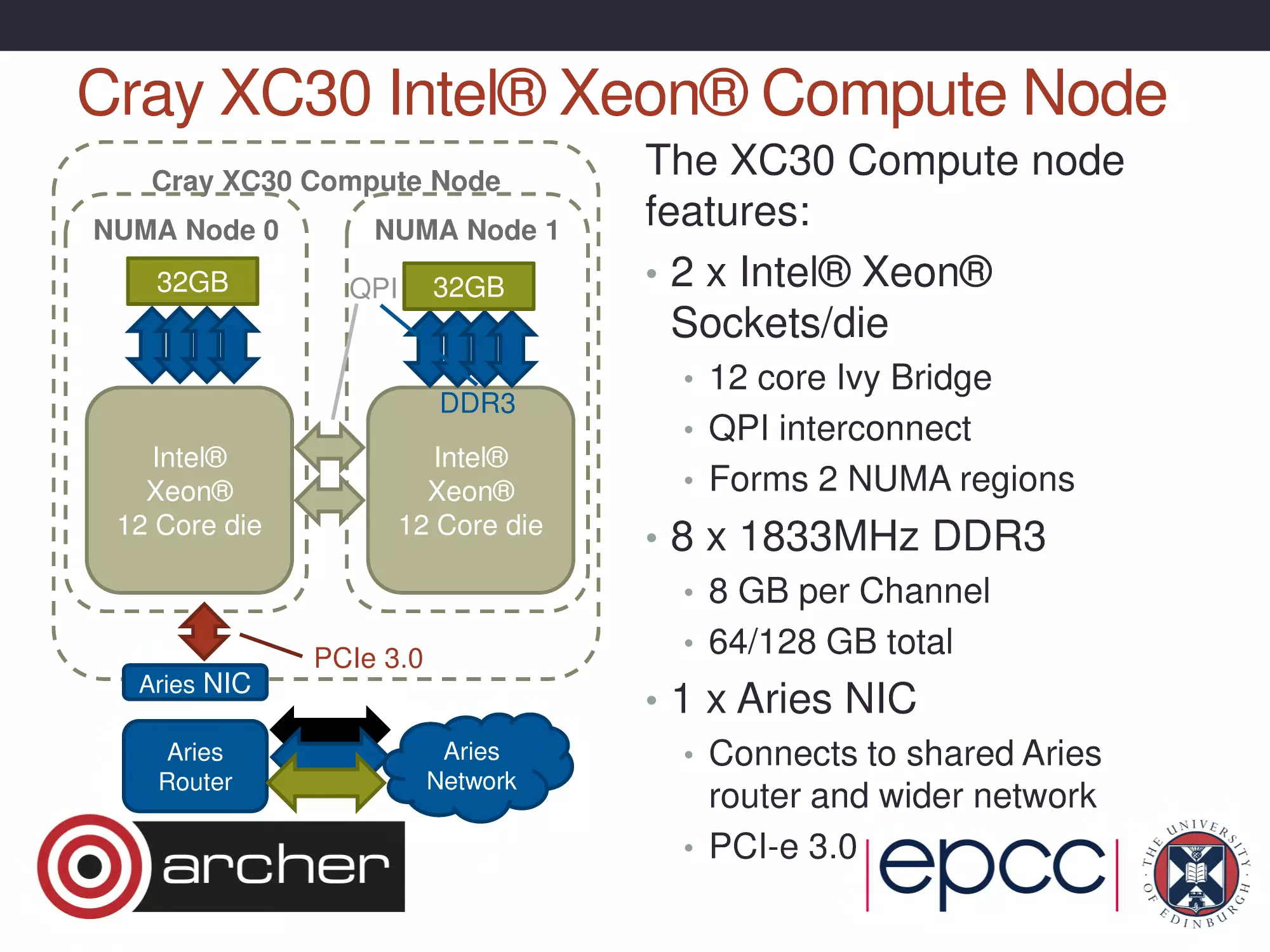
Cray XC30 Intel® Xeon® Compute Node
Cray XC30 Compute Node
NUMA Node 0

32GB

NUMA Node 1
QPI

32GB

DDR3
Intel®
Xeon®
12 Core die

Aries NIC
Aries
Router

Intel®
Xeon®
12 Core die

PCIe 3.0
Aries
Network

The XC30 Compute node
features:
• 2 x Intel® Xeon®
Sockets/die
• 12 core Ivy Bridge
• QPI interconnect
• Forms 2 NUMA regions

• 8 x 1833MHz DDR3
• 8 GB per Channel
• 64/128 GB total
• 1 x Aries NIC
• Connects to shared Aries
router and wider network
• PCI-e 3.0

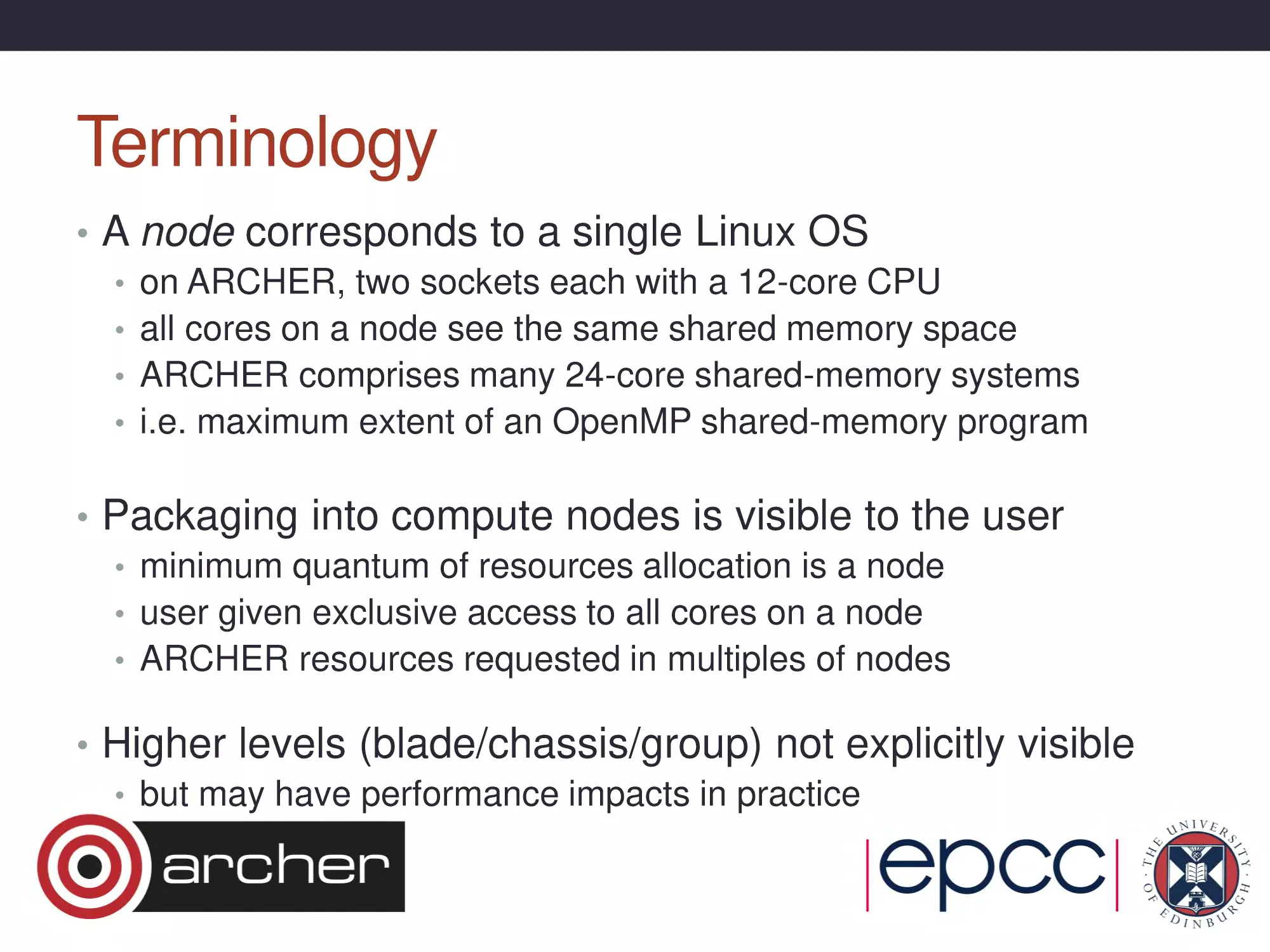
Terminology
• A node corresponds to a single Linux OS
• on ARCHER, two sockets each with a 12-core CPU
• all cores on a node see the same shared memory space
• ARCHER comprises many 24-core shared-memory systems
• i.e. maximum extent of an OpenMP shared-memory program
• Packaging into compute nodes is visible to the user
• minimum quantum of resources allocation is a node
• user given exclusive access to all cores on a node
• ARCHER resources requested in multiples of nodes
• Higher levels (blade/chassis/group) not explicitly visible
• but may have performance impacts in practice

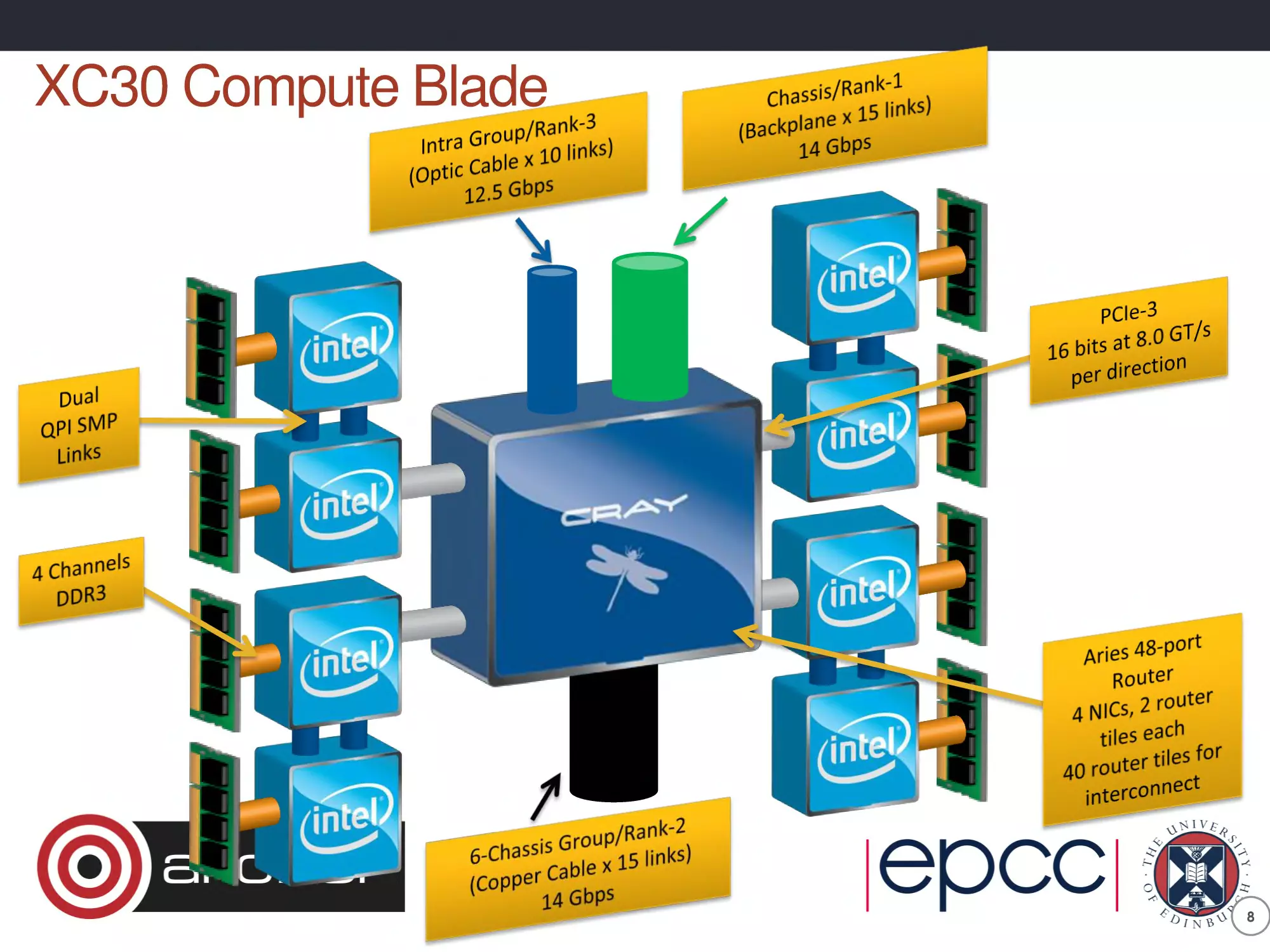
XC30 Compute Blade

8

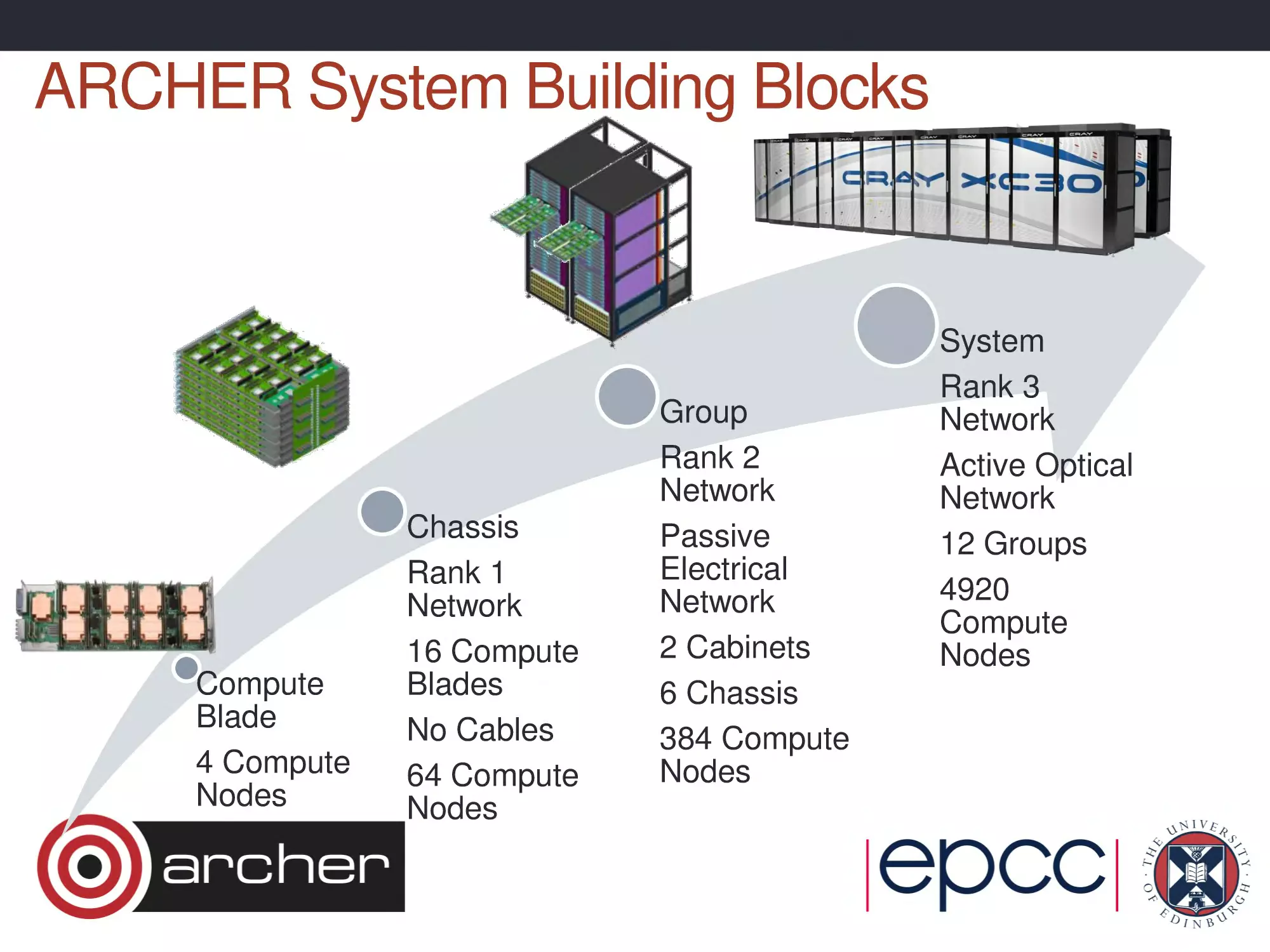
ARCHER System Building Blocks

Compute
Blade
4 Compute
Nodes

Chassis
Rank 1
Network
16 Compute
Blades
No Cables
64 Compute
Nodes

Group
Rank 2
Network
Passive
Electrical
Network
2 Cabinets
6 Chassis
384 Compute
Nodes

System
Rank 3
Network
Active Optical
Network
12 Groups
4920
Compute
Nodes

Cray XC30 Dragonfly
Topology + Aries

Cray Aries Features
• Scalability to > 500,000 X86 Cores
Cray users run large jobs – 20-50% of system size is common
• Many examples of 50K-250K MPI tasks per job
• Optimized collectives MPI_Allreduce in particular
•

• Optimized short transfer mechanism (FMA)
•

Provides global access to memory, used by MPI and PGAS (OpenSHMEM, UPC, Fortran coarrays, ...)
• High issue rate for small transfers: 8-64 byte put/get and atomic memory operations in particular

• HPC optimized network
•

Small packet size 64-bytes
• Router bandwidth >> injection bandwidth
• Adaptive Routing & Dragonfly topology

• Connectionless design
Doesn’t depend on a connection cache for performance
• Limits the memory required per node
•

• Fault tolerant design
•

Link level retry on error
• Adaptive routing around failed links
• Network reconfigures automatically (and quickly) if a component fails
• End to end CRC check with automatic software retry in MPI

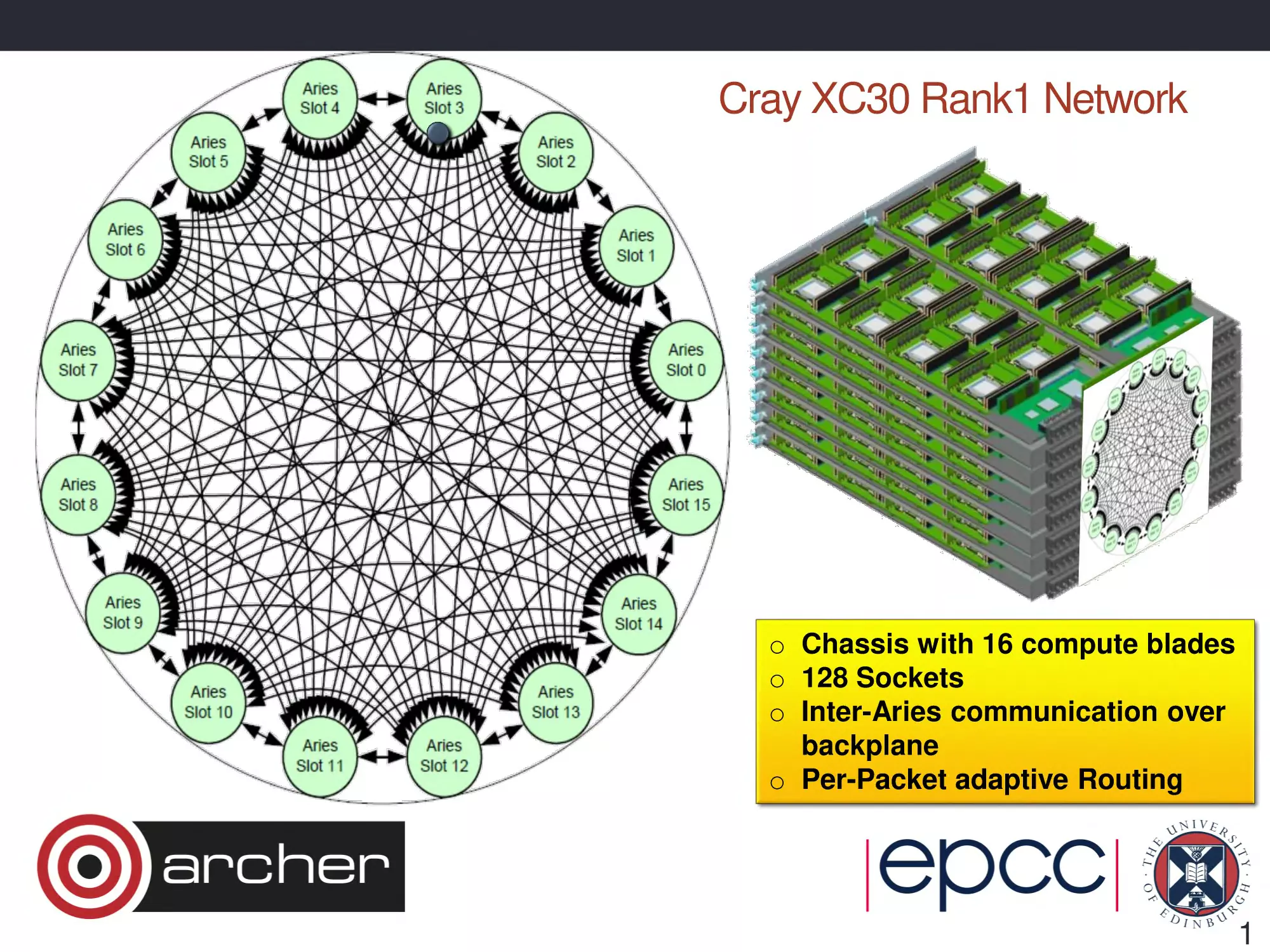
Cray XC30 Rank1 Network

o Chassis with 16 compute blades
o 128 Sockets
o Inter-Aries communication over
backplane
o Per-Packet adaptive Routing

1

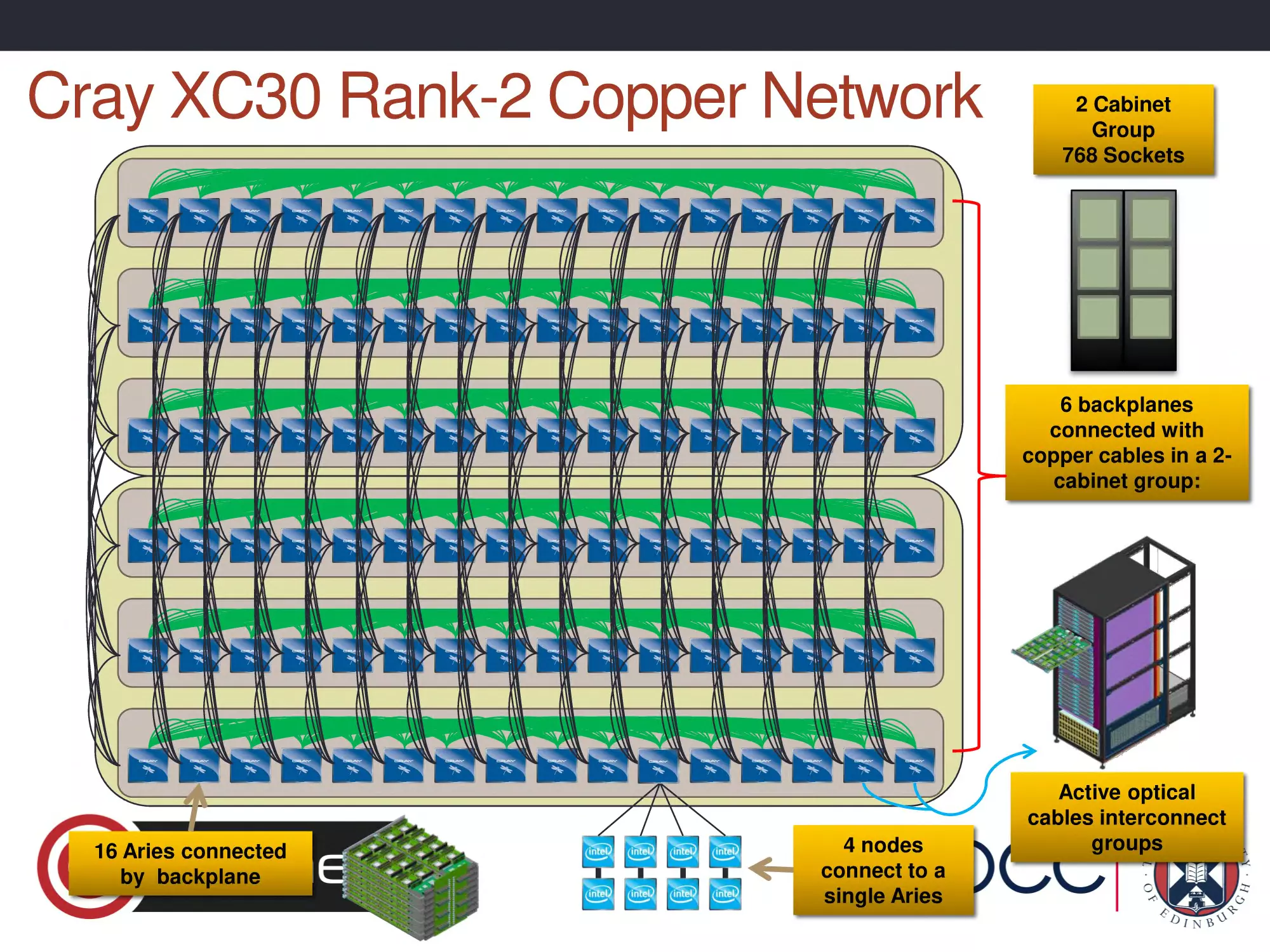
Cray XC30 Rank-2 Copper Network

2 Cabinet
Group
768 Sockets

6 backplanes
connected with
copper cables in a 2cabinet group:

16 Aries connected
by backplane

4 nodes
connect to a
single Aries

Active optical
cables interconnect
groups

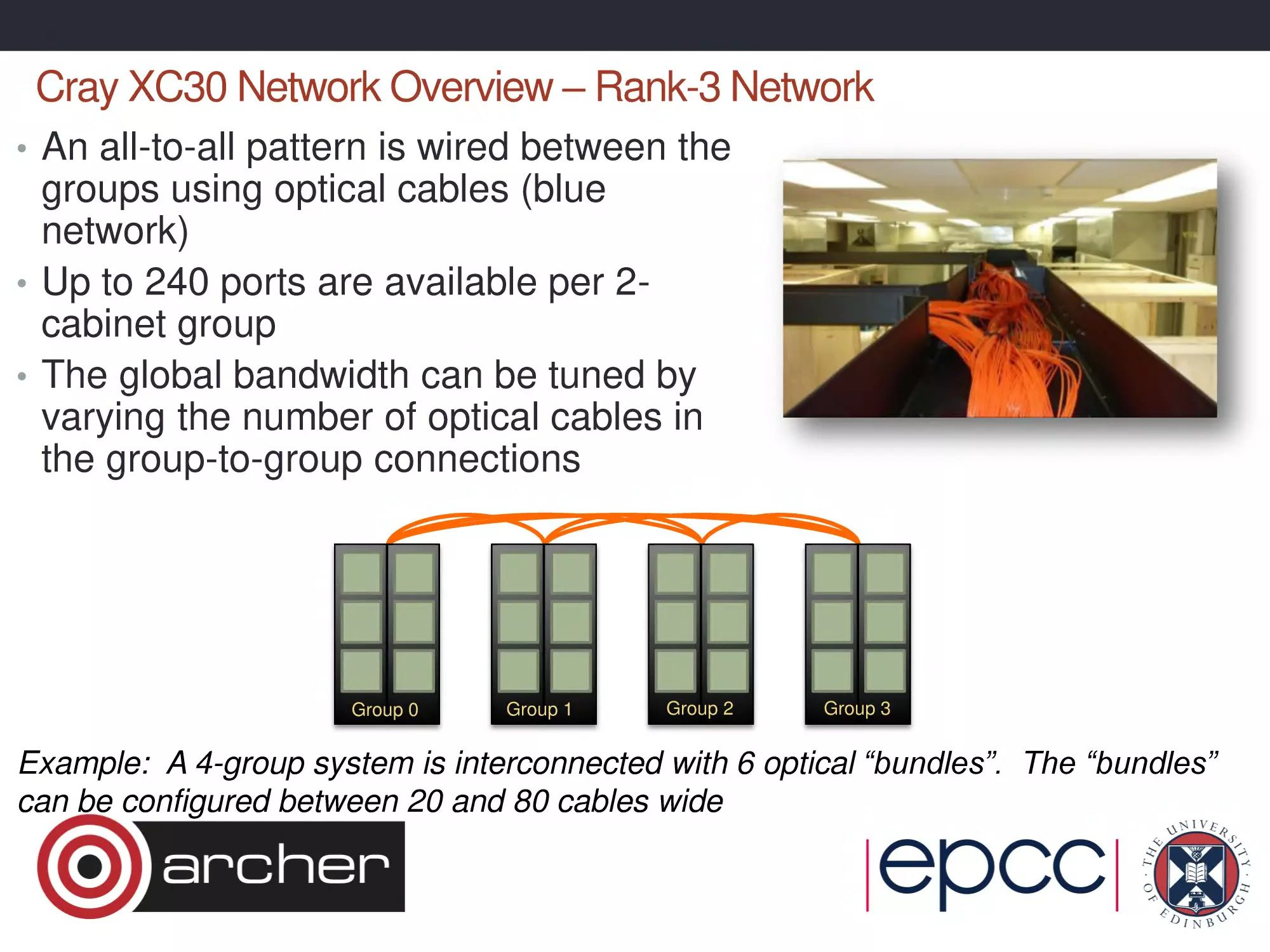
Cray XC30 Network Overview – Rank-3 Network
• An all-to-all pattern is wired between the

groups using optical cables (blue
network)
• Up to 240 ports are available per 2cabinet group
• The global bandwidth can be tuned by
varying the number of optical cables in
the group-to-group connections

Group 0

Group 1

Group 2

Group 3

Example: A 4-group system is interconnected with 6 optical “bundles”. The “bundles”
can be configured between 20 and 80 cables wide

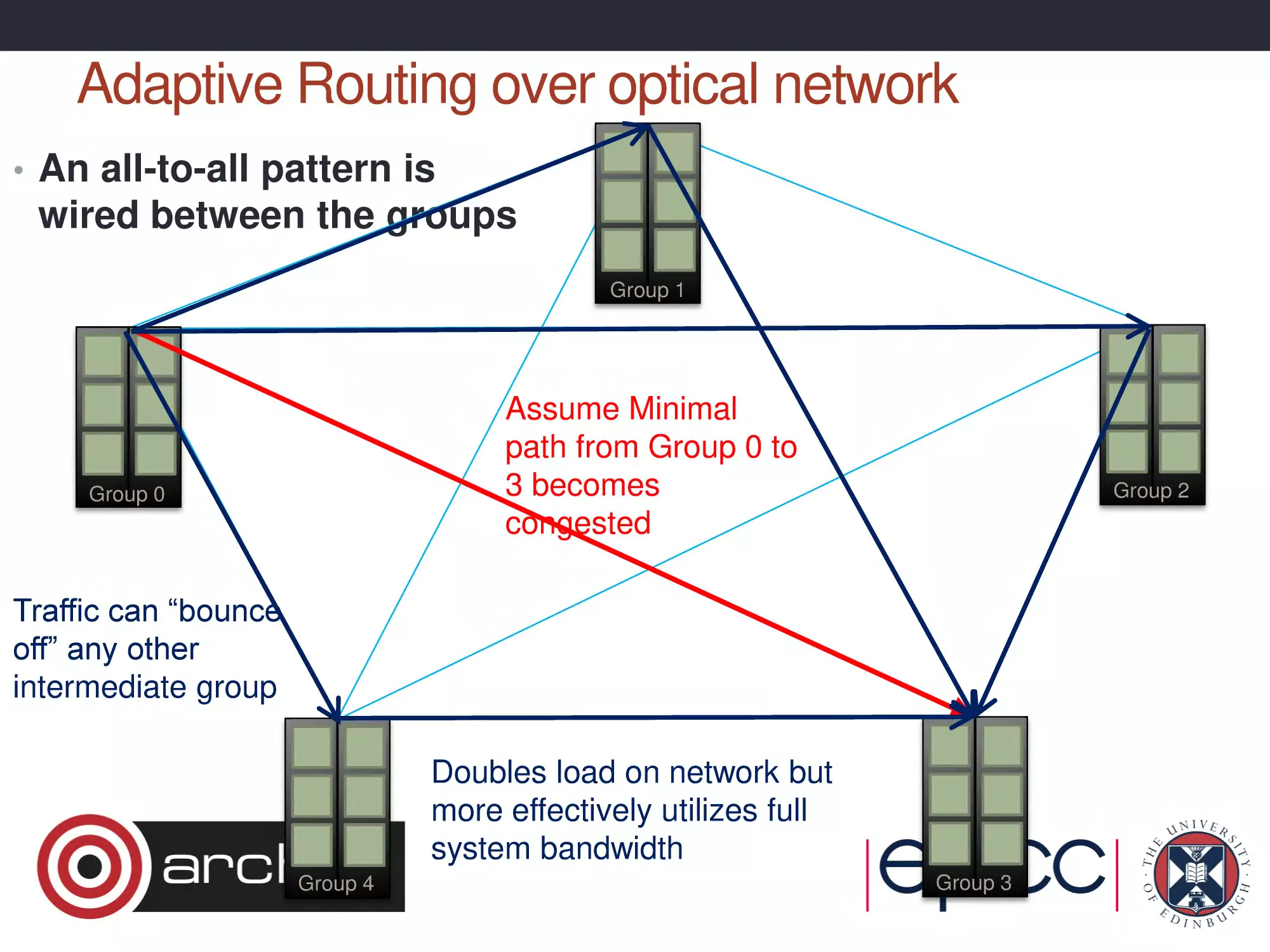
Adaptive Routing over optical network
• An all-to-all pattern is

wired between the groups
Group 1

Assume Minimal
path from Group 0 to
3 becomes
congested

Group 0

Group 2

Traffic can “bounce
off” any other
intermediate group
Doubles load on network but
more effectively utilizes full
system bandwidth
Group 4

Group 3

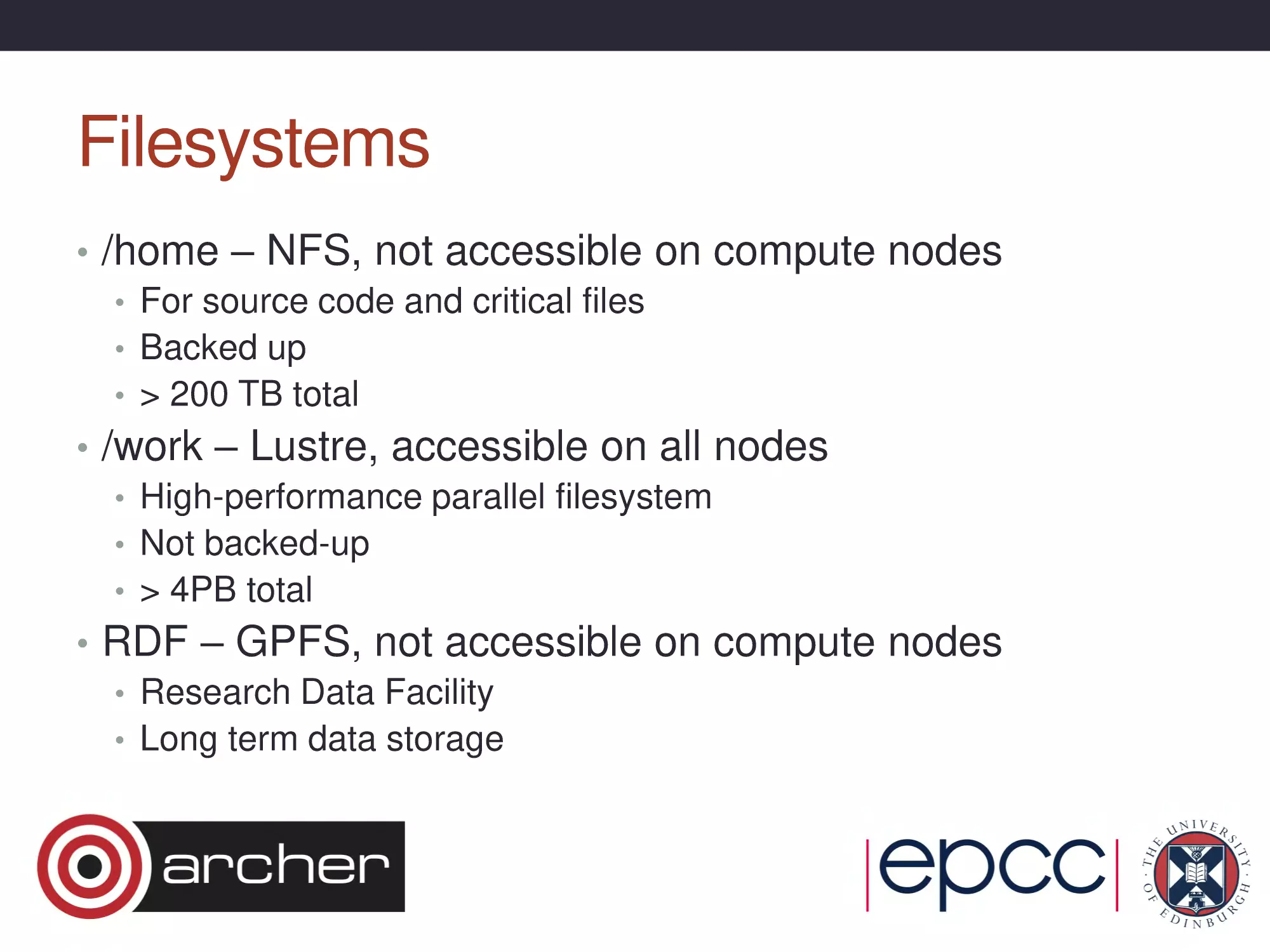
Filesystems
• /home – NFS, not accessible on compute nodes
• For source code and critical files
• Backed up
• > 200 TB total
• /work – Lustre, accessible on all nodes
• High-performance parallel filesystem
• Not backed-up
• > 4PB total
• RDF – GPFS, not accessible on compute nodes
• Research Data Facility
• Long term data storage

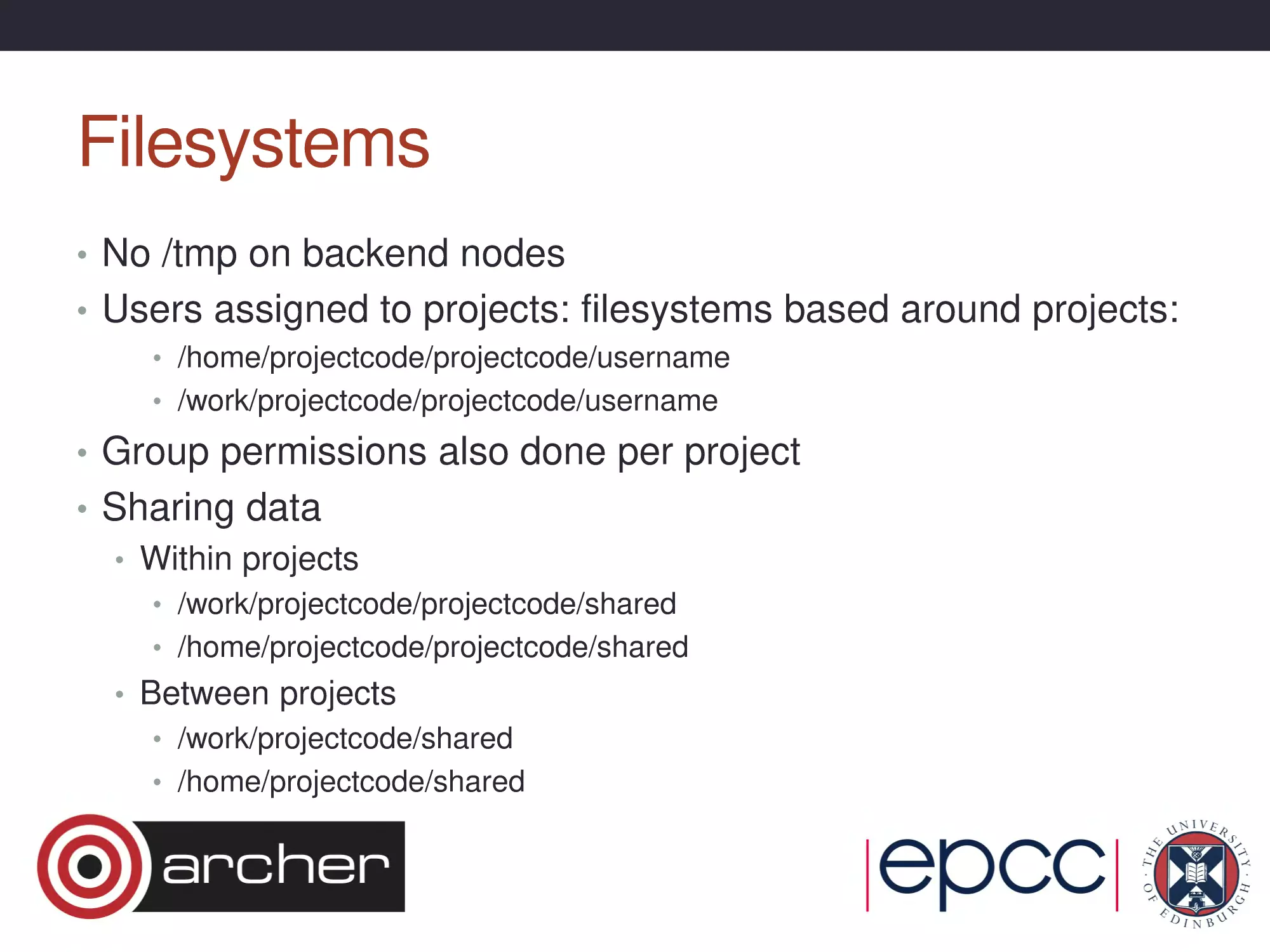
Filesystems
• No /tmp on backend nodes

• Users assigned to projects: filesystems based around projects:
• /home/projectcode/projectcode/username
• /work/projectcode/projectcode/username

• Group permissions also done per project

• Sharing data
• Within projects
• /work/projectcode/projectcode/shared
• /home/projectcode/projectcode/shared

• Between projects
• /work/projectcode/shared
• /home/projectcode/shared

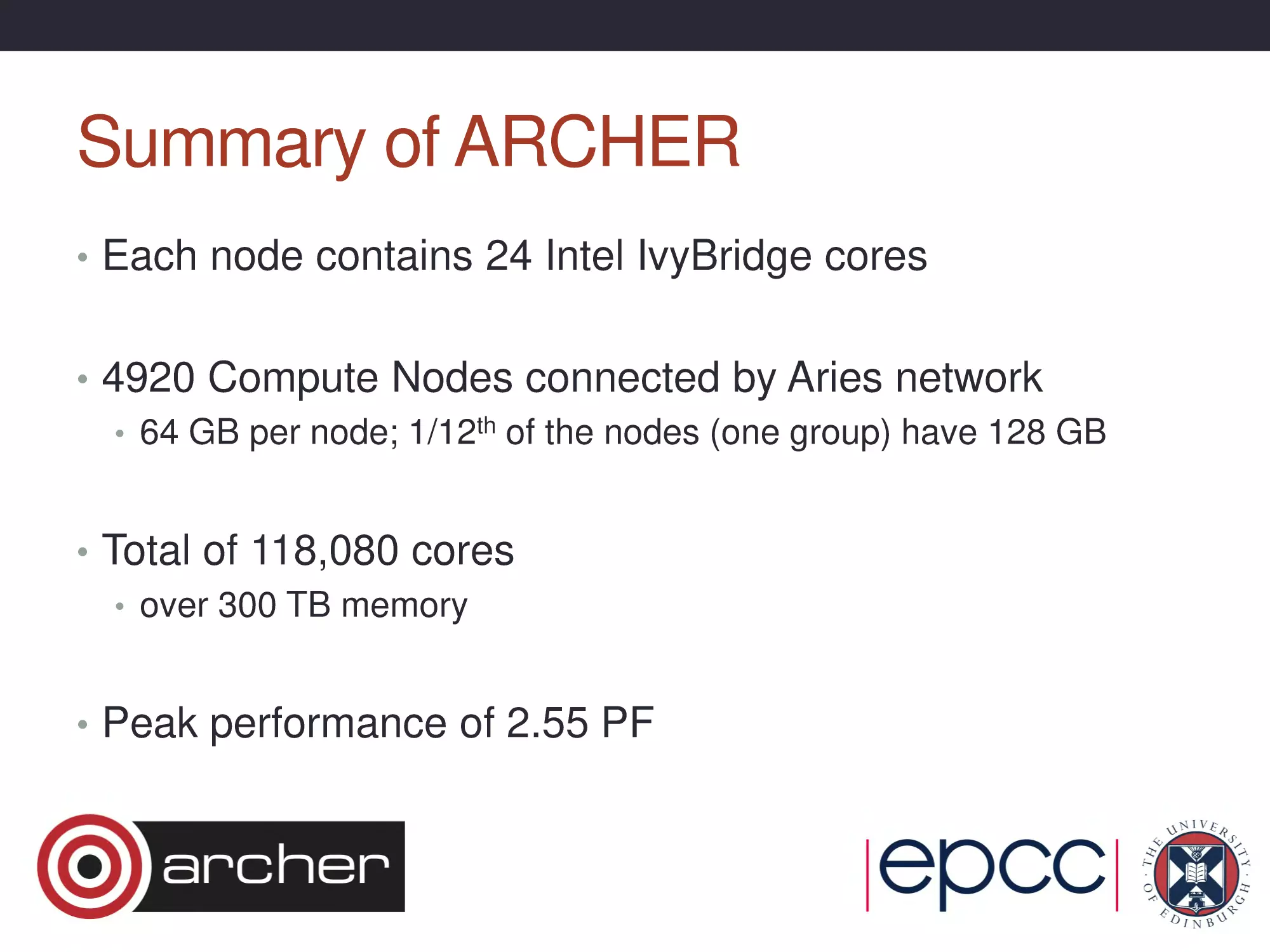
Summary of ARCHER
• Each node contains 24 Intel IvyBridge cores
• 4920 Compute Nodes connected by Aries network
• 64 GB per node; 1/12th of the nodes (one group) have 128 GB
• Total of 118,080 cores
• over 300 TB memory

• Peak performance of 2.55 PF

ARCHER Software
Brief Overview

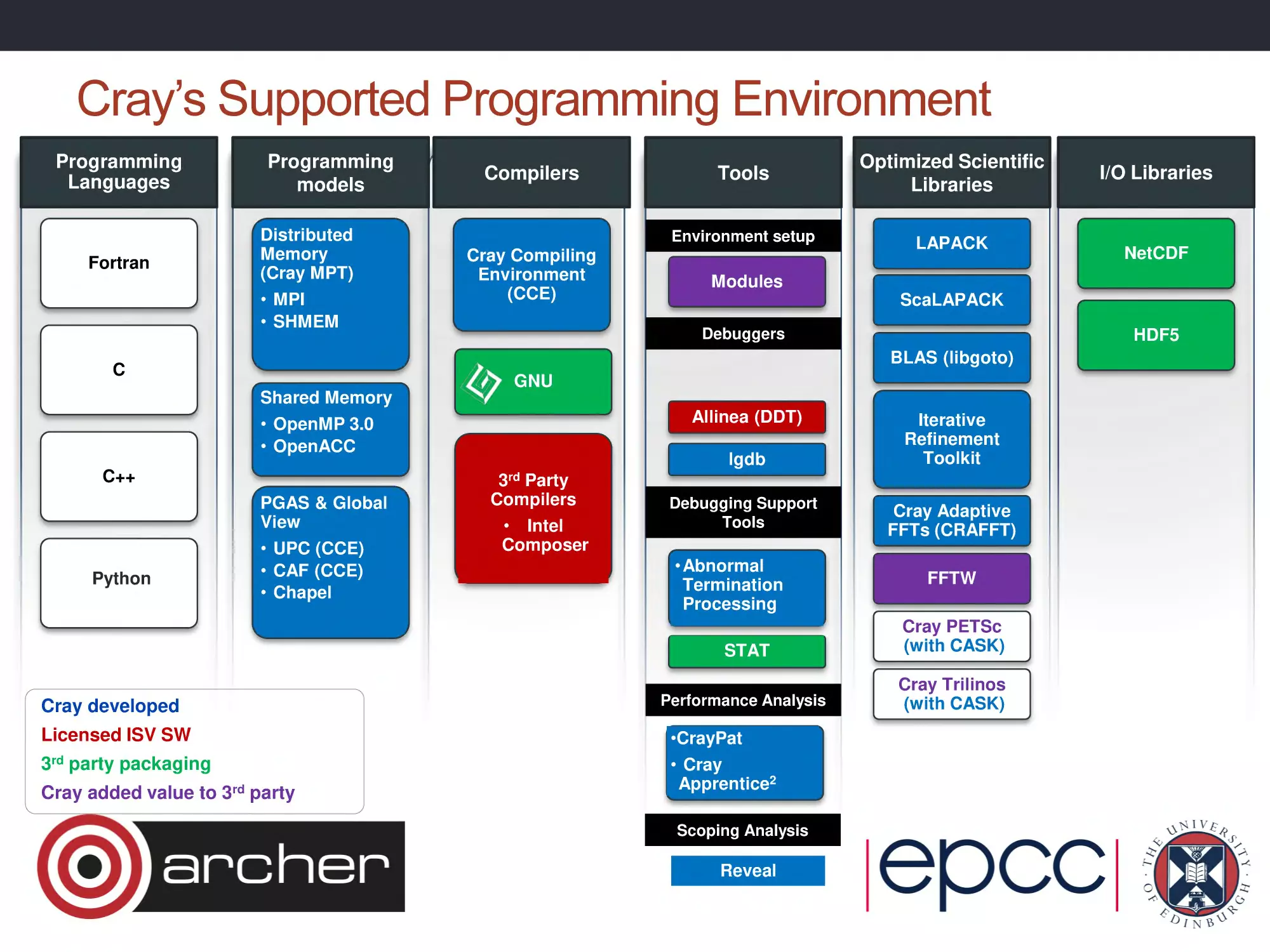
Cray’s Supported Programming Environment
Programming
Languages

Programming
models
Distributed
Memory
(Cray MPT)

Fortran

• MPI
• SHMEM

Compilers

Cray Compiling
Environment
(CCE)

Tools

Optimized Scientific
Libraries

Environment setup

LAPACK
ScaLAPACK

Debuggers

HDF5

GNU

Shared Memory
Allinea (DDT)

• OpenMP 3.0
• OpenACC
C++
PGAS & Global
View
• UPC (CCE)
• CAF (CCE)
• Chapel

Python

Cray developed
Licensed ISV SW
3rd

• Intel
Composer

Debugging Support
Tools

• Abnormal
Termination
Processing

3rd

party

Iterative
Refinement
Toolkit
Cray Adaptive
FFTs (CRAFFT)
FFTW

STAT

Cray PETSc
(with CASK)

Performance Analysis

Cray Trilinos
(with CASK)

•CrayPat

party packaging

Cray added value to

lgdb
3rd Party
Compilers

NetCDF

Modules

BLAS (libgoto)

C

I/O Libraries

• Cray
Apprentice2
Scoping Analysis

Reveal

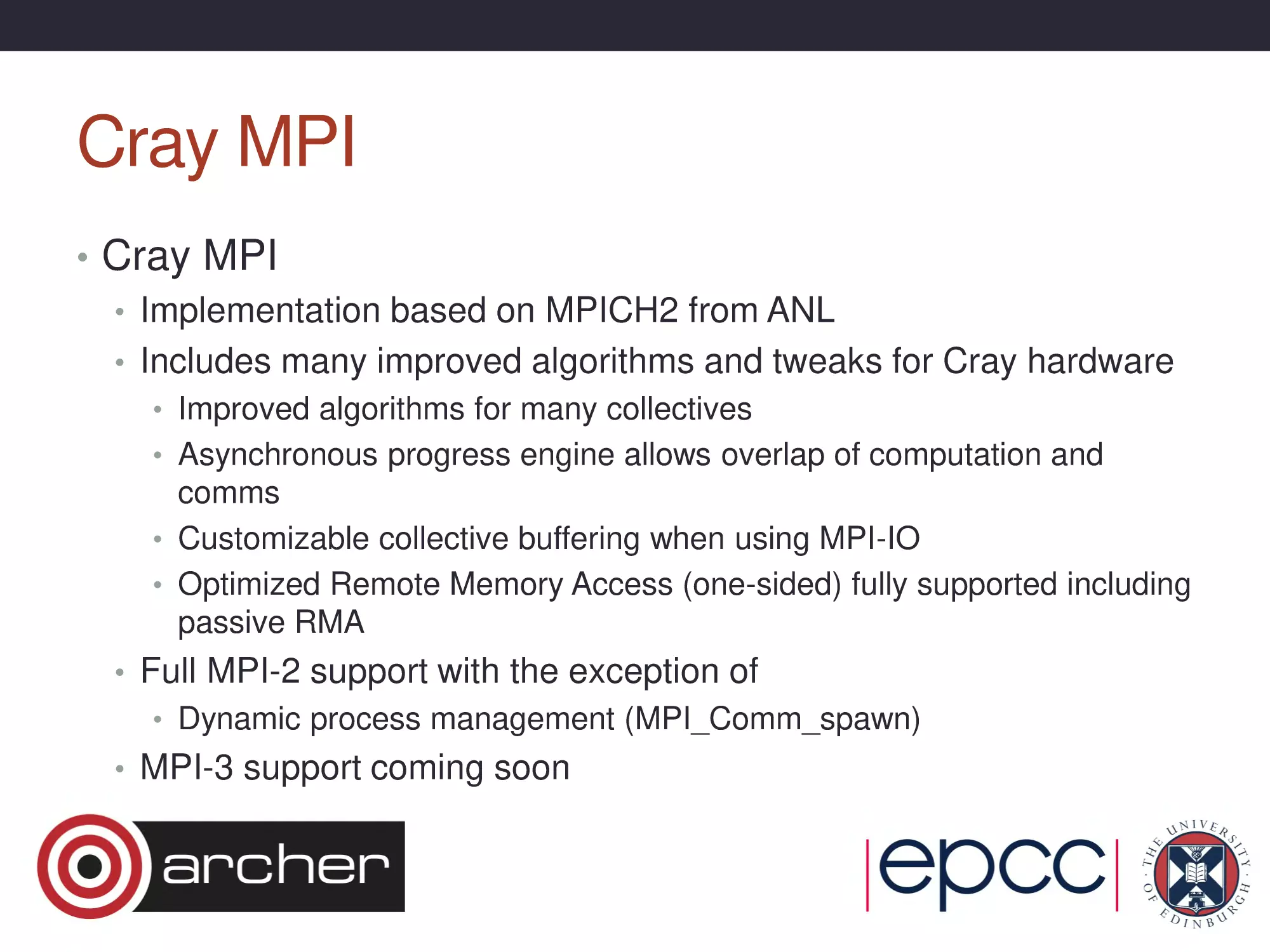
Cray MPI
• Cray MPI
• Implementation based on MPICH2 from ANL
• Includes many improved algorithms and tweaks for Cray hardware
• Improved algorithms for many collectives
• Asynchronous progress engine allows overlap of computation and

comms
• Customizable collective buffering when using MPI-IO
• Optimized Remote Memory Access (one-sided) fully supported including
passive RMA
• Full MPI-2 support with the exception of
• Dynamic process management (MPI_Comm_spawn)

• MPI-3 support coming soon

Cray Performance Analysis Tools (PAT)
• From performance measurement to performance analysis
• Assist the user with application performance analysis and

optimization
• Help user identify important and meaningful information from

potentially massive data sets
• Help user identify problem areas instead of just reporting data
• Bring optimization knowledge to a wider set of users
• Focus on ease of use and intuitive user interfaces
• Automatic program instrumentation
• Automatic analysis
• Target scalability issues in all areas of tool development

Debuggers on Cray Systems
• Systems with hundreds of thousands of threads of execution

need a new debugging paradigm
• Innovative techniques for productivity and scalability
• Scalable Solutions based on MRNet from University of Wisconsin
•
STAT - Stack Trace Analysis Tool
• Scalable generation of a single, merged, stack backtrace tree
• running at 216K back-end processes

• ATP - Abnormal Termination Processing
• Scalable analysis of a sick application, delivering a STAT tree and a minimal, comprehensive,
core file set.

• Support for traditional debugging mechanism
• Allinea DDT 4.0.1
• gdb

User administration
• SAFE website used for user administration
• https://www.archer.ac.uk/safe

• Apply for accounts
• Manage project resources
• Report on usage
• View queries
• Etc….