/

Tags: weapons military affairs
Year: 1915
Text
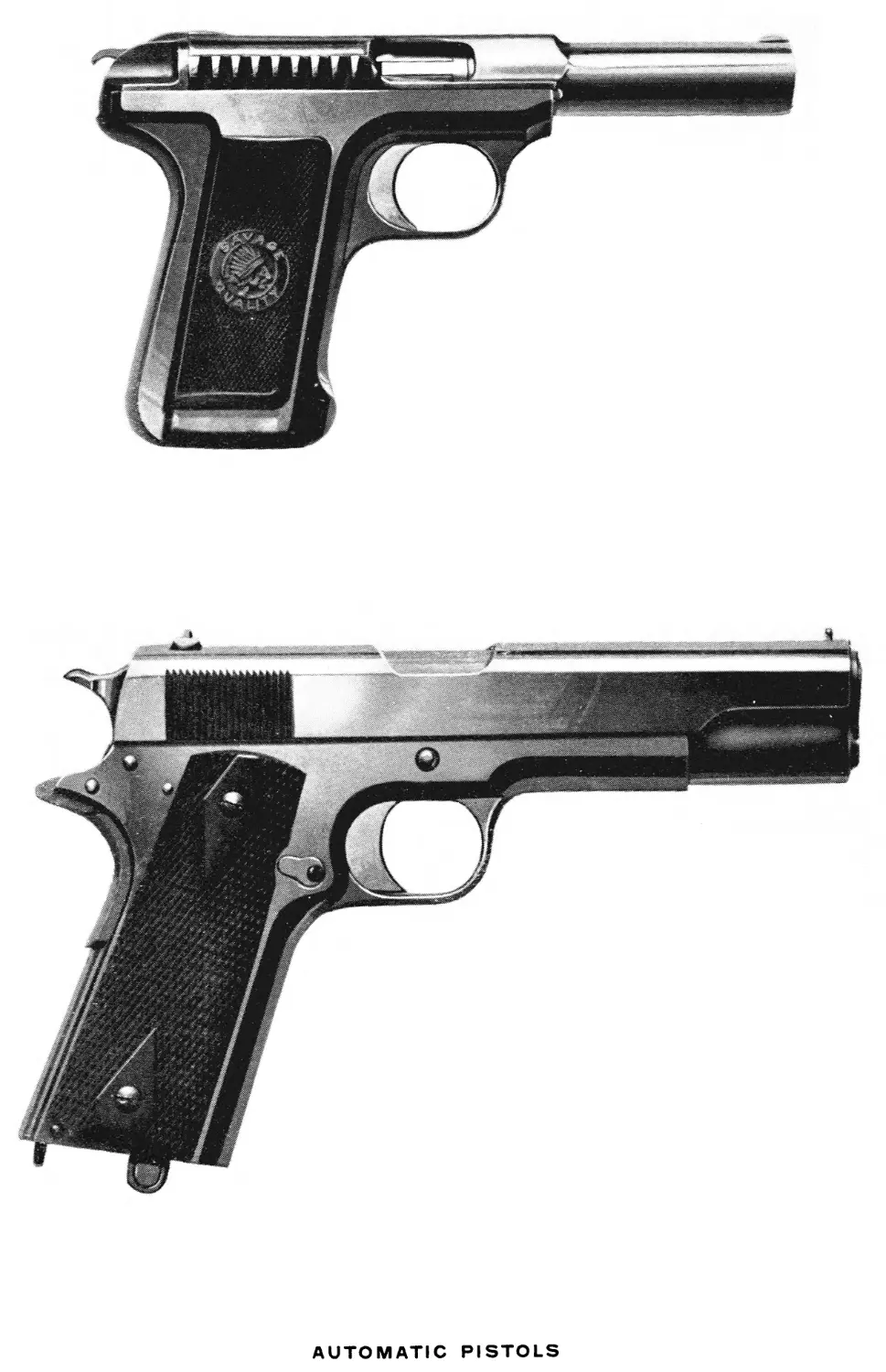
                    AUTOMATIC PISTOLS
AUTOMATIC
PISTOL SHOOTING
TOGETHER WITH INFORMATION ON
HANDLING THE DUELLING PISTOL
AND REVOLVER
BY
WALTER WINANS
CHEVALIER OF THE IMPERIAL RUSSIAN ORDER OF ST. STANISLAUS
COMMANDER OF THE ROYAL SPANISH ORDER OF ISABELLA THE CATHOLIC
COMMANDER OF THE ROYAL ORDER OF THE CROWN OF RUMANIA
OFFICER OF THE STAR OF RUMANIA
OLYMPIC CHAMPION FOR DOUBLE-RIFLE SHOOTING IN I908
GOLD MEDALLIST FIFTH OLYMPIAD, STOCKHOLM, IQI2
REVOLVER CHAMPION, FIVE YEARS NATIONAL RIFLE ASSOCIATION OF
GREAT BRITAIN
SEVEN YEARS OF THE SOUTH LONDON RIFLE CLUB AND TEN YEARS OF THE
NORTH LONDON RIFLE CLUB
ONE YEAR DUELLING PISTOL CHAMPION AT GASTINNE-RENETTE’S, PARIS
VICE-PRESIDENT OF THE NATIONAL RIFLE ASSOCIATION OF GREAT BRITAIN
MEMBER OF THE ASSOCIATION OF AMERICAN INTERNATIONAL RIFLEMEN, LIFE
MEMBER OF THE AMERICAN NATIONAL RIFLE ASSOCIATION, LIFE
MEMBER OF THE UNITED STATES REVOLVER ASSOCIATION AND
OF LE PISTOLET CLUB OF PARIS
PRESIDENT OF ASHFORD RIFLE CLUB, ASHFORD MINIATURE RIFLE CLUB AND
THE SURRENDEN MINIATURE RIFLE CLUB
G. P. PUTNAM’S SONS
NEW YORK AND LONDON
Ube iknfcRerbocRer press
1915
Copyright, 1915
BY
WALTER WINANS
Ube Ifcnfcberbocker ipress, Ulew l?orfe
PREFACE
THOUGH my last edition of Hints on Revolver
Shooting was published only four years ago,
I find" it now necessary, owing to the advance of
the automatic pistol, to revise it thoroughly and
to add new chapters.
Till quite recently, the automatic pistol had
many defects, both as to balance and as to safety,
chiefly in the latter respect, so that only a very
careful expert could handle one without danger to
the public and to himself.
This has now been altered, and with safety
bolts and external hammers several automatic
pistols are quite safe for the use of experts.
They are still very dangerous in the hands of
ignorant persons; a revolver is dangerous enough
in such cases but the automatic is much more
so.
I shall try to explain how any one possessing
mechanical knowledge can, by observing certain
precautions, safely carry and shoot an automatic
pistol. Of course, some men who, for years, have
shot small game, and who are good shots, are still
iii
iv	Preface
very careless in handling a gun. Such men should
never touch an automatic pistol.
I have made the above remarks as I do not want
to be responsible for any accidents with auto-
matics; and I advise any one not sure of him-
self to confine himself to revolvers and single-shot
pistols.
' The automatic pistol is gradually replacing the
revolver except as a gallery pistol.
Up to the present no automatic pistol can shoot
gallery, or light-charge, ammunition, and the full
charge, because of the noise, is very unpleasant in
a shooting-gallery.
It is a great pity that the .44 Smith & Wesson
break-down model of revolver (shooting gallery
ammunition) is no longer made, as it is still the
best revolver for gallery shooting.
M. Gastinne Renette, of 39 Avenue d’Antin,
Paris, for his gallery, uses them still, together with
his duelling pistols of the same calibre and powder
charge.
I mention this as he is the only dealer who can
now supply the old Smith & Wesson revolvers.
Walter Winans.
17 Rue de Tervueren,
Brussels, Belgium.
CONTENTS
CHAPTER	PAGE
I	.—The Automatic Pistol	i
II	.—Selecting a Pistol ...	5
III	.—Cleaning and Care of Pistols .	10
IV	.—Sights ......	14
V	.—Learning to Shoot .	.	.21
VI	.—Rapid Firing. ....	40
VII	.—Traversing Target ...	43
VIII	.—Gallery Shooting. ...	48
IX	.—Twenty-Yards Stationary Target	52
X	.—Disappearing Target ...	61
XI	.—Stationary Fifty-Yards Target .	77
XII	.—Team Shooting and Coaching .	79
XIII	.—Shooting in Competitions .	.	82
XIV	.—Duelling .....	85
XV	.—Shooting off Horseback .	.	98
v
vi	Contents
CHAPTER	PAGE
XVI	.—Pistol Shooting for Ladies . 102
XVII	.—Stage Shooting .	.	.	.106
XVIII	.—Trick Shooting .	.	.	.116
XIX	.—Shooting in Self-Defence .	. 120
XX	.—Shooting in the Dark	.	. 131
Automatic Pistol Shooting
CHAPTER I
THE AUTOMATIC PISTOL
THIS is the pistol of the future and the revolver
has now to give place to it, just as the horse
has to give place to the automobile for traction
purposes.
Still, like the horse, the revolver seems still to
have before it a future for certain purposes, and
one uses a revolver where one would not care to
use an automatic pistol.
The superiority of the revolver consists in its
being adaptable to reduced charges and also in
its being less complicated and less apt to be dis-
charged accidentally by an ignorant person.
At one time, the revolver was considered the
most dangerous fire-arm in existence, but the au-
tomatic far surpasses it in this respect. When
the chambers of a revolver are emptied, it is harm-
i
2 Automatic Pistol Shooting
less; but when the magazine is taken out, after an
automatic pistol has been charged, one cartridge
still remains in the chamber. This has been the
cause of several accidents; a man thinks the pistol
is safe after he has extracted the magazine.
The automatic pistol is barred from gallery
shooting by the fact that the mechanism is oper-
ated by the recoil from a full-charge cartridge only,
and this full charge makes too much noise.
I do not advise the purchase of any automatic
pistol which does not have at least one safety bolt
and which does not have also an external hammer.
There are two makes which, from personal ex-
perience, I can recommend; one is the Colt .45
which has been adopted by the United States
Government for army and navy purposes. This
has a grip at the proper angle for shooting. Hardly
any other automatic pistol is properly designed
in this respect, their grips being too much at a
right angle, so that the barrel tends to point too
high, this creating a strain on the wrist, since the
wrist must be held in an unnatural position.
The Colt automatic of the U. S. Army pattern
has a stock as pleasant to aim with as a duelling
pistol.
Next, it has a hammer which can be put to full
and half cock, just like that of an ordinary pistol
or revolver.
The Automatic Pistol
3
It has, besides, two safety appliances; one a
slide which can be moved with the thumb just
before firing, like the safety bolt of a shotgun,
the other a safety bolt which is pressed by the palm
of the hand in the act of squeezing the trigger, like
that of the Smith & Wesson safety revolver, later
described.
The pistol is, therefore, as “fool-proof” as it
seems possible to make it, but yet there is the
danger of a cartridge being left in the chamber
when the magazine is taken out. I again warn
all shooters of automatic pistols to bear this
fact constantly in mind whenever handling an
automatic.
However, I do not like the sights of this Colt
automatic. The front sight is a black, upright,
narrow rod when aiming, and the notch in the
hind sight is far too small. This arrangement of
sights may be all very well for deliberate aiming
at a black bull’s-eye on a white target, but it is of
no use for practical shooting in a bad light.
The front sight should be a “shotgun” silver
“bead,” and the hind sight a large “U’’-shaped
notch that will show the full bead in it with a little
to spare at the sides.
With these alterations, I think the U. S. Regu-
lation Colt automatic is the best automatic I
know.
4 Automatic Pistol Shooting
The Savage automatic is also very good, and
I can confidently recommend it, especially for
those who find the .45 Colt too large for their
purpose.
The following chapters on learning to shoot with
the revolver and duelling pistol apply equally to
the automatic pistol, except that the butts to be
shot against should be more solid when using the
automatic, owing to its penetration, and the shoot-
ing with it should take place only out-of-doors, as
the noise is very bad for indoors.
CHAPTER II
SELECTING A PISTOL
YOU must first decide for what purpose you
want the pistol; a “general utility” one is
about as much use as a hunter who goes in har-
ness—not much good for either purpose. If you
want a hunter, buy an English hunter; if a harness
horse, buy an American trotter. In the same
way, for whatever purpose you want a pistol, buy
one, if by any means you can do so, especially for
that purpose. Anyhow, it is useless to compete
with a short-barrelled pocket automatic against
target pistols. This class of pistol is intended
only for self-defence at short range, and has no
pretensions to accuracy.
A long barrel theoretically gives greater accu-
racy, especially at long range, owing to there be-
ing more length to burn the powder in, and to
the sights being farther apart, which minimizes
error in aiming; but practically this advantage is
more than counterbalanced by making the pistol
heavy at the muzzle, so that it therefore balances
5
6
Automatic Pistol Shooting
badly. The balance ought to be as near the
trigger as possible. For a pocket pistol, a short
barrel may be absolutely necessary for portability.
In England some men use very long barrels, but
I prefer shorter pistols, and I do not consider that
anything over 7^ inches is a “Military” revolver
nor should it be permitted in military competitions.
See that the trigger-pull is “sweet,” and has no
“drag.” Also, have your trigger-pull as light as
can safely be used. The pull is often left by makers
very heavy, so as to be alterable to suit customers,
and the shopman may forget to have this altered.
If you are not hampered by rules, about three or
three and a half pounds is the best trigger-pull for
general purposes.
I do not like a double-action revolver, except
for a pocket one, as it cannot do accurate
shooting when cocking with the trigger.
For a man whose hands are apt to get moist,
roughing the trigger may prevent slipping; but
it may also make the finger sore if roughed too
sharp.
Some pistols have too narrow a trigger, almost
like a piece of wire; a wide, spoon-shaped trigger
is best, as less likely to cut the finger, especially
when coupled with a heavy trigger-pull.
Get a pistol which, when you grip the stock
properly, has the barrel and your arm as nearly in
Selecting a Pistol	7
a horizontal line as possible. Many makes of
revolvers and automatic pistols have the stock
much below the level of the barrel, which conse-
quently is above the hand. This makes shooting
more difficult; you are apt to cant the weapon to
one side, and the recoil is more severe on your
wrist. A man who holds a pistol properly does
not need a big stock, even if he has a big hand.
For rough work, and in strong sunlight, a pistol
is best blued. I temporarily paint the rib, etc.,
when target shooting on sunny days, with “sight-
black.”
Revolver ammunition is usually made in the fol-
lowing calibres: .32, .38,41, .44, .45, .455. Most
of these can be had loaded with various smoke-
less powders, as King’s semi-smokeless, Riflite,
Cordite, Walsrode, etc.
The Union Metallic Cartridge Company, U. S.
A., have supplied me with great quantities of .44
“gallery ammunition,” loaded with both round
and semi-round bullets. These have a small
charge of black powder, and I should prefer this
ammunition out of a Smith & Wesson Russian
Model revolver for self-defence, as well as for
competitions up to twenty yards, and I find it the
most accurate for exhibition shooting. I believe
most professional stage-shooters use it. It is a
great pity this revolver is no longer made and
8
Automatic Pistol Shooting
can only be bought second-hand. If a second-
hand one is otherwise good, a new barrel can be
put to it. I suppose the various English makers
of ammunition could supply “gallery” charges
in any of their various calibre cartridges, but I
know of none and should not advise the beginner
to try loading this sort of ammunition in English
cartridge-cases for himself. The dome of the
cap is generally higher than in American cartridges;
if, therefore, the small powder charge used in gal-
lery amunition be put in the case and the bullet
pressed down, the bullet will come down on the
dome, stop up the flash-hole, and cause a misfire.
The way to obviate this is to take a wad of suitable
calibre, make a hole in the centre, and push the wad
down to the bottom of the cartridge before putting
in the powder, so as to fill up the base of the car-
tridge and let the bullet “seat” on the powder,
higher than the dome. Makers can do this proper-
ly, but an amateur may put the wad in too loosely,
and a little powder get under the wad. The
result would be that, on the shot being fired,
the wad would be driven half-way up the barrel,
and might at the next shot cause a burst.
Be sure to use only low-pressure powder, if you
use smokeless, as high-pressure powders are
dangerous in a “break-down” action revolver.
Gallery ammunition in a .38 new model solid
Selecting a Pistol
9
frame Smith & Wesson revolver gives good
shooting.
Many people do not understand this difference
in powder pressure, and injure their revolvers
by experimenting with what become practically
“ blasting ” instead of propelling charges.
CHAPTER III
CLEANING AND CARE OF PISTOLS
ALWAYS clean your pistol the moment you
have finished shooting. If you leave it over
till the next day, you may as well throw it away
as expect to win prizes with it.
The larger the calibre, the easier it is to clean
and the less chance is there of spoiling the rifling
by jamming the rod in it. I prefer wooden rods
as less apt to spoil the rifling, but the very narrow
calibres require a metal rod (soft metal for prefer-
ence), as the wood would have to be too thin and
would be liable to break in the bore.
Clean from the breech, not the muzzle end if
the make permits of this; the last fraction of an
inch at the muzzle is where the rifling, if damaged,
spoils the shooting most. For the same reason,
it is as well to have the rifling “reamed off” at
the mouth of the muzzle, so that the edge of it is
protected. Examine the interior of your barrel
at frequent intervals after cleaning, to see if there
is any damage going on from corrosion.
io
Cleaning and Care of Pistols 11
Use the cleaning fluids recommended for the
particular powder you are using, as what may be
good for one powder is of no use for another.
The great thing is to clean very thoroughly. I
use cotton-wool of the best quality rather than
tow, and I do not use boiling water unless in very
exceptional cases, for fear of overlooking a spot
in drying, and getting rust in consequence. If
necessary to use water to remove fouling, let it
be as hot as possible, but this cannot be done if
the barrel is not capable of being separated from
the action.
Do not try to oil the lock, or put it right; send
it occasionally to the maker to be seen to. It is
also well to have a cleaning kit with wooden not
metal (except for calibres of .32 or less) cleaning
rods, cotton-wool, cleaning fluids, screw-drivers,
etc., all in proper compartments, and to put them
back when used. See that the cotton-wool is
absolutely dry' and clean before using it. Throw
away such pieces after once using. Do not use too
big a piece on your rod, such as would get the
latter jammed in the barrel, as you may ruin the
shooting qualities of the barrel by using force to
remove it. Have the cleaning rods long enough,
or you may bark your knuckles.
I do not care much for detachable stocks for
pistols. They only turn a pistol into an inferior
12 Automatic Pistol Shooting
carbine, and the pistol is not meant for a long-
range weapon.
I also do not like the cardboard cases in which
American pistols are usually packed, for permanent
use; they are not strong enough and are apt to in-
jure the sights, especially fine sights. A holster,
again, is not the thing in which to keep a pistol
habitually, as the sights get knocked about; if the
holster is used out-of-doors it gets damp inside and
rusts the weapon. Great care should always be
taken to see that the holster is absolutely dry
inside before placing a pistol therein. To dry
the inside of a holster, make some oats very hot
in a saucepan and fill the holster with them, empty-
ing them out when cold. Some American holsters
are made of india-rubber, to prevent perspiration
from the body rusting the pistol, but such an one
is very liable to retain dampness inside after rain.
The holster which I prefer (for wearing, not as
a pistol-case) is a cowboy holster, without any
button to the flap. If you fasten the flap, you
cannot get the pistol out in a hurry. A lining
of rabbit fur is useful in keeping out sand or dust.
My pistol-cases are good, strong, and solid, of
leather, with brass corners like gun-cases. Each
case holds four, placed either side by side, each
pistol in its own compartment, or, with a tray, two
in the tray and two below. If you have only two
Cleaning and Care of Pistols 13
pistols, they can be put in a case without this upper
tray, or the tray can be used for cartridges. Under
all circumstances, use a good lock,—not the sort
that any key fits,—keep the case locked, and wear
the key on your watch-chain, so that you are sure
nobody but yourself can open the case. Keep the
case in a dry place, and look at the pistols
occasionally, when they are not in constant use,
to see that they are not rusting.
Keep your cartridges, if not in the same case as
the pistols, also locked in a good leather case. This
may be fitted with compartments for various
calibres and loads. The word “loaded” may with
advantage be inscribed inside the lid of the pistol-
cases. People then feel less encouragement to
meddle with the contents.
CHAPTER IV
SIGHTS
SIGHTS are made in many forms. Some suit
one man best; others another. You cannot
decide which suits your individual case without
trying each sort for yourself.
When you find one form which suits you, it is a
pity to risk spoiling your shooting by changing to
others; a beginner should never do so, as he will
get into an uncertain way of taking his sights, in-
stead of always the same, which is the only way to
make reliable, consistent, shooting. Of course,
all your sights may be useless if you are going to
shoot in a competition, consequent on the authori-
ties making some new rule as to “fit for rough
usage”; and then you will have to shoot with
whatever will pass the rules.
My patent sight has, so far, complied with every
rule, and it can be used for hammering nails
without sustaining damage.
The main point is to have a front sight at once
easily seen, and of which you see each time the
Ч
Sights
15
same amount; not sometimes more and at other
times less, else you cannot keep your elevation.
Also the “U” in the back sight should have
bevelled edges, so as to give a sharp edge, else it
looks “woolly.”
Again, if you are not able to see daylight each
side of the front sight when it is in the “U,” you
cannot be aware that you are not covering part of
the front sight on one side or the other, and, there-
fore, whether your aim is in horizontal axis with
your barrel.
The reason I prefer a “U”- to a “V’’-shaped
notch in the hind sight is because in the “V” you
do not see this daylight so well.
As soon as you can shoot well enough to know
whether bad shots are the fault of the sighting of
the revolver or of your own holding, you can sight
the pistol properly for yourself; and in this way
you can do the sighting much more accurately,
and with greater nicety, than by taking it to a
gunmaker and saying: “Alter the sights to shoot
three inches higher and two to the left at twenty
yards, and open the ‘U’ a little,” etc. To do
this, have front and hind sights made of horn,
put in temporarily, without any “U” in the hind
sight, and both hind and front sights a little higher
than you think necessary. Then go to the range
with your pistol and several files of various
16 Automatic Pistol Shooting
sizes, including some that are round. Make a
slight "U” in the measured centre of the top edge
of the back sight. Shoot a few shots at the
range you want to sight for (taking care that you
do not go clean over the top of the butt, owing to
being sighted too high), and then keep working
with the files, first at one sight and then at the
other, till you get them approximately right.
Do not cut the “ U ” down too close to the barrel,
as it will then give you a blurry aim, especially
when the barrel gets hot. If you find you shoot
too high, unless you cut this “U” down take out
the front sight and put in another higher one,
rather than file the “U” unduly low.
Remember when filing: Filing at the bottom of
the “U” makes you shoot lower ; filing at the top
of the front sight makes you shoot higher; filing
on the side of the “U” or the front sight makes
you shoot towards the side on which you have
filed. Therefore, by filing a very little at a time,
where necessary, you can at last get your sighting
perfect. Be sure to file a very little at a time,
or you will overdo it. As in sculpture, you can
easily take off, but cannot replace. If you have
taken off too much anywhere, you may be able to
correct this by filing so as to alter the direction.
For instance, if you have been shooting too much
to the right, you can correct this by filing on the
Sights	17
left of the front sight or the left of the “U,” which-
ever makes the more symmetrical job; but if, by
doing so, you make the front sight too small or too
narrow or make the “ U ” too wide, there is nothing
to do but to put in a new front or hind sight and
begin shooting and filing again.
When you have got the sighting perfect, work
carefully with your file (taking great care not to
spoil the edge of the “U” nearest to the eye when
aiming), and give a chamfered or bevelled edge to
the other side of the “U,” so that it has a knife-
edge. This is to make the “U” look clear and
yet allow the back sight to be strong. On this
principle, you can let the hind sight be strong and
over a quarter of an inch thick, and yet have a
nice, clear “U.” Do not have the “U” deeper
than a semicircle. If this “U” is too deep, it
hampers your view of the object aimed at. In
fact, it should not be quite a real “U,” but a
semicircle. You can also file all round the front
sight, giving it a taper toward the muzzle, but
keeping unaltered the silhouette that you see
when aiming, so that the outline shall then stand
clear to the eye.
A gunmaker’s vise (padded, so as not to bruise
the revolver) is a useful thing, as it leaves both
your hands free to use the files.
I cannot tell you how much you may undercut
2
18 Automatic Pistol Shooting
the front sight, assuming you intend to use it in
competition, as the rules alter so from year to year.
I have an undercut bead-sight which some years
was allowed at Bisley as “Military,” and in other
years not. The best plan, if you are in any doubt
as to its passing, is to send your revolver to be
passed by the committee before competing.
When you have finished, and have had a final
shoot to see if this finishing has not spoilt your
elevation, etc., you can send your pistol to the
maker, and ask him to make your sights precisely
like your model ones, and to fix them permanently
on the pistol without screws, if for Bisley use, so as
to comply with the rules. When you get the
pistol with these sights, if the work has been
properly done, a very little more filing will put
the matter right.
Should you not be shooting at Bisley, or at any
of those clubs which shoot under Bisley rules,
you can, of course, get a pistol with Smith &
Wesson’s “Ira Paine” adjustable sights. Carry
a miniature folding gilt screw-driver and sight-
case on your watch-chain, as I do, and you will
then be able to shoot in any light, at any range,
or in any style of shooting, by merely giving a
slight turn to the adjusting screws to alter your
elevation or direction; or take out a sight from
your little case of sights, if a sight breaks or you
19
want a different size or shape. Public opinion
has not yet been educated to the point of consider-
ing this “a practical military sight,” but this will
come—in time.
EXTRACTS FROM SPECIFICATIONS OF WALTER
winans’s revolver front sight
“Great difficulty has hitherto been experienced
in seeing the same amount of front sight each time
aim is taken, unless the base of the sight is suffi-
ciently undercut to form a ‘bead-sight’; such
undercutting being, however, detrimental, as it
weakens the ‘ sight ’ and renders it very liable to
injury, and is not permissible in Bisley revolver
competitions. The object of my invention is,
therefore, to overcome this difficulty, and to this
end I make the ‘sight’ of metal, horn, wood, or
other hard substance, with a strong, wide base,
preferably of the ‘barleycorn’ or triangular
section.
“The face of the upper part of the ‘sight’ facing
the marksman (as much of it as it is desirable to see
in aiming) is made vertical, or inclined slightly
towards the marksman, so as to cause it to ap-
pear black, as if in shadow. The visible part of
the sight below the face inclines forward from the
marksman, and downward, so as to reflect the
light and enable the face of the sight to be at once
20 Automatic Pistol Shooting
distinguished by its difference of shade from the
lower part. It may be polished or plated to
assist in reflecting the light, while as a contrast,
the vertical face is cross-filed, or ‘roughed,’ or
may be hollowed out so as to be in shadow, and
give it a ‘ dead ’ black appearance.
“In the drawing, I have shown what I con-
sider the best means of carrying this out. Fig.
I is a side view, full size, of a portion of a revolver
barrel fitted with my improved ‘front sight.’
“Fig. 2 and Fig. 3 are sections of the barrel
at A B, showing two forms which the sight may
assume in section, one having straight sides, the
other concave. I show in Figs. 4 and 4*, on a
larger scale, for the sake of clearness, a side and
plan view of the sight shown in Fig. 1, and in Fig.
5 a modification of this shape. Figs. 6 and 7 are
end views, showing two sectional forms of the
sight, and corresponding in size with Figs. 4 and
5. In Figs. 1 and 4, it will be seen that a is the
vertical face of the sight, which is designed to
present a dark appearance to the marksman; and
b is the polished, inclined surface, which takes a
rounded form. In the modification, Fig. 5, the
face a is slightly inclined towards the marksmant
and the bright or polished surface b takes the form
of a flat incline.”
CHAPTER V
LEARNING TO SHOOT
IT is assumed that you have procured an accu-
rate pistol, properly sighted. It is best to use
a single-shot pistol or revolver as an automatic
pistol cannot well be used as a single loader and
for a beg’nner is very dangerous with the maga-
zine charged.
First, make sure that it is unloaded. Always
do this before handling a pistol.
Take a bottle of sight-black and paint both
sights over with the liquid. I have seen men try
to compete, with their sights in a shiny state,
which made it impossible for them to make good
shooting on a white target with black “bull.”
For game shooting, or for military purposes,
of course, a “dead” white (ivory for choice) tip
to the front sight is preferable, or my patent mili-
tary front sight, which answers the purposes both
of a light on dark, or dark on light sight.
With a pistol the first thing to consider is
safety. It is, owing to its shortness, one of the
21
22
Automatic Pistol Shooting
most dangerous of firearms to handle. Even an
expert must exercise great care; and in the hands
of a beginner or a careless person it may be fear-
fully dangerous. I have had many very narrow
escapes in teaching men how to shoot; it is not
even safe to be behind them; they will turn round
with the pistol at full-cock, pointing it at you, and
say: “I cannot understand why it will not go off;
see! I am pulling as hard as I can at the trigger.”
It is indispensable to have a safe background.
Some people think that if the target is fastened
to the trunk of a tree it is all safe, since the bullet
will not go through the tree. This may be so if
the tree is hit, but the bullet will, most likely, go
past the tree when the beginner fires; or, what is
just as dangerous, graze the tree and go off at an
angle. Also, in shooting with round bullets, and
light gallery ammunition, the bullets may rebound
from a hard tree and come back on the shooter.
This I have actually seen happen.
A good background is a high sandy bank, a
thick pile of fagots, or, if not closer than fifty
yards, a high brick or stone wall. The target may
be stood some fifteen yards away from the wall to
prevent danger of a bullet coming back on the
shooter, and then the shooter can be far enough
from the wall, if the wall is a background. If a
lot of shooting is done, it is not very good for the
Learning to Shoot	23
wall, and if many shots hit the same spot they may
gradually make a hole. Iron butts are expensive,
especially for the large surface required by a be-
ginner; at twenty yards, a beginner could not in
my opinion safely shoot at a background less than
twelve feet high and some ten in width. Even
then there should not be any one beyond it within
half a mile, lest he should happen to let off by
accident. Shooting out to sea is safe, if one keeps
a good lookout for boats; but the glare from the
water is bad. A sand or chalk pit is a good place
to shoot in, or one can shoot against a high chalk
cliff. It is dangerous to shoot anywhere where
people cross unexpectedly, as from round the cor-
ner of a building.
The great thing is that the pistol should never
point in any direction where it would matter if it
went off by accident. This rule should be observed
even with an empty pistol, because so many “I-
did-not-know-it-was-loaded ” accidents occur.
Having got a butt, the learner should take a firm,
narrow wooden table and place it some ten yards
from the target. This target is preferably a
“Bisley fifty-yards target,” four-inch bull’s-eye.
The Bisley cardboard targets are cheap; and, by
pasting white patches on the white and black on
the bull’s-eye bullet-holes, one target can be used
for a long time. I refer to the fifty-yards target
24 Automatic Pistol Shooting
because this four-inch bull’s-eye is very easy to
hit at ten yards’ range. The Bisley revolver
“bull’s-eyes” count, at all ranges, seven points;
the concentric rings counting one point less, each,
till the outermost one, which counts two points.
The highest possible score, therefore, for the six
shots is forty-two, or six times seven. It is best
to shoot at this very big “bull” at ten yards, as
making “bull’s-eyes” encourages the beginner;
and, as he gets more proficient, the two-inch twenty
yards “bull” can be substituted. This I think
preferable to going back farther from the target
as your skill increases; also it is safer, for the
nearer the shooter is to the butt the wider his
shots would have to be for him to miss it; whereas,
if he goes back to fifty yards he may easily shoot
over a very high butt.
Place your empty pistol on the table, the
weapon lying on its left side with the muzzle
towards the target. The table is preferably a
narrow one, so that, during the process of loading,
the muzzle points to the ground beyond the table
and not to the table itself, an accidental discharge
being thus immaterial; a foot wide is about right;
the length does not matter, so long as it will hold
your field-glasses, cleaning things, and cartridges.
Position.—The position for shooting which I
am now going to describe, is the one in which I
Learning to Shoot	25
shoot and the one which I have found from experi-
ence suits me best. This position, however, will
have to be modified according to the build of the
shooter; a stouter or shorter-necked man than
myself might have to stand more sideways.
Stand facing the target; the right foot pointing
straight for the target, or perhaps a shade to the
left (if the ground is slippery, this gives you a
firmer foothold); the left heel distant from six to
nine inches to the left of the right foot, according
to your height (my distance is eight inches), and
about an inch farther back; the feet turned out
about as much as is natural to you when standing.
Stand perfectly upright, not craning your head
forward; the left arm should hang down straight
and close to the side in the position of “Attention.”
Some people bend the left arm and rest the hand
on the hip; but I think this looks affected, and it
is not as workmanlike as if the arm hangs straight
down.
If you are trying to “hold” an especially im-
portant shot, and find yourself wobbling off your
aim, it is a great help to grip your thigh hard with
your left hand; this especially applies in a gusty
wind.
Now lift the pistol with your right hand (the
weapon is empty, remember) and cock it. There
are two ways of cocking: one using both hands
26
Automatic Pistol Shooting
and one using only the shooting hand. I do not
refer to the double-action revolver cocked by
pulling back the trigger, as I do not think shooting
with much accuracy can be done by this method;
and it is, moreover, the cause of half the acci-
dents happening with the “ I-did-not-know-it-was-
loaded” shooters. The cocking by the trigger is
only useful in a revolver for self-defence at very
close quarters.
To return, this single-handed cocking is done
by putting the thumb on the hammer and by the
action of the thumb muscles alone bring it to full-
cock. Take particular care that the first finger
is clear of the trigger, or else you will either break
or injure the sear notch, or have an accidental
“let-off.” With practice, this way of cocking
becomes very easy, and can be done with great
rapidity. I personally can also let the pistol
down to half-cock (manipulating the pistol with
one hand, with the trigger finger and thumb);
but I would not advise a beginner to try this,
except with an empty pistol and even then only
one that he does not mind the chance of spoiling,
as he is very apt to break the nose of the sear if
he bungles it.
By practice, the thumb and forefinger muscles
(abductor pollicis and adductor indicts) develop
enormously, and you need not mind if at first it
Learning to Shoot
27
seems difficult; but stop at first as soon as they
feel tired, or you may strain them. Pistol-shoot-
ing is good also for the flexors of the forearm and
for the dorsal muscles. A small hammer with
short “fall” is easiest to cock, as well as to make
good shooting with, for such a hammer takes less
time in falling, and the aim is, in consequence,
less likely to be disturbed.
The beginner will find that it assists the cocking
to give the pistol a slight tilt to the right and
upwards, taking great care to bring it back with
the hind-sight horizontal afterwards, as holding
the sights tilted is one of the chief causes of bad
shooting.
For double-handed cocking, assist the right
hand by taking the pistol barrel in the left hand;
keep the barrel horizontal and pointed at the
target, not towards your left-hand neighbour (if
you are competing), as is often done; and, while
it is thus steadied, cock gently, not with a jerk,
bringing the hammer well beyond full-cock, so
that it sinks back into the bent with a well-defined
click, keeping the first finger clear of the trigger.
Now, stand with the pistol in your right hand,
just clear of the table; right arm full stretch.
The first finger must be outside the trigger-
guard (not touching the trigger} during this
stage.
28 Automatic Pistol Shooting
Some Englishmen shoot with the second finger
on the trigger and the first along the pistol; but
this is a clumsy way, and the first finger is apt to
be burnt with the escape of gas from the cylin-
der, if a revolver is used. The habit was acquired
from shooting the Martini rifle, the clumsy "grip”
of which made this manner of holding necessary.
The great thing is to have your grip as high as
you can on the stock, in line with the axis of the
barrel, or as near this as is practicable. With the
Smith & Wesson Russian Model (now no longer
manufactured) I have it actually in line with the
bore of the barrel.
Some pistols for the British market often have
specially long, big handles, or stocks, because
of the habit (or is it the Regulation Position?)
of holding the stock low down with the little fin-
ger beneath, prevalent in England. Now this
sort of position makes the recoil come at an
angle to the wrist, throws the barrel up at the
recoil, spoiling the accuracy, and puts more strain
on the wrist than is necessary. I remember a
very strong-wristed man firing one of my heavily
charged fifty-yards revolvers and spraining his
wrist at the first shot, owing to holding it in this
way; whilst I have fired hundreds of rapid-firing
shots straight on end with it without hurting
myself. I take the recoil just as a man catches
Learning to Shoot
29
a hard-thrown ball, letting arm, hand, and wrist
fly up together.
The pistol barrel, hand, and arm should all be
nearly in one line, the thumb along the left side,
so as to prevent jerking to the left in pressing
the trigger (in the same way as the left arm
is fully extended in shooting with the shotgun),
and not crooked, as all beginners insist on holding
it.
You must be constantly on the watch that you
do not crook your thumb, until the extended posi-
tion becomes second nature to you. Some makes
of pistols, however, have the extractor lever in a
position which renders this grip with extended
thumb impossible.
For the benefit of beginners who are not target
rifle-shots, the following explanation may be
necessary: The target, for the convenience of
locating shot-holes, is supposed to represent the
face of a clock. The top of the bull’s-eye (which
we term “bull” for brevity) is called XII o’clock,
as that is, of course, where the numeral XII ap-
pears on a clock face, and so on for all the other
numerals: half-past four, for instance, is half-way
between where the numerals IV and V appear on a
clock. I was once shooting in the presence of a
foreign naval officer, and when I made a “half-
past five” “bull” shot he said, “South-east,” his
30 Automatic Pistol Shooting
professional instinct making him liken the target
to the face of a compass.
First take a deep breath, and fill your lungs.
Now slowly bring your right arm to the horizontal,
keeping your eyes fixed on the bottom edge—at
“six o’clock”—of the “bull”; whilst you are doing
this, put your forefinger inside the trigger-guard,
and gradually begin to feel the trigger and steadily
increase the pressure on it straight back, not side-
ways. Whilst you are doing all this, also gradu-
ally stiffen all your muscles so that you are braced
up, especially about the right shoulder, as though
you were walking along the pavement and saw a
man coming towards you whom you meant to
shoulder out of your path.
You may breathe naturally until the pistol is
levelled, then hold your breath; if you cannot get
your aim satisfactorily before you feel you want
to take a fresh breath, lower the pistol, take a deep
breath, and try again. If you have followed these
directions carefully, you will find, when the hind
sight comes to the level of your eyes (closing your
left eye or not, as you find best, without any
lowering of the head), the front sight will be
seen through the middle of the “U” pointed at
the bottom of the bull’s-eye, the top of the front
sight just touching it at “six o’clock.” If every-
thing has been done perfectly, at the moment this
Learning to Shoot	31
occurs the pressure on the trigger will have been
increased sufficiently to cause the hammer to
fall, and, after it has fallen, you will see the top
of the front sight still just touching the bull’s-eye
at its bottom edge.
If the pistol had been loaded (assuming, of
course, that it was an accurate shooting one and
properly sighted), you would have had a central
bull’s-eye for your shot. Most likely, however,
you will find that the pistol came up all of a
tremble, and that, as the hammer fell, the front
sight was jerked very wide of the “bull” and
perhaps even hidden by the hind sight.
Do not be discouraged, but cock and try again.
By the way, it is best to use a “dummy” cartridge
or an exploded one whilst doing this “snapping”
practice, as otherwise the jar may do damage to
the plunger and perhaps break the mainspring.
There are dummy cartridges, made with a rub-
ber “buffer,” for this practice.
If you still find your hand shaky (and it is not
naturally so), it most probably arises from your
gripping too hard.
The action of “letting off” should be like squeez-
ing an orange—a squeeze of the whole hand. Start
with a light grip when your hand is down, and
gradually squeeze as you come up, the trigger-
finger squeezing back; and the hammer will fall
32 Automatic Pistol Shooting
without the least tremor or without the sights
moving off the point they covered during the fall
of the hammer. The main thing of all in pistol
shooting is to squeeze straight back. Whenever you
find yourself shooting badly see if you are not
“pulling off to one side”; and in nine cases out of
ten you will discover that this was the cause of
your bad shooting.
Some men can never squeeze the trigger straight
back, and have to allow for this by getting the
hind sight “set over” to one side to correct it;
but this is a slovenly way of shooting, and, as the
pull to one side may vary according to the “jump-
iness” of the shooter, it prevents his being a
really first-class shot.
Keep the hind sight perfectly horizontal; be-
ginners are prone to cant it on one side, which
puts the bullet to the side towards which you cant.
After a little practice, you will be able to “call”
your shots, that is to say, you will be able, the
moment the cartridge explodes, to say where the
shot has struck the target, as you know where
the sights were pointed at the “squeeze-off.”
After six shots, make a pencil-cross over each
bullet-hole, so as to know where your former
shots hit. After twelve hits it is best to take a
fresh target. At the end of the day’s shooting,
you can cover the holes by pasting black patches
Learning to Shoot	33
on the bull’s-eye holes and white on the rest, and
use the target again.
I will now say why I insist upon the importance
of a table being before the shooter. The usual
procedure for a beginner with the pistol is this:
He cocks the pistol with both hands, pointing it
at the spectators on his left whilst doing so; he
then holds it with his right arm close to his side,
pointing it to the ground at his right foot. He
then brings it up with a flourish, high above his
head, and lowers it to the target, jerks the trigger,
and “looses off.” Of course he does not hit the
target, but makes a very wild shot. After a few
more shots on this principle, getting more and
more wild, and making bigger flourishes with his
pistol, he finally lets it off by accident whilst his
arm is hanging by his side; and he is lucky if he
does not make a hole in his right foot.
I remember once a man telling me (he professed
to be an expert with the revolver) that I was
wrong in keeping my revolver pointed in front of
me towards the target when preparing to shoot.
“You ought to hold it like this,” he said, letting
his right arm hang close to his side and keeping
the revolver pointing downwards; “then it is
quite safe.” At that moment it went off and blew
a big hole in the ground within an inch of his foot!
By my system of having a table in front of the
5
34 Automatic Pistol Shooting
shooter, close to which he stands, and from which
he lifts the pistol, he cannot shoot down into his
feet. But he must never turn round or leave the
table without first unloading the pistol and placing
it on the table; nor, on any account, must he let
any one go up to the target or be in front or even
get level with him whilst the pistol is in his hand.
Now, as to the trick of lifting the pistol above
one’s head before firing: I cannot understand why
people want to do this. It only frightens specta-
tors; besides, the shooter is running the risk of
shooting himself through the head; and in com-
petitions or in self-defence time is too valuable to
waste in such antics.
When you are pretty confident that you can
keep your sights properly aligned at the bottom
edge of the “bull” while the hammer is falling,
you can try a few shots with a loaded pistol. It is
best to load only some of the chambers, if using a
revolver, irregularly spin the cylinder round, after
the revolver is closed and at half-cock, so as not
to know which chambers are loaded, and every
time you find you jerk off with a shot, return to
the snapping-empty-cartridge practice. This lat-
ter is good practice, even when you become a
skilled shot.
Place the box of cartridges beside, and to the
right of, the pistol. Use only a very small charge
Learning to Shoot	35
(gallery ammunition for choice) at first, as nothing
puts a beginner off so much as the fear of recoil.
Stand behind the table, the pistol being between
you and the target, and take the pistol by its stock
in the right hand. Do not turn the muzzle to the
left, but straight out towards the target. Put
it in your left hand and load it. This proce-
dure varies with different makes of revolvers; with
the Smith & Wesson, Russian, and Winans models,
you lift the catch with your left thumb and press
the barrel down with the same hand till it (the
barrel) is perpendicular, pointing to the ground.
But whatever the mechanism, when the pistol
is open for loading, the barrel should be pointing
downwards, yet in line for the target.
If a cartridge projects too much, remove it, as
it is dangerous and may explode prematurely
from friction against the breech of the revolver.
In loading, of course have the pistol at half-,
not full-cock. Close it by elevating the breech
with the right hand, not by raising the bar-
rel with the left, as in the latter case the car-
tridges may drop out. This rule applies also to
the hand ejecting revolvers. See that the snap,
or other fastening, is properly closed. If your
shot goes wide of the bull, be sure, before you
alter your aim for the next shot, whether it is not
your “squeeze-off” which is wrong.
Зб Automatic Pistol Shooting
A practised shot can correct the shooting of his
pistol by “aiming-off” enough to rectify any error
in sights. But the beginner had better not at-
tempt this: he will find enough to do in trying to
hold straight under the bull.
Do not mind if your score does not “count”
much; those who do not understand shooting
judge the goodness of a score by how much it
counts, or by how many shots are in or near the
bull’s-eye. In reality, it is the group which
constitutes a good score. One score may consist
of the highest possible,—forty-two points (all six
shots bull’s-eyes),—and another may only count
twelve points; and yet the latter may be far the
better “shoot.”
I will explain: In the first case, the shots may
be “all round” the bull, “nicking” the edges; they
would require, therefore, a circle of more than
four inches (on the target you are at present shoot-
ing at) to cover them. The other score may
consist of all six bullet-holes cutting into each
other at an extreme edge of the target, but making
a group which could be covered with a postage-
stamp. The first “shoot” is a wild, bad score for
ten yards’ range at a four-inch bull, although it
counts the highest possible in conventional scor-
ing. The other is a magnificent shoot, that any
one might be proud of; the fact of its being up in
Learning to Shoot	37
the comer merely showing that the sights were
wrong, not the shooter’s ‘‘ holding.’’ A few touches
of the file, or knocking sideways the hind sight, will
put this error right. Never mind, therefore,
about scoring many points; merely shoot for
group. You will gradually find your groups
getting smaller and smaller as you improve; it is
then merely a matter of filing to get good scoring.
As your four-inch bull’s-eye is too large for real
shooting at ten yards, you must remember that
the sighting of the pistol should put the bullets
one inch only into this size bull at “VI o’clock,”
not into the middle of it. The reason is that,
practically, the trajectory of a pistol is the same
at twenty as at ten yards; and as the English regu-
lation bull at twenty yards is two inches, you want
the twenty-yards sighted pistol to put the shots
into the centre of the two-inch bull when you aim
at the bottom edge. In other words, you want it
to shoot an inch higher than your aim at that
distance. Therefore, if with your four-inch bull,
a'ming at the bottom edge, you go into the bull
one inch up, it means a central bull’s-eye shot on
a two-inch bull. The reason I recommend aiming
at the bottom of the bull’s-eye instead of at the
middle of it is that if you try to put a black bead
in the middle of a black bull’s-eye, you cannot see
either properly; if you whiten the bead of the fore
38 Automatic Pistol Shooting
sight, then you cannot see it clearly against the
white of the target in “coming up” to a bull.
Nobody can hold absolutely steady on the “bull”
for more than a fraction of a second; you have to
“come up” from below and “squeeze off” as you
get your sights aligned.
It is best to have your cleaning appliances on
the table, or otherwise handy, when shooting, and
every now and again to have a look through the
barrel and a wipe-out; you might otherwise be
inclined to attribute to bad shooting what may be
caused by leading or hard fouling in the barrel.
I have a little cupboard under my table with a
lock and key, in which I keep my cleaning appa-
ratus, cartridges, etc. (but not the pistol), to save
the trouble of carrying them to the range.
Always clean a pistol as soon after shooting as
possible, and clean very thoroughly.
For real work, I prefer a pistol when it is half
worn out, as everything then works smoothly and
there is less danger of jambing. Rust in the rifling
may entirely spoil accuracy, as, if you work it off,
the bore gets enlarged and the bullets “strip.”
I never like to compete with a perfectly new pistol;
all pistols have their peculiarities, and it is neces-
sary to get used to one, to “break it in,” before
trusting it to obey one’s slightest hint.
It is sometimes useful to be able to shoot with
Learning to Shoot	39
the left hand; as, for instance, if the right hand
is disabled, the right arm held, etc., and for an
officer with a sword in his right hand. If the
novice has resolution enough to divide his practis-
ing, from the beginning, between both hands, he
will be able to shoot nearly as well with his “left”
hand as with his right. I have put quotation
marks round “left” as I mean by this the hand
not usually employed; a left-handed man’s right
hand being in this sense his “left.”
I have also noticed that a left-handed man can
shoot more evenly with both hands; that is to say,
he is not much better or worse with either hand,
not being so helpless with his right hand as a
normally handed man is with his left. In all the
directions for shooting, for left-handed work merely
change “right leg” to “left leg”; “right arm” to
“left arm,” etc.
CHAPTER VI
RAPID FIRING
RAPID firing, in my opinion, is the most practi-
cal style of shooting; a pistol is not a weapon
for deliberate shooting, but for lightning rapidity
at short range.
If you are using a revolver it is necessary to get
one which works as loosely and as easily as pos-
sible. A half-worn-out revolver is best, as it
works freer. Next, file the mainspring as weak as
it is possible to have it without risk of too many
misfires. If it has one misfire in every twenty
shots, or so, it does not matter, the great thing
being to have it cock easily. An automatic pistol
is the weapon for this, a revolver being quite out
of date. A very big front sight and a big “U”
in the back one are advisable.
As the target rises, “come up,” quickly, increas-
ing the pressure on the trigger as you “come up, ”
so that the pistol goes off the moment it is hori-
zontal and the sights are about right. I say about
because there is not time to correct the aim.
Be sure to squeeze back—not jerk off. It is
40
Rapid Firing	41
possible, with practice, to get this “snap shot’’
into the “bull” or touching it. As this first shot
goes off, be especially careful to take all pressure
off the trigger. Unless you are very careful you
will keep a slight pressure on the trigger with your
first finger, and if you are using an automatic the
next shot will go off before you mean it to.
Your right arm—and in fact, the whole of your
body—should be immovable. Your aim at each
shot ought not to be disturbed enough to be more
than a few inches off the “bull.”
After each shot begin a steadily increasing
pressure straight back, and without a jerk, trying
at the same time to get your sights as near the
“bull” as you can before the pistol goes off again.
You can fire as quickly as you can get your aim.
If using an automatic pistol, all that you have
to do is to release the pressure on the trigger the
moment each shot goes off, and instantly begin to
squeeze again as you get your next aim. Do not
keep on too long; half a dozen practice scores are
ample at a time. One only gets erratic and wild
if one continues too long, and the pistol also gets
hot.
The sighting may have to be different in this
from that required for slower shooting. Some
men shoot up in one corner when snap-shooting
with the heavy trigger-pull of the automatic
42 Automatic Pistol Shooting
pistol; and it is preferable to have the sighting so
that one can aim straight under the “bull,” in-
stead of having to make allowance for the jerking
off. The trigger-pull should be as light as is
deemed compatible with safety, but the automatic
pistols so far on the market have a very heavy
trigger-pull.
Wearing glasses to protect the eyes against half-
burnt powder fumes is very important in shooting
an automatic.
CHAPTER VII
TRAVERSING TARGET
Target Moving Across the Line of Fire at Twenty
Yards
THIS is not so difficult as rapid-firing. The
chief difficulty is that when your aim is right
horizontally, you may be wrong vertically, and
vice versa.
When first practising, have a target made with
a black band two inches wide running down the
middle of the target, instead of the usual bull’s-
eye. Begin your practice at this, having it first
put up with the black band vertical, and then with
it horizontal. Shooting at it vertical will show you
if you are getting the right allowance in front in
your aim. When it is horizontal, it will show you
if your elevation is correct. This can be elabo-
rated by having black bands painted or pasted
on the back of an ordinary target, and, with its
back towards you, shooting at them. Then, by
turning it over after the six shots have been fired,
43
44 Automatic Pistol Shooting
you will see what score you would have made on i
a regulation target. The reason for this practice
is that there are two things to attend to. One is
the “allowance" in front, the other is the "eleva-
tion”-, and if a beginner tries to think of both at.
once, it will confuse him.
If, after you have got pretty certain of your
“allowance,” you go to “elevation,” you will most
likely lose your “allowance,” and have to go back
to the vertical band; and so on, alternately, till!
you can trust yourself at the regulation bull.
Most people, unless they use alternate hands,,
find the “run” one way easier than the other.
I prefer higher elevation in sights for this com-
petition. Instead of aiming to touch the “bull”
at “VI o’clock” to get a central “bull,” the aim
should be at the actual elevation you want the
bullet to go, so as to enable you to aim off at
“III o’clock” and “IX o’clock” for right and left
runs respectively.
Some people who are slower on the trigger—that
is, who take longer to give the order to the trigger-
finger when their eye says the aim is right—may
need more allowance.
There is in astronomical work a technical termi
(“reaction time”) for the process of timing first
contact in eclipses, and each observer deducts his;
own personal error, which seems constant to him..
Traversing Target	45
This allowance varies in revolver shooting with
different men.
Some men aim at a spot, and wait for the target
to come up to it; but this is useless, as any one
knows who has shot moving game with a gun.
Stand absolutely square to the front, or perhaps
a little more toward the side on which you find
it most difficult to follow the target. Plant the
feet slightly farther apart than for other com-
petitions, and swing the whole of the upper part of
the body from the hips. Do not swing your right
arm, keeping the rest of the body still. The
shoulder-joint does not give so smooth a horizontal
swing as swinging from the hips. Moreover, if
you swing the arm, you have to turn the head, or
else have to look out of the comers of your eyes,
instead of straight before you.
Let the whole of the upper part of your body be
held rigid, and swing only on the hips. Lift your
pistol from the table as the target appears, and
swing with the target, bringing up the pistol on a
diagonal line (this is the resultant of the vertical
rise from the shoulder and the horizontal swing
of the hips). Let the sights come horizontal to
the eyes a little in front of the proposed allowance;
and, as you keep your arm moving in front of the
bull, gradually let the bull overtake you, till it is
the right allowance behind your sight; and still
46 Automatic Pistol Shooting
keep on swinging. All this time be gradually
squeezing the trigger, so that it squeezes off just
when the aim is right. Be sure not to stop swing-
ing before the pistol goes off.
I do not think there is any advantage in keeping
your arm up between runs of the target; it tires the
arm, and you cannot make the diagonal swing up
to your spot in front of the bull.
I do not think it is of any use deciding to fire
upon a certain part of the “run”: it is best to fire
when you feel you are aiming right, and you may
get this feeling sooner in the “run” on some days
than on others.
There is a tendency to “follow” too long, and
then, owing to lack of time, to jerk off just as the
target disappears. I have made “bulls” when
the target was almost out of sight, in fact, I did
so in my record shoot, at Bisley, where there
used to be such a competition: but this is a bad
habit to contract, and a risky sort of shot, as it
is almost sure to be too far behind, or even to be
fired into the shield in front of the target; though,
of course, if you have not a good aim, it is better
to delay as long as possible, rather than to shoot
earlier with a bad aim.
Be sure in your range that your shield is bullet-
proof, or you may get into the habit of making
“bulls” when the target is “sitting” behind the
Traversing Target	47
shield, by shooting through it. To economize
space, you can have this target run in front of
your disappearing-target apparatus, putting the
latter out of the way when not needed; this latter
will also serve for stationary-target purposes, and
to hold the fifty-yards target. Do not have a
target which runs by gravitation, as shooting at
a target which is running downhill requires quite
different sighting from that needed with one run-
ning horizontally.
CHAPTER VIII
GALLERY SHOOTING
A PRIVATE gallery can easily be fitted up in
the cellars of large country, or even town,
houses. All that is needed is a gallery of a certain
length—ten yards will suffice at a pinch, with the
targets and butt (such as I describe in the chap-
ter on Stage Shooting) at one end. The targets
should be lighted from above, preferably by a
skylight in the daytime, and by gas, lamp, or
electric light at night. When artificial light is
used, it should be screened, so that from the firing-
point the targets are distinct, but the source of
light invisible. At the firing-point it is difficult
to get a satisfactory light. If this gallery is not
made in a greenhouse, which, of course, would
give ample light to sight by in the day, I think
there is no use in trying to get the light to shine
on your sights. If it is behind you, you stand in
your own light. If enough above you to prevent
this, the light only shines on the top edges of your
sights, and is thus worse than useless. I find it
48
Gallery Shooting	49
best to have enough light behind you to enable
you to load by, and to trust to seeing the sights
in a black silhouette against the target. You
may, for this reason, have to alter your sights
from the elevation which suits you out-of-doors.
You should have a ventilating shaft straight
above the muzzle of your pistol, and, if possible,
a fan to draw off the fumes and smoke; one worked
by electricity or water-power is best.
It is expedient to use only the lightest gallery
ammunition, and it deadens the sound if you have
the walls covered with some material hung loosely.
Boiler-felt is very good for the purpose. Also,
if you shoot through a hole in a partition screen,
it helps to deaden the sound.
I prefer a big-calibre pistol in competition, as
it gives a better chance to score; a shot which
would be just out of the bull with a small bullet,
may just cut the bull with a large ball. The
bullet-hole is also more easily seen, but the bullet
must be spherical, or you will have to use too
heavy a charge of powder to propel it.
The self-registering targets, such as are used for
miniature .22 calibre rifles, I do not find very
satisfactory; the larger size of the bullet makes it
liable to strike two compartments at the same
time, giving you a double score, and the impact
of the bullet is, moreover, too heavy for the mech-
4
50 Automatic Pistol Shooting
anism. I prefer card targets or the Gastinne
Renette target which registers hits at the firing-
point.
On no account have targets that necessitate
any one’s going down the range, or coming out
from a mantlet, to change. There is sure to be
an accident sooner or later. Have them made to
draw up to the firing-point for examination and
change, and never let any one turn round with a
pistol in his hand. In fact, observe all the rules
as to table to fire from, etc., which I give in the
chapter on Learning to Shoot. All these rules
apply equally to gallery shooting.
As the gallery is generally narrow, it will be
difficult to have traversing targets, but you can
have the Bisley targets.
Such a gallery will be an endless source of
amusement in the winter evenings, after dinner;
and the ladies can shoot as well as the men.
It is advisable to handicap the good shots, so
as to give all an equal chance.
Gallery shooting is by far the most scientific
style of pistol-shooting, if you use a very light
load, fine sights, and hair-trigger; therefore you
can have smaller bull’s-eyes and subdivisions than
the Bisley ones. The American and French targets
are better subdivided for this purpose. Messrs.
De La Rue make me special “ace of hearts” packs
Gallery Shooting
5i
of cards for use as targets. For experimental
work also, a gallery is much more reliable than
shooting out-of-doors.
When shooting gallery ammunition in which the
bullets are “seated” low down, it is best to have
a groove line impressed in the cartridge shell to
prevent the bullet working up; if you have not
got this impression in the shell, look into the
cartridges before putting them into the chambers,
as a bullet may have worked itself up, which would
cause a weak, low shot. Push the bullet down
with a loading rod, or pencil, before you insert the
cartridge into the chamber, if you find it shifted.
Also, if, after firing a few shots from a revolver
with this ammunition, you, for any cause, stop
and want to re-load the chambers which have been
fired, it is as well to take out all the cartridges
that have not been fired and examine them, as
the jar of firing may have started some of the
bullets.
CHAPTER IX
TWENTY YARDS STATIONARY TARGET
I HAVE already described how to stand and shoot
at a stationary target. There are a few points
to be observed, however, which specially apply
to this range when shooting at Bisley. Before
competing at any one of the limited-entry com-
petitions, it is well to be sure that you are shooting
up to your proper form, as mistakes cannot be
corrected after once commencing.
Personally I think it best (if shooting every day
or most of the ten days) not to enter in a limited-
entry competition till after the first two days of
the meeting, as one gets steadied down by then
and grows more accustomed to the surroundings.
As sighting varies from day to day, and even
from hour to hour, it may be as well to have a pool
shoot for sighting purposes first; but I personally
never do so, as I think it is a pity to chance wast-
ing a good score in pool. The moment you have
“found the spot,” leave off pool; do not stop to
finish a score.
I prefer doing my sighting on an “unlimited-
52
Twenty Yards Stationary Target 53
entry” competition ticket, so that in case I make
a “highest possible,” that score is not wasted.
The early morning, from 9 till 11 a.m., is the
best time for shooting; and then, perhaps, late
in the evening. One should watch for a good time
when the light is favourable; often the wind will
drop late in the evening, half an hour before
“gunfire,” after blowing hard all day.
There is often a good light after rain. I rather
like shooting in the rain, and have made some of
my best shots in it. The light is then good; and
there is then no glare on the target; bullets make
very big, ragged holes on a wet target; and some-
times a shot which would not cut the bull on a
dry target may do so on a wet one, owing to its
making a larger hole.1 The flat-topped bullets
make very big, “clean” holes.
If you have a target with a doubtful shot, that
is to say, one for which you think you are entitled
to a higher count than the range officer gives you,
do not touch it, or thrust anything (your finger or
a pencil) into the hole to demonstrate that the
shot cuts into the bull’s-eye or the line you claim.
If you push anything into the hole you will spoil
its outline and destroy all evidence of the point
at which the bullet had cut. In doubtful cases,
1 At Bisley a bullet must cut the bull to count; at the clubs if
it touches it scores a bull.
54
Automatic Pistol Shooting
the range officer puts a bullet of the same calibre
(which has been pushed with a rod through a
revolver barrel previously) into the hole, and
examines it whilst in this position with a magni-
fying-glass.
Accept the range officer’s decision as final;
never “protest” a decision of his.
Look at the target through your glass and see
that it has no bullet-holes in it before you begin
to shoot; and refuse to shoot at a patched target,
except at pool. A patch may fall off a shot made
by a previous competitor and confuse your score,
besides making the target indistinct and throwing
doubt on a record score by you if you should
happen to make one on such a target. Also see
that the bull’s-eye is black; some are badly printed,
and the “bull” is grey and indistinct.
Shoot very slowly and deliberately. There is
no hurry. The time limit of two minutes would
be ample within which to fire twenty-four shots—
and you have only to fire six.
If you are dissatisfied with your aim, or your
arm is getting tired, or a gust of wind comes, put
the revolver down without firing. Look down on
the grass to rest your eyes, and wipe your hands;
a little sawdust is a good thing to rub them with
on hot days.
When it is gusty, putting up the pistol just
Twenty Yards Stationary Target 55
as you think a lull is coming, instead of waiting
for the lull, gives you a better chance of being
“up” when the lull does come, and you can then
“snap” the shot before the next gust.
If you have to shoot in a very high wind—as in
a match, or in shooting off a tie—it is best to
“snap” your shots (see chapter on Rapid Firing)
and not try to hold against the wind.
If a shot strikes a little too high, or too low, or
too much to either side, aim “off” the “bull” the
next shot to correct it.
Do not keep altering the amount you see of
your front sight if you hit too high or too low;
you will never make a good score in that way. If
you are out half an inch at “X o’clock,” aim your
next shot at half an inch off “V o’clock”; if you
hit half an inch above the bull at “XII o’clock,”
aim half an inch below “VI o’clock” with your
next shot; do not take a “coarser” sight. This is
where a practical shot has the advantage over a
mere “target shot.”
If a shot is in the “bull” (I will assume you can
easily see shots in, or partly in, the “white” at
twenty yards; I can see them at fifty), and you are
not sure of its exact locality, examine it with your
glass.
If you are “holding” exceptionally steady, and
have shot well into the “bull,” though not actually
56 Automatic Pistol Shooting
central, do not aim differently to try to get the
actual centre with the next shot; as a rule, if you
are anything more than half in the “bull,” it is
better to let well alone and “hold” the same as
before. I remember on one occasion I had five
shots in one ragged hole at “V o’clock” in the
“bull” on the sliding target; and for fear lest I
should put my last shot through the same hole
and have it counted as a miss, I tried to hit the
“bull” at “IX o’clock” clear of that hole, and
got just out of the bull.
If you have several bullets in one ragged hole,
it is advisable, if there be time, to draw the range
officer’s attention to this before you fire the next
shot, so that in case you go into the same hole or
group again, he may record it and not think it
a miss. If he watches the target whilst you shoot,
through his glasses, he will see where your bullet
goes, even if you do go into this group.
At the stationary targets, and at those only, it
is advisable to use both hands in cocking. In
cocking, if using a revolver, if there is not a dis-
tinct click, or if the action feels “woolly” or soft,
put it back at half-cock, and open the revolver
and see what is the matter. Most likely a bit
of fouling, or piece of metal from a cartridge or
bullet, ora cartridge with too thick a head or
protruding cap, is the cause.
Twenty Yards Stationary Target 57
When the revolver is at full-cock, take the
cylinder between the forefinger and thumb of the
left hand, still holding the stock in the right hand
and keeping the muzzle towards the target, and
gently try to revolve the cylinder towards the
right. This, at least, is the normal direction,
though some makes revolve to the left. You
will, perhaps, once in a dozen times, find that it
goes over an appreciable amount till it locks.
Any revolver, even the best, may sometimes
not bring the cylinder round quite true to the
barrel; and if it does not coincide, the shot will
not be accurate, owing to the bullet not going into
the barrel true, and thus getting a small shaving
taken off its side. A bit of fouling, metal from
cartridges or bullet, “proud cap,” or thick car-
tridge-head may cause this. By attending to the
cocking in the elaborate way I have indicated,
this cause of inaccuracy is avoided. (This is very
important in cases where a miss would be danger-
ous: as when shooting objects off someone’s head,
or those which are held in the hand or mouth, or
for the last shot on which everything depends in
a match or a record score.) Also every time you
open the revolver, look to see whether the caps
have been hit absolutely true in the centre.
By my way of cocking, even if the revolver is
not acting quite perfectly, the chambers ought to
58 Automatic Pistol Shooting
come true. If they do not, clean them very
carefully. If, in spite of this, the caps are still
hit on the side, it is useless to continue with that
revolver until the maker has put it right.
Shoot with the smallest charge, lightest bullet,
and largest calibre the rules allow, as it is easier
to shoot with a small than with a "kicking”
charge, and the bullet of larger calibre is more apt
to cut into the bull. (This applies to all competi-
tions at ranges not over twenty yards; beyond
that distance, a big charge is more accurate. See
chapter on Fifty-Yards Target.)
I do not like too small a front sight. I think
that one which, in aiming, you see easily is the
best. The semicircular “U” of the hind sight
should be wide enough to enable you to see all
round the bead of the front sight.
In pistol-shooting, the chief difficulty is in
"holding” and "squeezing off ” without disturbing
your aim. There is no need to strain your eyes
with a microscopic front sight and it makes you
slow and every fraction of a second is valuable in
practical shooting.
Another fault of too fine a front sight is that it
is liable to get bent, just enough to spoil your aim,
yet not enough to be noticeable until too late. If
you try to straighten it, the odds are that you
break it off and then have to waste a day or more
Twenty Yards Stationary Target 59
getting another fixed, which, most likely, does not
suit when done.
I always have my Bisley sights made solid with
the revolver, without any screws, and have some
made to shoot higher, others lower, each on a
separate revolver. If I find that the light, or my
shooting, does not suit one sort of sight, I take
another revolver. I have some fifteen revolvers
prepared in this way.
The permission to have a hind sight adjustable
by being hammered to one side is worse than use-
less. The sight works loose, gets knocked askew,
and when you begin shooting you find it is con-
stantly shifting and spoiling your shooting. I
do not call it by any means a practical military
sight. If you only have one pistol have it with
my front sight, sighted to your normal or
average shooting, at twenty or fifty yards, to
whichever you decide to confine yourself, and
both back and front sights made fixtures.
Wear nailed boots, or those with corrugated
rubber soles, so as not to slip. The rubber, how-
ever, is rather apt to get cut in standing on spent
cartridges. A broad-brimmed cowboy hat, or
sombrero, is the best headgear, except in a wind,
as it keeps the glare off your eyes. I took to using
these years ago, and now I see them in use by
nearly all shooting men, as well as in the English
6o Automatic Pistol Shooting
army, though (unlike in the U. S. army) often
rendered less serviceable by having the brim
looped up on one side. I keep some of various
widths of brim, and use the one most suitable for
the occasion. Also a Swedish leather jacket is
very good when it gets chilly, as it is very light
and does not hamper your right arm as a heavier
coat would do. If you do not possess one, an
extra waistcoat will serve, as this will leave your
arm free. An overcoat or mackintosh hampers
your right arm. You are freer in a flannel shirt
with turn-down collar, loose round the wrists,
and no braces. A silk handkerchief tied loosely
round the neck, cowboy fashion, keeps the sun
off the nape of your neck.
CHAPTER X
DISAPPEARING TARGET
THIS target, which has the two-inch bull’s-eye,
like the twenty yards stationary target, ap-
pears and disappears at intervals of three seconds
—three seconds in sight and three seconds invis-
ible—and is shot at from a distance of twenty
yards.
The rules forbid the pistol being raised from
the firing-table before the target appears; and it
must be lowered to the table after each shot.
Shooting in this competition is the groundwork
of all the competitions other than at stationary
targets; so I shall go very fully into the way of
becoming proficient at this, as the other competi-
tions should then come comparatively easy.
In order to do the best possible work, you ought
for practice to have an exact copy of the disap-
pearing mechanism used at Bisley; and also (and
this is very important), the range should orientate
as at Bisley and should have the background of
the same colour.
At Bisley, at one time in the afternoon the shoot-
61
6з Automatic Pistol Shooting
ing is against the setting sun; at which time the
wise shot takes a rest and lets others waste their
entries, as it is impossible to make good shooting
under these circumstances. By having the points
of the compass the same as at Bisley, you will
soon find out which sort of light suits you best,
and at what hour of the day it comes. Person-
ally, I find the light from 9 to about 11 A.M. (dur-
ing which time it is more or less over one’s left
shoulder) the best for shooting in July. As the
sun comes round, you will find that the point to
aim at varies gradually as the light strikes the
front sight more or less on the side.
Variations in elevation, owing to varying inten-
sities of sunlight, can also be remedied by having
several pairs of spectacles with plain glass (unless,
of course, you need optical glasses to see clearly
with), of different tints of smoke or yellow colour.
You can then, when you find a certain strength
of light best for your shooting, keep to this strength
artificially, whatever the real light may be, putting
on glasses of a shade sufficient to modify the light
as required. The glasses should have round, and
not oval, frames, and these should be a good two
inches in diameter, so that the rims do not inter-
fere with your view. Large round goggles, with
plain window-glass, are a great protection against
particles of burnt-powder, especially in a head
Disappearing Target 63
wind; and after a hard morning’s shooting, the
surface of the glass will be found covered with
adhesive black spots. It is as well to have one
pair of plain white glass (?. e., ordinary window-
glass), and to wear either these or one of the smoked
or yellow pairs whenever shooting, or even looking
on at shooting, as the powder blowing back con-
stantly into the eyes irritates them; and a sudden
dab in the eye may even spoil a score by making
one flinch at a critical moment. I have known a
man incapacitated from shooting for several days
through getting his eyes inflamed from particles
of powder and smoke blowing in his face in a head
wind, and from the irritating fumes of the nitro-
powders; and the look of many competitors’ eyes
towards the end of the shooting shows how it
affects them. A solution of boracic acid and rose-
water (of course you must get a chemist to dis-
pense the right quantities) is a very good thing to
bathe the eyes with during and after a hard day’s
shooting, and it makes the eyes feel very com-
fortable the next day.
Also, it is important to protect the ear-drums
from the constant banging, else you get your ears
“singing” and finally become more or less deaf.
A pistol is worse than a rifle or gun in this respect,
owing to the shortness of the barrel and the con-
sequent proximity of the concussion to the ear.
64 Automatic Pistol Shooting
The left ear is more apt to suffer than the right,
which is more sheltered by the arm, and a neigh-
bour’s shot, for which the ear is unprepared, affects
it more than one’s own. This is particularly no-
ticeable if your neighbour stands slightly behind
you. Some use cotton-wool in the ears. I find
it apt to mix with the natural wax in the ears, a
small amount of the cotton-wool remaining behind
each time the wool is removed; and, what is more,
it does not sufficiently deaden the sound. For
practising in private, a pair of small down pillows
tied over the ears deaden the sound best, or a rac-
ing motorist’s skull cap with ear shields but both
are very hot in warm weather and cannot be worn
in public. “Elliot’s Perfect Ear Protectors” are
the best I have yet found; these are made in the
United States and sold in England by Gieve Ma-
thews & Seagrove, The Hard, Portsmouth. The
concussion of pistols, bad at all times, is of course
aggravated by the use of the heavy military am-
munition obligatory at Bisley.
If you cannot get a copy of the Bisley disap-
pearing-target mechanism, the next best thing is
to have the target hinge over and be brought up
again by some mechanical means. If this is not
practicable, a stationary target may be made to
answer, as I shall presently show.
My reason for wanting the actual Bisley arrange-
Disappearing Target 65
ment is because that comes up with a jerk (some
of the men operating it are very jerky), and the
target “wobbles” for a fraction of a second, both
just as it gets upright and just before it disappears,
and this is apt to disconcert any one not used
to it.
Next, get a metronome, with bell attachment.
Set it to beat half-seconds (be very particular to
get the time absolutely correct), and set the bell
to ring at every sixth beat. You have now inter-
vals of three seconds marked with a “ring” at the
end of each. Count the beats to yourself when
the metronome is working: “One, two, three, four,
five, six”; “one, two, three,” etc.
Get your man to work the lever which actuates
the target (the lever in every case being a yard or
two behind you, so that there is no danger of
shooting the man or of burning his eyes with the
side flash from the chambers of the revolver).
Let him, at the stroke of the bell, bring up the
target sharply, so that it comes with a bang, and
lower it at the next ring in the same way, and keep
it down till the next ring, then jerk it up, and so
on; jerking it as roughly as the mechanism will
allow.
If you have to practise on a stationary target,
pretend to yourself that it disappears at each
alternate ring of the metronome. The firing-
s
66 Automatic Pistol Shooting
point must be like the Bisley one; it will not do to
stand with the revolver hanging at your side; it
must rest on a ledge the same height as at Bisley,
or else your practice will be useless for Bisley, as
quite a different way of working the muscles and
resting them between shots is in use in the two
styles of shooting, and it takes less time to “come
up ” from a ledge than when the arm is hanging by
the side. Owing to the slope of the ground at
Bisley, some of the ledges are higher than others;
choose the one that suits you best, and have your
practice ledge that height; and when shooting at
Bisley, do so from the ledge you have previously
chosen.
Stand squarely, well behind this ledge. You
will only get disqualified if you get into the way
of resting the lower part of your body against the
ledge; or even if you stand close to it and your
coat happens to hang in front; or if you happen
to have a “corporation” some competitor may
have you disqualified as resting against the ledge.
The position of the legs and body is as for the
twenty-yards stationary target, except that the rod
which works the target is best kept between the
feet, and these have to be a little wider apart.
(N. B. If you are a short man, it is better to
stand to one side of the rod.)
Stretch your arm out its full length, and, hold-
Disappearing Target 67
ing the pistol with the sights uppermost, rest
the lower side of the barrel lightly against the
ledge. The part of the barrel adjacent to the
chamber is the part to rest on the ledge, as it is
less likely to slip. There is a notch between the
barrel and lower part of the frame of the revolver,
and when this is resting on the edge of the table,
and the arm is straight, then you are standing at
the right distance from the table.
If you have to stretch too much or to lean for-
ward, move slightly closer until you are comfort-
able; if your arm is bent, move backward till it
comes straight. (All this is done with an empty
revolver.)
Now stand in this position, watching the target
go up and down, and counting all the while, “one,
two, three,” etc., to yourself, till you get the
rhythm of the thing. Keep your eyes all the time
fixed on the bull’s-eye when it is vertical to you;
do not follow it down with your eyes, but keep a
mental picture of it, while it is away, on the back-
ground. You will gradually be able to know ex-
actly where it will be, and when it will be there,
and you will then be able to aim at the imaginary
spot; so that when the target appears the sights
will not have to be shifted to the bull’s-eye, but
the bull's-eye will come to the sights.
Now, cock the pistol, of course using only
68 Automatic Pistol Shooting
your right thumb, and not shifting your left hand,
body, or pistol in the slightest.
(If you cannot do this neatly, cock the pistol
first, and then “set” yourself at the ledge.)
Now, at the word “one,” slowly (i. e., without
hurry or jerk) bring your arm up, quite straight,
till the revolver is level with your eye, and you
are looking through the sights.
If you have been following the above directions
carefully, you will find you are aiming at the bot-
tom edge of the bull’s-eye, without having had
to shift your hand or to align the sights; the sights
and also the target have, in fact, “come up” to
your eye, not your eye to them. The speed with
which you raise your arm should bring the sights
touching the bottom edge of the “bull” at the
word “ two”; but it is better, at first, to be slower:
as long as you get the sights touching the “bull”
before it disappears, it will do—for the present.
At the word “six,” lower the pistol to the table,
but keep your eyes on the imaginary spot at which
the “bull” disappeared. Keep the pistol down
while you count six, and then raise it as before.
After a few minutes of this drill, begin to squeeze
the trigger slightly while the pistol is resting
against the ledge. With practice you will be
able to regulate the squeeze so that it will require
only half a pound more pressure to fire the pis-
Disappearing Target 69
tol. Then as you lift the pistol, gradually
tighten the squeeze, and keep gradually tightening
it, never diminishing the pressure, but not in-
creasing it if your aim is getting wrong, and begin-
ning to increase it again as you correct your aim.
If you are increasing the squeeze properly, you
will find, just as your aim is perfect, and a fraction
of time before the word “six,” the hammer will
have fallen and you will not have jerked or moved
off your aim. With an automatic pistol there is
no need to cock it after the first shot, but with a
revolver the instant the hammer has fallen, cock
quietly with your right thumb, and lower your pistol
to the table as before. In all cocking, I mean it
to be understood that it must be done with one
movement of the right thumb, the finger well
clear of the trigger so as not to break or wear the
sear-notch, and the left arm, left hand, and body
not moved in any way, as already illustrated.
After you have done this a few times, and have
confidence, you may load several chambers of the
revolver, having exploded, or empty, cartridges
in the other chambers, so as not to injure the nose
of the hammer or the mainspring. The cartridges,
loaded- and unloaded, should be put in in irregular
order, and the barrel spun round, so that you do
not know when you have a loaded one to fire.
Now, go through the same drill as before; most
70 Automatic Pistol Shooting
likely, if the first cartridge is an empty one, you
will be surprised to find you jerked it off instead
of squeezing, owing to fear of the recoil; but if
this is so, expecting your next shot to be also an
empty cartridge, you will give a nice, smooth,
gradual “let-off,” with the result that you will
get a “bull,” or close to it. The following shot,
in consequence of your being too eager, will al-
most certainly be a very wild one, most likely
below the target. This is caused by jerking the
trigger, which results in bobbing the muzzle down.
It is curious that, contrary to the usual idea that
in firing quickly with a pistol one is prone to
“shoot over,” the exact reverse is the case, and
that snatching at the trigger generally gives a low
left shot. I have my pistols for rapid-firing
competitions sighted to shoot higher than the
others, to counteract this.
After a little of this sort of practice, you can get
to loading all the chambers of a revolver. Now
the great thing is “time.” Time and shoot like a
machine. At Bisley one sees men fire one shot
directly the target appears; the next too late—
after the target has begun to go down; and when-
ever a shot goes wide, they dance about, stamp,
or swear, and shift their position constantly, half
raise the pistol and lower it again, and more antics
follow in the same fashion. A man who shoots
Disappearing Target 71
in this style may as well go home, for all the prizes
he will win. I never trouble to look at his target;
seeing his “form” tells me what his target must
look like.
By your constant practice with the metronome,
you ought to get the “time” so impressed on your
mind that you could work the target at the proper
intervals without any metronome to indicate the
time. Your hand “comes up” simultaneously
with the target; you fire just before it disappears
(some of my highest possibles were made with the
target just on the “wobble” of disappearing as I
fired each shot); every instant must be utilized
for the aim, and there must be no hurry or flurry.
In fact, you become a “workman.”
Do not get into the trick of “coming up” too
soon before the target appears. There is nothing
to be gained by it, and you might be disqualified.
If a shot goes wrong or there is a misfire (you are
allowed another shot for a misfire), keep on just
as though nothing had happened; pay no attention
to the number of shots you have fired in the score,
or how many more you have to “ go. ” I have often
started to “come up” again for a shot, not know-
ing that my sixth had already “gone,” so mechan-
ical had my shooting become.
In practice, never fire if you feel you are “off”
the “bull”; better “come down” with the target,
72 Automatic Pistol Shooting
without shooting, and fire the next time the target
“comes up.” In this way you will perhaps “come
up” ten times for your six shots; but you will have
good shots for those that you have fired, and will
be encouraged much more and get better practice
than by firing a lot of wild shots, which as you
fired, you knew were badly aimed.
At Bisley, I find this the easiest competition of
any, more so, if there is no wind, than the station-
ary twenty-yards target, but one can only keep
it up for a short time. One gradually gets into
the swing of it, till one can “throw” each shot
right into the “bull’s” centre. This keeps up for
a few entries; as one’s arm tires, one begins to
lose the absolute precision. It is then useless
to continue shooting and it is time to take a
rest.
You need a large front sight and open “U,”
so as to get your aim quickly. My favourite
revolver has very coarse sights,—a front sight
which, in aiming, seems nearly as large as the
“bull.”
I like the sun as much behind me as possible
for this and any other quick-firing or moving-
object competition, as you can then at once see
the hit on the target and can correct it, if necessary,
at the next shot. At a stationary target, this
seeing the hit at once does not matter, as you have
Disappearing Target 73
plenty of time to locate your shot with your
telescope.
In any competition in which unlimited entries
are allowed, it is best to give up shooting an entry
at your first bad shot and to start a fresh entry
instead of shooting out the full six shots. Many
men say, “ It is better to keep on, as it is practice.”
In my experience I find that everyone has strings
of better shots than his average and these may
commence at any time. If you have a three, for
instance, as your second shot of a score, you may
have four sevens to finish up with; then your next
score may begin with two sevens and then a two.
There are thus two scores spoilt, whereas, if you
had retired at the shot counting three in your first
score, and started another score, you would have
had a string of six sevens in your second score,
making a highest possible score of forty-two. I
have so often seen this sort of thing happen to
others (though I have never allowed it to happen to
myself) that I am sure it is false economy at Bisley,
except in the limited-entry series, not to stop and
begin afresh the moment you get a shot out of the
bull.
Another thing men do is to keep shooting pool
to “get practice,” as they call it, till they shoot
themselves out and make bad scores in competi-
tion. The place to practise is at home; there is
74 Automatic Pistol Shooting
no economy in paying half-a-crown for every six
shots at Bisley, when you can shoot as much as
you like at home for nothing. The rapid-firing
and fifty-yards competitions being more difficult,
you may allow yourself one or two sixes in a score
before beginning again; but stop at the first shot
scoring less than six points.
If possible, choose a time when there is no one
shooting at the target next you; as, even if you
do not find yourself “letting loose” at the sound
of his firing,—he most likely, timing himself all
wrong,—the smoke from his shots may drift across
you, and spoil your view of the target.
Do not shoot whilst a man is “arranging his
things,” or “bringing up his target” next you; it
will distract your attention.
Shoot one entry in each series of competitions,
—disappearing, rapid-firing, etc.,—and then take
the competition in which you have done worst
(comparatively worst, should be said, as thirty-
six in the rapid-firing is equal to forty-one at the
stationary twenty-yards) and beat that score.
The moment you have beaten that sufficiently
for one of your scores in another series to be the
worst, go at that one; and so keep pushing the
worst along. This gives you a better aggregate
than any other system, and prizes are given for
aggregates.
Disappearing Target
75
Be sure to look through your barrel after each
entry, and wipe it out frequently. Quick shoot-
ing, especially in hot, dry weather, cakes and leads
the barrel and spoils accuracy. If the pistol sticks
or grates, however slightly, it is apt to spoil one’s
“time.” At Bisley, you must not “wipe out”
during the shots of an entry. Where, however,
there is no rule against it, “wipe out” after every
shot at stationary targets, and use only one of
the chambers if using a revolver. When you
open the revolver after each entry, look care-
fully to see if the caps were struck in the centre,
especially if you have made a bad shot. Should
they be hit on the side, clean the revolver; if this
still continues, take another. It is useless to keep
on while this is happening.
Be very careful to see that you are using your
own ammunition, the proper sort for each par-
ticular pistol, and not taking some other that
happens to be lying about. Also be very partic-
ular to have your pistol passed, the trigger-pull
tested, and ammunition examined before shooting,
by the official appointed for the purpose by the
National Rifle Association, whose office is at the
firing-point. This should be done every day,
morning and afternoon,—as the trigger-pull may
have altered,—so that there shall be no chance of
disqualification after a good score is made.
76 Automatic Pistol Shooting
Although it is, as a rule, best to finish your
shooting at one class of competition, either moving
or stationary, the change from one to the other
gives a rest if you find yourself getting tired or
discouraged. Moreover, as above explained, you
secure a better “aggregate” by shifting from one
series to another, though such changing would
easily confuse a beginner. For the beginner,
therefore, it may be as well to study one particular
competition and compete in it only at Bisley the
first year. This will probably place him high in
the prize-list, and encourage further perseverance
another year.
CHAPTER XI
STATIONARY FIFTY-YARDS TARGET
NOW we come to the fifty-yards target.
To shoot in this series (known as “The Long
Range”) you require the smallest and finest sights
which you can see clearly without trying your
eyes. There is no advantage in having them
smaller than you can see properly.
Also, it is well to have several pistols with
sights of different sizes, and differently sighted:
some high, some low, some to the right, and some
to the left, so as to suit varying light.
By the Bisley rules, you are not allowed to ad-
just your sights.
I have experimented with peep-sights; but one
cannot hold a pistol steadily enough to get the
full advantage of a peep-sight.
Have a Zeis glass and locate each shot, correct-
ing the next, if necessary, by altering your aim—
as the rules will not permit you to alter the sights;
shoot very deliberately; rest your eyes frequently;
stop at every breath of air, and only fire when you
are “dead sure.” Clean after each entry.
77
78 Automatic Pistol Shooting
Do not keep on too long at this range. A few
entries now and again are best, as it is very strain-
ing to the eyes and trying to the muscles.
I prefer a heavy charge, as giving more accuracy
at fifty yards; but one cannot stand many shots
with a heavy charge without feeling the conse-
quences.
I do not think this deliberate shooting at fifty-
yards at a stationary mark worth practising as a
pistol is for quick shooting at a moving or moment-
arily appearing mark.
CHAPTER XII
TEAM SHOOTING AND COACHING
WHEN you are a member of a team, do exactly
what the captain of the team directs you.
Never mind if you think that he is wrong, and
that you could do better work in your own way.
It is “ his show, ’ ’ and he alone is responsible; merely
shoot as well as you can in his way. Of course,
if he should ask your advice, that is a different
thing. Should another member of your team ask
your advice, refer him to your captain.
If you are captain of a team, and have the choice
of men, select, preferably, men whose nerve can
be relied upon; a veteran who does not get “rat-
tled,” even if only a moderate shot, is preferable
to a brilliant beginner who may go all to pieces
at a critical moment.
The man I prefer in a team is one who always
shoots a good consistent score,—never brilliantly,
yet never badly; you can always rely upon him to
shoot up to his form. If you have two such men,
let one of them shoot the first score,—if possible
against your adversaries’ best man,—so as to give
79
8о
Automatic Pistol Shooting
your team confidence that they are likely to hold
their own.
Reserve yourself—or your most reliable shot,
who can be trusted not to lose his head—for
emergencies, such as these: to shoot last, when
everything depends upon making a good score;
when the light is bad and likely to improve later;
if there is a wind that may drop later; for pulling
up a score when the other team is leading; for
getting the sighting when you retire to the fifty-
yards range; to shoot, “turn and turn about,’’
against the most nervous or dangerous man of the
other team, etc.
You should specially notice if any of your team
are getting nervous; prevent their watching good
shooting by their adversaries, or looking at and
comparing scores. Encourage them to think that
their own team is so strong that their own indi-
vidual shortcomings do not matter. You can,
in this way, “nurse” a man along who is on the
verge of “going to pieces.”
If possible, do not let your men know how the
scores stand. If there is a wind, rain, or bad light,
consult with your most “weather-wise” man,
and decide how to “place” your bad shots so as
to give them the easiest “shoot.” That is to say,
if the wind is likely to drop later, shoot your strong
shots when the weather is unfavourable.
Team Shooting and Coaching 81
It is also a good thing to have a reliable member
of the team stand behind each one who is shooting,
to “spot” for him, keep time for him, and other-
wise coach him, watching the time constantly,
so as to let his man know instantly—if he asks
—how much longer the time-limit allows him.
Coaching is allowed in team shooting, but not in
ordinary individual competitions.
Do not let any member of your team leave the
range on any account till the competition is over.
Have a man or two extra, in case of anything
disabling or preventing one of your team from
shooting.
Do not let two men shoot with the same revol-
ver, as both men may be wanted to shoot at the
same time.
Do not scold a man, however badly he may be
doing; you only flurry him, and it does no good.
Do not have any refreshments for your team
until the competition is over.
6
CHAPTER XIII
SHOOTING IN COMPETITIONS
WHEN shooting in competition, be careful not
to spoil your opponent’s scores. Never
approach or leave the firing-point while he is aim-
ing or about to shoot. If he is about to shoot,
and there be time, reserve your shot till he has
fired; and do not fidget with your revolver or car-
tridges or get your target drawn up whilst he is
aiming. Keep perfectly still and silent till his
shot has gone off. Do not speak to him at any
time, except to answer some question of his. If
he is at all nervous, you might by a slight move-
ment or word ruin his score.
Read carefully, before shooting, the rules of the
competition in which you are about to engage,
and be sure you comply with every detail of them.
If you find you have, inadvertently, transgressed
a rule, report to the range officer at once, and get
your score cancelled.
Write your name very distinctly on your score-
card; I have known a man to lose a prize owing
82
Shooting in Competitions 83
to his name being illegible on the score-card.
See that your shots have been entered properly
and rightly added up and corrections initialled.
Have your target dated and signed by the range
officer, with the name of the competition also
inscribed, and keep it as evidence in case your
card should get lost. Be sure you do not by
mistake have a score entered on a ticket belonging
to another series.
Before shooting in competition I put a weight
in a chemist’s scale equal to the average weight of
one of my loaded cartridges. I weigh each car-
tridge against it; put all of the correct weight aside
for Bisley, and keep the others for practice. By
this means I minimize the chance of a weak or
too strong shot.
When you are at the firing-point, pay no atten-
tion to what any one else is doing, or to what scores
have been, or are being, made, or to any of your
scores being beaten; the great thing is to have the
average all round high for the aggregate prizes.
If you are constantly watching the scores of others,
rushing from range to range as your various
scores are passed, you will have much less chance
of making good scores than if you keep plodding
on, constantly adding a point or two to your
aggregate. You can afterwards try to beat indi-
vidual scores, if necessary. Of course, if you at
any Iin any one series, get a score which you
84 Automatic Pistol Shooting-
think is up to the limit of your skill, you may let
that series alone till you have reached your limit
in another series. Never watch a good man
shooting; it will only make you doubt if you can
beat him. It is also tiring your eyes uselessly.
Do not read or use your eyes any more than is
absolutely necessary. When resting, dark glasses
will be found a great relief to the eyes. I find that
if I am getting tired of shooting, a half-hour’s
gallop on a horse that does not pull freshens me
up, and helps to divert my thoughts; others may
prefer lying quietly down and shutting the eyes.
If you find yourself getting stale, drop the whole
thing, even for several days. It will not be time
wasted, as you will shoot better afterwards; and
you will certainly get worse if you keep on without
rest.
Never protest or dispute a score or decision.
The range officers are doing their best under very
trying circumstances. If you think any decision
wrong, say nothing about it and forget it; you
will only spoil your shooting if you worry about it.
Just set your teeth and make a score a point better
than the disputed one ought, in your opinion, to
have been. The protesting man is a nuisance
both to himself and everyone else.
Should you see a man infringing the rules,
leave it to others to protest.
CHAPTER XIV
DUELLING
THE mere word duelling appears to shallow
minds a subject for so-called “humour,”
like mothers-in-law and cats, but a moment’s
thought will show that, in certain circumstances,
the duel forms the only possible solution to a
difficulty. And it is not an unmixed blessing
that duelling is abolished in England as “Vanoc”
in The Referee truly says. “For some reasons,”
he writes, “the abolition of duelling [he means in
England] is a mistake. Insolent and offensive
language is now too frequently indulged in with
impunity. . . . The best rule of all is never to
take liberties yourself, and never to allow liber-
ties to be taken with you, and to remember that
self-defence is still the noble art.”
I think, though, that the still nobler art is the
defence of others, and there are cases—which
need not be gone into here—when a man must
fight.
One of the reasons for this “ humorous ” attitude
85
86 Automatic Pistol Shooting
in the English mind (it does not exist abroad) is
because sometimes abroad young men, wishing to
advertise themselves, or their political ideas, fight
duels, all the time never intending to hit each
other, and in fact intentionally firing in the air.
When two good shots “mean business,” a pistol
duel is a very deadly affair, as is shown by the
number of men who have been killed in them.
A duel with swords gives more advantage to a
younger or a taller man, or to a man in the pink
of condition, but a pistol duel will enable a much
older man to hold his own.
The challenged has the right to choose weapons,
and if he choose pistols it is understood that the
meeting should be conducted with single-shot
duelling pistols.
The British public are accustomed to confuse
the words “pistol” and “revolver,” and most
pistol duels are described as “ duels with revolvers ”
by those not understanding such things; but the
revolver is not recognized as a duelling weapon,
and any fight with revolvers would on the Conti-
nent lead to a trial for murder if any one were
killed.
In challenging, the person considering himself
aggrieved asks two of his friends to act as his
seconds, and these he sends to his adversary. The
latter at once appoints two seconds for himself,
Duelling	87
and the four seconds then make all the necessary
arrangements.
First they call upon a gunmaker—combatants
in a duel are not allowed to use their own weapons
—and two single-shot muzzle-loading duelling pis-
tols of regulation pattern are chosen.
In the presence of the seconds these are loaded
by the gunmaker and put into a case, which is
then sealed.
This case is taken to the duelling ground by the
gunmaker and the seal is not broken until every-
thing else is ready, the reason of course being to
prevent tampering with the pistols, or loads, or
obtaining practice with that particular pair of
pistols.
A doctor is present at the duel with all neces-
sary appliances.
On the ground the seconds draw lots for where
their men are to stand, it being of advantage to
have sun and wind at one’s back, or left rear.
The distance is twenty-five metres, marked by
canes stuck in the ground, and the shooters stand
facing each other.
When all is in readiness, the seconds break the
seal of the pistol case, then the director of the duel
takes the weapons out, holding them by the bar-
rels, one pistol in each hand, and presents the
butt ends to the duellist to whom the lot has
88 Automatic Pistol Shooting
fallen to have first choice. The other pistol is
handed to his adversary.
If shots are exchanged without result, the duel-
lists exchange places for the next shot.
It is not permissible to try the trigger-pull by
cocking and lowering the hammer, but about how
light or heavy the pull is can be ascertained to
some extent when cocking. A light click indicates
a light pull, and a loud click a heavier one.
It is usual, especially if the duellists are good
shots, and if they happen to be very angry with
each other, to give them a very heavy trigger-
pull in order to make it more difficult for them to
hit each other. For the same reason the words of
command in such cases are given very quickly.
This prevents getting aim. It is well always to
give a good strong pull back when firing, so as to
avoid pulling off to the side if you have been given
a very heavy trigger-pull.
Finally the duellists cock their pistols, the
seconds stand clear, and the director of the fight
stands midway between the duellists and about
six metres back of the line between them.
The duellists stand with their right elbows
touching their right hips, butt of pistol to thigh,
and their pistols pointing at the ground.
The director calls: “Attention—Feu! Un—
deux—trois!”
Duelling
89
If either is not ready at the word “attention,”
he says so, but otherwise after the word “feu”
he raises his pistol and must fire before the word
“trois” is spoken.
If he does not have the butt of his pistol to his
thigh, and muzzle to ground; or if he raises his
pistol or even moves it before the word “feu”; or
if he fires after the word “trois” has been spoken,
and he kills his man, he is liable, if his adversary’s
seconds lodge a complaint, to be tried for murder.
The usual speed at which these words are spo-
ken is a hundred words to the minute, but, as I
have said, the director often hurries the words
in order to baffle the duellists and prevent their
injuring each other fatally.
Whether the duel should continue if neither
combatant is sufficiently injured after the inter-
change of shots to prevent his going on shooting
is a matter that the seconds have arranged be-
tween them before the duel begins. It depends
chiefly upon the gravity of the reason for which
the duel is fought.
The position to stand in, in my opinion, should
not be quite sideways.
Of course one should, theoretically, make as
small a target as possible for one’s opponent, and
therefore the coat should be buttoned close. But
whereas if standing quite sideways one makes a
90 Automatic Pistol Shooting
smaller mark, if hit when in that position the
wound will probably prove more dangerous.
A bullet which would perforate both lungs of a
man standing sideways, will most likely go through
one lung only if he be standing more full face.
Several other internal organs are also safer when
the shooters stand full face; by leaning forward
the ribs are closer together and afford protection
to the heart and lungs; also from a shooting point
of view, one can make much better practice when
standing more or less facing the object to be hit,
than when craning one’s head round to try and
look over one’s right shoulder, and so hampering
one’s right arm and straining the eyes.
It is generally considered that one should look
as dark as possible to one’s opponent, and turn
up one’s collar to avoid showing a white mark.
But with this I am not sure that I quite agree.
Personally I should prefer to shoot at an entirely
black target without a white collar or white patch
anywhere diverting one’s eye, unless that white
was at a place one wanted to hit.
But, if a very bad shot were going to fire at
me, I should prefer his trying to hit my collar,
as he would then be more likely to shoot over
my head, or to miss me by shooting past me,
than if he tried to hit me in the middle of the body.
The white collar would, however, be hidden by
Duelling
9i
the right hand and pistol as soon as the pistol
was raised, if aim were taken at an opponent’s
head.
The position safest for yourself is to aim at your
opponent’s head, and to get on to that position
immediately after the word “feu,” keeping’your
own head low.
Your right hand and the pistol-butt protect
your throat and a good deal of your face and head
if you lower your face as much as possible.
Some men stand in the position of lunging in
fencing, which makes a still smaller target of the
body, but then this exposes them to a more raking
fire, and a shot which would only pierce the thigh
of the right leg, if the duellist were standing up-
right, might glance along the thigh and penetrate
the abdomen if he were standing in a lunging
attitude, but it looks more manly to stand per-
fectly erect.
A level-headed man would never agree to
fight a duel unless he deemed it justifiable, and
then most likely his whole attention would be
concentrated upon killing his opponent, and con-
siderations of personal safety would be neglected;
in the same way that a steeplechase rider thinks
only of winning and not of his personal safety—if
it is otherwise he is no good as a cross-country
rider.
92 Automatic Pistol Shooting
As the great object is to hit an opponent before
he hits you,—as, if he hits you first, even slightly,
he may spoil your aim,—it is better to hit him
as low as possible, provided the bullet strikes high
enough to injure him.
It takes time to raise the pistol to the level of
his head, or even of his armpit, whereas with
practice you can flip the wrist up and hit him in
the thigh or hip without raising the arm at all,
and immediately after the word “Un.”
If you hit him in the thigh it would not be of
much use in a serious duel, so the hip level is the
point to try for.
An instance of perfect timing was that of a re-
cent fatal duel where one man killed the other
immediately after “feu,” before his adversary
had time to raise his pistol.
In the report of a certain duel which took place
in France recently several of the English papers
made stupid jokes because one of the duellists
did not fire his pistol (he placed it behind his
back) at the word “feu.” The writers seemed to
think he had forgotten to fire, because, when
questioned as to why he did not fire, he answered,
“ J' ai oublie.” Of course any one conversant with
duelling would have known that by acting thus he
meant that he did not desire to kill or to wound
his adversary. A good shot who for any reason
Duelling
93
did not wish to hit his adversary would always put
his pistol behind him rather than shoot wide and
get credit for making a miss. It is more digni-
fied to do this, if one does not want to shoot an
adversary, than to miss on purpose. Moreover,
the latter act might be misconstrued into an at-
tempt to kill.
By French law, if a man is killed in a duel, the body
must be left where it fell and the police informed
at once. The police then make an investigation.
The adversary is arrested and tried subsequently
at the Court of Assizes. He ought, of course, to
stop by the body and give himself up. He and
his seconds may be condemned to imprisonment.
Not wanting to kill an adversary is also the
reason so many duels are bloodless. Men, in the
heat of an argument, challenge each other. In
cooler moments, they see that the cause of quarrel
was not of sufficient importance to warrant their
killing, or attempting to kill, each other. Yet
neither likes to apologize lest this should look
like cowardice; so the two exchange a shot, and
both miss on purpose.
In this connection I may mention that the
American law does not apply in the case of a duel
fought by a citizen of the United States outside
the geographical limits of that country; for, accord-
ing to Mr. R. Newton Crane, no offence is com-
94 Automatic Pistol Shooting
mitted by the fact that an American citizen has
participated in a duel beyond the jurisdiction of
the United States. The citizenship of the com-
batant is, in such circumstances, immaterial.
“On the other hand,” he continues, “sending,
knowingly bearing, or accepting a challenge, in
England or America, renders the sender, bearer, or
accepter liable to punishment by the laws of
England or America as the case may be, whether
the duel is subsequently fought or not, and
whether it is fought in England or America or
abroad, and whether the offending party is an
Englishman, American, or a foreigner. Provok-
ing a man to send a challenge is also an indict-
able offence.
“ The law applicable to the punishment for ac-
tually fighting the duel is, on the other hand, the
law of the place where the duel is fought, and that
law only applies to the offence.
“ Provocation, however great, is no excuse,
though it might weigh with the Court in fixing the
punishment. Under the English law the punish-
ment for sending, bearing, or accepting a chal-
lenge is fine or imprisonment without hard labour,
or both. Each of the States of the United States
has penalties for the offence, which though differing
in detail are practically the same in substance as
those provided by the English law.”
Duelling
95
Whilst for a revolver I advocate holding the
thumb along the top of the grip, the stock is too
straight for this hold with the duelling pistol, and
the thumb must therefore be turned down.
How far you hold up the stock must be deter-
mined by practice. If you hold very high up,
and you have a muscular or fat hand, the flesh
between your thumb and forefinger will hide your
hind sight. Hold it as high up as possible, how-
ever, and do not get too much of the forefinger
round the trigger; also remember to squeeze
straight back in practising for duelling
A metronome to beat 100 to the minute is used.
You cock the pistol and stand with the left foot
behind the line of fire,—the right foot may
be outside,—your elbow touching your hip, the
butt of the pistol touching your thigh, and the
pistol pointing at the ground.
Be very careful not to touch the trigger, as
the pull is so light; be careful also not to point
the muzzle at-your right foot, for in that case you
might put a bullet through your foot in the event
of an accidental discharge.
The assistant, speaking at the speed of the
metronome, says: “Attention! Feu! Un—deux
—trois!” At the word “feu” you raise the pistol,
which must be fired before the word “trois.”
The target consists of a black figure of a man
дб Automatic Pistol Shooting
in profile. Shoot as I recommend at a disappear-
ing target, but there are some differences.
Besides the grip and balance of the duelling
pistol being different from those of the revolver,
the pistol has to be raised from pointing to the
ground, instead of from the hip level. This has
a tendency to make you shoot low, as the time
taken in raising the arm has to be hurried.
If your last shot was low, aim higher; if it was
high, aim lower.
If you are careful to squeeze, instead of jerking,
you are almost sure always to hit the figure, the
only misses allowable being a graze of the waist to
the left, or under the chin to the right.
Doctor Devilliers has patented a bullet for prac-
tising duelling, the competitors shooting at each
other. The bullet is useful also for indoor shoot-
ing where a leaden bullet would be dangerous.
The composition of the bullet is a secret, but
the bullet is light, and, when propelled by a cap
with fulminate only, gives a hard rap where it
strikes.
When shooting with it at a man the following
precautions must be observed, according to the
inventor.
I.	“Don’t shoot at less than twenty metres.”
It is useless to shoot with it at more than twenty
metres, as the bullet rapidly loses its accuracy
Duelling
97
beyond that distance; the blow at twenty metres
distance is not severe if one is properly protected
against it.
2.	“Wear goggles, a fencing mask, and gloves.”
The goggles are now made part of the mask, and
are of very thick glass, while instead of the shooter’s
wearing a glove, a metal shield is affixed to the
pistol. The hand must not be lowered before your
opponent fires. I once shot against a friend who
omitted this precaution, and my bullet cut away
the flesh at the lower part of his thumb.
3.	“Wear a black linen blouse.” This may
be necessary to prevent your clothes being soiled,
but it makes you a bigger target for your opponent.
Therefore a tight-fitting coat is better. I shoot
with no body protection.
4.	“In winter be careful that the bullets do
not freeze.” I find it best to keep the loaded
pistols on ice for some time before shooting—
not letting them freeze, however—and not to let
the pistol get too hot, for if the barrel gets hot
the bullet does not take the rifling.
7
CHAPTER XV
SHOOTING OFF HORSEBACK
WHEN shooting off a standing horse at a
stationary mark, turn the horse facing to
the left at an angle of forty-five degrees. This is
to prevent his flinching at the shots, as any but
a very seasoned horse would be sure to do if you
shot straight over his head or close past his ears.
Also, if he were to toss his head when you were
shooting over it, you might both kill him and get
either a rearing backward fall, with the horse
on top of you, or else a “purler” over his head.
If the horse shies away from the outstretched arm,
tie a handkerchief over his off eye, as the bull-
fighters do, until he is accustomed to the noise
and flash.
There should be a bar in front of the horse to
prevent his getting closer to the target than the
distance for which the match is arranged; but if
the bar is low, and the horse a good fencer, he is
apt to jump at the bar. It is very difficult to get
a horse to keep absolutely still, and for that reason
98
Shooting off Horseback
99
it is often more difficult to shoot when the horse
is fidgeting than when he is swinging along in a
gallop.
For shooting on a gallop or canter, the French
rubber balloons filled with water, put up on the
“heads and posts” principle, are very good marks,
as they can be shot at with wooden or Devilliers
bullets, shooting alternately to the right and
left. These rubber balloons are filled with water
by a syringe which can be set to inflate them
to any size, and the mouth of the balloon is
closed by simply squeezing the metal mouth to-
gether. I can also recommend a target on the
principle of the Bisley “running deer,” travelling
on rails parallel to a railing, on the other side
of which the shooter gallops and which prevents
his getting too close to the target.
Firing blank ammunition at “lightning paper”
stuck in the cleft of a stick is very good practice.
The paper flares up on being touched by burning
particles of powder, but of course the shooting
must be done at a distance of a few feet only.
I do not think there is much advantage in
cantering too slowly; the speed at which the horse
goes smoothest, without raking or boring, is the
best.
For practical purposes, shooting behind one,
when galloping, is useful. This is, I think, best
ioo Automatic Pistol Shooting
practised with blank ammunition at the lightning
paper, or with Devilliers bullets, otherwise it would
be too dangerous. It is an assistance, when first
learning, to catch hold of the pommel of the sad-
dle with the bridle hand as you swing your body
round to fire. When shooting alternately to right
and left, be sure to lift the muzzle of the revolver
clear of the horse’s head as you swing it from side
to side, or you may shoot your horse through the
head, if he should happen to toss it at that
moment.
It is useless to try to shoot off a horse unless
both you and your horse understand “school”
riding. An ordinary hunter, ridden in the ordi-
nary hunting style, needing both hands to lug at
his head, and requiring half a field to stop or
turn him in, is very dangerous at this game.
The horse must turn, change legs, stop dead,
and start again under the control of one hand
only.
A horse that naturally leads with his near leg
when allowed to choose his own lead is preferable,
as, having to range up on the near side of the mark,
you can shoot better leading on the near leg, as
this turns you slightly towards the mark. A horse
is smoothest in his natural lead, and is rougher
and consequently more difficult to shoot off when
leading on the other leg.
Shooting off Horseback ioi
One can wear the holster as the cowboys do—
a belt round the waist and the revolver hanging
on the right hip, not round the waist in front as
army men carry it. In front it is in the way of
your bridle hand, and it is not so handy to draw;
but, worn on the hip, it is also dangerous in case
of a fall, and is perhaps best in a saddle holster.
The revolver must fit loosely, so as to draw
easily; but the holster must be deep enough, and
must hang so as not to drop the pistol out in
galloping. The flap of the saddle—where the
hunting-horn is carried—is a good place to hang
the holster, but this arrangement might hurt one
if the horse rolled over; and one might be left
defenceless by the horse galloping off with the
pistol.
I prefer a short-cheeked, single-rein curb with
a loose curb-chain.
Why do writers so often talk of “pressing with
the knee” to turn a horse? One uses the knees to
grip with and the legs for turning and collecting,
etc.
I do not recommend a martingale if it can
possibly be avoided, as it is apt to throw a horse
down.
CHAPTER XVI
PISTOL SHOOTING FOR LADIES
A PISTOL puts the weakest woman, who is a
good shot, on an equality with the strongest
man. It is especially suitable for ladies to defend
themselves with, as they have, as a rule, steadier
hands than men, and there are certain pistols,
just suited for ladies, which give no recoil, and
yet are practical weapons. “U. M. C.” gallery
ammunition in a big .44 calibre Smith & Wesson
Russian Model gives practically no recoil, and
I have seen a lady do very good target shooting
with it. With this revolver and load I have
killed three rabid, or alleged rabid, dogs, so it is
a practical killing load. I use the same revolver
and ammunition for shooting park bucks.
Every lady should, to my mind, know how to
use a pistol. She may at any time be in China
or some other country where there are savage
natives; and there is none of that danger of bruis-
ing the body which is so harmful to ladies using
guns or rifles.
102
Pistol Shooting for Ladies 103
The Smith & Wesson hammerless safety revol-
vers of .38 and .32 calibre are especially suitable
for self-defence for ladies; but I should not recom-
mend a lady to use these or any other short, light
self-defence revolvers unless it be actually neces-
sary, as the recoil is heavy and apt to hurt a lady’s
hand (particularly between the first finger and
thumb) and tear the skin. This is inevitable in a
revolver made as light and as portable as possible,
and expected, nevertheless, to shoot a very heavy
charge.
The best plan is to fire a few shots (the hand
being protected with a thick driving glove, from
which the forefinger has been cut off), or, better
still, ask a good shot, who also knows your “sight-
ing,” to do so for you, just to get the sights filed
right, and then keep this pistol for self-defence
only, and do practising and competing with a
more accurate and more pleasant shooting weapon.
The pistol to be used for practice and in com-
petitions must depend upon your physique. If
you are moderately strong, I think the .44 Russian
Model Smith & Wesson, with the Union Metallic
Cartridge Co.’s gallery ammunition, is as good as
any; or, if this is too heavy, the .38 or .32 calibre
Colt and Smith & Wesson revolvers, with gallery
ammunition, are very good and are specially in-
tended for the use of ladies. The first-named
Ю4 Automatic Pistol Shooting
revolvers are no longer made, but the solid frame
revolvers of the same make and calibre are very-
suitable also, if shot with a gallery charge, if a
second-hand Russian model revolver cannot be
found.
The Smith & Wesson .32 calibre in .44 calibre
frame, which I like for fifty-yards target shooting
is rather heavy for a lady. Ladies who are of
slight build may find it too heavy; but with gallery
ammunition it has no recoil whatever, which is a
great advantage for ladies.
Always have a barrel not shorter than five inches
and not longer than six inches, and save the weight,
if you want a light weapon, in the general make-
up of the revolver, fluted barrel, etc., not in
length of barrel, as you lose so much accuracy
with a three-inch or four-inch barrel that it spoils
any pleasure in shooting.
If you confine yourself to light ammunition,
you can get a very light revolver which is safe
with that charge, and has no recoil to speak of.
The Smith & Wesson, which has interchange-
able barrels of .32 calibre for revolver, and .22
for single-shot pistol, is a very suitable weapon
for a lady.
The lighter forms of single-shot Stevens pistols
of .22 calibre are exceptionally well adapted to
the use of ladies who prefer a single-shot pistol.
Pistol Shooting for Ladies 105
The Colt .22 calibre revolver is very nice for ladies’
use.
In mentioning particular firms, both here and
elsewhere in this book, I must not be understood
to mean that the weapons of any one maker are
better than those of another. All first-class mak-
ers turn out good revolvers and pistols; and I
merely mention those revolvers and pistols which
I have used and am personally acquainted with,
and which I find answer my requirements.
A lady can carry a pistol hidden for self-defence
in many more ways than a man, owing to her
draperies affording more places for concealment.
Cloaks, capes, etc., make good hiding-places for
a pistol; inside a muff is about one of the best
places; and a small pistol in the right hand, inside
a muff, that hand hanging down by the side, is
ready for instant use. As ladies often carry their
muffs in this way, it does not arouse suspicion.
It is very important for ladies to protect their
ears when shooting, with Elliot ear protectors.
CHAPTER XVII
STAGE SHOOTING
THIS subject can be subdivided into two parts:
real, expert, very accurate work, requiring
great skill and nerve; and conjuring tricks, that
is to say, shooting assisted by apparatus and the
arts of the conjurer. The greatest insult that
can be offered to a professional shot is to call him
a conjurer.
To begin with the unaided shooting: You must
have a safe background to shoot against. The
best, in my opinion, is a steel plate, leaning to-
wards you at an angle of forty-five degrees, and
below it a shallow tray, filled with sand, to catch
the bullets, which flatten on the steel and drop
into the tray. As only very light powder-charges
are used, and as the bullets for this purpose are
round, or semi-round, this is sufficient.
It is usual to have something for the bullets to
go through before striking the steel plate. Green
baize is good for the eyes as a background; but it
is dangerous, being very inflammable; it gives
106
Stage Shooting	107
off fluff, some of which stands out from the baize,
and the rest falls to the ground. This is like
tinder and is liable to catch fire from burning
particles of powder. Some fabric dipped in a
non-inflammable mixture should be used; either
green, white, or black, whichever you find suits
your eyesight best. The butt is either put
“prompt” side of the stage (so that the shooter’s
right arm is nearest the audience), and at a slight
angle, in order that people may see the target; or
it is placed at the back of the stage, the shooter
standing with his back to the audience. In either
case, the shooter keeps his “tools” on a side-
table, and when he shoots he stands quite clear
of any table, so as to afford an uninterrupted
view of all his proceedings.
The range is about fifteen feet. This may seem
very short, but it looks a long shot on a stage;
and it must be remembered that the shooting is at
very small objects and no misses are allowable.
The golden rule to be borne in mind in stage shoot-
ing is: Never hazard a shot that is not very easy
to you, and which you cannot be practically sure
of successfully accomplishing. If you try a diffi-
cult shot and succeed once in three times—such
as hitting a cork thrown into the air—hardly any
of the audience will think of you as aught but a
bad shot; whereas, if you hit six stationary glass
io8 Automatic Pistol Shooting
balls—each as big as an orange—in rapid succes-
sion, they will think you wonderful! Several pro-
fessional self-styled champion pistol shots, use
both hands to hold their pistols which is never al-
lowed in any pistol competition, and stamps them
as no pistol champion.
WEAPONS
One or more .44 Russian Model Smith & Wes-
son target revolvers; Ira Paine target sights;
hair-trigger; Union Metallic Cartridge Co.’s gal-
lery ammunition. I use the revolvers which
formerly belonged to Ira Paine; several front
sights, the finest about the size of the head of a
small pin, the stalks as fine as a needle; hind sight
adjustable, both laterally and vertically, with
screw adjustment; trigger-pull so light that laying
the finger on the trigger almost sets it off. With
such a revolver, of course, extreme care must be
taken never, for an instant, to have the barrel
pointed in any direction except that in which it
would be safe for the bullet to travel, and also
to keep the finger off the trigger till you actually
want the bullet to go.
Ira Paine when shooting at objects on the head
of an assistant, used to “come down” from above,
instead of “coming up” in the usual way; so
Stage Shooting
109
that if the pistol went off by accident there would
be no danger to the assistant, as there would be
if the muzzle travelled up his body to his head in
sighting from below.
I do not approve of shooting at objects on the
head or in the hands of an assistant; it is not, in
my opinion, justifiable to risk life in this way.
The other weapon is a Stevens, or Smith &
Wesson, single-shot .22 pistol. Some people use
this to give variety to the show; but I prefer a
duelling pistol.
See that a narrow plank of wood—metal would,
if struck, make a bullet glance—is put in front of
the butt with slits and clips in it for holding objects.
As mentioned before, I do not like assistants
holding them in the fingers, though, for this pur-
pose, steel thimbles are generally worn over the
thumb and forefinger, and are concealed by a
glove.
Professionals sometimes shoot objects on the
heads of assistants—generally a lady with her
hair piled up very high, or wearing a steel skull-
cap under a wig. Devilliers bullets make such
shooting practically safe in case of the assistant
being hit.
The following shots I recommend to amateurs
as safe. Beginning with the easiest, we have:
Six stationary balls in a row or else the French
no
Automatic Pistol Shooting
rubber balloons. (The balls are cast from a mix-
ture of resin and whiting; they are very brittle
and break at a graze.) Take them as quickly as
you can be sure of them. With practice, you can
“snap” the six off in about four seconds.
Next extract the used cartridges, and have them
put in a row on the edge of the board, standing
them on their bases. Hit them in quick succes-
sion. This requires a little more care, as they are
small; but their height prevents your being likely
to miss vertically, and you have merely to pay
attention to keeping your horizontal aim correct.
Be sure not to shoot too low; for if you do, and
hit the plank, you will jar all of them off it.
This can be varied, if you are a really good shot,
by placing the spent cartridges on their sides with
the cap end towards yourself; but it requires
good shooting.
Shooting at an object with a wine glass on each
side without breaking the glasses is a trick in
which the difficulty varies according to how close
the glasses are.
Put up a piece of paper with a black pencil line
ruled vertically on it; hit this line. This requires
care not to “pull off” to one side.
A similar line horizontal. This is more difficult,
as the elevation must be absolutely correct if you
want to hit the line.
Stage Shooting	111
Hit a swinging ball. Take the shot on a turn;
do not follow, but aim at an imaginary spot just
inside of where the ball is at one end of its swing,
aiming at “IX o’clock,” as the ball is momentarily
stationary at its farthest swing to the right, or
vice versa.
Put six balls in a row; hit one with the revolver
in the right hand, a second with the revolver in
the left; a third and fourth with the revolver up-
side down, pulling the trigger with the little finger
and using alternate hands. The remaining two
shots to be made with the revolver held half canted
to the right, and then half canted to the left.
After a little practice, none of these positions are
difficult.
The upside-down shot, as soon as you get used
to aiming at the top edge of the ball instead of
the bottom, is a very steady, easy position. For
the two side ones, you aim at “IX” and at “III
o’clock,” respectively.
Hang your watch on a hook on the board, and
place a ball resting on this hook. Break the ball.
This is easy, as the ball is, comparatively, a big
mark. Aim at the top edge of the ball, so as to
break it by a grazing shot near the top; this is
less risky for the watch.
Do the same with any watches lent by the audi-
ence. A man once kept lending me his watch
112 Automatic Pistol Shooting
for this trick; I found out afterwards that it would
not go, and he had hoped that I would hit it and
thus be compelled to give him another!
Borrow small objects from the audience, and
hit them. Stamps on envelopes, visiting cards,
bits of pencil, etc., are suitable; but do not shoot
at anything which will make a bullet glance, or you
may hit some of your audience. Thus a walnut
is very dangerous, causing bullets to glance. An
orange or an egg explodes beautifully when hit,
but both are rather messy. The coloured balls
for Christmas trees are nice to shoot at; but
a bullet sometimes makes a hole without break-
ing them.
Put up the ace of hearts and hit it. It is usual
to have a pack composed of only aces of hearts.
Have several ace cards placed on top of each other,
and when the bullet goes through the group, have
the cards “dealt” among the audience; or, if at
a Charity Bazaar, sold singly.
Put up the six of hearts, and hit the six pips.
This requires some doing to get all six shots neatly
in the separate pips.
Put a card edgeways towards you and cut it
in half. This is a pretty trick and brings down
the house when well done. It requires the same
skill as hitting the vertical pencil lines. If you
are not very sure of yourself, and you succeed on
Stage Shooting	113
the first shot, do not risk a second try. This
rule applies to all the difficult shots. My best score
at this game was five cards out of six shots, the
cards being placed edgewise at a range of fifteen
feet.
Hit a string from which an object is hanging.
Get string which is weak, and have the object
pretty heavy, or else you may “nick” the string
without its breaking. Berlin wool, with a weight
so heavy that it strains the wool to nearly break-
ing-point, breaks with more certainty than string
or twine. There is an ingenious, though scarcely
legitimate, way of making this shot very easy.
You merely double a piece of string and tie a
knot, hanging it over two nails, the distance be-
tween which is a fraction under .44 inch. Two
hooks on the ball are the same distance apart, so
that the ball is thus hung by a double string. If
you hit between these, both strings are necessarily
cut by a .44 bullet, if your aim be true, while one
is cut even if you hit half an inch out.
Put a rubber balloon filled with red fluid on top of
an empty claret glass; break the ball, and the
glass will be filled with the fluid. Take care the
ball fits very loosely, and rests only slightly in
the glass, or the latter will break also.
Knock a cork off a bottle; an ordinary wine
bottle or a wooden or metal one is dangerous if
8
114 Automatic Pistol Shooting
hit, as causing the bullet to glance; it is better to
have a plaster of Paris bottle, painted black.
Put up a bunch of six grapes, and take them off
one at a time.
Put up candles and snuff them.
Hit two balls simultaneously, one swinging past
a stationary one, or both swinging from opposite
ways. You have to take them just as one is
about to cover the other.
Have a ball swung round horizontally at great
speed centrifugally from a small wheel spun by
clockwork. This requires very good “timing,”
you aiming at a side and pulling when the ball is
at the opposite side, or you will be too late. Stand
two balls with a steel knife-edge between them,
vertically towards you and rather nearer to you
than the balls. Hit the knife-edge in such a
manner as to split the bullet in two pieces, which
fly off and break the balls. The knife must be
securely fastened, and the precise distance between
the back of it and the balls (which varies according
to the distance they are apart) must be determined
by experiment. Trick shooters use shot for this
instead of a bullet.
Hitting an object with a paper on the muzzle
hiding the mark. Cut a round hole, just big
enough to slip over the muzzle, in a piece of thick
paper the size of an ordinary envelope. Slip
Stage Shooting	115
this over the muzzle, up against the front sight.
When taking aim, it will be found that with the
left eye closed the paper hides the object. By
keeping both eyes open, however, shooting is
easy, the right eye working the sights and the
left seeing the object. The paper must not pro-
ject much to the left, or it would hide your view
with the left eye.
Fix a nail slightly in a block of soft wood and
drive it home with a shot.
CHAPTER XVIII
TRICK SHOOTING
WE now come to the conjurer’s style of shoot-
ing, which I would not advise any one to
practise, even for a Charity Bazaar; it will ruin
his reputation as a shot. However, I will describe
hereunder some of the devices in connexion with
this trick shooting.
The chief apparatus—under different forms—is
a lever some twelve inches long. This lever is
pivoted in its centre; one end has a steel disk about
a foot in diameter, or less, according to the shooter’s
skill—of a size he is sure of never missing,—the
other end has a steel point at right angles. The
lever is placed vertically at such a height that
the steel spike is just opposite the middle of the
ball which is placed on the assistant’s head. The
steel disk is some eight inches above the man’s
head; the whole of this apparatus is hidden from
the audience behind the “back-cloth” of the
scenery. The locality of the disk is indicated to
116
Trick Shooting	117
the shooter by something in the scenery, as a
pattern, or a trophy of flags, etc.
The assistant stands with his back against the
back-cloth, and the ball is on his head so that the
steel spike is just clear of the middle of the ball;
the shooter then fires at the trophy of flags, or
what not (which is eight or more inches above the
man’s head, and therefore a practically easy and
safe shot); the bullet hitting the disk, drives it
back; the other end of the lever with the spike
comes forward; the spike goes through the scenery,
breaks the ball, and at once returns out of sight.
The trick is varied by having the lever inside a
dummy figure, the performer shooting into the
figure to break small objects on its head or in its
mouth. A bellows is sometimes behind the back-
cloth with the nozzle at the flame of a candle
which is blown out when the bellows is hit; and
the shooter is supposed to have snuffed the candle.
The shooting can be done at quite long range
from the back of the gallery to the back of the
stage (for instance) by lengthening the lever so as
to minimize risk to the assistant.
Another way in which the candle trick is done,
is to have each candle inside a large concave
reflector; the splash from the bullet comes back
from the reflector and puts out the candle.
Shooting at anything moving—swinging balls,
n8 Automatic Pistol Shooting
etc.—is done with shot; the shooting in this case
must be done with a back-cloth over the butt, as
the splashes on a naked steel plate would betray
the use of shot. This makes very easy what in
legitimate shooting requires nice “timing.” The
cartridge is either simply filled with special shot
even smaller than “dust” shot and a wad, or if
the cartridges are likely to be seen they are loaded
with hollow wooden black-leaded bullets, full of
shot, which the rifling of the barrel breaks, and
these are substituted by “palming” for real
bulleted cartridges shown to the audience. Shot
is sometimes fired out of a smooth bore revolver.
Two balls are broken with a revolver in each
hand, shot simultaneously. This is always con-
sidered very wonderful, the performer pretending
to take a long time over his aim, etc. One revol-
ver is loaded with shot, the other with blank
ammunition. The one loaded with shot is aimed
between the two balls; the spread of shot breaks
both balls.
Knocking ashes off cigar whilst being smoked
by assistant: A long hat-pin is put into the cigar,
the point just reaching up to the ashes. On the
shot—a blank cartridge—being fired, the assistant
pushes the knob of the pin with his tongue, and
dislodges the ashes.
Objects held in the fingers or resting on the
Trick Shooting	119
shoulders of assistants are shot with cork or De-
villiers bullets, and the assistant wears hidden steel
epaulets and finger-tips.
Blindfold shooting is done by seeing down the
side of the nose on to a looking-glass fixed at an
angle behind the hind sight.
What is called shooting through a wedding-
ring and breaking a ball is done with the lever
apparatus; the bullet does not go through the
ring, but above it.
Shooting at the trigger of a loaded rifle fixed
in a rest, the shot from the rifle breaking a ball
on the shooter’s head, is also another form of the
lever apparatus.
I think that in stage performances there should
be a committee of shooting men appointed by the
audience to see that the shooting is genuine and
not trick shooting.
CHAPTER XIX
SHOOTING IN SELF-DEFENCE
THIS chapter is written entirely from the
technical point of view as a branch of pistol
shooting, while the legal aspect of the question is
treated by law experts in the Appendix of my
larger treatise, The Art of Revolver Shooting.
Fortunately, however, in the great majority of
cases, the object of protecting oneself—or, what is
more important, protecting someone else—is at-
tained without actually shooting. The mere fact
of being armed is generally sufficient, and in many
cases wearing the revolver openly or having it in
one’s hand, even unloaded, suffices. As Polonius
says: “Beware of entrance to a quarrel, but being
in, bear’t that the opposed may beware of thee.”
But, if shooting has to be done, everything de-
pends on getting the first shot.
I am not dealing with the ethical aspect of the
case; and, putting that aside, if you can take your
adversary unawares, and “get the drop on him”
120
Shooting in Self-Defence	121
before he gets it on you, you have a great ad-
vantage.
A short-barrelled pistol is best if it has to be
concealed, but of as big a calibre as you can carry
without its being too bulky and showing in your
pocket. If there is no necessity for concealment,
carry one six inches in the barrel.
Some prefer a large-bore army revolver, with
the barrel cut down to two inches. I am assum-
ing that the shooting will be done at a distance
of only a few feet, and without aim in the ordinary
sense of the word.
It is very dangerous to carry an automatic pistol
loaded in the pocket, unless it has a safety bolt.
The proper way to carry a revolver (unless a
“safety revolver” is carried) is to leave one cham-
ber unloaded, and lower the hammer on that empty
chamber. The revolver here described obviates
these risks.
This is the Smith & Wesson .38 calibre safety
hammerless pocket revolver. This revolver can-
not go off accidentally, even when all the chambers
are loaded, as there is a safety catch which pre-
vents the revolver being discharged unless it is
pressed at the same time that the trigger is pulled.
Any one used to revolver shooting, who holds
this revolver as I have described in my instructions
for revolver shooting, and squeezes the trigger, will
122 Automatic Pistol Shooting
be able to shoot without thinking of the safety-
catch, for he presses it unconsciously in gripping
the stock. A person not accustomed to a revolver
cannot, however, fire it; in fact, if a man not an
expert revolver-shot wrested the revolver from
you, it would be harmless in his hands against
you. Indeed, the pistol could without danger be
given, loaded, to a small child to play with, as it
requires a stronger grip than a child’s to discharge
it.
Most revolver accidents occur either from the
hammer receiving an accidental blow, slipping
from the thumb, catching in something, or from
the trigger being touched unintentionally, or the
revolver being left at full-cock.
In this Smith & Wesson safety revolver all
these causes of accident are impossible, and it is
always ready for instant use. Its further advan-
tages are:
I.	There is no external hammer to catch in
anything.
2.	Pressure on the trigger cannot discharge the
revolver unless the stock is properly grasped at
the same time.
3.	The revolver cannot be kept at full-cock.
4.	Being hammer less, and having no projec-
tions, it can be drawn more quickly than an ordi-
nary revolver.
Shooting in Self-Defence 123
5.	It can be carried with absolute safety
loaded in the pocket, with the knowledge that a
fall or blow will not discharge it.
This revolver is also made in smaller calibre
(.32), with both 3 in. and 1^ in. barrel. In the
latter case it is called a bicycle revolver, and takes
up less room in the pocket.
This calibre might be better for a lady’s use;
but for a man I prefer the large calibre, as being
more powerful.
The cocking by trigger action in this revolver is
so arranged that it can, with a little practice, be
held at full-cock whilst the aim is taken, instead
of the cocking and firing being a continuous
action, as in other double-action revolvers. As
to its accuracy I can put all the shots in a “man”
target at twenty-five yards with it.
Carrying the pistol in the hip pocket is in my
opinion a mistake, as the movement of putting
back the hand to draw will instantly put an ad-
versary on his guard and most likely draw his fire.
For a case where you are likely to be robbed,
the inside breast-pocket (where bank-notes are
usually carried) is a good place for the pistol, as,
when you are asked for your money, you can ap-
pear to be taking it out of this pocket whilst you
are really drawing the pistol, or it can be shot
from this pocket without drawing it.
124 Automatic Pistol Shooting
Usually the right-hand side-pocket of a jacket
is the handiest, or, rather, the pocket on the side
of the hand you can shoot with best.
Shooting through the pocket is as quick and
unexpected a way as any; another is to turn partly
away, and in doing so draw and fire from behind
your back, or under your other arm.
But, assuming that you would prefer, if possible,
to capture your assailant without shooting him,
try whether you cannot unexpectedly “get the
drop” (?. e., an aim) on him, and make him hold
up his hands before he can draw his revolver.
As in fencing and boxing, the great thing is
never to take your eyes off your opponent’s for
an instant; and if by any subterfuge you can in-
duce him to take his eyes off you, or distract his at-
tention to anything else, then is the time to “get
the drop” on him, or, as a last resource, to shoot.
Knocking a chair over, throwing something
past or at him, with your non-shooting hand, or
calling out to some imaginary, or real, person
behind him may often have the desired effect.
If he is a really ‘ ‘ bad ’ ’ man, and armed, the worst
thing you can do is to take a pistol in your hand
—or even make towards it—unless you mean to
shoot instantly; it will only draw his fire, or he
may unexpectedly disarm you in the way described
below.
Shooting in Self-Defence 125
Supposing you are unarmed and your adversary
has a pistol, you may be able to render his
weapon harmless by ejecting his cartridges. This
does not apply to an automatic pistol.
The way to do this varies with different makes
of revolvers, but the principle in each case consists
in making a downward stroke on the barrel of his
revolver with one of your hands, and in the same
movement operating the opening catch or lever
with your thumb.
If you get an assistant to take an empty revol-
ver and point it at you, and you practise this
trick, you will find it very simple and effective,
but of course there would be no use in trying it
with an adversary who suspected you were about
to do so. The Smith & Wesson Russian Model
can be rendered harmless by seizing the middle of
the barrel with your thumb under the catch, you
being to the left and using your right hand, or
vice versa. Simultaneously with seizing the re-
volver give a quick quarter turn to your wrist
to the right, and all the cartridges will fly out.
With the Webley, you place your thumb over
instead of under, the catch in seizing the revolver,
and press your thumb towards the palm of your
hand in making the wrench.
With solid frame revolvers, like the new Colt
and Smith & Wesson, you operate the catch, and
12б Automatic Pistol Shooting
instead of twisting your wrist, you push out the
cylinder with your first and second fingers, at
the same time pushing the extractor plunger with
your little finger, but this make of revolver is
much more difficult to disarm suddenly than
those I have named above.
With any hammer automatic pistol or revolver
you can make it harmless by slipping your thumb
under the hammer, or, in the case of a revolver, if
you are strong in the grip, by holding the cylinder
and preventing it revolving after the first shot is
fired.
I saw a very good suggestion in an article in an
American paper—the writer’s name I unfortu-
nately forget—to the effect that it was an excel-
lent thing, when expecting “trouble,” to wear a
big revolver ostentatiously and to have a smaller
one in your hand, concealed under a cape, or
otherwise; your adversary would think himself
safe as long as he watched your big revolver and
saw that you had not put your hand near it, whilst"
all the time you would be ready to “hold him up”
or shoot with the other pistol, the existence of
which he would not suspect.
If a burglar is in your house, do not carry a
candle, as that makes you an easy target in case
he should try to shoot at you. The pistol which
is sighted by projecting a light would simply give
Shooting in Self-Defence 127
the enemy an easy aim. The iron rails of banisters,
especially if they are wide, ornamental ones, are
a good protection. A door is of no use (except
for concealment before the man has seen you), as a
bullet with an ordinary charge will go through it.
Use a light charge revolver (gallery ammunition
by preference) for house protection; with an au-
tomatic pistol you may shoot some of your family
through a thin wall when “burglar-potting.”
Out-of-doors, too, a lamp-post, or other narrow
object, will spoil a man’s aim by making him try
to hit that part of you which shows on either side
instead of his having your full width to aim at,
even if it is too narrow or small fully to protect
you.
It is better not to try to give him a small mark
to aim at by standing sideways, as then, if he hits
you, he will rake all through your vitals; whereas,
if you are facing him squarely, he may put several
bullets into you without fatal effect. Holding
your bent arm across your heart, and at the same
time protecting your temples with the side of
your pistol—which duellists do directly they have
fired,—may be of some use; but it is better to
depend upon hitting your adversary before he
hits you. If he shoots and misses you, drop at
once, as if hit, and he will probably pause and give
you a chance to shoot.
128 Automatic Pistol Shooting
If a man does not look desperate and capable of
continuing shooting till he is killed, if you can
break his shooting wrist it may be sufficient; and
if he should try to shift his pistol from the dis-
abled hand to the other, you can break that
also.
Should you be mounted and your adversary
afoot, jumping off and sheltering yourself behind
your horse will protect you from a revolver-shot;
but not an automatic pistol; also galloping hard
at him and shouting may spoil his aim; but if he
is cool he may take an easy shot at you when you
are past and before you can turn.
If a man is running away from, or coming at
you, and has no firearm, you can make him helpless
by shooting him in a leg; a long crossing shot in a
bad light would make the leg shot rather doubtful,
unless there be time to have several tries.
If a man absolutely has to be killed, it is better
to shoot where the white shirt shows in evening
dress. This is a bigger mark than the head, and
he may, moreover, duck his head as you pull.
The stomach shot is a murderous one, and would
not be justifiable except under very rare circum-
stances. A charging man at very close range would
have the wind knocked out of him, and be stopped
perhaps more effectually by this shot than any
other.
Shooting in Self-Defence 129
If your opponent is a bad shot, you can take a
long shot at him from a distance, say 120 yards,
at which, if he has a cheap revolver, he cannot hit
you except by a fluke.
In fact, a bad shot armed with a pistol is less
dangerous than a strong, determined man with a
knife. It must be remembered that a knife can
be thrown some distance, so it does not do to let
a man with one in his hand, or even suspected of
having one, come too close.
A cartridge loaded with salt is a good man-
stopper for burglars and has the advantage of not
endangering life, but of course it is of no use against
a determined man unless he is shot in the face;
and in that case salt might do even more damage
to his eyes than a bullet, and a bullet would be a
more merciful load.
The writer of a small pamphlet entitled Self-
Defence says that to put the pistol beside the head
of the bed, or under the pillow, is to court being
disarmed during your sleep, and recommends
having it between the mattresses, handy to your
reach, or in a padded bag hanging at the side of
your bed under the sheets, the object of the pad-
ding being to prevent the pistol making a noise
against the bed when you are drawing it.
This is all very well if you remember to take
out the pistol each morning; if you forget, and the
9
130 Automatic Pistol Shooting
housemaid makes up the bed roughly, there may
be trouble.
It also advises rolling under a bed or sofa as a
precaution when exchanging shots.
Make sure that nobody can tamper with your
pistol or cartridges. I knew of a case in which a
muzzle-loading revolver was kept loaded in an
unlocked box at the side of the bed. When there
was a burglary- in the house, this revolver was
found to have been dipped in water and thus
rendered useless!
CHAPTER XX
SHOOTING IN THE DARK
THERE are occasions on which it is necessary
to shoot at night, as for a night-watchman;
or in the case of a wild animal’s jumping into camp
and carrying off someone; or in night attacks.
For this work, an exceptionally large dead white
front sight (either a fixed one or an adjustable
one on a hinge) is needful. This sort of sight,
though, can only be seen if there is moonlight, or
at least some glimmer of light.
In pitch-darkness, a large front sight with both
itself and the rib of the barrel coated with lumi-
nous paint is useful, provided the pistol is, for
several hours previous to being used, exposed to
strong sunlight. If it is kept all day in a case or
holster, the paint will not shine at night. Also,
in cleaning the pistol, the paint may be spoilt
and may require renewing. I would not advise
painting any pistol you care about.
The most satisfactory way is to learn to shoot
in the dark by the sense of direction, by pointing
131
132 Automatic Pistol Shooting
your pistol in the direction in which you con-
jecture the object to be, not attempting to see
your sights or to “draw a bead.”
One can often see an animal on a very dark
night by crouching down and getting it against
the sky-line; and yet, on looking through the
sights, you cannot discern anything.
One form of practice is to have a target made of
tissue paper, with a candle behind it to illuminate
it. The sights are consequently seen in silhouette
against it. This was the principle of the “Owl”
series of prizes shot for in the early days of Wim-
bledon in the evenings. What I think better, so
as to teach shooting by sense of direction, is to
have one or more metal targets about a foot square
hung by wires (these will give out a ringing sound
when struck, and the rest of the butt should be
of sand, or sods, or wood, so as to make a different
sound). Have a small sleigh-bell hung behind
the middle of each target, operated by strings held
by an assistant standing behind you.
Now, let him ring the bells at random, you
firing by sense of direction towards where you
hear each bell ring.
This practice can also be done in a shooting-
gallery at night with all the lights turned down,
and it is perhaps safer there than out-of-doors.
You can even have targets behind you, and
Shooting in the Dark 133
swing round and "snap” at them; but this, and
in fact all night shooting, is very dangerous, unless
you can be absolutely certain that the bullets
will do no damage, however wildly they may fly.
A man with a good ear can do surprisingly
accurate work in this style of shooting.
Such practice can be done in daylight by being
blindfolded; and then your assistant can notice
where your misses go, and help you to improve
your shooting.

THE ART OF REVOLVER
SHOOTING
By WALTER WINANS
Chevalier of the Imperial Order of St. Stanislas of Russia
Vice-President of the National Rifle Association of Great Britain
With nearly 200 Illustrations from Original Draw-
ings by the author, and from Photographs specially
taken for the book. Royal 8vo, handsomely printed,
and bound in cloth extra, gilt top, uncut edges.
Price, $5.00 net.
Mr. Walter Winans, the well-known champion re-
volver-shot, has been for many years working out the
theory and practice of revolver-shooting, and this is the
first occasion of his publishing the collected results of
his close study of the weapon.
Although several chapters of the book give minute
instructions as to how to shoot in order to win prizes at
the Bisley meeting, the author has not neglected the
more general and practical side of the subject, and even
such matters (hitherto regarded in the light of pro-
fessional secrets) as trick- and stage-shooting, shooting
in the dark, etc., are treated in detail not previously
attempted, while a chapter on how to use the revolver
(as distinct from target shooting) in warfare, has a
present interest that must appeal to many.
New York—G. P. PUTNAM S SONS —London
By Walter Winans
Hints on Revolver Shooting
With 20 Illustrations specially prepared for the book.
/2°. Cloth. $1.00 net. By mail, $1.15
“ A thoroughly practical and helpful book, apparently
written with the idea of imparting to those who aspire to
excel with the revolver the knowledge that the author has
gained with long experience. A perusal of its pages con-
vinces one that he has succeeded in his endeavors and has
produced a book of standard value.”—Shooting and
Fishing.
Practical Rifle Shooting
With Frontispiece. 12°. Cloth. 50 cents net.
By mail, 60 cents
“ Mr. Winans is one of the world s most expert marks-
men, and he tells in the most concise and lucid way how
the veriest tyro may make himself proficient as a rifle
shot.”—Lloyd's Weekly News.
“ It к short and well to the point; for the soundness
of the advice offered the author’s name is ample warrant.”
—Oxford Magazine.
Shooting for Ladies
With 15 Illustrations. 12°. Cloth. 50 cents.
By mail, 60 cents
Mr. Winans, who is the world’s champion double-
rifle shot, believes that with light modem rifles and re-
volvers ladies can make excellent scores in target shooting
without fatigue or danger of injury. This volume is
addressed to beginners as well as to expert shots.
New York G. P. Putnam’s Sons London
By Walter Winans
The Art of Revolver Shooting
Together with all Information Concerning the Automatic and
the Single-Shot Pistol and How to Handle them
to the Best Advantage
New Edition Revised and Enlarged
Very fully Illustrated from Original Photographs
by Rouch, Fry, Purdey, Penfold and Others,
and Head- and Tail-pieces from Drawings by
the author.
Royal 8°, handsomely printed, and bound in
cloth extra, gilt top, uncut edges. $5-00 net.
Carriage 40 cents.
“ It is impossible to speak too highly of this admirably written and
beautifully illustrated work. The author explains everything that there
is to tell about revolvers and revolver shooting, and the artistic as well
as the instructional merits of the full-page and other illustrations are
quite exceptional. The volume has only to be. seen in order to be de-
sired by all who are interested in the subject with which it deals.”
United Service Magazine.
The Sporting Rifle
The Shooting of Big and Little Game
Together with a Description of the Principal Classes of
Sporting Weapons
With about 125 Illustrations from Original
Drawings by the Author, and from Photo-
graphs specially taken for the book.
Royal 8°, handsomely printed, and bound in
cloth extra, gilt top, uncut edges. $5.00 net.
Carriage, 40 cents.
Mr. Winans has earned for himself an international reputation on the
art of rifle- and revolver-shooting, and his earlier works on the subject
have been accepted as standards. The present work is profusely illus-
trated, both by the author, T. Blinks, and other well-known artists, and
gives the fullest details with diagrams as to how to handle the rifle for all
sorts of game shooting, and also for winning prizes in shooting competi-
tions at moving targets. Besides illustrating the various makes of rifles,
there is a unique set of working drawings showing in minute detail how
to construct “Running Deer” and disappearing targets.. Maps and
plans giving directions how to post the guns for Deer Driving, and how
to manoeuvre the beaters is also featured in this important work. The
natural history is illustrated by a series of photographs taken from life
by H. Penfold.
New York G. P. Putnam’s Sons London
Animal Sculpture
Suggestions for Greater Realism in
Modeling
By Walter Winans
Gold Medallist for Sculpture, Fifth Olympiad,
Stockholm, 1912. Grand Prix for Sculpture, Milan,
1912. Grand Prix for Sculpture, Barcelona, 1912.
Silver Medal for Sculpture, Paris, 1900.
8°. 26 Illustrations. $1.75 net
Although perhaps better known as a rifle and re-
volver shot and as the author of many informing books
on different kinds of shooting, Mr. Winans is a sculptor
of distinction, having been awarded gold and silver
medals for his statues of horses. In the present volume
Mr. Winans reproduces illustrations of many familiar
masterpieces of animal sculpture, showing that many of
them, although superficially effective, are marred by
serious faults of conception and execution.
G. P. Putnam’s Sons
New York	London