/


Author: Hogarth B.
Tags: human anatomy drawing fine art books on the art of drawing
ISBN: 0-8230-1375-8
Year: 1989
Text
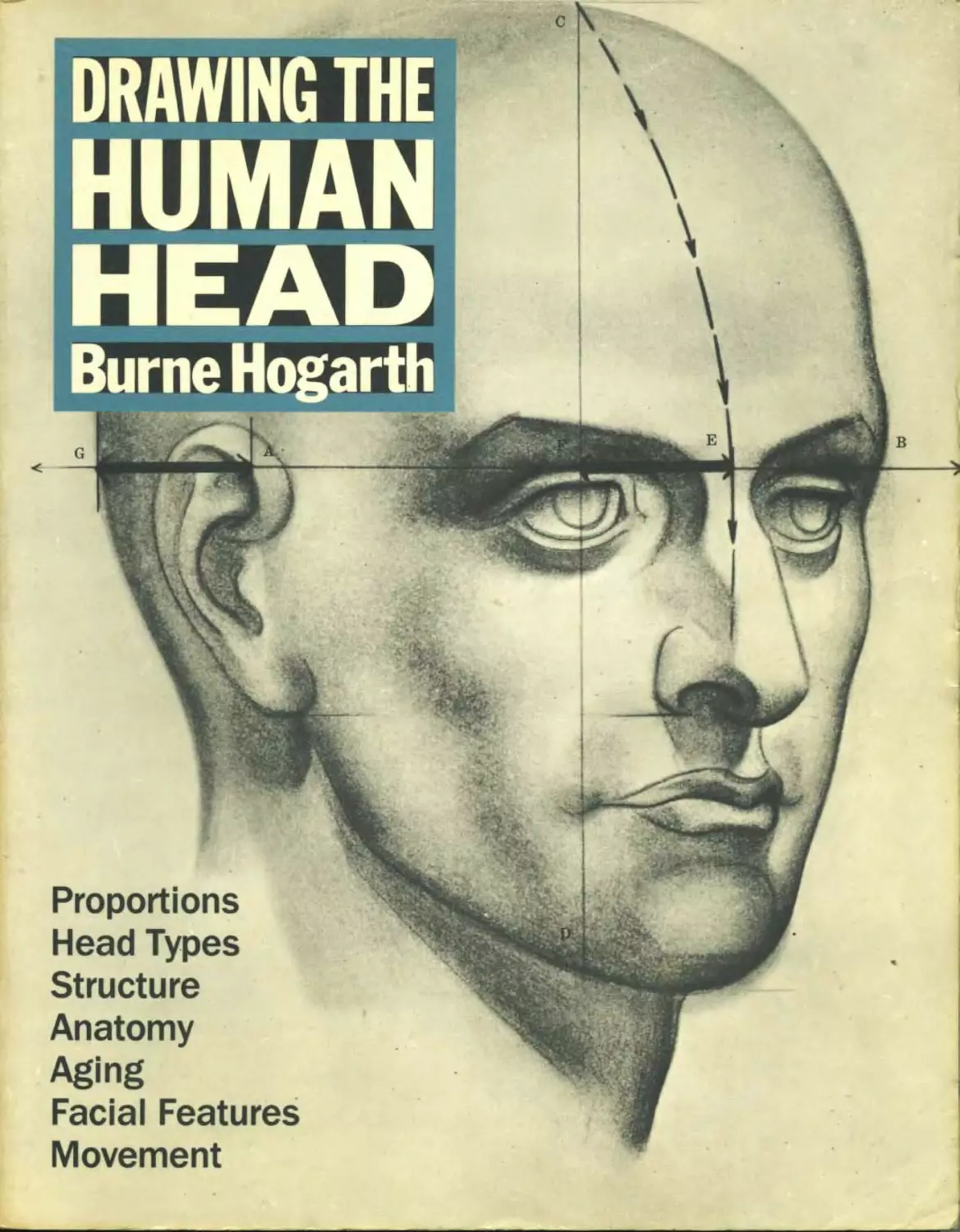
                    DRAWING THE
HUMAN
HEAD
Bur ne Hogarth
Proportions
Head Types
Structure
Anatomy
Aging
Facial Features
Movement

DRAWING THE
HUMAN HEAD

мм мп
ШИН №
ПИШИ НЕМ
Dy lhe aiilhor ol Dynamic Шоту
Watson-Guptill Publications/New York

1965
1989
Paperback Edition
First Printing 1989
Copyright © 1965 by Bume Hogarth
First published 1965 in New York by Watson-Guptill Publications,
a division of Billboard Publications, Inc.,
1515 Broadway. New York, N.Y. 10036
Library of Congress Catalog Card Number: 64-14763
ISBN 0-8230-1375-8
ISBN 0-8230-1376-6 (pbk)
All rights reserved. No part of this publication may be
reproduced or used in any form or by any means—graphic,
electronic, or mechanical, including photocopying, recording,
taping, or information storage and retrieval systems—without
written permission of the publisher.
Manufactured in U.S.A.
1 2 3 4 5 6 7 8 9/97 96 95 94 93 92 91 90 89

To my wife Constance;
to my children Richard
and Ross, Michael and Mary.
When these embers are reduced
to ashes, who finally will
know its warmth?
This is for them, after all.

Table
ol
Menis

Table of Contents - 6
Introduction - 10
I.	Basic Structures and Forms - 14
II.	Head Movement - 60
III.	Facial Change: Wrinkles - 82
IV.	Facial Change: Aging - 96
V.	Head Types - 108
VI.	Gallery of Great Heads - 126
Index - 156
Оглавление - 6
Введение - 10
I.	Основные структуры и формы - 14
II.	Движения головы - 60
III.	Изменения лица: Морщины - 82
IV.	Изменения лица: Старение - 96
V.	Типы голов - 108
VI.	Галерея великолепных голов - 126
Указатель - 156
Introduction	  10
I.	Basic Structures and Forms	 14
Great Masses	 15
Cranial Mass	  16
Facial Mass	 16
Contour of Cranial Mass	 17
Contour of Facial Mass 		 18
Proportions and Measurements	 19
Drawing Cranial and Facial Masses	 22
Form Structures of the Head	  24
Forms of Skull 	  24
Four Close-ups of Skull		 26
Forms of Facial Mass 	  28
Lower Jaw (Mandible) 	  28
Facial Features 	 30
Proportions and Measurements	'.	 32
Refinement of Features	 37
Eye	 37
Nose	     42
Mouth 	 47
Ear	 52
Anatomy: Major Muscle Masses	 56
Mouth Muscles 	 56
Jaw Muscles	   57
Eye and Socket Muscles	 59
Superficial Scalp and Face Muscles	 59
Function of Anatomy	 59

II. Head Movement 	 60
Head Rotation 	 61
Constructing a Rotating Head	 61
Drawing a Three-Quarter View 	 62
Four Views of Head in Rotation	 64
Proof of Method	 64
Positioning Side Plane and Jaw Line	 66
Side Plane	 67
Jaw Line 	  71
Up and Down Movement of Head	  73
How Movement Affects the Brow Line	 73
Ear Placement 	 75
Checking Proportions and Placement	 76
III.	Facial Change: Wrinkles 	 82
Three Wrinkle Patterns	 83
Frontal Pattern 	 83
Oblique Pattern 	 86
Lateral Pattern 	 90
Tension and Pressure Wrinkles	   92
Example of Tension and Pressure Wrinkles	 92
Sag and Shrinkage Wrinkles	 93
Example of Sag and Shrinkage Wrinkles	 93
Interaction of Wrinkle Patterns	 94
Parallel Effect of Pressure and Tension	 54
Pressure Reaction to Head Thrust	 94
Opposition of Tension and Sag Wrinkles	 95
Contrary Effect of Pressure Rifts	   95
IV.	Facial Change: Aging 	 96
At Birth	 97
6 Months	   97
1 Year	 98
2 Years 	 98
3t/£-4 Years 	 99
6-7 Years 	 99
8-9 Years 	 100
11-12 Years 	 100
14-15 Years 	 101
18-20 Years 	 101
25 Years 	 102
30 Years 	 102
35 Years 	 103
40 Years 	 103
45 Years 	   104
50 Years 		     104
55 Years 	 105
60 Years 	 105
65 Years 	 106
70 Years 	 106
75 Years 	  107
80 Years 	 107

V. Head Types	 Ю8
Three Types of Heads	 109
Broad-Headed (Brachycephalic)		 109
Applying Proportions in Drawing		 Ill
Head Proportions 	 111
Facial Features 	   Ill
Long-Headed (Dolichocephalic)	........................... 112
Moderately Arched Forehead	   112
High, Arched Forehead	   112
Facial Features 		 112
Intermediate or Medium-Headed (Mesocephalic) 	  .	115
Female Head	 115
Proportions	 115
Facial Features 	 115
Facial Slope 	 116
Steep Slope	 116
Diagonal Slope 	 117
Moderate Slope	 117
Examples of Head Types	 118
VI. Gallery of Great Heads 	 126
A Summary and Documentation	of Drawing Principles	 127
Index 	 156
9

liMuciion
10

Among all the subjects which
the art student is called upon
to draw, none is more com¬
plex than the human head.
The head presents subtleties
of form, structure, and propor¬
tion which are a continuing
challenge not only to art stu¬
dents, but to professionals. To
many, drawing the head is not
merely a perpetual challenge,
but a perpetual struggle.
Watching students wrestle
with the problems of drawing
the head for many years, I have
long hoped to see a book which
would take some of the guess¬
work out of their struggles: a
book which would systemati¬
cally assemble the basic facts
that every artist needs to know
in order to draw the head con¬
vincingly.
Drawing the Human Head
fulfills this hope. Based on
the author’s widely respected
drawing classes at the School
of Visual Arts in New York,
this is the most comprehensive
book now available on this vital
subject. The author does not
pretend that this is the ulti¬
mate book on the human head.
The ultimate book will never
be written. After all, Rem¬
brandt, the greatest of all por¬
trait painters, was still discov¬
ering new insights about the
human head in the final years
of his life.
Drawing the Human Head
is simply an attempt to orga¬
nize basic information: sys¬
tems of proportion, concepts
of form, anatomical facts, and
other data which have formed
the basis of sound draftsman¬
ship for more than 2000 years.
None of this material is
radically new. On the contrary,
this approach to drawing—
this method of visualizing the
human head, the human face,
and its features—begins with
the artists of ancient Greece,
reaches its greatest refinement
in the Renaissance, and has
been followed by artists and
art teachers to the present day.
The systems of proportions
and concepts of form which are
presented in Drawing the Hu¬
man Head are essentially those
which were perfected by the
Greek sculptors. The anatom¬
ical information was first as¬
sembled by the artists of the
Renaissance. Although modes
of artistic expression change
from one era to another, we
are still building on the foun¬
dation laid by these remark¬
able men.
Drawing the Human Head
begins with a definition of the
major masses of the head—the
cranial and facial masses—
and demonstrates how to draw
their shapes, contours, and
proportions. Via drawings and
diagrams, we then move closer
to the individual structures
that form the head: the forms
of the skull and facial mass;
the jaw; and the nine dom¬
inant facial features, from
brow ridge to chin box.
We then examine each facial
feature individually, defining
the shapes and contours within
each feature. For example, the
nose is not a single shape—not
merely a wedge-shaped mass
—but an assemblage of upper
and lower nasal masses, nos¬
tril wings, septal cartilage,
and other subtle, .interlocking
forms. The intricate forms of
the eye, ear, and mouth are
analyzed in the same way.
Having visualized the head
as form, we now look beneath
the surface to the artistic anat¬
omy of the head. The word ar¬
tistic must be emphasized. This
is not a medical anatomy book
and the student is not expected
to memorize Latin names. The
11

function of artistic anatomy is
to provide the artist with a
sound basis for creative expres¬
sion. As shown in these pages,
the musculature of the head
reveals the blend of expressive
form and anatomical function
which has inspired draftsmen
from the time of Leonardo.
With this structural infor¬
mation in mind, we can now
examine the head in motion.
The reader is shown how to
construct a head as it rotates
from front view to three-quar¬
ter view to side view; and as
the head moves up and down.
Finally, the reader is given a
checklist of the relationships
betw’een the features; this
checklist is intended to help
him arrive at an accurate
placement of the features as
the head moves.
Wrinkle patterns are not a
random phenomenon, but fol¬
low definite routes over the
surface of the face. In dia¬
grammatic drawings, the read¬
er follows the courses of the
three major wrinkle patterns;
studies the types of wrinkles
caused by tension, pressure,
sag, and shrinkage; and
watches the interaction of the
wrinkle patterns.
The aging of the head is al¬
ways a difficult problem for
the artist. To explain the subtle
changes that take place from
childhood to old age, a series
of drawings follow the develop¬
ment of a single head from
birth to the age of eighty, trac¬
ing the changes in proportions
and facial detail that happen
gradually, year by year.
The scientific classification
of head types is extremely use¬
ful to the artist. An extensive
series of drawings describes
the general characteristics of
the three basic head types:
broad-headed (brachycephal¬
ic), long-headed (dolichoce¬
phalic),and intermediate(meso-
cephalic). The reader notes the
facial features of each head
type, then sees how the various
head types and their features
merge in an infinite number of
variations. The immense va¬
riety of human faces and fea¬
tures is emphasized in a gal¬
lery of drawings surveying the
various head types as they
appear in racial and ethnic
groups around the world.
Drawing the Human Head
concludes with a selection of
great heads in sculpture, paint¬
ing, drawing, and the graphic
arts, from the time of the
Greeks to the art of our own
century. The purpose of this
gallery is to document the prin¬
ciples of head construction
upon which this book is based.
The reader will discover a re¬
markable continuity from the
work of anonymous Greek and
Roman sculptors, through the
great artists of the Renais¬
sance and Baroque periods,
down to such contemporary
masters as Picasso and Rouault.
All have drawn strength and
inspiration from the classical
conception of the head which
is summarized in these pages
by a masterful draftsman and
an outstanding teacher.
Donald Holden

DRAWING THE
HUMAN HEAD

1.
Basic
Structures
and Forms
14

GREAT MASSES
The basic shape of the head
consists of two major divisions.
The first and greater part is
the egg-shaped brain case of
the skull: the cranial mass.
The second and lesser part is
the tapered half-cut cylinder
of the face and lower jaw: the
facial mass.
Head Form,
Three-Quarter Down View
Head Form,
Three-Quarter Up View
15

Cranial Mass
Facial Mass
The cranial mass is quite even
and regular: a simple, curved
dome in general outline.
The facial mass, on the other
hand, is uneven and irregular:
a somewhat hard-cornered, tri¬
angular form.
Cranial Mass,
Three-Quarter Down View
Facial Mass,
Extreme Up View
Cranial and Facial Masses,
Th ree-Quarter V iew
Lower Jaw Form,
Back View

Contour of Cranial Mass
Seen from the side, the cranial
mass curves upward from the
mounded ridge of bone just
above the rim of the eye socket.
This is the superciliary arch
or visor of the brow. Beginning
at the frontal depression in the
bridge of the nose the cranium
rises up the forehead to the
vault of the skull and sweeps
backward across the crown in
a great curve toward the lower
occipital bulge at the base of
the head. The base line of the
skull then proceeds horizon¬
tally forward to meet the hinge
of the jaw. From the jaw
hinge, the brain case line con¬
tinues obliquely upward to the
starting point at the bridge of
the nose. This line forms the
boundary between the two
great masses of the head: the
cranial mass above, and the
facial mass below.
CROWN
CRANIAL MASS
SUPERCILIARY ARCH
LOWER OCCIPITAL BULGE
BASE LINE OF SKULL
JAW HINGE
FACIAL MASS
17

Contour of Facial Mass
The facial mass descends along
the projecting nasal line from
the bridge of the nose. At
the point of the nose, the facial
mass scoops sharply inward
and swings over the bulge of
the teeth to the protruding-
mound of the chin. From here,
the contour moves angularly
up the lower edge of the jaw
line to the angle of the jaw.
Here it rises steeply, almost
vertically, to the jaw hinge
in the base of the head. The
boundary line, connecting the
hinge with the nose bridge, di¬
vides the facial mass from the
cranial mass.
CRANIAL MASS
NASAL LINE
JAW HINGE
FACIAL MASS
BULGE OF TEETH
ANGLE OF JAW
JAW LINE
18

Proportions and
Measurements
The size relations between the
cranial mass and the facial
mass reveal two different sets
of proportions.
CRANIAL MASS
FACIAL MASS
FRONT VIEW
From a direct front view, the
cranial mass and the facial
mass tend to be equal in size.
SIDE VIEW
From a side view, the cranial
mass is virtually twice as large
as the facial mass.
CRANIAL MASS
FACIAL MASS
19

DRAWING CORRECT
FRONTAL PROPORTIONS
When you draw the head, it
is helpful to visualize these
proportions in the following
manner.
STEP 1
Frontally, the head, with its
two great masses, is clearly
egg-shaped. In order to estab¬
lish the shape correctly, first
draw the outline of this ovoid
form.
step 2
Now divide the simple head
shape lengthwise in equal
halves with a center line (A-B)
drawn from crown to chin.
step 3
Take the width of one of the
halves of the egg (C-D) and
measure this against the ver¬
tical center line (A-В). If you
have drawn the egg properly,
the center line (A-В) should
be three times the length of the
horizontal line (C-D). Thus,
the total width of the head (C-
E) is just two thirds the
length. If your first drawing
of the head shape is too long
or too short, use these space
divisions to eliminate the dis¬
tortion.
20

DIVIDING CRANIAL
AND FACIAL MASSES
Now, using this egg shape as
your norm for the front view
head, draw it again and divide
it with a horizontal line (A-B)
midway between top and bot¬
tom. This line reveals the equal
measures of the two major
masses: the cranial mass
above, and the facial mass be¬
low. If you then divide the egg
with a vertical line (C-D), the
point where the vertical and
horizontal lines cross (E)
identifies the position of the
bridge of the nose in the mid¬
region of the head.
DRAWING CORRECT
SIDE VIEW PROPORTIONS
To establish the plan of the
side view head, take two egg¬
shapes of identical size and
draw them one over the other,
the first upright, the second
horizontal. The downward
bulge will identify the lower
jaw. The backward bulge (the
widest part of the horizontal
egg) becomes the back of the
head. Note that the height
(A-В) and width (C-D) of
the side view head are equal.
Furthermore, if you drop
another vertical line (E-F) at
the inner edge of the upright
egg, you find that the width
(C-D) divides into three equal
parts. Finally, if you visualize
the upper egg as the cranial
mass, you will see that the
cranial mass is twice the size
of the facial mass.
CRANIAL MASS
FACIAL MASS
BACK OF HEAD
LOWER JAW

Drawing Cranial and
Facial Masses
This series of drawings shows
how to simplify the two major
masses when you draw difficult
views and extreme positions of
the head. What is most im¬
portant in this first stage is to
set down a firm and correct
foundation upon which to build
the smaller forms. Specific de¬
tails of these smaller forms are
left for later refinement. See
how easily a difficult view of
the head may be solved by
starting the drawing with the
initial placement of the two
great masses. Note the flatness
of the under-jaw and skull base.
Back View
Three-Quarter Top View
22

Obliqzie Side Up View
Three-Quarter Front Up View

FORM STRUCTURES
OF THE HEAD
The form structures are the
hard, bony, skeletal parts of
the head or body. Or they are
the tensile, firm, cartilaginous
parts. These are the rigid
framework or support struc¬
tures of the body, upon which
all the soft, limber, or supple
tissues depend. Having es¬
tablished the basic form of the
two great masses, we will look
more closely at the form struc¬
tures which give the brain case
and the facial region their spe¬
cial qualities. We shall see how
the upper mass becomes a
skull and how the lower mass
becomes a face with features.
We shall not describe these
structures as mere anatomical
parts, but as forms which are
used in drawing the head.
Forms of Skull
Examined in detail, the cranial
mass takes on the appearance
of a helmet, flattened at the
sides, with a short, thick visor
projecting in front. The helmet
consists of five shapes fused
together.
On the frontal curve of the
dome, we see the shell of the
forehead (frontal bone) which
rises to the mid-region of the
crown.
On top, we see the crown or
vault of the dome (parietal
bone) which partly covers the
top, sides, and rear of the head.
In back, we see the rear bulge
(occipital bone) which encases
the skull base.
On the side of the skull, we see
the slightly concave temple
wall (temporal bone).
In the lower front region we
see the heavy visor of the brow
(superciliary arch). This
prominence is actually a con¬
tinuation of the forehead fron¬
tal bone, but it is useful to vi¬
sualize it as a separate form.
24

PARIETAL BONE
FRONTAL BONE
ri.Mi’oi:
(.SUPERCILIARY ARCH
OCCIPITAL BONE

Four Close-ups of Skull
In these close-ups, see how the
five fused shapes of the skull
are expressed.
CROWN
The crown has its own subtle
but distinct contour, with
slight dips where the five
shapes meet.
REAR BULGE
The rear bulge is a somewhat
stronger shape than the crown.
The top edge of this bulge
aligns with the upper eyelid.

TEMPLE WALL
The temple wall curves inward.
BROW VISOR
The brow visor is a powerful,
thrusting form, especially no¬
ticeable in a three-quarter
front view.

Forms of Facial Mass
STRUCTURE OF JAW
Although the cranial mass is
larger, the smaller facial mass
commands more interest and
attention, for it is here that the
more decisive features appear.
Indeed, the visual impact of
the face and its features is so
great that the student must
force himself never to forget
the relative proportions of the
two great masses. Failure to
give the cranial mass its cor¬
rect size always labels a draw¬
ing as amateurish. In the fa¬
cial mass there are ten visually
prominent forms. One of these
is primary and dominant: the
lower jaw. The remaining nine
are the eyes, nose, and other
features.
Lower Jaw (Mandible)
The jaw is the decisive form in
producing the contour of the
face as a whole. It is the largest
bone structure of the facial
mass. Beyond this, it has the
unique characteristic of being
the only movable bone struc¬
ture of the head. In general,
the lower jaw is shaped like a
horseshoe.
At its front—the central re¬
gion of the chin mound (1) —
the jaw is tight, constricted,
somewhat angular. Just above
is the dental arch (2) of the
lower teeth. As the arch curves
back and ends, the jaw widens
and develops two broad, plate¬
like structures (3) (the ra¬
mus) which rise steeply to each
jaw hinge (4) alongside the
ears. The jaw ends in two spur¬
like formations above each
ramus, neither of which ap¬
pears on the external aspect
of the face.
Horseshoe of Jaw:
Three-Quarter Down View
Horseshoe of Jaw:
Three-Quarter Up View

(4) JAW HINGfe
(3) RAMUS
(2) DENTAL ARCH
(1) CHIN MOUND

PROFILE OF JAW
From a side view, the base of
the jaw is not horizontal. From
the chin, it gently rises 12 to
15 degrees up to the angle of
the jaw. From the angle or jaw
corner, the contour is a steep
diagonal to the jaw hinge.
TWO CLOSE-UPS OF JAW
Observe how the horseshoe of
the jaw is drawn. The chin is
angular. The jaw corners are
aligned parallel with the chin.
The ramus projections are
widespread and equal in
height.
Facial Features
The nine secondary forms of
the face, small as they are,
have the greatest visual im¬
pact. The subtle differences in
these forms are what make one
face different from another.
Although the visor or brow
ridge is really part of the cra¬
nium, note that we also include
it here as a facial feature. The
nine secondary feature forms
are:
Brow’ ridge or visor of the
cranial cap, widespread and
horizontally arched across the
mid-facial region.
Tapered wedge of the nose,
descending steeply from under
the brow ridge.
Eye socket, depressed and
placed against both sides of
the nose, opening immediately
below the arch of the brow.
Cheek bones, thickly formed,
mounded along the lower out¬
side rim of each eye socket.
Barrel of the mouth, rounded
and heavy-set, protruding be¬
low the prominent overhang of
the nose.
Box of the chin, below the
mouth barrel and farther for¬
ward.
Angle of the lower jaw or jaw
corner, forming the rear edge
of the facial area.
Side arch of the cheek bone,
starting from the cheek bone,
swept back and arched toward
the mid-ear.
Shell of the ear, beyond the
upper edge of the jaw, at the
side of the face.
30

BROW RIDGE
SIDE ARCH
CHEEK BONE
MOUTH BARREL
ANGLE OF JAW
CHIN BOX

Proportions and
Measurements
BROW RIDGE
The middle of the brow ridge,
at its base, is the depressed
bridge of the nose. This is the
exact midpoint of the head.
Here, at the midway line, the
head is five eye-lengths wide.
The brow ridge itself is four
eye-lengths wide.
NOSE
Centrally located in the facial
mass, the tapered wedge of the
nose descends to a point mid¬
way between the bridge of the
nose and the base of the chin.
The width of the nose at its
base is equal to the width of the
eye.
Base of nose is one eye wide.
Distances from bridge to
midway point to base of
chin are equal.

EYE SOCKET
Starting at the base of the
brow bone, the socket extends
half way down along the length
of the nose. The outer edge of
the socket lies just above the
projecting cheek bone.
CHEEK BONE
The base line of the cheek bone
aligns with the base of the
nose. In frontal views, the in¬
ner depression of the cheek
bone is roughly midway along
a diagonal line (30 degrees)
from the eye socket to the
angle of the jaw.
Cheek bone aligns with
base of nose.
Cheek bone depression is
midway on diagonal line.

MOUTH BARREL
CHIN BOX
JAW CORNER
Starting at the nose base, the
mouth barrel extends two
thirds the distance down from
the nose to the chin. The sides
of the barrel align with the
centers of the eye sockets.
Projecting from under the
mouth barrel, the chin extends
one third the distance upward
to the nose. At its widest point,
the chin box is equal to the
width of the mouth barrel.
The angle of the lower jaw
aligns with the lower lip of the
mouth barrel.
34
Mouth barrel aligns with
centers of sockets and
widest points of chin.

CHEEK BONE ARCH
The side arch of the cheek bone
starts at the lower rim of the
eye socket, and aligns with the
midpoint of the nose. The arch
ends just below the middle of
the ear, in line with the back
edge of the jaw.
EAR
The ear begins at a line drawn
up from the rear edge of the
jaw. The ear base aligns with
the base of the skull, the base
of the cheek bone, and the base
of the nose. The top of the ear
aligns with the protruding
brow ridge. The peak of the
eyebrow hair will identify
the height of the ear, in rela¬
tion to the brow.

SUPERCILIARY ARCH
ZYGOMATIC BONE

REFINEMENT
OF FEATURES
Among the nine feature forms,
four have a more complex and
involved quality: the eye, nose,
mouth, and ear. Two of these
are carried to a new phase of
form development. Examining
the mouth bulge, we shall ob¬
serve the special quality of the
fleshy cover, the lips. Drawing
the eye socket, we must con¬
sider the eyeball and the eye¬
lids.
Eye
Almost spherical and about one
inch in diameter, the eyeball
lies within the deep cavity (the
orbit) of the eye, cushioned in
fatty tissue and situated partly
to the front of the socket open¬
ing. On all sides of the socket
rim, the eye is protected by
great projecting structures of
bone: the high nasal bone to
the inside; the overhanging
brow ridge (the superciliary
arch) above and to the outside;
the protruding cheek mound
(the zygomatic bone) below.
EYELIDS
The eye may be conceived as a
partially exposed internal or¬
gan of the body. Covering the
exposed bulge of the eyeball
are the upper and lower eye¬
lids. The upper lid is more
active and moveable than the
lower. It is also the larger of
the two lids and more fully
curved. The wider arc of the
upper lid swings around the
eyeball at its equatorial middle.
The lower lid curves around a
small arc at the base of the
eyeball.
37

SIDE VIEW OF EYELIDS
The greater curve of the upper
lid and smaller curve of the
lower lid are more clearly seen
from a three-quarter or side
view of the eye. Note that the
lower lid lies on a backward
slope of 45 degrees from the
outthrust upper lid.

SHAPE OF EYE
AXIS OF EYE
The highest point of the curve
of the upper lid is close to the
inside corner of the eye, ap¬
proximately one third of an
eye-width away. The low point
of the lower lid is one third of
an eye-width from the outside
corner.
High and Low Points of Eye
These points, joined with a
line, show the oblique axis of
the eye. The eye opening is not
a symmetrical almond shape.
Axis of Eye
Axis of Eye:
Three-Quarter Down View
Axis of Eye:
Three-Quarter Up View

PLACEMENT OF PUPIL
With these curves in place, the
pupil of the eye appeal's sus¬
pended from under the upper
lid, and slightly above the rim
of the lower lid.
Eye Muscles,
Greatly Compressed
EYE MUSCLE FORMATION ►
Surrounding the entire eye
is a large, widespread, oval
muscle: the orbicularis oculi.
It consists of two parts: the
orbital part, which encircles
the entire eye socket from the
brow ridge down to the middle
cheek bone; and the palpebral
part, the eyelids, which encase
the eye itself. Both parts of
the orbicularis muscle close
the eye by compression. The
greater orbital part vigorously
contracts the region around the
socket, while the eyelids cur¬
tain the eye briskly but gently.
Eye Muscles,
Partially Compressed
Eye Muscles
40

Nose
FORMS OF NOSE
In general form, the nose is a
triangular, wedge-shaped
block, narrow and depressed at
its root under the brow ridge,
broad and prominent at its
base in the mid-region of the
face.
Three-Quarter Up View
The nose consists of four im¬
portant forms: the upper nasal
mass, with its supporting nasal
bone and upper cartilage; the
lower elliptical ball of the nose,
the alar cartilage with its
curved hook (the septum);
the two sidewise, expanding
nostril wings, the ala carti¬
lages, triangular in shape and
joining the projecting ball to
form the nostril cavities in the
base of the nose.
Three-Quarter Down View

UPPER mSAL MASS
.BALL OF NOSE
NOSTRIL WINGS

PROPORTIONS OF NOSE FORMS
The length of the nose is half
the length of the facial mass
(from the nose bridge to the
base of the chin). The hook of
the nose attaches to the pillars
of the upper lip.
UPPER NASAL MASS
The upper nasal mass gener¬
ally divides the nose length at
the halfway mark. Somewhat
below this point, the nostril
wings reach their high point.
NOSE BASE
Across the width of the nostril
wings, the base of the nose
measures one eye-width.
Three-Quarter View
Side View
44

SHAPE OF UNDER PLANE
SEPTAL CARTILAGE
The under plane of the nose is
decisively triangular, its broad
base gently curved on the upper
region of the mouth barrel
(the maxilla).
The septal cartilage (the hook
of the nose), divides the under
plane from the nose tip to the
base, forming the steep-sided,
triangular nostril cavities.
45
Septal Cartilage

MANDIBULAR ARCH
MAXILLARY ARCH
CHIN PROMINENCE

Mouth
The substructure of the mouth
is formed by the two great den¬
tal arches of the teeth: the up¬
per (maxillary) arch and the
lower (mandibular) arch. Set
together, both arches support
the curving mouth barrel.
SIDE VIEW PROPORTIONS
OF MOUTH
From the base of the nose, the
mouth bulge drops two thirds
the distance from nose to chin.
FRONT VIEW PROPORTIONS
OF MOUTH
The outermost points of the
dental curve align with the
centers of the eye sockets.
47

LIPS
Overlying the arches of the
upper and lower jaws is the
broad, circular mouth muscle
(orbicularis oris), with its
prominently developed lip for¬
mations.
UPPER LIP
The upper lip is a widespread,
gently curving arch, grooved
in the center with a shallow
depression. It is shaped like a
flattened, extended M.
Front View, Three-Quarter
Three-Quarter Up View
48
M Formation

TUBERCLE
The center of the groove (tu¬
bercle) on the lip thrusts slight¬
ly forward like the prow of a
ship.
PHILTRUM
The central depression of the
upper lip (philtrum) mounts
and narrows at the septal car¬
tilage in the base of the nose.
The two edges of the philtrum
are the pillars of the lip.
LOWER LIP
The lower lip contour is like
an extended W. Two elliptical
lobes develop outward from
the center to form the arms of
the W, while the middle of the
lip dips to receive the tubercle
from above. Both lips have thin
marginal rims.
W Formation
49

COMPARISON OF UPPER
AND LOWER LIPS
The upper lip is somewhat
more arched and wider than
the lower. Because it covers
the greater dental arch of the
upper teeth, the upper lip is
the longer of the two. The
lower lip is therefore recessed
on the arch of the lower row of
teeth. It is recessed 30 degrees
in relation to the upper lip.
Upper lip is wider,
more arched.
Side view shows recessed
lower lip.

INDIVIDUAL VARIATIONS
LIP MOVEMENTS
This generalization obviously
does not apply to individuals
with an outthrust lower jaw.
In such cases, the lower lip pro¬
trudes and the upper lip
recedes.
The lower lip is more active
and mobile than the upper. Its
placement on the free-moving
lower jaw guarantees greater
activity. The lower lip is also
moved by an ample set of lower
mouth, chin, and jaw muscles.
Lips Retracted and Open
Lips Drawn Down,
with Jaw Dropped
Lips Compressed

Ear
The ear is shell-shaped in form
and general structure. Its
outer contour is formed like a
C, wider at the top and nar¬
rower at the base. In the cen¬
ter, it has a bowl-like depres¬
sion, the concha, large enough
to admit the curve of the
thumb.	►
FORMS OF EAR
The ear has four major forms:
the wide, outer encircling rim
(helix); the smaller inside rim
(antihelix), which encloses the
depressed bowl; the lower
fleshy base (lobule); the firm
projection (tragus) which
overhangs the opening to the
ear canal. The inner rim (anti¬
helix), divides at the top into
two arms, forming a bent Y
shape. Below the tragus is a
small notch, just under and
outside the ear canal opening.
The tubercle, a small knot on
the upper outside curve of the
helix, is sometimes called Dar¬
win’s point. The curve of the
helix turns into the bowl of the
ear and implants itself in the
central wall.	▼
LOBULE
52
HELIX
TUBERCLE•
ANTIHELIX
■ CONCHA
TRAGUS
C Formation

PROPORTIONS OF EAR
WIDTH COMPARED TO LENGTH
The entire ear lies within two
lines drawn from the top of the
eyebrow and the base of the
nose. The ear divides vertically
into three generally equal
parts.
First part: from the top of the
ear to the point where the helix
attaches to the side of the head.
Second part: the mid-region of
the ear is occupied entirely by
the bowl (concha). The tragus
is at the exact midpoint of the
ear.
Third part: the lobe of the
ear. The bottom of the lobe
aligns with the base of the
nose.
The width of the ear is half
the length. This measure
occurs only at the highest part
of the ear, the helix or outer
rim.

PLACEMENT OF EAR
On the side plane of the head,
the ear tips slightly backward
at an angle of 15 degrees. Seen
from the back, the outer rim
of the ear stands away from
the head at an angle of almost
20 degrees. This view clearly
reveals the rounded back wall
of the central bowl.
Back Wall of Ear
Ear tips backward 15°.
55

ANATOMY: MAJOR
MUSCLE MASSES
The muscles of the head and
face divide into four general
groups: the muscles of the
mouth; the muscles of the eye
and eye socket: the muscles
of the jaw; the superficial
muscles of the scalp and face.
The most important muscles
are those which produce the
larger surface forms, the visu¬
ally prominent masses. Pri¬
marily, these are the muscles
of the mouth and jaw. The eye
and socket muscles are sec¬
ondary. The others are minor,
since they are barely seen.
SCALP AND FACE MUSCLES
EYE AND EYE SOCKET MUSCLES
MOUTH MUSCLES
JAW MUSCLES
f j
Jaw Muscles
TEMPORALIS: PASSING UNDER
ZYGOMATIC ARCH TO
TEMPORAL BONE, ASSISTS
MASSETER IN RAISING JAW
AND CLENCHING TEETH.
MASSETER: RAISES JAW AND
CLENCHES TEETH.
56

Mouth Muscles
LEVATOR LABII SUPERIORIS
ALAEQUE NASI: RAISES HIGH
INSIDE UPPER LIP, INCLUDING
NOSTRIL WING.
LEVATOR LABII SUPERIORIS:
RAISES UPPER LIP NEAR
NOSTRIL WINGS.
CANINUS (LEVATOR ANGULI
ORIS) : WITH ZYGOMATICUS,
RAISES CORNER OF MOUTH.
ZYGOMATICUS (MAJOR AND
MINOR) : RAISES MOUTH
UPWARD AND OUTWARD.
BUCCINATOR: DRAWS CORNER
OF MOUTH BACKWARD,
FLATTENS AND
TIGHTENS LIPS.
RISORIUS: PULLS CORNER OF
MOUTH SIDEWARD AND
OUTWARD.
QUADRATUS (DEPRESSOR LABII
INFERIORIS) : PULLS LOWER
LIP DOWNWARD AND
OUTWARD.
57
■■
ORBICULARIS ORIS: CIRCLES
MOUTH, COMPRESSES AND
PURSES LIPS.
TRIANGULARIS (DEPRESSOR
ANGULI ORIS) : PULLS CORNER
OF MOUTH DOWNWARD.
MENTALIS: RAISES AND
TIGHTENS CHIN, THRUSTS
LOWER LIP UP AND OUTWARD.

corrugator: assists
ORBICULARIS IN COMPRESSING
SKIN BETWEEN EYEBROWS.
ORBICULARIS OCULI: CLOSES
EYELIDS AND COMPRESSES
EYE OPENING FROM ABOVE
AND BELOW.
PROCERUS: ASSISTS
ORBICULARIS TO TIGHTEN
INNER EYE SLIT BY
WRINKLING SKIN IN ROOT
OF NOSE.

Superficial Scalp
and Face Muscles
EPICRANIUS, FRONTAL PART:
DRAWS SCALP TO FRONT,
WRINKLES FOREHEAD SKIN
AND PULLS EYEBROWS
UPWARD.
EPICRANIUS, OCCIPITAL PART:
DRAWS SCALP BACKWARD
AND DOWNWARD.
PLATYSMA: LYING CHIEFLY
ON NECK, DRAWS LOWER LIP
DOWNWARD AND OUTWARD.
Function of Anatomy
The purpose of artistic anat¬
omy is not to dissect and ex¬
Eye and Socket Muscles
pose muscles, but to analyze
and evaluate forms. The stu¬
dent must observe w’hich forms
are major, minor, or superfi¬
cial; which ones have signifi¬
cant visual impact ; and which
ones are scarcely visible. Fur¬
thermore, he must evaluate
head forms in general, study¬
ing the relations between bony
skeletal forms, rigid carti¬
laginous forms, and flexible
muscular forms. The artist
studies anatomy not as an end
in itself, but as a groundwork
for the expressive interpreta¬
tion of visual form.
59

2.
Head
Movement
60

To draw the movement of the
head means to record the
changing aspects and relations
of head forms when the head
changes position. How do we
draw the varied views of the
head? How are the major
masses related when the head
changes direction? How are
the features expressed when
seen from above and below?
How are the significant planes
and structures positioned when
the head turns? When the head
moves, a new set of form rela¬
tions appears. The student
must strive to observe these
changes and draw them with¬
out distortion.
HEAD ROTATION
To draw the head in a full
front view or a direct side
view is elementary. The simple
relations of the cranial and
facial masses, front and side,
have been explained in Chapter
1. The difficulty occurs when
the head rotates from a front
view to a three-quarter view.
A question arises about the
back of the head. How much of
the cranial bulge will be shown
at the rear in relation to a
given amount of turn? Here is
a simple solution.
Constructing a Rotating Head
Step 1: Draw a full front view
head shape in correct propor¬
tion.
Step 2: Now draw horizontal
(A-В) and vertical (C-D)
lines which divide the ovoid
shape at the midpoint in both
directions. These are the axis
lines: the horizontal axis (A-
B) identifies the brow line;
the vertical axis (C-D) defines
the bilateral symmetry of the
face and features.

Step 3: Our chief interest is in
the vertical axis, the center
line which records every side-
wise movement of the face and
features. To make the head
turn from a front view to a
new position, draw a new ver¬
tical center line (C-E-D) from
crown to chin. This line curves
to show the characteristic
bulge of the ovoid mass. The
midpoint (E) of the curve is
at the horizontal brow line.
Keep brow line level and un¬
changed.
Step 4: On this curved line
(C-E-D), the new center of the
face, sketch the wedge of the
nose in three-quarter view.
Then lightly draw the lips and
a new outline on the right side
of the face. This new outline
must be held generally within
the original ovoid shape.
Step 5: Now, how much of the
cranium will appear at the
rear? The answer is clear. The
amount of turn the head makes
in front will produce a similar
amount of turn in back. Mea¬
sure the distance between the
midpoint of old center line (F)
and the midpoint of the new
center line (E). Add this mea¬
sure to the head at the rear
(A-G). This gives you the cor¬
rect amount of cranial bulge
in back, corresponding to the
amount of turn in front. Mea¬
surement A-G equals E-F.
Drawing a
Three-Quarter View	*
With these measurement lines
in place, complete the shape of
the skull and draw in the fea¬
tures. This is a good time to
review the details of the sec¬
ondary forms we studied in the
preceding chapter. Check the
horizontal line-up of the nose
base, cheek bone, ear, and skull
base. The edge of the mouth
and chin should align with the
center of the eye. The ear
should attach on a horizontal
line drawn from the outside
corner of the eye.
62

Four Views of Head
in Rotation
When you have mastered the
procedure, try it on a series of
heads showing various turns
to left and right. In all views,
note how each measure A-B
equals measure C-D.
Slight Turn to Left
Greater Turn to Left
Proof of Method
Let us, for the sake of argu¬
ment, raise an important ques¬
tion: Is the foregoing method
reliable for any stage in the
rotation of the head? It is.
Here is the proof. Suppose that
we wish to give the head its
greatest possible rotation,
from a front view to a full side
view. First, we draw the front
ovoid shape and divide it, as
before, in halves. We then take
the measure A-В (half the
width of the front view head)
and transpose it to C-D, which
completes the cranial mass.
Finally, we sketch in the full
profile. Our method gives us a
good side view head. But is it
proportionally correct? Recall
Chapter 1, in which we demon¬
strated that the side view head
divides vertically into three
equal parts. Measure the above
head: A-В, B-C, and C-D are
exactly equal.
Slight Turn to Right
Very Great Turn to Right
64

POSITIONING SIDE
PLANE AND JAW LINE
In drawing the many possible
views of the rotating head, two
problems impede our attempts
to achieve sound proportions.
These are the placement of the
side plane (A-В) and jaw line
(C-D). The side plane, which
begins at the corner of the
brow, changes with every turn
of the head. But the jaw line
tends to remain unchanged re¬
gardless of the rotation!
66

Side Plane
The side plane of the face be¬
gins decisively at the brow
point, just above the outside
corner of the eye. Here the
front and side planes meet,
then fall obliquely inward to
the cheek bone, mouth edge,
and chin. The line of the side
plane lies on a steep 15 degree
drop from brow to chin.
ROTATION OF SIDE PLANE
Hard-cornered as the brow
point is, the line (A-В) on
which it lies is quite circular,
going around the middle of the
head. This curvature means
that when the head turns, the
side plane of the head (C-D)
rotates in the same proportion
as the center line (E-F).
67

PLACEMENT OF SIDE PLANE
To locate the side plane for
any given turn of the head, fol¬
low this simple procedure:
Step 1: Draw a front view
head and put in the vertical
(A-В) and horizontal (C-D)
axes. These axes meet at the
center point of the face (E).
On the brow line (horizontal
axis C-D) indicate the two
brow points (F and G).
Step 2: If we give the head a
turn to the right, the center
point of the face will move
from E to H. A new center line
(A-H-B) is established. F
shows where the left brow
point appeared on the front
view, step 1. Note the new lo¬
cation of the right brow point
(G).
Step 3: The measure E-H rep¬
resents the amount of rotation
of the center point. The rota¬
tion of the old left brow point
to its new location (F-I) should
equal E-H. Beginning at the
new brow point (I), complete
the 15 degree drop of the en¬
tire plane from brow to chin.
68

FuUR EXAMPLES OF
SIDE PLANE PLACEMENT
In these four head views, the
side plane is established by
first resetting the brow point
as demonstrated above. Keep
this simple rule in mind: The
brow point shifts from the
same distance (A to B) as the
center facial line shifts from
the front to a new position (C
to D). In all cases the parti¬
tions are held to the line of
the brow, whether the line is
curved or flat.
Left Turn, Down View
Right Turn, Up View
Right Turn,
Deeper Down View
In this view (full turn, right
profile) measures A-В and
C-D meet at brow point.
69

Jaw Line
The jaw line, from any view,
tends to remain unchanged no
matter how the head turns.
This means that the edge of
the egg shape, when drawn as
a front view, will continue to
define the jaw line as the head
turns. As the head rotates, the
jaw line stays where we orig¬
inally drew it! This seems to
be a startling assertion. But
observe the jaw outline as the
head rotates and you shall see
this principle borne out.
RELATION OF SIDE PLANE
TO JAW LINE
The jaw contour has this sur¬
prising characteristic because
of the widespread, flat form of
the lower-side-facial area.
From the edge of the mouth to
the jaw, the surface is quite
even and without projections.
FRONT VIEW
Seen from a front view, the
mouth-to-jaw plane (A-В) ap¬
pears greatly compressed or
foreshortened.
THREE-PHASE ANALYSIS
OF JAW LINE
In this three-phase drawing,
we see three positions of rota¬
tion in one head.
Center line (A) is a front
view; center line (B) is a
three-quarter view; center line
(C) is a side view. In all these
views, the jaw line does not
change. It is constant for all
positions. Try seeing each head
separately with the jaw line :
It is roughly correct for each
view of the head.
71

ANALYSIS OF ROTATION
However, as the head turns,
first a little, then more, the
side plane of the jaw appears to
expand and widen, like the flat
side of a box which reveals
more of its side as the box ro¬
tates. This expansion of the
side plane holds the jaw line
to a constant position. No mat¬
ter how much the head turns,
the jaw line remains exactly in
the same place.
72

UP AND DOWN
MOVEMENT OF HEAD
The brow line, which lies across
the middle of the head at the
bridge of the nose, is the hori¬
zontal axis of the head. Below
this line, the facial mass be¬
gins. All up and down move¬
ment of the head starts with
this line. If the head tips down,
the axis line drops; if the head
lifts up, the line rises.
How Movement Affects
the Brow Line
The amount of rise or fall of
the brow line off the horizontal
position represents how much
curvature the brow arch will
show. The brow curvature is
reflected in a sequence of sim¬
ilar curves over the entire sur¬
face of the head, from top to
bottom.
BROW LINE AXIS
In a direct frontal view, the
brow line axis is a horizontal
line.
DOWN VIEW
In a down view, the drop of the
brow permits a corresponding-
drop of the crown. We see the
top of the skull.
UP VIEW
In an up view, the rise of the
brow gives the chin base a cor¬
responding lift. We see the
under plane of the jaw.

RAISED BROW LINE
RAISE® CHIN LINE

Ear Placement
When the head moves up and
down, special care must be
given to the placement of the
ear. The ear always goes in an
opposite direction to the facial
tilt. When the face is down, the
ear is up; when the face is up,
the ear is down. This rule also
applies to the skull base.
Head Down
METHOD OF PLACEMENT
To place the ear on a tilted
head, set up two track lines:
the first from the brow corner;
the second from the nose base.
Swing these tracks as the brow
axis line indicates, curving
down or up as the head posi¬
tion demands. Place the ear
within the tracks, fixed to the
jaw line. The skull base aligns
with the ear base.
THREE-QUARTER UP VIEW
If the head is seen from an ex¬
tremely low angle, the brow
curve takes on an extremely
arched appearance. This qual¬
ity also appears in the jaw base
and smaller features like the
mouth, lips, and chin. Note
how the amount of rise of the
brow curve determines the rise
of the chin base.
Face down: ear appears
high in this view.
Face up: ear is now
very low.
75
Head Up

Checking Proportions
and Placement
Once the ear is properly placed
on the head, we must check the
remaining features of the face
for accurate placement and
proportions. The following
points are offered as a check
list for up views and down
views of the head.
BASE OF NOSE
The base of the nose is one
eye-length wide. Check the eye
with the nose width for accu¬
racy.
EYE PLACEMENT
To place the eye correctly in
its socket, draw a line upward
from the edge of the nostril
wing to the brow. The inside
corner of the eye starts from
this line.
76

MOUTH AND CHIN
The corner of the mouth holds
to a line drawn down from the
center of the eye. This line also
identifies the side of the chin.
JAW CORNER
The jaw corner lines up with
the opening of the mouth and
the lower lip. In three-quarter
up and down views, this corner
lies on a 45 degree line that
starts at the nose bridge and
curves across the face.

UNDER-JAW
Seen from below, the muscle
mass connecting the chin to the
neck slopes down at a 15 degree
angle. Its form looks like a wide
funnel-opening thrust into the
horseshoe form of the lower
jaw.
EYE FORM
The eye, in upshot and down¬
shot, shows two remarkably
different curves. Here, when
the eye is seen from above, the
lower lid curve is round, while
the upper lid is hardly curved,
almost a straight line. When
the eye is seen from below (see
facing page), the appearance
is reversed. The upper lid is
greatly curved, and the lower
lid is flat.
78

EYE PUPILS
Study the pupils of the eyes,
both in up and down views, and
in rotating views of the head.
In these positions, the eye pupil
disc is an ellipse, a circle in
perspective. In a front view,
when the eye moves up or
down, the ellipse is horizontal:
shallow from top to bottom. In
a partial side view, the ellipse
is vertical: shallow from left
to right.
Up view: pupil is
horizontal ellipse.
Down view: pupil is
horizontal ellipse.
Partial side view: pupil is
vertical ellipse.

EXTREME HIGH AND
LOW VIEWS
Seen from an extremely high
or low position, the great ovoid
form of the cranial mass dom¬
inates the shape of the head.
The irregular facial forms
tend to become subordinate to
the spherical brain case.
Extreme Down View
Extreme Up View
80

VOICE BOX (ADAM’S APPLE)
When the head moves in any
direction, you can locate the
voice box by drawing a line
from the center of the nose
through the center of the lips.
Moving downward, the line
strikes the voice box in the
center of the neck.
Upshot Side View, Left:
Finding Center of Neck.
NECK COLUMN
The neck column, curving
backward in a long arc, may
then be added from the skull
base.
Extreme Three-Quarter
Up View, Right: Finding
Center of Neck.

3.
Facial
Change:
wrinkles
82

In Chapters 1 and 2, the head
has been seen as a standard,
generalized structure. The dis¬
cussion has been limited to
averages and similarities of all
heads. We shall now proceed
to the factors which determine
facial differences. In the next
two chapters, we shall explore
two forms of facial change:
wrinkling and aging.
THREE WRINKLE
PATTERNS
Wrinkling of the face occurs
for a variety of reasons. The
most common reasons relate to
incidental facial activity, such
as chewing, grimacing, wink¬
ing, pouting, squinting, ex¬
pressions of pleasure and dis¬
taste, and demonstrations of
emotion. Other reasons relate
to psychological stress and in¬
ner tensions, as well as aging,
muscular flaccidity, or loss of
firmness in flesh. Whatever the
origin of wrinkles, their de¬
velopment follows three major
patterns: frontal, oblique, and
lateral.
Frontal Pattern
The frontal pattern of wrinkles
is heavily concentrated in the
central region of the face. This
pattern has its root in the nose
bridge, and at the base.

NOSE BRIDGE
At the bridge, the frontal pat¬
tern starts with a deep hor¬
izontal groove across the root
of the nose, accompanied by an
intense inward compression of
the eyebrows. As the eyebrows
compress, vertical furrows rise
in the center of the brow arch,
swing slightly out, then close
in an elliptical curve at the
base of the forehead. As the
eyebrows collide, the skin folds
seem to squeeze or crush. Note
the upward movement of the
frontal pattern, high in the
nose.
Horizontal Groove
Vertical Furrows
84

NOSE BASE
At the base of the nose, two
wrinkle movements occur: one
thrusts upward to the nostril
wings; the other drags down¬
ward to the mouth and chin.
These movements are largely
vertical.
UPWARD MOVEMENT
The upward thrust from the
nose base produces a sharp
curling of the flesh around the
nostril wings. The action is
high and arched. The upper lip
is pulled upward from the cen¬
ter. The nose tip, while it does
not move, takes on a forced,
outthrust appearance. The
effect is like an expression of
distaste.
DOWNWARD MOVEMENT
The downward movement be¬
gins lightly around the nostril
wings. From here, a deep chan¬
nel emerges and swings around
the mouth bulge, then closes in
a tight curve, circling the fron¬
tal prominence of the chin. The
lower lip is forced out when the
mouth is closed.
85

Oblique Pattern
The oblique pattern of wrinkles
develops above and below the
inside curve of the eye socket,
and the inner contour of the
cheek bone. The oblique pattern
belongs to the inner eye, the
brow, and the cheek bone, as
the frontal pattern belongs to
the nose, the mouth, and the
chin. The oblique pattern lies
adjacent to the frontal pattern.
Its main directions are angular
and outward. It moves both up
and down.
86

PATTERN BEGINS AT EYE
The oblique pattern begins in
the deep inner curve of the eye
socket below the nose root. Two
wrinkle movements develop:
below, a depressed ring edges
the socket and lower eye and
moves downward over the
cheek; above, the pattern moves
from the socket curve over the
mid-brow to the base of the
forehead.

CHEEK
The oblique pattern descends
across the cheek. Decisive rifts
appear. In aged persons, the
cheek bone is exposed, with a
hollow below.
JAW AND NECK
The downward movement con¬
tinues across the middle of the
jaw and its undersurface, then
cascades in fleshy channels
down the side of the neck to the
protruding collar bones.
88

ASCENDING MOVEMENT
The wrinkles rise from the
compression line of the eye¬
brow and inner socket. Then
they range up and outward in
an arc that curves around the
mid-brow. The movement
turns and ends in a series of
horizontal rifts across the
lower forehead.
ZIG-ZAG MOVEMENT
The oblique pattern is like a
zig-zag movement up and down
the face, starting at the inner
curve of the eye socket.
89

Lateral Pattern
The lateral pattern consists of
all the wrinkles on the side re¬
gion of the face, neck, and
back of the head. This diffuse
pattern shows isolated furrows
and rifts which emanate from
the outer eye, ear, jaw line,
and back of the neck below the
skull base.
90

crow’s feet
SIDE VIEW OF CROW’S FEET
EAR
The fan-like wrinkles which
start at the outer corner of the
eye are commonly called crow’s
feet.
As the eyelids terminate, a
series of creases fan out from
the socket, wheel upward
around the brow corner and
across to the ear, and spread
downward to the cheek bone
arch.
From a side view, the crow’s
feet show a radiating effect.
Near the eye corner, the
wrinkles are deeply creased.
As they flare outward, they
split into finer, less decisive
wrinkles, especially on the side
of the forehead and cheek.
The wrinkles which develop
around the ear merge with
those of the jaw line and neck.
At the forward edge of the ear,
slight rifts curl around the
rim; slip down to the lobe; then
descend to a series of furrows
cutting the line of the jaw.
These move on to the under-jaw
and neck, becoming deeper
fleshy channels. From the rear
of the neck below the ear, cor¬
rugations move down to meet
the jaw wrinkles, flowing down
together toward the neck base.
The ear is like an island divid¬
ing a flowing stream.
91

TENSION AND
PRESSURE WRINKLES
Wrinkles tend to develop in the
skin which covers the crevices
and recessed regions of the
head and face. In these places,
rifts, creases, and folds appear
when the skin responds to some
movement of the head, jaw, or
facial muscles. For instance,
wrinkles occur when we laugh,
frown, sneeze, squint, wink,
tilt or swing the head. The pull
of muscles causes tension
wrinkles. The contraction or
squeeze of muscles causes pres¬
sure wrinkles.
Example of Tension and
Pressure Wrinkles
The skin creases when thrusts
develop from the action of
eyebrows, eyes, cheeks, and
mouth. Creases under the chin
and jaw are forced by the tilt
and inward pull of the head.
92

SAG AND
SHRINKAGE WRINKLES
Another variety of wrinkles
occurs as a result of the aging
of the skin and fleshy fibers of
the head. The flesh loosens and
the skin shrivels; the tissues
lose their firmness and elas¬
ticity. This creates what we
may call sag and shrinkage
wrinkles. These tend to be ran¬
dom and unpredictable. Sag
wrinkles are usually loose or
flaccid, taking a downward
course, as they are pulled by
the force of gravity. Shrinkage
wrinkles look dried out and
withered in the heavier, thicker
tissues of the face; a shrunken
and cross-grained effect may
be seen, for example, on the
lips, chin, cheeks, and ear lobes
of aged persons.
Example of Sag and
Shrinkage Wrinkles
Note the sag of the loose, hang¬
ing folds below the chin and
jaw. Shrinkage may be seen on
the brow, cheek, lips, and back
of the neck. Note the cross-
grained, shriveled appearance.
93

INTERACTION OF
WRINKLE PATTERNS
The three major wrinkle pat¬
terns interact: they are not
independent or compartmen¬
talized. In these four examples,
observe the groupings and then
draw your own examples from
persons near at hand. Observe
the tension and pressure wrin¬
kles, and the sag and shrink¬
age wrinkles.
Parallel Effect of
Pressure and Tension
An expression of concentration
causes pressure wrinkles to
appear between the eyebrows.
At the same time, incipient ten¬
sion folds develop on the side
of the mouth and cheek.
Pressure Reaction to
Head Thrust
When the head is thrust force¬
fully into the neck, extreme
pressure creases girdle the en¬
tire perimeter of the lower jaw
and chin.
94

Opposition of Tension
and Sag Wrinkles
Here we see two contrary ten¬
dencies. The upward pull of
the eyebrows reveals tension
wrinkles on the forehead,
while the neck region expresses
an over-all downward drift of
sag wrinkles. Note further the
subtle shrinkage creases on the
lips of this older woman.
Contrary Effect of
Pressure Rifts
The retracted mouth produces
tension in the lips and chin. At
the same time, a severe con¬
traction (pressure) in the
brow and nose bridge effects
an opposite pressure on the
nose above the nostril wing.
95

4.
Facial
Change:
Aging
96

As the head ages, changes take
place in head proportion, skull
development, and bone articu¬
lation in brow, nose, jaw, and
teeth. Growth in flesh, tissue,
skin, lips, ears, eyelids, and
hair all contribute to the de¬
scriptive aspects of aging. Less
obvious, but no less important,
are changing head positions,
body attitudes, and gestures;
these add subtlety and distinc¬
tion to the head in growth,
maturity, and decline. The fol¬
lowing sequence of illustra¬
tions will analyze the progres¬
sive aging of the head, as form
and detail change year by
year.
AT BIRTH	►
Proportion: facial mass, 1
part; cranial mass, 3!/2 parts.
Forehead and nose meet in con¬
tinuous S-curve. Ear quite
large, set forward toward face.
Jaw short; flat, undeveloped
jaw angle. Nose appears large,
compared to mouth and chin.
Eye closed; has compressed,
bulged appearance. Sparse,
downy hair (but occasionally
profuse) covers head from
crown backward. Short neck;
appears feeble and weak.
6 MONTHS	►
Proportion: facial mass, 1
part; cranial mass, 3 parts.
Facial mass fuller; jaw slight¬
ly increased. Nose appears
smaller. Note roundness of
cheek, chin, and neck. Mouth
tends to be full, curved, open.
Hair longer, fine, feathery.
Eye alert, responsive.
97

1 YEAR
Proportion: facial mass, 1
part; cranial mass, just under
3 parts. Pronounced S-curve of
forehead and nose. Eye, mouth,
and lips active and eager. Chin,
cheek and neck fat developed;
chubby appearance. Neck
somewhat longer.
2 YEARS
Proportion: facial mass (still
increasing), 1 part; cranial
mass, 22 34 parts. S-curve of
forehead and nose maintained.
Small, short nose. Hair thicker
and profuse. Jaw and chin
more developed; cheek, jaw
and neck fat evident. Mouth
soft and curved, but firmer and
more controlled. Neck some¬
what longer.
/

3’/2-4 YEARS
Proportion: facial mass (still
increasing), 1 part; cranial
mass, parts. S-curve of
forehead and nose persists.
Nose slightly longer. Cheek
full and rounded. Jaw larger;
chin curved, somewhat prom¬
inent. Under-jaw fat and neck
fat disappearing; neck longer.
Lips firmer; mouth more com¬
petent and expressive.
6-7 YEARS
Proportion; facial mass (still
increasing), 1 part; cranial
mass, 21/} parts. Orbits almost
as large as adult. Nose still
curved, but longer; tip up¬
thrust. Mouth region larger.
Chin round, more prominent;
jaw angle more vertical; jaw
larger. Neck longer. S-curve
of rear head bulge and neck
evident. Hair unruly, thicker,
more adult.
99

8-9 YEARS
Proportion: facial mass (still
increasing), 1 part, cranial
mass, 214 parts. Forehead
changed somewhat; brow arch
showing, nose bridge deepen¬
ing. Nose longer, more devel¬
oped, but still curved; tip up¬
thrust. Lips still curved;
mouth region increased. Jaw
leaner; chin longer, more
pointed, but still rounded.
Neck longer. S-curve of head
bulge and neck maintained.
11-12 YEARS
Proportion: facial mass, 1
part; cranial mass, almost 2
parts. Head somewhat smaller
than adult, but mature ratio
appears. Brow bulge and nose
bridge more apparent. Nose
longer, more articulated; tip
still up. Mouth firmer; chin
larger; jaw heavier and
broader. Adam’s apple puts
in slight appearance (voice
change beginning) . Neck lon-
gei' and slightly thicker.
100

14-15 YEARS
Proportion: mature level
reached; facial mass, 1 part,
cranial mass, 2 parts. From
here on, head proportion con¬
tinues at this ratio. Brow
thicker. Nose bridge deepens.
Nose tip still up. Jaw corner
more angular; chin firmer, less
rounded. Adam’s apple more
pronounced. Neck longer, a bit
heavier. Back head bulge still
present, still immature.
18-20 YEARS
Young adult stage achieved.
Understructure of head comes
through; leaner facial appear¬
ance. Cheek softness disap¬
pears. Deeper nose bridge;
nose tip less evident. Jaw angle
firm. Mouth more firm; lip
softness disappears. Neck
muscles stronger, more devel¬
oped. Skin texture firmer,
thicker.
101

25 YEARS
Deep nose bridge; nasal bone
more pronounced. Lean cheek
and cheek bone. Chin mound
more decisive; under-jaw re¬
gion firm and even. Mouth
more reserved.
30 YEARS
Eye appearance deeper set,
searching, incisive. Early de¬
velopment of creasing, starting
at outer corner of eye and fore¬
head. Mouth, chin mound, and
jaw line firm. Slight fleshiness
under-jaw.
102

35 YEARS
First appearance of softness
and fleshiness under jaw; chin
mound cleavage occurs. Mouth
wrinkle emerges. Under eye
sag; further increase of eye
and brow wrinkles. Neck less
lean, somewhat heavier. More
reserved, less intense facial as¬
pect and bearing.
40 YEARS
Hair somewhat thinner. Deep¬
er-set eye; eye socket shows
more clearly. Forehead and
eye wrinkles advance. Mouth
crease more pronounced. Chin
mound tighter, less rounded.
Under-jaw sag advances; chin
shows clear separation from
jaw. Neck heavier. Slight
fleshy roll at back of neck.
103

45 YEARS
Hair thinner, graying and re¬
ceding at temples. Definite
crow’s feet wrinkle group
forming at outer corner of eye.
Under-chin sag droops slightly
toward neck. Chin mound quite
distinct. Jaw corner fleshy, less
lean. Neck less firm; early
wrinkles starting on side; flesh
on rear neck reflects increased
body weight.
50 YEARS
Frontal hair thinned out; side
hair recessed. Grayness con¬
tinues. Upper lid line sags. Eye
deeper-set in socket. Fleshy
pouch beginning under lower
lid. Wrinkles in mid-forehead.
Deeper nose bridge. Cheek
flesh sags; cheek bone evident.
Secondary sag appears at side
of chin. Soft flesh under-jaw
sinks toward neck. Jaw line
fleshy and unclear. Neck wrin¬
kles increase.
104

55 YEARS
Hair quite thin on crown; gen¬
erally gray. Under-eye pouch
more decisive. Cheek bone and
zygomatic arch apparent. Tem¬
poral wall and brow corner
pronounced. Chin mound more
angular. Back neck fold
deeper; front of neck shows
sagging, folding, and shrink¬
age.
60 YEARS
Cranium generally bald. Bony
features of skull apparent
throughout. Eye takes on
grave, concentrated look. Nose
forms more distinct. Lower
facial region (especially chin,
jaw, and neck) appears slack,
flaccid. Ear less firm; shrink¬
age of forms evident. Facial
expression shows tiredness,
less energy.
105

65 YEARS
General flesh and bone shrink¬
age; hollows and recesses of
skull become clear. Folds and
creases deepen around mouth,
jaw, and neck. Fatigue appears
in eyebrow, eye and forehead
wrinkles. Eyebrow hair some¬
what profuse and unruly look¬
ing. Placement of head on neck
reflects slightly stooped, less
erect body posture.
70 YEARS
Tooth loss causes jaw shrink¬
age ; jaw angle less steep. Chin
more prominent. Nose seems
enlarged. Mouth folds deeper,
more extreme; lips appear
tighter, more compressed. Ob¬
vious hair growth on ears.
Scalp hair finer and lank; loses
coarseness and vigor. Network
of smaller wrinkles develops
throughout head. Placement of
head on neck reflects increas¬
ing stoop of body.
106

75 YEARS
Loss of teeth ; further gum and
jaw shrinkage. Chin less fleshy,
thrust further forward. Cross¬
cut wrinkles emerge on shrink¬
ing lips. Substructure of skull
emerges from below skin. Head
tends to hang forward in walk¬
ing; balanced backward while
sitting. General weariness in
facial expression.
80 YEARS
Senescence and debility over¬
take head from this stage and
beyond. Loss of teeth creates
undershot bony look of jaw.
Jaw angle quite low and flat.
Mouth collapsed and wrinkled.
Cheek sunken. Flesh withered
throughout the head, including
ear and neck. Hair fine, thin,
silky. Deep sag on upper lid
line; upper eyelid droops
markedly. Generally feeble
appearance.
107

5.
Head
Types
108

We have studied some factors
of head structure and facial
change common to all members
of the human family. People
the world over are generally
alike. But we must recognize
that there are enormous varia¬
tions in detail: there are diver¬
gent head types, races, and
populations, as well as varied
culture groups, and an infinite
diversity of individual faces.
THREE TYPES OF HEADS
Among the peoples of the earth,
there are three different head
types. These are broadly clas¬
sified according to the cephalic
index, an established standard
of head measurement.
BROAD-HEADED
(BRACHYCEPHALIC)
Heads in this category are
characterized by a wide skull,
yet features and facial aspects
may be remarkably varied.
109

Applying Proportions
in Drawing
In drawing this type—or any
other—do not try to apply the
proportions exactly. The draw¬
ing is apt to become forced and
stilted. If the head is visually
convincing—even if the pro¬
portions are not exact—you
have produced an acceptable
solution. See how these three
examples of broad heads prove
this contention.
1
Head Proportions
When you draw the broad¬
headed skull, you may find that
the width of the skull is at
least four fifths the length.
Facial Features
Individuals with medium to
low foreheads tend to have 111
compact, square, relatively
short faces and features.

LONG-HEADED
(DOLICHOCEPHALIC)
Compared to the broad heads,
the long heads seem to have ex¬
ceedingly narrow skulls. The
width of the skull is generally
three fourths the length.
Moderately Arched Forehead
The forehead shell, among long
heads, varies greatly. In some,
the cranium shows a moderate
slope.
High, Arched Forehead
The forehead may present a
high, arched eminence which
curves into the cranial vault.
Facial Features
Persons with a high, vaulting
forehead tend to have a gen¬
erally longer facial structure
from crown to chin, with a
more extended nose and ears.
112

■ 5ГТ-

1 • <£

INTERMEDIATE OR
MEDIUM-HEADED
(MESOCEPHALIC)
Persons in this group generally
fall between the two extremes.
The forehead is neither highly
arched nor markedly shallow.
Female Head
Although the female head ap¬
pears more delicate in detail,
it still conforms to the same
head type: broad, long, or in¬
termediate. This is an inter¬
mediate example. Confirm this
by categorizing the head types
of the women you observe
around you.
Proportions
The proportions of the inter¬
mediate group lie between
those of the broad and the long
heads. Skull width is some¬
what less than four fifths and
larger than three-quarters the
length of the skull.
Facial Features
Persons with a medium-high
forehead tend to have a more
ovoid facial structure, with
somewhat shorter nose, ears,
and chin.
115

FACIAL SLOPE
There are major differences in
the slope of the face, when the
face is seen from the side view.
This slope reflects the forward
thrust of the front teeth (in¬
cisors) as compared with the
forehead (disregarding the
nose, of course). Three char¬
acteristic profiles emerge.
Steep Slope
When the facial angle is steep,
the slope is vertical. Individ¬
uals in this group show the
least projection of the front
teeth (prognathism).
116

Diagonal Slope
At the other extreme, the pro¬
file is markedly slanted. There
is a profound projection of the
dental bulge.
Moderate Slope
Between these two extremes,
the middle group shows a mod¬
erately upright profile.
117

EXAMPLES OF
HEAD TYPES
No one particular group of
persons can be identified by a
single head type classification
or facial slope. Head form
variations run through the in¬
dividuals of all population
groups the world over. In the
following drawings, we shall
see a sampling of persons,
chosen merely for visual in¬
terest and physical variety,
who reveal the various head
form traits in varying rela¬
tionships.
Equador Indian Man
(Ji varo): Medium Head Type;
Moderate Facial Slope.
Southern European Man
(Italy): Broad Head Type;
Steep Facial Slope.
118

119
Southern India-Ceylon Man:
Medium Head Type;
Diagonal Facial Slope.
Northeastern India Woman
(Bengal): Medium Head
Type; Steep Facial Slope.

Eastern European Man
(Ukraine) : Broad Head Type;
Steep Facial Slope.
Central African Pygmy
(Congo): Broad Head Type;
Diagonal Facial Slope.
North African Man (Berber,
Morocco): Long Head Type;
Steep Facial Slope.
North American Eskimo Man
(Arctic Fringe): Medium
Head Type; Moderate
Facial Slope.

Central European Man
(Austria) : Broad Head Type;
Steep Facial Slope.
Guatemala Indian Woman:
Medium Head Type;
Moderate Facial Slope.
Asia Minor Woman
(Turkey): Medium Head
Type; Moderate Facial Slope.
West African Man (Nigeria) :
Long Head Type;
Moderate Facial Slope.

European Man (Great
Britain): Long Head Type;
Steep Facial Slope.
Northern Japanese Man
(Ainu): Broad Head Type;
Steep Facial Slope.
Indonesian Woman (Java):
Broad Head Type;
Moderate Facial Slope.
Eastern Asian Woman
(Japan): Medium Head
Type; Moderate Facial Slope.

Southwestern European Man
(Spain): Long Head Type;
Steep Facial Slope.
Western United States Indian
Man (Sioux): Broad Head
Type; Moderate Facial Slope.
North eastern Australian
Man: Long Head Type;
Moderate Facial Slope.
Central African Woman
(Congo): Long Head Type;
Diagonal Facial Slope.
123

Eastern Asian Man (China):
Medium Head Type;
Moderate Facial Slope.
New Guinea Man (Papua):
Broad Head Type;
Moderate Facial Slope.
Middle Eastern Man (Iran):
Medium Head Type;
Moderate Facial Slope.
Northern European Man
(Sweden): Long Head Type;
Steep Facial Slope.
124

Near Eastern Man (Saudi
Arabia): Long Head Type;
Steep Facial Slope.
South African Bushman
(Kalihari Desert): Long
Head Type; Diagonal
Facial Slope.
Polynesian Man (Samoa) :
Broad Head Type;
Moderate Facial Slope.
125

6.
Gallery
of
Great
Heads
126

A SUMMARY AND
DOCUMENTATION OF
DRAWING PRINCIPLES
We have come to a point where
it is possible to assess the draw¬
ing principles presented in the
preceding chapters. In the fol¬
lowing pages, we shall repro¬
duce a gallery of heads by mas¬
ters of drawing, painting, and
sculpture. With this gallery of
great examples, we shall
attempt to document our prop¬
ositions of form and structure,
order and proportion, as well
as our generalizations about
the organization of contours,
planes, tonal values and tactile
surfaces. We shall seek to dem¬
onstrate empirically that the
material in this book is formed
from observations which can
be verified in art works across
the centuries, from early Greek
times to the present day.
In every work of art, a syn¬
thesis exists between the pro¬
jection of an idea and the
shaping of a form. When an
idea is perceived mentally as
an image, the visualizing pro¬
cess is called imagination. The
act of making the image visible
in some material (clay, paint,
carbon, graphite, etc.) is called
art. In the shaped material, we
see the embodiment of the
imagined idea as a form. The
form—a created object—is a
work of art.
Now, while all of us may be
able to imagine or perceive
images, not everyone is cap¬
able of shaping forms. The per¬
ception of images—the process
we call imagination—is de¬
rived from the experience of
our senses and their capacity
to apprehend what happens in
nature. But the process of
making images into forms de¬
pends on a special system of
knowledge. This process de¬
mands an understanding of
useful, workable materials;
trained motor and technical
skills; and, more decisively, a
comprehension of forms, their
ordered relations and asso¬
ciated meanings, all of which
we sometimes call the language
of art. Only those who work to
master this knowledge, who
learn the language of forms,
may conceivably produce a
work of art.
Knowledge of form, there¬
fore, is essential to every work
of art. At this stage of our
work, we will attempt to show
that art must start from a con¬
cise body of form discipline, a
grammar of forms, if you will.
In the following pages, we shall
recapitulate these factors in
the works of masters whose
outlook and interest spring
from a common fund of infor¬
mation. In exploring this gal¬
lery of great heads, we shall
search out certain salient fea¬
tures which, we hope, will
illuminate and reinforce the
propositions advanced in this
book.
Lest there be any misappre¬
hension as to the intent of this
book, we must assert that it
deals only with the precursory
measures upon which a work
of art is based. Our purpose
has been to lay the ground¬
work of form comprehension.
But once this foundation is es¬
tablished, and the reader has
reached a stage of freedom
wherein this basic knowledge
is taken for granted, the read¬
er’s performance moves into
the domain of personal expres¬
sion. From here, the common¬
place similarity of form is
reconstructed by individual
temperament into the sense
values of the shaped image, the
aesthetic work of art.
HEAD OF A YOUTH
(BROKEN FROM A STATUE)
Marble Sculpture
Greek, early Fifth Century B.C.
(ca. 490 B.c.)
The Metropolitan Museum
of Art, Rogers Fund, 1919.
In this archaic Greek head, the
basic masses are established
with rigorous simplicity and
clarity. Despite the loss of de¬
tails in the chipped nose, lips,
lids and ear, the structure of
the ovoid cranial mass and the
tapered facial mass still force¬
fully assert the decisive char¬
acter of the head.
It is wise to remember, as the
early Greek sculptor shows us,
that the essence of drawing lies
in developing the great masses
first. Whatever forms may be
added later, these primary
structures alone are capable of
producing the fundamental
form of the head.	127

HEAD OF A YOUTH
(DETAIL OF A STATUE)
Marble Sculpture
Greek, Fifth Century B.c.
(450-425 B.c.)
The Metropolitan Museum
of Art, Fletcher Fund, 1926.
In this downshot view of a
Greek youth, the cranial form
fully supports the external
mass of hair and curls.
The view from above the head
presents a clear distinction be¬
tween the two different curves
of the eyelids. Seen this way,
the upper-lid curve is inhibited
and quite flat, in contrast to
the rounder curve of the lower-
lid line.
Here we see how the eyes are
set in the sockets just below the
overhanging brow bone. They
are spaced the length of an eye
apart. In another sense, this
measure between the eyes can
be taken from the extreme
width of the nostril wings.
HEAD OF AN ATHLETE
Marble Sculpture
Roman copy of a Greek
Sculpture, 3rd Quarter
Fourth Century b.c.
The Metropolitan Museum
of Art, Rogers Fund, 1911.
This classic Greek head gives
us three views of the secondary
forms and features:
Side View: In the side view,
see how the eyelids are located
on an oblique line from the ad¬
vanced upper lid to the reces¬
sive lower lid. Further, note
how this oblique line, if con¬
tinued, tends to meet the cor¬
ner of the jaw. From this point,
a line carried horizontally to¬
ward the profile will carry into
the mouth slit and lower lip.
Front View: Check the width
of the mouth in this front view
and observe how the mouth
corners terminate on lines car¬
ried down from the midpoints
of both eyes. This relationship
can be seen in all three views
of the head on this page.
Three-Quarter View: Finally,
judge the correct placement of
the near eye in the three-quar¬
ter view. The inner corner of
the eye will be seen to start on
a point directly above the edge
of the nostril wing.

HEAD OF AN APOSTLE
Black and white chalk
on white paper
Anthony van Dyck
(1559-1641)
The Metropolitan Museum
of Art, Gift 6$'
Mr. and Mrs. Janos Scholtz,
1952.
In an upshot foreshortening
of the head seen from below,
van Dyck shows how the eye¬
lid curves are reversed. Set
against the raised plane of the
head and the arched swing of
the brow, the upper lids take
on a marked crescent-shaped
curve while the lower lids are
virtually straight.
The foreshortened up view is
further emphasized in the ellip¬
tic shapes of the pupil discs;
the upthrust triangular nose
base; the low-set cheek bones
on the curved facial plane; and
the thrust of the chin mound
through the beard, implying
the recessed understructure of
the jaw.
130

PORTRAIT OF AN OLD MAN
Marble Sculpture
Roman, First Century B.c.
The Metropolitan Museum
of Art, Rogers Fund, 1921.
This lean, long-jawed indi¬
vidual presents an excellent
example of the frontal wrinkle
pattern which emanates from
the narrow nose root at the
bridge and the nostril wings at
the base. The wrinkle pattern
can be traced in the vertical
compressions that start from
the eyebrows and engage the
horizontal forehead furrows.
Then the pattern emerges from
the nose wings and courses
downward, holding to the pe¬
rimeters of the mouth bulge
and chin mound.
This trenchant portrait, with
its gaunt face and narrow cra¬
nial box, gives us an explicit
specimen of the long-headed or
dolichocephalic skull form.
HEAD OF A MAN
Marble Sculpture
Roman, First Century b.c.
(Late Republican Period)
The Metropolitan Museum
of Art, Rogers Fund, 1917.
Despite the missing fragment
of the nose, this head clearly
shows the emerging wrinkle
patterns of the nose. Note how
the oblique pattern, starting
from the inner corner of the
eye and moving into the mid¬
face, is distinguished from the
frontal pattern, which turns
around the nostril wing and
holds to the lower cheek con¬
tour. The wide-set lateral
wrinkle group, beginning at
the outer eye corner, radiates
upward to the forehead and
downward to the extreme edge
of the jaw and neck.
Of the three generic classes of
head type, this version appears
to be a remarkable example of
the broad-headed or brachy¬
cephalic type.
PORTRAIT HEAD OF THE
EMPEROR CARACALLA
Marble Sculpture
Roman, Third Century a.d.
The Metropolitan Museum
of Art, Samuel D. Lee Fund,
1940.
The upward direction of the
oblique wrinkle pattern is pre¬
sented with incisive clarity
in this portrait. The pattern
thrusts from across the nose
bridge and projects angularly
over the brow to merge with the
furrows of the mid-forehead.
This vigorous accent is no over¬
statement, for it injects a re¬
vealing psychological tension
in the imperious characteriza¬
tion of the emperor’s personal¬
ity.
In an over-all classification,
this head can be assigned to
the intermediate or mesoce-
phalic skull type, wherein the
general configuration of the
cranium is neither broad nor
narrow.
131

PORTRAIT OF A YOUNG MAN
(PERHAPS AUGUSTUS)
Marble Sculpture
Roman, Augustan Period
(ca. 30 B.c.)
The Metropolitan Museum
of Art, Rogers Fund, 1919.
This profile view confirms the
means by which the front neck¬
line is established under the
jaw. A line starting from the
tip of the nose, touching the
lips, and continuing down¬
ward strikes the forward pro¬
jection of the laryngeal box or
Adam’s apple.
In another note on form place¬
ment, see how the ear is set at
the side of the jaw line. The
length of the ear equals the
distance between the eyebrow
and nose base.
PORTRAIT OF AN UNKNOWN
MAN (DETAIL)
Pencil on paper
Jean-Auguste Dominique
Ingres (1780-1867)
The Metropolitan Museum
of Art, Rogers Fund, 1919.
A penetrating simplicity emer¬
ges in a drawing developed
from a single source of light.
In this manner, Ingres shows
the massed side plane of the
head, with the shadow edging
the depressed temple wall and
the emerging cheek mound.
Again, the deep hollow of the
eye socket is joined to the nose
forms which spread to form
the triangular nose wedge. The
mouth bulge is more subtly ex¬
pressed ; since the subject is an
older person, the cheek folds
and mouth line are specially
emphasized to express the nu¬
ances of incipient shrinkage
wrinkles. The upper head mass
is drawn in a linear shorthand;
the stroked modeling of the
hair explains the cranial vault
underneath.
133

PORTRAIT OF AN OLD WOMAN
(DETAIL)
Oil on canvas
Frank Duveneck (1848-1919)
The Metropolitan Museum of
Art, Morris K. Jesup Fund,
1923.
The look of old age: how ably
the artist has juxtaposed the
hard-edged bony projections
beneath the corrugated fleshy
surfaces. Most notably, he de¬
fines the furrowed brow and
sockets with the eyes sunk
deeply within. Especially
praiseworthy is the handling
of the tight lips holding to the
bony forms. The lips are
checked with cross-grain rifts,
while on the perimeter two cur¬
tains of sagging cheek folds
descend, laced with surface ir¬
regularities. Although a wealth
of detail is recorded, the artist
has not overstepped the sensi¬
tivity with which these subtle
form nuances are disclosed.
LADY IN A RIDING HABIT—
L’AMAZONE (DETAIL)
Oil on canvas
Gustave Courbet (1819-1877)
The Metropolitan Museum of
Art, Bequest of Mrs. H. O.
Havemeyer, 1929.
While Courbet draws attention
to the compelling near eye with
its dark accent, the artist’s
mastery of draughtsmanship
is revealed in the muted hand¬
ling of the mouth, the sensi¬
tive treatment of the lip curves
with their subtle range of form
tones. How artfully he permits
the slight sidewise tilt of the
head to expose the nose in a
double relief: the nose contour
is keyed against a darkened
facial plane; the structured
nose base is silhouetted against
a lightened cheek plane. From
here, the lip channel, descend¬
ing darkly, engages the deli¬
cate mouth forms and the bare¬
ly perceptible chin mound.
Then, from below, the ribbon
frames the jaw and joins the
dark mass of hat and hair,
thrusting the head into an im¬
pressive three-dimensional re¬
lief.
LADY WITH A PINK (DETAIL)
OU on can vas
Rembrandt van Rijn
(1606-1669)
The Metropolitan Museum of
Art, Bequest of Benjamin Alt¬
man, 1913.
Rembrandt’s consummate skill
as a draughtsman is seeming¬
ly belied in the casual, almost
careless, use of the brush with
which forms and contours are
coarsely laid in. But under¬
neath these surface aspects,
the positions of the decorative
headband and the fillet of
pearls reveal two counter¬
curves of the cranial vault; the
first curve moves over, the sec¬
ond around the upper crown.
At the same time, the pearl on
the forehead subtly engages
the curving center line of the
frontal plane of the head.
The facial planes recede in tone
from top to bottom (compare
the forehead and chin base),
and from left to right (check
the value changes on each of
the pearls). The most artful
treatment of structural rela¬
tionships can be seen in the
handling of the eyes. The mod¬
eling indicates the degree of
turn and the progression of
value from the near to the far
eye. But far more effective is
the finesse of accent between
both. The near eye—with its
heightened color contrast,
translucent pupil, and keenly
inserted highlight—commands
the central head bulge and be¬
comes the focal point of the en¬
tire head.
134

PORTRAIT OF AN OLD MAN
Oil on wood
Peter Paul Rubens
(1577-1640)
The Metropolitan Museum о/
Art, Egleston Fund, 1922.
The condition of age is essen¬
tially a result of the withering
and shrinking of the bony and
fleshy tissues. Under extreme
illumination, Rubens estab¬
lishes with subtlety and econ¬
omy the data of old age. In the
silvery sheen of fine hair on the
balding crown and in the pa¬
triarchal beard, we find the
dark accents of the understruc¬
tures: the cranial bulge, the
deep-set sockets, the elevated
cheek mounds, the articulated
nose projection, the contracted
mouth corners. Then he adds
the finer nuances of fleshy
rifts on the brow, the nose
bridge, the eye corner, and the
cheek cover. His final tactics
are the acute insertion of the
profuse eyebrow hair, the sag¬
ging eye fold, the pendulous
ear lobe, and most engaging,
the high, white collar which
thrusts the head downward in¬
to the confirmed body stoop of
old age.
ARISTOTLE CONTEMPLATING
THE BUST OF HOMER (DETAIL)
Oil on canvas
Rembrandt van Rijn
(1606-1669)
The Metropolitan Museum of
Art, 1961.
Unless a profound knowledge
of form can be called upon,
boldness of execution cannot
show anything but the mere
exercise of the brush. To be
authentic and significant,
stroke and form must be in¬
tegrated. In this head, Rem¬
brandt shows restless brush¬
work which is built up like the
technique of a sculptor model¬
ing with clay. We begin by ob¬
serving the triangular block¬
ing of the nose wedge, the forc¬
ing of the upper nose plane, the
pushing down of the side plane,
the cutting of the nose base and
gouging of the nostril. Then
we slowly drift from the un¬
mannerly paint stroke into the
flesh, bone, and vibrant pres¬
ence of the living man. The
eyes peer from the deep sock¬
ets in translucent shadows; the
slack half-hidden mouth, barely
open, begins to phrase wordless
sounds. This is when paint,
controlled by the intelligence
of form, passes into the realm
of art.

YOUNG WOMAN WITH A
WATER JUG (DETAIL)
Oil on canvas
Johannes Vermeer
(1632-1675)
The Metropolitan Museum of
Art, Gift of Henry G. Mar¬
quand, 1889.
The light source, directed from
the left, produces a clear ex¬
pression of planes in high and
low relief; the effect is one of
structural simplicity and spa¬
tial coherence of all the parts.
This even-tempered precision
is almost prosaic, except when
we note how Vermeer has used
the bonnet to play out the bal¬
ance of the head mass. The
thin material becomes a veil
through which the opaque vol¬
ume of the cranium is re¬
vealed; the subtle penetration
of light permits the rear skull
and neck to be shown. Against
this, a reverse shift illumi¬
nates the translucent plane of
the right face and chest. Fi¬
nally he releases a semi-trans¬
parent glow through the left
bonnet wing, against which the
contoui’ of the facial mass is
securely enclosed.
HEAD OF A YOUNG BOY
Red chalk on paper
Jean-Baptiste Greuze
(1725-1805)
The Metropolitan Museum of
Art, Rogers Fund, 19^9.
Command of a youthful head
in this view can come only
from a profound awareness of
the total head mass. The over¬
all structural unity is given
cohesion by the spherical build¬
up of lines, which are worked
in curved array from the left
eye region and then course out¬
ward to the rotund perimeter
of the head. The features are
kept consistent with the con¬
ception of the upshot view.
Strong curved accents hold the
circumferential upper lid lines;
lesser curves engage the nose
base, mouth, and lips; then the
spheroid curves reverse to take
up the under arcs of cheeks,
chin, and neck.
DON BERNARDO DE IRIARTE
Oil on canvas
Francisco de Goya
(1746-1828)
The Metropolitan Museum of
Art, Bequest of Mary Stillman
Harkness, 1950.
Underscoring accents in the
recessive areas of forms is one
means by which Goya extracts
the qualities of his sitter’s
identity. For example, the
dark touches under the nose tip
and the nostril cavity tend to
define a lean, taut, angular
slope. Low tones at the lip line
and mouth corners create a re¬
tention of the upper lip and
protrusion of the lower lip. In¬
cised values at the outer eye
edges and nose bridge induce a
swelling convexity in the eyes.
And the inflected contour of
the jaw base tends to send the
chin mound out and open the
lower lip. Goya’s understand¬
ing of form is so precise that it
is with his light passages that
he reaches the intensity of char¬
acterization. See how the light
strokes bulge the eye, lift the
nose, raise the nostril, assert
the lips, swell the cheeks, pro¬
ject the chin.

HEAD OF THE VIRGIN
Black and red chalk on paper
Leonardo da Vinci
(1452-1519)
The Metropolitan Museum of
Art, Dick Fund, 1951.
Leonardo conceives the head
as a great sphere on which he
introduces the secondary forms
and features. He initiates his
approach with a central light
source directed from above the
head. Then, modeling the glo¬
boid mass, he develops curva¬
ture with a continuous grada¬
tion of values toward the un¬
dersurface of the right con¬
tour. Selectively, he relieves
the major features with heav¬
ier pressures and lightly
searches out the minor forms
with softer touches. He skill¬
fully manipulates the hair as a
background to his forms, dark¬
ening the mass to show the il¬
luminated brow and cheek,
lightening the tones to empha¬
size the intensified mouth and
chin.
HEAD OF A WOMAN
Black crayon on paper
Ludovico Carracci
(1551-1619)
The Metropolitan Museum of
Art, Rogers Fund, 1950.
In contrast with Leonardo,
Carracci takes a low viewing
position and exploits the over¬
curved directional relation¬
ship of the major and minor
masses. Holding to this device,
Carracci is able to expose all
the under planes of his head
forms: the brow ridge and eye
socket; the nose base; the lip
recesses; the chin mound and
undercut jaw surface; the
cheek plane and neck column.
This done, Carracci simply
darkens each of the undersur¬
faces, including the back¬
ground, and fuses the whole
into a homogeneous mass of
structured forms.
HEAD OF A MAN
Red and black chalk
Frangois le Moyne
(1688-1737)
The Metropolitan Museum of
Art, Rogers Fund, 1910.
The head, from a high view
above the crown, shows how
forms relate to the great cir¬
cumferential brow curve. The
cranial box, with its helmet¬
like vault, is well presented, as
is the relationship of nose base,
cheek bone, ear lobe, and skull
base on the low curve under
the brow arc. Especially note¬
worthy is the handling of the
mouth and eye curves on the
foreshortened frontal plane of
the face. The finesse of the in¬
side socket curve and the tight,
elliptical pupil discs lend ve¬
racity to this downshot head.
139

MAN IN PRAYER
Tempera and oil on wood
Robert Campin
(active 1418-1444)
The Metropolitan Museum of
Art, Bequest of Mary Stillman
Harkness, 1950.
With an extraordinary econ¬
omy of means, Campin lets us
see the facial qualities which
characterize aging. Relying
mostly on the rigid substratum
of the skull overlaid with a flac¬
cid flesh cover, he skillfully de¬
scribes the simple forehead
furrows; the emerging cheek
mounds; the flat mantle of flesh
drooping in undulant folds
below the jaw; the constrained
mouth and chin; the elongated
ear; the sagging eye and mouth
wrinkles, with the spare bridge
and crow’s-feet rifts; and final¬
ly the marginal tufts of fine-
spun hair on the cranial vault.
PORTRAIT OF A MAN
IN A TURBAN
Tempera and oil on wood
Rogier van der Weyden
(ca. 1400-1464)
The Metropolitan Museum of
Art, The Jules S. Bache Col¬
lection, 1949.
According to van der Weyden,
painting is conceived as a col¬
oring of forms in relief, with
drawing as a primary base.
This linear tendency enables
him to edge his contours with
darks in order to elevate his
forms in relief. If the drawing
is consistent and precise, form
control is elegantly sustained.
However, if an error occurs,
the effect is noticeable. In this
respect, we note that the right
mouth corner seems overex¬
tended, just beyond the mid¬
point of the eye above. At first
glance, this seems to put the
mouth out of drawing. Yet, if
we look at the tone of the dental
bulge under the lips, we see
the true structural position.
The retracted mouth corner is
not a distortion; it is a wry
expression the painter has ob¬
served and recorded. See how
the cheek curve responds to the
mouth tension on the right,
while the left side remains re¬
laxed and passive.
PORTRAIT OF A YOUNG MAN ►
Tempera and oil on wood
Giovanni Bellini
(14307-1516)
The Metropolitan Museum of
Art, The Jules S. Bache Col¬
lection, 1949.
This notable example of the
head as living sculpture is
firmly shaped with light-dark
planes. The hair is built like a
helmet which shows tonal and
linear turns of form. The
structuring of the eyes, lids,
and pupils is so secure that
even the eyeball is given its
spheroid form by the light.
Note the suave detailing of the
nose: the curving tip, the nos¬
tril wings, the side plane join¬
ing the girdle of the socket. The
mouth and lips—the project¬
ing tubercle, the incurving cor¬
ners—give full knowledge of
every form. The strong jut of
the chin and jaw in front of the
recessive plane of the face com¬
pletes a memorable impression
of unity.
140

THE MUSICIANS
Oil on canvas
Michelangelo Amerighi
Caravaggio (1560/5-1609)
The Metropolitan Museum of
Art, Rogers Fund, 1952
It is interesting to note the age
levels of the four youths
Caravaggio shows us. How old
are they, and on what basis
shall we decide? On the ex¬
treme left is the youngest. Ob¬
serve the smooth curve of the
cheek and jaw line. The turn
of the cheek is scarcely affected
by any show of the cheek bone
under the round fleshy surface.
The chin is simply a continua¬
tion of the ovoid facial contour,
and the facial forms are gen¬
erally small, soft, and imma¬
ture. While the front neck line
shows a slight mound of the
voice box, the neck column is
slender and the body mass has
little bulk. This youth, we in¬
fer, is a teen-ager, hardly more
than fourteen years old. The
second youth from the left is
older. Not only does the jaw
corner appear, but the firmer
jaw line, cleft chin, flatter
cheek contour, and somewhat
inflected nose tend to prove
this. Observe the more mature
body frame and the thicker
neck column. This lad is about
seventeen or eighteen years
old. The youth in the back¬
ground (second from right)
appears to be the oldest. Note
the more decisive facial angu¬
larity : the deeper nose bridge,
emerging nasal bone, distinct
under-eye curve, more assert¬
ive cheek tautness. He is be¬
tween nineteen and twenty
years of age. What of the youth
with his back to us? The firm
planes of the nose tip suggest
a level of maturity, unlike the
round nose of the first lad. But
the subtle rise of the cheek¬
bone and brow against the un¬
inflected jaw angle shows him
to be somewhere between the
oldest and the youngest. Hence,
he is about sixteen years old.
142

STUDY FOR THE LIBYAN SIBYL
Red chalk
Michelangelo Buonarroti
(1475-1564)
The Metropolitan Museum of
Art, Purchase, 192 b, Joseph
Pulitzer Bequest.
In this overview of the head,
Michelangelo turns the posi¬
tion almost into a profile while
tipping the mass over to its
side. This subtle attitude is as¬
serted with a number of small
but decisive clues. Just above
the nose bridge, he shows the
far brow bulge. On the eye,
the arc of the upper lid domi¬
nates the lower and tends to
force the orb deep into the
socket. The swing of the upper
lip curve goes beyond the cen¬
ter groove and rotates the
mouth into view. Heavy ac¬
cents under the forms on the
right produce a box-like effect
which further suggests the
oblique tilt. The spiraling neck
wrinkles show the twist of the
head in our direction. This
twist is confirmed by the si¬
multaneous lift of the shoulder
in reverse, which confirms the
wrench-tilt position.
PORTRAIT OF
WILLIBALD PIRKHEIMER
Engraving
Albrecht Diirer (1471-1528)
The Metropolitan Museum of
Art, Fletcher Fund, 1919.
The modeling process, as Du¬
rer performs it, is almost like
carving. A multiple series of
fine-spaced lines is stroked in
to extract the topographical
array of forms and textures.
He explores the undulant
course of hair, the thick-set
brow, the heavy eyes, the broad
nose, the full-hewn lips, the
ample chin, and the pendulous
jowl. Form after form, he ex¬
plores the relative sequence of
planes in depth. But there is no
passage so perceptive as the in¬
cisive probing of the mouth,
chin, and jaw. The lips pro¬
trude over the maxillary bulge,
and this joins the far-left con¬
tour of the higher cheek. The
under-mouth recess is inflected
against the thrust of the jut¬
ting chin, which brings the left
outline into play toward the
inner face. Below, the heavy
jaw flesh swings from left to
right under the dark curls.
Then the rear neck fold re¬
verses and rings the throat
with a fatty collar to engage
and complete the facial line.
PORTRAIT OF MARGARET WYATT,
LADY LEE (DETAIL)
Tempera and oil on wood
Hans Holbein the Younger
(1497/98-1543)
The Metropolitan Museum of
Art, Bequest of Benjamin Alt¬
man, 1913.
The development of depth in
this spare and meticulous head
is accomplished by overlapping
form over form in sequence,
and playing out contrasting
areas of tone. To this end, Hol¬
bein takes advantage of a
three-quarter view and pene¬
trates the facial contour with
the incisive nose, the taut chin,
the fine extension of the eye¬
lash. Great curving arcs on the
headpiece produce a series of
turns like a tunnel through
which the head emerges; then
the device is carried to the
neckband to let the chin and
jaw through, and to the neck¬
lace and collar to ring the neck
and shoulders. His modeling of
forms is only incidental to his
linear effect, for his use of tone
is introduced to support and
enhance an overlapping edge.
See how the tone on the chin
base and behind the nose line
qualify these edges.
143

PORTRAIT OF MADAME GRANT,
LATER PRINCESSE DE TALLEY¬
RAND-PERIGORD (DETAIL)
Oil on canvas
Louise Elisabeth
Vigee-Le Brun (1755-1842)
The Metropolitan Museum of
Art, Bequest of Edward S.
Harkness, 19^0.
A lyrical treatment of a head
requires grace of attitude, deli¬
cacy of form, sensuousness of
surface, and suavity of brush
work. The lightness of the ele¬
vated head is reinforced in the
rise of the upper eye and brow
curves, the lift of the lip forms
and mouth corners, the upward
tilt of the nose, the elongation
of the neck column. The sin¬
uous brush rhythms of hair,
undulant curls, and swaying
ribbons induce a feeling of
lightness. All this may tend to
convey an excess of mannered
and superficial charm. But the
attempt, however inane, is al¬
ways secure in the artist’s fun¬
damental knowledge of form.
JONKER RAMP AND HIS
SWEETHEART (DETAIL)
Oil on canvas
Frans Hals (after 1580-1666)
The Metropolitan Museum of
Art, Bequest of Benjamin
Altman, 1913,
A mobile expression, as in this
capricious show of laughter
and merriment, depends on a
rigorous grasp of structure to
effect an agreeable result.
Otherwise, an inexact knowl¬
edge of facial structure may
produce an eccentric or per¬
verse grimace. In these up¬
turned and down-turned heads,
the wry facial tensions around
the mouths hold clearly to the
maxillary dentures and the
jaw formations. And while
Hals’ uninhibited brush com¬
municates a spontaneous effect
of gaiety, we still find in the
squint of the eyes, the stretch
of the lips, the lift of the
cheeks, the drop of the jaw, the
solid skull structures under¬
neath. This adherence to form
produces a Falstaffian humor,
while an ignorance of form re¬
veals the floundering distor¬
tions of the amateur.
144

ADORATION OF THE MAGI
Pen and bistre drawing
with wash
Guercino (1591-1666)
The Metropolitan Museum of
Art, Rogers Fund, 1908.
In this spirited drawing, Guer¬
cino confirms with great sim¬
plicity that aging is not merely
a matter of wrinkling, but also
a change in structural forms.
In the disparate age levels
from the very young to the
very old, infancy and youth
are revealed in fullness of flesh
and roundness of forms, while
maturity and age are ex¬
pressed in dryness of tissue
and angularity of bony sup¬
ports. The line only briefly
makes a concession to a wrinkle
here and there, but it is the
wash tone which puts the com¬
pact volume of these heads in
relief. And it is this use of
massed form and plane that
does the work of age charac¬
terization.

PORTRAIT OF HENRI LEBASQUE
(DETAIL)
Oil on can vas
Georges Rouault (1871-1958)
The Metropolitan Museum of
Art, Purchase, 1951, Joseph
Pulitzer Bequest.
When a Fauve painter like
Rouault expresses a head in a
tragic mood, the brush may
slash and stab; but rough-
hewn and raw as this head
first appears, it still affirms a
knowledge and mastery of
forms. See how Rouault holds
to the mouth bulge, the maxil-
laries over which the lips are
scored, and the nose wedge,
blocked and clipped. And how¬
ever disparate the eyes, they
relate to the socket position.
Finally, the disposition of the
ears, cheek bones, and facial
planes confirm the artist’s
structural planning. The result
is an underlying sense of order
over which, as on a battlefield,
a destructive struggle has
taken place.
STUDY FOR HENRY IRVING
AS PHILIP II OF SPAIN
Oil on can vas
James Abbot McNeill Whistler
(1834-1903)
The Metropolitan Museum of
Art, Gift of George S. Hellman,
1955.
At first glance, this seemingly
rudimentary and unfinished
painting projects an immate¬
rial, amorphous quality. While
the details may be vague, there
is nevertheless a studied unity
in the assemblage of masses.
The light play, expressed in
tonal recession, moves from
the intense upper right of the
hat and cheek plane to the
lower left chin and jaw. Then
the slash of the mouth, the nose
base, the bearded chin, the
touches of eyes and ears are
affixed, and the whole is se¬
curely inserted into the collar
and shoulders. The fleeting,
nondescript impression is dis¬
pelled as the head takes on a
plastic totality in space. The
head solidly exists, though de¬
tails are missing, as if veiled
in an atmospheric haze.

BOY WITH A BASEBALL
(DETAIL)
Oil on canvas
George Benjamin Luks
(1867-1933)
The Metropolitan Museum of
Art, Gift of Edward J.
Gallagher, Jr., 1954-
This vigorous result is not a
mere show of facility, but
the product of self-confidence
which comes from a vast sur¬
plus of knowledge. Against a
tonal background, the brush
plays on structures relieved in
light which tugs at the cap,
hair, cheek bones, nose, mouth,
and jaw. Then lesser values
cut back recesses and lateral
planes until the structured
masses evolve into a coherent
whole. From here, the finish is
a simple matter of abbreviated
touches of pupils, nostrils, lips,
chin, and hair accents.
HEAD OF A WOMAN ▲
Chalk on paper
Pablo Picasso (born 1881)
The Metropolitan Museum of
Art, Gift of Mr. and Mrs.
Justin K. Thannhauser, 1950.
The suggestion of weight and
bulk in the structured masses
of the left side of the head con¬
trast with the vaporous, un¬
clarified mass of the right side.
Although the artist draws in a
rough-hewn manner which im¬
plies a conflict between the con¬
trolled and the chaotic, Picasso
is never unsure of himself. His
treatment may be crude, but
his forms are always in order.
First, he presents the ovoid
head mass. Then he imbeds the
eye under the brow, but care¬
fully related to the edge of the
nostril wing. The implied ear
is correctly placed, as are the
suave, soft mouth with the phil¬
trum channel, and the well-
formed cheek and side plane
joining the chin.
148

STUDY FOR A PORTRAIT OF
EDOUARD MANET (DETAIL)
Lead pencil on paper
Edgar Degas (1834-1917)
The Metropolitan Museum of
Art, Rogers Fund, 1918.
A great draughtsman is at his
best when he can, like Degas,
use his vast knowledge to be
subtle and suggestive when
forms are modest and unim¬
portant, and then assert swift,
staccato accents at those cru¬
cial points where form becomes
significant. In this portrait, a
tentative, casual stroking is
given to the wispy hair, mus¬
tache, and beard, while light
flicks of the pencil barely tell
of the brow, cheek, and nose
planes. We scarcely realize
that Degas is tempering the
eye with the rapier-like touch
of the pupils; incising the nose
base, ear curves, and neck line;
at the same time taking up the
slack gray of the mustache and
beard with the tensions of
mouth and cheek. The result is
deceptively effortless and dis¬
arming; yet underneath, how
adroit and unequivocal are the
means which produce it.
PORTRAIT OF
AMBROISE VOLLARD
Pencil on paper
Pablo Picasso (born 1881)
The Metropolitan Museum of
Art, Elisha Whittelsey
Collection, 191>7.
The artist’s approach seems
dry, plodding, and parsimoni¬
ous; not an elegant, virtuoso
performance. But look at the
personality Picasso has drawn:
the humorless, intractable cast
of the man. Picasso’s slow,
exacting line and form ex¬
plain the character as well as
the identity of the sitter. The
artist digs out the obstinate set
of the mouth over the stubborn
jaw; the lips stretch to the left
of the face, and to emphasize
the pugnacious thrust, he
grinds a tone under the right
bearded jaw and cheek. He
mounts the blunt nose over the
lift of the dentures and takes
in the pair of cold, aloof eyes.
He delineates the large vault of
the skull edged with the'scrub¬
by fringe of hair; the lackluster
ear joined to the thick neck;
and the whole of the head mass
erected on the heavy, phleg¬
matic body. A pervasive grace¬
lessness is suggested in the
man through the art.
HEAD OF A MAN
Silverpoint
Alphonse Legros (1837-1911)
The Metropolitan Museum of
Art, Gift of the Artist, 1892.
In drawing a head, a problem
not easily grasped is the fact
that the over-all mass curves
from top to bottom and from
left to right. Legros explains
this with a fine network of
linear strokes, building great
masses overlaid with smaller
forms in consistent tonal re¬
cession. The distinction is
shown in the gradual descent
of the tones, using an over¬
head left light. As the facial
plane curves from top to bot¬
tom, the value lowers and the
forms sink slowly in depth.
Only briefly does the nose
emerge in light; but the lower
lip and chin are progressively
set downward, as are the upper
and lower lids. The left-to-
right curvature is governed by
an increasing modulation of
darks across the mounds of
form until the side plane of the
head is reached; then a gen¬
eral, almost uniform darkness
obscures the right mass. Note
the care with which forms are
reduced in depth of plane with¬
out hard edges.

LE VENTRE LEGISLATIF
Lithograph
Honore Daumier (1808-1879)
The Metropolitan Museum of
Art, Rogers Fund, 1920.
The art of caricature needs an
exacting fund of information
with which to play out the ex¬
tremes of exaggeration and
grotesquerie. In his gallery of
rascals, knaves, and black¬
guards, Daumier is savage and
vitriolic. But whatever his tem¬
per, he never lets his craft lose
discrimination or self-posses¬
sion. His art, though it renders
the gross and obnoxious, can¬
not be incautious or careless.
Treading close to absurdity, he
is always scrupulous in his
control of form. He provokes
laughter at his victims while
the artist goes unscathed.
LA FILLE-M^RE (DETAIL)
Etching
Jean-Louis Forain
(1852-1931)
The Metropolitan Museum of
Art, Rogers Fund, 1921.
Terse, edged planes, massed
with dark areas, are sufficient
to establish an individual’s
identity. Forain’s approach is
sculptural in its simplicity. He
holds to a continuity of facial
structure, moving from crown
to brow, cheek bone to jaw. His
incisive edge and loosely
stroked line give a documen¬
tary realism to his characteri¬
zations. As he shows with tell¬
ing impact, exclusion of details
need not disqualify an effective
solution.
YEUX CLOS
Lithograph
Odilon Redon
The Metropolitan Museum of
Art, Dick Fund, 1925.
A vague half-light diffuses the
entire left side of the head and
implies a concealment of form.
Ordinarily, such an ambiguous
approach might lead to a feeble
and inarticulate result. The
right side, however, is given a
more concentrated light, which
exposes the lucid forms of the
eye and socket structures, the
nose and cheek planes, the
mouth and jaw formations.
Here and there, the line
accents on lips, nostrils, eyes,
and hair redeem the unified
appearance of the head. Before
the vaporous tone may have
seemed neutral; now, with
these accents of light and line,
the shaded region takes on a
mysterious, occult, poetic qual¬
ity.
151

BEGGING
Lithograph
Kathe Kollwitz (1867-1945)
The Metropolitan Museum of
Art, Dick Fund, 1928.
PORTRAIT OF HELENE BELLON
Oil on canvas
Pierre Auguste Renoir
(1841-1919)
The Metropolitan Museum of
Art, Gift of Miss G. Louise
Robinson, 191*0.
Sound structure in drawing
always conveys respect and
confidence in the intent of an
artist, however specialized his
intent may be. Between Renoir
and Kollwitz the expressive re¬
sults may stand diametrically
opposed to one another. Koll¬
witz’ withered distortion pro¬
jects pathos; Renoir proclaims
vitality. The arid, granulated
line and tone of Kollwitz con¬
trasts with the full-blown form
and volume of Renoir. But
whatever the artist’s method
of conveying his meaning, one
fact is clear: the mastery of
ordered form lies at the bot¬
tom of all good art.

PORTRAIT OF HENRY BECQUE
Drypoint
Auguste Rodin (1840-1917)
The Metropolitan Museum of
Art, Rogers Fund, 1922.
When a sculptor works out a
graphic problem, his tendency
is to render volumes in space
by chiseling and carving with
line. Rodin, using a top-light
source on three views of his
subject, lays bare sculptur¬
esque planes; gouges and un¬
dercuts ledges of structure;
delicately chips and scrapes
lesser depressions. The over¬
head light is used as a tool to
examine the relationships of
forms to the variations of tex¬
ture. The end result is decisive
clarity.
153

PORTRAIT OF MLLE. VALTESSE
DE LA BIGNE
Pastel on canvas
Edouard Manet (1832-1883)
The Metropolitan Museum of
Art, Bequest of Mrs. H. 0.
Havemeyer, 1929.
As Rodin is a carver, Manet is
a painter. Light is used here
not to explain forms but to ex¬
hibit the personality of the sit¬
ter and to extol the sensuality
of materials. See how Manet
varies his stroke, from the
swaying rhythms of the hair
to the sensitive caress of the
flesh; from the delicate touches
of the features to the nimble
cadence of the ruff. The joy of
his line is as beguiling as the
plasticity of his surfaces. And
the correctness of his forms—
their placement, accenting,
and highlighting—matches the
charm of the sitter.
154

index
156

Accents, 138
Adam’s apple, 81, 100, 101,133
Aging of the head, 97-107, 137,
140, 145
Alar cartilage, 42
Antihelix, 52; illus. of, 52
Bellini, Giovanni, illus. by, 141
Brow, 127
Brow line, how movement affects,
73
Brow ridge, 30; illus. of, 31; pro¬
portions of, 32
Brow visor, 26
Brow wrinkles, 92, 93
Brachycephalic, 109-111, 131
Buccinator, 56
Buonarroti, Michelangelo, see
Michelangelo Buonarroti
Campin, Robert, illus. by, 140
Caninus, 56
Caravaggio, Michelangelo Amer-
ighi, illus. by, 142
Carracci, Ludovico, illus. by, 139
Cephalic index, see Head types
Cheek bone, illus. of, 31; propor¬
tions of, 33, 35
Cheek wrinkles, 88, 92, 93
Chin, at various ages, 97-107
Chin box, 30; illus. of, 31; propor¬
tions of, 34
Chin line, illus. of, 30
Chin mound, 28; illus. of, 29; see
also Dental arch; Jaw hinge;
Mandible; Ramus
Concha, 52, 53; illus. of, 52
Corrugator, 58
Courbet, Gustave, illus. by, 134
Cranial mass, 15-59 passim; con¬
tour of, 17; illus. of, 16, 17, 18
Crown, 26
Crow’s feet, 91
Darwin’s point, see Tubercle
Daumier, Honore, illus. by, 150
Da Vinci, Leonardo, illus. by, 139
Degas, Edgar, illus. by, 149
Dental arch, 28; illus. of, 29
Dental curve, illus. of, 47
Depressor labii inferioris, see
Quadratus
Dolicocephalic, 112-113, 131
Diirer, Albrecht, illus. by, 143
Duveneck, Frank, illus. by, 134
Ear, 30, 52-55, 133; at various
ages, 97-107; illus. of, 31; place¬
ment of, 55, 75; proportions of,
35, 53; wrinkles, 91
Ear bones, see Antihelix; Concha;
Helix; Tragus; Tubercle
Epicranius, frontal part, 59; occip¬
ital part, 59
Eye, 37—41, 78; at various ages,
97-107; axis of, 39; placement
of, 76, pupils, 79; shape of, 39;
wrinkles, 87, 91
Eyeball, 37; illus. of, 36, 37
Eyelids, 37-38, 127, 129, 130; illus.
of, 37, 38; side view of, 38
Eye muscles, 40; see also Curruga-
tor; Orbicularis oculi; Procerus
Eye socket, 17, 30; illus. of, 31,
47; proportions of, 33
Facial mass, 15-59 passim; contour
of, 18; illus. of, 16, 17, 18, 19
Facial slope, 116-117
Features, proportions of, 32
Forain, Jean-Louis, illus. by, 150
Forehead, illus. of, 7
Frontal bone, 24; illus. of, 25
Goya, Francisco de, illus. by, 138
Greuze, Jean-Baptiste, illus. by,
138
Guercino, illus. by, 145
Hals, Frans, illus. by, 144
Head movement, 61-79; rotating,
61-72; up and down, 73-79
Head proportions, 19-21; drawing
frontal, 20; drawing side view,
21
Head types, 109-115 ; broad-headed,
109-111; long-headed, 112-113;
medium-headed, 115
Helix, 52, 53; illus. of, 52
Holbein, Hans, illus. by, 143
Ingres, Jean-August-Dominique, il¬
lus. by, 133
Jaw, at various ages, 97-107; pro¬
file of, 30; wrinkles, 88
Jaw angle, 30; illus. of, 31
Jaw bones, see Mandible; Ramus 5
Jaw corner, 77, 129; illus. of, 30;
proportions of, 34
Jaw hinge, 17, 28; illus. of, 17, 18,
29
Jaw, lower, see Chin mound; Den¬
tal arch; Jaw hinge; Mandible;
Ramus

Jaw line, 66, 71-72; relation of side
plane to, 71
Jaw muscles, see Masseter; Tem¬
poralis
Rollwitz, Kathe, illus. by, 152
Laryngeal box, see Adam’s apple
Legros, Alphonse, illus. by, 149
Le Moyne, Frangois, illus. by, 139
Levator anguli oris, see Caninus
Levator labii superioris, 56
Levator labii superioris nasi, 56
Lips, 48-51; comparison of upper
and lower, 50; movements, 51;
see also Mouth ; Orbicularis oris;
Philtrum; Tubercle
Lobule, 52; illus. of, 52
Lower jaw, see Chin mound; Den¬
tal arch; Jaw hinge; Mandible;
Ramus
Lower occipital bulge, 17; illus. of,
17
Luks, George Benjamin, illus. by,
148
Mandible, 28; illus. of, 28; see also
Chin mound; Dental arch; Ra¬
mus; Jaw hinge
Mandibular arch, 47; illus. of, 46
Manet, Edouard, illus. by, 153
Mass, cranial, see Cranial mass;
facial, see Facial mass
Masseter, 57
Maxilla, 45
Maxillary arch, 47; illus. of, 46
Mentalis, 56
Mesocephalic, 115, 131
Michelangelo Buonarroti, illus. by,
143
Mouth, 46-47, 140; at various ages,
97-107; front view proportions,
47; side view proportions, 47; see
also Lips
Mouth barrel, 30, 45; illus. of, 31;
proportions of, 34; see also Max¬
illa
Mouth bones, see Mandibular arch;
Maxillary arch
Mouth muscles, see Buccinator; Ca¬
ninus; Levator labii superioris;
Levator labii superioris nasi;
Mentalis; Orbicularis oris; Quad¬
ratus; Risorius; Triangularis;
Zygomaticus
Nasal bones, 37; see also Alar car¬
tilage; Septum
Nasal orbit, illus. of, 36
Neck, 81, 88; at various ages, 97-
107; wrinkles, 88, 93
Nose, 30, 31, 42-45, 137; at various
ages, 97-107; illus. of, 31; pro¬
portions of, 32, 44
Nose base, 44; placement of, 76;
wrinkles, 85
Nose bridge, 17, 18, 77; illus. of,
17, 19; wrinkles, 84
Occipital bone, 24; illus. of, 25
Orbicularis oculi, 40, 58
Orbicularis oris, 48, 56
Orbit, 40; illus. of, 36
Palpebra, 40
Parietal bone, 24; illus. of, 25
Philtrum, 49; illus. of, 49
Picasso, Pablo, illus. by, 148, 149
Platysma, 59
Procerus, 58
Proportions, changing with age, 97-
107; checking correct, 76-79
Pupils, placement of, 40
Quadratus, 56
Ramus, 28, 30; illus. of, 29, 30
Rear bulge, 26
Redon, Odilon, illus. by, 151
Rembrandt van Rijn, illus. by,
135, 137
Renoir, Pierre Auguste, illus. by,
152
Risorius, 56
Rodin, Auguste, illus. by, 154
Rouault, George, illus. by, 146
Rubens, Peter Paul, illus. by, 136
Scalp muscles, see Epicranius, Pla¬
tysma
Septal cartilage, 45; illus. of, 45
Septum, 42; illus. of, 48, 49
Side plane, 66-69; placement of,
68-69; relation of jaw line to,
71; rotation of, 67
Skull, see Cranial mass; Frontal
bone; Occipital bone; Parietal
bone; Temporal bone; Supercil¬
iary arch
Superciliary arch, 17, 24; illus. of,
17, 25, 36
Temple wall, 26
Temporal bone, 24; illus. of, 25
Temporalis, 57
Tubercle, 49, 52; illus. of, 49, 52
Tragus, 52; illus. of, 52
Under-jaw, 78; illus. of, 22
Upper nasal mass, 44; illus. of, 44
Van der Weyden, Rogier, illus. by,
140
Van Dyck, Anthony, illus. by, 130
Van Rijn, Rembrandt, see Rem¬
brandt van Rijn
Vermeer, Johannes, illus. by, 138
Vigee-Le Brun, Louise Elisabeth,
illus. by, 144
Voice box, see Adam’s apple
Whistler, James Abbot McNeill, il¬
lus. by, 147
Wrinkles, 83-95, 140, 145; frontal
pattern of, 83-85; interaction of,
94; lateral pattern of, 90-91;
oblique pattern of, 86-89; sag
and shrinkage, 93; tension and
pressure, 92
Zygomatic arch, 37, 105; illus. of,
36
Zygomaticus, 56

Edited by Donald Holden
Designed ly William Harris
Composed In Twelve Point Century Expanded

Drawing the Human Head repre¬
sents a landmark in art instruction
books. A comprehensive work on the
human head, this outstanding hand¬
book is so unique in concept and
approach that no artist’s library will be
complete without it. This remarkable
volume belongs alongside the au¬
thor’s other highly acclaimed books—
Dynamic Anatomy, Dynamic Figure
Drawing, Drawing Dynamic Hands,
and Dynamic Light and Shade.
In a dramatic series of 300 extra¬
ordinary drawings and diagrams,
Burne Hogarth masterfully analyzes
the basic structure, proportions, and
anatomy of the human head. He
carefully delineates the precise form
and musculature of every facial
feature; he outlines wrinkle patterns
and demonstrates how to draw the
human head from every angle. Step-
by-step, he clearly explains how to
age the face year by year, from birth
to old age.
Stressing the primary need to draw
the head and body artistically, not
merely in the medical book manner,
the author defines head types accord¬
ing to structure and explains what
features go with these types. To illus¬
trate the enormous diversity of head
structures and proportions, he then
displays a sampling of heads from
racial and ethnic groups throughout
the world.
To supplement his own magnificent
drawings, Mr. Hogarth offers a gallery
of great heads in art that exemplify
his principles. Starting with Greek
sculpture and Roman portrait heads,
he includes works by such masters as
Bellini, Campin, Caravaggio, Carracci,
Courbet, Daumier, Degas, Durer,
Goya, Greuze, Guercino, Hals,
Holbein, Ingres, Kollwitz, Legros,
Leonardo, Manet, Michelangelo,
Picasso, Redon, Rembrandt, Renoir,
Rodin. Rouault, Rubens, van Dyck,
Vermeer, and Whistler.
Drawing the Human Head is a
basic reference work and a beautiful
art book unsurpassed in scope and
authority. A distillation of the author’s,
unique teaching methods, it is a
classic in its field and is indispensable
for every art student, art teacher,
portrait and figure painter, sculptor,
illustrator, and cartoonist.
760 pages. 8V2 x 11. Over 300 black-
and-white illustrations. Index.
$16.95 USA
DRAWING THE
HUMAN
HEAD
Burne Hogarth
CONTENTS
BASIC
STRUCTURES
AND FORMS
HEAD
MOVEMENT
FACIAL CHANGE:
WRINKLES
FACIAL CHANGE:
AGING
HEAD TYPES
GALLERY OF
GREAT HEADS
Burne Hogarth is one of the
founders of the School of Visual Arts
in New York City, where he served as
Coordinator of Curriculum, Design,
and Art History. His famed lecture
demonstrations of anatomy and draw¬
ing provided the material for Dynamic
Anatomy, Drawing the Human Head,
Dynamic Figure Drawing, Drawing
Dynamic Hands, and Dynamic Light
and Shade.
The author received his education
and art background in Chicago,
where he started a diversified profes¬
sional career that embraces some
forty years of experience in art educa¬
tion, fine art, illustration, advertising,
and newspaper art. He achieved
worldwide recognition with his illustra¬
tions for the Sunday newspaper fea¬
ture "Tarzan" and has since published
Tarzan of the Apes and Jungle Tales
of Tarzan in book form. His cartoons,
drawings, prints, and paintings have
been exhibited at the Musee des Arts
Ddcoratifs of the Louvre in Paris.
A past president of the National
Cartoonists Society and member of
the Board of Governors, Hogarth was
awarded the N.C.S. silver plaque for
best in illustration and advertising in
1974, 1975, and 1976. He was also
named artist of the year in 1975 at the
Pavilion of Humor in Montreal, Can¬
ada.. In 1986 he received the lifetime
Caran D’Ache Award in Lucca. Italy,
and in 1988 was awarded the Lauriers
d'Or (Golden Laurels) by the
C.E.S.A.R. Art Society in Paris.
Burne Hogarth teaches analytical
figure drawing at Art Center College
of Design in Pasadena, California,
and makes his home in Los Angeles.
Jacket design by Bob Fillie
WATSON-GUPTILL PUBLICATIONS
1515 Broadway
New York, NY 10036
ISBN о-агэо-137ь-ь
9 780823 013760
9 0 0 0 0