/
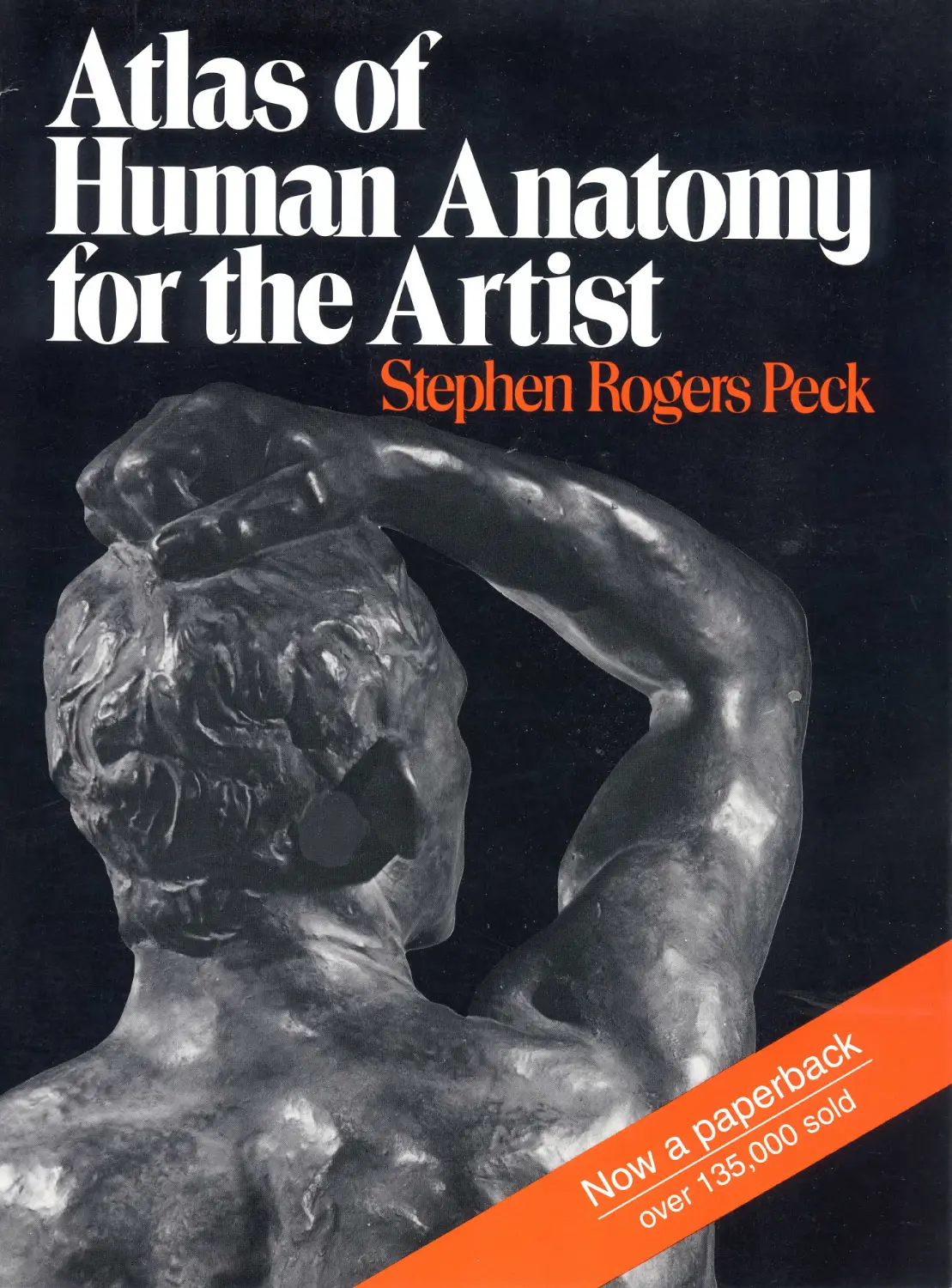


Author: Pek S.R.
Tags: anatomy human anatomy drawing drawing lessons books on the art of drawing
ISBN: 0-19-500052-8
Year: 1982
Text
                    ЕШ
ATLAS OF HUMAN ANATOMY
FOR THE ARTIST

ATLAS OF HUMAN ANATOMY
FOR THE ARTIST
STEPHEN ROGERS PECK
OXFORD UNIVERSITY PRESS
Oxford New York
OXFORD UNIVERSITY PRESS
Oxford London Glasgow
New York Toronto Melbourne
Nairobi Dar es Salaam Cape Town
Kuala Lumpur Singapore Hong Kong Tokyo
Delhi Bombay Calcutta Madras Karachi
and associate companies in
Beirut Berlin Ibadan Mexico City
Copyright 1951 by Oxford University Press, Inc., renewed 1979
by Stephen Rogers Peck
First published by Oxford University Press, New York, 1951
First issued as an Oxford University Press paperback, 1982
Library of Congress Cataloging in Publication Data
Peck, Stephen Rogers, 1912-
Atlas of human anatomy for the artist.
Originally published: 1951.
Includes index.
1. Anatomy, Artistic. I. Title.
NC760.P35 1982	743'.49	81-16848
ISBN 0-19-500052-8 (cloth)
ISBN 0-19-503095-8 (pbk.)
30 29 28 27
Printed in the United States of America
on acid-free paper

PREFACE
Human form has long challenged the artist’s
creative powers. Its irresistible force of com-
munication places it among the foremost
instruments of graphic expression. Its ver-
satility so captures the imagination that,
now and again, human form has emerged
as the theme itself. It is natural that the ar-
tist should investigate human structure in
order to express its form. Yet access to the
dissecting room is not always easy, and not
always profitable. In any case the facts re-
quire translation, for the artist will be ex-
ploring the aesthetics of anatomy. I think of
this as relating structural design to sensuous
design. The one must be learned, the other
perceived. This is the substance of what is
called artistic anatomy. It is the dual aim
here to present the separate structures and
to create a working awareness of their in-
tegration.
This book is not a treatise on drawing—
in the sense of cultivating quality and style.
Nor does it touch upon the fundamentals of
figure drawing—line, form, action, and so
on. Important as they are, they lie beyond
the scope of an anatomy book. Quite sim-
ply, this is a manual for the student who
feels the need of exploring and memorizing
human design.
One question is apt to arise at the very
outset: just how well versed in anatomy
must the artist be? And although beginning
students arc surely entitled to ask the ques-
tion, I find it difficult to answer. A man’s
art is his personal domain. It is a matter not
of professional requirements, but of what
one artist’s ideas require. This atlas is, of
course, a condensation of facts, and a trans-
lation to the idiom of the artist. Tn view of
this, the beginner should perhaps set out to
learn everything he can. Whatever seems in
his experience to be useless debris will be
dropped soon enough by the wayside. But
a word of caution to the zealous student.
Anatomy is complex. Its very complexities
are fascinating, but they are likely to lead
the way to unreasonable evaluations. The
student shodld not assume that it is neces-
sary to be correct at all costs in these mat-
ters of bone and muscle. In one sense, a
human body is the sum of its parts. But this
premise can both help and hinder. It can
hinder when we attend to the parts and
ignore the sum. It is true the student must
work at first to be correct, but he should
never forget that there is little virtue in
sheer correctness. Ultimately, he should
propose—right or wrong—to be convincing.
He should acquire such mastery of struc-
ture that he no longer depends on the accu-
racy of his eye or the patience of his model.
He will want to gain, in his own right, such
command of human forms and contours
that his creation will become identified not
with his anatomy charts, but with him, I
believe, in fact, it is those aberrations of the
anatomical truth that so often make a piece
of work personal and exciting.
I hope the reader may find here both
knowledge and a point of view. In these
pages I have tried to put him in closer
touch with a masterful design. May his
penetration of that design enlarge his ca-
pacity for response to the world about him.
New York City	S. R. P.
1 January 1951
vii
ACKNOWLEDGMENTS
The drawings in this atlas sprang from more
than a covenant between myself and a
chestful of anatomical oddments. There
were live models, too, and the atlas came
to be thought of as ‘our book. I regret that
their identities must be withheld. But let
those names be conspicuous by their ab-
sence. If this work of ours can prove fruit-
ful to students of the figure, we shall all
share the deepest satisfaction. Less direct
but even more vital were the contributions
of a multitude of art students. Their ques-
tions have been my point of departure, then-
efforts my proving ground. And their spir-
ited concern with anatomy not only induced
me to begin this book but sustained me
throughout its many years of production.
To my friend Darwin L. Platt, osteologist,
goes much credit for the furnishing of care-
fully selected and skillfully prepared bone
material. The American Museum of Natu-
ral History helpfully provided access to spe-
cial museum facilities. Photographs of racial
types, physiques, et cetera, came from a
variety of sources. Permission for their re-
print here is gratefully acknowledged, and
credits accompany the respective cuts. Pho-
tographer John Seymour Erwin made the
camera studies that appear on pages 181-9,
198-200, 207, and 227-35. For permission to
reprint certain passages of quoted material,
I wish to thank the following publishers:
Pantheon Books, Inc., for translations from
viii Tintoretto, Alberti, and Falconet, as com-
piled in Artists on Art by Goldwater and
Treves; Harper and Brothers, for a passage
from Ingres by Walter Pach; and the Ox-
ford University Press, for a quotation from
Michelangelo as translated by A. F. G. Bell
from Francisco de Hollanda in Four Dia-
logues on Painting. A material assistance
was given by the critical readers of the
manuscript. I am grateful for the advice
that stemmed from their special fields of
experience. It is a distinguished list: Profes-
sor Ture Bengtz (Museum School of Fine
Arts, Boston); Dr. George A. Bennett, Pro-
fessor of Anatomy (Daniel Baugh Institute
of Anatomy); Professor Russell T. Hyde
(College of Fine Arts, Carnegie Institute
of Technology); Dr. Dorothy Z. Kraemer
(College of Physicians and Surgeons, Co-
lumbia University); Mr. Luigi Lucioni, ar-
tist; and Professor Barse Miller (Chairman
of the Art Department, Queens College).
Not the least of my indebtedness is to the
Oxford University Press. The patience of
my publisher greatly eased the gestation of
something over one decade!
Finally, I pay tribute to the memory of
Henry W. Stiles, under whose guidance I
made my first explorations with the scalpel.
It is a rare experience to come into the orbit
of one whose prodigious knowledge is ob-
scured by a tender heart—an anatomist for
whom the cadaver is yet an individual ren-
dering his last service to mankind.
CONTENTS
	Preface The Language of Anatomy	vii xi
PART 1	BONES
	Skeleton (The Unit)	2
	Regional Classification of Bones	3
	Joints	4
	Head	10
	Spine	22
	Chest	26
	Shoulder	34
	Upper Extremity	40
	Hip	56
	Lower Extremity	68
PART II	MUSCLES
	Musculature	88
	Head and Neck	92
	Torso	102
	Upper Extremity	110
	Lower Extremity	128
	Translation from Nature	144
PART III	SURFACE ANATOMY
	Fat	150
	Veins	156
	Skin	158
	Hair	160
	Features	162
	Surface Landmarks	180
PART IV	PROPORTION
	Proportion	192
	Varieties of Physique	201
PART V	EQUILIBRIUM AND LOCOMOTION
	Equilibrium	206
	Locomotion	210
PART VI	DISTINCTIONS OF AGE, SEX, AND	RACE
	Distinctions of Age	214
	Distinctions of Sex	224
	Distinctions of Race	236
PART VII	AGENTS OF EXPRESSION
	Agents of Expression	244
	Pronunciation of Terms	261
	Index	265 ix
And who is so barbarous as not to under-
stand- that the foot of a man is nobler than
his shoe, and his skin nobler than that of
the sheep with which he is clothed, and not
to be able to estimate the worth and degree
of each thing accordingly?
—Michelangelo
THE LANGUAGE OF ANATOMY
The human body is a sort of geographical
terrain upon which the anatomist, like a
surveyor, must be prepared to take his
bearings. It will help us to be brief in our
discussion if first we acquire a suitable
vocabulary. Descriptive terms given in the
following pages are in common use, and
they will suffice as a verbal springboard
from which we may readily plunge into
any section of this book. A key to the pro-
nunciation of unfamiliar terms encountered
here and elsewhere will be found on pages
261-3
THE LANGUAGE OF ANATOMY
PERTAINING TO POSITION
j Longitudinal
) Transverse .
У Vertical ...
) Horizontal ..
Oblique ...
Median ....
Midline ....
J Medial ......
) Lateral .....
j Anterior ...
( Posterior ...
J Superior ....
I Inferior.....
у Deep........
У Superficial .
J Internal ....
У External ...
j Proximal ....
У Distal ......
Palmar ....
Plantar ....
Ref. to long axis
At right angles to long axis
Ref. to long axis in erect position
At right angles to vertical
Slanting
Midway
Divides body into right and left sides
Nearer to midline (or center plane)
Further from midline (or center plane)
Front
Rear
Upper; nearer to crown of head
Lower; further from crown of head
ref. to solid form
1 of cavity, hollow form
Nearer to root of limb
Further from root of limb
Ref. to palm-side of hand
Ref. to sole of foot
Further from surface у
Nearer to surface (
Inside
Outside
< ref. to
Dorsal..............Ref. to back; also, back of hand and top of foot
У	Supine ............Forearm and hand, turned palm-side upward
У	Prone .............Forearm and hand, turned palm-side downward
j	Inverted...........Turned inward (as foot at ankle joint)
У Everted ............Turned outward (as foot at ankle joint; also lower lip)
Intermediate........Between other structures
Interosseous ........Between bones (as membranes and muscles)
PERTAINING TO BONE
Bone.................Inflexible structures composing the skeleton
Cartilage ...........Substance from which bone ossifies; gristle
Joint ...............|
...	/Connection between bones
Articulation.........I
Suture ..............Interlocking of teeth-like edges
Head.................Enlarged round end of a long	bone; knob
Neck.................Constriction of a bone near its head
Body.................Broadest or longest mass of a bone
Shaft................Body of a long bone
Symphysis ...........Union of right and left sides in midline
xii Eminence..............Low convexity (just perceptible)
Protuberance
Tubercle ...
Tuberosity ..
Process.....
Spine ......
Crest.......
Condyle ....
Epicondyle .
Trochlea ...
Ramus ......
J Bump (can be felt under finger)
Large and conspicuous bump
Projection (can be grasped with fingers)
Pointed projection or sharp ridge
Ridge or border
Polished articular surface (usually a knob)
Elevation near a condyle
Spool-shaped articular surface
Platc-likc branch of a bone
Facet................Small articular area; often a pit
Fossa ...............Shallow depression
Foramen .............Hole; perforation
PERTAINING TO FLESH
Ligament...........Fibrous tissue binding bones together or lashing tendons or
muscles in place
Muscle ............Contractile organ capable of producing movement
Belly..............Fleshy part of a muscle
Head ..............Portion of a muscle having a separate attachment
Tendon ............Fibrous tissue securing a muscle to its attachment
Aponeurosis .......Expanded tendon for attachment of a flat muscle
Fascia.............Fibrous envelopment of muscular structures
Sheath ............Protective covering
Serration .........One of the notches at a saw-like edge
Digitation ........Finger-like division of muscle fibers
j Origin..............Relatively fixed point of a muscle attachment
{ Insertion ..........Relatively movable point of a muscle attachment
Action.............Movement accomplished by a muscle
) Flexor..............Causes bending or angulation
I	Extensor...........Straightens
j	Levator............Raises
(	Depressor..........Lowers
J	Abductor ..........Draws away from	the	midline
(	Adductor ..........Draws toward the	midline
Erector............Draws upright
Tensor.............Draws tight
Rotator............Causes to revolve
j	Supinator..........Turns palm	of	hand	upward
I	Pronator...........Turns palm	of	hand	downward
Corrugator.........Draws (skin) into wrinkles
Sphincter..........Regulates the closing of an aperture
xiii

JtI
XV

Part I
BONES
If beauty resides in fitness to any extent,
what can be more beautiful than this skele-
ton or the perfection with which means and
ends are reciprocally adapted to each other.
—Eakins
The SKELETON
Probably few beginners have entered the
Life Class with any real appreciation of
skeletal structure. Ordinarily, it must be
cultivated. The tyro is inclined to dispose
quickly of bone, in favor of flesh. He in-
sists that what he observes in the live model
is evidence of muscle, tendon, and fat—not
of a skeleton! The upholstery, he forgets,
cannot by itself have form but takes its
broad lines from the frame over which it
stretches. Not only is a skeleton the anchor-
age for flesh, but also, at so many points,
it is conspicuously present at the surface.
It is the primary factor in proportion, and
a means of great distinction between the
sexes. And what is more, dry bones are ob-
jects of masterful design. Their study should
bring profound respect as well as enlight-
enment.
The plate-like bones of head and trunk
serve primarily as protective enclosures for
vital organs. Like the scaffolding of a house,
this much of the skeleton determines shape.
We can readily comprehend the sturdy but-
tresses of hipbones, the keystone base for a
stately spinal column, the vaulted gallery of
a rib cage, the cupola-skull with its balcony
of cheekbones. The live head, in fact, is
little more than a skull adorned with ears,
nose, and eyeballs. The upper trunk is rec-
ognizably a rib cage to which we add only
its mantle of shoulder bones and muscles
and so produce a pit under the arm. Again,
the shape of the lower trunk is commanded
2 by a bony pelvis. But this lies nearly ob-
scured by buttocks and the enormous roots
of thighs. We cannot see the evidence of
pelvis at first—how it determines shape. We
learn to see it. So all this is the house we
live in, organized along an upright central
axis. It is called the axial skeleton.1
If the head and trunk give us architec-
ture, the arm and leg are matters of engi-
neering. Here are the long bones of the
appendicular skeleton, simple levers for
transmitting power. They turn and bend
with great freedom to adjust us to our en-
vironment. The joints of long bones will
contribute more or less directly to specific
surface forms, but a shaft usually lies deep
in its harness of muscle. It is particularly
important here for us to realize that though
muscles may hide the bone, their directions
are completely at the mercy of the bone.
That is why a fleshy thigh slants in to the
knee and why it arches forward. Remove
the bone, and a thigh would have little
more shape than a puddle of water.
Substantial and dynamic as is this human
engineering, its presence at the surface is
betrayed only to the penetrating eye. Ig-
noring what cannot be seen, the student
runs great risk. His first objective should be
a conviction of the critical importance of
skeletal structure.
1	Hipbones cannot be ignored in considering
either trunk or lower extremity. The anatomist
would not assign them to the axial skeleton. But
artists find it more useful to think of the full pelvis
as a fixed unit of the trunk. (See p. 60, Pelvis.)
REGIONAL CLASSIFICATION OF BONES
[Names of bones arc in italics]
[Parentheses indicate common names or meanings]
/ Cranium
Skull
Axial Skeleton
Appendicular
Skeleton \
[paired]
Head
Face
Trunk
Throat
/ Column
Spine ;
( Base —
Thorax
Shoulder
Arm-----
Forearm
Upper
Extremity
Lower
Extremity
i Hand
Hip-
Thigh
Knee
Leg-
tFoot
Frontal (at forehead)
Occipital (at back of head)
Parietal 2 (side wall)
Temporal 2 (at temple)
Sphenoid (wedge-shaped)
Ethmoid (sieve-like)
Zygomatic 2 (cheekbone, yoke bone)
Lacrimal 2 (site of tear sac)
Nasal 2 (nose bone)
Vomer (plowshare bone)
Nasal concha 2 (turbinated bones)
Palate 2 (palate bone)
Maxilla 2 (upper jawbone)
Mandibula (lower jawbone)
Hyoid (tongue bone)
Cervical vertebra 7 (in neck)
Thoracic vertebra 12 (in thorax)
Lumbar vertebra 5 (in loins)
Sacrum (sacred bone)
Coccyx (tail bone)
Rib 24 (ridged members of support)
Sternum (breastbone)
( Scapula (shoulder blade)
{Clavicle (collarbone)
------------Humerus (upper arm bone)
/ Ulna (inner forearm or elbow bone)
( Radius (outer forearm or spoke bone)
! Navicular (boat-shaped)
Lunate (crescent-shaped)
Triquetrum (pyramidal bone)
Pisiform (pea-shaped)
Maj. multangular (large, many corners)
Min. multangular (small, many corners)
Capitate (head-shaped)
Hamate (hooked bone)
Metacarpus Metacarpal 5 (beyond wrist; palm)
Digits-----Phalanx 14 (knucklebone)
-----------Os coxae (hipbone, haunch bone)
-----------Femur (thighbone)
----------- Patella (kneecap, kneepan)
__________ (Tibia (shinbone, shank bone)
I Fibula (calf or splint bone)
(Talus (ankle or witch bone)
Calcaneus (heelbone)
Navicular (boat-shaped)
Cuneiform 3 (wedge bones)
Cuboid (cube-shaped)
Metatarsus Metatarsal 5 (beyond instep)
Digits-----Phalanx 14 (toe bones)
JOINTS
Bones unite with one another in various
ways. Certain of these unions are locked’
joints; some manifest only a passive move-
ment; and others are so devised that their
parts may glide with great freedom upon
each other.
IMMOVABLE JOINTS
Suture: an interlocking of bones along their
saw-tooth edges.
e.g. joints of cranium
(cranial sutures)
Cartilage: adhesion by means of cartilage
or gristle (substance from which bone
ossifies).
e.g. joints of breastbone with first ribs
(first stcrno-costal)
SLIGHTLY MOVABLE JOINTS
Fibro-Cartilage: provides a spongy cush-
ion between bones.
e.g. joints of spine
(inter-vertebral discs)
FREELY MOVABLE JOINTS
(Synovial1 or lubricated’)
Plane: bones glide face to face, limited by
their retaining ligaments.
e.g. joints of wrist and ankle bones
(inter-carpal and -tarsal)
Hinge: movement about a transverse axis
only, as in the lid of a box.
e.g. elbow joint
(humcro-ulnar)
j So called because of the presence of synovia, an
4 oily lubricant.
Saddle: increases the extent of the hinge
joint by adding an axis of movement per-
pendicular to the transverse axis.
e.g. joint of thumb with
adjoining wristbone
(carpo-metacarpal i)
Condyloid2: increases the extent of the sad-
dle joint by permitting circular movement
that will describe the side of a cone.
e.g. joints of first row of knuckles, ex-
cept thumb
(metacarpo-phalangeal u-v)
Pivot: a cylindrical form moving within a
complete or partial ring, or such a ring mov-
ing about the cylinder. Only a vertical axis
is present, as in the hinge of a gate.
e.g. joints of forearm bones
(radio-ulnar)
Ball-and-Socket: provides the freest pos-
sible movement by means of a spherical
head set within a cup-like cavity. This joint
adds to the wide play of the condyloid joint
the vertical axis of pivot rotation.
e.g. hip joint
(at the acetabulum)
Ellipsoid: a modified ball-and-socket in
which the uniting surfaces are ellipsoidal
rather than spherical. Vertical rotation is
impossible.
e.g. joint of forearm with wrist
(radio-carpal)
2 The Condyloid type of joint is structurally like
the ball type, except that muscles and ligaments
do not allow rotation.
5
SKELETON (Male)
from in front
Ulna (elbow
Radius (spoke bone)
Carpus (wrist) --------
Humerus (arm bone)
Metacarpus (flat of hand)
Skull
Mandibula (jawbone)
Femur (thighbone)
Patella (kneecap)
Tibia (shinbone)
Fibula (splint bone)
Tarsus (ankle)
----Metatarsus (flat of foot)
----Phalanges (of toes)
Phalanges (of fingers)
Thorax (rib cage)
Spine
Osj coxae (hipbone)
Sacrum
Anatomical center
Clavicle (collarbone)
Scapula (shoulder blade) —
SKELETON (Male)
from behind
Suture joints
Ellipsoid joint
Hinge joint
---------------Fibro-cartilage joints
Ball-and-socket joint
Plane joint
Plane joints
/
/
Converse ball-and-socket joint
Pivot joint
----Pivot joint
Ellipsoid joint
Saddle joint
Plane joint
Plane joint
Plane
Hinge joint
Hinge joint
joints
joints
Hinge joint
Plane joint
Ball-and-socket joint
Cartilage joint —
7
SKELETON (Male)
from the right side
Upper extremity
Skull
Hyoid (tongue bone)
Pelvis
Thorax (rib cage)
Lumbar spine
•Anatomical center
8
9
The SKULL
The term ‘skull’ designates a group of 22
plate-like bones that compose the frame-
work of the head.1 The average skull is 8й
inches high, higher than long (7/2 inches),
and longer than wide (6 inches). Skull height
is the generally accepted unit for compara-
tive measurements throughout much of the
body.
CRANIUM
Skull segments (except lower jaw) inter-
lock in a system of suture joints. Eight of
these segments encase the brain. This pro-
tective shell, resembling an egg (large end
behind), is called the cranium. Just as the
egg is circular in transverse section and oval
in longitudinal section, so is the cranium.
Cranial bones consist of: 1 frontal, 1 occip-
ital, 2 parietals, 2 temporals, 1 sphenoid, and
1 ethmoid. The ethmoid is of no structural
importance and will be omitted here.
The frontal, as its name suggests, is the
broad bone of the forehead and forward
roof of the skull. Rising gently at either side,
from the smooth upper surface, are the
frontal eminences. The forehead in life is
the result of these two lateral swellings
with their muscular jackets, blending more
or less into one general swelling. Below the
forehead, a more complex brow region con-
sists of the delicate upper rims at the out-
side of the orbits (eye sockets), and heavy
bars, the superciliary crests (brow ridges),
above the inner ends of the orbits. Both or-
bital rims and brow ridges are oblique in
such a way as to describe a stretched-out
letter M above the eyes. Orbital rims droop
to the outside, each one terminating in a
zygomatic process to join the zygomatic
bone (cheekbone) in the face.2 Being thin-
ner, these orbital rims appear to be mortised
into the coarser mass of brow ridges. The
ridges very nearly merge above the root of
the nose, being separated only by a small
depression called the glabella. Brow form
may be bold in the male skull, usually slight
in females.
The occipital [L. ob, against, -|- caput,
head] is at the back of the head and may
be seen to protrude somewhat. Its under-
surface rests upon the spinal column at two
knob-like occipital condyles (ellipsoid joint).
These permit rocking movements of the
head, as when we nod a yes.’ The occipital
crest in the median line terminates behind
at the occipital protuberance, springboard
for the fleshy contour of the neck.
The parietals [L. paries, a wall] lie be-
tween frontal and occipital bones. They
form the upper side walls and rear vaulted
«For relation of the Hyoid (tongue bone), see
pp. 18, 99, 101.
2	Cf. p. 14.
10
roof of the skull, uniting with each other in
the midline much as the slanting sides of a
gabled roof meet at the ridge pole. The
point of greatest convexity in each bone is
called the parietal eminence.
The temporals [L. tempera, the tem-
ples] form the lower side walls of the cra-
nium in the region of the ears. Projecting
forward from each bone is the slender root
of the zygomatic arch to join the zygomatic
bone (cheekbone)3 in front. A smooth hol-
low beneath the root of the arch receives
the head of the jawbone; and directly be-
hind, the ‘ear hole’ (auditory meatus) shows
a circular rim for attachment of the fleshy
ear. Bulging downward to the rear of this
‘ear hole’ is the large mastoid process, and
below the hole is a slender spur called the
styloid process. The curved and jagged edge
of the bony plate above the ear unites with
sphenoid and parietal bones.
The sphenoid [G. sphene, wedge], a
single bone, straddles the undersurface of
the cranium. It appears in both side walls
between temporal and frontal bones at the
regions known as the temples. For the art-
ist’s consideration, this bone at the temples
may be said only to fill the gaps between
temporal and frontal bones.
CRANIAL SUTURES
Each bone described above has ragged
edges that allow it to fit tightly into the
companion edges of adjacent bones. These
meandering lines of union arc the cranial
sutures. In effect, they resemble the snug fit
of Norway into Sweden. Three principal
sutures are those bounding the parietal
bones and appear from above to suggest the
letter H. Frequently, in later life, an ‘H’
suture is raised enough to show as a blunt
ridge; or it may just as often be traced as
a very shallow furrow. Evidence of cranial
sutures may be disclosed in the flesh by ex-
tensive baldness or by tonsure (head-shav-
ing).
TEMPORAL LINE AND FOSSA
Arising from the outer end of the brow
ridge and arching backward over the cra-
nium is the temporal line. Here the distinc-
tion is seen between side wall and roof of
the skull. The hollow of the side wall is
called the temporal fossa. In life, it is filled
by a jaw muscle (temporalis).
3	Cf. p. 16.
FACE
The facial region of the skull hangs like
a mask from beneath the small forward end
of the ovoid cranium. There are 14 bones,
including the movable lower jaw. Unlike
bones of the case-like cranium, these are
most irregular in shape and serve as a scaf-
folding for an intricate arrangement of
facial muscles and sense organs. Facial
bones consist of: 2 zygomatics, 2 lacrimals,
2 nasals, 1 vomer, 2 nasal conchae, 2 palates,
2 maxillae, and 1 mandibula. Except for
the mandibula (lower jaw), they unite in
suture joints. The lacrimals, vomer, nasal
conchae, and palate bones are of no struc-
tural importance and will be omitted here.
The zygomatic bones [G. zygoma, yoke],
or cheekbones, are prominent angular plates
that fasten wing-like to the upper jaw and
create a ‘balcony’ above the lower jaw.
Three spurs are seen to leave the plate for
separate destinations. One spur rises to the
zygomatic process of the brow and gives
the orbit its outer rim.4 Another darts
toward the nose and so contributes to the
lower rim. A third spur reaches back to
‘shake hands’ with the forward-springing
arm of the temporal bone. The slender zygo-
matic arch thus formed, a span from cheek
to ear, suggests the bow of eyeglasses.5
The nasal bones [L. nasus, nose] project
from beneath the wedge between the orbits.
They are less than an inch in length and
create a slanting roof (bridge) for the cav-
ity of the nose.
The max ill те [L. jawbones], while they
constitute the chief body of the upper jaw
and give root to its teeth, also enter into the
formation of the cheeks laterally and the
wall of the nose above. Each maxilla sinks
inward below the orbit, producing the
canine fossa (filled with cheek muscles).
In front, the two maxillae join at the base
of the inverted-heart-shaped nasal cavity in
a pointed spur, the nasal spine. The dental
arch in which the upper teeth are socketed
is the margin of a bony plate, the hard
palate (roof of the mouth).
The mandibula [L. mandere, to chew]
is the lower jawbone. In its forward reach,
it underlies the maxillae and is there called
* Sec Frontal bone, p. 10.
sCf. pp. 11, 16, 18.
12
the body. The lower teeth take root in the
dental arch, which traverses the upper bor-
der of the body. A projection at the chin
is the mental protuberance [L. mentum,
chin]. The mental tubercles arc small lumps
at either side of the midline and give
squareness to the chin (said to be most dis-
tinct in males). Farther back at each side
of the jaw, a broad, thin blade, the ramus,
springs upward from the body. The rear
‘corner’ of the jaw, so produced, is called
the angle of the mandibula. The angle is
described by the lower border of the body
and the rear border of the ramus, and ap-
proximates 120 degrees. This appears as the
angle of four o’clock on the right side, eight
o’clock on the left.0 The ramus passes deep
to the zygomatic arch.7 There it divides in-
to a forward coronoid process (for attach-
ment of the temporalis muscle of masti-
cation) and a rear condyloid process (for
articulation with the skull). The latter proc-
ess enters its socket in the temporal bone
at the front of the ‘ear hole’ (hinge joint).
«The lower jaw is nearly horizontal at birth, its
angle becoming more acute as maturity is ap-
proached.
т Cf. p. 16.
13
SKULL
from in front
14
from behind
SKULL
Parietal
Occipital bone
Occipital protuberance
Nuchal line
Angle of mandibula
Mastoid process-----------
Temporal line
Cranial sutures
Parietal bone
15
SKULL
from the right side
Temporal line
Temporal bone
Frontal eminence
Temporal fossa
Wing of sphenoid bone
Occipital
Parietal bone —
Frontal bone
Occipital
Mastoid process-----
Auditory meatus (‘ear hole’)
Condyloid process
Styloid process
Angle of mandibula
Coronoid process----
Mental protuberance
Mandibula
Brow ridge
Zygomatic process
(of frontal bone)
Orbit
bone
Zygomatic bone
Zygomatic arch
Canine fossa
Nasal spine
“Maxilla
16
SKULL
Frontal bone
Temporal line
Parietal bone
Parietal eminence
Cranial sutures
Occipital bone
Frontal eminence
from above
Zygomatic bone-------------
Zygomatic arch-------------
Sphenoid bone---------------
Socket for jawbone--------------
Styloid process----------
Mastoid process----------
Foramen magnum.----------
Occipital crest-----
Nuchal line
from below
17
RELATION OF SKULL TO SURFACE FEATURES
Frontal eminence
Temporal line
Mastoid
process
Angle of
mandibula
Orbital rim
Canopy of jaw
Nasal bone
Zygomatic
arch
Nasal spine
Mental
protuberance
bone
Thyroid cartilage
Nuchal ligament
Cervical vertebrae
Auditory
meatus
(’ear
crest
(brow ridge)
18
19
20
21
The SPINE, backbone
The skeletal axis is a curved and tapered
column traversing the entire midline of the
back, from fork to head. As it is required
to sustain much weight and yet make al-
lowance for contents of thorax and abdo-
men, precision of balance is imperative.
This is effected by means of (1) a firm root
in the pelvis, (2) variation in size of seg-
ments according to their loads, and (3)
an ingenious four-arch curve. The spine is
divisible into an immovable foundation be-
low, consisting of the sacrum and coccyx,
and a movable segmented shaft above, com-
posed of VERTEBRAL
SACRUM AND COCCYX
The sacrum [L. sacred bone] is a spade-
shaped bone, bent convexly backward and
wedged between the two iliac bones of the
pelvis.1 Securely planted upon its base
above are the vertebrae; attached to the
lower tip or apex, and terminating the spine
below, is the coccyx [G. kokkux, cuckoo] or
tail bone. An important landmark of the
back in life is the sacral triangle. It is
bounded above by two dimple-like depres-
sions at the posterior iliac spines,2 and be-
low by the cleft between the buttocks.
VERTEBRAE
There are 24 vertebrae [L. vertere, to
turn] named according to location. The 5
lumbar vertebras [L. lumbus, loin] are
largest of all, supporting the weight of
thorax, arms, and head. They are especially
capable of forward bending. No rotation is
possible, and other movements are limited.
In the upper back, 12 thoracic vertebrae
give rise to as many pairs of ribs. This
region is least flexible due to restraint im-
posed by the rib cage and the long spinous
processes (see opp. page). It is capable of
all movements, but only to a slight degree.
The 7 cervical vertebral [L. cervix, neck]
arc relatively light, acting only as a pedestal
for the skull. They are most flexible of all
the vertebrae: capable of backward, for-
ward, and lateral bending, as well as rota-
tion. The uppermost member of the cervical
family is the atlas (Cervical i), so called
because it holds aloft the globe-like head.
Its construction enables the head to rock
backward and forward, as well as laterally.
Beneath is the axis (Cervical n), which
provides a rotary articulation with the Atlas,
making possible swivel movements of the
head. The upper six vertebrae lie deep
from the surface under the nuchal ligament
[nwc/ia==nape of neck], a sort of check-
rein from the cervical spine to the occip-
ital crest and protuberance of the cra-
nium.3 Cervical vu reaches the surface to
become conspicuous in life as the verte-
bra prominens.
The spinal column presents, in the rear,
three longitudinal rows of spurs. The high
center row (spinous processes) alone is evi-
dent at the surface, especially at the mid-
region of the back. Its companion rows lie
at either side, separated from it by the
‘spinal gutters’ in which are entrenched the
long muscles acting on the spine.
« Cf. pp. 61-3.
2 Ibid.
3 Cf. p. 18.
22
Л TYPICAL VERTEBRA
The form of a typical vertebra consists
of a body, an arch, and a number of prongs
associated with the arch. The body is the
large central mass. It yields broad upper
and lower surfaces for articulation (fibro-
cartilage) with the bodies of adjoining
vertebrae. Projecting backward in two
roots from this body is the vertebral arch,
surrounding the opening for the spinal cord.
This arch gives rise to (1) two pairs of ar-
ticular processes (above and below), (2) a
pair of transverse processes, and (3) a
spinous process. The articular processes
unite with their companion articular facets
of adjoining vertebrae (plane joints). To-
gether with the spinous processes, they en-
gage in a backward, mechanical locking
operation. This helps to carry the spine
upright and prevent injury to the contents
of the chest by backward bending. The
transverse processes are deep and serve as
muscular attachments. The spinous process
of each vertebra, except Cervicals i-vi, may
be seen or felt at the surface. A cer-
vical process fans like a lobster’s tail; a
thoracic process is a long spike; a lumbar
process resembles the blade of an axe. But
these are traits of the dry skeleton, not
observed in a live subject. Thoracic verte-
brae are distinguished by their facets for
articulation with the ribs (plane joints).
Cervical IV
Thoracic VI
Lumbar II
Inter-vertebral discs are thick cushions of
fibro-cartilage, inserted between the bodies
of adjoining vertebrae. They afford a resil-
ience appreciable only in the collective
movements of many vertebrae.
SPINAL CURVATURE:
THE FOUR-ARCH CURVE
It will be seen, in the side view, that the
spine arches convexly forward in the neck
and loins, and backward in the thorax
and pelvis. The backward convexities are
essential for the maintenance of chest and
pelvic cavities required by vital structures.
The forward convexities are compensatory.
If we evaluate the curves in terms of speed,
this serpentine profile is found to be accel-
erated downward: a slow (nearly straight)
cervical curve, a very fast sacral curve.
Longest of the spinal curves is that of the
thorax.
23
SPINE
Cervical I (Atlas)
Cervical II (A:
Thoracic I
Thoracic VI
Thoracic VI
Thoracic XII
Thoracic XII
Lumbar I
Intervertebral discs
Sacrum
Facets for occipital
condyles of skull
Tooth of Cervical II (Axis)
[Pivot for Atlas]
Cervical VII
(Vertebra prominens)
24
from in front
from behind
from the right side
SACRUM and COCCYX
from in front
from behind
from above
from the right side
25
The THORAX, rib cage
Springing forward from the twelve thoracic
vertebras of the spine is the thorax [G. a
cuirass], a slatted protective cage for the
contents of the chest cavity and an anchor-
age for external trunk muscles. In general
shape this cage resembles an egg, small end
above. But the ovoid form is slightly com-
pressed from front to rear, causing it to be
wider than it is deep. In height, it is half
again that of the skull. There is a large
aperture below, whose front margin arches
upward to the pit of the stomach (see be-
low: xiphoid process). This rim, known as
the thoracic arch, is a conspicuous surface
feature of the torso. The angle formed by
right and left sides of the arch may reach
90 degrees (right angle) in well-developed
subjects. The small aperture above is kid-
ney-shaped and corresponds in size to the
neck, which emerges from it. In the front
center wall of the chest are the sternum
and its strap-like costal cartilages [L.
costis, rib]; at the rear is the column of
thoracic vertebrae. The remainder of the
thorax is composed of ribs, derived behind
from facets in the thoracic vertebrae and
making their cartilage attachments in front
to the sternum. Any movement among parts
of the thorax is imperceptible. But as a unit,
the thorax may rise forward and drop back-
ward as in respiration; or it may be subject
to slight expansion and compression caused
by bending backward, forward, or side-
ward, and by respiration.
STERNUM
The sternum [G. sternon, the breast], or
breastbone, gathers up the ribs in the mid-
line. It is from 6 to 8 inches in length,
thrust like a dagger downward and out-
ward at the middle of the chest. Its parts
are named accordingly: manubrium [L.
handle]; body, and xiphoid process [G.
xiphos, sword].
The manubrium is a flat plate whose
upper margin displays three indented sur-
faces. Those on either side receive the
clavicles (collarbones). The middle de-
pression is called the jugular notch, accen-
tuated by the presence of clavicles. It sup-
plies the floor for a significant surface land-
mark, the pit of the neck. The lower mar-
gin of the manubrium is dented on either
side to receive the cartilage of the first rib.
The body is twice the length of the
manubrium, with which it forms a slight
forward angle. The union may be cartilag-
inous or bony. Both manubrium and body
furnish, along their outer borders, points of
attachment for rib cartilages.
The xiphoid process may be either bone
or cartilage. It is about as large as the last
segment of the thumb, and it lies suspended
from the body of the sternum at the pit of
the stomach. The xiphoid’s claim to atten-
tion is the fact of its position as the apex of
the thoracic arch.
RIBS
The greater part of the thoracic cage is
formed by 12 pairs of ribs. These are flat,
twisted blades curving about from the
thoracic vertebrae behind and swinging
obliquely downward to the front. Most
of the ribs produce a costal carti-
lage for attachment to the sternum. The
26
obliquity of direction is greatest in the lower
thorax. Length decreases from the eighth
ribs both above and below. Spaces be-
tween ribs are called intercostal spaces
(the first space lies between first and
second ribs).
The particular method of sternal attach-
ment is denoted bv classification of the ribs.
✓
The upper seven pairs are true ribs be-
cause they establish a direct contact with the
sternum by individual cartilages. The lower
five pairs are false ribs. Ribs viii, ix, and
x each have a strap of cartilage, which
fastens to the strap above it. The resulting
cartilaginous rim, at the lower front edge
of the cage, has been described as the
thoracic arch. Ribs xi and хи, called float-
ing ribs, are without cartilage and have no
sternal attachment whatever. They lie more
or less concealed within the wall of the
back. Evidence of individual ribs in the
healthy subject is best seen at the lower end
of the rib cage, especially to the rear. Super-
ficial rib-like swellings high at the sides are,
in reality, bundles of muscle fiber which
arise from the ribs.1
A TYPICAL RIB
Each rib articulates at its head with facets
in the vertebral column (plane joints) 2 The
constriction next to the head is the neck,
and beyond the neck is a tubercle making
contact with the transverse process of its
corresponding vertebra. The remainder of
the rib, flat and blade-like, is called the
body. At first, the rib runs laterally and
somewhat backward; but at a short distance
beyond its tubercle it takes a sharp turn
forward. This angle of the rib is a special
distinction of Man. Unlike most animals, he
may lie upon his broad, flat back with ease.
1 Cf. pp. 102, 106: serratus and external oblique
muscles.
- Cf. pp. 23, 24.
Head
Tubercle
Body
27
THORAX
from in front
28
from behind
THORAX
Lumbar vertebra I
29
THORAX
from the right side
30
THORAX
from above
from below
31
:SHORT
/
HIPS
(
ST^R.»6Hr
I -ЬЕ'МО
SHoflr

ГС>иР?^АСгН ОЖ
u D
__McRE
Cu*Rv*£X>
; NUCMA1L
LI6AMEMT!

TW^KWAYRP
BfcN£>
L. AT^RAu
I вёнр
32
33
The SCAPULA, shoulder blade
The trowel-like bony plate, conspicuous at
either side in the upper back, is called the
scapula [G. scapane, a digging tool]. It
extends, when the arm is at the side, from
the second to between the seventh and
eighth ribs. This closely parallels the posi-
tion of the sternum in front. The average
vertical length is about 6J2 inches, and this
same span is found between right and left
scapulae at their lower tips. The scapula
furnishes a socket for the bone of the upper
arm. It has axial attachment only by way of
the collarbone, with which it joins to form
the shoulder girdle. Movement consists of
gliding and wheeling upon the ribs. Struc-
turally, the scapula is divisible into a body,
a spine, and a process.
The body is thin, triangular, and bent
forward to fit the thorax. The sides of the
body are called margins: (1) the upper
margin, above; (2) the vertebral margin,
facing the spine; and (3) the axillary mar-
gin,1 facing the arm. The angles are called:
(I) medial; (2) lateral; and (3) lower.
The lateral angle is enlarged and more often
called the head. It has a hollowed surface,
the glenoid fossa, which receives the bone
of the upper arm (ball-and-socket joint).2
Surface muscles obscure the scapular body,
but evidence of the vertebral margin and
lower angle may be present in the live
subject.
The spine is a high crest on the back of
the scapular body, situated on a line with
the glenoid fossa. It rises from the vertebral
margin, ascends laterally, and arches over
and beyond the head. It expands and pro-
jects outward as a partial roof over the
socket of the arm and is there called the
acromion process. Depressed surfaces are
created above and below by the ascending
spine: the supraspinous fossa and infraspi-
nous fossa, respectively. Superficially, the
spine is in evidence throughout, but usually
as a shallow groove separating the muscular
forms above and below.
The coracoid process [G. korax, crow:
resemblance to beak] arises from the top
of the lateral angle (head); it protrudes
forward and laterally, like a curled finger
pointing to the bone of the upper arm. In
the live subject, it lies close to the triangular
hollow (infraclavicular fossa) below the
collarbone.
ELEVATION OF THE ARM
A sideward lifting of the arm is assisted
by wheeling of the scapula, so that its
acromion is drawn upward and medially
while the lower angle is drawn upward and
laterally. But scapular and arm movements
are not entirely synchronized. Wheeling of
the scapula lags behind elevation of the
humerus until the arm rises above the hori-
zontal. Here arm movement diminishes
quickly, and further elevation is promoted
chiefly by play of the scapula. It is the story
of the tortoise and the hare. Although the
sluggish tortoise (scapula) seems ill-
matched against a bounding hare (humer-
us), he overtakes the swift but foolish
creature and wins the race.
> Axilla [L. armpit].
- Cf. p. 37.
34
Right SCAPULA
Acromion process
from the outer side
35
The CLAVICLE, collarbone
The slender clavicle [L. clavis, a key] forms
the only bony connection of the upper limb
with the trunk; and it is the last bone to
attain full growth (about 6 inches in
length). It springs laterally from the ster-
num and crosses the summit of the rib cage
to meet the acromion process of the scap-
ula.1 In pivot movements from the pit of
the neck, the clavicle calls to mind the jib
of a crane—with the entire upper limb
slung from its outer end. The clavicle con-
sists of a shaft and its two articular ends.
The MEDIAL end or sternal end of the
clavicle articulates, at one side of the pit
of the neck, with the upper margin of the
sternum (modified ball-and-socket joint).2
This joint is a pivot for the great range of
movement in the upper limb.
The lateral end or acromial end of the
clavicle joins the large acromion process of
the scapular spine (plane joint).3 In effect,
the latter is an extension of the clavicle
Sternal end
itself but is a step down from the clavicle.
The shaft of the clavicle describes a
double curve: the longer, medial curve
bends forward, and the shorter, lateral curve
bends backward. The deltoid tubercle (for
attachment of deltoid muscle) is a rough-
ened prominence found at the front of the
shaft, between the two curves. It occupies
a position directly above the coracoid proc-
ess of the scapula.4
The sternal ends of right and left clavicles
are separated by about one inch. This
suprasternal space is the familiar pit of the
neck.6 Above and below the middle of each
clavicle, in life, are conspicuous surface
hollows: the supraclavicular fossa and infra-
clavicular fossa, respectively. The center
portion of the bone remains clearly visible.
The forward part of the shoulder girdle6
can be traced from one side to the other
and seen, as from above, to resemble a
Cupid’s bow.
•Cf. p. 6.
2 Cf. p. 28, 31.
з See opp. page.
* See opp. page.
5 See also p. 26: Sternum.
8 The rear part is formed by the scapulae.
36
from above
from in front
JOINTS of the Right SHOULDER
Lower angle
37
38

The HUMERUS, bone of the upper arm
The humerus [L. shoulder] is the longest
and heaviest bone of the upper limb, and
the only bone of the arm proper. In length,
the average humerus measures about 13
inches, or half again the height of the skull.
It consists of a narrow shaft enlarged at
each articular end.
The proximal ^end is composed of the
head and tubercles. The head is a smooth
half-sphere looking somewhat backward to
articulate with the shoulder blade (ball-
and-socket joint). Flanking the head from
in front are major and minor tubercles,
separated from each other by the inter-
tubercular groove. The squared major tu-
bercle, on the outside, stands as the outer-
most bony projection of the shoulder and
gives attachment to scapular muscles.
The shaft, as seen from the side, sug-
gests an S-curve—especially in its lower
half, which arches backward. This con-
cavity is filled by a muscle (brachialis) low
on the front of the arm. The high muscle
(triceps) at the back is left to bulge notice-
ably backward.1 Midway down the outside
of the shaft is the deltoid tuberosity (attach-
ment for deltoid muscle).
The distal end is a broad plate, modified
so as to articulate in a special way with each
of the two forearm bones. It is most directly
associated with the ulna (inner forearm
bone), which swings up and down on the
oblique spool called the trochlea [L. pulley]
(hinge joint). Laterally, articulation with the
radius (outer forearm bone) is made at the
ball-shaped capitulum (converse ball-and-
socket joint).2 Here the capitulum pro-
vides a surface upon which the indented
head of the radius may glide and revolve.
Directly above the capitulum and trochlea,
in front, are pits that allow a far upward-
bending of the forearm bones. Behind, the
olecranon fossa receives the rear (ole-
cranon) process of the ulna in full back-
ward extension. At the sides two swellings
appear, called medial and lateral epicon-
dyles. The medial epicondyle is the most
prominent in both skeleton and live sub-
ject. When the arm hangs at the side, this
projection is found at or below the lowest
margin of the rib cage. The lateral epi-
condyle is at the bottom of a pit in the fully
extended fleshy elbow, protruding itself
only in flexion.
FLEXION OF THE ELBOW
It should be noted that the extended ulna
points laterally to form an angle with the
humerus (more pronounced in the female);
further, that its hinge movement is associ-
ated with the oblique trochlea (of the
humerus), whose axis bisects the angle
formed. It follows, then, that flexion at the
elbow will bring the ulna in line with the
humerus.
1	Cf. p. 115.
2	Cf. pp. 43, 45.
40
Right HUMERUS
Minor
Head
tubercle
Head
Major
tubercle
Minor tubercle
Major tubercb
Intertubercular
groove
Deltoid tuberosity
Intertubercular groove
Deltoid
tuberosity
Shaft
Lateral
epicondylar
ridge
Shaft
Lateral epicondylar ridge
Lateral
epicondyle
Radial fossa
Olecranon fossa.
Coronoid fossa
Capitulum
Trochlea
Medial epicondyle
Lateral epicondyle
Capitulum
from in front
from behind
from the outer side
41
The RADIUS and ULNA, spoke bone and elbow bone1
The radius and ulna extend at an angle
laterally from the lower end of the humerus.
Both are shorter and more slender than
the bone of the upper arm, and they
support the forearm on its thumb and
little-finger sides respectively. The radius
is lower than the ulna, as if it had slipped
downward, and is more concealed.2 Both
are somewhat flattened in front and high at
the rear, with blade-like neighboring edges.
Moreover, both have reverse curves so that,
while the radius lies snugly against the ulna
above, their lower halves are bowed out-
ward. Hence, the space between bones is
appreciable only below. The ulna is largest
above, having firm articulation there with
the humerus, and tapers noticeably down-
ward. No bony connection is made with the
wrist. The radius, however, is largest below,
displaying a broad articular surface for
wristbones. Above, it tapers to the elbow
where it has only passive connection with
the humerus. Thus, a transfer of power is
made in the forearm: a shifting from hu-
merus and ulna above to radius and hand
below. Each forearm bone is divisible into
its shaft and two articular ends.
ULNA
The proximal end of the ulna [L. elbow]
is an enlargement much like a claw, de-
signed to grasp the lower end of the hu-
merus.3 The olecranon process [G. olene,
elbow, 4- kranion, head] is the rear square
mass of this region, conspicuous in life as
the hard knob at the back of the elbow (at-
tachment for triceps muscle). It is capable
of being received in extension by the cor-
responding olecranon fossa of the humerus.4
In front, the pointed coronoid process [G.
korone, crow: resemblance to beak] is di-
rected toward a pit in the humerus where it
may arrive in flexion. The intervening hol-
low, called the semilunar notch, is an articu-
lar surface riding upon the grooved trochlea
of the humerus (hinge joint). At the outer
side of the coronoid process is a shallow
depression, the radial notch, for reception
of the head of the radius (pivot joint). Be-
low the coronoid process is the ulnar tuber-
osity (attachment for brachialis muscle).
The shaft tapers in its descent. Above,
it leans toward the radius; below, it springs
away from that bone. The ulnar crest, at
the back of the shaft, is superficial in its
entire length—running from elbow to little-
finger side of wrist.
The distal end, or head, is small and
rounded, and has articulation with the
radius (pivot joint). It is readily seen pro-
truding from the little-finger side of the
forearm, just above the wrist. The styloid
process is a spur pointing downward from
the rear, medial side of the head.
« Description based on supine (parallel) position
of bones.
2 Associate ulna with upper, since it is placed
higher than the radius.
з See also p. 40: Flexion of the Elbow.
<Cf. pp. 41, 45.
42
RADIUS
The proximal end of the radius [L.
shaft] is slender. Perched at its summit is
the radial head, shaped like a thick button.
The circular character of this head allows
it to revolve within the corresponding ra-
dial notch of the ulna (pivot joint). At the
same time, the concave upper surface of the
head is an articular facet gliding upon the
capitulum of the humerus (converse ball-
and-socket joint).3 Below the head, and
facing the tuberosity of the ulna, is the
large radial tuberosity (attachment for bi-
ceps muscle).
The shaft of the radius expands as it
descends from the elbow. Above, it lies
close to the ulna; below, it arches away
from that bone.
The distal end is a wide block scooped
out to receive the wristbones (ellipsoid
joint)/5 The narrow medial surface of this
block is indented to fit over the small ulnar
head and is called the ulnar notch. Later-
ally, the lower end of the radius is super-
ficial as a small spur, the styloid process.
SUPINATION AND PRONATION
Tn addition to the hinge-like movements
of flexion and extension upon the humerus,
the bones of the forearm are capable of
turning the hand face up or face down.
These movements are called, respectively,
supination and pronation. The ulna is the
stationary bone, leaving the radius to bring
about the alteration. The radial head re-
sembles a wheel, revolving within the ra-
dial notch of the ulna. This upper revolu-
tion is a pivot for a much wider one at the
wrist, where the broad radial block swings
around the small ulnar head, supination
requires that both bones be parallel, with
thumb directed away from the body, prona-
tion is brought about when the radius turns
on its pivot above, crosses the ulnar shaft
obliquely, and leaves the thumb directed
toward the body. Complete pronation in-
volves some rotation of the upper arm and,
therefore, a rotation of the axis of epicon-
dyles on the humerus.
»Cf. p. 45.
e Cf. p. 53.
Right RADIUS and ULNA
Head of radius
(ball of humerus)
Styloid process of radius
Styloid process of ulna
from above
from below
43
Right RADIUS and ULNA
Radius
Semilunar notch
for trochlea (spool) of humerus
Head
Neck
Shaft
Ulnar
Ulna	Ulna-----►
Interosseous space
Groove for tendons of
ext. digitorum muscle (q.v.)-
Coronoid process
Radial notch
Ulnar tuberosity
(for brachialis muscle)
Radial tuberosity
(for biceps muscle)
Groove for tendon of
ext. carpi ulnaris muscle (q.v.)
Styloid process of ulna
Shaft
Styloid process of radius
Crest
Groove for tendons of
ext. carpi radialis muscles (q.v.)
Groove for tendon of
ext. pollicis long, muscle (q.v.)-
from in front
from behind
44
JOINTS of the Right ELBOW
from behind the outer side Humerus	>- Jr JF/-' / Olecranon fossa \ jjr Medial epicondyle—			-<-***’	\ /1 ... ЛГ _ Trochlea	*1; Ol ecra non process		 Semilunar notch' Radial notch'	\ Crest		 Ulna	л .. 3 A Л'' 	Lateral epicondylar ridge 	Lateral epicondyle Capitulum Facet —	Radial tuberosity Radius
45
46
47
The HAND and WRIST
The hand and wrist form the terminus of
the upper extremity. In length the unit is
two thirds of a forearm, or somewhat less
than one head-length. The skeleton of the
wrist consists of 8 irregular carpal bones.
There are 5 slender metacarpals, embedded
in the palm of the hand, and 14 phalanges
(knucklebones), which form the independ-
ent parts of the fingers.
CARPALS
PROXIMAL ROW
(beginning thumb side)
1.	Navicular [boat-shaped]
2.	Lunate [crescent-shaped]
3.	Triquetrum [three-cornered]
4.	Pisiform [pea-shaped]
DISTAL ROW
(beginning thumb side)
5.	Major multangular [large, many corners]
6. Minor multangular [small, many corners]
7. Capitate [head-shaped]
8.	Hamate [hook-shaped]
The mass of carpals [G. karpos, wrist]
shows a rounded upper surface for con-
tact with the scoopcd-out end of the radius
(ellipsoid joint).1 It has the form of an
arch, supported by two spurs on the palmar
side of the wrist. At the root of the thumb,
close to the center of the fleshy wrist, the
adjacent tubercles of major multangular
and navicular bones produce a thumb-side
spur. Slightly higher, at the little-finger
side, close to the inner contour of the
fleshy wrist, the ‘hook’ of the hamate and
the small pisiform bone produce a little-
finger-side spur. Both can be seen when the
hand is bent back. In effect, the spurs are
like a mooring chock steering finger ten-
dons to the palm. And more important, they
give anchorage to various muscles and ten-
dons. The segments of the thumb arise
from a bony jog at the radial side of the
wrist. (Carpals unite among themselves in
plane joints.)
METACARPALS
The metacarpals [G. meta, beyond, +
karpos, wrist] lie fanwise in the palm of
the hand. All except thumb radiate from an
imaginary center above the lower end of
the radius. Metacarpals are numbered i-v,
beginning at the thumb. Those of index
and middle fingers arc longest, and their
rounded ends may be found midway be-
tween radius and longest finger tip. Suc-
cessively shorter are the metacarpals of
ring and little fingers. Shortest of all is that
of the thumb, found to be in a plane nearly
perpendicular to the plane of other meta-
carpals. Each bone is convex dorsally and
consists of a proximal base, a shaft, and a
distal head. Its block-like base articulates
with the wrist above (all plane joints ex-
cept thumb, which has a saddle joint). The
head articulates with its adjoining phalanx
below (condyloid joint). The hollow in the
palm of the hand is explained, in part, by
the concave underside of metacarpals.2
1	Cf. pp. 43, 53.
2	Cf. p. 123: Observations (thenar and hypothenar
eminences).
48
PHALANGES
The phalanges [G. phalanx, a line of
soldiers] correspond to the visible segments
of the fingers and continue the metacar-
pal radiation distalward.3 All fingers ex-
cept the thumb, which is independent, lie
in lines converging upon a point at the
center of the wrist. Each finger has three
phalanges, except the thumb, which has
but two. Proximal phalanges (where rings
are worn) are longest, adjoining the meta-
carpals. Median phalanges (where we rap
on doors) are next in line, but absent in
the thumb. Distal phalanges (saddled with
fingernails) are shortest of all.4 Thus, fingers
п-v might be described as having a segmen-
tation arranged in ‘diminishing thirds.’ In
plotting the segments, it is convenient to
state the combined length of the last two
bones as equal to the length of the first.
Each phalanx is slightly convex dorsally
and consists of a proximal base, a shaft, and
a distal trochlea [L. pulley], except the last
phalanx, which turns upward to end in
a rounded stump. (Metacarpo-phalangeal
joints are condyloid. Interphalangeal joints
are hinge type.)
FINGERS II-V: THEIR LENGTHS
AND TWISTS
The special length of the middle finger
is attributed to relatively longer phalanges.
Index and ring fingers are about the same
length, falling short of the middle finger by
nearly half a segment. In length again, the
little finger falls short of its neighbor (ring
finger) by one full segment. The middle
finger is not only longest of all, but larger
and straighter. As if it were the ‘boss of
the gang,’ other fingers turn toward it. But
they are twisted into S-curves, being im-
peded by the large first row of interpha-
langcal joints (puckered with wrinkles at
their backs in extension).
THUMB
The head of the thumb metacarpal may
be seen as the mobile apex of a nearly isos-
celes triangle whose base connects the
carpal root of the thumb (maj. multangu-
lar) with the head of the index metacarpal.
This leaves the thumb-metacarpal head far
short of the index head. The thumb meta-
carpal, however, fails to reach the arc de-
scribed by the ends of its companions. It is
rather the thumb’s interphalangeal (wrin-
kled) joint that arrives on a line with the
other metacarpal heads. Briefly summed up,
the last segment of the thumb reaches a
position where it can be contained be-
tween both joints of the index first pha-
lanx, with room to spare.
»Fingers are numbered i-v, beginning at the
thumb; the ring finger, commonly ‘third finger/ is
herein called the fourth.
* Phalanges are often more conveniently desig-
nated by number—the proximal phalanx becoming
the ‘first phalanx.’
49
Right HAND
from the dorsal aspect
Carpal bones
'Ring' phalanx
Phalanx II (median)
base----------------
shaft------------
trochlea---------
Navicular
------- Metacarpal I
Interosseous spaces
Thumb
Phalanx I (proximal)
Phalanx II (median)
Phalanx III (distal)
II
Index
V
Little
Major multangular
Minor multangular
Saddle joint of thumb
III
Lunate
Triquetrum---
Pisiform-----
Capitate------
Hamate--------
Metacarpal V .s
base^
sh a f t---------------
Phalanx I (proximal)
Wrinkled joint
of thumb
Phalanx II (distal)
Medius
50
from the palmar aspect
Right HAND
Groove for tendon of flex, carpi radialis muscle (q.v.)
Lunate
Phalanx II
Thumb-side spur of wrist-
Triquetrum
Tubercle of navicular-
Tuberde of maj. multangular
Saddle joint of
Metacarpal I
Location of 1 st dorsal
interosseous muscle (q.v.)
Sesamoid bones
’Ring’ phalanx
V
Little
trochlea
Thumb
II
Index
Phalanx II (median)
Phalanx III (distal)
Phalanx I (proximal)
Interosseous spaces
Metacarpal V
Ring
III
Little-finger-side spur of wrist
Pisiform
(for flex, carpi ulnaris muscle)
Hook of hamate
Medius
51
Right HAND
Tubercle for tendon
of ext. carpi radialis longus
Wrinkled joint of index finger
Saddle joint
of thumb
Metacarpal I
Tubercle of
navicular
Creased joint of index finger
Wrinkled joint of thumb
Tubercle of
maj. multangular
from the radial side
Creased joint of little finger
Hook of hamate
Pisiform (for flex, carpi ulnaris muscle)
52
from the ulnar side
JOINTS of the Right WRIST
Radius
Articular surface of radius
Lunate---------------------
Thumb-side spur of wrist
Navicular
Major multangular
Metacarpal I
Wrinkled joint of thumb
Ulna
Hook of hamate
Metacarpal V
Pisiform
lalangeal joints
Phalanx III (distal)
of ulna (in ulnar notch of radius)
Heads of metacarpals
Wrinkled joint
of little finger
Creased joint
of little finger
Groove for tendon of ext. carpi ulnaris muscle (q.v.)
-------------------Styloid process
Interval between ulnar head and wristbones
Little-finger-side spur of wrist
Location of 1st dorsal
interosseous muscle (q.v.)
from behind and below
53
54
1?IM6 Lv'<?R?b/’
'VUtSlvAy
FlfSfST FV-rAcA^X
LC.MC--E.5T PHALANX
Fl N6ER
Fl MT
LEssVT'I
МеТАГАКгО-
j FHALAWi&cMl.
BEWDif^G
\ reoi* MP
L,.-k£ a SALL
(MTt fsPHPJ.
SE,-VC>IN<S

MKE

Ml DwАУ
r’M&eK
A? K'N’KLtf,
АП OQt
'ct MC' i'j S S£ M D'l M I*'
55
The OS COXZE, hipbone
The os coxa* [L. bone of the hip] is a
massive plate of bone entering into the sup-
port of the trunk and serving as an articu-
lar root for the thighbone. It unites in front
with its fellow of the opposite side and joins
the sacrum behind to form the great bony
ring called the pelvis.1
In general shape, the os coxae resembles
a propeller or ‘figure 8’ whose upper and
lower sections have been twisted at right
angles to each other. At the center of the
‘8/ but below the center of the bone, is
the acetabulum [L. vinegar cup], a deep
socket for reception of the head of the
thighbone (ball-and-socket joint).2 Three
separate bones have grown together in the
adult to form the os coxae, each one having
root in the hub-like acetabulum (see dia-
gram on opp. page): (1) the ilium, above;
(2) the ischium, below; and (3) the pubis,
in front. The upper half of the figure 8 is
made by the ilium, the lower half by the
ischium and pubis. The os coxae stands
about 8/2 inches, or very nearly equal to the
height of the skull.
ILIUM
The part of the iliac bone [L. ilium,
flank] that helps to form the acetabulum is
called the body. Above, the bone expands
into a broad, thin wing, the ala. Of the two
inner surfaces of the ala, the forepart is the
concave iliac fossa, and the roughened rear
part is an articular surface for the sacrum
(plane joint). Outwardly, the ala presents
two curved ridges: the anterior and pos-
terior gluteal lines (defining the margins of
gluteal muscles). The thickened upper
border, or crest, describes a sharp upward
curve terminating in front at the anterior
superior iliac spine and behind at the pos-
terior superior iliac spine. Below each of
these is a secondary prominence, named
correspondingly: anterior inferior and pos-
terior inferior iliac spine. The iliac crest is
a surface landmark—conspicuous at its for-
ward end, hidden at center by the overhang-
ing promontory of the flank muscle,3 and
exposed again behind.
ISCHIUM
The part of the ischial bone [G. techion,
hip] that helps to form the acetabulum is
called the body. From its rear surface pro-
jects the ischial spine, forming the great
sciatic notch above and the small sciatic
notch below [sciatic, formerly ischiadic].
The remainder of the bone is called the
superior ramus, behind, and the inferior
ramus, below. The ischial tuberosity (at-
tachment for hamstring muscles) projects
behind from the superior ramus; the inferior
ramus below is continuous with that of the
pubis in front.
1 Cf. pp. 60-63.
3 Cf. p. 65.
3 Cf. p. 106: Iliac furrow.
56
PUBIS
The part of the pubic bone [L. puber,
adult] that helps to form the acetabulum is
called the body. A superior ramus extends
forward from the body to the pubic crest.
This ramus presents, on its upper surface,
the sharp pectineal line, which, in turn, ends
in front at the pubic tubercle. The inferior
ramus turns downward and backward from
the crest, leaving a smooth articular surface
for union with the pubis of the opposite
side. The union is called the symphysis
pubis (cartilage joint).4 The ramus of the
pubis then becomes continuous below with
the ramus of the ischium. The largest fora-
men (aperture) in the skeleton is situated
in this lower part of the os coxae. It is en-
circled by the rami of the ischium and pubis,
and is known as the obturator foramen. This
feature, however, holds no significance for
the artist. It would be simpler to ignore
the foramen and conceive of the ischium
and pubis as a solid continuous plate.
4 Cf. pp. 60-63.
Right HIPBONE, child, age 5’/2 years (showing segmentation)
Inferior ramus of ischium
57
Right OS COX/E (Male)
from the outer side
Ilium
Ischial spine -----
Small sciatic notch -
Superior ramus of ischium----------
Iliac crest
Anterior gluteal line
Posterior gluteal line
Posterior inferior iliac spine
Posterior superior iliac
(dimple at surface)
Great sciatic notch
Ischial tuberosity
(for hamstring muscles)
Anterior inferior iliac spine
(for rectus femoris muscle)
Inferior ramus of pubis
Anterior superior iliac spine
(for sartorius and tensor
fasciae latce muscles, and
inguinal ligament)
Acetabulum
Pubis
Superior ramus of pubis
Pubic tubercle
(for inguinal ligament)
Obturator foramen
Inferior ramus of ischium
58
from the inner side
Right OS COXXE (Male)
liium
I
Obturator foramen
Inferior ramus of ischium
59
The PELVIS, hip girdle
The pelvis [L. basin] is the great bony ring
formed by two hipbones, the sacrum, and
the coccyx.1 Although it occupies a large
part of the hip region, the pelvis reaches
the surface at only a few points. A pedestal
for the spine is furnished by the triangular
sacrum, wedged downward like a keystone
between the hipbones (plane joints). These,
in turn, divide the weight of the trunk be-
tween right and left thighbones, with
which they articulate at the acetabula (ball-
and-socket joints).2 The height of the pel-
vis is about equal to that of the skull (8/2
inches). The inclination of the male pelvis,
standing, is such that the pubic tubercles lie
in a vertical plane common with the an-
terior superior iliac spines. In the female the
ilium projects more forward.3
INGUINAL LIGAMENTS
The inguinal ligament is a cord stretch-
ing from the anterior superior iliac spine to
the pubic tubercle. The ligaments of right
and left sides define the lower abdominal
margin. Their presence, in life, is partially
indicated by oblique grooves, the furrows
1 Cf. pp. 56-9: Hipbone; pp. 22, 25: Sacrum and
Coccyx.
* Cf. pp.k 58, 65.
3 For distinctions of Female Pelvis, see p. 64.
of groin (inguinal furrows), which are
steeper in the male subject.
PUBIS
The midline joint between pubic bones
is the symphysis pubis (cartilage joint). Be-
low the symphysis, the underborders of
pubic bones describe the angle of the pubic
arch and delimit the genital zone. In the live
subject, a fleshy elevation in the shape of a
keystone surmounts the arch. This is called
the mons pubis4 and consists of a thick pad
of fat (pre-pubic fat) serving to cushion
the joint of the symphysis. It conceals the
pubic tubercles as well as the converging
ends of inguinal ligaments, and is something
of a bridge from thigh to thigh.
ANATOMICAL CENTER
In the male, the apex of the pubic arch
is indicated by the root of the genitals, and
stands as the front vertical midpoint. On
the back, about halfway from sacral tri-
angle to buttock furrow, a rear vertical mid-
point can be imagined. In the female, the
midpoints are anatomically higher—at the
crest of the mons pubis in front, and a trifle
closer to the sacral triangle in back.
4 Also, specif, female: mons Veneris [mount of
Venus].
60
PELVIS (Male)
from in front
Sacro-iliac joint
Position of dimple for sacral triangle
from behind
Iliac crest --------------
Post. sup. iliac spine-------------
Post. inf. iliac spine ---------------
Great sciatic notch-----------
Apex of sacral triangle
(top of buttock cleft) ---------
Ischial spine
Sacro-iliac joint
Coccyx
Acetabulum
Ischial tuberosity
Pubic arch
61
PELVIS (Male)
Sacro-iliac joint
62
63
DISTINCTIONS OF FEMALE PELVIS
Female Pelvis, schematic, shown against phantom of Male Pelvis
from in front
Since greater pelvic diameters must
be maintained in the female, the following
specific deviations may be noted:
1.	Acetabula are widely separated.
2.	Iliac crest is more rounded.
3.	Anterior superior iliac spines are far-
ther apart, project more forward than
pubic tubercles, and are somewhat
lower in relation to them.
64	4. Pubic arch is wider with more rounded
apex; it will accommodate a right an-
gle (90°), whereas male angle is less.
5. Sacrum is wider, shorter, flatter above,
and turned more forward below; coc-
cyx, too, is turned more forward.
The male pelvis is characterized by
height, uprightness, angularity, weight,
thickness of parts, and small cavity. The
female pelvis is characterized by breadth,
forward tilt, generous angles, lightness,
thinness of parts, and spacious cavity.
JOINT of the Right HIP
' • Ilium		— Ж- Os coxae (hipbone)— » J'-J ’ I V - Femur (thighbone) 	*-	Ц*		Iliac crest ДуЙЬсг. 	—	Аи* $UP" 'I'00 $Р*Пв <* ййЙйЛ r-	Ant. inf. iliac spine Д			Pubis j ' ' > Ж		Pubic tubercle / Ж./ '	‘У jef 		Obturator foramen 1 '	Ischium
from in front of the outer side
65
66


The FEMUR, thighbone
The heaviest and longest bone of the skele-
ton is the femur [L. thigh], situated in the
thigh. Its average length is about 18 inches,
or greater than twice the height of the skull.
Most of the femur lies deeply embedded in
thigh muscles, slanting inward from pelvis
to knee. It is superficial above, however, at
the outer side of the hip, and below where
it enters into the form of the knee. The bone
is divisible into a shaft and two articular
ends.
The proximal end consists of a head,
neck, and two projections called trochanters.
The head is a spherical knob socketed
within the acetabulum of the hipbone (ball-
and-socket joint).1 The neck is an oblique
offshoot from the shaft, supporting the head
at its medial end. Prominent bulges at the
root of the neck are the trochanters. The
great trochanter is found at the summit of
the femoral shaft and easily felt at the sur-
face of the hip. The span between great
trochanters of right and left sides marks the
greatest breadth of the male hips. In the
female, the broadest level is lower (due to
a deposit of fat).2 The small trochanter
protrudes toward the pelvis from the hinder
surface of the bone, somewhat lower than
the great trochanter.
The shaft is smooth and cylindrical, bent
* Cf. pp. 56, 65.
4 Cf. p. 151: Subtrochanteric fat.
forward, and directed obliquely downward
toward the midline. In the lower third of
its descent, it widens to become contin-
uous with the terminal swelling of the bone.
Behind, the shaft is marked with a ridge,
the tinea aspera [L. rough line], bifurcating
both above and below toward the ends of
the bone. The flat, triangular area enclosed
within the lower bifurcation is the popliteal
surface [L. poples, ham or back of the knee].
The distal end consists of two condyles
and epicondyles, the intervening notch be-
hind, and the patellar surface in front.
The large medial and lateral condyles are
smooth, rounded swellings for articulation
with reciprocal depressions in the tibia3
(hinge joint). The medial and lateral epi-
condyles are found as small, rough emi-
nences upon the outer condylar surfaces. It
should be noted that the medial epicondyle
is the higher of the two, and that the lateral
condyle pushes more forward. All this con-
stitutes a massive block that greatly in-
creases the breadth of the distal end and,
together with the tibia, forms the largest
joint in the body. Between the two con-
dyles, behind, is the intercondylar notch. In
front is the smooth, indented patellar sur-
face, upon which the kneecap may glide
(plane joint) when the leg is straightened.
з Shinbone.
68
Right FEMUR
from in front
from behind
from the outer side
69
The PATELLA, kneecap
In certain parts of the body, small bones are
developed within tendons close to joints,
for the purpose of reinforcement or better
leverage. Such bones are called sesamoid
bones [seed-shaped], of which the patella
(kneecap) is by far the largest.1 Its shape
and size correspond roughly to the circum-
ference made by joining thumb and index-
finger tips. The patella is somewhat flat and
triangular with base above and apex below;
its situation is at the front of the knee joint.
The patella associates with the smooth, in-
dented patellar surface of the femur, where
it glides upon its two articular surfaces
(plane joint). However, its movement is
strictly in accordance with that of the
tibia,2 to whose tuberosity it is rigidly
bound by the patellar ligament. The liga-
ment is derived from fibers of the broad
tendinous strap (quadriceps tendon, p. 128),
which secures thigh muscles to the kneecap.
One might say the tendinous strap swallows
up the kneecap on its way to the leg bone.
Just as a python bulges with the form of the
pig it has swallowed whole, so does the
tendinous strap swell and betray its victim
—the kneecap. In flexion, the tibia draws
the patella downward to shield the exposed
intercondylar space. Conversely in exten-
sion, the patella draws pulley-fashion upon
the tibia, via the patellar ligament. Bulging
like a pillow, from between the ligament
and the joint of the knee, is the infrapatellar
pad of fat.3 It is this fat, oozing forward at
either side of the ligament, that in life ren-
ders obscure the surrounding details of the
knee.
1 Other sesamoid bones (much smaller) are
usually found under Metacarpal i (thumb) and
Metatarsal i (big toe). See pp. 51, 81.
- Shinbone.
s Cf. p. 151: Patellar fat.
Right PATELLA
70
from above
from the outer side
PHANTOM of the Right PATELLA
on front patellar surface of femur
(at extension of knee joint)
on under patellar surface of femur
(at flexion of knee joint)
71
The TIBIA and FIBULA, shinbone and calf bone
The skeleton of the leg consists of two
bones: the heavy tibia medially and the
slender fibula laterally. They articulate pas-
sively with each other above and below
(plane joints). The space intervening be-
tween them, as contrasted to that of the
forearm bones, is widest above. Both tibia
and fibula are nearly equal in length; the
tibia measures about 15 inches and the
fibula slightly less. But, like the relation of
radius to ulna in the forearm, the fibula is
placed at a lower level in the leg, as if it
had slipped downward. Hence, the tibia
alone takes part in the joint of the knee.
Below, both leg bones enter into the ankle
joint. In direction, the tibia and fibula are
more perpendicular than the bone of the
thigh. They are divisible into long three-
sided shafts and their articular ends.
TIBIA
The proximal end or head of the tibia
[L. shinbone] is massive and flattened
above, where it alone supports the weight
of the femur. Horizontally it expands into
medial and lateral condyles. These are di-
vided above by the intercondylar eminence,
and display indented articular surfaces for
reciprocal convexities of the femoral con-
dyles (hinge joint).1 Low on the front of
the head is a rough elevation, the tuber-
osity of the tibia, to which the patellar liga-
ment is attached.2 Both condyles and tuber-
osity are superficial.
The shaft of the tibia describes a dou-
ble curve, arching inward above and out-
ward below. Triangular in cross section,
it presents three long surfaces and their
margins. The posterior surface is flat and
bounded on its fibular side by a sharp ridge,
the interosseous crest, and by a rounded
medial margin on its inner side. The an-
terior crest is a salient ridge at the front of
the bone, arising from the tuberosity above.
It divides the front of the tibia into medial
and, lateral surfaces. The superficial medial
surface and anterior crest are familiarly
known as the ‘shin.’
The distal end is four-sided. Front and
back surfaces are relatively flat. The lateral
surface is depressed at the fibular notch
to receive the fibula. The medial surface
is extended beyond the undersurface as
the medial malleolus, or prominence of the
inner side of the ankle. The undersurface
of the distal end and the lateral surface
of the malleolus are smooth, and articulate
with the nearest ankle bone (hinge joint).3
The medial malleolus is square in outline,
and higher and more forward than the cor-
responding knob (lateral malleolus) of the
fibula.
’ Cf. pp. 69, 75.
Cf. p. 70.
з C£. p. 83.
72
FIBULA
The proximal end of the fibula [L. spike]
is called the head, and joins the under lat-
eral surface of the head of the tibia, far to
the rear. It is seen superficially at the end of
the outer hamstring of the knee.4
The shaft is narrow, spike-like, and tri-
angular in cross section. It is very nearly
straight and scarcely varies in size as it
descends.
The distal end resembles the head in
size, but appears to be more flattened.
Medially, it fits into the fibular notch of the
tibia; laterally, it bulges down over the side
of the ankle and is called the lateral malle-
olus. The distal end of the tibia, with its
medial malleolus, provides a roof and medial
wall for the housing of the ankle. The fibula
completes the housing laterally by its pro-
longation of the lateral malleolus. This
drops even below the level of the tibial spur.
Thus, the cavity is closed at the sides and
open in front and behind, allowing the foot
to swing freely up and down (hinge joint).
The distal end of the fibula is V-shaped in
outline, and lower and farther back than
the corresponding end of the tibia.
4 Cf. pp. 132, 133.
Right TIBIA and FIBULA
Head of fibula—
Intercondylar eminence
Medial malleolus of tibia
Tuberosity of tibia
from above
from below
73
Right TIBIA and FIBULA
Tibia
Tibia
Fibula
Tibia
Fibula
Intercondylar eminence
Medial condyle
Lateral condyle
Tuberosity of tibia
Head of fibula
Articular surfaces------
—	Lateral condyle
—	Head of fibula
Tuberosity of tibia
Fibula 1 *
Anterior crest
of tibia —
Lateral malleolus
Anterior crest of tibia
Interosseous space
Posterior surface
Shaft of tibia
Shaft of fibula
Tendon of flex, hallucis longus
Tendon of tibialis {posterior)
Tendons of flex, digitorum longus
Groove for tendons
of peroneal muscles
of fibula
Lateral malleolus of fibula
Medial malleolus of tibia
from in front
from behind
from the outer side
74
JOINTS of the Right KNEE
from in front
75


The FOOT and ANKLE
The sole of the foot (from heel to base of
the big toe) measures about one head-
length. The addition of a big toe increases
this unit by something like one fourth. The
foot ordinarily rests on the sole or plan-
tar surface and exposes the dorsal surface
above. Movements are more limited than
those of the hand. Most extensive are the
hinge movements-upward and downward
rocking at the ankle, called dorsi-flexion
(lifting) and plantar-flexion (pointing). In-
version directs the sole inward toward the
opposite foot. Eversion directs it slightly
outward. There is a pronounced similarity
in the skeletal arrangements of hand and
foot.1 The outstanding deviation of a foot
is the enlargement and backward projection
of one of its bones to form a heel.2 Whereas
the wrist contains 8 bones, the ankle has 7—
called tarsal bones.3 Embedded in the for-
ward body of the foot are 5 metatarsals.
The 14 phalanges are the segmented, inde-
pendent bones of the toes. A cursory glance
at the skeletal foot will show that its parts
exhibit a wide range of sizes and lengths.
This we may gratefully acknowledge as sim-
plifying the problem of proportion.
TARSALS
OBLIQUE RIDING SYSTEM
(to metatarsals i, n, m)
1.	Talus [ankle or witch bone]
2.	Navicular [boat-shaped]
3.	Cuneiform i j
4.	Cuneiform и >[wedge bones]
5.	Cuneiform in /
HORIZONTAL SUPPORTING SYSTEM
(to metatarsals iv, v)
6.	Calcaneus [heelbone]
7.	Cuboid [block-shaped]
It is helpful to visualize two distinct sys-
tems of the tarsus constituted as already
shown. While one straddles the other, it is
perhaps paradoxical to say that the ‘sup-
porting system’ itself is but an auxilliary.
Continuity from the leg to the big toe is
rendered unmistakable by the ramp of the
Tiding system.’ Slung beneath this ramp,
the heel form plods uneventfully along the
outer border of the foot to the little toe.
Although the heel system is a lever of great
importance, its architectural capacity is lit-
tle more than that of a railroad tie, which is
incidental to the running rail. At the for-
ward end, the cuboid gives root to the outer
two metatarsals. Between the forward end
of the supporting part and the descending
ramp of the riding part is the sinus tarsi.
This is a tunnel leading directly through
the ankle joint to the inner side of the heel.
It is said the skillful magician may astound
his audience by passing a long needle
through the entire sinus. Even he reinforces
our concept of a ‘Great Divide’ at the sinus
tarsi! The talus, straddling the heelbone,
fits into the recess of the leg bones (hinge
joint), and there serves as a fulcrum for
movements of the foot. The tuberosity of
the navicular, at the head of the talus, is
evident in life below and in front of the
tibia. Cuneiforms provide flexible roots
for their corresponding metatarsals. Collec-
tively, the tarsal bones form a tarsal arch—
ascending from horizontal to oblique. (In-
tertarsal unions are plane joints.)
1	For comparison with the hand, see pp. 48-53.
2	Especially developed in Negroid peoples.
з Some anatomists, to explain the discrepancy,
consider that a homologue of the pisiform bone
became fused with the heelbone.
METATARSALS
The metatarsals [G. meta, beyond, +
tarsos, flat of the foot] lie in a series of lines
converging slightly toward the heel. Except
for the metatarsal of the big toe (noticeably
shorter than the others), the bones are of
nearly equal length and are longer and
more slender than the mctacarpals of the
hand.4 They are numbered i-v, beginning at
the big toe. Each metatarsal is convex dor-
sally and consists of a proximal base, a shaft,
and a distal head. Its block-like base articu-
lates with the ankle behind (plane joint).
The head articulates with its adjoining pha-
lanx in front (condyloid joint). In the Ъа1Г
of the foot lies this series of metatarsal
heads, springboard for the vault of their
shafts. The shaft of Metatarsal v lies hori-
zontally. Its base at the rear is swollen into
a knob, the tuberosity of Metatarsal v, a
bony landmark in the live foot. Other meta-
tarsals climb upward to meet the rising tar-
sals, the ascent of Metatarsal i being the
greatest. The resulting metatarsal arch, a
continuation of the tarsal arch, explains the
re-entering curve in an imprint of the sole
of a foot. It comprises, in effect, both longi-
tudinal and transverse arches, which serve
as flexible springs. These absorb much of
the shock transmitted from body weight in
action.
PHALANGES
The phalanges [G. phalanx, a line of sol-
diers] correspond to the visible segments of
the toes and continue distal ward the series
of metatarsal lines.5 Unlike the errant thumb
of the hand, the big toe turns to watch over
its family of smaller toes; and the more
diminutive these members, the more they
look toward the masterly big toe. Each one
has three phalanges, except the big toe,
which has but two. Proximal phalanges are
found in all five toes, adjoining the meta-
tarsals. Median phalanges are next in line,
but absent in the big toe. Distal phalanges,
at the ends, are to be found in all five toes.0
Each phalanx is slightly convex dorsally
and consists of a proximal base, a shaft, and
a distal trochlea [L. pulley], except the ter-
minal phalanx, which ends in a rough stump.
(Metatarso-phalangeal joints are condyloid.
Interphalangeal joints are hinge type.)
Except in the big toe, the proximal pha-
lanx of a toe is nearly equal in length to, but
narrower than, the median phalanx of its
corresponding finger. The remaining pha-
langes (toes и-v) are extremely short and
blunt.
4 For comparison with the hand, see pp. 48-53.
5 Toes arc numbered i-v, beginning at the big toe.
c Phalanges arc often more conveniently desig-
nated by number—the proximal phalanx becoming
the ‘first phalanx.’
79
Right FOOT
from the dorsal aspect
80
from the plantar aspect
Right FOOT
81
Right FOOT
from the inner (tibial) side
Phalanx II
Tuberosity of metatarsal V
82
from the outer (fibular) side
JOINTS of the Right ANKLE
from in front of the inner side
Phalanx II
83
84
85

Part II
MUSCLES
Nature is always the same, and therefore the
muscles of the figures are not to be varied
at whim.
—Tintoretto
The MUSCULATURE
Weaving itself about the skeleton is a com-
pact harness of muscles, the agents of driv-
ing force for bodily action. The following
pages aim to present only those muscles
that help appreciably to build the volumes
of the figure and that give a fair account of
its mobility.
Muscular fiber is both contractile and
elastic. When bundles of fibers unite to per-
form common duties, they are spoken of as
a muscle. The typical muscle is fusiform or
spindle-shaped [L. fusus, spindle]. It has a
fleshy body of contractile-elastic fiber, and
its ends are usually of stout unyielding tis-
sue, called tendon. These extremities serve
to bind the muscle to bone, skin, or other
tissue. If the attachment is relatively sta-
tionary, it is called the origin; if relatively
movable, the insertion. The particular points
of these attachments determine the nature
of movement induced. Thus it will be found
that the biceps of the arm may not only
bend the elbow joint but also draw a pro-
nated forearm into supination, since its ten-
don of insertion fastens to the inner side of
the radius.1 Skeletal muscles may operate
on whatever joints they bridge. Again, the
biceps of the arm, since this muscle passes
over the shoulder joint as well as the elbow,
may assist in raising the arm in addition to
flexing the forearm.2
Muscular performance amounts to a
contraction of fleshy fibers, drawing to-
gether at the center and swelling the girth
of the muscle body. Since one end is more
or less fixed by gravity, weight, or the lever-
age of surrounding muscles, the other end
will be drawn toward it and so accomplish
the desired act. A contraction therefore
often gives to the muscle an appearance of
"crawling’ toward its origin. The muscle
chiefly responsible for a particular move-
ment is called the prime mover. Muscles
that stabilize the origin of a prime mover
are called fixation muscles. When contrac-
tion of a prime mover might result in un-
desired movements at joints en route to its
insertion, certain other muscles will be
brought into play to steady these joints.
Such movement-prevention is carried out
by synergist muscles. The plan of a jib crane
illustrates these principles of muscle func-
tion. The hoisting line is the "prime mover,’
acting on the hoisting block. Legs or guy
lines stabilizing the center post are "fixation’
agents. And the jib can be secured to the
center post by lines that act as "synergist’
agents. But in the body, the execution of a
given movement also requires provision for
a return from that movement. So most
muscles are arranged as antagonists, one
to another. Thus in the lower limb, ham-
strings bend the knee while the quadriceps
straightens the knee.3 It is well to conceive
of the body as being in a state of steady
contraction. This condition is described as
muscle tone and allows the body to main-
tain its firmness of position. Muscles are not
functionless even when at rest. Movement
is, in a sense, only the unbalancing of tone-
one muscle swelling up at the expense of
another (its antagonist), which must "let go.’
• Cf. pp. 119, 120.
2 Ibid.
3 Cf. p. 135.
88
Muscle fiber may shorten to about half
its length. A muscle of long fibers (e.g. Sar-
torius) is therefore efficient. Since strength
is in proportion to number of fibers, a heavy
job would require a massive muscle. But
shorter fibers are stronger fibers. Where
both length and strength are needed, mus-
cle bulk may be reduced by running many
short fibers to the edge of a long tendon
(e.g. extensor digitorum longus).4 This ar-
rangement resembles the ‘vane and shaft’
construction of a feather. If it is a one-sided
feather, it carries the name of penniform
[L. penna, feather]; if two-sided, bipenni-
form. Another way in which muscle is
strengthened is by interrupting it with ten-
dinous fiber. This ‘link sausage’ grouping of
two or more muscular bellies again results
in more fibers and shorter ones.5
A muscle’s function is sometimes denoted
by its name, as adductor pollicis (adductor
of the thumb).6 Other systems of naming
muscles are in respect to: shape (e.g. tra-
pezius), region (e.g. temporalis), position
or direction of fibers (e.g. external oblique),
number of heads or divisions (e.g. triceps),
and attachments (e.g. sternomastoid).
The description of muscles will be given
here in tabular form, with each muscle
listed in its appropriate functional group,
because identical information is needed in
respect to all muscles. We should know the
principal attachments of a muscle in order
to give proper direction to its form, espe-
cially when the region is viewed from an
unfamiliar angle. We should know some-
thing of its action, since that modifies form.
Derivation of the name is given in each case
to help the beginner over the hurdle of
compound muscular jargon. The most im-
portant feature of muscle, its shape, will be
shown in diagrams and omitted from tabu-
lar information. Muscular diagrams in full
light and shade can provide a concept of
shape that words could only hint at, and
then with no little inaccuracy. To describe
a muscle as strap-like, or cylindrical, or fan-
shaped, is to suggest that two structures so
denoted will resemble each other. It seems
best to let the diagrams talk about shape. If
fresh muscles could be cleaned from the
skeleton and spread out one by one before
us, we should be able to recognize most
of them by their shapes, lengths, and fi-
brous arrangements. We should begin to
sense a ‘personality’ about each muscle—the
sort of impression we gained from familiar-
ity with dry bones. Yet, when we do come
to hail the new acquaintances on sight, let
us not forget they are after all only parts of
something bigger. And as such, their re-
lationships one to another are more impor-
tant. Specifically, the matter of relationships
involves a knowledge of the environs of a
muscle, an evaluation of its contours, an
observation of any axis it may enter into,
and a perception of any continuity or thrust
it may exhibit. The clarification of all this
is attempted in line drawings.
* Cf. pp. 132, 133.
» See rectus abdominis, p. 104.
«The various functions arc defined on p. xiii.
89
90
ABBREVIATIONS
	USED IN THE FOLLOWING TABLES
ant.	anterior
cerv. dors. ext. flex. G. inf. intermed, lat. L. Rg- lamb, maj. marg, med. min.	cervical dorsal extensor flexor Greek inferior intermediate lateral (-alis) Latin ligament (s) lumbar major margin (s) medial (-alis) minor
opp. palm, plant, post, proc, protub. spin, sup. surf, thor. trans, tub. tuberos. vert.	opposite palmar plantar posterior process (es) protuberance spinous superior surface (s) thoracic transverse tubercle (s) tuberosity vertebra (-brae, -bral)
N.B. In the following tables phalanges are re-
ferred to as 1st, 2nd, or 3rd, according to their
proximity to the body of the hand or foot. In the
case of thumb or big toe, ‘2nd phalanx’ refers to
the terminal segment.	9 1
MUSCLES OF
MUSCLE	ORIGIN	INSERTION
JAW (MUSCLES OF MASTICATION)
Temporalis	Temporal line and fossa of cranium	Coronoid proc, of mandibula
Masseter	Deep surf, and ant. % of zygomatic arch	Angle of mandibula
SCALP AND FACE (MUSCLES OF EXPRESSION)1
Epicranius [a] Occipital belly (toward neck)	Nuchal line of cranium2	By aponeurosis to frontal belly
[b] Frontal belly (toward brows)	Aponeurosis from occipital belly	Skin of eyebrows
Orbicularis oculi	Med. rim of orbit	Skin encompassing lid-slit
Levator palpebrse	Rear of orbital roof	Skin of upper eyelid
Corr uga tor	Nasal part of frontal bone	Skin of eyebrow
Procerus (unpaired)	Nasal bones	Skin between eyebrows
Nasalis	Maxilla, below wing of nose	Wing of nose; common tendon on crest of nose
Orbicularis oris (unpaired)	Neighboring muscles, chiefly buccinator (q.v.)	Skin encompassing lip-rim
Quadratus labii superioris [a] Angular head	Upper side wall of nasal cavity	Wing of nose; nasolabial furrow
[b] Infraorbital head	Below orbit	Nasolabial furrow
[c] Zygomatic head	Zygomatic bone
Caninus	Canine fossa below orbit	Orbicularis oris muscle; skin at corner of mouth
Zygomaticus	Zygomatic bone (near arch)
Risorius	Fascia in hollow of cheek	Corner of mouth
Triangularis	Lower mandibular border
Quadratus labii inferioris		Skin of lower lip
Mentalis	Above mental protub. of mandibula	Skin of chin
Buccinator (deep to other muscles of mouth)	Both jaws along outer border of roots for molar teeth	Orbicularis oris muscle; skin of lips
’ For discussion and illustration, see pp. 244-56.
92	1 See cut, p. 15.
THE HEAD
ACTION
DERIVATION OF NAME
Raises lower jaw	Region of temporal bone
	G. maseter, masticator
Draws scalp backward	G. epi, upon + kr anion, skull
Draws scalp forward, eyebrows upward; wrinkles forehead transversely
Closes eyelids; draws eyebrow downward and medially, cheek upward and medially; makes ‘crow’s feet’	L. orbiculus, small disc + oculi, of eye
Raises upper eyelid	L. palpebra, eyelid
Draws skin of forehead medially, wrinkles it vertically	L. rugare, to wrinkle
Draws skin at root of nose downward, wrinkles it transversely	L. procerus, prolonged
Lowers and compresses wing of nose	L. nasus, nose
Closes, points, and protrudes the mouth	L. orbiculus, small disc 4- oris, of mouth
Raises wing of nose and upper lip; draws upper lip outward; deepens nasolabial furrow	L. quadratus, square-shaped [muscle] 4- labii, of lip
Draws corner of mouth upward; both together raise lower lip to close mouth	Origin above canine tooth
Draws corner of mouth outward and upward	Origin on zygomatic bone
Draws corner of mouth outward; causes ‘dimple’	L. risus, laughter
Draws comer of mouth downward; both together draw upper lip downward to close mouth	Of triangular shape
Draws lower lip outward and downward	L. quadratus, square-shaped [muscle] 4- labii, or lip
Raises skin of chin and wrinkles it; protrudes lower lip	L. mentum, chin
Draws comer of mouth outward; closes mouth; compresses lips and cheeks	L. bucca, cheek
93
MUSCLES OF
MUSCLE	ORIGIN	INSERTION
THROAT (Superficial)
Platysma	Fascia and skin of breast and shoulder regions	Fascia of face, overlying jaw; corner of mouth
CANOPY OF THE JAW
Digastric [a] Anterior belly (toward chin)	Intcrmed. tendon (fastened by loop of fascia to hyoid bone)	Behind mental tub.
[b] Posterior belly (toward ear)	Covered by mastoid proc, of temporal bone	Intermed, tendon (fastened by loop of fascia to hyoid bone)
Mylohyoid (deep to ant. belly of digastric)	Inner front marg, of mandibula	Midline, from mental protub. to hyoid bone
Stylohyoid (overlies intermed, tendon of digastric)	Styloid proc, of temporal bone	Hyoid bone
CORDS OF THE NECK
Sternomastoid [a] Medial head (sternal head)	Ant. surf, of manubrium (of sternum); sternoclavicular joint	By common tendon to mastoid proc, of temporal bone (overlies intermed, tendon of omohyoid, q.v.)
[bj Lateral head (clavicular head)	Sternal end of clavicle
ANTERIOR TRIANGLE1 (Deep muscles of throat)
Sternothyroid	Deep on post. surf, of manubrium	Thyroid cartilage (see p. 99)
Thyrohyoid	Thyroid cartilage (see p. 99)	Hyoid bone
Omohyoid [a] Superior belly (toward jaw)	Intcrmed. tendon from inf. belly (q.v.), deep to sternomastoid
Sternohyoid	Post. surf, of manubrium and clavicle
POSTERIOR TRIANGLE (Side of neck)
Omohyoid [b] Inferior belly (in hollow above clavicle)	Upper marg, of scapula	Intermed, tendon to sup. belly of omohyoid (q.v.), deep to sternomastoid
Scalenus anterior, medius, posterior	Cerv. vert, ii-vn	Upper two ribs
Levator scapulae	Cerv. vert, i-iv	Upper vert. marg, of scapula
1 The side of the neck, being somewhat square, is divided by the diagonal sternomastoid muscle into
two triangles. The anterior triangle is bounded by the midiinc in front and the canopy of the jaw
above, while the posterior triangle is bounded by the clavicle below and trapezius behind. (For
94 trapezius, see p. 102.)
THE NECK
ACTION
DERIVATION OF NAME
Draws lower lip downward and outward; raises skin of neck from underlying parts	G. platysma, flat plate
Jaw fixed: draws hyoid bone upward; hyoid bone fixed: draws jaw downward	G. di, two 4- gaster, belly
Jaw fixed: draws hyoid bone forward and upward, raises tongue; hyoid bone fixed: draws jaw downward	G. myle, molar tooth [region] 4- attachment to hyoid bone
Draws hyoid bone backward and upward	Styloid proc, and hyoid bone attachments
Turns head to opp. side and face upward; both together lift face and tip head backward	Condensed from ‘sterno-cleido- mastoid’; attachments: sternum, clavicle, mastoid proc.
Draws thyroid cartilage downward	Attachments: sternum and thyroid cartilage
Draws thyroid cartilage and hyoid bone toward each other	Attachments: thyroid cartilage and hyoid bone
Draws hyoid bone downward	G. omos, shoulder 4- attachment to hyoid bone
	Attachments: sternum and hyoid bone
Draws upon sup. belly of same muscle (q.v.)	G. omos, shoulder 4- attachment to hyoid bone
Bend cerv. spine lateralward; right and left sides together bend it forward	G. skalenos, uneven
Draws scapula medially and upward	Elevator of scapula
95
HEAD and NECK
from in front
Corrugator
Frontal part of epicranius
Levator palpebrre
Insertion of muscles into
skin of eyebrows-----------
Orbicularis oculi
Mentalis-----------
Insertion of muscles into skin of chin
Hyoid bone ---------------------------
Thyroid cartilage
Sternohyoid
Platysma
Procerus
Nasalis
Zygomaticus -
Caninus-------
Insertion of muscles into
skin at corner of mouth
Orbicularis oris
Trapezius
Thyroid
Sternothyroid
Clavicle
Supraclavicular fossa major
Supraclavicular fossa minor
Masseter
Mandibula
Suprasternal space
Quadratus labii superioris
--------angular head
--------infraorbital head
zygomatic head
Triangularis
Quadratus labii inferiors
Sternomastoid
sternal head
clavicular head
Omohyoid
Observations—(1) Facial muscles are thin,
embedded in fat. Grimaces of face are only
evidence at surface. (2) Muscles in region of
throat suggest curtain of long streamers, pushed
apart at center by thyroid cartilage and gland
(p. 99). (3) Contour of neck formed by sterno-
mastoid.
96
from behind
HEAD and NECK
Observations— (1) Transverse line from ear to
ear almost entirely tendinous and depressed,
delimiting regions of head and nape of neck.
(2) Surface muscles at rear of neck attach to
skull chiefly at three places: occipital protuber-
ance and both mastoid processes. Depressions
either side between attachments.	97
HEAD and NECK
from the right side
Epicranial aponeurosis
Frontal part of epicranius
Temporalis
Zygomatic arch
Masseter
Risorius -
Occipital part
of epicranius
Occi pital
protuberance
Insertion of muscles
into skin of eyebrow
Orbicularis oculi
Procerus
Site of buccal
pad of fat —
Position of parotid gland
(outlined)-----------------
Trapezius —
Carotid triangle
(a recess)---
Levator scapulae
St er no mastoid
Scalenus muscles
Omohyoid
(inferior belly)
Clavicle
□tus labii superioris
angular head
infraorbital head
zygomatic head
Caninus
Zygomaticus
Orbicularis oris
Quadratus labii inferioris
of muscles into
skin at corner of mouth
-----Buccinator
-----Triangularis
—Mylohyoid
Digastric (anterior belly)
Sling (of fascia) for digastric muscle
Hyoid bone
Thyroid cartilage
Stylohyoid
Sternohyoid
(superior belly)
Supraclavicular fossa minor
Supraclavicular fossa major
Infraclavicular fossa
— Pectoralis major
Deltoid
Observations— (1) Muscles of mastication con-
verge forward toward cheekbone: temporalis
inside zygomatic arch, masseter outside. (2)
Parotid gland, with size and shape of ear,
overlies rear borders of jawbone and masseter
muscle; directs fleshy contour of jaw behind
lobe of ear. (3) Triangles of neck (p. 94) are
created by diagonal sternomastoid. Posterior
triangle depressed, contents obscure. Anterior
triangle raised by thyroid cartilage and gland
(p. 99). (4) Tension on hyoid bone accounts
for angular cut in front contour from chin to
pit of neck.
98
Mylohyoid
Thyrohyoid
Sternothyroid muscle (cut)
Mental tubercle
Cricoid cartilage
Thyroid gland
“Mandibula
Hyoid bone
Hyo-thyroid membrane
Notch of thyroid cartilage
Prominence of thyroid cartilage
(Adam’s Apple)
Upper horns
Lower horns
THROAT
Hyoid bone
£-----Major horn
Minor horn
Body
Mylohyoid muscle
Trachea (windpipe) Major horn of hyoid bone
Thyroid cartilage
Mental protuberance
Hyo-thyroid membrane
Thyroid cartilage
Notch
Cricoid cartilage
Thyroid gland
Hyoid bone
-Prominence of
thyroid cartilage
(Adam's Apple)
Angle of
Submaxillary gland
Trachea (windpipe)
Observations—(1) Hyoid bone U-shaped, gives
re-entering angle to side profile of neck. (2)
Thyroid cartilage sharp at forward end (Adams
Apple) especially in male. Prominence deter-
mined by angle between right and left sides.
Seen from front, shows V-shaped notch as in
folding of tricornered hat. (3) Cricoid cartilage
(ring-shaped) seldom conspicuous. (4) Thy-
roid glands wrap around windpipe from either
side, meet in front to give roundness to lower
throat, especially full in female. (5) Submaxil-
lary gland lies in relief between hyoid bone and
angle of jaw.	99
100

MUSCLES OF
MUSCLE	ORIGIN	INSERTION
CHEST
Pectoralis major (breast muscle)	Med. half of clavicle; ant. surf, of sternum; abdominal sheath (see below)	Ridge on upper ant. surf, of humerus
Pectoralis minor (deep to p. major)	Ant. surf, of ribs in-v	Coracoid proc, of scapula
Serratus [anterior] (s. posterior muscle is deep on back)	Digitations, fan-like, from 8 or 9 uppermost ribs	Vert. marg, of scapula (passing between ribs and scapula)
FLANK
External oblique (covers internal oblique and transverse muscles)	By 8 digitations from ribs v-xii (upper 4 interweave with slips of serratus, lower 3 with latissimus dorsi [q.o.])	Sheath of rectus abdominis (see below); inguinal lig.; iliac crest (forming horizontal bulge called ‘flank pad’)
ABDOMEN
Rectus abdominis (sheath: see below)	Ant. surf, of symphysis pubis; sup. ramus of pubic bone	Costal cartilages v-vn; xiphoid proc, of sternum
BACK
Sacrospinalis (at side of midline in ‘spinal gutter/ 1 deep to latissimus dorsi [q.v.])	Dors. surf, of sacrum; spin. proc, of all lumbar vert, and 2 or 3 lowermost thor. vert.; iliac crest	By many slips to various points of spine and ribs
Rhomboid major {mostly covered by trapezius [q.v.])	Spin. proc, of thor. vert, i-iv	Lower half vert. marg, of scapula
Rhomboid minor (entirely covered by trapezius [q.v.])	Nuchal lig. of neck; spin. proc, of cerv. vert, vi, vn	Vert. marg, of scapula, above rhomboid maj.
Supraspinatus (deep to trapezius [<?•»•])	Supraspinous fossa of scapula	Maj. tub. of humerus
Infraspinatus	Infraspinous fossa of scapula
Teres minor	Axillary marg, of scapula
Teres major	Lower angle of scapula	Ridge on upper med. surf, of humerus, below and behind insertion of latissimus dorsi (q.v.)
Latissimus dorsi	Spin. proc, of thor. vert, vn on downward; himbodorsal fascia; iliac crest; digitations from 3 or 4 lowermost ribs	Ridge on ant. surf, of humerus, close to its head, in front of insertion of teres maj.
Trapezius (Cowl or hood muscle)	Occipital protub.; nuchal lig.; supraspinous lig. to thor. vert. XII	Lat. end of clavicle; acromion proc, and spine of scapula
1 Cf. p. 22.
N.B. The rectus abdominis muscles of both sides are encased throughout by a broad, tendinous sheath.
They are separated from each other at the groove of the midline by a tough, fibrous strap, the linea alba
[L. white line], widest at the navel. And they are divided into lesser bellies by interrupting tendons
(transverse lines) at the navel and twice (sometimes more) above it. The lateral curved margin of each
muscle is marked by a tendinous depression, called the semilunar line.
102
THE TORSO
ACTION
DERIVATION OF NAME
Draws arm forward and medially, rotates it inward, lowers it when raised vertically	L. pectus, breastbone
Lowers scapula and clavicle; turns lower angle of scapula medially
Draws scapula forward and laterally	L. serra, a saw (its digitations resemble the notches of a saw)
Pelvis fixed: draws thorax downward, rotates spine to opp. side, both together bend spine forward; thorax fixed: elevates pelvis	External to the abdominal cavity, oblique in the direction of its fibers
Pelvis fixed: draws thorax downward, bends spine forward; thorax fixed: elevates pelvis	L. rectus, straight [muscle] -f- abdominis, of abdomen
Pelvis fixed: straightens spine; thorax and upper spine fixed: draws pelvis backward and upward	Sacral and spinal regions of attachment
Rotates scapula medially and upward	G. rhomhos, rhombus [-shaped]
Raises arm laterally and forward, rotates it outward	Above spine [of scapula]
Rotates arm laterally; furthers abduction of raised arm	Below spine [of scapula]
Adducts arm and rotates it outward	L. teres, round and long
Adducts arm and rotates it inward, lowers it when raised vertically
Draws arm backward and medially, rotates it inward, lowers it when raised vertically	L. latissimus, broadest [muscle] + dorsi, of back
Draws scapula toward spine; upper fibers raise scapula, lower fibers draw it down; scapula fixed: draws head backward, rotates it toward opp. side	G. trapezion, four-sided shape not a parallelogram
103
TORSO
from in front
Sternomastoid
Supraclavicular fossa major
Supraclavicular fossa minor
Suprasternal space
Clavicle
Infraclavicular fossa
Position of acromion process
of scapula
Deltoid -
Deltoid furrow
Sternum
Pectoralis major
---clavicular part
---sternocostal part
<"—abdominal part
Latissimus dorsi
Serratus (anterior)
Sheath of rectus abdominis
Third transverse line -
-Position of thoracic arch
External oblique
Second transverse line
•Rectus abdominis (exposed)
----Semilunar line
Interrupting tendons
First transverse line
Flank pad -
Iliac crest-
Linea olba
Iliac furrow
Gluteus medius
•Ant. sup. iliac spine
Inguinal ligament
Iliopsoas
Sartorius
-Pectineus
Rectus femoris —
Gracilis
Vastus lateralis
Tensor fasciae latae
Adductor longus
Observations—(1) Pectoralis major sweeps
over to arm, separated by fossa and furrow
from shoulder muscle; inserts nearly opposite
nipple. (2) Interrupting tendons of rectus ab-
dominis (see note [n.b.], p. 102) arch progres-
sively higher toward sternum. Lowest line close
to (usually above) navel; middle line at lower
level of ribs; highest near apex of thoracic arch.
(3) Navel in line with fullness of flank-pad
muscles. (4) Abdominal muscles bullet-shaped,
narrower than interval between nipples. (5)
Nipple in perpendicular line with spine of iliac
crest and medial corner of infraclavicular fossa.
(6) Letter V at navel would cut through nip-
ples and extend to acromion of shoulders.
104
from behind
TORSO
Nuchal ligament
Vertebra prominens (Cervical VII)
Thoracic vertebra I------------
Spine of scapula
Deltoid
Position of lower
angle of scapula
Thoracic vertebra XII
Lumbar aponeurosis
Buttock fat
Gluteal band of fascia
(causing gluteal furrow)
Latissimus dorsi
Triangle of auscultation
-Position of rear margin
of serratus (anterior)
Sacrospinalis (exposed)
External oblique (flank pad)
Root of sacrospinalis
Sacral triangle
Gluteal fold----
Great trochanter of femur
Lumbar triangle
— Iliac furrow
---Iliac crest
Sternomastoid
Trapezius
Tendinous floor of trapezius
Acromion process of scapula
Supraspinous
ligament
Position of vertebral
margin of scapula
Infraspinatus
Teres minor
Teres major
-------------Gluteus medius
’Post. sup. iliac spine
---— Position of coccyx
Gluteus maximus
Observations—(1) Trapezius suggests four-
pointed star, with lozenge-shaped tendinous
depression surrounding vertebra prominens.
Lower ‘tail’ seldom conspicuous. (2) Infraspi-
natus depressed by special thickness of fascia.
(3) Latissimus envelops back of trunk, like a
bodice. (4) Lumbar sheath diamond-shaped.
(5) Sacral triangle separates midline furrow of
back from deep cleft of buttocks. Triangle often
depressed at midline, especially in males, indi-
cating roots of sacrospinalis.	105
TORSO
from the right side
Sternomastoid
Posterior triangle of neck
Trapezius
Acromion process of scapula
Spine of scapula
Deltoid _
Infraspinatus
Teres minor
Teres major
Gluteus maximus—
Great trochanter of femur
Latissimus dorsi
Gluteus medius
Masseter
Lumbar triangle
Iliac crest
llio-tibial band
Serratus (anterior)
Rectus femoris
Vastus lateralis
Pectoralis major
Anterior triangle of neck
Omohyoid
Supraclavicular fossa
Clavicle
Infraclavicular fossa
Deltoid furrow
External oblique
Sheath of rectus abdominis
Position of semilunar line
Flank pad
Iliac furrow
Ant. sup. iliac spine
Sartorius
Tensor fasciae Ictae
Observations—(1) Forward margins of tra-
pezius and deltoid together describe double
curve whose arcs change direction at clavicle.
(2) Upper margin of latissimus dorsi level with
1 06 lower margin of pectoral. Both margins arch
upward toward pit of arm. (3) External ob-
lique interweaves with serratus and latissimus
on line dropping from nipple to posterior spine
of iliac crest. (4) Iliac furrow suggests con-
tinuity with fleshy part of latissimus.

108
109
MUSCLES OF THE
MUSCLE SHOULDER	ORIGIN	INSERTION
	Lat. end. of clavicle;
Deltoid	acromion and spine of scapula	Deltoid tuberos. of humerus
PIT OF ARM (AXILLA)
Coracobrachialis	Coracoid proc, of scapula, in common with pectoralis min. (p. 102) and short head of biceps (q.t).)	Med. marg, of humerus
FLEXOR GROUP OF ARM (Front-low)
Brachialis (deep to biceps)	Ant. surf, of humerus	By cubital fossa1 to coronoid proc, of ulna; ulnar tuberos.
Biceps [a] Long head (lateral)	Tuberos. above glenoid fossa of scapula	Entering by cubital fossa to radial tuberos.; tendinous ribbon (bicipital fascia)2 at surface to region below med. epicondyle of humerus—binds flexor group of forearm
[b] Short head (medial)	Coracoid proc, of scapula, in common with coraco- brachialis and pectoralis min. (p. 102)
EXTENSOR GROUP OF ARM (Rear-high)
Triceps [a] Long head (middle, or scapular)	Between teres muscles, from tuberos. below glenoid fossa of scapula	Olecranon proc, of ulna
[b] Lateral head	Post. surf, of humerus
[c] Medial head (partly underlying long head)
EXTENSOR-SUPINATOR GROUP OF FOREARM (Outer side-high)
Brachioradialis	Lat. epicondylar ridge of humerus, between triceps and brachialis	Styloid proc, of radius
Ext. carpi radialis longus	Lat. epicondyle and epicon- dylar ridge of humerus	Base of metacarpal п (dors. surf.)
Ext. carpi radialis brevis	Lat. epicondyle of humerus	Base of metacarpal ш (dors, surf.)
Ext. [communis] digitorum		By 4 tendons to phalanges of fingers u-v (dors. surf.)
Ext. digiti quinti [proprius]		1st phalanx3 of little finger (dors, surf.)
Anconeus		Dors. surf, of ulna
Ext. carpi ulnaris	Lat. epicondyle of humerus; dors. surf, of ulna	Base of metacarpal v
Ext. indicis [proprius] (deep)	Dors. surf, of ulna	1st phalanx of index finger
1 Hollow at front of elbow [L. cubitum, elbow].
2 More properly known as lacertus fihrosus.
2 Phalanges are briefly referred to as ‘first, second, and third,’ corresponding to proximal, median, and
110 distal. The second segment of the thumb, of course, is its distal phalanx.
UPPER EXTREMITY
DERIVATION OF NAME
ACTION
Raises arm; anterior fibers draw arm forward, rotate it inward; posterior fibers draw arm backward, rotate it outward	Shape resembles Greek letter Д
Raises arm forward and adducts it	Attachments: coracoid proc, of scapula and brachium [L. arm]
Flexes forearm	L. brachium, arm
Raises arm forward, rotates it slightly inward; flexes and supinates forearm	L. bis, twice + caput, head
Long head adducts arm, draws it backward; three heads together extend forearm	L. tres, three 4- caput, head
Flexes forearm; supinates forearm in extension, pronates it in flexion	Attachments: brachium fL. arm] and radius
Flexes forearm; supinates forearm in extension, pronates it in flexion; abducts and extends hand	Long extensor of radial side of wrist
Extends and abducts hand	Short extensor of radial side of wrist
Extends hand and fingers п-v; spreads fingers apart	[Common] extensor of digits
Extends 1st phalanx of little finger	Extensor of fifth finger [proper]
Extends forearm	G. ankon, elbow
Adducts hand, extends it somewhat	Extensor of ulnar side of wrist
Extends index (pointing) finger, draws it ulnar ward	Extensor of index finger [proper]
111
MUSCLES OF THE
MUSCLE	ORIGIN	INSERTION
THUMB GROUP OF FOREARM (Emerging from under ext. digitorum4)
Abductor pollicis longus	Dors. surf, of ulna and radius; interosseous membrane	Base of metacarpal i
Ext. pollicis brevis	Dors. surf, of radius; interos- seous membrane	Base of 1st phalanx of thumb®
Ext. pollicis longus (seen only on hand)	Dors. surf, of ulna; interosseous membrane	Base of 2nd phalanx of thumb
FLEXOR-PRONATOR GROUP OF FOREARM (Inner side-low)
Flex, carpi ulnaris	Med. epicondyle of humerus; olecranon proc, and crest of ulna	Pisiform bone of wrist
Flex, digitorum [sublimis]8 (partly deep)	Med. epicondyle of humerus; ulnar tubcros.; ant. surf, of radius	Palm. surf, of 2nd phalanx of fingers n-v
Flex, pollicis longus (deep)7	Ant. surf, of radius	Base of 2nd phalanx of thumb
Palmaris [longus] (p. brevis muscle in palm, unimportant)	Med. epicondyle of humerus	Palmar aponeurosis, fanning into palm of hand
Flex, carpi radialis		Base of metacarpals n and in
Pronator teres	Med. epicondyle of humerus; coronoid proc, of ulna	Ant. and lat. surf, of radius
BACK OF HAND
Dorsal interosseous i8	Neighboring surf, of metacarpals i and n	1st phalanx of index finger
BALL OF THUMB (THENAR EMINENCE)
Abductor pollicis brevis Opponens pollicis (deep) Flex, pollicis brevis	Carpal lig. (see footnote, opp. page); tub. of navicular and maj. multangular bones of wrist	Body and head of metacarpal I; base of 1st phalanx of thumb
Adductor pollicis (on palm, opp. Dors, interosseous i)	Metacarpal in	Base of 1st phalanx of thumb
HEELOFHAND (HYPOTIIENAR EMINENCE)
Abductor digiti quinti	Carpal lig.; pisiform bone of wrist	Base of 1st phalanx of little finger and extensor tendons
Flex, digiti quinti brevis Opponens digiti quinti (deep)	Carpal lig. (see footnote, opp. page); hook of hamate bone of wrist	Base of 1st phalanx of little finger; body and head of metacarpal v
4Cf. p. 110.
5 See footnote 3, p. 110.
° Distinguished from a flex. dig. profundus, which it overlies.
T Its contraction deepens a hollow at Оте wrist.
8 Other interosseous muscles fill interspaces between metacarpals, but do not affect the surface.
UPPER EXTREMITY
ACTION
DERIVATION OF NAME
Abducts thumb, draws it dorsalward; helps to supinate forearm	Long abductor of thumb [L. pollex]
Abducts thumb, draws it dorsalward; extends 1st phalanx; helps to supinate forearm	Short extensor of thumb [L. pollex]
Adducts thumb, draws it dorsalward, extends phalanges; helps to supinate forearm	Long extensor of thumb [L. pollex]
Flexes and adducts hand	Flexor of ulnar part of wrist
Flexes hand and adducts it somewhat; flexes 1st and 2nd phalanges of fingers n-v	Flexor of digits [superficial]
Flexes hand and abducts it somewhat; draws thumb dorsalward, flexes 2nd phalanx®	Long flexor of thumb [L. pollex]
Pronates forearm; flexes hand	Palmar muscle [long]
Pronates forearm; flexes and abducts hand	Flexor of radial part of wrist
Pronates and flexes forearm	L. teres, round and long
Thumb fixed: abducts and flexes index finger; index finger fixed: adducts thumb	On dorsum (back) of hand, lodged between bones
Abducts thumb, draws it forward; flexes 1st phalanx, extends 2nd phalanx10	Short abductor of thumb [L. pollex]
Adducts thumb, draws it forward	Opposing muscle of thumb
Draws thumb forward, flexes 1st phalanx, extends 2nd phalanx	Short flexor of thumb [L. pollex]
Adducts thumb, draws it forward; flexes 1st phalanx, extends 2nd phalanx	Adductor of thumb [L. pollex]
Abducts little finger, draws it forward; flexes 1st phalanx, extends 2nd and 3rd phalanges	Abductor of finger v
Flexes 1st phalanx of little finger	Short flexor of finger v
Draws little finger forward	Opposing (palm-crossing) muscle of finger v
° Sec footnote 3, p. 110.
10 Ibid.
N.B. In the fascia of the wrist, a retaining band (annular ligament) is developed to bind down
tendons in transit to the hand. Its front and rear portions separately are called carpal ligaments.
Diagrams: pp. 122-4.	113
Right UPPER EXTREMITY
from in front
supine
prone
Deltoid
Deltoid furrow
Biceps
long head-
short head
Bicipital fascia
Brachioradialis
Flex, carpi radialis
Thenar muscles
Flex, pollicis
longus----------
Ext. carpi radialis
long us -----------
Brachialis
Radial tendon of biceps
Cubital fossa
Coracobrcchialis
Tendon plate of triceps
Tendon of ext. digiti V proprius
Flex, carpi ulnaris
Palmaris (longus)
Annular ligament of wrist
Position of pisiform bone
Hypothenar muscles
Palmar fascia
Tendon of ext. carpi
radialis brevis
Tendon of ext. carpi
radialis longus
Ext. carpi ulnaris
Ext. digitorum (communis)
Pronator teres Anconeus
Flex, digitorum (sublimis)
Head of ulna
Olecranon process of ulna—
Position of lateral
epicondyle of humerus
Medial epicondyle of humerus
-----------Cla vicI e
Infraclavicular fossa
Deltoid
Pectoralis major
Triceps
-long head
medial head
lateral head
Brcchialis
Biceps
Brachioradialis
Ext. carpi radialis
longus
Ext. carpi radialis
brevis
Abd. pollicis longus
Ext. pollicis brevis
Tendon of
ext. pollicis longus
Observations—(1) Deltoid winds slightly for-
ward to insert. (2) Biceps narrower than sil-
houette of arm. (3) In forearm, extensor-supi-
nators are higher than flexor-pronators, and
tend to be more angular. Two groups separated
by indistinct furrow from cubital fossa to
thumb. In twist of forearm muscles, the key is
IF and OR: those beginning Inside at the elbow
pass to the Front; those at the Outside pass to
the Rear. (4) Forearm muscles slipping out to
thumb produce slight fullness above wrist on
thumb-side contour.
114
from the outer side
Right UPPER EXTREMITY
supine
Biceps
Brochiorcdiolis
Styloid process of radius
ТаЬаНёге (‘snuff box’)
Tendon of ext. pollicis
Brachialis
Tendon plate of triceps
Pectoralis major
Ulnar crest
Flex, carpi radialis
Thenar muscles
Dorsal interosseous I
Tendon plate of triceps
Medial epicondyle of humerus
Olecranon process of ulna
Lateral epicondyle of humerus
prone
Triceps
long head
lateral head
medial head
Olecranon process of ulna
Position of lateral
epicondyle of humerus
Anconeus
Ext. carpi radialis longus
Ext. carpi radialis brevis
Ext. digitorum (communis)
Ext. carpi ulnaris
Abd. pollicis longus
Ext. pollicis brevis
Deltoid
Flex, digitorum (sublimis)
Flex, carpi ulnaris
Annular ligament of wrist
Pronator teres Anconeus
Biceps
Brachialis
Brachioradialis
Hypothenar muscles
Ext. carpi
radialis longus
Ext. carpi
radialis brevis
Ext. digitorum
(communis)
Ext. carpi ulnaris
Head of ulna
Observations—(1) Triceps higher than biceps,
tends to he more swollen, less box-like. (2)
Brachialis, brachioradialis, and radial wrist
extensors form chain of double curves, each
arising from behind muscle above and turning
forward below. Forearm muscles slipping out
to thumb arise in same way, but cross other
tendons above wrist to reach back of thumb.
(3) Deep hollow behind ulna, between tendons
of ulnar flexor and extensor.
115
Right UPPER EXTREMITY
from behind
supine
prone
Anconeus ---------
Ext. carpi radialis longus
Ext. carpi radialis brevis
Ext. digitorum
Ext. carpi ulnaris
Ulnar crest
Flex, carpi ulnaris
Abd. pollicis longus -
Ext. pollicis brevis -
Tendon of ext. digiti V proprius
Head of ulna
Tendon of ext. pollicis longus
Tendons of ext. digitorum (communis)
Teres minor
Teres major
Latissimus dorsi
Trapezius
Spine of scapula
Deltoid
Position of lateral
epicondyle of humerus
Medial epicondyle
of humerus--------
Triceps
----long head
lateral head
-------medial head-----------------------
Tendon plate of triceps-----------------
Brachioradialis	Biceps
Brachialis
Olecranon process of ulna ------------
Medial epicondyle of humerus -------
Cubital fossa ------
Pronator teres-------
Bicipital fascia------
Brachioradialis --------------
Flex, carpi radialis----------
Thenar muscles
Hypothenar muscles
Palmar fascia
Palmaris (longus)__________
Flex, digitorum (sublimis)
Flex, carpi ulnaris-------
Abd. pollicis longus-------
Annular ligament of wrist
Observations— (1) Deltoid disappears forward
to make insertion. (2) Triceps bulges in upper
half of arm; tendon plate ‘points9 in. (3) Lateral
116 epicondyle a pit in line with knob of elbow;
anconeus muscle between and below. (4) Ex-
tensor-supinator muscles spiral out from around
the pit. (5) Forearm groups separated by ulnar
crest running off toward little finger. (6) Wrist
shows wiry tendons in front, smooth in back.
from the inner side
Right UPPER EXTREMITY
supine
prone
Brachialis
Medial epicondyle of humerus
Pronator feres
Radial tendon of biceps
Cubital fossa
Bicipital fascia
Brachioradialis
Flex, carpi radialis
Palmaris (longus)
Flex, digitorum (sublimis)
Position of pisiform bone
Thenar muscles
Hypothenar muscles
Coracobrachialis
Biceps (short head)
Tendon of flex, carpi ulnaris
Tendon of ext. carpi ulnaris
Deltoid
Coracobrachialis
Pectoralis major
Biceps
short head
-r .	long head
Triceps
long head —
medial head
Tendon plate of triceps
Bicipital
fascia
TabatiGre
('snuff box')
Tendon of
ext. pollicis
brevis
Medial
epicondyle
of humerus
Brachialis
Olecranon process of ulna
Radial tendon of biceps
Cubital fossa
Brachioradialis
Ext. carpi radialis longus
Ext. carpi radialis brevis
Ext. digitorum (communis)
Abd. pollicis longus
Ext. pollicis brevis
--------Annular ligament of wrist
Tendon of ext. carpi radialis brevis
Tendon of ext. carpi radialis longus
Tendon of ext. pollicis longus
Tendons of ext. digitorum (communis)
Dorsal interosseous I
Head of ulna
Observations—(1) Forward border of triceps
draws back to knob of elbow, (2) Coraco-
brachialis squeezes like a wedge between tri-
ceps and biceps. (3) Tendinous ribbon of bi-
Pronator
teres
Flex, carpi
radialis
Styloid process
of radius
ceps (bicipital fascia) swings inward to lash
down muscles from medial epicondyle; in flex-
ion under strain, it may rise in sharp relief.
(4) Flexor-pronator group of forearm entirely
exposed when supine.
117
Right AXILLA (Armpit)
from in front
Observations—(1) Pit of arm bounded in
front by pectoral, behind by latissimus dorsi
and teres major. Pectoral swings in front of bi-
118 ceps to reach bone of arm; latissimus and teres
swing in front of triceps to do the same. Latis-
simus wraps forward around teres to gain
higher point on arm. (2) Coracobrachialis dips
between biceps and triceps.

119
120
121
Right HAND
from the dorsal aspect
Position of head of ulna -
Annular ligament of wrist
Tendon of ext. carpi ulnaris
Position of styloid process of radius
Tendon of abd. pollicis longus
Tendon of ext. pollicis brevis
Tendinous junctures
Base of metacarpal V
Tendon of ext. pollicis longus
Dorsal interosseous
muscles
Thumb
Head of metacarpal II
Sheath for extensor tendons
Middle process of extensor tendon
Little
Ring
Medius
Index
Tabatidre (’snuff box')
Tendon of ext. carpi radialis brevis
Tendon of ext. carpi radialis longus
-Lateral process of extensor tendon
Surface of finger
Bord frappeur
(striking side of hand)-----------
Abd. digiti V-----------------
Tendon of ext, digiti V proprius
Tendons of ext. digitorum
(communis)------------------------
Head of metacarpal V
Tendon to fifth finger (cut)
Joint ligaments
Tendon of ext. indicis proprius
Add. pollicis
Observations—(1) Annular ligament resem-
bles tight bracelet, obscuring tendons at wrist.
(2) Tendons prominent on back of hand, enter-
ing fan wise. (3) First dorsal interosseous swells
when thumb is adducted. (4) Fingers, beyond
first row of knuckles, consist of bones harnessed
only with ligament and tendon (no muscle).
(5) First phalanges distinct throughout, but
webbing would reach on under side to middle
of each first phalanx.
122
from the palmar aspect
Right HAND
Tendon of palmaris (longus)
Thumb
Annular ligament of wrist
Tendon of flex, carpi radialis -
Tendon of abd. pollicis longus
Tendon of ext. pollicis brevis.
Position of navicular bone —
Abd. pollicis brevis-----
Thenar eminence —
Flex, pollicis brevis
Sesamoid bones in tendon
of flex, pollicis brevis-
Tendon of
flex, pollicis longus
Add. pollicis
Dorsal
interosseous I
Index
Tendon of flex, digitorum (profundus)
Tendon of flex, digitorum (sublimis)
Sheath for tendons -
Surface of finger
Tendon of flex, carpi ulnaris
Hypothenar eminence
Flex, digiti V brevis
Bard frappeur
(striking side of hand)
Opp. digiti V
Palmar aponeurosis (cut)
Tendons of flex, digitorum
(sublimis)
~ Lumbrical muscles
Forked tendon of
flex, digitorum (sublimis)
Tendon of
flex, digitorum (profundus)
Little
Medius
-----------Pisiform bone
Position of hook of hamate bone
Abd. digiti V
for flexor tendons
(cut)
--------Joint ligament
Observations— (J) Tendons prominent at wrist
(palmaris and. both flexors of wrist); palmaris,
sometimes absent, only tendon not bound by
annular ligament; its extension in hollow of
palm obscured by fat. (2) Associate THenar
(eminence) with THumb; associate Hypothenar
(eminence) with Heel (of hand); both emi-
nences together provide /\-shaped rim for hol-
low of palm. (3) Pisiform bone prominent at
root of little-finger muscles. (4) Webbing be-
tween fingers would half conceal first row of
phalanges.	123
Right HAND
from the radial side
Position of styloid process of radius
Fat pads of finger
Index
Thumb
Nail
Thenar eminence
Abd. pollicis brevis
Annular ligament of wrist-----------
Tendon of ext. carpi radialis brevis —
Tendon of ext. carpi radialis longus -
Tendon of ext. pollicis longus---
Tendons of ext. digitorum (communis)
Dorsal interosseous I --------
Metacarpal II----------
Tendon of abd. pollicis longus
Tendon of ext. pollicis brevis
-----ТаЬаИёге ('snuff box’)
-----Base of metacarpal I
Phalanx I of thumb
Add. pollicis
Skin-----
Sheath for index finger tendons
Observations- (1) Associate THcnar (emi-
nence) with THumb. (2) First dorsal inter-
osseous prominent between thumb and index
finger. (3) Pit called ‘snuff box* [tabatiere] lies
at root of thumb between tendons of long and
short extensors of thtimb. (4) Process of radius
prominent on thumb side of wrist. (5) Long
extensor tendon of thumb converges above to-
ward index-finger tendon, but does not meet it.
124
125
9ZL

MUSCLES OF THE
MUSCLE	ORIGIN	INSERTION
GROIN AND ADDUCTOR CROUP OF THIGH
Iliopsoas (iliacus -|- psoas)	Iliac fossa; lower 4 or 5 vert.; pouring out under inguinal lig. (p. 60)	Small trochanter of femur
Pectineus	Sup. ramus and pectineal line of pubis	Below small trochanter of femur
Adductor longus	Sup. ramus of pubis	Linea aspera of femur
Adductor magnus	Inf. ramus and tuberos. of ischium	Linea aspera and med. epicondyle of femur
Gracilis	Inf. rami of pubis and ischium	Tuberos. of tibia, behind tendon of sartorius (q.v.)
ILIAC ‘REINS’ TO KNEE
Sartorius (tailor’s muscle)	Ant. sup. iliac spine	Behind med. epicondyle of femur to tuberos. of tibia
Tensor fasciae latae		Ilio-tibial band (see below: "Fascia lata’)
EXTENSOR GROUP (QUADRICEPS) OF THIGH (Front-high)
Vastus medialis	Linea aspera of femur	Common tendon to patella (quadriceps tendon); continues over patella into fibers of patellar lig. (p. 70)
Vastus lateralis	Great trochanter and linea aspera of femur
Vastus intermedins (covered by rectus femoris [q.o.])	Ant. surf, of shaft of femur
Rectus femoris	Ant. inf. iliac spine
BUTTOCK AND ABDUCTOR GROUP OF THIGH
Gluteus maximus (buttock muscle)	Lat. surf, of ilium (behind post, gluteal line); post. surf, of sacrum and coccyx and their ligaments	Post. surf, of shaft of femur, below trochanters; ilio-tibial band (see below: "Fascia lata’)
Gluteus medius (overlies deep gluteus minimus)	Lat. surf, of ilium (between ant. and post, gluteal lines)	Great trochanter of femur
FLEXOR GROUP (HAMSTRING MUSCLES) OF THIGH (Rear-low)
Biceps femoris [a] Short head	Linea aspera of femur	Head of fibula
[b] Long head (partly conceals short head)	Ischial tuberosity of pelvis
Semimembranosus		Med. condyle of tibia
Semitendinosus		Tuberos. of tibia (in common with gracilis, behind sartorius tendon)
N.B. The FASCIA LATA of the thigh gives rise to thick bands for binding long thigli muscles:
(1) ilio-tibial band from region of great trochanter to lat. condyle of tibia; (2) band creating gluteal
fold of buttock (indistinct in relaxation); (3) popliteal band across hamstring tendons; (4) band of
128 Richer across vastus med. (producing "suprapatellar bulge’). Diagrams: pp. 132-3.
DERIVATION OF NAME
LOWER EXTREMITY
ACTION
Pelvis fixed: flexes thigh, rotates it outward; thigh fixed: bends pelvis and spine laterally and forward	L. ilium, flank -f- G. psoa, muscle of the loin
Adducts and flexes thigh, rotates it outward	L. pecten, a comb
Adducts and flexes thigh	Long adductor
Adducts and extends thigh	Great adductor
Adducts and flexes thigh; flexes leg, rotates it inward	L. slender
Flexes and abducts thigh, rotates it outward; flexes leg, rotates it inward	L. sartor, tailor (ref. to cross- legged position)
Provides tension for ilio-tibial band; flexes and abducts thigh, rotates it inward	Tensing muscle of the broad fascia [of thigh]
Extends leg; rectus femoris also flexes and abducts thigh	L. vastus, huge [muscle]
	L. rectus, straight [muscle] 4- femoris, of thigh
Extends thigh backward, adducts it, rotates it outward; provides tension for ilio-tibial band; muscles of both sides press buttocks together	G. gloutos, buttock
Abducts thigh
Extends thigh backward, adducts it, rotates it outward; flexes leg, rotates it outward	L. bis, twice 4- caput, head -f- femoris, of thigh
Extends thigh backward, adducts it, rotates it inward; flexes leg, rotates it inward	Deep border of tendon from origin to insertion
	Tendon of insertion arises midway down on muscle
129
MUSCLES OF THE
MUSCLE	ORIGIN	INSERTION
FLEXOR GROUP OF LEG (High—passing behind ankle)
Gastrocnemius [a] Lateral head (high)’	Above lat. condyle of femur	By common tendon (Achilles’ tendon or tendo calcaneus) to calcaneus (heelbonc)
[b] Medial head (low)	Above med. condyle of femur
Soleus (together with muscles cited above: called the ‘calf)	Head of fibula; post. surf, of fibula and tibia
Flex, digitorum longus	Post. surf, of tibia	Behind inner knob of ankle, forward to sole of foot
Flex, hallucis longus	Post. surf, of fibula	Base of 2nd phalanx3 of big toe (plant, surf.)
Peroneus longus (to big-toe side)	Head and lat. surf, of fibula	Behind outer knob of ankle, forward to sole of foot
Peroneus brevis (to little-toe side)	Lat. surf, of fibula	Behind outer knob of ankle, to tubcros. of metatarsal v
EXTENSOR GROUP OF LEG (Low—passing in front of ankle)
Ext. digitorum longus (see also: peroneus tertius, below)	Lat. condyle of tibia; head and crest of fibula; interosseous membrane	Below front of ankle, by 4 tendons to phalanges of toes u-v (dors. surf.)
Peroneus tertius (5th division of ext. dig. longus)	Fibers from ext. digitorum longus	Base of meteh^oal v (dors, surf.)
Ext. hallucis longus	Interosseous membrane; med. surf, of fibula	Base of 2nd phalanx of big toe (dors. surf.)
Tibialis [anterior] (t. posterior not important at surface)	Lat. condyle and surf, of tibia; interosseous membrane	Underside of cuneiform i; base of metatarsal i
BACK OF FOOT
Ext. hallucis brevis	Sup. and lat. surf, of calcaneus (heelbone)	Base of 1st phalanx of big toe
Ext. digitorum brevis		By separate tendons to 3rd phalanges of toes n-iv
SOLE OF FOOT
Abductor hallucis	Med. malleolus of tibia; tub. of calcaneus	Base of 1st phalanx of big toe
Flex, digitorum brevis	Tub. of calcaneus (hcclbone)	By 4 tendons to toes n-v
Abductor digiti quinti	Underside of calcaneus (heelbone)	Tuberos. of metatarsal v; base of 1st phalanx of toe v
1 The small Plantaris muscle is virtually part of the lateral head.
s Distal phalanx.
N.B. In the fascia of the ankle, retaining bands are developed to bind down tendons in transit to the
foot: (1) transverse ligament above ankle; (2) cruciate ligament in front of ankle; (3) laciniate
130 ligament below inner ankle; (4) peroneal bands below outer ankle. Diagrams: pp. 138, 140.
LOWER EXTREMITY
ACTION
DERIVATION OF NAME
Flexes leg; flexes foot plantarward (points foot); inverts and adducts foot3	G. gas ter, belly 4- kneme, leg
Flexes foot plantarward (points foot); inverts and adducts foot	L. solea, sole (of foot] (affected by muscle)
Flexes foot plantarward (points foot); inverts and adducts foot; flexes 3rd phalanx of toes n-v	Long flexor of digits
Flexes foot plantarward (points foot); inverts and adducts foot; flexes big toe	Long flexor of big toe | L. hallux]
Flexes foot plan tarward (points foot); everts and abducts foot	G. perone, the fibula (fibular side of leg)
Flexes foot dorsalward (raises foot); everts and abducts foot; raises	Long extensor of digits
toes п-v dorsalward	G. per one, the fibula (fibular side of leg) -|- L. ter tins, the third
Flexes foot dorsalward (raises foot); everts and abducts foot; raises big toe	Long extensor of big toe [L. hallux]
Flexes foot dorsalward (raises foot); inverts foot	Position on tibia
Draws big toe up and toward other toes	Short extensor of big toe fL. hallux]
Draws toes n-rv up and laterally	Short extensor of digits
Abducts big toe, helps to bend it downward	Abductor of big toe [L. hallux]
Curls 2nd phalanx of toes п-v downward	Short flexor of digits
Curls 1st phalanx of toe v downward, then laterally	Abductor of toe v
’ For Inversion and Eversion of foot, see pp. xii, xv, 78.
131
Right LOWER EXTREMITY
Iliac crest -
Gluteus medius
Ant. sup. iliac spine
Inguinal ligament
Tensor fasciae latae
Sartorius
Quadriceps femoris
from in front
Tendon of ext. hallucis longus
Transverse ligament of ankle
Cruciate ligament
Ext. digitorum brevis
Rectus femoris
Vastus lateralis
Vastus medialis
Quadriceps tendon
Ilio-tibial band
Patella
Lateral condyle of tibia
Head of fibula
Peroneus longus-------
Ext. digitorum longus
Tibialis (anterior)
Peroneus brevis
Psoas
lliacus
Pectineus
Iliac crest —
Gluteus medius
Post. sup. iliac
Sacrum
Gluteus maximus
Iliopsoas
Pubic tubercle
Gluteal band of fascia
(causing gluteal furrow)
Add. longus
Great trochanter of femur
Add. ma gnus----------
- Gracilis ------------
Vastus lateralis----
Biceps femoris ----
Groove between
extensors and
Semitendinosus
Semimembranosus
Band of Richer Sartoriu5
Suprapatellar bulge
Vastus medialis
Popliteal
Popliteal band of
Patellar ligament
Tuberosity of tibia
---------Gastrocnemius
lateral head
medial head
------ Soleus ------------
Shaft of tibia
Flex, digitorum longus
Tendo Achilles (heel tendon)
Peroneal band of fascia
Tendons of peroneal muscles
from behind
Observations—(1) Oblique sartorius and ti-
bialis suggest descending spiral. (2) /\-shaped
hollow just below spine of iliac crest. (3) Vastus
lateralis high, medialis low. (4) Common ten-
don of quadriceps depressed between vasti
132 muscles. (5) Buttock narrower than silhouette
of hip. Margin of buttock muscle oblique. Glu-
teal fold at surface produced by hand of fascia:
horizontal when muscle is tensed, drooping out-
ward when relaxed. (6) Hamstring tendons
grasp leg on either side, like pair of tongs. (7)
Popliteal fossa, in life, bulges with fat. (8)
Calf high outside, low and rounder inside.
Right LOWER EXTREMITY
Outer hamstring
(tendon of bicep
Lateral condyle of tibia
Gastrocnemius
Soleus -
Peroneus brevis------------
Tendo Achilles (heel tendon)
Fibula
Transverse ligament of ankle
Peroneal bands of fascia
Post. sup. iliac spine
Gluteus medius
Gluteus maximus
Tensor fasciae latce
Great trochanter of femur
Ext. digitorum brevis
Gluteal band of fascia-
(causing gluteal furrow)
Ilio-tibial band
Groove between
extensors and flexors
Biceps femoris
long head
short head
Semimembranosus
Head of fibula
Peroneus longus
----------Iliac crest----------
Ant. sup. iliac spine-----
Iliopsoas
Inguinal ligament
Cavity of the pelvis
Sartorius Rami of pubis
and ischium
Ischial tuberosity
Add. longus
Add. magnus
Rectus femoris
Vastus lateralis
Vastus medialis
Inner hamstring
Sartorius
Gracilis
Semimembranosus
Semitendinosus
Band of Richer
Suprapatellar bulge
Quadriceps tendon
-----Patella -------
Infrapatellar pad of fat
Medial condyle
Patellar ligament
Tibialis (anterior)
Tuberosity of tibia
Gastrocnemius
Ext. digitorum longus
Peroneus tertius
Tendon of
Cruciate ligament
Soleus
Tibia
Tendo Achilles (heel tendon)
Flex, digitorum longus
Tendon of tibialis (anterior)
ext. hallucis longus
Laciniate ligament
from the outer side
from the inner side
Observations—(1) Thigh muscles prominent
in front, leg muscles prominent in rear. (2)
Furrow on outer side of thigh between quadri-
ceps and hamstring group; f urrow on inner side
by sartorius. (3) Vastus medialis (teardrop
muscle), when grooved by band of Richer in
relaxed, hyperextension, shows 'suprapatellar
bulge.’ (4) Knee projects ledge-like in front,
rounded at rear. (5) Head of fibula prominent;
is point of transfer from outer hamstring to
peroneus longus. (6) Shin exposed on inner
side of leg.
133
134
135
136
137
Right FOOT
from the dorsal aspect
Cruciate ligament
Ext, digitorum brevis
Tendon of peroneus tertius
Tuberosity of metatarsal V
Tendons of ext, digitorum longus —
Transverse ligament
Lateral malleolus of fibula -
Ext. digitorum longus
Abd. digiti V
Tendons of
ext. digitorum brevis
Tendon to fifth toe (cut)
V
Middle process of extensor tendon
Lateral processes of extensor tendon
Tendon of tibialis (anterior}
Tubercle of navicular
Ext. hallucis brevis
Base of metatarsal I
Tendon of ext. hallucis longus
Abd. hallucis
Dorsal interosseous I
Head of metatarsal I
Medial malleolus of tibia
— Ext. hallucis longus
Phalanges
Surface of toe
Joint ligaments
Sheath for extensor tendons
Observations—(1) Axis of bony knobs at an-
kle: High Inside (HI), Low Outside (LO). (2)
Retaining ligaments suggest strapping of Roman
138 sandal, hut are not evident at surface. (3) Ten-
dons prominent where not lashed by ligament,
fanning less than in hand. (4) Short extensor of
toes seen as a muscular lump in front of outer
knob of ankle.
from the plantar aspect
Right FOOT
Flex, hallucis brevis ----
Sesamoid bones in tendons of
flex, hallucis brevis and abd. hallucis
Tubercle of calcaneus
Plantar aponeurosis (cut)
Tendon of flex, hallucis longus
Sheath for flexor tendons
Abd. hallucis
Position of tendons of
flex, digitorum longus
I
II
Fat
Skin
— Abd. digiti V
----Position of tendon of
peroneus longus
Tuberosity of metatarsal V
------ Flex, digitorum brevis
------Flex, digiti V brevis
Lumbrical muscles
- Forked tendon of
flex, digitorum brevis
Tendon of
flex, digitorum longus
Observations—(1) Abductor of little toe con-
tinuous fleshy pad from heelbone to root of toe;
most other muscles obscured by sheath. (2)
Surface of sole formed by thick pads of fat and
fibrous tissue, rather than muscle.
139
Right FOOT
Observations— (1) Bony knobs of ankle: High
Inside (Hl), Low Outside (LO). (2) Peroneal
tendons turn pulley-fashion behind outer knob
of ankle; tendons of tibialis posterior and long
flexor of toes turn similarly behind inner knob
140 of ankle; both groups separated from calf ten-
don by triangular hollow loaded with fat. (3)
Short extensor of toes evident as triangular
lump in front of outer knob of ankle. (4) Tu-
berosity of 5th metatarsal near surface on outer
border; navicular and big-toe metatarsal head
prominent on inner border.


t<SlOhJ
RAMTAR -FL е X
HEEL
ТЕМОС^
’FEnJ’OOMS GT
PERONE L>-5
MUSCLES
I - tlSgal 15
2 -£УТ. HALLUCIS LOA./6-
3 -lzX\,	i 0 $ i/A-I LON£(
-TtS/4)JC>C7A7 5
Г
гг'г' a^Kl £.
-ГЕь/Рогч? О?
yiStAUlS -
A?uscz-e
пЕл/^5
n)Ak6: t'^i^siT.'O^
\ ^T ftr^KLft
142
143
THE LIVE MODEL
144
MUSCULAR TRANSLATION
145
THE LIVE MODEL
146
MUSCULAR TRANSLATION
147

Part III
SURFACE ANATOMY
In envisaging the imitation of the surface of
the human body, sculpture must not limit
itself to [creating] cold resemblance such as
the body of man might have had before it
received the breath of life. . . Nature alive,
breathing, and passionate—this is what the
sculptor must express in stone or marble. . .
—Falconet
FAT
Particles of fat underlie the skin in nearly
every region of the body, and are associated
with a web-like tissue called fascia (see cut,
p. 153). This tissue is divisible into super-
ficial and deep layers. The deep fascia tends
to be coarse and fibrous, and mav be likened
to a stout rubber bandage. Its duty is to
strap down the lively muscles, and so to
concentrate their operations.1 The superfi-
cial fascia is loosely connected to the deep
fascia beneath, and, at the surface, firmly
unites with the skin. This layer of fascia is
more yielding, since it contains the varying
quantities of fat, and it invests the entire
body like thick, warm "underwear/ The
character of the fatty deposition, as it devel-
ops in puberty, is an important factor in the
distinctions of male and female figures.
Thickness of fat is determined largely by
region, fatty tissue being more abundant on
trunk than on limbs. In nearly every respect,
the female figure manifests a greater quan-
tity of fat than the male. This augmented
investment amply fills the hollows and crev-
ices of deeper structures and accounts for
the smoothness and the flowing line of sur-
face form.
MAJOR LOCAL DEPOSITS 2
Cervico-dorsal Fat
Situation: trapezius muscle, surrounding
Cervical vn [vertebra prominens].3
Character: most often limited to females
and the aged.
Post-deltoid Fat
Situation: back of upper arm, filling crev-
ice between rear margin of deltoid and
upper end of triceps muscle.4
Character: very pronounced in the fe-
male arm, where it increases distance
from front to back at level of deltoid
insertion.
Axillary Fat
Situation; pit of arm.
Character: disguises form of muscular
structures, viz. upper reaches of cora-
cobrachialis, serratus, latissimus dorsi,
and teres major muscles.3
1	For strengthening bands of fascia: see note
(n.b.), pp. 113, 128, 130.
2	Cf. p. 226.
3	Cf. p. 105.
4	Cf. pp. 115, 116.
5	Cf. p. 118.
150
Mammary Fat
Situation: female breast between 3rd and
6th ribs; overlying lower fibers of pec-
toral muscle and its outer free border,
and upper fibers of serratus and ob-
lique muscles.6
Character: hemispherical promontory;
rises slowly from chest and overhangs
thorax; softly pointed in the young,
round at early maturity, and pendulous
in later years.
Flank Fat
Situation: extending from thorax to below
crest of hip, and from rectus abdom-
inis muscle in front to latissimus dorsi
muscle behind.7
Character: much in evidence in females,
masking bony crest of hip, iliac furrow,
and hollow of loin above crest; espe-
cially subject to enlargement in obesity.
Abdominal Fat
Situation: front of trunk, from thoracic
arch to groin.
Character: tends to obliterate outlines of
rectus abdominis muscles;8 more abun-
dant in female than in male; greatest
deposit in female below navel, in male
above navel;9 may become exceedingly
prominent in obese figures of either sex.
Pre-pubic Fat
Situation: directly in front of symphysis
pubis; bounded above by crease of ab-
dominal furrow, laterally by furrow of
thigh.
Character: provides fleshy ‘bridge’ from
thigh to thigh; most ample in the fe-
male, an elevation called the ‘inons
Veneris’ [mount of Venus].
Gluteal Fat
Situation: buttock.
Character: greatest supply at inner bor-
der (where buttock furrow is deepest);
conceals form of buttock muscle; most
abundant in female, blending upward
into fat of flank and forward into fat of
thigh; may be excessive in obesity, but
is last to disappear through starvation.
Subtrochanteric Fat
Situation: outer side of thigh, below great
trochanter.
Character: especially well marked in fe-
male-blending gradually with fat of
flank above to conceal iliac crest and
furrow, at rear with buttock fat, and
below to obliterate upper part of groove
between flexor and extensor muscles;
causes greatest girth of female figure
to drop below trochanters.
Patellar Fat
Situation: deep to patellar ligament at
knee joint, swelling conspicuously at
either side.
Character: slightly more pronounced in
female; tends to obscure form of knee-
cap and patellar ligament.10
Popliteal Fat
Situation: back of knee, between ham-
string (flexor) tendons.
Character: soft bulge with creases at
hamstring-tendon borders; most evi-
dent in female, and in full extension of
limb.
MINOR LOCAL DEPOSITS
The distribution of fat about the head is
slight and more or less uniform. In the face,
fat serves as a soft bed for the delicate
muscles of expression. Prominent, however,
is the buccal pad of fat in the cheek. This
lies in front of the masseter muscle and sur-
e Cf. p. 176.
7 Cf. p. 106.
8 See note (n.b. ), p. 102.
° Roundness and protrusion of the lower abdo-
men in males is apt to be the evidence of muscular
weakness in that region.
” Cf. p. 70.
151
mounts its free border.11 It is most apparent
in children, where it largely accounts for
the fullness of their checks. It is said to be
a device for resisting the internal pressure
of sucking. Although it recedes in the adult,
it cannot be lost through malnutrition. A
fatty-like tissue is also the chief constituent
of the ear lobes and the wings of the nose.
And it is common to find an accumulation
in evidence below the chin, giving rise to
the jowl or "double chin/ Orbital fat, situ-
ated in the eye sockets, provides soft mat-
tresses for the eyeballs. "Bulging" or "hollow-
ness* of the living eye is thus determined by
the extent of its fattv mattress, as well as by
the depth of its bony socket. While exten-
sive orbital fat is associated with Mongoloid
peoples, a heavy deposit is not uncommon
in the white race. The result is not a true
Mongolian fold, but an overhanging of flesh
above the eye and partial concealment of
eyelashes. In the neck, the presence of fat
tends to lessen the hollow known as the "pit
of the neck/ as well as depressions above
the collarbones.
In the palm of the hand and sole of the
foot, thick cushions act to protect these
surfaces against shock and continued wear.12
At the ankle, fatty tissue fills the triangular
space between the shin and the heelbone
tendon.
11 For Check Fat: sec cut, p. 100.
12 For pads of fingers and toes: see cuts, pp. 127,
143.
152
RELATIONSHIPS OF THE FASCIA
CROSS SECTION (Distal Surface) of Right Forearm
(close below the elbow)
Deep fascia (white lines) is here seen infil-
trating among the muscles for which it pro-
vides tough sheathing» Superficial fascia,
with its fatty elements, is a thick, pliable,
outer jacket. It holds the skin in place by
many fibrous threads.
153
OBESITY
Photogrophs courtesy of the Constitution Laboratory, College of Physicians and Surgeons, Columbia University.
Normally, fat comprises about one sixth of
the body weight and serves as a great reser-
voir of energy. As this mantle of fat is in-
creased, it becomes a positive burden, and
in extreme obesity may limit mechanical
operations of the body almost to the extent
of incapacity.1 Mild obesity consists simply
of an excess deposit in the normal fat re-
gions. The upper arm and thigh are more
likely to abound in fat than the forearm and
leg, but fat is seldom excessive on the
hands and feet. The female is more inclined
toward obesity than the male, and young
adults more than the elderly. When corpu-
lence is greatly pronounced, it is marked by
pendulous rolls of flesh at the back of the
elbows, the flanks, abdomen, buttocks, and
back of the knees. The female breasts, too,
will be large and pendulous, dropping away
to either side of the thorax. In depicting
obesity, caution must be exercised by ad-
hering rigidly to the same skeletal propor-
154 tions as those of lean figures. The lengths
and shapes of bones are not usually affected,
although certain postural displacements may
be seen. If upper arms and thighs are
‘pneumatic,’ they will be unable to close to
the perpendicular position. And the very
obese subject must stand, sit, or walk in
something of a straddle, with elbows pushed
out as if the arms were lighter than air. In
some ways, a mild form of obesity is remi-
niscent of the figure in infancy. Of course,
relative proportions of the underlying anat-
omy have been greatly altered in the prog-
ress toward maturity. The dimpled char-
acter of infant and obese flesh is due to
the adhesion of the skin, at various points, to
the deep fascia beneath.2
1 Famous for his circumference was Daniel Lam-
bert (1770-1809). It is said that he measured nearly
3 yards around the waist and weighed 739 pounds.
- Especially noticeable on the extensor aspect of
joints, creating dimples of elbow, hand, knee, and
foot.
EMACIATION
The portrayal of emaciation is based largely
on a knowledge of the skeleton. It might
almost be said that the bony framework
alone is the limit for reduction of soft tis-
sues. The head and trunk, being cage-like
structures, will suffer least. The neck, too,
shows only moderate shrinkage. Extrem-
ities, except hands and feet, may sustain
dire loss of flesh, since only their ‘cores’ are
bony. Extreme emaciation, as seen in the
victim of starvation, suggests in its dread-
fulness a skeleton to which adheres very
little more than skin and hair. Bony regions
such as the skull, and especially joints like
elbow and knee, seem disproportionately
large. For a time, however, the abdomen
will be distended. Wrinkles do not accom-
pany shrinkage, except in the elderly. The
degree of emaciation can be expressed by
the extent to which fatty and muscular con-
tours affect the underlying skeleton. Of all
the fat deposits, last to shrink arc the buccal
pad of the cheek and the buttock fat. Carti-
laginous regions (ear, nose, Adam’s Apple,
arch of ribs) do not undergo reduction
through starvation.
EXTREME EMACIATION
Underwood-Strotfcr
This Indian family provides a grim study in the
ravages of famine. Arms and legs show a high
degree of reduction, with conspicuous joints.
Pectoral muscles, too, are scant, but female
breast (reclining adult) is still evident. Least
affected are the head, hands, and feet.
155
Evidence of superficial veins is more than
a pictorial feature imparting ruggedness to
flesh. Frequently, veins help to clarify form
by breaking a surface into clean planes.
Again, certain contours of the forearm and
leg may be misinterpreted unless one ac-
knowledges the accidentals—veins that pass
from front to rear upon those contours.
VEINS
The venous system resembles a river whose
branches are fed by ever-diminishing tribu-
taries. The greatest channels lie in the depths
of the trunk, receiving branches from the
surface at a number of hollows. Tributaries
feeding this great system form a tortuous
mesh about the surface of the body. They
are called superficial veins. The presence of
vessels beneath the skin may be evident be-
cause of their grayish color or their prom-
inence; vessels are especially salient when
circulation is quickened by exertion or ex-
citement. Grotesquely conspicuous are the
veins of the elderly and of those who toiled
strenuously for many years. Knottiness re-
sults from the distention of weakened vein
walls. Although the general pattern of veins
is identical in all bodies, its finer details of
arrangement are, like fingerprints, unique.
A vein is a collector. Its size increases in
the direction of flow. Since the vessels are
destined to enter the depths of the trunk,
their diameters on the surface are greatest
at the points of entry. These receiving sta-
tions are situated (1) above the clavicle, for
veins from the head and neck; (2) below
the clavicle, for veins from the upper limb
and front of the upper trunk; (3) below the
inguinal ligament of the pelvis, for veins
from the front of the lower limb and lower
trunk; and (4) back of the knee, for the
vein of the hinder part of the leg.
Veins of forearm and hand distended — to
show how vessels alter contours, and how they
disguise some yet clarify other muscular forms.
156
SUPERFICIAL VEINS
N.B. At the back of the hand, veins do not al-
ways form an arch; instead, they may be organized
longitudinally as a venous rete.	157
SKIN
The skin is a continuous, protective sheet
that envelops the entire body and is at-
tached to deeper structures by way of con-
nective tissue.1 At a number of places, skin
adheres closely to its underlying tissue, viz.
regions of the scalp, ear, palms of the hands,
soles of the feet, and the flexure lines of
joints.2 Elsewhere it glides rather freely.
Over the extensor aspect of many joints it
becomes checked and even puckered into
wrinkles.3 Creases in the hollow of the hand
are distinct lines of flexure. They are as
seams to the upholstery of the palm, and the
principal creases usually describe what sug-
gests a script letter M (see opp. page).
Color of skin is produced by blood and
pigment particles beneath its surface. A
transmitted characteristic of race is seen in
the myriad tints from the pale-pink Nordic
of Scandinavia to the jet-black Nilotic Ne-
gro on the upper Nile. With age, complex-
ion varies only slightly. Most infants (white
race) have a rosy color, whereas, in the
elderly, decreased pigmentation leaves the
skin more ivory. Region is another factor in
skin tone. The greater part of the body is
nearly uniform in color, but a number of
areas show a persistent local richness of
color. The lips, nose, ear, and cheek are
varying tones of red, owing to their thinness
of skin and a rich blood supply. Elbow,
knee, and knuckles are frequently of a
ruddy cast. In fact, the limbs often seem to
redden toward their free ends. The nipple
and its areola are pigmented—a light red or
brown. In the female, their color deepens
with pregnancy. General state of health,
both physical and mental, has its concomi-
tants in skin color. General good health in a
person of fair complexion is associated with
something like the color of a peach. Because
skin is a semi-opaque substance, the gray
color of underlying veins may be evident.
Or the dispersion of hair (as in a dark,
shaven beard) may seem to lend grayness
to the flesh color. Nor can it be forgotten
that skin is forever reflecting color from
foreign sources. The satin sheen of skin, so
striking in people of hot countries, has been
considered to be the consequence of in-
creased flow of blood to the surface.4 (Such
people do not perspire excessively.)
Freckles are small spots of pigment par-
ticles produced in the skin and aggravated
by the action of light and the sun’s heat.
Persons having red hair and delicate skin
are predisposed to this type of scattered pig-
ment, displaying freckles on those surfaces
that are usually exposed: face, neck, and
forearms. In color, freckles may vary from
a pale-yellow or a salmon shade to the dark-
est brown. Their appearance is rarely made
before the seventh year, and they may or
may not persist to old age. Frequently, they
fade with the winter seasons.
1	For dimples: see p. 154 (Obesity).
2	Lines of flexure develop at right angles to the
direction of muscle action. They may be seen about
the neck, abdomen, groin, between breast and arm,
at the front of the elbow, and at the back of the
knee and heel.
3	For wrinkles: see p. 222.
‘ A. de Quatrefages, French naturalist (1810-92).
158
IMPRINT OF RIGHT HAND1
(Reduced one half)
Because the practice of chiromancy had its
roots in ancient times among superstitious peo-
ple, it has fallen into disrepute with the advance
of science. But the matter of hand interpretation
has not in any sense been abandoned. Contem-
porary investigators—drawing from anatomy,
neurology, endocrinology, and abnormal psy-
chology—are cautiously compiling data from
mental institutions, criminal files, colleges, etc.
The findings thus far give strong support to a
psychophysical theory of hand interpretation.
The general shape of the hand, together with
its unique pattern of papillary ridges (the lines
of a fingerprint), is the consequence of hered-
itary factors and, in the case of the shape, the
function or dysfunction of certain endocrine
glands. Parts of the hand may, of course, be
altered in shape by occupation. The chief
crease lines are mostly of a motoric nature and
therefore standard, but the details of the en-
graving sccin to be determined more by the
extent to which subconscious forces act upon
the physical aspects of the hand. The theory
has been formulated by Dr. Charlotte Wolff and
is presented in her book, The Human Hand.2
Dr. Wolff attempts to reveal the correlation of
hand type with body type, physical constitu-
tion, temperament, mental capacities, and voca-
tional aptitudes. For the expert, the accom-
panying print is, presumably, a psychological
portrait to challenge the most honest auto-
biographical sketch.
1	Compare with cut, p. 123.
2	Published by Alfred A. Knopf, New York, 1942.	1 59
HAIR
Hair is variable in type, texture, color, and
quantity. The hair of the head is that part of
the anatomy most subject to arrangement
as dictated by vogue or whim. Such flexi-
bility lends itself well to the artist’s talents.
Yet one problem can seldom be escaped—
how to define the limits of a hairy region,
usually called the hairline. The margin of
hair is, of course, not a line but a zone of
transition from sparseness to multiplicity.
A hairline suggests the twilight perimeter of
a dark forest. What may appear to be the
demarcation between naked skin and hair
is mostly a shade, caused by scant marginal
growth. Unless the artist distinguishes be-
tween this overcast and actual hair density,
he is likely to describe a badly made wig.
Hairs may begin rather abruptly at the top
of the forehead, but on the temple their
marginal growth is more extensive. Male
neck hair is naturally diffuse and wild-
making the periodic barber’s ‘trim’ inevi-
table. Localized growths of hair arc de-
scribed elsewhere (see Eye, Ear, Distinc-
tions of Sex, etc.).
Structure of hair is designated as fine
or coarse, and as lank, wavy, curly, or
woolly. Fineness goes with wavy and curly
hair. The character of a hair is determined
by its follicle (sac containing the hair root).
Thus, a straight hair grows from a straight
follicle, wavy and curly hair from curved
follicles. Woolly hair belongs exclusively
to Negroid peoples.
Pattern of hair on the body may evolve
spiral-like from centers known as whorls
(whirlpools), or it may lie in one direction
and form hair streams. Whorl centers are
found on the scalp, pit of the arm, and be-
low the groin. On the forearm and back of
the hand, the hair stream ‘flows’ to the ulnar
side.
Color of hair is governed by the content
of pigment particles. Wavy and curly hair
may be found from pale ash to nearly black.
Lank hair varies much less, usually black;
woolliness is nearly always jet black. Red
hair is an anomaly occurring in conjunction
with wavy and frizzy hair. Whiteness re-
sults from loss of pigment, usually recording
the progress of time. The region of its first
appearance is significantly called ‘temporal’!
Recession of hair on the scalp is com-
mon among white people, especially adult
males. The hairline of the forehead, which
in infancy passed almost directly from ear
to ear, may draw backward in two bays
just above the temporal lines of the skull.
As the bays continue to recede, so will the
hairs between them—until a broad path has
been cleared over the crown of the head.
This condition of baldness, if extensive, may
disclose surface evidence of the various
cranial sutures.’
’Cf. pp. 11, 17.
160
HEAD
At the top of the head, scalp hair tends to
grow forward—although it may be trained
(as here) to make a turn backward. About
the temple, hairs flow naturally downward
and backward. Facial hairs—eyebrow,
lashes, and beard—are directed outward
from midline centers of radiation. The
growth of the beard is not uniformly heavy.
Note here the special density in a vertical
path from the corner of the upper lip to the
outer border of the chin. A small patch of
skin below the lower lip, at either side of
center, is usually hairless, or nearly so; the
center portion is well tufted. The hair of the
upper lip (moustache) describes an arch
whose highest point is the base of the nose;
skin beside the wing of the nose is hairless.
Also barren is the margin of skin separating
check hair (side whiskers) and scalp hair
from the ear. Close inspection may reveal
a feeble continuity from the eyebrow out-
ward into side whiskers and upward into
scalp hair. Eyelashes and eyebrow are
discussed on page 163.
161
The EYE
EYEBALL
The eyeball lies nested in fat within the
orbital cavity of the skull, where it occupies
a position above and lateral to center. It
consists of a nearly perfect sphere sur-
mounted at the front by part of a smaller
sphere, the cornea. The main globe is seen
as the opaque ‘white’ of the eye (sclera),
while the bulging cornea is clear and glassy.
At the center of the cornea ‘floor’ is the
pupil, a circular aperture of variable size,
opening into the depths of the eyeball. Like
the window of an unlighted house, the pupil
appears black. If the eye is exposed to
strong light, the pupil contracts; if the light
is subdued, it may be greatly dilated.1
Encompassing this opening and serving as
the ‘floor’ of the cornea is a ring of color,
the iris. Its minute sphincter and dilator
muscles produce the pupillary changes.
The iris is seen to be crowded with fine
irregular lines, which radiate from the mar-
gin of the pupil.2 Eye color, from hazel to
black, is mostly a quantitative matter of
pigment deposit (yellow or reddish-brown).
Blue eyes result when the absence of such
pigment allows the purplish-black rear sur-
face of the iris to show through. Occasion-
ally a white pigment is present and the eye
color appears gray. Newborn babes usually
have blue eyes, since pigment is apt to be
scant at birth. Enveloping the front of the
eyeball and lining the eyelids is a mucous
membrane (conjunctiva). Washed by se-
cretions from the tear gland, this gives the
eyeball its moist and glossy appearance.3
Luster of the eye (sparkle) is in proportion
to the moistness of this membrane, richness
of iris pigmentation, and clearness of the
white part. A highlight on the eye is apt to
be fine and pointed over the cornea, and ex-
panded if it lies at the transition from cor-
nea to white part (see cuts, p. 164). Dis-
tinction between ‘large’ and ‘small’ eyes is
imperceptible, since variations are reckoned
in fractions of millimeters.4 Apparent size is
accounted for by the degree of prominence
given the eyeball or by the length of slit
between the eyelids. The long slit is a trait
common in Semitic peoples. Focus of the
eyes requires that the imaginary axes of the
eyeballs (emerging through the center of
each pupil) shall not be parallel, but shall
converge upon whatever point is the object
of focus.
1	The average distance between pupil centers of
right and left eyes is very nearly 2& inches (68mm.)
for the male, closer to 2*2 (65mm.) for the female.
2	The margin of the cornea, after middle age,
may develop small granules of fat. These tend to
produce a bluish-gray ring, which softens the outer
rim of the iris.
3	Cf. p. 245-6, Tears.
4	Eyeball diameter is 17.5 mm. at birth, 24 mm.
(nearly one inch) in the adult.
162
EYELIDS
The eyelids are two folds of skin shielding
the eyeball, and their form is intimately
associated with it. The upper lid, larger
and more movable, regulates opening and
closing. Lower-lid movement is negligible.
When the eye is closed, its lids unite at the
lid-slit in a downward curve. This line of
union must correspond to the margin of the
lower lid in its open position: a long, slow,
double curve that turns quickly upward to
the outer corner of the eye. The margin of
the raised upper lid ascends swiftly from
the inner corner to gain the summit of the
cornea, from which it arches slowly down-
ward to the outside. This arrangement of
lid curves will show an oblique axis (medial
above)—more oblique medially as the eye
looks medially, yet becoming oblique later-
ally if the eye looks laterally. The corners
of the eye are called inner canthus and
outer canthus; their distinctions are best
seen in the open eye. The inner canthus is
a rounded, watery pit (lacrimal lake) con-
taining a glistening island of pinkish color
(caruncula), and is separated from the
white of the eye by a semilunar fold of
membrane. The outer canthus ends in a
crease where the upper lid overlaps the
lower lid. It is placed on the same level
(or slightly higher) but more to the rear
than the inner canthus, and the crease slow-
ly disappears in the skin of the face. Char-
acteristic of the Mongoloid eye is a fold of
the upper-lid skin, above the inner canthus,
called the epicanthic fold.5 Both upper and
lower lids are divisible into soft orbital parts
near the orbital margins (that of the upper
lid exposed only when lowered), and firm
lid plates bordering on the lid-slit. These
plates are stiffened by condensed fibrous
tissue and help to preserve the curvature of
the lids. Ordinarily, the more a lid’s thick-
ness is exposed, the less will be seen of its
width. Under the lower lid may be seen a
line, the infrapalpehral furrow, arising from
the inner canthus and swinging across the
top of the cheek.
EYELASHES
Fringing the broad, free margins of both
eyelids are three series of short hairs, the
eyelashes. Those of the upper lid are
longer and more numerous, and they curve
upward, whereas the lower lashes curve
downward.6 Transversely, the eyelashes ex-
tend on each lid from within one fourth of
an inch of the inner canthus to near the
outer canthus.
EYEBROW
The eyebrow is a band of short hairs
that arches upward above the eye, counter-
ing the droop of the bony orbit. Along the
midline of the brow is a hair crest, which
‘flows’ laterally and gathers hairs from
above and below it. The brow is variable in
the type of arch it forms, but it closely
follows the bony ridge (described on page
10).
 Cf. p. 152.
* Mongoloid eyelashes tend to be straight or even
to converge at their free ends, and are often partly
concealed by the epicanthic fold.
163
Right EYE
164
1
165
The EAR
Behind the joint of the jaw is the wing-
shaped ear. This feature consists of a bowl,
called the concha, and a broad double rim.
It is designed to conduct sound to the partly
concealed ‘ear hole’ (auditory meatus) and
thence to the auditory canal. The various
ridges and hollows of the ear are formed
by a thin plate of crumpled cartilage; the
pendant lobe below is soft and fleshy.
The outer rim is the helix,'so called be-
cause of its spiral line. It takes root from
the concha floor as the Zeg of the helix,
winds forward, then backward and down-
ward to disappear in the lobe. Prominent
in its upper rear part is a swelling called the
tubercle.
The inner rim is known as the antihelix,
and is separated from the helix only by the
depression of the scapha. The root of the
antihelix is in two low ridges, the legs of the
antihelix, arising beneath the forward curve
of the outer rim. But these ‘legs’ are not
alike. The upper leg is round and full in
form, while the lower leg is little more than
a sharp edge. A pit is formed between the
Right EAR
legs, called the triangular fossa. The anti-
helix then swings downward beside the
helix. Its forward extension below acts as
a ‘curtain rod’ for the soft, hanging lobe.
At the front of this ‘rod’ is the intertragical
notch, rendered conspicuous by two flaps of
the cartilage: tragus and antitragus. The
one guarding the ‘ear hole* from in front is
called ‘tragus’ [G. goat] since it often be-
gets a tuft of hair resembling the goat’s
beard. The antitragus is so named because
of its position ‘opposite the tragus.’ These
flaps are best understood if we imagine they
are composed of lumps—a single lump in
the antitragus, one or two in the tragus.
Accordingly, the outline of the tragus varies
from pointedness to squareness. Separating
the tragus from the leg of the helix is the
anterior notch.
The hinder surface of the ear, owing to
a fairly uniform thickness of parts, shows
the various elevations and depressions re-
versed: viz. the eminence of the concha, the
fossa of the antihelix, and the eminence of
the scapha.
CARTILAGE
166
Lobe
167
The NOSE
Prominently situated on the face as its cen-
tral feature, the nose provides a strong
accent of height to oppose the horizontal
direction of eyes and mouth. The stability
of the nose makes for simplicity of its struc-
tural aspects. From the root above, at the
promontory between the eyebrows, the nose
mounts outward and downward to end in
the apex, or tip. The lateral surfaces slope
away from the center crest much as if they
were a continuous piece of adhesive tape
bridging the nose from cheek to cheek. The
wing of the nose (ala) is a fleshy expansion
at either side of the apex, limited above
by a groove called the alar furrow. Under-
surfaces of the wings are seen to slant
downward and meet at the midline. It is
in each of these planes that the opening of
the nostril is displayed. The partition of
the cavity, separating right and left nostrils,
is the septum. And originating from the
nostril lining are a few coarse hairs.
BONES1
The short nasal bones, together with ad-
jacent parts of the maxillae, project out-
ward between the orbits as the only hard
constituents of the nose. They are com-
monly referred to as the ‘bridge/ One of
the most conspicuous of facial traits is the
mode of descent from this bridge, a trait
that has inspired such epithets as ‘hook/
Ъawk/ ‘snub/ pug/ ‘aquiline/ and ‘turned
up" (retrousse).
CARTILAGES
The conformation of the nose, below the
bridge, is closely allied to the arrangement
of its various cartilages. These semi-rigid
plates of gristle are distributed so as to sur-
round the nasal vestibule in front and pre-
vent its closing. The cartilage of the sep-
tum forms the partition of the nasal cavity.
Two lateral cartilages, triangular in shape,
emerge from beneath the nasal bones to act
as side walls, constricting the nose at its
middle part. Two alar cartilages are bent
like horseshoes, and lie at either side of the
tip of the nose, partly encircling the nostrils.
They are responsible for the enlargement
called the ‘bulb/ and their line of union
may frequently be seen at the center of the
bulb (sometimes depressed). The encircle-
ment of a nostril is completed behind by
fatty tissue, imparting a distinction to front
and rear nostril rims. The cartilaginous
margins in front turn sharply under to the
nostril plane. Behind, the fatty margins are
more rounded. The beginner should look
after the structures encircling the nostril.
The nostril outline will take care of itself.
’ Cf. pp. 16, 18.
168
169
The LIPS
The most mobile part of the face lies be-
tween nose and chin. Here the upper and
lower lips bound the aperture leading into
the cavity of the mouth. When at rest, this
aperture appears as a curved slit, situated
at the center of the upper front teeth.1
It may, however, contract or expand into a
variety of curvilinear shapes when the
mouth is in action.2 The lips arch backward
from the center line and terminate at the
cheek in pits, called the corners of the
mouth. It should be observed that the lips
actually bend around the cylinder of the
head, much as if they were drawn back by
strings and tied behind. But their arch is
not so acute as that of the teeth. When the
lips are parted, the rear teeth may become
obscured in deep shadows at the corners
of the mouth. Each lip exhibits a red
margin whose edges are but softly indicated.
High color is due to the thinness of the
membrane and the rich blood supply.
The upper lip hangs like a curtain from
the base of the nose; it is separated from
each cheek by an oblique groove in the
skin, called the nasolabial furrow. At the
center is the philtrum, a vertical depression
accentuated by slight ridges at either side.
The red margin of the upper lip consists of
a swollen tubercle and two curled wings.
The tubercle, shaped like a shield, over-
hangs a corresponding groove in the lower
lip; its fullness is made more evident by the
receding arches of the wings at either side.3
The lower lip is separated from the chin
by a depression called the mentolabial fur-
row. And the chin itself may show a vertical
furrow where its tissue adheres to bone.4
The red margin of the lower lip consists of a
center groove (receiving the tubercle of the
upper lip) and lateral lobes (complement-
ing the upward arch of the upper-lip
wings). Eversion of the lips, especially of
the lower lip, is a typical Negroid trait. In
developing the lip forms, it may prove
helpful to work outward from the midline:
first the tubercle of the upper lip, then
away to the corners of the mouth.
’ Ct. p. 18.
2 For mouth in action, see pp. 252-5.
3 Compare with the scrolled pediment’ o£ archi-
tectural and furniture design.
‘ Dimple of the chin.
---Nasolabial furrow
---Wing of upper lip
Tubercle of upper lip
- Lobe of lower lip
Groove of lower lip
170

TEETH1
Rooted in the dental arch of each jawbone
of the adult are 16 teeth. Their crotons are
the only visible parts, emerging from the
gum—a reddish, fleshy membrane that sur-
rounds the necks of the teeth. Most upper
teeth are larger than lower teeth. They
overbite the lower set and are nearly always
the more exposed of the two.2 Front teeth
expand laterally, more above than below.
This establishes a bite arrangement such
that upper teeth, to the rear, are set a
little behind their lower companions. The
cutters, in front, terminate in chisel-edges.
On one side of a jaw they consist of 2 flat
incisors and 1 pointed canine (eyetooth).
The upper medial incisor is far larger than
the lateral, and the lower medial incisor is
smallest of all. An upper canine has an an-
gular edge—shorter in front than behind.
A lower canine is blunt and longer than its
counterpart above. The grinders, at the
rear, consist of 2 premolars and 3 molars.
Premolars arc small, slightly pointed in the
upper jaw, and more blunt in the lower jaw.
The larger molars have an appearance of
being double premolars, and they decrease
1 72 rear *n slze- M°lars °f the lower jaw
are larger than their companions above.
Deciduous or milk teeth arc the diminutive
forerunners of the larger, permanent teeth.
Incisors and canines correspond to those of
the permanent set; the remaining teeth are
milk molars, two on each side of each jaw.
The approximate date of eruption for each
tooth in the infant and the adult is shown
on the opposite page. One has only to re-
member that, at about six years of age, the
permanent first molar erupts behind the
milk molars.3
TONGUE
The shape of the tongue corresponds
closely to that of the lower dental arch,
by which it is bounded. Running from tip
to root in the center of the upper surface is
the median furrow. Generally in seclusion,
the tongue may at times assist the agents
of facial expression by its mobility. Among
the attitudes in which it may be involved
are prankishness, aversion, and appre-
hension.
1	Illustrations, pp. 14-18.
2	Black races show a tendency to large teeth,
white races to small teeth, yellow races to an inter-
mediate size.
3	See note (n.b. ), p. 214.
173
The NAILS
The horny substance of fingernails and toe-
nails is semitransparent, colorless, and
glossy. Visible through the nail is the pink
flesh beneath, except for an opaque, crescen-
tic area, called the moon, at the nail root.
This moon is largest in the first digit and
smallest in the fifth. If the nail is allowed to
grow beyond its pinkish bed, a neutral
color will be seen. Curvature of the nail
gives it a saddle form and causes its lateral
margins to sink into recesses of the skin,
known as nail grooves. Each groove is
flanked by a fleshy elevation, the nail wall,
converging toward the root of the digit.
FINGERS
The nails of the fingers are usually well
rounded at their free margins. Largest of
all is the thumbnail. It is not so much longer
than those of other fingers, but broader.
The nails of index, middle, and ring fingers
are approximately the same in size and
shape, having about two thirds the area of
the thumbnail. The area of the little finger-
nail is about one half that of the thumbnail.
TOES
As a general rule, the nails of the toes are
square at their free margins. A comparison
with fingernails shows that toenails cover
a relatively smaller area of the digit and
vary more in size among themselves. The
nail of the big toe is by far the largest, sur-
passing even the area of the thumbnail.
The others are smaller than their corre-
sponding fingernails.
Right INDEX FINGER
174
male
female	The NAVEL
The navel (umbilicus) lies in the tendinous
inidline (lined alba) of the abdomen, usual-
ly at the intersection of the lowest transverse
line (interrupting tendon) of the rectus
abdominis muscle.1 This level corresponds
to a position opposite the body of the 4th
lumbar vertebra, or very little above the
highest point of the iliac crest; it is nearer
to the symphysis pubis than to the nipples.
Although the navel is variable in appear-
ance, its usual form is that of a crater-like
pit holding the knot of excision. A sharp
rim is generally produced at the upper bor-
der of the pit; below, the rim is rounded
and not so well defined. In the female a
large deposit of fat, especially below the
navel, causes the pit to be deep and ob-
scure in detail. The navel of a lean, muscu-
lar male is distinct and firmly rimmed.
The effect may suggest an eye with upper
lid overhanging lower lid. The skin of the
navel itself is hairless, but the lower midline
of the abdomen (male) may show a stream
of hair. It emerges from the pubic growth
below and usually disappears above at the
lower rim of the navel.
1 See note (n.b.), p. 102.	175
The BREASTS
The breasts overlie the muscles of the chest
at either side of the midline. They reach
their full development only in female adults,
becoming large, glandular protrusions.
Prominent on the breast is the nipple, sur-
rounded by its areola [L. halo]. Both
nipple and areola are wrinkled and of light
red or brownish tint; and the latter is
spotted with small buds (areolar glands).
The female breast is hemispherical, oc-
cupying an area between the 3rd and 6th
ribs. The base of the breast is loosely con-
nected by fascia to the chest muscles; com-
posing the bulk of the form are glandular
and fibrous tissues covered by a thick layer
of fat.1 A fatty appendix to the breast,
called the axillary tail, extends backward
along the free border of the pectoral muscle
to the pit of the arm. Its effect may be to
transform the breast fat into the shape of a
comma. The nipple surmounts the main
conical mass, lying somewhat lower than
center at the level of the 5th rib. In gen-
eral, the relative position of the female
nipples on the torso corresponds to that of
male nipples. With pregnancy comes en-
largement of the nipple, then of the entire
Right NIPPLE (Male)
breast. The rosy tint of nipple and areola
gives way to deeper color, and the areola
becomes more elevated. It is then not
uncommon for a second areola, less dis-
tinct, to surround the first. The axis of
the breast is such that it originates in the
midline of the back, and points outward and
slightly upward through the nipple. By
virtue of its soft consistence, the female
breast is subject to variety of form: hemi-
spherical on an upright thorax, pendulous
when the trunk is bent forward, or flattened
in the reclining position. Folding-under of
the breast upon the thorax is a trait devel-
oped in the matronly. Breast form is fur-
ther subject to individual variation. It may
be hemispherical, as described, or it may be
distinctly conical. Again, either of these
forms may be so modified as to constitute
a subtype, the ‘horizontal/ Here the form
is extended transversely and suggests a
compression from above. It is perhaps as-
sociated with the proportionately greater
development of an axillary tail.
The male breast is vestigial. A small
nipple and its flat areola lie at the 4th inter-
costal space (below 4th rib). Beneath is a
thin disc of fat, little larger than the areola
itself. Surrounding the areola is a growth
of hair, usually sparse. The nipples of right
and left sides are separated by nearly one
head-length. However, in a subject whose
chest and shoulder development is exten-
sive, the nipples will appear to be closer
than usual. And conversely, when the torso
is slight, the distance between nipples will
appear to be greater.2
1 See Mammary Fat, p. 151.
s For alignments, sec p. 194.
BREASTS (Female)
177
lc/7g
----SLOU?
'jJtDE.RTHfW HIGH
I
£>/£ CME5T
Fa<4 APft«T ON
5mauu CHGrSF
У / ’
Fez ma l-ez


GVfQvcz
MUSCLE VWJISHES
/\ГГС> iSQEPrST


U$‘

•' ‘

‘СОЛ1МА
\aMTH
/vaLL^Ry ГА I
'. 7 :
. l
!SEP«KATi<aM OF
MAUe NfpPLe
STRpi-cHES	t?P.c^SF MUSCLe':
178
179
SURFACE LANDMARKS
Basic anatomy has been covered in the fore-
going pages. At the beginning of this book,
it was suggested that the human body is a
sort of geographical terrain, upon which the
anatomist, like a surveyor, must be prepared
to take his bearings. For the figure artist,
this means, in part, the ability to recognize
significant features at the surface. They are
the landmarks that, wisely used, guide the
progress of his creative effort toward sound
and harmonious construction. Such features
therefore deserve special consideration. The
following series of figure photographs is
entered here with the hope that it may
serve to test the reader's knowledge of
surface modeling as revealed by light and
shade. In studying these figures, the student
is urged to hold relentlessly to his investiga-
tion until he has accounted for every ripple,
knob, crest, dimple, and groove. The classi-
fied list below may be used as an abbrevi-
ated index. Tabular information on muscles
appeared as follows: pp. 92-5, 102-3, 110-13,
128-31. Fat deposits were listed on pp. ISO-
52, veins p. 157. For reference to material
below, page numbers are shown in paren-
theses.
Triangles: neck (94); auscultation (105);
sacral (22); lumbar (105); hollow behind
ankle (152).
Eminences: thenar, hypothenar (112); flank
pad (102); suprapatellar bulge (128); frontal
(see below under Bones).
Depressions: suprasternal space [pit of neck],
supraclavicular and infraclavicular fossae (36);
axilla (118); cubital fossa (114); ‘snuff box’
[tabatiere] (124).
Furrows: deltoid (114); iliac (106); groin
(60); linea alba (102); facial (222).
Bands of Fascia: bicipital (110); wrist (113);
ilio-tibial, gluteal, popliteal, Richer (128);
ankle (130).
Ligaments: nuchal (22); supraspinous (105);
inguinal (60); patellar (70); annular (see
bands of fascia of wrist and ankle).
Cartilages: ear (166); nose (168); thyroid,
cricoid (99); thoracic arch (26).
Bones: frontal eminence, brow ridge, glabella,
occipital protuberance (10); mental protuber-
ance and tubercles (13); nasal, zygomatic,
nasal spine of maxillae (12); angle of man-
dibula (13); hyoid (99); spinous process of
Cervical vn [prominens] (22); acromion,
spine, vertebral margin, lower angle of scapula
(34); clavicle (36); epicondyles of humerus
(40); olecranon, crest, and head of ulna (42);
styloid process of radius (43); medial and
lateral spurs of wrist, heads of metacarpals
(48); jugular notch and xiphoid process of
sternum (26); crest and spines of ilium (56);
symphysis pubis (60); sacrum (22); great
trochanter and condyles of femur (68); patella
(70); tuberosity, anterior crest, medial surface,
and malleolus of tibia (72); head and malleolus
of fibula (73); calcaneus, tuberosity of navic-
ular, tarsal arch (78); tuberosity of 5th meta-
tarsal, metatarsal arch (79).
180
FIGURE 1
181
182
FIGURE 2
FIGURE 3
183
184
FIGURE 4
FIGURE 5
185
186
FIGURE 6
FIGURE 7
187
188
FIGURE 8
FIGURE 9
189

Part IV
PROPORTION
There is no Excellent Beauty, that hath not
some Strangenesse in the Proportion.
—Bacon
PROPORTION1
Our study of basic anatomy has been an ex-
amination of parts. Now we must turn our
attention to the integration of these parts—
the organization of a full figure. Some kind
of proportion system is needed. It should
guide both the construction of skeletal
sketches and the development of fleshy
masses and surface detail. Such a system, in
order to be useful, will incorporate only
those relationships that may be convenient-
ly remembered and that may ultimately be-
come ingrained in the artist’s ‘second na-
ture.’ Calipers will not help. The student
must observe carefully in matters of skeletal
and muscular design. Proportion is more to
be felt than to be plotted.
Since proportion is concerned with rela-
tivity, there must be a unit of comparison.
Most widely employed is the head-length,
from crown to tip of chin. Vasari writes of
Michelangelo: ‘He used to make his figures
of nine, ten, or twelve heads, endeavouring
to realise a harmony and grace not found
in Nature, saying that it was necessary to
have the compasses in the eye not in the
hand. . .’2 Certain of Raphael’s figures
are reported to measure only six heads.
Cousin prescribed a figure of eight head-
lengths, halved at the genitals and quar-
tered at nipples and knees.3 This division is
easily committed to memory, but we should
be more specific: midpoint at the root of the
genitals, quarter points above nipples and
below kneecaps. Richer gives seven and
one-half head-lengths to the figure, with
divisions that have been rather generally
adopted by figure artists.4 Yet it is said
that tall people frequently measure eight
head-lengths.5 The precise number of these
units is obviously variable.
Alignment is a device as useful as the
‘unit of measurement,’ and, in some in-
stances, more manageable. It expresses rela-
tive direction and position, and can be
especially helpful when applied to prob-
lems of perspective. An example would be
the placement of the ear in horizontal line
with brow and base of nose, or nipple in
vertical line with anterior spine of iliac crest.
In spite of the student’s need for canons
of proportion, the fact remains that har-
mony, not anthropological ratios, is the
working objective of figure artists. A con-
cept of proportion should in time be a per-
sonal concept.
1	See also pp. 216-19 (Age); pp. 224-5 (Sex).
2	Translation by A. B. Hinds from Georgio Va-
sari’s Lives, vol. rv, E. P. Dutton & Co., Inc., N.Y.
3	The system of Jean Cousin (French, xvi cen-
tury) is presented by Dr. J. Fau in Anatomy of the
Human Body, Bailliere, Tindall, and Cox, London.
4	Anatomie Artistique, E. Pion, Nourrit, et Cie.,
Paris, 1890.
° Both dwarfism and giantism may manifest nor-
mal proportion, but in die latter there is a tendency
to acromegalic features—i.e. prognathous jaw, over-
sized hands and feet.
192
PROPORTION SCALE showing figure height
divided into head-length units
193
Note: The proportion of male and female figures at selected ages from birth to old age is shown in charts on pages 216-19.
SCHEMES FOR COMPARISON AND ALIGNMENT
195
-|N
196
197
DEVIATIONS OF THE LIVE MODEL
from in front
Note: The Proportion Scale (p. 193) indicates the
anatomical levels of head-lengths in a figure of 7’i
heads. Although this is rather widely adopted as
the standard, the various levels should be consid-
ered as a formula to ward off incongruous propor-
tion, rather than one to guarantee good proportion.
198
from behind
DEVIATIONS OF THE LIVE MODEL
A live subject of those specifications would be not
only rare but no more harmonious in general con-
formation than the individual shown here. Careful
evaluation of intervals from one level to another
will reveal the sort of variance that is almost uni-
versally encountered in the life.
199
DEVIATIONS OF THE LIVE MODEL
from the side
The ideal figure is one that, in bony and muscu-
lar sufficiency, declares full competence, and in
poise of bone and tone of muscle, suggests an alert
readiness. We expect the ideal figure to embody
strength, agility, delicacy, and sleekness-all in de-
grees that arc compatible with each other and with
the sexual stereotype.
200
VARIETIES OF PHYSIQUE
Intensive study of anatomy and figure pro-
portion is likely to produce an archetype—
the robust, well-muscled ‘ideal.’ And the
student may discover that he is repetitiously
shaping all human forms from this same
generic mold. In order to cultivate a more
lively awareness of human variety, it will
be helpful to consider the work of the Con-
stitution Laboratory at Columbia Univer-
sity. What follows is based on the studies
of Dr. W. H. Sheldon, but in no sense does
it presume to be an adequate summary.1
It is hoped only that, by our bringing the
subject of physique into sharp focus, the
reader will at once develop his own facul-
ties for an appreciation of its role in the
total human composition.
A system of scientifically describing hu-
man physique has been devised by Dr.
Sheldon and his associates. He observes
that human bodies may be characterized
as revealing quantitative variation in three
components: (1) endomorphic—inclined to
lay on fat; (2) mesomorphic—inclined to
bone and muscle; and (3) ectomorphic—
showing subordination of mass to surface,
which designates linearity. Since a body
may display the three components in vary-
ing degrees, a seven-point scale is used to
rate the amount of each component. The
least amount observed is given a 1, and
the greatest amount a 7. The body pattern,
called somatotype, is then briefly expressed
as a sequence of numerals assigned to the
three components in the order given above.
Thus a 1-7-2, the masculine hero, is dis-
tinctly low in endomorphy, extremely well
muscled, and has some of the component of
linearity. The photographs that follow (pp.
202, 203) are representative examples of
normal somatotypes. The population should
not be regarded as a file on parade, gradu-
ated say from plump to lean. Plumpness
and leanness, as we have seen, are not the
only components of physique. It might
rather be imagined that everybody stands
somewhere within the confines of a three-
dimensional structure. There each person
is placed according to his position in refer-
ence to three axes of the distribution. And
presiding at each pole are those who are
extreme in one component. Given a point
of view such as this, the reader may find
himself considering physique with discrimi-
nation.
1 The Varieties of Human Physique by W. H.
Sheldon, Ph.D., M.D., Harper and Brothers, New
York and London, 1940. This book provides photo-
graphic illustration and a clear informative analysis
of body variation. Dr. Sheldon not only draws an
authoritative word picture of each pattern, but also
brings these individuals to life with his remarks on
constitution, temperament, and forecast of what
can be expected of physique in later years.
201
BODY TYPES
4-4-4 (average): A figure that shows equal
dominance of all the components of physique.
It is characterized by sleekness. Fat is well
represented throughout. Musculature is well
modeled but not angular. And a fair degree of
linearity gives delicacy to the outlines.
2Й-7-1 (muscular): A figure that illustrates the
extreme in natural muscularity. It is character-
ized by ruggedness. But the presence of fat
somewhat relieves the surface of sharp muscu-
lar definition. Upper trunk dominates lower
trunk. Note the broad, deep waist, heavy pelvic
and shoulder girdles, and the powerful neck.
202
Photographs courtesy of the Constitution laboratory, College of Physicians and Surgeons, Columbia University.
BODY TYPES
7-4-1 (fat): A figure that is unmistakably the
extreme in fat. It is characterized by roundness
and a pneumatic quality. Volume centers about
the abdomen, diminishing into nearly average
wrists and ankles. Fleshiness of thighs forces
legs to straddle. Fleshiness of chest crowds
upper limbs away from sides.
1/2-2Й-6Й (lean): A figure that depicts the ex-
treme in linearity. It is characterized by fragil-
ity. The upholstery of muscle and fat is negli-
gible, leaving skeletal framework so sharp as to
seem vulnerably brittle. Note how the pelvis
dominates the trunk, and how thighs fail to
meet at the fork. Joints seem disproportionately
large.
Photographs courtesy of the Constitution Laboratory, College of Physicians and Surgeons, Columbia University.
203

Part V
EQUILIBRIUM
AND
LOCOMOTION
Let the movements of young lads be limber
and joyous, with a certain display of bold-
ness and vigor. Let mature men have stead-
ier movements, with handsome and athletic
postures. Let old men have fatigued move-
ments and attitudes and not only support
themselves on both feet but hold on to
something with their hands as well.
—Alberti
EQUILIBRIUM
At the core of the earth is the great mag-
netic force of gravity, exerting its ‘puli’ on
every substance. The center of weight in
any object is its center of gravity, and a
plumb line from this point to the ground
would indicate the line of pull/ It is called
the line of gravity. In the front view of an
upright human figure, the line of gravity
may be imagined as a pendulum hanging
from the pit of the neck. But a bend from
the hips will cause head and shoulders to
counter by shifting their weight to the op-
posite side. A pendulum here would begin
somewhere between the shoulders and hips.
So long as the pendulum falls above the
base of support (usually > the feet), the
figure is said to be in equilibrium. If the
line is removed to a point beyond the sup-
port, the figure will inevitably yield to
gravity and fall. It is not difficult to see how
much more delicate is the balance of an in-
verted cone (the spinning top) than that
of an upright cone. The difference lies in
the areas of their support. So in the figure:
decrease in the area of support requires
finer balance of parts. One of the important
charges of the system of muscles and liga-
ments is to bring about and maintain this
balance or equilibrium, whether the figure
be fixed or in motion.
The symmetrical standing position dis-
tributes the burden of body weight equally
to both legs, and the line of gravity falls to
a point between the feet. To be observed
especially is the oblique direction of the
lower limbs. Spread far from the line of
gravity at the hips, they will, for the sake of
lessening strain, draw together toward the
ankles.
The ASYMMETRICAL STANDING POSITION
denotes an unequal distribution of body
weight to the legs. The area of chief support
is reduced to the sole of one foot, and the
line of gravity (pendulum) must swing
into position over that foot. The various
skeletal segments must now assume new and
ingenious relationships of leverage in an
attempt to preserve equilibrium. The ad-
justment, of course, is not a sequence of
calculated movements, but rather occurs
simultaneously and impulsively. (For Sym-
metry and Asymmetry: see figure photo-
graphs, pp. 227, 230.)
206
THE HUMAN LINE OF GRAVITY
Through
ear hole
Through
lumbar-----------►-
spine
Behind heads
of thighbones
Front of
< cervical
spine
In front
of rotation
center of
knee joints
In front of
ankle joints
207
COMPENSATION OF THRUST
The effect of gravity on an upright column
is static. If the column is bent sufficiently
far from its base, it will fall. But balance
may be recaptured by opposing one thrust
with another—that is, by bending the col-
umn back upon itself. We may call this
compensation of thrust, a principle demon-
strated so patently in the human figure.
208
PROPS
In order to ease the strain on supporting
feet, body weight may be shared by props.
The line of. gravity leaves the feet and
swings into position, like the plumb bob for
a surveyor’s transit, at the weight center of
all supports.
WEIGHTS
When the figure supports extra weight, the
center of gravity will be the center of total
weight. Unless this falls within the figure’s
natural line of gravity, compensation for the
added load must be made to preserve bal-
ance. This is achieved by rearrangement of
the skeleton in order to distribute the total
weight equally over the base of support.
209
LOCOMOTION
Muscles arc the ‘engine* of the body; their
contractile power generates momentum.
The body relies on the ‘coasting* of momen-
tum and the force of gravity, as well as its
own basic power (the defiance of gravity),
to accomplish the acts of locomotion.
The line of gravity may be wilfully re-
moved from the standing figure’s base of
support by the relaxation of those muscles
that are, at the moment, preserving equi-
librium. Yet it is possible to regain equilib-
rium by an outward step of the leg, estab-
lishing a new base of support in the new
line of gravity. Locomotion is bom of this
deliberate loss of balance at one point and
its recapture at another. Locomotion of any
type is characterized by a leaning of the
trunk and, except in leaping, a sidc-to-side
oscillation. The lean is in the direction of
the movement and in proportion to the
interval to be gained.
Walking requires that the line of gravity,
like the familiar ‘pot of gold,’ shall be for-
ever withdrawing. As it ‘lures’ the figure on,
step by step, rythmic swinging of arms adds
substantially to the body momentum and
the gait acquires smoothness and co-ordi-
nation. Running means that both feet must
be off the ground once during each inter-
val of the process, and the line of gravity is
cast more distant. The impetus necessary to
send the body aloft is provided by an alter-
nate springing of each leg. Leaping taxes
to the limit all reserves of muscular power,
summoned together in one great thrust. The
legs are bent low and the body leans far out.
Then follows a sudden and forceful straight-
ening of both legs at the same instant.
Momentum, thus generated, hurls the body
upward and forward toward a point where
gravity overtakes the motion and pulls the
figure again to the ground. The fellow has
quite literally ‘jumped to a conclusion.’
Ascending steps are the defiance of the
force of gravity, and so call for greater mus-
cular exertion than walking. The forward
leg bends to surmount each step and
straightens to hoist the body load aloft,
while the rear leg relaxes from its support-
ing position and swings forward to become
the next climbing leg. Descending steps be-
come inevitable when the line of gravity
is removed to position over a lower possible
base of support. Emphasis now is on check-
ing the fall by rigidity of the descending leg.
Sloping-plane locomotion demands that the
line of body weight be removed to toes or
heel—depending on the inclination. If
walking upward, the figure must send its
line of gravity ahead. The body is bent far
forward and arms swing vigorously to in-
crease momentum. In walking downward,
the figure must resist the precipitous force
of gravity by a nearly erect posture. Arms
scarcely move, since momentum is to be
retarded.
N.B. The reader who desires a more detailed
account of these phenomena should consult the
study of Dr. Paul Richer, Attitudes et Moiwements,
volume ш of his Nouvelle Anatomic artistique.
210
211

Part VI
DISTINCTIONS OF
AGE, SEX,
AND RACE
For as the race of man, after centuries of
civilisation, still keeps some traits of their
barbarian fathers, so man the individual is
not altogether quit of youth . . .
—Stevenson
DISTINCTIONS OF AGE
The process o£ growth in the human body
is a continuous chain of physical alterations
from birth to death. Continuous, yet unlike
the even ripening of fruit, these alterations
are scheduled to gather more in clusters
around the several life periods.
AT BIRTH
The center of the figure, which in the
adult m Je lies at the level of the pubic
arch,1 is found at birth near the navel.
At intermediate stages, the center lies pro-
portionately lower between the two points
(see charts following). The newborn head
measures about one half the height of an
adult head and is nearly all cranium. The
crowded face is, in effect, little more than
the forward end of the cranium, with no
perceptible drop of the jaw. Total body
length is four times its head measurement.
The trunk and head combined account for
three head-lengths, one unit remaining for
the lower limbs. Nearly equal in length are
the upper arm and leg (knee to ankle).
The spine appears to have but one curve,
directed convexly backward. The thorax is
compressed from side to side. Buttocks are
undeveloped and diminutive. The flesh is
comparatively plump, with rounded folds
at the joints, and its dimple-like depressions
indicate the presence of deeper structures.2
The hair of a newborn babe is evident only
on the scalp, brows, and eyelids, and is
exceedingly soft. Eye color is usually blue,
owing to lack of pigment.
INFANCY AND CHILDHOOD
With growth in stature and weight
come notable changes of bodily appearance.
The head, large at first, grows slowly—the
face faster than the cranium. And the lower
jaw begets an angle. Regions above and be-
tween the nipples expand more rapidly than
other parts of the trunk; in the limbs, the
lengths of thighs and forearms show spe-
cial progress. And the spine begins to form
its four-arch curve.3 Scalp hair, so scant at
birth, increases enormously.
PUBERTY
Puberty is a period of transition from the
childlike figure to that of the adult, and so
displays traits of each. (Average males are
pubescent at the age of 14, females at 12.)4
The skin is seen to draw tightly over bones
and muscles. And there appears a general
manifestation of sexual distinction', males
become angular, and females curvilinear.
But there is a certain slightness and delicacy
in both figures. The female hip and breast
grow steadily in size. In the male, the
shoulder is small and not fully extended,
and there is an ungainly straightness to the
trunk. Yet for both male and female, the
lumbar curve of the spine is greatest now.
With the advent of puberty, both sexes ex-
hibit considerable hair under the arms and
at the pubis. For the male, there is a soft
downy beard and chest hair. It is now,
too, that major local deposits of fat appear
in the female.5
1 Cf. p. 60. 2 Cf. p. 154, Obesity. 3 Cf. p. 23.
* Temperate climates.
5 Cf. pp. 150-51, 226.
n.b. In young people, teeth will serve to fix the
approximate age (see pp. 172-3). It is interesting
that a tooth does not grow in size; on the contrary,
it appears to diminish in relation to the expanding
head. Milk teeth may seem ‘too small’ in the child
of six, and the new permanent front teeth of the
eight-year-old ‘too large’!
214
YOUTH
The period of youth completes the
changes begun in puberty. Both male and
female acquire adult proportions, diverging
still further from each other toward their
sexual stereotypes. The male, inclined to-
ward leanness, may develop a visible mus-
culature. In the female a childlike smooth-
ness persists, owing to the greater quantity
of fat. Special fullness is given to breast,
hip, and thigh. The female breast does not
yet fold upon the thorax but rises gently for-
ward. Local growths of hair become abun-
dant in youth. And there is evidence of
greater relative size in the neck, hands, and
feet of the male.
MATURITY
At maturity the individual has completely
obtained to the state of manhood or woman-
hood. (Average males mature at 25, females
at 21. )G The proportion of early maturity is
the so-called ‘ideal’ or ‘perfect form’ and has
been presented in Part iv (Proportion).
Typical of later maturity are the gradual de-
crease of pigment in the hair, a consider-
able gain in tveight, and the long years of
declining fitness we call ‘middle age.’
SENILITY
As with any machine, the efficiency
of muscles, ligaments, and other tissues
must eventually become impaired. Elas-
ticity is greatly diminished; the skin crum-
ples away from the surface into ‘wrinkles.’7
Wasting flesh reveals the knotted veins
winding their courses beneath a dry and
pallid skin. There is a general thinning of
the hair, now pigmentless. The head and
the bony hands and feet seem relatively
large. Contours grimly hug the underlying
bones and leave joints large and gaunt. But
they are weakened, and so are their muscu-
lar supports. So the shoulders slouch for-
ward with the weight of the arms. The
once-sturdy spine can no longer remain
erect; with lumbar curve reduced, it drops
forward beneath its burden and produces
the familiar ‘stoop’ of the aged. Its height is
very perceptibly diminished, owing to the
shrinkage of intervertebral discs. Affected
too is the hip joint, where the pelvis, bear-
ing down under body weight, bends the
head of the thighbone upon its shaft. In-
deed the whole body shrinks downward.
And so we speak of a Tittle old man’ or a
‘little old woman’! The gracious hills and
valleys of maturity have given way to desic-
cated ridges and ravines. In the head, loss
of teeth has caused the jawbone to rise for-
ward.8 Ear and nose, being of cartilage,
seem large and distorted. The eyeball has
sunk within its bony socket and lost the
luster of younger days. Such is the process
of human decay: the completion of the
life span.
fi Temperate climates.
’ Described and illustrated on p. 222.
8 Unless dentures are used, a toothless jawbone
will spread its angle to about 140°. Teeth (espe-
cially front teeth) may be present in aged people.
215
MALE PROPORTION
SCALE OF PROPORTION DURING GROWTH
HEAD-LENGTH INTO HEIGHT
AGE
(approximate)
0
3
6
10
4	[M adult height, stands to adult knee J
5	[& adult height, stands to adult pubis]
(or as high as navel)
6	[age = head-lengths]
6)2 [ft adult height, stands to adult nipple]
16
20
(or as high as nose)
7 [nearly (or entirely) adult height]
7/2 [full stature attained]
PUBERTY
AGE 14
Nearly
216
IN SEVEN LIFE PERIODS
YOUTH
AGE 18
Nearly 7y2 heads
MATURITY
AGE 40
7’/2 heads
217
FEMALE PROPORTION
N.B. For infant development, sec How a Baby
Grows (over 800 photographs) by Dr. Arnold
Gesell, Harper and Brothers, New York and Lon-
don, 1945.
N.B. Midpoint levels arc indicated by broken
lines.
0 See note ( 0), p. 216.
t The period of Puberty is usually completed in
females at age 14.
PUBERTY
AGE 14+
Nearly
7 heads
218
IN SEVEN LIFE PERIODS
N.B. Until the period of youth, the average
stature of females is nearly as great as that of aver-
age males of the same given age. With the arrival
of youth, male stature eventually exceeds female
stature by 5 or 6 inches.
YOUTH
AGE 18
Nearly 7y2 heads
MATURITY
AGE 40
77/2 heads
219
GROWTH OF THE SKULL
erupted.
angle
Note
have
Right—NEWBORN INFANT
Mostly cranium. Face seems
shri veiled, except for eye
sockets. Cheekbone and jaw
rudimentary. J aw nearly hori-
zontal.
Above—CHILD, AGE 1 YEAR
Cranium squarish in front, sutures nearly
closed. First milk teeth’ have
Center--boy, age 10 years
Frontal eminences still give
cranium squarish look.
Brow ridges undeveloped.
Face growing faster than
cranium. Angle of jaw be-
coming sharper. Note ar-
rival of several permanent
teeth (see p. 173).
Ж
ж*
Right—OLD MAN
Loss of teeth causes jaw-
bone to widen its
and rise forward,
that cranial sutures
almost disappeared.
220
SKELETON AT BIRTH
221
Wrinkles of the skin appear with advanced
years as the evidence of decreasing elas-
ticity. The loosening of the skin, a result of
continual distention and general wasting of
flesh beneath, causes the flabby, superfluous
tissue to crumple, wave-like, into folds
along what were once mere lines of flexure.
These lines arc at right angles to the direc-
tion of muscle action—such as the vertical
furrows between the eyebrows. Forehead
wrinkles will take the horizontal arch of
eyebrows, since muscular contraction is ver-
tical. For the same reason, wrinkles of the
222 eyelids will tend to repeat the eyelid con-
tour. ‘Crows’ feet’ wrinkles are produced
by the compression of eyelid sphincters.
And the swollen wrinkles below the lower
eyelid will be governed by the pressure
exerted by cheek muscles. Lips show an
explosive pattern of creases, owing to the
contraction of the elliptical sphincter of the
mouth. Throughout much of the body the
pattern of wrinkling resembles that for close-
fitting clothes, and it is along such lines as
these that the flesh will tend to ‘set’ as age
progresses. The years must eventually leave
their imprint on the very forms they helped
to mold.
DEATH
Nature’s routine of reclaiming the lifeless
body consists of a number of episodes, each
of which represents submission to some
force of nature. While the advances of this
process may be conspicuous, the mere in-
cidence of death itself is almost deceptive
in its subtlety. The outstanding signal of
the event is immediate relaxation. Muscular
structures become flaccid; and each member
of the body assumes, as best it may, the state
of repose. Since both parties of an antag-
onist muscle group are now relaxed, it is
only by virtue of their static connections
that they exert any influence at all on a
joint. The state of repose will therefore
amount to an intermediate position be-
tween two extremes. The jaw will usually
be partly open, although in the case of
infants having no teeth the mouth will be
closed. Elbows, wrists, fingers, ankles, and
toes are prone to reach a position of semi-
flexion. But any effect on shoulders, hips,
and trunk in general will more likely be
governed by the weight and position of
those parts. Vanished is the subconscious
concern for comfort of body and dignity of
person that had before permeated even the
slumber of life. The body is just a "thing’
utterly resigned to gravity. And so there
follows a gravitation of blood that drains
higher points to an ashen pallor and gorges
lower regions to purple (a distinction rarely
seen in cases of asphyxiation or high fever).
The final beat of the heart has nearly cleared
the arteries of blood, leaving veins more
than ever salient and swollen. Eyelids are
often closed in coma. But if instant death
has been met in full consciousness (usually
violent), the eyes may gaze fixedly into
space (unclouded for a few hours).
Detail from La Justice poursuivant le crime — Pierre Prud’hon (1758-1823)
Courtesy Musee du Louvre, Paris
The fact that this body has collapsed here over
the rocks, like a sack of meal, is the strongest evi-
dence of its death. High thrust of hip and lowered
head would not long be tolerable to a victim of
less than mortal wounds. Note flexion of fingers
and parted lips.
223
DISTINCTIONS OF SEX
The female is structurally homologous to
the male in nearly every respect. Iler dis-
tinctions are principally those of alignment,
mass, and emphasis, as produced by modi-
fication in the skeleton and in the deposition
of fat.} In a general way, the female figure
displays more fiuid contour. This is due
largely to the greater quantity of fat, which
serves to obscure muscular form.2 In con-
sidering sexual differences, it should not be
overlooked that the female figure is, as a
rule, smaller absolutely than the male fig-
ure (excepting the hips), and is in some
respects smaller proportionately. Hair is
abundant in both sexes, but no appreciable
growth is developed on the female face or
breast—corresponding to the male beard and
chest hair. The nest of pubic hair shows a
distinct horizontal limit at the crest of the
mons Veneris. Male pubic hair tends to
converge upward into the abdominal hair
stream, producing what has been called the
"masculine triangle.’ General body hair
(lanugo) of the female is more rudimentary
throughout. The following summary is con-
cerned mainly with skeletal traits. Female
fat is discussed on page 226.
HEAD, NECK, AND SHOULDERS
The female head is proportionately small,
although it is said to be relatively higher
than the male. The forehead is smoother,
more rounded, and is set more nearly per-
pendicular. Brow ridges are almost absent
and with no special prominence at center
above the nose. Features are a trifle smaller
than in the male. The lips, while small,
tend to be fuller. The neck appears more
slender in proportion to adjacent regions,
because of modifications in the shoulder de-
velopment. The collarbones of the female
arc shorter and less curved than those of the
male, and reduce the width of the shoulders
in relation to trunk. While the male collar-
bones tend to rise laterally, the female
bones are more often horizontal or even
drop somewhat laterally. This increases the
apparent length of the neck and departs
from the squareness of male shoulders. A
female neck is often seen to be encircled
by creases of the skin (lines of flexure)
called rings of Venus (see cut p. 179).3 At
the throat, the female shows a flattened thy-
roid cartilage (Adam’s Apple) and a full
thyroid gland. In the male throat, promi-
nence is given rather to the sharply angled
cartilage, while the gland is lean?
’ See also p. 193 (Proportion), pp. 218-19 (Age).
2 Any slighter muscular development is a minor
factor.
я Such lines of flexure arc not uncommon on the
male neck (see cut, p. 101); but they have not yet
been honored with the name of Adonis!
*Cf. p. 101.
224
TRUNK
The vertical midpoint of the female figure
is above the symphysis pubis, as contrasted
to that of the male which lies at the pubic
arch.5 From this it may be deduced that
the female trunk is longer in relation to total
body height. There are also distinctions
found in thorax and pelvis. The thorax is
shorter and more conical, and displays out-
wardly the development of the breasts
(male breasts are vestigial).0 The pelvis is
shorter but wider and deeper than the male
pelvis, and its forward inclination is greater
—in conjunction with a more arched lum-
bar curve.7 The sacrum is broader, projects
more behind, and forms a wider triangle at
the surface. The triangle, however, is sel-
dom depressed at the midline, as in most
males. The dimples of the triangle are well
marked, but hollows of the loins at the rear
above iliac crests are concealed by fat.
Owing to the lesser pelvic height, the iliac
spines are nearer to the level of the pubic
tubercles. Hence, the inguinal ligaments
and their corresponding surface grooves,
the furrows of the groin, do not run so steep-
ly as the male grooves. Because of the in-
creased pelvic diameters, hip joints and
trochanters are both spread farther apart,
thus giving the female hips their character-
istic breadth. The broadest level of the
lower trunk is not at the trochanter level, as
found in the male, but just below the tro-
chanters—corresponding to the gluteal fold
of the buttocks. In consequence of the
shorter female thorax and pelvis and the
more extended interval between them, the
flanks are longer. Buttocks reach to a lower
level than in the male figure. The flesh of
the abdomen is smoother and more round-
ed; and the navel is more deeply set.
EXTREMITIES
The upper limb of the female is shorter
than that of the male, a circumstance due
almost entirely to the relatively shorter
humerus. Consequently, the level of the
elbow is raised to a higher point at the
trunk, and that of the finger tips to a higher
point at the thigh. When the supine fore-
arm (palm up) is extended, the angle at
the elbow is seen to be more acute than
that of the male elbow.8 And hyperexten-
sion is the rule. Wrist and hand are small.
The lower limb is inclined to vary in pro-
portion to the trunk, especially the leg.
However, both thigh and leg in the female
are shorter as related to the trunk. Owing
to greater separation of thighbones at their
pelvic sockets, the thighs take a more ob-
lique course inward to the knees. This leads
to a sharper angle between thigh and leg.
Knees are more plump, but kneecaps and
their ligaments are less conspicuous. And
again, hyperextension is the rule. The calves
are somewhat lower on the leg. The full
outer contour seems to be the end of a
long curve beginning at the waist. The
inner calf contour is slight. Ankles tend to
be rounder and less prominent. The foot
is shorter and narrower.
6 Cf. p. 60.
* Cf. p. 176.
’ See also p. 64, Distinctions of Female Pelvis.
s Cf. p. 40 (Flexion of the Elbow).
225
FEMALE FAT
While a skeleton develops along certain
lines that are recognizably male or female,
its sexual traits are not departures in any
structural sense. The most that can be ob-
served is a shifting of emphasis in the pro-
portional sense. In the same way, the layer
of fat acquires significance. In spite of the
constitutional variation of individuals, fat
will seldom fail to provide a definitive em-
blem of sex after puberty, quite apart from
the skeletal proportion. Nearly all major
deposits (pp. 150-51) are especially aug-
mented in the female.
Cervico-dorsal Fat [see p. 232: A, C]
Transforms tendinous floor at center of
trapezius muscle into low bulge dis-
guising knobs of spine (Cervical vn,
Thoracic i).
Post-deltoid Fat [see p. 232: А, В, C]
Adds breadth to arm (front to rear) at
level of deltoid insertion, increasing
taper to elbow.
Mammary Fat [see p. 232: В, C, D; p. 233:
A, D]
Accounts for outer smoothness of
breast; also blends (by axillary tail, pp.
176, 178) backward into axillary fat,
seeming to anchor breast laterally on
wall of chest; either hemispherical or
conical form.
Flank Fat [see p. 232: C; p. 233: D]
Will soften or conceal crest of hip, hol-
low of loin above crest, and iliac fur-
row; may leave anterior iliac spine
depressed as dimple.
Abdominal Fat [see p. 232: В, C; p. 233: D]
Envelops form of rectus abdominis
muscles; gives roundness to abdominal
region, especially below navel; rises to
‘high tide’ at navel, which is left deeply
seated.
Pre-pubic Fat [see p. 233: A, D]
Raises cushion at pubis, called mens
pubis (also, mount of Venus’).
Gluteal Fat [see p. 233: В, C]
Lends special fullness to female buttock
at inner border; also blends into flank
fat above and thigh fat in front.
Subtrochanteric Fat [see p. 233: В, C, D]
Establishes characteristic breadth of
female hips somewhat below level of
trochanters; fills upper end of groove
between flexor and extensor muscles of
thigh; may suggest a ‘saddlebag’ pock-
et; usually very prominent, but may be
subordinated to flank fat.
Patellar Fat [see pp. 227, 230]
Tends to confuse details of knee; may
cause pronounced dimpling where skin
adheres to deeper structures.
Popliteal Fat [see p. 233: B]
Produces bulge between tendons at
back of knee in full extension of leg.
Note: The individual shown opposite (and on
pp. 228-31) demonstrates many of the typical
features discussed on pages 224 and 225. The
subject of female fat deposits is specifically
illustrated by photographs on pages 232 and
233.
226
FEMALE FIGURE
FIGURE 1
227
228
FIGURE 2
FIGURE 3
229
230
FIGURE 4
FIGURE 5
231

С
D
232
C	D
233
MALE FIGURE
Note: The only important deviation of this
individual from ideal male stereotypes is the
general over-development of muscle, most pro-
nounced in the upper half of the body.
234
FEMALE FIGURE
Note: The subject shown here might be said
to exhibit ideal female stereotypes, except for
the fragility of upper limbs, the slightness of
hips, and some want of fat.
235
DISTINCTIONS OF RACE
The external character of Man is found to
be somewhat variable in respect to color
and conformation. The particulars of varia-
tion are inherited and transmissible to his
offspring; they tend to identify him as a
member of a given human group. Collec-
tively, they are the stamp of what we call
race. But few human groups have remained
isolated. Mixtures are far more numer-
ous than pure types. An attempt to pro-
vide recipes for the artist, to link specific
traits with specific human groups, would
invite confusion in so limited a space as this.
These pages intend only to present the es-
sentials of such description as one will en-
counter in the literature of physical anthro-
pology. A few generalizations concerning
the head may well be mentioned here, to
orient the student and guard against gross
errors.
The races of mankind have been classi-
fied broadly according to hair structure. (1)
Lank hair: nearly always black. This is a
trait of most yellow-skinned and some
brown-skinned peoples. (2) Wavy or curly
hair: varies in color from pale flaxen to
brown, black, and red. This type of hair is
a trait of the so-called white-skinned peo-
ples, and is shared also by some brown-
skinned groups. (3) Woolly hair: nearly al-
ways black. This trait belongs almost ex-
clusively to Negroid peoples. In this cate-
gory, certain groups (viz. Hottentot, Bush-
man, and young Negroes) show a tufted
‘peppercorn growth,* a variety of woolly
hair that is very short and tightly spiraled.
As we have seen, skin color is not every-
where correlated with hair structure, nor
even with climate. One must look for the
explanation of this in the history of Man’s
peregrinations about the earth.
A further basis for classification is the
shape of the cranium. If the width is four
fifths of the length, the individual is said to
have a broad head; if it is three fourths or
less, a Zong head.1 There is little real corre-
lation between hair structure and shape of
head, since it is possible to find almost any
head-shape combined with any one of the
hair types. However, one observes that
broadness of head tends to accompany the
trait of lank hair, and length of head the
trait of woolly hair. An intermediate head-
shape is more often associated with wavy
hair. Protrusion of the lower face (prog-
nathism) is nearly always a mark of race.
It is expressed in the degree of facial angle
(Camper’s angle) that is found at the inter-
section of a horizontal line through ear hole
and base of nose, with an oblique line from
forehead to upper front teeth (range: 62°-
85°). As a rule, protrusion is most evident
in the woolly-haired peoples, slight in lank-
haired peoples, and in most cases absent in
those with wavy hair. According to the de-
gree of this muzzle protrusion, the face
tends to be flatter and the nose broader and
more depressed at its root; the nostrils tend
to be wider and the teeth larger.
i The ratio is expressed numerically as the
cephalic index by assuming length to be 100. Thus,
an index of 81 would be that of a broad head
(brachycephalic), one of 73 a long head (dolicho-
cephalic), one of 78 a medium head (mesoceph-
alic). The anthropologist logically measures length
of head from front to rear. Only the initiated can
know that when the artist speaks of "head-length’
he means head height!
236
Some millions of years ago, Man branched
off from a stock of anthropoid primates and
began his long journey into the Present. If
this journey had taken place on a single
highway of development, we should be
tempted to explain racial differences figura-
tively in terms of ‘distance traveled.’ And
this would tempt us further to chart the
races of mankind as shading from apish-
ness into non-apishness. As a matter of fact,
many people do have this idea of a one-way
progression upward from the primitive
form. Yet it is no more possible to show a
single continuity of human races than to
show a single continuity for the many
breeds of dogs. Let us rather consider the
journey of mankind as a radiating move-
ment on several roadways at once, as many
roadways as there are breeding units. We
need only to add here that breeding units
are usually established as the result of geo-
graphical isolation. Indeed, the multiple-
roadway idea may be taken almost literally!
Thus we have concurrent but not necessar-
ily identical differentiations from a com-
mon simian progenitor. This is the process
of evolution—a process of becoming differ-
ent. Man became different when he parted
company with his cousins, the anthropoid
apes, to specialize in the arched foot and
other appointments for two-legged locomo-
tion. The varieties of Man are, in turn, the
evidence of lesser specializations that give
rise to the categories of race. All races have
been evolving—losing certain simian fea-
tures while preserving others. But they
have not been obliged to lose or preserve
the same features. Each group seems to
have a destiny of its own. It is not so much
a matter of which race has evolved the
most, as of whose lips or whose brow ridges
or whose hair is most evolved. For example,
the muzzle protrusion so common among
blacks is an inheritance from simian ances-
try; but this is lost in most whites —the
face has sunk inward to leave nose and chin
in high relief. The whites tend, instead, to
preserve the bold brow ridges, the thin lips,
and the hairiness of the animal prototype—
traits that are less evident in most blacks.
The artist who is seriously concerned
with racial portraiture should turn to an-
thropological description of the race in
question. In addition to such comprehensive
sources as the Encyclopaedia Britannica,
the following publications will go far in
answering his inquiries.
REFERENCES0
Howells, W. W., Mankind So Far (Am. Mus.
Nat. Hist. Science Series), Doubleday and
Company, New York, 1944.
Coon, C. S., The Races of Europe, Macmillan,
New York, 1939.
Seligman, C. G., Races of Africa, H. Holt, New
York, 1930.
Buxton, L. 11. D., The Peoples of Asia, A.
Knopf, New York, 1925.
Kccsing, F., Native Peoples of the Pacific
World, Macmillan, New York, 1944.
Hodge, F. W., ed., Handbook of the American
Indians, Bull. 30, Bur. Amer. Ethnol.,
Washington, D. C., 1907, 2 vols.
° List contributed by T. D. Stewart, Curator,
Division of Physical Anthropology, Smithsonian
Institution, U. S. National Museum.
237
TABLE OF RACIAL STOCKS
AND THEIR CHARACTERISTICS*
WHITE MONGOLOID NEGRO AUSTRALIAN
ABORIGINES
SKIN	white	yellow, brown	dark brown.	dark brown
EYES, HAIR	varied	dark brown, black	dark brown, black	dark brown, black
HAIR	straight, curly	straight	woolly	straight, curly
BODY HAIR	medium	none, slight	none, slight	medium
PROGNATHISM	none	slight	marked	marked
BROWS	medium	small	small	marked
FOREHEAD	sloping	upright	upright	very sloping
CHIN	projecting	medium	slight	receding
NOSE	high	low	flat	large, broad
LIPS	thin	medium	thick	medium
* From Mankind So Far by William Howells, copyright 1944 by Doubleday & Company, Inc.;
238 reprinted herewith by permission of the publishers.
239
RACIAL TYPES
3. DINARIC FROM SYRIA
4. SEMITIC FROM ARABIA	5. EAST INDIAN
6. GENERALIZED MONGOLOID
FROM MONGOLIA
7. SPECIALIZED MONGOLOID	8. ESKIMO
FROM CHINA
9. AMERICAN INDIAN
(BLACKFOOT TRIBE)
Photographs courtesy of (II Swedish Travel Information Bureau, Inc.; 12, 31 Q S. Coon, The Races of Europe, by permission of The Macmillan
Company, publishers; (4-9) American Museum of Natural History.
240
RACIAL TYPES
10. POLYNESIAN
12. MELANESIAN
FROM SOLOMON ISLS.
11. MICRONESIAN
FROM GILBERT ISLS.
13. AUSTRALIAN BLACK
14. NATIVE OF NEW GUINEA
15. MALAYAN FROM SUMATRA
16. BUSHMAN (front)
17. BUSHMAN (side)
18. AFRICAN NEGRO
FROM BELGIAN CONGO
Courtesy of American Museum of Natural History. Photograph no. 14 by M. J. Leahy, no. 15 by Claire Holt.
241

Part VII
AGENTS
OF
EXPRESSION
To seize it only approximately is to miss it
and to represent only those false people
whose study it is to counterfeit sentiments
which they do not experience.
—Ingres
AGENTS OF EXPRESSION1
Perhaps the most ambiguous and, at times,
the most subtle and fleeting aspect of the
human figure is its technique of communi-
cating the various moods. Basic expressions
are easily recognized, and are associated
with the most fundamental feelings—
pleasure, displeasure, pain, and fear. Cer-
tain others are the modifications or hybrids
of basic expressions, such as eagerness and
indignation. Many so-called ‘expressions’
exist only in the mind of the observer, and
for their comprehension rely on acces-
sories or a knowledge of circumstances.
Among the imagined expressions are those
of envy, longing, guilt, and jealousy. Con-
scious restraint and falsification are factors
hindering the play of expression; but where
a subject is unconcerned with appearance,
the mechanisms that shape his countenance
will, to a fair extent, betray his inner
feelings.
For the most part, trunk and limbs be-
have grossly. Their stance and gesture are a
chorus to the sensitive drama of the face.
We must limit ourselves here to facial atti-
tudes. These are delicate and often nebu-
lous, and they warrant close attention. Else-
where throughout the body, the specific
form of muscles and tendons at the surface
largely determines that surface. Facial
muscles are indistinct. It is not shape itself
so much as consequence of action that is
244 detectable. Most of the facial muscles,
taken singly, give only a mild performance.
Extreme stretching and folding about the
face is explained by the fact that muscular
insertions arc close to the skin. The slight-
est twitch may deepen a furrow or raise a
wrinkle. Eyes, nose, and mouth, since they
are functional centers, are the centers of
muscular action. Not only is each center
equipped for its own functions, but it may
also serve as anchorage for muscular slips
acting on another center. Thus, action about
one center may involve action about an-
other. To test this, the reader has only to
close one eye very tightly. He will dis-
cover here the accessory movement of
raising the corresponding corner of his
mouth.
SYMPATHETIC FACIAL ACTIVITY
When one is intent upon his own or an-
other’s physical performance, there is a
tendency to ‘help the act along.’ Cutting
with shears may induce clenching of teeth,
just as threading a needle may point the
lips. Consider how the face behaves when
one is wringing out a heavy wet towel, or
is reaching to a high shelf. This reinforce-
ment from the face conveys nothing of the
spirit, although it accounts for innumerable
contortions that accompany our work and
play.
’ For diagram of facial muscles*: see p. 257; for
tables of origin, insertion, and action: see pp. 92-5.
DARWIN’S THREE PRINCIPLES
Charles Darwin attacked the notion, cur-
rent in his day among fellow naturalists,
that expression devices had originated as
such. He argued that many of these devices
are actually serviceable or arc the remnants
of serviceable devices evolved from lower
forms of life, a conclusion he supported
with impressive evidence. Much of our
facial behavior is based on this—Darwin’s
principle of serviceable associated habits.
Another principle, antithesis, we may all but
ignore.2 Darwin himself could muster only
a few examples, and these have little to do
with facial response. He does, however,
account for many aspects of expression by
his principle of direct action of the nervous
system. He refers to trembling of muscles,
pounding of the heart, pallor, blush, red-
ness, and perspiration. Even purposeless
muscular activity may be included when it
offers relief from tension. Here, for example,
is the chief expression of pain—the ago-
nized grin, the restless turning of eyeballs.
And here is the sign of great mental dis-
tress, with wringing of hands, and so on.
The entire subject of expression becomes
lucid and reasonable in the light of these
principles. A reading of Darwin’s important
discourse on the subject should give the
artist a reliable grasp on what may other-
wise forever elude him.3 In the discussions
that follow, I lean heavily on Darwin’s work.
VIOLENT EXPIRATION
The acts of violent expiration include
a cough, sneeze, yawn, scream, shout, loud
laughter, and retching. Not only will the
mouth have to be widely opened, but also
the eyelids must be firmly and forcibly
closed. This is required momentarily in
order to reduce the danger of rupture in
small blood vessels of the eye.4 The service-
able attitude of ‘squeezed-shut’ eyes is the
root of many expressions. Tears may ac-
company any of the acts of violent
expiration.
SCREAMING
Forcible closure of the eyes begins in in-
fancy with all the elements necessary for a
scream to attract attention—the mouth
squared with depressed lower lip, the upper
lip raised by contraction of muscles around
the eyes. Through childhood the scream
becomes inhibited, but its elements linger
on in the pout.’ The center part of the fore-
head muscle contracts to raise the eyebrows
obliquely—an effort to check contraction of
muscles around the eye (thus, to check a
screaming fit). Retractors for the comers of
the mouth remain active even though the
mouth is kept closed. The adult cannot en-
tirely overcome the formation of this infan-
tile facial pattern for screaming. Oblique
eyebrows and depressed corners of the
mouth still prevail in expressions of dejec-
tion, apprehension, vexation, and so on.
TEARS
The shedding of tears is a serviceable
habit related to strain of the eyeball in
violent expiration. It is acquired usually be-
tween the second and fourth month. There-
after, tears tend to be associated with most
attitudes that either are in themselves vio-
lent expiration or are derived from the
scream of infancy. The adult can more or
less control the shedding of tears. But he
cannot so easily suppress their appearance
2 For an example of antithesis, see p. 246
(Laughing).
’Charles Darwin, The Expression of the Emo-
tions in Man and Animals, D. Appleton and Com-
pany, New York, 1897.
‘ Possibly explaining the familiar Gesundheit ad-
dressed to a sneezer!	245
AGENTS OF EXPRESSION —(Continued)
(watering’ of the eyes) at times of grief,
despair, and tender joy. Flooding of the
eye with tears will blur its detail and cause
the surface to glisten. A puddle may de-
velop on the rim of the lower eyelid, soak-
ing lashes and drawing them into sheaves.
If tears are plentiful, they will break over
the rim at its lowermost level. Violent or
prolonged weeping will be accompanied by
congestion of the blood vessels on the white
of the eye, a condition described as ‘blood-
shot.’
FROWNING AND SQUINTING
Since the first step toward screaming is a
contraction of the brows, this frown may
recur whenever something unpleasant or
difficult is encountered. It may be that the
difficulty is purely intellectual, as in one’s
effort to follow a train of thought or compre-
hend an idea-hence, ‘knitting’ of the eye-
brows. However, the attitude of contracted
brows, together with squinting, can be di-
rectly serviceable in shielding the eyes from
a glare of light or from a pelting rain,
thereby allowing eyes to remain open. The
contraction of these muscles around the
eyes automatically induces the accessory
pattern of raised corners of the mouth.
About the only thing that will prevent a
sunny-day grin or a rainy-day grin is a
broad-brimmed hat! Yawning involves
frowning and squinting, and so exhibits a
transverse crease at the top of the nose. But
the required maximum lowering of the jaw
impedes any raising of the corners of the
mouth.
LAUGHING
Laughter intends to communicate by
sound a state of feelings contrary to those
of distress. Since the g-r-o-a-n of agony
and the call for h-e-l-p arc prolonged cries,
the sound of laughter must be recognizably
the opposite-a series of short, stacatto
cackles. Here is one of the few instances of
antithesis. However, while loud laughter
may convey a jovial spirit, it is still an act
of violent expiration threatening the eyes.
Like a scream, it requires firm closure of
eyelids, but the lack of any real urgency
to be heard finds inactive the depressor
muscles for corners of the mouth. Instead,
the corners will be retracted upward, drawn
by the action of compressor muscles around
the eyes. A smile is the remnant of a
laugh, or a preparation for one.
RETGHING
If the reader will open his mouth part
way, raise the upper lip high, and protrude
the tongue, he will have combined most of
the facial elements necessary for retching.
Actual retching would demand that eyes be
momentarily and forcibly closed, because
violent expiration must help in the process
of vomiting. The attitude described above
will therefore be augmented by contracted
brows and perhaps a squinting of eyes. It is
interesting that certain feelings of disgust
give rise to this same preparation for vom-
iting. The explanation lies in our strong
association of the sight of food (perhaps
any organic matter) with the prospect of
eating it. Most of us will raise the upper
lip in this way at the unusual appearance of
decaying food. But the facial pattern oc-
curs also as a conscious device to indicate
to someone that he is as repulsive as bad
food, that he cannot be ‘stomached’! Chil-
dren frequently ‘stick out the tongue,"
whereas most adults will only begin the ex-
pression by lifting the upper lip. But this
246
is enough to warrant the description of a
countenance as bitter or sour.
SNARLING
A snarl consists of curling up one side
of the upper lip, and it is instantly trans-
lated as an expression of scorn, contempt,
or defiance. It is usually shown when eyes
are directed straight at the object of con-
tempt. The lip will most often be curled on
the side of the offender. The pattern be-
comes a sardonic or half smile when the
other side of the mouth is retracted. In this
way, one shows that he considers his of-
fender insignificant, that the fellow pro-
vokes only amusement. Defiance is usually
accompanied by surly language. The snarl
is regarded as a vestige of preparation for
attack with the teeth—curling the upper lip
to expose the canine tooth. Man’s canine
is hardly a gashing tooth; but in the dim
past of animal descent, the canines of his
progenitors were in all likelihood large and
fiercely pointed, and therefore to be
dreaded.
BARING OF TEETH
Teeth have only the purpose of tearing,
snipping, and crunching. To uncover all
the teeth is to threaten to use them, to in-
dicate in a beast-like way that one is
dangerously enraged and should be feared.
Retraction of muscles around the mouth
will bare the teeth and may approach a
grin, but it is likely to be a cruel or con-
temptuous grin. Eversion (rolling out) of
the lips suggests that retching is induced,
that anger is combined with disgust. Ex-
hibition of teeth will often be accompanied
by retraction of the ears. Any animal that
fights with the teeth (or whose progenitors
once did so) will draw back its vulnerable
ears in attack, to protect them from its foe.
CIRCULATION OF BLOOD
The circulation of blood is affected by
emotions that unbalance a person and de-
prive him of control. Restricted breathing
will impede the circulation, causing blood
to stagnate and swell the vessels. Redness
of die skin is a patent feature of rage, which
is the active expression of hatred. Where
the eye would be brightened by a quickened
circulation, in great rage it may even be-
come "bloodshot’ from the congestion of
blood. On exposure to attention (praise,
ridicule, and so on) a blush may accompany
the feelings of embarrassment, shame, and
confusion. It amounts to a heightening of
color—beginning in the checks, then over-
spreading the forehead, ears, and neck.
Blushing is generally accompanied by per-
spiration. Pallor of the skin is seen when
blood withdraws from the surface, usually
in a disagreeable situation one would sorely
like to escape. Fear and horror commonly
betray themselves by skin that is chill and
blanched.
RESPIRATION
When one expects to fight or in any way
to exert violent physical effort, the intake
of air must be immediately increased. If
the subject intends to appear composed
prior to action, he will close the mouth
firmly and breathe heavily through dilated
nostrils. On the other hand, where appear-
ance is unimportant, the mouth is apt to be
moderately open. This makes for greater
ease and rapidity when breathing is labored
(as in terror and horror). At the same time,
an open mouth allows breathing to be silent
247
AGENTS OF EXPRESSION —(Continued)
when the very sound of nasal breathing
might be a ‘give-away’ or might interfere
with the accurate register of another sound.5
PERSPIRATION
At times of embarrassment, pain, and fear,
or in any heated condition, the pores of the
skin may discharge visible ‘beads’ of sweat
that merge with each other into a streaming
film. Parts of the head especially subject
to sweating are the forehead and upper lip.
BRISTLING OF HAIR
An enraged dog will bristle its coat of
hair in order to appear large and terrible.
Birds ruffle their feathers to provide better
insulation in cold weather. Probably linked
to this phenomenon is Man’s involuntary
but utterly useless response of hair ‘stand-
ing on end.’ In fright or rage, or in a state
of chill, the hairs of the body may be drawn
upright from their sloping position, owing
to contraction of minute muscles associated
with the hair follicles. ‘Goose flesh’ refers,
in general, to hairy parts of the skin when
hair follicles are conspicuously raised.
RAISED EYEBROWS
We speak of ‘raised eyebrows’ as a syno-
nym for real or pretended surprise. The
function of this movement of brows is to re-
move all obstructions to the field of vision
by drawing away from the eye its over-
hanging flesh—the upper lid as well as the
brow itself. (Consider the effort in drowsi-
ness to keep eyes open.) When one attempts
to recall a forgotten name or is confronted
by something he cannot immediately grasp
in his mind (visualize), he is apt to make this
involuntary effort to ‘see better.’ One who
is alarmed will drop the mouth open for
immediate intake of air (gasp). If only the
inner ends of brows are raised, the attitude
is called ‘oblique eyebrows.’ This derives
from the countenance of screaming and sug-
gests depressed spirits. Upper eyelids droop
rather than rise. Such a pattern in the upper
face may be the sole expression of pity.
Combined with a trace of smile, it would be
recognized as compassion.
RACE AND EXPRESSION
While facial attitudes vary markedly
among individuals, they seem also to vary
with habitat and racial stock. A noteworthy
distinction between white and Negro stocks
has been described in the racial studies of
Ernst Huber.G This investigator has found
that Negro facial muscles are more coarsely
bundled, more powerful, and more exten-
sive. He has shown further that they blend
more, one with another. Such a muscula-
ture would, according to Huber, account for
the sudden unmodulated expressions char-
acteristic of the Negro—his expansive grin,
his wide-eyed amazement.
The study of facial expression in living
subjects has its problems for even the keen-
est observer. Remaining objective is essen-
tial, yet often impossible when an emo-
tional situation exists. There is wisdom, if
not a fearful challenge, in the counsel of
- The exact opposite is the case with dogs. The
various Orders (and even Families) of Mammals
differ, one from another, in methods of attack, de-
fense, et cetera. We cannot expect to find univer-
sally similar attitudes.
«Evolution of Facial Musculature and Facial Ex-
pression, Baltimore, 1931.
248
Leonardo when he said: ‘Try to be a calm
spectator of how people laugh and weep,
hate and love, blanch from horror and cry
out in pain; look, learn, investigate, observe,
in order that thou mayst come to know the
expression of all human emotions.’7
7 Translation by B. G. Guerney from Dmitri
Merejkowski, The Romance of Leonardo da Vinci,
Random House, Inc., New York, 1931; by permis-
sion of the publishers.
FACIAL EXPRESSIONS FROM LIFE—
(1) PLEASURE, (2) TERROR [photograph made only sec-
onds before the man dropped dead], (3) SCREAMING,
(4) SNARLING, (5) YAWNING, (6) SURPRISE, (7) PAIN
complicated by ANXIETY.
6
Photo no. 3 by Constance Bannister. Reprinted from The Baby, copy-
right 1950 by Simon and Schuster, Inc., New York; also by permission
of Hamish Hamilton, Ltd., London. All others are Acme Photos.
249
The EYEBROWS
ELEVATION OF EYEBROWS
agent: Frontal part of epicranius.
Long, transverse folds above brows indicate
desire to remove obstructions (physical or
mental) to clear vision (comprehension).
ELEVATION OF ONE EYEBROW
agents: Frontal part of epicranius (one
side), corrugator.
One-sided wrinkling of forehead similar in
motivation to raising of both brows but
suggests reserve, element of doubt, or at-
tempt to recall.
ELEVATION OF INNER ENDS
OF EYEBROWS
agents: Frontal part of epicranius (center
fibers), corrugator.
Vestige of attempt to check crying fit is
perceived in П-shaped puckering at center
of forehead.
DEPRESSION AND CONTRACTION
OF EYEBROWS
agents: Corrugator, procerus, orbicularis
oculi.
Encounter of difficulty is usually felt in
‘knitting’ of eyebrows over nose—effort to
follow visually or mentally.
Observations—Brow glides freely up and down,
except outer end, which seems to he fixed. Up-
per eyelid round and full under raised eyebrow;
when brow is lowered, it may conceal center
250 Part °f h’d and give angular shape to eye.
Bridge of nose long, narrow, and smooth when
eyebrows are raised; widened and creased
when they are lowered. Eyes pale and clear
when brows rise to admit light; dark and ob-
scure when shaded by lowered brows.
The EYELIDS and NOSE
ELEVATION OF UPPER EYELID
agent: Levator palpebrae.
Full exposure of iris (color ring) is com-
mon response to the unexpected; endeavor
to promote clear vision, usually with raised
eyebrows.
DEPRESSION OF UPPER EYELID
agent: Orbicularis oculi.
Drooping eyelids show detachment from
environment; combined with raised eye-
brows when fighting off sleep.
COMPRESSION OF BOTH EYELIDS
agents: Orbicularis oculi, corrugator, pro-
cerus.
Familiar ‘crow’s feet’ wrinkles are pushed
up when eyelids squeeze together to shut
out bright light or to protect eyeball, as in
laughing or crying.
Observations—Expression about eye regulated
by degree of exposure of both eyeball and upper
lid, and by whatever forms (brow, cheek) may
press toward eye. Brow may be drawn upward
and inward across outer end of upper eyelid, or
may push forcibly downward and inward across
ELEVATION OF WINGS OF NOSE
agents: Quadratus labii superioris (esp.
angular head), procerus.
Nose is drawn up into thin sharp ridges,
creasing between brows, when face pre-
pares for violent expiration (see p. 245) or
when raising upper lip to retch.
inner end of lid. Movement of lower eyelid
negligible. When exposed to strong light, eye
is pale and sharply defined, with small pupil.
In subdued light, eye becomes dark and soft,
with large pupil.
251
The CORNERS OF THE MOUTH
RETRACTION OF CORNERS
OF MOUTH
agents: Buccinator, risorius, triangularis,
platysma.
A closed mouth drawn against teeth in-
sures holding of breath for physical effort,
often restraint of speech; suggests resolve
or firmness of mind.
ELEVATION OF CORNERS OF MOUTH
agents: Zygomaticus, quadra tus labii su-
perioris (esp. zygomatic head), caninus.
The V-shaped smile raises lower face, gen-
erally to signify an agreeable frame of mind;
antithesis of distressed mouth.
Observations—Chin puckered, resembles small
pillow. Conspicuous folds and dimples ac-
company movement of closed mouth. Pillars
arise from fullness of cheeks and join below
252 mouth, appearing as continuous cord. Smiling
DEPRESSION OF CORNERS
OF MOUTH
agents: Triangularis, platysma, quadratus
labii inferioris, mentalis.
A drooping mouth tells of encountering
some obstacle or unpleasantness; a vestige
of preparation for screaming.
mouth shows ‘cord* as if caught under pillow
of chin — taut lines accentuating V pattern.
Drooping mouth has ‘cord* lying above chin and
hooked under corners of mouth.
The OPEN MOUTH
OPENING OF MOUTH
agents: [jaw depression] digastric (ante-
rior belly), mylohyoid; [lip retraction] all
muscles inserting into orbicularis oris
(which contracts only enough to govern
shape of aperture).
In astonishment or when vocalizing or
yawning, mouth gapes wide—heart-shaped
—to draw deep breath more quickly.
UPWARD RETRACTION OF
OPEN MOUTH
Agents: Buccinator, risorius, zygomaticus,
quadratus labii superioris, caninus.
If frame of mind is agreeable, mouth may
be opened and raised into a semicircle;
preparation for uttering laughter—antithe-
sis of distress call.
Observations—Letter teeth seldom conspic-
uous except in feelings of aversion. Nostrils tend
to rise and dilate when upper lip is raised, to
glide down and compress when lip is lowered.
DOWNWARD RETRACTION
OF OPEN MOUTH
agents: Buccinator, risorius, triangularis,
quadratus labii inferioris, platysma, men-
talis.
Mouth opens downward and becomes an-
gular, with straight, everted lips to prepare
for sounds of screaming.
Upper cheek well defined only when corners of
mouth are raised. Form of chin comparatively
smooth when mouth is opened.	253
The LIPS
PARTING OF LIPS
agent: Orbicularis oris (relaxing).
Uncertainty or helplessness is indicated
when lips are loosely parted; in contrast to
firm closure of determination.
COMPRESSION OF LIPS
agents: Orbicularis oris, slight use of all
other muscles inserting into it.
Squeezing of lips is a sign of determined
restraint.
Observations—Tubercle of upper Up shrivels
in compressed lips, predominates in pursed lips.
254 Upper lip remains comparatively smooth when
PURSING OF LIPS
agent: Orbicularis oris.
Apprehension, scheming, or mere disinclina-
tion to speak may be betrayed by tightly
screwed lips; effort to restrain speech.
twisted about; lower lip subject to knottiness.
Both lips wrinkle when contracted.
The LIPS
ELEVATION OF UPPER LIP
agent: Quadratus labii superioris (csp.
angular head).
Raising of upper lip follows perception of
something offensive, indicates that retching
is induced.
CURLING OF UPPER LIP
agents: Quadratus labii superioris (esp.
infraorbital and zygomatic heads), zygo-
maticus.
A snarl presages the fight, defiantly lifting
one side of upper lip to display canine tooth
—dangerous weapon of Man’s progenitors.
EVERSION OF LOWER LIP
agents: Quadratus labii inferioris, mentalis,
orbicularis oris.
Rolling out of lower lip is associated with
real or pretended seriousness and with
partly inhibited feelings of grief.
PROTRUSION OF BOTH LIPS
agents: Orbicularis oris, mentalis.
Related to the making of appropriate sound,
this shape of mouth may be cue to state of
enraged rancor.
Observations—Nasolabial furrow and creases
below eyelid sharp when pushed up by upper
lip. Mentolabial furrow sharp under pressure of
lower lip; accentuates rounded pillars from jaw
to lower lip. Nostrils expand with sharp naso-
labial furrow, contract with protrusion of upper
lip. Lower lip full and smooth when rolled out-
ward, thinner and corrugated when stiffly
projected outward.	255
The NECK
STRAINING OF NECK
agent: Platysma.
Drawn into long, fine ridges, neck signals
violent strain; tension here may be regarded
as sympathetic1—associated with physical
effort—or it may, in exhaustion, insure open
mouth for ease of breathing.
* See p. 244.
Obsehvations—Tight muscular ribbons fan from
jaw to shoulder, at either side of throat. Lips
often parted, drawn to the side and downward,
exposing lower teeth. Skin wrinkled below jaw.
Sternomastoid muscles largely obscured.
256
MUSCLES OF FACIAL EXPRESSION
Corrugator
Procerus
Nasalis -
Zygomaticus -
Caninus--------
Insertion of muscles into
skin at corner of mouth
Orbicularis oris--------
Mentalis ----------
Insertion of muscles into skin of chin
Hyoid bone ---------------------------
Platysma
Frontal part of epicranius
Insertion of muscles into
skin of eyebrows
Levator palpebrce
Orbicularis oculi
Clavicle
Supraclavicular fossa major
Supraclavicular fossa minor
Masseter
Mandibula
Thyroid
Sternothyroid
Suprasternal space
Quadratus labii superiors
angular head
infraorbital head
zygomatic head
Triangularis
Quadratus labii inferioris
Sternomastoid
sternal head
Thyroid cartilage
Sternohyoid
clavicular head
Omohyoid
N.B. For tables of origin, insertion, and action:
see pp. 92-5.
257
258


PRONUNCIATION OF TERMS
KEY: late, gas, farm, soda; be, edge, her; five, pin;
cone, stop, worn, tool; mute, gun, burn.
' = main accent	" = secondary accent
N.B. Some compound terms, not listed, can be as-
sembled thus: corac(d) —brachi(alls).
a abdomen	ab-do'men	caruncula	ka-rung'kii-la
acetabulum	as”e-tab'u-lum	cephalic	se-fal'ik
Achilles	a-kil'ez	cervical	sur'vi-kal
acromion	a-kro'mi-on	clavicular	kla-vik'Q-ler
ala	a'la	coccyx	kok'siks
anconeus	ang"ko-ne'iis	communis	kd-mu'nis
annular	an'ii-ler	concha	kong'ka
aponeurosis	ap"o-nu-ro'sis	condylar	kon'di-ler
areola	a-re'o-la	condyle	kon'dil
aspera	as'per-a	conjunctiva	kdn"jungk-trva
auscultation	ds"kul-ta'shun	coracoid	kor'a-koid
axilla	ak-sil'a	cornea	kor'ne-a
axillary	ak'si-ler"!	cornu	kor'nii
b		coronoid	kor'o-noid
basilic	ba-sil'ik	costal	kds'tal
biceps	bi'seps	coxae	kok'se
bicipital	bi-sip'i-tal	cubital	ku'bi-tal
brachial	bra'ki-al	cuneiform	кй-пё'1-form
brachycephalic	brak"i-se-farik
brevis	bre'vis	d
buccal	buk'al	digastric	dl-gas'trik
buccinator	buk'sf-na"ter	digitorum	dij"i-td'rum
c		dolichocephalic	ddr'i-ko-se-fal'ik
calcaneus	kal-ka#ne-us	e
caninus	ka-nl'nus	epicranius	ep"i-kra'ni-us
capitulum	ka-pit'u-lum	epigastric	ep"i-gas'trik	261
	f		manubrium	ma-nii'bri-um
	facet	fas'et	masseter	ma-se'ter
	fascia	fash'I-a	mastoid	mas'toid
	femur	fe'mer	maxilla	mak-sll'a
	fibula	fib'ii-la	meatus	me-a'tus
	foramen	fd-ra'men	medialis	me"di-a'lis
	fossa	fos'a	mentalis	men-ta'lis
	frontalis	fron-ta'lis	menti	men'ti
	g		mentolabial	men"to-la'bi-al
	gastrocnemius	gas"trok-ne'mi-us	mesocephalic	mes"6-se-farik
	glabella	gla-bel'a	molar	mo'ler
	glenoid	gle'noid	mons Veneris	monz ven'er-is
	gluteus	gloo-te'us	n
	gracilis	gras'i-lis	nasalis	na-sa'lis
	h		nasolabial	na"zo-la'bi-al
	hallucis	hal'u-sls	navicular	na-vik'u-ler
	helix	he'liks	nuchal	nu'kal
	humerus	hu'mer-us	О
	hyoid	hi'oid	obturator	ob'tu-raster
	hypothenar	hT-poth'e-ner	occipital	ok-sip'i-tal
	i		occipitalis	ok-sip'i-ta'lis
	iliacus	i-li'a-kus	oculi	dk'u-ll
	ilium	il'i-um	olecranon	d-lek'ra-non
	incisor	in-si'zer	omo-	d'mo
	indicis	in'di-sis	opponens	d-po'nenz
	inguinal	ing'gwi-nal	orbicularis	6r-bik"u-la'ris
	intertragical	in'ter-tra'ji-kal	orbital	or'bi-tal
	ischium	is'ki-um	oris	o'ris
	i		os	os
	jugular	jug'u-ler	osseous	os'e-us
	1		P
	labii	la'bl-i	palmaris	pal-ma'ris
	lacrimal	lak'n-mal	palpebra	pal'pe-bra
	lanugo	la-nu'go	parietal	pa-ri'e-tal
	larynx	lar'ingks	patella	pa-tel'a
	lateralis	lat"e-ra'lis	pectineus	pek-tfne-us
	latissimus	la-tis'i-mus	pectoralis	pek"td-ra'lis
	levator	le-va'ter	peroneus	per"d-ne'us
	linea	lln'e-a	phalanges	fa-lan'jez
	lunula	lii'nu-la	phalanx	fa'langks
	m		philtrum	fil'trum
	malleolus	ma-le'd-lus	pisiform	pi'si-form
262	mandibula	man-dib'u-la	plantaris	plan-ta'ris
placysma	pla-tiz'ma	splenius	sple'ni-us
pollicis	pol'i-sis	styloid	strioid
popliteal	pop"li-te'al	subtrochanteric	sub'tro-kan-ter'ik
procerus	pro-se'rus	superciliary	sii"per-sil'i-er-i
prognathism	prog'na-thizm	supinator	su 'pi-na'ter
prominens	prom'i-nenz	suture	su'tur
pronator	prd-na'ter	symphysis	sim'fi-sis
proximal	prok'si-mal	synergist	sln'er-jist
psoas	so'as	t
pubis	pu'bis	tabatiere	ta-ba-tyar'
q		talus	ta'lus
quadratus	kwod-ra'tus	temporal	tem'po-ral
quadriceps	kwod'ri-seps	temporalis	tem"pd-ra'lis
r		teres	te'rez
radialis	ra'dl-a'lis	tertius	tur'shi-us
ramus	ra'mus	thenar	the'niir
rete	re'te	thoracic	tho-ras'ik
rhomboid	rom'boid	thyroid	thi'roid
risorius	rl-so'ri-Gs	tragus	tra'gus
s		trapezius	tra-pe'zl-us
sacro-	sa'krd	triceps	trfseps
sacrum	sa'krum	triquetrum	tri-kwe'trum
saphenous	sa-fe'nus	trochanter	tro-kan'ter
Sartorius	sar-to'ri-us	trochlea	trok'le-a
scalenus	ska-le'nus	tubercular	tu-bur'ku-ler
scapha	ska'fa	u
scapula	skap'u-la	ulnaris	ul-na'ris
sciatic	si-at'ik	umbilicus	um-bil'i-kus
sclera	skle'ra	V
semimembranosus	sem''i-mem''bra-no'sus	vastus	vas'tus
semi tend i nosus	sem"i-ten“di-no'sus	venous	ve'nus
serratus	se-ra'tus	vertebra	vur'te-bra
sesamoid	ses'a-moid	vertebral	vur'te-bral
soleus	so'le-us	vomer	vo'mer
sphenoid	sfe'noid	X
sphincter	sfmgk'ter	xiphoid	zif'oid
spinalis	spi-na'lis	z
spinatus	spi-na'tus	zygomatic	zi"gd-mat'ik
263

INDEX
Italic numbers indicate main discussion.
a
Abbreviations, key to, 91
Abdomen
fat, 151, 175, 203, 226
female, 151, 225-6
furrow, 151
hair stream, 175, 224
margin, lower, 60
muscles, 102f.
in starvation, 155
veins, 157
Accessory
cephalic vein, 157
crease lines of palm, 159
jugal furrow, 222
movements in facial expression,
244, 246
Acetabulum, 56-7, 60, 64, 68
Achilles’ tendon, 130
Acromion process of scapula, 34,
36,102,104,110
Adam’s Apple, 99, 224; see also
Thyroid cartilage
Adult proportions, 193ff., 215
Africa, races of, 237n.
Age, 214ff.
of maturity, 215
of puberty, 214, 218n.
see also Birth, Old age, etc.
Agents of expression, 244ff.
Alar cartilages of nose, 168
Alar furrow, 168, 222
American Indians, 237n., 240
Anatomical center, 60, 216-19, 225
at birth, 214
Angle
of elbow (cubital), 40, 42, 225
facial (Campers), 236
of jawbone, 13 and n.l, 92, 99,
214, 220; in old age, 215
of knee, 72; female, 225
of pubic arch, 64
of rib, 27
of thoracic arch, 26
Ankle
bone (Talus), 3, 78
bones (Tarsal bones), 3, 78
female, 225
joint, 72-8, 78, 83 illus.
knobs (malleoli), 72-3
relations of tendons to, 130
ligaments, 130n., 138
Annular ligament of wrist, 113n.,
122-3
Anterior
crest of tibia, 72
facial vein, 157
notch of ear, 166
Antihelix, 166
Antitragus, 166
Arch
dental, 13, 172
of eyebrow, 163, 222, 250
of foot, 78-9, 237
metatarsal, 79
pubic, 60, 64, 225
tarsal, 78, 79
thoracic, 26-7, 151
venous, 157
zygomatic, 11-13, 92, 98
Areola, 158, 176
Arm
bone (Humerus), 3, 40
elevation, involving scapula, 34
fat, see Post-deltoid fat
muscles, llOf.
rotation, 43
veins, 157
Armpit (Axilla), 2, 106, 110, 118,
150, 176
Asia, races of, 237n.
Atlas (Cervical i), 22
Auditory meatus, 11,13,166
Auscultation, triangle of, 105
Australian Black (Aborigine), 238,
241
Axilla, 106,110,118,176
Axillary
fat, 150
hair, 214
margin of scapula, 34,102
tail of breast, 176, 226
Axis (Cervical n), 22
b
Back muscles, 102f.
Balance, 206-10 passim
Baldness, 11,160
Ball of foot, 79; muscles, 130f.
Ball of thumb, 112f., 123-4
Band of Richer, 128n., 132-3
Baring of teeth, 247
Basilic vein, 157
Beard, 161, 214, 224
Bicipital fascia, 110 and n.2, 117
Big toe, 79; tendons, 130
Birth
distinctions at,214, 216
eye color at, 162, 214
jawbone at, 13 n.6, 214
skeleton at, 221 illus.
265
Blood
circulation in emotional states,
247
vessels, 156-7, 215
Blush, 245, 247
Body
hair (Lanugo), 224
type (Somatotype), 20111.
weight, distribution to legs, 60,
206
Bones, list of, 3
Bord frappeur of palm, 123,159
Breast, 151, 176, 225-6
development in female, 214-15
muscle, 102f., 176
Breastbone (Sternum), 3, 26-7, 34,
36, 94, 102
Breathing, 26, 247-8
Bridge of nose, 12, 168, 250-51
Bristling of hair, 248
Brow
ridges, 10, 220
female, 224
racial feature, 237-8
wrinkles, 222, 250
see also Eyebrows
Brows, contraction of, 246, 250
Buccal pad of fat, 151-2, 155
Bushman, 236, 241
Buttock, 151, 214, 225-6
cleft, 22, 105
fat, 151, 155; female, 226
fold (furrow), 128n., 132, 151
female, 225
muscles of, 128f.
C
Calcaneus, 3, 78, 130, 139
Calf muscles, 130f.
Camper’s angle, 236
Canine fossa, 12, 92
Canine tooth, 172, 247, 255
Canopy of jaw, 94
Canthi (comers) of eye, 163
Capitate, 3, 48
Capitulum of humerus, 40, 43
Carpal bones, 3, 43, 48, 112
compared with tarsal bones, 78
Carpal ligaments, 112, 113n., 122-3
Cartilage, 4
of septum, 168
unaffected by wasting, 155, 215
see also Costal, Cricoid, Ear,
Nasal, Thyroid, Xiphoid
Caruncula, 163
Center of body, 60, 216-19, 225
at birth, 214
Center of gravity, 206, 209
Cephalic index, 236n.
Cephalic vein, 157
accessory, 157
Cervical vertebrae, 3, 22-3, 94, 102
266
Cervico-dorsal fat, 150, 226
Cheek
fat, 151-2
hair, 161
muscles, 92f.
Cheekbone (Zygomatic bone), 3,
10-12, 92, 98
Chest
bones of, 22-3, 26-7
hair, 214, 224
muscles, 102f.; relation of breast
to, 176
Child
angle of jaw, 214, 220
plump cheek of, 151-2
stature, 216
teeth, 172, 214n. (n.b. )
Childhood, 214, 216n.
Chin, 13,170
in facial expression, 252-3
fat, 152
hair, 161
muscles, 92f.
prominence of as racial feature,
237-8
Chinese, 240
Circulation of blood in emotional
states, 247
Clavicle, 3, 26, 34, 36, 94, 102, 106,
110, 152, 156; female, 224
Cleft of buttocks, 22,105
Coccyx, 3,22, 60,128
Collarbone, see Clavicle
Color and race, 158, 236, 238
Color of eye, 162;—of hair, 160;
—of skin, 158
Commissural furrow, 222
Compensation of thrust, 208
Concha, 166
Condyles of femur, 68, 71-2, 130
Condyles of tibia, 72, 128 and n.,
130
Condyloid process of jawbone, 13
Conjunctiva, 162
Contraction, muscular, 88-9
Coracoid process of scapula, 34, 36,
102, 110
Cords of neck, 94
Cornea, 162-3
Corners of eye, 163
Corners of mouth, 92, 94, 170
in facial expression, 252ff.
Coronoid
fossa of humerus, 41
process of jawbone, 13, 92
process of ulna, 42, 110, 112
Costal cartilages, 26-7, 102
Cousin, system of proportion, 192
and n.3
Cranial sutures, 11, 160, 220
Cranium, 3, 10-11
development from birth, 214,
220 illus.
shape and race, 236 and n.
Crease lines of skin, 158 and n.2
aged head, 222
hand, 159
neck, 224 and n.3
Cricoid cartilage, 99
Cross section of forearm, 153
"Crow’s feet’ wrinkles, 222
Cruciate ligament, 130n.
Cubital
angle, see Angle of elbow
fossa, 110 and n.l, 114
vein, 157
Cuboid, 3, 78
Cuneiform bone, 3, 78, 130
Curve, lumbar, 22-3; female, 225
age most pronounced, 214
age reduced, 215
d
Darwin, Charles, 245
Death, physical aspects of, 223
Deciduous teeth, 172, 220
Definitions of descriptive terms, xii,
xiii
Deltoid
furrow, 114
tubercle, 36
tuberosity, 40, 110
Dental arches, 13, 172
Dental formula, 172
Dentition, see Teeth
Digital venous arches, 157
Digitations of trunk muscles, 102
Dimples, 154 and n.2, 214
of chin, 170 and n.4
of knee, female, 226
of sacral triangle, 22, 225
Dinaric, 240
Discs, intervertebral, 23, 215
Dorsal venous arches, 157
"Double chin,’ 152
Dwarfism, 192 n.5
e
Ear, 152, 158, 161, 166, 192, 215
hole, 11,13, 166, 207, 236
relation to flesh of jaw, 98
relation to skull, 11, 18 illus., 166
retraction, 247
East Indian, 240
ficorche, 145, 147
Elbow
angle of, 40, 42; female, 40, 225
bone, see Ulna
flexion, 40, 42-3
hollow of, 110 and n.l, 114
hyperextension in female, 225
joint, 40, 42-3, 45 illus.
Emaciation, 155; see also Linearity
Emotion, facial expression of, 244-9
Epicanthic fold, 163 and n.6
Epicondyles of femur, 68, 128
Epicondyles of humerus, 40, 110,
112, 116-17
Epicranial aponeurosis, 92
Epigastric vein, 157
Equilibrium, 206-10 passim
Eruption of teeth, 172
Eskimo, 240
Ethmoid, 3, 10
Europe, races of, 237n.
Evolution, 237
Expiration, violent, 245, 246, 251
Expression, facial, 244ff.
muscles, 92f., 257
principles of, 245
External jugular vein, 157
Extremities, see Upper extremity or
Lower extremity
Eye, 162-3
adjustment to light, 162, 250-51
attitudes of, 244-8 passim, 250-
51
‘bloodshot,’ 246, 247
color, 162; at birth, 162, 214
danger to, in violent expiration,
245, 246
watering,’ 245-6; see also Tears
Eyeball, 162-3
rolling, 245
sinking in old age, 215
Eyebrows, 163
attitudes of, 245-6 passim, 248-50
hairs of, 161,163
muscles, 92f.
Eyelashes, 152,161,163
Eyelids, 163
attitudes of, 248, 250, 251
muscles, 92f.
slit of, 92, 162-3; Semitic, 162
in violent expiration, 245-6, 251
wrinkles, 222, 251, 255
Eyesocket, 10,12, 14 illus., 92, 152,
162-3
f
Face, rate of growth, 214, 220
Facial
angle and race, 236
bones, 3, 12-13
expression, 244ff.
muscles, 92f., 151, 257
fat, 96, 151-2
features, see Eye, Ear, etc.
hair, 161
muscles, 92f., 257; Negro, 248
vein, 157
wrinkles, 222, 250ff.
Fascia, 150, 153 illus., 154
Fat, 150-54
as component of physique, 201-3
deposits, 150-52; female, 226
female, 150-51, 214-15, 226
in margin of cornea, 162 n.2
obesity, 154, 203
Features, facial, see Eye, Ear, etc.
female, 224
Female, 224-6
adult, proportion scale of, 193
age of maturity, 215
age of puberty, 214, 218n.
anatomical center, 60, 225
breast, 151, 158, 176, 215, 226
fat, 150-51, 215, 226
arrival in puberty, 214
hips, 151, 225-6
knee, 151, 225-6
navel, 175
pelvis, 60, 64, 225
proportion and age, 214-15, 218-
19
stature, 219n.
thigh, 215, 225-6
Femur, 3, 56, 60, 68, 70, 72, 128,
130
Fibula, 3, 72-3, 128, 130, 133
Fibular notch of tibia, 72-3
Figure type, 201-3
Fingernails, 174
Fingers, 48-9
fat pads, 124,127
sheathing, 122-4
tendons, 110, 112
wrinkles at joints, 49, 122
Flank
fat, 151; female, 226
female, 225
muscles, 102f.
‘Flank pad,’ 102,104, 106
Flexure lines, 158 and n.2
see also Crease lines of skin
Focus of eyes, 162
Fold
of buttocks, 128n., 132
female, 225
of groin, see Inguinal furrow
semilunar, of eye, 163
Foot
bones, 3, 78-9
female, 225
movements, 73, 78
muscles, 130f.
tendons, 130 and n., 140
veins, 157
Forearm
bones, 3, 42-3
cross section of, 153
hair, 160
movements, 40, 42-3
muscles, llOff.
veins, 157
Forehead
bone, 10
in facial expression, 250
female, 224
muscles, 92f.
as racial feature, 236, 238
wrinkles, 222, 250
Four-arch curve of spine, 23, 214-
15 passim
Freckles, 158
Frontal
bone, 3, 10, 92
eminence, 10, 220
vein, 157
Frowning, 246
9
Gait, 210
Genitals, 60, 192
Giantism, 192 n.5
Glabella, 10
Glands, see Parotid, Submaxillary,
Thyroid
Glenoid fossa, 34, 110
Gluteal
band of fascia, 128n., 132-3
fat, 151, 155; female, 226
fold (furrow), 128n., 132, 151
female, 225
lines of hipbone, 56, 128
Gravity, 206-10 passim
Groin, 151
furrow (fold) of, see Inguinal
furrow
ligament of, see Inguinal ligament
muscles, 128f.
Growth of body, 214ff.
of skull, 220
Gum, 172
Hair, 160-61, 175, 224
age characteristics, 214-15
bristling of, 248
follicle, 160, 248
red, 158, 160, 236
type, head-shape, and race, 236,
238
Hairiness (Hirsutism), 224
racial feature, 237-8
Hairline, 160
Hairs
abdominal, 175, 224
areolar, 176
axillary, 214
beard, 161, 214, 224
body (Lanugo), 224
chest, 214, 224
ear, 166
eyebrow, 161, 163
eyelashes, 161, 163
forearm, 160
nostril, 168
pubic, 175, 214, 224
scalp, 160-61, 214
temple, 160-61
Ham, 68, 156; female, 151, 226
furrows, 137 illus., 151
see also under Popliteal
267
Hamate, 3, 48, 112
Hamstrings, 128 and n., 133
Hand
bones, 3, 48-9
crease lines, 159
female, 225
hollow of, 123, 158
imprint of, 159
muscles, 112f.
tendons, 110, 112, 113n., 122
veins, 157
Head
at birth, 214, 220
bones, 3, 10ff.
dimensions, 10
female, 10, 13, 224
hairs, 160-61
movements, 10, 22
muscles, 92f.
rate of growth, 214, 216, 220
shape, hair type, and race, 236,
238
veins, 157
Head-length, 236n.
at selected ages, 216-19
as unit of proportion, 10, 192-3
Heel, 78; —tendon, 130, 152
Heel of hand, 112, 123
Heelbone, 3, 78, 130, 139
Height, see Stature
Helix, 166
Hip
bones, 56-7
girdle, 60, 202
joint, 56-7, 60, 65 illus.
in old age, 215
muscles, 128f.
Hipbone, 2n., 3, 56-7, 60, 68
Hips, breadth of, male, 68; —female,
151, 225-6
Humerus, 3, 40, 42, 102, 110
elevation, 34
female, 225
rotation, 43
Hyoid bone, 3, 94, 98, 9.9
muscles, 94f.
Hyperextension, 225
Hypothenar eminence, 112, 123
Ilypothcnar line of palm, 159
I
Iliac
bone, see Ilium
crest, 56, 64, 102, 104, 106, 151,
175, 226
fossa, 56,128
furrow, 106, 151, 226
spines, 22, 56, 60, 64, 104, 106,
128, 225-6
Ilio-tibial band of fascia, 128 and
n., 133
Ilium, 22, 56,128
Incisor teeth, 172
Indian, East, 240
Indian (American) racial groups,
237n., 240
Infancy, 214, 216n.
Infant
attitude of screaming, 245
at birth, 214; eye color, 162
checks, fullness of, 151-2
dental formula, 172
hairline, 160
skeleton, 221 illus.
Infraclavicular fossa, 34, 36, 104
Infrapalpcbral furrow, 163, 222
Infrapatellar fat pad, 70, 133, 151
female, 226
Infraspinous fossa, 34, 102
Inguinal furrow, 60; female, 225
Inguinal ligament, 60, 102, 128,
132, 156; female, 225
Intercondylar eminence of tibia, 72
Intercondylar notch of femur, 68,
71
Intercostal spaces, 27, 176
Interosseous
crest of tibia, 72
membrane, 112, 130
muscles, 112f.
Interpupillary distance, 162 n.l
Interrupting tendons, 89, 102n,,
104, 175
Intertragical notch, 166
Intertubercular groove, 40
Intervertebral discs, 23, 215
Iris, 162, 250-51
Ischial
bone, 56-7, 128
spine, 56
tuberosity, 56,128
Ischium, 56-7, 128
Jaw
canopy of, 94
joint, 13, 166
muscles, 92f.
Jawbone, 3, 12-13, 92, 94, 98-9,
172, 214-15, 220
at birth, 13 n.6, 220
in old age, 215 and n.8
Joints, 4-5
flexure lines of, 158 and n.2
in old age, 215
in starvation, 155
in thin people, 203
Jowl, 152, 222
Jugal furrow, 222
Jugular notch of sternum, 26
Jugular vein, 157
к
Knee
angle of, 72; female, 225
dimples, female, 226
fat, 70, 151; female, 226
female, 151, 225-6
ham of, 68, 151, 226
hyperextension, female, 225
joint, 68, 70, 72, 75 illus.
tendons, 128
Kneecap (Patella), 3, 68, 70, 128,
151, 192
‘Knitting’ of eyebrows, 246
Knuckles, 158, 122
Lacertus fibrosus, 110 and n.2, 117
Laciniate ligament, 130n.
Lacrimal
bone, 3, 12
gland (tear gland), 162
lake, 163
Landmarks, surface, 180ff.
Laryngeal prominence, 99
see also Adam’s Apple, Thyroid
cartilage
Larynx, 99; male and female, 224
Lashes, see Eyelashes
Lateral thoracic vein, 157
Laughing, 246
Leaning, in locomotion, 210
see also Props and weights
Leaping, 210
Leg
bones, 3, 72-3
muscles, 130f.
veins, 157
Lid plate, 163
Lid-slit, 92, 162-3
Lids of eye, see Eyelids
Life periods, 214-15
Limbs, see Upper extremity or
Lower extremity
Line of gravity, 206-10 passim
Linea alba, 102n., 175
Linea aspera, 68, 128
Linearity, as component of phy-
sique, 201-3
Lines of flexure, 158 and n.2
see also Crease lines of skin
Lips, 170
attitudes of, 245-7, 252-5
eversion, 170, 247, 255
female, 224
hairs of, 161
muscles, 92f.
thickness of, as racial feature,
237-8
tubercle of upper lip, 170, 254
see also Mouth
Lobe of ear, 152, 166
Locomotion, 210
268
Loin, hollow of, 151; female, 225-6
see also Lumbar triangle
Loins, vertebrae of, 22-3; muscles,
102f.
Long longitudinal line of palm, 159
Lower extremity
bones, 3
female, 225
growth of, 214-15
muscles, 128ff.
veins, 157
Lower transverse line of palm, 159
Lumbar
aponeurosis, 105
curve, 22-3
age most pronounced, 214
age reduced, 215
female, 225
triangle, 105
vertebrae, 3, 22-3, 102, 128, 175
Lunate, 3, 48
m
Malayan, 241
Male, 224-5
abdominal hair, 175
adult, proportion scale of, 193
age of maturity, 215
age of puberty, 214
anatomical center, 60
breast, 176
hair, 160, 175, 224
hips, 68
navel, 175
proportion and age, 214-17
shoulder, 36, 214, 224
Malleolus of fibula, 73
Malleolus of tibia, 72, 130
Mammary fat and gland, 151, 176,
226
Mandibula, 3, 12-13; see also Jaw-
bone
Manubrium, 26, 94
‘Masculine triangle/ 224
Mastication, muscles of, 92f.
Mastoid process, 11, 94, 97
Maturity, 215
Maxilla, 3, 12, 92
Median furrow of tongue, 172
Median vein of forearm, 157
Mediterranean race, 240
Melanesian, 241
Mental protuberance, 13, 92, 94
Mental tubercles, 13, 94
Mentolabial furrow, 170, 222, 255
Metacarpal bones, 3, 48-9, 110, 112
Metatarsal
bones, 3, 78, 79, 130; arch, 79
v, tuberosity of, 79, 130, 140
Micronesian, 241
‘Middle age/ 162 n.2, 215
Midpoint, 60, 216-19, 225
Milk teeth, 172, 220
Molar teeth, 172
Momentum, 210
Mongolian, 240; —fold, 152
see also Epicanthic fold
Mongoloid, 238, 240
eye and eyelashes, 163 and n.6
orbital fat, 152
Mons pubis, 60, 226
Mons Veneris, 60 n.4, 151, 224, 226
Moon (Lunula) of nails, 174
Mount of Venus, 60 n.4, 151, 224,
226
Moustache, 161
Mouth, 170
attitudes of, 245-7, 252-6
comers of, 92, 94, 252ff.
muscles, 92f.
roof of, 12, 17 illus.
in violent expiration, 245-6
wrinkles, 222
see also Lips
Multangular bones, 3, 48-9, 112
Muscle, 88-9; functions defined,
xiii
Muscles
abductor
digiti quinti, of foot, 130, 139
digiti quinti, of hand, 112
hallucis, 130 "
pollicis brevis, 112
pollicis longus, 112
adductor
longus, 128
magnus, 128
pollicis, 112
anconeus, 110, 116
biceps, of arm, 43, 110, 114-15,
117-18
biceps femoris, 128, 132-3
brachialis, 40,42,110, 115
brachioradialis, 110, 115
buccinator, 92, 252-3
calf, 130, 132
caninus, 92, 252-3
coracobrachialis, 110, 117-18,
150
corrugator, 92, 250-51
deltoid, 36, 40, 106, 110, 114,
116, 150, 226
digastric, 94, 253
dorsal interosseous, 112 and n.8,
122, 124
epicranius, 92, 250
extensor
carpi radialis brevis, 110, 115
carpi radialis longus, 110, 115
carpi ulnaris, 110, 115
digiti quinti [proprius], 110
digitorum [communis], of
forearm, 110
digitorum brevis, 130, 138, 140
digitorum longus, of leg, 130
hallucis brevis, 130
hallucis longus, 130
indicis [proprius], 110
pollicis brevis, 112, 124
pollicis longus, 112, 124
external oblique, of flank, 102,
106, 151
flexor
carpi radialis, 112
carpi ulnaris, 112, 115
digiti quinti brevis, 112
digitorum [profundus], 112
n.6
digitorum [sublimis], 112
digitorum brevis, 130
digitorum longus, of leg, 130,
140
hallucis longus, 130
pollicis brevis, 112
pollicis longus, 112 and n.7
gastrocnemius, 130
gluteus
maximus, 128, 132, 151
medius and minimus, 128
gracilis, 128
hamstrings of thigh, 128, 132-3,
151
iliacus, 128
iliopsoas, 128
infraspinatus, 102, 105
internal oblique, of flank, 102
interosseous, dorsal, 112 and n.8,
122, 124
latissimus dorsi, 102, 105-6, 118,
150-51
levator
palpebrae, 92, 251
scapulae, 94
lumbrical, 123
masseter, 92, 98, 151
mentalis, 92, 252-3, 255
mylohyoid, 94, 99, 253
nasalis, 92
occipito-frontalis, 92, 250
omohyoid, 94
opponens
digiti quinti, 112
pollicis, 112
orbicularis
oculi, 92, 250-51
oris, 92, 253-5
palmaris [brevis], 112
[longus], 112, 123
pectinous, 128
pectoralis
major, 102, 104, 106, 118, 151,
176
minor, 102
peroneus
brevis, 130, 140
longus, 130, 133, 140
tertius, 130
plantaris, 130 n.l
269
platysma, 94, 252, 256
procerus, 92, 250-51
pronator teres, 112
psoas, 128
quadratus labii
inferioris, 92, 252-3, 255
superior is, 92, 251-3, 255
quadriceps of thigh, 128, 132-3
rectus abdominis, 102 and n.,
104, 151, 175, 226
rectus femoris, 128
rhomboid major, minor, 102
risorius, 92, 252-3
sacrospinalis, 102, 105
sartorius, 128, 132-3
scalenus, ant., med., post., 94
semimembranosus, 128, 132-3
semitendinosus, 128, 132-3
serratus [anterior], 102, 106, 151
serratus [posterior], 102
soleus, 130
sternohyoid, 94
stemomastoid, 94, 96
sternothyroid, 94, 99
stylohyoid, 94
supraspinatus, 102
temporalis, 11, 13, 92, 98
tensor fasciae latae, 128
teres major, 102, 118, 150
teres minor, 102
thyrohyoid, 94, 99
tibialis [anterior], 130, 132
tibialis [posterior], 130, 140
transversus abdominis, 102
trapezius, 94n., 102, 105-6, 150,
226
triangularis, 92, 252-3
triceps, 40, 42, 110, 115-18, 150
vastus
intermedins, 128
lateralis, 128, 132
medialis, 128 and n., 132-3
zygomaticus, 92, 252-3, 255
Muscles of
abdomen, 102f.
arm, llOf.
axilla, 11 Of.
back, 102f.
breast, 102f.
buttock, 128f.
calf, 130f.
chest, 102f.
chin, 92f.
expression, 92f., 257
eyebrows, 92f.
eyelids, 92f.
face, 92f., 257
flank, 102f.
foot,. 130f.
forearm, HOff.
groin, 128f.
hand, 112f.
head, 92f.
270
hip, 128f.
hyoid bone, 94f.
jaw, 92f.
leg, 130f.
lips, 92f.
loins, 102f.
lower extremity, 128ff.
mastication, 92f.
mouth, 92f.
neck, 94f.
nose, 92f.
palm of hand, 112f.
scalp, 92f.
shoulder, 102f., llOf.
sole of foot, 130f.
spine, 102f.
thigh, 128f.
thorax, 102f.
throat, 94f.
thyroid cartilage, 94f.
torso, 102f.
upper extremity, HOff.
Muscularity, as component of phy-
sique, 201-2
Muzzle protnision, 192 n.5, 236-8
П
Nails of fingers and toes, 174
Nape of neck, 22, 97
Nasal
bones, 3, 12, 92, 168
cartilages, 168
cavity of skull, 12, 92, 168
concha, 3, 12
septum, 168
spine of maxilla, 12
Nasolabial furrow, 92, 170, 222,
255
Navel, 102n., 104, 151, 175
at birth, 214
female, 175, 225-6
Navicular bone
of anklef 3, 78, 140
of wrist, 3, 48, 112
Neck
cords of, 94
fat, 152
female, 226
in old age, 150
female, 224; see jdso Rings of
Venus
muscles, 94f.
nape of, 22, 97
origin from thorax, 26
pit of, 26, 36, 206
straining, 256
triangles of, 94 and n., 98
veins, 157
vertebrae, 22-3, 94
Negro, 236, 238, 241, 248
Negroid, 236, 238
hair, 160, 236
heel, 78 n.2
lip eversion, 170
Nervous system, functioning in
emotional states, 245
Nipples, 104, 106, 158, 175, 176,
192 214
Nordic, 158, 240
Nose, 168, 215
bones, 3,12, 92, 168
in facial expression, 246, 250-51
muscles, 92f.
racial features, 236-8
wings, 92, 152, 161, 168
elevation of, 251
wrinkles, 222, 246, 251
Nostril, 168, 236
dilation, 247, 253, 255
Nuchal ligament, 22, 102
Nuchal line, 15, 92
О
Obesity, 151, 154, 203
Occipital
bone, 3, 10
condyle, 10
crest, 10, 22
protuberance, 10, 22, 97, 102
Old age, 215
hair, 160, 215
jawbone, 215 and n.8, 220
neck fat, 150
teeth, 215 and n.8, 220
veins, 156, 215
wrinkles, 215, 222
Olecrafton fossa of humerus, 40
Olecraiton process of ulna, 40, 42,
110, 112
Orbit, 10, 12, 14, 92, 152, 162-3
Orbital
cavity, see Orbit
fat, 152
part of eyelid, 163
Oriental peoples, see Mongoloid
Os coxae, 3, 56-7; see also Hipbone
Oscillation in locomotion, 210
P
Pacific islands, races of, 237n.
Palate, 3, 12, 17 illus.
Pallor, 245, 247
Palm
bones, 48
fat, 123, 152
muscles, 112f.
skin, 158-9
Palmar aponeurosis, 112
Palmar fascia, 123
Papillary ridges, 159
Parietal bone, 3,10-11
Parietal eminence, 11
Parotid gland, 98
Patella, 3, 68, 70, 128, 151,192
Patellar
fat, 70 and n.3, 151
female, 226
ligament, 70, 72,128, 151
surface of femur, 68, 70-71
Pectineal line, 57,128
Pelvic girdle, 60, 202
Pelvis, 2 and n., 3, 22, 56, 60, 64,
128, 203, 225
female, 60, 64, 225
inclination of, 60, 225
‘Peppercorn growth’ of hair, 236,
241 illus.
Periods of life, 214-15
Permanent teeth, 172, 220
Peroneal bands, 130n.
Perspiration, 158, 245, 248
Phalanges of fingers, 3, 48-9, 110,
112; -of toes, 3, 78-9, 130
Philtrum, 170
Physique, 201-3
Pigment of eye, 162; —of hair, 160;
—of skin, 158
Pisiform, 3, 48, 112, 123
Pit
of arm (Axilla), 2,106, 110,118,
150, 176
of neck, 26,36,152, 206
of stomach, 26
Polynesian, 241
Popliteal
band of fascia, 128n., 132
fat, 132, 151; female, 226
fossa, 132
surface of femur, 68
Post-deltoid fat, 150
female, 226
Posture, 206ff.
displacements in obesity, 154,
203
in locomotion, 210
Premolar teeth, 172
Pre-pubic fat pad, 60
female, 151, 226
Prognathism, 192 n.5, 236-8
Pronation, 43, 114-17 illus.
Pronunciation of terms, 261-3
Proportion, 192ff.
birth to old age, 214-19
deviations of live model, 198-200
ideal figure, 200n., 201, 215
see also Age, Sex
Proportion scale
adult, 193
birth to old age, 216-19
Props and weights, 209
Puberty, 214, 218n.
Pubic
arch, 60, 214, 225; female, 64
bone, 56-7, 102, 128, 226
crest, 57
fat, 60, 151; female, 226
hair, 175, 214, 224
tubercle, 57, 60, 64
Pubis, mons, 60, 151, 226
Pubis, symphysis, 57, 60, 102, 151,
175, 225
Pupil, 162, 250-51
q
Quadriceps tendon, 70, 128
Г
Race, distinctions of, 236ff.
facial expression, 248
skin color, 158, 236, 238
Racial stocks, 238
Mongohan, 240; —fold, 152
see also Epicanthic fold
Mongoloid, 238, 240
eye and eyelashes, 163 and n.6
orbital fat, 152
Negro, 236, 238, 241, 248
Negroid, 236, 238
hair, 160, 236
heel, 78 n.2
lip eversion, 170
Racial types, 240-41
Radial
fossa of humerus, 41
notch of ulna, 42-3
tuberosity, 43, 110
Radius, 3, 40, 42-3,48,110,112
Redness of skin, in emotional states,
245, 247
Respiration, 26, 247-8
Retching, 246
Rete, venous, 157n.
Ribs, 3, 22-3, 26-7, 94, 102, 151,
176; see also Thorax
Richer
band of (Richer’s ligament),
128n., 132-3
system of proportion, 192
Ridges, papillary, 159
Rings of Venus, 224 and n.3
S
Sacral triangle, 22, 105
female, 225
relation to rear midpoint, 60
Sacrum, 3, 22, 56, 60, 64, 102, 128
female, 64, 225
Saphenous veins, 157
Scalp hair, 160-61, 214-15
Scalp muscle, 92f.
Scapha, 166
Scapula, 3, 34, 36, 40, 94, 102, 110
Sciatic notches of ischium, 56
Sclera, 162
Screaming, 245
Semilunar
fold of eye, 163
line of torso, 102n.
notch of ulna, 42
Semitic, 240; — eyelid slit, 162
Senility, 215; see also Old age
Septum of nose, 168
Sesamoid bones, 51, 53, 70 and n.l,
81
Sex, distinctions of, 224ff.
see also Age
Shin, 72, 133
Shinbone, see Tibia
Shoulder
blade, see Scapula
bones, 3, 34, 36
female, 224
girdle, 34, 36, 202
joint, 34, 36, 37 illus., 40
muscles, llOf.
in old age, 215
Sinus tarsi, 78
Skeleton, 2ff.
at birth, 214, 221 illus.
in old age, 215
revealed by emaciation, 155
Skin, 150, 758
aged people, 215
color and race, 158, 236, 238
color in emotional states, 245, 247
crease lines, 159, 222, 224
wrinkles, 222
Skull, 3, lOff.
birth to old age, 220
movements, 10, 22
Snarling, 247
‘Snuff box’ (Tabatiere), 122, 124
Sole of foot, 78-9 passim
area of support, 206
fat, 139-40, 152
muscles, 130f.
Somatotype, 20Iff.
Sphenoid, 3, 10-11
Spinal curves, 23, 214-15 passim
‘Spinal gutter,’ 22, 102
Spine (backbone), 3, 22-5, 32, 60
four-arch curve, 23, 214-15
muscles, 102f.
Spinous process
of scapula, 34, 102
of vertebra, 22-3, 102
Spurs of wrist, 48
Squinting, 246, 251
Starvation, 151, 155
Stature, 214-19 passim
male and female, 219n.
young compared with adult, 216
see also Dwarfism, Giantism
Sternum, 3, 26-7, 34, 36, 94, 102
‘Stoop’ of old age, 215
Styloid process
of radius, 43, 110, 124
of temporal bone, J7, 94
of ulna, 42
Submaxillary gland, 99
Subtrochanteric fat, 68 n.2, 151
female, 226
271
Superciliary crests, 10
Superficial
epigastric vein, 157
veins, 156-7, 215, 223
Supination, 43, 114-17 illus.
Support and balance, 206-10 passim
Supraclavicular fossa, 36, 152
Suprapatellar bulge, 128n., 132-3
Supraspinous fossa, 34,102
Supraspinous ligament, 102
Suprasternal space, 36
Surface landmarks, 180ff.
Sutures of cranium, 11, 160, 220
Symmetry and asymmetry, 206
Sympathetic facial activity, 244
Symphysis pubis, 57, 60, 102, 151,
175, 225
t
Tabatiere, 122, 124
Tail, axillary, 176
Tail bone, see Coccyx
Talus, 3, 78
Tarsal arch, 78-9
Tarsal bones, 3, 78
Tear gland, 162
Tears, 162, 245-6
Teeth, 170, 172, 214n. (n.b.), 247
in facial expression, 247, 253,
255-6
in old age, 215 and n.8, 220
racial feature, 172 n.2, 236
sockets, 12-13, 172
Teething, 172
Temple, 160-61
Temporal
bone, 3, 10-13, 94
fossa, 11, 92
line, 11,92, 160
vein, 157
Tendinous junctures, 122
Tendo calcaneus, 130
Tendon plate
of quadriceps, 132
of trapezius, 105; female, 226
of triceps, 116
Tendons, interrupting, 89, 102n.,
104, 175
Thenar eminence, 112,123-4
Thenar line of palm, 159
Thigh
fascia lata, 128n.
fat, see Subtrochanteric fat
female, 215, 225-6
furrow of, 151
muscles, 128f.
veins, 157
Thighbone, 3, 56, 60, 68, 70, 72,
128, 130
Thoracic
arch, 26-7,151
vein, 157
vertebras, 3, 22-3, 26-7, 102
272
Thorax, 3, 22-3, 26-7
at birth, 214
female, 225
muscles, 102f.
Throat, 99, 224; muscles, 94f.
Thumb, 48-9; muscles and tendons,
112f.
Thumbnail, 174
Thyroid cartilage, 94-6, 99
female, 224
Thyroid gland, 96, 98-9
female, 224
Tibia, 3, 68, 70, 72-3, 128
Toenails, 174
Toes, 79
fat pads, 140, 143
sheathing, 138-40
tendons, 130
Tongue, 172, 246
Tongue bone, see Hyoid bone
Torso, see Trunk
Trachea, 99
Tragus, 166
Transverse
ligament of ankle, 130n.
lines of abdominal wall, 102n,,
175; —of hand, 159
processes of vertebra, 23, 27
Triangle
of auscultation, 105
lumbar, 105
‘masculine,’ 224
sacral, 22, 60, 105, 225
Triangles of neck, 94 and n., 98
Triangular fossa of ear, 166
Triquetrum, 3, 48
Trochanters of femur, 68, 128 and
n., 151; female, 225-6
Trochlea of humerus, 40, 42; —of
phalanges, 49, 79
Trunk
muscles, 102f.
veins, 157
Tubercle of
calcaneus, 130
helix, 166
humerus, 40, 102
major multangular, 48, 112
navicular of wrist, 48, 112
rib, 27
upper lip, 170, 254
Tuberosity of
metatarsal v, 79, 130, 140
navicular of ankle, 78
tibia, 72, 128
U
Ulna, 3, 40, 42-3, 110, 112
Ulnar
crest, 42, 112, 116
notch of radius, 43
tuberosity, 42-3, 110, 112
Umbilicus, 175; see also Navel
Upper extremity
bones, 3
connection with trunk, 36
female, 225
growth of, 214-15
muscles, 11 Off.
veins, 157
Upper jawbone, see Maxilla
Upper transverse line of palm, 159
V
Varieties of physique, 201-3
Veins, superficial, 156-7, 215
Venous arches, 157
Venous rete, 157n.
Venus, mount of, 60 n.4, 151
Venus, rings of, 224 and n.3
Vertebra, typical, 23
Vertebra prominens, 22, 105, 150,
226
Vertebrae, 3, 22-3
Vertebral
arch, 23
column, 22-3
margin of scapula, 34, 102
Violent expiration, 245, 246, 251
Vomer, 3,12
W
Weeping, 245-6
Weight
distribution to legs, 60, 206
gain, in middle life, 215
Weights, compensation for, 209
Whiskers, 161
White of eye, 162-3
Whorl centers of hair, 160
Wrinkles, 155, 158, 222
of facial expression, 250ff.
of finger joints, 49, 122
of old age, 215, 222
Wrist
joint, 42-3, 48, 53 illus.
ligaments, 113n., 122-3
spurs of, 48
tendons, 116
Wristbones, see Carpal bones
X
Xiphoid process, 26, 102
У
Yawning, 246
Youth, 215; stature, 219n.
Zygomatic
arch, 11-13, 92, 98
bone, 3,10-12, 92, 98
process of frontal bone, 10, 12
ART/ANATOMY
Stephen Rogers Peck’s Atlas of Human Anatomy for the Artist remains unsurpassed
as a manual for students exploring human design. It includes sections on bones,
muscles, surface anatomy, proportion, equilibrium, and locomotion. Other unique
features are sections on the types of human physique, anatomy from birth to old
age, an orientation on racial anatomy, and an analysis of facial expressions. The
wealth of information offered by the Atlas ensures its place as a classic for the study
of the human form.
“An exhaustive but absorbingly interesting treatise.... The author's thorough
knowledge of his subject has given the book an intensity which would hold the
attention of a reader not ordinarily interested in anatomy, while the artist will find it
planned and written with a completeness and orderliness which make it the perfect
reference book."	Art News and Review
“Thoughtfully conceived and well-executed... concise and integrated with illustra-
tions. ... Altogether a very thorough book."	Chicago Tribune
“Peck has succeeded in presenting anatomy that ‘explains itself’ as you turn the
pages.... Ingeniously edited, well-organized, and illustrated with almost a thousand
excellent factual three-dimensional renderings"	Los Angeles Times
“It is some time since we noted new books on this subject and this is most welcome,
and one of the most comprehensive we have seen.”
Journal of the National Society for Art Education
“Mr. Peck has presented the anatomy of bone, muscle, and surface tissues with
remarkable clarity and accuracy.... He has prepared superb anatomic drawings
that would do credit to any medical atlas.”
Journal of the American Medical Association
“Artists and art students will treasure this valuable addition to the art reference
collection"	Wilson Library Bulletin
The late Stephen Rogers Peck studied at the Syracuse University School of Art and
while there, joined the anatomy class at the College of Medicine. He also worked as
a medical illustrator, and later studied fresco painting at Academie Julian in Paris.
After spending three years as a commissioned portrait painter, Peck became an in-
structor in drawing at Syracuse. Later he went on to lecture in Artistic Anatomy at
the Parsons School of Design and at Pratt Institute.
Cover design by Egon Lauterberg
Cover illustration: Photograph by Пепё-Jacques
from Rodin by Bernard Champigneulle.
Oxford Paperbacks
Oxford University Press
U.S. $18.95
ISBN D-lT-SOBOnS-fl