/
Tags: weapons military affairs patent mortar
Year: 1987

Text
                    United States Patent ич
Ibarra
[ii] Patent Number:	4,699,057
[45] Date of Patent:	Oct. 13, 1987
[54] MORTAR SHELL TIME FUSE
[75]	Inventor:	Inigo A. Ibarra,	Vizcaya, Spain
[73]	Assignee:	Esperanza у Cia.,	S.A., Spain
[21]	Appl. No.:	849,816
[22]	Filed:	Apr. 9, 1986
[30]	Foreign Application Priority Data
Mar. 24, 1986 [ES] Spain ............... 293155
[51]	Int. Cl.4.........F42C 1/08; F42C 15/04;
F42C 9/14
[52]	U.S. Cl..................... 102/248;	102/255;
102/270
[58]	Field of Search... 102/270, 271, 247-249,
102/251, 254-256, 258, 260
[56]	References Cited
U.S. PATENT DOCUMENTS
2,977,882 4/1961 Jasse .................... 102/248
3,115,094 12/1963 Simmen................... 102/255
3,148,621 9/1964 Varaud..................... 102/270	X
3,345,947 10/1967 Combourieux .............. 102/270	X
3,380,384 4/1968 Kaiser et al................. 102/270	X
3,495,533 2/1970 Muller ........................ 102/248
3,715,987 2/1973 Morel et al.................... 102/248
Primary Examiner—David H. Brown
Attorney, Agent, or Firm—Lucas & Just
[57]	ABSTRACT
A mortar shell time fuse of the type which consists of a
body and a head, and characterized because it is com-
prised of:
(a)	a secondary mass floating upon a return spring in a
hole in the body;
(b)	means for holding the secondary mass at rest;
(c)	a gear train subjected to the action of a torsion
spring and linked at rest with the secondary mass, and
comprised of:
(ci) means of retarding its rotation.
(ci) means for the restraining and releasing of:
(d)	a shell holder with a rotation shaft subject to the
action of a torsion spring.
10 Claims, 4 Drawing Figures
U.S. Patent
Oct 13,1987
4,699,057
4,699,057
1
MORTAR SHELL TIME FUSE
This invention is concerned with a time fuse for mor-
tar shells of the type that consists of a body and a head
which is characterized because it is comprised of:
(a)	a secondary mass floating upon a return spring in
a hole in the body;
(b)	means for holding the secondary mass at rest;
(c)	a gear train subjected to the action of a torsion
spring and linked at rest with the secondary mass,
and comprised of:
(ci) means of retarding its rotation.
(сг) means for the restraining and releasing of:
(d)	a shell holder with a rotation shaft subject to the
action of a torsion spring.
It is also characterized because the means for holding
the secondary mass at rest are comprised of:
(a) a primary mass, subjected to the action of a return
spring, and which consists of a head in the form of
a needle, and a body that slides on the inside of:
(d) a shell holder with a rotation shaft subject to the
action of a torsion spring.
It is also characterized because the means for holding
the secondary mass at rest are comprised of:
(a)	a primary mass, subjected to the action of a return
spring, and which consists of a head in the form of
a needle, and a body that slides on the inside of:
(b)	a fixed sleeve, upon whose outside slides the sec-
ondary mass, and possessing an upper hole through
which the head of the primary mass may protrude,
and a side window;
(c)	a ball enclosed between the top of the primary
mass body, the sleeve window, and an inside slot in
the secondary mass.
It is also characterized because the secondary mass
comprises externally a groove with a flexible expansion
ring which is released once the secondary mass has
travelled along a predetermined distance inside a sleeve
located within the hole in the body.
It is also characterized because the secondary mass
comprises a throat into which an externally operated
pin is inserted.
It is also characterized because the gear train is com-
prised of:
(a)	a main gearwheel with a recess in the form of a
circular sector on its lower face wherein the top of
the secondary mass enters when at rest;
(b)	a bottom pinion which meshes with the main
gearwheel;
(c)	a top pinion which is coaxially attached to the
bottom pinion.
It is also characterized because the timing means
comprises a rocker that is coaxial with the main gear-
wheel and is driven by the top pinion.
It is also characterized because the means for restrain-
ing and releasing the shell holder are such that said shell
holder is a cylinder, where the distance between the axis
of its rotation and the main gearwheel axis is less than
the sum of the radii of the main gearwheel shell holder,
and where, there are on both, a number of circular
section recesses, and where when at rest, the non-
recessed area of one of the parts lies opposite the re-
cessed area on the other.
It is also characterized because the shell holder pos-
sesses two ports from base to base located upon the
circumference, the radius of which is the distance be-
tween the shell holder axis and the firing pin axis.
5
10
15
20
25
30
35
40
45
50
55
60
65
2
It is also characterized because a bevel headed screw
arranged for operation at will from the outside is pro-
vided in order, if necessary, to abut or not against a first
pin in the shell holder, so as to impose a limitation as to
its turning angle in such a way that one of the shell
holder ports lies opposite the firing pin hole.
It is also characterized because upon the shell holder
there is a second pin which abuts against the main gear-
wheel during rotation of the shell holder, and imposes a
limitation as to its turning angle in such a way that one
of the shell holder ports lies opposite the firing pin hole.
It is also characterized because the bevel headed
screw is provided with a slot into which may be placed
a keeper to restrict its angle of rotation.
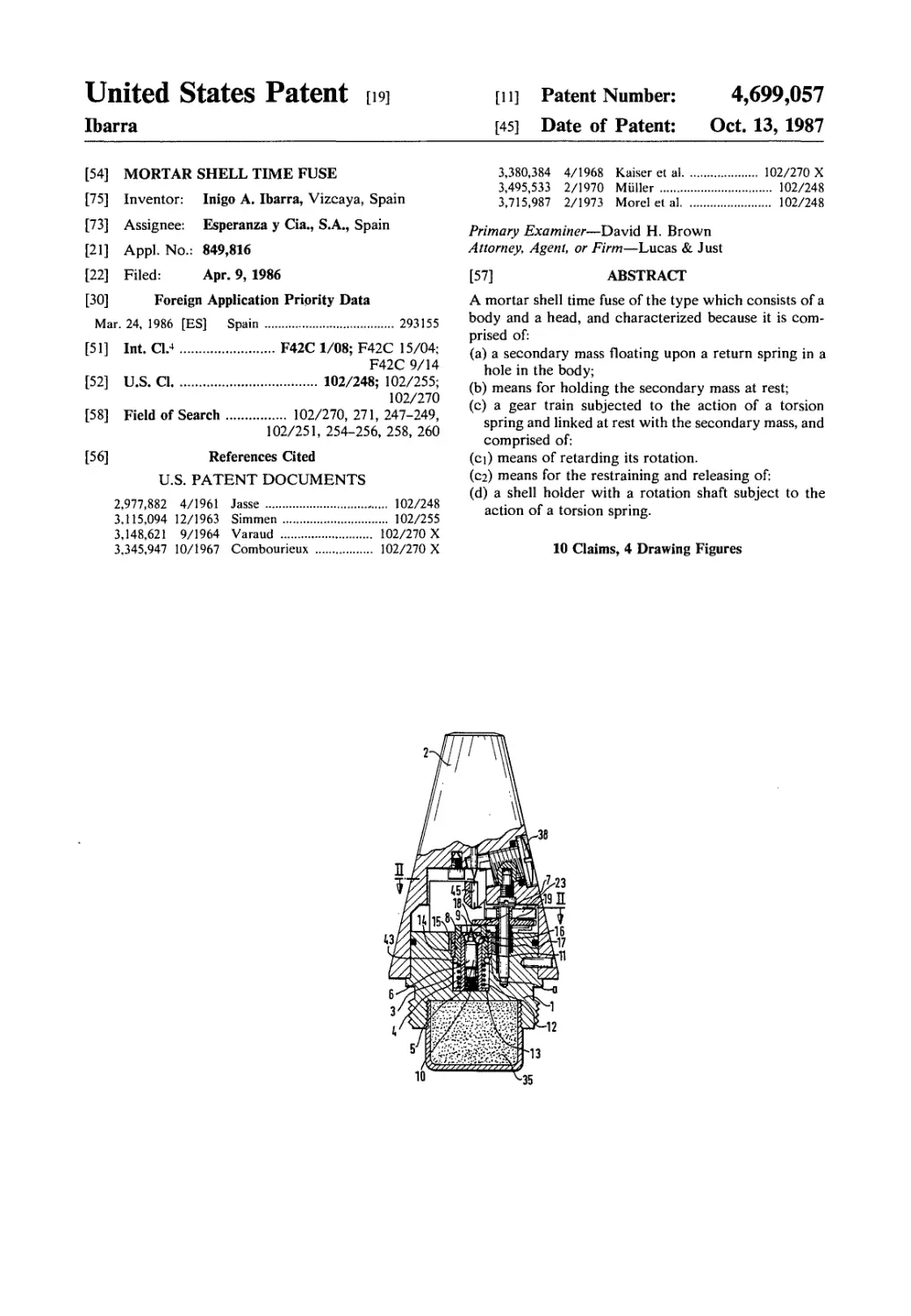
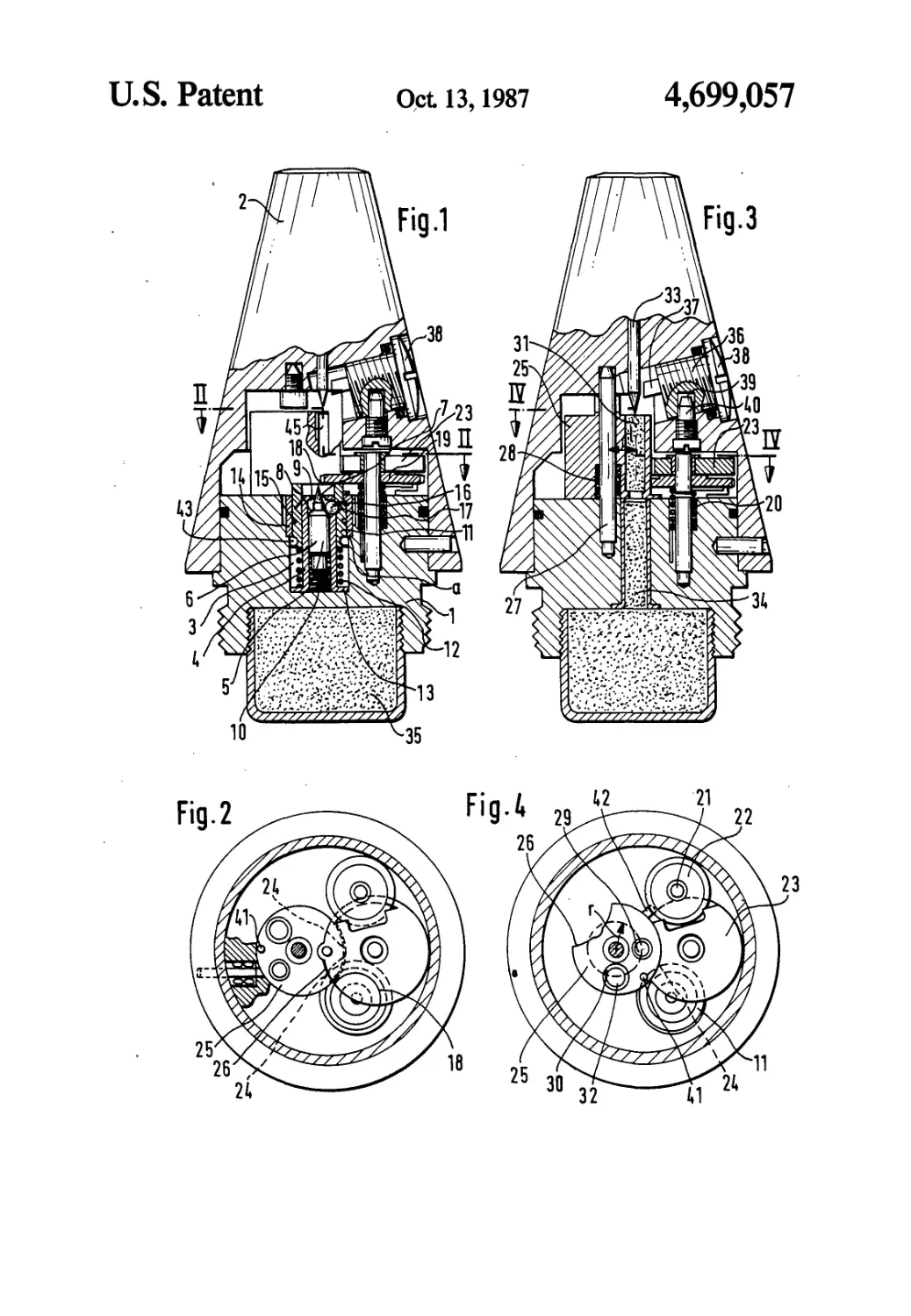
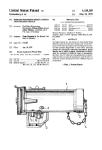
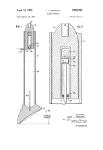
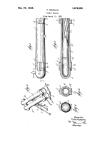
FIG. 1	is a section view in elevation of the time fuse
in the idle position.
FIG. 2	is a section plan view upon FIG. 1 taken along
line II—II.
FIG. 3	is a section view in elevation of the time fuse
in the firing position.
FIG. 4	is a section plan view upon FIG. 3 taken along
line IV—IV.
The time fuse consists of a body (1) that is screwed
onto a head (2).
In said body (1), there is a cylindrical hollow (3) and
inside same is fitted a sleeve (4) in whose interior can
slide a primary mass (5) with its body (6) and head (7) in
the shape of a needle, and there is a truncated cone
shaped joining area (8) between the body (6) and head
(7), where this latter is able to protrude through a hole
(9) in the sleeve (4).
The primary mass (5) is subjected to the action of a
spring (10).
Over the outside of the inside sleeve (4) may slide a
secondary mass (11) subjected to the action of a spring
(12) positioned between the secondary mass (11) base
and the external fins (13) on the sleeve (4).
Inside said cylindrical hollow (3), there is an outside
sleeve (14) upon whose walls slides the secondary mass
(11), the periphery of which is surrounded by a flexible
expansion ring (15) in such a way that if, during the
sliding motion of the secondary mass (11), it travels
beyond the bottom edge (a) of the outside sleeve (14)
with its ring (15), this latter will be released and thus
prevent the secondary mass (11) from returning to its
original position.
The inside sleeve (4) possesses a window through
which protrudes a ball (16) that rests upon an angle
shaped recess (17) formed in the inside walls of the
secondary mass.
The top base of the secondary mass (11) is inserted
into a round second recess (18) provided in a main gear-
wheel (19) subjected to the action of a torsion spring
(20).
The main gearwheel (19) meshes with a lower pinion
(21) that is coaxially attached to an upper pinion (22)
which meshes with a rocker (23) that is coaxial with
said main gearwheel (19).
Both the main gearwheel (19) as well as the rocker
(23) are provided with round sector recesses (24), the
radius of which is the same as that of a cylindrical
shaped shell holder (25), which in turn is provided with
a recess (26).
The shell holder (25) rotates upon its shaft (27) while
subjected to the action of a torsion spring (28), and it
possesses a hole (29) containing an instantaneous acting
detonator (31), and a hole (30) containing a delayed
action detonator (32).
4,699,057
Holes (29), (30) are located on the opposite side from
the recess (26) on the shell holder (25), and their radius
(r) is the same as the distance (1) between the axis (27)
of the shell holder and the axis of the firing pin (33).
A communication capsule (34) is arranged on the 5
body (1) coaxially to and below the detonators (31), (32)
when they lie opposite the firing pin (33), and said cap-
sule (34) transmits the action of said detonators (31),
(32) to a multiplier block (35) which in turn transmits
their action to the inside of the shell.	10
Screw (36) is provided with a beveled head (37).
Screw (36) is also provided with a handle (38) for exter-
nally operating screw (36).
In a slot (39) on said screw (36), there is a keeper (40)
which restrains the rotation of screw (36).	15
The shell holder (25) possesses a top pin (41) which
may or may not abut against the bevelled head (37)
according to how it has been fitted from the outside,
and it possesses moreover a pin (42) which during its
rotation, abuts with the main gearwheel (19).	20
The mode of operation is as described below:
For carrying, a pin is inserted into throat (43) of the
mass (11), and so long as the secondary mass (11) is
linked with the main gearwheel (19) as shown in FIGS.
1 and 4, the entire system is prevented from moving, 25
and so the time fuse and shell are in a safe mode.
Once the shell is on the firing range, the pin in throat
(43) is removed. Any accidental dropping could cause
the secondary mass (11) to move, and this is prevented
by the operation of ball (16) which is unable to move so 30
long as the primary mass (5) does not do so. The differ-
ence in inertia between the primary mass (5) and the
secondary mass (11) and their respective springs means
that ball (16) only undergoes a relative displacement
and consequent release when the acceleration forces, 35
albiet strong, take place within a certain space of time;
that is to say, when there is real firing and not just acci-
dental dropping.
The motion of the primary mass (5) allows the ball
(16) to become displaced, and the secondary mass (11) 40
to be released, which in turn brings about the release of
the main gearwheel (19) under the effect of its spring
(20).
In order to prevent the secondary mass (11) from
returning to its original position and becoming joined 45
again to the main gearwheel (19) and thus detaining the
action that has commenced, a hollow (3) is provided in
the body (1) of an outer sleeve (14), in which the sec-
ondary mass (11) can slide, and about whose periphery
is placed a flexible expansion ring (15) which expands 50
when it releases the lower edge (a) of the outer sleeve
(14) and thus creates a non-return for the secondary
mass (H).
When the main gearwheel (19) is released, its motion
is transmitted by means of the lower pinion (21) and the 55
upper pinion (22) to a rocker arm (23), which delays for
a preset time, the rotation of the main gearwheel (19)
which means that there will be no percussion upon the
detonators if the shell has not traveled over by a prede-
termined distance from the firing position.	60
The shell holder (25) is placed in the idle position and
remains so until such time as it is released by the main
gearwheel (19) when its recess (26) lies opposite the
main gearwheel (19). (See FIGS. 1 and 2).
The main gearwheel (19) rotates, and in doing so, it
reaches a position where its recess (24) lies opposite the
recess (26) on the shell holder (25), which then allows
this latter to rotate.
If it is desired to have the shell explode as soon as it
touches anything solid, the bevelled head (37) under
control from the handle (38) is set so as to allow pin (41)
to pass, and until the lower pin (42) abuts with the main
gearwheel (19), whereupon the detonator (31) will be
positioned opposite the firing pin (33).
If what is desired is for the shell to explode some time
after impact, handle (38) is moved so that when the shell
holder (25) is rotated, the bevelled head (37) will not
allow pin (41) to pass, so that the delay detonator (32)
lies opposite the firing pin (33).
In the carrying position (See FIG. 1), the purpose of
avoiding breakage of the pin (33) due to any accidental
dropping is accomplished by means of a recess (45) in
the shell holder (25).
I claim:
1.	A mortar shell time fuse, said time fusing having a
body and a head, said body having a hollow therein,
said time fuse comprising:
(a)	a primary mass positioned in said hollow, said
primary mass having a needle-shaped head, a first
return spring means positioned in said hollow and
acting upon said primary mass;
(b)	an inside sleeve positioned in said hollow, said
primary mass slidably engaged inside said inside
sleeve, said inside sleeve having an upper hold
through which said needle-shaped head of said
primary mass protrudes when said mortar shell is at
rest, said inside sleeve having a side window
therein;
(c)	a secondary mass slidably engaging the outside of
said inside sleeve, a second return spring means
positioned in said hollow and acting upon said
secondary means, said secondary mass having a
slot therein, said slot alignable with said side win-
dow when the mortar shell is at rest;
(d)	a ball member positioned in said side window and
engagable with said slot and said primary mass
when the mortar shell is at rest;
(e)	a shell holder rotatably mounted on a shaft, said
shaft mounted in said body, a first torsion spring
means attached to said body and acting upon said
shell holder; and
(f)	a gear train rotably mounted on said body, said
gear train linked to said secondary mass when said
mortar shell is at rest, said gear train having a rock-
ing means for retarding said gear train and having
a means for restraining said shell holder, a second
torsion spring means attached to said body and
acting upon said gear train such that when the
mortar shell is fired said primary and secondary
mass slide downward along said inside sleeve and
release said rocking means which in turn releases
said means for restraining said shell holder, thereby
causing said first torsion spring means to act on said
shell holder and rotate said shell holder such that a
detonator port is aligned with a firing pin.
2.	A mortar shell time fuse in full accordance with
claim 1 wherein said shell holder is a cylinder, and said
main gear train has a main gearwheel, said shell holder
and said main gearwheel being positioned such that the
distance between the axis of said shell holder rotation
and the main gearwheel axis is less than the sum of the
radii of the main gearwheel and shell holder and said
shell holder and said main gearwheel being positioned
such that when said mortar shell is at rest, non-recessed
area of said shell holder lies opposite a recessed area on
the main gearwheel.
4,699,057
5
3.	A mortar shell time fuse in full accordance with
claim 1 wherein the shell holder possesses two detona-
tor ports.
4.	A mortar shell time fuse in full accordance with
claim 1 further comprising a pin attached to said shell
holder which abuts against the main gearwheel during
rotation of the shell holder, thereby imposing a limita-
tion as to the shell holders turning angle in such a way
that one of the shell holder ports lies opposite the firing ю
pin.
5.	A mortar shell time fuse in full accordance with
claim 1 wherein the secondary mass comprises a groove
therearound with a flexible expansion ring therein said
ring being released once the secondary mass has trav- 15
elled a predetermined distance downward along said
inside sleeve.
6.	A mortar shell time fuse in full accordance with
claim 5 wherein the secondary mass comprises a throat 20
therein suitable for inserting an externally operated pin
therein as a safety means.
7.	A mortar shell time fuse in full accordance with
claim 1 wherein the gear train comprises:
(a)	a main gearwheel, said gearwheel having a recess
in the form of a circular sector on its lower face
wherein the top of the secondary mass enters when
the mortar shell is at rest;
(b)	a bottom pinion which meshes with the main
gearwheel; and
(c)	a top pinion which is coaxially attached to the
bottom pinion.
8.	A mortar shell time fuse in full accordance with
claim 7 wherein said rocker means is coaxial with the
main gearwheel and is driven by the top pinion.
9.	A mortar shell time fuse in full accordance with
claim 1 further comprising a bevel headed screw posi-
tioned in said head for determining the position of said
detonator port.
10.	A mortar shell time fuse in full accordance with
claim 9 wherein the bevel headed screw is provided
with a slot and further comprising a keeper in said slot
for restricting the movement of said screw.
25
30
35
40
45
50
55
60
65