/
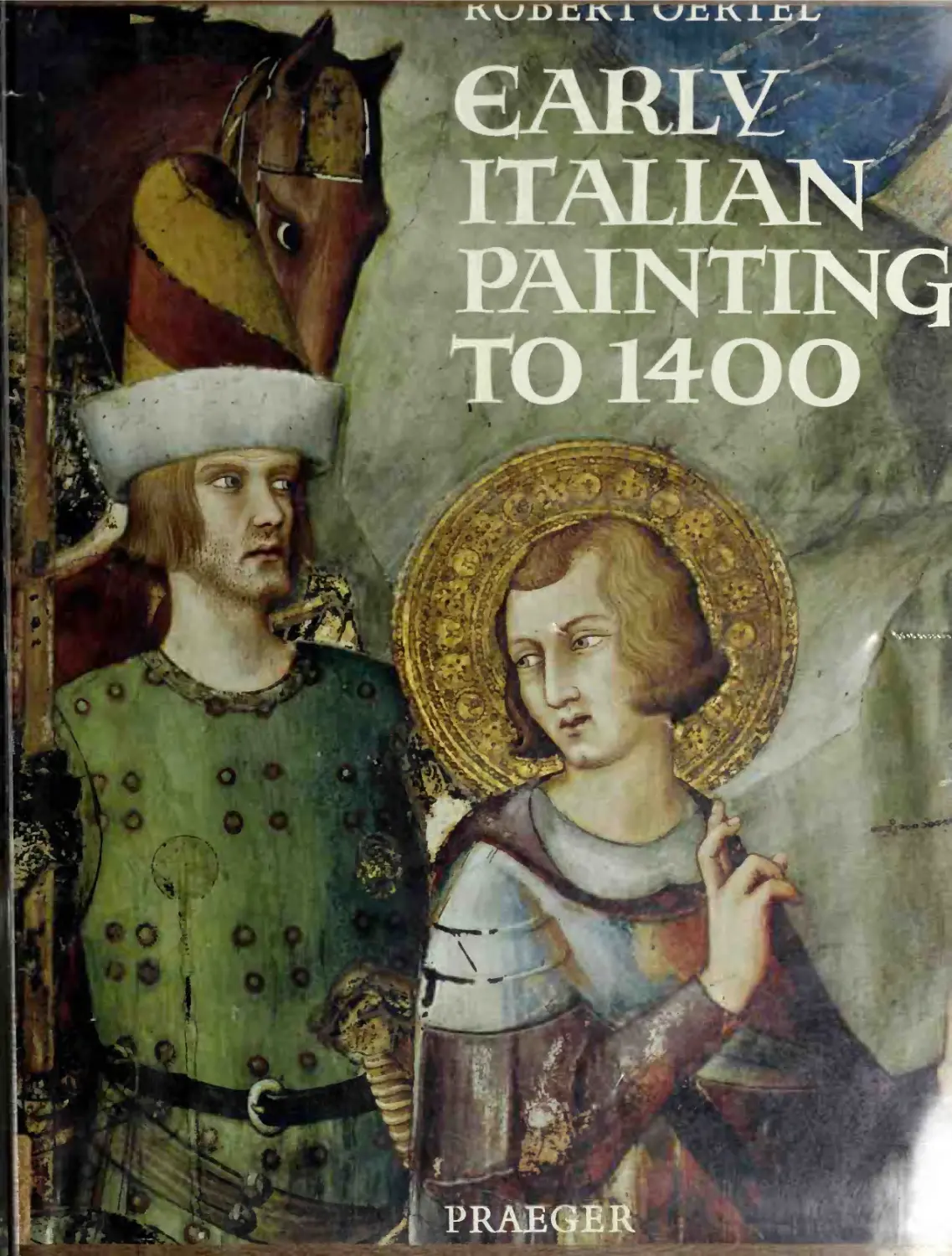


Author: Oertel R.
Tags: history european history painting prarger publisher early italian painting
Year: 1968



Text
GARLY
PAINTINQ
TO 1400
(
w
6 *
o
m<
£
Q
v
\
?
^
9
x
•'
PRAEGER
18.MJ
.S
Early Italian
Painting to i4oo
ROBERT OERTEL
The glory
of Italian Renaissance art
has
overshadowed the work of
lier
Italian masters.
number
tury, a great
ear-
In the past cenof panel paint-
and frescoes of extraordinary
importance have come to light, and
ings
these masterpieces reveal a hitherto
unknown
In
outstanding richness.
art of
Early Italian Painting,
art his-
torian Robert Ocrtcl, director of the
picture gallery of the State
Museum
Berlin-Dahlcm, gives a complete
account of Italian painting from the
in
Dark Ages
the threshold of the
to
Renaissance. Beginning with the earliest
examples in the
fifth to
centuries, he advances to the
seventh
monu-
mental works of the eleventh century such as Sant'Angclo in Formis and the development of panel
painting in the following two cen-
—
—
turies.
The major
part of the
book
on
Cimabue, Duccio,
Simonc Martini,
the Lorcnzettis, and,
concentrates
above
This
is
Giotto.
all,
the
painting
book on
first
to
include
early Italian
fourteenth
the
century, thereby emphasizing the
full
Giotto as a
culmination of what went before him
as well as an influence on later painthistorical significance of
ers.
A
thorough discussion of paint-
ing in Assisi and
Rome
at the
turn
of the thirteenth century introduces
the core
of the
book — the study
Giotto's entire career.
of
Questions of
attribution are considered,
and there
study of technique
and the relation between design and
execution. Giotto's contemporaries,
the great Sienese masters, are presenis
a
fascinating
ted individually and in relation to the
Florentine master. Finally, the author
describes
the
development of the
up to the time
schools of the Trecento
of the penetration of "International
Gothic" into
Italy.
Continued on back
flap
rE~
"Bi
Early Italian Painting to 1400
Early
Italian
Painting
to 1400
ROBERT OERTEL
Frederick A. Praeger, Publishers
New York
•
Washington
Books that matter
Published in the United States of America in 1968
by Frederick A. Praeger,
111
©
Fourth Avenue,
Inc., Publishers
New
York, N. Y. 10003
1966 in Stuttgart, Germany, by
W. Kohlhammer GmbH,
Stuttgart Berlin Koln Mainz
All rights reserved
Library of Congress Catalog Card Number: 68-13133
Printed in
West Germany by W. Kohlhammer GmbH, Stuttgart
BfiACiMin 1
C4f
Contents
Foreword.
page
Introduction
9
i
The
2
The eleventh and
3
Early Tuscan panel-painting
4
Florence and Siena in the Duecento
5
Assisi
6
Giotto
7
Giotto and his pupils
early
and
:
Middle Ages
twelfth centuries
Rome
the early years
Plates 1-J2
7
20
4i
50
64
83
113
1
8
Duccio
195
9
Simone Martini
202
and Ambrogio Lorenzetti
10
Pietro
1
Orcagna and
12
The Triumph
his circle
of
Death
218
240
247
Plates 73-128
249
13
The end
309
14
Trecento painting outside Tuscany
317
Notes on the text
335
Index
372
of the Trecento in Florence
Foreword
Works
of art need a receptive eye
of our
own
no
direct
today
is
as all
in
its
historical context.
by reference
will elude us.
Thus
if
our
to
that the reality of the past
The
come
to
This
life.
past.
is
true
There
is
art of the past. Familiarity
Art history
attempts to arrive at historical truth:
past except
we must
they are to
with what is being done
necessary for an understanding of ancient art - and it can only be
approach to the
understood
dox
if
time and even more so of works of the distant
is
own
we
same para-
cannot comprehend the
experience, and yet
at variance
we hope
subject to the
is
if
we
are not
aware
with our present experience, the truth
works of an
to understand the
try to grasp the significance of their strange
early master
and unfamiliar elements.
rediscovery of early Italian painting was preceded by a long prepara-
tory phase that extended back as far as the end of the eighteenth century, and
indeed some useful
work
teenth century. For a
in this field
good
part of our
had already been done
in the seven-
knowledge of medieval works
of art
we are indebted to the antiquarian interests of the Baroque era. Furthermore,
many old paintings and mosaics, now lost, were preserved in Baroque engravings and drawings. These copies have
day
research.
It
become
indispensable to present-
was only towards the end of the eighteenth century, however,
that this antiquarian interest
proach. This was
when
was converted
into an authentic historical ap-
Italian scholars first started to
engage in systematic
research into the records, including those of the Middle Ages, for the pur-
The
poses of art history.
at that time,
wanted
It
'antiques',
was
left
first
collections of Italian Primitives
but the predominant interest was
not works of
to the
were founded
still
antiquarian: collectors
to a
more thorough under-
art.
Romantics to open the
way
standing of the works of the early Italian masters. In about 1800, French,
English,
and German
est in this period.
ings
art
art lovers, as well as the Italians,
became known through books and other
were dispersed
began
to take
an inter-
Large collections were formed, and wall- and panel-paintpublications.
in the process of secularization
and found
Many works
their
way
of
in to
Foreword
museums and
Those
private collections.
aware of pre-Raphaelite painting,
At
as it
interested in the arts at last
was then
became
characteristically called.
the surge of admiration for the Renaissance in the latter part of the
first
nineteenth century obscured this interest in the art of the earlier Primitive
which was regarded merely
period,
That
sance'.
of Assisi.
is
It is
we
telen, that
as the
'preliminary stage of the Renais-
how Henry Thode described it in
only in our own century, thanks
1885 in his book on St Francis
particularly to Friedrich Rin-
have again realized the greatness of Giotto
mind
influence of his powerful
centre of the present work.
is still
theme
Its
as
an
artist,
and the
growing. Giotto therefore stands
in
broad terms
at the
the prelude to Giotto,
is
the extent of his historical significance (which has only recently been recog-
and
nized),
A
eries.
wide
his
stylistic influence.
book
monograph of
substantial part of the
Rintelen's
approach to Giotto, the
first
of
is
concerned with these very recent discov-
19 12
on Giotto
kind that
its
is
in
is still
a lasting
record of an
accord with our present-
day interpretation. But precisely because Rintelen fastened so accurately on
he missed the
the topical values of Giotto's
art,
ficance, the full course of his
development, and the wide range of
ence.
Both
account
aspects of Giotto, the historical
we
if
form
are to
Italian painting
artist's
and the
a true picture of
him
true historical signi-
artistic,
his influ-
must be taken into
today.
before Giotto, especially the rich and characteristic panel-
painting of the twelfth and thirteenth centuries, has to a large extent been
rediscovered only in recent decades, and the process has not yet
end.
New
works of
that period,
been concealed beneath
similarly
many
been discovered.
It is
The
some
coming
to light.
And
of unique importance, have only recently
part of our task to
tant of these discoveries,
to an
which have hitherto escaped notice or have
later paintings, are constantly
wall-paintings,
come
draw
attention to the
and to indicate the most recent
more impor-
scientific conclusions.
notes are devoted mainly to this purpose.
Since the
first
further increased, and the
come more
book in 1953 the range of discoveries has
discussion of what is known has extended and be-
appearance of
this
penetrating. Relevant
in the text as far as possible,
In the illustrations, a
to be reproduced.
but
number
We have
new findings have been taken into account
many had to be assigned to the notes.
of
well-known masterpieces inevitably had
attempted, however, to include
as
many
illustra-
tions as possible of newly-discovered material or recently restored works.
author
is
indebted to scholars and friends for
contributions,
which
are
acknowledged
their valuable suggestions
in the relevant notes to the text.
The
and
Introduction
In
our search for the beginnings of
Italian painting, a
around 1300
the obvious turning-point. Like
is
Dante
language and poetry, Giotto, in painting, stood
of
new
study of the main lines
development provides an apparently simple answer. The period
of historical
in the history of Italian
at the threshold of centuries
development. With the appearance of these two Florentines,
assumed her
awakening
through
distinctive national role in
at the
Western
civilization.
beginning of the fourteenth century did
political activity,
nor was
it
Italy
The intellectual
not come about
primarily due to economic and social
was the achievement of two artistic geniuses. The development
states - the first independent Italian accomplishment in the field of
advances.
of city
It
political organization
in itself
- could do no more than prepare the ground, and was
only an expression of particular
each other.
From
tragic quarrel
the resulting restraints
with
Ins native city;
interests, often in bitter rivalry
Dante found
release
with
only through a
Giotto disregarded those restraints from
the very beginning.
A new era in
the Trecento
is
the history of art had begun. Seen
an
'early' period,
Giotto
its
from
the
High
Renaissance,
beginning, and everything before
him prehistory. The new movement, which started around 1300, spread beyond national boundaries even in Giotto's own time. Dante's influence remained
confined to the regions where the Italian language was known, but the language of painting created by Giotto was understood north of the Alps too,
where
it left
early traces. 1 Italian artists,
Sienese origin active in Avignon,
was no lack of native
above
became the
tury was also a period of change and spiritual
simple
his
Burgundian miniature
style,
the painters of
Roman and
inspiration of Europe.
There
where the fourteenth cenrevival. However, without the
creative talent in the north,
impulse initiated by Giotto and
art of the
all
contemporaries neither the refined courtly
painters,
nor Master Bertram's powerful
nor the exuberant flowering of Bohemian painting
at the
time
Introduction
of Charles
IV and
son Wenceslas, would have been possible. Even the
his
van Eyck brothers owed
Italian painting initiated
role.
The
And
elements of their style to the revival of
turning-point around 1300
whole of Western
the
essential
under Giotto.
again
it
was
art as
it is
as
European
a
important in the development of
in the history of Italian art.
only a century
Italy,
had already assumed
Italy
is
later, that
was the
first
European
country to cross from the Middle Ages into the modern age. This process,
the start of the Renaissance, took place with almost unbelievable swiftness
and vigour. Historians have attempted
to set
back the decisive moment, and
to detect the roots of the Renaissance in the fourteenth
and even
teenth century; they have also tried to do the reverse
by
tinuing survival of medieval trends well into the Renaissance.
north of the Alps
at the countries
suffices to
put
all
in the thir-
con-
stressing the
But
a glance
and
these qualifications
reservations in their right perspective.
The
transition
was more
clearly
and decisively marked
any other country.
half of the fifteenth century than in
chiefly in art, as
had been the
post-medieval concept of
expression in the visual
case in the earlier transition
and above
all
in painting.
perspective, initiated in Florence about 1420,
of space based
ysis
It
manifested
was
a
on mathematical laws which
itself
around 1300. The
based on natural science found
life
arts,
in Italy in the first
its first
The technique
vivid
of central
product of the same anal-
later
made
possible the ad-
vance of natural science and the discoveries of Copernicus, Kepler and Galileo.
and
Never before or
since has there
been such close contact between
science. Artists finally succeeded in ridding themselves of the social
intellectual
trammels of the Middle Ages. The
Italian art thus
came
to an end.
But
origins so unequivocally? Perhaps our
is
it
first
phase in the history of
really possible to
first brief
art
and
determine the
survey has oversimplified the
problem.
The
belief that the intellectual
beginning of
and
artistic
awakening of 1300 marked the
Italian history in the full sense of the
was
a conviction current
significant tradition:
it
epoch
with the great achievements
itself.
Parallel
history developed.
numerous
in art a consciousness of
A sense of history already runs through Dante's great poem.
Although the poet himself
his
word rests on a long and
among the people of the
still
historical figures
clung to the ancient traditions and although
were only symbols and examples
for his
com-
plex theological argument, the Divine Comedy had an influence on the historical
awareness of succeeding generations that can hardly be overestimated.
Dante's commentators contributed as
10
much
the official chroniclers of the Trecento.
to the Italians' sense of history as
Towards
own
At
find Italians beginning to write their
number
that time Filippo Villani introduced a
work on famous
phies of painters into his
decessor,
we
the end of the century
art history.
Cimabue, were hailed
extinct' art of painting. 2
the
as
and
Florentines. Giotto
men who had
Introduction
of biograhis pre-
revived the 'almost
These two, and Giotto's more important pupils,
were discussed with brevity and accuracy. At about the same time Cennino
Cennini wrote II libro deWArte, a manual for painters describing the techniques
of the workshops of the late Giotto school. 3
from Greek
ment
in a
into Latin,
it
textbook written in the
ing the Byzantine
is
and made
He
spirit of the
style, stands for
writes, 'Giotto translated art
modern,' a surprisingly perceptive
the past
which Giotto had superseded.
also significant that this second-generation pupil of the great
sidered the 'modern' style - in
ment -
which he no doubt included
to be Latin rather than Italian. In this sentence
own
his
of about 1450, took the
of the
tion
new
same
classical,
Middle Ages were only
a
achieve-
Cennino formulated
he too looked on Giotto
the conqueror of the maniera greca.
art,
between three periods -
ever, the
line:
It
master con-
the basic thesis of Florentine art historians. Lorenzo Ghiberti, in his
tarii
state-
Middle Ages. 'Greek', mean-
He draws
medieval and modern.
Commen-
as the
founder
a sharp distinc-
To
him,
how-
period of decay, a historical vacuum.
This division into periods was the humanists' conception of history transposed
into the history of art. 4 Realizing as
we do
today that Giotto was rooted in
the Middle Ages as firmly as his contemporary Dante,
Giorgio Vasari, the sixteenth-century biographer of
rinascita in this
Giotto's time,
context for the
first
and not the period
modern
age.
artists,
it
remarkable
his
own
used the
age.
word
we
today regard
modern
as the Renaissance.
age.
He
used the idea
Middle Ages, the rudeness and barbarism of the Gothic
era, to intensify its contrast
re-born
find
time; but he meant the rebirth of art in
that
Vasari saw Giotto as the true initiator of the
of the 'darkness' of the
we
modernity of Giotto's rather than
that Ghiberti emphasizes the
Thus
with the
brilliance
both of antiquity and of the
Ghiberti's basic approach remained valid for Vasari.
Nevertheless, Vasari realized that the Middle Ages had been a constructive
and creative period, although
Furthermore, with
ern' period, beginning
decessor. His
work,
this
his greater
did not moderate his condemnation of them.
knowledge, he was able to analyze the 'mod-
about 1300, with more discrimination than
first
published in 1550, followed by a second,
his pre-
much
en-
larged edition in 1568, determined ideas about Italian art until well into
the nineteenth century. 5 This lasting influence of Vasari
his impressive
and elaborate theory of the evolution of
application to the change that took place
was due partly
art, especially in
to
its
between the thirteenth and four-
11
Introduction
teenth centuries, and partly to his postulation of the basic division into periods.
For
many
years to come, the sharp dividing line
distort the
image of
drawn by
Vasari was to
earlier periods.
all
This view established so early by Renaissance art historians was
in
essentials at the
its
time of Jakob Burckhardt.
a grossly over-simplified
rate
and
view of
distinct period of
immense
We now realize
We see
history.
still
cultural productivity,
and
spective medieval
But the change
made
way
was
our approach to
us see apparently familiar facts in a
stands at the beginning. His
new
the
first
'their' re-
no longer
decisive step
on the
to the Renaissance, the foundation for everything that followed,
also the climax, the
He
in the distant past.
consummation of many
Gothic culture was
now
that
it
was
at
also
it
its
artistic tradition;
its
culmination in Europe in about 1300, and
an
essential
itself.
It
art history, in
realize
classical art,
its
style.
creative self-
neglected: medieval
was neither Gothic, nor Byzantine, nor simply
Romanesque in the sense in which the word is applied to
the Alps. But can it be called 'Italian' in the same way that
an expression of the
we
element in the formation of Giotto's
admiration for rediscovered
painting in Italy
it
for essential elements of his style. Furthermore,
There was a third element which Renaissance
assurance and
but
diverse trends originating
did not just supersede the Byzantine
indeed he was indebted to
was
art history has also
perspective. Giotto
work was indeed
it
in the course
European nations have been rediscovering
in
that
the Middle Ages as a sepa-
of the last fifty years
art.
accepted
Italian spirit;
and
if
so,
how far
back does
the art north of
Giotto's art
Italian
was
medieval
painting reach?
We
know
of hundreds of panel-paintings, mainly
from Latium and Umbria,
twelfth century.
The
that
still
The
also
in the
and
earlier times suggest that since the early Christian era the tradition
disappeared in
and
ruption at
all.
past, until
we
But
and even
increasing discoveries of panel-paintings
of panel-painting - like the art of icons in the East
centuries,
from Tuscany, but
in the thirteenth
origins of tins craftsmanlike, but highly developed
prolific, art are lost in obscurity.
from
were done
Italy.
6
Wall-paintings were produced in Italy throughout the
especially in
7
To
- had never completely
Rome where there seems to have been no interwe have to look even further into the
trace these roots
arrive at the origins of Christian art, the
these cannot possibly be called Italian.
So
we must
catacomb paintings.
search for a
new
point
of departure.
From the time it ceased to be the centre of the Roman empire, Italy merged
into a new supra-national community. During the early and later parts of the
12
Middle Ages the unity of Europe was
a palpable reality.
Church and empire
knew no national frontiers. The universality of religion and the common
mode of daily life remained undisturbed even when the differences between
the two dominant powers intensified, and when particular interests pursued
their own ends. The great universal principles of the system were not seriously challenged until the end of the thirteenth century. Thomas Aquinas,
the greatest philosopher of the
Cologne just
as
he did
Middle Ages, lived and taught
in his native Italy.
The
upper
intellectual
and
in Paris
class
Introduction
was not
the only group that felt
itself related to the whole of Europe. The religious
by St Francis of Assisi, a genuinely popular movement, spread
few years of the saint's death (1226) to all Western countries. At
revival led
within a
was
that time Italian national awareness
at
still
an embryonic stage. 8 St Francis
himself, in addition to Italian, spoke Provencal, the
prepared the
way
in Italy for the 'vulgar' tongue.
As
Romance
offshoot that
a written language Italian
barely existed before the beginning of the thirteenth century; at least there
are
no
works.
traces of literary
only one
we
was
have), Italy
an awareness of
itself.
language
If
among
last
Whenever
is
taken
as the criterion
Western nations
the
(it is
awaken
to
were taken
'national' standpoints
the
to
in the
course of medieval controversies, they were merely tactical expedients, to be
discarded
when no
longer required. Since the decline of antiquity Italy had
indeed been only a 'geographical expression'.
emperors mention the 'Kingdom of
territory of
of Spoleto
and Benevento
Rome
own.
Sandwiched
Petri,
was
itself
in
the Middle
Ages did not
like to
and the Normans ruled
unite the peninsula
the papacy; a
new
theless Frederick
from
power not
And
so,
II,
with
his
A
The Byzantines, the SaraThe Hohenstaufens' attempt to
ambition to turn the country into a single
Italian unity.
from
Even Dante
still
hoped
for
its
state,
real-
well after the attempt had failed, the Hohenstaufen dream
we
can talk about
similar question applies
and France. Today
we
spirit of unity.
that until the
were not conscious of sharing
again whether
be
foreign rule - that of Anjou - replaced the old one. Never-
must be admitted, however,
Italians
to
citizens in
Italians.
in the south.
contributed to the emergence of an Italian
It
its
the south collapsed in the face of opposition
had implanted the idea of
ization.
be called
between the
the papal state, with political
a territorial
underrated in comparison to the emperor and the pope, and
cens,
German
the duchies
:
in looser association.
north and the south was the Patrimonium
its
the records of
Lombardy Lombardy and Tuscany, with
formed the
interests entirely of
When
they refer to the regions that once
Italy',
a
end of the thirteenth century the
common
'Italian'
culture,
culture
and
and
it
may
be asked
art before that time.
with equal justification to the cultures of Germany
hesitate to
answer
in the affirmative
with the same
13
Introduction
alacrity as
elements
we did a
common
short while ago. Perhaps
we
more
to all these nations
should consider the medieval
relevant to our assessment of
history than the peculiar national characteristics that separated them. Perhaps,
we
too,
until
A
are reading something into those times
much
clear-cut solution will never be possible, but
question in mind.
ening nation,
expression.
It is
were members
must not
from
mainly craftsmen. Their
The
itself,
can find the
however, that
forget,
that in later times.
from
of the clergy;
of creative activity.
were dictated by
and the margin
fact, artistic
left
be useful to bear
mode
work
of
for the
the beginning
its
exponents
were
from our conception
was unknown; artistic creation
Choice of subject and formal presen-
an extent which
we
can no longer conceive,
was
individual expression
artist's
of self-
Middle Ages had
differed greatly
idea of individuality
rules to
first possibilities
art in the
At
this
which an awak-
the twelfth century onwards they
to a large extent only reproductive.
tation
will
it
true that pictorial art offers a field in
unaware of
still
We
a function different
was
which did not materialize
later.
expression was entirely governed
over the centuries, which transcended the
by
negligible. In
theological formulas evolved
of any individual and also
life
all
national and regional peculiarities.
The
Artists
was
intellectual content of art
common
to the
whole Western world.
could wander from country to country and find the same familiar
when no local talent was available, they
The painter Johannes, an Italian, was sum-
assignments everywhere. Frequently,
were summoned from
far afield.
moned by Otto III to decorate the cathedral at Aachen, and builders were
brought to Germany from Lombardy and even from Greece. Johannes, himself raised
for his services to the rank of bishop
court of the bishop of Liege.
century, the
Lombard
show
of local traditions.
The freedom
frontiers. Portable
whose
world.
upon medieval works
movement
of
art,
way
at the
of the
artists
known
to us
by
of art as products
was
as
unlimited
with each other extended beyond
illuminated manuscripts and prototypes
to the
most
Particularly in the early part of the
a picture of constant interchange
14
,
of the eleventh
was summoned by Abbot Gauzlin
close contact
works of
for wall-paintings found their
emperor 9 died
the Loire. 10 These examples,
the danger of looking
as that of their patrons,
all
on
the
after, in the first half
painter Nivardus
of Fleury to his monastery
chance,
Not long
by
between
distant regions of the
Middle Ages,
all
parts of
Western
art history presents
Christendom.
The
who
Pilgrims
visited the capital of
early
Christendom
Middle Ages
in the
the great basilicas decorated with extensive picture cycles.
Middle Ages found
The
early Christian
mosaics in Santa Maria Maggiore showing scenes from the Old Testament
are
still
extant.
San Paolo fuori
rows of
Rows
le
pictures,
of glittering pictures cover the long walls of the nave. 1
mura must have been an even more
one above the other -
both
sides of the nave.
from
the
the
was
Two
the right, and
from
the lives of the Apostles
on
According to tradition there was a similar arrangement of pictures
left.
life
impressive sight.
not mosaics - extended along
each wall there were about forty separate scenes,
Old Testament on
in the old St Peter's.
the
On
frescoes,
On
the walls of the nave, in double rows, scenes
of Christ faced scenes
from the Old Testament.
a fresco cycle of the life of St Peter. 2
from
In the vestibule there
The impact this profusion
must have made on the innocent eyes of medieval pilgrims
of pictures
hardly con-
is
ceivable today.
and patrons from
Painters
representation, authenticated
naturally also affected
by
over Europe found in
all
by church authority and
the style of these works, and especially
ings of the early Christian era, in
painting survived.
The
convey
This
is
Roman,
it
a sense of space
now had
were
by the paint-
spirit
of classical
the highly-developed
through techniques of
The awareness
to be reacquired,
light
and shade,
of classical art and
was thus never completely
its
skills,
lost.
the reason for the exceptional position of Italian, and especially
art in the
swept across
Middle Ages. Even the Byzantine influence
Italy lost
its
imitators in
that continually
Rome. The early Christian narrative cycles,
pictures from the Old and New Testaments, had
force in
in particular the series of
many
which something of the
movement, remnants of
foreshortening and perspective.
although
the 'correct'
spectator had constantly before his eyes well-designed
figures in animated, expressive
ability to
Rome
tradition; but they
Rome
to the transition of 1300. 3
itself,
in Latium,
and even further
afield, right
up
Even the elaborate decoration of the nave of San
Francesco at Assisi reveals the iconographic influence of the
Roman
frescoes,
15
The
early
Middle Ages
which
despite
some
later
overpainting go back to the fifth century. 4 Giotto
Roman
himself was deeply indebted to these
Roman
thorough study of
Only
a fraction of the
wall-paintings
former wealth of
to enable us to see the outline of
monumental
painting.
made
models, and evidently
from pagan
times.
Rome has survived,
more than
but
millennium of
a
a
enough
it is
ecclesiastical
The complex of Santa Maria Antiqua, which stood at
Forum Romanum, was rediscovered under
the foot of the Palatine near the
more
recent buildings after a long period of oblivion.
from
are wall-paintings
on top
in Italy
of others,
reveal the multitude of intellectual
during that turbulent
trends as
between the realism of the
Christian
art,
However,
intent
it
era.
5
was
in
Rome
classical style
on representing
we
at that time.
and the new
Above
the
trends
artistic
can see that the
new
classical tradition
Madonna, on
the
The
great breach
language of
pictorial
defined.
from Santa Maria Antiqua,
a frag-
transcendental style had already
.
completely.
some painted
and
was not yet
spiritual values,
gained ground in the sixth century 6 But there
Antiqua to show that the
alone there
Art has never been so international and
in the oldest surviving painting
mentary Madonna,
this site
the sixth, seventh, and eighth centuries,
which
full of conflicting
At
is
also evidence in Santa
had not exhausted
its
Maria
influence
famous Palimpsest Wall, there
head of an angel from an Annunciation, which
is
is
a
part of a layer of paintings
done about the second quarter of the seventh century. 7 This fragment, painted
comes
in a gentle, atmospheric style,
sixth-century manner.
If
should never have taken
we had
not
as a surprise after the severity of the
known
the sequence of the layers
this illusionistic style for
The paintings of Santa Maria
foris portas in Castelscprio, the
frescoes discovered in Italy in recent decades, also
we
the later of the two.
show
most important
traces of the classical
tradition that survived in the seventh century. 8 This small church north of
Milan and not
far
from Tradate
ment. The frescoes, in half
and the childhood of
is all
life-size,
that remains of an early medieval settle-
showing scenes from the
life
of Mary
Jesus, are painted in a lively sketchy technique (pi. l).
These figures convey a gentle animation and
a sense of
movement and mental
them sharply from the figures in the 'transcendental'
style, which are usually presented in a severely frontal view and without any
reference to space or time. The bold manner is reminiscent of the most daring
alertness,
which
distinguish
improvisations of late classical illusionistic painting and
especially the landscape
16
and architectural motifs,
is
much
of the detail,
derived from
classical art.
But we do not know if they were in fact direct survivals of classicism, nor
where the painters came from who created works in this late classical tradition on Lombard soil. Perhaps they were Hellenistic Syrians or Alexandrians,
driven from their native lands by the tide of Islam, or Byzantines
fled
on
from
the iconoclasts.
Or
who had
perhaps they were simply local masters trained
or Eastern models. Since the discovery of the frescoes
late classical
all
The
early
Middle Ages
these
have been considered, and dates have been suggested varying from
possibilities
the beginning of the seventh to the second quarter of the tenth century.
which come remarkablv
rightly been pointed out that characteristics
It
has
close to
the Byzantine manner, such as the treatment of draperies with sharp metallic
edges and white highlights, appear side by side with late
elements.
But
seprio frescoes arc fresher
- and there
possible
seventh or the
classical illusionistic
comparison with works of the tenth century the Castel-
in
first
and more original
in style.
It
would
therefore
external supporting evidence - to place
is
them
seem
in the
half of the eighth century, despite the inadequate proof
and the absence of comparable works of that period. 9
The sharp
of the
difference of opinion about the Castelscprio frescoes
complex development of
in the
an example
and the co-existence
other great post-war discovery, the frescoes
church of the Carolingian monastery of St Johann zu Miinster (MiiGraubiinden, a
stair) in
problems for research.
much
A
ago, and since 1947 the
whitewash
magne,
is
in a
situated
first
larger find than Castelscprio, also poses several
to light a
few decades
whole decoration has been found underneath
intact state. 10
passes used
the stvle of painting
quarter of the ninth century,
it
we know
gian art north of the Alps as
the
The monastery, founded by Charle-
on one of the mountain
Though
work came
small part of this
remarkably
into upper Italy.
the
early medieval painting
The
of a great variety of styles.
is
has
it.
is
by the Franks
as routes
undoubtedly Carolingian of
little
in
common
There are some
with Carolin-
associations
with
the St Gall and north Italian manuscript illuminations, but they are confined
to the figure types
and
11
to particular formal elements.
other place in the north, or in
power and monumentality
details
is
rows of
pictures,
scenes: the top
of
We
know
of
no
a popular narrative style of equal
existed at that time.
The
illusionistic effect of the
framework. The walls on each
side of the
room have
one above the other, each divided into eight separate
row, which continues across the entrance wall,
David and Absalom; the
On
where
diminished by the clarity of the composition and the architectural
severity of the painted
five
Italy,
life
of Christ
is
shown
tells
in the four
the story
lower rows.
the east side there are three apses covered with narrative and symbolic
representations,
and the west wall has
a
huge Last Judgment, the
earliest
known
to us.
It is
this
natural to think of Italy as the
typical
combination of
late
most
classical
likely place for the creation of
and Byzantine components. The
17
The
early
Middle Ages
work
technique and style are crude and careless, but the
displays such
com-
could only have been executed by a group of crafts-
plete assurance that
it
men accustomed
to
monumental assignments. Everything
lished tradition,
which hardly
points to an estab-
existed at that time in the north. Indeed
it
would seem only natural to assign the work for this remote Alpine monastery,
on the route towards the south, to Italian painters, presumably from Milan. 12
This then may be the answer to the problem presented by the monument
of Carolingian painting in the Alps and if no other purpose has been served
;
we
reminded
are at least
that the borders
between the separate
Middle Ages were
in the early centuries of the
fluid
and
work
Careful restoration has recently disclosed yet another
painting,
though
very fragmentary
in a
of San Salvatore in Brescia,
decorative scheme
possible,
is
rough reconstruction of the
are harsher
the Miistair paintings, but the difference
them
of
monumental
a
little later
than
richly articulated
although only isolated fragments of the figura-
They
tive scenes are preserved.
regions
the decoration of the nave
which was probably done only
A
the paintings at Miistair. 13
state. It is
artistic
easily crossed.
in the Carolingian period. 14
is
and more vigorous
not so great
The drawings
and
paint, the so-called sinopie, are of special interest
in style than
as to rule
out dating
preserved underneath the
will
be referred to again. 15
Until the startling discoveries of recent decades, the only larger ninth-
century fresco cycle
far
from Monte
known
to us
was
racy: the figure of the abbot Epiphanius, the
places
San Vincenzo
that of
al
Volturno, not
Cassino. 16 These paintings can be dated with relative accu-
them between 826 and 843
(pi. 2).
painted with exceptional freedom. There
nor any intention to follow
a traditional
is
donor
The
apparently no stereotype design,
formula.
been derived from several sources, and yet
in the Crucifixion scene,
lively expressive figures are
it is
The
original
style appears to
have
and progressive rather
than eclectic. There are associations with the north, but these are of such a
general character that
it is
hardly possible to classify the paintings
Carolingian. 17 All that can be said with certainty
is
as plainly
that the northern influences
were transmitted by way of Monte Cassino, within whose domain the abbey
of San Vincenzo
Monte
we
We
for
lies.
Cassino, the parent monastery of the Benedictine Order, was - as
shall see later
- the centre of brisk
can perhaps assume that
we have some documentary
examples of monumental
dicate
18
this
whether
of a school at
at that
Monte
art,
evidence to
apart
time the
artistic activity in
was already
from
the eleventh century.
so in the Carolingian period,
this effect;
but there are no other
the San Vincenzo paintings, to in-
artistic projects
of the abbots
were products
Cassino. Art-historical attemps to establish correlations
period remain dubious owing to the scarcity of surviving works.
in this early
Yet new discoveries
in southern Italy
have greatly increased our over-all
The
early
Middle Ages
knowledge of early medieval painting. Since 1942 wall-paintings were discovered in a small oratory in the Basilica dei SS. Martiri in Cimitile, near Nola. 18
Though
listic
in
an incomplete
and iconographic
from
narrative scenes
formal language
they are of considerable sty-
state of preservation,
interest. In
the
addition to the apse decoration, there are
of Christ, his Passion and Resurrection.
life
powerful but popular, almost coarse, and on
is
the works can be dated around 900. This date
is
stylistic
The
grounds
corroborated by architectural
evidence and can be supported by historical argument. 19
The fragments
of figure compositions, discovered in 1947 in Santa Sofia
Benevento, are probably even older than the Cimitile frescoes, and their
in
linear style
Vincenzo
from
Volturno, but
Rome,
- possibly
after the
earthquake
in 847,
necessary to restore the church. 20
it
a
reminiscent of San
is
probable that the Benevento discoveries date
it is
the middle of the ninth century
which made
In
more animated. This dynamic manner
is
al
number
of ninth-century mosaics and paintings indicate that
there too a specific medieval style, dominated largely
in the process of formation.
A
typical
Ascension, painted about 850, in the
example
is
Lower Church
by
linear elements,
was
the wall-painting of the
of San Clemente. 21
The
attendant apostles, concisely and confidently drawn, are gathered in dramat-
groups
ically expressive
that the
two
symmetrical.
scenes
(pi.
The development
from Santa Maria
around 880
jb). Closer observation reveals the surprising fact
lively, well-articulated
(pi.
groups of apostles are almost completely
of this style
is
seen again in a series of narrative
Egiziaca (temple of Fortuna Virilis), probably done
3a). 2,2 These compositions are as expressive as northern
of the late Carolingian period, but have a greater clarity
ial
structure.
The
Italian talent
apparent here, but there
Rome,
as
is
still
works
and superior pictor-
becoming
for
monumental composition
no
sign of a specifically local tradition. In
is
elsewhere in Europe, the tenth century brought a decline in creative
force. Its revival
towards the end of the century, which eventually also led
to considerable achievements here, seems to have originated in other centres.
19
The
2
The
earliest
eleventh and twelfth centuries
and most important example of the revival of monumental paint-
ing in Italy
found
is
in the north,
not far from
of the apse of the former parish church of San
Cantu. 1
The
date of the
Como.
It is
Vincenzo
the decoration
in Galliano near
work can be determined with some
reference to the consecration of the church in 1007;
it is
accuracy by
therefore a
Lombard
counterpart of the paintings at Oberzell on the island of Reichenau which
were done possibly
a
decade or two
Ariberto da Intimiano, was
of Milan
of San Vincenzo,
by Emperor Henry
II
whose work has survived in Galwere brought by Ariberto from Milan. 2 As happens so often with med-
in 1018,
liano
The donor
earlier.
made archbishop
and
we
ieval art,
in all probability the painters
can here deduce something about the style of a flourishing and
from an isolated work, fortuitously preserved in an out-ofOnly in such a context can the paintings in this rural church,
of little importance at the time of its founding, be explained. The low, broad
apse is transformed by the paintings into an imposing monumental structure.
The figures on the vaults, although preserved only in fragments, are among
influential school
the-way
the
place.
most impressive heritages of the Middle Ages. In addition there
tive scenes of
tion.
No
amazing
liveliness
doubt the painters
at
and unusually
work
here
rich
arc narra-
and original ornamenta-
commanded
all
the
knowledge
available at the time.
The main figure, Christ in Benediction, looms in enormous supernatural size.
The prophets, Jeremiah and Ezekiel, bow to the ground and prepare the way
for him with their fervent gestures (pi. 4). Next to them, holding scrolls with
the inscriptions Peticio and Postulatio, stand the two archangels who intercede
on behalf
of
mankind. At
their sides choirs of saints offer their
martyrdom. 3 The colours glow with
a cold fire.
crowns of
Jeremiah wears a bluish-grey
robe with green shadows and white highlights, and a strident brick-red cloak.
20
The
flesh
is
done
in
ochre with green and red shadows. Sparkling white lights
flicker
over the surfaces disrupting their
a lively plastic
influences,
frescoes
own
cohesion but awakening instead
This, as well as the facial types, clearly reveals Byzantine
life.
may
but the painters
also
have resorted directly to
late classical
and mosaics. However, the decorative highlights, often applied
The
eleventh
and twelfth
centuries
in
sharp linear strokes, are also reminiscent of the paintings at Oberzell.
which
of the St Vincent legend
Reichenau
closer affinity to the
is
and the
plainly 'Ottoman',
the lower zone of the apse
fill
style.
The
representation of the architecture
free treatment of the surfaces
the Byzantine manner. This technique recalls the
Henry
miniatures, the Book of Pericopes of
The
equally unlike
is
contemporary Reichenau
and the Bamberg Apocalypse.
II,
gradations in size according to spiritual importance of the central figures
in the
main painting
works.
The enormous mandorla surrounding
in the apse
another feature in
is
influence, but the motif of the standing Christ
tine art
was
familiar only with half-length
the Pantocrator,
generally
is
The scenes
show an even
and
in countries
Christ
is
is
common
particularly
northern
Roman. 4 Byzan-
and enthroned representations of
north of the Alps the Salvator
seated in the chair of the apocalyptic judge. 5
shown
with these
also a sign of
the only closer connection between Galliano and
Mundi
also
is
However,
this
painting.
The
Roman
decoration of the apse of San Bastianello on the Palatine, done at about the
same time,
iooo, also has an upright figure of Christ, but artistically
it is
provincial and not comparable with the grandiose creation at Galliano. 6
The
c.
schematic arrangement of the figures in several horizontal rows
ferior to the free
grouping and careful relationships
the Galliano work.
classical
is
The
in-
ornamental motifs taken directly from
Roman
con-
anterior border of the arch of the apse, painted in an illu-
manner with glass goblets, fish, crabs, turtles and other marine creatures,
unique in medieval
frieze
in their use of
models, the painters of Galliano are superior to their
temporaries.
sionistic
Even
much
is
in scale that distinguish
Features such as the elaborate decorative
art.
and other ornamentation have
meander
striking parallels in the Oberzell paintings.
The association between Galliano and the artistic centre of south-west Germany does not seem to have been of an accidental or sporadic nature.
It is certain that the style of the Galliano work is not to be attributed to a
local painter or
any
single important artist.
major work of Lombard painting
at the
junction of
all
the
main
in the
stylistic
We
are confronted here with a
Ottoman
peroid, a
work
that stands
trends of the time. There even seems
to
be a connection with Carolingian painting, for example with the paintings
in
Stjohann
at Miistair: the
bold technique and ease of the monumental
are clearly the product of a kindred
ings at Oberzell are
somewhat
temperament.
abstract
and more
By
style
comparison, the paint-
in the classical spirit.
There the
21
The
eleventh
and twelfth
centuries
element
pictorial
everything
It
would be
was the
art. It
kept in balance by line and ornament, whereas in Galliano
is
dominated by the original
is
pictorial force.
natural to suppose that Milan
many
capital of the country,
stood, at least in part, and
ably
still
was
closely associated
its
was the centre of
of
its
7
True, none of them
is
Lombard
metropolitan church, Sant'Ambrogio,
with the donor of San Vincenzo
examples of eleventh-century monumental painting are
itself.
this
great early churches presum-
in Galliano.
still
comparable with the San Vincenzo
directly
but records of the art of those early times have
come down
Some
extant in Milan
apse,
to us so haphaz-
ardly that this does not necessarily invalidate our supposition. Nevertheless,
wherever the actual centre
may have
painting justify the esteem
shown
painters,
Johannes and Nivardus. 8
There
hardly any other area of art history
is
preservation as medieval
of expression
Lombard
two contemporary
been, the surviving remnants of
in the reports about the
monumental
as
painting.
dependent on the accidents of
The urge
to create
new modes
often led to the destruction of older works; and conse-
itself
quently there are fewest surviving remnants in just those places where artistic life
was most
prolific
and
tradition
most
ancient. In wall-paintings fresh
were constantly being superimposed on
layers
the early
works
now known
to us
earlier ones. Indeed,
were discovered,
labour, beneath later layers of paint or whitewash.
after
much
most of
painstaking
We can hope to find wall-
paintings in an untouched state of preservation only in places outside the
main
stream of development, or where the creative forces were exhausted at an
early stage.
It
is
rare,
however, to come across complete and undamaged
medieval monuments in their original colour. As a rule they are found only
in small,
remote
rural churches,
and only very exceptionally
in larger buil-
These miracles of preservation give us a picture of the period when the
dings.
walls of
all
the churches and chapels of the land
mental paintings. In
was the
all
the leading art centres, pictorial decoration of churches
rule rather than the exception.
were lacking
were covered with monu-
It
that pictorial representation
was only where means and resources
was confined
to the choir, but even
then some decorative scheme was always sought for the other parts of the
Whenever possible the nave was covered with figurative representain the manner of the great Roman basilicas. Tins practice came to an
edifice.
tions
end only with the appearance of the Gothic
style,
which replaced painted
walls with areas of coloured glass.
The
22
finest
example of an early medieval
ecclesiastical building, fully
corated with paintings and almost completely intact,
is
found
de-
in Italy. It
is
Capua9
the basilica of Sant'Angelo in Formis near
Monte Cassino monastery, whose
of the
,
situated in the vicinity
abbot, Desiderius (1058-86),
tioned as donor in an inscription above the portal. 10 Desiderius'
menname is
is
life at
Monte
Cassino in the second half
of the eleventh century, vividly recorded
by the
chroniclers. 11
associated with the thriving artistic
craftsmen in
skilled
fields,
all
especially mosaicists
from Amalfi and Lombardy.
builders
A
distinct
and
The
eleventh
and twelfth
centuries
He engaged
from Byzantium and
lively narrative style of
manuscript illumination also developed, valuable examples of which have been
preserved. 12
The mosaics
of the Byzantine masters have
impressive achievements of
later,
can
still
ment extend
monumental painting under
perished, but the
in three rows,
one above the other, along the high walls of the
(pis I, 5). In the apse
awesome and sublime, between symbols
is
the seated
of the evangelists; beneath
stand the three archangels, St Benedict, and the donor in an abbot's
offering a
The
its
along the
is
almost completely covered with a Last Judg-
traditional place in the
aisles
West. 14 The narrative painting continues
with scenes from the Old Testament. The
basilica
decorative scheme and choice of scenes are Western, but their
and
stylistic
iconographic elements are predominantly Byzantine. 15 Nevertheless,
doubtful whether
this
of the narrative, the
is
work
the
of Byzantine or local
compact grouping of the
division of the surfaces, appear to be Italian,
the
Romanesque. Everything
Christ,
blind
him
gown
model of the church. 13
entrance wall opposite
ment, in
little
New Testa-
be seen in Sant'Angelo in Formis. Scenes from the
nave from the west entrance to the main apse
Christ,
all
Desiderius, or a
and
is
with a
before
him
it
is
The vigour
figures, the simple rectangular
and strongly inclined towards
designed for dramatic
his large halo inscribed
man who bows humbly
artists.
its
and
cross,
effect.
dominates
all
The
figure of
the scenes.
The
appears again in the same picture,
his healed eyes at the well (pi. 6b). The adulteress
him hesitantly, while the Pharisees whisper suspiciously and venombehind her back (pi. 6a). The Lord shows his condemnation of her
with sight restored, washing
approaches
ously
accusers
by
terrified
woman who turns
his stern expression
her face. Although
to
and the mild gesture he makes towards the
him in contrition and
this art is still
yet with a glint of hope in
primitive in conception and technique,
has profound humanity and great narrative power.
The stocky
it
figures painted
with coarse brush-strokes in a traditional colour scheme are surprisingly expressive.
eyes,
this
The
faces are
all
variations of a single type
and boldly-marked red cheeks.
simple formula produces
!
The
And
yet
- narrow forehead,
how much
palette, too,
is
life
large
and animation
quite limited
:
bright blue,
yellow and a darker shade of ochre, rich reddish-brown, earthy green,
much
23
The
eleventh
and twelfth
centuries
chalk-white lavishly applied, and a mixture of the primary colours with
white - that
all.
is
These meagre resources are handled with masterly
manship but without
Even the
subtlety.
sharpest contrasts are reduced
crafts-
by
the
harsh blue of the sky in every scene. Firm reddish-brown outlines enclose the
areas that
have been
hastily coloured in.
are told in a popular
though the
and
stylistic origins
from
is,
this
style
is
stories
Al-
rustic strength.
new
of the painting are unmistakably Byzantine,
emerging.
however, one figure in Sant'Angelo
popular, provincial character type. There
portal in the west vestibule (pi. y). This figure
Formis which diverges
in
nothing primitive in the
is
tympanum
half-length figure of the archangel Michael in the
and
and bold, the
lively
way, and the forms have a kind of
distinctive elements are clearly
There
The
main
of the
severe and elegant, remote
is
delicate; the closely-applied brush-strokes are full of verve.
The
celestial
radiance of this angel and his touch of Hellenistic grace give an impression of
The
unequalled nobility.
face
is
designed in large clear planes with fascinating
asymmetry. The seemingly accidental difference between the two
face
which appears here
is
producing the
in
its
and
delicate, sensitive
clearest
cloak
purple ground.
is
painted with blue and red strokes
The same technique
and
greater subtlety in the modelling of the flesh,
of the vestibule are
The key
vestibule
scenes
done
life
in a similar but
is
The
not original, but a
was removed
the restoration.
17
The
upper
angels, in the
between the paintings
lies
later restoration,
in the
con-
in the history of the
its
five pointed-arch
probably of the
late twelfth
the upper lunette fresco above the
main
were done some time
after
indicate that the paintings
austere
used with even
somewhat weaker manner.
existing vestibule, with
made when
is
discernible again in
is
of the hermits in the four vaults
and those inside the church probably
century. Observations
portal
the
to the striking stylistic differences
struction of the building.
arcades,
from
it
by two
the medallion picture of Maria orans, supported
The
art
mature form. The handling of the colours
The
lively.
effect of a
part of the arch. 16
sides of the
and deliberate device of monumental Byzantine
a characteristic
is
and polished
style of the
two
portal lunettes does
not preclude a date around 1200 or early in the thirteenth century, but
impossible to say whether the paintings are the
work
it is
of a Byzantine artist
or of an Italian trained on Eastern models. 18
In the interior of the basilica, the disparity in style
and time becomes very
obvious. There, too, in the main apse, are the figures of the three archangels,
among them
St Michael, the patron saint of Sant'Angelo (pi. I).
There
doubt that Byzantine models determined the type and posture of the
24
is
no
figures,
the sumptuousness of the draperies, the splendid sweep of the wings, and
I
Sant'Angelo in Formis
•
The main
apse
indeed
the basic pictorial and plastic forms.
all
extremely simplified. The linear expression
is
But here the technique
is
frozen into a set formula of
almost mask-like concentration; the colours are reduced to a small number
of strongly contrasting tones.
The Byzantine
seems to dominate the work, has in
time
first
itself.
It is
new
a
style,
fact
influence,
which
The
eleventh
and twelfth
centuries
at first glance
been only partly assimilated. For the
the powerful 'vulgar' style of Italian painting, asserts
19
customary
in
eleventh-century Italian art to talk about a Benedictine
style,
Monte Cassino school, and which
20
is supposed to have greatly influenced painting in Rome.
Tins may be true
of manuscript illumination, which reached its peak in Monte Cassino at the
time of Desiderius, for manuscripts of Monte Cassino did indeed serve as
models for the wall-painters of Rome; but they are actually an eclectic mixture
of local and Byzantine elements. 21 The monumental art of Monte Cassino,
the roots of which are to be found in the
as seen in
had no
The
Sant'Angelo in Formis and in a small group of related monuments,
real effect
on
Rome. 22
the Lower Church
art in
wall-paintings in
of San
Clemente
in
Rome, prob-
ably done around noo, mostly have a Western medieval, rather than a
Byzantine, character. 23
With
their elegant,
animated figures and their delicate
harmony of colour, they form a transition between the free style of Ottoman art and the stricter order of the Romanesque. Their affinity with northern
art is unmistakable, yet the sense of form is clearly and typically Italian, even
Roman. It is apparent in the lucid unfolding of the narrative, the confident
balancing of the composition, and finally in certain plastic elements winch are
introduced without disrupting the
compact groups, without
flat
parallel in
Romanesque
northern art
pattern.
The
recurring
at that time, are especially
noteworthy.
An
example
is
the vivid scene
showing the mother embracing her rescued
son in the burial chapel of St Clement at the bottom of the Black Sea
The water around
the chapel
is
swarming with marine
creatures.
(pi. 8).
From
the
from the Chersonese city-gate, and the sea recedes as it does every year on the feast of the saint. The child is well and
healthy after a whole year in the flooded sanctuary. The mother bends passionately over him; in the next scene she presses him thankfully to her bosom.
With naive confidence, the artist suspends the laws of nature in order to conform to the letter of the pious legend but the realistic elements - the chapel
surrounded by water, and the crowd streaming from the city's gate - are not
left,
a procession approaches
;
neglected.
However, the convincing unity
of the picture
is
not due to the
27
The
eleventh
and twelfth
visible relationships of the scenes,
but
lies
rather in the even
and colour and the smooth, though severe, flow of
The
centuries
style of
San Clemente with
its
rhythm
of
form
line.
slender figures, bright colours, and cool
elegant linear manner, had a lasting effect in
Rome
and Latium. The deco-
Rome, not
from Civita Castellana, is probably the closest to it in time. 24 An inscription on the apse painting, presumably done in the first quarter of the twelfth
century, names the Roman painters Johannes, Stephanus and Nicolaus, as the
authors of the work. A boldly drawn figure of Christ draped in a cloak of
ration of the choir
and transept
in Sant'Elia near Nepi, north of
far
yellow ochre - the substitute for gold - towers in the vault of the apse against
background. Attending Christ are Peter and Paul,
a blue
a
a flock of
lambs on
gold ground, angels, and female martyrs in splendid robes. At the
sides of
on the east walls of the transept, the twenty-four elders of the Apomarch in solemn order, arranged in two horizontal rows (pi. p). Scenes
the apse,
calypse
from the Apocalypse and
walls of the transept.
It is
the legend of the founding of the church cover the
the best preserved and artistically most important
monumental cycle of the Middle Ages to survive in the vicinity of Rome.
The paintings in the choir of San Pietro in Tuscania must have been done
at
about the same time. 20 Even in their fragmentary
state
they have a powerful
impact due mainly to the truly gigantic Christ clad in white,
about to sunder the expanse of the main apse. The figure
apex of the apse and bends with
hover
all
around
excitement.
It is
The powerful
(pi. II),
its
and the
rises
curvature. Angels in vigorous
apostles
who
below gaze upwards
movement
in frenzied
an Ascension of striking elemental force and ahead of
style uses bright highlights
and vivid colours
seems
almost to the
its
as the sole
time.
means
of dominating the
huge expanse, and can be regarded
stylistic parallel to
Sant'Angelo in Formis. There seems, however, to be no
derivative connection
between the two works, and the
ponents of Sant'Angelo are completely absent here.
more reminiscent
in
San Vincenzo
The
as a slightly belated
distinct
Some
of the style of the early eleventh century
Byzantine com-
of the details are
which we observed
at Galliano.
from the life of St Peter, preserved on the right wall of the
presbytery in the same church, are quite different (pi. 10a). They are in the
San Clemente style, but advanced to a slightly more elegant and formalistic
stage.
six scenes
Evidently painted shortly after the apse decoration, they demonstrate
the variety of artistic trends that co-existed in
There
is
no space here
twelfth-century wall-painting. 26
28
Rome
to describe the less important
The next
large cycle
at the time.
monuments of Rome's
is from the end
known
of this period. After long neglect the decoration of San Giovanni a Porta
done under Pope Cclcstine
Latina, probably
(1191-8) or slightly
III
fortunately the apse decoration has been
But
lost.
later,
has
The eleventh
10b). 27
Un-
and twelfth
the nave and tribune,
now
centuries
been successfully restored to a relatively complete condition
(pi.
Romanesque decoTestament scenes on the walls of
restored to their original state, give a general idea of the
the nave, a Last Judgment
The
tribune.
A
is
on the entrance
1200,
have
in the
it is
by
close to
and
San Giovanni
a notable
The same
Porta Latina in theme and
a
common
freedom from Byzantine
its
abundance of
figures.
It
was probably done about 1200, or even
to be a
Ferentillo. 28 Painted in
mannered
late
in fact persisted in
is
29
Roman
basis in older
At
first
development of the San Clemente
Rome
about
cycles
tra-
influence.
commonly
later.
Both
style.
features appear in the fine apse decoration of
with
Tivoli,
in the
restoration but recognizable in outline,
abbey church of San Pietro near
a vivid, popular, narrative style, a
dition,
and apocalyptic scenes
wall,
apse probably contained a full-length figure of Christ.
similar cycle, partly disfigured
found
New
Old and
rative scheme, consisting of
into the thirteenth century.
San Silvestro in
dated too early, and
glance this style seems
stylistic trends,
But
which
the richer palette
and accumulation of calligraphic features of the Tivoli apse point unequivocally to a relatively late date.
The
close connection
with panel-painting can be plainly seen in the pre-
cious triptych preserved in the cathedral at Tivoli. 30
The wings
Christ Enthroned in golden robes.
The
centre panel shows
12) contain the Virgin and
(pi.
St John the Evangelist, painted in a graceful classical style.
the
wing
panels are representations of the
cension of St John(?). This triptych
what seems
to have been a large
triptychs with the
of
Rome
century).
earlier
to survive out of
same representations have been preserved
Of
in the vicinity
other triptychs, only centre panels, with Christ Enthroned, have
Most
(pi. 13),
from
of these panels date
and
was done much
which may account
in part for the general archaic impres-
makes. The fine eclecticism of
thirteenth-century sense of the organic
regard to northern
art, this
Romanesque period
and none has been found
its
is
style stands out,
but already the
unmistakably present. 32
early appearance of panel-painting in Italy
surprising. Portable pictures
of the Alps in the
of the thirteenth
derived in type and style from earlier
sion
may seem
first half
it is
now
lost,
the
unlikely that the Tivoli triptych
it is
models
With
work
group of similar works. Four such complete
than 1200. Without doubt
it
bottom of
(one of them, however, dating from the beginning of the fourteenth
survived. 31
century
the
Death of the Virgin and the As-
the principal
is
At
:
on wooden
panels are very rare north
there are about
in France. In Italy,
two dozen
in
Germany
however, there are hundreds of
29
The
eleventh
and
twelfth
centuries
such pictures from the thirteenth and even the twelfth century. Only in
number
Catalonia have a comparable
in the
form
of paintings
be attributed to the accidents of preservation.
many
on wood
panels survived,
and antepcndia. 33 This uneven distribution cannot just
of retables
of the commissions
were
at
more
It is
likely that in Italy
an early stage entrusted to panel painters,
whereas north of the Alps they continued to be reserved for goldsmiths and
Some
sculptors.
features of the painted altarpieces indicate that they
originally considered as substitutes for goldsmiths'
pictures, following the
model of Byzantine
were
icons,
were
work. 34 Other devotional
also painted
on wood
in Italy.
Recent research has shown that
Ages.
Two
this tradition
Madonnas in
The large panel
seventh-century origin: the
near the Forum. 35
Nuova
Angels in Santa Maria in Trastevere
of subsequent overpainting
century. 36 All three are
late classical period.
a
in
pope
as
Rome
it
is
Rome
are probably of
the Pantheon and in Santa Maria
of the Enthroned
only slightly
later.
Madonna and Two
Since the removal
work
has been recognized as a
of the eighth
painted in the encaustic technique inherited from the
The
of them,
last
donor kneeling
at
her
showing the Madonna enthroned and
feet, in
Western
fashion,
was
certainly
done
and not imported from Byzantium.
Even Christ on the Cross, the
became
goes back to the early Middle
of the icons venerated in the churches of
traditional subject for sculpture in the north,
theme for panel-painting
a favourite
panels cut to the shape of the cross,
numbers, are
among
the
and have no precedents
the altar, or
more
most
in
in Italy.
The
which have survived
painted crucifix
in surprisingly large
characteristic creations of Italian
Byzantine
38
art.
They were
medieval
art 37
placed behind or above
frequently on the screen, or the bar that was used instead
from the choir. 39 Their function thus corresthe sculptured Triumphal Cross familiar in Romanesque
of a screen to separate the laity
ponded
to that of
art of the north.
The
earliest
the Crucifix
The
surviving example of this type
by Master
is
a
work
rich iconographic formula of the early crucifixes,
figure with subsidiary scenes and figures,
Stylistically
From
it is
of Tuscan painting,
Guillielmus, dated 1138, in the cathedral of Sarzana. 40
is
combining the main
here fully and clearly developed.
pure Romanesque without any sign of Byzantine influence.
the maturity of the style and technique
it is
plain that this
is
no exper-
imental beginning, but an isolated remnant, preserved by chance, of a wellestablished tradition.
Another dated Crucifix of the twelfth century has sur-
vived in Umbria, the
30
of Spoleto
(pi.
28).*1
work
It is
of Master Albertus (dated 11 87) in the cathedral
obviously also one of a long line of such works,
since lost.
Its
marked Byzantine
style
is
reminiscent of the paintings in the
vestibule of Sant'Angelo in Formis. 42
Roman
with either the
There is no recognizable connection
or Tuscan schools - evidence of the strong and varied
The
eleventh
and twelfth
centuries
of different Italian districts at that time.
artistic life
Whereas
in
Umbria
art
remained tentative and provincial,
developed constantly under the patronage of the
economic power was concentrated. The
cities,
in
where
Tuscany
political
it
and
of the Sarzana Crucifix
stylistic features
point to the school of Lucca, the earliest authenticated works of which belong
to the second half of the twelfth century.
Before turning to developments in Tuscany,
we must
of the
Romanesque
style.
The monumental churches and imposing
fortified cities testify to the greatness of that era,
its
decoration
is
glance at painting in
Lombardy was
northern Italy since the end of the eleventh century.
unfortunately almost entirely
although the pictorial
The only
lost.
a centre
palaces of
large-scale wall-
Lombardy are, however, of the transitional stage beOttonian and early Romanesque styles, and not of the High Rom-
paintings preserved in
tween the
anesque.
We
have long been familiar with the almost intact
alyptic representations in the
pictorial cycle of
remote church of San Pietro
al
Monte,
apocin the
rocky wilderness near Civate, not far from Lecco on Lake Como. 43 In addition, recent discoveries
have disclosed a
San Calocero, a church in Civate
tive
sequence
Monte
is
interrupted
itself.
by the
44
series
of fragmentary paintings in
Whereas
in
San Calocero the narra-
later addition of a vault, in
San Pietro
San Pietro
is
a single-aisle
with the entrance
church built on a slope rising towards the west,
at the east end.
The
vestibule has three vaulted aisles richly
decorated with paintings, and on the wall facing the nave there
is
a single
representation of the Angels Fighting the Apocalyptic Dragon (pis 14a, II).
and abstract colours - green, brick-red, yellow ochre,
the surface in a rhythmic flow.
All the faces are of the
The type
same
type, generally
of the features and the
All the shapes are
the
the
blue,
shown
as pebbles.
colour.
in three-quarter profile.
drawing of hands and drapery
smooth and round
Cool
and white - cover
Even the haloes glow with variegated
ably Byzantine, but the Western medieval sense of
the
al
the architecture, stucco decoration and painting are almost intact.
form
is
is
unmistak-
equally marked.
Although the struggle with
demon is presented dramatically, these angels, all holding their lances in
same way and making the same gestures, are representatives of one and
same spirit. The constant repetition of a standard formula here reveals an
artistic
power whose source we
are only beginning to understand.
The
secret
31
The
eleventh
and twelfth
centuries
may
in the fact that
lie
anonymous
such works are not the accomplishment of some
individual artist but express the cumulative effort of a long tra-
These powerful forms have acquired a timeless and impersonal
dition.
vali-
dity (pis 15a, 15b).
The
Monte and the well-preserved stucco decoabout uoo. 45 The San Galliano paintings of the
paintings of San Pietro
were probably done
ration
in
al
beginning of the eleventh century are freer and bolder by comparison, but
more
The Romanesque formula
archaic in style.
and the
seem
artistic potentialities still
is
only just taking shape,
uncertain. In Civate
on the other hand,
commitment
more firmly established than in Galliano. The free manipulation of the figures, so marked in San Galliano, has disappeared. Only
rarely does a figure stand out by its size, like the figure of Christ, now unalthough there too the style
to the
Romanesque
at
is
early formative stage, the
its
is
fortunately destroyed, in the scene of the Angels Fighting the Apocalyptic Dragon.
Everywhere
else there
is
a striking uniformity of scale as well as of type
These are Romanesque, and not Ottoman
gesture.
that pervades the apse paintings of
and
The visionary mood
given way to a formal
traits.
San Galliano has
solemnity.
By
are
comparison, the newly discovered frescoes of San Calocero in Civate
still
earlier
fairly free
and animated, although they were probably done not
than the San Pietro
al
Monte
cycle, possibly dating to the
much
end of the
eleventh century.
Among
the scant remains of
Lombard
wall-painting of the
(c.
1200)
sists
is
the only
monument
and importance.
in Pavia
46
It
con-
damaged Christ at
bold and technically fluent. The well-
of half-length life-size figures of saints, and a badly
the apex of the vault.
modelled
faces are of
These paintings
was
of considerable size
High Romanes-
Domnarum
que period, the decoration of the crypt of San Giovanni
at the
nesque
in Pavia
peak of
style of
The
its
its
it
is
were done
at a
time
when Lombard
development and had achieved
own. Sculpture, which was
architecture, kept pace
so prevalent that
painting
an unmistakably Byzantine stamp.
with
penetrated
this
still
a distinct
closely associated
development. However,
all fields
architecture
High Roma-
this style
with
was not
of artistic creativeness to an equal extent.
Painting looked to the established culture of Byzantium, a frequent source
of inspiration throughout the Middle Ages. This
was
al
Monte
Angels Fighting the Apocalyptic Dragon
(detail)
Ii
32
a natural propensity,
Civate San Pietro
where Venice, with her ancient trade connec-
particularly in northern Italy,
formed the gateway
tions,
The Fourth Crusade brought about
to the East.
the conquest of Constantinople and the establishment of the Latin Empire of
The
eleventh
and twelfth
centuries
the East in 1204. Venice furnished the ships that carried the Crusaders to the
Bosphorus, and did not
in the eastern
tibule of St
in St
new
century received a
supremacy
facade and ves-
were
also part of the
Mark's that had been in progress for a whole
impetus. Large numbers of painted icons and
minated Greek manuscripts undoubtedly
is
political
The
time.
the celebrated bronze horses
reliefs;
The mosaic work
ships. It
this
Mark's were decorated with booty from the East: columns,
marble panels, and
loot.
Her
to gather her reward.
fail
Mediterranean originated from
also possible that
Byzantine
also reached the
artists
West
illu-
in Venetian
emigrated to Venice and the
Adriatic seaboard.
The
of the thirteenth century
Italo-Byzantine style found
its
is
one of the works
purest expression. 47
semble, well-preserved and remarkably consistent
and
from
decoration of the crypt in the cathedral of Aquileia dating
first half
vaults,
in
It is a
(pi.
the
which the emerging
truly medieval en-
16a). 48 All the walls
and even the columns, are covered with paintings. Ochre, white,
reddish-browns, brick-red, and cool, dull green are the dominant colours in
its
present
peries,
state.
added
show
surfaces
The
bright blue of the ground and of
in tempera, has
now
largely disappeared.
many parts of the
The semicircular
the Crucifixion, the Descent from the Cross and Lamentation, and
the Death of the Virgin. In the vaults are eighteen scenes
St
Hermagoras, the patron
ration
around the base
is
saint of Aquileia (pi. 17).
done
like a curtain
sketched lightly with a brush -
mounted Asian archer
(pi.
16b).
as,
from the legend
on which animated
The
freshness
and naturalness of
sition,
is
to us in
emphasized by the hard white high-
especially in the legendary scenes for
is
therefore
Romanesque
no reason
Byzantium. Instead
soil,
down
clumsiness in the compowhich no Byzantine models
The abrupt awkward movements and some
existed, are reminiscent of
There
im-
Macedonia (dated 1164) provided the model for this
Aquileia everything is slightly harder and more brittle,
and the sharp angularity of the forms
lights.
these
main scheme.
frescoes in
phase. 49 In
stylistic
figures are
for example, the Crusader in pursuit of a
Byzantine monumental painting of the type that has come
Nerez
of
The very charming deco-
provisations contrast strongly with the gravity of the
the
dra-
wall
we may
The inscriptions are in Latin.
this is the work of artists from
practice.
to suppose that
speak of a provincial Byzantine art on Italian
whose exponents were presumably
local artists.
35
Early Tuscan panel-painting
3
The powerful
in the
left a
half of the twelfth century
Romanesque
the
skill
paintings
than in any other part of
to the recognized
crisis
in
But whereas
direction.
in the
Works
Romanesque
Lucca and
in Pisa, the
a
second
and apparently well-
was
Tuscany
to appear in
in the forefront, but
in the panel-
in far greater
numbers
architecture obstinately adhered
a sharp stylistic
of a distinct Byzantine character follow-
style
two
dence of surviving monuments, Tuscan
The
a native
and was demonstrated
also evident,
Italy.
lasting effect
art of the
Romanesque canons, painting experienced
and change of
ed masterpieces
happened
was dominated by
which then began
have a
Lombardy, the
as in
sense of form. Architecture
was
of the painters
to
deep mark on Tuscan painting in the early
decades of the Duecento. In Tuscany,
established
which was
influence of Byzantine art,
Venetian region, also
without noticeable
transition.
Tins
where, judging from the evi-
cities
pictorial tradition originated.
oldest Pisan Crucifix (pi. 22), undoubtedly of the twelfth century,
well-conceived and richly composed structure like the Sarzana Crucifix
ready mentioned, and
it
too
is
is
al-
probably the product of a long process of
1
development. Ten narrative scenes surround the principal figure. Fastened to
the cross with four nails, and appearing to stand rather than hang, Christ
down
looks
at the faithful
Christ, victor over sin
At the
in the
main
side of the
figure.
On
to the
Apostles,
depicted
Him
and including the scene of the
form showing Christ with
Last Supper
and the Washing of
suffering
of the
the foot, and the Ascension at the top.
closed eyes at the
the Feet (pi.
Crucifixion
moment
of
24a) are shown on
beam of the cross. The Pentecost is at
The style is bold and powerful, equally
the panels at the ends of the horizontal
36
artists
no doubt about the meaning
ranging from the Arrest on the Mount of Olives to the Appearance
in the traditional
The
in order to leave
is the Triumphant
Romanesque works.
each side of the approximately life-size Christ are three narra-
of the Risen Christ
death.
to us in northern
Triumphant Christ the Pisan
agony of death,
tive scenes,
with wide open eyes. This
and death, familiar
removed from
Ottoman manner and
the tentative versatility of the
gance of the Byzantine. All the forms are reduced to their basic
in the
same way
Romanesque
as in
tional shades,
is
column and the
and spaces are firmly defined. The choice of colour
and sharp division of the
principle of contrast
and no
Early Tuscan
panel-painting
architecture everything can be referred
to the square, the semicircle, the cube, the
jects
the ele-
essentials;
features that unify the
design.
ob-
governed by the
There are no
surfaces.
whole
arch. All the
is
The
transi-
artistic
unity
achieved by an abstract pattern of simple forms and strong bright colours.
It is
most accomplished
a
which
distinguish the
Like
pictorial parallel to the
town
this architecture,
proud Romanesque buildings
of Pisa even today.
which
the purest realization of the Italian
is
esque concept of form, Pisan painting boldly exhibited
style, its
two
later, in
the
first
and primitive, but reaches
content, too,
it
is
our redeemer
strict artistic discipline. In its intellectual
removed from
far
who
the older crucifixes. This
our
suffered for
is
beams are devoted
sacrifice. In the
Death on the Cross.
really
24b) depict only the events from the Crucifixion on-
wards, beginning with the Descent from the Cross.
zontal
Christus
is
not the triumphant victor
sins,
over death. Indeed, the theme of the main figure
side scenes (pi.
no longer
imbued with
Its style is
a higher level of expression,
noble pathos, and controlled by a
The
Roman-
distinctive
decades of the thirteenth century,
reveals an entirely different artistic aspiration (pi. 2j). 2
patiens,
own
independence of foreign models. However, a second Crucifix, painted
in Pisa a generation or
plain
its
to St
The
John and the women,
panels
on the hori-
the witnesses to the
crowning panel, however, the Saviour does appear triumphant,
accompanied by angels and cherubim. Whereas the
earlier painter naively
surrounds the symbolic figure of Christ the King with scenes from the Passion
and the Resurrection,
with the events that are
in the later
illustrated.
in the story of the Passion,
is
work
the symbolism
The Death on
is
in
harmony
the Cross, the critical event
raised to a supra-historical level.
The counten-
ance of the dying Christ, inclined to one side with eyes shut and features
ennobled through pain and submission, expresses the
well-conceived and singularly accomplished
pure Byzantine.
competent
The uninterrupted flow
style,
is
(pi.
full significance of this
23).
The
style
master and not of an immigrant
this
artist
is
almost
presumably the work of a Tuscan
from Greece. The
Christus patiens type,
in the course of the thirteenth century superseded the
Christ in Italy and north of the Alps,
vation. 3
is
of line, the passionate and yet perfectly
reminiscent of the head of the angel above the portal of
Sant'Angelo in Formis, although
which
work
is
Triumphant
ultimately also of Byzantine deri-
37
Neighbouring Lucca underwent
Early Tuscan
panel-painting
fix preserved there
is
a
work
development. The oldest Cruci-
a similar
of high quality, genuinely
Romanesque
combination of severe forms and rich ornamentation. 4 But
encroachment of Byzantine influences early
the beginnings of an indigenous style.
by Berlinghiero,
is
become, to
a certain extent,
to the older Crucifixes in the
side,
Duecento overshadowed
in the
Crucifix of about 1210-20, signed
not only simpler in structure than the
on
means.
its
earlier types,
but
a different plane (pi. 2pj. 5
stylistically
artistic
The
in
Lucca too, the
in
It is
The mature Byzantine style has
Italianized. Berlinghiero's work is far superior
modelling, formal integration, and economy of
no longer a conglomeration
but a formal and pictorial unity.
The
of isolated forms placed side
large
number
by
of side scenes has
been suppressed and the figures of the mourners brought into an organic
relationship with the central figure.
Byzantine art clearly did for
Late
Romanesque
of the north ;
way
forms, and pointed the
towards
a
compact unity of
time to assimilate an
at that
what
Italian painting
it
the Gothic did for the
helped to overcome the tendency to isolated
out of the maze of ornamental
representation.
artistic style
The
from
detail
and motifs
willingness throughout Italy
the East
must not be thought
of in terms of 'foreign infiltration', but as an awareness of the need for a
model
superior
it
For
to inspire
Romanesque painting with new
life,
and to save
formalistic stagnation. 6
from
however,
a while,
it
looked
as
though the
traditional local style
had
A
son of
Berlinghiero, Buonaventura Berlinghieri, painted an altarpiece in 1235
which
been abandoned only to be replaced by a
is
still
in the Franciscan
figure of St Francis
The
saint
reflect
is
church
which
fills
in Pescia,
new
kind of formalism.
the centre of the panel recalls a
nothing of the humane Povcrcllo familiar
Europe.
(pi.
strange and forbidding, a sombre ascetic with set features, which
tions transcend
the joyous
31)? The
Byzantine icon.
not far from Lucca
any human
scale. It
bridegroom of poverty,
The
who
and the propor-
in history,
does not bring to
mind
the poet of nature,
revived religious
position of the hands with stigmata
life
in
western
and book corresponds
Byzantine picture of Christ in Benediction, and the small
to the
scale of the legend-
ary scenes on the sides intensifies the isolation and unworldly sublimity of
the
It
main
is
figure.
questionable whether the faithful of the thirteenth century saw their
saint as the
remote and godlike creature represented
conception that
is
contradicted by
in the Pescia panel
the rocky monastery of Sacro Spcco near Subiaco. 8 This
the
modern
sense,
but
it
-
a
the oldest representation of St Francis in
gives us a milder and
more
is
not a portrait
in
intimate interpretation
than the Pescia panel. Even
more
contradictor)- to the severe Byzantine con-
ception of the saint are the tender scenes surrounding the main figure in the
Pescia panel
Sermon
liest
to
itself.
These
Early Ttdscan
panel-painting
among them the Somatization and the
become such well-known themes, are the ear-
six scenes,
the Birds, later to
surviving pictorial versions of the St Francis legend (pis 30a, 30b).
The
Romanesque,
fresh naivety of the narrative scenes as well as the style are truly
with only a thin veneer of Byzantine elegance and severity.
The
of
was not an
St Francis retable at Pescia
type in spite of the early date.
its
only from an old
tation
work
was already
established.
after his death,
About
nor the oldest
of very similar design,
illustration, bears the date 1228. 9 It
was canonized, only two years
saint
A
isolated piece,
was
and
known
in that year that the
this
type of represen-
dozen other St Francis panels,
half a
some only slightly later than the Pescia altarpiece, are still extant. 10 They all
show the saint as a towering figure, surrounded by subsidiary scenes. Outwardly
type of altarpiece was not new: the basic pattern of the oldest
this
showed Christ or Mary as the central figure, with smaller naron each side. But these were all on wide horizontal panels. 11
The St Francis pictures are the first to be done on tall vertical panels hitherto
this had been customary only in tabernacles with movable wings and in simple
devotional pictures without side pieces. This emphasis on the vertical was an
altar paintings
rative pictures
;
new
element of the
essential
other
saints.
12
and soon appeared
style,
in representations of
The innovation was no sooner introduced than
an established type repeated hundreds of times - which
relationship that existed at that time
it
settled into
illustrates
the close
between the creative forces and the
sta-
bilizing influences of tradition.
In
its
basic pattern this variant
is
still
reminiscent of the earlier Crucifixes
was
simplified.
Berlinghiero already omitted the side scenes, and showed only
Mary and
with narrative side scenes, but the type of the Crucifix
St John
on the
central panel beside the
main
itself
figure of Christ. Giunta Pisano,
13
the leading master of the Pisan school in the second quarter of the Duecento,
went one
Assisi. It
step further in his Crucifix for the burial church of St Francis at
was donated
St Francis as
Presumably
was
later
in
1236 by
Elias of
Cortona, the second successor to
head of the Franciscan Order, and the founder of the church.
it
served as the triumphal cross in the present
kept in the
Upper Church, and
Lower Church;
has only recently been
lost.
it
14
There are three other Crucifixes signed by Giunta Pisano. 10 The oldest of
these, in Santa
Maria degli Angeli near
clearly (pis 26, 27).
It
already shows the
Assisi,
was probably done
at
new features
about the same time
Francesco Crucifix, around 1236. Christ alone
is
pictured on
as the
San
the central panel,
39
Early Tuscan
panel-painting
and the half-length figures of Mary and
of the cross-piece.
The body
of Christ
St
is
John
are placed in the side panels
strongly modelled;
axis
its
is
not-
iceably curved to the side, and the head bent in a kind of counterpoise to the
line of the
body. The eyes are closed. In a separate panel
at the top
is
a half-
length figure of the living Christ in Benediction holding a book. This
Ascension scenes that used to crown the
final simplification of the
Crucifixes.
The harmony
of the parts and the concentration
precedents for the figure of Christ in this
was through Giunta Pisano
that
cento Crucifixes. Giunta himself
made no
fected the proportions and expression.
a master like
Cimabue could add nothing
Giotto succeeded in giving
formed
form
m
40
it
intellectual content.
a
new
Even
further alterations.
Even
as late as the
he,
which
He
it
Due-
only per-
and
Only
the
young
a radically trans-
however, did not touch the outward
of the composition of the Crucifix, with
relation to the central figure,
Italian
end of the century
to this solution.
technical excellence
earlier
expression,
became the standard type of
it
the
on the essentials
were Byzantine
Although there
form and with this
of the subject are significant achievements.
is
its
parts
harmoniously arranged
persisted into the fourteenth century. 16
4 Florence and Siena in the Duecento
The middle
of die
Duecento saw the beginning of
of Tuscan painting.
The
a
new
In Lucca the tradition of the Berlinghiero
of decades, and such refined
workshop survived for
and mature works
as the
former Lcnbach Collection (now in private possession
pi. 32),
were
still
phase in the history
schools of Pisa and Lucca lost their pre-eminence.
being produced there
as late as 1260.
1
a
number
Madonna from
the
West Germany,
However, more imin
portant than the continuance of the Lucca style locally was the influence
had on Florence and Siena. The St Zenobius
crypt of Florence Cathedral,
is
the
work
the influence of the Berlinghieri school. 2
dependence on outside sources,
feeling for structure
and
Even
Coppo
by name, was
certainty
is
di
Marcovaldo, the
active in both
the
Madonna
del
cities.
;
the
Madonna
sits
The
on
It is
while the
rest
is
34 a).
first
after the
Florentine painter
earliest
work
middle of
known
to us
him with
Maria Mag-
attributable to
derived from the Byzantine type of the
the throne in a frontal position, holding the
Child on her lap with both hands. The
relief,
(pi.
emerged soon
Carmine of about 1250-60 in Santa
giore in Florence (pis 33, 34b J. 3
Nikopoia
at this early stage of technical
form, and the dramatic tension produced
of the composition
In Siena too, independent creative forces
the century.
once in the
of a Florentine master clearly under
specific Florentine features are apparent: the
clarity of
by the controlled rhythm
Altarpiece (1240-50),
it
painted. This,
Madonna and Child
done
are
in
low
and the broad frame studded with
may be a recollection of the origins of religious panelThere is an obvious attempt to simulate the effect of goldsmiths' work. 4
sculptured rosettes,
painting.
According to the records, Coppo fought for Florence
Montaperti in 1260, and was taken prisoner by the Sienese.
in the battle of
A
year later he
completed the large Madonna in Santa Maria dei Servi in Siena.
An
inscrip-
the date 1261. 5
The arrangement
tion, recently uncovered, bears his name and
of the Child placed on one side with the Madonna turning towards him is
based on the Hodegetria type, which takes its name from a once celebrated
41
Florence
and Siena
in the
Duecento
miraculous image in Constantinople.
The Madonna
was, however, originally
a standing figure; the seated figure never acquired any great importance in
Byzantine
art.
6
In the West,
on the other hand,
enthroned Madonnas. Coppo's Madonna
Tuscan
of
art,
but unfortunately
is
we
Duccio school. Luckily
by an
authenticated
inscription,
on
seated
is
still
with
the Child in her right arm.
The deep
The forms
and modelling have
are precise
(pi.
33).
MaThough not
is
hardly disputed
blue and red draperies interwoven with
and have
harmony and solemn
a metallic hardness; the
a true Florentine sharpness,
drawing
and reveal the native Flor-
entine sense of plastic and sculptural values. This style, then, manifests
at
an early stage,
The
who
when
the maniera grcca
Sienese counterpart of
in
high lyreshaped back, and holds
a
gold, and the dark tint of the flesh, produce an effect of
grandeur.
examples
essential part
have another large
Coppo
attribution to
its
a throne
an
were overpainted
to say, they
donna by Coppo, in Santa Maria dei Servi at Orvieto
now. 7 Mary
lost
Madonna and Child were 'moder-
nized' at the beginning of the Trecento - that
in the style of the
earliest
important picture has
this
original character: the faces of the
its
motif was also used for
this
one of the
is
Coppo
was
di
at the height of
its
itself
development.
Marcovaldo was Guido da
Siena,
has long been regarded as the real founder of Tuscan painting in his
native town. 8
Madonna
of 1261 could have been
Guido and
donna,
seems that the two
It
workshop drew
his
now
artists
done
in
inspiration
influenced one another. Coppo's
competition with Guido; and yet
from Coppo. Guido's
of an attempt to surpass the
work
of the Florentine artist
apparent in Mary's robe and other features. 9
work and more
spacious in composition.
figures. All the
outward
1280, and this
picture,
is
is
Ma-
whose
influence
Next
surprisingly early date
1 221. It
Gothic clover-leaf arch spans the
style of painting.
The
gard Guido da Siena
as a
between the two leading
inscription
now
around
on the
been the cause
to the painter's name, 'Guido de Senis',
was
is
even larger than Coppo's
strangely inconsistent and has until
of constant controversy.
tation,
A
It is
characteristics point to a late date, possibly
confirmed by the
however,
assert Siena's
large
in the Palazzo Pubblico in Siena (pi. 36), gives the impression
the
is
this date that led earlier art historians to re-
master of exceptional significance. In the rivalry
schools, Florence
claim to priority and
and
Siena, this date
was used
to
to demolish Vasari's 'Florentine' interpre-
according to which the whole history of modern art begins with
Cimabue.
Despite the inscription, however, present-day opinion, based on an in-
comparably wider knowledge of monuments,
42
dating of the Palazzo Pubblico
definitely excludes the early
Madonna} Around 1220
Sienese painting
was
The Madonna of Santa Maria in
work of late Romanesque style
dependence.
at a stage of provincial
still
Tressa, near Siena, of about this time,
a
is
under the influence of the Lucca school.
11
Guido's
on the other hand,
art,
Florence
and Siena
in the
Duecento
thorough knowledge of the Byzantine conception of form and an
reveals a
early inclination to the Gothic.
We
have another large work by Guido, an
though incomplete, secures
inscription,
altar dossal, originally
now
seven half-length figures, of which only five
remain
(pi.
like that of
Coppo's Servi Madonna, was over-painted about 1300, the heads
dossal are well preserved
They
37b).
(pi.
Both
different.
stance.
But whereas Coppo's
turally hard, Guido's
fluid in
is
its lines.
The
good example.
a
since dispersed
by
from
is
style
is
rounded and
one of
among many
a
and
detail,
pictorial sub-
angular and sharp, crystalline and sculp-
smooth
elegant,
small panel of the Annunciation,
It is
Guido was
the Byzantine model, and have
same concern for physical form, perfection of
the
that
in this
temperaments were quite
their artistic
diverge equally
artists
show
clearly
The
eighth decade of the
a date in the
Duecento. Whereas the head of the Palazzo Pubblico Madonna,
contemporary of Coppo's - though
with
37a). 12
Guido's style
the melancholy of the Byzantine models,
which
its
at
transitions,
Princeton
from
a series of twelve scenes
collections. 13
in
now
is
the
life
(pi.
and
38),
of Christ,
patently affected
Coppo were only
to
source of formal ideas to be expressed essentially in plastic terms. In these
painters, the first recognizable artistic personalities, Florence
a
two
and Siena con-
fronted each other as distinctly opposite worlds.
Like the sense of plastic form and spatial
brittleness
is
man-like character of the
Magdalene Master,
by
scenes
man
from her
whom
to
is
so-called after the altarpiece
life,
frequent dryness and
middle-class,
The
showing the Saint surrounded
reveals himself at every point as a bourgeois crafts-
the hieratic severity and full-blown culture of Eastern art
alien
ative sense of the expression.
in the service of
The
best
work
of this bourgeois art
was done
popular piety, in the form of homely and unpretentious
devotional pictures. Panels such as those of the Master of
admired for
that
work-
as in Florence.
and incomprehensible. 14 In his pictures the Byzantine
reduced to an empty manner - the maniera greca in the later, pejor-
must have been
influence
clarity, the
Nowhere else was the sober,
new panel-painting so marked
also Florentine.
their technical soundness. 15
have escaped the hands of hasty
Some
Bagnano
are
still
of the pictures, especially those
restorers,
have survived the seven cen-
turies since
they were painted with hardly any deterioration. Their bright
colours
have the same freshness
still
Florentine painters.
as
when
they
left
the workshops of the
43
Florence
and Siena
in the
Duecento
In the prolific activity of the second half of the
Duecento
who was
in Florence, in the last quarter of the century,
master emerged
a
once again to inspire
the traditional Eastern forms with genuine passion and elevate
umental greatness: Cimabue. 16 In
in the Uffizi (pis jg, 40, 42a),
his large
Madonna
them
mon-
to
for Santa Trinita,
he shows the mother of
God
now
powerful
as a
presence outside time and space and yet brought close to us by the compelling,
fervent gaze of her wide-open eyes.
surrounded by a
Twice
circle of angels in perfect
she
life-size,
sits
on
a throne
symmetry. The Madonna and
by the blue-gold and red-gold of their draperies, are
muted tones are reserved
Child, closely united
the centre of the chromatic composition. Lighter but
The
on the two sides, like the figures
The symmetry is broken only in the
lower zone, where one of the Prophets is shown in a vermilion robe, as if
to imply that this group has no part in the order of the divine region. The
for the angels.
distribution of colours
of the angels, forms a mirror image.
structure of the throne
bright ochre-brown
is
quite clear in spite of the archaic perspective; the
wood,
slightly
shaded in
parts, has the weightless
The gold ground behind the Prophets
of a coloured design.
weightless appearance of the massive throne. This
clarity
And
and abstract medieval grandeur.
also adds to the
work combines
one
so, in this
look
Florentine
instance, a
few
years before the appearance of Giotto, the heavy bourgeois spirit of the
Florentine painters attained the elevated heights of true sacred
to disappear at the
Almost contemporaneous with Cimabue's Madonna
Madonna,
the Rucellai Madonna,
Maria Novella
named
in Florence (pis 41, 43).
is
at least ten years
another even larger
after the Rucellai chapel in Santa
17
The commission was given
Sienese painter Duccio in 1285, and the detailed contract
was
which was
art,
end of the Duecento.
younger than Cimabue, 19 and
authenticated work, speaks the language of a
new
still
exists.
18
to the
Duccio
this picture, his earliest
generation.
Its
measure-
ments, four and a half meters high and three meters wide, are larger than
anything
known
until then,
and the composition
and well-designed.
is
Its
but the surface
lighter
many
is
not
filled as
densely as Cimabue's,
and more atmospheric. The throne
perpendiculars lead the eye upwards.
gentle figures clad in filmy draperies,
seem
is
The
delicate
angels,
to float in front of the gold ground.
Kneeling, they worship the Virgin and her divine Son, and lightly support
the throne
evidently
by
the touch of their fingers. Duccio, like
much more
deeply affected by the
Cimabue. Byzantine nobility and melancholy are
ance of Mary, and even
44
more
all
spirit of the
the Sienese,
was
maniera greca than
reflected in the
counten-
strongly in the faces of die angels. But this
was not the only source of Duccio's
style.
The
delicate
and graceful touches
Hi
III
Cimabue Madonna
with Angels
Assisi,
San Francesco, Lower Church
that
he found
in
new
form, in the
Byzantine works were also present, though in a different
art of the
West. The
faint verticality in Duccio's
tion, the sense of space apparent in the oblique
composi-
view of the throne, and
finally
Florence
and Siena
in the
Duecento
form of the throne itself, show that the young Sienese master
was by no means unaffected by the Gothic movement, which was becoming
increasingly influential in Italy. The cathedral, which was being built in those
the ornamental
was received with
decades, demonstrates that, especially in Siena, this influence
enthusiasm.
The new
style eventually
triumphed during Duccio's
Simone Martini, one of Duccio's pupils, identified
reservations than any of his Italian contemporaries, with
time.
city,
influence
is
only barely perceptible.
still
But by comparison Cimabue's composition, although done
time or perhaps slightly
structure there
sion
is
seems
later,
freedom
Madonna
is
the
dominant
of the composition.
figure, she does not
Colour plays an important
clear
its
form and expreswhich is intensified by
effect
a concentration
about the same
in the
on the other hand, knew
with
in the detail
at
archaic. Despite
something sombre and oppressive
the severe symmetry. Duccio,
his
much more
and the archaic overcrowded surface - an
greater
and has out-
to this day.
Madonna the new
In the Rucellai
life-
the Gothic sense of
form. In the fourteenth century, Siena became a Gothic
wardly remained so
own
himself, with fewer
on the
how
overwhelm
combine
to
essentials.
Although
the other parts
role in the design; the deep
blue of the Virgin's cloak provides a tranquil centre for the free interplay of
the delicate colours of the surrounding angels.
The
two
tonal values of the
halves of the picture are the same, but the colours themselves differ. In his
handling of colour, Cimabue adheres to a
colour of the angels' draperies
The
draperies of his
is
faithfully
Madonna and Child
stricter
symmetry; every
single
reproduced on the opposite
side.
are interwoven with shining gold
become integrated in the uniform ornamentation of the whole
Cimabue has not yet emerged from the Middle Ages, whereas Duccio's
picture has a palpable unity and obeys a law and licence of its own; it is thus
a step towards the new order that was to prevail in Italian painting. The sole
so that they
picture.
decoration of the Duccio Madonna's deep-blue mantle
zigzag line of the hem,
which
is,
as it
is
the characteristic gold
were, a symbol of the
new
freedom,
well as a personal signature recurring repeatedly in Duccio's work.
The
as
or-
namentation and gold are confined to those parts that require decoration
according to the post-medieval convention - the throne, and the precious brocade covering
In
all
its
back.
probability Duccio painted the Rucellai
great size of the panel
makes
it
unlikely that
it
Madonna
in Florence, for the
was transported over
a
long
47
Florence
and Siena
in the
Duecento
distance. In spite of this,
its
it is
and
of colours
as for instance in
The
their light, detached delicacy.
and
in pale blue
major work of Sienese painting, and represents
a
exemplary fashion,
principles of design in
lilac
the free choice
draperies of the angels are
beside soft carmine and translucent sea-green - colours
that are also typical of Duccio's later
work. The
gay colour and the
careless
compared with
opacity of the average Florentine productions are primitive
The major Florentine painters, Coppo and Cimabue, were
work in monochrome, which is best suited to the expression of
such refinement.
inclined to
were disposed decoratively,
plastic values, and, as far as possible, the colours
often in a pedantic and calculated order.
Madonna
of the angels in the Santa Trinita
Madonna
paintings of the
Duecento
in these cases the colours of
of the angels
on the
correspondence
is
right
The symmetrical colour arrangement
that
found
is
is
from
number
left
The marked
transmitted a
of aesthetic principles
- which were adhered
But more important than
first
an
traces of
essentially
still
come back
act in
Rome
to
in 1272.
20
him
We
brought him to Rome, but
is
as
most
to the
a witness to
he was
in
he could not have been a mere beginner
with certainty
is
artistic
who
overreached the
significant of these masters,
an
first
doc-
ecclesiastical administrative
do not know the nature of the commission
as
also
medieval workshop practices
artistic personalities,
Cimabue. He was probably born between 1240 and 1250, and the
umentary reference
It is
workshops of the time
to strictly.
these
was the emergence of well-defined
We
- the
this
difference be-
indicated in such apparently trivial matters.
technical rules, the painters'
traditional rules.
upper corner:
always correspond. In Sienese painting
clear that, apart
discipline
in each
both the upper and lower parts of the draperies
and
just as consistently avoided.
tween the two schools
in all those Florentine
have an angel
company with high-ranking
at that time.
What
clerics
can be assumed
that the artistic impressions he gathered in
Rome were
the utmost importance in the formation of his style. Unfortunately he
referred to again in the records until the beginning of the
that
new
is
of
not
century. In
1302 he was working, together with other masters, on the apse mosaics of
Pisa Cathedral. In this large
the Santa Trinita
is
Coppo
Evangelist,
is
Crucifix in San
Probably painted around 1270,
and
John the
not known.
figure, St
The date of his death is
Domenico in Arezzo is the only panel-painting before
Madonna that can be assigned to Cimabue with certainty.
attributable to him.
The
work only one
21
done
di
it is
of the type originated
in the austere sculptural
Marcovaldo. 22 The Santa
by Giunta Pisano,
and expressive manner
Trinita
characteristic of
Madonna, however, already reveals
the mature, unmistakably personal style of Cimabue.
Modern
research
is
inclined to date
90, but there
it
is
than the Rucellai Madonna, that
later
between Cimabue's Madonna panel and
Recent opinion supports
much
earlier
the 1270s.
On
no conclusive evidence. 23
this,
is
to say,
around 1285-
the other hand, the close link
his frescoes at Assisi
beyond
is
We
in the
Dnecento
and maintains that the frescoes were begun
come back
shall
to this presently.
in the Florence Baptistry
uncertain. Quite possibly he collaborated in the scenes of Joseph's
from
and Siena
than was previously supposed, dating them towards the end of
Cimabue's contribution to the decoration
scenes
dispute.
Florence
Genesis also
show
life.
is still
Several
traces of his style, in spite of all the disfigurement
due to intervening restoration. 24
The
large Crucifix
church
45).
the
25
As the name
memory
on the
meters.
last
years of the century (pis 44,
was dedicated
implies, the church
to the
Holy Cross and
of the Crucifix with cherub wings that appeared to St Francis
at his stigmatization.
cross
which Cimabue made for Santa Croce, the Franciscan
probably belongs in the
in Florence,
screen,
The over
Probably Cimabue's work was
which would explain
life-size figure of
its
up
set
exceptional
as a
size,
triumphal
4.48
by
3.90
Christ appears even larger than the actual
dimensions might suggest because of
its
slenderness and the
wide sideways
curve of the body. The triangle formed by the arms and the ascending line
of the legs intersects the rectangular shapes of the frame
gether. Christ suffers, yet
network of
alistic, it
more
He
is
remote and weightless. The painting
fine overlapping brush-strokes,
radiates
vehement
life
refined than that of the
and binds them toa
and though by no means natur-
and creative power; the form
Madonna
is
panel.
The doubts
is
richer
and
occasionally ex-
pressed in regard to Cimabue's personal authorship of the Crucifix are certainly unjustified. 26 This
work
exemplifies his late style.
the Assisi frescoes has disappeared, but the stature of the
achieved there remains, and their expressive
power
The high pathos of
monumental forms
has here attained a final
intensity.
49
Assisi
The
significance of
last
Rome
and
5
Cimabue's paintings
chapter, can be fully understood only
at Assisi, briefly
when
mentioned
in the
they are considered in their
proper context. 1 In the grandiose structure that developed during the
thir-
teenth century over the burial place of St Francis, architecture and painting
No
form an organic whole.
dance of paintings
as the
other medieval building contains such an abun-
double church of San Francesco
at Assisi,
which
in
two churches built one above the other: the sombre tomblike Lower Church with its low vaults and massive walls, and above it the
bright and spacious Upper Church with extensive walls and vaults providing
ample space for painting. The Gothic forms which give the Upper Church
its character are well suited to express the Italian balanced sense of space. The
fact consists of
single-aisled nave, consisting of four almost square bays, has the appearance
of a
compact
relationship. 2
hall (pi.
On
47a) in which height and width form a harmonious
the sides of the
windows
there are large clear spaces.
Below
which were
them
the wall provides a continuous series of picture surfaces
filled
with twenty-eight scenes from the St Francis legend - that great work
executed by Giotto and
these
rows of
his pupils in the last years of the
pictures, the transept
and well-proportioned
as the
nave
Duecento. Beyond
and the polygonal choir are
(pi.
as
compact
46)?
This grandiose and lavishly decorated building, in strange contrast to the
rule of poverty, the essence of Franciscan teaching,
was begun
as early as
1228
at the instigation of Elias of Cortona, then minister-general of the Order.
completed the Lower Church and probably
though on quite
cuted structure.
50
a different
The
also
and more modest
planned the Upper Church,
scale than the eventually exe-
idea of a double church with a single aisle
ground plan doubtlessly originated with
Elias.
He
and cruciform
The Upper Church,
as
it
stands
made soon
today, involved a radical alteration in the plan, presumably
1247. This change,
which gave the building
by the fashionable Ile-de-France
and not,
architecture
by the cathedral of Angers. 4
The Upper Church was consecrated
after
Assisi
and Rome
Gothic character, was inspired
its
supposed until re-
as
cently,
been in a rough
in 1253.
It
seems, however, to have
state of construction at the time, 5 since the papal
approval
for collecting alms for the completion and maintenance of San Francesco
renewed
in that year for a further period of twenty-five years. In
was
1266 the
approval was confirmed and extended for an additional three years. After
that the records are silent for
more than two decades. Only when Nicholas IV,
Order from 1274-9, ascended the papal
minister-general of the Franciscan
we
throne do
building.
bulls to
find again a reference to
During
the providing of funds for the
pope
promote the construction, and presumably
San Francesco. 6
It
his short reign (1288-92), the
Church was probably
about
at
many
as eight
also the decoration, of
can be assumed, however, that building had not stopped
The
in the interim period.
posing that
issued as
built
tins
splendid portal on the south side of the
soon
after 1279.
7
There are
also
Lower
grounds for sup-
time Cimabue decorated the choir of the Upper
Church.
The
entire pictorial decoration of the choir, the crossing, the south tran-
and part of the north transept are by Cimabue and
sept,
pictures
on the vault above the
vation, are the focus of the
represented in the Byzantine
evangelist
is
a picture of a
world. Three of the
allotted to St
Mark,
is
whole conception. They
manner
walled
cities
are large seated figures
symbolizing a portion of the Christian
city,
are imaginary places, but the fourth, 'Ytalia',
a faithful medieval rendering of
regard to their actual position in the
are
city.
Rome. Many
crowded within
One
of
its
the walls without
of them, only recently iden-
crown of pinnacles and its stepped gables, 8 is the Capitol, the
senate - indicated by the minute coats-of-arms barely visible to
by
of the
workshop. The
and philosophers. Beside each
as scribes
well-known buildings and monuments
tified
his
crossing, the four evangelists, heralds of sal-
its
seat
the
naked eye. Besides the letters SPQR these escutcheons contain the emblem
of the Orsini family - and not, as was previously supposed, that of the Savelli.
way
9
This could not have been chosen
of paying
homage
to the great
at
random, but
Roman
of his connection with the Orsini, but
it
is
family.
is
No
Cimabue's covert
details are
associated with these influential patrons during his stay in
coats-of-arms do not appear
on an
known
very likely that he was closely
ecclesiastical
they must refer to the Orsini in their capacity
building but
Rome. As
on
the
the Capitol,
as senators. In these
decades
51
Assist
and
Rome
members
of the Orsini family repeatedly served as senators, and therefore
emblems
in
the precise
sumed
Cimabue's picture.
moment
in history
tempting, however, to associate
It is
when
no
be drawn from the appearance of their
definite chronological conclusions can
Nicholas
III,
two
the office of senator for a period of
it
with
an Orsini pope, himself as-
when
years (1279-80),
Two
the
senatorial
term of Charles of Anjou ended and was not renewed.
members
of the Orsini family served as senators together with the pope.
Moreover,
in
other
1279 one of these, Matteo Rosso Orsini, was in addition appoint-
ed cardinal protector of the Franciscan Order. Despite the absence of conclusive evidence
it is
extremely likely that Cimabue referred to
constellation in his picture of
a
Rome.
It is as
though he dated
this historical
his
work with
symbolic allusion, and thus provided a chronological clue for the experts. 10
This dating,
Upper Church was
evidently the
to be completed as
and the
first
transept.
These
pictures,
was natural
it
entire
Cimabue's portion was
carried out.
whose general
shows them to be older than those
for the
which the
accepted, demarcates the period during
if
decoration of the
to start
from
the choir
character and style of figures
in the nave,
form
the point of departure
whole decorative scheme.
The only
place
where the decoration
of the north transept
is
quite different
is
the upper zone
where work must have been under way before Cimabue
was appointed. The decorative elements of the borders and friezes arc pure
Gothic, and in the pictures there are noteworthy attempts at rendering perspective in the representations of Gothic architecture.
Cimabue, on the other
hand, tried by means of his decoration wherever possible to restyle the architectural features of the buildings
is
particularly
marked
and give them
in the nave.
The
a classical character,
which
pictures in the north transept are
They were painted by an
whose origins remain a complete mystery. Even his
technique is quite different from that of Cimabue: the a secco painting was
applied on a highly finished drawing in linear style, which is all that now
dedicated to the glory of Christ and the apostles.
artist
of great ability,
survives. This technique suggests that the artist
was trained
the bold elegance of the linear style indicates that he
in the north, but
was probably an
Italian,
work for some time
while Cimabue and his assistants were painting beside him and radically
changing the decorative scheme he had begun. The lower zone of the north
possibly a Sienese. Apparently he
still
continued his
transept was, however, eventually assigned to
from
Cimabue painted many
Crucifixion and scenes
In the choir
52
of the Virgin,
and
Cimabue.
It
contains a large
the lives of the apostles.
scenes
from
the
life
and glorification
in the south transept apocalyptic themes, choirs of angels,
and another Crucifixion. Unfortunately
now
only faintly
visible: the
this
powerful
pictorial sequence
is
Assisi and
Rome
iconographic content of the scenes can be deci-
phered only with great difficulty and the former magnificence of the compositions
of
warm
is
Cimabue used
lost.
ochre colours. In
a fresco secco technique
many
remnant. In so far
sole surviving
on
a
monochrome
extensive areas the underpainting
second layer
as this
is
preserved,
base
is
the
it is
dis-
coloured by the chemical changes that frequently occur in wall-paintings of
that time.
tints,
The
lead-white that was added to most colours, especially the flesh
As
has turned black through oxidation.
the appearance of photographic negatives.
sent everywhere, only an occasional
11
a result the pictures
now
have
Apart from the ochre tone pre-
muted brick-red has escaped
this
change.
Larger areas that have retained their original colour can be found only in the
middle zone of the south transept
among
the choirs of angels,
heavily impasted white, vivid green, and deep red are
liance
and unabated
intensity of these colours
contemporary panel-paintings.
It
is
diance these colours must have had
and
match the
no longer
when
where
bright,
The
visible.
bril-
produced by
effects
possible to visualize the ra-
they covered
was the
ribs of the building. In addition there
still
the walls, vaults
all
glitter of the gilded haloes
and gold highlights of the draperies and the large gold areas of the vaults
above the crossing, where the evangelists were shown enthroned. Only a
vigorous generation charged with primitive sensuous emotion could express
its
faith
and
its
The formal
vision of the heavenly
world
structure of the paintings
is
come
to
in such realistic terms.
exceptionally clear and essentially
monumental. Voluminous, yet powerfully modelled
figures
with expressive
heads and richly designed draperies are arranged in horizontal rows behind
and above one another. The scenes of the Death of Mary, her Assumption,
and her Glorification
in the
midst of the heavenly host, are typical examples. 12
Other compositions, for instance Mary on her Death-bed surrounded by
Apostles, display
an astonishing
Although there
spatial content.
as
is
yet
the
no
consistent organization of space in perspective, the figures, conceived in separate
blocks,
Cimabue
convey together
a sense
of three-dimensional
reveals himself as the direct precursor of Giotto,
an effect of depth by means of his figures.
The
space.
who
severe emphasis
on
basic hor-
work. The modelling of the
izontal
and
figures
and the tectonic construction of the paintings are Florentine
vertical planes also recurs in Giotto's
and reappear, though on
Here
also creates
traits,
a different stylistic principle, in Masaccio.
The agitated, furrowed faces
already noticed in the prophets of the Florentine Madonna panel appear everywhere in Assisi. The angels are grave and powerful, with low foreheads, large
In spite of
all this
Cimabue was no
formalist.
53
Assisi and
Rome
sharply-cut eyes, and strongly modelled jaws. 13
mind
that brings to
thoroughly
It is a
virile art
the great Florentines of later days: Masaccio, Donatello,
and Michelangelo. Cimabue's figures have the same
terribilita,
a
profound and
almost alarming solemnity.
This elemental and,
these figures,
all
of the picture
and tugs
swept by
crowd
a gust of passion (pi. 49J.
almost twice
takes
where
grief
is
by
deepest,
Mary's right hand
a halo, points
storm has
The
risen
dense,
with a gesture of unforgettable
Only
in his,
in the
group of mourners on
outward show of sorrow avoided.
is all
and
in a
The
turn gently towards each other.
this silent
real
life-size Christ.
Son of God. The twelve angels hover around the
cross in postures of utter despair (pi. 50).
left,
A
in the
of spectators resembles a corn-field swaying in the wind.
centurion, distinguished
expressiveness to the dead
the
to
deep pathos whenever the subject matter
at the loin-cloth of the
wildly excited
The
is
mood common
were, inarticulate disquiet, the
demands enhanced emotion. The Crucifixion scene
itself
south transept
as it
intensified to a
is
of classical nobility they
women
identify themselves with
other
Mary Magdalene
group. Only the passionate
St John
movement
impulsively stretches
her hands towards Christ, but stands motionless, as though taking a vow. At
her feet St Francis, a
humble monk,
kneels beside the cross and
bows over
Redeemer.
the dripping blood of the
Another equally large Crucifixion covers the corresponding wall
north transept.
The composition
is
in the
roughly the same, but the dramatic impact
of this version, evidently done later,
is
much weaker
than
its
older counter-
Cimabue seems to have entrusted its execution to his workshop. 14
But the Madonna with Angels and St Francis in the transept of the Lower
Church is another work by Cimabue's own hand, and probably the last he
did in Assisi (pi. III). Though faded and gravely impaired by numerous
part.
restorations, this
fragment
In the obscurity of the
the
is
still
one of the most impressive
low oppressive room,
in the church.
the forms reveal themselves as
consummation of Cimabue's achievement in the field of monumental
The drapery and the human forms become united and round as in
painting.
classical sculpture,
and the movements are
remarked upon; but
his contact
with
it
hardly
classical
justifies the
works.
It is
free
and
fluid.
This has often been
assumption that Cimabue renewed
more
likely that his plastic sense, the
sculptor's inclination for the austere beauty of simple forms, that
been an
essential characteristic of
The very
scale of the frescoes
Cimabue, here reached
done by Cimabue and
that the master's activities in Assisi extended over a
54
historical
Ins
its full
had long
expression.
workshop
number
suggests
of years.
On
grounds, the early part in the choir and the crossing of the Upper
:
Church
can, as already seen, very probably be dated to the
end of the 1270s.
Assist
and
Rome
The last portion, stylistically represented by the Enthroned Madonna in the
Lower Church, seems to have been done shortly after 1280. There is at least
one piece of evidence to confirm
hypothesis: the frescoes, dated 1284,
this
painted by the Florentine, Corso di Buono, in the choir of San Giovanni
Evangelista in
Montelupo
which Cimabue's
fully
(pi.
42 b) half-way between Florence and Pisa, for
developed
must have served
style at Assisi
as
model. 15
The type and style of the figures are similar, and the predominant reddish
and brown colours correspond to the basic tones of Cimabue's palette, although their range is more limited. The historical argument for the dating
of Cimabue's work at Assisi thus obtains direct and independent support from
this stylistic relationship.
16
While Cimabue was painting
in the
his
Madonna
sequence of the pictures
starts
from
Lower Church, the work
The narrative
scenes from the Old Testa-
in the
nave of the Upper Church was probably
also in progress.
the crossing:
ment, beginning with the Creation, are on the north wall, and the
Christ
on the south
is
The order
tive
first
and
The
third,
of
were done
first,
and those on the entrance wall
vaults
were
also decorated according to a
Bounded by wide
blue surfaces span the
room
is
last.
for
uniform plan
The
precious ultramarine,
repeated in the vaults of the choir and
the transepts. All the parts of the cruciform
The
empty
colourful borders, these large deep-
like celestial canopies.
originally strewn with golden stars,
17
left
counting from the crossing, were reserved for non-figura-
ornamentation.
starry sky.
life
arranged in two horizontal rows.
the lower zone, intended for the St Francis legend, was
the time being.
the
series
is
of execution followed the sequence of the narrative, so that the
scenes near the crossing
Only
Each
wall.
room were
thus united under a
figurative scenes with their gold ground, alternating rhyth-
mically between the ornamented vaults, do not disrupt but rather contribute
to the
harmony
of the scheme.
The
four Fathers of the Church in the
first
vault nearest the portal correspond to the four Evangelists in the vault above
They too are shown as full-figure scribes, each accompanied by
The centre of the ceiling is reserved for Christ attended by Mary,
the crossing.
a clerk. 18
John the
Baptist,
and St Francis interceding on behalf of humanity. Thus the
traditional Intercession scene
include the saint in
of Byzantine iconography
whose honour
huge half-length representations
angels.
the building
was
is
here enlarged to
erected.
in medallion form, each
The
figures are
accompanied by two
Contrary to Byzantine portrayals of Christ, whose Benediction
is
often
a gesture of stern authority, the figure of Christ radiates gentleness and an
55
Assisi
and Rome
abiding sublimity. This
from
nificantly
paintings are also to
the Saints,
similar
is
the
is
Roman Church
and
interpretation,
differs sig-
The artistic precedents for these
be found in Rome. The style of this vault, the Vault of
to that of Jacopo Torriti, and even more to that of his
the Byzantine conception.
Both masters are known from signed mosaic works preserved
Rome.
The scenes on the walls of the nave are also inspired by Roman tradition.
The scheme itself - the placing of Old Testament scenes opposite scenes from
pupil Rusuti.
churches in
in
New
the
those
Testament - was
from
a
Roman
Old Testament,
the
practice
ditions established in early Christian times. 19
by
many
;
of the scenes, especially
derive their iconography
early models.
Even the
Another and
is
largely influenced
is
the classical spirit and classical feeling for form,
still
from Roman
tra-
style of the painting
more powerful
feature
which becomes increasingly
more pronounced as the work progresses from the crossing to the entrance
wall. The nave of San Francesco must, therefore, be the work of Roman
painters, or artists trained in Rome. The Creation (pi 52), in the top row of
the north wall nearest to the crossing, has long been attributed to Filippo
Rusuti, an attribution unexpectedly confirmed
of the Creator
(pi.
the wall. 20
a
It is
53) that
came
sitive style of the
conventional.
by the drawing
when
the picture
in fresco secco. In
preliminary sketch, the final
It is
impossible to
technical process, or
can
tell
whether Rusuti
style.
addition to the
see, in
whether
Roman
work
(pi.
this
due to the complicated
is
clarification.
in the
made
the
life
of Christ,
is
22
manner
of the
But the nature
of the
a matter that requires further
23
project of Assisi
Florentine and
was of major importance
painting. In order to understand the
examine
to
briefly the
Roman
masters in the large joint
for the evolution of the
new
Italian
complex and quite dramatic phenomenon
that occurred in the last decades of the
Rome,
from
to identify the
fragmentary Crucifixion scene.
The encounter between
to
52) appears dry and
element, the influence of Cimabue's
between Duccio and Cimabuc
relationship
from
the completion to an assistant. 21
left
Furthermore, an attempt has been
young Duccio
lifted
comparison with the sen-
In the frescoes of the nave, especially in the scenes
we
of the head
was
brush under-drawing in red and ochre for the finished paint-
which was presumably done
ing,
to light
Duecento,
we must
turn once again
development there from about the middle
of the century.
Medieval
56
At
art in
the outset
it
Rome
presents a rich but
by no means uniform
picture.
could be said that since the decline of antiquity 'Roman
art'
no longer
existed, but
only
Rome. The
art in
Eternal City
was too big and
too universal to establish a local school of distinct character such
and
in Florence
a
Roman
were there any
cany,
Middle Ages there were
Siena. In the
character, but there
and
Rome
and works of
Roman concept of form, nor
of a Roman style. Unlike Tus-
was hardly any
typical or consistent features
where the smaller
artists
Assisi
as existed
made
centres
their contribution
and jointly formed
a
unified 'artistic landscape' with a distinctive style, Latium, the district around
Rome, was
a sphere of
Roman
influence with
no
creative energy of
its
own.
Thus, the paintings in the Sylvester Chapel near SS. Quattro Coronati in
Rome do
dryness,
not
and
show any
Roman
specific
features except perhaps a certain
a technical routine easily resorted to
when
keep pace with the influx of numerous commissions.
powers cannot
creative
Rome
had always been
academicism characterized by a massive and spacious
fertile soil for
in so far as this can
be said of any medieval work of
quence of the legendary scenes in the Sylvester Chapel. Their
of the middle of the Duecento, and the date of execution
related to the consecration of the chapel in 1246. 24
tell
two
and of
apostles,
peror
The
(pi. 18).
who
St Sylvester,
is
style
is
is
typical
vividness,
of the appearance of the
receives the papal tiara
basic Byzantine style
and
to the se-
evidently closely
With dramatic
dream
the story of Constantine's
the paintings
style;
art, it applies
from the em-
evident everywhere, but
still
is
transformed, as in Tuscan painting of the same period, into something popular
and Romanesque. The chromatic
effect
is
determined by the richly applied
chalk white, the contrasting brownish-red outlines and the predominant dull
earthy tones.
blue, covered
appeared
The
barrel vaulting of the long
with a pattern of
stars, like
room was
the spectacular sky vaulting that
and eventually became
later at Assisi
apparently originally
a feature of
most Trecento
churches.
In the abbey of Grottaferrata in the Alban
ings probably
done soon
25
after 1272.
hills
there are remains of paint-
The Romanesque formula and
the bold
emphasis on the outlines are no longer evident here. Moses, shrinking away
from
the snake,
is
modelled
Byzantine in character,
is
in large
naturalistic,
compact forms
and individual
are not exaggerated or enlarged in the medieval
expressive, fluid
and
natural.
Once
(pi.
iga). His head,
features such as the eyes
manner. The gestures are
again, the classic features of Byzantine art
demonstrate their liberating and stabilizing power.
It
was only the acceptance
of the neo-Hellenistic concept that provided Italy with the conditions for the
growth of an independent
From
and yet
here
this
it
realistic pictorial style.
was a barely perceptible
was one of the
step to the art of Pietro Cavallini,
decisive turning-points in the history of
Western
57
Assist
and
Rome
the Last Judgment in Santa Cecilia in
art. Cavallini's apostles in
in a
to
row on wooden
chairs,
draw them together
They hold their respective attributes in
them are looking in different directions. The
figures was a Byzantine practice, and can also be
(pi. igc).
and nearly
different ways,
Rome are seated
each completely isolated, and without any gesture
all
regular arrangement of the
of
seen in the Last Judgment in the Demetrios Cathedral at Vladimir; 26 but there
a certain uniformity
holds an open
book
is
preserved through the manner in which each apostle
in front of
him, and their postures and the arrangement
of their draperies are also roughly the same. Cavallini, however, varied the
postures and draperies of the figures, and although the type of head
same -
straight,
narrow
nose, eyes closely
set,
variety of hair style, demeanour, and age.
mouth -
They look
there
is
like seated
is
the
a rich
marble
each individually designed, and accidentally placed next to one an-
statues,
other. All they
material
tions
small
have
common
in
from which they
from
are
light to dark, are of the
though not very
is
a sculptural
compactness and the solid
made. The draperies, modelled with rich grada-
same tough, heavy
intense, colours are
material.
The luminous,
subdued by the strong, almost tangible
What mattered to Cavallini was form, the individual figure,
volume and weight. Space exists only to the extent that it is created by
the figures. The only thing that unites these painted statues to some degree
is light: the apostles seated on the left are uniformly lit from the left, and
those seated on the right are lit from the right.
The fire and noble spirituality of the Vladimir Apostles, which are here taken
sculptural effect.
its
as typical of
Byzantine
art,
have almost completely disappeared: Cavallini's
power and sober solemnity. The heads of
more animated than those of the older bearded
apostles retain only the primitive
the younger apostles appear
figures.
The new and
individual spirit of Cavallini's painting
is
expressed most
clearly in the figure of Christ in the Last Judgment (pi. 19b), radiating infinite
compassion.
of the gods.
blessed
is
The large countenance has the exalted calm of the classical images
The gestures are simple (only the right hand stretched out to the
completely preserved), and have acquired a
new and profound mean-
Although the Byzantine model is closely followed in the facial types
and attitudes - probably with the intention of faithful imitation - the coming.
pletely different
local
Roman
Western conception
asserts itself plainly. Its roots lie in the
tradition, in the paintings of the great basilicas of early Christian
times.
Hitherto the gigantic pictorial sequences in San Paolo and Old St Peter's
had influenced medieval
58
They
served as a kind of
art chiefly
through
their representational content.
monumental iconographic manual.
Now
they were
once again to become a
which we
fruitful artistic source, for
are fortunate
Assist
and
Rome
have documentary proof. Ghiberti records that Cavallini executed an ex-
to
tensive
commission
in
San Paolo fuori
le
mura. His task was to restore the
pictorial decoration of the basilica, originally
done
in the fifth century,
work he was careful to reproduce the iconography
Though evidently damaged, most of the scenes were
in his
and
of the existing scenes.
recognizable in their
new pictures (which is what
Some of the early Christian
broad outlines. Cavallini overpainted them with
the
Middle Ages understood by
restoration).
compositions were retained in their original form, and remained until they
were destroyed, together with
we still have a
complete
Cavallini's
work,
set of copies of these
in the fire of 1823.
However,
works commissioned by Cardinal
Francesco Barberini in the seventeenth century, 27 which convey the content of
the scenes, and also give an idea of their style. Fragmentary inscriptions, repro-
duced by the Baroque copyists, enable us to date Cavallini's
nave of San Paolo between 1277 and 1290, 28 the years
The
the style seen in Santa Cecilia.
ings in San Paolo differed
from
copies clearly
show
in
activities in the
which he evolved
that Cavallini's paint-
the fifth-century originals in the
more
slender
proportion of his figures and the greater variety of architectural motifs, in
Yet
part Gothic, that he introduced.
inevitably, the
grand
style
and the figures
of the early Christian compositions, full of classical recollections, exerted a
profound influence on Cavallini's work. His
later
independent productions
can only be understood in the light of the knowledge of early Christian
that he acquired during his
work
art
San Paolo.
in
This applies both to the Santa Cecilia frescoes and to the mosaic cycle in
Santa Maria in Trastevere, where Cavallini added six scenes from the
Mary
life
of
to the existing twelfth-century apse mosaics. The scenes were probably
completed
mood,
not been authenticated. 29 Their
in 1291, but this date has
especially
when compared with contemporary Roman
always been noticed.
Virgin (pi. 20 a),
It is
classical
mosaics, has
particularly strong in the first scene, the Birth of the
which has the
clarity of a classical relief.
The
activity of the
tempered by tender human warmth and sympathy. The freedom
of movement and the grouping reveal a mastery of composition - the result
midwives
is
of long years of close contact with classical Christian
mental
skill
effect of the Presentation in the
Temple
(pi.
art.
The solemn monu-
20b) depends on the rhythmic
with which the figures and the architectural forms of the background
brought into harmony. Other scenes, especially the Nativity of Christ and
the Death of the Virgin, still adhere closely to Byzantine iconography. Common
are
to the entire series,
however,
clear distribution of light
is
the sculptural conception of the figures, the
and shade
in the scenes,
which
are nearly
all lit
59
Assisi
and
Rome
from
a single direction,
and
pieces placed side
by
side to
economy of die means used to suggest
Romanesque manner. The two architectural
finally die
space, far superior to the formal
form the
interior setting for the Birth of the Virgin,
The same applies to the
Three Kings pay homage to Mary, although
are symbolic rather than representational.
in front of
which the
a surprising understanding of perspective.
were soon
It
to be assimilated
work
seems that directly
after the
the decoration of Santa Cecilia,
shows
of the elements that
and given harmonious expression by
Giotto, are already to be found in the
artist,
many
Indeed
building
it
a greater
of Cavallini.
completion of these mosaics Cavallini began
i.
e.,
at the
beginning of the 1290s. 30 In addi-
tion to the Last judgment, remnants of scenes
from
Old Testament
the
are
preserved on the south wall of the nave, and a fragment of an Annunciation
on the north
scene
As was customary,
wall.
from
scenes
the
New
Testament
were placed opposite scenes from the Old Testament. Between the windows
there
in
were
also large figures of prophets standing
pure Gothic form. 31 The
to Cavallini,
and here too
had already worked
In San Paolo, Cavallini
Cambio, the Florentine
sculptor-architect,
extant, bears the date 1285.
The
Later, Cavallini
came
by
side
whose
association
side
with Arnolfo
tabernacle in San Paolo,
was renewed
di
still
in Santa Cecilia.
with their moulded gables correspond
Cavallini's painted Gothic baldachins
to Arnolfo's tabernacle,
beneath painted baldachins
new style from north of the Alps was thus familiar
we can trace the sources of his acquaintanceship.
which stands
in the choir
and
dated 1293.
is
into even closer contact with the Gothic, in Naples,
where Gothic architecture of great monumentality developed under the rule
Anjou family. The convent church of Santa Maria Donnaregina, one
of their principal enterprises, was decorated with frescoes by pupils of Caof the
vallini,
presumably under
his direction. Stylistically this large
work, abounding
in narrative detail,
opment than
surviving works in
his
developed by Giotto already shows
fully assimilated.
The
much
Rome. The new
belongs to a
its
and important
later stage of devel-
concept of painting
influence here, though
it
is
not yet
records mention Cavallini in Naples in 1308, but the
32
paintings in Donnaregina were probably produced only around 1320.
To
conclude our account of
for the frescoes at Assisi
Rome. There
are
this creative period,
which prepared the way
and the advent of Giotto, we must turn again to
two works
to
be considered: the mosaic apse decorations
IV
60
Giotto, Esau and Isaac
Assisi, San Francesco
I
I
1
I
f
I
'
II
in the Lateran Basilica
among
and
Maria Maggiore. 33 Both these works,
most magnificent mosaics of
the
Nicholas IV, the same pope
of the
in Santa
work
in
who was
all
Assist
and
Rome
were commissioned by
promoting the continuation
time,
so active in
San Francesco. They were done by Jacopo Torriti, and can be
dated between 1288 and 1292 by reference to Pope Nicholas' reign. Torriti's
However, in
from the life of Mary in the apse of
Santa Maria Maggiore, we find the same classical Roman clarity and freshness
already noticed in the Vault of the Saints in Assisi. As principal motif for the
style
is
still
Torriti's
closer to the Byzantine tradition than Cavallini's.
work, especially
in the scenes
Santa Maria Maggiore mosaics, Torriti took the Coronation of the
I
'irgin
Western type of composition developed in France. 34 Thus a Gothic
element was introduced into the work, which is otherwise based on early
(pi.
21 a), a
The Gothic influence also becomes noticework of Filippo Rusuti, a pupil of Torriti,
Christian and Byzantine tradition.
able in the style of the figures in the
who decorated the facade of
The
transept of Santa
Santa Maria Maggiore with mosaics before 1308. 35
Maria Maggiore was
also
decorated with wall-
paintings under the patronage of Nicholas IV, and impressive remnants are
preserved. Large-scale spiral scroll-work and a
fill
the upper zone
and support a
busts of prophets. 36
and
The
frieze
hard
piercing, almost menacing, look.
is
with medallions containing over life-size
figures are rock-like, as
their expressions are equally
still
huge painted console framing
The
(pi.
21b).
though
chiselled in stone,
The wide-open
eyes have a
detail of the faces, ears, hair, beards,
defined in a severe, brittle style, and the drapery folds are sharp as crystal.
These busts of prophets were done by a painter of the Cavallini school, and
although they have been attributed to the young Giotto,
likely that they are the
Assisi
and
of a
in the Crucifix of Santa
be detected for the
richer,
work
first
young man. 37
it
two
hardly seems
Isaac scenes at
Maria Novella, where Giotto's
time with some certainty, everything
and more varied. But here, even
identify a painter, there
In the
is little
is
style
in the characteristic details
to suggest that the prophets are
by
can
livelier,
which
the
hand
of Giotto. Nevertheless there appears to be a close connection between the
paintings in Santa Maria
at Assisi.
Maggiore and
The anonymous Roman
the Prophet Busts,
certain parts of the
painter,
was perhaps one
of the
nave decoration
whom we may call the Master of
artists whom Giotto entrusted with
the execution of the Vault of the Doctors and the St Francis legend.
anticipates a train of
on
But
this
thought that must be developed in the following chapter
the Assisi frescoes.
63
6 Giotto the early years
:
The
great picture cycle in the nave of San Francesco at Assisi
large pictorial series that
were derived from models
Paolo and Old St Peter's in Rome. The mere fact of
makes
state of preservation
when
it
graphic scheme of
tions opposite
vaults,
Old and
which had no
umns or
single-aisled
lower zone, which
arcades. This
was
in a sense unique:
Testament scenes
in addition there
parallel in the
and furthermore the
pictures in the
New
one another, but
Roman
of the
last
survival in
its
unique today, but even
this cycle
was painted the work was
the
is
in the basilicas of
its
San
present
time
at the
placed the icono-
it
in their traditional posi-
was the decoration of the
basilicas
with
their
open
rafters;
church provided space for a third row of
was interrupted by
in other churches
a suitable place to illustrate the
life
col-
of St Francis,
the patron saint of the church. Extending along the walls of the nave there
are twenty-eight scenes
from
the St Francis legend, beginning
The
the crossing (pis 47a, 47b, 56-39, V, VI).
than the Biblical representations in the zone above, but
They confront
their intensity
and ending
at
pictures are smaller in scale
still
almost
life-size.
the spectator directly and fascinate the most casual visitor with
and forthright popular
But even more powerful than the
style.
miraculous and moving events of the story are the lofty monumentality and
austere grandeur of gesture
directness. Bright
and
and composition. Everything
lively colours are used
wherever
is
vivid tones to prevent the deep blue of the background,
part
lost,
from becoming
however, restrained
Franciscans
who
are
the chromatic effect
Cimabue's paintings
is
the
dominant
this zeal for
almost
tale
it
needed
for the
most
iconographic element,
brown cowls
of the
the scenes. Consequently
must have had
is
artistic
absent, partly because
reasons.
The
but the simple truth. The
history of Christendom, for nothing
it
scenes are
1
a mysterious unnatural light.
by
narrative purports to be a faithful historical record, and to
legendary
mous
all
now
mainly sober and earthy. The solemn splendour which
in the choir
illuminated with abstract clarity, not
64
in
inappropriate to the subject, but also for
The
One
colour: the grey and
prominent figures
is
note.
told with simple
suitable, for
life
less
of St Francis
than
decorative scheme of the nave of the
this
is
is
tell
not a
told as part of the
the subject of the enor-
Upper Church. There can be no
doubt
that iconographically
uniform plan, although
not reflected in the
it
artistic
was conceived from the
it
apparent
is
character of the work.
stylistically
more advanced than
and has
the appearance of having been
all
Old Testament
The
St Francis legend
is
Giotto:
the early years
is
the decoration in the upper zones of the nave,
done by
a
younger generation. The
kind were unavoidable in an undertaking of
Several groups of
size.
according to a
scenes nearest the crossing seem, in comparison, particularly
archaic. Discrepancies of this
such vast
start
glance that this uniformity
at first
artists
of different schools
seem
to have
worked
here successively. 2 Intermittent interruptions in activity must also have occurred, possibly because of shortage of
summoned from Rome had
means, but perhaps also because the
other commitments there. 3
Only
artists
the final scenes
of the upper zone, those nearest the entrance wall, reveal a stricter discipline.
The
method
collective
of production
was abandoned here and replaced by
who
the superior artistic ability of a single individual. This individual,
a
new
conception of
artistic responsibility,
and
at the
time a
new
created
style,
could
only have been Giotto.
So
far historians
have not been able to agree on the nature and
Giotto's intervention.
was
active in Assisi.
The only
No
fact that
definitive
is
almost beyond dispute
documentary evidence
exists,
made
worked
in the Franciscan
to connect this reference
Church. However, these were
church
at Assisi.
refer to the
St Francis legend alone
his authorship
was
he
explicitly
Attempts have been
with the Giottesque paintings in the Lower
all
workshop productions, and
part executed later than Riccobaldo's record.
must therefore
5
that
but one con-
temporary source, the Chronicle of Riccobaldo da Ferrara, mentions
that Giotto
is
scale of
Upper Church
The
for the
most
chronicler's information
only, and for a long time the
associated with Giotto.
Some
without reservation, while others disputed
historians accepted
it
hotly.
This dispute reflected two basically different approaches to the whole prob-
lem
of Giotto.
The
one, disposed to follow tradition and the evidence of
the records, accepted the St Francis cycle as an early
around 1300. The other, adopting a severely
wide
stylistic
style of the
disparity
between the
work
critical attitude,
St Francis scenes
Umbrian
done
emphasized the
and the grand austere
mature master, and regarded these paintings
follower of Giotto, or even of a local
of Giotto,
as the
work
of a
school. 6 Unfortunately this
valid criticism led to a misinterpretation of historical events, in
which admir-
ation for Giotto's mature art prevented a proper understanding of his early
development. For a long time these two irreconcilable views existed side by
side.
The
dispute about the St Francis cycle seemed to have been reduced to
the level of a professional controversy in
which the arguments had been
65
Giotto:
the early years
exhausted. In the absence of proof, prejudice prevailed, and the few historians
who from
an early stage had taken a
doctrinaire
less
and more synoptic
view of the problem were ignored. 7
The Giotto exhibition in 1937 at last initiated a re-appraisal. The impetus
come from the Assisi frescoes, but from a panel painting, the Crucifix
in Santa Maria Novella (pis 60 61). 8 This is a major work of Giotto's, but
did not
,
although
known
for a long time,
had attracted
it
little
attention until then.
had always hung on the entrance wall of the church, but rather high up
It
and inadequately
lit,
so that
it
shared the fate of
all
the early
works of the
master: the narrow conception of his style was blind to anything that did
not conform to the accepted
tication,
going back
ideal.
Even
a relatively early
documentary authen-
was disregarded, not through ignorance
as far as 13 12,
or carelessness, but simply because the information did not seem to tally with
the current conception of Giotto.
covery, which finally put
this
One may,
of Florentine painting and in Giotto's
own
analogous works, and of what appear to be
of the
therefore, speak of a real redis-
great Crucifix in
its
rightful place in the history
development.
On
the basis of
replicas, a date in the last
decade
established. 9
Duecento has been
when his youthful
The massive figure hangs heavily on the cross,
its chest stretched, the abdomen pressed forward, the broad hips somewhat
uncertainly foreshortened. It is far removed from the slender formalized figure
This
is
the style of Giotto at the age of about twenty-five,
powers were
at their height.
drooping weightlessly that
Crucifix
figure,
10
we
encountered in Cimabue's mature work, the
from Santa Croce. There
but
it
was Giotto
who
is
pathos and deep emotion in Cimabue's
first
depicted with unflinching realism the
humanity of Christ and the agony of the martyred body. However,
harsh realism
is
not the main substance of
features of the deeply
struggle.
bowed head
The hands with
this
are relaxed
impressive work.
and ennobled
their slender, shapely fingers,
open
its
after the
like
new,
The noble
wings.
long
The
tension of the skin, the contour of the muscles and the bones beneath are
modelled with great delicacy and deep
interest in the realities of suffering
and death. The type of the crucified figure, with bent knees and feet pierced
by a single nail, is Gothic, and here makes its first appearance in Italian painting. 11 Mary and St John on the side panels are not racked with pain, as in
Cimabue's Crucifix, but contemplate Christ with noble composure. Giotto's
leaning towards realism is kept in check by his firm emotional control and
his
unerring and confident sense of
66
style.
come back into our purview unexpectedly, also throws
an unexpected new light on the monumental cycle at Assisi. The confusion
This work, which has
now
of styles in the St Francis sequence
a pattern of consistent
begins to take on
some
order, and
development emerges. Furthermore, Giotto's
own
part
Giotto:
the early years
more clearly defined. Unless all the indications are misleading, his
mind and personal style can already be discerned in the Old Testa-
can be
constructive
ment
It
scenes in the upper zone of the north wall.
has always been observed that the
two
Isaac scenes, Jacob's Deception
Esau and Isaac (pis 34, 55, IV), are far superior in
scenes.
Their clear
spatial structure, narrative
have always attracted attention. For
work
of a 'great
unknown', the
a
and
quality to the other
artistic
power and
warm
rich
colour
long time they were thought to be the
so-called Isaac Master. 12
Had
such a master
indeed existed, he, and not Giotto, would have been the founder of modern
painting; here for the
stitute the
new
first
defined pictorial stage,
of
which
strict rule of
all
the basic elements that con-
formulated by Giotto
as
the box-like architecture - the
shown with
are
time are present
conception of a 'picture'
interior
:
the clearly
and exterior
equal clarity - the composition subjugated to the
the verticals and horizontals, the disposition of the picture surface
with reference to the edges of the frame, and
new
finally the sculptural
compact-
Only by satisfying these formal
requirements could the calm and moving drama, which makes the two Isaac
scenes so memorable, be brought to life. The blind, groping Isaac in the second
picture, which is the better preserved of the two, has no precedent in icononess of the figures, full of a
vitality.
graphic tradition. His sightless eyes face the frank gaze of Esau,
es
without yet suspecting that he has been cheated of
who
approach-
his father's blessing.
The young woman accompanying him looks on apprehensively. 13 In the first
scene the approach to Isaac is more guarded Jacob, his hands and neck covered
:
with the hide of the slaughtered kid, stands
shadow.
side nearest his father in
remains
the plot,
still
as a statue.
whose son
Jacob from Esau
is
Between
at the
the
two
but Jacob
stands Rebecca, the instigator of
obedient only to her will.
signifies that
foot of the bed, with the
Isaac has grasped his son's hand,
The halo which
blessing. The
he has received the
distinguishes
story
is
told
with the greatest economy of means, but the monumentality of the forms
gives weight even to this spare narrative,
and the
total effect
of a tense
is
and accomplished drama.
Further examination of the Isaac scenes strengthens the conviction that the
style,
the personal touch, cannot be attributed to
anyone but Giotto. The
Santa Maria Novella Crucifix provides a useful comparison.
in spite of
its
(pis 55, 61);
entirely different expression,
one need only
visualize
it
is
The head
of Christ,
closely related to Esau's
upright and with eyes open.
have the same generous structure, and although there
may
head
The forms
be differences in
67
Giotto:
the early years
detail, the nose,
mouth,
chin,
and cheeks are modelled with the same delicacy
and economy. The half-length figures of Mary and
on the
St John
side panels
of the Crucifix support the comparison. Their restrained, silent sorrow has
the
same emotional quality
as
the wordless and almost gestureless
drama of
the Isaac scenes.
From
we
these observations
can establish the extent of Giotto's participa-
tion in the decoration of the nave at Assisi.
for the
first
the 1290s.
ability,
when he
time
Still
him
from
apart
seems to have appeared there
young, and presumably determined
relatively
he painted them with
clearly sets
He
executed the two Isaac scenes at the beginning of
own
his
crowd
the
hand, and
anonymous
of
prove
to
his
his artistic individuality
painters, particularly
if
one compares the wall-paintings with the Crucifix, which was probably done
shortly after the Isaac scenes. Giotto, therefore, returned once
ence before continuing his
work
at Assisi.
And
have been in Rome. Familiarity with Cavallini's
at
more
style,
with the iconography
of the early Christian paintings in San Paolo and with Christian
Christian classical
spent
some time
are
art,
all essential
in close contact
early times he travelled freely,
to the Isaac scenes. Giotto
with Cavallini. 14
and was almost
as
It
to Flor-
an earlier date he must
and pre-
must have
can be assumed that from
much
at
home
in
Rome
as
in Florence.
The two Isaac scenes are in the bay next but one to the
Upper Church. It would appear that the painting of
the
proceeded steadily
It is
in that direction,
which was the
practical
entrance wall in
the upper zone
way
of working.
therefore not surprising that Giottesque ideas, later to be taken up again
in the
Arena Chapel,
also appear in the last bays
Comparison with the Santa Maria Novella
and on the entrance wall. 15
Crucifix suggests that part of these
scenes are also in Giotto's personal style, particularly the Lamentation of Christ,
and the two Joseph scenes on the opposite wall. 16
Shortly afterwards Giotto seems to have been given
a leading position at
Assisi. This, as Vasari reports, might well have been at the time
vanni da
Muro
1296 and 1304. 17
and
when Gio-
held the office of minister-general of the Order, between
An
pictorial surface
entirely
is
new
kind of relationship between
apparent in the Doctors' Vault.
thrones and desks of the
Church
Fathers, decorated in
The
spatial
Roman
style,
niche-like cabinets of their assistants, are placed in the vault in careful,
still
empirical, perspective.
and the
though
foreshortening makes the centre of
below the vault the only natural and proper viewpoint. The
stress on the horizontals at the base of the thrones gives the vaulting above
the ribs a unified dome-like shape. Neither Cimabue, in the vault above the
the church floor
68
The marked
depth
richly articulated
,
nor the Master of the
crossing,
new
This
sense of space in
Saints'
itself is
Vault attempted anything comparable.
indicative of Giotto.
The
central viewpoint,
the planned arrangements of the profusion of detail are Giotto's,
the accuracy with
which the
The
tures, are rendered.
accommodated
are
same
is
the elaborate marble and
types of the figures, clearly revealing
to this
of the Isaac scenes, but
details,
development. They
now
now
Roman
is
training,
have an echo of the
style
The
still
and of the colours,
Giotto
the early years
struc-
everything has become harder and colder.
true of the style of the draperies
chalky tones
and so
wooden
:
which sharp
in
predominate.
This hardness and austerity closely associates the Doctors' Vault with the
from the theme and scale - the vault representations
- there are few differences between the two that extend
St Francis legend. Apart
much
are
larger
beyond the usual
It
would seem
variations in execution occurring in
that the
directly after the vault,
18
and the connections
was the leading
plausible that Giotto
any particular workshop.
same group of workmen did the
just demonstrated
figure in this operation.
however, that from then on he entrusted the execution of
Although the compositions
to assistants.
scenes
from
bear the
mark
plain.
of his genius,
some
painting.
is
head of
Isaac,
some
of the
Church
though lacking
its
renewed
Isaac scenes
Fathers are reminiscent of the
profound
inspiration.
The youth-
of the scenes recalls the sons of Isaac, but the
own
hand.
tins also applies to
The group
The
fire,
the
sculptural severity of the
standard pattern
is
broken
the figures,
of the pope with
the Confirmation of the Ride of the Order
The
most of the
reduced to schematic roundness and smoothness. The archaic element
predominant, and
Giotto's
it
appears,
of the detail does not. His style evidently
youthful energy and alertness, are missing.
is
make
his designs largely
at least
But the connection with the two
The bearded heads
ful St Francis in
forms
whole, or
a hardening phase at tins time, possibly as a result of
Roman
contact with
patriarchial
as a
It
the Giving of the Cloak to the nineteenth scene, the Stigmatization
went through
is still
St Francis legend
(pi.
in only a
57J
few
is
which
members
are possibly
by
of the Curia in
a characteristic example.
places, as for instance in the
expressive heads of the outraged father and his companions in the scene of
St Francis Renouncing his Family (pis 58, V).
the
its
magnetism of the
But
these are exceptions. Despite
St Francis legend as a whole,
and the
skill
of
many
of
compositions, the individual parts remain strangely hard and cold, and the
warmth and forcefulness of the narrative are not reflected in the painting itself. The intimate mood of the legend, which from the start was at odds with
the characteristic effort to achieve monumentality, has been entirely lost in
the execution of the pictures.
69
Giotto:
the early years
would
It
seem
thus
the very limited sense that
assistants.
it is
why
This would explain
solution to the
problem
execution, a distinction that
is
value of the St Francis cycle.
in the
the work
among art
lies
historians.
in the distinction
Modern
concepts of 'originality' and 'author-
methods and
sense. Giotto's contribution to this field
than his achievement in
importance
fecting his
it
is
observed
In
all
creations.
Even
stylistic creation.
as
as a style in the familiar
was no
To understand
epoch-making
less
this side of his histor-
necessary to look again at the technical conditions af-
work.
duality of design
itself.
we
that
production have a history of their own, and are
artistic
an expression of a general intellectual attitude
narrower
it
between design and
essential for a just assessment of the artistic
upper zone and vaults of San Francesco should put us on our guard
techniques of
The
in
has been the subject of such
against applying present-day criteria to Giotto's
much
work only
Giotto's
must be discarded. The cooperative system of work
ship'
ical
is
an interpretation of his designs by inadequate
dispute and inconsistent assessments
The
famous cycle
likely that the
and execution
is
technically as old as the art of painting
the archaic periods, in Egypt, in Greece, and in medieval Europe,
was customary
to
draw
on the picture medium
directly
and then cover the drawing with
itself,
wall or panel,
The drawing, which
layers of paint.
also
served as the design, was the concern of the master. As a rule the execution
of the painting - depending
was the
task of his assistants.
on the
The
scale
and importance of the commission -
painters in the rocky monasteries
Athos, trained in the Byzantine tradition,
nineteenth century. 19 In this kind of
still
artistic
followed
on Mount
this practice in
approach the drawing
is
the
merely
an expedient, a preliminary stage in the execution of the work.
From
and
his
the technical evidence in their paintings,
contemporaries were the
They
it
can be inferred that Giotto
first post-classical
artists
to
abandon
this
monumental painting as an independent operation to be executed with care and accuracy. The model for
this was the mosaic technique, in which it was essential to begin with a fullscale drawing of the composition on the wall surface. The drawing was done
archaic practice.
treated the design of
with a brush on the rough
in sections
initial
layer of mortar,
with finer mortar into which coloured stones and pieces of
V
70
which was then covered
glass
Giotto, St Francis Renouncing His Family
Assisi, S.m Francesco
)BBgBE g®agBS&36S«@iB&:^^
i
:
were
pressed. In the
ed in
was completed,
The term
it
wall, as a rule in charcoal.
this.
20
the
first
drawing
Giotto
the early years
in a reddish tone.
which has recently come
into
common
use,
Such monumental drawings are found underneath almost
come to light wherever the top layer has peeled
The most striking example of this is in the Campo
which was heavily damaged in the Second World War. The
all
Trecento frescoes, and
oft
or been removed. 21
Santo in
When
was repeated with the brush, usually
sinopia (red earth),
from
derives
same way the designs for wall-paintings were now sketch-
on the
full size
Pisa,
had to be detached; as a result, the full-scale drawings - of amazing
quantity and quality - became visible (pi ioob). 22 The execution of the paint-
frescoes
would then
ing
from day
on
continue, as in mosaic,
fresh plaster applied in sections
Design and painting
to day, the so-called giornata (day's work).
were thus no longer merged, but formed two
basically separate operations,
two layers of plaster, coarse and
on top of the other. 23 This technique provided the condidevelopment of the classical buon fresco of the Renaissance with
distinguished further in the materials of the
applied one
fine,
tions for the
glossy surface and durable colours.
its
Technically, the painters of the Middle Ages had been facing an insoluble
dilemma. As the system of giornata was unknown, work on the
drying plaster had to be carried out with great speed.
A
combine two modes of operation. Only the design and the
done
in fresco. After the
ours.
There was thus
produced only
a choice
between
constant pressure, the fresco, and a
It
was here
first
ground had dried the painting was done
per, casein, or tempera. This
layer
to
were
in distem-
binding of the col-
a superficial
a durable
more
fresh, fast-
compromise was
but hasty execution under
permanent method.
careful but less
that the innovation introduced towards the
end of the thirteenth
century became a valuable aid and was evidently already put to systematic
use
by Giotto
in the St Francis legend at Assisi.
surface into smaller sections enabled
all
The
division of the picture
the parts to be executed carefully,
almost entirely in fresco. Giotto used the tempera technique only for specific
colours, such as blue, 24
the
whole much
and for ornaments and the
closer to that of the
fresco technique of the Renaissance.
like.
Middle Ages than
He was
His technique
is
on
to the fully developed
certainly not acquainted with
mechanical devices for transferring the design to the top layer, that
is
to say,
with the traced drawing and the cartoon. The freshly applied sections of
plaster
always covered the drawing just
Giotto, and
all
the other Trecento
particular 'day's work',
training. This
is
at the places
where
it
was
to be painted.
artists, relied, in the execution of each
on memory and on
their highly
developed formal
why Giotto's newly created style quickly lapsed into a formula.
73
Giotto
:
the early years
It
was doubtless Giotto's intention from the start to
because only in
style.
this
way
could he train
At the time of the execution of the
his assistants, that
beginning - and
create
numerous
his
manageable formulas,
St Francis legend the training of
to say, the formation of the Giotto
is
this is the
the master's intentions
uniform
assistants in a
workshop, was just
explanation of the frequent discrepancy between
and the inadequacy and schematism of the execution.
Naturally the painting had to be briefly sketched again with the brush on
the top layer as well, and this
lines.
was done free-hand, usually
in fine, confident
Although the design on the rough mortar of the wall had, through
Giotto's innovation,
become
of major importance,
it
served only to determine
The monumental
the general disposition and arrangement of the picture.
drawing, completely subjected to the requirements of the given space, har-
monized the painting and the
architecture in the
most natural way.
It
was
only in the course of the fifteenth century that such full-sized designs on the
wall surface were replaced by small-scale drawings in paper, which were then
transferred to the wall through the
design was detached
sphere of the
architecture,
vocably
from
'atelier',
medium
and with
this
The
of cartoons.
removed
the actual painting, and
process of
to the abstract
the original unity of wall-paintings and
which gave such painting
its
natural monumentality,
was
irre-
lost.
Giotto's part in this development can be fairly accurately seen in the paintings in the nave of San Francesco.
He was
surfaces into separate sections. This
had always been done when the height
not the
first
to divide the wall
on the
of the area to be painted exceeded the reach of the painter standing
scaffolding.
divided into
The huge
on the
We
two
can see that the apse of Sant'Angelo in Formis
is
horizontal zones, each approximately the height of a man.
figure of Christ
must have been drawn,
surface beneath the painted layer. 25
at Assisi
(pi. I)
were done
in exactly the
The
in
large
same way: there
is
broad outline
at least,
Old Testament
scenes
a distinct dividing line
Abraham in the Sacrifice of Isaac.
two sections. 26 In the two
considerably smaller. The divisions,
passing through the middle of the figure of
Twice
life-size, this
figure had to be painted in
Isaac scenes these sections are already
coinciding as a rule with the contours of the figures, though cutting across
them
occasionally, are frequently visible.
giomate, and
must have been
first
Each picture thus
designed on the wall in
consists of several
its
entirety.
The
next stage in the development can be observed in the Lamentation scene.
Once more the sections become smaller in size and the seams between tlicm
and more precise. The painter evidently tried to conceal the seams between the separate giomate. Cavallini's work is at about the same stage in this
finer
74
which may possibly have been originated by him. He was,
technique,
after
well acquainted with the mosaic technique, which served as model for
all,
Giotto:
the early
yens
the giornata system. 27
between the
In the St Francis legend the seams
with remarkable
many
visible in
skill,
unsurpassed in
By
handled
Nevertheless the divisions are
even to the naked eye, particularly in the Sermon
places
the Birds (pi. 56).
later times.
plaster sections are
detailed examination
it
has lately
become
to
possible to
determine with great accuracy the number of giornate, their outlines and sequence. 28 Nothing of the underlying
in
any of these
visible in several places.
in the usual reddish
29
manner
In the frescoes in the
svstem evolved
These were painted
brown. 30 Their
ing than the meticulous
consists of
monumental drawing can now be seen
on the fine plaster have become
pictures, but the brush sketches
at Assisi
style
is
in light ochre colours
noticeably bolder and
and not
more sweep-
of painting above.
Arena Chapel
became an
in Padua, Giotto's
major work, the
Each picture surface
established practice.
twelve to fifteen giornate. In some scenes, for example the Cruci-
fixion, the divisions are plainly visible. Nevertheless,
here too the seams are
carefully handled so that the surface appears completely uniform. 31 In later
years Giotto adopted an entirely different technique. In the Peruzzi Chapel
in Florence the division into giornate
almost exclusively a
tins
was an
developed
pupils
isolated
at Assisi
secco,
i.
abandoned, and the painting
is
on dry
e.,
plaster.
32
It
is
not
is
done
known whether
experiment or a fundamental departure from the method
and Padua.
On
the other
and followers generally adhered
hand
certain that Giotto's
it is
to the giornata division. This postulates
winch was also used by Simone Martini, whose
monumental drawings, of the highest quality, have been found in Assisi and
Avignon (pis 82c, 82 A). In both cases these drawings are patently the decisive
the existence of a sinopia,
phases in the process of design. 33
We
have gone into these technical
understood without them. However,
details
it is
development, but rather the contrary a
:
produces
new
were always
new
techniques. Especially in the
also the
because Giotto's art cannot be
not technique that controls
kind of
artistic
artistic
approach always
Middle Ages, the
greatest artists
most accomplished craftsmen. With Giotto in particular,
its dependence on the great
the significance of the technical development and
stylistic
change that was taking place appear
Giotto was a plain craftsman,
great enterprises.
He
started
teenth-century Tuscany.
of
monumental painting
On
who
clearly.
in time rose to
become
a director of
with panel-painting, which flourished
the other hand there
was no
in thir-
substantial tradition
in Florence in the last quarter of the
Duecento. 34
75
Giotto:
the early years
For the mosaic decoration of the Baptistry,
were
style
artists
trained in the Byzantine
from Venice. Cimabue seems to have first
monumental art in Rome, and this is also true of
called in, possibly
entered the field of great
Giotto. There Giotto found masters experienced in wall-painting and
and he soon rose from the position of trainee and
saics,
The monumentality
recognized leader.
mo-
assistant to that of a
of his mature style
was no longer
dependent on external circumstances. His Padua frescoes are surprisingly small
measurements: the figures are barely half
in their overall
life-size.
virtue of their intellectual artistic principle, the disegno, that they
model
by
for the great Italian fresco art of the following centuries.
Disegno, drawing,
the central concept of Florentine art theory, familiar
is
through numerous contemporary writings throughout the whole period
to us
of the Renaissance.
tellectual core of a
today in
in this
It
way, but
means
work
wider
this
design, aim, idea, that
word
of art; and the
The
sense.
at the
meaning. Disegno,
facade
highest
constitutes the in-
commonly
used in Italian
same time they remained conscious of
in these
by Brunelleschi or
this lies its
is still
which
Florentine theorists also understood the term
two
senses, the concrete
Alberti,
A
and the
is
times.
all
was the
figure
However, nowhere
artistic merit.
narrower
its
ideal,
by Donatello, a
characterized by disegno, meaning that
distinctive feature of Florentine art at
in
It is
became the
is
the
power
of di-
segno so striking as in a Giotto composition.
may seem
It
single
idle to consider
drawing by
his
Giotto
as a
draughtsman seeing
hand has been preserved. All we have
are a
that not a
few copies
of frescoes of the Giotto school at Assisi and of Giotto's large mosaic in
the Navicella,
and nearly
all
Rome,
these Trecento drawings are recognizable at a
They are what we should call reproductions. Work that
is nowadays done by means of duplicating techniques was then done by hand.
The most common type of drawing in the Middle Ages was the excmplum,
glance as copies. 35
the sample drawing,
which was used
particular motif. Besides these, there
miniaturists in the margins of pages in
these
were usually playful attempts and
like serious designs.
It
was not
:
scribbles;
sheets.
However,
only rarely do they look
a
new
start
and
at first
only
as
an exception, that
also served as the basis of the contract signed
Such drawings were prepared
especially in cases
had no iconographic precedent or
76
books or on blank
a
by the
drawings submitted to the patron before the
until the Trecento,
They
freer experimental sketches
36
type of drawing appeared
of work.
convey the idea of a picture or
to
were
traditional
where
with the painter.
the required subject
model. As a
rule, in the
type
of compositions that followed the traditional Christian iconography, the painter
:
dispensed with the preliminary drawing.
that artists started to leave us large
and
designs,
Our
if
they had
drawing
exist:
was a
from
as
been
all
we know
And
it is
the
lost.
in
is
The
that they simply did not
truth
is
not accidental.
It
would
The Trecento
in the fifteenth century.
yet Giotto was a great draughtsman. Each of his pictures, and each
medium was
monumental drawing.
the
Giotto and his contemporaries the design, meaning the pictorial idea both
iconographic and
its
artistic sense,
its
was
and conditions of the wall and the room.
still
To
bound to the actual size
it would have seemed
Giotto
quite futile to anticipate in a small-scale drawing the arrangement of a
He had no need
position and the distribution of the masses.
straction,
which would merely have added
methods were
his
Giotto
the early years
advance to modern drawing practice
real
single figure, demonstrates this. His
To
century
Middle Ages
a creation of the Renaissance.
and the
transitional period,
came only
until the fifteenth
original drawings, sketches,
studies of models. 37
lack of real drawings
be strange
was not
It
numbers of
still
ations of design
to his difficulties. In this respect
new
medieval and archaic. The only
found importance for the
future,
was
element, of pro-
his systematic separation of the
and execution. Both could
com-
of such an ab-
now
oper-
be carried out without haste.
Design was given more weight, and the painstaking execution, already apparent in the St Francis cycle and characteristic of
became
possible because of
it.
ment.
It facilitated
ment
of representation accessible to
by
composition,
monumental wall
Giotto into a complete system of
without
it
all
Trecento painting,
much more than a technical achieveand made a new level of accuracy and refine-
This was
the realistic delineation,
first
work
it
opened
painters.
Developed
rich possibilities,
and
signalized in the Doctors' Vault, could
not have been achieved.
In the light of this, the St Francis legend can
now
also
be considered a
work of the
The improved procedures and the new systematic organization of the
workshop enabled him to realize his artistic intentions despite the individual
creation of Giotto's.
By
the standards of his time
it
was
fully a
master.
differences of the assistants
structure,
and the tone of
he had to engage. Giotto's composition, scenic
his narrative
were
essentially preserved.
depth of meaning and crystalline transparency of the slightly
frescoes could not yet be achieved.
the Giotto school
of a
common
still
style
at
its
among
The crowd
bound
to
fail.
38
was too
the
Padua
varied,
formative stage. Nevertheless, the establishment
his collaborators
had progressed
attempt to separate the St Francis legend into the
is
of assistants
Only
later
work
so far that
any
of 'masters' and 'hands'
77
Only
Giotto:
the early years
the
first
and the
last
the St Cecilia Master. 39
He
three scenes are so different
some
they can be attributed with
from
the rest that
certainty to another recognizable painter,
probably took
compositions from designs by
his
Giotto, but modified them, elongating the proportions and introducing
details.
new
40
The remaining
scenes exhibit to
some extent
the same principles of
com-
position that appear soon afterwards in Padua, such as the use of architectural
elements to augment figure groups,
as in
St Francis Renouncing his Family
(pi V), and the use of landscape to dramatize events, as in the Miracle of the
where the great bright slope of rock carries the saint's prayer upwards
manner that is unmistakably Giottesque. The landscapes in the Flight into
Spring,
in a
Egypt and the Lamentation, in Padua, are similarly used to heighten the action.
Other compositions,
especially the
crowd
appear to go further in attempting such
in Padua,
but these can be regarded
as
scenes towards the end of the cycle,
than anything Giotto produced
effects
bold experiments in an
unknown
field
and were not pursued further by the mature master. The whole course of
his
development,
now more
clearly apparent than in the past,
an increasing economy of means and
tion. In this
a conscious restraint
Giotto followed the same path
and the High Renaissance. Every great
style
was towards
and standardiza-
as the
masters of classical Greece
comes
to fruition within
its
own
self-imposed bounds.
The long
be taken
disputed question of the date of the St Francis legend can therefore
as resolved.
There
is
no longer any reason
began the designs for most of the scenes shortly
vanni da
is
Muro
to office, in 1296. 41
difficult to say:
probably not
How
long
much beyond
it
to
doubt that Giotto
after the accession of
Gio-
took to complete the work
1300.
Giotto himself does not seem to have waited for the completion of the
work. In 1300
at the latest,
Pope Boniface VIII must have
called
him
to
Rome
newly built Benediction Loggia in the Lateran.
Only one badly damaged fragment, showing the pope with two companions
42
The style of the fragment, now
blessing the populace, has been preserved.
to paint the frescoes in the
kept inside the Lateran
basilica,
is
legend. Giotto evidently brought
and here, too, he
almost identical with that of the St Francis
some
of his assistants
relied to a great extent
on
their
from
work, even
Assisi to
Rome,
in the principal
figures.
One
panel-painting, the Enthroned
Florence,
still
Madonna
belongs to Giotto's early period
be dated shortly before the beginning of the
78
and
is
of special interest because
it
is
a
of San Giorgio alia Costa in
(pis 62b,
work
64).^
It
can probably
in the St Francis legend
preliminary version of the mature
VI Giotto,
The Demons are Driven
from Arezzo (detail)
Assisi, San Francesco
Ognissanti Madonna. Unfortunately only a fragment remains of the panel
which was
the
Wide
originally about six feet high.
bottom have been sawn
and the painting
off,
on both
strips
is
sides
and
at
extremely worn. However,
the former spaciousness of the composition and the clear bright colours can
be imagined, and the elegant throne in Arnolfo's Gothic manner can be
approximately reconstructed. 44 The cloth hanging over the back of the throne
is
The
Madonna and
Madonna is the
similar in pattern to materials that often appear in the Assisi frescoes.
charm
of the heavily mutilated picture
of the Child. Massive
first
and yet
new
indication of a
lies
delicate, the
realism, a
new
in the style of the
treatment of the
conception of conscious and refined
monumentality. In particular, the solemn Christ Child with His royal dignity
is
indicative of Giotto's
mature
style, a
Child in the Ognissanti Madonna. The
by reference
ciated
The obvious
preparation for the severity of the
latter
work can only be
fully appre-
to such earlier stages of development.
stylistic
between the two Madonna panels
more than ten years. But the road that
period is still unknown. He can be traced until
differentiation
corresponds to a time interval of
Giotto travelled during
1300, when, having
this
left Assisi,
he designed the frescoes for the Benediction
Loggia of the Lateran. Between
not
by
later
than 1305, there
supposition.
Assisi
Those
first
and Padua, saw the
Arena
is
a
this
point and his activity in Padua, begun
gap that for the time being can be
five years of the
new
filled
only
century, the period between
final consolidation of his style as
manifested in the
frescoes.
The works done
at this crucial
time presumably also include the five-
panelled retable with half-length figures under Gothic arcades, which ori45
the high altar of the Badia in Florence.
ginally
came from
of the
Madonna and Child
length,
above the portal of the entrance wall
here the round surface
is
is
reminiscent of the
still
organized
The central panel
Madonna, also half-
at Assisi (pi. 62 a);
strictly in verticals
but whereas
and horizontals,
Badia retable steeply ascending diagonals are predominant, and
contours of the figures to the crowning gable.
The
effect
is
is
counter-
on the gold ground. The
relation-
;
by
the coloured inscription bands
ship of the figures to the
though not
free
from
ground and
tension,
is
relate the
one of great
monumentality the strong sense of space conveyed by the figures
acted
in the
to the architectural elements of the frame,
handled with confidence and a delicate
sense of balance.
There
is
a similar subtle relationship
between figure and surface
in the
Crucifix in San Francesco at Rimini, unfortunately in a fragmentary state of
preservation. 46
The
close connection of this
work with
the Badia altar
is
Giotto:
the early years
Giotto:
the early years
particularly noticeable in the Christ in Benediction
crowning piece on top of the
is
cross.
accepted, the Rimini Crucifix
The Chronicle of Riccobaldo
47
must
If this
also
to
this
painting,
It
is
is
no
work
specific
in Rimini, or to
Giotto can be based only on
reason the question of dating
on which
the other hand, there
any particular work by Giotto
this Crucifix. Its attribution to
and for
On
altar
belong to the pre-Padua period. 48
records that Giotto was active in Rimini,
49
ing, as in Assisi, for the Franciscans.
documentary reference
on the newly discovered
connection with the Badia
stylistic
grounds,
of crucial importance. 50 Riminese
Giotto's activity left a deep mark,
is
of
some
assistance.
has long been observed that Giotto's pre-Padua style produced a school in
Rimini, but the explanation of
Rimini painters. Recently
this
Italian
was sought
historians,
in the presence at Assisi of
rightly in our opinion, have
more likely conclusion that Giotto himself worked in Rimini behe went to Padua, between 1300 and 1305. 51 This would explain more
reached the
fore
clearly the course of his
Rimini school, to which
own development as well as
we shall return later. 52 The
conveys an idea of Giotto's
Rimini that no longer
82
style at the
exist.
time
the emergence of the
San Francesco Crucifix
when he produced
the frescoes in
7 Giotto and his pupils
Any
attempt to
assess Giotto's art as a
in the
Arena Chapel
of the
numerous monumental
in
Padua
whole must
cycles that Giotto
tion to regard the
is
produced
should have survived with hardly any damage. 1 There
now
is
extant.
Many
were produced before and
we
theless
one
a constant tempta-
is
We
characteristic part.
tend to forget that
only a small fragment of Giotto's work, and indeed of
that time,
pure chance that
this particular
that has been preserved as the entire ceuvre, or at
little
most important and
least as its
with the fresco cycle
start
(pis 66a, 66b, VII, VIII). It
all
the painting of
other works, both secular and
Padua cycle
are justified in regarding the
master done at the height of his powers,
ecclesiastical,
happen to have survived. 2 Never-
after those that
as a
when he could
major work of the
turn to advantage
the varied experience of his early years. In these frescoes his fully mature,
classic style
tative
was formulated for the
model
for
most of
his pupils.
became the storehouse of
extent
all
first
time,
The canon
and
of
it
remained the authori-
form
of the
inspiration for the Giotto school,
Padua
and
frescoes
to
some
Trecento painting. Giotto himself went far beyond his Padua achieve-
ments, but very few of his pupils were able to follow his further develop-
ment.
The modest,
in 1303
single-aisled building that houses this
and consecrated
as early as 1305. It
coes were also completed
why
by
that date. 3
is
major work was founded
not recorded whether the fres-
However,
there
is
no
practical reason
more than a year or two, for the workshop
team which Giotto brought with him to Padua was now fully trained in his
the
work should have
methods, and served
taken
as a perfect tool in his
hand. Giotto must have designed
83
Giotto
and
his pupils
most of the
scenes
possible only
on
and
also
executed the essential parts himself. This was
the basis of a calculated division of labour that entrusted
the parts of secondary importance to assistants. Presumably
-
particular, specialized
work
size
members
ancillary
of the workshop, as was
how
of a purely technical kind. This explains
a
preparatory
all
commission of
could be completed so quickly. Assistants probably also executed
of the figures
and even complete
work can hardly be
The only argument for
their
scenes,
which
that of the master.
a longer duration of the
indicates a remarkable stylistic
The
cution of the whole cycle.
work depends on
the con-
and handling between the three rows of
siderable disparity of conception
pictures, 4
tins
many
but they were so well trained that
from
distinguished
all
work
and flowers, landscapes - was done
architectural motifs, ornaments, plants
by
all
development during the exe-
structure of the scenes in the top
row is more
may have
economic, and the expression of the figures more restrained. This
been an intentional archaicism on the part of Giotto, a kind of abandonment
of the experiments he had attempted but not yet fully solved in the St Francis
legend. In the middle and lower zones the scenes are widened, and at the same
time more densely
filled.
Perspective
is
become more
organization of the space; the figures
more vigorous and
and
intense.
But
it is
especially in the Crucifixion
used with greater confidence in the
only in the
last
solid,
and the colours
scenes of Christ's Passion,
and the Lamentation, that Giotto's
harmony
style
monumental form and dramatic
expression, of composition and intellectual content. However, firm conclusions about the duration of the work cannot be drawn from this. A master
achieves
its
maturity, a complete
of
of Giotto's stature develops with each work, and his capacity for development
cannot be measured in terms of time.
We
shall
have to be content with the
assumption that the Padua frescoes were painted around 1305.
The
chapel, clearly designed
dedicated to the Virgin Mary.
from the
The
start to
include the paintings, was
story therefore begins in the upper zone
with the Expulsion ofJoachim and his Encounter with Anna at the Golden Gate,
life of Mary. The Dispatch of the Archangel Gabriel,
and continues with the
who
passes
on
triumphal arch.
account of the
Mary the message of the Annunciation, is depicted on the
The middle and lower zones of the long walls give a detailed
life and Passion of Christ. The entrance wall in the west is
to
devoted to the traditional Last Judgment, covering the whole
base,
ornamental paintings done with remarkable
of the Virtues
show
the pictures with
area.
first grisailles in
richly painted frames, serves to
the architecture.
The
Along the
allegorical figures
and Vices between painted marble panels, the
Western painting. This, and the
84
skill
harmonize
separate scenes, thirty-six in
all,
are
united according to a
of rules into an organic whole. This articulation
strict set
by providing a pattern of divisions and combinations, like the stanzas of a poem, so that a monumental rhythm is imposed
on the compositions. The whole framework is carefully and subtly devised
also contributes to the narrative
to serve the single purpose of giving full expression to each of the
Giotto
and
his pupils
many
pictures.
Giotto
the creator of the modern,
is
disegno, the
autonomous
tangular
form
of
contains
two
basic architectural directions, the vertical
The
By
picture.
virtue of his
compositions take shape within the surrounding frame, the rec-
which
and
represents a specific proportion,
inner architecture of the picture
is
at the
same time
and the horizontal.
completed and limited by
its
frame,
thereby gaining both in freedom and in discipline. Indeed the picture dominates the real space, whereas until then
it
had been controlled by the archi-
Older medieval wall-paintings, taken on
tecture.
ments of
a larger unit;
the structure and articulation of the
Giotto changed
this.
their
own, look
like frag-
they derive their character and monumentality from
room and
Such compositions
its
general decorative scheme.
as the Flight into
Egypt and the La-
monumental in their own right, and
has
quality.
every figure and contour
this
The few panel-pictures that can be
attributed to Giotto himself have the same independence. This also applies,
Padua
mentation, in
(pis 66a, VIII), are
for example, to the Triumphal Crucifix
from
the Arena Chapel, originally
beam separating the main room from
extant. 5 Compared with the huge Santa Maria Novella
early period, it appears more refined and almost delicate.
fastened to the
half the height of the Santa
5.78),
it
but
stood.
it
Maria Novella Crucifix
The
Ognissanti
and the
and much
The
also
Madonna
solidity of
larger,
Madonna
its
as against
forms
it is
new
which
shall refer again,
newly conceived monumentality.
panels of
still
in fact less than
meters
which we
in Florence, to
this
picture surface acquired a
became
It is
(2.23
has an intrinsic greatness not inferior to the frescoes near
conveys even more strongly
structure
the choir, and
Crucifix of Giotto's
In
its
incomparably superior to the older,
Cimabue and Duccio.
internal order
and independence, and
suitable for three-dimensional illusionism. Giotto's pictures
and
whole display a consistent, and to some extent systemAlthough it is usual to ascribe the development of per-
his fresco cycles as a
atic, 'perspective'.
spective to the painters of the following century, the Quattrocento, this
correct only in the sense that they
of perspective based
were the
on mathematical
dimensional representation was not
tial
traits
first
to
principles.
scientific,
but
is
employ an accurate system
Giotto's method of three-
it
already exhibits the essen-
of Renaissance perspective: three-dimensional illusion and spatial
85
Giotto
and
his pupils
from which
depth, with a single viewpoint
the entire pictorial space
new
prehensible; and with this he introduced something entirely
Middle Ages,
classical wall-paintings in
large numbers. In these he
found perspective
Rome, then
to organize the entire pictorial decoration of a
On
and on the
From
ally
room on
the long walls of the Arena Chapel,
right of the middle axis have their viewpoint
left;
preserved in
still
achieved with masterly
effects
in a peculiarly unsystematic fashion. 6 Giotto
though
viewpoint.
com-
in the
concern for the relationship between picture and spectator.
a
His inspiration was
virtuosity,
is
left half
all
moved
all
first
the pictures to the
slightly
towards the
moved
to the right.
the individual pictures
and sculptur-
of the walls the viewpoint
the centre of the oblong chapel
was the
the basis of a single
is
conceived ornamental painted frames are seen in correct perspective.
However, the
optical illusion
hundred years
later in
viewpoint primarily
or distortion occur
not perfect; that was only achieved three
Giotto used the central
ceiling paintings.
whenever foreshortening
as a regulating principle, so that
with reference to
it is
only in
illusionistic effect
is
Baroque
a
few
He
this point.
realized a completely
notably in the two Gothic choir
places,
lofts
7
painted on the wall of the triumphal arch. As a rule he avoided deep recession
in his pictures,
not through lack of
economy. His
artistic
and the
was
His pictorial space
and
However,
all
is
more
elementary and empirical,
there
is
was
to
endless space
a 'pictorial relief, as
in this respect his
frescoes that
still
methods adopted by the painters of the early Renaissance
scientific
were beyond his range. The concept of an
called, 8
perspective, but for purposes of
skill in
feeling for space
work
is still
it
was unknown
medieval in character.
distinctly
another principle consistently applied in the Arena Chapel
have
a far-reaching influence.
The
direction of light in
the narrative scenes, in the allegories of the base zone, and in the painted
frames, corresponds with the natural source of light
window
teaching,
in the
west wall.
also
is
found
A
lighting of the
from
the large tripartite
rule to this effect, clearly derived
book (Chapter 9).
thus became closely
in Cennini's
direction of light in the picture
from
nature
itself.
his pictures
related to the actual
room.
Indeed he had a
have
all
new and
the freshness of a
naissance created an even richer,
to a large extent
tistic
86
form
is
Giotto's
In wall-painting the
Giotto's contemporaries professed to see in his pictures nothing
is
to him.
has been appropriately
more
still
more
uncorrupted outlook on
first
less
reality,
than
and
encounter. In later times the Re-
variegated concept of nature, which
accepted today. In Giotto's work, however, the ar-
apparent: the bold, precisely calculated division of the
surface, the clarity of the pictorial stage, the solidity of the figures
and
their
VII
Giotto Adoration of the Kings
•
Padua, Arena Chapel
controlled
power
of expression. His figures are like marble statues, and yet
they have immense
characters,
on the
vitality. In his pictures
and space
The
and diminishes
lighting
is
exceptional, and
is
as
sake. Giotto
is
filled
(pi.
and he
reality.
is
66b).
as
views through the
economy
Nothing
lucidity of
Artificial
introduced for
is
where
in those places
His attitude to nature
style.
by
characterized
But above
shown
with the solemnity of the narrative, and
an economy equal to that of the
sober,
of the narrative,
with which stone-masons
views into complete buildings.
indicated with
necessary for the narrative
it is
mood
delineated as clearly and precisely as
fault, are
the figures and the landscape. Interiors are not
overlapping frame, but rather
concentrated
is
background of the
in the
objects, especially the buildings,
and carpenters would find no
human
an extension of the
or bare, participate in the
trees, leafy
and other inanimate
is
only in relation to them. The light
exists
figures in the foreground,
landscape.
nature
mind and
is
tells
its
own
it
with
reverent and
a strict devotion to
on the
stands his unerring artistic drive to fasten
all else
dominant forms, and exclude whatever
is
accidental.
from the time Giotto completed the Padua
fame grew -we already fmd an echo of
Dante's Divine Comedy 9 - and he became the busiest and most soughtItalian painter. He had previously worked in Florence, Rome, Assisi,
Three
fruitful decades
were
to pass
frescoes until his death in 1337. His
it
in
after
Rimini, and Padua, as
for
we
have
King Robert of Anjou
possible that
of this
is
said. In his later years
in Naples,
he executed commissions
and for Azzo Visconti
in Milan.
10
It is
he made a journey to Avignon, though the traditional account
not
reliable. 11
Avignon, which even
Many
in exile
and humanist Petrarch,
Italian painters
went
who had grown up
in
to the papal court at
12
The poet
Avignon and eventually with-
remained a centre of
artistic life.
drew to the seclusion of Vaucluse not far from the city, owned a Madonna
by Giotto, sent to him Jpy a friend in Florence. Petrarch also knew Giotto
personally, and refers to him as 'the foremost painter of our time' - nostri
aevi princeps. Of the Madonna painting he says that its beauty is hidden from
the ignorant, but astonishes the connoisseurs. 13 A commentary on Dante, known
14
as the Ottimo and written in Giotto's life-time, expresses the same high regard.
The unknown author
mankind, Giotto
is
writes, 'Of
the greatest.'
all
It is
Giotto was recognized already in his
in history
was pronounced
historical relationships
and
in
the painters past
and present known to
remarkable that the true greatness of
own
time. This verdict
on
his place
an age that was far from a clear insight into
at the
same time not addicted
notion of greatness which arose only in
modern
times.
to the abuse of the
Giotto
and
his pupils
According to the records, Giotto produced numerous works
Giotto
and his pupils
Padua period, but few have survived. The
frescoes of the Bardi
Chapels in Santa Croce, considered major works of
in his post-
and Peruzzi
his later years,
do not
provide a coherent picture of his development. (They will be referred to again
later.)
Of
period only the
his panel-paintings of this
Ognissanti in Florence (pis 63, 65;
of the master. 15
work
authentic
It
now
was probably done
frescoes. In this picture the large solid
panel
medium
of panel-painting.
directly after the
by Giotto
in the
all
the
as
an
Padua
forms and powerful proportions of the
The
are translated
fine quality of the draperies, the
and surface
lucidity of the spatial structure, the sure handling of perspective
in relation to each other,
from
be regarded
most mature compositions of the Arena Chapel
figures in the
into the
Madonna
in the Uffizi) can
correspond to the stage of development reached
bottom zone of
the
Padua
frescoes.
The same
is
true of the
treatment of colour, where the most delicate tones are juxtaposed to glowing
reds
and greens;
tiful
white, gold, and red are used.
in the
ornamentation of the finely articulated throne, beau-
the original cool ultramarine
the painting, because the
is
The counterplay
of these colours with
unfortunately lost in the present condition of
Madonna's cloak has turned
dull
and greenish. Yet
despite this deterioration, the overall chromatic effect remains quite remark-
The colours impose a brilliant jewel-like quality on the powerful forms
and make the severely constructed composition light and transparent. Compared with the more sombre splendour of Duccio's and Cimabue's large
Madonna panels, Giotto's work seems amazingly bright, crystal-clear, and
able.
almost cool.
Nowadays
lier artists
now
it
in
them
as real beings,
form was only
now became
a disenchanting effect, but in fact
new mode
the
though
image or
of perception.
it
sig-
Whereas
ear-
raised to
generation
Giotto
solemn eminence. Hitherto
the direct expression of higher ideas to an extent not found
art
became instrumental
in
intellectual content, the vehicle for the divine.
earlier, in his
Sutnma Theologica of about 1270, Thomas Aquinas
defined the essence of beauty as perfection
and harmony
state,
reflection of a superior intellectual truth;
any pre-Giottesque painting. The beauty of
conveying the
A
may have
represented sacred images in an unworldly supranatural
portrays
artistic
this clarity
break-through to an entirely
nifies a
(proportio sivc consonantia),
(integritas sive perfectio )^Topovtion
and
lastly as clarity (claritas).
16
found in a purely theological argument on the beauty
beyond human perception, beauty in art was probably
In this definition,
of
90
God, which
furthest
is
from the mind
of the great theologian. For
him
earthly beauty existed
saw it as an analogy to the intellectual lucidity
with which we realize beauty, according to him, are
primarily in nature, and he
The
of reason.
faculties
Giotto
and
his pupils
perception and cognition. In the early Middle Ages people were already con-
vinced that divinity reveals
of gold, the
gleam of
divine light.
They were
of true beauty,
pearls
symmetry
the
itself in
of geometric forms, and
formed by the hand of the
in the richness of the material
and precious
conscious, however, that these
which cannot be
In the glitter
artist.
saw
stones, they
a reflection of the
were only
realized in material form. It
a reflection
was the
richness
of the material, the creation of nature rather than the artistic form, that gave
work
value to a
of art; for the
process of creation,
works of nature, which continue the divine
must be incomparably superior
to anything that an artist
can produce.
The
ideas of
Thomas Aquinas were
rooted in
still
this interpretation,
valent throughout the Middle Ages. His discussion of art
pre-
not concerned
is
with beauty, but with the relationship between form and matter and with
the
skill
of the
be regarded
would
It
the
artist, a
certainly be
Thomist
highest order.
for example,
and
still
to Giotto.
And
new
yet
strictness
which would be destroyed by any
a figure. Proportion
and harmony are
Everything
pictorial concept.
from
further
beauty realized in Giotto's
in the definition, lies in the
tion,
to consider Giotto's art as directly related to
the truth to suppose
actual connection, that the definition of the theologian,
was known
new
cisely to the
wrong
definition of beauty,
was any
that there
proficiency that can be acquired and therefore cannot
as a gift of the
it is
art.
striking that
it
Perfection, the
alteration,
any
shifting of a line or
also traits inseparable
from
reduced to simple basic forms, and
is
these specific artistic
finally there
is
means
clarity, the
that Giotto imparts beauty to his
luminous, refined, chromatic
ing into white. Pure strong colour
mixtures, lightened so that they
Everything
warm and
art
is
dull,
is
scale,
applied only in a
become almost
heavy and earthy
fiery or
is
few
colourless, are
avoided, as
is
becomes
aspects that relate
However, form
It is
parts
indeed
work. And
places; pale
predominant.
everything excessively
having an unduly harsh impact on the
'form'.
Giotto's
all
gradually dissolv-
senses. Giotto's
directed at the intellect, not the emotions. Physical beauty
ized and
element
and compactness of the composi-
of the picture are in clear proportional relationship to each other.
by
applies pre-
first
limits, orders
is
spiritual-
and subdues those
merely to the elementary and emotional spheres. In
this
re-orientation of art towards the intellect, the rational faculty that regulates,
and evaluates lies the underlying connection between Giotto's
and the theory of beauty propounded by Thomas Aquinas. Just as Thomas
distinguishes
art
91
Giotto
and
his pupils
Aquinas refined the traditional medieval conception and raised
level,
have
Giotto realized a
common
in
new
it
concept of beauty in the practice of
on reason and the
the emphasis
new
to a
art.
They
disposition to translate
material and emotional elements into spiritual values.
Herein
lies
Giotto's art.
the special feature of the kind of beauty
What we have
rule controlling
the
new
was not
of this danger
content.
realistic
A
is its
was required
strict discipline
to degenerate into naturalism. Giotto
and took great care to avoid
it.
was
strong as his feeling for realism.
of his
if
contem-
certainly
aware
His grasp of the principles
impose order on the manifold aspects of what the
that
encountered in
first
governing principle, the
which already drew the admiration
fidelity to nature,
poraries,
as
novel
its
described as 'form'
The beginnings
senses perceive
was
of these principles can be
though in more elementary fashion, in Cimabue, but the obsymmetry and massive structure of Cimabue's compositions are not
found in Giotto's work. Here everything is infinitely more refined. The
traced earlier,
vious
structure
is
and atmospheric;
light
of a crystalline formation.
On
it
develops with the ease and inevitability
the other hand, Giotto
the obtrusive logical consistency that
of the Early Renaissance.
the
new
element in
As the
his art
is still
Giotto was a highly conscious
not yet affected by
is
is
characteristic of Florentine painting
parallel
with Thomas Aquinas has indicated,
within the frame of
artist,
who
late
throughout
medieval concepts.
his career deliberately
accepted certain restrictions and observed a set of principles, modifying and
developing them only
and
This applies to the three-dimensional
which he avoided
in his pictures in
figures
slightly.
all
their restrained expression,
unnecessary depth, to the types of his
and to
he excluded anything purely individual,
refrained
few
from
many
realizing
of his pupils
effects
his choice of subject in general;
He
portrait-like, or too naturalistic.
things that
were
easily
within his reach.
A
and younger contemporaries, Taddeo Gaddi, Simone Martini,
and the two Lorenzettis, overstepped the
lines
he had drawn, and made bold
ventures into the field of realistic individual representation, but their efforts
were not pursued
in the fourteenth century,
in the Early Renaissance. Giotto himself
refrained
from
his principles,
pressing his innovations to their final conclusions; this
real basis of his influence
stantial innovations,
The
and were taken up again only
remained true to
he
on succeeding
set
generations.
As well
as
is
and
the
making sub-
painting on a firm course for a whole century.
schools that developed later derived
from Giotto and not from the
radical 'modern' masters of the following generation. The establishment of
norms and
92
the standardization of types
is
fundamental to Giotto's
he himself no doubt considered the training of
his school
one of
art,
his
and
most
important
tasks;
but
his
subsequent influence was not by any means limited
to the continuation of a Giotto school in the
One
can say that
all Italian
Giotto
and
his pupils
it
took
a
much
inferior or cruder
compounded of traditional elements drawn from a
and places, grew beyond the personal and itself became the
form. His personal
variety of periods
sense of the concept,
Trecento painting was based to some extent on
though sometimes
Giotto's achievement,
narrow
style,
source of a wide tradition persisting through
many
generations.
full light of history, is comThe Middle Ages and modern
This exciting drama, which takes place in the
prehensible to us today even in
its
details.
times seem to meet at the point where the anonymous, supra-personal creative
powers of
a tradition-bound age,
tive will
and
and new
artistic goals.
and the powerful creative energies of the
We have already mentioned
and
love of form, merge with the crea-
its
Giotto, in fact, incorporates both the pioneering inten-
tions of the individual
he was
with
style of a single, outstanding personality, conscious of his mission
only introduced to the technique of
Assisi.
His
Roman works
times.
and
that Giotto started as a panel-painter,
down
have come
or as sparse fragments; 17 but in Assisi
monumental painting
it is
in
that
Rome
to us in mutilated condition
possible to trace the
development
by step and follow his new method of work,
which culminated in the Padua frescoes. From then on his emphasis was on
the monumental. The Ognissanti Madonna, his most important panel-painting
monumental
of his
apart
from
the Santa Maria Novella Crucifix,
umental painting.
came
style step
On
this
technical difficulties
many
altar
and imposed
panels produced
with the Ognissanti Madonna
Three such
altar panels
none of them can
spirit of monnew style overon panel-painting. None of the
is
filled
with the
one occasion the greatness of the
itself
in the Giotto
workshop
in inherent greatness
at a later date
and
bear inscriptions attributing
compares
stylistic unity.
them
either the execution or the design (that
is
to Giotto, but in
to say, the prelim-
inary drawing on the underlying white panel) be ascribed to the master
himself.
The
large panel, originally
from San Francesco
in Pisa
and
now
in
Somatization of St Francis with three predella scenes, seems the most archaic. The style of the whole work is dry and
the
Louvre
in Paris, depicting the
18
close to that of the St Francis legend at Assisi.
The
fine jewel-like altarpiece of the Baroncelli
Chapel
in Santa
Croce
in
19
Florence belongs to a later period and could not have been done before 1328.
The many-figured composition, showing
the Coronation
0} the
Virgin in the
midst of the heavenly host, unites the five panels of the polyptych into
form
pictorial space.
tween the
spatial
However, there
is
a uni-
a discord, obviously deliberate, be-
unity and^the formal arrangement of the figures in dense
93
Giotto
and
his pupils
multiple rows behind and above each other. There
and surface
which
effects,
The two
but rather calculated and subtle.
an interplay of depth
is
by no means
creates a tense relationship,
primitive,
principal saints of the Franciscan
Order, St Francis and St Louis of Toulouse, placed precisely in the middle
of each of the
two outer wing
panels, are plainly raised outside the schematic
arrangement. The highly skilled perspective, which
position,
is
particularly noticeable in the
foreground.
The work,
the techniques of spatial illusion developed
an
artistic surface
arrangement
full of
the extensive scope of the Giotto
workshop
is
name
reversed.
was done under Giotto's
who was
generation
The
third signed
The
in
A
mannerism of
this
the Baroncelli altar shows
master.
He
which the trend of
inscription
official
its
uses
and the broad
could not other-
his classical,
monu-
merely indicates that the altarpiece
supervision but
by
a painter of the
younger
clearly given a free hand.
work,
church in Bologna, but
Enthroned Madonna
work
to a
fact,
in the
it
in order to create
in the later years,
interpretation Giotto gave to his function as
style
by Giotto
hidden tension.
kind cannot be attributed to Giotto himself. In
mental
whole com-
basic to the
therefore, only seems to be archaic; in reality
all
wise have lent his
is
music-making angels kneeling
is
also a five-panelled altarpiece,
now
in the
was originally
in a
Bologna Pinacoteca Nazionale. 20 The
is attended by the two archangels,
on each side of her in the old Byzantine manner, and
Peter and Paul, are on the outer panels. Each of the figures is
in the centre panel
Gabriel and Michael,
the Apostles,
in a different posture. Gabriel, the angel of the
towards the Madonna, and
Annunciation, turns his profile
his counterpart, Michael,
seen full face as in
is
an icon. The two apostles are standing in free space, in palpable opposition
to the ideal gold
common
ground which extends above and behind the
ground, which should accentuate the
heightens the effect of contradiction.
in contrast to the
The gold ground seems an anachronism
figures. The sharply outlined
vacuum, and the balance between
maintained in Giotto's works,
workshop product
in
which
is
here upset.
surface
isolated Giottesque elements are
it is
same
significance as those of the Baroncelli altar
merely a workshop
At
first
in
mind
were
employed with-
The
signature has
and the Louvre panel:
label.
glance this interpretation of the apparently unambiguous inscrip-
tion, opus magistri iocti de Florentia,
94
and depth,
another typical
It is
out producing a convincing homogeneous composition.
the
The
emphatic modelling of the
silhouettes stand in a
so skilfully
figures.
spatial unity of the five panels,
that,
although the modern
may seem
strange, but
it
must be borne
conceptions of originality and authorship
just beginning to emerge, the traditional
methods of team-work and
VIII
Giotto Lamentation
Padua, Arena Chapel
workshop production were deep-rooted.
In a
few
isolated cases, for
example
with Duccio for the Siena Cathedral Maesta of 1308, it was
stipulated that the master should carry out the commission with his own hand
in the contract
-
suis manibus.
21
This provision would not have been introduced
by the master himself were taken
requirement,
The
for granted, and
it is
if
his pupils
execution
significant that the
only appears in the clause dealing with the
suis manibus,
Giotto
and
fee.
contract begins with the provision that Duccio must execute the panel
'to the best of his ability
and with the help of God'; then follow the usual
conditions that he must complete the
other
work
before
it is
each day of Duccio's
completed;
work without
finally the fee
delay and undertake
is
no
fixed: sixteen soldi for
work on the panel suis manibus. It was obviously underwork on it every day, as technical reasons alone made
stood that he could not
this impossible.
There was no
work and
part in the
clear dividing line
between the master's
paration of the panel and ending with ornamentation,
left
to assistants. In the fourteenth
constant dispute between
artists
and
which were always
fifteenth centuries this
was
all
a source of
and patrons. 22 In the contracts with Perugino
and Signorelli for the Orvieto frescoes the curious provision
that
own
the purely technical operations, beginning with the pre-
is
introduced
must be done by the master's
the figures 'from the waist up'
own
hand. 23 Thus on the threshold of the High Renaissance division of labour
was
common, and
still
find even in the
in this case in a
Middle Ages.
It is
form one would hardly expect
known
well
that Raphael, too,
to
made con-
siderable use of the services of his pupils in his large fresco commissions as
well as in his panel-paintings.
his
We
have a whole group of paintings bearing
signature, but largely or entirely executed
attitude
still
common
Nearly
prevailed in the sixteenth century,
by his pupils. If this liberal
must have been even more
it
in Giotto's time.
all
historians
now
agree that none of the three signed works
have referred to reveals Giotto's personal
style,
24
and furthermore, no
we
close
among the works themselves. It seems that a
worked on them, which indicates the scale of the
workshop activity, and also shows that the surviving works constitute only
a small fragment of the whole production.
stylistic links
can be detected
succession of assistants
Other works of the Giotto workshop, unsigned, exhibit the variety of
assistants'
individual styles.
Among
Giotto workshop on traditional or
altarpieces,
and remnants of
at least
the
works
stylistic
two
grounds are two multi-panelled
others,
now
important of these, and also the most controversial,
tych in the Vatican
Museum, which
is
his
that can be attributed to the
dismembered. The most
is
the double-sided trip-
undoubtedly the altarpiece which
97
Giotto
and
his pupils
Stefaneschi. 25
was created by Giotto for Cardinal Jacopo
participated in it, and Giotto himself seems
The
the general composition.
works can be dated around 1320
The
A number
of artists
have been responsible only for
Ca-
five-panelled polyptych in the Florence
thedral (formerly in the Zenobius Chapel)
these
to
a
is
pure workshop product. 26 Both
at the earliest.
half-length figure of St Stephen in the
panel in an excellent state of preservation,
Museo
also a
is
Home
in Florence, a
workshop product
of great
decorative beauty, 27 and was part of a polyptych of which the centre panel, a
Madonna,
is
now in
the National Gallery in Washington. 28
St John the Evangelist,
but
it is
Two other panels,
and St Lawrence, are preserved in the Musee de Chaalis,
doubtful whether they belong to the same polyptych
and St Stephen,
as
as the
until recently. 29 Finally there
was believed
seven small panels, depicting scenes from the
life
Madonna
a series of
is
of Christ, that are
part
all
of one polyptych. Three are in the Alte Pinakothek in Munich, and the rest
are distributed
among
various collections. 30
close to the style of the
buted to a gifted
When
it
becomes
we
assistant,
these paintings are
work, except
dent of external factors,
versa, as the
is
compared with
Renaissance
style
at the sacrifice of
value.
this
autonomy
still
artists
its
special qualities.
its size,
style
had very
large to small or vice
artists
artists,
who
learnt to
difficulty, the finished
work
who always proceeded from the
He was primarily concerned with
only occasionally tried his hand
at
works on
these 'marginal observations' can be
is
that appear in the allegories of Justice
to translate Giotto's
scale panel-painting
seen in the
and
two
how
and
attractive
scenes of everyday
the
was
given
large conceptions,
Injustice in Padua.
monumental pictorial motifs into
was bound to fail. The reduction
con-
start, as
actualities of the
a small scale; yet
a
produce from
in full size, Giotto
natural in an artist
its
work from
ceived and designed his compositions monumentally from the
pictorial surface.
now do
composition by Giotto
and cannot be altered without impairing
Unlike the Renaissance
though not without
He
definite limitations.
work from
effect of a
Although,
became indepen-
small-scale design, the bozzetto, or preparatory drawing, and to
this,
and
attri-
could not be reproduced in
gradually learnt to do, and as
The monumental
inseparably related to
only be
the corresponding scenes in Padua
monumental
to transpose the scale of his
matter of course.
artistic
typically Giottesque
have already observed, Giotto's monumental
was not able
as a
Though
frescoes, they too can
and not to Giotto himself.
clear that Giotto's
a small-scale
as
Arena Chapel
life
But any attempt
medium
of smaller-
in scale appears to alter
the proportions and upsets the relation of the parts, while the figures lose
their impressiveness
and become
less
refined. It seems that Giotto himself
never attempted
pupils,
He
this.
left
convinced from the
ation, or a
works to his
book illumin-
the transposition into small-scale
start that a
small panel-painting, a
drawing, could not convey the same value
as a
work
of
Giotto
and
his pupils
monu-
mental painting.
It is, therefore, probably not mere chance
workshop panels have been preserved, none
One
of these
is
Museen, which
works
that,
of
is
by
own
Giotto's
hand.
the altar dossal, the Death of the Virgin, in the Berlin Staatliche
may
well be the picture claimed by Ghiberti as one of Giotto's
in the Ognissanti in Florence. 31 It
was natural for Ghiberti
in his account to the traditional attributions,
modern
although a number of small
them
distinction
between the master's
own work
shop. His attitude to the question of authorship
Giotto's. Indeed
it is
to adhere
and not be concerned with the
was
and that of
quite possible that the original frame
Berlin picture had a similar inscription to those
Ins
work-
basically not different
(now
on the three
lost)
altarpieces
from
of the
men-
tioned earlier.
Here again the true authorship can be determined only on
The
first
wide
consideration
is
variations in scale
large, like the
much
stylistic
grounds.
the inferior execution, particularly noticeable in the
and proportions of the
figures.
Some
are excessively
bearded Apostle on Christ's right; others have heads that are
too small, and shrunken limbs. This applies even to the principal figure,
the Virgin, and
is
especially noticeable in the youthful Apostle standing to
the left of St Peter. These observations enable us to say with certainty that
not even the preliminary drawing was done by Giotto: the master of the
Padua
frescoes
was incapable of such
discrepancies.
They
are too
marked
to
have been introduced in the course of the execution of the work and must
already have been present in the preliminary drawing.
it
becomes
clear that
we
We
life
is
realized,
its
monumental composition by
Giotto, a
can identify the original version of the Death of
the Virgin
with some certainty. The Tosinghi Chapel, on the
in Santa
this
are dealing with the small-scale replica, with
inevitable deficiencies, of an original
lost fresco.
Once
left
of the choir chapel
Croce, contained a fresco cycle by Giotto depicting scenes from the
of the Virgin. All that
is
left
today
is
a
badly damaged Assumption scene
above the entrance arch of the chapel. 32 The other scenes inside the chapel
33
can be reconstructed to some extent from works that appear to be copies.
According to the sequence of the narrative, the death scene must have been
in the lowest zone of one of the two walls, a position that enabled it to be
frequently copied. 34
in the Giotto
It
is
workshop
activities of the
not surprising to find that a replica was produced
itself; this is
quite in keeping with our idea of the
post-Padua Giotto workshop.
99
Giotto
and
his pupils
We
direct knowledge of Giotto's own style in these decades.
monumental composition of the Death of the Virgin, which can
be deduced from the workshop reproduction in Berlin, seems to have corresponded stylistically to the Ognissanti Madonna. The style of the figures must
The
have
little
splendid
have been close to that
phasis
on symmetry and
in the lowest
Many
Madonna.
later Ognissanti
zone of the Arena Chapel, and the em-
strict surface articulation are
reminiscent of the slightly
of the features follow the traditional icono-
graphy of the Dormition, including the figure kneeling
tympanum
economic yet
effective handling of the
bed
and
problem of
To
new
possibly an indication of
is
us to the final
the
relief
his
still
in the foreground,
of the Death of the Virgin in Strasbourg. 35
as seen in the
ornamentation
The
in the rectangle of the
tendencies in Giotto's style. This brings
unresolved question concerning Giotto's development,
monumental works
in the
post-Padua period.
begin with, a pattern emerges similar to that of the panel-paintings of
this period.
The
frescoes
done
and the Arena Chapel are
in the period following the St Francis legend
also
predominantly workshop products. In the
Lower Church of San Francesco at Assisi we come across a group of assistants
working more or less in Giotto's style. The most independent of them is the
Master of the 'Franciscan Virtues', an instructive and
illustrative rather
than
monumental work, covering the vaults above the crossing of the Lower
Church. 36 The traditional attribution of these celebrated allegories to Giotto
himself
is
now
almost universally rejected, and probably not even the designs
can be attributed to him.
Christ,
The
and the Crucifixion
elegantly done.
They
representations of the birth and childhood of
in the vault of the adjoining
reveal an intimate
knowledge
north transept are
of the forms and motifs
of the Giotto workshop, and a considerable, though purely eclectic
The
the
painters of the frescoes in the St Nicholas
skill.
Chapel (before 1307?) and
Magdalene Chapel were even more dependent on Giotto. 37 They were
trained in the style of the
Padua
and to some extent
frescoes,
style of the St Francis legend. In the St
in the earlier
Nicholas Chapel the principles of
Giotto's early compositions are applied in a free though clumsy manner. In
the Magdalene Chapel,
on the other hand,
several of the scenes appear to
be
awkward, ill-conceived renderings of the corresponding scenes in Padua,
which served
as
models: the Raising of Lazarus, Noli me Tangere and, here
conceived in a different context, the Wedding
landscape in the
stylistic
first
trend of the
weakened and the
100
two
new
of these scenes
The more
reflects a
extensive
change
in the
generation, but as a result the dramatic tension
essential figurative
with the originals reveals
at Carta.
no doubt
how
is
composition destroyed. Comparison
far Giotto
stood above his
assistants,
and
demonstrates that attempts to reproduce his compositions even in their original size
had
little
chance of success.
Such close dependence on Giotto must imply
done
at his direction
and under
commercial
his
Giotto
and
that all these frescoes
responsibility,
One
fore regarded at the time as Giotto's works.
and were there-
documents from
of the
his pupils
were
re-
cords covering the years 1328 to 1333, and referring to commissions he did
for
King Robert of Anjou
in Naples, gives an indication of the organization
to control such large-scale contracts. 38
set up
From this document, a payment voucher of May 133 1, it transpires that Giotto, described as the protomagister, was collaborating with a number of masters, classified respectively as
he
and craftsmen. The
painters
latter
were
chiefly
masons and carpenters
who
were responsible for the construction of the scaffolding and the preparation
of the plaster for the wall-paintings. In the Santa Barbara Chapel,
Nuovo,
of Castel
The documents
the extent of the
reveal that at the
private chapel of the king,
it is
work
to be supervised
same time Giotto was
and on
a panel-painting
interest
is
in the painters,
who
like the
e.,
the church
working
in the
commissioned by him;
obvious that additional craftsmen were required for
But our main
also
i.
was enormous.
all
these commissions.
craftsmen are described
They received daily wages, whereas Giotto, as court painter, drew
The records do not tell where these painters came from, but
fragments that have survived are of some assistance. The paintings
as magistri.
a fixed salary.
here the
in the private chapel of the
the halls of Castel
Nuovo
decoration around the
served.
It
few
windows
life-size heads.
Tuscany, though
in
of them,
many
series
Nine Heroes
of the
are completely lost, but
consists of ornamental
proximately
In a
king and the
in the Santa Barbara
friezes, interspersed
These heads were
cases they
may
all
at
least
in
one of
part of the
Chapel has been pre-
with medallions of ap-
done by
painters trained in
be loosely described
however, the well-known individual
as Giottesque.
style of
Maso
di
Banco can be recognized. 39 This distinguished pupil of Giotto, who will be
referred to again later, was therefore one of the masters working under
Giotto's direction. He had accompanied Giotto from Florence to Naples,
whether
more or less independent collaborator is of little
remembered that, according to Cennini, Taddeo Gaddi
pupil for twenty-four years, which indicates that even fully
as pupil
importance.
It
was Giotto's
or as a
will be
qualified masters continued to
Maso di Banco and
The pictorial areas in the
for Giotto. 40
It
may
therefore be assumed
other masters participated in the frescoes
that
of the
work
Arena Chapel
plain style of the
in
Santa Barbara Chapel are
Padua.
The long high
Angevin Gothic, provided
much
single-aisled
now
lost.
larger than those
room,
built in the
ideal conditions for wall-painting:
101
Giotto
and
his pupils
narrow windows,
rising to the full height of the wall, leave the surfaces
disturbed and
the
start the
fill
room with
bright, even light.
It
un-
seems that from the
building was designed with a view to decorative
monumental
paint-
ing. 41
There
another notable church in Naples which once contained an exten-
is
sive fresco cycle
done under Giotto's
Santa Chiara, which
from the
west.
A
enclosed
is
on
direction.
three sides
few remnants of the
coration after a fire during the Second
original
work. There are fragments of
the execution
is
Chiara are
as
as
in the nuns' choir of
large walls,
World War,
give
by
Giotto's hand. 42
those of the chapel in Castel
it is
clear that Giotto's activity in
to an impressive achievement;
man who,
it
til
some
idea of the
Hopes
of finding
and the walls of Santa
fulfilled,
Nuovo. However,
the documentary evidence and the size of the walls,
their paintings,
and well
a Crucifixion, Giottesque in style, but
crude, and certainly not
bare today
was
by
paintings, revealed beneath later de-
more fragments have unfortunately not been
from
It
now
stripped of
Naples must have amounted
could only have been accomplished by a
in addition to his artistic genius, possessed
an exceptional organiz-
ing ability.
On
his return to Florence,
Giotto received the appointment, noted in a
formal deed dated April 1334, of supervisor of the construction of the Cathedral. 43 In this capacity
he began the building of the Campanile, and jointly
with the sculptor Andrea Pisano undertook the
level of the tower. 44
him
in his
But even
home-town
this task,
relief
decoration on the ground
unusual for a painter, did not keep
for any length of time.
When
he was almost seventy,
he obtained the permission of the Florentine government to go to Milan
paint frescoes, probably
his return
The
last
on
Azzo
secular themes, for
from Milan, he died
in Florence
on
8
to
Visconti. Shortly after
January 1337. 45
phase in the development of the Giotto workshop
the frescoes of the chapel in the Palazzo del Bargello, also
is
known
reflected in
as the Pal-
azzo del Podesta,
now
positions are stiff
and undramatic, and the individual forms have
They were done
in 1337, the year of Giotto's death, and thus give an idea of the kind of work
produced by the Giotto school without the master's supervision. 46 They consist of a pictorial cycle depicting the life of Mary Magdalene, a representation
of Paradise on the altar wall, and an Inferno on the entrance wall. The comthe
Museo Nazionale
in Florence.
polish. Nevertheless, Ghiberti included these frescoes
his catalogue of Giotto's
accepted as Giotto's
102
when
works, and on account of
a routine
without reservation
this
in
they were again
they were rediscovered in the nineteenth century
beneath the whitewash that had concealed them for centuries.
It is,
however,
possible that Ghiberti
Dante next
was misled. Filippo
about
Villani's chronicle, written in
an altar panel in the Bargello chapel containing a portrait of
1400, refers to
to a self-portrait of Giotto. This altar panel seems to
have
Giotto
and
his pupils
dis-
appeared shortly afterwards, because already in the middle of the Quattrocento the Dante portrait
referred to as being
is
of the wall-paintings, 47 a misconception that
generation to generation
though
to visitors,
now
even
;
faithfully
is
by Giotto -
as
is
pointed out
the date of the
frescoes demonstrates. 48 Ghiberti's attribution of the frescoes to Giotto
have been the
result of the
Dante
so-called
the frescoes to
appeared,
have dealt
works of
as his,
i.
remained. Even
the
at length
with Giotto's
two
lost
fresco cycles in Santa
is
no more
than there
is
about the productions of
works and the unauthenticated
Croce
The
in Florence.
reason
his
workshop
we
that
have been
own hand
or to
two fresco cycles. Even if there were any,
from them whether they relate to works by
workshop products. We have seen that this distincto the
and that Giotto's attitude
nor
in a different
way
in the matter
had any objection
his patrons
The
being given to obvious workshop products.
to his
three signed altar panels,
the fresco fragments in Naples and the documents
what was accepted in Giotto's own time, and
most important source, must be understood in
likely that
he attempted
Giotto's
and
contemporaries.
works Ghiberti adds the
a panel in Santa
true that in
It is
qualification
this light.
that
two
'di
on
Ghiberti's Commentarii, our
were
it is
hardlv
attributed to Giotto
places in his catalogue of
sua mono'
Maria Novella, unfortunately
Since
own, Ghiberti pre-
critical stylistic distinctions of his
sumably did no more than record those works
own
was
name
referring to them, are clear evidence of this. Later tradition only passed
his
dis-
tell
particularly liberal. Neither he
by
is
There are no contemporary documents, no deed of donation, and no
tion hardly existed at that time,
and
dis-
the unqualified inclusion of
certainty about Giotto's authorship of these frescoes
payment vouchers referring
it would not be possible to
Giotto's
attribution of
and when the panel
than with those that are generally accepted
that there
cussing.
so,
;
among Giotto's works reveals Ghiberti's uncritical attitude.
his last period, rather
e.,
was by Giotto, the
error that easily followed
this false attribution
may
that led to the confusion over the
portrait. If the altar panel
him was an
the Bargello Chapel
We
same process
one
to say, in
handed on from
the alleged Dante portrait
neither a portrait, nor
it is
muro, that
in
was
lost.
49
:
the Arena Chapel
All the other
works
including the frescoes in the Bargello Chapel, and a scene of the Death of the
Virgin (probably the Berlin panel),
'four chapels
and four
he records without comment.
panels' in Santa Croce,
He
mentions
and adds no further
details.
103
Giotto
and
his pupils
One
of the panels
is
undoubtedly the Baroncelli
noted the significance of Giotto's signature there.
records and surviving
works
of the Virgin,
now
and
the assistance of later
have already
in Santa Croce, the four chapels can
be identified: the Tosinghi Chapel, mentioned
life
we
altar,
With
lost; its
earlier,
probably
with frescoes from the
counterpart to the right of the choir, the Bardi
Chapel, containing six scenes from the St Francis legend, and a Stigmatization
above the entrance arch; adjoining
John the
the lives of SS.
from
Peruzzi Chapel, with frescoes
this the
Baptist and the Evangelist; and finally the Giugni
Chapel, with frescoes representing the martyrdom of the Apostles, also unfortunately
The
works
lost.
50
frescoes in these chapels
listed
to determine
by
Ghiberti,
were Giotto's
sense as
distinctions
on
the other
all
and the documentary evidence does not enable us
with any greater certainty the manner and extent of
participation. Indeed the only criterion
draw
same
in the
grounds.
stylistic
we have
The
lies
in
our
his personal
own
external sources, the
ability to
documentary
records, can be misleading unless they are interpreted with careful regard to
the prevailing attitudes and conceptions at the time
The
frescoes in the Bardi
and Peruzzi Chapels,
were covered with whitewash
When
as
last
they were written.
like those in the Bargello,
and replaced by new decoration.
at a later date,
discovered in the middle of the
works by Giotto, on the
when
century, they were readily accepted
basis of Ghiberti's
and
Vasari's evidence,
and were
conscientiously restored in accordance with nineteenth-century ideas.
Al-
though the paintings had been severely damaged by the whitewash, the tombs
that
were mounted
restoration
time.
was not
A new
vourable
against them, and finally
as radical
and disfiguring
results,
therefore,
left
have survived without serious
now
exist
pictures in the Bardi
blemishes, the marks of wall-tombs that were
IX
104
fa-
restorers
51
the iconographic content essentially intact.
remnants of the original painting
The two bottom
long
on the whole produced
and has shown that although the nineteenth-century
The compositions,
52
process, the
as historians believed for a
restortaion, undertaken in i960, has
overpainted large sections, they
state.
by the cleaning
in
a
more or
alteration,
less
and
damaged
Chapel have sharply defined
mounted
there at one time,
Giotto, Raising of Drusiatta
(detail)
Florence, Santa Croce
work
but otherwise the
in this chapel
is
in surprisingly
and only the
parts painted in fresco almost intact,
good
condition, with
a secco parts almost entirely
Giotto
and
his pupils
obliterated.
The
Peruzzi Chapel presents a
more
difficult
of combining fresco and a secco was, for
here,
and instead the
entire surface
problem. The usual technique
some unexplained
was covered with
reason, not used
a secco painting over a
light underpainting in fresco. In place of the relatively small plaster sections,
Chapel are each
typical of the fresco technique, the pictures in the Peruzzi
divided into
two
on which the
large sections, corresponding to the level of the scaffolding
painters
worked. The dividing
line runs horizontally
through
the middle of the pictures, at the level of the figures' heads. 53 Because of the
poor durability of the
original top layer.
A
a secco technique, there
great
number
is
some
left
of the
of the pictures can only be recognized in
the outlines of the underpainting, but there are
to give
hardly anything
still
enough coloured
As
idea of the original appearance of the work.
parts
in the Bardi
Chapel, the structure of the individual scenes, the formal substance of the
compositions,
is still
clearly discernible.
Although the present condition of both chapels
is
not so bad
lished
as to
make
rather unsatisfactory,
is
a stylistic judgment impossible.
What
it
has to be estab-
not only the relative stages of development that the two fresco cycles
is
represent,
and the dates of
the extent of Giotto's
their composition,
own
but
also,
and more important,
share in the design and execution. This question
has not yet been seriously considered
by
historians because of the authorita-
tive nature of the sources attributing the Santa
answer, and the reasons for
it,
Croce
Our
frescoes to Giotto.
cannot be expounded here in
full detail,
and
furthermore does not purport to be a complete solution to the numerous
related problems. 54
It is
intended
as
an encouragement to
critical discussion
and unbiased examination of the original works.
Our
considerations so far have brought us to the
Giotto's
clearly
development from the beginning to
his
view
that the course of
maturity can be traced
more
today than was possible even a short while ago. But the path ends
with the frescoes in the Arena Chapel in Padua, and only the Ognissanti
Madonna, and possibly the Navicella mosaic in Rome, give a
of
its
further direction. For the rest, a period of
the story
is
obscure, and
we have few
facts to
slight indication
more than twenty-five
go on.
years,
We possess many work-
shop products of the period, uneven and dubious works preserved haphazardly;
but from
this
comparatively rich store
even indirectly, about Giotto's
his style in those decades.
own
it is
not possible to draw conclusions,
development and the
This means that Giotto's share
characteristics of
in the
two Santa
107
Giotto
and
his pupils
Croce cycles can be determined only on the
earlier
must remain open for the time being except
on
basis of
our knowledge of
in so far as
it
can be answered
this basis.
Outwardly, what distinguishes the Santa Croce frescoes from those
Arena Chapel
much
their
is
Whereas
larger size.
life-size,
tures are in three
rows one above the other, and
The
pictures in the Bardi
fill
life-size.
However,
Chapel are even larger than those
there
Giotto's
marked trend towards
a
is
bottom zone
move more
are heavier
The
in the Peruzzi,
minimum.
Padua
In the
size.
three zones are the same,
The
figures in the
it is
is
now makes
which
whole
use of the
converted into pictorial space, although,
space limited in depth, rather like a
This
relief.
and the Mocking of Christ,
an architectural setting, but the same basic
especially true of scenes like Christ before Caiphas,
where the action
characteristic can
takes place in
be observed in the Crucifixion scene. Thus in Padua Giotto's
development was
in the direction of greater
ed by means of added spatial
is
all
increasing monumentality.
entire surface
always with Giotto,
pic-
and more massive than those above, and yet they
freely in the pictorial field,
available surface.
is
monumentality does not depend on
although the dimensions of the pictures in
The
the side walls of the chapels.
extending further downwards and with frames reduced to a
cycle,
in the
Padua are
the figures in
those in Santa Croce are almost
only about half
as
his
works, and therefore the crucial question of their attribution to Giotto
and
monumentality, which he achiev-
plastic values in his
an interplay of depth and surface. The surface
fied, are
compositions. There
effects, far
from being
nulli-
heightened by the three-dimensional values. Furthermore, every pic-
ture has a subtle pattern of linear
in correct
and surface
proportion to the whole, and each
relationships, each part being
line
emerge
able position. These characteristics also
having
its
precise unalter-
distinctly in the Ognissanti
Madonna, which consistently continues the same trend.
The
dom
figures in the Peruzzi
Chapel
looser connection
pictures.
frescoes
The
is
The
IX) move with greater
pictures are larger
between the frames and the
free-
and there
is
a
architectural features in the
severe surface uniformity characteristic of the Arena Chapel
here replaced by flowing rhythms that enliven the pictorial planes,
and divide them into
distinct sections.
compositions that consist of
ple, the Birth
two
This can be seen most clearly in the
scenes with different settings, for
and Naming of St John, and
the scene of the Annunciation
to
and the design
is
exam-
Herod's Feast (pi. 71a). Similarly, in
Zachariah there are
standing freely one beside the other.
108
(pis 70, 71,
than those in the Padua frescoes.
The
two compact
pictorial space
unconstrained but firmly organized.
is
full of
structures
animation,
new freedom
This
of composition
which
cation of perspective,
is
ings and no longer confined,
walls. In
wider appli-
Arena Chapel, to the receding
as in the
his pupils
and are therefore shown without foreshortening.
which the action
though rhythmically constructed
At
line.
former direction.
Two large structures
gate and the choir of a
customary
manner, to
the crucial point of the
comits
extend above the wall, a twin-towered
domed
strengthen
oj
takes place recedes in a
position the wall takes a right-angled turn to the front, and then resumes
city
Giotto
and
side
Croce thev are markedly oblique. In the scene of the Raising
Drusiana, the city wall in front of
sharp,
a
Padua the horizontal cornices on the front of the buildings are gen-
erally parallel to the frame,
In Santa
due to
to a large extent
is
also used in the frontal representations of build-
church, which arc used, in Giotto's
and accentuate the grouping of the
figures.
The Assumption of St John (pi
composition.
its
The
with one of the
aisles
part of the nave
is
rises
building
cut
71 b)
away
up to Christ and the Apostles,
is
even richer and more elaborate
view of the
to give a
open, and from the
upwards movement
is
a three-aisled basilica seen
is
tomb
who
lean
first
interior. In addition,
down
towards him. The flowing
convincingly portrayed, and has only one precedent
Arena Chapel. Giotto was
to recapture the technique of depicting convincingly scenes in
the laws of nature are suspended.
into
in
the side,
in the floor of this aisle St John
in post-classical painting, the Allegory of Hope in the
the
from
The
which
witnesses to the miracle are divided
two wonderfully compact and yet animated groups. The drama is accenby means of the distribution of the colours, which in the present state
tuated
of the picture can only be reconstructed in their
is
a delicate pink
in robes of
lessness.
fected
with light blue
sleeves,
main
tones. St John's cloak
and Christ and the Apostles are clad
pink and pale yellow ochre, colours that give an
Strong tones are used for those spectators
by the
event.
The
on the
figure trembling
red cloak, and the upright figure beside
who
floor
is
group
most
visibly af-
wrapped
him was probably
blue. Various shades of red are used in the
in the left.
weight-
effect of
are
in a rich
painted in a dark
On
the right the
colours fade into the yellow-white surplices of the deacons, and this colour
also
is
used for the architectural features framing the pink surfaces.
In
inate.
all
the other pictures light colours, darkened only occasionally,
The musician
lighter stripes,
in
Herod's Feast
(pi.
and with the delicacy of
70), painted in
a watercolour,
is
predom-
pale grey with
placed in front of
The stripes on the drapery continue
hand. The proportions of this figure, one
move-
the pink wall of the tower.
the
ment
of the best
of the musician's
preserved in the Peruzzi Chapel, are typical: a heavy7 head and broad face,
109
,
Giotto
and
his pupils
wide shoulders and
hips, large
and block-like, and
heavy folded draperies
of the figures.
hands and
of
full
Every figure
essence of the picture,
and
movement
retains
action,
oped on the firm foundation of
The
feet.
overall impression
its
The
and
their outlines simple
They
are
heavy
wrapped
in
but always keeping to the contours
separate physical identity; they are the
grouping and composition are only devel-
these individual figures.
that nothing here
is
figures are generally
large.
is
manifestly inconsistent with
Arena Chapel. The looser structure of the composition, the
colours, paler and yet more effectively used, the increased weight of the inthe style of the
dividual figures and their heavier proportions,
development of the Arena Chapel
also participated in the Peruzzi
Giottesque.
ship
Chapel
we must
be taken
all
as a later
likely that assistants
it is
frescoes, the style appears distinctly
However, before attempting
and dating,
may
Although
style.
to resolve the question of author-
consider the other cycle in Santa Croce.
In the Bardi Chapel, surface effects predominate.
compositions are constructed symmetrically
(pi.
6ga).
portions, the figures appear small in relation to the
As
far as possible the
Owing
whole
to their pro-
picture, but in fact
they are even larger than those in the Peruzzi Chapel. Their heads are small
and narrow, and
their
movements sharp and
angular. Striking gestures, like
those of the sultan in the Ordeal by Fire, or of St Francis in the Stigmatization
produce the curiously unreal
figures can be impressive
by such
stract
effect of a surface pattern,
enough,
their
extrinsic factors as the requirements of pictorial
A
geometric design.
figure
free in space. Furthermore,
is
than in Assisi or Padua.
and
fit
most of the
The
pictures present a stage-like space
architectural
Such an extension beyond the
a sense of the space
mode
beyond.
would not have been
of representation predominant
Bardi Chapel.
As regards the
colours, only a general description
their present condition.
The
can no longer be assessed.
Stronger colours, such
is
possible
on account of
chromatic composition, the distribution of accents,
The
as the
blue, applied a secco,
is
frequently missing.
brick-red of the disbelieving
kneels at St Francis' bier, are rare, and a
is
greater degree
forms appear slender and insub-
limits of the picture
suited to the abstract, two-dimensional
no
much
closely into the frames, whereas in the Peruzzi Chapel, roofs
and towers are intersected by the frames, to give
in the
symmetry and ab-
hardly ever seen in the round, standing
with the figures and action related to the foreground to a
stantial,
and although the
composition seems to be determined
creamy white with
nobleman
cool, faint
who
shadows
used extensively. Most of the scenes are dominated by the dull tones of the
monks'
habits,
brown and
olive grey.
The
flesh-tints are pale
and
clear,
and
some
occasionally even brownish; in
in lively contrast to the light
lines of the
teristic
green underpainting. The dark outlines and the
Giotto
and
his pupils
drawing predominate. The powerful sculptural contours, charac-
of the figures in the Peruzzi Chapel, are absent here and the draperies
lack the plastic fullness
lightly
of the heads the pink cheeks stand out
and
The
rich modelling.
draperies, like the faces, are
modelled to conform to the surface pattern, except for the averted
figures of the Saracens in the scene of the Ordeal by Fire; but even there the
figures appear in frontal relief
is
of the Ordeal by Fire
is
and not
in the round. 50
The
flat linear
design
particularly apparent in the painting of the sultan on his throne in the scene
and of the angry father
in the Renunciation scene,
thus sharply and characteristically distinguished
corresponding scene
The comparison with
in the Giotto
we
model
which
in
the
Assisi
is
generally illuminating.
model
as the
for
all later
The
older St Francis
versions of the
theme
workshop, and sometimes exact though
inferior copies
in Pistoia. 56 In the
Bardi Chapel,
were made, for example
however,
its
at Assisi (pi. V).
legend was naturally taken
produced
from
in
San Francesco
find a deliberate attempt to break away from the model,
and to create something entirely new. Comparison with the corresponding
scenes illustrates the striking plastic content of the Assisi compositions,
reveals the deliberate attempt in the Bardi
effect of linear surface pattern.
One
and
Chapel to produce an opposite
further example will serve to illustrate
this.
The
scene of the Apparition oj St Francis
in
Aries posed a difficult
for a painter concerned with representing the event convincingly.
problem
The monks
are gathered in the chapter-house of the Franciscan monaster)" in Aries to listen
to a
sermon by
Friar Antonius of Padua.
During the sermon one of the monks,
Monaldus, and he alone, perceives St Francis hovering
saint
the
and
at the entrance of the
and blessing the brothers with outstretched arms, although
hall
was
a great distance
monks and Monaldus'
at Assisi this
is
away. 57
vision,
Two
in fact the
independent events, the sermon to
must therefore be depicted simultaneously,
successfully achieved (pi. 59).
The
left
side-wall of the
chapter-house and the ceiling supported by arches are visible exactly
as the apex.
The
as far
room is cut away, but can readily be completed
The monks sit in rows at the feet of the preacher, listening
front of the
in the imagination.
who
by himself in the left corner, his
eyes fastened on the vision of the saint. The cloister outside, covered by a
simple lean-to roof, is seen through the door and the windows. The position
attentively, except for
Monaldus,
sits
of the chapter-house next to the cloister,
and the arrangement of the door
with two flanking windows, are in accordance with the ancient custom. The
111
Giotto
and
his pupils
same realism
setting has the
as the rest of the scene; the story
could not be
more vividly.
The spatial arrangement of the corresponding scene in the Bardi Chapel
(pi. 6ga) would not be easy to understand without knowing the story and
without the assistance of the representation at Assisi. The setting is reversed.
The view is from the cloister garden through the intervening cloister into
the chapter-house. The cloister also has a lean-to roof, which is seen in crosssection where the two side wings are cut off. Most of the monks sit on benches
in the cloister, and only a few are in the chapter-house, where Friar Antonius
preaches. St Francis is seen in the doorway, standing firmly on the raised
told
floor of the chapter-house.
made out on
This highly
the scene,
Behind him,
traces of a Crucifixion scene
artificial,
one might almost say cryptographic, presentation of
which nevertheless remains the same
as that in the Assisi picture,
clearly reveals the stylistic peculiarity of the Santa
there
and symmetry of
the emphatic frontality
is
Croce
frescoes. In addition
their composition,
surface pattern of the
monks
doorway. His
arms and the curve of the arch form
raised
dimensions, in contrast to
door-posts.
The
in the cloister
Assisi,
and the figure of
where the
saint's
is
numerous
successive layers,
two-dimensional
which only the tops of the heads
shown
is
almost ludicrous
effects. The way in
monks seated inside the chapter-house
6gb). The virtuosity displayed in the use of
produces
of the
(pi.
perspective with an apparently
flat
surface design evokes a subtle charm,
a tension similar to that of the
The Bardi Chapel
scene has none of the naive freshness and narrative
are looking towards St Francis,
Monaldus,
sermon,
Antonius,
tive
who
is
as there
who
and
alone sees the vision.
is
is
it
is
It is
power
monks
impossible to distinguish brother
not even clear that
hardly any connection between the
seen through the
window. Such
we
are present
monks and
Friar
indifference to the narra-
typical of an eclectic, mannerist stage of stylistic development.
is
and
composition of the Baroncelli Altar. 58
of the Assisi fresco. Contrary to the tenor of the legend, most of the
concern
two
a circle in
arms extend beyond the
and produces the most unexpected overlapping
pattern,
at a
and the
St Francis in the
in strange contradiction to the severe
structure of the space, arranged in
one behind the other,
are
can be
the rear wall.
The
not with the content but with the aesthetic aspect, which has great
beauty, though of a cool and abstract kind, giving the impression of a vision
rather than a drama.
method
The powerful
effect that this peculiar
of representation can produce
is
evident in the
two-dimensional
title
scene of Santa
Croce, The Stigmatization of St Francis, above the chapel's entrance arch and
112
visible
from
b9
the entrance to the church (pi. 68).
hlftifr
I
Castelscprio, Santa
Maria
foris portas
•
The Journey
to
Bethlehem
•
2
San Vinccnzo
al
Vo
no
Crucifixion
3 a
Rome, Temple
of Fortuna Virilis
St John Receiving the Aposth
b
Rome, San Clemente
Lower Church
3
Ascension (detail)
4
Galliano, San Vincenzo
•
The Prophet Jeremidi
Sant'Aneelo in Formis
•
Christ Enthroned
"
I
"
7
6
Sant'Angelo in Formis
a Christ
and
the Adultress
b Christ Healing
Sant'Angelo in Formis
the Blind
•
The Archangel Michael
8
Rome, San Clemente,
L
er
Church- The
Miracle of St Clement
9
Nepi, Sant'Elia
•
The Elders of the Apocalypse
ion
Tuscania, San Pietro
Meeting of SS. Peter and Paul
•
,
->.
H
10 b
Rome, San Giovanni
a
Porta Latina
Creation of
Adiii.
ii
Tuscania, San Pietro
•
Ascension (detail)
13
12
a,
b
Tivoli, Cathedral
•
Triptych
(side panels)
Sutri, Cathedr.il
Christ Enthroned
m-
lfm*Z
^^^^B
Jj^
/
|
\
i
14
Civate, San Pietro
al
Monte
a Angels Fighting the Apocalyptic
b Christ Enthroned
in
Dragon
New Jerusalem
15
a,
b
Civate, San Pietro
al
Monte
•
Angels
i6a,b
Aquileia, Cathedral, Crypt
•
Paintings in the ambulatory and decoration on the dado
17
Aquileia, Cathedral,
Crypt
•
St Peter Ordaining St Hiermagoras
ilS
Rome,
SS. Quattro
Con
St Sylvester
Chapel
Entry of St Sylvester into
Rome
;
HrVmSf
/ ^H
'
vH
^^^tt>
Jir"*t^!
V
j
R
jh9
1
B^I
JBhS(d
fl
^
•»
BbV
OK
Ha
l^sk
Hiw,
^^HK
1BB&
vH
~
.
v
^1^1 L
k
^k
Grottaferrata,
Abbey Church
Moses with
I
lie
Snake
19 b
(detail
19 c
Pietro Cavallini Apostles
(detail
from the
Last Judgment)
,
a
'IHI
>.*
^Lb^Blv
19.1
^
'
1
aS
.
j^M
)|V-
i^^H
Pietro CAVALLrNi Hearf of Christ
from the
Rome,
Last Judgment)
Santa Cecilia
Rome,
Santa Cecilia
20 a
Pietro Cavallini
J-SISTTT VR
20 b
Birth of the
I
'irgin
Rome, Santa Maria
in
Trastevcrc
•'j
Pietro Cavallini Prest
ntation in the
Temple
Rome,
Santa Maria in Trastevcrc
21 a
JACOPO TORRITI
Coronation of the I 'irgin
Rome, Santa Maria Maggiore
21 b
Roman,
c.
1290, Prophet
Rome, Santa Maria Maggicre
22
Crucifix,
second
half
i>
f
12th century
•
Pisa,
Museo Nazionale
23
Crucifix, first quarter of 13th century
•
Pisa,
Museo Nazionale
3
24 b
Women
at Christ's
7
detail of pi. 23)
24a
fl \nliiiit
of the Feet (detail of pi. 22)
2j
Head
of Christ (detail of pi. 23)
-I
27
26
t
"irgin (detail
of pi. 27)
Assisi,
Giunta Pisano
Crucifix
Santa Maria degli Angeli
28
Albertus (1187) Crucifix
Spolcto,
Cathedral
(detail)
29
Berlinghiero Crucifix
(detail)
Lucca, Pinacoteca
30 a
Sermon
to the Birds
(detail of pi. 31)
1
30b
Healing
of the
Lame
(detail of pi. 31)
!1
BONAVENTURA BERLINGHIERI
St
Francis
•
Pescia,
(1235)
San Francesco
32
School or Lucca
(c.
1260)
Madonna
West Germany,
private collection
33
Coppo di Marcovaldo
Madonna del Carmine
Florence, Santa Maria
Maggiore
yi
Wffi*
34 a
Master of the Biga. o
Florence,
34b
Opera
Detail of
del
pi.
Duomo
3}
St Zenobius Altarpiece (detail)
3.S
Coppo
di
Marcovaliki Madonna
Orvicto, Santa Maria dei Servi
36
Guido da Siena Maesta
Siena, Palazzo Pubblico
j> r
37a
37 b
"~
'
i
—
i
.
*
'
#»
;
Guido da Siena
Rotable
Siena, Pinacotcca
St John the Evangelist (detail of pi. 37
a]
38
Guido da Siena Ann;
iation
Princeton, University Gallery
39
Cimabue Angel
(detail of pi. 40)
40
Cimabue
Santa Trinita
Mado
i
Florence, Uffizi
4i
Duccio
(1285) Rucellai
Madonna
Florence, Santa Maria Novella
42 a
Cimabue
42 b
CORSO
St John Raises
(detail
and
Prophet (detail of
BUONO
DI
pi.
(1284)
Two Dead Men
from The
Sorcerer Aristodemus
the Proconsul)
Montelupo, San Giovanni
40)
43
Duccio Angel
(detail of pi. 41)
44
Cimable
Crucifix
i
nee,
Museo
di Santa
Croce
45
Cimabue
St John (detail of pi. 44)
47
46
Assisi,
San Francesco, L pper Church
Choir and transept
a
Assisi,
San Francesco,
Upper Church
47 b
•
Nave
St Francis Legend
'
.rifif i«n
mi ii .i. a iimXkLUJUJl^UM.mt^.tt.
i
48
Cimabue Women Lamenting
(detail of pi. 49)
49
Cimabue
Crucifixion
Assisi,
San Francesco
SO
Cimabue Angels
(detail of pi. 49)
51
Cimabue
Spectators at the Cross (detail of pi. 49)
52
Filippo Rusuti The Creation
•
Assisi,
San Francesco
Wr
M
h
jT
\
TC
S3
Filippo
Rusuti Head of the Creator (preparation,
cf.
pi. 52)
•
Assisi,
San Francesco
54
Giotto Esau and
Isaac
Assisi,
San Francesco
55
Giotto Head of Esau
(detail of pi. 54)
IBwi
56
Giotto Sermon
to
th
Birds
Assisi,
San Francesco
57
Giotto Confirmation of the Rule of the Order
•
Assisi,
San Francesco
Jy
k
58
Giotto
St
i
I
ather (detail of pi.
V)
59
Giotto Apparition of
St Francis at Aries
Assisi,
San
Frai
60
Giotto
Crucifix
1
c<
Santa Maria Novella
61
Detail of pi. 60
62 a
62 b
Giotto Enthroned Madonna
Florence, San Giorgio
alia
Costa
Giotto Madonna
Assisi,
San Francesco
63
Giotto
Ognissanti
Madonna
Florence, Uffizi
64
Giotto
detail of pi.
62 b
6s
Giotto
detail of pi. 63
66 a
Giotto
Flight into Egypt
Padua, Arena Chapel
66 b
Giotto
Christ before Caiphas
Padua, Arena Chapel
67
Detail of
pi.
66 b
69 a, b
Master of the Bardi Chapel
Apparition of St Francis at Aries
Florence, Santa Crocc
68
Master of the Bardi Chapel
Stigmatization of St Francis (detail)
Florence, Santa Grace
70
Giotto Musician
(detail of pi.
71a)
71b
Giotto Herod's Feast
71 a
Giotto Assumption of St John
;
Santa Crocc
,
Santa Croce
7
2
Bernardo Daddi
(1333)
Madonna
with
Two
Donors (centre panel of
a
triptych)
Florence, Bigallo
All these are features that can hardly be ascribed to Giotto at
his extensive
development. They would be
pired to and accomplished in the
first
a negation of
half of his
and
life,
and
are deeply rooted in Giotto's earlier works,
Giotto
and
his pupils
and
also of the free
The
elevated style he achieved later in the Peruzzi Chapel.
any stage of
everything he as-
Peruzzi frescoes
products of the post-Padua
as
period are a completely consistent development. But along the route between
the Arena Chapel and the Peruzzi Chapel there
Chapel
Could they possibly be
frescoes.
This could only be so
eclecticism
Such
if,
end of
at the
later
his life,
and himself became the creator of
a supposition cannot be entertained.
do not
frescoes
and that
fit
analysis
into Giotto's
on
work
for the Bardi
Giotto had turned to a refined
a 'Giotto mannerism'.
It is
our conviction that the Bardi
either before or after the Peruzzi
grounds alone makes
stylistic
no place
is
than those in the Peruzzi Chapel?
it
clear that they
Chapel
cannot
be attributed to him. The types and proportions of the figures are not
nor are the technique and colours compatible with
heavy and opaque and the
are too
was never heavy, and
ment,
it
became
lines
too hard and
Giotto's style
brittle.
Peruzzi Chapel shows, in spite of
as the
steadily lighter
and
his,
his practice: the colours
easier in later years.
The
disfigure-
its
style
and even
the types of figures of the Bardi frescoes could possibly be accounted for
by
attributing the execution to assistants, as evidently several hands participated
work. But the designs and
in the
The
either.
spirit
pictorial ideas as a
whole
and rhythm of the compositions are
are not Giottesque
different
from
and are not the product of the elemental force of a unified sense of
informs Giotto's
teristic
ceuvre.
The Bardi Chapel
the start,
life
that
frescoes are the first great, charac-
manifestation of the spirit of the following generation.
Giotto's pupils
ers of the great
were born into
a situation similar to that in
High Renaissance masters found
which the follow-
themselves.
The towering
shadow
figure of Giotto, like Michelangelo's in the late Renaissance, cast a
over
ment
all
was the
work and inhibited the creation
new artistic synthesis. Until the end
their
of a
new
style or the
lost its freshness
archaic, or
was reduced, for
The master
and became
a time, to a
of the Bardi Chapel
was
develop-
of the Trecento, Giotto's style
inevitable point of departure for his successors,
work
their
of a
with the
result that
and
artificially
formalistic, eclectic,
premature, undisciplined naturalism.
a formalist.
He was
familiar with the
methods of three-dimensional representation devised by Giotto, but he used
them
a
for quite contrary purpose. For
him
the illusion of depth
was merely
piquant feature added to his elaborate surface pattern to give an even
artiheial effect.
available,
The
more
extension of the pictures to the limits of the wall space
and the primary concern with surface
effects are characteristic of
185
Giotto
and
his pupils
mid-Trecento painting. Formally
The
composition.
this
meant the reversion
tension between surface and depth
ately for artistic effect, as for instance in the
important pupil of Giotto, who,
we
was one of the founders of
this
coes,
workshop, he
was done
the Bardi Chapel
many
Altar and
oncelli
as
probably considerably
window
trayed in the
however,
date,
The
fres-
Although trained
style.
to Giotto. It
is
in Giotto's
indeed probable that
later
by
than 13 17, the date given by historians
in
Bar-
like the
his
work. The date of the frescoes
as Giotto's
which Louis of Toulouse, who
as the
is
por-
wall of the Bardi Chapel, was canonized. Such an early
quite unacceptable.
is
others.
Chapel
other works, and was therefore regarded
That was the year
earliest possible.
new
one of Giotto's commissions,
contemporaries, and by Ghiberti,
is
also used deliber-
Orcagna and
of
believe, painted the Bardi
Orcagna than
closer to
is
work
to two-dimensional
was
The
reorientation
stylistic
which we
On
have attempted to describe above indicates a date around 1330. 60
the
other hand, the Peruzzi Chapel, which really seems to give an example of
was probably
Giotto's late style,
more
A
reflection of Giotto's great figurative
Andrea Pisano's
in
also painted
depicting the
life
not
much
earlier
and dramatic innovations
on the bronze doors of the Baptistry
reliefs
than 1330-
Naples in about 1328. 61
precisely, before Giotto's departure for
found
is
in Florence,
John the Baptist. Andrea Pisano, who shortly afterwards
on the Campanile after Giotto's designs, was already under
of
executed the
reliefs
his influence
while working on the bronze door. 62 For these scenes he drew
on
the iconography of the Peruzzi Chapel frescoes,
bears the stamp of the Giotto model.
The
their richly folded draperies are Giottesque
and the
style of his
work
strongly modelled figures with
forms translated into the
medium
of bronze sculpture, although Andrea, following the current fashion, accen-
tuated the flow of the folds, and at times lapsed into
tality.
But the grouping, the
architectural
restrained drama, the
and landscape motifs are
possible that the single source of this
Chapel
is
that
Chapel
frescoes,
done
at a
much
all
inspired
and completed
struction
ornamenclarity of
is
hardly
earlier date.
A
far
more
style,
of
likely supposition
which the Peruzzi
been an example. The bronze doors were begun in 1330,
in 1336.
Andrea became Giotto's
closest associate in the
and sculptural decoration of the Campanile, and
he was appointed
linear
dominant influence was the Arena
Andrea was inspired by Giotto's current
may have
mere
economy and
by Giotto. It
con-
after Giotto's death
his successor to the office of supervisor of the cathedral
works. 63
Ghiberti attributes the earliest Campanile
186
Whatever
Giotto's share
may
reliefs
have been, these
to Giotto
reliefs are
and Andrea. 64
even closer to the
style of the Peruzzi
Chapel frescoes than are the bronze doors. This
support for the view that the frescoes represent Giotto's
Andrea Pisano could
If
our analysis
traced
from
his
is
added
Giotto
which
and
his pupils
refer directly.
development can
correct, the course of Giotto's
beginnings in Assisi until the
of the Peruzzi Chapel
last
years of his
life.
now
The
be
style
an organic continuation of the Padua period. The
is
principles of design clearly recognizable in
dom
is
late style, to
Padua have acquired
a
new
free-
without abandoning the distinctive structures of Giotto's pictorial con-
and rhythm the pictures surpass the Padua frescoes. Preform and economy of means, the governing principles of his earlier
works, have given way to volume and size. Giotto has achieved that synthesis
of monumentality and grace, the combination of autonomous individual
ception. In beauty
cision of
figures
and an unconstrained compact whole, that
classical art. It
that
was
was only
in his later years that
constitutes the essence of
he became the creator of
a style
to persist for centuries, the foundation of the Italian style of the
High Renaissance.
If
its
the internal logical consistency of this development
controlled genius recognized, a
new
becomes
yardstick
ing Giotto's doubtful works. These will be seen
is
understood, and
available for assess-
as a reflection
of the great
personality of Giotto; and the peculiarities of his individual pupils, and their
new
emerge more
aspirations, will also
Like San Francesco at
Assisi,
ciscan church in Florence,
pupils.
is
a
distinctly.
Santa Croce, the great simple, spacious Fran-
monument
of the fresco art of Giotto and his
Apart from the two chapels to the right of the choir, which
already discussed, there are five others in the transept
where the
have been preserved. Three of these were painted by
frescoes
were actually pupils of Giotto. In addition, there
is
the
we
have
original
who
artists
main choir chapel
with a cycle of the legend of the Holy Cross painted by Agnolo Gaddi, a
second-generation pupil, and the sacristy with a variety of frescoes by masters
more or
-
now
less
dependent on Giotto. Finally on the end wall of the refectory
the Santa Croce
Gaddi and
his pupils.
museum - there
Two
is
an impressive work by Taddeo
other chapels contained paintings by
Taddeo
Gaddi, 65 and in the Tosinghi and Giugni chapels there were the fresco cycles,
previously mentioned,
not
all.
The
by Giotto,
and was lined with
altars
umental paintings. Large
also
all
of
which
are
now
lost.
And
that
was
wall enclosing the monks' choir extended well into the nave,
and chapel-like
extended along both walls
structures, also decorated
with
mon-
few fragments remain,
of the nave, among them a major work by
frescoes, of
which only
a
187
Giotto
and
his pupils
Orcagna which we
shall refer to later.
gives an idea of the scale
The mere enumeration
end of the Trecento. All the works
active until the
of these
works
and exuberance of the Giotto school, which remained
in the course of three generations,
we
were concentrated
have described, done
in a single,
though very
important church. The Dominican Church of Santa Maria Novella was just
as heavily decorated,
Most
smaller.
but there the share of Giotto and
of the frescoes
were done
school was
his
much
about the middle of the Trecento
in
by Orcagna and his circle.
The decoration in these two churches, unlike that in the Upper Church at
Assisi, was not the result of a unified plan, but grew mainly from donations
by wealthy families. In spite of this a remarkably uniform effect was achieved
in Santa Croce. One part at least was properly planned, namely the huge
east wall at the
The model
end of the centre
for this
aisle
with
opening to the choir chapel.
its
was probably the triumphal arch walls
of the
decorated with mosaics or paintings. In Santa Croce
basilicas
worked out
in
an entirely
new and
original
this
Roman
motif was
way. The upper part of the wall,
flanking the choir, has splendid stained-glass Gothic windows, opening to the
Beneath these windows, and above the two
outside.
pictures of the Assumption of the Virgin
There
is
a close connection
side chapels, are the
and the Stigmatization of St
between the
subjects of these
two
Francis.
pictures: in
on 15 August, the day of Mary's Assumption, St Francis withdrew to
the solitude of Monte La Verna where the winged Crucifix from which he
received the stigmata appeared to him on 14 September. 66 Hence the facade
1224,
of the choir
became the focus
space of Santa Croce. 67
of the varied decorative
The dominating
importance painting had achieved
The monumental
painting
Croce similarly produces the
a large
on
in the arts
the
entire
shows the new
- originating with Giotto.
end wall of the south transept
effect of a
in Santa
kind of internal facade, through which
Gothic arched arcade leads to the Baroncelli Chapel. The decoration
of the wall surrounding the arch
is
designed like a frame surmounted by a
great frieze of consoles painted in perspective.
on the
the areas
pictures.
was
scheme and the
role of the pictures
The
sides of the archivolts,
Huge
figures of prophets
fill
and beneath these there are smaller
creator of this impressive picture wall
was Taddeo Gaddi,
who
also responsible for the frescoes inside the chapel. In the past the frescoes
were mistakenly connected up with records indicating
and 1337, but in fact they could have been begun
any case during Giotto's life-time. 68 Taddeo Gaddi,
workshop
for
many
artistic personality,
years,
who
emerges here for the
as
between 1332
early as 1328, and in
a date
who worked
first
time
as
in Giotto's
an independent
quite deliberately overstepped the stylistic boundaries
imposed by Giotto. 69 In the scenes from the
of the chapel
(pi. 73),
he abandoned to
life
of
Mary, on the
a large extent the classical
left
wall
rhythm
of
composition and the idealized types to which Giotto always adhered, and
painted instead colourful and animated crowds of people, boldly foreshor-
tened architecture, and a steeply ascending, naturalistic mountain landscape.
There are contemporary elements
and birds nest
a high gallery,
topping a wall. These are
all
in the drapery, spectators
in the carefully
drawn
down from
look
foliage of trees over-
features that Giotto rigidly excluded
He
from
his
monumental
pictorial world.
mated
Expulsion ofJoachim from the Temple, nor did he indulge in such
as the
never painted a scene
as passionately ani-
graceful interplay of foreshortening and intersection of lines as in the temple
Taddeo Gaddi is at his boldest in the Presentation
Temple, where the intricate construction of the building
architecture of that picture.
of the Virgin
in a
number
in the
of ascending levels results in a very unconventional distribution
of the figures. 70
a
No
earlier painter
had dared
to separate the participants in
ceremonial event by such distances, with the extreme reduction in
some
of the figures that this involved.
We
arc
size of
reminded of Mannerist three-
dimensional representations of the sixteenth century. Taddeo Gaddi's great
Sienese contemporaries engaged in ventures of similar boldness, but
them diverged from
as
he did
the recognized principles of design to the
in this early
phase of his independent activity. 71
Inside the chapel, the side wall
frescoes are
than those
(pis 74, 75 a).
This
later pictures.
ciation to
The
be decorated. These
especially noticeable in the treatment of the draperies
wall are simpler and
which begin
by
more generous and powerful Taddeo Gaddi's
to resemble those in
finished until
around 1335,
a
con-
the absence of complete uniformity in the decorative
on the window wall -from the AnnunKings are more mature and monumental than
six narrative scenes
the Adoration of the
uneven
clearly the first to
The work was probably not
clusion supported
the
is
window
in the types of figures,
scheme. 72
was
more closely related to Giotto in many of their individual forms
on the window wall, where a new independent style is evident
- which in the
and
none of
same extent
on the other wall depicting the
series
life
of the Virgin, although
even here Taddeo Gaddi did not confine himself to the Giottesque method
of spatial representation.
Above
and
all,
original.
however,
As
we
it
is
pictures always corresponds
and
we
in his
Taddeo Gaddi's treatment
with the actual sources of light
find this theory of the Giotto school
manual for
of light thac
have already noted, the direction of the light
painters. 73
is
new
in Giotto's
in the
room;
propounded by Cennino Cennini
Taddeo Gaddi, however, used
the actual lighting
Giotto
and
his pupils
Giotto
and his pupils
of the Baroncelli Chapel to create a
new and
very special
effect.
He
started
with the assumption that the light from the only window, on the south
produced an
effect of darkness
this in several pictures
on the surrounding
by the
Kings
light,
such
as
angels in the Annunciation scenes, and the
from the Christ Child hovering
light
and compensated for
wall,
by introducing supernatural sources of
the ray of light emitted
side,
in the sky,
who
appears to the Three
in place of the traditional star. In the Annunciation to the Shepherds
(pi. 74), a
yellowish light illuminates the darkness, and shines softly on the
mountain landscape. The Three Kings are similarly bathed
in divine light.
These supernatural sources of light are rendered with remarkable naturalism.
The
natural light in all the pictures comes, of course, from the direction of
window, and in the allegorical figures in the medallions on the vaults,
which are lit from the window and from below, the fall of this natural light
the
is
accentuated and has a striking illusionistic
In
its
overall results this solution
suggestive of
new
possibilities that
della Francesca, in his
effect.
had such
it
served as
model
major work, the fresco cycle
supernatural source of light to illuminate the
Constantine's
logical consistency
at
and was so
for centuries. Piero
Arezzo, used a similar
window
wall in the scene of
Dream. Raphael took up the same problem
in the Liberation
of St Peter in the Stanze of the Vatican, and found a classical solution which
became the
It
inspiration for a
whole
line of
Baroque
painters.
seems that the impetus for these important developments was given by
Taddeo Gaddi, and not by Giotto
opened the way
himself. Giotto
to the
representation of light and developed the essential technique, but he never
explored
stinct
its
possibilities to the
warned him
artistic
same extent
as his pupil,
because his sure in-
against the inevitable naturalistic consequences. Giotto's
theory was universal, systematic, and concerned with the harmonious
balance of
all
the elements, like the summa, or universal systems, of the great
High Middle Ages. It was only the younger generation
who seized on isolated, specific problems, and pursued them
theologians of the
of his pupils
without regard for the relationship of the whole.
In the history of medieval thought, mysticism co-existed with the study of
the natural sciences with
which Franciscan
scholasticism, for example,
was
concerned. This was no accidental dichotomy but a deliberate attempt to
maintain an unbridgeable gap between the temporal and spiritual world, and
to accept the contradiction
between the two. There
is
a parallel in
Trecento
painting where naturalistic and mystical elements co-exist, and are often found
side
190
by
side
even in the work of the same painter.
outlook, which was becoming increasingly
It is
common,
in keeping with this
to hear that
when
Taddeo Gaddi developed eye trouble from observing an eclipse of the sun
in a letter to a clerical friend, Fra Simone Fidati, for spiritual
he appealed
help.
it,
74
but
This would not be in accord with Giotto's personality
very characteristic of
it is
most devoted
his
his pupils
we know
as
who became
pupil,
Giotto
and
the
75
leading Florentine painter during the three decades after the master's death.
The
Baroncelli Chapel
by
is
far the
most important of Taddeo Gaddi's
surviving works, and historically the most interesting.
of experiment, of bold ventures in unexplored fields,
soon
after the
more
completion of the frescoes. In
monumental, and the
and
Ins school,
became more
that the size
and quantity of
But
course of the Trecento.
growth. The
intrinsic
classical style rests,
numbers, show that
and
his position as
established.
personally a
importance
as
an independent form.
pictorial cycles increased
their
more than ever
in the
monumentality did not keep pace with
his pupils. Instead,
emerged, which was not
a
mere
this
own
monumentality, on which the greatness of Giotto's
an autonomous
derivative of
monu-
was not beneath Taddeo Gaddi's dignity to execute
long sequence of narrative panels, which because of their small
mental fresco painting.
It
cannot be viewed from any distance. Framed in Gothic quatrefoils, they
once decorated the doors of the
panels
and two crowning
some depicting
the
Croce. Twenty-six
sacristy closet in Santa
scenes, in the shape of quadrants,
life
of Christ and
some
have been preserv-
the St Francis legend. 77
The
and are
skil-
scenes contain a fine variety of compositions of simple design
fully set in the intricate
with
its
inscribed
ing, often
Gothic frames. The ornamental
rhombus extends
and chromatic
tive play of line
with gay heraldic
tints,
in the master's frescoes. Surface
naturalistic
modes
of the progessive
intimate style of
to the pictures
silhouette.
The
effect of the quatre-
and evokes an
colours are
and sometimes,
Christ, the pictures are illuminated
and
a
in wall-painting but rather the reverse, in
was never achieved by
style of panel-painting
foil
is
Taddeo
indicative of the change in artistic attitude soon after Giotto's death,
Outwardly there was no decline
ed,
inten-
is
panel paintings of
in relatively large
that panel-painting gained increasing
size
The
radical tendencies as his personal style
all
custodian of the Giottesque heritage
It is
beauty. 76
which have survived
he relinquished
Croce refectory
fresco of the Crucifixion in the sacristy
harmony and
composition of classical
end
to an
works he reverted to
his later
traditional ways. His Last Supper in the Santa
tionally
represents a phase
It
which came
as in the Transfiguration
by the same yellowish
light
we
of
noticed
and three-dimensional elements, and formal
of representation, are mingled in a
movement
attrac-
smooth and glow-
in the Trecento.
Undoubtedly,
new way
this
Taddeo Gaddi reached such maturity only
typical
very personal,
after the
com-
191
Giotto
and
his pupils
pletion of the Baroncelli Chapel,
assumed. 78
The
and fashioned into
in these small panels,
process was
and not
earlier, as historians
a personal,
have hitherto
Chapel was put to use
practical experience of the Baroncelli
independent
style.
The
typical of post-Giottesque painting.
Bernardo Daddi,
also a pupil of Giotto
The only
and one of
his closest associates,
monumental works by his hand
are two frescoes in a chapel in Santa Croce, showing the martyrdoms of
St Stephen and St Lawrence. The events are depicted with true Florentine
followed a similar path.
realism, in a style that
Giotto's
Padua
affiliation
and of
is
frescoes.
surviving
angular and brittle and goes back to the period of
Only
the extension of the pictorial stage indicates an
with subsequent development. The technique
dry and
is
precise,
a plain, craftsmanlike character.
This style and technique were better suited to panel-painting. Bernardo
Daddi
left
many
folding panels,
all
altarpieces, including a
number
of small tabernacles with
some time in the
employ an ever increasing number of assistants
thanks to him and his workshop that in the fourteenth
painted between 1328 and 1348, and at
1330s he must have begun to
for such work. 79
century the
and
new
It is
type of small devotional pictures, single panels, diptychs
became popular
triptychs,
They were used
rank, and they
in Florence,
for domestic worship
were
also in
demand
and soon appeared further
and
for the
as travelling altars for
numerous convents
all
afield.
people of
over the
country and the religious associations in the cities. At the beginning of the century
Duccio had introduced
this pictorial
type in Siena, and produced small de-
votional pictures of high artistic quality. This
development, which extended
referred to again later. Also
far
from
One
of his
which immediately enjoyed great pop-
most charming works of
by Taddeo Gaddi, correct
craftsmanship,
which became Daddi's
Giotto-workshop
an important
beyond the Trecento, and which will be
Bernardo Daddi received some in-
nacle dated 1333 in the Loggia del Bigallo in Florence
a year later
start of
Siena,
spiration for his fine miniature altars,
ularity in Florence.
was the
tradition, reached
its
this kind, a taber-
(pi. 72),
to the last detail. 80
was reproduced
The
perfection of
special care in the preservation of the
height in these small precious objects;
they clearly reveal his forceful, precise, sculptural style and formal language.
Daddi's colours, deep in earlier years, later
show
that he
his style
was based on
become
increasingly lighter and
painting.
On
that of his teacher, Giotto,
and
was influenced by Sienese
young man he had worked on the
frescoes in the
the whole, however,
it is
possible that as a
Arena Chapel. This would
be consistent with the tradition claiming that he was ten years older than
I9 2
Taddeo Gaddi and thus born
in
about 1290.
Both
On
these artists
the other hand,
in Naples,
were members of the older generation of Giotto's
Maso
was one of
his
di
Banco, who,
we
as
have seen, had
assisted
pupils.
Giotto
Giotto
and
his
pupib
youngest pupils. Apart from the fragments in Naples,
Maso's only surviving works are one fresco cycle in Santa Croce, painted
around 1340, and a few panel-paintings. 81 Although
oped under Giotto's teaching he was no immature
his
powerful
copyist.
He
style devel-
emerges
as a
vigorous though not very versatile personality, with a strong feeling for the
monumental and
of the master.
He
a far greater
independence
appeared at a stage
when
esque tradition was no longer possible.
an
as
artist
than the older pupils
a direct continuation of the Giott-
We
have seen that Giotto himself
gradually outgrew Ins time, or rather lost touch with contemporary- trends.
With
the exception of
Andrea Pisano, who was not
had no emulators. The true modern
style
a painter, Giotto's late
style of the
time was not that of
the Peruzzi Chapel, but that of the contemporaneous or slightly later Bardi
Chapel. There had been a return to the two-dimensional
young man had
mode
of represen-
on
a higher level, for Giotto's innovations could not be ignored. The most
powerful effects the master of the Bardi Chapel achieved arose from the
tation,
which Giotto
as a
superseded, but
it
was
a return
tension between two-dimensional and three-dimensional vision. Giotto's
meth-
ods were employed, but for contrary purposes.
Maso
This was also the point of departure for
his
way
to
di
Banco, but
add to the existing problems. The main feature of
it
was not
his art
was
solemnity, an almost sombre suppression of
mood and
mere
must have been repugnant
virtuosity in the use of artistic effects
him, a far greater mastery of the
is
modern methods
a
emotion. Although
to
of spatial representation
concealed behind the compact texture of his frescoes than in the works of
Bernardo Daddi, or even the apparently progressive Taddeo Gaddi. In one
of his pictures
in a
Roman
he goes beyond Giotto himself, conveying the
gaping windows evoking a
thing entirely new.
lost
With Giotto
grandeur
there
is
and he never imparted
to the present,
Maso does much more than
events of the legend he
is
set the
(pi.
no
this
sorcerers
who had
few symbolic
102a). This
mood was some-
kind of significance to a
Rome:
would have been
The
the pope, St Silvester,
Romans, and brings
been poisoned by the dragon's breath.
features. In
setting.
necessary scene for the narrative.
depicting take place in
fourteenth-century painter
a
of ruins
past; everything relates palpably
binds the dragon that had been harassing the
two
mood
landscape, with decayed buildings of magnificent simplicity, the
to life the
Any
other
satisfied to indicate the locale
by
Maso's picture the event becomes almost subor-
dinate to the striking effect of the setting.
The
figures are skilfully related to the
193
Giotto
and
his pupils
architectural elements, but the resulting interplay of depth
and surface
diminishes the dramatic content of the story, which in Giotto's hands
effects
would
have been enhanced.
In Maso's
landscape
is
work
the scenery remains predominant even
when
the open
almost completely obstructed by buildings. In the lunette picture
of the Baptism of Constantine , the figures are placed within such a closely inter-
movement
locking complex of buildings that their freedom of
restricted.
The
importance of the figures,
their small scale,
is
further reduced
by the
which
is
style,
severely
already diminished
The autonomy
architecture.
forms, the basis of Giotto's dramatic narrative
is
is
by
of the
sacrificed, as in the
Bardi Chapel, to the encroaching principle of abstract composition. Yet the
separate figures are
(pi.
102 b).
We
more
individually characterized here than in Giotto's
thus find in the
work
of Maso, possibly Giotto's
portant pupil, an illustration of the same contradictory
as
we
stylistic
work
most im-
development
have previously noticed.
But something much more
in the spirit of the age.
The
significant
lofty plane
becomes apparent,
a
on which Giotto had
profound change
set
human
action
and emotion could no longer be maintained by the generation that immediately
followed him.
teristics,
It
resorted to artistic virtuosity, attention to individual charac-
and ultimately to the acceptance of new formal
restrictions.
These are
stylistic
as
well as intellectual
elements which do not exclude but rather
complement and depend on each
other. Giotto
was not concerned with the
individual, but with the essential qualities of recognized types,
this that
gave
to perceive
artistic
194
his figures their
autonomous
existence.
and
The diminished
it
was
ability
and render typical form was the underlying reason for the changed
direction in the decades after Giotto's death.
Duccio
8
When
it
theless
continued to exercise a forceful influence, Florentine painting found
itself
in
turned
away from
Giotto,
whose superior
an oddly self-contradictory situation, which became most clearly
apparent in the middle of the Trecento in the
before dealing with this
century,
consistent style never-
when
the
new
we must
return once
Trecento sense of
style
work of Andrea Orcagna. But
more to the beginning of the
became predominant throughits supremacy. In Pisa and
out northern Tuscany, and Florentine art asserted
Lucca
the older artistic traditions
all
two
the energies of these
cities,
were
spent,
and
especially in painting
once so immensely productive, were ex-
hausted.
Only
brilliant
achievement of Giovanni Pisano; however, he produced
Pisan sculpture experienced a
important works in Siena, and not in
reserve the Gothic ideal of form,
excitingly
all
modern
traces of the local
in Siena can
The
his native city.
He
his
most
accepted without
which was spreading from the north. In
his
influenced
In Siena the course of development
Only
burst of creativity in the
by current trends and yet highly personal,
pre-Gothic tradition were lost. In painting, no equals
emerged for the time being.
style,
to this vigorous style
last
one
talk of a
was
different
from
that in Florence.
genuine continuity, an organic development
was Duccio
di
Buoninsegna.
His Madonna Rucellai of 1285 has already been mentioned, 1 and
we remarked
of tradition.
that this
work
great painter responsible for this
manhood appears modern and progressive beside
Madonna of Cimabue. A first step towards over-
of his early
the similarly constructed
coming the dependence of the Duecento on the
archaic,
it
reveals faint traces
of the Gothic style but at the same time belongs to the 'maniera greca'. 2
195
Duccio was not
Duccio
new
and gave no
He
a revolutionary artist.
created
no new
system,
artistic
pictorial interpretation of reality. His virtue lay in
main-
taining the heritage of Byzantine art, thus preserving a valuable part of the
medieval
and passing
spirit
it
on
to the
new
His Madonnas are
era.
full
the melancholy, the solemnity, and the mature oriental beauty of the
Although he modernized the
zantine world.
chromatic
effects,
timeless, undramatic,
:
us under
powerful
its
The
spirit
and content of
and devoted
spell.
all
time in Sienese painting, and
this that distinguished Sienese
is
other Italian schools until well into the sixteenth century',
Sodoma and Beccafumi,
as far as
It
remained unchang-
emotion that places
capacity for religious fervour
tins
a long
frequently rose to the level of ecstasy.
from
his art
to a single, strong
This passion,
and mystical absorption survived for
painting
the technique, and the
he adhered closely to Byzantine models, especially those in
manuscript illuminations.
ed
style,
of
By-
so long as a Sienese school of any significance
remained in existence.
The conservatism
characteristic of Duccio's
tinuation of established tradition. His style
and sources are
and
his
difficult to
him with Guido da
most important predecessor, although there does not seem
in the Assisi frescoes can
no documentary evidence
that
of the large
The
and
whom he
name
in wall-painting.
drew some inspiration
from clear. Yet another
glass
and the designs were probably by Duccio, but un-
of the artist
who
created
them
paintings depict the Death, Assumption,
in addition the
nation scene, there
Four Evangelists, and four
half-length
is
is
not noted
in the
and Coronation of
saints; 4
the
although there
Madonna, especially in the Coro-
hardly anything that links them with the Assisi frescoes.
Madonna
figure
in Siena, also recalls the Rncellai
figures. His
arguments, 3 for there
doubtless
also far
is
are unmistakable affinities with the Rncellai
The
Siena,
have been
whether Duccio made the designs for the stained
in 1287-8,
fortunately the
Virgin,
to
round window of the choir of Siena Cathedral. This work was
commissioned
records.
stylistic
Duccio was ever engaged
from
without being fundamentally influenced,
is
con-
between them. Attempts to detect Duccio's hand
be supported only by
His relationship to Cimabue,
unresolved question
a
original. Its origins
determine, but the essential lyrical strain in his art
adherence to Byzantine models associate
his
a real pupil-master relationship
is
work was not merely
was decidedly
pure personal
from Crevole, now
Madonna, but
it
in the
Opera
del
Duomo
lacks the fluid line of Duccio's
only in two small panels, painted
They are devotional pictures, the
Kunstmuseum in Bern, 5 and the Madonna
style appears again
almost with the delicacy of miniatures.
Madonna Enthroned
196
with Angels in the
with Three Franciscan
Monks
in the Siena
Pinacoteca Nazionale, both fervent
and mystical
in
mood and
content.
mood, but
it
The
Bern Madonna, doubtless belonging
Byzantine influence in
in the 1290s, displays a strong
also has a free, graphic
and
pictorial style, especially apparent in
the deeply emotional figure of the
Madonna,
The
qualities
Madonna
Siena
and was probably done
is
Commissioned
Cathedral.
the master's
workshop
clasping the Child to her
on
a
more mature
bosom.
stylistic level,
after the turn of the century.
work
Duccio's major
same
has the
the Maesta, painted for the high altar of Siena
in 1308
and completed
to the Cathedral in
in 13 11,
was carried from
it
solemn procession to the accom-
paniment of drums and trumpets and the jubilation of the populace. 6
now
in the
from each
among
Opera
del
Duomo
in Siena, the front
other. Parts of the predella
and rear
It is
sides separated
and the crowning panels are dispersed
foreign collections. 7
Maesta, Majesty,
still
Duccio
solemn melancholy
its
found
the vernacular for the tabernacles and devotional pictures
is
in the streets
and public places of
God was
Italian cities, referring in partic-
Enthroned Madonna. In Siena the Mother of
ular to representations of the
revered as sovereign in a special sense: in gratitude for the victory
of Montaperti in 1260 the city submitted
eignty of the
by solemn
itself
Heavenly Queen. Duccio created
this
work
act to the sover-
for the Cathedral
dedicated to her, as the highest tribute art could offer to her glorification.
The Madonna
is
seated
on the throne, the divine Child
ed by angels, apostles and
The oblong
saints.
in her arms,
surround-
panel, raised in the centre,
is
treated as a single undivided surface, a bold undertaking for such a large
and one
picture,
that
ponding uniformity
unites the figures
is
is
had no
parallel for a
their
common
and individual, and
distinct
long time, but there
is
no
in the handling of the three-dimensional space.
beauty and sensuous quality
is
relationship to the
Madonna. Each
corres-
What
figure
depicted with unconcealed pleasure in
(pi. 76),
and yet together they form
its
a rhythmic,
two-dimensional pattern. The grouping of the figures, arrayed towards the
centre,
is
masterly: the four patron saints of Siena8 kneel in the foreground
and the other figures stand
female saints on each
the centre.
in
rows behind and above one another. The two
side, in fine
However, one has
flowing Gothic draperies, also face towards
the impression that the
continue indefinitely to the sides and upwards - which
rows of
is
in
figures could
keeping with the
celestial setting.
The
perspective plane
also applies to the
pictures
is
much
therefore fluid and without firm boundaries; this
smaller narrative scenes
accompanying the main
and to those painted on the back of the panel. The predella depicted
the story of the Birth and
Childhood of
Christ.
Above
the
main panel were
197
Duccio
from
scenes
the latter part of the Virgin's
now
Assumption,
The back
lost.
gave an account of the
Life,
life,
probably concluding with an
of the panel, like a
huge page of miniatures,
Death and Resurrection of Christ
(pi. yy),
with
emphasis on the Passion. The sequence of the narrative, in four rows,
special
from the bottom, the Appearances of Christ after the Resurrection filling the whole of the upper zone. In the centre is the Crucifixion, prominent
on account of its size. The numerous figures and subsidiary scenes on the
starts
front of the panel
form an unusually
and yet they convey no
events
rich composition, but the
abundance of
and the variety of events portrayed on the back are overwhelming;
figures
all
seem
to be
effect of
drama or even of
epic narrative, for the
contemporaneous without any chronological order or
specific locale. Landscapes, cities,
and
a diversity of buildings provide settings
for the individual scenes, foreshortened
and drawn with careful attention to
the architectural detail. Occasionally a
view
is
given into the interior of a
building, as in the Temptation of Christ on the roof of the Temple. 9
this there
is
a lack of logical coherence.
The
settings are
But
in
mere backdrops
all
for
the figures: the landscapes, with rocks stylized in the Byzantine manner, are
unrealistic,
and the walled
the Temptation of Christ on the Mountain,
cities, as in
resemble the completely interchangeable towns in medieval illuminated books.
Yet there are
also
some
surprisingly successful
scenery in front of the city gate in the Entry
the outdoor scene of Peter denying Christ
interior scene
If
we were
think that he
any
rule,
effect
is
there
is
above
is
and advanced
solutions: the
into Jerusalem,
and the way
connected by a
staircase to the
of Christ before Annas. 10
it
not aware of the rich tradition behind Duccio's
worked
to
no system. His work does not seem
and although the
detail
is
art,
conform
to
to
often original and arresting, the overall
unsystematic, diffuse and without plan. Yet in each of the
many
scenes
and sometimes more than one, Christ or some other
a focal point,
principal figure, or
we might
even a group of
figures.
The dominant motif is based on
by Byzantine art
the figures, delineated according to the formulas prescribed
for centuries. 11
From
Duccio derived complete, richly
these,
articulated con-
figurations independent of the pictorial context as a whole, like the standard-
ized exempla of medieval
with
their
own
tural settings.
linear
They
and
are
significance
198
Sometimes they
One
The
are single figures, or groups
or sometimes landscapes or architec-
seldom more than
ally entire compositions.
which, Duccio worked.
art.
spatial unity,
isolated details,
figures are always primary,
which can be interpreted
characteristic, the expression of
and only occasion-
could reconstruct the book of patterns from
as action;
and have an inherent
but above
all is a
an intellectual content. As a
result,
permanent
the scenes
are not dramatic.
The
pictorial space
not fundamental,
is
as it
is
and the form and boundaries of the perspective plane are not the
for the composition but
which the
with very
little
more or
its
framing
figures are frequently
jrom
crowded
and the mass of each
theme of the
is
together,
if
one head next
human forms seem
determined solely by
in
lopsided.
to the other,
and
The
with the
no
to displace
relative
its
is
space,
importance in the
picture.
There would be no point
features
scenes are overloaded,
the Cross, the distribution
only a few showing. The
feet of
Duccio
are placed next to each other
Many
indicative of this.
is
in others, as in the Descent
The way
accidental outcome.
less
on the back of the panel
pictures
with Giotto,
starting point
in
drawing attention
to
all
these purely medieval
they did not stand side by side with the new, rational
mode
of
by Giotto. The Arena Chapel had been completed
when Duccio began his Maesta. Duccio's art is unmonumental and he has no
representation evolved
understanding of structure. The influence of his style was confined almost
entirely to his native
he
is
town, Siena, and
immediate domain. Nevertheless
its
undoubtedly one of the great masters of
him with high
esteem, and refers to
him
all
time.
Even Ghiberti
recalls
as a 'nobilissimo pictore'.
Duccio's continued undisputed eminence derives from the virtues of
which owed
ieval art,
its
greatness to a creative conservatism, that
the preservation of a genuine living tradition. These virtues
with an original
to the highest degree, together
sensibility
and vivid perception,
qualities that
scribed or analyzed. This aspect of his art
ours, 12
which glow
artistic
Duccio possessed
temperament, acute
directly revealed in his col-
against the bright ground, especially the red tones, cherry-
red and carmine, threaded with the gold of the hems. These are used in
bination with deep blue, a wide range of closely related colours
to violet
and pale
blue,
and
a cool clear sea-green.
which has
the underpainting of the flesh,
and
a strong
by means
ling,
brownish
male
tint in the
of colour rather than
and thus the
a
pink
figures.
is
Everything
by the use of white
plastic values
Green
also
tint in the
is
in
found
softly
in
all
moulded
highlights for the
appear animated, and not abstract
I
is
com-
from pink
female figures
works of the Florentine masters. Although most of the tones
effect
med-
to say,
can be sensed but hardly de-
most
is
is
model-
as in the
are cool, the
of rich glowing colour, and the overall impression that of a
work
mosaic or precious enamel. Duccio could justifiably claim to have a close
affinity
with the painters of an older culture, the masters of Byzantine sacred
Compared with Giotto's rational system of representation, ordered in
every detail, his method seems arbitary; and yet it followed the guiding
principle, inherent in medieval painting and persisting in Eastern Orthodox
art.
199
Duccio
up
religious art almost
to our
concrete pictorial terms.
own
had
It also
embodying
time, of
a spiritual vision in
certain characteristic formal elements: a
two-dimensional pattern, ornamentality, the main figures presented frontallv,
and corporeal and
values expressed simultaneously
spatial
from multiple
viewpoints.
This method of representation enabled Duccio to incorporate a mass of
observation, and
realistic
gives his art
it
its
fairy-tale,
dream-like quality, with
and mystery intermingled. The narrative scenes are
reality
and suffused with
passionate in expression,
sensitive,
in spite of this they are never realistic. Duccio's
What
of
life,
often
and vet
feeling;
Madonnas, though they bend
tenderly over the Child, and gaze with mild penetration
not mortal creatures.
full
human
realism they have
is
on the
subsidiary.
faithful, are
Duccio appeals
direcdy to the emotions, and himself creates emotionally; and any attempt
to interpret his
tral
works by
rational analysis cannot
So personal
a style could not, like Giotto's,
extensive school. Artists wanting to
nounce
true of
their
two
whom
of
own
personalities
elegant, 13
and follow him
A
third
somewhat
is
artist,
known
who
show
that
as
is
to re-
precisely
Buonaventura, both
di
style of their
the Master of Citta di Castello after his
in the
with the sharpness of
we have
adhered to Duccio's earlv
stvle.
14
Of
greater
church of Badia a
Isola,
here the
stvle
work
line
and the hard vitreous
of a gifted eclectic painter,
who
and long remained unaffected by the master's
development. 10
Duccio died
work.
tions,
This
used very archaic elements with striking precision
lucidity. This, together
later
as disciples.
even more externalized
a Maesta, has an
not far from Siena,
and
the foundation of an
and Segna's smoother and more
harsher,
importance was the painter of the Madonna
colours,
become
model themselves on Duccio had
Ugolino da Siena and Segna
of his pupils,
major work,
in 1318 or the first half of 1319.
The Maesta
is
his last
dated
He lived to see the rise of younger masters in Siena with new aspirawho outgrew the world he was familiar with. Two great artistic in-
fluences
now
imposed themselves with increasing
monumental
new Gothic
effect
on Sienese painting:
by Giotto in neighbouring Florence, and the
which spread through Italy from various sources. The
style created
style,
cathedral in Siena
itself,
under construction already for
claimed the triumph of the
200
to penetrate this cen-
had only one ambition, to acquire completely the
master. Ugolino's style
the
hope
core of his creative impulse.
the cathedral's facade and
new
its
Gothic
style.
half a century, pro-
Giovanni Pisano, the creator of
grandiose sculptural decoration, had long been
working
in Siena,
the Ile-de-France. 16
and provided
But the
a direct link
with the source of the Gothic,
builders of the cathedral
in their acceptance of the Gothic.
Apart from the cathedral, churches and
secular buildings, simpler but equally Gothic in style,
and
to
Duccio
were by no means alone
were
Pubblico, under construction since 1297, was
Palazzo Vecchio in Florence, begun a year
built in Siena,
The Palazzo
much more Gothic than the
an increasing extent determined the character of the
city.
later.
201
9 Simone Martini
It
took an exceptionally long time for Sienese painting to come under the
pervading influence of the Gothic
style.
Duccio shows only
faint traces of the
Gothic, which did not affect the fundamental character of his
second decade of the Trecento there was
Simone Martini's
13 15,
1
But
in the
fresco in the Palazzo Pubblico, a Maesta painted in about
permeated with Gothic sentiment
is
art.
sudden change.
a
(pi. 78).
The throne
of the
Queen
of Heaven, a delicate structure of pure Gothic form, stands beneath an airy
The figure of
crown and wide, gold-embroidered
baldachin supported by slender vertical posts.
herself,
with
dently based
fleur-de-lis
on
a
the
Madonna
cloak,
evi-
is
Gothic model, probably of northern France. Slender and
proud, and displayed in richly plastic draperies with linear folds, she
in truly royal state,
conforming to the courtly
Western world. The
in the art of the entire
facial types of the
Child bear no resemblance to the Byzantine.
saints
A
kneel in the front row,
as in
Madonna and
and
large retinue of angels
surrounds the throne in a well-composed semicircle.
saints of Siena
sits
time
ideal celebrated at that
The four patron
Duccio's Maesta, but
this
is
the
only tangible link with the older master's work, completed a bare four years
earlier.
The two
bowls of
roses
lilies,
are a
angels holding gold vases with
their reverent postures
and
new
lilies
motif. Giotto
and
offerings are
Maesta there are indeed some that
had
much more
Among
recall the old
applies only to the faces; the figures themselves
imbued with
the
new
Gothic rhythm.
also assigned
roses to his Ognissanti
kneeling angels strike a true Gothic note.
202
up
two such
angels kneeling at the steps of the throne and holding
and
Madonna, but
restrained; Simone's
the other figures in his
Byzantine type, but
and the draperies are
this
all
These
traces of
Byzantine types and several other indications suggest that
Simone Martini came from Duccio's workshop.
with
that
size of his
Maesta, with figures larger than
had hitherto been customary
new
the elements in the
possibly
obvious,
less
is
If so,
style
in Siena.
life-size,
The Gothic
monu-
exceeds anything
trend
is
only one of
encountered here. Equally important, though
the affinity with Giotto. Already, in this
work, Simone shows that he could handle
first
thought
is
major
with the
spatial representation
logical consistency of Giotto, for a great deal of rational
concealed
behind the apparently loose arrangement and general tapestry-like
The
Simone Martini
he made the break
very quickly and determinedly. The sheer
his master's ideals
mental
2
effect of
from below, is clear and
convincing, and the distribution of the figures in receding rows is accomplished with equal skill. Closer examination reveals an ordered symmetry in
the apparently informal arrangement. The spatial problem is handled with
greater ease than one finds in Giotto's work, but it was the pictorial system
of representation created by Giotto that made the animated rhythmic solution possible. In addition, the lighting of the figures from the direction of
the window conforms to the rule established by Giotto. The carefully delineated
frame, also lit from the same side, is separated from the picture by a frieze of tiny
consoles, foreshortened in perspective when seen from the middle and from
below. This perspective system and centralized method of representation could
not have been derived from Duccio nor from any impetus received from
French art. It could have come only from Giotto, and there is no doubt
that at this early stage, before 13 15, Simone was already familiar with and
the Maesta.
versed in the
sidered
perspective of the baldachin, seen
new
style of Florentine painting.
one of Giotto's pupils
too strong for
him
to
in the
narrow
3
Obviously he cannot be con-
sense.
Simone's personality was
be content with mere emulation of the master.
He
sought, and already realized in his Maesta, a synthesis of the Duccio legacy
and Giotto's
deliberate, systematic style.
Emotional fervour, graceful and some-
times passionate linear expressiveness, delicate and sensuous beauty of colour
were the heritage of
tality, rational
order,
his Sienese origin.
probably sensed in Gothic
art,
transcendental elements, and
it
Gothic of
his
From
and the new unifying
which
was
also
Giotto he derived
vision.
combined
perfectly natural for
time and environment for the Byzantine
renunciation of local tradition, but indeed the only
Through
a
deep affinity with the
Italian city in the
new
style,
Siena
monumen-
Something of both he
rational order
him
style.
way
with
to substitute the
This was not a
of preserving
it.
became the most 'Gothic'
fourteenth century, and Simone Martini
disciple in painting.
its most ardent
At the same time he was the most systematic and logical of
203
Simone Martini
and the only one of them whose fame,
Sienese painters,
like that of the Flor-
beyond the boundaries of his native city.
Simone Martini was summoned to Naples by King Robert of Anjou more
4
than a decade before the same distinction was conferred on Giotto. In 13 17,
entine Giotto, soon spread far
or shortly
he completed
after,
Toulouse, the king's brother,
now
picture,
who had
political ges-
having himself renounced the crown of Naples, places
shown on
the head of the king,
much
a
thus legitimizing the coronation
The
just been canonized (pi. 79).
Naples Museo di Capodimonte, was also a
in the
ture: the saint,
Naples in honour of Louis of
a large panel in
it
on
smaller scale kneeling beside him, 5
beyond any
worldly protest.
possibility of
At that time the secular power of a dynasty was
closely related to
still
its
divine authority. Beneath his magnificent bishop's cope the saint wears a
Franciscan habit tied with a cord.
ance,
The
by no means handsome yet
eyes in the pallid, enraptured counten-
full
of inner fervour, are fastened
on
things not of this world; and in the presence of this fixed and lustreless gaze
by
The irregular features are stripped of
Though it is certainly not an actual portrait, it
portrait-like representation. The glitter of the
the splendid trappings so lavishly displayed
the painter lose
liance.
all
play, the almost barbaric
is
an extremely personal and
gold, the rich Gothic linear
abundance of ornamental and heraldic motifs, do
not detract from the central religious significance of
uralistic
and decorative elements,
are used side
by
this saintly figure.
intensified to a degree hitherto
The two belong
side.
their bril-
all
conventional stylization.
Nat-
unknown,
together because the desired effect
is
achieved through the tension between the real and the unreal, the temporal
and the divine. There
hardly another
is
work
of painting in
of saintliness has been realized so convincingly in the
figure,
human and
which the essence
form of an
historical
frail.
Simone Martini produced other works
Neapolitan painting.
in Naples; but as
none has survived
by inference from occasional indications in
The clearest is an apparently reliable copy of a Madonna
our only knowledge of them
is
Domenico in Naples. 6 The original was presumably the archetype of a new kind of Madonna that Simone repeated on the portal of Avignon
Cathedral. The Madonna is no longer shown in state on a high throne, but
panel in San
is
seated
on
a cushion
on the
floor,
where she nurses the Child. Thus the old
Byzantine interpretation, which conceived the
as the
humble mother
Madonna not
Western, pictorial type of the Madonna deU'Uniilta. This
characteristic
204
as a ruler,
but
of the Divine Child, appears here in the new, purely
and intimate theme of the
new
is
possibly the
most
devotional pictures of the Tre-
cento, produced for purposes of private worship. All the indications suggest
Simone was
that
throughout
the creator of this
above
Italy,
in
all
decades of the fifteenth century.
Madonna
sentations of the
in the Berlin Staatliche
new
pictorial type,
No
seated
floor in Siena
Museen, done by one of
the 1333 Annunciation,
Simone Martini
until the first
doubt Simone produced similar repre-
on the
which
will
itself.
A
small picture
his closest associates,
particularly unpretentious, expressive version of the
stylistically to
which soon spread
Tuscany, and remained popular
is
a
same theme, belonging
be referred to
later.
7
A multi-panelled altarpiece from Santa Caterina in Pisa, now in the museum
there, gives
an idea of the style of the master and
around 1320. 8 Between 1322 and 1326 there
Siena,
is
his
workshop
no evidence of
and presumably during those years he was engaged on
in the years
his presence in
major work,
his
the frescoes in the St Martin Chapel in San Francesco at Assisi (pis 80, 82c,
82A, X). 9
chapel,
The harmony between
this
painting and the architecture of the
and the uniformity of the whole conception, represent an unparalleled
achievement in
Everything in
stylistic synthesis.
perspective of the legendary scenes to the
last
this
unique room, from the
decorative motif,
is
done with
careful attention to the structure of the Gothic building. Like the great architects of
the
the French Gothic,
geometric ground-plan
the
Simone Martini combined
most refined sensuousness and
still
tween the
its
thought with
no way
from
detracts
the animation of the
room,
abstract illusionism of the painting does not impair the consistent
surface design.
tains
in
logical
a sure sense of the organic. Just as the strict
The
delicate chromatic pattern, extending like tapestry be-
pillars of the
chapel and the groins of the ceiling, everywhere main-
independent consistency. Simone's
work
is
Gothic. As a pictorial interpretation of a Gothic
The south
facing chapel, filled with
warm
light,
one of the peaks of
room
is
it
has
entered
no
from
Italian
equal.
the
gloomy
nave of the Lower Church of San Francesco. The Gothic architecture, of
warmth and life from the alternatThe forepart, rectangular in plan, has
noble, almost classical, proportions, gains
ing red and yellowish-grey stone-work.
The
a plain, arched vault.
walls, containing the
inner portion has a five-ribbed vault, and
windows, form
three sides of an octagon.
its
end
The keystone
marks the approximate centre of the room, from which the frescoes are intended to be viewed.
The legendary
scenes are placed in pairs next to each
other along the side walls, and the viewpoint for the architectural structures
within the scenes
lies
in each case
on the
central dividing line of the wall,
except for the single scenes at the top of each wall. Altogether there are ten
scenes, five
is
on each
produced by
there
is
wall.
On
illusionistic
the wall opening to the nave a surprising effect
means: painted above the Gothic arched arcade
a kind of gallery that has the appearance of a bridge over the
opening
205
Sitnone Martini
below.
On
this gallery,
Gentile da Montefiore
The
forceful prelate,
His cardinal's hat
bending
down
lies
beneath a baldachin, the donor of the chapel, Cardinal
accustomed to authority,
on the balustrade next
to the kneeling
and
fastness, kindliness
kneels before his patron saint, St Martin. 10
(d. 13 12),
man, has
religious zeal.
all
depicted with bold realism.
is
to him.
The
face of St Martin,
the features of true piety, stead-
Behind the two figures on the gallery
background of the sky. The perspective of the baldachin,
stretches the blue
though not of the
figures,
viewpoint. As in Giotto,
is
correct for a scene high above the spectator's
this
not true
is
painting but only a
illusionistic
demonstration of the principle of illusionism, the employment of a central
viewpoint. Even the half-length figures of saints painted in Gothic niches in
window recesses are included in the perspective system, so that they are
correct when viewed from the centre of the chapel. The direction of the light
in the picture also follows a uniform rule: it falls from the window wall in
the
the scenes in the chapel
itself,
and
in the figures of saints in the
which they
the nave and in the painted Gothic arcades in
here, as in the legendary scenes, the light in the pictures falls
the donor group above the arch
Oddly enough,
whether because
this
it
is lit
from the
archway
stand.
from
to
Whereas
the side,
front.
elaborate scheme has hardly been remarked upon, 11
was considered too obvious to be worth mentioning, or
because the observance of such rules was taken for granted. But neither of
these views
is
justified: at the
time
when
the frescoes
were done the system-
method employed here represented a significant
ment. Simone Martini is once more following Giotto's
lead,
independent
artistic
atic
freely
artist,
and creatively interpreting the
intellectual
achieve-
but again
as
an
theory of the
Florentine master. Occasionally, as in the perspective of the gallery with the
donor groups, and of the niches
window
in the
ther than Giotto, while at other times he
tive scenes,
the
first
he goes
much
fur-
restraint. In the narra-
with the exception of the two upper ones, which were evidently
to be painted, the perspective lines, although clearly indicating the
oblique view,
looked
recesses,
shows greater
all
run in the same direction
at in pairs in
order to
elicit
the
(pi. 80).
common
The
pictures
must be
viewpoint. This was done
deliberately so that the consistency of the surface effect should not be
more than
im-
on the other hand, preferred a centralized
recession of lines for each of the scenes at Assisi, and also in the Arena Chapel.
It was only in the Peruzzi Chapel, presumably for reasons similar to Simone
paired
Martini's, that
necessary. Giotto,
he reverted to receding
Two conclusions
206
on
can be drawn
:
first,
lines
running more or
that Simone's art
was
less parallel.
essentially based
Giotto's achievement, and second, that he nevertheless emerges as an artist
X
Simone Martini,
St Martin Rejecting the
Weapons
Assisi,
San Francesco
independent and playing a creative part in elucidating the ra-
intellectually
tionale of Trecento painting at that stage of
to centralize the composition,
point,
in
is
development. The tendency
its
which manifests
itself in
the strict single view-
keeping with the main aesthetic feature of the chapel and with
the principles of Gothic architecture in general. In a Gothic building
parts are related to a central axis,
is
Simone Martini
and so
in
all
the
Simone's fresco cycle everything
organized from a central point and referred,
as far as possible
within the
limitations of the technique available at the time, to a spectator standing in
the middle of the
In
room.
comparison with
this basic affinity to
features of the frescoes,
The magnificent
ary importance.
harmony, the
Yet they too contribute
whole work. The same
which
is
all
unique compact
to the
not, as in Giotto, based
effect of the
on form, but on
visual, external
Although, unlike Giotto, Simone Martini was not primarily con-
of recognized types.
work,
However,
Thus
own compendium
a youthful figure of almost childlike delicacy recurs
reflecting the current courtly aspect of the
side
by
ized characters,
side
men
(pi. 80),
contemporary
style.
with these idealized types, he depicts highly individual-
and
fat
thin, knights
and commoners, elegant
world and humble monks. The musicians
the
superficial features
applies to the specifically 'Gothic' naturalism of this
cerned with standardized and accepted form, he had Ins
in his
the other
but simply the expression of the underlying
sense of style.
basis
all
Gothic, are of second-
decorative quality, the two-dimensional
and not the
aspects.
as
exquisite silky texture of the colours are
in themselves,
painting,
the Gothic approach,
which are usually described
men
of
in the Knighting of St Martin
the chanting clergymen in the Service for the Dead, are portrayed
with a penetrating realism which was not seen again
until a century later in
Jan van Eyck and Pisanello. In depicting such figures, Simone Martini was
not subject to the restrictions that Giotto imposed on himself. Nevertheless,
throughout the entire pictorial sequence he preserves a pious, charming, legendary tone and a sparkling fairy-tale quality, which
still
lend an
air of
enchantment to the peaceful chapel.
On his
return to Siena,
in the Palazzo Pubblico,
in
theme and
character.
Simone Martini painted another fresco (dated 1328)
on the wall opposite his Maesta, but quite different
It is
a tribute to the victorious general of the Sienese
Republic, Guidoriccio da Fogliano. 12
single continuous landscape, a
a castle, a tented
camp and
gaze,
and baton
rocky region,
a stockade.
but not a single combatant.
The long
The only
in hand, rides in the
in
horizontal picture shows a
which stand
There are lances and
figure
is
a walled city,
fluttering banners,
the general
who, with fixed
foreground of the landscape, which
is
209
Simone Martini
The gold
seen through his eyes, the eyes of a soldier.
with a bizarre pattern,
charger, inlaid
landscape, the oppressiveness of
like effect of the precise
which
only partly alleviated by the toy-
is
By
Gothic drawing.
eliminating
all
distractions the
primarily the representation of an individual, and anticipates
skill. It is
Whether
subsequent developments in portrait painting.
is
unpeopled
the fascinating distinctive personality of the general with su-
artist displays
preme
saddle-cloth of his
like a fanfare in the bleak,
is
it is
an actual likeness
impossible to sav, but in any case only the general characteristics of the
subject are delineated. 13
At about
same time Simone probably
the
also painted the altarpiece for
Sant'Agostino in Siena, with St Agostino Novello
rounded by four scenes from
his
life.
14
The
height in the Assisi frescoes begins here to give
and
are
as the
way
to a
each other.
in simple
The
harmony, but
are skilfully
severe
their
movement and
sharp edges of the architecture. Although the general effect has
tion
and the
effects
to accentuate
with die gold ground and die smooth surfaces and
fluid outlines contrast
abstract
its
manner
and depth
combined
have become more massive, and
figures
figure, sur-
had reached
more
a denser disposition of the pictorial elements. Surface
no longer
main
airy quality- that
pictorial structure
more
become more
taut, the realism of the representa-
actually increased. In the legendary scenes, the scale of the figures to
is
the architecture
is
more
Simone
natural than in Assisi.
Martini's development
thus took a similar turn to that observed in Florentine painting around 1330,
though
in his
work
it
manifested
quite differently.
itself
ing, in this respect, to place the Sicnese master,
figures of his time,
on
It
may seem
surpris-
one of the great creative
a level with an eclectic artist like the painter of the
Bardi Chapel. However, the formative influence of the contemporary
predominant
ciation
all
of 1333
(now
of this style, even
The
in the Ufrizi in
though
it
style,
on him. His famous AnnunFlorence, pi. Si) is a splendid example
over Europe, also had
its
effect
could have been painted nowhere but in Siena. 15
slender, fragile figures are
by no means incorporeal images on the conmovement resulting from
:
trary they are conceived with a fine feeling for
accurate observation of anatomical relationships. Unlike Giotto's figures,
over, tiieir artistic vitality does
in the
flowing linear
its
realitv. In this the}
ern
one example, the
art,
as.
to give only
a
affinities
expresses their inner
resemble such works of northstatues of the Apostles installed
Cologne Cathedral shortly before
Reference to these
means give
-
how-
source in physical action, but
movement imposed on them, which
emotions and gives them
in the choir of
210
not have
i3^2. 16
with the northern Gothic does not by any
complete description of Simone's complex
style.
He made
full
use of Giotto's new, three-dimensional, pictorial
which has the appearance of an
ciation,
In fact
Simone
creates a pictorial relief with
ary, noticeable here at the sharp line
ground. The background
that lies in front of
it
fills
method even
and
entirely linear
its
Anmin-
Simone Martini
composition.
characteristically abrupt
where the marble
bound-
floor meets the gold
four-fifths of the pictorial area, but everything
has a distinctive spatial character.
perspective of the throne
in the
flat
The
and the golden amphora containing
carefully
lilies
drawn
shows
how
thoroughly Simone had mastered the representational method created by
The
Giotto.
subtle relationship of the Virgin to the angel, expressing both
her attraction and her withdrawal, also postulates an understanding of Giotto's
sense of the dramatic, even
if
only in the general presentation of an active
To Duccio such a relationship was hardly
known. Needless to say, however, Simone's treatment of it is quite different
from Giotto's. Instead of restrained power and slight yet positive action,
Simone depicted hesitation and cautious insistence on the part of the angel,
and in the Virgin stifled alarm merging into deep humility; in place of straightforward drama there is an ambiguity of gesture and lightness of movement,
between the
interplay
as of figures
figures.
mysteriously arrested in motion.
used to produce
the gold ground
this effect,
is
tive of their spatial relationship,
at
the various formal devices
one of Simone's most important means of expression.
There are similar tensions between
is
Of
the subtle tension between the visual space and
by sharp
times intersected
forms that are close to
it
different parts of the surface area, irrespec-
and between
silhouettes,
in colour.
With
linear elements.
The gold ground
and occasionally
great
skill
it
merges with
and imagination Simone
has assembled a variety of different hues of gold, especially in the figure of
the angel, in his wings and flowing cloak, and used glazed colours and various
ornamental techniques. As a
result, the figure of the angel,
an emissary of
appears to be part of the gold ground in concentrated form.
heavenly
light,
There
the furdier tension between the real and the unreal,
is
from which
Few works
derive the impulse and constant unrest of the mystic perception.
of pictorial art have expressed this mystic quality as directly as Simone's
Annunciation.
The last stage of Simone's development is seen in a picture, now in the
Walker Art Gallery in Liverpool, depicting the Return of the Young Jesus from
the Temple (pi. &3)¥ The figures are more compact than in the Annunciation, and the forms more severe and almost too sharply chiselled. Although
1
there
is
greater stress
on the dramatic aspect of the event, the
to be acting not of their
compulsion.
The
own
volition, but
figures appear
under an anguished hypnotic
tension between the space occupied
by
the figures and the
211
Simone Martini
gold ground
is
heightened to become a violent, acute contrast, and except
embossed on the gold ground there is no transitional area.
The strong colours - three different shades of red in the figures of Joseph and
the young Jesus - have an overheated quality, and stand out sharply against
for the haloes
The
the shining gold.
outlines,
Only
she
whose
figures themselves
seem confined
in the figure of the
Virgin are the contours gentler and
firmly fixed in her position in the lower
is
seated curiously close to the
ground
as in the
left
contemporary devotional pictures
in
own
dark
more
fluid;
but
corner of the picture,
Madonna deW Uniilta. The char-
appearance of the whole composition
acteristic petrified
in their
any freedom of movement.
abstract, wilful contours inhibit
which the
is
reminiscent of the
were
simplified forms
raised
to a kind of symbolic level. This attempt to transform an intimate, individual
mould was bound
narrative scene into a standardized
cative of the spirit of the time,
actual subject
The
picture
which always sought
is
in the vestibule of
a synthesis
work
in these last years
Ins life
was the
of St George and the Dragon,
from
tympanum
They were
is
of the
lifted
from
unfortunately
indi-
between the
18
and where he
fresco decoration
main
lost,
19
part, a representation
but remnants of the paint-
portal and the gable above
it,
have sur-
the wall in 1961-2, and the preliminary
were revealed underneath
work had
it is
Avignon Cathedral, Notre-Dame-des-Doms, presumably
commissioned by Cardinal Jacopo Stefaneschi. The main
ings
but
dated 1342, and was therefore probably painted in Avignon,
died in 1344. His major
ings in the
fail,
and the idealized type.
where Simone was summoned towards the end of
vived.
to
in several layers,
one above the other
drawas the
The layers were successfully separated and removed
These monumental drawings are of unique beauty, and their
progressed.
the wall. 20
sequence enables us to follow the creative process by which Simone Martini
arrived at Ins final design.
Christ in Benediction,
sinopia
The
gable above contained a half-length figure of
surrounded by angels. The face of Christ preserved
combines sublimity and Gothic
in the
sensitiveness.
Madonna dclfUmilta, 21 a pictorial
type probably originating, as mentioned above, with Simone Martini himself. But on account of the dominant position in which the picture is placed,
The theme
of the
tympanum
picture
is
a
Madonna nursing the Child
The Child sits upright in her lap. An angel kneels on each side:
one commends the donor, whom he supports with a gentle movement of his
the excessively intimate aspect of the motif of the
is
avoided.
right
arm; the other draws aside the curtain of the throne with a wide and
reverent gesture.
212
might appear
The
elegance and true Gothic sweetness of
all
the forms
to be in strange contrast to the severity of the small Liverpool
picture; but the surviving parts of the coloured top layer
same goldsmith-like
precision of contour, and the
The ornamentation
ling as the panel painting.
similar severe elegance. 22 This
show
the
same
Simone Martini
and smooth model-
of the surrounding arch has a
not, therefore, an
is
finish
example of
a late stylistic
phase in the usual sense, implying a loosening of the linear structure and a
decrease in opacity.
It is
rather a final stage in
opaque metallic corporeality
work
we
have already observed
a small polyptych, of
in
Simone
and
Martini's
each approximately
six panels are preserved,
25 cm. high and painted with the delicacy of miniatures.
figures in the Annunciation
,
show
scenes
from
Two
must
of the panels
Christ's Passion. 23
strongly modelled like painted statues in front
of the gold ground, give an idea of the appearance the frescoes
of the Cathedral
development
at this late stage of the master's
which
depict the Annunciation, and the others
The
linear severity
are combined.
Another work plainly done
was
which the
originally have had.
The
scenes
on the portal
from the Passion
(pis
82a, 82b) are densely filled with expressive figures, often passionately ani-
mated. The stocky proportions, the detailed execution of the numerous faces
crowding one beside another, the violent pathos of the
jostling,
gestures,
all
add to the
overcrowded impression. The colours, bright and jewel-like, seem
exaggerated and outdo each other in intensity. Although the details are plastically conceived,
everything
is
restricted to the surface of the picture
without
regard to depth or volume. In one scene, the Descent from the Cross, the gestures of the
is
crowd surge
in a
common
a confusion of isolated motifs,
ing
glass.
each as
direction, but for the
if
most part there
seen separately through a magnify-
To some extent this is due to the small size of the panels; but it
new pursuit of realism that did not hesitate to multiply closely
also indicates a
observed and unexpected
detail,
and attached importance to the
realistic
Simone was as yet unable
uniform vision. But his minute
trayal of each separate facet of the subject.
mute
the mosaic of details into a
por-
to trans-
pictures
germ of the revolution in painting that occurred in the
fifteenth century. The radiant, poetic naturalism of the Assisi frescoes gives
way in these later works to a more radical, realistic secular conception. It
is therefore no accident, but a logical and characteristic development, that the
awakening realistic painting of the north repeatedly drew on works of Simone's last phase. The composition of the Road to Calvary was reproduced
already contain the
with
fair
accuracy
as late as the
second decade of the fifteenth century in the
Book of Hours, the Tres
important work of Franco-Flemish
Chantilly
Riches
Hemes
of the
Due du
Berry. This
court art also contains a copy of
Gaddi's fresco of the Presentation of the Virgin
in the
Temple. 2* That a
Taddeo
work
of
213
Simone Martini
monumental painting, no doubt transmitted only
Florentine
an inspiration for northern
a drawing, could serve as
should warn us
art
Avignon,
against over-estimating the influence of the Italian masters active in
and should remind us that there were
tween north and south, including
It is
wrong
also
still
The main
Giotto
as those in Italy itself:
was the only, or even the
is
currents in
Europe have the
the key figure.
Between him and
a definite connection,
is
implications. 26
It is
medieval realism of Simone Martini's
last
longer comprehend
and
direct access across the passes of the Alps.
north. 25
on the
Eyck brothers there
the van
channels of communication be-
to suppose that Sienese painting
principal, influence
same source
many
its
complex
responsive chord in the northern painters, but this
Italian inspiration.
More important was
although
is
property of
years struck a particularly
was by no means the only
the control of space and the strict
Western painting
all
Another work of Simone Martini's
ably done at Avignon.
It
shows Virgil accompanied by
:
Laura, painted for
is
who
clear
him by Simone,
In another passage Petrarch links
which
skilfully painted in pastel shades,
lived in
from
Eclogues and
characters
peasants at work, a reference to the
It is
prob-
a miniature,
commentator Servius and
his
the Georgics. Presumably Petrarch,
subject of the illustration.
content,
the frontispiece of a Virgil manuscript,
is
poems Aeneas, and two
form and
in the fifteenth century.
that has survived
was owned by Petrarch. 27 The miniature,
his
can no
began with Giotto and was to become the
to say, the innovation that
common
we
true that the unsystematic
organization of the pictorial composition into a unity of
that
through
indirectly
Avignon, himself chose the
from the two sonnets
to the portrait of
he knew and admired the painter.
that
Simone with Giotto among
the greatest
painters of the age. 28
The
portrait of Laura
was
in
carte,
The Virgil miniature is
same time more delicate, than any
miniature.
tors of the time,
and yet
flourish
it
would be
painters, the
in
St
214
we have
in line
thus also a
bolder, and at the
works of the professional illumina-
were more miniatures by Simone's hand done
possible that the art of
around 1400 owed much more
slender evidence
It
is
of the
it is
does not give the impression of an isolated pro-
it
duction. Presumably there
Avignon, and
on parchment, and
c.,
i.
exceptional in that
to
Books of Hours
that
in
began to
him than can be deduced from
the
today.
with
this
surmise that one of the best Italian miniature
Master of the St George Codex, was a pupil of Simone Martini
his name is a life of
One of the miniatures is a youthful
Avignon. The manuscript from which he derives
George written by Cardinal
idealization of the cardinal
Stefaneschi. 29
composing
his
work. The miniature depicting
St George and the Dragon
as
was
already noted,
The common
is
Simone's fresco at Avignon, which,
a reflection of
patron, the resemblance to the fresco and, finally, the style of
between the two
the miniatures suggest a close relationship
of the St
George Codex, however,
miniature
style,
which
It is
The master
A series of small panels,
attributable
delicate, slender figures
with gentle
with dainty, naive figures.
and
child-like expressions, soft, pale colours,
ambience.
artists.
translated Simone's style into a typical
him, reveal the same characteristics:
to
Simone Martini
probably commissioned by Cardinal Stefaneschi.
also
a dream-like
and rather precious
tempting to associate these works with the International
Style,
emerged around 1380 in the Parisian court and in the tapestries
of the Angers Apocalypse. However, the true Trecento slenderness and elegance
first
of the figures, and, for
tion, leave
no doubt
been done
much
all its
delicacy, the rigorous structure of the
as to the true
later
than the middle of the
George Codex probably returned
St
composi-
They could not have
century. The Master of the
date of the works.
Simone Martini's
to Italy after
death.
This painter of miniatures was one of the most gifted and original of Si-
mone's
pupils.
More famous, but not
who, together with
mature works seem to be derived
was Lippo Mernmi,
made
a full-scale
copy
hall as early as 13 17.
30 All
di Filipuccio,
Gimignano town
of Simone's Maesta in the San
his
so independent,
Memmo
his father,
in greater or lesser
degree from Simone's
models, which he reproduced faithfully, though without deep feeling. Nevertheless, his graceful
characteristic
and decorative Madonnas are among the
works of Sienese
signed by Lippo
Memmi,
its
lined with ermine,
which forms the
most
works of
of the
successful
The
painting.
with
finest
and most
small panel in Altenburg
(pi.
84),
subdued colours and gleaming brocade
transition to the gold
his eclectic art.
31
There
background,
is
is
one
hardly any other
period in which devoted craftsmanship reached a level where
it
approached
so closely to true artistic genius.
Another pupil of Simone Martini, and
the painter of the fresco scenes
Church
of San
Ghiberti,
clear. 32
is
Gimignano
from
the
a
much
New
His name, Barna, handed
(pi. 83).
not completely authenticated, but
Like Lippo
Memmi, he
stronger personality, was
Testament in the Collegiate
adopted
down by
his artistic characteristics are
a style based
on
a relatively early style
of Simone's. His simple spatial presentation, with a relief-like quality,
is
bined with strong emphasis on two-dimensional elements; vanishing
which occur frequently,
are incorporated in the surface pattern, thus
taining a firm link with the picture surface.
ments of
their
his figures are also
powerful
plasticity
is
drawn
comlines,
main-
The harsh and angular move-
into the two-dimensional scheme, and
neutralized
by
the predominant abstract linear
215
Simone Martini
structure. Barna's gripping, robust style
of Simone's
work
is
removed from
far
in Assisi, but his frescoes are
among
the
the airy delicacy
few examples
in
monumental style essential to wall-painting.
Barna's San Gimignano frescoes were probably not done before the middle
of the century and show that Simone Martini's influence in Siena was still
effective long after his departure. In Avignon, on the other hand, although
Simone left works that were later to have important consequences, he founded
no school and had no direct followers.
Sienese painting of the true
Before Simone's death in 1344, Matteo Giovannetti of Viterbo, a painter of
an entirely different character, had already become prominent
numerous
1300, he
we
1343
still
in
by
among
the
Avignon. 33 Born probably about
already mentioned in papal letters in 1322 and again in 1328; in
him
hear of
is
for the
first
time in Avignon. His
work
there,
was followed, probably around
and
a pictorial cycle in the chapel of St John,
a series of
earliest
the decoration of the chapel of St Martial in the Papal Palace,
lively narrative legendary scenes. This
1347,
by
is
extant,
with
working for the Curia
artists
twenty figures of prophets
later, in
in the vault of the
Finally, there are the paintings in the Carthusian
about 1353,
Audience
Hall.
monastery of Villeneuve-
les-Avignon, which are also attributable to him. According to documents
published
chapel,
some time ago but only
Matteo painted these works
non have made
it
panel paintings. 34
recently connected with the Villeneuve
in 1355-6.
These wall paintings
possible to recognize Matteo's style in a small
He
died in 1368 or 1369 in
by Pope Urban V for work
Whereas Simone Martini
in
Avig-
number
of
Rome, where he was summoned
in the Vatican.
still
conformed
to the last phase of the
High
Gothic, to the courtly, idealized style of the beginning of the fourteenth
century, Matteo Giovannetti's encounter with Gothic art and the influences he
was
subject to during his early years in Italy
pears to have been quite unaffected
The dominant
experimental style
national atmosphere in
were
entirely different.
He
were the work of Simone Martini,
in his early years in
Orvieto and
Assisi,
and the
of Pietro and Ambrogio Lorenzetti. The
which he found himself
intensified these features of his style
ap-
Giotto's regularizing concept of art.
influences in his formation
which he must have known
versatile,
by
at the
inter-
Papal Court in Avignon
and he seized eagerly on the naturalism
of the Late Gothic. His strong and very modern interest in physiognomy led
him to create types of figures, gestures and heads types that broke all current conventions. They are less portrait-like than was previously thought, but were
conceived as somewhat anecdotal popular folk-types, often bordering on
216
caricature, like characters in Boccaccio.
These odd, animated figures are placed
which
in boldly designed spatial settings, in
surprising perspective effects are
Simonc Martini
The multiplicity of motifs frequently appears confused and unsystemand the mixture of stylistic elements is somewhat hybrid. His style,
achieved.
atic,
which
is
and yet
neither French nor Italian,
it is
very personal and
is
the
first
attractive. It
example of International Gothic,
reached
its
peak
in the hurried,
nervous intonaco drawings for the Crucifixion in Villeneuve. 35 Compared with
the carefully
coes
worked monumental drawings
of
Simone Martini
on the portal of Notre-Dame-des-Doms, they
are,
for his fres-
however, mere hasty
improvisations.
217
Ambrogio
io Pietro and
Lorenzetti
The brothers Pietro and Ambrogio Lorenzetti, more or less contemporaries
of Simone Martini and of equal artistic stature, worked in Siena quite independently of him. 1 Little
is
known
of their lives. Their dates of birth, like
Simone Martini, can be determined only approximately, between 1280
and 1295. Pietro was probably a good deal older than Ambrogio, perhaps by
that of
as
much
this
no more than
is
some
as ten years.
them
of
Both may have been victims
a conjecture.
ment
is still
still
now
number
lost,
are
of their works,
known from
and Vasari. Nevertheless, the course of
a subject of controversy.
problems
relatively large
dated, have survived; others,
descriptions of Ghiberti
listic
A
of the plague of 1348, but
The numerous
the
their develop-
chronological and sty-
requiring solution can be considered here only in broad
outline. Furthermore, the question of the brothers' intermittent collaboration
and the
this
is
between them cannot be resolved here. But
artistic relationship
fundamentally of secondary importance. The
artistic personalities
all
of
both brothers are well established, and their position in Trecento painting
can be precisely defined.
The
earliest datable
altar of the
2
87, gi a).
work by
Pietro Lorenzetti
the polyptych of the high
is
Arezzo parish church, which was commissioned
The
in 1320 (pis 86,
Madonna surrounded by a number
of saints, also in half-length figures but varying in size. Above the Madonna
is a delicate and tranquil Annunciation scene, and also an Assumption. The
centre-piece
is
a half-length
basic elements of Pietro's style are clearly revealed here: his indebtedness to
Duccio, the deep and deliberate study of Giotto, and finally a very personal
Giovanni Pisano,
affinity, surprising in a painter, to the passionate style of
the greatest of the contemporary sculptors. Pietro himself had a passionate,
emotional temperament. The demeanour and expression of
no doubt
that he was fascinated by
works of the Pisan master. We are witnesses to
Mother and Child
lationship, but
is
tion of the future
218
first
to
convey
Ins
Madonna
the sculptures of Siena Cathedral
that has
a silent dialogue
between
none of the warmth and intimacy of human
suffused with awareness of divine
supra-human
tins in Ins
leave
and other
sacrifice
and
passion.
power and
re-
the premoni-
Giovanni Pisano was the
Madonnas, and Pietro Lorenzetti
translated
it
into
the
medium
On
of paint.
the other
ments of the
bishop's
staff,
hand the types of the
saints are a heritage
movefirm
grip
hands
grasping
figures, and in the
of the
a book or
or gathering up a piece of drapery. The hands of the Madonna,
of Duccio. Giotto's influence
is
perceptible in the free yet determined
Pietro
and Ambrogio
Lorenzetti
boldly but not quite successfully foreshortened, are no longer referable to
Duccio, nor to the Gothic; the crucial feature
sional vision, which,
To
the
new
concept Pietro brought
feverish sensibility
is
the functional, three-dimen-
once again, could have been derived only from Giotto.
and agonized
own
his
personal contribution, an almost
intensity of expression.
It is this
that sharply
from those of Giotto; they are completely lacking in
and tranquillity of Giotto's monumental forms. They are
distinguishes lus figures
the self-sufficiency
always tense, and in constant acute agitation,
on
with the inward glow of
filled
dominant emotion. Contact with Florentine
a single
this central Sienese
pervades
all
his later
mood, which
is
works and gives
art
had no
effect at all
the essence of Pietro's creations.
his
style
its
It
unmistakable personal
character.
The only
larger picture attributable with certainty to an even earlier phase
development than the Arezzo polyptych
of Pietro's
the cathedral of Cortona.
Its
It
was painted around
only reference to Giotto, whose influence
is
is
the
as
Duccio
much
is
is
in
in-
stronger, especially in the angels beside the throne,
sonal emotion. In tins early
work
gentleness
most impressively. The apparently Gothic
glow
of his per-
and restrained passion are mingled
linear effect
is
full
of vibrant ten-
emotion and energy.
The unmistakable
sent in the
earlier.
Madonna. The
but the traditional forms are here already imbued with the
sion, uncontrolled
panel in
yet barely apparent,
the classic and quite non-Byzantine youthful face of the
fluence of
Madonna
13 15, or even slightly
characteristics
Arezzo polyptych
more pronounced
as
emerging
in this painting,
an established
in Pietro's later
mode
and already pre-
become
of expression,
work. Surviving records show
that in
1329 he was paid for a grand altarpiece in the Carmelite Church in Siena. 3
The
centre panel,
seated,
now in the
Siena Pinacoteca Nazionale, depicts the
Madonna
with proudly raised head, on a simple, solidly designed throne. Four
angels, St Nicholas,
and the prophet
symmetry. The Child, with
Elias are
arranged around her in
strict
turns towards Elias
somewhat awkward, constrained movement,
and blesses him. The prophet and the bishop, both in
long draperies with
stiff,
corners like
frontal.
two sturdy
a
vertically falling, tubular folds, stand at the front
fluted columns.
The approximately
The whole
design
is
regular and
square ground plan of the pictorial stage
is
clearly
apparent, but the two-dimensional pattern nearly obliterates the depth effects.
219
Pietro
and Ambrogio
Lorenzetti
The unusual shape
is
of the panel, almost square,
surely not accidental,
is
clearly related to the centralized tapestry-like composition.
The
and
entirely
and the Florentine master of the
different starting points, the Sienese painter
Bardi Chapel arrived at surprisingly similar
time.
From
results at
more or
less
the
same
question arises whether this was only a prevailing contemporary
trend, a latent intrinsic logic of development, or
actual connection
between the two
Florence and Siena at
Ambrogio
Lorenzetti,
this
was
artists.
time were plainly
it is
evidence of an
between
fairly close. Pietro's brother,
and presum-
between 1327 and 1332. The
resulting in-
several occasions
fluences
on
were
reciprocal, like those
decades
earlier.
We
whether
artistic relationships
active in Florence as early as 1320,
ably again
Pietro's Carmelite
The
between Cimabue and Duccio a few
shall revert to this at a later stage.
Madonna, a Maesta of solemn, formal character, was
a
progressive work, in the forefront of the contemporary trend, and stylistic-
advance of the 1320
ally far in
earlier
The
works
is still
figures are
altarpiece.
But the
restrained tension of his
maintained and, in purely formal terms, even increased.
more
strict
and compact
in contour,
more economic
ment, and the forms have become more severe and ample. The
acquire a distinct abstract expressiveness
beyond
in
move-
resilient lines
their organic relationships.
Tins becomes even clearer in three panels of a polyptych, dated 1332, also
in the Siena Pinacoteca Nazionale. 4 In particular the half-length figure of
St John the Baptist (pi. gi b) invites
in
Arezzo
trapostal
(pi.
91a).
movement,
Whereas
in the
comparison with the corresponding figure
Arezzo figure there
the 1332 St John
is
rigid,
is
a
pronounced con-
almost like a figure in an icon.
His look and gesture, directed to the Christ Child in the centre panel,
lost,
appear cramped and exaggerated.
in the folds of the drapery; in the
and
flexible,
few, parallel
solid, rigid
The same
now
transformation can be seen
Arezzo polyptych they are
relatively full
flowing in wide Gothic curves; here they are hardened into a
sets
of lines,
which
intersect the bodily
forms and give them
a
appearance.
Thus Pietro Lorenzetti's work shows a development similar to that of
Simone Martini and of Florentine painting from about 1330. The free movement, and the organic and functional concept of the human body that had
already been achieved, are abandoned and replaced by an abstract crystalline
rigidity.
The
lively, well-articulated
forms become
stiff
and hard. The
vitality
of the figures and the subtle tension of their emotions disappear in the deter-
mination to achieve solid compactness and an emphatic fixed expression. Just
as the figures
220
as a
whole
have become standardized, almost formalized, the composition
also frequently reverts to a
symmetrical and ornamental formula.
It is
true that the faculty of representing three-dimensional space, having been
Pietro
acquired, could not be ignored, and together with the two-dimensional effects,
and Ambrogio
bold and surprisingly successful experiments in perspective appear; but the
Lorenzetti
tension between surface and depth
brought to
is
not always successfully controlled or
Because of
satisfactory artistic expression.
this,
there
is
a curiously
contradictory element in the general aspect of Sienese painting in the second
quarter of the Trecento, winch has resulted in a striking uncertainty
number
present-day historians with regard to the dating of a
works of
From
that time
in particular
the observations
emerge
stages
and
we
some
of the
of important
works of Pietro
have already made, two
among
Lorenzetti.
distinct chronological
departure for our study of Pietro's development:
as points of
by the Arezzo polyptych begun
the style of the early 1320s, represented
in
1320, and the group of pictures painted in Siena between 1329 and 1332. This
latter
group includes the predella panels of the Carmelite
scenes in
which
the severity of
form and stereometric
space are as evident as in the Carmelite Madonna. 5
help of these
two
fixed starting points the
Altar, five narrative
elucidation of pictorial
We
believe that with the
most controversial question regard-
ing Pietro's work, the dating of his Assisi frescoes, can be answered. 6 For
this
purpose
we must
return once more, and for the
last
time, to the
monu-
mental pictorial complex of San Francesco. Pietro was entrusted with the
Lower Church, which required a relife, from the Entry into Jerusalem
to the Resurrection, as the logical complement to the frescoes of Ins Birth
and Childhood in the north transept. The recent cleaning of Pietro's frescoes
decoration of the south transept of the
presentation of the
last stages
of Christ's
has exposed their high artistic quality anew, and enabled their
and
many
absorbing
original details to be appraised at their true worth.
Consideration of a purely external factor, indispensable for the clarification
of their sequence
and chronological order,
is
a necessary preliminary to the
study of Pietro's frescoes. In the decoration of the transept
start
from the
and the
saint's
crossing,
tomb and
ciscan Allegories
started
frescoes
on
is
i.
;
it
The
the vault
which
stretches
in hand,
and possibly even
luxuriant decorative
same general character
as the
it
was natural
above the high
can therefore be assumed that
was already
his section.
of the
e.,
to
altar
work on the Franwhen Pietro
finished,
framework surrounding
his
borders of the frescoes in the
centre vault, and corresponds almost exactly - with the addition of a few,
unimportant embellishments - to the scheme of the north transept. Although
it
cannot be established with certainty, the close ornamental similarity be-
tween these
parts
makes
it
probable that
all
three sections
were done at approx-
imately the same time, or at least in close succession. As regards the sequence
221
Pietro
and Ambrogio
Lorenzetti
of the frescoes in the south transept,
it
almost certain
is
reasons, the scenes at the top of the barrel-vaulting
that, for practical
were done
These
first.
by most of the earlier critics to be the work
himself. However, as the entire programme
are the Passion scenes, considered
of assistants and not of Pietro
was uniformly planned by
the frescoes
the
on
Pietro, there
scenes in the cycle.
last
Even
of the execution of the frescoes
in
was no reason for him
we
if
on the
assume that he entrusted a large part
St Francis legend
is
the
work
this
at first
much
his as the
monumental drawing on
the pictorial surface
too would normally begin at the apex of the vault.
and
with pictures only
filled
frescoes (pis 88, 8g, go a, gob,
at a later stage
XI and
would
It
was left completelv
therefore be entirely artificial to assume that the upper zone
empty
The
as
of Giotto. 'Design' in relation to Trecento wall-
painting practice refers to the
and
would
vaults to his pupils, the design
any case have been done by him; and these frescoes are
itself,
to start with
the side walls and lower zones of the vaults, since they are
by
Pietro's pupils.
XII), abundant in detail and col-
ourful as a fairy-tale, begin the story with true Sienese delight in narrative.
and excitedly out of the
In the first scene the people rush joyfully
welcome
the Lord
and heard by
all,
on
his Entry into Jerusalem.
But
the Pharisees are already inveighing against
and Judas, evil-eyed and tight-lipped, the only
close
city to
crowd,
in the midst of the
disciple
Him
without
gob),
(pi.
walks
a halo,
behind Christ's donkey. The next scene, the Washing of the
Feet,
is
filled
with apprehensive whispers and anxious, questioning looks; Judas, the be-
withdrawn into the corner, broods menacingly.
trayer
(pi.
XI), the uneasiness
is
alleviated.
for a piece of bread that Christ
not so
much with
aspects
:
is
In the Last Supper
among the disciples and reaches
handing him. The painter was absorbed
Judas
sits
the psychological content of the scene as with
the festively
lit
round
table, the landlord
and
external
its
his servant, the
cook
the blazing log-fire conversing with his mate as he cleans the plates.
close attention to ancillary matters, trivial
profanation; but there
is
and incidental
details,
is
at
The
almost a
an astonishing freshness of observation, and the re-
presentation of the scene, the interior of a hexagonal room, and the treat-
ment
a
of the lighting, are also very unusual. There
hexagonal
room
in the
whole
was no other example
the end of the thirteenth century. 7 Possibly Giotto's Wedding at
Arena Chapel could be regarded
may have
Taddeo Gaddi
now
lost,
also portrayed a
small panel in Santa Croce, the Presentation
222
Cana
as a hesitant step in this direction;
been another picture by Giotto,
ulus for Pietro, as
of
range of Italian painting of interiors since
in the
doubt that despite the novelty and daring of
in the
and there
which provided
a stim-
hexagonal building in a
Temple. There can be
no
Pietro's perspective technique
XI
Pietro Lorenzetti The Last Supper
•
Assisi,
San Francesco
in this picture,
he could not have succeeded without Giotto's prior example.
Apart from the hexagonal shape of the room, the composition
and so too
Giottesque,
is
the positioning of the building in the picture, with the
is
narrow
strips of
night sky at the top and along the right side. Pietro has added only
the stars
and crescent moon, and heightened the
Pietro
and Ambrogio
Lorenzetti
effect of the artificial light,
coming from no visible source in the room, to an extent far beyond anything
that Giotto would have considered acceptable: Giotto's treatment, for example,
in the scene of Christ before Caiphas in the
in
Arena Chapel
(pi.
66b),
infinitely
is
and unobtrusive. Giotto's self-imposed restraint, his economy
the use of illusionistic techniques - the secret of the grand style - are here
more
discreet
abandoned
as heedlessly as in
Faithfulness to
Taddeo Gaddi's
frescoes in the Baroncelli Chapel.
way
achieved at the cost of monumentality in a
life is
that
jeopardizes the dignity of the holy scene.
The
scene of Christ's Apprehension
is
Stooped, but with a large purposeful
suffused with uncontrolled passion.
stride,
who
Judas approaches Christ,
turns only slightly away, not resisting the traitor's kiss. Peter approaches
Malchus threateningly while the
face to look back once
disciples flee,
one of them turning
more. The agonizingly
a formal, stage-like Flagellation.
The
realistic
scene
scene takes place in a
is
his fearful
followed by
low room, with
sumptuous but somewhat petty decoration. The curious, over-large roof
and a young
tracts the eye; a child
high above, are playing with a
the cornice.
charm, and
The
girl,
monkey
who
that runs at the
lucid, playful fantasy of the
its artistic
look out of a Gothic
end of
chain along
its
whole scene has considerable
excellence cannot be denied. Finally, in the
Calvary, the over-ornate description of the city again distracts
from
theme, but some of the figures are of great beauty, and the event
is
dis-
window
Road
the
as a
to
main
whole
vividly depicted.
In the Crucifixion,
far,
which
is
four times larger than the scenes described so
the story finally rises to the height of tragedy.
Here too there
is
an almost
unmanageable crowd, above which the bodies of the crucified
men
rise
monumental
Son of God. They
against the deep ultramarine of the sky. For the first time in a
composition the two robbers are shown together with the
hang on
their crosses
exposed. 8
with arms distorted
Twelve mourning
in
angels, each of
agony, their nakedness
them
a shrill lament,
pitilessly
hover over
The dying Saviour, with closed eyes and
bowed in pain, is here transformed from Christ
in Agony to Christ Triumphant. He becomes the mighty symbol of redemption. The restless crowd at his feet, the many horsemen with their gleaming
the
huge
central figure of Christ.
noble countenance deeply
weapons and colourful costumes, the
grief, the hatred, the indifference
and
22 5
Pietro
and Amhrogio
Lorenzetti
the doubt,
Not one
all
detail there
ception.
ters
and
pale and dwindle in the presence of the tremendous sacrifice.
of the
is
numerous
Many
and
in the
mass of
realistic
North, but none of them
by Trecento painis
filled
with such
and such consciousness of the solemn significance of the
as Pietro Lorenzetti's fresco.
On
the wall opposite the Crucifixion, and in close inward relationship with
the Stigmatization
it,
superfluous,
is
other versions of Calvary were produced
later painters in the
feverish agitation
event
figures
nothing that does not contribute to the grand and simple con-
style, as
of St Francis
is
painted in the same intense linear
an addition to the cycle of the Passion. The cyle concludes with the
on the end wall of the transept, the Descent from the Cross, the
Entombment, the Descent into Hell, and the Resurrection. Here again the
emphasis is on the central tragedy, and all ancillary distractions are avoided.
pictures
In the
endeavour to achieve monumentality the forms have been enlarged
and simplified, and the
spatial illusion
from
the Cross (pis 88, 89), with
lines,
is
a
its
reduced
as far as possible.
The Descent
pain-racked figures interlocked by sharp
thoroughly two-dimensional composition, in front of an empty
background. In the powerful movement of the
with a pair of
pliers to free the feet of the
man
vigour with which Judas approaches Christ in the
soldier pushes
back the
concept and of
women
in the
movement and form
pulling out the
dead body,
Road
we
last nail
recognize the same
Mount of Olives, or the
The uniformity of
to Calvary.
underlying the whole pictorial cycle
is
unmistakable, and yet the painter appears to have undergone a profound
change since the time he started work in the vault with the Entry into Jerusalem.
It is as
to illustrate.
it
assumed
(pi.
though he was deeply
From
affected
by the moving events he had
then on his style never lost the harsh, agonized character
in Assisi.
The Madonna
with St Francis and St John the Evangelist
go a), on the north wall of the transept, next to the Crucifixion,
infused with the
gilded ground
sition. It
is
same mood. The three half-length
is
also
figures in front of the
monumental retable for an altar that stood at this po9
last work Pietro did in Assisi.
would appear that Pietro's Assisi frescoes were designed
form
a
evidently the
In this respect
it
according to a uniform plan, and executed in their narrative sequence and
without notable contribution from
226
assistants.
The development which we
them could only have taken place in the period between 1320 and about 1330. The Passion scenes at the top of the vault postulate
the existence of the style of the Arezzo polyptych. 10 The only fresco of Pietro
in Assisi that was probably done before the Arezzo polyptych is the Madonna
with St John the Baptist and St Francis in the St John Chapel on the south side
profess to recognize in
of the transept,
which we have not yet mentioned. 11
on the north wall
half-length figures, like the picture
pictorial surface
is
marks the point of
Stylistically this fresco triptych
Giotto, and at the
same time
shows an
clearly
still
in the cathedral at Cortona. Pietro
compositon of
into three painted arcades.
affinity
few
a
of the Passion cycle.
Lorenzetti
with the Madonna
in Assisi
years later, perhaps immediately
now
The path
that led
from Arezzo
be clearly traced. The Descent from
to the Carmelite
the Cross in Assisi
was another interruption
there
and those on the end
in his
wall, but there
is
work between
Madonna
marks the turn-
ing point, the reversion to a two-dimensional, severely linear
It
and Ambrogio
completing the Arezzo polyptych, in order to undertake the execution
after
The
Pietro
approach to
Pietro's closest
must therefore have already been
before 1320; he probably returned
can
manner
divided in the Cosmati
It is a
just described, but the
style.
Perhaps
on the
the frescoes
explanation of the change in Pietro's style can be found in Assisi
was the
result of his struggle
also of the impression
with the great monumental
made on him by
which were constantly before
task,
itself.
and probably
the older frescoes in San Francesco,
The somewhat
his eyes.
sional character of the last scenes,
vaults
no compelling reason for this assumption.
though
the time, can nevertheless be attributed to
in line
artificial
two-dimen-
with the general trend of
some extent
to such impressions.
This development could have taken place within the space of a few years,
probably
still
in the first half of the 1320s.
The Arezzo polyptych, commis-
sioned in 1320, was presumably finished within a year or two.
that the Carmelite altar
there
12
started
by
It is likely
Pietro in 1328, or even earlier, and
evidence that in 1326 he painted four historical scenes, probably
is
frescoes, in Siena.
1324.
was
It
According to a doubtful record he was
also in Siena in
follows that the years 1322-3, and possibly 1325 or 1327,
have been the periods available for the
to regard the frescoes as having been
Assisi frescoes. It
done
in
two
would
possible, therefore,
stages. In
find ourselves in the third decade of the Trecento, to
Maestro
is
any
case,
wc
which the Franciscan
delle
Vele are usually also assigned. Furthermore,
would be the most fitting
which Simone Martini and his
date for the frescoes in the north transept, in
allegories of the
this
pupils participated. 13
Pietro Lorenzetti's naturalistic experiments in the Passion scenes thus take
their
proper place in the overall development of Tuscan painting - prior to
Taddeo Gaddi's work on the same
fluence has always been assumed.
ment,
as
lines
around 1330, for which Sienese in-
They followed
directly
on
Giotto's achieve-
an inevitable consequence, once the aesthetic boundaries he had
imposed were no longer respected.
feeling for
monumentality and
To
raised
a painter not endowed with a natural
on Duccio's undramatic simultaneous
227
Pietro
and Ambrogio
Lorenzetti
new modes
narrative style, Giotto's
temptation.
is
The somewhat
of pictorial expression
were
a
dangerous
archaic character of Pietro's compositions in Assisi
noticeable not only in their abundance of closely observed details, but also
formal relationship of the
in the
the pictorial space,
by Giotto
lished
which
in the
still
size of the figures to the architecture
corresponds approximately to the
Arena Chapel. This
and to
norm
estab-
relationship only changes funda-
The figures
more open spaces. The
excessive decorative detail gives way to an almost ascetic economy of architectural forms, and the landscape takes on a large uniform aspect. 14
The Assisi frescoes also provide us with a valuable guide to the rest of
Pietro Lorenzetti's works. The severe, expressive fresco of the Crucifixion in
mentally in the predella scenes of the Carmelite altar of 1329.
become
smaller and
move more
freely in the larger,
San Francesco in Siena could only have been done
and more animated version of the theme
because the style of the figures
figures in the Descent
from
still
velopment reached
The
frescoes in Santa
is
much
richer
later
and the Entombment; the composition,
also corresponds to the last stage of de-
in the Assisi frescoes.
Maria dei
himself, are undoubtedly later.
tecture
after the
though not much
bears a close resemblance to that of the
the Cross
monumental and two-dimensional,
in Assisi,
Servi,
The
approximately the same
probably not executed by Pietro
relationship of the figures to the archias
that in the Carmelite predella.
The
appearance of isolated motifs from Giotto's frescoes in the Peruzzi Chapel
gives further support for a date around 1330 at the earliest.
A
major joint work of the Lorenzetti brothers, four frescoes depicting
scenes
from
the
life
of the Virgin,
done
in 1335, decorated the facade of the
Ospedale della Scala in the cathedral square of Siena. Their destruction
the eighteenth century
was one of the worst
losses suffered
by
in
Sienese painting
in general. They can, however, be reconstructed with
some accuracy from later copies. 15 A panel-painting by Pietro, the Birth of
the Virgin, in the Opera del Duomo in Siena, dated 1342, appears to have
preserved the main features of the monumental version 16 which, according
to Ghiberti, was done by Ambrogio. 17 This would account to some extent
for the idyllic mood, unusual in Pietro's work, although, on the other hand,
the subject itself demands this kind of treatment. The rich warm beauty of
the colours, the harmony of yellow, vermilion and pale blue in the left side
of the picture, and the dark lilac and ochre of the mother's gown, may have
been derived from Ambrogio's fresco. The arrangement of the pictorial space,
which takes up an idea that was partly realized by Pietro in the Annuncia-
and Trecento painting
228
tion scene of the
Arezzo polyptych,
is
of special interest: the actual frame of
the panel
is
used
as part of
the structure of the open front of the buildings
seen in the picture. In the Annunciation of 1320
is
two
divided into only
sections,
and the rooms adjoining the frame are of
simple rectangular shape, the principle
is
steps,
not
ideas.
There
as
initiated. Pietro
an imitator, but
is
no
as
Pietro
and Ambrogio
Lorenzetti
nevertheless clearly displayed. Giotto
does not seem to have been familiar with
with the developments he
87), although the panel
(pi.
this device,
is
but
quite in line
it is
again following in Giotto's foot-
an original and consistent interpreter of
reason, therefore, to assume that
Ambrogio was
his
the orig-
inator of this device, especially as Ins picture of the Presentation in the Temple
of 1342, arranged in a similar
tween the
way, does not show the same connection be-
pictorial architecture
sections are rather sharp
Virgin, handles tins
and the frame.
and unaesthetic.
Pietro,
On
the contrary the inter-
however,
in the Birth of the
with great virtuosity; the Gothic forms of the frame
rooms
the shape of a triptych continue the vaults of the painted
in the
in
most
natural manner: one of the posts of the frame cuts across the figure of the
guest beside the bed, so that a direct effect of spatial depth
of the picture, the
left side
view opens into
character, probably a palace courtyard.
the pictorial illusion
painting. Jan
Altar,
is
The
much
a
an idea that was to have far-reaching
van Eyck took
it
up
in the
Weyden with
great
skill
and
room
loftier
On
created.
the
of Gothic
incorporation of the frame into
effects
on Western
Annunciation scene in
Robert Campin and Konrad Witz made use of
van der
is
it,
his
Ghent
and so did Rogier
striking effect in his Altarpiece of the
Sacraments.
Two further works of Pietro done at this time give a good idea of the course
which corresponds
of his development,
Europe towards increased
Madonna
rigidity of
closely to the prevailing trend in
form and
with Angels, bearing the date 1340
tautness of line.
(as far as it
They
are the
can be deciphered), and
the altar panel of the Beata Umilta dated 1341, both
now
in the Uffizi in
Florence. 18
The Madonna, though barely life-size, gives the appearance of a
highly monumental work owing to the simple pyramidal structure and compact outlines together with equally compact rounded bodily forms, winch
are also noticeable in
arrangement of the
blue), the simple
solemn
effect.
Simone Martini's work
forms of the throne,
This was the
new
was
to reach
its
add to the
all
ideal that
the middle of the century, in architecture
Pietro Lorenzetti
of that time.
The symmetrical
figures, the cool colours (especially the
emerged
shades of
in Trecento art
and sculpture
was one of the leading
many
crystalline, timeless
and
towards
as
well as in painting.
figures in this
movement, winch
maturity with Orcagna and his
figure of the Beata Umilta the flow of the lines
circle in Florence. In the
and the modelling of the bodily
229
Pietro
and Ambrogio
Lorenzetti
forms
attain
an almost metallic hardness and smoothness. Together with in-
creased stylization there
legendary scenes
and
(pi.
also a trend
towards naturalism, and
There
is
a conflict
The
plasticity, severe
simple architectural and landscape elements, and the refined,
skill in pictorial
com-
pious tone of the legend, and the asceticism of cloistered
manner
are so aptly expressed that the apparently archaic
mistaken for a genuine archaic
Roman
produces a curious
this
between the harsh
psychologically acute art of narrative and sophisticated
position.
this re-
irreconcilable, contradiction. In the small
91c) surrounding the main figure
attractive tension.
line, deliberately
was
and almost
suited in a noticeable,
The opinion
style.
numerals (and renewed), should be read
still
is
life
sometimes
that the date, written in
as 13 16, has its
supporters
even now. 19 However, a comparison of the two interiors in the legendary
scene
(pi.
that such
is
due
91c) with those in the Arczzo Annunciation of 1320
an early date
is
indefensible.
That
and
to the characteristics of Pietro's late style,
tendency beginning in Trecento painting
Ambrogio
sensitivity
and a
does not appear to have
gentler,
felt
(pi.
kind
87) shows
possible
is
to the general eclectic
at that time.
younger of the two brothers, had an
Lorenzetti, probably the
even greater
He
a mistake of this
more
pliant
temperament than
Pietro. 20
the burden of tradition, so that there
need for him to struggle laboriously to free himself from
it.
His
was no
earliest sur-
viving work, a Madonna of 13 19 in Sant'Angelo in Vico l'Abate (near Greve,
south of Florence), shows that at
and confident
He had
left
artist perfectly
Decades before
his
time he was already an accomplished
Duccio's world far behind him, and although Giotto's
was well known
ration',
this
adjusted to the spirit of the age (pis 92, 93).
to him,
his
he did not allow
to divert
it
new
art
his course.
brother Pietro and the other masters of the 'second gene-
he reverted to the severer solemnity of the Duecento, while retaining
modern
outlook, his subtlety and sensitivity.
almost completely
filling the
narrow frame,
is
The Vico
presented
the plump, motionless Child in her powerful hands.
geometric form,
arms
him from
is
l'Abate Madonna,
full face,
The
and holds
throne, of simple
three-dimensional, but also seen frontally, with seat and
Ambrogio avoids the slight obliquity that
Madonna paintings to accentuate the three-dimen-
in steeply rising perspective.
Giotto introduced into his
sional effect.
Only
the
Madonna's
left
knee
is
slightly raised
and turned out-
wards, and the lines of the neck and the top of the dress waver from their
XII
230
Pietro Lorenzetti Crucifixion (detail)
Assisi, San Francesco
;
an inimitable, circular movement. These are the sole sources
rigid course in
of vitality in this mature female figure.
The
proud face
full,
is
immobile, but
not with the supra-natural solemnity characteristic of the popular craftsmanlike
Pietro
and Ambrogio
Lorenzetti
Madonnas of the Magdalene Master and the Master of Bagnano, although
no doubt that Ambrogio had those works in mind when he
there can be
painted his picture. His style
he does not abandon
is
archaicizing, but in a very sophisticated
own
his
However, Ambrogio's
austerity.
nor relapse into an
special qualities
interpretation in this picture
is
way:
artificial
unique and
was never repeated.
The Madonna
in the chapel of the Archbishop's
Seminar in Siena, done
Ambrogio was attempting
Madonna nursing the Child immediately creates an entirely different atmosphere from that
of Pietro's Madonnas. The prevailing mood, intimate and human, expresses
about ten years
later,
suggests that at that time
to emulate the severer style of his brother, but the motif of the
maternal care and tenderness, childish innocence and lack of
and
a faint
self -consciousness
melancholy pervades the scene. Pietro's passionate temperament,
his alert, tense spirituality,
were
Ambrogio. Whenever he
alien to
achieve the same effects as Pietro, for example in the triptych of the
Two
with
is
Saints in half-length figures,
uneven.
The
on
Ambrogio
of an altarpiece that
There are four more panels
the
which
same time
inative spatial
also
as the
is
more im-
did in 1332 for San Procolo in Florence. 21
in the Uffizi
with scenes from the legend of St
arrangement and architectural features are similar to those of
from the
scenes
Ambrogio's handling of perspective
pecially in the scene of the harbour,
its
and ornament
the faces. These three panels are part
come from San Procolo, and were probably done at
triptych. The scenes are vividly depicted, and the imag-
Simone Martini's legendary
with
to
in the Uffizi in Florence, the result
exquisite preciousness of colour
pressive than the harsh expressions
Nicholas,
now
tries
Madonna
high horizon, anticipates
illusion
is
life
of St Agostino Novello.
even freer than Simone's,
es-
busy with ships and rowing-boats, which,
effects
not found again until the fifteenth
century.
As
early as 1327
sicians
lived
is
Ambrogio was admitted
and apothecaries, to which painters
and worked
questionable;
in Florence for the required five years,
it is
more
was within easy reach of
dicates that at
and there
is
into the Florentine guild of
also belonged.
likely that
Siena.
The
Whether he
from 1327 to
phyreally
1332,
he frequently stayed in Florence, which
style of the
Vico l'Abate Madonna in-
an early stage he had first-hand knowledge of Florentine
support for
to refer to him. 22
this in a
documentary record of 1321
art,
that appears
233
In spite of this relatively firm evidence of his association with Florence,
Pietro
and Ambrogio
Lorenzetti
by no means clear, for it is diffidetermine what each owed, and what each contributed to the other.
Ambrogio's relationship to Florentine
cult to
Ambrogio's
San Francesco
frescoes in
his stay in Florence in 1332,
by no means
certain.
figure of the sultan
23
on
art
is
may have
in Siena
been done before
although the traditional date for them, 133 1,
is
In the Martyrdom of the Franciscans in Ceuta, the central
his
throne
is
very similar to that
in the fresco of the
much richer, livelier compowork. It may have been known to
Ordeal by Fire in the Bardi Chapel. Ambrogio's
sition
appears to be the
more
original
the painter of the Bardi Chapel through a drawing, but
that a lost fresco
by Giotto was the
The counterpart
common
it
is
more
likely
source of both works. 24
of the Martyrdom in Ceuta
is
the Admission of St Louis of
Toulouse into the Franciscan Order (pis 94, gs). Before the assembled curia and
King Robert of Naples, the saint kneels to
It was a memorable scene from recent
in the presence of his brother,
Pope Boniface VIII and takes his vows.
history,
with the lay witnesses
in realistic
contemporary
dress
crowding into
The two linked youths, one with
folded arms, on the left are evidently taken from the two spectators in Herod's
Feast in the Peruzzi Chapel (pi. 71 a). 25 The design of the room corresponds,
the side aisle of the hall behind the partition.
but in reverse, to that in the predella picture depicting the Confirmation of the
Carmelite Order, painted, as previously mentioned,
1329.
But Ambrogio
be standing
to
opposite
aisle.
left
out the front
in a position
The
aisle,
so that the observer feels himself
corresponding to that of the spectators in the
pictorial idea,
exploit in his predella panel,
is
which Pietro made use
much
no firm conclusion can be drawn, because there
were other,
panel
itself
now
lost,
of
is
later
earlier
and that the predella
monumental model.
Ambrogio's works presents further
picture of his development
would
this
than 1329. But again
always the possibility that
interpretations of this idea,
was derived from an
The chronology
of but did not fully
here developed most effectively; and
could in fact suggest a date for the fresco not
there
by Pietro Lorenzetti around
certainly be clearer
if
Our
difficulties.
the frescoes
on
the
facade of the Ospedale della Scala, which he did in conjunction with his
brother in 1335, had survived. 26
the Maesta of Massa Marittima,
longs to the same period. 27
the
in three
234
The oblong
Madonna Enthroned with
by angels and numerous
sional
An important panel painting by Ambrogio,
now in the Municipio there, probably be-
saints.
rctable,
the three theological Virtues and surrounded
The
figures,
rows behind and above each other,
form
of composition,
over two meters wide, shows
crowded
together, are arranged
a curiously abstract,
which reduces the
two-dimen-
effect of the three-dimensional
elements in the foreground. Such crowded pictorial surfaces are not found in
Sienese painting in the 1320s.
Many
of the individual forms, especially those
of the angels playing musical instruments and offering flowers, appear heavy
and opulent,
Ambrogio's mature works. Other
as in
Pietro
and Ambrogio
Lorenzetti
features, like the draper-
of the seated Virtues, are hard and brittle. This unconventional picture
ies
can thus be given
towards the end of the master's middle
a relatively late date,
period.
Ambrogio's
best
known
frescoes are in the Sala della Pace - so-called after
s
the frescoes - in Siena's Palazzo Pubblico (pis 96, g~j)r Their date, 1338-9,
is
authenticated
there
by documents recording payments made.
,
enthroned male figure,
//
Buoti Governo,
group of captured evil-doers;
a
wolf suckling the twins, the ancient
Wisdom and
a
huge
supported by Concord,
pans of a gigantic pair of
Justice.
One
From
the
rulers of the city, a procession of
the she-
is
of government,
at the
which
extreme right
of the picture, inspired by
holds her rather drastic attribute,
Two
held by
scales,
of the angels hands out
upholds the rule of law.
left side
who
on her knee.
carpenter's plane,
Governo
at the feet of the
Roman emblem
the Virtues, appears again in the
in a colossal
of Magnanimity. 29 Soldiers
medieval Siena had also adopted. Justice, already shown
among
the rear wall
accompanied by the seven cardinal
by the addition
Virtues, here increased to eight
guard
On
an elaborate allegory of Good Government symbolized
is
angels lean outwards
Wisdom, and kept
from
the
in balance
by
reward and punishment, while the other
symbol of Justice
men
twenty-four
a
long cord leads to the
in the apparel of notables
and important burgesses. In the middle of the picture the goddess of Peace,
holding an olive branch, reclines on a richly decked couch, wearing a
white robe that
falls in
narrow
walls, illustrating the results of
full
as a
terraces,
side
in
gy), with its tiers of brick-red houses, its high towers and airy
its busy life, and girls dancing in the streets, is the most vivid and
life left
opposite wall, preserved only in fragments,
Here the principal figure
is
to us
is
by the Middle Ages.
Tyranny, surrounded by Vices. At her
in chains. Fear, a half-naked hag, reigns
Security,
who
prepares a gallows for the
able naturalism
The
the
feet Justice
over the devastated landscape,
w rongdoers,
T
hilly Sienese countryside
is
is
ruled
while under her
protection the farmers cultivate their fields, and the merchants
business unmolested.
On
the allegory of Bad Government.
whereas in Good Government the flourishing countryside around Siena
by
classical
on one of the
(pi.
complete picture of contemporary
lies
fresco
town and country, gave
story-teller. The view of Gothic
good government
scope for Ambrogio's sensuous talent
Siena
The
folds (pi. g6).
go about
their
depicted with remark-
and extends into distances not previously represented by any
235
Pietro
and Ambrogio
Lorenzetti
painter.
with
There
is
no work
this fresco of
of secular
Ambrogio
or in the artistry of
monumental painting
that can
compare
Lorenzetti in historical and documentary value,
interpretation of the spirit of the Italian city-republics
its
of the Trecento.
The Madonna with SS. Mary Magdalene and Dorothy, three fragments of an
altarpiece
Petronilla in Siena,
was probably painted only
nale,
1340.
from Santa
30
now
in the Siena Pinacoteca
Nazio-
Pubblico frescoes, about
after the Palazzo
Despite the division of the surface into separate panels, the three
movement form together a single group owing to the
new three-dimensional, which prevails over the traof the polyptych. The reverent upwards gaze of the two
plastic figures in fluid
painter's feeling for the
ditional partitioning
saints,
both
but in quite different postures,
in three-quarter profile
Trecento, and goes beyond
in the
is
unique
conventional rules; and the splendid
all
handling of the colour, of great beauty and delicately harmonizing with the
warm glow
Two
of the gold ground,
also
is
very personal to the
other panel paintings have inscriptions dating
them
artist.
in the first half
of the 1340s: the Presentation in the Temple of 1342, in Florence (already
tioned),
and the Annunciation of 1344,
displays a
time.
knowledge of perspective
But
arrived at
in Siena. 31 In
that again seems to be in advance of his
misleading, for in both cases the perspective
is
by empirical means, and has no mathematical foundation. This
is
the appearance
is
evident in the scene of the Presentation
aisled
men-
both pictures Ambrogio
Gothic building, above which
rises
in the
Temple: although the three-
dome, recedes
the exterior of a high
into considerable depth, the various architectural
components
are not in proper
proportion, and the figures are placed only in the foreground. In the Annunciation the
perspective
is
quite different:
of the floor,
which ends abruptly
tiled floor
drawn
is
it is
at the
restricted to the representation
gold ground.
peated assertions to the contrary, the vanishing
one point, nor are the
tened.
We
opment
The
pattern of this
in centralized foreshortening, but notwithstanding re-
distances
between the
are dealing, therefore, not
lines
do not meet exactly
at
transversals accurately foreshor-
with an elementary stage
in the devel-
of the system of central perspective invented in the Early Renaissance,
but with an astonishingly close approximation achieved, however, by purely
empirical means. 32
in perspective,
The
resulting tension
and the large
nounced and disquieting than
of the
two
236
in
Simone Martini's
figures are also harsher,
and massive, than
between the
tiled surface,
areas of the gold ground,
late
is
conceived
even more pro-
works. The contours
and the figures themselves more
in Simone's small panel in Liverpool.
The
solid
characteristic
tension and the heaviness of the form, clearly deliberate, are in keeping with
mood
the deep, melancholy
the level of the
in
and powerful urgency that
Ambrogio's work
and
difficulty.
new,
a
Two
Siena,
further
33
asserts itself there for the last
Meanwhile the forms have become
hieratic severity
works belong
increasingly
dis-
Pietro
and Ambrogio
Lorenzetti
time and
more
rigid,
apparent in the whole composition.
is
to the late period of
Madonna
the lunette fresco of the
tivity:
Vico l'Abate has thus not
since the early stage of
appeared in the 1344 Annunciation, but
with
raise the events to
symbolic and the permanent. The personal note that persisted
Ambrogio's creative ac-
with Saints in Sant'Agostino in
discovered about twenty years ago, and the frescoes in the round
chapel of Montesiepi near San Galgano, south-west of Siena, which have been
known
longer. 34
much
for
The
fresco in Sant'Agostino
Virgin enthroned in the midst of eight kneeling
adoration.
The
which
painting, parts of
could have been executed by an
siepi frescoes
is
also a Maesta.
humanity whose
gazes coolly
wall on the right.
St Galganus
is
the picture.
On
To
The two
The main theme
group of
saints
done by an
the left of the
fill
the lunette above the
window, and beneath
restored
and repainted
as early as the
were detached from the wall
frescoes
the Maesta,
came
and perhaps the most ingenious of
the brush,
drawings hitherto discovered.
arricciato
It
discloses
to light.
It
fourteenth
in 1966,
drawn with
by an
Monte-
inferior hand, the legend of
on the
altered
of the
Virgin's feet Eve, the type of sinful
the preliminary design
was
turn to her in
mighty wings outstretched. Facing the angel was the
Madonna Annunciata, badly
century.
A
the left wall,
illustrated.
kneels an angel with
who
was expiated through the Virgin and her divine Son,
guilt
from
saints,
with the
a Maesta,
retain their original freshness,
still
assistant.
At the
is
whereby
a
quick sketch
all
monumental
idea, which
is
Ambrogio's original
insignificant painter of the next generation
- probably be-
cause the design of the Virgin appeared too bold and unusual. Greatly astonished at the sight of the angel, she
ately to a
Martini,
ciation
slim column. In
who had
draws
tins respect
herself together
Ambrogio goes
and
far
clings desper-
beyond Simone
AnnunMadonna, the kneeling angel, a figure of inspirhover in spite of his monumentality - an achieve-
already represented the frightened Virgin in his
of 1333. 35 Unlike the
ing simplicity, appears to
ment possible only for a great artist. The other frescoes are also much damaged
and over-painted, and in addition have faded badly during the last decades;
but the better preserved parts, like the figure of Eve in the centre picture,
show
it
to be a
work
the time. In spite of the
visible,
of
Ambrogio,
assisted
by
pupils after the
damage, the boldness of the composition
custom of
is still
clearly
not only in the Maesta but also in the preserved part of the lunette
above the right wall. The master's individuality
is
also apparent in the type
237
:
Pietro
and Ambrogio
Lorenzetti
and posture of many of the
A
figures.
curve of a neck, the
in the delicate
fervent, devoted spirit
lifted profile of a
eyes gleam with cunning and unfathomable
style so light
and grandiose
The
None
is
of the great masters,
to
Ambrogio
whose work
was the same
situation in Siena
until the
Lorenzetti
is
dated
though
as
exhausted; and the limitations of
first
artists
stood in the
half of the century. It
mode
naturalistic representation
character of the style
of representation,
had become apparent. Above
possible in the field of perspective
without jeopardizing the monumental and
itself.
The
and forms, once wrested
inspired formulas.
was
result
directly
The only scope
a resort to the established
from
so that in this respect a decline set in that lasted
eclectic art,
to a character of
its
keeping
own, and
itself alive
mode
conven-
The presentation
on
till
the end of the century.
a great tradition, can aspire
more marked. The
return to a formal,
of representation brought about a stylistic standardi-
zation in Sienese painting towards the middle of the Trecento, and also
to eliminate to a large extent the old contrast
artistic relations
fruitful
between the two
the greater contribution, Siena
breath of the Byzantine
spirit,
now
its
were never
closer
assumed the leading
was sought,
were more
in order to express the
Three-dimensional
effects
Siena.
and more
made
role. Its technical
grace and idealism, which preserved a
than the cool formalism of Florence.
238
cities
seemed
between Florence and
than between 1330 and 1360, and whereas Florence had hitherto
excellence and sense of colour,
this art,
of real-
in interpretation,
in the absence of outstanding personalities the
prevailing style of the time becomes
two-dimensional
idealistic
for the expression of individuality lay in
was quantitatively enriched, without any essential change
But even an
all,
and
nature, deteriorated into un-
the choice and application of the prescribed material.
The
was
new pictorial style had been explored and
the new style and the hazards of an excess-
no further important advances were
ity
era
the
the possibilities of the
ively individualistic
tion,
new
now on
Florence since the death of Giotto
as that in
the towering personalities of the
all
November
laid the foundations of a
end of the Trecento, and a generation beyond,
shadow of
evidently
died shortly after, possibly in 1348, the year of the plague.
Western painting, survived the middle of the century. From
in
Ambrogio's
skill.
documentary reference
last
He must have
Nowhere
as in the best parts of these frescoes,
painted rapidly and with great
1347.
evil.
discernible
is
youthful face, and Eve's
satisfying to the needs of the time
A new
specifically religious painting
re-awakened sense of mysticism and
and dramatic
situations
piety.
were no longer required of
but sublimity of theme and confirmation of the validity of the mys-
tical vision.
This
is
what
tradition they
in
Sienese art had to offer, and
newly acquired range
the
had
it
had no
difficulty in
renouncing
of representational possibilities. Supported
inherited,
even
artists
of only secondary rank
by the
now succeeded
Pietro
and Ambrogio
Lorenzetti
producing important works, and the level of pictorial production was
higher here than in any other Italian
city.
We have
many
pictures
from
that
time of high technical standard together with numerous names and dates,
but
it is
shall
all
difficult
mention
in detail
The
now
to distinguish the individual artistic personalities.
briefly only the
would involve
relatively
more important
of these.
To
characterize
us too deeply in specialized research.
important and independent painter usually
Master of the Madonna
in
We
them
San Pietro
a Ovile, in Siena,
known
as the
belonged to the
circle
He may have been the painter Bartolomeo Bulgarini,
mentioned in the records. 36 He was active between the second
of Pietro Lorenzetti.
fre-
quently
and
third quarters of the century.
A
contemporary of
his,
Lippo Vanni, was an
whose eclectic style showed the influence of the Lorenzettis and that
of Simone Martini. Another artist, Niccolo di Ser Sozzo Teghacci, well
known as a painter of manuscript miniatures since 1336, emerged as a distincartist
tive artistic personality. His panel-paintings
as
had considerable influence
in Pisa
well as in Siena. Closely associated with him, and slightly younger, was
37
di Tomme.
The last generation of Treby Andrea Vanni, Bartolo di Fredi and Paolo
di Giovanni Fei. Although all three did not die until 1410, they were not
able to free themselves from the representational methods of the Trecento.
The first artist to accomplish this was Taddeo di Bartolo, born about 1362.
the technically accomplished
cento painters
His
is
Luca
represented
work marks the transition to the International Style, the last Gothic
movement of European importance, which injected new spirit into
stylistic
the lustreless, anaemic painting of Siena and indeed of
a
new
Europe.
It
offered
interpretation of reality, although obscured for the time being
by the
all
pervasive ornamentality of line and the abstract standardized modelling of
all
the forms. Taddeo's Adoration of the Shepherds of 1404, in Santa Maria dei
Servi in Siena,
is
typical of this discordant style,
beyond the Trecento
of Montepulciano,
tradition. In his
Taddeo included
huge
winch nevertheless went
far
altarpiece of 1401, in the cathedral
a remarkable likeness of himself in the
figure of his patron saint, the apostle St Thaddaeus. 38 This
is
the earliest sur-
viving genuine self-portrait in painting, a significant sign of the profound
change
in the artists'
view
of themselves,
which had begun with Giotto.
239
ii
Orcagna and
his circle
Giotto's supremacy, and the absence of
ready recognized in Florence in the
any comparable
latter part of the
successor,
were
al-
Trecento. In one of his
short stories Franco Sacchetti gives a lively account of a meeting of Florentine
painters in the
Convent of San Miniato above the
Andrea Orcagna, puts the question, 'Who
Giotto?'
The aged Taddeo Gaddi
present, that the art of painting
is
resolved with a joke
:
is
One
city.
of the masters,
the greatest painter next to
expresses the opinion, plainly shared
is
daily declining. Eventually the
the best painters are the Florentine
by
women, who with
the aid of cosmetics are able to repair the errors of the greatest painter of
the
di
who
Cione, called Orcagna,
was
the others in Sacchetti's story,
The
whom
several brothers, of
two
Orcagna himself was
others,
little later.
life
workshop, but few of
his
that can be attributed to
of the Virgin.
own works
him with
not known,
the eldest of
Nardo and Jacopo
active as a sculptor
and
1359 he completed the splendid marble Tabernacle
scenes in relief of the
is
He was
date of his birth
but he died in the second half of 1368, or a
painters.
merely mentioned along with
is
the outstanding artistic personality in Flor-
ence in the middle of the Trecento. 2
As
a painter
in
di
Cione, were also
architect as well,
Or
commissioned
perfection,
in 1354.
it is
the
istic
situation that
The
figures
still
position as a
most important
he was head of a busy
have survived. The only panel painting
certainty
is
the altarpiece, dated 1357, in
conform
whole
though
to
deviates
as
The work was
an achievement of absolute technical
illustration
we have
of the singular styl-
two decades after Giotto's death.
the canon laid down by Giotto, but the comradically from the Giottesque principles. The
had evolved
forms have a metallic
as
Admirable
and
San Michele with
the Strozzi Chapel in Santa Maria Novella (pis 10 j, 105 a).
240
all,
Lord Himself. 1
Andrea
in
all
problem
in Florence
stiffness
and
in the absence of
any
severity,
spatial
and
a peculiarly abstract plasticity,
medium.
It
would be
pointless to
attempt to discover the source of the light that moulds the hard, glassy forms
and gives the colours
A
glow.
their intense
rigorous geometric
form keeps
Orcagna
and
his circle
the figures firmly in a two-dimensional plane and overcomes any tendency
towards
The
spatial illusion.
uniting the three
main
composition
basis of the
and the kneeling, voluminous figures
is
an equilateral triangle
surrounded by an aureole of angels,
figures, Christ
and St Thomas
in profile of St Peter
Aquinas. St John the Baptist stands behind St Peter, staring fixedly to the
same way
front in the
is
shown
and
left.
central design
relaxed in
is
All the figures, except the
shown without
effect of
the other hand, there
in the figures,
saints, arc related to the
in their draperies.
depth that might be described
good
a
is
by
and overlapping
a sure instinct
mode
salient or
of spatial re-
Giotto, but he tried to create a kind of non-
perspective space governed, as
art of referring
as pictorial relief.
and changing directions and sometimes violently
presentation introduced
With
gold
piece of brocade,
deal of foreshortening
receding forms. Orcagna could not entirely disclaim the
world.
A
foreshortening, serves as a floor for the figures, and prevents
even the limited
On
Virgin,
two kneeling
ground through the gold interwoven
brought to-
figures are
commending St Thomas,
severe and immobile. The rigidity
the two pairs of saints on the right
The
in three-quarter profile, equally
marks the
that
two
as Christ, so that these
gether in a separate spiritual association.
were, by rules not applicable to a
it
everything in the picture to a single
human
viewpoint, and
therefore deliberately and patently rejected Giotto's three-dimensional
of representation.
What
Orcagna attempted
finite
he seems to have sensed the danger to religious
method
pre-Giottesque painters did naturally without
to achieve
by
calculated
artifice,
means and consciously conserv-
ative intellectual effort: the creation of a transcendental reality superior to
that of the
it
temporal world. The success of the style he evolved shows that
satisfied a
deep need of
The development
tunately only be inferred
back to
this later.
his time.
of Orcagna's stylistic aims in wall-painting can unfor-
from fragmentary remnants, and we
By good
been preserved that conforms in general
style to
the decoration of the Strozzi Chapel in Santa
not by Orcagna himself but by
The
entire decoration
Ins
brother
Orcagna's principles;
Nardo
was doubtless based on
a
di
Cione
1354-7.
The
the
window
chapel of the Strozzi family
its
large walls
wall,
is
is
it is
It
was executed
(pis
106 a, io6h)?
Maria Novella.
uniform plan, and the
coes were probably painted in the same years as the altarpiece, that
and each of
come
shall
chance, however, one complete fresco cycle has
is
fres-
to say,
in the south transept of the church,
covered by a single picture, a Last Judgment on
and representations of Paradise and of Hell on the
side walls.
241
and
Orcagna
The
his circle
and indeed the Paradise scene has the
subject
itself is
erable figures.
form
appropriate to a two-dimensional
The
effect of a
Blessed, arranged in regular
occupy the greater part of the
picture.
High
huge
of representation,
innum-
tapestry with
rows one above the other,
and
in the centre,
in scale
match-
ing their importance, Christ and the Virgin are seated on a throne of Gothic
design.
The
disproportionate size of this group produces an effect of reversed
perspective: even
the other, the
the rows of the Blessed are seen in recession one behind
if
two main
plane. This artificially
spirit of
Orcagna's work, and
by him. However,
ment
figures place everything firmly
imposed two-dimensional pattern
may have
on the foreground
is
completely in the
been based on a design prepared
closer examination of the apparently schematic arrange-
of the Blessed reveals a surprising
freedom of movement and
softness
removed from Orcagna's severe manner. In many cases
figures
combine
the
to form lively groups, and spatial effects emerge, but
the composition as a whole has no unified perspective. Nardo di Cione was
an artist of much gentler, more pliant temperament than his brother, and tins
abstract pictorial schematism appears even more forced in his work, as if it
were a burden unwillingly accepted.
of line and form, far
This contradiction between the natural inclination of the
stylistic rule
imposed on him becomes apparent
in a
most
in the counterpart of the Paradise scene, the picture of Hell. It
with small animated
able
most of which
figures,
knowledge of the human form and
are naked.
and the
artist
manner
interesting
They
is
crowded
reveal a remark-
possibilities of expression
its
- quite
contrary to what would be expected in view of the two-dimensional character of the composition as a whole.
The complicated movements
picted with apparent ease, and impinge
on the
Hovering
effect (pi 106b).
figures, running, falling,
with each other, pass across the picture
are de-
surface with three-dimensional
and violently entangled
like a flight of birds;
it
was within
the almost unlimited capacity of this Trecento painter to illustrate every
aspect of the torments of the
damned. Time and again he succeeded
in creat-
ing isolated scenes that have the atmosphere of Dante's Inferno, although he
lacked the poet's comprehensive vision to give unity and order to his
position as a whole.
ferno, after
Inferno.
"
The fresco
Even for
most impossible
the
242
same time
image of
also possible that
he did not wish to shape
com-
his In-
Dante's model, into an intelligible and transparently clear spatial
presentation.
4
It is
Hell.
is
in fact a 'detailed
a Renaissance painter,
and
faithful illustration' of Dante's
however,
it
would have been an
task to illustrate such a profusion of separate scenes,
to give a
The
and
al-
at
comprehensive single view of Dante's funnel-shaped
failure to
accomplish
this
here cannot be attributed simply
Nardo
to lack of artistic ability.
Cione
di
structure of the infernal landscape with
is
depicts
numerous
scenes, isolated
punishment separated by narrow rocky ridges; and the
places of
But
also indicated.
circular
Orcagna
and
his circle
zones rising one above the other
its
depth was hardly possible
a greater recession in
the
if
compactness of the huge surface pattern was to be preserved, and therefore
on
knowledge
the only practicable solution was the development of individual motifs
the same plane. In these separate scenes the painter reveals that his
was much more extensive and sophisticated than the
of spatial representation
tapestry-like,
seemingly primitive, view of Hell would lead one to suspect.
surely not a coincidence that these tensions
It is
masked by the
marked
A
in a representation of Hell.
in Giotto's
and contradictions, usually
contemporary
style,
similar manifestation
work: uncontrolled demonic and human
all stylistic
ment.
idealizing tendencies of the
of the
damned
Although there are precedents
passions, breaking
The crude
previously attempted.
by the
tent necessitated
An abundance
beyond anything
intensity of the description
which had no place
more
was
even more remarkable
subject, but
movement and
to
is
some ex-
the licence
naturalistic detail.
of realistic observations, imaginative features, and expressive
There
a
is
power was
to
in his high formal style, are here displayed,
anywhere
clearly than
imposed on himself
ative
through
medieval and Byzantine iconography,
in
Giotto permitted himself in the rendering of
tal style.
so
are illustrated with frightening realism.
Giotto's representation of Hell achieves a degree of realism
reveal
became
already seen
conventions, emerge in the scenes of Hell in the Padua Last Judg-
The torments
motifs,
is
produce
good
else the
degree of
artistic discipline
his distinctive creation, the grand,
and
Giotto
monumen-
deal of additional evidence to prove that his imagin-
far greater than his
executed works might suggest.
The
painted choirs in the Arena Chapel indicate that he could easily have created
a
complete perspective
his 'vision'.
torial
The
illusion.
world are only
a
in a loss of
'style'
can in no sense be equated with
powers
winch he constructs
his pic-
conventional vocabulary, chosen according to the re-
quirements of his monumental
his artistic
His
representational elements with
style.
What Dante
called tliefreno d'arte kept
and any infringement of
in check,
this principle resulted
monumentality. 5
In his scenes of Hell,
Nardo
di
Cione goes
far
beyond Giotto
in the free
and imaginative handling of form. The Padua Inferno appears archaic and
inhibited beside the Strozzi
vistas,
occasioned
by
here on a small scale and
centuries later
Chapel
fresco.
The
figurative motifs
and
spatial
the special requirements of the subject, that are realized
by
on the grand
a Trecento painter, are only encountered again
scale in
Mannerist and Baroque
art. It is as
though
243
and
Orcagna
the natural, unaffected vision of the painter
his circle
acteristic
forms of the monumental
were glimpsed behind the char-
style ; verse
transformed into free-
is
The contrast between these two modes of represensharper
had
become
in the two decades since Giotto's death. This is
tation
clearly apparent when one compares Nardo's scenes of Hell with the other
flowing, expressive prose.
Chapel frescoes and with
Strozzi
more
depth.
a
own
panel paintings, 6 which are even
consciously primitive than the works of the contemporary Sienese
Nardo
masters.
by
his
As
di
Cione
is
meticulous in avoiding any suggestion of spatial
Chapel
in Orcagna's Strozzi
the floors are usually indicated
altar,
two-dimensional brocade pattern, and
never possible to
it is
supports the seated figures; at best a piece of brocade implies
throne.
The
deliberate renunciation of perspective devices
final conclusion. In the mild,
vacant faces there
is
no
tell
some
what
sort of
carried to
is
its
sign of the rich range
of expression that the painter demonstrated in the scenes of Hell in his fresco.
An
unrealistic,
and
we
Nazarene calm and impersonal
sense that the painter
expressing.
mood
envelops these pictures,
not conveying everything he
is
capable of
unquestionably an example of the impoverishment that
It is
ways follows when the wheel
art ceases to
is
of progress
be a natural product of the
and archaicizing and
;
it
loses
its
is
life
turned back.
around
it, it
substance as soon as
it
Whenever
al-
religious
becomes retrospective
no longer employs the
The painting of the Orcagna circle is a striking
early example of this phenomenon in the history of post-classical art.
In view of the problematic nature of Nardo di Cione's style, it is the more
regrettable that Orcagna's major monumental work, the decoration of the
full artistic
capacity of
its
time.
main choir chapel of Santa Maria Novella, has been almost
ated.
He
received this commission in 1350,
an experienced and recognized master. 7
the Virgin, and
famous
It
when he must
was
entirely obliter-
already have been
a cycle depicting the life of
was replaced towards the end of the Quattrocento by the
frescoes of Ghirlandaio.
Only
a
number
of medallions containing
half-length figures, part of the vault decoration, have recently
The
solid, powerful forms are clearly distinguishable
delicate
work
of
Nardo
di Cione. It
is
come
from the
to light.
softer,
more
very unlikely, however, that they were
executed by Orcagna himself. 8
The huge fresco of the Crucifixion in the refectory of Santo Spirito in Flor9
The comis a work of high, though somewhat cold, monumentality.
position of this large and powerful work is based on the contrast between
the compact mass of scarcely articulated figures and the empty background,
visible over a large area. The figure of Longinus on one side, and that of
ence
244
the centurion with his distinct, sweeping gesture,
on the
other, are deliber-
Both
ately introduced as effective features.
haloes. 10 Figurative
and
are
mounted and shown with
and two-dimensional elements dominate the composition,
and the
the recession of the landscape
are hardly perceptible.
It
rising slope of the hill of
Orcagna
and
his circle
Golgotha
seems that Orcagna was responsible for the general
11
conception, but here again the execution must be ascribed to his pupils.
There
another major
is
work
of
Orcagna which must have been much more
impressive than the Crucifixion, with
ting.
Unfortunately
it
its
impersonal
mood
and contrived
set-
has survived only in fragmentary condition. Three large
frescoes extended along the wall of the south aisle of Santa Croce, depicting
related subjects: the
Triumph of Death, the Last Judgment, and the
Inferno.
numbered them among Orcagna's works, and Vasari's description,
linking them together with very similar representations in the Campo Santo
12
However, at about the time
in Pisa, attributes both groups to Orcagna.
the enlarged edition of his Lives appeared, Vasari recklessly sacrificed Orcagna's frescoes in Santa Croce, as well as a number of other important TreGhiberti
cento works, in favour of a plan of his
own
for the redecoration of the church.
This was carried out between 1566 and 1584.
works
of art,
The
furnished with the Late Renaissance altars that are
few
specially valuable
traces of
monuments
was discovered behind one of
of beggars vainly invoking
of the Inferno
and
(pi.
Death
whitewashed and
aisles
still
there today.
of the Early Renaissance
Orcagna's frescoes seemed to have been
the Triumph of Death
(pi.
104).
A
numerous
screen, containing
was demolished, 13 and the walls of the
lost,
Only
a
were spared. All
until a
fragment of
Vasari's altars: the
second fragment, the
group
left half
105b), was found, badly damaged, behind another altar,
after careful search
All these fragments are
remnants of the painted frame were also uncovered.
now
in the
Museo
di
Santa Croce. 14 These parts of
the original frescoes, together with Vasari's description and the analogous
representations in Pisa, enable us to reconstruct the
monumental
'triptych'
with some accuracy. The entire work was seven meters high and not
less
than eighteen meters wide. Great painted columns, strongly plastic on account
of their spiral shafts, divided the pictorial surface, in the
into three sections. It
had used
is
the
same
illusionistic architectural
Cosmati manner,
motif that Giotto
Orcagna further heightened the
by omitting the frames alongside the columns, so that the
in the St Francis legend at Assisi.
illusionistic effect
scene appears to continue without interruption behind them.
produced by the bizarre shape of the columns
far as
The
is
The
solid effect
strongly emphasized, but as
can be gathered from the fragments, there was hardly any spatial depth.
whose feet the dead lie in a tangled mass, are surrounded by
empty background, and their bold abstract forms are combined
beggars, at
large areas of
245
and
Orcagna
with the inscription, written diagonally across the surface, into a two-dimen-
his circle
sional entity.
The composition seems
have been entirely confined to the
to
figures placed in the foreground. In the Inferno, a certain degree of spatial
depth was unavoidable owing to the scenic elements, but even here the nonperspective picture-book character
still
is
Cione's scene of Hell. Orcagna's version
Chapel both
fresco in the Strozzi
marble
as a sculptor in
as a
which have
in the scenes of torture,
is
is
more distinct than in Nardo di
more primitive than his brother's
whole and
in
detail, for
its
example
a crude savagery. Orcagna's experience
seen in the powerful modelling of the nude figures
and the angular, unconventional movements. Strident colours, shining out
against the prevailing chalky, stone and earth tones accentuate the infernal
negation of the divine order and the general impression of violence. Here
also there
a deliberate renunciation of idealized forms, justified
is
winch
of the subject,
releases the artist's creative force
powerful temperament. The
ally
'prose' style
is
more
mic,
Nardo
di Cione's style
is
much
by the nature
reveals his natur-
vivid and elemental, and
Arena Chapel
directly reminiscent of Giotto's scenes of Hell in the
In comparison
and
more
softer,
flexible
in Padua.
and rhyth-
capable of genuinely poetic effect: and he alone of the Trecento
painters succeeded in finding a language for his vision of Hell that does not
No
appear ill-judged or pedestrian beside Dante's poem.
was mainly one of temperament, but
that in Ins conception
As
doubt the difference
impossible to avoid the conclusion
Nardo had progressed
far
beyond Orcagna.
can be judged, therefore, from the surviving frescoes, Orcagna's
far as
frescoes in Santa
in Santa
it is
Croce are
some
in
Maria Novella, but in
respects
more
archaic than those of
spite of this they
seem
Nardo
to have been
done
possibly in the 1360s. 15
Compared with that of the Strozzi Altar Orcagna's style had now become freer and more versatile, and his grasp firmer
and more realistic. He commanded a wider range of expression, not necessarlater,
ily just dictated
by the very
The Triumph oj Death
different subject-matter.
in Santa
Croce was not the
first illustration
of this
theme, but was probably derived from the frescoes by Francesco Traini in
the
Campo
Santo in
Pisa,
the Santa Croce beggars
it
becomes
considerable
which
(pi.
16
will be discussed in the next chapter.
104) are compared with those in Pisa
and
246
100 a),
Orcagna drew
None
of this affected
artistic inspiration
from
the Pisan master.
as a painter
second half of the Trecento. His grave
his characterization of types,
the weaker
When
clear that in addition to iconographic elements
Orcagna's dominant influence, both
art of the
(pi.
artists
were
and
a sculptor,
on Florentine
virile style, his austere
forms,
provided a firm foundation on which even
able to build.
The Triumph
12
of Death
Orcagna's presentation of the Triumph of Death corresponds to a comparatively
familiar pictorial type in Trecento art.
Francesco in Lucignano
La Morte,
figure,
in
is
a
female form,
savage features and
fresco of Bartolo di Fredi in
San
fair hair
placed in the centre of the picture, with
is
streaming in the wind, galloping on a black
draws her bow, and
horse. She
A
model of the complete composition. 1 The main
arrow
levels the fatal
at
two fashionably
Under the
dressed youths strolling unsuspectingly in the hilly countryside.
horse's hooves
the
left
lie
strewn the dead bodies that have already fallen to her.
On
of the picture, beggars vainly entreat the ferocious rider for death.
The beggars and
the dead are strikingly similar to those in Orcagna's picture.
In another fresco, in the Sacro Speco monastery near Subiaco, the direction of the
movement
by her long flowing
reversed. 2 Death, a skeleton characterized as a
is
towards the young
hair, rides
men
woman
standing at the
left
of the picture, while the beggars remain behind her to the right; dead bodies
with OrAs already
mentioned, Orcagna himself did not invent the motif, but took it from an
again
lie
in heaps
on the ground. Although
there
is
no
direct link
cagna's fresco, the elements of the representation are the same.
existing model, the fresco in the
Campo
Santo in
Pisa,
where he had already
found the allegory of Death associated with the Last Judgment and the Inferno.
It
provided
It is
theme.
was
it
gave the allegory
this association that
with the religious justification necessary
The concept
of
Death
female figure
as a
warriors,
were familiar
figures in
in the Trecento, describes
fair hair,
Death
which we noticed
Campo
Keres,
and
is
itself is
not a Christian
of classical origin.
The
snatched the souls of fallen
Greek mythology and Horace, well known
;
as a
in the
goddess hovering on sable wings.
The
Lucignano fresco and which reappears
Santo fresco, also has a
classical derivation,
Proserpina, mistress of the underworld.
Death are found
who
significance,
at the time. 3
often forgotten that the Triumph of Death in
gruesome harbingers of Death, the
the
its full
On
in the art of the Early
the other
in
the golden hair of
hand no prototypes of
and High Middle Ages. The death
body had little importance for the faithful, whose eyes were fastened
eternal life. They knew that the final decree, life or death, would be made
when the Lord returned on the Day of Judgment, and their fear was only of
of the
on
the 'second', the ultimate death, the everlasting damnation of the soul. For
247
The Triumph
of Death
this
reason references to death are found only in association with the Cruci-
sometimes
fixion, a skull at the foot of the cross,
rare occasions, a
demonic figure with the
ism was quite different from that of the
cation
was
that Christ
was no way
in
a
inscription
whole
later allegories of
had conquered, and death had
which medieval
art
skeleton, or,
Mors* But
on
the symbol-
Death: the impli-
lost
its
sting.
There
could conceive the representation of death
except in the role of the vanquished.
The
vivid and terrifying scenes of death depicted in Trecento art were
therefore a startling innovation.
to the people of that period.
1348, the Black
Death
Death swept over
depopulating whole
in
Time and
its
most
again,
Italy
fearful
above
in the dreadful year
claiming thousands of victims and
This wholesale slaughter
cities.
forms was no stranger
all
impressively described
is
by Boccaccio with grandiose realism at the beginning of the Decameron. Yet
this was not a pessimistic book; on the contrary, it expressed a new worldliness in which every aspect of human reality was described in colourful
anecdotal or sober
of
realistic
terms, including death, the
most inexorable
fact
all.
The
by no means fully accounted for by
The new image of death had deeper
allegories of death are therefore
the terrible experience of the plague.
roots;
human
it
was the counterpart of the increasing awareness of the value of
life,
which made the prospect of death correspondingly more
frightening.
The
signs of this
real
and
change can be seen throughout Europe from
the beginning of the fourteenth century, especially in the field of sepulchral
art.
The
youthful, idealized images of the dead 'sleeper' that adorned most
tombs were increasingly replaced by
the middle of the century, even
sition of the flesh. 5
necessity for
by
actual likenesses,
and
in time,
representations suggesting the
soon
after
decompo-
Although elements of the Christian admonition of the
self-communion and soul-searching were
also involved, a
new
and unmistakable emphasis was placed on the physical aspect of death. In the
early
of
Middle Ages there had been no need
life,
since the only real existence lay
to
draw
attention to the transience
beyond the grave.
Independently of the change manifested in sepulchral
without any religious connotations,
The most popular
in Italian art
motif, the Dance of Death,
is
art,
death in
the concept of death
73
was
a
it
of northern origin,
6
and appears
It
should be
demonstrates that the secularization of
phenomenon common
Taddeo Gaddi
itself,
a subject for pictorial art.
only in the third quarter of the fifteenth century.
mentioned here, however, because
248
now became
to the
Frescoes of the Baroncelli Chapel
•
whole of Europe.
Florence, Santa Croce
74 Taddeo Gaddi
Annunciation to the Shepherds
Florence, Santa Croce
75 a Taddeo Gaddi Allegory of Poverty
Florence, Santa Croce
75 b
Taddeo Gaddi
(detail of the
Shepherd with His Flock
Annunciation
Florence, Santa
Croce
to Joachim,
cf.
pi.
73)
76
Duccio
Siena,
Opera
St Catherine (detail of the Maesta)
del
Duomo
77
Duccio Women
Tomb of Christ
Opera del Duomo
at the
Siena,
78
Simone Martini Maesti
79
Siena, Palazzo Pubblico
Simone Martini
Naples,
St Louis of Toulouse
di Capodimonte
Museo
Ko
Simone Martini
77j<
Knighting of Si Martin
•
Assisi,
San Francesco
.si
Simoni Maui
ini
(1333) Angel (detail of the Annunciation)
•
I
lorencc, Uffi
«
.
i
i
82a-d Simone Martini a Road to Calvary Paris, Louvre b Descent from the Cross- Antwerp, Muse'e Royal
d St Martin Shares His Clnk with a Beggar (sinopia and fresco) Assisi, San Francesco
c,
•
Simone Martini
(1342) Return of the Young Jesus from the Temple
Liverpool Musei
«
l
.
.l
> .i—»
"
'
.
"
""
"*
L
'
tj&ms
-CO
s
-
$4
Lippo
Staatliches
Memmi
Enthroned Madonna
Lindcnau-Museum
Altcnbure,
is
Barna da Siena Road to
Calvary
San Gimimiano, Colle^iata
PlETRO L.ORENZETTI (1320) Madonna
Arezzo, Picve di Santa Maria
86
87
Pietro Lorenzetti (1320) Annunciation
Arezzo, Pieve di Santa Maria
88
Pietro Lor£
n
Descent from the Cross- Assisi, San Francesco
Detail of pi. 88
90a
90 b
Fietro Lori
Fietro Loren
i
1
Madonna
with SS. Francis and John the Evangelist
Entry into Jerusalem (detail)
Assisi,
San Francesco
Assisi,
San Francesco
91 a
PlETRO LORI.N/I
1
II
St John the Baptist (1320)
Arezzo, Pieve di Santa Maria
91 b
PlETRO LORENZETTI
John
the Baptist (1332)
Siena, Pinacotcca
91 C
PlETRO LORENZETTI
Legend of the Beata Umilta
Bcrlin-Dahlcm, Staatlichc
Gemaldegalcrie
92
Ambrogio Lorenzetti
(13 19)
Madonna
Vico l'Abate, Sant'Angelo
93
Detail of pi. 92
94
Ambrogio Lorenzeti
Admission of St Louis of Toulouse
into the Franciscan
Ordir
Siena, San Francesco
95
King Robert of Naples (Detail of
pi.
94)
h
96
ifl
HUTOT-yjwv tMtf.H
Ambrogio Lorenzetti
Siena, Palazzo Pubblico
uiMHffl
bp7
Allegory of Peace
-
'.'..n
^j.
97
Ambrogio Lorenzetti
1 7ne 0/ Siena (detail)
Siena, Palazzo Pubblico
98
Pisa,
Francesco Traini The Three
Museo Nazionale
Living and the Three
Dead
99
Dct.iil of pi.
98
ioo a, b Francesco Traini a Group of Beggars
(detail of Triumph of Death)
Pisa, Museo Nazionale
b Temptation of a Hermit (sinopia) Pisa, Museo Nazionale
•
Francesco Traini Details of the
Triumph of Death and The Last Judgment
Pisa, Museo Nazionale
101 a,b
io2.i
Maso
di
Banco
Legend of St Sylvester
Florence, Santa
Q
102 b
Detail of
i
pi.
102
a
103
Andrea Orcagna
(1357) Strozzi Altar
•
Florence, Santa Maria Novella
104
Andrea Orcac.na
Beggars (detail of
Triumph of Death)
•
Florence,
Museo
di S.uu.i
Crocc
i
os
a
Andrea Orcagna
Si Peter (detail of pi. 103)
iosb
Andrea Orcagna Inferno
Museo di Santa Croce
Florence,
(detail)
^TWU^\
jS
ertttA^
io6a,b Nardo di Cione Head of Christ and
The Damned (details of The Last Judgment)
Florence, Santa Maria Novella, Strozzi Chapel
107
Andrea da Firenze
Resurrection
Florence, Spanish Chapel
ioS
Andrea da
Firenzi;
/
(detail of the
Triumph of the Church)
Florence, Spanish Chapel
109
Andrea da Firenze
Dancers (detail of the Triumph
oj the
Church)
Florence, Spanish Chapel
no
Giovanni da Miiano
Christ
with the Virgin and St
Martha
(detail)
Florence, Santa Croce
1 1 1
Giovanni da Milano
Birth of the
I
"irgi
<
•
Florence, Santa Croce
112
GHERARDO Starnina
St Benedict (fragment)
•
Florence. Santa Maria del
113 a
Agnolo Gaddi
Carmine
Florence, Santa Croce
Legend of the Holy Cross
11
jb
Detail of
pi.
113 a
SK££
114
a
Riminese Master (c
Pomposa, Refectory
114b Riminese Master
The Last Supper
(c. 1310-20)
The Last Judgment
Rimini, Palazzo dell'Arcngo
Sant'Agostino)
(detail),
(from
13 17)
115
Riminese Master
1310-20)
Temple
Rimini, Sant'Agostino
(c.
Presentation in the
I
r
116
Riminese Master
(c.
1330)
Dq
mtion and Lamentation (from an altar-retable)
•
Rome, Palazzo Barberini
ii7
Paolo Veneziano
Coronation of the Virgin
Venice, Accademia
1 1
8
Vitale da Bologna
Madonna
'dei
Denti' (1345)
Bologna, Gallcria Davia Bargellim
ijftWiBQfc.
P
T $JS*@ &*&&t*-
ii9
Vitale da Bologna
Legend of St Anthony
Bologna, Pinacoteca Nazionale
«,
:f#A
*c
120
Vitale da Bologna
A
ifity (detail)
•
Bologna, Pinacoteca Nazionale
wm^*
121
Barnaba da Modena
(1369)
Madonna
Formerly Berlin, Kaiser-Friedrich-Museum
122
Tomaso da Modena
(1352). Albertus
Magnus
Treviso San Niccolo
123
Tomaso da Modena Madonna
Karlstein Castle near Prague
124
Tomaso da Modena
Museo Civico
Trcviso,
Legend
oj
Si
I
'rsula
125
Guariento Angel
•
Padua,
Musco Civico
126
Alticiiicro Crucifixion
(left side)
•
Padua, Santo
127
Altichiero Beheading of St George
Padua, Oratorio di San Giorgio
128
Altichieri
ation in the
Temple
Padua, Oratorio di San Giorgio
Literary models of the Dance of Death motif occur as far back as the thirteenth
century. In
way
form
original
its
was
it
procession of living people
a
man
to death, their leader not Death, but a
recurring theme was Vado mori.
presentatives of
walks of
all
inevitability of death
for the wretched - that in death
Another motif
and
social
all
political
The
their
The Triumph
of Death
constantly
and
re-
The emphasis on
the
led the dance,
followed behind them.
life
had the
already dead.
Pope and Emperor
on
connotation - cold comfort
arc equal.
the Encounter of the Three Living and the Three Dead. This
is
allegorv appeared in the cathedral of Atri and in other places in southern
Italy as early as the
in the north.
shown
dead
are,
middle of the thirteenth century, and soon afterwards
Three kings while out hunting come upon three dead men,
7
or half-decayed corpses. In the words addressed by the
as skeletons
to the living there
we
we
were; what
in literary
is
are
no suggestion
you
will be',
of a spiritual message.
'What you
the formula used, with variations,
is
works from the eleventh century onwards. Oriental epigrams
since
pre-Islamic times contain references to the allegory of the encounter the dead, 8
and
its
form
early appearance in southern Italy, as well as the pictorial
took, could indicate an Eastern derivation.
Memento
mori,
original significance
without any Christian implication.
made
attempt was
Its
to turn
it
was only
It
later that
by the inclusion
into a Christian motif
it
was simply
an
of the
hermit, St Macarius.
The
third of these pictorial types, the
Triumph
Italian creation, of classical origin as already
that
Death spares the wretched
who
was
of Death,
purely
a
mentioned. Furthermore the view
long for him, and carries off the young
instead, also has a classical tradition. 9 Strange to say, the
and healthy
ingly typical medieval picture of death ruthlessly taking
life
in
its
seemprime,
humanism, not only because of
its
general
sense of a secular approach to the conception of death, but also in
its
explicit
is
actually a sign of the revival of
reference to classical motifs.
However,
the artistic
form
it
assumed was not
in the least classical, but distinctly medieval, of the Trecento.
one
work, Petrarch's poem,
literary
Triumphal Procession,
Triumph
Death,
of
is
is
Trionfi, in
which
There
a classical
is
only
form, the
given to the allegory of Death. The name, the
taken from
this
poem, although
able to fourteenth-century painting.
It
was only
that pictorial art also adopted this classical motif,
it is
in
not
strictly applic-
the fifteenth century
and showed Death, among
other allegorical figures, driving her chariot in a triumphal procession.
The most
splendid Trecento pictorial representation of the allegory of Death
Campo
was
in the
The
frescoes
Santo in Pisa until the end of the Second
were badly damaged
in the fire of 1944,
World War. 10
which destroyed the
305
The Triumph
of Death
roof of the famous building, and the entire huge pictorial cycle had to be
removed from the walls to prevent its complete deterioration. At least the
most important part of the frescoes, the Triumph of Death, can now be
seen in the Museo Nazionale di S. Matteo in Pisa, in addition to the Last
The transfer has been
damage and, even
Judgment, the Inferno, and the Anchorites of the Tliebaid.
remarkably
more important,
irrevocably
However,
but the
successful,
fire
caused considerable
the effect of the frescoes in their original setting has been
lost.
this disaster
involving one of the great works of Italian
mental painting had one unexpected beneficial
result.
of the frescoes, the large preliminary drawings have
markably
clear
and complete condition.
11
monu-
Beneath the upper layer
come
These have
also
to light in a re-
been transferred,
museum, where they can be compared directly with the paintings under which they had been concealed. They are strikingly fresh and bold
brush drawings, sketched with sparse strokes, yet monumental and powerful.
in part, to the
Together with
their
siderable delicacy
woman
monumentality and emotional content they have con-
and elegance,
(pi.
ioob). 12 Their graphic style has
great confidence and seemingly effortless power.
designs and the finished paintings, for the
is
The
disparity
between these
most part executed by
plain to see. These finds in Pisa clearly confirm the
creative function of the
young
as for instance in the figures of the
vainly trying to seduce a hermit
assistants,
view of the important
monumental drawing in Trecento painting already
method of work. The illustrative material
Pisa covers an uninterrupted period from the middle
discussed in connection with Giotto's
in the
Campo
Santo in
of the Trecento right into the second half of the Quattrocento, that
to
Benozzo Gozzoli's
frescoes in the north arm.
It is
long the old type of monumental drawing continued in
drawn
designs,
directly
on the
is
to say,
how
surprising to see
wall, are usually fresher
Even Gozzoli's
use.
and more impressive
than the finished painting, which shows that the making of monumental
drawings was not an occasional practice but the normal and traditional procedure.
It is also
apparent, however, that Gozzoli's drawings are far
umental than those of the older masters, and
the original design
owed
its
and the
sureness of style,
pictorial surface, to
was
lost in the
of the preliminary drawings are the ones
less
that the direct link
mon-
between
which Trecento wall-painting
Quattrocento.
The most
done for the early
effective
frescoes painted
shortly after the middle of the Trecento.
The marble
form
306
ters
buildings of the
Campo
Santo, situated next to the cathedral,
the cloistered quadrangle of the cemetery, 126 meters long and 52
wide. The windowless walls, more than nine meters high
me-
in the interior
:
and protected by the roof of the
frescoes than
is
found
walls with pictures
only
at the
was
cloister,
To
cover these immense
end of the Middle Ages. The work extended over more than
fully completed.
The
left
fresco sequence stretched
around the four arms of the
earliest paintings
were
in the south-east corner of the
on
the Crucifixion, the Resurrection, and the Ascension
now
usually
It
known
Campo
Santo:
the east wall, and the
The
Last Judgment cycle at the beginning of the long south wall.
done.
read, until
up with the beginning.
the final scenes joined
is
a
unfinished, the Renaissance faith-
huge picture-book compiled for those unable to
cloister, like a
The Triumph
of Death
which could have been contemplated
a gigantic task,
hundred years, and what the Trecento had
The
provided a more extensive area for
even the largest churches.
in
fresco that
Triumph of Death was evidently the first to be
Italian iconography of death
as the
combines the two principal motifs of the
the encounter of the three living and the three dead
(pi.
g8),
and the gruesome
and
figure of Death, with great bat's wings, hovering over a pile of corpses
wielding her murderous scythe. Behind her a crowd of beggars and invalids,
vainly craving for death, present an unforgettable picture of
and
a fashionable
group,
full of life,
gossipping and playing music
elaborate and dramatic Memento
by
in
a Last Judgment,
done according
10 lb).
The
Him on
(pi.
101a). This
is
followed
to the old medieval formula: Christ
his right
and the
Damned on
sits
his left (pi.
Virgin, given equal prominence with her Son, and seated next
the
same
side as the Blessed,
traditional representation.
'Ite
suffering
are gathered,
mori, painted in strident colours,
judgment, with the Blessed on
to
human
Death her next victims
utter despair (pi. 100 a). In front of
Maledicti', has
The
is
a
gesture with
such menace that
it
new
feature introduced into the
which Christ damns the
sinners,
even inspired Michelangelo's magnifi-
cent conception of the wrathful figure of Christ the Judge in the Sistine
Chapel.
The
third picture in the series
is
the Inferno, a crude catalogue of the
Damned, dominated by the colossal, grotesquely repulsive
13
Satan.
The arrangement is thus similar to that of Orcagna's three
tortures of the
figure of
frescoes in Santa Croce, except for the addition of the allegory of the
of the dead and the living.
On
the right of the Inferno there
large picture, the Anchorites of the Thebaid.
picture, in
in active
from
which the theme
life.
is
meeting
a fourth
the counterpart of the
first
the danger of sudden death to those engaged
Withdrawal from
death. This
It is
was
life
and pious contemplation take the
was the answer offered by the Middle Ages
sting
to the inev-
itability of death.
But the dominant theme
of death
was the
real
is
the one stated in the
innovation in the
series,
first
picture.
The horror
and must have deeply
affected
307
The Triumph
of Death
and gripped people
of
he so strikingly portrayed - kings,
life
The
riding.
orative form.
life,
The
abounded
subjected,
The same
unanimous
chorus.
cavaliers,
and fashionable
however, to
virility
is
virile,
a highly disciplined sence of dec-
seen in the group of beggars
lament echoes
shrill
out
ladies
vivid colours, rounded contours and taut lines display a
joyous love of
their
One feels that the painter himself was pasmuch with death as with the flamboyant cavalcade
at that time.
sionately concerned not so
(pi.
iooa);
wailing of a Greek tragic
like the
sharp contrasts between the rich and the wretched in which
life
depicted without compassion, and the scenes of
at the time, are
misery with dead bodies piled carelessly on top of each other are taken directly
from contemporary
records that
experience. There
the circumstances in
tells
which
is
nothing in the contemporary
these frescoes
came
to be painted
or give any clue to their authorship. Vasari's attribution to Orcagna has long
been recognized
as
untenable.
More
recent studies have associated the frescoes
with an altarpiece from Santa Caterina in
Pisa,
by
signed
the Pisan painter
Francesco Traini, and completed, according to documentary evidence, in 1345.
The
now
panel,
from
his life.
in the Pisa
The same
Museum,
passionate
Dominic and
depicts St
temperament
is
eight scenes
revealed in these scenes,
despite their small, almost miniature, size, as in the Triumph of Death and the
three adjoining pictures in the
Campo
Santo in
Pisa.
Notwithstanding con-
of assistants
a
group
to this
controversial problem. 14
in the
As
to the time of their composition, a date roughly
middle of the 1350s could be appropriate. They must have been painted
some time
after the St
Dominic
panel, because the style of the frescoes, despite
the close affinity with the panel,
is
more
precise
and ornamental. Orcagna's
cycle in Santa Croce, undoubtedly a later work, affords
for the
Campo
Santo frescoes. 15
in Santa Croce, refer
external evidence
the earliest of
of the
and
working under him remains the most convincing solution
trary opinions, the attribution of the frescoes to Francesco Traini
Campo
is
The
is
which
no firm
latest
date
are in part repeated
only to the subject-matter of the paintings. 16
Some
Campo
Santo,
possibly provided
which
inscriptions,
dated 1359.
It
by the tombstones
seems that about
Santo began to be used for
burials.
in the
this
time the grounds
But whatever answers
are
given to the question of dating and attribution, the painter of these frescoes
Campo Santo was one of the great artistic personalities of the Trecento.
He may appear somewhat provincial beside Orcagna, and almost crude and
in the
rustic beside the Sienese masters, to
all
his
around him.
308
whom
he
owed much,
but he surpassed
contemporaries in elementary vigour and comprehension of the
life
The end
13
The apparent paradox,
for
reflects the
life,
that the representation of death expresses a
ambiguous character of an age
intellectual activity in
trammels.
of the Trecento in Florence
many
and yet was unable
fields,
The new awareness
of
life
that
and
confined to the introduction of novel subjects.
complement, the description of
pictorial
life as it
of
to rid itself of medieval
its
The
was then
themes that evidently aroused general
and formally they were firmly linked to
zest
was gradually emerging could ex-
press itself only within the traditional forms,
its
new
saw the spread
that
lived,
interest,
tradition,
innovations were
first
allegory of Death and
were indeed new
but iconographically
and therefore could not
be presented otherwise than in conjunction with the Last Judgment, the Christian
concept of the hereafter. Thus they were given a kind of indirect sanc-
by official ecclesiastical doctrine. Above all, the gradually awakening
humanism was for many generations incapable of evolving an adequate artistic form of expression. That was accomplished only in the Early Renaissance,
tion
almost a century after Giotto's death, and until then the
of painting, the categories of artistic concepts,
design remained essentially unaltered.
stylistic
foundation
and the standards of formal
Even though Orcagna reversed the
elements of the Giottesque style and turned them into a system of tensions
between depth and
limits established
new
surface, and other masters attempted to go beyond the
by Giotto by extending the pictorial depth and introducing
motifs, fundamentally his spatial relief, abstract plasticity
figurative types
local variations
within the
remained valid
until the
as a
set limits,
but in general the Giottesque canons
end of the Trecento,
either because they persisted
conscious tradition, or simply because they appeared
effective in
existed
no
and standardized
remained unchanged. Naturally there were individual and
comparison with older forms.
local school of painting
By
anywhere
more modern and
the middle of the century there
in Italy that
was not
to
some
309
The end
of the Trecento
extent influenced, at least in outward form,
by
the Tuscan style that Giotto
had originated.
in Florence
Strictly speaking,
completes the
this
development which
artistic
we have
sought to elucidate. There was no substantial advance in medieval painting
in Italy after the
middle of the Trecento. The gradual decline of the Giottesque
whose
tradition
was
The new
characteristics that occasionally manifested themselves at the
a process
details are a subject for specialized research.
the Trecento and the beginning of the Quattrocento
significance.
come
They were
the medieval
hesitant, sporadic beginnings of
which was both
alent character of the time,
their part in the birth of the Renaissance
importance was the International
The
Style,
its
an attempt to over-
and progressive,
traditionalistic
was
Of much
negligible.
which originated not
Italian painting,
greater
in Italy but at
intrusion of this international stylistic
although disrupting the course of
the re-awakening of
end of
little historical
conventions, and although indicative of the ambiv-
stylistic
the court of France.
were of
movement,
prepared the ground for
which occurred with the ab-
intrinsic creative forces,
on entirely different prindrew on the great native
tradition, and was indebted to Agnolo Gaddi, two generations older than
himself, and above all to Giotto. But this was a purely personal predilection,
a deliberate recourse to a past age, and not the organic outcome of a live
ruptness of a revolutionary upheaval, and was based
ciples of representation. It
and continuing
tradition.
seemingly permanent
is
true that Masaccio
That
status,
tradition, in spite of
its
tenacious hold and
was already condemned to extinction by the
middle of the Trecento.
The
inner exhaustion of
Giottesque tradition.
paintings
ings
The
as in Florence
larger than ever before,
increased; but the
more and more
immediacy
eclectic.
patrons.
ments
were
place.
industrial scale.
of perception
to say,
it
it
The
size of the paint-
is
was
lost,
there was,
and the
style
significant that the stimulus
was given by
became
was confined to icono-
ecclesiastical
was
fre-
or even secular
Throughout the Middle Ages artists had accomplished creative achieve-
in
iconography: the small devotional pictures of the early Trecento
in the first place products of a vivid imagination that succeeded in giving
pictorial
310
is
the fountainhead of the
and the variety of the decorative schemes
What development
graphical motifs, but even here
quently external, that
itself,
painting of large fresco cycles continued, and panel
were produced on an almost
became
the second half of the Trecento
artistic forces in
was nowhere so pronounced
form
to certain religious conceptions.
Art became the
ancilla
A
striking
change
now
took
theologiae in the service of learned allegory,
illustrating intellectual concepts rather
representations began to appear
than visual themes. Didactic pictorial
customary Biblical and
in addition to the
legendary pictures, especially in the churches and monasteries of the Mendicant Orders.
The
movement
Franciscans had initiated this
half of the century.
A
already in the
Tree of
the
tree has
life
twelve branches, each bearing four
Life, after the
book
to illustrate pictorially.
The
idea did not lend
that artists
now
tried
made comprehen-
only by means of numerous inscriptions. The most detailed representa-
tion of this specifically Franciscan
Buonaguida,
and
1
to pictorial description,
itself
but required a kind of allegorical diagram, which could be
sible
2).
fruits representing events in
was the arrangement of the book
of Christ. This
in Florence
first
of St Bonaventure entitled Lignum Vitae (see the Revelation of St John 22,
The
of the Trecento
was the Tree of
typical motif in their monasteries
St Bonaventure, Christ's cross represented as the
The end
his
now
workshop produced
fectory,
and succeeded
shaped like
theme
is
tendrils,
a
by Pacino di
Taddeo Gaddi
in a panel painting
in the Florence Galleria dell'Accademia.
monumental version
2
for the Santa
Croce re-
to a remarkable degree in integrating the branches,
and the profusion of
inscriptive scrolls into a highly
decorative pattern. 3 But even Gaddi could not create a real picture out of
this non-pictorial
An
theme.
even more elaborate, didactic scheme was produced by the Dominic-
ans for the decoration of the chapter-house in Santa Maria Novella, called
the Spanish Chapel since the sixteenth century. 4
The
frescoes, painted
by
Andrea da Firenze between 1366 and 1368, are a penetrating, well-devised
illustration of Dominican ecclesiastical doctrine, with the Dominican Order
represented as the most important organ of the
itual
guidance and religious teaching, having
of the story of the Salvation.
The
as the logical structure of the
artistic entity,
its
Church
for purposes of spir-
roots in the principal events
uniform and compact
artistic realization is as
theme. Architecture and painting form a single
and doubtless the building was designed from the
the pictorial decoration in mind.
cross-vault supported
The
by powerful
large, plain
ribs.
The
room
pictures,
is
start
with
roofed by a single
framed by wide orna-
mental borders, extend over the whole surface of the walls, and also cover
the four
huge
vaults.
The complete domination of the room by the paintings
known until then. The whole work has undeniable
goes beyond anything
verve, and the confident handling of the
The
style of the frescoes,
personal academic
patrons.
The only
skill
winch
enormous
are well preserved,
is
surfaces
is
remarkable.
the product of an
im-
placed unconditionally at the service of the theological
personal
trait is a certain brittleness
dry and sober beside Giotto's monumental vet lively
of forms,
stvle,
which appear
and even beside
311
The end
of the Trecento
in Florence
Orcagna's austerity. The purpose of the frescoes
predominantly
is
illustrative;
although thematically they are wholly devoted to expounding the theolog-
Dominican Order,
doctrine and mission of the
ical
in
formal terms they
reveal a rapidly encroaching secularization of artistic expression.
no longer
by the
inspired
one considers the heavy load of
The Triumph
on
is
The form is
when
not surprising
with which the pictures are burdened.
ideas
of St Thomas Aquinas,
which
the work,
spirit of
the
left
wall,
is
schematic arrangement
a
of allegorical figures. Fourteen female figures, personifying the Liberal Arts
and the
Spiritual
and Temporal Sciences, are seated on thrones one beside
- a subject that would
the other, each with her leading exponent at her feet
have taxed the capacity of greater
on the opposite
wall, in
vation, also remains cold
cluded in
this
artists
than Andrea da Firenze.
The
picture
is shown the path to faith and salNumerous additional themes were in-
which mankind
and
rigid.
densely packed composition
at the
:
top
is
the Saviour in Glory
with choirs of angels and the symbols of the evangelists;
representatives of the religious
at the
and secular vocations arranged
bottom the
in strict order
of rank in front of a Gothic church, an idealized version of Florence Cathedral
as it
was then planned.
inicans
the
is
Finally, in the
same
picture, a
major
also depicted, their struggle against the heretics (pi. 108).
Dominicans dispute with the
infidels,
have penetrated the fold of the
faithful. It
is
unobtrusive charm to the dance of the young
The
life (pi.
upon
the wolves
the harshness of the style
that produces the gripping effect of this representation,
to the joys of worldly
girls,
and even gives an
abandoning themselves
log).
front wall of the chapter-house, interrupted
opening of the small sanctuary,
is
below by the arched
also treated as a single surface, depicting
the events of the Crucifixion and containing a multitude of figures.
begins in the lower
left
While
white and black spotted dogs, the
domini canes, hurl themselves, in a vividly symbolic attack,
that
Dom-
task of the
corner with a Road
to
Calvary,
The
and ends with
Descent into Hell, in the lower right. In the vaults there are four scenes
the
New
walls below.
The
Resurrection (pi. 107) in a
new
iconographic conception,
a strict hierarchical structure,
the Crucifixion. 5 In the right vault, above the picture of the
the Navicella, the small ship of the church, tossed
saved by Christ from drowning.
Holy Ghost
at Pentecost,
the divine
The
left
is
placed above
Church
Militant,
by the storm, with Peter
vault contains the Descent of the
complement
to the
Glory of St Thomas,
the inspired teacher of the church. Finally, above the entrance-hall and
312
site
from
Testament, corresponding in subject to the respective scenes on the
symmetrical in form and with
is
story
Christ's
the Crucifixion,
is
the Ascension of Christ.
The
oppo-
white-clad, hovering figure
of Christ thus appears twice, in the Resurrection scene and in the Ascension,
each time on the central axis of the room.
the inner logic of the
work
as a
The main emphasis
whole, and the real merit of the painter lay
room with
in the co-ordination of the architectural features of the
plicated
The
was
on
placed
is
the
The end
of the Trecento
in Florence
com-
scheme devised by the theologian.
chancel of the sacristy of Santa Croce, the so-called Rinuccini Chapel,
also decorated
Chapel, and there
with a fresco cycle
is
vanni da Milano, was working on
story of
at
about the same time
Spanish
as the
Lombard painter, Giocommission. The left wall depicts the
evidence that in the year 1365 a
this
Joachim and Anna and the
life
of the Virgin
up
to her marriage,
and on the right wall the legend of Mary Magdalene and the Raising of
Lazarus.
The
evangelists are portrayed
on the
vaults
and figures of
on
saints
the curve of the entrance arch. Giovanni da Milano, however, did not finish
The
the cycle.
on
frescoes
the lower zone are
by an anonymous successor of
Orcagna, the Master of the Rinuccini Chapel, 7 and are dry, unimaginative,
and technically mediocre, while Giovanni's contribution ranks with the best
work produced
in Florence at that time.
and ornamental
talent for decoration
His style displays the north Italian
pictorial construction, together
sensitive feeling for colour. His narrative scenes
quality (pis 110, 111), the
tours
surface.
ary
life,
Even
movements
and remaining arrested
The
spell
which
is
silent,
with a
undramatic
fusing with the gentle flow of the con-
in the dense texture of the delicately
chromatic
not broken even by the motifs taken from contempor-
are completely transposed into the prevailing poetic
in the Expulsion of Joachim
numerous
have a
figures, the
from
mood.
the Temple, a large lunette fresco
dramatic element
is still
with
subordinate to the formal pre-
sentation.
Although the severe
less
hierarchical structure, intended to emphasize the time-
nature of the events, was in conformity with the prevailing
Giovanni's personal contribution, the legacy of his
Lombard
be underestimated. The exquisite glowing colours of
tinguish
them from
all
them animation and
rounded
stylistic trend,
origin,
must not
his panel paintings dis-
other Florentine productions of that time, and give
a delicately substantial quality in
linear contours.
The
Milano painted for the high
harmony with
richly articulated polyptych that
Church
altar of the Ognissanti
the
Giovanni da
in Florence
is
unfortunately preserved only in part. Five of the original six side-panels together with their predella pieces are in the Uffizi.
centrepiece are
lost.
The
impression
this
The
have made beside the works of Orcagna's followers
that
made by
sixth panel
and the
magnificent All Saints' Altar must
Gentile da Fabriano's altarpieces
two
may
be compared to
generations later beside
313
The end
of the Trecento
in Florence
those of Bicci
di
Lorenzo. But there was
appeared in Florence
same time
at the
had no contemporary of comparable
made no
noticeable impact
stature.
on Tuscan
difference,
this
as Gentile,
Masaccio
that
whereas Giovanni da Milano
His north Italian sense of colour
painting.
In the second half of the Trecento the weight of tradition lay heavily
Florentine painting,
where Giotto's
petrifying effect. Already in the
strictly
generation of his followers
first
evident that Giotto's idealized, self-sufficient style
open for development. Every 'system'
measure of perfection
is
is
on
ordered world of form had a
only few
left
it
became
possibilites
prone to stagnation. As soon
as a
achieved further development stops, and instead there
is
until the system is ousted, overcome and replaced by
would have required another creative personality of Giotto's
But Orcagna had constricted and formalized Giotto's system still
and transposed it into a personal idiosyncrasy. The essence of Or-
only reproduction,
another. This
stature.
further,
cagna's Giotto-interpretation was the internal tension, and
relaxed
the
work
di Cione.
remained was the formalization. This
that
all
of Jacopo di Cione, the
He
produced
number
a
is
when
this
was
seen very clearly in
younger brother of Orcagna and Nardo
of altarpieces and small devotional pictures
between the 1360s and the end of the century. 8 The
severity of his forms,
which the types developed in the Orcagna workshop were reproduced,
has a charm of its own, but only rarely is the emptiness of this eclectic style
in
concealed, as in the large Coronation of the Virgin of 1373,
Galleria deH'Accademia,
by
now
in the Florence
and severity of the overall decor-
the splendour
ative effect.
With Giovanni
Biondo, whose work, covering a wide range of sub-
del
jects,
extended from 1356 to 1392, the Orcagna manner was
to a
mere
technical
gaiety of colour
may
skill.
9
have been
the critical approach to art
even in secular
The
circles.
irritating
had become
We
finally
reduced
fixed expression of his figures and careless
have
even to the people of
steadily
a drastic
more
his time, for
discerning since Giotto,
contemporary verdict on another
painter of the end of the century, Niccolo di Pietro Gerini, in a letter of the
year 1395, which says of his figures that they look
with an
He
axe'.
10
if it
is
so well
drawn
had been drawn by Giotto
one of the chief representatives of the
be seen from
in Florence. 12
314
its
though they were done
Naturally the painter did not share the opinion of his patron.
says that his Crucifix
'even
'as
his cold, classic
it
could not have been better
himself.' 11
Niccolo Gerini was in fact
still
that
surviving maniera giottesca, as can
Entombment of Christ,
in
San Carlo dei Lombardi
This tenacious adherence to a tradition that had long since
vitality inevitably
brought about
a reduction of
lost
monumentality. This
is
;
clearly seen in the frescoes in the sacristy of Santa
Taddeo Gaddi
in
to
Calvary,
which were placed around the
the Resurrection , and the Ascension of Christ,
earlier Crucifixion of
Croce - the Road
about 1400. All three were probably
The end
of the Trecento
in Florence
13
Beside Taddeo Gaddi's austere
painted by Niccolo Gerini and his pupils.
seem paltry
and
strictly tectonic Crucifixion,
done
and
restive, a decorative surface
ornament without monumental power.
There
is
and
livelier
half a century before, they
another Florentine master of the late Trecento whose style
less
is
constricted, although he too was a second-generation pupil
Agnolo Gaddi, the son of Taddeo, could with justification consider
himself heir to the Giottesque workshop tradition, and Cennino Cennini, his
14
Agnolo's style, however, was
pupil, expressly emphasizes this relationship.
of Giotto.
far less subject than
on
the other
Niccolo Gerini's to the dictates of the Giottesque formula
hand there
Agnolo's major work
is
is
no doubt
as to its derivation
from Taddeo Gaddi.
the imposing, well-preserved fresco decoration of
main choir chapel of Santa Croce, done in about 1380, a huge work depicting in a manner more epic than dramatic the whole detailed Legend of
the Holy Cross (pis 113a, 113b). It consists entirely of a succession of crowd
the
scenes
shown,
as in a
book
ground and extending
depth until
stage
it is
of pictures, within landscapes rising in the back-
in considerable depth.
The
finally lost in the distant darkness.
light penetrates into the
The Giottesque
pictorial
substantially enlarged, but remains essentially unaltered. Space
is
figures are not
and
brought into harmony; the various elements have only a sur-
face unity like that of a tapestry, without tension or contrast. These frescoes
are
monumental only
eries,
in actual size.
The
supple
lines, the
flow of the drap-
and the bright colours are already suggestive of the new decorative
sense of the International Style. This tendency
is
even more pronounced in the
frescoes portraying the life of the Virgin, in the cathedral of Prato, the last
work
of
Agnolo Gaddi and
his
workshop
(1392-5).
Agnolo died
in 1396,
and had he lived longer, he might well have associated himself with the new
stylistic
movement
of the International Gothic.
It
Camaldolensian monk, Lorenzo Monaco, to take
This brings us to the limits of our enquiry.
The
was
left to his pupil,
this step.
the
15
International Style in paint-
ing was not just the end of the Trecento tradition, but something entirely
new:
it
was the
first
for the time being
the
way
attempt to unify
still
all
the elements of a picture, though
based on a single ornamental motif. This prepared
which
from a
for the next, truly revolutionary step, the optical unification,
treats the picture as a section of infinite,
single viewpoint.
homogeneous
space, seen
We have previously noted that Giotto had already established
the foundation for
this,
but he had stopped in midstream.
He
never discarded
315
The end
of the Trecento
in Florence
the medieval hierarchy o£ pictorial values that
matter. For
merely
him
the primary element
ancillary. It
reversed: space
is
was prescribed by the
was the
only in the Early Renaissance that
becomes the given medium,
this relationship
which everything
in
subject-
which space was
figure, to
is
basically
is
of equal value.
This
is
what we mean when we
talk of the consistently traditional Giottes-
que character of Florentine painting up to the end of the Trecento. There
were of course
differences in personal styles
may
passing generations, although these
and changing trends with the
examination, and sometimes only to the experts. In
names would have
several other
who
on
reveal themselves only
tins
close
kind of approach
to be mentioned: Niccolo di
Tommaso,
painted amiable, naive frescoes in Pistoia in the Convento del T; the
presumably Venetian Antonio Veneziano, whose
trasts
with that of
Ins Florentine
who
Spinello Aretino,
painted
con-
soft lethargic style
contemporaries; the prolific and versatile
many
frescoes
and panels
Lucca, Pisa,
in
Florence, Siena, and in his native Arezzo. 16
Finally
most
to
we
should mention a great
The few remnants
entirely lost.
show
that grave nobility
disappeared even in this
last
artist,
that
whose work unfortunately
is
al-
have survived, however, are enough
and true monumentality had not completely
phase of post-Giottesque painting. In 1404 Ghc-
rardo Stamina completed a fresco cycle in the chapel of St Hieronymus in
Santa Maria del Carmine in Florence. All that has been recovered of these
frescoes are fragments of isolated figures (pi. 112). 11
The
light colours, al-
ready touched with the sweetness of the International Style, and the large
powerful forms, reveal a true painterly
nique of Agnolo Gaddi,
who was
style,
probably
and the precise hatched tech-
his teacher,
overcome. Beside these fragments, preserved by chance,
in Florence since
Orcagna seems
standard
we must go
Maso
Banco. There
di
tion: in the
insignificant.
del
It
the painting
done
virile of Giotto's pupils,
itself
on our
atten-
Carmine, Masaccio painted
frescoes. It
was from Stamina,
if
his
indeed
Masaccio could have learnt to construct form from colour
alone, without linear contours (as Alberti later
namentation. 18
all
works of comparable
another comparison that forces
is
major work, the Brancacci Chapel
that
find
back to the most disciplined and
same church, Santa Maria
from anyone,
To
almost completely
is
would
certainly be
wrong
demanded) and without or-
to regard
Stamina
as a
founder
or even a precursor of the Renaissance, but in a general sense he was one of
its
spiritual ancestors.
and Masaccio,
316
ing,
its
great
as
He
stands at a critical point in time
between Giotto
custodian of the most valuable heritage of Florentine paint-
monumental
tradition.
14 Trecento painting outside Tuscany
Of
whose rise and decline we have here traced over a
more than two centuries, only the two most important still sur-
the Tuscan schools,
period of
vived
eve of the Renaissance, those of Florence and Siena. All the other
at the
Tuscan
including the once powerful and prolific Pisa, had sunk in the
cities,
course of the Trecento to provincial insignificance. Except for Francesco
Traini,
who was
had
Italy
to
probably a native of the
city, painters
be engaged for the decoration of the
from other
Campo
parts of
Santo in Pisa:
Taddeo Gaddi, Andrea da Firenze, Antonio Veneziano, Spinello Arctino and
Benozzo Gozzoli. The conquest of Pisa by the Florentines in 1406 only put
the final seal on a course of development that in the artistic field had long
since
come
to
an end. Outside Tuscany,
peninsula, Giotto's ideas
ing to the receptiveness of the local
had
a far-reaching effect.
modes
Under
soil.
Rome. The
place,
new Tuscan
Italian
accord-
and the frescoes
style, local
and though they
as the dialects of a
however, where Giotto's seed
Navicclla mosaic
fruit
In addition, the Sienese influence
the impact of the
bore the same relation to each other
There was one
in
north and south of the
of expression evolved especially in northern Italy,
differed, they
-
in the
had been planted, germinated and borne
fell
language.
on barren ground
in the Lateran
and the choir
evoked no noticeable response. In 1309 the papal court had
Avignon, and in its absence almost the entire artistic life of Rome
of St Peter's
moved
to
withered throughout the whole century.
Martin
The
pressed
V
in 1420, that art too
situation in Naples
its
It
was only with the return of Pope
was restored
to the city.
was more favourable. The House of Anjou ex-
authority in splendid ecclesiastical and secular buildings, and Italy's
317
Trecento painting
outside
Tuscany
most famous painters were brought to adorn them
and Giotto. 1 All three were active
tini,
helped by
whom
some
assistants,
whom
of
receive
number
of years,
they brought with them, and others
they probably trained in Naples
behind them a syncretic kind of
Simone Mar-
Cavallini,
:
in Naples over a
itself.
They made
deep mark, and
a
continued even in the
art that
later
left
Trecento to
new stimuli from the north. The most important creations of Neapolitan
on the
painting in the third quarter of the Trecento are the frescoes
vaults
of Santa Maria Incoronata, representations of the Seven Sacraments and the
Triumph of Religion. 2 Nothing
frescoes.
One
style
is
them was
is
known
of the
artists
possibly Roberto di Oderisio,
who
painted these
whose
style
is
known
a signed panel painting, a Crucifixion, in Eboli near Naples. 3 His
from
to us
of
with local features barely noticeable, a description
basically Sienese
that applies in greater or lesser degree to everything painted in Naples during
the Trecento.
oped above
Even the exuberant spread of marble
all
in the royal
Notwithstanding
as art
is
its
tombs,
political
is
kingdom
importance, the
which devel-
sculpture,
Tuscan masters.
essentially attributable to
concerned, only a colony, and on the whole
of Naples was, as far
did not alter
this status
during the period of the Renaissance.
Further north
did not
rise
also, in
above
Latium, Umbria and the Marches, Trecento painting
a provincial level. Regional characteristics
almost exclusively to iconographic motifs, and in these
were confined
where piety
districts,
tended towards mysticism, some individual, sensitive pictorial themes were
evolved, especially in connection with the cult of the Virgin, and in representations of the Birth of Christ.
Stylistically this art received
inspiration
its
mainly from Siena. Further north, notably in the Marches, Florentine influence
workshop,
in the school of
winch never conceals
but
it
who was
was dominant. Allegretto Nuzi,
third quarter of the Trecento,
this
active in Fabriano in the
was doubtless apprenticed
Bernardo Daddi or of Maso
provenance,
is
di
similar to that of
in a Florentine
Banco. 4
Nardo
also has distinctive personal characteristics. His soft lines,
colours,
and
quiet, reticent
temperament
Flis style,
di
Cione,
mild sweet
anticipate the art of Gentile da
Fabriano, his junior by a generation or two.
The
between them was
link
and follower of Allegretto Nuzi, Francescuccio Ghissi, who
left a number of Madonna panels, all of the Madonna deH'Umilta type. They
are true devotional pictures, homely and pious, and most of them, still in
possibly a pupil
their original settings, are
A
worshipped
well-defined school with
or in the Marches. But in
318
its
Romagna,
proper local school established
to this
own
itself at
day by the
character never
local inhabitants.
emerged
in
Umbria
the region north of the Marches, a
an early
stage,
and
as far
back
as
1300
we
find there a gifted painter of miniatures, Neri da Rimini, a follower of
the Bolognese tradition of manuscript illumination. This school received a
further stimulus
from
be evolving in the
Assisi,
a unified Italian style
masters. This
might well have come about
not impelled painting in an unswerving direction along
path. Rimini
Tuscany
seemed already to
decade of the Duecento out of the encounter between
last
Roman and Tuscan
where
Trecento painting
outside
was one of the
places
where he worked,
his
we
as
Giotto had
if
own
prescribed
read in the con-
temporary chronicle of Riccobaldo da Ferrara. 5 The frescoes Giotto painted
there for the Franciscans probably perished
cesco was converted into the
Tempio
wood
earlier,
which,
mentioned
as
by Giotto immediately
This
raises the
be natural to
and
takes
its
place
was doubtless
has shown, there
must have been
commission
a specific
lists
Giotto's
Arimini Padue
also lost,
and
is still
works done
the
to be seen there.
all
It
would
with the assumption that the Crucifix was painted in Rimini, 8
in
is
Romagna
that
.
works
The
'in
eclesiis
a
good
deal of evidence
before his stay in Padua. 9
brought him
fresco cycle for the Franciscans in Rimini. Perhaps
'Assisij
among
after the turn of the century, 7
as recent Italian research
Riccobaldo
Church of San FranThe Crucifix painted on
their
chronological question of Giotto's presence in Rimini.
start
indicating that Giotto
It
when
Malatestiano. 6
it is
minorum
there,
probably the
not by accident that
in the following order,
frescoes painted for the Franciscans in
work
that remains of the
is
some
Padua are
scant remnants in the
chapter-house of the 'Santo' (the church and monastery of St Anthony),
to Giotto himself. 10 If this trail has
which cannot be attributed
aright, Giotto's activity in
Rimini can be placed in the
Trecento, and his 'Rimini
style', like that
Tempio
Malatestiano,
would
that acceptance of this
five years of the
exemplified by the Crucifix in the
take an intermediate place between his Assisi
and that of the upper zone
style
first
been followed
in the
Arena Chapel in Padua.
chronology would throw
new and
We
believe
valuable light on
the development of Riminese painting, but specialized research has so far not
attempted to draw the conclusions from
It
this
well-grounded hypothesis. 11
has hitherto been assumed that the earliest products of Riminese panel
painting were at the same stylistic stage of development as the
in Assisi in
early
Riminese panels
Museum
Urbino.
in Boston)
It
works done
about 1300 or shortly thereafter. The major example of these
is
an
altar dossal
from Urbania,
(now
in the Isabella Stewart
Gardner
the former Castel Durante, not far
from
bears the date 1307 and the signature of Giuliano da Rimini, 12
and depicts the enthroned Madonna, adored by kneeling women, flanked by
eight saints beneath painted arcades in the Cosmati style.
elements are combined in
this
work
in a
Roman and Tuscan
way found only
in Assisi
- except
319
Trecento painting
outside
Tuscany
coming from Rome soon
that here Giotto,
after
may
1300,
himself have
introduced both elements to Rimini, in which case his 'Rimini
have been Giuliano's direct
inspiration. It has
of the Boston dossal closely resembles the figure of the
for these
in Assisi. 13
Chapel
St Nicholas
two
One may
same
common
postulate a
who
figures, for the painters
saint in the
Riminese model
executed the frescoes of the St
Nicholas Chapel in 1306 or slightly later were presumably Giotto's
not only in Padua, but also
earlier in
is
much
to support the hypothesis that Giotto
On
he went to Padua.
ing.
The
as
did in Assisi,
it
However,
and
where
long
though
was only for
It
the centre.
Its
and for
what mannered, but
was brought
it
its
drew on Roman-Florentine
verticals,
be,
e.,
the style
on Riminese paint-
work on
an early
to bear at
long time, never completely determined the character
looked to those north
become
effect
i.
pupils of the Giotto school continued to
Giotto's influence,
of Riminese painting.
it
have a marked
in turn to
may
this
Rimini before
for several decades.
lasted for a
local school
in
once established, seems to have persisted for some time, just
link,
new commissions
stage
was
the other hand, Giotto's Padua style,
of the Arena Chapel, was
assistants
Rimini, and had available to them
examples of both phases of the master's development. However
there
would
style'
been observed that the St Clara
stock of forms that the distinctive
art.
For
general
its
artistic
predilection for elongated proportions
abstract, intersecting diagonals,
also give
it
character
which Venice was
Italian stylistic trends of
make
dignity and elegance
(pi.
later to
and numerous
this style
116).
some-
They
are
devices that appear later, in a completely different stylistic context, in Tintoretto
and Veronese. All the constituent elements serve to hold the compo-
sition in a
two-dimensional plane, and Giottesque
able, are re-interpreted
values.
The
and white,
ideas, frequently
by the Riminese masters back
cool colours, carmine and sea-green,
produce
also
lilac
The
a detached shallow effect.
recogniz-
into two-dimensional
and pale blue, pink
inclination to
two-
dimensional design was thus not a sign of an archaicizing approach, but a
lasting indigenous feature.
borrowed forms
ginal
are only the
way. Oddly enough
who
those painters
Nor
can
raw
this art
material,
this style
be accused of eclecticism, for the
which
is
treated in a highly ori-
was employed with most assurance by
adhered closely to Giotto. The
artist,
who
frescoes of the life of the Virgin in the chapel beneath the
painted the
Campanile
in
Sant'Agostino in Rimini, was doubtless at one time a pupil and assistant of
Giotto; this
is
clear
rative motifs. 14
320
And
dimensional design.
from
his technique, the
type of his figures, and his deco-
yet without effort he transposes everything into a
The
severe verticality of his
composition
is
two-
reminiscent
of the solemn remoteness of Byzantine mosaics, and his pictorial space achieves
an indeterminate, suspended quality. The transparent and
rical architecture
of the temple in the Presentation
seems to conform closely to Giotto's 'Rimini
gated, to be intermediate between the
in
the
symmet-
strictly
Temple
Tuscany
115)
(pi.
and, though over-elon-
style'
abstract architecture in the last scenes
and the economically constructed buildings
of the St Francis legend
Trecento painting
outside
in the
upper zone of the Arena Chapel. The huge fresco of the Last Judgment, which
removed from Sant'Agostino
has been
is
done
first
Both works were probably
style.
second decade of the Trecento, possibly even in the
in the
of the
to the Palazzo dell'Arengo (pi. 114b),
pre-Padua
also reminiscent of Giotto's
On
decade.
from
Sant'Agostino, scenes
hand the
the other
the
life
of St John the Evangelist, are
mental, and appear to have been done
last
years
frescoes in the choir chapel of
later.
The
less
monu-
diffuse, prolix narrative,
the reversion to a scale of sizes to indicate the relative importance of the
figures, the
continuous progression of the scenes without separation on the
large picture surface,
show
these are old-fashioned
all
and provincial
a lack of understanding of Giotto's stylistic principles.
features,
The
and
Enthroned
Madonna, on the rear wall of the choir, seems to have been derived from
Giottesque model, but
The
style also indicates a later date.
its
Pomposa Abbey
Romagnese monumental style, showing
frescoes in the refectory of
the early
also traces of Cavallinesque types. 16 In
ciples are
gathered for the Last Supper
and
light,
'about 13 17', suggested
literated,
and the
by an
of
and
one of the scenes Christ and the
dis-
at a
round
and
table. Figures
table are
The colours
technique remarkably bold. The date,
(pi.
114a).
inscription of doubtful authenticity,
now
ob-
seems entirely convincing. 17
All the other surviving
monumental works
in
Romagna
belong, without
The
exception, to the second or even third quarter of the century.
in Santa
work
are yet another
influences of Giotto
united in a two-dimensional pattern of circling lines
are unusually cool
a
15
Chiara in Ravenna,
They show
painted in the 1330s.
the vaults, after the
now
model
evangelists
and other
New
frescoes
were possibly
and Fathers of the Church on
of the Doctors' Vault at Assisi,
a Crucifixion of deep pathos,
teristic style
the chapel of the Almshouse,
Testament
and
scenes.
in addition
The
charac-
of these paintings justifies their attribution to Pietro da Rimini,
whose style is known to us from a large signed crucifix in Urbania. 18
The chapel of St Nicholas in Tolentino is the counterpart of the Spanish
Chapel
in Florence in the shape of the
although the scheme
is
room and
the profusion of pictures,
not so systematic and uniform. The representations
consist of the life of the Virgin, the life of Christ,
and the legend of St Nicholas,
321
Trecento painting
outside
Tuscany
with a Doctors' Vault above. The frescoes have
details,
but
many charming
individual
now it is clearly apparent that the first fruitful impact of the Roman-
Tuscan sense of form on north
had lost its force, and with
mannered and provincial elements predominated.
More important on account of their distinctive character and severity of
Italian painting
the passing of time
form were
the frescoes in Santa Maria in Porto, near Ravenna, unfortunately
World War. But from
destroyed in the Second
by
date proposed
would be
for the implication
had already reached
full
the
stylistic
'between 13 14 and 13 19',
local historians,
is
evidence, the
much
too early,
that the specific features of the Riminese style
maturity in the second decade of the Trecento. 19
In panel painting the best
work
of this
Romagnese school was done
in
its
very small-scale productions. The polyptych form was only rarely used for
altarpieces,
and for
numerous
separate pictures,
a
long time the old-fashioned square
was
preferred.
paliotto,
divided into
In addition there
were small
diptychs and tabernacles, and also triumphal crosses painted
in
type to Giotto's Crucifix in San Francesco in Rimini.
known
to us
by name.
on wood,
Few
of the
In addition to Giuliano and Pietro da Rimini
similar
artists
are
we should
mention Giovanni Baronzio, whose signature, with the date 1345, is found
a retable in the Urbino Gallery. Some important authorities contend that
on
who
he
is
in
San Francesco
the artist
in that
same year painted the
in Mercatello,
not been established. 20
On
and signed
it
the other hand,
large Giottesque crucifix
'Johannes pictor', but tins has
there
unsigned altarpiece in the same church in Mercatello
Urbino
and
retable.
his signature
covered the work of several
numerous panel paintings
not yet been
satisfactorily classified
its
The
no doubt
that
the
closely related to the
Perhaps Giovanni Baronzio was head of a busy workshop,
the relatively
their dates.
is
is
that
artists.
Despite intensive
have survived
in
efforts,
Romagna have
according to their authorship or even to
local tradition of this
remote
craftsmanlike character, had died out
district, especially
notable for
by the end of the Trecento.
Bologna, the capital of Emilia, north-west of Romagna, was closely connected
with Tuscany in the thirteenth century. Altar panels and crucifixes in Bologna's churches
wall-paintings
specific
came from
the
workshops of
were done by Tuscan
Bolognese school
is
artists.
21
Pisa,
Lucca and Florence, and
In wall-
and panel-painting no
discernable in the Duecento.
Only manuscript
illumination achieved a degree of importance through the encouragement
received
law
322
faculty.
declined.
it
which was famous throughout Europe for its
From the turn of the century Tuscan influence in Emilia gradually
from
It is
the university,
true that as late as 1330 the altarpiece bearing Giotto's signature,
which was mentioned
was commissioned
earlier,
Maria degli Angioli in Bologna, but
on the whole Giotto's
new Tuscan
and
painters
style
art
found
this
was only
had remarkably
its
way
for die
a
Church
of Santa
workshop product, and
influence in Bologna.
little
22
Trecento painting
outside
Tuscany
The
there only indirectly through Riminesc
an attenuated, provincial form. 23
in
emerged for the first
Romagna. The first local artist
da Bologna, who is known to have worked in
In the second quarter of the Trecento a local style
time, closely dependent at
of great stature
San Francesco
was
on the
first
Vitale
as early as 13 30.
24
His
style of
earliest
known work,
the fresco of The
now
Last Supper, preserved in a fragmentary condition, and
in the
Bologna
Pinacoteca Nazionale, was also originally in San Francesco, and can be related
to a
payment voucher
of 1340.
Another painting by
Vitale,
an authenticated
major work signed and dated 1345, is the Madonna dei Dcnti, in the Museo
Davia Bargellini in Bologna (pi. 118). 20 It has a grave demure charm. The
Gothic type of figure has undergone an odd transformation, and has
delicate
acquired a quality not merely bourgeois but almost rustic, revealing a highly
power. The angular, strongly modelled forms, the awkward
movements of the Child, and the lively rhythm of the Madonna's
all seem to be a reaction against the courtly elegance and remote idealism
original creative
yet vigorous
cloak,
of the Gothic style. In a later work, the polyptych of 1353 in San Salvatore
in
Bologna, Vitale painted
and
grace.
The
with moving restraint
rhythm of this picture is difficult to
1345 Madonna, and even more with
a Coronation of the Virgin
sweet, melodic linear
reconcile with the austere style of the
the
vehemence of expression
in the four panels depicting the legend of St
Anthony, which were transferred from Santo Stefano
coteca Nazionale
119).
(pi.
Yet
to the
Bologna Pina-
crowded legendary
these small,
scenes reveal
the characteristic style of Vitale at every point, and the dispute over their
attribution to
him
is
Denti.
They seem
as a
unfounded.
is
difficult to
sition
to
On
determine, but
the other
it is
hand
their chronological
probably close to the Madonna
have been done soon
after 1345, at
podei
about the same time
wall-painting that belongs to the same extremist stage of the master's
development. The huge fresco, The Nativity, from the desecrated church
of Santa Maria (or Sant'Apollonia) di Mezzaratta,
Pinacoteca Nazionale
movement. The bold
tuates the gable form
relation to
by the
it;
(pi.
120),
now
also in the
triangular composition of the principal scene accen-
style
may
and can be understood only in
also
have been partly determined
would have in its setting in the room at
however, this work reveals the presence of a
effect the fresco
Bologna
spirited figures in graceful, dramatic
of the entrance wall
and the animated
height. Primarily,
shows
a considerable
creative talent
323
Trecento painting
outside
Tuscany
expressing
itself
with,
remarkable freedom, and makes other paintings in Flor-
seem
ence of that time
Tintoretto again suggests
dimensional
effect,
and
dull
artificial in
comparison. The analogy with
not only in the linear structure and two-
itself,
but also in the direct affinity of
scenes along
its
by
side walls
temperament.
artistic
was continued with narrative
In the 1350s the decoration of Mezzaratta
pupils and followers of Vitale. 26 Vitale himself
seems to have participated only intermittently. In 1348-9 he was in Udine,
where he decorated
Of
St Nicholas.
the exuberant
temperament
now on
but from
a trace remains,
1351),
now
27
Mezzaratta fresco hardly
on
light
warm
and
emerge with
colours,
the St Eustace scenes in the abbey church of
as in
and
in the
his painterly qualities
creasing strength. His frescoes take
impasto,
with scenes from the legend of
a chapel in the cathedral
in the frescoes in Santa
Maria dei Servi
in
and
insoft
Pomposa (about
Bologna, unfortunately
very bad condition; 28 so that the San Salvatore altarpiece of 1353
in
by no means unique
in
its
is
exquisite decorative effect. In his last years Vitale
produced works of rarefied beauty, for example the small panel of the Ador-
now
ation of the Kings,
which the
in
figures
in the National Gallery of Scotland in Edinburgh,
with
two-dimensional pattern.
left a
their gentle gestures are incorporated into a strict
When
he died, between 1359 and 1361,
his style
deep impression on Bolognese painting.
Among
we
the painters of the younger generation
di Francesco,
who
should note Jacopino
emulated the personal and expressive linear
style
evolved
Vitale in his Mezzaratta frescoes. 29 Jacopino's polyptych containing a
by
Coronation of the Virgin,
No. 161
in the
Bologna Pinacoteca Nazionale, has an
animation unusual in Trecento works: flashing glances and abrupt turnings
of the head,
and
stiff
and haughty elegance of
features.
The
nique
The
tech-
lush and sensuous, and the colours strong and passionate - glaring
is
brown, and nacreous
red, yellow, white, a harsh
flesh tints.
The brownish
Bolognese
underpaint,
evident everywhere,
school.
also present in their wall-painting as a base for the strong col-
It is
ours, the rosy flesh tones,
found
The
in
Bologna
characteristic of
surviving
the entire
work
of
monumental painting
but in the abbey church of Pomposa,
ancient building, dating
remote lagoon
far
itself,
is
and the white highlights.
The most comprehensive
district, is
from
is
not
east of Ferrara. 30
the early Middle Ages and situated in a
a large basilica with a lofty campanile visible
from
away. The decoration, covering the whole of the nave, the apse and the
entrance wall, was done around 13 51 by various Bolognese masters,
324
have a
figures
hieratic dignity, and are presented frontally in the archaic manner.
them,
as already
among
mentioned, Vitale. Taken separately, the frescoes often have
but they are drawn together by a single gold-brown tone,
a rustic crudeness,
and the overall
tation
The iconography
impressive.
is
of the apse represen-
and the huge Last Judgment on the west wall suggest
was only
century.
The division of the
The solid, robust
walls of the nave
is
reminiscent of Sant'Angelo
odd
and
effect,
hardly concealed by the decorative unity of the
is
Tuscany
work
narrative painting of the Bolognese Trecento
thus interpolated in the medieval scheme produces an
the anachronism
that the
Trecento painting
outside
an older decorative scheme, possibly of the eleventh
a restoration of
31
in Formis.
artists
effect
work
as
a whole.
The second
half of the
productions, and
frames
still
di Paolo,
the
many
survive.
The
and Lippo
common
di
Trecento
Bologna was
in
prolific in craftsmanlike
multi-panelled polyptychs with elaborately carved
painters,
Simone and Cristoforo da Bologna, Jacopo
Dalmasio show
character of the school -
little
its
individuality, but they
display
all
heavy, prosaic temperament, sturdy
forms, and earthy colours. 32
The
style of
Barnaba da Modena
is
similar,
though
it
originated in a differ-
combined
ent background. Emilian ponderousness and earthiness are
work with
a precise
knowledge of Sienese
sense of the Byzantine tradition,
in
northern
Italy.
which
painting, and even
at that
persists in the
Madonnas, although the opulent splendour of the
his
gold highlights and the indiscriminate solidity of the colours have
common
with Byzantine
The downright,
art (pi. 121).
earthy feature of Emilian art was essentially
Trecento. In the hands of one of the leading
was
little
in
33
and forward-looking than anything produced
realism
a
time had not yet been forgotten
Something of the solemnity of the old icons
measured rhythm of
in his
more with
raised to a high creative level. 34 In
more modern
in other parts of Italy in the
Tomaso da Modena,
artists,
Tomaso's
this
frescoes in the chapter-
house of San Niccolo in Treviso, dated 1352, the characterization of the figures
is
so penetrating that at
first
glance they might appear to be the
fifteenth- rather than a fourteenth-century artist.
in as
are
cell.
many
as
forty variations: the principal figures of the
shown reading,
The ability' to
ternal
symbolism
is
art,
work
is
of a
presented
Dominican Order
writing, or meditating, each seated in a narrow,
wooden
depict the nature of the intellectual activity without ex-
even more remarkable than the
jective facial characteristics (pi. 122).
medieval
The same theme
The theme
skill in
itself
representing ob-
was an old one
in
repeated thousand of times in pictures of the evangelists and
portraits of authors in
manuscript illumination. Medieval
artists
knew how
to illustrate vividly the intellectual stature of such figures, but the specific
nature of the intellectual activity was always indicated
by purelv
external
325
;
Trecento painting
outside
Tuscany
means, for instance by the act of writing, or of sharpening the
Doctors' Vault in
Romagna
Assisi,
and
quill.
In the
especially in the emulation of this motif
by the
school, such external symbols
dena's portraits of the Dominicans,
towards the portrayal of
Mo-
were prominent. Tomaso da
on the other hand, were
intellectual activity
a decisive step
without symbolism, of an in-
ward psychological process. It would be wrong to see the new realism only
as a more acute observation of the external aspect of reality, although in
this,
too,
Tomaso
surpassed
all
his predecessors. Occasionally
examining the
to the old motifs of writing or
quill,
he
resorted
still
but he gave a
new and
lively interest to these practical tasks.
In the naturalism of his painting and
depths,
Tomaso da Modena
its
penetration to
new
psychological
resembles his great and enigmatic fourteenth-
century contemporary, Theodoric of Prague, whose half-length figures of
saints
and Fathers of the Church
in the
Castle are comparable achievements.
It
Chapel of the Cross
in Karlstein
was probably not mere coincidence
Emperor Charles IV also provided Tomaso da Modena with commisTwo of his works are still in Karlstein, a triptych showing the Madonna
and two saints, and another Madonna (pi. 123) and an Ecce Homo, probably
that
sions.
designed
and not,
as a diptych,
as
is
sometimes thought, the remnants of a
Tomaso presumably executed these works in his home town
Bohemia seems very unlikely. 35 On the other hand Theodoric
larger altarpiece.
a journey to
might well have
visited
northern
Italy,
and possibly
it
was he
who
established
Tomaso and the emperor. It is tempting, however, to
course Bohemian and German painting might have taken if
the contact between
speculate
on the
Tomaso had
He
himself
worked
seems to have been familiar with the courtly atmosphere. In
the legend of St Ursula,
mood and
It
Prague and painted a large fresco cycle
in
now
in the
Museo Civico
sensuous enjoyment of contemporary
brings to
mind
than a century
life
his fresco of
worldly
in Treviso, a
predominate (pi 124).
the famous St Ursula legend painted
later,
there.
by Carpaccio more
and the voluptuous female types are
like a
Trecento
preparation for the figures of Palma Vecchio and Sebastiano del Piombo.
The
fashionable 'miparti' of the draperies and the splendid brocade designs,
now
badly damaged, must originally have been highly decorative. The col-
ours, as far as they can be seen in the present state of the pictures, are bright
and warm,
as
if
already infused with Venetian light, 36 and the linear
and the two-dimensional unity of the forms
A
number
have
the horizontals. 37
The wide
neckline of the
rhythm
a Venetian appearance.
of figures, or heads, are often brought together
simple large contour.
326
also
women's
Tomaso, who attached such importance
by means
of a
dresses emphasizes
to two-dimensional
unity in his pictures, was not greatly concerned with depth
Dominicans
in the portraits of the
San Niccolo, the
in
have unwittingly been converted into the diagonals of
in the frescoes of the St
Already
effects.
lines of perspective
Trecento painting
outside
Tuscany
and
a surface pattern,
Ursula legend the three-dimensional elements have
diminished even further. However, the natural mobility of the figures, and
their
inward
respect
life
and
have increased, and
fine psychological gradations
Tomaso da Modena, who
gressive artists of the century.
one looks for
If
in this
died in 1379, was one of the most pro-
comparable achievement
a
can be found once again in Bohemia: the busts of Peter Parler in the
it
tri-
forium of Prague Cathedral, done between 1379 and 1393. Naturally there
is no question of an actual connection, but the comparison clearly demonstrates that the highest
half of the
art,
achievements of north
Italian painting in the
second
Trecento were superior to and more advanced than those of Tuscan
which had stagnated
new
In addition to the
in
its
own
great tradition.
progressive aspects discussed above,
Tomaso da Mo-
dena's style exhibited with exceptional purity those characteristics of north
Italian painting that
were
A
to be present for centuries.
and of decorative surface
and
values,
fine sense of colour
a feeling for beautiful materials, are
generally considered to be the special and permanent attributes of Venetian
But
painting.
these 'Venetian'
have a history of
their
Italian
mainland
shows
that at the beginning
way
as in
Venice
parallel to that of other
tine tradition
grounded
was nowhere
in history
looked to the
East,
latest
itself.
its
recognizable from the Renaissance on,
their origin
A
and
in
is
development took
north
its
as
a course of
Italian districts.
much on
nowhere
associations.
sanctuary of St
Mark
it
its
own,
The adherence
so close as in Venice, and
art, visible
found
to be
the
glance at Trecento painting in Venice
and contemporary
Byzantine monumental
The
traits,
own, and
in
no
Byzan-
to
else so
firmly
For centuries Venice
possessed a major
work of
proof of the long historical connection.
medieval mosaics in St Mark's, those in the baptistry and the
chapel of San Isidro in the north transept, were done only in the middle of
the Trecento, in a strange and often contradictory mixture of eastern and
western
stylistic
elements.
And
long before
this,
the collaboration
between
Byzantine mosaicists and their local pupils had evolved a 'syncreticism of
typical Venetian character'. 38 Panel painting followed a similar course, but
as its
took
models icons and manuscript illuminations, which were technically more
closely related to
figure type, the
it
than mosaics.
smooth
From
these
models
it
derived the Byzantine
metallic modelling, the cold refined colours,
the brownish flesh tints over green under-paint.
and
327
Trecento painting
outside
Tuscany
Paolo Veneziano, the leading Venetian painter of the
conformed
cento,
closely to the Byzantine
in spite of this the essentially Italian,
of his style
is
in
of his works, but
and more particularly Venetian, character
communicated
Romagna. One example
ters of
Venice and
Byzantine was a
now
in
is
in all likelihood
his altar dossal,
came under
at its
of the Death of the Virgin, of 1333, in the
the
through the pain-
dated 1321, originally in a
in Istria. 39 His leaning
Dignano
development seen
later
Tre-
half of the
first
some
in
unmistakable. In the early part of his career he
influence of Giotto's ideas,
church
models
most pronounced
museum
towards the
in the painting
of Vicenza.
Still later,
became increasingly important. In the Coronation of the
painted around 1350, in Venice (formerly in the Brera Gallery,
Italo-Gothic influence
Virgin (pi. 117),
Milan),
two
posture that
angels playing musical instruments kneel in the foreground in a
also
is
linear style of the
Gothic rather than
spread
flat
work of Vitale da Bologna. 40 The flowing
hems of the gowns draping the principal figures is also
Byzantine. The decorative splendour of the gold pattern,
found
in the
across the draperies without regard to the flow of the folds,
is
truly
Madonna
in
Car-
Venetian, although
it
follows the Byzantine manner. In the
pineta near Cesena (1347), a delicate enchanting figure, the robe and mantle
and jewelled arabesques
are decorated with gold
to the pale colours. 41 This
the master,
minor
who
works of
part.
who was
active in the third quarter of the Trecento,
the encroachment of the International
ering of the Gothic,
Keys
that give a precious quality
typical 'Venetian Gothic'. In the last
died between 1358 and 1362, Byzantine influence plays a
Lorenzo Veneziano,
In
is
to
is
St Peter, in the
Style, the last
Museo Correr
Europe. 42
It is
is
one of the
movement, which spread through
once again
a specifically
the
warm
1370 with
in Venice, a panel of
transparent colours and undulating play of line,
of this stylistic
and most opulent flow-
already perceptible. His Enthroned Christ handing the
earliest
examples
whole of western
Venetian interpretation: the broadly
conceived pattern of Christ's gown, sprinkled with gold, envelops the forms
in a glittering aura, quite unrelated to the actual
atmosphere of Venice.
rather the mysterious lustre of the mosaics in St Mark's that
tured
by means
when Venetian
city
of a completely different technique.
painters discovered the essentially
and illuminated
their pictures
And
is
even
much
selves
The
account for the subsequent
later,
watery atmosphere of their
with the golden light of Venice, the deep
glow of these mosaics remained the source of their inspiration.
But the influences and conditions we have just described do not
328
It is
here recap-
brilliant
in
them-
development of Venetian painting.
contribution of the mainland was necessary to give Venetian art
its full
lasting radiance.
Bergamo,
Many
of
greatest masters
its
from
or, like Titian,
came from Veneto, Verona and
the lower Alps, and even in the Trecento
there are instances of painters being
summoned from
the mainland to
who
Virgin in the Palazzo
Ducale between 1365 and 1368, came from Padua, 43
known
is
in Venice.
died around 1370, possibly
however, into graceful and elegant forms. The
translated,
from
A
work.
in Guariento's style
is
charming blend of the various
major work
Madonna and
in
art are also
stylistic
elements
displayed in a series of panels, remnants of the
the Cappclla Carrarese,
depicting the
Eremitani,
He
Venice had on him, and the influence of Byzantine
clearly seen in his
ceiling
since 1338.
His style plainly shows the influence of Giotto, whose powerful
monumentality he
effect that
painted the huge fresco of the Coronation of the
worked
to have
Tuscany
work
in Venice. Guariento,
where he
Trecento painting
outside
now
in the
Museo Civico
the divine hierarchy of the angels
(pi.
wooden
in Padua,
125).
44
His
Padua was the decoration of the main choir chapel in the
which was unfortunately badly damaged
in the last
war. 45
The
decoration of the base, with representations of the planets and the ages of
man
the
is
painted in
monochrome,
which
left wall,
is still
probably attributable to
the
hand of
matched
The narrative scenes on
somewhat crude, and their execution
assistants. The composition, however, reveals
The figures and the groups are convincingly
are particularly fine.
standing, are
his
a confident artist.
to the skilfully foreshortened buildings,
prisingly progressive. These frescoes
of the 1360s,
and they served
and the perspective
were probably painted
is
sur-
in the first half
to demonstrate Guariento's qualifications for
the large commission in the Palazzo Ducale in Venice. His fresco of Paradise
with the Coronation of the Virgin
on Venetian
painting.
Although
in the centre
now
in
made
a lasting impression
very poor condition,
it
shows
that
more restrained and more
monumental. 46 The types of the figures had become almost classical, very
different from the mobile Gothic figures of his earlier works. The large beautiful Madonna in the Metropolitan Museum, New York, expressing warm, reGuariento's style in
its
final
phase had become
strained feeling, also probably belongs to this late phase of the master's
work. 47
After Guariento's death another master appeared in Padua, Giusto de'
Menabuoi,
also called Giusto
basic elements of his style
Padovano. 48
were formed
He came from
there.
There
is
Florence, and the
some
evidence, un-
authenticated yet credible, that in 1376 he completed the decoration of the
Baptistry in Padua, one of the most ambitious undertakings of Italian
monu-
mental painting. 49 The Romanesque structure encloses a large square room,
vaulted with a dome.
At
the top of the vault Giusto designed a colossal half-
length figure, in the Byzantine manner, of Christ the Redeemer, surrounded
329
Trecento painting
outside
Tuscany
by the heavenly host
characterized as
Prominent among them is the Virgin
in concentric circles.
Queen
Heaven
of
in
Western fashion by her cloak and crown,
but her demeanour, that of Maria orans, conforms to the Eastern type.
The
profusion of figures and the almost uninterrupted sequence of scenes from
the
Old and
New Testaments
and overcrowded
given so
little
decorating.
effect. It
is
in the
dome and on
the walls give an oppressive
strange that this Florentine painter should have
room he was
from each other by very narrow painted
define them as separate pictures, and even less
consideration to the architectural structure of the
The
scenes are divided
frames, quite inadequate to
adequate for the purpose of giving a firm structure to the general decoration
room. And yet there
of the
Chapel
full
in Padua, Giusto
supreme example of
a
value to both
room and
pictures. It
of his frames in the Peruzzi Chapel,
more two-dimensional
lighter,
had before him
a masterpiece of painted
Arena
that give
true that Giotto reduced the width
is
and
in the
frameworks
that his followers preferred an even
treatment; but even the two-dimensional,
highly decorative painted - and again very wide - borders used by Andrea
da Firenze in the Spanish Chapel are conceived in relation to the architecture
and the
at the
setting; they give
same time
of this kind,
emphasis to the dynamic structure of the
ribs,
and
clearly define the pictorial surfaces. Giusto attempted nothing
and
his
treatment
is
feeble
and uninspired.
trying to achieve an effect similar to that of a Byzantine
He was apparently
room entirely dec-
orated with mosaics, which ignore the architectural features and produce the
effect of a
uniform and continuous
surface.
However,
its
hard opaque colours,
earthy shadows, and brittle Florentine style vitiate any idea of a
in mosaics.
The
details, too,
room worked
frequently give the impression of a mixture of
elements that have not been fully integrated. Although there
stylistic
siderable
charm
in
some
ized and yet sensitive Annunciation scene, the overall effect
In his representation of interiors Giusto
found some
unconvincing. 50
is
modern soautonomy and
compactness in the individual scenes. 51 Giusto was important
mediary
ing,
who
con-
surprisingly
but they lose their effectiveness owing to the lack of
lutions,
is
of the compositions, for example in the highly styl-
transmitted Florentine
stylistic
as the inter-
elements to north Italian paint-
but he was not capable of achieving a proper synthesis.
There was, however,
of Verona. Influenced
a painter
by
who had
this ability, Altichiero, a native
the painting of Giotto, and possibly also that of
which were
north Italy's greatest contribution to Trecento painting. In fifteenth- and
sixteenth-century sources he is mentioned together with Jacopo Avanzo,
Giusto, he produced in Padua
330
whose
actual role
is
works of
disputed. Altichiero
true monumentality,
was evidently the
principal master
with overall responsibility, and Avanzo only one of the collaborators, whose
different style appears here
Both were done
and there
in the 1370s
and
coes in the chapel of St James,
the
first
in the
'80s,
now
two surviving
one shortly
San
fresco cycles. 52
Felice, in the 'Santo' in
payment
to be painted. Altichiero received
The
after the other.
The arrangement of the
The room is rectangular in
the final payment, in 1379.
for this
Trecento painting
outside
Tuscany
fres-
Padua, were
work, possibly
was dictated by
pictures
by three
from the legend
of St James. Only one of the end walls provides space for two more scenes
on rectangular surfaces. On the main wall, facing the entrance arcades, which
open into the church, is a large Crucifixion divided into three sections. Whereas the legendary scenes were plainly executed by assistants acting more or
the architectural design.
shape, spanned
cross-vaults with eight ogival lunettes containing scenes
less
independently, the Crucifixion
is
painted in a grave mature style that can
be attributed only to Altichiero himself. Even the colour tones are different
here from those in the legend scenes where bright local colours, such
yellow and carmine, are applied on
fixion
such contrasts arc avoided, and everything
is
light green,
and
a
:
mild yellow, orange, pink and
warm
solid white.
Blue
is
in
to excess. Altichiero
is
lilac in
and
rich gradations,
where
it
is
applied crudely
equally restrained in his use of gold patterns, which
Venice tended to be displayed on an extravagant
of high rank
trans-
harmony, and blended
introduced with marked restraint,
in contrast to Giusto's frescoes in the Baptistry,
and
and more
lighter
parent. Soft tender colours are used with a fine sense of
to give a firm texture
as
a rather dull turbid base. In the Cruci-
scale.
He
is
a colourist
in this respect the true precursor of the great Venetians.
was concerned not merely with the
He
material, absolute beauty of colour as
such, but also with the creative use of colour, the mastery over a rich range
of graduated shades
and
those hidden values that
their overall effect;
come
to light only
and he succeeded
through
a
in
evoking
proper relationship of
chromatic tones.
The advanced
stage he reached in his treatment of colour
cipation of future achievements can be seen clearly in
Padua
and
itself.
his anti-
The
fres-
by the young Titian in 151 1 in the Scuola del Santo leave no
there was a close connection here. Titian made a thorough study
coes painted
doubt that
of Altichiero's painting, and not only with regard to his handling of colour.
The massive proportions
of the figures, their broadly conceived,
slow-flowing contours reappear in Titian's work. There
in the
was
rhythm
even a similarity
of the grouping, an aspect of composition in
which Altichiero
also a precursor in his time: his
plastic,
somewhat
is
groups are two-dimensional rather than
but within the general structure of the pictures they are each indi-
331
Trecento painting
outside
Tuscany
vidually defined and full of vitality. In the grouping of his figures he shows
command
a subtle
colour.
harmony
of composition that matches his feeling for
The group
of
women
could be an invention of the High Renaissance, and indeed the
it still
seems alive
with the
precisely
tell
and
how much
how much
However,
of colour and form.
merely to
of this
is
due
emerged
no doubt. His
a native sense
develop-
in the
specifically painterly
not found in any Venetian Trecento painter,
is
in
and yet firmly contained
Venice only
in the surface pattern.
still less
Altichiero's second fresco cycle in
which stands beside the Scuola
a barrel-vaulted,
view
These features
and from the
in the course of the fifteenth century,
High Renaissance onwards they have been regarded
a
and
importance
mastery of monumental composition - the easy rhythm of the pictorial
structure, fluid
is
to actual continuity
artistic affinity
as to Altichiero's
of Venetian painting there can be
treatment of colour
his
woman
child.
recollection,
ment
of
where the
in profile looks like a paraphrase of Altichiero's
impossible to
It is
and
memory
in Titian's Presentatioti of the Virgin in the Temple,
Anne
figure of St
of
in the left of the Crucifixion fresco (pi. 126)
Padua
is
in the
as typically
del Santo in the forecourt of the 'Santo'. It
oblong symmetrical room, designed from the
to the fresco decoration.
Altichiero received final
The
payment
with
start
building was begun in 1377, and in 1384
for the frescoes,
tapestry. 53
with the uniformity of a
Venetian.
Oratory of St George,
The upper
which cover
two
of the
all
four walls
pictorial courses
Arena Chapel, into the barrel vault, divided into
by wide borders containing medallions. However, the painted
borders, unlike Giotto's in the Arena Chapel, which extend right down to
partially extends, as in the
three sections
the floor, are limited to the vault region.
With
the exception of the
end
wall,
which has two painted columns, there are no special illusionistic elements in
the framework of the frescoes. On the other hand, the pictures themselves
have
many
richly developed architectural motifs,
and
also an internal archi-
tectural structure that gives pictorial expression to the
solidity of the walls.
by
The stocky
a large, simple contour,
even
compact
figures, like Giotto's, are
when
surfaces
and
always outlined
they are in vigorous
movement
or
strongly foreshortened. Emphatic verticals and horizontals provide the surface
pattern.
Christ,
is
The
design for the entrance wall, five scenes
from the Annunciation
particularly uniform.
from the childhood of
Temple (pi. 128),
to the Presentation in the
Compared with
Giotto's corresponding compositions,
the scale of the figures in relation to the landscape and architecture has plainly
become more
332
correct
and
realistic.
Altichiero
knew how
to enlarge the spatial
values without impairing the compactness of the picture surface.
Here too
work
his
is
and can be considered
entirely in line with Giotto's,
continuation of the development
we have
temple in the Presentation scene,
The
face.
is
Trecento painting
outside
Tuscany
is
and structure of the building are
and yet everything remains firmly related
to the picture sur-
receding lines are hardly apparent, and the facade of the building
presented as a
design,
flat
The
position as a whole.
which imposes
on the
side walls,
are illustrated.
The
powerful rhythm on the com-
and the Adoration of the Kings
elaborate architectural features arc
of Sts George, Catherine and
all
the scenes, but the general design
whole work were undoubtedly
his.
An
innovation such
motionless upright lances in the Beheading of St George
presence of an
artist
some
as
and
the
127) reveals the
(pi.
The
of the highest rank and originality.
portrait-like character of
Lucy
wall has a Coronation of the Virgin and a Crucifixion.
Altichiero did not himself execute
spirit of the
more
where the legends
altar
a
stable in the Nativity
follows the same principles. Even
seen
Gothic design,
a three-aisled basilica of
a masterpiece of perspective: the depth
perfectly clear,
as a direct
observed in the Arena Chapel. The
surprisingly
of the figures that has been frequently noticed
example, in the Burial of St Lucy) does not disturb the harmony of the
grand, tranquil style of the whole work, and they too display a true sense of
(for
monumentality
from
is
well as of realism.
as
The
use of colour differs considerably
that in the Crucifixion fresco in the chapel of
San
Felice.
A
greater part
played by the duller, brownish-yellow, and smoky-grey tones, to which
added the white and pink of the architectural
are
colour in the earlier
work
is
The wealth of
some differ-
features.
rarely evident. Nevertheless, despite
ences in scale of certain scenes, and the variety and turbulence of the events
portrayed, a
homogeneous
too. Everything
surface uniting
all
the pictures
is
achieved here
related to the surface, the figures, the buildings,
is
the landscape features. This
is
the art of northern Italy, and yet
and even
it falls
propounded by Giotto. No Trecento artist ventured
ahead of Giotto as Altichiero, and still remained so faithful to him.
the definition
Altichiero had
cither in
when
no
Verona or
direct followers.
in Padua.
in
to
spell of this courtly
decorative character and playful,
else. Its
up
He
left
no school
Verona, Milan and Venice.
we
and
find
works
It is
so far
of any importance
in other parts of Italy, there
the International Style prevailed in the north,
completely under the
that
As
within
where
was an interlude
artists
came more
French movement than anywhere
mannered grace were eagerly taken
only in the middle of the Quattrocento
that are a belated vindication of
realized within the limitations of his age.
what
Some
Altichiero aspired
of Jacopo Bellini's
drawings, with their architectural vistas and spatial depth, preserving nevertheless
a
surface
unit)-,
could have been derived directly from Altichiero's
333
Trecento painting
outside
Tuscany
frescoes.
There
is
only one novel aspect of
Altichiero: the representation of space
his art in
by means
which
the Venetian masters of the Early Renaissance took the
ciples of spatial representation
Altichiero
art,
it
to be
334
same sense
as
Venetian
merged more and more with the main stream
of Italian
stylistic
work
unity
its
special heritage,
and
this
was
of Altichiero. Italian painting had achieved
by the end
of the Trecento. That the struggle
was due solely to the
by the explosive development that was to take place in Florence.
resumed again
pressure exerted
Florentine prin-
in the
pictorial conception.
nevertheless succeeded in retaining
almost complete
new
But
When
largely attributable to the
had
and re-interpreted them,
had re-interpreted Giotto's
painting subsequently
Bellini surpassed
of central perspective.
in the following century
Notes on the text
1
1
Abbreviations of the works most frequently referred to
Anthony: Edgar Waterman Anthony, Romanesque
Princeton 195
Bologna: Ferdinando Bologna, La pittura
Frescoes,
dellc origini,
italiana
Rome/Dresden 1962
Borsook: Eve Borsook, The Mural Painters of Tuscany from Cimabuc to Andrea del Sarto, London
i960
Brunetti/Sinibaldi:
Pittura
italiana
Duecento
del
e
Catalogo della Mostra Giottesca di
Trecento,
Firenze del 1937, a cura di Giulia Sinibaldi e
Giulia Brunetti, Florence 1943
Coletti: Luigi Coletti, I Primitivi. Vol. I.: 'DalFartc
benedettina a
Senesi c
i
Giotto",
Giottescln,
Novara 1941; Vol. II: 'I
Novara 1946; Vol. Ill:
T
Padani\ Novara 1947
Edward B. Garrison, Italian Romanesque
Panel Painting, an Illustrated Index, Florence 1949
Garrison:
Ghiberti:
Lorenzo
Commentarii),
Ghibertis
edited
by
Denkwiirdigkeiten
Julius
von
(I
Schlosser,
Berlin 1912
des
San Francesco
toskanischen
nich 1962
Kleinschmidt: Beda
Hochaltarretabels,
Kleinschniidt
O.
F.
M.,
MuDie
in
Assisi,
3
vols, Berlin
1915-28; Kleinschniidt, Die Wandmalereien der
Basilika San Francesco in Assisi, Berlin 1930
Ladner: Gerhart Ladner, 'Die italienische Malcrei
im
11. Jahrhundert', in Jahrbuch der Kunsthisto-
Sammlungen
rischen
193
1.
P-
in
Wien,
new
series, vol.
V,
33#
van Marie: Raimond van Marie, The Development
of the Italian Schools of Painting, 19 vols,
Hague 1923-38 van Marie, Le scuole
;
italiana,
vols
1, 11,
The
della pittura
& 1934
A Critical and HisPainting, New York
L'Aja/Milan 1932
Ofmer, Corpus Richard Ormer,
:
Corpus of Florentine
torical
I930#
Salvini:
Roberto
Salvini, Giotto, Bibliografia,
1938
Toesca, Storia: Pietro Toesca, Storia
liana I, II Medioevo, Turin 1927
Rome
dell' arte
Toesca, Trecento: Pietro Toesca, Storia delVarte
liana II, II Trecento,
Gnudi: Cesare Gnudi, Giotto, Milan 1958
Hager: Hellmut Hager, Die Anfange des italienischen
Altarbildes / Untersuchungen
zur Entstehungsgeschichte
Basilika
Vasari: Le
vite de
tettori serine
ita-
ita-
Turin 195
piu eccellenti pittori scultori ed archi-
da Giorgio Vasari, 9 vols, edited
by
Gaetano Milanesi, Florence 1878-85
Wilpert: Joseph Wilpert, Die romischen Mosaiken
und Malereien der kirchlichcn Bauten vom IV. bis
XIII. Jahrhundert, 4 vols, Freiburg 1916
Notes on the text
Introduction
i
(p. 9)
The
evidence for Giotto's influence on
earliest
the painting of the north
is
art
monumental copy
the
Strasbourg of
about 1320 (W. Korte, Oberrhcinische Kunst X, 1941,
p. 97). In the third decade of the 14th C. (1324-9)
Giottesque compositions from the Padua frescoes
were reproduced on the altar wings of Klosterncuburg
cf.
of the Navicella in Jung-St Peter in
For the genesis of Vasari's
W.
Kunstge-
f.
(O. Pacht, Ostcrreichische Tafehnalerei der Gotik, 1929).
Vasari, Kunstlcr der Renaissance, edited
by H. Sieben-
hiiner, Leipzig 1940 (selected biographies in
6 (p. 12)
pi. 4).
(p.
11) Salvini
No.
19. Filippo Villani's
biographies
II
libro
J.
v.
Antonio
di
Billi,
Berlin
Qnellenbuch
Schlosser,
also in
892, p. 73
zur Kunstgeschichte des
1
translation
by A.
New Haven
1932-3
Ilg, Quellenschriftenf.
(2 vols).
Cologne 1958,
p. 47ff. ('Das Tafelbild des FriihmittelHager, p. 33 ff.
7 (p. 12) See especially Wilpcrt; also van Marie I (1923)
and his Italian edition he scuole della pittura italiana,
vol.
8
11)
note
Milan 1932;
(p. 13)
W.
Goctz,
9
35.
Schlosser,
The theory
2), p. 375.
Qnellenbuch
Italien
(p. 14) J. v.
Schlosser, Quellcnbuch
in den
10
(p. 14) J. v. Schlosser,
The
i5)Wilpert
53-74; Wilpert
Maria Maggiore
around the mid- 4th C. Presumably, however, they
were done at about the same time as those on the triumphal arch, which have an inscription dating them in the
(p.
I,
p. 413
fF., Ill,
pis 8-28,
reign of
Pope
Sixtus
III
(432-40). This date
is
also
(cf.
note
2), p. i^gff;
Rheinlanden, Dusseldorf 1916,
pp. 15, 16.
(cf.
dates the mosaics in the nave of Santa
im Mittelalter, 2 vols, Leipzig
La pittura e la miniatura nella Lombardia,
Milan, 1912, p. 40 note 40 and p. 60 note 4. For a
detailed account see P. Clemen, Die romanische
I,
of the three periods of
Anthony; for the nth C.
also P. Toesca,
Monumentalmalerei
Ghiberti p.
also
1942.
Vienna 1871.
(p.
I,
see Ladner.
German
Kunstgeschichte
Kollwitz, 'Zur Friihgcschichte der Bilder-
altcrs').
abendland. Mittelalters,
D.V.Thompson,
German
verehrung', in Rbmische Quartalschrift , vol. 48, 1953,
p. iff. H. Schradc, Vor- und fruhromanische Malerei,
;
Vienna 1896, p. 27ff(p. n) Salvini No. 17. Cennino d'Andrea Cennini,
II libro dell'artc, text and English translation edited by
J.
series, vol.
with detailed introduction).
translation
Austrian panel-painting in the Staatliche Gcmalde-
tit.,
new
schichte,
of painters are reprinted in their entirety in C. Frey,
1
his sources sec
Kallab, Vasaristudien, Quellenschriften
There are Giottesque elements in the stained-glass
windows of Konigsfelden in Switzerland of about the
same date, c. 1325-30 (cf. M. Stettler, Konigsfelden,
Farbenfenster des XIV. Jhs, Laupen near Bern 1949).
Berlin-Dahlem (c. 1350) is derived from
the composition of the Nativity in Padua (Pacht op.
4
Abbreviations).
(cf.
work and
1908. See also
galerie in
3
Stuttgart 1953, p. 12.
(p. 11) Vasari, Milanesi's edition
XV, Vienna
An
2
5
can be traced back from Ghiberti to the Trecento,
W. Paatz, Die Kunst der Renaissance in Italien,
Qnellenbuch
early
proposed by R. Komstedt,
Augsburg 1929,
(cf.
note
2), p. 188.
Middle Ages
Vormittelalterliche Malerei,
p. I4ff. (with
an impressive analysis
of the style). Finally for the dating, see G. Matthiae,
I (secoli IV-X), Rome
with additional literature (C. Cecchelli,
Pittura rontana del medioevo,
1965, p.
i,6ff.
P. Kiinzle).
;
337
Notes on the text
2
The
(p. 15)
known through
copies commissioned
by
(Wilpert
II
Cardinal
Francesco Barberini in
p. 565^!).
The
frescoes of
Old
1634
St Peter's are recorded
commissioned around 1610 by the papal
notary Giacomo Grimaldi, and made before the
in drawings,
demolition of that part of the basilica (Wilpert I,
drawings are now in the Vatican
Library. Cf. J. Garber, Wirkungen der friihchristl. GemaldezYkleii der altcn Peters- und Pauls-Basilikcn in
Rom, Berlin/Vienna 191 8; Garber, like E. Miintz
before him, started with the assumption that both
p. 376ff.); all the
were done
cycles
in the
i.e.
at the time of Pope Leo I (440-61),
middle of the 5th C., and showed that they
were restored
in part
by Cavallini
end
at the
of the
A
of
two
St
op.
cit.
original
Peter's;
Wilpert,
cf.
fragments
these
of
Wilpert
G. P. Bognetti, A. de Capitano d'Arzago,
G. Chierici, Santa Maria di Castelseprio, Milan 1948
(the basic work that proposed a date around the middle
8 (p. 16)
of the 7th C. for the frescoes). For other opinions
see following note.
9
(p. 17)
Cf. G. P. Bognetti, Castelseprio,
artistica,
Guida storicoVenice i960. B. gives a concise and lucid
account of the controversy and the conclusions of
pi.
,
G. Matthiae, Pittura romana
who
treats the
problem
and
critical reservation.
(p.
15)
(cf.
note
di pittura laziale
1,
p.
(p. 16)
p.
63^
(p. 16)
(cf.
note
1), p. S7Jf.,
Leo dating with lucid
The most important examples
Garber
195
of the
are listed
by
Also G. Matthiae, 'Note
del Medioevo', in Bollettino d''Arte 36,
2), p. 28ff.
W.
2) p. 44/45.
B's
"Die
numerous bibliographical
may
Weitzmann's book
be
Cycle
of S.
C); Meyer Schapiro
in
stressed:
Maria di
(dating them in the second
Fresco
Castelseprio, Princeton 195 1
quarter of the 10th
The Art
Bulletin
(discussing
34,
1952,
p. 147JF.) places the frescoes in the second half of the
8th
C. R. Morey in Tlie Art Bulletin 34, 1952,
C;
p.
i"T$jf.:
second half of the 7th
C;
A. Grabar in
Gazette des Beaux-Arts 1950, p. I07jf. comes closest
to Weitzmann's view; according to him the Castelseprio style should be regarded as an early stage of
denkmiiler,
- Kleinschmidt
de Griineisen, Sainte-Marie-Autique,
Geneva 1906-10. For
und
Malerei in Munster-Miistair', in Frithmittelalterliche
Kunst, Akten zutn III. Internationalen Kongrefi fur Friihmittelalterforschungen,
Olten and Lausanne 1951, pp.
167-252.
Geza de Francovich, 'II ciclo pittorico della
Chiesa di San Giovanni a Miinster (Mustair) nei
Grigioni', in Arte Lombarda II, 1956, pp. 28-50.
12 (p. 18) For Milan as the probable centre, see Francovich op. cit., p. 36.
13 (p. 18) G. Panazza, 'Le scoperte in S. Salvatore a
Brescia', in Arte Lombarda V, i960, p. ijff. G. Panazza,
11 (p. 17)
'La Chiesa di S. Salvatore in Brescia', Atti dell'ottavo
II,
di studi sull'arte dell'alto
Milan 1962. Panazza
decoration of the centre
Rome
discoveries since 1947
see L. Birchler, 'Zur karolingischen Architektur
Congrcsso
H2jf.
Garber (cf. note
- also cf. p. 56.
From
references (p. 66ff.) the following
in Mitt, der Schweiz. Ges. zur Erhaltung histor. Kunst-
frescoes
ments date from
Toesca (Scoria, p. 1034 note 38) associates them with
Jacopo Torriti. For the frescoes of the nave of St Peter's
see Garber op. cit. p. 27/f! who dates them in the time
of Leo the Great. Waetzoldt (op. cit. p. 70) considers
the time of Pope Formosus (891-6) more probable;
also
des
zur Wende des 8. Jhs., Diss. Munich 1934. P. Romanelli and P. J. Nordhagen, S. Maria Antiqua, Rome
1964. G. Matthiae, Pittura romana (cf. note 1), p. n6_/f
6 (p. 16) Wilpert IV, pis. 133, 134.
7 (p. 16) Wilpert IV, pi. 135; Anthony pi. 25.
7. bis
were
p. 402^".;
144; the fragthe third quarter of the 13th C;
I,
p. i7ff., pis 23-31.
Illustrations
Muhoz in Nuovo Bullettino di Archeologia
Cristiana, 1913, p. 175;
653^ Anthony
the Renaissance in the middle of the Byzantine period,
and not as a parallel or derivative.
10 (p. 17) For earlier discoveries see J. Zemp &R. Durrer,
'Das Kloster St. Johann zu Miinster in Graubiinden',
I,
and pis 465-472.
p. 66jf.,
p.
Die romische Malerei vom Beginn
K. Weitzmann,
of
5
II,
baroque period: S. Waetzoldt, 'DieKopien des 17. Jhs.
nach Mosaiken und Wandmalereien in Rom', .Rom.
Forschungen der Bibliotheca Hertziana, vol. XVIII,
Vienna/Munich 1964. According to Waetzoldt
(p. $6ff.) the paintings found by Cavallini in the nave
of St Paul's had probably been restored once in the
early Middle Ages, c. 700, closely following the
originals of the 5th C. Cavallini, too, evidently
remained faithful to the iconography of the older paintings, which were apparently in need of renovation,
though by no means completely obliterated. Grimaldi
also commissioned copies of the St Peter cycle in the
published by A.
338
Kitzinger,
current research.
vestibule
4
E.
comprehensive catalogue has
13th C. Cf. p. 59.
recently been published, of the copies done in the
Waetzoldt
3
1911. Wilpert
frescoes in St Paul's, destroyed in the fire
of 1823, are
aisle
Medioevo [1959], vol.
p. nojf.) dates the
'soon after 816'. H. Torp's
(op.
cit.,
attempt to date the paintings of San Salvatore in the
The
C,
third quarter of the 8th
a
i.e.
date
in the
still
Langobard period, has met with strong opposition
(H. Torp, 'II problema della decorazione originaria del
Tempietto Langobardo di Cividale del Friuli - La
data ed i rapporti con San Salvatore di Brescia', in
Quademi della FACE No. 18, Udine 1959). For a
discussion of these theses see following note.
14
(p. 18)
G. de Franco vich prefers
vol.
I,
Medioevo,
1962, p. 6sff.
Seep. -joff.
The monastery was destroyed by the Saracens
in 882; only scanty remnants of the nine churches and
chapels that existed at that time have been preserved.
The frescoes are in the cruciform Lawrence Chapel,
now half underground, on the left bank of the
15 (p. 18)
16
(p. 18)
1962, p. 66, note 117).
H. Belting, Die Basilica dei SS. Martiri in
und ihr fruhmittelalterlichcr Freskenzykltis,
Wiesbaden 1962.
19 (p. 19) H. Belting op. cit. p. 132/f.
20 (p. 19) J. Wettstein op. cit. (cf note 16), p. %2Jf.:
'2nd half of 9th C. or beginning of ioth' (also
further information).
however, the earlier
See,
dating by Bologna, p. 26ff. (with 3 colour pis): 'c.
dam
L'art
(Vitzthum- Volbach,
Wildpark-PotsToesca, Storia, p. 4o8ff. E. Bertaux,
dcr Kunstwisscnschaft
u. Plastik d.
Mittelaltcrs,
1924, p. 49ff.).
dans LTtalie meridionale
M. Avery, The
1936, 13
ills,
Paris
1904,
p. 93_/f.
Exultet Rolls of South Italy, Princeton
on
pis
CXC-CXCIV.
affreschi della Cripta di S.
Volturno' (report on
dell'Istituto
I,
Centrale
Lorenzo
C. Brandi, 'Gli
a S.
Vincenzo
al
state of preservation) in Bollettino
del
No.
Restauro,
31/32,
1957,
p. 93 ff. Janine Wettstein, Saiit' Angela in Formis et la
peinturc medievale en Campanie,
(detailed
description and
Geneva i960,
discussion).
Gabinetto Fotografico Nazionale,
p. 6gff.
Photographs:
Rome; and
Soprin-
tendenza, Aquila.
(p. 20) P.
bardia,
Toesca, La pittura
Milan 1912,
Colour
(p. 19)
plate in
Wilpert IV,
pi.
56; Ladner p. 90Jf. and pi. 53;
G. Matthiae, Pittura romana {cf. note
pi.
plates
22
on pp.
(p. 19)
210; van Marie
Anthony
1), p.
pi.
I,
46;
223; colour
228, 232.
A. Muiioz,
II
Restauro del Tenipio della Fortuna
Rome
1925. Ladner p. 9^ff., pis 54-59; van
Marie, Italian edition vol. I, p. 14; Anthony p. 68,
Virile,
pis 59,
60; G. Matthiae, Pittura romana
(cf.
note
1),
and fragments were published
together for the first time by Jacqueline Lafontainc,
'Peintures medievales dans le temple dit de la Fortune
p. 228ff. All 25 scenes
Virile
a
Rome'
Etudes de philologie,
d'histoire anciennes publiies
d'archeologie
et
par Vlnstitut Historique Beige
de Rome, vol. VI, Brussels-Rome 1959. The increasing
atmospheric danger to the frescoes has recently
necessitated their
It
removal from the temple's walls.
where they will be kept
has not yet been decided
in future.
2
1
19)
762-800'.
21
Volturno, near Castellone, north-west of Isernia. A
by G. Graf Vitzthum
Handbuch
Die Malerei
van Marie I, p. 122$., especially p. 126.
(p. 18)
H. Belting has pointed out that the representation
of the Crucifixion goes back to Carolingian models
(Die Basilica del SS. Martiri in Cimitilc, Wiesbaden
18 (p.
vivid description and evaluation
in
Middle Ages
Cimitile
a later date, see Atti
dell'ottavo Congresso di studi sull'arte dcll'alto
17
early
p. 42ff.
e la miniatura nella
Ladner,
p. i2Sff.
The eleventh and
Lotn-
Anthony,
p. 9$ff., pis 149-154. G. R. Ansaldi, Gli affreschi della
Basilica di S. Vincenzo a Galliano, Milan 1949; also
detailed study of the paintings in the
cenzo, which Ansaldi dates in the
nave of
nth
S.
Vin-
C. (the
story of Samson, legends of SS. Christopher, Vincent,
and Margaret, unfortunately preserved only in incomplete state). Discussion by C. R. Morey in The
Art Bulletin 34, 1952, p. 163, and by A. Grabar in
Cahiers archeologiques VI, 1952, p. 177/f. (according
to Grabar the paintings in the nave could possibly
also have been done as early as the beginning of the
last
twelfth centuries
nth C). G. de Francovich, 'Arte carolingia ed ottoniana in Lombardia', in Rom. Jahrb. f Kunstgeschichte
VI,
1942/44,
p.
113 ff.
(for
Galliano p.
158,
159).
Bologna p. 32jf., pis 8-11.
2 (p. 20) At the founding of S. Vincenzo Aribert was
sub-deacon of S. Ambrogio. His portrait as donor
holding a model of the church was in the apse and
is now in the Ambrosiana in Milan (Anthony, pi. 154).
3 (p. 20) The words petici(o) and postulatio are allusions
to Psalms 119, V, 169, 170; cf. H. Schrade, Vor- und
friihromanische Malerei, Cologne 1958, p. 247. The
line-drawing of the apse representation in Schrade,
is not complete because it omits the figures
p. 245,
339
Notes on the text
standing on the
4
(p. 21)
left
of the archangel Michael;
hand Schrade
the other
At
first in
(526-30), Wilpert
pi.
ioj and Anthony
Cosma
the apse of SS.
III,
pi.
102;
e
Anthony
cf.
pi.
20;
6
(p.
21) S. Bastianello
(=
P. Baldass, 'Disegni della
13
8
(p. 22) Cf.
9
(p.
14
in F.', in
15
16
in
Formis,
Naples 1962 (with numerous
Cava
dei Tirreni/
colour). Janine Wettstein, Sant' Angelo in Formis
notes 13, resp. 4).
about this time.
n
(p. 23) Cf.
des
J.
said
affreschi
.
.
.;
v. Schlosser,
abendland.
Qucllenbuch zur Kunst-
Mittelalters,
Vienna
1896,
p. 20off.
12
(p.
23)
A. Boeckler, Abendlandische Miniaturen bis
der romanischen Zcit, Berlin and Leipzig
zum Ausgang
340
1930, p.
74^
Brussels 1930, p. 26off.
(p. 24) The fresco was in danger of deterioration and
M. Bonicatti, 'Considerazioni su alcuni
medioevali della Campania', in Bollettino
24) Cf.
(p.
edition of this
were
still
book
that the frescoes in the
part of the original structure
had already sugC. for the artistically
inferior hermit scenes on the curved surfaces on the
(p.
24) Toesca (Storia, p. 936/37)
gested a date in the
13 th
sides of the vestibule.
19
(p.
27)
Cf.
S.
Bettini, Pittura dclle origini cristiane,
Novara 1942; and
20
(p.
27) Cf. esp.
Coletti
van Marie
I,
I,
p.
V.ff especially
pis 71, 72.
Ladner
p. tfff.
D. M. In-
p.
X.
p. I2gff., also L. Coletti,
'Arte benedettina' in Enciclopedia Cattolica
col.
\22.<,jf.\
cf.
II (1949),
the qualifying remarks of E. Carli
('Affreschi benedettini del XIII secolo in Abruzzo',
Le Arti I, 1932, p. 442/f.) who says: a true
dictine 'style' has never existed.
in
p.
the 'Chronicon monasterii
Mustair,
For the iconography of S. Angelo in Formis
F. X. Kraus, Die Wandgemalde der St.Sylvester-Kapelle zu Goldbach am Bodensee, Munich
1902. Supplementing Kraus and Dobbert (cf. note 9):
G. de Jerphanion, La voix des monuments, Paris and
21
(p. 27)
Bene-
A. Boeckler, (Abendlandische Miniaturen, 1930
p. 72) sees in the oldest Exultet Rolls of the
from
at
preserved during the restoration.
18
to have been
77 and
The decoration can also be dated
the extracts
Casinensis' in
geschichte
is
John
also
vestibule
peinture medievale en Campanie,
church. In 1089 the church
'nuper constrncta' (Morisani, Gli
early as about 800 in St
(p. 23)
first
et la
Geneva i960 (with
a complete description of the frescoes and full
discussion of the research up to date).
10 (p. 23) Ascended the papal throne in 1086 unter the
name Victor HI but died in 1087. Sant' Angelo in
Formis was given to the convent on 1072, and Desiderius immediately began the building of the new
generally accept
circular wall surface had been heightened to connect
with the pointed arch vaulting. The joint was hidden
by the fresco. This invalidates the speculation in the
mostly in
illustrations
inscription identify-
now
d 'Arte XLIII, 1958, p. 12 ff. After the removal of the
fresco plaster it was revealed that the original semi-
p. 76ff. Anthony p. 9oJf. O. Morisani, Bisanzio e la
pittura
Cassinese,
Palermo 1955; Morisani, Gli
Angelo
7 ff.
affreschi
pp.14, 337, notes 9, 10.
S.
no
See also following note.
17
.
di
is
was removed from the wall in 1956; the angel on
the right had already been restored in the 17th C.
iff., &4jf. E.
affreschi
As
i
p.
see
Dobbert, 'Zur byzantin. Frage, die
Wandgemalde in S. A. in F.', in fahrb. d. preuss.
Kunstsamml. XV, 1894, pp. I2sff., 2iiff. Ladner
pp.
(p. 23)
cf.
X. Kraus, 'Die Wandgemalde von S. A.
fahrb. d. preuss. Kunstsamml XIV, 1893,
23) F.
Unfortunately there
that the figure represents the abbot Desiderius.
S.
C
(p. 23)
ing the donor, but historians
Sebastianello), also called
Maria in Pallara: Wilpert II, p. ioj$ff., IV, pi. 224.
According to Ladner (p. looff.) 'c. 970'. Anthony
The
p. 69: 'end of 10th or beginning of nth
paintings of Sant'Urbano alia Caffarclla, near Rome
(c. ion, Ladner p. io$ff., Anthony p. 71 ff., pis 60,
71) with their meagre linear style cannot be compared with the style of Galliano.
7 (p. 22) Anthony p. 100 and pi. 158.
XI
di Desiderio', in Bollettino d''Arte 37, 1952, p. i02ff.
cf.
San Pietro).
(p. 21) As in the Carolingian mosaics in the dome
of Aachen Cathedral, cf. P. Clemen, Die rotnanische
Monumentalmalerei in den Rheinlanden, Diisseldorf
1916, p. 14 and zsff., pis 5, 8. The origin of the
enthroned Christ (Majestas Domini) is to be found in
the Ascension representations of Syrian-Palestinian
and Coptic art, cf. Anthony p. 32^!
del sec.
Monte Cassino 1934.
scuola Cassinese del tempo
illustranti la vita di S. Benedetto,
Damiano
pi.
also p. 28 (Tuscania,
5
guanez and M. Avery, Miniature Cassinesi
on
15 1.
Benevento
an indigenous
southern Italian tradition, and no direct connection
with contemporary Byzantine art. Rich illustrative
material for this in M. Avery, The Exultet Rolls of
South Italy, Princeton 1936. For the miniaturepainting in Monte Cassino under Desiderius:
Boeckler, op. cit. p. 74/5 cf. also our note 12.
school
(2nd half of the
;
10th
C.)
;
;
The
22
Other wall-paintings of the Monte Cassino
(p. 27)
affreschi nella chiesa di
school are, or were, to be found in the following
Cassino,
places:
domed tomb
at
Dedalo
Anthony
Chiesa del Crocefisso (a classical
the foot of Monte Cassino converted
into a church in the
Middle Ages); the
in the
33iff.
pis 63-6. E.
25
a" Arte
edition
I,
p. 142, pis 70, 71;
Wettstein
op.
cit.
Anthony
26
(p.
The
lives of SS.
were
from the
painted on the
im
from
the
Grotta
S.
cf.
analysis of the frescoes); Coletti
28
II,
p.
I
p.
XIII, to the
S3sff., IV, pis
he declares
239-42.
and dates the
the construction of the new upper church, which presumably began at this time should be considered as
;
terminus ante quern (Studies in the History of Medieval
Italian Painting I, 1953, p. iff)', supplements and
rectifications: op.
op.
cit.
II,
Also called 'Castel Sant'Elia', after the place
situated near the church. C. J. Hoogenwerf, 'Gli
(p. 28)
cit.
;
Anthony
p.
Romano
II,
1940,
74,
75
p. I98jf. (V. 1125 or shortly
(p.
Wilpert IV, pis 252-9; Anthony
29)
p.
77 pis
(p. 29) Near Terni in Umbria. Described in detail by
A. Schmarsow in Repertoriutn f Kunstwiss. 28, 1905,
supplementing this: Garber op. cit. {cf
p. 391JF.
p. 214, note 2), p. ioff.\ Anthony p. 77, 78, pis 84,
83. Wall-paintings of similar stylistic trend dating
from the beginning of the 13 th C. in Viterbo, S.
Andrea di Pianoscarano and elsewhere; cf. G. Matthiae, 'Note di pittura laziale del Medioevo', in
nzff.
According to Toesca,
Storia, pp. 972 and 1033,
note 37, dating from the 'early 13th
van Marie I,
p. 1 58Jf. gives a date much too early 'c. 1 100' Anthony
p. 71, pis 68, 69; Garrison p. 26: 'second quarter of the
(p. 29)
C;
II,
p. 179, pi. 19 j.
p. 82jf.
Bollettino d' Arte 36, 1951, p.
29
1955-6, p. 173 ff., also III,
1957-8, p. H3J"-, and IV, 1960-2, p. 2ioff. Cf. also
the closely associated miniature in Cesena dated 1104,
cit.
Ladner,
Le Arti
;
this date irrelevant
frescoes in the first decade of the 12th C.
;
Magliano
in
82, 83.
Ladner, p. 6iff. Anthony p. 73/4 pis 73-6 ('after
1084'). Recently E. B. Garrison has stressed that
there is no evidence for the supposed destruction
in 1084;
Roma',
after').
27
Wilpert
288^".
Garrison, Studies op.
339 note 16) p. 46ff. considers them
earlier than 1084 (with a careful description and
effect.
P. Rotondi, 'Gli affreschi di
nella Galleria Corsini a
p.
d.
1938, p. 388). The paintings
degli Angeli near MaglianoII,
removed in 1939 and now in the
in Rome, are closely connected:
Corsini Gallery
Clemente; the date of these walls is
disputed. Scholars have so far usually connected
them with the reported destruction or damage by
Robert Guiscard in 1084; this date has been taken
by some as the terminus ante quern and by others as
the terminus post quern for the frescoes. Vitzthum
same
the
Vatikan', in Kunstgeschichtl. Jahrb.
Bibliotheca Hertziana
church of
{cf p.
1938,
II,
Garrison p. 26; Garrison, Studies in
Medieval Italian Painting HI, 1957-58,
p. $ff. ('Second Quarter of the twelfth Century');
W. Paeseler dates them in the second quarter of the
13th C, undoubtedly too late ('Die romische Welt-
Pecorareccio,
cit.
Hertziana
the History of
surface of the walled-up arcades of the present lower
op.
Bibliotheca
S.
gerichtstafel
are
d.
Anthony p. 75, pis 77, 78.
The frescoes in the convent oratory behind
p. 75, pis 79, 80;
frescoes consisting of scenes
Clement and Alexis
inscription of the year
Pudenziana in Rome are probably of the first
half of the 12th C. Wilpert IV, pis 234-6; Anthony
in Formis.
27)
(p. 28)
apse of
manifestly done later than the frescoes inside Sant'-
Angelo
1957-58,
p. 289^".
p. 93, pi. 141;
p. 93, 94. All these paintings
Jahrb.
geschichtl.
p. 9^, pis 139, 140; J. Wettstein op. cit. p. 96, 97. Foro
Claudio (between Sessa and Carinola), S. Maria della
Libera, apse decoration, cf. van Marie, Italian
J.
III,
1093. C. A. Isermeyer, 'Die mittelalterlichen Malereien der Kirche S. Pietro in Tuscania, in 'Kunst-
38,
1953, p. I4JTJ. Wettstein op. cit. p. 97, 98. Ausonia (north of
Minturno), S. Maria del Piano, crypt, cf Anthony
69J?".
Tuscania, the Toscanella of the Middle Ages,
north of Viterbo. The paintings were probably
done not long after the ciborium in the church choir,
which bears the consecration
di
sue pitture', in Bollettino
p.
(p. 28)
note 9) p. 94, pi. 19 a (and further references).
Trocchio, now in ruins (the apse painting
of the Ascension was also transferred to Monte
Cassino), cf. A. Pantoni, 'S. Maria di Trocchio e le
cit. {cf.
Maria
Ladner
B. Garrison, Studies
History of Medieval Italian Painting
lies
S.
24
69^,
p.
Sant'Elia presso Nepi', in
p.
medallions with portrait busts of saints, were removed
in 1950 to the Abbey of Monte Cassino; J. Wettstein,
op.
23
1927/28,
p. $ff. ('first quarter of the twelfth Century').
frescoes, a
half-length figure of Christ in Benediction and three
VIII,
eleventh and twelfth centuries
;
13th
30
C
(p. 29)
Garrison No. 279; Colletti
I,
pi. 16; illustration
of the centre panel in Hager, pi. 37; colour plate in
Wilpert IV,
pis 244, 243.
341
Notes on the text
31 (p. 29) Entire triptychs: Garrison 278, 279, 280, 299;
centre panel only: Garrison 288, 289, 290, 292, 305.
Cf.
W.
Volbach,
F.
'II
Cristo di Sutri e
la
39
venerazione
scene shows a stone screen
Romana
and
Archeologia, Rendiconti,
di
XVII, 1940/41,
p.
Garrison, Studies (cf. note 24) II, 1955-6, p. $ff.
('The Christ Enthroned at Casape with Notes on
Redeemer
the Earlier
popular
'
The
Panels').
Christ-icon
Latium
in
40
is
the
so-called
41
late
before 1234; in this year the chapel in which the
triptych was to be kept was consecrated.
p. 104;
30) Cf.
W. W.
Cook and
S.
:
VI,
Madrid
(p. 30)
di
low
relief;
Florence (our/)/, 33); also see
35
(p- 3°)
Hager
5 (Hager pi. 142)
Maria Maggiore in
pp. 30 and 344, note 4.
p. 44jf., pis 44, 45
(p. 30)
vere,
37
(p.
e
C. Bertelli, La Madonna
Rome
30) E.
1961.
Hager
Maria
Passione,
della
gives a detailed account of
all
2
vols,
peint', in
p. 185J".
du
Revue de
crucifix
I' art
ancien
the crucifixes discussed
monumental
it
sculpte et
modernc 67/68, 1935,
D. G. Polvara,
monte sopra
al
'II
monastero benedettino di
Civate', in Arte Cristiana 29,
Pietro
al
monte
di Civate', in Artis
Monumenta
Florence 1951. G. Bognetti and C.
Abbazia benedettina di Civate, Civate 1957.
I,
with many illustrations, some in
by G. Bognetti and C. Marcora op. cit. (cf.
note 43). Most of the paintings of S. Calocero are
above the vault on the upper walls of the centre aisle.
(p.
31) Published
colour,
us,
vich, 'L'Origine
342
44
Verona 1929,
and many illustrations. Hager p. 7sff-, pi. 86ff.
38 (p. 30) For the origin of the panel crucifix and its
antecedents cf. Hager p. 77. and earlier G. de Franco-
by
3 1)
Pietro
V
in Traste-
italiana
Formis,
Marcora,
R. Salvini, 'Romanico o Alto Medioevo? II problema
cronologico della decorazione di S. Pietro al monte',
in Arte Lombarda IX, 1964, p. 61 jf.
p. 52, 53, pi. 56.
Sandberg-Vavala, La Croce dipinta
Viconografia
(P-
S.
(and further biblio-
di S.
in
fotografice edita
graphical references).
36
Mauro Inguanez, Regcsto
Monte Cassino 1925, pis I, II
reproductions in D.
Angelo
1941, pp. \llff-, 30, 1942 p. iff. P. Toesca, 'Gli stucchi
monte di Civate', in Le Arti V, 1942/43,
p. 55^ P. Toesca, 'Monumenti dell'antica abbazia di
Santa
in
S.
di S. Pietro al
cf.
the antependium in Siena of 121
and the Madonna
miniatures,
in text.
43
Painted or moulded decoration on the frame,
figure in
the coarser pro-
the Regestum of S. Angelo in Formis of about the
mid-i2th C. (A. Boeckler, Abendland. Miniaturen,
S.
main
is
Monte Cassino
cf.
1950.
representation of the
closer to the Spoleto frescoes
vincial late style of the
Gudiol Ricart,
J.
wall-paintings of the
reminiscent of the style of the miniatures of Desiderius'
Even
(p.
The
district.
2th C. in Spoleto also point to such a link. The
time. ('Vita S. Benedicti' in Toesca, Storia, pis 725-7).
C).
'Pintura e Imagineria Romanicas' in Ars Hispaniac,
34
1
'between the 1st
Hager, p. 36: '2nd
half of the 12th C. Paeseler op. cit. (cf. note 26) p.
382/3 dates the triptych (probably too late) shortly
i98jf.
artist's
Martyrdom of SS. fohn and Paul in the crypt of SS.
Giovanni e Paolo (van Marie I, pi. go) is still strongly
carried.
(p. 29) The datings of the Tivoli Triptych vary by
more than a century. According to Garrison, Studies
p.
The inscription of the crucifix
name Alberto 'di Sotio' is not
Garrison No. 456.
Monte Cassino
a Christian derivative of the classical processions in
1957-8,
Genova, Milan-
could easily explain the art-historical link with the
Such processions, regularly held, were
III,
della pittura a
See p. 24. The old political association between
Duchy of Spoleto and the principality of Benevento
Hager
note 24)
;
original layer beneath,
(p. 31)
the
[cf
;
damaged, the
time in connection with a votive procession in 752 or 753, when Pope Stephen II carried
it from the Lateran to Santa Maria Maggiore; cf.
and 2nd quarter of the 12th
pulpit
certain.
42
first
which the emperor-portraits were
from behind with
pis. 86, 87).
A. Morassi, Capolavori
(p. 30)
is
V
p. 35.
at
Florence 1951, pis 1-13 (many further details of the
parts that were not overpainted).
pi.
for the
Legend
No. 498. Bologna p. 53 pi. 20. The
was overpainted in the 13th C. an
(p. 30) Garrison
figure of Christ
cf.
Achiropoites', the representation of Christ in the Sanc-
135; Wilpert, 'L'Achiropoite della Cappella
Sancta Sanctorum', in
Arte 10, 1907, p. i6iff. The
panel-painting, now badly damaged, was mentioned
(Hager
crucifix
X-ray of the head revealed the
original of this
ta Sanctorum Chapel in Rome, which 'was not done
by human hands'; cf. Wilpert II, p. 1103^, and IV,
33
of the scenes in the St Francis
such a crucifix together with two other
panel-paintings on the triumphal beam; another
del SS. Salvatore nel Lazio', in Atti delta Pontif. Accad.
97.iT-
32
One
(p. 30)
Assisi has
45
(p-
3
2)
The
dating
(c.
1180) suggested in the
first
book
(1953) with reference to Toesca
cannot be sustained. For the earlier dating cf. Bognetti/
Marcora, and Salvini op. cit. (cf. note 43). Salvini
edition of this
points to the relationship of the frescoes with other
The
Lombard paintings some of which can be dated (Como,
S. Giorgio di Borgo Vico, possibly 1082; Oleggio,
S.
Michele) and also with the stucco decoration in
Studi in onore di Aristide Calderini e Roberto Paribeni,
vol.
47
which was probably done at the same
time as the paintings. A. Grabar (cf. Grabar/Nordcnfalk, Die romanische Malerei, Geneva 1958, p. 46)
Civate
Byzantine element in the frescoes of
Civate and dates them 'not earlier than the first half
of the 1 2th C.'. For the dating of the stucco at the
end of the nth C. see G. de Francovich, 'Arte carolingia ed ottoniana in Lombardia', Romisches Jahrb. f.
Kunstgesch. VI, 1942-4, p. 113 ff., and before him A.
Feigel, in Monatshefte f. Kunstwiss., II, 1909, p. 206-217.
46 (p. 32) The paintings, which were almost inaccessible
for a long time, were first published by E. Arslan,
'Affreschi romanici Pavesi e una scultura lignea', in
(P-
Milan/Varese 1956.
Ill,
(p.
Pisa,
36)
No.
Aquileia,
48
(p. 35)
p.
The
iron
been removed. Cf. Magnani op. cit. pi. 5.
Muratoff, La pittura bizantina, Rome, n.d.,
pis 153-6. R. Hamann-Mac Lean and H. Hallensleben, Die Monumentalmalerei in Serbien und Make-
vom
11. bis
H. Grondijs,
la croix,
Bruxellensis
4
(p.
the overall
when one
who
Early Tuscan painting
byzantine du
No.
origini,
From S. Maria dei Servi in
Lucca Pinacoteca.
(p. 38)
Lucca, Pinacoteca,
in the
No.
No.
226. Garrison
No.
8
38)
Gothic.
One
has only to think of the Byzantine motifs
(p. 38)
5.
p. 94.
Painted before 1228, the year of the canonizastill with the title 'Frater
Anthony
van Marie
Hager
pi. 97.
I,
pi.
246 and
plate, p. 424;
113.
According to
p. 88, pi.
R. Offner (Gazette des Beaux-Arts 94/39, 1952, p. 132)
dateable after c. 1218 (St Francis' visit to Subiaco) and
probably before 1224, as the stigmata are not yet
shown. A panel-painting with a full-length figure of
St Francis, done only slightly later, was discovered by
Offner in the storage-vaults of the Louvre in Paris
We
do not share the rather emotional, belittling opinion of Byzantine influence on Italian
Duecento painting expressed by R. Longhi and recently
also by F. Bologna. This influence was also felt in
countries north of the Alps, and it is indisputable
that it was of great importance in the French High
(p.
Rome/Dresden 1962.
No. 402. Brunetti/Sinibaldi No.
Franciscus'.
476.
2.
p.2nj:
6
far-reaching influence of
on Tuscan painting of the
tion of St Francis, and
For Berlinghiero and his
school, cf. E. B. Garrison, 'Toward a new History of
early Luchese Painting', in The Art Bulletin 33, 1951,
p. 11 ff., and Garrison, 'A Berlinghieresque Fresco in
S. Stefano, Bologna' in The Art Bulletin 28, 1946,
Brunetti/Sinibaldi
The
38) Garrison
(p.
Hager
I.
plate 21.
now
exclude especially those masters,
is the best proof of the
encounter with the East. Cf. R.
Longhi, 'Giudizio sul Duecento' (1939), in Proporzioni
II, 1948, p.
$ff.; F. Bologna, La Pittura italiana delle
Crucifie
501. Brunetti/Sinibaldi
Lucca,
tries to
Berlinghiero, were particularly related to
2nd quarter of the century
7
No.
like
Italian painting
fruitfulness of the
Leyden, n.d. (Bibliotheca Byzantina
38) Garrison
However,
becomes distorted
view of
the Berlinghiero school
Brunetti/
1).
Bologna colour
5
U Iconographie
too close and too direct.
as
in the patternbook of Villard d'Honnecourt.
For the origin of the Dead Christ on the Cross
in Byzantine art (since the 1st half of the nth C.) cf.
mort sur
zum friihen l^.fhdt., Giessen 1963,
Magnani regards this relationship
with the frescoes of Nerez
(p. 37)
L.
between the gallery and centre
visible in our illustration, has
still
the Byzantine models.
20.
di
(P- 35) P-
donien
crucifix to the early 13 th C.
3
grill
p. ilff., pis 29-43.
d' Arte 18, 1936,
54 without explanation dates the
2 (p. 37) Pisa, Museo Nazionale No.
Sinibaldi No. 14. Garrison No. 521.
basilica
since
49
Museo Nazionale, No. 15. Brunetti/
130. Garrison No. 520. W. Arslan,
Bologna
basilica di
p. loSff.,
Turin i960.
part of the crypt,
'Su alcune croci pisani', in Rivista
p. 2i7_/f.
duomo di Aquileia',
A. Morassi, in La
Bologna 1933, p. 299 /f. Anthony
183-7. L. Magnani, Gli affreschi della
pis
the
Sinibaldi
12.ff.
Aquileia,
3
1
p. 833 ff., pis 1-6.
35) P- Toesca, 'Gli affreschi del
in Dedalo VI, 1925/6, p.
itself,
stressed
eleventh and twelfth centuries
{op.
9
cit.
(p. 39)
No.
10
(p.
p. 129^).
Formerly
in S.
Miniato
al
Tedesco. Garrison
Hager p. 94 pi. 128.
Hager pp. 91, 93-5; pis 129-33. Garrison Nos.
140.
39)
361, 371, 394, 400, 405, 408, 409, 411.
11
(p-
39)
The Antependium
is
to be regarded as the
343
;
Notes on the text
cf. Hager pp.
horizontal rectangular panel, dated
precursor of these early altar-retables
9iff., 103J/".
The
1215, with the Enthroned Christ in the Siena Pinaco-
No.
d'Arte 1922/23 p. 145^". E. Carli, Pittura medievale pi-
;
as Hager proves on
an antependium. The
liturgical requirement for the appearance of the retable
was the custom, which developed in Italy only
teca
p.
(Garrison
357),
was,
105, not yet a retable, but
gradually, that the priest
mole d'un
avanti
P. Bacci, 'Juncta Pisanus pictor', in Bolletino
No.
No.
.
.
V'Arte
16
(p.
578).
15). Pisa,
Bologna,
S.
S.
Ranierino (Gar-
Domenico
1936, p. jiff.
40) See p. 349, note II.
Florence and Siena in the Duecento
4
1
Madonnenbild urn
Siena,
Princeton
1260', in Mitt, des Kunsthistor. Inst, in Florenz VII, 1953,
p. gff. Also E. B. Garrison, in Bolletino d'Arte 41, 1956,
many
illustrations
(p.
41) R. Oertel, 'Ein toskanisches
9
(with the dating between 1270 and 1287, in
our opinion too late).
p.
2
303^
(p. 41)
3
4
No. 219;
41) Garrison
(p.
41) This connection
is
Brunetti/Sinibaldi
No.
especially clear in the ante-
(p.
41) Garrison
Madonna
No.
Coppo
1.
C. Brandi,
'II
Marcovaldo
restauro della
;
Madonna and Child were
in this case the throne
10
(p.
42)
settled,
typical
was
repainted early in
Madonna
of 1261;
also repainted.
The long standing controversy, still not
over the dating of the Guido Maesta is a
example of the
conflict
between the
specific
approach, based on stylistic evidence,
and the supposed 'historical' method, based on external
data. R. Offner ('Guido da Siena and A.D. 122 1', in
art-historical
Gazette des Beaux-Arts 1950, p. 6ijf.) dates the picture
Servi di Siena', in Bolletino d'Arte 35, 1950, p. 160^
G. Coor-Achenbach, 'A Visual Basis for the Docu-
with convincing stylistic argument around 1275-80.
C. Brandi (Duccio, Florence 195 1, p. 94^/".) gives a
comprehensive account of the history of the picture
and the controversy relating to it; supported by
technical observations made during the 1949/50
restoration, he firmly accepts the date 1221 on the
inscription. As Offner, however, convincingly demonstrates, this could not possibly have been the actual
date when the picture was painted. Thus, if the date
Hodegetria'
di
cf.
V. Lasareff, 'Studies in the Icono-
graphy of the Virgin', in The Art
p.
46jf.
Bulletin 20, 1938,
('The Seated Hodegetria'); for further in-
formation about the emergence of this type of Madonna
accepted by Brandi, intact
in
on
9Jf. esp. p 26/f.
Garrison No. 25 ('1265-70') Brunetti/Sinibaldi
No. $8 (with good illustrations after the restoration).
(p. 42) For full account cf. J. H. Stubblebine, Guido da
and authentic, an explanation is required that would
be consistent with the stylistic evidence. It is, for
instance, not entirely inconceivable that the date of
an older Madonna which was replaced by Guido's
panel was adopted; such an assumption would, how-
Tuscan painting cf. R. Oertel, 'Ein toskanisches
Madonnenbild um 1260', in Mitt. d. Kunsthistor. Inst,
in
8
42) Garrison
nella Chiesa dei
di
ments relating to Coppo di Marcovaldo and his Son
Salerno', in The Art Bulletin 28, 1946, p. 233 /f.
6 (p. 42) For the increase of popularity of the 'Seated
7
works,
of
No. 297 ('about 1270') Hager pp. 137,
Stubblebine op. cit., Cat.-No. IVa, b ('about
1280'). Originally in S. Domenico in Siena. The heads
(p.
of the
61.
pendiums (cf. p. 343, note 11). Originally, these were
done as a rule by goldsmiths. According to Hager (p. 59)
all antependiums not done in precious metal are to
be regarded as substitutes.
5
catalogue
and extensive bibliography).
the 14th C. like those of Coppo's
91, 92, pi. 122.
(p.
(with
1964
138.
Garrison No. 363; Brunetti/Sinibaldi No. 52;
Hager pp.
344
.
(Garrison No.
546; Brunetti/Sinibaldi No. 16); C. Brandi, 'II Crocifisso di Giunta Pisano in Domenico a Bologna', in
rison
importance of the Mendicant Orders for
the emergence of panels as highaltar retables.
12 (p. 39) Hager, pis 122JJ, ij 4ff.
(P- 39)
una trave,
maggiore
nella Chiesa Superiore.'
S. Maria degli Angeli (Garrison No. 543
Crocifisso, posto nelPalto sopra
l'altar
15 (P- 39) Assisi,
Brunetti/Sinibaldi
stresses the
*3
(p. 39) Cf.
Paradiso, diviso in Quattro Capi, 1651, p. 298; 'una gran
no longer celebrated mass
behind the altar (versus populum), but in front of it
with his back to the congregation. For the earliest
forms of the retable cf. Hager pp. giff., ioijf., Hager
Milan 1958,
p. 3oJf., pis III, 32-37.
R. Oertel in Zschr.f. Kunstgesch. VI, 1937.
p. 229/30. A hitherto unnoticed reference to the FrateElia Crucifix is found in D. Nicolo Catalano, Fiume del
scina,
14
Florenz VII, 1953, p.
(p. 42)
;
the inscription
is,
as
Florence and Siena in the Duecento
Garrison p. 22, and G. Coor-Achenbach, 'Some
Unknown Representations by the Magdalen Master',
ever, contradict the general character of the inscription
which is a typical 'artist's' inscription. According to
J. H. Stubblebine (Guido da Siena, 1964, p. 39jf.) the
undoubtedly part of the overpainting
done at the beginning of the 14th C, and its text
is derived from the inscription of the polyptych No. 7in
the Siena Pinacoteca (cf. note 12). On this occasion
only the date, '1221', was added, and could refer to
the date, transmitted by an unreliable account, of
inscription
the
is
establishment of the
first
Domenican Order
These considerations are
Siena.
mentally irrelevant to the
Our
work.
present
all,
stylistic
As long
as
Garrison
16
in
assessment of the
view of Duecento painting,
on
com-
the basis of an isolated date.
no convincing explanation can be given
must remain. Possibly the technical
evidence needs to be re-examined.
the restoration
E. Carli
cf.
On
and C. Brandi, in
J3
The twelve
No.
27. Stubblebine
43)
panels
Ardenga near
(c.
74; other
cit.
niff.
p.
No.
44) Garrison
186. Brunetti/Sinibaldi
No.
33,
of references.
full list
la
Supplemented
in
Bollettino
storia delVarte senese
I,
R.
f
Oertel:
Zschr.
1854, p. i58rF.
Kunstgesch.
VI,
1937,
p. 221.
Madonna to Cimabue
late acknowledgment
Vasari's attribution of the Rucellai
was the reason
No.
Cat.-No.
II.
35
for the relatively
and the long dispute concerning
now be accepted.
mentioned in the records for the
of Duccio's authorship
430.
x 46 cm) come from
and are now dispersed
in the museums of Altenburg, Princeton, Siena and
(P-
the Badia
No.
7, 10, 191.
18 (p. 44) Reprinted in G. Milanesi, Documenti per
a" Arte 36,
Brunetd/Sinibaldi
(p.
containing a
the results of
1951, p. 248/f.
11 (p. 43) Garrison No. 378. Hagerp/. 145.
12 (p. 43) Siena Pinacoteca, No. 7. Garrison
35; Brunetti/Sinibaldi
(p. 44) J. Strzygowski, Cimabue undRom, Vienna 1888.
A. Aubert, Die malerische Dekoration der San-FrancescoKirche in Assisi. Ein Beitrag zur Losung der Cimabuefrage, Leipzig 1907. E. Benkard, Das literarische Portrat
des Giovanni Cimabue, Munich 1917. A. Nicholson,
Cimabue, Princeton 1932. R. Salvini, Cimabue, Rome
1946. E. Battisti, Cimabue, Milan 1963. Also Brunetti/
Sinibaldi p. 2S3Jf. and the bibliographical appendix.
Battisti op.
17
for the date 1221, the doubt regarding the inscription
of Guido's Maesta
No.
works: Garrison Nos.
however, funda-
arrived at after decades of research, cannot be
pletely repudiated
in The Burlington Magazine 93, 1951, p. TiffMadonna in Bagnano near Florence, S. Maria:
15 (p. 43)
it.
19
Siena,
(p.
Duccio's authorship can
{cf.
Cimabue
44)
first
is
time in 1272
p. 48).
as witness to a contract in
He must
Rome
have been already a master of
Utrecht, as well as in the Stroelin collection in Paris
some renown
Nos. 660-2, 671, 687, 696-100, 702;
Stubbelbine Cat.-No. IV c, p. 43^, pis 18, 20-30).
They were sawn apart at the beginning of the 19th C.
and their original connection is disputed. C. Weigelt
('Guido da Siena's Great Ancona: A Reconstruction',
in The Burlington Magazine LIX, 1931, p. i-Sjf-) was
the first to attempt to identify them with the so-called
aliae (side-wings), which are reputed to have belonged
to Guido's Maesta. It is, however, by no means
certain that they were indeed part of these aliae
mentioned in the 1 6th C. Neither the reconstruction
by Weigelt, nor the one recently suggested by Stubble-
thus probably between 1240 and 1250, presumably
in the first half of the decade. Duccio is mentioned
(Garrison
bine
(p.
S7JF-
id)
wooden
cf.
20
p.
21
Assisi
The document was discovered and published by
Cimabue und Rom, Vienna 1888,
Strzvgowski,
I5«#.
(p. 48)
op.
and reputed participation in
pp. 56 and 196, and further p. 347 notes 22, 23.
(p. 48)
J.
cit.
Colour
pi.
plate of the figure of St John in Battisti,
68.
In 1302
Cimabue
also received the
commission for the high-altar retable in Santa Chiara
in Pisa (nowlost);Hagerp. 113, including an attempted
Judging
between the
which can be detected in several
parts of the series, it was probably a large, wide altarpanel, the centre-piece of which is missing.
14 (p. 43) The major work, the Magdalene panel, is in
the Florence Accademia (Garrison No. 404. Brunetti/
Sinibaldi No. 70). For an analysis of the master cf.
boards,
his artistic origins
pi. 5).
direction of the joints
time in 1278 in connection with a modest
chests containing the
municipal records. Cf. C. Brandi, Duccio, 1951, p. 77.
He was probably born between 1250 and 1260. On
is
(with an attempted reconstruction,
by the horizontal
first
time; the date of his birth was
commission in Siena to paint
convincing. Cf. R. Oertel,
Malerei in Altenburg, Berlin 1961, p.
54_#1, pi.
Friihe italienische
for the
at that
reconstruction pi. 164.
22
(p.
48) Garrison
Coppo
No. 540 ('workshop or school
of
di Marcovaldo, with the participation of the
1270-5'). A good illustration in
No. 81 ('1260-1270?'). Battisti op.
pis 1-6 (of which four in colour).
49) Garrison No. 182 ('1285-90'). Sinibaldi/
young Cimabue,
c.
Brunetti/Sinibaldi
cit.
23
(p.
345
Notes on the
text
Brunetti
No.
by
24
Hager
82.
p.
142
Cimabuesque elements in the works mentioned
could have been derived. Equally untenable is the
already
('after 1285,
the
the Ruccllai Madonna').
influenced
(p. 49) Cf. P.
Beye, Cimabue nnd
Diss. Freiburg
i.
Madonna panel from S.
Francesco in Pisa (Louvre, Paris), which is also based
on R. Longhi 'Giudizio sul Duecento', pp. 15, 16);
die Dugentomalerei,
early dating of the large
Br. 1957 (typescript).
25 (p. 49) Garrison No. 560 (with the dating '1280 to 1285',
doubtlessly too early). Brunetti/Sinibaldi No. 83.
A
curious reversal of Cimabue's chronology
by R. Longhi
II,
1948, p.
Crucifix
would
according to which the
S.
Croce
supported
by
Bologna
('before 1288').
The
cit.
(cf.
p. looff.
note
16),
alleged dependence of
Salerno di Coppo's Crucifix in Pistoia (1274) on
Cimabue's work is no more convincing than the
dependence of Deodato Orlandi's Crucifix dated 1288
in Lucca. There were doubtlessly other crucifixes by
Cimabue and his workshop, now lost, from which
For the overall scheme of S. Francesco (archiand painting) reference can always be made
(p. 50)
tecture
to Kleinschmidt. Further illustrative material for the
paintings in L. Coletti, Gli affreschi delta Basilica di
Assisi,
Bergamo
the nave of the
1296').
26
Nuovo Testamento
many
colour
plates.
p.
5
Comprehensive
L. Martius, Die
later, is incorrect.
stone rafters were
pillars of the
6
crossing:
cf.
the
cit.
points out the
itself
the
after
basilica di S.
Fran-
that at the consecration
(p. 51)
Gnudi
W.
by
Kronig
in Kunstgeschichtl.
1938, p. 27ff. In fact the
actually built in the 15th O, as
II,
Italian scholars
(cf.
Hertlein op.
p. 235//. discusses fully the
cit.,
question of
sources and the hypotheses of dating that arise
of the St Francis
representation in the fresco of the Funeral of St Francis
Cf.
Hertziana
p. 48).
Legend, next to the
op.
1253 only the stone structure of the roof of the
existed, and that the vault was added
has been proved
last frescoes
asserted
Bologna 1924)
esp. pp. 54, 55.
and
Schone
Upper Church
Schone, 'Studien zur Oberkirche von
Kurt Batich, Munich 1957, p. soff.,
first
He
Francesco.
which
59 expresses a similar view.
I. B. Supino's supposition (La
Assisi', in Fcstschr.
served on the
cf.
of
falirb. d. Bibl.
(p. 50) The wooden consoles that once supported the
beam designed for the triumphal cross are still pre-
S.
(p. 51)
in
Berlin 1932.
346
For the choir screen
2),
cesco di Assisi,
survey of the sources and literature in
Franz iskuslegende in der Oberkirche von S. Francesco in
Assisi nnd Hire Stcllung in der kunstgeschichtl. Forschung,
3
assisted'.
Giovanni Buralli da Parma (1247) as
general of the Franciscan Order. The patronage of
Louis IX of France, who was a tertiary in the Order,
was of special importance. Schone, op. cit. (cf. note 2)
election
nel
Santuario di Assisi (idem, IV, 1947); both publications
have valuable introductions. Further Gnudi, Giotto
W.
'Cimabue, largely
construction and a convincing examination of the
Bencini e Sansoni, 1946; P. Toesca,
'Gli affreschi dell'Antico e del
50)
pi. 58).
note
type and style of
French influence,
after the resto-
Santuario di Assisi, in Artis Monumenta photographice
2 (p.
(Gnudi
cit.:
pp. 64, 65.
4 (p. 51) E. Hertlein (Die Basilika San Francesco in Assisi,
Florence 1964) has given the first analysis of the
1949. Photographs of the frescoes in
Upper Church were,
edita III, Florence,
with
Garrison op.
(cf.
ration of 1942/43, published in P. Toesca, 'Gli affreschi
della Vita di S. Francesco nella Chiesa Superiore del
(1958),
(p. 49)
Rome
Assisi and.
1
of this picture
stand at the beginning of Cimabue's
('before 1274'); further E. Battisti op.
5
Bologna pp. 100, 101, 105. The dependence
on Duccio's Ruccllai Madonna has always
been remarked upon. This applies both to the composition with the oblique view of the throne and
to the frame, which is a cruder imitation of the
Ruccllai Madonna frame (photograph of the frame of
the Louvre Madonna: Alinari 23082; cf. also Bologna
pi. 70). Cf. the analysis of the frame by M. CammererGeorge, Die Rahmung der toskanischen Altarbilder im
Trecento, Strasbourg 1966, pp. 32, 45 and note 65
('product of the Cimabue school between 1288 and
also
proposed
('Giudizio sul Duecento', in Proporzioni
sff.),
development;
p. 62JJ.
is
from
it.
7
(p. 51)
Hertlein op.
cit.
(cf.
note
4), p. 10,
thinks that
the south portal was built after the severe earthquake
Assisi and
of 1279. Possibly the buttresses to the nave,
were not part
at that time.
8
(p.
51)
The
of the original building,
Kleinschmidt
Cf
were
also
which
added
identification of the Capitol for the first
time in C. Brandi (cf. note 10). The conclusions that
Brandi draws from his observations, and which we
also adopted in the first edition of this book, cannot,
however, be sustained.
9 (p. 51) Cf. Battisti (cf. note 10), pi. g, in which the
escutcheons can be clearly seen.
10 (p. 52) J. Strzygowski (Cimabue undRom, Vienna 1888,
p. 84_ff.) was the first to deal thoroughly with the
Roman view of Cimabue, although his interpretation
of the single buildings is in part incorrect a controversy
lasting several decades arose out of his thesis. C. Brandi
;
(Duccio, Florence 195
1,
was the
p. i2jff.)
first
to re-
cognize the building with pinnacles and escutcheons
as a representation of the Capitol. He connected the
who were in
and deduced from this
that Cimabue's activity in Assisi is to be dated at
about this time. Differing with Brandi, J. White
'The Date of the "Legend of St. Francis" in Assisi', in
The Burlington Magazine 98, 1956 p. 344ff.) stresses
that from 1277 on members of the Orsini family had
served repeatedly as senators. That the Orsini emblems
could refer to Pope Nicholas III had been suggested
earlier, e.g. Kleinschmidt II, pp. 59, 60. For our
coats-of-arms with the Orsini senators
office in the years 1288-92,
summary
of the historical situation
we
(cf.
Bologna
p. 343,
p. 101,
note
6), p.
and C. Volpe,
15; also in
in his
versial discussion of Battisti's
in Paragone
11
(P- 53)
The
Gnudi
p. 41,
Sindona.
(p.
54)
the
Winds, op.
Cf
Battisti pi. 7
cit.
R. Salvini, Cimabue,
15
(P- 55)
The barrel-vaulted
of the tower; under the
signature Corsvs
Rome
choir
is
window
1946, p. 21/22.
floor
on the ground
of the rear wall
is
the
Me Pinxit and the year 1284. Publish-
Assisi
the blue
(p.
56) R.
Longhi, 'Giudizio
sul
Duecento', in Pro-
Bologna
p. 126;
Gnudi
A
C. Volpe, 'Preistoria di Duccio', in Paragone V,
1954 (No. 49) p. \ff. and F. Bologna, 'Cio che resta
di un capolavoro giovanile di Duccio / Nuovi studi
sulla formazione del maestro', in Paragone XI, i960
cf.
(No. 125), p.
24
(p.
57)
3jf.; also
Anthony
Bologna (1962) pp. 126, 127.
Wilpert IV pis
p. 81, pis 100, 101.
268, 26g.
2 5 (P- 57) Wilpert IV, pi. 300. Garber op. cit. (cf. p. 214,
note 2) pp. 43, 44. Anthony pp. 82, 83, pis 104, 105
P. Muratoff La pittura bizantina, Rome n.d.,
CLVII. Colour plates of Cavallini's frescoes in
Wilpert IV, pis 2jg-g6. Bologna pis g6-g.
(p. 58)
pi.
pis ig, 20.
(p. 54)
in
series of panel paintings reveal stylistic
2 3 (P- 5*5)
features of both masters. For Duccio's beginnings
and the grandiose Angels of
14
large surfaces
p- 238.
26
Kleinschmidt pis 12-15.
13
Over
=
porzionill, 1948, p. 18; likewise
1964, No. 173 p. 6iff.
repeated reversal of the black-and-white
(p. 53)
1935,
see p. 70ff.
22
XV,
12
28,
copper carbonate) has changed into malachite of typical green colour through the effects of
humidity and the presence of carbon dioxide in the
atmosphere.
J 8 (p- 55) Gnudi's assumption (p. 237) that the Doctors'
Vault in its present form was a relatively late addition
- after 1297 - as a subsistance for an earlier vault
decoration, appears convincing. According to traditional iconographic conceptions one would expect a
representation of the prophets as counterpart to the
evangelists in the vault over the crossing. For the
question of dating see p. 349 note 17.
19 (P- 5<5) See pp. 15, 16 and notes 2, 3.
20 (p. 56) See Strzygowski, Cimabue und Rom, Vienna
1888, p. 176; also A. Nicholson in The Art Bulletin
XII, 1930, p. 270; and L. Lochoff in Rivista d'Arte
XTX, 1937, p. 250 likewise Bologna p. 120.
21 (p. 56) For technique of painting and work practices
(azurit
otherwise contro-
pis 48-51
a" Arte
churches of the Italian Gothic that contain pictorial
decoration.
Cimabue monograph,
rough impression of the original effect,
and the numerous excellent reproductions in Battisti op. cit. For pis 48 and 50 we
are deeply grateful to Prof. E. Battisti and Dr E.
our
Bollettino
p. 101.
(p. 55) Also
relationship
all
values gives a
cf.
322^ Bologna
Bologna p. 101. No direct pupil-master
between Corso di Buono and Cimabue
seems to have existed. The stylistic connection is of
a rather general nature, and Corso's technique is still
wholly traditional.
17 (p- 55) Blue vaults strewn with stars are found in almost
are indebted
D. Gioseffi (Giotto architetto, Milan 1963, pp. 108,
109), and E. Battisti (Cimabue, Milan 1963, p. 3&ff.).
The early dating of Cimabue's activity in Assisi (c. 1277
to 80) is already found in Longhi, 'Giudizio sul Dueto
cento',
p.
16
p. 130.
I,
ed by G. Castelfranco in
Rome
27
(P- 59)
28
(p.
59)
cfp. 338, note
The
2.
the north wall of St Paul's at the time of
(1270-79)
;
on
Abbot John VI
frescoes of the story of the Apostles
the
Old Testament
scenes
on the south wall
347
Notes on the text
at the
op.
time of Abbot Batholomew I (1282-97). Garber
p. 338, note 2) p. 76. According to J. White,
'Cavallini
and the Lost Frescoes in
S.
Paolo',
determined with even greater accuracy: 1277-9 for
the north wall, between 1282 and 1290 for the south
wall. This dating is confirmed by White's analysis
of the compositions transmitted in the baroque
copies, from which a convincing picture of Cavallini's
stylistic development emerges.
2 9 (P- 59) C. Cecchelli, 'S. Maria in Trastevere', in Le
Chiese
di
Roma
illustrate
31/32,
Rome,
149. A. Prandi, 'Pietro Cavallini a S.
note
in
Journal of the Warburg and Courtauld Institutes XIX,
1956, p. 84Jf., the period of Cavallini's activity can be
M.
cf.
in
reconstruction of
Bibl.
32
Hertziana
(p. 60) Cf.
W.
II,
Paeseler in Kunstgesch. Jahb.
O. Morisani,
Naples 1947,
and
pi.
622
cit.
(cf.
(detail)
;
complete
note 29)
pi.
13.
illustration
Christ
still
moved
to his right.
It is
not a representation
It
is
its final
point of origin.
its
35
where it
Western form, and then returned to
that the motif thus travelled via France,
received
the
(P- 63) Cf. in particular
two
angels bearing torches,
van Marie I, pi. 283. Rusuti's signature is at the foot
of the Enthroned Christ, and thus possibly refers
only to this part of the mosaic. It is doubtful wheter
the narrative representation in the lower part of the
facade is by him. There is evidence that in 1308 and
13 17 Rusti was in the service of Philip the Fair of
France. Toesca, Storia, pp. 987 and 1035, note 40.
For Rusuti's alleged activity in Assisi see pp. 56^
Wilpert IV, pis 270, 271, 276-8.
36
(p. 63)
37
(p- 63) P.
1320 is the date of the consecration
of the church. After 13 16 Cavallini was again in
Rome, where he executed the mosaic for the facade
M.
also
p. 26.
Toesca, in
Rivista d'Arte
pis.
//
Trecento,
Salvini, 'Le origini
XIX,
1951, p. 451. Cf.
dell'arte di Giotto', in
1937, p. 193, esp. p.
207^, and
9-13.
Giotto: the early years
6
1
(p. 64) This is mainly true by comparison with the
older wall-paintings in Assisi itself. Cf, however,
the explanation of
W.
Schone (Uber
das Licht in der
Malerei, 1954, p. 32jf-), who uses the frescoes of the
St Francis Legend to analyze the chromatic effect of
light in
medieval churches with stained-glass win-
(p. 65)
The many attemps
at attribution
and division
cannot be considered here. The best account
L.
Rivista d'Arte XI, 1937, p. 240^". L. Martius op.
(cf.
p.
346 note
cit.
1), p. 116J7:
Gnudi pp. 236, 237.
65) R. Offher, 'Giotto, Non-Giotto', in The Bur-
3
(p. 65) Cf.
4
(p.
lington
Magazine
1939,
74,
expressed a different view.
M.
and
75,
1939. P-
9(>ff.,
Meiss (Giotto and Assisi,
New York i960)
dows.
2
348
Torriti*, in L'Arte 31,
conceivable that the French type of the 'Coronation
of the Virgin' was derived from this early Roman type,
d.
Pittura del Trecento in Napoli,
unknown.
of her coronation, but of her enthronement.
Italiane
1938, p. 375.
'Nota su Jacopo
Toesca, Storia,
has been
n. d., pp. 39/40,
Le Gallerie Nazionali
is
occupies the centre of the apse surface, the Virgin
1952 pp. 282-97.
60) See Toesca, Storia, pp. 985 and 1035, note 39.
Hermanin
Soldati,
in Cecchelli op.
Maria in Traste-
V, 1902,
p. 6iff. first published the frescoes of S. Cecilia with
good illustrations. Also on Cavallini: F. Hermanin,
'II maestro romano di Giotto', in Almanacco di Roma
per Vanno 1924, Spoleto 1924, p. i$^ff.\ A. Busuioceanu, in Ephemeris Dacoromana III, 1925, p. 2S9Jf.\
L. Coletti, 'Nota sugli esordi di Giotto', in La Critica
d'Arte, 1937, p. i24_/f. and 129 note 26. E. Sindona,
Pietro Cavallini, Milan 1958.
31 (p. 60) Considerable remnants are preserved; cf. the
F.
date of his death
1928, p. 247^.
34 (p. 6$) The apse mosaic in Santa Maria in Trastevere
in Rome (c. 1145) is an early development of this,
Storia dell' Arte, N.S.I.,
(p.
The
2), p. 77.
cf.
33 (P- 63) The apse of S. Maria Maggiore: Wilpert II,
pis 121-4. F° r Torriti see van Marie I p. 482^".;
vere', in Rivista dell'Istituto Nazionale d' Archeologia e
30
commissioned by Pope
Garber op. cit. (see p. 338,
of S. Paolo fuori le mura,
John XXII (1316-34);
cit. (cf.
Lochoff,
testamento
'Gli
affreschi
nella
basilica
deU'antico e del
superiore
di
is
in
nuovo
Assisi',
in
attributes the two Isaac scenes and the
Lamentation to the young Giotto, the St Francis Legend
to a follower of Giotto.
5 (p.
65)
Salvini
No.
2.
P. L.
Rambaldi,
passo di Riccobaldo', in Rivista d'Arte
'Postilla
XIX,
al
1939, p.
Giotto: the early years
349 ^f. P. Murray,
Some
'Notes on
Early Giotto
14
Warburg and Courtauld
Institutes XVI, 1953, p. 58$". Gnudi, pp. 242, 243.
6 (p. 65) Cf. F. Rintelen, Giotto und die Giotto-Apokryphen, Munich and Leipzig 1912 (2nd edition Basle
in Journal
Sources',
of the
1923). Despite the criticism of Rintelen's
now
can
be made,
book
R. Oertel,
'Wende der Giotto-Forschung'
(cf.
note
7
(p.
66)
cf.
note
Toesca
8),
Kunsthist. Inst, in Florenz VII, 1953, p. 4}ff.
(Giotto, Bielefeld and Leipzig, 1899,
crucifix
to
10
Giotto's
(p. 66)
R. Oertel, 'Giotto-Ausstellung in Florenz',
cf.
Kunstgesch. VI, 1937, p. 224^". According
it was done about or shortly after 1290.
f
Gnudi
p. 58,
In
A
all
probability Giotto
Nicola Pisano,
cf.
development of
form
was born
in 1266,
Oertel op.
Italian
cit.
(cf
note
9).
*3
W.
Mather, The Isaak Master, Princeton 1932.
Meiss (Giotto and Assisi, New York i960,
p. 12) demonstrates clearly that this figure cannot be
a representation of Rebecca, as was previously thought.
(p. 67) F.J.
(P- 67)
cit.
(cf.
and
II
note
2) p. 266^".
Trecento, p. 446$".)
New Testament scenes in the first bay were painted
surpass
it
in their
The
with the
more
scenes are
Isaac
Roman
striking
and
still
tradition; they
consistent design,
but do not display new ideas of composition. On the
other hand we subscribe to Gnudi's view that the
Doctors' Vault could have been executed without
technical difficulty after the frescoes
For the
crucifix panels in pictorial
1959, P- 49ff
12
op.
on the
side walls
Stellung der Freshen der Franzlegende in der Oberkirche
Schone, 'Giottos Kruzifixtafeln und ihre
Vorganger', in Festschrift fur Friedrich Winkler, Berlin
cf.
Lochoff
(Giotto, 1941, p. 67$!,
closely connected
P. Toesca, Giotto, 1941, p. 9.
11 (p. 66)
(Vasari-
von San Francesco in Assisi in der Geschichte der Perspektiue,
Verona 1929, p. 23) considered it to be a
done shortly before the Padua
frescoes; the same view in Giotto (Turin 1941) p. 78/79.
Until 1937 the majority of the critics, on the other
hand, considered the crucifix to be a workshop product and did not accept its identity with the piece
mentioned in the document of 13 12. The 'rediscovery'
is due to L. Coletti, 'Note giottesche', in Bollettino
d'Arte XXX, 1937, p. 350/f. For the dating of the
in Zschr.
Vasari states
as
p. 537).
similar earlier type in the pulpit relief of
an
of Giotto. P. Toesca (La pittura fiorcntina
del Trecento,
of
I,
cf.
work
work
i.e.
had been completed (cf. p. 347 note 18).
17 (p. 68) At that time the doctrine of the 'Four Fathers of
the Church', the doctores, was officially declared in
the Decretals of 1297 (Gnudi p. 237). This probably
led to the representation of this theme in the Doctors'
Vault. However, a conclusive terminus post quern cannot
be drawn from this as the intentions of the Curia
could have been known in Assisi sometime before.
According to P. Murray (cf. note 5) there is no
evidence that Vasari's statement that Giovanni da
Muro was Giotto's patron in Assisi is based on reliable
sources. The close connection between the St Francis
Legend and the Doctors' Vault, however, supports
the view that both works were done at more or less
the same time, i.e., around 1297. For the perspective
elements in the Doctors' Vault cf. M. Sperlich, Die
p. 136) already identified the crucifix correctly as
early
relation-
Cavallini
before the Isaac scenes.
Kunstgesch. XI, 1943/44, p. iff. Further K. Bauch,
'Die geschichtliche Bedeutung von Giotto's Fruhstil',
d.
a reciprocal
no circumstances, however, could
young Giotto in the
damaged
Baptism of Christ, the Pentecost, the two Joseph scenes
and the Isaac scenes. Cf. also Gnudi p. 4sff(p. 68) We do not share Gnudi's view that the Old
and
9.
H. Thode
the supposition that there
Lamentation, the Ascension, and the severely
f
(p. 66)
is
recognizes the hand of the
No. 96, with comprehensive
bibliography. The numerous scholarly contributions
occasioned by the Giotto Exhibition of 1937 are listed
by R. Oertel, 'Wende der Giotto-Forschung', in Zschr.
in Mitt.
probable
15 (p. 68) Cf. L.
8 (p. 66) Brunetti/Sinibaldi
9
'dialogue' (Gnudi),
a
have been Giotto's pupil
16
Thode, Toesca,
was
Milanesi
monographs of P. Toesca (Giotto, Turin 1914) and C.
Gnudi (Milan 1958), the most comprehensive and
artistically
adequate monograph. Cf. R. Salvini,
Einleitung zur Giotto-Bibliographie p. XXIV/f!, and
esp. p. 2.
hardly likely that Giotto was Cavallini's
It is
More
ship. In
that
remains, together with the
it
68)
(p.
pupil.
thesis
In the left picture Rebecca
is
shown looking
consid-
(typescript).
II,
p.
96, rightly says:
'The
master of the St Francis Legend was also the creator
of the Doctors' Vault'. Cf R. Oertel, Zschr. f Kunstgesch. XI, 1943/44, P- uff
19 (p. 70) Cf. the vivid description given by Didron in
M.
erably older and wearing different clothes.
Hamburg, 1955
18 (p. 69) Kleinschmidt,
his edition of the painters'
handbook from
Mt Athos
(Das Handbuch der Malerei vom Berge Athos, edited by
G. Schafer, Trier 1855).
20
(p.
73)
The
Cennini
(cf.
process
p.
is
accurately described in
337 note
3),
chapter 67.
Cennino
The word
349
Notes on the text
is, however, used by him only as a colour term
and not in the wider sense of a preliminary drawing
on the rough plaster.
21 (p. 73) Cf. R. Oertel, 'Wandmalerei und Zeichnung
in Italien. Die Anfange der Entwurfszeichnung und
sinopia
ihre
monumentalen Vorstufen',
Inst, in
V,
Florenz
U. Procacci,
1940,
p. 2ijff.
(p. 73)
decay
d.
Kunsthistor.
Also
recently,
known
and
in
On
until then).
Cf. Oertel op. cit. (cf. note 21) pis 17, 18. On the basis
of the technical findings of Tintori and Meiss, under-
removal of numerous wall-paintings in
2 3 (P- 73)
many cases
The Italien
also
were
removed to
terms are:
often discovered,
safety.
arriccio
or
arricciato,
and
intonaco.
24
No
blue dye was
known
that could withstand
occurred when the fresco
dried. Until the 15th C. the blue was therefore nearly
always applied after the fresco was dry (a secco) in
tempera. Except for a few traces, the blue on these
(p. 73)
the
parts
carbonization
now
is
that
lost, e.g. in
Giotto's
Padua
frescoes (the
cloaks of Christ and the Virgin). Cf. our pi. VII.
25 (p. 74) Out pi. I shows the division of the apse surface
into sections of plaster, whose intersections cut across
the figure of Christ
below the knee. The blue ground
unevenly preserved in the different sections. The
term for these divisions, made necessary by
the height of the scaffolding, is pontata. Sketched
underdrawings for wall-paintings are already present in S. Salvatore in Brescia, i.e. in the Carolingian period. As the surfaces are not too large,
is
Italian
these are true sinopie. Illustrations in Panazza,
note
26
cf.
p.
338
13.
Very sketchy underdrawbecame visible when
the picture of the Creation was lifted (according to a
verbal report by P. Gerhard Ruf, Assisi). The brushdrawing of the head of the Creator (our pi. 53) was
painted on an relatively thick plaster directly unterneath the coloured layer, and is thus a preliminary
drawing done a fresco, i.e., an underpainting for the
(p. 74)
Kleinschmidt
ings directly
on
pi. 8.
the wall surface
a secco execution in lime painting.
2 7 (P- 75) The fresco technique and the 'man-days'
division connected with it were already known in
Tintori/Mciss (cf. note 28) pp. 6, 7,
continuous tradition of this technique
in wall-painting cannot be established; however, the
Roman painters of the end of the 13th C. were familiar
classical times,
and pi.
350
p. 4/5.
cf.
A
1962.
Maria Donnaregina in Naples
there were large areas, up to the time of the last
restoration, where the paint had come away revealing
the monumental underdrawings on the bottom layer.
other places. During the process of detaching 14th and
early 15th C. frescoes sinopie
York
Cavallini's frescoes in S.
See pp. 305 and 365, note 11. The progressive
of many of the surviving Italian frescoes
led to the
New
A
Chapel,
2 9 (P- 75)
few unimportant missing portions were
plastered at an early stage.
the other hand in
Sinopie e ajfreschi, Florence i960 (with
a catalogue of all the sinopie
22
in Mitt.
with the mosaic technique and they could easily have
adapted it to the medium of wall-paintings.
28 (p. 75) L. Tintori and M. Meiss, The Painting of the
Life of St. Francis in Assisi, with Notes on the Arena
drawings on one of the unterneath layers of the
St Francis Legend must also be assumed, although
until now none have been found. Work on separate
and often numerous sections presupposes the existence
of a preliminary drawing of the entire composition
on the wall. The number of man-days within the
whole cycle varies between six (The Prayer in San
Damiano) and as many as fifty-four (The Death of
St Francis) - which indicates that painters with very
different technical habits took part in the execution.
30 (p. 75) Toesca 1946 (cf. p. 346, note 1); see also Studies
in
Art Dedicated
the History of
London
He
to
William E. Snida,
the ochrecoloured underdrawing to be the only one, and that
the actual fresco-ground (fme plaster) was applied in
a very thin layer on top of this drawing. This would
be a very unusual technique, found nowhere else. The
plaster sections that have since been revealed, and
Cavallini's analogous technique, (cf. note 29) support
the view that the St Francis Legend was painted in the
two layer technique we have described.
31 (p. 75) For the Arena Chapel, cf. Tintori/Meiss (cf.
note 28) p. 157J". and pis 56-8.
32
(p.
33
(P- 75)
75)
Assisi
1959,
Cf
p. 2iff.).
considers
p. 107.
F° r the St Martin sharing his Cloak scene in
see C. Brandi, 'Una sinopia di Simone Martini',
in Arte Antica e Moderna,
Nos
13-16, 1961, p. i^ff.
At the sinopia
stage the painter already
alteration
his
in
originally to be
composition:
on the right
the
side.
made
city
Other
a crucial
gate
was
alterations
were made during the execution of the painting, the
most striking being the postures and gestures of the
beggar. Thus, in this case there could have been no
definitive small-scale drawing preceding the work
on the wall. For the monumental drawings found at
Avignon see p. 212.
34 (p. 75) The wall-paintings of Corso di Buono in
Giotto: the early years
Montelupo dated 1284
medium
in a lime sccco
35
(see
p.
Venturi, 'La Navicella
(p. 76) L.
were executed
medieval manner.
(cf. his late work, the St Margaret Altar in
Margherita a Montici near Florence). R. Offher,
A Corpus of Florentine Painting, Section III, vol. I,
New York 1931; Brunetti/Sinibaldi Nos 117-120;
Toesca, 77 Trecento, p. 6osff., with bibliography. For
the Madonna in S. Giorgio alia Costa in Florence,
which is sometimes attributed to him, see pp. 78, 81 and
note 43. The style of the Master of St Cecilia is
probably also discernible in the fragments of Old
Testament scenes on the right wall of the nave of
S. Cecilia in Rome. Cf. A. Parronchi, in Rivista d' Arte
XXI, 1939, p. \9lff. For the masters' activity in
Assisi cf. A. Smart, in The Burlington Magazine CII,
colour
55)
in the true
di Giotto', in
S.
L'Arte
W.
Paeseler, 'Giotto's Navicella und
25, 1922, p. 49/f.
ihr spatantikes Vorbild', in Rom.Jahrb.f. Kunstgesch. V,
1941, p. 49ff., pis 85, gj. C. Virch, 'A page from
Book of Drawings', in The Metropolitan
Vasari's
Museum
36
March
Art Bulletin
Many
(p. 76)
examples
Zeichnungen
bei
1961, p. i%5Jf.
in B.
Degenhart, 'Autonome
mittelalterlichen
Kiinstlern',
in
Miinchener Jahrbuch der bildenden Ki'mste, 1950, p. 9lff.
37 (P- 77) Gf. Oertel, 'Wandmalerei und Zeichnung'
(cf. note 21); also H. Tietze and E. Tietze-Conrat,
Tlie
Drawings of
16th
Centuries,
M.
St
the Venetian Painters in the 15th
New
Meiss (Tintori/Meiss,
Francis in Assisi,
tried to
ings
and
York
New
1944, introduction.
The Painting of the Life of
York 1962, p. ioff.) has
prove that in the Trecento small-scale draw-
were already used
He
paintings.
in the preparation of wall-
admits, however, that the examples
he gives could be considered
to the patron.
The
earliest
as
drawings submitted
known drawing
be regarded with some certainty
as
a
that can
preliminary
is the drawing by Spinello Aretino
1407 in the Pierpont Morgan Library, although
this particular design was never actually executed
(Oertel op. cit., p. 248 and pi. 11). But probably even
in this case the main purpose of the drawing was to
provide the patron with a specification, especially
sketch for a fresco
of
as
c.
the
subject
was
a
historical
representation
for
i960, pp. 405J"., 4317J.
40
little
38
(the arricciato) prior to his departure
P-
42
39
The Master
from
Assisi. It
is,
(p.
3Uff
78)
Gnudi
pis 64, 65.
C. Mitchell, 'The Lateran
Fresco of Boniface VIII', in fournal of the Warburg and
Courtauld Inst. XTV, 195 1, p. iff. C. Brandi, 'The
Restauration of the St. John Lateran Fresco', in The
Magazine 94, 1952, p. 218; C. Brandi,
'Giotto ricuperato a San Giovanni Laterano, in Scritti
Burlington
di storia dell'arte in
onore di Lionello Venturi
I,
Rome
not certain whether the fresco, by
portraying the pope, is intended to represent the
proclamation of the church jubilee, which only
occurred on 22 February 1300. From the form of the
papal crown the fresco must, however, have been
completed in 1301 at the latest.
until recently.
l 956,
(p. 77) Cf. A. Romdahl 'Giotto und die Franziskuslegende in der Oberkirche in San Francesco in Assisi',
in Tidskriftfor Konstvetenskab XVIII, 1934/35, P- 33./J(Swedish with a German synopsis). Gnudi's attempt
to separate the different groups appears to be the most
convincing. Useful indications of the style of the
individual collaborators in Tintori/Meiss op. cit. (cf.
note 28).
These were probably monumental drawings
on the prepared wall surface
however, possible that in the St Francis Legend
small-scale drawings were made before work was
begun, as no iconographic models existed for many
of the scenes. But these would have had a predominantly iconographic importance and would not be
conclusive for the artistic solution. For the content
of the legendary sequence cf. H. Schrade, Franz von
Assisi und Giotto, Cologne 1964.
41 (p. 78) Cf. p. 68 and note 17. -For the question of dating
cf. also J. White, 'The Date of the The Legend of St
Francis at Assisi', in The Burlington Magazine 98, 1956,
no
was known
78)
that Giotto executed
iconographic precedent existed. The
question of the role played by such drawings in the
creative process is decisive; and yet for the Trecento
it still remains open.
However, the problem is gradually losing importance as a result of our increasing
familiarity with monumental drawings, about which
which
(p.
43
p. 55.77- It
is
(p. 78) Brunetti/Sinibaldi No. 109 ('Giotto school').
Ghiberti p. 36 mentions 'una tauola' and a crucifix by
Giotto in S. Giorgo. Published as a work of the
a relatively
Master of St Cecilia by R. Offher, in The Burlington
Magazine 50, 1927, p. 91^". Attributed to Giotto by
R. Oertel, in Zschr.f Kunstgesch. VI, 1937, p. 23 3_//];
independent contemporary of Giotto, whose work
combines archaic features with a skilful treatment of
also by R. Longhi, in Proporzioni II, 1948, p. 19.
R. Offher later modified his original opinion and
(p.
78)
altar-panel
from her
showing
life,
of St Cecilia, so-called after the
St Cecilia
surrounded by scenes
in the Uffizi in Florence,
was
351
Notes on the text
attributed the panel to a supposed 'Master of the
233) can
Santa-Maria-Novella Crucifix' (Offher, Corpus,
cf.
Ill,
44
sec.
vol. IV, p. iff.).
81)
(p.
Cf.
sec. Ill, vol.
the
IV
49
reconstruction in
Offher,
Corpus,
(p.
81)
Treccntisti
riminesi,
Rome
1963, pis
22-5,
(p. 82)
79Jf.
193) dates Giotto's stay in Rimini
(p.
12/13, an d the Crucifix 'between
and
between
Rimini and that of
13 12/ 13
1 3
c.
13 16/17', an d points out the great disparity
theme
in
c.
moderated the bold realism of
expression.
But
his
monumental
this
also
youthful
work
restraint of style
mutatis
applies,
to
and
mutandis,
and is entirely in keeping with
Giotto's developemnt 'between Assisi and Padua'.
The ornamentation of the Rimini Crucifix is still very
to the Badia polyptych,
F.
Zeri ,'La cimasa del Crocefisso del
Tem-
The fragment
is
in
much
London, Lady Jekyll
one of the last to be painted in the Arena Chapel.
It might be added that the panel-painting showing
God the Father Enthroned, covering the opening to
the rafters on the triumphal-arch wall of the Arena
Chapel, also belongs to a more mature stage of
development than the Rimini Crucifix (photo:
No. 2447). G. Sinibaldi (in
X, 1941/2, p. 289) rejects the
attribution of the Rimini Crucifix to Giotto. Our
Civico, Padua,
Zeitschr. f. Kunstgesch.
like that of the
and thus belongs
St Francis Legend.
is
Madonna
to the
The
panel
same
from
stylistic
S.
Giorgio,
stage as the
figure of Christ in Rimini
very closely connected in
its
essential features
with
the earlier crucifix: in the three-quarter profile of
the head,
and
which
in
Padua
is
turned
in the shading of the face,
more
to the side,
which gives both works
solemn mood; furthermore in the position of
which is quite different in Padua, both in
the Crucifix fresco and in the crucifix panel. The same
is true of the modelling of the legs in large shaded
areas, and of the treatment of the torso which,
although stylized in Rimini, is still comparable in
structure with the earlier work.
51 (p. 82) D. Gioseffi, 'Lo svolgimento del linguaccio
Giottesco da Assisi a Padova: il soggiomo Riminese
their
the hands,
e
earlier rejection of Giotto's authorship of the
Crucifix (in Zeitschr. f. Kunstgesch. VI, 1937, p. 232,
352
William E. Suida,
c.
achieve a solemn
text pp.
pp. LIII, LIV, dates the crucifix in the period of the
Padua frescoes, before the fresco of the Crucifixion,
own
to
the crucifix of S. Maria Novella. Giotto probably
(p. 82) The Rimini Crucifix was attributed to Giotto
by H. Beenken (in Zeitschr. f Kunstgesch. V, 1936,
pp. 197, 198). and L Coletti (in Bollettino d'Arte XXX,
I0 37» P- 35°)- L- Coletti in / Primitivi, I, Novara 1941,
Museo
of Art Dedicated
p. 26$".
the conception of the
collection.
48
82)
in the History
pio Malatestiano', in Paragonc VIII, 1957 (No. 85),
p.
For the early dating
For the Chronicle of Riccobaldo ('Compilatio
cf. note 5. The passage about Giotto was,
according to Gnudi (p. 243), written in 1312/13, and
certainly not later than the beginning of 13 14. Cf.
also Gnudi, 'II passo di Riccobaldo Ferrarese relativo
a Giotto e il problema della sua autenticita', in Studies
(p.
London 1959,
50 (p. 82) Gnudi
26, 27.
47
sustained.
cronologica')
pi. la.
Gnudi, pis XVII, 68a-7i. U. Procacci, 'La
tavola di Giotto dell'altar maggiore della chiesa della
Badia fiorentina', in Scritti di storia dell'arte in onore di
Mario Salmi II, Rome 1962, p. gff. Although the high
altar was consecrated only in 13 10, the retable was
probably executed shortly after 1300; stylistically it
belongs to the period 'between Assisi and Padua'
(Procacci).
Analysis of the extremely well-proportioned frame supports the early dating, cf. M. Cammerer-George, Die Rahmmg der toskanischen Aitarbilder im Trecento, Strasbourg 1966, p. 50^!
46 (p. 81) Gnudi, pis 153-5 and pi. L. M. Bonicatti,
45
no longer be
note 50.
la
componente Ravennate',
p.uff.
52
(p. 82)
C/
p. 31 if.
in Arte Veneta
XV,
1961,
Giotto and. his pupils
7
i
(p. 83) It is
25
dell' Arena
Padova,
in
recently: A. Prosdocinu,
Pisa
'II
di
Padova e
seffi,
ditto,
I recenti lavori
di
pp.
the Arena Chapel are in fact
restoration.
Only
a
almost
still
lacks
noticeable,
technical
experience.
The
allegations
5
Rumohr
(Ital.
in
Zschr. f.
Azzo
3
Visconti's palace in
(P- 73)
Kunstwissenschaft IV,
1950,
Milan
(Salvini 135)
cf.
The donor was Enrico Scrovegni, whose
classical
p. 102.
palace
Arena, not far
as 9 January 1305 the
neighbouring Eremitani monastery
lodged a complaint with the bishop against the
extravagance of the chapel's decoration and especially
against the installation of bells (O. Ronchi, 'Un documento inedito del 9 gennaio 1305 intorno alia Cappella
degli Scrovegni', in Memorie della R.a Accad. di
of
the
In 1937 the crucifix
was temporarily
set
up
beam beneath the choir
Arena Chapel. The effect was one of
also Giotto's original solution. It
is
this
to be regretted
was recently transferred to the Museo
was probably painted at the
same time as the last frescoes in the main room of the
chapel. We do not accept the late dating (c. 13 17)
suggested by R. Longhi, and recently also by Gnudi
Civico.
(p.
stood on the grounds of the
from the Oratory. As early
monks
(p. 85)
that the crucifix
II,
p. 19ff.). Representations of the Nine Heroes in Castel
Nuovo in Naples, cf. pp. ioijf. and probably also in
secolo,
pp. 117,
H. Jantzen, 'Die zeitliche Abfolge der Paduaner
Fresken Giottos', in Jahrb. d. Preuss. Kunstsamml. 60,
1939, p. i87#.
was
1829) are incorrect.
in Padua',
XIV
cit.,
(p. 84)
arch in the
of bad
2 (p. 83) Astrological representations in the Salone in
Padua (cf. G. F. Hartlaub, 'Giotto's zweites Hauptwerk
del
impressive beauty and convinced everyone that
who
Forschungen
Vcnezia nella prima meta
again on a reconstructed
preservation and overpainting that are found in the
Giotto literature since
also
118, pis VI, VII.
4
few unimportant
and confuses the spectator
the
Trieste 1962, p. 31, pi, 38; also Gioseffi op.
mainly in the ornamental parts of the
triumphal arch, have been mildly retouched. The
blue grounds are also in the original colour. Only the
absence of a large part of the perishable tempera, done
is
was
e ininiatori a
blemishes,
a secco,
itself
positions in
payment vouchers reveal
volumes were probably already
completed in 1306, and the remainder possibly
shortly afterwards. Cf. M. Walcher Casotti, Miniature
ig6i-6j, Padua 1964.
The frescoes of
untouched by
n^ff.;
$$ff.,
that the first three
720.
A. Prosdocimi / G. Saccomani,
restauro alia Cappella degli Scrovegni,
Milan 1963, pp.
library in Padua. Existing
la
/
cf.
by Giotto. Some of the comArena Chapel, including the last
scenes to be painted, served as models for the miniatures in a sixvolume antiphonary in the cathedral
Museo Civico
XLVI-XLVII, 1957-58,
Giotto architetto,
chapel
Padova XLLX, i960, pp. 1-225; also Prosdocimi,
'Restauri alia parete di facciata della Cappella degli
G. Fabbri Colabich
donor is included in
Judgment fresco. For the
Gnudi p. 243 ff. and D. Gio-
portrait of the
Gioseffi argues convincingly that the design of the
di
Scrovegni',
A
dating of the frescoes
Cappella degli Scrovegni nell'Ottocento/Acquisto e
restauri agli afFreschi', in Bollettino del
1935/36).
1305, the chapel w^as dedicated to the Virgin
the lower part of the Last
more
Also,
1870.
Comune
March
Annunciate.
Selvatico, Salle riparazioni dei celebri ajfreschi di Giotto
detti
On
Scienze, Lettere ed Arti in Padova 52,
thanks to Pietro Estense Selvatico that the
Arena Chapel was saved from demolition (cf. his
book, Sulla Cappellina degli Scrovegni nelV Arena di
Padova e suifreschi di Giotto in essa dipinti, Padua 1836).
Selvatico was also responsible for the fact that the
frescoes were restored and preserved on strict scientific
principles, without any pictorial retouching. Probably
for the first time in the history of the care and maintenance of monuments, photographs (by Naya, Venice
1869) were used as a method of control; cf. P. E.
6
The
crucifix
i88#.).
(p. 86) Cf.
however D. Gioseffi, Perspectiva artificialis,
which an attempt is made to show
Trieste 1957, in
with an accurate vanishing point
in classical wall-painting; but it
seems that this applies only to small sections and not
to paintings covering a whole wall. For a full discussion
and especially for the development of perspective in
Italian painting of the 13th and 14th C, cf. J. White,
The Birth and Rebirth of Pictorial Space, London 1957.
7 (p. 86) Gnudi pis 130/131. For the illusionistic elements
in Giotto cf. R. Oertel, in Zschr. f Kunstgesch. XI,
1943/44, P- i6ff- R- Longhi, 'Giotto spazioso', in
Paragone III, 1952 (No. 31), p. \%ff. D. Gioseffi, Giotto
architetto, Milan 1963, p. 53, pis 32, 33. U. Schlegel
that constructions
were already used
('Zum Bildprogramm der Arenakapelle',
in Zschr. f.
353
Notes on the text
Kunstgesch.
XX,
135^) would
13
(p. 89)
14
(p. 89) Salvini
1957, p.
two mock
The
tion.
lights
galleries as burial
on the
could be regarded
as
funerary lights,
if
this
However,
.
16
.
and on the whole
more
did not attempt to define the rooms
If
the crucifix panel
choir arch as a triumphal cross
note
{cf.
in the
5), its
as a
place
10
schichte
von Florenz IV, part
and
Antal, Florentine Fainting and
F.
ground,
11
XIX,
12
London
(p. 89) Cf. P. L.
(p.
3,
its
1937, p. 357.
For the Italian artists in
cf.
1
9
the Baroncelli Altar,
Toesca,
by
22
(p.
354
P-28#.
p.
Beziers',
2jsff-)-
E.
in
Castelnuovo,
X, 1959 (No.
119),
the illustration prior to the
cf.
Gnudi,
on
the right of the entrance
arch of the chapel; cf p. 188 and note 69. Recently
F. Zeri discovered the gable of the centre panel of
d''Arte
Gazette des
1937,
present condition;
93) Brunetti/Sinibaldi No. 107. The date 'February
1327' (stile fiorentino) is the date of the marble tomb
(p.
79,
W.
p.
(P-
(p.
rievocata', in Paragone
:
(see
(Klassiker der Kunst), Stuttgart 1925, pi. 184.
20
'Avignone
cit.
pi. 66.
21
Beaux-Arts
1935, p. 186/f.
F° r the Benediction fresco in the Lateran cf
For the Navicella mosaic L. Venturi, W. Paeseler
93) O. Siren, Giotto and some of his Followers,
2 vols, Cambridge 1917, pis 62, 63. C. Weigelt, Giotto
with bibliography. It appears that even
before the Curia moved to Avignon a pupil of Cavallini
was summoned to the South of France, and some
frescoes of high quality by his hand are preserved in
the cathedral of Beziers (M. Meiss, 'Fresques italiennes
a
Miinster
von Aquiti,
correctly realized.
p. S4 2ff-<
cavallinesques et autres,
II),
M. Grabmann, Thomas
of the Baroncelli family
Avignon
vol.
18 (p.
1947, p. i6off.
Rambaldi, 'Vignone', in Rivista
89)
197J/".
z. Gesch. d.
(Beitr.
touching-up in A. Murioz, 'I restauri della Navicella
di Giotto etc.', in Bollettino a" Arte 1924/25, p. 433^i
The second angel medallion in the Grottos of the
Vatican, Rome (Gnudi pi. 145 c) is in better condition.
The mosaic was probably done c. 13 10, as Paeseler
XIX,
Berlin 1927, p. 233,
its Social Back-
p.
Suppl.
Leipzig 1938, p. 223 ff. The angel medallion from the
frame of the Navicella in Boville Ernica (Brunetti/
Sinibaldi No. 97) must be treated with extreme
caution for purposes of stylistic analysis, on account of
286^
(p. 89) Cf. pp. 100-102 and notes 38, 45. Vasari also
mentions Verona, Fcrrara, Urbino, Arezzo and Lucca
as places where Giotto worked. Altogether a picture
emerges of indefatigable activity covering almost
the whole of Italy, and of unusual business ability.
For Giotto as a business man cf. R. Davidsohn, Ge-
Mittelalters,
d.
Korte, 'Die
351, note 35); also
Navicella des Giotto', in Festschr. f. Wilhelm Pinder,
note 16); P. L. Rambaldi, 'Dante e Giotto nella
1937. P-
is
A. Dyroff, 'Zur allgeThomas', in Festgabe zum
Clemens Baeumkers
op.
whole.
letteratura artistica sino al Vasari'', in Rivista a" Arte
11^
picture
39, 8.
70. Geburtstag
p. 78.
86)
p. 345
p.
1,
the
7 (P- 93)
H. Jantzen, 'Giotto und der gotische Stil\
in Das Werk des Kiinstlcrs I, 1939/40, p. 44ijf.
9 (p. 89) Purg. XI, 94-96. Also Benkard, Cimabue (cf.
(p.
I,
hi.
Philosophic
Munich
J
would have been exactly between the two galleries
and this would explain the strange emptiness of the
galleries. Their artistic function would then have
been to accentuate the crucifix and bring it into harmony
with the room
of
careful
90) Sutmua theologica
(p.
1923,
specifically.
was originally fastened
the
cf.
meinen Kunstlchre des
adjoining frescoes. Giotto was, however, careful not
to paint figures in these galleries
No.
1965,
The frame
3iff
but balustrades (cf. Longhi op. cit. 'due vani gotici
riparati da un parapetto a lastra rettangolare.'). As
balustrades their size is in scale with the figures in the
.
bibliography).
secolo
Rome
XIV,
del
(with
examination and analysis
by M. Cammerer-George, Die Rahiuung der toskanischen Altarbilder im
Trecento, Strasbourg 1966, p.
they appeared
:
4.
toscani
original,
not so: the supposed cenotaphs are nothing
is
No.
15 (p. 90) Gnudi pis 141-4, and colour pis XLVI, XLVII.
L. Marcucci, Gallerie Nazionali di Firenze / I dipinti
rooms
vaults of the painted
in conjunction with other sepulchral motifs.
8
Salvini Nos. 9, 10, 11.
like to inter-
rooms, dedicated
to the memory of the donor Enrico Scrovegni and his
father Rinaldo, thus the balustrades demarcating the
front of the painted rooms would be painted cenotaphs.
But there is no reliable evidence for such an assumppret the
showing God the Father adored
angels (in Paragone VIII, 1957,
now
in the
museum
in
San Diego
No.
85, p. 7Sff),
(Calif.)
;
Gnudi,
pi.
176.
94) Brunetti/Sinibaldi No. 108.
97) C. Brandi, Duccio, Florence 195
1,
p. 84.
97) Cf. the complaints of a patron in Perugia in
145 1 that Fra Filippo Lippi had not himself executed
the commissioned picture
fur Kunstwiss., 34, 1911, p.
(W. Bombe,
115./F-)
in Repertorium
Giotto and his pupils
2 3 (P- 97) L. Fumi,
pp. 398, 407.
24
II
Duomo
di
Orvieto,
Rome
30
turi, 'La
data dell'attivita
romana
di Giotto', in
2i, 1918 p. 229; for the history of the
W.
Volbach,
F.
work
U Arte
Giotto pupil of the type of the Master of the
The
Bardi Chapel
(cf.
p. nofj.).
tonic frame
of
the triptych,
completely
of the
on
lost,
columns covered with
by 12
twisted, marble
tendrils of a vine. Cf. Schuller-
2000 Jahre Sankt Peter, Olten 1950, pp. 228,
229, pis 76 (pergula), 397, 398, 256 (tabernacle).
26 (p. 98) Brunetti/Sinibaldi No. III.
Piroli,
27
(p. 98)
28
(p.
28
(p. 98)
29
(p.
Brunetti/Sinibaldi
No.
100.
98) Gnudi/>/s 164/165.
98)
Gnudi pis 164J 165.
St Lawrence and
St
John the Evangelist
in
Chaalis: R. Longhi, in Dedalo XI, 1930/31, p. 285.
Gnudi, pis 166/167. M. Cammerer-George, op. cit.
(cf. note 25), p. Jiff., points out certain differences
No.
106). Pente-
The
Gnudi, pis 160
(T. Borenius, in
81, 1942, p. 277).
(= Master
of the
Fogg
1320. Offiier, Corpus, sec.
c.
Ill,
Pieta)
and dated
vol. VI, pis
it
XXXI,
XXXII.
33 (P- 99) G. Marchini, 'Gli affreschi perduti di Giotto
in una cappella di S. Croce', in Rivista d'Arte XX,
34
1938, p. zisff.
99) As the perspective in the Berlin version of the
(p.
Death of the Virgin is from the left, the fresco must
have been on the left wall of the chapel (the viewpoint
is
35
(Gosebruch op. cit., pi. 73). For the
framing and original arrangement of the altarpiece
cf. M. Cammerer-George, Die Rahmung der toskani-
the so-called pergula supported
Magazine
London
(p.
of Figline'
the back
according to which the relatively small size of the
triptych is not surprising as it did not stand freely in
the choir of St. Peter's but beneath a Gothic tabernacle
above the 'Confessio', which itself was enclosed in
Museum,
Proporzioni I, 1943, p. 6sff. has ascribed the fresco of
the Assumption, rightly, in our view, to the 'Master
can be reconstructed with the help
schen Altarbilder im Trecento, Strasbourg 1966, p. 121 ff.,
(Brunetti/
Temple: Isabella
Boston. Entombment: Villa
(p. 99) The 19th C. overpainting has recently been
removed, and important, through faint remnants of
the original have come to light. A. Graziani, in
original rich architec-
in the centre picture
York
32
unfortunatley almost
model held by the donor
New
99) Ghiberti p. 36. Good illustration (details) in
Brunetti/Sinibaldi No. 102.
Christ reveal the conceptions of a younger generation,
a
Museum,
Alte Pinakothek,
104). Adoration of the
163 c.
to
Giotto's personal style in the type of figures, the style,
i.e.
No.
31
are unable to recognize
very ingenious legendary scenes flanking the Enthroned
with St Francis and
Purgatory.
105). Presentation in the
National Gallery,
Burlington
Miscellanea Bibliothecae Hertzianae, Munich 1961,
104 ff.) attempts to prove that also in the artistic
sense the altarpiece can be regarded as an authentic
or the structure of the composition. In our view the
in
Tatti, Settignano (Brunetti/Sinibaldi
cost:
(in
But we
No.
Stewart Gardner
I
Crucifixion
Christ
(Brunetti/Sinibaldi
Sinibaldi
p.
of Giotto's.
Donors,
Kings: Metropolitan
1947, p. 369$". (disputing the view that the triptych is
identical with the high-altar panel). M. Gosebruch
work
98) Last Supper,
Munich
see also
in Orientalia Christiana periodica XIII,
(p.
Two
be considered as Giotto's, and regarded as the most
important point of departure of his late style.'
25 (p. 98) A double-sided triptych, restored in 1950,
which has not yet been adequately photographed or
fully illustrated anywere. It was donated by Cardinal
Stefaneschi, probably for the high-altar of Old St
Peter's (according to Grimaldi, around 1320). L. Ven-
to preclude the possibility that
four panels belong together.
all
(p. 97) Cf. however W. and E. Paatz, Die Kirchen von
Florenz I, Frankfurt 1940, p. 559, on the Baroncelli
Altar: 'Despite all the objections the composition must
which seem
in scale,
1891,
the entrance to the chapel).
(p. 100)
cf.
also
The common
source
is
probably Byzantine,
the miniature in the Berthold-Missale
Weingarten
(New
York),
in
Hanns
from
Swarzenski,
Vorgotische Miniaturen, 1927, pi. 65.
36
(p.
100) Also called the 'Maestro delle Vele' because
of
the
extensive,
sailshaped
vaults
on which
frescoes are painted. Kleinschmidt p. I77jf.
;
his
Toesca,
Trecento, p. 6i2ff.
37
(p.
100)
The
St Nicholas
by Kleinschmidt
(vol.
II,
Chapel was already dated
pp. 174, 175) to the
first
decade of the 14th C. (1306 or shortly after). According
to M. Meiss, Giotto und Assisi, i960, pp. 3, 4, Giuliano
da Rimini copied a figure from the St Nicholas Chapel
in his retable, in Boston, dated 1307; and the 'Master
of Cesi' used other motifs for his retable of 1308. This
must have been so if we exclude the assumption that
the models (for the St Nicholas Chapel as well) were
in Rimini itself, i.e. in the works that Giotto presumably painted there before 1305 (cf. pp. 81-2);
in this case the Master of the St Nicholas Chapel must
have been one of Giotto's collaborators in the Rimini
355
Notes on the text
Magdalene Chapel
period. For the
151,
38
(p.
XLIX.
The documents
and
101)
146-
pis
Florence
(p.
is
M.
101)
Salmi, 'Maso di
XI, 1947,
p. 6iff., pis
(p. 101) Cf. p.
41
(p. 102)
open
p. 4i5jf.
Morisani
op.
cit.
la
Colom-
rafters
must have approximated the transept
43
(p. 102) Morisani (cf. note 38)
have since been removed.
(p.
W.
102)
einer
pis 93, 94; the
Paatz, 'Die Gestalt Giottos
zeitgenossischen
Urkunde',
in
fragments
im
Spiegel
fur
C. G. Heise, Berlin 1950, p. &sff- D. Gioseffi, Giotto
(p.
46
W.
102)
Braunfels, 'Giottos Campanile', in
(p.
1948, p. \9ljf. See also p. 186.
102) Salvini Nos 6, 135.
(p.
102) Milanesi, in Vasari
Miinster
45
Festschrift
Milan 1963.
architetto,
44
Das
I,
I,
XIX,
op.
54
(p.
cf.
p.
Nos
19, 25 b, 26. Milanesi, in Vasari
49
50
(p.
(p.
L.
55
Rambaldi, in Rivista d'Arte XIX,
and
1937,
Die Kirchen von Florenz
I,
600 and note 597.
51 (p. 104) The Bardi Chapel was restored in 1957/8, and
the Peruzzi Chapel in 1958-63. Earlier investigation
and protective work were done in 1937 (cf. U. Procacci,
56
in) O.
to the front
57
is
illustrations).
Gaetano
on the window wall;
affreschi di Giotto nella cappella dc'
cf.
C. Guasti, Gli
Bardi in Santa Croce,
d.
(cf.
p. 354,
note
18), pis 109,
Dedalo X, 1929/30, p. i99_/f.
Kunsthistor. Inst, in Florenz V,
cross: 'Jesus of Nazareth, King of the Jews', and
hence St Francis stands with his arms outstretched, a
many
restorer,
cit.
in
in) Kleinschmidt p. 128, after Bonaventura.
(p.
Antonius preaches on the text of the caption on the
posture
Chapel the
Siren op.
1940, p. 233J/:
intersecting
of France
1949; report in Kunst-
216J?'.
A. Chiappelli,
Cappella Peruzzi, Turin 1965 (detailed documentation,
104) In the Bardi
Werke
congress of
a fiery
R. Oertel, in Mitt.
XIX,
Bianchi, completely redesigned the figure of St Louis
356
(p.
which the
arch was thoroughly cleaned. For restoration of the
Peruzzi Chapel, L. Tintori and E. Borsook, Giotto/La
(p.
Nymphcnburg
1949, p.
in) The bearded Oriental looking
(p.
110.
1937, p. 377./?"), in the course of
Stigmatization scene above the entrance
52
II,
German
the base for blue).
E. Paatz,
p.
Rivista d'Arte
holes
sealed
yellow-ochre cloak; the cloak of
the figure beside him looking to the left is preserved
only in the underdrawing (reddish-brown, probably
103) Ghiberti p. 36.
W.
The
were
R. Oertel, 'Die nachpaduanischen
and wearing
286/.
104)
are dealing
p. is, pis 35, 37)-
107)
chronik
I,
103) For the history of the alleged 'rediscovery',
P.
cit.
(p.
Giottos', lecture at the second
1937, p.
pp. 415/16.
48
for the poles of the scaffolding
art historians in
(p. 103) Salvini
we
sections of scaffolding.
as
390#
47
can be inferred that
it
i.e.
made during the execution,
an extensive pentiment found in the upper part
of the Assumption of St fohn proves (Tintori/Borsook
that the frescoes could not
Palazzo del Podesta', in Rivista d'Arte
the holes found in connection with these
prevent alterations being
p. 419, already realized
have been done by Giotto.
The donor, Fidesmino da Varano, was Podesta of
Florence in the second half of 1337. F. Rossi, 'Rclazione dei lavori eseguiti nella cappella giottesca del
13 17,
up
and painted when the work was completed. As the
heads of the figures and the critical upper parts of
the architectural decoration were on the top level
of the plaster, the composition as a whole was determined by this top level. In most of the scenes (with
the exception of the lunette picture of St fohn on the
Island of Patinos) the composition had only to be
continued on the lower levels along the lines of the
painting above. No preliminary drawings were
found on the wall surfaces beneath the plaster, and
we therefore should assume that small-scale preparatory drawings existed. This, however, did not
With
of Santa Croce in Florence.
42
pontate,
made
357 note 68.
it
From
dividing lines
with
Originally the chapel was not vaulted.
The date of his canonization,
the earliest date the fresco could have been painted.
53 (p. 107)
note 38)
(cf.
the original figure.
is
81-92.
40
its
a Napoli', in Atti
Fiorentina di Scienze Morali
dell' Accademia
baria
Banco
227, 238). This
of an earlier figure being
H°ff39
Nos
in 1957/8 without
any traces
found underneath. Louis
of Toulouse, on the other hand, although damaged,
O. Mori-
are reproduced in
(Salvini
1853, p. 35
was removed
painting
Trecento in Napoli, Naples 1947, p.
Pittura del
sani,
Gnudi
cf.
pi.
58
made much more
door
impressive in Assisi by the
posts. In the
Bardi Chapel the
stress
on the Benediction and the Stigmata.
(p.
112)
The
similar type
of head:
narrow with
straight high forehead, negligible protrusion of the
back of the head, and sullen
stylistic
elements
make
it
facial features,
and other
likely that the Baroncelli
Giotto and his pupils
Altar
was painted by the same
in the
Bardi Chapel.
59
(p. 112)
60
(p.
61
artist as
gliederung und Bildfolge in der Wandmalerei bei Giotto und
the frescoes
den Florentiner Malern des 14. Jhs., Wiirzburg 1937,
Fully reproduced in Gnudi,
pi. LIII.
p.
1338
Chapel adjoining the monks' choir, which
was destroyed by Vasari in 1566. The only clue to
the dating of the Gaddi frescoes is in the date 'February
1327' (stile fiorentino) on the tomb of the Baroncelli
Florence 1926).
family in the entrance wall of the chapel. See also
Paatz, Die Kirchen von Florenz I, pp. 556/57. For the
destroyed St Martin Chapel adjoining the former
monks' choir see Paatz op. cit., p. 594; and E. Borsook,
(p.
186) Cf. p. ioq$".
Only
St Martin
scanty records relating
and they give
E. Borsook,
Santa Crocc a Firenze', in
clue to the dating of the frescoes;
'Notizie su due cappelle in
cf.
XXXVI,
Rivista d'Arte
1961/62, p. %9JJ.
62 (p. 186) Cf. Use Falk, Studien zu Andrea Pisano, Hamburg 1940, who says rightly (p. 6) that Andrea can
in Rivista d'Arte
70
Mary half-way up
old
our
pi.
be called
the
left
of
to E.
much
Baptist)
Falk therefore thinks
;
it
71
Trecento, pi.
of the Disciples to the Prison (Toesca,
274). Painting from the top downwards
op.
is
186)
cit.
We
note 62)
p. 11.
(p. 186) According to Ghiberti (p. 37) Giotto designed
and executed the first reliefs on the Campanile with
his own hand. Ghiberti adds that he had himself
seen Giotto's designs (prouedimenti). In the biography
of Andrea Pisano (p. 43) Ghiberti again mentions the
Campanile reliefs and adds: 'It is said that Giotto
carved the
first
two
reliefs.'
65
(p.
187) Vasari-Milanesi
66
(p.
188) Julie
I,
Gy .-Wilde,
Toesca, Trecento, p.
temple
smaller scale at the entrance to the
The
zone of the
with painted liturgic vessels are
examples of these bold experimental ventures. Cf.
C. de Tolnay, 'Postilla sulle origini della natura morta
moderna, in Rivista d'Arte XXXVI, 1961/62, p. 3 ff.
(p.
189)
illusionistic niches in the base
The
shown
theological virtues are
(p.
189)
on
the vault and in the
window
recesses.
twice,
In
the
executed for the most part by Taddeo Gaddi himself.
73 (p. 189) Cennini chap. LX.
74 (p. 191) I. Maioni, 'Fra Simone Fidati e
in L'Arte
75
(p.
191)
XVII, 1914,
Cf.
Taddeo Gaddi',
p. 107//".
76
(p.
191)
The
on the
Last Supper,
refectory (recently restored),
example of
p. 573.
'Giotto-Studien', in Wiener
a lost
is
1).
rear wall of the
the oldest surviving
a 'Cenacolo' in the typical thematic
and
probably derived from
model by Giotto himself. For the allegorical
logical arrangement,
Jahrb.f Kunstgesch. VII, 1930, p. 45jf., esp. p. 52.
(p. 188) Cf. also W. Gross, Die abendlandische Architek-
by
Taddeo
the vivid description in the story
Franco Sacchetti (cf. p. 240 and p. 364 note
Gaddi died in 1366 or shortly before.
3i4_/f.
and
is
representation of the Tree of St Bonaventure above the
Last Supper, cf. p. 311. By the addition of scenes from
tur urn 1300, Stuttgart 1947, p. zioff.
(p. 1 8 8) According to Cennini (chap. I) Taddeo Gaddi
was Giotto's godchild, and his pupil for 24 years, i. e.
a more or less independent member of the workshop.
He was probably born around 1300.
69 (p. 189) According to C. A. Isermeyer (Rahmen-
badly damaged
they are augmented by the addition of the
monastic virtues to a total of fifteen half-lenght
figures, in medallion-shaped frames, strongly foreshortened (cf. our pi 75a). Evidently they too were
technically
(cf.
is
latter
most probable.
have no direct record, but in 1340 a
'magister Andrea' is named as 'maiore magister dicte
opcre', and he was probably Andrea Pisano. I. Falk,
(p.
stairs
(with illustration).
72
could have proceeded simultaneously on both walls,
which
the
Joachim and Anna are standing on
the picture, and the High Priest is seen in
73).
Baroncelli Chapel
possible that the
on the right wall were painted after 1330.
However, in our opinion this is not correct. The
figure bending forward in the left group of the
Assumption of St John was used by Andrea in his relief
Visit
1961/62, p. 89^.
above.
pictures
of the
XXXVI,
189) Unfortunately the figure of the twelve-year-
(p.
(cf.
'in the true sense Giotto's pupil.' According
Borsook (in Tintori/Borsook op. cit. pp. 10, 11),
Andrea Pisano drew only from the scenes on the left
wall of the Peruzzi Chapel (the life of St John the
67
till
mercial setbacks that eventually brought about the
bankruptcy of the great Florentine houses, including
the Bardi (A. Sapori, 'La crisi dclle compagnie mercantili dei Bardi e dei Peruzzi', in Bibl. Storica Toscana II,
to the Peruzzi Chapel have survived,
64
from 1332
refer to another chapel of the Baroncelli family, the
no
63
the payments extending
48^)
com-
186) Shortly afterwards there followed the
68
the Passion in about
sacristy
1400,
the
Crucifixion
'picture wall' (Niccolo di Pietro Gerini,
77
(p.
191)
in
the
became the centre-piece of an impressive
Twenty-two
quatrefoil
crowning lunette (with two
cf.
p. 315).
pictures
and
the
scenes) are in the Florence
3
57
;
Notes on the
:
text
Accademia, two quatrefoils in Berlin-Dahlem, and
in Munich. Paatz, Kirchen von Florenz I, p. 598/f.
Brunetti/Sinibaldi No. 137. For a reconstruction of
the sacristy cupboard, cf. L. Marcucci, 'Per gli armarj
80
della sacrestia di Santa Croce', in Mitt, des Kunsthist.
81 (p. 193) For
two
(p.
listically
al
Monte
in Florence
For the work of Taddeo Gaddi,
Taddeo Gaddi', in
^iff., and No. Ill,
R. Longhi, 'Qualita e industria in
Paragone X, 1959,
p. iff.
For
No.
109, p.
his late style
K. Steinweg, 'Zwei Pre-
cf.
dellentafeln des T. G.', in Mitt, des Kunsthist. Inst, in
Florenz XI,
1964, p. \9\ff. Further contributions:
G. Gandolfo, 'Per Taddeo Gaddi, storia del problema
critico', in Critica d'Arte,
1956, p. 32ff.; P. P. Donati,
Taddeo Gaddi, Florence 1966.
79 (p. 192) Cf. Offner, Corpus
VIII. Brunetti/Sinibaldi
Nos
sec. Ill, vols III,
138.
Maso
di
S.
Banco
in Naples,
Croce: P. Toesca,
cf.
note 39.
'Gli affreschi
Silvestro in S. Croce', in Artis
IV, V,
154-77.
photographice edita
Duccio
8
1
(p.
195) See p. 44/f. C. Brandi, Duccio, Florence 1951.
E. Carli, Duccio, Florence/Milan 1952.
2
(p.
195) Ghiberti p. 43
3
(p.
196) See p. 57
4
(p.
E.
196)
:
'tenne
la
and 347, notes
Carli,
Vetrata
maniera greca'.
22, 23.
duccesca,
Florence
1946;
C. Brandi, Duccio, Florence 1951, pp. 24^"., 136, 137.
5 (p. 196) Attribution by Toesca in L Arte 33, 1930, p. $ff.
6 (p. 197) For the contract for the Maesta see p. 97;
even the bill for the musicians engaged to take part
in the procession carrying the picture to the cathedral
has been preserved (Brandi, Duccio, 1951, p. 87).
7 (p. 197) In 1506 the Maesta was removed from the
high altar of the cathedral. Isolated parts are now
dispersed in
The
London,
New
part of the predella
York, and Washington.
showing the Nativity and
was in the Kaiser-Friedrich Museum
was relinquished after 1933, and is now m
the National Gallery in Washington.
(p. 197) SS. Ansanus, Savinus, Crescentius, and Victor.
The same saints kneel in the same order in Simone
Two
Prophets that
in Berlin
8
Martini's Maesta (see p. 202; pi. 78).
9 (p. 198) Brandi, Duccio, 1951, pi. 49.
10 (p. 198) Brandi, Duccio, 1951, pis. 40, 66-68.
11
358
by Bernardo Daddi: BruA free copy by Taddeo
II, Florence 1944. For
Maso's panel-paintings: R. Offher, in The Burlington
Magazine 54, 1929, p. 224 ff. (four panels of a polyptych
a half-length Madonna figure, in Berlin-Dahlem,
Gemaldegalerie; two saints, formerly also in Berlin,
lost since 1945; St Anthony of Padua, formerly in the
Griggs collection, now in the Metropolitan Museum,
New York, Brunetti/Sinibaldi Nos 151, 152). Another
five-panelled polyptych is in Santo Spirito in Florence (Brunetti/Sinibaldi No. 150). For Maso's influence on contemporary Florentine painting cf. also
R. Longhi, 'Qualita e industria in Taddeo Gaddi'
(cf. note 78).
also
cf.
155.
della cappella di S.
Monumenta
the closest parallels to the sacristy cupboard
pictures.
No.
For the frescoes in
1341) are sty-
(c.
No.
in Berlin-Dahlem, Gemaldegalerie: Brunetti/
Sinibaldi
Florenz IX, i960, p. 141^".
192) The medallions on the vault of the crypt of
San Miniato
192) Bigallo triptych
Gaddi
Inst, in
78
(p.
netti/Sinibaldi
Magazine 59, 193 1, p. iS4ff. D. Frey, 'Giotto und die
Maniera Greca, Bildgesetzlichkeit und psychologische
Deutung' in Wallraf-Richartz-fahrb. XIV, 1952, p-Tiff.
12 (p. 199) The Maesta was cleaned in 1953-7 with
exceptional success, cf. C. Brandi (ed.), II restauro della
'Maesta
13
(p.
many
illustra-
P. Bacci, Dipinti inediti e sconosciuti di Pictro
cf.
Lorcnzetti, Bernardo
Daddi
ecc.
in
Siena e nel contado,
Siena 1939, chap. IV, p. 121^!; C. Brandi, Duccio,
1951, pp. 152, 153. Ugolino's major work was the
altar for S. Croce in Florence, probably done
around 1321-25. Only some parts survive and these
are dispersed in Berlin-Dahlem, London, and other
places. Cf. G. Coor-Achenbach, 'Contributions to
the Study of Ugolino di Nerio's Art', in The Art
high
Bulletin 37, 1955, p. 153 ff.; for the reconstruction of
the high altar,
cf.
M. Cammerer-George, Die Rahmung
der toskanischen Altarbilder im Trecento, Strasbourg 1966,
A
seven-panelled polyptych
149, 150, pi. XII.
(half-length figures of the Madonna and six saints)
pp.
acquired
recently
(Mass.),
and Thirteenth-century Greek Ikons',
Clark Art
The Burlington
1959 (with
200) For Ugolino di Nerio, called Ugolino da
Siena,
R. van Marie, Recherches sur 1'iconographie de
in
Rome
tions).
Giotto etde Duccio, Strasbourg 1920. V. LasarefF, 'Duccio
(p. 198)
Duccio, Ministcro Pubblica Istruzione, Istituto
di
Centrale del Restauro,
cf.
J.
by the Williamstown Museum
Pope-Hennessy,
Institute,
Sterling
and Francine
Heptaptych Ugolino da Siena, Wil-
:
Duccio
liamstown 1962. For Segna di Buonaventura,
cf.
1951, p. 142 note 25, pis 113-115; G. Coor-Achenbach, 'A Dispersed Polyptych by the Badia a Isola
C.
Brandi, Duccio, 195 1, p. 150/f. Segna's large Maesta
in Castiglione Fiorentino is probably a repetition of a
Maesta (now
lost)
Cappella dei
Nove
(cf.
Brandi
Segna's
op.
cit.,
cf.
Master', in The Art Bulletin 34, 1952, p. iiiff.; also
addenda
in 1302 for the
in the Palazzo Pubblico in Siena
p. 141,
workshop was
di Segna,
by Duccio
painted
note 23).
carried
on by
The
tradition of
his
son Niccolo
The attempt
P. Bacci, 'Identificazione e restauro della
200) van Marie,
II
p. 8i_/f.
in
Carli,
(E.
16
(p.
35.
Mazzoni
202) According to G.
nella
Brandi, Duccio,
('Influssi
Maesta di Simone Martini', in Arch,
danteschi
4
storico ital. 94,
1936, p. 145^!), the date mentioned in the inscribed
means 'end of June 13 16'. The working-over
by Simone and his pupils affected
only isolated parts. The composition as a whole was
done in 1315/16. Cf. Toesca, Trecento, p. 522. For this
and later works of the master cf. the monograph by
G. Paccagnini, Simone Martini, Milan 1955; supplementing this, G. Gnudi, 'Grandezza di Simone', in
verse
of the fresco in 13 21
Scritti
di storia dell'arte in onore di Lionello
Venturi
I,
5
is,
Duccio,
of Badia a
our view,
in
Milan/Florence
201) H. Keller, Giovanni Pisano, Vienna 1942, p. 11
'Between 1270 and 1275 Giovanni Pisano must have
been in France'.
Simone Martini
p. 151.
The
Rom. fahrb.
1939, P- 32oJf.; F. Antal
and 216 note
6
(p.
204)
A
(cf.
f.
Kunstgesch.
Ill,
note 10) pp. 163
p. 354,
27.
good
illustration in
M.
Meiss, Painting in
Florence and Siena after the Black Death, Princeton 1951,
1956, p. &7Jf.
2 (p. 203) Attempts to detect Simone Martini's early
works among those of Duccio's circle have so far
been unsuccessful. G. H. Edgell, 'A Crucifixion by
Duccio with Wings by Simone Martini', in The
Burlington Magazine 88, 1946, p. 107^". (triptych in
Boston, Garrison No. 350). According to L. Coletti
(in The Art Quarterly XII, 1949, p. 2giff.) the Maesta
in the cathedral of Massa Marittima is an early work
of Simone; cf. to the contrary, Brandi, Duccio, 195 1,
(p. 204) The only surviving document is a payment
voucher from the year 13 17 'pro Symone Martini
milite': Morisani op. cit. (cf. p. 356, note 38) p. 134.
King Robert knighted the painter, the first known
case of an artist being so honoured.
(p. 205) For the political significance of the portrait cf.
H. Keller, 'Die Entstehung des Bildnisses am Ende des
Hochmittelalters', in
Rome
3
XII
(p.
9
1
sec.
1952).
Brandi, Duccio, 1951,
No.
Madonna
Duccio's early works
unconvincing
p. 148JF.
15 (p. 200) Brunetti/Sinibaldi
For bibliography see
1963), Florence 1963, p. 17ff.
include the
to
among
Isola
Bollettino d'Arte 29, 1935/36, p. iff.
(p.
38, 1956, p. 119.
cit.
XVIII (Certaldo
al sec.
tavola del 1336 di Niccolo di Segna da Siena', in
14
op.
also the exhibition catalogue Arte in Valdelsa dal
pi.
133; for the origins and development
Madonna deU'Umilta
type see
M.
Meiss
of
the
op.
cit.,
205) Berlin-Dahlem, Staatl. Gemaldegalerie,
No.
p. I32#".
7
(p.
1072
(as
8 (p. 205)
'Lippo Memmi').
The
the date of
down
Pisa polyptych
its
installation,
signed but not dated;
1320, has been
(Milanesi, in Vasari
in the records
note 2; L. Dami,
Martini', in Dedalo
is
'II
polittico
III,
pisano
1922/23, p.
sff.).
I,
di
handed
p.
554
Simone
According
exceptionally wide frame of the Maesta
with medallions containing busts of saints is reminiscent of the frame of the Navicella mosaic in Rome
cit.
(cf.
note 1) p. 108, the date is
given in accordance with the Pisan custom, i.e. in
fact 13 19. An illustration of the altarpiece as recon-
with
structed in 1949, op.
cit.
(p.
203)
its
angel medallions,
(see p. 351,
note 35);
this
cf.
is
pi.
55 in Paeseler op.
cit.
possibly an indication that
Simone stayed in Rome before 13 15, where he could
have met Giotto, who must have worked in Rome
around 1310/11. Cf. the document of 8 December
13 13 (L. Chiappelli, in L'Arte 26, 1923, p.
132J;),
cit. p. 62/63.
Paeseler op.
and
to Paccagnini op.
p.
106.
Fragments of two
polyptychs in Orvieto (Opera del Duomo) and of
an analogous five-panelled polyptych also from
Orvieto (now in Boston), and three panels of unknown provenance in Cambridge, are all of the middle
or second half of the 1320 s, cf. J. Pope-Hennessy, in
The Burlington Magazine 91, 1949,
p. I95ff.', the date
359
Notes on the text
'MCCCXX .' on the polyptych in Orvieto is
probably incomplete (Toesca, 17 Trecento, p. 528,
note 53). Cf. also K. Steinweg, 'Beitrage zu Simone
Martini and seiner Werkstatt', in Mitt. d. Kunsthistor.
.
Florenz VII, 1953-56, p. 162^ (the Madonna
p. 161 is now in the Wallraf-Richartz-
Institutes in
illustrated
Museum
9
(p.
205)
scene
.
2,
18
date of these frescoes
disputed.
is
V, p. 604; also van Marie II,
For the arrangement of the frescoes in the
chapel see Borsook, pis 16, 18, 20.
10 (p. 206) Illustration in Keller op. cit. (cf. note 5),
Storia dell' arte italiana
portrait.
Cf
Borsook,
also
123(p.
209) Painted to
castles of
commemorate
the conquest of the
(Also synopsis of the entire documentary
13
(p.
14
(p.
210) Cf. H. Keller op.
cit.
note
on the
XrV"
Assisi frescoes.
sides;
cf.
Bacci, op.
L. Marcucci,
cit.
'I
(cf.
note 12)
dipinti toscani
(Cataloghi dei musei e gallerie d'ltaiia,
Gallerie Nazionali di Firenze),
Rome
the part of the frame with the
original,
1965, p. i49Jf.,
signature is
artist's
but the remaining parts of the frame are of
the 19th C.
W.
Pinder, Die deutsche Plastik des 14.
16
(p.
17
Munich 1925, pis 22, 23.
(p. 211) The size of the panel is 48 x
210)
note
its
6) pi. 130.
Enaud op.
23
(p.
cit.,
pis 122, 148,
140..
rievocata', in Paragone
E. Castel-
X, 1959,
119, pis 3-5.
213)
The
bipartite Annunciation picture, the Cruci-
fixion,
and the Deposition with
in the
Antwerp Museum;
the
a bishop as donor,
Road
to
Calvary, in
Gemaldegalerie in Berlin-Dahlem. On the back of
to Calvary panel are the coats-of-arms of
the Orsini family. The attempted early daring of the
small altar by A. Peter (cf. note 11) and by G. Paccagnini (cf. note 1), pp. 40jf., noff., is not convincing;
for a different opinion see C. Gnudi op. cit. p. 96j).
F. Enaud op. cit. pp. 118, 173, note 11 (and further
references) is undecided. For die question of the
possible donor, Cardinal Napoleone Orsini, see
M. Laclotte and P. Quarre.
24 (p. 213) Cf. p. 189. Illustration of the miniature in
G. Ring, A Century of French Painting, London 1949,
pi. 2; the Road of Calvary in A. Weese, 'Skulptur und
Malerei in Frankreich im 15. u. 16. Jh.', in Handbuch
According to
del secolo
(cf.
Good
prior to
Carli, in I capolavori delVarte senese,
our opinion, before the
saints
LX, 1963, p. H5jf.
the Louvre in Paris; the Entombment, in the Staatl.
un capolavoro'
15 (p. 210) Painted for Siena Cathedral with the participation of Lippo Memmi, who probably did the
two
S.
in
210) Cf. E. Carli, 'Difesa di
p. 163 jf.
of the arch; F.
nuovo, 'Avignone
5) p. 324.
Florence 1947, pp. 23, 24; pis 36-48. Paccagnini op.
cit. (cf. note 1), p. 50, dates the work, unconvincingly
in
N.
Madonna tympanum
medallions with heads of angels, with the dove of
Holy Ghost, boldly foreshortened, at the apex
Martini.)
(cf.
France,
(p.
No.
Simone
11),
212) Cf. the illustration of the copy by Denuelle
(1859) in F. Enaud op. cit., p. 125.
22 (p. 213) Between the acanthus leaves there were six
21
sculture in Siena, nel suo contado ed altrove, Siena 1944,
i55_/jf.
la
of the
removal in M. Meiss
the
Domus, No. 182;
360
Historiques de
Montemassi and Sassofortein 1328. The date
material concerning
note
(p. 212) Published with many illustrations and comprehensive documentation by F. Enaud, 'Les fresques
beneath the fresco is the date of these events. The
execution was probably slightly later, cf. P. Bacci,
Fonti e commenti per la storia dell'arte settese. Dipinti e
p.
(cf.
(p. 212) G. de Nicola, 'L'affresco di Simone Martini
ad Avignone', in L 'Arte LX, 1906, p. 336 (with
illustration of a 17th C. copy); illustration of the
copy also in Paragone X, 1959, No. 119, pi. 1. Jacopo
Stefaneschi was cardinal deacon of S. Giorgio at
illustration
des Beaux-Arts
1939 (March), p. iS3JfCf. R. Oertel, in Zeitschr. f Kunstgesch. IX, 1940, p.
12
cit.
in Siena in
de Simone Martini a Avignon', in Les Monuments
pis 18, lg.
problem in A. Peter,
'Quand Simone Martini est-il venu en Avignon?',
Gazette
still
Velabro.
20
11 (p. 206) Early studies of this
in
have
so to us?'
of 1340.
19
p. 202.
P- 333/34 (with detail of the head); Keller rightly
stresses the characteristic features in the cardinal's
Luke
why
October 1340, and thus
could have come to Avignon at the earliest at the end
There
no documentary evidence. The dating between
1322 and 1326 given by us first appears in A. Venturi,
inscription
refers to
- 'My son
212) According to A. Peter, op.
(p.
The
of Jesus.
however, clearly
Filii quidfecisti [nobis sic?]
Simone was
in Cologne).
is
48:
you done
on
The
from the Childhood
in the Virgin's book,
flis.,
the Road
d.
cm. Van Marie II
(p. 237) doubts that it represents the Return from the
Temple, and thinks that the subject is an indefinite
35
25
26
Kunstwiss.,
(p.
214)
(p.
214)
Wildpark-Potsdam 1927,
Cf p. 337, note 1.
M. Dvorak, 'Das Ratsel
van Eyck',
in fahrb.
d.
pi. 73.
der Kunst der Briider
Kunsthistor.
Sammlungen
d.
Simone Martini
AUerh. Kaiserhauses
esp.
27
(p.
XXIV, Vienna
1903, pp. i6iff.,
32
214)
Now in the Ambrosiana in Milan; van Marie
a distich
apostrophizing Virgil and Simone
Martini, which, according to Paccagnini
(p. 169),
was
(p.
(p.
No.
214) Salvini
Rime Nos
9. Petrarca,
77, 78.
H. Keller op. cit. (cf. note 5)
214) Van Marie II, p. 277$".; van Marie,
edition
(p.
II,
p.
(with
2g2jff.
215) For
Memmo
further
Lippo Memmi, cf. E. Carli,
San Gimignano', in Paragone XIV, 1963, No. 159,
p. 27jf., with many illustrations; according to Carli
(p. 3 8ff.) the large 'Madonna of Mercy' panel in Or-
'LIPPUS
DE
SENA',
also
belongs to Lippo's early works - soon after 13 17.
31 (p. 215) Colour plate in R. Oertel, Friihe italienische
Malerei in Altenburg, Berlin 1961, pp. 69, 70, pis 6, 7.
10
(p.
34
Pietro Lorenzetti,
Cambridge
and
largely lost.
and Ambrogio Lorenzetti
discovered beneath later over-painting.
6
(p.
221) Earlier scholars dated the Assisi frescoes mainly
and the Passion scenes on the
were considered by most of them to be work-
Milan
vault
For further references see following
218)
By
the bishop of Arezzo,
(p.
Guido
Tarlati;
(I), p. 475.
219) P. Bacci, Dipinti inediti e sconosciuti
Lorenzetti, Bernardo
Siena 1939, p.
shop products (including Toesca, in Trecento, p. 56ff.).
C. Volpe, on the other hand, proposes a considerably
earlier date, which basically agrees with our view
(C. Volpe, 'Proposte per il problema di Pietro
cf.
Daddi
ecc.
in
di Pietro
35if., also (p. 7sff.) all available
surviving predella,
Rahmung
cf.
records
Altarbilder
im
Trecento,
Strasbourg 1966, p. 151, sketch 12.
4 (p. 220) Nos 79, 81, 82 (C. Brandi, La Regia Pinacoteca
di Siena,
(p.
221)
Rome
1933, p. 144JF.).
Siena, Pinacoteca, Nos 83,
Brandi 1933,
p. 147);
7
Bacci op.
cit.
(cf.
cf.
also
of
all
our note
II,
1951,
No.
23, p. 13
ff.);
Detailed account and illustrations
these frescoes, in Kleinschmidt.
Horb (Das Innenraumbild des spaten MittelZurich and Leipzig, n.d.) p. 63^, shows that
the motif of the hexagonal aedicula was derived from
(p.
222) F.
classical painting.
8
(p. 225) The representation of the thieves in the
Crucifixion is already found in Early Christian art,
and was
common
Duecento painting (freon the painted crucifixes).
In Duccio's Crucifixion scene, on the reverse side of
the Maesta, the thieves are specially emphasized. The
quently
84 (Catalogue
note 3) repro-
10.
alters,
M. Cammerer-George, Die
toskanischen
der
Lorenzetti', in Paragone
Siena e nel contado,
concerning Pietro, who can be traced from 1306 (?)
until 1345. For the Carmelite Altar cf. C. Brandi, in
Bollettino d 'Arte 33, 1948, p. 6Sff. (with 12 plates).
For a reconstruction of the polyptych, based on the
5
now
in Pietro's late period,
(p.
41^;
duced the centre panel of the predella that was
Milanesi, in Vasari
3
is
Pietro
notes.
2
1948, p.
;
Studies VII, 1929, p. 131$! E. Cecchi, Pietro Lorenzetti,
1930.
II,
Volpe, 'Un'opera di Matteo Giovannetti', in
Paragone X, 1959, No. 119, p. 63 ff. E. Castelnuovo,
Un pittore italiano (cf. note 33), pis 69-75.
35 (p. 217) E. Castelnuovo, Un pittore italiano (cf. note 33),
pis 119-121. These are not sinopie, but preliminary
brush-drawings that served as a direct base for the
painting. The latter was evidently executed a secco,
(Mass.) 1930;
printed also as an essay, partly in greater detail, in Art
216) R. Longhi, in Arte Veneta
(p.
C.
218) G. Sinibaldi, I Lorenzetti, Siena 1933. E. T.
DeWald,
E.
Paragone X, 1959,
illustrations);
and the beginnings
'Ancora dei Memmi a
vieto Cathedral, signed
Castelnuovo, 'Avignone rievocata', in
No. 119, p. 28^; E. Castelnuovo,
Un pittore italiano alia corte di AvignonejMatteo Giovannetti e lapittura in Provenza nel sec. XIV, Turin 1962.
216)
33 (p.
Italian
di Filipuccio
of
1
Gabbrielli, 'Ancora del
Further references in Toesca, Trecento, pp. 551,
138; pis 31-4 (including 3 photographs of the frescoes in the Chapel); pi. p. 139.
For
p. 247.
Toesca, Trecento, pp. 546, 816; Marcucci op. cit. (cf.
note 15) pp. 165, 166, with additional bibliography.
30
M.
554. Borsook, p.
the Laura portrait
29
A.
p. 3sff-
written by Petrarch's hand.
28
cf.
Nuovo Testamento
Gimignano', in Bulkttino Senese
di Storia Patria N. S. VII, 1936, p. 113 jf.
J. PopeHennessy, 'Barna, the Pseudo-Barna and Giovanni
d'Asciano' in The Burlington Magazine 88, 1946,
236; Toesca, Trecento, p. 815, pi. XIX;
Paccagnini op. cit., pi. 41. On the back of the sheet
is
215) For Barna
nella Collegiata di S.
II,
p. 235, pi. p.
there
(p.
Barna, pittore delle storie del
206jf.
also
in
as subsidiary figures
361
Notes on the text
only novelty in Pietro Lorenzetti's representation
their monumental size and deep pathos, possibly
is
by Giovanni
und Pisa.
inspired
Pistoia
9
The
226)
(p.
'predella'
Pisano's
in
pulpit-reliefs
Gemaldegalerie in Berlin-Dahlem. For dating see
following note.
19 (p. 230) Toesca {Trecento, p. 556) prefers to place the
Umilta panel
with the crucifix and donor
portrait proves that this fresco served as a retable.
Cecchi (cf. note 1) pis 31-35. The parts done in
tempera are now largely lost, e.g. the tunic of St John;
the cowl of St Francis is probably only the under-
Compared with
226)
(p.
the Arezzo polyptych the
Passion scenes reveal a diminution of the Giottesque
Pietro's
personal style emerges more
and the delight in narrative detail and
elements.
strongly,
decorative elements suppresses the original
economy
the original frame. L. Marcucci, in J dipinti toscani del
XIV {cf p. 360 note 15), pp. iS3Jf., IS7JJ-, has
recently supported the late dating of both pictures.
secolo
Accordingly, the Santa Umilta panel might possibly
have been commissioned as early as 1330-32, but
only completed in 1341. For a history and reconstruction of the Umilta panel, of which parts of the predella and crowning sections have also been preserved,
see L. Marcucci, in Arte antica c moderna Nos 13-16
several periods relatively far apart in time.
12
227) Kleinschmidt
(p.
Lorenzetti are collected
p. 7SJf. In
1324
pi.
known
All the
227)
(p.
II,
211.
records concerning Pietro
by Bacci
cit.
{cf
note
3)
payment
uncertain whether
and such a minor
commission could well have been executed by his
workshop.
(p. 227) According to Toesca {Trecento, p. 612) the
allegories were 'certainly painted after 13 17, probably
in the third decade', and the scenes of the Childhood
of the painting of flag-poles.
this
13
op.
a painter, Pietro, received
refers
It is
to Pietro Lorenzetti,
(Studi
St
Martin Chapel
{cf p.
20
21
205^).
d. bild.
Miizeum' (Jahrbikher
d.
Ktinste in Budapest) VI, 1929/30, p. 52
p. 256$'.)
;
discussed
by G. Marchini,
Museums
(German
17
(p.
228) According to Ghiberti
(p.
41) the
first
two
and her Presentation in
the Temple, were by Ambrogio, and the last two scenes
by Pietro. See also Marchini {cf note 15); Peter thinks
that all four scenes were designed by Ambrogio, and
frescoes, the Birth oj the Virgin
that Pietro participated only in the execution.
362
18 (p. 229)
Two scenes
of the Santa
Umilta legend
in the
.
.
.)
di
saggi
dedicati
a
1961, p. ^\ff.
(p. 230) G. Rowley, Ambrogio Lorenzetti, 2 vols,
Princeton 1958 (a penetrating monograph, though it
possibly goes too far in its effort to rid the master's
oeuvre of untenable attributions). Cf. R. Orfner,
'Reflexions on Ambrogio Lorenzetti', in Gazette des
Beaux-Arts 56 (102), i960, p. 235^
(p. 233) Ghiberti p. 42. Vasari I, p. 523. L. Marcucci
op. cit. {cf p. 360 note 15) p. 159/f. Cinelli (1677) still
attributes the three Uffizi panels to
in Riinsta d'Arte
XX,
1938, p. 304JT16 (p. 228) According to Bacci op. cit. {cf note 3) p. 90/f,
it was already begun
at the end of 1335.
dell' arte jRaccolta
storia
saw Ambrogio's signature and the date 1332. The
Madonna panel was in the B. Berenson collection
until 1959. G. Rowley, op. cit. (see previous note)
doubts that this is the one mentioned by Cinelli, and
14 (p. 228) Illustrations in Bacci and Brandi {cf note 3).
15 (p. 228) Cf. the attempted reconstruction by A. Peter,
in 'Szepmiivcszeti
di
Roberto Longhi
of Jesus, in the right transept, directly afterwards.
At the same time (probably between 1322 and 1326)
Simone Martini was working on the frescoes in the
at the
13 15 and 13 16. The date of the Madonna is original
though damaged and possibly incomplete; according
to an earlier tradition it was 1343. The inscription of
the Umilta panel is a mere copy, possibly taken from
and severity of forms inspired by Giotto. We do not
accept the view of C. Volpe {cf note 6), who dates
the frescoes on the vault even before the Arezzo
altarpiece and divides Pietro's activity in Assisi into
11
Madonna
MCCCXL
painting (Kleinschmidt, pi. 28).
10
as well as the Uffizi
beginning of Pietro Lorenzetti's career (between the
Cortona Madonna and the Arezzo Altar). E. Carli,
La pittura senese, Milan 1955, p. 84^, dates the Santa
Umilta panel 1 3 16, and the Madonna with Angels
and MCCCXLI the
1340. In the dates
horizontal lines of the 'L's have peculiarly raised tips
so that they can easily be confused with the Trecento
stylized form of 'V; hence the mistaken readings,
an
artist
he
calls
the 'Rofcno Master'.
22
(p. 233) A. Grunzweig ('Una nuova prova del soggiorno di Ambrogio Lorenzetti a Firenze intorno al
1320', in Riinsta d'Arte XV, 1933, p. 249) mentions
a record 'Ambruogii pictoris de Senis' - without the
father's name! - of the year 1321; G. de Nicola, 'II
soggiorno fiorentino di A.L.', in Bollettino d'Arte 1922/
23, II, p. 49$". G. Rowley op. cit. {cf note 20) p. 129. For
the Vico 1'Abate Madonna, see Brunetti/Sinibaldi
No. 194 (with bibliography).
Pietro
23
234) A. Peter ('Giotto and Ambrogio Lorenzetti',
The Burlington Magazine 76. 1940, p. iff.) arrives
a date between 1324 and 1327. C. Volpe ('Ambrogio
(p.
in
at
Lorenzetti
e
congiunzioni
le
fiorentinc-senesi
quarto decennio del Trecento', in Paragone
No.
on
states feared.
(p.
that
(vol. II pis 104-120).
234) Ambrogio's concept of space is similar to
which we presuppose for Giotto in the second
in the scenes
Church
from
the
Childhood of Jesus
in the
sense,
counterpart on the
30
'c.
1330'.
P-
!37j-
(p.
For
a
op.
cit.,
numerous
attributes
the frescoes in 1950-51,
sul
Buon Governo
For the restoration of
C. Brandi, 'Chiarimenti
pis 153-235.
di
cf.
Ambrogio
Lorenzetti', in Bollettino
XL,
1955, p. 119ff- According to Brandi the
section to the right of the figure of Buon Governo and
d' Arte
the
left
part of the
view of the
restored in the later Treceno.
city of Siena
were
Tyrannia,
i.e.
Its
the
Italian city-
1933) p.
130$], dates the
it
Rowley
op.
cit.,
pis 35-37, 39,
to the 'Petronilla Master'.
The Presentation in the Temple: Uffizi, Floprobably painted for Siena Cathedral, cf
Sinibaldi (cf. note 1) p. 189/90. Annunciation: Siena
Pinacoteca originally in the Sala del Consistoro in the
Palazzo Pubblico. Brandi (catalogue 1933) p. 135^
32 (p. 236) The perspective would be empirical even if
31 (p. 236)
rence;
;
Ambrogio had constructed it, for practical reasons,
on a uniform converging point; this could not be
determined vanishing point,
can take it for granted that
Ambrogio had not developed for himself the scientific
basis of the perspective system of the Renaissance.
regarded
as a scientifically
in the later sense.
We
33 (p. 237) R. Nicoli, 'Scoperta di un capolavoro', in
E. Carli, I capolavori dell'arte senese, Siena 1946 (not
in the second edition of this
Toesca, Trecento, p. 590 and
work, Florence 1947).
pi.
XVI.
M.
S.
Setti
('II
"Maestro di S. Agostino" e Ambrogio Lorenzetti',
in Commentari I, 1950, p. 207) rejects the attribution
to Ambrogio, and so does Rowley op. cit. (cf note 20)
p. 64JJ. his dating of the frescoes in the late Trecento
is, in our opinion, not convincing.
;
Rowley
excellent collotypes in
(catalogue
the master's late period.
too early,
see
of government.
is
our opinion too early, around 1331/32.
According to Toesca (Trecento, p. 578) it belongs to
34
235) See also the
Rowley
little
chronology of Ambrogio
form
wall
(p. 235) No. 77, and the Entombment No. 77a, probably
the predella belonging to it; from S. Petronilla in
Siena. Brandi
;
dates the Maesta, in our opinion a
left
altarpiece, in
234) G. Rowley op. cit. (cf. note 20) pp. 22,ff., S7jf.,
21-3, 61-72 (including many details). Rowley
(p.
in the Thomistic-Aristotelian
tyranny of the autocratic rulers that the
logical inferences that Peter
pis
by Ambrogio
public welfare as the guiding principle of
i.e.
the bourgeois republican
Lower
the chrono(cf. note 23)
draws from this undisputed
connection, which incidentally has long been noted,
are by no means conclusive. Even if the frescoes of
the Peruzzi Chapel were done shortly before 1328,
as we believe (see p. 186), Ambrogio could have seen
them. He could have made repeated journeys from
Siena to Florence and back between 1328 and 1332.
26 (p. 234) Cf. p. 228 and notes 15 and 17.
cit.
Frescoes
di
1958, p. 179.^! According to RubinBuon Governo is also a personification
commune
of the bonum
at Assisi).
234) Cf. A. Peter op.
(p.
the
stein the figure of
frescoes
decade of the Trecento (cf. for instance the Gothic
elements in the subsequent development of this style
28
XXI,
two surviving
stylistic
Rowley
Art:
Taddeo
Bartolo in the Palazzo
Pubblico', in Journal of the Warburg and Courtauld
Institutes
40/f!)
excellent illustrations in
27
Sienese
in
Lorenzetti and
grounds accepts the
traditional yet unsecured date of 133 1. It is also uncertain whether these frescoes are connected with
the fresco mentioned by Ghiberti on p. 40/41, which
filled a whole wall in the cloister of San Francesco
and represented scenes from the history of the Franciscan Order, evidently in continuous sequence. The
p.
13,
house of S.
there to one of the choir chapels. G. Sinibaldi (J Lorenzetti, Siena 1933, p. 212/f!, with a bibliography) does
not agree that these are identical with the 'storia' described by Ghiberti and consequently does not accept
the connection with the date 133 1. G. Rowley op. cit.
(cf. note 20), pp. 85, 86, dates the two frescoes (too
early in our opinion) c. 1325; cf. note 25 below. Many
25
235) For an iconographical interpretation cf. G.
op. cit., p. 99$! and N. Rubinstein, 'Political
Ideas
1951,
I,
(p.
Rowley
nel
were originally in the chapterFrancesco, and were transferred from
24
29
and Ambrogio Lorenzetti
(p.
237) F.
Mason
p. i86ff.,zndin
Perkins, in Rassegna d'arte IV, 1904,
La DianaW, 1929, p.
26i_/f.
G. Rowley,
in Art Studies VII, 1929, p. lOlff. G. Mazzoni, 'L'Eva
di Monte Siepi', in Bollettino d Arte
1936, p. 149
XXX,
(an interpretation of the inscription).
Sinibaldi
(cf.
191 ff. with further bibliographical references. Rowley (1958) p. 62Jf. disputes any personal
note
1)
p.
participation
vol.
II,
by Ambrogio; good
pis 72-81.
illustrations op.
cit.
363
Notes on the text
35
(p. 287) Rowley (1958) p. 63, pis 78, 79, believed that
the original representation was not the Annunciation,
but rather an Apparition of St Michael. This interpretation has been nullified by the discovery of the
sinopia. Cf. the exhibition catalogue Omaggio a Giotto,
Florence 1967, No. 10a, b; pis XVI, XVII.
36
37
(p.
(p.
239)M. Meiss,
Vanni
239) For Lippo
Magazine
98, 1956, p.
Orcagna and
11
1
351^ For Niccolo
cf.
d.
M.
Abendland. Mittelalters, Vienna 1896, p. 349^".;
in Florence and Siena after the
1953. P-
70#
attributes the medallions to
pp.
gff.,
guild,
9
(p.
10
(p.
245)
From
the
Offner, Corpus, sec. IV, vol.
Gronau
vol. H, pis
(p.
8 (p.
op.
cit.
II
in the
Good
Thief.
Magdalen Chapel
The
latter
is
in S. Francesco
an isolated figure with a halo and the
counterpart
is Longinus, also with halo and holding a lance
(Kleinschmidt pi. 152); all the other figures are saints
and apostles. In the crucifix of the Master of the Fogg
Pieta (Master of Figline) in S. Croce in Florence
at Assisi as
'S(ANCTVS) LATRO'. His
(Brunetti/Sinibaldi
No.
180) are half-length figures of
Longinus, the centurion, and the Good Thief, together
with Franciscans and saints on either side of the
crucified Christ. The special veneration for the
converted heathens could, therefore, have had its
(i960).
origin in the Franciscan doctrine.
11 (p. 245) Offner, op.
to
two
cit.
(cf
note
2), attributes
the fresco
of Orcagna's pupils: the 'Master of the Pente-
showing the Pentecost
Accademia (op. cit., pi. Vlff.)
cost', so-called after the triptych
scene, in the Florence
and the 'Master of the Santo
Offner dates the
work
Spirito
Refectory'.
'after 1370', i.e. after
Orcagna's
death.
244) Offner, Corpus, IV, vol. I, p. 8.
244) L. Becherucci, 'Ritrovamenti
I',
shown
inscription
(cf.
in Bollettino d'Artc 33,
Offner (Corpus, IV, vol.
as
of saints, and so was the
XVI-XVIc).
orcagneschi
half of the Trecento, Longinus
converted heathens and witnesses
came to be treated as the equal
first
to Christ's sacrifice,
I72jf. Offner, Corpus,
note 2) p. 43.
5 (p. 243) Toesca, Giotto, (Turin 1941) p. 26.
6 (p. 244) Gronau op. cit. (cf. note 2) pis 45-54; Meiss op.
cit. (cf. note 1) p. 14^, pis 11, 51. The Madonna with
Four Saints, now in the possession of the New- York
Historical Society, is especially characteristic of Nardo's
principles of composition (Offner, Corpus, sec. IV,
242)
V
V28.
3Jf.
he is entered in the register as 'Andreas Cionis, uocatus
Orchagna\ Cf. Offner op. cit. p. 7.
(p. 241) Like Orcagna, Nardo di Cione was admitted
to the doctors' and apothecaries' guild between 1343
and 1346; he died in 1365 or shortly after. The
Strozzi Chapel frescoes, for which no date has been
recorded, have recently been restored with good
(p.
di
244) L. Becherucci, in Bollettino d'Arte 33, 1948,
I, p. 65^], pis
to
p. I43if. Offner, Corpus, IV, vol.
I (1962). Orcagna was admitted between
and 1346 to the doctors' and apothecaries'
which in Florence was also the painters' guild;
results.
Maso
'followers of
Banco'.
IV, vol
1343
364
(p. 239) C. Wolters, 'Ein Selbstbildnis des Taddeo di
Bartolo', in Mitt. d. Kunsthistor. Inst, in Florenz VII,
already
sec.
7
38
M.
1)
F. Zeri,
Niccolo Tegliacci e Luca di Tome',
and the centurion,
note
35, 1932,
Princeton 195 1, pp. 169, 170;
di
H. D. Gronau, Andrea Orcagna und Nardo di done,
Berlin 1937. Very good stylistic analysis of the
Strozzi Altar by R. Salvini, in LArte VIII, 1937, p. i6ff.
(cf.
V Arte
Florence and Siena after
1958, No. 105, p. iff.; M. Bucci,
'Proposte per Niccolo di Ser Sozzo Tegliacci', in
Paragone XVI, 1965, No. 181, p. $iff.
Meiss, Painting
Meiss
in
in Paragone LX,
di
2 (p. 240) K. Steinweg, Andrea Orcagna, Strasbourg 1929.
4
Meiss, Painting
his circle
Black Death, Princeton 195 1, p.
3
M.
problema
'Sul
(p. 240) Franco Sacchetti, Trecento novelle, No. 136;
printed by J. v. Schlosser in Quellenbuch zur Kunst-
gesch.
;
the Black Death,
see B. Berenson, Studies in
New Haven
1930, p. 39 ff.; E. Borsook, 'The Frescoes at San Leonardo al Lago', in The
Burlington
p. 223 ff.
in Rivistad' Arte XVlll, I936,p. H3Jf.
Mediaeval Painting,
Tomme, see C. Brandi,
Ser Sozzo Tegliacci and Luca di
'Niccolo di Ser Sozzo Tegliacci', in
I,
p.
12
(p.
restauri
13
(p.
1948, p. i\ff.
14
(p.
e
XI, and p. 25,
N.
5)
245) Vasari I, p. 600.
245) See p. 1 87. Paatz, Kirchen von Florenz I, p. S9iff.
245) Offner, Corpus, IV, vol. I, p. 43.$"., pi- HI
1-25
;
reconstruction
pi. III.
Orcagna and
of Death from a horizontal to a vertical oblong. This
seems to have involved some constriction, for in the
15 (p. 246) Offner (op.
tit. pp. IX, 43) dates the frescoes in
Santa Croce after 1361 (the end of Orcagna's activity
and probably only shortly before 1368.
in Orvieto),
16
(p.
The
246)
triptych
obviously
is
which had already been
group of pilgrims in Francesco Traini's
altarpiece of 1345, was divided down the middle.
The reverse idea, that the wide expansive representation in Pisa, with its impressive group of beggars,
was derived from Orcagna's fresco, carries no
process the group of beggars,
that the left part of Orcagna's
fact
a
simplified
anticipated in a
of the
version
scheme in the Campo Santo suggests that
the latter was the earlier work. Orcagna omitted the
scene of the Meeting of the Quick and the Dead, and
changed the shape of the composition of the Triumph
pictorial
conviction.
The Triumph
12
1
(p.
247) H. D. Gronau, Andrea Orcagna, Berlin 1937,
Painted around the end of the 14th C.
9
Gronau
op. tit. pi. 21. Probably datable soon
middle of the Trecento. The fresco in the
Dominican church in Bozen, wliich is similar in
theme,
approximately contemporaneous;
is
cf.
(p.
247)
10
Coletti
in,
70b,
pis
71b;
text
pp.
47 (with other examples, some even
riding a horse or an ox).
3
(p.
247)
inspiration for this possibly
Serie
I,
vol.
II,
2,
Rome,
cf.
I,
11 (p. 306) P. Sanpaolesi, 'Le sinopie del
Camposanto
di Pisa', in Bollettino d'Arte 33, 1948, p. 34 jf. Camposanto monumentale di Pisa, affreschi e sinopie (Exhibition
came from
P. Sanpaolesi,
which originally meant Golgotha
was taken to be the skull of Adam
the legend, was buried beneath the
U.
248)
The
skull,
to
tympanum
Strasbourg Cathedral there
is
a
foot of the cross. Mors as the vanquished
left
in
Regensburg
Buchmalerei
II,
(1002-25;
demon is on
Goldschmidt,
248) Cf. the
tomb
Florence 1952,
Deutsche
13
of Francis of La Sarraz
who
died
1362 in La Sarraz (Switzerland, Canton Waadt), see
H. Reiners, Burgundisch-alemannische Plastik, Strasbourg
(p.
and
dans
la
1881, p.
Guerry
iff.
(cf
by
L. Bertolini, Pisa i960).
No.
10.
3°7) The figure was damaged long ago by Pisan
urchins throwing stones, and was repeatedlay overit
inspired certain features in the last scenes
same applies to the fresco of
the Anchorites of Thebaid. Cf. G. Dehio, in Goethefahrbuch (published by Ludwig Geiger) vol. VII,
peinture italienne, Paris 1950, p. $%ff.
3°5) L.
M. Bucci and
of Goethe's Faust; the
p. 319, note
note 6) p. 38/f. For the motif
in the north, see E. Male, L'art religieux de la fin du
moyen age en France, Paris 1908, p. 388^! Offner,
Corpus, sec. Ill, vol. V (1947), p. 26ijf. W. Rotzler,
Die drei Lebenden und die drei Toten, Winterthur 1961.
8 (p. 305) E. Dobbert, in Rcpertorium f. Kunstwiss. IV,
(P-
title
(P-
painted;
99 (with bibliography).
248) L. Guerry, Le theme du 'Triomphe de la Mort'
1943, pi. 370
same
della Primaziale Pisana, text
hands in the fire. The temptress is St Alexandra, who
is then shown again after her conversion kneeling
beside a sarcophague. Cf. E. Carli (cf. note 10) pi. 70.
G. Kaftal, Iconography of the Saints in Tuscan Painting,
at the
pi. 77).
by Opera
Procacci, Sinopie e affreschi, Florence i960, pp.
Soff, 236ff.; pis 4-9, 134-7.
12 (p. 306) To escape the temptation the hermit puts his
of the crucified Christ in the Uta-Evangelistar
the
(p.
(published
of the west facade of
whole skeleton
n. d.).
Milan 1958.
p. isoff.).
(p.
cf.
notes 11, 14.
ogue Brandi 1933,
cross. In the central
7
d'ltalia,
catalogue, Pisa i960); large edition with
who, according
6
(Dobbert,
1948. E. Carli, Pittura pisana del Trecento
cf.
(the place of skulls)
5
Death
Women
305) R. Papini, Pisa (Catalogo delle cose d'arte e di
Further references
pp. 46,
earlier, of
Seneca's Trojan
8, p. 29).
the Allegory of the Redemption, by Pietro
Lorenzetti (?) in the Siena Pinacoteca, No. 92 (CatalSiena,
4
The
I,
(p.
From
Death
of
R. Oertel, 'Francesco Traini, Der Triumph des Todes
im Campo Santo zu Pisa', in Der Kunstbrief Berlin
XXXVIII ff.,
84. Cf. Offner, Corpus, sec. IV, vol.
3°5)
antichita
after the
and note
(P-
note
pi. 22.
2
his circle
14
Frankfurt 1886, p. 251.
(p. 308) Francesco Traini
is
recorded in Pisa
painter as early as 1321. In addition to the St
as
a
Dominic
two panel paintings have survived that can
be attributed to him: the St Anna in Princeton, and
a half-length figure of the Madonna from San Giusto
in Cannicci in Pisa. Pisan manuscript illumination,
as M. Meiss has pointed out, was influenced by
retable
365
>
Notes on ihf
text
from about
Trnini's style
Hm
the Pisan frescoes.
and
Dragon,
ill'
himself;
bul
of these,
worked with Traini
this clue
it
may
<
St
.1
such
that
likely
commission was executed by an
already
the style of
reflect
in
minor
had
.1
who
assistant,
Even without
l'isa.
be assumed that Traini was closely
nected with artistic circles in Emilia, ami espei
tally
Bologna, The frescoes in the ('.unpo Santo contain
unmistakably Bolognese stylisti< elements. These
in
associations thus
go back
possibly
himself
Traini
least
al
as the
as f.u
wis active tor
it.)os;
while
a
in
Bologna, and perhaps he took assistants from there
E01 the
irge ommission in the Campo Santo. 1 Respite
tins in H lei
ible connection there is, in our opinion, no
I
1
1
r<
1
Pisan frescoes as
to attribute the
ison
an
unknown
otherwise
Bolognese
a
whole
to
Their
master.
conformity with Traini's signed St Dominic
[345 remains conclusive. This applies not
stylistic
retable of
only
the
morphological
and figurative
types, bul also to the construction of the compositions
in a dilated fneis one above the other, the ornamental
motifs, and the architectural elements in the pictures,
to
details
1
which recur
in
the
fresco
the
of
1
Bam,
in
,
some diverging
ol
hum's own hand
bj
or were done
parti)
by assistants must remain open for the tunc
being
Unfortunately there
snub and
critical
Meiss,
'
rhe Problem
XV,
Bulletin
C933,
ol
1
1
tncesco
p. •>'//.;
Beaux-
P. si',
(
„,
>ffher,
The
Irt
Corpus,
i\
.
in
M.
cf
The
.
\n
Painting after the
b\
l
rancesco
56/102, i960, p, p)//
vol.
;
["recento Painting
\i VII,
Bulletin
sec.
["raini,
dm',
Madonna
[rts
Meiss, 'An Illuminated Inferno m\A
\l„.
ft
Meiss,
Black Death, p. 171; Meiss, 'A
Traini', in Gazette des
in
no comprehensive
found in Pisa.
the frescoes to
the attribution ol
F01
still
is
tnalysis of the sinopie
1
[965,
(196a),
p
p.
Yill
conclusions). Foi further attributions
Traini
panel-paintings to
circle, see
p. 40//.,
M. Bucci,
An
interesting
the
Inferno,
op.
cit.
contribution
which
question of dating,
Nicholas
also
is
V
and
to
masters of his
Paragone Xlll, 1902 (No,
in
and K. Longhi,
V
all
.
[raini were published by
also \\.
La Diana V, [930, p, mi//
cf.
Meiss, in The
\n Bulletin V\. 1933, pp. 172, 173;
G. Paccagnini, 'II Problema dot umentario di Frencesco
Traini', in Critico J' \rie \\l\, 11)41), p. \<)[j'. (with
P.
Nicholas
these
a
master and Traini.
[$7ff.
The question whetha
of
The documents concerning
[964, p.
apparent in the
work
with the Inferno, to an anonymous bmiliin master
('Maestro padano'), and lor the Anchorites of the
Thebaid he assumes a collaboration between this
med and
drawings are
345) and p. 46 above ('midI, toso. No.
5, pp. 12,
Bolognese painter (c. 1360), but not Vitale d.\ Bologna,
as Longhi had thought for a while. Likewise M. Bucci,
in Camposanto monumentale di Pisa [cf. note 11) p. 46$
('Maestro del Trionfo della Morte'), with a survey of
all research to date.
Carli, Pittura pisana (cf. note 10)
attributes the Triumph of Death, \\^\ the Last Judgment
Thebaid. tn general, Tuscan features are predominant
Traini's st\le, and are especially
1
Longhi (Paragone
m
monumental drawings.
366
of the
[nchoritei
(with dating soon after
century'). R.
13) considers the Pisan frescoes to be the
have been done by Traini
more
is
il
nimilvr of votive
Parma
largest
<uKI
(.
A
1330.
frescoes in the baptistry in
has
p. 4
to
;
•>.
1
1
if".
the
iconography of
some relevance
to the
Moham-
in J. Polzer, 'Aristotle,
in Hell', in The Art Bulletin 46,
According
to ihis article the anti-Pope
appointed
(132S-30),
by
Ludwig
ol
portrayed among the Damned. The
date 1330 would then be the terminus post quern for
the fresco. During the
ps l'isa followed a conciliaBavaria,
is
1
;
towards the Curia and the Guelphs of
Florence; since such a polemic representation presupposes that the events of 1330 were still fresh in
men's minds, l'ol/er thinks it likeb that the frescoes
were painted in the second quarter of the rrecento,
tory
policy
possibly as c.irK as the
1
130s.
15 (p. 308) For the dating sec p. 246.
10 (p, 108) S. Morpuro, 'I e epigrafi volgari in rima del
Trionfo della Morn- etc.', in L'Arte
II,
1899, p. $iff.
"
The end
1 3
i
2
(p. 311) H. Thode, Franz von Assist, 4th edition,
Vienna, 1934, p. 53°^f. Offner, Corpus, sec. Ill, vol. VI
(1956), pp. 122-35.
Van Marie
311)
(p.
No.
III,
124. Offner, Corpus, sec.
Marcucci,
L.
Uff.
I dipinti toscani del sccolo
3
(p.
is
4
XIV
7
di
No.
(1965),
Firenzc,
III, pi.
311)
The room
adjoining die 'Chiostro Verde' in
pi. 13.
Jahrb.
d.
Kunsthistor.
Sammlungen
Kaiserhauses XVII, Vienna 1896, p.
sano O.
P., in 77 Rosario 36,
p. 2177J.
Meiss, Painting
1916
in
d.
3 tf.:
(ser.
Ill,
Florence
I.
The
109-126.
fresco.
Procacci concludes
change in patronage must have
a
New
York 1927, pp.
of the Rinuccini Master, the
fresco
nation in the Temple, is a free copy of Taddeo
Gaddi's composition in the Baroncelli Chapel. The
drawing in the Louvre in Paris, which is intermediate
between these two versions, was possibly done by the
Ill)
and Siena
Rinuccini Master,
The
scape,
York 1962, pp 21, 22),
of St Francis in Assisi,
on the other hand, has given renewed support for
the angels, while the resurrected Christ appeared in
Gaddi. In
Black Death (1951), p.
312)
(p.
light radiating
from Christ
Inst,
M.
same scene facing Mary Magdalen and standing
Andrea da Firenze also depicted this
scene, the Noli me Tangere, in the same picture on
the right, and the three women are approaching
Christ's tomb on the left.
the
(p.
the ground.
313) Milanesi in Vasari
I,
p. 572.
Paatz,
Kitchen
Caversago near Como, was mentioned as early as
1346 as one of the non-native artists living in Florence.
Further see A. Marabottini, Giovanni da .Milano,
Florence
1950;
M.
Boskovits, Giovanni da Milano,
Florence 1966; Toesca, Trecento, p. 762$".; Colctti III,
p. LXV, pis 126-32; M. Meiss (cf. note 4) pis 27, 36,
37. For the panel-paintings of the master, cf. the
exhibition
Sforza,
catalogue Arte Lotnbarda dai Visconti agli
p. I9ff., pi. "XXAlff., and colour
Milan 1958,
Marcucci, 'Del Polittico di
Ognissanti di Giovanni da Milano', in Antichita Viva I,
plate
(frontispiece);
L.
spite
of
the
to
Taddeo
arguments
times.
9
Onher, Corpus,
sec.
IV, vol.
Ill
(1965).
Ray of Light on Giovanni del
Biondo and Niccolo di Tommaso', in Mitt. d. Kunst(p.
314) R. Offner, 'A
hist.
Nos
13-16, 1961, p. 49jf.) ascertained that
the painter Giovanni da Milano, who was born in
Kunsthist.
d.
of the Louvre drawing
attribution
8 (p. 314)
von Florenz I, pp. 564, 655. U. Procacci ('II primo
ricordo di Giovanni da Milano', in Arte Antica e
Moderna,
R. Oertel, in Mitt.
advanced by
Meiss, the author is inclined to persist in the view
that we are dealing with an 'exemplum', i.e. a
drawing from the original, much retouched in later
the
on
cf.
Florenz V, 1940, p. 236$". (with illustrations).
Meiss (in Tintori/Meiss, The Painting of the Life
in
New
illuminates the land-
which extends relatively far in depth. In Padua,
Giotto had shown only the empty sarcophagus with
6
that
this
Studies in Florentine Painting,
Tauri-
vol.
A7I
occurred before 13 71. The inscription of the Rinuccini
family on die gate of the chapel is of that year. This
wis probably also the reason for the interruption of
the work by Giovanni da Milano.
For the Master of the Rinuccini Chapel cf. R. Offner,
Allerhochsten
P.
del sec.
48, 49.
94./J. Borsook pis 35-3S.
Surrounded by an aureole, Christ hovers
above an open sarcophagus on which sit two angels.
after the
5
M.
;
1
Nos
(p. 313) According to U. Procacci (cf. note 6), during
the restoration of i960 it was discovered that the
from
There
S. Maria Novella was converted in
1566/67 by
Eleonore of Toledo into the chapel of St James of
Compostella for the Spanish colony m Florence.
For the frescoes cf. J. v. Schlosser, 'Giustos Frcsken in
Padua und die Vorlaufcr dcr Stanza della Segnatuia',
in
njf.\ also 7 dipinti toscani
4, p.
2)
Guidalotti family below in
4.
Van Marie
107; Borsook
replica in San Francesco in Pistoia.
No.
note
coat-of-arms of the Rinuccim family was done in
tempera, i.e. a secco, with the coat-of-arms of the
vol. II/i (1930), pi.
Nazionali
311)
a
(p.
Ill,
Gallerie
1962,
(cf.
Brunetti/Sinib.ildi
143.
/'/.
of the Trecento in Florence
Inst,
Florenz VII, 1956, p. I73_#* (with index
in
of works).
10
(p.
314) Ser
mercante del
Lapo Mazzei, Lettere di tut
XIV, edited by C. Guasti,
sec.
notaro a un
II,
Florence
1SS0, p. 96.
11
(p.
314) Mazzei, Lettere
R. Oertel, in Mitt.
d.
(cf.
note
10), p. 401//"
Also
V,
Kunsthistor. Inst, in Florenz
1940, pp. 241, 242.
314) Painted for Orsanmichele, it was in the
neighbouring church of San Carlo dei Lombardi
12 (p.
from 1526;
in
1781, in the Uffizi; in 1841, in the
Galleria dell'Accademia; since
193 1
it
is
again the
high altarpiece of San Carlo. L. Marcucci, 7 dipinti
toscani (cf. note 2), No. 66. For Niccolo di Pietro
367
;
Notes on the text
Gerini,
cf.
R. Offner, Studies
in
index of works). For Antonio Veneziano, cf. R. Offner,
Studies (cf. note 12) p. 6yff.- M. Salmi, in Bollettino
Florentine Painting,
New York
1927, p. S^ff.
13 (p. 315) Paatz, Kirchen von Florenz
14
655; Toesca, Trecento, pi. 558.
(p. 315) Cennino Cennini,
ter
R. Salvini, L'arte
I.
y
a" Arte VIII,
pp. 563, 654,
I,
Museen, N.
cf G. Gombosi, Spinello Aretino, Budapest 1926;
L. Bellosi, 'Da Spinello Aretino a Lorenzo Monaco',
chapAgnolo Gaddi, Florence
di
II
libro
dell' arte,
XVI, 1965, No. 187, p. 18^; further
contributions in the same by A. Gonzalez-Palacios
in Paragone
1936.
1
5
H. D. Gronau, 'The Earliest Works of Lorenzo
Monaco', in The Burlington Magazine 92, 1950, pp.
(P- 3
J
5)
i&3Jf., 2i7Jf.; also recently L. Bellosi (see
16
316) For Niccolo di
(p.
1928/29, p. 433^1; K. Steinweg, in Berliner
S. XV, 1965, p. 4Jf. For Spinello Aretino,
Studies
(cf.
note
12), p.
Tommaso,
cf.
note
R. Offner,
109ff.\ Offner, in Mitt, des
Kunsthist. Inst, in Florenz VII, 1956, p.
173^
(p.
17
16).
(with
44#-) and R. Longhi
d'Arte
(p.
52$).
U. Procacci, 'Gherardo Stamina',
316)
(p.
in Rivista
XV,
1933, p. i$iff.
18 (p. 316) Cristoforo Landino (1481) says of Masaccio
'Puro sanza ornato'.
14 Trecento painting outside Tuscany
1
318) See pp. 60, looff., 204.
c. 1370; construction
(p.
2 (p. 318) Painted
cf.
O. Morisani,
Pittura del Trecento in Napoli,
Naples
:
1965.
guild of St Luke; died 1373/74. Van Marie V, p. 130/f.
Toesca, Trecento, p. 677; A. Marabottini Marabotti,
12
in Rivista d'Arte 27, 1951/52, p. ilff.
13 (p. 320)
5
(P-
6
(p.
319) Seep. 352, note 49.
319) See Vasari I, p. 392.
7
(P-
319) Seep. 82.
8
(p. 319) C. Gnudi, Giotto (Milan 1958), p. 193, dates
the crucifix between 13 12/13 an d 13 16/17, and thinks
likely that
it
14
in Giotto's
workshop
in
Meiss, Giotto and Assisi,
New
York
i960,
Further illustrations
in the catalogue of
note 11) pis 70-76. Bonicatti op. cit.
pis 19-21. Gioseffi, Arte Veneta XV, 1961, p. njf
320)
(p.
(cf.
15 (p. 321) Bonicatti op. cit., pi. 69.
16 (p. 321) Coletti HI, pis 18-20; M. Salmi, L'abbazia di
Pomposa,
it
wis done in Rimini itself.
9 (p. 319) D. Gioseffi, 'Lo svolgimento del linguaccio
giottesco da Assisi a Padova il soggiorno riminese e la
componente ravennate', in Arte Veneta XV, 1961, p.
nff.; Gioseffi, Giotto architetto, Milan 1963, pp. 34,
17
(p.
Rome
321) Salmi
1936, p. 156/?:, pis XXTV-XXLX.
previous note) p. 163.
(cf.
Another fresco fragment signed by Pietro
and dated 1333 has been preserved in Montottone.
Catalogue Brandi 1935, Nos 15, 16 and pis 92-96.
18 (p. 321)
:
The
retable (unfortunately lost) of the high altar of
by Pietruccio
35, 46ff.
the Eremitani church in Padua, signed
319) S. Pichon, 'Gli affreschi di Giotto al Santo
di Padova', in Bollettino d'Arte XVIII, 1924/25, p. 26^
see also the photographs Anderson Nos 27143-8.
and Giuliano da Rimini, was done in 1324. 'Pietruccio'
could possibly be Pietro da Rimini. Cf. F. Flores
d'Arcais, in Arte Antica e Moderna 17, 1962, p. 99^;
following a reference by F. Zeri, the author attributes
(p.
11 (p.
3
19)
catti,
A critical synopsis of the literature in M. Boni-
Trecemisti riminesi,
Rome
1963. For other
im-
to Pietro a sequence of eighteen fresco fragments
containing scenes with Christ and the Virgin that
portant material on Riminese painting, see Mostra
della pittura
riminese del
Trecento,
Catalogo a cura
were
di
Rimini 1935 (with illustrations of the
frescoes we have mentioned). Toesca, Trecento, p.
jiSff. Coletti
III,
p. Vlff.
S.
Bottari,
'I
grandi
cicli
originally in the Eremitani,
Museo Civico
C. Brandi,
368
M.
p. 3, pis 6, 7.
Padua, but he does not rule out the possibility that
10
319) Bonicatti op. cit. (cf. note 11) pi. 28; good
by Gioseffi, Arte Veneta XV, 196 1, p. nj£
(p.
details
Brandi 1935
was done
1958,
I,
C. Volpe, 'Sul trittico riminese del Museo
Correr', in Paragone XVI, 1965, No. 181, p. iff. The
following work was issued after this book went to
press C. Volpe, ha pittura riminese del Trecento, Milan
p. i^off.
(?),
1947, p. l6ff.\ Toesca, Trecento, p. 690.
3 (p. 318) Van Marie V, pi. 203.
4 (p. 318) In 1346 he was admitted to the Florentine
it is
Moderna
di affreschi riminesi', in Arte Antica e
begun 1352
19
(p.
and are
now
in the
in Padua.
322) Bonicatti op.
cit.
(cf
note
11), p. 36,
According to A. Martini ('Appunti
sulla
note 60.
Ravenna
Trecento painting outside Tuscany
Moderna 5-8, 1959, p. 3ioff.)
the inscription that has been found, with the date
riminese', in Arte Antica e
26
13 14, refers to the construction of the Gothic choir.
Martini dates the frescoes in the first half of the 1350 s.
20 (p. 322) Cf. Toesca {Trecento, p. 727) and Longhi (in
Proporzioni
listed
still
II, 1948, p. 53). C. Brandi who in 1935
the Mercatello Crucifix as a work of
Baronzio (Rimini catalogue, cf. note n, No. 33),
distinguished later between 'Giovanni da Rimini' (the
master of the crucifix) and Giovanni Baronzio, to
whom he attributes the polyptych in Mercatello in
addition to his major work, the retable in Urbino
(in La Critica a" Arte II, 1937, p. 193).
21 (p. 322) Cf. the crucifix by Giunta Pisano (cf. p. 344,
note 15); also E. B. Garrison, 'A Berlinghieresque
Fresco in S. Stefano, Bologna', in The Art Bulletin 28,
1946, p. 21 iff. A Madonna from Cimabue's workshop,
in S. Maria dei Servi, Bologna (Brunetti/SinibaldiNo.
84).
22
(p.
23
(p.
323) See p. 93 ff.; Brunetti/Sinibaldi No. 108.
323) One of them was Francesco da Rimini,
around 1330-40 painted frescoes
who
note
Salmi,
11),
in
Nos
drawings that belong to them. Examples of the
Gnudi op. cit. pi. jj and in U. Procacci,
Sinopie e affreschi Florence i960, pis 10, 12 (text p. 51).
27
d'Arte
XXVI,
1932,
(V. 1340')-
24
(p.
have been the two
the centre panel of
they are, they must
side-panels of a polyptych,
left
donna has recently been cleaned of much overpainand in the process was discovered that the
golden griffins on her cloak are not original, but
were probably added during the Renaissance (Gnudi
ting,
p. 65).
The
date 1351
apse, in the decoration of
Vitale also participated.
324)
(p.
324) R. Longhi, in Paragone I, 1950 (No. 5), p. I3ff.,
As the name Jacopo recurs frequently in
Remnants of
figurative paintings of the 12th
the Enthroned Christ in the mandorla in the
apse
is
much Romanesque
reminiscent of
main
apse decora-
tion north of the Alps (Knechtsteden, Berze-la-Ville).
32
(p.
325) R. Longhi, in Paragone
(p.
325) Barnaba da
I, 1950 (No. 5), p. isffcan be traced from 1361
until 1383 he was mainly active in Liguria and Piedmont. In 1362 he had already acquired citizenship in
Genoa; in 1380 he was summoned from there to
Pisa, where he painted a Madonna with eight angels
for the Compagnia dei Mercanti. Toesca, Trecento,
Modena
;
p.
747#- Coletti
III,
XXXIV#
p.
Barnaba da Modena
polittico
di
Quaderni
della
Soprintendenza
d'Arte della Liguria,
No.
Pittura pisana del Trecento
34
(p.
325) Cf. the
II,
alle
P.
Rotondi,
'II
Lavagnola', in
Gallerie ed
Genoa
Opere
1955. E. Carli,
Milan 1961, pp. 21, 22.
L. Coletti, Tomaso da
Modena,
Venice
Schlosser,
'Tomaso da Modena und
(with
1963
Allerh. Kaiserhauses
35
3,
a
monograph by
in Treviso', in fahrb.
If
which was the Madonna. The Ma-
LXXXLX^
C. have been preserved in the south side-aisle;
Salmi (cf. note 30) p. 136 and pi. XV. The motif of
in the Bolognese municipal collections, are part of
uncertain.
main
(?)
Mostra del Trecento Bolognese', in Paragone I, 1950,
(No. 5), p. sff.; and the exhibition catalogue Mostra
della Pittura Bolognese del' 300, Bologna 1950.
is
pi.
cit.
Gnudi op. cit. pp. 4&ff., p. 68, pi. LXLXff.;
according to Gnudi, Vitale could have begun the
(p.
31 (p. 325)
Toesca, Trecento, p. 734JJ. For Vitale and the other
Trecento painters in Bologna, cf. also R. Longhi, 'La
work
op.
in the
Bolognese painting, the identity of 'Jacopo di Francesco' is not completely authenticated.
30 (p. 324) M. Salmi, L'abbazia di Pomposa, Rome 1936,
p. i7sff.,pls XXXII-LXIII. Gnudi op. cit. (cf. note 27).
323) C. Gnudi, Vitale da Bologna, Milan 1962 (with
illustrations, many of them in colour).
the same
is
pis 10, 11.
33
(p. 323) Gnudi op. cit. (cf. note 24) pp. 28ff., 6^jf., pi.
XXIXJf. In its present state the panel is fragmentary;
originally there were also two small upright figures of
female saints on each side. Two of these are now in
the Lanckoronski Collection in Vienna. Whether the
two panels depicting full-length figures of saints, now
Gnudi
frescoes at the earliest in 1349.
29
numerous
25
324)
which
28
M.
p. 249J".
(p.
(restored)
(at
27-9; for the dating see also
Bollettino
324) All the frescoes have been lifted off the walls,
sinopie are in
one time bearing
his signature) from the lives of Christ and St Francis
in the refectory of S. Francesco in Bologna, now in
the Pinacoteca, Bologna. Brandi, catalogue 1935
(cf.
(p.
some in 1949 and some in 1958 (Gnudi, op. cit. p. 65)
and can now be seen in an impressive arrangement,
which is very similar to the original, in the Bologna
Pinacoteca, together with the surviving monumental
d.
bibliography).
Kunsthist.
XIX, Vienna
J.
v.
die altere Malerei
Sammlungen
des
1898, p. 240^".
note 34) pp. 54, 55, does not
journey to Bohemia; nor does
Toesca, Trecento, p. 753/54. The panel with the Ecce
Homo bears Tomaso's signature, but is on the whole
badly damaged. The triptych (also signed), the gold
of which has been restored, was originally intended
for the Chapel of the Relics of St Palmatius in Budnian
(p.
326) Coletti op.
think
cit. (cf.
Tomaso made
a
369
Notes on the text
cit. pp. 51, 52, pis 101 to
103; dateable between 1356 and 1365.
36 (p. 326) The light ochre tone which now predominates
was formerly balanced by the light blue, now mostly
faded, and other a secco colours.
warm
pink
with
The
brownish-black
flesh
tone
is
painted c. 1360-65, were originally in
chapel in Santa Margherita.
frescoes,
37
38
327) O. Demus, Die Mosaiken von San Marco
Venedig 1100-1300, Baden near Vienna 1935,
cit.
46
Donatus with
a
kneeling pair of donors, in Murano,
Dignano: pis 27-34.
40 (p. 328) In the Nativity from S. Maria a Mezzaratta
(see p. 323); cf R. Longhi (1945/46) and Pallucchini
op. cit. p. 46. Paolo's large polyptych in S. Giacomo
Maggiore in Bologna, with the central panel unfortunately missing (Pallucchini p. \xjf., pis 121-127, V)
makes it appear likely that the master undertook a
journey to Bologna in about 1350. As a source of
inspiration for the Gothic stylistic elements and
especially for the kneeling angels Guariento must also
be considered
(see
(p.
328) Pallucchini op.
42
(p.
328) For Lorenzo Veneziano: Pallucchini op.
48
(p.
ph
41-68, IV-VII.
note 43), pp. 23 jf.,
chapel in the 'Reggia
Carrarese', the palace of the Carrara family,
is
now
the assembly hall of the Accademia di Scienze, Lettere
On
one wall of the room the original fresco
by Guariento, has been preserved; these representations from the Old Testament
were recently restored (F. Flores d'Arcais, pp. 69, 70,
e Arti.
decoration, also painted
370
fresco
They
are
and Augustine.
adorned the rear wall of the Sala
S. Bettini, Giusto de' Menabuoi e I'arte del
Padua 1944; S. Bettini, he pitture di Giusto
de' Menabuoi nel Battistero del Duomo di Padova, Venice
(p.
329)
i960 (with 48 colour
50
(p.
329) Bettini op.
330) Bettini op.
plates).
(i960),
cit.
H.-W. Kruft
Toesca, Trecento, p. 794.
ills in text 3-7.
(i960),
cit.
pi
23.
note 52) pp. 153, 154, points
out that Giusto was the first to diverge from the
51 (p. 330)
(cf.
traditional principle of representation,
cit. (cf.
The
The
329)
Philip, James
329) Pallucchini op. cit., pi. 326; for the late dating,
R. Longhi, Viatico per cinque secoli di pittura veneziana,
Florence 1946, pp. 46, 47.
(p.
which
the interior as an 'opened-up exterior'. In
cit.
in Kunstchronik 19, 1966.
329) F. Flores d'Arcais op.
(with bibliography).
from the lives of SS.
(p.
49
pi. 117.
polyptych that had four side-panels with full-length
figures of saints, formerly in the Kaiscr-FriedrichMuseum in Berlin (burned in 1945). The five-panelled
predella with scenes from the life of St Peter is now
in the Gemaldegalerie in Berlin-Dahlem (Pallucchini
pis 530-538, XXII).
43 (p. 329) For most recent information about Guariento
see Pallucchini (cf. note 39), p. losff.; Francesca Flores
d'Arcais, Guariento, Venice 1965; cf. also the recension
Gsff-'
p. 113J?.; F. Flores d'Arcais op.
cit.
6i_$~
Trecento,
note 39) p. i63Jf. The Enthroned Christ in the
Correr Museum is probably the centre-piece of a
44
p.
cf.
treated
many
cases,
he no longer showed the front limit of the room, but
instead allowed the perspective view of the interior
to be overlapped by the borders of the picture. This
produces the effect of a genuine interior, which we
can visualize as a real room. Cf. for instance fesus
among the Doctors, and the Wedding at Cana. Bettini
(cf.
by H.-W. Kruft,
(p.
2§ff.,
d'Arcais.
47
below).
41
cit.,
p.
Maggior Consiglio in the Palazzo Ducale; it was
badly damaged in the 1577 fire, and when the room
was redecorated it was covered by Tintoretto's canvas
of Paradise. The remnants that were removed from
the wall in 1903 are on view in one of the adjoining
rooms. Good illustrations in Pallucchini and F. Flores
Paolo's activity began as early as 13 10 (relief-panel of
pis 16-18); altar dossal in
the
del
(p. 328) For the most recent information about Paolo
Veneziano, see R. Pallucchini, La pittura veneziana del
Trecento, Venice 1964, p. ijff. According to Pallucchini,
St
Pallucchini op.
scenes
p. 67.
39
is
(p. 329) The bombing in 1944 that devastated the
adjoining chapel with the Mantegna frescoes also
cf.
pis 67, 94, colour pi. 9.
(p.
in
them
destroyed the right wall of the choir chapel and the
larger part of the apse vault. For the surviving frescoes
a
326) Coletti op.
cit.,
45
a
(p.
possible date for
second half of the 1340s.
The
contours.
A
pis 70-84, VIII-X).
(near Karlstein); Coletti, op.
op.
52
(p.
cit.
(i960) pis 30, 35.
G. L. Mellini, Altichiero e Jacopo Avanzi,
331)
Milan 1965 (with comprehensive illustrative material).
H.-W. Kruft, Altichiero und Avanzo, Untersuchungen
zur oberitalienischen Alalerei des ausgehenden Trecento
(thesis, Bonn 1964), Bonn 1966. As regards Avanzo's
fresco cycles in Padua, the two
completely contrary conclusions.
Mellini identifies Avanzo with the Bolognese painter
of the Crucifixion panel in the Colonna Gallery in
Rome, which is signed 'J ac °bus de ava(n)ciis de
share in the
authors
bononia
two
reach
f.',
and
him most of the lunette
San Giacomo. Kruft thinks
attributes to
frescoes in the Cappella di
he recognizes Avanzo's
style in several frescoes in the
Trecento painting outside Tuscany
lower zone of the Cappella di San Giorgio, which are
makes
Hence
notable for their advanced principles of composition,
and
especially in the representation of architecture
The controversy is not yet resolved, and the
that the name of Avanzo is not mentioned at all
space.
fact
Padua works,
and that the secondary sources are contradictory,
in the contenporary records of the
it
difficult to arrive at a satisfactory solution.
his identity
and
artistic
origin remain obscure.
Cf. also the discussion of Mellini's
book by H.-W.
Kruft, in Kunstchronik, 19, 1966.
5! (p. 332) For the documents cf. A. Sartori, 'Nota su
Altichiero', in // Santo III, 1963, p. 291^ Kruft op. cit.
{cf.
note
52), p. iff.
Photographic sources
Colour plates
Hirmer, Munich: VII; P. Gerhard Ruf, Assisi: III,
XI; Scab, Florence: I, IV, V, VIII, IX, X; Skira,
Geneva: II, VI, XII
Deutsche Fotothek, Dresden: 84; Fotofast, Bologna:
118; Foto-Marburg: 123; Fototeca Unione, Rome:
10 b; Gabinetto Fotografico Nazionale, Rome: 2, 3a,
10a,
Dr
F.
n,
12a, 12b, 13, i6a, 16b, 18, 19a, 76, 114a;
Goldkuhle, Bonn:
Black and white illustrations
Centrale del Restauro,
Alinari, Florence: 3b, 17, 20a, 21a, 29, 35, 36, 37a,
Arti Grafiche,
49, 51, 62a, 66b, 74, 80, 82a, 820I, 85, 91b, 100a, 103,
107, 116, 117, 122, 126, 127, 128; Anderson,
Rome:
19b, 19c, 20b, 27, 28, 40, 54, 60, 66a,
67, 77, 90a, 94, 97, 98, 99, 101a, 114b, 115; Bencini
e Sanscni. Florence: 14a, 14b, 15a, 15b, 47b, 52, 55,
5,
6a, 6b, 7,
8,
57> 58, 59; Brogi, Florence: 9, 22, 23, 24a,
24b, 25,
30b, 34a, 39, 41, 43, 44, 45, 61, 63, 64, 65, 72, 81, 86,
87, 91a, 101b, 102b, 105a, 108, 113a, 113b; Casa
Editrice Francescana, Assisi: 46, 47a; Cooper,
don: 83
;
De Giovanni,
Lon90b
Assisi: 48, 50, 82c, 88, 89,
Bergamo:
82b; Museo Civico,
1
;
Grassi, Siena: 95; Istituto
Rome:
53; Istituto Italiano d'-
Musee Royal, Antwerp:
Padua; 125 Museo Civico, Tre4;
:
viso: 124; Reali, Florence: 37b, 93; Sansoni,
21 b; Schwarz, Berlin: 121; Soprintendenza
Rome:
alle
Gal-
Florence: 26, 30a, 31, 33, 34b, 42a, 42b, 62b,
68, 69a, 69b, 70, 71 a, 71 b, 73, 75a, 75b, 78, 92, 102a,
lerie,
104, 105b, 106a, 106b, 109, no, in, 112; Soprintendenza alle Gallerie, Naples: 79; Soprintendenza
Monumenti e Gallerie, Pisa: 100 b; Staatliche Gemaldegalerie, Berlin-Dahlem 91c; University Gallery, Princeton: 38; Villani, Bologna: 119, 120
:
371
;
;
Index
Aachen cathedral, 14
Albertus, Master, 30-1
Altichiero, 330-3
Andrea di Cione, see Orcagna,
Andrea
Andrea da Firenze, 31 1-3, 317
Andrea Pisano, 102, 186, 193
Angers Apocalypse, 215
Angers cathedral, 51
Anjou family, 60; see also Robert,
king of Anjou
Aquileia cathedral, 35
Aretino, Spinello, 316
Arezzo: frescoes, 190; parish
church, high altar, 218-9, 22 0,
227, 228-9, 2 3°; San Domenico, Crucifix, 48; work of
Spinello in, 3 16
Ariberto da Intimiano, 20
Arnolfo
di
Cambio, 60
development of style in, 319
San Francesco, 15, 39, 49 etseq.,
77-8, 81, in,
188, 195, 206, 221 etseq.,
326; Doctors' Vault, 68-9;
Lower Church, 100-1 ; St
Martin chapel, 205-6, 209;
64. etseq., 73f,
St Nicholas chapel, 320
Santa Maria degli Angeli,
39-40
Atri cathedral, 305
Avanzo, Jacopo, 330-1
Avignon, 89, 212, 2i6f; cathedral, 204, 212-3 Papal Palace,
216; school, 9, 214
;
Isola,
Madonna, 200
Bamberg
Apocalypse, 21
Barberini, cardinal Francesco, 50
Bardi chapel, see Florence,
Santa Croce
Barna, 215-6
Barnaba da Modena, 325
Baroncelli chapel, see Florence,
Santa Croce
Baronzio, Giovanni, 322
Bartolo di Fredi, 239, 247
Bellini, Jacopo, 333-4
372
Berlinghiero, 3 8f, 41
Berry, Due de, 213
Bertram, Master, 9
Bicci di Lorenzo, 314
Boccaccio, 248
Bohemia, 326f
Bologna, 322-3 San Francesco,
323 Santa Maria degli Angioli, altarpiece, 94, 322-3
Santa Maria di Mezzaratta,
323-4; Santa Maria dei Scrvi,
324; San Salvatore, 323; Santo
;
;
Stefano, 323
Boniface VIII, pope, 78, 234
San Salvatore, 18
Bulgarini, Bartolomeo, 239
Brescia,
Burgundian miniature painters, 9
Byzantine style and influence,
nf,
Assisi
Badia a
Benevento, Santa Sofia, 19
Berlinghieri, Bonaventura, 38
'Benedictine' style, 27
15,
17, 21 23f, 27, 3if, 35
etseq., SS, 57 etseq., 63, 70, 195 et
seq., 202 etseq., 238, 325-30
passim
Campin, Robert, 229
Carolingian painting, 17 etseq., 21
Carpaccio, 326
Carpineta, Madonna, 328
Castelseprio, Santa Maria foris
portas, 16-17
Cavallini, Pietro, 57 et seq., 318;
Rome, Santa Cecilia, Last Judg-
ment, 58 etseq.; Santa Maria
in Trastevere, mosaics, 59-60
Cavallini, school of, 63, 321;
Giotto's contact with, 68
technique, 74-5
Celestine III, pope, 29
Cennini, Ccnnino, n, 86, 101,
315
Chantilly Book of Hours, 213-4
Charles IV, emperor, 10, 326
Christ us patiens type, 37
Chronicle (Riccobaldo), 65, 82
Cimabue, n, 40, 44 et seq., 92;
Arezzo, San Domenico,
Crucifix, 48; Assisi frescoes,
49 etseq., 68; Florence, Santa
Croce, Crucifix, 49, 66; Flo-
Madonna,
rence, Santa Trinita,
44, 48 Madonna with Angels
and St Francis, 54, 195; Pisa
;
cathedral mosaics, 48
Cimitile, Basilica dei SS. Martiri,
19
Civate, San Calocero and San
Pietro al Monte, 31-2
Cologne
cathedral, Apostles, 210
Commentarii (Ghiberti),
Ghiberti
see under
Coppo
di Marcovaldo, 41-2, 48;
Florence, Santa Maria
Maggiore, Madonna
del
Car-
mine, 41; Siena, Santa Maria
dei Servi, Madonna, 41 et seq.
Corso di Buono, 55
Cortona cathedral, Madonna
panel, 219, 227
Crevole, Madonna, 196
Cristoforo da Bologna, 325
Crucifixes, painted-panel, 30, 36
et seq., 49, 322
Crusade, Fourth,
Daddi,
'Dance
Dante,
Death,
effects of, 35
Bernardo, 192, 318
of Death' theme, 248, 305
9f 13, 89, 103, 242
representation of, see
'Triumph of Death'
Decameron, 248
Desiderms, abbot of Monte
Cassino, 23
Disegno, concept of, 70, 76-7, 85
Divine Comedy, 10, 89
Dominican doctrine in frescoes,
3 1
1-3
Drawing, see Disegno
Duccio di Buoninsegna,
44, 47^
56, 97, 192, 195 et seq., 203,
219
Eboli, 318
Elias of Cortano, 39, 50
Emilia, 322-3, 325
'Encounter of the Three Living
and the Three Dead' theme, 305
Europe as a cultural entity, 12-14
Fabriano, 318
Ferentillo, San Pietro, 29
3
;
Fleury monastery, 14
Florence, 41 et seq., 240 et seq.,
310 et seq.
Disegno theory, 70, 76-7
Badia altar panel, 81
Baptistry, decoration of, 49,
76, 186
cathedral, 102, 186; St Zenobius Altarpiece, 41
;
Zeno-
religious revival,
of, 38-9,
49
13
et seq.,
depiction
;
64
Gaddi, Agnolo, 187, 310, 3i5f
Gaddi, Taddeo, 92, 101, 187
Giorgio
Loggia del Bigallo, 192
Ognissanti Madonna, 81,
93, 100, 107, 202
28, 32
Gauzlin, abbot of Fleury, 14
Gentile da Fabriano, 313, 318
Gentile da Montefiore, cardinal,
Enthroned Madonna, 78, 81
Santa Maria del Carmine, 316
Santa Maria Maggiore,
Madonna del Carmine, 41
Santa Maria Novella, chapter
house, 3 1 1-3; comparison
with Santa Croce, 188;
main choir chapel decoration, 244; Rucellai
44, 47f, I95f
240 et seq.
San Procolo,
Santa Croce,
;
Madonna,
Strozzi chapel,
altarpiece, 233
I03f, 107-12,
185 etseq.
Santa Croce, chapels: Bardi,
90,104, 108, 110 etseq., 185
I02f, 186, 218, 228
Ghirlandaio, 244
Ghissi, Francescuccio, 318
Giomata, 73
et seq.
Giotto, 9, 16, 64 etseq., 83 etseq.,
3 18
analysis of his art,
91-2
work,
disegno concept in his
70, 76-7, 85
evaluations of,
influence:
8,
et
222, 234, 308;
Baroncelli, 93-4, i88f, 191,
225; Giugni, 187; main
choir chapel, 315; Peruzzi,
90, 104, 107, 108-10, 185 et
seq., 206, 234; Rinuccini,
313; Tosinghi, 99, 100, 187
Santa Croce, Crucifix, 49;
11-12
on Cimabue,
60;
Pietro Lorenzetti, 219,
225; on Martini, 203, 206;
in Florence after his death,
on
refectory, 191, 311; sacristy,
315 south aisle frescoes,
245 et seq.
Santa Spirito, refectory,
Crucifixion, 244-5
Santa Trinita, Madonna, 44, 48
N. Europe, 9, 214
monumental style: development of, 93, 108; on a small
scale, 98 compared with
;
Duccio, i99f product of
;
243 precursor of, Cimabue as, 53
Giotto, works
Assisi: San Francesco, 50, 63 et
seq., in, 188, 206; Doctors'
Vault, 68-9; Isaac Scenes, 63,
67-8, 74; St Francis legend,
self-discipline,
;
64f, 67, 69-70, 73, 75, 77-8,
81
Bologna
altarpiece,
:
185 et seq.
Florence, Santa Croce,
chapels: Bardi, 90, 108,
no etseq., 185
etseq.;
Baron-
93-4, 188 Giugni, 187;
Peruzzi, 90, 107-10; 185 et
seq., 206; Tosinghi, 99, 100,
187
Milan commission, 102
Naples, Castel Nuovo and
Santa Chiara, 101-2
celli,
;
185-7, 199, 206, 222, 225,
243, 246
Rimini, possible work in, 81-
2,319
Rome,
Lateran, Benediction
Loggia, 78, 81; St Peter's,
Stefaneschi altarpiece, 97-8
Giotto Exhibition, 1937, 66
Giotto,
workshop
of, 74, 83, 94,
102-3
Giovannetti, Matteo, 216-7
Giovanni da Milano, 3 1
Giovanni da Muro, 68, 78
Giovanni Pisano, 195, 200-1, 212
97
et seq.,
Giugni chapel, see Florence,
Santa Croce
Giuhano da Rimini, 319, 322
Giunta Pisano, 39, 40, 48
Giusto Menabuoi, 329-30
Goldsmiths, and panel-paintings, 30, 41
Gothic style and influence, 47,
SO etseq., 60, 63, 195,200, 203
et
216, 239, 328
Gozzoli, Benozzo, 306, 317
Grottaferrata abbey, 57
Guariento, 329
seq.,
Guido da
94
Florence Badia altar panel,
San
alia
Padua, Arena chapel, 75, 78,
83 et seq., 98, 103, 107 et seq.,
240, 315-6; in Italy, 310,
317, 319 etseq., 333; in
seq., I93f,
;
206
Gerini, Niccolo di Pietro, 314-5
Ghiberti, Lorenzo, 11, 59, 99,
81, 85, 90,
Costa, Enthroned Madonna, 78, 81; Santa
Maria Novella, Crucifix,
63, 66-8, 85; Santa Croce,
90, 93-4, 99f, I03f, 107-12,
et
213, 222, 225, 227, 311,
315, 317
Galliano, San Vincenzo, 20-2,
240
Palazzo Vecchio, 201
San Carlo dei Lombardi, 314
San Giorgio alia Costa,
Madonna,
93, 100, 107, 202;
et seq.,
bius chapel polyptych, 98
Guild of physicians, 233
Ognissanti polyptych, 313
Or San Michele, Tabernacle,
santi
73, 75, 77-8, 81, 93, 112
Frederick II, emperor, 13
seq.,
85, 90,
cathedral, 98, 102; Ognis-
Francis of Assisi, St, as leader of
8
1
Siena, 42-3, 196
Guidoricchio da Fogliano, 209-10
373
1
Guillielmus, Master, 30
Hodegetria type, 41-2
Icon-type paintings, 30
Ile-de-France, 51, 201
Inferno (Dante),
Monaco, Lorenzo, 315
Siena, Carmelite church,
Montepulciano cathedral,
piece, 239
Montesiepi frescoes, 237-8
Madonna, 219-20, 227;
Duomo, Birth of
228-9; San
Francesco, 228
Lorenzo Monaco, 315
Lorenzo Veneziano, 328
Louis of Toulouse, St, 186, 204,
234
Luca di Tomme, 239
Lucca, 36, 38, 41, 316
Lucignano, San Francesco, 247
Opera
242
'International Style', 215, 239,
310, 315, 328, 333
'Isaac Master',
Cortona cathedral, Madonna
panel, 219, 227
Madonna with. Angels, 229-30
polyptych (SienaPin. Nat.), 220
67
Jacopino di Francesco, 324
Jacopo di Cione, 240, 3 14
Jacopo di Paolo, 325
Johannes, bishop, 14, 22, 28
del
the Virgin,
Karlstein Castle, 326
Madonna,
Latium, 318;
as
sphere of
Roman
Lenbach Madonna, 41
II libro dell'Arte, 1
di
Dalmasio, 325
Lombardy,
as
Romanesque
centre, 31-2
Lorenzetti brothers, 92, 216, 218
et seq.; Siena Ospedale della
Scala, 228, 234
Lorenzetti, Ambrogio, works
236-7
San Procolo
A)inunciation,
Florence,
altar-
piece, 233
Massa Marittima, Maesta,
234-5
Montcsiepi frescoes, 237-8
chapel,
236
Seminar
Madonna, 233;
Palazzo Pubblico, Sala della
Pace, 235-6; Sant'Agostino,
Madonna with Saints, 237;
San Francesco, 234; Santa
Petronilla, 236
Vico l'Abate, Sant'Angelo,
374
seq.,
196-7, 200,
Martini
Masaccio, 310, 316
Maso
Madonna, 230, 233
Lorenzetti, Pietro, works
Arezzo church, high altar, 218
-20, 227-30
Assisi, San Francesco, 221 et seq.
Beata Umilta, 229-30
di
Banco, 101, 193-4,
3 I(5,
318
Massa Marittima, Maesta, 234-5
'Master of Bagnano', 43
'Master of the Bardi chapel',
185 et seq., 220, 234
'Master of Citta di CastehV, 200
'Master of the Madonna in San
Presentation in the Temple,
Siena, Archbishop's
et
204-5,212-3,230,233, 318
'Magdalene Master', 43
Maniera greca, see Byzantine style
Marches, 318
Martin V, pope, 317
Martini, Simone, see Simone
influence, 57
Lippo
interpretations of,
41-2, 44
Pietro a Ovile', 239
'Master of the Prophet Busts',
63
'Master of the Rinuccini chapel',
,
313
'Master of the St George
Codex
,
214-5
Monte
gelista, 55
Lippo, 215
Memmo
di Filipuccio, 215
altar-
Mosaics: Byzantine, 23; technique, 70, 73
Mount Athos
painters,
70
Miinster (Miistair), St Johann, 17
Naples, 60, 89, 101-2, 193, 204,
317-8; Castel Nuovo, 101-2;
Santa Barbara, 101-2; Santa
Chiara, 102; San Domenico,
204; Santa Maria Donnaregina, 60; Santa Maria
Incoronata, 318
Nardo di Cione, 240 et seq., 318
Nazarenes, Nardo compared to,
244
Nepi, Sant'Elia, 28
Nerez
frescoes, 35
Neri da Rimini, 319
NiccolodiSerSozzoTegliacci,239
Niccolo di Tommaso, 316
Nicholas III, pope, 52
Nicholas IV, pope, 51, 63
Nivardus, 14, 22
Nuzi, Allegretto, 318
Orcagna, Andrea, 186, 188, 195,
229, 240 et seq., 314
Orcagna, Andrea, works
Florence: Or San Michele,
Tabernacle, 240; Santa
Maria Novella, 240-1, 244;
Santa Croce, frescoes, 245
et seq., 308; Santo Spirito,
refectory, Crucifixion, 244-5
Pisa,
Memmi,
Cassino, 18, 23, 27
Montelupo, San Giovanni Evan-
Campo
wrong
Santo frescoes,
attribution to
Menabuoi, Giusto, 329-30
Mercatello, San Francesco, 322
Middle Ages, later attitudes to,
Orcagna, 246, 308
Orsini family, 51-2
Orsini, Matteo Rosso, 52
Orvieto frescoes, 97; Santa
11-12
Milan, as an art centre, 22, 89,
102
Maria dei Servi, Madonna, 42
Ottimo, 89
Otto III, 14
;
Pacino di Buonaguida, 311
Padua, 329; Arena chapel, 75,
78, 83 et seq., 98, 103, 107 et
Riccobaldo da Fcrrara, 65, 82,
Rimini, 319; Sant'Agostino,
320-1; San Francesco,
185-7, !9 2 !99. 20(5, 222,
225, 243, 246, 320, 330, 332;
Baptistry, 329; Eremitani,
329; Oratory of St George,
Crucifix, 81-2, 319; Santa
in Porto, 322
Rintelen, Friedrich, 8
seq.,
»
332; St Anthony, 319; Scuola
del Santo
331-2
Palazzo del Bargello, 102-3
Panel-paintings, 12, 29-30, 36
et seq,, 85, 90, 931, 98-9, 191-2,
196-7, 205, 228-9, 3 22 3 2 7
>
Paolo di Giovanni Fei, 239
Paolo Veneziano, 328
Paris, Court at, 215
Pavia, San Giovanni Domna-
rum, 32
Perspective,
10,
85-6,
94,
109,
206, 222, 233, 236, 334
Perugino, 97
Peruzzi chapel, see Florence,
Santa Croce
Pescia, Franciscan church, 38
Petrarch, 89, 214, 305
Piero della Francesca, 190
Pietro da Rimini, 321, 322
Pisa, 36-7, 41, 239, 3i6f Campo
Santo, Allegory of Death
;
fresco, 73, 245 et seq., 305 etseq.,
317; cathedral, 48; Santa
Catcrina, 205, 308;
cesco, 93
Pisanello, 209
Pisano, Andrea, see
San Fran-
3
19
Maria
Rinuccini chapel, see Florence,
Santa Croce
Robert, king of Anjou, 89, 101,
204, 234
Roberto di Oderisio, 318
et seq.,
San Francesco, 111
Prato cathedral, 315
Pomposa abbey, 321, 324-5
Prague cathedral, 327
Princeton Annunciation, 43
of art in,
56 et seq., 317; influence of
basilica decoration, 15-16, 22,
64; Latcran, 63, 78, 81; San
Bastianello, 21 ; Santa Cecilia,
Last Judgment, 58 etseq. ;SanCle-
mente, 19, 27-8; San Giovanni a Porta Latina, 28-9;
Santa Maria Antiqua, 16;
Santa Maria Egiziaca, 19;
Santa Maria Maggiore, 15, 63
Santa Maria in Trastevere, 30;
mosaics in, 59, 60; San Paolo
fuori le mura, 15, 58-9, 64;
St Peter's (old), 15, 58-9, 64;
Sylvester chapel, 57; Vatican,
192, 195 et seq.,
Florence, relations with, 220,
238
Archbishop's Seminar chapel,
Madonna, 233
Carmelite church, 219-20, 227
cathedral, 200-1 choir,
window in, 196-7; Maesta,
97, 197-8
Opera del Duomo, Birth of the
Virgin,
228-9
Ospedale
della Scala, 228, 234
Palazzo Pubblico, 201
Guidoriccio fresco, 209-10;
Madonna, 42 Maesta, 202-3
;
;
'.
Sala della Pace, 235-6
Sant'Agostino, 210, 233, 237
San Francesco, 228, 234
Santa Maria dei Servi: Adoration of the Shepherds,
frescoes, 228;
239;
Madonna, 41
Santa Maria in Tressa,
Madonna, 43
Santa Petronilla, altarpiece,
236
San Pietro
Rucellai
Rusuti, Filippo, 56, 63
seq.,
Signorelli,
Madonna, see Florence,
Santa Maria Novella
Sacchetti, Franco,
240
Sacro Speco monastery, 247
St Bonaventure's Tree, 311
'St Cecilia Master',
78
Simone Martini,
47, 92, 202
239, 318
Simone Martini, works
Annunciation, 210
Assisi, San Francesco, St
Martin chapel frescoes,
Avignon
San Gimignano, Collegiate
church, 215-6
San Gimignano, town hall,
Laura
Maesta, 215
Sant'Angelo in Formis, 22-7, 28,
San Vincenzo
al Volturno, 18
Sarzana cathedral, Crucifix,
36
et
205-6, 209
St Gall, illumination, 17
St Zenobius Altarpiece, 41
3of,
et
seq.
a, Ovile, 239
97
Simone da Bologna, 325
190
31, 37, 74, 3 2 5
Raphael, 97, 190
Ravenna, Santa Chiara, 321
Reichenau, Oberzell, 2of
et seq.,
218 et seq., 3i6f
Gothic influence on, 47, 200
57
Rome: development
Andrea
Pisano
Pisano, Giovanni, see Giovanni
Pisano
Pisano, Giunta, see Giunta
Pisano
Pistoia: convento del T, 316;
Buonaventura, 200
di
Siena, 40
;
Romagna, 318-9, 321 etseq.
Romanesque art and influence,
27-32 passim, 35
Segna
cathedral
:
portal,
204; vestibule, 212-3, 2I 7
portrait,
214
Naples, Louis of Toulouse
panel, 204
Pisa, Santa Caterina, altar-
piece, 205
Return of the Young Jesus from
the Temple, 21 1-2
Siena: Guidoriccio fresco, 20910; Maesta, 202-3, 2I 5J
375
Sant'Agostino altarpiece,
210, 233
Virgil MS. illustration, 214
Spinello Aretino, 316
Spoleto cathedral, Crucifix, 30-1
Stamina, Gherardo, 316
Stefaneschi, cardinal Jacopo, 98,
212, 214-5
Stephanus (Roman painter), 28
Strasburg, Death of the Virgin, 100
Strozzi chapel, see Florence,
Santa Maria Novella
Taddeo
di Bartolo,
239
Theodoric of Prague, 326
Thode, Henry, 8
Thomas Aquinas, St: as a European figure, 13 idea of
beauty, 90-2
Tosinghi chapel, see Florence,
Santa Croce
Trami, Francesco, 246, 308, 317
Tree of St Bonaventure theme, 311
Tres Riches Hemes, 213-4
Tressa, Santa
Maria
in, see
Siena
Treviso, San Niccolo, 325, 327
(Petrarch), 305
'Triumph of Death' theme,
Trioiifi
247
et seq.
Tuscania, San Pietro, 28
Tuscany, 31, 36
et seq.
Udine cathedral, 324
Ugolino da Siena, 200
Umbria, 31, 318
Urban V, pope, 216
;
Titian,
Tomaso da Modena, 325-7
Torriti, Jacopo, 56, 63
376
245, 308
Veneziano, Lorenzo and Paolo,
328
Venice, 320, 327 et seq.,; gate-
way
to Eastern influences, 35;
mosaic
artists from, 76;
Palazzo Ducale, 329; St Mark's
.35, 327
Vico l'Abate, Sant'Angelo,
Madonna, 230, 233
Villani, Filippo, 11, 103
Vi lleneuve-les- Avignon
monastery, 216
Visconti, Azzo, 89, 102
Vitale da Bologna, 323-4, 328
Vladimir, Demetrios cathedral,
Last Judgment, 58
Urbania, 319-20, 321
Wenceslas, 10
3 3 if
Tivoli, San Silvestro, 29
Tolentino, St Nicholas, 321-2
Vasari, Giorgio, 11-12, 42, 218,
Van Eyck
brothers, 10, 209, 214,
229
Vanni, Andrea, 239
Vanni, Lippo, 239
Weyden, Roger van
Witz, Konrad, 229
Zcnobius chapel, 98
der,
229
3 9999 01812 174 7
Boston Public Library
BRIGHTON
d «aky
BRA
'
'
•
ak
>3 /\
The Date Due Cara
r
m
/_
*~,.
B
-,ket indi-
cates the date on or before which this
book should be returned
to the Library.
Please do not remove cards from this
pocket.
Continued from front flap
Though
chiefly concerned with sty-
considerations, Dr. Oertel pro-
listic
vides pertinent historical background.
The work
main
and
gives a clear idi a of the
of
lines
artistic
deve ipment
much
same time contain
at the
detailed information abour individual
paintings. Since
in
Germany
it
was
in 1953,
published
first
Early Italian
Painting has been accepted
as a stan-
dard work in its field. This new and
completely revised edition, the first
to appear in English, takes into account
the
most recent research and includes
not only of recognized
illustrations
masterpieces, but also of little-known,
newly uncovered and restored
trea-
sures.
"Dr. Oertel has
brilliantly
succeeded
in-
in giving us a vivid account 01
tinuity
and innovation without
the unique position
minishing
Giotto.
.
.
.
en
•
of
Dr. Oertel's contribution
remain for a long time to come
the most reliable handbook on Ita-
will
from the seventh to the
fourteenth century."— The Tim 's Litlian painting
erary Supplement
(London)
The Author: Dr. Robert Ocrtc!, born
in Leipzig in
1907, studied lustory,
and archaeology at the
universities of Leipzig, Vienna Munich, Hamburg, and Freiburg, and
received his Ph. D. from thi Uni-
art history,
versity of Frankfurt. After v
in the
Museum
State
in
B
.
rking
1,
he
served as assistant at the Gerr n Institute of Art History in F ^rence
from 1935 to 1939. He was curator
of the State Gallery of Pa'
Dresden
g in
1946, then lecturer at
until
the University of Freiburg until 1958.
From 1958 to 1964, he was curator
of the Alte Pinakothek in Munich,
returning
afterwards
Museum in
he is now
gallery.
fessor
Berlin.
Fra
the
Among
his
Lippi
Filippo
is
Free
the
State
wrier
of the pictur-
director
Dr. Oertel
at
to
Berlin-Dahlem,
honorary pro-
University of
other works are
and Ear y
Italian
Painting in Altenburg.
Frederick A. Pr acger
Publishers
New
York
Printed in
•
Washington
Germany