

Tags: interior design home decor home improvement wall coverings wallpaper trends home aesthetics decorative design room transformation wallpaper magazine design inspiration
ISBN: 1364-4475
Year: 2023


                    SEPTEMBER 2023

*THE STUFF THAT SURROUNDS YOU

SEPTEMBER
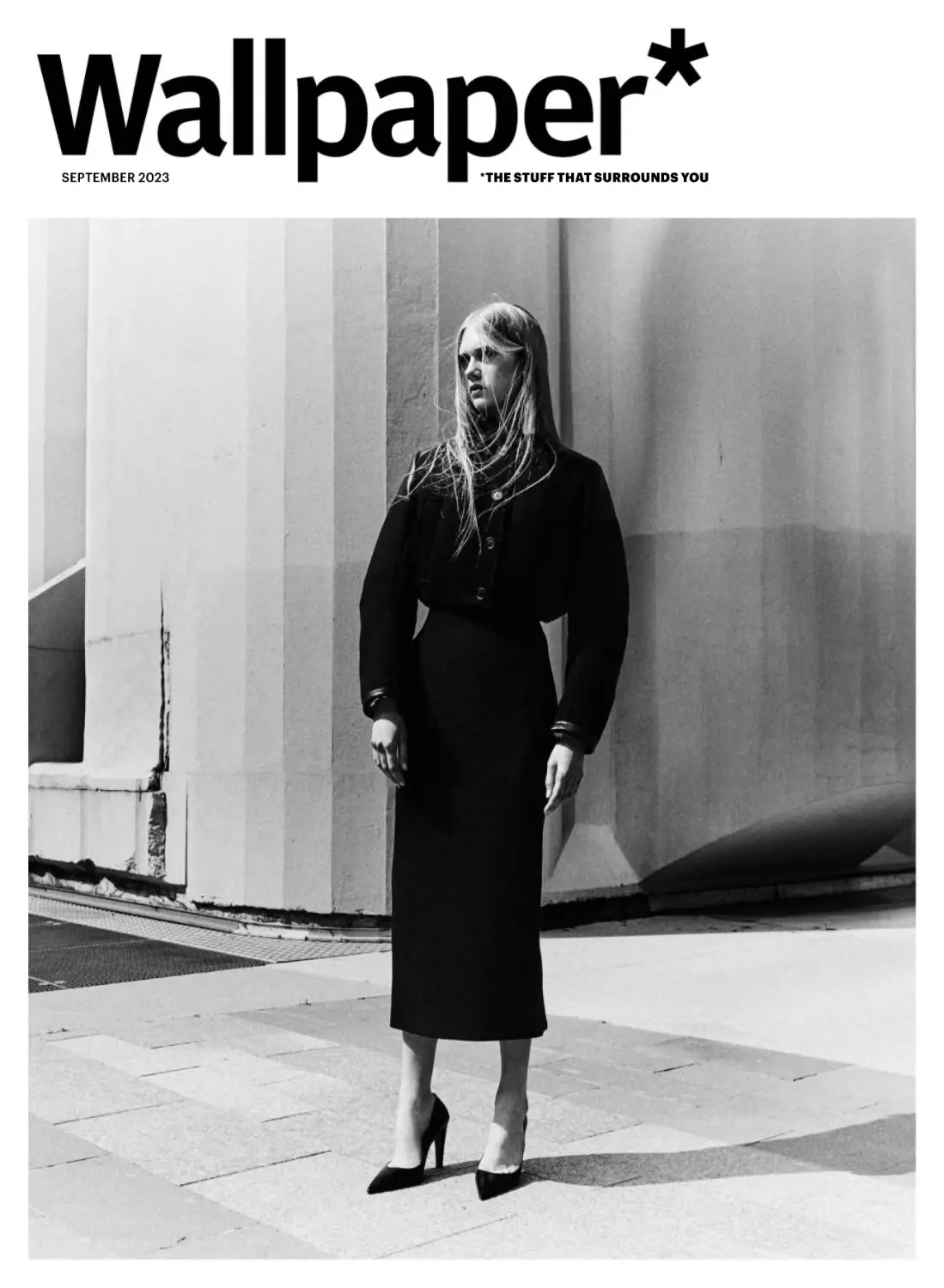
THIS PICTURE, COAT, PRICE
ON REQUEST, BY STANDING
GROUND. SHOES, £960, BY
PRADA. EARRINGS, £2,995,
BY LE STER, SEE PAGE 154
RIGHT, GUCCI’S HIGH-TECH
TESTING LABORATORY
IN TUSCANY PROTOTYPES
ALL ITS SHOES AND
LEATHER GOODS PRIOR
TO SALE, SEE PAGE 080

FASHION

094
106
118
136
154

Chic street
Celine’s art-filled Saint-Honoré store
What happens when...
The season’s defining looks
Cover stars
Outerwear pumps up the volume
Metal morphosis
The evolution of Paco Rabanne
Street scene
Strong silhouettes for urban warriors

ARCHITECTURE

090

Open forum
V&A East is set to open in London
BEAUTY

144

Red hot
Statement lipstick shades laid
bare by artist Silvia Prada
DESIGN

068

Little gems
Jewellery brand Completedworks
turns its reductionist vision to bags
∑

025

SEPTEMBER

THE VENICE VENICE,
AN ART-FILLED HOTEL
OVERLOOKING THE
GRAND CANAL, HAS AN
EYE ON THE BIGGER
PICTURE, SEE PAGE 072

MEDIA

100
130

Leader of the pack
Rimowa’s 125th anniversary show
Talent show
Armani Casa’s works of art

168
170

FRONT OF BOOK

047

In fashion
Key looks from the A/W23 collections

028

∑

Class act
Gucci’s high-tech Tuscan testing lab

WallpaperSTORE*
Our curated marketplace
RESOURCES

169

INTELLIGENCE

080

Subscribe and save
Wallpaper* delivered to your door

Stockists
What you want and where to find it
TRAVEL

072

Suite dreams
A Venice hotel with grand plans

Wallpaper.com
@wallpapermag

EDITORIAL
Editor-in-Chief
Sarah Douglas
Head of Content
William Alderwick
Fashion Director
Jason Hughes
Architecture Editor
Ellie Stathaki

Executive Editor
Bridget Downing

US Director
Michael Reynolds

Art Director
Dominic Murray-Bell

Design & Italy Editor
Rosa Bertoli

Head of Interiors
Olly Mason

Fashion Features Editor
Jack Moss

Beauty & Grooming Editor
Mary Cleary

Transport & Technology Editor
Jonathan Bell

Watches & Jewellery Editor
Hannah Silver

Entertaining Director
Melina Keays

Photography Editor
Sophie Gladstone

Designer
Alice Whittick

Producer
Tracy Gilbert

Production Editor
Anne Soward

Sub Editor
Léa Teuscher

Contributing Editors
Nick Compton, Deyan Sudjic, Ekow Eshun, Marco Sammicheli, Tilly Macalister-Smith, Nick Vinson,
Lauren Ho, Dal Chodha, Emma O’Kelly, Hugo Macdonald, Bodil Blain, Suzanne Trocmé
US Editor Pei-Ru Keh • Milan Editor Maria Cristina Didero • Paris Editor Amy Serafin • Japan Editor Jens H Jensen • China Editor Yoko Choy
Singapore Editor Daven Wu • Australia Editor Elias Redstone • Latin America Editor Pablo León de la Barra • Buenos Aires Editor Mariana Rapoport

PUBLISHING & MARKETING
Publisher
Lloyd Lindo
Business Director
Kelly Gray
Advertising
Digital Advertising
Director
Ilaria Favia

Bespoke
Account Managers
Poppy Tracey,
Scarlett Glendenning

Watches & Jewellery
Advertising Director
Vicki Morris

Advertising Business Manager
Amanda Asigno

Advertising Executive
Lulu James

Bespoke Director
Sarah-Jane Molony
Bespoke Art Editor
Gabriela Sprunt

Bespoke Producers
Sebastian Jordahn,
Anya Hassett

International Advertising Offices
GERMANY/AUSTRIA
Advertising Manager
Peter Wolfram
Tel: 49.89 9611 6800

THAILAND
Advertising Manager
Christopher Stephen Marsh
Tel: 66.2 204 2699

Senior Vice President –
Women’s, Homes
and Country
Sophie Wybrew-Bond

ITALY
Advertising Manager
Paolo Cesana

SWITZERLAND
Advertising Manager
Neil Sartori
Tel: 41.79 880 96 35

SINGAPORE
Advertising Manager
Tim Howat
Tel: 65.6823 6822

Group Head of Production
Mark Constance

FRANCE
Advertising Manager
Magali Riboud
Tel: 33.6 12 59 28 36

INDIA
Advertising Manager
Rachna Gulati
Tel: 91.98111 91702

CHINA
Advertising Manager
Maggie Li
Tel: 86.10 6952 1122

UAE
Advertising Manager
Mamta Pillai
Tel: 971.5035 62723

Design Executive
Marcella Biggi
Commercial Executive
Paolo Mongeri
Tel: 39.02 844 0441

Digital Project Manager
Diyana Shomari

Corporate

USA
Advertising Manager
Matt Carroll
Tel: 1.312 420 0663

Fashion Executive
Chiara Polenghi

Bespoke Editor
Simon Mills

Senior Production Manager
Matt Eglinton
Ad Production Manager
Chris Gozzett
Digital Editions Producer
Sebastian Hue

Head of Future International
and Bookazines
Tim Mathers
International Business
Development Manager
Jennifer Smith
Head of Print Licensing
Rachel Shaw
licensing@futurenet.com
Endorsement Sales Director
Efi Mandrides

Managing Director
Malcolm Young

Future plc is a public
company quoted on the
London Stock Exchange
(symbol: FUTR)
www.futureplc.com

!ǝǣƺǔ0ɴƺƬɖɎǣɮƺ ǔˡƬƺȸ Jon Steinberg
Non-Executive Chairman Richard Huntingford
!ǝǣƺǔIǣȇƏȇƬǣƏǼƏȇƳ³ɎȸƏɎƺǕɵ ǔˡƬƺȸ Penny Ladkin-Brand
Tel +44 (0)1225 442 244

Editorial Complaints We work hard to achieve
the highest standards of editorial content, and
we are committed to complying with the Editors’
Code of Practice as enforced by IPSO. If you have
a complaint about our editorial content, you can
email the editors at contact@wallpaper.com or
write to: Wallpaper*, 121-141 Westbourne Terrace,
London W2 6JR. Please provide details of the
material you are complaining about and explain
your complaint by reference to the Editors’ Code.
We will endeavour to acknowledge your complaint
within five working days and we aim to correct

substantial errors as soon as possible. We are committed to only using magazine paper
that is derived from responsibly managed, certified forestry and chlorine-free manufacture.
The paper in this magazine was sourced and produced from sustainable managed forests,
conforming to strict environmental and socioeconomic standards. ISSN 1364-4475. All
contents © 2023 Future Publishing Limited or published under licence. All rights reserved.
No part of this magazine may be used, stored, transmitted or reproduced in any way
without the prior written permission of the publisher. Future Publishing Limited (company
number 2008885) is registered in England and Wales. Registered office: Quay House, The
Ambury, Bath BA1 1UA. All prices and credits are accurate at time of going to press but are
subject to change. Future cannot accept any responsibility for errors or inaccuracies in
such information, or for unsolicited submissions. For full terms and conditions, see www.
futureplc.com/terms-conditions. Printed by Walstead Roche. Distributed by Marketforce.

Subscriptions
Order online at Wallpaper.com
Manage your subscription at
mymagazine.co.uk
World Headquarters
121-141 Westbourne Terrace
London W2 6JR
United Kingdom
contact@wallpaper.com

CONTRIBUTORS
DAL CHODHA
Writer
This month, Chodha found inspiration in
the works of French writer Georges Perec
(page 106). ‘The story led me to re-read
Perec’s An Attempt at Exhausting a Place
in Paris and I was struck by how much of
it had influenced my own work,’ he says.
‘I often type pointless observations on my
phone, but I’ve never valued them as much
as I do now after writing these extended
captions. I’m interested in writing things
that are not easy to label.’ Chodha’s second
book will be released in autumn.
FEDERICO TORRA
Photographer

STEFAN DOTTER
Photographer

Torra studied art history before turning
to photography, focusing on urban spaces,
architecture and interiors. This made him
the ideal candidate to shoot Venice Venice
(page 072), an art-filled hotel in one of the
city’s oldest palazzi. ‘I kept thinking about
all the work needed to maintain this small
city,’ he reflects. ‘The Venice Venice has
been restored to its original use as a hotel,
but how things have changed in the way
we experience hospitality today!’

A German visual artist currently based in
Japan, Dotter was the perfect fit to shoot
Rimowa’s 125th anniversary exhibition in
Tokyo (page 100). ‘Photographing this story
was quite fun and intriguing, as I myself am
a big fan of Rimowa and owe those suitcases
many wonderful memories. I will never
forget the image of my case strapped onto
a cab in Jodhpur, then driving through the
desert,’ says Dotter, who is now working on
a book on the moon and its symbolism.
PAOLA DOSSI
Photographer
Dossi is a Milan-based photographer who
focuses on intimate connections between
objects to spark curiosity and contemplation.
For this issue, Dossi captured the essence
of Gucci ArtLab (page 080). ‘It’s a place
where fashion, innovation, craftsmanship
and art converge to bring new ideas and
projects to life – and you can really feel it,’
she says. ‘There’s a sense of excitement
and ‘possibility’ in the air. It’s like stepping
into a laboratory of imagination.’

038

SILVIA PRADA
Artist

DAVID ST JOHN JAMES
Stylist

Originally from Spain, Prada lives and
works in New York, where she has become
known for her monochromatic visuals.
This issue’s beauty story (page 144) ‘was
a conversation between red lipstick and
one of my favourite photography books,
The Ultimate Book of Nudes by David Vance,’
explains Prada. ‘What a joy to work on this
– I feel the story defines key characteristics
of my practice as an artist and my identity.’
Prada’s solo exhibition, ‘Obsessions’,
will travel to LA and London in 2024.

A fashion director, stylist and consultant,
St John James has spent the last 15 years
working on sets from London to Milan.
His expertise came in handy for this issue’s
menswear story (page 118). ‘We decided to
shoot many of the images outside as it was
a very hot day and the studio was like a
greenhouse,’ he explains. ‘Unfortunately,
we ended up having to deal with a busybody,
curtain-twitching neighbour, who used
any excuse to stop us from being outside.
In spite of her, we got the shots!’

∑

WRITER: LÉA TEUSCHER

EDITOR’S LETTER

The space between

Cover
Photography:
Melanie + Ramon
Fashion: Jason Hughes
Jacket, £3,800; skirt,
£1,210; shoes, £960,
all by Prada, see our
womenswear fashion
story on page 154
Above left, jacket, £2,000;
blouse, £1,100; trousers,
£740; ‘Maillon Triomphe’
ring, £1,800, all by
Celine by Hedi Slimane.
‘Haute Maroquinerie
Triomphe’ bag, price
on request, by Celine
Haute Maroquinerie
by Hedi Slimane,
see our story on Celine’s
Paris Rue Saint-Honoré
store on page 094
Above right, skirt,
£425, by Margaret
Howell. Shoes,
£725, by Ferragamo,
see our story on this
season’s striking
looks on page 047

042

∑

September can only mean one thing – our biannual Style Special, where we present our
highlights of the A/W23 fashion collections. Autumn Winter 2023 is all about reinvention,
clarity and high design, says fashion director Jason Hughes, who highlights the sharp
shoulder lines of Saint Laurent’s women’s tailoring, the exaggerated collars of Prada,
and the Loewe dress which, with the idea of reduction, is almost a memory of a dress,
in a nod to Gerhard Richter. We round up the season’s defining looks in The Glossary,
while our main womenswear and menswear shoots are both big and dramatic – huge
sweeping silhouettes, with a play on materials and textures such as faux fur and leather.
We visit the new Celine store on Paris’ Rue Saint-Honoré, designed by Hedi Slimane,
where he presents his new couture offering, including tailoring and evening wear, and a
salon-style mezzanine displaying the house’s ‘Haute Maroquinerie’ bags, each handcrafted
by a single artisan, and the pinnacle of Celine’s accessories offering. Then we head over
to Gucci ArtLab in Tuscany – home to all of the Italian fashion house’s shoes and
leather goods prototyping processes – to experience the artisans and their high-tech
school and testing laboratory, which combines craft and technology to shape the future
of sustainable design; the metal moulds archive, the updated loafer, the ‘Jackie’ bag,
the bamboo handles – they all embody the timeless magic and glamour of Gucci.
Meanwhile, New York artist Silvia Prada created this issue’s saucy and subversive beauty
story, which is, she says, ‘a conversation between red lipstick and one of my favourite
photography books, The Ultimate Book of Nudes by David Vance’.
At Wallpaper*, we like to take a broad view of fashion and consider how it transcends
and informs the creative industries. At V&A East, architecture looked to fashion
for inspiration in the form of a silk taffeta Balenciaga dress. ‘I began to think about the
space between the figure and the form, what it is and what it can be,’ says John Tuomey
of O’Donnell & Tuomey. ‘They are not visibly connected, but they are very connected,
and you move in between the body and the fabric.’ It sparked an idea about a building
that would allow space for people to do the same.
For our Armani Casa selected pieces, we celebrate their use of precious materials, refined
finishes and innovative textiles. The furniture has an enduringly elegant aesthetic, and
here we’ve paired it with important Italian art and rare artefacts. Finally, over to the
Venice Venice, a truly inspirational new hotel conceived by Alessandro Gallo and Francesca
Rinaldo, the husband-and-wife founders of sneaker brand Golden Goose. ‘We wanted
the Venice Venice to be as far from a typical ‘art hotel’ as possible,’ says Gallo. ‘The art
isn’t an afterthought. Instead, it is born with the room.’ You can stay in a canalside suite
conceived as a homage to Christo and Jeanne-Claude, with original sketches of their
landscape-spanning installations, or an attic room dedicated to the Fluxus movement,
including a looping video of I Like America and America Likes Me, a 1974 performance
by Joseph Beuys. ‘Hospitality is the only way to touch all of these things. You can meet
people, you can eat, you can have fun, you can visit art, you can sleep.’
Now, what could be better than that! Enjoy the issue. Sarah Douglas, Editor-in-Chief

Sign up to our daily
Wallpaper* newsletter
Limited-edition
covers are available to
subscribers, see
Wallpaper.com/sub23

Models: Adual Akol at Storm Management, Guo Jike at Elite Model Management. Casting: Ikki Casting. Hair: Roku Roppongi at Saint Luke using Babyliss Pro. Make-up: Jimmy Owen Jones at Julian
Watson Agency using Westman Atelier. Manicure: Ami Streets using Dior Manicure collection and Miss Dior hand cream. Fashion assistant: Kristina Bergfeldt. Lighting assistant: Robin Bernstein.
Digital operator: Conor Clarke. Set design: George Lewin Studio. Set production manager: Hermione Fenton. Assistant: Matilda Greenwood. Retouching: Agata Bielska. Producer: Anya Hassett

IN FASHION
The A/W23 collections, distilled into 12 striking looks

Photography Georgia Devey Smith Fashion Jason Hughes Writer Jack Moss

Coat, price on
request, by Missoni.
Shoes, £725, by Ferragamo.
Tights, £25, by Falke

For stockists throughout,
see page 169

WAVE LENGTH

Designed to evoke the blooming first stages of romance, eclectic
fusions of colour and texture defined Missoni’s womenswear
collection, such as this wool overcoat, featuring waves of 3D knit.

∑

047

This page, jacket,
£3,100, by Prada
Opposite, shoes, £820,
by Ferragamo

ON POINT
048

∑

Prada’s co-creative directors Miuccia Prada and Raf Simons noted a desire to oppose
simplicity with moments of ‘comfort and exaggeration’ as epitomised in a series
of precisely tailored jackets for men, out of which fuzzy winged collars emerged.

RISING STAR

Maximilian Davis’ second season as Ferragamo’s creative director saw him continue
to hone the Florentine house’s shoe offering with this mock-croc riff on the Mary
Jane, drawing inspiration from old Hollywood starlets but with a contemporary bent.

Belt, £810, by Max Mara.
Bodysuit, £239, by Wolford

UNDER THE BELT

Max Mara’s creative director Ian Griffiths looked to 18th-century philosopher Émilie
du Châtelet, whose liberated take on the era’s dress codes inspired cocooning opera
coats and leather obi belts, cut with the modernity synonymous with the house.

∑

051

Dress, £990; necklace,
price on request, both
by Victoria Beckham

HAIR LINE
052

∑

Inspired by Jackie Onassis’ reclusive cousin Little Edie, immortalised in the 1975
documentary Grey Gardens, Victoria Beckham’s eccentric collection featured surreal
necklaces recalling human hair, a nod to the work of Brazilian artist Solange Pessoa.

Bag, £2,490, by Burberry

KNIGHT MODE
054

∑

Burberry’s creative director Daniel Lee brought his unique eye for cult accessories to
his latest collection, which included the ‘Knight’ bag, featuring an elegant horse-clip
fastening, a nod to the brand’s archival logo of a charging knight on horseback.

Dress, £2,100, by Loewe.
Shoes, £725, by Ferragamo

GHOST STORY
056

∑

Spectral apparitions, inspired by the blurred paintings of Gerhard Richter, emerged
across a series of silk dresses in Jonathan Anderson’s latest womenswear collection
for Loewe, their ephemeral forms recalling garments from past seasons.

‘A l’Écoute’ rings, price
on request, by Hermès

CURVE APPEAL

An exploration of form, Hermès’ ‘À l’Écoute’ rings – in rose gold studded
with glimmering quartz, tourmaline, jade, moonstone and diamonds –
see geometric motifs meet the sensual, curved lines of the body.

∑

059

Skirt, £425, by
Margaret Howell. Shoes,
£725, by Ferragamo

IN THE FOLD
060

∑

Designer Margaret Howell continued her renewal of traditional British
clothing archetypes with a riff on the classic kilt, sensually reimagining it
in diaphanous pleated layers of matte black organza.

Glasses, £565, by Lindberg.
Coat, £3,296; jacket, £2,295,
both by Dunhill

PERFECT VISION

Glasses were rife on the runways, a reflection of the season’s thoughtful mood. This
pair by Lindberg are defined by a near-impossible lightness, a result of three decades
of innovation and refinement, much of it inspired by contemporary architecture.

∑

063

Jacket, £2,650; top, £1,320;
leggings, £1,510; belt,
£475, all by Saint Laurent
by Anthony Vaccarello

WELL PADDED
064

∑

A bold shoulder unified Anthony Vaccarello’s offering for Saint Laurent, an echo of
the house founder’s 1980s designs, with the runway set evoking the ballroom of the
Paris Intercontinental, where Yves Saint Laurent used to show his couture collections.

Shirt; tie; trousers;
boots, all price on request,
by Bottega Veneta

KNIT TOGETHER

For Bottega Veneta, Matthieu Blazy imagined a series of ‘characters’ one might
find on a buzzing Italian piazza, recreating archetypal looks in unexpected materials,
like this business-like shirt, tie and trousers, made from various textures of knit.

∑

067

Little gems
British jewellery and homeware brand Completedworks
turns its reductionist vision to bags
PHOTOGRAPHY: JACOB LILLIS WRITER: HANNAH SILVER

A preoccupation with the relationship
between form and function meant a move
into fashion accessories was perhaps
inevitable for London-based jewellery and
homeware brand Completedworks. For
the past decade, its artistic director Anna
Jewsbury has infused ceramics and jewellery
with a sculptural sensibility, presenting
everything from vases that appear to have
been casually scrunched in the hand to
offbeat, playfully proportioned earrings.
Now, she turns her sharp eye to bags.
This fascination with exploring the limits
of a material and bringing a malleability to
seemingly resistant forms has always inspired
Jewsbury. ‘One of the things we’ve always
done from the beginning with the jewellery,
and also ceramics, has been exploring the
movement of fabric and leather, looking at

068

∑

the way leather folds or crumples and knots,
which is obviously something very often
associated with bags,’ she says. ‘There’s always
been a cross-pollination of ideas: behind the
scenes, we like to have these ideas that we
put aside because they were only relevant
to products that we didn’t offer. We then
kept them for the right moment.’
Jewsbury, who studied mathematics and
philosophy at Oxford University, is interested
in bringing creative solutions to problem
solving. ‘We’re always trying to create
something modern and classic, but with
subversive elements to it. We want everything
to have a really clear signature and design
language,’ she says. ‘In an argument in maths
and philosophy, you don’t want anything to
be there that doesn’t need to be. Taking that
kind of discipline to creating collections is

quite helpful in a way because you can make
it quite unfussy if you’re forcing yourself to
make sure there’s nothing unnecessary there.’
It is a reductionist aesthetic that is
encompassed not only in the brand’s pieces
but also in its newly opened boutique in
London’s Marylebone, which juxtaposes
smooth limewash against aluminium
shelving, creating a linear language teasingly
at odds with the undulating forms of the
jewellery. The opening has neatly coincided
with this new direction for Completedworks,
a natural evolution that has always
characterised Jewsbury’s brand management.
‘The ceramics followed very intuitively
from the jewellery, and you could manipulate
them in a similar way. Whereas with bags, it’s
a completely new world and there’s so many
more rules, it makes me realise how free, in »

Design
This page, Completedworks
founder Anna Jewsbury
Opposite, left, pearl bag, £695;
right, ‘Squeezed’ vase, £125,
both by Completedworks

Design

Above, resin handle
bag, £615; ‘B101’ vase,
£465; ‘B96’ vase, £395,
all by Completedworks
Left, Completedworks’
new London boutique
features smooth
limewashed walls and
aluminium shelves

070

∑

a way, jewellery and ceramics are. Complicated
things have to happen to make a bag seem
beautifully simple and effortless, and getting
the final appearance to be divorced from that
process of how you make it is really key. I was
excited by the challenge of it, and I’ve learned
a lot from going outside my comfort zones.’
Jewsbury is once again led by the materials
themselves when it comes to the creation of
the bags, committing to using only recycled,
deadstock or renewable materials in the new
styles. She explored cactus leather and a
recycled leather mix before settling on bags
crafted in deadstock leather from a luxury
house, which achieved the natural folds she
wanted. ‘It’s quite nice to be constrained to
the material that’s available to you. We don’t
want to overproduce, and we’re conscious
of that. So to say, okay, we’re doing small runs,
means we can be quite reactive and nimble.’
Considered details nod to the jewellery,
with sculpted handles echoing the sinuous
forms of earrings. ‘It felt natural to pull
all those more decorative elements from the
jewellery and the homeware. So we’ve got
the resin handle, which mirrors some of the
earrings and homeware and has this nice
tactile wonkiness to it, a balance against the
more placid element of the leather body itself.
We’ve done some custom zip pulls, which
could almost be earrings or a pendant. There
is also a pearl bow-accented bag, which has a
related piece in our new homeware collection.
Everything links up really nicely.’ ∂
Completedworks, 69a Lisson Street, London
NW1, completedworks.com

This page, the living room of
Room 24, currently Venice’s
largest suite, features doubleheight windows overlooking
the Grand Canal, from
which Canaletto painted a
view of the Rialto Bridge
Opposite, a marble sculpture by
Fabio Viale in the water entrance,
built as a homage to the
architecture of Carlo Scarpa

072

∑

Travel

SUITE DREAMS

Housed in one of Venice’s oldest palazzi, an expertly restored, art-filled hotel
on the Grand Canal is launching an ambitious new expansion project
PHOTOGRAPHY: FEDERICO TORRA WRITER: LAURA MAY TODD

Travel

T

he Byzantine palace Ca’ da Mosto sits at a
prime location on Venice’s Grand Canal, just as it
bends to meet the Rialto Bridge, offering uninterrupted
views of the famous landmark. It’s the same panorama
that 18th-century Venetian painter Canaletto would
carefully reproduce while sitting at the palazzo’s
second floor window, his light-drenched depictions of
the scene exactly matching that privileged perspective.
Built around the 11th century, it is widely agreed that
Ca’ da Mosto is the oldest structure lining the ancient
waterway and, unsurprisingly, it plays an important
role in the city’s history. From around the 1500s,
the palace was home to the Campiello del Leon Bianco,
one of Europe’s first hotels and a significant Grand
Tour stopping point. Over the centuries, kings, czars
and emperors, as well as figures such as Voltaire, Mozart
and Shelley, all spent time within its fresco-laden walls.
However, since 2022, it has been the Venice
Venice, an art hotel conceived by Alessandro Gallo
and Francesca Rinaldo, the husband-and-wife
founders of sneaker brand Golden Goose. In late 2023,
the couple will officially open the hotel’s second
wing, which promises to host the largest and most
luxurious hotel room in Venice yet.
When Gallo and Rinaldo first conceived the idea of
the Venice Venice Hotel, they were looking to embark
on a project that would let them express their creativity
in all its different facets. In the flurry of growing the
Golden Goose brand, which they founded in 2000 and
sold in 2017, their attention needed to be laser-focused.

During their years spent building a sneaker empire,
they missed having the freedom to pursue other
interests. ‘For us,’ Gallo says, ‘fashion was not enough.’
According to him, their dream project encompassed
a passion for art, design and food, as well as Venetian
culture and history (the couple hail from nearby
Mestre). ‘Hospitality is the only way to touch all of
these things. You can meet people, you can eat, you
can have fun, you can visit art, you can sleep,’ he says.
When they first set out to acquire the building,
however, their own hotel was the furthest thing from
their mind. They collected the palazzo in ten different
pieces – one apartment at a time, over five years –
simply as a real estate investment. ‘A lot of the major
hospitality brands had had their eye on this location,’
says Gallo. But it was only after the couple
commissioned a study into the building’s history
did they realise its significance. ‘It was clear to us that
it needed to be a hotel once again,’ Gallo says. ‘And
that we should be the ones to do it.’
The next five years were spent on restoration,
working with a team of historic Venetian architecture
experts. ‘The building had been abandoned for half
a century. It was falling into the Grand Canal,’ says
Gallo. They tried their best to preserve every last
detail. That meant sealing the lower level floors
(which, due to gradual sinking and rising waters, now
sat roughly a metre below water level) and completely
reinforcing the ornate Byzantine façade carved out
of millennium-old marble. Composed of ancient »

Below, a drinks trolley and
leather sofa in Room 24, which
features works from the Arte
Povera movement, a particular
favourite of the owners
Opposite, a sotoportego
(a passageway that goes
underneath a building) houses
hotel restaurant Venice M’Art,
with a terrace on the Grand
Canal on one side and
a bar, shop and exhibition
space on the other

∑

075

Travel

‘We wanted the Venice Venice
to be as far from a typical
‘art hotel’ as possible. The art
isn’t an afterthought. Instead,
it is born with the room’

Above, the treatment room at
the Felix Anima spa features
an installation by Romanian artist
Victoria Zidaru. Fabric tubes filled
with medicinal herbs and flowers
diffuse a fragrant perfume
throughout the low-lit space
Above right, Room 53, known
as the Revolutionary Room, is
dedicated to the work of Joseph
Beuys. Most of the furniture
throughout the hotel is by the
hotel’s own brand, The Erose

bas-reliefs stacked between rows of arched windows,
it was in danger of peeling off the structure entirely.
The hotel’s first 25 rooms, which opened in 2022,
were each inspired by a different artist or movement.
‘My wife and I have been collecting art for 25 years.
We’ve developed many relationships with artists and
curators, but we wanted the Venice Venice to be as far
from a typical ‘art hotel’ as possible,’ says Gallo. ‘The
art isn’t an afterthought. Instead, it is born with the
room.’ You can stay in a canalside suite conceived as
a homage to Christo and Jeanne-Claude, with original
sketches of their landscape-spanning installations,
or an attic room dedicated to the Fluxus movement,
including a looping video of I Like America and America
Likes Me, a 1974 performance by Joseph Beuys. Or, spend
a morning in side-by-side soaker tubs meditating on
a John Cage score. Naturally, one room has been given
over to pieces that debuted at the Venice Biennale.
Among them is a single element of Enzo Mari’s 1973
Falce e Martello, a life-sized wooden puzzle that, when
put together, takes the shape of a hammer and sickle.
For the second phase, which is gradually being
opened over the course of this year, they were even
more ambitious, with larger, more elaborate rooms,
masterpiece works from some of the 20th century’s
most revered names, and site-specific installations by a
host of contemporary artists. Among the collaborators
is Romanian artist Victoria Zidaru, who designed the
hotel’s spa treatment room. ‘About five or six years ago,
during the Biennale Vernissage, I stopped into the »

∑

077

Travel

Above, a 5m-long 1985 artwork
by Jannis Kounellis hangs above
the dining table in Room 24
Left, Dream (2013), by Yoko
Ono, hangs in Room 72, which
also features a terrace with
views across the Grand Canal
to the Rialto Bridge

078

∑

Romanian cultural institute,’ Gallo recalls. ‘There was
this small woman standing with her artwork and she
told me about her approach – her work with natural
elements, her connection with spirituality and the land
where she lives. At that moment, it came to my mind
that I wanted the room to become a piece of art itself
– and I wanted her to do it,’ he adds. Following the
conversation, the couple flew to northern Romania,
where Zidaru lives, to develop the project together.
The result is an installation of woven fabric tubes filled
with fragrant grass and flowers from Zidaru’s farm.
In addition to practising artists, Gallo and Rinaldo
were also keen to include the masters. In a suite on the
palazzo’s piano nobile (currently Venice’s largest suite,
this two-floor, two-bedroom apartment boasts a grand
piano and double-height windows overlooking the
Grand Canal), they wanted a work as spectacular as the
space. ‘It’s where Canaletto used to paint,’ says Gallo.
‘We wanted to celebrate it with one of our favourite
art movements, Arte Povera, and one of our favourite
artists, Jannis Kounellis.’ The couple acquired a large
1985 painting from the painter’s private collection.
When they open in late 2023, the hotel’s crowning
jewels will be two waterside suites, which, at around
200 sq m each, will eventually oust the Kounellis room
as the city’s largest. The first will feature direct access
to the water and function like an apartment for guests
embarking on longer stays. The second will boast a
private indoor pool, the only one of its kind in Venice.
But Gallo’s main concern at the moment is finding the
perfect artist to bring his vision to life. ‘I think,’ he says,
‘we’ll dedicate the pool suite to David Hockney.’ ∂
venicevenice.com

This page, a Gucci
‘Bamboo 1947’ bag
in ArtLab’s dedicated
bamboo workshop
Opposite, three layers
of lacquer are required
to finish the bamboo bag
handles, a painstaking
process mastered by
artisans with decades
of experience

080

∑

Intelligence

Gucci’s high-tech training school and testing
laboratory in Tuscany combines craft and science
to shape the future of sustainable design
PHOTOGRAPHY: PAOLA DOSSI WRITER: SCARLETT CONLON

Intelligence

I

t’s a bright and sunny afternoon in Scandicci,
a short 8km drive from the centre of Florence.
Filled with FedEx vans, busy roundabouts and
industrial warehouses, the bustling suburban hub
stands in stark contrast with the Tuscan capital
and its cultural landmarks, but for one conspicuous
structure: Gucci ArtLab. With its vibrant 10mhigh murals, the sprawling 37,000 sq m space is as
unmissable as the statue of David – apt, given that
a large-scale fashion anatomy is taking place.
Inside, artisan Fabio is adding volume to shoe
lasts with putty before smoothing the surface by hand
and checking how the light falls from every angle;
Maurizio is finishing off a new-season diamanté loafer
by joining its upper to its insole with precise hammer
action; and Claudio is moving bamboo slowly over
the naked flame of a Bunsen burner before bending
it to achieve a perfect curved handle.
In adjacent laboratories, scientists and state-ofthe-art robotics are working in tandem, testing soonto-be cult bags for elastic-band fatigue and zip
reliability. Treadmills are taking a pair of heels for a
long-distance walk to calculate their durability, and
a holdall is being checked for colour transfer using
an automated mannequin that has been bopping
on the spot, non-stop, for a couple of days.
An insatiable hive of activity, Gucci ArtLab is
home to all of the Italian fashion house’s shoes and
leather goods prototyping processes. Since its opening
in 2018, manual and mechanical artisanship have been
working hand in hand, with each of Gucci’s seasondefining pieces engineered and fastidiously tested by
a team of 950 specialists before hitting the catwalk. »

Above, powered by
photovoltaic panels and
equipped with a system that
limits unnecessary energy
consumption, the LEEDcertified ArtLab includes the
classrooms and workshops
of École de l’Amour, Gucci’s
education programme
Right, all Gucci shoes and
leather goods are prototyped
at ArtLab, including its
iconic 1953 horsebit loafer

∑

083

Intelligence

This page and opposite,
ArtLab’s archive library
features hundreds of
original moulds bearing
the Gucci logo, dating
back to the first under
founder Guccio Gucci, and
finishing under Tom Ford’s
creative directorship

∑

085

Intelligence

‘When I created ArtLab, my main thought was to give
people the opportunity to be creative and express
themselves,’ says its CEO Massimo Rigucci as he gives
us a rare guided tour. ‘We’re not just creating a
technical space, but [one filled with] emotions.’ ArtLab
is a hub of shared skill sets and experience that speeds
up innovation and short-circuits unnecessary waste.
‘We have 3D programmes that allow us to simulate
an accessory rather than building a physical prototype
and throwing the material away [afterwards],’ says
Antonella Centra, EVP of general counsel, corporate
affairs and sustainability. ‘But you can see it’s not
replacing the human touch, it’s complementary.’
The brand’s ambition with ArtLab doesn’t stop
there. Operating alongside its specialist research and
development areas is the jewel in ArtLab’s crown,
the École de l’Amour (‘School of Love’). Here,
aspiring artisans can learn the skills of the trade from
experienced maestros. It felt vital to Rigucci that
students learn on the factory floor. ‘We’re trying to
recreate the small artisanal workshops that I remember
[growing up],’ he says. ‘I came from a factory where
my mother taught us about shoes so that [the craft]
would continue. This is something we want to do
inside our organisation, too. They need to feel and
touch the culture and the people who create it.’

086

∑

Above, a paper model of a
‘Jackie 1961’ shoulder bag
Above right, one of the white
lab coats worn by teachers
at Gucci’s École de l’Amour

On the day of our visit, Marco, who worked as
a Gucci pattern maker for 40 years before becoming
a full-time teacher at the school, is taking a group on
a six-month placement through assembly steps. His
colleague Matilde, an expert seamstress, is showing
them how to stitch and sew. ‘It really keeps the passion
alive, and they teach us so much, too,’ says Matilde.
Busting the myth that there is a lack of appetite
for younger generations to pursue craftsmanship in
Italy, the academy regularly has 200 applicants for
ten coveted places on each of its courses. Since its
inception, more than 800 people have passed through
its doors, many of whom have stayed on in full-time
employment afterwards. Thanks to their intensive
training, they hit the ground running.
From interrogating the molecular make-up of
materials to sharing specialist skill sets, circularity is
the buzzword here. One of the ArtLab team’s proudest
achievements is that it contributed to the creation of
Demetra, a renewable vegan leather engineered from
viscose, wood pulp and bio-based polyurethane, which
stands out for its potential to be scaled up and become
open source. ‘We first went to Silicon Valley, but the
scalability and quality [of its bio-leathers] would never
have reached our requirements, so Massimo said we
should be the Silicon Valley of Italy,’ says Centra.
Sustainability is already a big item on Gucci’s
agenda. The Kering-owned company is nearing the end
of an ambitious ten-year plan that has seen the house
achieve an overall traceability rate of 97 per cent for its
raw materials to date. It’s a mindset that permeates not
only the purpose of ArtLab and its artisans, but its
LEED-certified space, too. Designed to inspire at every
turn, its solar-powered white rooms are accented with
joyful fuchsia boxes (‘I love it, it gives energy,’ enthuses
Rigucci), while a dramatic red staircase was ‘designed as
a portal through which our employees are transported
into a world of creativity and craftsmanship’. Gucci
ArtLab prizes innovation alongside preservation, and
computing alongside craftspeople. ‘We’re creating a
dream for the world, not just products,’ says Rigucci. ∂
gucci.com, equilibrium.gucci.com/gucci-artlab

Under Construction

OPEN
FORUM

Behind the new V&A East’s intricate façade
is a space for the imagination to unfold
WRITER: ELLIE STATHAKI

It only takes a quick walk around Stratford station
to realise that there are changes afoot in this corner of
East London; and one of the biggest is swiftly taking
shape, its concrete pleats seemingly moving in the
summer breeze. V&A East and its dynamic, soon-to-beinstantly recognisable volume is somewhere midway
through construction. The cultural destination is
working full steam ahead towards a 2025 opening, as
part of a twin scheme alongside V&A East Storehouse
(designed by Diller Scofidio + Renfro with support from
Austin-Smith:Lord), the V&A’s upcoming immersive
archive experience. The new museum’s architects,
Dublin-based practice O’Donnell + Tuomey, stress
that in their project, this urban context was key –
as was creativity, making and design itself, which not
only will be celebrated in the content and exhibits,
but also offered inspiration for the structure’s shape.
The two V&A outposts are part of East Bank, the
Mayor of London’s £1.1bn ongoing Olympic legacy
project, which is slowly but steadily transforming the
area beyond its well-documented facelift during the
2012 Games. Other important future additions to the
neighbourhood are the Sadler’s Wells Theatre, the
BBC Music Studios, and the UCL East campus.
‘We were involved in the masterplan for East Bank,
and had to envision the space for what is now V&A
East, bridging an edge of the Olympic Park,’ explains
O’Donnell + Tuomey’s co-founding director John
Tuomey, who set up the studio with his wife, architect
Sheila O’Donnell. ‘From the masterplanning work,
we had the volumetric solution, which we then had
the opportunity to develop. It has been a very special
project from the beginning.’ V&A East project director
Claire McKeown adds: ‘One of the ambitions was
for the building to be a civic one, open to all, and
that visitors can access all floors.’
It certainly feels inviting – a beacon for this
new cultural district. Seen from a distance (and there
are publicly accessible vantage points nearby that
allow that), the building stands out for its upwardly
tapered, abstractly pleated, textured shape. It’s easy »

090

∑

Right, the new V&A East is part
of East Bank, a £1.1bn Olympic
legacy project on the banks
of the River Lea, in Stratford’s
Queen Elizabeth Olympic
Park. Designed by O’Donnell
+ Tuomey, the new build will
house temporary exhibitions
and take visitors on a journey
through the V&A’s collections

to imagine it becoming visual shorthand for the
creativity it will contain, as well as the whole area. ‘We
wanted it to read as a special thing, but we didn’t start
with it being a symbol in itself,’ says Tuomey. ‘Even so,
the project’s looks are squarely rooted in the design
disciplines. In 2018, the V&A in South Kensington held
an exhibition on Balenciaga, and one of the items on
display there, an X-ray of a silk taffeta dress and its
interpretation by artist Nick Veasey, caught Tuomey’s
eye. ‘I began to think about the space between the figure
and the form, what it is and what it can be,’ he says.
‘They are not visibly connected, but they are very
connected, and you move in between the body and
the fabric.’ It sparked an idea about a building that
would allow space for people to do the same.
The result is V&A East, subtly mysterious in its
semi-opaqueness, with enclosed and open spaces
designed to house temporary exhibitions, as well as take
visitors on a journey through the V&A’s collections,
its artefacts protected by high-spec climatic conditions.
The outcome is a vertically-organised building, spread
across five floors, with an immersive circulation area
that wraps around open-plan spaces. The ground level
is scheduled to remain open – no barriers or gates that
one needs to cross to enter beyond the café and store.
It needed to feel ‘invitational’, stresses Tuomey.

092

∑

Above, the new museum’s
largely prefabricated steel
structure is clad with individual,
made-to-measure precast
concrete panels with a sandy,
terrazzo-like finish. They are
a reinterpretation of the stone
façades of the original V&A
building in South Kensington

The building’s façade is made of distinctive, individual
concrete panels. ‘We wanted a façade that exploited
the possibilities of the material and reinterpreted the
façades at the V&A South Kensington – such as the
sgraffito on the Henry Cole Wing,’ says McKeown.
Visitors can get a closer look at the panels from one
of the three terraces, while taking in the striking vistas,
which also played a key role in the spatial development.
‘The journey [through the museum] ends with a
view at the top, and the openness towards the park is
a big part of the project,’ says Tuomey.
As building works are underway, efforts are now
ramping up on the exhibition design. The permanent
Why We Make collection galleries will be created
by JA Projects with A Practice for Everyday Life and
Larry Achiampong, focusing on global creativity and
inclusivity, and craft of all kinds. The aim is for content
and building to operate in sync, fostering physical and
virtual space for the imagination to unfold. ‘There’s a
tendency in architecture to try and control everything,
and this is not the most interesting way to carry on,’
says Tuomey. ‘It is a better test of a concept to see that
it can survive while it is translatable and inhabitable
by entirely different beings. It tests its robustness.’
And that, as they say, is where the magic happens. ∂
odonnell-tuomey.ie, vam.ac.uk

Photography: Peter Kelleher © Victoria & Albert Museum, London

Under Construction

Fashion
This page, waistcoat,
£650, by Celine by
Hedi Slimane. ‘Haute
Maroquinerie 16’ bag,
price on request, by
Celine Haute Maroquinerie
by Hedi Slimane
Opposite, dress, price
on request, by Celine
by Hedi Slimane

094

∑

Chic
street

The Celine store on Rue Saint-Honoré is
designed to capture the spirit of Paris
PHOTOGRAPHY: SPELA KASAL FASHION: JASON HUGHES WRITER: JACK MOSS

Fashion
Right, ‘Maillon Triomphe’
hoop earrings, £3,650;
‘Celine Line’ double
necklace, £1,750, both by
Celine by Hedi Slimane
Below right, ‘Bois
Dormant’ fragrance, £315,
by Maison Celine
Opposite, dress, £14,600;
shoes, £690, both by
Celine by Hedi Slimane
Untitled, undated painting,
mixed media on canvas,
by Vivian Suter

ocated in a grand 19thcentury Haussmann building, with interiors
hewn from Grand Antique marble, Celine’s
Rue Saint-Honoré store is a temple to Parisian
elegance and luxury, dedicated to the feats
of savoir-faire that define the house under
current creative director Hedi Slimane.
Designed by Slimane, the store is
punctuated with geometric mirrored walls
and surfaces, a nod to France’s mouvement
moderne. The ground floor is dedicated to
leather goods, fine jewellery and women’s
accessories, while a semi-spiral staircase,
in golden brass, ascends to a salon-style
mezzanine displaying the house’s ‘Haute
Maroquinerie’ bags (the pinnacle of Celine’s
accessories offering, each is created by hand
by a single artisan). Next door, the house’s
apothecary-style haute parfumerie, which
opened in 2019, is now interconnected,
providing a dedicated home for Slimane’s
fragrance offering. ‘Pronounced classicism
and dissonant sophistication,’ says the brand
of the olfactory project, which, like the store,
is designed to capture ‘the essence of Paris’.
Also populating the 137 sq m space is an
array of contemporary artworks. Among
them are a carved totem by New York-based
Ian L C Swordy, a series of wooden sculptures
by Vilnius-based Augustas Serapinas, and a
specially commissioned mobile, Skylight Gems
(2022), by US sculptor Virginia Overton.
Paintings by Vivian Suter and Will Boone »

∑

097

Fashion
Right, dress, £60,200;
‘Maillon Triomphe’ hoop
earrings, £1,500, both
by Celine by Hedi Slimane
Opposite, jacket,
£2,000; blouse, £1,100;
trousers, £740; ‘Maillon
Triomphe’ ring, £1,800;
‘Celine Line’ double
earring, £1,100; ‘Celine
Line’ triple earring, £1,300;
shoes, £830, all by Celine
by Hedi Slimane. ‘Haute
Maroquinerie Triomphe’
bag, price on request, by
Celine Haute Maroquinerie
by Hedi Slimane
Model: Felixia Ekila
Loleka at Ford Models
Casting: Spela Kasal
Hair: Michal Bielecki
Make-up: Tiziana
Raimondo at
Home Agency
Photography assistant:
Sebastien Issartelle
Producer: Anya Hassett

also feature, while an eclectic array of
furniture and objets are selected for their
‘sculptural typology’. Each element is chosen
or designed by Slimane, a continuity of the
singular vision he brings to his collections.
It provides an apt setting to capture
Slimane’s recent couture offering, shown
as part of the house’s A/W23 show at The
Wiltern theatre in LA last December. An
honorary resident of the Californian city
(Slimane lived in LA for several years before
moving back to France, where he now resides
close to Saint-Tropez), the collection itself
melded tropes of Hollywood glamour with
the designer’s eye for subculture and

098

∑

rebellion. First opened as a vaudeville
theatre in 1931, The Wiltern’s opulent art
deco interior has since become one of the
city’s cult music venues, hosting the likes
of Nina Simone, Prince, Patti Smith and
The Rolling Stones (on the evening of the
show, the after-party’s live soundtrack
came courtesy of Iggy Pop, The Strokes,
Interpol and The Kills).
Mixed among the ready-to-wear – for
A/W23, Slimane estimated it made up
‘around 20 per cent of the collection’ –
the couture pieces spanned everything from
tailoring to evening wear, often featuring
extraordinary feats of embroidery and

craft. A shimmering babydoll dress was
embroidered with more than 90,000
crystals and paillettes (in Slimane’s typically
insouciant style, it was worn with a slouchy
bag and dark sunglasses), while a series
of liquefied metallic gowns at the end of the
show were stitched, entirely by hand, with
thousands of rhinestones, sequins and beads.
This closing milieu was backdropped by
an enormous version of the house’s Triomphe
monogram – a symbol revitalised during
Slimane’s tenure and inspired by the
architecture of Paris’ Arc de Triomphe –
here illuminated, Hollywood-style, in lights. ∂
Celine, 384 Rue Saint-Honoré, Paris 1e, celine.com

A travelling show celebrates
pioneering German luggage brand
Rimowa’s 125 years in business
PHOTOGRAPHY: STEFAN DOTTER WRITER: JACK MOSS

Design

A new exhibition,
entitled ‘Seit 1898’ (‘seit’
is the German word for
‘since’), looks back at
luggage brand Rimowa’s
output with a series of
displays that feature more
than 100 cases from its
archives and celebrity fans

A

new travelling exhibition, ‘Seit 1898’, filled
with ‘living artefacts’, celebrates 125 years
since the founding of Rimowa in Cologne,
the German city the luggage brand continues
to call home more than a century on.
‘These are far from museum objects,’ says
Rimowa CEO Hugues Bonnet-Masimbert at
the exhibition’s first stop in Tokyo, where, in
June, it occupied Jing Harajuku, a glass-walled
gallery space close to the district’s busy
metro station. This is not to say that they’re
not precious; rather that many of the objects
have been donated by those who use Rimowa
cases daily, including a phalanx of stars
from Pharrell Williams to LeBron James.
The exhibition’s next stop is New York, then
Cologne, with possible further stops still in
the works – cases will then ‘return to their
owners and go back to their lives’.
The exhibition’s climax is a display of
cases from notable clients that span the
fictional (an aluminium case emblazoned
with the face of Emily in Paris’ outré couturier
Pierre Cadault, for the faux ‘collaboration’
depicted in the Netflix show), the surreal
(a clear carry-on used by artist Takashi
Murakami, stuffed with soft toy versions of
his signature cartoon flower motif ) and the

102

∑

heavily customised (musician Patti Smith’s is
covered with studio stickers). Other cases are
variously battered or scuffed, marks of wear
that Bonnet-Masimbert says only attest to
their status as lifelong travelling companions.
‘There’s an emotional part to it – people
feel so proud of their beloved Rimowa case
when they travel, and they were delighted to
lend them to us and have them on display,’
says Rimowa’s senior VP of product and
marketing Emelie De Vitis, noting that, such
is the reality of these pieces, several suitcases
came with the discarded belongings of their
owners still inside (‘no names,’ she smiles).
‘At the end of the day, they are meant to be
suitcases,’ says Bonnet-Masimbert. ‘They’re
not meant to be frozen in the past.’
The choice of Tokyo as the exhibition’s
first destination was purposeful; in the 1970s,
Japan was one of the first international
destinations where Rimowa was sold. Its
signature aluminium ridged suitcase found
rapid success in the country, which De Vitis
suggests is down to an affinity between
German and Japanese principles of design.
‘[The Japanese] love durability, they love
craftsmanship, they love high design,’ she
says. ‘I think it has acquired cult status.’

Above, in 2018, Rimowa
collaborated with
streetwear label Supreme
to produce custom case
versions in black or red
Opposite, above, the
entrance to the exhibition
features a reception
desk and a vivid blue
carpet interwoven with
vintage Rimowa logos
Opposite, right, Rimowa’s
one-bottle travel case,
designed to hold a single
bottle of champagne

Design

Other stops will have their own resonance;
New York will coincide with the city’s fashion
week, while a final homecoming in Cologne
is currently planned to close the celebrations
in 2024. ‘We are super proud to be German,’
says De Vitis of the brand retaining its roots
in the country (French luxury goods
conglomerate LVMH purchased a controlling
share in 2016). ‘Germany represents
engineering, craftsmanship, excellence.’
Such facets of Rimowa are on full display
in the exhibition itself, which is entered
through a liminal reception space evoking the
halcyon days of 1960s and 1970s air travel
(one wall is mounted with a trio of clocks set
to Tokyo, New York and Cologne time, while
a vivid blue carpet features vintage Rimowa
logos). Visitors are greeted with a huge
version of the house’s aluminium suitcase –
first introduced in 1937 and given its signature
ridges in 1950 – divided into its composite
parts and hovering in the air.
Some exhibits trace the brand’s history:
one display, featuring shimmering balloons
held aloft with puffs of air, introduces the
lightweight polycarbonate model launched
in 2000. Others trace Rimowa’s rich tradition
of bespoke creations, including work for »

Above, part of the
exhibition explores
Rimowa’s longtime links
with the music industry,
which includes creating
custom-built cases for
technical equipment and
musical instruments
Left, Billie Eilish’s
transparent Rimowa
x Off-White suitcase,
on loan for the show
Opposite, a display
playfully demonstrates
the durability of Rimowa’s
ridged aluminium cases

performers (a custom-built case for musician
David Garrett’s Stradivarius violin) and
sports stars (a tennis racket travel case for
Roger Federer), as well as numerous highprofile collaborations with the likes of Dior,
Supreme, Fendi, Moncler and Off-White.
The exhibition also operates something
like a wunderkammer of curiosities: a cigar
case, champagne box, TV and vanity case by
the brand all feature. ‘We want to show how
versatile Rimowa is, how much we like to play
with pushing the boundaries, and how we
are comfortable being as maverick as we are,’
says De Vitis. ‘Hopefully, that comes through
– we didn’t just want to do it from 1898 to
now, just one suitcase after the other.’
Bonnet-Masimbert agrees that ‘Seit 1898’
should ‘not just look backwards, but explain
all the steps of the brand’s journey. It’s not a
frozen vision of a distant, glorious past, but
fuel for us to become better and better’.
Innovation and creativity are central, he says,
facets he hopes not to simply continue but
‘accelerate’ as the brand makes its way
through its second century in business.
‘I think the suitcase industry can be a little
serious,’ he says. ‘But in the hands of the right
people, it can become a fun journey.’ ∂
rimowaseit1898.com

Newspaper
Design

∑

105

‘What happens when
nothing happens’
This season’s defining looks draw on ordinary materials presented in
extraordinary compositions, an approach that resonates with the writings
of Georges Perec, who explored the minute magnificence of everyday life
Photography A LESSA NDRO FURCHINO CA PR IA Fashion JASON HUGHES Writer DA L CHODH A

106

∑

The Glossary

Fashion fetishises the new, the outré, the extraordinary, but it’s our own thinking
that keeps things feeling fresh. The whims for A/W23, namely the longer length of
a jumper or the bumpier texture of leather, are just that. In 1973, the French author
and artist Georges Perec wrote an essay called The Infra-Ordinary, an ongoing attempt
to notice, record and then recall the exact opposite of the extraordinary. ‘What speaks
to us, seemingly, is always the big event, the untoward,’ he says, before revelling in
the small and unexceptional. It is a meditation not necessarily on simplicity or finding
the joy in the everyday, but a succinct reminder that the objects that soak up our
attention are often a diversion from an essential truth. We are too easily distracted
from recognising – and knowing – what is effortless and sincere.

Above, top, £1,890; dress, £42,900; brooch, £3,650; belt, £375, all by Louis Vuitton. Shoes,
£575, by Jimmy Choo. Opposite, shirt, £8,000; trousers, £890; boots, £1,800, all by Zegna

The Glossary

‘What we need to question is bricks, concrete, glass, our table manners,
our utensils, our tools, the way we spend our time, our rhythms. To question
that which seems to have ceased forever to astonish us’

Above, jacket, £3,825; shirt, £420; trousers, £1,360; bag (left), £1,815; bag, price on request; boots,
£1,200, all by Ferragamo. Opposite, jumper, £920; skirt, £10,500; shoes, £1,070, all by Prada

In 1974, Perec wrote An Attempt at Exhausting a Place in Paris. Over three dull
October days, he documented the habitual, rhythmic actions being played out
around the city’s Place Saint-Sulpice: mopeds parked in a line, a car covered in
dead leaves, a man with a surgical collar, a woman carrying an ugly lamp, a little
girl wearing a red hat with a pom-pom, several women in shades of green, and
some sort of basset hound. Fashion is, superficially, the opposite, often presented
away from the thrum of the street. This great embroidered Prada skirt was first
revealed during the brand’s A/W23 show underneath a vast retractable ceiling
designed by AMO to swallow up a series of 16 chandeliers, each covered with fresh
white lilies. No ordinary setting. Yet after its unveiling, the satin skirt worn with
a neat camel sweater in an unadorned corporate hinterland has a different,
altogether more humble job to do. Miuccia Prada commented: ‘Mainly what I care
about now is to give importance to what is modest, to value modest jobs, simple
jobs, and not only extreme beauty or glamour.’ Away from any elaborate staging or
theatrical folly, the skirt’s extraordinariness – its voluminous sway, splashed with
origami tulips – amplifies the circadian rhythms behind our professional lives.
∑

109

‘We live, true, we breathe, true; we walk, we go downstairs,
we sit at a table in order to eat, we lie down on a bed in order
to sleep. How? Where? When? Why?’

Above, cardigan, £1,210; top (worn underneath), £1,070; top (worn underneath),
£465; skirt, £1,160; bag, £2,300; tights, £535; shoes, £920, all by Miu Miu. Opposite,
coat, price on request, by Loewe. Boots, price on request, by Bottega Veneta
‘Aluminium EA 117’ chair, from £2,640, by Charles and Ray Eames, for Vitra.
‘Boby’ trolley, £393, by Joe Colombo, for B-Line, from Aram

110

∑

The Glossary

Perec’s attempt to find the time, space and language to explore what we
might otherwise overlook gives us all a way to assess the coming season. Here,
someone in Miu Miu’s tobacco knit cardigan, matching knit top and chevron
wool skirt uses their soft leather handbag as a pillow. Another, dressed in
Loewe’s long double-breasted cashmere coat, is showered in reams of plain A4
paper. We see clothes that are deliberately unremarkable (chic, of course, lovely,
recherché), which serve as a caution not to undervalue the obvious. Jonathan
Anderson decreed his collection for Loewe was ‘an act of reduction’, showing it
in a white laboratory lined with floor-to-ceiling portraits of otherworldly beings
by the American artist Julien Nguyen. So much of how fashion is presented
obfuscates the tactile reality of clothes. The warmth of a good knit pulled down
across our fists or the crunch of a cotton poplin shirt when freshly steamed.
Sensations that reinforce our relationship to touch. It is the weight of pressed
leather on the shoulders, or a dress belted around the body. It is tailoring that
feels, in every touch, much more luxurious than it might first appear. The true
greatness of the looks photographed here is in how they feel on the body.
How they lend the most mundane of activities more majesty, more matter.

The Glossary

‘The daily newspapers talk of everything except the daily’

Above, dress, £10,170, by Alaïa. Shoes, £575, by Jimmy Choo. Opposite, coat; coat
(worn underneath); shirt; tie; boots, all price on request, by Bottega Veneta
‘Aluminium EA 117’ chair, from £2,640, by Charles and Ray Eames, for Vitra

Fashion comes into focus when the world is in flux. Of course, it is always on the
move, yet the returning rhythm of life shapes what we feel about clothes. For now,
we are thinking about a certain quietness, a stealth mode of luxury born in response
to the loudness of our times. The shoutier the headlines, the brighter the bulbs,
the softer the skirt? The more exhausted the planet, the higher the heel, the tighter
the sleeve? The ruder life becomes in the city, the wider the shoulder. The more
abstract reality seems to be, the bluer the denim, the softer the cashmere. The
clothes we want to wear are in tandem with the things we cannot control. Talking
about his A/W23 collection for Bottega Veneta, creative director Matthieu Blazy
described ‘the alchemy of the street’ as his inspiration, celebrating Italy’s people,
traditions and crafts. While global newsfeeds seem increasingly uncontrollable,
the grasp we have on our daily lives has a renewed, urgent value. Like Perec, we
can find some solace in the simplicity of the habitual. In the feel of double-faced
houndstooth wool brushing against our bodies. In long, grey, crisp, smart tailoring –
looks not so much advocating minimalism or silence but a shift in our attention.
∑

113

‘Where is our life? Where is our body? Where is our space?’

Above, jumper, £1,850; trousers, £1,520; boots, £1,035, all by Saint Laurent by
Anthony Vaccarello. Opposite, coat, £4,890; scarf, £3,690; boots, £1,930, all by The Row
‘Toio’ floor lamp, £990, by Achille and Pier Giacomo Castiglioni, for Flos
For stockists, see page 169

114

∑

The Glossary
Models: Vivi Cazotti at
The Hive, Wang Chen Ming
at IMG Models
Casting: Svea Casting
Hair: Mike O’Gorman at
Saint Luke using Wella
Professionals
Make-up: Sunao Takahashi
at Saint Luke
Fashion assistant:
Kristina Bergfeldt
Photography assistant:
Federico Gioco
Interiors: Olly Mason
Producer: Anya Hassett

Perec captured the perfectly ordinary – its symbols, textures, colours and
hierarchies. So we should admire fashion in its daily setting. At work. In the
street. On the train. Yet our introduction to this extra-long wool turtleneck
sweater by Saint Laurent was seeing it circling underneath the historic muralled
dome of Paris’ Bourse de Commerce. The Row’s black wool and mohair canvas
coat paired with a heavy double-splittable wool scarf first sashayed through
daylight-flooded rooms in an intimate couture-style salon show – a métier known
more for its gilded opulence. These looks, now photographed here in a mundane
environment, with the models acting out subtly rebellious actions deemed
inappropriate for the office, allow us to contemplate the power of clothes away
from the pageantry. A languid phone charger strewn on the floor, the errant
reams of paper, the modernist furniture, the executive toys – the presence of
each object punctures the spectacle of fashion, but not its allure.

SEPTEMBER IS ALL ABOUT...
THE BOLD AND THE BEAUTIFUL
p118
OUTER EDGE
Pump up the volume as temperatures drop
p130
SITTING PRETTY
Home is where the art is for Armani Casa
p136
BRIGHT FUTURES
The evolution of Paco Rabanne
p144
FLAMING LIPS
This season’s hottest shades
p154
INNER CITY CHIC
Be street smart in strong looks and sleek tailoring
p170
THE RETURN OF WALLPAPERSTORE*
Shop online from our curated selection
∑

117

Fashion

This season’s outerwear is defined by bold shapes and seductive textures
Photography UMIT SAVACI Fashion DAV ID ST JOHN JA MES

This page, jacket; trousers; shoes,
all price on request, by Jil Sander
by Lucie and Luke Meier
Opposite, coat, £6,950, by Loewe

∑

119

120

∑

Fashion

Above, coat; top; trousers,
all price on request, by
Louis Vuitton
Opposite, coat, £8,800;
shirt, £1,670; trousers,
£7,000, all by Hermès

Above left, jacket, £4,350; shirt,
£1,070; tie, £220, all by Prada
Above right, coat; coat
(worn underneath); roll-neck;
boots; bag, all price on request,
by Bottega Veneta
Opposite, coat, £3,700; shirt,
£820; trousers, £901, all by Dior.
Shoes, £1,250, by The Row

122

∑

Fashion

Fashion

Above, coat, £9,500; top,
£790; trousers, £1,035; shoes,
£1,290, all by Saint Laurent
by Anthony Vaccarello
Opposite, coat, £3,850; shirt,
£590; trousers, £980; shoes,
£980, all by Giorgio Armani.
Socks, £15, by Falke

∑

125

Above, coat, £595, by Herno
Opposite, coat; top, trousers; shoes,
all price on request, by Fendi

126

∑

Fashion

Fashion
Models: Zhuo Chen at
Next Management,
Chol Mabior at Models 1
Casting: Svea Casting
Grooming: Chris Sweeney at
One Represents using Typology,
Sisley Paris and Philip B
Fashion assistant:
Molly Swatman
Digital operator: George Zenko
Lighting assistant: Aaron Tarjani
Producer: Anya Hassett

Above, coat, £1,300, by Paul Smith
Opposite, coat, £4,010; jacket (worn
underneath), £4,825; shirt, £485; tie, £185;
trousers, £2,915; shoes, price on request,
all by Ferragamo. Socks, £15, by Falke
For stockists, see page 169

∑

129

Space

Above, a ‘Space’ dining table and ‘Logo’ lamp, by Armani Casa,
with rock crystal quartz artworks (1968/1979), by Andrea Cascella
(Brun Fine Art, Milan) and a bronze soldiers sculpture (c.1934),
by Arturo Martini (Walter Padovani, Milan)

130

∑

Opposite, a pair of ‘Rondò’ armchairs, by Armani Casa, with
Flavia Teste Rosso marble sculpture (2012), by Vanessa Beecroft
(Galleria Lia Rumma, Milan) and glazed terracotta artworks
(1968/1970), by Guerrino Tramonti (ED Gallery, Piacenza)

TALENT
SHOW

Defined by its use of precious materials, refined finishes and innovative textiles,
Armani Casa creates furniture with an enduringly elegant aesthetic. We’ve paired
pieces from its collection with important Italian art and rare artefacts, from the
Renaissance to the 21st century, showcasing the very best of the Made in Italy ethos
Photography BEPPE BR A NCATO Creative direction NICK V INSON

Space

Opposite, an ‘Open’ sofa, ‘Ninfea’ table and ‘Logo Mini’ lamp,
by Armani Casa, with (behind sofa) Kleenex (1974), by Luciano
Bartolini (private collection, courtesy Robilant + Voena,
Milan), and (on table) terracotta sculpture (1963), by Michelangelo
Barbieri (Dei Bardi Arte, Arezzo), and bronze sculpture
(1969), by Agostino Bonalumi (Robilant + Voena, Milan)

Above, a ‘Smart’ chest of drawers, by Armani Casa,
with Madonna and Child wax high relief (18th century),
by Girolamo Ticciati (Walter Padovani, Milan), Intreccio
di Situazioni (1969), by Armando Marrocco (Robilant
+ Voena, Milan), and Concetto Spaziale, Cratere (1968),
by Lucio Fontana (Robilant + Voena, Milan)

∑

133

Space

Above, a ‘Riesling’ bar cabinet, by Armani Casa, with terracotta
lioness sculpture (19th century), by an unknown artist
(Brun Fine Art, Milan), and Untitled (1959), by Paolo Scheggi
(private collection, courtesy Robilant + Voena, Milan)

Opposite, ‘Camilla’ desk and ‘Logo Mini’ lamp, by Armani Casa,
with (on wall) Testa di Doge and Testa di Vescovo mosaics (both 14th
century/Alessandra Di Castro, Rome) and (on table) Betelgeuse
rock crystal quartz (1979) and Senza Titolo rock crystal quartz
(1967/68), both by Andrea Cascella (Brun Fine Art)
For galleries and stockists, see page 169

134

∑

Fashion

Once known for its futuristic couture, Spanish-owned fashion house
Rabanne is evolving under the creative direction of Julien Dossena,
but remains true to its founder’s avant-garde legacy
Photography SOPHIE TAJA N Fashion NICOLA NER I Writer JACK MOSS

In 1966, the Spanish couturier Paco Rabanne
presented his breakout collection, ‘Twelve
Unwearable Dresses in Contemporary
Materials’. An evolution of an earlier project,
as well as his work creating plastic accessories
for Parisian houses like Schiaparelli,
Balenciaga and Givenchy in the early 1960s,
the collection of abbreviated mini dresses
were fashioned from futuristic panels of
aluminium and iridescent plastic, joined
together with metal rings to evoke chainmail.
The audacious designs would send a
jolt through Paris’ traditional haute couture
salons – ‘he’s not a couturier, he’s a metal
worker,’ Coco Chanel is said to have sniped
– and posited the designer, who first trained
as an architect, as fashion’s enfant terrible.
Alongside fellow couturiers André Courrèges
and Pierre Cardin, and furniture designers
such as Verner Panton, Arne Jacobsen and
Eero Aarnio, he was deemed responsible for
ushering in the ‘space age’ spirit of the late
1960s, which used post-war industrial
materials to create a gleaming, utopian vision
of the future. ‘I defy anyone to design a hat,
coat or dress that hasn’t been done before,’
Rabanne said in 1966. ‘The only new frontier
left in fashion is the finding of new materials.’
In February this year, Rabanne passed
away, aged 88, at his home in Brittany. The

following month, in Paris, French designer
Julien Dossena – creative director of the
house since 2013 – presented a collection
that he described as a ‘coda to the couturier’s
legacy’, ending with five archival dresses
and featuring spoken extracts from Rabanne
as part of the show’s soundtrack. ‘Spanning
five decades, these dresses will signal the
innovative craftsmanship that defines the
timeless and totemic women of Paco
Rabanne,’ read the collection notes.
‘He left behind so much, all those radical
moments of modernity,’ says Dossena,
speaking from the Rabanne design studio
on Paris’ Rue Françoise (‘Paco’ has now been
dropped from the house’s name as part of
a wider rebranding). ‘He was really fighting
against the old rules, the old world. Even
aesthetically, he didn’t understand couture,
and he didn’t want to understand.’
The collection itself had been completed
prior to Rabanne’s death, though a sensorial
focus on material and texture – several of
the intricate paillette-covered gowns and
skirts could be heard jangling as they walked
the runway – felt a fitting homage to the
designer’s legacy. ‘When you wear Paco
Rabanne chainmail, it’s really a feeling. There
is a sensation between the garment and the
skin,’ he smiles. As such, collections often

begin with Dossena tasking his team to
experiment with fabrics and embellishment.
This season, sharp, elongated metal
paillettes were honed to evoke both the
‘lightness and movement of feathers’ and
‘little weapons’. Elsewhere, a layer of sheer
mousseline was combined with metal mesh
to conjure up the effect of ‘smoke around the
metal’, while leather panels seemed to melt
away into diaphanous chainmail.
‘The two materials together have this
tension, this new interaction,’ says Dossena,
who grew up in the Brittany resort of Le
Pouldu, not far from where Rabanne would
spend most of his later years. He never met
the couturier, preferring to respect the
distance that Rabanne placed between himself
and fashion by the time he left his label in
1999. ‘I did hear from a few people who were
still in contact with him that he was really
liking what we were doing with the brand,’
says Dossena. He was even told that Rabanne
had said he was welcome to reach out for a
coffee the next time he was in Brittany.
‘I never dared to,’ says Dossena. ‘He was
doing so many other things, and expressing
himself across so many other fields. And I
wanted to respect that – when you work on
somebody’s name, on their designs, you don’t
know how they feel. I wanted to keep that »

Dress, £51,400, by
Rabanne. Boots, £1,225,
by Jimmy Choo

∑

137

respectful distance. So I never met him, but
I don’t regret it. Let’s call it politeness.’
Besides, the designer brought his own
influences to the house. He remembers first
encountering fashion through a video of a
Jean-Paul Gaultier runway show on TV as
a child in the late 1980s, the beginning of a
lifelong fascination with clothing (in a fullcircle moment, he was selected as Gaultier’s
guest designer this season, showing a
collection at the last couture week in July).
‘He was surrounded by all those crazy,
beautiful people,’ he says. ‘I’d never seen
people like that in Brittany, and I was like,
“Wow, that looks so fun. And that’s a job?”’
Dossena would go on to study art at
the Duperré School of Applied Arts in
Paris, before moving to Brussels’ visual arts
institution La Cambre to become part of the
prestigious fashion school (notable alumni
include Saint Laurent’s Anthony Vaccarello,
Bottega Veneta’s Matthieu Blazy and
Courrèges’ Nicolas Di Felice). There, he

138

∑

became fascinated by the work of Belgian
designers like Dries Van Noten and Martin
Margiela; on graduation, in 2008, he took
an internship at Balenciaga, which was in
the process of being reinvented by creative
director Nicolas Ghesquière. The FrenchBelgian designer’s anachronistic approach
melded archival silhouettes with moments
of futurism, something which proved hugely
influential to the young Dossena.
In 2012, he left Balenciaga and launched
his short-lived label Atto. Later that year,
stylist Marie-Amélie Sauvé – a longtime
Ghesquière collaborator, who now styles
Dossena’s own collections – introduced him
to Marc Puig, CEO of the Puig conglomerate,
which owns Rabanne. The house had gone
through two designers in two years and was
in need of some stability. After working
at Rabanne for eight months, Dossena was
promoted to creative director in 2013.
For the first four years, he did not enter
the house’s archive. ‘I didn’t want to fall

into the trap of recreating [garments],
or being retro,’ he says. ‘Then, at some
point, I thought we were solid enough to
recontextualise some of the archive.’
When he did, he didn’t leave for three days,
‘taking pictures of every little thing’. What
struck him were not the singular garments,
but the overwhelming sense he got of the
designer from old photographs, newspaper
editorials and discarded chainmail tests.
‘Rabanne was just in love with metal,’
says Dossena. ‘To him, it symbolised the next
civilisation. He wanted everyone dressed
in it. It felt like I was seeing this really deep,
personal, cultural expression of him.’
Now Dossena visits the archive when
‘he wants to be surprised’, likening it to the
feeling of visiting an exhibition or gallery
for inspiration. On one of these visits, he
discovered photographs of Salvador Dalí
alongside models in Rabanne’s dresses at the
artist’s house in Catalonia in 1966. Another
video, taken at some point during the »

Fashion
This page, coat,
£5,520, by Rabanne
Opposite, dress,
price on request,
by Rabanne

Fashion
This page, dress,
price on request,
by Rabanne
Opposite, top,
price on request;
skirt, £13,090,
both by Rabanne

140

∑

1960s, showed the pair throwing sewing
machines on the floor as a riposte to the ‘old
world’. ‘When you see that video, you can feel
the radicalness, the craziness. Together, they
became this great avant-garde energy.’
For the A/W23 collection, four of Dalí’s
paintings – which Dossena describes as
‘mental landscapes’, surreal, dreamlike
tableaux – appeared as prints across a series of
sliced-away gowns. They had been used with
permission of the Dalí Foundation (aware of
Rabanne and Dalí’s relationship, they were
keen to collaborate), and contributed to what
Dossena calls the ‘exploration of sensation’
that runs through the collection. ‘It’s about
sensuality, but a new kind of sensuality,’ says
Dossena. ‘The imagination of what it feels
like to touch – the dream and the
subconscious, they arrive in that moment.’
Archival interviews with Rabanne show
the designer repeating a piece of advice for
his mother, who worked as chief seamstress
for Balenciaga in San Sebastián, in northern

Spain, during the couturier’s heyday. ‘In
fashion, you have all the freedom and liberty
that you want,’ he recounts. ‘Except one
thing. You are not allowed to attack the
beauty of women.’ Rabanne saw women
as figures of sensual power, describing his
clothes as ‘weapons’. ‘The woman of
tomorrow will be efficacious, seductive and,
without contest, superior to man,’ he said.
Dossena says he has been largely
surrounded by women for most of his life,
and collections often emerge from observing
his female friends going about their day-today lives, ‘on the street, in their couples, with
their family, when they dance, or when they
work. It’s a little bit like sociology. I want
to give them what I think they might need.’
So far, so successful. In his ten years at
the house, Dossena has transformed Rabanne
from a near-forgotten fashion house to an
agenda-setting, financially successful label
built in his vision. Puig does not release the
fashion results for its individual brands,

though in the group’s 2022 financial report,
it noted its fashion arm was ‘growing at the
same pace as the company’, whose overall
revenue rose by 40 per cent.
As for why, in the topsy-turvy world
of fashion – where creative directors rarely
last more than a few years at a house –
Dossena has achieved such staying power,
the designer credits the ‘absolute freedom’
he has been given at Rabanne. ‘It’s so close
to me, because I really built it from the
beginning,’ he says. ‘Nobody expected
anything from Rabanne when I started; it
was tough work because you have to prove
the value of the brand, but I could create
it the exact way I thought it should be.’
‘Now, there’s a perception of the brand
that is completely different,’ he continues.
‘First, it was the industry insiders that were
sceptical about what Rabanne could be.
Then we got them on side. Now, Rabanne is
going mainstream. I can feel the evolution.’ ∂
pacorabanne.com

Fashion
This page, dress,
price on request,
by Rabanne
Opposite, top,
£800; earrings, £490,
both by Rabanne
For stockists, see
page 169
Model: Shuting
at Elite Paris
Hair: Beth Shanefelter
using Less is More
Make-up: Kamila Vay
using Edulis and
Make Up For Ever
Photography assistant:
Hugo Varaldi
Fashion assistant:
Sara Perilli
Producers: Anya Hassett,
Tracy Gilbert

∑

143

Beauty

This page and opposite,
Rouge á Lèvres Mat
lipstick in Valeria Rose,
Joanna Burgundy
and Three Wise Girls,
£37 each, by Gucci

Statement lip colours laid bare by artist Silvia Prada
Beauty M A RY CLEA RY

∑

145

Beauty

Colour Infusion
lipstick in Cardinal Red
Satin, £80, by Isamaya

∑

147

This page and opposite,
Matte Trance lipstick in
Elson, Full Blooded and
Deep Orchid, £36 each,
by Pat McGrath Labs

148

∑

Beauty

Beauty

This page and
opposite, Rouge Coco
lipstick in Dimitri,
Gabrielle and Marthe,
£37 each, by Chanel

∑

151

Beauty

This page and opposite,
Rouge Hermès matte
lipstick in Rouge H and
Rouge Hermès satin
lipstick in Rouge Vigne,
£62 each, by Hermès
For stockists, see page 169
Spanish-born, New
York-based illustrator and
art director Silvia Prada
uses imagery culled
from pop culture and gay
subcultures as a canvas
for her own examinations
of identity and desire.
Here she has used
one of her favourite
photography books, The
Ultimate Book of Nudes,
by David Vance, while
past projects have utilised
vintage Calvin Klein ads,
images of Princess Diana
and Madonna, cut-outs
from 1970s gay clothing
catalogues, and other
documents from Prada’s
lexicon as a queer female
artist. She has also
collaborated with brands
like Miu Miu and Diesel,
and exhibited at Brooklyn’s
Viso Gallery and Studio
Cannaregio in Venice. For
an interview with Prada,
see Wallpaper.com π

∑

153

STREET SCENE

Sleek tailoring in strong silhouettes cuts through the pedestrian landscape
Photography MELA NIE + R A MON Fashion JASON HUGHES

Fashion
This page, jacket,
£3,800; skirt,
£1,210; shoes, £960,
all by Prada
Opposite, top,
£1,085; skirt, £3,105,
both by Ferragamo

∑

155

Fashion

Above, dress, £850; shirt, £470, both by Marni. Shoes, £960, by Prada. Socks, £14, by Falke
Opposite, coat, £3,170, by Gucci

∑

157

Above, coat, £5,650, by Dolce & Gabbana
Opposite, coat, £3,500; shirt, £590; tie, £450, all by Alexander McQueen

158

∑

Fashion

Fashion

Above, dress, £7,550; shorts, £1,080, both by Valentino. Tie, £280, by Valentino Garavani. Shoes, £1,480, by Alexander McQueen
Opposite, dress, £1,090, by Sportmax. Tights, £29, by Wolford

∑

161

Above, jacket, £5,450, by Loewe. Shoes, £960, by Prada. Bodysuit, £155, by Wolford. Earrings, £3,695, by Le Ster
Opposite, eyeliner in Technical Black, £33; colour stick in Destroyer, £32, both by Byredo

162

∑

Fashion

Fashion

Above, jacket, £2,415; skirt, £1,255, both by Proenza Schouler. Bodysuit, £155; tights, £29, both by Wolford
Opposite, jacket, price on request; necklace, £1,365, both by Chanel

∑

165

Model: Isa Gustafsson
at Next Management
Casting: Ikki Casting
Hair: Michal Bielecki
Make-up: Marielle Loubet at
Calliste Agency using Byredo
Fashion assistant:
Kristina Bergfeldt
Digital operator: David Fitt
at Sheriff Projects
Photography assistants:
Enzo Tonati, Nicolas Darde
Retouching: Sheriff Projects
Producer: Anya Hassett

166

∑

Fashion

Above, jacket, €3,300; sunglasses, £335, both by Balenciaga
Opposite, dress, £940, by Rohk. Shoes, £1,480, by Alexander McQueen
For stockists, see page 169

Subscribe and save
Wallpaper* subscribers enjoy exclusive,
limited-edition, artist-designed covers

To subscribe, visit wallpaper.com/sub23

A Wallpaper* subscription ensures:
* Collectable, artist-designed covers
* 12 issues a year for £100/$140/€157
* Delivery every month
Our limited-edition covers, available only to
subscribers, are created by a leading artist, designer
or architect each month. Past contributors range
from Jony Ive to Jenny Holzer, Yayoi Kusama to
Tom Sachs, Isaac Julien to Karl Lagerfeld. See just
a few of our favourites here, and subscribe for many
more unique artworks to come.

Zaha Hadid
W*88

Alan Fletcher
W*94

Raf Simons
W*126

Karl Lagerfeld
W*127

Barbara Kruger
W*141

David Hockney
W*154

Yayoi Kusama
W*159

Linder & Paolo Roversi
W*174

Julio Le Parc
W*195

Wolfgang Tillmans
W*208

Do Ho Suh
W*216

Lorna Simpson
W*228

Isaac Julien
W*243

Virgil Abloh
W*257

Mark Bradford
W*267

Daniel Arsham
W*270

Apple Design Team
W*273

Helen Pashgian
W*276

Offer closes 31 December 2023. For full terms and conditions, visit magazinesdirect.com/terms

Stockists
Right, coat; bodysuit, both
price on request, by Lanvin,
see page 118

Alaïa
maison-alaia.com
Alessandra Di Castro
alessandradicastro.com
Alexander McQueen
alexandermcqueen.com
Aram
aram.co.uk
Armani Casa
armani.com
Balenciaga
balenciaga.com
Bottega Veneta
bottegaveneta.com
Brun Fine Art
brunfineart.com
Burberry
burberry.com
Chanel
chanel.com
Dei Bardi Arte
deibardiart.com
Dior
dior.com
Dolce & Gabbana
dolcegabbana.com
Dunhill
dunhill.com
ED Gallery
edgallery.it
Falke
falke.com
Fendi
fendi.com
Ferragamo
ferragamo.com
Flos
flos.com
Galleria Lia Rumma
liarumma.it
Giorgio Armani
armani.com
Gucci
gucci.com

Lindberg
lindberg.com

Pat McGrath Labs
patmcgrath.com

Standing Ground
standing-ground.com

Hermès
hermes.com

Loewe
loewe.com

Paul Smith
paulsmith.com

The Row
therow.com

Herno
herno.com

Louis Vuitton
louisvuitton.com

Prada
prada.com

Valentino
valentino.com

Isamaya
isamaya.com

Margaret Howell
margarethowell.co.uk

Proenza Schouler
proenzaschouler.com

Victoria Beckham
victoriabeckham.com

Jil Sander by Lucie and Luke Meier
jilsander.com

Marni
marni.com

Robilant + Voena
robilantvoena.com

Vitra
vitra.com

Jimmy Choo
jimmychoo.com

Max Mara
maxmara.com

Rohk from Farfetch
farfetch.com

Walter Padovani
walterpadovani.it

Lanvin
lanvin.com

Missoni
missoni.com

Saint Laurent by Anthony Vaccarello
ysl.com

Wolford
wolfordshop.co.uk

Le Ster
le-ster.com

Miu Miu
miumiu.com

Sportmax
sportmax.com

Zegna
zegna.com

∑

169

WallpaperSTORE*
WallpaperSTORE* is back. Our curatorial eye brings you the best design, lifestyle products
and tech, all chosen by the Wallpaper* team of editors and tastemakers from the most exciting
creatives and brands. Visit Wallpaper.com to access the best objects that money can buy

The arrival last year of an accessories collection
by Danish textile brand Kvadrat and designer
Raf Simons (see W*281) was welcomed with
open arms. Including cushions, throws, bags and
stationery paraphernalia, the offering was united
by a Shaker-inspired upholstered bar based on
the classic peg rail, on which items could be
hung to create a minimalist, colour-coordinated
display. Their second collection, launched this
summer, focuses on bathing accessories, from
toiletry bags and beach towels to this shawlcollared, oversized bathrobe in terry cotton with
a jacquard pattern. Also available is a pair of
mule slippers made using the brand’s Vidar 4
fabric. Originally designed by Fanny Aronsen,
Vidar has been recoloured by Simons and
features a tightly woven, inviting texture, which
variously recalls blackberries, orange peel
or the comforting knit of a favourite sweater.
‘Shaker System’ bathrobe, £550; slippers,
£275, both by Kvadrat/Raf Simons, from
Matches Fashion, matchesfashion.com

170

∑

Photography: Neil Godwin at Future Studios for Wallpaper*

‘Shaker System’
bathroom accessories
by Kvadrat/Raf Simons

9000

9001