/
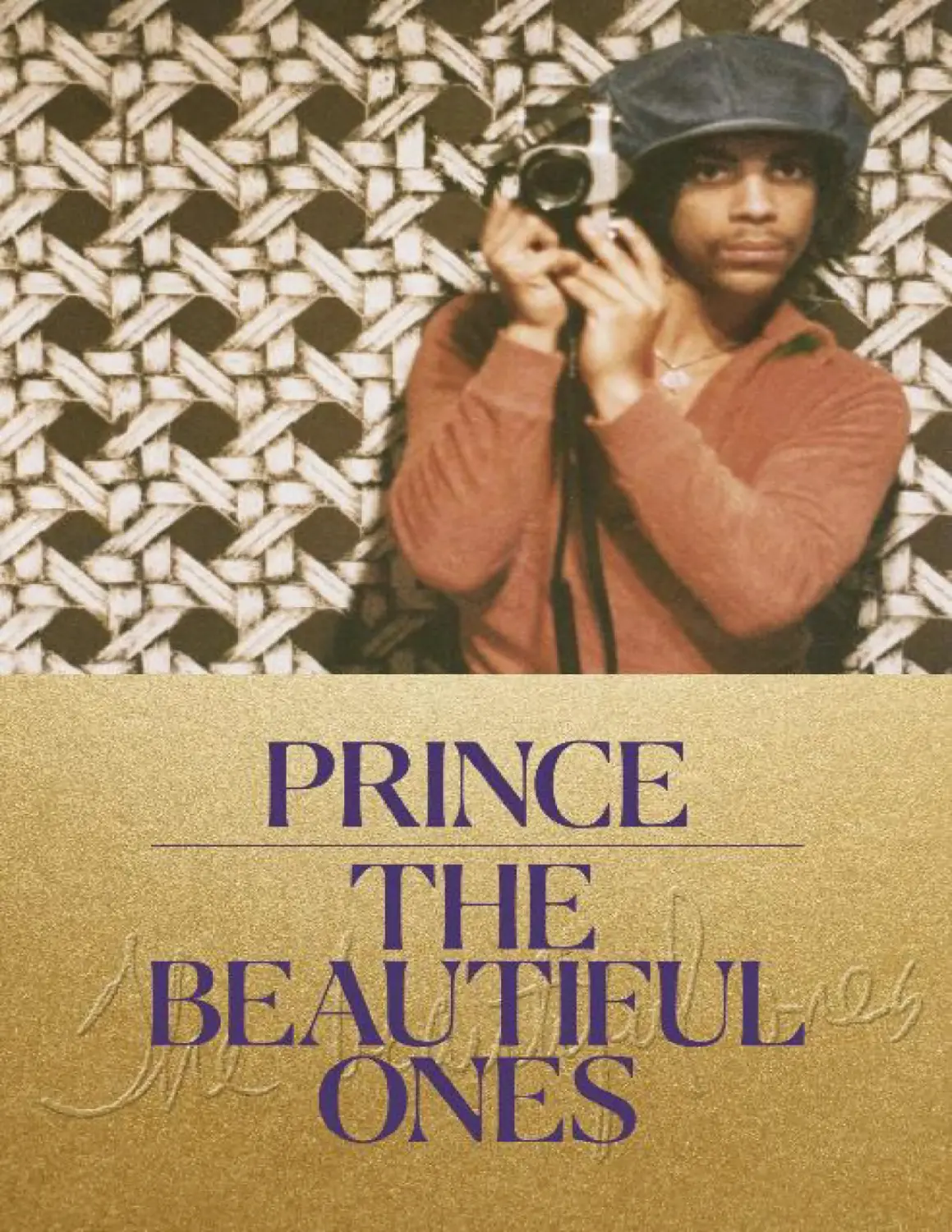


Tags: photoshop photography photo art dialogue the beautiful ones
ISBN: 9780399589652




Text
                    Copyright © 2019 by NPG Music Publishing LLC
All rights reserved.
Published in the United States by Spiegel & Grau, an imprint of Random House, a division of
Penguin Random House LLC, New York.
SPIEGEL & GRAU and colophon are registered trademarks of Penguin Random House LLC.
Text and photo credits are located on this page.
Hardback ISBN 9780399589652
Ebook ISBN 9780399589669
randomhousebooks.com
Designed by Triboro, adapted for ebook
Cover design: Triboro Studio
Art direction: Greg Mollica
Cover photograph: Prince Rogers Nelson
v5.4
prh

CONTENTS
INTRODUCTION
PART I.
THE BEAUTIFUL ONES
PART II.
FOR YOU
PART III.
CONTROVERSY
PART IV.
BABY I’M A STAR
NOTES AND GUIDE TO PHOTOS

I LAST SPOKE TO
PRINCE
on Sunday, April 17, 2016, four days before he died. That night I was lying
in bed when my phone shuddered and lit up with a 952 area code. He’d
never called my cell before, but I knew at once it was him. I scrambled for a
pen and paper and plugged my phone into the wall—my battery was almost
depleted. But my charging cord was only a foot long, so I couldn’t stand up
when I used the phone. I spent our final conversation hunched in the corner
of my bedroom, taking notes by pressing the paper to the floor.
“Hi, Dan,” he said, “it’s Prince.” Much has been written about Prince’s
speaking voice—the strange whispery fullness of it, reedy but low.
Nowhere was this paradox more apparent than in that simple introduction:
“Hi, Dan, it’s Prince.” He always used it. “I wanted to say that I’m alright,”
he said, “despite what the press would have you believe. They have to
exaggerate everything, you know.”
I had some idea. In the month since Prince had announced that “my
brother Dan” was helping him work on his memoir, I’d seen it reported that
I—twenty-eight years his junior, and white—was literally his brother. But
the news now was of another order of magnitude. A few days earlier,
Prince’s plane had made an emergency landing after departing Atlanta,
where he’d just finished what would be his final performance, part of a
searching, contemplative solo tour he called “Piano & A Microphone.”
He’d been hospitalized in Moline, Illinois, supposedly to treat a resilient
case of the flu.
Within hours of the story breaking on TMZ, Prince had tweeted from
Paisley Park, in Chanhassen, Minnesota, saying that he was listening to his
song “Controversy”—which begins, “I just can’t believe all the things
people say.” Subtext: He was fine. Some residents of Chanhassen had seen
him riding his bicycle. And the night before he called me, he’d thrown a
dance party on his private soundstage, using the opportunity to show off a
new purple guitar and a purple piano. “Wait a few days before you waste
any prayers,” he’d told the crowd.
“I was worried, but I saw on Twitter that you were okay,” I told him. “I
was sorry to hear you had the flu.”

“I had flu-like symptoms,” he said—a clarification that I’d dwell on a lot
in the months to come. “And my voice was raspy.” It still sounded that way
to me, as if he was recovering from a severe cold. But he didn’t want to
linger on the subject. He’d called to talk about the book.
“I wanted to ask: Do you believe in cellular memory?” He was speaking
of the idea that our bodies inherit our parents’ memories—that experience is
hereditary. “I was thinking about it because of reading the Bible,” he
explained. “The sins of the father. How is that possible without cellular
memory?”
The concept resonated in his own life, too. “My father had two families. I
was his second, and he wanted to do better with me than with his first son.
So he was very orderly, but my mother didn’t like that. She liked
spontaneity and excitement.”
Prince wanted to explain how he emerged as the synthesis of his parents.
Their conflict lived within him. In their discord, he heard a strange harmony
that inspired him to create. He was full of awe and insight about his mother
and father, about the way he embodied their union and disunion.
“One of my life’s dilemmas has been looking at this,” he told me as I sat
on my floor, scribbling away. “I like order, finality, and truth. But if I’m out
at a fancy dinner party or something, and the DJ puts on something
funky…”
“You’ll have to dance,” I said.
“Right. Like, listen to this.” He held the phone up to a studio monitor and
played a few bars of something that sounded boisterous, brassy, and earthy,
like a house party from many decades ago. “It’s funky, right? That’s from
Judith Hill’s new album. It’s the first time I’m hearing it.”
He paused for a moment. “We need to find a word,” he said, “for what
funk is.”

THE QUEST FOR THAT
WORD

was never far from Prince’s mind in those days. His asides to the crowds at
his Piano & A Microphone shows often found him reflecting on the
rudiments of funk. “The space in between the notes—that’s the good part,”
he would say. “However long the space is—that’s how funky it is. Or how
funky it ain’t.” Unpacking these ideas is part of what made him want to
write a book in the first place.
Though Prince had published several photo books, and though he’d
entertained the notion of something more substantial at various points in his
career, the genesis of this project came in late 2014, when his manager and
attorney, Phaedra Ellis-Lamkins, sought out a literary agent to represent
him. Prince chose Esther Newberg, of the talent agency ICM Partners. She
represented his friend Harry Belafonte, and he liked her old-school
sensibility—plus, she appealed to him as a matriarch in a patriarchal
industry. By early 2015, Prince had signed off on a concept, a book of lyrics
with his own introduction and annotations. Newberg and her colleague Dan
Kirschen shopped the idea to eager publishers, but Prince’s camp never
finalized a deal, and for most of 2015 he focused on music.
In mid-November, he turned to the book with renewed enthusiasm. “He
would like to fast-track a project,” Ellis-Lamkins wrote to Newberg.
Working with Trevor Guy, an aide who helped with business affairs, Prince,
Esther, and Dan expanded the book’s nebulous purview. What if it included
not just annotated lyrics but unpublished sketches, photos, and ephemera?
The word memoir wasn’t part of the conversation yet, but Prince wanted to
begin work on the project right away. Trevor suggested convening a group
of editors at Paisley Park to discuss it in person.
The book coincided with an inward turn in Prince’s music-making.
Having traveled the world in recent years with his electrifying band
3RDEYEGIRL, he was electing to play alone now. He envisioned a tour
comprising just him and his piano. The intimate, amorphous sets would
span his career without the constraints and pyrotechnics of an arena show.
Hosting a group of European journalists at Paisley Park, he explained that
he relished the thrill of taking the stage unadorned, paring his songs down
to their essential components and reinventing them on the fly. He’d been
practicing into the night, playing alone for hours on end, his piano filling
the vast darkness of his soundstage until he found something that he
described as “transcendence.” This was what he wanted to share.

He’d booked dates across Europe when terrorists in Paris attacked the
Bataclan, a concert hall he’d played three times. The violence, combined
with price gouging by ticket resellers, convinced him to scuttle the tour.
Why not just host the shows at Paisley Park? On his home turf, he could
mount a production befitting the price.
As Prince’s vision for Piano & A Microphone found clarity, his book
began to take shape, too. According to one friend, several of the people he
loved and admired were falling ill, making him conscious of his own
mortality. More than ever, he saw the value in telling his own story. On
January 11, 2016, a few weeks before he gave his first solo performance, he
invited three editors to meet with him at Paisley Park, where he’d explain
his ambitions and decide which publishing house he wanted to work with.
A meeting with multiple competing editors at the same time was an atypical
arrangement. And then there were all the rumors they’d heard: Didn’t he
bristle at questions about his past? Would he eject anyone who used
profanity, or demand a contribution to his swear jar? Was it true you
weren’t allowed to look him in the eye?
As soon as Prince walked into the meeting, any sense of trepidation
dissolved. He was charming, engaged, even self-deprecating. (“I ramble
sometimes,” he said.) For the next two hours, he presided over a
freewheeling discussion of his past, his musical philosophy, and his
aspirations for the book. He wanted to write a memoir, he declared—a
decision he’d arrived at so recently that even Trevor, who sat in on the
meeting, was surprised by it. It would be called The Beautiful Ones, after
one of the most naked, aching songs in his catalog.
The story would focus on his mother, whose gaze was “the first I ever
saw,” and who had never received proper credit for her role in his success.
He shared an assortment of objects with the assembled editors. He’d asked
his sister Tyka to send him old family photos, including many of his
parents, and a family tree. He’d also tracked down the original cover art for
1999, a collage ornamented with cutouts of a phone booth, a futuristic
skyline, and a nude woman with a horse’s head. And he presented the first
iteration of a screenplay, Dreams, that would become Purple Rain.
One of the editors asked Prince about songwriting. It was fundamentally
aspirational, he thought. You write where you want to go. From his earliest
memories, he told the group, he wrote music to imagine—and reimagine—

himself. Being an artist was a constant evolution, not to mention a form of
symbiosis with whoever or whatever surrounded you when you made
music. He’d created a persona almost as a prophetic act: He could become
the person he imagined. His whole life was an act of imagining, creating,
and becoming. Today having a persona is considered more or less essential
to superstardom; for Prince, it was inseparable from his identity as an artist.
Early on, he’d recognized the inherent mystery of this process, and the
power of preserving that mystery, or even further obscuring it.
“Mystery is a word for a reason,” he said. “It has a purpose.” The right
book could add new layers to his mystery, Prince thought, even as it
stripped others away. It would have to function as his autobiography, but in
a form that was sui generis, as capacious and shape-shifting as its author.
Never one to shrink from grand promises, he offered only one formal
guideline: It had to be the biggest music book of all time.
The meeting had no official conclusion. At some point, after cracking a
joke, Prince just got up and left, carrying himself out on peals of his own
laughter. He slipped into the room about ten minutes later with not a word
about his absence. Then he said it was time for dinner, and disappeared
again. The editors got excited—dinner with Prince!—before they realized
they weren’t invited, and he wasn’t coming back.

SOON AFTER THAT
MEETING,
Prince put on his first ever Piano & A Microphone show at Paisley Park,
executing the ideas he’d laid out a few months before. The show wove
storytelling and reflection into songs that stretched from his first record,
For You, to his most current, HITnRUN Phase Two. His spoken
contributions gave an idea of what was on his mind at the time. He was
processing his past. Only when I saw the footage more than a year later did
I see how this performance dovetailed with his ideas for The Beautiful
Ones.

As soon as he sat down at his piano that evening, Prince began a kind of
stream-of-consciousness regression. Suddenly he was a kid again, sharing
his earliest musical memories. “I wish I could play piano,” he told the
crowd in this childlike mode. “But I don’t know how to play piano.
Everything looks different. Three years old—the piano looks bigger at three
years old. Mmm…Maybe I’ll just watch TV.” He leaped onto his piano and
pantomimed eating popcorn in front of the television.
“Here comes Dad. Not supposed to touch it, and I wanna play it so
bad….There goes Dad. Him and Mom are getting divorced now.” Then he
added the second person to the mix, as if his father were in the room. “I’m
actually happy to see you go….I was only seven years old. But now: I can
play piano anytime I want.” Prince pounded out a few bars from the
original theme to Batman.
“Can’t play the piano like Dad, though,” he said. “How does Dad do that?
Let me see…I wish I could sing.” He added: “I thought I would never be
able to play like my dad, and he never missed an opportunity to remind me
of that. But we got along good. He was my best friend.” They used to take
turns playing Ray Charles’s “Unchain My Heart.”
Before this show, it would’ve been hard to imagine Prince uttering
anything so forthright onstage. That night’s set included “Sometimes I Feel
Like a Motherless Child,” a traditional spiritual that was also, in its way, an
expression of longing for the vanished world of his parents. He was “a long
way from home,” he sang. “Sometimes I feel like I’m almost gone.”
Maybe the barest assertion of melancholy came later in the evening.
“How many of you have lucid dreams?” he asked the crowd. “I like
dreaming now more than I used to. Some of my friends have passed away,
and I see them in my dreams. It’s like they’re here, and the dreams are just
like waking sometimes.”
There’s something about these lines, some combination of restful and
restive, that makes me sad now. It’s easy to put too much weight on these
things in hindsight, but they strike me as the thoughts of a man half in love
with easeful Death, to borrow a phrase. Then he sang the first line of
“Sometimes It Snows in April,” itself one of the most plangent songs in his
catalog. “Tracy died soon after a long-fought civil war…”

WITHIN DAYS OF
this—his first ever solo show, and arguably the most emotionally direct of
his career—Prince chose an editor for his memoir: Chris Jackson of Spiegel
& Grau, an imprint of Random House. He liked that Chris had worked on
Jay-Z’s book, Decoded. Not wanting to lose momentum, he enlisted Chris,
Trevor, and ICM’s Esther and Dan to help him find a cowriter. His former
manager Julia Ramadan had once told him, “When it comes to your life
story, don’t let anyone else hold the pen.” Now, it seemed, he was preparing
to do just that. No one, maybe not even Prince himself, was certain of how
the process would work.
This is when I got involved. Dan Kirschen, my agent, had known for
years of my admiration for Prince. He’d seen the poster in my bedroom;
he’d watched me sing “Kiss” at a karaoke bar; he’d let me show him clips
from the Sign o’ the Times concert film. Even so, when he told me that he’d
found himself in the happy position of seeking Prince’s cowriter, I don’t
think he was prepared for how abjectly I would beg to be in the running. He
agreed to put me on the list, but he didn’t mince words: The likelihood of
my getting the gig fell somewhere between winning the lottery and
surviving an asteroid impact. For one thing, I’d published zero books. At
the time, I was an editor at The Paris Review, a literary magazine that I
didn’t know if Prince had read or even heard of—no doubt his worst-selling
album had found a wider audience than the Review ever had. I was twentynine. Next to the more seasoned hands up for the job, many of whom had
loved Prince for longer than I’d been alive, I was a guaranteed also-ran.
But when ICM and Random House floated several high-profile
candidates, Prince demurred. He was in the habit of reading reviews of his
shows from nonprofessionals, especially the rhapsodic write-ups that fans
tweeted or posted on their blogs. These were the people he felt deserved the
job. As untested as they were, he’d inspired them to write, and they might
inspire him, too.
As one aide later recalled, Prince looked at the writing process through
the prism of music: He wanted an improvisational partner, someone he
could open up to and with whom he could arrange his story like a song or
an album. As long as the rapport was there, he’d sooner take on a dedicated
novice than a veteran. Of course, publishers would balk at the idea of hiring

some teenage Prince fanatic whose sole résumé item was a self-published
concert review. In the spirit of compromise, he returned the list of potential
cowriters and eliminated all but two names, mine being one of them. We
were the only ones who’d never published books.
Dan told me that Prince was now in possession of my phone number. I
should expect a call anytime, day or night. I started to sleep with my phone
beside my pillow, the ringer set ear-piercingly high. And I practiced my
greeting, ironing out any traces of exclamation that crept into my voice. My
aim was to sound as nonchalant as possible. “Hi, Prince.” “Hello, Prince.”
“Ah, is this Prince? Hey. Good to hear from you.”
But the call never came. Instead, Trevor devised an assignment. We
potential collaborators were to submit personal statements to Prince about
our relationship to his music, and why we thought we could do the job. I
submitted my statement at 8:30 that same night.
To call it heavy on flattery would be an understatement. There are parts
of it I’d write differently today if I had the chance. Certainly I never
intended it for anyone’s eyes but his. Here’s some of what I wrote:
When I listen to Prince, I feel like I’m breaking the law….My first
time driving alone in Baltimore, I switched on the radio and heard a
man singing about wanting to be a woman, baring this raw,
psychosexual wish to understand his girlfriend better—and it blew the
hinges off the door in my head. “For you naked I would dance a
ballet.” It was the most sensitive, singular, honest, dangerous piece of
music I’d ever heard. I half expected to get pulled over if anyone
caught me listening to it so closely….
If Prince wants to write a book, I want to help him write it: to put his
voice on the page….I’d see the project as an extension of the
songwriting—not as a kind of journalism or interview, but a chance to
find a new way of connecting with his audience, and beyond. People
might ask, Isn’t he too elusive to get on paper? There’s this idea that
nonfiction destroys the mystery of the author—but when it’s done well,
it only deepens that mystery. From my first encounter with Prince, over
the air-waves in Baltimore, I knew he was a master storyteller, an
ecstatic, transcendent original: To help him tell his stories in a new
mode would be a once-in-a-lifetime honor.

Trevor’s response came less than twelve hours later, at 2:23 in the
morning. “Is Dan Piepenbring available to meet with PRN at Paisley Park
on Friday evening (tomorrow)?” he wrote to Dan and Esther.
Dan, who was used to Paisley communiques arriving at ungodly hours,
read the note promptly and paced his apartment until the sun came up. Then
he kept calling me until I woke up. I whooped. He whooped. The next
morning, January 29, I was on a plane to Minneapolis.

IN A 1996 INTERVIEW
WITH OPRAH,
Prince explained why he stayed in Minnesota when most of his peers
favored life on the coasts: “It’s so cold, it keeps the bad people out.” Sure
enough, there was an entrenched layer of snow on the ground when I
landed, and it wasn’t just the bad people who were away—hardly anyone
seemed to be around at all.
Prince’s driver, Kim Pratt, picked me up at the airport in a big black
Escalade, wearing a plastic diamond the size of a Ring Pop. “Sometimes
you gotta femme it up,” she said.
My meeting at Paisley Park was still hours away—no one seemed to
know when, exactly—so Kim dropped me off at the Country Inn & Suites,
an unremarkable chain hotel in Chanhassen that served as a de facto Paisley
substation. One of Prince’s aides told me he’d lived there for so many years
that he’d broken the recumbent bicycle in the hotel’s fitness center.
Apparently Prince had paid for enough rooms there to have bought the
place four times over.
I was “on call” until further notice. I felt like I was joining a long and
august line of people who’d been made to wait by Prince, people who had
sat in rooms in this same hotel, maybe in this very room, quietly freaking
out just as I was quietly freaking out. I turned the television on. I turned the
television off. I had a mint tea. My room looked out onto sun-bleached
shingles, a pine tree, and a disused ladder. Since I knew photography was
strictly verboten at Paisley, I took a picture of this view instead.

Around 6:30, Kim texted to let me know she was picking me up. P—
everyone in the Paisleysphere called him “P,” I would discover—was ready
to see me.
The sun had set, so my first glimpse of Paisley came under cover of
darkness. From the outside, it’s disconcertingly unassuming. It was
illuminated by purple sconces when Kim drove up to it, but even so, I
would’ve believed that it was the regional headquarters of a defense
contractor, or a showroom for coextruded plastic products. There was
almost nothing around it—I had never fully appreciated how isolated it was.
I confessed to Kim that I was nervous, that my heart was racing. She
laughed it off.
“You’ll be fine,” she said as she parked in front of the complex.
My right hand was freezing. Mindful of the fact that Prince might soon be
shaking it, I sat on it to warm it up.
“He’s really sweet. You’ll see,” Kim said. “Actually, looks like you’ll see
now—that’s him at the door.”
And so it was. Prince was standing alone at the front door to Paisley Park
ready to introduce himself.
“Dan. Nice to meet you. I’m Prince.” His voice was full of calm, and
lower than I’d expected.
In the foyer, the lights were dim, and though preparations for the night’s
concert were underway not a hundred feet from us—Judith Hill was playing
in a few hours on the Paisley soundstage, followed by Morris Day and the
Time—this part of the complex was empty. The silence was broken only by
cooing doves, live ones, in a cage on the second floor. Scented candles
flickered from the corners; their sweetness dominated the room. Prince was
wearing a loose draped top in a marled sienna, with matching pants, a green
vest, and a pair of beaded necklaces. His afro was concealed beneath an
olive-green beanie. The sneakers he favored in his final years, white
platforms with light-up Lucite soles, flashed red as he led me up a short
flight of stairs and across a small skyway to a conference room.
“Are you hungry?” he asked.
“No, I’m okay,” I said, though I hadn’t eaten since morning.
“Too bad,” Prince said. “I’m starving.”
I winced. We’d exchanged fewer than a dozen words and already we
were out of alignment.

In the conference room, his trademark glyph was etched into a long glass
table. Toward the back, a heart-shaped couch sat beside a fern. On the
vaulted ceiling, a mural depicted a purple nebula bordered by piano keys.
Prince sat at the head of the table and told me to take the seat next to him—
a bit of instruction he always offered, I’d later notice. “Sit here.” He gave
the impression of someone who’d grown accustomed to choreographing the
space around him.
“Smells good in here,” I said.
“Yeah, I like candles,” Prince said.
First things first: Had I brought a copy of my statement? He wanted to go
over it together. I hadn’t, but I could read it from my phone, if he wanted. I
fumbled for it in my pocket, fearing that I was already in over my head. I
knew Prince did not suffer phones gladly. Mine had a cracked screen, which
I hoped would endear me to him. I cleared my throat and began: “When I
listen to Prince, I feel like I’m breaking the law.”
“Now, let me stop you right there,” Prince said. “Why did you write
that?”
It dawned on me that he might have flown me all the way out to
Minneapolis just to tell me that I knew nothing of his work.
“The music I make isn’t breaking the law, to me,” he said. “I write in
harmony. I’ve always lived in harmony—like this.” He gestured at the
room. “The candles.” He asked if I’d heard of the devil’s interval, or the
tritone: a combination of notes that created a brooding, menacing
dissonance. It reminded him of Led Zeppelin. Their kind of rock music,
bluesy and harsh, broke the rules of harmony. Robert Plant’s keening voice
—that sounded law-breaking to him as a kid. Not any of the music that he
and his friends made. Prince was serious about this, even grave. I tried to
make a joke about how some songs might qualify as misdemeanors while
others were capital crimes. He remained stone-faced.
Okay. We were off to a frosty start. Behind his sphinxlike features, I
could sense his skepticism about me. I tried to calm my nerves by making
as much eye contact as possible. Though his face was unlined and his skin
glowing, his eyes betrayed trace elements of fatigue. It came and went, but
it was there: a glassiness, a fleeting restlessness.
I kept reading my statement. To my relief, much of it sat better with him
than the first lines had. We spoke a lot about diction. Prince had developed

fastidious ideas about which words belonged in his orbit and which did not.
“Certain words don’t describe me,” he said. There were terms bandied
about in the white critical establishment that demonstrated a complete lack
of awareness of who he was. Actually, all the books about him were wrong
because they embraced these white critical terms. Alchemy was one. When
writers ascribed alchemical qualities to his music, they were ignoring the
literal meaning of the word, the dark art of turning metal into gold. He
would never do something like that. His object was harmony.
He reserved a special ire for the word magical. I’d used some version of
it in my statement.
“Funk is the opposite of magic,” he said. “Funk is about rules.” It was
human, the result of work and sweat—there was nothing magical about it.
He said he liked “some of the stuff” I wrote about him: about his origins,
correcting the record, finding a voice, preserving the mystery. Now he was
curious about the process. What did writing a book have in common with
writing an album? I could tell that he wanted to learn: to apply the same
diligence with craft and technique that he’d used to master so many
different instruments. He wanted to know the rules, so he could know if and
when to flout them.
Here our conversation, which lasted about ninety minutes, opened up a
bit, and we both started to enjoy ourselves more. Talks with Prince, I was
learning, were discursive affairs. Subjects would rise to the surface,
submerge a minute or two later, and come bubbling back up five minutes
after that. Invariably we touched on a handful of the same topics: God, love,
race in America, the duplicity of the music industry, and the elusive nature
of creativity, technology, and the past.
He said he was finished with making music, making records. “I’m sick of
playing the guitar, at least for now. I like the piano, but I hate the thought of
picking up the guitar.” What he really wanted to do was write. “I want to
write lots of books. It’s all up here,” he said, pointing to his temple. That’s
why he wanted to talk to writers and to work with a publisher. “I want my
first book to be better than my first album. I like my first album, but…” he
trailed off. “I’m a lot smarter than I was then.”
In fact, he was so bursting with ideas for his first book that he didn’t
know where to begin. Maybe he wanted to focus on scenes from his early
life, juxtaposed against moments set in the present day. Or maybe he

wanted to do a whole book on the inner workings of the music industry. Or
maybe he should write mainly about his mother: He’d been wanting to
articulate her role in his life.
Then there was the matter of tone. He had a skillful comic voice, and he
gravitated toward comedy. At the same time, he didn’t want something too
frothy. The book would have to surprise people—provoke them, motivate
them. Ideally it would become a form of cultural currency. “I want
something that’s passed around from friend to friend, like—do you know
Waking Life?” Richard Linklater’s surreal 2001 movie—I said I did. “You
don’t show that to all your friends, just the ones who can hang.” Books like
Miles Davis’s autobiography, or John Howard Griffin’s Black Like Me,
were natural touchstones, he thought.
First and foremost, the book would allow him to seize the narrative of his
own life. Once, he said, he’d seen a former employee of his on TV saying
she thought it was her God-given duty to preserve and protect the
unreleased material in his vault. “Now, that sounds like someone I should
call the police on,” he told me. “How is that not racist?” People were
always casting him—and all black artists—in a helpless role, he said, as if
he were incapable of managing himself. “I still have to brush my own
teeth.”
Similarly, he wanted to combat the notion that he was some “egotistical
maniac,” someone who got off on withholding the pleasures of his catalog
from the undeserving masses. Take “Extraloveable,” for instance—a song
that had finally appeared in 2011, though bootlegs had been making the
rounds since the eighties. “It wasn’t released in the eighties because it
wasn’t done. If any track is unreleased, it’s because it’s not done.”
If his story were properly told, he could exist in a new musical context.
He mentioned a writer who’d compared him to Bruce Springsteen. “Why?
No one has any of his albums here. No one listens to him. I don’t. You
might as well compare me to Billy Joel. Why aren’t they comparing me to
Sly Stone?” It went the other way, too. Every week, music journalists were
comparing a new musician to him. “When they don’t write, produce, play
every track—not many young players have the technical skill.” It bespoke a
lack of imagination, a diminished range. Musicians now could only be like
so many other musicians; the press wouldn’t reach for anything too obscure.
Prince recalled Santana, and the unique marketing of that band in the late

sixties and seventies—the way they dressed, their songwriting. “I don’t see
anything like that these days. And why aren’t I compared to Santana?”
To his mind, the dismal state of music could be blamed on Apple, who’d
cornered a distribution model that devalued artists; and on record labels,
which had locked themselves into an outmoded way of doing business. He
wanted to devote a chapter to both of them, to how out of touch record
executives could be. Not long ago, for a friend, he’d played a song by Betty
Davis, a funk singer who’d been briefly married to Miles Davis. Though the
friend was very knowledgeable, he’d never heard of her. “That’s a good
example of music in neglect, because labels are letting it rot, not knowing
how to distribute it or keep it alive.” You could see the problem just by
looking at Jimmy Iovine’s house, he said. Iovine, an industry mogul and
one of its highest earners, “has a guy whose job it is to control all his
remotes. Keep them with fresh batteries, make sure they all work.” Prince
imitated him: “ ‘Hey, you should come out to my house!’ Yeah, right….”
He noticed my phone still sitting on the conference room table, and his
trust seemed to falter for a moment. “That thing’s not on, is it?”
“No,” I said, sweeping it off the table. And it wasn’t. Though he never
made it explicit, I didn’t try to record him or take notes. (As soon as I got
back to my hotel room, I retraced as much of our conversation as possible;
I’ve used quotation marks only in cases of high confidence that I’ve
captured his remarks verbatim.)
As our conversation turned again toward chains of distribution and
questions of ownership, I saw that Prince’s dispute with Warner Bros.
remained one of the central traumas of his life, a lens through which he
understood questions of race, property, and creativity. With the help of his
lawyer, Ellis-Lamkins, he’d recently repossessed his master recordings
from Warner Bros., a victory that marked the beginning of the most
liberated phase of his life. All artists should own their masters, he said,
especially black artists. He saw it as a way to fight racism. Black
communities would restore wealth by amassing their master recordings.
And they would protect that wealth, hiring their own police, founding their
own schools, and forming bonds on their own terms.
The music industry had siloed black music from the start, he reminded
me. They’d promote black artists for the “black base,” and then, if they
captured that base, they would try to “cross over.” Billboard had developed

totally unnecessary charts to measure and quantify this division, and it
continued to this day, even if the “black charts” now masqueraded under
euphemisms like “R&B/Hip-Hop.”
“Why didn’t Warner Bros. ever think I could be president of the label?” It
never occurred to them that he could run his own operation. “I want to say
in a meeting with big record executives, ‘Okay, you’re racist.’ How would
you feel if I said that to you?” He settled his eyes on mine with a blazing
intensity that arose, I noticed, whenever he started to talk about the
recording industry’s treatment of black artists.
“Can we write a book that solves racism?” he asked.
Before I could say yes, or at least “we could try,” he broke in with
another question: “What do you think racism means?” This was one of
Prince’s rhetorical talents—a sudden, unprompted directness that forced
you to address questions usually considered too lofty for casual
conversation. I remember thinking what a refreshingly plainspoken question
it was. Then I realized I had to answer it.
After sputtering for a few seconds, I offered something like the dictionary
definition of racism: discrimination and oppression based on the idea that
someone’s race was inferior—plus all the structural, systemic,
institutionalized versions of the same. I don’t know what he thought of that;
he only nodded slightly. It may have been technically correct, but it was
gutless, the kind of studious, safe response that might fly at a job interview
with anyone other than Prince. He could’ve gotten a similar answer from
Siri. If our book was going to solve racism, describing it clinically wouldn’t
do the trick.
Prince shared some of his earliest memories of racism in Minneapolis.
His best friend growing up was Jewish. “He looked a lot like you,” he said.
One day someone threw a stone at the boy—the first racist act that Prince
could recall having witnessed. North Minneapolis was a black community,
so it wasn’t until a bit later, when he and others in his neighborhood were
bused to a predominantly white elementary school, that Prince felt racism
firsthand. In retrospect, he believed that Minnesota in the era of busing was
no more enlightened than segregationist Alabama; he’d sung scathingly
about the experience on 1992’s “The Sacrifice of Victor.”
“I went to school with the rich kids,” he told me, “who didn’t like having
me there.” When one of them called him the N-word, Prince threw a punch.

“I felt I had to. Luckily the guy ran away crying. But if there was a fight—
where would it end? Where should it end? How do you know when to
fight?”
Those questions became all the more tangled as racism took on insidious
shapes and hidden guises. “I mean, All Lives Matter, you understand the
irony in that,” he said, referring to an anti–Black Lives Matter slogan that
was finding some traction at the moment. I agreed; it missed the point
entirely.
“I’ll be honest, I don’t think you could write the book,” Prince told me at
one point. He thought I needed to know more about racism—to have felt it.
And going back to diction, he talked about hip-hop and the way it
transformed words. It takes white language—“your language”—and makes
it something white people can’t understand. Miles Davis, he reminded me,
believed in only two categories of thinking: the truth, and white bullshit.
And yet, a little later on, when we were discussing the music industry’s
many forms of dominion over artists, I said something that galvanized him.
I wondered what his interest in publishing a book was, given that the music
business had modeled itself on book publishing. Contracts, advances,
royalties, revenue splits, copyrights: Much of the ingrained approach to
intellectual property that he abhorred in record labels had its origins with
book publishers. His face lit up. “I can see myself typing that,” he said,
pantomiming a keyboard. “ ‘You may be wondering why I’m working
with…’ ”
All of this stands to address a question I’ve heard a lot since that day:
Why did Prince choose me? I don’t know. I’ll never know. There was never
a moment when he told me in clear terms why he felt we should work
together. At the end of that first conversation, I still didn’t know where I
stood with him. My sense is that what started as a stiff exchange had
evolved into something agreeably sinuous, the kind of talk you can imagine
continuing long into the night, touching glancingly on any number of
themes. It was an interview in the purest sense of the word, an exchange of
ideas. We’d been speaking for well over an hour when he paused for a
moment.
“Do you know what time it is?” he asked.
By that point, we were in such a rarefied place that I assumed he was
asking some kind of rhetorical question. No: He wanted to know literally

what time it was. I checked my phone and told him. That night’s concert
was soon to be underway on the sound-stage—it was time to wrap up our
meeting. He disappeared for a moment to call his driver, who was,
apparently, already engaged.
“It’s okay,” he said when he came back. “I’ll take you myself.”
I followed him out of the conference room and into an elevator where,
less than three months later, he would be found dead. It was an impossible
outcome to imagine. Vivacious, bouncing on the balls of his feet, he
reiterated his wish to write many books as he punched the button for the
bottom floor. “You got me hopped up on this industry talk,” he said. “But
I’m still thinking about writing on my mother.”
The elevator opened into a dimly lit basement. I had barely enough time
to notice the word Vault painted beside a nearby doorway before Prince led
me out to the garage. He was walking briskly toward a black Lincoln MKT,
but I noticed other cars and motorcycles, including a limousine and what
appeared to be a golden Cadillac.
Climbing into the Lincoln’s passenger seat, I noticed a fistful of loose
twenty-dollar bills in the cupholder. Prince activated the garage door and
we pulled out into Paisley’s main lot, now noticeably fuller than it had been
when I arrived. “Looks like people are starting to show up,” he said, like a
performer peeking from behind the curtain just before showtime. He
sounded genuinely excited, as if the thrill of putting a concert together had
lost none of its luster over time. There were a few people lingering in the
lot, but none of them seemed to realize that it was Prince driving past them;
no one was pointing or waving.
Turning out of Paisley, he picked up a good bit of speed and again
indulged his fixation on chains of distribution: who controls a piece of
intellectual property, and who makes money on it. “Tell Esther [Newberg,
of ICM] and Random House that I want to own my book. That you and I
would co-own it, take it to all the distribution channels.” We didn’t need
them to interfere in the publication process any more than was necessary, he
thought. We needed a process where the trust, responsibility, and
accountability were all ours, jointly. “I’m not counting your money; you’re
not counting mine.”
“No matter what you decide to do, if you ever want to talk about your
ideas, I’m happy to serve as a sounding board,” I said.

“I like your style,” he told me. “Just look at a word and see if it’s one I
would use. Because magic isn’t one I’d use. Magic is Michael’s word,” he
said. (Michael was Michael Jackson, whom Prince only referred to by his
first name.) “That’s what his music was about.”
That left me plenty of room for an obvious follow-up question: What is
your music about, then? I didn’t ask that question. I was more consumed by
the moment-to-moment reality of occupying a motor vehicle with Prince in
the driver’s seat. His posture, for instance: upright. His turn signaling:
impeccable. But wasn’t this exactly the sort of gee-whiz exoticizing that
he’d inveighed against a few minutes ago? He’d told me he brushed his
own teeth every morning. Why shouldn’t he have been an excellent driver?
To believe that everything around him was glazed in surrealism was
tantamount to believing in a kind of magic, too.
In the portico of the Country Inn, he put the car in park and we kept
talking. “I’ve never seen race, in a certain way—I’ve tried to be nice to
everyone,” he said. He seemed to think that too few of his white
contemporaries had the same evenhandedness, even as they feted him for it.
DeRay McKesson, a Black Lives Matter activist, had recently appeared on
Stephen Colbert’s Late Show for an interview in which the host had traded
places with the guest, inviting McKesson to sit in the interviewer’s chair.
“He’s a guy who’s trying to get it,” Prince said of Colbert. “Letterman
would’ve never done that. It’s time for him to sit down. Time for a lot of
people in the music business to sit down.” When it came time to sell and
promote this book, Prince wanted to deal only with the Colberts of the
world, people who understood that his business practices, however
unorthodox they might appear, were about empowerment and equality.
“There’s a lot of people who say you gotta learn to walk before you learn
to run. That’s slave talk to me. That’s something slaves would say.”
With that, he thanked me for my time, offered me a firm handshake, and
left me at the automatic doors to the Country Inn & Suites.

ABOUT AN HOUR
LATER,
following a bout of frenetic note-taking punctuated by celebratory dancing
and karate kicking, I was on my way back to Paisley. Prince’s assistant
Meron Bekure came to pick me up. And, inadvertently, she broadened my
impression of his autonomy: Though she had booked my flight, she had no
idea why I was there.
“So, you’re a…journalist?” she asked. “You’re here to do an interview?”
When I explained that Prince was intending to write a book, she seemed
surprised. But we didn’t have much time to sort it out—soon we were back
at the Paisley lot, now loaded with cars. Meron led me in through a side
entrance, past a security guard, and into a crush of revelers in the midst of
enjoying Judith Hill’s set. The soundstage was stupefyingly large, and I
couldn’t figure out how it connected to the part of the complex where I’d
met Prince earlier—the true labyrinthine vastness of the place was only
beginning to set in.
I saw no sign of Prince anywhere, but he must’ve seen me. A few
minutes after I arrived, a large man in a paisley suit jacket tapped me on the
shoulder. It was Kirk Johnson, Prince’s friend and bodyguard and the
Paisley Park facilities manager.
“Are you Dan?” he asked. “Prince would like you to join him in the VIP
stand.” Sure enough, there he was: draped inconspicuously across a couch
on a riser toward the back of the room, dressed more elegantly than he’d
been before. He indicated that I should take the seat beside him.
It was loud—Prince cupped my ear. “What do you think of the show so
far?” He pointed to a guitarist. “That’s Tony Maiden. Rufus’s guitarist. I
learned how to play rhythm guitar from him. I saw him earlier and gave him
a big hug. It was like hugging your elementary school teacher.”
Hill finished her set. Before long, Morris Day and the Time took the
stage: loud suits, gilded mirror, and all.
“We’re gonna play a slow song now,” Day told the crowd, before they
launched into “Girl.” “I bet y’all didn’t even know we had slow songs. See
if you remember this one.” Prince slid in close and cupped my ear again: “I
think I do.”

During “Ice Cream Castles,” he wrinkled his face up as if he’d just heard
a corny joke: “They’re not even trying to sing.”
Later, Day reminisced about “that yellow limousine—you know, the one
from Purple Rain. I think it’s in the basement here somewhere.”
Prince slid over again to whisper, “It ain’t.”
And during “The Walk”—another song he wrote—Prince played what I
can only describe as the most meticulous air bass I’ve ever seen. If someone
had approached with an actual bass and slipped it into his hands, I’m
confident it would’ve fit perfectly; he would’ve been hitting every note.
Between all this, he found the time to entertain the crowd and bring me a
bottle of water. Toward the finale of their set, though, he skittered off the
riser and disappeared without a farewell. As the crowd thinned, I realized
he wasn’t coming back—and that maybe my experience with him had
drawn to a close. We’d had an excellent night, but I had no idea if I was
getting the job or not. I also had no idea how I was getting back to the hotel.
A group of women approached me with a folded note.
“Will you give this to him?”
I thought of how best to explain. “To be honest, I’m not sure I’ll ever see
him again.”
They looked puzzled. “That’s okay. We might not, either.” One of them
pressed the note into my hand: a short expression of their undying
admiration, with names, email addresses, and phone numbers.
I went in search of Meron and was intercepted by Kirk, who came
bearing a message of his own: “He said to tell you he had a good time
talking and he’ll call you soon.” In exchange, I passed him the note I’d
received from the women.
No sooner had Meron dropped me off at the Country Inn than she called
to say that Prince wanted to call me very soon—in my hotel room, that
night. By now it was 2:30 in the morning. “What’s the room number?” she
asked. I ran out to the hall to make sure I was getting it right: 255. When we
hung up, I saw I’d left the door on the latch. In the time it took me to walk
over and close it, I missed a call from her on my cell. “Did I miss
something?” I texted. No answer. I stayed up till dawn, but Prince never
called that night.

AROUND FOUR
O’CLOCK
the next afternoon, having availed myself of one of Chanhassen’s fine chain
eateries, I was on the sidewalk outside the Country Inn when I saw him
again: Prince, at the wheel of his Lincoln MKT, pulling out of the hotel lot,
his afro looming disproportionately large in the driver’s side window. I
watched him idle at a traffic light in front of a bank, beside a dirty
snowdrift. For some reason, sighting him in the wild felt even stranger than
riding with him. What was he doing? Interviewing another writer, maybe,
or running some leisurely weekend errands? Then I worried that he’d called
my room, failed to reach me, and driven over to see where I’d gone.
When I got back to my room, I saw that Trevor had emailed a link from
Prince: a short video on Facebook about the continuing relevance of the
Doll Test, the famous experiment in which children, including black
children, associated a white doll with goodness, kindness, and beauty, and a
black doll with badness, cruelty, and ugliness. “Why is that doll ugly?” the
researcher asked a black child in the video. “Because he’s black,” the child
answered. The video was captioned: WE’RE DOING SOMETHING VERY WRONG.
I’d just reconciled myself to a Saturday night alone in Chanhassen when
Meron texted with a change of plans. There was to be a dance party at
Paisley, followed by a movie screening. She would pick me up.
The dance party, it turned out, was an employees-only affair: Meron,
Trevor, two members of 3RDEYEGIRL, and two musicians from Prince’s
newest recording project, the bassist MonoNeon and the saxophonist
Adrian Crutchfield. On a plinth surrounded by couches and candles was DJ
Kiss, who’d helmed the turntables at last night’s concert; she spun records
for just the seven of us in a high-ceilinged room adjacent to the soundstage.
An elaborate fruit plate had been set out. A mural of black jazz musicians
from Prince’s Rainbow Children era was on the wall; we stood on a huge
black rug with NPG Music Club on it, sometimes tripping over one of the
letters as it started to unpeel. A large silver
symbol was suspended from
the ceiling. On a stairway railing was the grille of an old car, the same one
from the Sign o’ the Times cover. And most impressively, two massive

projection screens were broadcasting Barbarella on repeat. Twin versions
of Jane Fonda, thirty feet tall, strutted around a foreign planet in formfitting
futurewear.
There were whispers that Prince might join us that night on the dance
floor, such as it was, but he never appeared. Instead, Meron slipped off to
return holding a bundle of our coats, and announced that it was time for the
movie.
“I thought this was the movie,” I said, gesturing at one of the writhing
Jane Fondas.
“Oh, no!” she said. “We’re seeing Kung Fu Panda 3.”
Apparently, Prince regularly arranged for private after-hours screenings at
the nearby Chanhassen Cinema. We headed over in two cars and found a
lone attendant in the empty parking lot ready to unlock the door.
Prince arrived just after the movie began, slipping into the back row.
“Meron,” he asked, “is there popcorn?” She went out to fetch some. We
watched as the animated panda ate many dumplings and relegated evildoers
to the Spirit Realm. I heard Prince laugh a few times. As the credits rolled,
he rose without a word, skipping down the stairs and out of the theater, his
sneakers shining laser-red in the darkness.

A LOT OF PRINCE
ASSOCIATES HAVE A
SIMILAR STORY:
They were never officially hired. Prince simply told you to show up again,
and you did.
Two days after I returned from Minneapolis, Phaedra Ellis-Lamkins
wrote to the agents at ICM: Prince was about to take Piano & A
Microphone on tour in Australia. As long as it was okay with Random
House, he wanted me to join him for the first leg, in Melbourne. With
characteristic humbleness, he’d promised The Sydney Morning Herald that
the shows would be “like watching me give birth to a new galaxy every

night.” The tour kicked off the following week. I packed my bags and told
my boss I needed a week off to witness the birth of at least two new
galaxies.
I arrived in Melbourne on February 16, the day of Prince’s first show at
the State Theatre. Kirk, who was staying in the room next door to mine at
Crown Towers, told me I could expect a call from Prince under the alias
Peter Bravestrong—his preferred pseudonym, apparently, for traveling
incognito. Later, at Paisley, I’d see that even his luggage was tagged “Peter
Bravestrong.” I liked how obviously, almost defiantly, fictitious it sounded.
Its comic-book gaudiness was in keeping with some of his past alter egos:
Jamie Starr, Alexander Nevermind, Joey Coco. You could imagine them
fighting crime together in a grim, neon city.
My room afforded a regal view of the Yarra River, trellised with bridges
and decked out in red paper lanterns for the Lunar New Year. Around 12:30,
the phone on my bedside table lit up with MR PETER BRAVESTRONG.
“Hi, Dan, it’s Prince.”
“Hello! How are you?”
“I’ve been better. I just got some sad news.” I could tell. I asked what the
matter was.
“It’s, I’d—I’d rather not deal with it right now,” he said. “I’m just going
to get ready to play the show tonight, and I’ll see you tomorrow?”
“Of course. That sounds fine.”
He brightened a bit. “I have a lot of stuff to show you.”
“I’m looking forward to it,” I said.
“Okay, I’ll see you at the show tonight. Goodbye.”
I googled “Prince” and found news outlets reporting that Denise
Matthews, better known as Vanity, was dead at fifty-seven—Prince’s age. In
the early eighties, the two had fallen in love, and Prince had tapped her to
front the group Vanity 6. She was slated to appear in Purple Rain when
their relationship fell apart.
Vanity’s death shook Prince, and her memory loomed large at the first of
the Piano & A Microphone shows at the State Theatre that evening. The
stage set already had a touch of séance to it, though Prince might not
endorse such an occultist comparison. Long, low tiers of candles burned at
intervals around the piano, light poured in a velvety haze from the ceiling,
and fractals purled and oozed on a screen at the back of the stage. As soon

as he sat down at the piano and the cheers faded, he said: “I just found out
someone dear to us has passed away. I’m gonna dedicate this song to her.”
He played a hybrid of “Little Red Corvette” and “Dirty Mind.”
Later, during “The Ladder”—a song he’d written with his father—he
made an on-the-fly adjustment to the lyrics: “He had a subject named
Vanity. He loved her with a passion uncontested. But one day her smile
went away.”
The concert was nourishing. There was something wintry about it, or
insular, that reminded me of people huddling for warmth against the cold. It
was powerful to see Prince so visibly alone, figuring out what made his
songs tick in real time. Whatever had compelled him to delete the bass line
to “When Doves Cry” all those years ago was the same force moving him
during these performances, showing off his flair for deconstruction, letting
the crowd see the constituent pieces of his music. Sometimes he would leap
up from the piano and walk away from it, like he was too much in awe of it.
There was some stagecraft here, no doubt, but truth, too.
“I’m new to this playing alone,” he said toward the end of the show. “I
thank you all for being patient. I’m trying to stay focused—it’s a little
heavy for me tonight.” He paused before beginning the next song: “The
Beautiful Ones.” “She knows about this one,” he said.

THE NEXT DAY,
fortified with a carafe of coffee and the kind of room-service breakfast that
delivers a day’s supply of calories in one fell swoop, I followed Kirk up to
Peter Bravestrong’s suite, where Prince had secreted himself away in the
bedroom. Kirk conferred in private with him—I actually never saw him
face-to-face that afternoon. Instead, Kirk pointed me toward a desk in the
main room, where I sat before an Office Depot legal pad with about thirty
pages penciled in a messy script, rife with erasures and rewrites.
“He said he wants you to read that,” Kirk said. “And then later he’ll talk
to you about it.” There was a pad of hotel stationery nearby where I could
leave questions for him. Kirk left me to it—he’d check in after half an hour
or so.

The few people who’ve seen these pages since then have usually asked
one question: How could I read them? Prince’s handwriting was beautiful,
with a fluidity that suggested it poured out of him almost involuntarily, like
his music. But it also verged on illegible.
As it turned out, when you know that Prince is sitting in another room
mere feet away—I could hear the TV, and occasional footsteps—waiting for
your feedback, and that he’s flown you halfway around the world just to
garner that feedback, you can learn to read his handwriting very quickly. I
found that it was almost like a Magic Eye illusion. Once you stared at it, the
words coalesced in front of you.
And they were good words: the first chapters of his memoir.
Even in longhand, he wrote with his signature abbreviations, those
precursors to textspeak he’d perfected back in the eighties:
for I, U for
you, R for are, and so on. I feared a distant showdown between author and
publisher on this count—I could practically hear the tense phone call in
which some industry bigwig tried to convince Prince that only the true
devotees would suffer through hundreds of pages of 2s and Cs. Which side
was
on? Weirdly, after the first page, I was kind of into it. Though it
seemed distant and alien at first, soon it helped me hear him.
I hadn’t expected him to write anything at all, let alone something this
assured. The pages were warm, funny, well observed, eloquent. I was
floored. Given how scattered his conversation could sometimes become, his
voice in these pages was surprisingly focused. This was Prince the
raconteur, in a storytelling mode reminiscent of his more narrative songs,
like “The Ballad of Dorothy Parker” or “Raspberry Beret,” or the
unreleased “Coco Boys.”
He’d written about his childhood and adolescence in Minneapolis,
starting with his first memory: his mother winking at him. I flipped through
the pages to find a bevy of stories about his early life, all of them sensory,
almost tactile. He recalled his favorite shirts of his dad’s, the way his
parents seemed to outdo each other sartorially. He summoned his first kiss,
playing house with a girl in his neighborhood. He described the epilepsy he
suffered as a kid. I’d worried that he’d shy away from more explicit details
—he’d stopped playing his raciest hits—but his sexual development seemed
very much on his mind. His first time feeling a girl up; his first time at an
R-rated movie; a girlfriend slamming his locker shut, “like in a John

Hughes film,” just to hold mistletoe over his head and kiss him; it was all
there, interspersed with his philosophy about music. “A good ballad should
always put U in the mood 4 making love,” he wrote.
I left a few questions and some compliments on the pad beside me, trying
to keep it light—a litany of nitpicking seemed a sure way to get myself sent
back to America prematurely. After I finished reading, Kirk took me to my
room and told me to call Peter Bravestrong.
“So what’d you think?” Prince asked when he picked up.
“They’re good. They’re honestly really good. I’m not just saying this to
inflate your ego.”
“I don’t think you could if you tried,” he said with a laugh.
We touched on a few spots where I was confused or thought he could
give the reader a better sense of place. He said he’d want me to draw him
out on the bigger-picture stuff, too, and the exact timeline for the events he
described.
“Coming at this as a songwriter, certain details don’t feel relevant,” he
explained. He also worried that some passages might not sit well with
certain readers, especially one on his aunt’s excessive religion. “It could be
—what’s the word—polarizing. Maybe it’s good to be polarizing, I don’t
know.”
I told him it was definitely good—he’d written a song called
“Controversy,” after all. I wondered when he’d written so much, and how
long it took. He’d only decided on an editor, a cowriter, and a concept in the
past month. He hadn’t even signed a contract yet. But his work, already so
polished, seemed to have emerged overnight. A friend would later tell me
Prince was so excited about these pages that he’d read passages to her over
the phone.
“Why don’t you call Random House,” he said. “Tell them we need some
money for this thing, so we can announce it and start preselling it—because
that will move tickets. I can feel myself getting amped up about this.” And
so could I: Whatever listlessness he’d felt yesterday had dissipated.
“Anyway, thanks for coming all the way out here,” he said.
“Oh, no problem,” I said automatically. I did not ask him why I’d spent
roughly twenty-three hours in the air just to conduct a meeting with him
over the phone.

Fortunately, there was more to come. That night I returned to the State
Theatre for the later Piano & A Microphone show. True to form, he’d
switched up the set list, and he’d worked in some new stories throughout.
He recalled the enchanting sight of his father’s right hand playing the piano
—his desperation to be able to do that—and the interior life he’d developed
at a young age, set against the rhythm of North Minneapolis. On
interminable Sunday mornings, he’d have to sit through church and a trip to
the bakery afterward. “What you hear is true. Black church services last too
long.” “Are we there yet?” he remembered asking. Meaning: home, where
he could watch The Wizard of Oz and try to figure out why he liked “Over
the Rainbow” so much.
“I was studying my father, studying my mother,” he said. “If you know
where you’re from, know what time it is, you’ll get where you’re going.”
After the show, Kirk texted. Prince wanted me at the afterparty, which
would soon be underway at Aria, a waterfront bar. I showed up to find a
well-heeled crowd already swarming the place, which was swathed in
purple light for the occasion. A line stretched around the corner. Inside, it
was chintzed out with faux-crystal chandeliers and, over the bartenders, the
same stock photo of a Red Bull and vodka, repeated three times. The room
had the tense, promissory energy of a New Year’s Eve party at 11:30, with
the caveat that midnight—in this case, Prince—might never come.
Maybe ninety minutes later, Prince strutted in through the back entrance
—his cane enhanced his royal affect—and beckoned to me from the other
side of a velvet rope.
“I was in a different mood tonight,” Prince said when I asked him how he
felt about the show. He’d been happier, less aware of himself. We were
seated on a plush couch with a marble tray of chocolate-covered
strawberries in front of us, and Kirk standing guard; the concert’s promoters
sat on the other side. Prince managed the not-uncomplicated task of
carrying on conversations with all of us at once, all while bobbing his head
more than negligibly to the Ohio Players and giving the crowd something to
cheer about.
“I was happy to hear ‘Purple Music,’ ” I said. It was an unreleased track
from 1982 in perennial circulation among bootleggers—and, by
coincidence, the one I’d listened to most since I’d first found out that I was
up for the cowriting job.

Prince nodded. He seemed happy I’d recognized it. “That was the first
time I’ve played that song live,” he said. “Someone said they recorded it. I
might just release it.”
But that expansive attitude didn’t apply to every song in his backlist.
When the DJ put on “Head,” one of his more obscene numbers, he had it
turned off right away. Then he wanted to talk business. He sat forward and
gripped his cane with both hands. He was wearing black leather gloves with
his symbol on them.
“Have you talked to Random House?”
I said I’d told them about the pages he wrote.
“You have power now,” he said. “Learn to wield it. It’s you, it’s me, and
it’s them. Convince them that they need to put everything behind me. Even
just for a little. I don’t want them publishing this like it’s some book of
poetry.”
“They won’t,” I said. “Even if you think that book publishing can be
sleepy—”
“Not anymore,” he said. He locked eyes with me. “I trust you. Tell them I
trust you.”
I was awed and overwhelmed. It felt like I’d wandered onto the path of
someone else’s life, and that, sooner or later, some cosmic course correction
would ensure that things went back to normal. I ate a chocolate-covered
strawberry.
“I’ll look at your notes and address them point by point. Get a
stenographer,” he told me. “I’d prefer it to be a woman. Or—you can just
type it yourself. I’ll give you the pages. I’ll trust you with the paper.”
He went out and danced with the crowd for a minute, then popped back
behind the velvet rope. After whispering and smiling with Kirk, he pointed
his head toward a woman wearing a leopard-print dress: “Kirk says he
wants you to get Leopard Print’s phone number.” He brought her up again a
few minutes later. “Shouldn’t you be out there dancing with Leopard Print?
Are you married?”
What a strange thing trust is, I thought. Prince had promised to give me
the first and only pages he’d written about his life; he didn’t even know if I
was married. I found this heartening. Maybe it was cavalier, but all he
needed in the way of a background check was a long, honest conversation
with someone.

At about three in the morning, we left Aria through the kitchen. In the
service garage, an Audi SUV was waiting for us. Prince and I sat in the
back as we drove through the hush of Melbourne in the wee hours. After the
unrelenting volume and histrionics of the bar, the silence was welcome; I
found I had nothing to say that was worth breaking it. Prince gazed out the
window at the shuttered shops, the empty streets. I felt like we were the
only people in the city.
“We should do a golden ticket promotion,” he said after a few minutes of
quiet. “Put the book together with some other prize—maybe we play a
concert for the winner. Make the winner tell their own story.”
He sounded exhausted, like he couldn’t turn his mind off. It was always
working through things like this: The promotion of the project, the project’s
reception in the world, existed parallel to the thing itself for him. He would
discuss the marketing of the book as often as the writing, always with a
nimble, try-anything-once approach to entrepreneurship that reminded me
of an effective small business owner more than an international superstar.
The car pulled in to Crown Towers through a VIP entrance that snaked
below the hotel to a secret bank of underground elevators. Of course such
places existed; of course I’d never thought to consider that they did. A
doorman stationed at the elevator welcomed us back.
“I won’t let you get lost,” Kirk said as we soared upward. The silence felt
even more total now.
“I like the quiet of hotels at this hour,” I said. “All the long carpeted
corridors, no one around. There’s something weirdly appealing about
wandering hotel halls late at night.”
Prince gave a sly smile. “I’ve done it many times.”

ON FRIDAY,
we arranged for Prince to give me what Kirk called “the tools that you
need.” He led me back to Peter Bravestrong’s suite—or “villa,” as Crown
Towers branding referred to it—and what I thought would be a simple
handoff became a two-hour conversation, the most probing, unguarded talk
we ever had. Prince, wearing a loose-fitting rainbow-colored top with his

face and afro on it, sat me down at the same desk where I’d read his pages.
There were a few packs of hairnets off to the side. “Sit here,” he said again,
bringing over a pen and paper. He encouraged me to take notes; sometimes
he even told me to be sure I’d written something down.
He wondered how I thought the book should begin: if it’d be best to start
in the middle with a story or at the beginning. We could even have a story
on the cover, if we wanted. And should it start with his voice or mine? I
said I thought it was simplest to start at the beginning—that he’d chosen a
lovely opening, with his mother’s eyes.
“Music is healing,” he said. “Write that down first.” This was to be our
guiding principle. “Music holds things together.”
Then we went through what he’d written page by page, addressing the
notes I’d left and talking about his story more broadly.
As we spoke, Prince, in higher spirits than I’d ever seen him before,
began to improvise about all the shapes the book could take, all it could
contain, the message it could deliver. Since we’d spoken at Paisley, his
ambitions had been amplified ten-fold—an impressive feat, given that he’d
started off wanting to end racism. “The book should be a handbook for the
brilliant community: wrapped in autobiography, wrapped in biography,” he
said. “It should teach that what you create is yours. Say, ‘We’ve got this if
we’re left alone.’ ” He remembered “a dude in my community ten times
smarter than me,” though he didn’t want to name him in the book. “What if
he had the opportunities the Bush daughters had?” It was incumbent on us
to help people, especially young black artists, realize the power and agency
they had.
I liked the idea of regarding the memoir as a kind of handbook. It was a
perfect way to expand its remit, to add another dimension to its storytelling.
And it gave another layer of meaning to the title, The Beautiful Ones, which
could now denote an entire community of creators—the song did contain
the lines “Paint a perfect picture / bring to life a vision in one’s mind…” (I
know what you’re thinking. Just don’t pay attention to the lyrics that come
next.)
“Keep what you make,” Prince said more than once. “I stayed in
Minneapolis because Minneapolis made me. You have to give back. My dad
came to Minneapolis from Cotton Valley, Louisiana. He learned in the
harshest conditions what it means to control wealth. ‘Black Muse’ is about

that, creating wealth in the inner city,” he said, referring to a song on his
new album, HITnRUN Phase Two. “Stopping eminent domain.”
He wanted to teach readers about Black Wall Street, a wellspring of black
entrepreneurship that flourished in Tulsa, Oklahoma in the early twentieth
century. After the Civil War, as freed blacks flocked to booming Tulsa and
bought land, segregation forced them to the city’s Greenwood
neighborhood, where their proprietorship and ingenuity created a thriving
community. Soon Greenwood boasted hundreds of black-owned businesses,
plus nearly two dozen churches, a school, and a public library. It became
one of the first and most essential examples of black prosperity in the
United States. “It’s amazing,” Prince said, “the wealth amassing. I love
reading about the Civil War and the amassing of wealth, when the South
became wealthier than Britain.” Then came Tulsa’s 1921 race massacre:
Their hatred fanned by accusations that a black boy had raped a white girl,
thousands of armed whites doused Greenwood in kerosene and burned it
down block by block, looting and plundering as they went. Hundreds died;
thousands more lost their homes. Black Wall Street was decimated.
“The Fountainhead,” Prince said. “Did you read that? What’d you think
of it?” I said I didn’t like it—that I had no patience for objectivism, nor for
Ayn Rand’s present-day acolytes, with their almost farcical devotion to the
free market and unfettered individualism. Prince agreed, though he saw
how the philosophy could be seductive. “I watched the movie, old, blackand-white, where he gives the speech at the end about burning down the
building and the blueprints….” It was a pivotal moment in Randian
philosophy: “No work is ever done collectively,” her character Howard
Roark sneers. Prince worried that too much of hip-hop was in the thrall of
ideas like Rand’s, dedicated more to cutthroat self-absorption than a spirit
of community.
“We need a book that talks to the aristocrats,” he said. “Not just the fans.
We have to dismantle The Fountainhead brick by brick. It’s like the
aristocrat’s bible. It’s a compound of problems. They basically want to
eliminate paradise. What about white supremacy, and what it has in
common with objectivism? Is it satanic? Is it really the greater good? We
should attack the whole notion of supremacy.” The purity of its original
meaning had been corrupted, he thought. “There used to be bands called the

Supremes! Supremacy is about, everything flourishes, everything is
nourished.”
That’s why he felt he needed my voice in the book, too: A radical call for
collective ownership, for black creativity, couldn’t be made alone. “When I
say, ‘I own Purple Rain,’ I sound…like Kanye.” He paused. “Who I
consider a friend.” The problem was that statements of ownership too often
read as self-aggrandizing. It was more powerful to hear them from other
people. “You need to say I own Purple Rain,” he said—though he was still
amazed that there could be any dissenting opinion on the subject. “For
someone to say, ‘I control Purple Rain,’ it’s—blasphemous.”
To that end, he wanted to find some formal devices that would make the
book unique, a symbiosis of his words and mine, its authorship in a state of
flux. “It would be dope if, toward the end, our voices started to blend,” he
said. “In the beginning they’re distinct, but by the end we’re both writing.”
When we discussed the passage he’d written about his childhood bouts with
epilepsy, he said, “I’m just vamping here. We could use seizures as a way of
blending our voices. Blackouts. ‘Here comes another blackout.’ ”
I was exhilarated. We were on our way to building something unique, a
memoir that defied conventions. He was already thinking about what the
cover might be. He’d had a new passport photo taken, and it had gone viral.
Of course it had: His lips in a gentle pout, his eyeliner perfect, every hair in
his moustache manicured to perfection, he seemed to be daring the customs
officials of the world to give him a kiss instead of a stamp. “I asked Meron
—you know Meron, right?—to make sure it was on my actual passport. She
said, ‘I did it.’ Then I tweeted it and they featured it on CNN and in Time
magazine. Maybe we should have that on the cover,” he joked, “with all my
info and stuff. We need this to get weird.”
There was a strong positive energy in the room. A lot of laughter. A sense
that we were going to surprise people. “Brother to brother,” Prince said,
“it’s good to be controversial.” This was a confident about-face from his
remarks a few days ago. “We were brought together to do this. There was a
process of elimination. To do this, it takes a personality not fighting against
what I’m trying to do. You know a lot more words than I do. Write this
thing like you want to win the Pulitzer and then—” He pantomimed
smashing the Pulitzer on the desk. Comparing me to Norman Mailer trying
to understand Muhammad Ali, he said, “I can tell you’re like one of those

sixties rock writers. You need to go into your third eye….It’s good to see
that you’re willing to take the plunge. Because people are gonna ask
questions.”
He thumbed about half of the pages he’d written, tore them out of the
legal pad, and gave them to me, urging me to write more on—anything.
“I’ll keep going with my stuff but you, you’ve got the good stuff. I’m
excited about that.” He stood and we walked to the door of the Bravestrong
Villa.
“This was helpful to me,” he said. “I have a clearer understanding of what
we have to do. Talk to Chris and Random House. Tell me what they say.”
He gave me a hug goodbye. “Talk to you soon.”
Suddenly my nose was in his hair, and I could smell his perfume. You
could never not smell his perfume, granted, but now it was on me—I spent
the rest of the day catching whiffs of him, trying to process all of it,
everything he’d said. I don’t know how to describe the scent: I can’t say
that it had top notes of cinnamon or anything like that. It was just his, his
scent, in that proprietary-olfactory way. I was in the antipodes and I smelled
like Prince. What? How? It put me in mind of the first line from
“Mountains”: “Once upon a time, in a land called fantasy…”
I’d always known that Prince had a lot of protégés; I’d never thought
about why, really. He was a preternatural talent, and, more cynically, it was
an easy way for him to charm women. But plenty of brilliant musicians
never took anyone under their wings. It’d never occurred to me that
grooming artists took some didactic skill, some specific subvariety of
leadership. Prince understood the delicate mechanism of self-confidence.
He could quell the chorus of doubts in people’s heads—could make you
settle into your own potential. Later I’d read something that Gwen Stefani
remembered him saying: “ ‘Have you ever just tried writing a hit? Like,
don’t just try writing a song, try and write a hit song.’ I remember him
saying that and me thinking, Yeah, you’re right. Why would you write
anything else?”
“If I want this book to be about one overarching thing,” Prince told me
that day, “it’s freedom. And the freedom to create autonomously. Without
anyone telling you what to do or how or why.” It was summer in
Melbourne, and the next day I’d be back on a plane to frigid New York. I
spent hours walking along the sunny river with his words in my head,

listening to the Ohio Players’ “Skin Tight” at a deafening volume. (“The
bass & drums on this record would make Stephen Hawking dance,” Prince
had written in the pages he showed me. “No disrespect—it’s just that
funky.”) I guess I looked like I knew where I was going; tourists kept
stopping me to ask for directions.

ONCE I GOT BACK TO
NEW YORK,
I didn’t see Prince for a little more than a month. Through Kirk, he’d email
me things: fawning reviews of his shows, an insightful NPR piece about his
vexed relationship with technology, an Instagram photo of him, a tweet
about him. Meanwhile, he was in the midst of tense negotiations with
Random House. His book contract was deviating far from the boilerplate,
and there was still no guarantee that he’d sign it at all. At one point, he
called Chris Jackson, his editor, at home, and asked if they could just
publish the book without contracts or lawyers. As Chris recalled: “I said I’d
love to, but the company can’t cut a check without a contract in place. He
paused and said, ‘I’ll call you back.’ And he did—with some fine points for
the contract.”
As the back-and-forth stretched into mid-March, Prince began to dangle
the possibility of a surprise event in New York. If they could wrap up
negotiations by Friday, March 18, they could announce the memoir at a
secret concert that very night. With the day approaching, staffers at Random
House and ICM made frantic arrangements for a location and cobbled
together an invitation list. There was one contractual sticking point to
resolve before the announcement: Prince wanted to reserve the right to pull
the book from shelves, permanently, at any time in the future, should he
ever feel that it no longer reflected who he was. The question was how
much he’d have to pay Random House to do so. On Friday, after a three-orfour-day volley of offers and counteroffers, they settled on a figure, and
Prince hopped on a plane. At 4:40 P.M., he tweeted, “Y IS PRINCE IN NEW
YORK RIGHT NOW?!”

By eight that evening, a crowd of maybe a hundred and fifty people had
convened to hear the answer. He made the announcement at Avenue, a
narrow, dusky club on Tenth Avenue, in Chelsea. His friend Harry
Belafonte was in attendance, as were Spike Lee, Trevor Noah, Gayle King,
Maxwell, and the cast of Hamilton. He’d also brought along his personal
DJ, Pam the Funkstress—or Purple Pam, as he called her—who was
spinning eighties-era tracks that made the walls shake. As usual, cellphones
were forbidden, but complimentary glasses of champagne were on offer at
the bar. Prince’s publicist had told me that my name would probably be kept
out of the announcement; I wasn’t supposed to talk to the media, and I’d
signed a nondisclosure agreement. Still, I was nervous. I’d never been in a
situation where it was even possible that I’d be buttonholed by reporters.
The lights flashed red and the music stopped. Prince descended a
stairway high above the crowd and stood at the second-floor balcony,
leaning on its Plexiglas barrier. I saw Kirk and Meron with him. In effulgent
gold and purple stripes, looming over us, he looked like a nobleman
prepared to address the peasantry.
“You all still read books, right?” he asked. The crowd cheered. “The good
people of Random House have made me an offer I can’t refuse.” He was
writing a memoir. “This is my first. My brother Dan is helping me with it.
He’s a good critic, and that’s what I need. He’s not a yes-man at all, and
he’s really helping me get through this,” Prince said.
“We’re starting from the beginning, from my first memory, and hopefully
we can go all the way up to the Super Bowl,” he said. This was news to me
—we’d never discussed the Super Bowl. “We’re working as fast as we can.
The working title is The Beautiful Ones.” The spotlight on him was glaring;
he took out a pair of bulbous sunglasses that looked like arachnid eyes.
“Now I can see better,” he said, putting them on. “I literally just got off the
plane. I’m gonna go home and change and put some dancing clothes on.
Props to my brother Harry Belafonte.”
He disappeared and the music started again. I stood there in a daze,
failing to recognize at least three people I’d met multiple times before. It
was real now—he’d said it—and soon, I imagined, we’d go off somewhere
and apply ourselves to the messy, heady task of getting his life on paper.
A short while later, Prince returned and began his performance. The
forty-five-minute show was what Prince enthusiasts had come to call “the

sampler set,” in which he cued up the backing tracks to a medley of his
greatest hits and sang live over them. Everybody danced; my mood buoyed.
The songs were peppered with such Princely interjections as “We want to
thank Random House. Ain’t nothing random about this funk!” and “Check
your mailbox. There might be some funk in there.” I still hear him saying it
when I check my mail. Not nearly often enough is any funk to be found.

THE NEXT DAY,
as news of the memoir caromed around the Internet, Kirk invited me to join
him, Meron, and Prince at The Groove, a nightclub in the West Village.
Li’nard’s Many Moods, fronted by a prodigious bassist named Li’nard
Jackson, was playing there. We met around midnight. Prince’s security
detail had reserved a high-backed banquette toward the back, facing the
stage but just out of sight of the dance floor, thus ensuring that Prince—
when he arrived holding a jacket over his head, sandwiched between Kirk
and Meron—was hiding in plain sight. He had me scooch in beside him and
cupped my ear again. I wondered what percentage of his conversations
occurred over loud music.
“Did you get paid yet?” he asked.
“No,” I said.
“Me either.”
I was confused—the contract hadn’t even been signed. But this was one
of the cornerstones of his contractual philosophy, was it not? The artist
should always be paid; the company should always be paying. By this point
it was an almost calming refrain. In Prince’s world, questions of money,
usually so crass, had an air of scrappy anti-corporate camaraderie. Money
meant that we were in this together. (At his final show a few weeks later,
he’d play one of his favorite covers: the Staples Singers’ “When Will We
Be Paid?” He’d described it to a friend as the narrative of the book.)
He’d just seen Hamilton, and he was jazzed on it. “It’s a diverse cast,
even though they’re telling a European story. You trust them to talk about
race and stuff.” It had given him a thought about the book. “It should be

paced like a Broadway play, with lots of dialogue. Just—right into it. No
need to linger on anything.”
The band hadn’t started yet, and Michael Jackson’s “Bad” came on the
speaker system. Prince said it reminded him of a story of the one time they
were supposed to work together. “I’ll have to tell you about that later. There
are gonna be some bombshells in this thing. I hope people are ready. We
need our own publicity team to hype this book—because it’ll live up to the
hype.”
The next song was by Alexander O’Neal, which prompted a memory, too.
“He was supposed to be the lead singer of the Time. But he had all these
personal problems—he’d be onstage sweating before the first song started.”
He started to say more, but cut himself off. Purple Pam, his DJ, had joined
us, and he had a few words of advice. First: It was always a good idea to
close a set with “September,” by Earth, Wind & Fire. Second: No profanity.
“These DJs play songs with cussing and then they wonder why fights break
out in the clubs. You set the soundtrack for it!”
I asked him about the Super Bowl—I was surprised he’d brought it up as
an endpoint to the book. “I was thinking maybe we start it there, actually.
Me on stage—what it feels like to get to that point. And then flash back to
my mother.”
The band came on. Li’nard caught Prince out of the corner of his eye and
gave him a knowing, appreciative look. They brought a guest vocalist
onstage; he was sensational. “That’s what’s wrong with the music industry
right there,” Prince told me. Why would a record label put their weight
behind artists who can’t sing when talent like this was out there? “That guy
—we could record a hit single with him in five minutes.”
We sat back and enjoyed the music. I’d never sat this close to Prince, and
I tried to get some good sidelong glances at him when I could. He looked
weary, but happy—happy, but weary. Every so often he’d whisper
something to Meron that made her crack up. “She’s got this laugh that, once
you get her going, you wouldn’t believe,” he told me. With everyone’s eyes
on the stage, and a banquette that soared high above his afro, no one even
noticed he was there.
About two thirds of the way through the set, he nodded to Kirk. It was
time to go. “So what we’ll do is—you free in about a week? We’ll get
together wherever we’re playing and really start to work on this thing. I

want to put the Piano & A Microphone tour on hold to really work on this.”
Their car was outside. He shook my hand, gave me a quick side hug, and
hustled out holding his jacket over his head. The crowd at the bar didn’t
give him a second glance.

BUT A WEEK WENT BY,
and then another, with no word. In early April, Kirk asked me if I could
resend the typed pages with my notes. I did, but nothing more came of it.
The silence began to concern me, especially as I read that Prince had
postponed a show in Atlanta. I didn’t know it yet, but I’d seen him for the
last time.
At least he’d signed the contract for the book—kind of. Forever leery of
the dotted line, he’d authorized his lawyer, Phaedra Ellis-Lamkins, with a
one-time power of attorney, granting her the right to sign the publishing
agreement in his stead. A notary arrived at Paisley Park and collected his
signature on April 7, the same day he’d canceled the Atlanta show, claiming
illness. (“DESPITE INFLUENZA, THIS PLANET IS PRICELESS!” he’d
tweeted a few days earlier.)
Which brings me back to our final conversation, four days before he died.
We were on the subject of his parents again, dissecting their dueling
influence in his life. He felt it on a biological level—hence his interest in
cellular memory. Was it possible that his body bore the scars of theirs?
“Thinking about the structure of the book,” he said, “it would be dope if,
in your voice, you got scientific, fact-based—asking questions but also
laying down the facts about cellular memory. While I write about my life,
music, and the street life. And thinking about ‘When Doves Cry’—we
could break that song down lyric by lyric.” There was some way, too, that
funk music was the ideal vehicle for this dilemma of his. He was a living
contradiction, his mother and his father in one. Funk worked the same way,
fusing impulse to structure. That’s why we had to find a word for it.
He’d been mulling over the cover, too. “I had this artist draw me in
phases through my career. Hang on, I’ll send it to you.” These were the
famous designs from Martin Homent, who’d illustrated “The Many Faces

of Prince” throughout his career. Maybe it would make a good cover. It was
all something to consider for “when we really start working on it.” But this
time, there was no date attached to that work.
“Really, I just wanted to call and let you know that that’s what I’ve been
thinking about,” he said. “And I’m okay.”
We hung up. It felt to me like our most normal, natural conversation yet,
even if, as I wrote earlier, I spent the majority of it in an ungainly crouch on
my bedroom floor. We’d picked up right where we left off.
Late in the morning of April 21, I was on a Metro-North train to
Connecticut with a friend when the text messages began to come in. TMZ
was reporting a fatality at Paisley Park. The Carver County Sheriff’s Office
was on the scene. I didn’t think it could be Prince. Looking back, I’m
embarrassed by how credulous I was, by how fuzzy my reasoning had
become. But Prince had told me that he was okay, and I took him at his
word.
I kept refreshing the news sites. Soon the headlines increased their point
size, and the trickle of text messages became a deluge. Prince was dead.
Outside, spring had come, and through the train window I watched the
landscape scroll by at a stately pace, the first buds of the season beginning
to bloom, acres of brown earth now mottled with green. The Metro-North
car was thick with commuters, all of them going about their business as
normal. As my friend and I began to talk in increasingly panicked tones, a
few of them shot us shushing looks. I wanted to grab these people by the
lapels and shake them. Did they not know that one of the greatest artists of
our time was dead? Did they not understand the gravity of this situation?
My mind felt like something you’d smear on a cracker, and I didn’t want to
start crying, not here, because once I started, I wouldn’t stop. Journalists
began to call The Paris Review offices, seeking comment and inviting me
on the air. Old teachers, friends of friends, ex-bandmates—anyone with the
slightest connection to him was trotted out to register the same shock and
despair. The wall-to-wall news coverage only had the effect of making it
seem less real. And no one could say what had happened.
Getting the job with him had sent my daydreams into overdrive. Because
if this was possible, what wasn’t? I could imagine something absurd, like
opening a bookshop with Prince or touring Europe with him, and now it
was much more plausible. My baseline was all out of whack. I’d just

accepted that our book was real. Now reality was putting my imagination in
check, and my entire three months with him had the contours of a dream. I
was grieving as a fan, a collaborator, and a friend. The coming days brought
distressing rumors of addiction, first in the harsh block-capital exclamations
of tabloids and later in more sober reporting. This was the first of many
blows. Soon it would come out that he’d died of an accidental fentanyl
overdose, having taken counterfeit Vicodin pills laced with the much
stronger opioid. Though fentanyl has since sadly become a household
name, it wasn’t part of the national conversation when it was linked to
Prince.
As I read more about his last months, it was hard to reconcile the sunny,
puckish, solicitous man I met with one who could be unyielding or willfully
opaque. One of the people closest to him told detectives that, after his last
show in Atlanta, he’d said that he “enjoyed sleeping more these days,” and
that maybe it meant he’d done all he was supposed to do on Earth; waking
life was “incredibly boring.” I found those words wrenching when I read
them, a disavowal of everything we’d talked about. Then I remembered that
he’d said essentially the same thing at the first Piano & A Microphone
show: “I like dreaming now more than I used to. Some of my friends have
passed away, and I see them in my dreams. It’s like they are here, and the
dreams are just like waking sometimes.” What I’d found unendurable in
one context was beautiful to me in another.
There was nothing false in the way he spoke to me, and nothing false in
the way he spoke during his darkest moments. I can’t think less of him for
feeling enervated, depleted, for hiding his pain, for telling me he was okay
when he wasn’t. He was living on his own terms. To expect anything more
of him would be to expect magic: rightfully, his least favorite word.

BECAUSE PRINCE DIED
without a will, a Carver County District Court judge appointed a special
administrator, Bremer Trust, to run his estate. Prince had kept a bank
account with Bremer for many years; they were headquartered in St. Paul.
And one of their first priorities, given the sizable tax bill the estate was

facing, was to monetize Prince’s assets however they could. As it happened,
the book had been one of the last projects he’d finalized with a contract.
With that in mind, representatives from Bremer got in touch with Random
House: Was there any way the book was still possible? Their preliminary
walk-through of Paisley had revealed a wealth of unseen photos, papers,
and ephemera. Did we want to fly out and have a look at it?
We did. In late June, I made the trip to Chanhassen along with Chris
Jackson, Dan Kirschen, and Julie Grau, the publisher of Spiegel & Grau.
Though local police and DEA agents had removed a few items relevant to
their investigations, Paisley was otherwise exactly as Prince had left it, and
his aura was everywhere. Back in Melbourne, he’d given me the first ten
pages of his memoir—I hoped the rest was at Paisley, and that maybe he’d
written more.
Employees from Bremer led us through the compound, though they were
still getting their bearings themselves. Quintessentially Midwestern and
unfailingly polite, they spoke of Prince with reverence and, occasionally,
bewilderment, as they attempted to divine the meaning behind some of the
choices he’d made. The security cameras had all been disabled and were
sometimes pointing inward, toward the wall. Smoke alarms had been taped
up. The fabled vault had suffered water damage. Some of the Bremer
visitors sounded like archaeologists excavating an ancient site they’d
discovered. “We think this is where he…”
Still, the overall mood was one of somber respect. Bremer had
maintained Prince’s onsite dietary restrictions, so we brought in vegan
lunches from a local co-op. We were left almost unattended as we roamed
from room to room. There were wonders at every turn. Prince had
preserved much of his creative process in amber, or its purple equivalent.
Notes and lyrics were scrawled on envelopes, on the backs of receipts, on
hotel stationery from far-flung nations. Proofs and contact sheets from his
photo shoots were ubiquitous, his favorite selections marked with grease
pencil. Enormous wheeled suitcases, some of them tagged “Peter
Bravestrong,” were unzipped to reveal makeup compacts and a
superabundance of cosmetics. Pearlescent guitar picks emblazoned with his
symbol were always within arm’s reach. In the garage, a stash of CDs was
spread across the floor—I noticed A Decade of Steely Dan on top—and
boxes of his 1996 wedding program remained untouched. A set of his-and-

hers bowling balls (engraved for
and his wife, Mayte, respectively) were
still in their leather carrying case. Once, in the upstairs room he used as his
office, I walked by one of the shirts he’d worn, smelled his perfume, and
had to sit down. It was like he was there again.
The anteroom to the vault functioned as an archive in and of itself, with
framed photos and stacked recordings. And Bremer had found boxes of
material pertaining to the Purple Rain film: forms with the exact lines
recorded for ADR (automated dialogue replacement), continuity Polaroids
from the set, pictures from location scouts, various drafts of the script.
In a big white bedroom that had the cryptic phrase Everything U Think Is
True painted on the wall, he’d put aside a cache of handwritten lyrics to his
best-known songs, clipped together and seemingly waiting to be found. As
we lay on the white carpet marveling at the cross-outs and rewrites in
Prince’s lyrics, one of Bremer’s representatives approached and brandished
a notepad. She’d found the rest of the memoir pages I’d read in Australia. I
sighed with relief. Though Prince hadn’t added anything new to the
notepad, I’d been worried that it would never turn up.
And then the vault: The vast majority of it was given over to reels of tape.
But in a few steel cabinets toward the front, he’d set aside a few things that
jumped out at us right away. Photos and mementos from his childhood,
many of them from the same years he’d written about in his memoir pages.
Everything was gingerly preserved: early press clippings, his father’s
wallet, even a report card from junior high. We were stunned. “I don’t live
in the past,” Prince had told Rolling Stone back in 1985. And yet he’d held
on to so much, as if in anticipation of the retrospective turn he’d take with
Piano & A Microphone and The Beautiful Ones.
We didn’t want to publish a book simply because we could. And we had
no desire to print anything that wandered from the guidelines Prince had
discussed with Chris and me. The vastness of his archive gave us hope.
There was a way to realize his ambitions without compromising the
integrity of the project, and without making something that felt merely like
a slapped-together piece of tour merchandise. If we included only objects
that he’d held on to, we’d know that we had something authentic on our
hands. Everything that spoke to us was something that Prince had kept. The
book could be in his voice, under his authorship, with as few incursions as

possible from outside sources. Under no condition did we want to put words
in his mouth, or to sow any confusion about what he’d said and written.
But we needed more time. The four of us returned to Paisley in July,
going through it again room by room, more deliberately this time. The airconditioning had broken down, and the place was stiflingly hot. We logged
long hours, flagging items that could be marshaled into some narrative
about Prince’s life, bringing them together in the same conference room
where he’d hosted the editors, and where he and I had first spoken.
As the estate’s plans shifted to other creative projects, including opening
a Paisley Park museum and throwing a memorial concert, inertia set in. I’d
returned the sheaf of memoir pages he’d entrusted to me—about a third of
the total—to the estate, and I began to worry that they’d never see the light
of day. I remember dropping them off at FedEx, wondering if I was making
a huge mistake. They were my most cherished possession.
But in 2017, when Comerica Bank took over as the estate’s administrator,
we found momentum again. With the assistance of the estate’s new
archivists, we reviewed more than 5,200 items from Prince’s collection. We
were on the lookout for objects that gave us the same frisson we’d felt when
we met him: things that communicated some intimacy; that shed a new light
on his family and his art; that demonstrated his creative process, and, as he
desired, would make his readers want to create, too.
In the meantime, the estate had released Prince’s first official posthumous
single, a song called “Moonbeam Levels,” recorded in 1982. “Yesterday I
tried 2 write a novel,” it starts, “but I didn’t know where to begin.” I could
relate. There was so much to say, but finding a viable structure for it was
next to impossible. Even when Prince was alive, we’d promised a book that
would deliver “an unconventional and poetic journey through his life and
creative work.” Now the question was how far we could wander from
convention before the journey went off the rails.
I kept going back to lines from “Moonbeam Levels,” in which Prince
sings of a man who never kept a diary—who only wished to “fight 4 perfect
love.” It was true. Of the thousands of papers we reviewed, not one of them
resembled a diary. There was, however, plenty of evidence of Prince
fighting for perfect love. It was never too late.

PRINCE HAD WANTED A
STORY
that went “all the way to the Super Bowl,” but in his absence, there was no
way to produce such a book without deviating from the course he’d set out,
making too many assumptions, leaving too many omissions. The memoir
pages we worked on covered his childhood and adolescence, leading into
the foothills of his career. His paper trail picked up there, cutting an oblique
path toward the pinnacle of Purple Rain. That path was the heart of the
book, we thought. Call it an origin tale: the story of how Prince became
Prince.
We settled on a book anchored by four points, all linked by the
handwritten lyrics that testified to his creative process. First, this
introduction, telling the story of how any of this came to pass in the first
place. Second, the pages Prince had written expressly for his memoir, a love
letter to his parents supplemented with the expansions and asides he’d made
to me when we went through his words together in Melbourne.
Third, one of the most affecting items in the archive: a photo book Prince
had started to keep in December 1977, when he was nineteen and staying in
San Francisco to record his debut album, For You. The photos he kept
chronicled his first record deal with Warner Bros., his trips to California,
and the caring community he was part of in Minneapolis—the people who
made it possible for him to create. Some of them were still on his mind
many decades later: He’d written about them in his memoir pages.
Captioned in his own hand, the photo album brimmed with his youthful
swagger and his sense of humor; it captured the unbridled potential of
someone who had a free hand to make art the way he wanted to make it. If
one of Prince’s goals for The Beautiful Ones was to demonstrate that an
artist is in a constant state of becoming, always imagining himself into the
future, then this photo album was a crystalline example of his selfconception at the outset of his career. Fittingly, it ended in April 1978—the
month his first album came out.
Fourth and finally, we found a handwritten synopsis he’d made for the
film that would become Purple Rain. Written sometime between the spring
of 1982 and early 1983—before the movie had a director, a screenwriter, or

even a name, and before he’d written the song “Purple Rain”—these pages
find him working through the major themes and characters of the movie.
They’re a testament to his creative energy. At the time, he’d just had his
first top-ten hit with “Little Red Corvette,” and he was determined to make
a big movie, something with high stakes and drama in addition to music and
comedy. This story continues the discussion we’d started about his parents,
who are more than ever at the center of his psychology here. Prince owned
Purple Rain: It was in and of his DNA. Reading his first ideas about the
film, you can see how his genius sprung from the conflict of his mother and
father—“one of my life’s dilemmas,” as he told me—becoming a creative
source that he would revisit throughout his life.
Anyone who knew Prince knew that it was never a good idea to guess
how he’d feel about something. But insofar as he envisioned this book as a
collaborative project, I believe this is the closest, truest realization of the
work that we started during those three whirlwind months in 2016. It asks
the reader to fill in the gaps, to imagine a way into the negative space. If it
raises as many questions as it answers, so much the better—his intention
was never to puncture the veil of mystery around him.
For the rest of my life, I’ll wonder what sort of book Prince and I
would’ve written had he remained alive. These pages represent only a sliver
of what could’ve been—and this book is, in its very existence, an
expression of grief as much as a celebration of life. But I hope it makes
good on the mission he set out for us: to provide “a handbook for the
brilliant community, wrapped in autobiography, wrapped in biography,” a
book that blended our voices to tell a story, his story, with purpose.
By now you must know what that purpose is. I hope you’re ready to give
yourself over to it. “Try to create,” Prince told me that day in Melbourne. “I
want to tell people to create. Just start by creating your day. Then create
your life.”
—Dan Piepenbring

That’s the 1st thing
can remember. U know how U can tell when
someone is smiling just by looking in their eyes? That was my mother’s
eyes. Sometimes she would squint them like she was about 2 tell U a secret.
found out later my mother had a lot of secrets.
My father’s piano. That’s the 1st thing
remember hearing. As a
younger man his playing was very busy but fluid. It was a joyous sound.
The eyes & the ears of a songwriter can never get enough praise. The way
things look & the way things sound, when conveyed lyrically, can give a
song space & gravity.
Of course 2 this writer there was nothing more beautiful than His
Mother’s Eyes, but Y? One of the reasons is how playful they were. The fun
& mischief they promised.
There were 2 Princes in the house1 where we lived. The older one with all
the responsibilities of heading a household & the younger one whose only
modus operandi was fun. Not just any run-of-the-mill childhood boardgame fun, but fun with a wink attached. My mother liked 2 wink at Me.
knew what a wink meant b4
knew how 2 spell my name. A wink meant
something covert was going on. Something special that only those who
were in on it could attest [2]. Sometimes when my father wasn’t playing
piano he’d say something 2 my mother & she would wink at me.
She never told me what it meant and sometimes it would b accompanied
by a gentle caress of her hand 2 my face. But
am quite sure now this is
the birth of my physical imagination.

An entire world of secrets & intrigue, puzzles 2 solve & good ol’
fashioned make-believe. A place where everything 4 a change goes ur way.
One could get used 2 this. Many artists fall down the rabbit holes of their
own imaginations & never return. There have been many who decry this as
self-destruction, but
prefer the term FREE WILL. Life is better lived.
What path one takes is what sets us apart from the rest.

Those considered “different” R the ones most interesting 2 us.
A vibrant imagination is where the best songs R found. Make-believe
characters wearing make-believe clothes all 2gether creating memories &
calling it Life.
My parents were beautiful. 2 watch them leave the crib dressed up 4 a
night on the town was one of my favorite things 2 do. Even tho my mother
was walking funny when she came home it was all worth [it] 2 me just 2 c
them happy.
Whenever they were happy with one another all was right [in] the world.
Thinking back, my father’s mood used 2 change instantly whenever my
mother was dressed up.
She craved attention & He gave her plenty of it when she was sharp. Of
all the family friends & relatives my parents were the sharpest! No one

could accessorize like they could. My mother’s jewelry, gloves & hats all
had 2 match. My father’s cuff linx, tie-pins & rings all sparkled within the
sharkskin frame of his suit. My father’s suits were immaculate. There were
so many of them….Every shirt had a corresponding tie 2 go with it. My
favorite were the arrowhead style that rested just under the collar….
Matter of fact, my father always outdressed my mother. Maybe there was
a secret contest going on that we weren’t aware of. She never gave me the
wink on that.
1

My house—it was pink. It’s since been knocked down. It looked like Mad Men, but not as
nice. Simple furniture. I remember this funky energy about it. People, voices, energy. Like the
Kennedys, but black. Women had hats—like Jackie. Look up black bourgeois Midwest style.
Right after Ellington. Not Ellington, but the time after him. My dad’s hero was Ellington. He
patterned himself on him. Ellington was on top of everyone.

Only thing better than watching Mother [and] Father getting dressed up 4
a night on the town was watching them leave.
That’s where the Imagined Life began. A place where
could pretend
dress-up & enter a fantasy of my own direction. A different storyline every
time, but always with similar outcomes— am always sharp &
always
get the girl. In my fantasy world,
always live far away from the public at
large, usually on a mountain, sometimes a cloud, & even in an underwater
cave. (How that was accomplished was never divulged but somehow it
worked out.)
Superpowers1—optional but always with secret flying abilities 2 enter &
exit a location anytime chose.
Hidden Places, Secret Abilities. A part of oneself that is never shown.
These r the necessary tools 4 a vibrant imagination & the main
ingredients of a good song.

1

I used to watch Superman on TV. It was the first show I had to see. I used to rush home from
school to watch it. Seeing George Reeves, seeing that cape flying, him on top of buildings—I
wanted that. It’s funny to turn on the TV and in America you just see white people playing the
heroes. People who look like the creators of the show. That affects your self-image when you’re
black and watching white heroes.

If not traditionally beautiful, what characteristic can a woman possess
that still makes her irresistible 2 men? The answer is this—a fully
functional imagination.
Laura Winnick1 was in possession of such a trait. No one could play-act
fantasies better than Laura. Not even me. Laura had a mastery of the
English language that
had never encountered b4. She could have a
conversation with an imaginary friend & get everyone watching 2 suspend
their [dis]belief 2 the point where they might start talking 2 the person
themselves.
Laura was only five or six at the time but the only fantasy she wanted 2
play-act was House. Whereas all my plays revolved around transmutation
of some sort, Laura was firmly rooted in reality. It was better than television
and all of Her characters were happy, grounded, & smart.
Out of nowhere one day Laura decided she wanted me 2 play her
husband.
We weren’t the 1st interracial couple in Minneapolis, but we were no
doubt the youngest. All lives mattered back then because race didn’t. At
least not in r fantasy world.
Laura kissed me three times that day. Each time was my 1st. The
obligatory husband on the way 2 work kiss, one when U returned, & one b4
U went 2 sleep that night. Those kisses—not lasting over 3 seconds each, in
line with the Hayes Code, mind U—were everything 2 me. Laura was
initiating everything & moved her head just like the married people in the

movies. 2 this day my father’s rendition of the jazz standard “Laura”2 is one
of my favorite melodies.
1

Laura looked like Elizabeth Taylor, but little. Really dark-haired.
I only found out later that my father played this very popular song called “Laura.” Those
sorts of coincidences amazed me. They still do.
2

Handwriting is a lost art in need of resurrection. Everyone should have a
pen pal 2 actually write 2 as often as possible. Having an audience who will
not judge U opens the pen up 2 a more honest fluid style of songwriting.
My mother was also an artist, so her penmanship was impeccable. She
could write on blank paper and when she was finished U could C the lines
of every paragraph because of how straight her pen was. She 1st showed me
how 2 write my name in kindergarten. She started with my nickname,
Skipper, & then my given name, Prince.1
When showing me how 2 properly write the name Prince,
noticed my
Mother’s demeanor change. She stared at the word after she wrote it, the
same way she stared at my father sometimes. It was his name also & this
was a reverent look that she seemed 2 take pleasure in helping me own.
Every school year 2 come kids & teachers alike would tease me about My
name but it never bothered Me because it was unique. No One Else had the
given name Prince.
Except Me.

There is a technique called Visualization2 that was most certainly being
employed back then, even though we had no name 4 it. Things
wanted 2
happen, would write or type.
Looking back at those lists now, most everything came true. B4 an actual
stab at a real, fully 4med song, lists, stats were the 1st original writings. The
list [ was] most proud of was the one containing my girlfriends. All the
girls
liked at school were included. Whether they liked me or not was of
no consequence.
liked them—they were on my list, so eventually they
would like me. Rather than the cute little kid in their 1st grade class they
would one day think of Me as a superhero who they really just wanna play
House with.
The problem with Vision Lists is that they take time. Patience is required.
After the encounter with Laura, who had since moved away 2 a better
neighborhood,
needed real partners 2 explain the deeper meaningful
relationships in the subconscious world.

was smaller than the rest of the kids in school so
needed a
gimmick. Something that would make people notice me.
tried tap
3
dancing at my kid sister Tyka’s prodding. Tyka told me
was good at
everything & believed her. So off 2 the school talent show went.
What happened next almost derailed my hopes of neighborhood stardom
4 good. After they announced my name,
sheepishly walked onstage &
proceeded 2 do a never-changing rat-a-tat step (with no music, mind U) 4
28 ½ minutes. Which actually felt like years. Until, well, just stopped.
think the applause
got was 4 me getting off the stage. Anything 2 make
that tapping noise stop.
Dwight Buckner4 & his brother followed me home from school that night.
1st 2 escort my sister &
home because it was sundown after the talent
show and secondly 2 ridicule me & my “per4mance.” Dwight & his brother
would mimic my routine in between uproarious laughter. Dwight kept
saying 2 me, “What’s wrong with U? Negroes ain’t supposed 2 tap dance no
more!”

Early on
believed another power greater than myself was at work in
my life. We grew up 1st attending 7th Day Adventist Church where
1st
5
met the Andersons. Fred Anderson and his wife, Bernadette , were friends of
my parents, &, though
never asked,
believe now that Bernadette &
my mother secretly had each other’s back when it came 2 their husbands. 4
that matter
think that the entire planet has been maintained this long by
the feminine principle.
can always let my guard down when there’s a
woman present.
The 1st epileptic seizure
recall was when
was about 3.
loved 2
play outside & felt completely free with no ceiling. Clouds seemed like
home 2 me. One day the clouds started violently spinning &
just
remember being carried by my father in2 the living room where
came 2
on the couch. A trip 2 the hospital revealed
was epileptic & prone 2
seizures at any time.

My brain6 has always been overactive & the blackouts would occur
primarily from overthinking. Basically bred by the normalady (new word
alert) of life… always viewed it thru hyper-realities. My schoolteacher
couldn’t just b the person who taught the alphabet & math. She had 2 b a
willing participant in a mud-wrestling contest between [me] & the other
teachers7 at the school. And the contest started once
got home after
school, in the octagon of my brain. Coming back 2 reality was always very
jarring.
The last seizure
recall happened walking 2 my grandmother’s house.
My sister was up ahead of me, walking with my mother.
just remember
sitting down on the sidewalk & feeling very small, the 2 of them went
farther & farther away.
could hear my mother’s voice calling out,
“Skipper! Get up! Come over here. Don’t make me come back there &
carry U.” Carry me is what she had 2 do, though, cuz this blackout was bad.
Apparently there were violent convulsions accompanying it & it scared
everyone something awful.
can’t imagine my mother’s true feelings
about herself back then, but she has the deepest gratitude from me 4
enduring what must have been a nightmare.
She told me that shortly after that episode
approached Her & told her
that an angel came & told me that ’m not gonna b sick anymore.
never
had another seizure.8

Music is healing. Some secrets r so dark they have 2 b turned in2 song
1st b4 one can even begin 2 unpack them.
My mother, altho very loving & nurturing, the outgoing life of the
party, sometimes could b very stubborn & completely irrational. No one
could reason with my mother when she was in this state.
The sound of Ur parents fighting is chilling when U’re a child. If it
happens 2 become physical,9 it can b soul-crushing.
One night
remember hearing them arguing & it got physical. At
some point my mother crashed in2 my bedroom and grabbed me. She
was crying but managed a smile & said, “Tell Ur father 2 b nice 2 me.”
She held me up as a buffer so that he wouldn’t fight with her anymore.
Things calmed down then. 4 a while. My mother subsequently got a
lawyer 2 defend herself against my father. She basically wanted 2 run
the household not Him. She considered him weak & narrow-minded, as
opposed 2 the practical man that he was. Where she wanted adventure &
traveling…he just wanted [2] make sure there was food on the table.
Some topics can’t b glossed over. After several breakdowns of
communication & even occasional violence, my Mother & Father
divorced.10
had no idea what impact that would have on me.
was 7
years old & more than anything
just wanted peace. A quiet space
where
could hear myself think & create. The separation was good 4
both of them at the time. They needed 2 explore themselves without
interference from each other. 4 a time everyone was happier. My father
would come by every weekend & take us 2 church & then 2 dinner
afterward. Just like b4 except now my mother was absent. This
stubbornness on her part would b their ultimate undoing.
missed
seeing her get dressed up in her Sunday best.
missed the admiring
eyes from the other kids cause
had the most beautiful mom. Most of
all
missed the knowing wink that she’d give me whenever
was
unsure about something. That wink meant everything was alright. When
in fact…everything was different now.
didn’t actually begin 2 know
my father until he left my mother. Being the only male in the house with
Her, understood Y he left.

She was 2 strong & not always in a good way. She would spend up what
little $ the family had 4 survival on partying with her friends, then trespass
in2 my bedroom, “borrow” my personal $ that ’d gotten from babysitting
local kids, & then chastise me 4 even questioning her regarding the broken
promise she made 2 pay me back.
In hindsight, am glad
was able 2 help put food on the table, but this
was the 1st time
had ever had any real $ b4 & it felt amazing.
made $
babysitting 4 a local celebrity DJ named JERRY “MOTORMOUTH” MAC.
Him & his dancer wife, Tracy, were the Ike & Tina Turner of North
Minneapolis.
Jerry was a godsend 2 r community. He was always dressed 2 the 9s.
Quick-witted, silky smooth with the compliments, & kept an xtra bankroll
on hand 4 tipping. Jerry tipped everybody. If he had $ everybody had 2
have some.
He loved complimenting my mother. She “borrowed” [his] $ sometimes
2. ’m sure she never paid it back. Jerry loved music more than anything.
Whenever the latest discs would come out, Jerry would have them 1st. He
belonged 2 a DJ & Record Store Owner Pool. Having a fast track 2 the
baddest, just released joints made u top dog in the hood. What’s more, Jerry
had a drum set, a piano, a mic, AND an amplifier he used 4 his DJ shows.
had only ever seen an amplifier on TV b4 behind The Beatles.
had no
idea this device would become more important 2 my life than a stove.
Countless hours
would spend in Jerry’s basement looking at all the 8 x
10 glossies of the greatest RnB stars, B.B. King, Bobby Blue Bland, Al
Green, & Joe Tex. Jerry even had pictures of my favorite singer, James
Brown, on his wall. Jerry introduced me 2 Dee, the local record store
owner. Dee had a shop at the end of Plymouth Ave. as we [knew] it. We
never rode past Dee’s Record Shop11 without stopping in. A trip 2 Dee’s was a
Happy Day.
Any song that caught my fancy was 1st purchased then transcribed.
Lyrics only, as
never learned 2 read music. Re-copying a lyric helps U 2
break down a line 2 c what it’s made [of]. “If U feel like loving me, if U’ve
got the notion,
Second That Emotion.” Then while reading the copied
lyric ’d learn the chords that went with each lyric, as the record played
behind me.
learned 2 play & sing along with every record of choice. It

didn’t matter whether it was male or female—it was the overall
arrangement was most interested in.
Singing along with all records—James Brown, Ray Charles, Smokey
Robinson, & Aretha Franklin—helps 2 develop range & a sense of soul that
can cover all bases. There r many great singers but [not] that many funky
singers. How a word is shaped in the mouth & the velocity or subtlety that a
word is sung [with] is what characterizes a funky singer or not.
Truly funky singers actually sound like they’re singing in everyday
conversation. Look at an interview with some of the greats. U know the
names. If U feel like dancing while they’re just talking, that’s funk.

Ideally parents should stay 2gether. The day my mother remarried12 was
the day
decided
wanted 2 live with my real father, who loved the
Bible & had a keen sense of morality & class. None of which my stepfather

possessed. The best thing that can b said about him was that he made my
mother happy. At 12 years of age,
left them 2 each other 2 go live with
my father. It was the Happiest Day of My Life.
could only go so far
alone with no teacher. needed 2 b near my hero.
1

Teachers had a problem with calling me Prince. They didn’t see it as a name. They thought it
wasn’t fit for a name, just like King wouldn’t be. So they used Skipper instead.
2
I was looking for myself outside of myself. When you’re little you see yourself in other people
and try to find out who you are. People say things about me like, How is his skin so light? Or,
Why doesn’t he age? It’s because of my self-image. I don’t think about myself as wrinkly. Why
is your hair like that? My hair is like this because it’s unadulterated. Remember that scene in
The Matrix, where Neo is feeling the back of his neck and saying the plugs aren’t there, and
Morpheus says, that’s your residual self-image? That’s why I made lists and things. That’s
what I mean by visualization. I was trying to see who I would become.
3
Tyka looked up to me because I was like a little version of my father. She loved my father and
she seemed to get under his wing. I loved both my parents, but I had a distance from my father.
I still can’t figure out why. Maybe because he represented discipline.
4
He was my neighbor. He lived up the street. We should keep his full name in there, because
it’s so funny. It’s so Midwestern. It’s like a cartoon. And we won’t have anything more in there
about him.
5
She was a big community figure. I think I’ll have to add a whole chapter about her. Whenever
there are documentaries about North Minneapolis, they bring her up before they bring me up.
You’d asked about the feminine principle. I’d say it’s that African women have an unspoken
language. It’s almost primordial. No one can run a village like African women. On the one
hand, they’re always in each other’s hair—you can’t keep a secret because they’re talking to
everyone. On the other hand, they know you need someone to survive. There’s a kind of
agreement: If I die you take care of my children, if you die I take care of yours….It’s about
religion and family. It’s unwavering. All birth comes from the feminine principle. Every
kingdom. It’s about community, not competition. When there’s too much testosterone in a
room, men can understand it. They’ll understand why a woman goes with a man who’s not in
competition, who understands the feminine. It’s desirable. North Minneapolis was highly
competitive, a lot of testosterone. It had lost the feminine. South Minneapolis was a tightly knit
community. Not competitive.
6
You might want to write this in my voice. I used to stare and stare at everything in the house
until I was fried. Maybe a lot of kids do it. I’d see faces in everything. Faces talking to faces. I’d
stare at the marble until I saw faces in it. I thought, This house is coded for me. I’d lose myself
in every object. Good thing there was music. You can compare it to the Bible, where everything
seems coded. Place names, especially. There’s something there, something sacred being
guarded. Levels of meaning. And once you get down deep, you can’t read them any other way.
7
My teacher used to snatch kids. I’d take her home with me [in my mind]. She’d say
something, scold someone, or another kid would scold me, and I’d carry that with me. I had to
talk to my mom at home or spend time alone to get back to zero, back to center. I was always
working things out. If a kid gets hit on his collarbone, you feel the pain.
8
I don’t often think back to the seizures. This was the first time in a while [that I thought about
them]. Because I am what I am when I am—do you see what I mean? I would feel vertigo

before the blackout. Seizures—you should research this. What’s the brain doing? A lot of
creatives have them. And, I’m just vamping here—but we could use seizures as a way of
blending our voices. Blackouts. Here comes another blackout.
9
Peace will come when it becomes irrelevant to strike out at people. When you see that it’s
striking out against your own genome.
10
It was unusual—it was traumatic. People in the community knew. My parents never used the
word with me. It was, “I’m gonna have to go away for a while.” “Will you come back?”
“Probably not.” And this is a scene you might be better off writing: My mother used to call my
father. There were late-night calls and pleas. She wanted him to come back. She’d wake my
sister and me up and have us ask him to come back. And when you’re asleep as a kid, you’re
out. It might take a while to get there, but when you do, it’s REM. So when she woke me up, I
felt like I was dreaming. Music would be playing. The way it worked, she’d put on breakup
music, have a drink, and then make the phone call. I think that’s why I can write such good
breakup songs, like “Nothing Compares 2 U.” I ain’t heard no breakup song like I can write.
The flowers are dead. [Miming receiving an urgent phone call] “Sir, the garden’s dead.” I have
that knowledge. By the same token, love songs. No one writes love songs like I do. I play the
ones that have love in them, whether they’re mine or someone else’s. With my parents, it was
like two alphas got together and outdid each other. My mother thought there was no one cooler
than Prince, my father. He had the best clothes, played the best music. She could never
replicate it with someone else. Always carried a torch. I always say there’s some part of your
heart you should never give away. I’ve always lived that way. Because otherwise, I’ve seen it,
there are times where you believe that’s it. And then you close yourself off to people.
11
I went to Dee’s when I had my first bike—an ugly, house-like bike. As soon as I had it, I was
shopping at Dee’s, in 1966-ish. Musicland replaced Dee’s, [it was] a big corporate chain. Put
Dee’s out of business. It’s all about competition, how can we outsell. Monkeys and primates
could sell music. With Clear Channel [a radio and media conglomerate, since rebranded as
iHeartMedia] it becomes like Soylent Green—people feeding people to people. We need to tell
them that they keep trying to ram Katy Perry and Ed Sheeran down our throats and we don’t
like it no matter how many times they play it.
12
In 1967 or ’68, my mother remarried Hayward Baker, from Chicago—they got married
there.

The day
was 2 go live with my father, there was a drop-off time set…
6:00.
didn’t know that until later…because out of spite My Mother told
me she had somewhere 2 b and rushed me 2 pack so that she could drop me
off some 2 hours earlier.
didn’t care one way or another & not a single
word was spoken on the 12-minute trip over 2 his apartment. My mother
pulled up,
got out & she left.
sat there emotionless at 1st, then a
subdued joy entered my soul.
knew the best was yet 2 come.
wanted
2 prove 2 my 1st love, my mother, that the name Prince1…my father’s stage
name & now my given name, was worthy of her love, adoration, & respect.
1

I think my father was kind of lashing out at my mother when he named me Prince. I was into
[music] a little too much for her….She didn’t like that because music is what broke up her
marriage. My father was too serious about music. I was considered strange. I recall having a lot
of strange dreams. I spent a lot of time alone. I turned to music. In some ways it was more
important than people. (Los Angeles Times, 1980)

R-rated movies at the drive-in? 4 my stepfather it was never an issue. Not
only did he want 2 c them, taking U & a couple neighborhood kids would
save him from having “The Talk”1 with us.
Not that any of us still had any disillusions about where babies came from
or how they were made, but a raggedy R-rated drive-in movie in the midst
of one’s puberty is not the best way 2 learn about SEX.
Having the Song of Solomon read & discussed with U by someone who
loves U, preferably an [elder], would b my choice if
had 2 do it all over
again. But we were raised by the streets.
didn’t belong 2 my stepfather
by blood so he did the best he could with the short amount of time he had.
When
learned the foundation that stayed with me 4 the next 25 years
was after
reunited with my real father. He said, “U got a girlfriend?
Good. Don’t get married & whatever U do don’t get anybody pregnant. Cya
when U get home.” He would never take me 2 a trashy R-rated movie. This
man read the Bible daily.
And if he2 needed something, no matter what it was, he would make it
himself.
watched him remodel & paint R house, singlehandedly build a
garage from scratch & fix nearly anything that had 2 do with cars. All of
[this] while holding down 2 jobs—one at Honeywell Manufacturing &
another playing piano on [the] downtown Mpls. Club circuit. Asking him 2
take me 2 c Woodstock was like going 2 the Wizard of Oz 2 ask 4 a new
brain. From the trailer—watching some hippies 4 3 hours take drugs & mud
baths was what he thought it was gonna [be]. Older kids who knew
otherwise told [me] it was a little of that but a WHOLE LOT of MUSIC!

After convincing the Wizard of Oz that
didn’t need a brain,
really
just needed more courage 2 ask him 2 take [me], my father smiled and said
OK. ’ll take U on Sunday afternoon after church.
Of course that was the longest service
ever had 2 sit thru….Service
[in] the black church is long 2 begin with, but the thought of spending the
night with Santana, Jimi Hendrix, & Sly & the Family Stone was 2 much 2
handle. My father wanted 2 change clothes.
remember already standing
by the car waiting 4 him, crazy with anticipation. Calling back 2 mind the
whole experience reminds me 2 do the best possibly can every chance
get 2 b onstage because somebody out there is c-ing U 4 the 1st time.
Artists have the ability 2 change lives with a single per4mance. My father
&
had R lives changed that night. The bond we cemented that very night
let me know that there would always b someone in my corner when it came
2 my passion. My father understood that night what music really meant 2

me. From that moment on—he never talked down 2 me. He asked my
opinion about things. He bought me my 1st guitar because we couldn’t fit a
piano in2 my aunt’s house. The apartment we lived in was getting 2 small 4
us. So my father suggested my aunt take care of me 4 a while.
1

Once my mother re-married, it was during the time period in my life where she had to teach
me about the birds and the bees. And I’ve never asked her about this, but I think there was
some sort of plan to initiate me heavy and quick. I was given Playboy magazine, and there was
erotic literature laying around. It was very easily picked up. It was pretty heavy at the time. I
think it really affected my sexuality a great deal. (To Chris Rock on VH1 to One, 1997)
2
Religion is about self-development. That’s all it is.

The Northside of Mpls. had 2 much testosterone 4 my taste growing up.
After
moved 2 the Southside
had 2 change schools. André Cymone,
who is my same age & played bass in R band, routinely in4med me of what
was missing. Serious fights, unwanted pregnancies, sometimes even
shootings. When a local DJ1, Kyle Ray, [who] was much-loved in the
community got killed, the whole scene was something that
needed a
break from. The Southside of Mpls. was at once another secret place that
instantly set me apart from my Northside crew. Besides that, PUBERTY hit
with the strength of a hurricane & all
could really think about was the
opposite sex.
The cool thing is that now
was in a much more wholesome
environment. My aunt Olivia, however overly religious (this woman talked
about the Bible more than Jesus), loved & cared 4 me the best she could.
When it came 2 her husband, Mason, on the other hand, she was rude,
highly dismissive & joyless 4 no reason…or so
thought. One day during
one of my father’s Weekend Visits,
asked what had happened, & when
he said, “Let’s go 4 [a] drive,” knew it[.] T’was about 2 go down!
We left the house & my father’s initial silence let me know that [this]
wouldn’t b an ordinary talk. He told me that b4 what he was about 2 tell me,
my aunt Olivia was one of the sweetest people he knew. She enjoyed
homemaking & having guests over regularly 4 get 2gethers & such. & she

had a very robust laugh & always looked 4 a reason 2 let it out. Then one
summer day she doubled back 2 the house unexpectedly 2 get her sweater.
Much 2 her chagrin, she busted her husband full-on with one of her friends
from the church. Whether true or not—4 me [this] was not [the] issue, but it
sure went a long way in explaining how one woman could b so mean 2 one
man.
asked y they just didn’t break up & he said, “Her religious faith.”
How, Y, & when did religion get so complicated?
looked at my aunt differently after my father broke that news 2 me.
Because my uncle Mason had lost full use of his legs, he depended upon her
4 everything. T’was like that movie Misery ’round there sometimes.
just
spent as much time as
could with friends.
had a band over North &
the fantasy combination of High School Sports & Women over South.
There was a constant Tug of War goin’ on between the 2 always.

Eventually Debbie won. There were many reasons y
liked Debbie.2 #1
on the list—her afro. It was perfectly round and long. When it was picked
out it didn’t look like it had been stretched 2 [the] last milli-inch 2 make it
look long. It actually was long. #2, Debbie had acne.
did 2, but not as
bad as hers, & it made her just vulnerable enough that she was
approachable & not out of a brotha’s reach. #3, She was built like a Brick
House, which theme song hadn’t come out but we knew what it meant.
Serena Williams without the racket. One other Big Plus, she loved music.
She hipped me 2 “Draws Music,” RnB primarily 4 the ladies—b4 Debbie,
couldn’t stomach any music without a guitar solo. Without the potential
of jumping off Y would anybody,
thought, listen 2 “Sideshow” by Blue
Magic, “Show Me How” by the Emotions, [or] “Natural High” by
Bloodstone? Debbie played “Show Me How” 8 times in a row trying 2 get
me 2 kiss her on the part that says, “ want 2 kiss U right now.”
finally
kissed Debbie because
couldn’t bear hearing the Emotions sing “Show
Me How” 9 more times.
A good ballad should always put U in the mood 4 making love. The way
the Emotions’ lead singer’s voice breaks on the words “ love,
love,
love U baby…” just when the end vamp is starting. Fellas, U don’t need
Debbie’s breasts in Ur hands 2 make U appreciate the value of a good
ballad.

This is my jam….Everybody can point 2 at least one song that is “their
jam” & nobody else’s. The 1st time
knew
had written [one] of those
jams was “Do Me, Baby3,” a song whose intro made me feel the same way
felt the 1st time heard “Sweet Thing” by Rufus featuring Chaka Khan.
Everything about the lyric & the vocal per4mance is flawless. Perfect
note selection on the melody but more than that—a totally believable singer
and we buy every single word. Now the arrangement—the guitar, bass, &
drums make this jam. It’s one of the funkiest slow songs that came out at
that time. After this there were many funky ballads by the Ohio Players,
Isley Brothers & even Marvin Gaye.
If U’re funky4, even on a ballad U’ll hear it. It’s just what U R.
Trying 2 outdo the funky ballads that preceded R work in the ’80s never
seemed insurmountable.
just figured that was then, this is now.
had
grown in2 a different kind of fan. One more of mutual respect rather than

awe. U can’t beat anybody that U worship. In 11th grade “ was standing
on the doorstep of worship.” Her name was Petey. It was a nickname 4
something longer & strange like Patricia or something. Who knows or cares
2 remember. Petey was my exact height, weight, skin color, & afro size. We
were made 4 each other. Somebody 4got 2 tell her that & she went with one
of my best Southside friends named Tony. Even by his own accounts, Tony
was not cute. Not even remotely. 2 me, he looked like a big, friendly
monster!
Maybe that was the attraction. Tony would carry her books as they
walked down the hallway & with one look Tony would scare away anyone
looking 2wice at Petey. Heavens, she was Fine.
only had one dream
about Petey when
was sleeping, but all thru 11th grade
dreamt [of]
her during the day. It was absolutely pathetic & she never knew. One day in
Dec. b4 the school let out 4 Xmas break, Joanne & Denise—2 of the “Fast
Girls” (the ones who French kiss better than the French)—[were] carrying
around mistletoe so they [had] a good excuse 2 kiss as many guys as they
wanted. In no rush 2 kiss either one of those rejects from the Ewww
Brigade,
walked extremely fast 2 my locker so
could get my coat &
get back over North 2 band rehearsals. By this time Debbie had left me 4
the most popular dude in school—THE QUARTERBACK 4 the school’s
football team. Of course. So unless it was Petey,
was better off sticking 2
my guitar. By this time
had purchased a vanilla Stratocaster identical 2
the one Jimi played [at] Woodstock. Once
get 2 my locker, like a scene
from a John Hughes film, the locker door closes & Petey is standing right
behind it, way 2 close 4 com4t. My heart skipped a measure & then ran out
ahead of me 2 go catch the school bus home. She said, with the sweetest
baby-like tone, “So, Prince, what’s it gonna B?” Much 2 my surprise,
Joanne & Denise were standing right behind me, both with mistletoe,
dangling it over my head. As Petey moved slowly closer 2 me, my heart
came running back down the hallway & jumped in my chest, now pumped
up from courage, where it belonged.
Everything that happened next was in slow motion. Petey &
were
kissing as tho we knew just what the other wanted. Petey kissed me as if
she had been planning this all year. It was so good, Joanne started moaning
& Denise had 2 stop her. “Shut up, girl.”

Petey wouldn’t stop. She grabbed my neck and started kissing me harder.
Denise said, “Dang, U guys!” & then Petey stopped. She didn’t let go of my
neck, she just stopped kissing, looked at me & said, “Did U like that?” He
nodded his head YES. She let go & the 3 of them started off down the
hallway looking 4 their next victim.
On a cloud
left school that year more self-assured than
had ever
been my whole life.
was absolutely certain that finally
was living the
imagined life. That wherever
was, rich or poor—all my dreams5 would
come true.
stopped at the record store downtown called Musicland, which was
like Blockbuster Video 4 music. Dee’s Record Store had long been gone &
the majors had begun the takeover. Wendy’s fast food burgers opened its 1st
store &
was just oblivious 2 it all. Petey kissed [me] &
now had in
my possession Rufusized—perhaps my favorite album by Chaka Khan 4 all
the reasons stated earlier. The piano intro 2 “Pack’d My Bags” left me with
butterflies.
remember trying 2 tell my friends how
felt about this
music but nobody seemed 2 understand. Actually nobody except Marcie…
Marcie lived on the Northside.
met her in total darkness at a house party just like my favorite scene
from the movie About Time with Rachel McAdams. Rachel & her love
interest meet in a sensory deprivation Diner. U R served & dine in complete
darkness. Imagine that meal.
The house party
met Marcie at wasn’t pitch black by choice. Nearly
all house parties back in the day were dark inside because disco lighting
was expensive. The best U might do would b 2 stand by the Xmas tree
lighting so at least U could C who Ur dancing partner might b. As
recall
just asked Marcie 2 dance because she was the closest in [the] vicinity &

loved the song that had just come on. It was “Skin Tight” by the Ohio
Players & the bass & drums on this record would make Stephen Hawking
dance. No disrespect—it’s just that funky.
Marcie loved inner exploration as much as
did. She could talk & talk
&
loved 2 listen because she had a speech impediment. Her Rs came out
as Ws, as in PWINCE & THE WEVOLUTION.
During these 4mative years of getting r band 2gether and getting serious
money-making gigs, there was one young woman who made more impact
& left the impressions still being drawn upon 2day. Her name was Cari.
Introduced 2 me by my estranged sister Tyka, Cari was my 1st real
girlfriend. A tough ghetto girl who personified the very thing my father
warned me against: Cari’s body was criminal & her curves were most
dangerous on the weekend. Cari used 2 wear sizzlers, infamously short
minidresses with identical underbottoms 2 match. In the movie Wattstax,
there’s a scene of a beautiful sister wearing a sizzler, dancing 2 some funk.
Nothing b4 or since is colder than that sister engaging in this particular
endeavor. Cari was the 1st girl 2 expose a brotha 2 just straight-up animal
lust. Where rational thought is overcome by the strength of physical
attraction. This feeling will draw words from the pen that one doesn’t even
know exist. This feeling will make one combine words that don’t go
2gether but just sound so good U not only read them, U can smell them.

Once a writer has actually experienced something 4 oneself, then they
can better tell others about it.
What happens when 2 lovers stare at one another without speaking so
long the separation between them disappears & they become one. One
What?
1

A local DJ is like a vortex of energy. DJs should bring communities together. The president
should be like a local DJ.
2
I’m not sure about this section. Debbie taught me about black women and their love of soul
music. And how they heard it. It was right when I was getting my first band together. Debbie
was a cheerleader. Like Serena Williams as a cheerleader, if you can picture that. She left me
for the high school quarterback. Big, good-looking guy who, even then, could throw the ball
down the field. I couldn’t be the quarterback at school, so I quarterbacked my band. And I
should get into that—I’ll write on that. I was thirteen years old and I could see everything,
literally. Everything is self-creation. I am my father. I am the leader of the band. It’s an alpha
thing. When you get two alphas together, like me and Lenny Kravitz, who can also play all the
instruments, I don’t have to say, hey we should do it this way. It’ll be like he plays drums, I
play bass, or he plays bass, I play drums, and then we both play guitar and in twenty minutes
we have a track. Michael [Jackson] was an alpha. He wasn’t the oldest brother, but they all
listened to him. And when he finally went solo…[imitates an explosion] Same with Beyoncé.
People attack her for the way she talks to her band, but she knows what she wants. She’s
creating. The Bible says that when you find a leader like that, as a society, you should let them
step back and [you should] listen. We might need to invent a new word for it.
3
With that song, I took the R&B ballad form I’m talking about here and updated it for the
eighties.

4

Rhythm came from Africa. We need to stop frontin’ about that. Rhythm and heartbeats.
If I want this book to be about one overarching thing, it’s freedom. And the freedom to create
autonomously. Without anyone telling you what to do or how or why. Our consciousness is
programmed. We see things a certain way from a young age—we’re programmed to keep doing
them that way. Then you have to spend adulthood learning how to overcome it, to read out the
programs. Try to create. I want to tell people to create. Just start by creating your day. Then
create your life.
5

By the time I was a sophomore, school had
gotten to be a real drag. I was getting further
and further into making music. The more I
found myself entertaining at local gigs during
the night, the more I hated the thought of
going to school in the morning.
But later on, there I was, seventeen, a
graduate and still frustrated. I felt that I had
to keep going after the music but didn’t know
how long I’d be able to do it and eat, too. I
did know that I wanted something more than
nine to five.
(Insider, 1978)

Once I got out of high school it was
interesting for a while because I didn’t have
any money, I didn’t have any school, and I
didn’t have any dependents, I didn’t have any
kids, or girlfriends, or anything. I had cut
myself off totally from everything. And that’s
when I really started writing. I was writing
like three or four songs a day. And, they were
all really long. Which is interesting for me as
a writer, because it’s hard to just take a
thought, and continue it for a long period of
time without losing it. And it’s harder for me
now to write than it was back then, because
there’s so many people around me now. I
wrote a lot of sexual songs back then, but
they were mainly things that I wanted to go

on, not things that were going on. Which is
different from what I write about now.
(Musician, 1983)

I had originally gone to New York, and I got
two offers when I came out [there] to live
with my sister. The only problem there was I
didn’t have a cat in there fighting for me, to
get me artistic control over the production
end of it. (New York Rocker, 1981)

The only way I can relate to that period, is
that it was part of a search….While I was
living with [my sister] Sharon I got hooked
up with a woman producer who was always
busy pitching her own angles. She was only
looking at me as a singer. The kind that opts
for the silk capes, high-heeled shoes, and
white Cadillacs. You know, somebody who
dresses and sings the same part—a nice
dresser and a sweet singer. I tried to explain
that even though I didn’t have the key to the
recording industry, that I knew myself, and
that I knew for sure what I would and
wouldn’t do for that key. I told her I never
considered myself a singer. I saw myself as
an instrumentalist who started singing out of
necessity. I don’t think I ever got through, but

I tried explaining—that to me, my voice is
just like one of the instruments I play. It’s just
one thing I do. (Insider, 1978)

[I sing in falsetto] because when my voice
changed it went down, and I couldn’t get any
power out of it. I couldn’t get any life, so to
speak. The energy—I couldn’t get it from
that voice. With the higher voice, it was
easier to hit the higher notes. There’s
something about the word high that I like.
There’s something about the word. And it
also hurts in my lower voice to sing, when I
sing too hard. It doesn’t hurt in my falsetto.
(The Minneapolis Star, 1979)

When I got back to Minneapolis, that’s when
I first met Owen Husney. I had been talking
to him over the phone….And he wanted to
manage an act. The main thing he said was
that no one should produce a record of mine
—I should do it….Owen believed in me, he
really did. First of all, nobody believed I
could play all the instruments….Well, I got a
couple offers and the only difference between
Warner Bros. and the others was that they
[Warner] didn’t want to let me do production,
they didn’t want to let me plan anything on
the records. (Musician, 1983)

I’m very stubborn, real bullheaded. If I want
something, I really fight for it. If I really
believe in it. The first album—I really
believed that I should produce it. They—the
people in power—tried to put me in with
what was the happening sound, the few cats
on top. I wanted to get away from that. So, I
put out “Soft and Wet,” and that was OK.
Nobody else was doing that. (Ebony, 1986)

I wanted to make a different-sounding
record. We originally planned to use horns,
but it’s really hard to sound different if you
use the same instruments. By not using horns
on this record, I could make an album that
would sound different right away. So I
created a different kind of horn section by

multi-tracking a synthesizer and some guitar
lines.

I think the main reason artists fall when they
try to play all of the instruments is because,
either they can’t play all the instruments
really well—there is usually a flaw
somewhere—or they don’t play with the
same intensity each track. It’s a hard project
to do, but you have to pretend each time that
this is going to be your only track and that
you’re the only guy who’s going to play that
instrument. So every time you go into the
recording booth, you have to play like it’s
your only shot. If you do that, what you end
up with is a whole band that is playing with
the same intensity. (The Minneapolis
Tribune, 1978)

I was always trying to get [the band] to do
something different, and I was always
teamed up on for that. Like, in an argument
or something like that, or a fight, or
whatever…it was always me against them.
That’s when I wrote “Soft and Wet,” which
was the first single I put out. I really liked the
tune, but everyone thought it was filthy, and
“you didn’t have no business doing stuff
without us, anyway.” I just did what I wanted
to. And that was it. (Musician, 1983)

I was driving down the street in my Datsun
the first time I heard [my own song on the
radio]. It wasn’t that I couldn’t believe it—
it’s simply that my heart dropped to my
knees. (Insider, 1978)

It doesn’t seem like me….When I hear “Soft
and Wet” on the radio, it seems like someone
else is singing. (Right On!, 1979)

We did an autograph party for two thousand
people. It was hysterical…the crowd started
getting too large…they just started rushing
the stage and we had to leave. It got really
bizarre. Then [the organizers] were just, like,
throwing posters off the stage. It was just
mad. Mainly everybody asked me if my real
name was Prince. That was the main
question. And, “What does ‘Soft and Wet’
mean?”…Whatever you can draw from it.
They asked me about it on the radio, and I
told them it was about deodorant. I don’t
think they believed me. (The Minneapolis
Star, 1979)

I spent too much money in the studio for the
first album, so they looked at me like, here’s
a child in here trying to do a man’s job. Like
I said, I’m really stubborn and I strive for the
best, so I tried to do the best the second time
around and make a hit and do it for the least
amount of money. My second album cost
$35,000, but the first one cost four times that
amount. The second sold a lot more than the
first. The third album [Dirty Mind, 1980]

started out as demo tapes. I said to myself,
“If I could put my bloodstream on vinyl, then
this is what it would be.” It was like that.
(Ebony, 1986)

More than my songs have to do with sex,
they have to do with one human’s love for
another, which goes deeper than anything
political that anybody could possibly write
about. The need for love, the need for
sexuality, basic freedom, equality…I’m

afraid these things don’t necessarily come
out. I think my problem is that my attitude’s
so sexual that it overshadows anything else—
that I might not mature enough as a writer to
bring it all out yet. (Melody Maker, 1981)

We were just fooling around, and we were
jamming at the time. It was summertime, and
we were having fun. And that’s what I had
on. But my coat was closed, so the
photographer didn’t know. I was with some
friends and…I mean, if you’ve got a big coat
on…I mean, who knows what he has on? I
mean, it was hot out. Everybody was saying,
“Why you got that hot coat on?” I’d say, “I’m
really not that hot.” And they’d say, “You
gotta be.” (Musician, 1983)

I wear what I wear because I don’t like
clothes. This is what’s most comfortable.
(The Minneapolis Star, 1980)

My dad was in a jazz band, and I went to
watch one of his gigs when I was about 5.
We were supposed to stay in the car, but I
snuck out and went into the bar. He was up
on stage and it was amazing. I remembered
thinking, “These people think my dad is
great.” I wanted to be part of that….
When I first played the Dirty Mind album
for him he said, “You’re swearing on the
record. Why do you have to do that?” And I
said, “Because I swear.” We got into this
whole big thing about what you can and can’t
do on record. The point for me is that you
can do anything you want. My goal is to
excite and to provoke on every level. (Los
Angeles Times, 1982)

There’s nothing like the feeling after you’ve
done something and play it back, and you
know that you’ll never hear anything like it
and that they’ll never figure it out—I’m
sorry, I know what that sounds like. When I
say “figure it out,” I mean something like I’ll
try to go so high and so jagged with my voice
that if everybody tries to do it their tonsils
will fall out. I don’t try to trick people. Life is
too confusing itself, and I wouldn’t put any
more on anybody else. (Musician, 1983)

When I first got started in music, I was
attracted by the same things that attract most
people to this business. I wanted to impress
my friends and I wanted to make money. For
a while, I just did it as a hobby. Then it
turned into a job and a way to eat. Now I
look on it as art. I realized after Dirty Mind
that I can get away with anything I want to
get away with. All I have to do is be true to
myself. I can make the records I want to
make and still be OK. I feel free. (Los
Angeles Times, 1982)

I think I change constantly, because I can
hear the music changing. The other day I put
my first three albums on and listened to the
difference. And I know why I don’t sound
like that anymore. Because things that made
sense to me and things that I liked then, I
don’t like anymore. The way I played music,
just the way I was in love a lot back then
when I used to make those records. And love
meant more to me then—but now I realize
that people don’t always tell you the truth,
you know? I was really gullible back then. I
believed in everybody around me….If
someone said something good to me, I
believed it….And I felt good when I was
singing back then.

The things I do now, I feel anger
sometimes when I sing, and I can hear the
difference. I’m screaming more now than I
used to. And things like that. I think it’s just
me. It also has to do with the
instrumentation. It has nothing to do with
trying to change styles or anything. Plus, I’m
in a different environment; I see New York a
little bit more. In my subconscious I’m
influenced by the sinisterness of it, you
know, the power. I hear sirens all the time,
things like that. It’s not like that in
Minneapolis. If you ever go there you’ll see
it’s real laid-back: real quiet, and you have to
make your own action. I think a lot of
warped people come out of there. My friends.
I know a lot of warped girls, okay? Warped
to me means they see things differently than I
would, I suppose. They talk a lot. They talk a
lot about nothing. But I mean heavy. They
get into it like you wouldn’t believe. I mean,
we could get into an hour-long conversation
about my pants. You know, why they’re so
tight, or something, do you know what I
mean? (Musician, 1983)

1982, I wrote that. We were sitting around
watching a special about 1999, and a lot of

people were talking about the year and
speculating on what was gonna happen. And
I just found it real ironic how everyone that
was around me—whom I thought to be very
optimistic people—were dreading those days.
And I always knew I’d be cool. I never felt
like this was gonna be a rough time for me. I
knew there were gonna be rough times for
the earth, because this system is based in
entropy and it’s pretty much headed in a
certain direction. So, I just wanted to write
something that gave hope. And what I find is
people listen to it, and no matter where we
are in the world, I always get the same type
of response from them. (Larry King Live,
1999)

The most important thing is to be true to
yourself, but I also like danger. That’s what is
missing from pop music today. There’s no
excitement and mystery—people sneaking
out and going to these forbidden concerts by
Elvis Presley or Jimi Hendrix. I’m not saying
I’m better than anybody else, but I don’t feel
like there are a lot of people out there telling
the truth in their music. (Los Angeles Times,
1982)

THIS IS THE STORY OF
the dreams and aspirations of 3 individuals. 1.—Morris Day—, a goodlooking, cool 22-year-old part-time musician, part-time pimp, part-time
dreamer. Morris loves music, money, and women. These 3 vices usually
conflict with each other and the end result is something he finds hard to
deal with—Being stuck in the ghetto.
The 2nd individual comes from a well-to-do family. She is very attractive
and she knows it. Thus she named herself—Vanity. Her real name is Louise
but she changed it because of her lifelong hang-up—she wants to be
“accepted” (one of the gang). She thinks she doesn’t fit in. In reality she
doesn’t. She’s too rich, too pretty, and too much a prude. She needs friends,
but she works too hard at it. She’s viewed as a phony “rich bitch” by most
of the kids in every new neighborhood she’s ever moved into. She’s only 17
and still hangs on to high school “games.” Mind games. But underneath
she’s a very loving human being. It’s just that no one’s had the patience to
tame her.
The 3rd individual is Prince—the main character. Named by his musician
father, Prince grew up alone. When he was young, 6 or 7 years old, he
watched as his mother shot his father dead then turned the gun on herself.
Crazed by jealousy she made Prince’s father’s life miserable by her
incessant drinking, cursing, and craving for sex. All she wanted was a good
time.
Prince’s father, on the other hand, was a wise but stubborn God-fearing
man who only wanted a clean, quiet, Christian home to come to after
spending the night in some sleazy nightclub he worked [at] part-time to
keep food on the table. But what he usually got was a drunk wife who
forgot to fix dinner, a crying baby boy, and complaining neighbors fed up
with the volume his wife keeps playing the stereo.
Prince’s father had one bad habit. When he’d come home to a situation
like this he would go berserk and beat his wife. Going berserk meant while
quoting scripture from the Good Book he would proceed to bloody his
wife’s face.

He would always beg forgiveness later and forgive she would. Except the
last time.
So much time is spent explaining Prince’s parents because it explains
why 3 doctors diagnosed Prince as a “mentally disturbed” young man with
a “split personality.” Prince is 19 years old and has spent one half of his life
playing music and the other half trying to figure out who he really is. Is he
his mother—drinking and swearing and coming on to another human like
it’s the only chance he’ll get? Or is he his father, conducting life as though
God were watching every breath—chauvinistic, stubborn, and quick to
explode? This poses a problem for Prince’s friends who are also his fellow
band members. One minute he’s a sweet, quiet little introvert. The next he’s
either screaming the book of Revelation to someone or he’s drunk in the
corner of some bar—masturbating.
This uncertainty in Prince’s character has made for some interesting
concerts for him and his band the Revolution. Sometimes jolted by
flashbacks in which he sees visions of his past through his mother, his
father, or his own eyes, Prince “trips out” so to speak right in the middle of
songs sometimes, throwing his band for a loop. They’re not sure if he’s
really a psycho or if it’s all an act. [Neither] is the audience.
But Prince wants to make it. Bad. He wants fame and fortune and
everything that goes with it. Sure. But most of all he wants to help people
through his music. Whether it’s a cure for loneliness, a beat to make them
dance, or a message so that they can better understand themselves, he most
of all wants to feel he’s done something worthwhile in his life. Scoring
points with God, I guess.
That’s his father talking.
This movie deals with a period in which all 3 of the characters must face
the realities of life. “If there’s something out there that u want—Go for it!
Nothing comes to sleepers but dreams.”
—
The city Morris, Vanity, and Prince live in is appropriately divided into
three sections. Morris lives downtown. The ghetto. Predominantly black
and poverty-stricken. People who live here don’t have much so they go out
of their way to look as though they do. People downtown take pride in their

appearance, especially when they’re out for a night on the town. Zoot suits,
wide-brimmed hats, and Stacy Adams shoes are common. Morris and his
band the Time are known for their “cool” attire. Morris has several women
who “work” for him. No one knows for sure what kind of “work” the
women do, but they have a pretty good idea.
Vanity lives in the suburbs. The rich part of town. “Green Acres,” as
termed by the people “downtown.” Beautiful farmland and lakes accent the
area. Most of the parents who live here are very snobbish and strict. The
downtown area nightclubs are off-limits to most teenagers. By their parents’
orders of course. Most of the kids downtown dislike the preppy-looking
rich kids from Green Acres and occasional fights break out. So parents
figure their kids should hang out in their own clique. Vanity’s parents
especially.
Prince lives “Uptown.” Middle-class and very liberal. People from all
walks of life live in Uptown. White, Black, Puerto Rican. Gay. Straight.
Young and old. Life here is very laid-back. Many artists of various types
come here to work because of the peaceful atmosphere. Prince, being born
of Italian and Black descent was born in the downtown area and was moved
Uptown by relatives when his parents passed away. Prince and the
Revolution are the hottest band uptown, mainly because of their avantgarde approach to pop. They have developed a sort of beatnik following in
their short time together. They play all original music and have a reputation
for their bizarre way of dressing.
When Prince was young he watched his mother shoot his father dead and
then turn the gun on herself. Thus he has flashbacks throughout the flick
which cause him to act either like his mother or his father. (One interesting
aspect of the film is that during the dream sequences in which Prince
envisions his parents, they are portrayed by Prince himself.) His band
members are an interesting lot. There are 5 of them including one girl, Lisa,
who is very alluring, and Matt Fink, who dropped out of premed school to
play rock ’n’ roll but forgot to drop off the surgeon’s outfit. He is very
funny.
There is a confrontation between Prince and the Time when the Time
travel Uptown to one of Prince’s gigs to check out their “competition.” This
is the 1st time Prince and Morris lay eyes on Vanity, who is there out of
curiosity and is genuinely impressed by Prince.

She of course wants to play both sides of the fence, which she tries to do
throughout most of the film. Vanity really digs Prince, but she is amused by
Morris who constantly has an entourage to help him with everyday tasks
like combing his hair and removing his overcoat.
The film then focuses on Prince’s psychological difficulties and how his
band members cope with them. A few more gigs are shown with Prince
“tripping out” turning into either his mother or his father. All the while
deeply interested in seeing Vanity again.
She turns up, strangely enough, at one [of] the Time’s gigs, invited there
by Morris. She is intoxicated. Vanity is much like Prince’s mother, in his
eyes, anyway. (When Prince portrays his mother, he wears hoop earrings
that were his mother’s favorite. Vanity wears some that are similar. This
alone causes him to flash back.) Prince and Morris don’t exactly hit it off.
For reasons that are understandable.
They make various comments to one another about each other’s lifestyle,
which is a basic thread to the film. They try to make friends with Vanity’s
help, to no avail.
Several comic subplots involving the Time (Morris’s troubles with his
girls, a house party that gets an uninvited guest—a bat) Prince and Morris
trying to kidnap Vanity at the same time when she gets grounded for going
downtown to watch the Time. Prince climbs in Vanity’s window, Morris
climbs in Vanity’s mom’s window. Her husband’s away on a business trip.
Prince gets the prize this time and there is a torrid fight-love scene between
him & Vanity when Prince, during one of his flashbacks, believes Vanity is
his mother and he is his father.
The movie climaxes with a battle of the bands between Prince and the
Time, with the Time being victorious because of Prince’s erratic stage
presence. Switching between his mother and his father, he throws the band
completely off by quoting the bible in between cursing the audience for
being sinners, all the while crying and singing the torments of being a
schizophrenic.
Vanity rushes to his side. He loses the battle but gets the girl. Deserted by
his band, fed up with his unpredictable persona, Prince leaves the club
totally bewildered. Vanity stays the night with him. The two lie on the bed
and drift off to sleep. (Camera pans away. Camera comes back to them
lying in a different position to give impression of hours passing.) Prince

rises from the bed, goes to [the] dresser and pulls out the same pistol his
mother used to shoot his father then kill herself.
He raises it to his head. There is [a] shot. Camera cuts to Prince rising
from the bed screaming—realizing it was all a dream. Credits roll.

My original draft of “Let’s Go Crazy” was
much different from the version that wound
up being released. As I wrote it, “Let’s Go
Crazy” was about God and the deelevation of
sin. But the problem was that religion as a
subject is taboo in pop music. People think
that the records they release have got to be
hip, but what I need to do is to tell the truth.
(Musician, 1997)

I had to change those words up, but the
elevator was Satan. I had to change the words
up because you couldn’t say God on the
radio. And “Let’s Go Crazy” was God to me.
It was: Stay happy, stay focused, and you can
beat the elevator. (VH1 to One, 1997)

Before Purple Rain, all the kids who came to
First Avenue knew us, and it was just like a
big, fun fashion show. The kids would dress
for themselves and just try to look really
cool. Once you got your thing right, you’d
stop looking at someone else. You’d be
yourself, and you’d feel comfortable.
(Rolling Stone, 1985)

I think Purple Rain is the most avant-garde
purple thing I’ve ever done. Just look at
“When Doves Cry” and “Let’s Go Crazy.”
Most black artists won’t try a groove like
that. If more would, we’d have more colorful
radio stations. In the sixties, when everybody
tried to be different, you had War and
Santana, and Hendrix, and Sly, and James,
and they were all uniquely different. Now,
everyone just jumps on what they think are
the hottest sounds….Sometimes I just wish
that when I turn on the radio I could get that
many different colors. It’s fun to hear a song
like “Raspberry Beret” on R&B. I’m not
saying that I’m great or anything like that;
I’m just saying that I’m an alternative. I’m
something else. And I long to hear something
else from everybody. (Ebony, 1986)

I’d like to take a moment and show love and
appreciation for Lisa and Wendy. I met Lisa
first, she was in the band for a while, and
then she introduced me to Wendy. When I
first met Lisa, she didn’t look me in the eye, I
think—you’ll have to ask her why. I called
my manager and I said, “I don’t think this is
gonna work out. Can you make a plane
reservation for her, she’s going to have to go
home.” And then I said, “Hold on.” And I
could hear the piano coming from the
basement. And she was playing something
free-form—just making up these crazy
chords that I never heard until I met Miles
Davis, who came to my house and played
similar chords. And she told me that her
favorite piano player was Bill Evans. Right?
I’m trying to imitate her now.
And I would write music and I would let
them go to the studio and just mess around
and see what they come up with. And Lisa
wrote this harpsichord part that went: [plays
opening bars of “Raspberry Beret”]. And
that’s the whole song, right? (First Piano & A
Microphone performance, January 2016)

A lot of people have the idea that I’m a wild
sexual person. It can be two o’clock in the
afternoon, and someone will make a really

strange request from the call box outside.
One girl just kept pressing the buzzer. She
kept pressing it, and then she started crying. I
had no idea why. I thought she might have
fallen down. I started talking to her, and she
just kept saying, “I can’t believe it’s you.” I
said, “Big deal. I’m no special person. I’m no
different than anyone.” She said, “Will you
come out?” I said, “Nope, I don’t have much
on.” And she said, “That’s okay.”
I’ve lectured quite a few people out there.
I’ll say, “Think about what you’re saying.
How would you react if you were me?” I ask
that question a lot. “How would you react if
you were me?” They say, “Okay, okay.”
(Rolling Stone, 1985)

I don’t live in a prison. I am not afraid of
anything. I haven’t built any walls around
myself, and I am just like anyone else. I need
love and water, and I’m not afraid of a
backlash because, like I say, there are people
who will support my habits as I have
supported theirs. I don’t really consider
myself a superstar. I live in a small town, and
I always will. I can walk around and be me.
That’s all I want to be, that’s all I ever tried
to be. (MTV, 1985)

One day I might write the book about the
hardships artists face. It’s incredible that you
write songs but don’t own the rights to them,
and someone else can do whatever they like
with them. Still, my soul is cast iron and not
to be dented. I’ve been on the mountaintop
and seen what there is to see. I’ve been
number one and sold huge amounts of
records. My main concern is that I can now
enjoy being a musician again. (Top of the
Pops, 1997)

I can be upstairs at the piano, and Rande [my
cook] can come in. Her footsteps will be in a
different time, and it’s real weird when you
hear something that’s a totally different
rhythm than what you’re playing. A lot of
times that’s mistaken for conceit or not
having a heart. But it’s not. And my dad’s the
same way, and that’s why it was hard for him
to live with anybody. I didn’t realize that
until recently. When he was working or
thinking, he had a private pulse going
constantly inside him. I don’t know, your
bloodstream beats differently. (Rolling Stone,
1985)
[My father] preaches all the time: “Strive to
be different. It’s OK to be different.”…We
have the same hands. We have the same
dreams. We write the same lyrics, sometimes.
Accidentally, though. I’ll write something
and then I’ll look up and he’ll have the same
thing already written….The lyrics we write
are similar, the same thing. With the music,
we are a lot different. Our personalities are a
lot alike, but his music is like nothing I’ve
ever heard before. It’s more complex. A lot
of beautiful melodies are hidden beneath the
complexity. That’s why it takes me to pull all
that out. That’s why we work so well
together. (Ebony, 1986)
If you dream something and go back to sleep,
you forget it. But if you wake right up and
stay up with it, you’ll remember it and maybe
get something out of it. I did that last night. I
dreamt that my dad wrote a song and it was

really a nice song. I remember that I woke up
and really liked it, but I couldn’t stay awake.
(The Minneapolis Star, 1979)

When I’m onstage, I’m out of body. That’s
what the rehearsals, the practicing, the
playing is for. You work to a place where
you’re all out of body. And that’s when
something happens. You reach a plane of
creativity and inspiration. A plane where
every song that has ever existed and every
song that will exist in the future is right there
in front of you. And you just go with it for as
long as it takes. (Essence, 2014)

All images © The Prince Estate, except where noted.

This page (frontispiece)
According to Prince’s manager, Owen Husney, Prince came up with the
concept for For You’s most famous photograph, which appears on the
record’s dust sleeve. Prince sits nude on a bed with an acoustic guitar,
flanked by superimposed images of himself. The photo was taken by Joe
Giannetti, a Minneapolis photographer, on a display bed at a Macy’s in San
Francisco. Before the Macy’s shoot, Giannetti tried this more preliminary
version on Husney’s bed in Minneapolis. (Photos © 1986 Joseph Giannetti)

Introduction
This page “The space in between the notes—that’s the good part”
This wasn’t the first time Prince had mused about the mechanics of funk. In
a notebook from the late seventies, he dedicated some doggerel to the
subject: “Words to fun by: ‘To tap or not to tap / That is the question /
Whether ’tis funkier on the three / than the one is to suffer the / slings and
arrows of unsyncopated misfortune.’ Willyum Shakespere.”
This page something that he described as “transcendence”
Prince was “in the zone” when he spent long hours at the piano; it felt “like
an out-of-body experience,” something akin to watching himself from the
audience. See Alexis Petridis, “Prince: ‘Transcendence. That’s What You
Want. When That Happens—Oh, Boy,’ ” The Guardian, November 12,
2015.
This page “When it comes to your life story, don’t let anyone else hold
the pen.”
“That would make a good song lyric,” Prince said after paraphrasing
Ramadan. See Jon Bream, “A Night with Prince: ‘This Is Real Time,’ ”
Minneapolis Star Tribune, May 19, 2013.
This page “Have you ever just tried writing a hit?”

Stefani sang on Prince’s “So Far, So Pleased” in 1999; he cowrote and
coproduced No Doubt’s song “Waiting Room.” See Candice Rainey, “The
All-Star: Gwen Stefani,” Elle, May 4, 2011.

Part I. The Beautiful Ones
This page
Prince’s mother, Mattie Della Shaw, stands by a car in a photo dated
December 25, 1956.
This page to this page
Prince wrote these twenty-eight pages in early 2016, amid the same burst of
retrospection that led to the Piano & A Microphone tour.
This page, TOP
Mattie Shaw stands by Prince at his crib in October 1958, when he was four
months old. He was born on June 7, 1958. At the time, his parents lived in
Minneapolis at 2201 5th Avenue S, apartment 203. He kept this photo in his
vault.
This page, BOTTOM
Prince’s father, John Nelson, sits at the piano in his Minneapolis home,
March 1973.
This page to this page
The spelling, style, and punctuation of Prince’s handwritten pages have
been preserved here. In rare cases, corrections have been made for clarity
and missing words added in brackets. Chapter numbers have been added
where they weren’t present. Unless otherwise noted, all annotations come
from Dan Piepenbring’s February 2016 conversations with Prince.
This page
The Nelsons in a family photo from September 1964, taken outside of their
home at 915 Logan Ave. N, Minneapolis. Mattie Della Shaw, top left; John

Nelson, top right; Prince, bottom left, age six; his sister Tyka, bottom right,
age four.
This page
Mattie sits by a record player in the Nelsons’ living room, October 1958.
Prince kept this photo in the vault.
This page
Prince playacts with a spear and helmet in the early sixties.
This page to this page
Mattie wrote love notes to John, sometimes slipping them into the lunches
she fixed him before he left for work. In one note from the late fifties, she
writes, “You know it’s a strange thing, the things I dream of, that is, you and
me, in the house of our dream[s]. I keep picturing us in it, you in your
smoking jacket, me in my lounging outfit, which I’ve already designed in
my mind. Perhaps that’s why I want you to buy us a hi-fi, because there’s so
many memories, so many words in records, in thoughts that you can put
across that words can’t reveal[.] It’s almost an obsession in my mind. Our
love I want to be a dream made into reality.
“If only you could see so deep down inside of me. When we have each
other I feel that certain something that I can’t say exactly in words….I
sometimes think I could paint it in a painting—someday I plan to do that or
be able to express to a painter what I feel so they can put it down in a
picture for our bedroom or a very special place in our home.” She notes that
the next day she’ll “take Skipper to mother’s,” and signs off, “goodnight,
sweetheart, hurry home.” (In another note, Mattie writes, “If Skipper
doesn’t keep me up tonight maybe I can lay down with you for a while”;
another still features a drawing of John and Mattie kissing.)
This page
Prince in front of the family car, May 1960, just before his second birthday,
with his nickname, “Skipper,” scrawled in blue ink.
This page
Prince and Tyka, August 1961.
This page

John Nelson kept several photos of Mattie in his wallet. Prince came into
possession of this wallet at some point after his father died in August 2001;
he kept it at Paisley Park, its contents intact. It was discovered on the
second floor, in a trunk full of Prince’s spiral notebooks, in June 2016.
This page
John visits a park with Tyka and Prince, September 1962.
This page, TOP
An envelope addressed to “Skipper Nelson Baker”—reflecting Prince’s new
name—from a friend in Hempstead, NY, January 2, 1971. After John and
Mattie divorced, she married Hayward Baker in 1968.
This page, BOTTOM
Prince, already sharing his father’s keen eye for fashion, in a photo taken
when he was ten or eleven.
This page
For thirty-five years, John worked in Honeywell Manufacturing’s plastic
molding department, where, according to the writer Jon Bream, he
produced rheostats for furnaces. His daughter Sharon says he was
Honeywell’s first black employee.
This page to this page
A flyer and business cards advertise the Prince Rogers Trio, John Nelson’s
jazz group. Prince kept a copy of this flyer in the vault at Paisley Park. Note
that “Laura,” the song Prince recalls in his memoir pages, is listed among
the trio’s repertoire at the top of the right column. In an undated photo, John
(far right, back) presides over the group, which bears “Prince Rogers”
insignia on its music stands.
This page to this page
This ninth-grade photo of Prince appeared in the 1973 yearbook for Bryant
Junior High School. His father displayed it on his piano.
This page
In a “4th Quarter Mid-Term Progress Report” from Bryant Junior High,
Prince’s teacher Mrs. Hoben writes that “Prince could be doing much better

work than he is, even though it is already above average. He has fine skills
and a clever, perceptive mind.” This was one of a few report cards he kept
in the vault at Paisley Park.
This page
Prince performs with his high-school band, Grand Central, in the early
seventies at Minneapolis’s Plymouth Community Center. His cousin
Charles “Chazz” Smith is on the drums.
This page
“Hey, did you know that too much sex makes your hair grow?” Prince
displays his precocity and sense of humor in this work from his high school
years, later stored in the vault at Paisley Park.
This page
Prince strikes a shy pose in February 1973, when he was fourteen.
This page
Prince’s sketch of a musician, drawn in the early seventies.
This page, TOP
“Puberty hit with the strength of a hurricane.” Prince in his sophomore year
of high school, as seen in the 1974 Central High School yearbook.
This page, BOTTOM
By late high school, Prince had bought “a vanilla Stratocaster identical 2 the
one Jimi played at Woodstock.”
This page
“Marcie loved inner exploration as much as
did.” Marcie Dixon sent
photos to Prince regularly. This one is dated August 30, 1976. A note to him
on the back reads, “Remember that I will always have a place in my heart
for you, no matter what happens.”
This page
“Her name was Cari.” Prince recalled Cari in “Schoolyard,” an unreleased
song from 1990: “I was only sixteen and her name was Cari / She was the

number one little girl I wanted to marry me / She was only 14, but she had
the major body / Yeah, this girl was mean…”
This page
A group photo of Grand Central circa 1975. From left to right: William
“Hollywood” Doughty, Prince, Linda Anderson, André Anderson, Morris
Day, and Terry Jackson. (Photo: Charles Chamblis)
This page
In the vault, Prince kept a series of buttons from the early seventies, when
he was in junior high.

Part II. For You
This page
Prince stands outside shirtless in an undated Polaroid.
This page to this page Photo Book: June 1977–April 1978
Early in the morning of December 19, 1977, a sleepless Prince decided to
put together a photo book. He was nineteen years old, and only days away
from finishing the studio sessions for his debut album, For You. With the
end of the year approaching and the record nearing completion, he took a
step back to reflect on what he’d accomplished—and to memorialize the
journey that had led him to the threshold of stardom.
Since early October, Prince had been recording For You nearly nonstop,
often late into the night, playing every instrument on every song and taking
on the bulk of the production responsibilities. In his perfectionism, he’d
blown through his budget for the project. And he was a long way from
home: Though he’d hoped to make For You in Minneapolis, he ended up
instead at the Record Plant in Sausalito, California, a state-of-the-art facility
where some of his favorite artists, such as Santana and Fleetwood Mac, had
recorded, too.
“I was a physical wreck when I finished the record,” Prince would later
tell Musician magazine. But whatever exhaustion or anxiety he felt was

tempered with confidence, even exuberance, as his photo book
demonstrates. He was enjoying his first taste of success. His manager,
Owen Husney, had rented him a beautiful three-story house at 653
Redwood Avenue, in Corte Madera, with a view of San Francisco Bay. The
two of them lived there throughout the creation of For You, along with
Prince’s best friend and musical collaborator, André “Cymone” Anderson;
Husney’s wife, Britt; another friend and engineer, David “Z” Rivkin, whom
Prince valued for his production prowess; and the record’s executive
producer, Tommy Vicari. Together, the group had become a kind of
surrogate family for Prince, keeping his morale up—and his stomach full—
between his grueling sessions at the studio.
Prince’s photo book covers these fruitful months in San Francisco, but its
earliest photos date to June 1977, when he signed a three-album deal with
Warner Bros. Records. He continued to update the book through April
1978, when For You was released. When this photo album was discovered,
all the pictures had fallen out of it; we’ve reconstructed it as accurately as
possible.
This page, TOP
“My first car! Cute, huh?” Enjoying the fruits of his first-ever paycheck
from Warner Bros., Prince reclines on the hood of his new baby-blue 1977
Datsun 200SX in Minneapolis, July 1977.
This page, BOTTOM
“The talking fly and his trainer, Miss Pickupandbook.” Prince’s sister Tyka
and his best friend, André Anderson, in Minneapolis, July 1977.
This page, TOP
“First car wash.” The Datsun gets the royal treatment in Minneapolis, July
1977.
This page, CENTER
“Shut up!” In October 1977, when Prince, Husney, and the others moved to
Corte Madera to begin recording For You, Tommy Vicari went with them.
He was in the unenviable position of sleeping on the couch in their Corte
Madera rental house. Prince would rouse him at all hours for marathon
sessions in the studio. Vicari had years of experience in the music business,

and he was quick to grasp Prince’s enormous talent—but Prince was soon
hoping to send him home. Vicari was often the butt of his practical jokes—
as in this photo, the first of many taken immediately after Prince had shaken
him awake.
This page, BOTTOM
“Eddie and Sancheze.” André’s brother Eddie Anderson in Minneapolis,
June 1977.
This page, Top
“I usually bring my teeth to the studio.” Prince sits behind the keyboards at
Sound 80, a studio in Minneapolis, September 1977. Evidently, he felt that
this picture made him look like someone whose dentures had gone missing.
He briefly began work on For You at Sound 80—and in the comfort of his
hometown, where he hoped to remain—before he was forced to relocate.
He’d convinced Warner Bros. that he could produce the album himself, but
they’d compromised by sending Tommy Vicari, an industry veteran, to
oversee the engineering of the record. Sound 80 had recently installed a
new studio console—so new, in fact, that Vicari felt it would take months to
work the kinks out of it. Rather than lose time, Prince and the label agreed
to move production to the Record Plant, in Sausalito.
This page, BOTTOM
“The wind does great things for one’s hair!” Prince relaxes on a sailboat in
Minneapolis, July 1977.
This page, TOP
“View from the cell I was in when I signed my 1st record contract.” In late
June 1977, Prince and Husney flew out to Los Angeles to close the deal
with Warner Bros. They stayed at the Sheraton Universal Hotel—about a
ten-minute drive from the label’s headquarters—where Prince took this
photo.
This page, CENTER
“Pee-pee is not a bad word.” André Anderson’s mother, Bernadette
Anderson, smiles for Prince’s camera in Minneapolis, July 1977. As Prince
would later write in his memoir pages, Bernadette was a major figure in his

life, and a fixture in the North Minneapolis community, where she was the
director of the YWCA. When Prince was in his mid-teens and on the outs
with his parents, Bernadette had taken him under her wing, inviting him to
live with her and her six children—of whom André was the youngest—at
1244 Russell Avenue North. With his family life finally stabilized, Prince
spent a lot of time in the Andersons’ basement, making music with André.
They formed Grand Central with Prince’s cousin Chazz Smith on drums,
later replaced by Morris Day. Prince, who once said he planned to devote “a
whole chapter” to Bernadette in his memoir, was still living under her roof
when Husney became his manager in 1976.
This page, BOTTOM
“Fox strolling down a block in L.A.” Los Angeles, June 1977.
This page, TOP
“Sunset in L.A.” Los Angeles, June 1977.
This page, CENTER
“My first check from the company.” When the Warner Bros. deal was
signed at last, the label delivered Prince’s first check to the Sheraton
Universal Hotel. Dated June 24, 1977—less than three weeks after his
nineteenth birthday—it was made out to Prince Rogers Nelson and
American Artists (Husney’s management company) for the amount of
eighty thousand dollars, an advance on royalties. Prince was enraptured by
the check, which began to translate all of his hard work and preternatural
talent into material terms. He staged this photo with a pen and an afro comb
nearby, as if he’d picked out his hair just before signing it.
Less thrilling was all the hobnobbing that Warner Bros. expected of him.
To celebrate the signing, the label had hosted a reception at La Serre, a luxe
French restaurant on Ventura Boulevard. Prince so dreaded the prospect of
mingling with record execs that his friend David Rivkin suggested he
record a song for the occasion; he could convey his gratitude through music
without having to work the room. The result was “I Hope We Work It Out,”
an unreleased song about “Makin’ music naturally, me and W.B.”
Apparently a hit among the La Serre crowd, the song found Prince seducing
his new label: “Now that I know your name and you know mine / Ain’t it
just about time that we got together? / We could make such beautiful

music…forever.” The song ends with a bomb going off—a prophetic hint of
Prince’s high-profile dispute with the label in the nineties.
This page, BOTTOM
“View from the Sheraton Universal Hotel.” Another June 1977 photo of the
city as Prince saw it when he signed his first record contract.
This page, TOP
“ ‘Hey, what’s happening?’ Bad Dad.” John Nelson in Minneapolis,
October 1977.
This page, CENTER
“ ‘Hit me in the chest! Go ahead, take your best shot!’ ” André Anderson in
Minneapolis, October 1977.
This page, BOTTOM
“ ‘The lawn and Robin Crockett.’ ” Prince snapped this shot of his
neighborhood friend Robin Crockett in October 1977. In 2007, Crockett
bought the Anderson home on Russell Avenue, where Prince and André
would rehearse. In a 2018 interview with Vogue’s Rebecca Bengal, Crockett
remembered, “We would sit on that corner there on Plymouth in our pink
foam hair curlers and wait for the go-ahead so we could come over and be
groupies and watch them practice. It was okay to be a groupie! It was part
of our culture. We were north-siders and so were they…. This basement had
a lot going on. This is it. This is where greatness came from.”
This page, TOP
“(My cousin Deniece).” Minneapolis, October 1977.
This page, CENTER
“Tommy, in his usual position.” The next phase in the rude awakening of
Tommy Vicari, Corte Madera, October 1977.
This page, BOTTOM
“This broad could stop traffic.” In June 1977, Prince snapped this shot of a
Los Angeles billboard promoting Minnie Riperton’s album Stay in Love,
released that February. A few years later, a billboard for his second album,
Prince, would appear on Sunset Boulevard. And several decades down the

line, in 2011, Riperton’s daughter, Maya Rudolph, would form a Prince
cover band called Princess with her friend Gretchen Lieberum. In a 2015
interview with L. A. Weekly, the pair explained that they’d earned Prince’s
approval: “He gave us both these big, nice hugs, and he said that he had our
performance on Jimmy Fallon recorded on his DVR.”
This page, TOP LEFT
“Kiss me, c’mon, I dare you!” Bobby “Z.” Rivkin in Minneapolis, July
1977. Later, Bobby Z. would become the drummer for The Revolution.
This page, TOP RIGHT
“No, this not a postcard!” Prince takes in a picturesque view of the Golden
Gate Bridge, October 1977.
This page, BOTTOM
“I must prove to the world that blind people can play tennis, too!” Leaning
against Prince’s Datsun, André Anderson holds a tennis racket and squints
with determination. Minneapolis, September or October 1977.
This page, TOP
“My first ‘money-paying gig’ was done here. Capacity crowd of 113 came.
Boy, was it wet.” Minneapolis’s Bethune Park and Phillis Wheatley
Community Center, July 1977.
This page, CENTER
“2 pages later, still there! Yes, there’s sleep in your eyes!” Prince continues
to torment Tommy Vicari, who is, yes, still on the couch, and still looking
sleepy. Corte Madera, October 1977.
This page, BOTTOM
“Pwince!” By June 1977, Prince was still close with Marcie Dixon. Nearly
forty years later, in his memoir pages, he would write that she was the only
one who understood how he felt about music.
This page
“BEFORE…and after the operation.” During a car ride, Prince gives
himself the Groucho Marx treatment, with astonishing results. Minneapolis,
July 1977.

This page, TOP
“My First House.” In April 1978, the same month that For You came out,
Prince put some of his Warner Bros. advance toward a home at 5215 France
Avenue S, near Edina, a suburb of Minneapolis. In the basement he
assembled a rudimentary home studio, his first, allowing him to record
whatever he wanted, whenever he wanted—a practice he’d continue as he
moved into successive homes around the Minneapolis area, culminating in
the creation of Paisley Park about a decade later.
This page, CENTER
“Now’s as good a time as any to learn to ride this mug.” Prince’s father,
John Nelson, then sixty-one, bikes around Minneapolis, April 1978.
This page, BOTTOM
“Sausalito.” In October 1977, as Prince approached the studio where he’d
spend the next months recording and perfecting his first album, he indulged
his inner tourist, taking this photo of the glimmering waterfront.
This page, TOP
“View from front yard at house in L.A.” In January 1978, with initial
tracking on For You complete, Prince and his companions decamped to Los
Angeles to mix the record at a different studio, Sound Labs. Owen Husney
rented another furnished house for the group at 2810 Montcalm Avenue, in
the Hollywood Hills.
This page, BOTTOM
“Venice, Californy. Pictured with cane is Thomas Edison.” Prince takes in
the passersby—young, old, and ancient—at Venice Beach, January 1978.
This page, TOP AND CENTER
“I got five hits!” and “Why don’tcha come up and see me and the dog
sometimes.” Pepé Willie, shown here in Minneapolis in April 1978, had
become a kind of mentor to Prince, who was twelve when they first met.
The husband of Prince’s cousin Shauntel Manderville, Willie was a
musician, too, and in 1975 he tapped Prince to record with his band, 94
East, giving the sixteen-year-old his first exposure to the studio. “Prince
played better than a professional session player, and I’ve been to a lot of

sessions,” Willie told Rolling Stone in 2016. “None of the guitar players I’d
worked with played as well as Prince for his first time in a recording studio.
It just totally blew my mind.”
This page, BOTTOM
“The bumproom in L.A.” January 1978.
This page, CENTER
“Don’t worry! I’ve seen better faces on an Iodine bottle!” Prince in
Minneapolis, July 1977.
This page, BOTTOM
“2810 Montcalm, André in window, Tommy & Diane is right dare.” Los
Angeles, January 1978.
This page to this page
Prince’s words in this section and the next are drawn from the following
sources: Jon Bream, “Our Teenage Virtuoso Is Home To Play at Last,” The
Minneapolis Star, January 5, 1979; Bream, “World of Music Gets a Sexy
Prince,” The Minneapolis Star, February, 1980; Tim Carr, “Prince: A OneMan Band and a Whole Chorus, Too,” The Minneapolis Tribune, April 30,
1978; Barbara Graustark, “Prince: Strange Tales from Andre’s Basement,”
Musician, September 1983; Robert Hilburn, “The Renegade Prince,” Los
Angeles Times, November 21, 1982; Cynthia Horner, “A Close Encounter
with Prince!,” Right On!, January 1979; Larry King interview, Larry King
Live, December 10, 1999; Lynn Normant, “Ebony Interview with Prince,”
Ebony, July 1986; Jeff Schneider, “Prince,” Insider, May/June 1978; Andy
Schwartz, “Prince: A Dirty Mind Comes Clean,” New York Rocker, June
1981; and Steve Sutherland, “Someday Your Prince Will Come,” Melody
Maker, June 1981.
This page to this page
While he was staying at the house on Montcalm Avenue in January 1978,
Prince wrote captions on the backs of several photographs, apparently
intending to mail them to someone. At the time of his death, they were in
the vault at Paisley Park.
This page

Prince plays a guitar in bed at his new home on France Avenue, April 1978.
(Photo © 1986 Joseph Gianetti)
This page to this page
“I took this picture of the heater and I, in the bathroom mirror,” Prince
wrote. This turned out to be part of a more extensive photo shoot he’d
undertaken alone in the bathroom at 2810 Montcalm, wearing red leggings,
cutoff jeans, and, occasionally, a fake hand. (“If you understand my color,
put your hand in your crotch,” he would later sing on “Purple Music.”)
This page
Prince in Minneapolis, April 1978, when his debut album, For You, was
released.
This page
Prince standing before the hills of the Bay Area, October 1977.
This page
Though he didn’t include it in his photo book, Prince held on to this
snapshot from an earlier trip to Los Angeles, taken on May 27, 1977.
Before he’d signed with Warner Bros., he’d been courted by A&M Records,
who flew him out and put him up at the Beverly Wilshire Hotel. He posed
on the hotel’s red-carpeted steps and wrote “On A&M” on the back of the
photo.
This page
During the final days of tracking on For You—and, coincidentally, at the
same time he was beginning to put together this photo book—Prince broke
his treasured Polymoog synthesizer, one of the instruments that he felt
would give him a new and distinctive sound. Husney rushed out to rent
another one from Shirley Walker, a film composer. “Good luck with the
album,” she wrote on the invoice. “Hope it goes platinum in the 1st week.”
This page
Another shot of Prince at work in the studio at Sound 80 in Minneapolis,
making demos of the songs from For You, September 1977.
This page to this page

These two versions of the lyrics to “Soft and Wet,” Prince’s first single, find
him establishing creative patterns he’d maintain throughout his career. First,
the production of multiple handwritten drafts of his lyrics, each one a
refinement of the last; second, the use of playful pseudonyms to distance
himself from his work. Here, he uses “Percy,” a name he’d return to
throughout the seventies, sometimes in conjunction with “Bagonia.”
Another notebook saw him list such false names as “Dexter Cunningbowl,”
“Alfred Horkelsby,” “Seymou,” and “Harriet Tubman.”
Prince wrote “Soft and Wet” no later than the summer of 1976. He
cowrote the lyrics with Chris Moon, the founder of Moon Sound, an eighttrack studio in South Minneapolis where Prince recorded much of his
earliest work. Warner Bros. released the finished single, taken from For
You, on June 7, 1978, Prince’s twentieth birthday. It reached #92 on
Billboard’s Hot 100 chart, and #12 on their Hot Soul Singles chart.
This page to this page
As his debut album went from fantasy to reality, Prince took pleasure in
imagining and sketching every facet of the record, from the cover art to the
promotional credits to the track list, the last of which was ever evolving.
Only three songs listed here (“For You,” “Soft and Wet,” and “Baby”) made
it onto the final record. Another iteration of the For You track listing
includes “Sometimes It Snows in April,” a song that would reappear on his
1986 album Parade.
This page
Producing his own work, Prince was meticulous about his vocal harmonies,
overdubbing dozens of versions of himself hitting different notes to
generate the rich chords he wanted. To keep all of his harmonies straight, he
would make a careful list of the parts of the song and the different notes he
needed to hit, as he did here, for “Baby.”
This page
Prince kept his sense of humor during long hours in the studio, as
demonstrated by this worksheet he kept to track the levels of various tracks
and faders while mixing “Baby.” It includes references to Chaka Khan,
Bianca Jagger, Joni Mitchell, and Tommy Vicari, plus a doodle of two

people kissing—reminiscent, in a way, of the drawings his mother used to
make for his father.
This page
A doodle Prince made in his notebook of For You lyrics, circa 1976–77.
The notebook also includes an early draft of “Sometimes It Snows in
April,” a song Prince wouldn’t release for another decade.
This page
Prince as glimpsed in the rearview mirror of his new Datsun, July 1977.
This page
Outtakes from Joseph Giannetti’s For You photo shoot at a Macy’s in San
Francisco, 1977. (Photos © 1986 Joseph Giannetti)
This page to this page
To support the “Soft and Wet” single, Prince embarked on a signing tour,
appearing at record stores throughout the country to give his autograph to
his new fans. These were supposed to be intimate promotional events—
instead, Prince found himself engulfed in crowds even younger than he was.
He’s shown here at the Record Factory in Oakland, California; at another
signing, fans overwhelmed him with his poster.
This page
Prince strikes a defiant pose in this outtake from the Dirty Mind cover
shoot, circa 1980. (Photography © 1985 Allen Beaulieu)

Part III. Controversy
This page
In 1979, Warner Bros. mounted a billboard on Sunset Boulevard to support
Prince. Its single “I Wanna Be Your Lover” proved to be Prince’s most
successful song yet, making #11 on the Billboard Hot 100 and #1 on the
Billboard Hot Soul Singles chart. Warner Bros.’ media information packet
boasted, “From his outrageous costuming, or lack of costuming, to his

sensual, suggestive lyrics and scintillating rock/disco/R&B fusion, Prince is
as flamboyant as any music star has a right to be.”
This page to this page
As with For You, Prince had a clear idea for the cover of his self-titled
follow-up: He presented himself shirtless with a solemn expression against
a blue background. Outtakes from the October 1979 session show him
finding the right mix of distance and intimacy to preserve his mystique.
(Photos © Jurgen Reisch for Warner Bros.)
This page
Prince took an active role in Warner Bros.’ marketing and promotion of his
work, never wanting the label to pigeonhole him. He held on to many of the
production proofs and press kits from his early career, such as this set of
guidelines for the promotional posters for his second album, 1979’s Prince.
(Proof © Warner Bros. Photo of Prince © Jurgen Reisch)
This page
Wearing the provocative trench coat and bikini outfit that became an early
trademark, Prince shaves in his dressing room before a date on the tour for
Dirty Mind, his third record. The tour ran from December 1980 to April
1981. (Photography © 1985 Allen Beaulieu)
This page to this page
Allen Beaulieu photographed Prince and his band for the 1980 Dirty Mind
album; these are some of the outtakes, with a few featuring Prince’s
guitarist Dez Dickerson. Prince told Beaulieu that he wanted to appear on a
bed on the album cover. It was Beaulieu’s idea to buy a worn-out box spring
from a junkyard and photograph Prince in front of the springs.
(Photography © 1985 Allen Beaulieu)
This page
Prince strips down to bikini briefs during a performance on the Dirty Mind
tour at Sam’s in Minneapolis, on March 9, 1981. (Photography © 1985
Allen Beaulieu)
This page

A close-up of Prince from the early eighties. (Photography © 1985 Allen
Beaulieu)
This page to this page
Prince’s handwritten lyrics for “Dirty Mind,” the title track from his third
album, seem to suggest that he was entertaining the title “Naughty Mind” at
first. His keyboardist, Matt “Doctor” Fink, remembered cowriting the song
with him. “It germinated in the midst of a rehearsal jam session,” he told
Matthew Wilkening of Diffuser in 2017. “We would always warm up before
working on songs for a new record. Just off the top of my head during one
of those jams, I started that chord progression….At the end of rehearsal that
day he said, ‘I want you to come to the house tonight’—he had a studio set
up in his house at that time—‘I want to work on that jam you did.’ ” By the
next morning, Prince had “a finished demo version with full vocals and
lyrics and guitars on it and everything all done. He says, ‘Have a listen to
this guys, I think this is gonna be the title track to the third album.’ ”
Recording for the album had started sometime in May or June 1980 in his
latest home studio, at 680 North Arm Drive in Orono, Minnesota. The home
was near Lake Minnetonka, which would appear a few years later in one of
Prince’s most enduring lines from the Purple Rain film: “You have to purify
yourself in the waters of Lake Minnetonka.”
This page to this page
Four undated Polaroids from the early eighties.
This page to this page
Prince taking a phone call in bed, circa 1980-81. (Photography © 1985
Allen Beaulieu)
This page
Prince smirks beside a pinball machine backstage during the Controversy
tour. (Photography © 1985 Allen Beaulieu)
This page
Again making use of whatever was around him, Prince scrawled the lyrics
to “Do Me, Baby” on a paper bag. The song made its way onto his fourth
album, Controversy, released in 1981.

This page
Dirty Mind featured songs about incest and oral sex, but Prince wanted to
outdo himself in his quest to shock—so he wrote “Vagina,” an unreleased
song from 1981 or 1982 about a lover who’s “half-boy, half-girl, the best of
both worlds.” Putting the lyrics to paper, he chose red ink, as he’d done for
much of the material on Dirty Mind, and he included a drawing of Vagina
for good measure. It’s likely that he intended the i in “Vagina” to be
pronounced as a long e, as in the name “Gina.” He’d hoped that Denise
Matthews would use that name, and that pronunciation, for her stage
persona; she opted instead for the tamer Vanity.
This page
When inspiration struck, Prince would write on whatever was handy—in
this case, for “Partyup,” a twelve-inch album sleeve, first in pencil, and then
in thick, bright red ink, as he did for several songs on Dirty Mind, as if
embedding his lurid intentions in the paper itself. The album artwork
contained many images of dripping red spray paint—a continuation of this
aesthetic. Writing quickly, Prince would revise his lyrics on the fly. The
published lyrics to “Do It All Night,” for instance, omitted some lewd
words visible in Prince’s handwritten version: “I drown, baby, drown, baby,
in your arms” was originally “I’ll make you drown, baby, drown, baby, in
your come.” Radio DJs received copies of Dirty Mind with a warning
sticker: Programmers: Please audition before airing.
This page
Prince sips some orange juice backstage during the Dirty Mind tour, 1981.
(Photography © 1985 Allen Beaulieu)
This page
A Polaroid of the collage designed by Prince for the preliminary cover of
his fifth album, 1999, released in 1982.
This page
This early draft of “1999” is full of cross-outs and markups. Most notably, it
reveals that the first line was originally, “I was trippin’ when I wrote this.”
This page

Morris Day, the front man for the Time, exchanges high fives with the
elusive “Jamie Starr” in these two photos from the early eighties. Starr and
“The Starr * Company” received production credit on the Time’s first two
albums, as well as Vanity 6’s album and Dirty Mind, among others. In 1982,
Prince made a point of telling the Los Angeles Times: “I’m not Jamie Starr.”
In fact, he was Jamie Starr. “I was just getting tired of seeing my name,” he
told Bass Player in 1999. “If you give away an idea, you still own that idea.
In fact, giving it away strengthens it. Why do people feel they have to take
credit for everything they do? Ego—that’s the only reason.” To further the
Starr illusion, Prince had Allen Beaulieu shoot him dressed incognito as
Jamie Starr in the studio with Morris Day. Prince’s hair was whitened, a bra
was slung over his chair, a girlie magazine was splayed open on the studio
console, a full ashtray was set beside him, and dollar bills were scattered
around. The Heinz bottle near the faders is probably chili sauce, the Time’s
signature condiment. Whenever someone in the group called out “chili
sauce!” the band would know to change its groove. Prince and the Time
were so fond of the phrase that it became the title of a song on the Time’s
1984 album, Ice Cream Castle. (Photography © 1985 Allen Beaulieu)
This page
The vinyl pressing of 1999 featured a photograph of Prince’s left eye on its
label; as the record spins, the eye swirls around hypnotically. He retained a
copy of the proof from Warner Bros.
This page
Prince refused to explain the meaning of his lyrics or the circumstances
behind them. “They are yours to make what you want of them,” he told the
London Times in 1996. “I don’t want to spoil the process by explaining
what I think they are about.” Speaking to Musician in September 1983, he
said of “Little Red Corvette,” “That song was a real-life incident. A girl in a
little red Corvette…” But he didn’t elaborate, and he may have been
feinting.
Like much of 1999, on which it appears, “Little Red Corvette” was
tracked at Prince’s home studio at 9401 Kiowa Trail, in Chanhassen,
Minnesota. The song was his first top-ten hit in the United States. After he
wrote this iteration of the lyrics, Prince decided to change “try to wreck

your little red love machine” to “tame your little red love machine.” There’s
also an additional couplet at the end, a variant of which ended up in the
song’s rare “dance mix”: “Cush, cush, cushion in a velvet sweat, / Suck it
all night so you don’t forget! Mayday!”

Part IV. Baby I’m a Star
This page
Prince held on to dozens of continuity Polaroids taken during the filming of
Purple Rain, where the crew had to be sure to keep his appearance
consistent between takes.
This page to this page
This is an eleven-page handwritten treatment for the film that evolved into
Purple Rain. Prince may have written these pages as early as the spring or
summer of 1982. Since that March, if not earlier, he’d been thinking about
making a movie based on his life; he’d proposed embellishing The Second
Coming, a concert film of the Controversy tour directed by Chuck Statler,
with dramatic autobiographical interludes. Though he soon halted work on
the concert movie, which remains unreleased, he remained attached to the
idea of a feature film—something that borrowed from his vexed connection
to his parents, their divorce, and the tight-knit music scene in Minneapolis,
with its rivalries and fierce ambitions.
These pages seem to have been Prince’s first attempt to work out the
film’s plot. They see him ruminating on the same themes that animated
Purple Rain and, decades later, his memoir pages. His management
company hired William Blinn, a teleplay writer who’d worked on Roots, to
put together a script. Blinn delivered a draft called Dreams in May 1983
and a revision that July, but he had to begin another job before the film
found a director.
Soon after Albert Magnoli came onboard, Prince parted ways with
Vanity, whom he’d always envisioned as his love interest in the film. She
was replaced by Apollonia Kotero. The movie had a new title, too: Purple

Rain, after a song Prince had written that summer and performed live for
the first time on August 3, at First Avenue.
Magnoli rewrote the script, losing some of the darker elements that had
been in Prince’s treatment and Blinn’s drafts. Still, it’s surprising how much
of the film reflects what Prince envisioned in these early notes.
Purple Rain began principal photography in November 1983 and was
released in July 1984. Its soundtrack album includes only two of the eight
songs he considered for the film in this writing: “Baby I’m a Star” and “I
Would Die 4 U.”
This page to this page
Prince’s words in this section are drawn from the following sources: Susie
Boon, “The Artist Informally,” Top of the Pops, May 1997; Jon Bream,
“Our Teenage Virtuoso Is Home to Play at Last,” The Minneapolis Star,
January 5, 1979; Cheo Hodari Coker, “A Night with Prince,” Essence, June
2014; Robert L. Doerschuk, “The Sound of Emancipation,” Musician, April
1997; Steve Fargnoli with Prince, “MTV Presents Prince,” MTV, November
13, 1985; Neil Karlen, “Prince Talks: The Silence Is Broken,” Rolling
Stone, September 12, 1985; Lynn Normant, “Ebony Interview with Prince,”
Ebony, July 1986; Chris Rock interview with Prince, VH1 to One, January
1997; and Prince’s debut Piano & A Microphone performance at Paisley
Park, January 21, 2016.
This page to this page
Prince may have written “Let’s Go Crazy” as early as 1982; the first demo
version came in May 1983 at his home studio in Chanhassen. The version
on Purple Rain was recorded live that August 7, with the Revolution, in the
warehouse where the band rehearsed. This handwritten version adds
another foreboding line to the preacherly monologue that opens the song:
“So u better try to be happy ’cause one day the sun may set for good.”
This page to this page
This draft of the “Computer Blue” lyrics is mottled with a mysterious
purple liquid, and Prince has written the word “Purple” on the back with an
elegant cursive flourish. He wrote many lines that didn’t make into the
recorded song, including a dismissal of “icky cellophane love affairs.”
When Prince and the Revolution recorded “Computer Blue” in August

1983, it stretched to more than fourteen minutes, including a brooding
speech in which Prince named various hallways in his home after emotions:
lust, fear, insecurity, hate, pain. Prince instructed his bandmates Wendy
Melvoin and Lisa Coleman to begin the song by reciting a short
conversation he’d written: “Wendy?” “Yes, Lisa.” “Is the water warm
enough?” “Yes, Lisa.” “Shall we begin?” “Yes, Lisa.” He may have had in
mind a lyric from his handwritten version: “You say you want a relationship
based on give and take. Tell u what: I’ll give you a baby if u take a bath.”
This page
When Tipper Gore heard her daughter listening to “Darling Nikki” in 1984,
she was so unsettled by Prince’s talk of masturbation that she founded the
Parents Music Resource Center, a committee that inspired the record
industry to slap Parental Advisory stickers on albums with “explicit lyrics.”
She wrote in her 1987 book Raising PG Kids in an X-Rated Society, “I
couldn’t believe my ears! The vulgar lyrics embarrassed both of us. At first,
I was stunned—then I got mad!” Presumably the additional verse to
“Darling Nikki” seen here—“Twice she cooked me dinner / Taste like shit
both times”—would not have improved Gore’s enthusiasm for the song,
which Prince recorded in July 1983 at his Kiowa Trail home studio in
Chanhassen. He would reference Tipper Gore occasionally throughout his
career. At a 2001 press conference announcing the first Celebration at
Paisley Park, he explained that the event would be family friendly because
he’d renounced profanity. “Even Tipper Gore can come,” he said.
This page to this page
“I don’t want money. I don’t want love. If I wanted either one, I would buy
it. I want the heavy stuff. What your dreams are made of. I want control.
I’ve got the keys, now gimme the driver’s seat. Try it.” In an early draft of
“Purple Rain,” Prince experiments with the lovelorn, inspirational tone that
made this his most famous song. He was writing in a self-consciously epic
mode, delivering a rock-ballad sound in an effort to reach a broader
audience. “Trust me,” he writes, “I’m not a politician, I’m a purple
musician, and I only want to set u free.” (Similarly, in set lists for his 2016
Piano & A Microphone tour, he would refer to his song “Purple Music” as
“Welcome 2 the Freedom Galaxy.”)

This page
A photo of Prince and his longtime bodyguard, “Big Chick” Huntsberry,
standing outside Prince’s purple house on Kiowa Trail in the mid-eighties.
At the time of his death, Prince kept this framed photograph in his dressing
room on the second floor of Paisley Park.
This page
This early version of “Raspberry Beret,” a song Prince first recorded at Los
Angeles’s Sunset Sound in 1982, contains several verses that didn’t end up
in the cut of the song released on 1985’s Around the World in a Day. The
lines in which the narrator awakes to find that his lover has gone away and
left “a note on the floor” anticipate “Darling Nikki,” which he’d record
more than a year later.
Albert Magnoli’s Purple Rain script included a scene in which Prince and
Vanity make love in a barn during a thunderstorm. Some iteration of this
scene was filmed, but it was edited out of the finished movie. It may have
been on Prince’s mind in September 1984, when he recorded the final
version of “Raspberry Beret” with some new lyrics: “The rain sounds so
cool when it hits the barn roof / And the horses wonder who you are /
Thunder drowns out what the lightning sees / You feel like a movie star.”
This page
Prince recorded “Kiss”—called “Your Kiss” in this handwritten draft—on
April 28, 1985, at Sunset Sound in Los Angeles. He intended to give the
song to Mazarati, a band helmed by his longtime friend David “Z” Rivkin
and the Revolution’s bassist, Brown Mark; they were working at Sunset
Sound at the time, too. After Prince gave them a demo of the song, he was
so impressed by their reworking of it that he insisted on having it back—
they’d turned it into something funky. The next night, using their version as
a foundation, he produced the version released on Parade the following
year, which reached #1 on the Billboard Hot 100 chart.
This page to this page
Jeff Katz took Prince’s photo for the 1986 Parade cover, outtakes of which
are seen here. When Prince had to renew his passport a few months after the
album came out, he used one of Katz’s pictures. (Photos: Jeff Katz)

This page to this page
In February 1986, Rebecca Blake directed the music video for “Kiss,” in
which a woman in a veil and sunglasses dances with Prince while Wendy
Melvoin strums the guitar. Blake sent storyboards of the concept for
Prince’s approval. “I was very determined that it not look like a music
video, whatever that meant at the time, and that it would just sort of have
this very pared-down discipline,” she told The Golden Age of Music Video.
“I did it in a kind of very minimal way, purposely.” (Storyboard © Warner
Bros.)
This page
Prince and his father—both sporting ruffled sleeves—are pictured here
during the Purple Rain era, likely at the 1985 American Music Awards.
According to one friend, Prince wanted his memoir to reclaim the narrative
about his father, whom he feared too many people conflated with the father
character in the Purple Rain film.
This page
Prince wrote these lyrics for “The Beautiful Ones” with some urgency on
the backside of a work order from Sunset Sound, the Los Angeles studio
where he recorded the bulk of Purple Rain. As Duane Tudahl describes in
Prince and the Purple Rain Era Studio Sessions, “The Beautiful Ones”
came together on September 20, 1983, over the course of a single session
lasting nearly seventeen hours, with Prince performing every part himself.
As he often did, he asked the studio engineers to step outside while he
recorded his vocal takes; these lyrics suggest that he noted the chords to
give himself vocal cues, changing a few lyrics on the fly and editing others
out later. According to Prince’s engineer Susan Rogers, he’d likely written
the music about two months earlier, during the summer. He refused to say
who the song was about, and his sense that it was often misinterpreted may
have been part of what inspired him to begin the memoir named after it.
We’ll never know for certain.
This page
Prince, resplendent in the spotlight during the Purple Rain tour in 1984.
(Photo: Nancy Bundt)

Acknowledgments
This book would not have been possible without the help and support of
Angela Aycock, Meron Bekure, Andrea Bruce, Troy Carter, Mengfei Chen,
Nicole Counts, John DeLaney, Phaedra Ellis-Lamkins, Richard Elman,
Cecil Flores, Julie Grau, Trevor Guy, Rebecca Holzman, Michael Howe,
Chris Jackson, Kirk Johnson, London King, Dan Kirschen, Matthew
Martin, Alex Mitchell, Tyka and President Nelson, Esther Newberg, Loren
Noveck, Vicky Osterweil, Patricia and Julie Piepenbring, Jennifer Raczak,
Bobby “Z” Rivkin, David “Z” Rivkin, Rachel Rokicki, P. J. Scott, Natasha
Stagg, Duane Tudahl, Laura Van der Veer, Hayden VanEarden, Andrianna
Yeatts, Homa Zarghamee, and Peter Bravestrong.

Credits
1, 2, 3, 4, 5, 6, Photography © 1985 Allen Beaulieu
7, frontispiece: ghostly Prince © 1986 Joseph Giannetti
8, 9, 10, 11, 12, 13, 14, 15, 16, 17, 18, 19, 20, 21, 22, 23, 24, 25, 26, 27, 28, 29, 30, 31, 32, 33, 34, 35,
scanned images of Prince’s handwritten manuscript: © The Prince Estate
36, wallet: © The Prince Estate
37, envelope: © The Prince Estate
38, Honeywell ID: © The Prince Estate
39, business cards: © The Prince Estate
40, progress report: © The Prince Estate
41: “Prince’s Funnies”: © The Prince Estate
42, sketch: © The Prince Estate
43, button collection: © The Prince Estate
44, 45, 46, 47, 48, 49, 50, 51, 52, 53, 54, 55, 56, 57, 58, photo book created by Prince: © The Prince
Estate
59, Prince lying in bed with guitar: © 1986 Joseph Giannetti
60, 61, 62, Prince selfies: © The Prince Estate
63, synthesizer receipt: © The Prince Estate
64, 65, 66, “Soft and Wet”: Words and Music by Prince Rogers Nelson © Universal Music Works on
behalf of NPG Music Publishing, LLC (GMR)
67, track list: © The Prince Estate
68, album art: © The Prince Estate
69, “Baby” notes/harmonies: © The Prince Estate
70,“Baby” remix: © The Prince Estate
71, “One of the Brothers Swanson”: © The Prince Estate
72, For You shoot outtakes: © 1986 Joseph Giannetti
73, Dirty Mind shoot: Photography © 1985 Allen Beaulieu
74, 75: © Jurgen Reisch
76: © Warner Bros.
77, Prince shaving: Photography © 1985 Allen Beaulieu
78, outtakes from Dirty Mind shoot: Photography © 1985 Allen Beaulieu
79, Dirty Mind shoot contact sheets: Photography © 1985 Allen Beaulieu
80, Prince posing with Dez: Photography © 1985 Allen Beaulieu
81, Prince performing: Photography © 1985 Allen Beaulieu
82, close-up from Dirty Mind: Photography © 1985 Allen Beaulieu
83, 84, “Dirty Mind”: Words and Music by Matthew Robert Fink, Prince Rogers Nelson © Universal
Music Works on behalf of NPG Music Publishing, LLC (GMR) / Universal Music Corp. On
behalf of Controversy Music (ASCAP)
85, 86, shots of Prince on bed on phone: Photography © 1985 Allen Beaulieu
87, Prince in front of a pinball machine: Photography © 1985 Allen Beaulieu
88, “Do Me, Baby”: Words and Music by Prince Rogers Nelson © Universal Music Works on behalf
of NPG Music Publishing, LLC (GMR)

89, “Vagina”: Words and Music by Prince Rogers Nelson © Universal Music Works on behalf of
NPG Music Publishing, LLC (GMR)
90, “Party Up”: Words and Music by Prince Rogers Nelson © Universal Music Works on behalf of
NPG Music Publishing, LLC (GMR)
91, Prince drinking out of a paper cup: Photography © 1985 Allen Beaulieu
92, album art: © The Prince Estate
93, “1999”: Words and Music by Prince Rogers Nelson © Universal Music Works on behalf of NPG
Music Publishing, LLC (GMR)
94, “Jamie Starr” with Morris Day: Photography © 1985 Allen Beaulieu
95: © Warner Bros.
96, “Little Red Corvette”: Words and Music by Prince Rogers Nelson © Universal Music Works on
behalf of NPG Music Publishing, LLC (GMR)
97, 98, 99, 100, 101, 102, 103, 104, 105, 106, handwritten synopsis of Purple Rain: © The Prince
Estate
107, song list: © The Prince Estate
108, 109, “Let’s Go Crazy”: Words and Music by Prince Rogers Nelson © Universal Music Works
on behalf of NPG Music Publishing, LLC (GMR)
110, 111, “Computer Blue”: Words and Music by Lisa Coleman, Matthew Robert Fink, Wendy
Melvoin, John L. Nelson, Prince Rogers Nelson © Universal Music Works on behalf of Warner
Grandview Music, and NPG Music Publishing, LLC (GMR) / Universal Music Corp. On behalf of
Warner Olive Music LLC., and Controversy Music (ASCAP)
112, “Darling Nikki”: Words and Music by Prince Rogers Nelson © Universal Music Works on
behalf of NPG Music Publishing, LLC (GMR)
113, 114, 115, “Purple Rain”: Words and Music by Prince Rogers Nelson © Universal Music Works
on behalf of NPG Music Publishing, LLC (GMR)
116, “Raspberry Beret”: Words and Music by Prince Rogers Nelson © Universal Music Works on
behalf of NPG Music Publishing, LLC (GMR)
117, “Kiss”: Words and Music by Prince Rogers Nelson © Universal Music Works on behalf of NPG
Music Publishing, LLC (GMR)
118, outtakes from the Parade cover shoot, photographed by Jeff Katz: © The Prince Estate
119, Prince’s passport: © The Prince Estate
120, 121, 122, “Kiss” video storyboard: © Warner Bros.
123, “The Beautiful Ones”: Words and Music by Prince Rogers Nelson © Universal Music Works on
behalf of NPG Music Publishing, LLC (GMR)
124, Prince onstage, photographed by Nancy Bundt: © The Prince Estate

About the Authors
PRINCE ROGERS NELSON remains one of the most popular and influential musical acts of all
time. Known for his style and range, Prince’s prolific music career included an ever-evolving sound
that blended pop, R&B, hip-hop, jazz, and soul. Prince sold more than 100 million albums
worldwide, making him one of the bestselling artists of all time. He won seven GRAMMY® Awards,
a Golden Globe Award, and an Academy Award® for the film Purple Rain. He was inducted into the
Rock and Roll Hall of Fame in 2004, the first year of his eligibility. Prince tragically passed away at
his Paisley Park home on April 21, 2016. His legacy lives on through the timeless messages of love
in his music and the countless ways his work has touched lives.
DAN PIEPENBRING is an advisory editor at The Paris Review and the coauthor, with Tom
O’Neill, of Chaos: Charles Manson, the CIA, and the Secret History of the Sixties.

What’s next on
your reading list?
Discover your next
great read!
Get personalized book picks and up-to-date news about this author.

Sign up now.