/


Author: Canton J.
Tags: stories literary criticism entertaining literature fascinating stories
ISBN: 978-1-4654-2988-9
Year: 2016


Text
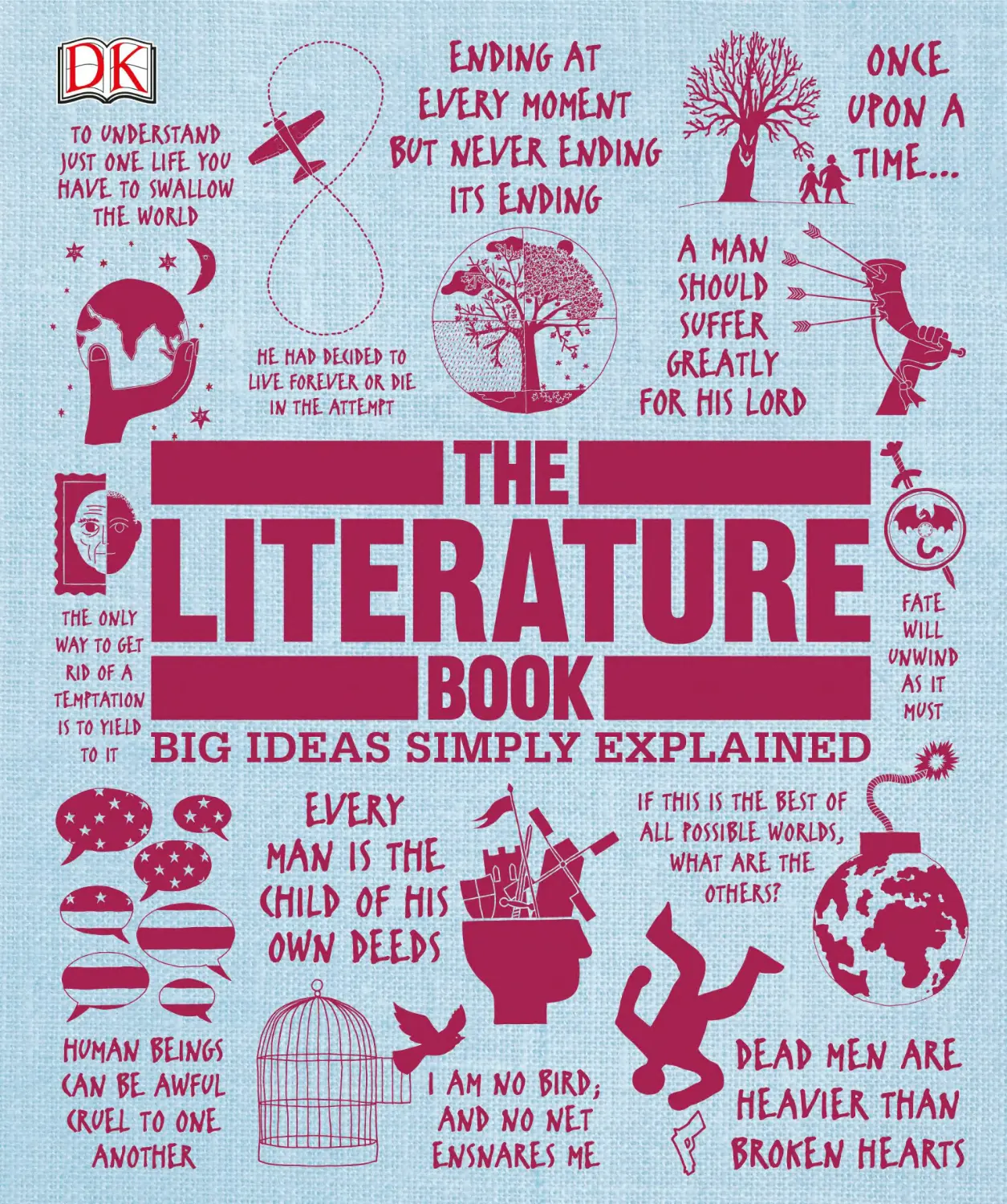
                    THE

LITERATURE
BOOK

THE

LITERATURE
BOOK

DK LONDON
SENIOR EDITOR
Sam Atkinson
SENIOR ART EDITOR
Gillian Andrews

original styling by

STUDIO8 DESIGN
produced for DK by

COBALT ID

ART EDITOR
Saffron Stocker

ART EDITORS
Darren Bland, Paul Reid

MANAGING EDITOR
Gareth Jones

EDITORS
Richard Gilbert, Diana Loxley,
Kirsty Seymour-Ure, Marek Walisiewicz,
Christopher Westhorp

MANAGING ART EDITOR
Lee Griffiths
US EDITORS
Jane Perlmutter, Margaret Parrish
ART DIRECTOR
Karen Self
ASSOCIATE PUBLISHING DIRECTOR
Liz Wheeler
PUBLISHING DIRECTOR
Jonathan Metcalf
JACKET DESIGNER
Natalie Godwin
JACKET EDITOR
Claire Gell
JACKET DESIGN DEVELOPMENT MANAGER
Sophia MTT
SENIOR PRODUCER, PRE-PRODUCTION
Tony Phipps
PRODUCER, PRE-PRODUCTION
Nadine King
SENIOR PRODUCERS
Mandy Innes, Rita Sinha
ILLUSTRATIONS
James Graham

DK DELHI
JACKET DESIGNER
Dhirendra Singh
SENIOR DTP DESIGNER
Harish Aggarwal
MANAGING JACKETS EDITOR
Saloni Singh

First American Edition, 2016
Published in the United States by
DK Publishing
345 Hudson Street
New York, New York 10014
Copyright © 2016
Dorling Kindersley Limited
DK, A Division of Penguin Random House LLC
16 17 18 19 20 10 9 8 7 6 5 4 3 2 1
001—274739—March/2016
All rights reserved.
Without limiting the rights under the copyright
reserved above, no part of this publication may be
reproduced, stored in or introduced into a retrieval
system, or transmitted, in any form, or by any means
(electronic, mechanical, photocopying, recording,
or otherwise), without the prior written permission
of the copyright owner.
Published in Great Britain by
Dorling Kindersley Limited.
A catalog record for this book is available
from the Library of Congress.
ISBN: 978-1-4654-2988-9
DK books are available at special discounts when
purchased in bulk for sales promotions, premiums,
fund-raising, or educational use. For details, contact:
DK Publishing Special Markets, 345 Hudson Street,
New York, New York 10014
SpecialSales@dk.com
Printed and bound in China.

A WORLD OF IDEAS:
SEE ALL THERE IS TO KNOW

www.dk.com

CONTRIBUTORS
JAMES CANTON, CONSULTANT EDITOR
Our consultant and coauthor James Canton
is a lecturer in literature at the University
of Essex, England, where he teaches the
MA “Wild Writing: Literature and the
Environment.” His published work includes
From Cairo to Baghdad: British Travellers in
Arabia (2011) and Out of Essex: Re-Imagining
a Literary Landscape (2013), which explores
the ties between our landscapes and our
selves, delving into the natural world and
its wonders. He is currently writing a tale
about a journey across Britain’s wildest
lands on the trail of prehistoric worlds.

HELEN CLEARY
A nonfiction writer and editor, Helen Cleary
studied English literature at Cambridge
University, England. She went on to complete
the prestigious creative writing MA at the
University of East Anglia, where she was
taught by W. G. Sebald and Lorna Sage. Helen
is a published writer of poetry and short fiction
as well as nonfiction.

ANN KRAMER
A writer and historian, Ann Kramer worked
for various publishers, including DK, before
becoming a full-time writer. Over the years
she has written numerous books for the
general reader on subjects ranging from
art, literature, and the humanities through
to women’s history. Having a deep love of
books and literature, Ann has also taught
adult literacy and literature classes.

ROBIN LAXBY

HILA SHACHAR

NICK WALTON

A freelance editor and writer, Robin Laxby
has a degree in English from Oxford University,
England, and has worked as a publishing
director in London. He has reviewed fiction
for The Good Book Guide and has published
five books of poetry since 1985. The Society
of Authors recently awarded him a grant to
complete a 30,000-word prose poem.

A lecturer in English literature at De Montfort
University, England, and writer for The
Australian Ballet, Hila Shachar has a doctorate
in English literature from The University of
Western Australia. She has published widely
on literature and film, including her New York
Times featured book, Cultural Afterlives and
Screen Adaptations of Classic Literature (2012).
She is also the author of several studies on
the adaptation of literary works, feminism
in literature, and popular and classic fiction.
She is currently writing a monograph on
literary biopics, examining the screen
adaptation of the figure of the author.

Nick Walton is Shakespeare Courses
Development Manager at the Shakespeare
Birthplace Trust in Stratford-upon-Avon,
England. He has written introductory material
for the Penguin editions of Timon of Athens
and Love’s Labour’s Lost, and is coauthor
of The Shakespeare Wallbook. He is also a
contributor to DK’s The Shakespeare Book
in the Big Ideas series.

DIANA LOXLEY
Diana Loxley is a freelance editor and writer,
and a former managing editor of a publishing
company in London, England. She has a
doctorate in literature from the University
of Essex. Her published works include an
analysis of colonial and imperial ideology
in various key texts of 19th-century fiction.

ESTHER RIPLEY
Esther Ripley has a first-class degree in
literature with psychology and has worked
for many years as a journalist, education
magazine editor, book reviewer, and shortstory competition judge. A former managing
editor at DK, she has written books for children
and now writes on a range of cultural subjects.

MEGAN TODD
A senior lecturer in social science at the
University of Central Lancashire, England,
Megan Todd has a degree in English literature
from the University of Aberdeen, Scotland.
She taught English literature at a grammar
school in Cumbria and completed a Masters
in gender studies at Newcastle University,
with a focus on women’s writing.

ALEX VALENTE
A researcher at the University of East Anglia,
England, literary translator, and writer,
Alex Valente has contributed to the Oxford
Companion to Children’s Literature (2015),
the Cultures of Comics Work (2016), and
several smaller poetry and prose publications,
in both Italian and English. He has also taught
first-year English literature modules at the
University of East Anglia.

BRUNO VINCENT
As a former bookseller, then a book editor,
and now a freelance writer, Bruno Vincent
has spent his entire working life around books
and the written word. He is the author of ten
titles, including two Sunday Times top ten
best sellers and two volumes of Dickensian
Gothic horror stories for children.

MARCUS WEEKS
Marcus Weeks studied music, philosophy, and
musical instrument technology, and had a
varied career, first as a teacher of English as a
foreign language, then a musician, art-gallery
manager, and instrument restorer before
becoming a full-time writer. He has written
and contributed to numerous books on the
humanities, arts, and popular sciences aimed
at making big ideas accessible and attractive,
including many titles in DK‘s Big Ideas’ series.

PENNY WOOLLARD
A theater studies administrator at the
University of Essex, England, Penny Woollard
has a doctorate in literature, from the same
university, titled “Derek Walcott’s Americas:
the USA and the Caribbean.” She has lectured
on Walcott and has also taught American
literature at Essex university.

6

CONTENTS
10 INTRODUCTION

HEROES AND LEGENDS
3000 BCE–1300 CE
20

21

22

26

34

Only the gods dwell forever
in sunlight
The Epic of Gilgamesh
To nourish oneself on
ancient virtue induces
perseverance
Book of Changes, attributed
to King Wen of Zhou
What is this crime I am
planning, O Krishna?
Mahabharata, attributed
to Vyasa
Sing, O goddess, the anger
of Achilles
Iliad, attributed to Homer
How dreadful knowledge
of the truth can be when
there’s no help in truth!
Oedipus the King, Sophocles

47

Real things in the darkness
seem no realer than dreams
The Tale of Genji, Murasaki
Shikibu

72

Laughter’s the property of
man. Live joyfully
Gargantua and Pantagruel,
François Rabelais

48

A man should suffer greatly
for his Lord
The Song of Roland

74

49

Tandaradei, sweetly sang
the nightingale
“Under the Linden Tree,”
Walther von der Vogelweide

As it did to this flower, the
doom of age will blight
your beauty
Les Amours de Cassandre,
Pierre de Ronsard

75

He that loves pleasure must
for pleasure fall
Doctor Faustus, Christopher
Marlowe

76

Every man is the child of
his own deeds
Don Quixote, Miguel de
Cervantes

82

One man in his time plays
many parts
First Folio, William Shakespeare

90

To esteem everything is to
esteem nothing
The Misanthrope, Molière

91

I found myself within a
shadowed forest
The Divine Comedy, Dante
Alighieri

But at my back I always hear
Time’s winged chariot
hurrying near
Miscellaneous Poems,
Andrew Marvell

92

We three will swear
brotherhood and unity of
aims and sentiments
Romance of the Three
Kingdoms, Luo Guanzhong

Sadly, I part from you; like a
clam torn from its shell, I go,
and autumn too
The Narrow Road to the Interior,
Matsuo Bashō

93

None will hinder and none
be hindered on the journey
to the mountain of death
The Love Suicides at Sonezaki,
Chikamatsu Monzaemon

50

52

54

42

Fate will unwind as it must
Beowulf

66

44

So Scheherazade began…
One Thousand and One Nights
Since life is but a dream,
why toil to no avail?
Quan Tangshi

Further reading

1300–1800
62

46

Let another’s wound be
my warning
Njal’s Saga

RENAISSANCE TO
ENLIGHTENMENT

The gates of hell are open
night and day; smooth the
descent, and easy is the way
Aeneid, Virgil

40

He who dares not follow love’s
command errs greatly
Lancelot, the Knight of the Cart,
Chrétien de Troyes

68

Turn over the leef and
chese another tale
The Canterbury Tales,
Geoffrey Chaucer

7
94

I was born in the Year 1632,
in the City of York, of a
good family
Robinson Crusoe, Daniel Defoe

DEPICTING REAL LIFE
1855–1900

158 Boredom, quiet as the spider,
96

If this is the best of all
possible worlds, what are
the others?
Candide, Voltaire

98

I have courage enough to walk
through hell barefoot
The Robbers, Friedrich Schiller

was spinning its web in the
shadowy places of her heart
Madame Bovary, Gustave
Flaubert
120 Who shall conceive the

horrors of my secret toil
Frankenstein, Mary Shelley
122 All for one, one for all

100 There is nothing more difficult

in love than expressing in
writing what one does not feel
Les Liaisons dangereuses,
Pierre Choderlos de Laclos
102 Further reading

ROMANTICISM AND THE
RISE OF THE NOVEL
1800–1855

The Three Musketeers,
Alexandre Dumas
124 But happiness I never

aimed for, it is a stranger
to my soul
Eugene Onegin, Alexander
Pushkin

finer spirit of all knowledge
Lyrical Ballads, William
Wordsworth and Samuel
Taylor Coleridge

land; I too grew up amid
this scenery
The Guarani, José de Alencar
165 The poet is a kinsman in

the clouds
Les Fleurs du mal, Charles
Baudelaire
166 Not being heard is no reason

for silence
Les Misérables, Victor Hugo

125 Let your soul stand cool

and composed before a
million universes
Leaves of Grass, Walt Whitman
126 You have seen how a man

110 Poetry is the breath and the

164 I too am a child of this

was made a slave; you shall
see how a slave was made
a man
Narrative of the Life of Frederick
Douglass, Frederick Douglass

111 Nothing is more wonderful,

128 I am no bird; and no net

nothing more fantastic than
real life
Nachtstücke, E. T. A. Hoffmann

ensnares me
Jane Eyre, Charlotte Brontë

168 Curiouser and curiouser!

Alice’s Adventures in
Wonderland, Lewis Carroll
172 Pain and suffering are

always inevitable for a large
intelligence and a deep heart
Crime and Punishment, Fyodor
Dostoyevsky
178 To describe directly the life

of humanity or even of a
single nation, appears
impossible
War and Peace, Leo Tolstoy

132 I cannot live without my life!
112 Man errs, till he has ceased

to strive
Faust, Johann Wolfgang
von Goethe
116 Once upon a time…

Children’s and Household Tales,
Brothers Grimm
118 For what do we live, but

to make sport for our
neighbours, and laugh
at them in our turn?
Pride and Prejudice, Jane Austen

I cannot live without my soul!
Wuthering Heights, Emily Brontë
138 There is no folly of the beast

of the Earth which is not
infinitely outdone by the
madness of men
Moby-Dick, Herman Melville
146 All partings foreshadow the

great final one
Bleak House, Charles Dickens
150 Further reading

182 It is a narrow mind which

cannot look at a subject
from various points of view
Middlemarch, George Eliot
184 We may brave human laws,

but we cannot resist
natural ones
Twenty Thousand Leagues
Under the Sea, Jules Verne

8
185 In Sweden all we do is to

celebrate jubilees
The Red Room, August
Strindberg

BREAKING WITH
TRADITION
1900–1945

186 She is written in a foreign

tongue
The Portrait of a Lady,
Henry James
188 Human beings can be awful

cruel to one another
The Adventures of Huckleberry
Finn, Mark Twain
190 He simply wanted to go

down the mine again, to
suffer and to struggle
Germinal, Émile Zola
192 The evening sun was now

ugly to her, like a great
inflamed wound in the sky
Tess of the d’Urbervilles,
Thomas Hardy
194 The only way to get rid of a

temptation is to yield to it
The Picture of Dorian Gray,
Oscar Wilde
new which must not be
contemplated by men’s eyes
Dracula, Bram Stoker
196 One of the dark places of

the earth
Heart of Darkness, Joseph Conrad
198 Further reading

Awake, wind of dawn!
Berlin Alexanderplatz,
Alfred Döblin
235 Ships at a distance have

208 The world is full of obvious

things which nobody by any
chance ever observes
The Hound of the Baskervilles,
Arthur Conan Doyle
209 I am a cat. As yet I have no

name. I’ve no idea where I
was born
I Am a Cat, Natsume Sōseki
210 Gregor Samsa found himself,

in his bed, transformed into
a monstrous vermin
Metamorphosis, Franz Kafka
212 Dulce et decorum est pro

patria mori
Poems, Wilfred Owen

every man’s wish on board
Their Eyes Were Watching God,
Zora Neale Hurston
236 Dead men are heavier than

broken hearts
The Big Sleep, Raymond Chandler
238 It is such a secret place,

the land of tears
The Little Prince, Antoine de
Saint-Exupéry
240 Further reading

POSTWAR WRITING
1945–1970

213 Ragtime literature which

flouts traditional rhythms
The Waste Land, T. S. Eliot
214 The heaventree of stars hung

195 There are things old and

234 The old world must crumble.

with humid nightblue fruit
Ulysses, James Joyce
222 When I was young I, too,

had many dreams
Call to Arms, Lu Xun
223 Love gives naught but itself

and takes naught but
from itself
The Prophet, Kahlil Gibran

250 BIG BROTHER IS

WATCHING YOU
Nineteen Eighty-Four,
George Orwell
256 I’m seventeen now, and

sometimes I act like I’m
about thirteen
The Catcher in the Rye,
J. D. Salinger
258 Death is a gang-boss aus

Deutschland
Poppy and Memory, Paul Celan
259 I am invisible, understand,

224 Criticism marks the origin of

progress and enlightenment
The Magic Mountain,
Thomas Mann

simply because people
refuse to see me
Invisible Man, Ralph Ellison
260 Lolita, light of my life, fire

228 Like moths among the

whisperings and the
champagne and the stars
The Great Gatsby, F. Scott
Fitzgerald

of my loins. My sin, my soul
Lolita, Vladimir Nabokov
262 He leaves no stone unturned,

and no maggot lonely
Waiting for Godot, Samuel Beckett

9
263 It is impossible to touch

eternity with one hand
and life with the other
The Temple of the Golden Pavilion,
Yukio Mishima
264 He was beat—the root,

the soul of beatific
On the Road, Jack Kerouac

CONTEMPORARY
LITERATURE
1970–PRESENT

296 Our history is an aggregate

of last moments
Gravity’s Rainbow, Thomas
Pynchon

266 What is good among one

people is an abomination
with others
Things Fall Apart, Chinua
Achebe
270 Even wallpaper has a better

memory than human beings
The Tin Drum, Günter Grass

298 You are about to begin reading

Italo Calvino’s new novel
If on a Winter’s Night a Traveler,
Italo Calvino
300 To understand just one life

you have to swallow the world
Midnight’s Children, Salman
Rushdie

272 I think there’s just one kind

of folks. Folks.
To Kill a Mockingbird,
Harper Lee

276 He had decided to live forever

or die in the attempt
Catch-22, Joseph Heller

thing; claiming ownership
of that freed self was another
Beloved, Toni Morrison
in turmoil
Red Sorghum, Mo Yan
311 You could not tell a story like

this. A story like this you
could only feel
Oscar and Lucinda, Peter Carey
312 A historical vision, the

outcome of a multicultural
commitment
Omeros, Derek Walcott

278 There’s got to be something

wrong with us. To do what
we did
In Cold Blood, Truman Capote

313 I felt lethal, on the verge

of frenzy
American Psycho, Bret
Easton Ellis

280 Ending at every moment but

never ending its ending
One Hundred Years of Solitude,
Gabriel García Márquez

320 Perhaps only in a world of

the blind will things be
what they truly are
Blindness, José Saramago
322 English is an unfit medium

for the truth of South Africa
Disgrace, J. M. Coetzee
324 Every moment happens twice:

inside and outside, and they
are two different histories
White Teeth, Zadie Smith

310 Heaven and Earth were

277 Everyday miracles and the

living past
Death of a Naturalist,
Seamus Heaney

one tiny part of the world
The Wind-Up Bird Chronicle,
Haruki Murakami

306 Freeing yourself was one

274 Nothing is lost if one has the

courage to proclaim that all is
lost and we must begin anew
Hopscotch, Julio Cortázar

319 What we see before us is just

314 Quietly they moved down

the calm and sacred river
A Suitable Boy, Vikram Seth

326 The best way of keeping

a secret is to pretend there
isn’t one
The Blind Assassin, Margaret
Atwood
328 There was something his

family wanted to forget
The Corrections,
Jonathan Franzen
330 It all stems from the same

nightmare, the one we
created together
The Guest, Hwang Sok-yong
331 I regret that it takes a life to

learn how to live
Extremely Loud and Incredibly
Close, Jonathan Safran Foer
332 Further reading

286 Further reading

318 It’s a very Greek idea, and a

profound one. Beauty is terror
The Secret History, Donna Tartt

340 GLOSSARY
344 INDEX
352 ACKNOWLEDGMENTS

INTRODU

CTION

12 INTRODUCTION

S

torytelling is as old as
humanity itself. The tradition
of capturing the events and
beliefs of communities reaches back
to a time when humans first sat by
a fire and told tales. History was
preserved in the form of legends and
mythologies that were passed down
from one generation to the next, and
offered answers to the mysteries of
the universe and its creation.
Written accounts emerged at the
same time as ancient civilizations,
but at first the invention of writing
met simple, prosaic functions—
for example to record transactions
between traders or tally quantities of
goods. The thousands of cuneiform
clay tablets discovered at Ugarit in
Syria reveal the already complex

I begin with writing
the first sentence—and
trusting to Almighty
God for the second.
Laurence Sterne

nature of the written form by
1500 BCE. Writing soon evolved
from a means of providing trading
information, to preserving the oral
histories that were integral to every
culture and their customs, ideas,
morals, and social structures. This
led to the first examples of written
literature, in the epic stories of
Mesopotamia, India, and ancient
Greece, and the more philosophical
and historical texts of ancient China.
As John Steinbeck so succinctly put
it in his Nobel Prize acceptance
speech in 1962: “Literature is as old
as speech. It grew out of human
need for it, and it has not changed
except to become more needed.”
Miss Bingley of Jane Austen’s
Pride and Prejudice may have been
talking fatuously when she declared:
“How much sooner one tires of
anything than of a book!” but
this sentiment rings true for many
of us. Despite the almost limitless
diversions that face readers today,
literature continues to satisfy a
spiritual or psychological need,
and open readers’ minds to the
world and its extraordinary variety.
There are works penned hundreds
of years ago that continue to
enchant and amuse to this day;
complex postmodern texts that
can be challenging in the extreme,
yet still hold us in their grip; and

new novels that feel so fresh that
they read as if words have only
just been invented.

Defining literature

Although the simple definition
of “literature” is “anything that is
written down,” the word has
become primarily associated with
works of fiction, drama, and poetry,
and weighted with the impossibleto-quantify distinction of merit
and superiority. These values are
intrinsic to the canon of literature
drawn upon for academic study and
appreciation that has been evolving
since the middle of the 19th century.
The term “canon” was borrowed
from the ecclesiastical canons
of authorized religious texts.
The literary canon—a collection
of works commonly agreed to be of
exceptional quality—was formed
almost entirely from familiar works
of Western European literature.
Since the mid-20th century,
cultural and literary theorists have
done much to destabilize the canon
by disputing the authority of these
lists of the works of “dead, white
Europeans.” The idea of a perceived
canon of “great works” still stands
as a useful framework, but rather
than the term being used to define
the same set of titles, it evolves
with each new generation, which

INTRODUCTION 13

reexamines the ideology and power
structures that underpin the
selections of previous generations,
and questions why certain other
works were excluded. Arguably,
studying how literature is created
and testing its place in the canon
may help to make us better readers.
In the same spirit, this book features
many titles that are traditionally
regarded as “great works,” but
explores their place in the wider
story of literature, and within a richer
mix of writing drawn from around
the globe. They sit alongside newer
texts that empower some of the
voices that were silenced over the
centuries by social constructs such
as colonialism and patriarchy, and
Europe’s dominance over literature.

Choosing books

This book takes a chronological
journey through literature, using
more than a hundred books as
guideposts along the route. It
also takes a global approach,
exploring literary texts from a
wide range of different cultures
that many readers may not have
encountered previously.
The Literature Book’s chosen
works are either exemplars of a
particular writing style or technique,
or represent a group or movement
that took a new direction, which

was then adopted by other
contemporary writers or expanded
upon by future generations. The
works are arranged chronologically
to highlight the emergence of
literary innovations against the
social and political backdrop of
their times. For example, during
the 17th and 18th century, French
literature evolved from Molière’s
neoclassical comedies of manners
into Voltaire’s satirical undermining
of Enlightenment optimism, and
later into a savage depiction of
decadent French aristocracy shown
in Pierre Choderlos de Laclos’ Les
Liaisons Dangereuses, published
in the lead-up to the French
Revolution. These changes in
literature inevitably overlap as
writers pioneered techniques that

Some books leave us
free and some books
make us free.
Ralph Waldo Emerson

took time to enter the mainstream,
while others continued literary
traditions from previous eras.
Lists are always contentious;
arguably the hundred or so books
chosen here could be replaced
with a hundred others, many
times over. They are not presented
as a definitive list of “must reads,”
instead each work is framed by a
focus or context that is supported
by a timeline of related literary
milestones and events. Crossreferences link to works of a similar
type, or that have influenced or
been influenced by the book under
discussion, while more than 200
titles are listed for further reading,
exploring the literary landscape
of each period in greater detail.

The story of literature

Around 4,000 years ago, the first
stories to be written down came
in the form of poems such as
Mesopotamia’s The Epic of
Gilgamesh and India’s Mahabharata,
which were based on oral traditions.
Rhyme, rhythm, and meter
were essential aids to memory in
songs and oral accounts, so it is
unsurprising that the first texts
made use of familiar poetic devices.
Many early written texts were
religious, and sacred texts such
as the Bible and the Koran tell ❯❯

14 INTRODUCTION

the stories of early histories, and have
influenced writing for centuries.
The form of literature that became
Greek drama used a narrative
balladlike form and introduced
characters with individual voices,
choruses of commentary, and the
distinct categories of comedy and
tragedy that continue to be used
today. The collections of stories that
make up the Arabic One Thousand
and One Nights have multiple
origins, but this prose fiction, written
in plain speech, makes use of
techniques that eventually became a
mainstay in modern novels, such as
framing (which introduces stories
within the framework of another
story), foreshadowing, and the
inclusion of repetitive themes.
Although the vast medieval era
was studded with secular highlights
such as the Anglo-Saxon Beowulf
and tales of chivalric romance, it was
dominated in the West by religious
texts in Latin and Greek. During
the Renaissance, the joint energies
of new philosophical investigation
and sheer invention opened the door
to literary innovation. The driving
force behind the Renaissance was
the production of new translations
of ancient Greek and Roman texts
which freed scholars from the
dogma of the church. A humanist
program of education which

incorporated philosophy, grammar,
history, and languages was built
on the wisdom of the ancients. The
Bible was translated into vernacular
speech, enabling Christians to
commune directly with their God.
Gutenberg’s printing press brought
books into the lives of ordinary
people, and authors such as Geoffrey
Chaucer and Giovanni Boccaccio
made everyday life the subject of
literature. By the early 17th century,
Miguel de Cervantes and Daniel
Defoe had given the world what
many scholars consider to be the
first novels, and the First Folio of
Shakespeare’s plays was published.

The rise of the novel

Drama and poetry continued to
evolve as the novel rose inexorably
in importance, and by the end

A word after a word after
a word is power.
Margaret Atwood

of the 18th century the novel
had become a major form of
literary expression.
Just as artists are described
in terms of movements such as
Baroque and Rococo, so literary
history is defined by authors united
by a particular style, technique, or
location. The Romantic movement,
characterized by stories driven by
the emotions of idiosyncratic heroes,
rather than plot and action, had its
roots in the German Sturm und
Drang movement. Meanwhile,
in England, the Romantic poets
testified to the power of nature to
heal the human soul, and similar
themes were taken up by the
New England Transcendentalists.
The word “genre” was increasingly
applied to fiction’s subsets—for
example, novels in the gothic genre.
In the 19th century, Romanticism
was superseded by a new form of
social realism, played out in the
drawing rooms of Jane Austen’s
English middle and upper classes,
and Gustave Flaubert’s provincial
French towns, but used increasingly
to depict the harsh lives of the poor.
Fyodor Dostoyevsky described his
novel Crime and Punishment as
“fantasy realism,” and the dark
interior monologues of the murderer
Raskolnikov have the elements of a
psychological thriller. Over the years,

INTRODUCTION 15

fiction has diversified into multiple
genres and subgenres, which today
include everything from dystopian
novels to fictional autobiography
and Holocaust writing.
Alongside the growth of the
novel, the vocabulary of literature
expanded to describe styles of
writing: for example, “epistolary”
novels were written in the form of
letters; and “Bildungsroman” and
“picaresque” denoted coming-of-age
tales. The language used within
literature was developing too, and
novels in the vernacular voice
broadened the scope of national
literature with writers such as
Harriet Beecher Stowe and Mark
Twain capturing the diversity of
the people of the US.
In the early 20th century,
Western society was revolutionized
by industrial and technological
advances, new artistic movements,
and scientific developments. Within
two decades, a generation of young
men had been wasted in World
War I. A perfect storm of literary
experimentation followed, as
Modernist writers searched for
inventive stylistic features such
as stream-of-consciousness writing,
and wrote fragmented narratives
representing the anguish and
alienation of their changing world.
After a brief period of literary

optimism and experimentation,
the world was again thrown into
turmoil as World War II began, and
the production of literature slowed
as many writers became involved
in the war effort, and produced
propaganda or reported from the
front rather than writing literature.

The global explosion

After two brutal global wars,
the world was ready for change,
and literature was central to the
counterculture in the West of the
1950s and ’60s. Postmodernist
writers and theorists focused on
the artifice of writing, demanding
more of the reader than simply
engaging with a realist narrative.
Novels now had fractured or
nonlinear time spans, unreliable
narrators, episodes of magical
realism, and multiple-choice
endings. During this period, the
West, and in particular writing
in English, also loosened its grip
on world culture. Postcolonial
writing emerged in countries such
as Nigeria, South Africa, and India,
and authors such as Gabriel García
Márquez helped raise the status of
a group of South American writers
of extraordinary creativity.
Modern literature now sings with
the previously unheard voices of
feminists, civil rights campaigners,

gay people, black and Native
Americans, and immigrants.
There is a healthy meritocratic
blurring of distinction between
classic and popular fiction.
Global publishing, independent
and internet publishing, global
literature courses, national and
international book prizes, and
the growing number of works
published in translation are
bringing Australian, Canadian,
South African, Indian, Caribbean,
and modern Chinese novels, among
others, to a world audience. This
vast library of global literature has
become both a reminder of shared
connections worldwide and a
celebration of difference. ■

Reading is the sole
means by which we slip,
involuntarily, often helplessly,
into another’s skin, another’s
voice, another’s soul.
Joyce Carol Oates

HEROES
LEGEND
3000 –
BCE
1300 CE

AND
S

18 INTRODUCTION

The earliest known texts,
in the Sumerian language,
are written on tablets in
Abu Salabikh, southern
Mesopotamia.

King Wen of Zhou
writes a commentary
on an ancient method
of divination, which is
later expanded into the
Book of Changes (the
Yijing or I Ching).

The ancient Greek epic
poems Iliad and Odyssey,
ascribed to Homer,
are written.

The adoption
of a democratic
constitution by
the Greek city-state
of Athens ushers in
the classical era.

C.2600 BCE

12TH–11TH CENTURY BCE

C.8TH CENTURY BCE

508 BCE

FROM

2100 BCE

The Epic of Gilgamesh is
one of the world’s earliest
examples of written
literature.

S

ystems of writing were
first used as a means of
recording administrative
and commercial transactions.
Gradually, these systems became
more advanced, preserving ancient
wisdom, historical records, and
religious ceremonies, all of which
had previously been memorized
and were passed down orally.
Throughout the world's early
civilizations, in Mesopotamia,
China, India, and Greece, the
written canon of literature first
emerged as history and mythology.
The form that this earliest
literature took was a long narrative
poem, known as an epic, which
focuses on the legends surrounding
a great warrior or leader, and his
battles to protect his people from
their enemies and the forces of
evil. The combination of historical

9TH–4TH CENTURIES BCE

551–479 BCE

5TH CENTURY BCE

The great
Sanskrit epic poems
Mahabharata and
Ramayana are
composed in
ancient India.

The Chinese
philosopher Kong
Fuzi (Confucius) is
active teaching and
compiling the
Five Classics.

The tragedians
Aeschylus,
Euripides, and
Sophocles compete
for the title of greatest
dramatist of Athens.

events and mythical adventures,
told in a metrical verse form,
explained the people's cultural
inheritance in an exciting and
memorable way.

Tales of gods and men

The first known epics, which
include the various versions of The
Epic of Gilgamesh, and the great
Sanskrit epics Mahabharata and
Ramayana, often tell of the origin of
a civilization, or a defining moment
in its early history. Seen through
the exploits of a heroic individual
or a ruling family, these epics also
explained the involvement of the
gods, often contrasting their
powers with the frailties of human
heroes. This was a theme that also
appeared in the later epics ascribed
to Homer. His heroes Achilles and
Odysseus are depicted not only

as noble warriors in the Trojan War
that established ancient Greece
as a great power, but also as very
human characters confronting both
fate and their own weaknesses.
Later, as Greek influence declined,
Roman poets developed their own
Latin version of the form, even
borrowing the story of the Trojan
War, as Virgil did in the Aeneid,
to produce an epic of the beginning
of Rome. The scale and depth of
Homer’s epics, and their poetic
structure, provided the foundation
on which Western literature is built.

Greek drama

Another product of the tradition
of storytelling in ancient Greece
was drama, which developed from
recounting a narrative to acting out
the part of a character and thereby
bringing the tale to life. Gradually,

HEROES AND LEGENDS 19
Virgil writes his
masterpiece, and
probably the best
known Latin epic
poem, the Aeneid.

29–19 BCE

The shi tradition
of Chinese poetry
reaches its high
point during the
Tang dynasty, in
works by poets such
as Li Bai and Du Fu.

Nordic settlers on the
island of Iceland
establish a general
assembly known as
the Althing for their
new commonwealth.

In the “Golden Age”
of Islamic culture,
classical Arabic poetry
flourishes and the One
Thousand and One
Nights are collected
for the first time.

In Lancelot, the Knight
of the Cart, Chrétien
de Troyes introduces
the idea of chivalric
romance in the
context of the
Arthurian legends.

930

C.8TH –13TH CENTURIES

C.1175–81

618–907 CE

5TH CENTURY CE

868

8TH–11TH CENTURY

11TH CENTURY

The poet Kalidasa writes
the Sanskrit epics
Raghuvamsha and
Kumarasambhava, and the
play Abhijnanashakuntala.

The earliest known
printed book—a
Buddhist text, the
Diamond Sutra—is
produced in China
using block printing.

The Anglo-Saxon
epic Beowulf is
composed, the
oldest surviving
epic poem in
Old English.

Murasaki Shikibu’s
The Tale of Genji and
Sei Shōnagon’s The
Pillow Book use life in
Japan’s Heian Court
as their backdrop.

this dramatic storytelling became
more sophisticated, and by the
time Athens was established as a
democratic nation-state, the theater
was an integral part of its culture,
with dramatists such as Aeschylus,
Euripides, and Sophocles producing
tragedies and comedies which
attracted audiences of thousands.

From Europe to Asia

In northern Europe oral storytelling
prevailed, and the tales of these
cultures were not written down
until around the 8th century. The
earliest known complete AngloSaxon epic, Beowulf, relates history
and mythology preserved by the
Scandinavian ancestors of the
English. The later Icelandic sagas
also drew from the Norse legends.
Meanwhile, in mainland Europe
the nobility were entertained by

professional poets. Some poets
took their subject matter from the
mythology of ancient Greece and
Rome, while the troubadours of
southern France chose stirring
stories of Charlemagne and his
men in battle with the Islamic
Moors and Saracens. The trouvères
of northern France, in contrast,
recited lyrical and passionate tales
of chivalry and courtly love about
the reign of the legendary King
Arthur of Britain.
Farther east, during the “Golden
Age” of Islamic culture in the late
medieval period when scholarship
was held in high esteem, epic
narrative tales such as those in
the One Thousand and One Nights
were valued for their capacity to
entertain, although poetry was
considered to be the highest form
of literature. In ancient China, too,

heroic legends were considered
more a form of folklore than
literature, and the first written
texts to be accorded the status
of classics were those that
preserved the history, customs,
and philosophy of the culture.
Along with these factual texts,
however, was a collection of
odes that provided a model for
Chinese poetry for centuries,
reaching its high point under the
emperors of the Tang dynasty.
In the 11th century, Japan,
which had been dominated by
Chinese culture, produced its
own distinctive literature in the
Japanese language. Fictional
prose accounts of life in the Heian
court developed from the ancient
chronicles of the ruling dynasties,
anticipating the emergence of the
novel in Europe. ■

20

ONLY THE GODS DWELL
FOREVER IN SUNLIGHT

THE EPIC OF GILGAMESH (FROM 2100 bce)

IN CONTEXT
FOCUS
Bronze Age literature
BEFORE
30th century bce Systems
of writing first emerge in
Mesopotamia and Egypt.
c.2600 bce The earliest known
texts—although not literary
ones—are written on tablets,
in the Sumerian language, at
Abu Salabikh, Mesopotamia.
c.2285–2250 bce The earliest
known author, Akkadian
princess and priestess
Enheduanna, lives and works
in the Sumerian city of Ur.
AFTER
c.1700–1100 bce The Rig
Veda, the first of the four
Hindu sacred texts known
as Vedas, is written in
northwestern India.
c.1550 bce The Egyptian Book
of the Dead is the first of the
Egyptian funerary texts to be
written on papyrus rather than
the walls of tombs or coffins.

W

riting first appeared in
Mesopotamia at the
beginning of what is
now known as the Bronze Age
(c.3300–1200 bce). Cuneiform
symbols, originally devised as a
means of recording commercial
transactions, had evolved from
numerals into representations of
sounds, which offered a means
of writing down the Sumerian
and Akkadian languages.
Among the fragments of texts
discovered in 1853 by the Assyrian
archaeologist Hormuzd Rassan are
tablets inscribed with tales of the
legendary King Gilgamesh of Uruk,
which are some of the earliest
examples of written literature.
The stories had probably been
passed down orally in a form that
combined history and mythology.

Gilgamesh for his arrogance, the
gods send the “wild man” Enkidu,
formed from clay, to torment him.
After a fight, however, they become
friends, and embark on a series
of monster-slaying adventures.
Angered by this turn of events,
the gods sentence Enkidu to death.
Gilgamesh is distraught at the loss
of his companion, but also becomes
aware of his own mortality. The
second half of the tale tells of
Gilgamesh’s quest for the secret
of eternal life and of his return to
Uruk—still a mortal, but a wiser
man and more noble ruler. ■

From tyrant to hero

The Epic of Gilgamesh, as the
collected tales are known, tells
how the oppressive ruler of the
Mesopotamian city of Uruk is
taught a lesson, and goes on to
become a local hero. To punish
See also: Mahabharata 22–25
Njal’s Saga 52–53

■

Iliad 26–33

The life that you seek
you never will find.
The Epic of Gilgamesh

■

Beowulf 42–43

■

HEROES AND LEGENDS 21

TO NOURISH ONESELF
ON ANCIENT VIRTUE
INDUCES PERSEVERANCE

BOOK OF CHANGES (12TH–11TH CENTURY bce),
ATTRIBUTED TO KING WEN OF ZHOU

IN CONTEXT
FOCUS
The Five Classics
BEFORE
c.29th century bce Fu Xi,
China’s mythical first emperor,
devises a method of divination
with trigrams, the basis for a
Chinese writing system.
AFTER
c.500 bce The original Book
of Rites, describing Chinese
rituals and ceremonies, is
compiled, traditionally thought
to be the work of Confucius.
2nd century bce A Confucian
canon of writing begins with
the so-called Five Classics.
136 bce Emperor Wu of Han
describes the Zhou yi as the
foremost of the classics, and
titles it Book of Changes.
960–1279 ce During the Song
era, scholar Zhu Xi includes
the Four Books, each of which
appeared before 300 bce, in the
canon of Confucian literature
alongside the Five Classics.

T

he Book of Changes is
about divination; it is a
kind of oracle. The original
method of divination from which
it evolved is attributed to the
legendary emperor Fu Xi, and was
formalized by King Wen of Zhou
(1152–1056 bce) in a text known
as the Zhou yi. The “King Wen
sequence” describes 64 hexagrams,
possible combinations of numbers
obtained by casting yarrow stalks
or coins, each associated with a
certain situation or circumstance,
to which Wen offered judgements.
Later scholars added comments
in the “Ten Wings,” including the
Great Commentary, which together
with the Zhou yi became known
as the Book of Changes (Yijing or
I Ching, as it is still often called).
The book is often referred to
as one of the Five Classics, with
the Book of Documents (Shujing),
Spring and Autumn Annals
(Chunqiu), Book of Rites (Liji),
and Book of Odes (Shijing). These
Classics are believed to have been
compiled by Kong Fuzi (traditional
dates 551–479 bce), who is better

known in the West as Confucius.
Kong Fuzi’s moral and political
philosophy was adopted as the
official ideology of China during
the 3rd century bce.
Much later, in around the 12th
century, shorter writings—either
ascribed to Confucius or said
to have been inspired by his
teachings—were grouped into
the Four Books of Confucianism.

A source of wisdom

The Five Classics and Four Books
were the main point of reference for
Confucianism as a state ideology.
The Book of Changes seems an
odd fit for rational Confucianism,
but it was thought to be a source of
great wisdom. It complemented the
volumes of Confucian philosophy,
history, etiquette, and poetry
as a book to be consulted not
only for its prophetic ability, but
also as a model of wise counsel,
describing what the “superior man”
should do in various situations,
and it has remained a source of
wisdom in China (and beyond)
to the present day. ■

See also: Quan Tangshi 46 ■ Romance of the Three Kingdoms 66–67
The Narrow Road to the Interior 92

■

22

WHAT IS THIS
CRIME I AM
PLANNING
O KRISHNA?

MAHABHARATA (9TH–4TH CENTURIES bce),
ATTRIBUTED TO VYASA

IN CONTEXT
FOCUS
The great Sanskrit epics
BEFORE
3rd millennium bce Vyasa
writes the original version of
the Mahabharata, in which
he appears as a character.
c.1700–500 bce The Vedas
(the Rig Veda, Yajur Veda,
Sama Veda and Atharva Veda)
are composed in Sanskrit, and
together constitute the first of
the Hindu scriptures.
AFTER
c.5th–4th century bce
According to tradition, Valmiki
writes the Ramayana, using
the sloka (meaning “song”)
which becomes the standard
Sanskrit verse form.
c.250 bce–1000 ce A canon
of Hindu texts known as the
Puranas develops. It includes
the genealogy of the deities
and narratives of cosmology.

T

he epic poetry of the Indian
subcontinent is among the
oldest known literature,
and it emerged from a long oral
tradition of storytelling and reciting.
As with other ancient literature, the
tales are a mixture of mythology,
legends, and historical events,
which developed over centuries
and were eventually written down.
In addition to this epic poetry,
ancient Indian writing includes the
Vedas, which are the central sacred
texts of Brahminical Hinduism,
recorded from around the middle
of the 2nd millennium bce. The
Vedas and the poetry were written
in Sanskrit, which was regarded as
the common literary language of

HEROES AND LEGENDS 23
See also: The Epic of Gilgamesh 20 ■ Iliad 26–33 ■ One Thousand and One Nights 44–45
The Canterbury Tales 68–71 ■ Midnight’s Children 300–05 ■ A Suitable Boy 314–17

Poets have told it before,
poets are telling it now,
other poets shall tell this
history on earth in the future.
Mahabharata

ancient India, and is the language
from which many Indo-European
languages evolved.
Up to the 1st century ce,
Sanskrit literature was dominated
by the Vedas and two great epic
poems: the Mahabharata and the
Ramayana. Although the Ramayana
contains historical narrative,
mythology, and folktales, it appears
to be an original work by a single
poet, and is traditionally attributed
to the sage Valmiki. In contrast,
the Mahabharata, the better known
and much longer of the two, has a
more complex provenance, which
suggests a long period of evolution.

A gift of Vishnu

The Mahabharata probably first
took shape in the 9th century bce
and only reached its final form in
around the 4th century bce. The
work is very long and comprises
more than 100,000 verse couplets,
known as shloka, divided into
18 books, or parvas. In addition to
recounting the story of two warring
families, it tells of their history,
and that of India and the Hindu
religion that is integral to it. At the
outset, the narrator of the first book,

the Adi Parva (“The Book of the
Beginning”), explains: “Whatever
is here, is found elsewhere. But
what is not here, is nowhere else.”
According to tradition, and as
described in its opening section,
the Mahabharata was written by
a poet and wise man called Vyasa.
Said to have lived in the 3rd
millennium bce, Vyasa was an
avatar (incarnation) of the Hindu
god Vishnu. The narrator of the
greater part of the epic is Vyasa’s
disciple Vaisampayana, but two
other people also narrate sections:
a minstrel-sage, Ugrasrava Sauti,
and a courtier, Sanjaya.
Vaisampayana explains how
Vyasa dictated the entire story to
the elephant-headed god Ganesha
in a single sitting. Subsequently,
many years later, Vaisampayana’s
story takes its final form as the
Mahabharata when it is retold by
Sauti to a meeting of Hindu sages,

■

Ramayana 55

■

as described in the Adi Parva.
This complicated nesting of frame
narratives probably reflects the
existence of different historical
versions of the story before it
took the shape we know today.
It is also typical of the way in
which the historical, mythological,
and religious intertwine throughout
the Mahabharata. Although the
central plot concerns the split in the
ruling Bharata family of northern
India, and the ensuing battle at
Kurukshetra and its aftermath, the
story is given a mythical dimension
by the introduction of the character
Krishna, another avatar of Vishnu.
There are also numerous subplots,
and several philosophical and ❯❯
The sage Vyasa dictates the epic
Mahabharata, which means “Great
Story of the Bharata,” referring to a
ruling family of northern India. The
scribe is elephant-headed god Ganesha.

24 MAHABHARATA
religious digressions, one of which,
the Bhagavad Gita, has become
important in its own right. The epic
explores themes of family ties and
conflict, duty and courage, fate
and choice, and presents them in
a series of allegories to explain the
elements of dharma, a complex
concept of “correct conduct.”

Family divisions

After its explanatory preamble, the
Mahabharata proper describes how
the ruling clan of the Kuru becomes
divided into two rival families, the
Kaurava and the Pandava. These
are the descendants of two princes,
the blind Dhritarashtra and his

brother Pandu. The enmity begins
when Dhritarashtra is denied the
throne because of his disability.
Pandu becomes king instead, but a
curse prevents him from fathering
children. The gods, however,
impregnate his wife and the line
of Pandava seems safe. But the
100 sons of Dhritarashtra feel that
they have a claim to the kingdom,
and after Yudhishtira, the eldest
Pandava, is crowned, they trick
him into losing everything in a
game of dice. In disgrace, the
Pandavas are sent into exile.
Some years later, the five
Pandava brothers return to claim
the throne, and so starts the series

Arjuna’s desire to behave in accordance with dharma
causes him to waver before acting, but his charioteer
Krishna guides him on the path of correct conduct.

Arjuna

Krishna

War is wrong.

You have a duty to
fight a just war.

Killing family
and friends is
abhorrent to me.

You have a duty to
protect your people
and their rights.

Violence runs counter
to my moral code.

You must put aside
personal feelings
and attachments.

Man is not the master of
destiny, but a wooden doll
that is strung on a string.
Mahabharata

of battles at Kurukshetra. The
second son of Pandu, Arjuna,
goes into war with his cousin and
close companion Krishna as his
charioteer, but only reluctantly joins
the fight after Krishna persuades
him that it is his duty to fight for
what is right. The war turns out to
be a bloodbath, in which almost all
the Kauravas are slaughtered; the
few who survive take their revenge
on the Pandava troops by murdering
them in their sleep. Only the five
brothers survive the massacre, and
they ensure the Kauravas are wiped
out completely.
Yudhishtira becomes king again,
but the victory is hollow and the
poem goes on to detail the war’s
awful aftermath. Krishna, or at
least this particular incarnation
of Vishnu, is accidentally killed,
and the Pandavas begin their long,
dangerous journey to heaven. Only
at the very end are the brothers
reunited, and reconciled with
their cousins the Kauravas, in
the spiritual world.

Moral dilemmas
These actions
will be sinful.

It is a far greater sin to
neglect your duty.

Dharma is a recurrent theme in the
Mahabharata, both in terms of how
this notion applies to each of us
in every situation, and of how it is
a difficult path to follow, because
of human weaknesses and the

HEROES AND LEGENDS 25
The Bhagavad Gita

Dhritarashtra reaches out blindly
for his wife Gandhari, who has bound
her eyes to share his darkened world.
Bad actions in a previous life meant his
disability was a consequence of karma.

force of fate. As Kripa—one of the
Kauravas—says in the tenth book,
Sauptika Parva (“The Book of the
Sleeping Warriors”), “There are two
forces: fate and human effort—all
men depend on and are bound by
these, there is nothing else.” What
is right and wrong is seldom clear,
and it is by reconciling conflicting
interests such as love and duty that
we can achieve liberation from the
cycle of life, death, and rebirth.
In each of the Mahabharata’s
episodes human strengths and
weaknesses are contrasted, and
the battle between right and wrong,
writ large in the devastating war
between the Kauravas and the
Pandavas, is shown to be complex,
subtle, and ultimately destructive.
While most of the poem shows
its characters dealing with moral
dilemmas in their human affairs,
in the final sections, and especially
after the death of Krishna, we see

them facing their spiritual fate. The
story ends, after much tragedy and
conflict, with the protagonists
achieving eternal bliss, but also
with the warning that the human
struggles continue here on Earth.

Cultural touchstone

The Mahabharata’s wide-ranging
plot and subject matter, built on
favorite mythological and historical
stories with a moral and religious
message, have ensured the epic’s
popularity up to the present day.
Such was its success that for
several centuries only the
Ramayana could rival its claim to
be the great Sanskrit epic. While it
cannot match the Mahabharata for
sheer scope and excitement, the
Ramayana is more consistent and
elegantly poetic, and together the
two inspired a school of Sanskrit
epic poetry that flourished from
the 1st to the 7th centuries ce.
As sources of Hindu wisdom and
Indian history and mythology,
the great epics enjoy a cultural
value in India comparable with
Homer’s Iliad and Odyssey in
the West. ■

At the heart of the epic
Mahabharata is the war at
Kurukshetra, beginning with
the sixth book, which includes
a section now known as the
Bhagavad Gita, the “Song of
the Blessed.” Prior to battle,
Arjuna, the Pandava prince,
recognizes members of
his family in the opposing
Kaurava army, and lays down
his bow. But his cousin and
companion Krishna reminds
him of his duty to fight this
just war. The philosophical
dialogue between them is
described in the 700-verse
Bhagavad Gita, which has
become an important Hindu
scripture in its own right,
explaining such concepts as
dharma (right conduct), karma
(intentions and outcomes), and
moksha (liberation from the
cycle of death and rebirth).
Although Krishna’s counsel
is specific to Arjuna’s duty
to fight, the battleground
setting can be interpreted as
a metaphor for the opposing
forces of good and evil in
general, and Arjuna’s crisis
of conscience as representing
the choices we all must make.

When the Gods deal defeat
to a person, they first take
his mind away, so that he
sees things wrongly.
Mahabharata

SING O GODDESS

THE ANGER OF

ACHILLES

ILIAD (c.8TH CENTURY bce),
ATTRIBUTED TO HOMER

28 ILIAD
IN CONTEXT
FOCUS
The Greek epic
KEY DATES
From 2100 bce Versions of the
first known written literature,
The Epic of Gilgamesh, appear
in the Sumerian language.
9th century bce The epic
Mahabharata emerges in India.
AFTER
c.8th century bce Attributed
to Homer, the epic Odyssey
continues the story of a leading
figure in the Iliad, Odysseus.
c.700 bce At roughly the same
time as the final versions of
the Homeric epics take shape,
Hesiod writes the Theogony
(“Birth of the Gods”), a poem
that describes the creation of
the world and the mythology
of the ancient Greek gods.
1st century bce The Greek
epic poems provide a model
for Roman poets such as
Horace, Virgil, and Ovid.

E

pics are narrative poems
that recount the story of
a hero who represents a
particular culture. They chronicle
his quests and ordeals, and account
for the hero’s choices and motives,
so helping to establish and codify
the moral principles of a society.
Epics were among the earliest
forms of literature in many cultures
around the world. These popular
stories were initially told orally,
and over time were embellished,
reinterpreted, formalized, and
finally written down, often laying
the foundation’s of a culture’s
literary history. Epics usually
contained many characters and
genealogies, and were long and
complex in structure. They were
probably learned by rote in a
repetitive poetic meter, or recited
to a musical accompaniment, since
it is far easier to memorize verse
than prose. Indeed, the word “epic”
itself is derived from the ancient
Greek word epos, meaning both
“story” and “poem.”

The Trojan War

In ancient Greece many epic tales
were told about the Trojan War—
a conflict between the Achaeans

Drink deep of battle.
Iliad

(an alliance of the Greek states) and
the city of Troy. The first and most
famous of these accounts were the
Iliad and Odyssey, both attributed
to a single author, known as Homer.
Historians concede that these epics
were inspired by actual events—
sporadic wars between Greece and
Troy did occur some five centuries
before the works were written—
but their characters and plots are
works of the imagination. However,
the Greeks of Homer’s era would
have believed these stories to be
true accounts of the heroism of
their ancestors.
The Greeks began to write
down their epics around the 8th
century bce. Like the spoken tales
on which they were based, they

The Homeric question

Homer lived in a time before
realistic portraiture. This bust is
based on images of the writer that
appeared only in the 2nd century bce.

The two great ancient Greek
epics, the Iliad and the Odyssey,
are traditionally ascribed to the
poet Homer—yet little is known
about him. Since the time of the
Greek historian Herodotus in the
5th century bce, widely differing
suggestions have been made for
Homer’s dates of birth and death,
place of origin, and other details
of his life. Classical scholars refer
to “the Homeric question,” which
includes a number of related
issues. Who is Homer—did he ever
exist, and if so when? Was Homer

the sole author of the epics, or
one of a number of authors? Did
the author or authors of the work
originate them, or simply make
a written record of poems that
had been passed down orally
through the generations?
Many scholars argue that
the epics evolved from an oral
tradition and were refined and
embroidered upon by multiple
poets in several versions. Solid
evidence is lacking and the
Homeric question is yet to
be answered definitively.

HEROES AND LEGENDS 29
See also: The Epic of Gilgamesh 20 ■ Oedipus the King 34–39 ■ Aeneid 40–41 ■ Beowulf 42–43 ■ Odyssey 54
Theogony 54 ■ Metamorphoses 55–56 ■ Digenis Akritas 56 ■ The Tale of Igor’s Campaign 57 ■ Ulysses 214–21
The Greeks and Trojans were helped or
hindered by the gods, who used the conflict
to fight their own battles. Hera, Athena, and
Poseidon were aligned with the Greeks, while
Apollo, Aphrodite, and Artemis supported the
Trojans. Zeus remained largely neutral.

The Gods
Zeus
king of
the gods

Poseidon
god of
the sea

Athena
goddess of
wisdom

Hera
queen of
the gods

Achilles
Greece’s greatest
warrior

Menelaus
king of
Sparta

Odysseus
commander, and
king of Ithaca

took the form of narrative poems.
These Greek epics have a regular
meter—each line is comprised of
six basic rhythmic units, and each
of these units contains one long
and two short syllables. This meter
is known as dactylic hexameter,
or more commonly, “epic meter.”
Variations on this basic rhythmic
pattern give the flexibility needed
for poetic composition.

A tale of gods and men

Patroclus
companion of
Achilles

The Iliad is a sophisticated piece
of storytelling. It relates the tale
of the war in Ilium (Troy) from
the perspective of one character
in particular—Achilles. Parts of
the story of the war are told in
flashback, or in prophecies of the
future. Woven into this plot
are subplots and insights into the
lives of the protagonists.

Artemis
goddess of
the moon

Aphrodite
goddess
of love

Apollo
god of
the sun

The Achaeans (Greeks)
Agamemnon
king of
Mycenae

■

The Trojans
Paris
brother of
Hector

Hector
son of
Priam

Priam
king of
Troy

Helen
wife of
Menelaus

How much of this complexity can
be credited to Homer, and how
much is a result of refinement
and embroidering over previous
generations, is impossible to tell.
The result is a work that combines
history, legend, and mythology,
while offering the essential
ingredients of good storytelling—
adventure and human drama—
that make it a compelling read.
The Iliad is massive, both in
its length and its narrative scope
(it is, after all, where we get the
idea of things being on an “epic”
scale), consisting of over 15,000
lines of verse, divided into 24
books. Rather than simply telling
the tale chronologically, Homer
grabs the reader’s attention by
using a device common to many
epics. This is to drop the reader
straight into the thick of the action,

Aeneas
a son of
Aphrodite

or in media res (“the middle of the
thing”) as described by the Roman
poet, Horace. Homer’s account
starts in the final year of the
conflict, which has already been ❯❯

Troy was believed for many
years to be a mythical city. However,
archaeologists now agree that
excavations in Anatolia, Turkey, have
revealed the Troy of Homer‘s Iliad.

30 ILIAD
raging for nine years. Homer
digresses to explain some of the
background to the events he is
describing, but he assumes much
prior knowledge about the causes
of the conflict, which contemporary
readers would have known well.

Origins of the war

The roots of the Trojan War can be
found in events that occurred at the
wedding of the sea nymph Thetis
to the Greek hero Peleus, who was
a companion to the hero Hercules.
The celebrations were attended by
may gods and godesses, including
Hera, Athena, and Aphrodite. An
argument broke out between the
three goddesses, each of whom
claimed to be the most beautiful.
To resolve the dispute, Zeus asked
Paris, the son of King Priam of Troy,
to judge a beauty contest between
them. Aphrodite offered Paris a
bribe—the hand of Helen of Troy,
the most beautiful woman in the
world. Unfortunately, Helen was
already married to Menelaus,
brother of King Agamemnon
of Mycenae, a Greek state. The
subsequent abduction of Helen
by Paris triggered the conflict.
Readers join the narrative when
Agamemnon’s Achaean forces are
fighting to recapture Helen. The
book’s opening, “Sing, O Goddess,
the anger of Achilles” sets the scene,

Victory passes back and
forth between men.
Iliad

preparing the reader for a story of
war, but also implies that this is a
tale of personal vengeance—and
alludes to the involvement of the
gods. The history of the war runs in
parallel with Achilles’ story, and his
sense of honor and valor mirrors
that of the Greek nation itself.

The power of anger

Anger is a predominant theme in
the Iliad, manifested in the war
itself and as a motivation for the
actions of the individual characters.
There is the righteous anger of
Agamemnon and Menelaus over
the kidnapping of Helen, but also
the wrath that drives Achilles
and makes him such a fearsome
warrior, provoked again and again
by events in the story. His anger is
not directed solely at the Trojans,
nor even restricted to human foes;
at one point he is so enraged he
fights the river god Xanthus.
Underlying the wrath of Achilles
is a sense of honor and nobility
which, like that of the Greek people,
is offended by disrespect and
injustice, but is sometimes directed

When Paris is asked who is the
“fairest” goddess, Hera tries to bribe
him with empire, Athena with glory,
and Aphrodite promises him Helen,
the world’s most beautiful woman.

inward as he struggles with the
conflicts that arise between duty,
destiny, ambition, and loyalty.
At the beginning of the Iliad,
Achilles becomes enraged by
King Agamemnon, the Greek
commander, who has taken for
himself Briseis—a woman who had
been given to Achilles as a prize
of war. Unable to vent his anger
toward the king directly, Achilles
withdraws to his tent, refusing to
fight any more. Only the death in
action of his close friend, Patroclus,
at the hands of Hector, the eldest
son of King Priam and the hero of
the Trojans, brings him back into
battle, more violently than ever,
by giving him a focus for his anger.

A tale of two heroes

Hector is, like Achilles, a military
leader. He is considered the noblest
and mightiest of the Trojan

HEROES AND LEGENDS 31
warriors. But his character and
motivation stand in contrast to
those of Achilles, highlighting two
very different attitudes to war.
Achilles is driven by an inner
rage, but also the nobler motives
of defending the honor of his
king and country, and ultimately
avenging the killing of Patroclus,
his comrade-in-arms. Hector fights
out of loyalty—to Troy, of course,
but also to his family. In addition to
being protective of his younger
brother, Paris, whose abduction
of Helen has caused the war, he
is loyal to his father, Priam, who is
portrayed as a wise and benevolent
king. Achilles is the professional
soldier, with few family ties, and
Hector the reluctant but fierce
fighter, defending home and family
rather than honor.
Homer portrays both men as
noble, but not without their flaws.
Their characteristics and situations
are metaphors for the contrasting
values of society and those of the
individual, and those of duty and
responsibility compared with

loyalty and love. Neither side is
wholly right or wrong, but in this
war one must emerge victorious.
Even though both heroes ultimately
die in the conflict—Achilles slays
Hector, and is himself killed by a
fatal arrow in his heel—it is the
heroism personified by Achilles
that wins out over Hector’s bonds
of kinship. Ultimately, the Iliad
affirms that there is glory in
warfare, and that honorable reasons
exist for fighting.

Among all creatures
that breathe on earth
and crawl on it there
is not anywhere a
thing more dismal
than man is.
Iliad

Destiny and the gods

Homer knew that his readers—
the Greeks—were aware of the
outcome of the story because if
Troy had won the war, there would
have been no Greek civilization.
The Greeks were destined to win,
and to reinforce this inevitability,
Homer makes reference to many
prophecies throughout the Iliad,
and to the role of fate and the gods
in deciding the war’s outcome.
To the ancient Greeks, the gods
were immortals who had dominion
over certain realms or possessed

certain powers; they were not the
omnipotent deities of later beliefs.
Occasionally they interacted with
humans, but generally left them
to their own devices. In the Iliad,
however, several of the gods had
vested interests that led them to
become involved in the Trojan War
from time to time. The war had,
after all, been triggered by the
abduction of Helen, the daughter ❯❯

Community-minded, Hector
is a family man who tries to
avert wider bloodshed.

Individualistic, Achilles is
absorbed in his own thirst
for glory.

Dependable, Hector leads
his men bravely, bonded by
ancestral loyalty.

Unpredictable, Achilles is
indifferent to others and
obsessed with honor.
Hector

Moderate in mood, Hector is
fallible and weakens in the
final confrontation.

Achilles

The warriors Hector and Achilles have
contrasting personalities and motivations,
which provide recurrent themes in Homer’s
examination of the heroic ideal.

Hot tempered and prone to
rage, Achilles thrives in the
violence of battle.

32 ILIAD

I have gone through
what no other mortal on
earth has gone through;
I put my lips to the hands
of the man who has
killed my children.
Iliad

of Zeus and Leda. Paris had seized
Helen in collusion with Aphrodite,
so sides had already been taken
on Mount Olympus, the home of
the gods. There were also other
connections between the gods and
the mortals: Thetis, for example,
was not only a sea nymph but also
the mother of Achilles.
Such allegiances prompted the
gods to intervene in human affairs,
protecting their favorites from

harm, and making life difficult for
their enemies. Apollo in particular
is fiercely anti-Greek, and causes
them trouble on several occasions.
For example, when Patroclus goes
into battle disguised as Achilles,
by wearing Achilles’ famously
protective armor, Apollo contrives
to dislodge it, allowing Hector to
kill him. Incensed by the death
of his best friend, Achilles vows
vengeance. And again the gods
intervene: his immortal mother
Thetis presents him with a new
suit of divine armor, specially
forged by the god Hephaestus.
The need humans have for
such protection underlines the
difference between them and
the gods—their mortality. Heroes
go to war knowing they face death,
but reconcile themselves with the
knowledge that all humans must
eventually die. The characters are
not only mortal, but their creations
are impermanent. They know that
the war will have more than human
casualties, because one nation
must be destroyed—and even the
victorious civilization will come to

an end one day. Homer sometimes
overtly states this fact by citing
prophecies of the future for both
the Iliad’s main characters and for
Troy, but it is implicit that this is
the common fate of mankind—the
destiny of every society. What
lives on, however, is the glory of
the heroes and their great deeds,
recounted in the stories passed
down through the ages.

Beyond the conflict

After war, bloodshed, and fury,
Homer’s epic ends with peace and
reconciliation. In perhaps the most
memorably moving scene of the
poem, the elderly King Priam visits
Achilles and pleads for the return
of the body of Hector, his son.
Achilles is moved by the old man’s
plea, and a temporary truce is
called to give the Trojans time for
an appropriate funeral, and this
Priam kisses Achilles’ hand, and
asks him to take pity and surrender the
body of his son Hector, whom Achilles
has killed in battle. Achilles displays
empathy with Priam’s grief.

HEROES AND LEGENDS 33
also lays Achilles’ rage to rest. But
despite this apparently peaceful
ending, we know that this calm
will be short-lived. The battle will
resume, Troy will fall, and at some
point Achilles will die. The story
is not over yet.
Indeed, Homer’s second epic
poem, the Odyssey, ties up some
of the loose ends by following the
fortunes of another of the Greek
heroes, Odysseus (known to the
Romans as Ulysses), as he makes
his way home to Ithaca from Troy
after the war. In the Odyssey,
the hero recounts the eventual
destruction of Troy, and the death
of Achilles, but this is very much
background to the story of his
own arduous journey.

Western cornerstone

It is almost impossible to overstate
the impact of the Iliad and the
Odyssey on the literature of ancient
Greece and Rome, and therefore the
whole of Western literature. They
were not simply the first literary
works in Europe, but monumental
examples that firmly laid the
foundations of the epic genre.
Homer’s expert use of complex
and highly visual similies gave his
poetry unprecedented depth, and
his mastery of dactylic hexameter
provided an inspirational musicality
to his verse. The meter used by
Homer was adopted for subsequent
epic poetry in Greek as well as
in Latin, and the hybrid dialect
he used became the recognized
Greek of literature.
Perhaps most significantly of
all, Homer turned an oral tradition
of stories about folk heroes into a
literary form—the epic. He also set
out the characteristics of that form;
for example, that the main narrative
should follow the hero’s quest or
journey, and that this should be set
against a historical backdrop, with

multiple interweaving or episodic
plots. Homer also set the standard
for the subtext of the epic, where
personal and social values often
stand in opposition.
The Iliad and the Odyssey
inspired a number of Greek poets
to write epics on similar themes,
but they also influenced the new
form of drama that developed in
the classical period. While Homer
was popular reading in ancient
Greece, the Iliad and Odyssey were
standard texts in ancient Rome,

Zeus knows, no doubt,
and every immortal too
which fighter is doomed
to end all this in death.
Iliad

The Odyssey details the death of
the hero Achilles. He is killed by an
arrow fired by Paris, which is guided
to the one vulnerable spot of Achilles’
body—his heel—by the god Apollo.

inspiring poets to develop a
distinctive Latin epic poetry.
This reached its height in Virgil’s
Aeneid, which in addition to being
a homage to Homer took as its
starting point the fall of Troy.

Eternally influential

Reverence for the Homeric epics
did not end in classical times.
Homer’s works were widely read
and studied in the Middle Ages
and their stories have been retold
countless times in different forms.
Homer’s ancient poems can
be considered the antecedents of
medieval sagas, as well as the
novel. Since the beginning of the
20th century, other forms of massaudience storytelling—from movies
to television series—have followed
the epic model, and are deeply
indebted to Homer for their
structure and cultural relevance. ■

HOW DREADFUL

KNOWLEDGE
OF THE TRUTH CAN BE
WHEN THERE’S NO HELP IN

TRUTH!
OEDIPUS THE KING (c.429 bce),
SOPHOCLES

36 OEDIPUS THE KING
IN CONTEXT
FOCUS
Classical Greek drama
BEFORE
c.7th century bce
Dithyrambs, song and dance
entertainments by a chorus,
are performed in honor of
Dionysus in Delos and Athens.
c.532 bce Thespis, considered
to be the first actor, appears on
stage playing a role in a drama.
c.500 bce Pratinas introduces
satyr plays—a satirical genre.
458 bce Aeschylus’s Oresteia,
the only trilogy of the classical
period to have survived intact,
is first performed in Athens.
431 bce Euripides’ Medea
introduces a realism that
shocks audiences.
AFTER
423 bce Aristophanes’ comedy
The Clouds satirizes the social
scene in Athens, and in
particular Socrates.

Sophocles

W

ith the revolt that
overthrew the last
tyrant king in 510 bce,
and the establishment of a form of
democracy, the city-state of Athens
ushered in the era of classical
Greece. For two centuries, Athens
was not only a center of political
power in the region, but also a
hotbed of intellectual activity that
fostered an extraordinary flowering
of philosophy, literary culture, and
art, which was to have a profound
influence on the development of
Western civilization.
Classical Greek culture was
dominated by the achievements
of Athenian thinkers, artists, and
writers, who developed aesthetic
values of clarity, form, and
balance—principles that were
epitomized by classical architecture.
A human-centered view also
influenced the development of a
comparatively new literary art
form, drama, which evolved from
religious performances by a chorus
in honor of the god Dionysus.

The birth of drama

By the beginning of the classical
era, religious performances had
changed from essentially musical
Sophocles was born (c.496 bce) in
Colonus, near Athens. He showed
an early aptitude for music, and
through this became interested in
the art of drama, encouraged and
perhaps trained by the innovative
tragedian Aeschylus. With his first
entry in the Dionysia theater
contest in 468 bce, he won first
prize from the reigning champion
Aeschylus, and he soon became
the most celebrated tragedian of
his generation. In all, he wrote
more than 120 plays, of which only
a handful have survived intact.
Sophocles was also a respected
member of Athens society, and

Delphi’s theater has three spaces:
the stage, the orchestra or chorus
(in front), and the amphitheater.
It was built in the 4th century bce
and could seat about 5,000 people.

ceremonies to something more like
drama as we know it today, with
the addition of actors to play the
parts of the characters in a story,
rather than simply narrating.
This new form of entertainment
was enormously popular, and
formed the focal point of an annual
festival of Dionysia, which was held
over several days in a custom-built
open-air theater that attracted
audiences of up to 15,000 people.
was appointed as a treasurer in
Pericles’ government and later
as a military commander. He
married twice, and both his son
Iophon and grandson Sophocles
followed in his footsteps as
playwrights. Shortly before his
death in 406 bce, he finished
his final play, Oedipus at
Colonus, which was produced
posthumously by his grandson.
Other key works
c.441 bce Antigone
c.429 bce Oedipus the King
c.409 bce Electra

HEROES AND LEGENDS 37
See also: Iliad 26–33 ■ Aeneid 40–41 ■ Odyssey 54
First Folio 82–89 ■ The Misanthrope 90

Writers submitted work to be
performed at the festival, in the
form of a trilogy of tragedies
followed by a comic play, and
competed for prestigious prizes.
Three dramatists dominated
the prizewinners’ list for much
of the 5th century bce: Aeschylus
(c.525/524–c.456/455 bce), Euripides
(c.484–406 bce), and Sophocles
(c.496–406 bce). Their contribution,
which amounted to several
hundred plays, set a definitive
standard for the art of tragedy.
Aeschylus, as the earliest of the
three great tragedians, is generally
considered the innovator, initiating
many of the conventions associated
with the form. He is credited with
expanding the number of actors in
his plays, and having them interact
in dialogue, which introduced the
idea of dramatic conflict. Where
formerly the chorus had presented
the action of the drama, the actors
now took center stage, and the
chorus took on the role of setting
the scene and commenting on the
actions of the characters.
The move toward a greater
realism was sustained by Euripides,
who further reduced the role of the
chorus, and presented more threedimensional characters with more
complex interaction.

Breaking with convention

Of the three great dramatists, it is
Sophocles whose tragedies have
come to be regarded as the high
point of classical Greek drama.
Sadly, only seven of the 123
tragedies he wrote have survived,
but of these perhaps the finest is
Oedipus the King.
The play was one of three
written by Sophocles about the
mythical king of Thebes (the others

■

Oresteia 54–55

■

Medea 55

■

Wasps 55

■

The development of Greek tragedy

The chorus presented the tragedies,
narrating the action; even in later
times, the chorus always set the
scene and gave the characters’
internal thoughts, which could
not be acted on stage.

The protagonist, introduced by
Thespis, performed the part of
the main tragic character, thus
initiating the birth of acting.

The tritagonist, a third actor
introduced by Sophocles, took on
the role of adversary, while the
deuteragonist became a support
role for the protagonist, such
as an aide or advisor.

The deuteragonist, a second actor
introduced by Aeschylus, usually
performed the role of the antagonist
in the drama. Characters could now
interact in dialogue, introducing
the idea of dramatic conflict.

being Oedipus at Colonus and
Antigone), known collectively
as the Theban plays. Breaking
with the convention of presenting
tragedies in trilogies established
by Aeschylus, Sophocles conceived
each of these as a separate entity,
and they were written and
produced several years apart
and out of chronological order.

In Oedipus the King (often referred
to instead by its Latinized title
Oedipus Rex), Sophocles created
what is now regarded as the
epitome of classical Athenian
tragedy. The play follows the
established formal structure:
a prologue, followed by the
introduction of characters and
the unfolding of plot through ❯❯

38 OEDIPUS THE KING
a series of episodes interspersed
with commentary from the chorus,
leading to a choral exodus, or
conclusion. Within this framework,
Sophocles uses his own innovation
of a third actor to widen the variety
of character interaction and enable
a more complex plot, creating the
psychological tensions synonymous
with the word “drama” today.
Typically, a tragedy of this sort
was the story of a hero suffering
a misfortune that leads to his
undoing, traditionally at the hands
of the gods or fate. As classical
tragedy developed, however,
the hero’s reversal of fortune was
increasingly portrayed as the result
of a frailty or fault in the character
of the protagonist—the “fatal flaw.”
In Oedipus the King both fate and
character play their part in the
tragic events. The character of
Oedipus is also far from black and
white. At the beginning of the play
he appears as the respected ruler of
Thebes, to whom the people turn to
rid them of a curse, but as the plot
unfolds his unwitting involvement
in the curse is revealed.

The greatest griefs are those
we cause ourselves.
Oedipus the King

This revelation contributes to the
atmosphere of foreboding that was
a characteristic of the best classical
tragedies. The sense of doom arose
from the fact that many of these
stories were already well known,
as that of Oedipus must have been.
Such a situation creates tragic
irony, when the audience is aware
of a character’s fate and witnesses
his unsuspecting progress toward
inevitable doom. In Oedipus the
King, Sophocles ratchets up this
atmosphere of inevitability by
introducing various references to
prophecies that were made many

years before, which both Oedipus
and his wife Jocasta have ignored.
The story is not so much about
the events that lead to Oedipus’s
downfall, as about the events
that prompt revelations of the
significance of his past actions.

Tragedy foretold

The chain of events begins with
Thebes stricken by plague. When
consulted, the oracle at Delphi says
that the plague will abate when the
murderer of Laius, the former king
of Thebes and previous husband of
Jocasta, is found. Oedipus seeks
the advice of the blind prophet
Tiresias to find the killer. This
puts Tiresias in a difficult position
because, although blind, he can see
what Oedipus cannot: that Oedipus
himself is the unwitting murderer,
and advises him to let the matter
rest. But Oedipus demands the
truth, and then furiously refuses
to believe the prophet’s accusation,
while Tiresias further reveals that
the killer will turn out to be the son
of his own wife. A rattled Oedipus
recalls a visit to Delphi as a youth,
where he had gone to determine his
true parentage, having overheard
that he had been adopted. Instead,
the oracle told him that he would
murder his father and marry his
mother—so he had fled, journeying
toward Thebes. On his way to the
city, he had met and killed an older
man who barred his way.
The significance of this is not
lost on the audience, especially
when Sophocles introduces Jocasta,
Oedipus’s wife and the widow of
Laius, who comforts Oedipus by
arguing that prophecies are untrue;
An ancient house mosaic depicts
masks used in tragedies. Actors often
wore masks, some with exaggerated
expressions, to help convey the
character they were representing.

HEROES AND LEGENDS 39
Aristophanes’ comedy Wealth
(Ploutus in Greek), performed
here by modern actors, is a gentle
satire that focuses on life—and the
distribution of wealth—in Athens.

there was a prophecy that Laius
would be killed by his son, she
says, when he was slain by bandits.
This information makes clear
to the audience that the prophecy
given to Oedipus has been selffulfilling; it prompted him to leave
home and set in motion the events
that led to his unconsciously killing
his own father Laius and becoming
king of Thebes in his place, with
his own mother Jocasta as his wife.
The climax is reached as things
become clear to Oedipus. He reacts
by blinding himself. The chorus,
which has throughout the tragedy
expressed the inner thoughts
and feelings that could not be
expressed by the characters

themselves, closes the drama by
repeating to an empty stage that
“no man should be considered
fortunate until he is dead.”

The Western tradition

Oedipus the King gained
immediate approval with Athenian
audiences, and was hailed by
Aristotle as probably the finest
of all classical Greek tragedies.
Sophocles’ skillful handling of a
complex plot, dealing with themes
of free will and determinacy, and
the fatal flaw of a noble character,
not only set a benchmark for
classical drama, but also formed
the basis of the subsequent
Western tradition of drama.

Following their deaths, there were
no Greek tragedians of the same
stature as Aeschylus, Euripides,
and Sophocles. Drama continued
to be a central part of Athenian
cultural life, but the plaudits were
more often given to the producer
or actors than the writer himself.
The comedies of Aristophanes
(c.450–c.388 bce) also helped to fill
the void left by the absence of great
tragedy, and gradually popular
taste grew for less serious drama.
Even today, however, the
tragedies of the classical Greek
period remain significant, not least
for their psychological exploration
of character, which Freud and
Jung used in their theories of the
unconscious, drives, and repressed
emotion. The surviving works of the
Athenian tragedians, and Oedipus
the King in particular, were revived
during the Enlightenment, and
have been performed regularly ever
since, with their themes and stories
reinterpreted by many writers. ■

Aristotle’s Poetics c.335 bce

Why should anyone in
this world be afraid,
Since Fate rules us and
nothing can be foreseen?
A man should live only
for the present day.
Oedipus the King

Aristotle (384–322 bce) held the
tragedians in high regard, and
his Poetics is a treatise on the
art of tragedy. He saw tragedy
as a mimesis (an imitation) of an
action, one that should arouse
pity and fear. These emotions
are given a katharsis, a purging,
by the unfolding of the drama.
The quality of such a tragedy
is determined by six elements:
plot, character, thought, diction,
spectacle, and melody. The plot
must be a “unity of action,” with
a beginning, middle, and end.

At least one of the characters
should undergo a change in
fortune, through fate, a flaw in
character, or a blend of the two.
Next in importance is thought,
by which he means the themes,
and the moral message, of the
play. This is followed by diction,
the language, such as the use of
metaphors, and the actor’s
delivery. The spectacle (scenery
and stage effects) and melody
(from the chorus) should be
integral to the plot and enhance
the portrayal of character.

40

THE GATES OF HELL ARE
OPEN NIGHT AND DAY
SMOOTH THE DESCENT,
AND EASY IS THE WAY
AENEID (29–19 bce), VIRGIL

IN CONTEXT
FOCUS
Literature of the
Roman world
BEFORE
3rd century bce Gnaeus
Naevius writes epic poems
and dramas based on Greek
models, but in Latin and about
Roman mythology and history.
c.200 bce Quintus Ennius’s
epic Annals tells the history of
Rome following the fall of Troy.
c.80 bce Cicero’s oratory as a
lawyer marks the beginning
of the “Golden Age” of Latin
literature, which lasts until the
death of Ovid in 17 or 18 ce.
AFTER
1st century bce Horace’s
poetry includes the Odes,
the Satires, and the Epodes.
c.8 ce Ovid’s narrative poem
Metamorphoses is published.
2nd century Apuleius writes
the irreverent Metamorphoses,
also known as The Golden Ass.

R

ome began to replace
Greece as the dominant
Mediterranean power from
around the 3rd century bce, and
it is from that time that the first
literature in Latin appeared.
The influence of Greek culture
on ancient Rome was enormous
to begin with, and a recognizable
Roman literary culture emerged
only slowly. Although Roman
writers were writing in Latin,
they produced poetry, drama,
and histories firmly in the Greek
mold until around 80 bce when the
statesman, orator, writer, and poet

Virgil
Publius Vergilius Maro was born
in 70 bce in Mantua, northern
Italy. He spent much of his early
life in this part of the Roman
Republic, and wrote his poems
of rustic life, the Eclogues, there.
Virgil’s next major work, the
Georgics, was dedicated to his
patron, the statesman Gaius
Maecenas. Virgil also befriended
Octavian, who was to become
Emperor Augustus, and
established himself in Rome
as a poet alongside Horace and
Ovid. He began work on his

Cicero inspired the beginning of
a “Golden Age” of Latin literature,
which established the style and
forms of a distinct Roman tradition.

Roots of empire

The so-called Golden Age straddled
Rome’s evolution from Republic to
Empire. This transformation, which
involved the turmoil of civil wars,
was reflected in a shift from the
historical and rhetorical writings
of Cicero, Sallust, and Varro, to the
poetic works of Horace, Ovid, and
Virgil, especially during the reign
of Emperor Augustus from 27 bce.
magnum opus, the Aeneid, in
around 29 bce, encouraged by
Octavian, and continued writing
and revising it until his death
from fever in 19 bce. It is said
that on his deathbed Virgil
asked that the Aeneid be
destroyed, possibly because
of his disappointment with
Augustus’s reign, but it was
published posthumously
on the orders of the emperor.
Other key works
c.44–38 bce Eclogues
29 bce Georgics

HEROES AND LEGENDS 41
See also: Iliad 26–33

■

Metamorphoses 55–56

■

The Golden Ass 56

■

The Divine Comedy 62–65

■

Paradise Lost 103

Aeneas’s travels in the Mediterranean

Endure the hardships
of your present state,
Live, and reserve
yourselves for better fate.
Aeneid

4 Crete: Has a dream in
which the gods appear
to him and reveal that the
land of his forefathers that
he seeks is in distant Italy.

1 Troy: Flees the city with
others, including his father
King Anchises, and his
wife’s ghost tells him to find
the land of the Tiber.

5 Strophades islands:
Survives attack when taken
off course to the home of the
Harpies, who prophesy that
a famine lies ahead in Italy.

12

Latium

Thrace 2

11

Cumae

Buthrotum
6
1 Troy

Eryx 10

Acknowledged during his lifetime
as Rome’s leading literary figure,
Virgil wrote a number of poetic
works, but it is for his epic Aeneid
that he achieved lasting respect.
His story of the ancestry of Rome
was possibly commissioned by
Emperor Augustus, and the rising
tide of pride in the new imperial
era no doubt played some part in
the patriotic poem’s success.
Despite its nationalistic theme,
the Aeneid has its roots in Greek
literature, and especially Homer’s
Iliad and Odyssey, on which it is
largely modeled, sharing the same
regular poetic meter, or classical
“epic meter.” The 12 books of
the Aeneid recount the journey
of Aeneas from his home in Troy
to Italy, and the war in Latium (the
land of the Latins), which ultimately
led to the foundation of Rome.

A Homeric achievement

Aeneas was already known as a
character in the Iliad, but Virgil’s
continuation of his story neatly
connects the legends of Troy with
those of Rome, and in particular
the virtues of the hero with
traditional Roman values.

3 Delos

7

Etna
9

8

Off western Sicily

Strophades 5
islands

4 Crete

Carthage
1

The numbers in the map plot Aeneas’s
route through the Mediterranean

9 Carthage: Meets and falls
in love with Queen Dido,
and only leaves her because
the gods persuade him he
must resume his journey.

11 Cumae: Is guided by
the prophetic Sibyl to the
underworld, where he talks
to spirits and the future
Rome is revealed to him.

Virgil begins the poem “Arma
virumque cano …” (“I sing of arms
and a man …”), stating his themes
in a similar way to the Iliad (“Sing,
O goddess, the anger of Achilles,
son of Peleus …”), and takes up
Aeneas’s story on his way to Italy
as he is forced by a storm to land in
Carthage. Here, he tells Queen Dido
of the sack of Troy. Feigning retreat,
the Greeks had hidden offshore and
left behind a vast, wheeled wooden
horse. The Trojans were persuaded
by a Greek agent that the horse was
under Athene’s protection and
would make Troy impregnable. At
night, after the Trojans had taken
it within the walls, a select band of
warriors emerged and opened the
gates for the returned Greek army.

12 Latium: Welcomed here
at the mouth of the River
Tiber by King Latinus who
offers his daughter Princess
Lavinia in marriage.

Throughout the epic, Virgil
emphasizes Aenas’s pietas, his
virtue and duty, which is steered
by fate and the intervention of the
gods, taking him from his home
to his destiny in Latium.
The Aeneid not only secured
Virgil’s reputation as a distinctly
Roman writer, but went on to
become probably the most
respected work in Latin. Virgil was
revered as a writer throughout the
Middle Ages, and appears as the
guide in Dante’s Divine Comedy.
Stories from the Aeneid have been
retold continuously since it first
appeared, and the idea of danger
represented by the “Trojan horse”—
“Beware of Greeks bearing gifts”—
has entered popular culture. ■

42

FATE WILL
UNWIND AS
IT MUST
BEOWULF (8TH–11TH CENTURY)

IN CONTEXT
FOCUS
Anglo-Saxon literature
BEFORE
7th century ce Caedmon,
a shepherd-turned-monk at
Whitby Abbey, writes a hymn
that is the first-known example
of a poem in Old English.
c.8th century ce Fragments
of runic inscription carved on
the Ruthwell Cross—now in
Scotland but once part of the
kingdom of Northumbria—are
lines from a poem now known
as “The Dream of the Rood,”
which blends warrior imagery
with the Crucifixion story.
AFTER
c.1000 The epic poem Waldere
is transcribed. Only two
fragments have survived, but
they offer insights into the
Anglo-Saxon warrior ideal.
10th century Benedictine
monks compile an anthology
of Anglo-Saxon poetry now
known as the Exeter Book.

A

lthough academic opinions
differ about the exact date
Beowulf was written, it
is the earliest Anglo-Saxon epic
poem to survive in its entirety. It is
told in the language now known as
Old English, or Anglo-Saxon, which
developed from the Germanic
languages brought over to Britain
by Scandinavian invaders, and
remained the common language
until the Norman Conquest in 1066.
Old English was widely spoken
in England and southern Scotland
from the 5th century, but written
literature in the vernacular only

Each of us must
expect an end of living in
this world; let him who may
win glory before death:
for that is best at last for
the departed warrior.
Beowulf

emerged gradually. During the
7th century, Britain underwent
conversion to Christianity. Latin
was the language of the literate
classes, and used in the Christian
monasteries and abbeys where
manuscripts were created. But by
the reign of King Alfred (reigned
871–899), Old English translations
of Christian Latin texts were
appearing alongside original texts.

An oral tradition

It is likely that Beowulf dates from
between the 8th and early 11th
centuries, because it appears to
have been written from a Christian
perspective, in spite of its pagan
subject matter. It is not clear
whether Beowulf was composed
by the person or persons who wrote
the original manuscript, or whether
this was a transcription of an older
poem. There was an Anglo-Saxon
oral tradition of storytelling by
reciters of poetry known as “scops,”
mentioned in several Old English
texts including Beowulf, and it is
possible that the poem had been
passed down orally many years
before it was recorded.
Like its language, the poem’s
story has its roots in Scandinavia,
and deals with the legends of the

HEROES AND LEGENDS 43
See also: The Epic of Gilgamesh 20 ■ Mahabharata 22–25 ■ Iliad 26–33 ■ Aeneid 40–41 ■ Lancelot, the Knight of
the Cart 50–51 ■ Njal’s Saga 52–53 ■ Cantar de Mio Cid 56–57 ■ The Divine Comedy 62–65 ■ The Lord of the Rings 287

people there, including several
historical figures from around
500 ce. It tells of the life and exploits
of a Geatish warrior, Beowulf, who
comes to the aid of Hrothgar, king
of the Danes, to rid the land of the
monster Grendel and then Grendel’s
mother. Beowulf progresses from a
brash young adventurer to become
a respected king of the Geats,
following Hrothgar’s advice to
“Incline not to arrogance, famous
warrior!” His final battle is to save
his own people from a dragon.

wægflota
“wave-floater”
= ship

hildewulf
“battle-wolf”
= warrior

Both epic and elegy

In addition to the story of a
monster-slaying hero, and the battle
of good and evil, the poem deals
with themes of loyalty and brotherly
love, the ephemeral quality of
life, and the danger of pride and
arrogance in the face of humanity’s
inevitable doom. The English writer
and scholar J. R. R. Tolkien argued
that Beowulf is as much an elegy
as an epic, mournful as well as
heroic; not just a lament for the
death of the eponymous hero,
but also a nostalgic elegy for
a dying way of life, and of our
struggles against fate.
Although the manuscript of
Beowulf was preserved in the late
10th- or early 11th-century Nowell
Codex, it was regarded as simply
a historical artifact until the 19th
century, when the first translations
into modern English were made.
Not until the 20th century, largely
due to Tolkien’s championing of
the work, was its literary merit
recognized. Beowulf has now been
translated countless times into
many languages, and in addition to
its popularity in its own right, the
poem has influenced much recent
fantasy literature. ■

hronraˉd
“whale-road”
= sea

Old English
kennings
Derived from the Old Norse
word kenna (“to know” or “to
perceive”), a kenning is a type
of metaphor that uses a
compound or figurative phrase
to replace a common noun—
for example, resulting in
“battle-sweat” instead
of “blood.”

hildeswat
“battle-sweat”
= blood

weorðmyndum
“mind-worth”
= honor

heofoneswynne
“sky-joy”
= the dawn

sólarborð
“sun-table”
= sky

uhtsceaða
“twilight-scather”
= dragon

Poetry in Old English
Beowulf is in the form of an
epic poem—3,182 lines long—
in a declamatory (forcefully
expressed) style and using
idiosyncratic Anglo-Saxon
poetic devices.
Most strikingly, unlike the
rhyme schemes of modern verse,
Old English poetry is typically
written in a form of alliterative
verse. Each line is divided into
two halves, which are linked not
by the rhyming of the ends of
words, but by the similar sounds
of the beginnings of words or

syllables. The two halves of
each line are often divided by
a caesura, or pause, effectively
marking them as an alliterative
couplet. Another feature is a
metaphorical device known as a
kenning: a figurative compound
word in place of a less poetic
single word, such as hildenaedre
(“battle-serpent”) for “arrow.”
Devices such as these pose
problems for the translator into
modern languages, especially
given the richness of allusion
in Old English.

44

SO SCHEHERAZADE
BEGAN…
ONE THOUSAND AND ONE NIGHTS
(c.8TH–15TH CENTURY)

IN CONTEXT
FOCUS
Early Arabic literature
BEFORE
610–632 According to Islamic
belief, the Koran (Arabic for
“Recitation”) is revealed to
Muhammad by God.
8th century A collection of
seven pre-Islamic poems, some
dating to the 6th century, are
written in gold on linen, and
are said to have been put up
on the walls of the Kaaba at
Mecca. They are known as
Al-Mu’allaqat (“hung poems”).
AFTER
c.990–1008 Badi’ al-Zamān
al-Hamadāni writes Maqamat
(“assemblies”), a collection of
stories in rhymed prose that
relate the encounters of the
witty Abul-Fath al-Iskanderi.
13th century The Story of
Bayad and Riyad, a romance
about the love of a merchant’s
son for a foreign court lady, is
written in Islamic Andalusia.

A

cross the Arab world
there is a long tradition of
storytelling, with folktales
passed down orally through many
generations. However, from the 8th
century onward, with the rise of
flourishing urban centers and a
sophisticated Arabian culture that
prospered under the guidance of
Islam, a widening distinction was
made between al-fus’ha (the refined
language taught at educational
centers) and al-ammiyyah (the
language of the common people).
Pre-Islamic literature written in the
vernacular—including traditional

folktales—fell out of favor with
the educated elite, and writers of
Arabic literature turned away from
composing works of imaginative
prose to focus instead on poetry
and nonfiction.

The appeal of stories

Yet despite the emphasis placed on
the “high art” of poetry, there was
a continuing public appetite for a
good yarn. Although not highly
regarded by Arabic scholars, the
collection of tales that appeared
under various titles over the next
few centuries, but which are now

A Golden Age of Islamic literature
By the mid-8th century, the
territory controlled by Muslims
stretched from the Middle East
across Persia into the Indian
subcontinent, and from North
Africa into Iberia. Sophisticated
urban societies throughout the
Islamic world became cultural
as well as political centers.
This was the beginning of
an Islamic golden age, which
lasted for about 500 years.
Centers of learning, such as the
House of Wisdom in Baghdad,
attracted polymaths—proficient

in science, philosophy, and the
arts—as well as scholars of the
Islamic holy book, the Koran.
The Koran is the word of
God, revealed to Muhammad,
so it is considered not only a
source of religious knowledge,
but also the model for Arabic
literature. Its style and language
greatly influenced the classical
Arabic literature that flourished
from the 8th century onward,
mostly in the form of poetry,
which was held in much higher
regard than narrative fiction.

HEROES AND LEGENDS 45
See also: Mahabharata 22–25 ■ The Canterbury Tales 68–71 ■ The Decameron 102 ■ Children’s and Household
Tales 116–17 ■ Fairy Tales (Andersen) 151 ■ Tales of the Grotesque and Arabesque 152 ■ The Prophet 223

The nights of Scheherazade

As night falls, Scheherazade
enthralls her husband by
continuing the previous
night's story.

known as the One Thousand and
One Nights or the Arabian Nights,
was perennially popular.
The collection came together
in a chaotic fashion over several
centuries, and no canonical version
of the tales exists. Storytellers
combined ancient Indian, Persian,
and Arabic tales, with more stories
being added over the centuries.
The oldest Arabic manuscript still
in existence is believed to have
been put together in Syria in the
late 15th century. It is written in
everyday language that offers a
strong contrast to the classical
Arabic of poetry and the Koran.

After concluding the tale,
she starts another, often
with a character telling
their own story.

of a story she tells on her wedding
night, leading Shahryar to delay her
execution. After 1,001 such nights,
he confesses that she has changed
his soul and he pardons her.
The tales told by Scheherazade
intermingle fantastic tales set in
legendary locations with stories
involving historical figures—such
as Haroun al Rashid (c.766–809),
ruler of the Abbasid Caliphate
during the Islamic Golden Age.
The diverse nature of the tales is
responsible for the wide variety
of genres to be found within the

Tales within tales

The structure of the One Thousand
and One Nights takes the form of
a frame narrative, where one story
contains all the others within it.
The framing device is the tale of
Princess Scheherazade, who faces
execution by her husband, Prince
Shahryar. After his previous wife’s
adultery, the prince believes that all
women are deceitful; he has vowed
to marry a new bride every day,
“abate her maidenhead at night and
slay her next morning to make sure
of his honor." The princess averts
her fate by withholding the ending

O my sister, recite to
us some new story,
delightsome and delectable,
wherewith to while away
the waking hours of
our latter night.
One Thousand
and One Nights

Having reached a
cliff-hanger at daybreak,
her life is spared so that
the ending can be heard.

collection, from adventure,
romance, and fairy tale, to horror
and even science fiction.

Influence in the West

It was not until the 18th century
that the stories became known in
Europe, thanks to a retelling by
French scholar Antoine Galland
in Les Mille et Une Nuits (1704–17).
The manuscript from which Galland
translated was incomplete, falling
well short of 1,001 nights worth
of stories, so he added the Arabic
tales of “Ali Baba," “Aladdin," and
“Sinbad." These were never part
of the original One Thousand and
One Nights, but have since become
some of the most well-known stories
from the collection in the West.
Galland’s book derived much
of its popularity from its exoticism,
with its tales of genies and flying
carpets, and was an important
influence on the folktale-collecting
movement taken up by the Brothers
Grimm and others in the early
19th century. A translation of the
original stories by Sir Richard
Burton in 1885 inspired a more
serious interest in Islamic culture—
but in the Arab world the tales
are still regarded as entertaining
fantasies rather than literature. ■

46

SINCE LIFE IS BUT A DREAM,
WHY TOIL TO NO AVAIL?

QUAN TANGSHI (8TH CENTURY),
A COLLECTION INCLUDING POEMS BY
LI BAI (LI PO), DU FU, AND WANG WEI

IN CONTEXT
FOCUS
Imperial Chinese poetry
BEFORE
c.4th century bce A
collection of lyric poems,
Songs of Chu (Chu Ci), is
compiled, attributed to Qu
Yuan, Song Yu, and others.
2nd and 3rd centuries ce
Cao Cao, later the Emperor
Wu of Wei, and his sons Cao
Pi and Cao Zhi, establish the
jian’an style of poetry of the
later Han dynasty.
AFTER
960–1368 During the Song
and Yuan dynasties, the lyric
ci style becomes more popular
than the Tang formal shi style.
1368–1644 Ming dynasty
poetry is dominated by Gao
Qi, Li Dongyang, and Yuan
Hongdao.
1644 Manchu rulers establish
the Qing dynasty, opening a
period of scholarship in and
publication of Tang literature.

C

hina has a tradition of
poetry that can be traced
back to the 11th century bce.
While some early poetry was in
a lyric style—ci—in the shape
of songs and love poems, a
more formal style—shi—tackled
reflective themes and used stricter
structures. During the early Han
dynasty, in the 3rd century bce,
a collection of 305 shi poems
was compiled, the Book of Odes
(Shijing). Considered one of the
Five Classics of Chinese literature,
it set the standard for subsequent
classical Chinese poetry.

In 1705, the Kangxi emperor
(reigned 1661–1722) commissioned
the scholar Cao Yin to compile a
definitive collection to be known
as the Quan Tangshi (“Complete
Tang Poems”) with almost 50,000
poems by more than 2,000 poets.
A shorter anthology was compiled
in around 1763 by Sun Zhu, Three
Hundred Tang Poems (Tangshi
sanbai shou), which, like the Book
of Odes, was accorded classic
status, and has remained essential
reading in China to the present. ■

Poetic traditions

This shi tradition reached its apex
in the Tang era (618–907 ce). In the
8th century in particular a number
of brilliant poets emerged. Foremost
among them were Li Bai (701–762),
also known as Li Po, whose poems
included nostalgic meditations on
friendship; his friend Du Fu (712–
770), known as the “poet-historian”;
and the polymath Wang Wei (699–
759), whose nature portraits seldom
mentioned any human interference.

We sit together, the mountain
and me, until only the
mountain remains.
“Alone Looking at
the Mountain”
Li Bai

See also: Book of Changes 21 ■ Romance of the Three Kingdoms 66–67
The Narrow Road to the Interior 92

■

HEROES AND LEGENDS 47

REAL THINGS IN THE
DARKNESS SEEM NO
REALER THAN DREAMS

THE TALE OF GENJI (c.1000–1012),
MURASAKI SHIKIBU

IN CONTEXT
FOCUS
Literature of the
Heian court
BEFORE
c.920 ce The first anthology
of waka (classical Japanese
poetry) is published, known
as Kokinshū (A Collection of
Poems Ancient and Modern).
Late 10th century The
fairy tale The Tale of the
Lady Ochikubo is written.
c.1000 Sei Shoˉnagon completes
The Pillow Book, observations
on life in the court of the
Empress Consort Teishi.
AFTER
Early 12th century
Konjaku monogatari (Tales of
Times Now Past) is compiled,
containing stories from India,
China, and Japan.
1187 Senzaishū (Collection
of a Thousand Years), the final
imperial anthology of waka
(classical poetry), is completed
by Fujiwara no Shunzei.

J

apanese art and culture
flourished in the Heian
period (794–1185), when
the imperial court was located
in Heian-kyō (present-day Kyoto).
It was during this period that
classical Japanese literature
began to emerge, distinct from
Chinese language and culture.
And although Chinese remained
the language of both officialdom
and the nobility, the simpler form
of the Japanese kana syllabic
script increasingly became the
national language of literature.

Imperial patronage

Poetry was highly regarded
and encouraged by the Heian
emperors, who commissioned
eight major anthologies of poems
in Japanese. At the end of the
10th century, however, works in
prose also began to appear,
including histories and folktales,
such as The Tale of the Bamboo
Cutter, and an original story,
The Tale of the Lady Ochikubo,
thought to have been written by a
member of the Heian court.

More significantly, Murasaki
Shikibu (973–1014 or 1025), a ladyin-waiting at the court, wrote
what is considered to be the first
Japanese novel (and what some
consider the first ever novel)—
The Tale of Genji. In its 54 chapters,
it recounts the lives and loves of
“Shining Genji”—the disinherited
son of a Japanese emperor—
and his descendants. Although
presented as a sequence of
events rather than a true plot, the
character portrayals are compelling,
giving not only an insight into the
life of courtiers at the time, but also
their thoughts and motivations,
making this arguably a precursor
of the modern psychological novel.
Murasaki probably intended
The Tale of Genji for a readership
of noblewomen, but it won a wider
audience and became a classic,
appearing in many editions from
the 12th century onward. Despite
its status, its complex style meant
it was not translated into modern
Japanese until the 20th century;
the text is usually annotated to
explain its cultural references. ■

See also: The Pillow Book 56 ■ The Narrow Road to the Interior 92
The Love Suicides at Sonezaki 93

■

48

A MAN SHOULD
SUFFER GREATLY
FOR
HIS
LORD
THE SONG OF ROLAND ( .1098)
c

IN CONTEXT
FOCUS
Chansons de geste
BEFORE
5th–11th century In AngloSaxon Britain poets known as
scops entertain the courts by
singing or reciting epics of
mainly Scandinavian history.
880 The Canticle of Saint
Eulalia is one of the early texts
in the northern vernacular
langue d’oïl (Old French).
AFTER
Late 11th or early 12th
century Early poems of the
Matter of France appear, such
as the Chanson de Guillaume
and Gormont et Isembart.
c.1200 Cantar de mio Cid,
the first known Spanish epic
poem, is written.
14th–15th century The great
age of medieval French poetry
is ended by the upheaval of
the Hundred Years’ War (1337–
1453) and the devastation of
the Black Death (c.1346–53).

A

lthough some religious
texts appeared in the
vernacular Old French as
early as the 9th century, literature
in French is generally considered
to have its beginnings in the epic
poems known as chansons de
geste (“songs of heroic deeds”) that
were recited or sung at court by
minstrels or jongleurs. Originally,
these narrative poems in verse were
part of an oral tradition, but from
the end of the 11th century they
were increasingly written down.

Legendary exploits

The chansons de geste formed the
basis for the Matter of France, one
of three parts of a wider literary
cycle of medieval works, mainly in
Old French. The Matter of France
featured the exploits of historical
figures such as the Frankish king
Charlemagne. Neither of the other
two literary cycles—the Matter of
Rome (the history and mythology of
the classical world) and the Matter
of Britain (tales of King Arthur and
his knights)—was the subject of
chansons de geste.

One of the earliest chansons from
the Matter of France was The Song
of Roland, a version of which was
by a poet known as Turold. In some
4,000 lines of verse, it tells of the
legendary Battle of Roncevaux
(modern Roncesvalles) in 778,
during Charlemagne’s reign. In
the fight for the Muslim stronghold
of Saragossa in Spain, Roland is
betrayed by his stepfather and
ambushed. Refusing to call for help
he puts up a valiant fight, but as
his men are massacred he blows a
call for revenge on his oliphant (an
elephant-tusk horn) with such force
that he dies. Charlemagne answers,
arriving and defeating the Muslims.
The chansons de geste inspired
a tradition of cantar de gesta poetry
in Spain, including the Castilian
epic Cantar de mio Cid, and many
of the poems were retold in German
and as the Old Norse Karlamagnús
saga. Even after poets from the 12th
century developed a preference for
writing courtly lyric poetry, the
finest chansons de geste, such
as The Song of Roland, remained
popular until the 15th century. ■

See also: Beowulf 42–43 ■ “Under the Linden Tree” 49 ■
Lancelot, the Knight of the Cart 50–51 ■ The Canterbury Tales 68–71

HEROES AND LEGENDS 49

TANDARADEI
SWEETLY SANG
THE
NIGHTINGALE
“UNDER THE LINDEN TREE” (LATE 12TH CENTURY),
WALTHER VON DER VOGELWEIDE

IN CONTEXT
FOCUS
Troubadours and
minnesingers
BEFORE
Late 11th century The
troubadour tradition of courtly
love poetry, written in the
southern French Occitan
dialect (langue d’oc), spreads
to Spain and Italy.
12th century Poets known as
trouvères, including Chrétien
de Troyes, begin to compose
lyric poems in the northern
French dialect (langue d’oïl).
Late 12th century Der von
Kürenberg and Dietmar von
Aist pioneer the German
Minnesänger tradition.
AFTER
Late 13th century Heinrich
Frauenlob, one of the last of the
Minnesänger, sets up a school
for Meistersinger.
c.1330s Troubadour numbers
wane before they vanish with
the Black Death (c.1346–53).

E

ntertainment in the early
medieval courts of Europe
was provided by minstrels,
who recited or sang epic poems.
But in the 11th century, a number
of more aristocratic poets, at first
in Occitania, southern France,
became traveling minstrels. In
order to distinguish them from
the jongleurs, or the common
entertainers, they became known
as troubadours, and their poetry
moved from a focus on historical
narrative to songs of courtly love—
the chivalrous exploits of knights
and their noble lady loves.

of the troubadours but distinct in
key respects. With its memorable
refrain of the nightingale singing
“Tandaradei,” he references the
choruses of folk song, and more
significantly, some of the poem’s
most beautiful words are not those
of a noble lady, but a simple girl.
These features anticipated the
eventual end of the age of courtly
lyric poetry, which in Gemany was
marked by the emergence of new,
professional, poet-composers, the
Meistersinger, or mastersingers. ■

Noble entertainers

Lyric poetry caught on first in
northern France, and later in Italy
and Spain. In the next century,
the noble entertainers emerged
in Germany as Minnesänger, or
minnesingers. Foremost among
these was Walther von der
Vogelweide (c.1170–c.1230), who
also wrote political and satirical
poetry. He is best known for his
charming “Under the Linden Tree,”
a love poem in the courtly tradition
See also: The Song of Roland 48
The Canterbury Tales 68–71

■

Still you may find there,
Lovely together,
Flowers crushed and
grass down-pressed.
“Under the Linden Tree”

Lancelot, the Knight of the Cart 50–51

■

50

HE WHO DARES NOT
FOLLOW LOVE’S COMMAND
ERRS GREATLY
LANCELOT, THE KNIGHT OF THE CART
(c.1175–1181), CHRÉTIEN DE TROYES

IN CONTEXT
FOCUS
Arthurian chivalric
romance
BEFORE
1138 Welsh cleric and
chronicler Geoffrey of
Monmouth’s Historia Regum
Britanniae popularizes the
legend of King Arthur.
12th century The Old French
(northern vernacular langue
d’oïl) poem Tristan, by Thomas
of Britain, tells the legend of
the knight of the Round Table
Tristan and his lover Iseult.
AFTER
13th century The five-volume
Lancelot-Grail cycle (also called
Prose Lancelot or the Vulgate
Cycle), written in Old French
by anonymous clerics, gives an
account of Lancelot’s quest for
the Holy Grail.
1485 In Le Morte d’Arthur,
English writer Sir Thomas
Malory reinterprets the
traditional Arthurian legends.

T

he tradition of epic poetry,
which had its roots in
Homer and Virgil, lived
on throughout the Middle Ages in
the form of the chansons de geste
(“songs of heroic deeds”), written
and performed by the troubadours
of southern France and their peers
in other Mediterranean countries.
These medieval epics conformed to
the genre by telling tales of valiant
acts and the battles of classical
antiquity, or the wars against
the Saracens and Moors. But in the
12th century, these tales of knights
and their adventures assumed a

Chrétien de Troyes
Little is known about Chrétien
de Troyes, a trouvère who, in
the late 12th century, served
in the court of Marie of France.
His adoption of the name “de
Troyes” suggests that he may
have been from Troyes, in the
Champagne region of France,
southeast of Paris, but may
instead refer to his patron,
Marie, Countess of Champagne,
whose court was in Troyes. His
poems, which date from the
period 1160–1180, suggest that
he was a minor member of the

different tone, as the idea of courtly
love began to replace military
exploits as the predominant theme,
and the emphasis shifted from
heroism to noble deeds.

Arthurian legend

The poet credited with introducing
this change was Chrétien de
Troyes, a trouvère (the northern
French equivalent of a troubadour)
who took his inspiration from the
legends of King Arthur and his
knights of the Round Table. In
Chrétien’s time there were two
distinct cultures in France,
clergy. Chrétien’s major works
were the four romances he wrote
on Arthurian stories, and he is
credited with introducing into
the tales the new idea of courtly
love, in the affair between
Lancelot and Guinevere. A fifth
poem, Perceval, the Story of the
Grail, was unfinished when he
died, in around 1190.
Other key works
c.1170 Erec and Enide
c.1176 Cligès
1177–81 Yvain, the Knight
of the Lion

HEROES AND LEGENDS 51
See also: The Song of Roland 48 ■ “Under the Linden Tree” 49
Sir Gawain and the Green Knight 102 ■ Le Morte d’Arthur 102

When Lancelot is asked to ride in a
cart, like a common convict, he does
so very reluctantly. However, he later
redeems himself for his hesitation by
his chivalric deeds.

recognizable by their dialects: in
the south the troubadours used the
langue d’oc, while the language
of the trouvères was the northern
langue d’oïl. It is no surprise then
that Chrétien should turn his
attention away from the classical
Mediterranean and southern
French heroes, turning it instead
toward the so-called Matter
of Britain, the legends of Britain
and Brittany.

Love conquers all

In addition to introducing the
Arthurian legends to a French
audience, Chrétien reinterpreted
the idea of the chivalric (“knightly”)
romance. In the tale of Lancelot, the
Knight of the Cart, he focused on
a hitherto lesser-known character,
whose quest was largely romantic
in nature, and who demonstrated
his nobility by defending the honor
of Queen Guinevere.
Lancelot’s mission is to rescue
Guinevere from the evil clutches
of Méléagant, and he embarks
on a series of adventures. These

■

Don Quixote 76–81

inevitably involve fights with
Méléagant, in which he eventually
emerges victorious, but they also
involve his wooing of Guinevere.
However, not everything goes his
way: a series of misunderstandings
and deceits means that Guinevere
blows hot and cold along the way,
and Lancelot suffers the indignity
of being made to ride in a common
cart normally used to transport
convicts, and at one point ends up
a prisoner himself. But in the end,
he and his love are triumphant,
and both Guinevere’s honor and
Lancelot’s nobility survive intact.

An age of chivalry

Chrétien’s innovative approach
to epic poetry chimed with the
mood of the time, and although the
old chansons de geste remained
popular with readers, poets across
Europe adopted the new style, often
on the themes of the Arthurian
legends. Many chose to tell the
story of lovers such as Lancelot and
Guinevere, or Tristan and Iseult;
others took up the story of the noble
quest for the Holy Grail. During the
13th century, however, the idea of
epic poetry was on the wane, and
the Arthurian romances were more
frequently told in prose, reaching
their high point with Sir Thomas
Malory’s Le Morte d’Arthur.
The genre of Arthurian chivalric
romance fell out of favor with the
arrival of the Renaissance period.
The portrayal of noble knights,
damsels in distress, and mannered
courtly love had already become a
familiar cliché by the time Miguel
de Cervantes wrote his Don
Quixote in 1605, although the
words “chivalry” and “romance”
still retain their association with
that mythical medieval world. ■

■

Three distinct types of epic poetry
had evolved by the medieval period
in Western Europe. Mainly recorded in
Old French, each of these collections
was distinguished by its theme or
subject matter.

The Matter of Rome
The myths and legends of the
classical world, including Greek
and especially Roman mythology,
as well as stories from history,
including Alexander the
Great and Julius Caesar.

The Matter of France
Legends of Charlemagne and his
paladins, and the wars with the
Moors and Saracens, including
the stories of Roland, Guillaume
d’Orange, and Doon de Mayence.

The Matter of Britain
The legends of Britain and Brittany:
Arthurian legends, the quest for
the Holy Grail, and the stories
of Brutus of Britain, King Cole,
King Lear, and Gogmagog.

52

LET ANOTHER’S
WOUND BE
MY WARNING
NJAL’S SAGA (LATE 13TH CENTURY)

IN CONTEXT
FOCUS
The Nordic sagas
BEFORE
12th century The first Old
Norse sagas, Konungasogur
(“Kings’ Sagas”), are written
in Norway and Iceland.
c.1220 Icelandic scholar Snorri
Sturluson is believed to have
either written or compiled
the collection of myths known
as the Prose Edda.
Mid–late 1200s An
anonymous verse collection
is compiled of Scandinavian
myths. It is later known as
the Poetic Edda.
AFTER
13th century Translations
of French chansons de geste
(“songs of heroic deeds”)
inspire a genre of Icelandic
chivalric sagas.
c.1300 Stories about the
Sturlung family in 12thcentury Iceland are collected
as the Sturlunga Saga.

R

ich in heroic exploits,
family feuds, love affairs,
legends, and historical
detail, the Nordic sagas were
written between the 12th and
14th centuries. By and large their
authorship is unknown. Until the
12th century, most belonged to
the oral storytelling tradition, and
were only written down by scribes
some years later. However, unlike
most medieval literature, which
was recorded in Latin, the sagas
were transcribed in the vernacular
languages of ordinary people, in
Old Norse or Old Icelandic.

The sagas divide into five main
classes: sagas of the kings, mainly
about the early rulers of Norway,
but including Orkney and Sweden;
contemporary sagas, concerning
the secular matters of Icelandic
chieftains (and sometimes named
after the important Sturlung family);
the Fornaldsogur, which have
little historical basis and relate to
legendary and mythological times;
chivalric romantic sagas, such as
Alexander’s Saga, which started
as translations of French chansons
de geste (“songs of heroic deeds”);
and the Icelanders’ sagas.

The Eddur
The Eddur (singular Edda) refers
to a body of ancient Icelandic
literature found in two 13thcentury books: the Prose Edda
and the Poetic Edda. Together
these two works form the
most comprehensive source
of Scandinavian mythology.
The Prose Edda, or Younger
Edda, was written or compiled
by Icelandic scholar Snorri
Sturluson (1179–1241) in around
1220. It is a textbook on poetry
that explains the meters of early
skalds (court poets) and provides

a guide to mythological subjects
in early poetry. It consists of
a prologue and three parts:
Skáldskaparmál (“The Language
of Poetry”); Háttatal (“A Catalog
of Meters”); and Gylfaginning
(“The Beguiling of Gylfi”), which
tells of the visit of King Gylfi to
Asgard, the citadel of the gods.
The Poetic Edda, or the Elder
Edda, is a later collection that
contains much older material
(800–1100). It consists of heroic
and mythological poems
composed by unknown authors.

HEROES AND LEGENDS 53
See also: Iliad 26–33 ■ Beowulf 42–43
Cantar de Mio Cid 56–57 ■ Ivanhoe 150

Written in the early 13th century,
the Icelanders’ sagas, also known
as family sagas, are heroic prose
narratives that focus especially on
genealogical (family) history, and
describe the various struggles
and conflicts that took place.
The realism, starkly beautiful
writing, and vivid description of
character in the family sagas mark
them as the highpoint of classical
Icelandic saga writing. Among
the better known are Egil’s Saga,
Laxdæla Saga, Grettis Saga, and
Njal’s Saga. Some scholars believe
that Snorri Sturluson may have
written Egil’s Saga, but the other
authors are unknown.

A tragic blood feud

Njal’s Saga, or “The Story of Burnt
Njal,” is one of the longest of the
Icelanders’ sagas and is generally
considered to be the finest. The
saga is written in prose, with some
verse embedded in the narrative,
and recreates Icelandic life during
its heroic period, describing events
that occurred among the great
families between the 10th and 11th
centuries. Episodic and bleak, Njal’s
Saga is essentially the account of
a 50-year blood feud that touches
the lives of a wide range of complex
and vividly drawn characters.
Much of the narrative focuses
on the two heroes: Njal, a wise,
prudent lawyer, and his friend
Gunnar, a powerful but reluctant
warrior. Both are peaceful men,
but the demands of honor and
kinship ties draw them and their
families into bloodthirsty feuds
with tragic consequences. In some
way—in its length, content, and
psychological themes—Njal’s Saga
is similar to a modern novel. The
relationships and characters are

■
■

The Song of Roland 48 ■ Lancelot, the Knight of the Cart 50–51
Kalevala 151 ■ The Lord of the Rings 287

■

Literature of the Northmen
Sagas of
the kings

The Konungasogur tell of the deeds of the kings
of Scandinavia and are the highest form of saga
writing. Snorri Sturluson’s Heimskringla, c.1230,
about the kings of Norway, is the best known.

Contemporary
sagas

The Sturlungasogur deal with internal struggles in
Iceland in the 12th and 13th centuries. Rich in
social history, they were written—unlike the family
sagas—not long after the events took place.

Sagas of
antiquity

The Fornaldarsogur deal with events before the
settlement of Iceland and include the Volsung Saga,
c.1270. In addition to mythology and Germanic hero
legends, there are adventures in far-off lands.

Chivalric
sagas

The Riddarasogur contain translated Norse
versions of the Romance language tales aimed
at a popular readership. One of the earliest,
c.1226, is the story of Tristan.

Family
sagas

The Islendingasogur is a class of prose
genealogical histories about the early
generations of settler families in c.930–c.1030.
Their authorship is unknown.

familiar and believable. The issue
of honor and the consequences of
vengeance are the key themes, but
the saga also explores the role of
law in settling disputes.

influence on later writers, notably
Sir Walter Scott, the 19th-century
Scottish poet and playwright, and
J. R R. Tolkein, the 20th-century
English fantasy writer. ■

A powerful influence

The Icelandic sagas portray
warriors, kings, strong men, and
powerful matriarchs. Calling on
historical events and tumultous
times but containing older myths
and legends, they present a
realistic picture of a vanished
society, as well as fantastic tales
and romances.
The collection of stories
represents some of the greatest
writing in European medieval
literature. They also had a powerful

Never break the peace which
good men and true make
between thee and others.
Njal’s Saga

54

FURTHER READING
EGYPTIAN BOOK
OF THE DEAD
(16TH CENTURY BCE)

Illustrated and written on papyrus,
the Egyptian Book of the Dead is a
compilation of around 200 chapters
of magic spells and formulas that
were written by various authors for
use in the afterlife. Scribes made
copies, which were buried with
the mummy and believed to be read
by the deceased on their journey
to the underworld, as a source of
protection and a guide through the
hazards that lay ahead. A famous
example is The Papyrus of Ani,
now in the British Museum, London.

ODYSSEY

(c.725–675 BCE), HOMER
An epic ancient Greek poem in
24 books (more than 12,000 lines),
composed for oral performance, the

Aeschylus
The seven complete tragedies
that remain to us of the work of
Aeschylus—who is estimated to
have written between 70 and 90
plays—attest to his mastery of
the genre. Thought to have been
born in Eleusis near Athens
in 525 or 524 bce, he lived in the
early period of the Athenian
democracy, and played a part in
the fight against the invading
Persians—specifically at the
battle of Marathon. In addition
to tragedies he wrote “satyr
plays” in a light, burlesque style.

Odyssey is traditionally attributed
to Homer (see p.28). The poem is in
part a sequel to Homer’s other great
work, the Iliad. Its hero is Odysseus,
king of Ithaca, who is described
wandering the seas, homeward
bound after the end of the 10-year
Trojan War. He has vivid adventures,
which include encounters with
supernatural creatures and
temptations of the flesh. Both his
son Telemachus and wife Penelope
despair for Odysseus’s return—he
has been absent for two decades.
Penelope has to deal with a series of
suitors, whose fate at the hands of
the disguised Odysseus forms the
dramatic denoument of the tale.

the earliest mythic accounts of the
origins of the cosmos and of the
gods. Beginning with the formation
of the Earth (Gaia) out of Chaos (the
primordial abyss), the poem goes
on to detail the birth and overthrow
of successive generations of gods,
ending with the triumph of Zeus.
At its center, Theogony engages
with some of the core themes that
haunt the human imagination,
including creation, the struggle
between fathers and sons, and
humanity’s place in the universe.

THEOGONY

Traditionally attributed to the
legendary Chinese sage Laozi, the
Tao Te Ching (Classic of the Way
and Virtue), the main sacred text of
Taoism, is a compilation of 81 verse
chapters giving enigmatic advice
on how to live harmoniously by
following the Tao (“Way”). Its
compelling, mysterious, poetic
aphorisms—such as “Do nothing,
and there is nothing that will not
be done”—illustrate the practice
of wu wei, or nonaction.

(c.700 BCE), HESIOD
The 1,022-line epic poem Theogony,
or “Birth of the Gods,” was written
by the ancient Greek poet Hesiod
(8th–7th century bce), and is one of
Both genres were presented in
competitions at the foremost
dramatical contest in Athens,
the annual festival of Dionysus,
and Aeschylus was a regular
winner. One exceptional year
he lost to the younger tragedian,
Sophocles. He died at Gela in
Sicily in 456 or 455 bce.
Key works
458 bce Oresteia (see right)
472 bce The Persians
467 bce Seven Against Thebes
5th century bce Prometheus
Bound

TAO TE CHING

(6TH–3RD CENTURY BCE), LAOZI

ORESTEIA

(458 BCE), AESCHYLUS
Written by Aeschylus, the first of the
great dramatists of classical Athens,
the Oresteia is a trilogy (the only
classical Greek example to survive)
telling the tragic story of the house
of Atreus. The first play portrays
the return of King Agamemnon from
war and the plot upon his life by his

HEROES AND LEGENDS 55
unfaithful spouse, Clytemnestra.
The second play deals with revenge
by the king’s daughter Electra and
his son Orestes; the third concerns
its consequences. The cycle of
bloodshed is finally supplanted by
the rule of law, under the influence
of the goddess Athena.

MEDEA

(431 BCE), EURIPIDES
A tragedy by the Greek dramatist
Euripides (c.484–406 bce), Medea
is a compelling play about injustice,
jealousy, and revenge. With only
two actors on stage at any time, it
is based on the legendary tale of
Princess Medea and her ruthless
persecution of her husband Jason
(hero of the Argonauts myth), after
he abandons her for the daughter of
the king of Corinth. Despite Medea’s
cruelty, and in particular her savage
treatment of her own children with
Jason, Euripides nevertheless elicits
the audience’s sympathy for her.

WASPS

(422 BCE), ARISTOPHANES
One of the world’s great comedies,
by Greek dramatist Aristophanes
(c.450–c.388 bce), Wasps satirizes

the legal system in ancient Athens
by demonstrating how it could be
exploited by a corrupt demogogue.
The play’s action centers around
an ill-tempered old man who is
addicted to serving on juries. The
play is a classic of the Old Comedy,
which is characterized by the use
of a chorus, scathing inventive,
ribald humor, outspoken social
criticism, and elements of fantasy.
The play takes its title from the
chorus, a swarm of jurors.

RAMAYANA

(5TH–4TH CENTURIES BCE), VALMIKI
One of the great works of Indian
literature and rivaling even the
Mahabharata, the Ramayana
(meaning “Rama’s journey”) is a
Sanskrit epic of 24,000 couplets in
seven books. Its moral purpose is the
presentation of ideal role models—
for a king, brother, wife, servant, and
so on—within a narrative
framework. The story describes the
actions of the god Rama, with the
help of the monkey general
Hanuman, against a demon king
who has abducted his wife, Sita.
The Hindu sage and poet Valmiki,
the reputed author, makes an
appearance in the work.

SONGS OF CHU
(4TH CENTURY BCE)
No, I know no more how to
acquit than to play the lyre.
Wasps
Aristophanes

A compilation of verse from the
southern Chinese state of Chu,
Songs of Chu contains many pieces
attributed to exiled minister Qu
Yuan (c.339–c.278 bce), a literary
innovator who introduced greater
formal variety into poetry. Many
of the poems here are influenced
by shamanistic folk rites and by
local legends. The first piece, “On

Valmiki
Known as the “first poet” of
Sanskrit poetry thanks to his
invention of the classic sloka
(“song”) verse form, Valmiki
was a sage who, according to
Hindu belief, lived in India at
some point between the 6th
and the 1st century bce. Once
a murderous highway robber
named Ratnakara, he became
a holy man after meditating
for many years as penance
after attempting to rob
Narada, a divine sage. During
his meditation, an ant hill
grew up around him, from
which he gained his name
“Valmiki” (Sanskrit for “one
born out of ant hills”). He
reportedly composed the
Ramayana at the command
of the Hindu god Brahma.
Key works
5th–4th century bce
Ramayana (see left)

Encountering Sorrow,” is a long,
melancholic reflection that helped to
establish a tradition of romanticism
in Chinese literature.

METAMORPHOSES
(c.8 CE), OVID

Roman poet Ovid (43 bce–18 ce)
brought together an array of lively
mythological tales in his verse epic,
Metamorphoses. The work marks
a shift in popular taste from war to
love as an appropriate subject for
poetry. The stories are linked by
the theme of transformation, often
resulting from love or desire. Their
subjects include some of the bestknown legends of ancient Greece

56 FURTHER READING
Sei Shōnagon
Diarist-essayist Sei Shōnagon
was born c.966 ce, the daughter
of the scholar and waka poet
Kiyohara Motosuke. She joined
the Japanese court to serve
Empress Teishi (Sadako) in the
city that was later known as
Kyoto. Her The Pillow Book is
an engaging picture of court
life in the Heian dynasty
around 991–1000 ce. Partly due
to her wit and intelligence, she
was disliked by a number of
her contemporaries. Her rivals
included Murasaki Shikibu,
who wrote The Tale of Genji.
After her patroness died, Sei
Shōnagon is reported to have
left the court and married,
becoming a Buddhist monk in
her widowhood. She is thought
to have died around 1025 ce.
Key works
c.1000 ce The Pillow Book
(see far right)

and Rome. Metamorphoses has had
a huge impact on both literature
(including Shakespeare and Dante)
and the visual arts, notably painting.

THE GOLDEN ASS

(2ND CENTURY CE), APULEIUS
Written by Apuleius (c.124–c.170 ce),
a Numidian Berber who benefited
from the opportunities offered by
Roman rule, The Golden Ass is the
only work of fiction in Latin to have
survived in its entirety. It tells of
the adventures of a young man
whose fascination with magic
results in his transformation into
a donkey. In this new guise, he
passes from owner to owner until

the goddess Isis breaks the spell
and frees him. The tale’s principal
ingredients include satire, slapstick,
bawdiness, allegory, moral reflection,
and, above all, humor. The idea
of the transformation of humans
into animals has remained a major
theme in world literature.

HILDEBRANDSLIED
(c.800 ce)

An anonymous work in Old High
German verse, the Hildebrandslied
(“Song of Hildebrand”) was found
on the flyleaves of a theological
codex, and copied by scribes
between 830 and 840 ce. Only 68
lines have survived; the alliterative
poem (probably intended for oral
transmission) is likely to have been
no more than 100 lines originally.
The subject is an occasion when
the warrior Hildebrand comes face
to face with his son in combat and
seeks to hide who he is, while
ensuring the youth is not harmed.

DIGENIS AKRITAS
(c.10TH CENTURY)

The Byzantine epic hero Basil,
known by his epithet Digenis
Akritas (meaning “two-blood borderlord”), is the protagonist of the most
famous of the so-called Akritic folk
ballads, which were celebrated in
vernacular Greek. Digenis Akritas is
also the name of an anonymous,
blank-verse epic that describes
Basil’s lineage, boyhood, and heroic
later life. The son of a Saracen emir
who converted to Christianity, Basil
shows great strength and courage
and valiantly defends the Byzantine
Empire from its enemies. The epic
was further developed between the
12th and 17th centuries.

THE PILLOW BOOK

(c.1000), SEI SHŌNAGON
In the Japanese tradition, a pillow
book was a collection of personal
musings supposedly written in the
bedroom. The best-known example
is that of Sei Shōnagon, a lady of
the Heian-kyō court. The entries,
which were arranged thematically
rather than in chronological order
by scribes for circulation among the
Japanese court, offer observations
on people and nature, ranging from
caustic wit to appreciation of the
finer things in life. The reader gains
glimpses into the minutiae of court
life, such as flutes, disobedient dogs,
and ladies betting on how long it
would take a mound of snow to melt.

MABINOGION

(11TH–14TH CENTURIES)
The earliest example of prose
literature in Britain, Mabinogion is
a collection of 11 anonymous Welsh
prose tales, some of which reveal
Celtic and French influences. Its
two source manuscripts date from
the late 14th century. There are
elements of supernatural fantasy,
probably deriving from an ancient
oral storytelling tradition. Diverse in
form and content, some of the tales
feature the legendary king Arthur.
The most sophisticated stories are
the “Four Branches,” which include
giants, magical white horses, and
incest, betrayal, and redemption.

CANTAR DE MIO CID
(c.1140)

The earliest surviving epic poem
in Spanish literature, Cantar
de Mio Cid (Song/Poem of the

HEROES AND LEGENDS 57
Cid) tells of the exploits of the
real-life Castilian hero El Cid
(1043–99) in the attempt to
recapture Spain from the Moors.
The poem focuses on military
and diplomatic prowess as well
as El Cid’s relationship with King
Alfonso VI, using a realist tone
to describe the hero’s efforts to
regain lost honor. The authorship of
the epic, which may have been
intended for public recital, has
never been established—the only
surviving manuscript is signed
Per Abbas, but the identity of the
writer has never been verified.

THE TALE OF IGOR’S
CAMPAIGN
(LATE 12TH CENTURY)

An anonymous epic poem in the
Old East Slavic language, The Tale
of Igor’s Campaign describes an
unsuccessful raid by a prince of
the “land of the Rus,” named Igor
Svyatoslavich. Igor’s heroic pride
leads him to face overwhelming
odds, and he is taken captive by
his enemies, but escapes. The tale
has elements of both epic and lyric,
with political overtones too. It has
become a Russian national classic.

…lives are laid out on the
threshing floor, souls are
winnowed from bodies.
The Tale of Igor’s
Campaign

NIBELUNGENLIED

CANTIGAS DE SANTA MARÍA

The main characters of this work
have become internationally known
through Wagner’s Ring cycle of
operas. The Nibelungenlied, or
“Song of the Nibelungs,” is a richly
imagined anonymous epic poem
in Middle High German. Medieval
German literature had turned
to courtly refinement, but the
Nibelungenlied looked back to
older, more visceral notions of honor
and vengeance. It tells of stolen
treasure (Rhine gold) and magic
powers (including invisibility); of the
dragon-slayer Siegfried
and his wooing of the princess
Kriemhild; and of Kriemhild’s
revenge against the Nibelungen
(Burgundians) after the murder
of Siegfried by one of their most
prominent warriors, the king’s
brother Hagen. Some characters—
including the powerful queen
Brunhild—and some of the narrative
are rooted in Old Norse sagas.

One of the largest collections of
medieval solo songs, the Cantigas
de Santa María (“Canticles of Holy
Mary”) were written in medieval
Galician-Portuguese, probably
(at least in part) by Alfonso X,
king of Castile, León, and Galicia.
Every song, or canticle, refers to
the Virgin Mary, whose miracles—
including local events prompted by
her intercession—provide narrative
content; every 10th song is a hymn
in her honor. The songs—written
with musical notation—have great
metrical variety, with lines ranging
from two to 24 syllables.

(c.1200)

ROMANCE OF THE ROSE

(c.1225–1280), GUILLAUME DE
LORRIS AND JEAN DE MEUN

Frenchman Guillaume de Lorris
(c.1200–c.1240) wrote 4,058 lines of
the Romance of the Rose; Jean de
Meun (c.1240–c.1305) took it to more
than 21,000 lines. Based on Ovid’s
Ars Amatoria (Art of Love), the
poem is one of the most popular
French examples of the late Middle
Ages. It is a dream allegory of the
wooing of a young lady, symbolized
by a rosebud, within courtly society,
represented by the garden. De Meun
gives opinions on topics of the day.
The first 1,705 lines were rendered
into English by Geoffrey Chaucer.

(1252–1284), ALFONSO X

Alfonso X
Born in 1221 in Burgos, the
capital of Castile (in the north
of modern-day Spain), Alfonso
X was a scholarly and wise
king who encouraged learning
and the arts. His reign began in
1252 following the death of his
father Ferdinand III, who had
greatly expanded Castile and
fought the most successful
campaigns of the Reconquista
against the Moors. Inheriting
a wealthy and stable land,
Alfonso commissioned and
personally oversaw a range of
texts, from law and astronomy
to music and history, ensuring
that Castilian would be the
forerunner of modern Spanish.
He died in Seville in 1284.
Key works
1252–84 Cantigas de
Santa María (see above)
c.1255–65 Siete partidas
1264 Premera crónica general

RENAISS
ENLIGHT
1300–1800

ANCE TO
ENMENT

60 INTRODUCTION
Dante Alighieri
writes The Divine
Comedy, describing
a journey through
hell, purgatory,
and heaven.

Luo Guanzhong’s
Romance of the Three
Kingdoms and Shi Nai’an’s
The Water Margin are
written, the first two of
Chinese literature’s four
great classical novels.

In Germany Johannes
Gutenberg invents a
printing process using
movable type, enabling
the mass publication
of printed materials
for the first time.

A scientific, humanist
revolution begins
with Nicolaus Copernicus’s
On the Revolutions of the
Heavenly Spheres and
Andreas Vesalius’s On the
Fabric of the Human Body.

C.1308–20

14TH CENTURY

C.1439

1543

1346–53

C.1387–1400

1532–64

1604

The Black Death causes massive
social and economic disruption,
accelerating the end of Europe’s
medieval era. Culturally, it brings
to an end the great age of French
poetry and troubadours.

In The Canterbury
Tales, Geoffrey
Chaucer recounts
stories told by a
socially mixed
group of pilgrims.

A series of satirical
novels by François
Rabelais is published;
it tells the adventures of
the giants Gargantua
and Pantagruel.

Christopher Marlowe’s
Elizabethan drama
Doctor Faustus is
published after his
death, a decade after
it was first performed.

F

rom the early 14th century,
the cultural movement
known as the Renaissance
began to spread across Europe from
the Italian city of Florence. It was
marked by a change from medieval
attitudes—which were dominated
by the dogma of the Christian
Church—to a far more humanist
perspective that was inspired by
a rediscovery of ancient Greek and
Roman philosophy and culture. But
this was more than a simple rebirth
of classical ideas—the period was
also a time of innovation.

The epic and the everyday

In literature, although inspiration
came from classical style and forms,
writers chose to work in vernacular
languages, as opposed to Latin
or Greek, and to create their own
stories rather than retell those of

the past. Among the first to write
in this way was the Florentine poet
Dante Alighieri, whose The Divine
Comedy was not only an epic
poetic journey through the afterlife
but also served as an allegory for
the contemporary world.
At the same time, other writers
chose to turn away from the realm
of epics and legends altogether,
and focus on the lives, autonomy,
and ingenuity of ordinary people.
In The Decameron, published in
1353, Giovanni Boccaccio presented
a collection of 100 “novellas” in
prose in the Florentine vernacular.
Shortly afterward Geoffrey Chaucer
wrote a similar collection of stories,
The Canterbury Tales. Both works
contained a variety of tales of
everyday life—from love stories to
moral parables. With their
discussions of human vices,

accounts of licentiousness, and
bawdy practical jokes, they soon
became popular reading.

The birth of the novel

In the 15th century, the invention
of Gutenberg’s printing press
hastened the spread of ideas, and
this technology also made it easier
to cater to audiences in vernacular
languages. Popular demand for
books had been stimulated in
particular by the prose storytelling
of Boccaccio and Chaucer. From
these early stories emerged a
form of literature as a long, prose
narrative that is now ubiquitous,
but was then very much “novel.”
During the 16th century, prose
narratives gradually replaced the
epic poem as the predominant
literary form in most of Europe, and
readers particularly responded to

RENAISSANCE TO ENLIGHTENMENT 61
The first volume of
Miguel de Cervantes’
Don Quixote is
published, marking
the high point of
a golden age of
Spanish literature.

In The Narrow Road to
the Interior, Matsuo
Bashō uses haiku in
a prose narrative to
describe his spiritual
journey through Japan.

The first volume of the
Encyclopédie, edited by
Denis Diderot and Jean le
Rond d’Alembert, offers a
comprehensive reference
to Enlightenment
ideas and sciences.

Friedrich Schiller’s
Sturm und Drang
drama The Robbers
portrays the violent
and emotional
relationship between
two brothers.

1605

1702

1751

1781

1623

1719

1759

1789

A collection of
comedies, histories,
and tragedies by
William Shakespeare is
published, known today
as the First Folio.

Daniel Defoe’s best-known
book, Robinson Crusoe, is
published in the form of a
fictional autobiography of
the eponymous hero, the lone
survivor of a shipwreck.

Voltaire pokes fun at the
optimism of the modern
Enlightenment movement
in his satirical,
philosophical, fantasy
novel Candide.

The fall of the Bastille
in Paris, on July 14, sparks
the French Revolution, and
the Enlightenment ideas of
liberty and equality result
in a secular, republican era.

humorous stories, such as François
Rabelais’ satirical adventures of
Gargantua and Pantagruel. Miguel
de Cervantes of Spain continued in
this tradition, albeit with a gentler
wit, in Don Quixote. However,
Cervantes’ satire about chivalry has
a more serious undercurrent, and
rather than a hero, the eponymous
knight is depicted as all too human.
Don Quixote is often considered to
be the first modern novel, or at least
the first European novel—China’s
four great classical novels and
Japan’s The Tale of Genji were
all written much earlier.

Life on stage and page

In England, the prose narrative took
longer to capture popular attention.
Poets such as Edmund Spenser and
John Milton continued to reinterpret
the epic poem, but it was the

theater that most attracted the
public. The plays of Christopher
Marlowe and Ben Jonson built
on the ideas of Greek tragedy
and comedy with their dramas,
but even they were eclipsed by
Shakespeare’s mastery of the form,
which allowed him to depict very
human characters in a catalogue of
comedies, histories, and tragedies.
Novels began to appear in
England soon after Shakespeare,
and rapidly overtook the theater in
popularity. From the beginning,
English novelists such as Daniel
Defoe and Henry Fielding presented
believable characters in their novels,
which contain vivid descriptions of
time and place that give the works
a degree of realism. Defoe’s Robinson
Crusoe professes to be a “true”
autobiographical account. Both
Laurence Sterne’s comic Tristram

Shandy and Jonathan Swift’s
fantastical Gulliver’s Travels also
use the autobiographical voice, but
do so in ways that test the reader’s
willingness to believe the narrator.
In 17th-century France, the
theater was also at the heart of
literature, and was even more
indebted to classical models than
in England, with Jean Racine
and Pierre Corneille striving to
follow the “rules” of Greek drama.
However, the public tended to
call the tune, and it was Molière’s
comedies of manners that seemed
more in keeping with the times.
Poking fun at the contemporary
mores continued to be a part of
the French literary scene in the
18th century, with Enlightenment
philosophers such as Voltaire
wittily satirizing the conventions
of the establishment. ■

62

I FOUND MYSELF
WITHIN A
SHADOWED
FOREST
THE DIVINE COMEDY (c.1308–1320),
DANTE ALIGHIERI

IN CONTEXT
FOCUS
Postclassical epic
BEFORE
800 bce Ancient Greek
poet Homer writes his epic
Odyssey, which influences
much of Western literature.
29–19 bce The Aeneid is
written in Latin by the Roman
poet Virgil. It will become a
model for Latin epics of the
medieval period.
AFTER
1572 Luís de Camões’s
Portuguese epic poem The
Lusiads (Os Lusíadas) follows
in Dante’s tradition, weaving
together fiction, history, and
politics in a story of Portugal’s
voyages of discovery.
1667 The last great epic
poem to be written in English,
Paradise Lost by John Milton,
reflects Britain’s emerging role
as a world power.

T

he epic was the literary
form of choice for some of
antiquity’s greatest poets.
Epics were written to celebrate the
achievements of a hero—often
partly divine or possessed of
exceptional strength and valor—
and the stories were often
allegories of transitional moments
in history, such as the birth of a
nation or the conquest of an enemy.
For example, while Homer’s Iliad is
the story of the hero Achilles, it is
also, more importantly, about the
defeat of Troy by the great armies
of Greece. Such poems often weave
together the contemporary with the
mythic, and their heroes play key
roles in building civilization.

RENAISSANCE TO ENLIGHTENMENT 63
See also: Aeneid 40–41 ■ Odyssey 54 ■ The Faerie Queene 103
The Red Room 185 ■ The Waste Land 213

The Dark Forest

■

The Lusiads 103

The Vestibule:
the Uncommitted

■

Paradise Lost 103

■

Jerusalem

The Unbaptized and the Virtuous Pagans
The Carnal
The Gluttonous
Wall of Dis separates
Upper Hell from
Lower Hell

Sins of
wantonness

The Greedy
The Wrathful
The Heretical

Sins of violence

The Violent

Dante’s Hell is situated below the
city of Jerusalem and is shaped like a
The Fraudulent
gigantic funnel that leads to the very
center of the Earth. Outside Hell is a
The Treacherous
“vestibule” containing the souls of those
who in life did neither good nor evil. Hell
itself is made up of nine circles, which contain
the souls of sinners, from the least offensive (the
unbaptized) to the most offensive (the treacherous).
A wall, guarded by devils, impedes Dante’s progress
to Lower Hell, where violent and malicious sinners
are punished. At Hell’s core, trapped in ice, is a
winged, three-faced Satan.

Long after the fall of classical
civilizations, the epic poem
remained the favored literary form
through which to celebrate national
power. For example, English poet
Edmund Spenser’s 1590 epic The
Faerie Queene is a paean to the
ascendancy of Elizabeth I and her
country, while Italian Ludovico
Ariosto’s Orlando Furioso, written
in 1516, applauds the increasingly
influential House of Este.

A divine epic

Dante’s The Divine Comedy fits into
the postclassical epic tradition—it
is long, heroic, allegorical, and often
nationalistic, reflecting Dante’s
active role in Florentine politics.

Sins of malice
Satan

However, it is also unusual and
innovative in a variety of ways.
Whereas in earlier epics the
omniscient narrator remained
“outside” the story, Dante sets
the narrator within the text; the
book audaciously uses Tuscan
(Italian) vernacular language
rather than traditional Latin; and
Dante stretches the form of the epic
by combining classical thought
and mythological motifs with
contemporary European philosophy
and Christian symbolism.
Dante takes the reader on a
journey through hell, purgatory, and
heaven—from sin and despair to
ultimate salvation—mapping out
the geography of each realm in

detail, evoking an almost physical
reality. The work recalls many
classical epics that describe
journeys to the underworld and,
like earlier epics, it is an allegory:
the journey through the underworld
is symbolic of Dante’s search for
personal meaning.
Originally, Dante called this
poem simply the Commedia, or
“Comedy,” which at the time was
a term used for works in which the
difficulties or challenges faced by
the protagonist were resolved in a
broadly happy ending (in contrast
to the classical tragedies, which
focused on loss and suffering). It
was the 14th-century poet Giovanni
Boccaccio who first called the ❯❯

64 THE DIVINE COMEDY
Purgatory is a mountain of stepped
terraces where the souls of the penitent
undergo a different kind of suffering on
each level to purge themselves of sin
and enter the Earthly Paradise.

poem “Divine,” a reflection on its
spiritual content as well as the
extreme beauty of its style.

Politics and poetry

When Dante began The Divine
Comedy—a work that was to take
him 12 years to complete—he
was already established as a poet,
working in the dolce stil novo
(“sweet new style”), a movement
characterized by its introspection,
and liberal use of metaphor and
symbolism. Politics and personal
passions were the subjects of his
poetry, and late 13th-century Italy
provided plenty of inspiration.
Dante himself was embroiled
in the political life of his beloved
Florence, which was involved, along
with the rest of Italy, in struggles
for power between the church
(the Pope) and the state (the Holy
Roman Emperor). Key figures from
these conflicts were portrayed in
The Divine Comedy, and the
inclusion of real people provided
a degree of sensationalism that
contributed to the poem’s success.
Dante was eventually exiled
from Florence for his political
allegiances and, although it greatly

pained him, his removal from
public affairs allowed him the
distance to produce his celebrated
allegory of the philosophy, morals,
and beliefs of his medieval world.
The Divine Comedy is
structured in thirds, reflecting
the significance of the number
three in Christian theology (where
it symbolizes the trinity of the
Father, the Son, and the Holy Spirit).
The journey comprises three books
(”Hell,” ”Purgatory,” and “Heaven”),
each with 33 cantos, or chapters,
plus one introductory chapter, to
make 100 cantos in total. It is
written in a verse style called

There is no greater sorrow
than to recall happiness in
times of misery.
The Divine Comedy

terza rima, an interlocking threeline rhyme scheme, which was
developed by Dante.
Told from a first-person
perspective, the work is in the
form of an eschatological journey
(one about death and the afterlife).
The story begins in a dark forest, a
symbol of sinful life on Earth. Dante
attempts to climb a mountain to
find his way out of the forest, but
his path is blocked by wild animals
(which represent sins). Hopeless,
weak, and in need of spiritual
guidance, he meets the Roman
poet Virgil, who has been sent to
guide him by Beatrice, the lost
love of his past. For Dante, Virgil
represents classical thinking,
reason, and poetry. Virgil assures
Dante he will achieve salvation—
but only after he has journeyed
through the afterlife. The two then
begin their journey, starting with
the descent into Hell.

Journey to the afterlife

The first book of The Divine
Comedy describes the levels
of hell, and the ways in which
punishments are tailored to the
sins of individuals. The souls of
flatterers, for example, spend
eternity buried in excrement, a
reminder of the excrement that
they spoke on Earth. Seducers are
tormented by horned devils who
crack their whips over them until
they become lumps of well-beaten
flesh. In his visceral descriptions
of the punishments and layout of
hell, Dante invites readers to reflect
on their own failings, to change
direction, and to live in harmony
with other people and with God.

RENAISSANCE TO ENLIGHTENMENT 65
When their journey to the bottommost reaches of hell is complete,
Dante and Virgil begin the ascent
of Mount Purgatory, with its
circular terraces. Purgatory is a
place for sinners who lived selfishly
on Earth, but showed enough
remorse to offer hope for salvation.
In purgatory, they may purge
themselves in preparation for
entering heaven. As they climb
the mountain, passing through
seven levels representing the seven
deadly sins, Dante and Virgil meet
individuals painfully working to
overcome the flaws that led to their
sins. Proud souls, for example, carry
huge stones on their backs while
they learn humility.
Once out of Purgatory, Beatrice
takes over as Dante’s guide: this
is because Virgil was born before

Christ and therefore could not
enter the “Blessed Realms.”
Beatrice can be seen as the eternal
feminine guide, the heart and soul
of humankind. It is she who
intervenes for Dante’s salvation,
and through her, Dante comes to
understand the love of God.

Dante’s legacy

Dante adapted the form of the
classical epic, with its adventurerheroes and multiple gods, to express
a profound vision of Christian
destiny, incorporating both
personal and historical events into
the story. Innumerable artists and
writers have been inspired by The
Divine Comedy, and American-born
writer T. S. Eliot described it as
“the highest point that poetry has
ever reached or ever can reach.” ■

Dante journeys through Heaven’s nine spheres, each of which is
linked with a celestial body, in line with medieval Earth-centric ideas about
the structure of the universe, and with the hierarchy of angels. Beyond the
spheres is God in the Empyrean—a heaven beyond time and space.
The Empyrean
um Mobile): The Nine Or
( Pr i m
ders
of A
nge
h
s
r
)
a
:
t
T
S
h
e
d
t
e
T
x
r
i
i
ls
u
mph o
(F
e
r
Nin
e
h
f
p
C
S
hris
h
t
t
h
e (Saturn): The Contem
Eig
Spher
plati
nth
v
e
e
v
s
Se
here (Jupiter): The Just R
uler
t h Sp
s
Si x
rs): The Warriors
a
M
(
e
of th
er
h
p
e Fa
th S
it h
F if
h Sphere (Sun): The Wis
t
r
u
e
Fo
e (Venus): The
Spher
Lov
ir d
ers
Th
u
rc
e
r
y
M
)
(
: T he
e
r
e
Am
Sp h
bit
nd
i ou
Moon): The Inc
co
(
e
s
e
r
e
o
S
h
n
p
s
S
t
a
t
n
s
t
r
The Earthly
Fi
Paradise

ere
Sp h

Earth

Purgatory

Dante Alighieri
A politician, writer, and
philosopher, Durante degli
Alighieri (known as Dante)
was born in Florence, Italy, in
1265 to a wealthy family with
a long history of involvement
in Florentine politics. Dante
was betrothed to be married
in 1277 but he had already
fallen in love with another
girl, Beatrice “Bice” Portinari,
who became his muse and to
whom he dedicated many love
poems. Tragically, she died
suddenly in 1290. So grief
stricken was Dante that he
immersed himself in political
life, becoming a priore (a high
official) in 1300 and acting as
envoy to Pope Boniface VIII
during upheavals in Florence.
While he was in Rome, his
enemies gained power and
Dante was exiled from
Florence, never to return. It
is not known exactly when
he began work on The Divine
Comedy, but it may have been
as early as 1304. Dante died in
Ravenna, Italy, in 1321.
Other key works
1294 La Vita Nuova (The
New Life)
1303 On the Eloquence
of Vernacular
1308 Convivio (The Banquet)

66

WE THREE WILL SWEAR
BROTHERHOOD AND UNITY
OF AIMS AND SENTIMENTS
ROMANCE OF THE THREE KINGDOMS
(14TH CENTURY), LUO GUANZHONG

IN CONTEXT
FOCUS
China’s four great
classical novels
AFTER
14th century The second
great classical novel, The
Water Margin by Shi Nai’an, is
the story of a band of outlaws
who oppose a corrupt ruler.
16th century The third great
classical novel, Journey to the
West, by Wu Cheng’en, tells of
a Buddhist monk’s pilgrimage
from China to India.
c.1618 Some scholars consider
The Plum in the Golden Vase,
its author unknown, to be the
fourth Chinese classical novel.
Although hugely popular, it
was suppressed because of
its overt sensual realism.
c.1791 The generally accepted
fourth great classical novel,
Dream of the Red Chamber
by Cao Xueqin, focuses
on the rise and fall of an
aristocratic family.

A

s the first of China’s four
great classical novels,
Romance of the Three
Kingdoms is a hugely significant
and influential work of literature.
As with the other three works—
The Water Margin, Journey to
the West, and Dream of the Red
Chamber—it marked a radical
departure from the “high style” of
Chinese poetic and philosophical
literature. Aimed at an audience
of common people, it employed
techniques akin to oral storytelling,
such as the use of vernacular
language and songs, and addressed

Luo Guanzhong
Although his existence is not in
question, very little else can be
confirmed about the life of Luo
Guanzhong (c.1330–c.1400). He
is traditionally regarded as the
author of the first of China’s four
great classical novels, Romance
of the Three Kingdoms, and
coauthor or editor of the second,
The Water Margin. He is also
thought to have written story
collections that deal with
China’s dynastic past, including
the fantastical tale The Three
Sui Quash the Demon’s Revolt.

the reader directly. Despite being
heavily based on historical texts,
Romance of the Three Kingdoms
(like the other three classic Chinese
texts) is recognizably a novel.
It is a feat of imaginative writing
sustained over 800,000 words in
translation, and featuring more
than a thousand characters.

The first novel?

The book describes the collapse
of China’s Han dynasty into three
kingdoms in the 3rd century ce,
and the 111 years of warfare that
followed. Written over a thousand
But in 14th-century China,
attributing authorship to one
person may in fact denote that
they were the chief compiler and
editor of a large number of texts
by earlier storytellers.
Other key works
The Water Margin (as editor)
The Three Sui Quash the
Demons’ Revolt
The End of the Tang Dynasty
and the Period of the Five
Dynasties
Chronicle of the Sui and Tang
Dynasties

RENAISSANCE TO ENLIGHTENMENT 67
See also: The Tale of Genji 47

History of the text

169–280 ce: the historical
events—the breakup of the
Han dynasty and its eventual
reunification—take place.

4th century ce: the story
is written down by Chen
Shou as History of the
Three Kingdoms.

4th–14th centuries: many
of the hundreds of stories
become mythologized, told
and retold by oral storytellers.

1522: the earliest surviving
text of Romance of the Three
Kingdoms is published.

14th–16th centuries:
the novel is copied and
republished many times
by anonymous hands.

14th century: Luo
Guanzhong “authors” the
huge collection of stories,
both historical and fictional,
editing and collating the text.

years after the events it describes,
it takes as its historical inspiration
the History of the Three Kingdoms,
written in the 4th century ce.
Scholars believe that Romance
of the Three Kingdoms was
written nearly 250 years before Don
Quixote, which is often regarded
as the first great European novel.
But, perhaps surprisingly, this
early Chinese classic did not spark
a profusion of prose literature—
indeed, the “four great classics”
were published over a period of
400 years. However, Romance of
the Three Kingdoms has enduring
appeal: it has never been out of
print, and its scenes are so well
known that they are familiar to
Chinese speakers who have not
even read the book. Its success is

partly assured by its conventional,
conservative narrative: villains
always get their comeuppance,
and order is always restored.
One of the major themes of
the book is loyalty. In perhaps the
most famous scene, the Oath in
the Peach Garden, future ruler
Liu Bei persuades two men to
join him in an oath of fraternity,
thereby going against what was at
the time society’s strongest bond:
unquestioning loyalty to family.

It is a powerful scene that has been
invoked by Chinese societies and
fraternities of all kinds ever since.
Despite the popularity of
Romance of the Three Kingdoms,
the other classics have not been
quite so widely read. Nevertheless,
all four have continued to be
enjoyed and studied (Journey
to the West has been widely
acclaimed outside China), and
are regarded as the pinnacles
of popular Chinese literature. ■

Many editions of Romance of the
Three Kingdoms were richly illustrated,
which helped to make the text and
stories accessible to ordinary Chinese
people, not just the elite.

68

TURN OVER THE
LEEF AND CHESE
ANOTHER TALE
THE CANTERBURY TALES (c.1387–1400),
GEOFFREY CHAUCER

IN CONTEXT
FOCUS
The frame narrative
BEFORE
c.8th–13th century One
Thousand and One Nights, a
collection of tales by different
authors from across the Islamic
world, is framed within the
story of Scheherazade.
1348–53 The Decameron, by
Italian Giovanni Boccaccio,
contains 100 stories set within
a tale of people fleeing the
Black Death.
AFTER
1558 The Heptameron, by
French author Marguerite
de Navarre, contains 72 short
stories, framed within a story
of 10 stranded travelers.
2004 English writer David
Mitchell’s Cloud Atlas follows
the frame-narrative tradition,
including stories within stories
that travel over centuries.

T

he use of an outer narrative
that envelops within it a
story (or a collection of
stories, or even stories inside
other stories) is a long-established
literary device. “Frame narratives”
provide context and structure for a
tale and often include a narrator, or
narrators, who can help engage the
reader directly. One Thousand and
One Nights successfully employed
this technnique, as did Giovanni
Boccaccio in his Decameron.
Although most earlier works used
the frame narrative to hold stories
around a single theme—often
religion—Geoffrey Chaucer used
it to far more colorful effect in
The Canterbury Tales, opening up

RENAISSANCE TO ENLIGHTENMENT 69
See also: One Thousand and One Nights 44–45 ■ The Decameron 102 ■ Wuthering Heights 132–37 ■
The Hound of the Baskervilles 208 ■ If on a Winter’s Night a Traveler 298–99 ■ The Blind Assassin 326–27

Early editions of The Canterbury
Tales contained woodcuts to help
make the text more accessible to a
wide range of readers. Shown here
are the pilgrims sharing a meal.

the narrative to include a range
of personalities, whose stories
encompassed diverse themes.
Later works of the genre
include Emily Brontë’s Wuthering
Heights and Arthur Conan Doyle’s
Sherlock Holmes detective stories.
The technique is still in use and
many works of Modernist and
postmodernist fiction play with
framing narratives, for example
Italo Calvino’s If on a Winter’s
Night a Traveler. The device is also
often used in plays and movies.

Tales, however, was written for
a far wider audience, who were
probably intended to read the
work rather than just listen to it.
The text is written in Middle
English, as opposed to the Latin or
French that was commonly used for
courtly poetry of the time. Chaucer
was not the first to do this, but it
has been argued that he played a
major role in popularizing the use of
the vernacular in English literature.
Significantly, too, The Canterbury
Tales paints a remarkable picture
of late medieval English society,
depicting men and women of all
classes, from the nobility through
to the laboring classes.

Aristocrats or nobles
• The Knight
• The Prioress
• The Monk
• The Friar

Those with commercial
wealth
• The Merchant
• The Man of Law
• The Clerk
• The Franklin (landowner)

Sondry folk

The Canterbury Tales opens with
a General Prologue that sets the
scene and creates a framework for
the tales that follow. The frame
story concerns a group of 29
pilgrims on their way to the shrine
of St. Thomas Becket in Canterbury
Cathedral, in southern England. The
pilgrims meet at the Tabard Inn, in
Southwark, near London, where the
narrator, Geoffrey Chaucer, joins ❯❯

Literary innovation

Chaucer probably began writing
The Canterbury Tales in about
1387, during a brief absence from
his official court duties and career
as a civil servant. It marked a
significant change in his literary
direction: his other poems—
including his first major work (an
elegy in the form of a dream vision)
and Troilus and Criseyde, his
retelling of the love story set during
the siege of Troy—were mainly
concerned with courtly themes and
written primarily to he heard by
court audiences. The Canterbury

Chaucer’s characters:
class and occupation

At nyght was come
into that hostelrye
Wel nyne and twenty
in a compaignye
Of sondry folk…
The Canterbury Tales

Guildsmen
• The Haberdasher
• The Dyer
• The Carpenter
• The Weaver
• The Tapestry Maker

The middle class
• The Cook
• The Shipman
• The Physician
• The Wife of Bath

The virtuous poor
• The Parson
• The Plowman

The lower class
• The Manciple
• The Miller
• The Reeve
• The Summoner
• The Pardoner

70 THE CANTERBURY TALES
them. Pilgrimages were an
everyday occurrence in medieval
Europe, and Chaucer describes the
pilgrims as “sondry folk,” people of
all social classes and occupations.
Most of the General Prologue,
which consists of 858 lines of verse,
describes the pilgrims, their social
class, clothing, and personalities
(including the narrator himself).
Having introduced the pilgrims,
or most of them, the Prologue ends
with the innkeeper, or Host, a man
called Harry Bailly, suggesting a
competition. He proposes that
each of the pilgrims should tell four
tales, two on the outward journey
and two on their return. The teller
of the best tale will be rewarded
with a free meal, paid for by the
other pilgrims, when they return
to the inn. The pilgrims draw lots
and it is decided that the Knight
will tell the first story.

The tales

The 24 tales within the framework
include two related by the narrator,
or Chaucer himself. Most are

written in rhyming couplets, a few
in prose. They vary enormously
because Chaucer made use of a
wide range of themes and literary
styles. These include animal and
other fables, fabliaux (ribald and
satiric tales), romantic verse, pious
homilies, sermons, allegories, and
exempla (moral narratives). Where
the Knight’s Tale is a romance,
which tells of a love rivalry between
two brothers, the Miller’s Tale is
bawdy and comic, taking as its
theme the cuckolding of an Oxford
carpenter. The raucous and vulgar
Summoner’s Tale includes a
description of a friar being tricked
into accepting a fart as payment,
while, in contrast, the Second
Nun’s Tale is the story of St.
Cecilia, a deeply spiritual woman
martyred for her faith.
The tales vary considerably
in length; one of the longest, and
perhaps the best known, is the
Wife of Bath’s Tale. This begins
with a prologue developing the
Wife’s character—domineering
and pleasure seeking—before

This world nys but a
thurghfare full of wo...
The Canterbury Tales

continuing with her account of
her eventful life with five husbands,
the theme being women’s mastery
over men.

A colorful picture

Chaucer brings each story to life
by ensuring that the tone and style
are appropriate to each respective
storyteller, reflecting his or her own
status, occupation, and character.
The vividness is enhanced by the
use of the framing devices, which
link the stories to one another
through dialogue and interactions
among the characters. The
storytellers frequently interrupt
each other with arguments, insults,
or sometimes even praise. The
Prioress’s Tale, for example, begins
after the Host has politely invited
the Prioress to tell her story, while
on another occasion, the Knight
interrupts the Monk because he
finds his tale too miserable. The
wider framing story adds another
dimension to the individual tales.
The Canterbury Tales presents
a colorful picture of late medieval
England, its people and events.
Chaucer was living and writing
The Ellesmere manuscript (c.1410)
is a beautiful, exquisitely illuminated
copy of The Canterbury Tales and is
the basis for most modern versions
of Chaucer’s text.

RENAISSANCE TO ENLIGHTENMENT 71
during a particularly turbulent
period. The Black Death of 1348–49
had killed a third of the population,
the Peasant’s Revolt of 1381 had
demonstrated cracks in the feudal
system, and the authority of the
church was being questioned,
not least for its corrupt practices.
Chaucer’s tales reflect many
of these events, often mocking
and satirizing the hypocrisy of the
church. In the Pardoner’s Tale,
the Pardoner is shown to be guilty
of the very sins he is preaching
against, while the Friar’s Tale is
a satirical attack on summoners—
ecclesiastical officers whose role
was to summon to court sinful
members of the diocese. It is not
surprising that the Summoner’s
Tale is an attack on friars.

Unfinished work

Chaucer borrowed from numerous
sources when writing The
Canterbury Tales. The Knight’s
Tale is based on Boccaccio’s epic
poem Teseida, and there are other
references within the Tales to
Boccaccio’s work. Chaucer’s
other sources included Ovid, the
Bible, chivalric works such as Sir
Gawain and the Green Knight,
and, possibly, works by his friend
the English poet John Gower.

For though we sleep
or wake, or roam, or ride,
Ay fleeth the time;
it nyl no man abyde.
The Canterbury Tales

Scholars do not know what
Chaucer’s final intention was for
The Canterbury Tales, nor even the
order in which he wished the tales
to appear, or whether the work was
finished. The only clue is in the
General Prologue, with its plan
for the pilgrims to tell four stories
each. However, there are only 24
tales, so not all the pilgrims tell
even one tale. Nor do any of the
storytellers or the Host indicate the
sequence or numbering of any tale.

Enduring masterpiece

Evidence indicates that Chaucer
was still working on the Tales
when he died. There is no original
manuscript in his own hand;
instead there are fragments that
would have been scribed by
someone else. The earliest is the
Hengwrt manuscript, produced
shortly after Chaucer’s death. The
sequence most commonly used
today, however, is based on the
15th-century Ellesmere manuscript,
which divides the text into 10
fragments, containing varying
numbers of tales. The tales are
grouped according to clues or links
within the text, and end with the
Parson’s Tale, a long prose sermon
on the Seven Deadly Sins. This is
followed by Chaucer’s Retraction, a
curious apology in which the author
asks forgiveness for the vulgar,
secular elements of his works. The
exact significance of this apology is
unclear, although some have seen it
as a deathbed repentance.
Despite the uncertainties
surrounding its structure and plot,
The Canterbury Tales is recognized
as a masterpiece, and one of the
most important literary works in
the English language. Its humor,
bawdiness, pathos, and satirical
observations remain unequaled
today, more than 600 years after
it was written. ■

Geoffrey Chaucer
Not just a great English poet
but also a courtier, civil
servant, and diplomat,
Chaucer was probably born
in London around 1343. His
father, a wine merchant, was
eager to advance his son’s
career and secured a place for
him as a page in the Countess
of Ulster’s household. From
there, Chaucer entered the
service of Edward III, first as
a soldier, then as a diplomat,
traveling to France and Italy,
where he would have read the
works of Dante and Boccaccio.
From 1374 to 1386 he held a
post as controller of customs.
Chaucer married in 1366,
and gained a patron—John of
Gaunt, the king’s fourth son.
Chaucer wrote his first major
poem, Book of the Duchess
(1369) as an elegy to Gaunt’s
first wife, Blanche. He fell on
hard times during Richard II’s
reign; however, in 1389 was
appointed clerk of the king’s
royal building projects. He
died in 1400 and was buried
in Westminster Abbey.
Other key works
1379 The House of Fame
c.1385 Troilus and Criseyde
c.1388 The Legend of
Good Women

72

LAUGHTER’S THE
PROPERTY OF MAN.
LIVE
JOYFULLY
GARGANTUA AND PANTAGRUEL (1532–1564),
FRANÇOIS RABELAIS

IN CONTEXT
FOCUS
Renaissance humanism
BEFORE
1304–74 Italian scholar and
poet Petrarch translates Greek
and Roman scrolls, which are
the springboard for humanism
and the Italian Renaissance.
1353 The 100 stories told by
10 young Florentines fleeing
from the plague in Boccaccio’s
The Decameron set a standard
for Renaissance literature,
and influence authors from
Chaucer to Shakespeare.
1460 Ploughman of Bohemia,
a dialogue between Death
and a plowman, by Johannes
von Tepl, is one of Germany’s
earliest humanist poems.
1522–35 Dutch humanist
Erasmus publishes his own
Greek and Latin translations
of the New Testament; they
are the basis for Martin
Luther’s German and William
Tyndale’s English translations.

I

n the five-volume Histories
of Gargantua and Pantagruel,
François Rabelais builds
a fantasy world around two giants
and their companions. The text
includes all the elements of
medieval folk humor that would
have been familiar to contemporary
readers—bodily functions, gross
sexual behavior, birth, and
death. Rich in satire, the tales
are also fueled by the energy of
Renaissance humanism, which
spread into northern Europe from
Italy. “Humanism” at this time
had a different meaning from the
modern-day term, being concerned

Time, which diminishes
and erodes all things,
increases and augments
generous deeds …
Gargantua and
Pantagruel

with a resurgence of interest in the
wisdom of the classical world. Until
this point, education had involved
blindly following the church’s
narrow scholastic tradition; the
major humanist impetus was to
build a complete program of
education that included philosophy,
grammar, poetry, history, and
ancient Greek and Latin.

Scholarly and satirical

Poised at the threshold of this
rapidly changing world, Rabelais
finds ways to weave a humanist
agenda into his giant adventures –
but he first engages his reader’s
attention with scatological humor
and absurd fantasy. At the very
beginning, the text presents a
midwife’s-eye view of the mother
in labor, as the baby Gargantua
struggles up through her body to be
born out of her left ear. The exploits,
battles, and quests of Gargantua
and his son Pantagruel rattle
on, liberally embellished with
descriptions of meat feasts and
shovelfuls of mustard tossed
into cavernous mouths; pilgrims
consumed in a salad; massive
codpieces; armies washed away by
urination; and cannonballs that fall
out of Gargantua’s hair after battle.

RENAISSANCE TO ENLIGHTENMENT 73
See also: The Decameron 102 ■ The Canterbury Tales 68–71
Don Quixote 76–81 ■ Tristram Shandy 104–05

■

Although Rabelais wrote Pantagruel first, the series is usually
published in the order of the story, starting with Gargantua. The
first two books are characterized by satire and bawdy humor, the
third is more serious, and the fourth and fifth are darkly mocking.

Gargantua: Pantagruel’s
father drowns 260,418
Parisians in urine and steals
the bells of Notre Dame.

Pantagruel: Pantagruel
creates a race of tiny people
by farting, and drowns an
enemy army in urine.

François Rabelais

The Third Book:
Pantagruel’s friend Panurge
wants to get married, and
many philosophical
discussions ensue.

The Fourth Book: A
battle with the half-sausage
Chitterlings is stopped by a
divine pig who excretes
mustard on the battlefield.

Yet despite such crude and extreme
behavior, Rabelais ensures that his
giant creations will pass easily in
the new world of Renaissance
humanism by making them fully
conversant in the finer points of
learning, including medicine, law,
and science. In a letter to his son,
the old giant Gargantua contrasts
his own upbringing in “dark” times
with the current age, where “light
and dignity have been restored.”
After the arrival of the printing
press in the mid-15th century,
ordinary people could read the
Bible in translation—for the first
time they had direct access to the
word of God, unmediated by the
agenda of the church. Although

The Fifth Book:
Pantagruel and his friends
come across Hearsay, a
blind man with seven
tongues, whose head is
covered with ears.

he was a priest, Rabelais seized
his chance to satirize religious
dogmatism. Gargantua’s mighty
warrior, Friar John, is given the
sumptuous Abbey of Thélème
filled with finely dressed nuns and
monks who consort freely. “Do what
thou wilt” is the rule of the order, as
“we all engage in things forbidden,
and yearn for things denied.”
Witty, irreverent, and stuffed
with intellectual marrow, no other
novel is quite like Gargantua and
Pantagruel. It has been celebrated
by authors across the centuries,
and most recently by postmodern
writers, who have found much to
admire in the narrative freedom
of Rabelais’ great work. ■

Writer, medic, scholar of
Greek, and priest, François
Rabelais was an intellectual
giant of 16th-century France.
Born in the Touraine region
probably around 1494, he
studied law before taking holy
orders with the Franciscans.
He then transferred to a
Benedictine order, where he
studied medicine and Greek.
In 1530, breaking his vows,
he left the Benedictines to
study medicine at Montpellier
University. After graduating,
he lectured on the works of
ancient Greek physicians such
as Hippocrates and Galen,
whose work he translated, and
worked as a physician in Lyon.
Using the pseudonym
Alcofribas Nasier (an anagram
of his name), in 1532 Rabelais
published Pantagruel, the first
of the five books that would
make up Gargantua and
Pantagruel, although Rabelais’
authorship of the fifth book is
doubtful. All five books were
condemned by the Sorbonne
and the church, and despite
being protected by powerful
patrons, Rabelais was forced
to live abroad from 1545 to
1547, fearing persecution. He
later received a papal pardon.
He died in Paris in 1553.

74

AS IT DID TO THIS
FLOWER THE DOOM
OF AGE WILL BLIGHT
YOUR BEAUTY
LES AMOURS DE CASSANDRE (1552),
PIERRE DE RONSARD

IN CONTEXT
FOCUS
The Pléiade
BEFORE
1549 Joachim Du Bellay
sets out the principles of
the Pléiade, promoting the
imitation of classical models
and the revival of archaic and
dialect words, as well as the
invention of new words.
AFTER
1555 Taking inspiration from
the Greek poet Callimachus,
Ronsard’s Hymns eloquently
celebrate natural phenomena,
such as the sky, as well as
gods and heroes.
1576 Jean Antoine de Baïf,
the most learned poet of the
Pléiade and a skilled poetic
experimenter, publishes a
highly original work: Mimes,
Lessons, and Proverbs.
1578 Ronsard’s Sonnets for
Hélène are full of references to
the suffering of lovers, as well
as to classical myth and fate.

P

ierre Ronsard (1524–1585)
was the leading light of a
group of French humanist
poets named for the bright Pleiades
star cluster and also for a group
of Alexandrian poets from the 3rd
century bce. The Pléiade sought to
create a French literature equal
to that of Renaissance Italy. They
imitated the genres and forms
of the ancients, and spent much
time refining and defending their
controversial poetic beliefs.

A sublime art

Ronsard saw poetry as a sublime
art, rather than merely a courtly
pastime. He was versatile and
innovative, and his poems were
melodious, sensual, and pagan,
despite the fact that he was a cleric
in minor orders. He made important
contributions to the ode (inspired
by the Latin poet Horace and the
Greek Pindar), the sonnet, and
the elegy, and in 1558 became the
official poet in the court of Charles
IX, the king of France. He is best
remembered today for his skillful,
tender love poetry. In the poetry

collection Les Amours de
Cassandre, Ronsard set out to rival
the Italian poet Petrarch. His
devotion to Cassandre is described
with imagery of piercing arrows,
love potions, and poisons, which
Petrarch had also deployed. But in
Ronsard’s hands this imagery is
imbued with sensuality. He often
refers to a desire to be transformed –
for example, into golden droplets, so
that he may fall into his beloved’s
lap, and then into a bull so that he
can carry her away on his back. ■

I’d like to turn the deepest
of yellows, / Falling, drop by
drop, in a golden shower, /
Into her lap...
Les Amours de Cassandre

See also: Gargantua and Pantagruel 72–73 ■ Miscellaneous Poems (Marvell) 91 ■
Les Fleurs du mal 165 ■ A Season in Hell 198–203

RENAISSANCE TO ENLIGHTENMENT 75

HE THAT LOVES
PLEASURE MUST
FOR PLEASURE FALL
DOCTOR FAUSTUS (1604),
CHRISTOPHER MARLOWE

IN CONTEXT
FOCUS
Jacobethan theater
BEFORE
1592 Elements of Thomas
Kyd’s Elizabethan-period
The Spanish Tragedy—such
as its theme of revenge and
the play-within-a-play—are
continued in subsequent
Jacobean dramas.
1598–1600 William
Shakespeare’s Henry IV
Parts 1 and 2 reflect ongoing
Jacobethan interests in
raucous comedy, history,
violence, and honor.
AFTER
1610 The first performance of
The Alchemist by Ben Jonson,
indulges the Jacobean thirst
for harsh satire.
1614 John Webster’s five-act
revenge tragedy The Duchess
of Malfi is truly Jacobethan in
its consideration of incest,
torture, and madness.

T

he drama produced in
England during the reigns
of Elizabeth I (1558–1603)
and James I (1603–1625)—the
Elizabethan and Jacobean eras,
respectively—often depicted a
murky world of murder, politics, and
revenge, coupled with humor and
pastiche. The term “Jacobethan”
is used to denote the continuity
of English literature between these
two periods. The Elizabethan era
saw the rise of comedies and
tragedies, then took on elements
of psychology and the supernatural
under James, whose court was a
place of loose sexual morals.

A pact with the devil

Born in 1564, in the Elizabethan
age, Christopher “Kit” Marlowe
lived wildly and died at 29,
reportedly stabbed in a brawl. His
work is a harbinger of Jacobean
drama’s interest in darker themes.
Based on a German story of a
legendary alchemist, Marlowe’s
Doctor Faustus (originally titled
The Tragicall History of Dr. Faustus)
recounts the tale of an academic,
See also: First Folio 82–89

■

The reward of sin is death?
That’s hard.
Doctor Faustus

highly respected as an intellect but
nevertheless weary of the limits
of conventional science. His thirst
for knowledge is so great that he
turns to magic and summons the
devil Mephistopheles, who makes
Faustus false promises about
omnipotence and pleasure.
The two make a deadly pact:
Faustus agrees to give up his soul
to the devil in exchange for the
devil’s service for 24 years. A good
man driven by pride and corrupted
by power, Faustus realizes too
late that he has brought great evil
upon himself. ■

The Fairie Queene 103

EVERY MAN IS THE

CHILD OF HIS

OWN DEEDS
DON QUIXOTE (1605–1615),
MIGUEL DE CERVANTES

78 DON QUIXOTE
IN CONTEXT
FOCUS
Spain’s Golden Century
BEFORE
1499 The story of a procuress
told in a series of dialogues,
La Celestina, by Fernando de
Rojas, marks the beginning of
a literary renaissance in Spain.
1554 The anonymously
published novella The Life
of Lazarillo de Tormes and of
His Fortunes and Adversities
invents a new form—the
picaresque.
AFTER
1609 Lope de Vega, Spain’s
most prolific playwright and
a major poet, publishes his
artistic manifesto New Rules
for Writing Plays at this Time
to justify his writing style.
1635 Pedro Calderón de la
Barca’s philosophical allegory
Life is a Dream is one of the
Golden Century’s most widely
translated works.

Miguel de Cervantes

S

traddling the 16th and
17th centuries, Spain’s
Golden Century refers to
an extraordinary flourishing of the
arts that began with the nation’s
rise to superpower status via the
wealth of its colonies in America.
Under the Holy Roman Emperor
Charles V (reigned 1519–56), there
was a free flow of ideas across
Europe, with Spain’s writers
responding to the excitement of
the Renaissance. New techniques
in storytelling, verse, and drama
produced defining prose, poetry,
and plays. The anonymously
authored Lazarillo de Tormes
featured a picaro (young rascal)
narrator of mixed fortunes, giving
the world a new literary genre—the
picaresque novel. Experimentation
with verse forms as well as meter
characterized the work of poet
Garcilaso de la Vega. And the
dramatist Lope de Vega produced
a vast and dazzling oeuvre of 1,800
plays—rich in character, plot, and
history—together with sonnets,
novellas, and lyric poetry.
In the same period, Miguel de
Cervantes produced Don Quixote
(originally titled The Ingenious
Gentleman Don Quixote), the

defining literary achievement of the
Golden Century. Like Lope de Vega,
he was writing near the end of an
era, as Spain began to decline due to
a combination of despotic rule,
religious fanaticism, and dwindling
fortunes after the English defeat of
the Armada. Out of this climate of
flux leapt Don Quixote, an eccentric
hero who bestrides a romantic
past and an unstable present in a
chivalric adventure that continues
to enchant and inspire.

Miguel de Cervantes was born
near Madrid, Spain, in 1547.
His mother was the daughter
of a nobleman, his father was
a medical practitioner. Little is
known of Cervantes’ early life,
but it is likely that he lived and
worked in Rome around 1569,
before enlisting in the Spanish
Navy. Badly wounded in the Battle
of Lepanto (in which an alliance of
southern European Catholic states
defeated Ottoman forces), he was
captured by the Turks in 1575
and spent five years in prison in
Algiers; his ransom was paid by
a Catholic religious order, and he

returned to Madrid. Cervantes’
first major work, La Galatea,
was published in 1585. He
struggled financially but
kept writing, finding success
(though not wealth) with Don
Quixote. He died in 1616, in
Madrid, but his coffin was later
lost. In 2015, scientists claimed
to have unearthed his remains
in a convent in Madrid.

Engagement with reality

Just as the plays of Cervantes’
contemporary William Shakespeare
are at the origin of modern drama,
so Don Quixote is at the origin of
modern fiction. Both writers delved
into the motivations, actions, and
emotions of their protagonists in
a way that had not been attempted
before, lending such characters as
Hamlet, Macbeth, and Don Quixote
a psychological complexity that
made them seem real.
Don Quixote engages with
reality on two main levels. The
main character of Cervantes’ novel
is enthralled by the knightly heroes
of earlier chivalric romances, and
renames himself “Don Quixote” in

Other key works
1613 Exemplary Novels
1617 Persiles and
Sigismunda (unfinished)

RENAISSANCE TO ENLIGHTENMENT 79
See also: The Canterbury Tales 68–71 ■ First Folio 82–89 ■ The Decameron 102 ■ Amadis of Gaul 102
The Tin Drum 270–71 ■ Hopscotch 274–75 ■ If on a Winter’s Night a Traveler 298–99

■

Don Quixote thinks he is able to choose
his own identity, taking on the role of a
questing knight.

Quixote’s madness transforms
the mundane into the extraordinary –
windmills become giants, for example.

The characters know that
they are written about in a story,
keeping the reader aware that they are
engaging with a fictional tale.

The book is grounded
in the humdrum realities
of everyday life—the inns, roads,
and windmills of La Mancha.

imitation of them. Yet unlike these
romantic heroes, the characters of
Don Quixote worry about everyday
concerns, such as food and sleep.
They travel through a world of
taverns and windmills, along fairly
nondescript roads and paths. The
characters occupy an ordinary
setting that resembles our world.
On another level of engagement,
the novel also operates according
to the literary approach known
as “realism”: everything happens
within the unities of time and
place (the action in the book is

contemporary with the time it was
written, it adheres to a specifc
geographical region, and is broadly
chronological), without magical or
mythical intervention.

Giants of the imagination

Despite this realism, illusion has
its place in the novel—but only in
the mind of its central character.
Don Quixote’s encounters with
innkeepers, prostitutes, goatherds,
soldiers, priests, escaped convicts,
and scorned lovers are magnified
by his imagination into the kind of

chivalrous quests that might be
undertaken by the knight Amadis
of Gaul, in the romances that bear
his name. Donning his rusty armor,
mounting the ancient horse he
renames Rocinante, and enlisting
the simple laborer Sancho Panza
as his “squire,” Don Quixote—in
the best tradition of chivalric
romances—announces his love for
the peasant girl he calls Dulcinea.
In his realm of fantasy the everyday
is transformed into the extraordinary,
the lasting symbol of which are the
windmills of La Mancha, elevated ❯❯

80 DON QUIXOTE
by his imagination into fearsome
enemies, with whom he sees fit
to engage in combat.

Further complexity

The gap between reality and
illusion is the source of the book’s
comedy (and no less its tragedy),
and is a theme that has nourished
fiction across the world in the
subsequent four centuries.
Yet, having established his
theme, Cervantes deepens and
complicates it in the second part
of his novel, which was published
10 years after the first part.
In Cervantes’ Part Two, the
characters—including Don Quixote
himself—have read, or at least
heard of, the first part of the
novel in which they appear. When
strangers encounter Don Quixote
and Sancho Panza in person, they
already know their famous history.
A duke and duchess, for example,
are excited when they meet Don
Quixote, having read all about his
adventures. They think it amusing
to deceive him for entertainment,
setting in play a string of imagined
adventures, which result in a series
of sadistic practical jokes. Honor—
Cervantes suggests—clearly has
nothing to do with social position.
Readers begin to laugh less.

In the second part of Don Quixote,
Cervantes himself appears as a character,
and other versions of Quixote are introduced.
Reality is reflected by these various mirrors,
deliberately confusing life and literature.

While Cervantes was writing Part
Two, a spurious Second Volume
of the Ingenious Gentleman Don
Quixote of La Mancha by the
Licenciado Alonso Fernández de
Avellaneda, of Tordesillas appeared.
Cervantes’ literary creation had
been stolen, inciting his comment,
at the end of Part Two: “For me
alone was Don Quixote born, and
I for him; it was his to act, mine to
write.” In literary revenge, Cervantes
sends his knight and squire off to
Barcelona, to kidnap a character
from the Avellaneda book.

Stories within stories

Finally, from so little sleeping
and so much reading, his
brain dried up and he went
completely out of his mind.
Don Quixote

Literature is itself also a theme
in the novel. We are told that Don
Quixote’s delusions result from
reading too much—an interesting
proposition to present to a reader
of Don Quixote. But even when Don
Quixote’s books are burned by the
priest, housekeeper, and barber,
his improbable quest for glory
continues. The role of the book’s
narrator is also questioned. Far
from disappearing behind his
characters and story, Cervantes
makes frequent appearances,

ostensibly in his own voice or often
in the guise of a narrator called
Cide Hamete Benengeli, a Moorish
storyteller. The first words of the
novel—“In some village in La
Mancha, whose name I do not care
to recall”—exhibit the narrator’s
willfulness as well as the author’s
control over his material.
The novel is written in episodic
form, laying the groundwork for the
many road novels and films that
would follow. Most of the characters
whom Don Quixote and Sancho
Panza encounter have a story
to tell, providing the novel with
a format familiar to readers of
Chaucer’s The Canterbury Tales
and Boccaccio’s Decameron, and
of the canon of tales from the East
that entered southern Spain in the
long centuries of Arab rule.
For example, one of the novel’s
minor characters, Ricote, a Morisco
(a Muslim forcibly converted to
Christianity), recounts his exile
from Spain—a story within a story
that introduces historical facts to
the fictional narrative. The expulsion
of the Moriscos in 1609 was highly
topical, and whereas the earlier

RENAISSANCE TO ENLIGHTENMENT 81
romances of chivalry dwelled in
a world of myth, Cervantes’ novel
was ready to engage with gritty,
present-day issues.

Illusion and disillusion

Stories proliferate at every turn,
offering further opportunities for
illusion and disillusion. Quixote
and Sancho hear of a young man
who became a shepherd after
having studied pastoral literature,
but died for the love of a beautiful
shepherdess, Marcella. Accused
of being the cause of his death,
Marcella delivers a fiery speech at
the funeral defending her right to
live as she wants and refusing to be
the object of male fantasy. Literature
is seemingly condemned for its
capacity to encourage its readers
to live in a dream world, while the
book achieves precisely this goal.
Cervantes makes clear that as
an author he will do exactly what
he wants. Slowly, Don Quixote is
brought back home, exhausted and
disenchanted. “I was mad, now I
am in my senses,” he says, shortly

‘Tell me, Senor Don Alvaro,’
said Don Quixote, ‘am I
at all like that Don Quixote
you talk of?’
Don Quixote

before his death. By killing him off,
Cervantes clearly wanted to prevent
any more unauthorized sequels.
Despite Cervantes’ claims of
ownership, Don Quixote illustrates
the way great fictional characters
ultimately escape their authors,
seeming to move away from the
pages in which they first appear.
He inspired English comic novelists
such as Henry Fielding and French
realists such as Gustave Flaubert,
whose character Emma Bovary can

be seen as a 19th-century Quixote
in her bid to escape the tedium
of life by imitating fiction. In the
20th century, Cervantes’ playful
and metafictional side inspired
Jorge Luis Borges to write “Pierre
Menard, Author of the Quixote”
(about a writer who recreates
Cervantes’ novel), which Borges
described, mischieviously, as “more
subtle than Cervantes’ [story].” Don
Quixote is also immortalized as
an English adjective for erratic if
idealistic behavior—quixotic.

Interpretations

Standing at the junction between
medieval chivalric tales and
the modern novel, Don Quixote
bequeathed a rich cultural legacy
to generations of readers, and the
work has been subject to shifting
interpretations over the centuries.
Upon publication in Spain’s Golden
Century, it was widely perceived as
a satire—with Don Quixote as the
butt of the jokes; but with much of
Spain’s history woven into the tale,
it was also seen as a critique of the
country’s imperial ambitions. Don
Quixote’s delusions of heroism can
be read as a symbol of his nation’s
wasteful expansionism in the face
of decline. For revolutionaries, Don
Quixote was an inspiration—a man
who was right when the system
was wrong; and the Romantics
transformed him into a tragic
character—a man with noble
intentions, defeated by the second
rate. This reevaluation of the work
over time points to the enduring
power of its story and its writing,
and guarantees the text a central
place in literary history. ■
La Mancha in central Spain is a dry
but agriculturally important area,
lacking in literary resonance and
therefore an unlikely (and amusing)
home for a would-be chivalric hero.

ONE MAN IN HIS TIME

PLAYS MANY

PARTS
FIRST FOLIO (1623),
WILLIAM SHAKESPEARE

84 FIRST FOLIO
IN CONTEXT
FOCUS
The Bard
BEFORE
1560 Published in an English
translation, the Geneva Bible
is one of the major reference
sources used by Shakespeare.
1565 The Roman poet Ovid’s
Metamorphoses, translated by
Arthur Golding, is published
and is a major literary source
for Shakespeare.
1616 Works, by English
writer Ben Jonson, is the
first published collection of
a popular dramatist’s plays.
AFTER
1709 English writer Nicholas
Rowe’s edition of Shakespeare’s
Complete Works is published
by Jacob Tonson. This is the
first major attempt to reedit
Shakespeare’s plays since the
First Folio. Rowe modernized
spelling and punctuation, and
added scene divisions.

William Shakespeare

W

hen William
Shakespeare died,
his friend and rival
playwright Ben Jonson wrote that
his works would prove “not of an
age, but for all time.” The prediction
proved true: Shakespeare’s name
is known across the globe, and he
continues to be regarded as one of
the most iconic writers of all time.
His works have been translated
into more than 80 languages; his
dramas have been transformed
into movies, animations, and
musicals; and his words have
inspired politicians, artists, and
advertisers around the world.

Enduring appeal

In 1999 Shakespeare was voted
“Man of the Millennium” in the UK,
and speeches from The Tempest
were used in the opening ceremony
for the 2012 Olympic Games. He is
one of the UK’s greatest cultural
exports, and each year aboutt
800,000 visitors make the trip to
Stratford-upon-Avon to visit the
houses where his life story began.
Why should Shakespeare, a
man who died in 1616, continue
to be so relevant for readers and
theatergoers today? Much of his
William Shakespeare was born
in Stratford-upon-Avon in April
1564. At 18 he married Anne
Hathaway, already pregnant with
the first of their three children.
Records reveal that Shakespeare
was in London in the early 1590s,
working as an actor. The first
reference to him as a playwright
in 1592 is somewhat unflattering:
fellow dramatist Robert Greene
labeled him an “Upstart crow,
beautified in our feathers.”
Shakespeare’s history plays
about King Henry VI had proved
very popular by the late 1590s,
and his reputation was such that

Some are born great,
some achieve greatness,
and some have greatness
thrust upon ’em.
Twelfth Night

appeal lies in his ability to capture
in words what it feels like to be
human. His mastery of language
allowed him to convey complex
emotions with great impact
and economy. The fact that
Shakespeare’s audiences
represented a cross section of
society, from cobblers to courtiers,
encouraged the playwright to
develop a poetic voice that spoke
across social rank, education, and
age. His plays had to appeal to
those who had paid one penny to
stand in the yard, while also on
occasion satisfying the tastes of
the monarch and the court. It is
in 1598 Francis Meres described
the “mellifluous and honeytongued Shakespeare.”
The preeminent writer for
the King’s Men acting troupe
and a shareholder in the Globe
Theatre on Bankside, he was
able to buy a house in Stratfordupon-Avon, to which he returned
in his later years. He died on St.
George’s Day, April 23, 1616.
Other key works
1593 Venus and Adonis
1594 The Rape of Lucrece
1609 Shakespeare’s Sonnets

RENAISSANCE TO ENLIGHTENMENT 85
See also: Oedipus the King 34–39 ■ Metamorphoses 55
Moby-Dick 138–45 ■ Ulysses 214–21

■

The Canterbury Tales 68–71

■

Doctor Faustus 75

■

Shakespeare was born in the market
town of Stratford-upon-Avon. He lived
in this house on Henley Street into
adulthood, including the first five years
of marriage to Anne Hathaway.

little wonder then that the works of
Shakespeare remain accessible to
a broad audience; Shakespeare’s
imaginative tales have the capacity
to delight schoolchildren as well as
veteran playgoers.

A writer for all worlds

Shakespeare’s genius lies in his
talent for holding a mirror up to
nature and reflecting his audience
in it; people recognize themselves
and others in his works. His most
effective technique for engaging
his audience was through use of
soliloquy. It is in these moments
when a character is left alone on
stage, and begins to reveal the
core of their being, that a strong
connection is built between the
world of the play and that of
the onlookers. Soliloquy allows
characters to share their innermost
fears, disappointments, dreams,
and ambitions. In moments of
privacy, Shakespeare’s characters
can appear fragile and vulnerable;

All the world’s a stage,
And all the men and
women merely players.
As You Like It

they can also be revealed to be
duplicitous and villainous. By
allowing them to speak in private
to the audience, Shakespeare
created the illusion that the
spectators were privy to every
thought. His characters moved
beyond being mere vehicles for
plot development, and appeared
to be individuals living in the
moment, making decisions from
scene to scene.
Shakespeare’s plays were
designed to be enjoyed in the
theater, but readers could also
experience some of them in print
after they had appeared on stage:
Hamlet, Romeo and Juliet, A
Midsummer Night’s Dream, and
Henry V were printed as individual
works (known as quartos) during
Shakespeare’s lifetime. However,
other plays such as Julius Caesar,
Macbeth, As You Like It, and
Twelfth Night do not seem to have
been printed before the dramatist
died, and would have disappeared

completely had it not been for the
publication in 1623 of Mr. William
Shakespeares Comedies, Histories,
& Tragedies, otherwise known as
the First Folio.

The First Folio

There are only some 240 copies of
the First Folio still in existence and
it has become one of the world’s
most valuable books, with a price
of around US $6 million at auction.
Were it not for this book, many of
Shakespeare’s masterpieces would
have been lost forever.
In the Elizabethan and Jacobean
periods there was no guarantee that
a play would be published simply
because it had been performed.
Publishers tended to think that
dramas had a “fashionable” rather
than “enduring” appeal, and they
preferred to put their energies (and
finances) into publishing Bibles,
sermons, and chronicles of English
history. Ben Jonson was the first
dramatist to have his works ❯❯

86 FIRST FOLIO
Plays included in the First Folio

Comedies

Histories

Tragedies

The Tempest

King John

The Two Gentlemen of Verona

Richard II

Coriolanus

The Merry Wives of Windsor

Henry IV Part 1

Titus Andronicus

Troilus and Cressida

Measure for Measure

Henry IV Part 2

Romeo and Juliet

The Comedy of Errors

Henry V

Timon of Athens

Much Ado About Nothing

Henry VI Part 1

Julius Caesar

Love’s Labour’s Lost

Henry VI Part 2

Macbeth

A Midsummer Night’s Dream

Henry VI Part 3

Hamlet

The Merchant of Venice

Richard III

King Lear

As You Like It

Henry VIII

Othello

The Taming of the Shrew

Antony and Cleopatra

All’s Well That Ends Well

Cymbeline

Twelfth Night
The Winter’s Tale

collected together and published
as a whole. His Works appeared
in 1616, the year of Shakespeare’s
death, and its popularity inspired
others to consider similar volumes.
Two of Shakespeare’s fellow
actors and close friends, John
Heminges and Henry Condell,
oversaw the mammoth task that
went into producing the First Folio.
This would have been a difficult job
and their first priority was to locate
the play texts. The playwright’s
original manuscript was either
used, or transcribed, by the
company, and then served as

the text from which “cue scripts”
were created: each actor would
have their own lines transcribed
with just a line or more to listen
out for as their cue. Over time
manuscripts disappear, or are
altered, revised, and covered in ink.
Today there are no Shakespearian
manuscripts in existence, although
there are 147 lines in a play called
Sir Thomas More that are thought to
be in Shakespeare’s own hand. The
First Folio serves as a monument
then to Shakespeare’s memory; it
proved so popular that it had to be
reprinted (with revisions) just nine

years later, and it has continued to
be republished in differing formats
ever since. It is no wonder that the
First Folio is regarded as such an
important book today, given the
vision and determination that went
into ensuring its publication.

A threefold division

The First Folio divides the plays
of Shakespeare into comedies,
histories, and tragedies. The
division into three genres is
somewhat arbitrary, and is more
reflective of the publisher’s desire
than it is suggestive of the way

RENAISSANCE TO ENLIGHTENMENT 87
Similarly, Shakespeare’s comedies,
which one might expect to be light
and frivolous in tone, can sometimes
prove dark and dangerous: Isabella
is sexually harassed by Angelo
in Measure for Measure; Oberon
enchants Titania’s eyes with a
potion that will lead her to fall in
love with the first thing she sees
in A Midsummer Night’s Dream;
and Malvolio’s puritanical streak
in Twelfth Night leads to a very
public humiliation.
The Globe Theatre, co-owned by
Shakespeare, opened in 1599 on the
south bank of the Thames, but by 1644
it had been demolished. A recreated
Globe opened at the site in the 1990s.

in which Shakespeare viewed his
plays. Julius Caesar, for example,
is listed as a tragedy when it could
just as readily be a history play;
similarly, Richard III is listed under
the histories when it could also be
under the tragedies.
Shakespeare did not necessarily
think in terms of writing for one
particular genre. As an innovative
writer he would frequently blend
characteristics associated with
different genres to create variety in
his own work. At moments of great
sorrow, for example, he occasionally
injects an element of black humor,
which serves to alter the pervading
mood: the gravedigger sings as
he digs a grave in Hamlet; the
Porter jokes with the audience as
Macbeth and his wife leave the
stage to wash their hands of blood;
and Cleopatra is moved to mirth as
she contemplates her own suicide
in Antony and Cleopatra.
The Egyptian queen Cleopatra, here
played by Harriet Walter, clasps the
“worme” and succumbs to its bite, like
a “lover’s pinch,” during the passionate,
deadly climax to Antony and Cleopatra.

Relationships tested

While Shakespeare’s comedies
share many similarities, they also
differ markedly from one another.
They almost all end with the
prospect of marriage, which
helps to unite individuals and
communities simultaneously; it
also brings a celebratory, festive
quality to the play’s close and
distances the memory of any
misunderstandings that have
thwarted the merriment
beforehand. Love’s Labour’s Lost
is unusual among the comedies,
because the play ends not with

Our revels now are ended.
These our actors …
Are melted into air.
The Tempest

a marriage, but an agreement
between the couples to meet
again after a year spent apart.
While the comedies ordinarily
end in harmony and reunion, the
tragedies are altogether more
destructive in their dramatic
trajectory. Relationships are tested,
put under pressure, and eventually
broken, often resulting in a tableau
of death to close the play. The same
trajectory can be followed in some
of the history plays as well. Tales of
kingship, government, and rule are
often driven by conflict, feud, and ❯❯

88 FIRST FOLIO
Recurring motifs in Shakespeare’s plays
Women
disguised
as men

The Two Gentlemen of Verona,
The Merchant of Venice, As You Like It,
Twelfth Night, Cymbeline

The fool

King Lear, Twelfth Night,
As You Like It

Play
within
a play

A Midsummer Night’s Dream,
Hamlet, Love's Labour's Lost

The
supernatural

Macbeth, Hamlet, A Midsummer Night’s
Dream, The Tempest, Julius Caesar,
Richard III, Cymbeline

Overhearing

Twelfth Night, Love’s Labour’s Lost,
Hamlet, Othello

Mistaken
identity (as a
comic motif)

The Comedy of Errors, Much Ado
About Nothing, Measure for Measure,
All's Well That Ends Well

Storm and
shipwreck

Macbeth, King Lear, The Tempest,
Pericles, The Comedy of Errors

rivalry. Despite the differences,
Shakespeare’s plays are connected
through the dramatist’s desire to
give voice to a socially diverse cast
of characters: pimps, madams, and
prostitutes rub shoulders with the
future king of England in Henry IV
Part 1 and Part 2; Bottom the weaver
encounters the fairy world in A
Midsummer Night’s Dream; and
the monarch listens to the thoughts
of a fool and a beggar in King Lear.

The torment of the tragic

Of the plays included in the First
Folio there are certain works
that have acquired the status
of Shakespearian masterpieces.
People do not always need to have

read or seen Hamlet in performance
to be familiar with the words,
“To be, or not to be; that is the
question.” Hamlet’s association
with melancholy and deep thought
is now famous the world over. In
him, Shakespeare created one
of the most poetic voices of all
time, and the literary illusion of a
troubled conscience. Shakespeare
walks listeners through the twists
and turns of Hamlet’s imagined
mind as he struggles with issues
of morality and mortality. Hamlet
is troubled with the idea of “what
dreams may come / When we have
shuffled off this mortal coil”; as
countless poems, novels, and
dramas suggest, Hamlet is not

alone. King Lear is another of the
tragic creations that speaks directly
to Shakespeare’s understanding
of the human condition. In old age
Lear’s understanding of himself
and the world around him is at
odds with the views of a younger
generation. His pride leads him to
make rash judgements, which serve
to ostracize him from friends and
family, leaving him to reflect upon
his actions and his relationships
with other people. Lear, like so
many of Shakespeare’s other tragic
figures, is tormented by his own
thoughts, and it takes the duration
of a play for him to reassess his
situation and “see better.”

Questions of identity

A Midsummer Night’s Dream is
one of Shakespeare’s most popular
comedies, and Bottom one of his
most memorable creations. When
rehearsing in the woods, Bottom’s
head is magically transformed into
that of an ass by the knavish sprite
Puck. Visual effects have a much
stronger impact on the stage than
on the page. The hilarity of seeing
an actor alter their whole being to

Prince Hamlet of Denmark, here
portrayed by Laurence Olivier in the
1948 movie version he also directed, is
a pychologically complex character
who feigns madness to exact revenge.

RENAISSANCE TO ENLIGHTENMENT 89
shown to be fragile. Shakespeare
notes in Henry IV Part 2, “Uneasy
lies the head that wears a crown”:
those in power are never free
from danger. This is a lesson that
Richard III learns to his surprise.
Having murdered his way to the
throne he has to continue killing
until he feels that all threats to
his crown have been wiped out.

Works for the ages

The enchanted Bottom the weaver,
of A Midsummer Night’s Dream, whose
head has beed replaced with that of an
ass, becomes desirable to Titania, who
is under the spell of a love potion.

convey this metamorphosis can
only really ever be fully appreciated
in performance, but readers will
appreciate that Bottom’s experience
of life has been overturned, and for
a brief moment he gets to feel life as
someone other than himself. This
technique is repeated in some
of Shakespeare’s other comedies
where disguise allows characters
to alter their identity: Rosalind in
As You Like It and Viola in Twelfth
Night both cross-dress as young
men; and in The Comedy of Errors
two sets of twins are mistaken for
one another to great comic effect.

Perils of power

Shakespeare’s history plays are
filled with duplicitous characters.
In Richard III, Richard of Gloucester
disguises his intentions to murder
his way to the throne and becomes
arguably Shakespeare’s greatest
villain. Set apart by his misshapen

body, the hunchback Richard is
forcefully charismatic from his first
soliloquy, which opens the play. He
informs the audience that he is
“determined to prove a villain,” and
proclaims that he is “subtle, false,
and treacherous.” The soliloquies,
and the symbolism of his deformity,
cast Richard as the vice figure of
the drama: audiences love to hate
him. And yet, as is the case in all
of Shakespeare’s history plays from
Richard II to Henry VI, power is

The First Folio stretches to over
900 pages, contains 36 plays, and
features the best-known portrait
of Shakespeare on its title page,
but it does not include Pericles or
The Two Noble Kinsmen, which
can be found in most copies of
Shakespeare’s complete works
today. The Tempest, Cymbeline,
and The Winter’s Tale are often
referred to as romances in modern
editions, while Coriolanus, Julius
Caesar, and Antony and Cleopatra
are sometimes spoken of today as
his “Roman plays.”
Shakespeare’s works have
burst beyond the generic confines
in which they were first published,
but it is thanks to the First Folio
that Shakespeare’s works have
survived at all. ■

The authorship debate
Various conspiracy theories
have circulated since the late
18th century claiming that
William Shakespeare of
Stratford-upon-Avon was not
the author behind the works
published in the First Folio.
There is a long catalogue
of alternative candidates, and
it continues to grow. The list
includes figures such as Sir
Francis Bacon, Christopher
Marlowe, Edward de Vere, and
even Queen Elizabeth I, all of
whom died a decade before

Shakespeare’s last plays were
staged or published. How could
the Elizabethan playwright
Christopher Marlowe have
written the plays when he was
murdered in 1593? One story
goes that Christopher Marlowe
did not really die in a tavern
brawl in 1593, but went into
hiding and continued to supply
the public theaters with plays
under the pseudonym “William
Shakespeare.” The arguments
for the other contenders are
equally improbable.

90

TO ESTEEM EVERYTHING
IS TO ESTEEM NOTHING

THE MISANTHROPE (1666), MOLIÈRE

IN CONTEXT
FOCUS
French neoclassicism
BEFORE
1637 Pierre Corneille’s
“tragicomedy” Le Cid is
performed in Paris to popular
acclaim, but criticized by the
Académie française for not
observing the classical unities.
1653 Earliest performance of
The Rivals, the first of Philippe
Quinault’s prolific output
of comedies, tragicomedies,
and lesser known tragedies.
AFTER
1668 Jean de la Fontaine
adapts his collection of
Fables from classical sources,
including Aesop and
Phaedrus, stretching the
metrical verse of the time.
1671 Molière, Corneille, and
Quinault collaborate on
Psyché, a tragicomic ballet.
1677 Phèdre continues Jean
Racine’s series of tragedies on
Greek mythological themes.

A

fascination with all things
classical overtook Europe
during the Enlightenment
period (1650–1800). The ancient
Greek ideals of form, clarity, and
elegance inspired a neoclassical
movement in all the arts, with
France leading the way in the field
of literature. The classical influence
was most apparent in French
drama, which during the 17th
century adopted a reinterpretation
of the conventions of Greek theater,
as described in Aristotle’s Poetics.
This stylized drama in verse
frequently took the form of
tragedies, which often reflected
Greek mythological themes (a
notable source of inspiration for
Jean Racine), but there was a
growing public demand for comedy,
which was met by the witty plays
of Molière (1622–1673).

A comedy of manners

Molière’s major contribution was the
“comedy of manners,” satirizing the
mores of the time with larger-thanlife characters such as Alceste, the
protagonist of The Misanthrope,

whose cantankerous rejection of
politesse (superficial, insincere
politeness) is challenged when
he falls for a society girl, Célimène.
Fooled by her flirting, he begins
to act in exactly the manner he
despises in others, but reverts
to his usual character when
criticizing the sentimental poem
of a nobleman. This gets him into
legal trouble, and loses him friends,
so he seeks solace (in vain) with
the flighty Célimène. While poking
fun at Alceste’s misanthropy,
Molière also exposes the hypocrisy
of 17th-century courtly manners,
in the spirit of the comedies of
the Greek dramatist Aristophanes.
The success of Molière’s
comedies, including The School
for Wives, Tartuffe, and The Miser,
marked the beginning of an era of
elegant, witty theater that continued
through the 18th century. The genre
caught on in England, inspiring a
line of work that can be traced from
Restoration comedy, through Oliver
Goldsmith and Richard Brinsley
Sheridan (and novelists such as
Jane Austen), to Oscar Wilde. ■

See also: Oedipus the King 34–39 ■ Candide 96–97 ■ Le Cid 103 ■
Phèdre 103–04 ■ Pride and Prejudice 118–19 ■ The Picture of Dorian Gray 194

RENAISSANCE TO ENLIGHTENMENT 91

BUT AT MY BACK
I ALWAYS HEAR
TIME’S WINGED CHARIOT
HURRYING NEAR
MISCELLANEOUS POEMS (1681),
ANDREW MARVELL

IN CONTEXT
FOCUS
The metaphysical poets
BEFORE
1627 John Donne deploys
metaphysical exaggeration
in his melancholic love elegy
“A Nocturnal Upon St Lucy’s
Day”—“Oft a flood / Have we
two wept, and so / Drowned
the whole world, us two…”
1633 “The Agony,” by George
Herbert, applies metaphysical
wit to matters of belief—“Love
is that liquore sweet and most
divine, / Which my God feels
as blood; but I, as wine.”
1648 Robert Herrick’s book
Hesperides includes the
famous carpe diem (“seize the
day”) poem, “To the Virgins,
to Make Much of Time,” with
its famous line, “Gather ye
rosebuds while ye may.”
1650 Henry Vaughan, inspired
by George Herbert, publishes
“The World,” a poem of
mystical devotion.

T

he term “metaphysical
poets” was coined by
the essayist and literary
critic Samuel Johnson to describe
a group of 17th-century English
writers that included John Donne,
George Herbert, and Andrew
Marvell (1621–1678). Their style
was marked by wit, sophisticated
logic, and occult metaphor, and
often focused on themes of love,
sexuality, and faith.

Sensual pleasures

Better known as a politician than
a poet during his lifetime, Marvell
produced a body of work, published
posthumously as Miscellaneous
Poems, that contains the famous
love poem “To His Coy Mistress.”
In the poem, the speaker tries to
persuade the object of his desire
to seize the day and sleep with
him. His argument to break down
her resistance contains typically
metaphysical conceits—fanciful
ideas pursued to an imaginative
conclusion: “The grave’s a fine
and private place, / But none I
think do there embrace.”

History, theology, and astronomy
are all brought into play by Marvell,
who challenges the puritanical
Christianity of the 17th century
as a barrier to sensual pleasures.
He also brings vivid imagery
and intellectual vitality to the
pastoral, in poems such as “The
Mower to the Glow Worms” and
“The Garden,” where he achieves
a beautiful balance between
abstraction and the senses, as
he eulogizes the pleasure of
withdrawing “To a green thought
in a green shade.” ■

Stumbling on melons,
as I pass, / Ensnared with
flowers, I fall on grass.
“The Garden”

See also: Metamorphoses 55–56 ■ Les Amours de Cassandre 74
Paradise Lost 103 ■ The Waste Land 213

■

92

SADLY, I PART FROM YOU;
LIKE A CLAM TORN
FROM ITS SHELL I GO,
AND AUTUMN TOO

THE NARROW ROAD TO THE INTERIOR (1702),
MATSUO BASHŌ
IN CONTEXT
FOCUS
Haiku and haibun
BEFORE
1686 Matsuo Bashoˉ composes
one of his most famous haiku,
about a frog plopping with a
splash into an ancient pond.
It inspires a competition on
the same theme among other
haiku writers in Edo.
AFTER
1744 The great haiku poet
Yosa Buson publishes his
travel notes after following
in the footsteps of Bashoˉ.
1819 Kobayashi Issa proves
a worthy successor to Bashoˉ
with The Spring of My Life,
combining prose and haiku
in a haibun. Issa was prolific,
writing around 20,000 haiku,
including 230 on the firefly.
1885 Masaoka Shika starts
to write haiku on portraits he
draws—he advocates writing
from life, in the field, as an
artist would paint a landscape.

M

atsuo Bashoˉ (c.1644–
1694) of Edo (modern
Tokyo) was the master
of the haiku, a short Japanese verse
form. Rendered in English in three
or (more rarely) four lines, the haiku
captures a fleeting moment, often
with poignancy as well as sharp
observation. But Bashoˉ ’s greatest
work is in a composite genre—
the haibun—in which haiku is
embedded in a prose narrative.

Bashoˉ searches for wisdom,
relating his discoveries in prose
that is vivid and frequently tinged
with elegiac melancholy—even
a reference to “pines shaped by
salty winds, trained by them
into bonsai” appears solemn and
resigned. His haiku achieve the
sought-after quality of kenshoˉ,
or glimpse of enlightenment—
a brief awakening into truth. ■

A noble journey

Bashoˉ ’s goal in The Narrow Road to
the Interior was to record a spiritual
pilgrimage to the far north of the
country, undertaken in the spirit
of Zen Buddhism and to honor
poets who had traveled before him.
On this journey, direct encounters
with nature, enriched by cultural
associations, and visits to Shinto
shrines, confirm Bashoˉ ’s liberation
from selfish attachments. The
poetry and the prose are in perfect
equilibrium, illuminating each
other like a pair of mirrors facing
inward. Journeying mostly
on foot, for hundreds of miles,
See also: The Tale of Genji 47

■

Those who float away
their lives on boats or who
grow old leading horses are
forever travelling, and their
homes are wherever those
travels take them.
The Narrow Road
to the Interior

On the Road 264–65

RENAISSANCE TO ENLIGHTENMENT 93

NONE WILL HINDER
AND NONE BE HINDERED
ON THE JOURNEY TO THE
MOUNTAIN OF DEATH

THE LOVE SUICIDES AT SONEZAKI (1703),
CHIKAMATSU MONZAEMON
IN CONTEXT
FOCUS
Kabuki and Bunraku
BEFORE
c.1603 Kabuki drama—an
unruly theatrical form that
blends song, dance, action,
and mime—originates with
a female dancer named Okuni,
an attendant at the Shinto
shrine of Izumo.
c.1680 Bunraku develops as a
form of musical puppet theater
in which half-life-sized puppets
act out a chanted romantic
narrative called joˉruri.
AFTER
1748 Chuˉshingura, or The Tale
of the 47 Ronin, by Takedo
Imuzo, Namiki Sosuke, and
Miyoshi Shoraku, is performed.
Composed as Bunraku and
adapted into a Kabuki, it is the
closest rival to Chikamatsu’s
work for popularity.
1963 Osaka’s Bunraku
Association rescues the joˉruri
theatrical form from decline.

K

abuki and Bunraku are
both forms of traditional
Japanese theater that
originated in the 17th century.
Kabuki dealt with ribald material
and was performed by wandering
troupes of women who were often
available as prostitutes. Bunraku is
a form of puppet theater, in which
each puppet has a lead puppeteer
who moves the right hand, another
the left, and a third the legs and
feet. The three men remain in full
view of the audience, although they
are often dressed in black. There
is usually a single chanter, who
portrays different characters by
changing his pitch.

Japan’s national bard

The greatest dramatist in either of
these forms remains Chikamatsu
Monzaemon (1653–1725). He was
born into the samurai class but
chose instead to write drama,
and in time became Japan’s most
famous playwright. His work often
features individuals caught in
a conflict between ethical and
personal demands.
See also: First Folio 82–89
Pavilion 263

■

Produced as Bunraku and adapted
for Kabuki, Chikamatsu’s play The
Love Suicides at Sonezaki is his
masterpiece; it was written within
two weeks of the real event it was
based on—that of a young couple
who took their lives in a forest.
In his play, Chikamatsu created
two characters who, like William
Shakespeare’s star-crossed couple
Romeo and Juliet, have become
synonymous with the theme
of ill-fated lovers. Tokubei
is a young man whose family
has received a dowry, but he
refuses to marry the chosen
bride because he loves Ohatsu,
a prostitute. A rival for her favors
threatens to frame him as a thief.
Unable to do his duty to his family,
Tokubei can neither redeem
his honor, nor have a future with
Ohatsu, and so the two decide to
make a death pact. The play and
similar ones provoked a spate of
copycat lovers’ suicides, leading to
a ban on the genre for a period after
1723. However, the play’s language
is considered to be some of the most
beautiful in Japanese literature. ■

The Well Cradle 102

■

The Temple of the Golden

94

I WAS BORN IN THE
YEAR 1632 IN THE
CITY OF YORK
OF
A
GOOD
FAMILY
ROBINSON CRUSOE (1719), DANIEL DEFOE
IN CONTEXT
FOCUS
Fictional autobiography
AFTER
1726 Gulliver’s Travels, by
Anglo-Irish author Jonathan
Swift, is published as a
traveler’s tale and fictional
autobiography and becomes
an immediate success.
1740 English author Samuel
Richardson publishes Pamela,
a fictional autobiography that
chronicles the life of its lead
character, a maidservant,
through a series of letters.
1749 The comic novel
autobiography Tom Jones, by
English writer Henry Fielding,
is published and follows the
adventures of a high-spirited
foundling boy.
1849–50 David Copperfield,
by English author Charles
Dickens, is published; although
a fictional work, the life of the
main protagonist has close
parallels to Dickens’ own.

C

onstructing the narrative
of a literary text around
a fictional autobiography
is a device that not only enables
a writer to tell the tale of the life
of an individual as if that person
were the author but also gives the
impression that the words spoken
are a direct transcription of actual
events. Daniel Defoe’s Robinson
Crusoe (originally titled The
Life and Strange Surprizing
Adventures of Robinson Crusoe)
was the progenitor of this fictional
autobiographical voice. A number
of other notable 18th- and 19th-

Daniel Defoe
Daniel Foe is thought to have
been born in London in 1660 (he
later added the prefix “De” to
his name). In 1684 he married
Mary Tuffley, then spent many
years as a businessman and
merchant, but went bankrupt
in 1692. In 1697, he became a
confidant of King William III
and traveled Britain as a secret
agent. In 1702, his pamphlet The
Shortest-Way with the Dissenters
led to his imprisonment, due to
its political content, and to a
second bankruptcy. Released

century characters followed Crusoe,
including Jonathan Swift’s Gulliver,
Henry Fielding’s Tom Jones, and
Charles Dickens’ David Copperfield.
The title page of the first edition
of Robinson Crusoe did not cite
Defoe as the author: instead,
the words “Written by Himself”
appeared beneath the title—and
so readers may well have imagined
the story to be true. The book’s
opening sentence, which begins
“I was born in the year 1632,”
suggests that this is a real tale
recounted by the individual who
experienced these adventures.
thanks to politician Robert
Harley, Defoe acted as Harley’s
spy, traveling around Britain and
reporting back on public
opinion. Defoe did not turn to
novel writing until his late 50s,
and became a key figure in the
construction of the form, finding
great success with Robinson
Crusoe. Defoe died in 1731.
Other key works
1722 Moll Flanders
1722 A Journal of the
Plague Year
1724 Roxana

RENAISSANCE TO ENLIGHTENMENT 95
See also: Gulliver’s Travels 104

Makes use of an
autobiographical voice
to endorse the text as
a true narrative.

■

Tom Jones 104

■

David Copperfield 153

■

The Catcher in the Rye 256–57

Robinson Crusoe and Gulliver’s Travels both
use an autobiographical voice to present their tales
of travel as factual accounts of real-life experiences;
they nevertheless differ in several crucial respects.

Makes use of an
autobiographical voice to
parody claims of truth in
contemporary fiction.

Promotes individualism:
solitary, self-sufficient
man mastering nature
through reason.

Satirizes the concept
of individualism and the
use of reason.

Crusoe becomes “King
and Lord” of his isle.

Gulliver becomes a
prisoner on the island
of Lilliput.

The details of the “author’s” birth
lend authenticity to the work as
an autobiographical text—and
therefore also as a true narrative.
Such verisimilitude is enhanced
by the fact that parts of the novel
take the form of a journal.

Island castaways

Robinson Crusoe is widely credited
as a foundational text of realism,
and, for many, it also ranks as the
first English novel. It is believed
that Defoe’s work was inspired by
the account of a real-life castaway,
Alexander Selkirk, who, in the early
18th century, was marooned on an
island in the Pacific. An instant
success on publication, Defoe’s
story mentions expeditions in
exotic regions of Africa and Brazil,
and a slaving mission that leads to
shipwreck on a Caribbean island.
Crusoe tells of his attempts to
rescue provisions from the ship
and of his solitary existence on
the island. He builds a shelter and
makes tools with which to hunt,

Robinson
Crusoe

Gulliver’s
Travels

farm, and forage. He keeps track
of the days by cutting notches in
a wooden cross; he reads the Bible
and thanks God. He domesticates
a parrot. For years this is his life.
Then—in one of the most iconic
moments in literature—Crusoe
discovers a footprint in the sand,
leading to an obsessive fear that
he will be attacked by “savages.”
After two years spent barricading
himself in a fortress, he encounters
a native from a nearby island who
is fleeing from cannibals. Crusoe
“rescues” him, puts him to work,
and names him Friday, after
the day on which they met. The
relationship between the two has
been critiqued as one of master
and slave (a European explorer/
exploiter and an indigenous local);
Crusoe, as a bearer of “civilization,”
is a symbol of burgeoning British
imperialism. Just as European
nations claim land for colonies,
so Crusoe assumes dominion over
the island, and sees himself as an
owner and “absolute Lord.”

Crusoe’s “autobiographical” island
memoir proved remarkably resilient,
inspiring endless reimaginings and
giving rise to an entire subgenre,
the Robinsonade. A pivotal text
in English literature, it has had
a significant influence—perhaps
unrivaled by any other individual
work—and its motifs have become
part of the general culture. ■

[H]e kneeled down again,
kissed the ground, and …
set my foot upon his head;
this it seems was in token
of swearing to be
my slave forever.
Robinson Crusoe

96

IF THIS IS THE BEST
OF ALL POSSIBLE
WORLDS WHAT ARE
THE
OTHERS?
CANDIDE (1759), VOLTAIRE
IN CONTEXT
FOCUS
The philosophes
BEFORE
1721 Persian Letters, by
Montesquieu, satirizes French
society through the eyes of two
Persian visitors, who compare
Christianity with Islam and
undermine Catholic doctrine.
1751–72 Rond d’Alembert
and Denis Diderot produce
the great collective enterprise
of the Enlightenment, the
Encyclopédie, to “change
the way people think.”
AFTER
1779 Nathan the Wise, a play
by Gotthold Ephraim Lessing
set during the Third Crusade,
offers an aspirational vision of
religious tolerance.
1796 Diderot’s philosophical
novel Jacques the Fatalist,
presenting a determinist
world view, has among its
characters two men who
cannot stop dueling.

A

diverse group of writers
and intellectuals who
lived in France in the
18th century came to be known
as the philosophes (“philosophers”);
their work nevertheless extended
beyond philosophy into social,
cultural, ethical, and political
realms. The philosophes—who
included Voltaire, Jean-Jacques
Rousseau, Denis Diderot, and
Montesquieu—were part of the
widespread intellectual shift in
Europe that was known as the
Enlightenment: the assault on
superstition, intolerance, and
injustice in the name of reason
and intellectual freedom that

Man was born to live
either in the convulsions
of misery, or in the
lethargy of boredom.
Candide

lasted from the late 17th century
to the French Revolution of 1789.
Indeed, the Revolution was inspired
by the ideas of philosophers and
scientists, together with the
prevailing spirit of rationalism
and political liberalism.

Supreme optimism

Candide (originally titled Candide,
ou l’Optimisme, and translated
into English as Candide: or, All for
the Best) is a conte philosophique,
a philosophical fable in which
Voltaire gave narrative expression
to Enlightenment values. He turned
his ferocious satirical scrutiny in
particular on the ideas expressed
by the German Gottfried Wilhelm
von Leibniz in his philosophy of
optimism, which held that because
God is a benevolent deity, this
world must be the best possible
(optimal) world.
Leibniz’s ideas are echoed in
the novel by the philosopher
Dr. Pangloss, who utters his mantra
“All is for the best in the best of all
possible worlds” even in the face of
repeated disaster. In a way that
challenges this rosy metaphysics,
the young hero, Candide, suffers a
series of ordeals, including expulsion
from a baronial home, numerous

RENAISSANCE TO ENLIGHTENMENT 97
See also: Gulliver’s Travels 104

■

Jacques the Fatalist 105

Gullible and naive, Candide is
incapable of forming his own opinions
on life: his vision of the world—his
ideas on determinism, optimism, and
free will, for example—are constructed
by the views of the people around him.

Dr. Pangloss
(Candide’s old tutor):
Everything that
happens reflects
God’s supreme and
harmonious purpose
for humankind.

The old woman
(daughter of Pope
Urban X and the
Princess of Palestrina):
Everybody’s life is
a tale of misfortune
and suffering.

Martin
(scholar and former
publishing hack):
The world is senseless
and detestable. It was
created by the forces
of evil to drive us to
complete madness.

Count Pococurante
(a Venetian nobleman):
No product of the arts
can give untainted
pleasure. Artistic
endeavor is always
overpraised.

The Turkish farmer:
Politics brings misery:
it is better to cultivate
your farm, since work
banishes boredom,
vice, and poverty.

violent misadventures, and an
eventual reunion with his lost love,
Cunégonde, only to find that he
no longer desires her. Yet the
misfortunes come so fast and furious
and and are related in so matter-offact a tone that the overall effect is
comic. Women are violated by men;
armies destroy each other; people
are robbed and enslaved. Reversals
of all kinds make life, health, and
happiness precarious. In a world of
greed, lust, and brutality (often in
the name of religion), good deeds
are scarce. Measured against the
heartlessness of reality, Panglossian
optimism is patently naive.

Personal influences

Although vibrant with melodramatic
incident, Candide is a tale of ideas,
albeit with autobiographical roots.
Voltaire had known personal
misfortune, including abuse by
Jesuit teachers, loss of favor in the
French court, and expulsion from
Prussia. In addition, two public

catastrophes worked on his
imagination and profoundly
affected his views on God and free
will: the earthquake that destroyed
Lisbon, Portugal, in 1755, and the
start of the Seven Years’ War (1756–
63), which unleashed destruction
in Europe. Both events feature in
Candide in fictionalized form.
Within the book, a narrative
of intertwining personal stories
becomes a thread that connects
depictions of contrasting social
systems. The first community we
encounter is the feudal castle from
which the hero gets expelled. There
is a utopian interlude in Eldorado,
an egalitarian nation of natural
plenty. Finally, Candide, now living
on a farm in Turkey, visits a family
farm dedicated to cooperative work,
where the people are happy. The
ending, with Candide saying “We
must go and cultivate our garden,”
indicates that it is possible to be
happy—by means of hard work,
and an absence of philosophy. ■

Voltaire
Son of a notary, FrançoisMarie Arouet was born
in Paris, France, in 1694.
A dramatist and poet, he
adopted “Voltaire” as a nom
de plume. His satirical verse
earned him a stretch in the
Bastille prison, Paris, in
1717–18. After two years
in England (a country that
he found more tolerant and
rational than France), his
Letters Concerning the English
Nation (1733) was suppressed
in his homeland; it was seen as
a critique of the government.
A study of Louis XIV
restored him to favor at
Versailles, where he became
royal historiographer in 1745.
Later, in Berlin, he become
close friends with the Prussian
king, Frederick the Great. He
wrote his philosophical tales
at his estate at Ferney, France,
when in his 60s—including
Candide. He also worked for
agricultural reform as well as
for greater justice for wronged
individuals. He died in Paris in
1778, at 84.
Other key works
1718 Oedipus
1733 Philosophic Letters
1747 Zadig
1752 Micromégas (short story)

98

I HAVE COURAGE
ENOUGH TO WALK
THROUGH HELL
BAREFOOT
THE ROBBERS (1781), FRIEDRICH SCHILLER
IN CONTEXT
FOCUS
Sturm und Drang
BEFORE
1750 Swiss-born philosopher
Jean-Jacques Rousseau writes
Discourse on the Arts and
Sciences, an essay in which he
condemns the Enlightenment
drive toward pure rationalism.
1774 The Sorrows of Young
Werther, a novel by German
writer Johann Wolfgang von
Goethe, is an immediate
success and contains the
elements that will characterize
Sturm und Drang, such as
high-flown expressions of
intense emotion and the futile
struggle of a young hero.
1777 Friedrich Maximilian
von Klinger’s play Sturm und
Drang is first performed, giving
the movement its name.
AFTER
1808 Goethe moves away from
Sturm und Drang with his
dramatic masterpiece Faust.

T

he Sturm und Drang
movement (often translated
as “storm and stress” but
“storm and urge” is more accurate)
was a sudden and brief explosion
of German literature that lasted
about 10 years. Sturm und Drang
consisted of plays and novels
characterized by great energy,
physical and emotional violence,
fierce and anguished lyricism, and
the breaking of taboos (both social
and artistic) in order to express the
essential drama of the human heart.
The movement was a reaction to
the Enlightenment (and particularly
the French Enlightenment) values
of pure reason and rationalism.
Some early Enlightenment thinkers

felt that genius could be attained
through hard work and practice,
and that good literature must
adhere to classical forms. But to
the Sturmer und Dranger (as the
writers of the movement are known)
these ideas were stifling—and
were discarded with abandon.
Sturm und Drang plays ignored
the established formal structures:
they might not have five acts, or
dialogue might not be written in
perfectly formed sentences. And
aside from being expressive, the
language could be shocking, too:
both Friedrich Schiller’s play The
Robbers and Johann Wolfgang
von Goethe’s novel The Sorrows
of Young Werther exist in several
editions, because the original
language had to be toned down.

Youthful exuberance

Never has law formed a good
man: ‘tis liberty that breeds
giants and heroes.
The Robbers

Schiller’s The Robbers, first
performed in 1782, was the final
flowering of a fading movement.
The plot concerns two aristocratic
brothers with opposing outlooks:
Karl, an honorable idealist; and
Franz, who is cold, materialistic,
and manipulative. Karl takes to the
Bohemian woods to lead a band of
robbers after Franz has turned their
father against him, and stolen his

RENAISSANCE TO ENLIGHTENMENT 99
See also: Candide 96–97 ■ The Sorrows of Young Werther 105
Wuthering Heights 132–37 ■ The Brothers Karamazov 200–01

inheritance. The Robbers broke
taboos. The plot involved violence,
robbery, and murder, and it is the
hero, Karl, who leads the gang that
commits the illegal and violent acts.
In the depths of his passion he even
kills his innocent cousin Amalia, to
whom he is betrothed. The language
of the play is as wild and stormy as
the emotions it expresses, but it is
also lyrical too, and The Robbers
is regarded as one of the finest
examples of dramatic writing in
German literature. It is still
considered a masterpiece today,
and many critics also see in it the
beginnings of European melodrama.
The Sturm und Drang movement
was made up of energetic young
men—most were in their 20s, the
oldest only in their 30s. Perhaps as
the authors grew older, they lost
their taste for youthful rebellion,
which might account for the
movement’s brevity. Many chose
more reflective modes of expression
thereafter, as the storm-and-urge
era settled into a long and fruitful
period of Weimar Classicism and
German Romanticism. ■

Friedrich Schiller

■

Nachstücke 111

Freedom
In Götz von Berlichingen (1773) by
Johann Wolfgang von Goethe, an
honorable noble who prizes his freedom
is unable to adapt to a world in which
cynical forces pursue power politics.

■

Faust 112–15

■

Jane Eyre 128–31

■

Manipulation
The Soldiers (1776), by Jakob Michael
Reinhold Lenz, tells the story of the
beautiful Marie, who becomes the
plaything of chauvinist young noble
officers, resulting in murder and suicide.

Sturm und Drang
The subjects of Sturm und
Drang works were
typically sensational,
reflecting the passions
of their writers.

Desire and envy
A melancholic, violent twin murders
his more gentle brother over a woman he
desires for himself in Die Zwillinge
(“The Twins”; 1776) by Friedrich
Maximilian von Klinger.

Johann Christoph Friedrich von
Schiller (1759–1805) was born in
Württemburg, Germany. A poet,
playwright, philosopher, and
historian, he wrote The Robbers
while still at school. The play
made him an overnight sensation,
but it did not provide financial
independence. Schiller later
became a professor of history
and philosophy in Jena, whose
university is now named after
him. His friendship with Goethe
led, in the late 18th century, to
their setting up the Weimar
Theater, which would become
the leading theater in Germany.

Oppression
In Friedrich Schiller’s play Don Carlos
(1787), the main protagonist tries to
free the oppressed people of Flanders.
The work strove to expose the horrors
of the Inquisition.

Schiller was ill throughout his
life, and he died of tuberculosis
at 45 in 1805, after making
a fruitful return to playwriting
in his last few years. He is
still considered by many to be
Germany’s greatest classical
playwright.
Other key works
1784 Intrigue and Love
1786 “Ode to Joy”
1787 Don Carlos
1794 On the Aesthetic Education
of Man
1800 Wallenstein

100

THERE IS NOTHING MORE
DIFFICULT IN LOVE THAN
EXPRESSING IN WRITING
WHAT ONE DOES NOT FEEL
LES LIAISONS DANGEREUSES (1782),
PIERRE CHODERLOS DE LACLOS

IN CONTEXT
FOCUS
The epistolary novel
BEFORE
1669 One of the earliest
epistolary novels is published,
Letters of a Portuguese Nun.
It is attributed to French
author Gabriel-Joseph de La
Vergne, comte de Guilleragues.
1740 The hugely popular
novel Pamela, by English
author Samuel Richardson,
details the corruption of an
innocent maidservant.
1747–48 Richardson’s tragic
tale Clarissa is one of the
longest novels in the English
language and considered to
be his masterpiece.
1761 Swiss-born philosopher
Jean-Jacques Rousseau writes
Julie, or the New Heloise, in
which he uses the epistolary
form to explore philosophical
questions of rationality,
morality, and autonomy.

L

etters, diaries, and notes
were the primary written
means by which people
communicated with one another
in both daily life and literature
during the 18th century. Les
Liaisons dangereuses is an example
of a literary style known as the
epistolary novel (from the Greek
for “letter”), which tells a story in
the form of letters and, sometimes,
other documents. Although it
largely died out after the 1800s,
in its heyday the epistolary novel
was a popular and fashionable
genre, reflecting the social world
of a great age of correspondence.

When one woman stabs
another to the heart …
she rarely misses the vital
spot and the wound
can never be healed.
Les Liaisons dangereuses

Laclos did not simply imitate this
genre, he radically extended it.
The most famous epistolary novels
of the period, such as Samuel
Richardson’s Clarissa and JeanJacques Rousseau’s Julie, or the
New Heloise, were often tedious
in their meticulous and lengthy
descriptions, and moralistic tone.
Unlike his contemporaries, Laclos
used the epistolary form to provide
an exciting pace of action, and his
characters often speak in the witty
and urbane manner of the time.

The ruin of innocents

In France, the epistolary novel was
linked with narratives of passion
and the calculated seduction of
women. Key to the success of
these novels was the philosophy
of “libertinage,” in which eroticism,
sexual depravity, and a lifestyle of
excess and vice were intermingled
with sophisticated wordplay.
In Les Liaisons dangereuses
letters between multiple characters
expose the moral decline of the
French aristocracy just before the
Revolution. Laclos’ key “actors” in
this form of seduction as sport are
the libertine Vicomte de Valmont,
and the Marquise de Merteuil—
with her public façade of a virtuous

RENAISSANCE TO ENLIGHTENMENT 101
See also: Robinson Crusoe 94–95 ■ Clarissa 104 ■ The Sorrows of Young
Werther 105 ■ Dracula 195 ■ The Moonstone 198–99

lady. Former lovers, they try to
outdo each other in their cruelty
and manipulative degradation of
others through sexual exploitation.
Their own and others’ letters show
how they plot the pursuit of their
entertainment like a military
campaign, the narrative tracing
a calculated process of ruination
involving rape, sexual corruption,
and humiliation.

Moral ambiguity

Unlike his contemporaries, who
often addressed the reader directly
in their epistolary novels, Laclos
removed his authorial presence
from the narrative, leaving his
characters to speak for themselves.
Because of his absent narrational
voice and the lack of any authorial
condemnation of his characters’
The letters that form Laclos’
text are also objects in the plot,
used to manipulate. Merteuil
and Valmont, the orchestrating
villains, are adept at writing
letters in ways that exploit
how others will read
meaning into them.

Madame de
Rosemonde

actions, contemporary reviewers
wondered if Laclos too was as
wicked as Merteuil and Valmont.
The cleverness of Les Liaisons
dangeureses lies in its moral
ambiguity and the extent to which
Laclos implicates the reader in
society’s treatment of women as
pawns in games of ownership and
sexual domination. In her own
words to Valmont, Merteuil views
her actions as part of a wider battle
of the sexes in which she is “born
to avenge my sex and subjugate
yours”—although in doing this, she
brings destruction as much to other
women as to men. In the letters
through which he presents this
battle, Laclos seduces his reader
via the “pleasure” to be found in
a voyeuristic literary exploration
of artful temptation. ■

Chevalier
Danceny

Cécile de
Volanges

Marquise de
Merteuil

Vicomte de
Valmont

Pierre Choderlos de
Laclos
Pierre Choderlos de Laclos
was born in 1741 in Amiens, to
a family that had only recently
become part of the French
nobility. The family’s relative
unimportance in the social
hierarchy meant that as a
young man Laclos looked to
the military for a viable career.
While captain of an artillery
regiment at Besançon in 1778,
he began writing his only
novel, influenced by the work
of Jean-Jacques Rousseau.
Although Les Liaisons
dangereuses was scandalous
because of its libertine
characters and themes of
sexual vice, Laclos himself
was not a faithless seducer.
He married his lover, MarieSoulange Duperré, when she
became pregnant; they went
on to have two children and a
happy life. He escaped the
guillotine in 1794 and devoted
himself to his family until his
death in 1803 from fever.
Other key works

Madame de
Volanges

Présidente de
Tourvel

1777 Ernestine
1783 Des Femmes et de
leur éducation
1790–91 Journal des amis
de la Constitution

102

FURTHER READING
THE DECAMERON

(1353), GIOVANNI BOCCACCIO
Structured as a frame narrative,
The Decameron by Italian writer,
poet, and scholar Giovanni
Boccaccio (1313–75) is a collection
of 100 tales. The frame story
uniting them is that of 10 young
adults—seven women and three
men—who flee plague-ridden
Florence to an attractive villa in
nearby Fiesole. The group decides
that every day, each of them should
tell a story, resulting in 100 stories
over 10 days. Whoever is nominated
leader for the day chooses the
subject and stipulates rules for the
stories to be told. Each day ends
with one person singing a canzone
or song, while the others dance.
The result is a dazzling collection of
exquisitely written tales—ranging
from stories of tragic love and
bawdiness through to the power of
human will and tricks that women
play on men—that inspired writers
of the Renaissance and beyond.

A kissed mouth does not
lose its freshness, for like
the moon it always
renews itself.
The Decameron
Giovanni Boccaccio

SIR GAWAIN AND THE
GREEN KNIGHT
(c.1375)

Consisting of some 2,500 lines,
Sir Gawain and the Green Knight
is one of the best-known examples
of Middle English alliterative verse.
Of unknown authorship, the poem
is a chivalric romance set in the
early days of the legendary King
Arthur’s court. A beautifully written
tale of enchantment that is full of
psychological insight, the poem
describes a series of challenges
and temptations faced by the hero,
Sir Gawain, following an encounter
with the mysterious Green Knight.

THE WELL CRADLE

(c.1430), ZEAMI MOTOKIYO
The Well Cradle (Izutsu) is a classical
Noh play by Zeami Motokiyo (1363–
1443), the greatest dramatist and
theorist of the Japanese Noh theater.
The play, which takes its name
from the protective railing around a
well, is framed within an encounter
between a Buddhist monk and a
village woman, who tells the monk
a story. Highly stylized, the play is
based on a visionary Noh story of
a boy and girl who meet at a well,
fall in love, and marry.

LE MORTE D’ARTHUR

(1485), SIR THOMAS MALORY
Printed by William Caxton in 1485,
although an earlier manuscript
version from around 1470 exists,

Therein stuck a fair sword
naked by the point … Whoso
pulleth out this sword of this
stone and anvil, is rightwise
king born of all England.
Le Morte d’Arthur
Sir Thomas Malory

Le Morte d’Arthur is a compilation
of stories about the legendary King
Arthur and the knights of the
Round Table. Deriving from older
French romances, the stories were
translated into English prose and
compiled by English knight, soldier,
writer, and member of Parliament
Sir Thomas Malory (d.1471). Malory
arranged the stories in chronological
order, starting with the birth of
Arthur, and chose to focus on the
brotherhood of the knights rather
than the theme of courtly love so
popular with the French.

AMADIS OF GAUL

(1508), GARCI RODRÍGUEZ
DE MONTALVO
A chivalric prose romance written
in Spanish by Montalvo (c.1450–
1504), Amadis of Gaul probably
had its origins in the early 14th
century, but its original date and
authorship is uncertain. Written

RENAISSANCE TO ENLIGHTENMENT 103
in four volumes, Montalvo’s version
recounts the story of Amadis—
a handsome, valiant, yet gentle
knight—and his love for Princess
Oriana, in whose service he
undertakes chivalric adventures
and bold feats against giants and
monsters. Its high ideals, gallantry,
and romance set the standard for
chivalric works that followed.

THE BARCAS TRILOGY

(1516, 1518, 1519), GIL VICENTE
A devotional work, the Barcas
(“Ships”) trilogy by Portuguese
playwright Gil Vicente (c.1465–
1573)—often described as the
“father of Portuguese drama”—
consists of three one-act plays:
The Ship of Hell; The Ship of
Purgatory; and The Ship of Heaven.
Satirical and allegorical, these
three plays—which together are
considered Vicente’s most masterful
work—portray the passengers, who
reflect all classes of Lisbon society,
and their mainly unsuccessful
attempts to enter heaven.

THE LUSIADS

THE FAERIE QUEENE

(1590, 1596), EDMUND SPENSER
The defining work of English poet
Spenser (c.1552–99), and one of the
great long poems of the English
language, The Faerie Queene is
a religious, moral, and political
allegory. Set in a mythical Arthurian
world, symbolizing Tudor England,
the poem consists of six books, each
of which describes the exploits of
a knight who represents a moral
virtue, such as chastity. The knights
serve Gloriana, the Faerie Queene,
who represents Queen Elizabeth I.
Spenser had planned 12 books, but
died in London at the age of 46
before completing his great work.

LE CID

(1637), PIERRE CORNEILLE
A verse tragedy in five acts, Le Cid
by French tragedian Pierre Corneille
(1606–84) is seen as the defining
example of French neoclassical
tragedy. Inspired by the story of
Spain’s national hero, El Cid, the
play relates Le Cid’s coming of age

(1572), LUÍS DE CAMÕES

John Milton

Often regarded as Portugal’s national
epic, The Lusiads is a 10-canto epic
poem by the great Portuguese poet
de Camões (1524–80) recounting
Vasco da Gama’s sea route to India.
After the introduction, an invocation
to river gods, and a dedication to
King Sebastian, the poem includes
orations by a series of narrators,
including a history of Portugal,
recounted by da Gama, as well as
descriptions of adventures, storms,
and interventions by Greco-Roman
gods. Overall it is a homage to the
Portuguese and their achievements.

English poet John Milton is
best known for Paradise Lost,
considered the greatest epic
poem in the English language.
Born in Cheapside, London, in
1608, he began writing while
still a student. But with the
outbreak of the English Civil War
in 1642, he devoted himself to
revolutionary politics, producing
pamphlets defending religious
and civil liberties. Following the
execution of Charles I in 1649
and the overthrow of the
English monarchy, he became

and an incident when he is asked
by his father to challenge his future
father-in-law to a duel. In so doing,
he is forced to choose between the
woman he loves and family honor.

PARADISE LOST

(1667), JOHN MILTON
Milton’s masterwork, and a supreme
triumph of rhythm and sound, the
epic poem Paradise Lost relates the
biblical story of the fall from grace
of Adam and Eve, and hence of all
humanity. Organized into 12 books
for the final 1674 edition (the first
edition contained 10 books), the
poem interweaves two themes: the
rebellion of Satan against God and
heaven; and the temptation of
Adam and Eve and their expulsion
from the Garden of Eden.

PHÈDRE

(1677), JEAN RACINE
The dramatic tragedy Phèdre by
French playwright Jean Racine
(1639–99) is a supreme example of
French neoclassicism. It consists
secretary to the council of state.
Completely blind by 1654, he
was able to continue working
by dictating his verse and prose
to an assistant. Following the
Restoration in 1660, he devoted
himself to producing his greatest
literary works. He died in 1674
in London at the age of 65.
Key works
1644 Areopagitica, A Speech for
the Liberty of Unlicensed Printing
1667 Paradise Lost (see above)
1671 Paradise Regained
1671 Samson Agonistes

104 FURTHER READING
Samuel Richardson
A true man of letters, English
novelist Samuel Richardson
was born in Derbyshire in
1689 and is best remembered
for developing the innovatory
epistolary novel, in which the
story is told through letters.
Moving to London, where he
had only a meager education—
something that would always
trouble him—he became a
master printer. Richardson’s
domestic life was tragic: his
first wife died, as did his six
children, and he married again.
He was 50 when he wrote his
first novel, becoming a popular
and respected author. He died
in 1761 of a stroke in London.
Key works
1740 Pamela: Or, Virtue
Rewarded
1747–48 Clarissa (see right)
1753 The History of Sir Charles
Grandison

of five acts written in verse, and
takes its subject matter from Greek
mythology that had already been
explored by the classical dramatists
Euripides and Seneca. Racine’s
play portrays the incestuous love
of Phèdre (Phaedra), married to
the king of Athens, for her stepson
Hippolyte (Hippolytus) who,
shocked and in love with another
woman, rejects her advances.

THE PRINCESS OF CLEVES
(1678), MADAME DE LA FAYETTE

The Princess of Cleves by French
author Madame de La Fayette
(1634–93) appeared at a time when
women could not openly declare

authorship, and was published
anonymously. Seen as the first
novel to explore the psychology of
character, events take place at the
royal court of Henry II of France,
which La Fayette reproduces with
historical accuracy. Her heroine,
the Princess of Cleves, suppresses
her love for a young nobleman, but
misunderstandings and court
intrigues damage her marriage.

GULLIVER’S TRAVELS
(1726), JONATHAN SWIFT

An influential satirical novel by
Anglo-Irish writer Jonathan Swift
(1667–1745), Gulliver’s Travels is
narrated by ship’s doctor Lemuel
Gulliver, who visits various fantasy
regions: Lilliput, where inhabitants
are six inches tall; Brobdingnag, a
land of practical giants; Laputa,
a flying island; Glubdubdrib, the
Island of Sorcerers; and the land of
the Houyhanhnms. Humorous and
fantastical, Swift’s novel lampoons
travel books and pokes fun at much
of contemporary society, satirizing
political parties, religious dissenters,
scientists, and philosophers, as well
as mocking small-minded attitudes.

between Clarissa and her friend
Miss Howe, and Lovelace to his
friend John Belford.

TOM JONES

(1749), HENRY FIELDING
A comic novel by English writer
Henry Fielding (1707–54), Tom
Jones (originally titled The History
of Tom Jones, a Foundling) is one
of the earliest works to be defined
as a novel. It follows the adventures
of the eponymous hero, a foundling
who is brought up by the wealthy
Squire Allworthy, and his pursuit of
the virtuous Sophia Western. Rich
in coincidences and misadventures,
the novel makes a moral point in
highlighting differences between
the lusty but essentially wellmeaning Tom Jones, and his
hypocritical half-brother, Blifil.

TRISTRAM SHANDY

(1759–1767), LAURENCE STERNE
A bawdily humorous novel, The Life
and Opinions of Tristram Shandy,
Gentleman, by Irish clergyman and

CLARISSA

(1747–1748), SAMUEL RICHARDSON
Clarissa, also titled The History of
a Young Lady, is an epistolary novel
by Samuel Richardson and,
at over a million words, is one of
the longest novels in the English
language. It traces the tragic
history of the virtuous heroine,
Clarissa Harlowe, who is rejected
by her family and abused by the
unscrupulous Lovelace. Events are
recounted mainly through a fourway correspondence of letters

I wish either my father or
my mother, or indeed both
of them, as they were in duty
both equally bound to it,
had minded what they were
about when they begot me.
Tristram Shandy
Laurence Sterne

RENAISSANCE TO ENLIGHTENMENT 105
writer Laurence Sterne (1713–68),
was published in nine volumes over
eight years, and is a fictionalized
biography of its hero and a parody
of the novels of its day. Narrated in
an endless series of digressions and
speculations by Shandy, the novel
begins with his botched conception
(though he is not born until Volume
II) and then ambles through his life,
introducing unfinished anecdotes,
shifts in time, and various colorful
characters—Shandy’s parents, his
Uncle Toby and his servant Trim,
the parson Yorick, and household
servant Obadiah. Its experimental
approach—as well as the erratic
narrative, Sterne left some pages
blank and littered others with
asterisks—has led some to describe
it as a forerunner of 20th-century
stream-of-consciousness writing.

THE SORROWS OF
YOUNG WERTHER

(1774), JOHANN WOLFGANG
VON GOETHE
A significant novel in the Sturm
und Drang (literally, “Storm and
Urge”) movement, The Sorrows
of Young Werther established its
26-year-old German author, Goethe

It is certain that nothing
on earth but love makes
a person necessary.
The Sorrows of
Young Werther
Johann Wolfgang von Goethe

(1749–1832), as an internationally
acclaimed writer. Completed in
just six frenetic weeks, Goethe’s
debut novel is epistolary in form
and loosely autobiographical. It
consists of a series of letters written
by the hero, Werther, a young artist
in the Romantic tradition, to his
friend William. The letters describe
his tormented passion for a young
woman, Lotte, who is promised to
another. The novel’s popularity was
such that “Werther Fever” spread
across Europe, with young men
adopting the dress and habits
of its eponymous, tragic hero.

SONGS OF INNOCENCE
AND OF EXPERIENCE
(1794), WILLIAM BLAKE

Blake’s Songs of Innocence and
of Experience—masterpieces of
English lyric poetry, rich in rhythmic
subtlety—explore what the poet
defined as “Two Contrasting States
of the Human Soul.” Songs of
Innocence, first published in 1789,
portrays the innocence of childhood
through the eyes of the child or as
observed by adults. The edition of
1794 was expanded to include the
contrasting “Songs of Experience,”
including “The Tyger” and “The
Fly.” These explore experiences
of fear, aggression, conflict, and
oppression, which come with the
loss of innocence and childhood.

JACQUES THE FATALIST
(1796), DENIS DIDEROT

Published posthumously, Jacques
the Fatalist and his Master by
French Enlightenment philosopher
and writer Diderot (1713–84) explores
issues of moral responsibility, free
will, and determinism. Much of the

William Blake
Born in Soho, London, in 1757,
Blake left school at the age of
10. Profoundly influenced by
the Bible from an early age,
he experienced visions on
angelic and heavenly themes
throughout his life; religious
and spiritual motifs figured
heavily in both his poetry and
his engravings. After being
apprenticed to a distinguished
London printmaker, Blake
developed his own method of
relief etching in 1789, which
he used in his finest illustrated
works. Now considered the
earliest and most original of
the Romantic poets, at the
time of his death in 1827 many
contemporaries dismissed his
work and regarded him as mad.
Key works
1794 Songs of Innocence and
of Experience (see left)
1804–20 Jerusalem

novel consists of dialogue between
Jacques and his unnamed master
who are riding through France; on
his master’s prompting they begin
to talk about their loves. A picture
emerges not just of 18th-century
France, but also of a world in which
events occur at random and, as
personified by Jacques, where
history determines an individual’s
fate. Diderot’s novel is complex and
multilayered—the haphazard
progress of Jacques’ journey is
frequently interrupted by long,
often-comedic digressions, other
characters, other narratives, and
chance events. This playful and
modern narrative style has led to
Diderot’s book being hailed as a
precursor of the 20th-century novel.

ROMANTI
AND THE
OF
THE
N
1800–1855

ICISM
RISE
OVEL

108 INTRODUCTION
Steam engines developed
by James Watt drive
machinery in mills and
factories, accelerating
the process of
industrialization
and urbanization.

Johann Wolfgang von
Goethe’s magnum opus
Faust emerges from his
involvement in the
Weimar Classical
movement.

Jacob and Wilhelm
Grimm publish their
hugely influential
collection of
German folklore,
Children’s and
Household Tales.

Mary Shelley, at just 18
years old, begins writing
the gothic fantasy
Frankenstein; or, The
Modern Prometheus,
which is published
two years later.

1780S

1808–32

1812–22

1816

1798

1808

1813

1830S

The collection of verse
Lyrical Ballads, by William
Wordsworth and Samuel
Taylor Coleridge, marks the
beginnings of English
Romantic literature.

The US prohibits
the importation of
slaves, but slavery
is still legal in the
southern states
of the union.

Jane Austen’s novel
of manners Pride and
Prejudice offers a biting
social commentary on
the mores of the
English landed gentry.

The first mass-market
magazines appear aimed
at a newly literate working
class: they contain the
serializations of
popular novels.

T

he late 18th century was
a period of revolutionary
change across Europe. The
Enlightenment, or Age of Reason,
had fostered the scientific advances
that brought about the Industrial
Revolution, as well as the various
philosophical ideas that had led to
the political revolutions in North
America and France. The effects
of growing industrialization and
urbanization on society had a
significant impact on the way that
many people lived and worked.
During the Renaissance and the
Enlightenment periods, humankind
and reason were the twin focuses
of cultural interest. But in the early
19th century, the individual came
to the fore. Partly as a reaction
to the cool rationality of the
Enlightenment, a movement in the
arts arose, which placed emphasis

on subjective feelings and faculties
such as intuition, imagination, and
emotion. This movement became
known as Romanticism.

Romantic literature

Romanticism had its roots in
the German Sturm und Drang
movement, from which the writers
Johann Wolfgang von Goethe and
Friedrich Schiller emerged. In
this transition from the classical
style of the Enlightenment to
19th-century Romanticism, they
introduced the idea of an
unconventional protagonist whose
actions are less important than
his thoughts and feelings. This
“Romantic hero” later became
more of an antiestablishment
figure, epitomizing the rebellious
spirit of the period, and a recurrent
character in the growing number of

novels that appeared at the time.
By the mid-19th century,
Romanticism had spread across
Europe to Russia, and writers such
as Alexander Pushkin, Mikhail
Lermontov, and Ivan Turgenev
developed the idea into that of the
“superfluous man,” whose
unconventional ideas isolate him
completely from society.
Another characteristic of
Romantic literature was an affinity
with the natural world. English
poets such as William Wordsworth
and Samuel Taylor Coleridge offered
an antidote to the industrial age by
portraying the beauty and power
of nature, and celebrating the
innocence and impulsiveness of
childhood. A similar reaction to
urbanization was evident in the
work of American transcendentalist
writers Ralph Waldo Emerson,

ROMANTICISM AND THE RISE OF THE NOVEL 109
Eugene Onegin,
“a novel in verse”
by Russian poet
Alexander Pushkin,
is first published
in serial form.

The autobiographical
Narrative of the Life
of Frederick Douglass,
by escaped
American slave
Frederick Douglass,
is published.

Harriet Taylor and
John Stuart Mill
publish the radical
essay “The
Enfranchisement
of Women.”

Charles Dickens
embarks on public
readings of his work,
and Bleak House, Hard
Times, and Little Dorrit
are published in
serial form.

1825–32

1845

1851

1850S

1844

1847

1851

1855

Alexandre Dumas’s
swashbuckling
adventures of the
young d’Artagnan
are serialized as The
Three Musketeers.

Sisters Charlotte and Emily
Brontë publish their best-known
novels: Jane Eyre, by Charlotte
(under the pseudonym Currer
Bell), and Wuthering Heights,
by Emily (writing as Ellis Bell).

Herman Melville’s
epic whaling novel
Moby-Dick, inspired
by a real-life event, is
a quest to exact
revenge on nature.

The collection of poems
Leaves of Grass, by New
England transcendentalist
Walt Whitman, is published,
but he continues adding to it
until his death in 1892.

Henry David Thoreau, and Walt
Whitman who evoked the spirit of
humanitarian liberty, culminating
in their call to go “back to nature.”

Gothic novels

However, many Romantic writers
recognized that nature (and human
nature) also has a dark side, and
can arouse feelings of terror as well
as pleasure. This fascination with
the destructive power of nature,
and even the supernatural, inspired
the genre that came to be known
as gothic literature. The tone was
set in Germany by Goethe’s play
Faust, and the short stories by
E. T. A. Hoffmann, but the genre was
most eagerly adopted by English
novelists, such as Mary Shelley,
who wrote Frankenstein. Elements
of the gothic run through many
Victorian novels, often stressing the

untameable nature of a Romantic
hero in a wild landscape, as in Emily
Brontë’s Wuthering Heights, or the
grotesque characters in grim urban
surroundings that feature in the
works of Charles Dickens. The genre
also became popular in the US, as
exemplified by Edgar Allan Poe’s
tales of the macabre; it also
influenced the style adopted by
Herman Melville in his haunting
short stories and Moby-Dick.

History and identity

As society industrialized, levels of
literacy increased, and literature
was no longer solely for an educated
elite. Novels in particular reached
a mass readership in 19th-century
Europe and the US, and many were
made available in serial form.
Especially popular were historical
novels by the likes of Walter Scott,

Alexandre Dumas, and James
Fenimore Cooper, which catered to
an urban public’s desire for romance
and adventure, but included graver
fare such as Leo Tolstoy’s War and
Peace. There was also an appetite
for folk stories and fairy tales which,
like historical novels, were often
specific to a culture. This focus on
regional traditions chimed with the
era’s growing nationalism.
In addition to a broader
readership, increased literacy
spawned a greater variety of authors,
most noticeably a generation of
women such as the Brontë sisters
and George Eliot of England, who
(albeit under pseudonyms) pioneered
a female perspective in literature,
and the first freed slaves, such as
Frederick Douglass, Harriet Jacobs,
and Solomon Northup, who gave a
voice to oppressed black people. ■

110

POETRY IS THE BREATH
AND THE FINER SPIRIT
OF ALL KNOWLEDGE
LYRICAL BALLADS (1798–1800),
WILLIAM WORDSWORTH AND
SAMUEL TAYLOR COLERIDGE

IN CONTEXT
FOCUS
The English
Romantic poets
BEFORE
1794 William Blake’s Songs
of Innocence and of Experience
marks the early phase of
Romanticism, anticipating the
esteem placed by Wordsworth
on the purity of childhood and
giving a voice to society’s
marginalized figures.
AFTER
1818 Percy Bysshe Shelley’s
sonnet about the statue of
Ozymandias points to a
Romantic interest in the
insignificance of man.
1819 Romantic poetry’s link
with intoxicants, death, and
the imagination is expressed
in John Keats’s poem “Ode
to a Nightingale.”
1818–1823 Lord Byron’s Don
Juan—cynical, subversive,
and witty—undermines his
earlier Romanticism.

W

illiam Wordsworth
(1770–1850) and Samuel
Taylor Coleridge (1772–
1834) were two of the “Lake Poets,”
so called because they lived and
wrote in the inspirational setting
of England’s Lake District. The
friends collaborated on the Lyrical
Ballads, a collection of Romantic
verse with the ambition (stated
in the preface of the book’s second
edition of 1800) to “follow the fluxes
and refluxes of the mind when
agitated by the great and simple
affections of our nature.” In part
a reaction to the acute rationalism
of the industrial age, English
Romanticism (c.1790s–1830s) took
human experience, imagination,
nature, and individualistic freedom
as its inspiration.

Democratizing poetry

Lyrical Ballads starts with “The
Rime of the Ancient Mariner,”
Coleridge’s seven-part ballad with
otherworldly overtones: it was
agreed that supernatural poetry
with a “semblance of truth” would
be this writer’s remit. Wordsworth’s

brief was to give “the charm of
novelty” to everyday life and
awaken the reader to the loveliness
of the familiar. Both writers
believed that poetry should be
written in transparent, unadorned
language for the general populace,
with simple meter and rhyme, and
chose subject matter consistent
with this democratizing impulse:
the lives of uneducated rustic
folk, whose emotions were pure
and universal. Poems dealing
with royalty or lofty allegory were
replaced with themes of poverty,
crime, and madness.

Purity and reflection

Some of Wordsworth’s poems focus
on children, whom he thought lived
closer to nature and form a bond
with it—childhood being a time
of innocence, impulse, and play.
Most of the poems are deeply felt
rather than deeply thought, but
two have a more reflective manner:
Coleridge’s “The Nightingale,”
a conversational poem, and
Wordsworth’s “Lines written a
few miles above Tintern Abbey.” ■

See also: Songs of Innocence and of Experience 105

ROMANTICISM AND THE RISE OF THE NOVEL 111

NOTHING IS MORE
WONDERFUL NOTHING
MORE FANTASTIC
THAN REAL LIFE

NACHTSTÜCKE (1817), E. T. A. HOFFMANN

IN CONTEXT
FOCUS
German Romanticism
BEFORE
1797–99 Best known as
a poet, Friedrich Hölderlin
writes the lyrical and tragic
two-part novel Hyperion. The
book reflects the typically
German Romantic fascination
with ancient Greek culture.
AFTER
1821 Heinrich von Kleist’s The
Prince of Homburg is staged
for the first time—10 years
after the author’s death by
suicide. The patriotic play, in
which the prince fails to follow
orders and faints in a dream
scene, has been edited so as
not to offend the Prussian elite.
1827 The Book of Songs by
Heinrich Heine is published.
A five-section collection of
Romantic poetry that wins
Heine fame, many of the
poems were later set to
music by Franz Schubert
and Robert Schumann.

G

erman Romanticism came
after, and was a reaction
to, Weimar Classicism; its
proponents rejected calm restraint
and cared only about the artist’s
perceptions. Romantic literature in
Germany looked to the medieval
past as a period of intellectual
simplicity that could be recreated.
It also explored the supernatural,
the uncanny, and the fantastical
as realms of the imagination—the
Romantics wanted the world to
become dreamlike, and for dreams
to be so realistic they resembled
the world. German Romanticism
tended to be less serious than
British Romanticism, and often
made use of playful wit.

Dark revelations

Nachtstücke by E. T. A. Hoffmann
(1776–1822), from Königsberg in
Prussia, is a collection of eight short
stories that combine a spirit of
lightheartedness with darker
themes of human irrationality. The
stories are written in a simple and
populist tone, accessible to all, and
not self-consciously intellectual.

Hoffman was a musician, rather
than a writer; Nachtstücke (“Night
Pieces”) is a musical title, and one of
many German Romantic texts that
were adapted into songs or operas.
The most famous of the stories
is “The Sandman,” in which this
traditionally sympathetic figure,
who blesses children with their
dreams, is revealed as a monster
who instead plucks out their eyes.
The gothic and fantastical tales
offer a disturbing insight into the
human psyche and the individual’s
struggle to feel at ease in society. ■

He puts their eyes in a bag
and carries them to the
crescent moon to feed
his own children...
“The Sandman”

See also: The Robbers 98–99 ■ The Sorrows of Young Werther 105
Lyrical Ballads 110 ■ Faust 112–15 ■ Frankenstein 120–21

■

112

MAN ERRS TILL
HE HAS CEASED
TO STRIVE
FAUST (1808, 1832), JOHANN WOLFGANG
VON GOETHE

IN CONTEXT
FOCUS
Weimar Classicism
BEFORE
1776 Under the auspices of
the young Goethe, German
philosopher Johann Gottfried
Herder comes to Weimar and
begins to write works on
literary aesthetics that hark
back to the values of the Greek
classics. His ideas provide the
philosophical underpinning
for the movement known as
Weimar Classicism.
1794 Friedrich von Schiller
writes to Goethe. Their
friendship, after they meet in
Weimar, forms the backbone
of Weimar Classicism.
1799 Schiller completes his
Wallenstein drama trilogy,
often said to be the greatest
historical drama in the
German language and a key
work of Weimar Classicism.

I

t was not until shortly before
his death in 1832 that Johann
Wolfgang von Goethe finally
completed the work for which he is
best remembered—Faust, a tragic
play in two parts, the first of which
was completed in 1808. Faust is
also the most notable achievement
of the movement known as Weimar
Classicism, a period of prolific
cultural and literary activity
centered on the German city of
Weimar, which began in the 1780s
and lasted for nearly 30 years.
The two writers most closely
associated with Weimar Classicism
are Goethe and his friend and
collaborator, the playwright
Friedrich von Schiller (1759–1805).

ROMANTICISM AND THE RISE OF THE NOVEL 113
See also: Doctor Faustus 75
The Magic Mountain 224–27

■
■

The Robbers 98–99 ■ Les Liaisons dangereuses 100–01
The Catcher in the Rye 256–57

Age is no second childhood—
age makes plain,
Children we were, true
children we remain.
Faust

As young men, both had been
involved with the late 18th-century
movement known as Sturm und
Drang (“storm and urge”), which
featured novels and plays that
broke with the literary traditions
of the Enlightenment and promoted
passionate emotional expression.
However, in the 1780s, as the fire
of their youth subsided, Goethe
and Schiller began to look back at
the Enlightenment values that they
had previously rejected, reconciling
them with the energy of Sturm und
Drang, and revisiting the Greek
classics with a view to creating
new and finer aesthetic standards.

of balance and harmony, arguing
that a literary work could be
considered great if it existed
in perfect balance with its own
imperfect elements. In this way,
a work could achieve the unity
and wholeness that the authors
of the Greek classics had sought.
This balance, according to
Goethe and Schiller, was achieved
by a combination of the three
elements essential to a work of
art. The first, gehalt, the author’s
primary inspiration or vision,
combined with the second, gestalt,
the aesthetic form of the work,
which might be based on close
study of classical models. The
third element, the inhalt, is the
bulk of the author’s invention—
the “content” or, in effect, the words
in a work of literature. The inhalt
is therefore the element that must
Weimar Classicism
argued that works of
aesthetic harmony
could be created if an
author had the skill to
keep three key elements
in balance.

■

The Sorrows of Young Werther 105

Here deeds have understood
Words they were darkened by;
The Eternal Feminine,
Draws us on high.
Faust

be managed carefully because
it can create an imbalance that
could distract from the gehalt
and the gestalt.
Goethe and Schiller collaborated
on each other’s productions and
encouraged one another—it was ❯❯

Gehalt
The living inspirational
force within the mind
of the artist or writer.

Collaborative classicism

Weimar Classicism is often
regarded as Goethe and Schiller’s
joint achievement, although it
included other writers—notably
the philosopher Johann Gottfried
Herder (1744–1803) and Christoph
Martin Wieland (1733–1813), a poet
and novelist.
In formulating their ideas about
good literature, Goethe and Schiller
agreed that aesthetic perfection
was an impossible goal. Instead,
they emphasized the importance

Inhalt
The main content, or
substance, of the work.

■

For any great work, inhalt
and gestalt should
merge seamlesly.

Gestalt
The structure and
shape of the work,
through which its
principal ideas
are expressed.

114 FAUST
A man who sells his soul for worldly
gain is an idea that has long captivated
writers. Part One of Goethe’s play
inspired Charles Gonoud’s opera. Here,
Bryn Terfel (right) plays Mephistopheles.

Faust: Part One begins in heaven
where Mephistopheles (the devil)
muses on mankind and wagers
with God that he can turn one of
God’s favorite subjects, Faust, to
sinful ways and win his soul. God
accepts the bet but asserts his
belief that Faust will stay faithful,
pointing out that while a man may
make mistakes in his life, he is
basically good.
Schiller who insisted that Goethe
should return to his work on Faust,
a work he had begun in his 20s
and later put aside. The two
men corresponded daily until
Schiller’s death in 1805, a date
many critics take to be the end of
Weimar Classicism.

A universe on stage

The story of Faust is based on many
popular legends about pacts with
the devil that circulated throughout
Europe from the early 16th century
onward, and which had inspired
Christopher Marlowe’s 1604 play,
Doctor Faustus, among others.
While earlier versions presented
the Faust legend as a relatively
simple contest between God and
the devil, or between good and evil,
Goethe’s Faust is a more profound
tale that moves beyond simple
morality. Goethe argues that
through living, doing, and striving
humans may make mistakes, but
that learning from these mistakes
will lead them to righteousness.
Goethe starts his play (after a
verse dedication) with a prologue.
Here a director, a poet, and a clown
discuss what characteristics are
needed to make a good play. Each
has his own agenda: the director

would like to make a play that will
draw in the crowds and be well
received by its German audience;
the poet is an idealist, trying to
portray eternal values and make a
work of integrity and inspiration—a
masterpiece that will endure; and
the clown wants to entertain the
audience through comedy and
action. The three finally reach a
compromise—the poet can create a
play with profound meaning as long
as it includes action, comedy, and
tragedy. The discussion ends with
a promise to the audience—that
the whole universe, from heaven,
via the world, to hell—will be
presented on the stage.

Whoever strives,
in his endeavour,
We can rescue
from the devil.
Faust

A deadly deal

Moving the action to Earth with
its contemporary German setting,
Goethe introduces Faust, a learned
professor, doctor, and theologian.
Faust is sitting in his study in
despair, feeling that he has reached
the limit of his learning and that
he is merely “a wretched fool, no
wiser than I was before”; he even
contemplates suicide. The devil
appears and an agreement is made
between the two: Mephistopheles
agrees to fulfill Faust’s wishes on
Earth; in return Faust will serve
the devil in hell. As part of the deal,
Faust declares that if the devil can
provide him with a moment that
is so absolutely rewarding that he
wants to remain in it forever, then
he will die at that precise moment.
The pact is signed in blood.
Faust meets and is attracted to
a young woman named Gretchen.
With the devil’s help, he seduces
her, but what Faust hoped would
bring happiness quickly turns to
death and tragedy, and in this first
part, Faust is denied fulfillment.
Faust: Part Two is the more
complex part of the tragedy. It
consists of five acts, each different
from the others, which leap around

ROMANTICISM AND THE RISE OF THE NOVEL 115
between settings: real, magical,
historical, and mythical. In effect
Goethe, having explored Faust’s
personal small world in Part One,
now places events in the wider
world. Part Two introduces many
fantastical, and often confusing,
plot strands, such as the marriage
of Faust to Helen of Troy (in Greek
mythology, the most beautiful
woman in the world).

A literary landmark

Faust typifies Weimar Classicism
in its richness of classical allusion:
the play’s characters include gods,
goddesses, and heroes from Greek
mythology and settings from
classical antiquity. It is written in
a staggering array of literary styles,
referencing Greek tragedies as well
as mystery plays about biblical
subjects, which were popular in the
Weimar’s Courtyard of the Muses,
painted by Theobald von Oer in 1860,
depicts Goethe (right, hand on hip)
opposite Schiller (reading, left), with
Herder and Wieland seated behind.

Middle Ages. It takes inspiration
from Renaissance masque and
commedia dell’arte (a form of
theater from 17th-century Italy,
in which actors improvised around
stock characters), and makes use
of a variety of poetic forms.
Faust is without question
the greatest accomplishment of
Weimar Classicism, yet it took
such an astonishingly long time
to complete, that by the time Part
Two was published, a few months
before Goethe’s own death in 1832,
the movement had long finished.
Faust did not exert a strong
influence on the “next generation”
of writers, since many had already
published numerous works by the
time of the play’s appearance.
Instead, German Romanticism
(which ignored classical “balance”)
held sway across much of Europe.
Despite its lack of contemporary
influence, Faust went on to become
one of the most famous and studied
works of German literature, and is
now considered one of the greatest
plays ever written. ■

Johann Wolfgang
von Goethe
Born on August 28, 1749 in
Frankfurt to a wealthy middleclass family, Goethe was not
only a great writer and literary
figure but also knowledgeable
in many fields from law and
philosophy through to botany,
zoology, science, and medicine.
Goethe was home tutored
until 1765 when he was sent
to Leipzig to study law. There
he began to write lyric poetry
and his first full-length plays.
After graduation, he continued
writing, establishing his
reputation as an innovative
and outstanding writer.
In 1775 he was invited to
take a position at the Weimar
court, where he held public
offices for 10 years. In 1786 he
left for a two-year tour of Italy.
From around 1794 he began
a collaboration with Friedrich
von Schiller that resulted in
some sublime and influential
literary and cultural work. He
died on March 22, 1832.
Other key works
1773 Götz von Berlichingen
1774 The Sorrows of Young
Werther
1795–96 Wilhelm Meister’s
Apprenticeship

116

ONCE UPON
A TIME…

CHILDREN’S AND HOUSEHOLD TALES
(1812–1822), BROTHERS GRIMM

IN CONTEXT
FOCUS
Folklore collections
BEFORE
c.1350–1410 Welsh stories
based on oral tales are collected
in the Mabinogion, the earliest
prose literature of Britain.
1697 French author Charles
Perrault writes Tales of Mother
Goose, a collection of rewritten
and original tales.
1782–87 German author
Johann Karl August Musäus
publishes a popular collection
of satirical folk stories.

F

olklore collections that
synthesize into a single
written text cultural
traditions such as fairy tales, oral
history, and popular beliefs (as told
in homes and at social gatherings)
have been compiled since the
Middle Ages. The term “fairy
tale” was coined by French writer
Madame d’Aulnoy in the late 17th
century, but it is her contemporary
Charles Perrault’s retellings of old
fairy tales that are better known.
English antiquarian William Thoms
first defined “folklore” in a letter to
The Athenaeum magazine in 1846.
Some tales, such as the 14thcentury Welsh Mabinogion, have
a religious or spiritual function—

AFTER
1835–49 Finnish folklore is
celebrated in the epic poem
the Kalevala by Elias Lönnrot.
1841 Norwegian Folktales, by
Peter Christen Asbjørnsen and
Jørgen Moe, is published.
1979 The Bloody Chamber, by
English novelist Angela Carter,
challenges traditional folktale
portrayals of women.

In olden days, when
wishing still worked…
Children’s and
Household Tales

but folk stories do not usually
contain references to religion.
Real places, people, or events are
not cited. Instead, these stories are
ahistorical, existing “once upon a
time…,” and readers and audiences
expect stock characters, random
magic, reward and revenge, and a
“happily ever after” ending. Poetic
or literary references and realism
are rarely used; fairy tales are
written in a plain style, using
mainly straightforward imagery,
and plot is key: these stories power
along with astonishing swiftness.

Enriching Western culture

The Brothers Grimm, like many
folklorists since, embarked on a
scholarly project to identify and
preserve the spirit of the people
by recording the fairy tales being
told across their culture.
This was an epic romantic
venture: interest in folklore was
inspired by a rise in nationalism
and cultural pride, and the purpose
of the Grimms’ collection was no
different. Nor were they the only
European scholars to undertake
such an enterprise, and their peer
group at their university shared
their enthusiasm for folk traditions.
But the Grimms’ work, as reflected

ROMANTICISM AND THE RISE OF THE NOVEL 117
See also: One Thousand and One Nights 44–45
Kalevala 151 ■ The Bloody Chamber 332

in their Children’s and Household
Tales, represents the greatest body
of stories collected in Europe and
is the most widely translated and
read. W. H. Auden declared Grimms’
tales “among the few commonproperty books upon which
Western culture can be founded.”
The methodology for gathering
stories did not include sorties into
the woods, as is often picturesquely
believed. The Grimms’ sources
generally came to them, and some
stories were already written down,
such as “The Juniper Tree,” sent to
them by painter Philip Otto Runge.
In their first edition, the Grimms
wrote for a mainly adult audience.
It was only after Edgar Taylor’s
English translation of their work in
1823 was successful with children
that they made revisions to sanitize
the German stories. For example,

■

Fairy Tales 151

■

their first version of “Rapunzel”
openly referred to her pregnancy
(outside marriage), but in the
revised version she simply fattens.
Yet violence was not necessarily
minimized. The French Cinderella,
Cendrillon, in Charles Perrault’s
tale, forgives her stepsisters and
finds good husbands for them. But
in the Grimms’ punitive version,
Cinderella’s helper birds blind the
sisters by pecking out their eyes.
Violence notwithstanding, the
popularity of the Grimms’ collected
tales has endured, and they have
sustained multiple interpretations
and rewrites in various media over
the years. The romantic depiction
of “Once upon a time” continues to
manifest inextinguishable truths,
which, along with the allure of a
happy and harmonious ending,
appeal across the generations. ■

Archetypal characters in folklore
The magical
helper

In the Grimms’ version, Cinderella weeps by her
mother’s grave, marked by a hazel tree that then
gives her an outfit to go to the ball (Perrault has a
fairy godmother instead of the tree).

The wicked
stepmother

These characters were mothers in the
Grimms’ early versions: the sanctity of
motherhood was preserved by changing
the texts to “stepmother.”

The witch
or sorceress

This archetype creates opportunities for shifts
in plot and for the triggering of magical but
often terrible events.

The
trickster

This archetype creates menace and obstacles
in a story to challenge the natural order.

The
transformed
animal

Grimms’ tales are littered with characters
that have been transformed into birds and other
animals and that might become human again
under the right circumstances.

Jacob Grimm and
Wilhelm Grimm
Known as the Brothers
Grimm, Jacob (1785–1863)
and Wilhelm (1786–1859) were
celebrated German academics,
cultural researchers, linguists,
and lexicographers.
The oldest surviving sons
of a family of six children, they
were raised in Hanau, Hesse.
Despite poverty following the
death of their lawyer father,
they were educated at the
University of Marburg, thanks
to a well-connected aunt.
The Grimms are credited
with developing an early
methodology for collecting folk
stories that is now the basis
of folklore studies. They were
also notable philologists
(studying the language in
written historical sources).
Both brothers also worked
on a monumental (32-volume)
German dictionary, which was
unfinished in their lifetimes.
Other key works
1813–16 Old German Forests
1815 Poor Heinrich by
Hartmann von der Aue
1815 Songs from the
Elder Edda
1816–18 German Sagas
1852–1960 German Dictionary

118

FOR WHAT DO WE LIVE BUT
TO MAKE SPORT FOR OUR
NEIGHBOURS AND LAUGH
AT THEM IN OUR TURN?
PRIDE AND PREJUDICE (1813), JANE AUSTEN

IN CONTEXT
FOCUS
The novel of manners
BEFORE
1740 English author Samuel
Richardson’s Pamela is a
story about a servant girl
climbing the social ranks;
it is considered to be an early
novel of manners.
AFTER
1847 Jane Eyre, by Charlotte
Brontë, critiques Victorian
class divisions and prejudice,
as well as the constricting
expectations faced by women.
1847–48 The duplicity and
dishonesty of society life
are satirized via the exploits
of Becky Sharp in Vanity Fair,
by English novelist William
Makepeace Thackeray.
1905 An American novel of
manners, Edith Wharton’s
The House of Mirth reflects
the social, economic, and
moral constraints that are
placed on women.

T

he early to mid-18th
century saw the rise of
the novel and, a little later,
the development of Romanticism in
literature. By the close of the 18th
century, however, a new genre had
emerged in England—the novel of
manners, which moved away from
the excesses of emotion and flights
of fancy common to Romanticism.
Instead, it placed emphasis on
the beliefs, manners, and social
structures of particular groups of
people. These novels were often
dominated by women—both as
authors and as protagonists—and
for this reason were sometimes
wrongly dismissed as trivial.

A lady’s imagination is
very rapid; it jumps from
admiration to love, from love
to matrimony in a moment.
Pride and Prejudice

Jane Austen’s novels are the prime
examples of such literature, gently
satirizing the social mores of the
English country gentry, as well as
poking fun at the overindulgent
drama of gothic Romanticism.
Austen highlights the vulgarities
and follies of the English upper
classes: the importance of rank, the
stigma of social inferiority, and the
system of patronage are played out
via balls, visits, and society gossip.

Social ups and downs

In Pride and Prejudice, the reader
follows the Bennet sisters in their
quest for an eligible bachelor. For
women, a good marriage was key
to maintaining or improving one’s
social status. The novel is told
mainly through the eyes of its
principal character, Elizabeth
Bennet (Austen’s own favorite
among her heroines), a good and
well-intentioned young woman.
She is one of the five daughters
of the intelligent but put-upon Mr.
Bennet, a country gentleman, and
his pushy, vulgar wife; their own
marriage being a perfect example
of how not to do it.
Elizabeth meets the aristocratic
Fitzwilliam Darcy, who is drawn to
her despite himself; however, she

ROMANTICISM AND THE RISE OF THE NOVEL 119
See also: Jane Eyre 128–31
Middlemarch 182–83

■

Vanity Fair 153

■

North and South 153

■

Fanny Price (Mansfield
Park) is undervalued by
the family she lives with.

Emma Woodhouse
(Emma) is a
matchmaker who
is oblivious to
people’s feelings.

The lives of
Austen’s heroines
are influenced and often
circumscribed by their
social class and the
customs of their time.
Austen draws each
individual character in
a nuanced way.

Elinor Dashwood
(Sense and Sensibility)
is unable to display
her emotions.

Marianne
Dashwood (Sense
and Sensibility)
displays her emotions
too freely.

Catherine Morland
(Northanger Abbey)
believes herself to be
a gothic heroine.
Anne Elliot (Persuasion) is
thrown into confusion when
her old love reappears.

finds his haughty pride and his
supercilious behavior offensive.
He is contrasted with his equally
wealthy but unaffected friend,
Bingley, who takes a liking to
Elizabeth’s older sister, Jane. Yet
when the flighty younger sister,
Lydia, scandalously elopes with the
dashing officer George Wickham,
threatening to disgrace the entire
family, it is Darcy who unexpectedly
steps in to help. Elizabeth’s pride,
prejudice, and inexperience lead
her to make errors of judgement
(concerning both Wickham and
Darcy) that she must pay for, but

through these trials, she grows into
a mature adult. Darcy, similarly,
has to grow out of his own pride to
prove he is a worthy match for her,
in spite of his higher social class.
Indeed, through the use of
subtle wit and irony, Austen
makes clear that good breeding
does not necessarily equate with
good manners (although good
manners may well be indicative
of good morals). While the
landscape of Pride and Prejudice
might appear to be narrow, it
nevertheless keenly probes the
manners and morals of its day. ■

Jane Austen
The daughter of a relatively
prosperous country parson,
Jane Austen was born in
Steventon rectory, Hampshire,
England, in 1775, the seventh
of eight children. As a child
she read voraciously, having
access to her father’s library,
which was uncommon for
girls at the time. She started
writing in her early teens,
producing an embryonic
version of Pride and Prejudice,
titled First Impressions,
between 1796 and 1797. In
1800 her father decided to
retire and the family moved
to Bath; Jane was unhappy
there. In 1809 she moved to
Chawton, Hampshire, with
her mother and sister, where
she wrote daily. It was her
observations of genteel life
in Hampshire that furnished
her novels. Despite writing
a great deal about marriage,
she never married herself,
although she did receive a
proposal. She died in 1817,
at the age of 41.
Other key works
1811 Sense and Sensibility
1814 Mansfield Park
1815 Emma
1818 Northanger Abbey
1818 Persuasion

120

WHO SHALL CONCEIVE
THE HORRORS OF MY
SECRET
TOIL
FRANKENSTEIN (1818), MARY SHELLEY
IN CONTEXT
FOCUS
Early gothic
BEFORE
1764 The Castle of Otranto by
English writer Horace Walpole
is published. It is later hailed
as the origin of gothic fiction.
1794, English author Ann
Radcliffe publishes her novel
The Mysteries of Udolpho,
introducing readers to the
dark, romanticized, and
brooding gothic “hero.”
1796 Inspired by Radcliffe’s
novels and German horror
stories, Englishman Matthew
Lewis writes The Monk, one of
the most sensationalist gothic
novels of the period.
1817 E. T. A. Hoffmann, from
Prussia, writes a collection
of short stories, Nachtstücke,
that includes his now famous
tale “The Sandman,” which
blends Romantic philosophy
with gothic themes of horror
and irrationality.

G

othic fiction established
its main themes in the late
18th century, years before
the publication of Mary Shelley’s
Frankenstein. Works such as
Horace Walpole’s The Castle of
Otranto, Ann Radcliffe’s The
Mysteries of Udolpho, and E. T. A.
Hoffmann’s Nachtstücke, set out
the key elements of the genre. In
these books, exiles roam sublime
foreign landscapes, or are trapped
in ruined castles in nightmarish
tales of abuse, tyranny, and murder.
At the heart of early gothic
fiction was a combination of
Romantic preoccupations with the
power of the mind, the limits of the

imagination, and contemporary
social questions, coupled with
gothic tropes of evil aristocratic
villains, gory deaths, and gloomy
medieval settings. This mixture
was frequently embodied in
beings such as vampires, ghosts,
monsters, and terrifying and
mysterious female figures.
In Frankenstein, Mary Shelley
expanded on these elements,
linking them to wider philosophical
debates, and forever changing the
gothic genre in the process. The
inspiration for the novel came from
conversations she had with, among
others, the English Romantic poets
Percy Bysshe Shelley and Lord
Byron. One evening, the group told
stories around the fire, as a storm
raged outside. Byron suggested
they devise ghost stories, and Mary
Shelley’s imagination was stirred.

A flash of lightning
illuminated the object ... it was
the wretch, the filthy daemon,
to whom I had given life.
Frankenstein

An unsettling age

Although the stormy origins of
Frankenstein are perhaps fitting,
the novel is much more than a
simple tale of terror. One of
Shelley’s most significant
contributions to the gothic genre is
her ability to expand on the stock
themes of persecution, threat, and
monstrous hauntings into a more

ROMANTICISM AND THE RISE OF THE NOVEL 121
See also: Doctor Faustus 75 ■ Nachtstücke 111 ■ Faust 112–15 ■
Wuthering Heights 132–37 ■ The Picture of Dorian Gray 194 ■ Dracula 195

Elements of gothic
Gloomy
settings

Crumbling castles, dark forests,
mysterious towers, wild and remote
places, graveyards, and tombs.

Stock
characters

The villainous tyrant, the maiden in
distress, madwomen and maniacs, the
femme fatale, and the evil monk or nun.

Foreboding
signs

Omens, portents, visions, dreams,
storms, and full moons.

The
supernatural

Ghosts, monsters, inexplicable events,
vampires, or werewolves.

Overwrought
emotions

Terror, madness, mental anguish, fury,
passion, curiosity, or screaming.

sophisticated exploration of one of
the key Romantic preoccupations of
the period: the alienated individual
in the modern world.

A fable for the times

The title name of Frankenstein
refers not to the infamous monster,
but to Victor Frankenstein, the
novel’s protagonist—the scientist,
artist, and creator of the unnamed
creature whom he describes as
“the demoniacal corpse to which
I had so miserably given life.”
Frankenstein is a solitary creative
genius, whose “secret” horror stems
from within, as he overreaches the
ethical laws of humankind in
typical Romantic fashion. Through
him, Shelley reworks the gothic
theme of monstrosity in the form of
the idealized persona of the exiled
or wandering outsider. As scholar
David Punter suggests, the book

focuses on “rejection of the strange,
at both social and psychological
levels.” Frankenstein’s monster
is a product of the moment of his
creation in the new and unsettling
age of industrialization and of the
author’s negotiation of the political
and social upheaval of the time.
The horror of Frankenstein lies
not with its monster but rather—in
its melding of key gothic tropes of
haunting, exile, and isolation—with
the anxieties of the period that so
preoccupied the Romantics, such
as questions about religion versus
science; philosophies of justice;
debates about the origins of life;
and the role of education, culture,
and nurture in shaping identity.
Frankenstein’s downfall through
his own monstrous creation is the
ultimate modern fable, cleverly
wrapping moral and social issues
in the guise of gothic terror. ■

Mary Shelley
The birth of novelist Mary
Wollstonecraft Shelley on
August 30, 1797 in London,
England, was closely followed
by the death of her mother,
the feminist author Mary
Wollstonecraft, 11 days later.
Her father was the radical
philosopher William Godwin.
At the age of 14, Shelley
was sent to live in Scotland.
In 1814 she returned to her
(remarried) father’s London
home and met the young poet
Percy Bysshe Shelley. He was
already married, but the pair
eloped to Europe and wed in
1816. It was a loving but tragic
union: only one of their four
children survived, and in 1822
Percy drowned. Mary wrote
until her death in 1851. She
is best remembered for her
novel Frankenstein, which
she began drafting in 1816,
during happier times with
her husband and their circle
of close friends.
Other key works
1817 History of a Six
Weeks’ Tour
1819 Mathilda
1826 The Last Man
1830 The Fortunes of
Perkin Warbeck
1835 Lodore

122

ALL FOR ONE,
ONE FOR ALL

THE THREE MUSKETEERS (1844),
ALEXANDRE DUMAS

IN CONTEXT
FOCUS
The historical novel
BEFORE
1800 Anglo-Irish writer Maria
Edgeworth’s Castle Rackrent
is in the vanguard of a fashion
for historical fiction.
1814 Waverley, by Scottish
writer Walter Scott, is the first
in a series of historical novels
that includes Rob Roy (1817)
and Ivanhoe (1820).
1823–41 US author James
Fenimore Cooper writes his
“Leatherstocking Tales,”
historical fictions that include
The Pioneers (1823) and The
Last of the Mohicans (1826).
AFTER
1829 Honoré de Balzac’s The
Chouans tells of the 1799
royalist uprising in France.
1989 Gabriel García Márquez’s
The General in His Labyrinth
is a postmodern historical
novel about Simon Bolivar,
“Liberator of South America.”

A

lthough the idea of setting
a novel in a previous period
of history was not a new
one—fictional tales of the past
are as old as literature itself—the
historical novel as a distinct genre
achieved unprecedented popularity
in the 19th century. Demand came
first in Britain, and was stimulated
by the novels of the Scottish writer
Sir Walter Scott, which appeared
between 1814 and 1832. These had
a huge readership, in Britain and
abroad, and their success inspired
a wave of similarly themed novels.
By the 1820s, the influence of
Scott’s novels in particular had
spread as far as the US, where
James Fenimore Cooper wrote the
popular “Leatherstocking Tales.”

Never fear quarrels, but seek
hazardous adventures.
The Three Musketeers

Translations of British historical
fiction were also creating a market
for the genre across Europe, notably
in France, where it was taken up
by writers such as Victor Hugo and
Honoré de Balzac. The most popular
of the French historical authors,
however, was Alexandre Dumas.

A thirst for adventure

The first of Dumas’ novels, The
Three Musketeers, appeared in
serial form in 1844, and almost
immediately made him a household
name. The novel contained all the
ingredients of the popular fiction of
the time: dashing, romantic heroes
and wily villains; plots involving
derring-do and camaraderie; and
the backdrop of a period that was
well known to its readers for
political intrigue.
At the time of the book’s
publication, France had undergone
a turbulent period post-Revolution:
tensions between monarchists and
republicans were unresolved,
and the romantic depiction of a
fictionalized past appealed to those
yearning for a more settled time.
At the heart of Dumas’ story is
d’Artagnan, a young nobleman who
leaves his home in Gascony to join
the Musketeers of the Guard in

ROMANTICISM AND THE RISE OF THE NOVEL 123
See also: Ivanhoe 150
War and Peace 178–81

■
■

The Last of the Mohicans 150
A Tale of Two Cities 198

Aramis

Porthos

■

Les Misérables 166–67

■

Athos

Friends and comrades of
Bitter enemies

Ex-husband
and wife

d’Artagnan

Comte
de Rochefort

Evil agents of

Manipulative First Minister to

Cardinal
de Richelieu

King Louis XIII

Married, king and queen
of France

Milady
de Winter
Plotting against

Queen Anne
of Austria

The Musketeers of the Guard, a brotherhood of bodyguards, are
the focal point of a story that combines international politics, courtly
intrigue, friendship, enmity, and romantic entanglements: a historical
tale with timeless themes that guarantee its enduring popularity.

Paris, in 1623. Through a series
of misadventures, his ambition
is thwarted, but he ends up first
dueling with, and then befriending,
the three musketeers of the title,
Athos, Porthos, and Aramis.
Together they embark on a series
of missions to save the honor
of the queen, and to ensure that
the king is not hoodwinked by the
machinations of First Minister
Cardinal de Richelieu into a war
with the English. Along the way,
there is much carousing, and
inevitable romantic liaisons.
Beneath the swashbuckling,
however, Dumas makes some
serious points, and is critical
in his portrayal of the period.
His musketeer heroes are brave
and attractive, but show a blind

allegiance to the monarchy, and
are not always gentlemanly in their
treatment of others. And the object
of their loyalty, King Louis XIII,
is portrayed as gullible and weak:
he is ruthlessly manipulated by the
cardinal and his agents, the Comte
de Rochefort and Milady de Winter.
The installments of the story
were eagerly awaited by the French
public in the summer of 1844, and
were translated widely. Building on
this success, Dumas serialized two
more “d’Artagnan Romances,”
Twenty Years After and The
Vicomte of Bragelonne, and the
similarly styled The Count of Monte
Cristo, all of which have remained
popular, both in their original
novel form and as adaptations
for television and the movies. ■

Alexandre Dumas
Alexandre Dumas was
born Alexandre Davy de la
Pailleterie in Picardy, France,
in 1802. His father was the
son of the governor of SaintDomingue (now Haiti) and an
Afro-Caribbean slave woman,
Marie-Cessette Dumas.
Like his father, Alexandre
later adopted the surname
of his grandmother, but it was
his aristocratic ancestry that
helped to launch his career as
a writer. He found work with
the Duke of Orléans (who later
became the “Citizen King”
Louis-Philippe), and after
initial success with historical
drama, turned to writing
novels. These included
the adventures of d’Artagnan,
for which he became famous.
When Louis-Philippe was
deposed, Dumas fled France
in 1851 and did not return
until 1864.
Dumas had many affairs,
and is said to have fathered at
least four children, including
a son Alexandre, who also
became a writer and is often
known as fils (son).
Other key works
1845 Twenty Years After
1847–50 The Vicomte of
Bragelonne

124

BUT HAPPINESS I
NEVER AIMED FOR,
IT IS A STRANGER
TO
MY
SOUL
EUGENE ONEGIN (1833), ALEXANDER PUSHKIN
IN CONTEXT
FOCUS
The superfluous man
BEFORE
1812–24 English poet Lord
Byron’s characters Childe
Harold and Don Juan are the
precursors of the superfluous
man in Russian literature.
AFTER
1840 Mikhail Lermontov’s
only novel, A Hero of Our Time,
builds on the superfluous man
theme with its hero Grigory
Pechorin, a Byronic figure
desperate for activity that will
stave off his world weariness.
1850 In the figure of the
Hamlet-like Tchulkaturin,
Ivan Turgenev’s novella The
Diary of a Superfluous Man
further develops the idea of
the idealistic, inactive man.
1859 Idle dreamer Oblamov,
in Ivan Goncharov’s novel
of the same name, epitomizes
the laziness and inertia of the
superfluous man’s character.

L

ike the main protagonist in
Eugene Onegin, Alexander
Pushkin (1799–1837) was
killed in a duel. In spite of this early
end to his career, he is considered
to be Russia’s greatest poet. His
work was extremely influential,
particularly his masterpiece
Eugene Onegin, whose eponymous
hero established the concept and
character of “the superfluous man.”
A disillusioned individual, often
born into wealth and privilege,
the superfluous man regards the
society around him with boredom,
cynicism, and lack of interest, at
the same time feeling himself to be
morally and intellectually superior.

A life unfulfilled

Set in imperial Russia during the
1820s, Eugene Onegin is written
in the form of “a novel in verse,”
as Pushkin called it. It follows the
life and destiny of Eugene Onegin,
a bored landowning man about
town; his friend Vladimir Lensky,
a young, romantic dreamer; and
the beautiful and intelligent
Tatyana Larina and her vain
See also: Tristram Shandy 104–05

■

and flirtatious sister, Olga. Tatyana
falls in love with Onegin, but is
rejected by him because he does
not want “life restricted to living in
domestic bliss.” Unable or unwilling
to prevent tragedy, he fights a duel
with Lensky, leaves his estate for
some years, and returns to find that
Tatyana has married someone else.

Lonely destiny

Writing in a lively and often ironic
tone, Pushkin not only describes
the lives of his main characters,
but also introduces a large cast of
other individuals. He realistically
depicts scenes from Russian life
and there are numerous wideranging literary references and
philosophical observations, some
satirizing the society of the time.
At the end, Eugene Onegin,
who has spent most of his life
distancing himself from those
around him, is left regretting
his lonely destiny. Pushkin’s
superfluous man was adopted by
other writers and embedded as a
recurring motif in much Russian
literature of the 1840s and 1850s. ■

A Hero of Our Time 151

ROMANTICISM AND THE RISE OF THE NOVEL 125

LET YOUR SOUL STAND
COOL AND COMPOSED
BEFORE A MILLION
UNIVERSES
LEAVES OF GRASS (1855), WALT WHITMAN
IN CONTEXT
FOCUS
Transcendentalism
BEFORE
1840 Author and literary critic
Margaret Fuller and essayist
and poet Ralph Waldo Emerson
become founding editors of the
Transcendentalist journal The
Dial, publishing on literature,
philosophy, and religion.
1850 Emerson, spokesman
of Transcendentalism,
proposes a “general mind”
that expresses itself through
the lives of geniuses such as
Plato and Shakespeare.
1854 The rewards of a simple
life in nature are described in
Walden; or a Life in the Woods
by Henry David Thoreau.
AFTER
1861–65 The great American
poet Emily Dickinson enjoys
her most prolific period. Her
poems have Transcendentalist
overtones mixed with a fear
of cosmic immensities.

T

he Transcendentalist
movement thrived in
the US in the mid-19th
century, inspired by German
philosopher Immanuel Kant’s
idea that knowledge is concerned
“not with objects, but our mode of
knowing objects.” This fusion of
the intellectual and metaphysical—
combined with a celebration of
physicality, sexuality, and nature—
characterized the work of American
poet Walt Whitman (1819–92) and
other Transcendentalist writers.

the bank by the wood and become
undisguised and naked, / I am mad
for it to be in contact with me.”
Whitman delighted in nature
and its cycles, in which, for him,
God was self-evidently present.
He shared a conviction with the
poet Emerson that humankind was
innately good, and this became
a hallmark of Transcendentalism.
Later poems in the book, such as
“A Noiseless Patient Spider,” also
show a mystic fascination with the
“measureless oceans of space.” ■

In praise of body and spirit

Whitman’s collection Leaves of
Grass contains poems such as “I
Sing the Body Electric,” where, at
the same time as revering the soul,
he displays a desire to liberate
Americans from shame about the
body, to foster egalitarian instincts,
and to promote human connection.
“Song of Myself” is a eulogy to all
of humanity, in which the poet
imagines himself returned to the
cycles of nature. With the hypnotic
rhythm of his verse, Whitman
revels in the senses: “I will go to
See also: Lyrical Ballads 110

This is the grass that grows
wherever the land is and the
water is, / This the common
air that bathes the globe.
“Song of Myself”

126

YOU HAVE SEEN HOW A
MAN WAS MADE A SLAVE;
YOU SHALL SEE HOW A
SLAVE WAS MADE A MAN

NARRATIVE OF THE LIFE OF FREDERICK DOUGLASS
(1845), FREDERICK DOUGLASS

IN CONTEXT
FOCUS
Slave narratives
BEFORE
1789 The Interesting Narrative
of the Life of Olaudah Equiano,
or Gustavus Vassa, the African
is published in England; it is
narrated by an enslaved boy
from Benin (now Nigeria).
AFTER
1853 Solomon Northup’s
autobiographical Twelve Years
a Slave contrasts the lives of
free blacks in the American
North and enslaved blacks in
the South.
1861 In Incidents in the
Life of a Slave Girl, ex-slave
Harriet Jacobs focuses on the
experiences of slave women.
1979 In Octavia E. Butler’s
novel Kindred, a neo-slave
narrative, the main character
time-travels between presentday California and pre-Civil
War Maryland.

I

n the decades leading up to
the American Civil War (1861–
65), about four million slaves
were held in the southern states of
the US, while abolitionists in the
North campaigned to bring an end
to the inhuman practice of slavery.
In 1841 Frederick Douglass—a
mixed-race slave who had escaped
north—was invited to address an
Anti-Slavery Society meeting in
Massachusetts, and was found to
be a powerful orator for the cause.
He went on to chronicle his life in a
book that sold 5,000 copies within
four months of its publication in

1845 and created the template
for the slave narrative genre in
American literature.
Douglass asked in the book,
“How is a man made a slave?” He
told how he was removed from his
slave mother within a year of his
birth. Always hungry and cold,
he saw overseers whipping male
workers for the smallest excuse.
He witnessed slaves murdered for
disobedience; the young Frederick
became aware that “killing a slave
or a colored person … is not treated
as a crime, either by the courts
or the community.”

Literature as liberation

It was new, dirty, and hard
work for me; but I went at it
with a glad heart and a
willing hand. I was now
my own master.
Narrative of the Life of
Frederick Douglass

Published by the Anti-Slavery
Office, and prefaced by two leading
abolitionists, Narrative of the Life
of Frederick Douglass, an American
Slave was crafted in part to suit the
needs of the abolitionist cause. In
eloquent, compelling text laced
with biblical imagery, the fugitive
slave debunked myths peddled by
the South, such as the ineducable
character of blacks and the benign
nature of slave holding. Christianity
in the South, he concluded, was “a
mere covering for the most horrid
crimes, a justifier of the most
appalling barbarity….”

ROMANTICISM AND THE RISE OF THE NOVEL 127
See also: Uncle Tom’s Cabin 153

■

The Adventures of Huckleberry Finn 188–89

As his story gradually unfolds,
Douglass asks “How is a slave
made into a man?.” He answers
this question by writing himself
into existence in a picaresque
coming-of-age tale. As a boy,
Frederick was taught to read and
write by a mistress and quickly
grasped the power of literacy to
both expose injustice and unlock a
future self. Although he was denied
further teaching, he enlisted poor
white boys and fellow workers as
teachers. A turning point came
when, at 16, he won a fight with a
brutal overseer: there is a strong
sense of self-discovery in the rest of
the story of his growing into a man.

■

Invisible Man 259

■

Beloved 306–09

The writing of narratives
by slaves had a dual effect:
in addition to furthering the
cause of the abolitionists,
the texts marked the
beginning of a uniquely
African-American literature.

Writing the truth
Fugitive slaves escaping to the North
have poignant stories to tell that reveal
the injustice and brutality of their lives.

Lasting influence

After the American Civil War,
interest in slave narratives declined.
However, the language and
sentiment of the writing resurfaced
in the rhetoric of activists such as
Martin Luther King during the civil
rights movement of the mid-20th
century. Stories told by slaves then
became central to black studies, and
to the canon of American literature. ■

Frederick Douglass

Propaganda
These widely read narratives
are powerful propaganda for the
abolitionist and antislavery societies.

The son of Harriet Bailey and an
unnamed white man, Frederick
Augustus Washington Bailey was
born into slavery in Maryland in
February 1818. At the age of 20 he
escaped to New York and married
Anna Murray, a free black woman.
They had five children.
Moving to Massachusetts,
Frederick adopted the name
Douglass to avoid capture, and
spoke regularly at abolitionist
meetings. He lectured in Great
Britain, where friends raised funds
for his release from slavery in
Baltimore in 1846. Douglass
settled in New York, where he

Finding a voice
The stories give an empowering
voice and history to people
silenced by slavery.

published newspapers, assisted
fugitive slaves, and recruited
black troops for the Union cause.
After the death of his wife, he
married Helen Pitts, a white
editor and feminist. Douglass
became US Marshall for the
District of Columbia and Consul
General for Haiti. He died in
Washington, DC, in 1895.
Other key works
1855 My Bondage and
My Freedom
1881 Life and Times of Frederick
Douglass (revised 1892)

128

I AM NO BIRD;
AND NO NET
ENSNARES ME
JANE EYRE (1847), CHARLOTTE BRONTË

IN CONTEXT
FOCUS
Victorian feminism
AFTER
1847 Emily Brontë publishes
Wuthering Heights, exploring
feminist issues of gender,
domesticity, and women’s
status in Victorian society.
1853 Charlotte Brontë’s
Villette is published. It is
considered a more mature
reworking of her earlier themes
of women’s self-determination,
identity, and independence.
1860 George Eliot’s The Mill
on the Floss contrasts themes
of female intellectual growth
with notions of family duty.
1892 Charlotte Perkins Gilman
publishes her short story “The
Yellow Wallpaper,” an early
example of American feminist
literature that shows women’s
mental health in relation to
patriarchal oppression.

W

hen Jane Eyre was
first published in 1847,
it was credited to
Currer Bell, a pseudonym used by
Charlotte Brontë to conceal her
gender (the work of women writers
was often considered by critics
to be second-rate). The book was
also subtitled An Autobiography,
signaling that it had borrowed
from the 19th-century German
Bildungsroman genre (the “novel of
formation”). In these coming-of-age
stories, readers typically followed
protagonists through their lives
from childhood to adulthood as
they overcame obstacles to reach
maturity. Significantly, the
development of selfhood and

ROMANTICISM AND THE RISE OF THE NOVEL 129
See also: Wuthering Heights 132–37

■

Middlemarch 182–83

■

The Magic Mountain 224–27

■

Wide Sargasso Sea 290

Haddon Hall, a picturesque medieval
manor house in Derbyshire, England,
has been used as the fictional
setting of Thornfield Hall for two
movie adaptations of Jane Eyre.

identity was often explored through
male characters because at that
time women were not generally
thought to possess the same depth.
What makes Jane Eyre radical for
its time is that it assumes that
women have a complex interior the
equal of men’s, rather than merely
being superficial exteriors defined
by their beauty alone.

Character development

Brontë’s plain, passionate, and
intelligent heroine enlists her
readers to follow her emotional
development and her relationships,
and through these to sympathize
and empathize with the plight
of women of her class and the
inequalities in the lives of young
girls and women. Unlike many
contemporary male authors who
presented female characters
as general figures of aesthetic

Charlotte Brontë

beauty or morality, there is no
distanced contemplation of Jane
as a “type” in the novel.
The book tells the story of Jane
Eyre, from her childhood as an
orphan in the care of her aunt and
her education at a charity boarding
school, Lowood Institution, to her
employment as a governess at a
country house, Thornfield Hall.
Brontë presents Jane as a complex,
three-dimensional human being,
and her readers are emotionally
invested in her, from her childhood
abuse to the later injustices of her

lack of freedom and independence.
These are expressed in numerous
memorable passages that link
Jane’s desire for liberty and her
restlessness with the language
of revolt and rebellion.
At Thornfield Hall, Jane meets
(and falls in love with) the owner,
the mysterious Mr. Rochester. She
becomes embroiled in his complex
affairs—in particular, with his
insane first wife, Bertha Mason,
who is imprisoned in the attic
of the house. Unable to marry
Rochester, Jane leaves Thornfield. ❯❯

Born on April 21, 1816 in Yorkshire,
England, Charlotte Brontë was the
third daughter of the Reverend
Patrick Brontë and his wife Maria
Branwell. In 1824, she and her
elder sisters, Maria and Elizabeth,
were sent to a boarding school,
where poor conditions resulted
in a typhoid outbreak. Charlotte
blamed this for the early death
of Maria and Elizabeth and used
her experiences at the school as
the basis for Lowood in Jane Eyre.
Charlotte worked as a
governess and teacher. Her first
novel, The Professor, was rejected
and only published posthumously.

The immediate success of Jane
Eyre in 1847 was soon followed
by tragedy, when first her
brother Patrick and then her
two remaining sisters, Emily
and Anne, died. Of the six
Brontë children, Charlotte was
the lone survivor. She married
Reverend A. B. Nicholls in 1854,
and died during childbirth in
March the following year.
Other key works
1849 Shirley
1853 Villette
1857 The Professor

130 JANE EYRE
Some feminists view Bertha Mason—the deranged, imprisoned wife of Edward Rochester,
Jane Eyre’s employer—as a metaphorical reflection of Jane and her own status in society.
Bertha Mason is Jane’s antagonist, but can be considered her psychological gothic double,
a feminist version of Robert Louis Stevenson’s Jekyll and Hyde.

Jane hears voices.

Bertha is considered
to be insane.

Jane has been taught to
repress expressions of her
emotions as a child and
young woman.

Bertha enacts her rage,
turbulent emotions, and
passions.

Jane reacts “like a mad
cat”upon being locked
in a room as a child
by her aunt.

Bertha growls “like some
strange wild animal.”

Jane is imprisoned within
the domestic household.

Bertha is literally
imprisoned.
Jane Eyre

At first she is penniless, but fate
restores her fortunes, and draws
her back to Rochester.

Domestic slavery

Jane Eyre’s compelling story
is far more than an English
Bildungsroman. Brontë infused
the work with the antislavery
and revolutionary rhetoric that she
and her sisters had read in many
19th-century political tracts. In
Jane Eyre, this political language
is not used in reference to
humanity in general, but with
specific regard to middle-class
women in Victorian society and
the domestic constraints placed
upon their lives. In one of the most
passionate passages of the novel,
Jane tells her readers that women
“suffer from too rigid a restraint, too

Bertha Mason

absolute a stagnation, precisely as
men would suffer; and it is narrowminded in their more privileged
fellow creatures to say that they
ought to confine themselves to
making puddings and knitting
stockings, to playing on the piano
and embroidering bags.” This plea
for equality among the sexes runs
throughout the novel as Jane Eyre
progressively builds a case for
women’s need for liberty,
independence, and action.
These feminist aspects of
the novel did not go unnoticed by
Brontë’s contemporaries. While
many early reviews praised the
novel, some criticized its radical
content and “unfeminine“ view of
womanhood. Jane Eyre, however,
quickly became one of the most
influential literary heroines of her

time. After the publication of
the novel a new type of female
protagonist was apparent in
Victorian literature—a plain,
rebellious, and intelligent one.
She offered a counterpart to
the passive, sweet, pretty, and
domestic heroines who were
usually championed by male
authors such as Charles Dickens
and William Makepeace Thackeray.

Female spaces

Jane Eyre opened the door for other
female writers of the period to
explore the limitations of women’s
lives and their desire for equality.
It was a theme that was apparent in
many of the great Victorian stories.
George Eliot’s Middlemarch, for
example, criticizes patriarchy
and its moral weaknesses, and

ROMANTICISM AND THE RISE OF THE NOVEL 131
brings the frustration of women’s
ambitions into focus. The reality of
domestic responsibility dictating
women’s lives, which Brontë
introduced into the Victorian novel
through her own evocative use
of domestic spaces in Jane Eyre,
continued to haunt women writers
throughout the 19th century.
Many feminist readings of Jane
Eyre focus on key spaces such as
specific rooms, windows, and the
infamous attic at Thornfield Hall
in which Jane’s love interest,
Edward Rochester, locks up his
first “mad” wife. The domestic
sphere is intimately linked with
the female body and the female self,
and for this reason, much women’s
fiction of the time is riddled with
details of domesticity. Feminist
critics have argued that these are
the natural fictional manifestations
of women reacting to the strict
boundaries and gender ideologies
of the time.

Madness and savagery

Jane is a woman who wants
more than the predefined life of
a Victorian woman, and reacts
against her domestic confines
as a prison from which she must
escape. At a turbulent moment in
their relationship, Rochester calls
Jane a “resolute wild free thing,”
noting that “Whatever I do with its
cage, I cannot get at it—the savage
beautiful creature!” His description
of Jane as a “savage” creature in
a cage could also be a description
of his first wife, Bertha, who is
literally caged in the attic of his
home. Bertha’s madness is a
manifestation of the limitations
that were placed on women’s lives
and it mirrors Jane’s sense of
imprisonment throughout her life.
Bertha is the most extreme and
literal depiction of what happens
to 19th-century women when they

Women are supposed to be
very calm generally: but
women feel just as men feel;
they need exercise for their
faculties and a field for
their efforts as much as
their brothers do.
Jane Eyre

medical and cultural oppression of
women within a patriarchal society.
In her widely acclaimed 1966 novel
Wide Sargasso Sea, Dominica-born
British author Jean Rhys would
go on to tell Bertha’s story from
another perspective: Bertha
(originally named Antoinette), a
Creole woman in colonial Jamaica,
marries an Englishman and is
taken by him to England, where
she is trapped in an oppressive
patriarchal society, losing her
identity and becoming mad.

Not mad but trapped

marry and lose their identity; she
is not just a metaphor or mirror for
Jane’s constraint and rage but also
represents the “madness” of being
restricted in life.
Later authors produced more
explicitly feminist interpretations
of Bertha’s predicament. When the
American writer Charlotte Perkins
Gilman published her feminist
short story “The Yellow Wallpaper”
in 1892, she developed Brontë’s
representation of Bertha’s insanity
by calling into question the

From a feminist perspective, Jane’s
double is not “mad” but is forbidden
her freedom—like all other women.
In this context, Jane’s passionate
comment to Rochester that “I am
no bird; and no net ensnares me:
I am a free human being with
an independent will” becomes
a poignant reminder of the social
nets that trapped women in
the 19th century, inducing a
psychological madness within
them. When Brontë wrote Jane
Eyre she, perhaps unwittingly,
created not one but two feminist
icons: Jane herself, and the
“Madwoman in the Attic.” ■

The Madwoman in the Attic
The most famous feminist
interpretation of Jane Eyre is
The Madwoman in the Attic by
American scholars Sandra M.
Gilbert and Susan Gubar.
Published in 1979, this
influential book borrows its title
from Jane Eyre and examines
Brontë’s novel alongside the
works of other female writers of
the era, including Jane Austen,
Mary Shelley, Emily Brontë,
George Eliot, Elizabeth Barrett
Browning, Christina Rossetti,
and Emily Dickinson.

A major theme in their analysis
is that of the concept of
“madness” in relation to the
emotional, psychological, and
physical confinement of women
in the 19th century.
The authors argue that
19th-century women were
represented by male writers
as either angels or monsters;
women writers expressed
their anxieties about these
stereotypes by depicting their
own female characters as either
submissive or entirely mad.

I CANNOT LIVE

WITHOUT MY LIFE!

I CANNOT LIVE WITHOUT

MY SOUL!
WUTHERING HEIGHTS (1847),
EMILY BRONTË

134 WUTHERING HEIGHTS
IN CONTEXT
FOCUS
Victorian gothic
BEFORE
1837–39 Charles Dickens’
Oliver Twist shifts the gloomy
atmosphere of early gothic
fiction to the streets of London.
1840 Edgar Allan Poe writes
stories of intense relationships
mixed with gothic themes of
unsettling, crumbling houses;
ghosts; and corpses coming
back to life.
1847 Charlotte Brontë’s Jane
Eyre is published: its themes
of gothic domestic abuse and
confinement are mirrored in
Wuthering Heights.
AFTER
1852–53 Charles Dickens
writes Bleak House and
reworks the ruined gothic
castle of earlier fiction as the
slum tenements of London in
the development of the
Victorian urban gothic.

Emily Brontë

E

mily Brontë’s Wuthering
Heights is considered
one of the most famous
love stories in Western culture.
This is, however, a questionable
assessment: while the intense
but doomed affair between its two
main characters, Catherine and
Heathcliff, is certainly captivating,
readers soon discover that—rather
than romance—the novel presents
a tale of violence, haunting, and
abuse. In this book, Emily Brontë
expands and reworks gothic
themes in a way that exposes
Victorian concerns about gender,
class, poverty, and domesticity.

Myth on the moors

The story told in the novel is one
of revenge, dependence, and
passionate longing, centered on the
manor called Wuthering Heights,
set in the harsh landscape of the
Yorkshire moors. It follows the life
of the antihero, Heathcliff, an
orphan adopted from the streets of
Liverpool by the Earnshaw family.
Heathcliff is brought up alongside
the family’s daughter, Catherine,
and son, Hindley, and the book tells
of their complex relationships and
power struggles over the following
Born on July 30, 1818, Emily
Brontë was the fifth daughter of
the Reverend Patrick Brontë. The
family lived in the village of
Haworth, on the edge of the moors
in Yorkshire, a location that had
a profound influence on Emily’s
writing, and that of her literary
sisters, Charlotte and Anne.
Her mother died in 1821, and
in 1824 Emily was sent with her
sisters to the Clergy Daughters’
School in Lancashire. After the
death of her eldest sisters,
Elizabeth and Maria, from
typhoid, the remaining three
siblings returned home. Later, at

Oh I am burning! I wish I were
out of doors—I wish I were a
girl again, half savage and
hardy, and free.
Wuthering Heights

years, Heathcliff’s loss of his
soulmate, Catherine, to Edgar
Linton, and the revenge he takes.
Structurally, the novel uses
a framing device—a separate
story within which the main
narrative is presented. This frame
consists in the tale of the visit of
a gentleman named Lockwood to
Wuthering Heights. An unsettling
encounter with what he believes to
be Catherine’s ghost traumatizes
him deeply, and he quizzes Nelly
Dean, a former servant of Catherine,
about the history of the house. The
story recounted by Nelly unfolds for
the reader as it does for Lockwood.
Haworth, they decided to start
publishing their work under
male pseudonyms, Emily’s being
“Ellis Bell.” Her only published
novel was Wuthering Heights
(1847), although she and her
sisters had brought out a volume
of their poems the previous year.
Tragically, Emily never lived to
witness the success of her novel
since she died from tuberculosis
just a year after its publication.
Other key works
1846 Poems by Currer, Ellis, and
Acton Bell

ROMANTICISM AND THE RISE OF THE NOVEL 135
See also: Jane Eyre 128–31
Great Expectations 198

■

Bleak House 146–49

Wuthering Heights did not enjoy
immediate success when it was
published in 1847, perhaps because
Victorian sensibilities could not
cope with its unbridled passion
and cruelty. But the tide of public
opinion turned when later critics
championed the novel. An essay on
the work by English writer Virginia
Woolf in 1916 marked a shift in how
the text was interpreted. Woolf
describes the book as being like a
fairy tale or myth that is timeless
in nature. This perspective on
the novel became popular and is
current today; however, it tends to
ignore or diminish the significance
of Brontë’s use of gothic literary
conventions in her narrative, and
her work’s own relationship with
the literature and issues of its time.

Gothic themes

What is particularly striking about
Wuthering Heights is the way that
it adapts Victorian gothic themes.
Other contemporary writers, such
as Charles Dickens, used gothic
elements within realist novels,

Terror made me cruel; and
finding it useless to attempt
shaking the creature off, I
pulled its wrist on to the broken
pane, and rubbed it to and fro
until the blood ran down and
soaked the bed-clothes.
Wuthering Heights

■

Oliver Twist 151

Familial
abuse

■

Tales of the Grotesque and Arabesque 152

Class
victimization

Confinement

■

Patriarchal
oppression

Fear of
poverty

The house in Wuthering Heights is symbolic of the tumult of the story,
and of the emotional turmoil of its protagonists. Rather than functioning as a
place of refuge from the outside, the home is transformed into a gothic site of
abuse, fear, claustrophobia, exploitation, and oppression.

thus deepening the themes, style,
and meanings associated with
earlier gothic literature. Instead
of the crumbling medieval castle,
for example, Dickens portrayed
teetering urban landscapes, rife
with poverty and exploitation. In
place of the terrifying manor house,
with its victimized inhabitants
within, Dickens presented the
horrifying abuse that occurred
in the gloomy London streets
outside the home.
Brontë took things further than
Dickens, expanding on gothic
literary traditions through the
character of Heathcliff, who is
brought to the house of Wuthering
Heights as a boy. When he arrives
in the household, and indeed
throughout the story, he is referred
to as a “gypsy.” For the Victorians,
the word “gypsy” had several
connotations: it indicated someone
of a different race, and it was also

used as an insult for someone who
was homeless, a wanderer, and
therefore to be feared.
Brontë’s more complex take on
the gothic is also evident in her
portrayal of the conflicts within
her characters’ minds. Catherine,
for example, when forced to choose
between Heathcliff and Linton,
does not sleep for three days and
is unable to distinguish between
imagination and reality.

Victorian respectability

Racial difference and workingclass poverty were significant
concerns for the Victorians.
They fashioned their ideas of
respectability and of English
national identity through the
idealized domestic space of the
middle-class home. For example,
Dickens himself often depicted
clichéd domestic scenes where the
respectability of the bourgeois ❯❯

136 WUTHERING HEIGHTS

The wild moorland setting
symbolizes the barbaric threat
presented by nature. The desolate
landscape, in which it is easy to get
lost, is one of the book’s characters.

space was contrasted with the
literal and moral poverty of the
streets outside. Brontë, however,
brought the raw realities of the
outside into the home, recalling
earlier gothic narratives where
households were not sites of refuge
or comfort, but spaces of familial
abuse. In doing so, she reveals
to her contemporary reader that
the “slavery” and “homelessness”
associated with Heathcliff are
also evident within the idealized
domestic sphere: in effect, the
home is no safer than the crimeridden gothic streets.
As an abandoned waif found
in Liverpool, Heathcliff has been
associated not only with gypsies
but also with the slave trade of the
period. As a character, he may be
seen as a gothic manifestation of
the outside, bringing the terror
of the unfamiliar into the domestic
environment. Through his strong
attachment to Catherine, who, like
him, experiences only neglect
and abuse within the house of
Wuthering Heights, his presence

reveals that crime and exploitation
were not simply the domain of the
urban working-class poor.

Lovers or vampires?

Catherine and Heathcliff’s
relationship is more vampiric
than romantic. They draw the life
force from each other in pursuit
of their needs and revenge, and
often mirror each other’s desires
and frustrations with society.
Heathcliff’s plea to Catherine
that “I cannot live without my life!
I cannot live without my soul!”
is an indicator of how theirs is
not a flowery love union, but
an existential meeting of souls.

My great miseries in
this world have been
Heathcliff’s miseries, and
I watched and felt each
from the beginning.
Wuthering Heights

Catherine utters a similar line:
“Whatever our souls are made of,
his and mine are the same.” For her,
Heathcliff is not a source of girlish
infatuation and she even warns
her sister-in-law not to idealize
him as the hero of a romance book.
Instead, she sees him for what
he is: selfish and predatory. She is
also a willfully stubborn and selfish
character and her actions mirror
Heathcliff’s unbending will.
Bred in poverty and abused
at Wuthering Heights for his lower
class, Heathcliff desires social
power through class elevation,
money, and the ownership of
property, represented by Catherine.
Like other middle-class women
of the period, Catherine is herself
regarded as a piece of property, a
feature of the household in which
she is confined. For her, Heathcliff
represents a weapon against the
respectable middle-class world
she is expected to conform to as
she enters womanhood.

Gender and the domestic

The relationship between Victorian
gothic and gender is an important
aspect of Wuthering Heights that is
strongly evident in one of the most
violent and famous passages in the
novel. When the hapless Lockwood

ROMANTICISM AND THE RISE OF THE NOVEL 137
first comes to Wuthering Heights,
he expects to find a typical
Victorian country house—the kind
of domestic home Dickens was
famous for writing about, with its
comforting fireside scenes of
familial bliss and harmony. Instead,
he seems to stumble into the pages
of a gothic novel, where strange
dogs attack him, a surly owner
banishes him, and a mysterious
housekeeper sends him to sleep
in a haunted room.
Lockwood’s encounter with
Catherine’s child-ghost in her old
bedroom culminates in a startling
and gory image of him deliberately
rubbing the ghost’s bare wrist
on the jagged glass of a broken
window. This violent, disturbing
image could be interpreted as
simple gothic melodrama were
it not for the fact that Catherine’s
relationship with her home is a
complex one. Throughout her
life, she experiences households
as sites of confinement. She
seeks escape from them and yet,
ironically, haunts the edges of
Wuthering Heights, seeking
entry into it after her death. Like
Heathcliff, she is a “homeless”
character who does not belong
The destinies of two
families are intertwined in
Wuthering Heights. Brontë
tends to repeat names,
often causing confusion
in the minds of readers.

Frances
(family
unknown)

Imprisoned by the home

During the 19th century, women
were intimately linked with the
site of the home to the extent that
eminent Victorian critics such as
John Ruskin described women’s
bodies themselves as private
spaces of domesticity. This
claustrophobic limiting of women’s
lives is an issue that is echoed
in Charlotte Brontë’s Jane Eyre
through the literal imprisonment
of a woman within the household.
In Wuthering Heights, this gothic
theme of female imprisonment,
expressed through Catherine,
suggests that the only way out
for women is through a violent
self-destruction that results in
a permanent homelessness.
For Catherine, Victorian
domestic ideology is not only a
prison, it is also an existential

Earnshaw

Hindley
Earnshaw

Hareton
Earnshaw

anywhere. For her, the real gothic
terror is the house’s inability to
accommodate her and her desires.
Instead, like Lockwood’s fracturing
of her skin in death, her identity is
broken in life. Through her, Brontë
reveals the limits of the Victorian
domestic ideology that was often
used to define women in the period.

The Brontë sisters (Anne, Emily, and
Charlotte), shown here in a painting by
their brother Bramwell, collaborated on
literary works and explored similar
themes in their writing.

dilemma that makes her question
where she belongs and drains her of
her life and vitality, leaving only a
spectral “shadow” of her former self,
first metaphorically, then literally.
This is the power of Wuthering
Heights and its use of Victorian
gothic elements; it reveals that
the fundamental tragedy of the tale
lies not in the doomed relationship
between Catherine and Heathcliff,
but rather in the lack of a true space
of belonging for either of them. ■

Linton

Catherine
Earnshaw

Catherine
Linton

Edgar
Linton

Isabella
Linton

Heathcliff
(orphan)

Linton
Heathcliff

THERE IS NO FOLLY OF THE

BEAST

OF THE EARTH WHICH IS NOT
INFINITELY OUTDONE BY THE

MADNESS
OF
MEN
MOBY-DICK (1851), HERMAN MELVILLE

140 MOBY-DICK
IN CONTEXT
FOCUS
Dark Romanticism
BEFORE
1845 In “The Raven,” a poem
by Edgar Allan Poe, the bird
repeats the word “Nevermore”
to accelerate a grief-stricken
lover’s descent into madness.
1850 In Nathaniel Hawthorne’s
The Scarlet Letter, Hester
Prynne has a daughter out of
wedlock. The scarlet letter is
“A” for “Adulteress,” which she
must wear on her dress.
1851 The House of the Seven
Gables, also by Hawthorne,
explores guilt, retribution, and
atonement, with hints of the
supernatural and witchcraft.
AFTER
1853 In a foreshadowing of
existential literature, a legal
copyist in Melville’s story
Bartleby, the Scrivener politely
refuses to accept his tasks,
dwindling to mere existence.

Herman Melville

E

arly to mid-19th-century
America witnessed the
development of two strands
of Romanticism. One, practiced
notably by Ralph Waldo Emerson
and Henry David Thoreau, was
Transcendentalism, an idealistic
movement centered on a belief in
the soul or “inner light,” and the
inherent goodness of humans and
the natural world. The other was
Dark Romanticism, which took a
less optimistic view of human
nature; writers such as Edgar Allan
Poe, Nathaniel Hawthorne, and
Herman Melville explored ideas
of the individual susceptible to sin
and self-destruction, in a reaction
against Trancendentalist idealism.

The dark side

Both schools recognized a spiritual
energy in nature, but whereas the
Transcendentalists saw nature as
a mediating channel between God
and humanity, the Dark Romantics
were less sanguine about human
perfectibility. They saw nature as
embodying dark, mysterious truths
that humans confront at their peril.
In the same spirit of pessimism,
they regarded attempts at social
reform as dubiously utopian.
The son of an importer and
merchant, Melville was born in
1819 in New York. Starting his
working life at his late father’s
business, he then taught at local
schools, worked on his uncle’s
farm, and clerked in a bank. At 20,
he enrolled as cabin boy on a
merchant ship sailing to Liverpool.
In 1841 he got a job aboard the
Acushnet, a whaling ship. An
interlude of living in the
Marquesas Islands in the South
Pacific inspired his first novel,
Typee. Later he served on more
whalers and on a US Navy frigate.
Seafaring provided material for

… all that cracks the sinews
and cakes the brain; all the
subtle demonisms of life and
thought; all evil, to crazy
Ahab, were visibly personified,
and made practically
assailable in Moby Dick.
Moby-Dick

In their poetry and prose from
about 1836 through the 1840s,
exponents of Dark Romanticism
often depicted individuals failing
in their attempts to bring about
positive change. Drawn to horror,
the supernatural, and the macabre,
as well as to suffering and tragedy,
they were fascinated by the human
propensity for evil and by the
psychological consequences of
sin, guilt, revenge, and insanity.
Such elements were also found
in gothic literature, and paved
Moby-Dick, and Melville hoped
to capitalize on popular interest
in marine adventure. But by the
time the book was published,
public interest had shifted to the
American West, and Moby-Dick
was not seen as a masterpiece
in Melville’s lifetime. He died of
a heart attack in 1891.
Other key works
1846 Typee
1853 Bartleby, the Scrivener
1857 The Confidence-Man
1888–91 Billy Budd (published
posthumously in 1924)

ROMANTICISM AND THE RISE OF THE NOVEL 141
See also: First Folio 82–89 ■ Frankenstein 120–21 ■ Leaves of Grass 125 ■ Wuthering Heights 132–37 ■
Tales of the Grotesque and Arabesque 152 ■ The Scarlet Letter 153 ■ Dracula 195 ■ Gravity’s Rainbow 296–97
Transcendentalism and Dark Romanticism were two opposing sides of
the American Renaissance of the mid-19th century. The Transcendentalists
saw both nature and people as inherently good; conversely, for the Dark
Romantics, nature was a potentially sinister force and humans infinitely fallible.

Nature is a divine
spiritual force that
mediates between
man and God.

Nature is a sinister
spiritual force that
reveals terrifying
truths.

Humankind possesses
a divine spark, making
humans innately good.

Humankind is
imperfect, and inclined
toward sin and selfdestruction.

Individuals are at their
best when self-reliant
and independent.

Individuals fail when
trying to change things
for the better.
Transcendentalism

the way for the modern horror story.
Since the truths the Dark Romantics
sought to reveal were primitive
and irrational, they favored the use
of symbolism—a mode of
communication that bypassed the
faculty of reason. Edgar Allan Poe
wrote stories and poems featuring
somber, dreamlike details such as
people being buried alive, decaying
mansions, and a raven that inflicts
psychological torment. Nathaniel
Hawthorne, who found his own
nightmares in the hypocrisy
of Puritanism in the real world,
wrote about shame and secret sin.
On August 5, 1850 two of the
great writers of Dark Romanticism,
Hawthorne, 46, and Herman
Melville, 31, met on a hike up a
mountain in Massachusetts.
Melville, in the throes of writing
his great whaling novel Moby-Dick,

Dark Romanticism

was greatly inspired by the
older writer’s intense Romantic
inwardness and his rejection of
conformity. Later he moved with
his wife and family to live near
Hawthorne, and he included a
dedication to him in the opening
pages of Moby-Dick, which read
“in token of my admiration for
your genius.”

The revenge quest

Rich in language, incident,
character, and symbolism, and
displaying an extraordinary depth
and breadth of knowledge within
its maritime subject area, MobyDick; or, The Whale is the first
great American fictional epic. It is
a book driven by an intense literary
ambition; from its famous opening
line, “Call me Ishmael,” it sweeps
the reader along, following the

narrator’s quest to discover
meaning “in the damp, drizzly
November of [his] soul.”
In fact, Ishmael’s own quest
is paired with an obsessive and
ultimately tragic adventure ❯❯

For all men tragically
great are made so through
a certain morbidness …
all mortal greatness is
but disease.
Moby-Dick

142 MOBY-DICK

The persona of Ahab as a hate-filled,
obsessive sea captain is at first built
through secondhand information and
hearsay; Ahab only physically appears
more than 100 pages into the novel.

conducted by Ahab, the captain
of the whaling ship Pequod, as he
searches the seas for the gigantic
albino sperm whale known as
Moby Dick that has bitten off one
of his legs below the knee. Ahab,
“a grand, ungodly, god-like man,”
who stomps around the deck on his
prosthesis made from whale bone,
sends out a satanic charisma. At a
profound pyschological level he is

engaged in a battle with God, the
ineffable presence behind Moby
Dick’s “unreasoning mask”—
Ahab’s vision of the world being
one in which all objects represent
something unknown, inscrutable,
and malign. By striking at the whale,
he strikes at God, or that unknown
agent. The story of his obsession,
as the novel relates it, is also an
inquiry into the meaning of life and
death, with insights on subjects
from religion to madness.
Ahab’s violent craving for
revenge is tempered only by his
tender feelings, toward the end,
for the young black deckhand
named Pip, and by a short interlude
of nostalgia, when he drops a single
tear into the sea. Speaking to the
Pequod’s chief mate, Starbuck, of
his 40 years of oceanic solitude,
he thinks of his wife (“I widowed
that poor girl when I married her,
Starbuck”) and of his little boy.
These regrets are overwhelmed
by his hate-filled lust (two deadly
sins in one) for vengeance.

A nation afloat

by the British Puritan settlers
during the 17th century. The story
therefore hints at the doom of
a civilization brought about by
unquenchable thirst for material
progress, imperial expansion, white
supremacy, and the exploitation of
nature. The ship may be seen as a
microcosm of the world, and of
America in particular; and since
Ahab’s obsession infects the whole
ship, a whole society is implicated.
The crew is a mixture of
races and creeds, reflecting the
universality of Melville’s vision.
Working together, the shipmates
are mutually dependent. Freedom
of movement and communication
takes place across the hierarchical
boundaries of status and command.

And of all these
things the Albino whale
was the symbol.
Moby-Dick

The Pequod’s voyage, and even
the name of the ship itself, has
allegorical overtones: the Pequod
(or Pequot) was a Native American
tribe that was almost exterminated

The giant albino whale that gives its name to Melville’s novel is
a vivid symbol of Ahab’s quest for vengeance. However, the animal
is interpreted by other characters in various ways, depending on
their education, class, and faith—or lack thereof.

A mythical
beast

The embodiment
of man’s
limitations
Evil incarnate

A blank
canvas, yet to
be fashioned
by man

A source
of glory
and profit

Terrible,
unfeeling
nature

The mask of an
inscrutable God
Ahab’s madness
made flesh

ROMANTICISM AND THE RISE OF THE NOVEL 143

Moby Dick seeks thee
not. It is thou, thou, that
madly seekest him!
Moby-Dick

However, this diverse floating
society is far from democratic:
social and racial distinctions
make for inequality and all on
board bend to the iron rule of Ahab.
The diversity of thoughts and
feelings experienced by the crew of
the whaler forms a dramatic
counterpoint to the monomania of
the captain and the monolithic
energy of the whale that he is
determined to track down and kill.
The ship is a floating factory,
as well as a vessel of pursuit, and
Melville was fully conscious of
the parallels that readers would
see between the ship and
American capitalism, the machine
age, and the market economy.

The Bible and prophecy

Moby-Dick is an epic tale of
blasphemous aspiration (“Talk
not to me of blasphemy, man;”
says Ahab, “I’d strike the sun if
it insulted me”), and it uses biblical
references to add meaning to its
structure. Its two main characters,
Ishmael and Ahab, are named after
figures in the Bible. In Genesis
Whaling ships were a regular sight
in New Bedford, Massachusetts, where
Melville worked and where the early
parts of Moby-Dick are set. The last
whaler left the harbor in 1925.

16–25, Ishmael, the illegitimate son
of the patriarch Abraham, was cast
out in favor of the legitimate son,
Isaac. By giving his narrator this
name, Melville underlines the fact
that Ishmael is a wanderer and
an outsider: his inexperience at
whaling prevents his unqualified
acceptance by the crew. Ahab, in
Kings 1.21, is a ruler who covets a
vineyard and obtains it by means
of deceit, but is destined to come
to an inglorious end. His namesake
follows a loosely analogous pattern
in Moby-Dick, finding success in a
way that seals his own doom.
Melville, concerned with the
machinations of chance and fate,
uses prophecy to create a sense
of ominous foreboding. Before

Ishmael signs up on the Pequod, a
character named Elijah (in another
biblical equivalence) predicts a
vague doom for the vessel. Later,
a prophecy by Fedallah, a harpooner,
foreshadows the final stages of the
narrative’s trajectory. He says that
the captain will die only after
seeing two hearses, one “not made
by mortal hands” and one made of
wood grown in the US—which
Ahab interprets as a sign of his
surviving the voyage.

Hellfire and retribution

Ishmael comments tartly, after
making the acquaintance of the
harpooner Queequeg: “Better
sleep with a sober cannibal than
a drunken Christian.” Such ❯❯

144 MOBY-DICK

The Nantucket whaling ship Essex
encountered a large sperm whale in
the Pacific Ocean in 1820 and sank. It
was one of several events that inspired
Melville to write Moby-Dick.

undermining of Christian orthodoxy,
and of other religions too, is a
strand running through the novel.
Assembling the crew on deck,
Ahab makes the three “pagan”
harpooners drink from the hollow
heads of their steel harpoons, in a
scene that resembles a sacrilegious
mass. He calls them his cardinals
and their drinking vessels chalices,
urging them to swear death to
Moby Dick. To the harpoon point,
anointed with blood, that he will
use to skewer the whale, he later
says mockingly in Latin: “I baptize
you, not in the name of the Father
but in the name of the Devil”—a
sentence that Melville described to
Hawthorne as the book’s “secret
motto.” He wrote to Hawthorne that

he had written “a wicked book,”
and, in an earlier letter, that his
novel was “broiled in hell-fire.”
The ship itself, painted black
and festooned with the enormous
teeth and bones of sperm whales,
is reminiscent of the funeral ship
of some dark, tribal religion—
Melville describes it as a “cannibal
of a craft, tricking herself forth in
the chased bones of her enemies.”
At night, the fires used to melt the
whale blubber turn it into a “red
hell.” In this way, even the setting
of the novel picks up the note of
subverted faith that is so often
sounded in the action and dialogue.

Drama and poetry

The book uses devices that are
more often associated with drama
than with novels, including
soliloquies (speeches sharing a
character’s thoughts directly with
the audience), stage directions,
and even, in Chapter 40 (“Midnight,

Forecastle”), a short dramatization.
In depicting self-destructive
ambition, Melville was inspired
by the Elizabethan tragic hero:
Ahab has echoes of Shakespeare’s
tragic hero-villain Macbeth, of King
Lear in his heartless unreason, and
of Hamlet in his impulse to avenge.
In an essay of 1850, Melville wrote
of admiring the “deep far-away
things” in Shakespeare and the
vital truths that are spoken by his
“dark characters.” Melville used
explicitly Shakespearean means
to express his vision, from the
soliloquies already mentioned (used
with great power by Shakespeare)
to intense, elevated language to
prose that actually has the cadence
of blank verse (the unrhymed,
rhythmic poetic line).
Melville also drew inspiration
for the language of the book from
John Milton’s epic blank-verse
poem Paradise Lost. There are
parallels too with Samuel Taylor
Coleridge’s poem The Rime of the
Ancient Mariner—the albatross
brought down by the mariner is
equivalent to Melville’s whale.

Encylopedic elements

The use of various elements from
drama and poetry, with the bold
originality that helps to make
Moby-Dick such a major landmark

I see in him outrageous
strength, with an inscrutable
malice sinewing it.
Moby-Dick

ROMANTICISM AND THE RISE OF THE NOVEL 145

Queequeg, the tattooed Polynesian
harpooner, is part of the international
crew of the Pequod. Although said to
be a pagan and a cannibal, he is calm,
generous, honest, and loyal.

in fiction, is offset by borrowings
from another literary genre: the
encyclopedia. As the suspense of
the story is ratcheted up through
a series of increasingly dramatic
whale hunts, the momentum is
deliberately frozen, at strategic
intervals, by chapters that present
a wealth of anthropological,
zoological, and other factual
information on whales and the
activity of whaling—for example,

an account of the extraction of
whale oil, or a discussion about
the portrayal of whales in art. The
prodigious volume and density
of knowledge on display seem
appropriate to Melville’s experience
as a self-taught man: “I have
swam through libraries,” declares
Ishmael, and Melville did the same,
absorbing mountains of knowledge
through his own reading, often
while at sea himself. The content
and tone of the encyclopedic
chapters provide the novel with a
vastly detailed filling in of factual
realism. This helps to relate
Melville’s Dark Romantic world
view to the civilization inhabited
by the book’s readers, and taught to
them through science and history.

A compelling mix

The strands of Shakespearean
drama and factual content give the
novel two of its characteristic prose
styles, and offset against both is a
third: conversational casualness.
This mode announces itself in
Ishmael’s second sentence (“Some
years ago—never mind how long
precisely—having little or no
money …”) and surfaces frequently
in the midst of writing of elaborate

How can’st thou endure
without being mad? Do the
heavens yet hate thee, that
thou can’st not go mad?
Moby-Dick

impressiveness and theatrical
exclamation. Genres and styles
are mixed to powerful effect.
Moby-Dick has an encyclopedic
depth and wide-ranging literary
styles; since the oceans occupy
two-thirds of the Earth’s surface,
it could perhaps be described as
a psychological drama conceived
on the largest imaginable scale.
With its consideration of good and
evil in an indifferent cosmos, and
its realization of a detailed social
world, this monumental epic of
fanaticism infused with a tragic
vision set a new benchmark for
fictional ambition. ■

The Great American Novel
Writing the “Great American
Novel,” as an expression of
nationalist pride and a challenge
to the European fictional canon,
became an explicit ambition in
the 19th century.
The phrase “Great American
Novel” was devised by the
novelist John De Forest in 1868.
An essential qualification was
that the book should capture
a distinctively American ethos.
A family saga addressing race
and other social tensions, such
as Uncle Tom’s Cabin (Harriet

Beecher Stowe, 1852) and, later,
Beloved (Toni Morrison, 1987),
was deemed appropriate. Some
candidates for the label focused
on self-creation, which in the 20th
century became the cornerstone
of the American Dream; these
themes were scrutinized in The
Great Gatsby (F. Scott Fitzgerald,
1925) and Invisible Man (Ralph
Ellison, 1952). Another suitable
type was the so-called mega
novel, with multiple characters
and plot lines presenting a
microcosm of contrasting social

and philosophical ideas. MobyDick, the first Great American
Novel, belongs to both the
second and the third of these
categories; the next major
contender, The Adventures of
Huckleberry Finn (Mark Twain,
1884), largely to the second.
In the 21st century, the
Great American Novel remains
an ideal for writers and readers,
although the notion has lost
its swagger, and the idea of a
unifying “American” voice is
rejected by many critics.

146

ALL PARTINGS
FORESHADOW
THE GREAT
FINAL ONE

BLEAK HOUSE (1852–1853), CHARLES DICKENS

IN CONTEXT
FOCUS
Serial fiction
BEFORE
1836–37 Charles Dickens’ The
Pickwick Papers is published
in 20 monthly installments.
It establishes the popularity
and financial viability of
serializing narrative fiction.
1844–45 The Count of
Monte Cristo, a thrilling
adventure of a man’s false
imprisonment and his
subsequent revenge, by
Alexandre Dumas, is
published in installments.
AFTER
1856 Gustave Flaubert’s debut
novel Madame Bovary appears
in serial form in the literary
magazine Revue de Paris.
1868 Wilkie Collins’ The
Moonstone proves so popular
that it is extended from 26 to
32 serialized episodes.

R

eaders on both sides of
the Atlantic Ocean could
barely contain themselves
as they awaited the final
installment of Charles Dickens’
serialized The Old Curiosity Shop—
so much so, that when the ship
carrying it finally docked in New
York, in 1841, excited readers
waiting at the port rushed forward
across the wharf, desperate to find
out whether Little Nell, the novel’s
protagonist, had died.
Such enthusiasm showed just
how popular the work of Charles
Dickens had become. But it also
highlighted the popularity of
serialization—a process by which
a novel was published in episodes

ROMANTICISM AND THE RISE OF THE NOVEL 147
See also: Oliver Twist 151 ■ The Count of Monte Cristo 152–53 ■ Vanity Fair 153
■ David Copperfield 153 ■ Madame Bovary 158–63 ■ The Moonstone 198–99

The one great principle
of the English law is, to
make business for itself.
Bleak House

before being offered in book form.
Improved printing technology,
cheaper paper, the growth of the
railroads, and a rise in literacy all
contributed to the emergence of
serial fiction. Price, too, played
a part: readers were more willing
or able to pay per episode than to
buy an expensive book outright. In
this way serial fiction enabled the
growth of a mass reading public.

Serial pioneer

When Charles Dickens embarked
on his novel-writing career, he had
intended to produce a three-volume
novel, in the conventional tradition
of the time. However, his publishers
suggested that he write a series
of articles to accompany some
sporting prints. According to
Dickens, “My friends told me it was
a low, cheap form of publication, by
which I would ruin all my hopes,”
but he accepted and began work
on the first episode of The Pickwick
Papers. It was a huge success, and
from then on Dickens published all
of his novels in serial form.
Despite the stress involved
in meeting a weekly or monthly
deadline, the serial format perfectly
suited Dickens’ energetic and

dramatic storytelling style. It also
helped to create an intimacy
between him and his readers—he
sometimes even altered the plot
of later installments in response
to his readers’ reactions.

Mature complexity

Bleak House was published in
monthly installments between
March 1852 and September 1853.
It was Dickens’ ninth novel and
is thought by many to be one of his
most mature. English writer and
critic G. K. Chesterton considered it
to be his best novel, a view shared
by many readers, then and now.
An immense and complex
novel, Bleak House is set mainly
in London but also in Lincolnshire
in the east of England. Its main
theme is the iniquities of the
English legal system at that time,
which through delays, obfuscation,
and lack of humanity, destroyed
the lives of innocent individuals.
Central to the story, and woven
through it, is the fictional case of
Jarndyce and Jarndyce, a legal ❯❯

Charles Dickens
Born in Portsmouth, England,
on February 7, 1812, Charles
Dickens was the second of
eight children. When he was
12, his father was imprisoned
for debt. Charles left school
and worked in a bootblacking
factory, a grim experience that
he would describe in David
Copperfield. Later he worked
as a legal clerk and started
writing as a journalist.
In 1836 Dickens married
Catherine Hogarth and began
work on The Pickwick Papers,
establishing his reputation
as a novelist. Over the next
30 years, he published 12
major novels; he also edited
periodicals and wrote
numerous articles, short
stories, and plays. He
separated from Catherine
in 1858, having fathered
10 children. Dickens died in
1870 and was buried in Poets’
Corner, Westminster Abbey.
Other key works

Each installment of Bleak House was
accompanied by two illustrations by
Hablot Knight Browne, enhancing
the mood of the text—this illustration
shows the stately home Chesney Wold.

1836–37 The Pickwick Papers
1837–39 Oliver Twist
1843 A Christmas Carol
1849–50 David Copperfield
1855–57 Little Dorrit
1859 A Tale of Two Cities
1860–61 Great Expectations
1864–65 Our Mutual Friend

148 BLEAK HOUSE
Pea-soupers, heavy fogs containing
soot and other pollutants, were a
feature of 19th-century London. In
Bleak House, fog serves as a symbol
of confusion and oppression.

dispute over an inheritance that
has already lasted several decades
by the time the novel begins,
and which has become “… so
complicated that no man alive
knows what it is.”

Multiple layers

However, Bleak House is not
just an attack on the English
legal system: it is also a murder
mystery, a whodunnit, and a
searing exploration of the poverty,
disease, and neglect that were part
of 19th-century England. The novel
includes plots and subplots that
touch on themes of secrets, guilt,
greed, self-interest, love, and
kindness. Like all of Dickens’
novels, it includes a huge and
memorable cast of characters,
who interlink with each other in
ways that are both obvious and
extremely subtle (introducing
surprise into the serial form), most
of them drawn into each other’s
lives through the complex web
of Jarndyce and Jarndyce. Such
features grew out of the serial
nature of the work, its episodic
creation allowing for many subplots
involving numerous characters.
Dickens starts to lay the basis
for his story in the very first
episode, introducing the reader
to places, events, and several of

the main characters. He also
provides clues to mysteries that
will eventually unfold.
The book’s memorable opening
describes London in November, fog
on the river seeping into the bones
of the characters, symbolizing the
confusion and corruption that
emanate from the fog’s densest
point—the High Court of Chancery.
Moving outward to Lincolnshire, it
reappears as mist around Chesney
Wold, the estate of the aristocratic
Lord and Lady Dedlock.
We are introduced to three main
characters: Esther Summerson,
Ada Clare, and Richard Carstone.
All are orphans, their lives already
affected by the long-running
Jarndyce and Jarndyce case.

They go to live in the eponymous
Bleak House with their guardian,
John Jarndyce, a kindly man and
benefactor who has resolutely
distanced himself from the infamous
lawsuit and warns his young wards
to do the same. But each is touched
by the case, and Carstone becomes
dangerously sucked into it.
Brought up as a child by a harsh
aunt, and with a shameful mystery
surrounding her birth, Esther plays
a central role in the novel. She is a
modest, shy, self-effacing young
woman, who says of herself, “I
know I am not very clever.”
Esther is also one of the two
narrators that Dickens uses. Her
first-person narrative weaves in and
out of the story, describing people
and events from a personal and
retrospective view. She provides
insight into and criticism of the
other characters. The other narrator
is an anonymous third-person voice
that describes events in the present
tense, creating dramatic tension
and highlighting social injustice—
the voice of conscience.

Remarkable characters

Fog everywhere. Fog up the
river, where it flows among
green aits and meadows;
fog down the river…
Bleak House

Each member of Bleak House’s
large cast is carefully named and
presented to make social points;
characters are often larger than life,
but are never oversimplified. The
complexity of Dickens’ characters
made them compelling to readers,
who followed their fortunes in
installments in much the same
way that today’s television viewers
tune in to weekly soap operas.
Lord and Lady Dedlock
epitomize the deadness, sterility,
and aloofness of the aristocracy,

ROMANTICISM AND THE RISE OF THE NOVEL 149
although the haughty coldness of
Lady Dedlock hides a dark secret.
Miss Flite, who befriends the young
wards, is a half-crazed old woman,
driven insane by the Jarndyce and
Jarndyce case. Carrying a bag of
documents, she haunts Chancery,
expecting a day of judgement when
she will release the birds she keeps
in cages, whose names chillingly
include Ashes, Waste, Ruin, and
Despair. Krook, a scrap merchant
fond of rum and obsessed by the
court case, plays a critical role until
one day, in a startling end to the
tenth installment, he spontaneously
combusts. And Tulkinghorn,
Dedlock’s lawyer, haunts the pages,
stalking the mystery that links the
Dedlocks and Esther Summerson.

Dickens treats the locations in Bleak House almost as
characters in their own right. Vividly portrayed, they serve
as a shorthand for class and provide a credible backdrop for
people of very different social status to meet and interact.

Lincoln’s Inn
Much of the action—especially the legal
machinations of Jarndyce and Jarndyce—
occurs in and around Lincoln’s Inn, one
of four Inns of Court in London. This was
the home of Tulkinghorn and also of
Dickens’ lawyer in real life.

Tom-All-Alone’s
The poverty and ruinous living and working
conditions in Dickensian London are
encapsulated in the tumbling slum called
Tom-All-Alone’s. Although this area is
fictional, it may have been based on an area
called Devil’s Acre in London’s Westminster.

St. Albans
Dickens locates John Jarndyce’s middleclass home, Bleak House, in St. Albans,
Hertfordshire, but it is believed to have
been modeled on the house in Broadstairs,
Kent, where he stayed with his family
every summer for several years.

Lincolnshire Wolds
Dickens placed Chesney Wold—the grand
home of Sir Leicester and Lady Honoria
Dedlock—in Lincolnshire. Its description
is based on Rockingham Castle in
Leicestershire, which was owned by his
friends Richard and Lavinia Watson.

tracks down the culprit. Dickens
creates false clues in this subplot;
these appeared tantalizingly as
cliff-hangers at the end of two
installments, keeping readers in
suspense and eager to read more.
Some early reviews were critical
of Bleak House, feeling that it was
too gloomy and lacking in humor.
Dickens’ friend and biographer John
Forster described it as “too real,” but
readers clearly disagreed: sales were
between 34,000 and 43,000 copies
a month. Following the success of
Dickens, other writers also gained
readers via serialization. Wilkie

Collins’ detective novel The
Moonstone first appeared in
installments, and episodes of Sir
Arthur Conan Doyle’s Sherlock
Holmes tales were published in The
Strand Magazine. Outside Britain,
Leo Tolstoy’s Anna Karenina was
published serially, as was Fyodor
Dostoyevsky’s The Brothers
Karamazov. Radio and television
eventually took over from magazine
serials, but in 1984 American writer
Tom Wolfe returned to serialization
with The Bonfire of the Vanities,
which was first published in Rolling
Stone magazine. ■

Neglect vs. kindness

Selfishness, greed, hypocrisy,
and neglect are common themes of
the book: Mrs. Jellyby neglects her
own children for her philanthropic
interests; self-centred “model of
Deportment” Mr. Turveydrop shows
little interest in his hardworking,
impoverished son; the grotesque
Smallwood family are obsessed by
“compound interest”; and all of
society neglects Jo, a poor young
crossing sweeper, who is constantly
told to “move on.” Hypocrisy is
caricatured in the persons of
Chadband, a oily Evangelical
churchman, and Harold Skimpole,
who presents himself as untouched
by the monetary realities around
him, yet cadges money from all his
friends. By contrast, kindness is
shown to all by Esther, Ada, and
their benefactor John Jarndyce.

Serial success

Bleak House is also arguably one
of the earliest detective novels in
English literature. The detective
is Mr. Bucket, a genial, terrier-like
man, who, after a ghastly murder,

150

FURTHER READING
RENÉ

(1802), FRANCOIS-RENÉ
CHATEAUBRIAND
The melancholic figure of René,
wandering the lands from France
to the Americas, finding only ennui
both in the city and the countryside,
offered a perfect protagonist for
early Romanticism. René by French
writer, diplomat, and politician
Chateaubriand (1768–1848) shocked
readers with its plot revelation
that René’s sister Amélie joined
a convent to conquer her feelings
of incestuous love. The novella was
an instant success.

THE SKETCH BOOK OF
GEOFFREY CRAYON, GENT.

(1819–1820), WASHINGTON IRVING
Penned by American writer
Washington Irving (1783–1859), The
Sketch Book is a collection of short

Sir Walter Scott
Scott (1771–1832) was born
in Edinburgh, and Scotland
is central to much of his work.
Considered by some to be the
inventor and greatest exponent
of the historical novel, Scott’s
childhood love of nature,
the Scottish landscape, and
traditional folktales helped
to foster his strong sense of
national identity. In poetry and
prose, Walter Scott’s meshing
of romance and historical fiction
set against the passionate
depiction of his homeland—

stories and essays. It includes tales
such as “Rip van Winkle,” in which
the main character sleeps through
the American Revolution, and “The
Legend of Sleepy Hollow,” with its
account of Ichabod Crane’s pursuit
by the Headless Horseman. Irving’s
book was one of the first American
literary works to be successfully
received in Britain and Europe, and
raised the reputation of American
literature in the early 19th century.

IVANHOE

(1820), SIR WALTER SCOTT
Set in 12th-century England, Ivanhoe
was based on the tensions between
the brutal Norman rulers and the
dispossessed Saxon population.
Scott’s romance tells the love story
of two highborn Saxons, Rowena
and Ivanhoe; they live alongside
many noble and ignoble knights
who duel and joust. Legendary
figure Robin Hood makes an
especially in the Waverley
novels (1814–32), which he
wrote anonymously—delighted
huge audiences and changed
the way Scotland was viewed
culturally. Scott suffered with
bad health for much of his life,
finally sailing to Italy for respite,
before dying at Abbotsford, the
estate he had built over many
years in Scotland, in 1832.
Key works
1810 The Lady of the Lake
1814 Waverley
1820 Ivanhoe (see above)

appearance as an outlaw with
exemplary archery skills and a
compelling sense of justice. Scott’s
characterization in Ivanhoe helped
rejuvenate Robin Hood’s reputation
for a Victorian readership.

THE LAST OF
THE MOHICANS

(1826), JAMES FENIMORE COOPER
Set in the 1750s at the height of the
French and Indian War (1754–63),
The Last of the Mohicans tells of
Chingachgook and his son Uncas,
the eponymous last pure-blooded
member of the Mohican tribe.
American writer Cooper (1789–
1851) details their brave efforts,
with their white trapper friend
Natty Bumppo, to save innocent
lives. By far the most popular of the
five-part series the “Leatherstocking
Tales,” Cooper’s novel helped to
create several enduring stereotypes
of the Western genre, such as the
romantic notion of the brave,
fearless frontiersman and the wise,
stoic indigenous tribesman.

THE RED AND THE BLACK
(1830), STENDHAL

Told over two volumes, The Red
and the Black describes the
formative years of Julien Sorel,
a provincial young man who
attempts to scale the social order
in 19th-century France. Through
detailed personal, historical, and
psychological accounts of Julien’s
early life, from his beginnings as
the sensitive child of a carpenter,

ROMANTICISM AND THE RISE OF THE NOVEL 151
Honoré de Balzac
One of France’s leading writers
of the 19th century, Balzac is
known for his development
of realism in the novel form,
especially in Old Goriot. Born
in Tours in 1799, he moved to
Paris as a child, attended the
Sorbonne from 1816, and was
heading toward law as a
profession when he turned to
writing. By 1832, he had plans
for La Comédie humaine—a
collection of nearly 150 of his
works, including essays, novels,
and a range of analytical and
philosophical texts. Balzac
intended this vast compendium
to capture the nature of the
human condition, but he died in
1850, his life’s work unfinished.
Key works
1829 The Chouans
1834–35 Old Goriot (see below)
1841–42 The Black Sheep (see
p.152)

to his rise into upper-class echelons
via affairs with aristocratic women,
the book leads up to Sorel’s
eventual fall into disgrace. French
writer Stendhal (1783–1842) set his
novel in early 19th-century France,
both parodying and satirizing the
excesses of the Bourbon regime
prior to the July Revolution of 1830.

OLD GORIOT

(1834–1835), HONORÉ DE BALZAC
Set in Paris in 1819, Old Goriot
by Balzac tells of life during the
Bourbon Restoration. The 1789
revolution seems far away, though
class divisions are tense once more.
Balzac employed realist depiction

in recounting his brutal vision of
early 19th-century Paris society,
and in particular the social climbers
willing to tread on others to achieve
their ends. Considered by many to
be his finest novel, it was the first of
Balzac’s stories to feature characters
from his other books, a practice that
became a trademark of his fiction.

FAIRY TALES

(1835–1837), HANS CHRISTIAN
ANDERSEN
Danish writer Hans Christian
Andersen (1805–75) created some
of his fairy tales by retelling tales
he heard as a child and others by
inventing his own bold, original
stories. Published in three volumes,
Fairy Tales consists of nine tales,
including classics such as “The
Princess and the Pea,” “The Little
Mermaid,” and “The Emperor’s
New Clothes.” Andersen’s works
prefigured the explosion of children’s
literature in the 19th century and
continue to hold enormous cultural
significance today.

KALEVALA

(1835–1849), ELIAS LÖNNROT
Taken from folklore tales of the
Karelian and Finnish indigenous
peoples, the Kalevala—meaning
“the land of Kaleval”—is a collection
of epic poetry that is considered
one of the most significant works of
Finnish literature. Brought together
by the ethnographic research of
Finnish doctor and philologist Elias
Lönnrot (1802–84), who traveled
across the expanses of Finland and
Karelia recording oral folk songs, the
Kalevala is written in a distinctive
meter, with each line featuring four
pairs of stressed and unstressed

syllables. It retold mythological
tales, building a literary and cultural
heritage that awakened Finnish
nationalism in the 19th century.

OLIVER TWIST

(1837–1839), CHARLES DICKENS
In his second novel, English writer
Dickens (see p.147) paints a bold
depiction of the social underclass
of Victorian Britain, and of the poor
fending for themselves in a hostile
world. Seen as an early example of
the social protest novel, Oliver Twist
tells the story of Oliver as he flees
the workhouse for London and joins
a criminal child gang. Like many
of Dickens’ novels, it was published
serially, with cliff-hangers to keep
readers hungry for each installment.

A HERO OF OUR TIME

(1840), MIKHAIL LERMONTOV
In A Hero of Our Time, Russian
writer, poet, and painter Lermontov
(1814–41) introduces the protagonist
Grigory Pechorin, an idle, nihilistic,
“superfluous man” figure. Pechorin
acts as an antihero through a series
of adventures and love affairs set
against the landscape of the

I was ready to love the whole
world—no one understood me:
I learned to hate.
A Hero of Our Time
Mikhail Lermontov

152 FURTHER READING
Caucasus region of Russia. The
author arranged his novel in five
parts, portraying the complex
nature of a sensitive, emotional,
yet brutally cynical antihero who
despairs at the pointlessness of life.

TALES OF THE GROTESQUE
AND ARABESQUE
(1840), EDGAR ALLAN POE

Originally published in two
volumes, Tales of the Grotesque
and Arabesque consists of 25 short
stories or “tales.” Many of them are
written with elements of gothic
form, and some delve into the
darker psychological aspects of the
protagonists’ minds. American
writer Poe (1809–49) is regarded as
the creator of “Dark Romanticism”—
a specifically American form of
Romanticism. “The Fall of the House
of Usher,” best known of the tales,
sees Roderick Usher’s home cracking
and breaking and finally collapsing
in sympathetic parallel with his
own psychological breakdown.
Much analysis of Poe’s collection

has centered on the meaning of the
terms “Grotesque” and “Arabesque”:
whatever Poe’s exact intention,
the tales are significant for their
treatment of terror and horror.

THE BLACK SHEEP

(1841–1842), HONORÉ DE BALZAC
Long overlooked but now considered
to be one of the masterpieces of
French novelist and playwright
Balzac (see p.151), The Black Sheep
tells the story of the competing
plots, manipulations, and schemes
of the members of a bourgeois family
to secure a substantial inheritance.
Titled La Rebouilleuse—someone
who stirs water in order to trap
fish—in French, in reference to a
controlling mistress of the story, it
is a compelling exploration of the
nature of deceit. Money, status, and
legitimacy, and the lengths to which
human beings will go in order to
secure financial reward are among
the themes explored by Balzac.

DEAD SOULS

(1842), NIKOLAI GOGOL

There was an iciness, a
sinking, a sickening of the
heart—an unredeemed
dreariness of thought which
no goading of the imagination
could torture into aught
of the sublime.
“The Fall of the House
of Usher”
Edgar Allan Poe

Dead Souls is often seen as the first
great novel of the Russian Golden
Age. Inspired by his friend, the poet
Pushkin, Ukrainian-born writer
Gogol intended to write a threepart epic, but only produced the
first two parts, and burned the
manuscript of the second volume
when close to his death. The
remaining novel satirizes the
practices of serfdom in Russia. Since
tax must be paid by landowners on
all their serfs—even those who
have died since the last census—
lead character Chichikov colludes
illegally with estate owners to buy
their dead serfs. He plans to borrow

Nikolai Gogol
Born in 1809 in Sorochintsy in
the Russian Empire (now part
of Ukraine), Gogol was the
progenitor of the great 19thcentury tradition of Russian
realism. Raised in the Cossack
heartlands and shaped by the
folklore of his native people,
Gogol’s early works displayed
a lively and often colloquial
style, winning instant acclaim
from the Russian literary
public. His short stories,
novels, and plays spanned
Romanticism, Surrealism,
comedy, and satire, but his
creative capacity waned in the
years before his death in 1852.
Key works
1831–32 Evenings on a
Farm near Dikanka
1836 The Government
Inspector
1842 Dead Souls (see left)

money against the value of his
“dead souls” to start his own estate.
Chichikov’s travels across Russia
are a comic tale reminiscent of
Cervantes’ Don Quixote.

THE COUNT OF
MONTE CRISTO

(1844–1845), ALEXANDRE DUMAS
The most popular book throughout
Europe at the time of its serialization,
The Count of Monte Cristo, by
French playwright and novelist
Dumas (see p.123), was set during
the Bourbon Restoration. It tells the
story of the revenge inflicted by
Edmond Dantès on his enemies,
following his imprisonment on false
charges of treason. In prison he

ROMANTICISM AND THE RISE OF THE NOVEL 153
meets Abbé Faria, who tells him
of hidden treasure on the island of
Monte Cristo. After escaping and
finding the treasure, Dantès rises
again as the Count of Monte Cristo.

VANITY FAIR

(1847–1848), WILLIAM
MAKEPEACE THACKERAY
Vanity Fair follows the fortunes of
two women—Amelia Smedley, from
a decent family, and the orphan
Becky Sharp—as they head out
into a swirling social world seeking
wealth and standing. They are polar
opposites: Amelia is innocent and
gentle, while Becky is ferocious in
her ambition to climb the social
strata. English author Thackeray
(1811–63) paints a vivid parody of
society and creates an essentially
amoral heroine in the impish Becky.

Vanity Fair is a very vain,
wicked, foolish place …
Vanity Fair
William Makepeace Thackeray

with the author’s own, although
places and settings were altered.
Characters such as great-aunt Betsy
Trottwood, the obsequious Uriah
Heep, and penniless Mr. Macawber
are among Dickens’ best-known
and best-loved creations.

THE SCARLET LETTER

(1850), NATHANIEL HAWTHORNE
Set amid the Puritan world of
mid-17th-century Massachusetts,
Hawthorne’s historical romance tells
the tale of Hester Prynne, a young
woman found guilty of adultery and
forced to wear a scarlet letter “A” to
signify her crime. Her husband has
long disappeared, and is presumed
dead. She defiantly refuses to name
the father of her daughter, Pearl—
against the demands of her public
trial and her church minister—so
is sent to prison. Hester’s alienation
from the strict religious creeds of
Puritan society allows American
writer Hawthorne (1804–64) to
explore wider spiritual and moral
issues, such as attitudes to the
notion of sin. The Scarlet Letter was
an immediate success, becoming
one of the first mass-produced
books in American history.

UNCLE TOM’S CABIN

(1852), HARRIET BEECHER STOWE

DAVID COPPERFIELD

(1849–1850), CHARLES DICKENS
Describing the coming of age of the
title character, David Copperfield
was first published in serial form,
and of all the novels of Dickens (see
p.147), it is the one closest to an
autobiographical work. The details
of Copperfield’s life show parallels

The hugely successful antislavery
tale by American writer Stowe
(1811–96) helped persuade readers
that Christian beliefs and slavery
were incompatible. Uncle Tom’s
Cabin tells of noble slave Tom, who
is sold and forced to leave his wife
and family, yet never loses his moral
values. In its first year of publication
Stowe’s story sold some 300,000
copies in the US, highlighting the

country’s race issue and North–
South division. It was even seen by
some as a spark for the American
Civil War (1861–65).

NORTH AND SOUTH

(1854–1855), ELIZABETH GASKELL
English novelist Gaskell despised
social inequality and poverty. Her
tale of heroine Margaret Hale’s
journey from prosperous southern
England to the north allowed readers
to see the dire state of the lowest
classes in Britain’s industrial
northern cities. The work graphically
depicts the division between the
north and south of England and
the lives of those who provided the
labor for the Industrial Revolution.
It was published serially just after
Hard Times by Dickens, at whose
request Gaskell wrote her novel.

Elizabeth Gaskell
Born in London in 1810,
Gaskell was the daughter
of a Unitarian minister.
Married to a church minister
in industrial Manchester,
she began writing in her
30s after beginning a diary
to record the day-to-day life
of her family. Her first books
drew on her early life in rural
Cheshire, but it was her later
novels, set amid the poverty
and strife of the working class,
that made her name. She died
in 1865, her finest work—Wives
and Daughters—unfinished.
Key works
1848 Mary Barton
1853 Cranford
1854–55 North and South (see
above)

DEPICTI
REAL
LI
1855–1900

ING
IFE

156 INTRODUCTION
In The Condition of the
Working Class in England
in 1844, German political
theorist Friedrich Engels
exposes the squalor of
ordinary people’s lives
caused by industrialization.

Charles Darwin’s On
the Origin of Species
by Means of Natural
Selection provokes
debate, and whets the
public appetite for
scientific knowledge.

Lewis Carroll’s first
fantasy novel for
children, Alice’s
Adventures in
Wonderland,
is published.

Leo Tolstoy finishes
his historical epic
War and Peace,
which is set during
the Napoleonic era
and the 1812 French
invasion of Russia.

1845

1859

1865

1869

1856

1862

1866

1871–72

Gustave Flaubert’s
Madame Bovary contrasts
ordinary life in
provincial France with
the heroine’s romanticized
view of the world.

In Les Misérables, Victor
Hugo highlights social
injustice by recounting
the events leading up
to the antimonarchist
uprising in Paris in 1832.

Fyodor Dostoyevsky’s
novel Crime and
Punishment describes
the thoughts and
motivations of a
murderer, Raskolnikov.

Under the pen name
George Eliot, Mary
Ann Evans portrays
the complexity of
ordinary life in
Middlemarch.

B

y the mid-19th century, the
novel was firmly established
as the predominant form of
literature, with an unprecedented
number of readers creating demand
for new fiction across the world. No
longer restricted to a cultural elite,
reading had become a popular
pastime, and readers increasingly
sought books that were relevant to
their own experiences and the
world they lived in.

Realism gains momentum

The portrayal of believable
characters and stories had been
pioneered by the earliest novelists,
such as Daniel Defoe and Henry
Fielding, and in the 19th century
the trend toward ever greater
authenticity continued, resulting in
contemporary fiction about ordinary
people and their everyday lives.

This literary approach, known
as “realism,” began in earnest in
France, where a generation of
writers—uncomfortable with the
tendency of Romanticism toward
idealization and dramatization—
sought to depict familiar scenes
and characters as accurately as
possible. One of the first to embrace
the style was Honoré Balzac, whose
monumental series of stories La
Comédie Humaine was intended to
provide an encyclopedic portrait of
society, revealing the principles
governing individual lives and their
effects. This grand vision inspired
not only French realist novelists
such as Gustave Flaubert, but also
a literary genre that spread across
the Western world. By the latter
half of the 19th century, elements of
realism—and in particular the
depiction of human preoccupations

and fallibilities—could be found in
novels from as far apart as Russia,
Britain, and the US.
Authors enhanced the realism of
their novels by various means. Some
used the roman à clef, presenting
historical events as fiction; others
wrote from an omniscient narrator’s
perspective, enabling them to
describe the thoughts and feelings,
as well as the actions, of the
characters. This emphasis on
internal characterization developed
into psychological realism, a
subgenre that Russian authors in
particular adopted, including Leo
Tolstoy and Fyodor Dostoyevsky.

Social protest

In striving for authenticity, many
writers turned their attention to the
lives of working people rather than
the middle classes. In contrast to the

DEPICTING REAL LIFE 157
In the “Scramble for
Africa” European
powers compete to
establish colonies
and extend control
over a still largely
unexplored continent.

Mark Twain’s The
Adventures of
Huckleberry Finn,
written in a regional
vernacular, subverts
the racist attitudes of
the American South.

A killer dubbed “Jack the
Ripper” brutally murders
several women in squalid
East London, providing
dark and disturbing
material for urban
gothic fiction.

Oscar Wilde’s The
Picture of Dorian
Gray, is published—
a novel that explores
sensual pleasure and
the superficial
nature of beauty.

1880s

1884

1888

1891

1881

1885

1891

1899

Henry James’s The
Portrait of a Lady
contrasts the Old
and New World
cultures of Europe
and North America.

The hope of a better
future for humanity is
at the heart of Emile Zola’s
Germinal, set in a mining
community in northern
France in the late 1800s.

In his novel Tess of the
D’Urbervilles, Thomas
Hardy explores the
destructive effects
of modern life on
traditional English values.

Joseph Conrad’s
masterpiece, Heart of
Darkness, juxtaposes
colonial ideals with
human despair in a
primeval setting.

depiction of the humdrum existence
of a character like Madame Bovary,
Victor Hugo and Charles Dickens
showed in graphic detail the grim
conditions of the peasantry and
industrial working class, not only
for literary effect, but also as a form
of social and political commentary.
Others, including Emile Zola,
emphasized the role that social
conditions play in shaping character.

From gothic to fantasy

The focus on the harsh, squalid
realities of working-class life
contributed to a gradual shift in
perspective toward the dark side of
city life. One result was the
development of the gothic tradition
that became known as urban
gothic, epitomized by Bram
Stoker’s Dracula and Robert Louis
Stevenson’s Dr. Jekyll and Mr. Hyde.

The hope that this distressing era
of dirt, disease, and death might
be transformed for the better by
advances in science enthralled the
public and inspired authors such
as Jules Verne and Arthur Conan
Doyle to write “scientific romances.”
These precursors of science fiction
had plots that featured invented
discoveries and technologies,
presented as if they were real.
A taste for the fantastical was
also a prominent feature in the
growing number of children’s
books that appeared at this time,
notably in the “nonsense” fantasy
of Lewis Carroll’s surreal Alice
novels. This strange, adventurous
material began a “golden age”
of children’s literature, which
included perennial favorites, such
as Rudyard Kipling’s collection of
fables The Jungle Book and the

more down-to-earth yarn of The
Adventures of Huckleberry Finn by
Mark Twain.

Symbolist expression

Some writers argued that art
should represent beauty and
depict sensual pleasure rather than
suffering. Writers of this Aesthetic
movement used an indirect style
influenced by the symbolism of
French poets such as Charles
Baudelaire and Stéphane Mallarmé.
The symbolists had reacted against
what they saw as the prosaic
description of realist novels, instead
emphasizing the importance of
metaphor, imagery, and suggestion.
Symbolist poets also explored new
means of expression, experimenting
with poetic techniques, which
were later to inspire the coming
generation of Modernist writers. ■

BOREDOM
UIET AS THE SPIDER

WAS SPINNING ITS WEB IN THE

SHADOWY PLACES

OF HER HEART
MADAME BOVARY (1856),
GUSTAVE FLAUBERT

160 MADAME BOVARY
IN CONTEXT
FOCUS
French realism
BEFORE
1830 With its detailed
analysis of French society
and psychological depth,
Stendhal’s The Red and the
Black marks a definitive shift
from Romanticism to realism.
1830–56 The interlocking
novels and stories of Honoré
de Balzac’s monumental La
Comédie humaine provide a
panoramic view of French
society from 1815 to 1848.
AFTER
1869 Flaubert’s A Sentimental
Education adds to the body of
French realism with its vast
presentation of France under
Louis-Philippe.
1885 Guy de Maupassant
portrays the rise to power of
a ruthless social climber in
Bel Ami, a realist novel set
in fin-de-siècle Paris.

Gustave Flaubert

R

omanticism, with its focus
on emotion, nature, and the
heroic, dominated French
literature from the end of the 18th
century, but by the 1830s a new
literary genre was gathering force:
realism. Although the genre went
on to spread throughout Europe
and beyond, its beginnings and
its development are particularly
associated with France.
Emerging partly as a reaction
to Romanticism, and reflecting
the evolution of science and the
social sciences, this new genre
sought to depict contemporary
life and society with detail and
precision, in an unadorned and
unromantic way. Realist writers
put familiar situations and events
under the literary microscope,
representing them realistically
rather than idealistically, even if
some of the subject matter might
have been considered banal when
compared with the Romantics.

Realism gathers force

One of the first French novelists
of the period to take this approach
was Stendhal, who incorporated
both Romanticism and realism in
his novels The Red and the Black
Gustave Flaubert was born in
Rouen, France, on December 12,
1821. His father was chief surgeon
at the main hospital in Rouen.
Flaubert began writing while still
at school, but in 1841 he went to
Paris to study law. At age 22 he
developed a nervous disorder, and
he left the law to devote himself
to writing. In 1846 his father and
his sister Caroline died; with his
mother and niece, Flaubert moved
to Croisset, near Rouen, where
he lived for the rest of his life. He
never married, but between 1846
and 1855 he carried on an affair
with poet Louise Colet.

Her heart was just like that:
contact with the rich had left
it smeared with something
that would never fade away.
Madame Bovary

and The Charterhouse of Parma
(1839). Honoré de Balzac was a key
pioneer of French realism, creating
a keenly observed and realistic
portrayal of ordinary life in his
masterpiece, La Comédie humaine,
which incorporated a vast series
of more than 100 novels and stories.
However, Gustave Flaubert’s
Madame Bovary moved much
further along the path of realistic
depiction, and it is considered to
be the finest and most influential
example of French realism.
On the surface, Madame Bovary
has a fairly simple plot. A young
woman, Emma Bovary, is unhappily
Flaubert began to work on his
novel Madame Bovary in 1851,
completing it five years later.
In 1857 he traveled to Tunisia,
collecting material for his next
novel, Salammbô (1862), which
was set in ancient Carthage.
Other works would follow, but
none ever achieved the acclaim
of his first novel. Flaubert died
on May 8, 1880 and was buried
in Rouen cemetery.
Other key works
1869 Sentimental Education
1877 Three Tales

DEPICTING REAL LIFE 161
See also: The Red and the Black 150–51
Lolita 260–61

■

Old Goriot 151

■

Germinal 190–91

■

A Sentimental Education 199

■

married to a rather dull doctor in
provincial Normandy, in northern
France. Influenced by the romantic
reading of her youth, she dreams
of a more exciting and fulfilling
life, but her attempts to force reality
to live up to her fantasies have
devastating results.

Life in the provinces

The novel is more complex than the
outline of its plot would suggest.
From its beginning, when the
reader is introduced to the young
Charles Bovary, to its tragic ending,
which supposedly had Flaubert
himself in tears, Madame Bovary is
deeply rooted in mid-19th-century
provincial France. Events in the
wider world were moving fast, and
for the newly emerging middle
classes, the center of sophistication
was Paris. But Flaubert chose to
focus on the petit bourgeois in the
provinces, whose lives he portrayed
with an acute—and not always
kindly—psychological perception.
Flaubert had begun his literary
career as a Romantic, working
on an exotic and mystical novel,

There was no fire in the
fireplace, the clock was still
ticking, and Emma felt vaguely
amazed that all those things
should be so calm when there
was such turmoil inside her.
Madame Bovary

The Temptation of Saint Anthony.
However, some of his close friends,
particularly his mentor, author
Louis Bouilhet, reacted critically
to an early draft of this work and
urged him to attempt something
more realistic. Drawing on a reallife event (the death of a doctor
whose wife had caused a scandal),
Flaubert began work on his new
book. His goal was to write about
the lives of ordinary people.

Creativity in detail

The project took Flaubert five
years and involved meticulous
research. He set his novel in the
region around Rouen, where he
spent most of his life and which
he knew in intimate detail; he
modeled places in his novel—the
villages of Tostes and Yonville—
on real country towns. He walked
around the region and even made
maps to ensure the greatest

Rouen, the capital of Normandy,
is the provincial setting of Flaubert’s
text—a perfect backdrop for his
skillful rendering of the lives and
preoccupations of the middle class.

accuracy; he drew up biographies
of his fictional characters, and set
out to create a prose style that was
totally stripped of all Romanticism,
laboring over every sentence.
Sitting in his room by the river
Seine at Croisset, near Rouen, he
constantly corrected and rewrote
every page of his manuscript, a
time-consuming process. His goal
was to write in an entirely new
and objective fashion, without
“a single subjective reaction, nor
a single reflection by the author.”
The result, as Flaubert had hoped,
was a “tour de force.”
Divided into three sections,
Madame Bovary contrasts the
hopelessness of sentimental ❯❯

162 MADAME BOVARY
Fantasy, reality, and realism

Emma yearns for:
thrilling adventures
in far-flung places;
love, passion, and
“intoxication”; wealth
and a “luxurious life.”

Emma’s life is
characterized by:
the tedium and mediocrity
of a provincial town;
boredom and dissatisfaction
with marriage;
insurmountable debt.

Flaubert dissects Madame Bovary
in this 1869 caricature. The novel is
a dissection of Emma’s inner mind,
exploring her private thoughts with
an intense psychological realism.

Flaubert achieves penetrating realism by means of:
his insistence on finding “le mot juste”—exactly the
right word; unrelenting attention to detail;
rigorous objectivity.

romanticism with the monotonous
reality of everyday life. In particular,
Flaubert criticizes the foolishness
and dullness of the middle classes,
whom he held in contempt, even
though he was himself middle
class. Emma Bovary, around whom
the novel rotates, symbolizes
unrealistic romanticism. She is
the convent-educated daughter
of a wealthy farmer. Fed by the
romances of Walter Scott and the
“meanderings of Lamartine,” a

Romantic poet scorned by Flaubert,
she dreams of living “in some old
manor-house, … looking out far
across the fields for the whiteplumed rider galloping towards
her on his black horse.”

Passion and reality

Seeking a “marvellous passion,”
Emma marries Charles Bovary,
a kindly but boring doctor in the
small rural village of Tostes. Almost
immediately she is disappointed,

not just by Charles’s dullness and
lack of ambition, but also sexually.
The disparity between her dreams
and the unstimulating reality of
her marriage, so perceptively
described by Flaubert, lies at
the heart of the novel.
Emma and Charles move to
Yonville, a provincial town that
Flaubert portrays in painstaking
and often ironic detail, describing
it as a “bastard region where the
language is without accentuation,
as the landscape is without
character.” Flaubert’s ability
to capture the mundane and
commonplace contributed to
establishing the novel as a key
work in French realism. No detail
is too small to be included: he
describes roof thatch like fur caps,
sickly pear trees, ancient
farmhouses and barns, and small
graveyards typical of the region.
His description of the country fair

DEPICTING REAL LIFE 163
where local dignitaries make
pompous speeches, aping the
urban middle classes, is masterly.
Dramatically, he counterpoises
the tedious speeches against the
passionate conversations and
actions of Emma Bovary, behind
a window overlooking the fair.

She wanted equally to die
and to live in Paris.
Madame Bovary

Unattainable dreams

Flaubert introduces other
characters who live in Yonville,
among them the town pharmacist,
Monsieur Homais, an atheist and
self-opinionated individual who
practices medicine without a
licence and uses every opportunity
to display his apparent knowledge
in the most pompous manner; and
Monsieur Lhereaux, a merchant,
who callously encourages Emma
to run up debts, as she seeks to
overcome marital boredom with
what would today be described as
retail therapy. Flaubert knew such
characters very well and portrays
them in intimate and realistic
detail; throughout the novel he
brilliantly captures their dullness
and their small-minded attitudes,
while never allowing his writing
to become dull. Just as Flaubert
gently mocks Emma’s completely
unachievable dreams and
romanticism (and describes
the tragic consequences that

Never touch your idols:
the gilding will stick
to your fingers.
Madame Bovary

they have), so he also mocks the
unsympathetic and pretentious
aspirations of the merchant class.
Set among the realistic details
of everyday routine, Flaubert’s
descriptions of Emma’s romantic
hopes and her frustrations within
her provincial marriage are even
more powerful, and appear
surprisingly modern. Almost
inevitably, Emma seeks romance
and grand passion outside her
marriage, embarking on two
doomed affairs, first with the
wealthy landowner and womanizer
Rodolphe Boulanger, and then with
Léon Dupois, a young law student,
who shares her yearnings for
glorious landscapes, music, and
Romantic literature. Although
initially excited and apparently
fulfilled, Emma ultimately becomes
disillusioned. As Flaubert writes:
“Adultery, Emma was discovering,
could be as banal as marriage.”
Abandoned by one lover and
rejected by the other, she spirals
into a self-destructive path of
increasing debt and alienation.

there was an attempt to ban the
novel on the grounds of “outrage
against public and religious
morality.” It was not only its content
but also the realism of the style
itself that was considered vulgar
and shocking. But Flaubert and
his colleagues were acquitted, and
although the novel initially received
a mixed reception, it went on to
become a best seller.
Madame Bovary and Flaubert’s
subsequent novel, Sentimental
Education, with their objective,
detailed, and stark portrayal of
everyday life, marked the coming
of age of French realism and at
the same time its highest point.
Within France, Flaubert’s work
influenced other major writers,
including Guy de Maupassant,
whose economical style and
approach reflected the realism of
his mentor; and Émile Zola, who,
in novels such as Germinal (1885),
focused on the harsh realities
of day-to-day life, and who, like
Flaubert, often spent months
researching his subject matter. ■

Realism on trial

Madame Bovary first appeared in
serial form in the Revue de Paris.
Almost immediately, Flaubert,
the printer, and the manager of
the Revue were brought to trial
on charges of obscenity, and

Rodolphe Boulanger, Emma’s first
lover, recognizes her boredom, her
frustrated passion, and her willingness
to be seduced, and manipulates her
expertly into an affair.

164

I TOO AM A CHILD
OF THIS LAND
I TOO GREW UP
AMID
THIS
SCENERY
THE GUARANI (1857), JOSE DE ALENCAR
IN CONTEXT
FOCUS
Indianism/Indianismo
BEFORE
1609 Garcilaso Inca de
la Vega, son of a Spanish
conquistador and an Incan
princess, writes Comentarios
Reales de los Incas, a prose
work about Incan traditions
and customs, and Spain’s
conquest of Peru.

I

ndianism was a literary and
artistic movement in mid19th-century Brazil, in
which writers and artists cast
the country’s indigenous people,
the Indians, in a heroic light.
Two main factors contributed
to Indianism. First, Brazil had only
recently gained independence from
Portugal (in 1821–24), so authors
were expressing the idea that their
new nation was one in which tribes
and Europeans were united and
equal. The second factor was the
arrival in Brazil of Romanticism
from Europe, which cherished
the indigenous people for their
perceived innocence and spiritual
purity (views that derived from the
18th-century sentimental vision of
the “noble savage”).

1851 Brazilian poet Gonçalves
Dias publishes one of the
most famous poems of the
Indianism movement, I-JucaPirama, about a Tupi warrior.
The title is in Tupi and means,
“He who must die that is
worthy to be killed.”

Romantic idealism

1856 A Confederação dos
Tamoios is published. An
epic poem about the Tupi
people by Brazilian poet
and playwright Gonçalves
de Magalhães, it was
commissioned by Brazilian
Emperor Pedro II.

See also: The Last of the Mohicans 150

instead falls for Peri, the Guarani
Indian of the book’s title. Peri is
an idealized creation, exotic yet
noble, who abandons his tribe and
approves of Christian teachings.
Alencar’s inclusion of native
vocabulary, such as terms for
flora and fauna, was seen as
scandalous by the Portuguese
literary establishment, but it freed
Brazil’s literature to develop in its
own way. Highly romantic and
lyrical, The Guarani is still taught
in Brazilian schools today. ■

They were brave, fearless men,
uniting with the resources of
civilized man, the cunning
and agility of the Indian.
The Guarani

José de Alencar (1829–77) is
regarded as the father of the
Brazilian novel, and The Guarani
first brought him to the attention
of the public. Set in 1604, it tells
the story of an early settler whose
daughter, Cecilia, has a suitor but
■

The Gaucho Martín Fierro 199

DEPICTING REAL LIFE 165

THE POET IS
A KINSMAN IN
THE
CLOUDS
LES FLEURS DU MAL (1857), CHARLES BAUDELAIRE
IN CONTEXT
FOCUS
The French symbolists
BEFORE
1852 Enamels and Cameos,
a collection of poems by
Théophile Gautier, departs
from Romanticism, focusing
on form rather than emotion.
AFTER
1865–66 Stéphane Mallarmé,
in “The Afternoon of a Faun,”
gives a dreamlike account of
a faun conversing with two
nymphs—one representing the
material, one the intellectual.
1873 Arthur Rimbaud, in
A Season in Hell, presents
two sides to himself—the
poet intoxicated by light and
childhood and the down-toearth peasant.
1874 Paul Verlaine brings out
Songs without Words, which
is inspired by his relationship
with Arthur Rimbaud.

T

he work of the French
symbolist poets of the
19th century focused
on sensation and suggestion
rather than plain description and
rhetorical effects, and made use of
symbols, metaphors, and imagery
to evoke subjective moods. The
leading symbolists included Paul
Verlaine, Arthur Rimbaud, and
Stéphane Mallarmé, but the pioneer
was Charles Baudelaire (1821–67).

Art from decay

In Les Fleurs du mal (The Flowers
of Evil)—the title suggests the
flowering of moral decay into
art—Baudelaire turns his back on
Romantic outpourings in favor of
suggestive symbolism and frank
expression. Using the traditional
alexandrine meter—in which lines
of 12 syllables are divided into two
parts by a pause, or caesura—he
addresses nontraditional new
subjects that were shocking at
the time, such as prostitution,
interracial sex, alcohol, and drugs.
Baudelaire paints a pessimistic
portrait of modern man, inflected
See also: The Picture of Dorian Gray 194
The Waste Land 213 ■ The Outsider 245

with his personal concerns—
including his ambitions as a poet.
At the book’s heart is ennui, the
deadening of the soul, as well as an
existential dread and fear of death.

A search for meaning

In the opening section, a series of
poems explores the role of the artist
as visionary, martyr, performer,
outcast, and fool. The poet tries
to find meaning through sex, but
initial excitement is followed by
disenchantment—to which art
offers some consolation. In the
second section, “Parisian Tableaux,”
which was added for a new edition
of 1861, the poet roams the city as
a flâneur (an idle observer), finding
only reminders of his own misery.
The old Paris is gone, the new
street scene alienating.
The following sections describe
the poet’s resulting flight to drink,
sex, and even satanism. The last
poem, “The Voyage,” is a miniature
odyssey tracing the travels of the
soul to its final adventure, where at
last there might be something new
to experience. ■

■

A Season in Hell 199

■

166

NOT BEING HEARD
IS NO REASON
FOR
SILENCE
LES MISÉRABLES (1862), VICTOR HUGO
IN CONTEXT
FOCUS
Social protest novel
BEFORE
1794 English radical writer
William Godwin deplores an
unjust social system in The
Adventures of Caleb Williams.
1845 English politician
Benjamin Disraeli writes Sybil,
or The Two Nations, which
shows that England has two
worlds: the rich and the poor.
1852–65 English novelist
Charles Dickens criticizes the
poverty and greed of Victorian
society in Bleak House, Little
Dorrit, and Our Mutual Friend.
AFTER
1870s–80s French writer
Émile Zola attacks urban
poverty and the social system
in novels such as L’Assommoir
(1877) and Germinal (1885).
1906 The Jungle, a novel by
American Upton Sinclair about
Chicago’s meatpacking
industry, shocks readers.

A

n immense novel, Les
Misérables is comprised
of five volumes, each of
which is subdivided into books
of several chapters. Victor Hugo’s
motivation was also vast—namely,
to write a novel that protested the
social conditions existing in France
at that time. For him, as long as
there was “social condemnation,
which … creates hells on earth, …
books like this cannot be useless.”
Hugo was not the only writer to
highlight injustice in an attempt
to bring about social change. In
England, his contemporary Charles
Dickens was doing the same, while
Elizabeth Gaskell’s portrait of the
poor in the industrialized north

Social prosperity means man
happy, the citizen free, the
nation great.
Les Misérables

of the country, Mary Barton (1848),
contributed to England’s mood of
social reform. Meanwhile, in the
US, Harriet Beecher Stowe’s Uncle
Tom’s Cabin (1852) helped mobilize
public opinion against slavery.
Hugo’s book features a huge
cast of characters and a vast
historical sweep, spanning as it
does the era from 1815 to the June
1832 uprising in Paris. It is a
panoramic novel that embraces
themes of hardship, poverty, greed,
bitterness, politics, compassion,
love, and redemption.

Hell in need of humanity

The main story in Les Misérables
focuses on Jean Valjean, released
after spending 19 years in prison
for the theft of some bread. Now
a social outcast, he steals from a
bishop, who covers for him and
whose kindness sets him on a path
toward redemption. Under a false
name, Valjean starts a business,
becomes wealthy, and adopts a
young girl, Cosette, whose mother,
Fantine—forced into prostitution
by poverty—has died. Despite his
efforts, Valjean is haunted by his
criminal past, and he is relentlessly
pursued by an implacable police
inspector, Javert.

DEPICTING REAL LIFE 167
See also: Bleak House 146–49 ■ Oliver Twist 151
War and Peace 178–81 ■ Germinal 190–91

■

Uncle Tom’s Cabin 153

■

Les Misérables has a large cast of intertwining characters. Although
a mix of social classes is depicted, those whose wretched lives are
swallowed up in the labyrinth of Paris’s underworld are the focus. At the
heart of the book is the fate of Cosette, the orphaned child of a prostitute.

Inspector
Javert

Hunts down

Jean
Valjean
Adopts

Monsieur
and Madame
Thénardier

Employs

Victor Hugo

Mistreat

Cosette
Raised together

Neglected
children

In love
Friend

Éponine

Marius
Pontmercy

Adores

Sibling

Mother

Fantine

“Friends of ABC” revolutionaries
Street-urchin
revolutionary

Gavroche

Many other characters weave in
and out of his story: Marius, an
idealistic law student, who falls in
love with Cosette; the Thénardiers,
unscrupulous innkeepers, who
mistreat Cosette; their neglected
children, Gavroche and Éponine,
who live on the streets; and many
revolutionary students. All are
caught up in a hellish society that
Hugo vividly describes.
From time to time Hugo
digresses to write about related
topics, or to present his opinions.
He writes in detail about such
subjects as the Battle of Waterloo
(1815), street urchins, Parisian
architecture, the construction of
the Paris sewers, and religious
orders. Toward the end of the novel,

Enjolras

Hugo moves away from the action
at the barricades to reflect on the
role of revolution in creating a
better society, before returning to
the story and its conclusion.
Les Misérables was widely
advertised before publication and
caused a considerable stir: several
reviewers were critical, accusing
Hugo of being either dangerously
revolutionary or overly sentimental.
However, the book was an instant
success, not just in France but also
in Britain and beyond. Although it
did not directly bring about change,
its historical sweep and powerful
description of social injustice meant
that, like all great protest novels, it
provoked thought and helped to
raise social consciousness. ■

Victor Hugo, one of France’s
leading writers, was born in
1802 in Besançon, eastern
France, the son of an officer
in Napoleon’s army. Raised in
Paris and well educated, by
the age of 20 he had published
his first volume of verse.
Hugo was a prodigious
writer, producing some 20
volumes of poetry, 10 plays,
nine novels, as well as many
essays. A liberal republican
and supporter of universal
suffrage, he was also active
politically. Following the
revolutions of 1848 that shook
Europe, he was elected to the
national assembly. He was,
however, highly critical of
the Second Empire of Louis
Napoleon and went into
exile in 1851 with his wife,
Adèle, and his long-standing
mistress, Juliette Drouet.
Returning to Paris as a
national hero in 1870, Hugo
became a senator in the Third
Republic. He died in 1885 and
was buried in the Pantheon.
Other key works
1827 Cromwell
1831 The Hunchback of
Notre-Dame
1859–83 The Legend of the
Ages

168

CURIOUSER AND
CURIOUSER!
ALICE’S ADVENTURES IN WONDERLAND (1865),
LEWIS CARROLL

IN CONTEXT
FOCUS
The invention of childhood
BEFORE
1812 Swiss pastor Johann
David Wyss’s Swiss Family
Robinson focuses on four
children who, with their
parents, discover selfsufficiency on a desert island.
1863 The hero of The Water
Babies, by English author
Charles Kingsley, is a young
chimney sweep who learns
moral lessons in a fantastic
underwater realm.
AFTER
1883 Italian Carlo Collodi’s
The Adventures of Pinocchio,
featuring a marionette, is a
moral tale for children.
1894 Characters in English
author Rudyard Kipling’s The
Jungle Book include Mowgli,
a boy raised by wolves, and
Rikki-Tikki-Tavi, a mongoose.

T

he concept of “childhood”
was really only invented
in the 18th century, when
the middle classes began to see the
value of a child’s innocence and
play. For most of literary history,
children were rarely mentioned,
occasionally appearing in such
works as Jean-Jacques Rousseau’s
Émile and William Wordsworth’s
The Prelude. In the 19th century,
Charles Dickens sometimes placed
children in the foreground of his
stories, but only in books for adults.
Most tales written for, as
opposed to about, children were
adaptations of adult stories, or
morally didactic. In the early 19th
century, the Brothers Grimm’s

DEPICTING REAL LIFE 169
See also: Robinson Crusoe 94–95 ■ Gulliver’s Travels 104
Little Women 199 ■ Treasure Island 201

Behavior
Characters are often
rude, aggressive, or
frustrating, as adults can be,
incomprehensibly, in a
child’s world.

■

Children’s and Household Tales 116–17

Justice
Power and perversity
prevail over fairness, mirroring
the arbitrary nature of adult
power over children.

Scale
A child can grow or
shrink, usually as a result of
drinking or eating something,
just as children are often
told to “grow up.”

■

Fairy Tales 151

■

Animals
Animals have human
characteristics, though
exaggerated or distorted,
functioning as stand-ins
for adults.

Time
Clock time has no
meaning, reflecting the adult
world of rules, regulations, and
schedules that make no
sense to a child.

In Wonderland, the
laws of both nature and
society are turned on their
heads: time and space
behave unpredictably;
animals talk; at tea parties
and games, anything might
happen. The child’s sense
of threat in an adult world
is evoked through fantasy.

illustrated folktales, originally
collected for adults, were criticized
as being inappropriate for young
people because of their sexual and
violent content—later editions were
adapted to be more child friendly.
Hans Christian Andersen, who
wrote his Fairy Tales (1835–37)
specifically for children, caused an
outcry by failing to include a moral.

A golden age

In the late 19th and early 20th
centuries, writing for children
enjoyed a golden age, founded
on increasing literacy, the growth
of commercial publishing, and
recognition of the imaginative
potential of a child’s world. Tom

Brown’s School Days (1857), by
English author Thomas Hughes,
started the tradition of the school
story; another new genre was the
coming-of-age tale, such as Louisa
May Alcott’s Little Women (1868–69)
in the US. Other classics include
Johanna Spyri’s Heidi (1880–81),
from Switzerland, and Scotsman
J. M. Barrie’s Peter Pan (1911).
Alice’s Adventures in
Wonderland is one of the most
influential books of this flowering.
Regarded as the first masterpiece
for children in English, its
fantastical story is a marked
departure from the prevailing
realism of literature at the time.
On a July day in 1862, Charles

Dodgson, a young mathematics
don, went rowing with a male
friend and three young sisters on
the Thames near Oxford, and told
a story about a girl named Alice—
which was also the name of one
of his passengers, Alice Liddell, ten
years old. So Alice’s Adventures in
Wonderland took shape, appearing
as a handwritten book, and then as
a publication under the pseudonym
Lewis Carroll.

A surreal world

In the story, seven-year-old Alice
falls down a rabbit hole and finds
herself in a surreal universe. She
negotiates alone a world of strange
creatures, strange attitudes, ❯❯

170 ALICE’S ADVENTURES IN WONDERLAND

The brusque, hookah-smoking
Caterpillar intensifies Alice’s
insecurity: she is so confused by
Wonderland that she cannot even
answer his question “Who are you?”

strange happenings, and strange
linguistic logic. This is the focus
of the book and its principal theme.
Part of the book’s coherence
comes from the fact that Alice
herself entertains unconventional
logic. As she falls down the rabbit
hole she wonders if she is going
to land in the “Antipathies”
(Antipodes), and imagines herself
appearing ignorant when she has to
ask whether she is in Australia or
New Zealand. Her next observation

shows Carroll brilliantly inhabiting
a child’s ingenuousness: “No, it’ll
never do to ask: perhaps I shall
see it written up somewhere.”
Alice constantly wonders: about
who she is, what are the rules of
this peculiar world, and how she is
to regain normality; common issues
of childhood. Her bewilderment at
first focuses on her being the wrong
size, either too big or too small to do
as she wants. After she meets the
Caterpillar a new anxiety arises:
the challenge of being repeatedly,
often rudely, contradicted. Toward
the end, with the Queen’s repeated
plea for a beheading, the possibility
of violence adds to the tension.

Escape from rules

The characters that Alice meets
are mostly animals. Aside from
Alice and her sister, who features
before and after the adventure,
the only human characters are the
Mad Hatter and the Duchess, since
the King and Queen of Hearts are
playing cards. Parents do not make
an appearance, nor is there any
reference to them.
Yet the inversions of everyday
life that imprison Alice might also,
at the same time, be seen as

‘Well! I’ve often seen a cat
without a grin,’ thought Alice;
‘but a grin without a cat!
It’s the most curious thing
I ever saw in all my life!’
Alice’s Adventures
in Wonderland

liberating by Victorian adults
accustomed to convention. One
of the attractions of nonsense is
that it offers a playground for the
imagination, and arguably for the
satisfaction of subliminal needs,
including occasional escape from
social rules.
Alice makes no reference at the
end to having learned any lessons
from her adventures. However, she
does, in the course of the book,
become more forthright, and by the
time of the trial scene near the end
she is capable of saying to the

The Harry Potter phenomenon

For Harry Potter, mortality lurks
in the shadows: he is a hero fighting
the forces of darkness, and learning
life lessons in the process.

J. K. Rowling’s Harry Potter
novels (1997–2007), featuring
the adventures of a young wizard,
show how powerful children’s
writing can be. Rowling owes
the phenomenal success of the
books partly to her skillful mixing
of genres, combining fantasy,
coming of age, and school story,
together with elements of the
thriller and romance. Rowling
has stated that death is a major
theme in the books, but this does
not prevent them from containing
a strong vein of humor.

The publication schedule of the
series allowed Harry to grow
up in real time, so that the first
generation of young Harry
Potter readers literally grew
up along with him, making
their experience of reading the
books particularly powerful.
Immensely popular with
children and also garnering a
substantial adult readership,
the books have generated great
wealth for their author. More
than 450 million of the seven
books had been sold by 2013.

DEPICTING REAL LIFE 171
Queen that her perverse sense of
justice is “Stuff and nonsense!”
Her final act, by which time she is
child sized again, is to insist that
the playing cards are just that—
inanimate things—whereupon they
fly into the air. By force of character
she has punctured the illusion.
The coda, featuring Alice’s older
sister, is beautifully judged. It starts
with her dreaming “after a fashion,”
since a fully-fledged dream would
be less subtle than this elusive
mind state. First, she affectionately
imagines Alice herself; then the
weird characters Alice has been
describing pass in front of her.
Finally, she imagines Alice turning
into a “grown woman,” but keeping
the “simple and loving heart” of her
childhood, and passing on the story
of Wonderland to a new generation.

The meaning of nonsense

Fantasy conveyed with as much
vividness, wit, and sensitivity as
Carroll’s has immediate impact but
will raise questions about hidden
meanings. Food in the book often
triggers unease—did Carroll suffer
from an eating disorder? Since the
brand of mathematics he taught at
Oxford was conservative, at a time
when more abstract ideas were
taking root, some of the weird logic
may be a satirical sideswipe at the
new math. And since the book was
a gift for the real Alice, it may
contain private references for her.
Carroll’s sources of inspiration
will never be comprehensively
recovered, yet any in-jokes in no
way diminish the universality of
Alice’s adventures, grounded as it
is in the vulnerability of children,
a theme as relevant today as it was
in Carroll’s time.
Carroll brought out a second and
similar book about Alice in 1871:
Through the Looking-Glass, and
What Alice Found There. Here too

are memorable characters (such as
the Walrus and the Carpenter, and
Tweedledum and Tweedledee),
nonsensical songs, and witty
aphorisms that flirt with alternative
logic. As in Wonderland, meaning
is slippery: a word, claims Humpty
Dumpty, “means just what I choose
it to mean.” However, the sequel is
more menacing than the first Alice
story, perhaps reflecting Carroll’s
grief over the loss of his father.

The lure of fantasy

A line of influence stretches from
the magical transformations of
Wonderland through J. R. R. Tolkien’s
The Hobbit and C. S. Lewis’s Narnia
series, the whimsical rhyming
world of Dr. Seuss, Roald Dahl’s
beloved Charlie and the Chocolate
Factory, and J. K. Rowling’s wizard
stronghold Hogwarts. Although in
the 21st century a new realism has
entered writing for children, with
stories of abandonment,
homelessness, and alienation,
fantasy remains perennially
compelling to young minds. ■

Lewis Carroll
Born in 1832 in Cheshire,
England, Charles Dodgson
(best known later by his pen
name, Lewis Carroll) was
the son of a clergyman. He
earned a first-class degree in
mathematics from Christ
Church, Oxford, and from
1855 he held a lectureship
there until his death. He was
also ordained as a deacon.
His first published work, in
1856, was a poem on solitude.
Dodgson was well connected,
his friends including the critic
and writer John Ruskin, and
the painter and poet Dante
Gabriel Rossetti. He was a
notable photographer, taking
portraits of the poet Alfred
Tennyson, the actress Ellen
Terry, and many children. He
died in 1898, at 65, as a result
of pneumonia after a severe
case of influenza. By this
time Alice’s Adventures in
Wonderland was the most
popular children’s book in
Britain. Queen Victoria was
one of its admirers.
Other key works

Humpty Dumpty, as with characters
in Wonderland, has conversations with
Alice that are characterized by riddles,
wordplay, and perverse logic posed
as rationality.

1871 Through the LookingGlass, and What Alice
Found There
1876 The Hunting of
the Snark

PAIN AND SUFFERING

ARE ALWAYS

INEVITABLE
FOR A LARGE INTELLIGENCE
AND
A
DEEP
HEART
CRIME AND PUNISHMENT (1866),
FYODOR DOSTOYEVSKY

174 CRIME AND PUNISHMENT
IN CONTEXT
FOCUS
Psychological realism
BEFORE
c.1000–12 Murasaki Shikibu’s
The Tale of Genji offers
psychological insights into the
lives of its characters.
1740 English writer Samuel
Richardson’s sentimental novel
Pamela explores the inner
nature of the novel’s heroine.
1830 The Red and the Black,
by French author Stendhal,
is published and is seen by
many as the first psychological
realist novel.
AFTER
1871–72 George Eliot’s
Middlemarch traces the
psychological landscape of
a provincial English town.
1881 The Portrait of a Lady, by
American author Henry James,
delves into the consciousness
of the character Isabel Archer.

Fyodor Dostoyevsky

P

sychological realism is
the depiction in literature
of the personality traits
and innermost feelings of a
character, shining a spotlight
on their conscious thoughts and
unconscious motivations. The plot
itself often takes a secondary role in
works that focus on psychological
realism, and is there to set out
the relationships, conflicts, and
physical settings within which
these mental dramas are played out.
Delving into the psyche of a
character in this way marked
a radical departure from Romantic
fiction, in which plots typically
saw wrongdoing punished and
virtue rewarded. Literary works
had, however, long explored the
workings of the human mind,
though uninformed by the
emerging science of psychology.
For example, mental machinations
are central in the 11th-century
Japanese story The Tale of Genji;
in William Shakespeare’s Hamlet
(1603), it is the inner conflicts of
the hero that drive the drama;
and the 18th century saw the
heyday of the genre known as
the epistolary novel, in which
personal letters and journal
Fyodor Dostoyevsky was born
in Moscow, Russia, in 1821 to
parents of Lithuanian descent.
He trained and worked as an
engineer before writing his first
novel, Poor Folk (1846), which
depicts the mental as well as
the material condition of poverty.
In 1849, Dostoyevsky was
arrested for being a member of
the Petrashevsky Circle, a socialist
intellectual group. After the
torment of a mock execution by
firing squad, he endured several
years of hard labor in Siberia,
where he began to suffer from
epilepsy. After his release, issues

All is in a man’s hands
and he lets it all slip
from cowardice.
Crime and
Punishment

entries were used to give the
reader an insight into a character’s
intimate thoughts and feelings.

Exposing minds

In his masterpiece Crime and
Punishment, Fyodor Dostoyevsky
introduces the reader to his
antihero, the student Rodion
Romanovich Raskolnikov, also
called Rodya or Rodka by the few
people who love him. The author
dissects—by means of a thirdperson narrative—Raskolnikov’s
psychological motivations in a way
that presages the work of Sigmund
Freud and other psychoanalysts.
with creditors prompted his
voluntary exile in Western
Europe. After the death of his
first wife, in 1867 he wed Anna
Grigoryevna Snitkina, who gave
birth to their four children, acted
as his secretary, and managed
the family’s finances. Haunted
by infirmity, he died in 1881.
Other key works
1864 Notes from
the Underground
1866 The Gambler
1869 The Idiot
1880 The Brothers Karamazov

DEPICTING REAL LIFE 175
See also: The Tale of Genji 47
The Portrait of a Lady 186–87

■

The Princess of Cleves 104

■

Madame Bovary 158–63

■

Middlemarch 182–83

■

Summertime in St. Petersburg is
the setting for Crime and Punishment.
The crowded, stifling conditions in
the city mirror the troubled student
Raskolnikov’s feverish inner drama.

It is precisely this opening up of
the protagonist’s mind to the reader
that secured the book’s status as
one of the most important and
influential literary works to emerge
in the 19th century.
Crime and Punishment opens
on a “hot evening early in July” in
St. Petersburg, Russia. Raskolnikov,
a shabbily dressed young man, steps
from his tiny, attic apartment, skips
past his landlady, and slips away
into the heat and the stench of the
city. He is ill and also suffering from
some form of mental dislocation. He
mutters to himself. He is hungry.
He walks the streets, disturbed by
the presence of others. The reader
is drawn ever closer to his innermost
thoughts, fears, and anxieties.
Raskolnikov is poor, and this
motif of poverty is pervasive in the
text. The reader wanders with him,
seeing with his eyes a city that is
striving to survive—a place in
which many struggle against
hunger and mental torment.

Inner conflicts

Dostoyevsky inserts a variety of
colorful and brilliantly observed
characters into the narrative, as
seen through Raskolnikov’s eyes.
He ventures to the house of Alyona
Ivanovna, a local pawnbroker, “a
diminutive, withered up old woman
of sixty, with sharp malignant eyes
and a sharp little nose.”
Raskolnikov has come to pawn his
father’s watch and, poverty
stricken, he is forced to accept a
pitiful sum for it. As he leaves the

apartment block, a thought enters
his mind. He stops on the stairs,
shocked at himself, and once back
on the crowded streets, he walks as
though in a dream, “regardless of
the passersby, and jostling against
them,” until he finds himself by a
flight of steps leading down into a
tavern. Although he has never been
into a tavern before, he enters and
orders a beer, and immediately
“he felt easier; and his thoughts
became clear.” But Dostoyevsky
informs the reader that Raskolnikov
is far from well, because “even at
that moment he had a dim
foreboding that this happier frame
of mind was also not normal.”
He has a conversation with a
drunken man, Marmeladov, who
tells a pitiful story of poverty and
his daughter’s prostitution, both

brought about by his alcoholism.
Marmeladov acknowledges his vice
and reveals that he is confessing
this to Raskolnikov, a chance
encounter, rather than the regular
patrons, because in his face he
can read “some trouble of mind.” ❯❯

Only to live, to live and live!
Life, whatever it may be!
Crime and
Punishment

176 CRIME AND PUNISHMENT

Raskolnikov recalls dreams he had
while delirious in the hospital. In one a
plague of microbes had infected people
and driven them insane, all convinced
that they “alone had the truth.”

Raskolnikov finally returns to his
own hovel where he broods all the
following day. Dostoyevsky paints a
desperate picture of destitution and
Raskolnikov’s isolation from society.
The author’s mastery of
psychological realism fully exposes
Raskolnikov’s inner deliberations
and machinations over how to act
on his thought, which is to commit
a crime (by killing the pawnbroker,
Alyona Ivanovna), and he draws the
reader tangibly and empathetically
close to Raskolnikov’s mind—the
mind of a murderer. We feel his
terror, and we experience the dirty

The really great men
must, I think, have great
sadness on earth.
Crime and
Punishment

streets and depraved citizens of
St. Petersburg through his eyes. We
become witnesses as scenes are
played out in his mind, and we lie
beside him in his squalid home.
We, too, start to feel the awful sense
of the inevitability of the act, from
its imagined conception through
to its grim and bloody reality.
Just as Freud would later argue
that dreams enable understanding
of waking experience, Dostoyevsky
offers insights into his antihero’s
mind through his dreams. In one
dream, Raskolnikov witnesses
drunken peasants beating a horse
to death. Heavy with symbolism,
the dream foreshadows the crime
he is about to commit, but it is also
a reference to his desensitization to
atrocity, and to the loss of his free
will to act. Much later, he dreams
that microscopic bugs cause
insanity, dissent, and a propensity
to violence in humans—an allusion
to Raskolnikov’s state of mind.

The shock of violence

The murder of Alyona Ivanovna
is portrayed with a powerfully
visceral actuality. Raskolnikov
clubs the old woman with an axe
until her skull is “broken and even
battered in on one side.” Over the
floor lies “a perfect pool of blood.”
The moments hang in chillingly
real tension as Raskolnikov unlocks
a wooden chest under the bed and
retrieves the riches of “bracelets,
chains, earrings, pins.” And the
scene is not complete. There are
more footsteps in the room where
Alyona Ivanovna lies. “Suddenly, he
jumped up, seized the axe and ran
out of the bedroom.” So ends the
first part of the novel.
Dostoyevsky presents several
potential motives for this crime,
the most prominent of which is
Raskolnikov’s perception of himself
as a “superman”—someone superior

to others, above the law, who feels a
disgust for society and the mindless
behavior of the herds of “ordinary”
people. At one point, Raskolnikov
remarks that all great men have
been criminals, transgressing
ancient laws and shedding blood
if it were “of use to their cause.”
Dostoyevsky’s exposition of
this motive is thought to reflect
his anguish at the changes he
observed in Russian society—the
rise of materialism, the decline of
the old order, and the popularity
of selfish and nihilistic philosophies.
Raskolnikov’s crime, and his later
unraveling, serve as a caution to
those of Dostoyevsky’s compatriots
inclined to revolutionary change.

Guilt and redemption

In the unfolding consequences of
the murder, we follow Raskolnikov
around the streets of St. Petersburg
in his desperation and fevered
delirium. He stumbles upon the
drunk, dying Marmeladov who has
been run over by a carriage and
horses, and is drawn closer to
Marmeladov’s daughter, Sonya,
who is left to support the family
alone. Raskolnikov meets Porfiry

Tsar Alexander II abolished serfdom
in Russia in 1861. The prostitutes found
in St. Petersburg’s seedy Haymarket
area, a haunt of Raskolnikov, were
predominantly desperate peasant girls.

DEPICTING REAL LIFE 177
Raskolnikov’s motives for killing Alyona Ivanovna are a central theme
of Crime and Punishment. Dostoyevsky shows that his antihero’s actions are
prompted by a complex interplay of motives, internal dialogues, and unconscious
drives that combine social, individual, philosophical, and religious imperatives.

Poverty
He feels that he needs
to steal the old woman’s
money to survive.

Displaced vengeance
He resents his mother for
restricting his psychological
development; he associates
the old woman with his
mother and thus kills the former
in an act of unconsciously
transferred revenge.

Justice
He believes he is doing
society a favor by eliminating the
evil old woman and using
her wealth for the
benefit of others.

Irreligiousness
He lacks belief or any moral
framework, and hopes that
through punishment he
will find redemption.

Power
He crosses the line to see if
he can become a “superman”—
beyond guilt and above
good and evil.

Madness
Overburdened by his own
inner turmoil, he kills in order
to do something to regain
control over himself.

Petrovitch, a detective who
becomes increasingly convinced
that Raskolnikov is guilty of the
crime, but lacks the evidence to
prove it. Raskolnikov’s nerves are
in shreds. Would confessing and
taking the punishment of the law
be preferable to the torture of his
own conscience? Does his sense of
remorse suggest that he is ordinary
rather than extraordinary?

Representing reality

In Crime and Punishment,
Dostoyevsky masterfully explores
and dissects the immensely
complex nature of the mind of his
protagonist. The novel’s powerful
exploration of the meaning of life
and the existence in the world of

horror, evil, suffering, and brutality
is matched by its examination of
guilt, conscience, love, compassion,
relations with our fellow humans,
and the possibilities of redemption.
Dostoyevsky’s concern for
representing the reality of the
psychological processes in
Raskolnikov’s mind ensured that
Crime and Punishment became a
significant touchstone for future
novelists. This approach to writing
coincided with—and was arguably
influenced by—the rise of the
science and practice of psychology.
One of the late 19th century’s most
psychologically attuned writers,
novelist Henry James, was brother
of the pioneering psychologist
William. The existential writers of

the mid-20th century, including
Jean-Paul Sartre and Albert Camus,
also owe much to the groundbreaking narrative form created
by Dostoyevsky. ■

A hundred suspicions
don’t make a proof.
Crime and
Punishment

178

TO DESCRIBE
DIRECTLY THE LIFE
OF HUMANITY OR
EVEN OF A SINGLE
NATION APPEARS
IMPOSSIBLE
WAR AND PEACE (1869), LEO TOLSTOY

IN CONTEXT
FOCUS
Russia’s Golden Age
BEFORE
1831–32 The publication of
Nikolai Gogol’s Evenings on
a Farm near the Dikanka and
Alexander Pushkin’s Tales of
Belkin signal developments
in Russian literature away from
the folkloric forms of the past.
1866 Fyodor Dostoyevsky’s
Crime and Punishment brings
the science of psychology into
literary realism to explore
human motivation.
AFTER
1880 Fyodor Dostoyevsky’s
novel The Brothers Karamazov
is published—the last great
novel of Russia’s Golden Age.
1898 Moscow Art Theatre
stages The Seagull, which
establishes Anton Chekhov
as the preeminent dramatist
of Russia’s Golden Age.

R

ussia in the 19th century
was the seat of enormous
creativity in prose, poetry,
and drama. Critics have dubbed
the period the country’s “Golden
Age,” not for any unity of intent
among the authors, but for the
sheer number of literary works of
international significance that
emerged there over a short time.
The literature of the Golden
Age was heavily influenced by
the modernization of Russia in the
18th century. The country, which
had been insulated by culture and
geography from the Renaissance
that affected the rest of Europe
from the 14th to the 17th centuries,
was rapidly Westernized under

DEPICTING REAL LIFE 179
See also: Eugene Onegin 124 ■ A Hero of Our Time 151–52 ■ Dead Souls 152 ■ Crime and Punishment 172–77
The Idiot 199 ■ Anna Karenina 200 ■ The Brothers Karamazov 200–01 ■ Uncle Vanya 203

Mademoiselle
Bourienne

Old Prince
Bolkonsky

Princess
Bolkonskaya

Lise
Bolkonskaya

Prince Andrei
Bolkonsky

Princess Marya
Bolkonskaya

Old Count
Ilya Rostov

Nikolai
Rostov

■

Old Countess
Natalya Rostova

Petya
Rostov

Vera
Rostova

Prince Nikolai
Bolkonsky

Vasili
Kuragin

Anatole
Kuragin

Aline
Kuragina

Hippolyte
Kuragin

Princess Anna
Drubetskaya

Prince Boris
Drubetskoy

Peter the Great, tsar from 1682 to
1725. Peter oversaw the adoption
of Western customs, learning, and
even language, to the extent that—
by the early 19th century—the
primary tongue spoken by the
Russian aristocracy was French.
The traditional literature of
“old Russia,” notably the folk epic,
was displaced by writing that
focused on more modern themes,
and the Russian language itself
developed new literary forms that
carried through to the 19th century.
However, Russian writers did much
more than ape the conventions of
Western literature. They reacted
to and defied its assumptions, and
carved out their own uniquely

Sister or cousin

Helene
Kuragina

Count Kirill
Bezukhov

Pierre
Bezukhov

Mashenka
Bezukhova

Natasha
Rostova

Liza
Bezukhova

Unnamed
daughter

Petya
Bezukhov

Tolstoy’s expansive epic War and Peace explores Russian identity
and history through the experiences of, and interactions between,
the members of five noble families—the Bezukhovs, the Bolkonskys,
the Rostovs, the Kuragins, and the Drubetskoys.

Russian forms of expression,
which often looked back to the
themes of earlier folktales, and
sometimes even challenged the
very concept of writing as art. In
the West, the writers of Russia’s
Golden Age were regarded with
curiosity—they were certainly
brilliant, but they were also
considered savage and unschooled.
The first flowering of the Golden
Age early in the 19th century
included works from writers such
as Alexander Pushkin, Nikolai
Gogol, and Ivan Turgenev. A
second blossoming in the 1860s
and 1870s produced the greatest
works of the period, including
Fyodor Dostoyevsky’s Crime and

Punishment (1866)—a visceral
exercise in psychological realism—
and Tolstoy’s War and Peace (1869)
and Anna Karenina (1875–77). ❯❯

If no one fought except
on his own conviction,
there would be no wars.
War and Peace

180 WAR AND PEACE
High-society balls of the early 19th
century, where attendees dressed in
military finery and expensive gowns,
characterize Tolstoy’s depiction of the
shallow liberalism of St. Petersburg.

Within a single life span, Russian
literature had made a series of
incredible leaps from a folkloric
tradition to far more complex and
extensive literary styles.

History writing

A typically Russian ambivalence
about Western literary tropes led
Tolstoy to write that “There is not
a single work of Russian artistic
prose… that quite fits the form of
a novel, a poem, or a story.” He
was reluctant to categorize his
masterful War and Peace: “[it is] not
a novel, even less is it a poem, and
still less a historical chronicle,” he
stated in 1868. Tolstoy’s concern
was that all historical records had
their pitfalls and that the “truth” of
history was hard to grasp without
an omniscient view. He attempted
to achieve such a wide perspective
in War and Peace by exploring the
experiences of a vast cast of
characters—more than 500 in all—
from across society. Some of the
characters were inspired by people
Tolstoy knew in real life: Natasha
Rostova, for example, was based on
Tolstoy’s wife’s sister. Many of the
aristocratic characters were given
authentic, but slightly bastardized
names: the name of reckless and
willful Bezukhov, for example,
translates as “earless.”

War and Peace spans a period
of eight years from July 1805,
narrating the events of Napoleon’s
invasion of Russia up to the eventual
burning of Moscow in September
1812. The main narrative follows
the rise and fall in the fortunes of
five fictional, aristocratic Russian
families set against the backdrop
of the Napoleonic Wars of the 19th
century, linking their personal lives
to the history of Russia. Alongside
these fictional characters, Tolstoy
casts a series of actual historical
figures, such as Tsar Alexander and
Napoleon, as key players in his epic.

Introductions

The book begins in the most
Westernized of Russian cities—
St Petersburg—at a high-society

There’s nothing stronger than
those two old soldiers—
Time and Patience.
War and Peace

soirée. While Napoleon’s army
marches through Italy and heads
east, the city’s aristocrats meet to
gossip (in French), gamble, drink,
and flirt. Significantly, the opening
lines of the book, spoken by the
hostess of the soirée, Anna Pavlovna
Scherer, establish the book’s focus
on history, war, and the state of
European affairs: “Well, Prince,
so Genoa and Lucca are now just
family estates of the Buonapartes.”
Tolstoy uses this gathering
to introduce readers to some of his
leading characters, including Prince
Andrei Nikolaevich Bolkonsky, a
handsome, intelligent and wealthy
figure who will emerge as one
of the heroes of the book, and
Andrei’s friend Pierre Bezukhov,
the ungainly and bulky son of a
Russian count, through whom
Tolstoy relays his own thoughts and
concerns on the best way to live a
moral life in an immoral world.
Tolstoy’s narrative then moves
to Moscow, where both the city and
its people have more traditionally
Russian qualities. Here, the reader
is introduced to more characters,
including Countess Rostova and
her four children, one of whom is
Natalia Ilyinichna (Natasha)—
“black-eyed, wide-mouthed” and
“full of life”—whose vibrant energy
flits through the pages of the book.

Russia at war

Soon, Russia is at war. Napoleon’s
forces march toward Moscow
and are met by the Russians
some 70 miles (100 km) west of
the city at the Battle of Borodino on
September 7, 1812. Tolstoy paints
a vivid image of the bloodbath in

DEPICTING REAL LIFE 181
which more than 25,000 men were
killed in a single day. He presents
the thoughts and actions of real-life
characters, such as Napoleon and
his Russian counterpart Kutusov,
alongside those of imagined
characters like Andrei and Pierre,
allowing readers to see the chaos
and brutal truth of war from every
perspective. The battle—which
was an indecisive victory for the
French—marks the turning point
of the war.
While life for St. Petersburg’s
aristocrats continues almost
unaffected, Moscow is sacked and
burned by Napoleon’s Grand Armée
before it retreats. Napoleon’s forces
suffer enormous hardships as they
withdraw: facing freezing conditions
and starvation, they are slaughtered
in their thousands by the Russians.
In the book’s two-part epilogue,
Tolstoy tells of life in 1813 and
beyond, after Napoleon’s army
The Battle of Borodino is a key
moment in Tolstoy’s War and Peace.
In his account, it is the chaos of battle,
rather than the orders of leaders, which
decide the conflict’s outcome.

has fled and the war is over, with
peace finally restored to Russia
and her people.

The small actions of many

After finishing the stories of his
fictional characters, Tolstoy
reappraises the historical roles
played by Napoleon and Tsar
Alexander. He concludes that
history is not driven by the actions
of great leaders, but by many, small
and ordinary events: “History is
the life of nations and of humanity.”
In War and Peace that vast scale
is finely observed, and Tolstoy’s
penetrating vision into everyday
truths makes the book the vast,
grand work that it is.
War and Peace captured the
essence of an era. In 1875, it was
described by the Russian novelist
Ivan Turgenev as “the vast picture
of the whole nation’s life.” A century
after its publication, Ernest
Hemingway declared that it was
from Tolstoy that he had learned to
write about war, for no one wrote
“about war better than Tolstoy did.”
Nor indeed, have many written
better on peace. ■

Leo Tolstoy
Leo Tolstoy was born near
Moscow in 1828 to a noble
Russian family. After leaving
Kazan University early, Tolstoy
led a dissolute life in Moscow
and St. Petersburg, running up
significant gambling debts.
He toured Europe in 1860–61,
meeting the novelist Victor
Hugo and the political thinker
Pierre-Joseph Proudhon. Both
inspired Tolstoy to return to
Russia to write and educate
the impoverished serfs. In
1862, Tolstoy married Sophia
Andreevna Behrs with whom
he had 13 children. Sophia
took care of their financial
matters, although their
marriage became increasingly
unhappy. After completing
War and Peace and Anna
Karenina, Tolstoy sought
spiritual and moral truth
through his Christianity and
by espousing pacifism,
influencing figures such as
Gandhi and Martin Luther
King. He died of pneumonia
in 1910 at 82.
Other key works
1875–77 Anna Karenina
1879 A Confession
1886 The Death of Ivan Ilyich
1893 The Kingdom of God
Is Within You

182

IT IS A NARROW MIND
WHICH CANNOT LOOK
AT A SUBJECT FROM
VARIOUS POINTS OF VIEW
MIDDLEMARCH (1871–1872), GEORGE ELIOT

IN CONTEXT
FOCUS
The omniscient narrator
BEFORE
1749 Henry Fielding’s
omniscient narrator in Tom
Jones exposes the process
of constructing a narrative.
1862 The omniscient voice in
Victor Hugo’s Les Misérables
comments on politics, society,
and the characters in the text.
1869 War and Peace by
Leo Tolstoy includes an
omniscient voice to enable
“philosophical discussion.”
AFTER
1925 The omniscient narrator
in Mrs. Dalloway lets Virginia
Woolf create characters with
great “inner space” and depth.
2001 Third-person omniscient
narration by Jonathan Franzen,
in The Corrections, suggests
that cultural commentary and
authority is a revived function
of literary fiction.

T

he omniscient (all knowing)
narrator writes from a
perspective outside the
story but knows everything about
the characters and events in the
story. This authorial voice was
widely used by 19th-century
novelists in the context of social
realism. Many of the best-known

writers of the period—Charles
Dickens, Victor Hugo, and Leo
Tolstoy, for example—often wrote
in the third-person omniscient, and
the narrative device was ideal for
George Eliot in Middlemarch, as it
helped her draw her readers into
“watching keenly the stealthy
convergence of human lots.”

The narrator’s point of view
…“you” the reader
(second person).

The narrator can be…

…a character within the story
(first person).

…with no access
to the characters’
thoughts and
emotions
(objective).

…outside of the story
(third person)…

…with access to
the thoughts and
emotions of one
or two characters
(limited).

…with full access
to the characters’
interior lives
(omniscient).

DEPICTING REAL LIFE 183
See also: Pride and Prejudice 118–19 ■ The Three Musketeers 122–23 ■ Vanity Fair 153 ■ Les Misérables 166–67
Crime and Punishment 172–77 ■ War and Peace 178–81 ■ Tess of the D’Urbervilles 192–93

Through the intertwining story lines
of a large cast of characters—who
live in the provincial English town
of the title—Middlemarch explores
tensions between marriage and
vocation. In particular, it focuses
on the dreams of two idealistic
individuals, the intelligent and
philanthropic heiress Dorothea
Brooke, and the talented but naive
doctor Tertius Lydgate.

A world of hard choices

Eliot steers clear of conformist
happy endings—a fantasy that she
considered the territory of “silly”
lady novelists. Her ambition was to
create a portrait of the complexity
of ordinary human life: minor flaws
and failings, small tragedies, quiet
triumphs, and moments of dignity.
It is the omniscient voice that
regularly turns our focus back to
this ambition.
Eliot admired the German writer
Johann Wolfgang van Goethe, and
also shared his philosophy that the
efforts of each single individual are
essential to the overall progress of
humankind. In Middlemarch she

George Eliot

refines and fictionalizes this tenet,
proposing that women play a
unique and significant role in the
trajectory of progress and change.
In particular, Eliot (as omniscient
narrator) poses the question of how
to do this as a woman in the real
and changing world.

An invitation to think

There are many discussions about
the role of women, between the
novel’s characters, as well as in the
authorial asides. Male characters
describe a range of qualities that
are expected of women, from
Dorothea’s husband Mr. Casaubon’s
ideal of “self-sacrificing affection”
to Lydgate’s daydream of beautiful
companionship, “reclining in a
paradise with sweet laughs for
bird-notes.” Yet there is a reluctance
to promote a single, conclusive
opinion regarding women’s lot in
society. Instead, the authorial
voice invites us to reach our own
conclusions by posing questions
such as, “Was [Dorothea’s] point
of view the only possible one with
regard to this marriage?”
George Eliot was born Mary Ann
Evans in 1819 in Warwickshire,
England. Unusually for a girl,
she was educated at private
schools until the age of 16; after
her mother died in 1836, she
became housekeeper for her
father. After his death, in 1849,
Eliot traveled to Geneva, then
London, where she settled and in
1851 became editor of John Bray’s
journal, The Westminster Review.
She formed a number of
unreciprocated attachments,
including to philosopher Herbert
Spencer, but found true love with
fellow intellectual George Henry

■

What do we live for, if
not to make life less
difficult to each other?
Middlemarch

Although Eliot has been accused
by critics of authorial bullying—
Henry James read the novel as
“too clever by half”—she succeeds
in sustaining a discursive tone,
particularly in interjections by
the omniscient narrator.
George Eliot remains faithful
to her own conviction that we
must concern ourselves with reallife issues by inviting readers to
perceive their own interconnected
web of complex and often opposing
tendencies in all people, whether
those people are fictional or real. ■
Lewes, who was separated but
could not divorce. In 1854, they
chose to live together openly,
and Evans began writing her
novels, using a male pseudonym
to lend authority to her work.
Her writing ended after Lewes
died in 1878. In 1880 she
married John Walter Cross, but
died just seven months later.
Other key works
1859 Adam Bede
1860 The Mill on the Floss
1861 Silas Marner
1876 Daniel Deronda

184

WE MAY BRAVE HUMAN
LAWS BUT WE CANNOT
RESIST NATURAL ONES

TWENTY THOUSAND LEAGUES UNDER THE SEA
(1870), JULES VERNE

IN CONTEXT
FOCUS
Scientific romance
BEFORE
1818 Frankenstein, by the
English author Mary Shelley,
is published; it is often seen
as the first fictional work with
a scientific focus.
1845 The term “scientific
romance” is used for the
first time, in a review of the
anonymously authored 1844
work Vestiges of the Natural
History of Creation, to describe
its unconventional scientific
ideas as literary fiction.
AFTER
1895 The Time Machine,
H. G. Wells’s first science-fiction
novel, popularizes the concept
of time travel and offers a
dystopian view of the future.
1912 Sir Arthur Conan Doyle’s
The Lost World extends the
genre of scientific romance
by envisioning dinosaurs in
contemporary South America.

T

he term “scientific
romance” originated in the
19th century to describe
speculative writings about natural
history or to condemn scientific
ideas as fanciful. But over time,
as scientific knowledge meant
that ideas about the future grew
more plausible, the label came to
be applied to fictional works that
incorporated aspects of scientific
wonder in the plot.
This was an era in which
Europeans—now obsessed with
technology, social progress, travel,
and adventure—dominated the
world, and it was hoped that
science could help to transform
an era of grime and squalor into
one of comfort and wealth.

Science and exploration

Frenchman Jules Verne (1828–1905)
is the best remembered of the
19th-century scientific romance
writers, demonstrating in his works
a prescient and imaginative taste
for futuristic travel. Verne’s
travelogue Five Weeks in a Balloon
(1863) established his style of
See also: Frankenstein 120–21

action-packed adventure, playing
with the possibilities of exploration.
From journeying into the air, Verne
turned terrestrial with Journey to
the Center of the Earth (1864), but it
was in the oceans that he achieved
his greatest success in the genre.
In the 1850s Verne began to
develop the idea of an underwater
boat, which became Nautilus, the
ship of Captain Nemo in Twenty
Thousand Leagues Under the
Sea. Verne’s narrative relates the
fabulous tale of Nemo and his crew;
of their spectacular submarine
adventures finding kelp forests and
giant squid in the watery regions of
the world. The wonderfully creative
Verne gave his travelers diving
suits and “air-guns” to use under
water—an amazing vision of
the potential power of scientific
development to enable exploration
of the farthest reaches of the world.
In the early 20th century,
“scientific romance” was largely
superseded by the term “science
fiction,” and the focus shifted to
outer space and the future rather
than “terra incognita.” ■

DEPICTING REAL LIFE 185

IN SWEDEN ALL WE DO
IS TO CELEBRATE JUBILEES

THE RED ROOM (1879), AUGUST STRINDBERG

IN CONTEXT
FOCUS
Roman à clef
BEFORE
1642–69 Readers would
have recognized depictions
of important society figures
in the roman à clef novels of
French writer Madeleine de
Scudéry, such as Clelia.
1816 The characters in the
scandalous novel Glenarvon,
by the English aristocrat
Lady Caroline Lamb, are
thinly disguised versions of
her ex-lover Lord Byron and
others in her own privileged
London social circle.
AFTER
1957 On the Road, by Jack
Kerouac, continues the tradition
of the roman à clef, detailing
his travels in North America.
1963 American writer Sylvia
Plath’s semiautobiographical
The Bell Jar depicts a young
woman’s descent into mental
illness.

T

he roman à clef, or “novel
with a key,” is literature
that depicts real people or
events thinly disguised as fiction,
the “key” being the relationship
between the real and the fictitious.
Such works often use satire and
humor to comment on politics,
scandals, and controversial figures.

Deceit and corruption

The Red Room, a novel by Swedish
author August Strindberg (1849–
1912), who was also a much
admired playwright, is a satire of
Stockholm society, akin to the work
of English writer Charles Dickens
in its biting critique. Considered to
be the first modern Swedish novel
in its style and content, the book
introduces Arvid Falk, Strindberg’s
alter ego and a naive idealist.
Falk is a young civil servant
when we meet him, so frustrated
by the bureaucracy and drudgery
of his job that he gives it up to
become a journalist and author. He
encounters characters from theater,
politics, and business, drawn from
real personalities in the Stockholm

elite—and, disheartened, he soon
realizes that Swedish society is
riddled with deceit and corruption.
The title of the novel refers to
a room in a Stockholm restaurant
where bohemians gathered. Here,
Falk seeks solace with artists
and writers to contemplate the
vicissitudes of life. The comic
descriptions of the characters he
encounters provide a sense of the
tensions between bohemian and
bourgeois life in Stockholm. ■

Train yourself to regard the
world from a bird’s-eye view,
and you will discover how
petty and insignificant
everything is.
The Red Room

See also: Bleak House 146–49 ■ On the Road 264–65
Fear and Loathing in Las Vegas 332

■

The Bell Jar 290

■

186

SHE IS WRITTEN
IN A FOREIGN
TONGUE
THE PORTRAIT OF A LADY (1881), HENRY JAMES

IN CONTEXT
FOCUS
Transatlantic fiction
BEFORE
1844 In Martin Chuzzlewit,
Charles Dickens offers an early
piece of transatlantic fiction,
set in England and the US.
1875 The Way We Live Now,
a satirical novel by English
writer Anthony Trollope,
follows corrupt European
financier Augustus Melmotte
and his American investments.
AFTER
1907 American author Edith
Wharton’s Madame de
Treymes revolves around
Americans living in France.
1926 In The Sun Also Rises,
American author Ernest
Hemingway presents a group
of young American and British
expatriates in Paris and Spain.
1955 In Vladimir Nabokov’s
Lolita, European Humbert
Humbert pursues the young
Lolita across the US.

M

uch has been made
of the supposed
psychological and
cultural differences between
Europeans (notably the British)
and Americans—whether in
language, humor, or social
etiquette. In Europe, the debate
often centers on Americanisms
that are seen to be creeping into
European cultures.
Similar preoccupations have
been reflected in literature, with
early transatlantic fiction often
exploring cultural differences,
but with a particular focus on the
impact of the Old World (Europe)
on American sensibilities. Although

If we’re not good
Americans we’re certainly
poor Europeans; we’ve no
natural place here.
The Portrait of a Lady

the 18th century had seen a political
and economic breach in Anglo–
American relations that led to
American independence in 1776,
there remained a strong, though at
times antagonistic, bond between
the two. As a nation, the US gained
confidence, and saw a growth in
the affluent classes and an increase
in tourism and transatlantic travel.

Innocents abroad

One prominent example of an
American with a taste for travel
and an eye for cultural difference
was the expatriate Henry James.
He viewed his fellow Americans
with detachment, and his novels
examined in depth what it meant
to be an American.
Like so many of his works, The
Portrait of a Lady depicts a cast of
mainly American characters in a
European setting. The self-made
Caspar Goodwood is a symbol
of his nation—enterprising and
forthright. He is contrasted with
Gilbert Osmond, who has adopted
European manners and values,
a morally corrupt man who poses
as an aesthete, a man of taste.
It is through the novel’s central
character, Isabel Archer, that the
tensions between Old and New

DEPICTING REAL LIFE 187
See also: The Turn of the Screw 203

Lolita 260–61

■

USA
A young, independent
outlook based on belief in
“Life, liberty, and the
pursuit of happiness.”

Europe
Early transatlantic literature typically
contrasted American vulgarity and enthusiasm
with European sophistication and cynicism.
Europe remained compelling and attractive
to Americans, in both real life and fiction.

Older, complex societies,
rigid with tradition, and
tainted by despotism
and decadence.

Culturally barren, coarse,
vulgar, and unrefined.

Culturally rich,
refined, elegant,
and sophisticated.

Meritocratic values rooted
in optimism, dynamism,
and individual ambition.

Restrictive values,
world weariness
and cynicism, fear of
loss of privilege.

World values are most starkly
played out. Isabel is an intelligent,
imaginative woman, who reflects
the optimism and individualism
of the US. Traveling to England and
then to Europe, Isabel, despite her
independent spirit, also desires to
conform to the social proprieties
she encounters abroad. Her charm

Henry James

and sincerity make her attractive to
suitors, but she believes marriage
will curtail her freedom. To secure
her independence, her cousin Ralph
Touchett persuades his father to
bequeath a large inheritance to
Isabel, so that she will never have
to marry for money. Ironically, her
fortune renders her vulnerable to

the seductions of sinister Gilbert
Osmond, as Old World cunning
ensnares New World innocence.
James continued these themes
in his later works, including The
Ambassadors and The Wings
of a Dove, and inspired several
authors, such as Edith Wharton,
to focus on similar concerns. ■

New York-born Henry James
(1843–1916), the son of wealthy
intellectual Henry James Sr., spent
his childhood traveling across
Europe. After returning to the US
to attend Harvard University, he
decided he wanted to be a writer,
and published his short stories
and reviews in periodicals.
From 1875 James settled in
Europe, eventually moving to
London. His nomadic childhood
and life abroad as an adult
allowed him to critique both
American and European society.
He was a prolific writer, producing
short stories, plays, essays, travel

sketches, and reviews as well
as novels, and was nicknamed
“The Master” by his friend
Edith Wharton. In his writing,
he remained very much an
American, with his greatest
characters being from his birth
nation. In 1915 he became a
British citizen.
Other key works
1879 Daisy Miller
1886 The Bostonians
1902 The Wings of a Dove
1903 The Ambassadors
1904 The Golden Bowl

188

HUMAN BEINGS CAN
BE AWFUL CRUEL
TO
ONE
ANOTHER
THE ADVENTURES OF HUCKLEBERRY FINN (1884),
MARK TWAIN

IN CONTEXT
FOCUS
American voices
BEFORE
1823 The Pioneers, the first of
James Fenimore Cooper’s saga
the “Leatherstocking Tales,”
offers conflicting views of life
on the frontier in one of the
first original American novels.
1852 Harriet Beecher Stowe
creates multiple vernacular
voices in Uncle Tom’s Cabin, a
sentimental story that inflames
the antislavery debate.
AFTER
1896 In The Country of the
Pointed Firs, Sarah Orne
Jewett paints a vivid picture
of life in an isolated fishing
village on the coast of Maine.
1939 John Steinbeck’s Pulitzer
Prize-winning novel The
Grapes of Wrath mixes local
color with social injustice
in an epic story of a family’s
journey west in the midst of
the Great Depression.

W

ith little history to speak
of and few literary
traditions to anchor
them, American writers in the 19th
century were engaged in holding
up a mirror to the varied, complex
populations of their rapidly evolving
nation. One author blazed a trail,
locating his story specifically in the
Mississippi Valley in the Midwest
with a poor white boy narrator like

no other. Mark Twain’s Huck Finn
relates his adventures in regional
dialect, salted with philosophical
musings and homespun wisdom,
and along the way becomes one of
the first authentic voices in
American literature.
What is it about The Adventures
of Huckleberry Finn that led Ernest
Hemingway to declare it to be the
starting point for all American

The Country of the Pointed Firs (Jewett, 1896, Maine)
“’Tain’t worthwhile to wear a day all out before it comes.”

The Grapes of Wrath
(Steinbeck, 1939, Oklahoma)
“There ain’t no sin and there ain’t no virtue.
There’s just stuff people do.”

Uncle Tom’s Cabin
(Stowe, 1852, Kentucky)
“It don’t look well, now, for a feller
to be praisin’ himself.”

The Sound and the Fury
(Faulkner, 1929, Mississippi)
“Hush, now. We be gone in
a minute. Hush, now.”

The use of regional dialect
in notable examples of 19th- and
early 20th-century American literature
gave a voice—and thereby a form of
representation—to races, regions, cultures, and
classes that had previously been denied one.

Huckleberry Finn (Twain,
1884, Mississippi Valley)
“Say, who is you? Whar is you?
Dog my cats ef I didn’
hear sumf’n.”

DEPICTING REAL LIFE 189
See also: Uncle Tom’s Cabin 153 ■ The Sound and the Fury 242–43 ■
Of Mice and Men 244 ■ The Grapes of Wrath 244 ■ To Kill a Mockingbird 272–73

literature? For a start, it empowered
generations of American writers
to shift literature from its center
in the New England colonies and
site their works on home soil with
local color and vernacular speech.
But what is also remarkable is the
radical heart of this free-flowing
“boy’s own” story. Twain’s novel
was published after the American
Civil War (1861–65), but is set 40 to
50 years earlier, when slaveholding
persisted in the South and settlers
were scrabbling for land in the
West. Huck’s ingenuous thoughts
reflect the numerous contradictions
at the heart of American society.

Adventures down the river

Early on in the narrative, Huck
introduces himself to the reader
as an established character from
a previous novel by Twain, The
Adventures of Tom Sawyer, which
gives his account the credibility
of social history. He feigns death
to escape the civilizing folk of
Missouri and the brutality of his
father, and begins his journey down
the Mississippi on a raft, in the
company of Jim, a runaway slave.
As they drift south, the barbarous
reality of backwoods society
encroaches whenever they make
contact with the shore. In these
one-horse towns, lynch mobs
and gangs administer justice;
tricksters play to the weakness of
the crowd; loudmouthed drunks are
summarily shot; and a young
gentleman who befriends Huck
is murdered in a family feud.
In a text that is peppered
with the offensive word “nigger,”
subversion is played out through the
talks between Huck and Jim. Newly
escaped from being sold down the
river by his mistress, Jim concludes:

“Yes—en I’s rich now … I owns
myself, en I’s worth eight hund’d
dollars. I wished I had de money.”
Living on the raft in idyllic selfsufficiency, Huck and Jim are cast
adrift from their social order, and
a friendship develops. Later, as
Huck wrestles with a Southern
ideology that demands he should
turn Jim in, he can remember the
man only as a friend: “we a floating
along, talking, and singing, and
laughing … somehow I couldn’t
seem to strike no places to harden
me against him…” By the time
Tom Sawyer, the eponymous hero
of Twain’s earlier novel, steps onto
the page, Huck’s emotional
development is almost complete.
Although it was condemned as
“coarse” when it was first published
in 1884, Huckleberry Finn injected
American writing with a new
energy, style, and color. Its focus on
the speech of real Americans
stretched on through the voices
of John Steinbeck’s dispossessed
farmers in The Grapes of Wrath
(1939) to recent first-person
narratives such as Drown (1996),
Junot Díaz’s stories of DominicanAmericans in New Jersey. ■

You feel mighty
free and easy and
comfortable on a raft.
The Adventures of
Huckleberry Finn

Mark Twain
Born on November 30,
1835, Samuel Langhorne
Clemens grew up in Hannibal,
Missouri, which served as
the model for “St. Petersburg”
in Huckleberry Finn.
After the death of his
father, Clemens left school at
the age of 12; he worked as
a typesetter and occasional
writer, and in 1857 became
a steamboat pilot on the
Mississippi. During the Civil
War he prospected for silver in
Nevada, then started writing
for newspapers, adopting the
pen name Mark Twain.
In 1870 Clemens married
Olivia Langdon; they settled
in Connecticut and had four
children. Despite the success
of his novels, a series of poor
investments bankrupted him,
but from 1891 he lectured
widely, enjoyed international
celebrity, and restored his
finances. As Mark Twain,
he wrote 28 books, and many
short stories, letters, and
sketches. He died in 1910.
Other key works
1876 The Adventures
of Tom Sawyer
1881 The Prince and
the Pauper
1883 Life on the Mississippi

190

HE SIMPLY WANTED
TO GO DOWN THE MINE
AGAIN TO SUFFER
AND
TO
STRUGGLE
GERMINAL (1885), ÉMILE ZOLA
IN CONTEXT
FOCUS
Naturalism
BEFORE
1859 On the Origin of Species,
by English naturalist Charles
Darwin, has a profound impact
on numerous literary works,
encouraging a belief in
physiological determinism.
1874 Thomas Hardy’s Far
From the Madding Crowd,
with its fatalistic portrayal of
the inequitable condition of
humankind, foreshadows
French naturalism.
AFTER
1891 English novelist George
Gissing’s New Grub Street
looks at the damaging effect
of poverty on creativity.
1895 Set during the American
Civil War, Stephen Crane’s The
Red Badge of Courage presents
with psychological naturalism
an inexperienced soldier’s
reactions to the bloodshed.

N

aturalism was a literary
movement that evolved in
mid-19th-century France,
in reaction to the sentimental
imagination of Romanticism. Rather
than depicting an idealized world,
naturalism focused on the harsh
lives of those in the lowest social
strata. It had much in common with
realism, which sought to present an
accurate evocation of ordinary life,
as exemplified in Gustave Flaubert’s
Madame Bovary. Naturalism had
similar literary ambitions and used
detailed realism, but was rooted in
the theory that humans are unable
to transcend the impact of their
environment. Therefore, naturalist
authors applied quasi-scientific

Blow the candle out.
I don’t need to see what
colour my thoughts are.
Germinal

principles of objectivity and
observation to examine how
characters react when placed in
adverse conditions. In effect, all
naturalist fiction is also realist,
but the reverse is not always true.

Documentary realism

The leading figure of the naturalist
movement was the French writer
Émile Zola. Germinal is Zola’s 13th
novel in the 20-volume RougonMacquart series, subtitled “The
natural and social history of a family
under the Second Empire,” in which
he studies the deterministic effects
of heredity and environment on
different characters within a single
extended family. In the new French
revolutionary calendar, “Germinal”
was the name of the spring month,
when plants begin to sprout: the
title thus refers, optimistically, to
the possibility of a better future.
Zola depicts the life of a
mining community in northern
France, portraying the struggle
between capital and labor as well
as the inexorable workings of the
environment and heredity on his
frequently ill-fated characters. He
researched the background to his
story minutely, inspired in part by
miners strikes in 1869 and 1884.

DEPICTING REAL LIFE 191
See also: Tess of the D’Urbervilles 192–93 ■ Far from the Madding Crowd 200
A Doll’s House 200 ■ The Red Badge of Courage 202 ■ Sister Carrie 203

Claude Lantier
The Masterpiece (1886)

Jean Macquart
The Earth (1887),
The Debacle (1892)

■

Jacques Lantier
La Bête humaine
(1890)

Étienne Lantier
Germinal (1885)

Émile Zola

Gervaise Macquart
L’Assommoir (1877)
Anna Coupeau
Nana (1880)
Antoine
Macquart
The Fortune of the
Rougons (1871)

Adelaïde
Fouque

The Fortune of the
Rougons (1871)

Lisa Macquart
The Belly of
Paris (1873)

Pauline Quenu
The Joy of Life
(1884)

In Zola’s Rougon-Macquart series, the main
characters are all descended from a single matriarch,
Adelaïde Fouque. Through them, Zola explores his
theories of heredity—the way in which inherited traits,
such as alcoholism or mental illness, play themselves out
differently but inexorably in generation after generation.

Zola deploys a forensic realism to
evoke the mine, which becomes
almost a character in itself. The use
of imagery and metaphors give it a
heightened reality—it is an ogre, a
voracious monster, sucking in and
devouring the insectlike workers.

Hope for the future

The novel’s main protagonist is
the educated but volatile Étienne
Lantier, the son of an alcoholic, who
loses his job after assaulting his
boss. Étienne arrives in Montsou,
where he finds work in the mine.
Wary of an inherited propensity for
violence, he tries to avoid alcohol.
His position as an outsider allows
him to evaluate the suffering and
injustice he sees, and to pity the

plight of the people. As the novel
progresses, poverty and working
conditions worsen, to such an
extent that the workers go on
strike, with the idealistic Étienne
as their leader; when riots and
violent repression ensue, the miners
blame him. Despite the brutality
and desolation, Étienne retains his
belief in the potential germination
of a better society.
Dominated by Zola, literary
naturalism was a relatively shortlived movement in Europe, but it
went on to flourish in the US, where
authors such as Stephen Crane,
Jack London, Theodore Dreiser, and
Upton Sinclair explored in diverse
ways the effects of environment on
their characters. ■

Émile Zola was born in Paris
in 1840; his father died in 1847,
leaving the family to struggle
financially. In 1862 Zola got
a job at the publishing firm
Hachette and supplemented
his income by writing critical
articles for periodicals. Three
years later, his reputation
established, he made the
decision to support himself
by literary work alone, and
in 1865 published his first
novel, Claude’s Confession.
In 1898 Zola famously
intervened in the Dreyfus
Affair, in which a Jewish
army officer was wrongfully
convicted of treason: Zola
wrote an open letter critical of
the general staff that became
known as “J’Accuse.” This act
led to his being found guilty
of libel and he fled to England.
He was allowed to return to
France in 1899. Zola died in
1902, from carbon monoxide
poisoning due to a blocked
flue. Some believe that his
death may not have been an
accident, but instead the
work of anti-Dreyfusards.
Other key works
1867 Thérèse Raquin
1877 L’Assommoir
1890 La Bête humaine

192

THE EVENING SUN
WAS NOW UGLY TO HER
LIKE A GREAT INFLAMED
WOUND IN THE SKY

TESS OF THE D’URBERVILLES (1891),
THOMAS HARDY
IN CONTEXT
FOCUS
Pathetic fallacy
BEFORE
1807 William Wordsworth
employs pathetic fallacy in his
poem “I wandered lonely as a
cloud / That floats on high o’er
vales and hills.”
1818 “It was on a dreary
night in November….” Mary
Shelley opens Chapter 5 of
Frankenstein with foreboding
elemental forces.
1847 Wuthering Heights by
Emily Brontë uses the weather
on the moors to represent
human emotion.
AFTER
1913 In Sons and Lovers by
English novelist D. H. Lawrence,
the moods of characters are
reflected by evoking the
environment around them.
1922 The opening of T. S.
Eliot’s Modernist poem The
Waste Land portrays the
season of spring as “cruel.”

A

strong connection with the
landscape and nature runs
through the works of the
English writer Thomas Hardy. This
relationship was a reflection of the
author’s tremendous love of Dorset,
the county where he was born, and
where he set all of his major novels.
In Tess of the d’Urbervilles, nature
represents the authenticity and
spontaneity of traditional, rural
life: if nature suffers, then Hardy
is pointing to powerful “modern”

forces, which are depicted not only
as destructive but also more broadly
as indicative of human suffering.
Through Hardy’s use of pathetic
fallacy, Tess Durbeyfield is shown
as being in harmony with nature,
which reflects her character and
moods. The term “pathetic fallacy”
was coined by art critic John
Ruskin in 1856, and refers to the
attribution of human behavior and
emotions to nature; this device was
often used in 19th-century novels.

Pathetic fallacy is used by Hardy and other writers to link human
emotions to aspects of nature—for example, using references to the
weather to indicate mood: sunshine suggests happiness, rain misery,
and a storm inner turmoil.

DEPICTING REAL LIFE 193
See also: Frankenstein 120–21 ■ Wuthering Heights 132–37 ■ Bleak
House 146–49 ■ Far From the Madding Crowd 200 ■ The Waste Land 213

Tess is first shown as an innocent.
She is dancing—a “maiden” in
white—as part of a May Day
celebration, and captures the
attention of Angel Clare, whom
she too notices. Although the
author asserts in his subtitle (A
Pure Woman) that Tess is “pure,”
evoking a Christian sentiment,
she appears at first to be the
embodiment and celebration of
the pagan, feminine, and natural.
The series of misfortunes that
shapes Tess’s story is precipitated
by the suggestion that she is
descended from an aristocratic
Norman family, the d’Urbervilles.
This revelation distances Tess from
her natural self—Angel’s “newsprung child of nature”—and
eventually leads to consequences.
As events unfold, and Tess’s
life becomes entangled with Alec
d’Urberville, she is depicted in
more disturbing settings, such as
beneath an “inflamed” sun or in
bewildering, mist-shrouded forests.
In an intense example of pathetic
fallacy, she wakes in a woods to
find herself surrounded by dying
pheasants, hunted and abandoned,
and she is forced to show mercy by
ending their agony. Reflecting on
her own misery, she is humbled by
the suffering of the birds.

Virtuous victim

But Tess’s love for Angel is pure
and Hardy shows that they can
overcome adverse circumstances.
They marry, but their happiness is
disrupted; a cock crowing in the
afternoon after their marriage
ceremony is a bad omen.
Angel is compelled by his
background and upbringing to turn
against Tess after she confesses to
a turbulent past, despite agreeing

that she was “more sinned against
than sinning.” Hardy no longer
represents her in nature, working
in the fields or with animals—he
places her in the new and lonely
environment of a town, Sandbourne,
living as a kept mistress.

The inevitability of fate

When Angel finally accepts that
he wants to be with Tess, the
lovers are reunited and experience
a short-lived pastoral bliss before
darkness sets in again. They retreat
to the New Forest, where, like
nymphs, “they promenaded over
the dry bed of fir-needles, thrown
into a vague intoxicating
atmosphere at the consciousness
of being together at last….” Here
Hardy again suggests Tess’s
oneness with nature. The forest
atmosphere evokes a joyful, pure
love, which triumphs even over
the prospect of death. The stone
circle at the end of the novel
represents both paganism and
nature; and Tess’s sleep on the altar
stone symbolizes her final, willing
surrender to her fate. ■

The atmosphere turned pale,
the birds shook themselves in
the hedges, arose and
twittered; the lane showed all
its white features and Tess
showed hers, still whiter.
Tess of the d’Urbervilles

Thomas Hardy
Thomas Hardy was born in
Dorset in 1840, the son of a
stonemason and builder, and
at the age of 16 became an
architect’s apprentice.
When he was 22 he moved
to London, but after five years,
concerned for his health and
yearning to write, he returned
to Dorset. Hardy set all his
major novels in the southwest
of England, and named his
fictional landscape “Wessex”
after the medieval AngloSaxon kingdom. Although
many of the novels’ locations
are real, he always gave
them fictional names.
Hardy was disposed to
write about suffering and
tragedy. The death of his
estranged first wife, Emma, in
1912 led him to write some of
his finest love poetry. After his
death in 1928, his ashes were
interred in Poets’ Corner at
Westminster Abbey while his
heart was buried with Emma.
Other key works
1874 Far from the
Madding Crowd
1878 The Return of the Native
1886 The Mayor of
Casterbridge
1887 The Woodlanders
1895 Jude the Obscure

194

THE ONLY WAY TO GET
RID OF A TEMPTATION
IS TO YIELD TO IT

THE PICTURE OF DORIAN GRAY (1891),
OSCAR WILDE

IN CONTEXT
FOCUS
Aestheticism
BEFORE
1884 In French writer JorisKarl Huysmans’ Against
Nature, the eccentric aesthete
antihero, Jean des Esseintes,
loathes middle-class morality.
AFTER
1901 German novelist Thomas
Mann’s Buddenbrooks details
the decline of bourgeois
culture in the 19th century.
1912 Thomas Mann’s novella
Death in Venice charts the
succumbing to temptation
of Gustav von Aschenbach,
an artist who goes down a
self-destructive path of erotic
infatuation and excess.
1926 The novella Dream Story,
by Austrian writer Arthur
Schnitzler, is published; it is
considered a key piece in the
turn-of-the-century Viennese
decadence movement that is
associated with Aestheticism.

W

hen the dandy Lord
Henry first seduces the
title character of Oscar
Wilde’s The Picture of Dorian Gray
into a life of debauchery, his advice
to yield to temptation summarizes
the basic tenets of Aestheticism.
The Aesthetic movement developed
in late 19th-century Europe and
Britain, emphasizing the primacy
of “art for art’s sake” rather than for
its social, political, or moral “value.”

In pursuit of pleasure

In Wilde’s novel, the beautiful
Dorian lives the life of the ideal
aesthete, embracing all forms
of hedonism in pursuit of new
sensations. As he enters further
into a life of dissipation and
corruption, behind closed doors
his magical portrait conceals the
horrors of his sins, his painted
image becoming older and uglier
while he remains young and
unblemished in the flesh.
While the story is considered
a prime example of the creed of
appreciating art and life for sensual
pleasure alone, Dorian’s path of
See also: Death in Venice 240

excess is a destructive one and he
leaves many victims in his wake.
His is not a straightforward tale
of aesthetic pleasure, but, like the
Aesthetic movement, it questions
the bourgeois morality of the 19th
century, which required art to serve
a higher purpose. Wilde’s portrayal
of Aestheticism attacks this by
suggesting that art should be
removed from morality. Wilde saw
his celebration of amoral sensuality
and destruction as a critique of the
middle-class ideology that, he felt,
was stifling art with its didacticism.

Beauty and decay

Just as Dorian superficially thrives
while his painting decays, the
façade of Aestheticism disguised
the loss of a middle-class social
order in the waning of the British
Empire. The beautiful decay
that so “fascinates” Lord Henry
represents the society from which
it stems, where temptation is overly
indulged as a symbol of a world in
decline. Beauty might reign, but
at a terrible cost—for Dorian, the
ultimate price is his soul. ■

DEPICTING REAL LIFE 195

THERE ARE THINGS OLD
AND NEW WHICH MUST
NOT BE CONTEMPLATED
BY MEN’S EYES
DRACULA (1897), BRAM STOKER

IN CONTEXT
FOCUS
Urban gothic
BEFORE
1852–53 In Charles Dickens’
Bleak House, urban fog is
used to signify claustrophobia
and confusion; it becomes a
key symbol of mystery and
terror in urban gothic fiction.
1886 The Strange Case
of Dr. Jekyll and Mr. Hyde, by
Scottish writer Robert Louis
Stevenson, puts a horrific
spin on the tedium of middleclass decency.
1890 With its fixation on social
degeneration and mortality,
The Picture of Dorian Gray by
Irish author Oscar Wilde is a
classic urban gothic novel.
AFTER
1909 French writer Gaston
Leroux’s The Phantom of the
Opera takes the gothic novel to
the heart of Paris. Stage and
screen adaptations later bring
the story to a huge audience.

S

tories of the supernatural
and the macabre, set within
ruins and wild landscapes,
characterized the gothic novel of
the late 18th to early 19th centuries.
The later urban gothic novel turns
city settings into places of horror,
playing on the anxieties of the
time, such as moral degeneration.
Dracula, by the Irish novelist
Abraham (Bram) Stoker (1847–1912),
takes the reader into the heart of
Victorian London, where a vampiric
foreign count threatens middleclass society. Living for the most
part undetected, he is free to
choose his victims—the novel
reveals the horror that comes
with urban anonymity.

Horror from the east

Dracula is about east versus west:
the count comes from the east
(Transylvania), lands on England’s
east coast, and resides in Purfleet,
to the east of London. This, for the
Victorian reader, would associate
him with foreigners, violence, and
crime (the horrors of Whitechapel,
East London, where Jack the

Ripper murdered several women in
1888, would still have been fresh
in readers’ minds).
All that is modern—gas lights,
science, technology, the police—is
no help in the face of this ancient
invader from lands of myth and
folklore. Count Dracula is depicted
as a foreign, dark, animalistic
force. Contagion, sexuality, and
degeneration, associated with the
squalor of urban living, feature too,
as the count threatens to spread his
curse of the undead. ■

What manner of man
is this, or what manner
of creature is it in the
semblance of a man?
Dracula

See also: Bleak House 146–49 ■ The Picture of Dorian Gray 194 ■
The Strange Case of Dr. Jekyll and Mr. Hyde 201–02 ■ The Turn of the Screw 203

196

ONE OF THE
DARK PLACES
OF THE EARTH

HEART OF DARKNESS (1899), JOSEPH CONRAD

IN CONTEXT
FOCUS
Colonial literature
BEFORE
1610–11 Prospero enslaves
Caliban in Shakespeare’s
The Tempest, one of the
earliest fictional works to
depict colonial attitudes.
1719 In Robinson Crusoe,
Daniel Defoe’s hero teaches
the native Friday the “superior”
ways of the Western world.
AFTER
1924 E. M. Forster’s A Passage
to India questions whether
there can ever be a true
understanding between the
colonizer and the colonized.
1930s The Négritude literary
movement, led by Aimé
Césaire and L-S Senghor,
rejects French colonial racism
for a common black identity.
1990s The study of colonial
representation in literature—
postcolonialism—becomes
popular in literary theory.

D

uring the 19th century,
imperialism reigned
supreme, and many
European countries wielded
immense power over their distant
colonies. Western writers often
held fiercely colonial attitudes,
and the sense of superiority felt
by the colonizing nation can be
seen in novels of the period.
But at the turn of the 20th
century, colonialism, and its brutal
effects on subjugated peoples, was
starting to be questioned. Authors
moved away from imperialist
perspectives to explore the
complexities of colonialism, and
the rights and wrongs of empire.

Going up that river
was like travelling back
to the earliest beginnings
of the world.
Heart of Darkness

For example, Rudyard Kipling’s
work subtly challenges the image of
the benevolent British Empire. But
nowhere are the themes of colonial
exploitation and intolerance seen
more clearly in the literature of this
era than in the works of Joseph
Conrad, in particular in his short
novel Heart of Darkness.

The darkness within

Africa, the setting of the novel,
was for Victorian Britain “the dark
continent.” Conrad uses this image
of darkness throughout the book—
he refers, for example, to the river
Thames leading out toward “the
heart of an immense darkness.” Yet
London was also “one of the dark
places of the earth.” The novel
suggests that this darkness can
exist within as well as without—
a white man operating beyond
the confines of the European
social system, such as the book’s
enigmatic ivory trader Kurtz,
might begin to glimpse the
darkness in his own soul.
At the beginning of the novel,
a group of friends sit in a boat
moored in the Thames. One of
them, Marlow, tells the story
of his time in the Belgian Congo,
prefacing it with thoughts about

DEPICTING REAL LIFE 197
See also: Robinson Crusoe 94–95 ■ The Story of an African Farm 201 ■
Nostromo 240 ■ A Passage to India 241–42 ■ Things Fall Apart 266–69

what he calls “the conquest of the
earth,” which is “Not a pretty thing
when you look into it too much.”
Conquest relies on dispossession,
on taking “from those who have a
different complexion or slightly
flatter noses than ourselves.”
Marlow’s journey up the Congo
reads like a voyage into hell: black
Africans dying of overwork and
malnutrition; white Europeans
going slowly insane; his boat under
attack from those who live in the
jungle. He is obsessed with stories
about Kurtz, who has amassed
huge amounts of ivory but has
embraced the darkness around
him—or within him. The report
that Kurtz has written about how

to suppress “savage customs” ends,
Marlow discovers, with a scrawled
sentence: “Exterminate all the
brutes!” Conrad here suggests that
under the surface of the supposed
mission to “civilize” Africa lies an
urge to exterminate those of a
different complexion.
But just as Marlow realizes his
kinship with his cannibal crew
(“good fellows,” he calls them), so
he understands his kinship with
Kurtz. Conrad, a contemporary of
psychoanalyst Sigmund Freud,
offers the suggestion that the
“heart of darkness” may lie inside,
that Marlow’s voyage deep into the
African continent can be read as a
voyage into the human psyche. ■

Marlow’s journey up the Congo

Africa is exploited by imperial conquerors
for natural resources.

The mistreatment of Africans lays bare the
racism inherent in imperialism.

Marlow’s cannibal shipmates are
less savage than Europeans.

Joseph Conrad
Joseph Conrad was born Jozef
Teodor Konrad Korzeniowski
on December 3, 1857, in the
Polish Ukraine. After his
mother’s early death and
his father’s political exile to
Siberia, Conrad was brought
up by his mother’s brother
in Kraków. At the age of 17,
he moved to France and made
many bohemian friends; he
took work at sea as a pilot,
and his observations during
this time laid the groundwork
for much of the detail in his
novels. Conrad later settled
in England, with the intention
of becoming a naval officer.
He spent 20 years as a sailor,
slowly learning English
and beginning to write.
He became a British subject
in 1886 and began his first
novel, Almayer’s Folly, in
1889. The time he spent in
command of a steamship
named Le roi des Belges in
the Belgian Congo in 1890
provided the outline for Heart
of Darkness. Conrad died in
1924 at the age of 67.
Other key works

The journey up the river
is a journey into the darkness
of the human psyche.

1900 Lord Jim
1904 Nostromo
1907 The Secret Agent
1911 Under Western Eyes

198

FURTHER READING
A TALE OF TWO CITIES
(1859), CHARLES DICKENS

One of only two historical novels
written by the prolific English writer
Charles Dickens (see p.147), A Tale
of Two Cities is set in London and
Paris before and during the 1789
French Revolution. Notable for its
lack of humor, it tells the story
of Dr. Manette; his granddaughter
Lucie; her husband, émigré Charles
Darnay; and Darnay’s lookalike,
Sydney Carton. Describing the
plight of the peasantry, the
storming of the Bastille, and the
horrors of the guillotine, Dickens
creates suspense when a longburied secret is revealed, putting
Darnay’s life at risk.

GREAT EXPECTATIONS

(1860–1861), CHARLES DICKENS
One of Dickens’ greatest critical
and popular successes, Great
Expectations opens on the misty
Kent marshes where Pip, an orphan

We need never be ashamed of
shedding tears … they are rain
on the blinding dust of earth …
Great Expectations
Charles Dickens

raised by a harsh sister and her
kindly husband, blacksmith Joe
Gargery, encounters an escaped
convict. Time passes and Pip’s life
changes dramatically with news
of “great expectations” from an
anonymous benefactor, who enables
him to become a gentleman. Written
with perhaps the finest examples
of Dickens’ much-loved humor, the
plot features many unforgettable
characters: faded and embittered
Miss Havisham; cold and haughty
Estella, her adopted daughter; and
convict Abel Magwitch. Ultimately
the discovery of his benefactor’s
identity turns Pip’s life upside down.

THÉRÈSE RAQUIN
(1867), EMILE ZOLA

Initially serialized, Thérèse Raquin
by French writer Zola (see p.191)
tells the tragic story of the heroine,
Thérèse. Unhappily married to her
sickly cousin Camille, she embarks
on a torrid love affair with Laurent,
a friend of her husband’s. The two
lovers murder Camille, an act that
haunts them for the rest of their
lives, turning their passion to
hatred. Remarkable for Zola’s
scientific study of “temperament,”
the novel, which was criticized by
some for being “putrid,” helped to
establish him as a great writer.

THE MOONSTONE

(1868), WILKIE COLLINS
Described by T. S. Eliot as “the
first, the longest and the best
of the modern English detective

Wilkie Collins
Born in London in 1824, the
son of the landscape painter
William Collins, Wilkie Collins
discovered a gift for devising
tales as a teenager while at
boarding school, thanks to a
bully who demanded a story
before allowing him to sleep
each night. He was introduced
to Dickens in 1851 and became
protégé to the literary colossus,
with whom he collaborated
and formed a close friendship
that grew over the next two
decades. In the 1860s Collins
wrote his most celebrated and
enduring works, becoming
established as the pioneer of
mystery stories and suspense
fiction, a genre that later gave
rise to the detective novel. He
died in 1889 of a stroke.
Key works
1859–60 The Woman in White
1868 The Moonstone
(see below)

novel,” The Moonstone by Wilkie
Collins concerns the mysterious
theft of a priceless Indian diamond
from an English country house.
It utilizes the same method of
multiple narrators that Collins
had deployed to great effect in his
earlier work The Woman in White.
First published in serial form, the
book established what would later
become the classic detective novel
elements: suspense, misleading
clues and happenings, a bungling
local policeman, a brilliant but

DEPICTING REAL LIFE 199
idiosyncratic detective (Sergeant
Cuff), false suspects, a locked room,
and a dramatic denouement.

LITTLE WOMEN

(1868–1869), LOUISA MAY ALCOTT
Originally published in two volumes,
Little Women by American author
Alcott (1832–88) is set in New
England during the American Civil
War of 1861–65. It traces the
various activities and aspirations of
four sisters—Meg, Jo, Beth, and
Amy—as they develop into young
women. The book was an enormous
success on both sides of the
Atlantic, establishing a genre that
approached young womanhood in a
new and modern way, rejecting
traditional feminine roles. Alcott’s
characters, although sometimes
seen as sentimental, are strongminded women, particularly Jo, a
tomboy who challenges conformity.

THE IDIOT

(1868–1869), FYODOR DOSTOYEVSKY
Writing The Idiot—considered to
be one of the most brilliant works of
Russia’s literary “Golden Age”—

They had both failed in
their objects—the one who
dreamed only of love, and
the other of power.
A Sentimental Education
Gustave Flaubert

writer and philosopher Dostoyevsky
(see p.174) intended “to depict a
completely beautiful human being.”
The result was Prince Myshkin,
the protagonist and “idiot” of the
novel, a nobleman with almost
Christ-like compassion, but who
is ultimately naive. Returning from
a Swiss sanatorium, Myshkin finds
himself torn between romantic
love for Aglaya Yapanchin and
compassionate love for Nastassya
Filippovna, a kept and oppressed
woman. His goodness is tested
but ultimately there is no place for
Myshkin’s compassion and integrity
in an increasingly corrupt society.

A SENTIMENTAL
EDUCATION

(1869), GUSTAVE FLAUBERT
Set during the period of the 1848
Revolution and the ensuing Second
French Empire of Napoleon III,
A Sentimental Education by French
novelist and playwright Flaubert
(see p.160) recounts the activities
of a young and somewhat rootless
lawyer, Frédérick Moreau, and his
infatuation with an older married
woman, Madame Arnoux. Calling
on events from his own life, Flaubert
writes in a sparse, objective, and
occasionally ironic style to create
a realistic picture of bourgeois
society that existed in France at
the time, which he criticizes for its
posturing and lack of refinement.

SEVEN BROTHERS
(1870), ALEKSIS KIVI

Ten years in the writing, Seven
Brothers by Finnish writer Kivi
(1834–72) describes the boisterous
and often disastrous adventures of
seven brothers who, rejecting social

conventions, escape into the forest
to live as hunters. Combining
Romanticism, realism, and a great
deal of humor, the novel was
harshly received by critics, which
may have contributed to Kivi’s early
death. Today it is regarded as a
masterpiece and the first significant
novel to be written in the Finnish
language, breaking the dominance
of Swedish literature in Finland.

THE GAUCHO MARTÍN
FIERRO
(1872), JOSÉ HERNANDEZ

Largely social protest, The Gaucho
Martín Fierro by Argentinian poet
Hernandez (1834–86) is an epic
poem that describes the way of
life of the gauchos, cattle ranchers
whose traditional life on the grassy
plains of the pampas is threatened
by industrialization and political
manipulation. Through the poem,
Martín Fierro, a payador (gaucho
minstrel), sings of his oppressed life
and the starkness of the pampas.
Hernandez championed the cause
of the gauchos and his poem, with
its nostalgic view of a vanished life,
was a literary and popular success.

A SEASON IN HELL

(1873), ARTHUR RIMBAUD
Written by French prodigy Rimbaud
(1854–91) at the age of just 19, A
Season in Hell is a complex work
of prose and verse that reflects the
poet’s tumultuous life. Arranged in
nine sections, the poem consists
of scenes in which the narrator
examines the hells through which he
has traveled, mirroring Rimbaud’s
moral crisis and reflective state
of mind following the breakdown of
his relationship with his lover, the

200 FURTHER READING
Henrik Ibsen
Considered to be the “father
of realism” and seen as one of
the trailblazers of Modernism
in theater, Ibsen was born in
Skien, southern Norway, in
1828. He began writing plays
when he was 15, and was
determined to make this his
career. His play Brand (1865)
gained him recognition, while
the plays that followed, with
their biting social realism,
established him internationally.
Most of his dramas are set in
Norway, although he spent his
most productive years, from
1868 onward, working in Italy
and Germany, returning to
Norway in 1891 as a national
hero. Following a series of
strokes he died in 1906.
Key works
1879 A Doll’s House (see right)
1881 Ghosts
1884 The Wild Duck
1890 Hedda Gabler
1892 The Master Builder

artist Paul Verlaine. The book was
to prove an inspiration to the
symbolist movement, and to future
generations of poets and writers.

FAR FROM THE
MADDING CROWD

(1874), THOMAS HARDY
The English author’s first popular
success, and the first to be set in
Wessex, Far from the Madding
Crowd by Thomas Hardy (see p.193)
centers on Bathsheba Everdene, an
independent and bold woman who
attracts three contrasting suitors:
devoted shepherd Gabriel Oak,

neighboring farmer Boldwood,
and the dashing Sergeant Troy.
Creating evocative descriptions
of rural life, Hardy explores the
themes of rejection, poverty, faithful
love, and unprincipled passion.

ANNA KARENINA

(1875–1877), LEO TOLSTOY
A novel described by Dostoyevsky
as “flawless,” Anna Karenina by
Russian author Leo Tolstoy (see
p.181) traces the adulterous liaison
between Anna, the beautiful and
intelligent wife of Aleksy Karenin,
and Count Vronsky, a young
bachelor. Karenin discovers his
wife’s affair but, desirous of
maintaining his public position, he
refuses to divorce his wife. The
lovers move to Italy, have a child, and
live troubled lives. Having broken the
social codes of the day, Anna is
shunned by society. Running parallel
to Anna’s story is that of country
landowner Levin—a character that
Tolstoy based on himself—and Kitty,
who is related to Anna by marriage
and who was originally infatuated
with Vronsky. Following a difficult
courtship, Levin and Kitty ultimately
have a happy and fulfilling
marriage, reflecting Tolstoy’s belief
in the simple, pastoral life.

DANIEL DERONDA
(1876), GEORGE ELIOT

Daniel Deronda is the last work
that English novelist Eliot (see p.183)
completed. Notable for its exposure
of anti-Semitism in Victorian
Britain and its sympathetic
treatment of Jewish ideals, the
novel incorporates two strands.
The first concerns Gwendolen
Harleth, stifled and frustrated in

an unhappy marriage; the second
describes Daniel Deronda, a wealthy
and compassionate man who, by
rescuing a young Jewish woman—
Mirah Lapidoth—discovers his
own Jewish roots. After Deronda
and Gwendolen meet by chance,
their lives begin to intertwine.
Deronda’s decision to support the
Jewish cause enables Gwendolen
to seek her own freedom.

A DOLL’S HOUSE

(1879), HENRIK IBSEN
A three-act play by Norwegian
playwright, poet, and theater
director Henrik Ibsen, A Doll’s
House sparked outrage and
controversy when it was first
performed. The play portrays an
ordinary family—Torwald Helmer,
a bank lawyer, his wife Nora, and
their three children. However, the
play also expresses Ibsen’s critical
opinion of conventional marriage
when, after a serious disagreement
with her husband, Nora leaves both
him and their children to seek
independence and self-fulfillment.

THE BROTHERS
KARAMAZOV

(1880), FYODOR DOSTOYEVSKY
Some two years in the writing, The
Brothers Karamazov by Russian
writer Dostoyevsky (see p.174) was
the author’s final novel, and is often
considered to be his masterpiece.
Recounted by an unnamed firstperson narrator, the novel tells the
story of irresponsible wastrel
Fyodor Karamazov and his sons from
two marriages—Dimitri, a
hedonist; Ivan, a rationalist and
atheist; Alyosha, a man of deep
faith—and an illegitimate son,

DEPICTING REAL LIFE 201
Smerdyakov, who is morose and
epileptic. Describing family
struggles over an inheritance, a love
rivalry between Dimitri and Fyodor,
and introducing the theme of
patricide, Dostoyevsky creates a
complex novel in which he explores
profound questions of faith and
doubt, the problem of free will, and
the issue of moral responsibility.
Dostoyevsky died within four
months of the novel’s completion.

Nothing is despicable—
all is meaningful; nothing
is small—all is part of a whole.
The Story of an
African Farm
Olive Schreiner

THE STRANGE CASE OF
DR. JEKYLL AND MR. HYDE

TREASURE ISLAND

(1881–1882), ROBERT LOUIS
STEVENSON
First serialized in a children’s
magazine, Treasure Island by
Robert Louis Stevenson is a
masterpiece of children’s literature,
featuring pirates, buried treasure,
and a swamp-ridden tropical island.
Creating a gripping read that has
entertained children around the
world, Stevenson also interweaves
a coming-of-age novel, as teenager
Jim Hawkins gains sensitivity and
maturity. The author also explores
moral issues with his descriptions
of the ever-changing character of
one-legged pirate Long John Silver.

THE STORY OF
AN AFRICAN FARM

(1883), OLIVE SCHREINER
Feminist South African writer Olive
Schreiner (1855–1920) set The Story
of an African Farm in the South
African veld—the grassy scrubland
on which the region’s Dutch settlers
reared cattle—where she grew up.
Reflecting her strongly held views,
the novel features a young woman,
Lyndall, who challenges the Bibleled restrictions of Boer society, and
her suitor Waldo, who also rebels

title—a pun in Spanish meaning
“the woman in command”) who,
living in a provincial town, seeks
fulfillment through religion and
adultery. Rich in characters, such as
the cathedral’s priest and the local
casanova, Alvaro Mesia, the novel
presents a remarkable picture of
provincial life as well as exploring
the psychology of the characters
by allowing them to narrate events.

(1886), ROBERT LOUIS STEVENSON
against convention. Schreiner’s
portrayal of Lyndall won her both
feminist acclaim and notoriety,
while her use of a fictionalized
South African landscape was
regarded as pioneering.

LA REGENTA

(1884–1885), LEOPOLDA ALAS
Published initially in two volumes,
La Regenta by Spanish novelist
Alas (1852–1901) tells the story of a
magistrate’s wife (la Regenta of the

Robert Louis Stevenson
When living in Samoa, Robert
Louis Stevenson took the
nickname Tusitala, or “Teller of
Tales,” a perfect description for
the man who wrote some of the
world’s most famous adventure
stories. Born in Edinburgh in
1850, Stevenson decided early in
life to make a career in writing,
although he agreed to study law
to please his father. Dogged by
ill health, he was nevertheless
an avid adventurer and traveler,
visiting the US and spending
time in France where, although

The defining novel that cemented
its author’s reputation and ensured
his celebrity, The Strange Case of
Dr. Jekyll and Mr. Hyde by Robert
Louis Stevenson is best known for
its remarkable portrayal of what is
sometimes described as a “split
personality.” The book initially
relates the mystery of two men—
respectable and social Dr. Henry
Jekyll and the vice-ridden, brutal
murderer Edward Hyde—who
appear to be connected in some
way. As the story progresses the
reader learns that Jekyll has created
bedridden, he wrote some of his
best-known work, much of it for
children. After leaving Europe
for the US in 1887, in search of
more favorable climes to suit his
poor health, Stevenson set out
with his family in 1888 on a
voyage to the South Seas. He
settled in Samoa in 1890, where
he died four years later.
Key works
1881–82 Treasure Island (see left)
1886 Kidnapped
1886 The Strange Case of Dr.
Jekyll and Mr. Hyde (see above)

202 FURTHER READING
a potion to suppress hedonistic
aspects of his personality, only to
create Hyde, seemingly an evil
manifestation of the darkest
attributes of his character.

THE MAIAS

(1888), EÇA DE QUEIRÓS
Regarded as the masterwork of one
of the greatest European realist
novelists, Eça de Queirós, The Maias
is set in fin-de-siecle Lisbon. Notable
for its satire and realism, its central
character, Carlos Maia, is a wealthy
and talented doctor eager to do good
work, but lives a dissolute life. Maia
embarks on an affair with a
mysterious woman, but a shocking
discovery ends the relationship.

Eça de Queirós
Considered Portugal’s greatest
novelist, Eça de Queirós was
also a political activist. Born
in northern Portugal in 1845,
he studied law but his real
interest was literature, and his
short stories and essays soon
began appearing in the press.
By 1871 he was part of the
“Generation of 70,” a group of
rebellious intellectuals who
were committed to social and
artistic reform; he denounced
Portuguese literature as
unoriginal. He served as consul
in Cuba, England—where he
wrote the satirical novels for
which he is best known—and
Paris, where he died in 1900.
Key works
1876 The Crime of Father
Amaro
1878 Cousin Bazilio
1888 The Maias (see above)

HUNGER

(1890), KNUT HAMSUN
Norwegian writer Knut Hamsun
(1859–1952) was 30 when his first
successful novel, Hunger, was
published. He had previously spent
many impoverished years traveling
and working in various jobs, and his
novel reflects those experiences. Set
in Kristiania (Oslo), it describes the
poverty and psychological despair
of a young man so bent on success
as a writer that he becomes almost
demented. The novel’s portrayal of
obsession and alienation established
it as a literary landmark.

THE JUNGLE BOOK

(1894–1895), RUDYARD KIPLING
A collection of stories, linked by
poems, The Jungle Book by English
writer Kipling (1865–1936) is most
famous for its tales of Mowgli, an
Indian boy raised by wolves and
taught the laws of the jungle by
Baloo, the brown bear; Bagheera,
the panther; and the wolves of the
pack. Kipling, who lived in India
for many years, used the animals
in the tales—which are effectively
fables—to present moral lessons
about good behavior by contrasting
irresponsible humans with animals
that follow a strict jungle code.

EFFI BRIEST

(1894–1895), THEODORE FONTANE
Considered to be a landmark of
Prussian realism, Effi Briest by
German writer Fontane (1819–98)
tells the story of its 17-year-old
protagonist, who is married to
Geert von Innstetten, an ambitious
nobleman twice her age. Effi has a

secret affair with a local womanizer.
Six years later, the affair—long-since
ended—comes to light and, with
the characters bound by a strict
Prussian social code so well
depicted by Fontane, the story
moves toward its tragic end.

JUDE THE OBSCURE
(1895), THOMAS HARDY

In his fatalistic Jude the Obscure,
English writer Hardy (see p.193)
tells the story of Jude Fawley, a
villager with scholarly ambitions
that are never achieved. Married
reluctantly and under false pretence,
Jude falls in love with his cousin,
Sue Bridehead, who then marries a
local schoolmaster. Repelled by sex
within her marriage, Sue turns to
Jude. They live together but poverty
and society’s disapproval take a
dreadful toll. Critics and readers
were so shocked by the novel’s
sexual frankness and pessimism
that Hardy wrote no further novels,
turning from fiction to poetry.

THE RED BADGE
OF COURAGE

(1895), STEPHEN CRANE
One of the great war novels and
noted for its realism, terse style,
and modern approach, The Red
Badge of Courage by American
author Crane (1871–1900) is set
during the American Civil War
(1861–65). The protagonist is Henry
Fleming, a young private in the
Union Army. He dreams of glory
but, when faced with the stark and
terrifying reality of fighting on the
battlefield, flees from the advancing
Confederate forces. Overwhelmed
by his shame, he seeks redemption
and meaning in a heroic act.

DEPICTING REAL LIFE 203

UNCLE VANYA

(1897), ANTON CHEKHOV
A masterly study of aimlessness
and hopelessness, Uncle Vanya is
thought by many to be Chekhov’s
finest work. Set on a country estate
in turn-of-the-century Russia, the
play focuses on estate manager
Voynitsky (Uncle Vanya), estate
owner Professor Serebvryakov
and his second wife Yelena and
daughter Sonya, and Sonya’s
unrequited love for local physician
Astrov. Vanya, frustrated by his
wasted life and failure to seduce the
beautiful Yelena, attempts to shoot
Serebvryakov but fails. The play
ends with nothing having changed.

THE TURN OF THE SCREW
(1898), HENRY JAMES

A novella by American writer Henry
James (see p.187), The Turn of the
Screw is one of the best-known
ghost stories ever written. Narrated
mainly through the diary of a
governess, the story describes her
struggle to save her young charges,
Flora and Miles, from the demonic
clutches of two deceased former
servants. Ambiguous in approach—

Whatever I had seen, Miles
and Flora saw more—things
terrible and unguessable …
The Turn of the Screw
Henry James

some critics suggested that the
governess was hysterical rather
than haunted—the story has been
influential, paving the way for
subsequent tales of innocent
children possessed by evil spirits.

THE AWAKENING
(1899), KATE CHOPIN

Set in New Orleans, The Awakening
by American writer Kate Chopin
(1851–1904) tells the story of Edna
Pontellier and her struggle to break
free from the restrictions imposed
upon her by both marriage and
motherhood. Pontellier seeks her
“awakening” through two sexual
affairs, but more importantly through
independent thinking, art, music,
and swimming. With its explicit
portrayal of marital infidelity and
female independence, the novel
shocked readers and critics, and
was censored on its first publication.
Today it is regarded as a landmark
feminist novel and an early example
of Southern literature.

LORD JIM

(1900), JOSEPH CONRAD
Lord Jim, by Polish-born English
novelist Joseph Conrad (see p.197),
describes the efforts of Jim, a young
British seaman, to overcome an act
of unwitting cowardice that leaves
his name tarnished. Helped by a
sea captain, Marlow, who narrates
much of the story, Jim becomes
“Tuan” (lord) of Patusan—a fictional
South Seas country—and
ultimately overcomes his guilt
through self-sacrifice. The novel is
notable not just for its exploration of
idealism and heroism, but also for
its sophisticated use of a frame
narrative structure.

Anton Chekhov
Celebrated as one of the
greatest Russian playwrights,
Anton Chekhov was born in
1860. He became a doctor
and, despite writing prolifically,
continued practicing medicine,
once describing the latter as
“his lawful wife” and literature
as his “mistress.” Initially it
was short stories that brought
him fame—in 1888 he won the
Pushkin Prize for his short story
The Steppe. From the 1890s he
produced the plays for which
he is remembered, which were
performed at the Moscow Art
Theatre. He married actress
Olga Knipper in 1901 but died
of tuberculosis in 1904.
Key works
1897 The Seagull
1897 Uncle Vanya (see left)
1904 The Cherry Orchard

SISTER CARRIE

(1900), THEODORE DREISER
The first novel by American novelist,
journalist, and socialist Theodore
Dreiser (1871–1945), Sister Carrie
concerns the young woman of the
title, Carrie, who leaves her home in
Wisconsin for Chicago. She finds
work in a shoe factory, but after two
affairs—one with a married man—
finally achieves success and wealth
in a stage career. Dreiser’s publisher,
Doubleday, accepted the book but
considered the subject matter so
shocking in the moralistic climate
of fin-de-siecle America that they
delayed publication, altering the
text and agreeing to only a limited
print run. An uncut version did not
appear until 1981.

BREAKIN
WITH
TR
1900–1945

G
ADITION

206 INTRODUCTION
Austrian neurologist
Sigmund Freud develops
his theories of the
unconscious and invents
the clinical treatment
known as psychoanalysis.

The Qing (Manchu)
dynasty in China is
overthrown, and a
constitutional republic
declared, ending
around 4,000 years of
dynastic rule in China.

Franz Kafka’s existential
novella Metamorphosis,
a nightmarish tale of
alienation, is published
in Germany.

“Dulce et Decorum
Est” and other war
poems by British
soldier Wilfred Owen
are published
posthumously.

1890S

1912

1915

1920

T

1901

1914–18

1917

1922

The Hound of the
Baskervilles, by Arthur
Conan Doyle, is serialized
in The Strand Magazine.

The Great War, later
known as World War I,
rages in Europe, with an
unprecedented loss of
life among a generation
of young men.

In March the Russian
Revolution topples the
tsar, and by November
a radical Bolshevik
government has seized
power under Lenin.

James Joyce’s Ulysses
uses a stream of
consciousness
technique to describe
a day in the life of
Leopold Bloom..

he dawn of the 20th
century was characterized
by an almost worldwide
feeling of optimism that this was
a cultural turning point—a stately
progress from the pessimism that
typified the end of the 19th century
toward a more vibrant, modern
era. Industrialization and empirebuilding had brought prosperity—
to the Western world at least—and
with it the hope of creating a better,
more fair society. At the same time,
new scientific ideas, such as
Sigmund Freud’s concept of the
unconscious and Albert Einstein’s
theory of relativity, influenced the
way that people thought about
themselves and the world.
However, the new century
turned out to be a turbulent one,
as hopes for the future were first
shattered by the catastrophic

carnage of World War I, and then,
after a brief period of hedonistic
confidence, dashed by a global
economic depression and the rise
of Nazism and fascism, which
resulted in World War II.

Modernism

In the world of literature, the new
century was characterized by a
move away from gritty realism to
distinctly modern forms and genres.
Taking their cue from the French
symbolists, poets such as Ezra
Pound developed a new style that
stretched the conventions of verse.
In 1922 The Waste Land, by AngloAmerican poet T. S. Eliot, captured
the disillusionment of the age.
Novelists also found a variety
of new means of expression.
Influenced by existentialist
philosophy and the new theories

emerging in the field of psychology,
Franz Kafka created a fantastic
and often nightmarish world of
the alienated individual in modern
society, while in Japan Natsume
Sōseki pioneered a similar genre
of first-person “I-novel.”
Another form that was adopted
by modernist novelists was the
“stream of consciousness” novel.
Although this approach was not a
new idea, it was given a particular
boost by psychological theories,
and it provided Irishman James
Joyce with the framework on
which he built his modernist style,
first in Ulysses and then more
experimentally in Finnegans Wake.
Modernism also featured in
more conventional prose narratives.
German author Thomas Mann, for
example, took the Bildungsroman,
or formative, rite-of-passage story,

BREAKING WITH TRADITION 207
Left-wing nationalist
writer Lu Xun
produces a collection
of stories in the
Chinese vernacular,
Call to Arms.

F. Scott Fitzgerald’s
social commentary
on life in America
during the Jazz
Age, The Great
Gatsby, is published.

The Wall Street crash
marks the starting
point of the Great
Depression, ending
the boom years of the
“Jazz Age” and
Roaring Twenties.

Raymond Chandler’s
first novel, The Big
Sleep, introduces
hard-boiled
private detective
Philip Marlowe in a
dark, complex plot.

Exiled in the US
during World War II,
Antoine de
Saint-Exupéry
writes the novella
The Little Prince.

1922

1925

1929

1939

1943

1924

1929

1937

1939–45

Thomas Mann
completes his
complex epic
Bildungsroman
The Magic Mountain.

Alfred Döblin
uses a variety
of experimental
techniques in his
Weimar-era novel Berlin
Alexanderplatz.

Their Eyes Were Watching
God, by Zora Neale
Hurston, presents a
realistic picture of the life
of a young black woman
in 20th-century America.

Allied forces fight
against Nazism in
Europe and imperial
Japanese militarism
in the Pacific region
during World War II.

and reshaped it into a modern form,
first in the novella Death in Venice,
and later in his masterpiece The
Magic Mountain.

A warring world

It was not only ideas that shaped
the literature of the 20th century,
but also events. World War I (1914–
18) inevitably had a profound effect,
which is most obviously seen in the
work of poets, such as Wilfred
Owen, who served in the British
army. However, there was also the
“lost generation” of American
writers who had come of age
during the war, which included
T. S. Eliot, Ernest Hemingway, and
F. Scott Fitzgerald. Although
writing ostensibly about the heady
days of the 1920s, Fitzgerald
portrays the world beneath the
superficial and ephemeral Roaring

Twenties in The Great Gatsby,
evoking a mood that anticipates
the Great Depression of the coming
decade. The 1920s also saw the rise
of a generation of African-American
writers, whose authentic depictions
of their lives contrasted with the
popular portrayal of the black
entertainers of the Jazz Age.
In Germany and Austria too,
there was a brief period of postwar
optimism that was captured vividly
by novelists such as Alfred Döblin,
but this was as short-lived as
elsewhere in Europe and the US.
Hitler’s rise to power forced many
writers and artists to flee into exile
until the end of World War II. The
repressive Nazi regime was hostile
to “degenerate” modern art, and so
too was the newly formed Soviet
Union under Stalin, drawing to a
close a century of great Russian

writing. In China the end of four
millennia of dynastic rule inspired
a generation of nationalist writers.

The detectives

Popular fiction flourished in the
first half of the 20th century and
the detective genre in particular
appealed to a mass readership.
Pioneered by Victorian writers
such as Wilkie Collins in the UK
and Edgar Allan Poe in the US,
detective fiction really came into its
own with Scotsman Arthur Conan
Doyle’s creation of Sherlock Holmes.
This marked the beginning of a
long line of fictional sleuths, as
diverse as British writer Agatha
Christie’s genteel Miss Marple and
Hercules Poirot, and the hard-boiled
Philip Marlowe, hero of American
author Raymond Chandler’s dark and
tangled noir novels of the 1940s. ■

208

THE WORLD IS FULL OF
OBVIOUS THINGS WHICH
NOBODY BY ANY CHANCE
EVER OBSERVES

THE HOUND OF THE BASKERVILLES (1901),
ARTHUR CONAN DOYLE
IN CONTEXT
FOCUS
Detective fiction
comes of age
BEFORE
1841 American writer Edgar
Allan Poe’s hero detective in
The Murders in the Rue Morgue
applies observation, deduction,
and intuition to solve a murder.
1852–53 Inspector Bucket
investigates a murder in
Bleak House, by the English
writer Charles Dickens, sifting
through a variety of suspects.
1868 English author Wilkie
Collins’ The Moonstone is
published, arguably the
first full-length detective
novel in English.
AFTER
1920 English writer Agatha
Christie publishes her first
detective novel, The
Mysterious Affair at Styles,
marking the beginning of the
often called “Golden Age” of
detective fiction.

T

he sleuth, who uses acute
powers of observation
and deduction to solve
nearly impossible puzzles and
catch wrongdoers, appears in
earlier texts from several cultures.
However, detective fiction as a
distinct genre emerged only in
the 19th century, with the stories
of American author Edgar Allan
Poe featuring C. Auguste Dupin,
and reached its zenith in interwar
Britain. At its heart was the
detective: cerebral, often at the
expense of social skills; usually
accompanied by an assistant (who
is often also the narrator); and
possessed of an ability to identify
and decipher clues that baffle the
police. Sherlock Holmes—created
by Scottish writer Arthur Conan
Doyle (1859–1930)—epitomized this
modern detective.
Conan Doyle trained as a
doctor in Scotland and pursued his
medical career even after writing
had brought him acclaim. His true
interest was writing historical
fiction, but he found far more
success with his detective stories,

See also: Bleak House 146–49

■

many of which were serialized in
The Strand Magazine. The Hound
of the Baskervilles was the third
full-length novel to feature Holmes.

Foul play

The story centers on a strange
crime on Dartmoor: Sir Charles
Baskerville has apparently been
terrified to death on his own
estate by a ghostly hound. Foul
play is suspected, and Holmes
investigates. The main story, and
a subplot involving an escaped
criminal on the moor—are told
by Dr. Watson, Holmes’s friend
and ally and the book’s narrator.
Like most other works of early
detective fiction, The Hound of the
Baskervilles features a dastardly
crime (a murder), a closed group
of suspects, an inspired sleuth
who arrives to carry out an
investigation, and a solution that
readers may arrive at themselves
through logical deduction. The
appeal of the novel lies as much
in its plot—the triumph of reason
over evil and superstition—as in
its eerie, gothic atmosphere. ■

The Moonstone 198

■

The Big Sleep 236–37

BREAKING WITH TRADITION 209

I AM A CAT. AS YET
I HAVE NO NAME.
I’VE NO IDEA WHERE
I WAS BORN

I AM A CAT (1905–1906), NATSUME SŌSEKI

IN CONTEXT
FOCUS
I-novel
BEFORE
1890 Mori Ōgai’s short story
The Dancing Girl, in which a
Japanese student in Germany
has a doomed relationship,
heralds a trend for revelatory
autobiographical writing.
1906 In Toˉson Shimazaki’s
The Broken Commandment a
fearful teacher struggles for
self-realization as he tries to
keep secret the fact he belongs
to the outcast social class.
AFTER
1907 Tayama Katai’s Futon,
the confessional tale of his
unconsummated passion for
a student, is the first overtly
factual and autobiographical
example of an I-novel.
1921–37 Shiga Naoya’s A Dark
Night’s Passing is an I-novel
with poetic spirit depicting the
inner struggle of a tormented
man in search of serenity.

T

he “I-novel” is a Japanese
literary genre that emerged
at the beginning of the
20th century. Although called
the I-novel, the genre has little
in common with the Western
concept of a novel; it is a form of
confessional literature in which
the story’s contents are usually
autobiographical. The genre takes
its name from the first-person
perspective, “I”; narrators are
always sincere (and never
unreliable). The Western practice
of using multiple viewpoints to
tell the narrative was considered
misleading, because a writer could
not tell the objective truth about
anyone’s perspective but their own.

Heartless humans

Natsume Soˉseki (1867–1916) is
arguably the greatest writer in
modern Japanese history and his
I Am a Cat is a major (and witty)
example of the I-novel. The cat
narrator’s tone is snooty and
supercilious, as though he regards
himself a nobleman, looking down
upon the errant behavior of

humans. The autobiographical
element of the I-novel comes
through the cat’s owner (Mr.
Sneaze) who, like all the humans
in the book, is mercilessly mocked,
and is based upon Soˉseki himself.
It is through the eyes of the cat
that Soˉseki paints his self-portrait.
I Am a Cat was first published
in installments in the literary
magazine Hototogisu, which had
mainly showcased haiku verse.
Most of the installments can stand
on their own as short stories. ■

Living as I do with human
beings, the more I observe
them, the more I am forced to
conclude that they are selfish.
I Am a Cat

See also: The Temple of the Golden Pavilion 263

210

GREGOR SAMSA FOUND
HIMSELF IN HIS BED,
TRANSFORMED INTO A
MONSTROUS VERMIN
METAMORPHOSIS (1915), FRANZ KAFKA

IN CONTEXT
FOCUS
Existentialism
BEFORE
1864 Fyodor Dostoyevsky’s
Notes from the Underground is
published; it is later celebrated
as early existentialist writing.
1880 Dostoyevsky’s The
Brothers Karamazov focuses
on the father–son relationship.
1883–85 Contempt for human
pity and compassion, a typical
existentialist theme, is a major
focus in Friedrich Nietzsche’s
Thus Spoke Zarathustra.
AFTER
1938 Jean-Paul Sartre
publishes Nausea, considered
a great existentialist novel.
1942 The Outsider by Albert
Camus explores people’s futile
search for meaning in life’s
disordered events.
1953 Waiting for Godot by
Samuel Beckett depicts the
absurd lives of two tramps.

T

he main proposition
of existentialism is
that anxiety forms the
foundation of human feeling and
thinking; this condition is triggered
when we recognize the absurdity
and meaninglessness of our
existence. Existentialism has
roots in 19th-century northern
European philosophy—with key
terms such as “angst,” or anxiety,
coined by Søren Kierkegaard,
a Danish thinker whose works
influenced Franz Kafka.
Confusion and anxiety are
represented by an extreme
metaphor in Kafka’s disturbing

For the first few days
especially, there was no
conversation that was not
about him in one way or
another, if only in private.
Metamorphosis

story Metamorphosis, and staged
in front of a cast of unsympathetic
characters. While there are clearly
literal discomforts associated with
Gregor Samsa’s waking form as
a verminous, beetling insect, at
the core of Kafka’s tragic novella
is the response of his family and
acquaintances to his absurd
predicament, as opposed to the
impositions of changed physicality.

Hell is other people

Gregor is rendered utterly
dysfunctional and can no longer
work as a salesman or support
his vulnerable family. Rather
than offer compassion, his family
appear hugely inconvenienced and
disgusted. So Gregor as a beetle
is treated as abject and alien, and
Kafka deftly exposes the barbaric
and inhumane response of the
so-called civilized, rational world
that they represent. In the words
of the existentialist philosopher
and writer Jean-Paul Sartre, “Hell is
other people.” His phrase perfectly
describes Kafka’s absurd depiction
of a family in crisis.
Gregor is reduced to scuttling
over the walls and ceiling of his
room in the family apartment—or
retreating under the sofa—to pass

BREAKING WITH TRADITION 211
See also: The Waste Land 213 ■ The Trial 242
The Outsider 245 ■ Waiting for Godot 262

the hours. Although he ultimately
abandons any attempt at dignity,
and refuses to appeal to his family
or assert his inner humanity, he is
momentarily moved by his sister’s
violin playing and lured from his
room to listen. With this episode,
Gregor briefly refutes his outward
“beastliness” and attempts to
assert his authentic self, but this
becomes another opportunity for
the family (and their lodgers) to
revile and abuse him—the hostile
audience contributing further to
his sense of shame and alienation.

Surrender to the absurd

Kafka’s heroes do not usually
conquer angst; instead, they
continually seek empirical solutions
to outlandish puzzles, often under
extraordinary conditions. His longer

■

The Book of Disquiet 244

■

works, such as The Trial and The
Castle, describe unresolved quests,
defined by paradox and instability
of meaning and interpretation.
Metamorphosis, although illogical
and nightmarish, is a departure
(arguably in a more “existential”
direction) because even the drive
to solve the puzzle and finish
the quest is abandoned. Gregor
experiences a kind of revelation
through surrender in the
denouement of the novella.
Interestingly, Kafka is not
known to have declared himself
an existentialist, although he
acknowledged the influence of
Kierkegaard and Dostoyevsky,
two key figures in existentialism.
It was Sartre and Camus who
appropriated Kafka into the
movement after his death. ■

Metamorphosis in the novel
Gregor
The most obvious metamorphosis
in Kafka’s book is Gregor’s physical
transformation into an insect,
though this is paralleled by the
psychological changes as he
learns to deal with his new state.

Grete
The book also charts the
metamorphosis of Gregor’s sister
from a girl into a woman, and the
change in her attitude toward
taking care of Gregor—from love
and kindness to duty.

Franz Kafka
Franz Kafka was the eldest
of six children of Ashkenazi
Jewish parents in Prague.
Born in 1883, he was educated
in a German elementary
school followed by the state
gymnasium (selective school).
He studied law at university
in Prague, where he met Max
Brod, who posthumously
edited and published most
of Kafka’s works.
By 1908 Kafka was working
in an insurance company but
focusing on his writing. His
work was interrupted by poor
health and he was diagnosed
with tuberculosis in 1917.
Kafka’s personal life
was troubled: his Letter to
His Father portrayed an
authoritarian father who
alienates his son; and he
had a series of unsuccessful
relationships with women. In
1923 he moved from Prague to
Berlin to live with a lover, but
worsening poor health meant
a return to his family in
Prague, where he died in 1924.
Other key works

The Samsa family
During the course of the book,
the fortunes of Gregor’s family
change from hopeless to hopeful.

1913 The Judgement
1922 A Hunger Artist
1925 The Trial
1926 The Castle
1966 Letter to His Father

212

DULCE ET DECORUM EST
PRO PATRIA MORI
POEMS (1920), WILFRED OWEN

IN CONTEXT
FOCUS
World War I poets
BEFORE
1915 Rupert Brooke, a poet of
war’s noble sacrifice, writes
in his sonnet “The Dead” that
“dying has made us rarer gifts
than gold”—a sentiment
echoed in another sonnet,
“The Soldier.”
1916 While serving in the
Foreign Legion, Alan Seeger,
the “American Rupert Brooke,”
writes “I Have a Rendezvous
with Death”—a high-flown,
solemn, prophetic poem later
admired by President Kennedy.
1916 A “sardonic rat” scurries
among the dead and the
wounded in Isaac Rosenberg’s
vivid, unrhyming poem “Break
of Day in the Trenches.”
1917 The archetype of the
affable but incompetent leader
of men is satirized by Siegfried
Sassoon in “The General.”

P

oets of many nations
wrote of their experiences
of combat in World War I.
They bore witness to the harrowing
events; many of them died young.
Among those most admired are the
English poets: Siegfried Sassoon,
Rupert Brooke, and Wilfred Owen.

The pity of war

Owen (1893–1918) worked as a tutor
in France before joining the army.
At first his work was patriotic:
“Anthem for Doomed Youth” tells
of men “who die as cattle” but
closes with “bugles calling for
them from sad shires”—a plaintive
note of tribute. The slaughter on
the Somme, and the influence of
Sassoon, toughened up his verse. In
“Dulce et Decorum Est,” observing
blood “gargling from the frothcorrupted lungs,” Owen knew that
a witness to the horror would not
repeat to “children ardent for some
desperate glory, / The old Lie: Dulce
et decorum est /Pro Patria mori” (“It
is sweet and fitting to die for one’s
country”). “The poetry,” he said in
a draft preface, “is in the pity.”
See also: The Waste Land 213

■

Some poems focus on the surreal
nightmare. In “The Show,” his
soul looks upon the aftermath of
battle, where dying men crawl
like caterpillars over the ground. In
“Strange Meeting,” the poet meets,
in hell, a loquacious stranger who
claims to be the enemy he “jabbed
and killed.” Owen, when he was
killed at 25, was still learning his
craft. He is valued for his moral and
artistic integrity in powerful poems
about man’s inhumanity to man. ■

What passing-bells for these
who die as cattle?
– Only the monstrous anger
of the guns.
“Anthem for Doomed
Youth”

Catch-22 276

BREAKING WITH TRADITION 213

RAGTIME LITERATURE
WHICH FLOUTS
TRADITIONAL RHYTHMS

THE WASTE LAND (1922), T. S. ELIOT

IN CONTEXT
FOCUS
Modernist poetry
BEFORE
1861–65 In Massachusetts,
Emily Dickinson privately
writes her many masterpieces:
short, unconventional poems
of religious doubt, anticipating
the visionary originality of Ezra
Pound and T. S. Eliot.
1915–62 Ezra Pound’s Cantos,
a poetic epic, is akin to The
Waste Land in its erudite,
magpie complexity and direct,
unsentimental language.
1915 Eliot’s “The Love Song
of J. Alfred Prufrock,” the
monologue of a disillusioned
man, is a milestone on the way
to full poetic Modernism.
AFTER
1923 Harmonium, a collection
by American poet Wallace
Stevens, brings a vivid yet
philosophical imagination
to Modernism, spinning
poems of elusive beauty.

M

odernist poetry in early
20th-century Europe
and the US embodied
a feeling that the prevailing poetic
ethos, with its firm attachment
to Romantic subjectivity and
traditional forms, was poorly suited
to a modern cosmopolitan culture of
revolutionized science, technology,
and social values. The Modernist
poets moved away from making
personal statements toward a more
intellectual objectivity, and gave up
any attempt to imagine a pastoral
idyll or turn away from the
complexities of the city.

Rhythmical grumbling

T. S. Eliot (1888–1965) described
his Modernist masterpiece
The Waste Land as “just a
piece of rhythmical grumbling.”
An American who transformed
himself, in London, into an
English man of letters, he wrote
much of it while recuperating from
a breakdown. But contemporaries
such as American poet Ezra Pound
saw its pessimism, its fragmented
forms, its unmarked quotations in
See also: Les Fleurs du mal 165
Young Man 241

■

several languages, and its shifting
voices as a brilliant reflection of the
disorders of the postwar world and
its metaphorical barrenness. The
critic Clive Bell, brother-in-law of
Virginia Woolf, saw the influence
of the Jazz movement in the poem,
calling it a “ragtime literature
which flouts traditional rhythms.”
The title of the poem refers
to the Arthurian legend of the
Fisher King—a king tasked with
taking care of the Holy Grail, whose
impotence affects not just his
ability to father children, but the
fertility of his entire kingdom,
which becomes an arid wasteland.
Water and thirst, and death implied
within growth, are major themes
of Eliot’s poem: from its very
beginning, even the coming of
spring holds no promise.
The poem creates the effect of
looking through a rapidly turned
kaleidoscope of spiritual (and
psychological and social) anxiety.
Both lyricism and magnificence
feature in the quotations and
pastiches—but only as ironic
counterpoints to desolation. ■

Ulysses 214–21

■

A Portrait of the Artist as a

THE HEAVENTREE OF STARS

HUNG WITH HUMID

NIGHTBLUE

FRUIT
ULYSSES (1922), JAMES JOYCE

216 ULYSSES
IN CONTEXT
FOCUS
Stream of consciousness
BEFORE
1913–27 Marcel Proust, in
his seven-volume In Search
of Lost Time, delves deep into
memory and the free-floating
associations that help to shape
the content of consciousness.
1913–35 Fernando Pessoa
labors on The Book of Disquiet,
the existential meanderings of
a Lisbon clerk—illuminating
fragments of thought and art.
AFTER
1927 In To the Lighthouse
Virginia Woolf moves back
and forth between narrative
omniscience and stream of
consciousness.
1929 William Faulkner uses
stream of consciousness in
The Sound and the Fury,
entering the minds of three
very different brothers.

James Joyce

L

iterary critic and poet Ezra
Pound declared 1922 to
be the start of a new era,
asserting that the old one had
ended when James Joyce wrote
the last words of his novel Ulysses.
The “year that changed everything”
was bookended by the publication
of Ulysses and of T. S. Eliot’s poem
The Waste Land, two towering
achievements of Modernist literature.
Exploding the genres of realist
fiction and poetry, both works mined,
out of the depths of their authors’
astonishing originality and serious
artistic and moral purpose, a new
kind of literary ore. In the bleak
years after World War I, Joyce, Eliot,
and other writers began to form a
new culture out of the fragmented
remains of the old. Literature would
never be the same again.

Stream of consciousness

One approach Modernist writers
adopted to disrupt narrative realism
was stream of consciousness.
In fiction, stream of consciousness
is a representation of the flow of a
character’s thoughts, perceptions,
and feelings. While long passages
of introspection can be found
in much earlier works such as the
Born in a suburb of Dublin, Ireland,
in 1882, James Joyce was brought
up in poverty after his father lost
his job as a tax collector. Joyce
studied English, French, and Italian
at University College Dublin, then
moved to Paris, intending to study
medicine. He returned to Dublin
after his mother died, scraping a
living reviewing and teaching.
Joyce eloped with Nora Barnacle
in 1904 and the couple moved to
Zurich. Later, he got a teaching
job in Trieste. His book of short
stories, Dubliners, was published
in 1914, the year before he began
writing Ulysses. When sections of

Dislike that job. House of
mourning. Walk. Pat! Doesn’t
hear. Deaf beetle he is.
Ulysses

epistolary novel Pamela (1740) by
Samuel Richardson, fiction at the
turn of the 20th century went further.
Henry James and Marcel Proust
moved toward greater subjectivity
of viewpoint, in terms of both subject
matter and its formal treatment.
The first full-fledged use of interior
monologue in fiction is thought to
have been in a short novel, Les
Lauriers sont coupés (“The laurels
are cut down”), by Édouard Dujardin,
published in 1887. Joyce famously
picked up a copy of this book at a
Paris railroad station kiosk in 1903.
The style has been linked with
the rise of psychology as a science,
and indeed the phrase “stream of
this novel appeared in the
American journal The Little
Review, the magazine was put
on trial for obscenity. In 1920,
Joyce moved to Paris, where he
lived for 20 years. Here he wrote
his dreamlike late masterpiece,
Finnegans Wake. In 1940, Joyce
fled the Nazi invasion and went
to Zurich, where he died in 1941.
Other key works
1914 Dubliners
1916 A Portrait of the Artist
as a Young Man
1939 Finnegans Wake

BREAKING WITH TRADITION 217
See also: Odyssey 54 ■ The Waste Land 213 ■ In Search of Lost Time 240–41 ■ A Portrait of the Artist as a Young Man 241
Mrs. Dalloway 242 ■ The Sound and the Fury 242–43 ■ The Book of Disquiet 244

■

Ulysses takes place on a single day,
June 16, 1904, in Dublin, in the course
of which its three protagonists cross
paths with each other and a variety of
other characters the city.

consciousness” was coined by
the philosopher and psychologist
William James (brother of Henry) in
The Principles of Psychology (1890).
The term was first applied in a
literary context to an early streamof-consciousness novel in English,
Dorothy Richardson’s Pointed Roofs
(1915), which used the technique to
explore the idea of a feminine prose.
With Ulysses—the most famous
and influential example of stream-ofconsciousness writing—Joyce made
the sustained literary leap out of
traditional narrative techniques
into conveying the mind of the
character directly, unmediated
by the author. Virginia Woolf, too,
began experimenting with stream
of consciousness soon after, notably
in Mrs. Dalloway (1925).
To register the complexity and
subtlety of the interior mental
process, from conscious to almost

Every life is many days, day
after day. We walk through
ourselves, meeting robbers,
ghosts, giants, old men,
young men, wives, widows,
brothers-in-love.
Ulysses

unconscious thought, these writers
followed loose, often metaphorical,
associations of words and phrases,
as well as inserting ungrammatical
constructions and omitting definite
or indefinite articles.
Joyce abandoned complete
coherence for the realism of the
interior monologue, although the
flow of thoughts may indirectly
evoke action. “Postal order stamp.
Postoffice lower down. Walk now”
suggests that Leopold Bloom,
walking through the city in Ulysses,
is reminding himself of what he
needs to buy and where to buy it.

A June day in Dublin

The entire action of Ulysses takes
place in and around Dublin on
June 16, 1904 (now celebrated
as “Bloomsday”), as three main
characters cross paths: Stephen
Dedalus, a teacher and would-be
writer, 22 years old; Leopold Bloom
(usually just referred to as Bloom in
the text), an advertising canvasser,
half Hungarian-Jewish and half
Irish, 38 years old; and his wife

Molly, a singer, 34, whom Leopold
rightly suspects of having an affair
with a man-about-town known as
“Blazes” Boylan. The novel teems
with other characters, too, and a
kaleidoscopic portrait of Dublin
emerges out of the inner lives
of Stephen, Bloom, and Molly, in
a quarter of a million words of
microscopically detailed invention.
The principal settings are a
habitable defensive tower, a school,
a beach, a house, a butcher’s shop, a
graveyard, a newspaper office, a
library, a funeral parlor, a concert
room, a tavern, a hospital, a brothel,
and a cabman’s shelter, as well
as Dublin’s city streets.
Laying bare the multiplicity of
thoughts, emotions and actions
(including bodily functions) that
take Stephen, Bloom, and Molly
through their day and night, Ulysses
makes the private public on a scale
never before undertaken in fiction.
The opening chapters form a
bridge with Joyce’s earlier, autobiographical novel, Portrait of the
Artist as a Young Man, which is ❯❯

218 ULYSSES
The 18 episodes of Ulysses in Dublin
2 The School:
Stephen walks from the
Tower, where he lives,
to Mr. Deasy’s School in
Dalkey to teach a lesson.
4, 17, 18 The House:
“Bloomsday” starts and
ends at Leopold and
Molly Bloom’s house,
No. 7 Eccles Street.
5 The Bath:
Wandering in a drowsily
complacent state, Bloom
picks up a letter, then
heads to the Turkish baths.
6 The Graveyard:
Bloom and three friends
share a carriage for the
funeral procession from
Paddy Dignam’s House.

6
4
17 18

10
3 pm The Streets
8 am, 2 am
The House, The Bed

12 The Tavern:
Bloom is accosted by an
Irish nationalist “citizen”
when he stops for a drink
in Barney Kiernan’s pub.

15
12 midnight
12 noon
The Newspaper The Brothel
7
16

5 pm The
Tavern
12

1 am The Shelter
RIVER
LIFFEY
5
10 am The Bath

11
4 pm The
Concert Room
8

1 pm The Lunch
9

2 pm The Library

7 The Newspaper:
Stephen and Bloom cross
paths, as Bloom chases
advertising and Stephen
places Mr. Deasy’s letter.
1

10 The Streets:
In this central episode,
19 characters pursue
mini-odysseys through
the streets of Dublin.

11 am The Graveyard

The numbers on the
map plot the events
of June 16, 1904

the story of Stephen Dedalus gaining
the confidence to liberate his talents
from the conformist pressures of the
Catholic Church, his upbringing,
and country. In Ulysses, Stephen is
first shown in the morning, verbally
jousting with cynical quasi-friend
Buck Mulligan, in the tower where
they live on Sandycove. He thinks
back to his mother on her deathbed
and guiltily reflects on his refusal,
on atheistic principle, to pray for
her. He then teaches a history
lesson and walks on the beach.
The novel then shifts back in
time to 8 am and enters full “streamof-consciousness” mode as the reader
follows Leopold Bloom planning
breakfast at home, shopping at the
butcher’s, and then cooking the
meal and taking a tray upstairs to
Molly. Joyce uses stream of

14
10 pm The Hospital
3
13
11 am The Strand
8 pm The Rocks

8 am The Tower 1

14 The Hospital:
A group of drunken men,
among them Bloom and
Stephen, wait for Mina
Purefoy to give birth.
15 The Brothel:
After a hallucinatory
walk through Nighttown,
Bloom and Stephen meet
in a brothel.
16 The Shelter:
Bloom and Stephen take
refuge in a cabman’s
shelter. Fellowship is soon
undermined as the gulf
between their views
becomes apparent.

10 am The School 2

consciousness to varying degrees
to relate the experiences of Stephen,
Bloom, and Molly, although to move
the action forward in any particular
passage, he skillfully interweaves
stream of consciousness and thirdperson narrative.

Bloom and the real world

Naturalism, or “scientific” realism,
had become the lifeblood of the
novel in mid-19th-century France,
especially in the fiction of Émile
Zola, who presented life’s seamier
aspects in meticulous detail. Later
French writers such as Henri
Barbusse, in Under Fire (1916),
deployed brutal realism to describe
the appalling horrors of World War I.
Ulysses, which Joyce began
writing in 1915, belongs to this
tradition of novelistic candor—

although Joyce’s spiritual ancestor
was less Zola, whose naturalism
was pessimistic and didactic, than
Zola’s 16th-century compatriot
François Rabelais—a writer whose
broad comedy and fascination with
the excesses of the carnival Ulysses
parallels in certain sections.
Leopold Bloom is one of the
most fully realized characters in
all fiction. He is what the French
call “un homme moyen sensuel”—
an average man with the usual
appetites—intelligent but far
from intellectual. He has a genial
character and shows a liking
for comfort and a desire to avoid
confrontation. When he is first
introduced, the easy relationship
he enjoys with his own bodily
functions and with at least some
people within his social milieu sets

BREAKING WITH TRADITION 219
There follows an episode that
takes the form of a catechism—
an extended question-and-answer
dialogue—that is used to convey
an account of Bloom and Stephen
repairing together to Bloom’s house
for cocoa. It is here that Bloom and
Stephen come closest to empathy.
The analytical, exhaustively
cataloguing manner in which
events are related acts as a
counterpoint to the subtle affinity
the two feel toward each other.

Molly Bloom’s soliloquy
The Martello Tower with its “gloomy,
domed livingroom” is where Stephen
Dedalus pursues a writer’s life with
“stately, plump Buck Mulligan” and
“ponderous Saxon” Haines.

him apart from the cerebral, spiky
Stephen, whose monologue on the
beach in the third episode begins:
“Ineluctable modality of the visible:
at least that if no more.” Compare
the first sentence of Bloom’s stream
of consciousness: “Another slice of
bread and butter: three, four: right.
She didn’t like her plate full.”

Panoply of styles

As the novel progresses, many
other prose styles interweave
with stream of consciousness and
naturalism. Episode 13, for instance,
parodies sentimental women’s
fiction, beginning with the words,
“The summer evening had begun
to fold the world in its mysterious
embrace.” Bloom, relaxing at dusk
on the beach, masturbates at the
sight of a young woman knowingly
revealing her legs. The narrative’s
formulaic, rose-tinted romanticism
provides an ironic counterpoint to
his seedy voyeurism.
In the following episode, when
Bloom visits a maternity hospital,
Joyce uses a sequence of different

literary styles, a pastiche of English
literature that draws on AngloSaxon, Chaucer, Samuel Pepys,
and Thomas De Quincey. For some
readers, this is Joyce at his most
alienatingly erudite.
Episode 15 is a phantasmagorical
play set in Dublin’s red-light district,
Nighttown, where Bloom’s repressed
masochistic fantasies and Stephen’s
guilt over his mother are reflected
in vivid, dreamlike tableaux. In its
dissolution of space and time and its
rapid succession of hallucinations –
for example, Bloom giving birth
to “eight male yellow and white
children,” and the poet Tennyson
appearing in a Union Jack blazer
and cricket whites—the fantasy
is deeply unsettling. In a nightmarish
scene, Bloom acts as Stephen’s
protector when he is gripped by a
petrifying hallucination at a brothel.
In part, Joyce was inspired by
Dada—a surrealist movement that
rejected reason and logic, which
the young artists of the Cabaret
Voltaire founded in Zurich (Joyce’s
home at the time) in 1916. The
influence is particularly evident
in this episode. Like the Dadaists,
Joyce set out to shock the public
with a deliberate offensive against
conventional standards of taste
and propriety.

The final chapter of Ulysses
is a masterpiece of stream-ofconsciousness writing. It reveals
the intimate thoughts of Molly
Bloom in the night, lying in bed
on the verge of sleep. Until this
point, Molly has been seen through
the eyes of her jealous husband,
Leopold. The shift in viewpoint,
to the feminine, is one of the most
brilliant in modern literature.
Having depicted the city’s
patriarchal culture, in which
women play an indispensable role
as wives, mothers, and prostitutes –
sources of emotional nourishment
and physical satisfaction—without
their voices being heard, Joyce ❯❯

Id have to get a nice pair of red
slippers like those Turks with
the fez used to sell or yellow
and a nice semitransparent
morning gown that I badly
want like the one long ago in
Walpoles only 8/6 or 18/6…
Ulysses

220 ULYSSES

Listen: a fourworded
wavespeech: seesoo,
hrss, rsseeiss, oos.
Ulysses

now restores the balance by giving
Molly her own voice. Allowing
his female protagonist to have
the last word (an affirmative “yes,”
repeating the connective “yes”
she starts with) is a testament to
Joyce’s all-inclusive imagination.
However, some feminist critics see
Molly, in her passivity, as a creature
of male misconceptions.
As Molly lies in bed, away from
all stimuli, the interior monologue
can attain its purest form, without
narrative interruptions. Punctuation
is abandoned. Recollections jostle
together. Frank language, with
earthy colloquialisms, gives way to
a memory of her youth in Gibraltar
and her later passionate courtship
by Bloom, expressed in the style of
romantic fiction. This style is not
purely a literary device but part
of the inner language of Molly’s
romantic, though fleshly, sensibility.

Myth and modernity

Linguistic experimentation is
not the only literary technique that
underpins this multilayered book.
The title, Ulysses, is the clue to an
elaborate symbolic substructure.
“Ulysses” is the Latin-derived name
for Odysseus, the Greek king of
Ithaca, who, in Homer’s epic poem
the Odyssey, spends 10 years after
the Trojan War as a wandering

adventurer, before returning home.
Joyce identifies Leopold Bloom with
Odysseus, and equates Stephen
with the king’s son, Telemachus,
who in the first four books of the
Odyssey searches in vain for his
lost father. He associates Molly
with Penelope, Odysseus’s wife,
who believes that her husband is
still alive and will return to her.
Each of the 18 episodes of the
novel (sometimes called chapters)
corresponds with an adventure
from Homer’s epic. The first three
episodes focus on Stephen, and
follow a structure that echoes the
Odyssey. In the third episode,
Stephen questions the institution of
fatherhood while thinking about a
discussion in a library. The passage
translates Telemachus’s predicament
as a son without a father into an
abstract debate on modern notions
of the father–son relationship.

In episode 12, the Cyclops, a oneeyed giant from whom Odysseus
escapes in the Odyssey, takes the
form of an aggressively xenophobic
patriot who argues vociferously with
Bloom. The narrow chauvinism of the
“citizen” mirrors the Cyclops’ limited
vision. Later, the unnamed narrator
tells of a chimney sweep who “near
drove his gear into my eye.”
The thematic value of the
Homeric parallels is strongest in
the mythic roles given to Stephen
and Bloom. Stephen is unconsciously
seeking a supportive father figure,
so he can become a father himself,
both of children and of art. Passages
on the Holy Trinity, which contains
In Odysseus and Circe (1590) by
Bartholomeus Spranger, the witch
goddess uses her powers to seduce
the hero—paralleled by Bella Cohen’s
teasing of Bloom in Ulysses.

BREAKING WITH TRADITION 221
the most complex of all father–son
relationships, and on Shakespeare’s
Hamlet—torn apart by vengeful
thoughts about his father’s murderer,
who is now his own stepfather—
add layers of meaning to Stephen’s
quest. Conversely, Bloom (whose
son, Rudy, died 11 years earlier,
a few days after his birth) has a
deep psychic need for a son. This
adds poignancy to the Odysseus–
Telemachus dynamic.
Bloom and Stephen, after
several near misses, encounter
each other by chance at the Holles
Street Maternity Hospital; the
associations of the place with birth
and parenthood are no accident.
Bloom in due course saves Stephen
from getting arrested after a fracas
in Dublin’s red-light area. When,
later that night, they sit drinking
cocoa together in Bloom’s kitchen,
Stephen glimpses the past in Bloom,
while Bloom sees the future in
Stephen. It is typical of Joyce’s
fictional subtlety that this mutual
recognition is a fleeting suggestion
rather than an obvious climax.
Joyce’s Homeric framework, as
well as providing a set of symbolic
correspondences, also allowed him
to imply that Bloom, the ordinary
man and good citizen, could be
credited with a heroic dimension.

He heard then a warm heavy
sigh, softer, as she turned over
and the loose brass quoits of
the bedstead jingled.
Ulysses

Homeric parallels in Ulysses
HOMER’S ODYSSEY

JAMES JOYCE’S ULYSSES

Telemachus is the son of Odysseus
and Penelope, who searches in vain
for his lost father in an epic subplot.

Stephen Dedalus, an intellectual and
artist lost in a maze of his own selfabsorption, searches for a father figure.

Calypso is a beautiful goddess-nymph,
who enthralls Odysseus and holds him
captive for seven years.

Molly Bloom, later the dutiful wife,
is portrayed in an early episode as the
immortal nymph who enchants Leopold.

Odysseus travels to Hades, the
underworld, to ask the spirit of blind
prophet Tiresias the way home.

Bloom attends Paddy Dignam’s
funeral, his thoughts wandering in at
times humorous and inappropriate ways.

Circe is a beautiful witch-goddess, who
drugs Odysseus’s men and turns them
into swine. Odysseus becomes her lover.

Stephen and Bloom wander through
Nighttown to visit a brothel operated by
Bella Cohen, a modern-day Circe.

Penelope keeps suitors at bay while
waiting for the return of Odysseus,
missing and presumed dead at sea.

Molly dallies with a lover but, although
bored with her husband, Leopold, she
awaits his homecoming.

This is the heroism, or antiheroism,
of the everyday, conducted largely
within the mind, the arena of an
individual’s fears and longings. It
is here that he combats jealousy,
anger, boredom, shame and guilt,
and cherishes the hope and love
that give life its meaning.

Exile and belonging

After the closing paragraph of the
novel, Joyce left a reminder of his
own Odyssean journey as its writer:
“Trieste–Zurich–Paris, 1914–1921.”
While aware of himself as an artist
operating in a cosmopolitan milieu,
he also felt the tug of exile. Living
abroad made it possible for him to
recreate Dublin in all its vulgarity
and vibrancy as the home of his
imagination. Back in 1904, when the
book is set, political feelings were
running high, after the failure of
home rule—an attempt to make
Ireland self-governing. In the year
of Ulysses’ publication (1922), after

a bloody civil war, the Irish Free
State was formed. Reflecting these
political realities, the characters of
Joyce’s fictional Dublin are full of
anxieties about their relationship
with institutions: Irish nationalism,
the British Empire, the Catholic
Church, and the Irish Literary
Revival. While Ulysses presents
the details of individual experience
with unprecedented frankness, it is
also unflinching in its portrayal of a
restless microcosm of Irish society.
However, all themes in Ulysses
are subordinate to the living
richness of its fictional world. The
vitality of the novel comes from the
life invested in it, which fights back
against the book’s elaborate literary
artifices. At the core of this—the
most self-consciously artful novel
since the playful experiments of
Laurence Sterne’s Tristram Shandy
in the mid-18th century—are the
lives and loves of Dubliners, realized
with amazing verisimilitude. ■

222

WHEN I WAS YOUNG
I TOO HAD MANY
DREAMS
CALL TO ARMS (1922), LU XUN
IN CONTEXT
FOCUS
Baihua literature
BEFORE
1917 Hu Shi publishes “A
Preliminary Discussion of
Literature Reform” in New
Youth magazine, calling for
a new approach to literature
that does not rely on old forms.
1918 Lu Xun publishes “Diary
of a Madman,” considered the
first modern Chinese story.
1921–22 Lu Xun’s “The True
Story of Ah Q” (later included
in Call to Arms) is serialized
in Beijing Morning News.

T

he Baihua literary and
cultural movement in
China, initiated in 1917
by the scholar and intellectual Hu
Shi, went hand in hand with the
May Fourth Movement—a political
and cultural crusade that grew out
of a student uprising in Beijing in
1919 and spearheaded a new sense
of Chinese nationalism.
Followers of the movement
rejected traditional beliefs, and
promoted a shift toward Western
ideas of democracy and modern
science. They also encouraged a
move away from writing in classical
Chinese (understood by only a tiny
minority) and toward the use of
“baihua”: a written vernacular
language that was understood by
everyone. Baihua language was
soon used in Chinese newspapers
and textbooks, revolutionizing the
education of the peasantry.

AFTER
1931–32 “Turbulent Stream,”
by Ba Jin, is published in serial
form, later appearing as a
single volume, The Family. A
novel about the clash of old
and new ways, it was hugely
popular with Chinese youth.

New ways of thinking

1935 Lu Xun publishes Old
Tales Retold, recasting popular
Chinese myths.

See also: Quan Tangshi 46

Lu Xun (1881–1936) was the first
modern author to write in the
vernacular script. His work was
championed by the Communist

Party, which he supported, though
he never became a member. Call
to Arms is Lu Xun’s first collection
of writing, and brings together
his two earliest and most famous
stories: “Diary of a Madman” and
“The True Story of Ah Q.”
An ironic attack on traditional
culture, “Diary of a Madman” tells
of a villager—the “madman”—who
believes that his friends and family
are practicing cannibalism, and
also becomes convinced that the
classic Confucian texts contain
encouragement of the practice.
“The True Story of Ah Q” is
a novella about an ignorant and
deluded peasant who considers
himself to be wise, and shows the
backwardness and complacency
of the old generation.
Both these stories mark the
beginning of Baihua literature,
embodying it not only in their use
of vernacular language but also
in addressing concerns of the May
Fourth Movement, such as the
outdated strictures of Confucian
thought and the unthinking
acceptance of rusty traditions. ■

BREAKING WITH TRADITION 223

LOVE GIVES NAUGHT
BUT ITSELF AND
TAKES NAUGHT BUT
FROM
ITSELF
THE PROPHET (1923), KAHLIL GIBRAN
IN CONTEXT
FOCUS
Modern Arabic voices
AFTER
1935 Prolific writer and
scholar Taha Hussein, the
“Dean of Arabic Literature,”
tells of an Egyptian author’s
struggle between Arab and
European culture in his novel
A Man of Letters, played out
between Cairo and Paris
during World War I.
1956–57 Naguib Mahfouz’s
The Cairo Trilogy follows a
Cairene family from the 1919
Egyptian Revolution against
British colonial rule to nearly
the end of World War II in 1944,
highlighting the personal,
social, and political struggle of
a changing city and country.
1985 The Sand Child, written
in French by Tahar Ben
Jelloun, explores and critiques
issues of traditional Islamic
values, gender politics, and the
construction of identity in a
postcolonial Moroccan setting.

C

olonial empires began their
inevitable decline in the
aftermath of World War I,
thanks partly to the war’s impact
on the centers of Western culture.
Literary orientations, topics, and
themes began to reflect the new
shift in the balance between
colonizers and colonized. Among
the many postcolonial narratives to
emerge, those emanating from the
Arab world of North African and
Middle Eastern countries came to
international prominence.

Diversity of ideas

Lebanese writer, philosopher, and
artist Khalil Gibran (1833–1931; also
known as Kahlil) was one of the
most acclaimed authors to emerge
out of the blossoming pool of Arab
intellectuals. His own Christian
upbringing and his interest in the
teachings of Islam, Sufism, and
Judaism represented a break
from the traditional link between
geographical and spiritual beliefs,
and were the major influences on
his English collection of illustrated
prose poems titled The Prophet.

In this book, Gibran uses a style
familiar in religious scripture and
sermons to deliver short speeches
spoken by the prophet Almustafa
to a diverse crowd as he is about
to depart by boat from the city of
Orphalese. The 26 essays range
from reflections on love, passion,
children, and eating, to thoughts
on justice, time, evil, and death.
The essays emphasize human
relationships and encompass
themes of diversity and a universal
love that is free from the bounds of
a single belief system. ■

These things move within
you as lights and shadows
in pairs that cling.
The Prophet

See also: One Thousand and One Nights 44–45

224

CRITICISM MARKS
THE ORIGIN OF
PROGRESS AND
ENLIGHTENMENT
THE MAGIC MOUNTAIN (1924), THOMAS MANN

IN CONTEXT
FOCUS
Bildungsroman
BEFORE
1795–96 Johann Wolfgang
von Goethe publishes Wilhelm
Meister’s Apprenticeship, often
called the first Bildungsroman.
1798 German author Ludwig
Tieck publishes Franz
Sternbald’s Wanderings, a
Romantic novel with hallmarks
of the Bildungsroman.
1849–50 Charles Dickens’
partly autobiographical book
David Copperfield is published.
1855 Swiss author Gottfried
Keller publishes Green Henry,
a crucial Bildungsroman, and
also partly autobiographical.
1916 A Portrait of the Artist
as a Young Man, by James
Joyce, shows that the
Bildungsroman has a place
in Modernist literature.

W

idely considered to
be Thomas Mann’s
masterpiece, The Magic
Mountain has many claims to
greatness: it is regarded as one
of the best German novels of all
time; one of the finest works of
the 20th century; a sublime dark
comedy and rumination on death
and disease; and a key work of
Modernism. It is also a fine example
of a Bildungsroman (“novel of
formation”), a genre that had its
roots in 18th-century Germany,
and is still going strong today.
Although earlier examples are
sometimes cited, many studies
place the birth of the genre at the
publication of Johann Wolfgang von

BREAKING WITH TRADITION 225
See also: Jane Eyre 128–31 ■ David Copperfield 153 ■ Little Women 199 ■ A Sentimental Education 199 ■ Death in
Venice 240 ■ A Portrait of the Artist as a Young Man 241 ■ To Kill a Mockingbird 272–73 ■ Midnight’s Children 300–05

Goethe’s novel Wilhelm Meister’s
Apprenticeship in 1795–96. It
contains all of the key ingredients,
being the story of a young artist’s
formation, or Bildung: his struggle
to find expression and happiness,
and his eventual acceptance of
his place in society. Over the
succeeding decades and then
centuries, many other great writers
felt a desire to tell a story roughly
similar to their own: in France,
Gustave Flaubert published A
Sentimental Education; in England,
Charles Dickens wrote David
Copperfield; and the Irish writer
James Joyce offered A Portrait of
the Artist as a Young Man. The
genre’s influence spread across
Europe and then the world.

Inspired by sickness

The Magic Mountain had its
beginnings in Thomas Mann’s
visit to a high-altitude sanatorium
in Davos, Switzerland, in 1912,
where his wife was recovering
from a lung infection. It was at
first intended to be a slim volume
to accompany the novella Death

in Venice, which he had published
that year. However, it expanded in
the telling, since, with the outbreak
of World War I in 1914, Mann
became very aware that the world
he was describing was coming to a
sudden and violent end. His views
on both nationalism and bourgeois
society were greatly changed by
the conflict, in which he saw the
values of so-called civilization
driving society blindly toward mass
death and destruction. The novel
had thus taken on greater
significance, and continued to grow

All interest in disease and
death is only really another
expression of interest in life.
The Magic Mountain

The “magic mountain” on which
the Berghof is located is a symbol of
the sanatorium’s metaphorical distance
from the rest of the world: a secluded
place where even time flows differently.

in size. After the war Mann revised
the text for many years, eventually
publishing the novel in 1924, when
it was hailed as a masterpiece.
The Magic Mountain tells the
story of a young man called Hans
Castorp, who goes to the Swiss
Alps to visit his cousin Joachim in
a sanatorium (a hospital dedicated
to the treatment of people who have
a chronic illness, often tuberculosis)
called the Berghof. Hans has good
prospects, and is about to take
a job in the shipbuilding industry.
With its clear air, spectacular
surroundings, few visitors, and
quiet, peaceful atmosphere, the
hospital exists in its own small,
enclosed world. Once he is there,
Castorp himself begins to display
symptoms of tuberculosis, and
is persuaded to stay until he has
recovered. He ends up remaining
in the sanatorium for seven years. ❯❯

226 THE MAGIC MOUNTAIN

Ludovico Settembrini
represents humanism, intellect, and the
rational values of the Enlightenment.

Mynheer
Peeperkorn
symbolizes hedonism,
the pleasure principle,
and the superiority of
emotion over reason.

Hans Castorp
Hans represents the
typical blank slate of a
central character in a
Bildungsroman, who absorbs
the influences of those around
him. In his case, however, he
remains ambivalent,
passive, and unable to
commit himself.

Joachim Ziemssen
typifies faithfulness, duty, a committed
and uncomplicated response to life.

The plot of the novel revolves
around the various patients who
he meets, and the relationships
he develops with them.

An education in life

It is from the other patients in the
sanatorium that Hans Castorp
receives the education—in art,
politics, love, and the human
condition—that all Bildungsroman
heroes must gain. Mann uses the
characters as representatives of the
different ideas and belief systems
of pre-World War I Europe. We meet
Leo Naphta, a Jew-turned-Marxist
Jesuit; Ludovico Settembrini, an
Italian secular humanist; and
Mynheer Peeperkorn, a hedonistic
Dutchman with a tropical disease.
Each of these characters attempts

Leo Naphta
stands for
radicalism,
irrationality,
and religious
fundamentalism.

Clawdia Chauchat
embodies love, sex,
sensual pleasure.

to sway Castorp toward his own
way of thinking, meaning that a
great part of the book is taken up
with philosophical debates. There
is a woman, too, called Clawdia
Chauchat, with whom Castorp
falls in love, thereby receiving his
necessary education in romance
and erotic temptation.
Where most Bildungsromans
involve a physical as well as an
emotional journey, The Magic
Mountain makes a point of staying
geographically in one place—the
Berghof; and the journey it offers
is through Western (and to some
extent Eastern) ideologies. It is
almost as if the height of the
mountain itself provides the young
Castorp with a view across all of
Europe at this crucial juncture.

The book serves as both a major
example of a Bildungsroman and a
parody of the genre. The essential
elements of the Bildungsroman are
all present: a young, impressionable
hero who is setting out in life; an
education process that is often
difficult, but which he comes
through in one piece; and at last,
a venturing forth. Castorp must go
through the experience of sickness
and recovery to arrive at a true
appreciation of life. Therefore the
book unquestionably belongs to
the genre. Yet Mann parodies or
challenges it on almost every level.

Layers of parody

On one level, there are the various
lessons that Castorp receives.
Different characters offer views
of the world that contradict each
other, and it is not clear whether
Mann approves of any of them. In
earlier Bildungsromans, the lessons
learned and the values gained by
the central character are intended
to be approved of, or agreed with,
by the reader. So, for example,
David Copperfield in Dickens’ novel
might learn not to take people at
face value. The Magic Mountain
rejects this formula. As a modern
novel it is aware that there are
many ways of looking at the world,
and none of them is necessarily

I, for one, have never
come across a perfectly
healthy human being.
The Magic Mountain

BREAKING WITH TRADITION 227

It is love, not reason, that
is stronger than death.
The Magic Mountain

the right one. Considering this
as Mann’s viewpoint, the whole
purpose of the book as a novel of
education is revealed to be parody.
Deep down, the Bildungsroman
genre had always been an earnest
enterprise and it is this that Mann
is making fun of. For example, the
narrator maintains an aloof attitude
toward Castorp himself, thereby
reminding the reader that he is a
mediocre young man. And whereas
the Bildungsroman hero should be
fully formed by the end of the book,
in fact Castorp emerges with no
real sense that he has learned
anything from the lessons in life
and philosophy he has received
over the course of seven years.

adopts. It is important to our idea of
a Bildungsroman that an education
should be an ongoing process, a
story told in sequence. Yet Mann
deprives Castorp (and the reader)
of this structure, or perspective on
events. Incidents are loose in time,
and we cannot pin them down:
each successive chapter covers
an increasing amount of time,
from one day to six years.
The Magic Mountain is thus
deeply disparaging toward its own
genre. It contains all the contents
of a Bildungsroman while showing
them (in the cold light of Modernist
thought) to be a sham, or that their
benefits are at best impossible to
calculate. It is not surprising, then,
that the book has inspired relatively
few imitators; it is too much like the
last word in the genre, and perhaps
too grand and brilliant in scope and
sweep, for anyone to want to follow
in its footsteps.
Writers have nonetheless
continued to find new uses for
the genre, exploring themes that
range from postcolonialism and
modern history (as in Salman
Rushdie’s Midnight’s Children) to
sensual and sensory awakenings
(Perfume by Patrick Süskind). ■

Adrift in time

Mann undercuts the purpose of
the Bildungsroman in other ways,
in particular in regard to the theme
of time and its relation to narrative
progression. The passage of time
is a crucial matter to those who
are sick and dying, and yet in the
hermetically sealed environment of
the sanatorium time is something
that is very hard to keep track of.
The patients calculate the amount
of time that has passed only in
units of one month. Any past event,
however long ago, is said to have
happened “just the other day”—a
habit Castorp himself eventually

Thomas Mann
Thomas Mann was born to
a wealthy family in Lübeck,
northern Germany, in 1875.
He first came to attention
with his early masterpiece
Buddenbrooks, published
when he was just 26, a novel
about the decline of a wealthy
family much like Mann’s own.
In 1905 he married Katia
Pringsheim, the daughter of a
wealthy Jewish industrialist;
they had six children, three
of whom became writers.
In 1929, Mann was awarded
the Nobel Prize in Literature.
In 1933, Mann left Germany
for Switzerland, and on the
eve of World War II he moved
to the US, where he taught at
Princeton University before
settling in California and
becoming an American
citizen. During the war he
made a number of anti-Nazi
speeches recorded in the US
and broadcast from Britain to
Germany. After the war he
returned to Europe; he died in
Switzerland in 1955, at 80.
Other key works

Chronically ill patients at highaltitude sanatoria in the Swiss Alps
lived in a rarefied atmosphere, with
events in the world “down there”
barely impinging on their lives.

1901 Buddenbrooks
1912 Death in Venice
1933–43 Joseph and
His Brothers
1947 Doctor Faustus

LIKE MOTHS AMONG THE

WHISPERINGS
AND THE CHAMPAGNE AND

THE STARS

THE GREAT GATSBY (1925),
F. SCOTT FITZGERALD

230 THE GREAT GATSBY
IN CONTEXT
FOCUS
The Lost Generation
BEFORE
1920 F. Scott Fitzgerald’s short
story “Bernice Bobs Her Hair”
looks at the tension between
traditional feminine values and
the liberation of the Jazz Age,
themes the author revives in
The Great Gatsby.
1922 T. S. Eliot’s The Waste
Land prefigures Lost
Generation writing in
its exploration of the
disintegration of culture—
including empty sex and
loss of spiritual meaning.
AFTER
1926 Ernest Hemingway, in
The Sun Also Rises, delves
into the themes of love, death,
and masculinity.
1930–36 John Dos Passos
explores the American
Dream with the stories of 12
characters in his U.S.A. trilogy.

F. Scott Fitzgerald

T

he author and literary
hostess Gertrude Stein,
talking with Ernest
Hemingway, spoke of a “lost
generation” of the young—those
who had served in World War I.
Hemingway claimed that Stein
first heard the words from a garage
owner who had serviced her car,
an anecdotal detail that resonates
suggestively with the garage
scenes in The Great Gatsby. “Lost”
in this context means disoriented
or alienated, as opposed to
disappeared. After Hemingway’s
use of it in the epigraph to his novel
The Sun Also Rises, the phrase
“Lost Generation” came to refer
to a group of young American
expatriate writers in the creative
melting pot of Paris in the 1920s,
which included F. Scott Fitzgerald,
John Dos Passos, Ezra Pound, and
Hemingway himself. World War I
had left its mark, and they were
restless and cynical, searching
for meaningful experience in love,
writing, drinking, and hedonism.
Fitzgerald, one of the Lost
Generation’s most important
writers, found himself seduced by
the scintillating surfaces of the
“Jazz Age” of the 1920s, while at

Francis Scott Fitzgerald was born
in 1896 in Saint Paul, Minnesota.
In 1917 he dropped out of
Princeton University to join the
army. He fell in love with Zelda
Sayre, the daughter of a judge,
marrying her after his first novel,
This Side of Paradise, brought
him success, at the age of 24. He
supported the family (they had
one daughter) by writing stories
for popular magazines. His second
novel, The Beautiful and Damned,
confirmed his reputation as chief
chronicler and critic of the Jazz
Age. In 1924 he moved with Zelda
to the French Riviera to write The

‘Can’t repeat the past?’
he cried incredulously.
‘Why of course you can!’
The Great Gatsby

the same time being keenly aware
of its defective moral values and the
emptiness of its promise of a better
life for all. His most famous novel,
The Great Gatsby, tells a personal
story of Gatsby’s doomed dream
of love. However, at the same time
it is a story about the doomed
American Dream—its promise of
a better world revealed as a sham.

New money, new values

Fitzgerald saw the Jazz Age as an
era of miracle and excess. A new
postwar prosperity was centered
on Wall Street, where huge fortunes
were made trading stocks and
bonds. The ideal of the self-made
Great Gatsby. The couple later
shuttled between France and
the US. Fitzgerald had a
troubled relationship with
alcohol; after Tender Is the Night
came out in 1934, he struggled
for two years with drinking and
depression. In 1937 he tried his
hand at writing for Hollywood,
and died of a heart attack there
in 1940 at 44.
Other key works
1922 The Beautiful and Damned
1922 Tales of the Jazz Age
1934 Tender Is the Night

BREAKING WITH TRADITION 231
See also: The Waste Land 213

■

Of Mice and Men 244

man was an attractive antidote
to the power of old money passed
on by inheritance and marriage
among the “best” families. The
1920s in America seemed to offer
a new social mobility, healing class
wounds and challenging snobbery.
Those who had sought their
fortunes in the West now came
East again, to make their fortunes
and to spend their wealth on
magnificent homes, fine things,
and high living—such was the
dream, anyway. But the reality
was that wealth for some led to
the impoverishment of others, and
at the same time gave rise to a
culture of surface glitter that was
morally and spiritually empty at its
core. Fakery of all kinds abounded
and snobbery still existed—it had
just found new targets.
After the passing of the 18th
Amendment in 1919, which
prohibited the sale of alcohol,
many entrepreneurs channeled
their talents into bootlegging—the
smuggling of illegal liquor, much
of it sold in speakeasies (illegal
bars). Racism was rife too; in the
first chapter of The Great Gatsby,
Tom Buchanan expresses the
supremacist view that “if we
don’t look out the white race will
be—will be utterly submerged.”

Radiance and rottenness

Fitzgerald saw his novel as “a
purely creative work—not trashy
imaginings as in my stories but
the sustained imagination of a
sincere and yet radiant world.”
That radiance, reflected in a
sensuous prose style suffused
with a romantic glow, is seen in
the dazzling glamour of fashionable
East Coast society that Fitzgerald
takes for his subject.

■

The Grapes of Wrath 244

Jay Gatsby owns a colossal
mansion, in the style of a French
hôtel de ville (city hall), in West
Egg, on the shore of Long Island,
outside New York. Gatsby is an
enigma, an newcomer from the
Midwest around whom many
rumors circulate—that he has
killed a man; that his claim to
an Oxford education is a lie; that
he made his money bootlegging.
Every Saturday he throws decadent
parties, with hundreds of guests,
as described by the novel’s narrator,
Nick Carraway, who rents a small
house next door. There is hilarity
and jazz in these revels, but also
a great deal of drunkenness and
falling out, especially between
couples. Indeed, men and women
speak to each other throughout the
book in dialogue that is flippant
and insincere.
Nick gets to know Gatsby and
learns his secret: that for five years
he has been obsessively in love
with the beautiful socialite Daisy
Buchanan, who happens to be

■

The Outsider 245

Gatsby’s wild, opulent parties,
depicted in this 1949 movie adaptation
of the book, brought together the
old-moneyed socialites from East Egg
and their brash West Egg neighbors.

Nick’s cousin, and who is now
married to Tom, a wealthy college
friend of Nick’s. Daisy is the reason
Gatsby bought his mansion on the
opposite shore from the Georgian
Colonial house she shares with
Tom. All Gatsby’s wealth, acquired
from shady business dealings with
a mafioso-style crook called Meyer
Wolfshiem, is paraded with the sole
intention of winning back his lost
love, now that he finally has the
capital to support her.

The importance of place

The novel’s themes are mapped out
in its highly symbolic topography.
East Egg, home to Daisy and Tom
as well as most of Gatsby’s party
guests, stands for traditional values
and old money; West Egg where
Gatsby lives, for fashionable ❯❯

232 THE GREAT GATSBY
Geography of The Great Gatsby

New York City is
the playground of
easy money and
easy pleasure.

The valley of
ashes is a
wasteland, linked
with adultery,
ugliness, poverty,
and death.

affluence, the nouveau riche. A
short distance away is New York,
teeming with dubious deals and
clandestine pleasures. In between
lies a patch of terrain where the
bleakness underlying the glamour
is depressingly apparent: the
“valley of ashes.” This desolate
region recalls T. S. Eliot’s Modernist

I was within and without,
simultaneously enchanted and
repelled by the inexhaustible
variety of life.
The Great Gatsby

West Egg
symbolizes false
glamour, built on
enterprise and
new money.

poem The Waste Land, whose
title refers to the ancient myth of a
kingdom blighted by a curse. It is
here that Tom’s mistress, Myrtle
Wilson, lives with her sad, passive,
garage-owning husband, near
a giant billboard advertising an
optician’s business. The glasses on
the sign are ironic, since nobody is
clear sighted in Gatsby’s world—
not even Nick, who thinks of
himself as “inclined to reserve
all judgements” but in fact feels
superior to everyone, including his
cynical girlfriend, a professional
golfer named Jordan Baker.

Color and time

Jordan and Daisy are first seen in
white dresses, but neither is as
innocent as this choice of color
might suggest. Color in The Great
Gatsby is symbolic of the book’s
themes: Gatsby wears a pink suit
and drives a yellow Rolls-Royce—

East Egg
symbolizes
traditional values,
founded on
bloodlines and
old money.

hues denoting his desperate need
to make an impression. One of the
book’s most prevalent symbols is
green, the color of the light at the
end of Daisy’s mooring dock, which
Gatsby gazes at yearningly from
across the water. In the final pages,
alone in Gatsby’s empty garden,
Nick has a vision of the “fresh,
green breast of the new world,”
glimpsed by the first settlers to
reach Long Island; he then muses
on Gatsby’s belief in that symbolic
“green light, the orgastic future
that year by year recedes before
us.” It is here, in the green light
and the green land, that the novel’s
concerns with individual and
national destiny converge.
At the end of the book, feeling
that the East is haunted after the
book’s final tragedy and “distorted
beyond my eyes’ powers of
correction,” Nick returns to his
Midwestern home. In his shifting,

BREAKING WITH TRADITION 233
worldly, highly nuanced perceptions
and sympathies, Nick is as much
the novel’s subject as Gatsby. The
thought he leaves us with is that
the past pulls us back irresistibly:
dreams of progress are fool’s gold.

Belated acclaim

When he was planning his novel
in 1923, Fitzgerald wrote that he
wanted to produce “something
extraordinary and beautiful and
simple and intricately patterned.”
He achieved this ambition with
panache, but the book initially
received mixed reviews and sold
poorly. By the time of his death
Fitzgerald thought of himself as a
failure: during the last year of his
life only 72 copies of his nine books
were recorded as sales in his
royalty statements.
Nowadays, The Great Gatsby
and Fitzgerald’s subsequent work,
Tender is the Night, are widely
regarded as among the greatest
American novels ever written.
Tender is the Night follows a

Jordan
Baker

Friends

Dating

Cousins

Nick
Carraway

Friends

So we beat on, boats against
the current, borne back
ceaselessly into the past.
The Great Gatsby

narrative that fictionalizes strands
in Fitzgerald’s deeply troubled life,
including adultery, mental illness,
and an acute sense of personal
and creative failure.
The Great Gatsby is the more
acclaimed of the two novels. It is
particularly admired for its forensic
exposure of a flawed milieu; its
finely judged prose, combining
first-person informality with

The characters in the novel are fleshed
out by the book’s narrator, Nick Carraway,
who has come to New York to seek his
fortune. He befriends Gatsby, who is in love
with Nick’s beautiful cousin, Daisy, who is in
turn married to the boorish Tom Buchanan.

Daisy
Buchanan

Loves

Loved

superbly cadenced description; its
brilliantly telling dialogue, capable
of revealing a moral vacuum in
the briefest of exchanges; and its
structural accomplishment—for
example, in the placing of Jordan’s
account of Gatsby’s backstory,
which is both a flashback (telling
of past events) and a flash-forward
(because Tom tells of Jordan’s
revelations out of sequence).
Like the rest of the Lost
Generation, Fitzgerald may have
been reacting to the mood of his
times—disillusionment, a loss
of moral bearings, and the focus
on the material rather than the
spiritual—but his novel transcends
the moment of its creation. This is
in part because of its continuing
relevance in today’s climate of
celebrity, corporate greed, and a
world economy driven by inflated
asset prices. But the book is also
timelessly important because
every aspect of it, aesthetically,
bears witness to Fitzgerald’s
unassailable mastery of his art. ■

Spouse

Tom
Buchanan

Dislikes

Love affair

Jay
Gatsby

Myrtle
Wilson

Criminal partners

Spouse

Meyer
Wolfshiem

George
Wilson

234

THE OLD WORLD MUST
CRUMBLE. AWAKE,
WIND
OF
DAWN!
BERLIN ALEXANDERPLATZ (1929),
ALFRED DÖBLIN

IN CONTEXT
FOCUS
Weimar-era
experimentalism
BEFORE
1915 Metamorphosis, a key
early antirealistic text by
Franz Kafka, influences several
other modern Germanlanguage writers.
AFTER
1931–32 Austrian author
Hermann Broch’s trilogy The
Sleepwalkers experiments
with form, changing genre
according to the plot.
1930–43 Austrian Robert
Musil’s novel The Man Without
Qualities is structured as a
tour of ideas through which
the central character attempts
to define himself.
1943 Herman Hesse’s use of
Jungian psychoanalysis and
Eastern mysticism in The
Glass Bead Game results in
a combination similar to the
later genre of magic realism.

A

lthough the 15 years after
the end of World War I saw
hyperinflation and mass
unemployment in Germany, it was
also a time of a great flourishing
in the arts and sciences, known
as Weimar culture. Many leading
intellectuals were Jewish, and
the period came to an end with
Hitler’s ascent to power in 1933
and the rise in anti-Semitism, when
thousands of Jews fled Germany.

New forms for a new world

While the Weimar era lasted,
German-language literary
experimentalism was ambitious
in its attempts to express the
complexities of the modern world,
and Berlin Alexanderplatz by Alfred
Döblin (1878–1957) was a key work.
It is the story of a low-level pimp,
Franz Biberkopf, who struggles
to make his way in the criminal
underclass after being released
from prison. The characters speak
in the almost untranslatable argot
of the slums of interwar Berlin,
and the novel is a dazzling exercise
in literary montage. At times it
See also: Metamorphosis 210–11
The Man Without Qualities 243

■

takes the form of newspaper
stories, street ballads, speeches,
and extracts from fictional books.
The narrative incorporates stream
of consciousness and a mixture of
first- and third-person viewpoints.
Through this complex experimental
technique, 1920s Berlin itself is
given vivid expression, leading
Berlin Alexanderplatz to be seen as
one of the great Großstadtromane,
or “big city novels,” which focus
on life in urban areas. ■

German fellow-citizens,
never has a nation been
betrayed more ignominiously
and more unjustly than
the German people.
Berlin Alexanderplatz

The Magic Mountain 224–27

■

BREAKING WITH TRADITION 235

SHIPS AT A DISTANCE
HAVE EVERY MAN’S
WISH
ON
BOARD
THEIR EYES WERE WATCHING GOD (1937),
ZORA NEALE HURSTON

IN CONTEXT
FOCUS
The Harlem Renaissance
BEFORE
1923 Jean Toomer publishes
his first novel, Cane—a key
Modernist work evoking black
life in the South. Of mixed
race, Toomer preferred to be
termed an “American writer”
rather than a “black writer,”
but was a central figure in
the Harlem Renaissance.
1923 At 21 years old, Countee
Cullen wins an award from
the Poetry Society of America
for his poem “The Ballad
of the Brown Girl,” about a
doomed interracial romance.
He becomes a key figure in
the Harlem Renaissance.
1934 Harlem Renaissance
writer Langston Hughes
publishes his first short
story collection, The Ways
of White Folks, focusing on
race relations; the title is
intended to be mocking.

T

he Harlem Renaissance
of the 1920s and ‘30s—or
the “flowering of Negro
Literature,” as the American author
and civil rights activist James
Weldon Johnson put it—was an
important awakening of AfricanAmerican cultural pride and identity.
The movement centered in Harlem,
New York, and began in 1924 when
Opportunity magazine held a party
to introduce black writers to white
publishers, giving them access to
mainstream exposure.
Emerging out of a burgeoning
urban black middle class, the
Harlem Renaissance also embraced
theater, music, and a new political
awareness. Although the Great
Depression brought the movement
to an end, it marked a significant
step forward in self-respect for
black America, and laid the
groundwork for the civil rights
movement after World War II.

A defiant voice

Zora Neale Hurston (1891–1960),
was a Harlem Renaissance writer
and a prominent figure in both

African-American and women’s
literature. Her best-known novel,
Their Eyes Were Watching God, is
about a poor black woman, Janie
Crawford, in the Southern states
in the early 20th century. The story
is bookended by her return to
Eatonville, Florida—America’s
proud first all-black city—where
Hurston herself grew up.
Like other Harlem Renaissance
texts, the novel differs from earlier
works about African-American
life by being honest and realistic
rather than overtly sentimental.
Hurston’s innovative use of the
rural Southern black dialect is a
notable feature of the text. The
book also focuses on Janie’s
marriages to three husbands,
each of whom dominates her life
and undermines her status, and
against whom she rebels.
Their Eyes Were Watching
God is an early and defiant voice
on several crucial issues that
have lost none of their relevance
or resonance in the modern
world—notably racism, poverty,
and gender inequality. ■

See also: Narrative of the Life of Frederick Douglass 126–27
Invisible Man 259 ■ Beloved 306–09

■

236

DEAD MEN ARE
HEAVIER THAN
BROKEN HEARTS

THE BIG SLEEP (1939), RAYMOND CHANDLER
IN CONTEXT
FOCUS
Hard-boiled fiction
BEFORE
1930 The Maltese Falcon, by
American author Dashiell
Hammett, introduces sleuth
Sam Spade, whose strong
ethics were an inspiration for
Chandler’s Philip Marlowe.
1934 The Postman Always
Rings Twice, by American
writer James M. Cain, gains
notoriety for its sex and
brutal violence.
AFTER
1943 Another novel by Cain,
Double Indemnity, tackles the
theme of a femme fatale plotting
to kill her husband, the motive
in this case is the life insurance.
1953 In Chandler’s The Long
Goodbye, which has Marlowe
as its hero, two characters,
Roger Wade, a hard-drinking
writer, and Terry Lennox,
another alcoholic, are partly
autobiographical.

H

ard-boiled detective
fiction brought realism,
sex, violence, and fast,
colloquial dialogue to the crime
genre. It began with the shortstory form, especially those stories
published in the popular pulp
magazines of the 1920s to 1940s,
the leading exponent being Black
Mask. Raymond Chandler’s most
illustrious predecessor was Dashiell
Hammett, whose first hard-boiled
detective story, Red Harvest, came
out a decade before Chandler’s
The Big Sleep and was originally
serialized in Black Mask.

Raymond Chandler
Born in Chicago, Illinois, in 1888,
Raymond Chandler was taken
to England at the age of 12 by
his divorced mother. He was
schooled at Dulwich College,
South London, and later studied
international law in France and
Germany. Returning to the US in
1912, he lived in California,
working, among other jobs, as
a tennis-racket stringer. He
joined the Canadian Army after
World War I broke out, and
served in France. In 1924 he
married Cissy Pascal, a woman

The hard-boiled detective, although
intelligent, is a man of action.
Battling organized crime and police
corruption, he gets dragged into
violence. Guns are among the
hazards he faces, and in certain
situations he needs to carry one,
and sometimes use it. These
experiences harden him into
cynicism—hence the phrase
“hard-boiled.” Yet at the same time,
he has his principles. Chandler’s
detective, Philip Marlowe, ordering
a young woman to get dressed in
The Big Sleep after refusing her
advances, looks down at his
18 years his senior. He started
writing in earnest after losing
his job at an oil company in
the Great Depression. His first
published story appeared in
Black Mask magazine in 1933.
The Big Sleep was his first
novel; he went on to write six
others. In 1959, the year before
he died, he became president of
the Mystery Writers of America.
Other key works
1940 Farewell, My Lovely
1949 The Little Sister
1953 The Long Goodbye

BREAKING WITH TRADITION 237
See also: Bleak House 146–49
The New York Trilogy 336

■

The Moonstone 198–99

■

The Hound of the Baskervilles 208

■

Philip Marlowe
Tries to seduce

Tries to seduce

Employed by
Father of

Carmen
Sternwood

Employed by

In love with
Blackmails

Father of

General
Sternwood

Vivian Sternwood
Regan

Blackmails

Owen Taylor

Joe Brody

Married to

Tries to
seduce

Partners with

Arthur Geiger

Employed by

Agnes Lozelle

“Rusty” Regan

Lover of

Partners with

Runs away with?

Carol Lundgren

Harry Jones

Mona Mars

Two intertwined plots linked by
sexual attraction provide The Big Sleep
with its story line, revolving around an
elderly ex-general’s two wayward
daughters, missing persons, blackmail,
murder, and double crosses. The result
is a complex but well-controlled tale.

chessboard and sees that he has
made a mistake with a knight
move. “Knights,” he says, “have no
meaning in this game.” But they
do: Marlowe, for all his faults, is a
modern knight, among the kings
and queens of crime and their
pawns. He is loyal to clients, hates
liars, cheats, and thugs, and fights
back with wit and courage.

New uses for pulp

Part of Chandler’s achievement
was to apply literary sophistication
to pulp-fiction subjects. The Big

Married to

Lash Canino
Both plots

Employed by

Blackmail plot

Sleep is told by Marlowe in the first
person, and the language is sharply
idiomatic—colloquial not only in
the dialogue but also the narration.
But the prose has a jewel-like
precision, with terse, beautifully
crafted sentences. There are witty
or amusingly exaggerated similes,
such as doors “which would have
let in a troop of Indian elephants,”
but they are not overdone.
The story has a tight plot, with
one situation flowing naturally into
the next. Two-thirds of the way in,
Marlowe has solved the mystery for

Eddie Mars
Disappearance plot

his client; however, he spends the
rest of the book tying up a loose
end, and putting himself in more
danger to discover how deep into
evil an arch-villain has fallen.
Throughout, Marlowe remains
one step ahead of everybody else,
and able, like the chess knight, to
outwit his enemies by unexpected
moves. The big sleep of the title
is death, and is the subject of a
poignant coda in which Marlowe,
showing self-understanding far
beyond Sherlock Holmes, implicates
himself as “part of the nastiness.” ■

238

IT IS SUCH A SECRET
PLACE THE LAND
OF
TEARS
THE LITTLE PRINCE (1943),
ANTOINE DE SAINT-EXUPÉRY

IN CONTEXT
FOCUS
Writers in exile
BEFORE
1932 The Jewish-Austrian
writer Joseph Roth writes The
Radetzky March, which details
Austria–Hungary’s decline, a
year before he leaves Germany
for Paris. He remains in exile for
the rest of his life.
1939 Bertolt Brecht’s antiwar
play Mother Courage and Her
Children is written a few years
after he flees Nazi persecution.
1941 Published just before
his suicide in Brazilian exile,
Austrian author Stefan Zweig’s
novella The Royal Game
criticizes the brutality of the
Third Reich’s Nazi regime.
AFTER
1952 Holocaust survivor Paul
Celan produces a collection
of poems, Poppy and Memory,
after settling in Paris following
horrific wartime experiences
in his native central Europe.

M

any writers were forced
to flee their homelands
before and during World
War II, and a somber, wistful, and
elegiac tone is often evident in the
literature produced in exile by such
writers, who include Joseph Roth,
Bertolt Brecht, Stefan Zweig, and
Paul Celan. Also among this exodus
was Antoine de Saint-Exupéry, who
wrote The Little Prince in New York
after he had left France, following
its occupation by the Nazis.
Like many of the great literary
works from this era, The Little
Prince is not strictly a “war” novel
but it is shaped by the political and
social context that the war brought

Here is my secret, very
simply: you can only see
things clearly with your
heart. What is essential is
invisible to the eye.
The Little Prince

about. Saint-Exupéry’s book has
been read in numerous ways: as
a general moral and philosophical
fable; as a children’s fairy tale; as
an autobiographical story that has
been reimagined as fantasy; and as
a direct reflection of its times.
These interpretations have all
been made of other works of exile
literature, which commonly lament
a lost way of life.

State of dislocation

Given its genesis in a time of
displacement, it is not surprising
that the title character of SaintExupéry’s novel is an alien boy who
falls to Earth in the eerie landscape
of the Sahara Desert. The narrator,
a pilot who has crash-landed,
encounters the boy there.
Abandonment, wandering,
escape, and instability characterize
the narrative of The Little Prince,
which presents us with a seemingly
simple children’s story. But like all
good examples of such fiction, it is
a tale for both old and young. SaintExupéry takes from classic children’s
literature the idea that the state of
childhood is one of transition, where
difference predominates. The prince
is literally and metaphorically an
alien wandering the Earth—a child

BREAKING WITH TRADITION 239
See also: Mother Courage and Her Children 244–45
One Day in the Life of Ivan Denisovitch 289

lost in an adult world. But as a
character, his alienness is infused
with a moral philosophy that
celebrates dissimilarity and
questions the world of adults which
has led to war—and, in SaintExupéry’s case, exile from home.
Like a child’s painful maturation
into the unknowable realm of
adulthood, the state of exile is a
process of losing and relearning
one’s place in the world.

Tolerating difference

This strangeness of the adult world
coupled with the novel’s celebration
of the little prince’s alienness, has
also been read as a political critique.
The baobab trees, which infest the
home planet of the little prince, have
been interpreted as a reference to
the contemporary “sickness” of
Nazism and its equally grasping

■

Poppy and Memory 258

nature as it moved across Europe
destroying all in its path, including
Saint-Exupéry’s beloved France.
The narrator warns about “some
terrible seeds on the little prince’s
planet. … And a baobab, if you
tackle it too late … will bore right
through a planet with its roots.” In
contrast, the novel positions the
humanist philosophy of rationality,
compassion, and respect for
difference against this spreading
disaster. The alien boy advises us
all that “eyes are blind. One must
look with the heart.”
The Little Prince is a timeless
yet timely exploration of the value
of human life. Like other writers in
exile, Saint-Exupéry explores loss
and change against a backdrop
of upheaval and alienation, which
fosters kindness toward others and
a toleration of difference. ■

The rise of the Nazis saw the emergence of writer-refugees whose
homelands became hostile environments due to politics (Marxist
Brecht left for Denmark), anti-Semitism (Jews Roth and Zweig went
to Paris and London, respectively), and war (Saint-Exupéry fled
occupation, while wartime internee Celan chose postwar exile).

Bertolt Brecht
Berlin to island of Funen, Denmark
Joseph Roth
Berlin to Paris
Stefan Zweig
Vienna to London

Saint-Exupéry
Lyon to New York

■

Paul Celan
Czernowitz (now
Chernivtsy) to Paris

Antoine de
Saint-Exupéry
Born to a French aristocratic
family in 1900, Antoine de
Saint-Exupéry had a strict
upbringing in a château near
Lyon. During his national
service, he became an aviator.
Before World War II, he
was a commercial pilot who
pioneered airmail routes in
Europe, South America, and
Africa. When war broke out,
he joined the French Air Force
and flew reconnaissance
missions until 1940. During
these years he produced many
well-known works, but The
Little Prince was not written
until he and his wife, Consuelo
Suncin, fled heartbroken into
exile after France’s defeat and
its armistice with Germany.
Vilified by his government
and depressed by his stormy
marriage, Saint-Exupéry flew
his last flight in 1944, over
the Mediterranean, where it
is believed he was shot down.
His posthumous reputation
has recovered him as one of
France’s literary heroes.
Other key works
1926 The Aviator
1931 Night Flight
1944 Letter to a Hostage

240

FURTHER READING
THE CALL OF THE WILD
(1903), JACK LONDON

The masterpiece of American writer
London (1876–1916), The Call of the
Wild, a popular and unashamedly
emotional tale of survival, is set
during the 1890s Klondike gold
rush in Alaska. The main character
is a dog, half Saint Bernard, half
Collie, purloined from a California
ranch and set to work as a sled dog
in faraway Alaska. He suffers abuse
by his owners and aggression from
a rival dog before finally turning
feral. Shedding civilization and
relearning primitive ways, he
becomes leader of a wolf pack.

They were savages, all of
them, who knew no law but
the law of club and fang.
The Call of the Wild
Jack London

corruption that plays out in a
fictional republic of South America,
and an important examination of
postcolonial global capitalism.
Fused with these themes is a tale of
adventure that traces the fortunes of
the eponymous hero, a man of
principle. This is a dark work, full of
betrayal and disillusion. Much of
the story—even the climax—is
conveyed by flashbacks.

and there are health warnings in
place, creating an atmosphere of
dissolution. The book is a Freudian
reflection on both the degenerative
force of illicit homoerotic passion
across the generations, and of the
profound poignancy of aging.

ETHAN FROME

A partly autobiographical exploration
of the working-class family and
romantic relationships, Sons and
Lovers is often seen as Lawrence’s
finest work. Set in the mining region
where Lawrence was brought up,
the book tells the story of a young
budding artist, Paul Morel, who
has romantic involvements with
an unyielding, religiously minded
girlfriend and a married woman—
both of whom are overshadowed by
Paul’s mother, with whom he shares
a close, suffocating bond. Paul’s
father is violent and uneducated,
which adds to family tensions. The
book is an unsentimental portrait
of childhood, adolescence, the clash
between generations, and familial
possessiveness and grief, set
within a closely observed social
setting. The mother’s unfulfilled
life and final fatal illness are
poignantly depicted.

(1911), EDITH WHARTON
The most popular work of American
author Wharton (1862–1937), Ethan
Frome is narrated by a visitor to a
New England town who is intrigued
by one of its residents, Ethan Frome,
a dour and monosyllabic farmer.
Switching from the first person to
an extended third-person flashback,
the novel tells the tragic tale of the
secret love of Frome for his wife’s
cousin, and the tragic outcome of a
snowy “smash-up” that occurred 24
years earlier. The themes of passion,
thwarted emotions, resentment, and
frustration are magnified against
the harsh rustic environment.

DEATH IN VENICE
NOSTROMO

(1904), JOSEPH CONRAD
Polish-born novelist Conrad (see
p.197), a mariner for 20 years, took
British citizenship in 1886 and wrote
in English. Nostromo, subtitled “A
Tale of the Seaboard,” is an
analysis of politics, revolution, and

(1912), THOMAS MANN
The most famous novella by German
Nobel Laureate Mann (see p.227),
Death in Venice is about a famous
author suffering from writer’s block,
who takes a short vacation in the
Italian city of the title, where he
becomes obsessed by a 14-year-old
boy. Cholera has been detected

SONS AND LOVERS
(1913), D. H. LAWRENCE

IN SEARCH OF LOST TIME
(1913–1927), MARCEL PROUST

Published in seven volumes over
15 years, In Search of Lost Time, or
Remembrance of Things Past, is
the masterpiece of French writer

BREAKING WITH TRADITION 241
D. H. Lawrence
Born in 1885, David Herbert
Lawrence was the son of a
coal miner and the first from
his village in Nottinghamshire,
England, to win a scholarship
to the local high school. His
early promise led to college
and a teaching career, but his
writing talent—his first story
was published in 1907—
persuaded him to quit teaching
in 1912. He eloped to Germany
with married aristocrat Frieda
Weekley in the same year.
Marked by a spontaneous,
vivid realism, Lawrence’s
writing subverted prevailing
social, sexual, and cultural
norms, earning him censorship
and—at the time of his death in
1930—a tarnished reputation.
Key works
1913 Sons and Lovers (see left)
1915 The Rainbow
1920 Women in Love

Marcel Proust (1871–1922). In a
famous early scene, the taste of a
madeleine releases memories of
boyhood for the first-person
narrator. Proust’s leisurely, analytical
prose outlines detailed accounts of
the inner lives of both himself and
the characters of the work, including
love and jealousy, homosexuality,
artistic ambition, and many varieties
of vice and virtue. The experience of
living in wartime Paris is vividly
conveyed. Throughout, social
nuances are subtly registered.
Eventually the narrator learns that
the beauty of the past lives on in the
memory—time is regained. He then
begins writing his life’s story. This
autobiographical dimension is one
of the work’s many fascinations.

A PORTRAIT OF THE
ARTIST AS A YOUNG MAN
(1916), JAMES JOYCE

The first novel by Irish writer Joyce
(see p.216), A Portrait of the Artist
as a Young Man traces the early
years of a character who would
later reappear in Joyce’s 1922
masterpiece, Ulysses. Stephen
Dedalus rebels against the norms
of Ireland and Catholicism, and sets
out to forge his own destiny—as
a writer in Paris. The book uses
stream-of-consciousness narrative
in a way that foreshadows the
author’s later work.

THE HEARTLESS

(1917), YI KWANG-SU
A South Korean journalist and
independence activist, Yi Kwang-su
(1892–1950) was the author of the
first modern Korean novel, The
Heartless. It tells the story of a
young teacher of English in Seoul,
torn between two women in the
period of Japanese occupation: one
is traditionalist and working as a
kisaeng (geisha), the other is inclined
to liberated Western values. The
protagonist’s predicament is used
to dramatize social tensions in
Korea, but the book also explores
personal, sexual awakening as
well as cultural ambiguities.

SIDDHARTHA

(1922), HERMANN HESSE
Hugely popular in the 1960s due its
exploration of Eastern spirituality,
Siddhartha by Swiss writer Hesse
(1877–1962) describes the spiritual
life of a young Brahmin in ancient
India. The title is Sanskrit, meaning

“he who has attained his goals.”
The hero opts not to join the order
newly created by the Buddha, but
to discover his own form of insight.
Sidetracked by wealth and erotic
desire, he finally gains wisdom and
love in the consciousness of the
world’s unimprovable completeness.
The book fuses spiritual thinking
with psychoanalysis and philosophy.

A PASSAGE TO INDIA
(1924), E. M. FORSTER

English author E. M. Forster (1879–
1970) sets A Passage to India during
the period of the British Raj in India,
amid the stirrings of the movement
for independence. The book’s central
event is an alleged and unspecified
attempt at sexual impropriety in a
cave complex, by a young Muslim
Indian doctor against a British
woman with whom he is on friendly
terms. The case against the doctor,
which leads to a trial, brings to the
surface tensions between colonized
and colonizing nations. Forster
questions the underlying principles
of British imperialism, in the
process puncturing the romantic
delusions of those seduced by the

In England the moon had
seemed dead and alien; here
she was caught in the shawl
of night together with earth
and all the other stars.
A Passage to India
E. M. Forster

242 FURTHER READING
image of the British Raj. He also
shows the marginalization of women
in a milieu where male friendships
are strong and mutally supportive.

THE TRIAL

(1925), FRANZ KAFKA
Written in 1914–15, The Trial is the
most complete of three unfinished
novels by Jewish-Czech writer
Franz Kafka (see p.211), who wrote
in German. Its account of Joseph K.,
arrested and prosecuted by an
inscrutable authority without being
told the nature of his crime, has
been interpreted as an archetypal
metaphor for modern alienation,
and for the dehumanizing effect of
elaborate, inflexible bureaucracies—
and, by extension, of totalitarian
states. The latter interpretation
makes Kafka a prescient author,
anticipating Fascism and Nazism.

Someone must have been
telling lies about Joseph K.,
for without having done
anything wrong he was
arrested one fine morning.
The Trial
Franz Kafka

of a well-to-do woman spending a
day in London. Clarissa Dalloway’s
thoughts turn to a party she will
be hosting that evening, but also
range back in time, to her youth
and the experience of her marriage
to a reliable but unsatisfying man.
The other major character is a
traumatized soldier who spends
time in the park with his Italian
wife, before making a tragic
decision. Technically the novel is
accomplished and original, shifting
between direct and indirect
speech, and juggling between
omniscient narration, stream of
consciousness, and soliloquy.

THE COUNTERFEITERS
(1926), ANDRÉ GIDE

Seen as a precursor to the 1950s
nouveau roman novel form, The
Counterfeiters by French author
Gide (1869–1951) draws a parallel
between counterfeit gold coins and
the authenticity of human feelings
and relationships. Structured as
a story-within-a-story, the book is
complicated by multiple plots and
viewpoints in an attempt at a
literary form of Cubism, an art style
in which the concept of a single
point of perspective was abandoned.
Centered around young men in finde-siècle Paris, one of the themes is
the possibilities for fulfillment
within homosexual relationships.

DOÑA BARBARA
MRS. DALLOWAY

(1925), VIRGINIA WOOLF
Mrs. Dalloway, written by Woolf
when she was at the height of her
powers, lays bare the consciousness

Virginia Woolf
Foremost of the writers in the
“Bloomsbury Set” of influential
intellectuals and artists, Woolf
was born in 1882 in London.
She started writing as a girl
and her first novel, The Voyage
Out, appeared in 1915. She
married, happily, in 1912, but is
also known for her love affair
with talented gardener Vita
Sackville-West. Woolf soon
established herself as a leading
intellectual and writer, taking
fiction in a new direction—
inward. But she was prone to
depression and mood swings.
She committed suicide by
drowning near Lewes, Sussex,
in 1941, at 59. Many feminist
thinkers since her death have
revered her as an inspiration.
Key works
1925 Mrs. Dalloway (see left)
1927 To the Lighthouse
1931 The Waves

who exerts mysterious power
over men—examines the tension
between primitive and civilized
impulses, and between the sexes.
Set in the rural cattle-ranching
Llanos prairie region, the story is
told using evocative, vernacular
language. There are magical realist
elements that anticipate the fiction
of Gabriel García Márquez.

(1929), RÓMULO GALLEGOS

THE SOUND AND THE FURY

Rómulo Gallegos (1884–1969) wrote
Doña Barbara two decades before
becoming the first democratically
elected president of his native
Venezuela. The novel—named after
its charismatic female character,

An ambitious and enigmatic novel
comprising four counterpointed
perspectives, The Sound and the
Fury is a masterpiece by Nobel
Laureate Faulkner, master chronicler

(1929), WILLIAM FAULKNER

BREAKING WITH TRADITION 243
of the American South. The setting
is Jefferson, Mississippi. The first
section is a disjointed narrative told
by Benjy, a 33-year-old, cognitively
disabled man. The second section
is narrated by his older brother, a
suicidal Harvard student 18 years
earlier; the third, by Benjy’s hardnosed younger brother; and the
last section is narrated by one of
the family’s black female servants.
Using stream of consciousness and
radical time shifts, Faulkner creates
a complex jigsaw of imagination
and insight, and writes with an
unparalleled understanding of race,
grief, family dysfunction, and the
decay of old Southern values.

THE MAN WITHOUT
QUALITIES

(1930, 1933, 1943), ROBERT MUSIL
Unfinished and written in three
volumes (the third was published
posthumously), The Man Without
Qualities was the life’s work and
masterpiece of Austrian novelist
Musil (1880–1942). Eschewing plotdriven momentum, Musil presents
a complex social vision and exposes
modern values and political folly.
Set in the twilight of the AustroHungarian Empire, which is satirized
with heavy irony, the rambling
story encompasses many characters
in its more than 1,000 pages: a black
page, an aristocrat, the murderer of
a prostitute, and a hero who serves
as a detached commentator on
a collapsing society.

BRAVE NEW WORLD
(1932), ALDOUS HUXLEY

English writer Aldous Huxley
(1894–1963) presents in Brave New
World—whose ironic title comes

from a line in Shakespeare’s The
Tempest—a vision of a dystopian
future, set in London around the
year 2540. A world totalitarian
state represses individual freedom
and self-expression, including
emotions. Genetic engineering and
brainwashing are used as tools
of control, and recreational drugs
(“soma”) and sex are freely available.
Consumerism is rampant (“ending
is better than mending”), while
spiritual values have shriveled to
nothing. Even the terms “mother”
and “father” are outlawed. A
rebellious spirit, John the Savage,
sets himself against the system
and does battle with the World
Controllers. The book is admired for
its prophetic insights as well as for
its moral outlook and vivid writing.

JOURNEY TO THE
END OF THE NIGHT

(1932), LOUIS-FERDINARD CÉLINE
Radically experimental in style and
treatment, Journey to the End of The
Night is a partly autobiographical
novel by French writer Dr. LouisFerdinand Auguste Destouches

William Faulkner
American Nobel Prize winner,
Faulkner, chronicled the South of
his country. He was born in 1897,
in New Albany, Mississippi. In
1902 his family moved to Oxford,
Mississippi, where his father
was business manager of the
university. This was where
Faulkner would spend most of
his life, and the surrounding
Lafayette County was the
inspiration for his fictional
Yoknapatawpha County, the
setting for most of his novels. He
first wrote poetry, and it was

(1894–1961), who wrote under the
pseudonym Céline, which was
also his grandmother’s first name.
Characterized by black-comedic
invective, the mood is darkly
pessimistic, even misanthropic.
The story traces the protagonist
Ferdinand Bardonee’s journeys from
France at the beginning of World
War I, via colonial Africa to the US
and back to Paris. Focusing on
human stupidity, Céline has
challenging things to say about
war, empire, and the ruling classes.

TROPIC OF CANCER
(1934), HENRY MILLER

Banned for its explicit and
deliberately shocking sexual content,
Tropic of Cancer was the debut
novel of American writer Miller
(1891–1980). A sprawling, plotless,
semiautobiographical masterpiece,
it describes life and love at the
extremes of existence in 1930s’
Paris. Publication in the US and UK
was delayed until censorship laws
were overturned in the 1960s. The
book inspired a new wave of writers,
such as the “Beat Generation.”
not until 1925 that he tackled a
novel. He also trained in Canada
as a pilot in the Royal Air Force.
Faulkner’s books often depict the
decline of the upper echelons of
society, addressing controversial
themes such as slavery; but he
also wrote about the poorer
classes. He died in 1962 at 64.
Key works
1929 The Sound and the Fury
(see left, opposite page)
1930 As I Lay Dying
1931 These 13 (short stories)
1936 Absalom, Absalom!

244 FURTHER READING

THE BOOK OF DISQUIET

(WRITTEN c.1913–35; PUBLISHED
1982), FERNANDO PESSOA
Described by Portuguese author
Pessoa (1888–1935) as a “factless
autobiography,” The Book of Disquiet
was only published 47 years after
his death. A Modernist masterpiece,
it is a fluid, kaleidoscopic, and
unfinished mosaic of fragments that
combine glimpses of self-revelation
with reveries and maxims of literary
criticism and philosophy. Pessoa
filtered his writing through the use
of heteronyms—invented authorial
personae—and this highly original
book gives a spellbinding insight
into the process. Although a study
in loneliness and despair, the story
has a brilliant inventiveness that
makes it engaging.

OF MICE AND MEN

(1937), JOHN STEINBECK
Steinbeck’s most popular book and
widely praised at the time of its
publication, Of Mice and Men is
set in 1930s’ California during the

John Steinbeck
A Nobel Prize winner, John
Steinbeck explored in fiction
the relationship between
humankind and the land. Born,
in 1902 in Salinas, California—
most of his stories were set in
the central and southern regions
of the state—he was the son of a
library treasurer. He majored in
English at Stanford University
but left in 1925 without a degree.
His first successes as a writer
date from the early 1930s, and in
1940 he won the Pulitzer Prize
for Fiction for The Grapes of

Great Depression. It follows two
itinerant ranch workers whose
dream is to have a small farm of
their own. An incident involving
a ranch-owner’s daughter propels
the story into tragedy. Steinbeck’s
themes include the hardship of
penury, our desperate wish for
comfort in loneliness, and the way
aggressive self-interest can flourish
in the weak as well as the strong.

struggle to make sense of the world
can only be conducted within
himself. Eventually the protagonist
views reality’s indifference to his life
as liberating, since he is now free to
create his own version of meaning,
with all the responsibility it brings.

NAUSEA

Like Of Mice and Men (see left),
Steinbeck’s masterpiece The
Grapes of Wrath is set in the 1930s
during the Great Depression. It
focuses on the suffering of the
Joads, an Oklahoma dust-bowl
family who drive a car converted
into a truck along Route 66 to
California to find work. Like many
other economic migrants, they flee
drought, dispossession, and unpaid
debts. This powerful novel, which
conveys the resilience of the human
spirit under stress through poetic
prose and sharp characterization,
publicized the exploitation of
migrant workers in America during
the 1930s and drew attention to the
cause of social improvement. While
the Joads are imperfect, they
gradually exhibit a capacity for
empathy: the final scene
(controversial at the time of the
book’s publication), features an act
of great compassion by the family’s
teenage daughter, Rose of Sharon.

(1938), JEAN-PAUL SARTRE
A major work of existentialism,
Nausea was the first novel by
French philosopher Jean-Paul
Sartre (1905–80), who was later
awarded—but declined to accept—
the 1964 Nobel Prize. In a seaside
town an introverted historian is
captivated by the idea that his
intellectual and spiritual freedoms
are circumscribed by the objects
and situations that impinge upon
him. The consequence is nausea,
which turns into a profound angst
and self-loathing that undermine
his sanity. He begins to feel that
relationships are empty: the
Wrath. In addition to writing
fiction Steinbeck served as a war
reporter, covering World War II
in 1943 and the Vietnam War in
1967. He returned to California
in 1944 and concentrated on local
themes in his fiction. He died in
New York, where he was living
at the time, in 1968 at 66.
Key works
1937 Of Mice and Men (see
above)
1939 The Grapes of Wrath (see
above)
1952 East of Eden

THE GRAPES OF WRATH
(1939), JOHN STEINBECK

MOTHER COURAGE AND
HER CHILDREN
(1941), BERTOLT BRECHT

An important antiwar play, Mother
Courage and Her Children is set
during the Thirty Years’ War of
1618–48, although its ramifications
are contemporary with the time of
the author: German poet, theater

BREAKING WITH TRADITION 245
director, and playwright Bertolt
Brecht (1898–1956). By presenting
the central figure, Mother Courage,
without sentimentality, Brecht
focuses his audience’s attention
on issues and broad themes,
discouraging any identification
with character. The play shows his
trademark “estrangement effect,”
drawing attention to theatrical
artifice through placard captions,
bright lighting, and other effects.

THE OUTSIDER

(1942), ALBERT CAMUS
French author, journalist, and
philosopher Albert Camus (1913–
60) denied that The Outsider is an
“existentialist” novel, although its
plot is saturated in the bleakness
associated with this philosophy.
In the book, a French Algerian,
unmoved by his mother’s funeral,
later unfeelingly shoots dead an
Arab—someone he has never met.
Convicted and imprisoned, he
appears to be indifferent to his
deprivations. However, the incident
does awaken some self-awareness.
The story, told from his viewpoint,
is an example of the literature of the
“absurd,” focusing on our attempt
to find meaning where none exists.

My mother died today.
Or maybe yesterday,
I don’t know.
The Outsider
Albert Camus

THE FOUNTAINHEAD
(1943), AYN RAND

A study of the triumph of individual
artistic vision when confronted by
traditionalist pressures to conform,
The Fountainhead by Russian-born
American author Ayn Rand (1905–
82) tells the story of a Modernist
architect, thought to have been
based on Frank Lloyd Wright. The
novel combines uncompromising
ethical individualism (in its subject
matter) with romantic realism (in
its treatment). More than seven
years in writing, it became a
rallying cry for the right-wing,
anticommunist philosophy of
objectivism—a movement that
Rand herself founded—which was
based on reason, freedom, and
personal talent and achievement.

FICCIONES

(1944), JORGE LUIS BORGES
An enigmatic short-story collection,
Ficciones reveals Borges’ ability to
draw the reader into his fantastical,
complex imagination with stories
that are as enchanting as fairy tales.
The 17 pieces are exuberant, yet
finely controlled. The prose has
jewel-like precision, while the
characteristic tone is one of profound
metaphysical anxiety. The first story
revolves around an encyclopedia
entry for a country that cannot be
located. Other stories tell of the
reviewing of a nonexistent book
that in the process brings it into
being, an ancient society ruled
by chance, the infinite Library of
Babel, and a person with perfect
memory. Certain symbols that are
used in the book—particularly the
mirror and the labyrinth—later
become Borges’ trademarks.

Jorge Luis Borges
The Argentinian writer Borges,
known for his intellectually
intriguing stories, is a major
figure of Spanish-language
literature. Born in Buenos
Aires in 1899, as a teenager
he traveled with his family to
Europe, and studied French
and German in Geneva. He
returned to Argentina in 1921.
In 1955 he became director of
the national library and
professor of English literature
in Buenos Aires. He went blind
at 55 but never learned Braille,
which may have been a factor
in his vivid symbolism. In
addition to fiction he wrote
poetry and essays. He died in
Geneva in 1986.
Key works
1935 A Universal History of
Infamy
1944 Ficciones (see left)
1967 Book of Imaginary Beings

ANIMAL FARM

(1945), GEORGE ORWELL
Animal Farm shows that satirical
allegory can be as effective as
realism in revealing the evils of
totalitarianism. English author
Orwell (see p.252) uses a tale of
talking animals to dramatize the
communist politics of the Russian
Revolution and Stalinism. The
human owners of the farm are
ousted in a coup orchestrated by
the pigs, Napoleon and Snowball.
Initial idealism falls prey to “human”
weakness, and hypocrisy sets in.
Entertaining yet chilling, this is
one of the most influential political
books of the 20th century.

POSTW
WRITIN
1945–1970

AR
G

248 INTRODUCTION

Soviet troops liberate
the surviving prisoners
of the World War II
concentration camp
at Auschwitz, Poland.

J. D. Salinger’s novel
The Catcher in the Rye
gives a first-person
account of adolescent
angst and teenage
rebellion.

Samuel Beckett’s
absurdist drama
Waiting for Godot is first
performed in Paris in its
original French version.

Jack Kerouac’s
depiction of American
counterculture in On
the Road is a defining
work of the beat
generation.

1951

1953

1957

1945
1949

1953

1955

1958

In Nineteen Eighty-Four,
George Orwell describes a
dystopian totalitarian
state overseen by the
tyrannical Big Brother.

In San Francisco,
Lawrence Ferlinghetti
and Peter D. Martin open
City Lights bookstore,
which later publishes
Allen Ginsberg’s Howl.

Vladimir Nabokov’s
sexually taboo novel
Lolita causes a scandal
and is banned in the
UK and France.

Chinua Achebe’s debut
novel, Things Fall Apart,
describes the effects
of colonialism on
a traditional society
in Africa.

I

n 1945, much of the world was
reeling from three decades of
turmoil: two cataclysmic world
wars, separated by a global Great
Depression. In what proved to be
a short-lived period of hope, many
people struggled to make sense
of the destruction and rebuild a
better world. But as old empires
and powers declined, new ones
arose, resulting in the “clash of
cultures” between the West and
the Communist Eastern bloc. The
following decades were dominated
by this cold war, and the everpresent danger of nuclear war.

Aftermath of World War II

Literature in the postwar period
was inevitably influenced by
experiences of war. Jewish writers,
and especially Holocaust survivors
such as poet Paul Celan, attempted

to come to terms with the horrors
of the death camps. German
authors, including Günter Grass,
tackled the shameful legacy of
Nazism. In Japan, a generation
of writers examined the social
and political changes following
the nuclear attack on Hiroshima.
The negative effects were also
felt in those countries that had
been victorious in war. In England,
George Orwell, who was also a
veteran of the Spanish Civil War,
argued that the defeat of Nazism
had not removed the threat of
totalitarianism. In Animal Farm
and Nineteen Eighty-Four he
portrayed dystopian societies
that darkly satirized Stalin’s Soviet
Russia, capturing the pessimistic
mood of the Cold War. This mood
was also sharply felt in France,
where the experience of war and

the existential threat of the nuclear
bomb manifested itself as nihilism
rather than cynicism. Instead
of trying to find some sense in
life, writers such as Paris-based
Irishman Samuel Beckett, in his
play Waiting for Godot, pointed out
its absurdity, depicted with a grim
humor. In addition to this “theater
of the absurd,” black humor could
be found in American novels such
as Joseph Heller’s Catch-22.

New voices

The unsettled atmosphere of the
era after the war also inspired new,
postmodern writing techniques
which reflected this uncertainty:
narratives could be paradoxical,
fragmented, or presented out of
chronological order, often from
multiple perspectives, or that
of an unreliable narrator.

POSTWAR WRITING 249
In Günter Grass’s
The Tin Drum, the
story unfolds from
the memoirs of Oskar
Matzerath, written
in an institution for
the mentally ill.

As the US becomes
increasingly involved in
the conflict in Vietnam,
Joseph Heller finishes
his darkly satirical
World War II novel
Catch-22.

Martin Luther King, Jr.,
delivers his “I Have a
Dream” speech about
racial injustice from the
Lincoln Memorial in
Washington, DC.

In Cold Blood, a
true crime novel
by Truman Capote,
details the murders
in 1959 of the
Clutter family
in Kansas.

1959

1961

1963

1966

1960

1962

1963

1967

In To Kill a Mockingbird,
Harper Lee describes
through a child’s
eyes small-town
life in America’s
Deep South.

The Cuban missile crisis,
a 13-day US–Soviet
standoff in October 1962
over ballistic missiles deployed
in Cuba, takes the world to
the brink of nuclear war.

Julio Cortázar’s antinovel
Hopscotch has a Table
of Instructions about
different sequences in
which the 155 chapters
can be read.

Gabriel García
Márquez recounts the
history of the fictional
Colombian Buendía
family in One Hundred
Years of Solitude.

These techniques, developed by
European writers such as Jean-Paul
Sartre and Günter Grass, were an
inspiration to the new generation of
South American authors, who were
establishing a distinctive style.
Among them were Julio Cortázar,
whose experimental “antinovel”
Hopscotch subverted many literary
conventions, and Gabriel García
Márquez, who popularized the style
known as magic realism, inspired
by the surreal short stories of
Argentinian Jorge Luis Borges.
New literary movements were
also emerging elsewhere, as many
countries—especially in Africa—
achieved national independence
from European colonial control.
Foremost among these countries
was Nigeria, where Chinua Achebe
provided an indigenous voice to
a people rebuilding their nation.

In the US, too, writers continued
to assert their identity. As the civil
rights movement gathered
momentum in the 1950s and 1960s,
African-American authors such as
Ralph Ellison described how black
people were marginalized, while
Harper Lee’s To Kill a Mockingbird
looked at race from the perspective
of someone from the Deep South.
Social issues of all types also
provided the subject matter for
New Journalism, the blend of fact
and fiction pioneered by Lee’s
friend Truman Capote.

Youth culture

Perhaps the most vociferous
manifestation of postwar culture
came with the younger generation,
and was most noticeable in the US.
An anti-establishment youth
culture emerged as a reaction

against the older generation that
had taken them into two world
wars and had continued on an
aggressive path with military
involvement in Korea and Vietnam.
These young people also reacted to
cold war uncertainties and the
nuclear threat with hedonistic
dissent. J. D. Salinger was one of
the first to describe teenage angst
and rebellion, followed by the writers
of the beat generation, whose work
was inspired by the freedom of
modern jazz and the brashness of
rock ‘n’ roll. Experimental writing by
Jack Kerouac, Allen Ginsberg, and
William S. Burroughs pushed the
boundaries not only of form, but
also of content: their sometimes
explicitly sexual material resulted
in legal action and bans on books
in some places, before the more
relaxed attitudes of the 1960s. ■

BIG BROTHER IS

WATCHING

YOU

NINETEEN EIGHTY-FOUR (1949),
GEORGE ORWELL

252 NINETEEN EIGHTY-FOUR
IN CONTEXT
FOCUS
Dystopia
BEFORE
1516 English humanist Sir
Thomas More’s Utopia first
imagines an ideal society,
and its opposite—a dystopia.
1924 Russian writer Yevgeny
Zamyatin’s We describes the
One State, where people live
for the collective good.
1932 In English writer Aldous
Huxley’s Brave New World
individuality is suppressed.
AFTER
1953 American novelist Ray
Bradbury’s Fahrenheit 451 is
banned and burned.
1962 English novelist Anthony
Burgess’s A Clockwork Orange
depicts a world full of violence.

D

ystopian literature is a
genre that portrays the
nightmarish vision of a
society that is the polar opposite
of a utopia (an ideal, perfect world).
Ever since the appearance of
Thomas More’s Utopia in 1516,
dystopias have been evoked over
the centuries by a wide range of
writers to focus on topics such as
dictatorships (both communist
and fascist), poverty, torture, the
oppression of populations, and
the control of people’s minds.
Authors use these dystopian
worlds to explore central human
concerns, creating visions of the
possible consequences of things
happening in ways that are
unrestrained. Margaret Atwood’s
The Handmaid’s Tale (1985), for
instance, sees a world run by a
military regime, in which women
have been stripped of their rights
and are appreciated purely for
their reproductive value.

1985 The Handmaid’s Tale, by
Canadian Margaret Atwood, is
set in an America run by a
totalitarian Christian regime.

Turning points

George Orwell

George Orwell was born as Eric
Arthur Blair in India in 1903 to
British parents. He was educated
in England before heading back to
the East, to enroll in the Indian
Imperial Police in Burma. In 1928,
he moved to Paris, returning to
London in 1929 to write Down
and Out in Paris and London
(1933). In 1936, Orwell traveled
to Wigan, northern England, to
experience the poverty forged by
the Depression. That same year he
married Eileen O’Shaughnessy
before going to fight in Spain’s
civil war and getting shot through
the throat. Orwell returned to

Dystopias focus primarily on
imagined futures, and often on the
fear of what may arise from new
technologies and social change.
For example, in the 20th century,

He who controls the
past controls the future.
He who controls the
present controls the past.
Nineteen Eighty-Four

the threat posed by the destructive
force of the atomic bomb and
the scenario of dramatic climate
change have both provided
powerful sources for dystopias.
George Orwell’s Nineteen
Eighty-Four is the best-known
modern dystopia. Orwell’s fear
of rising Stalinism is the starting
point for the novel. Although Orwell
believed in a democratic socialism,
he saw the emerging USSR—in
which one political party had
consolidated complete control—as
anything but socialist. He had also
witnessed the splintering of antiFranco forces in the Spanish Civil
England in 1937 and in 1941 he
joined the BBC, only to resign
in 1943. He returned to writing
with Animal Farm (1945), which
proved an immediate success.
His wife died unexpectedly that
same year, and Orwell isolated
himself on Jura, a Scottish
isle, where he wrote Nineteen
Eighty-Four (1949). He died of
tuberculosis in 1950 at 46.
Other key works
1934 Burmese Days
1937 The Road to Wigan Pier
1938 Homage to Catalonia

POSTWAR WRITING 253
See also: Candide 96–97 ■ Gulliver’s Travels 104 ■ Brave New World 243 ■ Fahrenheit 451 287
A Clockwork Orange 289 ■ The Death of Artemio Cruz 290 ■ The Handmaid’s Tale 335

War in 1936, when pro-Stalin
communists turned on those who
were supposed to be their allies.
Orwell had already painted a
bleak vision of such treachery in
his novella Animal Farm (1945). He
also had a template of sorts for his
new work: the world outlined by
Russian writer Yevgeny Zamyatin’s
We (1924), in which individual
freedom no longer exists.
Nineteen Eighty-Four depicts
a totalitarian society manipulating
its citizens through propaganda,
flipping truths into lies for the sake
of maintaining political power. This
dystopian society is far darker—
one without the hope that the
revolution in Animal Farm had
first promised, and one in which
individual lives have become mere
cogs in an overarching system.

The end of history

Nineteen Eighty-Four’s opening
words—“It was a bright cold day in
April, and the clocks were striking
thirteen.”—alert the reader to the
fact that even the very nature of
the day’s temporal construction
has shifted. Winston Smith, the
novel’s protagonist, is entering his
apartment building. He is a citizen
of London, capital of Airstrip One
(once known as Great Britain), a
province of Oceania, one of the
three cross-continental states that
exist following a global nuclear war.
Posters fill the wall space with the
image of a face—“a man of about
forty-five, with a heavy black
moustache and ruggedly handsome
features,” and whose “eyes follow
you about when you move. BIG
BROTHER IS WATCHING YOU,
the caption beneath it ran.” Big
Brother is the leader of the Party
that governs Oceania.

The world Smith inhabits is ruled
by an elite. The masses (“the
proles”), who make up 85 percent
of the population, are controlled
by four paradoxical ministries:
the Ministry of Peace, which
oversees war; the Ministry of Love,
which deals with policing; the
Ministry of Plenty, which controls
the economy, including rationing
for the population; and the Ministry
of Truth, or Minitrue, which deals
with news and the education of
the masses, issuing propaganda to
control the thoughts of the people.
One of the chief conduits of
control is Newspeak, the language
of the Ministry of Truth, which

■

Lord of the Flies 287

■

dictates the truth of the past as
well as the present. History is
revised and rewritten to fit the
changing diktats of the state.
And Winston Smith himself works
in the Ministry of Truth: editing
historical records, and burning the
original documentation by posting
it into a “memory hole.” History,
as the reader understands it, has
stopped: “Nothing exists except
an endless present in which the
Party is always right.”

The all-seeing government

A network of telescreens, cameras,
and covert microphones operate
to spy and eavesdrop on the ❯❯

The role of the Ministry of Truth
is to intimidate and terrify the
population into compliance.
Orwell describes the ministry’s
building as “an enormous
pyramidal structure,” upon
which is written the three
slogans of the Party.

WAR
IS PEACE
FREEDOM
IS SLAVERY
IGNORANCE
IS STRENGTH

254 NINETEEN EIGHTY-FOUR
“Newspeak” is a sinister, curtailed
form of everyday English (“Oldspeak”)
devised by the all-powerful state. In
time, “Oldspeak” will be replaced by
Newspeak, a stark, simple language,
purified to express meanings and to
meet the ideological needs of Ingsoc,
or English Socialism. Because thought
requires words, the state has inhibited
“thoughtcrimes,” and personal ideas
and feelings of dissent will have
become unthinkable.

Duckspeak:

Goodthink:

a form of brainless speaking that enables
garbage to be uttered convincingly.

approved views that give ideological
conformity to the Party.

Doubleplusgood:

Doublethink:

something that is
simply the best.

a system of thought in which control in
the present means amending the past.

Thoughtcrime:

Unperson:

Blackwhite:

Bellyfeel:

the criminal act of a belief that
questions the ruling Party.

someone erased by the state
from the historical records.

blind, uncritical belief
in spite of the facts.

gut instinct acceptance
of Party ideas.

population: these are run by the
Thought Police, who supervise
the protection of the ruling Party.

Everyman’s rebellion

Orwell immerses his readers in this
hideous totalitarian world before
revealing that Winston Smith is
engaged in a vital act of rebellion.
In his tiny apartment, dominated
by the instrument of Party control
(the telescreen), Smith is starting to
write his own history in a diary
he has acquired secondhand—a

In the end the Party would
announce that two and two
made five, and you would
have to believe it.
Nineteen Eighty-Four

crime of self expression. He knows
it will be an act that he cannot ever
step back from and, moreover, that
“he was a lonely ghost uttering a
truth that nobody would ever hear.”
And yet he continues to write.
Winston Smith is the everyman
hero of the novel—his surname’s
commonality suggesting that there
is nothing special or unusual about
him. That quality makes his act of
subversion so incendiary: if every
Smith or Jones were to rise up
against society, then revolution
would follow. The use of a name
that feels ordinarily English echoes
Eric Blair’s own adoption of the
pseudonym “George Orwell,” which
he did shortly before publication of
his first book, Down and Out in
Paris and London (1933), to avoid
any embarrassment to his family.
Orwell’s characterization of the
ordinary Smith as a rebel, one who
makes his own stand for genuine
truth against the machinery of the
Party, creates an unlikely champion.
In Julia, he finds a fellow dissenter
and a lover. Younger than Smith,
Julia is an apparent firebrand for

the Junior Anti-Sex League, but
passes Smith a note with the
simple message “I love you.” Their
affair is an act of rebellion itself,
a sex crime. Yet their covert love
cannot last for long, hidden beneath
the facade of their obedience to Big
Brother and the rules of Oceania.

Enemies of the state

The state’s acknowledged enemy
is Emmanuel Goldstein, the Party’s
former leader who now heads
a resistance movement called

If you want a picture
of the future, imagine
a boot stamping on
a human face—forever.
Nineteen Eighty-Four

POSTWAR WRITING 255

You want it to happen to the
other person. You don’t give
a damn what they suffer.
All you care about is yourself.
Nineteen Eighty-Four

The Brotherhood. Goldstein is a
despised figure (like Leon Trotsky
was in Stalin’s USSR—the two
even have the same goatee beards),
who is used to unite the citizenship
of Oceania via the daily ritual act of
“Two Minutes Hate,” during which
abuse is flung at Goldstein’s image
on the telescreens.
In a secondhand bookstore,
Smith opens a text “with no name
or title on the cover.” The book
is The Theory and Practice of
Oligarchical Collectivism by
Emmanuel Goldstein. Orwell
inserts full pages from this book
into the text of Nineteen EightyFour to draw the reader closer
to the rebel protagonist and to
reveal the political philosophies
and social theories that have led
to the present. This book within
a book thus serves as a device
to fill in some of the background,
explaining the establishment of
Oceania and the other superstates,
Eurasia and Eastasia, in the global
reorganization following World War
II, and to expose the truth that each
A Soviet poster depicts Stalin as the
revered leader. Orwell’s dystopia was
shaped by his experience in Spain,
where the Stalinist faction was
ruthless in its pursuit of total control.

superstate has a similar ideological
construct based on keeping their
population compliant.
The persuasiveness of the
passages from Goldstein’s book
reveal the seductive power of words
and language. One of Nineteen
Eighty-Four’s greatest legacies is
the plethora of words and phrases
that have seeped from “Newspeak”
into English. Big Brother, sex crime,
thoughtcrime, and Room 101 are
just a handful of the most common
linguistic creations found in
Orwell’s work.

Mastering manipulation

The ways in which the state can
manipulate and control its citizens
are key themes of Nineteen EightyFour. In a totalitarian system,
individual choices and lifestyles
largely become the dictates of an
overarching body of governance.
Oceania’s ruling organization
shows that it is determined to
maintain its grip on power by
weakening personal relationships
and eradicating trust and mutuality.
Orwell traces the psychological
and physical methods by which
the state can coerce, either covertly

or overtly, and try to crush human
feelings and break a person’s spirit.
As Julia remarks: “Everybody
always confesses. You can’t help it.”
The experience of Winston Smith
reveals how the state apparatus
acts on a single, human individual,
making the reader not only feel his
pain but also his burning desire to
fight back against the machine in
whatever ways he can.

A modern message

Initial critical reception of Nineteen
Eighty-Four was extremely positive,
referencing the originality of the
bleak vision. Since then, the text
has reached across the globe, been
translated into some 65 languages,
and found new audiences in a
major movie version directed by
Michael Radford and released
in 1984, with John Hurt playing
Winston Smith.
The central concern at the
heart of the dystopia depicted
in Nineteen Eighty-Four is the
danger of allowing those who
rule us to gain too much control.
In a globalized modern era of mass
surveillance, Orwell’s warning
resonates more than ever. ■

256

I’M SEVENTEEN NOW,
AND SOMETIMES
I ACT LIKE I’M
ABOUT
THIRTEEN
THE CATCHER IN THE RYE (1951), J. D. SALINGER
IN CONTEXT
FOCUS
Birth of the teenager
BEFORE
1774 The Sorrows of Young
Werther, by German writer
Johann Wolfgang von Goethe,
follows the passions of a
sensitive young artist.
1821 English poet John Keats
dies at 25. His early verse is
criticized as “adolescent.”
1916 Irish writer James Joyce
publishes A Portrait of the
Artist as a Young Man, a
coming-of-age novel that
depicts rebellion and antiCatholic sentiment.
AFTER
1963 American writer Sylvia
Plath publishes The Bell Jar, a
coming-of-age story with a
twist—its teenage protagonist
descends into madness.
1982 In American author
Charles Bukowski’s Ham on
Rye, a first-person male narrator
remembers his teen years.

N

umerous authors, from
Johann Wolfgang von
Goethe and John Keats to
James Joyce and F. Scott Fitzgerald,
explored the precarious state of
adolescence long before the birth of
the “teenager” in 1950s’ America.
Teenagers, though, with their wild
new music and their thrill seeking,
represented a challenge to
conservative society and culture,
and were treated with nervous
dismissal: adults considered this
generation to be morally lax and
directionless. Teenagers kicked
back with assertions of hypocrisy,
considering themselves outsiders
in an uncaring world; and this is
the territory of Salinger’s writing.

I’m the most terrific
liar you ever saw in
your life. It’s awful.
The Catcher in the Rye

The Catcher in the Rye is narrated
by 17-year-old Holden Caulfield. He
is liberal with his parents’ money,
and relentless in his commentary
on the human condition, sexuality,
and morality. He has little regard
for authority and seems careless
about his self-destructive trajectory.

Teenage disaffection

But Holden Caulfield is much
more than a teenage rebel. His
frank admissions of deceptions,
imperfections, and contradictions
reveal a bemused individual who
is hankering after childhood
innocence, suffering grief, and
growing painfully aware of the
contradictions of adult life. He
is a compelling antihero—an
ambivalent, vulnerable figure—
who can be sensitive and witty
as well as immature and vulgar.
Caulfield’s casual disregard
for honesty and disdain for
societal norms are mitigated by a
genuine confessional impulse and
surprising tolerance for some of the
diverse characters he encounters
throughout the course of the novel.
Caulfield is also an easy victim.
He is bullied in his dormitory at
school, and ripped off by a pimp
working the elevator in the New

POSTWAR WRITING 257
See also: The Sorrows of Young Werther 104 ■ The Magic Mountain 224–27
A Portrait of the Artist as a Young Man 241 ■ The Bell Jar 290

■

Holden’s journey through New York
17 Phoebe’s school

Central Park: Ice skates
with Sally and suggests they
could run away together.

5 Central Park
18 Metropolitan
Museum of Art
6 Museum of
Natural History

Museum of Natural
History: Visits the museum
to kill time; nothing changes
here, he says—it is a world
that is frozen in time.
Edmont Hotel: Checks in
here after leaving Pencey
Prep and has an awkward
encounter with Sunny
(a hooker) and Maurice (a
pimp and elevator operator).
Broadway: Heads here to
buy a record for his sister,
Phoebe (and overhears a
child singing about the
catcher in the rye).

13 Going “Home”

Carousel 20

12 The Lake

Edmont Hotel 2

10 Wicker
Bar
14 Antolini’s

Radio City ice rink 9
Theater 8

7 Biltmore Hotel
15 Restaurant

Broadway 11

Ernie’s: Bumps into
Lillian Simmons at Ernie’s
nightclub in Greenwich
Village (where apparently
teenagers can drink at 16).
1

19 Zoo

The numbers in the map
plot Holden’s route through
New York

York hotel. In his confusion about
women and sex, he unconsciously
seeks out kindness and familiarity.
Having paid for a prostitute he asks
if they can simply “talk.” He strikes
up a conversation with two nuns,
despite his atheism, and they insist
he is “a very sweet boy.”
Inevitably, Salinger’s dirty
realism caused controversy. Some
critics dismissed the novel as
puerile and maudlin. But Salinger
gained cult status in the years
following its publication, further
fueled by his reclusive lifestyle.

4 Grand Central
Terminal

Fifth Avenue 16
1 Penn Station

3 Ernie’s

Death and grief are prevailing
themes in The Catcher in the Rye.
After Holden’s brother dies, he
smashes his hands in rage; his
classmate is bullied and comes
to a tragic end; and the very title
of the book refers to stopping
(catching) children running through
fields before they fall off a cliff. It
is likely that the loss of numerous
young soldiers in World War II
influenced Salinger to write this
compelling first-person narrative,
which remains an enduring portrait
of the teenager in crisis. ■

J. D. Salinger
Jerome David Salinger was
born in 1919 to wealthy
parents in New York City.
Like his main protagonist
Holden Caulfield in The
Catcher in the Rye, Salinger
attended several schools
before graduating. After
spending a year in Europe,
he studied at Columbia
University, taking a writing
course led by Whit Burnett,
editor of Story magazine,
who became his mentor
early in his writing career.
Salinger was drafted into
the US Army in 1942 and
continued to write despite
suffering from a “nervous
condition.” The Catcher
in the Rye thrust Salinger
onto the world stage as a
literary celebrity. However,
he resented the attention and
became reclusive and far less
productive. By the time of his
death in 2010, The Catcher in
the Rye remained Salinger’s
only full-length novel.
Other key works
1953 Nine Stories
1955 Raise High the Roof
Beam, Carpenters
1959 Seymour: An
Introduction
1961 Franny and Zooey

258

DEATH IS A
GANG-BOSS AUS
DEUTSCHLAND
POPPY AND MEMORY (1952), PAUL CELAN
IN CONTEXT
FOCUS
Literature after Auschwitz
BEFORE
1947 In her poetry collection
In den Wohnungen des Todes
(“In the Apartments of Death”)
Berliner Nelly Sachs describes
her own sufferings and those
of the European Jews.
1947 Italian writer Primo
Levi’s Survival in Auschwitz
is a first-hand account of his
incarceration in Auschwitz.
1949 German sociologist
Theodor Adorno says that “to
write poetry after Auschwitz is
barbaric,” a condemnation not
of the right to expression but of
the society that had allowed
Auschwitz to happen.
AFTER
1971 The Nazi and the Barber,
a novel by German Holocaust
survivor Edgar Hilsenrath,
adopts the perspective of an SS
officer who assumes a Jewish
identity to escape prosecution.

A

fter the World War II
concentration camp of
Auschwitz was liberated
on January 27, 1945, and the scale
of the atrocities of the Jewish
Holocaust became known, some
thought the events so horrific that
conventional bounds of literature
would be unfit to describe them.
To Jewish authors, however, some
form of expression was essential.

A mournful heritage

The poet Paul Celan (1920–1970)
was born Paul Antschel into a
family of German-speaking Jews in
Romania. He survived a ghetto and
an internment camp to become,
under the pen name Celan, a major
postwar German-language poet.
But, haunted by his experiences,
he eventually committed suicide.
Poppy and Memory, which
contains more than 50 poems,
was Celan’s second collection
and established his reputation.
It includes his most famous poem,
“Todesfuge” (“Death Fugue”).
Written in a musical rhythm, the
poem features Death, in the guise

of the camp commandant, making
prisoners dance by their own
graves. The collection also includes
another of his best-known poems,
“Corona,” which has been read as a
reflection on the attempt to achieve
true love without it becoming an
escape from the truth of the world.
Elsewhere in Poppy and
Memory, haunting images of
the Holocaust recur: ash, hair,
smoke, mold, bitterness, shadows,
death, memory, and forgetting.
In exploring these themes, Celan
expresses the mournful heritage
of organized mass murder. ■

Black milk of morning
we drink you at night.
“Todesfuge”

See also: The Little Prince 238–39 ■ The Tin Drum 270–71 ■
One Day in the Life of Ivan Denisovich 289 ■ Death of a Naturalist 277

POSTWAR WRITING 259

I AM INVISIBLE
UNDERSTAND SIMPLY
BECAUSE PEOPLE
REFUSE
TO
SEE
ME
INVISIBLE MAN (1952), RALPH ELLISON
IN CONTEXT
FOCUS
The civil rights movement
BEFORE
1940 Richard Wright’s Native
Son discusses the criminal
roles that white society creates
for African-Americans.
1950 African-American writer
Gwendolyn Brooks wins the
Pulitzer Prize for Poetry with
her collection Annie Allen. It
charts a woman’s move from
individual freedom to more
engaged ideas of progress.
AFTER
1953 In Go Tell It on the
Mountain, James Baldwin
reflects on his own life and
involvement with the church
as an African-American,
showing both its positive
side and its oppressive hold.
1969 Maya Angelou’s I Know
Why the Caged Bird Sings
expresses the author’s
changing responses to
the violence of racism.

T

he African-American civil
rights movement of the
late 1950s and 1960s
sought to end racial segregation
and discrimination in the US
through protest and civil
disobedience. Authors such as
James Baldwin, Maya Angelou,
Richard Wright, and Ralph
Ellison engaged with the
movement, writing about the
systematic disenfranchisement,
overt racial discrimination, and
state-sanctioned violence that
pervaded the US.

An isolated activist

Born in Oklahoma in 1914, Ralph
Ellison first studied music at
Tuskagee Institute in Alabama,
but later moved to New York to
pursue courses in the visual arts.
Here, he met Richard Wright and
was influenced both by his writing
and his communist affiliations.
Following service in the merchant
navy in World War II, Ellison
became disillusioned with leftwing ideology and began writing
Invisible Man, a book concerned

with political and social protest.
Ellison found a new form for the
protest novel, removed from earlier
realist and naturalist works. His
style was idiosyncratic, both in
structure and narrative, describing
events based on his experience of
being a black man, and what that
meant in a personal and public
perspective in American society.
The book’s narrator is invisible,
unnamed, and completely alone:
society chooses either not to
see him, or to ignore him. He
lives underground, mirroring the
segregation of African-Americans
at the time. In his isolation, the
narrator reflects passionately on the
path his life has taken—from public
speaker in his youth, to disgraced
college student and mistreated
worker in a white factory in Harlem,
to involvement with the politically
ambiguous Brotherhood. The
narrator muses over the injustices
he has suffered in life, but finally
he concludes that he must live a
life that is true to his nature and
his wider responsibilities: he is
ready to emerge into the world. ■

See also: Les Misérables 166–67 ■ Their Eyes Were Watching God 235
I Know Why the Caged Bird Sings 291

■

260

LOLITA LIGHT OF
MY LIFE FIRE
OF MY LOINS.
MY
SOUL
MY
SIN
LOLITA (1955), VLADIMIR NABOKOV
IN CONTEXT
FOCUS
Banned books
BEFORE
1532–64 François Rabelais’
Gargantua and Pantagruel is
condemned for obscenity by
the College of Sorbonne, Paris.
1759 Although banned by
government and church
authorities for its satirical
content, Voltaire’s Candide
becomes a best seller.
1934 Tropic of Cancer, Henry
Miller’s account of life as a
writer in Paris, is banned in
the US for sexual content.
AFTER
1959 Narrated by a junkie,
William Burroughs’s Naked
Lunch is banned in Boston
in 1962; the decision is
overturned in 1966.
1988 Salman Rushdie’s The
Satanic Verses is banned
in more than 10 countries
for perceived blasphemy
against Islam.

L

iterary history is punctuated
with books that were either
banned or censored because
they were thought to corrupt public
morals or cause political or religious
offense. In the first half of the 20th
century, literary experimention
pushed the boundaries of taste and
shocked a conservative audience.
In response to this, censors trawled
through works such as Irish writer
James Joyce’s Ulysses to identify
obscenities, and removed sexual
references from English author D. H.
Lawrence’s Lady Chatterley’s Lover.
But after the unexpurgated Lady
Chatterley was tried on grounds
of obscenity in 1960 and acquitted,
restrictions on the publication of
pornographic literature in the UK
were effectively abandoned. Across
the world, book censorship eased,
but it never disappeared entirely.

Accepting the unacceptable
Few now would be offended by
books that were censored in the
past, and yet Vladimir Nabokov’s
controversial novel Lolita retains its
power to disturb as well as enchant.
Banned after its 1955 publication in
France and republished in London
in 1959, the novel is founded on
narrator Humbert Humbert’s

obsession with a certain type of
underage seductress: the “nymphet,”
a slender, silky-skinned pubescent
girl, between 9 and 14 years old.
The title of the novel has become
part of the English language as a
reference to a young temptress.
Reading Lolita creates a
state of mental confusion since the
reader warms to a narrator who
subverts all normal reactions to
his appalling story. In Humbert’s
claustrophobic fantasy, readers
lose perspective, seduced by an
urbane European professor, with
a well-prepared defense peppered
with apologies, literary allusions,
wordplay, and treacherous wit.

The spell of obsession

As an adolescent on the French
Riviera, Humbert fell in love with
the young Annabel—the template
for his obsession. Years later, in
the US, he “broke her spell by
incarnating her in another”: Dolores
Haze, dubbed Lolita, the 12-yearold daughter of his landlady. The
devastating consequences are
played out after Humbert marries
the mother to gain access to the
girl, the object of his fantasy. A
vague plan to murder his new wife
becomes unnecessary after she is

POSTWAR WRITING 261
See also: Gargantua and Pantagruel 72–73 ■ Madame Bovary 158–63 ■ Ulysses 214–21 ■ Nineteen Eighty-Four 250–55
The Tin Drum 270–71 ■ Howl and Other Poems 288 ■ American Pyscho 313 ■ The Satanic Verses 336
Literature is often
perceived as a threat
by authorities because
of its ability to convey
ideas that have the
potential to change
minds and challenge
prevailing ideologies.
Some surprising titles
have been banned over
the years by nations,
states, or libraries for
their political content,
sexual explicitness,
and offensiveness
to religion.

POLITICAL
CONTENT

American Psycho
Bret Easton Ellis (1991)

Harry Potter series
J. K. Rowling (1997–2007)

Nineteen Eighty-Four
George Orwell (1949)

Howl
Allen Ginsberg (1956)

The Da Vinci Code
Dan Brown (2003)

Uncle Tom’s Cabin
Harriet Beecher
Stowe (1852)

Brave New World
Aldous Huxley (1932)

The Satanic Verses
Salman Rushdie (1988)

In an “erotic novel” that offers
almost nothing salacious, part
two is a continuation of the author’s
real love affair—with language. In
his highly wrought, ornate, and
lyrical prose, Humbert pieces
together his year-long road trip

Vladimir Nabokov

RELIGIOUS
OFFENSE

July’s People
Nadine Gordimer (1981)

mown down by a car; the bereaved
stepfather then retrieves Dolores
from summer camp and begins
his attempt to live out his dream.

In love with language

OBSCENITY

■

with Dolores across the continent,
“putting the geography of the
United States into motion.” The
details of his despotic infatuation
(the quarrels, close calls, and
bribes) intermittently surface in
a surreal, cinematic account that
spools across page after page of
wry observation on American
culture. Arriving back on the East
Coast after a year, Humbert enrolls
Dolores at school, and the fabric
of his fantasy begins to fall apart.

Style, structure, and imagery are
not found in pornographic books, as
Nabokov reminds us in a defensive
afterword to a novel that excels on
all three counts. Humbert Humbert
is the ultimate unreliable narrator,
shielded by a fictional foreword
writer who wraps up the loose
ends before the story has even
begun. There are no alternative
accounts, only the posthumous
voice of Humbert, defending the
indefensible to his readers. ■

Born into an aristocratic family
in St. Petersburg, in April 1899,
Vladimir Nabokov spent his
childhood in Russia and grew
up trilingual in English, French,
and Russian. After the Russian
Revolution of 1917, the family
was exiled to England in 1919,
where Nabokov studied at Trinity
College, Cambridge. Following
another move to Berlin, Nabokov’s
father, a journalist and politician,
was assassinated at a political
rally. Living in Berlin and in Paris,
Nabokov wrote novels, short
stories, and poems in Russian,
while working as a tennis coach

and tutor. He married Véra
Slonim in 1925; they had
one son, Dmitri. After fleeing
to the US during World War II,
Nabokov wrote Lolita in English.
He taught at Wellesley College
and Cornell University and,
as an authority on butterflies,
held a position at the Museum
of Comparative Zoology at
Harvard. He died in Montreux,
Switzerland, in 1977.
Other key works
1937 The Gift
1962 Pale Fire

262

HE LEAVES NO STONE
UNTURNED, AND NO
MAGGOT LONELY

WAITING FOR GODOT (1953), SAMUEL BECKETT

IN CONTEXT
FOCUS
The absurd
BEFORE
1942 The narrator of Albert
Camus’ novel The Outsider
expresses a typical absurdist
belief: “I laid my heart open
to the gentle indifference of
the universe.”
AFTER
1959 Les Nègres, a play by
French writer Jean Genet,
shocks audiences by using
black actors in whiteface.
1959 In Rhinocéros by
Romanian playwright Eugène
Ionesco, characters turn into
rhinoceroses and wreak havoc,
indicating the absurdity of a
world where ordinary people
change into fascist monsters.
1960 English writer Harold
Pinter’s play The Caretaker
owes a great debt to Beckett in
its lack of plot and its oblique
dialogue, full of tangents and
offbeat implications.

T

he theater of the absurd, in
which the acclaimed Irish
writer Samuel Beckett
(1906–1989) played a major role,
subverted the norms of art and
life by entertaining the idea that
any meaning in the universe
would always elude our attempts
to discover it. “He leaves no stone
unturned,” said English playwright
Harold Pinter admiringly of Beckett,
“and no maggot lonely.” In both his
plays and his fiction, Beckett gave
voice to the inarticulate—damaged
souls, without hope and with only
pathetic consolations, facing the
brute truths of existence.

monologue with phrases that have
no meaning. The speech stops only
when Vladimir pulls off Lucky’s
hat, causing him to break off midsentence—an example of Beckett’s
debt to vaudeville comedy and,
more specifically, to comedians
Laurel and Hardy. The tramps are
waiting for Godot, but this character
never turns up, and has been seen
as a stand-in for God, often referred
to but also absent—an analysis
that irritated Beckett, although
he conceded its plausibility. ■

Words in orbit

The play Waiting for Godot
(originally written in French, like
much of Beckett’s work) features
two tramps, Vladimir and Estragon.
Their dialogue is a tragicomic
dance of ideas, and the action
defies common sense. Another
character, Lucky, led on a rope by
his master, Pozzo, says nothing
initially but later spews out a
surreal 700-word unpunctuated
See also: Metamorphosis 210–11
The Outsider 245

■

Joyce was a synthesizer, trying
to bring in as much as he
could. I am an analyzer, trying
to leave out as much as I can.
Samuel Beckett

The Trial 242

■

Nausea 244

■

POSTWAR WRITING 263

IT IS IMPOSSIBLE TO TOUCH
ETERNITY WITH ONE HAND
AND LIFE WITH THE OTHER

THE TEMPLE OF THE GOLDEN PAVILION (1956),
YUKIO MISHIMA

IN CONTEXT
FOCUS
Postwar Japanese writers
BEFORE
1946 Haruo Umezaki’s
collection of short stories
Sakurajima is published. The
tales, from which he became
known, touch on aspects of
Japanese life in World War II,
such as kamikaze pilots.
1951 Shoˉhei Oˉoka’s most
famous novel, Fires on the
Plain, is published. Like
Umezaki’s Sakurajima, it
reflects the author’s wartime
experiences, including Japan’s
defeat by US forces on Leyte
island in the Philippines.
AFTER
1962 Koˉboˉ Abe’s novel
The Woman in the Dunes
is a bleak and disturbing
tale about an amateur
entomologist who is held
captive in an escape-proof
shack at the bottom of a
pit of sand in a remote village.

I

n the decades leading up to
World War II, Japan was an
aggressive military state,
occupying parts of China. Its
strict code of literary censorship
tightened even further during
wartime. The relaxing of these
restrictions at the end of the war
saw a flowering of literary voices.

It is no exaggeration
to say that the first real
problem I faced in my life
was that of beauty.
The Temple of the
Golden Pavilion

Freedom and diversity

Many of the “first generation” of
postwar writers (those whose first
work was published in 1946–47)
focused on the subject of wartime
experiences. However, with the
appearance of a second generation
(1948–49), and a third (1953–55),
the only theme that united the
authors was the freedom that
allowed them to flourish. This
resulted in a period of intense
creativity and productivity.
Yukio Mishima (1920–1970), was
of the second generation, and The
Temple of the Golden Pavilion is
often said to be his finest work. It
tells the fact-based story of an ugly,
stuttering young monk who comes
to hate all beauty, especially the

550-year-old Zen temple in Kyoto,
decorated in gold leaf. Initially,
it represents to the monk the
transitory nature of life and
beauty, but comes to dominate his
thoughts as a bullying presence,
and one that he cannot escape. The
novel was extremely popular—a
compelling study of madness that
leads to destruction, but also a
meditation on beauty itself, of
which one of the most beautiful
aspects is Mishima’s prose. ■

See also: The Love Suicides at Sonezaki 93

264

HE WAS BEAT—
THE ROOT THE SOUL
OF
BEATIFIC
ON THE ROAD (1957), JACK KEROUAC
IN CONTEXT
FOCUS
The beat generation
BEFORE
1926 Ernest Hemingway’s
The Sun Also Rises depicts
modern Americans traveling
through Europe on a quasispiritual journey.
1952 John Clellon Holmes’s
novel Go includes the first use
of the term “beat” to define the
people of the beat movement.

I

n the postwar United States,
a generation of middle-class
youth became increasingly
reluctant to follow the societal
pathways of their parents based
on materialistic goals. Instead,
they adopted a meandering,

spontaneous form of existence in
their quest to find true meaning in
life. Some of them became known
as “beats”: a collective of poets and
writers who sought kicks, spiritual
refuge, and excess in alcohol, drugs,
and sex; they also delighted in jazz.

The birth of beat

An idealistic youth culture turns away from
mainstream American society in the 1940s.

1953 Lawrence Ferlinghetti
opens City Lights Bookshop
in San Francisco; it becomes
a haunt for the beat writers.

Jack Kerouac, Neal Cassady, and others take to the
roads of North America seeking the meaning of life.

1956 Allen Ginsberg’s first
collection of poetry Howl and
Other Poems is published,
launching him as the leading
beat poet.

The beat generation record their thoughts and
adventures in “spontaneous prose.”

AFTER
1959 William S. Burroughs’
Naked Lunch uses a radically
disjointed, nonlinear style
extending the narrative form
of the beat generation.

“Beat” writing forges a path into mainstream literature
in both poetry and prose.

POSTWAR WRITING 265
See also: The Red Room 185
Vegas 332

■

The Catcher in the Rye 256–57

The term “beat” simultaneously
held notions of being “beatific”; of
being “beaten” by the punishing
intensity of a hobo existence; and
of a life lived to a jazz “beat.” In the
1950s, tales of the beat movement’s
free lifestyle and reckless ways
shocked mainstream society, and
their writings signaled a radical
reinvigoration of American literature.
The appearance of Jack Kerouac’s
novel, On the Road, in 1957 framed
him as the leading beat novelist.
On the Road details a series of
journeys that Kerouac took between
1947 and 1950. In the book they are
narrated by Sal Paradise (identified
with Kerouac himself) who is often
accompanied on his travels by
Dean Moriarty (the writer Neal
Cassady). A number of other beat
generation writers also appear in
the book, disguised by name only,
such as Allen Ginsberg (“Carlo
Marx”) and William S. Burroughs
(“Old Bull Lee”).
The book has five parts. The
first sees Sal Paradise setting off
for San Francisco in July 1947. Sal
meets Dean Moriarty and the two

Jack Kerouac

■

Howl and Other Poems 288

■

Fear and Loathing in Las

launch on a riotous road trip,
hitchhiking and taking buses on
a meandering adventure: partying,
meeting friends, and looking for
girls before finally returning to
New York. The subsequent parts
tell of a series of hedonistic charges
through North America.

Spontaneous prose

The narrative form of On the Road,
which Kerouac referred to as
“spontaneous prose,” was inspired
by an 18-page typed letter that
he received in December 1950
from his friend Neal Cassady.
According to Kerouac, the key to
the prose was to write swiftly and
“without consciousness,” in a
semitrance, allowing the mind to
flow freely, associating sights,
sounds, and senses in a narrative of
absolute immediacy. For example,
as Sal and Dean reach Chicago,
Kerouac writes “Screeching
trolleys, newsboys, gals cutting by,
the smell of fried food and beer in
the air, neons winking—‘We’re in
the big town, Sal! Whooee!’” The
long, fluid, descriptive sentences
Jack Kerouac was born to FrenchCanadian parents in Lowell,
Massachusetts, in 1922. He
studied at Columbia University
where he met Allen Ginsberg,
Neal Cassady, and William S.
Burroughs who would become
fellow leading lights of the beat
generation. Kerouac dropped out
in his second year then joined the
merchant navy, before turning to
writing as a profession. From
1947, he became increasingly
attracted to the whisky-drinking
hobo lifestyle and began his
wandering across America and
Mexico, often visiting various

Kerouac typed On the Road onto
rolls of tracing paper that he had glued
together to avoid having to change
paper and interrupt his creative flow.
The final manuscript was 120-foot long.

and stream-of-consciousness style
mirrored the intensive pace of Sal’s
alcohol-infused, vagrant existence,
while imitating the improvisational
character of jazz music. Kerouac
wrote On the Road in a frenetic
three-week period in April 1951,
fueled by caffeine and drugs.
The result was a manuscript in
wildly creative, original prose—
or “spontaneous bop prosody,” as
Ginsberg called it—that came to
define the beat generation. ■
other beat writers. Those
voyages across the North
American landscape were
relayed in his various roman à
clef writings, friends’ faces only
thinly veiled as protagonists.
Kerouac’s alcoholism led to
cirrhosis and his death in 1969.
Other key works
1950 The Town and the City
1957 On the Road
1958 The Subterraneans
1958 The Dharma Bums
1972 Visions of Cody (published
posthumously)

266

WHAT IS GOOD
AMONG ONE PEOPLE
IS AN ABOMINATION
WITH
OTHERS
THINGS FALL APART (1958), CHINUA ACHEBE

IN CONTEXT
FOCUS
Nigerian voices
BEFORE
1952 Amos Tutuola tells a
Yoruba folklore story in English
in The Palm-Wine Drinkard.
1954 Cyprian Ekwensi gains
international attention with
People of the City.
AFTER
1960 Wole Soyinka’s play A
Dance of the Forests critiques
present-day corruption through
the nation’s mythological past.
2002 Helon Habila depicts a
new generation living in Lagos
under a military regime in
Waiting for an Angel.
2006 Half of a Yellow Sun,
set during the Biafran War,
confirms Chimamanda Ngozi
Adichie as an exceptional
new voice and wins the 2007
Orange Prize for Fiction.

P

ublished in 1958, Chinua
Achebe’s slim volume of
less than 150 pages, Things
Fall Apart, is one of the earliest
novels to offer a mode of expression
to indigenous writers in Nigeria,
and was an instrument in the
formation of a dazzling canon of
literature. This multilayered story
of a fictionalized tribal village and
its cataclysmic contact with British
colonizers in the late 19th century
has since become the world’s most
widely read African novel, selling
more than 12 million copies in over
50 languages. The story told in
Things Fall Apart has a resonance
for all of the world’s traditional
cultures torn apart by invasion.

POSTWAR WRITING 267
See also: Heart of Darkness 196–97

■

Disgrace 322–23

The Igbo people celebrate different
festivals throughout the year. In Things
Fall Apart, the Feast of the New Yam is
held just before the yam harvest to give
thanks to the Earth goddess, Ani.

The novel’s title is taken from
W. B. Yeats’s poem “The Second
Coming,” which was written in
the aftermath of World War I.
Yeats’s apocalyptic imagery of
the world caught up in anarchy,
and the arrival of an ambiguous
messiah—some unformed,
slouching beast—presages the
novel’s “first coming” of white
Christian colonizers who invade
and break apart tribal cultures.

Nigerian reality

Early in Things Fall Apart, we
learn that “Among the Igbo the art
of conversation is regarded very
highly, and proverbs are the palmoil with which words are eaten”;
perhaps it is unsurprising that
some of the villagers of Umuofia are
won over by the colonizers’ hymns
and Bible stories. Achebe wins over
his audience in much the same
way, drawing readers into a classic
novel with a three-part structure,

■

Half of a Yellow Sun 339

compelling plot, and tragic hero,
but infused with the myths and
oral tradition of Nigerian culture.
When Achebe published his
pivotal work, Nigeria was in a state
of political flux in the lead up to
independence in 1960. He wrote
the novel partly as a response
to the representation of Africa in
the books he studied at college. In
2000 he described how Anglo-Irish
writer Joyce Cary’s novel Mister
Johnson (1939), set in Nigeria, was
held up as a fine example of writing
about Africa, although native
Nigerians saw in it an undercurrent
of distaste and mockery. He also
maintained that Joseph Conrad’s
lurid description of natives in Heart
of Darkness (1899) typified the
racism endemic in literature about
Africa shown by European writers.
Achebe’s reply was to write a
textured, immersive story of the
downfall of a traditional society—
a rich, close community of Igbo
people (formerly Ibo, as the novel
refers to them). In place of Conrad’s
indistinguishable hordes of black
“savages,” Achebe peoples his
village of Umuofia with vibrant
characters that leap from the page.

Set in precolonial southern Nigeria
in the 1890s, Things Fall Apart
portrays a civilized society that
has rich traditions of culture,
commerce, religion, and justice.
The people’s social courtesies and
greetings—such as the breaking
and sharing of kola nuts—the
bargaining of terms of betrothal,
and the importance of women’s
chastity and obedience in this
patriarchal society would not seem
out of place in a Jane Austen novel.
In Umuofia, life revolves around the
seasons as villagers plant, tend,
and harvest the crop of yams,
observe the “Week of Peace,” and
enjoy celebrations marked with
palm-wine feasts, wrestling
matches, storytelling, and songs.

A self-made man

The protagonist, Okonkwo, is a
famous wrestler and warrior, a
quick-to-anger husband of three
wives, and the proud owner of a
large compound. Having inherited
nothing from his idle, cowardly, and
indebted father—whom he strives
to resemble as little as possible—
Okonkwo works the fields as a ❯❯

The white man is
very clever … He has put
a knife on things that
held us together and
we have fallen apart.
Things Fall Apart

268 THINGS FALL APART
Igbo culture

European culture

Decentralized government
with multiple small
diverse groups
and no overall ruler.

One central government
ruling over a single large
political entity.

Belief in the Earth
goddess, and numerous
other deities and
ancestor spirits.

Belief in one God and in
Jesus Christ, his son on
Earth, as the savior and
redeemer of humankind.

Community elders manage
grievances and settle
disputes with the goal
of making peace.

European colonizers saw Africans as primitive,
making little attempt to understand their customs
and cultures. The imposition of alien values and
institutions led to profound transformations in
traditional African communities at all levels.

sharecropper to become wealthy,
building up the storehouses of
yams and coffers of cowries that
signify prosperity. His second
wife, Ekwefi, is a tribal beauty who
leaves her first husband because of
her passion for Okonkwo; their only
child, Ezinma, is a spirited tomboy
with such an understanding of her
father and the subtleties of village

Masks were worn by Igbo men
for magical purposes during certain
rituals, especially at funerals and
festivals, or, as in Things Fall Apart,
by the egwugwu to administer justice.

life that Okonkwo concludes more
than once that she should have
been born a boy.

Questions and answers

In Igbo culture, the wishes of the
gods are passed on by egwugwu—
masked village elders representing
the clan’s ancestral spirits—and
include brutal acts of sacrifice:
these will become the crack in their
culture that allows ingress and
collapse. This may be a “land of the
living […] not far removed from the
domain of the ancestors,” but there
are few who adhere as slavishly to
the murderous will of the gods as
Okonkwo. His warrior ideology
begins to set him apart from others
who are starting to ask questions
even before the white men arrive.
Ekwefi resolves to defend her
daughter from the gods; Obierika,
Okonkwo’s friend, questions the
practice of abandoning twins at
birth—“but although he thought
for a long time he found no answer.”
The first white man to arrive in
the neighboring village of Mbanta
supplies an answer. He tells the

Formal courts settle
disputes, according to
written laws, with the
goal of upholding rights.

tribe that they worship “gods of
deceit who tell you to kill your
fellows and destroy innocent
children. There is only one true
God …” As the missionary’s
converted interpreter struggles to
explain to the crowd about Jesu
Kristi, the son of God, Okonkwo
asks if God also has a wife. The
missionary ploughs on with an
incomprehensible account of the
Holy Trinity, which seems to be
little different from the multiple
gods of the Igbo tribes, and just
as reliant on blind faith.

Two sides of the story

Achebe exposes the brutality
of colonization, including
massacres and imprisonments,
but also describes the work
of Mr. Brown, a gentle missionary,
who listens as well as preaches,
winning hearts and minds by
combining religion with education,
gifts, and medicine. Okonkwo’s
eldest son, Nwoye, is among those
of the tribe who are drawn to the
poetry of the new religion and
moved by the “gay and rollicking

POSTWAR WRITING 269
tunes of evangelism.” For Nwoye,
Christian hymns not only have
the “power to pluck at the silent
and dusty chords in the heart of
an Ibo man,” but seem to answer
“a vague and persistent question
that haunted his young soul.”

The power of language

Asked why he chose to write in
English rather than his native Igbo,
Achebe replied that it would be
foolish not to use a language he had
spent a lifetime acquiring and one
that could be put to active use as
“a counterargument to colonization.”
Achebe maintained that written
Igbo, devised by the missionaries
at the turn of the century, was a
mix of dialects that had lost all the
rhythm and music of the spoken
language. The point is illustrated
in his novel when the white man’s
Igbo interpreter is mocked by
the local villagers for his different
dialect—his way of saying “myself”
translates as “my buttocks.”
Achebe followed Things Fall
Apart with two novels that form a
trilogy built around the country’s
turbulent half-century under British
rule. No Longer at Ease, set in the
period just before Nigeria gained
independence, tells the story of

An abominable religion has
settled among you. A man
can now leave his father and
his brothers. … I fear for you;
I fear for the clan.
Things Fall Apart

Okonkwo’s grandson Obi, who
returns from university abroad and
struggles with ideals in a society
built on bribery and corruption.
Achebe then turns back the clock
in Arrow of God, to continue the
story of the destruction of Igbo
culture in the colonial years.
Described as the “father of
modern African literature,” Achebe
opened the door to African writing
in English. In an article in The New
Gong Magazine, columnist Henry
Chukwuemeka Onyema suggests
that Things Fall Apart’s “singular
achievement … was that it told us
about ourselves through our own
eyes.” Onyema describes the 1960s
in Nigeria as a “literary ferment,” as
writers sought to define the newly
independent nation and to make
sense of its contradictions. Among
them was playwright and novelist
Wole Soyinka, who was awarded
the 1986 Nobel Prize in Literature.

Confronting oppression

Later generations of Nigerian
writers continued to grapple with
the aftermath of colonialism, civil
war, and cultural conflict. In 1991,
Ben Okri was awarded the Booker
Prize for The Famished Road, in
which a spirit-child faces down
death to become part of the lives of
real people. Women writers such as
Chimamanda Ngozi Adichie have
also found a voice engaging with
Nigeria’s turbulent political history
and exploring the place of women
in a male-dominated culture. In
Adichie’s debut novel, Purple
Hibiscus (2003), the narrator is
a 15-year-old girl struggling to
emerge from the repression of a
patriarchal Catholic upbringing.
Other writers have explored a wide
range of modern-day issues—such
as homosexuality, prostitution, and
environmental degradation—from
a Nigerian perspective. ■

Chinua Achebe
Born in 1930 in the small town
of Ogidi, southeast Nigeria, to
Protestant parents, Chinua
Achebe spoke Igbo at home
and English at school. He
graduated from University
College, Ibadan, in 1952, and
within 12 years had written
the three novels that were
to become the foundation of
his oeuvre. Achebe married
Christie Chinwe Okoli in 1961,
and they had four children.
An early career in radio
ended with the outbreak of
the Biafran War. Achebe went
on to teach in the US and
Nigeria, and wrote stories,
poetry, essays, and children’s
books. In 1990 a car crash left
him confined to a wheelchair
for the remainder of his life. In
1992 he became professor of
languages and literature at
Bard College, New York, and
in 2009 he moved to Brown
University, Rhode Island. In
2007 Achebe was awarded
the Man Booker International
Prize for fiction. He died in
March 2013 at 82.
Other key works
1960 No Longer at Ease
1964 Arrow of God
1966 A Man of the People
1987 Anthills of the Savannah

270

EVEN WALLPAPER HAS
A BETTER MEMORY
THAN
HUMAN
BEINGS
THE TIN DRUM (1959), GÜNTER GRASS
IN CONTEXT
FOCUS
The unreliable narrator
BEFORE
1884 The naive boy hero in
Mark Twain’s The Adventures
of Huckleberry Finn fails to
understand the significance of
events that is clear to readers.
1955 Humbert Humbert’s
narrative is assembled from
notes made in an asylum and
presented after his death in
Vladimir Nabokov’s Lolita.
AFTER
1962 Delinquent teenager
Alex confesses all in “Nadsat,”
a futuristic teen-speak, in
Anthony Burgess’s novel
A Clockwork Orange.
1991 Bret Easton Ellis’s serial
killer speaks through a yuppie
archetype in American Psycho.
2001 Yann Martel’s narrator
stretches credulity in Life of
Pi, with his tale of life adrift
with a tiger—and then offers
a different option.

T

he term “unreliable
narrator” refers to firstperson narrators who
undermine the authority of their
own stories. Realist novels tend
to offer a rational speaking voice
telling a story that meets a reader’s
expectations. But what if the
narrator gives the reader reason to
doubt, because he or she is insane,
or has a distorted perception of the
world, or is very young, or lying?
Texts of the 20th century are
littered with slippery speakers,
from Humbert Humbert in Vladimir
Nabokov’s novel Lolita to Patrick
Bateman in Bret Easton Ellis’s
American Psycho. But unreliable
narrators have been around for
centuries, and include Jonathan
Swift’s naive Gulliver and Mark
Twain’s ingenuous Huckleberry
Finn. Executed well, novels with
unreliable narrators engage the
reader differently: that element of
doubt both stretches credulity and
draws the reader in.

In the midst of history

Günter Grass has been described
as “the conscience of a nation”
for his darkly satirical portrait of the
rise of Nazi sympathies in ordinary
families and the aftermath of the

… I stuck to my drum and
didn’t grow a finger’s breadth
from my third birthday on.
The Tin Drum

war in The Tin Drum. Anyone
seeking an example of an unreliable
narrator doesn’t need to look any
further than the stunted hero of the
novel, Oskar Matzerath. Oskar
introduces himself from his bed in a
“mental hospital” where he has been
held following his trial for murder.
He explains that until the age of 20
he was just three feet tall, having
arrested his own growth on his
third birthday by sheer force of will.
History is happening all around,
but the spotlight focuses on the
fierce, tiny figure of Oskar, with
his constant companion—a tin
drum—and a scream that can
break glass. He has two possible
fathers: his mother’s lover, or her

POSTWAR WRITING 271
See also: Tristram Shandy 104–05 ■ The Adventures of Huckleberry Finn
188–89 ■ Lolita 260–61 ■ A Clockwork Orange 289 ■ American Psycho 313

husband, who runs a grocery store
in the Free City of Danzig (now
Gdansk, Poland), which is under
German control. Oskar is a witness
to real events in history in Danzig
and Düsseldorf but, self-absorbed
and obsessed with his own needs,
he is no hero. Over the years he is
implicated in a string of deaths.

Unlikely truths

Sometimes the narration slips into
the third person, or is passed to
Oskar’s jailer to allow another
perspective. The tone varies: a
slaughter of nuns on a Normandy
beach is scripted like a drawingroom farce, while Oskar’s poetic
voice both enchants and revolts as
he describes a fisherman hauling
up a horse’s head writhing with
Unreliable narrators come
in different guises: some are
liars or conceal facts, others
are unstable, confused, or
manipulative. They may
be immature or unaware,
reporting events that the
reader perceives differently.

eels. He diverts us down the blind
alleys of his obsessions with art,
circus dwarfs, nurses, and the
scents of women he seduces. He
offers a rational history of Danzig,
then conjures up a nightclub called
the Onion Cellar where people chop
raw onions to make themselves cry.
What does Oskar represent?
Perhaps he is the devil, using
his scream to cut holes in store
windows to tempt passersby
to steal, or seducing women by
ingenious means. Or perhaps he
embodies Grass’s perception of
Germany—immune to suffering
during Nazism and quick to bury
the past. What is certain, however,
is that through Oskar’s grim
magical fantasy the author found a
way to drum history into memory. ■

To Kill a Mockingbird
CHILD
The Adventures of Huckleberry Finn
A Clockwork Orange

One Flew over the
Cuckoo’s Nest

The Tin
Drum

The Catcher in the Rye
Life of Pi

American Psycho
MENTALLY
UNSTABLE/MAD

Midnight’s
Children

LYING/CONFUSED
Heart of
Darkness

The Sound
and the Fury

The Blind
Assassin

Tristram
Shandy

Wuthering Heights
The Turn of the Screw

CONCEALED FACTS
The Moonstone

Günter Grass
Born in 1927 in Danzig (now
Gdansk, Poland) to a German
father and Kashubian mother,
Günter Grass attended the
Conradinum Gymnasium and
was a member of the Hitler
Youth. In late 1944, at the
age of 17, he was drafted into
the Waffen-SS (the Nazi elite
military wing), as he revealed
controversially in 2006.
After the war, Grass
worked as a miner and farm
laborer, and studied art, before
working as a sculptor and
writer in Paris and Berlin. He
published his first poetry and
plays in 1955, but his
breakthrough came in 1959
with The Tin Drum, which
was followed by two more
novels that made up the
Danzig Trilogy. In 1999 he
was awarded the Nobel Prize
in Literature, one of many
awards during his career.
Grass was heavily involved in
German politics, supporting
the Social Democratic Party
and opposing reunification.
He died in 2015 at 87.
Other key works
1961 Cat and Mouse
1963 Dog Years
1999 My Century
2002 Crabwalk

272

I THINK THERE’S
JUST ONE KIND
OF
FOLKS.
FOLKS.
TO KILL A MOCKINGBIRD (1960), HARPER LEE
IN CONTEXT
FOCUS
Southern gothic
BEFORE
1940 Carson McCullers’
debut novel The Heart Is a
Lonely Hunter encapsulates
the elements of southern
gothic in a story of social
misfits in Georgia in the 1930s.
1955 Cat on a Hot Tin Roof,
by playwright Tennessee
Williams, is set on a cotton
plantation in the Mississippi
delta and challenges Southern
social conventions with its
portrayal of the favorite
son as a repressed gay
man and alcoholic.
AFTER
1980 A Confederacy of
Dunces, by John Kennedy
Toole, is set in New Orleans
and follows the antics of
slob and misfit Ignatius J.
Reilly. Toole is posthumously
awarded the Pulitzer Prize
for fiction for the book a
year after its publication.

B

uilding on the traditions
of 18th-century gothic
literature, with its elements
of fantasy and the grotesque,
mid-20th-century writers of
the American Deep South, such
as Tennessee Williams, Flannery
O’Connor, and Carson McCullers,
established a literary genre known
as southern gothic. These writers
used the characteristics of the
traditional gothic style to inspect
the unsettling realities and twisted
psyches beneath the surface of
Southern respectability. With their
damaged or eccentric characters,
macabre settings, and sinister

You never really understand
a person until you consider
things from his point of
view—until you climb into his
skin and walk around in it.
To Kill a Mockingbird

situations, the texts in this genre
examine Southern social issues
such as racism, poverty, and crime.
Harper Lee’s classic novel To
Kill a Mockingbird incorporates
a coming-of-age theme into the
southern gothic genre, and
highlights racial prejudice in the
American South in the years before
the civil rights movement. It also
explores the behavior of those who
live in a small Southern community.

Challenging convention

The story is set in the mid-1930s in
Maycomb, an Alabama town where
“a day was twenty-four hours long
but seemed much longer.” The
narrator is a young girl, Scout, nearly
six years old at the start of events.
She is a tomboy, who questions
social conventions. Scout lives with
her widowed father, lawyer Atticus
Finch (a morally upright man who
strives to teach his children the
values of understanding and
compassion), her brother Jem, and
their black cook, Calpurnia.
Scout describes daily life in
Maycomb, their neighbors, her
friendship with an unusual boy
called Dill, and her school, creating
a picture of an apparently timeless
society in the Deep South. Heat

POSTWAR WRITING 273
See also: The Adventures of Huckleberry Finn 188–89
In Cold Blood 278–79

■

The Sound and the Fury 242–43

■

Invisible Man 259

■

Over the course of the novel,
Scout’s perception of the world around
her matures from a naive ideal to a more
realistic understanding of society, but
she nevertheless retains her optimism.

As the novel
progresses, Scout's
awareness of evil
in the world
increases as she is
exposed to darker
elements of life,
including racism
and intolerance.

bakes the streets, refined ladies
gossip at missionary teas, poor
white children arrive at school with
no shoes, and black people live
segregated lives as land workers
or domestic servants. In southern
gothic tradition, however, there
are oddities in the community—in
particular the reclusive Boo Radley,
who lives in a supposedly haunted
house, and about whom the
children weave fantastical tales.

Harper Lee

This experience
leads to the loss of
her childhood
innocence, as Scout
learns that the world
is not always just
or fair.

Yet through the influence of her father
and others around her, Scout never
loses her fundamental belief in
human goodness.

When Atticus agrees to take on the
defense of a local black man, Tom
Robinson, who is falsely accused
of raping a white woman, Scout
describes the tensions and violence
created by Atticus’s determination
to defend Robinson, in spite of the
fact that, as he admits, it is a lost
cause. Following the trial there is
a murderous attack on the children,
which reveals Boo Radley to be
guardian, not a monster. The novel

ends with Scout older, wiser, and
reflecting on human behavior
within her small community.
Published as the civil rights
movement was accelerating, To
Kill a Mockingbird was an almost
instant best seller. Despite its
gentle tone, the novel, like others in
the genre, exposed the darkness
underpinning the gentility of a
Southern community forced to
face the reality of racial hatred. ■

Born in the town of Monroeville,
Alabama, on April 28, 1926,
Harper Lee was a loner and a
tomboy. Her father was a lawyer,
and her best friend was the author
Truman Capote (she would later
help him to research In Cold Blood).
Lee attended the University of
Alabama, where she edited the
university magazine. Although
she started law school, she
wanted to write, and in 1949
dropped out and moved to New
York. In 1956 close friends offered
to fund her for a year so that she
could write. Taking inspiration
from events and people in her

childhood, she started To Kill
a Mockingbird, which she
completed in 1959.
The tremendous success of
To Kill a Mockingbird gained
Lee many literary awards,
including the Pulitzer Prize in
1961. She accepted a post on the
National Council of the Arts but
largely retired from public life
from the 1970s. It was believed
that Lee had only ever written
one book but in 2015 Go Set a
Watchman, her second novel,
was published: although a
sequel, it was written before
To Kill a Mockingbird.

274

NOTHING IS LOST IF
ONE HAS THE COURAGE
TO PROCLAIM THAT ALL
IS LOST AND WE MUST
BEGIN ANEW
HOPSCOTCH (1963), JULIO CORTÁZAR

IN CONTEXT
FOCUS
The antinovel
BEFORE
1605 Don Quixote, by Miguel
de Cervantes, is regarded as
the first modern novel, but its
literary features and episodic
structure are at odds with later
definitions of the genre.
1939 At Swim-Two-Birds by
Irish author Flann O’Brien has
multiple characters and plots
that lose linear structure.

O

ne of the distinguishing
features of the novel is
generally thought to be
the sequential, linear organization
of its narrative segments: chapters,
more or less in sequence, are
presumed or expected to hold
equal status with each other,
from a narrative perspective.
The antinovel—first named as
such by French writer Jean-Paul
Sartre in the mid-20th century—
subverts this assumption, marking
a radical departure from the
conventional novel with respect to
plot, dialogue, and structure. In the

AFTER
1973 The Castle of Crossed
Destinies, by Italian author
Italo Calvino, has multiple
plots; each is determined by
a randomly chosen sequence
of tarot cards.
2001 Bartleby & Co., by
Spanish writer Enrique
Villa-Matas, revolves around
unwritten texts, fragmented
notes, footnotes, literary
allusions, and comments on
authors both real and fictional.

References to jazz appear throughout
Hopscotch, not only in its subject
matter but also in its jazz-infused
language, nonlinear structure, and
improvisational approach.

case of Argentine writer Julio
Cortázar’s Hopscotch, the novel is
subverted even from a physical point
of view. The reader of an antinovel
is forced to suspend all narrative
expectations and to engage with
the text in ways that a traditional
work of fiction does not require. As
the reader of Hopscotch is told in the
book’s Table of Instructions, “In its
own way, this book consists of many
books, but two books above all.”

An open-ended book

Hopscotch can be read as a
straightforward novel—the first
book—one chapter after the other
(ending at Chapter 56), or as a
second story, skipping from the
so-called Expendable Chapter 73
to 1, back and forth, all the way to
58 and 131, where the reader gets
caught in an endless loop of the
latter two. The author also allows
the reader to explore the novel in
any other sequence, and to ignore
the Expendable Chapters entirely.
Even in the more linear option,
the plot moves in an erratic fashion,
capturing a series of fragments as it
follows the main character, Horacio
Oliveira, initially in 1950s Paris.
We discover Oliveira’s intellectual
interests and his passion for jazz—a

POSTWAR WRITING 275
See also: Don Quixote 76–81 ■ Tristram Shandy 104–05
If on a Winter’s Night a Traveler 298–99

Hopscotch invites the reader to
experiment with different pathways
through its pages. There is a “normal”
first book of 56 chapters, and a second
making use of 99 “Expendable Chapters.”
Each book can be read separately, and
there also several alternative options.

73

1

■

■

First book
Expendable Chapters

71

81

2

3

4

116

84

74

form of music that was a clear
influence on Cortázar’s style, with
its staccato, syncopated rhythm.
We hear of Oliveira’s discussions
with fellow members of the vaguely
defined Serpent Club, their
reverence for mysterious author
Morelli, and Oliveira’s love of (but
troubled relationship with) La Maga.
Eventually, he heads to Argentina,
where he finds work in an asylum.

The Outsider 245

Julio Cortázar

5

forced travel across countries is
mirrored in the effects that the
book as an object demands of the
reader. In this way the author
successfully draws attention to the
text’s fictional constructs, as well
as to the expectations that we have
of the novel form. ■

Narrative strategies

The second book takes Argentina
as its stage. In some Expendable
Chapters, Cortázar’s belief that
the reader should be aware of the
workings of a novel—as participant
and even conspirator—can be
detected, ultimately destroying the
status of the text itself as a novel.
Cortázar’s depiction of mental
deterioration, disconnected and
alienating human interaction, and

[A] chess world where you
moved about like a knight
trying to move like a rook
trying to move like a bishop.
Hopscotch

Julio Cortázar was born
to Argentinian parents in
Belgium in 1914. His family
moved to Switzerland at
the beginning of World
War I, but settled in Buenos
Aires, Argentina, in 1919.
Cortázar became qualified
as a teacher at an early age,
and began his university
studies in philosophy and
language in Buenos Aires, but
these were interrupted due to
financial difficulties.
In 1951 he emigrated to
France, where he worked as
a translator while constantly
traveling and writing short
stories. He became engaged
in political causes, supporting
the left-wing movements in
Cuba and mainland Latin
America, which he visited
several times from the 1960s
onward. Around the same
time, his novels, including
Hopscotch, started being
published. Cortázar died
in 1984 at 69, and is buried
in Paris.
Other key works
1960 The Winners
1967 Blow-Up and Other
Stories
1968 62: A Model Kit
1973 A Manual for Manuel

276

HE HAD DECIDED TO
LIVE FOREVER OR DIE
IN THE ATTEMPT
CATCH-22 (1961), JOSEPH HELLER

IN CONTEXT
FOCUS
American black humor
BEFORE
1939 The Day of the Locust by
Nathanael West satirizes the
grotesque vanity of Hollywood
and its hangers-on during the
Great Depression.
1959 Philip Roth’s fiction
collection Goodbye, Columbus
humorously deals with the
dark or taboo side of subjects
such as sex, religion, and
cultural assimilation.
AFTER
1966 Thomas Pynchon’s The
Crying of Lot 49 explores the
failure of communication and
the absurd and disordered
nature of the world.
1969 The search for meaning
in increasingly fractured times
is satirized in Kurt Vonnegut’s
Slaughterhouse-Five, inspired
by the author’s experience of
the firebombing of Dresden
and the absurdity of war.

W

ith a fascination for the
morbid and the taboo,
black humor uses farce
to make light of controversial or
serious issues. Such humor often
comes from despair or horror and
frequently highlights the futility
of life. Many dark, satirical novels
came out of the US in the latter half
of the 20th century, when the
nation assumed leadership of the
West after the shattering of Europe
through two world wars, and the
onset of the Cold War nuclear age.

The madness of sanity

Catch-22, the satirical novel by
American Joseph Heller (1923–99),
is set in World War II, although the
book can be read as a commentary
on the ongoing Vietnam War.
It follows the exploits of Captain
Yossarian and his fellow airmen,
who serve on bombing missions.
Unmoved by patriotism, Yossarian
is furious that his life is at risk;
convinced he is surrounded by
crazed idiots, he tries to avoid his
missions by faking illness. Yet he
and his comrades are in a “Catch-22”
See also: The Crying of Lot 49 290
American Psycho 313

■

Anything worth
dying for … is certainly
worth living for.
Catch-22

situation (which refers to a military
code of practice): they can apply for
discharge on the grounds of insanity,
but the very process of claiming
madness using the correct protocol
proves their sanity and so they
must continue to fly.
The madness of war so clearly
seen by Yossarian is underscored
through Heller’s use of paradox,
absurdity, and the kind of circular
reasoning exemplifed by Catch-22
itself. True to the conventions of
black humor, the novel is by turns
bleak, hilarious, and tragic. ■

Slaughterhouse-Five 291

■

POSTWAR WRITING 277

EVERYDAY MIRACLES
AND THE LIVING PAST

DEATH OF A NATURALIST (1966), SEAMUS HEANEY

IN CONTEXT
FOCUS
Postwar poetry
BEFORE
1945 Anglo-American poet
W. H. Auden’s Collected Poetry
includes work on public
politics and the start of his
religious imagery, reflecting
the crisis of modern society.
1957 In The Hawk in the Rain,
English poet Ted Hughes
explores love and war through
and alongside the symbolic
lives of animals, showing a
world of struggle mirroring
the one of humanity.
1964 English poet Philip
Larkin’s Whitsun Weddings
is a series of poems conscious
of the decline of established
familial and social relations.
1965 American poet Sylvia
Plath’s Ariel, published
posthumously, sees a shift to a
dark and unsettling flow of
imagery, borrowing from the
horrors of war crimes.

T

he political, cultural, and
personal landscape of the
generation of poets that
sprang up after World War II was
one scarred by the war’s atrocities
and filled with guilt. Writers and
other artists had a troubled
relationship with the past, whether
public or personal. In the work
of poets such as W. H. Auden,
Ted Hughes, and Philip Larkin,
personal relationships often stood
in for wider interactions, and the
memory of the war insinuated
itself in imagery, references,
poetic forms, and style.

Memory and change

The first major poetry collection by
Irish poet Seamus Heaney (1939–
2013), the successful and acclaimed
Death of a Naturalist, explores the
schism between childhood and
adulthood, past and present as a
version of the division between
a prewar and a postwar world.
Themes and imagery invoke nature,
family, human labor, and rural
Irish landscapes in poems such
as “Blackberry Picking” and
See also: The Waste Land 213

■

“Churning Day.” While there is no
progression of a narrative in the
collection, the 34 poems all revolve
around similar elements of style
and thematics, with natural
imagery used to highlight the
effects of the war upon external
and internal spaces. In the second
poem, “Death of a Naturalist,” a boy
encounters frogs that Heaney likens
to grenades of mud, rupturing the
childhood connection with nature.
The past is also incarnated in
Heaney's family members, his
father in particular. In “Digging”
he shows their now outmoded link
to manual labor and expertise
in older ways of life, recalling his
father digging for potatoes and his
grandfather digging turf. Yet their
labor, after all, is perhaps not too
different from his own, as Heaney
almost apologetically recognizes
writing as a link to his earthier,
more “useful” forebears.
Heaney was awarded the
Nobel Prize for Literature in 1995,
“for works of lyrical beauty and
ethical depth, which exalt everyday
miracles and the living past”. ■

The Bell Jar 290

■

Crow 291

278

THERE’S GOT TO BE
SOMETHING WRONG
WITH US. TO DO
WHAT
WE
DID
IN COLD BLOOD (1966), TRUMAN CAPOTE
IN CONTEXT
FOCUS
New Journalism
BEFORE
Early 1900s Investigative
journalists such as Lincoln
Steffens and Ida M. Tarbell
blend literary techniques and
journalism in articles that
expose corrupt business and
government practices.
1962 Journalist Gay Talese
uses interviews, dialogue, and
observation in a factual but
literary article on boxer Joe
Louis in Esquire magazine.
AFTER
1970 Tom Wolfe challenges
traditional journalism with
Radical Chic and Mau-Mauing
the Flak Catchers, reporting in
a lively observational style.
1972 Hunter S. Thompson
publishes the drug-fueled Fear
and Loathing in Las Vegas, the
genesis of “gonzo journalism,”
in which the writer plays an
integral part in the story.

T

he term “New Journalism”
was introduced by critics
in the 1960s to describe
the work of American writers such
as Truman Capote, Norman Mailer,
Tom Wolfe, and Gay Talese, who
used literary techniques to relate
nonfictional stories and present
factual reporting dramatically.
Capote’s theory that journalism
could be forced to yield a new art
form, the “nonfiction novel” (which
he expounded in a 1966 interview
in The New York Times), lay at the
heart of his book In Cold Blood.
In 1959 Capote had read a
newspaper report that offered an
ideal subject on which to exercise

I thought that Mr. Clutter
was a very nice gentleman …
I thought so right up to the
moment that I cut his throat.
In Cold Blood

his theory: a wealthy Kansas
farmer, Herbert Clutter, and
members of his family had been
shot dead for no apparent reason.
Assisted by his friend, author
Harper Lee, Capote visited the
scene and began researching
the murder. In Cold Blood was
published seven years later.

Murder in Kansas

The book describes the murder,
which occurred on November 15,
1959. There were four victims:
48-year-old Clutter, a churchgoing,
hardworking man; his wife, Bonnie;
his daughter, Nancy; and his son,
Kenyon. The family were well
respected and popular—their
brutal slaying shocked the
community. A local man said they
were “gentle, kindly people, people
I knew—murdered.”
In contrast the two murderers,
Richard “Dick” Hickock and Perry
Smith, were ex-convicts—misfits
on parole from the Kansas State
Penitentiary. Dick’s promise to
Perry was that they would “blast
hair all over them walls.” The two
were caught and arrested in Las
Vegas on December 30, 1959.
Capote immersed himself in his
subject, spending time with friends

POSTWAR WRITING 279
See also: To Kill a Mockingbird 272–73

■

The Armies of the Night 291

■

Fear and Loathing in Las Vegas 332

Blending fact and fiction

Journalism
• Accurate and
thoroughly researched.
• Focuses on narrative—
telling the story.
• Brevity and concise
form are valued.

and relatives of the victims, local
residents, police, prison warders,
psychiatrists, and the murderers
themselves. He did not record
interviews, but scribbled down
quotes and impressions afterward.

Truth and embellishment

The end result is a remarkable work
in which Capote constructs scene
after scene, building up characters
and allowing participants to tell
their stories in their own words.
The book was first serialized in The

Truman Capote

New
Journalism
• Creates a connection
with the reader.
• Blends reporting with
a distinct literary “voice.”
• Examines emotions,
motivations, and
characters.
• Retains factual
accuracy.

Fiction
• Literature created
from the imagination
of the author.
• May be based
on real events.

New Yorker magazine, and was an
instant success. American journalist
Jack Olsen said it was the first book
to make true crime a “successful,
commercial genre.” Even so, Capote
was accused of having falsified or
exaggerated events. He denied this
falsification, though there is some
evidence of embellishment.
Tom Wolfe wrote that In Cold
Blood had given New Journalism
“an overwhelming momentum,” and
he went on to codify the features of
the form in his 1973 book, The New

Journalism. He stated that Capote’s
novel incorporated all the form’s
key techniques: firsthand
witnessing of events; real dialogue;
third-person narrative; and detailed
description of minute life details,
such as how the killers brushed
their teeth. This created a nearly
factual reportage presented in the
style of a novel, enabling readers
to gain an understanding of events
and characters that was all the
more powerful for being based on
real events. ■

Born Truman Streckfus Persons
in New Orleans on September 30,
1924, Capote had a troubled
childhood. His parents divorced
when he was four, and he was
raised by relatives. He then
rejoined his mother and her
second husband, Joseph Capote,
attending school in New York City
and Greenwich, Connecticut. His
career began with a string of short
stories published in magazines
such as Harper’s Bazaar and
The New Yorker. His first novel,
Other Voices, Other Rooms, was
published in 1948 and established
him as a significant writer. Capote

was a controversial figure. A
socialite, heavy drinker, and
sometime drug user, he enjoyed
a flamboyant lifestyle and lived
openly as a gay man, which was
unusual at that time. In later life
he became reclusive, and died in
Los Angeles on August 25, 1984.
Other key works
1945 “Miriam” (short story)
1951 The Grass Harp
1958 Breakfast at Tiffany’s
1986 Answered Prayers:
The Unfinished Novel
(published posthumously)

ENDING AT EVERY MOMENT

BUT NEVER ENDING

ITS ENDING
ONE HUNDRED YEARS OF SOLITUDE
(1967), GABRIEL GARCÍA MÁRQUEZ

282 ONE HUNDRED YEARS OF SOLITUDE
IN CONTEXT
FOCUS
The Latin American boom
BEFORE
1946–49 Guatemalan Miguel
Angel Asturias blends
Modernist techniques with
surrealism and folklore in Mr.
President and Men of Maize.
1962 In The Death of Artemio
Cruz, Carlos Fuentos layers
memory, poetic imagery,
stream of consciousness,
and multiple perspectives to
explore corruption in Mexico.
1963 Argentinian Julio
Cortázar allows readers to
choose their own path through
his radically experimental
work Hopscotch.
AFTER
1969 The shattered society
of 1950s’ Peru is revealed at
lightning speed in a discussion
between two men of different
classes in Mario Vargas Llosa’s
Conversation in the Cathedral.

A

s its name suggests, the
Latin American boom was
an explosion of literary
creativity that occurred in South
America in the 1960s. Although
Jorge Luis Borges had ignited a
slow-burning fuse some 20 years
before with Ficciones—a puzzle
box of short stories that broke all
literary conventions—the boom
years saw the publication of stellar
works that gained worldwide
attention for authors such as Gabriel
García Márquez, Julio Cortázar,
and Mario Vargas Llosa. These
intellectuals engaged with the
political struggles of Latin America.

Time was not
passing … it was
turning in a circle …
One Hundred Years
of Solitude

Their writing was fueled by the
counterculture of the 1960s, and
their narratives frequently make
use of innovative and experimental
techniques such as nonlinear time,
shifting perspectives, and magic
realism—a technique regarded by
many to be an invention of South
American literature.

Isolation

Often considered the masterwork
of the boom, Colombian García
Márquez’s One Hundred Years of
Solitude brings together Bible
stories, ancient myths, and South
American traditions of magic,
resurrection, and regeneration in a
metaphorical commentary on the
continent’s history.
The story spans one century and
seven generations of a single family,
the Buendías. Macondo, the town
that they found, represents the
history of Colombia at large. At the
story’s opening, Macondo is a small
village of adobe houses, wedged
between mountains and swamp.
Its isolation from the modern world
is complete; no route stretches back
over the mountains. Established by
José Arcadio Buendía and his wife
Úrsula Iguarán, it is a utopia where
everyone is younger than 30 years
old and no one has yet died.

José Arcadio and Úrsula have two
sons—a lusty giant, also named
José Arcadio, and his anxious,
prescient brother Aureliano. Their
names, physical traits, and
personalities are repeated down
the generations, while characters
such as Pilar Ternera, the village
prostitute, both enrich the gene
pool and complicate it, by coupling
with and bearing children for
multiple Buendías.
Through all this complexity, the
beating heart of Macondo is always
the matriarch Úrsula, whose long life
allows her to protect and maintain
the Buendía family in every new
generation after each invasion of
incomers and the episodes of
insanity that follow them.

Invasion

Each generation is faced with its
own fresh catastrophe, many of
which parody an episode in Latin
American history or reflect the
continent’s rich tradition of myth
and legend. Although he is an artist
at heart, Aureliano is soon caught
up in civil wars that ravage the
country for years. He becomes
a famous colonel, renowned
throughout the land as much for
his poetry as his military exploits.

The house in Aractaca, Colombia,
where Gabriel García Márquez grew up
is now a pilgrimage site for fans of the
author, who come to visit the place that
inspired the creation of Macondo.

POSTWAR WRITING 283
See also: Ficciones 245 ■ Hopscotch 274–75 ■ Pedro Páramo 287–88 ■ The Death of Artemio Cruz 290 ■ The Time of
the Hero 290 ■ Midnight’s Children 300–05 ■ The House of the Spirits 334 ■ Love in the Time of Cholera 335 ■ 2666 339

All Aureliano’s victories come to
nothing however, as the country
remains convulsed by conflict, a
parody of the bloody struggles that
wracked Latin America in the 19th
century. The wars bring death and
violence to the previously peaceful
Macondo, and Aureliano’s nephew
Arcadio becomes a dictatorial
governor until he is shot by a firing

squad. The town has been changed
forever, and the opening of a new
railroad exposes Macondo to the
influence of the outside world for
the first time.
At first the villagers are enthralled
by the wonders of modernity—they
cannot understand how an actor
who dies in one movie, can come
back to life to appear in another—but

Unknown
cousins

Rebeca

Úrsula
Iguarán

José Arcadio

Santa Sofía
de la Piedad

Remedios
the Beauty

Pilar Ternera

Arcadio

José Arcadio
Segundo

Colonel
Aureliano
Buendía

Remedios
Moscote

Amaranta

17 sons

Aureliano
Segundo

Fernanda del
Carpio

José
Arcadio II

Gaston

The same names recur across
the seven generations of the
Buendía family with bewildering
regularity. This family tree depicts
the various relationships of the
Buendías with family members
in yellow boxes and incestuous
couplings shown by yellow lines.

José Arcadio
Buendía

Aureliano
José

Petra Cotes

Macondo soon becomes an outpost
of US economic imperialism. The
American Fruit Company turns the
town into a banana plantation,
controlled by a small encampment
of Americans. When the workers go
on strike for better conditions, they
are massacred in an episode that
forms the violent catalyst of the
town’s final decline. ❯❯

Amaranta
Úrsula

Meme

Mauricio
Babilonia

Aureliano II

Aureliano III

284 ONE HUNDRED YEARS OF SOLITUDE
The misery inflicted on Macondo
represents the centuries of pain
caused by Western economic
exploitation. Even a rainstorm that
lasts for four years, 11 months, and
two days, fails to wash the town
clean. It does, however, cause an
exodus, leaving Macondo empty
aside from a handful of Buendías
living out their final days in the town.

Bible stories and myths

Márquez draws on South America’s
mixed heritage of myths and Bible
tales to tell the story of a paradise
destroyed through its loss of
innocence. In Macondo “the
world was so recent that many
things lacked names.” The novel’s
exploration of the history of human
progress therefore begins with an
idiosyncratic Buendía creation myth.
The family’s founding marriage
is a union between the cousins
José Arcadio and Úrsula, and the
story of a previous Buendía incest
that produced a child with a pig’s
tail becomes an ever-present
anxiety. As it turns out, this fear
was entirely justified; the final
Aureliano is born with the feared
affliction. There are several Inca
creation myths founded on incest

Gabriel García Márquez

between brother and sister, and the
natural progression of family from
Adam and Eve in the Bible would
have progressed along similar lines.
Some 17th-century arrivals in South
America believed that the Garden
of Eden was sited in eastern Bolivia.
The first Conquistadors thought
they had discovered a people
descended from the son of Noah,
a survivor of the Great Flood, or
possibly from the lost tribes of Israel.
Deluge myths were widespread
among indigenous South American
people. These bubble to the surface
in the great rain toward the end of
One Hundred Years of Solitude.

Science and magic

Magic is not sprinkled lightly
across this novel; it is woven into
the fabric of its lilting, poetic text.
At first, the villagers are mystified
by modern phenomena such as
false teeth and photographs. But
even when the modernization of
Macondo is well underway, the
forces of magic carry just as much
weight as reason and science.
Remedios the Beauty, a woman too
beautiful to be looked upon, rises to
heaven in a cloud of bedsheets. After
the first José Arcadio descends into
Born in Columbia in 1928, Gabriel
José García Márquez was raised
by his grandparents in Aractaca,
a town resembling the fictional
Macondo of One Hundred Years of
Solitude. This upbringing shaped
his anti-imperialist beliefs. During
The Violence, a 10-year period of
political repression in Colombia,
García Márquez became a reporter
in Barranquillo.
Although Garcia Márquez’s
journalism flourished, his liberal
views meant that he had to leave
Colombia and work as a foreign
correspondent in Europe.
After reporting on the Cuban

The last that remained of a
past whose annihilation had
not taken place because it was
still in a process of annihilation.
One Hundred Years
of Solitude

madness, he becomes literally
bonded to the chestnut tree in
his garden, and when he is taken
indoors the smell of mushrooms
and wood-flower fungus follows him.
As Úrsula ages and her sight fades,
“the lucidity of her old age allows
her to see,” and she develops her
other senses: using odors to
remember sights, she tracks a
child’s movements by sprinkling
a little rosewater on his head; and
she distinguishes color by texture.
García Márquez said that he
discovered the key to handling
the narrative voice in his novel
revolution in 1959, he worked in
Bogotá and New York for Prensa
Latina, the Cuban news agency.
His second full novel, One
Hundred Years of Solitude was
written in Mexico City and
earned the author worldwide
acclaim. Márquez authored 22
books and was awarded the
Nobel Prize in Literature in 1982.
He died in Mexico City in 2014.
Other key works
1985 Love in the Time of Cholera
2004 Memoirs of My Melancholy
Whores

POSTWAR WRITING 285
in his grandmother’s stories and
from an aunt who had a knack for
offering fantastical explanations
with the conviction of the truth.

Resurrection

In One Hundred Years of Solitude
the dead continue to exert an
influence on the living and the
grave is a door to multiple realities
beyond our own. Early in the story
José Arcadio Buendía throws a
spear through the throat of Prudencio
Aguilar, a neighbor who insults
him. José Arcadio is then haunted
by the man’s spirit until he is on his
own deathbed. The two men make
plans for a bird-breeding farm in
the afterlife so that they will have
“something to do on the tedious
Sundays of death.”
The fixation on death persists
when distant relative Rebeca arrives
at the Buendía house dragging a bag
of her parents’ bones. She eats earth
and lime, the stuff of the grave, while
she awaits their proper burial.

Circular time

Fractured or nonlinear time is a key
feature of the Latin American
boom’s postmodernist approach to
literature. The opening lines set
this up in a very memorable way:
“Many years later, as he faced the
firing squad, Colonel Aureliano
Buendía was to remember that
distant afternoon when his father
took him to discover ice.”
Time is cyclical in the story:
present, past, and future events are
commingled in the 100-year span of
the Buendía family. The setting,
too, is circular. All of the action
takes place within concentric
spheres: first, the modern world
that is encroaching on Macondo;
then the village itself; the Buendía’s
house; and finally the mysterious
laboratory that is established in
the heart of the house and which

remains untouched by the passing
of time. Rescued from the firing
squad, Aureliano retreats there to
fashion tiny gold fishes, which he
then melts down and makes all over
again in an attempt to live forever
in the present moment—a bitter
reflection of the futile repetitions of
the story and of human history.
When the last Buendía is drawn
to the laboratory to finally unravel
the scrolls which document and
prophesy Macondo’s 100-year
history, and which were delivered to
the first José Arcadio by the gypsy
Melquíades, he finds prehistoric
plants and luminous insects have

Races condemned to one
hundred years of solitude
did not have a second
opportunity on earth.
One Hundred Years
of Solitude

A banana plantation is established
in Macondo, and the American Fruit
Company’s economic imperialism
leads to a massacre and reflects the
US’s exploitation of Latin America.

removed “all trace of man’s passage
on earth from the room.” As he
reads he finds himself “deciphering
the instant that he was living,
deciphering it as he lived it,
prophesying himself in the act
of deciphering the last page of
the parchments, as if he were
looking into a speaking mirror.”
In this extraordinary metafictional
moment the narrator, character, and
reader arrive at the point at which
past, present, and future combine
and fall into the void beyond which
the words stop on the page.
One Hundred Years of Solitude
has sold more than 30 million copies
and is regarded as a masterpiece
of a literary boom that reverberated
across two decades. Márquez’s
postmodern vision spoke to both
Latin America and the wider world
in its depiction of a planet that is
doomed to repeat a cycle of endless
environmental catastrophe, warfare,
and infighting over and over for
generation after generation. ■

286

FURTHER READING
PAROLES

(1946), JACQUES PRÉVERT
Paroles (“Words”) is the first poetry
collection by the French poet and
screenwriter Prévert (1900–77).
Comprising 95 poems of varying
length, it reveals multiple elements
of his trademark writing style, such
as wordplay, prose poems, puns,
and mini dialogues. The collection
covers a variety of subjects and
themes, entwining everyday life in
postwar Paris with sentiments of
antiwar protest, critiques of both
religion and politics, and a reflection
of the role of art in society.

CRY, THE BELOVED
COUNTRY
(1948), ALAN PATON

The masterpiece of South African
author Paton (1903–88) focuses on
Stephen Kumalo, a black Anglican

Ernest Hemingway
Born in Illinois, in 1899,
Hemingway discovered his
affinity for writing early in life
as a reporter for The Kansas
City Star. He later served as a
volunteer ambulance driver in
World War I in Italy, from where
he returned wounded in 1918.
His first novel, The Sun Also
Rises, was written while working
as an overseas correspondent in
Paris. Establishing himself in
Europe, Hemingway saw
increasing success from his
short stories and novels and

priest in Johannesburg who is in
search of his son, who has been
involved in the murder of a white
activist for racial justice. It also
tells the story of the activist’s father,
and how his own prejudices and
views are changed by his son’s
death and writing, and by meeting
Kumalo. Paton’s narrative reveals
the changing reality of South Africa
on the verge of apartheid.

The train came out of the
long border tunnel—and
there was the snow
country. The night had
turned white.
Snow Country
Yasanuri Kawabata

SNOW COUNTRY

(1948), YASUNARI KAWABATA
Japanese novelist Yasunari
Kawabata (1899–1972) is a Nobel
Laureate. One of his most famous
novels, Snow Country, tells of
doomed love amid the mountains
of western Japan. Shimamura—
a bored, wealthy businessman—
meets Komako, a beautiful but
forlorn geisha at a hot-spring resort.
The landscape becomes a metaphor
for feelings—including hopelessness
traveled widely to pursue—
among other interests—his love
of hunting, a subject that would
appear in many of his stories. He
returned to journalism to report
on the Spanish Civil War (1936–
39) and the Normandy landings
(1944), and won the Nobel Prize
in 1954. Hemingway committed
suicide in Idaho in 1961.
Key works
1929 A Farewell to Arms
1940 For Whom the Bell Tolls
1952 The Old Man and
the Sea (see opposite)

and isolation. Kawabata’s focus on
the personal, with no mention of the
fighting in World War II, which was
raging at the time of writing, may
have been a conscious artistic
response to the conflict.

THE LAGOON AND
OTHER STORIES
(1951), JANET FRAME

A collection of short stories, this
was the first publication by New
Zealand author Frame (1934–2004).
To varying extents, the texts in the
collection question their own status
as fiction, explore the author’s
agency and identity, and experiment
with narrative voice. The book’s
publication and critical reception—
including a highly regarded literary
prize—were crucial in saving
Frame from a lobotomy and a series
of atrocious practices in institutions
for the mentally ill, where she had
been committed.

POSTWAR WRITING 287

THE OLD MAN AND THE SEA
(1952), ERNEST HEMINGWAY

Written during Hemingway’s stay
in Cuba in 1951, The Old Man and
the Sea was the last piece of fiction
to be published during the author’s
lifetime. The story is as simple as
the writing style, depicting the
struggle of old fisherman Santiago
with a marlin off the coasts of Cuba
and Florida. Nevertheless, the work
is deeply emotional and powerful,
as both the Pulitzer and Nobel
commissions acknowledged in
their awards to Hemingway.
Multiple interpretations of the book
have been suggested, such as that it
is a reflection on the author’s career,
that it has an allegorical religious
significance, or that it is a personal
story based on people Hemingway
encountered during his life.

FAHRENHEIT 451

(1953), RAY BRADBURY
One of the most famous novels by
the American writer of speculative
fiction Ray Bradbury (1920–2012),
Fahrenheit 451 is a key example

A book is a loaded gun
in the house next door …
Who knows who might
be the target of the
well-read man?
Fahrenheit 451
Ray Bradbury

of dystopian fiction. In a world in
which knowledge and books are
banned, Guy Montag, a fireman
(in Fahrenheit 451, a fireman is a
person who is in charge of setting
fire to books) slowly rediscovers his
own humanity and individuality.
The story highlights the conflict
between mindlessly following
orders and questioning established
power structures, and the role that
books and knowledge can play in
that ongoing struggle.

LORD OF THE FLIES

(1954), WILLIAM GOLDING
Despite its initial lack of success,
Lord of the Flies has since become
a classic and fundamental text of
dystopian, allegorical, political, and
satirical writing. The story begins
with a group of boys stranded on
an otherwise unpopulated island,
and follows their unsuccessful,
violent, and ultimately savage
attempts to impose different types
of self-government and order on
the group. The story takes place
in the shadow of a rotting pig’s
skull surrounded by insects—the
eponymous Lord of the Flies of
the title. Although Golding’s first
novel has often been challenged
for its controversial exploration of
human nature, utilitarian themes,
and violence, it is nevertheless a
fascinating insight into political,
psychological, and philosophical
thought of its time.

THE LORD OF THE RINGS

William Golding
Golding was born near the
British town of Newquay,
Cornwall, in September 1911.
He grew up in a political
household in Wiltshire: his
father, Alec, was a science
teacher, a socialist, and a
rationalist, while his mother,
Mildred Curnoe, was a female
suffrage activist. Golding
studied natural sciences, then
English literature at Oxford.
He served in the Royal Navy
during World War II, and
published his first work of
fiction, Lord of the Flies, in
1954. He kept writing until
his death in 1993, and was
awarded both the Booker
and Nobel prizes.
Key works
1954 Lord of the Flies (see left)
1955 The Inheritors
1980, 1987, 1989 To the Ends
of the Earth: A Sea Trilogy

Hobbit (1937). Taking inspiration
from events in the world wars, his
childhood in South Africa, and his
studies in Icelandic and Germanic
literatures, he developed the epic
tale of The Lord of the Rings. The
story follows multiple characters as
they journey through The Fellowship
of the Ring, The Two Towers, and
The Return of the King, in a life-ordeath quest to end the spread of
evil forces across Middle-earth.

(1954–1955), J. R. R. TOLKIEN

PEDRO PÁRAMO

English writer and academic Tolkien
(1892–1973) helped to redevelop the
fantasy genre with the three-volume
sequel to his children’s book The

Influencing writers such as Gabriel
García Márquez and José Saramago,
Pedro Páramo by Mexican author

(1955), JUAN RULFO

288 FURTHER READING
Yasar Kemal
Born in Gökçedam, Turkey,
in 1923, Kemal experienced
childhood hardships that may
have contributed to his later
urge to speak out on behalf
of the dispossessed. He was
blinded in one eye as a child,
and suffered the tragedy of
witnessing his father’s murder
at the age of five. He first met
with literary acclaim with his
short stories and novels, which
he wrote in the 1950s and 60s
while working as a journalist.
He also wrote ballads and
children’s books. Kemal was
awarded 38 literary prizes
throughout his career, and
was nominated for the Nobel
Prize in 1973. He died in 2015.
Key works
1954 The Drumming Out
1955 Memed, My Hawk
(see right, above)
1969 They Burn The Thistles

Juan Rulfo (1917–86) is a surreal,
supernatural, and enigmatic
story of grief, haunting memories,
and deeply fraught relationships.
Through nonlinear storytelling,
the blurring of events, dreams,
and hallucinations, the reader is
dragged into the confusion of the
narrator Juan Preciado. He tells
of his return to the ghost town
of Comala after his mother’s
death to fulfill her last wish—to
find his father, Pedro Páramo. Juan
is shocked to discover the extent
of Páramo’s influence in the town.
As the narrative unfolds, Páramo
is revealed as protagonist and
antagonist of the story, holding
the power of life and death over
Comala and its inhabitants.

MEMED, MY HAWK
(1955), YASAR KEMAL

Kemal’s first full novel, Memed,
My Hawk—originally titled Ince
Memed (“Memed, the Slim”)—was
the first Turkish-language book to
achieve international fame. The
first volume in a series of four, it
follows the troubled story of young
Anatolian Memed, who runs from
his abusers with his loved one
Hatche, loses her, and joins a band
of brigands. He returns to his
mother and hometown to challenge
the abusive landowner who caused
Hatche’s death, and discovers that
his story has only just begun.

THE DEVIL TO PAY
IN THE BACKLANDS

(1956), JOÃO GUIMARÃES ROSA
A major work of South American
literature, The Devil to Pay in the
Backlands, by Brazilian writer
João Guimarães Rosa (1908–67), is
narrated by ex-mercenary Riobaldo
as a long and continuous tale, with
no section breaks. It is the story of
the narrator’s life, his encounters
with turncoat ranchers and other
brigands, and the devil himself,
as they all cross paths, literally and
metaphorically, in the outback of
the Brazilian state Minas Gerais.

HOWL AND OTHER POEMS
(1956), ALLEN GINSBERG

The first and most significant
collection by American poet
Ginsberg (1926–97), and the most
influential for the beat generation
movement. Containing among other
poems the epic “Howl,” Ginsberg’s
pieces are raw and emotional, and

openly condemn consumer
capitalism, homophobia, racism, and
cultural hegemony in the US. The
book’s publisher was charged with
obscenity, but won the case, which
only served to increase demand for
the book and boost circulation both
in the US and across the world.

DOCTOR ZHIVAGO

(1957), BORIS PASTERNAK
The internationally acclaimed novel
Doctor Zhivago by Russian writer
Pasternak (1890–1960) is a thoughtprovoking investigation of the
Russian Communist Party between
the revolution of 1905 and World
War I. It had to be published in Italy
due to censorship by the Russian
government, which also removed the
Nobel Prize awarded to Pasternak.
The story is told through multiple
characters—centered around Yuri
Zhivago—as they adapt to the new
political reality of their country. It
deals with the regime’s misguided
attempts to impose conformity and
its misreadings of socialist ideals,
as well as the characters’ struggles
in their attempts to deal with and
overcome the alienation, loneliness,
and coldness of communist Russia.

LA JALOUSIE

(1957), ALAIN ROBBE-GRILLET
An experimental French nouveau
roman (new novel), La Jalousie by
Robbe-Grillet (1922–2008) features a
narrator who is effectively absent—
although his presence is implied—
from the events he describes. He
spies, out of jealousy, on his wife
through a “jalousie,” a type of
window. Scenes are repeated
multiple times, with some of the
details changed. Ambiguous and

POSTWAR WRITING 289

She begins serving: the
Cognac … then the soda,
and finally three transparent
ice cubes, each of which
imprisons a bundle of silver
needles in its heart.
La Jalousie
Alain Robbe-Grillet

modern governmental procedures,
basing many of his observations
on his native Turkey. This major
Turkish-language novel recounts
the protagonist’s personal struggles
(as well as those of the secondary
characters he interacts with) to
adapt to the Eurasian postwar
reality, and to be at peace with the
changing nature of modern times.

ONE DAY IN THE LIFE
OF IVAN DENISOVICH

(1962), ALEKSANDR SOLZHENITSYN

fragmented, the work is an example
of the author’s experimentation with
the novel form; the reader is left to
interpret the story for themselves.

A HOUSE FOR MR. BISWAS
(1961), V. S. NAIPAUL

The first novel by Trinidad-born
British writer Naipaul (1932–) to
achieve international acclaim, A
House For Mr. Biswas draws on the
author’s experiences of growing up
in the Caribbean. Mohun Biswas
strives toward his goal of owning
his own house, to provide a home
for his family and escape from his
overbearing in-laws. The book lays
bare the inequalities of colonialism,
and exposes the tensions between
individual and familial life.

THE TIME REGULATION
INSTITUTE

(1962), AHMET HAMDI TANPINAR
Tanpinar (1901–62) wrote The Time
Regulation Institute as a critique
of the excessive bureaucracy in

An active critic of the totalitarian
government ruling over his native
Russia, Solzhenitsyn (1918–2008)
wrote this, his first literary work,
to openly condemn Stalin’s rule.
The book recounts a day in the life
of a wrongly condemned laborcamp prisoner, Ivan Denisovich,
and the nature of the punishments,
hardships, and horrors that he
endures. The underlying message,
however, is one of solidarity, loyalty,
and humanity among the prisoners,
who only survive from day to day
by working together.

health system. It is often seen as a
critique of this type of institution,
as well as of other systems of
control in American society.

A CLOCKWORK ORANGE
(1962), ANTHONY BURGESS

In this dystopian novel, Burgess
(1917–93) takes his observations of
the changing youth cultures present
in Britain in the 1960s to disturbing
extremes. The reader follows the
teenage narrator Alex in his exploits
of “ultraviolence,” depravity, and
drug use, told in both English and
the Russian-influenced teen slang
known as “Nadsat.” The authorities
attempt to reform Alex through an
experimental type of aversion
therapy, no matter what the cost to
his mental state; the final chapter,
cut from US editions until the 1980s,
seems to show some redemption for
Alex. The satirical novel spawned
an extremely successful and equally
controversial cinematic adaptation
in 1971 by Stanley Kubrick, which
helped to increase the popularity of
and interest in the book.

ONE FLEW OVER THE
CUCKOO’S NEST
(1962), KEN KESEY

One Flew Over the Cuckoo’s Nest
by American writer Kesey (1935–
2001) is a novel set in an institution
for the mentally ill in Oregon, and is
based on the author’s own time as
a staff member at a similar facility.
Although the novel has been well
received in most quarters, it has
also been subject to bans. Kesey’s
best-known book, it highlights the
humanity—and in some cases,
cruelty—behind the individuals,
from patients to staff, in the mental-

If he can only perform good
or only perform evil, then he
is a clockwork orange …
an organism lovely with
colour and juice but … only
a clockwork toy to be wound
up by God or the Devil.
A Clockwork Orange
Anthony Burgess

290 FURTHER READING

THE DEATH OF
ARTEMIO CRUZ

(1962), CARLOS FUENTES
One of the novels that helped bring
Latin American literature to wider
international recognition, The
Death of Artemio Cruz by Mexican
author Fuentes (1928–2012) is a
recollection of the life of fictional
main character Artemio Cruz, as he
lies on his deathbed. Through the
memories of Cruz, the reader joins
his greedy family, overbearing
priest, and not-too-loyal assistant in
revisiting over 60 years of Mexican
history, politics, and religion,
including the country’s foreign
policies, corruption, and betrayals.

THE BELL JAR

(1963), SYLVIA PLATH
This semiautobiographical novel by
American poet Sylvia Plath (1932–
63) retells events in the author’s life,
and was initially published under
a pseudonym. The text is made up
of multiple flashbacks to protagonist
Esther’s earlier life, as she interns
for a renowned magazine in New
York one summer. Esther, in search

of her own identity as a woman,
descends into a worsening mental
state, eventually ending up in a
hospital for the mentally ill and being
treated with electroshock therapy.

THE TIME OF THE HERO
(1963), MARIO VARGAS LLOSA

The heavily censored literary début
of Peruvian Nobel Prize winner
Mario Vargas Llosa (1936–), The
Time of the Hero is an experimental
work of fiction. Employing multiple
perspectives and a complex,
nonlinear chronology, the story is
set in a real-life military academy in
Lima. It exposes the techniques
used to train cadets, turning them
into loyal, silent, hypermasculine
drones, never questioning or
challenging imposed structures of
authority. In turn, these practices
are not solely seen as issues of the
academy, but also of more general
military structures, and of a state
that relies on military power to
maintain control—such as in Peru
from the 1930s to the 1980s. The
authorities attempted to prevent the
novel’s publication, condemning it
as a plot by neighboring Ecuador to
denigrate the nation of Peru.

The text is littered with cultural
and social references to popular
music, literature, and art.

WIDE SARGASSO SEA
(1966), JEAN RHYS

A powerful novel by Dominica-born
British writer Jean Rhys (1890–1979),
Wide Sargasso Sea explores feminist
and postcolonial themes through
relationships of power, especially
between men and women. The story,
a prequel to Charlotte Bronte’s Jane
Eyre (1847), follows white Creole
Antoinette and her troubled life
in Jamaica, as she is controlled,
oppressed, then dismissed as a mad
woman by her English husband,
before being forced to relocate to
England under the name of Bertha.

We stared at each other, blood
on my face, tears on hers. It
was as if I saw myself. Like
in a looking-glass.
Wide Sargasso Sea
Jean Rhys

THE CRYING OF LOT 49
(1966), THOMAS PYNCHON
I felt very still and very empty
… moving dully along
in the middle of the
surrounding hullabaloo.
The Bell Jar
Sylvia Plath

Written by New Yorker and author
of speculative fiction Pynchon (see
p.296), this novella was hailed as
both a prime example and a harsh
parody of postmodern fiction and
psychoanalysis. It follows Oedipa
Maas and her discovery of a
worldwide conspiracy rooted in
a centuries-old feud between two
postal services, one real (“Thurn
und Taxis”), one fictional (“Trystero”).

THE MASTER AND
MARGARITA

(1966–67), MIKHAIL BULGAKOV
Written by Russian author Bulgakov
(1891–1940) between 1928 and 1940
but only published almost 30 years
later, The Master and Margarita is
set both in 1930s’ Moscow and—as
told in a novel by lead character the

POSTWAR WRITING 291
“Master”—in Jerusalem at the time
of Christ. Through both story lines,
the book can be seen as a historical
validation of religious tenets, a
critique of overly bureaucratic rules,
and a satire of the Soviet authorities,
catalyzed in the characters of
Professor Woland—an anarchic but
scholarly manifestation of Satan—
and his devilish entourage.

THE ARMIES OF THE NIGHT
(1968), NORMAN MAILER

Pulitzer Prize-winning novel The
Armies of the Night: History as a
Novel/The Novel as History, by
journalist, playwright, novelist, and
filmmaker Norman Mailer, was a
key work in the rise and acceptance
of creative nonfiction in the literary
landscape. The text is a historicized,
political, journalistic recollection of a
Vietnam War protest in Washington,
DC, in 1967, interspersed with selfreflections, novelizations, and
personal thoughts on the subject
matter and the author himself.

SLAUGHTERHOUSE-FIVE
(1969), KURT VONNEGUT

Written by American author
Vonnegut (1922–2007),
Slaughterhouse-Five or The
Children’s Crusade: A Duty-Dance
with Death is a key example of
speculative fiction and surreal
political satire. It meshes together
time travel and its paradoxes, alien
creatures, and semiautobiographical
notes about the author’s service in
World War II, including the bombing
of Dresden. The result is a critique of
the horrors of war, the publishing
industry, and the status of literature,
and is a thoughtful, almost comic,
meditation on death and mortality.

THE FRENCH LIEUTENANT’S
WOMAN
(1969), JOHN FOWLES

This popular and highly acclaimed
novel by British author John Fowles
(1926–2005) is often labeled as a
postmodern historical fiction. It
tells the story of naturalist Charles
Smithson and Sarah Woodruff, a
former governess, in a style that
comments upon Victorian romances,
while dealing with topics such as
gender issues, history, science,
and religion. The narrator, who
also becomes a character, allows
for multiple possible endings to
the story, destabilizing the linear
narrative of the texts it is imitating.

I KNOW WHY THE
CAGED BIRD SINGS
(1969), MAYA ANGELOU

The first book of a seven-volume
autobiography, I Know Why the
Caged Bird Sings by Maya Angelou
(1928–2014)—the African-American
Pulitzer Prize winner and activist—
expresses the author’s changing

Norman Mailer
Born in New Jersey, in 1923,
Mailer grew up in New York. He
went to Harvard University at
the just 16 years old, initially to
study aeronautical engineering,
but soon became interested in
writing. One of his stories won
a competition in 1941, which
led him to pursue writing
seriously—an ambition that he
argued (unsuccessfully) should
exempt him from military
service. His first novel The
Naked and the Dead (1948) is
based on his war experience

responses to the violence of racism.
A powerful and influential literary
work as well as a candid memoir
of Angelou’s early life in Arkansas
from ages three to 16, the book
explores issues of childhood, trauma,
and motherhood, and proclaims the
power of belief in one’s self, and of
literature and the written word.

CROW

(1970), TED HUGHES
Often regarded as the most
important collection of British poet
Ted Hughes (1930–98), Crow: From
the Life and Songs of the Crow was
inspired by American artist Leonard
Baskin’s illustrations of the bird.
Some poems are traditional in style,
while others take more experimental
forms. They follow the character of
Crow, weaving elements of world
mythologies and religions into an
ongoing epic folktale. While
incomplete—Hughes was unable to
continue after the suicide of his
lover Assia Wevill in 1969—the
ambitious collection is a noteworthy
philosophical and literary reflection
on mythology and the natural world.
in the Philippines. In 1955 he
cofounded the political arts
magazine The Village Voice. A
cultural commentator and critic,
Mailer also wrote biographies of
Picasso, Lee Harvey Oswald, and
Marilyn Monroe. His creative
nonfiction, political activism,
and two Pulitzer prizes ensured
his fame. He died in 2007.
Key works
1957 “The White Negro”
1968 The Armies of the Night
(see left, above)
1979 The Executioner’s Song

CONTEM
LITERAT
1970–PRESENT

PORARY
URE

294 INTRODUCTION
The photograph “Earthrise”
taken from the Apollo 8
manned spacecraft
orbiting the moon, a year
before the first moon
landing, becomes an iconic
image of our planet.

Chairman Mao Zedong,
China’s communist
leader, dies, bringing
to an end the
Cultural Revolution
that began in 1966.

Salman Rushdie’s
Midnight’s Children
tells the story of the
partition of India
in the style of magic
realism.

The fall of the
Berlin Wall
symbolizes the end
of the Cold War.

1968

1976

1981

1989

1973

1979

1987

1990

Thomas Pynchon’s
long and complex
novel Gravity’s Rainbow
combines science and
philosophy with elements
of high and low culture.

In the postmodern novel
If on a Winter’s Night a
Traveler, by Italo Calvino,
alternate passages are
written in the second
person—“you,” the reader.

Toni Morrison
examines the
psychological
effects of slavery
in her novel Beloved.

St. Lucian poet Derek
Walcott publishes
Omeros, reinterpreting
Homer’s Iliad in a
postcolonial setting.

T

oward the end of the
20th century, the world
was becoming a smaller
place. The accelerating pace of
technological advances, particularly
transportation and communications,
brought about a globalization of
trade and cultures on a scale never
seen before. Political changes, most
noticeably the liberalization of
Eastern European communist bloc
countries and the lifting of the Iron
Curtain, also helped foster evergreater international links.
At the same time as nations
around the globe developed their
own distinct postcolonial cultures,
Europe and North America became
influenced by multiculturalism,
which led to a realization within
the West that its culture could no
longer be considered a benchmark
for the rest of the world.

This was a period in which the first
generation of writers to have been
born in nations that had gained
independence from the European
empires came of age. Many writers
admired the new techniques of
postmodernism that some South
American authors had adopted
as a style, and especially the genre
of magic realism. The English
language still dominated the
literary world, however, and it was
people from the old British Empire
who came to prominence in the
first wave of postcolonial literature.

New national voices

India produced authors such as
Salman Rushdie and Vikram Seth
who, writing in English, portrayed
the experiences of the new India
after independence and partition.
Local voices also emerged in other

former outposts of empire, including
the Caribbean poet Derek Walcott
and the novelist V. S. Naipaul. In
Canada, Australia, and South
Africa, where many people had
resettled from the UK, British
influence on writing waned and
literature began to appear that
was recognizably of those nations.
New styles of writing were
also emerging in Asia, as writers
sought to establish a national
identity in a modern China after
the upheaval of the Cultural
Revolution, and in a Korea that was
now divided into an authoritarian
north and a liberal south by the
38th parallel.

Multiculturalism

While European culture was losing
its monopoly in its old colonies,
it was also being influenced by

CONTEMPORARY LITERATURE 295
Vikram Seth’s
lengthy novel A
Suitable Boy uses
four families to
explore the internal
conflicts of India
after independence.

J. M. Coetzee’s
novel Disgrace
details the fall
from grace of a
college lecturer in
postapartheid
South Africa.

Love, jealousy, and
betrayal feature in
Margaret Atwood’s
The Blind Assassin,
which offers a new
twist on gothic
fiction.

The Guest, by
Hwang Sok-yong,
deals with the
aftermath of
fanatical hatred
and civil strife in
the Korean War.

In his novel Extremely
Loud and Incredibly
Close, Jonathan Safran
Foer uses several
experimental
techniques to shed light
on the 9/11 attacks.

1993

1999

2000

2001

2005

1995

2000

2001

2001

In his allegorical novel
Blindness, Portuguese
author José Saramago
describes the social
turmoil that follows
an imagined epidemic.

White Teeth, by
Zadie Smith, tells the
story of two families
in multicultural,
20th-century London.

Jonathan Franzen’s
The Corrections
examines the hidden
dysfunctions of a
traditional family in
the American Midwest.

Terrorists crash three
passenger planes into
the Pentagon and the
“twin towers” of
the World Trade
Center in New York.

rising numbers of immigrants from
around the world. Many cities in
Europe became cosmopolitan
centers, attracting not only people
in search of a new life and a better
standard of living, but also writers
and artists who still regarded
Europe as an intellectual center.
Ironically, many writers who
had helped to establish a literary
style in their homeland, such
as Rushdie, Seth, and Naipaul,
had chosen to settle in England,
where their presence inspired
younger writers, many of whom
were the offspring of immigrants
from the Indian subcontinent,
Africa, the Caribbean, and
elsewhere. Such authors described
the complex experiences of living
in multicultural cities, with Zadie
Smith exploring the integration
of immigrants into British society.

In the US, however, issues of
race and cultural assimilation had
a longer history. American society
had long been based on the model
of its European settlers’ homelands,
while a quite separate culture
had developed among the AfricanAmerican descendants of slaves.
Even after many of the political
goals of the civil rights movement
had been achieved, racial tensions
persisted and this was reflected in
a distinctive body of literature by
writers such as Toni Morrison.

International literature

Alongside the development of new
national voices, a global trend of
adopting postmodern stylistic
techniques gave much of the era’s
literature an international appeal.
The counterculture of the 1960s
broke down the barriers between

“serious” and “popular” culture,
while sophisticated computing and
telecommunications technologies
were the inspiration for novels such
as American author Thomas
Pynchon’s Gravity’s Rainbow.
Magic realism in particular had
become a widely accepted genre,
yet new writing continued to draw
upon older forms, such as in the
allegorical satire of José Saramago
and the metafiction of Italo Calvino.
While English is now a second
language for numerous people
across the world, many novels are
also availabile in translation. The
modern readership is international,
and authors—no longer restricted
by regional boundaries—are quick
to reflect on ideas and issues that
have global resonance, such as the
dysfunctions in modern society and
the threat posed by terrorism. ■

296

OUR HISTORY IS AN
AGGREGATE OF LAST
MOMENTS
GRAVITY’S RAINBOW (1973), THOMAS PYNCHON
IN CONTEXT
FOCUS
The encyclopedic novel
BEFORE
1851 Herman Melville’s
Moby-Dick is the first great
encylopedic American novel.
1963 Thomas Pynchon’s debut
novel V. anticipates Gravity’s
Rainbow in its panoramic and
information-packed scope.
AFTER
1996 Dealing with addiction,
family relationships, tennis,
entertainment, advertising,
Quebecois separatism, and
film theory, the encyclopedic
novel Infinite Jest, by American
writer David Foster Wallace,
has 388 endnotes.
1997 Using baseball—and one
baseball in particular—as its
central conceit, American
author Don DeLillo’s complex
novel Underworld stretches
from the 1950s to the 1990s
and involves both fictional and
historical characters.

T

he term “encyclopedic
novel” refers to a capacious,
complex work of fiction that
includes swathes of specialized
information on subjects ranging
from science to the arts to history.
It attempts to create, through a
virtuoso effort of imagination, a
fictional world beyond the reach
of linear storytelling. In his novel
Moby-Dick, Herman Melville
combined, among other things,
biblical and Shakespearean
references, facts about whales,
and realistic descriptions of life
on board a ship. In Gravity’s

Thomas Pynchon
Born in 1937 on Long Island, New
York, Thomas Pynchon counts
among his ancestors the founder
of Springfield, Massachusetts.
Pynchon attended the high
school in Oyster Bay, and went
on to study engineering physics
at Cornell University, but left
before graduating to serve in the
US Navy. He returned to Cornell
to study English. In the early
1960s Pynchon worked as a
technical writer at Boeing in
Seattle; he would later draw
upon his experiences there in

Rainbow, set at the end of
World War II, Thomas Pynchon
interweaves wartime secret
operations with pop culture,
surrealism, perverse eroticism,
rocket science, and mathematics.

Determinism and disorder

Within a formidably complex plot,
with shifts in time and around 400
characters, the novel is a display
of prodigious erudition. Its themes
include paranoia, determinism,
death, and entropy—a term from
thermodynamics that indicates
a steady decline into disorder.
his fiction (especially Gravity’s
Rainbow). He spent some time
in Mexico before moving to
California. After Gravity’s
Rainbow his fiction became
less stylistically challenging
and more humanistic and
political. Pynchon is known for
being protective of his privacy,
and shy of media coverage.
Other key works
1966 The Crying of Lot 49
1984 Slow Learner (stories)
2006 Against the Day
2013 Bleeding Edge

CONTEMPORARY LITERATURE 297
See also: Moby-Dick 138–45
Infinite Jest 337

■

Les Misérables 166–67

War and Peace 178–81

■

Ulysses 214–21

Catch-22 276

■

y
rg
ne y.
p

The
a nd r a

arc
an le.
irc

The central symbol in the book is
the German V-2 rocket, an image
both of transcendence and of a
frightening, unknown future. The
book’s opening words describe the
sound of a V-2 hitting London: “A
screaming comes across the sky.”
Symmetrically, at the end of the
novel, a rocket is about to detonate.
In between, numerous plots and
subplots propel the characters
through a succession of wildly
improbable scenarios, in which
paranoia and fear of death are
often rendered with black humor.
The book’s main plot lines
revolve around the quest by several
characters to uncover the secret of
a V-2 rocket numbered 00000. One
such character is an American
GI, Tyrone Slothrop, whose sexual
encounters in London occur at the
precise sites where V-2 rockets will
fall. Slothrop later rescues a Dutch
girl named Katje, who is a double
agent, from an octopus conditioned
to attack her. The octopus has been
trained by Laszlo Jamf, who had
conducted Pavlovian experiments
on Slothrop as a child and is the

■

Calm/restlessness
fter a downpour.
calm a
lies twar world is perp Howev
p
m
s
etua
e
i
o
lly r r, Py
nd p
ow
est nc
nb ime a
i
les ho
a
t
s.
n’
e r war
s
/
y
e
n
n
o
t
r
Th
m
o
r
p
y
Ha
constantly brea
el is aks away, king d
v
o
le
thro
e n but
ugh own
th ded
en . E
n
i en
tro
xp
ed/comp
h
s
i
let
fn
e
Un w can be b
o
o
t
b
h
in alf-hidden
c
ah
Or
de
is r
e

The sheer scale and complexity of
Gravity’s Rainbow make it notoriously
resistant to interpretation. It is possible
to tease out themes by looking at the
symbolic implications of the rainbow,
and their opposites, and pinpointing
their relevance to the novel.

■

inventor of an “erotic” plastic from
which a capsule in rocket 00000 is
made. When the rocket is launched,
a young boy, Gottfried, is strapped
inside this capsule: he is the sex
slave of the book’s Nazi arch villain,
who by sacrificing Gottfried seeks
to transcend his mortality.
Such bizarre scenes are shot
through with a profusion of ideas,
including allusions to science
and philosophy. The reader, like
Slothrop, struggles to find meaning.

imaginary friend experience adult
racism, after which their dreams
“could never again be entirely
safe.” Gravity’s Rainbow traces
a parallel loss of innocence on
a massive scale, and Pynchon
no doubt relished the idea that
reading itself could no longer be
entirely safe after his virtuoso
feat of fictional black magic. ■

Paranoid truth seeking

All systems by which we might
make sense of our lives, whether
they are scientific, mystical,
religious, or political, are described
at a certain point in the novel as
paranoid. Against human attempts
at rationalization, Pynchon posits
a complex reality in which events
occur according to inscrutable
laws—while perhaps entertaining
the idea that true paranoia lies in
precisely such a world view.
In his short story “The
Secret Integration” (1964), white
schoolchildren with a black

The V-2 rocket is a key presence
in Gravity’s Rainbow, which features
a project to assemble one, while
embracing a profusion of chaos,
perversity, and paranoia.

298

YOU ARE ABOUT TO
BEGIN READING ITALO
CALVINO’S
NEW
NOVEL
IF ON A WINTER’S NIGHT A TRAVELER (1979),
ITALO CALVINO

IN CONTEXT
FOCUS
Metafiction
BEFORE
1615 In the second part of the
novel Don Quixote, by Spanish
writer Miguel de Cervantes,
the eponymous fictional hero
is aware that the first part
had been written about him.
1759–67 Anglo-Irish novelist
Laurence Sterne’s fictional
autobiography Tristram
Shandy contains so many
digressions that the author
is not born until Volume III.

T

he term metafiction
was coined by American
writer William H. Gass in
1970 and refers to a fictional form of
writing in which a series of literary
tools are employed by writers to
draw attention to how fiction and
reality interrelate, emphasizing the
nature of the text as a constructed

If on a winter’s
night a
traveler

Outside the tOwn
Of MalbOrk

A novel about novels
and points of view, Calvino’s
book interweaves excerpts of
imagined books from different
contemporary fiction genres;
the titles of these 10 books
form a complete sentence.

Leaning from
the steep
slope

1944 Argentine writer Jorge
Luis Borges’ Ficciones plays
with the nature of fiction in
a series of enigmatic and
mesmerizing short stories.
AFTER
1987 American author Paul
Auster’s The New York Trilogy
twists the form of the
detective novel and makes
the reader question the tropes
of the genre.

work, an artifact of the author.
While largely associated with the
fiction of postmodern writers, many
examples exist from earlier eras,
including the 17th-century epic
of Cervantes’, Don Quixote, and
the 18th-century hilarity of
Laurence Sterne’s The Life and
Opinions of Tristram Shandy.

WITHOUT FEAR
OF WIND OR
VERTIGO

Looks down in
the gathering
shadow
IN A NETWORK
OF LINES THAT
ENLACE

CONTEMPORARY LITERATURE 299
See also: Don Quixote 76–81 ■ Ficciones 245 ■ Hopscotch 274–75
The French Lieutenant’s Woman 291 ■ Midnight’s Children 300–05

Italo Calvino’s If on a Winter’s
Night a Traveler is acknowledged
as one of the metafiction novel’s
finest modern incarnations, with
a mesmerizing narrative plot that
not only challenges traditional
narrative forms but also asks the
reader to interrogate the actual
process of reading.
As with the finest examples of
metafictional texts, the opening
words of If on a Winter’s Night
a Traveler immediately demand
that the reader undertake a
process preparatory to actually
commencing the “story”: “You
are about to begin reading Italo
Calvino’s new novel, If on a winter’s
night a traveler. Relax. Concentrate.
Dispel every other thought. Let the
world around you fade.”
The self-reflection by Calvino
in the first sentence is a typically
metafictional device. Half the
first chapter is a guide to “you”
preparing for the very real task of
reading this book; it is a somewhat
mesmeric world—reminiscent of
the metafictional playfulness of
Jorge Luis Borges’ work—as though
Calvino has some insight into the
processes of each reader’s mind as
they embark on reading his book.

■

is fractured by further metafictional
reflection: the reader is questioned
about their reaction to the book,
and thereby invoked as one of the
novel’s protagonists.
A distinct structural form runs
through the novel. Each chapter
is in two parts: the first is written
in second-person form (“you”) and
concerned with the very process
of reading; the second part, being
the beginning of a new book, is
seemingly an original narrative.
The influence of the Oulipo—
a group of French writers who
experimented with new and
demanding literary forms, which
Calvino joined in 1968—is evident
in these structural constraints.

A narrative maze

If on a Winter’s Night a Traveler
introduces the reader to imaginary
writers of fictional works that do
not exist, to fabricated biographies,
and even to countries that are
invented—all are common traits
of metafiction. The reader is
guided into a narrative maze
by a masterful storyteller—one
who delights in playing eccentric
postmodern games. The experience
is utterly captivating. ■

A fantasy of fictions

After the meditative beginning,
Calvino proceeds to plunge the
reader into what appears to be a
more traditional narrative plot. A
character (“you”) keeps starting
a book, but due to various
circumstances cannot continue;
in his quest to finish the books
he meets a female reader who he
(“you”) falls in love with. He also
discovers a conspiracy to render
all books false and meaningless.
This rather strange narrative tale

One reads alone, even
in another’s presence.
If on a Winter’s Night
a Traveler

Italo Calvino
Italo Calvino was born in
Cuba in 1923 and was two
when he moved to Italy with
his parents, who were
returning home. Having
settled in Turin during World
War II, Calvino fought for the
Italian Resistance, before
turning to journalism at the
war’s end, writing for the
communist paper L’Unità. Not
long after the war, in 1947, his
first novel, The Path to the
Spiders’ Nests, was published.
Calvino left the Italian
Communist Party in 1957,
after the Soviet invasion of
Hungary. In 1964, he married
Esther Judith Singer, resettled
in Rome, and focused on the
short stories that would form
the collection Cosmicomics.
Calvino moved with
his family to Paris in 1968,
where he joined the group
of innovative writers known
as Oulipo, short for Ouvroir
de littérature potentielle
(“workshop of potential
literature”). He died in 1985
from a cerebral haemorrhage.
Other key works
1957 The Baron in the Trees
1959 The Nonexistent Knight
1965 Cosmicomics
1972 Invisible Cities

TO UNDERSTAND JUST

ONE LIFE
YOU HAVE TO SWALLOW

THE WORLD
MIDNIGHT’S CHILDREN (1981),
SALMAN RUSHDIE

302 MIDNIGHT’S CHILDREN
IN CONTEXT
FOCUS
Magic realism goes global
BEFORE
1935 A Universal History of
Infamy by Jorge Luis Borges
is published, often considered
the first work of magic realism.
1959 Günter Grass writes The
Tin Drum, founding magic
realism in German literature.
1967 One Hundred Years of
Solitude by Gabriel García
Márquez takes magic realism
to new heights of wonder.
AFTER
1982 Chilean-American author
Isabel Allende’s first novel, The
House of the Spirits, becomes
a global best seller.
1984 British writer Angela
Carter writes the magic realist
Nights at the Circus.

M

agic realism is a literary
style in which magical or
surreal elements appear
in an otherwise realistic and
traditional narrative structure and
setting. Originally used to describe
the work of certain German artists
in the 1920s, the term was then
applied to literature, in particular
to the works emanating from Latin
America in the mid-20th century.
The Cuban Alejo Carpentier and
the Argentinian Jorge Luis Borges
are often considered the precursors
of the form, while the Colombian
Gabriel García Márquez brought
it to its peak in the boom years
of the 1960s and ’70s. From Latin
America, magic realism spread
around the world, with a number
of American and European writers
adopting the style, or elements of it,
in their work. In Salman Rushdie’s
Midnight’s Children, magic realism
merges with postcolonial themes
and Indian references to give the
novel its unique flavor.

2002 Haruki Murakami
publishes the dreamlike novel
Kafka on the Shore.

Aspects of magic

Salman Rushdie

Salman Rushdie was born in
Bombay (now Mumbai) in 1947
to Muslim parents of Kashmiri
descent, who moved to Karachi in
Pakistan soon after the partition
of India. He was educated in India
and Britain, attending Cambridge
University, before becoming an
advertising copywriter. Midnight’s
Children, Rushdie’s second novel,
brought him worldwide attention,
winning the Booker Prize in 1981
and the Best of the Bookers in
2008, and establishing Rushdie
as a leading light of the Indian
diaspora. The appearance of
The Satanic Verses (1988) drew

Magic realist writers depict bizarre,
inexplicable, or overtly supernatural
events alongside ordinary events
in the real world in such a way that

Memory’s truth … selects,
eliminates, alters, exaggerates,
minimizes, glorifies, and
vilifies also; but in the end it
creates its own reality.
Midnight’s Children

the strange phenomena seem
completely normal. Plots are often
labyrinthine, and the world may
be depicted in exaggerated detail
or color, adding to the surreal
complexity of the novel’s vision.
In some respects, magic realism
requires the reader to take on a
more active role than in other forms
of fiction, because the elements of
the novel are disconcerting, and
may impact the sense of reality
experienced by the reader.
Much magic realism also
contains a metafictional aspect,
which makes the reader question
great controversy when Iranian
leader Ayatollah Khomeini
issued a fatwa (religious ruling)
calling for the assassination of
Rushdie for blasphemy. Rushdie
went into hiding in Britain. In
2000, he settled in New York
and has continued to write on
matters of religion and society.
He has been married four times
and was knighted in 2007.
Other key works
1983 Shame
1988 The Satanic Verses
2005 Shalimar the Clown

CONTEMPORARY LITERATURE 303
See also: The Tin Drum 270–71 ■ One Hundred Years of Solitude 280–85
The House of the Spirits 334 ■ Love in the Time of Cholera 335

■

A Suitable Boy 314–17

■

Magic realism goes global

In the first half of the
20th century, Latin
American writers such
as Jorge Luis Borges lead
the construction of a
new style of literature
that merges the realistic
with the fantastical.

the way in which they read the
work. Metafiction often includes a
self-referential narrator, and stories
within stories: both devices are
present in Midnight’s Children.
These manipulations of reality—
magic tricks within the narrative—
make demands on the reader and
ensure their role is an active one.

The birth of a nation

Politically, magic realist texts
often embody an implicit critical
position against the dominant
ruling elite, and as such they
are generally subversive in their
stance. In Midnight’s Children,
the fusion of Rushdie’s magic
realism with postcolonial issues
weaves new and vibrant threads
into an already complex genre.
Rushdie sets the work partly in
the vast, sprawling city of Bombay
(now Mumbai)—once a jewel in
Britain’s colonial crown and now at
a crucial moment of history. Events
Mumbai is a densely populated city,
teeming with all forms of human life.
Rushdie uses rich, vivid language to
evoke its myriad elements—squalor,
beauty, pathos, despair, and humor.

From the mid-20th
century, the style is
named magic realism
and gains popularity across
the globe, from Colombia to
Germany to Japan.

take place as monumental political
shifts are happening with the
removal of British authority over
India after some 200 years.
At the beginning of the novel,
the main protagonist Saleem Sinai
is approaching his 31st birthday
and is convinced that he is dying.
The book is ostensibly the story of
Saleem’s life—as well as the lives
of his parents and grandparents—
narrated by Saleem himself to his
companion, Padma; but it is also
the story of the creation of modern

Postcolonial, hybrid layers
deepen the scope of the
form, as ever more
complex and fantastical
examples are offered by late
20th-century figures such
as Salman Rushdie.

India. In the opening lines of the
book Saleem recounts: “I was born
in the city of Bombay … on August
15th, 1947. … On the stroke of
midnight..” As Saleem says, “at the
precise instant of India’s arrival at
independence, I tumbled forth into
the world.” He then goes on to
explain, in broad hints that cannot
yet be fully understood by the
reader, the premise of the book: “I
had been mysteriously handcuffed
to history, my destinies indissolubly
chained to those of my country.” ❯❯

304 MIDNIGHT’S CHILDREN

India’s Independence Day on
August 15, 1947, was an occasion for
celebration, yet chaos soon struck, as
Muslims and Hindus migrated between
the new nations of India and Pakistan.

As the narrative unfolds, it soon
becomes clear that every political
event appears to be driven by—
or be driving—one or more events
in the life of Saleem.
Saleem’s arrival at the exact
moment of India’s independence
is wildly celebrated by the Indian
media. India’s first prime minister,
Jawaharlal Nehru, sends him a
letter congratulating him on the
“happy accident” of his moment of
birth, and identifies him with the
nation—a role that Saleem adopts,
seeing himself as an important
historical figure. His life is seen as
closely tied to the fate of the newly
born India; the bloodshed that
ensues directly after partition and
the fierce conflicts that occur over
the following years are echoed
by the concurrent violence within
his own family. Saleem’s narration
of his family’s story, and of the

historical events of India and
Pakistan, represents his attempt
to understand all the elements
that make him who he is.

The many and the one

Saleem is marked by his large,
cucumber-like, and constantly
running nose. At the age of 10,
he discovers that he has telepathic
powers (a not uncommon trait
of magic realist protagonists).

… perhaps, if one wishes
to remain an individual
in the midst of the
teeming multitudes,
one must make
oneself grotesque.
Midnight’s Children

This gift allows him to discover
that there were a total of 1,001
“Midnight Children,” who were
born in the hour after midnight on
India’s Independence Day. They all
have marvelous superpowers, with
those who were born closest to the
actual second of partition having
the greatest powers. By the time
Saleem discovers their existence,
420 of the children have already
died, and only 581 remain.
Saleem befriends another of the
children, Parvati, who can perform
magic; another of their number,
Shiva, who is at once Saleem’s
counterpart and nemesis, has
incredibly strong knees and a gift
for warfare. Parvati and Shiva
are named after Hindu gods,
thereby illustrating the religious
underpinning of India as a cultural
entity and adding a further layer of
allegory to the novel.
Using his telepathic powers to
broadcast their thoughts, Saleem
arranges a nightly “conference” of
the Midnight Children. There
are the same number of children—
581—as there are members in the
lower house of the Indian
parliament, adding political
symbolism to their meetings. Their
conference is a model of successful
pluralism, reflecting the way the
new Indian government sought to
collate the disparate elements of its
vast country. Rushdie implies that
troubles arise when such multiplicity
becomes suppressed.

The rush of history

As the tale of Midnight’s Children
unfolds, Rushdie shifts his story
across the subcontinent, employing
the narrative of his characters’ tales
to tell the history of India, and so
too of Pakistan and Kashmir.
In 1962, border tensions
between China and India erupted
into war; it was short-lived, but

CONTEMPORARY LITERATURE 305
India was defeated and in the
novel, public morale “drains away.”
In Saleem’s life, as conflict with
China intensifies, his nose gets
ever more stuffed until, on the day
the Chinese army halts its advance,
he has an operation to drain his
sinuses. Once again, the events in
Saleem’s life seem to be entwined
with the wider events of history.
However, with his nose finally
clear, Saleem finds that he has
lost his mind-reading powers. In
compensation, for the first time
in his life he has a sense of smell.
And this itself is another kind of
superpower, since he can detect
not only smells but also emotions
and lies—“the heady but quickfading perfume of new love, and
also the deeper, longer-lasting
pungency of hate.”

Memory, truth, destiny

The novel is a kaleidoscope of
Saleem’s memories, and yet the
distinction between true and
untrue is never clear, even making
allowances for the outright magical
elements that form part of the
book’s tapestry. Some characters
are overt liars, while in many
cases Saleem admits that he
has embroidered certain things in
order to convey an emotional truth
rather than a strictly factual one.
Early on in the narrative,
Saleem confesses that he was
switched at birth with another
baby who was born at the same
time. This baby was Shiva, while
Saleem’s real parents, far from
being the relatively rich Muslims
who brought him up, are a colonial
Englishman, William Methwold,
Saleem’s friends Shiva and Parvati
are named respectively after the great
Hindu god of destruction and the
goddess of love, and these attributes
are reflected in their roles in the book.

Who what am I?
My answer: I am the sum
total of everything that
went before me, of all I
have been seen done, of
everything done-to-me.
Midnight’s Children

Gandhi will continue to die at the
wrong time.” In this novel, the truth
is malleable, subjective, and far
from absolute.
The end of the book returns to
the present day, as Saleem finishes
telling his story to Padma. Despite
his own prophecy that his body will
crack apart, he agrees to marry her
on his 31st birthday—which is also
Independence Day. To the last, his
history is intermingled with India’s.

Magical mystery tour

and a poor Hindu woman who died
in childbirth. So, paradoxically, the
“destiny” he is fulfilling was that
of another child; yet because he
was brought up as Saleem Sinai,
he considers that that is who he is:
it is his truth.
Even historical facts cannot be
regarded as unassailable. Saleem
notes that he recorded the wrong
date for the death of Mahatma
Gandhi, and yet he is content to
let the error stand: “in my India,

For the reader, Midnight’s Children
is a complex and mesmerizing
journey, a mystery tour through the
back streets to the heart of modern
India. Time speeds up and slows
down or is nonlinear. Fate is
frequently invoked, futures are
foretold, prophecies are listened
to and expected to come true.
The bizarre and the magical are
commonplace and real. Weaving
together all these elements of
magic realism, Rushdie creates
a dense and vibrant tapestry full
of violence, politics, and wonder
to tell the tale of the early years
of independent India. ■

306

FREEING YOURSELF
WAS ONE THING
CLAIMING OWNERSHIP
OF THAT FREED SELF
WAS
ANOTHER
BELOVED (1987), TONI MORRISON

IN CONTEXT
FOCUS
Contemporary AfricanAmerican literature
BEFORE
1953 James Baldwin’s Go Tell
It on the Mountain captures the
pain of life in a racist society.
1976 Alex Haley’s novel Roots:
The Saga of an American
Family traces family history
back to slavery.
1982 Alice Walker reveals the
hardships of African-American
women’s lives in the 1930s in
The Color Purple.
AFTER
1997 Junot Díaz’s sizzling
prose paints a picture of the
Dominican-American diaspora
in his story collection Drown.
1998 Edwidge Danticat
recounts the 1937 massacre
of Haitian cane workers in
The Farming of Bones.

B

y the end of the 20th
century, African-American
writing had grown from the
slave narratives of 150 years earlier
into a major canon of American
literature. From educational works
such as Booker T. Washington’s
Up From Slavery (1901), through
the vibrant literature of the 1920s
Harlem Renaissance, it reached
a high point with Ralph Ellison’s
philosophical novel Invisible Man
(1952). During the late 1950s and
the 1960s, young black writers
were fueled by the civil rights
and Black Power movements.
Toni Morrison’s novel Beloved
emerged during a new flourishing
of black writing that began in the

CONTEMPORARY LITERATURE 307
See also: Narrative of the Life of Frederick Douglass 126–27 ■ Their Eyes Were Watching God 235
I Know Why the Caged Bird Sings 291 ■ Roots: The Saga of an American Family 333

■

Invisible Man 259

■

1970s, when authors such as Alex
Haley, Maya Angelou, and Alice
Walker sought new ways to
explore race, identity, and the
legacies of slavery. This affirmation
of the power of black writing has
continued into the present day with
“hyphenated American” authors,
including Dominican-American
Junot Díaz and Haitian-American
Edwidge Danticat.

Memory and history

In her early novels—The Bluest
Eye, Sula, and Song of Solomon—
Morrison focused on the AfricanAmerican experience within her
own lifetime, offering an original
voice on themes such as moral and
spiritual revival, white standards
of beauty, and sisterhood. Her
Pulitzer Prize-winning novel
Beloved is regarded as one of the
most influential works in AfricanAmerican literature. Dedicated to
the “Sixty Million and more” who
are believed to have died on slave
ships and in captivity, it reclaims
the ascendancy of memory and
history in black identity, resolving
symbolically issues that are still
swept aside in present-day reality.

Not a house in the
country ain’t packed to
its rafters with some
dead Negro’s grief.
Beloved

Inspired by the real-life case of
Margaret Garner, a fugitive slave
who killed her baby after she
was recaptured by marshals in
Cincinnati, Ohio, Beloved is a
piece of social history with a strong
political agenda, but it undermines
expectations of its genre with its
use of expressionist fantasy and
rhetorical stylization. Morrison also
asserts her roots and her pride in
African folklore by incorporating
the cultural focus, origins, and
mythology of black Americans
into the novel. She employs the
rhythms and speech patterns
of African-American discourse,
not as a simple pastiche of black
speech but in a lyrical, incantatory
voice, often making use of poetic
repetitions at the beginning and
the end of interior monologues:
“Beloved is my sister,” “She’s mine,
Beloved. She’s mine,” “I am Beloved
and she is mine.” The author invents
a feminine style of narrative built
around motherhood, sisterhood,
Afro-Christian revivalism, tribal
rites, and ghosts. She asks the

Freed slaves, such as these men
photographed during the American
Civil War, were technically free, but they
were still affected by segregation and
the psychological aftermath of slavery.

reader to engage with a retelling
of history that is built on an easy
intimacy with the supernatural.
The book begins in 1873 in
Cincinnati, Ohio. Slavery has
been abolished but racism is still
rife. Sethe, a former slave, and her
18-year-old daughter Denver live in
a home haunted by a spiteful baby
spirit named 124, after the number
of their house on Bluestone Road.
Sethe’s two sons ran away years
ago and her mother-in-law, Baby
Suggs, is dead. The arrival of Paul
D, who lived as a slave with Sethe
at Sweet Home, Kentucky, starts
a process that unlocks the past.

The past in the present

Morrison’s time-traveling story slips
back and forth between Sethe’s
present and events 20 years earlier,
when slaves fleeing north ❯❯

308 BELOVED
were subject to fugitive slave laws
that allowed owners to cross into
free states to reclaim their property.
Piece by piece a story emerges.
Sethe and her husband, Halle,
planned a break for freedom, unable
to endure their treatment at the
hands of the new governor of Sweet
Home, known as “schoolteacher.”
Heavily pregnant, Sethe sent her
two small boys and baby daughter
on ahead. When Halle failed to
arrive at their agreed meeting
place, Sethe traveled on alone,
giving birth to her new daughter
on the way, with the help of a white
girl called Amy Denver. After
reaching safety in Cincinnati, she
found temporary happiness with
her mother-in-law Baby Suggs, a
freed slave. A horrific event—the
details of which are revealed later
in the novel—is triggered by the
arrival of schoolteacher with a
posse to take Sethe and her
children back to the farm.

Slavery is a psychological as well as a physical condition.
While slaves are bound in literal chains—shackles, gags, iron
neck collars—the psychological chains that Sethe is left with
as an ex-slave mean that every area of her life is infected.

Slaves were stripped of
their humanity and
treated like animals:
Sethe struggles to build
a sense of self.

The bonds of slavery
restricted movement:
Sethe is psychologically
unable to move on
from the past.

Slavery enforced
silence: by recounting her
memories, Sethe confronts
the atrocities in her past.

The suppression of all
aspects of life under
slavery led to fear and
self-repression, which
hinders Sethe’s progress
as a free woman.

Moral complexity

Good and evil are not binary
opposites in this story. At its core
is a terrible action committed out
of profound love. The supposedly
“free” society that sympathetic
white folks offer to released slaves
is built on unchallenged racism

I never talked about
it. Not to a soul.
Sang it sometimes, but
I never told a soul.
Beloved

and segregation. The absurd notion
of “good” and “bad” slave owners
is addressed by Paul D as he
reexamines life at Sweet Home
under the benign Mr. Garner: on
other farms male slaves were
gelded to make them manageable,
but Garner’s men “are men.” After
Garner’s death, the much harsher
regime instituted by schoolteacher
enabled them to know the real
condition of their slavery for the
first time, and Paul D realizes they
had only been men on home soil by
virtue of Garner’s protection. “One
step off that ground and they were
trespassers among the human race.”

Remembered pain

Self-repression brought on by years
of sociopolitical repression is a
major theme in the novel. Buried

memories are the emotional shards
that make self-determination so
hard, and which are drawn out as
a psychological necessity. Morrison
suggests that black Americans
can begin living in the present
only by confronting the past. The
fragments of earlier events in
Sethe’s and Paul D’s lives slowly
come to the surface throughout
the novel, coalescing into a horrific
account of slavery conditions in the
South—tales that are too terrible
to relate as a consecutive narrative.
“Rememory” is the invented
word that Sethe uses for the kind
of remembering that takes former
slaves deeper into the past to the
appalling places that are always
waiting to reclaim them. Sethe’s
rememories include the time that
schoolteacher instructed his

CONTEMPORARY LITERATURE 309
nephew to list her human and
animal characteristics, and the
occasion when his boys pinned her
down and drank her breast milk.
Paul D keeps his memories in a
rusted “tobacco tin buried in his
chest where a red heart used to be.”
Baby Suggs remembers the births
of seven children from different
fathers and losing them all.

Beloved

The embodiment of the hurtful
past is Beloved, a young woman
in unspoiled shoes and a silk dress
who insinuates herself into the
household after Paul D drives
away the baby poltergeist. This
attention-seeking woman with
baby-smooth skin is violently
selfish and has an inexplicable
knowledge of Sethe’s past. Sethe is
slow to recognize what for Denver
is obvious. Beloved is a revenant (a
person who has died but come back
to life): Sethe’s dead baby grown to
womanhood and craving the love
she has been denied. She is the
African folklore traditions connect
with the American present in Beloved:
the character of Beloved herself appears
to embody the belief that the dead
return to Earth in the form of spirits.

personification of Sethe’s guilt,
both destroyer and enabler, who
coaxes out stories that have been
too difficult to articulate. Her own
story in child-speak recalls the
cramped hold of slave ships and
bodies tipped into the sea. Beloved
seems to embody the suffering
of the 60 million and more, but
nothing is certain.
The true element to be “beloved”
is a sense of self. Reclaiming self,
a central theme in Morrison’s work,
is an imperative as there is nothing
in the landscape for ex-slaves to
own. Robbed of normal family life,
mated, traded, and their offspring
sold on, slaves are defined by
their enslavement. Starting with
these first tentative steps taken
in freedom, the events in the novel
presage the long road ahead. In the
1950s the protagonist of Ellison’s
Invisible Man was still in search
of a self, and we can hear the first
notes of Martin Luther King’s civil
rights rhetoric in Baby Suggs’
sermon in the forest: “in this here
place, we flesh; flesh that weeps,
laughs; flesh that dances on bare
feet in grass. Love it.” Pride in
race, sex, and self is the healing
medicine, because, as Paul D tells
Sethe, “you your best thing.” ■

Toni Morrison
Toni Morrison is one of the
America’s most powerful
literary voices, and the first
African-American woman to
win the Nobel Prize in
Literature (1993), among her
numerous other awards. Born
Chloe Anthony Wofford in
1931 into a working-class Ohio
family, she grew up with a
love of reading, music, and
folklore. She earned a BA from
Howard University and an MA
from Cornell. She was married
for a short time to Jamaican
architect Harold Morrison,
with whom she had two sons.
Morrison wrote her first four
novels while working as an
editor in New York. Her fifth,
Beloved, was widely acclaimed
and made into a movie. From
1989 to 2006 Morrison held
a professorship at Princeton
University. In 2005 she wrote
the libretto for Margaret
Garner, an opera based on the
story that inspired Beloved.
She continues to write, and
to speak against censorship
and repression of history.
Other key works
1970 The Bluest Eye
1977 Song of Solomon
2008 A Mercy
2012 Home

310

HEAVEN AND EARTH
WERE IN TURMOIL
RED SORGHUM (1987), MO YAN

IN CONTEXT
FOCUS
“Roots-seeking” (xungen)
movement
BEFORE
1981 “A Preliminary Enquiry
into the Techniques of Modern
Fiction,” an essay by future
Nobel Prize-winner Gao
Xingjian, lays the groundwork
for the xungen movement.
1985 Lhasa-based Zhaxi
(Tashi) Dawa’s story “Tibet:
A Soul Knotted on a Leather
Thong” draws upon Tibetan
folk culture and traditions.
1985 Wang Anyi’s novella Bao
Town minutely depicts harsh
village life in northern China.
1985 Beijing writer Ah Cheng
publishes Romances of the
Landscape, describing border
areas far from “civilization.”
AFTER
1996 In A Dictionary of Maqiao
Han Shaogong uses etymology
and vignettes to examine life
in the Cultural Revolution.

I

n the xungen, or “rootsseeking,” movement that arose
in Chinese literature during
the mid-1980s, writers tried to
reconnect with folk culture. The
movement took its name from a
1985 essay by Han Shaogong, “The
Roots of Literature,” which called
on writers to seek out forgotten
sources of creativity. While some
xungen authors examined China’s
ethnic minorities, others took a
fresh look at the indigenous values
within Taoism and Confucianism.
For decades, Chinese writing
had been on a strict diet of realism.
In harking back to folk influences,
the xungen authors also introduced
elements of the supernatural. The
new work brought Chinese writers
to the attention of the literary world
again for the first time in decades.

Redefining modernity

One of the movement’s most
famous books is Red Sorghum
by Guan Moye (1955– ), better
known by his pen name Mo Yan
(“Don’t Speak”). Red Sorghum is
named after a rare wheat crop,

whose color symbolizes vitality,
bloodshed, and stability. Set in
northwest China’s rural Shandong
Province, the book follows one
family from 1923 to 1976, through
the Japanese occupation, the
Communist Revolution, and the
horrors of the Cultural Revolution.
As a true “roots-seeking” novel,
Red Sorghum incorporates mythical
and folkloric elements, and its break
with the chronological structures
that accompanied the realistic
tradition gave new energy to
Chinese literary modernism. ■

Lines of scarlet figures shuttled
along the sorghum stalks to
weave a vast human tapestry.
Red Sorghum

See also: Romance of the Three Kingdoms 66–67
Playing for Thrills 336

■

Call to Arms 222

■

CONTEMPORARY LITERATURE 311

YOU COULD NOT TELL
A STORY LIKE THIS.
A STORY LIKE THIS
YOU COULD ONLY FEEL

OSCAR AND LUCINDA (1988), PETER CAREY

IN CONTEXT
FOCUS
Australian writing
BEFORE
1957 Patrick White—one of
the most influential modern
Australian writers—uses
religious symbolism in Voss, a
story of a visionary explorer’s
encounter with Australia in
the mid-19th century.
1982 Thomas Keneally’s
Schindler’s Ark mixes fact
and fiction to explore the
impact of an individual on
historical events.
AFTER
2001 Peter Carey is awarded
a second Booker Prize for his
novel The True History of the
Kelly Gang, an imaginative
take on the legendary
Australian hero Ned Kelly.
2006 Indigenous writer
Alexis Wright explores the
dispossession of Aboriginal
lands by white people in her
novel Carpentaria.

A

ustralian writers have
attracted international
interest since the middle
of the 20th century. Novelists have
moved from traditional themes such
as “mateship” (the egalitarian bonds
forged by mutual reliance in a harsh
environment), national pride, and
rural survival, to create works that
are provocative and often disturbing.
The areas explored by these books
include fantasy, beliefs, and
personal relationships, while being
rooted in the Australian experience.
One of the leading writers and
creators of this modern genre is
Australian novelist and former
advertising copywriter, Peter Carey
(1943– ). His Oscar and Lucinda,
which won the Booker Prize in
1988, is a rich and complex novel
set in the mid-19th century, with
events taking place in England
and New South Wales.

Guilt and faith

The protagonists of the book
are Oscar Hopkins and Lucinda
Leplastrier. The former is a young
clergyman who grapples with his
See also: The Three Musketeers 122–23

faith—an ungainly, uncomfortable
individual, brought up in an English
seaside community. The latter is an
independent-minded young woman,
who grew up in an “earth-floored hut
in New South Wales” surrounded
by the works of Dickens, Balzac,
and other literary greats. Becoming
an heiress after her mother’s death,
Lucinda buys an old glass factory in
Sydney, where she is regarded as
odd because of her aloofness and
strange behavior.
The pair meet onboard a ship
traveling from Britain to Australia
and from then on their lives are
interlinked, coming together in an
extraordinary project to build and
transport a glass church through
the Australian bush.
While on one level Oscar and
Lucinda is a historical novel, it
is also steeped in fantasy and
unreality—Peter Carey described
it as “a science fiction of the past.”
Its rich and complex characters,
descriptive storytelling, and broadranging themes of faith, belief, and
sexuality ensured its influence on
modern Australian literature. ■
■

The Lagoon and Other Stories 286

312

A HISTORICAL VISION,
THE OUTCOME OF A
MULTICULTURAL
COMMITMENT
OMEROS (1990), DEREK WALCOTT
IN CONTEXT
FOCUS
Caribbean writing
BEFORE
1949 Cuban writer Alejo
Carpentier publishes his novel
The Kingdom of this World,
which negotiates Caribbean
history and culture.
1953 In the Castle of My
Skin, by Barbadian writer
George Lamming, is one of the
region’s key autobiographical
novels and wins the Somerset
Maugham award in 1957.
1960 In Return to My Native
Land, Martinican poet Aimé
Césaire discusses négritude,
or black consciousness, as
a form of identity for people
whose ancestors had been
dislocated from Africa.
AFTER
1995 To Us, All Flowers Are
Roses: Poems confirms Lorna
Goodison as one of the finest
Jamaican poets of the
postwar generation.

H

istory and memory have
always been a part of
the Caribbean literary
landscape, and writing from the
region has highlighted the struggle
to find a truthful voice that reflects
the reality of alienation in a colonial
situation. Caribbean authors—
contingent on who their islands’
previous colonial owners were—
write in Spanish, French, English,
or Dutch. Each writer negotiates
the known fragments of his or her
own history within the particular
postcolonial situation.

Intertwined narratives

A towering figure in this literary
landscape is St. Lucian author
Derek Walcott (1930–). In 1992 he
was awarded the Nobel Prize for
Literature for “a poetic oeuvre of
great luminosity, sustained by a
historical vision, the outcome of
a multicultural commitment.”
Walcott’s magnificent and
hugely ambitious 300-page poem
Omeros (the Greek name for Homer)
endorses the judges’ claim. Epic
in length, it references Homer’s

Odyssey and Iliad, while also
celebrating the landscape, people,
and language of St. Lucia. The
poem follows Dante’s The Divine
Comedy in its use of terza rima,
a three-line poetic form, or tercet,
in which the second line rhymes
with the first and third lines of
the next tercet. At the same time,
Walcott honors the tone and rhythm
of the local Caribbean patois from
the very beginning of the poem.
While some of the characters’
names, such as Achille and Hector,
are classical in origin, they are
also not unusual names for
St. Lucian fishermen.
Omeros interweaves time and
place to interrogate topics such as
slavery, American-Indian genocide,
and expatriates in the Caribbean.
Walcott fuses stories from Africa,
the US, London, and Ireland with
St. Lucian events to create a mosaic
narrative of collective memory.
Island life, memories of Africa,
and the vestiges of colonialism
remain the focus for Caribbean
writers as they attempt to make
sense of their disjointed histories. ■

See also: Iliad 26–33 ■ Odyssey 54 ■ The Divine Comedy 62–65
Ulysses 214–21 ■ A House for Mr. Biswas 289

■

CONTEMPORARY LITERATURE 313

I FELT LETHAL ON THE
VERGE
OF
FRENZY
AMERICAN PSYCHO (1991), BRET EASTON ELLIS
IN CONTEXT
FOCUS
Transgressive fiction
BEFORE
1973 The protagonists of
English writer J. G. Ballard’s
controversial novel Crash
are a group of car-crash
victims who are sexually
aroused by car accidents.
1984 Foreshadowing later
transgressive fiction, American
writer Jay McInerney’s satire
Bright Lights, Big City places
the reader as the central
character in a hollow world.
AFTER
1992 Brutal and shocking,
Irish writer Patrick McCabe’s
The Butcher Boy plunges
the reader into the violent
fantasy world of schoolboy
Francie Brady.
1996 Tyler Durden, the
antihero in American
writer Chuck Palahniuk’s
transgressive Fight Club, is an
anarchic, masochistic nihilist.

T

he explicit treatment of
taboo topics such as
rape, incest, pedophilia,
drugs, and violence characterizes
trangressive fiction, a genre that
came to the fore in the 1990s.
Writers such as Charles Bukowski,
William S. Burroughs, J. G. Ballard,
and Kathy Acker had paved the
way in previous decades with
novels that variously described
weird sexual acts, body mutilation,
drug use, and extreme violence.
To transgress is to go beyond
established moral boundaries, and
American Psycho, a black comedy
by American author Bret Easton
Ellis (1964–), does this with relish.
Its scenes of violence, particularly
against women, have led to calls
for the book to be banned.

Psychotic dream

Its true transgression, however, lies
perhaps in the suggestion that the
pursuit of the American dream
is akin to a mental disorder. The
book is set in Manhattan during
the 1980s Wall Street boom and the
narrator, Patrick Bateman, is both
See also: Lolita 260–61

■

a yuppie and a homicidal sociopath.
He inhabits a morally bankrupt,
drug-dependent world that revolves
around designer clothes and
exclusive clubs and restaurants; he
expounds his love of a rock band in
the same tone as he ponders how
to dispose of a corpse. Forced to
view the world through his eyes,
the reader is urged to question
a society in which everything
has become commodified. ■

I have all the characteristics
of a human being: blood,
flesh, skin, hair; but not
a single, clear, identifiable
emotion, except for greed
and disgust.
American Psycho

A Clockwork Orange 289

■

Crash 332

314

UIETLY THEY
MOVED DOWN
THE CALM AND
SACRED RIVER
A SUITABLE BOY (1993), VIKRAM SETH

IN CONTEXT
FOCUS
Indian English writing
BEFORE
1950s R. K. Narayan’s texts
help introduce Indian English
writing to a global readership.
1981 Salman Rushdie’s
Midnight’s Children marks
a new stage in Indian
English writing.
AFTER
1997 Arundhati Roy wins
the Booker Prize with The
God of Small Things, which
challenges the caste system.
2000 Amitav Ghosh looks
at migration and colonial
control in The Glass Palace, a
historical novel set in Burma,
Bengal, India, and Malaya.
2006 In The Inheritance of
Loss, Indian English author
Kiran Desai explores the
impact of colonialism.

O

ver the last few decades
Indian English writing
has carved a niche as
a recognizable literary genre that
has gained increasing international
attention. In the 1950s and ’60s
some Indian writers—notably
R. K. Narayan, one of the first
Indian English novelists to be
recognized outside India—made a
deliberate choice to write about the
Indian experience in English rather
than in one of the numerous Indian
languages or dialects. Most of
these earlier Indian English
novelists were writing from
within India, portraying everyday
experiences. Since the 1980s,
however, a new generation of

CONTEMPORARY LITERATURE 315
See also: Midnight’s Children 300–05

Indian English novelists has
emerged, most of whom have
chosen to focus on the themes of
postcolonial India, including the
impact of imperialism, religious
tensions, and the caste system.

Intertwined stories

Salman Rushdie was one of the first
of the so-called Indian diasporic
novelists—Indian writers living
outside India. His Booker Prizewinning Midnight’s Children, with
its blend of Hindu myth, Bombay
movies, magic realism, and hybrid
use of English peppered with
Indian terms, is the starting point
of what has been described as
a renaissance in Indian English
literature, mainly produced by
diasporic authors. Several writers
followed Rushdie, including Vikram
Seth, whose novel A Suitable Boy
was published in 1993.
Towns along the Ganges river
pulsate with life and color, providing
a vibrant backdrop to the interweaving
stories and multiple realities of the
India evoked by Seth’s narrative.

■

Interpreter of Maladies 338

Epic in scale, A Suitable Boy is one
of the longest novels in the English
language. Set in the early 1950s—
soon after India’s independence
and partition in 1947—the novel
follows the fortunes of four families
over a period of 18 months. Three of
the families, the Mehras, Chatterjis,
and Kapoors—all of whom are
middle-class, educated Hindus—
are related to each another by
marriage. The fourth family, the
aristocratic, Muslim Khans, are
friends of the Kapoors.
The novel opens in the fictional
town of Brahmpur, on the Ganges
river between Banares (also known
as Varanasi) and Patna, although
events also take place in Calcutta,
Delhi, and Kanpur. These places are
described with immense
richness, and often with wit. Seth
recreates, in magnificent, almost
photographic, detail the India of
the early 1950s, bringing to vivid
life the Ganges river, the crowded,
bustling streets and markets,
the country’s extremes of wealth
and poverty, and its wonderfully
varied landscapes. Central to ❯❯

Vikram Seth
The son of a businessman and
a judge, Vikram Seth was born
in 1952 in Calcutta, India.
After leaving the Doon School,
he completed his schooling in
Tonbridge, England, and went
on to Oxford University,
studying philosophy, politics,
and economics (PPE). He
received a master’s degree in
economics from Stanford
University, California, and
later spent some time in
China, where he studied
classical Chinese poetry. He
now lives in England but
keeps close contact with India.
Seth’s written works
include poetry, a children’s
book, and three novels. In
2009 he announced that he
was working on a sequel to
A Suitable Boy, titled A
Suitable Girl. Initially due to
finish the novel in 2013, he
commented on BBC’s radio
program Desert Island Discs in
2012 that the pace of work
was slow: “The sound
of deadlines pushing past is
one of the sounds that authors
are most familiar with.”
Other key works
1986 The Golden Gate
1999 An Equal Music
2005 Two Lives (biography)

316 A SUITABLE BOY

‘You too will marry
a boy I choose,’ said
Mrs. Rupa Mehra firmly
to her younger daughter.
A Suitable Boy

the text is the determination of
Mrs. Rupa Mehra to arrange the
marriage of her younger daughter
Lata, a 19-year-old university
student, to a “suitable boy.”

The personal and political

The novel begins with a wedding:
that of Lata’s elder sister Savita to
Pran Kapoor, a young university
professor from a prominent family.
Although he suffers from asthma,
he qualifies as a “suitable boy.”
Lata, an independent-minded
young woman whose thoughts
and actions in many ways mirror
the changes occurring in India
at the time, has mixed feelings
about the marriage of her beloved
sister, questioning how a woman
can marry a man she does not know.
As the novel progresses, Lata
herself falls in love with three
young men: Kabir, a Muslim
student; Amit, an internationally
celebrated poet; and Haresh, a
determined businessman in the
shoe trade. It is not until the last
moment that the reader learns
which of the three Lata chooses;
significantly, it is a decision that
she makes for herself, taking
account of her mother’s wishes,
social realities, and her own
feelings about love and passion.

And yet A Suitable Boy is much
more than just a romantic plot,
incorporating numerous subplots,
both personal and political, and
a large and finely drawn cast of
characters. These range from the
widowed Mrs. Rupa Mehra, with
her tireless meddling in the lives
of her four children, to the young
Muslim idealist Rasheed; from the
strong-minded Malati, Lata’s best
friend, to the young mathematical
genius Bhaskar; and from the
politician Mahesh Kapoor to the
musician Ishaq. Real historical
figures, such as India’s first prime
minister, Jawaharlal Nehru, are
also added to the literary mix.
A Suitable Boy provides a
detailed account of the social
and political events taking place

in postpartition India during the
formative years of the Nehru period
(1947–64). Woven into the text
are key issues such as the value
of work, the process of change,
the injustice of poverty, and the
direction being taken by India. It
describes the period just before the
postindependence election of 1952,
in which the Kapoor family is
closely involved. Religious
intolerance, in particular Hindu–
Muslim tensions, is revealed in the
reactions to Lata’s love for Kabir
and to Pran’s younger brother
Maan’s relationship with a Muslim
singer-courtesan, Saeeda Bai; and,
more violently, in a near-riot
between Hindus and Muslims over
plans to erect a Hindu temple near
a mosque. The author also depicts

Lata has a tough choice to make:
should she choose the Muslim student,
the internationally acclaimed poet,
or the businessman as her partner?
Her plight echoes that of postpartition
India: should it opt to overcome
religious factionalism, to strive for
a sophisticated internationalism,
or to settle for economic stability?

Kabir

Amit

Lata
Haresh

CONTEMPORARY LITERATURE 317
Marriage lies at the heart of A
Suitable Boy and is used to explore
key issues—from religion, class,
gender, and politics to national
and personal identity.

the iniquities of the caste system,
poverty, and the status of lowercaste Indians, such as the jatav,
who scrape their living in the evilsmelling tanneries. Certain parts of
the plot revolve around land reforms
and the abolition of the zamindari
system, which sought to remove
property from large aristocratic
landholders. The novel explores the
roles of women in 1950s India, too,
comparing Lata’s dependence on
her family with the independence
of her friend Malati and the Muslim
custom of purdah, in which women
are segregated and wear formcovering clothes such as the burqa.

Real-life concerns

Unlike Rushdie’s magical India,
Seth’s novel focuses on the matters
of real life: work, love, family, the
intricacies of lawmaking, political
intrigue, the academic world,
and religious tensions. These are
presented in beautifully written
and lyrical prose that is compelling,
eminently readable, and often
amusing. It presents the English
language as it is spoken by the
people of India—embellished with
scatterings of Hindu and Muslim
terms, many of which do not
translate into English. The Indian

English novelist Anita Desai has
observed that it was only after
Rushdie “that Indian writers finally
felt capable of using the spoken
language, spoken English, the way
it’s spoken on Indian streets by
ordinary people,” something that
Seth also captures perfectly.

Language of imperialists?

Vikram Seth is a skilled and
renowned poet as well as a novelist,
so it is perhaps unsurprising that
his text includes superbly poetic
passages. Many of these draw the
reader into the world of Urdu poetry,
Indian music and singing (ghazals),
and myths and legends as sung and
played by Saaeda Bai and her
musicians. Equally haunting are
descriptions of a tiger hunt, the
stinking pools of the tanning
factory, the Indian countryside, and
the Kumbh Mela festival. The novel
also includes the flippant couplets
nonchalantly tossed out by the
Chatterjis; and a contents page
that comprises 19 rhyming couplets,
one for each part of the book.
It took Seth more than eight
years to write his monumental
novel; it was a huge success and
was awarded the Commonwealth
Writers’ Prize. He has been

compared to Jane Austen—but
although A Suitable Boy, like
Austen’s novels, deals with family
events and is realistic and
perceptive, it is unmistakably an
Indian novel, written in English,
and a landmark of the genre.
There have been fierce debates
concerning the validity of Indian
English literature, and in particular
a questioning of why leading Indian
novelists, most of whom live outside
India, should even be writing in
English. In Rushdie’s words, “the
ironic proposition that India’s best
writing since independence may
have been done in the language of
the departed imperialists is simply
too much for some folks to bear.”
Nevertheless, the popularity of the
Indian English genre continued to
grow into the 21st century, with
writers such as Arundhati Roy,
Jhumpa Lahiri, Amitav Ghosh, and
Kiran Desai making significant
contributions, either setting their
novels in India or focusing on the
experience of rootlessness and
alienation in the diaspora. ■

They agreed with
each other violently
and disagreed with
each other pleasurably.
A Suitable Boy

318

IT’S A VERY GREEK IDEA,
AND A PROFOUND ONE.
BEAUTY IS TERROR

THE SECRET HISTORY (1992), DONNA TARTT

IN CONTEXT
FOCUS
The campus novel
BEFORE
1951 American writer Mary
McCarthy’s The Groves
of Academe is published. It
is considered one of the first
academic or “campus” novels.
1954 The influential book
Lucky Jim, by English writer
Kingsley Amis, develops the
campus genre further through
a plot that follows a young
history lecturer making his
way in a postwar world.
1990 The Booker Prizewinning novel Possession:
A Romance, by English
novelist A. S. Byatt, details a
postmodern historical mystery
set in an academic world.
AFTER
2000 The Human Stain by
American writer Philip Roth
follows the complex life story of
a retired classics professor and
the shifting world of academia.

W

hen American author
Donna Tartt (1963–)
published her novel The
Secret History, it was recognized as
a striking addition to the campusnovel genre, which it both borrows
from and extends. Academic novels
developed in the 1950s, when the
concerns of postwar society were
linked with the literary and cultural
debates taking place on Western
campuses. These novels, set within
the confined space of a university,
often satirize academic life and the
pretentiouness of scholars.

but it is the motive, not the identity
of the perpetrator, that mystifies
the reader and is gradually revealed
as the plot unfolds. Tartt uses the
premise of a hidden murder among
the six students to explore wider
ideas. Borrowing from Greek
tragedy, she compels her reader to
question whether the “tragic flaw”
in character, a feature of that genre,
does indeed exist. She explores
this question through the plot to
interrogate how and why we use
the literary past in the present.

The allure of civilization

For Tartt’s student characters, the
literary is all too real: it is taken to
an explicitly literal extreme in the
form of a murder that pays homage
to the philosophical idea that
“Death is the mother of beauty,”
as one student, Henry, declares.
Whether the murder is indeed to
be interpreted as a playful and
self-conscious literary device that
draws from academic theory, or
perhaps as a critique of theory
itself, is something that Tartt
leaves for her reader to decide. ■

The Secret History follows a group
of six classics students at an elite
New England university. Using this
setting to focus on various literary
and cultural debates, Tartt expands
on her 1950s predecessors’ use of a
university environment to question
the role of literature, identity, and
the genre itself.
Tartt’s novel is an anti-detective
story that complicates the 19thcentury detective genre. The book
opens with a murder-mystery plot,
See also: Oedipus the King 34–39

■

A philosophical murder

Disgrace 322–23

CONTEMPORARY LITERATURE 319

WHAT WE SEE BEFORE US
IS JUST ONE TINY PART
OF THE WORLD

THE WIND-UP BIRD CHRONICLE (1994–1995),
HARUKI MURAKAMI

IN CONTEXT
FOCUS
Writing for the world
BEFORE
1987 The hero in Murakami’s
Norwegian Wood, a tale of love,
loss, and friendship, is a former
college student interested in
American literature.
1988 Banana Yashimoto’s
Kitchen tells a wistful story of
a young Japanese woman, for
whom the consumer opulence
of Western-style cooking
provides an emotional refuge.
AFTER
1997 Ryu Murakami’s In the
Miso Soup is a crime story set
among the hostess bars of
Tokyo, with conversational
references to real-life
Americans such as Whitney
Houston and Robert de Niro.
2002 Kafka on the Shore
shows Murakami exploring
metaphysical fantasy—in a
Japan where Westernized
culture and Shintoism meet.

F

rom the late 20th century,
globalization—in particular
the spread of American
popular culture around the world—
has created a forum in which
writers have been able to free their
fiction of localized traditions, as if
writing for a universal readership.
American influences are
particularly evident in Japanese
culture—stemming, in part, from the
US occupation of Japan (1945–52).
Japanese author Haruki Murakami
(1949–) has a cultural background
that seems half American: he
translated F. Scott Fitzgerald and
Truman Capote into Japanese, and
ran a jazz club in Tokyo.

East meets West

Murakami’s novel The Wind-Up
Bird Chronicle calls on American
influences, as well as cultural
motifs from Europe. For example,
it begins with its hero, Toru Okada,
listening to Rossini while cooking
pasta; later in the novel, a baseball
bat is used as a weapon. The book
itself is a complex quest narrative
with its roots in Western culture.
See also: Playing for Thrills 336

As Orpheus visits the underworld
to bring back Eurydice in Greek
myth, so Okada descends into a
well to recover his wife Kumiko
after she disappears.
Yet this is still a Japanese story
at its core. Murakami evokes the
alienation of modern urban Japan,
while at the same time probing
Japanese history. For instance,
Lieutenant Mamiya’s tales of
wartime exploits in Manchuria
and a Soviet prison camp address
Japan’s violent war record. ■

Is it possible … for one human
being to achieve perfect
understanding of another?
The Wind-Up Bird
Chronicle

320

PERHAPS ONLY IN A
WORLD OF THE BLIND
WILL THINGS BE WHAT
THEY
TRULY
ARE
BLINDNESS (1995), JOSÉ SARAMAGO
IN CONTEXT
FOCUS
Allegorical satire
BEFORE
1605 In Don Quixote, Miguel
de Cervantes explores the
inability to see the world
as it really is, in his main
character’s delusional quest
to enact a knight’s saga.
1726 Anglo-Irish writer
Jonathan Swift’s Gulliver’s
Travels exaggerates moral
and political corruption in
tales of fantastical cultures.
1945 In Animal Farm, English
author George Orwell traces
the parallels between the
degeneration of politics in
human society and a cast
of rebellious farm animals.
AFTER
2008–10 American writer
Suzanne Collins publishes The
Hunger Games, using allegorical
satire to indicate the power of
media as a political tool in
contemporary American society.

J

osé Saramago’s harrowing
novel Blindness (originally
published in Portuguese as
Ensaio Sobre a Cegueira, “Essay
on Blindness”) is an example
of allegorical satire—a type of
narrative that has a parallel subtext
that is often moral or political in
nature. In allegorical satire, events
are used explicitly or implicitly
as metaphors to ridicule aspects
of society, politics, or life. In
Blindness, the satire is inspired
by Portugal’s Estado Novo (New
State), an authoritarian regime

that ruled the country from 1933 to
1974, although the novel’s actual
settings, characters, and times are
left ambiguous. Under scrutiny is
the lack of morality, kindness, and
empathy typical of any right-wing
capitalist society.

What if we were all blind?

The novel describes events after
people in a city of an unnamed
country start going blind—not a
dark blindness, but a milky, pearlwhite blindness. The affliction
spreads via human contact or

The world of the blind
Society is affected by
metaphorical blindness:
lack of empathy, reason,
and morality.

Members of society are
affected, as a result,
by literal blindness.

New societies form in
blindness, as the old ones
descend into darkness.

Society seeks to
incarcerate, quarantine,
and contain the affected.

CONTEMPORARY LITERATURE 321
See also: The Divine Comedy 62–65 ■ The Canterbury Tales 68–71
Gulliver’s Travels 104 ■ Animal Farm 245 ■ Lord of the Flies 287

■

Don Quixote 76–81

■

Candide 96–97

■

Portugal’s repressive Estado Novo
regime is an unspoken presence in
Saramago’s text; the book’s title and
contents gesture to a parallel theme of
a dark and sinister political blindness.

presence and is incurable. The
government transfers those
affected to a guarded asylum, and
leaves them to fend for themselves,
with food and cleaning equipment
as their only aids.
As a form of society, based on
solidarity, begins to emerge among
the blinded—fueled by need,
survival, and a return of human
empathy—we see the main
characters grow as members of a
community. Saramago describes
the physical and psychological
struggles of the newly blinded as
a parallel to people who have lost
sight of reason, humanity, and the
very idea of human society: “These
blind internees […] will soon turn
into animals, worse still, into blind
animals.” The arrival of a group
of organized blind thugs becomes
an added element of oppression,
with obvious political connotations

José Saramago

of the violence and terror of a
totalitarian regime. Saramago
gives his narrative unstoppable
force by minimizing punctuation
and switching between tenses and
perspectives. This creates a sense
of being propelled through the
story, thus echoing the themes
of the narrative.

Blindness and insight

The reader is given an added
perspective on the bleak situation
through the eyes of the doctor’s
wife, one of the first internees,
but one who feigns blindness
to be with her husband. This
José de Sousa Saramago was
born in Portugal in 1922, the
son of poor rural workers. His
parents could not afford to send
him to school, so he trained as a
mechanic; only later did his talent
for writing lead him into work
as a translator, journalist, and
editor. A politically engaged man,
Saramago found that his first
novel, Land of Sin (Terra do
Pecado, 1947), was not well
received by the conservative
Catholic regime of Estado Novo
(New State), which blocked the
book’s production. He resurfaced
in 1966 with Possible Poems

device allows for an enhanced
understanding of the bonds
being created, the habits being
abandoned, and the ideologies
being formed and re-formed in the
story. It is through the doctor’s wife
that the characters discover each
another, and find hope and the
strength to survive the white
blindness, the cruelty of the thugs,
and the harshness of the asylum.
It is thanks to her humanity and
her empathy—symbols of the
type of society toward which
people should be striving—that,
ultimately, they start to rebuild
a life outside the asylum. ■
(O Poemas Possìveis) and, after
writing more novels, received
the Nobel Prize for literature
in 1998. He moved to Spain
following the Portuguese
government’s censorship of one
of his books in 1992. He lived
there until his death in 2010.
Other key works
1982 Baltasar and Blimunda
1984 The Year of the Death
of Ricardo Reis
1991 The Gospel According
to Jesus Christ
2004 Seeing

322

ENGLISH IS AN
UNFIT MEDIUM
FOR THE TRUTH
OF
SOUTH
AFRICA
DISGRACE (1999), J. M. COETZEE
IN CONTEXT
FOCUS
South African literature
BEFORE
1883 Olive Schreiner explores
patriarchal and gender issues
against a colonial backdrop in
The Story of an African Farm.
1948 The best-selling Cry, the
Beloved Country by Alan Paton
exposes South Africa’s politics
of oppression to the world.
1963–90 Thousands of books
are banned as “undesirable”
in South Africa.
1991 Writer and activist
Nadine Gordimer is awarded
the Nobel Prize in literature.
AFTER
2000 Writer NoZakes Mda
experiments with a complex
mix of Xhosa history, myth,
and colonial conflict in his
novel The Heart of Redness.
2003 Damon Galgut’s The
Good Doctor picks apart the
promise of political change.

A

n extraordinary canon
of literature has evolved
in South Africa from a
society in which the black majority
was oppressed for decades by
colonialism and apartheid—a
tyrannical system of segregation.
Writing during and after apartheid
falls very broadly into two camps:
authors such as Nobel prizewinner
Nadine Gordimer produced complex
novels that are a testimony to
history, rooted in social realism
and the politics of their era. In
comparison, J. M. Coetzee appears
almost socially irresponsible in
producing texts that “rival history.”
His stories are characterized by
ambiguity and elusiveness, with a

Repentance belongs to
another world, to another
universe of discourse.
Disgrace

postmodern preoccupation with the
language of their production and
the authority of the speaking voice.

Power relations

Coetzee’s novel Disgrace centers on
the downfall of David Lurie, a
professor in classics and modern
languages who is reduced to
teaching “communications.” A cipher
for the lost certainties of whites
from old European stock in the new
South Africa, Lurie finds that
communication fails him. He cannot
engage his students, nor use poetry
to seduce Melanie, a student whom
he effectively rapes during an affair.
After Lurie is plunged into
disgrace and dismissed from his
job, the story shifts to the Eastern
Cape, where his daughter Lucy
runs a small farm. Lurie sees
glimpses of an idealized rural past,
but struggles with the changing
order between white landowners
and their black employees and
neighbors. He fills his time helping
to dispatch neglected animals in a
rural veterinary clinic.
The professor speaks several
European languages, but cannot
engage with Lucy’s neighbor
Petrus. “Pressed into the mould
of English, Petrus’s story would

CONTEMPORARY LITERATURE 323
See also: The Story of an African Farm 201
A Dry White Season 333–34

come out arthritic, bygone.” He has
no African words to reason with
the three black youths who attack
the farm and rape his daughter,
nor can he unveil her neighbor’s
complicity. Later, at a celebration
of Petrus’s new status as landlord, a
guest takes center stage to narrate
in the Xhosa language a future that
only the blacks can understand.

An uncertain future

Disgrace, published five years after
the first free elections in South
Africa, sits in stark contrast to
postapartheid “honeymoon”
literature, suffused with the

Professional disgrace
The professor’s faltering
academic career is completely
destroyed by his sexual
harassment of a student.

■

Cry, the Beloved Country 286

■

optimism of the new nation.
Condemned by some for its violent
plot, the novel is finely balanced in
its portrayal of a state of disgrace
that has no cultural boundaries. In
the end, there is a parity between
the attack on Lucy and the
professor’s sexual abuse of black
prostitutes and the student
Melanie, who is assumed to be of
mixed race. While Lurie, in his
arrogance, refuses to speak at his
hearing, Lucy’s silence about her
ordeal suggests a realization that
life has to be stripped back to the
basics because there are no words
available to repair or heal. ■

Sexual disgrace
Lurie’s sex life with prostitutes and
sordid casual seductions contrasts
with the Byronic romances that
haunt his imagination.

The novel’s title
reaches further than
the disgrace of the
unrepentant David Lurie.
Inhuman acts, shame,
and humiliation threaten
to engulf a new and
fragile society.
Treatment of animals
Shameful animal neglect and
maltreatment—a common
theme in Coetzee’s novels—
is reflected in the grim work
of the veterinary clinic.

Racial violence
Lucy’s rape and the ongoing
coercion and threat to her
safety typify the tension
between black people and
the wealthy white minority.

Apartheid
The many strands of disgrace underpinning
the novel suggest the wider disgrace of South
Africa’s history of colonialism and apartheid.

J. M. Coetzee
Novelist, linguist, essayist,
and translator John Michael
Coetzee was born in 1940 to
English-speaking Afrikaner
parents. Coetzee spent his
early life in Cape Town and
Worcester in the Western
Cape. After graduating in
the 1960s, he worked as
a computer programmer in
London. He has a PhD in
English, linguistics, and
Germanic languages from
the University of Texas.
From 1972 Coetzee held
posts at the University of
Cape Town, finishing in 2000
as Distinguished Professor
of Literature, and taught
frequently in the US. He
has won a raft of literary
awards, including the Booker
Prize (twice) and the 2003
Nobel Prize in Literature.
Coetzee now lives in South
Australia and is an advocate
for animal rights.
Other key works
1977 In the Heart of
the Country
1980 Waiting for
the Barbarians
1983 Life & Times of
Michael K
1986 Foe
1990 Age of Iron

324

EVERY MOMENT HAPPENS
TWICE: INSIDE AND
OUTSIDE AND THEY ARE
TWO DIFFERENT HISTORIES

WHITE TEETH (2000), ZADIE SMITH

IN CONTEXT
FOCUS
Multiculturalism
BEFORE
1979 A Black Power group
takes over the basement in
Moses Ascending, Trinidadianborn Sam Selvon’s tales of a
West Indian landlord in London.
1987 Michael Ondaatje, a Sri
Lankan-born Canadian writer,
weaves native cultures into
rich storytelling about the
lives of immigrant laborers in
Toronto in In the Skin of a Lion.
1991 Renan Demirkan’s
semiautobiographical account
of conflicting loyalties in a
Turkish family in Germany,
Schwarzer Tee mit drei Stuck
Zucker (“Black Tea with Three
Sugars”), becomes a best seller.
AFTER
2004 Small Island, English
author Andrea Levy’s story
of the lives of two couples,
sheds light on the migrant
experience in postwar Britain.

I

mmigration has been a major
part of the cultural fabric of the
US, Canada, and the UK for
generations, but recent decades
have seen a surge of new writing
that reflects both the diversity of
their populations and the ubiquity
of English. The need to assimilate
into a new culture tends to suppress
migrant voices, so it is often the
second generation in immigrant
families who are strongly motivated
to write stories that reflect the
fusion of their cultures. This in part
explains the slower emergence of
multicultural writing in the rest
of Europe and around the world,
but as other nations become more
diverse, new voices start to be

heard. In Germany, for instance,
Renan Demirkan has paved the
way for Turkish-German writing.
In the UK, multicultural
literature goes back to major
waves of immigration from the
Commonwealth in the 1950s, and
often brings a troubled, xenophobic
space into sharp focus, revealing
the lives of people of multiple
ethnic groups in major cities. As
elsewhere, many mixed-race and
second-generation immigrant
authors penned first novels that
dwell on the integration of diaspora
communities. Zadie Smith’s awardwinning book White Teeth offers a
fresh, youthful perspective on the
complex inheritance of multicultural
families in North London.

Melting-pot Britain

Do you think anybody is
English? Really English?
It’s a fairy-tale!
White Teeth

White Teeth stretches back to the
last days of World War II, when the
English white working-class Archie
Jones is paired with a Bangladeshi
Muslim radio engineer named
Samad Iqbal in a British Army
tank unit in Greece. The friendship,
crossing class and color lines,
continues after the war. The bond
is cemented by long afternoons
in an Arab-run Irish pub, marital
discord, and late-in-life fatherhood

CONTEMPORARY LITERATURE 325
See also: Cry, the Beloved Country 286 ■ A House for Mr. Biswas 289
The Kite Runner 338 ■ Half of a Yellow Sun 339
In White Teeth, the network of relationships among whites,
first-generation immigrants, and their British-born children
reflects the changing nature of British society.

Marcus
Chalfen

Archie
Jones

Joyce

Joshua

Has crush on

■

Interpreter of Maladies 338

Life of Pi 338

■

Friends

Clara
Bowden

Irie

■

In love with

Samad
Iqbal

Alsana
Begum

Millat

Magid

Chalfen family has major influence on

for both men. Samad has twin
boys, Magid and Millat, through
his arranged marriage with Alsana;
Archie and his Jamaican-born wife
Clara have a daughter named Irie.
Samad, now a “curry shifter” in
a local restaurant, decides to send
his son Magid back to Bangladesh
to have him raised with a respect
for his Muslim heritage; but when
Magid returns years later, it is as a
secular scientist. By ironic contrast,
his twin, wild-child Millat, joins a
Muslim fundamentalist group. Irie

Zadie Smith

is drawn to her mother’s homeland
through her grandmother. Millat,
Magid, and Irie struggle, as their
parents do, with the feeling that
they belong nowhere, in contrast to
those that have lived in Britain for
generations and enjoy the luxury
of history and entitlement. “There
was England, a gigantic mirror, and
there was Irie, without reflection.”
Smith has an ear for dialogue,
and eyes everywhere—cataloguing
assaults on immigrant communities,
comprehensive schools awash with

hash, and the chattering middle
classes—as epitomized by the
intellectual white Chalfen family,
who exerts an inexorable influence
on Irie, Millat, and Magid.
Set in part during the Thatcher
years—the 1980s—the book is
dotted with cultural references, from
Salman Rushdie’s fatwa to street
gangs in Nike attire. Smith has
criticized her undergraduate novel,
but it remains a feisty chronicle of a
time that demanded new definitions
of what it was to be British. ■

Zadie Smith was born in North
London in 1975 to an English
father and a Jamaican mother.
Originally named Sadie, she
changed her name to Zadie at 14.
Smith wrote her acclaimed first
novel White Teeth during her
final year at King’s College,
Cambridge. Moving to the US,
she studied at Harvard and taught
creative writing at Columbia
University School of Fine Arts
before taking her current post at
New York University. She divides
her time between New York and
London, with her husband, writer
Nick Laird, and their two children.

Smith has received nearly 20
nominations and awards for her
writing. In recent years she has
branched outm into short stories
and critical essays. In an article
in The Guardian newspaper she
was asked to give her 10 golden
rules for writing fiction, which
included: “Tell the truth through
whichever veil comes to hand—
but tell it.”
Other key works
2002 The Autograph Man
2005 On Beauty
2012 NW

326

THE BEST WAY OF
KEEPING A SECRET
IS TO PRETEND
THERE
ISN’T
ONE
THE BLIND ASSASSIN (2000), MARGARET ATWOOD
IN CONTEXT
FOCUS
Southern Ontario Gothic
BEFORE
1832 Considered the first
Canadian novel, Wacousta
by John Richardson is full
of menace and gothic terror.
1967 Timothy Findley’s The
Last of the Crazy People is
published. Five years later
the author coins the term
Southern Ontario Gothic
to describe his novel.
1970 Robertson Davies’ Fifth
Business is an early example
of Southern Ontario Gothic,
looking at the dark underbelly
of an Ontario community.
AFTER
2009 Intrigue, murder, and
fear infuse Alice Munro’s
gothic short-story collection
Too Much Happiness.
2013 Hilary Scharper’s
Perdita, which she describes
as “Ecogothic,” is a modern
Canadian ghost story.

T

he gothic fiction of the 18th
and 19th centuries
typically featured such
elements as haunted castles,
tyrannical villains, endangered
heroines, mysteries, and ghosts.
In the late 20th century, Canada,
and Southern Ontario in particular,
developed its own take on this
tradition. Novelists including Alice
Munro, Robertson Davies, and
Margaret Atwood appropriated
aspects of gothic fiction such as the
supernatural and the grotesque,
and the genre’s dark imagery, and
applied them to contemporary
Canadian life. Frequently, such
literature attempts to make sense
of Canadian national identity in a

Darkness moved closer …
Back into the long
shadows cast by Laura.
The Blind Assassin

postcolonial context, and can be
seen as a reflection of settlers’
anxieties about their history.

Narrative complexity

Margaret Atwood relocates the
fascination with fear and terror
that fed the European gothic to
her own home territory, exploring
the darker side of human nature
and the destructive potential of
buried secrets. Her book The Blind
Assassin is a notable example of
Southern Ontario Gothic, playing
on notions of sacrifice and betrayal,
truth and lies, conspiracy and
romance, and the boundaries
between the living and the dead.
The novel is a multilayered story
told through the eyes of 83-year-old
Iris Chase Griffen, writing her
memoirs in the form of a letter
to her granddaughter. Within the
story of Iris’s life another novel
is nestled, also called The Blind
Assassin, about two lovers, and
purportedly written by Iris’s sister,
Laura. And within that novel is
yet another story, a pulp sciencefiction tale related by the man in
Laura’s novel. All these stories are
punctuated by newspaper reports
that add a further, supposedly
factual, dimension to the narrative.

CONTEMPORARY LITERATURE 327
See also: Frankenstein 120–21 ■ Dracula 195 ■ Wuthering Heights 132–37
The Handmaid’s Tale 335 ■ Selected Stories (Alice Munro) 337

The main story, recounted in Iris’s
memoir, revolves around Laura and
Iris Chase in the 1920s and ’30s.
gothic motifs are updated: the
haunted castle becomes Iris’s
family home, Avilion, a mansion
built by her rich grandfather,
complete with attics and turrets;
there is a cruel male villain in Iris’s
domineering husband, Richard;
and Iris and Laura themselves are
versions of the victimized heroine.

Haunted by the real

The novel is realistic in tone, yet
symbolically the supernatural is
never far away. The structure of
flashbacks means that characters
we know to be dead appear almost
as if they are ghosts speaking to

■

the present from the past. Laura,
whose suicide the reader learns
about in the very first sentence,
haunts Iris through memories and
secrets that are slowly uncovered.
Southern Ontario is itself a dark
and brooding character in the book.
It may be likened to the underworld
of classical literature: ominous
stretches of water must be crossed
in order to enter it, and it has its
own villainous gatekeeper, in the
form of Richard. The protagonists
wander here in search of meaning.
Overall, Atwood’s reworking
of gothic tropes and her skillful
interweaving of different genres
creates a novel in which, despite
the darkness, each element
illuminates the whole. ■

The structure of The Blind Assassin, with its stories within
stories and multiple narrators, echoes gothic literature, while the
third tale—although set on the planet Zycron—contains the
familiar gothic elements of romance, betrayal, and murder.

The first narrative is Iris
Chase Griffen’s memoirs, in
which she reconstructs the
past and re-evaluates her
own life and that of sister.
The second narrative is
a novel also called The Blind
Assassin, ostensibly by Laura
Chase, which tells the story
of a political fugitive and his
socialite lover.

Margaret Atwood
The Canadian novelist,
poet, and essayist Margaret
Atwood was born in 1939 in
Ottawa, Ontario. For much of
her childhood, she spent half
the year in the wilderness,
where her father studied
insects. During this time
she would write poems, plays,
and comics, and while still at
school she decided to become
a writer. The American writer
Edgar Allan Poe was among
her favorite authors and his
dark influence can be seen in
much of her fiction.
Atwood’s first publication
was a collection of poems in
1966, but she is best known
as a novelist. Her first novel to
be published was The Edible
Woman in 1969. Her passion
for environmental issues and
human rights comes through
in her dystopian novels such
as The Handmaid’s Tale and
the trilogy begun with Oryx
and Crake. She has received
many distinguished literary
prizes, including the Booker
Prize for The Blind Assassin.
Other key works

The third narrative is a
dark science-fiction fantasy
about a blind assassin and
a mute sacrificial virgin.

1985 The Handmaid’s Tale
1988 Cat’s Eye
1996 Alias Grace
2003 Oryx and Crake

328

THERE WAS
SOMETHING HIS
FAMILY WANTED
TO
FORGET
THE CORRECTIONS (2001), JONATHAN FRANZEN
IN CONTEXT
FOCUS
Dysfunction in the
modern family
BEFORE
1951 In J. D. Salinger’s The
Catcher in the Rye, Holden
Caulfield is lonely and
alienated yet consumed
by thoughts of his family.
1960 The first novel of John
Updike’s “Rabbit” series is
published, dramatizing family
turmoil in contemporary
America.
1993 In The Virgin Suicides,
Jeffrey Eugenides tracks the
unexplained suicides of five
teenage sisters.
AFTER
2003 In We Need to Talk about
Kevin, Lionel Shriver tackles the
subject of parenting a child who
becomes a mass murderer.
2013 Theo Decker, the narrator
of Donna Tartt’s The Goldfinch,
describes a family shattered
by alcoholism and loss.

T

he title of Jonathan
Franzen’s The Corrections
echoes that of William
Gaddis’s The Recognitions (1955),
which features a restless son
searching for authenticity and
contemplating his relationship with
his father, who is losing his mind.
As in The Corrections, the scope
of The Recognitions extends to a
wider cast of characters and tells
the story of a single family by
weaving narrative threads to
garner multiple viewpoints. Since
the late 20th century, the theme
of the dysfunctional family has
often been at the heart of work
by great American male novelists,
such as John Updike, Philip Roth,

He became agitated
whenever they were going
to see their children.
The Corrections

and Don DeLillo. In addition to
Gaddis, many of them would likely
feature in Franzen’s literary ancestry.
The Corrections tells the stories
of the Lamberts: Alfred and Enid
and their adult children Gary, Chip,
and Denise. This is a family tested
by individual needs set against
differing notions of the familial
unit, values, and rights—all played
out against a backdrop of a US
economy dominated by capitalistdriven high-tech and financial
sectors. As the saga unfolds, the
text achieves acute political and
social insights, touching on wideranging themes, from financial
misdoings and gun death to food
and children’s literature.
Suspense and narrative drive
come from the family’s attempt to
have “one last” Christmas together
and the unfolding brutality of
degenerative disease. The personal
lives of the main characters are all
marked by instability, whether it be
professional, romantic, or mental.

Generational change

Through his depiction of two
generations, Franzen is able to
reflect societal change over the
period of a lifetime. Alfred, the
repressed patriarch, identifies with

CONTEMPORARY LITERATURE 329
See also: The Catcher in the Rye 256–57

■

White Teeth 324–25

Emotional
There are shifts in the character
traits of damaged individuals,
leading to personal growth.
Financial
Seeking to profit
from the anticipated
wonder-drug
Corecktall, Gary fails
to notice gradual
changes in the
investment markets.

Types
of correction
The Corrections
reveals a network of
associations relating to the
key word of the title,
unfolding a plot that poses
profound questions about
the extent to which we
are able fix our selves
and our lives.

Pharmaceutical
A pill, Corecktall, that
is a symbol of vain
hope, doing “nothing
and everything.”
Textual
Changes that Chip needs
to make to his screenplay.

a past order. His sections are
punctuated with quotes from
Schopenhauer and illuminated by
recalled scenes from Midwest
America in the mid-20th century,
when he worked as a railroad
engineer. Gary, Chip, and Denise
inhabit a much less tractable world;
their experiences distill the pressures
and vicissitudes of the increasingly
troubled late 20th century.
Genetics aside, there is a
common link between all of them:
despite neuroses and flaws, they all
have hope of improvement. Even
Alfred, unwavering in his self-belief

Parental
Discipline is used to
stifle the spontaneous
affection that the
children naturally
demonstrate for their
father, Alfred.

Family rumors
Long-held myths, built
from incomplete
information, are
dispelled and truths
revealed.

and certainty that family ties and
emotion have to be sacrificed to
fully contribute to civilization,
reflects, while Enid is pregnant
with their youngest child, Denise:
“A last child was a last opportunity
to learn from one’s mistakes and
make corrections, and he resolved
to seize this opportunity.”
Franzen later published a
memoir called The Discomfort
Zone, which included an intimate
exploration of the impact of his
mother’s death. This eclectic
collection reveals that the notion of
family still dominates his work. ■

Jonathan Franzen
Jonathan Earl Franzen’s father
was a civil engineer and
his mother, Irene, was a
“homemaker” (not unlike the
Lamberts in The Corrections).
Franzen grew up in Chicago
and majored in German at
Swarthmore College,
graduating in 1981.
He married Valerie Cornell
at the age of 23; they divorced
14 years later. He is now in a
relationship with the writer
Kathryn Chetkovich, and lives
in New York and California.
In 2001 Franzen sparked
a feud with American talkshow host Oprah Winfrey
when he voiced unease at the
choice of The Corrections for
her book club, fearing that
men would be put off reading
it. He continues to write on a
range of topics, including the
pitiful state of Europe and the
impermanence of e-books.
Franzen won the National
Book Award for fiction in 2001
with The Corrections, which
was also a finalist for the
Pulitzer Prize for fiction.
Other key works
1992 Strong Motion
2006 The Discomfort Zone:
A Personal History (essays)
2010 Freedom

330

IT ALL STEMS FROM
THE SAME NIGHTMARE,
THE ONE WE CREATED
TOGETHER
THE GUEST (2001), HWANG SOK-YONG
IN CONTEXT
FOCUS
The 38th parallel
BEFORE
1893 Literature in Korea
emerges from the cultural
shadow cast by classical
Chinese literature. The first
Western work of fiction printed
in Korean is John Bunyan’s
The Pilgrim’s Progress, which
precedes even a translation of
the Bible, published in 1910.
1985 Hwang Sok-yong’s The
Shadow of Arms is an account
of black-market trading during
the war in Vietnam (another
East Asian country split
between north and south).
1964–94 Park Kyong-ni’s
epic 16-volume historical
novel The Land depicts the
struggles of Koreans under
Japanese oppression.
AFTER
2005 North and South Korean
authors attend a joint literary
congress for the first time.

A

fter Japan’s surrender at
the end of World War II, a
line of latitude that crosses
the Korean Peninsula, the 38th
parallel, was chosen as the dividing
line between Soviet and US
occupation zones, and is still
roughly in effect as the border
between North and South Korea.
The postwar generation of South
Korean writers embraced a
traditionalist movement that looked
back at an idealized past. But this
nostalgia was rejected by the
writers of the 1960s, who sought
to engage with the psychological
damage of recent Korean history:
the Japanese occupation (1910–
45), the Korean War (1950–53),
and communist rule in the north.

Evils from abroad

In his novel The Guest, Hwang
Sok-yong (1943–) deals with the
real-life Korean War massacre at
Sinchon, in what is now North
Korea. The novel’s Korean-born
protagonist, a Christian minister
living in the US, returns to visit the
site, along with the ghost of his
See also: The Heartless 241

Ever since we were children
we have known that the
Guest is a Western disease.
The Guest

brother. He discovers the truth of
the atrocity: it was not perpetrated
by US forces, but was a result of
fighting between Christian and
communist Koreans themselves.
Christianity and communism
are seen as foreign “guests” that
have turned Koreans against each
other; and the Korean word for
guest refers also to smallpox,
another plague from the West that
ravaged the country. The novel’s
12-part structure mirrors that of a
shamanistic ritual to cure smallpox,
known as a “guest exorcism.” ■

CONTEMPORARY LITERATURE 331

I REGRET THAT IT
TAKES A LIFE TO
LEARN
HOW
TO
LIVE
EXTREMELY LOUD AND INCREDIBLY CLOSE (2005),
JONATHAN SAFRAN FOER

IN CONTEXT
FOCUS
Post 9/11 America
BEFORE
2001 Jonathan Franzen’s
The Corrections, published
on September 11, 2001,
foreshadows the concerns of
American literature after 9/11.
AFTER
2007 Don DeLillo’s Falling
Man is published, detailing
the effects of the World Trade
Center attacks on the life of a
middle-class survivor.
2007 Mohsin Hamid’s The
Reluctant Fundamentalist
depicts the way in which
a middle-class PakistaniAmerican financial analyst is
drawn toward radicalization.
2013 Thomas Pynchon’s
Bleeding Edge is published,
a lively novel touching on
financial malfeasance during
the dot-com boom, in which
9/11 takes place more than
halfway through the story.

T

he terrorist attacks in New
York and Washington on
September 11, 2001 caused
a huge change in the political and
cultural landscape, which literature
was sure to tackle sooner or later.
But at first many authors struggled
with its enormity; after the attacks,
leading novelists Martin Amis,
Ian McEwan, and Don DeLillo all
commented on how the nature of
their job felt as if it had changed
and become more difficult in
ways they did not yet understand.
Authors chose different methods to
try to make sense of the topic.

A new way of looking

In Extremely Loud and Incredibly
Close, Jonathan Safran Foer (1977–)
explores the aftereffects of 9/11
through a young boy, Oskar Schell.
Nine months after the attacks, in
which his father was killed, Oskar
suffers from a depression, which he
says is like wearing “heavy boots.”
Finding a key left by his father, he
embarks on a quest around New
York to discover what the key is for,
meeting many curious characters
See also: The Corrections 328–29

■

along the way. The novel contains
unusual stylistic choices: pages
are black, or several in a row are
left white; words are circled in red;
and many photographs appear—
of objects, famous personalities,
and the Twin Towers themselves.
Through such techniques, Safran
Foer tries to make us look afresh
at 9/11, to find a new way of seeing
something so terrible that has also
become so familiar. ■

There are so many times
when you need to make a
quick escape, but humans
don’t have their own wings,
or not yet, anyway.
Extremely Loud and
Incredibly Close

The Reluctant Fundamentalist 339

332

FURTHER READING
L’HOMME RAPAILLÉ
(1970), GASTON MIRON

The masterwork of Gaston Miron
(1928–96)—writer, poet, publisher,
and luminary of Quebec literature—
L’homme rapaillé (“The Man Made
Whole”) is a major selection of the
author’s poems. Lyric love poetry
sits side by side with explorations of
the political and social predicament
of the French-speaking Québecois
population in Canada—Miron called
for separatism, and his poems are
a celebration of Quebec’s language,
history, and people. He also saw
poetry as an endless process of
self-discovery, hence his refusal
to authorize a definitive collection.

FEAR AND LOATHING
IN LAS VEGAS

(1972), HUNTER S. THOMPSON
Mixing autobiographical elements
and surreal invention, this influential
work, subtitled A Savage Journey to
the Heart of the American Dream,
describes journalist Raoul Duke’s
long weekend with his Samoan
attorney Dr. Gonzo to report on a
motorcycle race, along with a visit
to a narcotics officers’ convention.
American writer Thompson (1937–
2005)—for whom Raoul Duke was
an author surrogate, a character
based on and speaking for the
author—used this narrative
framework to critique the failure
of 1960s’ counterculture, such as
the reliance on drugs. The trip
turns into a psychedelic odyssey
of excess, comic yet brutal, with

drugs consumed in such quantities
that at one point people appear as
giant reptiles. Thompson blends
fact and fiction using the journalistic
mode he pioneered, which came to
be known as “Gonzo journalism”
after the book’s fictional attorney.

CRASH

(1973), J. G. BALLARD
Depicting the dark side of our
fascination with speed, Crash is
a controversial novel about carcrash sexual fetishism and
“symphorophilia” (being aroused
by disasters or accidents); its shock
value is typical of science-fiction
writer Ballard. The protagonist is Dr.
Robert Vaughan, a TV scientist and
“nightmare angel of the highways,”
whose fantasy is to die in a collision
with movie star Elizabeth Taylor.
Unflinching in showing a fusion of
sex and death, the text paints a
dystopian picture of the close

J. G. Ballard
An exponent of the New Wave
of science fiction, J. G. Ballard
specialized in depicting futuristic
dystopias, although one of his
most popular novels, Empire of
the Sun, is more conventional.
Ballard was born in 1930 in
Shanghai, China. As a teenager
he spent two years of the war
interned by the Japanese. He
studied medicine (at King’s
College, Cambridge), with the
goal of training as a psychiatrist,
but in 1951, during the second
year of his studies, he won a

coexistence between humans
and machines in a high-tech future
world. People use technology and
technology, in a sense, uses people,
to the point that machines become
an intermediary in human relations.

HISTORY

(1974), ELSA MORANTE
Morante (1912–85) and her husband
Alberto Moravia, both half-Jewish
Italians, hid from persecution during
World War II in the mountains south
of Rome. Her experiences were
reflected 30 years later in her most
famous novel, History, which traces
the impact of politics and conflict on
local farming communities around
Rome. The central character is Ida
Mancuso, a widowed teacher whose
prime concern is the survival of her
son, the offspring of a rape. A major
theme is the extra challenges war
brings to the poor, already familiar
with hardship even in peacetime.
short-story competition. He
moved to London to study
literature later the same year.
His first fiction was influenced
by psychoanalysis and surrealist
art. Working as a copywriter
and encyclopedia salesman
before joining the Royal Air
Force, he became a full-time
writer from 1962. Ballard died
in 2009, at 78, in London.
Key works
1971 Vermilion Sands
1973 Crash (see above)
1991 The Kindness of Women

CONTEMPORARY LITERATURE 333

THE AESTHETICS
OF RESISTANCE

(1975–1981), PETER WEISS
A three-volume historical novel
dealing with the fight against the
Nazis by left-wing students in Berlin,
as well as charting antifascist
movements elsewhere in Europe,
The Aesthetics of Resistance
proposes that the model for political
resistance is to be found in the
stand taken by the artist. The title
of this highly acclaimed work refers
to its meditations on painting,
sculpture, and literature. Its author
Weiss (1916–82), German-born but
with Swedish nationality, was also
a dramatist, painter, and filmmaker.

ROOTS

(1976), ALEX HALEY
Beginning in the 18th century with
the semifictional story of a teenage
African boy who is kidnapped and
sold into slavery in the American
South, Roots traces the lives of the
next six generations, culminating
with American writer Haley (1921–
92), who undertook a decade of
extensive research into his own
ancestry. A major theme is the

Through this flesh,
which is us, we are you,
and you are us!
Roots
Alex Haley

triumph of the human spirit over
oppression. The book, and the
television miniseries based upon it,
led to a surge of interest in AfricanAmerican history and genealogy.

LIFE A USER’S MANUAL
(1978), GEORGES PEREC

Focusing on the inhabitants of a
Paris apartment building, Life A
User’s Manual, by Frenchman Perec
(1936–82) is a fictional web whose
main thread is a resident’s project
to paint 500 watercolors of the
places he visits, have them turned
into jigsaws that he must solve on
his return to Paris, before returning
each image to the place it depicts.
His art teacher—a fellow resident—
plans to paint the lives of all the
tenants. Perec was a member of
the Oulipo group, who together
practiced writing under a set of
constraining principles, and was
fascinated by literary playfulness.

THE BLOODY CHAMBER
AND OTHER STORIES
(1979), ANGELA CARTER

Author of “magical realist” tales,
Angela Carter based all ten stories
in her influential work The Bloody
Chamber and Other Stories on
folktales, including Little Red Riding
Hood, Beauty and the Beast, and
Puss in Boots. The psychological
themes underlying the original
narratives are intensified and
modernized, although without any
loss of their inherent gothic folklore
atmosphere. Rape, incest, murder,
torture, and cannibalism all feature,
showing the dark side of humanity.
Stereotypes of feminity, including
the innocence of girlhood and the
notion of a happy marriage, are

Angela Carter
Known for fiction that fused
feminism and magical realism,
Angela Carter was born in
1940, in Eastbourne, England,
and studied English at Bristol
University. In 1969 she left her
husband and spent two years
in Tokyo, where she claims
to have learned her feminist
principles. She was writer
in residence in the 1970s and
’80s at various UK universities,
and also taught in the US and
Australia. Her Nights at the
Circus was a joint winner of
the James Tait Black Memorial
Prize in 1984. Carter was also
a journalist and worked in
radio and the movies. She died
in 1992 in London at 51.
Key works
1967 The Magic Toyshop
1979 The Bloody Chamber and
Other Stories (see left, below)
1984 Nights at the Circus

each subversively reinterpreted.
Metamorphosis plays a significant
part in these stories, both in the
form of magic (such as men turned
into wolves), and also in physical
and moral transformations—for
instance, with reference to
menstruation and deception.

A DRY WHITE SEASON
(1979), ANDRÉ BRINK

The underlying metaphor of A Dry
White Season is the equation of
climatic and moral drought. This
acclaimed novel is set in Afrikaner
South Africa just before the political
changes took place that overturned
apartheid and brought renewal to

334 FURTHER READING
Milan Kundera
Born in Brno, Czechoslovakia,
in 1929, Kundera studied music
as a child and much of his
work bears a musical signature.
He studied literature and then
film in Prague, becoming
a lecturer after graduating.
Initially a member of the Czech
Communist Party, he was
barred following the Soviet
takeover of 1968, losing his
teaching positions. Kundera
emigrated to France in 1975
and has lived there ever since,
taking citizenship in 1981. He
labels himself as a novelist,
although his works skillfully
blend the philosophical, ironic,
political, comedic, and erotic.
Key works
1967 The Joke
1979 The Book of Laughter
and Forgetting
1984 The Unbearable
Lightness of Being (see right)

the country. Through its protagonist,
a white, male, mild-mannered
teacher, author André Brink (1935–
2015)—himself a white South
African—explores racial intolerance
and the price for taking a principled
stand against an unjust system.

SO LONG A LETTER
(1979), MARIAMA BÂ

Written in French by Senegalese
writer Mariama Bâ (1929–81), So
Long a Letter captures the feelings
of a recently widowed Muslim
teacher. After spending the last
four years of her marriage
emotionally abandoned, she now
has to share grieving for her late

husband with his second, younger
wife. The form of the novel is a letter
written by the widow to her friend,
an émigré to the US. Personal and
social oppression are seen as two
sides of the experience of many
women in Senegalese society.

THE HOUSE OF THE
SPIRITS
(1982), ISABEL ALLENDE

The House of The Spirits was the
first—and most successful—novel
of Chilean-American writer Isabel
Allende (1942–), the granddaughter
of former socialist president of Chile
Salvador Allende, who was deposed
in a coup that features in the novel.
The book began life as a letter to
her 100-year-old grandfather and
turned into a complex, epic saga
tracing three generations of family
life, against a background of social
and political turbulence in an
unnamed country (recognizably
Chile). The book has elements
of magical realism: one of the two
sisters, Clara, possesses powers of
telekinesis and clairvoyance, which
she consciously develops—spirits

visit her house in abundance.
Allende depicts love, betrayal,
vengeance, and ambition in a
country torn apart, but offering
possible salvation in the prospects
of the female bloodline.

THE UNBEARABLE
LIGHTNESS OF BEING
(1984), MILAN KUNDERA

Set around the Prague Spring
of 1968, a brief period of political
reform in Soviet Czechoslovakia,
The Unbearable Lightness of Being
is Kundera’s most famous work.
The title refers to a philosophical
dilemma: Friedrich Nietzsche’s
idea of eternal return, or heaviness,
as opposed to the ancient Greek
philosopher Parmenides’ notion of
life as light. It tells of a surgeon who
pursues his belief in “lightness”
through a promiscuous love life,
which also serves as a distraction
from his country’s fragile and
unstable politics. He falls in love
with a waitress and marries her,
but cannot give up his mistresses.
Kundera asks whether life can have
weight, or meaning, since return
to the past is impossible.

NEUROMANCER
… I wait for better times to
come, while I carry this child
in my womb, the daughter of
so many rapes or perhaps
of Miguel, but above all,
my own daughter …
The House of the Spirits
Isabel Allende

(1984), WILLIAM GIBSON
One of the earliest and most
influential works of “cyberpunk”—
a science-fiction subgenre usually
featuring an antihero in a dystopian
high-tech future—Neuromancer by
American-Canadian author Gibson
(1948–) tells of a damaged, suicidal
computer hacker. Having been
injected with a Russian toxin that
prevents him from accessing
cyberspace, he is commissioned
by an enigmatic employer to do a

CONTEMPORARY LITERATURE 335
special job; being cured will be
his payoff. The book combines
a futuristic vision with elements
of hard-boiled noir.

THE LOVER

(1984), MARGUERITE DURAS
Set in French Indochina in the
1930s, The Lover draws upon the
real-life experiences of its French
author, Marguerite Duras (1914–96).
It details the intense affair between
a 15-year-old girl from a poor family
and a wealthy Chinese man of 27,
yet beyond this it is also concerned
with female empowerment, the
relationship between mother and
daughter, emerging adolescence,

Don DeLillo
Born in New York City in 1936,
Don DeLillo garnered a cult
following with his early works,
entering the mainstream with
White Noise. Growing up in an
Italian Catholic family in the
Bronx, he discovered a thirst
for reading during a summer
job as a parking attendant.
He worked as an advertising
copywriter after graduating in
communications arts in 1958
but, disillusioned with the job,
he quit in 1964 in order to write
fiction. DeLillo’s novels have
been described as postmodern
in tone and focus on the US’s
material excess and empty
culture as recurring themes.
Key works
1985 White Noise (see right)
1988 Libra
1991 Mao II
1997 Underworld
2011 The Angel Esmeralda

and the taboos that surround
foreignness and colonialism.
Alternating between first- and
third-person narration and present
and past tense, the novel uses a
spare, poetic prose style.

THE HANDMAID’S TALE
(1985), MARGARET ATWOOD

A dystopian vision of the near future,
The Handmaid’s Tale by Canadian
writer Atwood (see p.327) depicts
an America where the establishment
of a Christian theocracy has led to
the loss of women’s freedoms.
Caste and class become organizing
principles of society, allowing
Atwood to comment on present-day
inequalities. The narrator is Offred,
a “handmaid”—a concubine for
reproductive purposes in an era
of rampant sexually transmitted
diseases. Her master develops
feelings for her and gives her
privileges, as well as access to
some of the regime’s secrets. She
later becomes implicated in a
growing resistance movement. The
power of this highly controversial
work of fiction comes from its
devastating critique of patriarchy
by exaggeration of its features.

LOVE IN THE TIME
OF CHOLERA

(1985), GABRIEL GARCÍA MÁRQUEZ
A tender exploration of love’s
difficulties and ambiguities, Love
in the Time of Cholera by Nobel
Prize-winning Colombian novelist
Márquez (see p.282) deftly navigates
the twists and turns of human
feeling. Two versions of love are
presented, each enshrined in a
male character: one passionate,
and the other pragmatic. The

… she would not bury herself
alive inside these four walls to
sew her shroud, as native
widows were expected to do.
Love in the Time
of Cholera
Gabriel García Márquez

passionate one, Florentino Ariza,
proposes to his youthful sweetheart
50 years after first declaring his love
and being rejected in favor of
Dr. Juvenal Urbino, the pragmatist.
A central question in the book is,
which kind of love is likelier to
bring happiness? Cholera features
literally in the narrative, but also
serves as an imaginative analogy
for infatuation. Other themes in the
work include acceptance of aging
and the continuation of romantic
love among the elderly, even as
the body grows more infirm.

WHITE NOISE

(1985), DON DELILLO
In his best-selling novel White
Noise, author and playwright Don
DeLillo tells of how the chair of
Hitler Studies at a US university is
forced to confront his own mortality
after a chemical spill creates an
“Airborne Toxic Event.” The book
is a darkly amusing examination
of consumerism, intellectual
pretensions within academia, and
the dominance of the media. It also
examines cohesion, trust, and love

336 FURTHER READING
within the family unit—which is
described as the “cradle of the
world’s misinformation.”

THE NEW YORK TRILOGY

(1985–1986; 1987), PAUL AUSTER
Auster plays with identity, illusion,
and the absurd in his three hugely
successful interlocking novels:
City of Glass, Ghosts, and The
Locked Room. This is film-noirish
crime fiction, with elements of
postmodern experimentalism. The
links between an author and his or
her subject are teasingly explored:
in the first book the protagonist is
a writer of detective stories who is
caught in complications after being

Paul Auster
Novelist, essayist, translator,
and poet, Auster primarily
writes about ideas of the self,
identity, and meaning—and
sometimes the author himself
features in his books. Born in
1947 in Newark, New Jersey,
Auster moved to Paris in 1970
to translate contemporary
French literature. Returning
to the US four years later,
he continued his translation
work, wrote poetry, and began
writing a series of existentialist
mystery novels, which were
collected as The New York
Trilogy. Auster has also
written screenplays, two
of which became movies that
he directed himself.
Key works
1982 The Invention of Solitude
1985–87 The New York Trilogy
(see above)
1990 The Music of Chance
2005 The Brooklyn Follies

mistaken for a private eye; in the
last, an author who is suffering
from writer’s block obsessively tries
to track down a successful novelist
who has disappeared. In immersing
themselves in writing fiction, letters,
poems, or reports, the characters
become alienated from reality. A
major theme running through the
trilogy is the operation of chance
and coincidence in our lives.

THE SATANIC VERSES
(1988), SALMAN RUSHDIE

In this deeply controversial book,
two Indian survivors of a terrorist
attack on a jet bound for London
become symbols of the angelic
and the wicked, and experience
miraculous transformations. The
novel’s title, The Satanic Verses,
refers to passages in the holy book
of Islam, the Koran, that allow
intercessory prayers to pagan
deities. British-Indian author
Salman Rushdie (see p.302) was
subjected to a fatwa (death order)
by the Supreme Leader of Iran for
allegedly blaspheming against
Muhammad—one of the characters
is partly modeled on the prophet.

PLAYING FOR THRILLS
(1989), WANG SHUO

Wang Shuo (1958–) is a Chinese
writer working in the “hooligan”
style, typified by using Beijing
dialect to show mocking indifference
to establishment values. His much
celebrated Playing for Thrills is a
satirical novel of urban alienation,
centered on a murder. It is narrated
by the chief suspect, Fang Yan, a
man who enjoys card playing,
drinking, and womanizing. Along
with its “tough-guy” protagonist, the

book is populated by criminal and
lowlife characters, and is reminiscent
of hard-boiled detective fiction.

THE ENGLISH PATIENT
(1992), MICHAEL ONDAATJE

In his Booker Prize-winning The
English Patient, Sri-Lankan born
Canadian author Michael Ondaatje
(1943–) shows how the lives of four
characters intersect in an Italian
villa in 1945. A nurse, a thief, and
a Sikh sapper are preoccupied by a
plane-crash victim who lies injured
upstairs. The narrative spirals into
the past to reveal an affair in the
North African desert and other
dangerous secrets. Lies and halftruths mask identities, and physical
and emotional damage are inflicted
by both war and love.

The desert could not be
claimed or owned—it was
a piece of cloth carried by
winds, never held down by
stones, and given a hundred
shifting names …
The English Patient
Michael Ondaatje

TEXACO

(1992), PATRICK CHAMOISEAU
This key novel by Martinique
author Chamoiseau (1953–) takes
its name from a real-life shantytown
suburb—itself named after an oil

CONTEMPORARY LITERATURE 337
company due to its industry
connections. The founder of this
community, whose father was a
freed slave, tells her family story,
beginning in the early 1820s. The
narrative is punctuated by excerpts
from her notebooks, diaries, and
letters. At the heart of the book is
the struggle between colonizer and
colonized, and between official
history and oral storytelling, both of
which are mirrored in the interplay
of languages: French and Creole.

THE ROCK OF TANIOS
(1993), AMIN MAALOUF

Lebanese author Amin Maalouf
(1949–), who writes in French, won
the Prix Goncourt for The Rock of
Tanios. The novel is set in the late
1880s, when Lebanon was caught in
the conflict between Europe and the
Ottoman Empire. It tells the story of
Tanios, the illegitimate son of a
sheikh, who flees his homeland with
his adoptive father to escape political
enemies. Tanios is soon embroiled in
the wider conflict and becomes an
unlikely intermediary between the
Western and Middle Eastern powers.

GREEN GRASS,
RUNNING WATER
(1993), THOMAS KING

American-Canadian novelist and
broadcaster King (1943–), who is
part Cherokee, writes about Native
American culture in spare, colloquial
prose. Green Grass, Running Water
is set in the Blackfoot territory of
Alberta, Canada. The novel’s
structure is complex, with four
plot lines each interspersed with
a different creation myth. One
strand features figures from Native
American and Christian traditions,

What that Coyote dreams,
anything can happen.
Green Grass,
Running Water

County, southwestern Ontario,
they typically show a mastery of
structure, switching back and forth
in time. They also feature a
preoccupation with moral ambiguity
and messiness in relationships, and
also with the responsibility people
assume for parents, children, and
in-laws at different times of life.

Thomas King

INFINITE JEST

(1997), DAVID FOSTER WALLACE

as well as from literature (such as
Robinson Crusoe). Both comic and
satirical, the work touches on the
cultural and political aspects of
Native American land issues.

SELECTED STORIES
(1996), ALICE MUNRO

Canadian author Alice Munro has
written novels, but it is her short
stories that are regarded as her
supreme achievement, as can be
seen in this collection from eight of
her books. Mostly set in Huron

Alice Munro
A writer of exquisitely crafted,
compelling, and emotionally
rich stories, Alice Munro has
developed and advanced the art
of short-story writing over the
course of six decades. Born in
Ontario, Canada, in 1931, she
had her first writing published
in 1950 while studying English
and journalism at the University
of Western Ontario. Her first
collection of short stories, Dance
of the Happy Shades, appeared
in 1968, featuring the lives of
women in small-town Ontario

A torrent of zany humor and
surreal incident, Infinite Jest is the
masterpiece of Wallace (1962–2008),
an American writer whose suicide
cemented his cult status. An
ambitious novel that explores
addiction, recovery, and the
American Dream, the book is set in
a dystopian near future. Multilayered
and nonchronological in style, it
features a huge cast of characters,
such as the residents of a Boston
halfway house, students at a nearby
tennis academy, and a gang of
homicidal Quebec terrorists in
wheelchairs. The addictions it
examines include entertainment,
sex, nationalism, and drugs.
(although Munro had moved
from her home province ten years
earlier). Writing an impressive
range of short stories and novels
over the decades since, she has
pioneered a narrative style that
is simultaneously rich in imagery
yet also lyrical, sparse, and
intense in its description of the
complexities of ordinary lives.
Key works
1978 Who Do You Think You Are?
1996 Selected Stories (see above)
1998 The Love of a Good Woman
2004 Runaway

338 FURTHER READING
Jhumpa Lahiri
Jhumpa Lahiri’s father
emigrated to the UK from
India, and Jhumpa was born
in London in 1967. Her family
moved to the US—the country
that she considers her home—
when she was two years old.
After her school years she
attended Boston University,
where she earned multiple
degrees, and went on to
teach creative writing there.
Renowned for her restrained,
poignant prose, Lahiri has
achieved acclaim with both
her short stories and novels,
writing on themes informed
by her experience as a secondgeneration Indian American.
Key works
1999 Interpreter of Maladies
(see right)
2003 The Namesake
2008 Unaccustomed Earth
2013 The Lowland

MY NAME IS RED

(1998), ORHAN PAMUK
An intellectual murder mystery
centered around 16th-century
miniaturists, My Name is Red won
international acclaim for its author,
Turkish Nobel Laureate Orhan
Pamuk (1952–). The book exhibits
a postmodern consciousness of its
own artistry: characters know they
are fictional, and the reader is
frequently referenced. The narration
switches viewpoint, often between
unexpected narrators—there are
passages narrated by a coin and
the color red. The novel’s themes
include artistic devotion, love, and
tensions between East and West.

INTERPRETER OF
MALADIES

(1999), JHUMPA LAHIRI
Jhumpa Lahiri’s first work of fiction,
Interpreter of Maladies was initially
rejected by several publishers, but
went on to win the Pulitzer Prize. A
collection of eight short stories, the
unifying theme is the experience of
first- and second-generation Indian
immigrants in America. Among
the other subjects explored are loss,
disappointed expectations, the
disconnection between different
generations of immigrants, and the
struggle to find a place in the West
for the traditional culture of India,
where two of the stories are set. In
many of them, food plays a major
role as a focus of human interaction.

AUSTERLITZ

(2001), W. G. SEBALD
Often writing in an intentionally
elaborate form of his native tongue,
German author Sebald (1944–2001)
lived in England for the latter part
of his life. Austerlitz is typical of his
work in its melancholy reflections

No one can explain exactly
what happens within us
when the doors behind
which our childhood terrors
lurk are flung open.
Austerlitz
W. G. Sebald

on loss, memory, and dissolution,
through memoir, history, and
observation. The book’s title is the
name of the central character, who
was sent to England and placed
with foster parents. Later, after
discovering his Czech identity and
becoming an architectural historian,
he explores his troubled past.

LIFE OF PI

(2001), YANN MARTEL
In his acclaimed novel Life of Pi,
Canadian author Martel (1963–)
follows the voyage of a teenage
Indian boy, the son of a zookeeper,
who for 227 days drifts on a lifeboat
in the Pacific Ocean following
a shipwreck, with only a Bengal
tiger named Richard Parker as
his companion. The boy, en route
to Canada, develops wisdom
through adversity. His experiences
(including delirium, blindness,
meerkats, and carnivorous algae)
provide the occasion for urgent and
thought-provoking reflections on
spirituality, religions, and zoology.

THE KITE RUNNER

(2003), KHALED HOSSEINI
Portraying themes of betrayal, guilt,
sin, atonement, and friendship, The
Kite Runner begins in Afghanistan
in 1975. A 12-year-old boy plans to
win a kite-flying competition with
the help of his best friend, but an
act of violence mars the day of the
contest. Exiled in California after
the Soviet invasion of 1979, he
eventually returns to a land under
Taliban rule. Khaled Hosseini
(1965–) was inspired to write this
partly autobiographical novel after
reading that kite flying had been
banned in his homeland.

CONTEMPORARY LITERATURE 339

2666

(2004), ROBERTO BOLAÑO
The last, unrevised, labyrinthine
novel by the Chilean writer Bolaño
(1953–2003), 2666 (whose title is
never fully explained) focuses on
a mysterious writer, Archimboldi.
Partly set on the eastern front of
World War II, the story mainly takes
place in a Mexican town notorious
for around 300 serial homicides of
women. After detailing the murders
in a relentless series of police reports,
Bolaño rewards readers for their
stamina with a vivid historical
reconstruction that illuminates
the enigma at the novel’s core.

Metaphors are our way
of losing ourselves in
semblances or treading
water in a sea of seeming.
2666
Roberto Bolaño

Africa and the West. Writing with
feminist overtones, Adichio also
questions the ethics of Western
journalism and the function of the
academic establishment, as well
as the effectiveness of relief aid.

WIZARD OF THE CROW
(2006), NGUGI WA THIONG’O

Set in an imaginary African
dictatorship, Wizard of the Crow is a
madcap satire of totalitarian politics.
Author Ngugi wa Thiong’o (1938–),
a prisoner of conscience in his native
Kenya, emigrated to the US after
his release. In a parody of corrupt
governments, the plot involves a
despotic ruler who wishes to climb
to heaven by building a modernday Tower of Babel. Hope is found
in multiple voices of dissent—such
as a group that causes chaos with
plastic snakes. Influenced by oral
traditions, the book operates by
broad strokes of caricature, with
some scatological touches.

THE RELUCTANT
FUNDAMENTALIST
(2007), MOHSIN HAMID

HALF OF A YELLOW SUN
(2006), CHIMAMANDA NGOZI
ADICHIE

Adichie named her masterpiece
Half of a Yellow Sun—which traces
the Nigerian Civil War (1967–70)
through its impact on three main
characters—after the symbol on
the Biafran flag. Themes include
conflict’s human cost, politics and
identity in postcolonial Africa,
and the relationship between

Presented as a monologue that
takes place in a Lahore (Pakistan)
café, The Reluctant Fundamentalist
captures the experiences of a
Pakistani man who comes home
from the US after a failed love affair
and 9/11, turning his back on a
well-paid business job. In Pakistan
his disillusionment with American
capitalism forms into more radical
views. Pakistani author Hamid
(1971–) uses the story line of the
narrator’s girlfriend’s inability to
free herself from a past relationship
as a metaphor of America’s nostalgic
attachment to past glories.

WE NEED NEW NAMES

(2013), NOVIOLET BULAWAYO
Set initially in a Zimbabwean
shanty named Paradise, the
coming-of-age novel We Need
New Names depicts lives scarred
by violence, poverty, disease,
and injustice. The young female
narrator, sent to live with her aunt
in the Midwestern US, is faced
with a new source of discontent:
the exclusiveness of the American
Dream. The novel is especially
memorable for its depiction of the
loyalty and vitality of childhood
friendships in Zimbabwe, where
author NoViolet Bulawayo (1981–)
was born and raised.

Chimamanda Ngozi
Adichie
Born in 1977 in southeastern
Nigeria, Chimamanda Ngozi
Adichie studied medicine and
pharmacy at the University
of Nigeria in Enugu, where
her father was professor of
statistics and her mother was
the first female registrar. She
studied communications and
political science in the US,
later obtaining a Master’s in
African Studies from Yale. An
author of novels, short stories,
and poetry, she won the 2007
Orange Prize for Fiction for
Half of a Yellow Sun. Adichie
divides her time between the
US and Nigeria, where she
teaches creative writing.
Key works
2003 Purple Hibiscus
2006 Half of a Yellow Sun
(see left)
2013 Americanah

340

GLOSSARY
aesthetic Concerning beauty and
the appreciation of beauty; as a noun,
used to denote the set of principles
and ideas that define an artistic
movement (“a classical aesthetic”).

ballad A form of popular verse that
narrates a story, often set to music,
and widespread throughout Europe
from the Middle Ages until the early
19th century.

Aestheticism A movement, originating
in the late 19th century in England,
which valued “art for art’s sake,” and
rejected the idea that art or literature
should offer a moral message or social
purpose. Leading proponents included
playwright Oscar Wilde, artist James
Whistler, and poet and artist Dante
Gabriel Rossetti.

Bildungsroman A “novel of
formation” that tells of the early
struggles and emotional education of
a young protagonist, who grows and
matures during the process. The genre
originated in Germany in the late 18th
century. Many Bildungsromans are
regarded as partly autobiographical.

alexandrine A poetic line consisting
of 12 syllables split into six iambic feet
(an unstressed syllable followed by a
stressed syllable).
allegory A work of art or literature
that contains a veiled meaning or
message, often conveyed symbolically.
For example, a tale about squabbling
farmyard animals can be an allegory
for a country’s corrupt political leaders.
alliteration The use of several words
in a row or close together that begin
with the same consonant or sound,
often for deliberate poetic effect.
antihero The protagonist of a
literary work who embodies a
noticeably different moral code from
the conventional (or role model) hero,
because they are either unheroic or
actively villainous.
antinovel A term coined by the
mid-20th century existentialist
philosopher and writer Jean-Paul
Sartre to refer to a novel in which
the conventions of the form are
deliberately ignored or subverted.
A key development of postmodern
literature, an antinovel may have some
features in common with metafiction.

conceit An elaborate or unlikely
metaphor, especially popular in
Elizabethan poetry, comparing two
things that are not obviously similar.
English poet John Donne famously
compares parting lovers to the arms of
a compass, apart but still connected.
couplet Two successive lines of verse
that go together, often rhyming. When
occurring at the conclusion of a poem
(such as a Shakespearean sonnet), it
can form a summing-up of the poem’s
sentiment or message.

Byronic hero A hero having the
qualities for which the English
Romantic poet Lord Byron was
famed, including rebelliousness,
passion, defiance, contempt for
conventional morality, and possibly
an appetite for self-destruction.

drama A work intended to be acted
out on a stage before an audience,
originating in Athens in the 6th and
5th centuries bce. The main genres
were originally tragedy and comedy.
The term comes from the Greek word
meaning “action.”

canto From the Italian meaning
“song,” a section of a long (or especially
epic) poem, comparable to a chapter in
a novel or long work of nonfiction.

dystopia The opposite of utopia: a
vision (usually in novel form) of a
future in which society is dominated
by a totalitarian state, or has broken
down, often through environmental
disaster or war. Life in a dystopia
usually involves fear and hardship.

chanson de geste A form of epic
poem of the 11th to 13th centuries that
incorporates legends about historical
figures such as Charlemagne, and
which was sung or recited at court.
Often considered to be the beginning
of French literature. The term is from
the Old French, “song of heroic deeds.”
classic In its literary sense, a work
widely accepted as being of lasting
value and worthy of study.
comedy One of the two types of
drama created in ancient Greece (the
other being tragedy), whose purpose
is laughter, entertainment, and satire.
In contrast to tragedy, comedy tends to
have a happy ending and to deal with
ordinary people and with the mundane
aspects of life.

epic poem A long narrative poem,
detailing the adventures of a historic
or legendary hero. Epic poems are the
oldest literary texts in the world, and
probably originated in an oral tradition.
epistolary novel A type of novel
popular in 18th-century European
literature in which the narrative
is told entirely via letters or other
documents written by the characters.
existentialism A theory of philosophy
that emerged in Europe in the late 19th
century, focusing on the individual’s
experience of the world and the
importance of individual agency and
responsibility. Existentialist literature

GLOSSARY 341
often contains elements of anxiety,
loneliness, and paranoia in characters’
reactions to a meaningless universe.
fable A simple story with a moral
message, often featuring animal
characters and mythical elements.
fairy tale A short tale featuring
folkloric fantasy characters and
wonderful events, and set in a magical,
timeless, and usually rural world.
fiction A work that is entirely invented,
consisting of a made-up narrative and
imaginary characters. A work of fiction
may be wholly fantastical or embedded
in the real world. In a wider sense,
fiction is the genre consisting of
novels and stories.
folklore The traditional beliefs,
legends, and customs of a culture,
passed down by oral tradition for many
hundreds (or even thousands) of years.
folktale A popular or traditional tale
handed down from generation to
generation by oral transmission;
another name for a fairy tale.
frame narrative An outer narrative
that introduces a story (or stories)
contained within it—generally via a
character who narrates the main, inner
story. The frame provides context and
structure, and sometimes incorporates
many different stories, as in Giovanni
Boccaccio’s The Decameron and Geoffrey
Chaucer’s The Canterbury Tales.
genre A style or category of literature
(or art or music), such as tragedy,
comedy, history, spy fiction, science
fiction, romance, or crime.
gothic A genre that explores the
limits of the imagination, originating
in England and Germany in the late
18th and early 19th centuries. Its
features include gloomy, macabre
settings (such as castles, ruins, or
graveyards), supernatural beings
(such as ghosts and vampires), and
an atmosphere of mystery and horror.

haiku A Japanese form comprising
a short poem with three lines of five,
seven, and five syllables respectively,
and traditionally dealing with the
natural world. It flourished from the
17th to the 19th centuries and became
popular in Western literature in the
20th century.

or by having characters who are
aware that they are in a story), to
draw attention to the relationship
between fiction and real life.

hard-boiled fiction A type of urban
crime fiction originating with the
American pulp-fiction detective
magazines of the 1920s, often with a
sardonic private investigator as the
protagonist, and featuring gangsters,
prostitutes, guns, sex, and violence, as
well as fast, colloquial dialogue.

meter In poetry, the rhythm of a
piece of verse, dictated by the “feet”
(stressed syllables) in a line.

Harlem Renaissance A flourishing
of black American writing (also art and
music) that came out of the new black
middle class in 1920s’ Harlem, New
York. Lasting from around 1918 to the
early 1930s, it helped establish a black
cultural identity in the US.
humanism During the Renaissance,
an intellectual movement springing
from a revived interest in classical
Greek and Roman thought; today, a
largely secular, rationalist system of
thought that emphasizes human rather
than divine agency.
legend A traditional story, linked to
historical events, people, or locations,
and operating within the realms of the
possible (as opposed to a myth, which
incorporates supernatural elements),
although the exact dates and details
may have been lost.
magic realism A postmodern style
of artistic expression that in literature
takes the form of a traditional realist
narrative into which bizarre or
supernatural elements are introduced,
forcing the reader to reevaluate the
reality of the surrounding fiction.
metafiction A type of postmodern
writing that uses techniques to
remind the reader of the artificiality
of a fictional work (for example by
including the author as a character,

metaphor A figure of speech that adds
an extra layer of meaning to an object
by equating it with something else.

Modernism In literature, a movement
that lasted from the late 19th to the
mid-20th century. It broke with
traditional forms and expanded
the limits of poetry and fiction with
experimental methods that sought
a new level of psychological truth,
such as stream of consciousness.
motif A theme that returns several
times throughout a work, and which
may reflect on and enhance the other
themes or central message of a work.
myth A symbolic account of gods or
superhuman beings existing in a time
apart from ordinary human history,
used to explain the customs, rituals,
and beliefs of a people or culture. Often
mentioned in the same phrase as, but
different from, legend.
narrative An account of a series of
connected events, whether fictional
or nonfictional.
narrative voice The way in which
a narrative is communicated to the
reader, for example via a first-person
or an omniscient narrator.
naturalism A literary movement that
went further than realism in trying to
recreate human behavior in exact and
precise detail. It also tried to show how
people (especially the poor) are formed
by their environments and social
pressures, and it was often criticized
for concentrating on human misery.
It originated in France in the mid-19th
century, and is perhaps best exemplified
by the novels of Émile Zola.

342 GLOSSARY
neoclassicism A fascination with the
ideals of classical Greece and Rome
that was prevalent in the arts in Europe
during the Enlightenment (1650–1800).
In literature, neoclassicism developed
most fully in France, with playwrights
Molière and Jean Racine writing
comedies and tragedies respectively
that adhered to the classical unities.
In Britain, major proponents included
poet Alexander Pope and satirist
Jonathan Swift.
New Journalism A form of
nonfiction writing that uses stylistic
devices from fiction to achieve a
heightened literary effect, dramatizing
events rather than sticking to objective
journalistic truth. Key practitioners
included Hunter S. Thompson, Truman
Capote, Norman Mailer, and Joan
Didion. The name derives from the 1973
book by American author Tom Wolfe.
nonfiction A work of prose in which
nothing is made up, and which is about
and based on facts and real events (as
opposed to fiction).
novel A sustained work of prose
fiction, usually of several hundred
pages, and typically containing
characters and a plot. The novel form
developed gradually from the 16th
century onward.
novella A work of prose fiction that
is shorter than a novel, but longer than
a short story. A novella can touch on
themes almost as broad in scope as
a full novel, although it retains some of
the compact unity of the short story.
novel of manners A literary style that
examined (often satirically) the values
and contradictions of society through
the domestic scenarios of the middle
and upper classes, and in which
literary realism was a key element.
Developed partly in reaction to the
gothic novels of the late 18th century
and the excesses of Romanticism.
ode A usually rhyming lyric poem
written as an address to (often in

praise of) a person, place, or thing. It
originated in ancient Greece, where it
was performed accompanied by music.
parody A work that mocks its target
by humorously, satirically, or ironically
imitating and exaggerating its least
effective elements.
pathetic fallacy First coined by
Victorian critic John Ruskin in 1856,
the term describes a literary device by
which human emotions are attributed
to nature or the environment, in such
a way that nature seems to offer a
reflection of a character’s inner state.
picaresque novel From the Spanish
word pícaro, meaning “rogue” or
“rascal,” an episodic prose narrative
about a disreputable but likeable hero.
plot The main story, or the sequence
and interrelationship of crucial events,
in a work of literature.
poetry Literary writing of concentrated
expression, intended to evoke a greater
resonance than prose. Poetry uses a
wide variety of devices, including
alliteration, rhyme, metaphor, and
rhythm, to achieve its effects. Different
forms of poetry include the epic, the
ballad, the sonnet, and, more recently,
the less structured form of free verse.

prose The ordinary, natural form
of written or spoken language, as
opposed to the more structured,
rhythmic forms of poetry.
protagonist The chief character in
a story or narrative; the person to
whom the story happens.
realism The accurate depiction of life
as it is lived by ordinary people. Often
specifically referring to the literary
approach that was adopted in France
(particularly in the novels of Gustave
Flaubert) in the 19th century, which
stressed material facts and sociological
insight in reaction to the emotional
nature of Romantic literature.
rhyme A repetition of the same sound
in two or more words; when this occurs
at the end of lines in a poem it creates
an effect, which poets use to achieve
various ends (for example to enhance
meaning, to round off a poem, or simply
for harmony).
rhyme scheme The pattern of the
rhymes in a poem. Certain types of
poem have strict rhyme schemes, such
as terza rima, the Shakespearean
sonnet, and the Keatsian ode.

roman à clef A work in which real
people and events are presented in
fictionalized form. From the French
meaning “novel with a key.”

postcolonial literature A branch
of writing, especially novels, that
developed in former colonies around
the world in the mid-20th century,
dealing with the aftermath of
colonization and examining issues
such as oppression and freedom,
cultural identity, and diaspora.

romance In the 16th to 18th centuries,
a work of fiction that contained
extraordinary adventures or fanciful
elements. In contemporary fiction,
a genre whose narrative and plot
focus on romantic love.

postmodernism In literature, a
movement that began after World War
II, developing from the experimentation
of the Modernist era. Postmodernist
works exhibit differing approaches,
but often mock previous traditions by
parody, pastiche, and the mixing of
elements of high and low art; they use
techniques of metafiction to draw
attention to a work’s artificiality.

Romanticism In literature, a Europewide literary movement that began in
the late 18th century, in which writers
rejected the Enlightenment ideals
of objective reason, and wrote only
from their own personal perspective.
Rationality and restraint were replaced
by inspiration and subjectivity. Themes
included intense emotional experiences
and the sublime beauty of nature.

GLOSSARY 343
science fiction, the term now signifies a
loose genre of work that deals with the
question “What if?” through science
fiction, horror, fantasy, mystery, and
other genres, sometimes all at the
same time.

troubadour A traveling composer
and singer in the courts of medieval
Europe. The troubadours were usually
artists of noble birth who sang tales
about courtly love, rather than tales of
bloody and heroic deeds.

trouvère A composer of epic poems
in northern France, operating roughly
from the 11th to the 14th centuries.

satire Born out of the comedies of
ancient Greece, this is a literary form
that uses such elements as irony,
sarcasm, ridicule, and wit to expose or
attack human failings or vices, often
with the intent of inspiring reform.

stream of consciousness A key
experimental technique used by
Modernist writers, which tries to
portray a character’s thoughts, feelings,
and perceptions as they actually occur,
often jumbled and unfinished, instead
of in formal, composed sentences. Its
proponents include James Joyce,
Virginia Woolf, and William Faulkner.

science fiction Writing that explores
the possibility of scenarios that are
at the time of writing technologically
impossible, extrapolating from presentday science; or that deal with some
form of speculative science-based
conceit, such as a society (on Earth or
another planet) that has developed in
wholly different ways from our own.

Sturm und Drang “Storm and urge,”
a German literary movement of the
late 18th century that overturned
Enlightenment conventions, and
reveled in extremes of individuality,
violence, and passionate expression.
The young Johann Wolfgang von
Goethe and Friedrich von Schiller
were two of its main exponents.

slave narrative A nonfiction
narrative told by a slave who has
escaped captivity or been granted
freedom. Necessarily quite rare
(because education was denied to
slaves), they were used by anti-slavery
campaigners to bring the slaves’ plight
to wider public attention, helping to
end European trading in slaves and the
abolition of slavery in North America.

terza rima A form of poetry that uses
three-line verses with an interlocking
rhyme scheme, so that the first and
third lines rhyme with each other, and
the middle line rhymes with the first
and third lines of the next verse.
Developed (although not invented) by
the Italian poet Dante Alighieri.

saga A narrative from Iceland or
Norway written in the Middle Ages,
mainly in the Old Norse language, and
principally dealing with the founding
of Iceland (family sagas), the kings of
Norway (kings’ sagas), and legendary
or heroic exploits (sagas of antiquity).
Although written in prose, the saga
shares characteristics with the epic.

soliloquy A device in a play in
which a character speaks his or her
innermost thoughts aloud, which has
the effect of sharing them directly
with the audience.
sonnet A type of poem created in
medieval Italy, having 14 lines of a set
number of syllables, and following a
specific rhyme scheme. The two
most common types are the Petrarchan
(or Italian) and the Shakespearean (or
English) sonnet.
speculative fiction First used in 1947
by American science fiction writer
Robert A. Heinlein as a synonym for

tragedy One of two types of play
created in ancient Greece (the other
being comedy), in which events move
toward a catastrophic conclusion, and
which shows characters brought low
and experiencing terrible suffering,
often because of a tragic flaw.
tragic flaw In Greek tragedy, the
element of a protagonist’s character
that leads to his or her downfall.
transcendentalism A 19th-century
movement in the US whose adherents
saw a divine beauty and goodness
in nature that they tried to express
through literature. Its most famous
writers were Henry David Thoreau
and Ralph Waldo Emerson.

unities, the The three rules that
governed the structure of neoclassical
drama, following Aristotle’s notes on
ancient Greek drama. They are unity of
action (a single plot or story line), unity
of time (a single day), and unity of place
(a single location).
utopia A theoretical perfect society in
which all people live a harmonious
existence. Taken from the name of the
1516 work by the English humanist and
statesman Sir Thomas More.
vernacular The language of a specific
country; ordinary language as it is
actually spoken, as opposed to formal
literary language.
Victorian literature British literature
written during the reign of Queen
Victoria (reigned 1837–1901), which
often consisted of long and highly
ambitious novels depicting broad
cross-sections of society and often
containing a moral lesson. Key authors
were Charles Dickens, George Eliot,
and William Makepeace Thackeray.
Weimar Classicism A German
literary movement that lasted from
the 1780s to 1805, named after the
German city of Weimar, home of its
principal authors, Johann Wolfgang
von Goethe and Friedrich von Schiller.
These authors used the structure of
classical Greek drama and poetry
to create works of aesthetic balance
and harmony.
world literature Literature that has
developed an audience and had an
influence beyond its original culture
and language.

344

INDEX
Numbers in bold refer to main entries.
38th parallel 330
2666 (Bolaño) 339

A
Abe, Kōbō, The Woman in the Dunes
263
Abu al-Alahijah 44
Abu Nuwas 44
Achebe, Chinua 269
Things Fall Apart 248, 266–69
Acker, Kathy 313
Adichie, Chimamanda Ngozi 339
Half of a Yellow Sun 266, 339
Purple Hibiscus 269, 339
The Adventures of Caleb Williams
(Godwin) 166
The Adventures of Huckleberry Finn
(Twain) 145, 157, 188–89, 270
The Adventures of Pinocchio (Collodi)
168
Aeneid (Virgil) 19, 40–41, 62
Aeschylus 18, 37, 54
Oresteia 54–55
aestheticism 157, 194
The Aesthetics of Resistance (Weiss)
333
“The Afternoon of a Faun” (Mallarmé)
165
Against Nature (Huysmans) 194
“The Agony” (Herbert) 91
Ah Cheng, Romances of the
Landscape 310
Al-Mu’allaqat 44
Alas, Leopolda, La Regenta 201
The Alchemist (Jonson) 75
Alcott, Louisa May, Little Women
169, 199
Alencar, José de, The Guarani 164
Alfonso X 57
Cantigas de Santa María 57
Alice’s Adventures in Wonderland
(Carroll) 156, 168–71
allegorical satire 295, 320–21
Allende, Isabel, The House of The
Spirits 302, 334
Almayer’s Folly (Conrad) 197
Amadis of Gaul (Montalvo) 102–03
American black humor 276
American Psycho (Ellis) 261, 270, 313
American voices 188–89
Amis, Kingsley, Lucky Jim 318
Amis, Martin 331
Andersen, Hans Christian, Fairy
Tales 45, 151, 169
Angelou, Maya 307
I Know Why the Caged Bird Sings
259, 291

Anglo-Saxon literature 19, 42–43,
48, 219
Animal Farm (Orwell) 245, 248, 252,
253, 320
Anna Karenina (Tolstoy) 149, 178,
200
Annals (Ennius) 40
Annie Allen (Brooks) 259
antinovel 249, 274–75
Antony and Cleopatra (Shakespeare)
87, 89
Apuleius, The Golden Ass 40, 56
Ariel (Plath) 276
Ariosto, Ludovico, Orlando Furioso
63
Aristophanes 90
The Clouds 36
Wasps 55
Wealth 39
Aristotle, Poetics 39, 90
The Armies of the Night (Mailer) 291
Ars Amatoria (Art of Love) (Ovid) 57
Arthurian chivalric romance 19,
50–51
As You Like It (Shakespeare) 85, 88, 89
Asbjørnsen, Peter Christen,
Norwegian Folktales 116
Asturias, Miguel Angel
Men of Maize 282
Mr. President 282
At Swim-Two-Birds (O’Brien) 274
Atwood, Margaret 14, 327
The Blind Assassin 271, 295,
326–27
The Edible Woman 327
The Handmaid’s Tale 252, 327, 335
Auden, W. H. 117
Collected Poetry 277
Auschwitz, literature after 258
Austen, Jane 14, 90, 119, 131, 317
Pride and Prejudice 12, 108,
118–19
Auster, Paul 336
The New York Trilogy 298, 336
Austerlitz (Sebald) 338
Australian writing 311
The Awakening (Chopin) 203

B
Ba Jin, The Family 222
Bâ, Mariama, So Long a Letter 334
Baif, Jean Antoine de, Mimes,
Lessons, and Proverbs 74
Baihua literature 222
Baldwin, James, Go Tell It on the
Mountain 259, 306
Ballard, J. G. 332
Crash 313, 332
Empire of the Sun 332

“The Ballad of the Brown Girl”
(Cullen) 235
Balzac, Honoré de 151
The Black Sheep 152
The Chouans 122, 151
La Comédie humaine 156, 160
Old Goriot 151
banned books 243, 260–61, 322
Bao Town (Wang) 310
Barcas trilogy (Vicente) 103
Barrett Browning, Elizabeth 131
Barrie, J. M., Peter Pan 169
Bartleby & Co. (Villa-Matas) 274
Bartleby, the Scrivener (Melville) 140
Bashar ibn Burd 44
Bashō, Matsuo, The Narrow Road to
the Interior 61, 92
Baudelaire, Charles 157
Les Fleurs du mal 165
beat generation 243, 248, 249,
264–65, 288
The Beautiful and Damned
(Fitzgerald) 230
Beckett, Samuel, Waiting for Godot
210, 248, 262
Bel Ami (Maupassant) 160
The Bell Jar (Plath) 185, 256, 290
Beloved (Morrison) 145, 294, 306–09
Ben Jelloun, Tahar, The Sand Child 223
Beowulf 14, 19, 42–43
Berlin Alexanderplatz (Döblin) 207,
234
“Bernice Bobs Her Hair” (Fitzgerald)
230
Bhagavad Gita (Vyasa) 24, 25
The Big Sleep (Chandler) 207,
236–37
Bildungsroman 128, 206–07, 224–27
The Black Sheep (Balzac) 152
Blake, William 105
Songs of Innocence and
Experience 105, 110
Bleak House (Dickens) 109, 134,
146–49, 166, 195, 208
Bleeding Edge (Pynchon) 296, 331
The Blind Assassin (Atwood) 271,
295, 326–27
Blindness (Saramago) 295, 320–21
The Bloody Chamber (Carter) 116,
333
The Bluest Eye (Morrison) 307, 309
Boccaccio, Giovanni 14, 71
The Decameron 60, 68, 72, 102
Bolaño, Roberto, 2666 339
The Bonfire of the Vanities (Wolfe)
149
Book of Changes 18, 21
The Book of Disquiet (Pessoa) 216,
244
Book of Odes (Shijing) 46
The Book of Songs (Heine) 111

Borges, Jorge Luis 245
A Universal History of Infamy 302
Ficciones 245, 282, 298, 299
“Pierre Menard, Author of the
Quixote” 81
Bradbury, Ray, Fahrenheit 451 252, 287
Brave New World (Huxley) 243, 252,
261
Brecht, Bertolt, Mother Courage and
Her Children 238, 244–45
Bright Lights, Big City (McInerney) 313
Brink, André, A Dry White Season
333–34
Broch, Hermann, The Sleepwalkers
234
The Broken Commandment
(Shimazaki) 209
Brontë, Charlotte 129
Jane Eyre 109, 118, 128–31, 137
Villette 128
Brontë, Emily 131, 134
Wuthering Heights 69, 109, 128,
132, 134–37, 192, 271
Bronze Age 20
Brooke, Rupert, “The Dead” 212
Brooks, Gwendolyn, Annie Allen 259
The Brothers Karamazov (Dostoyevsky)
149, 178, 200–01, 210
Brown, Dan, The Da Vinci Code 261
Buddenbrooks (Mann) 194, 227
Bukowski, Charles 313
Ham on Rye 256
Bulawayo, NoViolet, We Need New
Names 339
Bulgakov, Mikhail, The Master and
Margarita 290–91
Bunyan, John, The Pilgrim’s Progress
330
Burgess, Anthony, A Clockwork
Orange 252, 270, 289
Burroughs, William S 265, 313
Naked Lunch 260, 264
Buson, Yosa 92
The Butcher Boy (McCabe) 313
Butler, Octavia E., Kindred 126
Byatt, A. S., Possession: A Romance
318
Byron, Lord 120, 124, 185
Don Juan 110

C
Cain, James M.
Double Indemnity 236
The Postman Always Rings Twice
236
The Cairo Trilogy (Mahfouz) 223
Calderón de la Barca, Pedro, Life is a
Dream 78
Call to Arms (Lu) 207, 222

INDEX 345
The Call of the Wild (London) 240
Calvino, Italo 295, 299
The Castle of Crossed Destinies 274
If on a Winter’s Night a Traveler
69, 294, 298–99
Camões, Lúis de, The Lusiads 62, 103
campus novel 318
Camus, Albert 177, 211
The Outsider 211, 245, 262
Candide (Voltaire) 61, 96–97, 260
Cane (Toomer) 235
cantar de gesta poetry 48
Cantar de Mio Cid 56–57
The Canterbury Tales (Chaucer) 60,
68–71
Cantigas de Santa María (Alfonso X)
57
Cantos ( Pound) 213
Cao Xueqin, Dream of the Red
Chamber 66
Capote, Truman 279, 319
In Cold Blood 249, 273, 278–79
The Caretaker (Pinter) 262
Carey, Peter
Oscar and Lucinda 311
The True History of the Kelly Gang
311
Caribbean writing 294, 312
Carpentaria (Wright) 311
Carpentier, Alejo 302
The Kingdom of this World 312
Carroll, Lewis 171
Alice’s Adventures in Wonderland
156, 168–71
Carter, Angela 333
The Bloody Chamber 116, 333
Nights at the Circus 302
The Castle (Kafka) 211
The Castle of Crossed Destinies
(Calvino) 274
The Castle of Otranto (Walpole) 120
Castle Rackrent (Edgeworth) 122
Cat on a Hot Tin Roof (Williams) 272
Catch-22 (Heller) 249, 276
The Catcher in the Rye (Salinger)
248, 256–57, 271, 328
Celan, Paul, Poppy and Memory 238,
258
Céline, Louis-Ferdinand, Journey to
the End of The Night 243
“Cendrillon” (Perrault) 117
Cervantes, Miguel de 14, 78
Don Quixote 51, 61, 67, 76–81,
274, 298, 320
Césaire, Aimé 196
Return to My Native Land 312
Chamoiseau, Patrick, Texaco
336–37
Chandler, Raymond 236
The Big Sleep 207, 236–37
Chansons de geste 48, 50, 52
Charlie and the Chocolate Factory
(Dahl) 171
Chateaubriand, Francois-René, René
150
Chaucer, Geoffrey 14, 57, 71, 219
The Canterbury Tales 60, 68–71
Troilus and Criseyde 69

Chekhov, Anton 203
Uncle Vanya 203
Children’s and Household Tales
(Grimm) 45, 108, 116–17,
168–69
China’s four great classical novels
61, 66–67
Chopin, Kate, The Awakening 203
The Chouans (Balzac) 122, 151
Chrétien de Troyes 48, 50
Lancelot, the Knight of the Cart
19, 50–51
Christie, Agatha 207
The Mysterious Affair at Styles
208
Chūshingura (Imuzo, Sosuke, and
Shoraku) 93
civil rights movement 235, 259, 272,
273, 295, 306, 309
Clarissa (Richardson) 100, 104
classical Arabic literature 44–45
classical Greek drama 18–19, 34–39
Claude’s Confession (Zola) 191
Clelia (Scudéry) 185
A Clockwork Orange (Burgess) 252,
270, 289
Cloud Atlas (Mitchell) 69
The Clouds (Aristophanes) 36
Coetzee, J. M. 323
Disgrace 295, 322–23
Coleridge, Samuel Taylor
Lyrical Ballads 108, 110
The Rime of the Ancient Mariner
144
Collected Poetry (Auden) 277
Collins, Suzanne, The Hunger Games
320
Collins, Wilkie 198, 207
The Moonstone 146, 149, 198–99,
208, 271
Collodi, Carlo, The Adventures of
Pinocchio 168
colonial literature 157, 196–97,
248
The Color Purple (Walker) 306
The Comedy of Errors (Shakespeare)
88, 89
comedy of manners 13, 61, 90
Conan Doyle, Sir Arthur 69, 157, 207
The Hound of the Baskervilles
206, 208
The Lost World 184
Sherlock Holmes stories 149
A Confederação dos Tamoios
(Magalhães) 164
A Confederacy of Dunces (Toole) 272
Confucianism 18, 21
Conrad, Joseph 197
Almayer’s Folly 197
Heart of Darkness 157, 196–97,
267, 271
Lord Jim 203
Nostromo 240
contemporary African-American
literature 294, 295,
306–09
Conversation in the Cathedral
(Vargas Llosa) 282

Cooper, James Fenimore 109
The Last of the Mohicans 122, 150
“Leatherstocking Tales” 122, 150,
188
The Pioneers 122, 188
Corneille, Pierre 61
Le Cid 103
Psyché 90
The Corrections (Franzen) 182, 295,
328–29, 331
Cortázar, Julio, Hopscotch 249,
274–75, 282
The Count of Monte Cristo (Dumas)
146, 152–53
The Counterfeiters (Gide) 242
The Country of the Pointed Firs
(Jewett) 188
Crane, Stephen 191
The Red Badge of Courage 190,
202
Crash (Ballard) 313, 332
Crime and Punishment (Dostoyevsky)
14, 156, 172–77, 178
Crow (Hughes) 291
Cry, the Beloved Country (Paton)
286, 322
The Crying of Lot 49 (Pynchon) 276,
290, 296
Cullen, Countee, “The Ballad of the
Brown Girl” 235

D
The Da Vinci Code (Brown) 261
“Daffodils” (Wordsworth) 192
Dahl, Roald, Charlie and the
Chocolate Factory 171
d’Alembert, Rond, Encyclopédie 61, 96
A Dance of the Forests (Soyinka) 266
Dance of the Happy Shades (Munro)
337
The Dancing Girl (Ōgais) 209
Daniel Deronda (Eliot) 200
Dante Alighieri 65, 71
The Divine Comedy 41, 60,
62–65, 312
Danticat, Edwidge, The Farming of
Bones 306
Dao De Jing (Laozi) 54
A Dark Night’s Passing (Naoya) 209
Dark Romanticism 140–45, 152
Darwin, Charles, On the Origin of
Species 156, 190
David Copperfield (Dickens) 94, 153,
225, 226
Davies, Robertson, Fifth Business
326
The Day of the Locust (West) 276
“The Dead” (Brooke) 212
Dead Souls (Gogol) 152
The Death of Artemio Cruz (Fuentes)
282, 290
Death of a Naturalist (Heaney) 277
Death in Venice (Mann) 194, 207,
224–25, 240
The Decameron (Boccaccio) 60, 68,
72, 102

Defoe, Daniel 14, 94, 156
Robinson Crusoe 61, 94–95, 196
DeLillo, Don 328, 335
Falling Man 331
Underworld 296, 335
White Noise 335–36
Demirkan, Renan, Schwarzer Tee mit
drei Stuck Zucker 324
Desai, Kiran, The Inheritance of Loss
314, 317
detective fiction 207, 208
The Devil to Pay in the Backlands
(Guimarães Rosa) 288
Dhu al-Rummah 44
Diamond Sutra 19
The Diary of a Superfluous Man
(Turgenev) 124
Dias, Gonçalves, I-Juca-Pirama 164
Díaz, Junot, Drown 306
Dickens, Charles 135–36, 137, 147,
157, 166, 168, 182, 185
A Tale of Two Cities 198
Bleak House 109, 134, 146–49,
166, 195, 208
David Copperfield 94, 153, 225, 226
Great Expectations 198
Little Dorrit 109, 166
Martin Chuzzlewit 186
The Old Curiosity Shop 146
Oliver Twist 134, 151
Our Mutual Friend 166
The Pickwick Papers 146, 147
Dickinson, Emily 125, 131, 213
A Dictionary of Maqiao (Han) 310
Diderot, Denis
Encyclopédie 61, 96
Jacques the Fatalist 96, 105
Digenis Akritas 56
“Digging” (Heaney) 277
The Discomfort Zone (Franzen) 329
Discourse on the Arts and Sciences
(Rousseau) 98
Disgrace (Coetzee) 295, 322–23
Disraeli, Benjamin, Sybil 166
The Divine Comedy (Dante) 41, 60,
62–65, 312
Döblin, Alfred, Berlin Alexanderplatz
207, 234
Doctor Faustus (Marlowe) 60, 75
Doctor Zhivago (Pasternak) 288
A Doll’s House (Ibsen) 200
Don Juan (Byron) 110
Don Quixote (Cervantes) 51, 61, 67,
76–81, 274, 298, 320
Doña Barbara (Gallegos) 242
Donne, John, “A Nocturnal Upon St.
Lucy’s Day” 91
Dos Passos, John, U.S.A. trilogy 230
Dostoyevsky, Fyodor 174, 211
The Brothers Karamazov 149, 178,
200–01, 210
Crime and Punishment 14, 156,
172–77, 178
The Idiot 199
Double Indemnity (Cain) 236
Douglass, Frederick 127
Narrative of the Life of Frederick
Douglass 109, 126–27

346 INDEX
Dracula (Stoker) 157, 195
Dream of the Red Chamber (Cao) 66
“The Dream of the Rood” 42
Dream Story (Schnitzler) 194
Dreiser, Theodore 191
Sister Carrie 203
Drown (Díaz) 306
A Dry White Season (Brink) 333–34
Du Fu 19, 46
Dubliners (Joyce) 216
The Duchess of Malfi (Webster) 75
Dujardin, Édouard, Les Lauriers sont
coupés 216
“Dulce et Decorum Est” (Owen) 206,
212
Dumas, Alexandre 123
The Count of Monte Cristo 146,
152–53
The Three Musketeers 109,
122–23
Duras, Marguerite, The Lover 335
dysfunction in the modern family
295, 328–29
dystopian literature 250–55

E
Early Gothic 120–21
Eça de Queirós 202
The Maias 202
Eddur 52
Edgeworth, Maria, Castle Rackrent
122
The Edible Woman (Atwood) 327
Effi Briest (Fontane) 202
Egyptian Book of the Dead 20, 54
Ekwensi, Cyprian, People of the City
266
El Cantar de mio Cid 48
Eliot, George 109, 183
Daniel Deronda 200
Middlemarch 130–31, 156, 174,
182–83
The Mill on the Floss 128
Eliot, T. S. 65
“The Love Song of J. Alfred
Prufrock” 213
The Waste Land 192, 206, 213,
216, 230, 232
Ellis, Bret Easton, American Psycho
261, 270, 313
Ellison, Ralph 249
Invisible Man 145, 259, 306, 309
Emerson, Ralph Waldo 13, 108–09, 125
Empire of the Sun (Ballard) 332
Enamels and Cameos (Gautier) 165
encyclopedic novel 296–97
Encyclopédie (d’Alembert/Diderot)
61, 96
The English Patient (Ondaatje) 336
English Romantic poets 110
Enheduanna 20
Ennius, Quintus, Annals 40
The Epic of Gilgamesh 13, 18, 20, 28
epistolary novel 15, 100–01, 104,
105, 174
Ethan Frome (Wharton) 240

Eugene Onegin (Pushkin) 109, 124
Eugenides, Jeffrey, The Virgin
Suicides 328
Euripides 18, 37
Medea 55
Evenings on a Farm near the Dikanka
(Gogol) 178
Exeter Book 42
existentialism 210–11
Extremely Loud and Incredibly Close
(Safran Foer) 295, 331

F
Fables (La Fontaine) 90
The Faerie Queene (Spenser) 63, 103
Fahrenheit 451 (Bradbury) 252, 287
Fairy Tales (Andersen) 45, 151, 169
Falling Man (DeLillo) 331
The Family (Ba) 222
The Famished Road (Okri) 269
Far From the Madding Crowd (Hardy)
190, 200
The Farming of Bones (Danticat) 306
Faulkner, William 243
The Sound and the Fury 188, 216,
242–43, 271
Faust (Goethe) 98, 108, 109, 112–15
Fear and Loathing in Las Vegas
(Thompson) 332
Fernando de Rojas, La Celestina 78
Ficciones (Borges) 245, 282, 298, 299
fictional autobiography 94–95
Fielding, Henry 61, 81, 156
Tom Jones 94, 104, 182
Fifth Business (Davies) 326
Fight Club (Palahniuk) 313
Findley, Timothy, The Last of the
Crazy People 326
Finnegans Wake (Joyce) 206, 216
Fires on the Plain (Ōoka) 263
First Folio (Shakespeare) 14, 61, 82–89
Fitzgerald, F. Scott 230, 256, 319
The Beautiful and Damned 230
“Bernice Bobs Her Hair” 230
The Great Gatsby 145, 207,
228–33
Tender is the Night 233
This Side of Paradise 230
Five Classics 18, 21
Five Weeks in a Balloon (Verne) 184
Flaubert, Gustave 14, 160
Madame Bovary 81, 146, 156,
158–63, 190
Sentimental Education 163, 199,
225
The Temptation of Saint Anthony
161
folklore collections 116–17
Fontane, Theodore, Effi Briest 202
Forster, E. M., A Passage to India
196, 241–42
The Fountainhead (Rand) 245
Fowles, John, The French
Lieutenant’s Woman 291
Frame, Janet, The Lagoon and Other
Stories 286

frame narrative 23, 68–71, 102, 203
Frankenstein (Shelley) 108, 120–21,
184, 192
Franz Sternbald’s Wanderings (Tieck)
224
Franzen, Jonathan 329
The Corrections 182, 295,
328–29, 331
The Discomfort Zone 329
The French Lieutenant’s Woman
(Fowles) 291
French neoclassicism 90, 103–04
French realism 156, 158–63
French symbolists 165
Fuentes, Carlos, The Death of
Artemio Cruz 282, 290
Fujiwara no Shunzei, Senzaishū
(Collection of a Thousand Years)
47
Fuller, Margaret 125
Futon (Katai) 209

G
Gaddis, William, The Recognitions
328
Galgut, Damon, The Good Doctor
322
Galland, Antoine 45
Gallegos, Rómulo, Doña Barbara 242
Gao Xingjian 310
García Márquez, Gabriel 15, 284,
287
The General in His Labyrinth 122
Love in the Time of Cholera 335
One Hundred Years of Solitude
249, 280–85, 302
Garcilaso Inca de la Vega 78, 164
Gargantua and Pantagruel (Rabelais)
60, 61, 72–73, 260
Gaskell, Elizabeth 153
Mary Barton 153, 166
North and South 153
The Gaucho Martín Fierro
(Hernandez) 199
Gautier, Théophile, Enamels and
Cameos 165
The General in His Labyrinth (García
Márquez) 122
Genet, Jean, Les Nègres 262
Geneva Bible 84
German Romanticism 99, 111, 115
Germinal (Zola) 157, 163, 166,
190–91
Ghosh, Amitav, The Glass Palace
314, 317
Gibran, Khalil, The Prophet 223
Gibson, William, Neuromancer
334–35
Gide, André, The Counterfeiters 242
Gilbert, Sandra M., The Madwoman
in the Attic 131
Gilman, Charlotte Perkins, “The
Yellow Wallpaper” 128, 131
Ginsberg, Allen 265
Howl and Other Poems 248, 261,
264, 288

Gissing, George, New Grub Street 190
The Glass Bead Game (Hesse) 234
The Glass Palace (Ghosh) 314, 317
Glenarvon (Lamb) 185
Go (Holmes) 264
Go Set a Watchman (Lee) 273
Go Tell It on the Mountain (Baldwin)
259, 306
The God of Small Things (Roy) 314,
317
Godwin, William, The Adventures of
Caleb Williams 166
Goethe, Johann Wolfgang von 99,
115, 183
Faust 98, 108, 109, 112–15
The Sorrows of Young Werther 98,
105, 256
Wilhelm Meister’s Apprenticeship
224–25
Gogol, Nikolai 152
Dead Souls 152
Evenings on a Farm near the
Dikanka 178
Golden Age of Latin literature 40–41
The Golden Ass (Apuleius) 40, 56
The Goldfinch (Tartt) 328
Golding, William 287
Lord of the Flies 287
Goldsmith, Oliver 90
The Good Doctor (Galgut) 322
Goodbye, Columbus (Roth) 276
Goodison, Lorna, To Us, All Flowers
Are Roses: Poems 312
Gordimer, Nadine 322
July’s People 261
The Grapes of Wrath (Steinbeck)
188, 189, 244
Grass, Günter 271
The Tin Drum 249, 270–71, 302
Gravity’s Rainbow (Pynchon) 294,
295, 296–97
Great American Novel 145
Great Expectations (Dickens) 198
The Great Gatsby (Fitzgerald) 145,
207, 228–33
Greek epic 26–33
Green Grass, Running Water (King)
337
Green Henry (Keller) 224
Grimm, Jacob and Wilhelm 117
Children’s and Household Tales
45, 108, 116–17, 168–69
The Groves of Academe (McCarthy)
318
The Guarani (Alencar) 164
Gubar, Susan, The Madwoman in the
Attic 131
The Guest (Hwang) 295, 330
Guillaume de Lorris, Romance of the
Rose 57
Guilleragues, Gabriel-Joseph de,
Letters of a Portuguese Nun
100
Guimarães Rosa, João, The Devil to
Pay in the Backlands 288
Gulliver’s Travels (Swift) 61, 94, 95,
104, 270, 321
Gustavus Vassa, the African 126

INDEX 347

H
Habila, Helon, Waiting for an Angel
266
haiku and haibun 92, 209
Haley, Alex 307
Roots 306, 333
Half of a Yellow Sun (Adichie) 266,
339
Ham on Rye (Bukowski) 256
Hamid, Mohsin, The Reluctant
Fundamentalist 331, 339
Hamlet (Shakespeare) 85, 87, 88,
144, 174, 221
Hammett, Dashiell
The Maltese Falcon 236
Red Harvest 236
Hamsun, Knut, Hunger 202
Han Shaogong, A Dictionary of
Maqiao 310
The Handmaid’s Tale (Atwood) 252,
327, 335
hard-boiled detective fiction 207,
236–37, 336
Hardy, Thomas 193
Far From the Madding Crowd
190, 200
Jude the Obscure 202
Tess of the d’Urbervilles 157,
192–93
Harlem Renaissance 235
Harmonium (Stevens) 213
Harry Potter (Rowling) 170, 261
The Hawk in the Rain (Hughes) 277
Hawthorne, Nathaniel 141
The House of the Seven Gables
140
The Scarlet Letter 140, 153
Heaney, Seamus
Death of a Naturalist 277
“Digging” 277
Heart of Darkness (Conrad) 157,
196–97, 267, 271
The Heart Is a Lonely Hunter
(McCullers) 272
The Heart of Redness (Mda) 322
The Heartless (Yi) 241
Heian court, Japan 19, 47
Heidi (Spyri) 169
Heine, Heinrich, The Book of Songs
111
Heller, Joseph, Catch-22 249, 276
Hemingway, Ernest 188–89, 286
The Old Man and the Sea 287
The Sun Also Rises 186, 230, 264,
286
Henry IV (Shakespeare) 75, 88, 89
The Heptameron (Marguerite de
Navarre) 68
Herbert, George, “The Agony” 91
Herder, Gottfried 112, 113
Hernandez, José, The Gaucho Martín
Fierro 199
A Hero of Our Time (Lermontov) 124,
151–52
Herrick, Robert, Hesperides 91
Hesiod, Theogony 28, 54

Hesperides (Herrick) 91
Hesse, Hermann
The Glass Bead Game 234
Siddhartha 241
Hildebrandslied 56
Hilsenrath, Edgar, The Nazi and the
Barber 258
historical novel 122–23
History (Morante) 332
The Hobbit (Tolkien) 171, 287
Hoffmann, E. T. A. 109
Nachtstücke 111, 120
“The Sandman” 111, 120
Hölderlin, Friedrich, Hyperion 111
Holmes, John Clellon, Go 264
Holocaust 258
Homer 28
Iliad 18, 26–33, 41, 54, 62, 294,
312
Odyssey 18, 28, 33, 41, 54, 62,
220–21, 312
Hopscotch (Cortázar) 249, 274–75,
282
Horace 28, 40, 74
Hosseini, Khaled, The Kite Runner 338
The Hound of the Baskervilles (Conan
Doyle) 206, 208
A House For Mr Biswas (Naipaul)
289
The House of Mirth (Wharton) 118
The House of the Seven Gables
(Hawthorne) 140
The House of The Spirits (Allende)
302, 334
Howl and Other Poems (Ginsberg)
248, 261, 264, 288
Hughes, Langston, The Ways of
White Folks 235
Hughes, Ted
Crow 291
The Hawk in the Rain 277
Hughes, Thomas, Tom Brown’s
School Days 169
Hugo, Victor 122, 157, 167, 181, 182
Les Miserables 156, 166–67, 182
The Human Stain (Roth) 318
Hunger (Hamsun) 202
The Hunger Games (Collins) 320
Hurston, Zora Neale, Their Eyes Were
Watching God 207, 235
Hussein, Taha, A Man of Letters 223
Huxley, Aldous, Brave New World
243, 252, 261
Huysmans, Joris-Karl, Against Nature
194
Hwang Sok-yong
The Guest 295, 330
The Shadow of Arms 330
Hymns (Ronsard) 74
Hyperion (Hölderlin) 111

IJ
I Am a Cat (Sōseki) 209
I Ching 21
I Know Why the Caged Bird Sings
(Angelou) 259, 291

I-Juca-Pirama (Dias) 164
I-novel 209
Ibsen, Henrik 200
A Doll’s House 200
Icelandic sagas 19, 52–53
The Idiot (Dostoyevsky) 199
If on a Winter’s Night a Traveler
(Calvino) 69, 294, 298–99
Iliad (Homer) 18, 26–33, 41, 54, 62,
294, 312
imperial Chinese poetry 46
Imuzo, Takedo, Chūshingura 93
“In the Apartments of Death” (Sachs)
258
In the Castle of My Skin (Lamming)
312
In Cold Blood (Capote) 249, 273,
278–79
In the Miso Soup (Murakami) 319
In Search of Lost Time (Proust) 216,
240–41
In the Skin of a Lion (Ondaatje) 324
Incidents in the Life of a Slave Girl
(Jacobs) 126
Indian English writing 294, 295,
314–17
Indianism/Indianismo 164
Infinite Jest (Wallace) 296, 337
The Inheritance of Loss (Desai) 314,
317
Interpreter of Maladies (Lahiri) 338
invention of childhood 168–71
Invisible Man (Ellison) 145, 259, 306,
309
Ionesco, Eugène, Rhinocéros 262
Irving, Washington, The Sketch Book
150
Islamic Golden Age 19, 44–45
Issa, Kobayashi, The Spring of My
Life 92
Ivanhoe (Scott) 122, 150
Jacobethan theater 75
Jacobs, Harriet 109
Incidents in the Life of a Slave Girl
126
Jacques the Fatalist (Diderot) 96,
105
James, Henry 177, 183, 187, 217
The Portrait of a Lady 157, 174,
186–87
The Turn of the Screw 203, 271
Jane Eyre (Brontë) 109, 118, 128–31,
137
Jean de Meun, Romance of the Rose
57
Jewett, Sarah Orne, The Country of
the Pointed Firs 188
Jewish Holocaust 258
Johannes von Tepl, Ploughman of
Bohemia 72
Johnson, Samuel 91
Jonson, Ben 61, 84
The Alchemist 75
Works 84, 85–86
Journey to the Center of the Earth
(Verne) 184
Journey to the End of The Night
(Céline) 243

Journey to the West (Wu) 66
Joyce, James 216
Dubliners 216
Finnegans Wake 206, 216
A Portrait of the Artist as a Young
Man 217, 225, 241, 256
Ulysses 206, 214–21, 241, 260
Jude the Obscure (Hardy) 202
Julie, or the New Heloise (Rousseau)
100
Julius Caesar (Shakespeare) 87, 88,
89
July’s People (Gordimer) 261
The Jungle Book (Kipling) 157, 168,
202
The Jungle (Sinclair) 166

K
Kabuki and Bunraku theatre 93
Kafka, Franz 211
The Castle 211
Letter to His father 211
Metamorphosis 206, 210–11, 234
The Trial 211, 242
Kafka on the Shore (Murakami) 302,
319
Kalevala (Lönnrot) 116, 151
Kalidasa 19
Karlamagnús saga 48
Katai, Tayama, Futon 209
Kawabata, Yasunari, Snow Country
286
Keats, John 256
“Ode to a Nightingale” 110
Keller, Gottfried, Green Henry 224
Kemal, Yasar 288
Memed, My Hawk 288
Keneally, Thomas, Schindler’s Ark
311
Kerouac, Jack 265
On the Road 185, 248, 264–65
Kesey, Ken, One Flew Over the
Cuckoo’s Nest 271, 289
Kindred (Butler) 126
King Lear (Shakespeare) 88, 144
King, Thomas, Green Grass, Running
Water 337
The Kingdom of this World
(Carpentier) 312
Kingsley, Charles, The Water Babies
168
Kipling, Rudyard 196
The Jungle Book 157, 168, 202
Kitchen (Yashimoto) 319
The Kite Runner (Hosseini) 338
Kivi, Aleksis, Seven Brothers 199
Klinger, Friedrich Maximilian von,
Sturm und Drang 98
Kokinshū poetry collection 47
Konjaku monogatari 47
Koran (“Recitation”) 44
Kundera, Milan 334
The Unbearable Lightness of
Being 334
Kyd, Thomas, The Spanish Tragedy
75

348 INDEX

L
La Celestina (Fernando de Rojas) 78
La Comédie humaine (Balzac) 156,
160
La Fayette, Madame de, The Princess
of Cleves 104
La Fontaine, Jean de, Fables 90
La Jalousie (Robbe-Grillet) 288–89
La Regenta (Alas) 201
Laclos, Pierre Choderlos de 101
Les Liaisons dangereuses 13,
100–01
Lady Chatterley’s Lover (Lawrence)
260
The Lagoon and Other Stories
(Frame) 286
Lahiri, Jhumpa 317, 338
Interpreter of Maladies 338
Lamb, Lady Caroline, Glenarvon 185
Lamming, George, In the Castle of
My Skin 312
Lancelot, the Knight of the Cart
(Chrétien de Troyes) 19, 50–51
Lancelot-Grail cycle (Vulgate Cycle)
50
The Land (Park) 330
Laozi, Dao De Jing 54
Larkin, Philip, Whitsun Weddings 277
L’Assommoir (Zola) 166
The Last of the Crazy People
(Findley) 326
The Last of the Mohicans (Cooper)
122, 150
Latin American Boom 282–85
Lawrence, D. H. 241
Lady Chatterley’s Lover 260
Sons and Lovers 192, 240
Lazarillo de Tormes 78
Le Cid (Corneille) 103
Le Morte d’Arthur (Malory) 50, 51,
102
“Leatherstocking Tales” (Cooper)
122, 150, 188
Leaves of Grass (Whitman) 109, 125
Lee, Harper 273, 278
Go Set a Watchman 273
To Kill a Mockingbird 249, 271,
272–73
Lermontov, Mikhail 108
A Hero of Our Time 124, 151–52
Leroux, Gaston, The Phantom of the
Opera 195
Les Amours de Cassandre (Ronsard)
74
Les Fleurs du mal (Baudelaire) 165
Les Lauriers sont coupés (Dujardin)
216
Les Liaisons dangereuses (Laclos)
13, 100–01
Les Miserables, (Hugo) 156, 166–67,
182
Les Nègres (Genet) 262
Lessing, Gotthold Ephraim, Nathan
the Wise 96
Letters Concerning the English
Nation (Voltaire) 97

Letters of a Portuguese Nun
(Guilleragues) 100
Levi, Primo, Survival in Auschwitz 258
Levy, Andrea, Small Island 324
Lewis, C. S., Narnia series 171
Lewis, Matthew, The Monk 121
L’homme rapaillé (Miron) 332
Li Bai 19, 46
Life is a Dream (Calderón de la Barca)
78
The Life of Lazarillo de Tormes 78
Life of Pi (Martel) 270, 338
Life A User’s Manual (Perec) 333
literature
definition and literary canon
12–13
global explosion 15
story of 13–14
vocabulary, expanded 15
Little Dorrit (Dickens) 109, 166
The Little Prince (Saint-Exupéry)
207, 238–39
Little Women (Alcott) 169, 199
Lolita (Nabokov) 186, 248, 260–61, 270
London, Jack 191
The Call of the Wild 240
Lönnrot, Elias, Kalevala 116, 151
Lope de Vega, New Rules for Writing
Plays at this Time 78
Lord of the Flies (Golding) 287
Lord Jim (Conrad) 203
The Lord of the Rings (Tolkien) 287
Lost Generation literature 207,
228–33
The Lost World (Conan Doyle) 184
“The Love Song of J. Alfred Prufrock”
(Eliot) 213
The Love Suicides at Sonezaki
(Monzaemon) 93
Love in the Time of Cholera (García
Márquez) 335
The Lover (Duras) 335
Love’s Labour’s Lost (Shakespeare)
87, 88
Lu Xun
Call to Arms 207, 222
Old Tales Retold 222
Lucky Jim (Amis) 318
Luo Guanzhong 66
Romance of the Three Kingdoms
60, 66–67
The Lusiads (Camões) 62, 103
lyric poetry 49
Lyrical Ballads (Wordsworth/
Coleridge) 108, 110

M
Maalouf, Amin, The Rock of Tanios
337
Mabinogion 56, 116
Macbeth (Shakespeare) 85, 87, 88,
144
McCabe, Patrick, The Butcher Boy
313
McCarthy, Mary, The Groves of
Academe 318

McCullers, Carson, The Heart Is a
Lonely Hunter 272
McEwan, Ian 331
McInerney, Jay, Bright Lights, Big
City 313
Madame Bovary (Flaubert) 81, 146,
156, 158–63, 190
Madame de Treymes (Wharton) 186
The Madwoman in the Attic (Gilbert
and Gubar) 131
Magalhães, Gonçalves de, A
Confederação dos Tamoios 164
The Magic Mountain (Mann) 206–07,
224–27
magic realism 15, 234, 294, 295,
302–05
Mahabharata (Vyasa) 13, 18, 22–25, 28
Mahfouz, Naguib, The Cairo Trilogy
223
The Maias (Eça de Queirós) 202
Mailer, Norman 291
The Armies of the Night 291
Mallarmé, Stéphane 157
“The Afternoon of a Faun” 165
Malory, Sir Thomas, Le Morte
d’Arthur 50, 51, 102
The Maltese Falcon (Hammett) 236
A Man of Letters (Hussein) 223
The Man Without Qualities (Musil)
234, 243
Mann, Thomas 227
Buddenbrooks 194, 227
Death in Venice 194, 207, 224–25,
240
The Magic Mountain 206–07,
224–27
Marguerite de Navarre, The
Heptameron 68
Marlowe, Christopher 61, 89, 114
Doctor Faustus 60, 75
Martel, Yann, Life of Pi 270, 338
Martin Chuzzlewit (Dickens) 186
Marvell, Andrew, Miscellaneous
Poems 91
Mary Barton (Gaskell) 153, 166
The Master and Margarita (Bulgakov)
290–91
Maupassant, Guy de, Bel Ami 160
Mda, NoZakes, The Heart of Redness
322
Measure for Measure (Shakespeare)
87, 88
Medea (Euripides) 55
Melville, Herman 140
Bartleby, the Scrivener 140
Moby-Dick 109, 138–45, 296
Memed, My Hawk (Kemal) 288
Men of Maize (Asturias) 282
metafiction 295, 298–99, 302–03
Metamorphoses (Ovid) 40, 55–56,
84
Metamorphosis (Kafka) 206, 210–11,
234
Metaphysical Poets 91
Middlemarch (Eliot) 130–31, 156,
174, 182–83
Midnight’s Children (Rushdie) 227,
271, 294, 300–05, 314, 315

A Midsummer Night’s Dream
(Shakespeare) 85, 87, 88–89
The Mill on the Floss (Eliot) 128
Miller, Henry, Tropic of Cancer 243,
260
Milton, John 61, 103
Paradise Lost 62, 103, 144
Mimes, Lessons, and Proverbs (Baif)
74
Miron, Gaston, L’homme rapaillé 332
The Misanthrope (Molière) 90
Miscellaneous Poems (Marvell) 91
Mishima, Yukio, The Temple of the
Golden Pavilion 263
Mitchell, David, Cloud Atlas 69
Mo Yan, Red Sorghum 310
Moby-Dick (Melville) 109, 138–45, 296
Modern Arabic voices 223
Modernism 15, 69, 200, 206–07, 224,
235
Modernist poetry 213, 232
Moe, Jørgen, Norwegian Folktales 116
Molière 13, 61
The Misanthrope 90
Psyché 90
The Monk (Lewis) 121
Montalvo, Garci Rodríguez de,
Amadis of Gaul 102–03
Montesquieu, Persian Letters 96
Monzaemon, Chikamatsu, The Love
Suicides at Sonezaki 93
The Moonstone (Collins) 146, 149,
198–99, 208, 271
Morante, Elsa, History 332
More, Thomas, Utopia 252
Morrison, Toni 295, 309
Beloved 145, 294, 306–09
The Bluest Eye 307, 309
Song of Solomon 307, 309
Sula 307
Moses Ascending (Selvon) 324
Mother Courage and Her Children
(Brecht) 238, 244–45
Mr. President (Asturias) 282
Mrs. Dalloway (Woolf) 182, 217, 242
multiculturalism 294–95, 324–25
Munro, Alice 337
Dance of the Happy Shades 337
Selected Stories 337
Too Much Happiness 326
Murakami, Haruki
Kafka on the Shore 302, 319
Norwegian Wood 319
The Wind-Up Bird Chronicle 319
Murakami, Ryu, In the Miso Soup
319
Murasaki Shikibu, The Tale of Genji
19, 47, 61, 174
The Murders in the Rue Morgue (Poe)
208
Musäus, Johann Karl August 116
Musil, Robert, The Man Without
Qualities 234, 243
My Name is Red (Pamuk) 338
The Mysteries of Udolpho (Radcliffe)
120
The Mysterious Affair at Styles
(Christie) 208

INDEX 349

NO
Nabokov, Vladimir 261
Lolita 186, 248, 260–61, 270
Nachtstücke (Hoffmann) 111, 120
Naevius, Gnaeus 40
Naipaul, V. S. 294
A House For Mr Biswas 289
Naked Lunch (Burroughs) 260, 264
Naoya, Shiga, A Dark Night’s Passing
209
Narayan, R. K. 315
Narnia series (Lewis) 171
Narrative of the Life of Frederick
Douglass (Douglass) 109,
126–27
The Narrow Road to the Interior
(Bashō) 61, 92
Nathan the Wise (Lessing) 96
Native Son (Wright) 259
Naturalism 190–91, 219
Nausea (Sartre) 210, 244
The Nazi and the Barber (Hilsenrath)
258
Négritude literary movement 196
Negro literature 235
Neuromancer (Gibson) 334–35
New Grub Street (Gissing) 190
New Journalism 278–79
New Rules for Writing Plays at this
Time (Lope de Vega) 78
The New York Trilogy (Auster) 298,
336
Ngugi wa Thiong’o, Wizard of the
Crow 339
Nibelungenlied 57
Nietzsche, Friedrich, Thus Spoke
Zarathustra 210
Nigerian voices 266–69
Nights at the Circus (Carter) 302
Nineteen Eighty-Four (Orwell) 248,
250–55, 261
Njal’s Saga 52–53
“A Nocturnal Upon St. Lucy’s Day”
(Donne) 91
Nordic sagas 52–53
North and South (Gaskell) 153
Northup, Solomon 109
Twelve Years a Slave 127
Norwegian Folktales (Asbjørnsen/
Moe) 116
Norwegian Wood (Murakami) 319
Nostromo (Conrad) 240
Notes from the Underground
(Dostoyevsky) 219
novel of manners 118–19
O’Brien, Flann, At Swim-Two-Birds
274
“Ode to a Nightingale” (Keats) 110
Odyssey (Homer) 18, 33, 38, 41, 54,
62, 220–21, 312
Oedipus the King (Sophocles)
34–39
Of Mice and Men (Steinbeck) 244
Ōgais, Mori, The Dancing Girl 209
Okri, Ben, The Famished Road 269
The Old Curiosity Shop (Dickens) 146

Old English poetry 42–43
Old French 48, 51
Old Goriot (Balzac) 151
The Old Man and the Sea
(Hemingway) 287
Old Tales Retold (Lu) 222
Oliver Twist (Dickens) 134, 151
Omeros (Walcott) 294, 312
omniscient narrator 182–83
On the Origin of Species (Darwin)
156, 190
On the Road (Kerouac) 185, 248,
264–65
Ondaatje, Michael
The English Patient 336
In the Skin of a Lion 324
One Day in the Life of Ivan
Denisovich (Solzhenitsyn) 289
One Flew Over the Cuckoo’s Nest
(Kesey) 271, 289
One Hundred Years of Solitude
(García Márquez) 249, 280–85,
302
One Thousand and One Nights 14,
19, 44–45, 68
Ōoka, Shōhei, Fires on the Plain 263
Oresteia (Aeschylus) 54–55
Orlando Furioso (Ariosto) 63
Orwell, George 252
Animal Farm 245, 248, 252, 253,
320
Nineteen Eighty-Four 248,
250–55, 261
Oscar and Lucinda (Carey) 311
Other Voices, Other Rooms (Capote)
279
Oulipo group 299, 333
Our Mutual Friend (Dickens) 166
The Outsider (Camus) 211, 245, 262
Ovid 28, 71
Ars Amatoria (Art of Love) 57
Metamorphoses 40, 55–56, 84
Owen, Wilfred
“Dulce et Decorum Est” 206, 212
Poems 206, 207, 212
“Ozymandias” (Shelley) 110

P
Palahniuk, Chuck, Fight Club 313
The Palm-Wine Drinkard (Tutuola)
266
Pamela (Richardson) 94, 100, 104,
118, 174, 217
Pamuk, Orhan, My Name is Red 338
Paradise Lost (Milton) 62, 103, 144
Park Kyong-ni, The Land 330
Paroles (Prévert) 286
A Passage to India (Forster) 196,
241–42
Pasternak, Boris, Doctor Zhivago
288
pathetic fallacy 192–93
Paton, Alan, Cry, the Beloved Country
286, 322
Pedro Páramo (Rulfo) 287–88
People of the City (Ekwensi) 266

Perdita (Scharper) 326
Perec, Georges, Life A User’s Manual
333
Perfume (Süskind) 227
Perrault, Charles
“Cendrillon” 117
Tales of Mother Goose 116
Persian Letters (Montesquieu) 96
Pessoa, Fernando, The Book of
Disquiet 216, 244
Peter Pan (Barrie) 169
Petrarch 72, 74
The Phantom of the Opera (Leroux)
195
Phèdre (Racine) 90, 103–04
philosophes 96–97
picaresque novel 78, 127
The Pickwick Papers (Dickens) 146,
147
The Picture of Dorian Gray (Wilde)
157, 194, 195
“Pierre Menard, Author of the
Quixote” (Borges) 81
The Pilgrim’s Progress (Bunyan) 330
The Pillow Book (Sei Shōnagon) 19,
47, 56
Pinter, Harold, The Caretaker 262
The Pioneers (Cooper) 122, 188
Plath, Sylvia
Ariel 276
The Bell Jar 185, 256, 290
Playing for Thrills (Wang) 336
The Pléiade 74
Ploughman of Bohemia (Johannes
von Tepl) 72
The Plum in the Golden Vase 66
Poe, Edgar Allan 109, 134, 141, 207,
327
The Murders in the Rue Morgue
208
“The Raven” 140
Tales of the Grotesque and
Arabesque 152
Poems (Owen) 206, 207, 212
Poetics (Aristotle) 39, 90
Poppy and Memory (Celan) 238, 258
A Portrait of the Artist as a Young
Man (Joyce) 217, 225, 241, 256
The Portrait of a Lady (James) 157,
174, 186–87
Possession: A Romance (Byatt) 318
post 9/11 America 331
postclassical epic poetry 62–63
postwar Japanese writing 263
postwar poetry 277
The Postman Always Rings Twice
(Cain) 236
Pound, Ezra 206, 216, 230
Cantos 213
The Prelude (Wordsworth) 168
Prévert, Jacques, Paroles 286
Pride and Prejudice (Austen) 12, 108,
118–19
The Prince of Homburg (von Kleist)
111
The Princess of Cleves (La Fayette)
104
The Prophet (Gibran) 223

Prose Edda (Sturluson) 52
protest novel 259
Proust, Marcel 217
In Search of Lost Time 216,
240–41
Psyché (Molière/Corneille/Quinault)
90
psychological realism 172–77
Puranas (Hindu texts) 22
Purple Hibiscus (Adichie) 269, 339
Pushkin, Alexander 108
Eugene Onegin 109, 124
Tales of Belkin 178
Pynchon, Thomas 296
Bleeding Edge 296, 331
The Crying of Lot 49 276, 290,
296
Gravity’s Rainbow 294, 295,
296–97
V. 296

QR
Qu Yuan, Songs of Chu 46, 55
Quan Tangshi 46
Quinault, Philippe
Psyché 90
The Rivals 90
“Rabbit” series (Updike) 328
Rabelais, François 73, 219
Gargantua and Pantagruel 60, 61,
72–73, 260
Racine, Jean 61
Phèdre 90, 103–04
Radcliffe, Ann, The Mysteries of
Udolpho 120
The Radetzky March (Roth) 238
Radical Chic and Mau-Mauing the
Flak Catchers (Wolfe) 278
Ramayana (Valmiki) 18, 22, 23, 25, 55
Rand, Ayn, The Fountainhead 245
“The Raven” (Poe) 140
“Recitation” (Qur’an) 44
The Recognitions (Gaddis) 328
The Red Badge of Courage (Crane)
190, 202
The Red and the Black (Stendhal)
150–51, 160, 174
Red Harvest (Hammett) 236
The Red Room (Strindberg) 185
Red Sorghum (Mo) 310
The Reluctant Fundamentalist
(Hamid) 331, 339
Renaissance humanism 14, 72–73
René (Chateaubriand) 150
Return to My Native Land (Césaire)
312
Rhinocéros (Ionesco) 262
Rhys, Jean, Wide Sargasso Sea 131,
290
Richard III (Shakespeare) 87, 88, 89
Richardson, John, Wacousta 326
Richardson, Samuel 104
Clarissa 100, 104
Pamela 94, 100, 104, 118, 174, 217
Rimbaud, Arthur, A Season in Hell
165, 199–200

350
The Rime of the Ancient Mariner
(Coleridge) 144
The Rivals (Quinault) 90
Rob Roy (Scott) 122
Robbe-Grillet, Alain, La Jalousie
288–89
The Robbers (Schiller) 61, 98–99
Robinson Crusoe (Defoe) 61, 94–95,
196
The Rock of Tanios (Maalouf) 337
roman à clef 185
Roman literature 40–41
Romance of the Rose (Guillaume de
Lorris/Jean de Meun) 57
Romance of the Three Kingdoms
(Luo) 60, 66–67
Romances of the Landscape (Ah
Cheng) 310
Ronsard, Pierre de
Hymns 74
Les Amours de Cassandre 74
Sonnets for Hélène 74
Roots (Haley) 306, 333
“roots-seeking” (xungen) movement
310
Rossetti, Christina 131
Roth, Joseph, The Radetzky March 238
Roth, Philip 328
Goodbye, Columbus 276
The Human Stain 318
Rousseau, Jean-Jacques 96
Discourse on the Arts and
Sciences 98
Émile 168
Julie, or the New Heloise 100
Rowe, Nicholas, Shakespeare’s
Complete Works 84
Rowling, J. K., Harry Potter series
170, 261
Roy, Arundhati, The God of Small
Things 314, 317
The Royal Game (Zweig) 238
Rulfo, Juan, Pedro Páramo 287–88
Rushdie, Salman 294, 302, 317, 325
Midnight’s Children 227, 271, 294,
300–05, 314, 315
The Satanic Verses 260, 261, 302,
336
Ruskin, John 137, 171, 192
Russia’s Golden Age 178–81

S
Sachs, Nelly, “In the Apartments of
Death” 258
Safran Foer, Jonathan, Extremely
Loud and Incredibly Close 295,
331
Saint-Exupéry, Antoine de 239
The Little Prince 207, 238–39
Sakurajima (Umezaki) 263
Salinger, J. D. 257
The Catcher in the Rye 248,
256–57, 271, 328
The Sand Child (Ben Jelloun) 223
“The Sandman” (Hoffmann) 111, 120
Sanskrit epics 18, 19, 22–25

Saramago, José 287, 295, 321
Blindness 295, 320–21
Sartre, Jean-Paul 177, 211, 249, 274
Nausea 210, 244
Sassoon, Siegfried 212
The Satanic Verses (Rushdie) 260,
261, 302, 336
The Scarlet Letter (Hawthorne) 140,
153
Scharper, Hilary, Perdita 326
Schiller, Friedrich 99, 112, 113–14, 115
The Robbers 61, 98–99
Wallenstein 112
Schindler’s Ark (Keneally) 311
Schnitzler, Arthur, Dream Story 194
Schreiner, Olive, The Story of an
African Farm 201, 322
Schwarzer Tee mit drei Stuck Zucker
(Demirkan) 324
scientific romance 184
Scott, Sir Walter 53, 109, 150, 162
Ivanhoe 122, 150
Rob Roy 122
Waverley 122, 150
Scudéry, Madeleine de, Clelia 185
A Season in Hell (Rimbaud) 165,
199–200
Sebald, W. G., Austerlitz 338
“The Second Coming” (Yeats) 266
The Secret History (Tartt) 318
Sei Shōnagon 56
The Pillow Book 19, 47, 56
Selected Stories (Munro) 337
Selvon, Sam, Moses Ascending 324
Senghor, L-S 196
Sentimental Education (Flaubert)
163, 199, 225
Senzaishū (Collection of a Thousand
Years) (Fujiwara) 47
serial novel 146–49
Seth, Vikram 294, 315
A Suitable Boy 295, 314–17
Seven Brothers (Kivi) 199
The Shadow of Arms (Hwang) 330
Shakespeare, William 82–89, 125
A Midsummer Night’s Dream 85,
87, 88–89
Antony and Cleopatra 87, 89
As You Like It 85, 88, 89
authorship debate 89
The Comedy of Errors 88, 89
First Folio 14, 61, 82–89
Hamlet 85, 87, 88, 144, 174, 221
Henry IV 75, 88, 89
Julius Caesar 87, 88, 89
King Lear 88, 144
Love’s Labour’s Lost 87, 88
Macbeth 85, 87, 88, 144
Measure for Measure 87, 88
recurring motifs 88
Richard III 87, 88, 89
The Tempest 84, 87, 88, 89, 196, 243
Twelfth Night 84, 85, 87, 88, 89
Shelley, Mary 121, 131
Frankenstein 108, 120–21, 184,
192
Shelley, Percy Bysshe 120, 121
“Ozymandias” 110

Sheridan, Richard Brinsley 90
Sherlock Holmes stories (Doyle) 149
Shi Nai’an, The Water Margin 60, 66
shi tradition 46
Shika, Masaoka 92
Shimazaki, Tōson, The Broken
Commandment 209
Shoraku, Miyoshi, Chūshingura 93
Shriver, Lionel, We Need to Talk
about Kevin 328
Siddhartha (Hesse) 241
Sinclair, Upton 191
The Jungle 166
Sir Gawain and the Green Knight 71,
102
Sister Carrie (Dreiser) 203
The Sketch Book (Irving) 150
Slaughterhouse-Five (Vonnegut) 276,
291
slave naratives 126–27
The Sleepwalkers (Broch) 234
Small Island (Levy) 324
Smith, Zadie 325
White Teeth 295, 324–25
Snow Country (Kawabata) 286
So Long a Letter (Bâ) 334
social protest novel 166–67
Solzhenitsyn, Aleksandr, One Day in
the Life of Ivan Denisovich 289
The Song of Roland (Turold) 49
Song of Solomon (Morrison) 307, 309
Songs of Chu (Qu Yuan) 46, 55
Songs of Innocence and Experience
(Blake) 105, 110
Songs without Words (Verlaine) 165
Sonnets for Hélène (Ronsard) 74
Sons and Lovers (Lawrence) 192, 240
Sophocles 18, 36
Oedipus the King 34–39
The Sorrows of Young Werther
(Goethe) 98, 105, 256
Sōseki, Natsume, I Am a Cat 209
Sosuke, Namiki, Chūshingura 93
The Sound and the Fury (Faulkner)
188, 216, 242–43, 271
South African literature 295, 322–23
South Korea, 38th parallel 330
southern gothic 272–73
Southern Ontario Gothic 326–27
Soyinka, Wole, A Dance of the
Forests 266
Spain’s Golden Century 78–81
The Spanish Tragedy (Kyd) 75
Spenser, Edmund 61
The Faerie Queene 63, 103
The Spring of My Life (Issa) 92
Spyri, Johanna, Heidi 169
Stein, Gertrude 230
Steinbeck, John 12, 244
The Grapes of Wrath 188, 189, 244
Of Mice and Men 244
Stendhal
The Charterhouse of Parma 160
The Red and the Black 150–51,
160, 174
Sterne, Laurence 12
Tristram Shandy 61, 104–05, 221,
271, 298

Stevens, Wallace, Harmonium 213
Stevenson, Robert Louis 201
The Strange Case of Dr. Jekyll and
Mr. Hyde 157, 195, 201–02
Treasure Island 201
Stoker, Bram, Dracula 157, 195
The Story of an African Farm
(Schreiner) 201, 322
The Story of Bayad and Riyad 44
Stowe, Harriet Beecher 15
Uncle Tom’s Cabin 145, 153, 166,
188, 261
The Strange Case of Dr. Jekyll and
Mr. Hyde (Stevenson) 157, 195,
201–02
stream of consciousness 15, 105,
206, 216–21, 282
Strindberg, August, The Red Room
185
Sturlunga Saga 52
Sturluson, Snorri, Prose Edda 52
Sturm und Drang (Klinger) 98
Sturm und Drang movement 14,
98–99, 105, 108, 113
A Suitable Boy (Seth) 295, 314–17
Sula (Morrison) 307
The Sun Also Rises (Hemingway)
186, 230, 264, 286
superfluous man 108, 124
Survival in Auschwitz (Levi) 258
Süskind, Patrick, Perfume 227
Swift, Jonathan, Gulliver’s Travels
61, 94, 95, 104, 270, 321
Swiss Family Robinson (Wyss) 168
Sybil (Disraeli) 166

T
The Tale of Genji (Murasaki) 19, 47,
61, 174
The Tale of Igor’s Campaign 57
The Tale of the Lady Ochikubo 46
A Tale of Two Cities (Dickens) 198
Tales of Belkin (Pushkin) 178
Tales of the Grotesque and
Arabesque (Poe) 152
Tales of Mother Goose (Perrault) 116
Talese, Gay 278
Tanpinar, Ahmet Hamdi, The Time
Regulation Institute 289
Tartt, Donna
The Goldfinch 328
The Secret History 318
teenager, birth of the 256–57
The Tempest (Shakespeare) 84, 87,
88, 89, 196, 243
The Temple of the Golden Pavilion
(Mishima) 263
The Temptation of Saint Anthony
(Flaubert) 161
Tender is the Night (Fitzgerald) 233
Tess of the d’Urbervilles (Hardy) 157,
192–93
Texaco (Chamoiseau) 336–37
Thackeray, William Makepeace,
Vanity Fair 118, 153
Theater of the Absurd 262

351
Their Eyes Were Watching God
(Hurston) 207, 235
Theogony (Hesiod) 28, 54
Thérèse Raquin (Zola) 198
Things Fall Apart (Achebe) 248,
266–69
This Side of Paradise (Fitzgerald) 230
Thomas of Britain, Tristan 50
Thompson, Hunter S., Fear and
Loathing in Las Vegas 332
Thoreau, Henry David 108–09
Walden 125
Three Hundred Tang Poems (Tang
shisanbai shou) 46
The Three Musketeers (Dumas) 109,
122–23
Thus Spoke Zarathustra (Nietzsche)
210
Tibet (Zhaxi (Tashi) Dawa) 310
Tieck, Ludwig, Franz Sternbald’s
Wanderings 224
The Time of the Hero (Vargas Llosa)
290
The Time Machine (Wells) 184
The Time Regulation Institute
(Tanpinar) 289
The Tin Drum (Grass) 249, 270–71,
302
To Kill a Mockingbird (Lee) 249, 271,
272–73
To the Lighthouse (Woolf) 216, 217
To Us, All Flowers Are Roses: Poems
(Goodison) 312
Tolkien, J. R. R. 43, 53
The Hobbit 171, 287
The Lord of the Rings 287
Tolstoy, Leo 181, 182
Anna Karenina 149, 178, 200
War and Peace 109, 156, 178–81,
182
Tom Brown’s School Days (Hughes)
169
Tom Jones (Fielding) 94, 104, 182
Too Much Happiness (Munro) 326
Toole, John Kennedy, A Confederacy
of Dunces 272
Toomer, Jean, Cane 235
transatlantic fiction 186–87
transcendentalism 14, 125, 140, 141
transgressive fiction 313
Treasure Island (Stevenson) 201
The Trial (Kafka) 211, 242
Tristan (Thomas of Britain) 50
Tristram Shandy (Sterne) 61,
104–05, 221, 271, 298
Troilus and Criseyde (Chaucer) 69
Trollope, Anthony, The Way We Live
Now 186
Tropic of Cancer (Miller) 243, 260
troubadours and minnesingers 19,
49, 50–51
The True History of the Kelly Gang
(Carey) 311
Turgenev, Ivan 108
The Diary of a Superfluous Man
124
The Turn of the Screw (James) 203,
271

Turold, The Song of Roland 49
Tutuola, Amos, The Palm-Wine
Drinkard 266
Twain, Mark 15, 189
The Adventures of Huckleberry
Finn 145, 157, 188–89, 270
Twelfth Night (Shakespeare) 84, 85,
87, 88, 89
Twelve Years a Slave (Northup) 127
Twenty Thousand Leagues Under the
Sea (Verne) 184

UV
Ulysses (Joyce) 206, 214–21, 241,
260
Umezaki, Haruo, Sakurajima 263
The Unbearable Lightness of Being
(Kundera) 334
Uncle Tom’s Cabin (Stowe) 145, 153,
166, 188, 261
Uncle Vanya, (Chekhov) 203
“Under the Linden Tree” (Walther) 49
Underworld (DeLillo) 296, 335
A Universal History of Infamy
(Borges) 302
universal (world) writing 319
unreliable narrator 270–71
Up From Slavery (Washington) 306
Updike, John, “Rabbit” series 328
urban gothic 157, 195
U.S.A. trilogy (Dos Passos) 230
Utopia (More) 252
V. (Pynchon) 296
Valmiki 55
Ramayana 22, 23, 25, 55
Vanity Fair (Thackeray) 118, 153
Vargas Llosa, Mario
Conversation in the Cathedral 282
The Time of the Hero 290
Vaughan, Henry, “The World” 91
Vedas 20, 22–23
Verlaine, Paul, Songs without Words
165
Verne, Jules 157
Five Weeks in a Balloon 184
Journey to the Center of the Earth
184
Twenty Thousand Leagues Under
the Sea 184
Vestiges of the Natural History of
Creation 184
Vicente, Gil, Barcas trilogy 103
Victorian feminism 128–31
Victorian Gothic 134–37
Villa-Matas, Enrique, Bartleby & Co.
274
Villette (Brontë) 128
Virgil 28, 40, 64
Aeneid 19, 40–41, 62
The Virgin Suicides (Eugenides) 328
Voltaire 97
Candide 61, 96–97, 260
Letters Concerning the English
Nation 97
Von Kleist, Heinrich, The Prince of
Homburg 111

Vonnegut, Kurt, Slaughterhouse-Five
276, 291
Voss (White) 311
Vulgate Cycle (Lancelot-Grail) 50
Vyasa
Bhagavad Gita 24, 25
Mahabharata 13, 18, 22–25, 28

W
Wacousta (Richardson) 326
Waiting for an Angel (Habila) 266
Waiting for Godot (Beckett) 210, 248,
262
Walcott, Derek 294
Omeros 294, 312
Walden (Thoreau) 125
Waldere 42
Walker, Alice 307
The Color Purple 306
Wallace, David Foster, Infinite Jest
296, 337
Wallenstein, (Schiller) 112
Walpole, Horace, The Castle of
Otranto 120
Walther von der Vogelweide, “Under
the Linden Tree” 49
Wang Anyi, Bao Town 310
Wang Shuo, Playing for Thrills 336
Wang Wei 19, 46
War and Peace (Tolstoy) 109, 156,
178–81, 182
Washington, Booker T., Up From
Slavery 306
Wasps (Aristophanes) 55
The Waste Land (Eliot) 192, 206, 213,
216, 230, 232
The Water Babies (Kingsley) 168
The Water Margin (Shi) 60, 66
Waverley (Scott) 122, 150
The Way We Live Now (Trollope) 186
The Ways of White Folks (Hughes)
235
We (Zamyatin) 252, 253
We Need New Names (Bulawayo)
339
We Need to Talk about Kevin
(Shriver) 328
Wealth (Aristophanes) 39
Webster, John, The Duchess of Malfi
75
Weimar Classicism 99, 108, 111,
112–15
Weimar-era experimentalism 207,
234
Weiss, Peter, The Aesthetics of
Resistance 333
The Well Cradle (Izutsu) (Zeami
Motokiyo) 102
Wells, H. G., The Time Machine 184
Wen of Zhou, King 18, 21
West, Nathanael, The Day of the
Locust 276
Wharton, Edith 187
Ethan Frome 240
The House of Mirth 118
Madame de Treymes 186

White Noise (DeLillo) 335–36
White, Patrick, Voss 311
White Teeth (Smith) 295, 324–25
Whitman, Walt 108–09
Leaves of Grass 109, 125
Whitsun Weddings (Larkin) 277
Wide Sargasso Sea (Rhys) 131, 290
Wieland, Christoph Martin 113
Wilde, Oscar 90
The Picture of Dorian Gray 157,
194, 195
Wilhelm Meister’s Apprenticeship
(Goethe) 224–25
Williams, Tennessee, Cat on a Hot
Tin Roof 272
The Wind-Up Bird Chronicle
(Murakami) 319
Wizard of the Crow (Ngugi wa
Thiong’o) 339
Wolfe, Tom
Radical Chic and Mau-Mauing the
Flak Catchers 278
The Bonfire of the Vanities 149
Wollstonecraft, Mary 121
The Woman in the Dunes (Abe)
263
Woolf, Virginia 135, 242
Mrs. Dalloway 182, 217, 242
To the Lighthouse 216, 217
Wordsworth, William
“Daffodils” 192
Lyrical Ballads 108, 110
The Prelude 168
Works (Jonson) 84, 85–86
“The World” (Vaughan) 91
World War I poets 206, 207, 212
world (universal) writing 319
Wright, Alexis, Carpentaria 311
Wright, Richard, Native Son 259
writers in exile 238–39
Wu Cheng’en, Journey to the West
66
Wuthering Heights (Brontë) 69, 109,
128, 132, 134–37, 192, 271
Wyss, Johann David, Swiss Family
Robinson 168

XYZ
xungen (“roots-seeking”) movement
310
Yashimoto, Banana, Kitchen 319
Yeats, W. B., “The Second Coming”
266
“The Yellow Wallpaper” (Gilman)
128, 131
Yi Kwang-su, The Heartless 241
Zamyatin, Yevgeny, We 252, 253
Zeami Motokiyo, The Well Cradle
(Izutsu) 102
Zhaxi (Tashi) Dawa, Tibet 310
Zola, Émile 191, 218–19
Claude’s Confession 191
Germinal 157, 163, 166, 190–91
L’Assommoir 166
Thérèse Raquin 198
Zweig, Stefan, The Royal Game 238

352

ACKNOWLEDGMENTS
Dorling Kindersley would like to thank: Margaret
McCormack for providing the index; Christopher
Westhorp for proofreading the book; Alexandra
Beeden, Sam Kennedy, and Georgina Palffy for
editorial assistance; and Gadi Farfour and Phil
Gamble for design assistance.
Quotations on page 212 are taken from Wilfred
Owen: The War Poems (Chatto & Windus, 1994),
edited by Jon Stallworthy.
Quotations on page 223 taken from The Prophet by
Kahlil Gibran (Penguin Books, 2002) Introduction ©
Robin Waterfield, 1998.

PICTURE CREDITS
The publisher would like to thank the
following for their kind permission to
reproduce their photographs:
(Key: a-above; b-below; c-center;
l-left; r-right; t-top)
23 akg-images: Roland and Sabrina Michaud
(br). 25 akg-images: British Library (tl). 28
Alamy Images: Peter Horree (bl). 29
Dreamstime.com: Nikolai Sorokin (br). 30
Corbis: Alfredo Dagli Orti/The Art Archive (tr). 32
Getty Images: Universal History Archive/
Contributor (b). 33 Alamy Images: ACTIVE
MUSEUM (tr). 36 Corbis: (bl). Dreamstime.com:
Emicristea (tr). 38 Getty Images: De Agostini
Picture Library (bl). 39 Alamy Images: epa
european pressphoto agency b.v. (tl). 51 Alamy
Images: World History Archive (tl). 64 Corbis:
David Lees (tl). 65 Corbis: Hulton-Deutsch/
Hulton-Deutsch Collection (tr). 67 The Art
Archive: Ashmolean Museum (br). 69 The
Bridgeman Art Library: Private Collection/

Bridgeman Images (tl). 70 Alamy Images:
Pictorial Press Ltd. (bl). 71 Corbis: (tr). 73 Corbis:
Michael Nicholson (tr). 78 Corbis: (bl). 81
Dreamstime.com: Typhoonski (bl). 84 Corbis:
(bl). 85 Corbis: Steven Vidler/Eurasia Press (tr). 87
Corbis: Lebrecht Authors/Lebrecht Music & Arts
(tl). Alamy Images: Lebrecht Music and Arts
Photo Library (br). 88 Corbis: John Springer
Collection (br). 89 Alamy Images: AF archive (tl).
97 Corbis: The Art Archive (tr). 99 Corbis: (bl).
101 Corbis: Leemage (tr). 114 Corbis: Robbie
Jack (tl). 115 Topfoto: The Granger Collection (bl).
Corbis: Leemage (tr). 117 Getty Images: DEA
PICTURE LIBRARY (tr). 119 Corbis: HultonDeutsch/Hulton-Deutsch Collection (tr). 121
Corbis: (tr). 123 Corbis: Hulton-Deutsch
Collection (tr). 127 Corbis: (bl). 129 Getty
Images: Stock Montage/Contributor (bl). 134
Getty Images: Hulton Archive/Stringer (bl). 136
Alamy Images: Daniel J. Rao (t). 137 Corbis:
(tr). 140 Corbis: (bl). 142 Corbis: John Springer
Collection (tl). 143 Corbis: (br). 144 Alamy
Images: North Wind Picture Archives (tl). 145
Alamy Images: United Archives GmbH (tl). 147
Corbis: Chris Hellier (tr). Alamy Images: Classic
Image (bc). 148 Corbis: Geoffrey Clements (tl).
160 Corbis: Hulton-Deutsch Collection (bl). 161
Corbis: Leemage (tr). 162 Topfoto: The Granger
Collection (tr). 163 The Bridgeman Art
Library: Archives Charmet (br). 167 Corbis:
Hulton-Deutsch Collection (tr). 170 Corbis: (tl).
Alamy Images: ITAR-TASS Photo Agency (bl).
171 Getty Images: Oscar G. Rejlander/
Contributor (tr). Corbis: Derek Bayes/Lebrecht
Music & Arts/Lebrecht Music & Arts (bc). 174
Corbis: (bl). 175 Getty Images: Imagno (tr). 176
Corbis: David Scharf (tl). Hulton-Deutsch
Collection (br). 180 Alamy Images: Heritage
Image Partnership Ltd. (tl). 181 Corbis: Leemage
(bl). Alamy Images: GL Archive (tr). 183 Corbis:
The Print Collector (bl). 187 Corbis: (bl). 189
Corbis: (tr). 191 Corbis: Hulton-Deutsch

Collection (tr). 193 Corbis: (tr). 197 Corbis:
Hulton-Deutsch Collection (tr). 211 Corbis: (tr).
216 Getty Images: Culture Club/Contributor
(bl). 217 Getty Images: Apic/Contributor (tr).
219 Alamy Images: Gabriela Insuratelu (tl).
220 Corbis: Leemage (br). 225 akg-images:
ullstein bild (t). 227 akg-images: (bc). Corbis:
Hulton-Deutsch Collection (tr). 230 Corbis: (bl).
231 Getty Images: Paramount Pictures/Handout
(tr). 239 Corbis: Bettmann (tr). 252 Getty
Images: Hulton Archive/Stringer (bl). 255 Getty
Images: Heritage Images/Contributor (br). 257
Dreamstime.com: Nicolarenna (tr). Corbis:
Bettmann (tr). 261 Alamy Images: Everett
Collection Historical (bl). 265 Corbis: Bettmann
(bl). CHARLES PLATIAU/Reuters (tr). 267 Alamy
Images: Eye Ubiquitous (tl). 268 Topfoto:
Charles Walker (bl). 269 Alamy Images: ZUMA
Press, Inc. (tr). 271 Corbis: Marc Brasz (tr). 273
Getty Images: Donald Uhrbrock/Contributor (bl).
274 Getty Images: Keystone-France/Contributor
(b). 275 Corbis: Sophie Bassouls/Sygma (tr). 279
Corbis: Hulton-Deutsch Collection (bl). 282
Corbis: Karl-Heinz Eiferle/dpa (br). 284 Getty
Images: Philippe Le Tellier/Contributor (bl). 285
Alamy Images: Jan Sochor (tr). 297 Corbis:
Bettmann (br). 299 Corbis: Sophie Bassouls/
Sygma (tr). 302 Corbis: Walter McBride (bl). 303
Alamy Images: Dinodia Photos (br). 304 Getty
Images: Dinodia Photos/Contributor (tl). 305
Alamy Images: FotoFlirt (br). 307 Corbis: (tr).
309 Corbis: Nigel Pavitt/JAI (bl). Colin McPherson
(tr). 315 Corbis: Destinations (bl). Eric Fougere/
VIP Images (tr). 317 Corbis: Jihan Abdalla/Blend
Images (tl). 321 Alamy Images: PPFC Collection
(tr). Corbis: Sophie Bassouls/Sygma (bl). 323
Corbis: James Andanson/Sygma (tr). 325 Corbis:
Colin McPherson (bl). 327 Corbis: Rune Hellestad
(tr). 329 Alamy Images: dpa picture alliance (tr).
All other images © Dorling Kindersley. For more
information see: www.dkimages.com