/














































































Text
EDELTRAUD HASELSTEINER
ROBUST
ARCHITECTURE
LOW-TECH
DESIGN
Edition ∂
Imprint
Editor Edeltraud Haselsteiner
Authors Thomas Auer, Gaetano Bertino,
Edeltraud Haselsteiner, Anna Heringer,
Johannes Kisser, Andrea Klinge, Steffi Lenzen,
Bernhard Lipp, Ute Muñoz-Czerny, Eike RoswagKlinge, Ursula Schneider, Helmut Schöberl,
Bertram von Negelein, Robert Wimmer,
Maria Wirth, Thomas Zelger
Project editing Steffi Lenzen, Anne SchäferHörr (project management), Cosima Frohnmaier
(project examples), Jana Rackwitz (copy editing
German edition and layout), Charlotte Petereit
and Selma Popp (editorial team), Sandra Leitte
(proofreading German edition)
Translation into English Susanne Hauger,
New York (US)
Copy editing (English edition) Stefan Widdess,
Berlin (DE)
Proofreading (English edition) Meriel Clemett,
Bromborough (GB)
Cover design Wiegand von Hartmann, Munich
Drawings Ralph Donhauser
Production and DTP Simone Soesters
Reproduction ludwig:media, Zell am See
Printing and binding Gutenberg Beuys
Feindruckerei, Langenhagen
Paper: Remake Smoke 120 g/m² (cover),
Magno Volume 135g/m2 (content)
© 2023, first edition
DETAIL Business Information GmbH, Munich (DE)
detail.de
2
This product was manufactured from materials
originating from reputably managed, FSC®certified forests and other monitored sources.
ISBN 978-3-95553-601-5 (Print)
ISBN 978-3-95553-602-2 (E-book)
This work is subject to copyright. All rights
reserved. These rights specifically include the
rights of translation, reprinting and presentation,
the reuse of illustrations and diagrams, the
reproduction on microfilm or on any other
media and storage in data processing systems.
Furthermore, these rights pertain to any and all
parts of the material. Any reproduction of this
work, whether whole or in part, even in individual cases, is only permitted within the scope
specified by the applicable copyright law.
Any reproduction is subject to remuneration.
Any infringement will be subject to the penalty
clauses of copyright law.
Bibliographic information from the German
National Library: The German National Library
lists this publication in the Deutsche Nationalbibliografie (German National Bibliography);
detailed bibliographic data is available on the
Internet at http://dnb.d-nb.de.
The contents of this textbook were researched
and developed with great diligence and a conscientious effort to reflect the best available
knowledge. We assume no liability for any errors
or omissions. No legal claims may be derived
from the contents of this book.
The editor and publishers are grateful for
the support for this publication provided by
the Austrian research programme “Stadt der
Zukunft” (City of the Future).
Contents
PREFACE
Robust Architecture
4
INTRODUCTION
Low Tech — Utopia or Realistic Option?
The Sustainable Low-tech Building
Building Using Natural Materials and Local Resources
6
8
22
32
ANALYSIS
Low-tech Focus: Design, Concept, System
Design Strategies
Nature-based Solutions
Climate-sensitive Construction
Low-tech Focus: Building Technology
Energy Potential of the Environment
Sufficient Energy Design
Robust Building Design
Low-tech Focus: Materials
Sustainable Choice of Building Materials
Recyclable Construction and Renovation
Low-tech Focus: Renovation
Utilising Existing Buildings
Renovation Strategies and Concepts for Existing Buildings
36
38
40
48
52
56
58
68
72
78
78
86
92
92
98
ASSESSMENTS
Low Tech in the Context of International Building Evaluation Systems and Standards
Building Evaluations and Life Cycle Assessments
106
108
118
BEST PRACTICE
Ten Realised Example Projects
124
STRATEGIES
Planning and Design Strategies
APPENDIX
Picture Credits, Bibliography, Authors
180
192
3
Robust Architecture
“A low-energy policy allows for a wide choice of lifestyles and cultures. [...] If, on the other hand, a society
opts for high energy consumption, its social relations must be dictated by technocracy, and will be equally
distasteful whether labelled capitalist or socialist.” [1] Ivan Illich
What are responsibility and equity in construction? And does the issue not go
beyond this, requiring a limitation to more
modest means, a reversion to local building
traditions and the potentials of simplicity?
appropriate ventilation flaps can be used to
heat other living spaces next to or above it.
Long-lasting wood protection is provided by
appropriate constructive means, such as
large roof overhangs. This is obviously simple, yet functional, aesthetic, intrinsically
valuable and extremely efficient in multiple
respects.
But the farmhouse is not the only building
that works like this. Observations of old
stone houses in Wales and Tuscany as well
as clay buildings in East Asia and Africa
yield similar insights. Built with craftsmanlike precision, using whatever was locally
available, these houses are geared toward
actual requirements and optimised for relevant weather conditions. For this reason,
a lot of these houses are still around, and
have stood the test of time remarkably well
in many respects.
Take a centuries-old farmhouse in the Alps,
built according to the artisanal tradition of
solid timber from the surrounding forest. It
is situated so that the location allows for an
orientation optimised against weather influences and capable of withstanding other
adverse conditions (e.g. the danger of winter avalanches) as much as possible. The
ground plan concept varies with size, but
as a rule boils down to what is necessary
to accommodate a residence and livestock
under one roof, so that in winter the living
spaces adjacent to the livestock pens can
benefit from the animals’ body heat. The
kitchen and its hearth are positioned so that
Nowadays, placing even a single opening
into a building envelope in accordance with
standards has become a science. Aside
from a knowledge of diverse rules and regulations, it generally requires specialised
technical literature offering pages-long
guidance. Last but not least, the users
need voluminous handbooks to operate the
buildings in compliance with the rules. This
seems absurd, but is in many regards a feature of contemporary practice – all around
the world, in fact. Thanks to globalisation,
industrialisation and rationalisation of building production, traditional building culture
and its associated knowledge and crafts-
The energy transition today can only succeed with some measure of technology.
The dependencies that Ivan Illich presented
are therefore unavoidable. Central to his
thoughts on Energy and Equity [1], however, is the reduction of the per-capita
energy allotment to a level that does not
exceed the amount critical to societal wellbeing. Low-tech design and robust architecture, as elucidated by this publication,
take up this question. The hope that technology represents the sole solution for the
climate crisis, on the other hand, relegates
the responsibility to future generations.
4
The basic reflections
and the idea for this
publication were created during a study
sponsored by the
research programme
“Stadt der Zukunft”
(City of the Future) by
the Austrian Federal
Ministry for Climate
Action, Environment,
Energy, Mobility, Innovation and Technology (BMK). The editor
thanks the sponsor for
its support and the
publisher for the chance
to realise this project
as well as for the excellent collaboration during its creation.
Notes
[1] Illich 1978
[2] Rosa 2016
manship have gradually been lost. The
separation of ground plan and facade and
the detachment from locally anchored and
traditional building methods have led to a
building method that is supposedly egalitarian. The use of “smart technology” in the
building sector has removed the effort to
produce heat and fresh air from human
activity. At the same time, demand for comfort and expectations of year-round uniform comfort levels have risen, while the
willingness to work with n
atural seasonal or
weather-related temperature fluctuations
and cycles has fallen. Conversely, increasing sensory overload and the accelerating
pace of living have led to a growing desire
for sensory experiences and resonance [2].
We want experiences such as a fire in a log
burner that slowly warms a room.
As glass high-rises in desert regions, specialised high-tech facades in salt-laden sea
air and oversized villas in the sprawling
developments outside metropolitan centres
arise, gobbling fossil fuels for air conditioning, paving over large tracts of land and
leading to exploding maintenance costs,
the question to ask is whether this building
approach is really sensible in the long term.
How is it possible that all the energy-saving
measures implemented over the last few
decades have led to the consumption of
ever more energy? And in these days of
climate and energy crises, is it not high
time to return to locally adapted and needoriented building methods in order to arrive,
if possible, at a new, robust architecture?
An architecture that meets today’s requirements and demands for comfort, but that
once again guarantees long-lived, intrin
sically valuable buildings – or better yet:
restores the value of existing buildings – by
taking into account simple low-tech parameters. Resilient buildings of natural materials
that do not end up in hazardous waste landfills at the end of their service life, but whose
components are rather reused or allocated
to biological material loops. That would be
wonderful!
Low-tech design is intended to pull the
value of natural building materials and
buildings, a high regard for craftsmanship
and a conscious appreciation of nature and
our ecosystem more solidly into focus. With
this in mind, we have gone in search of reliable criteria, scrutinised design processes
and found exemplary projects that show
that this method of building is not only possible, but actually even relatively simple.
Low-tech construction can be much more
than – as is commonly assumed – just foregoing automatic ventilation. However, the
examples also illustrate that, in view of existing norms, standards and funding guidelines, low-tech buildings are possible only
after a careful assessment by the clients of
the costs and risks involved. The only way
to exit from the spiral of energy dependence is via a sweeping paradigm shift. We
need robust architecture that lasts a long
time, consumes few resources and is needoriented and resilient. We need it so that
the building sector will soon no longer be
responsible for immense energy consumption and waste removal costs. We need it
so that, from an architectural perspective,
we can look forward to a positive future.
Edeltraud Haselsteiner & Steffi Lenzen
July 2022
Robust Architecture
5
6
Introduction
Low Tech — Utopia or Realistic Option?
Is energy-efficient technology a solution for climate change?
Eco tech, low tech, high tech
Sufficient building concepts and rebound effects
Designs for users, scrutiny of needs and basic requirements in building
Building within the context of nature, health and tradition
8
8
10
13
17
18
The Sustainable Low-tech Building
System limits and the role of technology in the life cycle
Low-tech design strategies as a holistic approach to solutions
Low-tech matrix
22
22
25
27
Building With Natural Materials and Local Resources
32
About 4,000 used
timber window frames
from all EU countries
form the approx.
3,000 m2 area of the
glass facades on the
administrative headquarters of the Council
of the European Union
in Brussels (BE) 2015,
Philippe Samyn &
Partners with Studio
Valle and BuroHappold
Low Tech — Utopia or Realistic Option?
7
Low Tech — Utopia or
Realistic Option?
Edeltraud Haselsteiner
“A system is efficient if it functions well in
the sense that its output is high in relation to
its input.” [1] Increasingly, buildings resemble complex systems, in which the required
“output” is reduced to energy efficiency
parameters and contrasted with investment
costs. The potentials of the location and the
architecture itself, as well as a conscious
look at the needs of the users, are often
given short shrift in these purely economic
considerations. Robust architecture and
low-tech design attempt to reveal alternative
paths to sustainable construction that are
oriented towards the long term. The need
to phase out fossil fuel energy entirely is
incontrovertible in the face of the challenges
posed by climate change. Beyond this,
robust architecture has pushed the potential
of simplicity, the consideration of regional
economic cycles and local resources as
well as the interaction between architecture
and its users back into more intense focus.
In principle, low-tech design does not
oppose technology, but rather tries to integrate it more efficiently. The critical issues
of equitable distribution, social responsibility and behaviour patterns in daily life are
solved through new forms of socio-economic
networks and ecological cycles.
Is energy-efficient technology a solution
for climate change?
In our efforts to succeed in making the necessary transition into a post-fossil-fuel age,
great faith is placed in technical solutions
and innovations that have yielded con
8
siderable progress in energy-efficient technology and energy conversion in recent
decades. Based on these technological
advances, building concepts in the construction sector are now possible in which
more energy is produced on balance per
year than is consumed. Climate-neutral or
rather climate-positive design and building
are increasingly becoming the required
standard.
Because of a lack of balance among energy
savings, costs and user comfort, however,
these primarily technology-driven developments have also generated numerous
points of criticism.
• Cost escalation and high investment
expenditure for building technology:
In terms of growing construction costs,
building technology is seen as a substantial cost driver. In the past 20 years, cost
increases of 45 % have occurred in technical building equipment (TBE) alone [2].
Savings in energy costs for heating and
hot water therefore come up against high
investment costs that are amortised only
over the (very) long term.
• Complexity, a lack of quality assurance in
design and execution, cost and component savings without regard for the overall
concept: Often, missing quality control
during construction or cost-saving mea
sures lead to construction flaws or reduced
functionality relative to the efficiency cri
teria projected in the design. Because
of the technological complexity, coordi
nation and collaboration among the various
building trades take on a key role. Comprehensive specialised knowledge is necessary in order for this multilayered task to
be properly accomplished. Such expert
ise is available only from highly specialised companies; it is not generally found
in conventionally trained construction site
management. Furthermore, in the course
of construction, cost-saving measures
frequently become necessary, so that
designed and intended components are
installed not at all or only on a reduced
scale. The results of completed monitoring studies show that these savings
come at the cost of a functioning overall concept, and in the worst case
make the originally fixed design goals
unachievable.
• Long adjustment periods: Experience
shows that it often takes an adjustment
period of one to two years for the building technology to be adapted to the
operational needs of the users. If insufficient time is allotted to this adjustment
process, efficiency potential will often
remain untapped, or users may be dissatisfied because the controls for heating,
ventilation and shade are not optimally
adapted to company operations.
• Specialised staff, high maintenance costs
and uncertainty about the procurement of
replacement parts: Maintaining complex
building technology or replacing individual components in case of damage often
requires specialist professionals. The
costs for this kind of expert service and
repair work not only underlie significant
price increases due to growing staff and
procurement costs, but are also difficult
to calculate in advance. Moreover, most
technical building components are manufactured outside of the European sphere.
This generates uncertainties associated
with delivery costs, delivery times and
supply chain bottlenecks.
• Reduced lifetime of electronic building
components: An additional concern is
the shorter service life of technical components, control and feedback control
systems (sensors, electronics, etc.)
when compared to the building itself.
For example, while components of heat
generators and burners have a reported
nominal lifetime of ten years, the lifetime
of the actual building structure should be
a multiple of that.
• “Uncertain constraints”: Savings due
to more efficient technology are com
pensated for by rebound effects in user
behaviour. The user behaviour in the
category of “uncertain constraints” contributes the greatest proportion of this.
In the long term, it is advisable to factor
in 50 % for rebound effects [3].
• Health considerations: Health issues connected with airtight building envelopes
and the use of ventilation systems are
drawing increasing attention. Because
of their reliance on air impermeability,
energy-efficient building methods necessarily go hand-in-hand with an antimicrobial interior climate, which among other
Low Tech — Utopia or Realistic Option?
9
Abbildung 29
(links): Grundrisse
NullheizenergieHaus Trin.
Abbildung 30
(unten): Schnitt.
N
Abbildung 31 (ganz
unten): Ansicht von
Südost.
1
Direct solar-gain zeroenergy houses, Trin
(CH) 1994, Andrea
Rüedi. The solar buildings in Trin are considered pioneering structures in solar architecture. They cover all
heating requirements
through incident solar
radiation and passive
thermal storage. Largescale glazing of the
south facade, a directly
sun-exposed floor of
polished and dark-
coloured concrete as
well as indirectly heated
solid walls and ceilings
of limestone make
houses without conventional heating possible.
things is seen as responsible for the rise
in allergies [4].
Increasingly, planners and architects are
tending toward a stronger reduction of
“technology”, instead favouring low-tech
design over highly complex, automationand technology-dependent building concepts.
Eco tech, low tech, high tech
In the 1970s, as a reaction to the oil crisis of
that era, the first reform movements toward
an environmentally oriented low-tech architecture were created. Their goal was to present an ecologically sound alternative to
the expansive and increasingly industrially
oriented building industry. The countertrend was expressed primarily in the form
of do-it-yourself initiatives in residential construction, based on environmental building
methods using natural materials. This first
“energy crisis” also brought the issue of
forward-looking concepts for energy supply
into the consciousness of broad swaths of
the population. The first attempts to experiment with thermal collectors in self-build
groups eventually resulted in a broad and
extremely successful DIY initiative for solar
collectors. While the potential of passive
solar-energy utilisation was recognised
quite early in architectural circles, the first
step toward solar technology was taken
with the implementation of solar collectors.
Since then, the development of “eco or
green technology” has progressed by leaps
10
1
and bounds. In pursuit of maximum energy
efficiency, passive-house building concepts
were developed in which heat loss is sig
nificantly reduced thanks to a completely
airtight building envelope. The building functions using automated ventilation but no
conventional heating. The energy response
of a building due to climatic conditions, its
structural form or its usage can now be
determined very precisely through building
simulations. Meanwhile, owing to advances
in energy efficiency technologies, even
positive-balance plus-energy buildings are
now possible.
Energy-saving construction
In the early 1990s, climate engineering
and new computer simulation options
were linked with a revolutionary change
in building design: “With the aid of computer simulations, we are in a position to
adapt buildings to natural energy flows.
New concepts of passive modulation can
be developed. The implementation of novel
technologies during the design can make
technology in the finished building largely
unnecessary. Intelligent design makes
the building itself into a climate device:
Rooms become v entilation channels, windows and doors become valves, ceilings
turn into light reflectors and facades into
heaters.” [5]
Developments of recent years, however,
have pointed in a different direction.
Today, technology largely makes up for
caprice in design. A comfortable interior
READ = Renewable
Energies in Architecture and Design. The
text was developed
by Thomas Herzog in
1994/95 within the
framework of a READ
Project of the European Commission
DG XII, and the wording was discussed and
agreed upon in collaboration with leading
European architects.
a
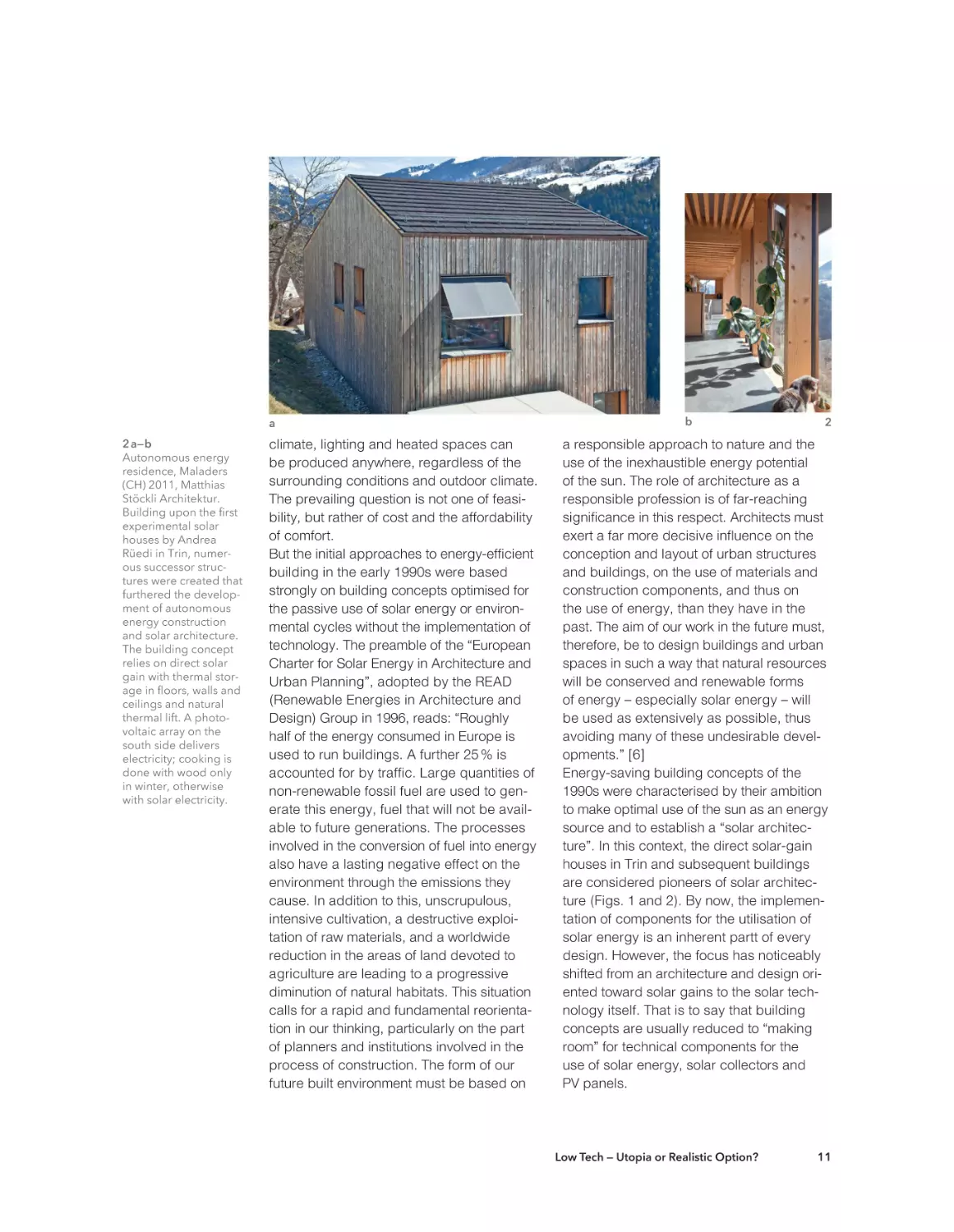
2 a— b
Autonomous energy
residence, Maladers
(CH) 2011, Matthias
Stöckli Architektur.
Building upon the first
experimental solar
houses by Andrea
Rüedi in Trin, numerous successor structures were created that
furthered the development of autonomous
energy construction
and solar architecture.
The building concept
relies on direct solar
gain with thermal storage in floors, walls and
ceilings and natural
thermal lift. A photovoltaic array on the
south side delivers
electricity; cooking is
done with wood only
in winter, otherwise
with solar electricity.
limate, lighting and heated spaces can
c
be produced anywhere, regardless of the
surrounding conditions and outdoor climate.
The prevailing question is not one of feasibility, but rather of cost and the affordability
of comfort.
But the initial approaches to energy-efficient
building in the early 1990s were based
strongly on building concepts optimised for
the passive use of solar energy or environmental cycles without the implementation of
technology. The preamble of the “European
Charter for Solar Energy in Architecture and
Urban Planning”, adopted by the READ
(Renewable Energies in Architecture and
Design) Group in 1996, reads: “Roughly
half of the energy consumed in Europe is
used to run buildings. A further 25 % is
accounted for by traffic. Large quantities of
non-renewable fossil fuel are used to generate this energy, fuel that will not be available to future generations. The processes
involved in the conversion of fuel into energy
also have a lasting negative effect on the
environment through the emissions they
cause. In addition to this, unscrupulous,
intensive cultivation, a destructive exploi
tation of raw materials, and a worldwide
reduction in the areas of land devoted to
agriculture are leading to a progressive
diminution of natural habitats. This situation
calls for a rapid and fundamental reorientation in our thinking, particularly on the part
of planners and institutions involved in the
process of construction. The form of our
future built environment must be based on
b
2
a responsible approach to nature and the
use of the inexhaustible energy potential
of the sun. The role of architecture as a
responsible profession is of far-reaching
significance in this respect. Architects must
exert a far more decisive influence on the
conception and layout of urban structures
and buildings, on the use of materials and
construction components, and thus on
the use of energy, than they have in the
past. The aim of our work in the future must,
therefore, be to design buildings and urban
spaces in such a way that natural resources
will be conserved and renewable forms
of energy – especially solar energy – will
be used as extensively as possible, thus
avoiding many of these undesirable developments.” [6]
Energy-saving building concepts of the
1990s were characterised by their ambition
to make optimal use of the sun as an energy
source and to establish a “solar architecture”. In this context, the direct solar-gain
houses in Trin and subsequent buildings
are considered pioneers of solar architecture (Figs. 1 and 2). By now, the implementation of components for the utilisation of
solar energy is an inherent partt of every
design. However, the focus has noticeably
shifted from an architecture and design oriented toward solar gains to the solar technology itself. That is to say that building
concepts are usually reduced to “making
room” for technical components for the
use of solar energy, solar collectors and
PV panels.
Low Tech — Utopia or Realistic Option?
11
Summer
Spring, autumn, sunny winter days
Winter
a
Robust low-tech architecture
After a phase during which building
technology was conceptualised primarily
as a barrier against external influences,
there are now also countercurrents towards
simpler, more robust building concepts
that are more strongly integrated with
local environmental conditions. The main
motivator for this trend in the direction
of low-tech architecture, i.e. the design
of lower-complexity buildings that
depend less on the use of technology,
is a supposedly high susceptibility to
failure in high-tech buildings, with maintenance costs that are hard to calculate
ahead of time and higher consumption
than projected.
The borders between low and high tech,
however, are fluid. In general, a building
is considered low-tech when it is conceptualised, designed and constructed in harmony with local environmental conditions.
In addition, its operation and the creation
of a comfortable interior should require as
little technology as possible and should
draw on locally available environmentally
friendly resources. This in turn presupposes
detailed knowledge of local climatic and
weather conditions such as wind, humidity, sun and temperature, but also of the
physical properties of materials and their
interactions. Low-tech architecture represents sophisticated design taking into
account local conditions. High-tech building concepts, on the other hand, function
on the basis of smart building technology,
12
b
3
using a high degree of automation with the
goal of maximising efficiency.
A study entitled “Nachhaltiges Low Tech
Gebäude (Sustainable Low-Tech Building)” [7] undertaken by the University of
Liechtenstein analysed texts and summarised the various ideas they associated with
the terms “high tech” and “low tech”: Hightech buildings are more frequently linked
to an intricate, complex and cost-intensive
construction method and building technology. These make an above-average building standard and comprehensive functionality possible. However, maintenance and
repairs require sophisticated processes
and specialist expertise. It is also considered probable that the building technology
will have a shorter life expectancy. Low-tech
buildings, on the other hand, represent simple, robust and therefore also longer-lasting
building types and technologies. In connection with this, lower costs and modest specialised expenditures in the manufacture,
operation and maintenance, but also simple
and limited functionality as well as reduced
quality in terms of the standard of “precision” can be assumed. The planning and
investment costs for both types of building
are classified as “higher than average”,
though high tech’s fall into the “much higher
than average” category.
In order for low-tech building concepts
to be implemented successfully, it is presumed that these must be in agreement
with present-day standards. The critical
issue is thus not so much the degree of
3 a —b
Housing complex in
Greve (DK) 1992,
Bente Aude and Boje
Lundgaard.
This housing complex
in Greve was designed
with the premise of
combining inexpensive living space with
energy-saving construction. An upstream
conservatory oriented
toward solar gains, a
middle section heated
by passive heat gains
and a northern-facing
core separate each
residential unit into
three climate zones.
The design provided
for the full use of the
entire building cross
section only during the
summer months, while
the north zone would
be fully included and
lived in only in winter
and the middle zone
only on sunny days
or in the transitional
spring and fall seasons.
In practice, since the
middle section was
provided with auxiliary
underfloor heating, it
is lived in year-round,
which has a significant
negative impact on the
energy balance [11].
technology but, rather, which building concepts guarantee success in reaching longterm sustainability goals – with or w
ithout
the use of technology. Conversely, with
regard to reaching climate goals, even
today’s standards must be continually reexamined, and targets must be set for a
lifestyle that more consciously confronts the
use of fossil fuels and resources.
Sufficient building concepts and rebound
effects
Low-tech design contributes substantially to
energy efficiency, in that it places sufficiency
– that is, a measured handling of resources
and a critical eye toward consumer behaviours – at the centre of the design. Built
examples provide eye-opening evidence
for how a consistent approach can result in
a reduction of more than 85 % in primary
energy use (see “Sufficient Energy Design”,
p. 68ff.). While energy efficiency technology makes increasingly frugal building concepts possible, the p
henomenon of rebound
effects, in which the responses to efficiency
measures counteract the original goals,
remain underestimated (see “Growth in
energy demand due to rebound effects”,
p. 16f. and Fig. 3).
Energy efficiency strategies and climate
goals in Europe
Climate-related extreme weather events are
on the rise and already cause more than
€12 billion per year in economic losses in
the European Union (EU) alone. If the Earth
warms by 3 °C relative to pre-industrial
levels, annual losses of at least €170 billion
are projected, not to mention the health
repercussions for humans and the irrepar
able damage done to the ecosystem [8].
The Climate Agreement reached in 2015
at the UN Climate Conference in Paris,
which sought to limit the warming of the
planet to a maximum of 2 °C above preindustrial levels and to target a temperature
rise of no more than 1.5 °C, was celebrated
as a milestone in international climate politics. The subsequent unambitious measures
and suggestions of individual nations, on
top of the economic setbacks since 2019
from managing the fallout of the Covid-19
pandemic, have moved this goal ever further away.
In December of 2019, the European Commission announced the European Green
Deal, which outlines the steps that could
make Europe climate-neutral by the year
2050. Ursula von der Leyen, the President
of the Commission, explained: “The European Green Deal is our new growth strategy
for growth that delivers more than it costs
us. It shows how we must change the way
we live and work, produce and consume,
in order to live healthier lives and make our
businesses capable of innovation. We can
all participate in this transition, and we can
all seize this opportunity. In doing so, we
will help our economy to become a global
trailblazer by having it act ahead of all
others and by having it act quickly. We are
determined to succeed in the interests of
Low Tech — Utopia or Realistic Option?
13
our planet and the life it supports – for
Europe’s natural heritage, for biodiversity,
for our forests and our oceans. If we serve
as models of sustainability and competition,
we will convince other countries to keep
pace with us as well.” [9]
Critics of the European Green Deal fault it
for being primarily economically motivated,
for depending on technological systems
to meet the challenges of the climate crisis,
and for the fact that, unlike the “Green
New Deal” in the US, it fails to consider
the associated sociological issues and the
transition of the entire economy to more
sustainable systems. Similarly, social economist Andreas Novy points out the missing congruence with the original idea, the
New Deal of the 1930s under Franklin D.
Roosevelt, a social security programme that
put significant equity considerations and
the strengthening of public institutions front
and centre [10].
A European climate law that was agreed
upon in June of 2021 is meant to legally
bind the EU to its goal of becoming climateneutral by 2050. At the same time, all Member States are invited to pass legally binding
measures on a national level. The first intermediate goal is to lower greenhouse gas
emissions by 55 % relative to 1990 levels by
the year 2030. This in turn sets clear targets
for the energy efficiency of buildings. The
building sector (construction, use, renovation and demolition) plays a critical role in
energy politics. In the EU, for example, it is
responsible for 40 % of energy consumption
and 36 % of greenhouse gas emissions.
A significant proportion of the energy
is “wasted” in existing buildings as
well. Seventy-five per cent of existing
buildings are not energy-efficient, and
a low average renovation rate of less
than 1 % per year shows up one of the
problems that must be addressed most
urgently.
The EU has an ambitious planning framework for achieving climate neutrality
in Europe by 2050 and for adopting a
pioneering role with respect to other
nations. The EU directive for the “Energy
Performance of Buildings” (EPBD), known
as the EU Building Directive, specifies
the minimum requirements for the evalu
ation of overall energy efficiency within
a common framework for all EU Member
States. According the EU Building Dir
ective, all new buildings built from 2021
onwards must be nearly zero-energy buildings (that is, conform to a minimum or nearzero energy standard). In order to move
the ecological transition forward, another
new EU initiative begun in January of 2021,
the “New European Bauhaus”, will connect
to the power of reform and design through
the integration of art, economics and science. However, a c
entral theme of the
Bauhaus, founded in Weimar in 1919 by
Walter G
ropius, was also to reposition
artisanal craftsmanship in the face of
increasing industrialisation. To that end,
artists and a
rtisans were to return to a
closer working relationship with one
another to usher in a renaissance of craftsmanship with contemporary stylistic ele
b
a
14
c
4
4 a—c
In 1941, Scottish-
Swedish architect
Ralph Erskine built a
simple timber house
that met all of his
and his family’s everyday requirements on
just 20 m2. Simple
functional means were
used to implement
numerous practical
solutions: For example,
the north wall is
additionally insulated
inside by a closet,
and outside by stored
firewood. Indirect
lighting in the kitchen
is achieved by means
of a perforated upper
panel [15].
a
5 a—b
PopUp Dorms, student
residences, Vienna (AT)
2015, F2 Architekten.
The mobile dormitory
was built with the aim
of providing econom
ical living accommodations for students in
Vienna, using a vacant
property for the temporary structures. Each
of the 75 m2-area
boxes houses a group
of students and features four rooms, two
bathroom units and a
kitchenette. Over the
course of two construction stages, a total of
22 living modules
including furnishings
were prefabricated at
a nearby plant and
installed on site within
one week. In distinct
contrast to conventional container-based
construction, these
passive-house units are
built to high energetic
standards. Each of the
modules is designed to
be transported on the
bed of a truck. The
PopUp Dorms were
relocated to a new
open site in 2021 [16].
b
ments. While the EU directive on the zeroenergy standard will presumably be
achieved only over a long life cycle through
the implementation of robust architecture
and low-tech design, the basic concept of
the “New E
uropean Bauhaus” will possibly
prove to be trend-setting for low-tech design
and loop-oriented construction.
Need-oriented design
In the conversation about sustainability, the
term “sufficiency” takes its place next to
“efficiency” and “consistency” as the third
of the urgent strategies toward achieving
the climate goals.
Earth Overshoot Day, the day on which
the resource budget for the current year
has been used up, has been moving up
continually for years. In 2021, it fell on
the 29th of July, which means that it took
only a little over half a year for people
to consume more resources than can be
regenerated. By this point in time, the
world would require 1.7 Earths on average to maintain our style of living. When
viewed in detail, this wasteful consumption of resources differs considerably
from country to country. It occurs mainly
at the hands of Western industrialised
nations. In this calculation, if the whole
world consumed like the USA, it would
now need 5 Earths, Austria’s consumption
would require 3.8 Earths and Germany’s
2.9; meanwhile, India’s consumption at
0.7 Earths still lags behind the world average of 1.7 Earths by quite a large margin.
5
Sufficiency therefore means limiting activ
ities that lead to excessive consumption of
resources, without significantly restricting
well-being or quality of life. The concept
relies on a high quality-of-life valuation
based on indicators such as social relationships and recreation and leisure time that
are not necessarily linked to consumption. Restricting consumption and comfort
requirements to a measured and moderate
level does not stand in opposition to consumer-oriented living practices.
The timber house built by architect Ralph
Erskine illustrates that it is possible to
accommodate all essential everyday needs
on a footprint of only 20 m2 without sacri
ficing comfort (Fig. 4). Recently, tiny-house
concepts have again taken up this idea.
However, they can only be considered truly
sustainable if they reduce living space and
are not built merely as an additional holiday home. In Austria alone, from 2017 to
2020, an average of 11.5 ha per day of
new land area was claimed, thereby proportionately reducing biologically productive ground [12]. Temporary housing on
vacant properties is one of the options for
a more efficient use of ground resources
(Fig. 5).
In reference to building concepts, “sufficiency” means that the need for resources,
materials and comfort requirements must be
critically examined. It also involves avoiding frequently occurring redundancies in
technical systems and in the dimensioning
of materials. Furthermore, low-tech design
Low Tech — Utopia or Realistic Option?
15
strategies take the approach of prioritising
the individual responsibility of users over
automated control and regulation, and of
once again assigning greater importance
to craftsmanship and manual labour.
The growth of energy demand due to
rebound effects
Experts generally speak of both direct and
indirect rebound effects. The direct rebound
effect describes the immediate changes in
user behaviour in response to measures or
products that have been put into effect. In
heating, for example, this could be reflected
in a significantly higher temperature setting
in indoor spaces due to energy-efficient
construction. Studies show that often, after
building renovations involving efficient
insulation and building technology were
completed, the comfort parameters for
room temperatures rose by several degrees
Celsius [13].
However, indirect rebound effects are
becoming just as powerful. These are
energy cost savings that are reinvested in
other consumer goods or services. In the
building sector, this most often manifests
itself in more living area per resident
or, for example, greater expenditure for
transportation. Despite increasingly more
energy-efficient devices and buildings,
energy consumption and its associated
CO2 emissions keep climbing. Studies show
that only 50 % or less of the expected efficiency gains through technology actually
take effect [14].
Rebound effects therefore represent a
powerful argument in favour of low-tech
design solutions. Tilman Santarius, Professor of Socio-Ecological Transformation at
the Technische Universität Berlin, defines
rebound effects as “efficiency-triggered
growth in demand”. He differentiates between
financial, economic, industrial, motiva
tional and temporal rebound effects [17].
A financial rebound effect is one in which
money that was made available through an
increase in technological energy efficiency
is spent instead on greater comfort requirements, increased usage rates or intensified
consumption of other goods and services.
Opinions diverge sharply on how great an
16
impact can be expected from direct and
indirect rebound effects. However, in
industrialised nations, values between
10 and 30 % for direct rebounds and
a further 5 –10 % for indirect rebounds
are considered responsible estimates.
Economic rebound effects are “energy-
production-related growth effects”, that is,
they are responses to the economic growth
that is attributable to increases in energy
efficiency [18]. Thus far, no reliable data
exists for the quantification of the active
effects, which Santarius dubs the “terms
of trade between capital and energy”.
The industrial rebound effect describes
secondary effects based on production
increases and embodied energy. The production of energy-efficient technology itself
imposes additional energy demand, which
is reflected in the budget as embodied
energy. Other factors that result in industrial
rebound effects are the expansion of production due to efficiency-enhancing mea
sures and investment in new products and
services due to greater profits or because
of a redesign of existing products “in the
expectation of income effects on the part
of the consumer” [19]. The phenomenon
in which resource consumption rises as a
result of a change in technological assessments is called a m
otivational rebound
effect. An example of this occurs when
energy-efficient products experience greater
demand because of their improved social
image. The last of the culprits responsible
for growing resource consumption despite
increasingly efficient technologies is the
temporal rebound effect. On an individual
as well as a societal level, purported efficiency technology allows for the redistribution of temporal resources. However, this
rarely leads to a savings in resources. On
an individual level, it often manifests as a
densification of time, a greater number of
activities packed into the same time interval;
on a societal level, it is reflected in the accelerating pace of all facets of life, which
brings with it an increased demand for
energy. In general, energy demand also
rises due to the increased mechanisation
impacting every sphere of life: buildings,
households, computers and mobile phones.
6
Long-term trends in
winter residential
temperatures in the
United Kingdom, the
USA, Japan and China.
Owing to the development of district heating
systems, starting in
the 1950s the indoor
temperatures in northern China began to
approach those of
the USA, while the temperatures in southern
China, which could not
profit from the development, remain at very
low levels.
Indoor air temperature [°C]
Low-tech design as an effective climate
strategy
The growing capabilities of technology
bring with them increasing expectations
and greater requirements for comfort and
functionality. Climate experts agree that a
broad societal transition is needed in order
for us to be able to reach our climate goals.
They also stress that this problem cannot be
solved through technology alone. The consequences of climate change can be seen
as the result of an approach that is based
exclusively on economic growth, proclaims
the maximisation of consumption and gain
as a priority and reduces the quality of life
to a question of consumption. In the effort
towards achieving a profound transition, lowtech design can open up a framework for
new ways of thinking. Low-tech design does
not mean that technology must be forgone
entirely. It is more a question of integrating
technology in a deliberate way, and priori
tising not so much its feasibility but rather
its use, its actual effects, its frugal approach
to resources and its far-reaching repercussions with an eye to the entire life cycle and
necessary climate change consequences.
Annual climate reports show that western
industrial nations in particular live beyond
their means and consume more resources
than are available (see “Need-oriented
design”, p. 15f.). However, a shift in political
and societal thinking and the transformation
of consciousness that is necessary to deal
with the climate crisis are slow in coming.
22
20
18
US living room
US bedroom
northern
China
GB living room
16
14
12
10
GB bedroom
Japan
northern
USA
1800 1970
southern China
1980
1990
2000 2010
year
6
Low-tech design and robust architecture,
which pursue quality over quantity, offer to
take things in a new direction. One of the
approaches must be to reevaluate the
importance of manual labour as opposed to
the maximisation of consumption and gain.
Another, in light of the enormous inventory
of existing buildings, is to assign a much
greater priority to their reuse and renovation
over the construction of new buildings.
Designs for users, scrutiny of needs and
basic requirements in building
What is a good life? What do we need to live
well, without living at the expense of others?
Among other factors, the restrictions put in
place in the course of the Covid-19 pandemic moved the importance of social relationships back into focus. Trend researchers saw this as an acceleration of a previously existing tendency. Likewise, changes
such as expressing greater appreciation for
one’s own home are traced back to the pandemic [20]. Comfort and spatial needs are
now geared toward the new necessity of
finding an optimal combination of work and
home life. This also brings with it a novel
tendency toward more mindfulness. Investment is geared less toward quantity and
more toward qualitative considerations;
high-value natural materials are in demand.
Similarly, a connection to nature is gaining
importance. The age-old need for wellbeing and security is becoming more
pronounced. Residential concepts that
contribute actively to health and wellness
are expected.
A look at the past shows not only that comfort requirements and parameters have historically changed, but also that they were
interpreted differently depending on their
cultural and societal context. The perception of comfort has developed continually
over the course of history and is based on
several technological, economic, social and
cultural influences [21]. In the 19th century,
the term was first used for room comfort
in connection with warmth, ventilation and
light. Nowadays, comfort is associated with
bodily and thermal well-being. Satisfaction
with the room climate and temperaturerelated cosiness are the result of an adjust-
Low Tech — Utopia or Realistic Option?
17
ment process between the physical environment and subjective comfort expectations.
Individual requirements and well-being are
thus based on our experiences and are
strongly socio-culturally influenced [22].
A study on long-term interior temperature
trends in the United Kingdom, the USA,
Japan and China illustrates how different
the characteristic expectations of temperature levels have been over the past 50
years or so (Fig. 6). Though the results
show that the various country-specific heat
expectations are trending toward a neutral
indoor winter temperature of about 21 °C,
differences of a few degrees can still be
discerned [23].
The use of technology in the building sector
has made possible not only energy-efficient
buildings, but also a marked increase in
room comfort. This development is accompanied by growing expectations of reliable
and uniform interior climate values. By
now, a few empirical research studies have
substantiated the relationship between the
level of technical equipment and individual
expectations [24]; a comparison between
air conditioning and natural ventilation, for
example, revealed differences in user attitudes. An analysis of data from an inter
national building database makes clear that
the type of interior comfort regulation (air
conditioning, mixed-mode air conditioning,
natural ventilation) influences the expectations of users with regard to their workplace
satisfaction. In naturally ventilated buildings,
good temperature conditions correlated
with significantly elevated overall workplace
satisfaction, and even poorly rated heating
performance did not negatively impact
overall satisfaction. In fully air-conditioned
working environments, on the other hand,
thermal conditions corresponded more
directly with a negative overall workplace
satisfaction rating; that is, a poorly rated
interior climate had an additional negative
impact on such a rating [25].
Advances in building and interior climate
control technologies (heating, cooling and
ventilation) have made it possible to construct
buildings and to guarantee any desired
comfort standards for them without regard
for exterior climatic conditions and regional
18
situational factors. However, this development brings with it growing energy consumption, for which efficiency technologies
alone cannot compensate. Even though
positive developments can be seen, albeit
slow and highly variable from country to
country, 2021 was projected to have the
second-highest increase in CO2 emissions
since 1990 [26].
So far little is known about the degree to
which reductions in comfort parameters
and higher tolerances with regard to
temperature variations in line with exterior
temperatures, for example, would be
accepted. Comprehensive results on user
satisfaction in energy-efficient buildings
are already available. However, studies
investigating pared-down building concepts would be of interest, in order to obtain
user statements about their minimum basic
requirements of the building on the one
hand, and data concerning the adaptability
of users as a function of the prevailing inter
ior climate on the other.
Also missing to date are studies that specifically address the topic of “personal
responsibility” for control and regulation as
opposed to automated systems. Just as in
all aspects of living, our ideas of comfort are
derived from habits formed in the course
of everyday routine. To rethink these and
consequently to redefine basic requirements and demands, would be the subject
of further important research.
Building within the context of nature,
health and tradition
Today, buildings can be conceptualised
and developed to fulfil functional criteria
largely independently of location (apart from
infrastructural connectivity considerations
and spatial restrictions). This ensures that
quality remains uniform regardless of climate and situational factors. However, it
also results in an often-criticised compartmentalisation from natural surroundings
and exterior spaces that can have negative
effects on health.
Regenerative design
In the discourse on sustainability, this has
rightly led to increasing calls to once again
7 a — b
Achleitner organic
farm, E
ferding (AT)
2005, Preisack / Holzer /
Rodleitner; Vegetation: Jürgen Frantz.
The basic principles of
the Achleitner organic
farm – a conservationist
approach to nature, a
variety of employment
positions in liveable
surroundings and providing customers with
healthy foods and valuable organic products –
are reflected in the
overall concept of this
new building. Aside
from the use of regionally sourced building
materials for the structure (straw, clay and
timber), large portions
of the interior were
air-conditioned using
vegetation. The affordable straw was harvested directly from
fields belonging to
the organic farm or
other regional operations. A plant-based
air-conditioning system with hundreds
of plants, running the
gamut from orchids
and bromeliads via
diverse ferns to philodendrons, provides
a comfortable indoor
climate both in the
workplace and in the
sales and recreational
spaces frequented by
customers.
regard building within the context of an
entire ecosystem. The term “regenerative
design” has been attracting growing attention as an important concept for a transformative process. Regenerative sustain
ability aims to steer away from narrow considerations of specific aspects such as
energy efficiency, renewable resources
and sustainable technologies and towards
a holistic systemic view, as well as towards
the creation of a self-regenerating social
and ecological system [27]. The first use
of the phrase “regenerative design” is
attributed to the landscape architect John
Tillmann Lyle, who introduced a “regenerative cycle” model in 1994. Essential needs
of daily life, such as housing, food, water
and waste management, were to be kept in
a regenerative energy and material loop,
so that self-generating ecological cycles
can form that are capable of re-establishing
themselves in the built environment [28].
Concentrating exclusively on the energy
consumption or CO2 emissions of buildings
merely shifts the environmental impact
of the buildings from one sector to another.
For this reason, regenerative principles
take into account the built environment as
a whole. The design process is based
on continual learning and feedback, allowing man-made and natural systems to
contribute jointly to positive changes within
the ecosystem. In this context, buildings
are catalysts for effecting such positive
changes. The fundamental concepts of
regenerative design therefore mesh with
the goals of low-tech design.
a
b
7
Building with nature: Biophilic design
The beneficial effect of nature and its
positive impacts on the human psyche are
undisputed. Even in built environments,
people desire a connection with nature.
Evolutionary biologists contend that the
emotional link to nature is an innate trait.
In 1984, in his book Biophilia, American
biologist Edward O. Wilson explained the
essential meaning of our natural affinity for
life – biophilia (from the Greek “bios” (life)
and “philia” (love)), the love for all living
things that binds us to all other species
and hence the love of nature:
“We are human in good part because of
the particular way we affiliate with other
organisms. They are the matrix in which the
human mind originated and is permanently
rooted, and they offer the challenge and
freedom innately sought. To the extent that
each person can feel like a naturalist, the
old excitement of the untrammelled world
will be regained.“ [29]
Before Wilson put forward his hypothesis,
Erich Fromm had already coined the term
“biophilia”. In reference to Sigmund Freud’s
“life drive and death drive”, Fromm presents biophilia in opposition to “necrophilia”,
the love for all dead things. “Biophilia is
the passionate love of life and all that is
alive; it is the wish to further growth, whether
in a person, a plant, an idea or a social
group.” [30]
While biophilia is portrayed as a normal
biological impulse, necrophilia is contrasted with it as a psychopathological
phenomenon, which, according to Fromm
“stems from stunted growth, a crippling
of the spirit.”
Biophilia has by now established itself as
an independent design concept. The in
corporation of natural elements into buildings,
facades or interior spaces makes greater
allowance for the urgent desire for a connection to nature. The positive psycho
logical effects of nature, such as stress
reduction and a healthier room environment,
are brought to the fore.
Beyond this, however, nature can also
make significant contributions to low-tech
design. The possibilities range, for example,
from the incorporation of surrounding vegetation for shading and cooling to green
facades for thermal insulation to the use of
plants indoors to moderate air dryness
(Fig. 7) to the use of microclimatic properties of vegetation and trees in more densely
built-up areas.
Air impermeability and microbial diversity
Microbes are invisible microorganisms
that occur in inconceivable numbers in
nature and in our buildings. Physician
Walter Hugentobler calls attention to the
fact that they represent an absolutely
essential resource for our health. According
Low Tech — Utopia or Realistic Option?
19
to him, microbes are unfairly cast as purely
pathogenic “bogeymen”. Without a connection to nature and without the development
of a competent immune and allergy system,
that is, without the interaction with the multitudinous microbes of the environment that
support this development, a healthy life
would be impossible [31]. Increasingly airtight buildings and vehicles will have grave
consequences for health:
“For 350,000 years of evolutionary history,
the learning process our immune system
undergoes took place in direct connection
with nature, with the microbes present in
the air, water, soil, fauna and flora. The
rooms in the naturally ventilated houses
were likewise well-networked with the microbial variety of nature. Constructions made
of natural materials were not airtight, windows were used for airing out, animals were
kept close by, and household dirt was pre
sent, all of which ensured that permanent
contact with microbes of the environment
was maintained. [...] In less than 200 years,
advances in building technology have replaced simple houses with energy-efficient,
hermetically sealed HIGH-TECH buildings.
Today, mechanical ventilation that filters
the outdoor air, heightened cleanliness and
a lifestyle removed from nature hinder the
exchange with the natural microbiome. In
our ‘building habitat’ we live in a permanent
comfort climate, breathe filtered air and are
surrounded by an impoverished microbial
mix.” [32]
Airtight building concepts, the desire for
a comfortable year-round climate and an
average 3 – 5 °C rise in heating temperatures thanks to increasingly energy-efficient
building techniques result in an excessively
dry indoor climate. An intended consequence of this is the prevention of negative
occurrences such as mould formation and
bacterial growth. At the same time, however, microbes important for the development of the immune system are eliminated,
while infectious diseases, auto-immune
diseases and allergies are on the rise [33].
The optimum humidity level for interior air
lies between 40 and 60 %. Humidity values
below 40 % have a negative impact on
health. However, to date this issue has
20
received little attention.
Hugentobler also attributes negative health
effects to the increased use of “industrial
products”:
“While practically all natural materials are
permeable and porous, industrial products
are characterised by their compactness
and smooth, non-porous surfaces. Natural
materials absorb moisture according to
their sorption isotherms and release it
again in a delayed manner as the humidity
drops. [...] Industrial materials are inert
with respect to moisture exchange and
are either dry or wet. [...] Compact, nonporous, hydrophobic and extremely
smooth plastic surfaces are free of water
and dirt. No harmless commensal biota
can survive on such surfaces. Multi-
resistant bacteria, however, temporarily
shut off their metabolism on these surfaces,
become ‘persisters’ and are therefore
undetectable even with culturing methods. After they are transmitted through
the air or by direct contact, they resume
their metabolism in the moist environment
of the respiratory tract or the gut of the
infected individual and can trigger an
infection.” [34]
For these reasons, Hubentobler urges that
buildings be “viewed, planned and operated as habitats and living ecosystems”.
The correct method would make use of
what is known as BioInformed Design, in
which harmless, useful microbes are consciously cultivated and only the dangerous
ones are suppressed. Research into ways
to design interior spaces so as to encourage the growth of beneficial microorganisms while inhibiting that of microorganisms
Summer
Winter
Hay supply/vehicles
Bedrooms
workshop/wood
Living area/kitchen
livestock
Cellar
8
8
Schematic longitu
dinal section of a Black
Forest house. Agricultural buildings of early
modern times made
use not only of a climate-adapted building form, but also
the opportunities represented by passive
temperature control
and seasonal zoning
of the floor plan. In
winter months, only a
few rooms adjoining
the heated kitchen and
the tiled stove in the
“parlour” were occupied. The bedrooms
above were collaterally
heated by the “warm
parlour”, while the full
hay loft and the stable
provided additional
heat buffers during the
winter [37].
harmful to humans is admittedly still in its
early stages.
Notes
[1] Thurner 2020
[2] Endres 2020
[3] Santarius 2020
[4] Hugentobler 2020
[5] Oswalt 1994
[6] Herzog et al. 1996
[7] Ritter 2014
[8]
European
Commission
24 Feb 2021
[9]
European Commission 11 Dec
2019
[10] Novy 2021
[11] Detail 5/1986
[12] umweltbundesamt.at
[13] Biermayr et al.
2005
[14] see Note 3
[15] Naboni 2018,
p. 561– 567
[16] nachhaltigwirtschaften.at
[17] see Note 3
[18] see Note 3
[19] see Note 3, p. 16
[20] Horx-Strathern,
Zukunftsinstitut
2020
[21] Brager, de Dear
2008
[22] Haselsteiner
2021; Haselsteiner
et al. 2021
[23] Luo et al. 2016
[24] Frontczak,
Wargocki 2011
[25] Kim, de Dear
2012
[26] IEA.org
[27] Brown 2016;
Haselsteiner et al.
2021
[28] Lyle 1996
[29] Wilson 1984
[30] Fromm 1974
[31] see Note 4
[32] see Note 4
[33] see Note 4
[34] see Note 4
[35] Kuhnert 1987
[36] Hanus, Radinger,
2019, p. 6–10
[37] Hönger 2013
Tradition and building culture
“The present day is dominated by two fundamentally different ideas of building, that
of the Modern age and that of reawakened
tradition. They differ in their form (unbounded
versus bounded space), in their building
technology (high or low tech) and in their
building ecology (autonomy from nature or
incorporation into nature).” [35]
With the Modern age, the waning years of
the 19th century and advancing developments of the Industrial Revolution, society
has become more and more removed
from the knowledge handed down through
earlier generations. Advances in technology have decreased the degree to which
location-specific experiential knowledge
based on the complex interrelationships
among the natural environmental, geo
logical and climatic conditions is necessary.
Craftsmanship has likewise been increasingly relegated to the background in favour
of industrial and serial production. Only
with rising concerns related to local climate
adaptation strategies have microclimatic or
regional peculiarities begun to reinfiltrate
the discussion.
In the alpine regions of Europe and around
the world, timber construction has a welldeserved centuries-long tradition. Wood in
those places is available as a local resource
in the immediate surroundings, and has
proven its worth in countries with an alpine
climate – that is, relatively cool summers
and long, snowy winters – thanks to its
excellent insulating properties. In these
regions, stone and solid constructions have
persevered mainly because of timber scarcity or as a response to frequent fires. In
warmer and drier climatic zones, on the
other hand, stone and solid constructions
have established themselves as suitable
building types. Characteristics such as the
thermal inertia of thick exterior walls serve
to seal off rooms against outdoor heat, while
their thermal retention properties provide
natural heating overnight.
Through their proven robustness and longevity, often over several centuries, histor
ical structures fulfil important features of
sustainability. Beyond this, they are the
bearers of historical building culture and
convey knowledge about dealing with
the challenges of climate and the natural
environment. Tradition, craftsmanship and
locally available materials formed the foundations of a building culture that was consciously attuned to the environmental and
location-specific conditions. Just as import
ant is its frugal approach to resources
and space, rooted in the basic habits and
requirements of people.
Life cycle analyses show that the preservation of traditional historical structures also
represents an important facet of sustain
ability. Even if experience indicates that
their maintenance requires more effort and
expense than that of similar new buildings,
because of their longevity old buildings
come out ahead both ecologically and economically on the overall balance sheet [36].
This statement is vividly illustrated by the
example of historical box sash windows.
Expertly manufactured and carefully maintained, these can last centuries without
sacrificing their functionality.
Low-tech design attempts to re-establish a
closer connection to the building traditions
and culture of our ancestors. Knowledge of
the craftsmanship of separable and structural connections between building com
ponents can promote loop-compatible construction and building recycling. Skills in
handling and incorporating locally available
materials will contribute to technology savings in both the manufacturing process
and in transportation, especially with regard
to embodied energy. Last but not least,
knowledge about climate-adapted building,
passed on by word of mouth and stored in
the building fabric itself, represents a valuable resource in the development of climate
adaptation strategies (Fig. 8).
Low Tech — Utopia or Realistic Option?
21
The Sustainable Low-tech
Building
Edeltraud Haselsteiner
The goal of sustainable construction is to
implement a mutually balanced combin
ation of ecological, economic and social
sustainability and insure its continuation
over the entire life cycle of the building.
To this end, sustainable low-tech building
concepts question the use particularly of
information and communications technology
(ICT) and building automation systems as
a long-term best approach to sustainable
construction.
System limits and the role of technology
in the life cycle
Though ICT systems offer options for build
ing optimisation, their “intelligence” lies in
carefully thought-out design. In his book
Low-Tech Light-Tech High-Tech. Bauen
in der Informationsgesellschaft (Building
in the Information Society), Klaus Daniels
provides the first comprehensive look at
the entry of information technology into the
building sector in the German-speaking
sphere, an important milestone in the devel
opment of so-called “smart” building tech
nology:
“Intelligently designed and operated build
ings, often falsely referred to as “smart
buildings”, are characterised not only by
their highly interconnected information,
communications and building automa
tion systems, but primarily by the fact that
they are capable of serving user needs
directly from the environment, bypassing
the utilisation of technical installations.” [1]
In order to be able to not only maintain,
22
but properly use buildings throughout
their entire lifetime requires a well thoughtout and forward-looking design concept.
Energy efficiency during operations should
be valued just as highly as the consumption
of embodied energy or the recyclability of
materials. The same is true for sustainable
low-tech buildings. The overarching ques
tion is, of course, what temporal or spatial
dimensions define the limits of “low tech”.
In concrete terms, it must be clarified
whether the technology input should only
be included when it can be directly con
nected to the construction, operation or
deconstruction of the building, or whether
the technological component of the manu
facture of the building materials and parts
should also be considered. One can also
differentiate between assessments in the
temporal dimension, along life cycle phases,
or in the spatial, according to distance from
the building.
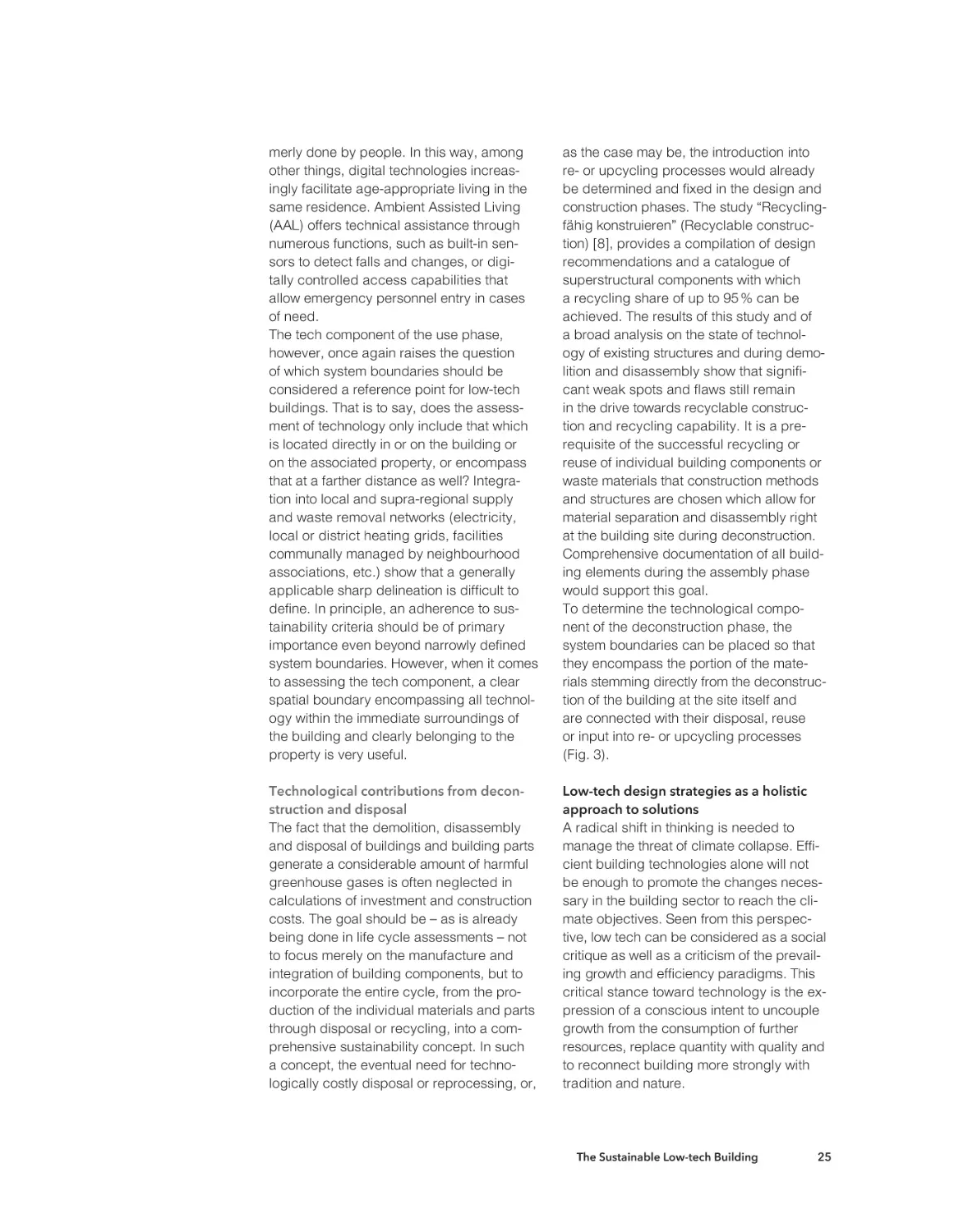
The life cycle is roughly subdivided into
four phases: Design and manufacture
(raw materials) – assembly, construction
and renovation – use, operation and main
tenance – deconstruction and disposal.
Different life cycle phases require different
forms of technological input (Fig. 2).
In the operations phase, a look at the tech
nological contributions can be further sim
plified by considering the spatial distance
to the building [2]:
• Technology directly in or on the building
or plot (heating, ventilation system, col
lectors, etc.)
a
b
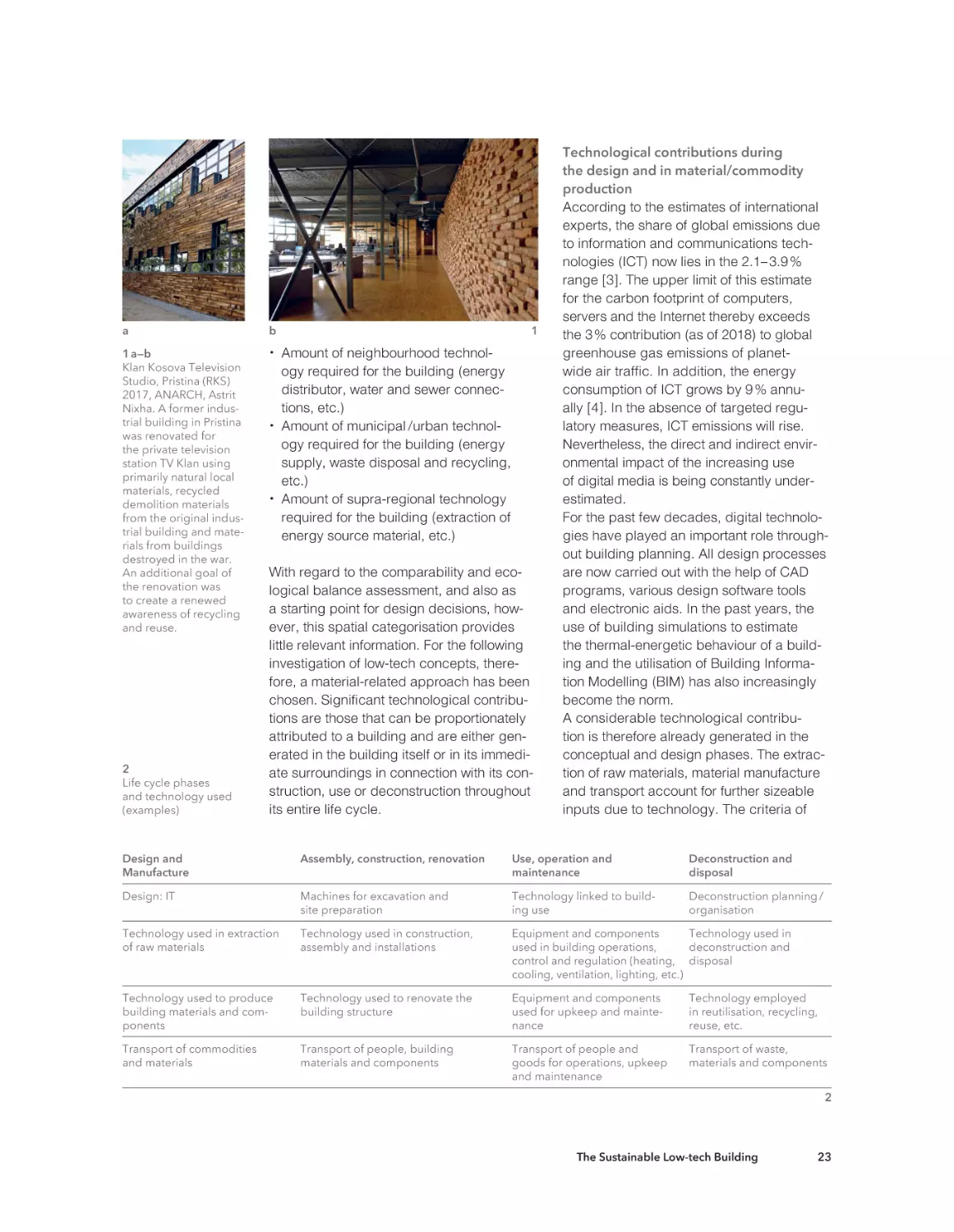
1 a—b
Klan Kosova Television
Studio, Pristina (RKS)
2017, ANARCH, Astrit
Nixha. A former indus
trial building in Pristina
was renovated for
the private television
station TV Klan using
primarily natural local
materials, recycled
demolition materials
from the original indus
trial building and mate
rials from buildings
destroyed in the war.
An additional goal of
the renovation was
to create a renewed
awareness of recycling
and reuse.
• Amount of neighbourhood technol
ogy required for the building (energy
distributor, water and sewer connec
tions, etc.)
• Amount of municipal /urban technol
ogy required for the building (energy
supply, waste disposal and recycling,
etc.)
• Amount of supra-regional technology
required for the building (extraction of
energy source material, etc.)
2
Life cycle phases
and technology used
(examples)
1
With regard to the comparability and eco
logical balance assessment, and also as
a starting point for design decisions, how
ever, this spatial categorisation provides
little relevant information. For the following
investigation of low-tech concepts, there
fore, a material-related approach has been
chosen. Significant technological contribu
tions are those that can be proportionately
attributed to a building and are either gen
erated in the building itself or in its immedi
ate surroundings in connection with its con
struction, use or deconstruction throughout
its entire life cycle.
Technological contributions during
the design and in material/commodity
production
According to the estimates of international
experts, the share of global emissions due
to information and communications tech
nologies (ICT) now lies in the 2.1– 3.9 %
range [3]. The upper limit of this estimate
for the carbon footprint of computers,
servers and the Internet thereby exceeds
the 3 % contribution (as of 2018) to global
greenhouse gas emissions of planetwide air traffic. In addition, the energy
consumption of ICT grows by 9 % annu
ally [4]. In the absence of targeted regu
latory measures, ICT emissions will rise.
Nevertheless, the direct and indirect envir
onmental impact of the increasing use
of digital media is being constantly under
estimated.
For the past few decades, digital technolo
gies have played an important role through
out building planning. All design processes
are now carried out with the help of CAD
programs, various design software tools
and electronic aids. In the past years, the
use of building simulations to estimate
the thermal-energetic behaviour of a build
ing and the utilisation of Building Informa
tion Modelling (BIM) has also increasingly
become the norm.
A considerable technological contribu
tion is therefore already generated in the
conceptual and design phases. The extrac
tion of raw materials, material manufacture
and transport account for further sizeable
inputs due to technology. The criteria of
Design and
Manufacture
Assembly, construction, renovation
Use, operation and
maintenance
Deconstruction and
disposal
Design: IT
Machines for excavation and
site preparation
Technology linked to build
ing use
Deconstruction planning /
organisation
Technology used in extraction
of raw materials
Technology used in construction,
assembly and installations
Equipment and components
Technology used in
used in building operations,
deconstruction and
control and regulation (heating, disposal
cooling, ventilation, lighting, etc.)
Technology used to produce
building materials and com
ponents
Technology used to renovate the
building structure
Equipment and components
used for upkeep and mainte
nance
Technology employed
in reutilisation, recycling,
reuse, etc.
Transport of commodities
and materials
Transport of people, building
materials and components
Transport of people and
goods for operations, upkeep
and maintenance
Transport of waste,
materials and components
2
The Sustainable Low-tech Building
23
sustainable low-tech building should there
fore always scrutinise and factor in the
technological share. One way to broadly
reduce this share in the production of pri
mary products and materials is to utilise
materials or building elements from existing
buildings (Fig. p. 6; fig. 1, p. 23). Consider
ations such as the regional availability of
building materials, as well as a carefully
considered utilisation of digital technolo
gies, should be part of the overall concept.
Technological contributions from assembly, construction and renovation
Because of the temporally and spatially
defined framework of the construction
phase, data on the technological contribu
tion of this phase is comparatively unam
biguous. From excavation to completion,
all technologies, construction vehicles
and equipment necessary to prepare the
building for assembly, build it, join parts
together or install components are rele
vant. In addition, depending on the build
ing method and the degree of prefabrica
tion of the building components, consider
able technological contributions can be
attributed to processes at some remove
from the object itself.
A significant share of the construction
phase technology, however, for new build
ings as well as renovations, falls to the
entire transport sector for people and
goods. The removal of excavation mate
rials, demolition materials and construc
tion debris, as well as all the primary prod
ucts and materials transported by truck
to the construction site, generate enor
mous CO2 emissions. Long and poorly
coordinated transport routes cause high
traffic volume with its associated signifi
cant levels of environmental pollution. Pilot
and research projects [5], such as pilot
project RUMBA [6], demonstrate that a
logistically more efficient organisation of
the construction site on the one hand, and
the use of sustainable transport options
(e.g. shifting transport to railways) on
the other, make significant reductions in
transportation demand and a more eco
logically compatible building site possible.
In renovations, moreover, the more mate
rials can be reused or recycled directly
24
at the construction site, the fewer tech
nologies or additional transport are
required.
Technological contributions from use,
operation and maintenance
In the use and operations phase, all build
ing technology is of consequence that
supplies fresh air, water, light and heat
(or cold), removes return air, sewage and
waste, and also, where applicable, pro
vides transport within the building via lifts
[7]. In addition, technology employed for
the maintenance, servicing and repair of
the building technology systems is also
relevant. Increasingly, safety technology
is an issue not only for offices and work
places, but in the private sphere as well.
Depending on the way the building is used,
there may also be specific functions that
are initiated and regulated via technical
building equipment.
Under the umbrella term “Smart Home” –
the development of digital technologies
for the automation and networked con
trol and regulation of individual buildingtechnological processes and devices –
the technological component particularly
of the routine functioning and operation of
devices in the home is sharply on the rise.
The simple mechanical doorbell of yore
is now a highly technical door security
apparatus with audio and video functions
to provide controlled access. Instead of
the conventional opening of windows for
airing out, sensor-driven window-opening
mechanisms provide an alternative or
supplement to ventilation systems. Tech
nological systems are becoming “smarter”
and are taking over tasks that were for
Mining /
extraction of
raw materials
Production of
building materials
3
Life cycle phases
Fabrication
External recycling
Disposal
Usage phase
Processing /
reutilisation
Deconstruction /
demolition
3
merly done by people. In this way, among
other things, digital technologies increas
ingly facilitate age-appropriate living in the
same residence. Ambient Assisted Living
(AAL) offers technical assistance through
numerous functions, such as built-in sen
sors to detect falls and changes, or digi
tally controlled access capabilities that
allow emergency personnel entry in cases
of need.
The tech component of the use phase,
however, once again raises the question
of which system boundaries should be
considered a reference point for low-tech
buildings. That is to say, does the assess
ment of technology only include that which
is located directly in or on the building or
on the associated property, or encompass
that at a farther distance as well? Integra
tion into local and supra-regional supply
and waste removal networks (electricity,
local or district heating grids, facilities
communally managed by neighbourhood
associations, etc.) show that a generally
applicable sharp delineation is difficult to
define. In principle, an adherence to sus
tainability criteria should be of primary
importance even beyond narrowly defined
system boundaries. However, when it comes
to assessing the tech component, a clear
spatial boundary encompassing all technol
ogy within the immediate surroundings of
the building and clearly belonging to the
property is very useful.
as the case may be, the introduction into
re- or upcycling processes would already
be determined and fixed in the design and
construction phases. The study “Recycling
fähig konstruieren” (Recyclable construc
tion) [8], provides a compilation of design
recommendations and a catalogue of
superstructural components with which
a recycling share of up to 95 % can be
achieved. The results of this study and of
a broad analysis on the state of technol
ogy of existing structures and during demo
lition and disassembly show that signifi
cant weak spots and flaws still remain
in the drive towards recyclable construc
tion and recycling capability. It is a pre
requisite of the successful recycling or
reuse of individual building components or
waste materials that construction methods
and structures are chosen which allow for
material separation and disassembly right
at the building site during deconstruction.
Comprehensive documentation of all build
ing elements during the assembly phase
would support this goal.
To determine the technological compo
nent of the deconstruction phase, the
system boundaries can be placed so that
they encompass the portion of the mate
rials stemming directly from the deconstruc
tion of the building at the site itself and
are connected with their disposal, reuse
or input into re- or upcycling processes
(Fig. 3).
Technological contributions from deconstruction and disposal
The fact that the demolition, disassembly
and disposal of buildings and building parts
generate a considerable amount of harmful
greenhouse gases is often neglected in
calculations of investment and construction
costs. The goal should be – as is already
being done in life cycle assessments – not
to focus merely on the manufacture and
integration of building components, but to
incorporate the entire cycle, from the pro
duction of the individual materials and parts
through disposal or recycling, into a com
prehensive sustainability concept. In such
a concept, the eventual need for techno
logically costly disposal or reprocessing, or,
Low-tech design strategies as a holistic
approach to solutions
A radical shift in thinking is needed to
manage the threat of climate collapse. Effi
cient building technologies alone will not
be enough to promote the changes neces
sary in the building sector to reach the cli
mate objectives. Seen from this perspec
tive, low tech can be considered as a social
critique as well as a criticism of the prevail
ing growth and efficiency paradigms. This
critical stance toward technology is the ex
pression of a conscious intent to uncouple
growth from the consumption of further
resources, replace quantity with quality and
to reconnect building more strongly with
tradition and nature.
The Sustainable Low-tech Building
25
The term “low tech” in architecture is cur
rently not precisely defined. Rather, it sig
nals a reassessment of the assumption that
technology represents a cure-all for society,
and expresses an experimentation with
other options through greater utilisation of
nature-based solutions, the use of natural
materials and a preference for analogue
processes. However, this is less a complete
rejection of technology per se or of its evalu
ation in and of itself, and more about a
holistic consideration of complete systems
with regard to the goals of regenerative sus
tainability.
Regenerative sustainability aspires to the
creation of auto-regenerating social and
ecological systems. In this sense, natureand biology-based solutions, local environ
mental resources as well as social and
cultural potential represent the weight-
bearing pillars of an integrated low-tech
overall concept. The three aspects of sus
tainability – ecology, economy and social
concerns – form the framework. However,
since regional building traditions require
more personal responsibility and activity on
the one hand, and represent multiple funda
mental building blocks of low-tech building
concepts on the other, an expansion of the
framework to include what scientific-political
discourse dubs the fourth pillar (the “cul
tural” or “political-procedural” component of
“institutions”, that is to say, “participation”)
is essential [9]. Figure 4 gives an overview
of examples of low-tech options that could
make contributions toward the achievement
of sustainability goals.
Low-tech architecture aims to maximise
the use of local resources, natural elements
and active principles in order to avoid the
excessive consumption of energy and
resources. The critical stance towards imple
mented technology is intended to scrutinise
its effective contributions to the overall sys
tem and, with a view to the entire life cycle,
demand more efficiency, social acceptance
and health and well-being. Therefore, based
on the four sustainability aspects, sustain
able low-tech design can be characterised
by the following basic design strategies:
• Ecology = a climate and resource-
onserving building method that broadly
employs available environmental condi
tions (climate, location and origin) for its
operations and makes significant contribu
tions to the regeneration of the ecosystem
• Economy = a sufficient, robust and costeffective building method that targets a
reduced technological footprint through
out the whole life cycle (production –
operation – deconstruction)
• Social concerns = a needs-based and
socially equitable building method that
provides for an agreeable level of com
fort, provisioning and waste removal while
simultaneously eliminating potential for
harm and competition with others for food
for this and future generations
• Participation / culture = a simple, under
standable, locally proven building method
based on personal responsibility, which
promotes self-build construction, DIY
maintenance and upkeep and the regional
building culture
Level of impact
Aspect of sustainability
Ecology
Economy
Social concerns Culture / participation
Ecosystem
Microclimate,
geology, vegetation, natural
resources
Location /
topography
Circular
economy
Nature / biology-based
solutions
Environment /
resources
Life cycle,
renewable
resources
Local resources,
robustness
(Distribution)
equity
Sharing, multiple use,
mixed use
Humans
Personal
responsibility
Simplicity
Sufficiency,
reduction
Building culture, tradition
4
26
4
Aspects of sustainabil
ity and possible impact
levels of low tech
(examples)
A Ecological quality
ECOSYSTEM — climate, regeneration, resilience
RESOURCES — form, energy, recycling systems
B Economic quality
ROBUSTNESS — life cycle costs, homogeneity, quality
SIMPLICITY — functionality, maintenance, servicing
C Social quality
SUFFICIENCY — minimisation of requirements, area consumption, intensity of use
HEALTH — natural commodities, material, relationship between humans and
nature
5
Low-tech matrix
(abbreviated version)
D Participation / process quality
RECYCLABILITY — flexibility of use, deconstruction, documentation
RESPONSIBILITY — adaptation to climate change, (building) culture, equity
Low-tech matrix
In the following sections, these individual
facets will be examined in greater detail
and explained by way of a comprehensive
low-tech matrix (Fig. 5 and Fig. 8, p. 30f.).
Location, climate and ecosystem
Low-tech design strategies take a site-
specific approach. In this approach, local
environmental resources are chosen as the
means or catalysts of an energy-efficient
and ecological initial design. For example,
depending on the site, wind, sun, soil or
water could represent the resources driving
a holistic approach to a supply and waste
removal solution, or locally available build
ing materials could form the foundation
for the basic design of the building. In con
trast to technology-driven concepts, which
tend towards a broad compartmentalisation
against environmental influences that are
unstable or hard to calculate in order to
ensure that comfort standards remain con
stant, low-tech concepts rely on sufficiency
and resilience. The goal is to make use of
the dynamic ecological unity formed by
people, building, location, nature and eco
system and to develop optimised concepts
based on it.
Robustness and resource conservation
High-quality building standards and con
struction details based on structures of
proven craftsmanship are guarantors of
robustness and a long (service) life. Beyond
this, carefully thought-out and scrupulously
executed structural details can reduce the
use of technologically costly building equip
5
ment. Among the central goals are a
sufficient and resource-conserving use
of primary materials and the avoidance
of emissions in all life cycle phases. This
includes avoiding transport routes as well
as doing without large-scale earth-moving
and excavation. Additional characteristics
of a low-tech design concept are material
homogeneity, measures taken to reduce
complexity in building details and the
conscious decision to allow for “ageing”
such as the greying of facades, as long
as there are no associated impairments
to the structure.
Energy and supply
Low-tech design relies on harnessing
simple active principles and employing nat
ural renewable environmental resources to
supply buildings efficiently and based on a
sufficient use of technology. An (energy-)
efficient building method and an energet
ically optimised form create the starting
point for as low a demand as possible for
additional energy in the operations phase.
Site-specific factors such as microclimate
and topography join regionally available
energy and environmental potentials (sun,
earth, groundwater, wind, internal heat
sources, seasonal and daily rhythms, etc.)
as well as the efficient use of natural mate
rial and primary resource characteristics
to form the supporting pillars of an energy
concept based on low tech. In addition, it is
important to harmonise eventual supply and
removal cycles in the building with those of
the surrounding buildings and the location
(exhaust heat – heating / cooling, combined
The Sustainable Low-tech Building
27
6
Passive clay office
building, Tattendorf
(AT) 2005, Architektur
büro Reinberg with
Roland Meingast.
Clay materials are
known for their posi
tive impact on the
indoor climate. Highperformance clay plas
ters regulate humidity
and tangibly raise liv
ing comfort. However,
the addition of chemi
cal substances can turn
even this natural prod
uct into non-recyclable
waste after a single
use. Here, clay build
ing materials of the
highest quality and
free of chemical stabil
isers were used in con
junction with a passive
house to create a pro
totype for industrial
prefabricated construc
tion in Tattendorf near
Vienna [10].
heat and power (CHP), rain / wastewater –
service water, etc.) in a meaningful way.
Building concepts that bring in sufficient
daylight not only save on operational elec
tricity costs, but also minimise the use of
lighting technology.
Operation, upkeep and maintenance
Simple and easily maintained building tech
nology is one of the central principles of
low-tech architecture. Control and regula
tion of the equipment should be manage
able by users lacking specialist training and
employing modest maintenance efforts.
Interdisciplinary and integrally coordinated
planning helps not only to remove redun
dancies, but usually also raises the quality
of the workmanship. The goal is to replace
unnecessary complexity in building tech
nology with a user-friendly overall con
cept. Tech concepts for low-tech buildings
should be based on proven and easilyoperated standard components. Trans
parency in the communication of decision
pathways and simple, straightforward
instructions contribute to greater accept
ance and cooperation by users.
Sufficiency and intensity of use
In order to minimise the use of technology
and embodied energy during construction,
sustainable low-tech building should avoid
consuming additional land and sealing the
ground, and should generally utilise avail
able building substance. With regard to pro
moting economical and resource-conserving
28
6
construction, it is important to respond to
the increase in vacant buildings with lowtech design. Aside from utilising available
building materials, reducing the usable
floor area to conform to usage require
ments is among the central points. Multipurpose rooms and shared infrastructure
and resources contribute significantly to
minimising area consumption and building
technology. The use of recycled or secondhand building materials drawn from avail
able building substance is an additional
facet of sustainability. Zoning the floor plan
and temperatures into temporarily and per
manently supplied areas supports sufficient
energy provision.
Health and well-being
Embodied energy and CO2 emissions gen
erated through transport can be markedly
reduced if locally available and traditional
renewable resources and materials are
used. The building technology employed
for indoor airconditioning can be minim
ised by taking advantage of the proper
ties of building materials. In addition, by
now the effects of a few select materials
on a healthy indoor climate have been
acknowledged (Fig. 6). Improving the
relationship between people and nature
has also been shown to promote health
and contribute to improved quality of life.
Vegetation and plantings enhance natural
humidity both indoors and outdoors and
thus minimise the supplemental use of
devices and technology.
7 a—b
Building capable of
being disassembled,
Delft (NL) 2019,
cepezed. Except for
the ground slab, this
building — a demon
stration project for
recyclable construction
— can be completely
disassembled; it can
be rebuilt anywhere in
its entirety, or else its
parts can remain in the
material cycle [11].
Notes
[1] Daniels 2000
[2] Ritter 2014, p. 17
[3] Freitag et al. 2021
[4] The Shift Project
[5]
Obernosterer
2021
[6]
MD-Stadtbaudi
rektion (Municipal
Urban Develop
ment Directorate)
of the City of
Vienna 2004
[7] see note 2
[8]
Schneider, Böck,
Mötzl 2011
[9] nachhaltigkeit.info
[10] nachhaltig
wirtschaften.at
[11] Detail 6/2021
a
b
Changes in usage and deconstruction
A high utilisation of technology and the
associated greenhouse gases during
construction can be put into perspective
by the longevity and service life of the
building. Decisions that determine the
feasibility of a change in usage or a recy
clable deconstruction are taken as early
as the design phase (Fig. 7). These include
open-use concepts, building components
and materials that can be removed and
separated, in addition to exact documenta
tion regarding the resources and materials
used. The concepts that are considered
the most sustainable, however, are those
that strive for the longest possible usage
phase for the building. Options for retrofit
ting, expanding or converting a building
to enable a partial or complete change
in usage should be factored in and given
significantly more weight in a sustainability
assessment.
that are adapted to site-specific condi
tions. Social responsibility carries with it
cultural responsibility with regard to build
ing tradition, building culture and preserved
experiential knowledge. Beyond this, it is
important to bring our social responsibility
towards economically disadvantaged
regions and coming generations back into
focus. Every construction measure is simul
taneously an encroachment on the biodiver
sity of the building site; with regard to an
improved ecosystem, it should invoke posi
tive not negative effects. Nature-based
building materials that may be ecologically
desirable but are socially questionable
because they endanger the nourishment of
human beings, must be critically reexam
ined. Low-tech design could serve to firmly
anchor fundamental aspects of construc
tion, a return to basic needs and a reflec
tion on one’s own actions in the social con
sciousness again. Beyond this, however,
low-tech design can also become an exper
imental space for future-oriented concepts
as positive contributions to climate stabilisa
tion and regenerative sustainability goals.
Climate change adaptation, building
culture, participation and responsibility
It is becoming increasingly urgent in the
building sector to respond to regional cli
mate change phenomena and to take
suitable measures and precautions. The
overheating increasingly experienced by
urban areas could be effectively mitigated
through green spaces. In rural regions,
unpredictable, capricious weather events
are more and more often determining threat
scenarios, which in turn could be counter
acted by suitably robust building methods
7
The Sustainable Low-tech Building
29
A
Ecological quality
ECOSYSTEM — climate, regeneration, resilience
site-based, regenerative and ecological design approach, utilising the eco-dynamic unity of a location and the interrelationships
between people, buildings, nature and the ecosystem to achieve a holistic solution
Climate
Holistic, ecological and regenerative design approach based on local resources and conditions, such as
(micro)climatic factors (e.g. sun, bodies of water, air currents, vegetation), geology (e.g. ground consistency),
topography (e.g. terrain, ground surface), etc.
Regeneration
Measures taken as a positive contribution to the restoration/improvement of a functioning (regenerative)
ecosystem; that is, to avoid negative impact on and interference with functioning environmental cycles
(e.g. land use, biodiversity, vegetation, water)
Resilience
Sufficiency and resilience based on climate, location, geography and existing infrastructure (e.g. regionalism,
building density, connection with and utilisation of existing infrastructure, inclusion in local economic cycles)
RESOURCES — form, energy, recycling systems
energy-efficient and ecological construction based on a sufficient use of technology, use of simple active principles and nature-based
solutions for supplying renewable, regionally available resources, minimisation of embodied energy and avoidance of CO2 emissions
throughout the entire life cycle
Form
Energetically optimised form and orientation (e.g. micro-climatic adaptation of the form /surface / facades,
amount of glazing — storage mass)
Use of climatic / site-specific factors for thermal, hygienic and acoustic comfort and for natural lighting
Energy
Supply (heating, cooling, ventilation) based on natural, renewable and regionally available (environmental) energy
potentials (sun, earth, groundwater, wind, internal heat sources, heating/cooling through seasonal / diurnal
rhythms, etc.), observing a sufficient use of technology and optimised energy characteristics (heating require
ments [kWh/m2a], heating load of the building [W/m2], primary energy reference value [kWh/m2a])
Recycling systems
Formation and use of possible supply and removal cycles in the building, taking into consideration surrounding
buildings and the location (exhaust heat – heating / cooling, combined heat and power (CHP), rain / wastewater –
service water, etc.)
B
Economical quality
ROBUSTNESS — life cycle costs, homogeneity, quality
Robust overall concept executed with a view to longevity and long service life, high-value ecological and economical building standard
with durable building techniques and structures of proven craftsmanship, observing sufficient resource and commodity consumption
with low life cycle costs
Life cycle costs
Minimisation of embodied energy and avoidance of CO2 emissions during the life cycle through short transport
routes, avoidance of emissions or increased technological expenditure during construction (e.g. excavation,
technical costs for cellar and underground floors), sufficiency in resource and material use, etc.
Homogeneity
Use of simple, durable building techniques and structures of proven craftsmanship, simple building details and
superstructural components, do-it-yourself and prefabrication options, etc.
Material homogeneity, reduced complexity in material choice and sufficient use of materials
Quality
Quality-ensuring measures for the prolongation of the (service) lifetime of building components by way of
passive / structural building details (e.g. moisture and UV radiation protection, etc., planning for the “ageing”
and “care” of surfaces, structural shading)
SIMPLICITY — functionality, maintenance, servicing
Interdisciplinary and integrally coordinated simple and robust building concept, designed with user-friendly control and regulation
as well as easy repair and maintenance
Functionality
Low-complexity building technology and electrical cabling (e.g. installation requiring no structural engineering,
open cable trays)
Maintenance
Simple upkeep and care, simple replacement and maintenance of individual components (e.g. standard
components) without dedicated technical tools or the need for specialist assistance, minimisation of operating
and maintenance costs, etc.
Operation
Simple, intuitive operation, manipulation, control and regulation by users or the provision of (automated) control
and regulation via environmental factors (e.g. wind, temperature fluctuations, light intensity, humidity)
30
C
Social quality
SUFFICIENCY — minimisation of requirements, area consumption, intensity of use
Economical and resource-conserving size and equipment (area, room volume, interior finish, home technology, appliances, etc.),
minimal use of space and avoidance of additional ground sealing (with precedence given to the utilisation of existing buildings),
increase in usage intensity
Minimisation of needs
Utilisation of existing buildings and materials (revitalisation, conversion, recycling, upcycling, use of construction
waste and secondary raw materials, etc.)
Area consumption
Minimal use of area, e.g. through a compact and optimised A / V ratio
Usage intensity
Need-based area, floor plan and equipment concept (e.g. zoning of the floor plan, climate / temperature zones,
permanent / temporary supply)
Taking advantage of multi-use potential and sharing and raising usage intensity
HEALTH — natural commodities, materials, relationship between humans and nature
Selection and economical use of local, ecological, renewable, recyclable and robust materials with long lifetimes that contribute to
health and well-being
Natural raw materials
(Re-)use of locally available renewable resources and materials with high-value recycling and recyclable proper
ties and minimal transport costs
Material
Efficient utilisation of the characteristics of existing natural building materials in a sufficient and robust building
concept to minimise resource consumption (e.g. thermal storage, cooling, easy recyclability, etc.), a healthy
indoor environment (e.g. hygroscopic properties) and a long lifetime (e.g. durability)
Relationship between
humans and nature
Measures taken to improve the connection between people and nature as a contribution to quality of life, health
and well-being (thermal, hygienic and acoustic comfort, natural lighting, natural humidity, vegetation, indoor,
outdoor and recreational green spaces, etc.)
D
Participation / process quality
RECYCLABILITY — flexibility of use, deconstruction, documentation
Building concept, structure and material connections that permit easy replacement of individual components and make separation-bytype and reutilisation, deconstruction and re-/upcycling of building materials or a partial or entire conversion possible
Flexibility of use
Open usage area concept with maximal flexibility with regard to expansion and changes in usage
Planning for retrofitting, expansion or dismantling and including adaptation options through simple
(non)structural means and modest technological expenditure
Deconstruction
Building parts and / or materials with detachable connections that can be disassembled and sorted by type,
enabling them to be utilised further as products or in some other manner
Documentation
Documentation of resources, materials and decision paths employed in the production process
RESPONSIBILITY — adaptation to climate change, (building) culture, equity
Responsible overall concept as a regenerative contribution to climate change and to social equity, the promotion and advancement
of quality in building culture and participation
Adaptation to climate
change
Precautionary measures taken against regional climate change phenomena to ensure optimal responses
to environmental conditions and their changes
Future-oriented, innovative concepts to contribute positively to climate stabilisation and regenerative
sustainability goals (e.g. carbon sequestration in buildings)
(Building) culture
Inclusion / adoption of experiential knowledge represented in regional / historical building traditions
Promotion and advancement of quality in building culture
Participation and inclusion of users and affected parties
Equity
Equitable distribution and social responsibility, such as avoiding building materials that have the potential
to endanger food availability or biodiversity, etc.
8
Low-tech Matrix
The Sustainable Low-tech Building
31
Building with Natural Materials
and Local Resources
An interview with Anna Heringer
You prefer to work with clay and local nat
ural building materials, and involve the
people living nearby in the design and
construction process. In other words, your
work as an architect is based on a close
connection between cultural values, mate
rials and also the local economy.
That’s right. As a 19-year-old, I was lucky
enough to work with a development organ
isation in Bangladesh. There I learned that
the most effective strategy for resilience is
to look for resources right where you are
and to make the best of those, without
allowing yourself to become dependent on
external factors. I always look for locally
available materials: Clay is always avail
able, and then there’s usually timber, bamboo or straw, etc. And what are the local
energy resources? For me, manual skills
are the most important energy resource.
Most of the time, when we talk about energy
resources, we think of oil, we think of sun
and wind, etc., but we are ourselves an
energy source, too, every one of us. We
are a creative energy source, and we
are a growing energy source – there are
almost 8 billion of us. It is an age-old
human need to be needed and to have
good and useful work to do. Building is
useful work. It is also beautiful work, especially with these natural materials. If we
don’t use this energy source, then we may
also have a social problem on our hands,
unemployment. In that respect, in all projects, people are the most important energy
source for me.
32
On top of that, there’s not only the local
know-how, not only the local craftsmanship, knowledge or culture, but also
a global creativity, global knowledge.
Knowledge and information should not
be restricted, they should be accessible
everywhere. Some things make sense,
and others can’t be used with the local
resources. In the past, journeymen took to
the road, so knowledge made the rounds,
so to speak. And the experiences they
gathered could then be adapted at home:
“Well, unfortunately we don’t have the
super stone they have in Italy near us here
in Bavaria, but maybe we can use the knowhow in some other way.”
The great thing about clay is that its use
can be totally low tech, truly with just manual labour and no electricity at all. But it
can also be used in high-tech ways, since
of course in Europe you can’t have water
buffalo knead the clay. That is to say, you
have to develop different methods. The
material stays the same, clay is 100 % soil,
only the tools change.
How much of a promising future do you
see for clay construction in Europe?
Labour is relatively expensive, so it is a
very important cost factor.
Yes, that is a challenge, but it has nothing to
do with the materials or the labour itself, it is
a problem with our economic system. If you
look at manual labour as a form of energy,
then it is probably the most heavily taxed
form of energy. But really, oil should prob
ably be taxed at a much greater rate, or any
energy that emits CO2. Building with local,
natural building materials is always workintensive, but usually carbon-neutral, so it
contributes to the solution of two of our most
pressing problems: Climate change and
social inequality. So really, we should be
saying: Get rid of the subsidies for materials
such as cement, steel, aluminium, polymers,
etc. and, instead of those, introduce sub
sidies for natural materials. Or at the very
least we should establish cost transparency:
All of the energy used and the CO2 created
in the production of materials and also in
recycling processes should be in-cluded
in the calculations. Concrete can only be
recycled with loss of quality. You have to
add a lot of cement and energy to it to get
a reasonably usable quality again. That’s
why recycling doesn’t equal recycling.
When I recycle clay, it has the same quality
as before, if not even better. And that’s just
by adding water.
The same thing also applies to the cost
transparency of natural fibres. When an
insulating material is made from petroleum –
as most of the ones used nowadays are –
and it is the cheapest, and natural options
such as straw, hemp, sheep’s wool or reed
are no longer affordable, then something is
wrong.
What would you suggest to establish clay
construction more firmly in Europe? What
would production look like?
I would imagine it would work much as it
1
Rammed earth walls at
the ayurvedic centre,
RoSana guest house,
Rosenheim (DE) 2021,
Anna Heringer with
Martin Rauch
1
Building with Natural Materials and Local Resources
33
2
Rammed earth walls
and mud-casein floors
at the ayurvedic centre,
RoSana guest house,
Rosenheim (DE) 2021,
Anna Heringer with
Martin Rauch
already does in Schlins in Vorarlberg:
There’s a local clay workshop there that
accepts regionally excavated material and
produces large prefabricated rammed-earth
components with it. The prefabricated parts
are stacked up at the building site and then
installed without joints using craftsmanship
and manpower. Just like there are many
local cement factories, because cement
can’t be transported very far without setting,
there should also be local clay factories
to which the excavated material of each
region can be delivered over short transport
routes and then processed. There is certainly enough material. Instead of paying
for storage, we could use clay, a wonderful, valuable resource available for free in
nature, that does not generate CO2 and is
not only healthy for the environment but for
us humans as well.
Europe has a big tradition of building with
clay: In Germany, primarily in half-timbered
houses, but also in the Burgenland in Austria
and in France, where entire palaces are
made from rammed earth. The Alhambra
in Spain is partly built from rammed earth,
there are buildings that are centuries old.
So the limitations exist only in our heads,
it’s something like a cultural blackout. Even
taller buildings with five or six storeys can
absolutely be built using clay construction,
and that already makes very good density
possible. The question is also: Do our buildings really need many more storeys, or
don’t we all just lose a good sense of scale
that way?
34
2
Where else do you see the need to act
in order to more firmly establish con
struction with natural building materials
in Europe?
In Europe, action is urgently needed in
the building regulations and standards,
which are very often influenced by the
building industry. There are too many
liability issues and fears are stoked.
To act out of fear is not a good strategy.
The central problem – I feel this very
strongly – of why we do so little sustain
able building and use so few natural ma
terials in Europe is really fear. When we
act more out of a sense of beauty and
love towards our fellow humans but also
towards nature, local building methods
and natural resources, then a building
will quite naturally be sustainable. Beauty
is a very good sustainability engine. You
can use beauty and good design as a lever
to convince and inspire people.
These days, the EU discusses energy
efficiency a great deal; what are your
views on that?
Yes, of course energy efficiency is import
ant, but one should also look at it from
an overall view. We must return to a
contented frugality. What does that really
require? Though in many ways we have
achieved greater technological efficiency,
we also want more, for example much
more floor area in our homes. That is the
rebound effect. We have better engines
than we did 20 years ago, but our cars
The interview was conducted by Edeltraud
Haselsteiner on 14
February 2022.
have also become much bigger and
heavier. It is exactly the same in construction. This is where I see the most impor
tant lever: Downsizing is only possible if
the concept of luxury is defined as working with healthy materials and manually
finished surfaces. I believe that the intensity of manually shaped surfaces is palp
able, a small space does not have to feel
small. Working with Martin Rauch, for
example, I designed relatively small rooms
of 14 m2, 15 m2, 16 m2 for the guest house
in Rosenheim (Figs. 1–3). People who are
normally used to living in large rooms live
in those for two weeks. But no one feels
confined, quite the opposite. The layout
and the materials of the rooms are carefully
planned, lovingly designed and beautifully
handcrafted, everything is internally har
monised, so nothing is perceived as limiting. And the clay in its many gradations –
from the satiny look of the mud plaster to
the really archaic grainy rammed earth and
the mud-casein floors – contributes greatly
to this. Only the bathroom has finished tiles
made from fired clay. I think this is the
direction in which we must go, not relying
so much on high tech to get a handle on
the problem.
A wonderful conclusion. Thanks for taking
the time to speak to us.
3
Local natural materials
timber, reed matting
and clay at the ayur
vedic centre, RoSana
guest house, Rosenheim (DE) 2021,
Anna Heringer with
Martin Rauch
3
Building with Natural Materials and Local Resources
35
36
Analysis
Low-tech Focus: Design, Concept, System
38
Design Strategies40
Nature-based Solutions48
Climate-sensitive Construction52
Low-tech Focus: Building Technology
56
Energy Potential of the Environment58
Sufficient Energy Design68
Robust Building Design72
Low-tech Focus: Material
78
Choosing Sustainable Building Materials78
Recyclable Construction and Renovation86
Low-tech Focus: Renovation
92
Utilising with Existing Buildings92
Renovation Strategies and Concepts for Existing Buildings98
History museum,
Ningbo (CN) 2008,
Amateur Architecture Studio, Wang
Shu, Lu Wenyu
37
Low-tech Focus:
Design, Concept, System
Edeltraud Haselsteiner
If a building is intended to require less
technical equipment, the designers are
under greater pressure to find alternate
solutions. How the building's form and con
cept interacts with the climate and the loca
tion becomes the central challenge of a sus
tainable building concept. Christian Hönger
and Roman Brunner of the Lucerne Uni
versity of Applied Sciences and Arts speak
of three spatial and architectural strate
gies to meet the requirements of climate,
resources and energy without the utilis
ing highly developed building technology:
the savings, the gain and the evasive
approaches [1]. Depending on climatic
conditions, these three approaches can
be used in different ways. With the savings
approach, the main goal is to reduce heat
losses. In accordance with the prevailing
climate, surfaces are made smaller, the
volumes of building component layers
are thickened overall to allow them to act
as storage mass, buildings are embedded
in the ground and usage areas are re
duced to the necessary minimum during
the colder seasons. The gain approach,
on the other hand, aims to make optimal
use of solar energy gains. Buildings are
oriented to maximise solar exposure and,
in addition, they are “inflated” to facilitate
the use of temporary spaces for seasonal
transition periods or “wrapped” in an add
itional layer to create buffer spaces. With
the third approach, the evasive approach,
the principles of “enclosure”, “airing out”
and “roaming” determine the design. That
38
is, in these three methods, usage spaces
are enclosed by a second outer enve
lope that acts as sun protection, are venti
lated primarily by wind and are varyingly
inhabited depending on the time of day
or year [2].
In order to clarify the challenges and
potential of the location and the rele
vance of the individual climate elements –
solar radiation, temperature, humidity and
wind – to the design, a comprehensive
climatic analysis at the very outset pro
vides the key to a climate-compatible
architecture [3]. In addition, a look at
the traditional building techniques of the
region in question provides important
information about possible architectural
responses to encounters with climatic
conditions at the building site.
For a long time, the central European
climate was characterised by relatively
cool summers, long fair-weather periods
in the autumn and cold winters. Thus,
traditionally the buildings there are well
insulated. The natural building material
commonly used was timber, sometimes
supplemented with masonry or clay-based
bricks. In alpine regions, plenty of timber
was locally available, meaning that no
long transport routes were needed. It was
also advantageous as an insulating mate
rial because of its high thermal resistance
and low heat capacity.
Climate change and its repercussions
require increasingly forward-thinking
ideas about adaptation strategies. Cli
Notes
[1] Hönger et al. 2013
[2] ibid.
[3] Erber, RoßkopfNachbaur 2021;
Hausladen et al.
2012, p. 8
mate change affects all regions of the
world. Rising temperatures and days of
excessive heat push the problem of over
heating into the foreground, while extreme
weather events with heavy rains, floods
and droughts are becoming the norm.
These changes affect the future of build
ing and demand a suitable approach. The
innovative solutions and judicious proceed
ings of low-tech design and robust archi
tecture can contribute to counteracting cli
mate change phenomena.
Natural solutions support the transition
to regenerative construction (see “Naturebased Solutions”, p. 48ff.). Beyond this,
however, there must be a paradigm shift
and a return to actual requirements in con
struction. The following sections introduce
concepts that respond sensibly to climate,
comfort and user demands. The examples
also demonstrate how buildings can “grow”
or “shrink” depending on need – so that in
the cold season, for example, fewer rooms
have to be heated – or in reaction to chang
ing requirements or usage. In order for
recyclable construction and buildings to be
seen as part of an ecological cycle, a future
standard must be anticipated. Ultimately,
practical applications can illustrate the chal
lenges that are linked to climate-sensitive
design (see “Climate-sensitive Construc
tion”, p. 52ff.).
1
Idea workshop, Hittisau
(AT) 2020, Georg
Bechter Architektur.
Creative utilisation
of existing structure.
The architect Georg
Bechter refurbished
an old stable using
regional and renew
able raw materials. It
now functions as an
office and a lab for
experimenting with
proprietary products.
1
Low-tech Focus: Design, Concept, System
39
Design Strategies
Edeltraud Haselsteiner
Climate and location-optimised building
form
“You cannot implement things after the fact
that were not factored in at the beginning.
So if the climate is not already part of the
early design phase, its influences on factors
like form and typology are not taken into
account and must be compensated for later
with technological measures in or on the
building.” [1] If technology is to be used in
a meaningful way, therefore, climate is the
critical design factor. The morphological
configuration of the building is an especially
dominant variable.
air chambers and air circulation allow
these double-skin stone walls to regulate
the indoor climate. The building has neither
heating nor air-conditioning. Green flat
roofs, rainwater recovery, electricity from
the neighbouring wind farm and building
materials from the excavated ground combine with additional design solutions to
yield this sustainable overall concept.
Bioclimatic building on Tenerife
In the south of Tenerife, one of the Canary
Islands, a total of 25 bioclimatic houses
were built that test the various options to
address the climatic conditions of the location (Fig. 1). All the buildings are rented
out on a temporary basis as holiday homes.
The bioclimatic house is protected from
the strong Tenerife winds by high, circular
walls of volcanic stone. At the same time,
Cultural and Tourism Centre in Terrasson
The creation of the Culture and Tourism
Centre in Terrasson in the Dordogne marks
the first time in architectural history that
gabion walls have been used for their
energy-absorbing mass. The unworked
stone placed within the wire mesh comes
from a nearby rock quarry. The building
concept itself is based on the principle of
a greenhouse. In winter, direct insolation
heats the natural stone wall and a portion
of the ground slab; in summer, water from
the natural stone wall and from surrounding
trees supplies evaporative cooling (Fig. 2).
Openings between the walls and the glass
1 a–c
Bioclimatic building,
ITER Park holiday
house, Granadilla,
Tenerife (ES) 2000, Ruiz
Larrea & Asociados
Low tech: Building
form and surface opti
mised to the microcli
mate of the location,
use of regional mate
rials and excavated
ground substance,
natural regulation of
the indoor climate
a
b
c
40
1
2
Cultural and tourism
centre, Terrasson (FR)
1994, Ian Ritchie
Architects
Low tech: Large ther
mal storage mass,
optimised solar gains,
natural ventilation,
cooling via water
evaporation
3 a–b
Grüne Erde-Welt com
mercial building,
Pettenbach (AT) 2018,
architekturbüro arkade
with terrain: integral
designs
Low tech: Recycling
of the previous build
ing, natural lighting
and ventilation via
green atria, optimised
and site-adapted struc
ture
roof enable the permanent winds of this
region to supply natural ventilation.
House on a terraced slope in Hiroshima
The concept of Stone Terrace, a single-
family house, takes up the functional prin
ciples of rice terraces and confers the advantages of light, water and wind for agricultural production onto architecture. The
location has a humid, subtropical climate
with hot summers and frequent precipitation
even during the “dry” months. In summer,
the building is cooled via natural thermal lift:
On the north side, air that has been cooled
above a pool of water is drawn in, while
warm air can escape along the ceiling on
the south. The sloped roof shades the inte
rior in the summer and maximises sunlight
in winter (Fig. 4).
Commercial building in Upper Austria
The architecture of the artisanal workshop
Grüne Erde-Welt follows the central theme
of the business, which is to live and operate in connection with nature and people
(Fig. 3). The sales and workshop building
stands on the site of a former building so
as not to burden additional green spaces.
All the concrete from the demolition was
recycled and reused in the new building.
The structure is optimised in many details
in order to keep the ecological footprint as
small as possible. Natural materials such
as timber and sheep’s wool determine the
building concept. The structure is nestled
within a 5-ha garden complex of native
plants and trees. Indoors, thirteen organ
ically connected green atria generate
an agreeable interior climate and provide
natural lighting and ventilation.
4
Single-family house
STONE TERRACE,
Hiroshima (JP) 2008,
Kazuhide Doi Architects
Low tech: Climateand site-adapted
architecture, use of
available materials
(stone masonry) and
traditional building
technology, natural
ventilation, cooling and
heating
2
a
b
forest
view onto
rice field
stone wall as
privacy screen
street
water basin
water garden
cool breeze
living
from the water area
3
summer
sun
passive
air removal
winter
sun
rice
terrace
inner
courtyard
4
Design Strategies
41
a
b
Ground plan and temperature zoning
The use of energy efficiency technologies
has lowered energy consumption costs.
However, as a result, the maintenance of
uniform temperatures throughout entire
building units has become a widespread
design approach, so that energy savings
have been largely relativised. In order
to reduce the use of technology in turn,
a worthwhile strategy is to zone spaces
according to different climate or tem
perature levels, or to use spaces in vary
ing ways adapted to different seasonal
climatic conditions. Role models for this
climate-adapted ground plan and tem
perature zoning can be found in autoch
thonous construction, that is, building
techniques developed by pre-industrial
indigenous populations. For example,
traditional building concepts in alpine
regions showcase the possibilities of sea
sonal ground plan zoning as well as archi
tecture adapted to local, geological and
climatic conditions (Fig. 8, p. 20). While
the entire floor plan is available during the
summer months, in winter the residents
retreat into a few inhabited rooms. The bed
rooms, located directly above the season
ally heated parlour, are heated collaterally;
in the winter months the stable and hay loft
function as additional heat sources and
insulating layers. In their very frugal use of
materials, reduced reliance on simple arti
sanal techniques and necessary econom
ical efficiency, traditional building methods
offer a treasure trove of possible solutions to
passive room temperature control. Modern
concepts of a sustainable architecture are
shifting these ideas back into the general
consciousness.
Research Centre in Barcelona
At the University of Barcelona, the new
building of the research centre itself
became a laboratory for an innovative
building concept (Fig. 5). The structure is
a durable, cost-reduced and quantita
tively optimised concrete construction with
a high storage capacity. Its facades are
clad by an equally inexpensive “bioclimatic
skin”. In response to the level of insolation,
automated controls vary the angles of
the diagonally placed glass louvres. Well-
insulated timber boxes of different sizes
and shapes are positioned within the base
structure and form the actual work spaces.
Four inner courtyards supply the building
with natural daylight and sufficient venti
lation. The temperature management is
based on the differing usage intensity of
individual functional areas. Offices and
laboratories with significant internal heat
loads are situated so that other functional
areas can profit from these heat sources
during the winter months. In summer the
heat is dissipated. The transitional spaces
are exclusively passively cooled or heated.
42
c
Solar Decathlon
The LISI house was the Austrian entry in
the Solar Decathlon 2013. A living space
reduced to a minimum can be expanded to
6
5 a–c
Research centre ICTAICP, UAB campus,
Barcelona (ES) 2011,
Harquitectes +
DATAAE
Low tech: Different
temperature zones in
the building according
to area function, bio
climatic facade, optimised structure, natural
lighting and ventilation,
flexibility of usage
6
LISI house, Solar
Decathlon 2013, Team
Austria, TU Wien et al.
Low tech: Modular
(expandable) room,
structure and building
technology concepts,
economical ground
plan with built-in furnishings (integrated
into walls), renewable
raw materials
5
7 a–b
Einfach Bauen (simple
construction) research
project, Bad Aibling
(DE), Florian Nagler
Architekten; wherever
possible, all three test
buildings are singleshell constructions –
of insulating concrete
(left), solid timber
(centre) and plastered
insulating bricks (right).
Low tech: Reduced
structure, minimal tech
equipment, classical
ground plan geometries and rooms 3 m
high
a
b
twice its size into the adjacent patios on its
north and south sides. Different “architec
tural layers”, ranging from simple curtains
to solid timber components, facilitate adapt
able room constructions and an interplay
between privacy and transparency (Fig. 6).
This residence combines with innovative
energy, ventilation and water supply sys
tems to yield a qualitatively high-value,
sustainable and efficient overall concept.
found in complex technological solutions,
but that just a reduction to the simple con
struction and design principles of the past
can play a central role.
Simple construction
In construction, low tech is linked to expec
tations such as simplicity and to a con
scious acknowledgement of austerity.
A research group at the Technical Univer
sity of Munich, headed by Florian Nagler,
has spent several years investigating how
a building must be constructed so that it
requires little energy in winter, does not heat
up unnecessarily in summer and functions
well regardless of the behaviour of its users
[2]. To this end, different variations of the
structure were compared to arrive at “the
robust optimum”. On the grounds of a for
mer barracks in Bad Aibling, three research
buildings were erected with monolithic walls
of solid timber, masonry and lightweight
concrete, respectively, in order to come to
additional conclusions regarding further
simplifications in construction (Fig. 7). In the
end, comprehensive measurements and
data analyses showed that, independent
of materials and orientation, rooms function
best when their geometry corresponds to
the classic geometry of pre-war flats, e.g.
about 3 m high with an area of about 6 ≈ 3 m
and commensurate window sizes [3]. These
results once again illustrate that strategies
for sustainable building are not necessarily
7
The house-within-a-house principle
Architects Francesco Buzzi and Britta
Buzzi-Huppert used a special kind of reno
vation to make the old stone stables of the
small Ticino town inhabitable again. The
roof of the building was removed and, in
accordance with the house-within-a-house
principle, a timber construction of prefabri
cated panels was inserted into the existing
ring of walls. The old granite walls serve
as a storage mass and protection against
the elements.
Low-income housing with buffer zones
Architects Anne Lacaton and Jean Philippe
are both known for architectural solutions
that use the simplest means and simultane
ously generate great added value for the
residents. To optimise costs and thereby
create affordable housing, they prefer to
employ industrially fabricated elements. In
addition, they like to fall back on unheated
buffer zones and simple curtains. In sum
mer, the conservatories are opened wide,
preventing overheating by facilitating natu
ral ventilation, while in winter they provide
a buffer zone. At the same time, the ante
rior placement of the conservatories allows
for an expansion of the living space, espe
cially in the case of renovations, and cre
ates a new connection with the outdoors. A
council building created by the architects
in Mulhouse in 2005 is modelled on the con
struction of greenhouses (Fig. 8, p. 44). Only
part of the building is insulated and heatable,
Design Strategies
43
8
a
b
while a seasonally usable conservatory
makes up the remainder.
simple building methods showcase alterna
tive ways of building. After the first trend
towards self-build initiatives in the 1970s,
there is a renewed uptick in modular
projects in the direction of joint building
ventures. The prerequisites for keeping
the house affordable are individual initia
tive, a frugal use of materials and technical
equipment as well as an easily imple
mented building method. The uncompli
cated workability of timber predestines the
material for self-build projects. However,
basic designs for concrete or steel struc
tures that are suited to individual do-it-
yourself construction can also be found.
Approaches that used to spring from neces
sity but are now more topical than ever,
thanks in part to rising construction costs,
include need-optimised designs with min
imal footprints, the layering of usages to limit
built-up areas, or the reduction of the tech
nological building equipment to the min
imum amount necessary to meet the require
ments of the actual usage. Flexibility in the
design of the ground plan facilitates its
adaptability to changing life circumstances,
and in a growing number of jointly planned
residential projects, private living area is
Office building in Alpnach
The administrative building in Alpnach
reflects the business philosophy of a Swiss
company for high-quality timber construction
(Fig. 9). It is built using a proprietary solid
timber system of dowel-connected boards
and a multistorey solid wood construction
that can be disassembled. The walls are com
posed of several layers of boards, connect
ed to one another via beech dowels to cre
ate an overall thickness of 42 cm. The inner
layers of this system are made from spruce
of lesser quality. Because of the insulat
ing effect and storage capacity of the solid
timber, additional insulation was not needed.
With the exception of the central access
core of concrete, all interior finishes are
fabricated from solid wood. Walls, ceilings
and floors are clad in beech, rough-sawn
or polished silver fir or silver fir timber slats.
User-optimised design, self-build and
adaptably sized houses
Projects in which a high degree of do-ityourself construction is possible thanks to
a
44
b
c
9
8 a–b
Low-income housing
complexes Cité
Manifeste and Jardins
Neppert, Mulhouse
(FR) 2005/2015,
Lacaton & Vassal
Low tech: Simple,
industrially fabricated
standard elements,
living space expansion
and bioclimatic system
through anterior placement of conservatories
9 a–c
Office building,
Alpnach (CH) 2020,
Seiler Linhart Archi
tekten
Low tech: Disassemblycapable multistorey
solid timber construction with no adhesives,
solid timber walls,
beech dowels used
as fasteners to join
individual board layers
10
Self-build residential
building Wohnregal,
Berlin (DE) 1986,
Kjell Nylund, Peter
Stürzebecher, Christof
Puttfarke
Low tech: Self-build
system timber frame
residential building
10
ceded in favour of communally shared
spaces. Last but not least, collaboratively
designed and built projects raise accept
ance and the willingness to espouse even
unconventional measures, such as tem
porary renunciation of comfort or a greater
share in individual commitment to main
tenance and operations.
11 a–c
Grundbau und Siedler
residential building,
Hamburg (DE) 2013,
BeL Sozietät für Architektur, Bernhardt und
Leeser
Low tech: Multi-family
self-build residence,
inexpensive sufficient
construction
Various self-build initiatives: Walter Segal
German architect Walter Segal (1907–1985),
who emigrated to the United Kingdom in
1936, designed a construction system for
houses using lightweight prefabricated
building elements. He provided detailed
building descriptions, lists of materials and
quantities based on conventionally avail
able materials and dimensions, so that
untrained people could inexpensively con
struct their timberframed houses them
selves. He wanted his initiative to give low
income groups in particular the opportunity
to acquire residential property. In the early
1980s, two settlements based on his con
cept were created in Lewisham (GB). In
subsequent years, the “Segal method” was
used and updated in the design and con
struction of several selfbuild programmes
a
b
in England. Various forms of selfbuild
initiatives spread in other countries, as
well. At the 1986 International Building
Exhibition in Berlin, the sevenstorey Wohnregal was realised as a selfbuild con
cept (Fig. 10). A cooperative of residents,
contractors and architects organised the
collaborative construction of twostorey
timber flats within a predetermined re
inforced concrete framework of precast
elements [4].
Multi-family self-build residence
Selfbuild initiatives are concepts practiced
today that allow even families with low
incomes to become home owners. For the
Grundbau und Siedler project, much like in
the Wohnregal project (Fig. 10), the basic
loadbearing structure, complete with instal
lation tracks and stairwells, was built during
the first construction phase (Fig. 11). The
future residents themselves were then able
to install flats within this skeleton or “base
structure” that conformed to their own pref
erences. The “settlers” received a complete
set of building components and a detailed
handbook describing the implementation of
the individual doityourself steps.
c
11
Design Strategies
45
Erlenmatt Ost studios in Basel
A new residential district is being created
on the site of a former Deutsche Bahn
goods railway station in Basel. The ambi
tious sustainability concept of the new build
ings is based on the Swiss principle of the
2000-Watt Society. In addition to values
such as car-free mobility and limitations on
residential area, another goal of this is to
provide living space also to disadvantaged
groups. The proposed per-capita energy
reference area of 45 m2 lies about one fifth
below the typical area of new buildings
in Basel [5]. On this property, Delego Archi
tekten have achieved studio housing with
out heating and for a very affordable rent.
The 80-cm-thick outer walls and a moder
ate number of windows make it possible to
heat the rooms purely through the waste
heat generated by appliances and people.
Every residential unit has a sanitary block
and electricity and water hook-ups. All the
surfaces remain unfinished; the residents
themselves take charge of the interior
design (Fig. 12).
Self-build concept in London
London-based architecture firm Practice
Architecture realised a self-build concept
based on a simple timber frame structure
and hempcrete. Its focus lay mainly on
low life cycle costs and as little use of
embodied energy as possible. The narrow
three-storey building accommodates a
textile workshop and two flats (Fig. 13). The
usage is highly flexible. The robust struc
ture was conceived such that even unskilled
workers would be able to build it. The mate
rial for the building was chosen for its sig
nificant carbon-sequestering capacity. In
a
46
a
b
addition, the building functions are largely
self-regulating and manually controlled.
12 a—b
Artist studio and
residential building,
Erlenmatt Ost, Basel
(CH) 2019, Degelo
Architekten
Low tech: Do-it-
yourself interior
design, inexpensive,
flexible and sufficient construction,
no heating
Recyclable and versatile construction
Low-tech design, which considers the tech
nological input not only of the assembly
and construction phase but of the entire life
cycle, must broadly aim to be loop- and
conversion-capable, so that the building
itself or its component parts can remain
perpetually in the material loop. In addition
to the choice of materials, the design of
the material connections is a critical factor.
Connections that allow for disassembly,
a quality-ensuring execution of the connec
tion details as well as exact documentation
of the installed building materials largely
determine the life cycle of a structure [6].
These efforts are supported by standardisa
tion, prefabrication and material homogen
eity. In order to optimise the “usage value”
of a building, that is, to achieve as long a
life cycle as possible, the value and utility
of the building must be secured beyond
its original design and usage plans. For
this reason, it is necessary to provide
space and options to accommodate future
requirements and to design for flexibility.
b
13
13 a—b
Workshop and residences, Timber
Weaver’s Studio,
London (GB) 2017,
Practice Architecture
Low tech: Robust selfbuild concept, manual
control and regulation,
hempcrete
12
Panels 1 × 1 m in size were sawn out of
these existing structures and incorporated
as masonry into the facade of the new
building. Further measures, such as the
use of recycled timber for floor coverings
and the reutilisation of glass windows,
lowered the carbon footprint of this struc
ture by 12 % compared to conventional
new construction [7].
14
Resource Rows
housing complex,
Copenhagen (DK)
2019,
Lendager Group
Low tech: Recycling
of building materials:
brick masonry, waste
timber and glass
windows
14
At present, the permanence of property
is determined not only by structural flexibil
ity, but increasingly and more importantly
by the technical and infrastructural poten
tials for conversion and modification. Con
vertible and therefore “mobile immobile”
property can be reused and adapted over
a long lifetime. It is represented by build
ings whose minimal material expenditure
and technology correspond to actual cur
rent needs and which can be retrofitted
easily and at any time to adjust to changing
requirements.
Notes
[1] Hönger et al. 2013,
p. 9
[2] Nagler et al. 2018
[3] BauNetz 2021
[4] Detail 5/1986
[5] Detail 9/2020
[6] Schneider, Böck,
Mötzl 2011
[7] Detail 6/2021
15 a—b
Commercial building
De Werkspoorfabriek,
Utrecht (NL) 2019,
Zecc Architecten
Low tech: Conversion
and adaptation of
an existing building
with modifiable and
modular units, construction compatible
with disassembly
Housing complex in Copenhagen
With construction of the housing com
plex Resource Rows, the architect Anders
Lendager has created an important ex
ample for recyclable construction (Fig. 14).
He hopes that it will draw attention to the
degree to which architecture is responsible
for ecological solutions. His focus lies espe
cially on the reuse of building materials
from demolished structures. The residen
tial building in the Copenhagen district
of Ørestad was given a facade of brick
panels sourced from an abandoned brew
ery, old schools and industrial buildings.
a
Commercial building in Utrecht
Next to concepts incorporating the use
of materials from demolished buildings,
the conversion of existing buildings is
also one of the goals of recyclable con
struction. At their Werkspoor Factory
in Utrecht, Zecc Architecten converted a
giant industrial warehouse into an office
and event space (Fig. 15). The industrial
character and the structure were largely
preserved and were changed only wher
ever it was necessary to create new func
tional units. Within the open levels, flexible
elements of timber and glass define the
individual spatial divisions, which can
be changed and adapted at will. The modu
lar system is assembled without screws
or adhesives and is therefore 100 % recy
clable.
b
15
Design Strategies
47
Nature-based Solutions
Maria Wirth
Definition and importance of nature-based
solutions
In the context of advancing global warming and adaptation to its consequences,
nature-based solutions are gaining more
and more importance. Natural processes
such as evapotranspiration, which is the
evaporation of water from canopies, water
bodies and soil and the transpiration from
plants, allow nature-based solutions to
contribute to the cooling of indoor and outdoor spaces. The greening of buildings
and adjacent areas detains and retains rainwater and absorbs surface runoff, thereby
doing its part to protect buildings from high
water and flash flood damage and thus
increasing their robustness.
In addition to its ability to store and evap
orate water, green infrastructure, that is,
the network of existing natural and artificially installed landscaping, can also sig
nificantly reduce the energy consumption
of buildings [1]. In the EU, greening 35 %
of the sealed urban surfaces would de
crease their local summer temperatures by
2.5 – 6 °C and correspondingly lower airconditioning costs, which would otherwise rise
to about €221 billion over the next 40 years
thanks to the urban heat island effect [2].
Nature-based solutions thus represent
sustainable concepts for settlement and
urban planning.
The European Commission defines naturebased solutions as solutions “inspired
and supported by nature, which are costeffective, simultaneously provide environ-
48
mental, social and economic benefits and
help build resilience [...] through locally
adapted, resource-efficient and systemic
interventions.” [3] The following paragraphs
will explore three categories of naturebased solutions:
• Greening of buildings
• Greening of the building’s location
• Bioengineering
Building greening systems, that is, systems integrating vegetation into the building envelope, comprise the greening
of roofs and facades. The greening of
impermeable surfaces such as roofs allows
rainwater to be absorbed and plants to
grow [4]. Green roofs can be either intensive or extensive. Intensive green roofs
have a substrate layer of around 25 cm
in depth and a composition similar to the
soil found in nature. They are watered
and fertilised [5]. Extensive green roofs,
on the other hand, have a much thinner
substrate of 6 –15 cm and are not watered.
Green façades come in different forms, such
as ground-bound systems with climbing
(self-clinging) plants, or plants supported
by trellises, and trough- or wall-bound systems such as so-called "living walls". The
latter are mounted on the front of the facade
and are rear-ventilated. They are almost
always watered and fertilised through automated means, and provide an insulating
effect for the building [6].
Greening of the building’s location includes
the greening of the open areas surrounding
1
Innovative greening
opportunities in the city
roof garden
the building as well as water-sensitive urban
planning. These areas are either directly
adjacent to the building or can be nearby
green zones that serve to improve the urban
microclimate, water management, air quality, noise pollution and biodiversity. Sustainable drainage systems next to buildings
or streets can protect infrastructure and
provide additional previously mentioned
advantages of greening (Fig. 1).
Bioengineering represents the use of vegetation or “living” materials in combination
with “dead” and inorganic natural materials
for the construction of green infrastructure.
Bioengineering is used for the consolidation
of river beds or of hillsides and embankments threatened by erosion or landslides
in order to prevent flooding, the discharge
of sediment and erosion [7]. In bioengineering, “living” components (especially
willow) and “dead” organic materials such
as green waste, branches, fascines (bundles
of brushwood or twigs), bush layers, tree
trunks and geotextiles, as well as inorganic
natural substances such as stones, are used
to stabilise slopes [8] while simultaneously
providing natural habitats and therefore
benefitting the ecosystem (Fig. 1, p. 49).
lightweight
solar
industrial
green roof
retention
green roof
roof
indoor
roof
with cultigreening
vated areas
care and
maintenance
vertical
farming
rain roof
water-permeable
pavement
plant curtains for
glazed surfaces
urban
farming
grey water
treatment
biodiversity roof
roof
garden
roof for sports
and play
enlarged root
climbing plants
space and targeted
on trellises
water infiltration
facade-bound
direct greening
greening
with self-clinging
climbing plants
1
Nature-based Solutions
49
a
b
2
Ecosystem benefits and resource flows
Climate change is exposing cities to growing challenges. The increasing intensity
and frequency of heavy rainfalls have
begun to overburden many existing drainage networks. The greater frequency of
tropical nights and days at the temperate
latitudes and the urban heat island effect
are having measurable adverse impacts
on the health and well-being of the population. Greening the built infrastructure can
sustainably improve drainage, biodiversity,
the groundwater budget and urban temperatures and microclimates.
In Europe, energy consumption in residential and commercial buildings is responsible
for over 40 % of the total energy consumed
[9]. This number includes the operational
energy use, that is, the energy used for
heating, air conditioning, ventilation and
other building operational requirements.
According to an EU-wide study, greening
35 % of the surface area in cities of the EU
could reduce the energy consumed in airconditioned buildings in summer by up to
92 TWh per year [10].
In temperate climate zones, overheating
during the night and indoors has a particularly negative impact on the health of the
population [11]. Greening of roofs and
facades of buildings are the most effective
nature-based solution for insulating and
50
cooling or conditioning the interior [12],
and can also contribute to a significant
reduction in the energy consumption
of buildings, particularly in light of further
projected temperature increases. The
greening of the open spaces at the building locations is considered one of the
most effective countermeasures to the outdoor urban heat island effect [13]. Greening
guarantees the usability of urban public
spaces even on especially hot days and
indirectly prevents the inhabitants from
withdrawing into air-conditioned buildings
and vehicles.
Available greening technologies can be
implemented in various ways to provide
multiple advantages and services. In the
EU, converting 35 % of the sealed urban
surface to green space could absorb
approx. 10 km3 of rainwater per year, thus
preventing combined wastewater overflows and flooding; furthermore, it would
protect downstream bodies of water and
limit flood damage to buildings and infrastructure [14]. Greening systems also allow
street run-off to be collected, cleaned and
directed to reservoirs, where it is stored
and kept ready for reuse. The use of greening systems such as constructed wetlands
enable to treat wastewater from residential,
commercial and industrial buildings and
to reutilise the water as well as contained
nutrients directly or to divert it to the surrounding (urban or peri-urban) agricultural areas. As an example, the household
wastewater and the compostable kitchen
scraps of 77,250 people could replace the
nitrogen and phosphorus fertilisers used
3
2
Examples for the
use of the sponge
city concept in major
Chinese cities:
a Yichun Eco-City
(Yichun was named
the first environmental test city in China
back in 1986.)
b Tianjin, along the
Weijin River and the
Zijinshan Road
3
Copenhagen’s first
climate-resilient city
district. The residents
of 12–16 Brygger
vangen have built their
own urban garden,
which is watered by
rain.
4
4
Bishan-Ang Mo Kio
Park, Singapore (SG)
2012, Ramboll Group
Notes
[1] Kisser et al. 2020
[2]
Quaranta, Dorati,
Pistocchi 2021
[3]
European Commission 2021
[4] see note 2
[5] Pearlmutter et al.
2020
[6]
GRÜNSTATTGRAU 2021
[7] Mickovski 2021
[8]
van Hullebusch
et al. 2021
[9] Gynther et al.
2016
[10] see note 2
[11] Buchin 2016
[12] see note 4
[13] see note 4
[14] see note 2
[15] Wirth et al. 2021
[16] The City of Vienna
2020
[17] Zevenbergen, Fu,
Pathirana 2018
[18] State of Green
2019
[19] see note 15
for the entire vegetable production of
Vienna [15]. Vienna's vegetable production covers about one-third of the total
vegetable demand of the city [16].
Nature-based solutions in urban planning
concepts
New urban planning concepts such as
the sponge city, green urbanism, resilient
cities and blue-green infrastructure utilise
the cooling performance and rainwater
retention of greening systems to mitigate
the advancing effects of global warming.
Successful examples can be found all over
the world, among them several large cities
in China that use the sponge city concept
(Fig. 2) [17], the Bishan-Ang Mo Kio Park in
Singapore (Fig. 4) and and Copenhagen’s
Cloudburst Management Plan and measures
for rainwater retention (Fig. 3) [18].
An expansion of the blue-green infrastructure approach merges it with conventional
grey infrastructure to yield the concept
of blue-green-grey infrastructure. Here,
nature-based solutions or greening solutions (blue-green) are combined with grey
infrastructure, that is, technical infrastructural elements such as built pipelines,
canals and open spaces, etc. – in a system, for instance, in which rainwater and
street run-off are infiltrated into treatment
raingardens and cleaned there, stored in
tanks and transported by pipes. The integration can accelerate the implementation
of building greening, greening of surrounding spaces and bioengineering, as existing
infrastructures can be used as a basis.
Technological path dependence (i.e., the
inertia inherent to the transition to new,
improved technologies because of the
high construction costs of physical facilities as well as the outmoded knowledge
and mindsets of relevant personnel) can
be worked around when innovative bluegreen infrastructure is integrated into existing grey infrastructure. Existing municipal
wastewater treatment plants (grey infrastructure) can be expanded by constructed
wetlands (blue-green infrastructure) to
further purify the treated wastewater and
make it available for reuse, e.g., in irrigation. The greening of existing facades and
roofs (blue-green infrastructure) can contribute to rainwater retention and relieve
the burden on the municipal sewer network
(grey infrastructure). In these schemes
the grey infrastructure is not replaced but
supplemented by the blue-green in order
to benefit from combined advantages. The
great potential of nature-based solutions
in the adaptation to climate change is
increasingly acknowledged by cities [19]
and supported through subsidies and other
assistance measures. The City of Vienna,
for example, provides subsidies for roof and
facade greening, and offers advice on the
planning and implementation of such systems. Some greening measures are already
legally required in several cities in Europe.
Nature-based Solutions
51
Climate-sensitive Construction
Ursula Schneider
In most regions of the Earth, people need
energy sources to establish comfortable
conditions for themselves in buildings,
namely a room temperature of 22 – 26 °C, a
relative humidity of 40 – 60 % and sufficient
air to breathe. While this requires relatively
small amounts of energy in temperate zones
such as Central Europe – provided that the
buildings in question are climate-sensitive –
in other places significantly more energy is
needed to achieve the same comfort levels.
Taking the climate into account
The basic factor at the outset of every
design is the prevailing climate at the building location, in which the daily and annual
path of the sun is of disproportionate im
portance (Fig. 1). It is especially critical to
recognise that in Central Europe, the sun
rises in the east and sets in the west only
in March and September; in winter, it rises
in the southeast and sets in the southwest,
achieving an angular elevation of about 20°
over the horizon at noon. In summer, however, it rises in the northeast and sets in
the northwest, and reaches 60° elevation
at midday. The further north one goes, the
more shallow the angle and thus the slower
the progress of the setting sun as it sinks
below the horizon. This contrasts starkly
with conditions in equatorial regions, where
the sun generally rises in the east and sets
in the west throughout the year, nears or
reaches zenith daily and takes the shortest
route to drop vertically behind the horizon.
The combination of the time period of solar
52
radiation with cloud cover, fog, haze, precipitation and wind, and the resulting
values for the air temperature and the
mean temperatures of soil and groundwater
layers near the surface, represent the most
important climate influences and thus limiting boundary conditions for the design.
In contrast, the indoor limiting conditions
are defined by the type of usage and the
occupancy as well as the density of heatand cold-emitting electrical appliances.
Living rooms, (open) offices, classrooms,
auditoriums, laboratories, fitness studios:
Depending on the number of people and /
or appliances per m3 of room volume, heating and cooling needs as well as ventilation and (de)humidification requirements
predominate.
The goal of climate-sensitive design is
always to use the building itself to create
the greatest possible basic comfort level
given the external and internal limiting
conditions, and then to employ technology
only to supplement whatever the building
design cannot handle.
Low-tech strategies
The Central European climate demands
solutions addressing winter and summer –
or in any case, distinct – requirements.
Adaptable technologies such as, for example, exterior shading in the form of indi
vidually adjustable Venetian blinds instead
of sun protection glazing (since the latter
cannot differentiate between winter and
summer) offer options in this regard.
4
N,0°
N,0°
0°
0°
10°
10°
20°
20° Sonnen4
21.06.
21.06.Sonnen15.07.
30°
30°
höhe
höhe
20
20
15.05.
40°
40°
5
19
19
15.08.
15.08.
50°
50°
15.04.
6
60°
60°
18
18
70°
70°
15.09.
15.09.
7
17
17
Uhrzeit
8Uhrzeit
W,270°
E,90°
16 W,270°
16
(MEZ)
(MEZ)
15.03.
9 15
9
15
10
10
14
14
15.10.
15.10.
13 12 11
13 12 11
15.02.
15.11.
21.12.
1
Sun path diagrams
a Berlin (DE)
b Mombasa (KE)
15.11.
21.12.
S,180°
a
15.01.
N,0°
4
5
6
7
8
15.07.
15.05.
15.04.
E,90°
15.03.
N, 0°
0°
10°
20° Sonnen30°
höhe
40°
Uhrzeit
Uhrzeit
18 17
21.06. 18 17
21.06.
8 7
16 15 14 13 50°
12 11 1016 915 14 13
60°
15.08.
15.08.
70°
15.09.
15.09.
W,270°
W,270°
15.10.
15.10.
15.11.
15.02.
21.12.
15.11.
21.12.
0°
10°
20° Sonnen30°
höhe
40°
15.07.
50°
12 11 10
15.05.
60°
15.04.
70°
E,90°
15.03.
15.02.
15.01.
15.01.
S,180°
Winter conditions
In general, designers try to meet the
demands of winter conditions with a building envelope of passive-house quality.
If the functional and urban development
criteria allow it, windows can be implemented specifically to facilitate passive
solar energy gains and to supply generous amounts of daylight. Efforts are made
to achieve as low a U-value (heat trans
mission coefficient) and as high a VT value
(visible transmittance) as possible, while
the g-value (solar factor or total solar
energy transmittance) is usually kept midrange at 0.5 in order to cover summer
and winter conditions equally well. The
goal is to gain solar energy in winter, but
to avoid creating excessively high inputs
in summer.
In spaces in which glare would interfere
with usage, internal anti-glare blinds can
be used to shade the winter sun. In this
way, extreme brightness is mitigated while
solar heat can still be utilised.
To get a significant yield of daylight
through the openings and good distribution of light into the depths of the room,
it is most advantageous to maximise the
glass-to-frame ratio (e.g. by keeping glass
panes unpartitioned and using slender
frames), to avoid lintels (or keep them low)
and to make the windows room-height;
light-coloured room surfaces and jambs
are also a plus.
In residential buildings, the over-heating
of spaces through solar gains in winter can
b
S,180°
S, 180°
1
be intentionally permitted, since the intense
sunlight during the light-impoverished
season has health benefits.
A compact building envelope provides
another advantage in providing heat during
the winter. The architectural reasons for
an enlargement of the envelope must
always be weighed against the energetic
and financial drawbacks.
A sufficient storage mass for the ab
sorption of passive solar gains or gains
from other volatile renewable energies
(e.g. from siphoning off excess wind-
generated electricity and from harvesting
additional heat energy supplied via heat
pump through building component acti
vation) can round out the system during
winter.
Though mechanical ventilation does not
entirely conform with the idea of low tech,
it is practical or even imperative for some
types of use (in classrooms and event
spaces); in addition, it provides other
advantages such as increased temperature
comfort, better air quality and improved
acoustic protection, which would not be
realisable through window ventilation alone.
Mechanical systems can also be implemented at lower cost if, for example, the
exhaust air network is omitted and air
volume is reduced, or if overflow ports,
cascading air utilisation and central storeylevel extraction are used. In cascading
air utilisation, air flows from its intake area
through other spaces before being removed
as exhaust.
Climate-sensitive Construction
53
9
8
7
15.07
15.0
15.0
E,
15.
15.
15.0
a
b
c
Summer conditions
Even in the Central European climate, summer conditions are becoming increasingly
relevant in the design not only of office
buildings and other high-occupancy buildings, but of residential buildings as well.
In general, the attention here is focused
on actual local temperature trends and on
the number of tropical nights (i.e. nights
durin which the temperature does not drop
below 20 °C). In summer, there is a world
of difference between an inner-city location
and a suburban greenspace.
Climate sensitivity for summer conditions
involves a combination of different mea
sures. Aside from good thermal insulation,
high-quality glazing and a moderate number of windows, external sun protection is
of primary importance.
Though a structural sun shade (e.g. a canopy), if properly utilised, offers many advantages, it is never as effective as an exterior
Venetian blind, for example, since it cannot
keep diffuse radiation at bay.
In practice, perforated Venetian blinds with
holes of about 0.7 mm diameter and a hole
fraction of about 5 – 8 % have proved to
be appropriate to the task. The somewhat
reduced effectiveness of the shading is
compensated for by the enormous advantage of transparency and a sufficient influx
of daylight, so that even fully closed, per
forated Venetian blinds obviate the need for
additional artificial lighting.
In addition, such “closed” sun protection
is useful not only when the sun is shining
directly on the facade, but also – particularly on hot days over 29 °C – during the
entire day, regardless of the orientation. It
is important to note, however, that the thermal advantage may be counteracted by
the unwillingness of some people to keep
the blinds closed, because they feel confined by the heavy shading despite their
ability to see out.
A large storage mass in buildings is especially important in summer conditions. Re
inforced concrete floors and ceilings are a
good option for this, as are screeds with
stone or tile coverings with a high specific
heat storage capacity; suspended ceilings
should be avoided. These storage mass
components slow indoor temperature rises
during the day and “discharge” overnight
so that they are able to absorb heat again
during daylight hours. It is particularly
important in timber construction to raise the
heat storage mass through appropriate
installations.
In order for the low-tech approach without
air conditioning to function properly, it is
critical that the building cools down during
the night. If this is not possible because
the night-time outdoor temperature fails
to drop below 20 °C, then even the best
measures cannot guarantee daytime room
temperatures below 26 °C. However, on
days in which the nocturnal temperature
sinks to the appropriate levels, the building
can be effectively cooled through nighttime ventilation. This requires a high air
exchange rate, which can usually be generated only via cross ventilation. If the windows are all on one side, they must have
a large openable cross section and be as
tall as possible. Simply tilting the windows
is not enough; two tall windows or glazed
doors for each occupied room of about
2 a–c
Office building
and University of
Applied Sciences,
ENERGYbase,
Vienna (AT) 2008,
pos architekten
Low tech: Facade
generating solar
power, indoor air
humidification using
plants, concrete
core activation
54
25 m2 must be held fully open. For windless nights, during which even cross ven
tilation cannot ensure a high air renewal
rate, the chimney effect through greater
room height or air discharge into stairwells
or multistorey interior spaces can be
advantageous.
With regard to night-time ventilation, it is
important to make sure the operation is
actually carried out, as “low tech” also
implies “manual”. Since nocturnal hotweather thunderstorms are not rare, rain
and storm safety measures must be put
in place. Anti-burglary protection needs to
be considered as well. An “organisational”
solution is required to address the draughts
and associated scattering of papers and
other lightweight objects at night. Last but
not least, the increased cleaning costs
generated by the high air renewal rate with
unfiltered, dust-laden exterior air must be
taken into account.
As a rule, the interior heat loads per m3
of enclosed space must also be considered. With regard to summertime over
heating, accommodating as few people as
possible in rooms that are as big and high
as possible is generally preferable. Of
course, this conflicts directly with compact
building and room volumes and a s ufficient
and frugal use of area.
Integrative design and the responsibilities
of building clients and users
From the very outset of every design process, the integrative collaboration of all
specialists involved in the technical planning is very advantageous. The architects,
however, must have a well-rooted knowledge of robust low-tech structures in particular.
In low-tech buildings, established norms
are often not or not completely followed.
The necessary decisions in this regard have
to be made by the clients, who can, for
example, commission a dynamic building
simulation as a proof of the equivalence of
the result.
The building clients must make decisions in
advance, for example about break-in prevention measures in a building, but primarily
with regard to essential fundamental issues,
such as the allowable degree and frequency with which room temperatures fall
outside the stipulated range or arrangements for specific adjustments to the
summer and winter clothing, which sub
sequent users will have to espouse. The
designers can only suggest appropriate
solutions when a budget has been allocated for it.
In order for a climate-sensitive building to
be called low tech, it has to be of practical
use and enjoy the active participation of
the users. Ultimately they are responsible
for whether glare protection in winter and
external sun protection in summer are operated, whether sun protection in summer
is generally adopted, whether night-time
ventilation concepts are accepted and high
nightly air renewal rates are supported (by
weighing down loose paper, for instance),
whether room temperatures of 22 °C in winter and 26 °C in summer are tolerated. The
decisions as to whether they will keep their
windows closed on hot days, whether they
are willing to dress according to the season,
all lie within their purview.
Though calls for low-tech buildings are
becoming ever louder, they are countered
by a marked decrease not only in the willingness but especially in the ability of
potential users to operate buildings sensitively and with personal responsibility. More
and more frequently, most often due to
a lack of understanding, wishes are cropping up for buildings in which one can act
counterproductively anywhere and anytime without sacrificing a high level of comfort. These demands could only be met at
a significantly higher cost for technology
designed to withstand any incorrect use,
which would result in very poor energetic
performance. There exists an extreme and
pressing need for informing and educating
people about sustainable action. Teaching
sustainable building usage and basic phys
ical principles in school is critically import
ant. In ten years, the young people of today
will be the ones who have to make the
socially relevant decisions.
Climate-sensitive Construction
55
Low-tech Focus:
Building Technology
Edeltraud Haselsteiner
The goal of low-tech design is to reduce
building technology in order to make buildings more robust for the long term. This
does not reflect a desire to exclude technology per se, but rather to critically evaluate its use, e.g. with respect to life cycle
costs and a more holistic ecological and
social perspective. Reducing technology
succeeds, for example, when buildings are
more strongly integrated into regenerative
loops in the environment and when individual actions by users are engaged. This also
requires designing with the environmental
potential in mind and making use of what
nature has to offer. Climatic elements such
as solar radiation, wind, temperature and
humidity on the one hand, and environ
mental influences such as latitude, local
and national wind conditions and the altitude of a building site on the other, interact
functionally to generate the dominant structural mitigation factors. Figure 2 presents
examples of this environmental potential
and their influence on construction.
The Socrates House (469 – 397 BCE) –
a 2,500-year-old concept by the Greek
philosopher – shows how the sun can be
used passively even without technological
expenditure (Fig. 1). A compact, funnelshaped building oriented
toward the sun,
N
with large windows on the southern expo5
sure and closed on the north side, featuring
solid walls6and stone
4 floors for heat storage
as well as buffer zones, embodies a coherent design for practical
solar architecture.
3
Socrates even accounted
for the varying
S
56
position of the sun throughout the year. The
principle of solar architecture, using solar
heat directly for warmth on the one hand
and storing it in the material of the building
envelope on the other, has lost some of
its significance thanks to the increasingly
affordable technological solutions represented by solar and photovoltaic (PV) panels
as well as adequate storage systems. The
concepts of natural lighting, ventilation and
cooling were similarly replaced with buildingtechnological solutions. The following
examples provide an alternate perspective,
illustrating how centuries-old knowledge
can be revived and converted into new
approaches to dealing innovatively with
the energy potential of the environment.
1
Socrates’ concept for a
sun-tempered house
2
Environmental potential: its use and influence on construction
1
N
1 Solar
radiation
in summer
2 Solar
radiation
in winter
3 Terrace,
patio
5
4
6
3
S
4 Living room
5 Storage2 area,
also buffer
zone
6 Solid walls to
store heat
7 Stone floor, also
heat storage
3
4
5
7
1
2
3
4
5
7
1
Climate element
Environmental influences
Utilisation (examples)
Structural mitigation
factors in context
(examples)
Solar radiation
Duration of sunshine: Total annual
radiation, daily averages throughout
the year, etc.
Radiation values for direct and diffuse
radiation
Radiation amounts (for individual
facades)
Active and passive solar heat gains /
solar cooling /photovoltaics
(efficiency)
Provision of daylight
Orientation
Shading and sun
protection
Amount of window area
in the facade
Radiant converters,
which absorb the energy
from radiation (e.g.
heat-absorbing Venetian
blinds, roller blinds,
surfaces, etc.)
Wind
(Average annual) wind speed
Distribution of wind directions
Proportion of windless periods
Natural ventilation (e.g. via pressure
and suction loads on the building
envelope)
Airflow around a building as a
function of wind conditions and
building form
Wind farms (conversion of wind energy
into electricity)
Building form,
building height / depth
(Relative and absolute)
humidity / precipitation /
surface water
Humidification and dehumidification
of intake air
Dew point and condensation
Frequency and amount of pre
cipitation (e.g. average annual
rainfall)
Degree of cloud cover (groundlevel temperature, reduced solar
influx or strong cooling)
Rainwater for secondary uses: Supply
and wastewater loops (e.g. treating
rainwater for use in sanitation and
cleaning), cooling of buildings (e.g.
by using the evaporative effect from
water surfaces)
Seepage (e.g. irrigation)
Structure, building
details, vegetation
(e.g. outdoor greening,
bodies of water)
Temperature of the air
Minimum /maximum temperatures,
temperature fluctuations throughout
the day /year
Ventilation, heating and cooling
systems in buildings
Effectiveness of storage mass or
passive cooling (e.g. night-time ventilation, building component activation)
Structure, building
details, vegetation
Temperature of the
soil, groundwater,
subterranean water
Ground heat, ground temperature
(temperature levels in upper
layers determined by solar radiation
and weather, in lower layers by
geothermal current)
Temperature of the ground as a
source for heating and cooling:
geothermal heating, geothermal heat
exchangers, etc.
Building form,
construction details
Microclimate at the
building site
Vegetation, plantings, bodies of
water, etc. in the vicinity of the
building
Climate-regulating effect / temperaturemoderating function of green and
open areas as well as surface water
Natural shading through nearby
vegetation
Outdoor greening and
landscaping, green
facades and roofs
Limited sealing / paving
Daylight
Quantity of daylight
Light intensity
Natural lighting
Proportion of openings
Energy Potential of the Environment
57
Energy Potential of the
Environment
Edeltraud Haselsteiner
Sun houses
Hungarian architect Pierre Robert Sabady
is considered one of the pioneers of solar
architecture in Europe. In the 1970s, he
published an article enumerating the
“seven pillars of the bio-solar house” [1].
In the article, he uses his single-family
bio-solar house Hälg in Lucerne, which he
designed in 1977, to explain how buildings
can be energetically optimised. With a trapezoidal ground plan, he references Socrates’
original concept (see p. 56). While the
broader south side is generously glazed,
the narrower north side, which accommodates secondary rooms, is practically windowless. The ground plan is organised so
that the stairwell, cellar and attic form interior buffer zones, while a generous conservatory in front of the south facade represents
an outer buffer zone or greenhouse (Fig. 1).
This basic principle of solar architecture has
remained unchanged through the present
and is among the most efficient types of
energy-conserving construction. Houses
heated by the sun do better in terms of life
cycle costs than comparative conventional
buildings, and their global warming potential is lower than that of normal low-energy
and passive houses [2].
Communal living project near Vienna
After the oil crisis of the 1970s and a massive rise in oil prices, energy-saving buildings and alternatives to oil as a heating fuel
became a dominant theme, especially in
the construction of single-family homes. In
58
1984, Georg W. Reinberg realised a communal living project that married the principles of solar architecture and demands
for healthful building materials to a community resolved on codetermination. The form
of these buildings, placed in a stacked
arrangement along a narrow, long, southfacing slope, was based on the need to
achieve large sun-exposed surfaces while
minimising mutual shading (Fig. 2). The
individual buildings themselves are subdivided into three thermal zones: Conservatories and large glazed surfaces to the
south, a middle zone including the sanitary
core designed for the highest temperatures,
and storage rooms on the north side.
Direct solar gain house
In the early 1990s, the development of
direct solar-gain houses (Fig. 1, p. 10) that
had been begun by Andrea Rüedi with his
experimental solar buildings in Trin made
it possible to establish appropriately constructed and designed houses optimally oriented toward the sun and without the need
a
1
1
1
1
1
3
1
Glass
7
1
4
2
5
6
2
a
1
Section and floor plan,
bio-solar house Hälg
near Lucerne (CH)
1977, Pierre Robert
Sabady
1 North-oriented
buffer zone
2 South-oriented
buffer zone /
conservatory
3 Warm air solar
heating roof
4 Central hearths
5 Living room
6 Dining area
7 Kitchen
1
2 a–b
Communal living
project, Purkersdorf
near Vienna (AT) 1984,
Reinberg ZT GmbH
Low tech: Solar architecture, sustainable
materials
3 a–b
Office and residence
building, direct
solar-gain house in
Zweisimmen (CH)
2014, N11 Architekten
Low tech: Solid timber
construction with no
central heating
4 a–b
Residential building,
Paris (FR) 2013, Babled
Nouvet Reynaud Architectes
Low tech: Passive solar
architecture, natural
ventilation
a
b
for conventional heating. The five-storey
single structure in Zweisimmen follows in
the tradition of this basic idea (Fig. 3). Its
western facade is slightly twisted towards
the south in order to gain longer sun ex
posure during the winter. The solid timber
construction is combined with a timber-
concrete composite ceiling and a rammed
earth floor to provide the necessary mass
for energy storage, while the stairwell serves
as a buffer zone for the interior rooms on
the north side. Adhesives and chemical
additives were avoided entirely to ensure a
healthy indoor environment. The solid tim-
ber walls are joined with dowels, meaning
that the building can be disassembled and
its materials can be reutilised after deconstruction. Interior heat sources, in conjunction with the sun, suffice to keep the house
at a comfortable temperature year-round.
The building has neither central heating nor
ventilation.
a
a
b
3
2
Residential building in Paris
The fact that solar architecture with passive
components, based on an energetically
optimised orientation and ground plan
concept, can function in a densely built-up
b
Energy Potential of the Environment
4
59
a
b
urban environment even as social housing
is demonstrated in a building by Babled
Nouvet Reynaud Architectes in Paris (Fig. 4,
p. 59). The double facade incorporating
usable conservatories with living spaces
arranged behind them faces south to benefit from solar irradiance. The conservatories
function as climatic buffers; a fibre-reinforced
concrete slab acting as a storage wall
absorbs the radiative heat intensified by
the outer pane and releases it later into
the living spaces [3].
of definition. If the focus is predominantly
on the longevity and robustness of the
overall system, then the implementation
of technological means must be viewed
in those terms and in those of energy
usage.
Active energy facades
Even though solar thermal energy and
photovoltaics have by now made technically
mature and affordable solutions for harvesting solar energy available, there have been
repeated initiatives to utilise the vertical
facade surfaces for energy generation as
well. An active energy facade system developed by Rudolf Schwarzmayr controls the
solar influx through moveable louvres on
the facade (Fig. 5). These employ the solid
walls directly to store energy and are therefore also well-suited for renovations, since
they can be mounted onto pre-existing solid
walls. During times of energy demand and
solar irradiation, the louvres open automat
ically to allow the heat to penetrate into the
wall. Depending on the temperature and
weather, the function of the facade components can be expanded beyond energy
generation to simultaneously include shading and cooling. A corresponding building
prototype is currently being tested and
evaluated [4]. As in other active energy
systems such as solar thermal energy and
photovoltaics, the issue of whether this
can be classified as low tech is a question
60
5
Passive solar energy facades
Phase change or viscoelastic materials,
also called latent heat storage materials due
to their properties, are able to store thermal
energy during phase transitions, for ex
ample when changing from a solid to a
liquid state, without themselves heating up.
This has huge advantages for lightweight
construction: Heat can be stored in significantly less mass and volume, since the storage capacity of these materials increases
by multiples in the vicinity of their melting
point. Architect Dietrich Schwarz developed a passive solar facade component
with an integrated heat storage module
based on salt hydrate crystals. The crystals
absorb heat during the day and re-emit it
into the interior as radiant heat when the
room temperature drops. Anteriorly placed
prismatic glass reflects the light of the
high summer sun, but allows the rays
through when the incident angle is small,
5 a–b
Garden studio research
building, Thermo
collect active energy
facade, Rudolf
Schwarzmayr
6
Senior citizens’ residences, Domat / Ems
(CH) 2004/2015,
Dietrich Schwarz
6
Wind tower (malqaf)
a
Stale air
Windcatcher
(badgir)
Living quarters
b
Fresh air
c
7
7
Natural ventilation
schematic
a wind-driven
ventilation
b thermal-lift-driven
ventilation
c ventilation via wind
and thermal lift
combined
8
Qaa reception hall in
a house with a wind
tower (malqaf) and a
windcatcher (badgir)
9
Natural ventilation,
water evaporation
and thermal storage
masses that cool termite mounds in hot
climates
9
8
as in winter. This passive solar architectural concept was employed, among other
places, in a senior citizens’ residence
in Domat-Ems (Fig. 6) and in the new
Marché International office building near
Winterthur [5].
Natural ventilation
The positive effects produced by the nat
ural ventilation of indoor spaces, or airing
out rooms by opening windows, are not
merely environment and energy-related.
From the perspective of the residents, these
actions are seen as a chance to make
direct contact with nature or to satisfy their
need for fresh air. The natural movement
of the air comes from pressure differentials
that result from temperature differences.
As a consequence, natural ventilation can
occur either through wind or through thermal lift (Fig. 7).
Using wind forces or natural air currents to
ventilate and cool the interior spaces of
buildings has a similarly ancient tradition
as does solar architecture. In the Persian
Gulf and in the regions of the Mediterranean,
wind towers are among the hallmarks of
classical architecture. Their ability to cool
rooms makes them the precursors of air
conditioners. Their function relies entirely
on thermal lift, specifically on the fact that
warm air rises, while the denser cold air
sinks toward the ground. Ventilation openings, which can vary in design depending
on the location and the wind conditions,
“catch” the “cool breeze” skimming along
the ground or coming from the sea and
channel it through the building. During
windless periods, the stack or chimney
effect supplies the necessary air exchange:
Heat, which has been stored throughout
the day in the solid walls, is emitted into the
space and drawn upward. At the same time,
fresh and cool air flows in through doors
and windows to replace it. This principle of
natural cooling is often supported by combining it with water evaporation. In such
cases, air from the wind tower is channelled
through a damp cellar or over water-filled
basins. The water evaporates in the cool
but dry air and cools it even further (Fig. 8).
In the design of natural ventilation systems, an exact climatic and usage-specific
analysis is therefore needed so that the
prevailing local air current conditions are
understood. It is now possible to use computer simulations to analyse airflow and
its effects in response to various influencing factors. Natural ventilation requires
a driving force which guides air currents
through a building by pressure or suction. Pressure differentials produced at
the building envelope by thermal lift and
wind can provide this. The strength of the
suction effect depends on the temperature
difference and the effective height. For this
reason, tall buildings are especially wellsuited to a ventilation concept that relies
on thermal lift.
Over the course of evolution, nature has
developed numerous methods for pro
tection against heat and cold that can
be useful in architecture, as well. The
Trinervitermes termite colonies in Africa,
for example, build mounds more than
30 m high and tunnel down to the groundwater (Fig. 9). By means of a clever venti
lation system, the structure is naturally
conditioned through water evaporation and
the resulting evaporative cooling [6].
Energy Potential of the Environment
61
a
b
10
Office campus in Solihull
Arup Associates, an engineering firm in
the United Kingdom renowned for energyefficient building design, has created
an office campus for itself in Solihull near
Birmingham.
In its building concept, air circulation
and lighting rely largely on natural regulation (Fig. 10). Two building wings, whose
floors are connected through pierced
floor plates about midway along their longi
tudinal axis, are supplied naturally with
fresh air and daylight via solar chimneys.
Small ventilation openings incorporated
above the lintels and automated flaps
on their faces allow fresh air to circulate.
Slanted glazing in the roof structures
forms large skylights and facilitates the
distribution of natural daylight from the
central area to the surrounding offices.
Despite the fact that ventilation and lighting controls are automated, sash windows and shutters can also be operated
individually by employees at each work
station [7].
Technische Universität Innsbruck
The institute building at the Technische
Universität Innsbruck, a reinforced concrete skeleton structure erected in 1971,
was modernised as the pilot project for
highly energy-efficient renovation under the
auspices of the Austrian energy research
programme “Haus der Zukunft” (House
of the Future) [8]. Thanks to the renovation
measures implemented, the heat energy
requirements could be lowered from 180
to 20 kWh/m2a (according to PHPP). Apart
from other noteworthy features, the chosen
method for ventilation deserves special
mention. Prototypes of top-hung windows
and overflow openings were developed
in house. These, in combination with the
mechanical ventilation of the building
core, motor-driven window ventilation and
overflow openings into the passageways,
represent a sustainable ventilation concept (Fig. 11). Over the course of 40 years,
the Passive House Institute conducted
an exemplary comparison between the
investment, maintenance and energy costs
11 a–c
Technische Universität Innsbruck, Civil
Engineering Faculty,
Innsbruck (AT) 2014,
ATP Architekten
Low tech: Innovative
ventilation concept
based on top-hung
windows and overflow
openings
a
b
c
62
10 a–b
Office buildings on
the Arup campus,
Solihull (GB) 2001,
Arup Associates
Low tech: Natural ventilation and lighting,
individual operation of
windows and shading
elements
11
12 a–b
RWS office building,
Terneuzen (NL) 2000,
opMAAT
Low tech: Ventilative
cooling, maximisation
of passive design
strategies, e.g. an
atrium that supports
the passive building
concept with regard
to daylight and venti
lation, green roof,
reuse of materials (e.g.
recycled timber for
facade cladding, etc.)
13 a–b
Office and administrative building Karmeliter
hof, Graz (AT) 2011,
LOVE architecture and
urbanism
Low tech: Natural ventilation via box window
double facade, prevention of overheating in
summer
a
b
12
of the motor-driven windows with those
of a conventional air conditioning system.
Although the investment cost is five times
higher for the window solution and the maintenance costs are expected to be more
than ten times as high, the life cycle costs
are almost 60 % lower than those of the air
conditioning because of the energy savings
[9]. These results show that, though lowtech solutions may result not only in higher
investment costs but also in more expensive
maintenance (because components subject
to heavy stresses must be replaced more
often), overall, they should still be rated as
the more sustainable choice.
laster, cellulose insulation made from old
p
newspapers or natural paints. The building
is ventilated and lighted naturally. A heat
pump draws heat from the canal water in
order to warm the building via floor and wall
heating. The PV panels in the atrium also
serve as sun protection. The building is
equipped with its own used-water treatment
in the form of a plant-bearing clarification
basin, the cleaned water from which is used
to flush the toilets.
Office building in Terneuzen
In the year 2000, opMAAT Architekten built
one of the most sustainable office buildings
in the Netherlands in the city of Terneuzen
(Fig. 12). Many of the materials in the building are either reused “waste materials”
such as old timber posts used for the
facade cladding and stairs, or renewable
commodities such as clay bricks, clay
Office and administrative building in Graz
For the renovation of the historic Carmelite
monastery in Graz, LOVE Architekten
developed an innovative new interpretation
of historical box windows (Fig. 13). The
building envelope comprises a climate
facade with room-height window elements.
These have a fixed glazed face of solar
control glass and a circumferential frame
with ventilation openings at the base and
sides. Together with the inner sliding doors,
which represent the actual room closure,
they form a transition zone that is used as
a
b
Energy Potential of the Environment
13
63
South
North
14
a conservatory and simultaneously protects
the building interior from overheating during
the summer. When the leaves of the sliding
doors are opened at night, a natural air
exchange takes place. The required intake
air can be regulated individually via the
sliding doors.
Daylight
Daylight is important not only for its energyconserving aspect and for indoor comfort,
but it also regulates a series of body functions, stimulates the human circulatory system and vitamin D production, and thereby
significantly impacts physical and psychological health.
The influx of daylight is optimised through
horizontal glazed surfaces or openings,
which is to say that the lighting comes from
above, via the ceiling. However, this form
of lighting is rare. It is implemented most
readily in single-storey buildings or, as is
becoming more prevalent, by way of multistorey open stairwells and atria. Historically,
this concept was already in use many years
ago in densely built-up urban areas in the
form of light shafts. Narrow, 1– 2 m2 large
areas were kept free throughout all floors
of the building, so that even the rooms in
the rear sections would be supplied with at
least a modicum of light and ventilation. A
research team took up this idea and developed an optimised concept combining light
shafts with highly reflective materials for
maximising the provision of daylight in multistorey buildings [10]. The supply of daylight
64
14
“Light catcher” by
Wilfried Pohl et al.
in the model and in
building section. Daylight from openings in
the roof is uniformly
distributed throughout
the building.
from these systems, called light catchers,
is delivered via skylights in the roof and
mirrored vertical shafts into the depths
of the building (Fig. 14).
Planning for daylight should be seen as
an integral factor in the development of
the overall building concept. There are
various options for redirecting light that
can be implemented to make more effect
ive use of daylight:
• Prismatic systems are often used in conjunction with sun protection systems and
utilise geometric-optical properties for
the diversion of daylight. Prismatic panels
can be mounted on the facade, in tran
sition spaces in the facade or between
glass panes or in the interior in such a
way that, depending on the position of the
sun, direct irradiation can be reflected or
only partially admitted into the interior.
• Lightshelves are usually installed as fixed
systems. These are light-reflecting fins
that are attached to the upper section of
the facade or the window to redirect the
rays of the sun or daylight toward the ceiling of the interior spaces.
• Optical reflector systems, in contrast,
make use of the reflective qualities of
curved surfaces and the principle that
the angle of incidence equals the angle
of reflection. Optical reflector systems
include, for example, simple mirror blinds
and light-directing louvres, as well as
light-deflecting light scoops or heliostats.
• Holographic systems involve threedimensional refraction gratings that are
15
Office and administration building, Federal
Environmental Agency
in Dessau (DE) 2005,
Sauerbruch Hutton
Low tech: Daylight
design, atrium as thermal buffer and for
natural convection
Akershus University Hospital
Sufficient amounts of daylight for general
health are especially important in the design
of hospitals. Therefore, the Akershus University Hospital in Norway was conceived
with a glass-roofed “main street”, which
acts as a distribution corridor connecting
the various departments and services. The
light-flooded thoroughfare evokes a citylike atmosphere and lends structure to
the different entrances, departments and
public areas (Fig. 16).
15
embedded as thin films in laminated
glass. The gratings redirect the incoming
daylight in a particular direction. Holographic-optical elements have a broad
range of applications. They are used for
channelling light and improving daylight
illumination as well as for sun protection.
Federal Environmental Agency in Dessau
The new Federal Environmental Agency
building in Dessau combines high energetic
performance with innovative approaches
to environmental construction. The most
important components of the energy concept are a highly insulated building envelope of timber with cellulose insulation and
a long, extended atrium, which functions
as a thermal buffer as well as a convection
stack for natural ventilation (Fig. 15). Fresh
air flows into the offices through centrally
controlled ventilation flaps and is drawn out
via the atrium by natural convection. The
atrium simultaneously provides an efficient
source of daylight to the inner offices.
16
Akershus University
Hospital, Nordbyhagen
(NO) 2014, C. F. Møller
Architects
Low tech: Daylight
design
16
Vegetation, greening and cooling
In addition to protection from wind, rain
and sun, one of the central parameters
of a low-tech building concept is the consciously incorporated natural element in
the overall ecosystem of a building and
its immediate environment. Plants and
vegetation can often be used in targeted
ways to significantly reduce the need
for technological building equipment for
ventilation, cooling or shading. Carefully
designed plantings offer protection from
environmental influences such as sun,
rain and wind and filter pollutants from the
air. In recent years, indoor plants used for
conditioning the air have once again become
an increasingly frequently employed functional principle. Indoors, they raise the
humidity; they mediate solar radiation and
evaporative cooling to reduce room tem
peratures. Similarly, horizontal green spaces
are an efficient building block in the water
supply and wastewater removal cycles:
Green roofs can function as rainwater reservoirs, surface water can be clarified by
seepage through vegetation-covered soil
layers, and much more. The surfaces of
bodies of water, in contrast, contribute to
natural cooling. When warm, dry air flows
over a water surface, it absorbs moisture,
which then evaporates and simultaneously
cools the air.
In urban areas, green facades provide
additional habitats for birds and insects
and thus contribute to the preservation
of biodiversity. They also act as acoustic
buffers, relieve stress on the sewer systems
during rainstorms by absorbing water and
have a significant cooling effect. Neverthe-
Energy Potential of the Environment
65
17
less, facade greening still remains in the
shadows. Fear of vermin and of the pos
sibility that the plants could destroy the
facade is widespread, though largely baseless. Moreover, green facades or roofs can
now be produced very simply, even as prefabricated systems (see “Nature-based
Solutions”, p. 48ff.). In general, there are
three principles for establishing plants at
an elevated level:
• using self-clinging creepers or climbing
plants, which can attain a height of 10
to 20 m (ground-bound plant systems)
• using substrate-filled planter boxes
distributed at points or throughout the
surface, into which plants are placed
• cultivating plants that are viable without
a substrate (wall-bound plant systems)
The widespread planting system Mur
Végétal (vertical garden) by botanist Patrick
Blanc is of the latter category. It was conceived and patented by him in the 1980s
and functions almost entirely without soil.
The roots develop on a thin layer of felt and
not in a volume of substrate. The wall is irrigated through integrated perforated plastic
pipes [11].
Student housing in Barcelona
The new student residence building near
Barcelona is designed to conform to the
low density of buildings in the neighbourhood and to establish a strong connection to its surroundings and to nature. The
residential complex is a construction of
insulated precast concrete modules. A
total of 62 room modules with a floor area
of 5 ≈ 11.20 m each were prefabricated
at the plant and joined together at the build-
66
17
Student housing in
Sant Cugat del Vallès,
Barcelona (ES) 2011,
dataAE
Low tech: Green
facade, sufficient and
modular construction
ing site via dismountable steel fasteners.
The architects simplified the already
minimal construction method even further
by doing without wall and floor coverings
and leaving the surfaces unfinished. In
order to encourage social interactions
among the students, the living modules
were oriented inward toward communal
courtyards and arbours which function
as informal meeting spaces. The exterior
facades are encased in steel cable netting
in which climbing plants are entwined
(Fig. 17). These establish the transition to
nature and simultaneously provide necessary protection from the sun and excessive
heat [12].
Vienna City Administration
Structural analyses at the office building
of Wiener Wasser (Vienna water authority) (MA31) revealed that the existing
facade from the 1960s would not support the directly applied load of a green
facade. As a solution, a structure with
its own foundations was placed in front
of the building, and planter boxes were
attached directly to the load-bearing
columns. The plant-bearing trellises pro18
Administrative building, Vienna City
Administration (MA31),
Vienna (AT) 2016,
Rataplan – Architektur
Low tech: Facadebound greening
with boxes and creeping plants, automated
irrigation system via
sensors in the planter
boxes, five irrigation
loops
18
Notes
[1] Sabady 1978
[2] Sölkner et al. 2014
[3] Detail 7–8/2014
[4] Thermocollect
[5]
Detail Green
1/2009
[6] Oswalt 1994
[7] Detail 6/2002
[8] BIGMODERN 2015
[9]
Detail Green
2/2015
[10] Pohl et al. 2014
[11] Haselsteiner 2011
[12] Detail 4/2015
19
vide lateral sun shading. The boxes themselves alternate with fixed timber sun protection louvres to furnish additional shade
(Fig. 18).
Institute for Forestry and Nature Research
The design of the Institute for Forestry and
Nature Research in the town of Wageningen
in the Netherlands is based on a passive
energy concept and natural ventilation.
In support of this, two glazed atria were
designed as interior conservatories that
absorb solar radiation in winter and store it
in the solid building components (Fig. 19).
In summer, these “indoor gardens” are
cooled by the plants and evaporation from
the water basins. As with the greenhouses
of vegetable farmers, a system of internally
hung roller blinds protects against too much
sunlight in summer and provides additional
insulation in the winter months to minimise
heat losses. Electrically operated flaps facilitate the extraction of warm air and foster
intensive natural ventilation. Green roofs on
top of the buildings absorb rainwater and
allow it to be utilised for flushing the toilets,
thus conserving drinking water.
20
Office building ASI
Reisen Headquarters,
Natters (AT) 2019,
Snøhetta
Low tech: Facade
greening, indoor
climate control with
plants, natural venti
lation, natural wood
preservation
19
Institute for Forestry
and Nature Research,
Wageningen (NL) 1998,
Behnisch & Partner
Low tech: Compact
building, passive solar
energy use via two
glazed atria, use of
thermal inertia of solid
building elements,
natural ventilation,
utilisation of local
materials and naturally
durable timber species, incorporation
of plants and water in
the atria, rainwater
reclamation, revitalisation of a contaminated
agrarian area
Company headquarters near Innsbruck
For its new office location near Innsbruck,
this purveyor of trekking and adventure
travel wanted a building concept based
on sustainable architecture, with an eco
logical footprint that would remain low
over the long term. The four-storey timber
frame structure with stiffening solid timber
elements possesses a curtain facade
draped in luxuriant green plant growth
(Fig. 20). This “green curtain” protects
against sun glare and provides shade for
the large glazed surfaces. Simultaneously,
the microclimate created in this verdant
buffer zone reduces the energy required to
cool the building. Rainwater from the roof
is collected in an underground cistern and
supplies the automated irrigation system
that waters the plants on the facade and in
the garden. The timber facade was preserved according to a traditional Japanese
method: Lightly charred and thereby carbonised, the facade is waterproof without
further surface coatings and also protected
against insects. The technological building
concept employs high-tech components
for passive ventilation: Sensors measure
room temperature, humidity, CO2 and wind
and use thermal lift and wind pressure conditions to circulate fresh air throughout the
building. The ventilation flaps are opened
whenever the room climate requires it. Photovoltaic panels on the roof supply some of
the building’s energy needs.
20
Energy Potential of the Environment
67
Sufficient Energy Design
Helmut Schöberl
The EU has mandated climate neutrality for
itself by the year 2050 at the latest, though
individual EU countries wish to achieve
this goal sooner. One focus of this effort are
the measures to environmentalise the construction sector and to avoid fossil fuels for
indoor heating, as well as a massive expansion of renewable energy resources and the
promotion of energy efficiency.
The construction sector is considered one
of the greatest energy consumers, but at
the same time, it harbours considerable
potential for energy efficiency measures
and for sustainable energy production. For
example, if 1 % of energy consumption is
saved, this same percentage of energy
does not need to be generated in the first
place. Plus-energy buildings represent the
current pinnacle of energy efficiency and
have the potential to play a major role in
the achievement of the established climate
goals.
The successful design of a plus-energy
building begins with an essential understanding of all energy flows, their dependencies and their intersections. The key
to reaching energy-related sufficiency
therefore lies in the details. Optimising
the design and fine-tuning all the com
ponents is critical because it allows for
minimal building technology and, as a
consequence, a reduction in costs. Energy
sufficiency should therefore not be viewed
just as an indication of quality in terms of
economic operations, but more generally
as a conservationist approach to the con-
68
sumption of resources. Preconceived
ideas about the high cost of energy-efficient
solutions remain stubborn. However, a
desire to become more independent from
rising energy prices, deal sustainably with
resources, contribute to the unburdening
of the climate and to do all this while also
lowering operational costs make sufficient
energy and building-technology design
more relevant than ever. In this, low and
high tech are not to be viewed as contradictory, but rather as mutually comple
mentary concepts the interactions of which
can generate optimised solutions. Using the
example of the refurbishment of a high-rise
office building at the Technische Universität
Wien (TU Wien), the following passages
show how a successful overall concept can
be implemented (Fig. 1).
Definition of a plus-energy building
A plus-energy building is a building in
which the total primary energy demand
(for building operation + usage) is very
low. A building is defined here as plus-
1
1
Refurbishment of a
high-rise at the TU Wien
into a plus-energy
building, Vienna (AT)
2014, working collab
oration of the architects
Hiesmayr — Gallister —
Kratochwil; Schöberl &
Pöll (building physics,
passive house consulting and certification)
Primary energy demand, non-renewable
[kWh/(m2 · GFA · yr)]
2
Primary energy budget
of the high-rise office
building at the TU Wien
before and after renovation
800
803
700
600
500
458
400
300
200
100
0
56
Before
renovation
Typical new
office
building
Entire
plus-energy
building
energy if it meets the following criteria [1].
• Primary energy: The amount of nonrenewable primary energy required
(for operations + usage) is lower
than the electricity generated at the
building.
• Location: Renewable energy is produced on site (within the confines of
the building).
• Period of evaluation: 1 year
• Assessment boundaries: The definition
given above includes heating, cooling
and ventilation as well as all the consumption due to usage (e.g. office machines,
servers, kitchen appliances), technical
building equipment and lighting.
The local provision of electricity and heat
primarily covers the building’s own elec
tricity and heat demands. In the example
considered here, the electricity that was
not used on site was fed into the high-
voltage current loop in the vicinity of the
office tower and was completely consumed by the neighbouring buildings of
the TU Wien. None of it was exported into
the municipal grid.
Project description
The world’s first plus-energy office building was completed at the TU Wien in the
summer of 2014. The project was the general renovation of a building section constructed in the 1970s known also as the
Chemiehochhaus (Chemistry Tower). The
only thing preserved during the renovation
61
Energy
generation at
the building
Lift energy recovery
Server waste heat utilisation
Photovoltaics
Common rooms, kitchenette
Additional machines
(e.g. copiers, projectors)
EDP workstations
Communications
(telephone, switches)
All other electrical
components
Servers and UPS
Measurement and
control technology
Lifts
Lighting
Ventilation
Hot water and drinking water
Cooling and server cooling
Heating
2
was the load-bearing reinforced concrete
skeleton. The optimisation of daylight and
artificial lighting was a particular design
challenge, since the building depth is considerable. By means of daylight design,
the facades were fundamentally improved
(optimised window area, height of light
influx) and the walls of the corridors were
extensively glazed. The lighting was optimised according to the state of the art at
the time (110 lm/W).
The building provides high-value work
spaces for about 350 employees and
approx. 350 students. The entire structure
has a net floor space of 13,500 m2 and
eleven floors. The goal of the project
was to achieve an on-site plus-energy
standard in terms of primary energy. This
included covering the primary energy
requirements of all the technological
building equipment, all office machines,
servers, kitchens, artificial lighting and
standby equipment with the photovoltaic
system, as well as utilising the waste heat
of the servers and the regenerative braking of the lifts. The key aspect for reaching the targeted plus-energy standard for
the building was an extreme reduction of
the energy consumption in all areas and
components, ranging from heating and
cooling down to the IT devices at the workstations and small electrical appliances. For
the project, more than 9,300 components
from 280 categories were listed, optimised
and cleared by a supervising research team.
Figure 2 shows the primary energy require-
Sufficient Energy Design
69
ments of the high-rise office building before
and after the renovation, which includes
the amount needed for provision of energy
at the system boundaries. After the reno
vation, the energy requirements are lower
than the building’s own on-site energy
generation.
The path to a plus-energy office tower
The whole project was conceptualised on
the basis of maximum energy efficiency,
technical feasibility and practicality within
marketable conditions. In the pursuit of this
ambitious goal, the close interdisciplinary
teamwork of all project participants was
extremely important. The project collabor
ators from the design and research teams
were assisted in the design and execution
by expert planners and specialist advisers,
particularly in the holistic interdisciplinary
implementation of individual innovations.
Design meetings and workshops were held
regularly to work on technological options
and to reach joint agreements and decisions.
The plus-energy office tower was executed
as a highly efficient building. This includes
the building technology systems such as
the component activation in the floors. The
efficient floor-tempering method is only
possible in winter as well as summer if the
facade is sufficiently airtight and has very
low thermal transmission losses. External
sun protection is critical to lower solar loads.
The building envelope was built to conform
to passive-house quality, since the implementation of passive-house standards represents the foundation for meeting the plusenergy standard. The following measures
were implemented:
Energy efficiency measures:
• improved passive-house envelope as
baseline
• core ventilation converted to automated
night-time ventilation (to save cooling
energy)
• highly efficient building technology
• LED ceiling lights with 110 lm/W
• 24-V grid to raise energy efficiency and
centralise the power supply
• energy-efficient office equipment, kitchenette appliances and server solutions
70
Energy generation:
• Photovoltaics on the roof and facades
• Utilisation of waste heat from the server
room and building component activation
(to cover the bulk of the heating energy
requirements)
• Lifts which exceed best energy requirement classification A, with energy recovery and counterweight reduction
The photovoltaics on the roof and facades
of the tower have a total module area of
2,199 m2, making it the largest building-
integrated system in Austria to date, and
generate a peak power of 328.4 kWp.
The 618-m2 photovoltaic system on the roof
achieves 97.8 kWp, while the 1,581-m2
facade system has a peak power of
230.6 kWp. The total simulated annual
gain is 248,804 kWh/yr.
The energy recovery of the lifts is effected
through a regenerative motor. When the lift
cabin brakes, the motor is employed as a
generator, with the help of which the kinetic
energy of the cabin is converted into electricity and fed into the building grid. The
waste heat from the servers is channelled
into the floor-integrated heating system of
the high-rise. The primary energy requirements of the entire building, including office
usage, are 56 kWh/(m2 ≈ GFA ≈ yr). The
large energy consumers in the building are
all the electrical systems, lighting, cooling
and ventilation. The electricity requirements
of the EDP workstations, servers, uninterrupted power supply, kitchenettes, etc.
contribute 29.53 kWh/(m2 ≈ GFA ≈ yr). This
represents 44 % of the total primary energy
needs. The final energy produced by the
three energy generators breaks down as
follows:
• Facade photovoltaics: 146,360 kWh/yr
• Roof photovoltaics: 102,444 kWh/yr
• Server waste heat: 36,664 kWh/yr
• Lift energy recovery: 15,971 kWh/yr
The most innovative aspect of the highrise’s plus-energy renovation, however,
is the extreme optimisation of the com
ponents. While it is well-known that the
energy efficiency of a building can be
increased through an improved building
a
3
Energy generation
through photovoltaic
arrays on the building
a Terrace with
photovoltaics
b Stairwell with
facade-integrated
photovoltaics
c Photovoltaic arrays
on the roof
Notes
[1] Rosenberger et al.
2013
[2] Passive house database of the Passive
House Institute:
passivehouse-database.org/#d_3995
b
envelope, and that energy-generating
installations contribute to sustainability,
the all-encompassing component optimi
sation – including usage – represented
a completely novel sufficiency approach.
More than 9,300 individual components
were optimised in this project, resulting in
a reduction of the primary energy requirement by 88 %.
A concrete example illustrating why even
the smallest of energy consumers must
be optimised is given by motion detect
ors. 550 newly developed, highly efficient
motion detectors with light sensors were
installed. The standby consumption of
conventional motion detectors lies between
0.8 and 2 W. The analysis compared a
standard motion detector with a standby
consumption of 1.5 W to the high-efficiency
detector with a 0.05-W standby consumption. Implementing the more efficient motion
detectors resulted in a final energy saving
of 6,986 kWh per year.
The all-encompassing EDP concept
defined the standards for the use of very
efficient devices and guided the gradual
replacement of existing devices. The latter
guaranteed that devices recently acquired
were only replaced if they significantly
exceeded the efficiency criteria.
All the measures taken yield CO2 savings
of 814,302 t. In addition, the building saves
an annual 187 kWh/m2 of final energy.
The building has won multiple prizes and
was awarded 1,000 points – the maximum
number attainable – in the sustainability
certification system of the Austrian climate
protection initiative klimaaktiv. To date,
it is the only passive-house renovation
that has received the “EnerPHit Premium”
certification from the Passive House Institute [2].
c
3
Monitoring
Through a comprehensive three-year
monitoring programme, supervised and
evaluated by the Building Physics and
Research Department of the TU Wien,
the design and effects of the technical
solutions for increasing energy efficiency
were precisely tested, documented, reproduced and improved. The results have
validated the bundled interventions and
have made clear that monitoring r epresents
an essential part of the energy design and
building optimisation.
Expanding the concept
At present, many large buildings have
reached the end of their functional lives
in terms of their usability and building
fabric and must be refurbished. Large
renovation projects in particular represent
significant potential in the push to achieve
established climate goals. The plus-energy
high-rise can act as a model for energy
efficiency and sustainability in the building
sector.
On the basis of a very energy-efficient
building envelope, the plus-energy stan
dard can be realised at any given location
through comparatively inexpensive (lowtech), but remarkably effective measures
such as component replacement (e.g.
motion detectors). The project has proven
that an 88 % reduction in energy requirements and an extreme increase in efficiency can easily be achieved and are
not associated with enormous additional
expenses, as long as the reduction in
energy demand and sufficiency criteria
in all areas and components are factored
into the building optimisation.
Sufficient Energy Design
71
Robust Building Design
Thomas Auer, Bertram von Negelein
The complexity of buildings has been
steadily increasing for about 25 years.
Along with technological options, the
profusion of component systems associated
with individual building trades has grown,
with the result that these systems can
deliver a combination of comfort and efficiency only if they interact with one another
perfectly.
Moreover, this has also caused an increase
in construction costs.
For non-residential buildings, which make
up about 50 % of the area taken up by new
construction in Germany [1], numerous
publications show that, as a rule, the projected operational energy efficiency is not
reached, or would be achievable only after
a qualified adjustment phase.
In most buildings, quality assurance, for
example through a monitoring period for the
identification of problems and for system
adjustments, is associated with additional
expenditure and therefore not put into
practice. The obvious conclusion is that
many new buildings with very ambitious
designs c
onsume significantly more energy
than required, and at the same time, their
“promise” of high user comfort is not fulfilled. For every form of energy that does not
come from a renewable source, additional
consumption translates to the fundamentally
avoidable emission of CO2 into the atmosphere. The question thus becomes whether
the complexity of buildings, specifically
of the building technology, is justified and
viable in their construction and operation.
72
Added to the mix is the human user, who
often acts contrary to the technical assumptions and design measures, or at least
does not facilitate them. In such cases the
designers speak of “human error”, though
one must be allowed to question whether it
is really an error on the part of the users
and not rather erroneous planning; after all,
the presupposition is that people and not
technology should be the central focus.
Really intelligent buildings and technology
exist to support humans in their needs, not
the other way around.
As a result, through a series of newer buildings developed according to low-tech principles, interest in simpler solutions in architecture and in building technology has
flared. “High tech versus low tech” was
already a topic of discussion in the 1990s,
and has since led to reduced, more natural
solutions in building technology, for example
in ventilation. Even then, passive strategies,
known from traditional building technologies and adapted to the climate zone in
question, were showcased as examples
for optimising residential quality in contemporary construction using minimal HVAC
technology. These passive technologies
were mainly a consequence of the fact that
machine-based cooling of buildings was
not possible before the 1920s. It can be
demonstrated on the basis of adaptive
comfort standards (EN 16 798) that this
traditional architecture was reasonably
comfortable throughout most of the year.
Equipping buildings with technology led
1
2
Applied sciences building at the Schubart
Gymnasium, Aalen
(DE) 2019, Liebel
Architekten
a components of the
main concept
b variants for the provision of daylight
and roof forms
to their being climate-controllable, though
what made them comfortable was not
holistically understood. The recognition
that there was an urgent need for improvement inspired two ways of thinking: One
camp espoused the optimisation of indoor
climate technology, while the other tended
toward less technology and more passive
measures. Passive strategies and passively
implemented materials have been steadily
improved upon over the past 20 years.
According to claims by architects Baumschlager Eberle, the office building 2226 in
the Austrian town of Lustenau, which they
designed for their own use, runs entirely
without heating, ventilation and air conditioning (HVAC) technology (Fig. 1). Clever
measurement and control technology
regulates natural ventilation via motor-driven
windows, based on the indoor CO2 con
centration and temperature. “Intelligently
simple” comes in many guises.
1
Office building 2226,
Lustenau (AT) 2013,
Baumschlager Eberle
Architekten
Additional equipment, combining a hermet
ically sealed and highly insulated building
envelope with optimised interior climate
technology, ultimately yields a passivebuilding standard. At first glance, a passive
house appears to be worth aiming for,
since it requires so little energy for oper
ation and seems thus to have a favourable
carbon footprint as well. Yet an approach
to low CO2 emissions can also look quite
different. One such can be seen in the
example of the applied sciences building
at the Schubart Gymnasium (high school)
in Aalen (Fig. 2). After comprehensive
consideration and the weighing of options,
the team from Liebel Architekten were
able to make a convincing argument
for investing in regenerative energy pro
duction instead of the originally desired
sophisticated and expensive building
envelope. The result is a very different,
comfortable building that has received
“Calatrava” variant
Photovoltaics –
regenerative electricity
generation
Night-time
aeration
Ventilation
Subterranean
channel
a
“Skylight 2”
variant
“Shed” variant
“Chimney”
variant
“Skylight” variant
“Scale”
variant
Daylight
Heating
Local heating
b
2
Robust Building Design
73
Minimal pressure loss
exhaust air installation
LVL 5
LVL 4
LVL 3
LVL 2
LVL 1
Passive concrete ceiling
67% open surface
Decentralised facade ventilation
panels acoustically insulated
ventilation with volume-limited flow
Decentralised facade ventilation
panels for night-time aeration /
cooling without constant-volume
flow regulation
Overflow in corridor
GF
a
b
ultiple awards for generating more
m
energy than it consumes, and that was
certified as “climate-positive” by the
DGNB (Deutsche Gesellschaft für Nachhaltiges Bauen (German Sustainable
Building Council)) in 2020.
The legislation in the form of ordinances
covering energy savings is taking the easy
way out by trending unerringly toward this
passive-house standard. However, when
considering the existing building inventory
and, for example, the climate protection
goals put in place by the German government, and relating these to the renovation
quotas that can be achieved, it becomes
clear that there will need to be other
options. “Simple construction” can certainly
provide a solution to this, though it is not
the sole solution.
times the control system does things that
users do not want at that moment, for
example when it comes to automated shading. “Simple” must refer to less sensitive,
less “nervous” systems. Simplicity cannot
be reduced to passive systems like natural
ventilation: Location, the form and materiality of the building and, not least, the type
of usage are critical. The following two buildings within the Central European climate
zone are relevant examples.
What does “simple” mean?
Highly developed passive strategies, especially for the indoor climate and for daylight
utilisation, have influenced the development
of architecture for more than 20 years. The
main aim during this time was less a question of form, but rather the establishment
of these topics as relevant in architecture.
Passive measures on the building envelope
itself and in the installation engineering, for
example, were supposed to be optimally
controlled, i.e. via complex regulation systems. However, the necessary adjustment
often did not work correctly; the quality
assurance for optimised building operations
is obviously insufficient. In addition, some-
74
3
Example project: Federal headquarters for
the German Alpine Club (DAV)
For the federal headquarters of the German
Alpine Club (Deutscher Alpenverein – DAV)
in Munich (see Example Project p. 140ff.),
the client bought an existing building and
used resource-conserving methods to
revitalise it and add additional storeys.
3+4
Federal headquarters
of the German Alpine
Club (DAV), Munich
(DE) 2021, ELEMENT A
Architekten, hiendl
schineis architektenpartnerschaft
a Exposed concrete
floors serve as
storage mass and
facilitate night-time
cooling in summer.
b Basic illustration
of the ventilation
concept
4
5 a–b
Ventilation panels
in the parapet area,
federal headquarters
of the German Alpine
Club (DAV), Munich
(DE) 2021, ELEMENT A
Architekten, hiendl_
schineis architektenpartnerschaft
a
The concept is based on a desire for sustainability and environmental responsibility.
From the outside, the fact that the concrete
core of the old building was almost completely preserved is concealed. A new
building would have significantly increased
the project’s footprint due to a greater consumption of resources. The two added
storeys are timber constructions. From the
very beginning, the concept sought a lowtech approach (Fig. 4).
Timber, glass and plants characterise the
new building envelope. In many areas of
the facades the large windows do without
exterior sun protection, since simulations
investigated the shading from the surrounding buildings and greenery for each relevant
window element.
The natural ventilation concept delivers
very good acoustic and thermal comfort
despite the high sound emissions from the
nearby motorway and large wind pressure
fluctuations due to the high-rises in the
vicinity. The solution is a new approach
to parapet construction, which has been
incorporated consistently in all office areas
(Figs. 3 and 5). An acoustically insulated
ventilation panel transports outside air
into the building interior at constant flow
volume, independent of pressure differentials. Typically, such a panal would be
mounted above the window, which can
cause draughts in the cooler outdoor temperatures of Munich’s Alpine foothills.
The low-tech solution found for this avoids
the use of auxiliary energy and electrical
b
5
control and regulation elements. Instead,
the designers made use of physical prin
ciples and came up with a very robust system: The ventilation elements are incorpo
rated into the facade near floor level, but
in such a way that, in case of a breakdown
of the heating system, the cold outdoor
air flows past the convector. This prevents
the convector from freezing, thus obviating
the need for frost protection.
In normal operations, thermal lift in the
convection shaft provides for the flow of
replacement air from outside and from the
lower portions of the rooms. Warmed in
this way, the fresh incoming air prevents
draughts and cold feet. The outgoing air is
centrally collected in the shafts and discharged through the roof via exhaust vents.
The functioning of this system was verified
by airflow simulations and tested successfully in a 1:1 mock-up using smoke trials.
The exposed floors support the night-time
room cooling strategy during the summer.
During hot weather periods, ceiling fans
provide increased air movement and user
comfort. Air conditioning and machine
cooling were avoided. Only the electronics
and IT area is subjected to active but not
conventional cooling: Two cryocoolers using
water as the coolant. This is inexpensive,
efficient, non-toxic, non-flammable and
non-ozone-depleting and has a global
warming potential of zero. In winter, the
waste heat is fed into the heating system.
The building is also supplied by district
heating.
Robust Building Design
75
Example project: Alnatura
The organic grocery chain Alnatura has
selected a site of about 50,000 m2 at the
former location of the Kelley Barracks in
Darmstadt for its new company head
quarters (see Example Project, p. 152ff.).
The centrepiece of the Alnatura campus
is the 500-workplace office building, currently the largest in Europe that features a
rammed earth facade.
The three-storey working enviroment is
subdivided into office, conference and
restaurant areas. Aside from the expect
ation of a good indoor climate, the emphasis
lay especially on simplicity in the sense of
robustness: Greater quality through reduction. During the design, efforts were made
to ensure that passive measures kept the
cost of technical installations as low as
possible. Even the embodied energy of
the new building was evaluated (i.e., the
amount of energy needed for the production, transport, warehousing, sales and
disposal of the building materials) and
resource-conserving solutions were chosen
for the building components
The result is a high-performance, energyefficient building with optimised indoor comforts provided by recyclable and /or natural
materials, such as the timber structure of
the gable roof and the clay facades (Fig. 6).
The foundations, the basement, the cores
and the floors are of reinforced concrete.
The thermal mass of the floor slabs con
tributes significantly to protecting against
summertime heat, while the solid clay
walls – together with the timber roof construction – serve to passively regulate the
humidity.
The windows in the clay walls are shaded
externally. The east and west facades are
fully glazed and combine optimally with the
north-facing skylight to flood the atrium and
its light-coloured surfaces with daylight. The
path of the sun was taken into account in
the layout of the space, so that the whole
building would benefit as much as possible
from the natural influx of light. Artificial lighting is regulated depending on usage and
daylight. Areas near the facade are natur
ally ventilated. Because of the depth of the
building, the inner areas are mechanically
76
supplied with fresh air. In this process, fresh
air is preconditioned in a subterranean
channel and then drawn into the office
spaces via displacement diffusers in the
four stairwell cores. The users can open
the windows. Controllable openings in the
roof of the atrium provide for ventilation and
air extraction. The system is equipped with
CO2 sensors.
The rooms are cooled in summer by flushing with night-time air, thereby reducing
the temperature of the thermal mass. In
addition, a radiative system integrated into
the interior sides of the clay walls serves as
heating and cooling. The building is supplied with heat and cooling via geothermal
wells, while photovoltaics on the roof generate electricity (Fig. 7).
Conclusion
“Simple construction”, “low tech” and
“robustness” are terms that, for various
reasons, have again begun increasingly to
determine the discussion centred on more
a
b
6 a–c
Rammed earth facade,
Alnatura office building, Darmstadt (DE)
2019, haas cook
zemmrich, Studio2050
c
6
Exposed thermal
PV
mass with integrated system
acoustic elements
Interior sun and
glare protection
Skylight,
High-efficiency
triple
thermal insulation
glazing,
can be opened
Daylight-dependent
artificial light regulation
Wallintegrated
heating/
cooling
7
Energy concept,
Alnatura office building, Darmstadt (DE)
2019, haas cook
zemmrich Studio2050
Note:
[1] Statistisches Bundesamt (Federal
Statistical Office)
2021
Exterior manoeuvrable
sun protection
Triple glazing
Insulated opaque facade
Window ventilation
Light-coloured surfaces,
daylight reflection
Light-coloured exterior
surfaces/daylight
reflection
Heating requirements (e.g. kitchen, etc.)
Heating + cooling:
Gas-fired kitchen
heat
geothermal
boiler
waste heat pump energy
Core air supply
Heating of office areas:
Internal wall
subterranean
loads
heating channel
intelligently executed architecture. It is
important to ask how this differs from
the discourse of the 1990s, during which
disciplines and terms such as climate
engineering, climate design and climatecompatible architecture emerged. These
were often translated into buildings with a
lot of glass and “intelligent” facades. What
is new now is a narrower focus on materiality with a view to life cycle assessments
and thus the issue of the climatic efficiency
of construction materials in combination
with decisions regarding the building form.
This development is very welcome in terms
of residential quality, energy consumption,
grey emissions and deconstruction, and it
is ultimately economically feasible.
Rammed earth buildings are frequently
boiled down to the thickness of their walls.
In fact, however, the interplay between
geometry – particularly aspects such as
room height (good daylight with smaller
proportional window area) – and materiality
(exposed thermally and hygroscopically
effective building mass) is of great import
ance. “Simple” clearly implies something
other than merely less technology. Rather,
simplicity leads to a different, more conscious choice of materials, which in turn
has functional and formal consequences.
Different, novel typologies are created.
Though the “novel” often borrows from traditional architecture, it represents a further
Subterranean channel
for comfortable ventilation
and bypass with aerator
and heating elements
7
step in answering the question as to whether
sustainable architecture is capable of
developing an independent formal expression. Even more relevant is the fact that
sustainable architecture is becoming more
multifaceted and increasingly state of the
art. This is evident in how existing buildings
are treated, of which the DAV building is
representative (p. 74ff.).
In this context, the present discourse about
“high tech versus low tech” goes beyond
the considerations of the 1990s – the earlier
visions of a holistic utopia seem to have
arrived in reality. The projects demonstrate
that the topic has the potential of being
more than just a fad. An office building
such as Alnatura’s creates the connection
between an “exotic” lighthouse project and
a reality-based construction endeavour
and shows how consciously designed sustainability can actually change the build
environment. If the foundations of Climate
Engineering and climate-responsible architecture were developed in the 1990s, then
maybe today’s reflections on simplicity and
robustness in construction and building
technologies represent the establishment
of Climate Engineering 2.0.
Robust Building Design
77
Low-tech Focus: Materials
Choosing Sustainable
Building Materials
Edeltraud Haselsteiner
The construction industry is one of the most
resource-intensive sectors in the world. In
Germany, for example, about 90 % of all
mineral commodities consumed are used in
the production of building materials [1].
Especially during the production of cement
and concrete, large quantities of CO2 are
emitted. About 8 % of all the greenhouse
gas emissions in the world can be attributed
to the production of cement [2]. Building
materials are only rarely reused. Composite
building materials make a separation by
type difficult, and in the best-case scenario,
building waste undergoes low-grade utilisation in road construction.
In recent years, natural building materials
such as clay, timber and straw have established themselves to an increasing degree.
The properties of natural materials and
commodities can be used in construction,
e.g. structurally, and also for functions such
as thermal storage, air conditioning, etc.
When natural materials are incorporated in
keeping with their natural characteristics,
without industrial processing, the environmental footprint can be minimised. Yet the
modulating properties of natural materials
also have positive effects on indoor climate
and well-being. In addition, the centurieslong existence of historical timber, stone
and clay buildings is evidence for their
robustness and durability.
The physical properties of materials critic
ally determine the energetic quality of
buildings. Materials that minimise the flow of
heat make possible a significant reduction
78
in energy requirements and the energy
necessary for operations. The production,
maintenance and disassembly of a material
involve embodied energy. Finally, energetic
processes are initiated by care and main
tenance during the usage phase that have,
when viewed over their lifetime, consider
able energetic and environmental ramifications [3].
The following examples provide a small window into the many uses to which natural
materials can be put. It is apparent that it
is not only important to employ the mate
rials according to their properties and as
much as possible in their natural state,
but also to be mindful of the long-term recyclability of structures and to plan for recycling or reuse at the end of their service
life. It is already possible to produce buildings with a high percentage of recycled
materials. Recognising the building industry
and construction activity in general as part
of a comprehensive circular strategy, as
shown in “Recyclable Construction and
Renovation” (p. 86ff.), is the dictate of the
moment.
Natural building materials and renewable
bio-materials
Different material characteristics such as
the moisture-regulating effect of clay, the
excellent thermal insulation properties of
timber or the weather-resistance and easy
availability of natural stone make these
natural building substances the preferred
construction materials of historical local
a
1 a– b
Office and event building Kulturkraftwerk
oh456, Thalgau (AT)
2014, sps-architekten
Low tech: Clay storage
heater, use of natural
materials (e.g. Swiss
pine ventilation vents,
rammed earth walls,
clapboard facade, solid
wood floor) and manual techniques, sufficient overall building
concept, high building standard (plus
energy building) with
autonomous energy
supply
2 a–c
Green Centre administrative building,
Immenstadt (DE) 2016,
f64 architekten
Low tech: Regionally
renewable building
materials (timber), disconnectable fasteners,
rammed earth wall as
thermal reservoir and
for regulation of
humidity, night-time
and window ventilation, daylight design
b
1
building culture. Plant-based raw materials
like straw, reed, flax, hemp, etc., the avail
ability of which varied according to climate
conditions and the management of agricultural land, complemented the traditional
building methods in applications such as
insulating material or roof coverings. All
these materials are still found in nature or
could easily be cultivated again in the pres
ent day. Especially materials such as timber
or clay exist almost everywhere and can be
used immediately just as they appear in
nature. When paired with a return to manual
techniques, various locally available natural
materials form the basis for new building
concepts with a considerable saving of
embodied energy, geared toward a sustainable and resource-conserving future. The
two timber buildings described below
follow the examples described in previous
chapters of buildings made from different
natural materials.
small hydroelectric power plant and a photovoltaic system on the roof. Furthermore, as a
pilot project of the Austrian energy research
programme “Haus der Zukunft” (House of
the Future), the building was designed to
showcase future-oriented methods for en
vironmentally sustainable construction and
serve as a prototype to test new components and also old artisan techniques [4].
The basic structure is formed by unre
inforced tamped concrete walls and crosslaminated timber panels. Timber also dom
inates the rest of the building design: Ventilation vents of Swiss pine, a clapboard
facade and solid timber floors demonstrate
the broad applications of this construction
material. The building is heated by means
of a clay storage heating system (Fig. 1).
Office and event building
The three levels of the Kulturkraftwerk
oh456 building provide space for individual
and shared offices as well as an event
centre. The structure occupies the site of a
former timber mill. The necessary energy
for the resident companies is delivered by a
Administrative building in Immenstadt
The commission to design an administrative
building in which forestry, timber and agricultural offices would combine their expert
ise made timber a natural choice for the
primary material (Fig. 2). The diverse building material was used for aesthetic, economic and structural purposes. The slight
slant of the facade serves not only to convey a plastic effect but primarily functions
as structural wood protection. An important
aspect of the project was to work with local
companies and with locally available mate
rials. Interior walls and ceilings are therefore
clad in native timber species. A rammed
earth wall 40-cm thick provides the building
with an equalising storage mass and has a
moderating effect on the humidity. Central
areas and corridors are lit and ventilated
from above via the atrium. Optical and
acoustic signals in the offices indicate when
windows should be opened.
a
c
b
2
Low-tech Focus: Materials
79
a
b
Recycled materials
In order to broadly reduce the embodied
energy of manufacturing processes, the
further use or repurposing of existing buildings should always take precedence over
the complete demolition of a building or
the construction of a new replacement. If
a building is taken down, it is possible to
reuse the accumulated materials from the
construction site. To keep the amount of
waste that must be disposed of as low as
possible, it is a critical facet of design to
plan for the complete future deconstruction
and recycling of the building materials and
substances. The following factors facilitate
or complicate the reuse or recycling of a
building material:
• Homogeneity of the materials used
• Material selection / variety
• Separability and connection details
between substances and materials
• Material/substance labelling and
documentation
cooperation with the municipality and with
the participation of the local population.
Through the active involvement of the community, it was possible not only to create a
consciousness-raising showcase project for
the reutilisation of resources, but simultaneously to establish a unifying and identifying
structure for the locals. Recycled materials
from the 2012 Olympic and Paralympic
Games in London make up 80 % of the
building (Fig. 3). Nine former athletes’ locker
rooms made of steel frames and plywood
were reassembled and connected with one
another to form a steel structure. The boxes
have also been insulated and equipped
with ventilation. In addition, numerous
reused objects and elements designed by
the local community can be found throughout the building. The facade is partially
composed of fences from the Olympic
park and recycled aluminium panels; local
artists and a group of students designed
and made the various lamps [5].
The possibilities for the reuse of individual
substances have been continually increasing over recent years, not least due to technical advances. Construction waste, which
previously underwent mostly low-grade
reutilisation in road construction, can now
be used in the manufacture of recycled
concrete thanks to improvements in recycling processes. The following examples
illustrate how successful new architecture
can be created from demolition, everyday
and waste materials.
Three social enterprises in Vienna
magdas hotel, magdas kitchen and VinziRast-mittendrin are social organisations
in Vienna for which the idea of reusing various materials and the participation of the
future residents became part of the agenda
(Fig. 4). VinziRast-mittendrin is a housing
and employment project started by students
for formerly homeless people. A large part of
the conversion work was done together with
the affected parties, students and other volunteers, some of whom now also live in the
building. The house was primarily furnished
with donated items and materials. Things
that are usually thrown away, such as fruit
and vegetable crates, recycled coffee
sacks and even door handles, which serve
Community centre in London
Hub 67 is a temporary community centre
designed for three to five years of use. The
building was built as a communal project in
80
3
3 a–b
Community centre Hub
67, London (GB) 2014,
LYN Atelier
Low tech: Construction
using recycled mate
rials, 80 % of the
employed materials
sourced from buildings used at the 2012
Olympic Games
as bag hangers along the bar, have been
made maximal use of within this context of
limited financial means.
magdas hotel and magdas kitchen are both
social enterprises run by Caritas Wien. magdas hotel offers shelter to refugees, while
food for nursing homes and nursery schools
is prepared by magdas kitchen. In both
projects, the interiors were furnished with
demolition waste and reused materials.
Lamps from a torn-down office building,
former ceiling panels and parquet floors
repurposed as wall decoration and cladding
were used to make rooms in which a new
life could be created, not only for the mate
rials but also for people with a difficult past.
4
Social enterprises
a–b magdas kitchen,
Vienna (AT) 2019,
ATP
c–d magdas hotel,
Vienna (AT) 2015,
AllesWirdGut
Low tech: Reuse of
discarded items
Building with mass
Building with (storage) mass was used in
traditional construction in order to condition
rooms naturally without technological means.
The principle is based on the effective storage capacity of building components. When
heat energy is incident, heat is stored in the
component mass and causes an increase
in the surface temperature. Depending on
the temperatures of room and surface, heat
is transferred between the surface and the
air. When the room temperatures are low,
the surfaces lose heat to the ambient air.
a
b
c
d
4
The use of building mass as a thermal
reservoir is especially relevant in con
nection with the passive solar house concept. Completed examples show that the
constant improvements in building mater
ials and an optimal interaction among
solar influx, storage-capable building
mass and o
ptimised architectural form
have now made it possible to construct
buildings without conventional heating
systems. With the aid of computer simulations and relevant calculation programs,
the storage behaviour of building masses
and the projected room temperatures
throughout the course of the day / year
can be calculated quite accurately already
in the design phase (see Example Project,
p. 136ff.).
The big challenge lies in the improvement
of the thermal properties of the mass without an increase in quantity. In the pursuit
of this goal, two strategies have established
themselves: The thermal activation of
building components and the simulation of
mass storage capability by means of phase
change materials (PCM). Phase change or
viscoelastic materials can reverse changes
in their aggregate state in response to
temperature, electric potential or magnetic
fields, absorbing or emitting heat in the
process. Paraffins or salt hydrates, for
example, begin to extract heat from their
surroundings at a set temperature and
then discharge it again after the phase
change (see “Passive solar energy
facades”, p. 60f.) [6].
The second strategy, component activation,
functions by strengthening the thermal
properties of mass without increasing
the mass. Exemples of this date back to
the hypocaust systems and the building
components heated by hot air in Roman
baths. Furthermore, the traditional construction methods in Arab and African regions,
that is, in regions with a predominantly
hot and dry climate as well as very large
day-to-night temperature differences,
are rife with examples of how heat is tem
porarily stored in massive ceiling, wall and
floor components until it can be dissipated
later into the cooler night air. The modern
timber building uses this principle to protect
Low-tech Focus: Materials
81
against summer heat: Storage capacity
through surface-adjacent layers (storage
mass) combined with ensured heat removal
(cooling-efficient air exchange). In contemporary component activation systems, the
storage capacity of the building mass is
raised through carrier media such as air
or water, and heat is primarily dissipated
by radiation from the activated surfaces.
Component activation is used for both the
heating and cooling of rooms [7].
School complex in Vella
A passive solar energy concept was chosen
for the design of a new school complex in
Vella (Fig. 5). The new building possesses
neither a conventional heating system nor
solar collectors. Just one displacement ventilation mechanism and one heat exchanger
form a supplementary building technology
system. The solid concrete construction
represents a good storage medium. In
addition, the storage effect is enhanced by
a flagstone floor of native Vals quartzite
throughout the entire school building. The
underside of the ceiling was expanded by
a ribbed concrete construction that acts
as an absorption surface. Large window
openings with reveals bevelled upward
and south and west at 45 ° facilitate an
optimal influx of light and passive solar
energy utilisation. In the classrooms, a controllable, adaptable louvre system on the
inside of the windows allows daylight to be
deflected into the depths of the space and
radiative heat to be directed into the ribbed
ceiling [8].
a
b
heat is generated without a conventional
heating system solely from internal energy
sources and storage-capable mass (Fig. 6).
Thick outer walls, solid floors and ceilings
as thermal reservoirs ensure that little heat
is diffused through the walls. The 80-cmthick solid exterior walls are composed of
conventional vertically perforated bricks laid
in a double-skin construction – with no insulation. This, combined with natural ventilation (CO2-sensor-regulated 2226 operating
system, see Example Project, p. 138), a
compact building form with optimised
facade openings, natural shading, simple
construction and building method using
conventional ecological materials (bricks,
timber), daylight, sufficient building equipment and flexibility of usage, makes the
building a pioneering project of contem
porary low-tech construction.
5 a– b
School complex Vella
GR, Lumnezia, Vella
(CH) 1997, Valentin
Bearth & Andrea
Deplazes
Low tech: Reduced
heating and building
technology (no conventional heating
system): Passive solar
energy concept, optimisation of storage
mass efficiency
through material
choice and design
Office building in Lustenau
In Haus 2226 by Baumschlager Eberle
Architekten, completed in 2013, indoor
Clay house in Vorarlberg
Clay is created through the weathering
(disintegration) of rock layers as a consequence of geological processes and erosion effects, e.g. from water, frost, wind
and temperature changes. Clay is avail
able and usable everywhere, though its processing is very time-consuming. Now, however, prefabricated clay components allow
for a streamlined construction process even
a
b
82
6
5
6 a– b
Office building 2226,
Lustenau (AT) 2013,
Baumschlager Eberle
Architekten
Low tech: No heating
system: Room heating
from internal energy
sources and bound in
storage mass, CO2
-sensor-controlled
natural window ventilation, compact building
form with optimised
facade openings and
natural shading
a
b
7 a–c
Single-family clay
house, House Rauch,
Schlins (AT) 2008,
Boltshauser Architekten, Martin Rauch
Low tech: Ecological
construction method
and choice of mate
rials, reutilisation of
excavated soil, recy
clable, untreated
natural materials, documentation of incorporated materials
in larger projects. The Rauch clay house is
a solid rammed-earth construction (Fig. 7).
To build it, all of the excavated material
was first screened and then reused in the
form of rammed earth for structural and pre-
fabricated walls, floors and drainage waterproofing. The clay walls were kept largely
untreated both inside and out. The building
is considered a successful experiment and
showcase project for innovative clay construction.
Clay brick orphanage
Volontariat is an NGO that sponsors and
initiates social projects. The goal of the
project in Pondicherry, India, is to provide
inexpensive and environmentally-friendly
living solutions for homeless children.
These homes are designed to house fifteen
children and five foster parents. The result
is a prototype of “baked” clay (Fig. 8). The
technique was developed by Ray Meeker
and Golden Bridge Pottery and adapted by
the architect Anupama Kundoo: The clay
houses were first constructed with handformed mud bricks and clay mortar. Afterwards, the entire structure was “baked” so
that it would acquire the strength of bricks.
In this final step, the interior of the buildings
was filled with more mud bricks or other
ceramic products (such as tiles) and functioned as a kiln.
8 a–c
Volontoriat Home for
Homeless Children,
Pondicherry (IN) 2012,
Anupama Kundoo
Low tech: “Baked” clay
construction
Innovative building materials
All over the world, pioneering architects
have tested experimental structures made
from alternative materials. This has led
to the rediscovery of bamboo as a high-
performance building material, but even
designs made from paper and cardboard
have already been realised. Since the mid1980s, the architect Shigeru Ban has been
c
7
a
b
8
c
Low-tech Focus: Materials
83
developing various construction systems
using paper tubes. In his work, tubes that
have been inexpensively fabricated from
waste paper are employed as a structural
element and joined to form simple building
systems. Architect Wang Shu and his wife,
architect Lu Wenyu (Amateur Architecture
Studio) prefer to incorporate recycled materials in their buildings. The Ningbo History
Museum, for example, was constructed
from the demolition waste of traditional
Chinese buildings in the surrounding region
(see figure on p. 36).
An equally innovative development based
on biomaterials is on the rise. Self-growing
biomaterials are based on microorganisms
(e.g. bacteria or fungi) that grow in a suit
able nutrient medium. In the process, the
original medium is changed to such a
degree that a new material is created. The
only requirement, aside from the suitable
nutrients (otherwise usually considered
waste products), is the maintenance of a
specific moisture and temperature level
over a given time period. The biomaterials
grow independent of location, that is to
say, they can be cultivated where they
will be used, so that long transport routes
become unnecessary. In addition, the
materials are predominantly organic and
absorb CO2 during their growth phase.
Another advantage is that these substances
can be readily composted after use, or can
be reused in another cycle. Even though
developments in this sector are still relatively recent, a few products now exist that
are well on their way to becoming market
able commodities.
Emergency shelters made from paper tubes
After the Kobe earthquake, Shigeru Ban
developed simple and inexpensive houses
as emergency shelters. They are made
primarily of various surplus and donated
materials. The foundations consist of beer
crates filled with sandbags. Paper tubes
with a 4-mm wall thickness and a diameter
of 106 mm form the walls, while the roofs
are covered with tent material (Fig. 9). For
insulation, waterproof sponge tape with
adhesive backing was inserted between the
paper tubes. The material costs for a single
84
9
9
Emergency shelters,
Paper Log Houses,
Kobe (JP) 1995,
Shigeru Ban
Low tech: Simple and
inexpensive construction using available
and donated materials
(beer crates, cardboard
tubes, etc.), resource
efficiency, disassemblycapable and recyclable
52-m unit are less than €1,860. The units
can be easily and quickly built and disassembled by laypersons and are completely
recyclable.
2
Seaweed house
The design by Vandkusten Architects revitalises a local building tradition. Seaweed
may already have been used as a roof
covering on the island of Læsø in the 17th
century. This building tradition developed
due to a scarcity of timber and straw, as
both were needed for other purposes.
Seaweed is abundant in the coastal waters.
The architects used it as roof covering, for
facade cladding and for insulation (Fig. 10).
On many occasions, the implementation
of this unusual concept required manual
workmanship. For the roof, the material
was stuffed by hand into knitted sheep’s
wool nets and then attached to larch battens on the outside of the roof using long
cords.
The project proceeded under scientific
supervision by the Danish Institute for
Marine Biology in order to gather more
information about the physical properties
of the plant. Knowledge of how to handle
the material was requested by the inhabitants [9].
10
10
Single family residence,
Modern Seaweed
House, Læsø Island,
(DK) 2013, architectural
studio Tegnestuen
Vandkunsten
Low tech: Economical
construction, innovative and experimental
use of inexpensive
regional materials, revitalisation of local building tradition
a
b
11 a–b
MoMA Pavilion PS1,
New York (US) 2014,
The Living, David
Benjamin
12 a–b
Tecla 3D Habitat building modules, Ravenna
(IT) 2021, Mario
Cucinella Architects,
Wasp
Low tech: 3-D printed
clay construction
Notes
[1] Pichlmeier 2019
[2] energiezukunft.eu
[3] Hegger et al. 2007
[4]
nachhaltigwirtschaften.at
[5] Detail 3/2016
[6] Haselsteiner 2011
[7] Zement + Beton
2016
[8] Luchsinger 1998
[9]
Detail Green
1/2014
[10] Detail 6/2015
11
“Self-growing” biomaterials
The company Ecovative, which actually
specialises in packing materials, has
devised a method for replacing plastics
with a material based on fungi. The original
intention was to develop an alternative to
conventional, oil-derived insulating mate
rials. The innovative material is produced
from agricultural waste, such as corn straw
or other harvest residuals, and a substance
called mycelium, which is an underground
fungal network. The mycelium acts as a
self-generating adhesive that can bind
various materials. A small demo house
was created to demonstrate the stability of
the material. Within its timber construction,
a fixed insulating layer was cultivated
using the mycelium. The stability of this
insulating layer was such that the house
could be built without the need for add
itional stiffening constructions. For an
exhibition at the Museum of Modern Art
(MoMA) in New York in 2014, a proprietary
mushroom brick was developed with which
architect David Benjamin (The Living)
created an accessible tower sculpture
(Fig. 11). The advantage: Fungi are easy
to cultivate and the mushroom bricks, produced using a low-tech process, are fully
compostable [10].
3D-printed clay building
Innovations are not limited to the realm
of materials – new technologies such as
3D printing also demonstrate alternatives
for the economical processing of natural
building or waste substances. Architect
Mario Cucinella and the 3D printing specialist Wasp developed the prototype of
an ecological building that is 3D-printed
from clay. The building, called Tecla, was
engineered and constructed using raw
earth sourced from a nearby river bed.
The two connected dome-shaped volumes
comprise 350 stacked layers of 3D-printed
clay. According to the developers, this technology allows building modules to be built
in 200 hours with an average energy consumption of 6 kW per unit and with prac
tically no waste. The approx. 60-m2 units
have a room height of 4.20 m; they include
a kitchen, living area and bedroom and are
lit by means of a round skylight in the roof
(Fig. 12). Gaia, another building created by
Wasp using similar techniques, consists
of natural waste materials from rice production; 25 % from excavated materials, 40 %
from rice straw and 25 % from rice hulls.
a
b
12
Low-tech Focus: Materials
85
Recyclable Construction
and Renovation
Johannes Kisser, Gaetano Bertino
Even though about half of the building
materials that come from demolitions and
renovations are now recycled, the construc
tion sector is the source of over one third
of all the waste generated in the European
Union (EU), and is therefore the greatest
waste producer. Cities and settlements
are centres of economic activity, but also
consume immense amounts of water, food
and materials which eventually become
sewage and rubbish. Instead of represent
ing resource sinks, however, buildings, cities
and settlements could function as sources
of secondary materials, as a resource turn
table within the circular economy.
One important aspect of the circular economy
are the omnipresent secondary resources
that are always found near human settle
ments and which can be sorted roughly
into two cycles: the technological and the
biological. Technological cycles encom
pass resources that can be used multiple
times or are stored in buildings as raw
material stock or reserves. Biological cycles
include resources that can be composted
or are needed for biological processes. In
buildings they are continually being metabo
lised. The approaches to finding solutions
for closing technological and biological
cycles are distinct.
However, recyclable construction goes far
beyond the use of secondary materials.
From the outset, systemically recyclable
buildings are designed to be modular,
adaptable, multifunctional and decon
structable. Solution approaches for recy
86
clable construction follow basic princi
ples that
• view waste as a valuable material
(nutrient)
• use what is locally available (“use what
is there”)
• use diversity
• see multiple uses and multifunctional
usage as fundamental precepts
• regard city districts and settlements as
ecosystems.
Nature-based solutions can be employed
(see p. 48ff.) to extract clean water and
nutrients from the large quantities of waste
water and compostable rubbish that build
ings produce daily, and to return them for
use in (food) production in surrounding
areas. The greening of buildings with all its
additional advantages can take on a key
role in this effort.
This chapter deals with different approaches
to recyclable construction solutions, ranging
from the utilisation of secondary materials
to systemically recyclable architecture to
obstacles and opportunities as well as the
legal framework and certifications, in order
to contribute to the climate resilience of
cities and settlements.
Robust architecture and the circular
economy
Below, robust architecture stands for the
use of qualitatively valuable materials as
well as their intelligent incorporation into
a building or infrastructure. Durability,
r eusability and prefabrication as well
as modularity or adaptability are the main
focus. The quality of materials encom
passes avoiding toxic ingredients, using
mono-materials (in other words, avoiding
compound materials) or the ability to sepa
rate different materials, and construction
that allows for materials to be disassem
bled. The principle of using simple and
robust materials helps to keep costs down,
increases usage options and maintains
material value.
At the same time, robust architecture
also means creating intrinsic system re
silience. This is achieved by the flexibil
ity and modularity of incorporated build
ing fabric on the one hand, and through
sufficiency and self-sufficiency on the
other. The first approach scrutinises tech
nological cycles in buildings; the second,
possible biological cycles. Following the
basic principles of cradle to cradle, the
origin of the modern circular economy,
buildings are capable of fulfilling similar
functions as trees. They can provide living
space for various species and simulta
neously render additional services such as
cleaning air and water. Nature-based solu
tions are the method of choice, in which
advantage can be taken of the many bene
fits that plants and green building walls or
roofs offer.
Recovered
material
ru
ctu
re
St
Production
En
ve
Se
rvi
lop
e
ce
s
Ro
Resource
investment
om
Assembly
Th
60–300
15–60
7–30
s
3–7
Use
0–5
ing
Years
1
Service life (in years)
of various parts of a
building
Disassembly
1
Recyclable construction and renovation
The circular economy in the building
sector is often associated with new con
struction. Yet there are many existing
buildings that are supposed to be refur
bished in a “renovation wave” (see the
planned strategy of the European Green
Deal, p. 13). This means that we should
focus even more on renovations in future
so that the ambitious climate goals can
be met.
Basics
The circular economy in the building sector
can be defined as a path towards reaching
sustainable development targets that is
based on business models which, stated
simply, aim to transform one-time waste
into valuable materials. Key to this goal
are recyclable design [1] and reuse, recy
cling and recovery of materials [2] in the
production, construction and usage of
buildings [3].
The transition to a circular economy also
depends on how valuable materials can
be reused in order to return them to the
loop. Disassembling or demolishing a
building requires large machines such
as excavators, cranes with wrecking balls
and other heavy equipment [4]. The way
materials are incorporated is ultimately
the deciding factor for how recovery can
be made (economically) feasible.
Lifetime
In general, all components are concealed
under or behind a clean surface. Floors are
often made from concrete, either poured
in situ or in the form of precast elements
that are bonded on site with a layer of fresh
concrete.
The products of these construction meth
ods must necessarily be destroyed at the
end of their service life and cannot be
disassembled [5]. Often, materials are
strongly bonded to one another, which
makes deconstruction, reuse and recyc
ling difficult. This approach to building
must therefore change. Wet construction
methods, such as pouring concrete on
the building site and employing wet seal
ants, must be broadly avoided [7]. It is
Recyclable Construction and Renovation
87
ossible to construct building components
p
in such a way that they can be taken apart
again the same way that they were put
together [8].
During the usage phase, buildings are
refurbished, repaired and maintained. At
the end of the life cycle, the linear economy
has only three available options for the man
agement of waste from the demolition of
a building: recycling, recovery of the ener
getic content of the organic substances
through incineration and disposal of the
discarded products [9]. In all these options,
a large portion of the value imparted during
the manufacture of products and building
components is lost.
Preserving value
Qualitatively valuable materials that can
be deconstructed as entire building com
ponents and are thus reusable retain a
greater residual value at the end of a life
cycle [10]. In addition, recyclable build
ings can be amortised over a longer time
period (Fig. 2). Aside from the savings
in material disposal costs and the local
socio-economic as well as environmental
advantages, this retention of value can
thus also be entered in the books. Together
with suitable business models, the preser
vation of asset value can contribute con
siderably to making the advantages of
the circular economy appealing to other
interest groups [11].
The value can be obtained and recorded
via a building material passport, for ex
ample on the Madaster platform, in which
individual materials are listed [12]. There
are already numerous examples of build
88
ings in the Netherlands, Germany and
Switzerland, such as the Triodos bank
building in Driebergen-Rijsenburg and the
Circl in Amsterdam, that have been built
using this method [13]. In similar recycla
ble projects, a combination of the Building
Circularity Passport, which represents a
profile of the building and its properties
[14], and some chosen form of certification
would provide an interesting option.
Deconstruction, reuse and recycling
An important role in the circular economy
of buildings is taken on by deconstruction,
which is understood to be “reverse con
struction”, i.e. the capability of disassem
bling a building piece by piece without
damaging it, with the expectation of recoup
ing its value through reuse in other con
texts [15]. This contrasts with classic demo
lition, which tends to be an arbitrary as well
as destructive process. Though demolition
is faster, it generates substantial amounts
of waste and all the associated negative
side-effects such as CO2 emissions, loss
of value and additional costs for disposal
in landfill. Construction and demolition
waste that is not taken to landfill make up
about 20 – 40 % of the total waste stream
(of which 90 % is produced during demoli
tion, and only 10 % during excavation and
construction) [16]. Also, compared to a con
ventional demolition process, deconstruc
tion allows for a significantly greater degree
of reuse and recycling of materials: Up to
25 % of the materials of a conventional resi
dential building can be reused without diffi
culty, while up to 70 % can be recycled [17].
In an orderly deconstruction, considerably
Building
deterioration
Renovation
2
Comparison of building depreciation:
a linear
b recyclable
Value
Value
Conventional
Recyclable
Building
deterioration
Renovation
Renovation
Renovation
Time
a
Waste disposal costs
less material ends up in landfill and fewer
new resources must be produced; also,
compared to demolition it is a cleaner and
more sustainable process in which fewer
pollutants make their way into the atmos
phere and bodies of water [18]. After dis
assembly, building components can be
reused in new contexts and life cycles [19].
Of course, before their reuse they must
achieve a quantifiable and certifiable quality
level so as to ensure their safety during
construction and use. Thanks to ambitious
environmental policies and the improve
ment in waste treatment methods, the build
ing industry today is confronted with the
availability of secondary recycled materials
that are suitable as regionally accessible
alternatives to primary commodities [20].
New digital markets and platforms are
opening up for secondary materials which
simplify decision-making during the entire
life cycle of a building and adhere to the
core concept that materials on the openly
traded market should be recovered, reused
or recycled.
Challenges and opportunities
The challenges and opportunities can be
roughly sorted into two categories: econom
ics and politics.
Economics, material quality and education
The most important economic obstacles
concern the quality control of waste and
the delay in generating data from the evalu
ation of implemented concepts of the circu
lar economy in various life cycle phases [21].
The challenges that impact the utilisation
of recycled materials in new products are
Time
b
2
often their insufficient quality and the dis
continuation of the supply. In order for them
to be successfully brought to market, sec
ondary materials must, at a minimum, fulfil
all necessary product requirements [22]. It
is understandable that the market accept
ance of products fabricated from waste
can be guaranteed only if their production
costs are lower than those for new mate
rials. This theoretical price advantage is com
plicated by high labour costs in industrial
ised countries, while primary commodities
can still be sold with externalised costs
(that is, without stating the true costs) [23].
The new approach is often perceived as
an obstacle to designers [24]. To make
use of secondary building materials, the
design must accordingly be based on
what is available. Knowledge of the quality
and existence of surviving materials is a
prerequisite. In this respect, digitisation
plays an important role, if only in making it
possible to learn when and where which
materials will be available [25]. It may be
assumed that future technological innova
tions and especially new business models
will further strengthen the utilisation of sec
ondary raw materials [26].
Political framework
Thus far, current legislation has lent only
limited support to the circular economy
in the building sector. Strategies such as
the “renovation wave” [27], which were
developed as part of the EU’s Green Deal,
describe a series of planned, more concrete
actions which were or will be put in place
between 2020 and 2024 [28]. One of these
measures is the “New European Bauhaus”
Recyclable Construction and Renovation
89
3
3
Upcycled shipping
container as a guest
house, San Antonio,
Texas (US) 2010,
Poteet Architects
Low tech: Innovative
use of materials (e.g.
recycled telephone
poles or a pallet for the
HVAC unit made of
recycled lemonade
bottles inside a steel
frame), outdoor lighting from parts of a
tractor’s disc plough,
composting toilet, roof
garden irrigation with
used shower water
In this regard, appropriate measures are
also required for the renovation or new
construction of buildings; a well-organised
listing may be seen for example in the EU
Taxonomy Compass [31].
The Austrian Recycling Building Material
Ordinance [32] was an advance at the
Austrian level toward the expert deconstruc
tion of large buildings and towards quality
requirements for the recycling of construc
tion materials. At the EU level, the materials
generated in the demolition of buildings
are otherwise subject to the Waste Frame
work Directive [33]. This includes descrip
tions of non-binding rules and best-practice
procedures [34].
In the development of secondary resource
streams and of reuse in construction, stand
ards, experience and guidelines are impor
tant to guarantee quality. In addition, the
Extended Producer Responsibility (EPR) is
not yet mandatory in the construction sector
and associated standards [35] are not yet
applicable to building products with long
service lives. That means that the roles and
responsibilities of the various actors are not
yet fully clear. On top of this, missing data
flows along the value-added chain nega
tively impact trust in the quality of the mater
ials that have been recycled or are to be
reused. The lack of available documentation
regarding the provenance of the resources
can raise doubts about their quality. This
problem weakens the chances of obtain
ing a CE certification (a declaration by the
producer or distributor stating that the prod
uct meets all the EU-wide requirements
for safety, health and environmental pro
tection), since the applicability of the har
4
5
initiative [29], which is intended to strengthen
a sustainable and inclusive form of com
munal living with appropriate buildings.
The EU Taxonomy for Sustainable Activ
ities [30] envisions investment only upon
achievement of specific associated environ
mental goals in the following categories:
• climate protection
• adaptation to climate change
• sustainable use and protection of water
and ocean resources
• transition to a circular economy
• avoidance and reduction of environmental
pollution
• protection and restoration of biological
diversity
90
4
De Gouverneur residential building,
Rotterdam (NL) 2006,
Architectuur MAKEN
Low tech: Bricks from
recycled industrial
waste (ceramics, glass,
clay), narrow building
about 4.50 m wide
(and four storeys high)
5
Collage House,
Mumbai (IN) 2015,
S+PS Architects
Low tech: Facade
made of doors and
windows from demolished buildings, use
of other materials
(100-year-old stone
columns, floors and
beams of old houses,
textile scraps, slag and
old cut stone, among
others)
6
gugler* building, near
Melk (AT) 2000/2017,
a left: Printing shop
with offices and
administration,
Ablinger, Vedral &
Partner;
right: Media building extension,
pos architekten
b interior of the printing shop with walls
of rammed earth
Notes
[1] Rios Cruz, Grau
2019
[2] Zhang et al. 2020
[3]
Rahla, Mateus,
Bragança 2021
[4] Elias-Özkan 2002
[5] Kanters, Jouri 2018
[6] Chini, Buck 2014
[7] Bertino et al. 2021
[8]
Generalova,
Generalov,
Kuznetsova 2016
[9] Hart et al. 2019
[10] Bertino et al. 2019
[11] Acharya, Boyd,
Finch 2020
[12] Madaster 2022
[13] Jackson, Livingston
2001
[14] Changelab! 2020
[15] see note 7
[16] Bohne, Wærner
2014
[17] Akinade et al. 2015
[18] Minunno et al. 2020
[19] see note 7
[20] Pedersen, Zari 2014
[21] see note 9
[22] Gepts et al. 2019
[23] te Dorsthorst,
Kowalczyk 2002
[24] see note 6
[25] Carra, Magdani
2017
[26] Sánchez Cordero,
Gómez Melgar,
Andújar Márquez
2020
[27] EU Commission
2020
[28] EU Commission
Annex 14.10.2020
[29] New European
Bauhaus 2022
[30] Regulation (EU)
2020/852
[31] EU Taxonomy
Compass 2022
[32] BGBl. II No.
290/2016
[33] Directive
2008/98/EC
[34] Environment 2022
[35] ISO 14025:2006
[36] see note 26
a
monised product standards does not extend
to waste-derived materials. The certification
is a means for ensuring that the products
comply with legal standards. Therefore, it
can be seen as an important step for a suc
cessful introduction of building sector sec
ondary materials to the market [36].
Examples
Different projects shown in Figs. 3 – 6 illus
trate the reuse of various materials and
building components. The longtime head
quarters of a media company in the vicinity
of Melk is the first cradle-to-cradle-inspired
plus energy building in Austria that features
a timber construction with zero emissions,
zero energy and zero waste (Fig. 6). It was
awarded 900 out of 1,000 possible points
in the Austrian Total Quality Assessment
(TQB) certification. 96 % of the building con
sists of reusable materials, of which 43 %
of all the raw materials were recycled. The
walls were insulated with paper waste, while
the outer facade is made from larch and
aluminium printing plates that were used for
the media company’s digital printing. The
foundations were produced from recycled
concrete, the car parks from recycled tar
mac. Figure 6 b shows the older printing
shop with walls of rammed earth and build
ing cooling through the walls using proprie
tary well water. Thanks to its own 148-kWp
photovoltaic system, waste heat utilisation
by the heating, printing press and room
cooling by means of a groundwater well,
and despite an electric charging station for
guests, the plus energy building consumes
less energy than it produces. The facade
insulation is 100 % recycled glass panels.
28.5 % of the roof surface is greened; the
b
6
roof is insulated with mineral insulating pan
els of natural raw materials and the windows
with sheep’s wool in place of PU foam. The
grounds encompass about 17,000 m2 of
landscaping with biodiversity for humans
and nature. This includes habitat spaces,
bird protection and deadwood hedges,
nesting boxes for European kestrels on the
building and herb and vegetable gardens
as well as a raised planter bed for the
employee restaurant.
Prospects
The need to establish the circular economy
in the building sector is great. Current strat
egies in this regard (e.g. The Green Deal,
EU taxonomy, circular economy action
agendas) show ways in which buildings can
be more sustainably designed and also
managed. Given the intention of the entire
Continent to become climate-neutral by
2050, incremental advances (that is, stepby-step, linear improvements of what exists,
as opposed to radical, disruptive innovations)
no longer suffice. For that, CO2 in all its forms
must be sequestered long-term in buildings,
whether as biogenic resources or embodied
energy. To accelerate this process and to
create trust, the first step must be to launch
numerous showcase and lighthouse pro
jects until they become part of the main
stream. The public sector must also anchor
these basic principles in calls for proposals.
The available sustainable financing tools
are steadily increasing, but project leaders
require further education and support in
order to take full advantage of them. Cur
rently, possible ways to finance this circular
economy for Austria, for example, are pub
lished on the website kreislaufwirtschaft.at.
Recyclable Construction and Renovation
91
Low-tech Focus: Renovation
Utilising Existing Buildings
Edeltraud Haselsteiner
A study done in Germany analyses the
development of empty residential properties and predicts an increase in unoccupied
housing from about 1.4 million flats in 2016
to just under 3 million in 2030 in Germany
alone [1]. Even if there are considerable
regional variations and the trends in growing and shrinking areas are not really comparable, the numbers are enormous in light
of the sustained housing shortages. It can
be assumed that vacancy rates in office
real estate, service and factory buildings
are significantly higher still.
From the environmental perspective, the
efficient management of existing buildings
and their modernisation should be prioritised, and the topic of low-tech renovation
should be given precedence over new building concepts. However, now as before, innovations in and ideas for low-tech measures
in renovation are still under-represented. In
addition, an energy-efficient refurbishment
is usually seen as considerably more complex than a new construction. To develop
simple solutions and measures for improving the standard, as well as low-tech strategies for revitalising and repurposing buildings, a great deal more attention must be
paid to this topic. The refurbishment and
conservation of existing buildings contribute
significantly to the achievement of climate
goals.
92
Traditional building methods, craftsmanship and historic preservation
Combining the preservation of a town’s
image and built history with the demands
of an energetically modern renovation in
a design represents special challenges
for both planning and implementation.
Listed buildings, the energetic condition
of which cannot be improved by means
of conventional exterior insulation measures, require innovative concepts that
take into account the historic substance
while simultaneously providing modern
comfort levels in the interior spaces. The
following examples show that careful renovations in combination with significant
improvements in thermal quality succeed
even without high-tech expenditures. In
all these projects, great respect for the old
structures and the perpetuation of their
hand-crafted qualities form a central aspect
in both design and execution. With this
return to manual craftsmanship, the time
factor also acquires new significance: The
focus is no longer on the short-term economic aspect of the construction project
but on its aesthetic character, an intensive
engagement with the property and the location and long-term preservation (see Interview, p. 32ff.).
Restaurant and conference venue in Sulz
Freihof Sulz in Vorarlberg, formerly a country inn, was built around the turn of the
19th century. The core of the building dates
1 a–b
Restaurant and conference venue F
reihof
Sulz, Sulz (AT) 2006,
Beate Nadler-Kopf
Low tech: Regenerative and renewable raw
materials, low-emission
building products,
careful renovation of
an existing building
a
b
Hotel in Bayrischzell
The Tannerhof, a hotel and wellness resort
that has served as a sanatorium for natur
opathic medicine since the beginning
of the 20th century, was renovated and
expanded by Florian Nagler Architekten
with a focus on its listed character. All the
additions from the 1950s were removed,
and an appearance more in keeping with
the original character was restored. The
architects adopted proven construction
techniques from the historical building
and carried them over to the new. Situated
above the main house, four new “Hütten
türme” (cabin towers) were created that
serve as special retreats. The functional
spaces in the cabins, each constructed
on a 6.60 ≈ 6.60 m footprint, were stacked
vertically with a view to conserving area
and resources (Fig. 2).
2 a–c
Hotel and wellness
resort Tannerhof,
Bayrischzell (DE) 2011,
Florian Nagler Archi
tekten
Low tech: Reutilisation
of traditional building
techniques, resourceconserving use of area
back to the year 1796. At the time of the
2006 refurbishment, all the rooms and
furnishings had largely been maintained
in their original circa 1900 state. This initial
situation formed the basis of a careful
refurbishment, characterised by the implementation of ecological building materials
(timber, insulation made from renewable
raw materials, a general avoidance of
plastics, low-emission products such as
paints, coatings and glazes low in solvent
and plasticiser content, etc.), the use and
improvement of seminal old building techniques and an energy supply from renew
able energies (Fig. 1). The goal of the renovation was to demonstrate that historical
preservation and energy-conserving ecological refurbishment complement each
other perfectly. Old construction methods
were updated to a contemporary level
(acoustic insulation, regulated indoor climate and humidity, thermal insulation, low
maintenance, colour and haptics). The
required heating energy is supplied by a
biomass-contracting heater and a solar
system as well as the radiant heat from the
historical baking oven.. All renovation steps
were comprehensively documented and
are available as planning aids to all construction participants [2].
a
b
c
1
House in Soglio
In Alpine regions, the decline in agriculture
has increasingly left many former farm
buildings derelict. Barns and stables about
10 ≈ 10 m in size, with stone roofs, corner
columns of natural stone and sides of round
timbers, for example, are part of the typical
appearance of many mountain villages in
Graisons [3]. The architect Armando Ruinelli
2
Utilising Existing Buildings
93
a
b
converted one of these buildings, an
unused stable, into a holiday home (Fig. 3).
In this process, the important historical
building elements of timber and stone were
preserved and carefully supplemented
with unrefined tamped concrete elements.
Oak in the ceiling and built-in furniture,
likewise left in a rough-sawn and untreated
natural state, combines with concrete and
steel and a perfect artisanal finish on all
materials to convey a harmonious confluence of old and new.
building worth safeguarding and the ex
ploitation of the energy-technological
opportunities of the present day: Thermal
indoor quality was improved through 16-cm
thick internal flax insulation in the area of
the timber framework on the upper floor,
in the west through the glazed connecting
wing in the front in the basement through
accompanying building component temperature control. The historical box windows
were replaced with imitations comprising an
exterior single glass pane and interior heat
insulation glazing. An especially interesting
part of the renovation concept is the use
of the access wing as a buffer zone and
energy reservoir: By means of different ventilation circuits, warm air is brought into the
house; in summer the heat is stored in the
stone. In winter, the stone thermal reservoir
is aerated naturally by airflows from opened
windows and doors and the heat is partially
recovered (Fig. 4) [4].
Residential building in Silz
The Zeggele house is one of the oldest
buildings in the Tyrolean community of Silz.
It was built in two phases; the core of the
building dates back to the 14th century.
The house had been unoccupied for some
time and had to undergo a general renovation. Under the aegis of the Austrian energy
research programme “Haus der Zukunft”,
this building became the model for the
first overall energy-technological concept
implemented in accordance with the
requirements of historical and town image
preservation and the building fabric. The
innovative aspect of the project lies in the
way it combines the preservation of a listed
Heating operations:
natural airflow
through the opening
of windows and
doors on the ground
floor and upper
floor, heat recovery
through forced ventilation of the stone
heat reservoir
a
94
Stone storage mass
in the foundations
c
3
3 a–c
Residential / vacation
house, Soglio (CH)
2012, Ruinelli Associati
Architetti
Low tech: Use of
vacant building fabric,
resource-conserving
use of area
Low-tech components for building
optimisation
Everyday classical Modern and especially post-war Modern buildings are only
slowly gaining the respect and the pro
tection that is their due. In terms of authen-
Anterior
glazed
connecting
passage
b
4
4 a–b
Haus Zeggele residential building, Silz (AT)
2007, Peter Knapp
Low tech: Improvement in thermal quality
within the constraints
of historical preservation requirements,
optimised box windows, ventilation concept based on stone
heat reservoir
a
b
c
5
5 a–c
Revitalisation of social
housing, Tour Bois le
Prêtre, Paris (FR) 2011,
Frédéric Druot Architecture, Lacaton &
Vassal
Low tech: Low-tech
renovation strategy,
conservatories as
climatic buffers and
living space expansion,
daylight concept
tic materials, these buildings are usually
less stringently dealt with in renovations
than their historical predecessors. Pre
serving their architectural stylistic elements
is nevertheless one of the most important
tasks during their renovation. At the same
time, buildings of this period in particular
have poor energy efficiency and are comprehensively in need of modernisation. To
accomplish this, Maja Lorbek and Gerhild
Stosch developed a concept they call “architecturally nuanced, energetic renewal” (ADE
renewal), a renovation concept and a catalogue of interventions in which components
important for conveying the style of the early
1960s are retained, while others provide
energetic balance thanks to their higher
energy standards [5]. On the basis of a
case study of the open-air school in Vienna
Floridsdorf (built between 1959 and 1961
according to a design by Wilhelm Schütte,
and a unique example of a belated implementation of the school building typology
based on Neues Bauen (New Objectivity)
and classical Modern ideas) they proved
that this component-oriented concept could
lower the school’s energy consumption to
41 kWh/(m2yr) while still taking into account
historical preservation criteria and the architectural character of the building. The concept of component-oriented renovation
was developed further in a “modernisation
catalogue”, which is a compendium of techniques and building modules for facade
and open-space modernisation in high-rise
buildings of the 1950s and 60s [6]. The renovation of the building envelope is among
the most important renovation measures.
Unfortunately, the conventional method for
energetic facade renovation using a thick
layer of a composite insulation system is
linked to stylistic and structural problems,
especially when it comes to refurbishments
of buildings of this era [7]. One simple and
thermally efficient alternative approach to
this can be the addition of another building
envelope.
Social housing in Paris
At first, the plan was to demolish the
16-storey, 96-flat residential high-rise that
had been built on the Paris ring road in the
early 1960s. Only after the residents had
been polled, and after the architects Frédéric
Druot, Anne Lacaton and Jean-Philippe
Vassal had conducted extensive research
provided not only that a renovation of this
long-in-the-tooth social housing complex
was supported, but also that the costs
of converting the existing building fabric
were much less than those for demolition
and a new construction, was a revitalisation considered. The architects developed a refurbishment concept in which
the facade, which was characterised by
small windows, would be removed and
replaced by a s elf-supporting construction with large openings in front, conserv
atories and continuous balconies (Fig. 5).
The conservatories add floor space to the
flats, allow more daylight into the interior
and simultaneously function as buffer
spaces that improve thermal conditions.
The facade structure was built using pre
fabricated elements, so that the residents
could stay in their flats while the construction work was completed.
Social housing in Mannheim
The Technical University of Darmstadt
developed an innovative renovation strategy
for a 1950s residential building that was
Utilising Existing Buildings
95
6
Conversion of a stable
to a two-family residence, Bergün (CH)
1997, Daniele Marques
and Bruno Zurkirchen
Low tech: Utilisation of
locally available building materials, simple
prefabricated construction
beginning to show its age. The building had
been constructed in the post-war years
using brick chippings or poured concrete
(Fig. 7). These materials are problematic
from a structural point of view, but their
properties make them eminently suitable
as storage mass for energy generation.
This led to the idea of a climate-active
facade. Flats were combined and their
balconies glazed so that they now function
as energy gardens. Polycarbonate panels
were installed as a second, translucent
envelope, which serves as a climatic buffer.
Air warmed by the sun is collected and
distributed via the roof. In the cellar, stones
were stacked in former storage rooms to
store heat, and to contribute as needed to
cooling during the summer by extracting
or releasing thermal energy to the ambient
air. In a potential future deconstruction of
the building, the polycarbonate panels can
simply be removed, unlike a composite
thermal insulation system.
Repurposing and redensification
Dealing with derelict commercial or industrial buildings in peripheral and rural areas
is a matter of similar urgency as that of
unoccupied or rarely used buildings in central and urban environments. A purported
lack of flexibility with respect to new uses or
the complexity of the building project are
often put forward as excuses, but successful examples show that beyond ideological
barriers, these problems are eminently solvable through the application of innovative
ideas.
Stable conversion in Bergün
In Bergün, a mountain village in Grisons,
architects Daniele Marques and Bruno
96
6
Zurkirchen executed a very thorough renovation project with a house-within-a-house
concept (Fig. 6). A prefabricated timber
cube has been inserted into the preserved
rubblestone facade of a former stable.
This new building volume is both enclosed
by the old building and integrated into its
irregularly perforated solid masonry. The
new construction was built using a lowenergy method and energetically incorporates the old rubblestone masonry building
fabric.
Repurposing vacant sacral buildings
According to a study by North Rhine-
Westphalia, experts predict that the decline
in church attendance will lead over the
Climate concept in winter
7 a–c
Revitalisation of social
housing, Mannheim (DE)
2012, TU Darmstadt,
Günter Pfeifer, Annette
Rudolph-Cleff
Low tech: Low-tech
renovation strategy
with passive technologies and climate-active
facade elements
Climate concept in summer
a
b
c
7
8
8
St Elisabeth Church,
conversion to office
and event spaces,
Aachen (DE) 2017,
digitalHUB Aachen /
Landmarken
9
St Sebastian Church,
conversion into a day
care centre, Münster
(DE) 2013, Bolles +
Wilson
10
St Boniface Parish
Church, conversion
into a publishing
house, Münster (DE)
2005, agn Niederberghaus & Partner
11
St Alphonsus Abbey
and Church, conversion
into an office building,
Aachen (DE) 2008,
Kaiser Schweitzer Archi
tekten and Glashaus
Architekten
12
Church of the
Sacred Heart of Jesus,
conversion into a
residential building,
Mönchengladbach
(DE) 2011, B15 Archi
tekten
Notes
[1] BBSR and
Waltersbacher,
Neubrand,
Schürt 2020
[2] nachhaltigwirt
schaften.at
[3] Detail 12/2012
[4] nachhaltigwirt
schaften.at
[5] Lorbek, Stosch 2003
[6] Lorbek, Stosch
et al. 2005
[7] Hülsmeier, Petzinka
in: Detail 6/2001
[8] Bathen 2022
[9] Detail 5/2014
long term to a church building vacancy
rate of 25 to 30 % [8]. Now, interim usage
concepts are being used to explore new
options. An example of a successful
interim usage is Hotel Total in Aachen.
Over a time period of 15 months, the
spaces were first adapted and then run
for a three-month active phase as a “space
for art, culture and living”. After this interim
usage, the former church was permanently converted to digitalChurch, a digitalHub with co-working office stations. Since
then, it has offered a broad array of office,
conference and meeting rooms as well
as event venues (Fig. 8). The discussion
and implementation of repurposing concepts for churches that are no longer
needed for liturgical purposes goes back
quite far, even in Germany [9]. In 2005,
St Boniface parish church in Münster was
converted into a publishing house by the
architects agn Niederberghaus & Partner
(Fig. 10); in 2008, St Alphonsus Church
in Aachen was transformed into an office
building by architects Kaiser S
chweitzer
und Glashaus (Fig. 11); and in 2013, BollesWilson even adapted St Sebastian church
in Münster into a daycare centre Fig. 9).
The Church of the Sacred Heart of Jesus in
Mönchengladbach, converted in 2011 by
B 15 Architekten, is now in use as a residential building (Fig. 12). Other European countries have already progressed further in
this regard. In England, for example, where
the repurposing of sacral buildings for
residential use began significantly earlier,
the architects of SUPRBLK Studio, who
specialise in the revitalisation and use of
existing spaces, transformed a 1866 neoGothic chapel in London into a comfortable
holiday apartment.
9
10
11
12
Utilising Existing Buildings
97
Renovation Strategies and
Concepts for Existing Buildings
Andrea Klinge, Eike Roswag-Klinge
Despite many initiatives and stricter laws
in most EU countries, it can be observed
in recent years that buildings are being
demolished after increasingly shorter
lifetimes. This affects not only buildings
erected in the 1950s and 60s; more recent
buildings, too, are being demolished,
often after having been in s ervice for only
a few years, in order to make room for
something new and supposedly better.
Waste quantities that can be attributed
to the construction sector in Germany
provide alarming evidence of this: 218.8
million tonnes of building and demolition
waste were produced in the year 2018 [1].
Frequently, the reasons given are the
targeted energy efficiency, which cannot
be achieved through a renovation, or else
a lack of financing to make a renovation
economically viable. But what is achieved
with such an approach? Are we really
creating new buildings that bring longterm improvements and will once again
remain in use for centuries, or are we
putting unnecessary strain on resources
and generating further waste for which
we simply lack the landfill space?
It is generally agreed that an approach
based solely on energy efficiency and economic viability falls woefully short. What is
missing is a holistic view of what already
exists, a view that takes into account the
evolved structures among residents and
also encompasses the architectural, ecological and socio-cultural values of older
buildings and recognises the planetary
98
limits within which we live and act. If we
as a society want to reach the climate
goals set in Paris, if we want to preserve
an environment worth living in for future
generations, and for our own as well, we
need suitable renovation strategies that
creatively extend and transform existing
structures. In concrete terms, this refers
to approaches that value existing buildings and respect their users, that simply
and ecologically convert and expand the
buildings and design them to respond
robustly to future requirements and living
conditions. Here, circular low-tech concepts come into play, which focus on the
use of CO2-lowering, low-emission mate
rials in recyclable constructions, question
the conventional standards and learn from
mistakes. The latter refers mainly to the
“performance gap” identified by many
experts, that is, the discrepancy between
the energy consumption measured in the
usage phase and that calculated during
the design phase which arises through a
combination of user behaviour and complex
technologies [2].
Low-tech building system
Low tech is the dictate of the moment. But
what does this actually mean, and does it
really provide solutions to the challenges
posed in dealing with existing buildings? In
order to comply with the European energy
efficiency goals, our buildings have not
only become increasingly airtight, but the
degree of mechanisation and the complex-
1
Renovation of a town
house, Wismar (DE)
2014, Ziegert I Roswag I
Seiler Architekten
Ingenieure
a Condition before
renovation
b Condition after
renovation
a
b
1
ity of the systems, particularly that of ventilation technology, has been steadily growing.
Low tech relies instead on passive strategies, so that active building technology can
be avoided. Low-tech building systems are
based on climate-adapted architecture and
the utilisation of hygroscopic, low-emission
natural materials such as timber, clay, straw
or other natural fibres that have the special
ability to absorb humidity from and release
it back to the indoor air. These can be
employed either as renewable resources
or as reused building materials or components. When combined with a breathable,
highly insulated building envelope, a suitable proportion of glass and natural ventilation, these materials have a positive effect
on the indoor climate and can regulate it.
The suitable proportion of glass (between
40 and 60 %, depending on the orientation)
is of central importance, since it is what
mediates among desired heat gains in
winter, unwanted solar influx in summer,
as well as a year-round optimised supply
of daylight. Its presence can significantly
reduce or even eliminate the need for costly
and failure-prone ventilation technology.
Because of their high specific heat capacity,
clay and natural fibres positively impact the
ability to protect against summer warmth.
Furthermore, clay is capable of absorbing
pollutants from the indoor air, further reducing the need for ventilation technology.
This concept is relevant to new constructions, but also to the renovation of existing
buildings, if the latter possess a breathable
building envelope with an appropriate
amount of glass as well as sufficient air
volume. The targeted use of natural building
materials as a means to reduce technical
equipment not only makes buildings more
robust, but also saves money, since the
renovation cycles of building technology
are much shorter as well as much more
expensive. Using local resources, whether
from regenerative sources or as reused
components, conserves finite raw materials
and lowers transport-related CO2 emissions.
Timber and clay materials are particularly
suitable for recyclable construction. As an
intrinsically circular building substance,
clay can be reused indefinitely; that is to
say, it is 100 % recyclable and requires
barely any energy for processing. Timber is
a climate-positive material in that it sequesters more CO2 than its harvesting and processing into a usable product release. In
addition, timber allows for dry joining, and
because of its relatively low self-weight,
it supports reversible connections a great
deal more easily than do reinforced concrete or masonry bricks, for example. Its
potential for direct reutilisation is therefore
distinctly greater. The following example
projects illustrate how the concept can be
applied in different contexts.
Town house in Wismar — KfW efficiency 85
in a listed building
The historic centre of the Hanseatic city of
Wismar in Germany has been a UNESCO
World Heritage Site since 2002. Lübsche
Renovation Strategies and Concepts for Existing Buildings
99
Straße, first mentioned in 1260, is characterised mainly by gable houses and is now
one of the central residential and commercial streets of the old quarter. The goals of
the refurbishment of this town house were
to restore it to its 1930s condition and to
make it usable again as a four-flat residential building. The main focus lay in the longterm conservation of the building fabric and
in the historically and materially appropriate
restoration of the facades as well as the
internal structure.
For the energetic renovation, the upper-
storey ceiling and the new ground slab
were insulated, and the entire building was
outfitted with interior insulation to meet the
“KfW efficiency house 85” standard. From
a purely numerical standpoint, its entire
energy consumption is thereby limited to
85 % of the annual primary energy requirement mandated by the Building Energy
Law (Gebäudeenergiegesetz (GeG)).
ZRS Architekten Ingenieure developed
the floor plans based on the space partitioning of 1860 and then optimised it to
account for the difficult light conditions due
to the building’s depth. The ground floor
of the refurbished main house is divided by
a central hallway typical of Wismar, which
provides access to two separate residence
units as well as the Kemladenwohnung (a
two-storey courtyard annex of a Dielenhaus
(hallway house)) and the courtyard itself.
The upper storey of the main house was
expanded to accommodate a generous
flat, which is accessed via the historical
staircase. All the elements that form part of
the historical character of the building, such
a
100
b
as many of the windows, interior windows,
reveal linings, skirting boards, interior
doors and floors, were restored whenever possible and reused as original
components. A new, floor-length window
on the south facade with an outsidemounted egress improves the connection with the outdoors and allows for optimised lighting.
Large portions of the two-storey Kemladen
had been buried and inaccessible when
construction began. It was separated to
form a detached residence, gutted under
archaeological supervision and furnished
with a new staircase to internally connect
the floors. The additional air volume of
the opened-up attic now visually enlarges
the formerly very low upper floor. The
living areas on the ground floor were combined into a generous open-plan living
room and kitchen. New openings to the
south connect these to the newly landscaped garden by way of a terrace. This
allowed the historic eastern facade with
its baroque features to be preserved in its
unchanged state.
The most important aspect in choosing
the reconstruction approach was to reach
a high energetic standard with traditional
and, where possible, ecological building
materials while taking into account the
historic preservation requirements. To
invigorate the footings and provide a shallow foundation for the refurbished lower
wall areas, a reinforced concrete ground
slab was introduced on which the interior
half-timbered walls were retroactively
established. Damaged infill was repaired
c
2 a–c
Renovation of a town
house, Wismar (DE)
2014, Ziegert I Roswag I
Seiler Architekten
Ingenieure
2
3
Peat shed, Schechen
(DE) 2015, Ziegert I
Roswag I Seiler Archi
tekten Ingenieure
3
with newly laid clay bricks. The horizontal waterproofing in the masonry walls
was completely redone. Because of their
high salt content, historically valuable wall
surfaces with the affected paint compositions were desalinated using cellulose
compresses. On walls with less valuable
rendered surfaces, multiple treatments
of clay dehumidifying plaster were used
for desalination.
The roof of the Kemladen was newly shingled with plain roof tiles following historical
models. In refurbishing the facades, the
designers tried to preserve the historical
renders as much as possible. The colour
scheme was reconstructed based on paint
findings. The street facade of the main house
and the Kemladen facades were insulated
with fibreboard panels or with s ilicate board
in the damp areas. The half-timbered gable,
which had been improperly renovated in
the 1990s, was planked with soft woodfibre boards, the infill areas (the fields bordered by beams) were stripped and blown
in with cellulose in place of masonry. The
roof of the Kemladen was insulated with
cellulose between the rafters, as was the
timber beam ceiling above the upper floor
in the main building. The designers had
the historic box windows overhauled and
strengthened, while the single glazing was
furnished with a second, internal layer of
insulation glass. The new timber windows
are triple-glazed.
Radiant panel heating was installed in the
walls of the top floor. The ground level is
heated via floor heating. Heat is generated
by a micro combined heat and power
plant (CHP). Through the comprehensive
insulation measures and the careful improvements to the windows, a KfW efficiency house standard was achieved with
an annual primary energy requirement of
about 30 kWh/m2. The breathable building
method, combined with the sorptive clay
plaster surfaces, ensures natural regulation
of the indoor climate. Therefore, despite
the impermeable building envelope, a ventilation system was not necessary.
Living and working in a peat shed,
Schechen
The historical peat shed, originally built
for the drying of peat, stood in the grounds
of the old spinning mill in Kolbermoor in
the Bavarian Alpine foothills, where it was
used for willow storage (see Example
Project, p. 158ff.). When an investor took
over the largely derelict property in 2006,
the two-storey building was slated for
removal. Master basket maker and carpenter Emmanuel Heringer and master smith
Stefanie Heringer recognised the value of
the building, which was in danger of demo
lition and thermal recycling. In collabor
ation with ZRS Architekten Ingenieure, they
dismantled the threatened peat barn in
Kolbermoor, repaired it thoroughly, and
rebuilt it reversibly and true to the original
at a new site (Fig. 5, p. 103).
Historical wood joinery as well as ambitious
clients made this scheme possible, which
Renovation Strategies and Concepts for Existing Buildings
101
is rather unusual these days. Damaged
building components were repaired using
traditional timber joinery techniques. Only
the foundations were adapted to the new
usage requirements with the laying of a
ground slab.
In order to be able to use the barn as a
residence and workshop, its slatted facade
was supplemented with a well-insulated
building shell. The two-storey house-andworkshop combination sensitively merges
into the historical structure as a house-inhouse concept, respectful of the existing
substance. It is clearly offset from the loadbearing axes of the shed, thus allowing
them to be largely preserved. On the south
and west side, the arrangement creates a
gap that allows the longitudinal and transverse dimensions of the old building to be
experienced and that is characterised by
the play of shadows from the historical vertical slats. To the east, the white-rendered
solid juts out from the front of the historical
structure. On the north side, a storage area
for willow and other weaving materials abuts
the house volume and thus continues the
historic usage form.
The new building relies on low tech and
therefore on hygroscopic natural substances like timber, clay and wood fibre in
order to do without ventilation technology
despite its highly impermeable building
envelope. The exterior and interior walls
were integrated into the old building using
timber beam construction and clad with
fibreboard panels. This decision greatly
simplified the development of the connections between the historical structure and
the new building. The outer walls are highly
insulated with blown-in cellulose, while the
interior walls are infilled with clay bricks.
Both wall systems are rendered with clay
plasters and finished with a thin layer
of clay. Because the exterior walls are
protected by large roof overhangs and
are offset from the historic slat facade,
the use of clay finishing plaster was pos
sible on the outer wall surfaces, as well.
The consciously open-pore finish of the
soaped fir floors and the oiled structure
are intended to keep these components
sorptive (capable of absorbing and releasing moisture).
Suitably large glazed surfaces open the
floor plan in the directions of the historical
door openings and provide a balanced
solution to the challenging lighting situ
ation that the house-within-a-house concept entails. They mediate between daylight optimisation designed to operate
year-round and unwanted solar gains in
summer. The ground floor plan is oriented
towards the east through floor-length openings and is connected to the garden by
way of a terrace. An exterior curtain shades
the generous window area and ensures
that temperatures stay comfortable even in
summer.
The central living area on the top floor
faces south through a large glass pane
and is also lit via glazing in the roof ridge.
The windows of the new construction are
arranged so that cross-ventilation and nighttime cooling are possible. Thanks to their
positions at the outer wall, the bathrooms
can also be naturally aerated.
Heat is regeneratively produced by a
central wood-burning heating system and
a thermal solar collector. The building’s
primary energy requirements are limited to
4 a–d
Disassembly, reassem
bly and addition, peat
shed, Schechen (DE)
2015, Ziegert I Roswag I
Seiler Architekten
Ingenieure
a
c
d
102
b
4
2. robust timber
structure
1. natural
resources
3. disassembly
abandoned (2006)
storage (2006)
Kolbermoor
90 m3 timber
6. use
4. reassembly
new life for an
old structure (2015)
5
Preservation through
relocation and reassem
bly of the building,
peat shed, Schechen
(DE) 2015, Ziegert I
Roswag I Seiler Archi
tekten Ingenieure
5. conversion
Schechen
15 km
reuse of the old
structure (2012)
integration
of the lowenergy house
Schechen
storage area
and workshop
5
18.3 kWh/(m2yr), which is 30 % below the
2009 Energy Saving Ordinance (Energie
einsparverordnung or EnEV) mandate. The
result is a naturally ventilated low-energy
house that is regeneratively run.
The design concept was developed in collaboration with the clients and its implementation was largely self-built.
Renovation of a zoo building in Berlin
In 1955, the East Berlin “Tierpark” or zoo
opened on the grounds of the former
Schlossgarten Friedrichsfelde palace park,
in direct competition with the Zoologischer
Garten in West Berlin. Today it is the largest
zoological park in Europe. After reunification,
the two zoos, which each have distinctive
features and strengths, began to cooperate
with one another.
Damage to the facade of the administrative
building in Friedrichsfelde caused draughts,
overheating in summer and radiative cooling in winter, making use of the building
impossible. For this reason, the GDR skeleton structure from the 1960s was vacant for
several years.
In 2017, the zoo decided to refurbish the
three-storey building. The focus of the
r enovation measures were the energetic
refurbishment of the building envelope
and the building technology equipment. In
the interior, sanitary facilities were renewed,
but the original interior construction was
preserved as much as was deemed fea
sible. The goal of the measures was to
deal carefully with the old building and,
in the interests of recyclable construction,
to preserve as much of the existing fabric
and hence also its embodied energy as
possible. The concept of the building –
the skeleton structure and the separation
of components of varying service lifetimes
as well as reversible component connections – facilitated this approach. The renovation proceeded in a mostly climate-neutral
manner with CO2-sequestering natural
materials.
The non-bearing outer wall, which was
created in the 1960s from innovative, pre-
fabricated sandwich panels and mounted
cement fibre board, could be disassembled without necessitating an intervention
into the building structure. The new wall
construction, conceptualised as prefabricated, highly insulated timber panels, takes
up the grid pattern of the anchor points on
Renovation Strategies and Concepts for Existing Buildings
103
CO 2 equivalent over 50 years [t]
Calculation without phase C3
with thermal utilisation
Calculation including phase C3
with thermal utilisation
1,006.58
1,100
900
700
500
355.86
300
100
26.39
0
6
the existing facade and is reversibly connected to the structure. Future changes
in usage and refurbishment cycles will
thus be fairly easy to execute. The rear
ventilation plane and the vertical arrangement of the painted larch sheathing ex
tend the lifetime of the building component compared to that of composite thermal insulation systems. The tongue-andgroove sheathing also obviated the need
for weather-resistant facade membranes
and, consequently, plastics in the con
struction. The lower self-weight of the new
wall construction made it possible to implement the measure without having to supply
supporting documentation for the entire
building’s structural stability. The building
also has load reserves, which yield the
potential for increasing its height. Lightweight timber construction could therefore be used to create further usable floor
space on the existing building footprint.
On the inside of the building, the main work
consisted of repairs to make the rooms
usable again. The interior construction, typical of its time (such as veneered furnishings in the management rooms and gypsum tile acoustic ceilings, but also simple
wooden built-in cabinets), was largely preserved. While the sanitary areas had to be
refurbished, simple renovation measures
sufficed for the wall and ceiling surfaces.
The floor coverings were contaminated
with PAH (polycyclic aromatic hydro
carbons) and therefore had to be mostly
104
Scenario 1:
Partial demolition +
renovation
Scenario 2:
Partial demolition +
renovation
(conventional)
replaced. However, encapsulating the
tarred boards with insulating film made it
possible to safely leave the contaminants
in the building, and thus not to burden
either diminishing landfill space nor the
environment with them. Small interventions
were used to bring the room structures in
line with the present-day needs of the zoo,
providing accommodation for office and
conference rooms as well as functional
spaces such as archives and storage. Fire
safety was improved to meet contemporary
standards.
The modernisation of the building tech
nology involved the complete replacement of heating, sanitary, ventilation and
electrical equipment. Though the building
envelope is very airtight, the use of hygroscopic building materials and vapour-
permeable superstructures in the exterior
walls largely obviated the need for ventilation technology. Only the sanitary cores
were equipped with mechanical ventilation
with heat recovery.
Relatively small interventions in the existing
building substance allowed the administrative building to be restored to its original
function. The entire renovation process
reduced the global warming potential (a
value reflecting possible contributions to the
greenhouse effect) of the building to under
30 t CO2-equivalent over 50 years. This is
about 980 t CO2-equivalent less than would
have been emitted by a conventionally built
replacement structure.
Scenario 3:
Complete demolition +
new construction
(conventional)
7
6
Renovation of the
exterior facade, admin
istrative building at
Berlin Tierpark (DE)
2019, ZRS Architekten
Ingenieure
(Phase C3 = waste
management in Life
Cycle Assessment
Module C “Disposal”
according to DIN EN
15 978)
7
Global warming poten
tial (GWP) calculations
for three scenarios,
administrative building
at Berlin Tierpark (DE)
2019, ZRS Architekten
Ingenieure
Notes
[1] Wilke 2013
[2] Auer, Franke 2020,
p. 40–52;
Klinge 2020,
p. 82–97
8
Renovation strategy
for the administrative
building at Berlin Tier
park (DE) 2019, ZRS
Architekten Ingenieure
1960
GDR panel building
Prefabrication /
processing /reutilisation
(Recovered) timber
is processed to yield
prefabricated facade
elements or load-bearing
building components.
Material resources
Building components —
composed of renewable
raw materials — sequester
tonnes of CO2 during
their growth.
Conclusion
These projects illustrate in various ways
that suitable transformation processes can
be employed to expand existing buildings
and adapt and operate them in accordance with modern requirements in a mostly
climate-neutral manner.
The Wismar project shows that the com
bination of renovation measures necessary to the basic structure, known as
“anyway measures”, together with energetic interventions, can often make very
high energy standards possible even in
historical preservation, without damaging
the historical building fabric but in fact
protecting it.
In the integration of the new shed construction into the historical timber structure, the
choice of hygroscopic materials, the conceptualisation of the superstructures, the
2018 resource-saving
preservation
The preservation of the
flexible original skeleton
structure conserved
significant resources and
saved the characteristic
interior furnishings from
destruction.
appropriate proportion of glass as well as
the night-time cooling all contribute significantly to a comfortable and healthy indoor
climate. Therefore, despite the imperme
able building envelope and a very high
energetic standard, the installation of a
ventilation system was not necessary. In
addition, the modernisation and conversion of the historical building illustrates
the future-oriented potential of old timber
structures and the recyclability of reversible
constructions.
The same is true for the renovation of the
zoo building in Berlin, which demonstrates
that even modern buildings exhibit potential for recycling, and that they can be refurbished and adapted to today’s standards
in climate-neutral ways by employing lowtech concepts and carbon-sequestering or
reused building components.
2059 potential new use
Materials separated by type and
reversible connections make simple
construction and deconstruction
and thus the reuse or further
utilisation of timber components
possible.
Deconstruction and
reconstruction
The element-based building method is easy to
disassemble and can be
reassembled elsewhere.
2019 new appearance
Through minimal interventions
into the existing building fabric,
the building was returned
to its original function and gained
a new appearance even though
the character of its facade was
preserved.
2018 recycling, reusing,
refurbishing
The removal of the original
facade is followed by a separation by type of the materials
and, where possible, recycling
of the raw materials.
2019 construction and retrofitting
The element-based construction method using reversible
connections allows for diverse
conversion and use concepts
and uncomplicated upgrades.
8
Renovation Strategies and Concepts for Existing Buildings
105
106
Assessments
Low Tech in the Context of International Building Evaluation Systems and Standards 108
Low-tech criteria as facets of sustainability standards109
Low-tech matrix: Corresponding standards in BREEAM, LEED and DGNB110
Low tech and the goals of regenerative and sustainable development115
Low-tech criteria compared with the LBC rating system and the UN’s
17 Sustainable Development Goals (SDG)115
Building Evaluations and Life Cycle Assessments
118
Target values and criteria for low-tech buildings118
House of Learning120
Summary123
Rauch House, Schlins
(AT) 2008, Roger
Boltshauser and Martin
Rauch (clay construction:
LehmTonErde Baukunst)
Low Tech in the Context of International Building Evaluation Systems and Standards
107
Low Tech in the Context of
International Building Evaluation
Systems and Standards
Edeltraud Haselsteiner
Containing the impact of climate change
urgently requires a reduction of emissions
in all economic sectors. The construction
sector is responsible for one third of greenhouse gas emissions worldwide [1]. To
usher in an energy transition, more effective
measures are critically needed for new construction in particular. In addition, a significant increase of the renovation rate from
the current EU level of just 1 % is absolutely
essential. Low-tech design as such does
not define any requirements for a more sustainable or more energy-efficient building
concept. Rather, it expresses a critical view
toward growth and efficiency paradigms
in connection with technological developments and questions their effectiveness as
the supposedly sole long-term means of
confronting the climate crisis. This perspective is based on the conviction that a more
comprehensive and holistic approach is
needed to meet the challenges of climate
change. Low-tech design and regenerative
sustainability shift attention from a narrow
focus on individual issues such as energy
efficiency, renewable materials or sustain
able technologies towards the creation of
an auto-regenerating social and ecological
system [2]. This also includes involving
people as actors within and designers of
their environment and strengthening their
ties to nature.
Furthermore, there is a point to be made
about the rising costs in the construction
108
sector, which can be attributed p
rimarily
to the growing demands on the technical
building equipment (TBE) [3]. E
fficiency
criteria, which are used to evaluate subsidies, are driving not only the demands
on building technology but also the price
spiral. Though high investment costs are
weighed against lower energy consumption costs, the latter in turn encourage
greater consumption (rebound effect).
In addition, the usability of the buildingtechnical components is increasingly
impacting the service life of real property.
While the building fabric of a structure
will last for a life cycle of 50 years or more,
the longevity of technical additions is only
about ten years, and for information and
communications technology in general only
five years or so [4]. This results either in
high cost projections for repair and maintenance or – as is unfortunately often the
case – a significant decrease in the average
usage lifetime of buildings and a further rise
in the already numerous vacant properties
in certain regions.
Sustainability certification is given great
importance in the implementation of inno
vative building concepts [5]. A perusal
of the literature shows that there are more
than 600 different building and materials
certificates in use to date [6]. Apart from
the prevalent international assessment
tools such as the British certification system
BREEAM (Building Research Establish-
ment Environmental Assessment Method),
the LEED (Leadership in Energy and
Environmental Design) system of the US
Green Building Council and the seal of
the DGNB (Deutsche Gesellschaft für
Nachhaltiges Bauen e. V.), increasing numbers of national and institutional evaluation
schemes are being added. The latter are
intended especially to support national
regulations or institutional strategies and
intentions in reaching their goals. Beyond
these, various alternative rating systems
have arisen that put more emphasis on
the social aspects of sustainability and
on issues such as health and well-being
and social responsibility [7]. While the
rating schemes known as Green Building
Certificates (BREEAM, LEED, DGNB,
Green Star, etc.) place their sustainable
building focus on environmental data
and, in particular, on the energy performance of buildings [8], other systems
such as Living Building Challenge (LBC),
One Planet Living, WELL and Cradle to
Cradle (C2C) concentrate more heavily
on regenerative principles in the built
environment. It is important to qualify this
by noting that even here, building cer
tificates primarily function as marketing
tools for the construction and property
sectors. Their goals are quantitative and
qualitative evaluation and the establishment
of benchmarks.
Low-tech criteria as facets of sustainability
standards
In the chapter “The Sustainable Low-tech
Building” (p. 22ff.), a matrix (Fig. 8, p. 30f.)
was developed that comprehensively
reflects various low-tech design strategies
as the basis of an overall concept built
on sustainable principles. These requirements are contrasted and compared
in Fig. 2, p. 110ff. with three frequently
employed Green Building Certificates
(BREEAM, LEED, DGNB).
1
Designed in accordance with the Cradle
to Cradle concept,
research institute in
Wageningen (NL)
2010, Claus en Kaan
Architecten
Low Tech in the Context of International Building Evaluation Systems and Standards
1
109
Low-tech matrix: Corresponding standards in BREEAM, LEED and DGNB
Low-tech matrix — criteria
A
Corresponding criteria in the building assessments of BREEAM
(DE 2018 / residential construction), LEED (v4.1, 2021) and DGNB
(v2018 / new construction)
Ecological quality
ECOSYSTEM — climate, regeneration, resilience
site-based, regenerative and ecological design approach, utilising the eco-dynamic whole of a location and the interrelationships
between people, buildings, nature and the ecosystem to achieve a holistic solution
Climate
Holistic, ecological and regenerative design
approach based on local resources and conditions, such as (micro)climatic factors (e.g. sun,
bodies of water, air currents, vegetation),
geology (e.g. ground consistency), topography
(e.g. terrain, ground surface), etc.
BREEAM: Not specified
LEED: Not specified
DGNB: Not specified
Regeneration Measures taken as a positive contribution to
the restoration / improvement of a functioning
(regenerative) ecosystem; that is, to avoid negative
impact on and interference with functioning
environmental cycles (e.g. land use, biodiversity,
vegetation, water)
BREEAM: Land use and ecology (8.68 %)
• site selection
• ecological value of the site and protection of ecological
values
• minimisation of impact on existing ecology at the site
• improvement of ecology at the site
• long-term impact on biodiversity
LEED: Sustainable sites / site quality (9.1 %)
• avoidance of environmental pollution through construction
activities 1)
• site development /assessment
• conservation or reestablishment of the biosphere
• free space
• rainwater management
• reduction of heat islands
• reduction of light pollution
DGNB: Ecological quality (22.5 %)
• life cycle assessment of the building
• risks to local environment
• responsible extraction of resources
• potable water supply and wastewater
• area consumption
• biodiversity at the site
Resilience
BREEAM: Transport (7.5 %)
• access to public transit
• proximity to relevant amenities
• alternative modes of transportation
• maximum parking capacity
• mobility concept
• home office
LEED: Location and traffic (14.6 %)
• neighbourhood development
• protection of sensitive soil
• high-priority sites (e.g. historic towns, brownfield
rehabilitation)
• surrounding density and mixed zoning
• access to quality transportation (e.g. public transit)
• bicycle-friendly facilities
• reduced parking footprint
• electric vehicles
DGNB: Site quality (5 %)
• micro location
• look and influence on the neighbourhood
• access to transit
• proximity to user-relevant objects and facilities
110
Sufficiency and resilience based on climate,
location, geography and existing infrastructure
(e.g. regionalism, building density, connection
with and utilisation of existing infrastructure,
inclusion in local economic cycles)
RESOURCES — form, energy, recycling systems
Energy-efficient and ecological construction based on a sufficient use of technology, use of simple active principles and nature-based
solutions for supplying renewable, regionally available resources, minimisation of embodied energy and avoidance of CO2 emissions
throughout the entire life cycle
Form
Energetically optimised form and orientation
(e.g. micro-climatic adaptation of the form /
surface / facades, amount of glazing – storage mass)
Use of climatic / site-specific factors for thermal,
hygienic and acoustic comfort and for natural
lighting
BREEAM: not specified
LEED: not specified
DGNB: not specified
Energy
Supply (heating, cooling, ventilation) based
on natural, renewable and regionally available
(environmental) energy potentials (sun, earth,
groundwater, wind, internal heat sources, heating / cooling through seasonal / diurnal rhythms,
etc.), observing a sufficient use of technology
and optimised energy characteristics (heating
requirements [kWh/m2a], heating load of the
building [W/m2], primary energy reference value
[kWh/m2a])
BREEAM: Energy (17.03 %)
• reduction of energy consumption and CO2
emissions
• monitoring of energy consumption
• exterior lighting
• low CO2 design
• energy-efficient chilling and cold storage
• energy-efficient transportation systems
• energy-efficient laboratory systems
• energy-efficient equipment
• drying space for laundry
LEED: Energy and global environmental impact (30 %)
• fundamental commissioning and monitoring 1)
• minimum energy output 1)
• energy measurement at the building level 1)
• fundamental management of cooling agents 1)
• improved commissioning
• optimisation of energy output
• expanded energy measurements
• demand response
• renewable energy generation
• improved management of cooling agents
DGNB: Technical quality (22.5 %)
• acoustic protection
• quality of the building envelope
• use and integration of building technology
• easy-to-clean building structure
• ability to deconstruct and recycle
• protection against immissions
• mobility infrastructure
Recycling
systems
Formation and use of possible supply and removal
cycles in the building, taking into consideration
surrounding buildings and the location (exhaust
heat – heating / cooling, combined heat and power
(CHP), rain / wastewater – service water, etc.)
BREEAM: Water (11.58 %)
• water
• water consumption
• water monitoring
• identification and avoidance of water
leaks
• water-conserving equipment
LEED: Water efficiency (10 %)
• reduction of outdoor water consumption 1)
• reduction of indoor water consumption 1)
• water meters at the building level 1)
• cooling tower water consumption
• water meters
DGNB: Drinking water supply and wastewater
(environmental quality)
1)
2
Prerequisistes / must-have criteria
Low Tech in the Context of International Building Evaluation Systems and Standards
111
B
Economic quality
ROBUSTNESS — life cycle costs, homogeneity, quality
Robust overall concept executed with a view to longevity and long service life, high-value ecological and economical building standard
with durable (proven manual) building techniques and structures, observing sufficient resource and commodity consumption with low
life cycle costs
Life Cycle
Costs
Minimisation of embodied energy and avoidance
of CO2 emissions during the life cycle through
short transport routes, avoidance of emissions
or increased technological expenditure during
construction (e.g. excavation, technical costs for
cellar and underground floors), sufficiency in
resource and material use, etc.
BREEAM: Material (15.44 %)
• impact on the life cycle
• landscaping and edge consolidation
• responsible sourcing of materials
• insulation
• design for longevity and resilience
• material efficiency
LEED: Reduction of impact on building life cycle 1)
(materials and resources)
DGNB: Economic quality (22.5 %)
• building-related life cycle costs
• flexibility and convertibility
• marketability
Homogeneity Use of simple, proven (manual) and durable building techniques and structures, simple building
details and superstructural components, do-it-
yourself and prefabrication options, etc.
Material homogeneity, reduced complexity in
material choice and sufficient use of materials
BREEAM: Not specified
LEED: Not specified
DGNB: Not specified
Quality
BREEAM: Management (10.61 %)
• project description and design
• life cycle costs and longevity planning
• responsible construction practices
• commissioning management and hand-over
• after care
LEED: Integrative design process (0.9 %)
DGNB: Process quality (12.5 %)
• quality of project preparation
• safe guarding of sustainability aspects in calls for tender
and awards
• documentation for sustainable management
• procedure for urban development and design
concepts
• construction site / construction process
• quality control during construction
• orderly commissioning process
• user communications
• facility management-friendly design
Quality-ensuring measures for the prolongation of
the (service) lifetime of building components by way
of passive / structural building details (e.g. moisture
and UV radiation protection, etc., planning for the
“ageing” and “care” of surfaces, structural shading)
SIMPLICITY — functionality, maintenance, servicing
Interdisciplinary and integrally coordinated simple and robust building concept, designed with user-friendly control and regulation as
well as easy repair and maintenance
Functionality Low-complexity building technology and electrical
cabling (e.g. installation requiring no structural
engineering, open cable trays)
BREEAM: Not specified
LEED: Not specified
DGNB: Not specified
Maintenance Simple upkeep and care, simple replacement
and maintenance of individual components
(e.g. standard components) without dedicated
technical tools or the need for specialist assistance,
minimisation
BREEAM: Not specified
LEED: nNot specified
DGNB: Easy-to-clean building structure (technical quality)
Operation
BREEAM: Not specified
LEED: Not specified
DGNB: Exercise of influence by users (socio-cultural and
functional quality); user communication (process quality)
112
simple, intuitive operation, manipulation, control
and regulation by users or the provision of (automated) control and regulation via environmental
factors (e.g. wind, temperature fluctuations, light
intensity, humidity)
C
Social quality
SUFFICIENCY — minimisation of requirements, area consumption, intensity of use
Economical and resource-conserving size and equipment (area, room volume, interior finish, home technology, appliances, etc.),
minimal use of space and avoidance of additional ground sealing (with precedence given to the utilisation of existing buildings),
increase in usage intensity
Minimisation Utilisation of existing buildings and materials
of needs
(revitalisation, conversion, recycling, upcycling,
use of construction waste and secondary raw
materials, etc.)
BREEAM: Not specified
LEED: Not specified
DGNB: Not specified
Area consumption
Minimal use of area, e.g. through a compact and
optimised A/V ratio
BREEAM: Not specified
LEED: Not specified
DGNB: Area consumption (ecological quality)
Usage
intensity
Need-based area, floor plan and equipment
concept (e.g. zoning of the floor plan, climate /
temperature zones, permanent / temporary supply)
Taking advantage of multi-use potential and
sharing and raising usage intensity
BREEAM: Not specified
LEED: Not specified
DGNB: Not specified
HEALTH — natural commodities, materials, relationship between humans and nature
Selection and economical use of local, ecological, renewable, recyclable and robust materials with long lifetimes that contribute to
health and well-being
Natural raw
materials
(Re-)use of locally available renewable resources
and materials with high-value recycling and recy
clable properties and minimal transport costs
BREEAM: Responsible sourcing of materials (materials)
LEED: Materials and resources (11.8 %)
• storage and collection of valuable substances 1)
• planning for construction and demolition waste management 1)
• reduction of impact on the building life cycle 1)
• disclosure and optimisation of building products —
environmental product declarations
• disclosure and optimisation of building products — acquisition
of raw materials
• disclosure and optimisation of building products — material
ingredients
• disposal of construction and demolition wastes
DGNB: Life cycle assessment of the building (ecological quality)
Materials
Efficient utilisation of the characteristics of existing natural building materials in a sufficient and
robust building concept to minimise resource
consumption (e.g. thermal storage, cooling, easy
recyclability, etc.), a healthy indoor environment
(e.g. hygroscopic properties) and a long lifetime
(e.g. durability)
BREEAM: Not specified
LEED: Not specified
DGNB: Not specified
Relationship
between
humans and
nature
Measures taken to improve the connection between
people and nature as a contribution to quality of
life, health and well-being (thermal, hygienic and
acoustic comfort, natural lighting, natural humidity,
vegetation, indoor, outdoor and recreational green
spaces, etc.)
BREEAM: Health and well-being (18.16 %)
• visual comfort
• indoor air quality
• thermal comfort
• building and room acoustics
• accessibility
• natural dangers
• private free spaces
• water quality
LEED: Indoor (air) quality and comfort (14.5 %)
• minimum indoor air quality 1)
• tobacco smoke monitoring of the surroundings 1)
• improved strategies for indoor air quality
• materials with low contaminant content
• plan for managing air quality in the construction sector
• evaluation of indoor air quality
• thermal comfort
• interior lighting
• daylight
• quality aspects
• acoustic performance
1)
Prerequisites /must-have criteria
2
Low Tech in the Context of International Building Evaluation Systems and Standards
113
DGNB: Socio-cultural and functional quality /comfort (22.5 %)
• thermal comfort
• indoor air quality
• acoustic comfort
• visual comfort
• exercise of influence by users
• indoor and outdoor quality of occupancy
• safety
• accessibility
D
Participation /process quality
RECYCLABILITY — flexibility of use, deconstruction, documentation
Building concept, structure and material connections that permit easy replacement of individual components and make separated
reutilisation, deconstruction and re- /upcycling of building materials or a partial or entire conversion possible
Flexibility
of use
Open usage area concept with maximal flexibility
with regard to expansion and changes in usage;
design /additional planning for retrofitting, expansion or dismantling and including adaptation options
through simple (non)structural means and modest
technological expenditure
BREEAM: Hypothetical expansion; functional adaptability (waste)
LEED: Not specified
DGNB: Flexibility and convertibility (economic quality)
Deconstruction
Building parts and /or materials with detachable
connections that can be disassembled and sorted
by type, enabling them to be utilised further as
products or in some other manner
BREEAM: Waste (3.86 %)
• management of construction wastes
• recycled aggregates
• operational waste
• hypothetical expansion
• adaptation to climate change
• functional adaptability
LEED: Storage and collection of valuable substances 1)
Planning for construction and demolition waste management 1)
(Materials and resources)
DGNB: Ability to deconstruct and recycle (technical quality)
Documentation
Documentation of resources, materials and decision
paths employed in the production process
BREEAM: Not specified
LEED: Not specified
DGNB: Not specified
RESPONSIBILITY — adaptation to climate change, (building) culture, equity
Responsible overall concept as a regenerative contribution to climate change and to social equity, the promotion and advancement of
quality in building culture and participation
Adaptation
to climate
change
Precautionary measures taken against regional
climate change phenomena to ensure optimal
responses to environmental conditions and their
changes
Future-oriented, innovative concepts to contribute
positively to climate stabilisation and regenerative
sustainability goals (e.g. carbon-sequestration in
buildings)
BREEAM: Environment (7.13 %)
• impact of cooling agents
• NOx emissions
• run-off of surface water
• reduction of nocturnal light pollution
• pollution control
BREEAM: Innovation, adaptation to climate change (waste)
LEED: Innovation (5.5 %)
LEED: Regional priorities (3.6 %)
DGNB: Not specified
(Building)
culture
Inclusion /observance of experiential knowledge
represented in regional / historical building
traditions
Promotion and advancement of quality in
building culture
Participation and inclusion of users and affected
parties
BREEAM: Not specified
LEED: High-priority sites (e.g. historic towns, brownfield rehabilitation) (Location and transportation — infrastructural connectivity
of the site)
DGNB: Not specified
Equity
Equitable distribution and social responsibility,
such as avoiding building materials that have
the potential to endanger food availability or
biodiversity, etc.
BREEAM: Not specified
LEED: Not specified
DGNB: Not specified
1)
Prerequisites / must-have criteria
114
2
2
Low-tech matrix:
Corresponding standards in BREEAM,
LEED and DGNB
3
Low-tech criteria compared with the LBC
rating system and the
UN’s 17 Sustainable
Development Goals
(SDG)
The comparative overview (Fig. 2,
p. 110ff.) shows that particularly charac
teristic criteria for a low-tech concept,
such as robustness, simplicity, sufficiency
and location and climate-adapted form,
as well as the utilisation of building material properties as functional parts of the
building concept, are nowhere to be found
in any of the Green Building Certificates
presented.
Likewise, aspects of social and societal
responsibility and future-oriented measures
to adapt to climate change receive little or
no attention.
Low tech and the goals of regenerative
and sustainable development
The Living Building Challenge (LBC) ratings
system from the USA claims to strive for very
ambitious and regenerative sustainability
goals. However, a comparison between the
low-tech criteria and the LBC reveals that,
though significantly more of the rejected criteria are represented in the ratings system,
calls for the minimisation of requirements
and for simplicity are absent. Finally, Fig. 3
contrasts the low-tech criteria with the
17 Sustainable Development Goals of the
United Nations (UN).
Low-tech criteria compared with the LBC rating system and the UN’s 17 Sustainable Development Goals (SDG)
Low-tech matrix — criteria
Corresponding criteria in building assessments
LBC (Living Building Challenge 4.0,
International Living Future Institute, June 2019)
Corresponding criteria in the UN’s 17 Sustainable
Development Goals (SDG)
ECOSYSTEM — climate,
regeneration, resilience
LOCATION: Reestablishing a healthy relationship
between nature, location and community
•
ecology of the location
•
urban agriculture
•
exchange of biospheres
•
living on a human scale
11. SUSTAINABLE CITIES AND COMMUNITIES;
Designing cities and settlements to be inclusive,
safe, resilient and sustainable
14. LIFE BELOW WATER: Preserving and sustain
ably using oceans, seas and marine resources with
a view to sustainable development
15. LIFE ON LAND: Protecting, reestablishing
and promoting the sustainable use of terrestrial
ecosystems, sustainably managing forests, com
bating desertification, stopping and reversing
soil degradation, putting an end to the loss of
biological diversity
RESOURCES — form,
energy, recycling systems
WATER: Creating systems that function within
the water budget of a given location and
climate
•
responsible use of water
•
net positive water
ENERGY: Relying on renewable raw materials
•
reduction of energy and CO2
•
net positive energy
6. CLEAN WATER AND SANITATION: Ensuring the
availability and sustainable management of water
and sanitary provisions for all
7. AFFORDABLE AND CLEAN ENERGY: Securing
access to affordable, reliable, sustainable and
modern energy for all
MATERIALS: Building with products that are safe
for all species over the course of time
•
responsible materials
•
Red List
•
responsible sourcing
•
Living Economy sourcing
•
net negative waste
8. DECENT WORK AND ECONOMIC GROWTH:
Promoting sustained, inclusive and sustainable
economic growth, full and productive employment and decent work for all
9. INDUSTRY, INNOVATION AND INFRASTRUCTURE: Building resilient infrastructure, promoting
broadly effective and sustainable industrialisation
and supporting innovation
A
B
Ecological quality
Economic quality
ROBUSTNESS — life
cycle costs, homogeneity,
quality
SIMPLICITY — functionality,
maintenance, servicing
4. QUALITY EDUCATION: Providing inclusive,
egalitarian and high-quality education and
promoting opportunities for life-long learning
for all
3
Low Tech in the Context of International Building Evaluation Systems and Standards
115
C
Social quality
SUFFICIENCY —
minimisation of requirements, area consumption,
intensity of use
HEALTH — natural com
modities, materials,
relationship between
humans and nature
D
12. RESPONSIBLE CONSUMPTION AND
PRODUCTION: Safeguarding sustainable models
for consumption and production
HEALTH & HAPPINESS: Promoting environments
that optimise physical and psychological health and
well-being
• healthy indoor climate
• healthy indoor performance
• access to nature
3. GOOD HEALTH AND WELL-BEING: Ensuring
a healthy life for all people of all ages and pro
moting their well-being
Participation /process quality
RECYCLABILITY —
flexibility of use, decon
struction, documentation
MATERIALS: Building with products that are safe
for all species over the course of time
• responsible materials
• Red List
• responsible sourcing
• Living Economy sourcing
• net negative waste
6. CLEAN WATER AND SANITION: Ensuring the
availability and sustainable management of water
and sanitation for all
RESPONSIBILITY —
adaptation to climate
change, (building)
culture, equity
EQUITY: Promoting an equitable world
• general accessibility
• inclusion
AESTHETICS: Celebrating design that raises
the human spirit
• aesthetics and biophilia
• education and inspiration
1. NO POVERTY: Ending poverty everywhere
and in all its forms
2. ZERO HUNGER: Ending hunger, achieving
food security and better nutrition and promoting
sustainable agriculture
5. GENDER EQUALITY: Achieving gender equality
and empowering all women and girls to practice
self-determination
10. REDUCED INEQUALITY: Reducing inequalities
within and between countries
13. CLIMATE ACTION: Taking immediate
action to combat climate change and its consequences
16. PEACE, JUSTICE AND STRONG INSTITUTIONS: Promoting peaceful and inclusive
societies for sustainable development,
providing access to justice for all and building
effective, accountable and inclusive institutions
at all levels
17. PARTNERSHIPS FOR THE GOALS: Strengthening the means for the implementation of goals and
reinvigorating global partnerships for sustainable
development
3
116
3
Low-tech criteria compared with the LBC
rating system and the
UN’s 17 Sustainable
Development Goals
(SDG)
4
Clay house, Falkensee
(DE) 2019, Gereon
Legge
In summary, this analysis shows that –
together with the method introduced in the
chapter “Building Evaluations and Life
Cycle Assessments” (p. 118ff.) – the fully
elaborated low-tech matrix can also be
used as an assessment gauge, and in
particular can be helpful as a supplemen-
tary framework for a sustainability evalu
ation. The weighting of individual aspects
is determined by the specific challenges
of the building task and its social and societal embedding. This can be dynamically
and changeably defined and designed as
needed.
Notes
[1] Global Status
Report 2017
[2] Brown et al. 2018;
Cole 2012;
Reed 2007
[3] Endres 2020
[4] Daniels 2000
[5] Haselsteiner et al.
2021
[6] Reed et al. 2009;
SBi GXN 2018
[7] Forsberg,
de Souza 2021
[8] SBi GXN 2018;
Berardi 2012
4
Low Tech in the Context of International Building Evaluation Systems and Standards
117
Building Evaluations and
Life Cycle Assessments
Bernhard Lipp, Ute Muñoz-Czerny, Thomas Zelger
In order to evaluate and optimise low and
high-tech solutions, as well as to facilitate
the development of robust and directionally
stable low-tech buildings in both the new
and revitalised construction sphere, it is
helpful to formulate these methods and
practices as socio-technical systems, that
is, as social practices used in engaging
with technologies and buildings. Essentially,
this entails expending scientifically sound
efforts in technical as well as social (and
communicative) subsystems so that versions with varying “technological contributions” can be compared with one another
within complete systems for thermal comfort, user satisfaction, life cycle costs and
climate compatibility.
In many cases, high tech can be compensated for by intelligent planning, a considered choice of materials, a solid basic
technical supply and its sensible application. Buildings are long-lived commodities,
and low-tech buildings in particular are
more strongly coupled to local climate
conditions: Today’s low-tech concepts
should already contain provisions that
vouchsafe quality thermal comfort without
excessive operational or personal cost
for predicted future warming (according
to the climate projections from the German
Weather Service DWD).
Because of this, low-tech concepts tend
to favour technologies that have low
repair and maintenance costs, which
often react more slowly than the high-tech
solutions with their greater facility man
118
agement intensity and quicker adjustability.
On the other hand, factors such as design
participation, the ability to understand
and adopt building technology concepts
and the increase in personal responsibility engage the users more intensively and
allow them to forge a closer connection
with the building they occupy. The “honest”
involvement of the users obviates or sig
nificantly reduces the need for complicated
regulation systems and the associated
building technologies, though the direct
efforts required of the users increase.
Engaging users extends the comfort range
boundaries and raises subjective satisfaction levels.
Compared to conventional approaches
and high-tech concepts, low-tech concepts move costs out of operations and
maintenance into the construction and
renovation phase. The more intensive
engagement of the users lowers the oper
ating costs further by expanding the comfort range and avoiding technical regulation
expenditures.
Target values and criteria for low-tech
buildings
In a currently active research project run
by the Austrian Institute for Building and
Ecology together with the University of
Applied Sciences Technikum Wien and
Wohnbund:consult, and commissioned by
the German Federal Institute for Research
on Building, Urban Affairs and Spatial
Development (BBSR), an evaluation matrix
and target values were developed for
future-oriented low-tech concepts.
A comprehensive literature review yields
the following findings about the relationship between low-tech concepts and user
behaviour:
• Low-tech buildings can achieve the same
level of user satisfaction as high-tech
buildings (though not the same comfort
levels).
• Greater opportunities for interaction translate to greater satisfaction.
• The expectations of the indoor conditions
in a low-tech building differ from those in
a high-tech building.
Based on these observations as well as
the adaptive comfort model and the discussion concerning climate-compatible energy
supply concepts, a compact evaluation set
for low-tech buildings was developed that
contains the following main and sub-criteria
regarding expenditure for the construction
or renovation of buildings:
• Building technology: Expenditure for
production, maintenance, repair, degree
of complexity, external energy for equipment (e.g. auxiliary power for ventilators,
pumps, measurement, control and regulation technology)
• Structural engineering: Expenditure for
manufacture and repairs
• User “activity”: effort expended on the
part of users for regulation etc., and
degree of complexity of equipment servicing
Apart from the expenditure, the following
qualities are also evaluated:
• Deviations from the comfort range limits
and from good indoor air quality
• Energy consumption, climate load
Based on the technical assessments,
research on low-tech concepts and surveys, the following overall evaluation for
sustainable low-tech buildings is proposed:
Must-have criteria:
(100 % = high-tech building)
• Building technology criterium ≤ 20 %:
Modest expenditure for building technology in manufacture, maintenance and
repairs, a low degree of complexity
and robust building technology are prerequisites for low-tech buildings.
• Low energy consumption / climate load
≤ 20 %: Low-tech buildings are futureproof only if they can be supplied with
100 % renewable energy or are climate-
neutral.
Should-have criteria:
• Deviations from comfort limits defined in
EN 16 798-1 ≤ 40 %: If the users are wellinformed and expect low tech, the comfort
limits differ from those of fully climatised
high-tech buildings.
• Effort of “active” users ≤ 80 % (no effort =
0 %, fully manual = 100 %): The participation of users is usually more necessary
in low-tech buildings. The users must be
“well-informed” in order to fully exploit
Building Evaluations and Life Cycle Assessments
119
100
60
40
Low tech
High tech
Building
technology [%]
80
Late 19thcentury
building
20
-60
-40
-20
0
-20
20
-40
-60
-80
-100
40
60
100
80
Energy use /
climate load [%]
Comfort [%]
-100
-80
Users
“active” [%]
1
the comfort and energetic potential of
the building. Professional assistance is
required when users take possession of
the building but also during operations;
coordination with occupational health and
safety authorities etc. is advisable.
Informational criteria:
• Structural engineering expenditure: This
is given as information. There is no upper
limit for a positive categorisation of a
building as “low tech”. This is due for the
most part to the usually long usage phase
and the modest maintenance costs of the
structural components as compared to
those of building technology components.
Figure 1 shows the results and target values
for three typical buildings. In fixing the limiting values, the decision was made to forgo
any differentiation of the boundary conditions on the basis of building depth, occupancy density and floor plan design. The
same goes for the influence of the local climate (city centre, countryside and climate
zone) on comfort and renewable supply.
These boundary conditions must be integrated into the weighting of the individual
criteria whenever they are not “automatic
ally” included in the detailed assessment.
(For example, according to the adaptive
model, the outdoor temperature moving
average is incorporated into the comfort
assessment, which means that in warmer
locations, higher perceived temperatures
are acceptable in the achievement of a
120
given quality class.) In the following passages, typical results are discussed and
robust low-tech concepts are formulated
using a case study as an example.
House of Learning
The House of Learning was built in 2018
in St. Pölten as an education and advisory
centre for GESA (Gemeinnützige Gesell
schaft für Entsorgung, Sanierung und Aus
bildung). The three-storey, cellarless building is of passive-house standard and has a
gross floor area of 1,485 m2 with office, conference, seminar and communal spaces.
GESA is a non-profit socio-economic organ
isation that provides unemployed persons
with advice, qualifications and on-the-job
training during their reintegration into the
workforce. The House of Learning is a sustainable building in several respects: The
integration of unemployed persons into
the construction process helps qualify
them for the labour market. At the same
time, the use of ecological materials and
the choice of an optimal building concept
keeps impact on people and the environment to a minimum..
The sustainability concept encompasses
reduced energy consumption, the buildingecological material aspect as well as the
flexible use of the building.
Materiality
In the selection of materials, their separ
ability, reusability and/or recyclability and
regionality were all taken into account. The
1
The project variant
rectangle must lie
within the must-have
target rectangle and
should also be within
the should-have target
rectangle. The limits
of “users active” are
determined on an individual building basis.
2
House of Learning,
education and advisory
centre of GESA,
St. Pölten (AT) 2018,
MAGK architekten
aichholzer I klein
a Timber workshop
b Access
c–d Installation of the
straw bale insulation
e–f Wall heating on the
building site /during
construction
a
b
interior was finished through self-build work
by personnel of the GESA programme in
cooperation with a contractor (Fig. 2).
The primary structure is made from timber.
Inside, cross laminated timber (CLT) panels
form the stiff core of the building. A skeleton
construction spans the transverse axis, providing flexibility for a possible re-grouping
or conversion. The timber frame walls are
insulated with straw bales and plastered
with clay on the inside. The exterior of the
outer envelope is covered with a breath
able render on the lower floors and features
larch planking at the attic level. In the
offices, the skeleton construction was left
fully exposed, as were most of the cross
laminated timber walls and ceilings. Straw
bales were used as thermal insulation in
the roof construction, as well.
The building materials used by all the par
ticipating building trades were drawn from
a surrounding radius of about 200 km.
The cross laminated and glued laminated
timber panels were delivered from the
production shed to the construction site
on a just-in-time basis. The roof panels
c
d
e
f
Building Evaluations and Life Cycle Assessments
2
121
100
60
40
High tech
Building
technology [%]
80
Low tech
House of
Learning
Should-have
borders
Must-have
borders
20
-60
-40
-20
0
-20
20
40
-40
-60
-80
-100
60
80
100
Energy use /
climate load [%]
Comfort [%]
-100
-80
Users
“active” [%]
3
were equipped with the straw insulation at
the carpentry shop to ensure that the on-site
assembly would be quick and independent
of weather conditions. Only the installation
of the exterior wall elements proceeded
“unfilled”, since the insulation work represented part of the training programme of
the GESA.
All in all, 55 % of the employed materials
are renewable, 38 % can be reused or
recycled and 8 % are non-renewable
or recyclable. Though construction had
to be preceded by an archaeological
survey and a building site inspection for
wartime ordinance because of the site’s
proximity to the train station, the costs for
this project remained at the low end compared to other building ventures of the
same volume.
Building technology
The very small heating energy requirements are met by a groundwater heat
pump. Heat is delivered via low-temperature
heated surfaces (in the walls and floor).
Automated room ventilation with high-efficiency heat recovery minimises ventilation
losses. The building features two central
ventilation systems suitable for a passive
house with heat recovery and automatic
bypass.
Communal rooms with highly fluctuating
occupancy (social and classrooms) are
equipped with variable volumetric flow controls that are operated via CO2 sensors in
the relevant rooms. This makes it possible
to keep the moving hourly average CO2
level in those spaces below 1,000 ppm.
During business hours, the offices are
3
Evaluation of the
House of Learning by
means of the Low-tech
Readiness Indicator
(LowTRI)
4
House of Learning.
Low values in the Lowtech Readiness Indicator (LowTRI) constitute
favourable assessments in terms of the
low-tech approach:
The goals are less
technical expenditure,
lower climate load,
smaller deviations from
agreeable comfort
levels.
a Comparison of
energy usage
b Allocation of energy
usage
33
33
20
38
10
10
25
15
20
10
29
43
33
52
Heating
(with WW)
Cooling
Total
74
Ventilation
122
18
9
50
a
31
14
Low-tech Readiness Indicator (LowTRI) [%]
Low-tech Readiness Indicator (LowTRI) [%]
100
80
60
40
20
0
-20
-40
-60
-80
-100
b
Ventilation
Heating Cooling
(with WW)
Total
Deviations from
comfort range limits
Energy use /
climate load
Users “active”
Structural
engineering
Building
technology
4
entilated at a near constant flow volume
v
that has been adjusted for average occupancy. Outside of business hours the
equipment is operated at the minimum
ventilation setting.
The ventilation system for the training workshops is run as needed and is shut off
completely outside of business hours.
The users can also aerate the rooms by
opening the windows. The exterior shading
can be controlled via buttons inside the
rooms.
Assessments
In the assessment of low-tech buildings,
the general situational conditions as determined by climate zone, building orientation,
local energy resources, floor plan layout
and window openings must be taken into
account. In addition, the potential of involving the users in the design process and
during the operational phase must enter
into the assessment.
The room-by-room regulation of CO2 on
the upper floors results in a relatively high
technological expenditure for ventilation.
A photovoltaic system on the roof with a
nominal output of about 25 kWp would
help keep the energy consumption /climate
load value below the upper limit of the
targeted range. Though the system has not
yet been installed for budgetary reasons,
the necessary cabling for it is already in
place (Figs. 3 and 4).
Summary
There is no such thing as “the” low-tech
building – just as there is no “the” hightech building. It is rather the individual
measures that can be described as
low tech. For this reason, an evaluation
regarding low or high tech requires the
assessment and allocation of a plethora
of data points and parameters, which
can make the evaluation very complex.
However, two important characteristics
deserve emphasis:
• The incorporated technology must be
as robust and long-lived as possible.
• The involvement of the users is essential.
If the goal is to achieve similar accep
tance levels with less building technology
and to keep the satisfaction of the occupants at least the same, it is necessary
to invest in an integrative, site-specific
design (ideally with the engagement of
the users) and reduced but robust and
easily operated technical equipment.
5
Facade with main
entrance, House of
Learning, education
and advisory centre of
GESA, St. Pölten (AT)
2018, MAGK architekten aichholzer I klein
5
Building Evaluations and Life Cycle Assessments
123
124
Best Practice
Low-tech Focus: Design, Concept, System
House in Trallong, United Kingdom — Feilden Fowles
Agricultural Centre in Salez, Switzerland — Andy Senn Architektur
Low-tech Focus: Building Technology
Residential Building in Dornbirn, Austria — Baumschlager Eberle Architekten
Administrative Building in Munich, Germany — ELEMENT A. Architekten,
hiendl_schineis architektenpartnerschaft
Sands End Arts and
Community Centre,
London (GB) 2020,
Mae Architects
126
130
136
140
Low-tech Focus: Material
Information Centre in Böheimkirchen, Austria — Architekten Scheicher
Ecological and Energy-Efficient Building Concepts: Straw Bales for
Sustainable Architecture — Robert Wimmer
Headquarters in Darmstadt, Germany — haas cook zemmrich Studio2050
150
152
Low-tech Focus: Renovation
Residence with Workshop in Schechen, Germany — Ziegert I Roswag I
Seiler Architekten with Guntram Jankowski
Conversion of a Flarz house in Bauma, Switzerland — Oecofakta Saikal Zhunushova
158
164
Low-tech Focus: Overall Concept
Lecture Hall and Administrative Building in Landshut, Germany — pos architekten
Community Centre in London, United Kingdom — Mae Architects
168
172
146
All project information was provided – unless otherwise specified – by the featured architecture firms or
other design participants.
The low-tech category evaluations were performed using a points system based on the low-tech matrix
shown in this book (see “The Sustainable Low-tech Building”, p. 22ff. and “Low-tech Matrix”, p. 27ff.).
The allocation of points was determined by the editor in agreement with the publishing company and the
individual architecture firms. If a project meets all of the criteria within a low-tech category, it is awarded
five points on the scale; one point means that it barely meets any of the criteria in the category.
125
Between Tradition and Low Tech
House in Trallong, United Kingdom
Like a well-shaped building block, lacking any projections or recesses of note, this geometrically accurate
house stands on a lonely property on the edge of the Brecon Beacons National Park in South Wales.
Conceived as a traditional longhouse and constructed with impressive precision in its details, it exemplifies
sustainable residential architecture. It combines the use of passive solar radiation, the incorporation of
natural materials from the region and a traditional building form.
Text: Steffi Lenzen
Concept
The house, called Ty Pren – which trans
lates as “House of Wood” – stands in a
nature preserve on the edge of the Brecon
Beacons National Park in Wales. This sen
sitive context demanded a clever design
approach to satisfy the local licensing
authorities and simultaneously promote an
architecture that was intended to be seen as
a sustainable showcase project. The result
is a two-storey longhouse without roof over
hangs, based on the traditionally dominant
building form. The orientation of the building
and the facade design are based on the
cardinal compass points. The long southern
126
facade, clad in larch wood, has many open
ings that afford views of the expanses of Pen
Y Fan mountain, while slate protects the roof
and the exposed, mostly closed northern
facade from the rough weather. Logically,
this design principle is carried over into
the interior. All the services, storage rooms,
bathrooms, stairs and the pantry are located
on the long north side. On the south, the
communal rooms such as the kitchen, living
room, dining area and office- / bedrooms are
arranged in a row. An open gallery spatially
connects the ground and first floors with one
another, with only the flexible-use rooms on
the upper floor partitioned off.
Architects:
Feilden Fowles
Client:
Gavin Hogg
Structural engineering:
Momentum Structural
Engineers
Site plan
Scale 1:3,000
Construction and materials
The building, which does without a cellar,
rests on a foundation of reinforced concrete.
The structure consists of self-supporting,
thermally insulated panels known as
SIPs (structurally insulated panels), which
attach to the floors and ceilings via special
fastening systems of timber web girders.
In order to achieve a low U value in the
walls, a secondary insulation of a sheep’s
wool blend was added on the inside. The
use of SIPs in combination with insulated
double-glazed windows guarantees a
highly airtight building envelope and very
small heat losses.
The highest-priority goal for the materials
was employing local, contaminant-free
and resource-conserving materials. The
horizontal larch planking on the south, west
and east facades is intended in its rain-
protection function as a sacrificial layer. The
timber comes from an estate about 3 km
away that is owned by the client. Eight larch
trees were planted on the estate after con
struction to replace the cladding after its
predicted lifetime of 25 years. The north
facade and the roof are covered in recycled
Welsh slate. Indoors, the floor is of limestone
and Welsh oak floor boards. The partition
walls of the utility rooms in the north are of
sustainably grown birch plywood. Through
out, Ty Mawr lime plasters and paints were
used.
Low tech
The Ty Pren house is consistently conceived
based on the principles of solar construc
tion. The compact structure is 20 m long
and 6 m deep and forms a closed box
that has generous openings only towards
the south. Here, deep window reveals and
manually operated sliding shutters prevent
excessive solar gains in summer, while the
few small north-facing windows are set flush
into the facade and thus permit an unim
peded influx of daylight. To the south, the
large glass surfaces invite a lot of natural
daylight and high solar gains in winter. The
open floor plan and the modest room depth
Ecosystem
5
Responsibility
4
Resources
3
2
1
Recyclability
Robustness
Simplicity
Health
Sufficiency
House in Trallong (GB)
127
8
7
8
8
8
7
8
8
8
First floor
7
8
8
aa
1
6
4
a
1
a
also allow for optimal cross-ventilation
throughout the building.
The floor plan offers maximum flexibility.
Essential rooms are wheelchair-accessible
and thus guarantee usage with changing
requirements over generations.
The structure and the material connections
were designed so that individual building
components could be easily replaced, and
the entire building could be completely
deconstructed and its parts separated
by type for recycling or reuse at the end
of its useful life. Easily detachable connec
tion details and good construction documentation are therefore part of the design
standard.
Consciously chosen local materials such
as the recycled Welsh slate, native timber
species and limestone as well as lime
128
3
a
2
3
a
5
6
Ground floor
6
1
2
4
lasters
p
and paints lend4 low-tech inspired
2
a
5
support to a made-to-last traditional
con
struction method.
The on-site solar collectors supply the entire
5
house with hot water.
A wood-burning stove in the living area
directly and efficiently heats the adjacent
spaces, and also provides hot water for
a buffer tank installed in the north wall.
This services the floor heater, which together
with the stove provides warmth throughout
the whole house and can also accommo
date surplus hot water from the solar col
lectors.
A mechanical ventilation and heat recovery
system ensures that all rooms are efficiently
aerated in the winter months.
a
Section3• Floor plans
Scale 1:250
1
2
3
4
5
6
7
8
Entrance
Living room
Office / bedroom
Eat-in kitchen
Terrace
Pantry
Air space
Bedrooms
Vertical section
Scale 1:20
9
9 20 mm slate roof covering
25/50 mm battens
50/50 mm counter battens
vapour barrier
prefabricated ceiling element
consisting of:
15 mm OSB panel
112 mm thermal insulation
15 mm OSB panel; glued element
joints; 100 mm sheep’s wool
thermal insulation
12.5 mm plasterboard
10 Internal rain gutter
11 24/46 mm rough-sawn larch
cladding
50/100 mm larch post
breathable house wrap
Prefabricated exterior wall
panel consisting of:
15 mm OSB panel
112 mm thermal insulation
15 mm OSB panel
glued element joints
10
80 mm sheep’s wool thermal
insulation (installation level)
25/50 mm lathing
12.5 mm plasterboard
12 25 mm oak plank flooring
raised floor consisting of:
25 mm OSB panel
250 mm timber web girder
100 mm cavity insulation
15 mm plasterboard
13 Window: Double glazing in a
timber/aluminium frame
U = 1.6 W/m2K
14 40 mm limestone panel flooring
in a mortar bed
100 mm heating screed
separating layer
80 mm rigid foam impact sound
insulation with aluminium facing
on both sides
200 mm reinforced concrete
ground slab
waterproofing membrane
100 mm blinding layer
15 150/220 mm concrete block
plinths around perimeter
11
12
13
14
15
House in Trallong (GB)
129
Low Tech All Along the Line
Agricultural Centre in Salez, Switzerland
The agricultural centre in Salez near St. Gallen sets an example for successful architecture and sustainability:
The hybrid timber building utilises the material properties of concrete, hardwood and softwood through
their specific implementations. Natural lighting and ventilation as well as wood chip heating, electricity from
its own photovoltaic system and structural wood protection and sun shading round out the holistic low-tech
concept.
Text: Steffi Lenzen
Concept
On the Rhine river meadows in the Swiss
canton of St. Gallen, on the outskirts of the
little town of Salez, the newly constructed
extension of an agricultural training centre
stretches out before an imposing mountainous backdrop. New generations of agricultural professionals have been traditionally
educated here since the 1970s. The intention was to provide additional rooms for
educational activities and for the boarding
school dormitories and to build a new cafeteria. The new L-shaped timber block completes the existing administration and workshop buildings so that a generous central
courtyard is formed between the old and
new structures.
Construction and materials
Because of the poor load-bearing condition
of the ground, the building stands on a
foundation of reinforced concrete piles; the
130
basement and ground slab are likewise of
reinforced concrete. Atop these, a clearly
organised, tranquil timber structure blends
naturally into the surroundings.
The entrances to the new construction are
at the intersection of the school and dormitory wings as well as at the head of the long
main block.
The extended two-storey area housing
the agricultural vocational training classrooms comprises a pure skeleton structure
of spruce glued laminated timber with a
2.14-m grid. This allows for large spans
between floor joists and considerable flexibility in the long term. The ceilings are
timber-concrete composite constructions
consisting of a three-layer board with a top
concrete layer, which guarantee the necessary stiffness for the ceiling spans of up to
8.50 m. In addition, their high mass supports the acoustic protection requirements
and serves as a thermal reservoir to prevent
overheating. At the southern end of this
wing is a large open space for the cafeteria, which is spatially separated from the
central hallway only by the bearing columns.
When needed, the doors of the auditorium
across the hall can be fully opened, making
it possible to use the entire transverse building width.
Construction of the shorter, three-storey
dormitory wing comprises cross laminated
timber panels and accommodates 28
twin rooms. Here, too, timber-concrete
composite ceilings provide the necessary
rigidity, the required storage mass and
Architects:
Andy Senn Architektur
Client:
Canton of St. Gallen
Structural engineering:
merz kley partner
HVAC design:
Richard Widmer,
Hans Schär
Electrical design:
Bölle & Partner
Structural engineering,
energy design:
Lenum
Landscape architecture:
Mettler
aa
bb
9
structure are built with softwood that
good acoustic protection. In addition, in
comes predominantly from the surroundthe interests of acoustic insulation, the bearing walls between the rooms are doubleing forests. Large vertical windows up
16 to 2.80 m high4provide optimal6lighting
6
skinned and separated, as are the ceilings,
8
by a joint.
and afford open views toward the broad
Arbours provide structural su- and rain
expanses of the Rhine valley on entering
protection for the facades. The areas that
the building. In summer, when these
16
6
6
are exposed to wind and weather
are 16
windows are closed with sliding
shutters
in hardwood, while all other parts of the
to protect against solar gains, continuous
Site map
Scale 1:4,000
Sections
Scale 1:750
9
6
16
4
6
8
16
16
6
a
10
6
b
11
1
7
6
12
5
4
13
3
14
15
1
2
b
a
a
10
11
1
7
6
12
5
4
a
13
3
14
15
1
2
b
Agricultural Centre in Salez (CH)
131
9
Floor plans
Scale 1:750
9
8
8
6
16
4
6
6
16
4
6
6
16
16
6
6
16
16
6
1 Entrance / porch
2 Cafeteria
3 Terrace
4 Common room
5 Training kitchen
6 Classroom
7 Fitness area
8 Twin dormitory
rooms
9 Caretaker’s flat
10 First aid room
11 Cloakroom
12 Deliveries
13 Kitchen
14 Food counters
15 Auditorium
16 Group room
1st floor
9
9
a
10
8
8
b
10
7
b Ground floor 7
1
1
11
a 12
13
14
15
11
12
13
14
15
6
5
4
3
2
6
5
a 4
3
2
a
132
1
1
b
b
17
Vertical section of the education wing
Scale 1:20
17 Roof construction:
extensive green roof; 40 mm substrate
2≈ 4 mm filtering fleece, drainage mat,
bitumen sheet
30 mm rock wool thermal insulation
2≈ 4 mm bitumen sheet
180 mm cross laminated timber
160 mm rock wool thermal insulation
breathable membrane
140 mm cross laminated timber
18 Silver fir with triple insulating fixed glazing
19 Flap for manual ventilation
20 Insect screen
21 180/200 mm glued laminated timber beam
22 Silver fir timber window with triple insulating
glazing
23 Education wing floor construction:
5 mm casein primer; 70 mm screed
PE film separating layer
20 mm rock wool impact sound insulation
35 mm levelling insulation
timber-concrete composite ceiling:
100 mm reinforced concrete
60 mm flat ceiling slab of spruce cross laminated
timber, triple-layered
24 Acoustic ceiling:
18 mm untreated silver fir battens,
attached with spacing; black fleece
60/150 mm spruce beams, interleaved with
30 mm rock wool acoustic insulation
25 50/100 mm oak handrail
26 120/80 mm oak boards
40/100 mm oak squared timber
polymer support; 100/160 mm oak girder
18
21
19
20
22
23
24
25
26
Agricultural Centre in Salez (CH)
133
bands of 1.25-m-high windows above
them ensure an unobstructed influx of
daylight.
Low tech
Thanks to sophisticated design and the
involvement of its users, the building
manages with only a minimal amount of
technology. Only the laundry room and the
professional kitchen require mechanical
ventilation with heat recovery. For the most
part, the occupants are responsible for
manually operating the controls for ventilation, lighting and cooling in all the other
areas themselves. A well-thought-out concept for cross-ventilation, however, facilitates the natural influx of fresh air via vents
below the transom window bands and the
Ecosystem
5
Responsibility
4
Resources
3
2
1
Recyclability
Robustness
Simplicity
Health
Sufficiency
134
discharge of stale warm air through openings in the upper area below the ceiling.
These lead into a permanently open but
covered air exchange space that runs
centrally along the full length of the main
wing of the building. As a consequence,
the weather poses no issues and the
glazed ventilation flaps located there can
be opened at any time. The 4.40-m height
of the rooms also allows for good air circu
lation. The cross-ventilation option exists
in the classrooms on both floors and in
the communal rooms.
Natural daylight enters into the spaces
through generous openings oriented as
needed and through the transom window
bands above, while heat is intended to be
kept outside by multiple layers of structural
sun protection. A staggered series of shading measures consisting of deciduous trees
in front of the building, deep arbours and
manually operated sliding shutters directly
outside the lower portions of the window
areas provides considerable sun protection
in summer, while allowing the rays of the
low winter sun to find their way into the
building.
An on-site photovoltaic system covers most
of the electricity demand. Thermal energy
comes from the local wood chip heating
facility.
Heating ducts, radiators and the hand
cranks used to operate the ventilation openings are easy to use and surface-mounted
throughout, providing guaranteed reliable
access for maintenance and repair.
Note:
The source of specific
information beyond
that provided by
the architecture firm
is the publication
“Landwirtschaftliches
Zentrum St. Gallen
in Salez” (St. Gallen
Agricultural Centre in
Salez), published by
the Building Department of the Canton of
St. Gallen, St. Gallen
Building Authority
1
Vertical section
Scale 1:20
4
2
3
5
1 2≈ 8 mm LSG roof glazing with ventilation
openings in aluminium clamping profile
2 Roof construction:
extensive green roof; 40 mm substrate
filtering fleece, drainage mat
2≈ 4 mm bitumen sheet waterproofing
360–250 mm rock wool thermal insulation,
tapered
160 mm rock wool thermal insulation
breathable membrane
60 mm cross laminated timber
3 90/20 mm rough-sawn silver fir cladding
25/60 mm battens
50/50 mm counter battens; underlay
70 mm mineral wool thermal insulation
160 mm cross laminated timber
4 25/200 mm spruce fins
5 Silver fir tilt windows with triple insulating
glazing
6 2≈ 4 mm bitumen sheet waterproofing
30– 80 mm rock wool thermal insulation,
tapered
100 mm rock wool thermal insulation
breathable membrane
100 mm cross laminated timber
6
Agricultural Centre in Salez (CH)
135
2226 – Durability Instead of Technology
Residential Building in Dornbirn, Austria
Dornbirn in Austria‘s Vorarlberg region is known beyond its city limits for innovative architecture and new
construction incentives. It is not surprising, therefore, that the architects, who hail from nearby Lustenau, took
the daring step of transposing their proven radical energy concept from building 2226 into residential con
struction. “Concept 2226”, which is by now traded as a proprietary system, describes a construction method
that ensures indoor temperatures between 22 and 26 °C, which most people consider comfortable, without
conventional heating but using only building mass, internal heat sources and proprietary software.
Text: Steffi Lenzen
Concept
The two-storey, eight-unit residential building lies at the north-eastern city limits of
Dornbirn. The multi-family building responds
to the mixed development typology in its
vicinity with a reduced use of stylistic elements. Following a clearly orthogonal geometry, the three slightly offset structural blocks
are staggered along the slope. Each pair
of three-room flats is accessed via a classic
shared entryway. The east-west orientation
of the flats allows for an optimal use of daylight. An associated underground garage
is integrated into the slope.
Construction and materials
The materials used in the building and the
structure itself are designed for longevity
and thermal storage capacity. Lightweight
constructions were purposely avoided.
The main thermal mass lies in the floors
of reinforced concrete, a material which
was otherwise used only to build the underground garage. Ninety per cent of the
entire building mass consists of insulated
bricks and, to a small extent, of timber and
glass for the deeply recessed windows.
Lime plaster covers the outside of the exterior brick walls of the building, which are
approximately 50 cm thick. The plaster
is vapour-permeable and acts as a fungicide, guaranteeing unhindered vapour diffusion and preventing fungal growth on the
facades. Thanks to automated ventilation
controls, the humidity of the indoor air fluctuates between the desired 40 and 60 %.
136
All the materials are regionally sourced,
and most of them are constructed in a way
that allows them to be disassembled and
recycled. The use of composite materials
was generally avoided and industrial products were only minimally utilised.
Architects:
Baumschlager Eberle
Architekten
Client:
Graf Immobilien
Structural engineering:
Mader & Flatz
Building physics:
T.A.U.
Low tech
The basic idea of “Concept 2226” is to
avoid the use of technology for air conditioning. Now, for the first time, this principle
is being transferred to a residential building which will thus function without conventional heating, cooling or ventilation. Here,
too, the heat emitted by the residents and
the appliances used in the house, taken
together with high thermal storage masses,
Ecosystem
5
Responsibility
4
Resources
3
2
1
Recyclability
Robustness
Simplicity
Health
Sufficiency
Site plan
Scale 1:3,000
Residential Building in Dornbirn (AT)
137
Sections • Floor plans
Scale 1:400
2
1 Entrance
2 Office /
children’s room
3 Bedrooms
4 Storage room
5 Kitchen / dining /
living area
3
4
aa
5
bb
2
3
4
5
First floor
2
a
3
1
2
3
5
b
4
1
b
4
5
a
2
3
b4
a balanced window ratio and automated
ventilation flaps, will yield the desired
temperature range of 22 to 26 °C. Easy-
to-use software, the 2226 Operating System, controls the heating budget, the
humidity and the CO2 concentration of the
b
indoor air via automated ventilation flaps.
These can also be opened manually as
needed.
In general, the thermal storage capacity
of the construction allows the internal heat
a
to be absorbed and then radiated uniformly
1
throughout the day. In contrast to Office
Building 2226, in this case there is2a photo3
voltaic array on the roof to provide hot water
b
and control the building temperature, since
4
the heat supplied by people, computers
and other appliances and lighting fix5
tures in private residences is significantly
138
a
1
2
3
Ground floor
5
a
1
b
4
5
less than in an office or commercial
building
a that is fully occupied all day.
The generated
energy of the photovol1
1
a
taic array is not fed into the municipal
2 but3is instead stored in a
grid, however,
refrigerator-sized device in the garage,
to use for building-
specific needs such as
4
for infrared panels which supply additional
5 rooms. This gives the
heat in individual
building with a form of “environmental
backup insurance”.
a
Through
this construction method, in com
1
bination with efficient regulation of the
energy flows, the total energy requirements
for running the buildingb– and the associated demand for resources – is reduced
to a minimum, which has a noticeable economic impact. The costs for maintaining
technical hardware are also avoided.
b
Vertical section
Scale 1:20
6 Bitumen sheet waterproofing,
double-layered
2≈ 100 mm PUR thermal insulation
150 –180 mm tapered EPS insulation
vapour barrier
ceiling element: 180 mm in-situ concrete
60 mm prefabricated reinforced concrete
component, prestressed
5 mm lime plaster levelling primer
7 365/250 mm U-shaped brick filled with concrete
and reinforced
8 3 mm lime plaster levelling primer
7 mm lime cement exterior undercoat render
490 mm masonry
15 mm lime cement interior undercoat render
5 mm slaked lime plaster
9 10 mm oak parquet floor
60 mm cement screed
100 mm cement-bonded fill
180 mm in-situ concrete floor
60 mm prestressed ceiling element
5 mm lime plaster levelling primer
10 Window: triple glazing in timber frame
U = 0.6 W/m2K
11 Aluminium window sill
7
6
8
9
10
11
Residential Building in Dornbirn (AT)
139
Revitalisation of the Highest Calibre
Administrative Building in Munich, Germany
An aging administrative building has been given a new lease of life for the German Alpine Club (Deutscher
Alpenverein or DAV). Revitalised in a resource-conserving manner and increased in height by two storeys,
the new timber-hybrid building in the centre of Munich‘s Parkstadt Schwabing district defies the monotone
office architecture of its surroundings. Rigorous low-tech design and an intelligent ventilation concept made
it possible.
Text: Steffi Lenzen
140
Architects:
ELEMENT A. Architekten (work stages 3– 8),
hiendl_schineis archi
tektenpartnerschaft
(work stages 1–2)
Client:
Deutscher Alpenverein
Structural engineering:
Karlheinz Kovacs
(solid construction)
Merz Kley Partner
(timber construction)
Energy consulting:
transsolar Energie
technik
Landscape architects:
t17 Landschaftsarchi
tekten
Site plan
Scale 1:5,000
Concept
In the very north of Munich, conveniently
located between the Middle Ring and the
A9 motorway, lies the so-called House of the
Mountains, a green oasis in the otherwise
quite colourless office building dreariness
of Parkstadt Schwabing.
The former administrative building of the
Langenscheidt publishing company had
four storeys and an underground garage
and was built in two phases in the early
1970s and 1980s by Kurt Ackermann und
Partner. At first, its projected use as the
federal headquarters of the German Alpine
Club with a correspondingly extensive
spatial allocation plan seemed unrealistic.
The general refurbishment based on a rigor
ous low-tech concept succeeded thanks
to an intelligent extension in timber and
timber-hybrid construction and a clever ventilation scheme.
Construction and materials
Hardly recognisable from outside, the concrete structure of the old building now hides
behind the inviting facade of the new DAV
headquarters. The special way the existing
building was dealt with and the resourceconserving revitalisation have caused a
steep drop in the net environmental footprint
of this structure. The two full storeys added
have been constructed in timber. Thanks to
the intrinsic material properties of timber, the
additional structural loads and the embodied
energy have both been kept in check –
wood is considered a sustainable building
material, since it binds CO2 in the structure
over the long term.
The access cores of the two added storeys are likewise timber constructions.
The ground floor was extended with the
addition of a new conference room on
the west side.
In the course of the revitalisation, the entire
building gained a new post-and-beam
facade of timber that highlights the vertical
dimension and features large glazed areas
that allow full utilisation of daylight in the
interior. In many sections, exterior sun protection is unnecessary thanks to the shade
from the surrounding buildings; at the few
unshaded points, manually operated textile
roller shades in a greenish yellow provide
colourful accents on sunny days.
On the long sides, a timber construction
about 1.5 m deep covers the full five-storey
height of the building but reveals the former
structural volume within. The construction
is equipped with planter boxes and is gradually greening up. It also serves as structural sun shading and provides access for
maintenance and cleaning of the facade.
To furnish access, the building was extended on the north side to include an
atrium with an open stairwell that extends
over all storeys.
Timber, glass and plants determine the
architecture of the building – not only on
the facades, but in the interior as well.
The timber-sheathed ventilation panels in
the parapet area, installed room modules
and wood furniture as well as lightweight
Administrative Building in Munich (DE)
141
142
12
10
4
8
7
8
4
10
10
aa
bb
12
10
4
8
7
8
12
44
10
8
1
2
3
4
5
8
4
9
10
9
11
8
Sections • Floor plans
Scale 1:750
10
10 7
10
9
4
7
Reception /atrium
Post room
Foyer
Office area
Storage
6 Conference /
function room
7 Air space
8 Kitchenette
9 Office
10 Meeting room
11 Shared office
12 Roof terrace
8
Top floor
10
9
11
8
9
4
9
9
4
9
7
8
11
98
9
10
9
4
9
9
4
7
8
2nd floor 9
10
4
9
b
6
10
4
a
5
9
6
2
4
4
b
Ground floor
6
4
a
a
44
5
b
b
6
10
5
9
a
1
3
3
10
6
4
6
1
a
1
a
2
Administrative Building in Munich (DE)
143
timber-and-glass partition walls, which
attach to the facade following the grid of
the existing concrete structure, furnish a
bright, inviting atmosphere. The concrete
ceilings in the old building and the timberconcrete composites in the extension have
been left exposed. Cabling is mostly surface-
mounted, ensuring easy accessibility for
maintenance.
Low tech
A natural ventilation concept was required
that would provide optimal acoustic and
thermal comfort despite the high sound protection demands due to the noise pollution
from the surrounding traffic and the considerable wind pressure fluctuations due to the
exposed location. The modular style of the
interior constructions allows for long-term
flexible use of the space.
The passive cooling is a result of a clever
idea on the part of the engineers, who
redesigned a series-produced ventilation
panel and relied on proven physical prin
ciples instead of electrical control and
regulation.
The acoustically insulated ventilation units
are controlled in situ and are consistently
installed as parapet panels in the facade
close to the floor in all the offices, thus
preventing uncomfortable draughts. During
normal operation, outside air and room air
near the floors is pulled inward by the thermal lift effect of the convection shaft, providing for an influx of fresh warmed air. The
exhaust air overflows into the core area,
where it is centrally collected in two shafts
and expelled through exhaust fans in the
roof. Even in winter, the cold outdoor air is
144
drawn through the convector by thermal
uplift. If, however, the heating performance
of the convector should fail due to a tech
nical defect, the frigid outside air will safely
flow past below the convector so that the
unit does not freeze.
The exposed concrete ceilings act as
thermal reservoirs and allow for optimum
night-time cooling. Permanently installed
ceiling fans improve air circulation as
needed and raise thermal comfort levels
in summer. The entire building thus runs
without active mechanical ventilation or
cooling. Only the electrical and IT areas
require additional cooling in the form of
two chillers, though these employ environmentally friendly water as a cooling medium.
The waste heat of these machines is used
in winter for heating.
Note
See “Robust Building
Design”, p. 74ff.
Ecosystem
5
Responsibility
4
Resources
3
2
1
Recyclability
Robustness
Simplicity
Health
Sufficiency
1
Vertical section
Scale 1:20
2
5
3
4
6
1 Extensive green roof, 100 mm substrate
filtering fleece, 20 mm drainage mat
bitumen sheet waterproofing
250–120 mm tapered EPS thermal insulation
100 mm EPS thermal insulation
vabour barrier, 120 mm reinforced concrete
ceiling
2 Zinc sheet roofing
3 160/30 mm larch sun protection louvre
4 160/160 mm larch glulam facade column
5 30 mm steel girder with fire-resistant solid
timber cladding
6 6 mm carpet, 34 mm raised floor panel
86 mm raised floor support /air cavity
timber-concrete composite floor:
120 mm reinforced concrete
245/280 mm glued laminated timber beam
7 Window: triple insulating glazing in timber
frame, U = 0.7 W/m2K
8 30 mm spruce multilayered board cover
9 Ventilation element with integrated acoustic
insulation for fresh air supply
10 Post-and-beam facade:
2 mm powder-coated steel sheet with slits for
fresh air supply, 45 mm rear ventilation
breathable housewrap, 180 mm mineral wool
thermal insulation, 25 mm insulation
140 mm (pre-existing) reinforced concrete
19 mm spruce multi-layered board cover
convector heater, 15 mm cement-bonded
fibreboard, 50/50 mm fi galvanised steel sheet
subconstruction
12 6 mm carpet, 34 mm raised floor panel
86 mm raised floor support /air cavity
200 mm pre-existing reinforced concrete
floor slab
7
8
9
11
10
12
Administrative Building in Munich (DE)
145
Low-tech as Design Principle
Information Centre in Böheimkirchen, Austria
The S-House in the Lower Austrian town of Böheimkirchen is part of a research and technology programme
entitled “House der Zukunft” (House of the Future) run by the Austrian Ministry of Mobility, Innovation and
Technology. The goal of this programme is to demonstrate how sustainable construction of residential and
office buildings can succeed, preferably by realising ground-breaking projects. The S-House serves as an
information centre for sustainable construction.
Text: Steffi Lenzen
Concept
Located in the middle of a garden space, the
building is considerate of the preservationworthy old-variety fruit trees that surround
it. In accordance with solar construction,
the building is oriented strictly by the car
dinal compass points, with a mostly closed
facade to the north and large glass openings to the south. The eastern side features an open terraced area beneath the
large overhang of the roof. In order to
meet the criteria for what is called a “factor
10 house”, ambitious sustainability goals
were pursued. Exclusively regional and
non-hazardous building materials of renewable resources were used in its construc-
146
tion. At the same time, the structure was
designed right from the start to be capable
of deconstruction and recycling in its endof-life phase. An integrative process contributed to its successful implementation.
All participating firms were involved from
the outset, so that environmental and functional solutions could be cooperatively
developed by a careful consideration of
options.
Construction and materials
The so-called S-House is a compact,
red-painted timber cuboid that has been
inserted between an elevated floor and
an overhanging roof slab. Slightly slanted
Architects:
Architekten Scheicher
Client:
Technische Universität
Wien, GrAT (Gruppe
angepasste Tech
nologie)
Structural engineering:
JR Consult
Timber construction:
Florian Hager
Energy consulting:
Robert Wimmer
Sections • Floor plans
Scale 1:400
1 Entryway
2 Building services
3 Common room
4 Foyer /exhibition
space
5 Workstations
6 Kitchenette
7 Office
8 Meeting room
aa
bb
6
7
6
8
5
6
7
7
8
8
5
5
Top floor
a
a
a
1
2
3
b
b
4
1
2
b
b
a
Ground floor
1
3
3
4
b
4
b
a
a
6
2
7
8
5
Information Centre in Böheimkirchen (AT)
147
hinged supports carry the roof and increase
its stability against laterally acting forces.
The ground slab is supported on individual
footings and suspended about 30 cm
above the ground. As a result, there is no
excavated area, less ground sealing and a
smaller use of resources than for a foundation with a basement, since the demand
for concrete is considerably reduced. The
inside of the wall construction consists of
load-bearing cross laminated timber panels
with a 50-cm-thick insulating layer of straw
bales. Because of their high insulating
performance, these make even a passivehouse standard possible. A clay render
applied to the outside of the insulation provides the necessary fire protection, and
even the sound insulation values of this
highly efficient exterior wall design lie above
the standard requirements. To guarantee
deconstruction capability, special screws
made of a biosynthetic material were developed and manufactured via injection moulding. They also allow for attachments without
thermal bridges to the counter battens of
the rear-ventilated facade. The shape of the
screws was optimised using bionic criteria
to achieve the best strength values for the
least amount of material. The screws can
be removed and re-used or, like the straw
bales, reintroduced after the use phase into
the biological loop.
Low tech
Apart from the compact building geometry
and its optimal orientation for the passive
148
utilisation of solar energy, the regulation
concept employs renewable resources
with minimal material expenditure. The
building services system uses air as its
only heat-conducting medium, and short
ducts keep conduction losses perman
ently low. The controlled supply of fresh
and removal of exhaust air occurs via a
geothermal heat exchanger and timber
ventilation ducts. A solar collector on the
roof supplies the energy for hot water, and
a passive-house-capable biomass storage furnace integrated into the heat and
ventilation distribution system covers the
peak heating loads. Glass panes set into
the roof overhangs admit natural daylight,
but prevent excessive direct solar gains
in the summer.
a The monitored
supply of fresh air
and the removal of
exhaust air occurs
via timber ventilation ducts. The fresh
air ducts are of Swiss
pine.
b Wall panels of cross
laminated timber
connected with
beech dowel fasteners make the wall
construction metalfree.
c Biosynthetic screws
developed specific
ally for this building
fix the straw bales
in place.
d The entire building
envelope is insulated with straw
bales.
Ecosystem
5
Responsibility
4
Resources
3
2
1
Recyclability
Robustness
Simplicity
Health
Sufficiency
2
1
3
5
6
8
9
Vertical section
Scale 1:20
1 Extensive green roof
substrate, filtering fleece
40 mm drainage mat
1.3 mm root-resistant rubber
waterproofing
110 spruce cross laminated timber
2 2≈ 8 mm LSG roof glazing in aluminium
clamping profile
3 Powder-coated aluminium coping
4 120/120 mm | hinged larch support,
widening to
180/180 mm | cross-shaped at half height,
with grooves along all four corners
5 30 mm waxed spruce hardboard
20 mm lime plaster
500 mm straw bale thermal insulation
110 mm spruce cross laminated timber
6 Window: double glazing in larch wood
frame, U = 0.79 W/m2K
7 20 mm rough-sawn spruce cladding
50/120 mm batten, affixed to straw bale
with biosynthetic screws
20 mm lime plaster reinforced with jute
500 mm straw bale insulation
7 110 mm spruce cross laminated timber
8 30 mm Douglas fir solid timber floorboards, fastened with wooden dowels
onto 50/80 mm battens, interspersed
with straw pellet fill, separating layer
20 mm impact sound insulation
110 mm spruce cross laminated timber
9 60/30 mm natural stone flooring, bonded
into a 40 mm bed of crushed gravel
with lime casein glue, separating layer
20 mm impact sound insulation
110 mm spruce cross laminated timber
500 mm straw bale insulation
80 mm spruce cross laminated timber
10 30 mm thermally treated ash floorboards
2≈ 80/80 mm solid wood beams
4
10
Information Centre in Böheimkirchen (AT)
149
Ecological and Energy-efficient
Building Concepts: Straw Bales for
Sustainable Architecture
Text: Robert Wimmer, GrAT (Gruppe Angepasste Technologie, Vienna)
A relatively large part of energy and
resource consumption is attributable to
the building sector. Renewable resources
represent the potential for considerable
improvement in this regard. They also
contribute to the reduction in construction
waste which is difficult to dispose of. For
this reason, it is logical to use materials
that are easy to recycle or discard.
In addition, the utilisation of regional, renewable resources for insulation and other
building materials presents a sustainable
solution for achieving climate protection
goals. Materials such as straw, reeds,
hemp, flax and timber absorb CO2 during
growth and then serve as CO2 stores
when they are used in construction. The
energy required for their production is
usually low and, after their use, they can
be returned to the natural cycle. The low
primary energy content raises energy
efficiency by a factor of about 10.
forms better by up to a factor of 10 in all
environmentally relevant evaluation cat
egories. In the Austrian project Stroh-Cert,
straw bales were officially recognised by
the authorities as a certified insulating ma
terial, and an integrated logistical analysis
from straw harvest to compression of the
bales to their warehousing, as well as a
concept for quality control to ensure their
uniformly high quality, were developed.
As a seasonal agricultural product, straw
(or straw bales), like other renewable raw
materials, can only be produced within a
short window between the end of June and
the end of August. However, as an insulating material it is needed throughout the
year. For this reason, appropriate storage
capacities are needed. Currently, the lack
of incentives to produce straw bales means
that after the grain harvest, most straw is
left on the fields. With the development of
a logistics model for straw bales, existing
1 a–b
Certification of the
straw bales
a
b
Straw bales are therefore well-suited as
building blocks of sustainable architecture. In contrast to conventional insulating materials, they store CO2 and therefore make a valuable contribution to climate
protection. The important properties of
straw bales are their high insulation per
formance (λ value 0.045 W/mK), their poor
flammability (fire resistance class E) and
the modest resource and energy demand
for their production. A comparison between
a straw wall construction and a conventional wall shows that the straw wall per-
150
1
2
LIFE Cycle Habitation,
Böheimkirchen (AT)
2014, Architekten
Scheicher
Low tech: Materials
of renewable commodities (straw, t imber,
clay), high building
standard (plus-energy
building) with self-
sufficient energy supply,
recyclable materials in
their natural, untreated
state
capacity for transport, warehousing and
processing can be used, jobs can be
secured even outside the agricultural sector
and important regional economic incentives
can be created. Using this standardised
insulating product, architects and designers
can position themselves in the market for
sustainable buildings.
Because of the regulations and standards
in the construction sector (passive house
or low-energy standard, obligatory energy
performance certificates, etc.) thermal
insulation has taken on particular importance. Given supply bottlenecks for fossil
fuel-based commodities and increasing
climate awareness, regionally sourced
renewable materials have advantages such
as supply security and resource efficiency,
which are ultimately reflected positively in
the costs.
The official certification of straw bales as
insulation, which has already taken place in
Austria, ensures the availability of bales of
uniformly high quality and secures market
acceptance.
The fact that an increase in the use of
renewable resources is a critical strategy
for sustainable management is undisputed.
Especially in construction, intelligent util
isation of materials can create synergies
between optimal functionality and the avoidance of environmental and waste disposal
problems. The goal is to meet the needs
of users in the best possible way without
saddling future generations with enforced
reuse or leaving them to deal with disposal
difficulties.
The industrial prefabrication of building
components makes it possible for even
small and medium-sized businesses
to compete internationally. It allows not
only for more economical production, but
can guarantee and effectively monitor
the maintenance of a uniform product
quality level. The industrial prefabrication
of building parts and functional modules
achieves the best possible resource efficiency and allows for precisely designed
production processes as well as short onsite construction times. However, standard
isation and prefabrication do not mean
that all houses will be the same. Quite the
2
opposite: Efficient serial manufacture of
individual components such as the building services system frees up resources
to address the specific wishes of clients
and allow for an original facade design,
for example.
In the S-House, the Factor 10 concept was
implemented in the construction (resource
consumption was reduced to one tenth
of current values) and the criteria for sustainable building were met. The continuing
project LIFE Cycle Habitation (Fig. 2), which
was realised with the LIFE+ funding programme of the European Union, relies on
an innovative building concept that uses
regionally available, highly energy-efficient
renewable materials in modular prefabri
cation. Various straw bale construction
techniques (structural and prefabricated,
non-bearing modules) as well as a highly
innovative energy supply system were
implemented.
The building concepts are being optimised
with the aid of dynamic simulations, both
to reduce the heating needs of the residential units but also to minimise summertime
overheating and thus to raise the thermal
comfort of the residents. Promotions such
as trial living allow the new concepts to
be experienced so that the energy supply
system can be subjected to real-time testing and optimisation.
Straw Bales for Sustainable Architecture
151
Added Value through Clay
Headquarters in Darmstadt, Germany
The new headquarters of the organic food manufacturing company Alnatura in Darmstadt was intended to
be close to nature, resource-conserving, inviting and to have optimal working conditions for employees.
The result proves how rewarding it can be to set high goals: Using natural and resource-conserving materials, an office building was created that is largely naturally ventilated and illuminated, consumes little energy
and provides optimised indoor comfort. This is what built and experienced sustainability looks like.
Text: Steffi Lenzen
Concept
The new headquarters of the organic food
producer Alnatura is the centrepiece of
the 55,000-m2 campus located at the site
of the former American army barracks
in southwest Darmstadt. The company
grounds border a large pine forest and
feature kitchen and teaching gardens as
well as a public nursery school. The fore-
152
most goal for the new headquarters with
high-quality working conditions for the
approximately 500 staff was the creation
of an all-around resource-conserving
building that would establish a connection to nature and use mostly available
resources.
The compact geometry of the three-storey
building is entered through comparable
5
Site plan
Scale 1:5,000
1 Headquarters
building
2 Pond
3 Vineyard
4 Allotment garden
plots
5 Nursery school
6 Car park
6
4
3
1
2
Architects:
haas cook zemmrich
Studio2050
Client:
Campus 360
Structural engineering:
Knippers Helbig
Clay construction:
Lehm Ton Erde
Baukunst
Energy consulting:
transsolar Energie
technik
Landscape architects:
Ramboll Studio
Dreiseitl
large entrances on the two building ends.
The interior immediately reveals the openness and generosity that characterises
the design. Flooded with daylight via skylights, an atrium stretches across the entire
building length of about 95 m and upward
to the roof.
The working areas of the individual departments and the conference rooms occupy
the long sides and are accessed by
means of central stairs as well as open
galleries that are stepped back with
height. Only very occasionally are individual areas – for meetings, for example –
firmly partitioned off by glazed walls.
Basically, the building consists of a single large space, which can be flexibly
organised and made use of by means
of acoustically insulating curtains. The
free-form occupancy options of the
spaces are intended to promote open
interdepartmental communication. The
predominant materials of timber, clay
and untreated concrete combine with
the daylight concept in contributing to
a natural, friendly atmosphere.
Note
The source of some
of the information
beyond that provided
by the architecture
firm is the publication
“Gewerbebauten in
Lehm und Holz – Mehrwert durch Material“,
published by the
Deutsche Bundes
stiftung Umwelt.
Construction and materials
The structural design harks back to academic research on different variants of
resource-conserving construction. In the
design, criteria such as the energy needed
for transport, manufacture and disassembly
played a major role, as did recyclability
and indoor climate requirements. The
materials employed, namely timber, clay
and concrete, were found to represent
a very reasonable and cost-effective com
bination.
The structure comprises a classic reinforced
concrete skeleton and four stiffening sanitary and stairwell cores on a basement of
reinforced concrete. Self-supporting facade
panels of rammed clay 69-cm thick alternate with glazed post-and-beam sections
to form the long walls, while the ends
are conceived purely as post-and-beam
facades. The clay facades have extra
features, as they possess additional core
insulation in the form of a 17-cm thick layer
of recycled foam glass gravel between the
rammed clay layers as well as integrated
panel heating. At six points of the facade,
the backs of the clay walls are anchored
to the floor slabs and the edge beams of
the roof structure.
Headquarters in Darmstadt (DE)
153
aa
3
2
2
2
7
7
2
3
3
a
3
3
3
2
3
2
3
154
2
1
4
5
a
6
5
3
2
2
2
7
7
Section • Floor plans
Scale 1:750
3
2
1 Reception
2 Open plan office
3 Conference/
meeting room
4 Break room
5 Restaurant
6 Kitchen
7 Air space
2
2
2
3
3
7
7
2
3
3
1st floor
a
3
3
3
2
3
1
a
3
2
2
3
3
2
3
Ground floor
In order for the life cycle assessment of
2
the clay to remain
unencumbered, it had to
2
4
be regionally
sourced.
In this case, it came
3
from the inexhaustible supply of excavated
material from the major Stuttgart 21 construction site about 160 km away, a distance that certainly still leaves room for
improvement.
The incisive roof construction is divided
into two structurally independent parts by
the continuous band of skylights running
from east to west. Glued laminated timber
girders, each supported on two pillars,
are connected on their top sides by OSB
panels for shear stability.
Despite its open structure and its unclad
ceilings and walls, the building’s acoustics
are pleasant. This is owed in large part to
the open surface structure of the clay walls.
In addition, recyclable foamed concrete
4
3
5
6
5
1
a
absorber strips were embedded into the
exposed concrete ceilings. The strips do
5
6
5
not negatively impact the thermal storage
function of the concrete slabs. The underside
of the enormous roof is also equipped
a
with an acoustic slatted timber cladding, as
are the window reveals. The four stairwell
and sanitary cores are sheathed in microperforated cladding.
Low tech
In the pursuit of a resource-conserving
construction, a building technology and
energy concept using natural materials was
developed that would provide maximum
heating, cooling, ventilation and lighting
performance with minimal consumption.
This succeeds thanks to various factors.
First, the orientation of the building plays a
very important role. The continuous east-to-
Headquarters in Darmstadt (DE)
155
1
2
Vertical section • Horizontal section
Scale 1:20
3
5
6
7
8
11
9
4
10
16
12
13
14
156
15
1 1 mm standing seam aluminium sheet
160/24 mm sheathing, 80 mm rear ventilation
breathable underlay, 25 mm sheathing,
80/280 mm squared timbers with 280 mm
mineral wool thermal insulation between,
breathable membrane; 18 mm mineral-bonded
fire-resistant panel, 100 mm mineral wool
acoustic insulation; 57/18 mm solid spruce slat
2 Aluminium sheet box gutter
3 380 mm prefabricated rammed clay element
250 + 100 mm mineral wool thermal insulation,
breathable membrane, 140 mm glulam beam
4 330/140/12 mm steel ∑ profile anchor plate,
hot-dip galvanised
5 15 mm lime mortar pointing
6 Insulation concrete joist, B500 B reinforcing
steel; longitudinal and shear reinforcement
Ø 8 mm each
7 30 mm foam glass thermal insulation
8 Layer of trass lime
9 380 mm prefabricated rammed clay element
+ 170 mm foam glass gravel thermal insulation
+ 140 mm rammed clay with integrated wall
heating
10 Plastic geogrid
11 6.5 mm carpet
38 mm calcium sulfate raised floor panel
1.5 mm acoustic fleece; 152.5 mm air cavity
300 mm reinforced concrete floor slab
12 Mineral waterproofing slurries
13 80 mm prefabricated insulation concrete
element; aluminium sheet bracket subconstruction, 200/100/10 mm stainless steel profile,
100 mm wide; aluminium sheet sheathing, filterstable geotextile, dimpled drainage sheet
bitumen sheet waterproofing; 560 mm lightweight concrete prefabricated plinth element
14 Filter-stable geotextile, dimpled drainage sheet,
140 mm foam glass thermal insulation
bitumen sheet waterproofing
350 mm reinforced concrete outer wall
15 18 mm cable duct of mineral-bonded fire-
resistant board
16 33 mm silver fir acoustic panel, slotted and
painted
17 125 mm Ø drainwater pipe
18 Clay backfill
19 Mineral wool thermal insulation
16
19
18
17
9
west band of skylights admits a uniform
influx of northern light, ensuring reliable
daylight use without generating unwanted
solar heating. Ventilation is provided
mainly through ground ducts in the basement, which take in air at the nearby
forest edge, pre-temper it with stored geothermal heat and supply it to the interior
spaces via displacement vents at the four
concrete cores. This makes positive use
of the fact that the average temperature
of the ground at that location provides
cooling in summer and heating in winter.
Exhaust air is driven upward towards the
roof by natural thermal lift and expelled
through automated openings in the skylights. Thanks to the preconditioning of
the intake air, the additional heating and
cooling needs of the building are kept to
a minimum. In rare weather situations,
the fans in the ground channels must be
powered up in order to boost the chimney
effect; however, these run on internally
generated energy from a photovoltaic system on the southern part of the roof.
The windows can also be individually
opened as needed to provide fresh air to
the offices at any time. The central atrium
guarantees sufficient air removal and natur
ally supports this type of cross-ventilation.
The clay walls contribute substantially to
a stable temperature level in the building.
Together with the concrete ceilings, they
represent an enormous storage mass, and
even on hot summer days, the evaporative
cooling of the clay in the very tall rooms is
enough to prevent overheating even without
mechanical cooling equipment.
In winter, heating coils in the clay walls provide efficient supplementary radiative heat.
These are embedded into the clay and are
supplied with hot water from regenerative
sources such as the geothermal wells and
recovered waste heat generated by kitchen
appliances.
Ecosystem
5
Responsibility
4
Resources
3
2
1
Recyclability
Robustness
Simplicity
Health
Sufficiency
Headquarters in Darmstadt (DE)
157
New Use for an Old Structure
Residence with Workshop in Schechen, Germany
Preserving value with a relocation: The old peat shed from Kolbermoor has moved to a new neighbourhood 15 km away in Schechen,
where it now serves as a residence, workshop and warehouse. Built and expanded entirely with the natural construction materials of
timber and loam, it blends harmoniously into the former railway grounds. The respectful treatment of the existing building and the
surrounding natural space results in an impressive indoor quality.
Text: Steffi Lenzen
Concept
Schechen is a community of 1,200 souls in
Upper Bavaria, about 50 km southeast of
Munich. Right next to the refurbished old
railway building stands a former peat shed,
which has found a new use in this town as a
workshop with a studio and two residential
units. The shed was originally part of an old
cotton spinning mill in Kolbermoor, 15 km
away. But when the plans of investors
called for its demolition, the client and his
wife simply bought the supposedly worth-
158
less barn, which the wickerwork designer
had already been using as a perfect storage place for his materials. Together with
a few carpenters, he disassembled the
shed piece by piece and warehoused
the segments while he searched for a
suitable property for its planned future
use as a workshop and storage place.
The main goal during the search was to
avoid sealing any new greenspace areas
for the project. Therefore, the brownfield
site in Schechen directly adjacent to the
Architects:
Ziegert I Roswag I
Seiler Architekten with
Guntram Jankowski
Client:
Stefanie and Emmanuel
Heringer
Structural engineering:
Ziegert I Seiler
Ingenieure
Clay construction:
Ziegert I Seiler
Ingenieure
Site plan
Scale 1:2,000
Note
Additional source:
https://www.faz.net/
aktuell/wirtschaft/
wohnen/bauen/neuehaeuser/neue-haeusernaechster-halt-alte-torf
remise-15037439.html
former railway station seemed ideal, especially as, after acquiring the property from
Germany’s national railway company, the
community wished to densify this area in
the village centre and convert it to mixed
residential and commercial use. The idea
of revitalising an old barn fit perfectly into
this objective.
Because the 365-m2 footprint of the shed
was so huge, the eventual design concept
went beyond the original plan involving a
workshop with warehouse space to incorp
orate an inserted residence with two units,
as well.
Today, the old barn blends perfectly into
the existing surroundings next to the old
railway station and another railway service
building. In contrast to the original plans,
the inserted timber structure now accommodates the workshop of the basket weaver,
which is separated from the living area to
prevent any machine noises from causing
a disturbance.
The natural surroundings remained largely
untouched during the implementation of
the construction project, and existing trees
were respected.
Construction and materials
The historic shed was faithfully reconstructed atop a new ground slab.
All damaged parts of the existing building
were repaired and manually replaced; any
added building components are made
of the traditional natural timber and clay
materials. This allowed for breathable con-
struction, which together with the natural,
manual airing guarantees a natural
regulation of the indoor climate and permits
the building to operate without a ventilation
system despite its high energetic standard
and airtight implementation.
The new residential construction is placed
inside the open, historic envelope as an
individual, self-heated volume. It is asymmetrically offset to the old structural shell
of the barn and projects out from it on the
eastern side. This creates a space on
the southern and western sides in which
the historic timber skeleton structure of
columns, struts and cross beams can be
clearly recognised. Here, the impressive
dimensions of the shed – a length of
27.50 m and a height of 4.20 m in the
Ecosystem
5
Responsibility
4
Resources
3
2
1
Recyclability
Robustness
Simplicity
Health
Sufficiency
Residence with Workshop in Schechen (DE)
159
160
Note
See “Renovation Strat
egies and Concepts
for Existing Buildings”,
p. 98ff.
1
Original building
before disassembly
a foundations
b historical timber
structure
2
Reconstruction at new
location
c new foundation and
ground slab
d new terrain
e reassembly of the
historical timber
structure
3
Integration of the
low-energy house
f doubling of roof
U-value:
0.15 W/m2K
g exterior wall
U-value:
0.13 W/m2K
h triple-glazed timber
window U-value:
1.0 W/m2K
i floor U-value:
0.1 W/m2K
j hot water collector
k stratified storage
l wood-burning stove
m area heating for
heat distribution
ground floor interior rooms – can be truly
experienced. In addition, the timber slat
facade of the old shed provides natural
structural shading as well as a lively play
of light and shadow on the light-coloured
lime plaster of the new construction.
The outer walls of the highly insulated
and heated residential volume are of
breathable timber frame construction that
was infilled with wood fibre insulation and
given a finishing coat of lime plaster. The
latter is suitable for the exterior walls of the
new building because of the sufficient
weather protection provided by the roof
overhangs and the house-within-a-house
construction method. The floors are of
soaped fir.
Low tech
Through the revitalisation of a brownfield
site as well as the reuse of an old barn
structure and the associated value preservation of the building substance, this project already fulfils certain critical low-tech
criteria. In addition to the use of natural,
resource-conserving materials, lighting and
heating play important roles in the design
concept. To the south and east there are
large windows, as well as well-designed
skylights and a long strip of glazing along
the ridge. The openings are oriented to
the cardinal compass points and the
historical door openings of the barn. The
new construction protrudes a little from the
old barn roof, allowing the contours of old
and new to be readily perceived from the
b
a
1
e
d
c
2
f
j
g
h
k
i
m
e
l
d
c
3
Residence with Workshop in Schechen (DE)
161
outside there, as well. All the bathrooms
lie on the outer periphery and are thus
naturally lit and ventilated.
Heat is regeneratively produced by a central wood-burning stove and a thermal solar
collector. A panel heating system supplies
a comfortable indoor climate.
Through the conscious use of the natural
building materials timber, cellulose and
clay, a highly insulated, exclusively regeneratively operated low-energy house was created.
Sorption capacity and breathability of the
building components ensure a naturally
regulated indoor climate. The highest
energetic standard and an airtight implementation are therefore possible without
a ventilation system.
10
8
9
Section • Floor plans
Scale 1:400
1 Living and dining
area
2 Bedrooms
3 Building services
4 Workshop
5 Storage
6 Air space
7 Gallery
8 Living and dining area
9 Bedrooms
10 Office
5
9
aa
10
8
9
9
10
8
9
5
9
7 8
6
5
10
9
5
6
9
Top floor
7
6
6
7
6
7
6
Mezzanine
a
6
6
1
3
a
5
4
2
a
a1
3
5
Ground floor
4
2
162
a
a
3
1
2
4
5
11
12
14
13
Vertical section
Scale 1:20
11 Tile roofing
60/40 mm roof battens
100/40 mm counter battens
60 mm breathable fibreboard
160/240 mm rafters, with
240 mm wood fibre thermal insulation between
22 mm OSB panels, joints sealed with adhesive
12.5 mm plasterboard
12 15 mm lime thin-layer coating on lime
finishing plaster
60 mm fibreboard
60/240 mm solid timber frame construction,
with
240 mm wood fibre insulation between
40 mm fibreboard
40 mm interior clay plaster with integrated
panel heating
13 220/180 mm original timber beam
14 29 mm soaped fir floorboards
22 mm fibreboard impact sound insulation
18 mm OSB panel
220/180 mm original timber beam, with
115 mm gravel fill between, 18 mm OSB panel
50 mm fibreboard
12.5 mm plasterboard
15 Window: triple glazing in timber frame
U = 1.0 W/m2K
16 50/50 mm original slats
17 150/130 mm original timber beam
18 250/20 mm original planking
19 20 mm soaped fir floorboards
60/60 mm floor sleepers, with clay panels with
integrated floor heating between
35 mm OSB panel
120/60 mm elevated timber construction, with
636 mm cellulose thermal insulation between
bitumen sheet waterproofing
260 mm reinforced concrete ground slab
20 200/220 mm reinforced concrete plinth
15
16
17
19
18
20
Residence with Workshop in Schechen (DE)
163
Flarz Today
Conversion of a Flarz house in Bauma, Switzerland
An intelligent overall concept ensures the successful refurbishment of a historical Flarz house in Bauma in
the Zürcher Oberland (Zurich highlands). The conversion involved a lot of self-built work, very much in line
with tradition, and though it runs without a technical ventilation and heating system, it nevertheless f ulfils
very high demands of indoor quality. The resident family thinks of the centrally positioned new fireplace as
the heart of the house.
Text: Steffi Lenzen
Concept
The construction method of what is known
as Flarz houses developed out of the
clever circumvention of existing building
regulations by the residents of the Zurich
highlands. Formerly, less well-to-do people
were not allowed to settle in the community.
However, the sons of families that were
already established there were permitted
164
to share an existing house or to add onto
it. Thus, through extension of their gable
sides, single houses often gave rise to
row houses.
Flarz houses are usually two-storey timber
plank-post constructions with somewhat flatsloped roofs, low floor heights and long bands
of windows. Kitchen, fireplace and water
mains connections were typically lacking in
Sections • Floor plans
Scale 1:200
1 Threshing floor
2 Kitchen and
dining area
3 Living room
4 Office / work room
5 Bedroom
6 Antechamber
7 Air space
aa
the original buildings. Since tradesmen
could build these simple constructions
themselves, they were generally cost-
effective. Working and living were often
done under the same roof.
The Flarz house in Bauma was built in or
about 1832. It is one of the registered historical cultural buildings of the community, so
the renovation had to preserve the character of the house. The architect used its orig
inal simplicity as her design principle. The
greatest challenges were the existing structural stability and fire and acoustic protection requirements with respect to the neighbouring residential units, since these were
originally separated from the house by only
a simple wall.
Architects:
Oekofacta
Saikal Zhunushova
Building physics:
BWS Bauphysik
Historic preservation:
Heinz Pantli
b
bb
Despite the modest approx. 6.75-m width
of the house, the entire 11-m length of the
interior was formerly divided into a living
and a commercial area by means of a
timber framework wall with an infill of straw
and loam. This division has been mostly
preserved in the renovation; the walls
were merely covered with new lime plaster.
In the upper storey, the room subdivisions of the floor plan largely follow these
historical guidelines, while the infill on the
ground floor walls was removed to allow
for a more generous spatial effect. However, the offset in height and the remaining
plainly visible timber columns ensure that
the historical spatial composition remains
apparent.
bb
7
3
b
a
4
33
a
aa
44
aa
7
3
4
a
2
2
b
2 21
1
a
bb
Ground floor
5
5 55
11
5
5 56
66
55
5
5
77
6
7
77
5
First floor
Top floor
7
b
Conversion of a Flarz House in Bauma (CH)
165
Construction and materials
The materials used were limited mainly
to timber, clay and natural stone. Much
of the work could be completed in DIY
mode. In order to provide fire safety
with respect to the neighbours, the two
longitudinal walls were equipped with internal cellulose insulation and clad in fibrous
plaster panels. Thanks to their moisture-
regulating properties, base and finish layers
of lime plaster provide for a comfortable
indoor climate.
The floors in the kitchen and living area
of the ground floor were covered in solid
timber boards of soaped larch wood
23 mm thick. Slate flagstones on the floor
of the former work area serve as thermal
Ecosystem
5
Responsibility
4
Resources
3
2
1
Recyclability
Robustness
Simplicity
Health
Sufficiency
166
storage mass and, particularly in winter, as
passive collectors.
The floors on the first floor are of 10-cm
thick glued laminated timber and all the
thresholds are of durable oak.
Low tech
The Flarz house functions without a com
plicated technical ventilation and heating
system. In order to generate a significant
amount of passive solar energy, the house
opens up large surfaces toward the south
and allows unlimited influx of sunlight in
winter to extract warmth from the low-lying
sun. At the same time, the large roof canopy
holds off the steeply inclined rays of the
summer sun and protects from overheating.
A large, highly efficient fireplace of natural
stone occupies the centre of the floor plan.
It heats the entire house on the few foggy
days of the year in Bauma on which the
passive solar gains are not enough. Cleverly positioned thick slate flagstones on the
ground floor provide a sufficient amount of
thermal storage mass.
The glazing was replaced by high-efficiency
insulating glass windows and some of it
was slightly enlarged; all the portals and
doors were glazed as well, so that enough
daylight could be brought into the spaces,
some of which are more than 10 m deep.
In addition, the roof acquired nine flushmounted skylights so that full use could
be made of daylight without changing the
character of the house through the addition
of dormer windows.
Conversion of a Flarz house in Bauma (CH)
167
Newly Interpreted Tradition
Lecture Hall and Administrative Building in Landshut, Germany
The new lecture hall and administrative building for the campus expansion of Landshut University of Applied
Sciences was the winning design in a two-stage open architectural competition. The red ceramic facade of
the three-storey compact cuboid references the special brick architecture of some of the historical buildings
in Landshut. To a large extent, the building manages without mechanical ventilation.
Text: Steffi Lenzen
Concept
The university campus is located about
4 km northeast of the Landshut city centre
near a reservoir of the Isar river. Because
of the unexpectedly large numbers of
matriculating students in the past few
years, the campus is in the process of
expanding. The lecture hall and adminis
168
trative building represents the entryway
into the university’s campus expansion
plans. The neighbouring cafeteria
building was recently completed, so
that the lecture hall/administration and
cafeteria ensemble can now justly claim
their status as the Landshut campus
gateway.
Architects:
pos architekten
Client:
Free State of Bavaria,
Staatliches Bauamt
Landshut
Structural engineering:
ISP Scholz
Building physics:
Österreichisches Institut
für Bauen und Ökologie
Site map
Scale 1:2,500
Sections • Floor plans
Scale 1:600
1 Lecture hall and
administrative
building
2 Canteen
3 Library
4 Multidepartmental
building
5 Foyer
6 Seminar room
7 Lecture hall 1
8 Lecture hall 2
9 Office of the
President
10 Office
11 Office of the
Chancellor
12 Kitchenette
13 Meeting room
14 Common area
15 Roof terrace
16 Air space
4
3
2
1
aa
bb
The compact, three-storey cuboid of the
lecture hall building was designed with
a passive-house envelope. A foyer with
a continuous air space connects all the
building sections. Flexibility of use is para
mount here. The two lecture halls on the
ground floor can be separated by movable
partition walls or, if needed, connected
via the foyer with the five seminar rooms
on the same level to form a large event
space, for example for exhibitions or
symposiums. Less public areas for offices
and meeting rooms are located on the first
and second storeys.
The compactness of the cuboid dissolves
toward the interior, where an air space
across the three storeys links the various
parts of the building and admits daylight.
An open access concept with galleries
throughout the three levels lends the traf
ficked areas a pleasant atmosphere and
invites users to linger and interact freely.
On the roof of the lecture hall on the second
storey there is a garden atrium. Thanks to
the clever positioning of air and light shafts,
the atrium not only provides the upper
offices with daylight, but ensures that all
the rooms and hallways all the way down
to the ground floor receive natural lighting
even in winter.
Construction and materials
The building is designed as a classic re
inforced concrete construction with a partial
basement. In reference to the historical
Landshut brick architecture, the facade
9
9
11
11
13 12
13 12
16
16
14
14
13 12
10
9
10
11
10
10
15
15
16
14
10
10
10
15
2nd storey
10
10
a
a
6
6
b
b
6
6
5
5
a
b
b
6
6
6
b
6
6
6
5
7
7
8
8
7
8
b
66
6
6
a
a
Ground floor
6
a
Lecture Hall and Administrative Building in Landshut (DE)
169
1
2
4
5
3
4
6
5
7
8
9
170
10
Horizontal section • Vertical section
Scale 1:20
1 Photovoltaic panel
2 60 mm pebbles, protective fleece,
PE waterproofing membrane; 340 mm avg.
thickness sloped EPS thermal insulation
vapour barrier; 300 mm reinforced concrete
slab; 2 mm gypsum primer
3 Adjustable sun protection louvres
4 Window: Triple insulating glazing in a
timber / aluminium frame, U = 0.9 W/m2K
5 40 mm ridged ceramic facade element
20/60 mm ¡ aluminium subconstruction
80 mm rear ventilation
vapour-permeable housewrap
200 mm rock wool thermal insulation
220 mm reinforced concrete
102 mm installation level
comprises a skin of ceramic elements.
These can be easily detached at the end
of their service life and are completely
recyclable.
Individual building components, such as
an external staircase tower and the con
necting bridge to another building on the
first storey, are of steel and can also be
separated by type and recycled. Since the
building site is located near the River Isar
in a flood channel, the construction ground
was improved with vibro replacement col
umns. This procedure made it possible to
lay foundations without excavating the soil.
Note
The source of some
of the information
beyond that provided
by the architecture firm
is the IBO (Austrian
Institute for Building
Biology and Ecology
GmbH) Proceedings of
the Wiener Kongress
für zukunftsfähiges
Bauen (Future of
Building Congress in
Vienna) 2015
Low tech
The design calls for a compact volume with
a facade that meets the passive-house
standard. Thanks to an intelligent overall
concept, the building runs mostly without
mechanical ventilation or cooling. High
rooms, large storage mass and external
sun protection prevent overheating in
summer. The three-storey entrance foyer,
together with the roof garden carved out
of the second storey, plays a central role
in the cooling of the building and functions
as a type of ventilation chimney for the
adjacent spaces.
The targeted positioning of the openings,
the external sun protection and the storm
proof and burglar-proof ventilation and shad
ing options provided by the office windows
and in the foyer keep the heat outside and
make cooling and mechanical ventilation
obsolete. Large glazed sections of the
15/15 mm fi galvanised steel sheet
subconstruction; 12.5 mm plasterboard
6 25 mm parquet floor, 60 mm heating / cooling
screed; separating layer, 25 mm impact sound
insulation; 45 mm cement-bonded insulating fill
300 mm reinforced concrete slab
2 mm gypsum primer
7 Aluminium post-and-beam facade with triple
insulating glazing
8 70 mm insulated aluminium panel suspended
porch ceiling
9 35 mm polished mastic asphalt
90 mm heating / cooling screed; 25 mm impact
sound insulation, vapour barrier
160 mm thermal insulation
40 mm cement-bonded insulating fill
300 mm reinforced concrete slab
10 30/10 mm stainless steel grate in a stainless
steel trough
facade near the entrance are recessed in
accordance with the concept of structural
sun protection and are thus shaded by the
storey above. Because of their intermittently
high occupancy densities, the two lecture
halls and the seminar rooms on the ground
floor are the only spaces equipped with
mechanical intake and exhaust ventilation
with high-efficiency heat recovery and adia
batic cooling. A part of the energy demand
of the building is covered by its own roofmounted photovoltaic array. With regard to
primary energy consumption, even a plusenergy standard is achievable if the entire
roof surface is covered with photovoltaics.
Ecosystem
5
Responsibility
4
Resources
3
2
1
Recyclability
Robustness
Simplicity
Health
Sufficiency
Lecture Hall and Administrative Building in Landshut (DE)
171
Neutral Spaces for the Community
Community Centre in London, United Kingdom
The new community centre blends into its historical surroundings in London’s South Park in a completely
harmonious way. The land was once occupied by the largest family-owned plant nursery in Europe. Inspired
by the style of the former greenhouses, the building ensemble follows a simple cubature. In its materiality
it references the Victorian brick wall that encloses the park and simultaneously distinguishes itself in a subordinated manner from the preserved old lodge, which forms the centrepiece of the new complex.
Text: Steffi Lenzen
Concept
For a long time, the old park lodge in the
north-west corner of South Park in the
London Borough of Hammersmith and
Fulham stood vacant, because it has been
many decades since the 8-hectare green
space has had a keeper. The park has a
long history. Before it was opened in its
current form as a public recreational space
in 1903, the entirety of the estate had
served as a garden nursery and for fruit
cultivation since the middle of the 19th
century. The unpretentious architecture
of the current community centre references the greenhouses that existed there
previously. The long building blocks with
Ecosystem
5
Responsibility
4
Resources
3
2
1
Recyclability
Robustness
Simplicity
Health
Sufficiency
172
their flush-mounted shed roofs are grouped
in a loose arrangement around the restored
old lodge behind the still-standing brick
boundary wall of the park. The ambitious
requirement put forward by the city council
was to create a community facility that
would promote social integration within the
community.
In addition to a café, the new buildings
accommodate functionally neutral spaces
for social and educational exhibitions,
ceremonies and events as well as appro
priate sanitary facilities. The old building
was gutted, so that even this part of the
ensemble can be used flexibly.
A large, lockable steel gate in the old park
wall provides access to the grounds, where
visitors are automatically directed into the
lobby that forms the corner connection
between the two building wings. The intelligent way in which the buildings are pos
itioned on the grounds results in a logical
sequence of courtyards, squares and
rooms that interweave structures and landscape tightly with one another.
Construction and materials
The individual long building volumes are
designed as frame constructions of cross
laminated timber with steep shed roofs that
open up toward the street and facades that
are clad in light, cream-coloured bricks.
These bricks were developed especially for
this project by a Dutch company. They are
a recycled product and consist of ground
mineral demolition waste and clay. In order
Architects:
Mae Architects
Client:
London Borough of
Hammersmith and Fulham Council
Structural engineering:
Elliot Wood
Building services:
Max Fordham
Landscape architects:
J & L Gibbons
Site plan
Scale 1:2,500
Community Centre in London (GB)
173
Sections • Floor plan
Scale 1:500
aa
1 Lobby
2 Café
3 Kitchen
4 Function room
5 Storage
6 Kitchenette
7 Utilities
8 Changing room
9 Common room
10 Small multipurpose
room
11 Large multipurpose
room
12 Cloakroom
13 Old building
bb
b
a
3
a
2
4
5
b
6
a
3
a
4
b
a
3
6
Ground floor
7
6
1
10
b
9
10
8
13
11
13
12
1
b foundations to a minimum,
to reduce the
the lightweight timber structure was
7
designed in collaboration
with structural
7
8
engineers to be as efficient as possible.
The ground slab is therefore only 175 mm
thick. Of great importance during the
entire design and execution process was
the ease of deconstruction and reuse
at the end of the building’s service life.
For this reason, detachable plug-in and
screw connections were almost always
used.
The large window bands facing the street
run the entire length of the rooms and
are of post-and-beam construction. The
windows reach from the middle of the
facade up under the roof ridge, and
174
9
2
5
5
12
a
1
b
4
2
13
9
11
12
10
11
on the northwest side are equipped at
their tops with fanlights that can be opened.
8
Their parapet
height lies considerably
above the Victorian border walls and, from
the outside, is reminiscent of the eye of
a periscope. Not only does this elevated
positioning of the window bands make the
community centre recognisable from afar
despite the surrounding wall, but it also
guarantees an influx of natural daylight into
the rooms beyond. Timber determines the
materiality of the interior. While the beams
and panels of the cross laminated timber
roof construction remain in their untreated
state, green-stained walls and sliding doors
and dark window frames provide colourful
accents.
Community Centre in London (GB)
175
Low tech
The building ensemble has highly insulated
facades and double insulating glazing and
was designed according to passive-house
principles. Accordingly, a single boiler suffices for the full-scale operation of the floor
heating system. More than 35 % of the building materials are recycled – above all the
cream-coloured facade bricks. Since the
manufacture of these bricks is very expensive, they were laid on edge to conserve
material. The high-ceilinged rooms encourage good air circulation. In addition, the
clever arrangement of the windows allows
for natural cross-ventilation; fresh air is
admitted via the lower facades on the
courtyard side through the ground-level
windows there, while exhaust air is vented
through the opening fanlights in the streetfacing window bands. These fanlights are
mechanically operated and ensure passive
natural ventilation. In summer, they can
be opened completely to facilitate nighttime cooling. The facades to the west
are equipped with exterior sun protection
louvres of Douglas fir. Optimised use of
daylight was one of the principal goals of
the design.
1
Vertical sections
Scale 1:20
1 992/1650/35 mm photovoltaic system
50 mm aluminium subconstruction
6 mm fibre cement corrugated roofing panel,
attached with self-drilling screws with sealing
washer, 40/65 mm battens
40/40 mm counter battens
breathable underlay
150 mm wood fibre thermal insulation
vapour-proofing, 100 mm spruce glulam
30 mm subconstruction/rear ventilation
acoustic ceiling element of
18 mm mineral wool insulation and
25 mm fibreboard
2 210/100/65 mm recycled brick masonry,
secured with masonry anchors
75 mm rear ventilation
2≈ 100 mm rock wool thermal insulation
breathable membrane, 100 mm spruce glulam
2
3
4
176
5
3 335/245 mm cement block lintel element
4 Sprung floor construction:
22 mm timber floorboards
48/45 mm battens, 15 mm elastic pad
85 mm screed with integrated floor heating
2≈ 100 mm rigid foam thermal insulation with
aluminium facing on both sides
waterproofing membrane
200 mm reinforced concrete ground slab
5 Drainage gutter
6 22/210 mm Douglas fir sheathing
55/55 mm battens
breathable underlay
35 mm particleboard
150 mm wood fibre insulation
160/320 mm spruce glued laminated timber
beam
7 50/280 mm Douglas fir louvre
8 Window: Double-glazing in an aluminium frame
9 1.5 mm waterproofing membrane
150 mm wood fibre thermal insulation
vapour barrier, 12 mm particleboard
50/90 mm tapered battens on
50/38 mm battens
100 mm spruce cross laminated timber
10 160 mm spruce cross laminated
timber wall panel
11 2.5 mm linoleum flooring
85 mm screed
285 mm rigid foam thermal insulation with
aluminium facing on both sides
waterproofing membrane
200 mm reinforced concrete
1
6
7
8
9
10
11
4
Community Centre in London (GB)
177
178
Strategies
Planning and Design Strategies
180
Urban and space planning – Low tech begins with building site designation180
Low-tech parameters and design criteria182
Low tech in calls for tender and implementation
190
Regenerative design strategies for a climate-positive future
190
Administrative building, Vienna City
Administration (MA31),
Vienna (AT) 2016,
Rataplan Architektur
179
Planning and Design Strategies
Edeltraud Haselsteiner
Urban and space planning – Low tech
begins with building site designation
Making low-tech designs possible in construction starts with the designation of the
building site. Spatial planning also means
energy planning. There are pioneering
projects that illustrate this in Switzerland,
for example. There, energy (structure)
plans ensure that a spatial infrastructural
analysis is already available. Detailed
options for individual city districts or communities are gathered for, among other
things, locally available renewable energybased heating options (e.g. from potential
sources such as waste heat, geothermal
heat, solar energy and biomass) and used
to create guidelines for the development.
Such energy (structure) plans are useful
for identifying potential and efficient utili
sation of environmental resources for lowtech buildings.
For low-tech buildings, respect for the
location, the natural environmental context
including micro-climatic impact (and
therefore the optimisation potential for the
entire range of building supply and waste
disposal factors that can be derived from
it) are considered prerequisites. Without a
precise analysis of the site and the local
environmental resources, a low-tech building concept is unthinkable. In the trad
itional design process, however, both
instrumental methodologies and financial
means for this analysis are lacking. Climatic
environmental conditions and their inter
actions with finished or planned structures
180
can currently be recreated and simulated
quite realistically using software models,
but because of cost considerations, these
are rarely used.
Of course, low-tech concepts go far
beyond the consideration of climatic con
ditions. Local resources, which include
not only materials available nearby but
also local knowledge and skills, can only
be effectively used in close coordination
processes with people and analyses at
the site. Short transport routes and buildings that are laid out and built in accordance with local building traditions and thus
with local resources and local expertise
are distinguishing features of sustainable
construction that are especially relevant
to low-tech design.
Solar architecture stands out clearly as
the most energy-saving and sustainable
construction method [1]. The direct utilisation of solar influx via transparent building
elements and the storage of ambient heat
in the walls and floors of the interior for
later use in warming spaces are some of
the pioneering achievements of energy-
saving architecture. Examples show that
well-functioning solar architecture can
provide sufficient indoor comfort throughout
the entire year even in the absence of a
conventional heating system [2]. The only
prerequisites are a location and a building
site designation that allow for this optimised
construction method, though a clever de
sign makes this option available even in
densely built-up urban areas. Examples of
1 a–b
Residential building,
Kolding (DK) 1998,
3XNielsen
2 a–b
Ideas for a honeycomb
house to minimise
area use, Axel Stelter,
Hannover (DE) 1974
a
b
1
high-density residential developments
that link area-conserving construction with
best-possible utilisation of solar energy
demonstrate that both can be realised in
combination (Fig. 1).
In contrast, single-family houses not only
occupy a lot of area in themselves, but
they also occasion the need for disproportionately large associated infrastructures
such as roads and various municipal
supply and waste connections, and con
sequently cause additional sealing of the
soil. Different ideas were developed to
gain greater acceptance for high-density
housing without having to forgo the
qualities of a single-family house. In 1974,
Axel Stelter first described his reflections
on a construction system of honeycomb
elements (Fig. 2). Using a model, he
demonstrated the possibilities of stacked
series-produced concrete room modules.
During assembly, these are connected
with steel screws and waterproofed. In
their fully-constructed state and with a
separate entry for every individual unit,
they were meant to convey to the residents the feeling of living in their “own
house”. The architect Peter Haimerl has
now d
eveloped a similar concept of a
honeycomb structure, with the goal of
offering an alternative to the single-family
house that provides greater residential
quality than conventional multi-storey buildings. The building comprises individual
honeycombs, several of which can also
be combined to form larger clusters for
communal use. Because of the unusual
shapes of these spaces, suitable furniture
for them is fabricated with 3D printers. The
project was finished in Munich in 2022. As
a pure concrete building, it is more properly categorised as high-tech architecture,
but work is being done to develop a version
made of recycled materials. Aside from
the limitations like the reduction of space
or the need to make one’s own furniture, the
idea of developing attractive multi-storey
residential models to make experimental
or alternative housing options available
should nevertheless be seen as positive.
a
b
2
Planning and Design Strategies
181
All further building proliferation in the form
of single-family residential developments
stands in direct contradiction to the lowtech goal of not only minimising the sealing
of the soil, but of bringing about a regenerative balance in the ecosystem with every
construction measure.
For these reasons, the activation and use
of existing buildings takes on extra importance and urgency. Many rural communities are struggling with vacant buildings
in the village or town centres. Commercial,
residential and production floor areas in
central downtown locations lie derelict,
while ground is being earmarked for new
construction in the surrounding countryside. Worries about difficult and expensive
renovations of old buildings as well as
the high demands of contemporary construction standards – in addition to the
already complex ownership structures –
often complicate the development of
existing building resources even more.
Self-build initiatives and engaged groups
that make simple adaptations for their
own needs and renovate spaces cheaply
with innovative ideas and with modest
comfort requirements would represent a
low-threshold alternative for putting usage
of at least a temporary nature into practice
(Fig. 3). In urban areas it is the ground
floors in particular in which low-tech refurbishment and conversion concepts can
be implemented to revitalise city or village
centres and strategically counteract vacancies and urban sprawl.
Low-tech parameters and design criteria
“How little is enough?” This question was
the central theme in a preparatory study for
the expansion of the Federal Ministry of the
Environment in Berlin. Elisabeth Endres,
architect and teacher of passive strategies at the intersection of architecture and
technological systems, developed decisionmaking documentation and parameters
in the run-up to an architecture competition for the design of a “building with few
components that runs with as little control
technology as possible” [3]. The specifications apply to the building envelope as well
as to the building services concept. The
182
facade is to comprise the appropriate
materials and the window area and orien
tation is to be chosen so as to minimise
the danger of overheating. Automated
and motor-driven sun protection is to be
avoided. Area heating and cooling is to
be controlled in a manner separate from
the structure and, where possible, throughout the year and independent of outdoor
temperatures and users. Ventilation is to
be natural, except in spaces with high
occupancy density, specifically the assembly hall and conference room. Construction of the winning entry by the architecture firm C. F. Møller is still underway. The
design calls for a multistorey timber building with solar panels integrated into the
facade, glazed atria, roof gardens and a
branching building structure embedded
in green spaces (Fig. 4).
An even more rigorous implementation of
the theme “How little is enough?” is the
conversion of an industrial building in the
small town of Apolda in Thuringia that
Egon Eiermann had expanded in the 1930s
(Fig. 3). From the beginning of the 18th
century until German Reunification, Apolda
was considered an important industrial
centre. Today, most of these production
a
b
3
3 a–b
Egon Eiermann Building, Apolda (DE)
1939/2018, IBA
Thüringen (Project
management: Katja
Fischer)
4
Design sketches for
the building expansion
of the Federal Ministry
of the Environment,
Nature Conservation
and Nuclear Safety
(BMU), Berlin (DE),
under construction,
C.F. Møller
halls stand empty. For occupancy and
usage, an unusually simple room-within-aroom concept was realised in coordination
with the IBA (Internationale Bauausstellung
(International Building Exhibition)) of Thuringia. Small greenhouses and “boxes”
that can be individually heated as needed
via infrared lamps were placed into the
enormous hall. In the main space, radiator
panels on the ceiling generate air temperatures of at least 15 °C. The boxes can be
self-built. They are not only an inexpensive
upgrade variant but are also easy to dis
assemble and reuse.
A parameter study addressing the question of whether and how an energy-efficient
optimisation of office buildings can be
implemented with passive measures
(thermal mass, high insulation standards,
reduced proportional window area, optimised and controlled natural ventilation)
but with no active heating, cooling and
ventilation systems and with no loss in
comfort, yields interesting conclusions
regarding “robustness”: If no technological
components are employed in the building
services and facades, then according
to the currently valid standards the usual
indoor comfort levels cannot be ensured
continuously throughout the entire year.
Nevertheless, the use of simple technologies and single elements (e.g. external
sun protection, mechanical ventilation,
building component activation) shows
considerable potential for optimisation.
An important finding is also that, given
the current state of development of the
building envelope, the winter climate has
4
taken on a subordinated role, while protection from summer heat, which can be influenced by design and passive measures,
has become much more important [4]. The
building’s orientation and the type of glazing are the parameters with the greatest
impact on heat protection in summer, followed by the thermal mass and, only in
fourth place, the total area of the windows.
However, in terms of energy requirements,
the window area and the building’s orientation lead the remaining parameters by a
wide margin [5].
Elisabeth Endres takes stock of what her
research has revealed about “How little
is enough?”: “The simplification of the
technical equipment of buildings, a con
version to an effective distribution of
regeneratively produced electricity in
local grids during construction, operation
and deconstruction, changes in the per
capita-based reference value of area for
a population, and the considerations of
entire material cycles all require fundamental changes in directives, standards and
laws. Intensifying individual approaches
will not be enough. The task over the next
years is rather to achieve a radical societal
change in thinking, to completely reassess
customary principles and to simplify the
existing state of standards and laws. L^ast
but not least, with regard to standardisation and legislation, the key to taking a
holistic view and thus successfully adapting and designing structures that meet the
requirements of tomorrow’s society lies
in the answer to the question “How little is
enough?”. [6]
Planning and Design Strategies
183
Parameters for robust architecture
and low-tech design
An analysis of built examples shows
that many of the solutions for a reduced
use of technology do not have to be
researched from scratch; often, it is
enough to look back to the early years
of energy-saving construction, before
climate engineering and climate design
and technological approaches to building efficiency became widespread
(see “Robust Building Design”, p. 72ff.).
However, experiential knowledge about
passive strategies for indoor climate regu
lation comes especially from traditional or
indigenous building methods. One study
that employs a literature review to track
the contributions of autochthonous structures to climate-adapted building comes to
the conclusion that the structures provide
valuable and emulation-worthy experience
not only through “a conservative approach
to resources”, but also “through [their]
sensible incorporation into the geograph
ical and topographical context” [7]. The
work-up and scientific analysis of this
is as yet underrepresented and consequently incomplete especially in the German-
speaking world.
What can be clearly observed in the his
torical development, however, is a recurring intensive examination of the topic of
climate-adapted construction. In early
discussions about “light, air and sun”
and forms of “new construction” in the
1920s, architect Alexander Klein grappled
with the question of how to make good
sunshine, lighting and ventilation possible
in residential buildings. He argued in
favour of building types that would take
into account not only economic considerations but also indoor climate requirements.
If the results of his numerous insolation
and ventilation analyses, as well as his
suggestions for passive indoor climate
regulation, were modernised through contemporary building simulation methods
and up-to-date climate data, they would
constitute an exciting foundation for lowtech design. Using examples, for instance,
he explained how a three-storey residential
building in the form of north-south oriented
184
row housing would have to be constructed
in various climate zones in order to respond
optimally to the associated climatic conditions (Fig. 5). With this, Klein also demonstrates that a good facade design must be
developed not only on the basis of stylistic
considerations, but also in line with climatic
requirements. [8]
An important criterion for a successful lowtech design is “integrative planning”. In the
design phase, basic decisions are made
concerning the building form, orientation,
floor plan typology and openings, and
these are then used to determine efficient
resource and energy-optimisation factors.
However, this sequence creates conflicts
within the building-technology step of the
process, which in the usual design scheme
occurs only after the architectural plans are
in place. At this stage, building services
or energy experts can only make reactive
“building technological” adjustments to optimise the existing design, but they are not
actively involved in designing the overall
energetic concept. In this respect, too, lowtech design requires a change in approach
during the early design phase toward integral and interdisciplinary planning.
Figure 6 lists the various potential of robust
architecture and low-tech design and refers
readers to the appropriate chapters in this
book.
Floor plan
East facade
5
Sketches by Alexander
Klein of a residential
building and climatespecific passive adaptations (floor plan and
facade design, size
of openings, room
height) to produce
an agreeable indoor
climate. The different
locations are:
a Haifa
b Tel Aviv
c Berlin
d Oslo
West facade
Section
a
b
c
d
5
6
Potentials for robust
architecture and lowtech design
Design indicators
Low-tech criteria
(see matrix p. 30f.)
Robust design / low tech (examples)
Location and form
ECOSYSTEM — climate, regener
ation, resilience
RESOURCES — form, energy,
recycling systems
SUFFICIENCY — minimisation of
requirements, area consumption,
intensity of use
RESPONSIBILITY — adaptation to
climate change, (building) culture,
equity
• Geometry of the structure (see “Climate- and location-optimised
building form”, p. 40f.)
• Orientation to allow for best use of natural environmental resources
(see “Sun houses”, p. 58ff.)
• Building form to utilise microclimatic conditions
(see “Natural ventilation”, p. 61ff.)
• Arrangement and orientation in alignment with the natural environment
(see “Vegetation, greening and cooling”, p. 65ff.; “Nature-based
Solutions”, p. 48ff.)
• Limited sealing of the soil (see “Repurposing and redensification”,
p. 96f.; “Renovation Strategies and Concepts for Existing Buildings”,
p. 98ff.)
• Avoidance of embodied energy through minimised excavation
Building envelope
ROBUSTNESS — life cycle costs,
homogeneity, quality
• Storage-capable (thermal) mass (see “Building with mass”, p. 81ff.;
“Climate and location-optimised building form”, p. 40f.; “Ground plan
and temperature zoning”, p. 42f.)
• Sun protection, structural design strategies (see “Climate-sensitive
Construction”, p. 52ff.; “Simple construction”, p. 43f.; “Vegetation,
greening and cooling”, p. 65ff.)
• Solar heat gains (see “Sun houses”, p. 58ff.)
• Daylight (see “Daylight”, p. 64f.)
Construction
ROBUSTNESS — life cycle costs,
homogeneity, quality
RECYCLABILITY — flexibility of use,
deconstruction, documentation
• Robust and recyclable structure (see “Recyclable and versatile con
struction”, p. 46f.; “Traditional building methods, craftsmanship and
historic preservation”, p. 92ff.; “Low-tech components for building
optimisation”, p. 94ff.)
• Construction details (see “Simple construction”, p. 43f.; “User-optimised
design, self-building and adaptably sized houses”, p. 44ff.)
• Passive design and construction strategies (see “Low-tech Focus:
Design, Concept, System”, p. 38ff.; “Vegetation, greening and cooling”,
p. 65ff.)
Floor plan
SUFFICIENCY — minimisation of
requirements, area consumption,
intensity of use
• zZning for use based on temperature requirements (see “Ground plan
and temperature zoning”, p. 42f.)
• Multiple use and flexibility of use (see “User-optimised design, self-
building and adaptably sized houses”, p. 44ff.; “Recyclable and
versatile construction”, p. 46f.; “Repurposing and redensification”,
p. 96f.)
Materials
ROBUSTNESS — life cycle costs,
homogeneity, quality
HEALTH — natural commodities,
materials, relationship between
humans and nature
• Untreated materials, material properties, etc. (see “Low-tech Focus:
Materials”, p. 78ff.)
• Local materials, avoidance of embodied energy and transport
(see “Low-tech Focus: Materials”, p. 78ff.)
System
ECOSYSTEM — climate,
• Simple active principles and sufficient dimensioning of systems
regeneration, resilience
(see “Building Technology”, p. 56ff.; “Simple construction”, p. 43f.;
RESOURCES — form, energy,
“Eco tech, low tech, high tech”, p. 10ff.; “Sufficient Energy Design”,
recycling systems
p. 68ff.; “Robust Building Design", p. 72ff.; “Climate-sensitive
SIMPLICITY — functionality,
Construction”, p. 52ff.)
maintenance, servicing
• Use of environmental conditions and material properties for efficient
LOOP-COMPATIBILITY — flexibility of
operation (see “Recyclable and versatile construction”, p. 46f.; “Sun
use, deconstruction, documentation
houses”, p. 58ff., “Natural ventilation”, p. 61ff.; “Vegetation, greening
and cooling”, p. 65ff.; “Low-tech Focus: Materials”, p. 78ff.)
6
Planning and Design Strategies
185
Elements of passive indoor climate
regulation
Low-tech design relies on the direct use
of environmental potential and therefore
on passive climate regulation whenever
possible. For this to succeed, basic design
factors must be considered.
Location and building form
Depending on the particular climate region
it is planned for, the building concept
is subject to a very varied set of requirements. While design strategies in the
central European continental climate zone
are characterised by protection from the
cold during the winter months, buildings in
Mediterranean climate zones are oriented
toward keeping out the heat and providing
sufficient ventilation in summer. At the
micro-climatic level, altitude, wind exposure, frequency of fog, availability of
sunshine and topography all impact the
energetic behaviour of a building [9].
The choice of location already lays out
fundamental decision paths for the energetic concept. A climate-sensitive plan
for the building form does a great deal
toward optimising the energy demand
(see “Climate-sensitive Construction”,
p. 52ff.). Solar radiation for passive energy
and heat gains; wind conditions as a basis
for a natural ventilation concept, including
their interactions with the surrounding
vegetation; green and open spaces and
bodies of water as elements of natural
cooling and humidity – these are environmentally efficient potential approaches to
passive air conditioning.
Low-tech design is characterised by
nature and bio-based loops in the supply
and waste removal for buildings. At the
same time, an important sustainability
goal is the use of regenerative measures
as a counterweight for constructive interventions and as a contribution to the
improvement of the ecosystem. The
increased value placed on the relationship between humans and nature and the
creation of opportunities to experience
nature in its pristine state are also part of
the environmental approach of low-tech
design.
186
Building envelope
Minimising the building surface by means
of a compact building form can significantly
improve energy efficiency. The more surface area a building has, the greater the
possible thermal transmission losses. Structures with modest building depth admit more
daylight and facilitate natural ventilation.
The building envelope is a substantial
means of energy storage (thermal mass)
on the one hand, and provides area for
heat and energy generation (transparent
surfaces) on the other. Hence, individual
facades should be designed differently
depending on conditions at their location
and on their orientation. Passive temperature control measures to gain or save energy,
such as transparent building components,
structural sun protection and natural ventilation and shading, are essential ingredients
of a robust building design. The organisation, proportional arrangement and orientation of the storage mass, the window surfaces and other transparent areas regulate
the heat gain and protect from overheating.
The variation in the incident angles of solar
rays between the summer and winter half
years at central European latitudes make
structural sun protection easy to implement. As the different examples in Part B –
Analysis (see p. 37ff.) show, however, even
simple measures such as curtains are sufficient if the design has already taken the
risks of overheating into account.
Construction
The array of solid building components
for heat storage and transparent surfaces for passive solar energy gains are
chosen based on location and determine
the basic structure of a building designed
along low-tech principles. Depending
on the type of construction – solid, lightweight or hybrid – the thermal reservoir
function can be performed by interior
and exterior walls, floors or ceilings. In
order to improve the efficacy of a ceiling
surface as a storage mass and to extend
its function to include passive conditioning, the absorptive area can be increased
by the addition of formed cavities, such
as ribbed or honeycombed constructions
(Fig. 5 b, p. 82). Since warm air rises, the
height of the rooms also influences the heat
flow. In tropical and subtropical climate
zones, high-ceilinged rooms are useful for
moving hot air upward. In climates with
greater heating needs, the opposite applies,
namely, the danger of heat losses due to
tall rooms must be considered [10].
Structural building details and the quality of
their implementation determine the robustness of a building in many ways, but also
dictate the possibility of a separation by
type and of reuse of individual parts if
deconstruction should prove necessary. A
conservative approach to resources also
encourages the appropriate rather than overdimensioning of structures.
Floor plan
Along with the facade, the floor plan and
its functional internal partitioning play an
important part in passive climate design.
Floor plan zoning according to daily and
seasonal fluctuations allows for a slender or
even partially eliminated building services
design or one that is restricted to heating
with a manually operated heat source. In
addition, all rooms should be provided with
natural lighting and ventilation capabilities.
Depending on the type of use, different
lighting, heating and daylight requirements
predominate. The delineation of core and
buffer zones and rooms that are used to suit
the seasons allow for varying temperature
levels according to need. The incorporation
of atria makes it possible for natural daylight
to reach even low-level building areas and
for natural ventilation concepts to be implemented. A need-adapted floor plan can be
intensified through flexible design or overlaps in usage. Their adaptability allows flex
ible floor plans to be used over the course
of generations.
7 (on p. 188/189)
Functional principles
for using low-tech
design strategies
Material
Selecting materials on the basis of their
life cycle costs simultaneously takes into
account their embodied energy. Viewed
over their life cycles, natural regionally
sourced materials such as timber, clay
or plant fibres require significantly smaller
quantities of energy [11]. Avoiding long
transport routes by preferentially choosing
regionally available materials, reusing existing b
uilding substance and recycled materials and employing robust and long-lasting
materials raises the ecological added
value. In addition, positive material properties and their beneficial impact on the
indoor climate, such as the hygroscopic
characteristics of clay, become effective
only via an untreated n
atural surface.
Further considerations are as homogeneous,
resource-conserving and contaminant-free
a choice of materials as possible, sepa
rable material connections and material
quantities that are reduced to what is necessary.
System
The primary goal with regard to the requirements of a building-technological system
can best be characterised as simplicity. In a
building designed along low-tech principles
that has been given a location-adapted
building form and furnished with passive
measures to regulate the indoor climate,
building-technological equipment will
usually have been reduced to a minimum,
perhaps to provide electricity and water.
Added to this is the requirement that operation, maintenance and upkeep be simple
and user-friendly. This requirement is supported by running cables in as open and
accessible a manner as possible, as well
as by installing standard components that
can be replaced easily without the need for
specialists.
Another essential characteristic of a rigorous low-tech design is control left in the
hands of the users – whether it be through
opening windows for ventilation or operating
individual stoves for additional heating in
the colder seasons.
Building components and environ
mental potentials for low-tech design
strategies
In the analysis presented thus far, many
building components were identified that
provide support for a low-tech design
concept (see “Analysis”, p. 37ff.). Without
claim to completeness, Fig. 7 (p. 188f.)
lists a summary of the most important components and provides diagrams illustrating
their functional principles.
Planning and Design Strategies
187
Building components and potentials
Functional principle
HEAT GAINS
•
internal heat gains
people, lights, appliances
•
passive solar heat gains
direct solar influx
sun-activated components
activated building
components
time-delayed
radiation of heat
collector facade (Trombe wall,
air collector, window panel collector)
solar chimney
winter
summer
solar buffer spaces / conservatories
HEAT STORAGE (building components with high thermal storage capacity / thermal mass)
• solid building components
(walls, ceilings, floors)
• surface coatings
• increased surface area
activated building
components
time-delayed
radiation of heat
COOLING
• evaporative cooling
surrounding vegetation
• greening of the facade, interior, roof
• greened roofs or floors
water surfaces, fountains or
water sprayers
188
•
night-time cooling
temperature differences in
connection with storage mass
day
night
natural cross-ventilation
south
north
thermal effects
(atria, chimney effect)
wind towers
(mechanically / manually operable)
ventilation flaps (e.g. top-hung windows)
SUN PROTECTION
vegetation
structural sun / weather protection
vertical (horizontal)
pergolas
movable sun protection elements:
Venetian blinds, awnings, shutters,
curtains, roller blinds, etc.
HUMIDITY
• hygroscopic materials
• water surfaces
• plantings
LIGHTING / DAYLIGHT
• floor plan design optimised for
daylight
• window areas
• atria
7
Planning and Design Strategies
189
8
Low tech in calls for tender and imple
mentation
The comparison between low-tech criteria
and the categories evaluated in sustain
ability certificates also shows up which
points as yet garner little attention in the
practice of design (see “Assessments”,
p. 107ff.). If a low-tech construction method
is definitely desired, it is important to appropriately detail these points in the call for
tender and to consider them when evalu
ating the offers. The low-tech matrix (see
p. 30f.) can serve as a basis for decisionmaking in order to refine the targets and
set appropriate priorities. Also, overarching
goals can be defined and concrete proposals and ideas for solutions can be demanded
as to how those goals can be achieved,
among other things, with a minimum use
of technology. A simplified specification
profile reduced to its critical points should
nevertheless take into account the most
important environmental, economic, social
and participative criteria.
The most significant points include:
• a location-based environmental and
resource-conserving design approach
optimised for its interaction with its surroundings (local resources, life cycle
costs, minimisation of embodied energy,
etc.)
• reduced overall concept oriented toward
necessary requirements (designs, materials, area use, thermal comfort, etc.)
• simple, preferably robust functions based
190
8
Though the facades
are mostly glazed, their
timber brise-soleil is
evocative of the pre
vious building. Con
version of a barn into
a library, Kressbronn
(DE) 2018, Steimle
Architekten
on passive components, renewable energies and natural recycling systems and
operated mainly by hand (heating, cooling, ventilation, daylight)
• high quality standards in all building
components and technologies in terms
of robustness, longevity and reusability
• responsible selection and integration of
materials and resources designed for
recyclability, health and long service life
(untreated natural materials, material
properties, etc.)
• a participative guiding principle based
on personal and/or social responsibility
and regenerative sustainability goals
In its demand for simplicity, low-tech design
occasionally stands in opposition to recognised rules of technology, standards or
directives. This issue should be carefully
examined in advance, and possible mutually exclusive formulations in the introductory remarks of the tender documents
should be reconciled [12].
The better the collaboration and the communication among the individual building
trades – or with the future users – is during
the design and construction phases, the
greater the probability that the implementation of the low-tech design goals meets with
practical success.
Regenerative design strategies for a
climate-positive future
In a report issued in 1987, the World Commission on Environment and Development,
9
Renovation of a multifamily residence, Casa
di Luce, Bisceglie (IT)
2016, Pedone Working
Studio.
Solar greenhouses and
the kinked geometry of
the facade facilitate the
influx of sunlight and
simultaneously prevent
overheating in summer. The innovative
use of hempcrete and
tufa for the outer and
partition walls supports
an optimised indoor
climate.
Notes
[1] Sölkner et al. 2014
[2]
Rüdi, Watter,
Schürch 2016
[3] Endres 2020
[4] Endres 2019
[5]
Endres 2017,
p. 60
[6] see note 3, p. 80
[7]
Krause, Leistner,
Mehra 2020, p.
184 –195
[8] Oswalt 1994, p. 55
[9] ibid.
[10] ibid.
[11] Erber, RoßkopfNachbaur 2021
[12] ibid.
[13] Brown et al. 2018
9
also called the Brundtland Commission,
formulated the definition of sustainable
development that is still broadly recognised today: Sustainable development
“meets the needs of the current generation
without endangering the chances of future
generations to satisfy their own needs and
choose their own way of life.” In reality, our
economic development and our construction industry in particular are only inad
equately geared toward a long-term regeneration of a functioning ecosystem. With its
40 % share of energy and water consumption and carbon dioxide and waste gener
ation, the building sector is a significant
contributor to climate change. Despite the
fact that binding climate protection goals
have been agreed upon and repeated
assurances have been made that harmful
impact on the climate will be minimised,
actual advances have been extremely
modest.
Therefore, a paradigm shift in construction
also requires a more comprehensive sustainability approach that focusses less
on the “energy performance” of a building
and instead actively contributes to the
regeneration and improvement of the en
vironment. The goals of such restorative
and regenerative sustainability are defined
here: “Restorative sustainability” aims to
regenerate a socially and environmentally
balanced and healthy ecosystem. In
practice, this means using the capabilities
of the built environment to positively influence health, well-being and quality of life.
An important c
ornerstone of the approach
is to strengthen the connection between
humans and nature. “Regenerative sustain
ability” broadens this requirement so that
the regenerative design process not only
allows for the preservation of balanced
ecosystems, but an improvement occurs
for both the biotic (living) and abiotic
(chemical) components of the environment.
Regenerative buildings result from holistic
thinking that considers the built physical as
well as the natural environment, encompassing location, water, materials, energy,
plants, microbes, humans and culture [13].
Many of the examples presented in this
book show that low-tech design follows a
“regenerative” design approach much more
closely than does conventional energy-
efficient architecture. It also incorporates
the idea that construction should be decoupled from growth and efficiency paradigms
and oriented toward a circular economy that
fosters strong engagement at the local level.
Many of the prerequisites for a climate-
positive tomorrow are created by using
places, people, ecology and culture as a
design basis; by prioritising human actions,
health and sense of responsibility toward
future generations; and by setting the goal
to exist harmoniously with the local economic and natural ecosystems.
Planning and Design Strategies
191
Image Credits
The editor, authors and publisher would like
to extend their sincere thanks to everyone
who assisted in the production of this book
by providing images, granting permission
to reproduce their work and supplying
other information. All of the drawings in this
book were custom-created by the publisher.
Despite intensive efforts, we have been
unable to identify the copyright holders of
some images. However, their claim to the
copyright remains unaffected. We ask to be
informed of such claims.
A. INTRODUCTION
p. 6 Philippe Samyn + Partners
Low Tech — Utopia or Realistic Option?
1 from: Rüedi, Andrea; Schürch, Peter;
Watter, Jörg: Solararchitektur – Häuser
mit solarem Direktgewinn. Zurich 2016,
p. 23;
www.faktor.ch/fachbuchreihe
2 a Susanne Völlm
2 b Susanne Völlm
3 a from Detail 6/1992, p. 579
3 b from Detail 6/1992, p. 580
4 a Matti Östilling / Lindman photography
4 b Åke E:son Lindman / Lindman photo
graphy
4 c Åke E:son Lindman / Lindman photo
graphy
5 a home4students / Barbara Mair
5 b Daniel Hawelka Fotografie
6 proprietary illustration based on Luo,
Maohui et al.: The dynamics of thermal
comfort expectations: The problem, challenge and implication. In: Building and
Environment. Vol. 95, 2016, p. 322–329
doi:10.1016/j.buildenv.2015.07.015
7 a agsn
7 b agsn
8 proprietary illustration based on
Schnitzer, Ulrich; Meckes, Franz (eds.):
Schwarzwaldhäuser von gestern für die
Landwirtschaft von morgen. Workbook
of the Landesdenkmalamt Baden-
Württemberg. Stuttgart 1989
The Sustainable Low-tech Building
1 a Artan HOXHA
1 b Valdrin XHEMAJ
2 Edeltraud Haselsteiner
3 Edeltraud Haselsteiner
4 Edeltraud Haselsteiner
5 Edeltraud Haselsteiner
6 Peter Kytlica
7 a Lucas van der Wee
7 b Lucas van der Wee
8 Edeltraud Haselsteiner
Building with Natural Materials and Local
Resources
1 GABRICAL / Gabrijela Obert
2 GABRICAL / Gabrijela Obert
3 GABRICAL / Gabrijela Obert
192
B ANALYSIS
p. 36 Iwan Baan
Low-tech Focus: Design, Concept, System
1 Kurt Hoerbst
Design Strategies
1 a Ruiz Larrea y Asociados
1 b Ruiz Larrea y Asociados
1 c Ruiz Larrea y Asociados
2 ritchie*studio
3 a Grüne Erde GmbH
3 b Grüne Erde GmbH
4 proprietary illustration from Kazuhide
Doi Architects
5 a Adrià Goula
5 b Adrià Goula
5 c Adrià Goula
6 www.solardecathlon.at
7 a Jakob Schoof
7 b Sebastian Schels / Pk. Odessa
8 a Philippe Ruault
8 b Philippe Ruault
9 a Rasmus Norlander
9 b Rasmus Norlander
9 c Rasmus Norlander
10 W. Koenig
11 a BeL Sozietät für Architektur
11 b Götz Wrage
11 c Veit Landwehr
12 a Barbara Bühler
12 b Barbara Bühler
13 a David Grandorge
13 b David Grandorge
14 Rasmus Hjortshoj
15 a Stijn Peolstra
15 b Stijn Peolstra
Nature-based Solutions
1 Robert Six rb6
2 a caitao /123RF.com
2 b syrnx / Alamy Stock Photo
3 TagTomat / Mads Boserup Lauritsen
4 Ramboll Studio Dreiseitl Singapore
Climate-sensitive Construction
1 a proprietary illustration based on
www.stadtklima-stuttgart.de,
solar position calculation
1 b proprietary illustration based on
www.stadtklima-stuttgart.de,
solar position calculation
2 a Hertha Hurnaus
2 b Rauhs / WWFF
2 c Rauhs / WWFF
Low-tech Focus: Building Technology
1 proprietary illustration based on
https://www.arkd.at/wp-content/
uploads/2017/10/solar.pdf
2 Edeltraud Haselsteiner
Energy Potential of the Environment
1 from Sabady, Pierre Robert: BiosolarArchitektur. In: Werk — Archithese.
Zeitschrift und Schriftenreihe für
Architektur und Kunst. Volume 65, 1978,
Issue 19–20: Bilanz 78, p. 18
2 a proprietary illustration based on
https://reinberg.net/projekt/purkersdorfwintergasse-53-wohnprojekt/
#&gid=2&pid=2
2 b proprietary illustration based on
https://reinberg.net/projekt/purkersdorfwintergasse-53-wohnprojekt/
#&gid=2&pid=2
3 a by martin loosli, ch-lenk i.s.
3 b by martin loosli, ch-lenk i.s.
4 a Clément Guillaume
4 b Clément Guillaume
5 a Thermocollect
5 b Thermocollect
6 Gaston Wicky
7 a–c from Hegger, Manfred et al.: Energy
Atlas. Nachhaltige Architektur. Munich
2007, p. 100, Fig. B 4.88
8 Illustration based on Steele, James: An
Architecture of People. The complete
Works of Hassan Fathy. London 1997,
p. 176
9 proprietary illustration based on Oswalt,
Philipp: Wohltemperierte Architektur:
Neue Techniken des energiesparenden
Bauens. Heidelberg 1994
10 a Peter Cook / View
10 b Arup Associates
11 a ATP / Thomas Jantscher
11 b ATP / Thomas Jantscher
11 c Passivhaus Institut
12 a atelier GROENBLAUW
12 b atelier GROENBLAUW
13 a Jasmin Schuller
13 b Jasmin Schuller
14 proprietary illustration based on Pohl,
Wilfried et al.: Entwicklung eines ‘Licht
fängers’ für tageslichttransparente,
hochenergieeffiziente, mehrgeschossige Gebäude. Final report. Berichte
aus Energie- und Umweltforschung
22/2014. Vienna 2013, p. 21
15 Paul Raftery / view / artur
16 Jørgen True
17 Adrià Goula
18 RATAPLAN
19 Christian Kandzia
20 Christian Flatscher
Sufficient Energy Design
1 Schöberl & Pöll GmbH
2 TU Wien, Building Physics Research
Department, adapted by Schöberl & Poll
GmbH
3 a Schöberl & Pöll GmbH
3 b Schöberl & Pöll GmbH
3 c Schöberl & Pöll GmbH
Robust Building Design
1 Jakob Schoof
2 a from Transsolar Energietechnik GmbH
2 b Transsolar Energietechnik GmbH
3 a Sebastian Schels, Markus Lanz / Pk.
Odessa
3 b from Transsolar Energietechnik GmbH
4 Sebastian Schels, Markus Lanz / Pk.
Odessa
5 a Sebastian Schels, Markus Lanz /
Pk. Odessa
5 b Sebastian Schels, Markus Lanz /
Pk. Odessa
6 a Transsolar Energietechnik GmbH
6 b Transsolar Energietechnik GmbH
6 c Transsolar Energietechnik GmbH
7 from Transsolar Energietechnik GmbH
Low-tech Focus: Materials
Choosing Sustainable Building Materials
1 a Kurt Hoerbst
1 b Kurt Hoerbst
2 a Nicolas Felder
2 b Nicolas Felder
2 c Rainer Retzlaff
3 a Jill Tate
3 b Jill Tate
4 a ATP / Florian Schaller
4 b ATP / Florian Schaller
4 c AllesWirdGut Architektur / Guilherme
Silva Da Rosa
4 d AllesWirdGut Architektur / Guilherme
Silva Da Rosa
5 a Ralph Feiner / feinerfotografie
5 b Ralph Feiner / feinerfotografie
6 a Eduard Hueber
6 b Eduard Hueber
7 a Beat Bühler
7 b Beat Bühler
7 c Beat Bühler
8 a Javier Callejas
8 b Andreas Herzog
8 c Alka Hingorani
9 Hiroyuki Hirai
10 Helene Hoyer Mikkelsen
11 a BarkowPhoto
11 b Ray Wang
12 a WASP
12 b WASP
Recyclable Construction and
Renovation
1 alchemia-nova based on an illustration
by Arup and others
2 a, b alchemia-nova, based on principles
from Madaster, Building Circularity
Passport, Drees & Sommer
3 Chris Cooper
4 Ossip van Duivenbode
5 PHOTOGRAPHIX — Sebastian Zachariah
6 a gugler* Rupert Pessl
6 b gugler* Rupert Pessl
Low-tech Focus: Renovation
Utilising Existing Buildings
1 a Lukas Schaller
1 b Lukas Schaller
2 a Stefan Müller-Naumann
2 b Stefan Müller-Naumann
2 c Stefan Müller-Naumann
3 a Ruinelli Associati Architetti
3 b Ruinelli Associati Architetti
3 c Ruinelli Associati Architetti
4 a proprietary illustration based on Heiß,
Daniel; Walser, Silvia; Ortler, Alexandra:
Haus Zeggele in Silz. Energietechnische
Sanierung eines historisch erhaltenswerten Wohngebäudes. Berichte aus
Energie- und Umweltforschung 6/2009.
Published by BMVIT. Vienna 2008
4 b Energie Tirol
5a
5b
5c
6
7a
7b
7c
8
9
10
11
12
Frédéric Druot Architecture
Frédéric Druot Architecture
Frédéric Druot Architecture
Ignacio Martinez
from Detail green 1/2015, p. 52
Claudius Pfeifer
Claudius Pfeifer
digitalHub Aachen e. V.
Markus Hauschild
Christian Richters
Hans Jürgen Landes
Hans Jürgen Landes
Renovation Strategies and Concepts
for Existing Buildings
1 a ZRS Architekten Ingenieure
1 b Mila Hacke
2 a ZRS Architekten Ingenieure
2 b ZRS Architekten Ingenieure
2 c ZRS Architekten Ingenieure
3 Malte Fuchs
4 a Emmanuel Heringer
4 b Malte Fuchs
4 c Ziegert I Roswag I Seiler Architekten
Ingenieure
4 d Ziegert I Roswag I Seiler Architekten
Ingenieure
5 Ziegert I Roswag I Seiler Architekten
Ingenieure
6 ZRS Architekten Ingenieure
7 ZRS Architekten Ingenieure
8 ZRS Architekten Ingenieure
C ASSESSMENTS
p. 106 Beat Bühler
Low Tech in the Context of
International Building
Evaluation Systems and Standards
1 Christian Richters
2 Edeltraud Haselsteiner
3 Edeltraud Haselsteiner
4 Gui Rebelo
Building Evaluations and Life Cycle
Assessments
1 Thomas Zelger, Ute Muñoz-Czerny,
Bernhard Lipp
2 a Rupert Steiner
2 b Rupert Steiner
2 c © MAGK
2 d © MAGK
2 e E. Schwarzmüller
2 f E. Schwarzmüller
3 Thomas Zelger, Ute Muñoz-Czerny,
Bernhard Lipp
4 Thomas Zelger, Ute Muñoz-Czerny,
Bernhard Lipp
5 Rupert Steiner
D BEST PRACTICE
p. 124 Rory Gardiner
p. 126, 127 David Grandorge
p. 128 top, centre Feilden Fowles
p. 129 David Grandorge
p. 131—135 Seraina Wirz
p. 137—139 René Dürr
p. 140—145 Sebastian Schels,
Markus Lanz / Pk. Odessa
p. 146 —149 Architekten Scheicher
p. 150 left, right GrAT — Gruppe
Angepasste Technologie
p. 151 Architekten Scheicher
p. 152 Brigida González
p. 153 Brigida González
p. 154 © Vitra, Foto: Eduardo Perez
p. 155 Brigida González
p. 157 top Roland Halbe
p. 157 second from top Marc Doradzillo
p. 157 third from top Emmanuel Dorsaz /
Lehm Ton Erde Baukunst GmbH
p. 157 bottom Emmanuel Dorsaz / Lehm Ton
Erde Baukunst GmbH
p. 158—159 Malte Fuchs
p. 160 top Stefanie Heringer
p. 160 bottom Ziegert I Roswag I Seiler
Architekten Ingenieure
p. 161 top left Ziegert I Roswag I Seiler
Architekten Ingenieure
p. 161 top centre Emmanuel Heringer
p. 161 top right Emmanuel Heringer
p. 161, Fig. 1–3 Ziegert I Roswag I Seiler
Architekten Ingenieure
p. 162 Malte Fuchs
p. 163 Ziegert I Roswag I Seiler Architekten
Ingenieure
p. 164 Philipp Stäheli
p. 166 left, right Saikal Zhunushova
p. 167 top left Philipp Stäheli
p. 167 centre left Saikal Zhunushova
p. 167 top right Philipp Stäheli
p. 167 bottom Philipp Stäheli
p. 168—171 Peter Litvai
p. 173 Rory Gardiner
p. 174 all Mae Architects
p. 175—177 Rory Gardiner
E STRATEGIES
p. 178 Anna Stöcher
Planning and Design Strategies
1 a Ivar Mjell
1 b from Detail 6/2002, p. 758
2 a from Detail 6/1974, p. 1051
2 b from Detail 6/1974, p. 1051
3 a IBA Thüringen, photo: Thomas Müller
3 b IBA Thüringen, photo: Thomas Müller
4 C. F. Møller Architects
5 a–d from Klein, Alexander: Der Einfluss des
Klimas auf die organische Gestaltung
von Grundriß und Ansicht. In: Journal
of the Association of Engineers & Architects, Vol. 5, No. Feb. / Mar, 1942; cited
in Oswalt, Philipp: Wohltemperierte
Architektur. Neue Techniken des energiesparenden Bauens. Heidelberg 1994,
p. 55
6 Edeltraud Haselsteiner
7 Edeltraud Haselsteiner; proprietary illustration based on Manzano-Agugliaro,
Francisco et al.: Review of bioclimatic
architecture strategies for achieving
thermal comfort. In: Renewable and
Sustainable Energy Reviews, Vol. 49,
Sep. 2015, p. 736—755, doi: 10, 1016/
j.rser.2015.04.095
8 Brigida González
9 Sergio Camplone
193
Bibliography
PREFACE
[1]
Illich 1978
Illich, Ivan: Energie und Gerechtigkeit.
In: Fortschrittsmythen. Hamburg 1978,
p. 73–112
[2]
Rosa 2016
Rosa, Hartmut: Resonanz. Eine Soziologie der Weltbeziehung. Berlin 2016
A. INTRODUCTION
Low Tech — Utopia or Realistic Option?
[1]
Thurner 2020
Thurner, Stefan: Die Zerbrechlichkeit der
Welt: Kollaps oder Wende. Wir haben es
in der Hand. Vienna 2020
[2]
Endres 2020
Endres, Elisabeth: Hightech versus
Lowtech oder einfach nur robust? In:
Lowtech im Gebäudebereich: Technical
symposium TU Berlin 17.05.2019. Bundesinstitut für Bau-, Stadt- und Raumforschung. Published by the Federal
Institute for Research on Building, Urban
Affairs and Spatial Development. State
as of January 2020. Bonn 2020, p. 74 – 81
[3]
Santarius 2020
Santarius, Tilman: Die Folgen technik
zentrierter Effizienzstrategien. In:
Lowtech im Gebäudebereich. Technical
symposium TU Berlin 17.05.2019.
Published by the Federal Institute for
Research on Building, Urban Affairs
and Spatial Development. Bonn 2020,
p. 12 – 23
[4]
Hugentobler 2020
Hugentobler, Walter J.: Gesundheitliche Aspekte von Gebäudetechnik und
Architektur. In: Lowtech im Gebäudebereich: Technical symposium TU Berlin
17.05.2019. Published by the Federal
Institute for Research on Building, Urban
Affairs and Spatial Development. As at
January 2020. Bonn 2020, p. 24 –39
[5]
Oswalt 1994
Oswalt, Philipp: Wohltemperierte
Architektur. Neue Techniken des energiesparenden Bauens. Heidelberg 1994
[6] Herzog et al. 1996
Herzog, Thomas (ed.); Kaiser, Norbert;
Volz, Michael: Solar energy in archi
tecture and urban planning. Munich /
New York 1996
[7]
Ritter 2014
Ritter, Voker: Vorstudie Nachhaltiges
Low Tech Gebäude. Internationale
Bodensee Konferenz (IBK) 2014
[8] European Commission 24.02.2021
European Commission: Eine klima
resiliente Zukunft aufbauen — eine neue
EU-Strategie für die Anpassung an den
Klimawandel. Press release. Brussels
24.02.2021
https://ec.europa.eu/commission/
presscorner/detail/de/ip_21_663
(last accessed 25.11.2021).
[9] European Commission 11.12.2019
European Commission: Der europäische
Grüne Deal. Press release.
194
Brussels 11.12.2019
https://ec.europa.eu/commission/
presscorner/detail/de/ip_19_6691
(last accessed 25.11.2021).
[10] Novy 2021
Novy, Andreas: Radiokolleg — Mangel
und Überfluss. Austrian Radio contribution Ö1 01.12.2021
[11] Detail 5/1986
„Wohnregal“. Internationale Bauausstellung Berlin im Rahmen des Programmes
Experimenteller Wohnungs- und Städtebau. (International building exposition
in Berlin as part of the Experimental
Residential and Urban Construction progamme) In: Detail 5/1986, p. 459–465
[12] umweltbundesamt.at
Umweltbundesamt: Flächeninanspruch
nahme. Vienna 2020
www.umweltbundesamt.at/umweltthemen/boden/flaecheninanspruch
nahme (last accessed 03.03.2022)
[13] Biermayr et al. 2005
Biermayr, Peter; Schriefl, Ernst; Baumann,
Bernhard et al.: Maßnahmen zur Mini
mierung von Reboundeffekten bei
der Sanierung von Wohngebäuden
(MARESI). Vienna 2005
www.hausderzukunft.at/results.html/
id2791?active= (last accessed
26.07.2022)
[14] see note [3]
[15] Naboni 2018
Naboni, Emanuele: The Regenerative
Sustainable Design of Modernist Nordic
Houses. A Qualitative and Quantitative
Comparison with Contemporary Cases.
In: PLEA 2018: Smart and Healthy Within
the Two-degree Limit: Proceedings of
the 34th International Conference on
Passive and Low Energy Architecture.
Hong Kong 10–12 December 2018,
p. 561–567
[16] nachhaltigwirtschaften.at
Passivhaus goes Pop-up.
https://nachhaltigwirtschaften.at/de/
hdz/news/2015/20151003-passivhausgoes-pop-up.php (last accessed
03.03.2022)
[17] see note [3]
[18] see note [3]
[19] see note [3], p. 16
[20] Horx-Strathern, Zukunftsinstitut 2020
Horx-Strathern, Oona; Zukunftsinstitut
(ed.): Home Report 2021. Zukunft des
Wohnens und Bauens. Frankfurt am
Main 2020
[21] Brager, de Dear 2008
Brager, Gail S.; de Dear, Richard J.:
Historical and Cultural Influences on
Comfort Expectations. In: Cole, Raymond
J.; Lorch, Richard: Buildings, Culture
and Environment. Informing Local
and Global Practices. Hoboken 2008,
p. 177–201
doi: 10.1002/9780470759066.ch11
[22] Haselsteiner 2021
Haselsteiner, Edeltraud: Gender
atters! Thermal Comfort and Indi
M
vidual Perception of Indoor Environ
mental Quality: A Literature Review. In:
Andreucci, Maria Beatrice et al. (eds.):
Rethinking Sustainability Towards a
Regenerative Economy. Cham 2021,
p. 169–200
doi: 10.1007/978-3-030-71819-0_9
Haselsteiner et al. 2021
Haselsteiner, Edeltraud; Ferreira Silva,
Marielle; Kordej-De Villa, Željka: Climatic,
Cultural, Behavioural and Technical Influences on the Indoor Environment Quality
and Their Relevance for a Regenerative
Future. In: Andreucci, Maria Beatrice et al.
(eds.): Rethinking Sustainability Towards
a Regenerative Economy. Cham 2021,
p. 201–214
doi: 10.1007/978-3-030-71819-0_10
[23] Luo et al. 2016
Luo, Maohui et al.: The dynamics of thermal comfort expectations: The problem,
challenge and implication. In: Building
and Environment, 95/2016, p. 322–329
doi: 10.1016/j.buildenv.2015.07.015
[24] Frontczak, Wargocki 2011
Frontczak, Monika; Wargocki, Pawel:
Literature survey on how different factors
influence human comfort in indoor envir
onments. In: Building and Environment,
Vol. 46, No. 4, Apr. 2011, p. 922–937
doi: 10.1016/j.buildenv.2010.10.021
[25] Kim, de Dear 2012
Kim, Jungsoo; de Dear, Richard: Impact
of different building ventilation modes
on occupant expectations of the main
IEQ factors. In: Building and Environment, Vol. 57, Nov. 2012, p. 184–193
doi: 10.1016/j.buildenv.2012.05.003
[26] iea.org
World Energy Outlook 2021
www.iea.org/reports/world-energy-
outlook-2021 (last accessed 6.12.2021)
[27] Brown 2016
Brown, Martin: FutuREstorative:
Working Towards a New Sustainability.
London 2016
Haselsteiner et al. 2021
Haselsteiner, Edeltraud et al.: Drivers
and Barriers Leading to a Successful
Paradigm Shift toward Regenerative
Neighborhoods. In: Sustainability,
Vol. 13, No. 9, Art. No. 9, Jan. 2021
doi: 10.3390/su13095179
[28] Lyle 1996
Lyle, John Tillman: Regenerative Design
for Sustainable Development. Hoboken
1996
[29] Wilson 1984
Wilson, Edward O.: Biophilia. Cambridge
1984
[30] Fromm 1974
Fromm, Erich: Anatomie der menschlichen Destruktivität. Stuttgart 1974
[31] see note [4]
[32] see note [4]
[33] see note [4]
[34] see note [4]
[35] Kuhnert 1987
Kuhnert, Nikolaus: Moderne und Tradition. In: Arch+. Vol. 88,1987, p. 30
www.archplus.net/home/archiv/ausgabe/ 46,88,1,0.html (last accessed
26.07.2022)
[36] Hanus, Radinger 2019
Hanus, Christian; Radinger, Gregor:
Denkmalpflege als Grundlage umweltund klimagerechten Bauens? In: Denkmalpflege in Niederösterreich, Vol. 61,
2019, p. 6–10
[37] Hönger 2013
Hönger, Christian et al.: Das Klima als
Entwurfsfaktor. Architektur und Energie.
Reworked and amended new edition.
Lucerne 2013
The Sustainable Low-tech Building
[1]
Daniels 2000
Daniels, Klaus: Low-Tech — Light-Tech —
High-Tech. Building in the Information
Age. 1st corrected reprint. Basel et al.
2000, p. 9
[2] Ritter 2014, p. 17 (see Note. 7, in “Lowtech – Utopie oder realistische Option?”)
[3] Freitag et al. 2021
Freitag, Charlotte et al.: The real climate
and transformative impact of ICT: A
critique of estimates, trends, and regulations. In: Patterns, Vol. 2, No. 9, 2021
doi: 10.1016/j.patter.2021.100340
[4] The Shift Project
https://theshiftproject.org/en/article/
unsustainable-use-online-video/
(last accessed 15.12.2021)
[5]
Obernosterer 2021
Obernosterer, Richard et al.: Die CO2neutrale Baustelle. Ein Beitrag zum
Klimaschutz der österreichischen Bauwirtschaft. Berichte aus Energie- und
Umweltforschung 36/2021. BMK,
Vienna, 36, 2021
https://nachhaltigwirtschaften.at/
resources/sdz_pdf/schriftenreihe2021-37-co2-neutrale-baustelle.pdf
[6] MD-Stadtbaudirektion (Municipal Urban
Development Directorate) of the City
of Vienna 2004
MD-Stadtbaudirektion of the City of
Vienna. Richtlinen für eine umwelt
freundliche Baustellenabwicklung —
RUMBA. Leitfaden (Guidelines) Parts
1–3. Magistrat der Stadt Wien (Vienna
City Administration). Vienna 2004
[7] see note [2]
[8] Schneider, Böck, Mötzl 2011
Schneider, Ursula; Böck, Margit; Mötzl,
Hildegund: recyclingfähig konstruieren.
Published by the Austrian Ministry of
Mobility, Innovation and Technology.
Vienna 2011
[9]
nachhaltigkeit.info
Lexikon der Nachhaltigkeit.
www.nachhaltigkeit.info/artikel/
nachhaltigkeitsdreieck_1395.htm
(last accessed 26.07.2022).
[10] nachhaltigwirtschaften.at
Lehm — Passiv Bürohaus Tattendorf.
https://nachhaltigwirtschaften.at/de/
hdz/projekte/lehm-passiv-buerohaustattendorf.php (accessed 03.03.2022)
[11] Detail 6/2021
Rückbaubares Bürohaus in Delft,
cepezed. In: Detail 6/2021, p. 74–81
B ANALYSIS
Low-tech Focus: Design, Concept, System
[1] Hönger et al. 2013
Hönger, Christian; Brunner, Roman;
Menti, Urs-Peter; Wieser, Christoph:
Das Klima als Entwurfsfaktor: Architektur
und Energie. Lucerne 2013, p. 9
[2] ibid.
[3] Erber and Roßkopf-Nachbaur 2021
Erber, Sabine; Roßkopf-Nachbaur,
Thomas: Low-Tech Gebäude. Prozess
Planung Umsetzung. Constance: Commissioned by the Climate and Energy
Committee / Environmental Commission
of the International Lake Constance
Conference IBK, 2021
Hausladen et al., 2012, p. 8
Hausladen, Gerhard; Liedl, Petra;
Saldanha, Michael: Klimagerecht Bauen:
Ein Handbuch. Basel 2012
Design Strategies
[1] Hönger et al. 2013, p. 9 (see note 1
in Low-tech Focus: Design, Concept,
System)
[2] Nagler et al. 2018
Nagler, Florian et al.: Einfach Bauen,
2018. https://mediatum.ub.tum.de/
1482035 (last accessed on 18.02.2022)
[3] BauNetz 2021
Holz, Beton oder Ziegel? — Drei
Forschungshäuser von Florian Nagler
Architekten in Bad Aibling. In: BauNetz,
26.03.2021
www.baunetz.de/meldungen/Meldungen-Drei_Forschungshaeuser_von_
Florian_Nagler_Architekten_in_Bad_
Aibling_7563859.html (last accessed on
18.02.2022)
[4] Detail 5/1986
„Wohnregal“. Internationale Bauausstellung Berlin im Rahmen des Programmes
‚Experimenteller Wohnungs- und Städtebau‘ ((International building exposition
in Berlin as part of the Experimental
Residential and Urban Construction progamme). In: Detail 5/1986, p. 459–465
[5] Detail 9/2020
Schoof, Jakob: Areal Erlenmatt Ost
in Basel. In: Detail 9/2020, p. 34–51
[6] Schneider, Böck, Mötzl 2011
Schneider, Ursula; Böck, Margit; Mötzl,
Hildegund: recyclingfähig konstruieren.
Published by the Austrian Ministry of
Mobility, Innovation and Technology.
Vienna 2011
[7] Detail 6/2021
Schoof, Jakob: Ziegelpatchwork für
den Klimaschutz: Resource Rows in
Kopenhagen. In: Detail 6/2021, p. 60–64
Nature-based Solutions
[1] Kisser et al. 2020
Kisser, Johannes et al.: A review of
nature-based solutions for resource
recovery in cities. In: Blue-Green
Systems 2/2020, p. 138–172, doi:
10.2166/bgs.2020.930
[2] Quaranta, Dorati, Pistocchi 2021
Quaranta, Emanuele; Dorati, Chiara;
istocchi, Alberto: Water, energy and
P
climate benefits of urban greening
throughout Europe under different
climatic scenarios. In: Scientific Reports
11/2021. Art. No.12163
[3] European Commission, 2021.
The EU and nature-based solutions.
Nature-Based Solutions. https://ec.
europa.eu/info/research-and-innovation/research-area/environment/naturebased-solutions_en (last accessed on
13.12.2021)
[4] see note [2]
[5] Pearlmutter 2020
Pearlmutter, David et al..: Enhancing
the circular economy with nature-based
solutions in the built urban environment: green building materials, systems
and sites. In: Blue-Green Systems 2,
2020, p. 46–72; doi: 10.3390/
w1322315310.2166/bgs.2019.928
[6] GRÜNSTATTGRAU 2021.
Technik. Fassadenbegrünung.
https://gruenstattgrau.at/urban-greening/technik/#fassadenbegruenung
(last accessed 14.12.2021)
[7] Mickovski 2021
Mickovski, Slobodan B.: Re-Thinking
Soil Bioengineering to Address Climate
Change Challenges. In: Sustainability
13, 2021. Art. No. 38.
doi: 10.3390/su13063338
[8] van Hullebusch et al. 2021
van Hullebusch, Eric D. et al. 2021:
Nature-Based Units as Building Blocks
for Resource Recovery Systems in Cities.
In: Water 13, 2021. Art. No. 3153.
doi: 10.3390/w13223153
[9] Gynther et al. 2016
Gynther, Lea; Lapillone, Bruno; Pollier,
Karine: Energy Efficiency Trends and
Policies in the Household and Tertiary
Sectors. An Analysis Based on the
ODYSSEE and MURE Databases. June
2015
[10] see note [2]
[11] Buchin 2016
Buchin, Oliver et al.: Evaluation of the
health-risk reduction potential of countermeasures to urban heat islands. In:
Energy and Buildings 114/2016, p. 27–37
doi: 10.1016/j.enbuild.2015.06.038
[12] see note [4]
[13] see note [4]
[14] see note [2]
[15] Wirth et al. 2021
Wirth, Maria et al. 2021: Potential Nutrient Conversion Using Nature-Based
Solutions in Cities and Utilization Concepts to Create Circular Urban Food
Systems. In: Circular Economy and
Sustainability 1/2021, p. 1147–1164
doi: 10.1007/s43615-021-00081-6
[16] The City of Vienna 2020
The City of Vienna (eds.) Fassadenbegrünung. Antworten auf die häufigsten
Fragen. Vienna 2020; www.wien.gv.at/
umweltschutz/raum/pdf/fassadenbegruenung-antworten.pdf (last accessed
14.12.2021)
[17] Zevenbergen, Fu, Pathirana 2018
Zevenbergen, Chris; Fu, Dafang; Pathirana, Assela: Transitioning to Sponge
195
Cities: Challenges and Opportunities
to Address Urban Water Problems in
China. In: Water 10 (9), 2018, p. 1230
doi: 10.3390/w10091230
[18] State of Green 2019
State of Green: 12 Examples of ClimateResilient City Solutions. 14.02.2017
updated on 6/27/2019,
https://stateofgreen.com/en/partners/
state-of-green/news/12-examples-of-
climate-resilient-city-solutions/
(last accessed 02.03.2022)
[19] see note [15]
Low-tech Focus: Building Technology
Energy Potential of the Environment
[1]
Sabady 1978
Sabady, Pierre Robert: BiosolarArchitektur. In: Werk — Archithese:
Zeitschrift und Schriftenreihe
für Architektur und Kunst, Vol. 65,
No. 19–20/1978, p. 18–20
[2] Sölkner et al. 2014
Sölkner, Petra Johanna et al. 2014.:
Innovative Gebäudekonzepte im ökologischen und ökonomischen Vergleich
über den Lebenszyklus. Series Berichte
aus Energie- und Umweltforschung
51/2014, Vienna 2014 (last accessed
29.11.2021)
https://nachhaltigwirtschaften.at/
resources/hdz_pdf/berichte/end
bericht_1451_innovative_gebaeudekonzepte.pdf?m=1469660917&
[3]
Detail 7-8/2014
Wohnungsbau in Paris. In: Detail
7-8/2014, p. 722–725
[4] Thermocollect — Aktive Energiefassade
mit direkter Nutzung der Sonnenstrahlung zur Raumheizung (Active energy
facade for direct use of solar radiation
for heating). https://nachhaltigwirtschaften.at/de/hdz/projekte/thermocollectaktive-energiefassade-mit-direkter-
nutzung-der-sonnenstrahlung-zur-raumheizung.php (last accessed 08.03.2022)
[5] Detail Green 1/2009
Hauptsitz der Marché-Restaurants.
Nullenergiearchitektur in der Schweiz.
In: Detail Green 1/2009, p. 34–39
[6]
Oswalt 1994
Oswalt, Philipp: Wohltemperierte
Architektur. Neue Techniken des energiesparenden Bauens. Heidelberg 1994
[7]
Detail 6/2002
Bürogebäude in Solihull. In: Detail
6/2002, p. 772–776
[8]
BIGMODERN 2015
BIGMODERN — Demonstration project,
Universität Innsbruck, Dept. of Structural
Engineering — Construction.
https://nachhaltigwirtschaften.at/de/
hdz/projekte/bigmodern-subprojekt9-demonstrationsprojekt-universitaetinnsbruck-fakultaet-fuer-bauingenieurwesen-bauliche-umsetzung.php (last
accessed 09.03.2022)
[9] Detail Green 2/2015
Sanierung zweier Fakultätsgebäude
in Innsbruck. In: Detail Green 2/2015,
p. 44–51
[10] Pohl et al. 2014
Pohl, Wilfried et al. 2014.: Entwicklung
196
eines „Lichtfängers“ für tageslicht
transparente, hochenergieeffiziente,
mehrgeschoßige Gebäude. Berichte
aus Energie- und Umweltforschung
No. 22/2014, BMVIT. Vienna 2014
http://www.hausderzukunft.at/results.
html/id7611 (last accessed 26.07.2022)
[11] Haselsteiner 2011
Haselsteiner, Edeltraud: plusFASSADEN.
Internationaler Know-how- und Wissenstransfer über „intelligente Fassaden
systeme“. Vol. 50. bmvit, Vienna 2011
https://nachhaltigwirtschaften.at/de/
hdz/projekte/plusfassaden-internatio
naler-know-how-und-wissenstransferueber-intelligente-fassadensystemefuer-oesterreichische-akteurinnen-undkompetenztraegerinnen.php
[12] Detail 4/2015
Studentenwohnheim in Sant Cugat del
Vallès. In: Detail 4/2015, p. 316–321
Sufficient Energy Design
[1] Rosenberger et al. 2013
Rosenberger, Robert et al.: Entwicklung
des ersten rechtssicheren Nachweisverfahrens für Plusenergiegebäude durch
komplette Überarbeitung der ÖNORMEN (No. 6), Berichte aus Energie- und
Umweltforschung. bmvit, Vienna 2013
[2] Passive house database of the Passive
House Institute
Passive House Institute GmbH:
https://passivehouse-database.org/
#d_3995; (last accessed 02.05.2022)
Robust Building Design
[1] Statistisches Bundesamt (Federal Statistical Office) 2021
Statistisches Bundesamt (Destatis):
Bauen und Wohnen. Baugenehmigungen /Baufertigstellungen von Nichtwohngebäuden (Neubau). Wiesbaden
2021, https://www.destatis.de/DE/
Themen/Branchen-Unternehmen/
Bauen/Publikationen/Downloads-Bautaetigkeit/baugenehmigungen-neubaupdf-5311105.pdf?__blob=publication
FileFileblob=publicationFile
Low-tech Focus: Material
Choosing Sustainable Building Materials
[1] Pichlmeier 2019
Pichlmeier, Franziska: Ressourcen
effizienz im Bauwesen, VDI Zentrum
Ressourceneffizienz. Berlin 2019
[2] www.energiezukunft.eu
CO2-Emissionen im Bausektor: Zementproduktion kann klimafreundlicher
werden. In: energiezukunft. Das Portal
für Erneuerbare Energien und die
bürgernahe Energiewende, am
07.09.2021 www.energiezukunft.eu/
bauen/zementproduktion-kann-klimafreundlicher-werden/ (llast accessed
16.03.2022)
[3] Hegger et al. 2007
Hegger, Manfred et al.: Energie Atlas.
Nachhaltige Architektur. Munich 2007
[4] nachhaltigwirtschaften.at
„oh 456 — Energieautarkes PlusenergieDienstleistungsgebäude oh456“.
https://nachhaltigwirtschaften.at/de/
hdz/projekte/oh-456-energieautarkesplusenergie-dienstleistunsgebaeudeoh456.php (last accessed 16.03.2022)
[5] Detail 3/2016
Gemeindezentrum in London. In: Detail
3/2016, p. 132—134
[6] Haselsteiner 2011
Haselsteiner, Edeltraud: plusFASSADEN. Internationaler Know-howund Wissenstransfer über „intelligente
Fassadensysteme“ für österreichische
AkteurInnen und Kompetenzträger
Innen. Vol. 50/2011. Published by the
Austrian Ministry of Mobility, Innovation
and Technology (BMVIT). Vienna 2011
https://nachhaltigwirtschaften.at/de/
hdz/projekte/plusfassaden-internationaler-know-how-und-wissenstransferueber-intelligente-fassadensystemefuer-oesterreichische-akteurinnen-undkompetenztraegerinnen.php
[7] Zement + Beton 2016
Zement + Beton Handels- u. Werbeges.
m. H, Energiespeicher Beton. Thermi
sche Bauteilaktivierung. bmvit, VZÖ,
Vienna 2016
[8] Luchsinger 1998
Luchsinger, Christoph: High-Tech
als Low-Tech: Schulanlage Vella GR.
In: Werk, Bauen + Wohnen, Vol. 85,
1-2/1998, p. 30–36
[9] Detail Green 1/2014
Ferienhaus auf Laeso. Ressourcen
des Meeres. In: Detail Green 1/2014,
p. 38–45
[10] Detail 6/2015
Pavillon MoMA PS1 in New York. In:
Detail 6/2015, p. 571–573
Recyclable Construction and
Renovation
[1] Rios Cruz, Grau 2019
Rios Cruz, Fernanda; Grau, David: 2019.
Circular Economy in the Built Environment: Designing, Deconstructing, and
Leasing Reusable Products. p. 338–343
doi: 10.1016/B978-0-12-8035818.11494-8
[2] Zhang et al. 2020
Zhang, Chunbo et al.: Upgrading construction and demolition waste management from downcycling to recycling in
the Netherlands. In: Journal of Cleaner
Production 266, 2020, Art. No. 121718
doi: 10.1016/j.jclepro.2020.121718
[3] Rahla, Mateus, Bragança 2021
Rahla, Kamel Mohamed; Mateus,
Ricardo; Bragança, Luís: Selection Criteria for Building Materials and Components in Line with the Circular Economy
Principles in the Built Environment –
A Review of Current Trends. In: Infrastructures 6 (4)/2021, p. 49
doi: 10.3390/infrastructures6040049
[4] Elias-Özkan 2002
Elias-Özkan, Soofia Tahira: An Overview
of Demolition, Recovery, Reuse and
Recycling practices in Turkey. In: Design
for Deconstruction and Materials Reuse
– CIB Publication 272, 2002
[5] Kanters, Jouri 2018
Kanters, Jouri: Design for Deconstruction in the Design Process: State of the
Art. In Buildings 8 (11)/2018, p. 150
doi: 10.3390/buildings8110150
[6] Chini, Buck 2014
Chini, Abdol; Buck, Ryan: Barriers for
Deconstruction and Reuse / Recycling
of Construction Materials in USA. In:
CIB Publication 397/2014
[7] Bertino et al. 2021
Bertino, Gaetano et al.: Fundamentals
of Building Deconstruction as a Circular
Economy Strategy for the Reuse of Construction Materials. In: Applied Sciences
Nr. 3, 11/ 2021, p. 31
doi: 10.3390/app11030939
[8]
Generalova, Generalov, Kuznetsova 2016
Generalova, Elena M.; Generalov, Viktor
P.; Kuznetsova, Anna A.: Modular Buildings in Modern Construction. In Procedia
Engineering 153, 2016, p 167–172
doi: 10.1016/j.proeng.2016.08.098
[9] Hart et al. 2019
Hart, Jim et al.: Barriers and drivers in a
circular economy: the case of the built
environment. In: Procedia CIRP 80,
2019, p. 619–624
doi: 10.1016/j.procir.2018.12.015
[10] Bertino et al. 2019
Bertino, Gaetano et al.: Framework
Conditions and Strategies for Pop-Up
Environments in Urban Planning. In:
Sustainability 11 (24), 2019, p. 30
doi: 10.3390/su11247204
[11] Acharya, Boyd, Finch 2020
Acharya, Devni; Boyd, Richard; Finch,
Olivia: From Principles to Practices:
Realising the value of circular economy
in real estate. ARUP, Ellen MacArthur
Foundation 2020
[12] Madaster 2022
Madaster: Home — Madaster.
https://madaster.com/ (last accessed
02.03.2022)
[13] Jackson, Livingston 2001
Jackson, Mark; Livingston, Dennis:
Building A Deconstruction Company:
A Training Guide For Facilitators and
Entrepreneurs. Washington, DC, Institute For Local Self-Reliance. 2001
[14] Changelab! 2020
CHANGELAB!: Building Circularity Passport – CHANGELAB! Karlsruhe 2020
http://changelab.exchange/buildingcircularity-passport/
(last accessed 02.03.2022)
[15] see note [7]
[16] Bohne, Wærner 2014
Bohne, Rolf André; Wærner, Eirik:
Barriers for Deconstruction and Reuse/
Recycling of Construction Materials in
Norway. CIB Publication 397, 2014,
p. 89–107
[17] Akinade et al. 2015
Akinade, Olugbenga O. et al.: Waste
minimisation through deconstruction:
A BIM based Deconstructability Assessment Score (BIM-DAS). In: Resources,
Conservation and Recycling, 105, 2015,
p. 167–176
doi: 10.1016/j.resconrec.2015.10.018
[18] Minunno et al. 2020
Minunno, Roberto et al.: Exploring
environmental benefits of reuse and
recycle practices: A circular economy
case study of a modular building. In:
Resources, Conservation and Recycling,
160, 2020, p. 104855
doi: 10.1016/j.resconrec.2020.104855
[19] see note [7]
[20] Pedersen Zari 2014
Pedersen Zari, Maibritt: Overcoming the
Barriers to Deconstruction and Materials
Reuse in New Zealand. In: Proceedings
Deconstruction and Materials Reuse
Conference, Gainsville, Florida, USA 2014
[21] see note [9]
[22] Gepts et al. 2019
Gepts, Bieke et al.: Existing databases
as means to explore the potential of the
building stock as material bank. In: IOP
Conference Series: Earth and Environmental Science 225, 2019
doi: 10.1088/1755-1315/225/1/012002
[23] te Dorsthorst, Kowalczyk 2002
te Dorsthorst, Bart, J. H.; Kowalczyk, Ton:
Design for recycling. In: Design for
Deconstruction and Materials Reuse –
CIB Publication 272, 2002
[24] see note [6]
[25] Carra, Magdani 2017
Carra, Guglielmo; Magdani, Nitesh:
Circular Business Models for the Built
Environment. ARUP, BAM, 2017
[26] Sánchez Cordero; Gómez Melgar;
Andújar Márquez 2020
Sánchez Cordero, Antonio; Gómez
Melgar, Sergio; Andújar Márquez, José
Manuel: Green Building Rating Systems
and the New Framework Level(s): A Crit
ical Review of Sustainability Certification
within Europe. In: Energies 13 (1), 2020,
p 66, doi: 10.3390/en13010066
[27] European Commission
https://ec.europa.eu/energy/sites/ener/
files/eu_renovation_wave_strategy.pdf
[28] European Commission:
Annex to the Communication from the
Commission to the European Parliament,
the Council, the European Economic and
Social Committee and the Committee
of the Regions: A Renovation Wave for
Europe — greening our buildings, creating jobs, improving lives.
COM(2020) 662 final. Brussels
14.10.2020
https://ec.europa.eu/energy/sites/ener/
files/renovation_wave_strategy_-_
annex.pdf
[29] New European Bauhaus 2022
New European Bauhaus: New European
Bauhaus: beautiful, sustainable,
together. 2022; https://europa.eu/
new-european-bauhaus/index_en
(last accessed 02.03.2022)
[30] Regulation (EU) 2020/852
Regulation (EU) 2020/852 of the European Parliament and of the Council of
18 June 2020 on the establishment of a
framework to facilitate sustainable investment, and amending Regulation (EU)
2019/2088
https://eur-lex.europa.eu/legal-content/
EN/TXT/?uri=CELEX:32020R0852
[31] EU Taxonomy Compass 2022
European Commission 2022: EU Tax
onomy Compass. https://ec.europa.eu/
sustainable-finance-taxonomy/tool/
index_en.htm (last accessed 02.03.2022)
[32] BGBl. II No. 290/2016
https://www.ris.bka.gv.at/eli/bgbl/
II/2016/290
[33] Directive 2008/98/EC
Directive 2008/98/EC of the European
Parliament and of the Council of 19
November 2008 on waste and repealing certain Directives
https://eur-lex.europa.eu/legal-content/
EN/TXT/?uri=CELEX:020
08L0098-20180705
[34] Environment 2022
Environment: Construction and demolition waste. 2022
https://ec.europa.eu/environment/
topics/waste-and-recycling/construction-and-demolition-waste_en,
(last accessed 02.03.2022)
[35] ISO 14025:2006
Environmental labels and declarations —
Type III environmental declarations —
Principles and procedures
[36] see note [26]
Low-tech Focus: Renovation
Utilising Existing Buildings
[1] BBSR and Waltersbacher, Neubrand,
Schürt 2020
Bundesinstitut für Bau-, Stadt- und
Raumforschung (BBSR) im Bundesamt
für Bauwesen und Raumordnung (BBR)
(eds.), Waltersbacher, Matthias; Neubrand, Eva; Schürt, Alexander: Künftige
Wohnungsleerstände in Deutschland:
regionale Besonderheiten und Auswir
kungen (as at October 2019). Bonn
2020
[2] nachhaltigwirtschaften.at
Sanierung ökologischer Freihof Sulz.
https://nachhaltigwirtschaften.at/de/
hdz/projekte/sanierung-oekologischerfreihof-sulz.php (last accessed
25.03.2022).
[3] Detail 12/2012
Wohnhaus in Soglio. In: Detail 12/2012,
p. 1412–1416
[4] nachhaltigwirtschaften.at
Haus Zeggele in Silz. https://nachhaltigwirtschaften.at/de/hdz/projekte/hauszeggele-in-silz.php (last accessed
25.03.2022)
[5] Lorbek, Stosch 2003
Lorbek, Maja; Stosch, Gerhild: Architekturhistorisch differenzierte, energetische
Sanierung. Berichte aus Energie- und
Umweltforschung 28/2003. Published
by bmvit (Austrian Federal Ministry of
Transport, Innovation, and Technology)
Vienna 2003; https://nachhaltigwirt
schaften.at/resources/hdz_pdf/end
bericht_stosch.pdf (last accessed
03.05.2022)
[6] Lorbek, Stosch et al 2005
Lorbek, Maja; Stosch, Gerhild et al :
Katalog der Modernisierung. Berichte
aus Energie- und Umweltforschung
15/2005
Published by bmvit (Austrian Federal
Ministry of Transport, Innovation, and
Technology) Vienna 2005
https://nachhaltigwirtschaften.at/
resources/hdz_pdf/endbericht_modern-
197
isierung_id3512.pdf?m=1646386494&
(last accessed 03.05.2022)
[7] Hülsmeier, Petzinka In: Detail 6/2001
Hülsmeier, Frank; Petzinka, Karl-Heinz:
Sanierung der Gebäudehülle. In: Detail
6/2001, p. 1084–1094
[8]
Bathen 2022
Bathen, Anette: “Kreative und gemeinschaftliche Kirchenumnutzungen |
Urbane Produktion.ruhr“. On 11 January
2022
https://urbaneproduktion.ruhr/kreativeund-gemeinschaftliche-kirchenumnutzungen/ (last accessed 25.03.2022)
[9]
Detail 5/2014
Fisch, Rainer: Kirchenumnutzung —
sakral profan suboptimal. In: Detail
5/2014, p. 398–404
Renovation Strategies
[1]
Wilke 2013
Wilke, Sibylle: Bauabfälle. Umwelt
bundesamt. Dessau-Roßlau 2013.
www.umweltbundesamt.de/daten/ressourcen-abfall/verwertung-entsorgungausgewaehlter-abfallarten/bauabfaelle
(last accessed 17.02.2021)
[2] Auer, Franke 2020
Auer, Thomas; Franke, Laura: Robuste
Architektur. In: Bundesinstitut für Bau-,
Stadt- und Raumforschung (eds.), Lowtech im Gebäudebereich: Technical
symposium TU Berlin 17.05.2019, Publication series Zukunft Bauen: Forschung
für die Praxis. Bundesinstitut für Bau-,
Stadt- und Raumforschung (Federal
Institute for Research on Building, Urban
Affairs and Spatial Development). Bonn
2020, p. 40–52
Klinge 2020
Klinge, Andrea: Weniger Technik —
mehr Gesundheit. In: Bundesinstitut für
Bau-, Stadt- und Raumforschung (eds.):
Lowtech im Gebäudebereich: Technical
symposium TU Berlin 17.05.2019, Publication series Zukunft Bauen: Forschung
für die Praxis. Bundesinstitut für Bau-,
Stadt- und Raumforschung (Federal
Institute for Research on Building, Urban
Affairs and Spatial Development). Bonn
2020, p. 82 – 97
C ASSESSMENTS
Low Tech in the Context of International
Building Evaluation Systems and Standards
[1] Global Status Report 2017
UN Environment and International
Energy Agency: Towards a zero-emission, efficient, and resilient buildings
and construction sector. Global Status
Report 2017; www.worldgbc.org/newsmedia/global-status-report-2017 (last
accessed 02.02.2021)
[2] Brown et al. 2018
Brown, Martin et al.: Sustainability,
Restorative to Regenerative. An exploration in progressing a paradigm shift in
built environment thinking, from sustainability to restorative sustainability and
on to regenerative sustainability. Published by COST Action CA16114
RESTORE, Vienna 2018. www.eurestore.
eu/wp-content/uploads/2018/ 05/
198
RESTORE_booklet_print_END.pdf
(last accessed 01.05.2021)
Cole 2012
Cole, Raymond J.: Regenerative design
and development: current theory and
practice. In: Building Research & Information, Vol. 40, No. 1, 2012, p. 1–6
doi:10.1080/09613218.2012.617516
Reed 2007
Reed, Bill: Shifting from ‘sustainability’
to regeneration. In: Building Research &
Information Vol. 35, Nr. 6, 2007, p. 674–
680 doi: 10.1080/09613210701475753
[3] Endres 2020
Endres, Elisabeth: Hightech versus
Lowtech oder einfach nur robust?. In:
Lowtech im Gebäudebereich: Technical
symposium TU Berlin 17.05.2019.
Bundesinstitut für Bau-, Stadt- und
Raumforschung (Federal Institute for
Research on Building, Urban Affairs and
Spatial Development). Published by the
Federal Institute for Research on Building, Urban Affairs and Spatial Development. As of January 2020. Bonn 2020,
p. 74 – 81
[4] Daniels 2000
Daniels, Klaus: Low-Tech — Light-Tech —
High-Tech. Building in the Information
Age. 1st corrected edition. Basel et al.
2000, p. 218
[5] Haselsteiner et al. 2021
Haselsteiner, Edeltraud et al.: Drivers
and Barriers Leading to a Successful
Paradigm Shift toward Regenerative
Neighborhoods. In: Sustainability,
Vol. 13, No. 9, 2021,
Art. No. 9, doi: 10.3390/su13095179
[6] Reed et al. 2009
Reed, Richard et al.: An International
Comparison of International Sustainable
Building Tools. European Real Estate
Society (ERES), eres2009_331, Jan.
2009.
https://ideas.repec.org/p/arz/wpaper/
eres2009_331.html (last accessed
02.03.2021)
SBi, GXN 2018
Statens Byggeforskningsinstitut (SBi);
GXN (eds.): Guide to sustainable building certifications. Copenhagen 2018
[7] Forsberg, de Souza 2021
Forsberg, Mara; de Souza, Clarice Bleil:
Implementing Regenerative Standards
in Politically Green Nordic Social
Welfare States: Can Sweden Adopt the
Living Building Challenge? In: Sustainability. Vol. 13, No. 2, 2021, Art. No. 2,
doi: 10.3390/su13020738
[8] SBi, GXN 2018 (see note [6])
Berardi 2012
Berardi, Umberto: Sustainability Assessment in the Construction Sector: Rating
Systems and Rated Buildings. In: Sustainable Development, Vol. 20, No. 6,
2012, p. 411–424
doi: https://doi.org/10.1002/sd.532
E STRATEGIES
[1] Sölkner et al. 2014
Sölkner, Petra Johanna et al. 2014.:
Innovative Gebäudekonzepte im ökologischen und ökonomischen Vergleich
über den Lebenszyklus. Publication
series Berichte aus Energie- und
Umweltforschung 51/2014, Vienna 2014
(last accessed 29.11.2021) https://nachhaltigwirtschaften.at/resources/hdz_pdf/
berichte/endbericht_1451_innovative_
gebaeudekonzepte.
pdf?m=1469660917&
[2] Rüdi, Watter, Schürch 2016
Rüdi, Andrea; Watter, Jörg; Schürch,
Peter: Solararchitektur: Häuser mit
solarem Direktgewinn. Zurich 2016
[3] Endres 2020
Endres, Elisabeth: Hightech versus
Lowtech oder einfach nur robust? In:
Lowtech im Gebäudebereich: Technical
symposium TU Berlin 17.05.2019,
1st edition, as of January 2020, Bundes
institut für Bau-, Stadt- und Raumfor
schung, eds. Bonn: Bundesinstitut für
Bau-, Stadt- und Raumforschung, 2020,
p. 74–81
[4] Endres 2019
Endres, Elisabeth: Parameters to Design
Low-Tech Strategies. Presentation at the
Powerskin Conference. Delft Jan. 2019
http://pure.tudelft.nl/ws/files/69585347
/679_3_679_3_10_20190325.
pdf#page=289 (last accessed
30.09.2021)
[5] Endres 2017
Endres, Elisabeth: Parameterstudie LowTech Bürogebäude. Technical University
of Munich. Chair of Building Technology
and Climate Responsive Design. Munich
2017, p. 60
https://docplayer.org/165733295Parameterstudie-low-tech-buero
gebaeude.html (last accessed
30.09.2021)
[6] see Note [3], p. 80
[7] Krause, Leistner, Mehra 2020
Krause, Pia; Leistner, Philip; Mehra,
Schew-Ram: Einsatz und Auswirkung
von Vegetation bei autochthonen
Bauten. In: Bauphysik 4/2020,
p. 184–195
doi: 10.1002/bapi.202000015
[8] Oswalt 1994
Oswalt, Philipp: Wohltemperierte
Architektur. Neue Techniken des
energiesparenden Bauens. Heidelberg
1994, p. 55
[9] ibid.
[10] ibid.
[11] Erber, Roßkopf-Nachbaur 2021
Erber, Sabine; Roßkopf-Nachbaur,
Thomas: Low-Tech Gebäude. Prozess
Planung Umsetzung. Commissioned by
the Climate and Energy Committee /
Environmental Commission of the International Lake Constance Conference
IBK, Constance 2021
[12] ibid.
[13] Brown et al. 2018
Brown, Martin et al.: Sustainability,
Restorative to Regenerative. An exploration in progressing a paradigm shift in
built environment thinking, from sustainability to restorative sustainability
and on to regenerative sustainability.
COST Action CA16114 RESTORE.
Vienna 2018
Authors
Edeltraud Haselsteiner
Edeltraud Haselsteiner studied architecture
at TU Wien and earned her doctorate in
the theory of architecture. She is a project
leader, researcher, exhibition curator and an
architecture journalist for sustainable architecture, urban planning and mobility. She is
the founder of the research institute URBANITY, which equally addresses issues of gender, participation, the history and theory of
architecture and art.
Thomas Auer
Thomas Auer is Professor of Building Technology and Climate Responsive Design at
TU Munich and an executive at Transsolar.
He works with renowned architecture firms all
over the world on prize-winning projects that
are characterised by innovative design and
integral energy concepts. In his research he
focuses on resource consumption, residential quality and robustness. He is a member of
the Akademie der Künste (Academy of Arts)
and of the Bundesstiftung Baukultur (Federal
Building Culture Foundation) convention.
Gaetano Bertino
Gaetano Bertino studied structural engineering and architecture with a specialisation in
forensic engineering. He is currently a project manager at alchemia-nova and is completing his doctoral degree at the University
of Natural Resources and Life Sciences in
Vienna on the topic of circular solutions for
sustainable architecture.
Anna Heringer
For Anna Heringer, architecture is a tool for
improving living conditions. Her buildings in
Bangladesh, Ghana, Austria, Germany and
other locations represent a global strategy
for sustainability that is based on the utilisation of local resources. Among other places,
she has taught and is teaching at Harvard
University, ETH Zurich and the University of
Art and Design in Linz and is the recipient
of numerous prizes including the New European Bauhaus Award, the Obel Award and
the Aga Khan Award for Architecture.
Johannes Kisser
Johannes Kisser studied technical chemistry.
In 1998 he began working in the waste
industry, and was soon dedicating himself to
circular economy solutions. He has initiated
many projects, and is also an evaluator, consultant and lecturer. After many years as the
CEO, he was made Technical Director of the
alchemia-nova group in 2019. His strong
systems approach combines innovation
with inspirations from nature and with social
transformation.
Andrea Klinge
Andrea Klinge is a Professor of Circular
Construction at the University of Applied
ciences and Arts in Basel. Her teaching and
S
research are focused on recycling-oriented
low-tech construction based on natural
building materials. Andrea Klinge worked in
various architecture firms in L
ondon, Rome
and Berlin for over ten years, after which she
established the research division at ZRS
Architekten in 2013.
Steffi Lenzen
Steffi Lenzen studied architecture at the
RWTH Aachen University and in Paris. She
worked as an architect for several years
before she completed practical training at
DETAIL, where she has since worked as an
editor. In 2019, she became team leader of
the editorial department. Her special interests include timber construction and topics
connected with sustainability.
Bernhard Lipp
Bernhard Lipp studied technical physics at
TU Wien. He is the managing director of the
Austrian Institute for Building Biology and
Ecology (IBO) and founding member of the
ÖGNB, as well as a member of the klimaaktiv
executive committee. He researches comfort
and stress and develops quality assurance
concepts for buildings and environmental
criteria for residential funding.
Ute Muñoz-Czerny
Ute Muñoz-Czerny is an architect and an
anthropologist. She conducts research in the
areas of indoor air quality, user comfort and
energy efficiency. In 2013, she completed
her education as a specialist in clay at the
Handwerkskammer Koblenz. Ute MuñozCzerny is qualified to issue building certifications (klimaaktiv, ÖGNB).
Eike Roswag-Klinge
Eike Roswag-Klinge is a professor at TU Berlin
and has been the director of the Natural
Building Lab there since 2017. He is a founding member of ZRS Architekten Ingenieure in
Berlin (2003). For more than 20 years he has
been working with communities of different
cultural and climatic backgrounds to create
futureproof, climate and resource-oriented
architecture based on natural raw materials.
Ursula Schneider
Since 2000, Ursula Schneider has been the
director of POS architekten. For over 30 years,
her focus has been environmental and climatesensitive architecture. Starting in 2001, she has
increased her work in the areas of innovative
and applied building research and consulting
on the topics of passive houses, daylight architecture, the plus-energy standard, CO2-neutral
construction, Cradle to Cradle, recyclability,
user comfort and the greening of buildings.
In the context of her active engagement as a
teacher and lecturer she communicates her
values for a future-oriented architecture.
Helmut Schöberl
Helmut Schöberl has been working in building physics for over 25 years. Schöberl & Pöll
GmbH is one of the major building physics
firms in Austria, and has been doing pioneering work in numerous passive house projects
for more than 20 years. Helmut Schöberl is
active on technical standards committees
at Austrian Standards and has received
many prizes, among them three Staatspreise
(national awards), which are among the highest distinctions conferred by the Republic of
Austria.
Bertram von Negelein
Bertram von Negelein has a diploma in biology and is employed in the public relations
department of Transsolar.
Robert Wimmer
Robert Wimmer studied mechanical en
gineering and process engineering at
TU Graz and TU Wien and earned his
doctorate with a thesis entitled “Flex-Fuzzy
Logic Expert System, ein integrativer Ansatz
zur Bewertung von technischen Systemlösungen aus dem Gesichtspunkt nachhaltiger
Entwicklung” (Flex-Fuzzy Logic Expert System,
an integrative approach to the evaluation
of technical system solutions from the perspective of sustainable development). He
is the director of the scientific research
association GrAT – Gruppe Angepasste
Technologie (Adapted Technology Group).
Robert Wimmer coordinates (inter)national
development and demonstration projects
with an emphasis on system solutions for
sustainable development through adapted
technologies. He also does consulting work
for businesses and agencies and teaches at
various universities.
Maria Wirth
Maria Wirth studied Environmental Technology & International Affairs at TU Wien. She is
currently a project manager and researcher
at alchemia-nova, specialising in the use of
nature-based solutions for improvements in
urban water management as well as circular
food systems.
Thomas Zelger
Thomas Zelger has held an endowed professorship for energy-efficient and user-friendly
buildings and neighbourhoods at the University of Applied Sciences Technikum Wien
since 2016. Before that, he did research and
practical work for over 20 years at the Austrian Institute for Building Biology and Ecology (IBO) in the fields of passive house construction, plus energy construction, building
ecology, comfort research and building
physics. Thomas Zelger publishes on the
topics of comfort, building ecology, plusenergy neighbourhoods and environmental
passive house building part catalogues.
199