/




Text
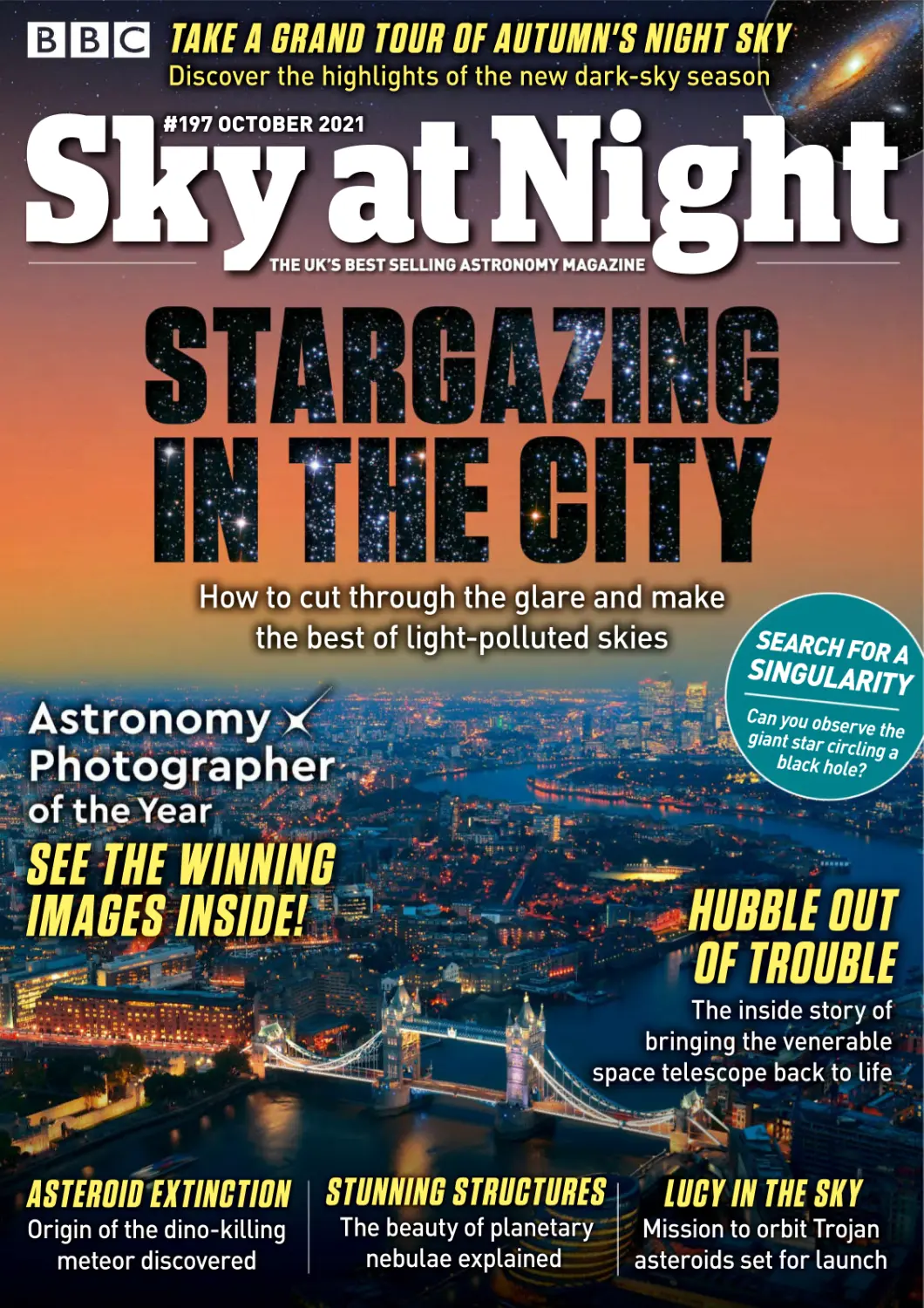
TAKE A GRAND TOUR OF AUTUMN'S NIGHT SKY
Discover the highlights of the new dark-sky season
Sky at Night
#197 OCTOBER 2021
How to cut through the glare and make
the best of light-polluted skies
SEARCH FOR
A
SINGULARIT
Y
Can you obse
rv
giant star cir e the
cling
black hole? a
SEE THE WINNING
IMAGES INSIDE!
HUBBLE OUT
OF TROUBLE
The inside story of
bringing the venerable
space telescope back to life
ASTEROID EXTINCTION STUNNING STRUCTURES
Origin of the dino-killing
meteor discovered
The beauty of planetary
nebulae explained
LUCY IN THE SKY
Mission to orbit Trojan
asteroids set for launch
Your
Personal
Tour Guide
To The
Galaxy
imaGine discovering stars, planets and deep
sky objects in real-time whilst also being able
to accurately identify what you can see.
aWard WinninG StarSense sky technology
enables you to use your smartphone with this
telescope, to do just that.
VieW incredible detail through the 102mm
objective lens with our special high
transmission xlT optical light coatings.
PerfecT for observing brighter objects in
the city and even more from dark Sky Sites.
model shown StarSense explorer dx
102aZ rrP £379.99 (phone not included)
other models available: StarSense explorer dx 130aZ, dx 6"
ScT, dx5" ScT, lT 70aZ, lT 80aZ, lT 114aZ and lT 127aZ
for more information visit celestron.com/ssetelescopes contact celestron at enquiries@celestron.com
HOW TO CONTACT US
binders and back issues
Subscriptions,
03330 162119*
Welcome
Mon–Fri 9am–5pm
*Calls from landlines will cost up to 9p per minute. Call
charges from mobile phones will cost between 3p and
55p per minute but are included in free call packages.
If calling from overseas, please dial +44 (0)1604 973727
There’s more to observe in city
skies than you might think
As the evenings draw in and astronomers everywhere feel a sense of
anticipation at real darkness returning to the skies, this issue we’re
taking a look at stargazing from towns and cities – where many of us
live. Will Gater is your guide to getting the best observing time from
these more brightly lit locations, sharing expert tips for observers
with the naked eye, telescopes and binoculars, as well as advice on
imaging targets. Discover the best sights to seek out on page 36.
If you are an urban astronomer, there’s plenty of advice there
which will also be handy for our Grand Tour of highlights in autumn’s
night skies. Starting on page 60, Stuart Atkinson takes us from one
seasonal sight to another in an observing expedition that’s ideal
for newcomers and experienced amateur astronomers alike, in
celebration of the return of dark skies.
However, when darkness fell on the Hubble Space Telescope and it
abruptly shut down in June, the news wasn’t so welcome. Was this
latest glitch in the orbiting observatory’s long and venerable history
to be the last? Happily it was not to be, and on page 66 Melissa
Brobby tells the inside story of how the mission team at Goddard
Space Flight Center found and solved the issue, restoring Hubble once
again to providing a stream of scientific data and amazing images.
And speaking of stunning space imagery, look no further than
page 28, and the winning photographs from the 13th Astronomy
Photographer of the Year competition. They are a breathtaking
collection of astrophotos, representing the pinnacle of imaging skill
and dedication – I’m sure you’ll join me in congratulating the winners.
Enjoy the issue!
Chris Bramley, Editor
Editorial enquiries +44 (0)117 300 8754
9:30am–5:30pm, Mon–Fri
Advertising enquiries +44 (0)117 300 8145
subscription enquiries
Print
www.buysubscriptions.com/contactus
Digital subscription enquiries
www.buysubscriptions.com/contactus
Editorial enquiries
contactus@skyatnightmagazine.com
enquiries
Subscription
UK enquiries: FREEPOST IMMEDIATE MEDIA
(please write in capitals)
Overseas enquiries: PO Box 3320,
3 Queensbridge, Northampton, NN4 7BF, UK
Editorial enquiries
BBC Sky at Night Magazine, Immediate Media
Co Bristol Ltd, Eagle House, Bristol, BS1 4ST
BBC Sky at Night Magazine ISSN 1745-9869 (USPS XXXXX) issue
197, October is published monthly by Immediate Media Co Bristol
Ltd., Eagle House, Bristol, BS1 4ST, United Kingdom.
The US annual subscription price is $155.88. Airfreight and mailing
in the USA by agent named World Container Inc, 156-15, 146th
Avenue, 2nd Floor, Jamaica, NY 11434, USA.
US POSTMASTER: Send address changes to BBC Sky at Night
Magazine, World Container Inc, 156-15, 146th Avenue, 2nd Floor,
Jamaica, NY 11434.
Subscription records are maintained at Immediate Media Bristol
Ltd., Eagle House, Bristol, BS1 4ST, United Kingdom.
Become an Insider
The more we know about what you like,
the better placed we are to bring you
the best magazine possible. So we’d like
to invite you to join our online reader panel ‘Insiders’.
Just log on to www.immediateinsiders.com/
register to fill out the short registration survey and
we’ll be in touch from time to time to ask for your
opinions on the magazine and other relevant issues.
PS Our next issue goes on sale on Thursday 21 October.
Sky at Night – lots of ways to enjoy the night sky…
Television
Online
Social media Podcasts
Find out what The
Sky at Night team
have been exploring
in recent and past
episodes on page 18
Visit our website
for competitions,
astrophoto
galleries, observing
guides and more
Follow us on Twitter,
Facebook and
Instagram for space
news, astro images
and website updates
Listen to our Radio
Astronomy podcasts
where the magazine
team and guests
discuss astro news
Tablet/phone eNewsletter
Get each month’s
issue on your Apple
or Android device,
now with bonus
image galleries
The best targets to
observe each week,
delivered to your
inbox. Visit bit.ly/
skynewsletter
Find out more at: www.skyatnightmagazine.com
October 2021 BBC Sky at Night Magazine 3
36
CONTENTS
MUSEUM, @THESHED_PHOTOSTUDIO, PETE LAWRENCE, ESA, BBC, LARRYN RAE/NATIONAL MARITIME MUSEUM
COVER IMAGES: RABBIT75_IST/ISTOCK/GETTY IMAGES, MATTEO MARCHIONNI/ISTOCK/GETTY IMAGES. THIS PAGE:
OVERSNAP/ISTOCK/GETTY IMAGES, MICHAELYPARK/ISTOCK/GETTY IMAGES, LEONARDO DI MAGGIO/NATIONAL MARITIME
Features
28 Astronomy photographer of
C the year 2021 – The Winners
We reveal the stunning top entries
in astronomy’s most prestigious
photography competition
36 Urban stargazing:
C astronomy under
light-polluted skies
You’ll be surprised at how
much there is to observe from
brightly lit cities and towns
60 The autumn grand tour
C Take in the stargazing highlights
of the new dark-sky season!
66 Hubble out of trouble
C How the world’s most iconic space
telescope was brought back to life
4 BBC Sky at Night Magazine October 2021
C = on the cover
Regulars
6 Eye on the sky
11 Bulletin
16 Cutting edge C
18 Inside The Sky at Night
20 Interactive
23 What’s on
25 Field of view
26 Subscribe to BBC Sky
at Night Magazine
72 Explainer
74 DIY Astronomy
98 Q&A: a gravitational
wave astronomer
Astrophotography
76 Capture
78 Processing
80 Gallery
C
Reviews
86 Sony A9 mirrorless
camera body
90 Explore Scientific BT-100 SF
Giant Binocular
94 Books
96 Gear
16-PAGE
CENTRE
PULLOUT
The Sky Guide
44 Highlights
46 The big three
48 The planets
50 October’s all-sky chart
52 Moonwatch
53 Comets and asteroids
53 Star of the month
54 Binocular tour
55 The Sky Guide challenge
56 Deep-sky tour
58 October at a glance
C
New to astronomy?
To get started, check out our guides and glossary at
www.skyatnightmagazine.com/astronomy-for-beginners
60
Extra content
ONLINE
Visit www.skyatnightmagazine.
com/bonus-content/P28YQYE/
to access this month’s selection
of exclusive Bonus Content
OCTOBER
HIGHLIGHTS
Exclusive interview: Tim Peake
The UK’s first ESA astronaut talks writing sci-fi, life on
the ISS and the prospect of humans landing on Mars.
28
86
46
66
This month’s contributors
Melissa Brobby
Will Gater
Penny Wozniakiewicz
Amateur astronomer
Astronomy journalist
Planetary scientist
“When
Hubble went
out of action
this summer
it was a
nerve-wracking
moment, so it was
great to be able to look
at the work NASA put
in to bring it back
online.” Melissa finds
out how Hubble was
repaired, page 66
“While light
pollution is a
clear threat
to our night
skies, I
wanted to show that
there are still ways to
get into astronomy
and things to see from
brightly-lit towns and
cities.” Will offers tips
for observing under
city-lit skies, page 36
“It was great
to write
about the
upcoming
analysis of
samples from asteroid
Ryugu and to show
that sample return is
just the beginning of
the story!” Penny
finds out how
scientists analyse
space rocks, page 72
Watch The Sky at Night:
Exploring Jupiter
APY 13: see all of
this year’s winners
Maggie and Chris find out
what NASA’s Juno mission
has discovered at Jupiter
and speak to some of the
UK mission scientists.
See the winning, runner-up
and highly commended
entries from the 2021
Astronomy Photographer
of the Year competition.
The Virtual Planetarium
Pete Lawrence and Paul Abel guide us through
the best sights to see in the night sky this month.
October 2021 BBC Sky at Night Magazine 5
6 BBC Sky at Night Magazine October 2021
LORD OF
THE RINGS
A newly released image shows the ‘light
echoes’ from a briefly reignited black hole
CHANDRA X-RAY OBSERVATORY/PAN-STARRS/NEIL GEHRELS
SWIFT OBSERVATORY, 5 AUGUST 2021
MORE ONLINE
A gallery of these and more
stunning space images
October 2021 BBC Sky at Night Magazine 7
X-RAY: NASA/CXC/U.WISC-MADISON/S. HEINZ ET AL.;
OPTICAL/IR: PAN-STARRS
V404 Cygni became a short-lived celestial celebrity in
2015 when NASA’s Neil Gehrels Swift Observatory, a space
observatory dedicated to scrutinising gamma-ray bursts,
detected an unusual burst of X-rays coming from the
constellation of Cygnus, the Swan.
The source was a black hole 7,800 lightyears away, waking
up from its slumber. Suddenly the binary system became
the focus of observatories worldwide as they watched it
flare and sputter back to life after two decades in repose.
The high-intensity X-rays streaming out were the result of
the black hole dragging material away from its companion
star, then releasing jets of gas that formed a disc. As that
heated to a million degrees V404 became an X-ray source
50 times brighter than the Crab Nebula, M1.
In this newly released image from the Chandra X-Ray
Observatory we see the ‘light echoes’ created as those
rays bounced off dust clouds around the black hole. The
different apparent sizes of the concentric rings reveal their
relative distances; rings appear larger if the cloud is closer
to us, and vice versa.
Under pressure
HUBBLE SPACE TELESCOPE/ALMA, 29 JULY 2021
Gases stripped from galaxies may re-accrete and delay their death,
scientists believe. Barred spiral galaxy NGC 4921 seems in its
death throes, buffeted by its galaxy cluster, the Coma Cluster.
Red/orange streaks reveal the filament structures left behind as
its gas is stripped away in a process called ram pressure stripping.
Without gas, eventually no new stars will form. However, new
research shows that some gas is falling back towards its host,
continuing star formation and slowing the galaxy’s demise.
Hello Venus
SOLAR ORBITER, 7–9 AUGUST 2021
ESA/NASA/NRL/SOLOHI/PHILLIP HESS, ALMA (ESO/NAOJ/NRAO)/S. DAGNELLO (NRAO), NASA/ESA/HUBBLE/K. COOK
(LLNL), L. SHATZ, NASA/JPL-CALTECH/MSSS, R. TIMMERMAN; LOFAR & HUBBLE SPACE TELESCOPE
These stills are taken from footage captured by the Heliospheric
Imager aboard ESA/NASA’s Solar Orbiter as it sailed within 7,995km
of Venus. The planet (looking like a crescent) approaches from the
left while the Sun is off camera to the upper right. Venus’s night
side appears dark and rounded, surrounded by a bright crescent
of light: the glare from its sunlit side. The stars Omicron (o) Tauri
and Xi (c) Tauri can be seen in the first image (top).
Pin-sharp planet
CURIOSITY MARS ROVER, 17 AUGUST 2021
NASA’s Curiosity rover has captured a high-resolution 360˚ view of the Martian surface.
The rover, which has travelled 26km since it landed in Gale Crater in 2012, reveals the
terrain with great clarity. Stitched together from 129 photos, the centre of the image is
‘Rafael Navarro Mountain’, named after the scientist Dr Rafael Navarro-Gonzalez, who
died of COVID-19 earlier this year. See a full video tour at bit.ly/3BcxaCH.
8 BBC Sky at Night Magazine October 2021
Herculean effort
LOFAR, 18 AUGUST 2021
Supergiant elliptical galaxy Hercules A shoots out fast jets that grow stronger and weaker every few thousand years, according to new
research. The study is one of a collection just published, using almost a decade’s worth of data gathered by the Low Frequency Array
(LOFAR). The network of 70,000 small radio antennae across nine European countries gives astronomers a ‘lens’ that is effectively
2,000km wide, which recently produced the most detailed-ever radio image survey of galaxies at frequencies around the FM radio band.
October 2021 BBC Sky at Night Magazine 9
BULLETIN
The latest astronomy and space news, written by Ezzy Pearson
Sample slip-up for Mars rover Perseverance
Rock specimen appears to have crumbled when it was picked up
The first attempt to collect a sample from the surface of Mars
using NASA’s Perseverance rover ended in failure on 6 August.
Fortunately, the fault seems to lie with the rock, not the rover,
meaning Perseverance is still on track to complete its main
mission of creating caches of samples for a future spacecraft to
return to Earth.
The rover made its first attempt at acquiring a sample after
164 sols (Martian days) on the surface. Initial feedback showed
everything had gone to plan – the drill reached a depth of 7cm
and the sample tube was successfully stored. When the team
received a more detailed update six hours later, however, things
didn’t look as optimistic.
“Within minutes, the team noted that the volume probe
indicated no sample was in the tube,” said Jennifer Trosper,
Perseverance’s project manager, in an online report. “We quickly
switched to problem-solving mode – once again trying to solve
another problem tossed our way from the surface of Mars.”
It seems the rock was far more powdery than anything
encountered during testing and crumbled during collection.
The team have now turned their eyes towards a region named
Citadelle, further along Perseverance’s planned route, where it
is hoped the rocks have a more solid texture.
“We will first abrade the selected rock and use the science
instruments to confirm (to the best of our ability) that the new
target is likely to result in a core after the sampling process,”
says Trosper. The sampling routine will now also image the tube
while it is still in the drill to confirm a sample was collected.
https://mars.nasa.gov
Þ (Left:) Perseverance casts a shadow over the bore hole in the Martian surface; (right) the rock proved to be too powdery for a sample
Comment
NASA/JPL-CALTECH/MSSS X 2
by Chris Lintott
Perseverance isn’t the first lander
to struggle with getting Martian
soil where it needs to be – the
stuff has been driving scientists
mad for decades. I remember
filming with the Phoenix team,
as their joy at getting the craft
safely down in the Martian arctic
turned – slightly – to frustration:
its soil sample had simply stuck
to the lander’s scoop rather than
trickling into the instrument it
was intended for.
More recently, the InSight
lander’s ‘mole’ – a heat probe
designed to dig deep into the
ground – failed to bite into the
surface, leaving it stranded, a
victim of the tendency for the soil
to clump together.
All of these problems could
be solved in seconds by an
astronaut capable of wielding a
brush (or, I guess, a spade in the
case of the mole). It may be that
the best argument for sending
people to the Red Planet is just
that its soil is quite so annoying!
Chris Lintott co-presents
The Sky at Night
October 2021 BBC Sky at Night Magazine 11
ILLUSTRATION
BULLETIN
Þ An artist’s impression of a planet orbiting the star L98–59; one of the worlds in its planetary system may be made up of 30 per cent water
Tiny planet could be water world
ESO/M. KORNMESSER, NASA/DANIEL RUTTER, JOÃO ALVES/ESO VISIONS
The body is the smallest exoplanet ever measured by looking at its star’s wobble
A newly discovered exoplanet could be
flooded by a global ocean. With a mass
just half that of Venus, the tiny world is
the smallest planet ever studied using
the radial velocity technique, which looks
for the wobble caused by the planet
pulling on its host star to measure its size
and mass.
The planet is one of three discovered
around the star L98–59 in 2019 by the
Transiting Exoplanet Survey Satellite
(TESS), which searches the sky looking
for the shadows cast by planets as they
pass in front of their host stars. This
method allows astronomers to measure
the size of the planet, while also revealing
that all three planets were probably small,
rocky worlds. It also identified that several
of the planets were in the star’s ‘habitable
zone’, where liquid water could potentially
persist on the surface.
The trio of planets immediately
12 BBC Sky at Night Magazine October 2021
attracted the attention of astronomers,
who noted similarities to the inner planets
of our own Solar System, especially as
L98-59 is only 35 lightyears away. The Very
Large Telescope (VLT) soon followed up
the discovery, using the radial velocity
technique to reveal the masses of the
planets, which in turn allowed astronomers
to work out their densities. This showed
that two of the planets probably had
some water while mostly being dry, but
the third could be as much as 30 per cent
water by mass – enough water that the
whole surface would be flooded.
Astronomers are keen to understand
the planet’s atmosphere and hunt for
any signs of water around the planet.
However, the world is too small for such
observations with the telescopes of today.
Instead, it will have to wait for the next
generation of telescopes such as the
James Webb Space Telescope (JWST),
due to launch later this year and ESO’s
Extremely Large Telescope (ELT), which
is under construction in Chile’s Atacama
Desert and set to start observing in 2027.
“This [planetary] system announces
what is to come,” says Oliver Demangeon
from Portugal’s University of Porto, who
led the study. “As a society we have been
chasing terrestrial planets since the birth of
astronomy and now we are finally getting
closer to the detection of a terrestrial
planet in the habitable zone of its star, of
which we could study the atmosphere.”
The team has also found ‘hidden’
exoplanets that had not previously been
spotted in this planetary system. They
discovered a fourth planet and suspect a
fifth in a zone at the right distance from
the star for liquid water to exist. “We have
hints of the presence of a terrestrial planet
in the habitable zone of this system,”
says Demangeon. www.eso.org
NEWS IN
ILLUSTRATION
BRIEF
Scientists have been looking at how
quasars, like CQ4479 here, are being
fuelled by their spiral galaxies’ shape
Galaxy arms feed hungry black holes
Water vapour on moon
The structures slow down the gas until it falls to a galactic centre
Gas-guzzling supermassive
black holes, known as quasars,
are fed by their host galaxy’s
spiral arms scooping up gas
for them to devour, according
to a new set of computer
simulations which looked at
the gas flow throughout the
whole galaxy, rather than
just the region around the
black hole.
“The light we observe
from distant quasars is
powered by gas falling into
supermassive black holes
and getting heated up in the
process,” says Claude-André
Faucher-Giguère from
Northwestern University.
Quasars can swallow up to
10 solar masses of material a
year, but astronomers have
struggled to account for what
funnels the gas towards the
central black hole.
“Our simulations show that
galaxy structures, such as
spiral arms, use gravitational
forces to ‘put the brakes on’
gas that would otherwise
orbit the galaxy centres
forever,” says Faucher-Giguère.
www.northwestern.edu
Sun’s supernovae siblings kept Earth warm
The source of the radioactive
An infrared composite image of the star-forming
elements that helped keep early
region in Ophiuchus where researchers have
Earth warm may finally have been
been looking at the element aluminium-26
discovered, following investigations
of a star-forming region in Ophiuchus
similar to the one our own Sun is
thought to have formed in.
A team of astronomers looked at
the infrared light given off by the gas
clouds created by the young stars,
as well as hunting down the gamma
rays given off by the short-lived
radioactive element aluminum-26,
combining the observations to reveal
that the element seems to be seeded
into the nebula by the supernovae
of highly massive stars. As new,
longer-lived stars form in the region
their planets would incorporate these elements, main heating source. More aluminium-26
probably means drier planets,” says John
but the amount of aluminium-26 available
Forbes from the Flatiron Institute’s Center for
could vary wildly from system to system.
Computational Astrophysics, who led the study.
“This matters for the early evolution of
www.simonsfoundation.org/flatiron
planetary systems, since aluminum-26 is the
A fresh look at archived
Hubble data has shown
evidence of water vapour
in the atmosphere of
Jupiter’s moon Ganymede.
It’s thought the moon has
more water than all of
Earth’s oceans, but that
most of it is frozen 160km
below the surface, and it’s
uncertain how the vapour
might have made its
way to the atmosphere.
Early solar maximum
Solar Cycle 25 is heating
up faster than expected.
Sunspot numbers from July
2021 indicate activity could
reach a maximum as soon
as October 2024, meaning
it would peak a few months
before the earliest date
previously predicted by a
panel of experts back in 2019.
Starliner delayed
The second orbital test
flight of Boeing’s Starliner
astronaut capsule has
been delayed again after
moisture was found in
several of the vehicle’s
valves. The test was initially
meant to occur in late
2020, but has been beset
by delays. NASA hopes to
use the Starliner to transport
astronauts to the ISS.
October 2021 BBC Sky at Night Magazine 13
NEWS IN
BRIEF
BULLETIN
Recent volcanism seen on Venus
Planet may not have been dormant for as long as believed
Japan heading to Phobos
The Japanese Aerospace
Exploration Agency (JAXA)
is planning a space mission
to bring samples from the
Martian moon Phobos
back to Earth by 2029.
The mission aims to bring
back 10g of material, and
could also visit Mars’s other
moon, Deimos.
100km
Þ Scientists are looking at how Venusian
Bennu not a threat
Although asteroid Bennu
will pass close to Earth
in 2135 it is very unlikely
to hit us, according to the
latest analysis of its orbit
using high precision-tracking
data from OSIRIS-REx.
The spacecraft circled
the asteroid from 2018 to
2020, allowing astronomers
to significantly reduce
the uncertainties in the
asteroid’s orbit.
NASA/JPL-CALTECH/UNIVERSITY OF ARIZONA, PLANETARY
SCIENCE INSTITUTE, NASA/JPL-CALTECH/MSSS
Mid-life stellar crisis
Magnetic fields could cause
Sun-like stars to have a
‘mid-life crisis’, when they
experience dramatic breaks
in their activity and rotation
rates. A new study shows
the flow of charged particles
from the star – the stellar
wind – magnetically brakes
the star’s rotation, causing
it to slow down over billions
of years, becoming less
active in the process.
volcanoes have deformed surrounding ground
Reports of Venus’s death may be greatly
exaggerated, as a fresh look at data from the
Magellan spacecraft has found that volcanism
could still be occurring on the planet today.
Researchers revisited the data using techniques
not available when Magellan visited Venus 31
years ago and carried out a large-scale analysis
of the landscape.
“Instead of looking at the surface of the
volcano or flows, we look at how it deforms the
ground around it,” says Megan Russell from the
Planetary Science Institute, who led the study.
“From this deformation we can infer properties
like heat flow local to the volcano.”
From the shape of these features, Russell’s
team could discern they may have formed
within the last few tens of millions of years
– which is recent, in geological terms – or could
even still be growing. Either way, it appears
volcanism has been happening on Venus more
recently than believed. www.psi.edu
Origin of Curiosity site in doubt
For the last nine years. NASA’s
Curiosity rover has been
exploring Mars’s Gale crater
under the belief the region
was once a lake bed, but a
new study from the Faculty
of Science at Hong Kong
University suggests this might
not be the case.
Instead, the research
suggests that the region was
formed by sand and silt
deposited by the wind, which
was then soaked by ancient
rainfall. The study found that
immobile elements – meaning
those that stay in the rock
rather than dissolving in water
– are richer at higher elevations, which is
normally seen in wind-blown soils rather than
lake deposits. There also appears to be
depleted iron levels, suggesting the atmosphere
was more like an arid desert than a wet lake.
Planetary geologists aren’t quite willing to
throw away everything they know about the
14 BBC Sky at Night Magazine October 2021
Could the sediments seen
here be the result of wind
rather than water?
crater just yet, and will continue to investigate.
“The data presents challenges to existing
hypotheses for both the depositional
environment of these rock formations and the
atmospheric conditions they formed after,” says
Hong Kong University’s Ryan McKenzie. “This
work will inspire new and exciting directions for
future research.” http://mars.nasa.gov
The tide is turning
When it comes to ocean-bound plastic pollution, enough
is enough. Step forward the unique C60 #tide. A superlative
dive watch with a neon-like sapphire dial and chronometer
certified movement, it delivers power, accuracy and
toughness in equal measure. But that’s only half the story.
Thanks to our partnership with social enterprise, #tide,
the watch’s case-back inserts and strap are made from
100% recycled ocean plastic (though you can also choose
a marine-grade steel bracelet). Which makes for a
healthier ocean. And a watch you’ll take pride in wearing.
You can read more about the C60 #tide in the new
issue of Loupe, our complimentary watch magazine.
Sign up for yours at christopherward.com
christopherward.com
CUTTING EDGE
Our experts examine the hottest new research
asteroid – a dark rock full of organic compounds. This
is surprising because impacts from this sort of object
are rare – they make up only five per cent of all
meteorites collected. So why is it that one of the
largest craters on Earth – and the impact that wiped
out the dinosaurs – was formed by such an asteroid?
ILLUSTRATION
Measuring impacts
David Nesvorný and his colleagues at the
Department of Space Studies, Southwest Research
Institute, in the US, have been trying to get to the
bottom of this mystery. They built a computer
simulation of how the orbits of objects in the main
asteroid belt can be dislodged to become near-Earth
asteroids that have the potential to collide with our
planet. Their model included over 42,000 asteroids
with widths greater than 5km in the main belt, and
how they’re affected by influences such as the
radiation pressure of sunlight or Jupiter’s gravity.
They calculated that Venus and Earth receive
about the same number of strikes from asteroids
An illustration of the Chicxulub
bigger than 5km, with Mars being hit about three
impact crater shortly after
times less. Interestingly, Nesvorný found that about
its formation, off the coast
six per cent of the simulated Venus impactors
of present-day Mexico
had evolved into a retrograde orbit
beforehand – equivalent to cars
colliding head-on with a much
“The Chicxulub
higher impact speed – and hit
crater is one of the
the planet at a staggering
largest impact
220,000km/h.
But what about the
structures ever found
composition of the largest
on Earth. But there’s
Scientists think they’ve found the origin
impactors, such as the
something else
Chicxulub asteroid? Nesvorný
of the meteor that killed the dinosaurs
exceptional about
and his colleagues found that
or many years now, it’s been well
because of the orbital dynamics
this impact”
established that the mass extinction at
involved, smaller impactors (less than
the end of the Cretaceous period – which
a kilometre in diameter) are most likely to
have come from the inner edge of the asteroid belt,
led to the extinction of the dinosaurs as
well as the loss of 75 per cent of all plant
so have an ordinary, stony composition – as found
with most meteorites discovered. But the largest
and animal species on Earth – was
associated with a huge impact. The Chicxulub crater,
impactors hitting Earth are more likely to have
originated from the middle or outer asteroid belt,
buried beneath the Yucatán Peninsula in Mexico, was
identified in 1990 as a giant impact feature – some
where CC objects are more common. They conclude
150km across and 20km deep (although by now well
that the impactor that triggered the mass extinction
Prof Lewis Dartnell
filled-in with sediments). The calculated formation of
66 million years ago was a main-belt asteroid that
is an astrobiologist
this crater coincides with the mass extinction, around
quite likely (they calculate around 60 per cent
at the University
66 million years ago, and the impactor is believed to
probability) originated from beyond 2.5 AU.
of Westminster
have been an asteroid about 10–15km in diameter.
The Chicxulub crater is one of the largest impact
Lewis Dartnell was reading… Dark Primitive Asteroids Account for a
structures ever found on Earth. But there’s something
Large Share of K/Pg-Scale Impacts on the Earth by David Nesvorny et al.
else exceptional about this impact. It seems that the
Read it online at: https://arxiv.org/abs/2107.03458
crater was created by a carbonaceous chondrite (CC)
Tracking down
a dinosaur killer
MARK GARLICK/SCIENCE PHOTO LIBRARY/GETTY, HUBBLE/ESA/D M CLARK X 2
F
16 BBC Sky at Night Magazine October 2021
CUTTING EDGE
Planetary nebulae
made pretty by debris
stages of a star’s life (the Sun, for example) as
instability at the core causes the outer layers of the
star to be shed. As a result, the beauty of these
objects is transitory; something like the Ring Nebula
will exist for only a few tens of thousands of years.
As the stellar wind pushes material away from the
star, it can excite and interact with surrounding
Dying stars wrap themselves with
Prof Chris Lintott
material, creating the structures we see.
their own detritus, and it’s beautiful is an astrophysicist
The key insight of the model in the paper, though,
and co-presenter
is that the planetary nebulae we see today don’t
on
The
Sky
at
Night
ne of the first objects I looked at
exist in a pristine environment. The process of
atmosphere loss is erratic and takes time, so the star
through a telescope was the Ring
Nebula. There was something
exists surrounded by its own debris. Some of this
material, the authors say, must be falling back
about the neatly coloured
“In images,
doughnut that appealed,
especially those that onto the star and their detection of what seems
though I soon found that
to be an accretion disc around the central
flowed
from
the
seeing more than a smudge is difficult – even
source suggests that there is enough material
Hubble
Space
to make a difference.
through a large telescope. In images, though,
especially those that flowed from the Hubble
Telescope, the beauty
Space Telescope, the complexity of these
and complexity of
fragile objects became obvious.
When gas is moving, it can become shocked
these
fragile
objects
and excited, and it seems like this process can
In addition to rings, there are planetary
became obvious”
nebulae that look like egg timers, nebulae
weave the spiderweb structures that we observe.
shaped like butterfly wings and even a singular
If the inside of the hourglass is a region where
object that goes by the name of the Red Rectangle.
material flows outwards, its edge is a place where
Close up, there are substructures – ribs, stripes and
material can flow back. This process is likely to be
more – and it’s these smaller scale features that this
somewhat chaotic and what appeared to be a
month’s paper sets out to explain. Its authors
precious, permanent jewel in the sky is revealed to be
concentrate on hourglass-shaped nebulae, several
a dramatically dynamic system, as changeable as
of which seem to display faint filaments that the
the pattern of waves on the surface of the sea.
paper describes as a
‘spiderweb’ structure.
Hubble images of the Matryoshka Nebula in different
wavelengths reveal the extent of its surrounding
The Hubble image of the
structure.
The arrows (right) indicate spiderweb arcs
Matryoshka Nebula (right)
shows how complicated such
objects can be. A bright
central source sits in the
middle of the hourglass, the
sides of which seem made of
almost-transparent gossamer,
with a texture that hints at
unresolved structure. Material
is believed to be flowing away
from the central source and
the whole thing sits in a larger,
oval nebula consisting of long,
curving arcs of glowing cooler
10 arcseconds
gas. Whatever is sculpting
these structures, it produces
symmetry, both north-south through the hourglass
Chris Lintott was reading… Fallback in Bipolar Planetary Nebulae
lobes and east-west in the spiderweb structure.
by Willem A Baan et al.
So what’s going on? The basics we know; planetary
Read it online at: https://arxiv.org/abs/2107.14269
nebulae such as this are formed during the later
O
More than meets the eye
October 2021 BBC Sky at Night Magazine 17
The Sky at Night TV show, past, present and future
INSIDE THE SKY AT NIGHT
Carly Howett will field Solar System questions in September’s episode
of The Sky at Night, but she will answer her own when Lucy takes flight
SOUTHWEST RESEARCH INSTITUTE, NASA/JPL X 2
O
n 16 October 2021 the launch
window for NASA’s Lucy mission
opens. It will study Jupiter’s poorly
understood Trojan asteroids.
These space rocks are remnants
of the Solar System’s formation,
and will provide astronomers with a valuable insight
into how our planetary system formed – like
archaeologists piecing together the lives of the
ancients. Space missions show little regard for sleep
schedules, however, so the launch window opens at
5:34am and lasts about an hour. If the spacecraft is
unable to launch in that window (for example if the
weather is bad) then we will be back bright and early
the next day, and the next, until it launches.
The Trojan asteroids share an orbit with Jupiter,
orbiting the Sun either ahead of or behind the gas
giant, in regions known as Lagrangian points. Here,
the gravitational pull of Jupiter and the Sun equals
the centrifugal force felt by small bodies in orbit – so
18 BBC Sky at Night Magazine October 2021
they can remain in place for billions of years. Most of
Jupiter’s Trojans are located at its L4 Lagrangian
point, which moves ahead of Jupiter in its orbit, so
that’s where Lucy is headed first. It will make flybys
of four different asteroids between August 2027 and
November 2028 studying their surface composition,
geology and interiors. Then Lucy is headed to the
L5 point trailing behind Jupiter, where it will arrive
five years later to study a binary Trojan asteroid.
Little is known about the Trojan asteroids because
they are dark, small and far from Earth – making
them very difficult to observe. In fact it was only
recently discovered that one of the first asteroids to
be encountered by Lucy, Eurybates, has a moon!
Yet how and where these asteroids formed is an
intriguing question, since it provides an important
clue to how our entire Solar System formed. One
idea is that the Trojans formed at the same time
and close to the same location as Jupiter, eventually
becoming captured by Jupiter’s enormous gravity.
Þ An artist’s
impression shows
the Lucy mission
passing a Trojan
asteroid near
Jupiter. The
mission will help
scientists to unlock
clues about the
early Solar System
INSIDE THE SKY AT NIGHT
Carly Howett is an
associate professor
at the University
of Oxford and an
instrument scientist
on the Lucy mission
This implies that their composition is similar to
Jupiter’s early in its formation (its runaway growth
and gas accumulation coming later). The second
hypothesis is that the Trojans formed much further
out from the Sun – in the Kuiper Belt beyond Neptune
– and were scattered into the inner Solar System
when a big reshuffle of the large outer Solar System
planets occurred. In this scenario the change in
gravity caused by the reshuffle kicked the Trojans
inwards, where Jupiter captured them.
Even though the first scenario seems more
plausible it is deemed less likely, as it cannot explain
aspects of the Trojan population that the second one
can – for example why some of the Trojans have such
large tilts in their orbits.
Lucy will help settle this dispute, by enabling the
composition of the asteroids to be determined at
high spatial resolutions. For example, if the asteroids
are shown to have compositions similar to Jupiter’s
moons then this implies that they formed close to
Jupiter. However, if the asteroid composition is more
similar to the Kuiper Belt objects seen by New
Horizons (Pluto, Charon and Arrokoth), that implies
they formed far from the Sun, and a cosmic reshuffle
early in our Solar System formation did take place.
Either way, the results promise to be fascinating.
Looking back:
The Sky at Night
11 October 1992
On 11 October
it could only
1992 episode of
image one point
The Sky at Night,
in the sky at a
Patrick Moore
time and had
was joined by
to laboriously
David Allen,
scan across
acting director
the surface.
of the AngloWhile most of
Australian
the infrared light
Telescope
hitting Venus
(ATT) at the
is absorbed
Þ
Spectograph mapping of Venus in infrared
Siding Spring
by the upper
reveals the planet’s thermal profile
Observatory in
atmosphere,
Australia. Allen had been using the
Allen’s work revealed that there
telescope to study the atmosphere of
were ‘infrared windows’, where the
Venus, complementing the observations atmosphere was transparent to a
of the Magellan spacecraft, which was
specific wavelength. These play an
in orbit around the planet at the time.
important part in how the planet
That October, the ATT was
regulates its temperature. Earth has
conducting a new set of observations,
several similar windows, and so by
using its spectrograph to map out the
studying the difference between the
planet at several infrared wavelengths,
two planets, planetary scientists are
revealing details about the planet’s
able to begin understanding why Earth
structure and thermal profile. The
maintains its temperate, life-sustaining
spectrograph used a slit to single out a
temperature while Venus has turned
specific wavelength, however, meaning
into a global hot house.
OCTOBER
The Forgotten Solar System
Jupiter, Saturn, Mars and Mercury have
been explored by numerous spacecraft,
but Neptune and Uranus have only been
glimpsed once, by Voyager 2. Are the
ice giants worthy of further investigation?
Maggie and Chris find out what missions
to the outer Solar System might discover,
and the window of opportunity that
could see a spacecraft arrive in 2043.
Four, 10 October, 10pm (first repeat
Four, 14 October, 7:30pm)
Check www.bbc.co.uk/skyatnight
for more up-to-date information
Þ Voyager 2 captured Neptune’s Great
Dark Spot when it flew by in 1989
October 2021 BBC Sky at Night Magazine 19
Emails – Letters – Tweets – Facebook – Instagram – Kit questions
INTERACTIVE
Email us at inbox@skyatnightmagazine.com
This month’s top prize:
two Philip’s titles
The ‘Message
of the Month’
writer will
receive a bundle
of two top titles courtesy
of astronomy publisher
Philip’s: Nigel Henbest’s
Stargazing 2022 and Robin
Scagell’s Guide to the
Northern Constellations
Winner’s details will be passed on to
Octopus Publishing to fulfil the prize
MESSAGE
OF THE
MONTH
Addressing Earth
I need to know the answer to a very important
question; it’s one that my children asked me
the other day. The question was: what is the
planet Earth’s Universal address? For example,
if someone from a distant planet wanted to
send me a letter or a parcel in the post, what
address would they need to put? I hope you
can provide me with this important information,
which needs to be 100 per cent accurate.
David Mitchell, Southampton
That’s a very interesting question, David! Your
Universal, or cosmic, address would be your
postal address, followed by: Earth, Solar System,
Oort Cloud, Local Interstellar Cloud, Local
Cavity, Orion Arm, Milky Way, Local Group,
Virgo Supercluster, Laniakea Supercluster, the
Universe. It’s challenging to provide an accurate
address, though, since it will depend on our
own frame of reference on the Universe, which
could be very different where you’re sending
the parcel; and in the time it takes to delilver,
everything in the Universe will have moved! – Ed.
Þ The Voyager mission’s Golden Record includes
a diagram of pulsars (bottom left), indicating
where Earth is in relation to the rest of the cosmos
last year and again this year, and I thought
I’d pass the time with something new.
For my birthday I received a 12x55 high
definition monocular with a smartphone
attachment. With a bit of beginner’s luck I
managed to capture the Moon rising with a
tree and a wind turbine on the horizon (see
picture, left). I’ve got a lot more work to do
with focusing and steadying the stand, but
I can’t believe the start I’m off to!
Tweet
Paul Martin
@Tyrone_skies • 12 Aug
#Perseids put on a good
show last night for us up at
Beaghmore. Caught two
meteors in one frame alongside
a beautiful Milky Way.
#darkskies @StormHour
@omdarksky @VirtualAstro @
ThePhotoHour @skyatnightmag
@UKMeteorNetwork @barrabest
Stuart Wallace, Ballyclare
Shoot for the Moon
NASA, CELESTRON
I’ve been meaning to send in my first
attempt at catching a photograph of the
Moon rising and I’ve eventually got around
to it. I turned 40 on 22 July and asked for
a monocular and stand as a present.
I got into stargazing, Moon watching and
tracking the International Space Station
(ISS) while I was shielding due to COVID-19
20 BBC Sky at Night Magazine October 2021
Fit for the Sun
In response to your reply to Colin Anderson
in the September issue (‘Scope Doctor’, page
19), in which he wanted to fit the whole disc
of the Sun into his image: he asked if he
could use a focal reducer and you laid out
why this wouldn’t work. I wanted to let Colin
know that he could achieve what he wanted
with his Newtonian, and fit the whole disc of
the Sun into his image, by using
a camera with a larger sensor to
capture more of the light cover.
He may already have a DSLR
camera to hand which would
do the job; a DSLR with a
smaller APS-C size sensor would
work, as his Hypercam 183C has
a sensor size of 13.2mm x 8.8mm,
while an APS-C sensor is
25.1mm x 16.7mm.
Stuart Buchanan, via email
Hazy view
On the morning of 17 August,
I looked out of the window in
the early morning and the Sun
had just risen above the horizon
(it was shining through haze and
was safe to look at). It appeared
much larger than when high
in the sky. Could it be that the
‘Moon illusion’ is not confined
to the Moon?
AJ Bills, Harrogate
It could well be the case the
Sun appears larger when close
to the horizon, as it’s the way
humans perceive the outside
world that creates the optical
illusion. However, please don’t
take any more risks with your
eyesight: looking at the Sun
even through cloud isn’t safe.
The sunlight may be less
intense, but its UV light
can still damage the
photoreceptors at the back
of your eyes. If you do any
solar observing with the
naked eye, you should always
use eclipse glasses. – Ed.
Lunar puzzle
I took two photos last year,
which have been puzzling me.
They were taken from my back
garden after I finished my night
shift and the detail [EXIF data]
attached to the photos says
they were taken at 6.19am on
the 12 November 2020. I vaguely
remember something about an
eclipse at that time, but I can’t
find any more info. The first >
ON FACEBOOK
WE ASKED: What are your top tips for observing
and imaging under the light pollution of cities?
Darshna Ladva I’m in Stanmore, London, and you can image
here. You either have to manage your exposure times or use a
light pollution filter; it all depends on your target and kit.
Brendan Scoular I try to observe after midnight when it seems
that the atmospheric conditions stabilise to offer better viewing.
That, coupled with my neighbours’ garden lights going off at
11:30pm, certainly helps.
Denis Pius Some astrophotography tips:
1. Avoid direct light to your lens. Set your camera in a place with
no streetlights, or block the light hitting your lens.
2. Avoid bouncing light. Don’t set your camera lens facing a wall
that bounces light from behind or the side.
3. Use a lower ISO. Normally in the city I use ISO 800; if there are
streetlights nearby I use ISO 400.
4. Separate the foreground and the sky with different shutter
speeds and blend together in postprocessing.
Nick Williams I use a star tracker and light pollution filter on
my DSLR camera. By stacking 30x 2’ exposures at ISO 400, I
even managed to image the Milky Way in Chingford, London.
Paul Adamson I live in Somerset under a dark pristine sky, but
I’ve spent most of my life in London. That’s how I came to learn
the constellations as it was only the brightest stars that I could
see. The planets and Moon are no problem anywhere.
SCOPE DOCTOR
Our equipment specialist cures your
optical ailments and technical maladies
With Steve Richards
Email your queries to
scopedoctor@skyatnightmagazine.com
I recently purchased a Celestron StarSense
Explorer LT80AZ. I’ve aligned it and set it up
with my mobile phone, but even though I can
see terrestrial objects I can’t see celestial ones.
Where am I going wrong?
MAGGIE MURRAY
You mention that you can see
terrestrial objects but not
celestial ones, so the telescope and
eyepieces themselves are working. This
suggests that we need to revisit the
fundamentals of night-time observing.
Your telescope comes with a star
diagonal, two eyepieces and a Barlow
lens so select the eyepiece
marked 25mm and insert it in the
Þ Ensure you’ve got a sharp
diagonal. For now, dispense with
focus before locating
the smartphone app, simply
targets with the Celestron
point the telescope at the sky on StarSense Explorer LT80AZ
a clear night when it has got truly
dark. Ensure that the dust cap is removed (yes, it happens!)
and that there is no nearby extraneous light, then position
your eye centrally over the eyepiece. Gently rotate the focus
knob to move the focus tube fully in and then out until you
reach the point at which you can see stars. Make very fine
focus adjustments until the stars are as small as possible to
attain accurate focus. Now you can start searching the sky for
other objects either with or without the app.
Steve’s top tip
What is chromatic aberration?
The glass lenses in a refractor bend or ‘refract’ the light from
distant objects and focus it at the focal plane. However, simple
glass lenses can’t focus all the colours of light to exactly the
same focus position because the refractive index of glass
varies with the wavelength of the light passing through it. This
phenomenon results in coloured halos around bright stars and
colour casts on opposing edges of the Moon and planets. This
optical issue is known as chromatic aberration and telescope
designers use special low dispersion glass (ED glass) and two or
more different glass elements to try and alleviate the problem.
Steve Richards is a keen astro imager and an
astronomy equipment expert
October 2021 BBC Sky at Night Magazine 21
INTERACTIVE
BBC Sky at Night Magazine is published by Immediate
Media Company Bristol Limited under licence from
BBC Studios, which helps fund new BBC programmes.
EDITORIAL
> photo is from my back garden and the
Editor Chris Bramley
Art Editor Steve Marsh
Production Editor Neil McKim
News Editor Ezzy Pearson
Staff Writer Iain Todd
Reviews Editor Paul Money
second is an enlargement of the Moon.
Do you have any idea what the grid is on
the Moon? Thanks in advance for your help!
Stuart Atkinson, Rob Banino, Shaoni Bhattacharya,
Melissa Brobby, Jamie Carter, Charlotte Daniels,
Lewis Dartnell, Glenn Dawes, Will Gater, Pete
Lawrence, Chris Lintott, Laurent Marfisi, Paul Money,
Chris North, Katrin Raynor-Evans, Steve Richards,
Steve Tonkin, Hannah Wakeford, Paul Wilson,
Jane Williamson, Penny Wozniakiewicz
ADVERTISING SALES
Advertising Manager Andy Williams
+44 (0)117 300 8803, Andy.Williams@immediate.co.uk
Inserts Laurence Robertson +353 (0)87 690 2208
PRODUCTION
Production Director Sarah Powell
Production Coordinator Lauren Morris
Ad Services Manager Paul Thornton
Ad Coordinator Charles Thurlow
Ad Designer Parvin Sepehr
Reprographics Tony Hunt, Chris Sutch
The grid on the Moon is certainly unusual,
Paul! It’s hard to be definite without
knowing the camera and software used,
but it could be an unwanted artefact
(noise) on the image from the camera
sensor. The only eclipse in November
2020 was a penumbral lunar eclipse
on the 30th, visible from the UK as the
Moon set; it’s possible that the time and
date settings on your camera may need
to be reset. – Ed
LICENSING
Director of Licensing and Syndication
Tim Hudson
International Partners’ Manager Anna Genevier
MARKETING
A puzzling grid
appears on Paul’s
Moon picture
Head of Circulation Rob Brock
Head of Marketing Jacky Perales-Morris
Marketing Executive Kellie Lane
Press and PR Manager Emma Cooney
PUBLISHING & MANAGEMENT
Managing Director Andrew Davies
Group Managing Director Andy Marshall
CEO Tom Bureau
BBC STUDIOS, UK PUBLISHING
Chair, Editorial Review Boards Nicholas Brett
Managing Director, Consumer Products
and Licensing Stephen Davies
Director, Magazines and
Consumer Products Mandy Thwaites
Compliance Manager Cameron McEwan
UK Publishing Coordinator Eva Abramik
UK.Publishing@bbc.com; www.bbcstudios.com
EDITORIAL REVIEW BOARD
Andrew Cohen, Head, BBC Studios Science Unit;
Deborah Cohen, Editor, BBC Science Radio;
Steve Crabtree, Executive Producer, BBC Studios;
Dr Erica McAlister; Dr Jessica Wade
SUBSCRIPTION RATES
Annual subscription rates (inc. P&P): UK cheque/credit card £62.40; Europe & Eire
Airmail £75; rest of world airmail £85. To order, call 03330 162119 (UK); overseas
+44 (0)1604 973727
We abide by IPSO’s rules and regulations. To give feedback
about our magazines, please visit immediate.co.uk,
email editorialcomplaints@immediate.co.uk or
write to The Editor, BBC Sky at Night Magazine,
Immediate Media Co Bristol Ltd, Eagle House, Bristol, BS1 4ST.
Audit Bureau of Circulations
20,788 (combined; Jan–Dec 2020)
© Immediate Media Company Bristol Limited 2021
ISSN 1745-9869
All rights reserved. No part of BBC Sky at Night Magazine may be reproduced in any form
or by means either wholly or in part, without prior written permission of the publisher.
Not to be re-sold, lent or hired out or otherwise disposed of by way of trade at more than
the recommended retail price (subject to VAT in the Republic of Ireland) or in mutilated
condition. Immediate Media Company Bristol Limited is working to ensure that all of its paper
is sourced from well-managed forests. This magazine is printed on Forest Stewardship Council
(FSC) certified paper. This magazine can be recycled, for use in newspapers and packaging.
Please remove any gifts, samples or wrapping and dispose of it at your local collection point.
The publisher, editor and authors accept no responsibility in respect of any products,
goods or services that may be advertised or referred to in this issue for any errors,
omissions, mis-statements or mistakes in any such advertisements or references.
22 BBC Sky at Night Magazine October 2021
rob.barsa • 9 August
This photo depicting the observation
of the #Perseids meteor shower was
created near a small village, Mníšek nad
Hnilcom, in eastern Slovakia. It shows
many meteors and demonstrates that
all the Perseids are identified by the
radiant in Perseus from where the
meteor paths appear to originate. It also
shows a group of amateur astronomers
performing visual observation.
@universetoday @thisisslovakia
@bbcskyatnightmag @twanight
CORRECTION
• In the feature ‘Late summer variables’ (September 2021 issue, page 72), in the widerfield locator chart for R Scuti, the star near R Scuti was labelled wrongly as Beta Cygni.
Beta Cygni was also mentioned in the caption. This should be Beta Scuti in both cases.
SOCIETY IN FOCUS
The last day
that members
of the
Flamsteed
Astronomy
Society met
Þ Dallas Campbell gives together for a
a Zoom talk to The
main monthly
Flamsteed in May 2020
lecture was on
9 March 2020 – though we didn’t know it
at the time. We had an inkling that travel
restrictions might make it difficult for
guest speakers to travel to our home at
the Royal Observatory Greenwich (ROG),
so we explained to our members that
night that we were looking at the
possibility of moving talks online.
Two weeks later, the UK was in
lockdown, but we had already trialled
Zoom with our members, who welcomed
the opportunity to keep our talks going.
Silver linings in this COVID-19 cloud are few
and far between, but we found we could
accommodate more of our members at
an online event than we could squeeze
into our National Maritime Museum
lecture theatre. The internet enabled us to
bring speakers ‘to Greenwich’ who might
not have been able to travel so far, even
in ‘normal’ times. We’ve welcomed a range
of lecturers – from Prof Dame Jocelyn Bell
Burnell and Prof Catherine Heymans, to
science writers Dallas Campbell and Jo
Marchant, while our ‘history of astronomy’
programme didn’t skip a beat.
Although our usual observing sessions
have been cancelled, as have various
visits, we have run astrophotography
workshops online and a three-part
‘Introduction to astronomy’ series.
But, as of the time of writing, we are all
eagerly awaiting a return to ‘real world’
events and being a more ‘social’ society. It
will be good to be back in our usual space.
Andy Sawers, former Chair of the
Flamsteed Astronomy Society, 2016-21
> www.flamsteed.info
> www.vimeo.com/flamsteedas
FLAMSTEED ASTRONOMY SOCIETY
CONTRIBUTORS
Paul Mitchell, via email
Instagram
19
COVID-
ly
d s o cial
n
a
e
n
i
l
On
e ve n t s
d
e
c
n
a
di s t
lace
t a k in g p n t h
t hi s m o
WHAT’S ON
We pick the best live and virtual astronomy events and resources this month
PICK OF THE MONTH
Live Exmoor Dark
Skies Festival
Exmoor, 22 October–7 November
Enjoy events for families and adults
taking place all over Exmoor, including
stargazing suppers, guided night walks,
dusk safaris and expert astronomy talks.
For details visit bit.ly/2YbtM9P
Live Moffat dark sky walk
Dumfries and Galloway, 2 October, 8pm
A night-time walk up Gallow Hill in Moffat,
a village with International Dark-Sky
Community status, including a guided
talk about the stars and constellations.
Tickets are £15. See bit.ly/3s3vB6A
Live Scilly Dark Skies Week
St Martin’s, Isles of Scilly, 2–9 October
A celebration of grassroots astronomy
with stargazing, workshops and
speakers, including astrophotographer
extraordinaire Damian Peach. Tickets
are £175 and include entrance to all the
events and guided use of the observatory.
Email cosmosscilly@gmail.com to book.
Day passes are available nearer the date.
KEITH TRUEMAN, © NATIONAL MARITIME MUSEUM
Live LAS Equinox Sky Camp
Kelling Heath, Norfolk, 4–11 October
The largest star party in the UK returns,
featuring expert talks and stargazing. If
the weather is uncooperative, peruse the
huge range of telescopes and equipment
at the trade stands and secondhand
stalls. See las-skycamp.org for details.
Live Apollo: A Moon Odyssey
Cavendish Road Primary School, West
Didsbury, Manchester, 11 October, 7pm
Þ View a selection of the world’s best astrophotography at the National Maritime Museum
Astronomy Photographer of the Year 2021
National Maritime Museum, Greenwich, London, starts 18 September
You can always find top-flight
astrophotography in the APY finalists and
this year’s prize-winners knock it out of
the park once again.
From now until next summer, London’s
National Maritime Museum hosts an
exhibition of all the winning images, along
with some of the best shortlisted entries.
West Didsbury Astronomical Society
welcomes guests to author Andrew
Lound’s dramatic telling of the Apollo
story, illustrated with images, scale
models, sound and music. bit.ly/37vpeiU
You’ll find photos of nebulae, the Sun,
star trails, aurorae, our Moon, comets
and more, picked from the 4,500 entries
sent in from all over the world. There’s
also the Young Photographer and Best
Newcomer winners, and the Annie
Maunder Prize for Image Innovation. See
www.rmg.co.uk/astrophoto for details.
telescopes and binoculars, meals and
luxury accommodation. astro.ventures/
stargazing-festivals/darkskyfest
Online Tenerife observing session
29 October, 8pm
Live Northumberland StarFest
Bellingham, Northumberland, 27–29 October
A two-night astronomy-themed break
with three days of workshops and
presentations, including ‘Get to Know
Your Telescope’ and ‘Rocket Building
and Launching’. Tickets from £380
for two, including all events, use of
Join a Zoom talk from Mid-Kent
Astronomical Society about how to
access the Open University’s robotic
telescope situated under the dark skies
of Tenerife, plus a bonus real-time virtual
observing session. Non-members are £3;
contact membersec@midkentastro.
org.uk (36 hours ahead) to join the Zoom.
October 2021 BBC Sky at Night Magazine 23
‘That’s one small step for a man,
one giant leap for mankind’
APOLLO 11
MEN’S CHRONOGRAPH WATCH
In 1961, President John F. Kennedy set a
goal of landing a manned spacecraft on
the moon’s surface. On the 20th July 1969,
science fiction became reality as the crew
of the NASA’s Apollo 11 mission set foot on
the moon, with the words: ‘That’s one small
step for a man, one giant leap for mankind’
broadcast to the waiting millions on Earth.
Reverse is uniquely
numbered and
engraved with official
emblem of NASA’s
Apollo space missions
Face depicts the Lunar
Module accented with
rich silver-plating
Glow-in-the-dark
hands for easy
viewing, day or night
Individually numbered
PAY NOTHING NOW
ORDER FORM
Please Respond Promptly
To: The Bradford Exchange, PO Box 653, Stoke-on-Trent ST4 4RA
YES!
Please order __ (Qty) of the APOLLO 11 MEN’S
CHRONOGRAPH WATCH for me as described in this advertisement.
Complete today or Call 0333 003 0019
Name (Mr/Mrs/Miss/Ms)
(PLEASE PRINT)
Address
Postcode
Telephone
Now, NASA’s Apollo 11 mission and the new era of space exploration it
inspired is commemorated by a new chronograph watch. The Apollo
11 Men’s Chronograph Watch is an original design, only available from
The Bradford Exchange.
A unique design with precision chronograph dials and stainless steel casing
Expertly handcrafted, this durable stainless steel chronograph watch with
matching strap depicts the Lunar Module accented with rich silver-plating
against a detailed watch face, and an image of the Moon at the top of the
watch face. Featuring two chronograph dials with stop-start timing and a
date function. Luminous hands and markers make it easy to view the time
day or night! The casing reverse is engraved with the official emblem of
the Apollo space missions featuring NASA’s Apollo ‘A’ flanked by the Earth
and Moon. The quote heard around the world: ‘That’s one small step for
a man, one giant leap for mankind’, frames the Apollo mission emblem,
whilst individual numbering makes each watch truly unique.
Not available on the high street – order your chronograph watch now!
This market-first will be accompanied by a custom-designed presentation
case, a Certificate of Authenticity and our 120-day money-back guarantee.
It will be available for just 5 interest-free instalments of £27.99 – that’s only
£139.95 (plus £12.99 S&S)*. Pay nothing now – simply complete and return
your Priority Order Form today.
Watch case measure 1.4 inches (3.8 cm) in diameter excluding crown.
Strap measures 7.9 inches (20 cm) in length (excluding casing and buckle).
Mobile
© The Bradford Exchange. * S&S - Shipping & Service. Offer applies to UK only. A credit check may
be carried out by a licensed Credit Reference Agency. Our guarantee is in addition to the rights
provided to you by consumer protection regulations. 526-EAS10.01
Applicants must be aged 18 or over. Please note, we may
contact you via mail, email and mobile with information
about your reservation. For details of our privacy policy,
please go to www.bradford.co.uk/privacypolicy or contact
us at the above address or phone number.
Order Ref:402999
526-EAS10.01
FASTEST WAY TO ORDER
www.bradford.co.uk/apollo11watch
Or call our 24hr hotline on 0333
003 0019
and quote reference code 402999
FIELD OF VIEW
The amateur astronomer’s forum
‘New Astronomy’ is bringing space to us all
Laurent Marfisi
is the CEO of
Unistellar. He
incorporated
groundbreaking
technology into
the first Unistellar
eVscope
W
e’re seeing the dawn of a
new era of space exploration.
This July, tourists took two
trips to the edge of space
aboard private missions.
Richard Branson’s VSS Unity
spaceplane flew him and three other passengers to
an altitude of 85km above our planet. Nine days later,
Jeff Bezos followed onboard his New Shepard rocket.
Both trips launched a small group of lucky
individuals into what has long been a dream for
many: to go to space. Today, the so-called ‘New
Space’ industry is promising to revolutionise the way
humans think about the cosmos. Some day soon,
space may be part playground and part goldmine
for tourists and entrepreneurs.
But with the sky-high price of tickets to space,
the final frontier is still far away for most of us.
Thankfully, another way of accessing space is also
more attainable today than it’s ever been before.
This new era of technology that gave rise to Blue
Origin, Virgin Galactic and SpaceX is paralleled by
a similar, and way more democratic era of ‘New
Astronomy’ for telescopes, which gives everyone an
opportunity to explore the stars.
In the growing New Astronomy movement,
innovative technologies are being paired with
affordable, high-quality equipment so a new
generation of amateur astronomers can see the
heavens like never before. The result is an emerging
cultural and scientific shift that’s exposing fresh
audiences to stargazing and unlocking
groundbreaking examples of citizen science.
Powerful commercial digital telescopes now allow
stargazers without prior experience a chance to
observe deep-sky objects from their back gardens,
even in light-polluted skies. Meanwhile, innovative
image-processing techniques and modern
connectivity provide new ways to share and enjoy
stunning views of celestial wonders on social media.
And anyone can now make meaningful discoveries.
Amateur astronomers have long played a vital role
in advancing research, but today’s technology,
including easy-to-use software and precision
pointing abilities, lets citizen scientists contribute
high-quality data in ways not previously possible. For
example, recent observations by citizen astronomers
have refined our knowledge of a number of asteroids’
sizes and shapes, and helped with the study of
targets to be visited by NASA’s Lucy probe.
Meanwhile, exoplanet observations from amateurs
are helping astronomers to refine transit timings.
In a testament to their important contributions,
scientific journal articles increasingly bear the names
of citizen scientists as co-authors.
Scientists with NASA, ESA and other research
groups keep a close eye on near-Earth objects
(NEOs). Their planetary defence efforts might sound
like science fiction, but the threat of an asteroid
impact is real. By watching asteroid occultations and
close flybys, distributed networks of stargazers
around the world are adding impactful observations
of NEOs to aid astronomers, who often don’t have
the resources to keep track of everything.
While we celebrate the technologies that launch
tourists to space, it’s worth remembering that similar
advances are opening up the Universe to everyone
else. In our present age, it’s possible for us all to have
access to the cosmos in a way that’s both fun and
meaningful — no rockets necessary.
October 2021 BBC Sky at Night Magazine 25
KIKI LJUNG/FOLIO
On Earth and in orbit, Laurent Marfisi considers the democratisation of space
SkyMAGAZINE
at Night
SAVE WHEN YOU SUBSCRIBE
TO THE DIGITAL EDITION
Available from
The perfect addition to your stargazing, BBC Sky at Night
Magazine is your practical guide to astronomy, helping you
to discover the night skies, understand the Universe around
us and learn exciting techniques for using your telescope.
Enjoy our Premium App experience now available from
SkyMAGAZINE
at Night
BBC Sky at Night Magazine proudly reveals
the 2021 winners of the world’s biggest
astrophotography competition
E
very year, the Astronomy Photographer
of the Year awards calls on astronomers
around the world to submit the best
images of the Universe they have taken
over the previous year. In 2021, over 4,500
entries were submitted from over 75
countries, featuring everything from chance images
that captured a meteor at the right time, to distant
galaxies that took weeks of planning and capturing.
The judges had a tough time deciding which of these
spectacular images deserved the top prize of £10,000
but after hours of deliberation, their top picks for the
2021 competition can be revealed. You can see the
winning images for yourself at the National Maritime
Museum in Greenwich, London from 18 September.
Visit www.rmg.co.uk/astrophoto for details.
MORE ONLINE
A gallery of these and more stunning images
from the 2021 competition
FREE 2022
CALENDAR
Don’t miss the December issue of BBC Sky at Night
Magazine, which comes with a free 2022 calendar
featuring the top images from the Astronomy
Photographer of the Year 2021 competition. The
calendar also lists all the unmissable astronomical
events to observe in the night sky in the upcoming
year. It goes on sale on 18 November 2021.
Overall winner and Our Sun winner
The Golden Ring
Shuchang Dong (China)
Location: Ali, Tibet, China. 21 June 2020
Equipment: Fujifilm XT-4 camera. Sun: 386mm f/10 lens, ISO 160, 1/2000-second exposure.
Moving cloud: ND1000 filter, 386mm f/16 lens, ISO 160, 1-second exposure
Judges verdict: “Solar eclipses have been capturing the interest of humans across the world for thousands of
years. This image demonstrates both the beauty and simplicity of an eclipse, but also the science behind this
astronomical event. Our Sun can still be seen as a ring circling the Moon as it passes in front of the solar disc,
and mountains on the lunar surface can be seen hiding some of this light on the lower right-hand portion of
the image. This is a stunning achievement!” – Emily Drabek-Maunder >
October 2021 BBC Sky at Night Magazine 29
Aurorae
Polar Lights Dance
Dmitrii Rybalka (Russia)
Location: Approach to the Kara Strait, Russia. 30 November 2020
Equipment: Sony ILCE-7M3 camera, 28mm f/2.8 lens. ISO 100, 25-second exposure
Judges verdict: “How challenging it must have been to take this photo. The image is taken from the deck of a moving craft. How
hard can it get! This is a great achievement and demonstrates fantastic opportunism.” – Alan Sparrow
Galaxies
The Milky Ring
Zhong Wu (China)
Location: Sichuan and Qinghai,
China; Lake Pukaki, New Zealand.
January–February 2020 and
August 2020–January 2021
Equipment: Nikon D810a camera,
40mm f/1.4 lens. ISO 8000,
1,000x 6-second exposures
Judges verdict: “This cosmic circle is one
of the most breathtaking entries we saw
this year. The balance of colours, from
the glowing upper half of the ring to the
darker, moodier bottom half, seems to
encompass a whole range of majesty
and beauty. The dedication of the
photographer, who took almost two
years to piece this picture together, must
be applauded too.” – Imad Ahmed
30 BBC Sky at Night Magazine October 2021
Planets, Comets
and Asteroids
A Colourful Quadrantid Meteor
Frank Kuszaj (USA)
Location: Cook Station,
Missouri, USA. 19 January 2021
Equipment: Sony a7R III camera,
Sky-Watcher Star Adventurer
star tracker, 70mm f/2.8 lens.
ISO 3200, 1-minute exposure
Judges verdict: “A stinging,
searing, lightsaber-esque image
as the Quadrantid meteor
pierces the atmosphere, with
the spectrum appearing to
explode as it goes. There is a
real perception of incredible
speed captured in the image.”
– Jon Culshaw
Our Moon
Beyond the Limb
Nicolas Lefaudeux (France)
Location: Forges-les-Bains, Île-de-France, France. 19 June 2020
Equipment: Celestron C11 2,800mm telescope at f/10, iOptron iEQ30 mount, Basler acA2500-14gc camera. Occultation:
1x 2.5-millisecond exposures; Venus: 50x 2.5-millisecond exposures; Moon: 200x 15-millisecond exposures
Judges verdict: “I love how this image transports us. It almost appears as if we are standing on the surface of the Moon itself,
looking into the rocky horizon. The dull surface of the Moon contrasts so well with the glowing planet. I enjoyed the inversion that
this picture offers too – it is Venus that is the crescent here, and not the Moon.” – Imad Ahmed >
October 2021 BBC Sky at Night Magazine 31
The Annie Maunder Prize for Image Innovation
This prize asks entrants to dive into the wealth of data available from professional telescopes,
and put their own spin on the images to create new works of art
Another Cloudy Day on Jupiter
Sergio Díaz Ruiz (Spain)
Data Source: Hubble Space Telescope WFC3 (Wide Field Camera 3)/UVIS (Ultraviolet-Visible), (26–27 June 2019), FQ889, F631N,
F502N, F395N, F467M, F658N, F275W, F343N channels, NASA/ESA HST Space Telescope, OPAL program (PI: Amy Simon, GO13937)
Judges verdict: “The gradient colours captured here are almost reminiscent of glimmering mineral samples. Precious, marbled and
undulating, they’re utterly enchanting.” – Sue Prichard
Celestial Fracture
Leonardo Di Maggio (UK)
Data Source: Cassini wideangle camera (September
2004–October 2007), visible
light channel, NASA/JPL/
Space Science Institute
Judges verdict: “This image
looks so incredibly different
from how we normally see
Saturn, the jewel of the
Solar System. From spheres
and rings to jagged edges
and jarring curves, these
close-up views of Saturn and
its moons highlight the planet
in new and innovate ways.”
– Emily Drabek-Maunder
32 BBC Sky at Night Magazine October 2021
People and Space
Lockdown
Deepal Ratnayaka (UK)
Location: Windsor, Berkshire, UK.
20–21 January 2021
Equipment: Sony ILCE-6600 camera,
8mm f/4 lens. Foreground: ISO 1600,
8-second exposure; Sky: ISO 1000,
844x 30-second exposures
Judges verdict: “I love this picture
taken during the lockdown. Astronomy
photography clearly has its challenges
but this photographer has embraced
these to produce this fabulous picture
of his daughter and the stars taken
over several sittings. Brilliant.”
– Alan Sparrow
The Manju Mehrotra Family
Trust Prize for Best Newcomer
Falcon 9 Soars Past the Moon
Paul Eckhardt (USA)
Location: Titusville, Florida, USA.
4 February 2021
Equipment: Sony ILCE-6500
camera, 210mm f/8 lens. ISO 400,
1/350-second exposure
Judges verdict: “This image stands out
from many astrophotos and images of
spacecraft (mostly ISS) in lunar transit.
The right target, the right moment, the
right composition – these three aspects
make this photo the best. It couldn’t
be planned, this photo results from
good situation awareness by a talented
photographer.” – László Francsics >
October 2021 BBC Sky at Night Magazine 33
Stars and Nebulae
Young Competition
California Dreamin’ NGC 1499
Terry Hancock (UK)
Location: Whitewater, Colorado, USA. 16–31 January,
6 and 28 February, 2 March 2021
Equipment: Takahashi FSQ-130 telescope at f/5, Chroma
narrowband filters, Paramount ME mount, QHY600M camera.
L-RGB-Ha-SII-OIII composite; 16.1-hours total exposure
Family Photo of the Solar System
Zhipu Wang, aged 15 (China)
Location: Yongtai, Fujian, China. 14 August 2020 – 21 January 2021
Equipment: Celestron C8 SCT telescope, UV/IR cut filter, Celestron
AVX mount, ZWO ASI224MC camera. Sun: 200mm f/10 lens,
Baader filter, 750x 18-millisecond exposures; Moon: 2x Barlow,
200mm f/10 lens, 2,250x 10-millisecond exposures; Planets: 2x
Barlow, 4,000mm f/20 lens, multiple 7–46-millisecond exposures
Judges verdict: “I absolutely love this image of Thackeray’s
globules surrounded by the stunning colours of the California
Nebula, appearing as if they were gracefully floating within it.”
– Melissa Brobby
34 BBC Sky at Night Magazine October 2021
Judges verdict: “As a planetary scientist I applaud the work that
has gone into creating this photo. I really like the composition
with the Moon on the right-hand side too.” – Sheila Kanani
Skyscapes
Luna Dunes
Jeffrey Lovelace (USA)
Location: Death Valley National Park,
California, USA. 25 February 2020
Equipment: Sony ILCE-7RM4 camera.
Sand and sky: 70mm f/8 lens, ISO 400,
Sand: 30-second exposure, Sky: 1-second
exposure; Moon: 200mm f/2.8 lens,
ISO 100, Moon face: 2.5-second exposure,
Moon edge: 1/100-second exposure
Judges verdict: “This is a wonderful
composition. The colour grading is
amazing. Great care has been taken in
seamlessly combining all the elements of
the scene. A truly spectacular and very
well-balanced image.” – Yuri Beletsky
Sign up for our three-part series of
Masterclasses on Astrophotography
for expert advice on capturing great
shots and, perhaps, taking an
award-winning image of your own!
bit.ly/SkyVirtualEvents
THE JUDGES
Imad Ahmed
Director of the
New Crescent,
which celebrates
the relationship
between Islam
and astronomy
Yuri Beletsky
Astro imager
and astronomer
at Chile’s Las
Campanas
Observatory
Melissa
Brobby
Journalist and
Social Media
Officer for
the Institute
of Physics
Jon Culshaw
Comedian,
impersonator
and regular
guest on The
Sky at Night
Emily DrabekMaunder
Senior Manager
of Public
Astronomy at
Royal Museums
Greenwich
László
Francsics
Overall winner,
Astronomy
Photographer
of the Year,
2019
Sheila Kanani
Education,
Outreach and
Diversity officer
for the Royal
Astronomical
Society
Steve Marsh
Art Editor of
BBC Sky at
Night Magazine
Sue Prichard
Senior Curator
of Arts at the
Royal Museums
Greenwich
Alan Sparrow
Director of
Fleet Street’s
Finest and
Chair of the
UK Picture
Editors’ Guild
October 2021 BBC Sky at Night Magazine 35
URBAN
STARGAZING
Astronomy under light-polluted skies
Astronomer Will Gater guides you through the possibilities
of stargazing from more brightly-lit locations
W
WILL GATER
hile the world
of astronomy
regularly trades
on visions of
dark expanses
swarming with
stars and the river-like Milky Way arcing
over remote landscapes, the reality for
most of us is that stargazing occurs
under, or close to, the bright lights of
towns and cities. From these locations
Even in light-polluted urban areas,
there’s a wide selection of night-sky
targets waiting to be discovered
36 BBC Sky at Night Magazine October 2021
contemplating the Universe can be
challenging, as wasted artificial light fills
the sky with a diffuse, nocturnal glow.
Although the near-fantastical vistas
of Instagram and space documentaries
might be lightyears from our ‘every night’
experience, there’s still an enormous
diversity of engaging targets for an
astronomer to enjoy under urban and
suburban night skies. In this article we
highlight a few key examples – and offer
some tips on how to get started – to
show that you don’t need to live under
the darkest skies to connect with the
wonders of the cosmos above. >
Will Gater is an
astronomy journalist
and science presenter.
His book, The Mysteries
of the Universe, is
published by DK
To learn more about capturing the heavens
from urban environments, sign up for our
Masterclass series on astrophotography at
skyatnightmagazine.com/virtual-events
October 2021 BBC Sky at Night Magazine 37
Atmospheric ‘transparency’
is essentially a measure of
how clear a clear night sky is
Getting transparent about light pollution
A key factor that influences how bad the effects of light pollution are is the haziness of the sky
If you live in an urban or suburban area,
the fact that badly directed and excessive
artificial light obscures the stars over our
towns and cities isn’t going to be news
to you. But if you’re just getting into
stargazing, it can be useful to explore
exactly how this light pollution affects
certain kinds of astronomical observing
– not least because this can help you
prepare for nights when the effects are
lessened somewhat. Clouds, of course,
can spoil an observing session no matter
where you’re observing, but there’s another
atmospheric phenomenon that all townbased stargazers will know is hugely
important to the clarity of their views:
astronomers call it the ‘transparency’.
Atmospheric transparency is a measure
of how clear your clear skies are. Hazes or
pollution (suspended in the air) can create
milky, murky skies and what can be called
‘poor’ transparency. Conversely, crystalclear nights free of these intrusions are
said to possess ‘good’ transparency.
The reason why transparency is
important to monitor when observing the
Know your limits
WILL GATER X 4, OVERSNAP/ISTOCK/GETTY IMAGES
Working out the faintest stars you can see will
help you get your bearings in the night sky
When you begin exploring the night sky from a town or city it’s a
great idea to have a star atlas, a planetarium computer program
or an app to help you navigate your way around the stars.
However, before you open one of these up, it’s well worth doing a
quick exercise to establish what you can actually see under your
local night sky.
Essentially, you want to find out what the faintest stars
are that you can discern – what astronomers call the ‘nakedeye limiting magnitude’ or NELM. To do this you can use a
constellation that’s always visible at night in the UK, like Ursa
Minor, the Little Bear. It’s a fairly easy pattern to find as the tip
of the Little Bear’s tail is the bright star Polaris, the North Star.
Using the chart here (right), a star chart or an app, look carefully
to see what brightness, or magnitude, the dimmest star you can
perceive is – remember, the lower the number, the brighter the
star. For suburban locations under fairly average conditions, this
might be around mag. +3.0 to +4.0.
Many planetarium programs and apps have tools that have
the ability to limit the magnitude of the stars displayed. So if you
38 BBC Sky at Night Magazine October 2021
night sky from urban areas is that hazy
skies can elevate the problems associated
with light pollution: the particles in the air
scatter the glow from below and the result
is a brighter night sky, where it’s harder
to see fainter stars. Paying attention to
transparency levels can help you plan
observing sessions. If you can see that the
sky is milky and the skyglow is enhanced
you can focus your attention on brighter
targets like the Moon and planets. When
the transparency is good you can go after
fainter objects like star clusters.
Polaris
Polaris
Mag.
+5.65
URSA MINOR
Mag.
+4.20
Mag.
+5.0
Mag.
+2.05
THE PLOUGH
Mag. +3.0
Þ Choose a constellation that’s always visible, like Ursa Minor,
to work out the magnitude of the dimmest star you can see
set the magnitude at the level of your local NELM, what’s shown
on screen will be only the stars you can see from your observing
site. In turn, this can make star-hopping, or jumping from star to
star to locate fainter objects, much easier.
Metropolitan Moon imaging
The bright Moon cuts through skyglow, making it a great target for urban astrophotography
Þ A lens with a long focal length can make the Moon appear
large as it rises over a city, like in this view of London’s skyline
Þ By using a high frame rate camera combined with a telescope
NIGHTSCAPES
IMAGING WITH A HIGH FRAME RATE CAMERA
Dramatic city horizons and striking buildings make for great
foregrounds in nightscape photos containing the Moon.
What’s more, this kind of image – perhaps showing a Moonrise, lunar halo or total lunar eclipse – can be achieved with
just a smartphone camera.
With a basic DSLR or bridge camera and a longer lens you’ll
be able to push things further, capturing more detail on the
lunar disc. Very long focal-length lenses – above, say, 300mm
– can allow you to get an eye-catching compressed depth-offield effect, making a full Moon appear huge as it rises up over
a distant urban skyline.
Lunar imaging with a high frame rate device, like a webcam or
a dedicated astronomical camera, can be a hugely rewarding
pastime and is one of the few types of astrophotography that
can be carried out without any substantial loss in quality due
to skyglow. To do it you’ll need a small telescope, a camera
and a laptop to receive the data. High frame rate imaging
works by the camera taking a video of the view through the
telescope. Software like the free RegiStax then selects the
best frames to stack into one image that is then sharpened
and processed further. The results are far superior to what you
can achieve with a single shot, from something like a DSLR.
and laptop you can obtain stunning images of the lunar surface
Make the most of your telescope or binoculars
Not all deep-sky sights are out of reach from brightly-lit towns and cities
With a small telescope
you can locate targets
like the Lagoon Nebula
While many fainter objects will be largely
lost or hard to find in the skyglow from
suburban locations, a small telescope or
a good pair of binoculars will nonetheless
show you a respectable number of
brighter deep-sky targets including star
clusters, bright planetary nebulae, and
summer and winter showpieces like the
Orion Nebula and the Lagoon Nebula.
There are also a few things you can do to
reveal these wonders more clearly.
Firstly, use a light pollution filter
tailored to visual observing as these are
specifically designed to suppress the glow
from artificial light.
Consider your observing position, too.
For example, never observe from inside a
building with the door or window open
– as the escaping warm air will create air
currents and cause the view to shimmer;
this is most noticeable when viewing the
Moon and planets, but applies to deep-sky
observing too. Try not to view targets that
are directly over rooftops, or above hot air
vents, as that will avoid similar issues.
Finally, just as one would from a darker
location, allow your eyes at least 30
minutes to adapt to what darkness there
is – and keep any artificial lights out of
your direct line of sight if you can. >
October 2021 BBC Sky at Night Magazine 39
Picking out the planets
These objects can be spied from even heavily light-polluted cities
The planets are one of the few
astronomical target groups that are
pretty much completely unaffected by
the problems of light pollution. While
you’ll probably struggle to glimpse
distant Uranus with the naked eye, like
you can at dark-sky sites, and telescopic
observations of some of the fainter
moons of Saturn might be a little harder
to come by, for the most part you can
get great views of the other worlds in
our Solar System with a small telescope
even from brightly-lit cities. What’s more,
high-resolution planetary imaging can be
conducted with great success under light-
polluted skies – some of the world’s best
astrophotographers in this field work from
homes in urban and suburban locations.
Jupiter, with its cloud bands, and Saturn
with its rings are of course superb targets
for even small-aperture instruments. Bright
Mars, at opposition, and the crescent
Venus also offer captivating views in larger
aperture scopes – the latter needing a
careful observing approach, ensuring the
Sun is below the horizon before viewing
starts. From suburban locations, with a
200–250mm aperture telescope, you can
even get nice eyepiece views of the faint
discs of Uranus and Neptune.
These images of
Saturn, Jupiter and
Mars were taken from
central Bristol through
a 200mm telescope
Subtleties in the stars
STEVE MARSH, WILL GATER X 3
Double and variable stars can provide an interesting observing project
Among the stars that are able to poke
through the light pollution in built-up
areas you’ll find some interesting targets
for a small to medium aperture telescope.
These include some of the brighter double
and multiple-star systems, where two or
more stars either appear close together
or are, in fact, whirling together as a
gravitationally-bound group through
space. In the summer and autumn
months, notable examples such as Albireo
(Beta (b) Cygni) in Cygnus, and Epsilon (e)
Lyrae in Lyra, are comfortably within reach
of a 150–200mm aperture telescope from
sites with fairly bright night skies.
If you’re interested in long-term
observing projects with a telescope,
you’ll also find that some variable stars
– stars whose brightness fluctuates – like
Algol (Beta (b) Persei) in Perseus, often
periodically glow strongly enough to be
seen through moderate light pollution.
Observing them and recording estimates
of their magnitudes can be an interesting
and rewarding exercise. If you’re keen,
you can even get involved with the
scientific work of organisations such as
the British Astronomical Association and
the American Association of Variable Star
Observers by submitting measurements
to their variable star monitoring programs.
40 BBC Sky at Night Magazine October 2021
Albireo
Deneb
CYGNUS
Even under light-polluted skies, the
double star Albireo will appear clearly
when viewed through a medium
aperture telescope (see inset view)
Displays of noctilucent clouds are easily
visible from cities in the summer months
Ghostly glows on the horizon
Keep an eye to the north throughout the summer and you might spot a noctilucent cloud display
During summer in the UK, noctilucent
– meaning ‘night-shining’ – clouds can
appear on the northern horizon about
an hour and a half after the Sun has set.
Composed of ice crystals, these clouds
form around 85km up in our atmosphere
and shine because, at those heights,
Snap an
asteroid
they’re in sunlight. The brightest displays
can be easily seen and photographed
from light-polluted towns and cities
against the twilight. Noctilucent clouds,
or NLCs, have a characteristic blueishwhite hue to them and so stand out
quite clearly from regular high clouds, like
cirrus, from urban spots. This is because
when cirrus is being lit by light pollution
it will usually have a slight orangey or
greenish-white hue. Wisps of regular high
cloud also tend to look quite dull when
scattering skyglow, whereas bright NLCs
really do look like they’re glowing.
Asteroids such as Vesta can make
rewarding astro imaging targets
from urban locations
Vesta
Several of the brightest
inhabitants of the asteroid
belt are easy imaging targets
from brightly-lit areas. We
show you here how to shoot
a large target like Vesta
TIMING IS KEY
To be in with a good chance of
capturing Vesta on camera you’ll want
to image it when it’s around ‘opposition’,
ie when it’s opposite the Sun in the
night sky. Typically, objects are near
their brightest at this time. BBC Sky at
Night Magazine’s ‘Sky Guide’ regularly
details asteroid oppositions.
GO TO GREAT (FOCAL) LENGTHS
A basic tracking mount to carry your
camera and a lens will help you take
pin-sharp exposures of 30 seconds to a
minute in length. Aim to use a lens of at
least 50mm in focal length, and preferably
longer, as this should be sufficient to pick
out larger asteroids, such as Vesta.
PINPOINT IMAGING
Gather many exposures and stack them in
software like DeepSkyStacker or similar to
create a smoother image, where it’s easier
to discern the pinpoint light of an asteroid.
If you don’t have a tracking mount, use a
static tripod and capture lots of exposures
(a few seconds in duration) at a fairly
high ISO setting.
REPEAT TO SEE VESTA MOVE
Once you’ve produced an image of the
tiny spot of light that is Vesta among
a star field, you can repeat the whole
process again a few days later. Load
the two images into an image editor
and flick between them to watch Vesta
moving against the background stars.
October 2021 BBC Sky at Night Magazine 41
16-PAGE
CENTRE
PULLOUT
The Sky Guide
OCTOBER 2021
A RARE DOUBLE
View the shadows of Callisto
and Ganymede crossing
Jupiter at the same time!
DRACONIDS
ON DISPLAY
PETE LAWRENCE
A lower-rate meteor
shower takes centre stage
DISAPPEARING
ACT
See the star Eta Leonis play
hide and seek with the Moon
About the writers
Astronomy
expert Pete
Lawrence is
a skilled astro
imager and
a presenter on The Sky at
Night monthly on BBC Four
Steve
Tonkin is
a binocular
observer.
Find his tour
of the best sights for
both eyes on page 54
Also on view
this month…
✦ Mercury at greatest
western elongation
✦ Venus reaches greatest
eastern elongation
✦ A thin Moon-spotting
opportunity
Red light friendly
To preserve your night
vision, this Sky Guide
can be read using a red
light under dark skies
Get the Sky
Guide weekly
For weekly updates on
what to look out for in
the night sky and more,
sign up to our newsletter
at www.skyat
nightmagazine.com
October 2021 BBC Sky at Night Magazine 43
OCTOBER HIGHLIGHTS
This month’s stargazing
and imaging at a glance
Sunday
3
Saturday
2
This morning,
mag. +3.5 Eta (η)
Leonis will be occulted
by a 13%-lit waning
crescent Moon. Those in
the far north will see the
star pass close to the
Moon’s northern limb.
Observe from 04:35–05:20
BST (03:35–04:20 UT).
The beautiful Andromeda
Galaxy, M31, is located at its
highest position, due south against
dark skies around 01:00 BST
(00:00 UT) at the moment. View it through
binoculars and see whether you can pick
out its satellite galaxies M32 and M110.
Tuesday
5
Look towards the
east from 06:00
BST (05:00 UT) and
you might see a 1%-lit
waning crescent Moon rising
this morning. Optimally
positioned, the Moon rises
100 minutes before the Sun.
Saturday
Sunday
10
9
The peak of
the Southern
Taurid meteor
shower occurs
today. Although it has a
low peak ZHR of just five
meteors per hour, the peak
is broad and sometimes has
slow bright trails.
A 14%-lit waxing
crescent Moon
meets mag. –4.1 Venus
this evening, appearing
2.1° apart. Look for the pair low
above the southwest horizon
shortly after sunset. Mag. +2.3
Dschubba (Delta (δ) Scorpii),
sits 50 arcminutes northeast
of Venus.
Thursday
14
The now 67%-lit
waxing gibbous
Moon sits south of
Saturn and Jupiter
this evening, forming a triangle
in Capricornus, the Sea Goat.
The clair-obscur effect known
as the Eyes of Clavius is visible
around 19:30 BST (18:30 UT).
Friday
15
The Jewelled
Handle clairobscur effect (a
semicircle of light
caused by the Moon’s Jura
mountains catching the light of
a lunar dawn) is visible around
midnight tonight, as the Moon
approaches the southwest
horizon, near mag. –2.5 Jupiter.
PETE LAWRENCE X 6
Family stargazing
Jupiter is currently bright and well positioned, an easy
naked-eye planet. It reaches its highest position due
south at 10pm BST on 1 October, at 9pm BST on 15
October and 7pm UT on 31 October. This is a great planet to
observe with a telescope. Point out its flattened globe, due to its
rapid rotation, and the two dark stripes that run parallel to the
equator. The four largest moons stand out well too and are easy
for young eyes to see. Try for some of the moon shadow events
listed in our calendar – especially the rare double shadow transit
on 4 October. www.bbc.co.uk/cbeebies/shows/stargazing
44 BBC Sky at Night Magazine October 2021
Thursday
21
The peak of the
Orionids occurs, but
it’s marred by a Moon
that’s just-past full.
Jupiter’s moons Callisto
and Io transit the gas
giant’s disc together, starting
at 00:30 BST (23:30 UT on
20 October). See page 46.
Friday
29
Venus reaches
greatest
eastern elongation,
appearing separated
from the Sun by 47° in the
evening sky. Despite this,
Venus’s position isn’t optimal
at present and this brilliant
mag. –4.3 planet sets a little
over 1.5 hours after the Sun.
Monday
25
Mercury is
at its
greatest western
elongation today,
appearing separated
from the Sun by 18.4° in
the morning sky. Shining at
mag. –0.5, Mercury rises
nearly two hours before
the Sun.
NEED TO
KNOW
The terms and symbols
used in The Sky Guide
Monday
4
Universal Time (UT)
and British Summer
Time (BST)
Today offers a
rare chance to
catch Ganymede and
Callisto casting
shadows on Jupiter at the
same time. Callisto’s shadow
begins its transit from 18:00
BST (17:00 UT). Ganymede’s
shadow transit starts at
19:50 BST (18:50 UT). Turn to
page 46 to find out more.
Universal Time (UT) is
the standard time used
by astronomers around
the world. British
Summer Time (BST) is
one hour ahead of UT
RA (Right ascension)
and dec. (declination)
Thursday
Friday
A thin 2%-lit waxing
crescent Moon may
be seen low above the
west-southwest horizon
shortly after sunset.
The peak of the
Draconids occurs
today. Although the
meteor shower has a ZHR
(zenithal hourly rate) of five
meteors per hour, it has shown
unexpected activity in recent
years, with a ZHR of 150 over a
four-hour period in 2018. See
page 47 for more.
7
Wednesday
13
An unusual
clair-obscur
effect occurs
within lunar crater
Ptolemaeus this evening.
The shadows create a shape
reminiscent of the Loch Ness
Monster’s head and neck.
Look out for Nessie around
19:45 BST (18:45 UT).
Thursday
28
8
These coordinates are the
night sky’s equivalent of
longitude and latitude,
describing where an object
is on the celestial ‘globe’
Family friendly
Objects marked
with this icon are perfect
for showing to children
Naked eye
Allow 20 minutes
for your eyes to become
dark-adapted
Photo opp
Use a CCD, planetary
camera or standard DSLR
Binoculars
10x50 recommended
Small/
medium scope
Reflector/SCT under 6 inches,
refractor under 4 inches
Large scope
Tonight’s
last quarter
Moon rises around
23:30 BST (22:30
UT). Once it’s up see if you
can spot the Beehive Cluster
2.7° to the south-southwest.
Binoculars should fit both
objects in the same field
of view comfortably.
Reflector/SCT over 6
inches, refractor over 4 inches
Sunday
GETTING STARTED
British Summer
Time ends this
morning at 2am
BST, when the
clocks go back to 1am
GMT (01:00 UT).
IN ASTRONOMY
31
If you’re new to
astronomy, you’ll find
two essential reads on our
website. Visit http://bit.
ly/10_easylessons for our
10-step guide to getting
started and http://bit.ly/
buy_scope for advice
on choosing a scope
October 2021 BBC Sky at Night Magazine 45
THE BIG THREE
The three top sights to observe or image this month
DON’T MISS
JUPITER
MOON
EVENTS
S
BEST TIME TO SEE: Multiple events,
dates and times as specified.
On Monday 4 October, there’s a rare
opportunity to see the shadows of
Ganymede and Callisto in transit
simultaneously. The event begins in
daylight at 18:00 BST (17:00 UT) as
Callisto’s shadow starts its passage.
Ganymede itself appears on disc at this
time, but exits from view at 19:19 BST
(18:19 UT) under darkening skies.
Ganymede’s shadow begins its transit at
19:50 BST (18:50 UT) under dark-sky
conditions. Callisto’s shadow is
conveniently positioned on Jupiter’s
central meridian at this time.
Both shadows pose for an image either
side of the central meridian at 20:53 BST
(19:53 UT). By the time Callisto’s shadow
exits the disc at 22:25 BST (21:25 UT),
Ganymede’s has largely caught up and
Catch the double shadow transit on
4 October at 20:53 BST (19:53 UT)
will leave transit an hour later at 23:25 BST
(22:25 UT). The dark nature of both
shadows makes this an ideal event to
observe through smaller instruments.
Just after midnight BST on 20 October,
it’s possible to see Io and Callisto in transit
at the same time. This event starts at
00:30 BST on 21 October (23:30 UT on
20 October) with both moons lined up as
if about to start a race. If it were a race,
the clear winner would be Io. Being closer
to Jupiter, Io orbits at a much faster pace
and, given a flat southwest horizon, it
should be possible to see the inner moon
striving ahead of the outer moon Callisto.
This event occurs near to Jupiter setting
and, sadly, concludes with the planet
beneath the UK’s horizon.
You need a telescope to observe these
moon events, but if the sky is clear on the
evening of 15 October, there’s a meeting
between our 77%-lit waxing gibbous
Moon and mag. –2.5 Jupiter that should
be striking to the naked eye. Both objects
will appear at their closest in the early
evening as the sky is darkening.
On a plus point, Jupiter is now
increasing in altitude as seen from the UK.
This year it’s in Capricornus and able to
reach a height approaching 22° as seen
from the centre of the UK. In 2022, that
figure increases to around 36°.
Io catches up with and passes
Callisto during their dual
transit on 20/21 October
ALL PICTURES: PETE LAWRENCE
S
46 BBC Sky at Night Magazine October 2021
Moon phase
CYGNUS
Polaris α
8 Oct
ε
7% waxing crescent
Sets at 18:32 BST
(17:32 UT)
δ
October
meteors
ξ
Vega
BEST TIME TO SEE: From 20:30 BST
(19:30 UT) on 8 October
There’s good news and bad news for
meteor watching in October. The
bad news concerns the annual Orionid
shower, which reaches its peak on
21 October. With a peak ZHR of 20
meteors per hour, the Orionids is a popular
event to observe. During 2021 however,
the peak occurs with a just-past-full Moon
in the sky and many of the shower’s trails
will be lost to its glare.
The good news concerns a lower-rate
shower named the Draconids (also known
unofficially as the Giacobinids, in
reference to the parent comet 21P/
Giacobini-Zinner). This shower has a very
low ZHR peak value of five meteors per
hour, but has shown increased activity
over the past few years. The shower put
on spectacular displays in 1933 and 1946,
with ZHR rates measured at thousands of
LYRA
α
Kochab
ζ
Eltanin
γ
ν
β
URSA
MINOR
φ
Draconid
radiant
(peak 8/9 Oct)
DRACO
η
Thuban
α
ι
HERCULES
Þ With the Orionids succumbing to a recent full Moon, the Draconids could steal the show
meteors per hour. Enhanced rates were
also seen in 1998, 2005, 2011 and 2012. The
2012 event consisted mostly of very faint
trails, which were detected by the
Canadian Meteor Orbit Radar facility.
More recently, in 2018 the shower put on
an impressive display equating to a ZHR
of 150 meteors per hour over a four-hour
period. Although there are no predictions
for enhanced activity in 2021, the whole
point of meteor observing is to record
what actually happens regardless of
predictions. It’s only with recorded data
that future predictions can be refined.
Why is this good news? Well, that pesky
Moon, which will wipe out a lot of the
Orionid shower, is new on Wednesday
6 October and will not interfere with the
2021 Draconids. Draconid meteors are
best seen in the evening on 8 October.
The shower trails are especially slow, the
meteoroids entering Earth’s atmosphere
at 21km/s – less than one-third the speed
of November’s Leonid meteorids.
Occultation of Eta Leonis
BEST TIME TO SEE:
3 October from 04:40 BST (03:40 UT) to 05:20 BST (04:20 UT)
Mag. +3.5 Eta (η) Leonis
is occulted by a 13%-lit
waning crescent Moon on the
morning of 3 October, in an
event suitable for binoculars or
a small telescope. It should
also be possible to see Eta
Leonis disappear and reappear
from behind the Moon’s disc
with the naked eye.
Eta Leonis is part of the
Sickle asterism, which forms
the head and foreleg of Leo,
the Lion. Regulus (Alpha (a)
Leonis) sits at the foot of the
Sickle’s backwards question
mark shape; Eta Leonis
immediately north of Regulus.
Eta Leonis disappears
behind the Moon’s illuminated
edge at 04:49 BST (03:49 UT),
reappearing from behind the
dark limb at 05:12 BST (04:12
UT). The star’s line of passage
behind the Moon’s disc is close
to the Moon’s northern edge,
so there will be a considerable
variation in terms of what you
will see, depending on your
location. North of a line
running from Sunderland
through St Bees in Cumbria,
Ramsey on the Isle of Man,
Dundalk in the Republic of
Ireland and Lettermore in
County Galway, you will see a
near miss; south and you’ll see
it. Along the line described,
there’s an opportunity to see
the star clip the Moon’s edge,
which is known as a ‘grazing
lunar occultation’.
URSA
MAJOR
M44
κ
LEO MINOR
μ
CANCER
λ
ε
Sickle
Eta Leonis
ζ
Algieba
γ
η
ο
HYDRA
Regulus
α
δ
LEO
θ
Reappearance
05:12 BST (04:12 UT)
ρ
Graze line
(see text)
Denebola
β
ι
σ
VIRGO
Disappearance
04:49 BST (03:49 UT)
Þ Depending on location, you may see the star clip the Moon’s edge
October 2021 BBC Sky at Night Magazine 47
THE PLANETS
Our celestial neighbourhood in October
PICK OF THE
α
Hamal
MONTH
η
β
γ
ε
δ
Uranus
η
Moon
ο
σ
Moon
(21 Oct)
λ
31 Oct
PISCES
31
38
ο
ξ
μ
CETUS
ξ
ξ1
ξ2
Moon
(20 Oct)
μ
ν
ο
ν
Menkar
Alrescha
α
α
γ
δ
Þ October and November sees Uranus at its brightest for the year, between Aries and Cetus
Larger instruments may be
to the planet, a challenge to
able to show banding in
image too. It’s easy to lose
the planet’s atmosphere
Miranda in the overas well as some of
exposed glare of Uranus.
the brighter moons.
Currently, Uranus is
Uranus has a current
the best-placed planet
total of 27 officially
to observe from the
UK, reaching a peak
identified satellites, five
altitude of 52° from the
of which are big and
bright enough to be seen
centre of the country,
through larger amateur
when due south. This lifts
instruments. These
it out of the low-altitude
atmospheric murk,
moons are Miranda,
Þ Dim and distant, Uranus
Ariel, Umbriel, Titania and
providing a more stable
may be visible to the naked eye
view. It also increases
Oberon. They present a
during October
good challenge to see
your chances of spotting
its dim dot with your naked eye.
visually and, due to their close proximity
The planets in October
Venus
15 Oct
1 Oct
TAURUS
ν
Uranus will reach opposition on Thursday
4 November. Around this time the planet
appears at its brightest and largest for
the year, but its great distance from Earth,
means such effects aren’t noticeably
different to other, non-opposition dates.
One benefit of opposition for the outer
planets however, is an increased period
of observability – they’re visible for the
entire night.
Uranus is currently in Aries, located in
the southern part of the constellation, just
to the north of the pattern that defines
the head of Cetus, the Whale. It shines
at mag. +5.7, which means it should be
visible to the naked eye from a location
with good, dark skies. Through binoculars,
Uranus looks exactly like a mag. +5.7 star.
A small telescope is required to bring out
its distinct greenish hue and reveal its tiny,
3.8 arcsecond disc.
19
Uranus
(22 Oct)
Best time to see: 31 October, around
midnight UT
Altitude: 52º
Location: Aries
Direction: South
Features: Colour, moons, atmosphere
Recommended equipment: 150mm
or larger
PETE LAWRENCE X 3
ARIES
Pleiades
The phase and relative sizes of the planets this month. Each planet is shown
with south at the top, to show its orientation through a telescope
Mars
15 Oct
Jupiter
15 Oct
Saturn
15 Oct
Uranus
15 Oct
Neptune
15 Oct
Mercury
1 Oct
Mercury
15 Oct
Mercury
31 Oct
48 BBC Sky at Night Magazine October 2021
0
10
20
30
40
ARCSECONDS
50
60
Mercury
Jupiter
Best time to see: 25 October,
from 1 hour prior to sunrise
Altitude: 7° (low)
Location: Virgo
Direction: East-southeast
Mercury is unlikely to be seen
at October’s start as it sets at
almost the same time as the
Sun. Inferior solar conjunction
occurs on 9 October. Mercury
then rapidly re-emerges into
the morning sky, brightening
as it does. First sighting is likely
on 18 October, when the
planet shines at mag. +0.9 and
rises 90 minutes before the
Sun. When greatest western
elongation occurs on the 25th,
Mercury will have brightened
to mag. –0.5 and have risen
around two hours before the
Sun. The rest of the month
sees Mercury creep back
towards the Sun but also
grow brighter, reaching
mag. –0.8 on 31 October.
Best time to see: 1 October,
22:10 BST (21:10 UT)
Altitude: 22°
Location: Capricornus
Direction: South
Jupiter is high in the early
evening sky during October so
ideal for observing. On 1
October from the centre of the
UK it appears 22º up when due
south at 22:10 BST (21:10 UT).
By the end of the month it
reaches this position at 19:12
UT. A waxing gibbous Moon
sits near the planet on the
evenings of 14 and 15 October.
Venus
Best time to see: 29 October,
20 minutes after sunset
Altitude: 6.5° (low)
Location: Ophiuchus
Direction: South-southwest
Venus reaches its greatest
eastern elongation on 29
October, 47° from the Sun. But
the planet’s relative position is
poor and it remains low after
sunset all month. On 1 October
Venus sets one hour after
the Sun. By the end of the
month, that delay will have
increased to 100 minutes.
In theory Venus reaches a
50%-illuminated phase on 28
October, but a phase anomaly
effect should mean it appears
half-lit a few days earlier.
A 14%-lit waxing crescent
Moon sits 2.2° from Venus on
the evening of 9 October.
Mars
Mars is in conjunction with
the Sun on 8 October and
not visible this month.
Saturn
Best time to see: 1 October,
21:00 BST (20:00 UT)
Altitude: 18°
Location: Capricornus
Direction: South
Shining at mag. +0.5 on
1 October, Saturn reaches an
altitude of 18°, its highest
point, due south around 21:00
BST (20:00 UT). While still low,
this is an improvement over
recent years. A waxing gibbous
Moon passes south of Saturn
on 13 and 14 October. By the
end of the month, Saturn will
still reach its highest point in
relative darkness, but there’ll
be a residual of the evening
twilight behind the planet.
Neptune
Best time to see: 1 October,
00:00 BST (23:00 UT)
Altitude: 32°
Location: Aquarius
Direction: South
Neptune is well positioned
in October. Currently located
in eastern Aquarius near to
mag. +4.2 Phi (φ) Aquarii,
Neptune shines at mag. +7.8
and is, theoretically, the only
main planet that requires
optical assistance to see.
More ONLINE
Print out observing forms for
recording planetary events
JUPITER’S MOONS: OCTOBER
Using a small scope you can spot Jupiter’s biggest moons. Their
positions change dramatically during the month, as shown on the
diagram. The line by each date represents 01:00 BST (00:00 UT).
DATE
WEST
EAST
1
2
3
4
5
6
7
8
9
10
11
12
13
14
15
16
17
18
19
20
21
22
23
24
25
26
27
28
29
30
31
1
8
7
6
5
3
4
2
1
0
2
1
3
4
5
6
7
8
arcminutes
Jupiter
Io
Europa
Ganymede
Callisto
October 2021 BBC Sky at Night Magazine 49
THE NIGHT SKY – OCTOBER
Explore the celestial sphere with our Northern Hemisphere all-sky chart
ds
Pleiades
V
ya
d
45
M
H
δ
γ
t
ε
Bellatrix
α
Moonrise in October*
γ
es
22
Moonrise times
ASTERISM
PLANET
1 Oct 2021, 00:09 BST
17 Oct 2021, 17:44 BST
5 Oct 2021, 05:31 BST
21 Oct 2021, 18:31 BST
9 Oct 2021, 11:28 BST
25 Oct 2021, 20:06 BST
13 Oct 2021, 16:16 BST
29 Oct 2021, --:-- BST
α
16:39 UT
ζ
07:07 UT
Ki
31 Oct 2021
η
18:00 BST
N
Ci
rcl
e
δ
β
07:48 BST
ι
21 Oct 2021
METEOR
RADIANT
A
RIG
AU
18:23 BST
α
δ
07:30 BST
ella
RUS
TAU
11 Oct 2021
M
UV
3
h
at
M 8
36 β Eln
STAR-HOPPING
PATH
M
18:46 BST
an
ar
07:12 BST
b
de
Al
1 Oct 2021
ζ
Sunset
M1
Sunrise
IO
OR
Date
EAST
Sunrise/sunset in October*
ASTEROID
TRACK
Betelgeuse
COMET TRACK
O
Pe rio
ak nid
21 s
O
ct
ob
er
Ca p
37
3. The centre of
the chart is the
point directly
over your head.
γ
THE MOON,
SHOWING PHASE
h
25t
VARIABLE STAR
2. The lower half
of the chart
shows the sky
ahead of you.
θ
DOUBLE STAR
1. Hold the chart
so the direction
you’re facing is
at the bottom.
G
E
M
INI
DIFFUSE
NEBULOSITY
How to use this chart
δ
PLANETARY
NEBULA
α
GLOBULAR
CLUSTER
5
OPEN CLUSTER
On other dates, stars will be in slightly different positions
because of Earth’s orbital motion. Stars that cross the
sky will set in the west four minutes earlier each night.
M3
GALAXY
tor
Cas
x
Pollu
CONSTELLATION
NAME
RT
O
N
PERSEUS
STAR NAME
1 October at 01:00 BST
15 October at 00:00 BST
31 October at 22:00 UT
LYNX
Arcturus
When to use this chart
HE
A
ST
KEY TO
STAR CHARTS
nd
So
ut
h
Pe ern
ak Ta
10 urid
O s
ct
QUASAR
*Times correct for the centre of the UK
STAR BRIGHTNESS:
MAG. 0
& BRIGHTER
Lunar phases in October
Monday
Tuesday
Wednesday
Thursday
MAG. +1
Friday
1
Menkar α
Saturday
2
Sunday
γ
3
M77
MAG. +2
MAG. +3
8
9
10
11
12
13
14
15
16
17
18
19
20
21
22
23
24
25
26
27
28
29
30
31
MAG. +4
& FAINTER
CHART: PETE LAWRENCE
5¼
N
NEW MOON
W COMPASS AND
E
FIELD OF VIEW
S
MILKY WAY
FULL MOON
50 BBC Sky at Night Magazine October 2021
γ
T
US
7
AN
ID
ER
6
S
EA
5
H
UT
SO
4
1
10
M
N
β
SZ
LY
RA
V
α e ga
ε
β
δ
γ
6
M5
o
Al
bir
e
M15
δ
s
nu
EQ
UU
LE
α
α
PISC
E
S
γ
Great Sq
uare
α
19t
t
Circle
h
2
M
Wheel α
Steering
β
γ
γ
β
RIUS
AQUA
Equator
J up i t
e
un
t
p
Ne
NG
C2
46
δ
16th
δ
Dene
b Kait
os
47
NG C 2
β
P
SCULPTOR
SOUTH
er
S
I NU
R
T
US
IS A
C
S
I
0
M3
γ
O
IC
R
P
CA
US
N
R
S
MORE ONLINE
Paul and
Pete’s night-sky
highlights
Southern
Hemisphere
sky guide
October 2021 BBC Sky at Night Magazine 51
WEST
R
δ AQU
ILA
γ
M2
9
S
CYG
NU
δ β
DELPHINUS
β
US
PEGAS
δ
Celestial
α
γ
δ
CETUS
RR
Ly
r
AF
b
ne
De
A
RT
E
C
LA
α
at
γ
a
ο Mir
e
ton
ys
e
K
2
M9
β
δ
Alderamin
he
γ
74
tic
β TA
T
GI
A
S
β
33
y
-sk
ep 56
e
D r, p
tou
β γ
Ura
Ec
li p
Sc
al
M
er
γ
Tr
ia
ng
le
1
Al
ph
δ erat
z α
β
α
m
Ha
M3
α
δ
ir
32
75
2
M
M
M
LU
α
μ
LA
Alt
a
A
ED
β
γ GU
N
IA
TR
AR
IE
S
NG
C
ν
LP
U
EC
e
Sg
ES
T
γ
Su
m
m
U
α
VU
M110
M
34
M
RO
D
AN
Algol
γ
DR
AC
O
δ
39
M
M76
PE
RS
β
EU
S
β
χ
α
β
α
Schedar
δ
r
D
Pe rac
ak on
8 Oids
ct
ob
e
SA
UR O R
MIN
α
P
o
la
ris
γ
ε
UT
HW
M81
M82
γ
M13
β
h
Koc
ab
X
D
u
bh
e
α
k
ha
irp
δ
β
O
β
α
52
M
M
δ
α
9
ν
ζ
US
Me
rak
h
ster
Double Clu
dle)
(Sword Han
ι
7
M5
δ
α
M
27
Ploug
SU
CEPHEUS
η
ES
CUL
R
E
H
δ
RZ
β
a
β
M71
Alcor
γ
α
House
γ
ε CAS
SIO
W PE
M10
3
δ
γ IA
O
URSA
MAJOR
U
IS
R
T
HW
ES
T
α Thuba
n
zar
Mi
NORTH
RR
CAMEL
OPARD
AL
MOONWATCH
October’s top lunar feature to observe
N
Fracastorius
PETE LAWRENCE X 3
Type: Crater
Size: 124km
Longitude/Latitude: 33.1o E, 21.4o S
Age: Older than 3.9 billion years
Best time to see: Five days after new
Moon (10 & 11 October) or four days
after full Moon (24 & 25 October)
Minimum equipment: 10x binoculars
Fracastorius is a beautiful lava-flooded crater
on the southern edge of 350km Mare Nectaris.
Appearing ancient and battered, it manages to
maintain a resplendent dignity in much of its outline,
with all but the northern section still clearly visible.
The northern section could be described as ‘almost
there’, hinted at by roughness in the area together
with lighter surface markings.
The eastern rim rises to a height around 1.8km.
It is narrowest to the north, with a curious unnamed
feature near where it loses altitude towards the
surface of Mare Nectaris. The unnamed feature is
11km across and looks like three co-joined and
flooded craters. The craters appear at 120˚ intervals
around their common overlap point, the whole
structure showing good three-way symmetry.
Fracastorius’s eastern rim arc supports a wellaimed 3.5km craterlet. As you head south from this
craterlet, the rim curves to the west, widening as it
There are craterlets
within Fracastorius
that can be seen with
smaller instruments
þ The crater’s
name, Fracastorius,
commemorates
the Italian scholar,
astronomer and
poet Girolamo
Fracastoro
MARE
NECTARIS
Fracastorius E
Fracastorius L
Fracastorius H
Fracastorius
Fracastorius D
Fracastorius M
Fracastorius Y
Fracastorius N
52 BBC Sky at Night Magazine October 2021
goes, until it reaches an average width of around
17km. At its southernmost point, the rim appears to
widen and spill further to the south. A depression sits
immediately west of this extension, formed in part
from the 12km crater Fracastorius Y.
A small crater valley chain extends northnorthwest from Y, the depressions obliterating the
outer part of Fracastorius’s southwest rim. The short
chain ends at the north with a crater which used to
be known as Romana but is now officially recognised
as Fracastorius D. At 28km, D is easy to spot and is
interesting in that its overall shape is more triangular
than round. The rim of Fracastorius continues from
the northern point
of D’s outer edge,
passing poorly
defined 21km
Fracastorius H
before encountering
13km Fracastorius E.
The rim elevation
drops sharply
after E, narrowing
to a point along the north-northwest boundary.
The missing northern rim is, as mentioned earlier,
hinted at by a mish-mash of features. Most obvious
is a 9.3km x 12km bifurcated rectangular massif,
presumably part of the original rim, high enough to
withstand the incoming lava flow.
Internally, Fracastorius is almost smooth. There
are a number of craterlets which can be seen with
smaller instruments, most notably 5km
Fracastorius L in the northern half of
the crater, and 4km Fracastorius M in
the southern half. The southern half
of the main floor appears rougher,
covered in a number of low-level hills.
There is a hint of elevation in the centre,
the remains of the original central
mountain complex perhaps. However,
this isn’t very dramatic, more a series of
east-west orientated bumps rising to a
peak height of around 600m.
A fine rille (narrow channel) winds its
way across the crater’s floor. Orientated
east-west, the rille passes south of the
central ‘mountain’ complex, appearing
to clip the northern edge of Fracastorius
M. In high resolution images the rille
appears to split as it heads east of
centre but this is misleading; the main
part of the rille continues as expected,
eventually arcing north to run along
the inside of the eastern rim. The
southern ‘split’ section can be seen in
high-resolution satellite images to be
comprised of numerous tiny craterlets.
COMETS AND ASTEROIDS
View Comet 4P/Faye as it passes
slightly to the east of Betelgeuse
Comet 4P/Faye puts on a faint but steady performance this
month, passing through a region of sky across Orion’s Club and
through to the southwest corner of Gemini. 4P/Faye’s magnitude
holds steady at +11.5 all month. Starting its path 9˚ north and
slightly east of Betelgeuse (Alpha (a) Orionis), the comet tracks
east in October, gaining a more southeast trajectory at the
month’s end to position it a little over a degree south of mag. +3.3
Xi (x) Geminorum. As a handy guide to sky distance, the apparent
separation of Rigel (Beta (b) Orionis) and Mintaka (Delta (d)
Orionis) is 9˚, while the gap between Xi and 30 Geminorum – the
mag. +4.5 star slightly northwest of Xi – is half a degree.
4P/Faye is a periodic comet with an orbital period of 7.55 years.
It’s a Jupiter-family comet, a class which describes comets with
a period of less than 20 years and orbital inclinations less than
30˚. Faye’s orbit takes it in as close as 1.666 AU from the Sun at
perihelion and out as far as 6.026 AU at aphelion. The last
perihelion occurred on 8 September of this year.
4P/Faye is named after Hervé Faye, a French astronomer
who first observed the comet on 23 November 1843, with
confirmation coming on the 25th. The discovery was made
71
ν
Comet 4P/Faye
GEMINI
1 Oct
6 Oct
ν
Alhena
It’s fair to say that the
constellation of Aquarius, the
Water-Bearer, is ill-defined.
Apart from a small pattern
of four stars arranged as a
triangle with one in the centre,
known as the Water Jar
asterism, the rest is sprawling
and not the easiest to pick
out. The two brightest stars
are Sadalmelik (Alpha (a)
Aquarii) and Sadalsuud
(Beta (b) Aquarii). Sadalmelik
sits west of the Water Jar.
Shining at mag. +2.93,
Sadalmelik is the second
brightest star in Aquarius after
mag. +2.87 Sadalsuud. It’s a
distant star, 520 lightyears
from the Sun, closer than
Sadalsuud’s 540 lightyears.
Their meanings are similar.
Sadalmelik is derived from the
Arabic meaning “luck of the
king” while Sadalsuud means
“luck of lucks”. As an aside,
Sadalmelik is one of only a
handful of stars with proper
names which are located
within a degree of the celestial
equator. The others are
Mintaka (Delta (d) Orionis),
Zaniah (Eta (e) Virginis) and
Heze (Zeta (z) Virginis).
Estimated to be 53 million
years old, Sadalmelik is a
supergiant star of spectral
classification G2 Ib. G2 is the
same spectral type as our Sun,
and the star’s temperature is
close to our Sun’s 5,505˚C at
5,110˚C. Sadalmelik has 5.1
times the mass, is 53 times
larger and has a luminosity
NGC 2169
16 Oct
ORION
21 Oct
30
ξ
μ
26 Oct
31 Oct
NGC 2264
Betelgeuse
α
Þ Look for Comet 4P/Faye in the early hours of the morning
possible because the comet was passing close to Earth at the
time, making it appear bright.
This month, 4P/Faye is best seen with medium to large
telescopes. Smaller instruments should be able to pick it up in a
dark sky. Its position north of Orion is favourable, this area of sky
reaching greatest altitude in the early hours of the morning.
STAR OF THE MONTH
Sadalmelik, a bright gem of Aquarius
ξ
11 Oct
γ
þ Sadalmelik and Sadalsuud appear
separated by 10˚ in Aquarius
PISCES
Water Jar
(Steering Wheel)
π
α Sadalmelik
η
ζ
Circlet
γ
Sadalsuud
AQUARIUS
β
φ
μ
θ
λ
α
ν
ψ2 ψ1
ψ3
Jupiter
ι
τ
δ
Al Bali
ε
δ
Ancha
β
γ
Saturn
CAPRICORNUS
2,120 times greater than the
Sun. Its supergiant status
indicates it is a highly evolved
object that is now dying.
Despite appearing 10˚ apart
both stars share similarities;
they are close in brightness
and are placed at a similar
distance from Earth.
Sadalsuud is also a supergiant
with a spectral type of G0 Ib. It
has a similar mass, radius and
luminosity to Sadalmelik;
compared to the Sun the
values being 5.0, 48 and 2,046
times respectively. The major
difference is age; Sadalsuud is
twice as old as Sadalmelik.
October 2021 BBC Sky at Night Magazine 53
BINOCULAR TOUR
With Steve Tonkin
Locate wide-field wonders, including two parallelograms in Pisces and Capricornus
PISCES
ω
θ
4
EQUULEUS
Kitalpha
α
γ
λ
Water
Jar
κ
29
E
Sadalmelik
M2
Sadachbia γ
5
AQUILA
W
α
S
ο
27
30
N
5º
π
ζ
η
33
NGC 6934
β
Baham
ν
θ
β
Circlet
γ
δ
PEGASUS
ι
TX
Enif
ε
Neptune
96
θ
φ
β
3
Sadalsuud
λ
χ
ψ2
ρ
ψ1
AQUARIUS ψ3
θ
Ancha
47
μ
σ
λ
94
ω2
ξ
46
Albali
2
ε
NGC 7009
τ
ω1
ι
δ
Skat
μ
99
98
88
υ
NGC 7293
89
6
M73
Jupiter
Nashira
γ
ι
Denb Algiedi
δ
66
101
ν
1
42
κ
M72
1
ε
η
86
Algiedi
α
β Dabih
θ
41
47
ν
ρ
Saturn
ζ
M30
M75
SCULPTOR
ε
δ
α
PETE LAWRENCE X 3
1. Jupiter’s and Saturn’s moons
10x Start by finding the ‘sweet spot’
50 in your field of view where the
binoculars’ chromatic aberration partly
counteracts atmospheric dispersion and
Jupiter’s colour-fringing is minimal. Don’t
expect to see planetary detail with 10x50
binoculars, but you can plot the night-tonight dances of the gas giants’ moons.
Jupiter’s Galilean moons and Saturn’s
brightest moon, Titan, are easy to spot
when they are separated from the planet
by more than an arcminute. SEEN IT
2. Capricorn’s rhombus, kite and
parallelogram
10x One way of remembering star
50 patterns in different regions of the
sky is to use familiar shapes as aidemémoires. Delta (δ) Capricorni is common
to three quadrilateral asterisms. It makes a
rhombus with Mu (μ)), Lambda (λ)) and 42
Capricorni; a kite if we include 46 Capricorni
instead of λ; and a parallelogram with
54 BBC Sky at Night Magazine October 2021
PISCIS
AUSTRINUS
Nashira (Gamma (γ)), Epsilon (ε) and Kappa
(κ) Capricorni. What other shapes can you
find in this region of sky? SEEN IT
3. Psi Aquarii star field
10x This star field contains stars of the
50 main spectral classes except O,
so you can use it to get a sense for the
colours of each. Psi2 (ψ2) Aquarii is B, Psi3
(ψ3) Aquarii is A, 96 Aquarii is F, 94 Aquarii
is G, Psi1 (ψ1) Aquarii is K, and Chi (χ)
Aquarii and Phi (φ) Aquarii are both M.
Also seek Neptune, which is 2° east of 96
Aquarii and is easy to view in binoculars,
if you know where to look. SEEN IT
4. TX Piscium
10x The easternmost star in the southern
50 circlet of Pisces is one of the reddest
in the sky, the variable (mag. +4.8 to +5.2)
TX Piscium. This ruby droplet is a carbon
star: it pulsates in size, brightening as it
expands, then throws off layers of soot as
it contracts, making it dim. SEEN IT
ψ
CAPRICORNUS
ω
5. The Pisces parallelogram
10x 7.5° southeast of TX Pisces we find
50 another quadrilateral asterism. This
3° x 1° parallelogram has 27, 29, 30 and
33 Piscium at its corners. The northeast
corner is blue-white 29 Piscium, and
diagonally opposite is orange 30 Piscium.
The other two corners appear yellowish.
At first glance, the parallelogram seems
to be empty: it contains only one star
brighter than 8th magnitude. SEEN IT
6. The Helix Nebula, NGC 7293
You’ll need a good southern horizon,
15x
70 along with a transparent sky and
full dark-adaptation, if you want to
observe this planetary nebula. Use the
chart to identify Upsilon (υ) Aquarii and
47 Aquarii. About a third of the way from
Upsilon Aquarii to 47 Aquarii you’ll find a
faint circular patch about 10 arcminutes in
diameter. SEEN IT
✓ Tick the box when you’ve seen each one
THE SKY GUIDE CHALLENGE
This month, see if you can locate the presence of a black hole at Cygnus X-1
This month’s challenge is
unusual in that the object
you’re trying to find can’t be
seen. Cygnus X-1 is a source
of X-rays in our Galaxy and
the first such source to be
attributed to the presence of
a black hole. A black hole is
basically an object so massive
that its escape velocity has
exceeded the speed of light.
As a consequence, no light can
escape the object, leading to
many strange space and time
related phenomena. From an
observational standpoint,
Cygnus X-1 is essentially
invisible to the naked eye.
This isn’t the end of the
challenge though, for Cygnus
X-1 is one component in a high
mass X-ray binary system.
The other component is a
supergiant variable star HDE
226868 (HIP 98298), which
shines at mag. +9.0 and can
be seen through a small scope.
The objects orbit around one
another, separated by just 0.2
AU. HDE 226868’s stellar wind
removes material from the
star, which ends up spiralling
around the black hole. The
resulting accretion disc around
the black hole is energetic
and hot. This is the source of
X-rays that gave away the
existence of the HDE 226868’s
companion black hole.
The challenge is to locate
HDE 226868. The black hole
can’t be seen and this object’s
existence and nature will
need to be provided by your
imagination. The black hole
is believed to have a mass
equivalent to 21.2 solar masses
contained within an effective
radius of 44km.
Locating a ninth magnitude
star isn’t in itself a complex
task. However, it’s located
in Cygnus, against the
background of the Milky Way
and this will make it trickier.
The key is to locate the mag.
+3.9, naked-eye star Eta (h)
Cygni, which is located in the
neck of the Swan between
Sadr (Gamma (γ) Cygni) and
Albireo (Beta (b) Cygni). Look
at the mid-point between
these two easy naked-eye
stars and offset slightly
towards Sadr to identify Eta.
HDE 226868 is located
25 arcminutes east and 6
arcminutes north of Eta Cygni.
To star hop to the target,
centre up on Eta Cygni. Look 11
arcminutes to the east to find
mag. +7.3 HIP 98193. Now head
18 arcminutes east of HIP 98193
to get to mag. +8.9 TYC26782291-1, a star of similar
brightness to HDE 226868. Drift
8 arcminutes to the north of
TYC2678-2291-1 and a fraction
west to locate HDE 226868
with a mag. +10 star an
arcminute to its north. It may
not look that special, but by
observing HDE 226858 you’re
also looking at a black hole!
See if you can find
HDE 226868, a star
in mutual orbit
with a black hole
h
October 2021 BBC Sky at Night Magazine 55
DEEP-SKY TOUR
Take in magnificent galaxies in the
vicinity of Triangulum, the Triangle
target, the 12th magnitude elliptical galaxy
NGC 777. It’s visible in a 150mm
instrument, despite its dim magnitude,
but again dark skies are
recommended. To locate it,
imagine the middle line of the
Triangulum triangle starting
at Rasalmothallah. Head
2.4˚ along this line from
Rasalmothallah where
you’ll find a mag. +8.7
star with a mag. +9.3 star
6.5 arcminutes to the
west: TYC2308-878-1
and TYC2308-585-1
respectively. NGC 777
forms a right-angled
triangle with these stars,
TYC2308-585-1 at the right
angle. The galaxy lies 4.7
arcminutes from TYC2308585-1 in a direction away from
Rasalmothallah. It’s dim in a
150mm instrument, a misty patch
with a star-like nucleus; and is 1 arcminute
across in a 250mm scope. SEEN IT
1 M33
M33 is a magnificent, albeit faint
spiral galaxy in Triangulum.
Although listed at mag. +5.7 it’s
hard to see. M33 is face-on to us
and with an apparent size of
62 x 39 arcminutes, its
surface brightness is low.
Locate it by extending the
line from M31, the
Andromeda Galaxy,
through Mirach (Beta (b)
Andromedae) for the
same distance again.
A small scope under
dark skies will show the
central core as a misty
fuzzball. A 250mm scope
shows a mottled patchwork
of dim light surrounding
the core. SEEN IT
CHRISTOPH KALTSEIS/CCDGUIDE.COM, CHART BY PETE LAWRENCE
2 Collinder 21
Our next target has a
charm all its own. To locate it,
start at Rasalmothallah (Alpha (a) Trianguli).
Head 2.4˚ south and 0.7˚ west, where you’ll find a
mag. +8.1 star with a curve of 10th magnitude stars
to its north. This is the cluster Collinder 21. The
semi-circle has a diameter of 6 arcminutes. A small
scope reveals six stars here, a 250mm instrument
increasing the count to 14. SEEN IT
Þ View the
Triangulum Galaxy,
M33, through a
250mm telescope
to reveal the
mottled patchwork
of the spiral galaxy
3 NGC 672 (and IC 1727)
Heading 0.6˚ northwest from the brightest
star in Collinder 21 brings you to NGC 672,
a spiral galaxy located 23.4 million lightyears away.
A 150mm scope reveals the object to be elongated,
with a hint of brightness at its centre. With a visual
magnitude of +10.8 and a size 6.6 x 2.7 arcminutes,
like M33, NGC 672 suffers from low surface
brightness. This is an interacting galaxy, deformed by
gravitational forces inflicted by IC 1727, a mag. +12.1
irregular galaxy located 6 arcminutes to the west.
A 250mm instrument reveals NGC 672 to be 4
arcminutes long and 1.5 arcminutes wide. SEEN IT
4 NGC 777
We head inside the pointed isosceles
triangle that is Triangulum for our next
More
This Deep-Sky Tour has been automated
ASCOM-enabled Go-To mounts can now
take you to this month’s targets at the
touch of a button, with our Deep-Sky Tour
file for the EQTOUR app. Find it online.
56 BBC Sky at Night Magazine October 2021
ONLINE
Print out this
chart and take an
automated Go-To
tour. See page 5
for instructions.
5 NGC 784
For our penultimate target, the virtually
edge-on barred spiral galaxy NGC 784, head
2.3˚ southeast of Rasalmothallah to locate mag. +6.6
HIP 9493. You’ll find NGC 784 28 arcminutes to the
north of this star. Again, this galaxy is listed at a
reasonably bright mag. +11.8 but suffers from low
surface brightness. A 150mm scope will show it as a
faint scratch of light orientated north-south. A
large scope is necessary to do it justice, the galaxy
appearing 6 arcminutes long and nearly an arcminute
wide through a 300mm instrument. The mistiness of
the galaxy’s elongated halo surrounds a brighter
inner region roughly 1.5 arcminutes in length. Through
larger instruments, there’s a definite mottled texture
across the galaxy’s length. SEEN IT
6 NGC 890
Our final target is NGC 890, an 11th
magnitude lenticular galaxy sitting 1.1˚
east-southeast of Gamma (g) Trianguli in a barren
area of sky. The best strategy to locate it is to use the
short edge of Triangulum formed by drawing a line
from Beta (b) through Gamma Trianguli. Keep this line
going for about half the distance again and you’ll be
in the right area. Listed with an integrated magnitude
of +11.1, a 150mm instrument sees it as a slightly
elongated glow. A 250mm scope reveals an object
approaching 2 arcminutes in length and 1 arcminute
wide under dark-sky conditions. SEEN IT
5°
3
+
γ
NGC 890
6
δ
7
β
5
2°
TYC2308-878-1
ε
NGC 750/751
IC 171
0°
+3
6
NGC 736
NGC 769
NGC 777
4
1°
NGC 679
TRIANGULUM
NGC 753
NGC 708
NGC 669
UGC 1281
5
NGC 784
HIP 9493
TYC2308-585-1
5°
+3
α
2
1
Collinder 21
IC 1727
NGC 670
NGC 672
3
NGC 684
Rasalmothallah
NGC 661
NGC 604
M33
0°
3
+
AT A GLANCE
1
F
2
S
3
S
4
M
5
T
6
W
7
T
8
F
9
S
How the Sky Guide events will appear in October
10
S
11
M
12
T
13 14 15 16 17 18 19 20 21 22 23 24 25 26 27 28 29 30
W T F S S M T W T F S S M T W T F S
1
S
The Moon
Mercury
Venus
Mars
Jupiter
Saturn
Uranus
Neptune
1 Oct: 29%-lit waning crescent Moon near M44
8 Oct: Draconid meteor shower peak
9 Oct: 14%-lit waxing crescent Moon near Venus
Calendar
highlights
10 Oct: Southern Taurid meteor shower peak
Moon near Saturn and Jupiter
21 Oct: Peak of the Orionids
Moonwatch
Deep-Sky Tour
Jupiter moon events (p46)
The Big Three
October meteors (p47)
Occultation of Eta Leonis (p47)
KEY
1
F
2
S
3
S
4
M
5
T
6
W
7
T
8
F
9
S
10
S
11
M
12
T
13 14 15 16 17 18 19 20 21 22 23 24 25 26 27 28 29 30
W T F S S M T W T F S S M T W T F S
CHART BY PETE LAWRENCE
Observability
IC
Optimal
Poor
Morning
twilight
Daytime
SC Superior conjunction
Best viewed
Sky brightness
during lunar phases
Inferior conjunction
(Mercury & Venus only)
Evening
twilight
Night
OP Planet at opposition
Meteor radiant peak
1
S
Full Moon
First
quarter
Last
quarter
New Moon
Dark (first
quarter)
Light (full
Moon)
58 BBC Sky at Night Magazine October 2021
Dark (last
quarter)
Total darkness
(new Moon)
Planets in conjunction
As the nights draw out, it’s a wonderful
opportunity to get more familiar with
the starry delights of the new season
The autumn
GRAND
As the nights begin to get longer,
Stuart Atkinson takes us on
a tour of the new season’s
astronomical highlights
October 2021 BBC Sky at Night Magazine 61
MARK FERGUSON/ALAMY STOCK PHOTO
S
targazers always feel a sense of relief and almost liberation
when autumn returns. During summer the night sky doesn’t
really get dark enough to see all but the brightest stars and
deep-sky objects, so after covering up our telescopes we
spend the summer months in a kind of enforced astronomical
hibernation, watching the lantern-bright International Space
Station arc silently across the sky and picking out a bright planet or two on
endless twilight nights while crossing our fingers for the northern sky to be
painted with a display of noctilucent clouds. But as summer recedes there
actually is an ‘after dark’ again, and a lovely selection of stars, globular
clusters, galaxies and other beautiful celestial sights slowly comes back into
view. Here we’re going to look at some of the best sights to see in the night
sky this autumn and how to find them.
Much the same as the Voyager probes famously went on a Grand Tour of
the outer Solar System in the 1970s and ’80s, moving from planet to planet,
with this feature newcomers to sky-watching and experienced amateur
astronomers alike will be able to embark on their own – rather quicker
– Grand Tour of the wonders of the night sky in celebration of this season.
So let us star-hop from constellation to constellation and visit one
fascinating deep-sky object after another. >
The distinctive shape of the Plough is one of the
many sights you can enjoy with the naked eye, but a
pair of binoculars will help you to see even more detail
MICHAELYPARK/ISTOCK/GETTY IMAGES, JOHN M LUND PHOTOGRAPHY INC/GETTY,
DAVIDHAJNAL/ISTOCK/GETTY IMAGES, CHARTS BY PETE LAWRENCE
Preparation is key
Before you head outside there are a few things you
need to do. First and perhaps most importantly of all,
you need to find a good observing site. Yes, you’ll be
able to see some stars from your garden, but unless
you live on a remote Scottish island, or in the
middle of ghost-haunted moorland, your view
of the sky will be both blocked
by neighbouring properties
and affected, perhaps even
ruined, by light pollution from
surrounding streetlights,
external security floodlights on
buildings and the illuminated
signs of shops and pubs. You’ll
want to find a spot nearby with
as little light pollution as possible, and with as big a
view of the sky as possible, and then you’ll be set to
enjoy your own Grand Tour. Just be sure to stay safe,
to stargaze with others where possible and to take
heed of any COVID-related restrictions that happen
to be in place.
Of course, you might already have a good
observing place: a farm gateway or layby that’s just
up the road from where you live, a car park on the
outskirts of town, or maybe a nearby beauty spot
– but if you don’t then you’ll need to do some
research. Google Maps or Google Earth are useful for
helping stargazers to find good observing sites. If you
can, go and check out your site during the daytime,
then you won’t be caught out by any tall trees,
buildings or hills that aren’t obvious on the online
maps and would spoil your view on a clear night.
Also, it’s very important to dress warmly. Autumn
nights can feel very chilly and damp, especially after
you’ve got used to the long,
shorts-and-sandals nights of
summer, so retrieve the gloves,
hat, scarf and warm jacket
you threw into the back of the
wardrobe at the end of spring
and snuggle back into them
again before going out.
As for equipment, you won’t
need a telescope to see the objects featured in this
tour, they are all visible to the naked eye. However, if
you have a pair of binoculars then take those along;
they’ll give you better views of the objects once
you’ve found them, and ensure you get the most
enjoyment from your trip out to a dark sky.
Finally, plan your tour timetable. You’ll want to be
at your observing site by around 8:30pm, just as it’s
getting properly dark, so take into account the time it
will take you to get there when you make your plans,
especially if you’re meeting up with other people.
And so, preparations complete, let’s begin the
Grand Tour…
“You won’t need a telescope
to see the objects featured in
this tour, they are all visible
to the naked eye”
62 BBC Sky at Night Magazine October 2021
Stuart Atkinson
is a lifelong amateur
astronomer and
author of 11 books
Looking east
The Pleiades
We start our tour by looking low in the
sky, just above the northeastern horizon.
There you will see – as long as there are
no trees, hills or buildings in the way – a
knot of blue-white stars, roughly the size
of your thumbnail held at arm’s length.
This is one of the most famous star
clusters in the sky: the Pleiades.
This beautiful spill of stars – which is
only 444 lightyears from Earth, making it
one of the closest star clusters to us – is
famously known as The Seven Sisters
because, although it contains many
hundreds of stars, its seven brightest
members can be seen with the naked
eye, looking like a miniature version of
the Plough. If you have binoculars you
will be able to see many dozens of fainter
stars dotted around the brightest ones.
Whenever stargazers see the Pleiades for
the first time in autumn, they know that
winter isn’t far away. Then the Pleiades
will shine high in the sky all through the
night, above and to the right of Orion.
With the naked eye you’ll be able to see
the seven stars that give the Pleiades,
M45, its nickname, the Seven Sisters
The Double Cluster
Look to the upper left of the Pleiades,
halfway between the ‘W’ of constellation
Cassiopeia, the Queen and the upside
down ‘Y’ of Perseus, the Hero and you’ll
see a vague, smudgy… something out
of the corner of your eye. This is actually
two star clusters (NGC 884 and NGC 869)
sparkling together side by side, known,
appropriately, as the Double Cluster.
Through your binoculars the Double
Cluster will be resolved into two distinct
star clusters, looking like piles of salt
or sugar grains, so close they are
almost touching. The clusters are a
gravitationally bound pair. Around 8,100
lightyears away, they are separated by a
few hundred lightyears.
CASSIOPEIA
Look to the right of the Double Cluster,
approximately halfway between it and
the Great Square of Pegasus and you’ll
see a large, misty smudge with a roughly
oval shape. This is M31, the Andromeda
Galaxy, a huge spiral galaxy.
M31 is the closest spiral galaxy to our
Milky Way, but it’s still so far away that
its light takes around 2.5 million years
to reach us. This makes M31 famous in
astronomy as a distant object that is
visible to the naked eye. Through your
binoculars M31 is revealed to be a lensshaped haze of light, noticeably brighter
in the centre, that covers an area of night
sky that’s roughly six times as large as
the full Moon. >
W
Andromeda
Galaxy
CAMELOPARDALIS
URSA
MAJOR
The Andromeda Galaxy
Great Square
of Pegasus
Double
Cluster
PEGASUS
Water Jar
AQUARIUS
ANDROMEDA
PERSEUS
Circlet
LYNX
TRIANGULUM
PISCES
Capella
ARIES
AURIGA
Pleiades
CETUS
Castor
V
Aldebaran
Pollux
GEMINI
TAURUS
NE
ORION
Betelgeuse
10pm, mid-October
E
SE
From the beautiful
Pleiades star cluster,
you’ll be able to find the
Double Cluster and our
neighbouring galaxy, M31,
the Andromeda Galaxy
October 2021 BBC Sky at Night Magazine 63
URSA
MINOR
PERSEUS
Polaris
DRACO
CAMELOPARDALIS
Alcor
Alkaid
Mizar
Alioth
The Plough
Megrez
Dubhe
Capella
Merak
Phecda
URSA
MAJOR
AURIGA
LYNX
10pm, mid-October
Looking north
STUART ATKINSON X 2, ALAN DYER/STOCKTREK IMAGES/GETTY, CHARTS BY PETE LAWRENCE
The Plough
Look just above the northern horizon
and you’ll see a pattern of stars that will
remind you of a large saucepan. This is
the famous Plough, or Big Dipper, one
of the most easily recognised patterns
of stars in the sky – but you might
be surprised to learn that it’s not a
constellation. The Plough is an asterism,
a pattern of stars obvious to the eye
that forms part of an actual, larger
constellation. The stars of the Plough
are part of the constellation Ursa
Major, the Great Bear, and represent its
hindquarters and tail. Autumn is a very
good time of year to see the Plough
because it lies parallel to the horizon as
darkness falls, and it is in the orientation
most people expect it to be.
Mizar and Alcor
If you have reasonably good eyesight and
look closely at the star Mizar, (Zeta (z)
Ursae Majoris) positioned halfway along
the curved handle of the Plough, you’ll
see it’s not one star but two, shining very
64 BBC Sky at Night Magazine October 2021
N
close together. Mizar’s fainter companion
is called Alcor (80 Ursae Majoris), and
together these two stars are one of the
most famous double stars in the whole
of the night sky. They were used as a test
of eyesight in years gone by. If you can’t
split them with your naked eye then don’t
worry, as your binoculars will show it.
Polaris
Ask any of your non-astronomer friends
to name a star and most will quickly
answer the ‘Pole Star’ or ‘North Star’ and
a few might even know its official name,
Polaris. This is because many people have
grown up believing it is the brightest star
Extend an imaginary line up from the
‘Pointer Stars’ at the right-hand of the
Plough to locate Polaris, the Pole Star
in the heavens, but this isn’t true. Polaris
(Alpha (a) Ursae Minoris) might be the
brightest star in Ursa Minor, the Little
Bear, but it is only the 48th brightest star
in the sky, about as bright as the stars
that make up the nearby Plough, so it
doesn’t really stand out in the night sky at
all. It’s only important because it happens
to lie almost directly above the polar axis
of Earth, which means all the other stars,
their constellations and everything else
in the sky appear to rotate around it as
Earth spins. Finding it is easy: just go back
to the Plough and draw an imaginary line
upwards from the two stars known as ‘The
Pointers’ – that line will take you to Polaris.
Located in the familiar Plough asterism,
Mizar and Alcor can easily be resolved
as a double star through binoculars
Looking west
Deneb is a true giant among the stars,
200 times bigger than our own Sun. It is
very powerful too, about 200,000 times
more luminous than the Sun, and even
though it is over 2,600 lightyears away it
is the 19th brightest star in the night sky.
If you look at Deneb through binoculars
you will see it is surrounded by countless
thousands of fainter stars, thick as pollen
grains. This is because it is embedded in…
Hercules Globular Cluster
Look just above the western horizon after
dark on early autumn nights and you’ll see
a small rectangle of stars, squashed in at
the bottom. This is an asterism known as
The Keystone of Hercules and if you look
a third of the way down on its right side
you’ll see what looks like an unimpressive,
out of focus star. Binoculars will show it
more clearly, but will still only resolve it
into a round smudge of light. This is M13,
a condensed mass of several hundred
thousand stars, forming a huge ball or
globe of suns known as a globular cluster.
It is around 23,000 lightyears away.
The Milky Way
To end our tour, look to the western horizon
and then slowly tilt your head back. If your
eyes are properly adapted to the dark you’ll
see what looks like a broad band of pale
light rising up from the west and arcing
over your head. This is the Milky Way.
Many observers compare the Milky
Way’s naked-eye appearance to a plane’s
vapour trail or smoke rising up from a
distant campfire, but if you look at it
with your binoculars you’ll see it is the
combined glow of countless billions of
faint, pinprick stars. Sweep along the
Milky Way with your binoculars and you’ll
see knots, clumps and trails of stars
embedded within it. In some places, such
as down the right side of the Northern
Cross, the stars are so plentiful they form
Deneb
Deneb (Alpha (a) Cygni), the brightest
star in the constellation of Cygnus, the
Swan, lies to the upper left of M13, past
the bright star Vega (Alpha (a) Lyrae).
Marking the head of the asterism known
as the Northern Cross, it is one of three
bright stars which form another asterism,
the Summer Triangle.
When we look at the
Milky Way we see our
Galaxy as a flattened disc
star clouds that look like they have been
sprayed on the sky with an airbrush.
When you look at the Milky Way you’re
looking at our own Galaxy from the inside.
It’s a huge spiral of billions of suns, but
because we’re inside it we can’t see its
curving spiral arms. What we see instead,
looking through its flattened disc, is a
band of light – which ancient sky-watchers
named the Milky Way because it looked
like milk sprayed across the sky.
Our Grand Tour complete, we can look
forward to the coming months as the
nights get even longer and darker, and a
new astronomy season is upon us.
Deneb
Water
Jar
PEGASUS
URSA
MINOR
CYGNUS
Northern
Cross
DRACO
EQUULEUS
Lozenge
DELPHINUS
AQUARIUS
Summer
Triangle
Vega
SAGITTA
HERCULES
LYRA
Altair
M13
Keystone
AQUILA
CAPRICORNUS
BOÖTES
CORONA
BOREALIS
OPHIUCHUS
SCUTUM
NW
SW
Locate the bright star Deneb in the Milky Way, to the
northwest of the Hercules Globular Cluster, M13
W
10pm, mid-October
October 2021 BBC Sky at Night Magazine 65
HUBBLE
OUT OF TROUBLE
The venerable space telescope spent weeks out of action
this summer. Melissa Brobby looks at how NASA brought
it back to life and asks how long Hubble has left
S
cientists around the world breathed a
sigh of relief on 15 July. After a nervous
few weeks, NASA had returned the
Hubble Space Telescope’s science
instruments to operational status, and
science data collection was able to
resume for the first time since the space telescope
stopped working in mid-June.
The nerves were understandable: since
deployment in April 1990, Hubble has been one of
the most productive scientific
instruments ever built. It
has made over 1.3 million
observations, contributing data
for more than 18,000 published
scientific papers on a broad
range of topics from black holes
to planet formation. Astronomy
textbooks include contributions
from the orbiting space
observatory, and Hubble’s
discoveries and memorable
images have ignited the
public’s fascination with space
over its 31 years in orbit. But is Hubble now starting to
show its age? Are its components just too old? And is
the launch of the James Webb Space Telescope this
November coming at just the right time?
First, let’s go back and look at what Hubble’s issue
was. The short answer is its payload computer went
wrong. This sits in the Science Instrument Command
and Data Handling (SI C&DH) unit on board the
telescope and controls, monitors and coordinates
Hubble’s science instruments. On 13 June, the
payload computer suddenly stopped working and
it was unable to send its regular signal to the main
computer, telling it all was well. Because of this, the
main computer placed all science instruments in
safe mode and suspended the
telescope’s observations.
The Hubble team had to
move swiftly to work out the
cause of the halt and fix it.
But fixing a telescope built in
the 1980s and orbiting 550km
above Earth needed the help
of those who have worked on
it over its 30-plus year history,
and original paperwork dating
back up to four decades.
Hubble has backup modules
but switching to these did
not resolve the issue. So a series of tests – including
attempts to restart and reconfigure the main and
backup computers – were carried out and, although
these were also unsuccessful, results from them >
ESA
“Since deployment in
April 1990, Hubble has
been one of the most
productive scientific
instruments ever built”
66 BBC Sky at Night Magazine October 2021
ILLUSTRATION
Its faults fixed, the Hubble
Space Telescope is back
to full functionality
The Hubble Space
Telescope was deployed
from the Space
Shuttle Discovery
on 25 April 1990
A view before the
mirror repair…
NASA/SMITHSONIAN INSTITUTION/LOCKHEED CORPORATION, NASA X 3,
NASA/ESA AND THE HUBBLE HERITAGE TEAM (STSCI/AURA)
> showed that the possible cause of the issue was
the Power Control Unit (PCU), designed to supply a
steady voltage to the payload computer’s hardware.
Addressing these issues would add additional risk, as
switching to these components’ backup units would
mean switching several other hardware boxes too.
More than 50 people went through the procedures
to switch to backup hardware, testing them on a
simulator. On 15 July, the team planned the switch to
the backup SI C&DH unit, which contains a backup
of the PCU. Around 15:30 UT, the team declared the
switch successful and the science instruments were
bought back to operational status, allowing Hubble
to begin taking scientific data again.
Early problems
Alongside the discoveries and breathtaking images,
Hubble has not been free from problems since it
started circling Earth. Designed to be serviced in
orbit, the space telescope was built with modular
components that astronauts could handle and
68 BBC Sky at Night Magazine October 2021
…and after
replace easily, and Hubble could be fitted with new
science instruments and other equipment during
servicing missions, which lasted from 1993 to 2009.
But these couldn’t help with the major fault that
was discovered just after launch in 1990, when it was
immediately apparent that its images were blurred.
The fault was traced to Hubble’s primary mirror which
had been ground precisely, but to the wrong shape.
Astronauts were sent on the first servicing mission
in December 1993 with replacement instruments
that fixed the flaw, allowing Hubble to capture such
famous images as ‘The Pillars of Creation’.
The second service mission took place in
February 1997 to replace degrading spacecraft
components and install the Space Telescope Imaging
Spectrograph (STIS), and Near Infrared Camera and
Multi-Object Spectrometer (NICMOS) instruments.
The STIS separated light taken in by the scope and
spilt it so the composition, temperature, motion and
other properties could be analysed; while the NICMOS
allowed scientists to see clear views of the Universe
Þ Above left:
Hubble’s primary
mirror was ground
in 1979, but minute
defects remained
undiscovered
until the space
telescope had been
placed in orbit
over a decade later
Above right:
When the mirror
was repaired in
1993 the difference
in image quality
was immediate and
dramatic, as these
two images of the
core of galaxy
M100 demonstrate
> ‘The Pillars of
Creation’, one
of Hubble’s most
iconic images, of
the heart of the
Eagle Nebula, was
captured twice.
This version (right)
was released to
mark the space
telescope’s 25th
anniversary in 2015
at near-infrared wavelengths for the first time.
Then in November 1999, the fourth of Hubble’s six
gyroscopes failed. The gyros measure Hubble’s rate
of motion and help the telescope point towards its
observation targets, and it needs three to be working
to make observations. This led to Hubble going to
sleep while a fix was awaited. So the third servicing
mission, originally a maintenance mission, was spilt
into two parts: Servicing Mission 3A flew in December
1999 to replace all six gyroscopes; and in March
2002 Servicing Mission 3B replaced solar panels and
installed the Advanced Camera for Surveys (ACS),
taking the place of the Faint Object Camera, which
was the telescope’s last remaining original instrument.
During Hubble’s fourth servicing mission in May
2009, astronauts performed the first ever in-orbit
repairs on the STIS and ACS, which had both failed.
Along with new batteries, new gyroscopes and a new >
Computer says no
The unit that led to Hubble’s outage in June was a vintage computer component
Hubble’s payload computer is a
NASA Standard Spacecraft
Computer-1 (NSSC-1) system, which
sits in the Science Instrument
Command and Data Handling (SI
C&DH) unit. Hubble’s NSSC-1 system
was built by IBM in the 1980s but
the original design, which was
developed at the Goddard Space
Flight Center as a standard
component for the MultiMission
Modular Spacecraft, dates back to
1974. It was developed as part of a
set of modules and components that
would help reduce costs, and was
used on the Landsat 4 and Landsat 5
missions, the Solar Maximum
Mission and other missions mainly
limited to the Solar System,
including the Gamma Ray
Observatory and the Upper
Atmosphere Research Satellite.
NSSC-1’s purpose is to control and
coordinate the science instruments
onboard Hubble, monitoring them
for health and safety. Hubble has
two payload computers, one of
which serves as a backup that can
take over in the event of a problem.
Both computers have access to any
of the four independent memory
modules, which each contain 64K
of core memory. The payload
computer uses only one memory
module at a time while the other
three serve as backups.
Þ Technicians prepare the replacement SI C&DH for
testing at the Goddard Space Flight Center in 2009
October 2021 BBC Sky at Night Magazine 69
Þ Images of galaxies ARP-MADORE2115-273 (left) and ARP-MADORE0002-503 (right) from July 2021 showed Hubble was back in order
Keeping an eye on Hubble
Meet Nzinga Tull, Hubble Systems Anomaly Response Manager
What does your role
at NASA involve and
how long have you
been in it for?
One of my primary
roles is as an
Anomaly Response
Manager who uses
systems engineering
expertise to
coordinate anomaly investigations and
lead anomaly response and recovery
efforts. After 13 years on the Hubble
mission operations team earlier in
my career, I rejoined the team in
November 2018.
something goes wrong; so we were alerted
immediately when the payload computer
first halted on 13 June. There were
about two weeks of dedicated anomaly
investigations before we began planning
to recover the payload by activating
back-up components. The meticulous
development and testing of the recovery
procedures took about 2.5 weeks to
complete in parallel with on-going root
cause analysis before the on-orbit
recovery was attempted.
The issue with the Power Control Unit
(PCU) was serious enough to halt the
science mission but we still don’t know
for sure if the issue is permanent.
How long did the problem with Hubble take
to diagnose and how serious was the issue?
Hubble has an extensive, automatic
data-monitoring system that sends
system engineers ‘alert’ signals when
Is it possible that the same issue with the
payload computer could happen again and
is there anything that can be done to
prevent the problem from recurring?
If it is a transient problem that can be
NASA/ESA/STSC/JULIANNE DALCANTON (UW)/ALYSSA PAGAN (STSCI),
KEVIN MCEWENM, NASA, NASA/CHRIS GUNN, NORTHROP GRUMMAN
> science computer, these replacements played an
instrumental part in prolonging Hubble’s life.
The problems this June are not the first time that
backup hardware has come to Hubble’s rescue. In
2008, the Hubble team performed a switch similar to
the one that took place recently, when another part
of the SI C&DH unit failed. The unit was replaced
during the final servicing mission on 11–24 May 2009.
Since the Space Shuttle’s retirement, servicing
Hubble from the ground was always going to be
a challenge, especially as it continued to run into
problems after its last servicing mission. In March
2014, one of Hubble’s gyroscopes failed, followed by
another in April 2018 and the last in October 2018.
The operations team activated a backup gyro but,
according to NASA, the backup “...incorrectly returned
rotation rates that were far in excess of the actual
rates,” so Hubble was once again placed into safe
mode while the problem was fixed on the ground.
The operations team instructed Hubble to perform
70 BBC Sky at Night Magazine October 2021
Astronauts Michael
Good (left) and Mike
Massimino work on
Hubble during its
fourth service mission
in May 2009
improved, say, if the Power Control Unit
sits cold for some time, we may still have
some redundant functionality down the
road. But, for now, we are prioritising the
continuity of the science mission and we
will continue to operate Hubble using the
backup components.
What is next for Hubble now the issue is
fixed? How long is the space telescope
expected to be in operation for?
Now that payload computer is working
again, we have re-started the science
instruments and they are back to
collecting the amazing images that
make Hubble a beloved resource with
astronomers and the stargazing public.
The systems engineering team will
continue to monitor and analyse
telescope data to get ideas on how to
optimise operations and extend mission
life for years to come.
ILLUSTRATION
< Extensive testing has been conducted
on the gigantic 6.5m primary mirror of the
James Webb Space Telescope (above)
“JWST has a much larger
6.5m-diameter primary
mirror – huge compared
to Hubble’s 2.4m mirror”
Melissa Brobby
is a science
communicator
and social media
lead at the
Institute of Physics
a series of manoeuvres and switched the gyro
between different operational modes to ensure it was
stable. Once the team had tested pointing accuracy
and target activities without issue, Hubble’s scientific
instruments were restored to normal operational
mode with three functioning gyros.
However, Hubble entered partial safe mode in
January 2019 due to suspected hardware issues in
its Wide Field Camera 3 (WFC3) unit – the telescope’s
last and most technically advanced instrument,
installed during Hubble’s fourth Servicing Mission
in 2009. The cause of the failure was found to be a
software problem, so the telemetry circuits were reset
and the (WFC3) was returned to normal operation.
Now that Hubble’s latest issue is fixed, what’s
next for it? There may not be any in-orbit repairs
scheduled, but there is a dedicated team of engineers
and scientists working hard to keep Hubble operating
for as long as possible. There are currently no set
plans for Hubble’s retirement; Nzinga Tull, Hubble
Systems Anomaly Response Manager at NASA’s
Goddard Space Flight Center, says the telescope is
expected “…to be at or near full functionality through
the mid-2020s, at least, and we are considering
alternative operational modes so that we can
continue a reduced science mission in the future.”
While Hubble continues on, the James Webb Space
Telescope is getting ready to begin its mission, with
a target launch date this year on 31 October. JWST
is often referred to as Hubble’s replacement, but
NASA sees it more as its scientific successor because
its capabilities are different. While Hubble studies
the Universe at optical and ultraviolet wavelengths,
JWST will primarily observe in the infrared.
The JWST has a much larger 6.5m-diameter
primary mirror, which is huge compared to Hubble’s
2.4m mirror, and it also has a much larger field of view
than Hubble’s NICMOS camera, covering more than 15
times the area. The JWST will be able to look further
back in time than Hubble, giving a glimpse of the birth
of the first galaxies. It will look inside dust clouds where
stars and planetary systems are forming, and study
the atmospheres of exoplanets to see where else the
building blocks of life are developing in the Universe.
Lessons learned
Despite a multitude of launch delays, NASA is
confident that the lessons learnt from Hubble will
prevent the JWST from experiencing the same issues.
Destined for a position 1.5 million km from Earth
(at the L2 Lagrange point – where the gravitational
forces from the Sun and Earth exactly balance
the centrifugal force) the JWST is not designed
to be serviced by spacecraft. Rigorous testing on
the JWST’s mirror has taken place before launch,
including an alignment check of its 18 gold-plated,
hexagonal primary mirror segments to ensure they
act like a single mirror – testing that NASA had not
done on Hubble before its launch.
The JWST is the biggest and most technologically
advanced space telescope built and a lot is riding on
its success, especially as its costs have reached about
$10bn. Whatever challenges it throws at its team on
the ground, it’s set to build on Hubble’s record and
open up a new side to the Universe that will delight
astronomers and the public for years to come.
October 2021 BBC Sky at Night Magazine 71
EXPLAINER
The fundamentals of astronomy for beginners
What space rocks tell us about the Solar System
Penny Wozniakiewicz looks at how samples from other worlds are analysed by scientists
JAXA/©AKIHIRO IKESHITA, JAXA, NASA, UNIVERSITY OF LEICESTER,
NASA/GODDARD/UNIVERSITY OF ARIZONA
An artist’s impression
of JAXA’s Hayabusa2
collecting samples
from asteroid Ryugu
ILLUSTRATION
D
uring the early hours of 6 December
2020, JAXA’s Hayabusa2 sample
return capsule re-entered Earth’s
atmosphere, streaking across the
sky above Southern Australia and
landing in the Woomera Test Range.
Scientists around the globe were eager to see the
precious cargo it carried – samples from asteroid
162173 Ryugu, a C-type or carbonaceous asteroid.
C-type asteroids contain large quantities of carbon
and water-bearing minerals and are thought to be
among the most ancient objects in our Solar System,
preserving materials that could help us to understand
how the Solar System formed and evolved to become
what we see today.
These samples will begin to make their way to
members of the Hayabusa2 initial analysis team.
One UK group poised to receive samples is led by
Professor John Bridges at the University of Leicester.
He has studied materials from several of these
so-called sample return missions and anticipates that
Ryugu will teach us a lot about asteroids, no doubt
with one or two surprises along the way. Referring
to cometary samples returned by NASA’s Stardust
mission, Professor Bridges recalls that, “Stardust
changed our view of comets – it wasn’t just the dusty
ice ball we expected. I expect that Hayabusa2 will
change our view of C-type asteroids to reveal a rich
and detailed history about water and mineralogy in
the earliest Solar System.”
Going under the microscope
Given that the Hayabusa2 samples are estimated to
weigh in at around 5.4g in total (a massive success
considering the aim was just 0.1g), each research group
can expect to receive samples consisting of only a few
grains. Modern analytical techniques will nevertheless
be able to reveal a wealth of information. Professor
Bridges and his colleague Dr Leon Hicks (also at
Leicester) will use a range of electron microscopes
as well as the Diamond Light Source synchrotron
facility in Oxfordshire, which acts like a giant electron
microscope. By studying the minerals present in the
grains, it is possible to make interpretations about
the conditions that have existed on Ryugu and
72 BBC Sky at Night Magazine October 2021
Þ Above: a C-type
carbonaceous
asteroid like Ryugu
holds clues about
mineralogy in the
early Solar System
Right: NASA
scientists analyse
one of the Ryugu
samples that has
been distributed
around the world
hence how it has evolved over time, as each mineral
has specific conditions under which it will form. For
example, some will only form when there is no oxygen
present, some will form under certain combinations
of pressure and temperature and some only in the
presence of liquid water. Studying the water and
organics present in Ryugu is of interest since asteroid
and comet impacts could be how such materials were
delivered to Earth in the past.
Sample return missions like Hayabusa2 are
undeniably useful, providing samples with a known
DEEP SPACE DELIVERIES
What have we learned from space rocks
that have already been returned to Earth?
Lunar: NASA’s Apollo and
the Soviet Luna programmes
returned 382kg and 326g
respectively, providing a
means to study and date the
lunar surface, and date other
planetary surfaces based on
their crater abundances.
Cometary: NASA’s Stardust
mission returned samples
from comet 81P/Wild in
January 2004. The few
hundred micrograms
collected provided evidence
of extensive material
transported between the
inner and outer Solar System.
Asteroidal: JAXA’s Hayabusa
mission returned the first
asteroid samples from
25143 Itokawa in June 2010.
Comprised of less than a
milligram of material, they
linked chondrite meteorites
with S-type asteroids and
found water and organics.
Astronaut James Irwin digs
into the Moon’s surface
during the Apollo 15 mission
0.5mm
origin and enabling handling after collection to
be carefully controlled so that no contamination
occurs. However, they are expensive and extremely
challenging. Consequently, samples have been
returned from only a handful of Solar System
objects and Hayabusa2 is only the second sample
return from an asteroid.
Þ A cross-section
of the Winchcombe
meteorite, scanned
by an electron
microscope at
the University
of Leicester
Winchcombe’s space rock
Dr Penny Wozniakiewicz is a
planetary scientist and space dust
expert based at the University of Kent
OSIRIS-REx is
scheduled to return
samples from Bennu
in September 2023
ILLUSTRATION
Thankfully, these samples are not the only way we
can get up close to asteroids, as most meteorites
are also fragments of them. Indeed, carbonaceous
meteorites are thought to be samples of primitive
C-type asteroids like Ryugu – something to be
confirmed by the Hayabusa2 samples. Carbonaceous
meteorites represent less than 5 per cent of meteorite
‘falls’ – those observed to arrive and thus likely
collected before they can be contaminated and
altered by Earth’s rich and active environment.
However, as luck would have it, one of these was
recently retrieved in the UK – the Winchcombe
meteorite, named after the town in Gloucestershire
where it fell in February of this year. Around 600g
of material was collected and is being analysed at
research facilities across the country, including the
University of Leicester, providing a further opportunity
to probe primitive asteroids and a fantastic sample to
compare against material from Ryugu.
Sample return missions look set to make the
2020s an exciting time for planetary science. China’s
Chang’e 5 returned about 2kg of lunar samples
at the end of last year and more C-type asteroid
samples are due to arrive in September 2023 from
101955 Bennu thanks to NASA’s OSIRIS-REx mission.
Further missions to the Moon, asteroids, comets,
and even Mars and its satellite Phobos are also
being considered for this decade. Added to this, the
ever-increasing coverage and popularity of fireball
networks like those of the UK Fireball Alliance
(UKFAll), and even security cameras and dashcams
capable of recording meteors, means we can expect
fresh ‘fall’ samples to be collected more often. These
will no doubt result in new discoveries that test
existing theories about the Solar System’s formation
and evolution, and perhaps even our origin, so watch
this space as there are fascinating times ahead!
October 2021 BBC Sky at Night Magazine 73
Practical astronomy projects for every level of expertise
DIY ASTRONOMY
Make a counterbalance system
Construct a home-built unit that will improve the tracking accuracy of your mount
This is because many of these instruments are
supplied with short dovetail bars that simply don’t
allow enough movement in the clamp. Add in the
complication of a guidescope and the problems
begin to multiply; this is where our simple, yet
effective counterbalance system comes into its own.
The completed
counterbalance unit…
A balanced solution
…and the completed
unit in action on
a telescope
ALL PICTURES: STEVE RICHARDS
A
well-balanced mount will
track to the best of its ability
and will improve Go-To accuracy,
especially if you are guiding for long
exposures on deep-sky objects as it
will allow guiding corrections to be
made with minimum effort. For an equatorial mount,
both the right ascension (RA) and declination (dec.)
axes require balancing to avoid overstressing the drive
motors and gears in a conventional drive train, or to
avoid slippage in a friction drive mount. A balance bar
is a simple way of allowing easy and safe balancing
of the dec. axis. In this article we will show you how to
make your own counterbalance system from readily
available components and some basic DIY tools.
Adjusting the balance of the RA axis is simple as it
is just a matter of moving the counterbalance weight
(or weights) up or down the counterbalance shaft
until balance is achieved. However, balancing the
dec. axis is more challenging as this entails moving the
telescope forwards or backwards in its dovetail clamp.
There is also some risk as the clamp that safely holds
your scope on to the mount head needs loosening.
With some telescopes, achieving dec. balance
conventionally can be difficult or even impossible,
especially with the short focal length instruments
used with heavier cameras for wide-field imaging.
74 BBC Sky at Night Magazine October 2021
Steve Richards
is author of Making
Every Photon Count:
A Beginner’s Guide
to Deep Sky
Astrophotography
The concept is straightforward – there’s a second
dovetail clamp mounted on top of your telescope’s
tube rings, which has a small counterbalance weight
mounted on a long dovetail bar. This slides through
the clamp until balance is achieved. A Vixen-style
dovetail bar is ideal for this purpose as it’s sturdy
enough for the task and doesn’t contribute too much
weight in its own right. Suitable clamps are available
from many astronomical suppliers.
Depending on the telescope and camera or
eyepieces that you want to mount and balance,
along with the length of the supplied dovetail bar,
you may find that additional weight is required at
either the front or the back of the telescope. Always
try to balance the equipment on the dec. axis as best
you can first and make a mark on the dovetail bar
and clamp to show the best position for future use.
If balance cannot be satisfactorily achieved then this
project will come to the rescue as it will allow you to
add additional weight to either the front or back.
Once the dec. axis is balanced, adjust the RA axis
balance by sliding the mount’s counterbalance up
or down the counterbalance bar. If you are using an
autoguider and a gear-driven mount, bias the RA axis
to be slightly counterweight-heavy on the ‘rising’ side.
What you’ll need
A 33.5cm dovetail bar; a dovetail clamp (size suitable for mounting
on top of the tube rings); a counterbalance weight; a 6mm bolt that’s
long enough to pass through the counterbalance weight; a 6mm
washer; a large Nyloc nut for use as a spacer; two bolts to attach the
dovetail clamp to the tube rings.
A tape measure or steel ruler; masking tape and a pencil
An electric drill or pillar drill; a 6mm drill bit and countersink
cutter; a 6mm tap tool
Step by step
Step 1
Step 2
Measure the gap between the bolt holes on the top of your tube
rings. Attach masking tape to the new dovetail clamp and transfer
this measurement to the clamp, centring it both longitudinally
and laterally. Work out the thread size in the tube ring bolt holes.
Drill and countersink two holes with a diameter of half a
millimetre greater than the bolt size, in the marked positions on
the dovetail clamp, ensuring that the holes are vertical. Use a
vertical drill stand with a wood block placed under the clamp.
Step 3
Step 4
Drill and tap a 6mm hole, 65mm from one end of the dovetail bar.
Do a trial fit of the counterweight to the dovetail bar with a 6mm
bolt, washer and Nyloc nut. Shorten and tidy up the thread on the
bolt to ensure that it doesn’t protrude through the dovetail bar.
Set the mount in its ‘Park’ position with the counterweight(s)
down and the scope pointing up, and slide the counterweight(s)
down the counterweight bar away from the scope to make the
weight side heavier. It’s now safe to add weight to the scope side.
Step 5
Step 6
Align the dovetail clamp with the top of the tube rings and do a
trial of bolting the two together, making certain that the bolts are
not long enough to pass right through the tube rings. Shorten and
tidy up the bolt threads, then refit the bolts and tighten them.
Slide the dovetail bar with the balance weight attached into the
dovetail clamp, placing the weight on the side that needs to be
heavier to attain declination (dec.) balance. Adjust the balance
bar until the dec. axis is balanced, and then balance the RA axis.
October 2021 BBC Sky at Night Magazine 75
Take the perfect astrophoto with our step-by-step guide
ASTROPHOTOGRAPHY
CAPTURE
Imaging the Double Cluster
Turn your camera towards Perseus to find the bejewelled handle of The Hero’s sword
20,000. Visually and photographically the number of
stars seen is far lower than these figures suggest, but
both remain very rich targets for astrophotography.
Easy to find, easy to see
ALL PICTURES: PETE LAWRENCE
P
erseus rides high across the night sky at
this time of year. The constellation
represents the mythological Greek hero
wielding his sword, the handle of which is
marked by a rather special pair of
deep-sky objects: two open clusters,
which together are known as the Double Cluster.
The clusters are visible to the naked eye under
dark skies and burst into life through binoculars or a
small telescope. They’re individually identified as
h Persei and Chi (χ) Persei, or NGC 869 and NGC 884
respectively, and have a number of similarities. They
shine with an integrated magnitude of +4.0, are
similarly aged at 12.8 million years and are of similar
distance: a 2010 study put the clusters at around 7,600
lightyears, although more recent research suggests
the clusters lie about 8,100 lightyears from Earth.
Both also contain many massive stars. Within
10 arcminutes of their centres, they contain around
5,000 stars. An extensive outer star halo bumps the
figure up to at least 13,000 and possibly as high as
76 BBC Sky at Night Magazine October 2021
Þ Blue-white
supergiants feature
in abundance in
both of the clusters,
while Chi (χ) Persei
has the added
bonus of a quintet
of red supergiants
The Double Cluster is easy to find. First identify the
W-shaped constellation of Cassiopeia, which passes
virtually overhead close to midnight BST during
October. Extending the line from Gamma (γ)
Cassiopeiae through Delta (δ) Cassiopeiae for twice
the distance again will bring you to the Double Cluster.
A benefit of choosing stars as a target, as opposed
to a diffuse, extended object such as a nebula, is that
they have a resilience against light pollution. Light
pollution may affect the colour of the surrounding
sky, but stars are able to punch through.
Photographically, h Persei and Chi Persei make
excellent targets for DSLR cameras. A field width of
2° gives good coverage and this is easily achieved
using a focal length of 1,000mm with a full-frame
camera, or 600mm for an APS-C format sensor. The
clusters sit against a portion of sky through which the
Milky Way passes. As a consequence, a wider field
also works very well and helps to put the pair nicely in
context with their surroundings.
Both clusters contain a good number of blue-white
supergiant stars. The eastern cluster, Chi Persei,
contains five distinctive red supergiant stars that give
excellent colour contrast with the other members.
When photographing both clusters close up, it’s
worth adjusting your camera settings to really bring
out these rich colours. Follow the steps opposite
and see whether you can bag yourself a stunning
photograph of this beautiful deep-sky duo.
Recommended equipment: a DSLR camera
or equivalent, telescope or lens (see Step 1),
polar-aligned tracking mount
Pete Lawrence is an
expert astro imager
and a presenter on
The Sky at Night
Send your images to:
gallery@skyatnightmagazine.com
Step by step
NGC 884
(Chi (χ) Persei)
NGC 869
(h Persei)
90 arcminutes
STEP 1
STEP 2
STEP 3
STEP 4
STEP 5
STEP 6
Choose a lens appropriate to the view of the Double Cluster you
want to portray. A 35mm format sensor camera coupled to a
telescope with a 1,000mm focal length will cover an area 2° by 1.3°
giving you a good close-up on the pair. If using a smaller APS-C
sensor, a 600mm focal length achieves a similar field of view.
A tracking mount will give the best results. A polar-aligned
tracker can be used for cameras with lenses attached. If you’re
attaching your camera to a telescope, an equatorial mount will
help carry the extra weight. If you have this setup already, you
could piggy-back a camera with a lens fitted on the telescope.
Open the lens wide, perhaps closing by a stop or two if you see
frame edge distortion. Set focus to manual, centre the Double
Cluster and use ‘Live View’ focus assist to focus as accurately as
possible. If you can’t see stars, try setting the ISO higher. Using
maximum zoom, adjust focus so the stars are crisp and sharp.
A wider view of the Double Cluster field will be less demanding
on tracking accuracy and potentially show the area of Milky
Way where they sit. A 35mm lens with an APS-C sensor or 60mm
lens with a 35mm sensor will give enough of a field of view to
include the whole of Cassiopeia as well as the Double Cluster.
A low ISO (200–400) will capture the Double Cluster’s colours in
the best way. Increasing the ISO gives an apparent increase in
sensitivity but the higher you go, the more noise appears and the
colours will start to wash out. Ensure the mount’s polar alignment
is as accurate as possible so you can take longer exposures.
Set your exposure time for 30 seconds and take several shots.
If you have a shutter-release cable, set the camera to ‘Bulb’ and
take longer shots. Basic tracking mounts are limited to around
90 seconds for a close-up shot. The sweet spot is when you can
use the longest exposure without signs of star trailing.
October 2021 BBC Sky at Night Magazine 77
Expert processing tips to enhance your astrophotos
ASTROPHOTOGRAPHY
PROCESSING
APY Masterclass
How to enrich a nebula’s colours
Use editing software to bring out hydrogen-alpha colours in Orion
ALL PICTURES: PAUL WILSON
M
y ‘Questions’
image was
shortlisted in
the ‘Skyscapes’
category at
the Astronomy
Photography of the Year competition
in 2020. I created it after deciding to
take an image linking our planet to
the sky, but without featuring the
usual Milky Way core. I started by
shooting a mountain panorama
during the Blue Hour – when the
last remaining sunlight casts a
blue glow into the dusk – to get
maximum detail, and then set up my
gear and waited for darkness and
the Orion Molecular Cloud Complex.
I used a hydrogen-alpha modified
Canon EOS 6D camera with a
40mm Sigma Art lens at f/2,
mounted on a Star Adventurer
mount and took 38 frames, using
exposures of 90 seconds at ISO 800.
I processed the image using a
Luminance, Red, Green and Blue
(LRGB) editing technique in
Lightroom and Photoshop to bring
out the hydrogen-alpha colours from the emission
nebula. My friend and fellow astrophotographer Ian
Norman showed me the technique and I’m going to
explain how it works here. It involves stacking
multiple shots to reduce noise (unwanted artefacts),
creating a high-contrast ‘Luminance’ layer and then
overlaying it with a ‘Colour’ layer to produce an image
that reveals the data hidden in the RAW image files.
To begin the process select the RAW images (like I
did of Orion) and import them into Lightroom. Next,
click the ‘Develop’ module in the top menu and scroll
78 BBC Sky at Night Magazine October 2021
Advice from a shortlisted
entrant in the
‘Skyscapes’ category
down from the displayed ‘Basic’
panel (on the righthand side) to find
the ‘Noise Reduction’ panel and set
all the fields to 0. Scroll back up to
the ‘Basic’ panel and set a neutral
white balance by increasing
‘Vibrance’ and ‘Saturation’ values in
the ‘Presence’ section to +100. Then,
in the ‘WB’ (white balance) section
of the ‘Basic’ panel, find an even
balance between the colour sliders
(Screenshot 1), before resetting
‘Vibrance’ and ‘Saturation’ to 0.
Create a panorama
Þ Paul’s ‘Questions’
image combines a
stunning mountain
foreground in
Canterbury Hill
Country, New
Zealand, with
the rich, colourful
detail of Orion
Next, press ‘Ctrl+A’ to select all the
images and click ‘Sync’ at the
bottom of the ‘Develop’ module,
which brings up the ‘Synchronize
Settings’ box. Here click ‘Check All’
on the bottom left and then click
‘Synchronize’ on the bottom right.
Now use the mouse to right-click on
the selected images and select
‘Edit in > Merge to panorama in
Photoshop’. This launches
Photoshop and loads the panorama
window. In the ‘Photomerge’ option
box untick ‘Blend Images Together’ and click ‘OK’.
Next, select all the images that Photoshop has
opened in ‘Layers’, by right-clicking the mouse and
selecting ‘Convert to Smart Object’. In the top bar
open the ‘Layer’ drop-down menu and click ‘Smart
Objects > Stack Mode > Median’. Right-click the image
and select ‘Flatten Image’ to reduce noise.
Now that we have a ‘Colour’ layer we can create a
high-contrast ‘Luminance’ layer. Use the mouse to
right-click the ‘Colour’ layer and select ‘Convert to
Smart Object’. Next, press ‘CTRL+J’ a couple of times
3 QUICK TIPS
1. The number values for this image may not fit
your data, so alter them as necessary.
2. The key aim of LRGB processing is to enhance
the hydrogen-alpha nebulosity in the image.
3 Be careful, as increasing the ‘Black & White’
luminosity too much may lead to data being lost.
Þ Screenshot 1: In the ‘White Balance’ section of the ‘Basic Panel’, you can
find an even balance between the colour sliders
Þ Screenshot 2: Adjust the colour sliders in the ‘Black & White Properties’ box
to bring out contrast; an increase in ‘Magenta’ will enhance hydrogen-alpha
to replicate the layer, making three. Rename the two
new layers as ‘Nebulosity’ and ‘Detail’ and then hide
them by clicking the eye icon to the left of the
‘Layers’ tab.
The next step is to remove the stars in the ‘Colour’
layer. Select it and then go to the top bar and open
the ‘Filter’ drop-down menu and click ‘Noise > Dust &
Scratches’. In the ‘Dust & Scratches’ box set the
‘Radius’ to 8 (Pixels) and the ‘Threshold’ to 15 (Levels),
as increasing the ‘Threshold’ will bring back detail.
Doing this will eliminate all but the brightest stars.
Smooth this layer by opening the ‘Filter’ drop-down
menu again, and click ‘Blur’ > ‘Gaussian Blur’ and set
the ‘Radius’ to 3 (Pixels) in the ‘Gaussian Blur’ box.
Þ Screenshot 3:
Make adjustments
to ‘Curves’
levels in the
‘Nebulosity’ layer
We now need to adjust the ‘Detail’ layer. Select and
unhide this layer by clicking on the eye icon in the
‘Layers’ tab, then find the ‘Black & White’ icon in the
‘Adjustments’ panel above the ‘Layers’ tab and click
it. Adjust each of the colour sliders in the ‘Black &
White Properties’ box (see Screenshot 2) to bring out
contrast – for example, increasing ‘Magenta‘ will
reveal the hydrogen-alpha in your image. Next, click
the ‘Curves’ icon in the ‘Adjustments’ panel and add
contrast to your image with this tool. Under the
‘Layers’ tab, select ‘Curves’, ‘Black & White’ and
‘Detail’ and right-click the mouse on ‘Smart Object’.
Rename the adjusted layer as ‘Detail’.
For the ‘Nebulosity’ layer, repeat the steps from
the ‘Colour’ and ‘Detail’ layer (see Screenshot 3).
Under ‘Layers’, select ‘Curves’, ‘Black & White’ and
‘Nebulosity’ and right-click on ‘Smart Object’.
Rename the layer as ‘Nebulosity’.
Next, we combine the ‘Detail’ and ‘Nebulosity’
layers with an inverted layer mask. To do this, hide
the ‘Nebulosity’ layer and select the ‘Detail’ layer.
Press ‘CTRL+A’ to select the main image preview
shown on the screen. Use ‘CTRL+C’ to copy it, and
then re-enable the ‘Nebulosity’ layer and add a layer
mask by clicking ‘Add vector mask’ at the bottom of
the ‘Layers’ tab. Paste the copied contents into the
new mask on our ‘Nebulosity’ layer. Hold ‘ALT’ and
click on the mask, before pressing ‘CTRL+V’ to paste
and then ‘CTRL+I’ to invert the contents. Group the
‘Nebulosity’ and ‘Detail’ layers by selecting both, then
press ‘CTRL+G’ and set the group blend mode to
‘Luminosity’ – this creates our ‘Luminance’ layer. Now
select the ‘Colour’ layer and click the ‘Vibrance’ and
‘Hue/Saturation’ icons in the ‘Adjustments’ panel to
make increases. We can now combine our layers by
right-clicking and selecting ‘Flatten Image’.
Finally, the mountain can be added by opening the
image of it and using Photoshop’s ‘Magic Wand Tool’
to select the foreground. We apply a layer mask
where the sky is black and the ground is white to
create our final image (see the main ‘Questions’
image, opposite).
Paul Wilson is an
astrophotographer based in
Christchurch, New Zealand.
He was shortlisted in the
APY 2020 ‘Skyscapes’ category
with ‘Questions’
October 2021 BBC Sky at Night Magazine 79
Your best photos submitted to the magazine this month
ASTROPHOTOGRAPHY
GALLERY
PHOTO
OF THE
MONTH
More
ONLINE
A gallery containing
these and more
of your images
The Crescent
Nebula
Andy Weller, Sandy,
Bedfordshire, 16–17 July 2021
Andy says: “I’ve
only been doing
astrophotography
for a year, starting
during lockdown
– as many people did. This
target always appealed to
me because of its jarring
resemblance to a human
brain just hovering in space.
Its interesting layers of gasses
give it an almost ghostly
look and feel.”
Equipment: ZWO ASI294MC
Pro camera, Celestron C11
XLT Schmidt-Cassegrain,
Sky-Watcher EQ6-R Pro mount
Exposure: 73x 4’, gain 120
Software: PixInsight, Affinity
Photo, Topaz DeNoise
Andy’s top tips: “The Crescent
Nebula is full of fine detail, so try
to retain as much as possible
while not allowing noise
(unwanted artefacts) to
dominate. I spent a good third of
my time on noise reduction.
Because of light pollution from
LED streetlights, I used a 7nm
dual-narrowband filter to
capture the Ha (hydrogen-alpha)
and OIII (oxygen) wavelengths,
and I constructed shields around
my scope to create shade.
I experimented with colours
by splitting out and recombining
the Red, Green and Blue
channels until I struck upon the
look and feel I wanted. Don’t be
afraid to experiment; in the
worst case scenario you just
start again.”
80 BBC Sky at Night Magazine October 2021
Solar
prominence
Daniel Zoliro, Oklahoma,
USA, 11 June 2021
Daniel says:
“I’ve enjoyed the
challenges of
solar imaging.”
Equipment: ZWO
ASI1600MM Pro camera, AstroTech AT115EDT apo refractor,
DayStar Quark Chromosphere,
Sky-Watcher EQ6-R Pro mount
Exposure: 1,400 frames at 46fps
Software: AutoStakkert!,
Photoshop, PixInsight
The Milky Way
over Maine
Prashant Naik, Maine, USA,
10 June 2021
Prashant says:
“This panoramic
arch is made up of
20 vertical frames
stacked and
blended together in Lightroom
and Photoshop.”
Equipment: Nikon D810 DSLR,
Nikkor 14–24mm lens, Induro
CLT204 tripod Exposure:
ISO 8000, f/2.8, 15” Software:
Lightroom, Photoshop
Saturn
Dmitry Ardashev, Zaprudnya, Russia, 26 July 2021
Dmitry says: “I was pleasantly surprised by
this photo’s sharpness. At the time, Saturn
was 15˚ above the horizon.”
Equipment: ZWO ASI462MC camera,
TS-Optics UNC 10-inch Newtonian,
Sky-Watcher EQ6-R mount Exposure: 40,000 video
frames at 25.88ms, best 3,000 stacked Software:
FireCapture, AutoStakkert!, AstroSurface, Photoshop
October 2021 BBC Sky at Night Magazine 81
The Heart and Soul Nebulae
Simon Todd, Haywards Heath, November
2020–February 2021
Simon says: “This two-panel mosaic is the
first I’ve tried with this camera. I stacked
each panel and then used the ‘Mosaic Tool’
in Astro Pixel Processor to merge them into
a mosaic just short of 100 megapixels.”
Equipment: ZWO ASI6200MC camera, SharpStar
15028HNT astrograph, Sky-Watcher EQ8 Pro mount
Exposure: 101x 300” per panel Software: Sequence
Generator Pro, APP (Astro Pixel Processor), PixInsight
The Sun at
perihelion
and aphelion
Andrei Dumitriu, Bucharest,
Romania, 2 January and
5 July 2021
Andrei says:
“The perihelion
and aphelion
dates printed in
your January issue
(in ‘The Sky Guide’ on page 44)
inspired me to capture the 3 per
cent size difference between the
‘two’ Suns. January’s perihelion
Sun is on the left and July’s
aphelion Sun is on the right.”
Equipment: ZWO ASI178MC
camera, Orion ED80 apo
refractor, Sky-Watcher Star
Discovery mount Exposure:
0.9ms, gain 0 (perihelion);
0.3ms, gain 97 (aphelion)
Software: AutoStakkert!,
RegiStax, Photoshop
Early Perseid passing close to Jupiter
Steve Brown, Stokesley, North Yorkshire, 3 August 2021
Steve says: “Having had no luck catching early Perseid meteors, I repositioned my
camera to take some shots of Jupiter. I’d just hit the shutter release on a test shot when
the meteor appeared, resulting in this very lucky capture.”
Equipment: Canon 250D DSLR camera, Canon 50mm lens, Camlink TP-2800 tripod
Exposure: ISO 1600 f/2.0, 5” Software: Photoshop
82 BBC Sky at Night Magazine October 2021
Mineral Moon
Neil Corke, Moraira, Spain, 22 July 2021
Neil says: “This was my first attempt
at astrophotography and I’m really pleased
with the result.”
Equipment: ZWO ASI2600MM camera,
Williams Optics FLT 132 apo refractor,
Paramount MX mount Exposure: 300” video
Software: FireCapture, AutoStakkert!, PixInsight
The North America Nebula
Rachael and Jonathan Wood, Doncaster, 15 June 2021
Rachael says: “I’m a fan of
the Hubble Palette, so I used
a one-shot camera and an
L-eNhance filter to split Ha
and OIII wavelengths into
individual channels; then I colourised and combined them
with a green made by blending the Ha and OIII layers.”
Equipment: ZWO ASI294MC Pro camera, Sky-Watcher
Evostar ED80, Sky-Watcher HEQ5 Pro mount Exposure:
2h 10’ total Software: Astro Pixel Processor, Photoshop
ENTER TO WIN A PRIZE. HERE’S HOW:
Whether you’re a seasoned astrophotographer or a beginner, we’d
love to see your images. Email them
to contactus@skyatnightmagazine.
com. Ts&Cs: www.immediate.co.uk/
terms-and-conditions
We’ve teamed up with Modern Astronomy to offer the winner of
next month’s Gallery a Celestron Lens Pen, designed for quick and
easy cleaning of telescope optics, eyepieces and camera lenses.
It features a retractable brush and non-liquid cleaning element.
www.modernastronomy.com • 020 8763 9953
October 2021 BBC Sky at Night Magazine 83
You’ll love this camera to Arp 273
and back!
The wait is over! Atik Cameras’
60-megapixel CMOS camera is now in
production and we’re sure you’re going to love it.
The Apx60 utilises the Sony IMX455 full-frame CMOS sensor that is
revolutionising amateur astronomy. This 60-megapixel sensor has low read noise,
high quantum efficiency, and 16-bit analogue-to-digital conversion. It’s perfect
for large-format, wide-field views with outstanding detail.
The Apx60 comes complete with high-performance cooling,
anti-condensation and anti-reflection optics, as well as easy sensor
levelling adjustments. The camera has a 512mb memory buffer to prevent
image artifacts and dropped frames. Additionally, the Apx60 is compatible
with our intuitive software, and offers Atik’s customary premium build quality.
You can get the Apx60 NOW!
See our website for details of our worldwide dealers.
WIN!
ATIK
CAMERAS
See the full Atik range at
www.atik-cameras.com
To celebrate the launch of our 60-megapixel camera, we’re offering you the chance to win a
brand new Apx60. Head over to the Apx60 competitions page on our website, and simply enter
the code S@N21 to enter. Competition closes 31 October 2021. T&C’s apply.
REVIEWS
SUBSCRIBE
The best in equipment, accessories and books each month
Discover the
best new kit
each month
Find out more about how we test equipment at
www.skyatnightmagazine.com/scoring-categories
86
@THESHED/PHOTOSTUDIO
Promising a full-frame
sensor and speedy video
capture, we put the Sony
A9 mirrorless camera
through its paces
HOW WE RATE
Each product we review is rated for performance in five categories.
Here’s what the ratings mean:
PLUS: Books on the northern lights and
a new edition of an astronomy classic,
plus a roundup of must-have gear
★★★★★ Outstanding ★★★★★ Very good
★★★★★ Good ★★★★★ Average ★★★★★ Poor/avoid
October 2021 BBC Sky at Night Magazine 85
FIRST LIGHT
Our experts review the latest kit
Sony A9 mirrorless camera body
A full-frame camera that’s enjoyable to use and packed with impressive features
WORDS: CHARLOTTE DANIELS
ALL PICTURES: @THESHED/PHOTOSTUDIO
VITAL STATS
• Price £3,399
• Sensor 35mm
full frame
(35.6mm x
23.8mm),
Exmor RS
CMOS sensor
• Megapixels
24.2MP
• ISO range
100–51,200,
expandable
to 204,800
• Live View
Magnify image
4.7x, 9.4x for
manual
focusing
• Lens mount
Sony E-mount
• Size 126.9mm x
95.6mm x
63mm
• Weight 676g
• Supplier Sony
• Tel 0207
365 2810
• www.sony.
co.uk
G
ood things come in small packages,
and when we opened the Sony
Alpha 9 (A9) box we were surprised
at how compact the enclosed
camera body was; being about
two-thirds the size of other fullframe cameras on the market. Indeed, this is a
camera we know we won’t have any issues with
when we are balancing it with a long lens or small
telescope. The body fits nicely in the hand, while the
control wheels – for changing ISO, exposure time and
f/numbers – are very accessible and easy to locate by
touch in the dark. While such a compact camera is
always desirable for astrophotography, we did
however note that the gap between the grip and lens
mount was quite small, which may pose an issue for
larger hands.
We liked the Sony A9’s four customisable ‘C’
buttons from the outset; these give the user a lot of
flexibility when it comes to adapting the camera
configuration. The LCD screen is moveable, but not
fully articulated; while we could pull out and tilt the
screen at an angle, we couldn’t rotate it.
As clear summer skies beckoned, we headed out to
put the Sony A9’s 24MP sensor through its paces with
some Milky Way imaging. The first thing we noticed
while setting up was that the Sony A9 has a
touchscreen – up to a point. We found that we could
tap to set the focus point of our image, but we could
not change the settings or take images via the LCD
monitor. This isn’t an issue if using an intervalometer
(interval timer), or if the shutter button is sensitive.
Luckily, the A9 is very responsive, and even when we
weren’t using a remote shutter release it didn’t pose
an issue. Indeed, in lighter summer night skies, high
ISO test images appeared clean.
Deep-sky impact
The Sony A9 really excelled when we used it to locate
and focus on deep-sky objects. The ‘Live View’ was
exceptional and sped up our setup time considerably.
While stars showed up easily on screen, we found the
camera’s focusing was impressive. By switching on
‘MF Assist’ (manual focus assist) in settings, it allowed
the ‘Live View’ to automatically zoom in on our set
focus point whenever we moved the focus ring on our
lenses. (This avoids the hassle of finding a ‘Magnify’
button to press, which risks nudging the setup). While >
Full-frame sensor flexibility
Full-frame cameras generally offer greater
ISO performance and sensitivity, meaning
cleaner, noise-free images (with lower
unwanted artefacts) in low light
conditions. Even when we were
shooting at ISO 3200 in light,
summer night skies we yielded
impressively clean images from
the A9. The wider field of
view that full-frame cameras
provide makes them excellent
nightscape and Milky Way
devices. It also means we can use
lenses at their true focal length.
The full frame (35.6mm x 23.8mm)
Exmor RS 24MP CMOS sensor is a
standout feature. Designed to maximise
86 BBC Sky at Night Magazine October 2021
the frame rate, the sensor is stacked onto a
processor that optimises the sensor’s
read-out time, which means the
camera won’t lag between long
exposure shots. What’s more, the
A9’s ‘Live View’ setting is among
the best we’ve seen and it sped
up our deep-sky setup process
in challenging conditions. The
speedy processor also allows the
A9 to show video at up to 100fps
and makes the camera faster
and more flexible for the user.
The A9 will excel in daytime
photography and hold its own for
nightscapes and for those wishing to
indulge in a little deep-sky imaging too.
SCALE
Customisable buttons
The A9 body has four ‘C’ buttons that can be
customised and programmed to the
preferences of the user. This helps to make
the camera even easier to use in low light;
simply programme these buttons to
perform the functions you want and the
camera is tuned to individual users.
4K video
The A9’s impressive 100fps maximum
shooting speed comes in handy for lunar
and planetary imaging, as it allows you to
cut through atmospheric turbulence more
effectively. In order to shoot in 4K, a memory
card with a V30 rating must be used, as
this has the write-speed capability needed.
Mirrorless
design
Due to having no internal mirror
the A9 is light to handle – and
quiet. In fact, the ‘shutter sound’
that the A9 defaults to can
be turned off, which allows you to
shoot in complete silence at night.
The A9 is as close to vibration-free
as possible, which is a key attribute
for an astro camera.
Adjustable
LCD monitor
A moveable screen is
always a bonus for DSLR
astrophotography, especially
when shooting deep-sky
images. The LCD screen can
easily be pulled out from the
body and angled for more
comfortable viewing. This
helps if lining up a deep-sky
object, focusing in ‘Live
View’ or reviewing images.
October 2021 BBC Sky at Night Magazine 87
FIRST LIGHT
KIT TO ADD
> we didn’t think the Sony A9
was particularly sensitive
to Hydrogen-alpha (Ha)
wavelengths, this may have
2. Sony FE 16–
been due to the seasonably
35mm GM lens
light skies and a rising
3. Sony
full Moon.
E-mount T-ring
The Sony A9’s ‘Interval
Shooting’ function is
a game changer; it allows astrophotography
newcomers the chance to try multiple long
exposure deep-sky shots without the need for an
intervalometer. While the maximum exposure time is
only 30 seconds in this mode, this is ample enough to
do justice to many deep-sky objects and is certainly
enough for Milky Way wide-field imaging.
For those wishing to attach the Sony A9 to a
telescope, it’s worth noting that a Sony E-mount
T-ring is required, which is different to the standard
A-mount T-ring many Sony cameras use. An A- to
E-mount adaptor is also available to purchase, which
may come in handy for astrophotographers who are
moving from cameras with crop sensors into Sony’s
full-frame line. While crop sensor lenses can be used
– as long as the A9 is in crop sensor mode – there
are full-frame variants available up to 600mm.
1. Sony 70–
350mm G lens
Shooting the Moon
@THESHED/PHOTOSTUDIO, CHARLOTTE DANIELS X 2
With the full Moon cutting our deep-sky object time
short, we tested out the five-axis image-stabilisation
by taking some handheld shots. We were impressed,
as we were able to keep the Moon central over
several images and recover good details on the lunar
surface later in post-processing. The battery lasted
across three nights of imaging before it needed
charging, totalling about 4.5 hours. This is about the
fastest, quietest ‘mirrorless DSLR’ we’ve tried – every
long exposure, high ISO frame we took was read and
processed with no ‘blackout’, meaning we were able
to minimise the interval between shots.
Overall, the Sony A9 is an easy to navigate,
enjoyable compact, full-frame camera with plenty of
pleasing hidden extras. It also transitions seamlessly
from daytime to night-time photography.
VERDICT
Build & design
Connectivity
Ease of use
Features
Imaging quality
OVERALL
88 BBC Sky at Night Magazine October 2021
★★★★★
★★★★
★★★★★
★★★★
★★★★★
★★★★★
Þ A handheld picture of the Moon, taken with the Sony A9 mirrorless camera
and a Sony 70–350mm G lens set at 350mm – with a 1/250 exposure at f/6.3
and an ISO setting of 1600
Þ Part of a Milky Way panorama taken with the Sony A9, using a Sony FE
16-35mm GM lens at 20mm, using 12 images stitched in Microsoft ICE. Each
panorama frame was taken with 15” exposures at ISO 3200
In-built interval shooting
This is an excellent addition for newcomers
to astrophotography who want to have a go
without investing in additional kit such as an
intervalometer. Located in the main menu,
simply select how many frames to take
and the exposure time (maximum
30 seconds) and the
Sony A9 will fire
off multiple
images
to stack.
DISCOVER THE INCOMPARABLE BEAUTY OF
AURORAS WITH THIS ACCESSIBLE GUIDE
Also available:
FIRST LIGHT
Our experts review the latest kit
Explore Scientific
BT-100 SF Giant Binocular
A super-sized set of binoculars for views with greater clarity and contrast
WORDS: STEVE TONKIN
ALL PICTURES: @THESHED_PHOTOSTUDIO
VITAL STATS
• Price £1,445.20
• Optics Fully
multi-coated
(Enhanced
Multilayer
Deposition)
• Aperture
100mm
• Focal length
550mm, f/5.5
• Eyepieces &
magnification
20mm, 28x
• Angular field
of view 2.3°
• Focusing
Individual
focus
• Eye relief 15mm
• Interpupillary
distance
54–76mm
• Weight 6.8kg
• Supplier
Telescope
House
• Tel 01342
837098
• www.telescope
house.com
N
othing quite matches the pleasure of
scanning a clear, dark sky with big
binoculars, so Explore Scientific’s new
100 SF Giant Binocular – part of its
Binocular Telescope (BT) series – looks
like an attractive option, in theory.
But how does it fare in practice?
The binoculars come protected in a foam-lined
box, which includes the 20mm, 62°, Argon-purged
eyepieces. After you’ve secured them into their
focusers, you can focus the eyepieces individually
with self-centring compression rings. They have
fold-down eyecups and just enough eye relief to allow
you to see the entire field of view if you wear
spectacles. You adjust the interpupillary distance
(IPD) – the distance between the pupils of your eyes
– with levers on the eyepiece holders. These move
smoothly and are sufficiently stiff to make it unlikely
that you’ll alter the IPD when you’re focusing or
changing eyepieces. The helical focusers rotate
smoothly, making it easy to get a pin-sharp view.
For this review the binoculars were mounted on a
Universal Astronomics T-Mount (with a load capacity
of 13.5kg), which was an ideal platform. There are no
trunnions (cylindrical protrusions used as a pivot
point) on the BT-100 binoculars for a yoke-type
mount. If that’s your preferred option you’ll need a
mount with a mounting plate suitable for larger
binoculars like those in the BT series, such as Explore
Scientific’s U-Mount with tripod. The BT-100’s base
can also be attached to camera or video tripods, but
you will need a very substantial tripod head to do so.
Two become one
At first light, the binoculars were producing double
images. Fortunately, the BT-100 is designed to be
collimated by the user. By using a lens spanner to
rotate the eccentric rings around the objective lenses
and, after a bit of refinement on the star Polaris,
we found that the images had merged acceptably.
You can’t adjust the eccentrics while you’re at the >
90 BBC Sky at Night Magazine October 2021
Reflection reducers
Look into the objective lenses of the BT-100
binoculars and two things immediately become
apparent. The first is how transparent they appear
– a consequence of Explore Scientific’s proprietary
Enhanced Multilayer Deposition (EMD) antireflective coatings. These use the optical
phenomenon of destructive interference to reduce
reflection. Light that is not reflected from a
transparent surface must be transmitted through
that surface, resulting in brighter images.
This transparency allows you to notice the second
thing: two rings on the inside of the objective tubes.
These are light baffles and their job is to intercept
any light reflected off the inside wall of the tubes so
that it can’t reach the prisms and eyepieces where it
could cause ghost images or image degradation. They
are positioned so that they don’t intercept light
directly from the objective lenses, so the imageforming light is all transmitted. The result is a bright,
high-contrast image in the eyepiece, enabling you to
make out subtle detail and detect fainter objects – a
desirable trait in any optical device.
SCALE
Sight
Binoculars with angled eyepieces need some
form of finder, so there’s a ‘vee and post’ sight
on the handle. It’s difficult to see in the dark,
but you can illuminate it with a faint red torch.
If you prefer to add a finder, the handle is
pre-drilled for a finder-mounting shoe.
Waterproof and
nitrogen-filled
Humid air is ruinous to optical systems and
the IPX6-rated waterproofing is easily
enough to prevent dew. The nitrogen filling
is another line of defence: in the unlikely
event that humid air does get inside, the
nitrogen will inhibit fungal growth and
the oxidation of metal parts.
Mount options
The base has two 1/4-inch Whitworth
holes, spaced to match a Vixen/
Sky-Watcher dovetail bar, and
one 3/8-inch Whitworth hole. These
are standard photographic threads, so
they fit a range of tripod quick-release
plates. Using two holes eliminates the
possibility that the binoculars will
rotate on the plate.
October 2021 BBC Sky at Night Magazine 91
FIRST LIGHT
Interchangeable angled eyepieces
Observing targets higher than 50° in straight-through binoculars can
be very uncomfortable, especially if you’re standing, but the BT-100’s
45° eyepieces make viewing such objects much more comfortable.
They’re a standard 1.25-inch fit, so you can use different eyepiece
pairs to get a variety of magnifications.
Dew shields
and lens caps
The dew shields extend 90mm beyond
the front of the objective lenses,
giving adequate dew protection for
a few hours. The lens caps screw into
the objective tube, so not only are
they secure, but they also lock the
dew shields so that they can’t be
accidentally extended.
ALL PICTURES: @THESHED_PHOTOSTUDIO
> eyepiece end though, so in-the-field collimation is
really a two-person task.
Some false colour is inevitable in a 100mm, f/5.5
achromatic lenses, so we tested them on Vega
(Alpha (a) Lyrae). Although it was difficult to detect
‘on-axis’ chromatic aberration – an effect usually
seen as coloured rings around brighter objects – at
the centre of the field of view, some false colour did
become apparent ‘off axis’, further away from the
centre of the field of view.
Jupiter and Saturn were shining brightly, low in the
southern sky, during the test period and both showed
the effects of atmospheric dispersion. It’s possible to
counteract this, to some extent, by finding the spot
in the bottom half of the field of view where the
atmosphere partially corrects chromatic aberration.
At this ‘sweet spot’, Jupiter’s equatorial belts became
visible, and it was possible to discern dark space
between Saturn’s rings and the planetary disc. A
number of faint points of light near Saturn were later
revealed as the moons Titan, Tethys, Dione and Rhea
after cross-referencing them in a planetarium app.
Reflections and contrasts
When Jupiter was a degree or so below the field of
view, it was sometimes possible to see a horizontal
flash of light that was probably a reflection of a prism
edge. It appeared impossible to induce any spurious
reflections from objects that were either within or
92 BBC Sky at Night Magazine October 2021
immediately outside the field of view, however.
The next target was Albireo (Beta (β) Cygni), which
displayed two sharp components with the gold and
sapphire colour contrast; the rendition was good.
The 1.25-inch eyepieces on the BT-100 are
threaded for filters. After inserting a UHC (ultra-high
contrast) filter in one, the binoculars revealed the
structure in the Dumbbell Nebula. And after panning
over to the Ring Nebula, it was possible to ‘blink’ it,
making field stars fade and re-emerge by swapping
between the filtered and unfiltered eyepieces.
The strength of the BT-100 binoculars is viewing
clusters and galaxies. M31 overflows the field of view
and M81 and M82 fit easily within it. It was also a joy
to identify open clusters in the northern Milky Way.
This is a well-implemented achromatic set of
binoculars that will appeal to observers who want a
capable, large-aperture instrument without the extra
expense of a premium apochromatic design.
VERDICT
Build and design
Ease of use
Features
Field of View
Optics
OVERALL
★★★★
★★★★★
★★★★
★★★★
★★★★★
★★★★
KIT TO ADD
1. Explore
Scientific
U-Mount with
tripod for giant
binoculars
2. Fotomate VT680-222R extraheavy-duty
professional
two-way tripod
3. Explore
Scientific
1.25-inch UHC
nebula filter
SPECIAL 100TH ISSUE OFFER
TRY 6 ISSUES FOR £10
when you subscribe to
today!
A special price of £10
for your first 6 issues –
just £1.67 per issue
Save 70% off the shop price
Treat yourself or a loved one to
our action-packed magazine,
suitable for all members
of the family
Free UK delivery direct to
your door, at no
extra charge!
SUBSCRIBE ONLINE OR CALL US
www.buysubscriptions.com/HRHA100
03330 162 116† Quote code HRHA100
UK calls will cost the same as other standard fixed line numbers (starting 01 or 02) and are included as part of any inclusive or free minutes allowances (if offered by your phone tariff).
Outside of free call packages call charges from mobile phones will cost between 3p and 55p per minute. Lines are open Mon–Fri, 9am–5pm. Overseas readers call +44 1604 973 723.
†
*6 issues for £10 is available for UK customers only paying by Direct Debit. After your first 6 issues, your subscription will continue at £19.99 every 6 issues, saving 39% off the shop price thereafter.
You may cancel your subscription at any time. Your subscription will start with the next available issue. Offer ends 30 November 2021.
BOOKS
New astronomy and space titles reviewed
images packed in to take your breath
away and motivate you to get outside.
Perhaps the most vital chapters are the
guides on what binoculars to buy; plus
choosing, buying and then using a
telescope – an absolute must for those
considering purchasing their first piece
of optical equipment.
The guides explain everything from
aperture, power and optical design to
mounts and filters, each illustrated
with handy photographs ensuring the
reader knows the difference between a
Newtonian and Maksutov telescope or
an altazimuth and Go-To mount.
Among the pages are sky tours, star
charts, future astronomical events and a
fantastic short Moon tour by astronomy
communicator Ken Hewitt-White.
The authors really help manage a
beginner’s expectations, giving honest
advice such as ‘leave astrophotography
to the last’ – an important lesson that
Terence Dickinson, Alan Dyer
first-time astronomers often ignore.
Firefly Books
This invaluable guide will
£35 HB
appeal to anyone no matter
Get excited – the fourth
their experience, the
edition of The
equipment they have
Backyard
(or not) or where they
Astronomer’s Guide
live. Dickinson and
is here. First
Dyer do just that
published in 1991,
with this book
the latest edition
– emphasising that
boasts 48
astronomy truly is a
additional pages
hobby for all, no
and five new
matter the
bang-up-to-date
limitations. The
chapters. Beautifully
authors write with years
put together by authors
of experience and it is well
Terence Dickinson and Alan
worth the attention – it
The
latest
edition
helps
Dyer, the new edition firmly
might be the best advice
beginners manage
brings the book into the
you pay for. The only
expectations and choose
modern age of astronomy.
downside to this book is
the right gear
Spanning 416 pages and
that it’s not printed in
split into four parts, it covers how to get
paperback and ring-bound to make it
started, choosing and using a telescope,
easier to use outside and take full
the telescopic Universe and capturing the
advantage of these resources! ★★★★★
cosmos. Within each part are chapters to
wow and inspire and prove that you too
Katrin Raynor Evans is an amateur
can view the Milky Way, lunar eclipses,
astronomer, a fellow of the Royal
planets and constellations with just the
Astronomical Society and the librarian
naked eye. There are some truly stunning
for Cardiff Astronomical Society
ROBERT LANE/ISTOCK/GETTY IMAGES
The Backyard
Astronomer’s
Guide
94 BBC Sky at Night Magazine October 2021
Interview with
the author
Alan Dyer
What advice would
you give beginners?
Take time to learn
your way around the
sky. People often
want to buy a telescope
right away. Don’t. Instead of spending
money, spend time with star charts
to identify the brightest stars and
constellations. Use binoculars to
hunt down famous objects such as
the Andromeda Galaxy.
What’s in this new updated edition?
Almost every page and paragraph
received updates, including
wholesale rewrites and new images.
We updated our equipment
recommendations in chapters on
buying binoculars, telescopes and
accessories. Also new are three
chapters with tours of selected
regions of the Moon, and our picks
for samplers of deep-sky targets for
both binoculars and small scopes.
What’s changed since the first edition?
The hobby has been revolutionised
by digital technology. Even since the
third edition in 2010, the gear and
software we use has changed. Smart
phones and tablets were just coming
into their own; not to mention social
media. The new edition reflects this.
What upcoming astronomical events
should be in our observing calendar?
The highlight of the coming year is
the run of semi-annual eclipses of
the Moon. We have an almost-total
eclipse on 19 November, followed by
two deep total eclipses in 2022, first
on 16 May, then on 8 November. The
UK misses out on the latter. To make
up for it, Britons can enjoy a partial
eclipse of the Sun on 25 October 2022.
Alan Dyer is an astrophotographer,
eclipse chaser and author of several
best-selling astronomy books
Fire and Ice: The volcanoes
of the Solar System
Natalie Starkey
Bloomsbury
£16.99 HB
Fire and Ice: the
Volcanoes of the
Solar System is a
masterful geology
lesson disguised
in the excitement
of fire, ice and
alien worlds.
When you think
of a volcano, you
are probably
thinking of something you made at
school: a tall cone-shaped structure with
bubbling ‘lava’ cascading down the side.
In this assumption you would be right, but
also simultaneously completely wrong.
Fire and Ice will introduce you to a whole
range of volcanoes, from those forming
under pressure at the bottom of the
ocean, to the moving wonder of hot spots
from the core of Earth forming island
Northern Lights
chains in the middle of nowhere, to those
that are pouring out blue flames – and
those are just on our planet.
Beyond Earth, you will learn about the
largest volcano in the Solar System
(Olympus Mons), the cryovolcanoes made
of solid ice spraying jets of salty water
tens of kilometres into space, and how a
world can be stretched so much it has
tides of molten rock that are five times as
high as the ocean tides on Earth.
This is highly recommended for anyone
who has ever been fascinated by the glow
of a volcano, or wondered if there is life
‘out there’. The author combines events
at the frontier of Solar System exploration
with our knowledge of the role of Earth’s
volcanic activity to take a look beyond
and answer: what really is a volcano?
★★★★★
An awful lot of
people get the
Northern Lights
wrong and return
home from the
Arctic Circle
disappointed and
feeling conned.
Host of the
excellent Star
Signs weekly
stargazing podcast and founder of
Stargazing•London, Kerss has here
produced a wonderfully comprehensive
and well-written guide about all facets
of Northern Lights-hunting. It sets
expectations and arms the reader with
exactly what they need to know, and
much more besides.
As evidenced by the inclusion of many
of his own photos, Kerss has spent a lot of
time in the Arctic Circle. Indeed, the
section on how to photograph the
Northern Lights is very impressive, with
lengthy advice on how to take images,
but also how to post-process the results
when you get home. There’s even tips on
using the latest smartphone cameras.
Clearly a student of the history of
astronomy, Kerss also provides an
entertaining overview of how our
understanding of the aurora has changed
over the centuries. Within these sections
there are some surprising facts. For
example, did you know the term aurora
borealis was coined by Galileo in 1616?
Or that Captain Cook witnessed the
aurora over nine consecutive nights in
1770 while sailing south of the equator?
Along the way Kerss explains
everything from our planet’s
magnetosphere to space weather, but
crucially in language that’s always
straightforward. That’s no mean feat
when it comes to solar physics.
As Kerss states, you’ll need
perseverance and patience to see and
photograph the Northern Lights. You
won’t need either to find enjoyment
from this excellent guide to a fabulous
natural phenomenon. ★★★★★
Chris North is Ogden Science Lecturer
and STFC Public Engagement Fellow
at Cardiff University
Jamie Carter is the author of A
Stargazing Program For Beginners:
A Pocket Field Guide (Springer, 2015)
★★★★★
Dr Hannah Wakeford is an
astrophysicist at the University of
Bristol who studies exoplanets
using space telescopes
Time: 10 Things You Should Know
Colin Stuart
Seven Dials
£9.99 HB
For such a familiar
concept, time is
actually a rather
complex topic.
There are
subtleties, such
as how exactly
we measure it,
but also debates
as to what it even
is in a physical
sense. But it turns
out that discovering more about the
nature of time doesn’t have to take a lot of
it. In Time: 10 Things You Should Know, you
can cover a lot of ground in just 100 pages.
The book is made up of 10 essays, each
10 pages, covering a different aspect of
time. To begin with, they’re fairly
straightforward, starting with the definition
of how we measure time – you’ve heard of
leap years, but why on Earth do we need
leap seconds? It moves on to other ways
we mark and measure time, both here on
Tom Kerss
Royal Observatory Greenwich
£8.99 PB
SHORT
READ, BIG
IDEAS
Earth and with timetravelling telescopes.
The middle chapters cover
the very nature of time and how we
experience it, and it’s not long before you
find yourself discussing the implications
of general relativity. The later chapters of
the book investigate how time can be
manipulated and what that might mean.
Whether that means trying to slow time
(or even stop it!) or travel through it (being
careful not to kill your grandfather!), it can
be quite philosophical at times.
The book is incredibly easy to read and
very enjoyable. It’s full of little facts and
turns of phrase that you can share with
others. And with its slightly philosophical
angle, it might even get you thinking
about how you spend your time.
October 2021 BBC Sky at Night Magazine 95
GEAR
Ezzy Pearson rounds up the latest astronomical accessories
1 Scopetech Mount Zero
Price £379 • Supplier First Light Optics
www.firstlightoptics.com
2
This single-arm fork mount can hold up to 7kg.
The system, which uses worm gears and ball
bearings, means that once you’ve set the friction
you won’t need to tighten or loosen it again.
2 Altair 2-inch dual-band 7nm
CMOS nebula filter
Price £235 • Supplier Altair Astro
Tel 01263 731505 • www.altairastro.com
Bring out the details of nebulae with this dual band
filter. It removes the need to swap between individual
filters by transmitting light from both the Ha
(hydrogen-alpha) and OIII (oxygen) wavelengths in
your target, while suppressing unwanted wavelengths.
3 Plush astronaut penguin
3
4
Price £15 • Supplier Science Museum
http://shop.sciencemuseum.org.uk
Penguins might not be able to fly, but this feathered
spacefarer can still shoot for the stars. A great gift for
the little astronaut (or penguin enthusiast) in your life.
4 ASKAR F135 f/4.5 astrograph
telephoto lens
Price £289 • Supplier 365 Astronomy
Tel 020 3384 5187 • www.365astronomy.com
At just 280g, this f/4.5 astrograph is a great basis for
a lightweight astrophotography setup, whether you’re
using it with a DSLR camera, a specialist astronomy
camera or as a guiding system. The triplet lens is
made of high-quality glass with an in-built flattener.
Fits 1.25-inch filters.
5
5 Ear warmer fleece cap
Price £12.99 • Supplier Coopers of Stortford
www.coopersofstortford.co.uk
Stay warm through the night with this cosy fleece
cap. The stiff peak front will help protect your face
from the wind, while the long earflaps will keep in
the heat and stop your ears from getting cold.
6 Bresser 2-inch to 1.25-inch
eyepiece adaptor
Price £35 • Supplier Telescope House
Tel 01342 837098 • www.telescopehouse.com
Increase the possibilities with your setup with this
adaptor that allows you to use your 1.25-inch
accessories in a larger 2-inch barrel. The adaptor’s
length is 34mm and the collar diameter is 60mm.
96 BBC Sky at Night Magazine October 2021
Increase the efficiency of your
reflector by up to 25%
Val Comino Villas
Our HI-LUX coating can be applied to almost any
reflector, in virtually any condition or no matter how
High Reflectivity
old. Improves the reflective efficiency of your mirrors.
Coating
Find out more on
our website: Optics >
Mirror Recoating
or call / email
tech enquiries: john@orionoptics.co.uk
Telephone
01782 614200
www.orionoptics.co.uk
GALLOWAY ASTRONOMY CENTRE
Discover the Dark Skies of Galloway
Located in one of the few regions where you can still enjoy genuine
dark skies. Experience our spectacular night sky near the UK’s 1st
Dark Sky Park. For help buying or using a telescope talk to us first.
Covid 19 prepared with “We’re Good to Go” certification
At the Centre we provide:
• B&B style accommodation and evening meals
• Telescopes up to 16 inch • Short astronomy courses
We are a Skywatcher and Celestron dealer
Prices from only £28 pppn. Children welcome.
To book contact Mike Alexander: Craiglemine Cottage, Glasserton, Wigtownshire,
01988 500594 • enquiries@gallowayastro.com
Scotland DG8 8NE •
www.gallowayastro.com
At Val Comino Villas we have two great villas in the tranquil setting of Italy’s Frosinone
Province. With negligible light or atmospheric pollution, the night sky is stunningly
villas, surrounding countryside, great Italian food or the beautiful night sky!
Find the perfect star-gazing getaway at val-comino-villas.co.uk
Telescope Service
any make! any age!
Over time, your telescope will benefit from a
General Service. We offer you the opportunity
to help you look after your telescope, regardless
of it’s make or age and keep it in tip-top
condition. There are many telescopes on the
market but all will perform
much better with regular
service and
maintenance.
See our website
for full details
All
mechanics
and
optics
checked
from only
£50
tech enquiries: john@orionoptics.co.uk
Telephone
01782 614200
www.orionoptics.co.uk
FIND THE TELESCOPE SERVICE LINK ON ALL PAGES
Appetite whetted?
Join the UK’s leading organisation
for observers of the night sky
R111M URBAN FELL TECHNICAL JACKET
This contemporary styled multi-functional jacket has been designed to be as lightweight
as possible without compromising its technical benefits and overall protection.
It features RESULT HydraDri technology, a fabric that offers exceptional
waterproof and breathable performance to keep you dry and comfortable.
®
shop.resultclothing.com
British Astronomical Association
Burlington House, Piccadilly, London W1J 0DU
Tel: 020 7734 4145
Email: office@britastro.org
Shaoni Bhattacharya interviews Professor James Cordes
Q&A WITH A GRAVITATIONAL WAVE ASTRONOMER
Voyager 1’s discovery of a ‘plasma hum’ outside our Solar System may
be critical for finding future gravitational waves
it’s not a single event – it’s
something fairly persistent.
What is Voyager 1 doing now?
It’s over 40 years since the
Voyager 1 and 2 spacecraft
were launched in the late 1970s.
They have now left the sphere
of the Sun’s influence – the
heliosphere – and they are both
sampling the conditions in the
interstellar medium. This
connects up with what I do,
using ground-based radio
telescopes to also study the
interstellar medium.
ILLUSTRATION
How did you use data from
Voyager 1 in your recent study
in Nature Astronomy?
We analysed the signal from Voyager 1’s Plasma
Wave System (PWS), which uses antennae that hang
off the spacecraft and measures low frequency
radio waves. We look for oscillations that are at a
frequency which characterises the density of the
ionised gas (plasma) in the insterstellar medium
Could we listen to the
‘plasma hum’?
No, it’s not really sound, it’s a
radio signal that’s been
measured. However, it’s at the
same frequency that we can
hear, so you can translate the
electromagnetic signal into
sound the way a radio does.
Þ Voyager 1’s
exploration of the
interstellar medium
is helping scientists
to gather data
about turbulence
and its effect on
gravitational
wave detection
NASA/JPL-CALTECH
What did you find?
We learned that the plasma density changes as
Voyager 1 moves along, and some of that change is
due to turbulence in the interstellar gas. It’s thin gas,
less than one particle per cubic centimetre – but it’s
important on an astronomical scale. Other people
had used this instrument to see specific events caused
by big flares called coronal mass ejections. We were
asking: is there a more continuous signal? We came
up with a way of pulling that signal out of the noise in
the data and that’s how we identified the ‘hum’.
What do you think is happening in the interstellar
medium to cause this ‘hum’?
It is electromagnetic waves coming from the
oscillation of the plasma, in particular ionised
hydrogen – protons and electrons unbound from
each other. The electrons are oscillating back and
forth past the heavier protons. The question is, what
excites this? With the big events we’ve previously
seen, the trigger is a coronal mass ejection. For this
signal, though, the cause is not really understood. It
could be some residual effects from coronal mass
ejections, or it might just be a property of having hot
gas that’s moving, or it might be extremely energetic
particles from cosmic rays. Whatever the mechanism,
98 BBC Sky at Night Magazine October 2021
James Cordes is
the George Feldstein
Professor of
Astronomy at
Cornell University
and a co-principal
investigator of
NANOGrav (the
North American
Nanohertz
Observatory
for Gravitational
Waves).
What are the implications
of your findings?
There are several implications.
One is on the role of turbulence in the interstellar gas.
New stars are forming out of gas clouds and there’s
turbulence there as well. So there are these deep
physical connections between the very thin gas and
dense gas that ultimately forms planets and stars.
The other is cosmic rays: they are energetic
particles, so how do they get that energy? The
understanding is that shock fronts accelerate those
particles; but they don’t move in a straight line, they
make a random ‘drunkard’s walk’ because of
turbulence in the interstellar medium. Voyager 1 may
tell us about what that looks like on a smaller scale.
The last connection is more astronomical. We
know about twinkling stars, their light varies due to
turbulence in Earth’s atmosphere. We see a similar
effect on radio waves viewed through interstellar
turbulence; it can limit our precision in measurements.
Why does interstellar turbulence matter?
The NANOGrav project we are involved with at
Cornell University uses pulsars as gravitational
wave detectors. LIGO (the Laser Interferometer
Gravitational-Wave Observatory) measures the
gravitational waves to look at neutron stars using a
ground-based detector that’s a set of lasers. Instead
we’re using radio telescopes to look for gravitational
waves from bigger black holes. These produce waves
with long wavelengths, like a lightyear, so when
they propagate through the Solar System it causes
space-time to contract, or stretch. That’s what we are
trying to measure. It’s a tiny, tiny effect so we have to
worry about this interstellar medium stuff to make
precise measurements. Gravitational wave detection
is the biggest driver for us understanding all this.
THE SOUTHERN HEMISPHERE
With Glenn Dawes
RT
O
N
HE
A
ST
The gas and ice giants put on a display this month,
while Pegasus is perfectly placed for exploring
When to use this chart
The chart accurately matches the sky on the
dates and times shown for Sydney, Australia.
The sky is different at other times as the stars
crossing it set four minutes earlier each night.
s
γ
δ
r
Mir β
M42
β
riangle
Winter T
0
l7
M43
us
Ven
Ri
ge
l
α
β
LEP
US
γ
δ
β
Siri
us
α
NIS
CA JOR
MA
α
δ
COL
UMB
A
IS
3
l 17
Co
PP
PU
γ
SO
CHART: PETE LAWRENCE
OPEN CLUSTER
GLOBULAR
CLUSTER
PLANETARY
NEBULA
S
EA
GALAXY
Gum 11
H
UT
Chart key
STAR
BRIGHTNESS:
DIFFUSE
NEBULOSITY
ASTEROID
TRACK
DOUBLE STAR
METEOR
RADIANT
VARIABLE STAR
QUASAR
MAG. +3
COMET TRACK
PLANET
MAG. +4
& FAINTER
BBC Sky at Night Magazine October 2021
MAG. 0
& BRIGHTER
MAG. +1
MAG. +2
β
γ
δ
M41
Continue southwards through
Pegasus another 3.5° and you’ll find
an obvious trapezium made up of four
mag. +5.0 stars that fit within a 1.5° circle
– ideal for observing with binoculars. Two
stars are blue-white in colour, while the
others are orange. One member is the
double star 57 Pegasi (RA 23h 09.5m, dec.
+8° 41’). This pair is mag. +5.0 and mag. +9.6,
coloured yellowish orange and blue
respectively, about 32.5 arcseconds apart.
I
ER
Co
f
or o
γ
The southwestern (top left) star of
the Great Square of Pegasus is
Markab (Alpha (α) Pegasi), the gateway to
the mag. +10.9 galaxy NGC 7479 (RA 23h
04.9m, dec. +12° 19’). Located 3° south of the
star, this face-on spiral has a distinctive
bar with a bright nucleus. Its halo extends
from the bar’s ends. With sufficient
aperture (25cm), averted vision reveals
two arms. The southern end is the most
prominent, curving westwards.
d
s
dδe
ya
α
γ
M78
eastern quadrature, when you’ll see the
planet’s shadow cast on its rings. October
is also great for seeing the ice giants
– Neptune transits the meridian (due
north) mid-evening, shortly before Uranus.
DEEP-SKY OBJECTS
TAUR
U
ORION
W
THE PLANETS
Venus is well placed in the western
early evening sky, reaching its highest
point at the end of the month. As dusk
ends, Saturn and Jupiter are high in the
north. In late October Saturn reaches its
n
α
The northern sky is home to four
mag. +2.0 stars that form the Great
Square of Pegasus. Today, the
constellation boundaries have the
northeastern star in Andromeda, marking
the head of the chained princess. Now
known as Alpha (α) Andromedae, the
star’s origin is revealed by its Arabic name,
Alpheratz – ‘the horse’s shoulder’. It also
explains why Pegasus no longer has a
‘delta’ star, with Alpha (α), Beta (β) and
Gamma (γ) Pegasi, forming the ‘square’.
e
The Moon has conjunctions with
three planets in the western evening
sky this month. On 9 October at the end of
twilight, the three-day old crescent Moon
is 7° below Venus. The following night
these same objects form a triangle with
the bright star Antares (Alpha (α) Scorpii).
On 12 October, the Moon sits on
Sagittarius’s Teapot asterism. Two days
later, the now gibbous Moon is 4° to the
upper right of Saturn. The next day, it’s a
similar distance and position from Jupiter.
B e te
lgeus
STARS AND CONSTELLATIONS
Alde
bara
EAST
OCTOBER HIGHLIGHTS
H
1 Oct at 00:00 AEST (14:00 UT)
15 Oct at 23:00 AEDT (12:00 UT)
30 Oct at 22:00 AEDT (11:00 UT)
T
V
NORTH
NGC 7686
N
S
Al
p
he
r
PEG
ASU
S
la
b
mb
Du
α
γ
δ
ε
W
a
t
er J
ar
M2
α
AQ
2 0t
h
π
γ
LA
UI
23
an
Ur
Circlet
Nep
t
η
S
EN
P
R DA
SE AU
C
α
γ
NGC 7479
α
β
α
une
17t
h
β
AQ
U
AR
IUS
us
US
β
Great Square of
Pegasus
β
γ
δ
γ
EQUULEUS
γ
L
P
H
I NU
S
if
En
M15
Su
b
ka
ar
M
α
GI
A
S
β
α
M
16
γ
25
M
SCUTUM
δ
S
IU
R
A
TT
h
11t
M
M2
3
M2
1
2
8
M2 M2
17
β
δ
δ
APUS
A
γ
β
TRIANGULUM
α
β
rux
Ac ack
lS
Co a
γ
γ
α
α
M6
SCORPIUS
O
08
MUS
CA
γ
δ
α
UT
HW
α
α
RA
ES
T
γ
β
N
α
γ
PAVO
δ
Nebula
δ
M7
α
IUM
SCOP
E
L
E
T
β
INA
α γ
AUS
δ
β
δ
M1
1
β
tur
Sa
M55
AX
ul
a
Ne
b
β
β
IS
TRAL
RN
Ta
ra
nt
ul
a
δ
α
β
NGC 4833
h Carina
th
14 n
FO
28
β
α
β
γ
γ
γ
AE
LE
O
γ
s
C
NG
α
CA
R
α
δ
WEST
δ
ito
Ka
A
NS
LA
VO
α
OCTANS
NS
ME
OR
CT
PI
δ
R
u
47 T
δ
γ
β
A
TUCANe
a
can
α
θ
HYDRUS β
α
CH
AM
δ
δ
neb
γ
s
opu
Can
LM
C
β
SM
C
γ
INDUS
δ
Teapot
β
α
ar
rn
he
Ac
DORADO
β
γ
M
α
I UM
P
CO
OS
R
IC
M
M2 8
0
53
α
δ
δ
β
M
α
β
α
US
GR
α
Plu
to
HOROLOGIU
γ
γ
δ
r
De
β
α
δ
R
AU
C
STR IS
I NU
S
β
α
γ
β
α
CA
EL
UM α
Ne
b
PIS ula
S atu
C2
S
β
NIX
PHOE
γ
n Ne
bula
NG
SCULPTOR
γ
α
er
U
AN
ID
He
l ix
α
pit
β
γ
Ju
d
ARIES
δ
T
CE
γ
ell
u
Neb
Veil
ngle
r Tria
mme
ia
Ple
P
I
S
CE
S
β α
M
α
β
γ
α
γ δ
α
Altair
δ
75
2
β
α
DE
NG
C
β
at
z
33
Bl
ue
all
2
CYGN
US
no
wb
l
go
Al
γ
M3
α
β
δ γ
UM
GUL
ar
nk
Me
δ
V
EL
A
O
ES
T
4
M3
DA
ANDROME
1
N
TRIA
δ
US
ic
R
T
HW
M110
M3
β
Eclipt
CIRCIN
β
S
US
Rigel Kent
β
β
γ
SOUTH
BBC Sky at Night Magazine October 2021
ED APOCHROMATIC
REFRACTORS
OTA reviewed
EVOSTAR™ DS-PRO ED APO DOUBLETS
SRP
£1869
SRP of OTA only
SRP
EVOSTAR-72ED DS-PRO
72mm f/ 5.8 OTA
Code: 10201
EVOSTAR-150ED
DS-PRO
EVOSTAR-80ED DS-PRO
SRP
80mm f/7.5 OTA
Code: 10202
£349
£629
150mm f/8 OTA
Code: 10198
“Great all-round package…Overall
this telescope packs a lot of punch…a
complete setup with lovely crisp optics”
BBC SKY AT NIGHT MAGAZINE
EVOSTAR-120ED DS-PRO
EVOSTAR-100ED DS-PRO
100mm f/9 OTA
Code: 10203
SRP
£999
120mm f/7.5 OTA
Code: 10204
SRP
£1499
EQ6-R PRO SRP of Mount only
SYNSCAN MOUNT
Code 20855
SRP
£1469
0.85x FOCAL REDUCERS/CORRECTORS
FOR EVOSTAR ED DS-PRO
Require M48x0.75 DSLR Adaptor – Canon and
Nikon Adaptors available at £19.99 SRP
For Evostar-72ED
For Evostar-80ED
For Evostar-100ED
For Evostar-120ED
For Evostar-150ED
Awarded to Evostar-100ED
(previous single-speed version)
Group test: 4-inch Apochromatic
Refractors under £3000
Code 20232
Code 20236
Code 20235
Code 20234
Code 20321
SRP
£219
ESPRIT™ PROFESSIONAL SUPER APO TRIPLETS
ESPRIT-80ED
SRP
SRP
80mm f/5 OTA
Code: 10243
£2599
£1249
ESPRIT FIELD FLATTENERS
Require M48x0.75 DSLR Adaptor – Canon & Nikon
Adaptors available at £19.99 SRP
For Esprit-80ED
Code: 20187
SRP £149
For Esprit-100ED
Code: 20188
SRP £199
For Esprit-120ED
Code: 20189
SRP £249
For Esprit-150ED
Code: 20190
SRP £299
SRP
£1899
and photographically…The Esprit-120’s performance matches the
best in the business at a competitive price”
SKYNEWS MAGAZINE REVIEW BY ALAN DYER
ESPRIT-120ED
120mm f/7 OTA Code: 10233
ESPRIT-100ED
100mm f/5 OTA Code: 10244
“Star images were excellent across the full width of the sensor…The optics
feature a high level of correction across the field and star images through
all filters were tight and consistent thanks to its superb colour correction.”
ASTRONOMY NOW MAGAZINE REVIEW BY NIK SZYMANEK
ESPRIT-150ED
150mm f/7 OTA
Code: 10234
SRP
£4999
Email for 88 Page
Available from dealers throughout the UK
OPTICAL VISION LIMITED
Full product details at:
www.opticalvision.co.uk
info@opticalvision.co.uk
FREE
Catalogue