/


Text
GET READY FOR 2022'S LARGEST FULL MOON
Sky at Night
#206 JULY 2022
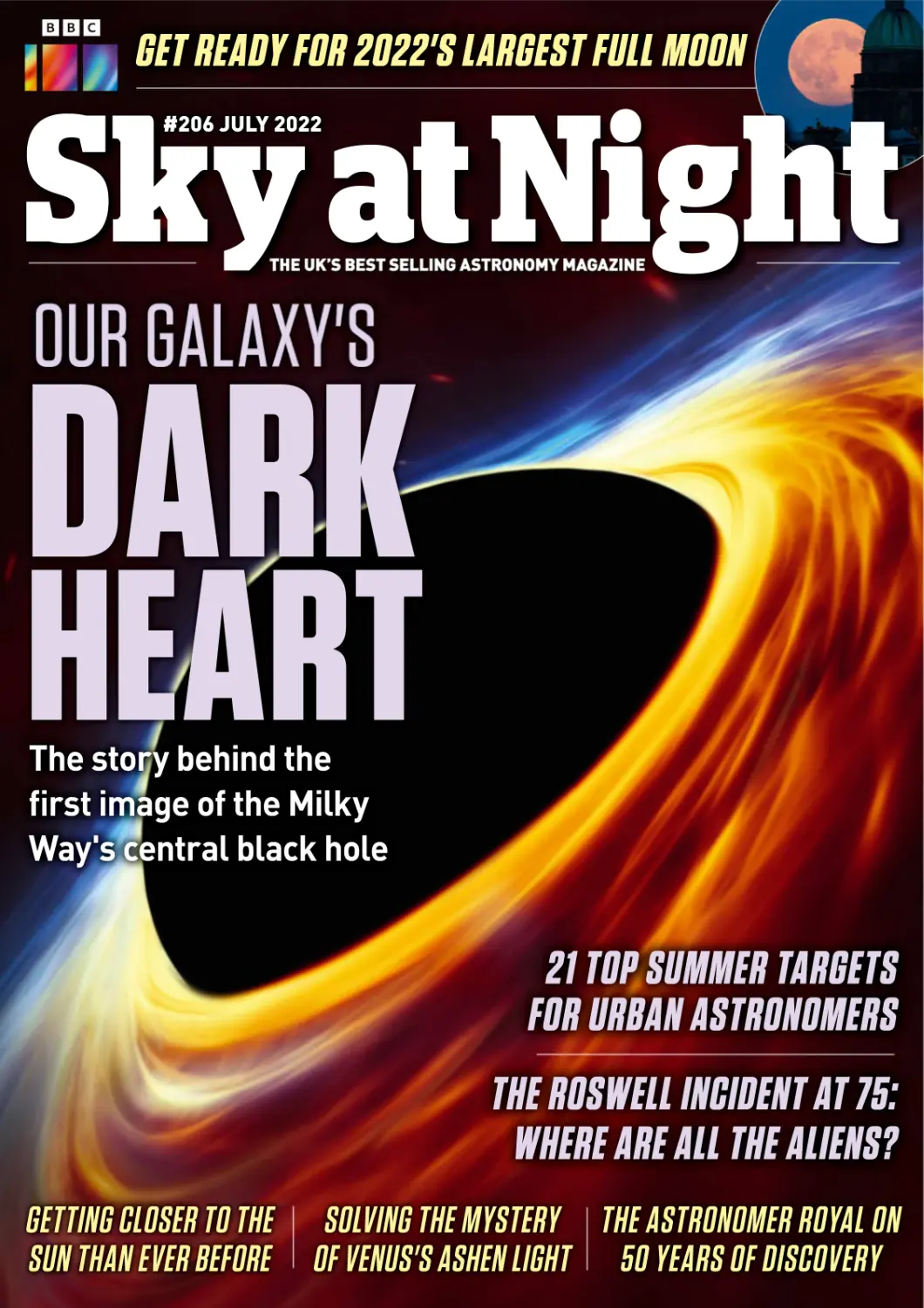
OUR GALAXY'S
DARK
HEART
The story behind the
first image of the Milky
Way's central black hole
21 TOP SUMMER TARGETS
FOR URBAN ASTRONOMERS
THE ROSWELL INCIDENT AT 75:
WHERE ARE ALL THE ALIENS?
GETTING CLOSER TO THE
SUN THAN EVER BEFORE
SOLVING THE MYSTERY THE ASTRONOMER ROYAL ON
OF VENUS'S ASHEN LIGHT 50 YEARS OF DISCOVERY
!
EW
N
THE DOBSONIAN…
The first Dobsonian with StarSense technology that guides stargazers
to celestial objects with pinpoint accuracy.
StarSense Explorer
Dobsonian Cooling Fan
StarSense Explorer
Dobsonian Telescopes
Enjoy dazzling views through the
8" or 10" Newtonian reflector
optical tube featuring a parabolic
primary mirror with highly reflective
Celeston XLT coatings.
>
>
>
>
>
>
Cooling fan for 10" model
RRP £24.99
Available soon
25mm PlÖssl eyepiece
2" Crayford focuser
StarSense smartphone dock
StarPointer red dot
finderscope
Ergonomic carry handles
& an eyepiece rack on the
base
StarSense Dobsonian 8"
RRP £649.99
StarSense Dobsonian 10"
RRP £849.99
Available now
For more information visit celestron.com/starsense Contact Celestron at enquiries@celestron.com
Welcome
HOW TO CONTACT US
Subscriptions, binders and back issues
03330 162119*
Mon–Fri 9am–5pm
A remarkable image from a
camera the size of a planet
The image of Sagittarius A*, the supermassive black hole at the
centre of the our Galaxy, produced using the Event Horizon
Telescope, is astounding. Five years in the making, and taken with a
‘camera’ the size of Earth; it’s the result of collaboration between 80
institutions and more than 300 scientists. It is the first direct visual
proof that our theories are correct, and there really is an immense
gravitational engine driving our Galaxy. Astronomy writer Jane
Green explores the story behind the image on page 67.
Sagittarius A* may be out of reach for us amateur astronomers,
but the summer skies are full of deep-sky targets for observers and
imagers with telescopes – even from towns and cities, if you know
where to look. Someone who does is American amateur astronomer
Rod Mollise, and on page 28 he continues his series with 21 summer
deep-sky targets, all visible with some degree of skyglow.
You’ll want to observe these deep-sky delights at the start and
end of July, avoiding the week or so around the 13th, when it’s full
Moon and bright moonlight will wash the sky. This full Moon is a
noteworthy one, though – the largest perigee full Moon of the year
and so the closest to Earth. While this only increases its apparent
size by a few arcminutes, what will make far more of an impression is
the Moon illusion, that powerful trick of the eye when the Moon is
close to the horizon and appears much bigger than normal.
Moonrise is at 21:11 BST on the 13th – do look out for it.
Enjoy the issue!
Chris Bramley, Editor
*Calls from landlines will cost up to 9p per minute. Call
charges from mobile phones will cost between 3p and
55p per minute but are included in free call packages.
If calling from overseas, please dial +44 (0)1604 973727
Editorial enquiries +44 (0)117 300 8754
9:30am–5:30pm, Mon–Fri
Advertising enquiries +44 (0)117 300 8803
subscription enquiries
Print
www.buysubscriptions.com/contactus
Digital subscription enquiries
www.buysubscriptions.com/contactus
Editorial enquiries
contactus@skyatnightmagazine.com
enquiries
Subscription
UK enquiries: FREEPOST OURMEDIA
(please write in capitals)
Overseas enquiries: PO Box 3320,
3 Queensbridge, Northampton, NN4 7BF, UK
Editorial enquiries
BBC Sky at Night Magazine, Our Media
(an Immediate Group Company), Eagle House,
Bristol, BS1 4ST
Become an Insider
The more we know about what you
like, the better placed we are to bring
you the best magazine possible. So
we’d like to invite you to join our online reader panel
‘Insiders’. Just log on to www.immediateinsiders.
com/register to fill out the short registration survey
and we’ll be in touch from time to time to ask for your
opinions on the magazine and other relevant issues.
PS Our next issue goes on sale on Thursday 14 July.
Sky at Night – lots of ways to enjoy the night sky…
Television
Online
Social media Podcasts
Find out what The
Sky at Night team
have been exploring
in recent and past
episodes on page 18
Visit our website
for competitions,
astrophoto
galleries, observing
guides and more
Follow us on Twitter,
Facebook and
Instagram for space
news, astro images
and website updates
Listen to our Radio
Astronomy podcasts
where the magazine
team and guests
discuss astro news
Tablet/phone eNewsletter
Get each month’s
issue on your Apple
or Android device,
now with bonus
image galleries
The best targets to
observe each week,
delivered to your
inbox. Visit bit.ly/
skynewsletter
Find out more at: www.skyatnightmagazine.com
July 2022 BBC Sky at Night Magazine 3
28
CONTENTS
C = on the cover
Regulars
28 From city lights to deep space 6 Eye on the sky
11 Bulletin
Top celestial targets for summer
months and light-polluted skies
16 Cutting edge
18 Inside The Sky at Night
34 Where are all the aliens?
20 Interactive
Roswell at 75
23 What’s on
Asking the big questions 75 years
25 Field of View
after the extraterrestrial incident
26 Subscribe to BBC Sky
40 Venus in a new light
at Night Magazine
Has the Parker Solar Probe solved 72 Explainer
the mystery of the Ashen Light?
74 DIY Astronomy
98 Q&A: a planet hunter
60 Close up on the Sun
ATG MEDIALAB; PARKER SOLAR PROBE: NASA/JOHNS HOPKINS APL, @THESHED_PHOTOSTUDIO, US GOVERNMENT, EHT
COLLABPRATION, MAGELLAN TEAM/JPL/USGS, FRANCK MARCHIS/SETI, BBC, MARK PARRISH
COVER IMAGE: ESO/ESA/HUBBLE/M. KORNMESSER. THIS PAGE: M-GUCCI/ISTOCK/GETTY IMAGES, SOLAR ORBITER: ESA/
Features
Two probes give humanity its
closest ever views of our star
Astrophotography
76 Capture
67 The dark heart of our Galaxy
78 Processing
Eight telescopes came together to
80 Gallery
capture the shadow of Sgr A*
4 BBC Sky at Night Magazine July 2022
Reviews
86 Rainbow Astro
RST-135 mount
90 Celestron StarSense
Explorer DX 130AZ 5.1-inch
Newtonian reflector
94 Books
96 Gear
16-PAGE
CENTRE
PULLOUT
The Sky Guide
44 Highlights
46 The big three
48 The planets
50 July’s all-sky chart
52 Moonwatch
53 Comets and asteroids
53 Star of the month
54 Binocular tour
55 The Sky Guide challenge
56 Deep-sky tour
58 July at a glance
New to astronomy?
To get started, check out our guides and glossary at
www.skyatnightmagazine.com/astronomy-for-beginners
60
Extra content
ONLINE
Visit www.skyatnightmagazine.
com/bonus-content/TUYY8NE/
to access this month’s selection
of exclusive Bonus Content
JULY
HIGHLIGHTS
Interview: Searching for intelligent life
The SETI Institute’s Franck Marchis talks astrobiology,
exoplanets and what he really thinks about UFOs.
90
34
67
40
This month’s contributors
Nick Pope
Paul G. Abel
Jane Green
UFO expert
Astronomer
Astronomy writer
“Amid
de-classified
files and an
increase in
‘UFO’ sightings, it’s the
perfect time to explore
what actually
happened at Roswell.”
Nick marks the 75th
anniversary of
ufology’s most famous
case, page 34
“Venus’s
Ashen Light
has been
reported by
observers for centuries,
and now the Parker
Solar Probe may have
seen definitive proof of
it.” A strange glow on
the surface of Venus
might be real. Paul
investigates, page 40
“It was
thrilling to
delve into
the EHT
project and see our
backyard black hole for
the very first time!”
Jane chronicles the
five-year project to
image our Galaxy’s
central black hole,
starting on page 67
Watch The Sky at Night
Destination Moon
DIY Astronomy:
Build a webcamscope
The team look back at
the Apollo missions and
discover how space
agencies are preparing
to return to the Moon.
Download plans and
images to help you
complete this month’s
DIY Astronomy project
(see p74 for more info).
The Virtual Planetarium
Pete Lawrence and Paul Abel guide us through
the best sights to see in the night sky this month.
July 2022 BBC Sky at Night Magazine 5
DARK ENERGY SURVEY/DOE/FNAL/DECAM/CTIO/NOIRLAB/NSF/AURA
IMAGE PROCESSING: T.A. RECTOR (UNIVERSITY OF ALASKA ANCHORAGE/NSF’S NOIRLAB), J.
MILLER (GEMINI OBSERVATORY/NSF’S NOIRLAB), M. ZAMANI & D. DE MARTIN (NSF’S NOIRLAB)
A DATE WITH
DESTINY
A tiny dwarf galaxy is inexorably drawn
into the grasp of a double-ringed giant
in this spectacular new portrait
VÍCTOR M BLANCO 4-METRE TELESCOPE, 3 MAY 2022
Locked in a tango across an ink-black dancefloor and against
a twinkling background of thousands of other objects, are two
galaxies in the southern constellation of Horologium, the Clock.
The vast galaxy on the left, a magnificent barred spiral, is NGC
1512. At 70,000 lightyears across it almost rivals our own Galaxy
for size. At its heart is a stunning 2,400-lightyear-wide ring strewn
with infant star clusters, called a circumnuclear starburst ring.
Snaking far, far out into space are its huge arms, gleaming
with countless hot, blue stars. Falling into their grasp is the dwarf
lenticular galaxy NGC 1510. This tiny neighbour also glows with
new star formation, triggered by its endless gravitational tussles
with its bigger partner. Eventually, in several million years, the
diminutive galaxy will be engulfed.
The pair were captured by the state-of-the art widefield Dark
Energy Camera on board the Víctor M Blanco 4-metre Telescope
in northern Chile.
6 BBC Sky at Night Magazine July 2022
July 2022 BBC Sky at Night Magazine 7
Lunar eclipse
from the ISS
NASA, NASA/ESA AND B. SUNNQUIST AND J. MACK (STSCI), ESA & NASA/SOLAR ORBITER/EUI
TEAM, ALMA (ESO/NAOJ/NRAO)/S. DAGNELLO (NRAO/AUI/NSF), EHT COLLABORATION
INTERNATIONAL SPACE STATION,
16 MAY 2022
Those of us who got up early to watch the
lunar eclipse only to be thwarted by clouds
will envy the ISS’s unobstructed view of the
event. A shadow crosses the Moon on the
horizon while to the right is the Rassvet
docking module, the Soyus MS-21 crew ship
and the Nauka lab module with its
brand-new robotic arm. Also brand new are
the SpaceX Crew-4 that arrived on 27 April:
ESA’s Samantha Cristoforetti and NASA’s
Kjell Lindgren, Jessica Watkins and Bob
Hines (who took this shot).
Jewel box of galaxies
HUBBLE SPACE TELESCOPE, 6 MAY 2022
This kaleidoscopic scene rich with
thousands of jewel-like galaxies was
imaged as part of the Frontier Fields
program to study dark matter and the early
Universe. An area near Abell 370 in the
constellation of Cetus, it provides a corridor
back through space and time, from massive
yellow elliptical galaxies, to smaller bright
blue spirals and the farthest, billions-ofyears-old red galaxies. Photobombing the
image are the arcing trails of asteroids in
our own Solar System.
8 BBC Sky at Night Magazine July 2022
Prickly heat
SOLAR ORBITER, 18 MAY 2022
This intriguing feature on the
surface of the Sun was imaged
by the ESA/NASA Solar Orbiter
on 30 March 2022, four days
after the spacecraft’s close
approach to our host star.
Solar scientists don’t yet know
exactly what the feature is, but
it has already been dubbed the
‘space hedgehog’. And while
this unusual formation may be
classed as ‘small scale’, don’t be
fooled: it stretches 25,000km
across, making it about twice as
wide as Earth (shown to scale).
Not running on empty after all
ATACAMA LARGE MILLIMETER/SUBMILLIMETER
ARRAY, 25 APRIL 2022
Galaxies thought to be fully depleted of gas after
violent collisions and mergers with others have been
found to contain surprising reserves of star-forming
fuel. Post-starburst galaxies (PSBs) like 0379 and 0570
(above left and right respectively) have been observed
by ALMA to hold nuggets of turbulent, condensed gas
in or near their centres. The discovery makes for a
puzzle as to why this doesn’t trigger new star creation.
MORE ONLINE
Our local
black hole
On 12 May
astronomers
unveiled the first
ever image of
our Galaxy’s
black hole,
Sagittarius A*.
Turn to pages
17 and 67 for
the full story
Explore a gallery of these and more
stunning space images
July 2022 BBC Sky at Night Magazine 9
BULLETIN
The latest astronomy and space news, written by Ezzy Pearson
Hubble refines the Universe’s expansion rate
The new measurement could help solve one of the biggest problems in cosmology
Using over 30 years of observations, the Hubble Space
Telescope has helped to create the most precise measure of
the expansion of the Universe, known as the Hubble constant.
The new value of 73km/sec/Mpc (kilometres per second per
megaparsec) is now accurate to within one per cent, and means
it would take the Universe 10 billion years to double in size.
“The Hubble constant is a very special number. It can be used
to thread a needle from the past to the present for an end-toend test of our understanding of the Universe,” says Licia Verde,
from the University of Barcelona, who took part in the study.
Astronomers have long been plagued by a serious issue when
measuring the expansion rate of our Universe – it changes
depending on whether you measure it with local objects, like
supernovae in nearby galaxies, or the cosmic microwave
background (CMB), relic radiation from the very early Universe.
Both measurements have been taken many different times by
different teams, but have remained stubbornly mismatched.
The distant measurement from the CMB was initially far
more precise, so to bridge the gap in our understanding a team
of astronomers used Hubble data of supernovae to measure
the nearby value to the same accuracy. As suitable supernova
only occur roughly once a year, it has taken Hubble’s entire
lifespan so far to build up a catalogue of 42 examples.
“This is likely Hubble’s magnum opus, because it would take
another 30 years of Hubble’s life to even double this sample
size,” says Adam Riess from the Space Telescope Science
Institute, who lead the study.
https://hubblesite.org
Þ These 36 galaxies imaged by Hubble play host to both Cepheid variables and supernovae used to measure the Universe’s expansion
NASA, ESA, ADAM G. RIESS (STSCI, JHU)
Comment
by Chris Lintott
This new result does nothing to
relieve what’s politely called the
‘tension’ between different
methods of determining the
expansion speed of the Universe.
And in fact, it makes the
disagreement worse.
After many years of scrutiny, it
seems unlikely that cosmologists
on either side of the divide have
made a mistake. Instead, we
must be missing something. The
fun solution is to change our
cosmological model, invoking
new physics. More likely, our
understanding of the CMB, or
more likely of how supernovae
work, has something missing.
While theorists wrestle with the
problem, new ground-based
surveys like that planned by the
Vera Rubin Observatory, as well
as ESA’s Euclid mission, are on
the way. The scientists behind
them will be delighted to have
Hubble leave them this puzzle
to poke at.
Chris Lintott co-presents
The Sky at Night
July 2022 BBC Sky at Night Magazine 11
ILLUSTRATION
BULLETIN
It’s not the black hole itself that
echoes, but the gas that surrounds
it, illuminated by energetic X-rays
Listening in to black hole echoes
AURORE SIMONNET AND NASA’S GODDARD SPACE FLIGHT CENTER,
SPITZER: NASA/JPL-CALTECH; MIRI: NASA/ESA/CSA/STSCI, UNIVERSITY
OF CANTERBURY, HEATHER ROPER
Bouncing X-rays could help reveal the hidden landscape surrounding black holes
As the team behind the recent image of
the Milky Way’s heart know only too well,
investigating black holes is incredibly
difficult because they are exactly that
– black. The Event Horizon Telescope
team managed it using a planet-sized
telescope, but in the meantime, another
team has been using a more unusual
method – echolocation.
The Milky Way is home to tens of
millions of black holes, left behind by
supernovae. Most of the time they are
invisible until they feast on the gas around
them, creating a burst of X-rays. This then
bounces and echoes off the surrounding
gas, illuminating it. Now a team of
astronomers from MIT has tracked down
a total of 10 echoing black holes – eight of
12 BBC Sky at Night Magazine July 2022
which were new discoveries – and
watched them for several months.
“These black holes range in mass from
five to 15 times the mass of the Sun, and
they’re all in binary systems with normal,
low-mass, Sun-like stars,” says Jingyi
Wang from MIT, who led the study.
By comparing the delay in light from
the black hole’s corona arriving at Earth to
the arrival of echo, the team was able to
create a map of gas around the black hole.
This revealed that the black holes
initially go through a ‘hard’ stage, lasting
a few weeks, where they form coronas of
high-energy photons and shoot out jets
of material at near light speeds. The jets
and corona first begin to sputter, before
transitioning back to a low-energy ‘soft’
phase. The team saw that as the black
hole transitioned from hard to soft, the
time lag of the echo increased, suggesting
the gap between the corona and the
surrounding disc was growing larger.
One explanation is that the corona
experiences a brief expansion outwards as
it finishes its cosmic feast, then retracts.
“We’re at the beginnings of being able
to use these light echoes to reconstruct
the environments closest to the black
hole,” says Erin Kara from MIT. “Now we’ve
shown these echoes are commonly
observed, and we’re able to probe
connections between a black hole’s disc,
jet and corona in a new way.”
Turn to page 67 for more on the image
of the Milky Way’s central black hole.
James Webb Space
Telescope fully focused
NEWS IN
BRIEF
Spitzer 8.0µm
JWST 7.7µm
Þ The image from JWST, above, is noticably
sharper than Spitzer’s, top, with the stars more
tightly defined and the gas cloud more detailed
The James Webb Space Telescope (JWST) has
reached another milestone after aligning all
four of its science instruments, meaning the
telescope is now fully focused. The JWST team
will now move onto the science instrument
commissioning phase, when they will set up
and calibrate the experiments ready to begin
the science phase in the summer.
The telescope’s performance has exceeded
even the most optimistic predictions and as the
first test images come in, its true potential is
becoming readily apparent. This image shows
an area of the Large Magellanic Cloud taken
both by JWST and its predecessor, the Spitzer
space telescope, at comparable wavelengths.
What are fuzzy blobs and vague hazy patches
with Spitzer are now resolved into sharp stars
and nebulous wisps of dust, giving a tantalising
glimpse of what the JWST will be capable of
when it begins its true scientific operations.
www.jwst.nasa.gov
Crashing quads could create supernovae
OSIRIS-Rex to Apophis
NASA has approved a
second space rock stop-off
for its asteroid investigating
OSIRIS-Rex after dropping
off its sample of Bennu at
Earth on 24 September 2023.
Its next target is Apophis
– a near-Earth asteroid that
will pass just 32,000km away
from Earth on 13 April 2029
– and it will spend at least
18 months in orbit, though it
will be unable to collect a
surface sample.
Mars’s solar-powered
dust storms
The Sun could be to blame
for Mars’s annual dust storms,
which cover huge swathes of
the planet, according to a
new report. The study found
the planet was taking in
more energy from the Sun
than it was radiating out as
heat, and this energy excess
could be fuelling the storms.
If two of the four stars in
HD74438 collide and merge,
it could cause a supernova
Black widow binary
ILLUSTRATION
A rare quadruple star system
could be heading towards a
supernova, but in a way never
seen before. The system,
HD74438, is a double binary
found by Gaia in 2017. Now,
after years of follow up
observations, the research
team determined that the
outer pair is disrupting the
inner one’s orbit, making it
increasingly elliptical.
The more elliptical the orbit
becomes, the higher the
chance that two of the stars
might one day collide and
merge. If they did so, they
would cross what’s known as
the Chandrasekhar limit, a
mass 1.4 times greater than
the Sun’s, above which all
stars are destined to undergo
a supernova.
“Interestingly, 70 to 85 per
cent of all thermonuclear
supernovae are now suspected
ILLUSTRATION
The telescope is almost ready
to begin scientific operations
to result from explosions
of white dwarfs with subChandrasekhar masses,”
says Karen Pollard from the
University of Canterbury in
New Zealand. “As a result of
mass transfer or mergers,
these white dwarfs can
explode as a thermonuclear
supernova explosion.”
The discovery is just one
way such transfer can happen,
showing there could be many
more routes to supernova
waiting to be discovered.
www.canterbury.ac.nz
Astronomers have
discovered a ‘black widow
binary’ – where a pulsar
slowly circles and consumes
a smaller companion star
– 3,000 lightyears from
Earth. With the neutron
star lapping its doomed
companion once every
62 minutes, this binary has
the shortest orbit of the
20 known so far.
July 2022 BBC Sky at Night Magazine 13
NEWS IN
BRIEF
BULLETIN
Boeing’s Starliner crew vehicle reaches the ISS
The second commercial crew vehicle is cleared for human tests
Ceres formed far out
A novel set of simulations
has shown that dwarf planet
Ceres could have formed
further out, then migrated
to its current position in the
asteroid belt. The discovery
adds weight to the theory
that Ceres is a protoplanet
that never made it to full
planethood, rather than
forming like the other,
smaller asteroids.
Dead galaxies still gassy
NASA/JPL-CALTECH/UCLA/MPS/DLR/IDA, BOEING, NASA/JPL-CALTECH
Galaxies which have just
finished a period of extreme
star formation, known as
post-starburst galaxies,
could still be rich in highly
compact gas, a new study
has found. However, the
galaxies are not using this
gas to create stars as
would be expected, leading
astronomers to question
what is preventing the
formation process.
On 19 May, spaceflight company Boeing finally
flew the first successful uncrewed test mission
of its Starliner crew module, which will serve as
a ‘taxi’ carrying astronauts to and from the
International Space Station. It arrived at the ISS
the next day, where it was checked out by the
station crew before returning to Earth on 26
May. The capsule is reusable, and so will now
be refurbished ready for its next flight.
The success marks the end of a string of bad
luck for Starliner, beginning in December 2019,
when the spacecraft made its first uncrewed
flight but was unable to reach the altitude
needed to dock with the ISS. After a major
review of the spacecraft by NASA, the test was
due to be reattempted in August 2021, but
issues with the capsule’s propulsion system
meant it was delayed a second time.
www.boeing.com/space/starliner
as it approaches for docking during its test flight
Martian dust means InSight’s end is in sight
when the six-metre-wide robot
first arrived on the planet.
The issue of dust build-up
blocking solar panels has been
known since the Viking missions
of the 1970s. The Spirit and
Opportunity rovers were spared
InSight’s fate as their solar
panels were cleaned at random
intervals by gusts of wind.
InSight – a stationary platform
located near the planet’s pole
– hasn’t been so lucky.
To preserve power, the
InSight team has positioned
the lander’s robot arm in a
‘retirement pose’ where it
can still take images of the
surrounding area without
having to move.
The spacecraft will continue
to use its seismometer to hunt for marsquakes.
Since landing on 26 November 2018, it has
detected more than 1,300 tremors, helping to
build up an image of the inner structure of Mars
and its crust, mantle and core.
https://mars.nasa.gov/insight
Dusty solar
panels on the
Insight lander
Mars’s moving glaciers
The carbon dioxide glaciers
found at Mars’s south pole
have been moving for at
least 600,000 years, a new
study has found. The
glaciers have flowed
downhill and ponded in
troughs and basins, at rates
up to 100 times faster than
water ice under Martian
conditions, creating sheets
up to 1km thick.
Þ The Starliner crew ship pictured from the ISS
The InSight lander is losing its battle with
Martian dust, and is now expected to reach the
end of its science mission this summer, NASA
has announced. The lander’s solar panels are
now so dusty that they produce only 10 per
cent of the 5,000 Watt-hours of power they did
14 BBC Sky at Night Magazine July 2022
The Heart Nebula imaged by
Julian Shroff with an Apx60
It’s love at first light!
Introducing the Apx26, Atik
Cameras’ brand-new 26-megapixel CMOS
camera, and latest addition to the Apx series.
Hot on the heels of the Apx60 is the Apx26, utilising the
Sony IMX571 CMOS sensor. This 26-megapixel sensor has low read
noise, high quantum efficiency, and 16-bit analogue-to-digital conversion.
It’s the perfect combination of versatility and large-format imaging.
The Apx26 comes complete with high-performance cooling,
anti-condensation and anti-reflection optics, as well as easy chip adjustment.
The camera has a large memory buffer to prevent image artefacts and
dropped frames. Additionally, the Apx26 is compatible with Atik’s intuitive
software, and offers customary premium build quality.
You can order the Apx26 NOW!
See our website for details of our worldwide dealers
See the full Atik range
atik-cameras.com
WIN!
2
To celebrate the launch of our 26-megapixel camera, we’re offering you the
chance to win a brand-new Apx26. Simply scan the QR code or head over
to the Apx26 competitions page on our website, and use the code S@N22
to enter. Competition closes 29 July 2022. T&C’s apply.
CUTTING EDGE
Our experts examine the hottest new research
An artist’s impression
of the leading and
trailing packs of
asteroids around Jupiter
towards the Sun. Clues to the origin of the Trojans
can be provided by studying the distribution of their
sizes and surface characteristics. Kotomi Uehata, at
the Department of Planetology, Kobe University,
Japan, and her colleagues have surveyed the Trojan
asteroids in the L5 Lagrangian region, trailing behind
Jupiter in its orbit. They used the Hyper SuprimeCam (HSC) fitted to the 8.2 m Subaru Telescope at
the Mauna Kea Observatory on Hawaii.
Ln of Troy
ILLUSTRATION
They found a total of 189 L5 Trojans down to an
apparent magnitude of +24.0, corresponding to
objects with a diameter of between 2 km and 10 km.
As expected, the size distribution of these objects
follows a power law – there are exponentially more
smaller bodies than larger ones.
They also showed, by comparing with an earlier
study the team had conducted on the L4 Trojan
swarm, that this size distribution is the same for both
Trojan swarms, indicating that they came from the
same primordial population. In total, Uehata
calculates that there are about 260,000 Trojan
asteroids bigger than 1 km trapped in Jupiter’s
L4 and L5 Lagrangian regions – roughly
The planet has hundreds of thousands
10 times fewer than there are in the
“The Trojans
main asteroid belt.
of rocky bodies in front and behind
aren’t thought to
Interestingly, though, Uehata
have
formed
in
he Lagrangian points around an
discovered that in the L4 swarm
Jupiter’s
current
orbiting body are special points in
ahead of Jupiter, there are about
space, where the gravitation of the
40 per cent more asteroids with a
orbit around the Sun,
size larger than 2 km, than there
Sun pulling in and the centrifugal force
but it’s unclear
of our motion flinging out act to
are in the L5 Lagrangian region
exactly
where
they
trailing behind the planet. This
balance each other out. These regions
came
from”
asymmetry in the L4 and L5
around the Earth are very useful for spacecraft. For
example, the SOHO solar observatory has been
populations supports the theory that
parked in the L1 Lagrangian point between the Sun
the Trojans were captured by Jupiter as it
and Earth, and the WMAP probe that mapped the
formed further out in the Solar System before
migrating inward.
remnant heat from the Big Bang is at L2 beyond the
Earth. There are also Lagrangian regions situated 60°
The Trojans are a fascinating category of objects,
and studying them close-up promises to teach us a
leading and trailing any massive object in its orbit. In
Jupiter’s case, its L4 and L5 regions are each
great deal about the origin of small icy bodies from
further out in the Solar System. Luckily, there is
populated by a swarm of asteroids. They are known
collectively as the Trojans, with the largest of them
already a space probe en route to explore asteroids
in both of Jupiter’s Trojan swarms. The Lucy probe,
named Agamemnon, Achilles and Hector.
Prof Lewis Dartnell
These Trojan asteroids aren’t thought to have formed is an astrobiologist
launched in October 2021, will fly by four L4 Trojans
at
the
University
(as well as a main-belt asteroid on its way out) before
at 5.2 AU, the distance of Jupiter’s current orbit from
the Sun, but it’s unclear exactly where they came from. of Westminster
arriving in the L5 swarm in 2033.
Were they originally icy planetesimals from beyond
Neptune, scattered and then captured by Jupiter
Lewis Dartnell was reading… Size Distribution of Small Jupiter Trojans in
during a period of orbital instability early in Solar
the L5 Swarm by Kotomi Uehata et al Read it online at: https://arxiv.org/
System history? Or perhaps Jupiter collected them
abs/2204.08617
when it formed further out, before migrating inward
Jupiter’s asteroid swarms
NASA/JPL-CALTECH, EHT COLLABORATION
T
16 BBC Sky at Night Magazine July 2022
CUTTING EDGE
Our Galaxy has
a heavy heart
consistent with the data collected by the telescopes.
Nonetheless, there is some lumpiness in the material
surrounding the black hole, presumably sculpted by
powerful magnetic fields in the region. There’s a hint
in these images of the detail we’ll see in the next
phase of EHT observations, which should provide a
movie showing changes around the black hole.
Taking a look at the science
Prof Chris Lintott
In the meantime, many of my colleagues were
behind the image of the
is an astrophysicist
surprised that the image indicates that the accretion
and co-presenter
disc around the black hole is somewhat inclined
Milky Way’s black hole
on The Sky at Night
toward us. As we’re embedded in the Milky Way’s
disc, that means that material falling into the black
he Event Horizon Telescope’s image
hole doesn’t arrange itself to align with the wider
of the silhouette of the black hole
Galaxy’s structure. It seems likely that the angle
at the centre of the Milky Way
changes over time, as mergers and accretion of
appeared on news bulletins and
“The largest-scale
front pages around the world,
material swept into the centre change the
structures seen in
black hole’s spin. Given that jets from
but the real jam in this
the
images
change
material accreting onto the black hole are
celestial doughnut is in the series of papers
from
hour
to
released at the same time. So what have we
believed to be capable of driving gas from
the
Galaxy, switching off star formation, the
learnt about Sagittarius A*, our local
hour, and on smaller
fact that they could swing around in any
supermassive black hole?
scales, from
direction may prove to be important.
For starters, it’s slightly more massive than
minute
to
minute”
we thought. Instead of just producing an image,
Intriguingly, the authors note that no single
model of the material around the black hole can
the data from the telescope must be modelled,
with a computer working out what black holes of
account for all aspects of the data. The doughnut
at the centre of our Galaxy may surprise us yet.
varying properties might look like and comparing the
result to the observations collected from the EHT’s
Turn to page 67 for more on Sagittarius A*
network of telescopes. This process suggests a black
hole four million times the mass of the Sun.
Central brightness
One of the reasons we’ve had to wait until now to
see these images, when those of the larger but much
depression
more distant black hole in M87 were released in 2019,
is that the activity observed in the material
surrounding the black hole makes forming an image
hard. The largest scale structures seen in the images
Emission
change from hour to hour, and on smaller scales
ring
things change from minute to minute. This activity
2.4 million
Black
must be associated with the material surrounding
the black hole, rather than the black hole itself, but it
km
Event
hole
is still impressive.
horizon
T
Lumpy material
Once the variability has been accounted for, a careful
measurement of the size of the silhouette can be
made. This is useful in testing the basic general
relativistic equations that describe the black hole. It
turns out all is as expected, and the data fits
perfectly with what we think it should be for a slowly
rotating black hole. The most distinctive feature of
the images is the three lumps which surround the
central shadow. The position of these is actually
rather uncertain; models which place them at
different points around the centre are almost equally
The EHT’s image
captured some of
Sagittarius A*’s
main features
Bright
lumps
6.3 million km
Chris Lintott was reading… Focus on First Sgr A* Results from the Event
Horizon Telescope, a collection of papers on the image
Read it online at: https://iopscience.iop.org/journal/2041-8205/page/
Focus_on_First_Sgr_A_Results
July 2022 BBC Sky at Night Magazine 17
The Sky at Night TV show, past, present and future
INSIDE THE SKY AT NIGHT
In the June episode of The Sky at
Night, Astronomer Royal Martin
Rees takes a look back over the
last 50 years of astronomical
innovations and progress.
Astronomers everywhere
Astronomers have also become a global community
and European collaboration has become especially
strong in recent decades. ESA has launched missions
– Gaia and Planck, for instance – with strong UK
18 BBC Sky at Night Magazine July 2022
ILLUSTRATION
MARK GARLICK/SCIENCE PHOTO LIBRARY/ALAMY STOCK PHOTO, MAGANN/
ISTOCK/GETTY IMAGES, NASA/JOHNS HOPKINS APL/STEVE GRIBBEN
A
s every reader of BBC Sky at Night
Magazine knows, astronomy is on a
roll – and has been for the last 50
years. Increasingly powerful
observational techniques, in space
and on the ground, have revealed a
succession of surprises. As someone old (and lucky)
enough to have had a ringside seat over this whole
time-span, I’ve been glad to contribute some
thoughts to the June episode of The Sky at Night,
which will dig into its archives to find footage of
some of the astronomers and instruments who
spearheaded a number of these key discoveries.
In 1964 the discovery of cosmic background
radiation – the afterglow of creation – settled the
debate between the ‘steady state theory’ and the
‘Big Bang’ explanations of how our Universe came
into being. We can now speak with confidence about
what our cosmos was like right back to just a
nanosecond after the ‘beginning,’ and speculate back
even further. Einstein’s theory of gravity – general
relativity – dates back to 1915, but had a resurgence
in the 1960s, stimulated by advances in cosmology.
Perhaps even more importantly, though, was the
discovery of phenomena – such as pulsars and binary
stellar-mass black holes – for which Einstein’s theory
was not just a tiny correction to Newton, but crucial
to understanding them.
A whole raft of observations accumulated during
the 1970s, which indicated galaxies weren’t mainly
made of gas and stars but contained a third key
ingredient: dark matter, that contributed five times
more gravitating material than ordinary atoms.
Because we can’t do actual experiments on stars
and galaxies, astrophysics has been hugely boosted
by the advent of powerful computers. We can now
build virtual worlds, and see what happens when
galaxies form or stars collide.
participation. Moreover, optical astronomy in the UK
was boosted by the decision to join ESO and gain
access to facilities like the VLT – by most criteria the
world’s number-one optical telescope.
It has, more generally, been gratifying to see
the expansion of the UK’s astronomy and space
community, as an increasing number of universities
have turned their physics departments into
‘physics and astronomy’. And the widening of
interest in astronomy has been stimulated by the
Þ The Big Bang
produced all known
matter and dark
matter (artist’s
impression)
INSIDE THE SKY AT NIGHT
Martin Rees is the
Astronomer Royal
and served as
President of the
Royal Society from
2005 - 2010
greater capabilities of amateur-scale telescopes,
and by internet-based citizen science projects such
as Zooniverse.
The pace of discovery certainly isn’t slackening.
Two very different research fields are surging forward
fast. One is gravitational waves. LIGO and VIRGO
have detected the ripples in space from colliding
black holes and neutron stars a billion lightyears
away – a technical challenge equivalent to
measuring a change at the distance of Alpha
Centauri by the thickness of a hair. The other is
exoplanets: the realisation that most stars are
orbited by retinues of planets. Millions are ‘habitable’
– perhaps we’ll learn in the next 50 years whether
they’re actually inhabited.
Be that as it may, when the history of science in
the last 50 years is written, astronomy and space
exploration will surely provide many of the most
exciting chapters. Many issues that perplexed
astronomers in the 1960s have now been settled;
and we’re now tackling questions that couldn’t
even have been posed back then. So the coming
decades promise to be as exciting as the last few
have been. But progress will, as in the past, be owed
primarily to better technology, not to armchair
theorists like me.
Looking back:
The Sky at Night
10 July 1974
ILLUSTRATION
On the 10 July
span, and
1974 episode of
has begun
The Sky at Night,
to run out of
Patrick Moore
hydrogen fuel
took an image of
in its core. This
the red supergiant
creates a chain
star Antares. Also
reaction that
known as Alpha
results in it
Scorpii, Antares
expanding out
is the brightest
many times its
star in the
original size
constellation of
– it’s radius
Þ Antares will one day go supernova,
Scorpius, and is
is over three
but we might not be here to see it
often referred to
times the
as The Heart of the Scorpion.
distance between the Earth and the
In the northern hemisphere, it is
Sun. This expansion has caused the
visible as a sparkling red gem in the
outer layers to cool to around 3,500ºC,
summer evening sky alongside its much about 2,000ºC cooler than the Sun,
dimmer companion, Antares B. While
meaning it appears red in colour, and
Antares has a visual magnitude which
radiates heavily in the infrared.
varies between mag. +0.6 and +1.6,
As the star progresses into the final
Antares B is a mere +5.5, meaning it is
stages of its life, it will one day become
just visible to the naked eye, but its light a supernova. Exactly when this will
is swamped by the nearby supergiant.
happen is uncertain, but it will be within
The star’s red colour is due to the
the next 10,000 years – relatively soon
fact it is in the latter stages of its life
in astronomical terms.
JULY
The Sky at Day
We all know what it’s like to plan a night of
stargazing, only to find it’s forecast to be
cloudy…again. So this month the team
explore what you can see in the sky during
the day. From the Parker Solar Probe to
solar observing, Chris and Maggie take a
look at what our Sun has to offer, while
Pete Lawrence reveals other kinds of
celestial phenomena before sunset.
Four, 11 July, 10pm (first repeat
Four, 14 July, time tbc)
Check www.bbc.co.uk/skyatnight
for more up-to-date information
Þ The Parker Solar Probe is revealing the
secrets of our host star (see p60 for more)
July 2022 BBC Sky at Night Magazine 19
Emails – Letters – Tweets – Facebook – Instagram – Kit questions
INTERACTIVE
Email us at inbox@skyatnightmagazine.com
This month’s top prize:
two Philip’s titles
MESSAGE
OF THE
MONTH
A 99 leaves Neil wanting Moore
< The ‘99’ shape is known as The
Eyes of Clavius, and is caused by
sunlight hitting smaller crater rims
The ‘Message
of the Month’
writer will
receive a bundle
of two top titles courtesy
of astronomy publisher
Philip’s: Nigel Henbest’s
Stargazing 2022 and Robin
Scagell’s Guide to the
Northern Constellations
Winner’s details will be passed on to
Octopus Publishing to fulfil the prize
On 10 May I took out my Dobsonian reflector
telescope and pointed it at the first quarter
Moon. I don’t use my telescope as much as I
would like to but I was really interested in what I
saw that night – what appeared to be the
number ‘99’ within a crater on the Moon. I
attached my mobile phone adaptor and took
these photographs, then I remembered that
Sky at Night Magazine had recently published a
reprint of Sir Patrick Moore’s excellent Moon
Map (issue 200, January 2022). I looked it out
Tweet
II+II Padawan
@Zs3ml3 • May 21
#Boeing #Starliner on the
docking process. Only 208m
from the #ISS. 14” Dob with
manual tracking, 3xBarlow,
@zwoasi 174MM with A.P 642 IR
PASS filter. @SkyAtNightMag
#SpotTheStation @VirtualAstro
Mighty Orion hangs in
the sky over Campsie
Fells, Scotland
Phone success
I was just reading Pete Lawrence’s
extremely interesting and helpful
online article about taking photos of
the night sky, sunsets, etc using your
20 BBC Sky at Night Magazine July 2022
and compared my photos to it,
and was able to distinguish that it
was crater Clavius in the lunar
southern region that I was looking
at. This has fired my interest to
take my telescope out more and
to try taking more pictures of the
night sky. I’m especially keen now
to try some astrophotography after reading the
article in May’s magazine on ‘Learning About
Layers’. Looking forward to it, and thank you for
publishing a great magazine.
Neil Bailie, via email
What a fascinating account Neil; it’s great to
hear that you put the poster that came with our
200th issue to such good use! The ‘99’ you imaged
in crater Clavius is what’s known as a lunar ‘clair
obscur’ effect called the ‘Eyes of Clavius’. – Ed.
phone’s camera (see https://bit.ly/
SANsmartphone). I also enjoy Pete’s
section on the show. Astro imaging is an
area I’ve been looking to improve, and I
will be trying out his ideas and
suggestions. In the meantime, as per the
suggestion at the end of the article, I’d like
to share this photo I took earlier this year
which turned out quite well due to my
phone camera’s night mode - no manual
adjustment necessary. My phone is
Huawei P30 Pro. I took these pics at the
Campsie Fells, north of Glasgow. The
reflection is my car roof, and the glow on
the horizon is from the city lights.
Brian McMullan, Bishopbriggs, Glasgow
Clear skies
Thank you to Ron Brecher for his excellent
article on observing productivity in
March’s Sky at Night Magazine (‘Boost
Your Observing and Imaging Productivity’,
SCOPE DOCTOR
Our equipment specialist cures your
optical ailments and technical maladies
With Steve Richards
Email your queries to
scopedoctor@skyatnightmagazine.com
Þ Have you seen the same wobbly trails as Simon McRoyall?
March 2022 issue). I have to
ask though, which planet is he
on to have clear nights 60 per
cent of the time?!
Alastair McDougall, Wigan
Wobbly trails
I was interested to read the
message from Robert Bowers
in the May issue (‘Interactive’,
Trail finder, May 2022 issue)
about a wobbly trail he
captured on 26 February 2022.
I observed a similar wobbly
trail passing M81 and M82 on
the following night and
managed to capture this
photo of it. I too am extremely
curious as to what it might
have been.
Simon McRoyall, via email
Varying orbit
I enjoyed Colin Stuart’s article >
ON FACEBOOK
WE ASKED: What’s your favourite astronomy
song or album?
Carol Miller Major Tom (I’m Coming Home), by
Peter Schilling
Paul Beach Fly Me To The Moon, by Frank Sinatra
Keith Moseley Intergalactic Touring Band – a 1970s
concept album.
Jimmy McPartland Between the Rings, by Stellardrone
Cheryl Rowlands Urban Spaceman, by Bonzo Dog DooDah Band
Bryony-Mae Hopkinss Life Beyond soundtrack, by
MelodySheep
Tim Murphy Into the Void, by Black Sabbath
Dewi Griffiths The Race for Space, by Public Service
Broadcasting
Philip Craig Exogenesis Symphony, by Muse
Emma Hugo Starman, by David Bowie
Jim Palmer Alone In The Universe, by Jeff Lynne’s ELO
Kris Derry Destination Moon, by Nat King Cole.
Bob Inkster The Space Race Is Over, by Billy Bragg;
Monochrome, by The Sundays
Jeff Lewis The Intergalactic Laxative, by Donovan?!
Alan Davidson Space Oddity, by David Bowie
I want to circulate air through my Celestron C11
Edge, which has two vents, to help it reach
equilibrium. Is there a DIY option?
JASPAL CHADHA
The Celestron C11 Edge is a
Schmidt Cassegrain Telescope
(SCT) which has a closed optical
tube, so it can take a very long
time to reach temperature
equilibrium with the outside air.
Failure to reach equilibrium results
in air currents in the tube, which
produce a poor quality view.
Anything that you can do to
accelerate the cooling down process is
Þ A Starizona
welcome and pumping air into the tube
Cool Edge can
help a scope hit
can be very effective.
temperature
It is quite easy to build a device to do this
equilibrium
using an 80mm 12V DC fan, a fine fan filter,
a plastic funnel, a length of 22mm overflow water pipe, a 22mm
end cap and some duct tape. You should arrange for the
telescope to point downwards and for the fan to blow air into
the telescope via the visual back port, making sure that the
pipe isn’t long enough to touch the secondary mirror.
Commercial solutions are also available, such as the
Starizona Cool Edge or the Asterion Cooler Cat for SCT and
Maksutov Telescopes.
Steve’s top tip
Can I use my glasses when observing?
If you suffer from astigmatism, wearing glasses while
observing can generally be beneficial. Using high
magnifications, however, which results in a small diameter exit
pupil (aperture divided by magnification), might allow you to
observe well without your glasses. There is no advantage to
wearing glasses if you are simply long- or short-sighted, as
adjusting the telescope’s focus will correct for this.
Because wearing glasses increases the distance you can
place your eye to the eyepiece you may not be able to observe
the full field of view with some oculars, so it would make sense
to buy long eye-relief eyepieces to alleviate this problem.
Derek Lightfoot ’39, by Queen
Steven Douglas Cygnus X-1 and Countdown, by Rush
David Knight Master of the Universe, by Hawkwind
Steve Richards is a keen astro imager and an
astronomy equipment expert
Steve Green The Sky at Night theme tune!
July 2022 BBC Sky at Night Magazine 21
INTERACTIVE
BBC Sky at Night Magazine is published by Our Media Ltd
(an Immediate Group Company) under licence from
BBC Studios, which helps fund new BBC programmes.
EDITORIAL
Editor Chris Bramley
Art Editor Steve Marsh
Production Editor Ian Evenden
News Editor Ezzy Pearson
Staff Writer Iain Todd
Reviews Editor Paul Money
CONTRIBUTORS
Paul Abel, Stuart Atkinson, Mark Bowyer, Melissa
Brobby, Jamie Carter, Lewis Dartnell, Glenn Dawes,
Pippa Goldschmidt, Jane Green, Alastair Gunn, Tim
Jardine, Warren Keller, Pete Lawrence, Chris Lintott,
Rod Mollise, Chris North, Jheni Osman, Mark Parrish,
Nick Pope, Jonathan Powell, Martin Rees, Steve Richards,
Katie Sawyers, Stephen Tonkin, Jane Williamson
Instagram
explorer200p • 23 May 2022
The waxing gibbous Moon from the 13th of May 2022.
Some nice and steady seeing on the 13th for a nice
lunar session. Copernicus crater stands out so well in
this phase as well as the Aristarchus Crater, both on
the western lunar landscape. Also an inverted view of
this phase. It really makes the smaller details pop out.
#moon #moonphotography #moonphases
#moonpics #photography #spacephotography
ADVERTISING SALES
Advertising Manager Andy Williams
+44 (0)117 300 8803, Andy.Williams@ourmedia.co.uk
Inserts Laurence Robertson +353 (0)87 690 2208
PRODUCTION
Production Director Sarah Powell
Production Coordinator Lauren Morris
Ad Services Manager Paul Thornton
Ad Coordinator Charles Thurlow
Ad Designer Parvin Sepehr
Reprographics Tony Hunt, Chris Sutch
LICENSING
Director of Licensing and Syndication Tim Hudson
International Partners’ Manager Anna Genevier
MARKETING
Head of Marketing Jacky Perales-Morris
Marketing Executive Kellie Lane
Press and PR Manager Emma Cooney
PUBLISHING & MANAGEMENT
Associate Publisher Rob Brock
Managing Director Andrew Davies
Group Managing Director Andy Marshall
CEO Tom Bureau
BBC STUDIOS, UK PUBLISHING
Chair, Editorial Review Boards Nicholas Brett
Managing Director, Consumer Products
and Licensing Stephen Davies
Director, Magazines and
Consumer Products Mandy Thwaites
Compliance Manager Cameron McEwan
UK Publishing Coordinator Eva Abramik
UK.Publishing@bbc.com; www.bbcstudios.com
EDITORIAL REVIEW BOARD
Andrew Cohen, Head, BBC Studios Science Unit;
Martin Smith, Executive Editor, BBC Radio Science Unit;
Steve Crabtree, Executive Producer, BBC Studios;
Dr Erica McAlister; Dr Jessica Wade
SUBSCRIPTION RATES
Annual subscription rates (inc. P&P): UK cheque/credit card £62.40; Europe & Eire
Airmail £75; rest of world airmail £85. To order, call 03330 162119 (UK); overseas
+44 (0)1604 973727
We abide by IPSO’s rules and regulations. To give feedback
about our magazines, please visit immediate.co.uk,
email editorialcomplaints@immediate.co.uk or
write to The Editor, BBC Sky at Night Magazine,
Our Media Ltd, Eagle House, Bristol, BS1 4ST.
Audit Bureau of Circulations
23,082 (combined; Jan–Dec 2021)
© Our Media Ltd (an Immediate Group Company) 2022
ISSN 1745-9869
All rights reserved. No part of BBC Sky at Night Magazine may be reproduced in any form
or by means either wholly or in part, without prior written permission of the publisher.
Not to be re-sold, lent or hired out or otherwise disposed of by way of trade at more than
the recommended retail price (subject to VAT in the Republic of Ireland) or in mutilated
condition. Our Media Ltd is working to ensure that all of its paper is sourced from wellmanaged forests. This magazine is printed on Forest Stewardship Council (FSC) certified
paper. This magazine can be recycled, for use in newspapers and packaging. Please remove
any gifts, samples or wrapping and dispose of it at your local collection point.
The publisher, editor and authors accept no responsibility in respect of any products,
goods or services that may be advertised or referred to in this issue for any errors,
omissions, mis-statements or mistakes in any such advertisements or references.
22 BBC Sky at Night Magazine June 2022
> in the previous issue (‘Seeing the Solar
System’s Future’, June 2022 issue).
However, in discussing Earth’s distant
future there is no discussion of, firstly, our
planet’s orbit moving outwards as the
Sun’s mass diminishes, so possibly
escaping being engulfed; and, secondly,
the unlikelihood of Earth and the other
planets being in the same orbits as they
are now, in five billion years time. Passing
or impacting asteroids and comets, and
other events, may change their orbits in
the future, possibly very significantly, as
happened in the distant past.
Derek Marsh, via email
Most of the predictions about the Solar
System in five billion years account for the
change in orbit due to the Sun’s mass loss.
However exactly how the planets’ orbits will
change is highly uncertain, making Earth’s
future even more difficult to predict. – Ed.
CORRECTIONS
In the June 2022 issue’s ‘Inside the Sky at
Night’, and the Looking Back section
covering Voyager 2’s encounter with
Neptune, we mistakenly said the planet
was barely visible to the naked eye and
discovered in 1781 by William Herschel.
These are the characteristics and
discovery history of Uranus. Neptune is
invisible to the naked eye and was
discovered in 1846 by astronomers who
had calculated its position by observing
the effects of its gravitational pull.
SOCIETY IN FOCUS
On Sunday 24 April, as part of
International Dark Sky Week 2022, the
Somerset Levels Stargazers (SLS)
celebrated its 10th anniversary by joining
forces with the Commission for Dark Skies
to present a day-long seminar entitled
Dark Skies, Saving the Stars.
The event was held in Othery Village
hall on the Somerset Levels, and
attendees were also able to join us via
Zoom. It was a free community event to
raise awareness of the issue of light
pollution. Speakers included Bob Mizon,
the UK co-ordinator of the Commission
for Dark Skies, who emphasised that all
living creatures - not just humans - are
affected by strong artificial light at night.
Becky Collier of CPRE, the Countryside
Charity, spoke about its yearly Star Count,
and other speakers included Jo
Richardson, resident astronomer and dark
skies adviser for Exmoor National Park
– the UK’s first Dark Sky Reserve – Jim
Þ Bob Mizon of the Commission for Dark
Skies explains how dark skies benefit us all
Patterson of Moffat Community
Observatory in Scotland and Steve
Tonkin, who gave a tour of easy-to-see
deep-sky wonders.
The Somerset Levels Stargazers was
founded in 2012 by friends Paul Adamson
and John Martin, and holds monthly
meetings at Othery Village Hall both in
person and on Zoom. It has held many
public events and astronomy outreach
days for local schools and children’s clubs.
Paul Adamson, Chairman, SLS
> www.somersetlevelsstargazers.co.uk
WHAT’S ON
We pick the best live and virtual astronomy events and resources this month
PICK OF THE MONTH
Live Home Planet
National Space Centre, Leicester
Hands-on displays, a giant globe,
interactive floors and a spectacular
marble run are all part of the newly
opened Home Planet gallery at the
National Space Centre, designed to
inspire visitors to consider the human
impact on Earth and our place in the
Universe. Booking essential. Adults £16.95,
children £13.95. www.spacecentre.co.uk
Live Herschel to Hawkwind
Observatory Science Centre,
Herstmonceux, 2 July, 7:30pm
Rock guitarist and astronomer Peter
Williamson gives an entertaining talk
that explores the connection between
music and the heavens, including live
music and a singalong. Tickets £18;
£24.50 with food. bit.ly/3MZhJUi
Þ The Bluedot festival is back: enjoy talks from leading astronomers, live music and much more
LIVE & ONLINE Bluedot 2022
Jodrell Bank Observatory, Cheshire, 21–24 July
Bluedot returns for four days of music, art
and space science, all in the shadow of
the iconic Lovell Telescope. Among the
treats are talks by physicist Jim Al-Khalili,
astronaut Tim Peake, space scientist
Monica Grady and BBC Sky at Night’s
Chris Lintott, alongside a bill of stand-up
comedy, art and music by the likes of
Björk and Groove Armada. There’s tons
of fun for kids, with science shows, a
cinema, hands-on activities and family
favourite Brainiac Live. Then, as night falls,
visit the pop-up stargazing station for an
expert night-sky tour. Day tickets from
£35; weekend tickets from £179, including
camping. www.discoverthebluedot.com
NATIONAL SPACE CENTRE, JOD YHARTLEY, LUCAS SINCLAIR X 2
Live Saturday Stars
Mills Observatory, Dundee, 2 July,
1pm and 2:30pm
Come along for family-friendly
astronomy-themed craft activities
followed by some safe solar viewing
through the observatory’s telescopes, all
in a magnificent setting on Balgay Hill.
Free. To book a place call 01382 307200.
Live Craig telescope talk
Bredhurst Village Hall, Gillingham,
29 July, 8pm
Greg Smye-Rumsby brings to life the
story of the Craig telescope, for a brief
time in the mid-19th century the largest
refracting telescope in the world. Was this
strange instrument just an expensive folly?
www.midkentastro.org.uk/events
Live Late Night Explorer
Kielder Observatory, Northumberland,
weekends, 11:30pm
Wonder at the Moon, planets,
constellations and galaxies under the
guidance of expert astronomers, and
use the observatory’s high-quality
telescopes. Also enjoy a cosy, log-burning
stove and a hot chocolate. Tickets £46.
kielderobservatory.org
Live Observatory open evenings
St Martin’s, Scilly, Tuesdays, 8pm and 9pm
Dark-sky seekers will find some of the
UK’s best views of the stars at the
Community Observatory St Martin’s on
Scilly. Entry £5. Book at bit.ly/3KUbMX9
Live Space science introduction
Royal Institution, London, 29 July, 11am
This holiday workshop for 13 to 15
year-olds explores the Solar System,
how maths can calculate the size of the
Universe and much more. Tickets £50.
www.rigb.org/whats-on
July 2022 BBC Sky at Night Magazine 23
This was
Sylvia’s
promise
to you...
A generation ago, a woman named Sylvia made
a promise. As a doctor’s secretary, she’d watched
stroke destroy the lives of so many people. She was
determined to make sure we could all live in a world
where we’re far less likely to lose our lives to stroke.
She kept her promise, and a gift to the Stroke
Association was included in her Will. Sylvia’s gift
helped fund the work that made sure many more of
us survive stroke now than did in her lifetime.
Sylvia changed the story for us all. Now it’s our turn
to change the story for those who’ll come after us.
Stroke still shatters lives and tears families apart.
And for so many survivors the road to recovery is
still long and desperately lonely. If you or someone
you love has been affected by stroke – you’ll know
just what that means.
But it doesn’t have to be like this. You can change
the story, just like Sylvia did, with a gift in your Will.
All it takes is a promise.
You can promise future generations a world where
researchers discover new treatments and surgeries
and every single stroke survivor has the best care,
rehabilitation and support network possible, to help
them rebuild their lives.
Big or small, every legacy gift left to the Stroke
Association will make a difference to stroke survivors
and their families.
Find out how by calling 020 7566 1505
or email legacy@stroke.org.uk
or visit stroke.org.uk/legacy
Rebuilding lives after stroke
The Stroke Association is registered as a charity in England and Wales (No 211015) and in Scotland (SC037789).
Also registered in the Isle of Man (No. 945) and Jersey (NPO 369), and operating as a charity in Northern Ireland.
FIELD OF VIEW
The amateur astronomer’s forum
Astronomer to the stars
Jonathan Powell is
a freelance writer and
broadcaster. A former
correspondent at
BBC Radio Wales,
he is currently
astronomy
columnist at the
South Wales Argus
T
he lofty position of astronomer in a
royal court has afforded whoever held
the position rare privileges, quite apart
from the prestige and chance to
mingle in higher circles. And for some
astronomers, it was also the gateway
to pursuing certain personal scientific projects that
without royal funding, may never have been realised.
In the very earliest ruling courts, the science of
astronomy was still merged with astrology, before
the two took their separate paths. Predictions made
by these astrologers could weigh somewhat heavily
upon them. After failing to predict an eclipse in
2300 BC, two Chinese astrologers attached to the
emperor’s court soon found they were detached
from their heads.
But with the passing of time, attitudes towards the
sky changed, as did how it was interpreted. Great
astronomers in their own right such as Tycho Brahe,
Galileo Galilei and William Herschel were all to be
summoned by nobility. During the latter part of the
1500s, King Frederick II of Denmark granted revered
Danish astronomer Brahe an estate on the small
Swedish island of Hven, and a pot full of cash to build
the Uraniborg, an observatory and research
establishment where Brahe set about building all
manner of astronomical instruments.
But Brahe had a rather despotic relationship with
the locals, and fell out of favour with Frederick’s
successor to the Danish crown. Disagreements
ensued, and the party was soon over. However, he
bounced straight back by obtaining the position of
Imperial Court Astronomer to Holy Roman Emperor
Rudolf II in Prague. Interestingly, another
astronomical titan, Johannes Kepler, replaced Brahe
in that position on his unexpected death in 1601.
A decade later in 1610, Galileo Galilei rather
shrewdly dedicated his book Sidereus Nuncius (The
Sidereal Messenger) to Cosimo II de’ Medici, the
Grand Duke of his native Tuscany. This smart
move saw Galileo appointed as the duke’s
mathematician and philosopher, and as a courtier
Galileo was duly able to live the life of a gentleman.
In later years, however, with his outspoken views on
the Copernican theory, Galileo was pronounced to be
suspect of heresy, and found himself condemned to a
life of imprisonment. In truth, Galileo didn’t go to
clink, in fact quite the contrary: his cell was first an
apartment, then a palace, then a villa.
John Flamsteed may have hoped for similar
patronage when, in 1675, he compiled a report on the
need for a new observatory, which resulted in the
founding of Royal Greenwich Observatory. Indeed, as
its director he became the first Astronomer Royal of
England. However, the cash was not forthcoming and
Flamsteed had to supply all the instruments at
Greenwich himself.
William Herschel was more fruitful in securing
financial backing. As a result of his discovery of
Uranus in 1781, King George III bestowed upon him
the title of King’s Astronomer, and then later a
substantial cash advance. This enabled Herschel to
construct the giant 40-foot telescope – the world’s
largest for 50 years – in Slough.
While the role of royal astronomer may not have
proved productive and lucrative for all, the premise of
the position, that of furthering science, has brought
significant contributions to astronomy.
July 2022 BBC Sky at Night Magazine 25
ALEX GREEN/FOLIO
Astronomy writer Jonathan Powell discovers a royal influence on stargazing
SkyMAGAZINE
at Night
SAVE WHEN YOU SUBSCRIBE
TO THE DIGITAL EDITION
Available from
The perfect addition to your stargazing, BBC Sky at Night
Magazine is your practical guide to astronomy, helping you
to discover the night skies, understand the Universe around
us and learn exciting techniques for using your telescope.
Enjoy our Premium App experience now available from
SkyMAGAZINE
at Night
City life can be hard
on stargazers, but
there’s still hope
From
cityto lights
deep space
PART
2 OF 4
In this second part of a series that looks at urban stargazing
through four seasons, Rod Mollise reveals the wonders you
can discover in the summer night sky…
28 BBC Sky at Night Magazine July 2022
Newtonian reflectors, which use a large mirror
to collect light, are the least expensive when it
comes to cost-to-aperture ratio. But, as the tube in
Þ A Newtonian reflector uses
mirrors to collect and reflect light
to an eyepiece for viewing
a Newtonian is open to the
elements, expect to clean
its delicate mirrors regularly.
Medium to long focal length
Newtonian reflectors are not
very portable in apertures
above 250mm, and Newtonian
mirrors need to be aligned
to each other (collimated)
frequently.
‘Uncle’ Rod Mollise
is an American
amateur astronomer
and writer who
lives near Mobile,
Alabama. He is the
author of Choosing
and Using a New CAT
Refractors use a lens to collect light. Moving from
the warmth of indoors to the cold outside deforms a
reflector’s mirrors, so they take time to acclimatise.
But the lens of a refractor is much less affected by
changes in temperature. Refractors also rarely require
collimation and their images can be very sharp. But
you’ll often pay more for a 100mm refractor than a
250mm reflector.
Catadioptrics, like the Schmidt Cassegrain
Telescopes (SCT), employ a combination of
lenses and mirrors. Most SCTs come equipped
with computerised drives that will reliably locate
objects (which can be difficult to do ‘manually’
in light-polluted skies), as well as other high-tech
features. But, while not as expensive as refractors per
millimetre of aperture, they are more expensive than
a Dobsonian reflector. The optics of SCTs also require
collimation – though not as often as those
of Newtonians. >
Þ A refractor uses glass lenses to
bend light and enlarge the image.
They’re sharp, but expensive
Þ Catadioptric telescopes are a
combination of the other two types,
and are lighter and more compact
July 2022 BBC Sky at Night Magazine 29
M-GUCCI/ISTOCK/GETTY IMAGES, WWW.ALTAIRASTRO.COM
W
hen it comes to deep sky
objects, in the summer the
galaxies lying outside the
plane of the Milky Way are
setting and the marvels
within our own Milky Way
are on the rise. Urban observers don’t have as easy a
time viewing the deep sky in summer, as the air tends
to be humid and moisture scatters light pollution,
making the sky brighter. Nevertheless, it is possible to
see a multitude of distant and beautiful objects; you’ll
just need to tailor what you are looking for according
to the weather conditions. On humid summer nights
look for bright star clusters, saving more difficult
objects like galaxies for times when the weather is
dry and the sky is dark.
Whatever the conditions, when deep sky observing
there’s one characteristic that’s most important in
the telescope you use – aperture, the size of its lightcollecting lens or mirror. A telescope with an aperture
of at least 200mm is recommended in areas with
light pollution. However, one with a 250mm aperture
will be as portable and only a bit more expensive
– the extra 50mm shows many more objects and
gives more detail, even in bright urban skies.
There are a few different telescope designs to
choose from:
Vega
α
ι
LYRA
τ
M92
Summer
sights
θ
φ
σ
Keystone
ο
η
π
ν
M13
ξ
μ
The season’s stunning
constellations to explore…
ε
Hercules, the Hero
A well-known home of
stunning globular clusters
Hercules may be on the dim side, but its
premier deep sky object, M13 (mag. +5.8,
20’ across) is not. Even a beginner with a
non-computerised telescope mount won’t
have much trouble finding it, roughly
midway between the line connecting the
two westernmost stars of the Keystone
– the lopsided square at the star-pattern’s
heart. But, while M13 is bright, it is also
compact. A 200-250mm telescope turns
this ‘smudge’ into a beautiful ball of stars
in the brightest skies.
Another notable globular star cluster
is M92 (mag. +6.4, 14’ across), which
HERCULES
The Keystone
asterism lies
at the heart
of Hercules
Rasalhague
α
OPHIUCHUS
Sarin
δ
Kornephoros
α
lies away from the Keystone in the
northern part of the constellation. While
it is actually more tightly concentrated
than M13, M92 seems easier to resolve
– perhaps because the core isn’t as
overwhelmingly bright as that of M13.
In a 130mm telescope from a suburban
location, M92 can appear resolved almost
to its centre on a dry summer’s evening
when the air is steady.
Lyra, the Lyre
ζ
β
Rasalgethi
CORONA
BOREALIS
M13 in Hercules is a tight
ball of stars, and needs
a bigger scope
Discovered in January
1779, M57 is a luminous
envelope of ionised gas
This constellation contains well-known wonders
Lyra is meant to look like a
lyre, a kind of harp popular
in ancient Greece
η
ε1
θ
ε2
δ
CYGNUS
ζ
Vega
α
LYRA
γ
β
Sulafat
Sheliak
M57
Albireo
κ
M56
β
Even in the worst urban light pollution,
M57 (mag. +8.8, 3’48”x2’24”), the
famous Ring Nebula, is a good target
for a 80-100mm telescope, but its
shape only becomes evident with an
30 BBC Sky at Night Magazine July 2022
aperture of 150mm or more. A 250mm
telescope shows brightness variations
in its nebulosity and reveals a faint star
embedded in the southwestern end of the
ring’s disk. The holy grail is M57’s central
star, the white dwarf left over from the
dead sun that created the nebula.
Globular cluster M56 (mag. +8.8, 8’48”),
in the eastern part of Lyra near the border
with Cygnus, is often overlooked. Its small,
dim stars are spread far apart, making it
more like a rich but dim open cluster.
Lyra’s final urban wonder is not a deep
sky object, but a multiple star, the famous
Double-Double, Epsilon (ε) Lyrae, located
1°36’ northeast of Vega. At low power
an attractive double star is visible, two
suns separated by a wide 208”. Increase
magnification to 200-250x, however, and
both of the stars are revealed as doubles
themselves. The northernmost pair, ε1, is
separated by 2.78”, while the stars of ε2 to
the south are 2.4” apart.
β
ι
NGC 6826
ρ
π1
α
π2
M39
ο2
LYRA
δ
ο1
α
ε2
ξ
CYGNUS
γ
M29
ν
Sadr
μ
ο
γ
Northern
Cross
η
m
Su
Gienah
φ
Albireo
me
NGC 6992
ξ
β
λ
ε
52
β
ria
rT
NGC 6960
α
ng
ζ
VULPECULA
le
ι
ν
δ
τ
π
θ
Vega
α
ε1
Fawaris
Deneb
ρ
LACERTA
π
θ
κ
HERCULES
M27
γ
SAGITTA
ε
α
δ
ζ
β
DELPHINUS
α
γ
δ β
PEGASUS
Altair
ε
Enif
AQUILA
γ
NGC 6934
α
β
μ
δ
Þ Cygnus is dominated by the Northern Cross asterism, which in northern latitudes is directly overhead at midnight in summer
Cygnus, the Swan
One of the best planetary nebulae, NGC
6826 (mag. +8.8, 8’24” across), the Blinking
Planetary, is located not far from the tip
of Cygnus’s western wing. Even with a
100mm telescope, under light-polluted
conditions it is impossible to see the
round nebulae or its mag. +10 central star
using direct vision. But practice averted
vision – looking off to the side rather than
directly at it – and the round nebulosity
around the star springs into view.
Alternate rapidly between direct
and averted vision and the
nebulosity blinks on and off.
Cygnus is home to two open
star clusters. M29 (mag. +6.6,
10’ across) is located near the
junction of Cygnus’ wings and
body. North of M29 by 14°50’,
and well away from the body
of the Swan, is M39 (mag. +4.6,
31’ across).
The legendary Veil Nebula
(NGC 6992/6960) is two separate
arcs of nebulosity, only visible with
an OIII filter. The first of the Veil’s two
nebulous arcs, NGC 6960, often referred
to as the Witch’s Broom Nebula, is easy
to locate without a computer since
this 3°30’ x 2°40’ streak of gas passes
through a bright, mag. +4.2 star 52 Cygni.
Although the given magnitude for the
Witch’s Broom is +7.0, its large size means
its surface brightness is extremely low.
The other main component of the Veil,
M27 was the first
planetary nebula to be
discovered, in 1764
NGC 6992, forms a 3°50’ x 2°40’ arc, 2°30’
northeast of the Witch’s Broom. This
half of the Veil is referred to as the Bridal
Veil Nebula thanks to its intricate, lacy
structure. On a good night it can begin
to give up significant detail to telescopes
with an aperture of 250mm or more.
Vulpecula, the Little Fox, is
unimpressive, but it is home to M27 (mag.
+7.4, 8’ x 5’36”), the Dumbbell Nebula.
Not only is M27 bright and bold, it
is large for a planetary nebula,
making it one of the best for
Northern Hemisphere observers.
Lower magnifications reveal
substantial detail and make
the Dumbbell a great target
for smaller telescopes.
The main object of interest
in the small constellation
Delphinus, the Dolphin, is a
globular cluster, NGC 6934
(mag. +8.8, 8’24” across). Even
with a 300mm telescope, it
appears as an unresolved fuzzball,
but it is set in a field rich with stars.
In the suburbs, a magnification of 187x
begins to resolve individual stars around
the periphery of the cluster. >
July 2022 BBC Sky at Night Magazine 31
ROD MOLLISE, JOHANNES SCHEDLER/CCDGUIDE.COM, MICHAEL BREITE/STEFAN
HEUTZ/WOLFGANG RIES/CCDGUIDE.COM, CHARTS BY PETE LAWRENCE
Near midnight, the Swan rides high with her companions the Little Fox and Dolphin
β
Ophiuchus’s
brightest star
is mag. +2.7
Rasalhague
α
κ
β Cebalrai
γ
ε
M12
μ
ζ
ξ
η
λ
φ
χ
ξ
SAGITTARIUS
θ
δ
ω
LIBRA
γ
β
ψ
γ
Cauda (the tail). While the tail is far to the
south and doesn’t hold much of interest,
the head is a different story, containing
one of the best globulars visible from
northern latitudes: M5 (mag. +6.6 and
23’ across). M5’s statistics alone hint at
what a spectacle it is. While it is slightly
dimmer than M13 and its concentration is
about the same, M5 is easier to resolve in
any telescope, and is just visible with the
naked eye under perfect conditions.
ζ
η
M11
α
δ
ζ
τ
ν
SCUTUM
OPHIUCHUS
γ
32 BBC Sky at Night Magazine July 2022
υ
Han
Sabik
η
Home to one of the prime
attractions of the summer
sky: the Wild Duck Cluster
SERPENS
CAPUT
M5
ν
β
Scutum
α
ε
SERPENS
CAUDA
SAGITTARIUS
δ
δ
ο
Althalimain
M26
β
M10
ν
γ
ε
Unukalhai
λ
τ
AQUILA
NGC 6712
γ
OPHIUCHUS
α
With Serpens, the Serpent,
these constellations hold
some real gems
λ
ι
κ
λ
ε
δ
Once thought to resemble Asclepius the
physician, Ophiuchus looks like a lopsided
house drawn by a child. Nevertheless,
there are wonders aplenty here.
Ophiuchus’s main attractions are
globular clusters, beginning with the
famed Twin Globs. M10 (mag. +6.4,
20’ across) is a treat. With a 280mm
telescope, it is resolved to its core and
shows hordes of tiny stars. M12 (mag. +7.6,
16’ across), which lies northwest of M10, is
bright and compact, but fewer stars and
a looser structure make it appear dimmer
than the magnitude figure suggests.
Serpens is actually two constellations,
Serpens Caput (the head) and Serpens
γ
Rasalgethi
α
SERPENS
SCUTUM CAUDA
β
η
Ophiuchus, the
Serpent Bearer
HERCULES
Rasalhague
Latin for shield, Scutum is
a small, dim constellation
forming a narrow diamond
M11 (mag. +6.3, 14’ across), the Wild Duck
Cluster, is a bright open star cluster. As
its surface brightness is high, it is easy to
make out with a 75mm telescope under
poor city skies. Indeed, enough stars
should be visible to make clear why this
object is the Wild Duck – triangular in
shape, suggesting a flight of ducks.
M10 was originally
described as being
‘without stars’
Scutum’s other Messier open cluster is
M26 (mag. +8, 10’ across), a group of stars
whose magnitude and size make it sound
like a good catch. However, it turns out
to be a major disappointment. A 150mm
telescope shows a scattering of at most
10 faint stars and one slightly brighter sun.
Globular cluster NGC 6712 (mag. +8.7,
2’30” across), just to the east of Scutum’s
stick figure, isn’t anything special in itself,
but the field it is set in is incredibly rich
– packed with stars, it is almost difficult
to tell where the outer stars of the cluster
stop and background stars begin. NGC
6712 is visible in the city, and a 300mm
telescope may resolve some stars, but
its beauty is reduced since the field is
no longer as rich with suns as it is from
darker skies.
M11: a loose cluster in
smaller scopes, at 100x
a crowd of stars is shown
ρ1
ρ2
Te
a
sp
o
on
ξ1
μ
ξ2
Albaldah π
SAGITTARIUS
ο
M20
M22
NGC 6530
λ
Nunki
σ
M8
Kaus Borealis
φ
Tea
p
τ
ot
Kaus Meridionalis
ζ
δ
Ascella
γ
Alnasl
Kaus Australis
ε
CORONA
AUSTRALIS
γ
ε
Arkab η
α
Þ Low on the horizon viewed from London, Sagittarius cannot be seen at all from Scotland. Its legs drop down below Corona Australis
Sagittarius, the Archer
While the constellation doesn’t look anything like
the centaur archer of mythology – it looks more like
a teapot with a perfect lid and spout –it is home to
some bright, legendary objects.
M22 (mag. +5.1, 32’ across), the Great Globular in
Sagittarius, is an example of an object that makes a
visit to the south of England worthwhile. Its highest
altitude from the latitude of London is less than 15°,
but it is large and easily visible in smaller telescopes.
With a 280mm telescope its oval shape becomes
evident and its loose central core becomes visible.
Elsewhere, the star cluster NGC 6530 is loose but
attractive, and is composed of about a dozen bright
stars. It appears to be embedded in the nebulosity of
M8, the Lagoon Nebula, but is thought to actually be
a foreground object.
Sagittarius’s other famous nebula, M20 (mag. +6.6,
30’ across), the Trifid Nebula, is badly hurt by its low
altitude. Despite having a fairly high magnitude and
being reasonably large, its faintness is due to the fact
that some of the Trifid is reflection nebulosity, which
is more difficult to see than emission nebulosity from
light-polluted areas.
M20, the Trifid Nebula, is named
for its three parts: emission,
reflection and dark nebulae
July 2022 BBC Sky at Night Magazine 33
ROD MOLLISE, MARKUS BLAUENSTEINER/CEDIC TEAM/CCDGUIDE.COM,
FRANZ KLAUSER/CCDGUIDE.COM, CHARTS BY PETE LAWRENCE
Barely above the horizon, this
constellation holds a few legends
Where are all the aliens?
ROSWELL AT 75
Nick Pope looks at back at the most famous UFO story of all,
and why more people are reporting strange sights in the sky
T
STELLAMC/ISTOCK/GETTY IMAGES, BHAMMOND/ALAMY STOCK PHOTO
his summer sees the 75th anniversary
of the Roswell incident, where
believers say an extraterrestrial
spacecraft crashed in the New Mexico
desert, with debris – and possibly
alien bodies – being recovered by
the US government, marking the beginning of a
decades-long cover-up. What really happened, and
why does this mystery still attract such interest and
controversy, decades later?
On 24 June 1947, a pilot, Kenneth Arnold, was flying
over the Cascade Mountains of Washington State
in the US, helping to search for a crashed military
aircraft. He saw nine crescent-shaped objects flying
in formation at a height of around 3km (10,000ft) and
an estimated speed of approximately 1,900km/h:
seemingly impossible at the time. Arnold described
the jerky movement of the objects as being, “...like a
saucer would if you skipped it over water”.
The mystery begins
The media got hold of the story, coined the phrase
‘flying saucer’ and a modern mystery was born. It
wasn’t the first sighting of what we now call a UFO
(unidentified flying object), but it was the first to
capture the public imagination, making news headlines
around the world. More reports were received,
suggesting these sightings were commonplace but
had previously gone unreported. As this ‘summer of
the saucers’ progressed, media coverage intensified
to a point of near-hysteria, until matters came to a
head and it seemed the mystery might be resolved.
On 7 July a local rancher named ‘Mac’ Brazel
contacted the sheriff in Roswell to say he’d discovered
strange debris spread over the ranch. He’d found it
34 BBC Sky at Night Magazine July 2022
days earlier but hadn’t thought much of it until the
stories about flying saucers. Thinking there might
be a connection and guessing something might
have crashed during a recent storm, he alerted the
authorities. He’d brought some samples of the debris,
and when the sheriff contacted the nearby Army
airbase, intelligence officer Jesse Marcel went to the
crash site with Brazel and recovered more debris.
The military base’s public information officer,
Walter Haut, worked with a local journalist to release
a newswire report about the event:
“The many rumors regarding the flying
disc became a reality yesterday when the
intelligence office of the 509th Bomb
Group of the Eighth Air Force, Roswell
Army Air Field, was fortunate enough
to gain possession of a disc
through the cooperation of
one of the local ranchers
and the sheriff’s office of
Chaves County.
“The flying object
landed on a ranch near
Roswell sometime last
week. Not having phone
facilities, the rancher stored the
disc until such time as he was able
to contact the sheriff’s office, who in
turn notified Major Jesse A Marcel of the
509th Bomb Group Intelligence Office.
“Action was immediately taken and the
disc was picked up at the rancher’s home. It
was inspected at the Roswell Army Air Field
and subsequently loaned by Major Marcel to
higher headquarters.” >
þ Stranger things:
since the Roswell
incident, bizarre
UFO-related stories
have emerged from
across the world,
including the alien
abduction of cattle
Life, but not as we know it:
Roswell continues to celebrate
its historic link with UFOs
> The news sent shockwaves
US GOVERNMENT X 3, STEPHEN FAULKNER/ALAMY STOCK PHOTO,
MOVIESTORE COLLECTION LTD/ALAMY STOCK PHOTO
around the world, but it’s the
iconic front page headline of
the local Roswell Daily Record
(right) that’s best-known: ‘RAAF
Captures Flying Saucer on Ranch
in Roswell Region’.
Within 24 hours there was
a stunning development. In
a complete reversal of their
position, the US military said a
mistake had been made, and
that the ‘flying saucer’ was a
crashed weather balloon. The
Roswell Daily Record printed a follow-up story that
read ‘Gen. Ramey Empties Roswell Saucer’ – General
Roger Ramey being the Commander of the Eighth Air
Force, to whose Fort Worth headquarters the debris
had been flown. A series of photos were published
showing Ramey, Marcel, and other military personnel
holding some of the debris. Sure enough, it looked
pretty uninspiring and was entirely consistent with the
‘tinfoil’ mentioned by the military in their explanation.
Nowadays, with the 24/7 news cycle, internet,
social media and an activist community of UFO
researchers, such a claim – followed by such an
about-turn – would no doubt cause controversy
and conspiracy theories on a massive scale. This is
especially true given that the 509th Bomb Group was
the only atomic bomb-capable squadron anywhere
in the world at the time. It’s hard to imagine these
elite personnel – many of whom were familiar with
weather balloons – being fooled in this way. But
post-war America was very different from today, and
in that calmer, more trusting-of-authority era, the
weather balloon explanation was almost universally
believed. While interest in flying saucers and UFOs
went from strength to strength, Roswell disappeared
from the narrative.
A voice from the past
The story of the Roswell UFO crash was rediscovered
in 1978 by nuclear physicist-turned-ufologist Stanton
T Friedman, who was tipped off that a retired military
man had an interesting story to tell: none other
than Jesse Marcel. Marcel told Friedman the weather
balloon explanation had been a cover story and
that the photos had been staged, with weather
balloon debris being substituted for the real
wreckage. He claimed that everyone involved in the
retrieval was clear the object had indeed been an
extraterrestrial spaceship.
Over the next few years, researchers dug deeper
into the mystery, tracking down many of the key
36 BBC Sky at Night Magazine July 2022
Þ Breaking news:
in July 1947, the
Roswell Daily
Record generated
a media frenzy
about a ‘flying
saucer’ captured
by the US military
< After saying that
a mistake had been
made about the
capture, the US
military released
photos, like this
one of Major Jesse
A Marcel at Fort
Worth, showing
pieces of a foil-lined
material...
< …and it claimed
the wreckage was
in fact from a
weather balloon.
This picture
shows a weather
balloon being used
in military tests in
July 1947 at Forth
Worth, five days
after the Roswell
UFO incident
‘UFO Trail’: a sign in Rendlesham
Forest, Surrey, lists a UFO sighting
near two military bases in 1980
The UK’s X-Files?
The British government once played its own part
in investigating strange objects in the night sky
Between 1953 and 2009 the UK’s Ministry of
Defence researched and investigated UFO
reports to assess defence implications.
Investigations involved interviewing
witnesses, checking radar tapes, analysing
photos and videos and cross-checking
against military activity, weather balloon
launches, satellite paths, meteor showers
Hoax: the story behind
the infamous ‘Alien
Autopsy’ video of 1995...
and more besides. Most sightings turned
out to be misidentifications of ordinary
phenomena, but around 5 per cent
remained unexplained, including
sightings from pilots and cases where
UFOs were tracked on radar, performing
seemingly impossible speeds,
manoeuvres and accelerations.
In recent years the MoD has declassified
and released nearly 60,000 pages of
UFO documents. The most bizarre case
in these real-life X-Files was the
Rendlesham Forest incident of December
1980, near two military bases in Suffolk.
An object briefly landed in the nearby
forest, leaving indentations in the frozen
ground, scorch marks on the sides of trees
and radiation levels assessed by MoD
scientists as being “significantly higher
than the average background”. Another
was a highly-classified intelligence study
that suggested some sightings might be
attributable to a previously-unknown
atmospheric plasma phenomenon.
In June 2021 the US government
published an intelligence assessment
stating that UFOs “clearly pose a safety
of flight issue and may pose a challenge
to US national security”. By then the UK,
which wasn’t consulted on the US study,
had terminated its own investigations and
it declined to re-engage on the subject.
As the US government continues to
investigate, it seems the truth may be out
there - but the UK government won’t be
finding it anytime soon.
players, locating additional witnesses and trying
to piece together what happened. A number of
retired military personnel who’d been based at
Roswell corroborated some elements of the crashed
spacecraft narrative and added their own details.
Sceptics argued that they were simply telling the
researchers what they wanted to hear, writing
themselves into the story either as a prank, or
because they were seeking attention. Either way,
books were written, documentaries, drama series
and a movie were made, and the idea of a UFO crash
became so embedded in pop culture that even if
people had no particular interest or belief in UFOs,
there was a good chance they had heard of Roswell.
The stuff of legend
..underwent a comedy treatment in
2006, in a movie starring Ant and Dec
By now fact and fiction were getting blurred, and the
narrative was incorporating other UFO conspiracies.
It was claimed, for example, that the wreckage
had been taken to Area 51 (a remote facility in the
Nevada desert where the US developed and test-flew
aircraft like the U-2, the SR-71 Blackbird, and stealth
fighters and bombers), where attempts were made
to reverse-engineer the alien craft. Such storylines
would subsequently turn up as plots in movies like
Independence Day and TV shows like The X-Files.
In 1995 a video emerged purporting to show an
‘alien autopsy’ which, it was implied, was connected
to Roswell. The film was a fake, of course, but it
generated international news, with the hoax footage
subsequently forming the basis of a comedy film
starring TV presenters Ant and Dec.
During the 1990s the US government succumbed
to media and public pressure, launching their own >
July 2022 BBC Sky at Night Magazine 37
PETER GRIFFIN/ALAMY STOCK PHOTO, FRANCK MARCHIS/SETI, IAN DAGNAL/ALAMY STOCK
PHOTO, ZUMA PRESS, INC./ALAMY STOCK PHOTO, US GOVERNMENT
> retrospective investigation and publishing two
reports, the first in 1994 and the second in 1997.
The conclusion was that the culprit was indeed
a high-altitude weather balloon, but that it had
been carrying equipment designed to search the
atmosphere for evidence of Soviet nuclear tests as
part of something called Project Mogul. Sceptics say
the highly-classified nature of this monitoring project
explains any apparent oddities in the handling of
the incident. It’s even possible that the flying disc
story was a local initiative designed to throw the
media off the true story, with higher command
subsequently overruling the plan and saying it was
a weather balloon.
The second government report, the release of
which coincided with the 50th anniversary of the
incident, was arguably guilty of over-egging the
pudding. None of the original reports had mentioned
alien bodies, and even Jesse Marcel denied this
The Search for ExtraTerrestrial Intelligence
Franck Marchis of the SETI Institute reveals how
scientists search for intelligent life beyond Earth
“The SETI Institute is a non-profit
organisation of astronomers, biologists,
philosophers: anyone searching for
intelligent life in our Universe. We search
“I think we’ll find
microbial life on
another planet
in 10 to 15 years”
38 BBC Sky at Night Magazine July 2022
for technosignatures that could be coming
from an advanced civilisation. Imagine
one that knows we are here and beams
lasers to send us messages. It may take a
Area 51, the secretive US military
facility that is the subject of
many alien conspiracy theories
hundred years for us to receive it, but
that’s the kind of signal we want to detect.
“Maybe intelligence, technological
intelligence, is not supposed to live for
a long time. But if we find an intelligent
civilisation, we’ll know that we – a
biological and technological species
– have a future. We would have someone
to talk to, to exchange information with.
“I love the Roswell story. It’s the start of
modern UFO lore. Today, anyone can
record a video in seconds on a
smartphone, so we have multiple
recordings of weird things happening in
the sky. There is a movement now in SETI
to create a group to analyse this footage,
or even collect new data. There is
something strange happening in the sky,
because people are recording it, so let’s
study this using the scientific method.
“We’ve only just begun the search for
intelligent life. There are 400 billion stars
in our Galaxy, and 3 trillion galaxies in
the Universe, so it will take a long time.
“I think we’ll find microbial life on
another planet in 10 to 15 years, but I’m
betting that we’ll soon find a radio
candidate, one that’s identical to Earth in
terms of chemistry. And scientists will
argue that this planet has life like ours.”
> For more on SETI, visit seti.org
More ONLINE
Turn to page 5 to watch our full
interview with Franck Marchis
Þ Otherworldly:
Roswell has
embraced its
alien associations,
with a UFO
Museum (above);
and its annual
UFO-themed
parades (right)
þ Close encounter:
a video taken
by US Navy
jet pilots from
USS Theodore
Roosevelt, in 2015,
appears to show
a mysterious
flying object
that is rotating
aspect of the story, which only emerged later. But
the United States Air Force felt they had to address
the issue and their convoluted theory suggested that
people had conflated the 1947 crash with tests in the
1950s, in which anthropomorphic crash test dummies
had been dropped to test the efficacy of military
parachutes. Even for neutral recipients, this was a
stretch, and was met with predictable derision.
By this time, however, the story of Roswell had
become the UFO community’s flagship case. The city
of Roswell had embraced its heritage, a UFO museum
had been opened and annual events were held to
mark the occasion. Roswell now has such name
recognition that several US presidents have alluded
to the UFO incident in speeches and interviews,
usually making light-hearted quips, but sometimes
– seemingly – playing it sufficiently straight to make
people wonder.
Is the truth out there?
Fast forward to the present day. The topic of
UFOs has been steadily transitioning from fringe
to mainstream over the last few years – at least
in the US. This process started in December 2017
with two related scoops from The New York Times:
firstly, the revelation that the US Navy had videos of
UFOs taken from some of its fast jets, and secondly,
the existence of the Advanced Aerospace Threat
Identification Program (AATIP). The exact role of
AATIP is still the subject of dispute, but the Pentagon
confirmed that it did – in part – study UFO data. This
is significant because previously the US government
said that official interest in the topic ceased at the
end of 1969, when an old Air Force program, Project
Blue Book, had been terminated.
The New York Times story was seized upon by
Congress, and classified briefings followed, with a
number of high-profile politicians – Republicans
and Democrats alike – speaking out on the issue. In
summer 2021 the Office of the Director of National
Intelligence published an inconclusive preliminary
assessment that stated most of the sightings studied
remained unexplained. More recently, multiple UFOrelated provisions were included in the Defense Bill,
requiring the Department of Defense, the military
and the intelligence community to work together
to resolve the mystery. Congress wants to know
if these mystery objects are drones operated by
an adversary such as Russia or China, or something
else. Seemingly, nothing has been taken off the
table, and this has sent the UFO community into a
predictable frenzy.
All this means that the 75th anniversary of
the Roswell incident is significant. It isn’t just an
opportunity for the local community to put on its
usual parade and conference. Rather, Roswell is in the
spotlight again, representing a sort of ‘ground zero’
of the UFO phenomenon. As the event passes from
living memory into history, we may never resolve the
mystery, but the story speaks to our wider fascination
with one of the biggest and most profound questions
we can ask: whether or not we’re alone in the Universe.
Nick Pope worked for the
Ministry of Defence for 21 years.
From 1991 to 1994 his duties
included investigating UFO
sightings to assess national
security implications
July 2022 BBC Sky at Night Magazine 39
in a new light
Has the Parker Solar Probe solved the mystery of the
Ashen Light? Paul G. Abel assesses the evidence
NASA, GWENGOAT/ISTOCK/GETTY IMAGES, SIR PATRICK MOORE HERITAGE TRUST/
COURTESY OF THE EXECUTORS, NASA/APL/NRL, MAGELLAN TEAM/JPL/USGS
O
n the evening of 9 January
1643, the Italian
astronomer Giovanni
Riccioli turned his
telescope on
to the planet
Venus and, in doing so, ignited a
mystery that has persisted until
the present day. Riccioli was
able to observe a dull glow
coming from the night side of
Venus – a phenomenon called
‘the Ashen Light’.
The Ashen Light is only
visible when Venus is in the
crescent stage and observed in
a dark sky. When present, some
(or sometimes all) of the night
side of Venus is seen to be glowing
with a greyish light. Its appearance is
unpredictable, and it seems to be sighted
more when Venus is at eastern elongations
and visible as an evening star. Over the years,
the Ashen Light has been recorded by a number
reliable observers – Patrick Moore observed
the phenomenon many times and described the
40 BBC Sky at Night Magazine July 2022
effect as looking similar to earthshine on
the Moon.
The Ashen Light is a somewhat
controversial topic – those in favour
of it point out that it has been
seen by multiple independent
observers who reported very
similar details. Those who think
the Light is an illusion point
out that the phenomenon
has never been imaged at
the same time as a visual
sighting. Of course, by the
time Venus is a crescent, it
is low in the sky and many
imagers concentrate on
infrared or ultraviolet images,
wavelengths which are not visible
to the human eye.
Parker space
Þ Patrick Moore’s
drawing of the
Ashen Light on
27 May 1980
So the controversy has persisted without any
resolution. Until this earlier year when, on 9 February,
NASA announced some interesting results from the
Parker Solar Probe. The spacecraft made flybys of
Venus on 11 July 2020 and 20 February 2021, and used
Aphrodite Terra
Aphrodite Terra
Nightglow
Þ Comparing Parker’s image on the left with the radar returns from NASA’s Magellan probe, which launched in 1989 and orbited Venus
with the intent of creating a map of its surface. The high ground, Aphrodite Terra, coincides with the dark area seen by Parker
“These results from NASA’s
Parker probe show conclusively
that the night-side surface can
be seen in optical wavelengths”
its wide-field imager (WISPR) to image the night side
of Venus in visible wavelengths and near-infrared.
Astronomers realised that the resulting images
of the night side showed a lot of surface detail, with
large plains and plateaus clearly visible. For the first
time, the glowing surface on the night side of Venus
had been observed at optical wavelengths. A bright
nightglow emission from oxygen atoms high in the
atmosphere was also seen at the planet’s limb.
Could this discovery be the solution to the Ashen
Light mystery? These results from NASA’s Parker
probe show conclusively that the night side surface
can be seen in optical wavelengths. If there are active
volcanoes on Venus (and a number of astronomers
agree this is likely, myself included) then perhaps
during times of heightened activity, the increased
surface heat combined with any thinning of the
clouds might allow the night-side surface of Venus
to be perceived with Earth-based telescopes. This
could explain why observations of the Ashen Light
are often reported as a patchy glow covering just
parts of the night side.
In spite of this recent discovery, we still don’t yet
have ‘the smoking gun’. What we really need is a
visual observation of the Ashen Light and an image
of the phenomenon taken at the same time. Venus
will next be in the crescent stage in June 2023 – this
will be a good time for us all to observe Venus and
see if we can, once and for all, attempt to both
see and image the Ashen Light, and finally solve a
mystery which has lasted for nearly four centuries.
For more about the Parker Solar Probe’s
mission, see page 60
Paul G. Abel is Director of the
British Astronomical Society’s
Mercury and Venus section.
He is a theoretical physicist
at the University of Leicester
July 2022 BBC Sky at Night Magazine 41
Get more than full-frame. Unlock your creativity with the GFX100S
102-megapixel sensor and
unique Fujifilm processing delivers
the ultimate quality, resolution
and colour reproduction
Five-axis IBIS and a sensor
that’s 1.7 times larger than
full-frame, packed into a
body that weighs only 900g
F UJ I F I L M -X .CO M
IMAGE TAKEN BY CHINA X-PHOTOGRAPHER JI GUO
Professional-quality 4K/30p
video in 10-bit F-Log or 12-bit
Apple ProRes RAW from a
43.8x32.9mm sensor
16-PAGE
CENTRE
PULLOUT
The Sky Guide
JULY 2022
2022’S LARGEST
FULL MOON
Catch a bright Moon just
after perigee, when it’s
closest to Earth in its orbit
SPACE
ROCK
Observe Asteroid 14 Irene
PETE LAWRENCE
as it reaches opposition
PEAK PERFORMANCE
Enjoy the Southern Delta Aquariids meteor shower
About the writers
Astronomy
expert Pete
Lawrence is a
skilled astro
imager and a
presenter on The Sky at
Night monthly on BBC Four
Steve
Tonkin is
a binocular
observer.
Find his tour
of the best sights for
both eyes on page 54
Also on view
this month…
✦ The ‘Moonwatch’
ray crater Kepler
✦ Noctilucent
cloud displays
✦ Track and capture the
dwarf planet Pluto
Red light friendly
To preserve your night
vision, this Sky Guide
can be read using a red
light under dark skies
Get the Sky
Guide weekly
For weekly updates on
what to look out for in
the night sky and more,
sign up to our newsletter
at www.skyat
nightmagazine.com
July 2022 BBC Sky at Night Magazine 43
JULY HIGHLIGHTS
All Month
Noctilicent cloud season runs from late May
through to early August, July being an excellent
month to look out for these elusive high-altitude ice clouds.
Your guide to the
night sky this month
Monday
4
Happy aphelion day!
Earth reaches the point
in its year-long orbit
when it is farthest
from the Sun today.
Wednesday
6
Minor planet
14 Irene
reaches opposition
today, at the eastern
edge of the handle of the
Teapot asterism in Sagittarius.
Shining at mag. +9.8, it’ll be
tricky to identify Irene’s
star-like dot against the
backdrop of Milky Way.
Saturday
9
Our
‘Moonwatch’
target, the ray crater
Kepler, is well presented
tonight and tomorrow night.
A second opportunity occurs
during the Moon’s waning
phase on the mornings of
23 and 24 July. See page 52.
Wednesday
Friday
15
13
As this
evening’s
92%-lit waning
gibbous Moon rises
around 23:30 BST (22:30 UT),
look out for mag. +0.5 Saturn
4.8˚ above it.
Today’s
full Moon
occurs at 19:38 BST
(18:38 UT) just 9hrs
29m after lunar perigee (10:09
BST (09:09 UT)), the point in the
Moon’s orbit when it’s closest
to Earth. This is the smallest
gap for 2022, making this the
best perigee full Moon of 2022.
Friday
22
Friday
Saturday
29
PETE LAWRENCE X 8
23
The
26%-lit
waning crescent
Moon lies 4.4˚
south of the Pleiades open
cluster this morning. See
them both above the
east-northeast horizon
from 02:00 BST (01:00 UT).
Saturn
forms a
triangle with Deneb
Algiedi (Delta (δ)
Capricorni) and Nashira
(Gamma (γ) Capricorni).
Mercury and a 1%-lit
waxing crescent
Moon are 3˚ apart this evening.
44 BBC Sky at Night Magazine July 2022
Saturday
Mag. +0.3
Mars and
a 36%-lit waning
crescent Moon sit
above the east-northeast
horizon, separated by 4˚. Both
objects are visible from 00:40
BST (23:40 UT on 21 July). Mag.
+5.8 Uranus also lies 2.3˚ east
of the Moon.
30
A thin
4%-lit
Moon is 9˚from
mag. –0.6 Mercury
30 minutes after sunset.
The peak of the
Southern Delta
Aquariids meteor shower.
See page 47 for details.
NEED TO
KNOW
The terms and symbols
used in The Sky Guide
Friday
8
Universal Time (UT)
and British Summer
Time (BST)
A view of the
Moon through
binoculars or a telescope
this evening will reveal
the illuminated arc of the
Jura Mountains curving into
darkness at the Moon’s
terminator. This Jewelled
Handle clair-obscur effect is
at its best around 23:10 BST
(22:10 UT).
Universal Time (UT) is
the standard time used
by astronomers around
the world. British
Summer Time (BST) is
one hour ahead of UT
RA (Right ascension)
and dec. (declination)
These coordinates are the
night sky’s equivalent of
longitude and latitude,
describing where an object
is on the celestial ‘globe’
Sunday
10
This
evening
the 88%-lit waxing
gibbous Moon sits
2.2˚ from red-supergiant
Antares (Alpha (α) Scorpii).
Catch them at their closest
around midnight, low above
the southwest horizon.
Family friendly
Objects marked
with this icon are perfect
for showing to children
Naked eye
Thursday
Tuesday
19
Mag. –2.4 Jupiter appears
2.9˚ above a 65%-lit waning
gibbous Moon in the early hours.
Tuesday
26
Mag.
–3.8
Venus appears in
the early morning
sky, near to a beautiful 5%-lit
waning crescent Moon.
Catch them at their best
from 04:00 BST (03:00 UT).
Allow 20 minutes
for your eyes to become
dark-adapted
21
July is a tricky
month for deep
sky observing due to
the brightness of the
night sky at the start of the
month. From now until the end
of July is the best time to
attempt our ‘Deep Sky Tour’
on page 56, as the Moon will
be out of the way.
Wednesday
Thursday
Mag. –3.8
Venus
appears in the early
morning sky, near
to a beautiful 2%-lit waning
crescent Moon. Catch them
at their best from 04:00 BSTzz
(03:00 UT).
With the
Moon new
today, this is a great
time to try and
track down eighth magnitude
comet C/2017 K2 (PanSTARRS),
which has been moving south
through Ophiuchus, the
Serpent-Bearer, this month.
27
28
Photo opp
Use a CCD, planetary
camera or standard DSLR
Binoculars
10x50 recommended
Small/
medium scope
Reflector/SCT under 6 inches,
refractor under 4 inches
Large scope
Reflector/SCT over 6
inches, refractor over 4 inches
Family stargazing
GETTING STARTED
Noctilucent clouds (NLCs) are excellent targets for
youngsters to look out for. Typically seen 90–120 minutes
after sunset low above the northwest horizon, or a
similar time before sunrise low above the northeast horizon, they
just require a flat, clear horizon and keen eyes. They shine with a
white/blue-white colour and have a fine wispy structure. Any
regular clouds in the area will appear dark against NLCs – high
altitude ice-sheet clouds, which are so high that they can reflect
sunlight at night even though the Sun is below the horizon for us
on the ground. bbc.co.uk/cbeebies/shows/stargazing
IN ASTRONOMY
If you’re new to
astronomy, you’ll find
two essential reads on our
website. Visit http://bit.
ly/10_easylessons for our
10-step guide to getting
started and http://bit.ly/
buy_scope for advice
on choosing a scope
July 2022 BBC Sky at Night Magazine 45
THE BIG THREE
The top sights to observe or image this month
DON’T MISS
Thin Moons and planets
BEST TIME TO SEE: 15/16, 17/18, 19, 21, 26 and 27 July at times specified
ALL PICTURES: PETE LAWRENCE
Catch the 35%-lit crescent Moon near
Mars and Uranus with binoculars
in the early morning on 22 July
The Moon circumnavigates the
night sky once every 27.321 days,
never straying far from the ecliptic. The
main planets in the Solar System also
tend to remain close to the ecliptic and
consequently, the Moon makes a pass
of each one every month.
This month’s encounters are in the
morning sky with Saturn up first.
Approaching opposition on 14 August,
Saturn is currently in eastern Capricornus.
It encounters a 92%-lit waning gibbous
Moon on 15/16 July, the Moon passing
5˚ south of the planet. On the night of
17/18 July it’s Neptune’s turn, although this
dim mag. +7.9 planet will be tricky to see
against the light from a 76%-lit waning
gibbous Moon, which lies 4.2˚ to its south.
There’s no problem spotting Jupiter
near the Moon on the morning of 19 July.
Shining at mag. –2.4, the gas giant
appears 2.8˚ north of the Moon’s centre at
03:30 BST (02:30 UT) on 19 July. If the day
ahead is clear, try and stick with the pair
46 BBC Sky at Night Magazine July 2022
after sunrise. They are due south at 06:00
BST (05:00 UT) with an altitude of 35˚.
Mars is next and its encounter gives a
tantalising taste for what’s to come later
in the year. On the morning of 21 July
Mars lies in the Moon’s direct path, 6.2˚ to
Morning encounter: on
26 July, a crescent Moon
lies 5.8˚ northwest of Venus
the west. As the day progresses, the gap
reduces so that by the time they are
approaching their setting point, they will
be just 2˚ apart. Shining at mag. +0.3,
Mars will be a tricky daylight target. If
there were no horizon, we’d see the Red
Planet miss the Moon’s southern edge by
just 3 arcminutes from the UK’s centre,
even closer from the extreme north of the
country. There will be a series of close
lunar passes with Mars over the coming
months, and the Red Planet will be
occulted by a full Moon on 8 December.
The 35%-lit Moon remains close to Mars
on the morning of 22 July and even closer
to Uranus on this date, 1.9˚ from the
dimmer planet at 03:15 BST (02:15 UT).
Uranus appears 22 arcminutes north of
the Moon’s centre at 07:20 BST (06:20 UT),
but at mag. +5.8 under daylight conditions
is out of reach. It’ll be interesting to try and
record it using an infrared sensitive camera
at this time, to see whether this is possible.
Finally, on 26 July the 6%-lit waning
crescent Moon lies 5.8˚ northwest of
Venus, while on the morning of 27 July,
the now 2%-lit waning crescent lies 6.8˚
to the northeast of Venus. The pair
rise above the northeast horizon
approximately 80 minutes before sunrise.
Southern Delta Aquariids meteor shower
BEST TIME TO SEE: 28–31 July, midnight BST (23:00 UT) through to 03:00 BST (02:00 UT)
The Southern Delta Aquariids
meteor shower peaks on 28–29 July.
This year the Moon will be absent from
the sky, as it approaches the new phase
on the afternoon of 28 July. This leaves
the sky dark for Southern Delta meteors.
Well, when we say dark, we mean as dark
as it ever gets at the end of July! For those
in the north of the UK, the sky still carries
its characteristic deep blue colour, never
reaching proper astronomical darkness
at all. Even from the far south of the UK,
proper darkness is rather brief.
Don’t let this detract you from enjoying
the shower though, as bright trails will
make themselves known. The Southern
Delta Aquariids (SDA) shower is active
between 12 July and 23 August, reaching
peak activity at the end of July, on the
nights of 28/29, 29/30 and 30/31 July. It’s
well worth observing across all three dates
if you can. Peak rates typically reach a
zenithal hourly rate (ZHR) of 16 meteors
per hour but, as we often state in the ‘Sky
Guide’, ZHRs can be misleading. The ZHR
figure represents the number of meteors
expected to be seen per hour under perfect
Enif
PISCES
EQUULEUS
PEGASUS
Moon phase
Steering
Wheel
Neptune
28 Jul
Sadalmelik
Circlet
AQUARIUS
New Moon
Sadalsuud
20 Aug
Saturn
28 Jul
10 Aug
δ
CAPRICORNUS
20 Jul
Algedi
Dabih
10 Jul
Southern Delta
Aquariids
Fomalhaut
PISCIS
AUSTRINUS
viewing conditions with the shower radiant
– the region of sky where the shower
meteors emanate from – directly above
your head. Such conditions are rarely met
and this is the case with the SDA, its
radiant sited near Skat (Delta (γ) Aquarii),
which doesn’t get very high from the UK.
Enjoy a moonless sky for
this year’s peak of the
Southern Delta Aquariids
To observe the shower, find somewhere
dark and sit or lie back, looking up at the
sky; an altitude of 60˚ (two-thirds up from
the horizon) is ideal, in any direction. As
the nights are short in July, an all-night
watch still allows you to get some sleep
after the session.
Noctilucent clouds season – part 2
BEST TIME TO SEE: 90–120 minutes after sunset, or at similar time before sunrise
June and July are the
best months for spotting
elusive noctilucent or nightshining clouds. These are a
phenomenon which bridge
the divide between space
and weather, occurring at
an altitude of 82km in the
mesosphere. NLCs form as
sheets of tiny ice particles,
seeded by fragments of
meteor dust, the tiny remnants
left behind when a meteoroid
vaporises in Earth’s
atmosphere. The temperature
of this region of the
mesosphere becomes
super-cooled in the Northern
Hemisphere during its summer,
the tiny pieces of meteor dust
acting as nuclei for the ice
crystals that eventually spread
into an NLC sheet.
If present, NLCs are typically
seen 90–120 minutes after
sunset, low above the
northwest horizon, or a similar
time low above the northeast
horizon before sunrise. Big
displays may persist all
through the night, moving
through north as they track
the position of the Sun
beneath the horizon.
As they reflect sunlight,
NLCs appear bright against
the twilight sky, taking on their
characteristic attribute of
Look for NLCs low above the
northwest horizon after sunset, or
low in the northeast before sunrise
shining at night. Their
appearance is distinctive,
often exhibiting an electric
blue colouration and with fine
stranded or herringbone
structures. As they sometimes
appear bright, they also make
superb targets for cameras
and may be recorded using
modern smartphones.
July 2022 BBC Sky at Night Magazine 47
THE PLANETS
Our celestial neighbourhood in July
PICK OF THE
MONTH
Hamal
α
γ
η
PISCES
ο
1 Jul µ
ARIES
Mars
Moon
(21 Jul)
ε
Mars
Best time to see: 31 July, 03:30 UT
Altitude: 37˚
Location: Aries
Direction: East-southeast
Features: Phase, surface markings,
atmospheric phenomena, polar caps
Recommended equipment:
75mm, or larger
PETE LAWRENCE X 2
β
We’re less than six months away from the
next opposition of Mars on 8 December
2022, and it’s around this time that the
planet starts to improve noticeably week
on week. On 1 July, Mars shines at mag.
+0.5 and presents a 7 arcsecond disc when
viewed through a telescope’s eyepiece.
At this time, instruments 200mm or larger
will start to reveal surface features,
present as dark markings on the planet’s
globe. In addition, the southern polar
cap should be visible as a bright ‘spot’ on
the southern edge of the planet. Mars
will appear 85%-lit on 1 July, the planet’s
southern pole tilted towards Earth by 20˚.
By the end of the month, the Red
Planet will have brightened slightly to
mag. +0.2 and will be presenting an
8 arcsecond disc. The planet’s phase will
be 84%-lit on 31 July, the southern pole’s
Pleiades
δ
Uranus
ν
1 Jul
Moon
(20 Jul)
31 Jul
31 Jul
Moon
(23 Jul)
Moon
(22 Jul)
α Alrescha
CETUS
λ
ξ
TAURUS
ο
λ
γ
Menkar
δ
α
Þ Get familiar with views of Mars over July to prepare for the opposition on 8 December
UK’s centre. Although low, this
tilt angle having reduced
is a good time to try and
so that it’s inclined to
get acquainted with the
Earth by 14˚. This will move
planet. With increasing
the southern pole a bit
dark-sky altitude and a
further away. At this
growing apparent size,
time, increased warming
getting used to the view
in the planet’s southern
during July will put you
hemisphere will have
in an excellent place to
had an effect on the
experience the view of Mars
pole, its appearance
as it approaches opposition
naturally reducing.
Þ
A
200mm
or
larger
in early December. A 35%-lit
On 31 July, Mars is located
telescope will reveal
waning crescent Moon sits
in the constellation of
surface features on Mars
4.5˚ to the east of Mars on
Aries, the Ram, and able to
the 22nd. On 31 July, Mars will lie 1.8˚ from
attain a peak altitude around 21˚ under
mag. +5.8 Uranus.
dark-sky conditions as seen from the
The phase and relative sizes of the planets this month. Each planet is shown
The planets in July with
south at the top, to show its orientation through a telescope
Venus
15 July
Mars
15 July
Jupiter
15 July
Saturn
15 July
Uranus
15 July
Neptune
15 July
Mercury
1 July
Mercury
15 July
Mercury
31 July
0
48 BBC Sky at Night Magazine July 2022
10
20
30
40
ARCSECONDS
50
60
Mercury
Best time to see: 1 July,
30 minutes before sunrise
Altitude: 4˚ (very low)
Location: Taurus
Direction: Northeast
Mercury is a morning planet at
the start of July, brightening as
it creeps towards the Sun. On
1 July it shines at mag. –0.7
and rises 70 minutes before
sunrise. By the 7th, Mercury
brightens to mag. –1.22, but
rises only 55 minutes before
the Sun. The last date of
visibility is probably 12 July,
when mag. –1.7 Mercury rises
above the northeast horizon,
30 minutes before sunrise.
Superior conjunction is on
16 July, after which it emerges
into the evening sky but is
poorly placed. On 25 July,
mag. –1.0 Mercury sets just
35 minutes after the Sun.
Venus
Best time to see: 31 July,
03:45 UT
Altitude: 9˚ (low)
Location: Gemini
Direction: East-northeast
Venus is in the morning sky,
shining at mag. –3.8. On 1 July
it rises 110 minutes before the
Sun, increasing to 120 minutes
by July’s end. Telescopically,
Venus appears as a gibbous
disc, 90%-lit, 10 arcseconds
across. A waning crescent
Moon is nearby on the
mornings of the 26th and 27th.
Jupiter
Best time to see: 31 July,
03:30 UT
Altitude: 38˚
Location: Cetus
Direction: South
Jupiter is a morning planet, but
over past weeks its position
has been poor, only appearing
at low altitude before sunrise.
Now we’re past the June
solstice, the UK’s night is
lengthening and Jupiter is
improving. Jupiter is located in
the northwest corner of
Cetus, the Whale. Shining
at mag. –2.4, it is visited by a
65%-lit waxing gibbous Moon
on the morning of 19 July,
which sits 3˚ south of the
planet at 02:00 BST (01:00 UT).
Saturn
Best time to see: 31 July,
01:20 UT
Altitude: 22˚
Location: Capricornus
Direction: South
Things begin to improve for
Saturn this month, as we’re
past the June solstice. As it
approaches opposition on 14
August, Saturn is able to reach
its highest position in the sky,
due south, in relative darkness
from mid-month onwards.
A 91%-lit waning gibbous
Moon sits below Saturn on
the morning of 16 July, the pair
rising together around 23:20
BST (22:20 UT) on 15 July.
Uranus
Best time to see: 31 July,
01:30 UT
Altitude: 21˚
Location: Aries
Direction: East
A morning planet, improving in
position towards July’s end.
Neptune
Best time to see: 31 July,
01:30 UT
Altitude: 29˚
Location: Pisces
Direction: Southeast
Neptune is poorly located in
the morning sky at July’s start,
a situation which improves
rapidly as the nights lengthen.
By July’s end, Neptune reaches
an altitude of nearly 30˚ under
dark skies. Neptune is in
Pisces, but this doesn’t last for
long as it slips back into
Aquarius in mid-August.
More ONLINE
Print out observing forms for
recording planetary events
JUPITER’S MOONS: JULY
Using a small scope you can spot Jupiter’s biggest moons. Their
positions change dramatically over the month, as shown on the
diagram. The line by each date represents 01:00 BST (00:00 UT.)
DATE
WEST
EAST
1
2
3
4
5
6
7
8
9
10
11
12
13
14
15
16
17
18
19
20
21
22
23
24
25
26
27
28
29
30
31
1
8
7
6
5
4
3
2
1
0
2
1
3
4
5
6
7
8
arcminutes
Jupiter
Io
Europa
Ganymede
Callisto
July 2022 BBC Sky at Night Magazine 49
THE NIGHT SKY – JULY
RT
O
N
RS
EU
S
β
Algol
R
O
M
E
γ DA
D
AN
M34
β
M1
10
2
ν
M31
μ M3
β
eratz
Alph
3. The centre of
the chart is the
point directly
over your head.
α
THE MOON,
SHOWING PHASE
2. The lower half
of the chart
shows the sky
ahead of you.
δ
VARIABLE STAR
M3
3
DOUBLE STAR
α
DIFFUSE
NEBULOSITY
1. Hold the chart
so the direction
you’re facing is
at the bottom.
γ
PLANETARY
NEBULA
How to use this chart
AR
IES
β
GLOBULAR
CLUSTER
α
OPEN CLUSTER
On other dates, stars will be in slightly different positions
because of Earth’s orbital motion. Stars that cross the
sky will set in the west four minutes earlier each night.
γ
GALAXY
UL
UM
CONSTELLATION
NAME
AN
G
PERSEUS
STAR NAME
1 July at 01:00 BST
15 July at 00:00 BST
31 July at 23:00 BST
TR
I
Arcturus
When to use this chart
HE
A
ST
KEY TO
STAR CHARTS
PE
Explore the celestial sphere with our Northern Hemisphere all-sky chart
COMET TRACK
21:24 BST
31 Jul 2022
05:24 BST
21:08 BST
rcl
e
Ci
*Times correct for the centre of the UK
STAR BRIGHTNESS:
γ
Lunar phases in July
Monday
Tuesday
Wednesday
Thursday
MAG. +1
α
α
MAG. 0
& BRIGHTER
5
29 Jul 2022, 05:29 BST
QUASAR
M1
25 Jul 2022, 01:40 BST
13 Jul 2022, 22:11 BST
el
9 Jul 2022, 16:53 BST
Whe
21 Jul 2022, 00:32 BST
γ
5 Jul 2022, 11:26 BST
h
17 Jul 2022, 23:46 BST
17t
1 Jul 2022, 06:27 BST
ring
Stee
ne
tu
PLANET
et
ep
Moonrise times
ASTERISM
rcl
N
t
α
Moonrise in July*
Ci
METEOR
RADIANT
eat
05:09 BST
Sch
21 Jul 2022
β
21:35 BST
S
SU
04:55 BST
GA
11 Jul 2022
PE
STAR-HOPPING
PATH
us
as
21:42 BST
g
Pe
04:46 BST
of
1 Jul 2022
γ
Sunset
ES
Sunrise
PISC
Date
EAST
Sunrise/sunset in July*
ASTEROID
TRACK
Friday
1
Saturday
2
Sunday
3
δ
M2
4
5
6
7
8
9
10
CHART: PETE LAWRENCE
11
12
13
14
15
16
17
18
19
20
21
22
23
24
25
26
27
28
29
30
31
W COMPASS AND
E
FIELD OF VIEW
S
FULL MOON
MILKY WAY
NEW MOON
50 BBC Sky at Night Magazine July 2022
T
δ γ
Ec
lip
t ic
ν
N
Saturn
S
EA
5¼
H
UT
SO
MAG. +4
& FAINTER
R
UA
MAG. +3
De
Pealta Aq
k 29 uar
Jul ids
y
AQ
β
MAG. +2
NORTH
Ca
p
β
LYNX
el
la
δ
RR
α
CA
M
O
LE
α
Dub
he
SA
UR JOR
MA
IS
M82
β
Z
is
δ
gh
COMA
BERENICES
M9
4
M1
01
β
γ
e
β
ITT
A
ornids
Capric
Alpha Peak 30 July
US
RI
e
Kit
β
β
0
ν
16
18
M
M25
Pluto
M22
US
CH
IU
M
γ
UM M17
δ α
US
RPI α
O
C
S
3
M2
1
M2
M20
M8
M6
h
11t
RA
B
LI
H
OP
UT
SC
M11
M1
S
EN A
P
R
SE AUD
C
α
δ
ES
T
US
2
M1
δ UILA
AQ
h
NUS
ph
UO
β
R
ICOR
α
5
M
β
δ
UT
HW
LE
β
β
CAPR
α
S
O
UU
EQ
ph
XO
ly
14t
thi
γ
Celestial Equator
β
α
alge
Rasalhague
R
Ju
s
id 26
rn &
o
ic 15
pr 8,
Ca eak
P
α
ZZ
Ras
Sg
δ
U
γ
US
δ β
α
ES
1
SAG
Altair α
C7
009
δ
CUL
γ
5
NG
1
M7
β
δ
HER
α
γ
γ
N
PHI
DEL α
VULPECULA
α
M27
β
57
M56
β
δ
SZ
Ant
ares
ireo
M
α
SE
CA RP
PU EN
T S
Alb
Vega
m
m
e
G
δ
χ
ζ
A
ON LIS
R
A R
CO RE
O
B
M13
s
turu
Arc
a
β
δ
e
on
st
y
Ke
LYR
A
ε
α
RR Ly
r
S
M92
γ
AF
γ
δ
M29 CYGNU
D
to eep
ur -sk
,p y
56
α
δ
De
γ
γ
γ
BO
ne
b
β
α
α
γ
X
st
s
gnid 21 Augu
a Cy
&
Alph 21 July
Peak
ξ
δ
ÖT
ES
β
9
M3
S
MORE ONLINE
Paul and
Pete’s night-sky
highlights
Southern
Hemisphere
sky guide
Teapot
SOUTH
July 2022 BBC Sky at Night Magazine 51
WEST
t
us
β
LAC
ER
O
DRAC
VIRGO
Cl
α
M3
8th
e
EUS
δ
δ
ram
α
M6
3
γ
γ
r
iza
or
β
α
ES
CAN TICI
A
VEN
ou
Pl
CEPH
Alc
α
hak
er
ar
Thuban
M51
ou
bl
U
γ
se
Ho
u
M52
β
β
M
D
Po
l
γ
Mirp
L
DA
M81
Merak
O
IN
R
R
PA
O
EL
M α
SU
IO
PE
IA
γ
W
S
α cheda
b
ha
in
N
β
RZ
AS
S
C
M10
3
δ
SA R
UR INO
M
c
Ko
e
Ald
O
ES
T
γ
δ
R
T
HW
α
A
AURIG
δ α
α
MOONWATCH
July’s top lunar feature to observe
To A
Earth. The western rim slope has been
measured to have an incline of 42˚.
Does Kepler have a central mountain
complex? Looking carefully at the region
where the central mountains should
appear reveals what are probably best
described as central hills or mounds. Rising
to a height of around 200m they aren’t
that impressive. To see them at their best,
it’s a good idea to choose a time when
the lighting is oblique: the shadows they
cast then gives them a good presence
OCEANUS
– perhaps more than they deserve.
PROCELLARUM
Kepler F
The streaks that cross the areas
surrounding Kepler are fascinating. Kepler
makes up the the right angle corner in an
To Copernicus
Kepler
Kepler B
approximate right-angled triangle formed
with Copernicus, 540km to the east, and
Aristarchus, 550km to the north-northwest,
Kepler A
both ray craters in their own right and great
features for comparison. Kepler’s rays
appear to stop abruptly at a north-south
Encke
boundary to the east, but flow a great
distance to the north and west, less so
to the south. A long and well-defined
A careful look at Kepler’s central
region reveals what are probably
example heads directly west of Kepler’s
best described as hills or mounds
rim, but it’s noted that extending this back
through Kepler and to the east will bring
you directly to Copernicus. Is this ray purely from the
N
Kepler impact or is it augmented by the ejecta rays
that emanate from Copernicus? Possibly, but there
Type: Crater
are long examples of Kepler rays not in line with
Size: 31km
Copernicus as well.
Longitude/Latitude: 38˚ W, 8.1˚ N
Kepler’s youthful age has allowed it to feature on
Age: Less than 1.1 billion years
the lunar surface unhindered with no incursions from
Best time to see: Three days after
other similar features. Its nearest neighbours are:
first quarter (9–10 July) or two days
7km Kepler F, 32km to the west (centre-to-centre);
after last quarter (23–24 July)
the quintessentially bowl-shaped 11km Kepler A,
Minimum equipment: 50mm refractor
which sits 65km to the southeast of Kepler; and 7km
Kepler B, 81km to the east. The ancient, flat-floored
form of 30km Encke is the largest nearby crater,
Kepler is one of the great ray craters visible on
the Earth-facing side of the Moon. Although it’s
located 115km to the south-southeast. Encke is an
interesting crater to compare with Kepler. Its rim is
smaller than those other superb examples, 93km
Copernicus and 86km Tycho, Kepler gets a visual
irregular in shape but still sharp,
boost due to its location within the dark lava of
despite an age estimated at
Oceanus Procellarum, a 700km x 500km basin
more than 3.2 billion years. Its
floor is fairly level but filled with
occupying a good portion of the western half of
concentric ridges and furrows.
the Moon’s face we see from Earth.
Surrounded as it is by dark lava, the bright ejecta
Although you’ll get the most
from Kepler stands out extremely well, radiating from
detail from Kepler at times of
low Sun angle when the lighting
the crater’s sharply defined rim. Kepler’s rim is
impressive and rises to a peak height of 3,050m on
is oblique, the bright nature of
the crater’s ejecta and relative
the western side, the average crater depth being
darkness of the surrounding
around 2,700m. Its sides appear to slope sharply
down to a series of impressive, wide terraces. The
Oceanus Procellarum and Mare Insularum to the
east, means that Kepler also stands out well during
overall appearance is not dissimilar to how an opencast mine would look from above on the surface of
the direct illumination you get around full Moon.
r i s ta
rchu
s
Kepler
PETE LAWRENCE X 3
The bright ejecta
from Kepler
stands out,
radiating from
the crater’s rim
52 BBC Sky at Night Magazine July 2022
COMETS AND ASTEROIDS
π
Asteroid 9 Metis will brighten favourably
over the course of the month
Asteroid 9 Metis reaches opposition on 20 July, having tracked
from southern Capricornus at the month’s start into Sagittarius.
This area of sky can be challenging to navigate due to the fact
that it never gets very high from the UK. The start of the track is
also less easy to navigate to, thanks to a lack of notable stars in
the southeast corner of Capricornus. The situation does improve
throughout July though, thanks in part to darkening skies, but
also by virtue of a small kite-shaped pattern – the Little Kite
– formed by 58 Omega, 59, 60 and 62 Sagittarii. These stars
range in brightness from mag. +4.5 to mag. +4.7 and thanks to
the area being devoid of much else, do tend to stand out.
The asteroid begins the month at mag. +10.1, brightening
towards opposition on the 20th, when it shines at mag. +9.7. By
July’s end it only dims by one tenth of a magnitude to end the
month at mag. +9.8. This places 9 Metis within small telescope
range. One caveat will be the Moon, which is full on 13 July,
making it difficult to navigate this area of sky around mid-month.
On the morning of the 14th, the Moon will sit immediately west of
the kite-shaped asterism mentioned earlier. On opposition night,
the Moon will appear 56%-lit, 80˚ to the east, and should be less
intrusive, a situation that continues to improve towards July’s end.
η
M75
Pluto
31 Jul
1 Jul
9 Metis
ψ
24
1 Jul
58
60
ω
Little
59 Kite
16 Jul
62
SAGITTARIUS
31 Jul
M55
Asteroid 9 Metis will be
visible through a small
telescope throughout July
θ2
θ1
S
Metis is a main-belt asteroid, located in a vast band of similar
objects orbiting between Mars and Jupiter. It is a large siliceous or
S-type asteroid, a term used to describe a stony or mineralogical
composition. The best-fit size of Metis is a tri-axial ellipsoid 222km
x 195km x 140km. It was discovered by Irish astronomer Andrew
Graham with a 3-inch, wide-field scope made for hunting comets.
þ The name Kaus Media was adopted for Kaus
Meridionalis in 2016 by the Astronomical Union
Kaus Meridionalis, a bow star of Sagittarius
The name Kaus means ‘bow’,
the ‘borealis’, ‘meridionalis’
and ‘australis’ means northern,
middle and southern. In
mythology the three stars
represent the top, middle and
bottom of Sagittarius’s bow.
The Bayer order in
Sagittarius isn’t logical, with
Kaus Australis brightest at
mag. +1.8, then Nunki (Sigma
(σ) Sagittarii) at mag. +2.0 and
Ascella (Zeta (ζ) Sagittarii) at
mag. +2.6. Kaus Meridonalis
shines at mag. +2.7 and for
once is well labelled as the
delta star, because it’s the
fourth brightest in Sagittarius.
In case you’re wondering,
Rukbat (Alpha (α) Sagittarii) is
mag. +3.9, but it’s too far south
to be seen from the UK.
chart area
(see page 55)
CAPRICORNUS
STAR OF THE MONTH
The Teapot is a familiar
asterism of the southern sky.
From the UK, it never climbs to
a significant altitude when it’s
at its highest point due south,
so make sure you have a clear
horizon in order to see it. It’s
formed from a group of stars
within Sagittarius, and the star
Delta (δ) Sagittarii marks the
point where the lid, body and
spout are joined. It had the
traditional name Kaus
Meridionalis, which refers
more to the mythological
interpretation of Sagittarius as
a centaur archer than a teapot!
There are three stars in
Sagittarius named Kaus; Kaus
Borealis (Lambda (λ) Sagittarii),
Kaus Meridionalis and Kaus
Australis (Epsilon (ε) Sagittarii).
ρ1
M18
υ
ρ1
Teaspoon
M25
M21
M20
ξ1
π
ξ2
Albaldah
M22
ο
λ
Nunki
Teapot
σ
τ
M8
Kaus Borealis
φ
Kaus Meridianalis
ζ
SAGITTARIUS
μ
γ
δ
M54
Ascella
Alnasl
M69
M70
Kaus Australis
ε
M7
S
Kaus Meridionalis is an
orange-giant star with a
spectral type of K3 III and an
estimated distance from the
Sun of 348 lightyears. It’s a
binary system, the companion
being a white dwarf. The
primary is estimated to be
3.2 times more massive than
the Sun with a diameter that’s
16 times larger. It is estimated
to be 260 million years old.
July 2022 BBC Sky at Night Magazine 53
BINOCULAR TOUR
With Steve Tonkin
Our roundup of wide-field gems includes the Summer Beehive and Barnard’s Star
Rasalgethi
110
α
HERCULES
α
111
κ
Rasalhague
Collinder 399
ι
Deneb el Okab
ε
AQUILA
ζ Deneb el Okab
NGC 6709
NGC 6572
4
NGC 6633
73
β
Cebalrai
1 Jul
2
N
4
η
Yed Posteior
5
21 Jul
30 M10
6
υ
23
C/2017 K2
PanSTARRS
N
26 Jul
Han
31 Jul
ζ
5º
W
η
E
SERPENS
CAUDA
W
66
Barnard’s
Star
ν
ε
ν
Gum 84-85
η Sabik
NGC 6604
67
PETE LAWRENCE X 3
S
ο
δ
ξ
S
M107
E
α
M16
SCUTUM
γ
NGC 6356
M9
NGC 6605
M17
1. The Summer Beehive
10x The Summer Beehive (IC 4665),
50 looks like a slightly smaller version
of Praesepe (the Beehive Cluster) and,
with its curved chain of white stars that
form part of the letter ‘H’ in the inverted
word ‘HI’, welcomes you to the summer
skies. This relatively young cluster is a
delight in binoculars of any size and you
should easily be able to resolve 10 or more
stars with a pair of 10x50s. SEEN IT
3. Graff’s Cluster and NGC 6633
10x Our next target is a pair of
50 contrasting clusters. Follow the
left-hand leg of the V-shaped asterism of
Melotte 186 a further 5½° to the northeast
to find NGC 6633, with its four brightest
stars glinting against the 20-arcminute
gleam of the unresolved stars. If you now
pan 3° towards mag. +4.6 Alya (Theta (θ)
Serpentis), you will find the 1° diameter
glow of Graff’s Cluster, IC 4756. SEEN IT
5. M10 and M12
10x M12 is close to the northeast apex
50 of an equilateral triangle that has
mag. +2.7 Yed Prior (Delta (δ) Ophiuchi)
and Zeta (ζ) Ophiuchi as its other apexes;
M10 is about 3° southeast of it. They offer
a useful demonstration of averted vision:
you will find that when you direct your
gaze to one, the other brightens and
grows. This also shows that M10 has a
much more distinct core. SEEN IT
2. Poniatowski’s Bull
10x We’ll continue with another easy
50 object, one that looks better in
wide-field binoculars than any other.
Poniatowski’s Bull (Melotte 186) is a 4°
diameter open cluster that includes the
V shape formed by 66, 67, 68, 70 and 73
Ophiuchi. These 4th and 5th magnitude
stars make it similar to the Hyades cluster
in Taurus, hence its common name, given to
it in the 18th century in honour of Stanisław
Poniatowski, King of Poland. SEEN IT
4. Barnard’s Star
15x This veritable ‘Greyhound of the
70 Skies’ has the greatest proper
motion (apparent motion relative to the
celestial sphere). To find it, identify mag.
+4.8 star 66 Ophiuchi, and use the inset
chart, above. It only shines at mag. +9.5,
so it can be a challenging target in
summer skies that don’t get properly dark.
Using binoculars, it will take you about
a decade to detect its apparent motion of
10.3 arcseconds a year. SEEN IT
6. Comet C/2017 K2 (PanSTARRS)
15x Since its discovery five years ago,
70 this comet has raised hopes of
a good apparition as it approaches
perihelion. During July, it is predicted to be
within the grasp of small binoculars as it
traverses Ophiuchus, passing M10 on the
15th. Although it brightens, it also moves
southwards, so this could be the best time
to observe it from UK latitudes. SEEN IT
54 BBC Sky at Night Magazine July 2022
ε
16 Jul
M14
5º field
11 Jul
41
Collinder 350
68
Yed Prior
M12
6 Jul
67
70
Poniatowski’s
Bull
θ Alya
μ
OPHIUCHUS
σ
66
3
IC 4756
λ
1
IC 4665
✓ Tick the box when you’ve seen each one
δ
THE SKY GUIDE CHALLENGE
Can you observe and capture the distant dwarf planet Pluto throughout the month?
N
1º
M75
Area show
HIP 98851
HIP 98399
E
n in chart b
W
elow
S
HIP 98785
HIP 98575
1 Jul
16 Jul
Pluto
31 Jul
HIP 98135
HIP 97602
HIP 97834
Þ Globular cluster M75 is a useful target for locating the star field where Pluto is found
Dwarf planet Pluto reaches opposition on
20 July in Sagittarius, close to the border
of Capricornus. The mag. +8.6 globular
cluster M75 sits even closer to the border
and is a nearby navigational guide (see
chart, above). In July, Pluto moves
westwards, starting 1.5° west-southwest
of M75. Our challenge is to locate and
capture this distant world, which appears
like a 14th magnitude star in a telescope.
The best way to ‘see’ Pluto is to use the
asteroid-tracking method of recording the
suspected star field over the course of
several nights, looking for the faint dot
that appears to be moving. During July,
Pluto’s magnitude remains a steady +14.3.
We’d normally recommend at least a
300mm scope for this, but additional
aperture can only help as Pluto is quite
low in the sky. There are claims that Pluto
HIP 98135
Pluto
31 Jul
16 Jul
S
W
HIP 98575
1 Jul
E
0.5º
N
HIP 98399
Þ Telescope view (south up) of the star field through which Pluto will be moving
The sure-fire way
to record it is to
photograph the
star field where
Pluto is expected
to be located
has been seen in smaller instruments
than this under pristine skies.
The sure-fire way to record it is to
photograph the star field where Pluto is
expected to be located. Here, M75 works
wonders as a starting guide. From M75
head half-a-degree to the southwest to
locate mag. +7.5 HIP 98851. A fraction
under half a degree south-southwest of
this star lies mag. +6.4 HIP 98785, and half
a degree to the west-southwest of this
star is mag. +6.0 HIP 98575. Keep the line
going from HIP 98785 through 98575 for
approximately twice that distance again
to arrive at mag. +7.6 HIP 98135. Pluto
tracks parallel to the line between HIP
98575 and 98135, running slightly north of
it. A minimum of a 200mm–300mm lens
attached to a DSLR or MILC is
recommended for this challenge; use a
medium to high ISO. You’ll need to aim to
record stars slightly fainter than the
faintest shown on our narrow-field chart
(below) to succeed, so a tracking mount is
recommended to allow you to extend the
exposure time without star trails.
Record as many images as you can
throughout the month, loading them into
a layer-based editor one image per layer.
Carefully align the stars between layers
and flick between the frames to see if you
can spot something faint moving in a
straight line over the course of the month.
If you can, that’s likely to be Pluto. If you
can, check your results using the first few
images and increase camera sensitivity
(higher ISO and/or longer exposures) if you
can’t see Pluto at all. Low altitude and
haze will make the job more challenging,
as will the presence of the Moon. The
bright post-solstice skies at the start of
July will also add an extra dimension of
difficulty to this already tricky challenge.
July 2022 BBC Sky at Night Magazine 55
MICHAEL BREITE/ STEFAN HEUTZ/ WOLFGANG RIES/CCDGUIDE.COM, CHART BY PETE LAWRENCE
DEEP-SKY TOUR
1 NGC 6790
Aquila, the Eagle, is marked by
mag. +3.3 Delta (δ) Aquilae,
which is a good place to start our
tour. The planetary nebula NGC
6790 is located 1.6˚ south and
0.6˚ west of mag. +3.3 Delta
(δ) Aquilae. It’s tiny, with an
apparent size of 4 x 3
arcseconds, which is
similar to the apparent
size of Uranus. At this
size, the 19,000 lightyeardistant planetary won’t
show much detail, even
through large scopes,
but smaller planetaries
tend to have a higher
surface brightness. NGC
6790 is listed with an
integrated magnitude of +10.5.
Although in most amateur
scopes it appears as little more than
a blue/green fuzzy star, a visual OIII
(Oxygen) filter will cause the surrounding
field stars to dim while the planetary remains
bright, an important planetary-hunting technique.
2 NGC 6760
Imagine Delta (δ) Aquilae as the 12 o’clock
position on a clock face. Using NGC 6790 as
the dim centre of the clock, at the 4 o’clock position
lies mag. +5.1 HIP 94885. Our next tour target, globular
cluster NGC 6760, lies 1.8˚ west of this star. Unlike
NGC 6790, NGC 6760 has a good size to it, visually
appearing around 6 arcminutes across through larger
instruments. Its integrated magnitude is listed as
mag. +9.1, so it’s easy to find with smaller instruments
too. The apparent size of deep-sky objects varies with
the aperture of the scope they’re being observed
with. A 150mm telescope shows NGC 6760 as a
two-arcminute object with a mottled texture at 150x
magnification. A 250mm scope shows it larger, nearing
four arcminutes across and with a well-defined core.
This month we take in sights in the middle
of the constellation of Aquila, the Eagle
running from the northeast through to the
southwest. This splits the cluster stars into
two unequally bright regions, the
southeastern one appearing brighter
than the northwestern one. NGC
6755 is located within the Milky
Way’s boundary, but despite
the multitude of background
stars here, it still manages
to stand out well. Shining
with an integrated
magnitude of +7.5, the
cluster covers an area
roughly half the apparent
size of the Moon.
Þ Use a 250mm
telescope to reveal
an off-centre
dark patch in
the planetary
nebula NGC 6781
3 NGC 6755
Head 3.2˚ north-northwest of NGC 6760
and you’ll be in the vicinity of our next
target, open cluster NGC 6755. This is unusual
because it appears to be divided by a dark region
More
This Deep-Sky Tour has been automated
ASCOM-enabled Go-To mounts can now
take you to this month’s targets at the
touch of a button, with our Deep-Sky Tour
file for the EQTOUR app. Find it online.
56 BBC Sky at Night Magazine July 2022
ONLINE
Print out this
chart and take an
automated Go-To
tour. See page 5
for instructions.
4 NGC 6756
NGC 6756 is
another open
cluster, located half a degree
to the north of NGC 6755. It’s
fainter than NGC 6755, listed at
11th magnitude. It also appears
smaller, about 4 arcminutes across
through larger scopes. A 150mm scope
shows it as a 3-arcminute diameter faintly
glowing patch. At 150x power, almost a dozen
resolved stars can be seen. It appears as two halves
due to the uneven distribution of brighter stars.
5 NGC 6781
Planetary nebula NGC 6781 lies 3˚
northeast of NGC 6756. Unlike our first
target, NGC 6781 has an appreciable apparent size of
1.7 arcminutes, although shining with an integrated
magnitude of +11.4, its surface brightness is reduced.
Despite this, a 150mm scope shows its large circular
glow easily. Use a magnification over 100x for the
best view. A 250mm instrument reveals asymmetry
in the disc brightness, the region to the south being
brightest. A dark patch which appears off-centre
may also be seen, displaced to the north.
6 NGC 6803
NGC 6803 is a challenging target, 4.7˚ to the
northeast of NGC 6781, and 4˚ and a fraction
south of Tarazed (Gamma (γ) Aquilae). Listed at mag.
+11.4, it’s tiny at 5 arcseconds, and a little larger than
the apparent size of Mars when furthest from Earth.
The nebula’s tiny apparent diameter makes it hard to
discern from the surrounding stars. A mag. +13.2 star
sits to the north-northwest of NGC 6803’s tiny disc,
which also helps to disguise the object. Here, the OIII
blink technique mentioned for Item 1 works well.
Select a mid– to high power eyepiece and move the
filter between your eye and the ocular. If the OIII filter
dims everything too much, try a UHC filter.
β
α
5º
º
σ
NGC 6807
δ
0°
1
3
ν
4
2
NGC 6778
NGC 6760
NGC 6756
NGC 6755
AQUILA
NGC 6790
m
+5
υ
μ
NGC 6781
5
1
30
h
9
°
Alshain
Altair
Tarazed
NGC 6804
NGC 6803
m
ξ
+1
0°
γ
m
χ
19
0
h3
6
Vyssotsky 2-2
0°
+1
00
h
19
0°
°
+5
AT A GLANCE
1
F
2
S
3
S
4
M
5
T
6
W
7
T
8
F
9
S
How the Sky Guide events will appear in July
10
S
11
M
12
T
13 14 15 16 17 18 19 20 21 22 23 24 25 26 27 28 29 30 31
W T F S S M T W T F S S M T W T F S S
The Moon
Mercury
SC
Venus
Mars
Jupiter
Saturn
Uranus
Neptune
15 July: 92%–lit waning gibbous Moon near Saturn
Calendar
highlights
22 July: 36%–lit waning
crescent Moon near
Mars and Uranus
27 July: 2%–lit waning crescent Moon near Venus
12 July – 23 August: Southern Delta Aquariid meteor shower, peak 28–31 July
30 July: 4%–lit waxing crescent Moon near Mercury
Moonwatch
Deep-Sky Tour
Thin Moons and planets (p46)
The Big Three
Southern Delta Aquariids (p47)
Noctilucent clouds season – part 2 (p47)
KEY
1
F
2
S
3
S
4
M
5
T
6
W
7
T
8
F
9
S
10
S
11
M
12
T
13 14 15 16 17 18 19 20 21 22 23 24 25 26 27 28 29 30 31
W T F S S M T W T F S S M T W T F S S
CHART BY PETE LAWRENCE
Observability
IC
Optimal
Poor
Morning
twilight
Daytime
SC Superior conjunction
Best viewed
Sky brightness
during lunar phases
Inferior conjunction
(Mercury & Venus only)
Evening
twilight
Night
OP Planet at opposition
Meteor radiant peak
Full Moon
First
quarter
Last
quarter
New Moon
Dark (first
quarter)
Light (full
Moon)
58 BBC Sky at Night Magazine July 2022
Dark (last
quarter)
Total darkness
(new Moon)
Planets in conjunction
THE SUN
SOLAR ORBITER: ESA/ATG MEDIALAB; PARKER
SOLAR PROBE: NASA/JOHNS HOPKINS APL
Together, Solar Orbiter
and the Parker Solar Probe
are giving us our closest
ever look at the Sun. With
both now in their science
phases, Ezzy Pearson
updates us on what
we’ve already learned
and what’s still to come
Solar Orbiter (left) and the
Parker Solar Probe (right)
in orbit around our Sun
60 BBC Sky at Night Magazine July 2022
A
lthough the star at the
heart of our Solar System
outshines everything
else, its very brightness
defies attempts to better
understand it. Its light
blinds any who look at it, while its heat
scorches craft that venture too close.
Despite this, specialised observatories
have allowed solar astronomers to look
on from afar over the years.
But now there are two telescopes
giving an up-close view of the Sun.
On 26 March, the European Space
Agency’s Solar Orbiter probe sailed past
the Sun on its closest approach yet,
coming within a third of the Earth-Sun
distance to our star. And last year, its
observing cousin, NASA’s Parker Solar
Probe, passed so near to the Sun that
it flew through the outer layers of its
atmosphere, sniffing out the pristine
particles near the solar surface. But
despite the pair being closer to the Sun
than any other mission, they are looking
at the star in two very different ways.
“Solar Orbiter is a mission to explore
the Sun and the surrounding heliosphere
– the big plasma bubble that the
solar wind blows into the interstellar
medium,” says Daniel Müller, project
scientist for Solar Orbiter at the
European Space Agency. “The driving
rationale for Solar Orbiter is to establish
the connections between what our
home star does in terms of activity
and how that manifests itself in the
surrounding heliosphere, including
the near-Earth environment. We
combine measurements of the plasma >
July 2022 BBC Sky at Night Magazine 61
ILLUSTRATION
Big plasma bubble
ESA & NASA/SOLAR ORBITER/EUI TEAM; DATA PROCESSING: E. KRAAIKAMP
(ROB), NASA, ESA/ATG MEDIALAB
> at the location of the spacecraft with images of
the Sun.”
The mission launched on 10 February 2020, and has
spent the last two years looping around our star. It
spends much of its orbit at a distance to protect itself
from the searingheat, only swooping in every five to
six months for a close pass known as perihelion. Using
flybys of Earth and Venus to pull its orbit close to the
Sun, it now passes just 48.3 million km from our star.
Solar Orbiter has 10 scientific instruments, four of
which look directly at the Sun. On 7 March, while at a
distance of 75 million km, the spacecraft used them
to take the closest ever image of the Sun. It was so
close the camera couldn’t fit the whole solar disc in
frame, and instead had to take a mosaic of 25 images.
In doing so it created a shot 10 times larger than
what can be displayed on a 4K TV screen.
The other six instruments are in-situ experiments,
measuring the environment in Solar Orbiter’s
location. One particular area the mission is paying
attention to is the solar wind, sniffing out the gusts
of charged particles as they stream out of the Sun.
“The solar wind is largely hydrogen and helium,
but there’s a sprinkling of other elements, and it’s
62 BBC Sky at Night Magazine July 2022
Þ Solar Orbiter’s
enormous
83-megapixel
image of the Sun
can be experienced
online at
bit.ly/ZoomIntoSun
those that help us make the connection between the
solar wind and where it came from,” says Müller. “We
identify where ions like oxygen and iron are on the
Sun, then sniff them in the solar wind. We combine
the measurements with the pictures and connect the
two, linking what is flying past the spacecraft with
what erupted on the Sun a day or two earlier.”
Although the spacecraft’s mission, and when it
will be close to the Sun, are planned well in advance,
during those passes it will adjust its focus to
whichever area of the Sun is currently active.
“In March, we had interesting periods where there
were major flares,” says Müller. “The question was,
can we point to where the flares just were, as there is
a high likelihood that it will flare again. Hopefully the
Sun will collaborate.”
Flight to the poles
It will be a while until we find out if the Sun was
working with the Solar Orbiter team, however, as
the flyby generated so much data it only finished
downloading in May, and is still being processed.
The spacecraft will continue looping around the
Sun, using further encounters with Venus to shift
Parker Solar Probe
vs Solar Orbiter
How do the
two spacecraft
measure up?
Parker Solar Probe
Solar Orbiter
Closest pass to the Sun: 6.2 million km
Launch date: 12 August 2018
Mass: 685kg
In situ instruments: 3
Remote instruments: 1
Science goals: Investigate the Sun’s corona and solar wind
Temperature: Heat shield can withstand direct heat of 2,500ºC
Orbit: Highly eccentric orbit which takes it out to the orbit of
Venus between perihelions
Closest pass to the Sun: 42 million km
Launch date: 10 February 2020
Mass: 1,800kg
In situ instruments: 4
Remote instruments: 6
Science goals: Investigate solar polar regions and sunspot cycle
Temperature: 500ºC
Orbit: With gravitational assists from Venus, the probe will rise
up 33º above plane of the Solar System
Earth
Solar Orbiter
The Sun
Mercury
Venus
Parker Solar
Probe
its orbit so that it eventually gets to within 0.28 AU
(about 42 million km) of the Sun’s surface. It won’t be
resting there for long though, as the spacecraft will
then enter into a new science phase as it tips its orbit
out of the ecliptic, allowing it to get a clearer view of
the Sun’s poles – something no other spacecraft has
ever attained before.
The first polar pass is due on March 2025, at an
angle of 17º to the ecliptic, but by July 2029, it should
Þ Solar Orbiter and
Parker’s orbits are
eccentric, making
use of Venus’s
gravity to shift
into new positions
be at 33º. The hope is that this unique view of the
Sun will give a greater insight into the solar cycle, the
repeating pattern of activity in which the number
of sunspots peaks and then lulls, only to peak once
more 11 years after the last maximum. Though the
pattern has been recorded for over 400 years, no
one knows its cause.
“It’s not clear why it has this periodicity of 11 years
– other stars have different periods,” says Müller.
“There are various theories, but we can only validate
them by getting data from the polar regions – you
need a study from high over the poles to see how the
magnetic field changes and gets transported. That’s
the next big milestone.”
Solar Orbiter isn’t the only mission getting cosy
with the Sun, however, as NASA’s Parker Solar Probe
is also diving around the Sun. And if Solar Orbiter gets
close to the Sun, then Parker brushes right past it.
Just a month before Solar Orbiter’s closest approach,
Parker made its 11th perihelion journey, coming just
5.3 million km from the Sun’s photosphere – the Sun’s
‘surface’ layer, which emits the light we can see. This
is so close that it actually passes through the outer
layer of the Sun’s atmosphere, the corona.
“Parker essentially takes a deep breath and flies
into the Sun, hopefully coming out in one piece >
July 2022 BBC Sky at Night Magazine 63
The many eyes observing the Sun
A few of the dozens of other solar observatories
helping to put the pair’s observations in context
Hinode, Japan
An Earth-orbiting satellite
built in collaboration with
the UK and USA, Hinode
launched in 2006. Its goal is to
understand the link between
magnetic fields near the solar
surface and the structure of
the outer solar atmosphere,
as well as understanding the
11-year solar cycle.
Daniel K Inouye Solar
Telescope (DKIST), USA
Solar and Heliospheric
Observatory (SOHO), ESA
Solar Dynamics
Observatory (SDO), NASA
With a 4m mirror, DKIST in
Hawai’i is the largest solar
telescope in the world. Its
primary goal is to understand
the solar dynamo, and it does
so by taking high resolution
images – capable of resolving
magnetic features 35km in
size – multiple times a second.
SOHO launched in 1995, with
the aim of observing the Sun’s
outer layers including the
chromosphere and corona.
It helps give global context
to measurements taken by
probes closer in. It orbits the
Sun 1.5 million km from Earth,
at the L1 gravitational point.
Along with Parker, SDO is part
of NASA’s Living With a Star
programme, which aims to
understand the Sun’s influence
on Earth and the space around
it. Since 2010, the observatory
has been taking images of the
Sun in 10 wavelengths every
10 seconds.
NSO/NSF/AURA, NASA X 3, NASA’S GODDARD SPACE FLIGHT CENTER/CONCEPTUAL IMAGE LAB/ADRIANA
MANRIQUE GUTIERREZ, NASA/JOHNS HOPKINS APL/NAVAL RESEARCH LABORATORY X 2, SOHO (ESA & NASA)
> to downlink the data,” says Müller. On 28 April
2021 at a distance of 18.8 solar radii (13 million km),
Parker measured that it had passed the Alfvén
critical surface – the point at which solar particles
escape the Sun’s magnetic field and become part
of the solar wind. This was the first time Parker had
‘touched the Sun’ and entered the corona. With
every pass after, Parker flies through the corona,
and can measure the particles and magnetic fields
closest to the Sun.
The goal of these deep dives is to understand
the connection between the corona and the solar
wind. However, getting so close means Parker
has to withstand the Sun’s intense heat and light.
While its carbon-composite heat shield keeps
its instruments at room temperature, it can’t do
anything about the brightness.
“It can’t look at the Sun directly,” says Müller. “It
only has a camera pointing sideways, where it can
look without burning.”
Photos of the wind
The camera in question is the Wide-field Imager
for Parker Solar Probe (WISPR), which photographs
the solar wind as it blows past. These images show
the patterns of bright particles known as streamers
flowing throughout the corona, and helps to build a
picture of what the wind looks like from within. The
64 BBC Sky at Night Magazine July 2022
þ Switchbacks,
rapid flips in the
Sun’s magnetic
field, were
discovered by the
Parker Solar Probe
extreme orbit also means that Parker can carry just
three other instruments to measure the particles
and magnetic field around it. But even with its
limited arsenal, Parker has managed to make some
intriguing discoveries.
In 2019, when it was still 34 solar radii out, Parker
observed strange zig-zag paths of charged particles
known as switchbacks.
“The switchbacks are a reversal of the magnetic
field,” says Nour Raouafi, Parker’s project scientist.
“While our star’s surface
is 5,500ºC, the corona
reaches around one
million degrees C, and
no one knows why”
“The magnetic field will flip over
itself in and out in a matter
of seconds or minutes.”
Switchbacks were first seen
by ESA’s Ulysses spacecraft
in the 1990s, but now that
Parker has observed them
much closer in to the Sun,
it has discovered they are
far more common than
it first appeared. Parker
was able to measure
that these switchbacks
are rich in helium, which
can be traced back to
magnetic funnels at the base
of the corona.
Understanding phenomena such
as switchbacks is vital to explaining
one of the biggest questions surrounding
the Sun that Parker hopes to answer. While our
star’s surface is measured at a balmy 5,500º C, the
corona reaches temperatures of around one million
degrees C and no one knows why. One theory is that
jets of fast particles, like those seen in switchbacks,
could be responsible.
“There are a variety of theories,” says Kelly Korreck,
NASA’s Heliophysics programme scientist. “As we get
more and more data to test those theories, we get
closer to figuring out switchbacks and their role in
the solar wind.”
Just like Solar Orbiter, Parker is still closing in on
its final orbit, with two more flybys of Venus planned
to help bring in its orbit so that by December 2024,
Þ Parker provided
the first closeup views of solar
streamers, jets of
bright particles
within the corona
it will be flying 6.2 million km from the Sun at speeds
of 690,000 km per hour. But the most exciting part
of its mission will come at a time that no one will be
able to predict.
“One thing we’re looking forward to is when Parker
Solar Probe flies through one of the huge coronal
mass ejections very close to the Sun, and tells us how
the solar energetic particles are accelerated to
almost the speed of light,” says Raouafi.
Plasma sniffer
Þ A coronal mass
ejection caught
by the SOHO
spacecraft. The
Parker Solar Probe
will attempt to
fly through one
of these to study
its acceleration
The solar probes will continue
their science phases as they
spiral closer towards the
Sun, and their return will
only grow as they can now
collaborate together. While
Parker takes a direct look
at what is happening close
to its surface, sniffing the
solar wind and plasma,
Solar Orbiter can take a
wider look at what is going
on. At the same time, the
existing solar observatories
based on the ground and
closer to Earth orbit will be able
to look at the whole Sun, giving a
global view.
There will certainly be no shortage
of things to look at in the coming years,
as the current solar cycle is expected to reach
its maximum between November 2024 and March
2026. With a growing number of sunspots, flares
and coronal mass ejections creating a storm of
space weather, all of the world’s solar observers will
be watching with interest, trying to discover what
makes the solar winds blow.
Dr Ezzy Pearson is BBC Sky at
Night Magazine’s news editor.
Her book Robots in Space is
available through History Press
July 2022 BBC Sky at Night Magazine 65
Join our BAA meeting in
Elgin, Scotland
The Sun & its Solar System
Programme of talks to be announced
Friday–Sunday, September 9–11
Moray College UHI, Moray Street, Elgin, Moray, IV30 1JJ
ION
D EDIT
TE
OF
ONLY
LIM
I
British Astronomical Association
visit www.britastro.org
Image: Nick James
Book in advance at
britastro.org/events
750
The image of
Sagittarius A*
taken using the
eight combined
telescopes of
the EHT array
THE DARK HEART
EHT COLLABORATION
of our Galaxy
Jane Green looks into how eight telescopes came
together to capture the shadow of Sagittarius A*, the
supermassive black hole at the centre of the Milky Way
July 2022 BBC Sky at Night Magazine 67
EHT COLLABORATION X 2, SAO/CRAZYBRIDGE STUDIOS X 2,
A
t last, the
mystery at
the heart of
our Milky
Way Galaxy
has been
uncovered. On 12 May at
13:07 UT, the first ever direct
visual image of our closest
supermassive black hole was
unveiled by the Event Horizon
Telescope (EHT) team. It was a
thrilling, profound moment.
Though not the first black hole picture
presented by the EHT collaboration – that
accolade belongs to M87* first presented in April
2019 – it was one long sought after. As nothing, not
even light, can escape beyond a black hole’s event
horizon, they are impossible to see directly. Instead,
for decades, astronomers have attempted to track it
down by looking for giant stars circling an otherwise
invisible point in space. Now we have its image or,
more accurately, its silhouette. Our Galaxy’s ‘central
engine’ exists.
Over five nights in April 2017, astronomers
observed Sgr A* (pronounced “sadge-ay-star”) in the
constellation of Sagittarius with eight radio telescopes,
at six sites from Arizona to the South Pole and Spain
to Hawaii. Part of the EHT collaboration – a global
network of synchronized radio dishes yielding an
Earth-sized virtual telescope of planet-wide aperture
– it was the result of decades of work involving
more than 300 people and 80 institutions. Using
the technique of very long baseline interferometry,
Þ M87*, the first
black hole to be
pictured back in
2019 by the Event
Horizon telescope
the EHT offered the highest
possible resolving power from
the surface of Earth, capturing
objects as small as 20
micro-arcseconds on the sky
– that’s equivalent to spying a
doughnut on the Moon.
Dr Ziri Younsi from University
College London is co-lead of
the Fundamental Physics working
group on the next generation
EHT (ngEHT). He affirmed it was,
“a very challenging task compared to
imaging M87* located 53 million lightyears
away.” Though Sgr A* is much closer than that,
it is comparatively tiny, with a mass of four million
Suns crammed into a region smaller than Mercury’s
orbit – 1,500 times smaller than M87*, a behemoth
weighing in at 6.5 billion Suns. For size comparison, if
M87* was the size of Wembley Stadium, then Sgr A*
would be a burger at the concession stand.
Puppy-dog tales
Jane Green is an
astronomy writer
and author of
the Haynes
Astronomy Manual
“Gas circling Sgr A* and M87* moves at the same
speed – almost the speed of light – but it circuits
Sgr A* in a few minutes compared to M87*’s days,”
says Younsi. “Observing Sgr A*’s turbulent gas flow,
minute-by-minute, created ‘motion blur’. Moreover,
we were looking through the entire Galactic plane
stuffed with stars, gas and dust, all rapidly-changing
over different timescales. This created a screen
of scattered radio waves. Trying to see Sgr A* was
like standing in your garden in a rainstorm peering
through a steamed-up kitchen window watching
M87*
Our Solar System
39 AU (average)
M87*
Sgr A*
25,000 AU
(1 AU = 93 million miles)
Þ To illustrate the huge difference in size between the two
imaged black holes, M87* is approximately 25,000 AU across,
whereas Pluto orbits the Sun at an average of 39 AU…
68 BBC Sky at Night Magazine July 2022
Þ …this means it dwarfs our own galaxy’s black hole which is a tiny
spec in comparison at 32.2 million miles in diameter, or about one
third of an AU, not far from the 29-million-mile orbit of Mercury
your frantic puppy – our supermassive black hole
– careering around in circles chasing its tail! By
comparison, M87* is a puppy napping on a sunlit patio!”
It has taken five years for the EHT team to figure it
all out. It was a daunting task: collaboration
members split into multiple teams, each using
independent methods to reconstruct an image from
the data. The result was uncertain; many images
revealed a ring, but not all. To solve this dilemma,
scientists used some of the most sophisticated
computer algorithms ever written to simulate
different images, and then used these to test what
results their various image reconstruction methods
Þ The EHT
Collaboration
created a series of
possible images of
Sgr A* using raytracing based on
Einstein’s Theory of
General Relativity
would give. Eventually they were certain they had
detected a ring, and what a spectacular, groundbreaking result!
EHT’s vision – three million times sharper than the
human eye – revealed Sgr A* is strikingly similar in its
overall morphology to M87*. There is a bright fuzzy
ring of light – radio emission from electrons in the >
The Event Horizon Telescope
The EHT is a planet-wide network of 11 synchronized radio telescopes
10
9
8
5 4
3
11
6
1 2
7
4. James Clark Maxwell Telescope (JCMT),
Hawaii, USA
Graham, Arizona, USA.
5. Submillimeter Array (SMA), Hawaii, USA.
Additional telescopes since 2017:
2. Atacama Pathfinder Experiment
(APEX), Chile.
6. Large Millimeter Telescope (LMT),
Alfonso Serrano, Mexico.
9. IRAM NOEMA Telescope, French Alps.
3. IRAM 30-m Telescope, Pico Veleta,
Sierra Nevada, Spain.
7. South Pole Telescope (SPT).
11. University of Arizona 12-meter
Telescope, Kitt Peak, Arizona, USA.
2017 observing campaign telescopes:
1. Atacama Large Millimeter Array
(ALMA), Chile.
8. Submillimeter Telescope (SMT), Mount
10. Greenland Telescope (GLT)
July 2022 BBC Sky at Night Magazine 69
Building an
Earth-sized telescope
The technique of very long
baseline interferometry
combines data from pairs
of EHT telescopes to reveal
both the small- and largescale structure of the target.
The varying distances
between the telescopes
– known as the baseline
– means they receive the signal
from the black hole at slightly
different times, which can be
measured using very accurate
clocks. As the planet turns,
each telescope’s view of the
Galactic centre changes, as
do the dishes’ apparent
separations as seen from the
black hole. Such changes help
‘fill in’ the virtual antenna. To
compile the image, a variety of
baselines are needed, and the
more the merrier.
The enormous volume of raw
> gas swishing around the black hole – encircling
a dark centre. This dark core is where the light,
captured by immense gravity, has plunged past the
event horizon never to be seen again, but leaving
a ‘shadow’ of the black hole’s presence. Sgr A*’s
appetite compared to M87* is surprisingly slow;
it is effectively starving, surviving on whispers of
gas from the winds of nearby stars – comparable
to a human swallowing one grain of rice every
million years. The infalling gas emits just a few
hundred times as much energy as our Sun, so at a
cosmically ‘close’ 27,000 lightyears, Sgr A* cannot
be considered bright.
© MPIFR, ESO/ESA/HUBBLE/M. KORNMESSER
Einstein wins again
The measurement also allowed astronomers to
measure the size of Sgr A*’s event horizon, which
according to Einstein’s theory of gravity should
be directly related to its mass. The EHT measured
Sgr A*’s event horizon spanning around 51.8 microarcseconds, precisely as the theory predicted.
But there are still several mysteries our black hole
might be hiding. Sgr A* lies on its side so that we
look down at its head, and it is spinning counterclockwise at a yet to be determined rate in the
same direction as its orbiting gas. This orientation
may hide a relativistic jet. And the bright knots
dotting the ring? These could be areas rich in
gas, or artifacts from the observation process
– it will take more work yet to determine
what these mean.
In fact, producing the image is just
the start. Subsequent observing
campaigns have generated data
that also requires analysing.
More dishes are being added
to the telescope between
now and 2030 to create
the ngEHT. This will
70 BBC Sky at Night Magazine July 2022
Staff at the Max Planck
Institute for Radio Astronomy
evaluate data from the EHT
recorded data (3.5 petabytes,
equivalent to 750,000 DVDs)
from each EHT site is stored on
high-performance heliumfilled hard drives and
transported by commercial
freight aircraft to highly
specialised supercomputers
known as correlators at the
Max Planck Institute for Radio
Astronomy (MPIfRI) in Bonn,
Germany and the
Massachusetts Institute of
Technology’s (MIT) Haystack
Observatory in Massachusetts,
USA, where it is combined and
calibrated to within trillionths
of a second.
expand the current 230 GHz radio frequency to 345
GHz, improving image resolution by 50 per cent.
Movies will showcase how black hole silhouettes
change over time, the ‘slower’ M87* offering a
possible ‘world premier’. Who knows? Within a
decade we may enjoy videos of Sgr A* in action.
As Dr Younsi so eloquently stated, “black holes
play a fundamental role in the genesis of the
Universe, our Galaxy and every other galaxy. They
are the bedrock, the gravitational anchors holding
everything together so it’s remarkable that we can
actually see them now”.
Remarkable indeed, and so much more science is
still to come!
þ Studying black
holes could shed
light on the
beginning, and
end, of the Universe
ILLUSTRATION
By working together, the EHT can see far
more detail than the sum of its parts
Increase the efficiency of your
reflector by up to 25%
Our HI-LUX coating can be applied to almost any
reflector, in virtually any condition or no matter how
High Reflectivity
old. Improves the reflective efficiency of your mirrors.
Coating
Find out more on
our website: Optics >
Mirror Recoating
or call / email
tech enquiries: john@orionoptics.co.uk
Telephone
01782 614200
www.orionoptics.co.uk
GALLOWAY ASTRONOMY CENTRE
Discover the Dark Skies of Galloway
Located in one of the few regions where you can still enjoy genuine
dark skies. Experience our spectacular night sky near the UK’s 1st
Dark Sky Park. For help buying or using a telescope talk to us first.
At the Centre we provide:
• B&B style accommodation and evening meals
• Telescopes up to 16 inch • Short astronomy courses
We are a Skywatcher and Celestron dealer
Prices from only £33 pppn. Children welcome.
To book contact Mike Alexander: Craiglemine Cottage, Glasserton, Wigtownshire,
01988 500594 • enquiries@gallowayastro.com
Scotland DG8 8NE •
www.gallowayastro.com
Our safari lodges offer a comfortable private sanctuary for 6 guests with three
bedrooms, a log burner, well equipped kitchen, bathroom, lounge and wood fired
hot tub. Each lodge has been considerately positioned within 8 acres of historic
gardens to offer stunning private views of the treetops and across the valley.
07956 502666 | lowercoomberoyal.co.uk | info@lowercoomberoyal.co.uk
Telescope Service
any make! any age!
Over time, your telescope will benefit from a
General Service. We offer you the opportunity
to help you look after your telescope, regardless
of it’s make or age and keep it in tip-top
condition. There are many telescopes on the
market but all will perform
much better with regular
service and
maintenance.
A TOUGH MULTI-USE WAISTCOAT
The R045X Safari Waistcoat benefits from no less than 10 pockets, making this a
‘must have’ garment for anglers, gardeners and photographers alike
www.workguardworkwear.com
See our website
for full details
All
mechanics
and
optics
checked
from only
£50
tech enquiries: john@orionoptics.co.uk
Telephone
01782 614200
www.orionoptics.co.uk
FIND THE TELESCOPE SERVICE LINK ON ALL PAGES
EXPLAINER
The fundamentals of astronomy for beginners
Meteorites, messengers from other planets
ULLSTEIN BILD/ISTOCK/GETTY IMAGES, BJÖRN WYLEZICH/ALAMY STOCK PHOTO, THE TRUSTEES OF THE NATURAL
HISTORY MUSEUM, WALTER GEIERSPERGER/ISTOCK/GETTY IMAGES, SIPA US/ALAMY STOCK PHOTO, UNIVERSAL
IMAGES GROUP NORTH AMERICA LLC/ALAMY STOCK PHOTO, H. RAAB
Stuart Atkinson takes a look at five of the most famous ‘celebrity meteorites’
2013: the Chelyabinsk meteorite left
a smoke trail in its explosive wake;
Inset: a fragment of the space rock itself
W
e would be amazed
if we could look
up at the night
sky and see all
the rocks flying
through space
around us. Our Solar System contains
billions of them, all orbiting the Sun – like
miniature worlds. Occasionally, Earth
crosses paths with one of these meteoroids
and it burns up in our atmosphere as a
meteor or shooting star. But some survive
their fiery passage and land on the ground
as a charred rock. Most of these are never
found, but a few are seen to fall and then
are recovered to be studied by scientists.
All these meteorites are fascinating, but
some are more valued by scientists and
collectors. One might even say they are
‘celebrity meteorites’. Here, we look at
five of these most famous space rocks.
The Winchcombe meteorite
Late on the evening of 28 February 2021,
thousands of people across the UK and
northern Europe saw a bright fireball
72 BBC Sky at Night Magazine July 2022
village of Winchcombe. The next day a
hunt began, and before too long dark,
fragile rocks were spotted in the grass.
One family found a pile of the rocks on
their driveway, surrounded by black
powder – yet more pieces of what would
become known as the ‘Winchcombe
meteorite’. A rare, carbonaceous
chondrite-type rock, it was the first
meteorite to be recovered in the UK in
30 years.
The Chelyabinsk meteorite
Þ 2021: the Winchcombe meteorite was the
first to be recovered in the UK for 30 years
streaking across the sky, and some of
them heard sonic booms. The fireball was
also recorded by the cameras of the UK
Fireball Alliance (www.ukfall.org.uk), a
network of cameras scattered across the
UK. By combining the eyewitness reports
and analysing the survey images, experts
calculated that meteorites may have
landed in, or near, the Gloucestershire
As the Sun was coming up over the
Russian town of Chelyabinsk on 15
February 2013, people were amazed to see
a light, brighter than the Sun, crossing the
icy blue sky. This ‘superbolide’ was seen
across hundreds of kilometres, caught on
security cameras and car dashcams. As
it faded it left a milky white smoke trail
across the sky – then, with a deafening
crack, a shockwave shattered windows,
collapsed roofs and bowled people off
their feet. After hitting the atmosphere
at a speed of 43,000k/h, a near-Earth
1947: metal fragments of the
Sikhote-Alin meteorite were strewn
over the Siberian mountains
þ 1969: the Allende meteorite contains dust
fragments from the early Solar System
asteroid, weighing more than 12,000
tonnes and around 20m across, had just
blown up, 26km high, releasing more than
30 times the explosive energy of the
atomic bomb that dropped on Hiroshima.
Many pieces of the stone meteorite
were found, including a 654kg chunk that
was recovered from a frozen lake. You can
buy pieces of this meteorite, but be
careful to only use reputable dealers.
The Sikhote-Alin meteorite
On 12 February 1947, a huge metal
meteoroid, weighing around 100,000kg,
tore through Earth’s atmosphere. It finally
exploded over the remote Russian
Sikhote-Alin mountains with a deafening
boom. Moments later the ground below
was peppered with jagged fragments of
metal, some blasting out craters, others
embedding themselves in trees. Around
23 tonnes of material has since been
recovered from the area. You can buy
two different types of meteorite from this
historic fall. Some are rounded, whole
specimens, like metal nuggets with a dark
fusion crust and indentations called
‘regmaglypts’ that look like thumbprints in
clay. Others are twisted and gnarled
scraps of torn metal with sharp edges
that look like bomb shrapnel.
Allan Hills 84001 ‘ALH84001’
Because the dark stones stand out so
well on its bright white snow, Antarctica
is a great place for meteorite hunting.
Every year teams of scientists roam
across the frozen continent’s ice fields,
hunting for space rocks. On 27 December
1984, the scientist Roberta Score spotted
a large, dark rock with an unusual
black-green colour, which was duly
bagged and sent back to a laboratory for
study. It wasn’t until years later, however,
that 1.93kg ‘ALH84001’ was identified as
being from Mars. When scientists peered
deep inside it using an electron icroscope
in 1996 they saw what looked like fossilised
Þ 1984: the ‘ALH84001’ meteorite (left), discovered in Antarctica, was initially thought
to contain evidence of microbial Martian life (right), but this has since been disputed
bacteria within its cracks and then, well,
everything went a bit crazy. Had they
found evidence of life on Mars? Many
thought so, and President Bill Clinton
even held a media conference to hail the
discovery. But other scientists were more
sceptical, and more recent research has
suggested that the structures thought to
be in the meteorite aren’t biological.
The Allende meteorite
If there’s a Kardashian-class celebrity
meteorite then it has to be Allende.
On 8 February 1969, as NASA was gearing
up for the launch of Apollo 9 – the first
crewed test flight of the lunar module – a
shower of dark rocks fell from the sky not
too far from the Mexican town of Pueblito
de Allende. Scattered across an area
of 150km2, these were the pieces of a
car-sized meteoroid that had come apart
high in the atmosphere. Although the
stones – which were very dark on the
outside, as black as coal, with a dark grey
interior that contained lots of tiny, pale
spots and grains, or chondrules – didn’t
immediately look like anything special,
analysis revealed they were pieces of a
very rare type of ancient and primitive
carbonaceous chondrite meteorite.
Indeed, those chondrules contained dust
grains that dated back to the Solar
System’s birth.
Stuart Atkinson
is a lifelong amateur
astronomer and
author of 11 books
on astronomy
and spaceflight
July 2022 BBC Sky at Night Magazine 73
DIY ASTRONOMY
Practical astronomy projects for every level of expertise
How to build a webcamscope
Construct a simple and cost-effective imaging device for capturing bright targets
lens were held close together. A little
masking tape wrapped around the
adaptor stops it slipping out.
Once set up, you shouldn’t need
to make big changes to the focus,
but it helps to be able to turn
the lens’s focus ring if you shift
targets. Cutting away the sides
of the wooden mount will make it
easier to access the ring. A metal strip
with a ¼-inch hole allows the mount to be
fixed to a tripod. Position this once you’ve established
the balance point of the assembled instrument, to
reduce any tripping potential.
ALL PICTURES: MARK PARRISH
A
webcamscope provides a simple
and cheap introduction to
astrophotography. As its name
suggests, it’s built around the sort
of webcam you might buy for Zoom
meetings, rather than a DSLR camera.
The components you need to make a
webcamscope are widely available and, whether
you choose brand-new or second-hand parts, they
won’t cost much. You may even have some of them
in a spare drawer. I paid £11 for the webcam and £16
for the 200mm M42 lens on eBay, while the eyepiece
adaptor, which replaces the webcam’s lens, was £10.
Second-hand M42 lenses are commonly available
and, as they use a screw thread rather than a
bayonet fitting, you can make a mount for one from
an old rear lens cap. Lenses can be heavy, though, so
you can adapt the wooden mount to incorporate a
cradle to support the front part as well.
When building your webcamscope, it’s important
to get the correct distance between the backplate
of the lens and the surface of the sensor in your
webcam (the registration distance). For M42 lenses,
the registration distance is 45.5mm. If you vary this
by too much, you might not be able to focus. I drilled
a 32mm-diameter hole through the wooden mount
to hold the webcam adaptor, with a wider recess for
the M42 rear lens cap, so the webcam and camera
74 BBC Sky at Night Magazine July 2022
Get creative
Þ Once it is set up,
the webcamscope
(above) lends itself
to bright, easy-tolocate targets like
the Moon (inset)
To create an image, you’ll need to capture a video
clip. You can use a Windows computer (SharpCap,
bit.ly/3w5mkNS) or a Mac (oaCapture, bit.
ly/3vFdc3w). Once you have a clip you can use
stacking software to align and stack the best frames
from the video, as well as to remove any noise, and
produce a high-quality, still image. Lynkeos (bit.
ly/3w1BGTq) is a stacking application for Mac, while
RegiStax (bit.ly/3MOIjPH) is popular for Windows.
Using this webcamscope is as easy as making it
– point, focus and record a video clip. Experiment
with different exposure settings to see which clips are
better to process. You’ll become addicted.
Mark Parrish
is a bespoke
designer based
in West Sussex
MORE ONLINE
Download a plan and additional photos to help
with your build. See page 5 for instructions
What you’ll need
Marking-out tools (a ruler, compasses and a pencil); a coping saw
(or drill and hole saws).
Plywood or softwood, approximately 600mm x 80mm x 15mm
(or 12mm); a small strip of stiff metal (approximately 100mm x 25mm
x 3mm); small screws; wood glue; and paint.
M42 camera lens (with a focal length of 200mm or similar); an M42
screw cap; a webcam (and a laptop); a 1.25-inch webcam eyepiece adaptor.
Step by step
Step 1
Step 2
Unscrew and remove the built-in lens unit of the webcam: some
cases just prize apart, while others have small screws. You can also
remove the stand/clip (but you don’t need to for this project) and
you may need to enlarge the hole in the casing to fit your adaptor.
Your adaptor might screw into the old lens thread. If it’s an odd
size you may be able to use the metal adaptor’s internal thread
to screw it onto the smooth outside of the plastic lens fitting.
It’s important to align it above, and perpendicular to, the sensor.
Step 3
Step 4
Download and print the webcamscope plan (see ‘More online’),
and mark out the parts for the mount on the wood and cut them
out. Adjust the cradle at the front and the overall length of the
mount to fit your lens. It needs to be held so you can still focus.
Once you’re happy with how your lens fits in your mount, glue and
clamp the parts together. Use pilot holes if you’re going to add
screws to stop the plywood splitting. Once the glue is dry, smooth
the surfaces down with sandpaper and give them a coat of paint.
Step 5
Step 6
If you find your mount is too thick to achieve focus, you can
cut a recess for a modified M42 rear lens cap. You may need
to adapt the design a little, depending on the registration
distance of your lens.
Cut a metal strip to make a bracket to mount the webcamscope to
a tripod. Next, assemble the parts. Find the best position for the
bracket by finding the balance point of your webcamscope. Use a
camera screw, 0.25-inch x 20tpi (thread pitch) to fit it to the tripod.
July 2022 BBC Sky at Night Magazine 75
Take the perfect astrophoto with our step-by-step guide
ASTROPHOTOGRAPHY
CAPTURE
Photograph the Milky Way
Image the misty glow of our home Galaxy as it crosses the sky during the summer months
T
he Milky Way
represents the
plane of our
home Galaxy. Its
diffuse glow is
caused by the
light of billions of stars too
distant to be seen individually
with the naked eye. As our
Galaxy is shaped like two fried
eggs back-to-back, and the
Sun sits within the ‘whites’,
two-thirds of the way from the
centre, the mistiness appears
like a path in the sky; the plane
where all the stars are found.
The path isn’t uniform,
something very evident at this
time of year from a dark sky
site. From the UK, the Milky
Way brightens as it passes
south through the Northern
Cross asterism. It’s made more
dramatic by a dark dust cloud
blocking some of the Milky
Way’s light, known as the Cygnus Rift.
ALL PICTURES: PETE LAWRENCE
Dark swans
If your skies are good and dark, it’s obvious that as
the Milky Way passes out of the southern end of
Cygnus, interesting things are happening. However,
from the UK, its low altitude makes seeing this quite
difficult. Passing down into Sagittarius, we reach the
bright core of our Galaxy. Here atmospheric
extinction reduces its appearance but a camera can
help restore at least some of its impact.
As it flows south through Cygnus, one portion
meanders towards the northeast corner of Ophiuchus
where it comes to an end. The main thread passes
down through Aquila and into Scutum where there’s a
bright feature, the Scutum Star Cloud. It then appears
to widen, an effect caused by the core bulge. From
76 BBC Sky at Night Magazine July 2022
Þ The Great Rift
goes through one
wing of Cygnus,
and passes the Wild
Duck Cluster (M11)
locations further south where
the core is able to climb high in
the sky, it can be impressive,
even casting blurry shadows
under the right conditions.
From the UK, its low altitude
means we see it through a thick
layer of atmospheric haze. For
the best views, you will need a
location which is dark and free
of light pollution. A flat
southern horizon is highly
recommended. These
conditions are often met by
south facing coasts, though
they can be achieved inland.
Choose a moonless night,
and time your session for when
the Milky Way’s core region is
high in the sky. The last week
of July until 4 August and 20
August until the end of the
month are good this year. The
core can be photographed
using a camera on a static
mount, and even certain smartphones. However, the
best results will come from a DSLR/MILC with a
medium- to wide-angle lens on a tracking mount.
You’ll need to do some processing to get the best
out of the results, and you need to consider shooting
at low to mid-low ISO values. Go too high and the
amplification nature of ISO will work against you,
delivering shots that will degrade rapidly when
pushed. However you do it, July and August are great
months to capture the beauty of our galaxy.
Equipment: Tripod or tracking mount; DSLR, MILC
or night-sky capable smartphone; remote release
Pete Lawrence is an
expert astro-imager
and a presenter on
The Sky at Night
Send your images to:
gallery@skyatnightmagazine.com
Step by step
STEP 1
Choose a location
with as low and flat
a southern horizon
as possible. The
night sky will be
relatively bright at
the start of July,
so you have plenty
of time to find a
suitable location.
You’ll also need
to get as far from
light pollution as
possible, avoiding
direct lights in
view. A south- to
southwest-facing
coast can be ideal.
STEP 2
A wide-field lens, say of 12-14mm focal length, will cover a large
area in portrait orientation; the horizon to the Summer Triangle.
Alternatively, choose a longer focal length to home in on specific
bright regions such as the Scutum Star Cloud, useful if you have
bad light pollution at low altitude.
STEP 3
STEP 4
Use a tripod for
stability. If you
have a star tracker,
this is ideal. If
you’re planning to
use a smartphone,
some have the
capability to take
night shots while
handheld, but a
cheap tripod
mount will yield
the best results. If
you’re planning to
set up on the coast,
remember beach
locations can get
quite windy, so find
a sheltered spot.
STEP 5
Focus as accurately as possible. Using Live View on a bright star
such as Altair (Alpha (α) Aquilae) or a planet should be fine for
this. Take a 10-second test exposure and examine the result. If
you use a tracking mount, aim for 30-60 second exposures,
longer if your polar alignment is good enough to allow.
If using a static
tripod, select a mid
to high ISO value. If
using a tracking
mount, select a low
to mid value. Fully
open the lens
(lowest f-number).
If a test shot shows
distortion at the
frame edge,
consider closing
the lens by a stop
or two. A remote
shutter release is
recommended to
keep the camera
still when
activating
the shutter.
STEP 6
Download and select your best shot, then load them into a
layer-based editor. For a quick image fix, use Levels, dragging
the mid-slider so it’s under the main histogram peak. Apply a
gentle Curves ‘S’ adjustment and apply ‘auto-colour’. Finish off
with a tweak to the brightness and contrast adjustment settings.
July 2022 BBC Sky at Night Magazine 77
Expert processing tips to enhance your astrophotos
ASTROPHOTOGRAPHY
PROCESSING
Removing stars from a deep-sky nebula target
Use a Photoshop plug-in to eliminate stars in an image of the Statue of Liberty Nebula
ALL PICTURES: WARREN KELLER
W
ith the exception of targets
like open clusters, stars are
generally not the main feature
of astro images. In fact, their
presence can hinder us from
teasing out nebulae and
similar objects of interest. While some programs, like
Photoshop, offer techniques to partly get around this,
a new plug-in makes it much easier. In this article,
I will look at the benefits of using StarXTerminator.
The plug-in StarXTerminator, by Russell Croman,
has been trained to recognise and eliminate stars
from an image, by using ‘machine learning’ (artificial
intelligence). Once these have been removed, the
image can be processed with full attention paid to
the target. When the processing is complete, the stars
can be put back in, or left out (see images, above).
The starless software revolution itself began with
StarNet++, a free script for PixInsight. Several years
later, StarXTerminator, a commercial plug-in, built by
Croman’s RC Astro, was introduced for Photoshop (and
PixInsight). The software is compatible with Windows,
78 BBC Sky at Night Magazine July 2022
Þ Left: a starless
image of NGC
3576 shows why
the technique of
omitting stars
during processing
can bring out
vivid nebulosity
in narrowband
images…
Right: … and you
still have the option
of adding the
stars back in
macOS and Linux operating systems, and a free
30-day trial is offered (see www.rc-astro.com/
resources/StarXTerminator).
Why are stars such a challenge? For starters they are
already bright, so you can damage them by ‘stretching’
(boosting) dimmer elements of the picture. Also, unlike
the rest of the image, stars do not require sharpening
or noise reduction – the removal of unwanted
artefacts. If you are trying to process nebulae that lie
within the Milky Way, it can be tricky to enhance their
dim tendrils due to the stars in the field. You’ll find that
removing the stars makes processing so much easier.
Making life easier
In the past, the process of separating stars from the
rest of the image was achieved by using a ‘mask’.
Think of the way a house painter uses masking tape
to protect wood trim where new colour is unwanted.
Likewise, applying a virtual mask to an image allows
the processor to protect specific elements (eg, stars),
so that work performed on other elements doesn’t
adversely affect them. This may include noise
3 QUICK TIPS
1. Drag and drop the background layer to the
‘+’ sign in the ‘Layers’ panel (twice) to duplicate
it before applying StarXTerminator.
2. If your final image will be starless, you can
apply StarXTerminator directly to it without the
need for additional layers.
3. Photoshop’s ‘Clone Stamp Tool’ or ‘Spot
Healing Brush Tool’ can eliminate any large
stars or halos that remain.
Þ Screenshot 1: the topmost layer of the stack contains only the image’s stars
Þ Screenshot 2: the ‘Starless’ middle layer can be enhanced with various
adjustments and filters to accentuate the deep-sky target
reduction, sharpening and colour saturation. While
masks do this quite well, Photoshop doesn’t offer a
way to make a star mask. In the past, Photoshop
‘Actions’ – automated sets of procedures – could be
created by advanced users to select the stars, but
these involved multiple iterations of several processes
and only did a fair job. The StarXTerminator plug-in
for Photoshop removes stars at the press of a button!
Þ Screenshot 3: a
contrast-enhancing
‘Curves’ adjustment
to the ‘Starless’
layer can make
the nebula pop
After purchasing or downloading the free trial
of StarXTerminator, the files must be placed in
Photoshop’s ‘Plug-ins’ folder per the instructions in
the included PDF. After opening the plug-in within
Photoshop’s ‘Filter’ menu (‘RC-Astro’) and entering
the key sent by email, you’ll need to download the
latest version of the neural network by clicking
‘Download AI’. At the time of writing, Version 9 had
just been released. With each revision, the neural
network is trained further with image data from
different optical systems. This makes the program
better at recognising stars of all shapes and sizes,
and preventing damage to non-stellar structures.
While it’s recommended that you run
StarXTerminator in the workflow, it does a great job
at any stage, even on final images. With a TIFF image
open in Photoshop, you can duplicate the
background layer twice.
From the ‘Filter’ menu, run StarXTerminator on the
top layer. Duplicate this layer, then make it invisible
by turning off its ‘eyeball’ icon. Next, set the lower,
duplicate starless layer’s blend mode to ‘Subtract’,
and merge this layer with the one below using the
keyboard command ‘Ctrl + E’, or the ‘Merge Down’
command in the ‘Layers’ menu. This is now the layer
with the stars alone. Next, drag it to the top and set
the blend mode to ‘Linear Dodge (Add)’ (Screenshot 1).
You should now have three layers: the original
‘Background’ photo (bottom), the ‘Starless’ version
(middle) and the stars themselves, ‘Stars only’ (top).
To work on the ‘Starless’ layer, activate it by clicking
on it, and be sure the ‘eyeball’ icon is switched on. You
may wish to briefly turn off the ‘Stars only’ layer to
get a better look at what you’re doing (Screenshot 2).
With the stars out of the way, the nebula or galaxy
in the middle layer can be enhanced in various ways.
Screenshot 3 shows a ‘Curves’ adjustment, which is
used to boost a nebula’s brightness and contrast.
When the processing is complete, the layers are
‘Flattened’ to include the stars, or not: it’s your choice!
Warren Keller is an
astrophotographer and
image-processing educator. See
www.mastersofpixinsight.com
July 2022 BBC Sky at Night Magazine 79
Your best photos submitted to the magazine this month
ASTROPHOTOGRAPHY
GALLERY
Aurora streamers over the White Mountains
More
ONLINE
A gallery containing
these and more
of your images
PHOTO
OF THE
MONTH
John Chumack, Chena River Recreation Area, Alaska, 31 March 2022
John says: “I love the dark
skies here. I could easily see
several deep-sky objects with
the unaided eye, including
the Andromeda Galaxy, M31,
which you can spot just below the green
‘piano keys’ in this shot. It’s usually almost
–30˚C here, but this year it was actually
–8˚C. This was much better for my camera
batteries, which didn’t drain as fast.”
80 BBC Sky at Night Magazine July 2022
Equipment: Canon 6D DSLR, Tokina
16-28mm lens, Bogen tripod
Exposure: ISO 3200 f/2.8, 6”
Software: Adobe Camera Raw
John’s top tips: “To shoot aurorae, it’s vital
to find a low, dark location with no cities
directly to your north. Be sure to mount
your camera stably on a tripod, especially
on uneven terrain. Avoid touching the
camera as this will blur your image; use
a remote switch or timer. Choose a wideangle, fast lens such as 14–24mm and
f/1.4, f/2.8 or f/3.5. Exposure times can be as
much as 30 seconds, but 5–10 seconds will
help keep details sharp. Don’t worry about
noise (unwanted artefacts). You can either
take a dark frame and subtract the noise
later or use a ‘denoise’ tool when you are
post processing.”
The Eagle
Nebula
Diptiman
Nandy, remotely
via El Sauce
Observatory, Rio
Hurtado, Chile,
24 August – 19 November 2021
Diptiman says: “I’ve been doing
astrophotography for eight
months now. Processing this
image was a great challenge.”
Equipment: FLI ProLine PL9000
camera, PlaneWave CDK24
astrograph, Mathis Instruments
MI-1000 Equatorial Fork Mount
Exposure: Ha 22x 600”,
OIII 25x 600”, SII 26x 600”
Software: DeepSkyStacker,
PixInsight, Photoshop
Sunspot montage
Peter Lewis, Sutton, London, 18–26 April 2022
Peter says: “This montage captures AR2993–2996 over
eight days as Earth rotated around the Sun.”
Equipment: Samsung S20 smartphone, Orion SkyQuest
8-inch Dobsonian, Orion solar filter Exposure: ISO 50, 1/350”
Software: Google Photo Editor
Crater Plato
Alfonso Merino, Madrid, Spain, 17 April 2022
Alfonso says: “Most of the time my targets are deep-sky
objects, but sometimes it’s nice to take a moonwalk.”
Equipment: ZWO ASI120MC-S camera, Sky-Watcher Skymax
127 Maksutov-Cassegrain, Sky-Watcher NEQ6 Pro mount
Exposure: 180” video Software: AutoStakkert!, RegiStax
July 2022 BBC Sky at Night Magazine 81
Star trails over a tulip field
Dario Giannobile, Blufi, Sicily, 26 March 2021
Dario says: “Taking advantage of the almost full
Moon, I let the stars draw circles above this field of
wild tulips.”
Equipment: Canon 6D DSLR camera, Canon 8–15mm
lens, Manfrotto MT190XPRO4 tripod Exposure: ISO
400 f/4, 30” Software: Photoshop
The Whale and Hockey Stick Galaxies
Partial solar eclipse
Michael Clem, Waynesboro, Pennsylvania, US, 30 April & 1 May 2022
Tomás Andonie, Santiago, Chile, 30 April 2022
Michael says: “This was a tough capture: I had to wait
for the galaxy pair to rise high enough to clear power
lines. Then I had to throw away an hour of subs due to
planes and satellites. Frustrating, to say the least.”
Equipment: ZWO ASI533MC camera, Astro-Tech
AT115EDT refractor, Sky-Watcher EQM-35 Pro mount Exposure:
37x 5’ Software: PixInsight
82 BBC Sky at Night Magazine July 2022
Tomás says: “I planned ahead for the trajectory of the
Sun and luckily had a clear view from my home to take
a shot every 10 seconds for the whole hour. The
weather was perfect too.”
Equipment: Nikon D3300 DSLR, Nikkor 55–300mm lens,
Baader solar filter, Sky-Watcher Star Adventurer 2i, K&F Concept
tripod Exposure: ISO 200, f/5.6, 1/3200” Software: Photoshop
The North
America Nebula
Kevin Earp, Bedford,
4 May 2022
Kevin says:
“The L-eNhance
filter on my oneshot colour
camera gives me
lots of palette options. I chose a
false Hubble-style palette to
emphasise the beauty of the
Cygnus Wall. With only 2.5 hours
of total integration, I’m pleased
how it turned out.”
Equipment: ZWO ASI294MC
Pro camera, Sky-Watcher Esprit
100 apo refractor, Sky-Watcher
NEQ6 PRO mount, Optolong
L-eNhance filter, ASIair Plus
controller Exposure: 29x 300”
sub exposures; gain 120
Software: Astro Pixel Processor,
Photoshop
The Milky Way
Basudeb Chakrabarti, West
Bengal, India, 13 March 2022
Basudeb says:
“We reached the
remote Namthing
Pokhri Lake at
3:45am. It was
so dark I couldn’t even see my
hand. I was setting up my
camera alone in that desolate
place, trembling with fear that
a leopard would attack me.”
Equipment: Nikon D5200
DSLR camera, Tokina 11–16mm
lens, tripod Exposure: sky:
ISO 3200 f/2.8, 100x 20”;
foreground: ISO 800 f/5.6, 5x 5”
Software: Sequator, PixInsight,
Photoshop
ENTER TO WIN A PRIZE. HERE’S HOW
Whether you’re a seasoned astrophotographer or a beginner, we’d
love to see your images. Email them
to contactus@skyatnightmagazine.
com. Ts&Cs: www.immediate.co.uk/
terms-and-conditions
We’ve teamed up with Modern Astronomy to offer the winner of
next month’s Gallery a Hama Lens Pen, designed for quick and
easy cleaning of telescope optics, eyepieces and camera lenses.
It features a retractable brush and non-liquid cleaning element.
www.modernastronomy.com • 020 8763 9953
July 2022 BBC Sky at Night Magazine 83
REVIEWS
The best in equipment, accessories and books each month
SUBSCRIBE
To discover
the latest and
greatest kit
Find out more about how we test equipment at
www.skyatnightmagazine.com/scoring-categories
@THESHED/PHOTOSTUDIO
90
Discover how the
Celestron StarSense
Explorer DX 130AZ
comibines old and new
HOW WE RATE
Each product we review is rated for performance in five categories.
Here’s what the ratings mean:
★★★★★ Outstanding ★★★★★ Very good
★★★★★ Good ★★★★★ Average ★★★★★ Poor/avoid
PLUS: Books on numbers large and
small, the science of Star Trek, dark
matter, and a roundup of the latest gear
July 2022 BBC Sky at Night Magazine 85
FIRST LIGHT
Our experts review the latest kit
Rainbow Astro RST-135 mount
A stylishly engineered, compact mount head with a huge load-bearing capacity
WORDS: TIM JARDINE
ALL PHOTOS: @THESHED/PHOTOSTUDIO
VITAL STATS
• Price £3,899
• Mount type
Altaz/
equatorial
• Type of gear
Strain wave
gear (Harmonic
Drive)
• Load capacity
13.5kg (18kg,
with optional
counter
weights)
• Autoguider
port ST4 port,
or USB
• Slew speed 6°
per second
• Power input
12V to 16V DC
• Weight 3.3kg
• Supplier First
Light Optics
• Email
questions@
firstlight
optics.com
• www.firstlight
optics.com
A
t first glance you could be forgiven for
thinking the diminutive RST-135
mount is another lightweight
star-tracking accessory for cameras
and small telescopes. As indicated by
the price point, however, there is a lot
more to this mount than meets the eye: it is an
extremely capable modern machine that offers a
comprehensive range of abilities to a dedicated
amateur astronomer.
It is worth pointing out that the RST-135 is not an
out-of-the box solution as a telescope mount, and
some consideration needs to be given for suitable
accessories. For instance, First Light Optics provided
a Sightron carbon fibre tripod and an ADM Vixenstyle saddle for the purposes of our review, but if we
were buying the mount we would add a Rainbow
Astro extension pier and a suitable 12–16V power
supply to the package.
With the tripod securely attached to the mount
head and the saddle bolted firmly in place, we
attached our telescope, a 75mm refractor weighing
around 3.5kg. The RST-135 can be operated as both
a traditional altaz–style mount, or with simple
adjustment it turns into an equatorial mount. We
quickly discovered that we would not be able to just
rely on our experience and set the mount and
handset up without repeatedly referring to the
extensive manual and user guide, which are available
via download. There is also a handy additional guide
available on the First Light Optics website (www.
firstlightoptics.com), written by an end user, which is
very helpful for explaining some of the quirks and
features that are unique to the RST-135.
Put on the green light
We first configured the RST-135 in altaz mode, where
the altitude of the mount is set to 90° by loosening a
single hex bolt and the easy-to-operate altitude
adjustment knobs. The hand controller displays
which mode the mount is programmed for on the
front screen. It seemed a shame, however, that this
has a green light display, albeit dimmable, and that
86 BBC Sky at Night Magazine July 2022
the mount itself has a flashing yellow and green LED,
as these quickly became a bright nuisance once our
eyes were dark adapted. We would prefer to see
muted red lights where lights are necessary. That
aside, once the mount was positioned properly as per
the manual, and an alignment tweak onto a known
star was made via the manual azimuth adjusters, it
was easy and accurate to use. It demonstrated a
speedy slew speed without too much motor noise.
We did a quick tour of some available Messier objects
that were comfortably located within the view of our
wide-field eyepiece.
Swapping to equatorial mode, after a rough
manual polar alignment, we located six known stars,
added them as alignment stars, and then proceeded >
SCALE
Soft shell case
With portability being a key feature of the lightweight RST-135,
it is supplied with a clamshell-style padded bag that holds the
mount head securely and safely in an easily handled package.
Being able to transport such capable equipment to dark or
remote sites easily is very appealing.
TRI
PO
DN
S
OT
Ports
PLIE
UP
DW
IT H
PRO
DU
CT
Several ports are included with the
RST-135. There is a standard ST4
auto-guider port, a USB, handcontroller ports and a power
connector for a 12–16V DC
power source, along with an
on/off switch. Nearby LEDs
show the operating state of
the mount, although the
green and yellow lights
proved to be a little
distracting during
night operation.
July 2022 BBC Sky at Night Magazine 87
FIRST LIGHT
Harmonic Drive – removing the
need for counterweights
The mount is manufactured by an innovative Korean company called
Rainbow Astro, which has taken the strain wave gear technology usually
seen in robotics and applied it to telescope mounts. Along with a solid
build-quality from a CNC-machined single block, these Harmonic Drive
motors are accurate and precise, and enable the RST-135, which itself
weighs only 3.3kg, to handle telescopes and equipment up to 13.5kg without
the need for a counterweight.
This ability is a game changer for portable mounts, removing the need
to lug heavy steel counterweights around. Some attention to the stability of
the tripod and the positioning of the legs is still important, however, to
avoid any imbalances or toppling. Should you need it, the option to add a
counterweight bar and weights also remains, which adds further to the
appeal of the RST-135 as a single-mount option for astronomers with a
range of telescopes, as this has the effect of increasing the capacity of the
mount to a hefty 18kg payload.
Built-in GPS
and Wi-Fi
The RST-135 mount has a built-in
GPS sensor that automatically
provides the precise time, date,
and latitude/longitude data to
assist with accurate target
location. With Wi-Fi mode
enabled the mount can be
controlled via a phone or tablet,
connecting to apps like
SkySafari that use the LX200
mount control protocol.
ALL PHOTOS: @THESHED/PHOTOSTUDIO
Hand controller
The RST-135 mount is managed by
the Rugged Hubo-i SE hand controller
with comprehensive star and object
catalogues. It has backlit, chunky
rubber-style buttons, and a direction
pad that is easy to use with cold
fingers. It also has a handy red-light
torch on the rear.
88 BBC Sky at Night Magazine July 2022
Altaz or
equatorial mode
While the altaz setup might prove useful for
grab and go astronomy, or daytime solar
observing, the ability of the RST-135 to provide
full equatorial tracking really opens up your
options. Converting it to equatorial mode took
us less than a minute, including the necessary
on/off power cycle.
> to slew to a variety of objects. Note that accurate
polar alignment can be carried out via the handset, or
there is an attachment point for a PoleMaster
camera. Our 13mm eyepiece provided an easygoing
40x magnification, and without fail the RST-135 put
the desired object in the centre of the view. This
accuracy gave us the confidence to try trickier
objects that were not immediately visible without
averted vision, or telescope tapping, although the
mount and tripod were extremely stable and gently
tapping the telescope had almost no effect. At one
point we left the telescope pointing at the star
Arcturus (Alpha (α) Boötis), went away for over an
hour, and returned to find the object held perfectly
central in the eyepiece, a testament to the mount’s
tracking accuracy.
Command and control
By controlling the RST-135 via its USB port and
dedicated ASCOM driver (ASCOM is an industrystandard interface that allows different pieces of
astronomical equipment to communicate), we found
the mount integrated seamlessly with our
planetarium software, allowing point and click Go-To
options. We added a guide camera to the telescope,
and the RST-135 was accurately auto-guided with
the PHD2 telescope software for an extended period
via the USB port, demonstrating that it would
make an excellent candidate as a long-exposure
astrophotography mount. The RST-135 can also
create its own Wi-Fi network, although we were
unable to test this due to an intermittent connection.
First Light Optics was advised and it appears to be a
one-off issue, with no other reports of such a problem
by anyone else.
Overall, we feel that the novel RST-135 makes an
exceptional portable mount, performing well for
observers and astrophotographers alike.
VERDICT
Assembly
Build & design
Ease of use
Go-To accuracy
Stability
OVERALL
★★★★★
★★★★★
★★★★★
★★★★
★★★★
★★★★
KIT TO ADD
1. Sightron
Carbon Fibre
Tripod
2. Suitable
Vixen- or
Losmandystyle saddle
for attaching a
telescope
3. Rainbow
Astro Half Pier
July 2022 BBC Sky at Night Magazine 89
FIRST LIGHT
Our experts review the latest kit
Celestron StarSense Explorer DX 130AZ
5.1-inch Newtonian reflector
A manual telescope that can be easily aligned via an adaptor and free smartphone app
WORDS: JAMIE CARTER
ALL PHOTOS: @THESHED/PHOTOSTUDIO
VITAL STATS
• Price £479
• Optics 130mm
(5.1-inch)
Newtonian
reflector
• Focal length
650mm, f/5
• Mount Altaz
with slowmotion
controls
• App control
StarSense
Explorer app
with StarSense
Sky Recognition
technology and
planetarium
• Extras
StarSense
dock for your
smartphone,
25mm and
10mm
eyepieces,
StarPointer red
dot finder
• Weight 8.1kg
• Supplier
Celestron
• Tel 0118 467
1200
• www.celestron
.com
S
ometimes, computerised Go-To
telescopes aren’t all they’re cracked up
to be. Yes, they can automatically slew
to an object in the night sky that
otherwise a beginner would struggle to
find, but such motorised scopes still
need to be aligned with bright stars. For beginners,
whose only way of navigating the night sky is by
using a smartphone app, that can be tricky. So why
not just use that app to align the telescope? That’s
the thinking behind Celestron’s StarSense
technology, which provides a free app and a carefully
designed adaptor to fuse old and new techniques
and create a novel way of exploring the night sky.
The DX 130AZ is a 5.1-inch (130mm) Newtonian
reflector telescope that has a focal length of 650mm,
giving a focal ratio of f/5, while the tube is 630mm
long. It’s mounted on a manual altaz ‘Push-To’ black
aluminium tripod that proves this telescope’s weak
point. It’s steady enough for the job once the
spreader accessory tray is in place, but only just, and
we did experience some vibrations after each
movement. Since there’s no motorised tracking
mount, astrophotography is out of the question, save
for a spot of afocal photography through the
eyepiece. That, of course, requires a smartphone,
which isn’t going to be possible if you use this
telescope as the maker intended you to (unless
you have a spare phone). Although it’s
not essential to make the
telescope usable,
Celestron’s StarSense
Explorer app is at the
core of how this
combination works.
Upgrades
Also included with the DX
130AZ are two 1.25-inch
eyepieces, 25mm and 10mm,
which give 26x and 65x power,
respectively. The supplied
low-power eyepieces are nothing
90 BBC Sky at Night Magazine July 2022
special and could easily be upgraded (a Barlow lens
being the most obvious candidate), but they’ll serve
beginners well. A red dot finder is also provided if you
want to ignore the app and aim the DX 130AZ
completely manually.
Despite the StarSense app being relatively simple,
it does take a little getting used to. For example, >
Dual-axis slowmotion controls
Slip clutches and geared slow-motion controls are
provided in both axes to make it easy to fine-tune the
field of view, and then follow it as it drifts through.
These are easy to operate as you follow the app’s
directions to home in on your targets.
SCALE
Accessory tray
Although most telescopes
have one for placing
eyepieces, here it’s
particularly useful because it
can also hold a portable
smartphone battery, so you
can keep the StarSense app
running for long periods.
The tray doesn’t feel
particularly sturdy when
it’s being assembled,
but it stayed in place
all the time during
our review.
Telescope
The telescope is a classical
Newtonian reflector with a 130mm
primary mirror with a focal length of
650mm, giving a focal ratio of f/5. It
is supplied with 25mm and 10mm
1.25 inch-fit eyepieces, a red dot
finder and an altaz manual mount.
July 2022 BBC Sky at Night Magazine 91
FIRST LIGHT
Cable management
Relying on an app for celestial navigation is useful, but
using StarSense during a long observing session can
drain a smartphone’s battery. We’re impressed that
Celestron has left a gap in the foot of the smartphone
clamp to trail a cable to a portable battery, which can
easily sit on the accessory tray.
@THESHED/PHOTOSTUDIO X 4
An app for easy
target location
Contrary to what Celestron’s marketing
campaign may have you believe, the
Explorer DX 130AZ won’t magically use
your smartphone to align itself to the
night sky. In reality, it’s a little more
manual than that. On the other side of the
mounting arm to the telescope is the
StarSense smartphone adaptor dock.
With the free StarSense Explorer app
downloaded from Google Play or the
Apple App Store, you simply insert your
smartphone into the holder and align its
camera with the mirror underneath. It
then uses its StarSense sky recognition
technology to match what your
smartphone’s camera sees on the mirror
with its planetarium database. The app
then gives you on-screen arrows and
targets to lead you to your chosen object,
as you manually move the telescope,
virtually zooming in the closer you get
and changing those arrows and targets
from red to green. You then take your
hands off the telescope and look through
the eyepiece and you should see your
target. If you don’t, there are two
slow-motion controls for fine-tuning
its position.
92 BBC Sky at Night Magazine July 2022
Universal
smartphone holder
Fitted with a spring-loaded tab, any size of smartphone
is kept snug in this simple yet strong device beside the
mount. Behind it are two left/right and up/down knobs
to align the smartphone’s camera with the 35mm x
70mm mirror just above and behind.
> when you first begin your session, it asks you to
point the telescope towards a clear patch of sky
with stars, and to wait until the red bullseye on the
screen turns yellow. Then you simply follow the
directions to your target, wait for it to turn green,
and look through the eyepiece. The trouble is, if you
use the app’s red-light mode, which you should if
you want to preserve your night vision, those colours
obviously disappear. We also had trouble aligning the
telescope during the bright nights between a first
quarter Moon and a full Moon.
Impressive views
Manually aimed at the terminator across the lunar
surface we were immediately delighted by the
twin-knobbed, low-gear focusing control, which is
grooved, rubberised and easy to operate with gloved
hands in the cold. It quickly produced sharp, precise
and contrast-rich views of the crater-crowded
southern highlands. The StarSense app’s lists of
‘tonight’s best objects’, which are each labelled ‘City
Viewable’ or ‘Dark Sky Viewable’, help to keep
expectations in check for those in light-polluted
urban areas.
Used under moonless skies, the DX 130AZ
impressed us with its clear and crisp low-power
views of deep-sky sights, including the Orion Nebula,
M42, and the M35 open cluster in Gemini. However,
we did find that the tripod itself got in the way of us
aiming the DX 130AZ at anything remotely close to
the zenith.
It may be an all-new way of aligning and using a
telescope, but the StarSense app does have one
hangover from the handsets provided with most
Go-To telescopes, which is audio. With spoken-word
descriptions of hundreds of objects, and a great deal
of advice on how and when to observe each object,
the StarSense app – together with the DX 130AZ
telescope it aids – produce a delightfully old-school
package of smartphone app and manual telescope.
This cleverly unites the old and new and keeps the
asking price relatively low.
VERDICT
Assembly
Build & Design
Ease of use
Features
Optics
OVERALL
★★★
★★★★★
★★★★★
★★★★★
★★★★
★★★★★
KIT TO ADD
1. Celestron
Omni 2x Barlow
lens, 1.25-inch
2. Portable
smartphone
battery
3. Bluetooth
earphones to
hear in-app
audio
July 2022 BBC Sky at Night Magazine 93
BOOKS
New astronomy and space titles reviewed
the history of the zero, an analogy about
spacetime or the story of particle physics.
It’s all introduced in a way that’s intended
to be accessible and, providing you pay
attention, generally hits the mark. Unless
you’re a theoretical physicist, there will be
bits that will make your head hurt to think
about, but that’s partly the point.
There are times when the narrative of
numbers seems to get forgotten in the
interest of exploring physics. In chapter
0.0000000000000001 there’s a few dozen
pages during which we explore bosons,
leptons, quarks, gauge theory, Feynman
diagrams, quantum chromodynamics and
supersymmetry, and the Higgs boson. It’s a
lot to take in, but it’s broken up with some
helpful and often entertaining analogies,
along with clear diagrams, sometimes
involving wine bottles and Rapunzel in
space (though not at the same time!).
As well as the analogies, there’s also
some interesting history to be found.
Whether that’s the history of maths or
physics and cosmology, the historical
focus is generally on the people
Antonio Padilla
involved. Some of their
Allen Lane
personal lives are
£25 HB
incredibly tragic,
The title Fantastic
but this helps bring
Numbers and
the history to life.
Where to Find
Pleasingly, the
Them might
book is not too
imply that this
western-focused,
is a maths book,
as many accounts
but that’s not true.
often are.
It’s actually part
It may be dense
maths, part physics
and not for the
and part history book.
faint-hearted, but for
While the narrative is
those with an interest in
dictated broadly by
maths and/or physics,
Þ
A
Higgs
boson
numbers, the content is
there’s an awful lot of
particle,
produced
by
mostly about cosmology
interesting content here.
two colliding protons
and particle physics.
And, since it barely
Beginning with large numbers, then
scratches the surface of some topics,
moving to small numbers, and finally back it might just persuade some people
to infinity, the topics flip around between
to become theoretical physicists
chapters. But for the reader, this all adds
themselves. ★★★★★
to the variety.
The book is not an easy read. You
Dr Chris North is Head of Public
need to keep your wits about you, as it is
Engagement in Physics and
packed with information, whether that’s
Astronomy at Cardiff University
MARK GARLICK/SCIENCE PHOTO LIBRARY/ALAMY STOCK PHOTO
ILLUSTRATION
Fantastic Numbers
and Where to
Find Them
94 BBC Sky at Night Magazine July 2022
Interview with
the author
Antonio Padilla
What’s your favourite
number?
Zero. Medieval
thinkers saw the
devil in zero, in the
absence of God, but it’s
the most beautiful number of all,
an avatar for the symmetries that
underpin the clockwork of our
Universe. When something vanishes
- when there is a zero - there is always
symmetry at play. Take the photon,
a particle of light travelling at the
cosmic speed limit. It can only do this
because it has a zero - a vanishing
mass guaranteed by the elegant
symmetries of electromagnetism.
You will never catch a photon and
you will never find a number more
beautiful than zero.
Is there a smallest number or a
biggest number?
Very small and very big numbers are,
in a way, one and the same. If I have a
very big number, like a googol, I can
also find a very small number just
by taking its reciprocal. The
mathematics of infinitesimals is
really the mathematics of infinity.
Our quest to understand nature on
the smallest scales is to conquer
the infinities that plague our
calculations. Some infinities have
been conquered, but the infinities of
gravity remain untamed.
With gravity, we cannot think about
the fabric of space over distances
shorter than the Planck length
(a universal set of units for length,
time, mass, temperature and other
physical qualities devised by Max
Planck in 1899) – about 10 -35 metres.
This is the shortest meaningful
distance in nature. The distance to
the edge of the visible Universe is
about 1061 times larger, so in a way,
that is the biggest number, at least in
our Universe. And 10 -61 is the smallest.
Antonio Padilla is a theoretical
physicist and cosmologist at
the University of Nottingham
Elephant In
The Universe
Venus
William Sheehan, Sanjay Shridhar Limaye
Reaktion
£25 HB
What can we
learn about our
own planet’s
origins – and
possible fate
– by studying its
sister Venus?
The two planets
are similar in
size and
composition,
and yet have evolved differently.
This short but thorough book is a
chronological assessment of what we
know about Venus, from its importance as
the ‘Queen of Heaven’ in ancient Babylon
to the latest tantalising detection of
phosphine and possible evidence of life.
Paradoxically, Venus’s extreme brilliance
(it can even be observed during the day)
has also made it very difficult to study.
Not until the 1970s and the Soviet Venera
missions did we get decent images of the
planet’s surface underneath its thick
atmosphere of carbon dioxide. Studies of
Venus are not just important in their own
right but have also contributed to other
aspects of astronomy: the authors explain
clearly how Galileo’s observations of the
planet’s phases provided crucial support
for the heliocentric model, and how its
transit across the Sun enabled 18thcentury astronomers to measure the
radius of Earth’s orbit for the first time.
It’s well-written and Illustrations of Venus
from ancient times to modern day make
this visually appealing. The authors cover a
huge amount of science, perhaps straying
a bit too far from their brief in discussing
evidence for a greenhouse effect on Earth,
as well as post-WWII rocketry. All in all, It’s
a worthy addition to Reaktion’s science
‘Kosmos’ series. ★★★★★
Pippa Goldschmidt is a science and
astronomy writer
The Science of Star Trek
Mark Brake
Skyhorse Publishing
£10.99 PB
Sometimes,
considering the
science behind a
beloved science
fiction world
takes a little of
the magic out
of the story,
placing it back
within the
mundane. But
here Mark Brake
boldly goes where none have gone before
and explains the science behind the Star
Trek franchise in a way that adds to the
wonder of the Universe, rather than
detracting from it.
The Science of Star Trek explores one
of the best known and most loved science
fiction universes in incredible detail,
covering a huge range of topics in short,
snappy chapters. The author explains the
science behind space travel, exoplanet
exploration, cyborgs and much more with
SCI-FI
SCIENCE
an authoratitive voice in an easily
digestible format. The stand-out feature
of this book is how it covers not just the
ways in which Star Trek was influenced by
science, but the ways in which science
itself has been influenced by Star Trek.
Brake discusses how our own space
culture has been impacted by Star Trek,
with its sci-fi inventions that might be less
fiction than we expect, and what the
series can teach us about the political
science of war. Each chapter is concise
and to the point, prefaced by quotes, and
Brake’s voice is warm and witty. He gives
an uplifting view of what humanity might
be able to achieve in the future, provided
we learn the right lessons.
Perfect for any fan of the franchise,
The Science of Star Trek is a fascinating
and insightful read. ★★★★★
Katie Sawers is a science writer
specialising in cosmology and
the history of astronomy
Govert Schilling
Harvard University Press
£23.95 HB
The ‘elephant’ in
this particular
book is dark
matter – the
enigmatic
constituent
accounting for
85 per cent of
matter in the
Universe.
Giving a
thoroughly
up-to-date history of the emergence of
cold dark matter (CDM) cosmology, the
author covers the work of Kapteyn, Oort
and Zwicky, and Rubin’s discovery of flat
galaxy rotation curves. Thankfully, the
book also redresses the often overlooked
work of radio astronomers: notably
Roberts, Bosma and Shostak. Armed
with this good grounding in the
background physics, and its development,
we next join the hunt for the nature of the
invisible beast.
Rather than a dry, terse recounting of
scientific fact, Schilling has chosen to play
out the adventure of discovery with an
emphasis on the characters of those
involved. Based on numerous interviews
and discussions with scientists in the field,
the book is both an advertisement for the
thrill of scientific discovery and the
visionaries who pursue the big questions
simply because they are there. Schilling
has craftily combined his lucid and
accessible descriptions of science with
the personal story of those unlocking the
finer details of the missing mass mystery.
The result is enthralling.
Sometime in the future, maybe this
year, maybe a century or more hence,
someone is going to write the final
chapter of this story. But even without
that final revelation, this scientific
‘whodunit’, with its diverse cast of
characters, false leads and enticing
clues, is still a captivating scientific
thriller. Future generations will no doubt
be grateful for this fascinating
contemporary account. ★★★★★
Alastair Gunn is a radio astronomer
based at Jodrell Bank, Cheshire
July 2022 BBC Sky at Night Magazine 95
GEAR
Ezzy Pearson rounds up the latest astronomical accessories
1 Omegon Pro Kolossus mount
Price £520 • Supplier Astroshop.eu •
www.astroshop.eu
1
Large binoculars give amazing
views of the night sky, but holding
them can be tiring. This parallelogram mount
supports larger binoculars, like 20x80s and 25x100s,
and its three-part swivel arm with 360˚ rotation
means you can move it to observe any area of the sky.
ADVANCED
2
2 Thermos King Food Flask
Price £28 • Supplier Argos • www.argos.co.uk
On long, cold nights at the eyepiece a hot meal can
stave off the chill. This 710ml flask can hold enough
soup or pasta to last the night, and its wide opening
makes it ideal for food. The lid doubles as a bowl.
3
3 Sky-Watcher SmartPhoto Plus
smartphone camera adaptor
Price £24.95 • Supplier Harrison Telescopes •
Tel 01322 403407 • www.harrisontelescopes.co.uk
4
This adaptor transforms your smartphone into an
astro camera, by helping you line it up at the
eyepiece. The unique clamping system helps to
centre the camera in the eyepiece with ease, while
the foam-lined jaws will hold your phone securely.
4 Kidz Labs Create A Night Sky
5
Price £15.99 • Supplier Waterstones •
www.waterstones.com
Want to learn about the stars and have a fun,
practical project? This kit comes with all the pieces
needed to create a globe showing the stars of the
Northern and Southern Hemispheres. A great STEM
activity, it leaves you with a beautiful lighting piece.
5 Celestron USB Cooling Fan
for Dobsonian Telescopes
6
Price £24.99 • Supplier The Widescreen Centre •
www.widescreen-centre.co.uk
This fan helps circulate the air around your Dobsonian
telescope tube so it can reach ambient temperature,
which prevents turbulent air from blurring your image.
It can be connected to any USB power source.
6 Beelink GKMini PC
Price £219 • Supplier First Light Optics •
www.firstlightoptics.com
This diminutive PC comes with 8GB of memory, a
256GB SSD and four USB ports, all packed into a box
just 10cm x 11cm x 4cm in size, making it an ideal
choice for controlling your astro imaging setup.
96 BBC Sky at Night Magazine July 2022
13 ISSUES FOR £30
when you subscribe to BBC Wildlife magazine
OFFER
● 13 issues for £30* – saving
54% off the shop price
● Lock in at a low price for
longer – just £2.30 per copy
● Free delivery direct to
your door
● Get closer to nature
with the UK’s best
wildlife magazine
Visit buysubscriptions.com/SW22HAD
Call 03330 162 118† QUOTE CODE SW22HAD
*13 issues for £30 available to UK annual Direct Debit orders only. After your first 13 issues your payments will continue
at £38.90 every 13 issues, saving 40%. Your subscription will start with the next available issue. †UK calls will cost the
same as other standard fixed-line numbers (starting 01 or 02) and are included as part of any inclusive or free-minutes
allowances (if offered by your phone tariff). Outside of inclusive or free-call packages, call charges from mobile phones
will cost between 3p and 55p per minute. Lines are open 8am–6pm, Monday to Friday, and 9am–1pm Saturday. Overseas
readers call +44 1604 973 722. You must quote the promotion code given to receive this offer. Offer ends 31st July 2022.
Melissa Brobby interviews Dr Iain McDonald
Q&A WITH A PLANET HUNTER
The Kepler space telescope was retired in 2018 but its data is still
revealing planetary candidates, including free–floating worlds
NASA’S GODDARD SPACE FLIGHT CENTER CONCEPTUAL IMAGE LAB, NASA AMES/JPL-CALTECH/T PYLE
At this stage, can the composition and masses
of these planetary candidates be determined?
We don’t know much about these planetary
candidates, but we’re collecting together old data
from Earth-bound observatories that was taken at
the same time. Differences in the time and strength
of the brightening on Earth can help us separate
the mass of the lens from its speed, and also
prove these aren’t just normal stars that are getting
brighter of their own accord. Based on the short
timescales of their brightening, though, we expect
these planets to be about the same mass as Jupiter
or smaller. Unfortunately, we can’t say anything
about their compositions.
As Kepler was not designed to find planets using
microlensing, how difficult was it to find these
signals using data from the space telescope?
Kepler was very useful because it was able to stare
at a fairly large part of the sky continuously. It was
pointed at the most star-rich parts of the Galaxy,
where there can be dozens of stars in every pixel.
However, many of these stars are variable and
undergo brightening events of their own accord, and
passing asteroids keep getting in the way. The fact
that the spacecraft kept drifting off course, because
98 BBC Sky at Night Magazine July 2022
one of its stabilising wheels
was broken, didn’t help
either! That meant it took
four years for us to weed out
the planetary candidates we
wanted from the data, and
be convinced that the stars
weren’t getting brighter
for some other reason.
Do we know if these
planetary candidates
have host stars?
Stars should produce their
own, much stronger and
longer microlensing signals,
which should be visible in
the light-curves too. One
of our planetary candidates
appears to be a Jupiter-like planet going around a
star. The other four candidates we found don’t show
a star-like signal to go with the planetary signal. That
could be because they are orbiting very far from their
host stars, but is more likely to be because they are
floating freely in space.
ILLUSTRATION
What is microlensing and
how many planetary
candidates have been
found in data from the
Kepler space telescope
using the method?
We found five planetary
candidates via microlensing,
which works by waiting until
the planets pass in front of
a background star. Einstein’s
theory of relativity states
that light from the
background star should
be bent around the planet,
which acts as a lens, making
the background star brighter
for a short time. This length
of time depends on the
mass of the lens and how fast it is moving, and for
planets this is only a few hours. Sadly, microlensing
events are one-time-only, meaning we might struggle
to take more data of these planetary candidates.
Þ Kepler (inset)
found hundreds of
planets during its
primary missions;
now its data has
also revealed
free-floating worlds
Is there a theory to explain how some of these
planetary candidates came to be free-floating?
We think free-floating planets form when planetary
systems are disrupted. If one planet comes too close
to another, one can be thrown towards its star
(maybe making a ‘hot Jupiter’) and the other one
gets thrown out of the system, becoming freefloating. By studying these free-floating planets,
we can look at how stable planetary systems are.
Dr Iain McDonald
is a Research Fellow
in Astrophysics at
the University of
Manchester, whose
field of research is
in the discovery
and characterisation
of exoplanets
What impact could the use of microlensing have
on exoplanet-hunting?
Most exoplanet-hunting techniques either find
planets really close into their star (like the transit and
radial-velocity methods), or very big, young planets
far away from their star (the direct-imaging method).
Microlensing is really helpful for catching the planets
in the middle – planets that are similar to our own
Jupiter – and smaller planets much further out,
including free-floating ones. It’s even quite effective
at detecting Earth-like planets. Other methods
require many years to detect such planets. Instead,
microlensing relies on the blind luck of the planet
passing in front of a star.
THE SOUTHERN HEMISPHERE
With Glenn Dawes
RT
O
N
HE
A
ST
Catch five planets close to the Moon, and discover
the Ink Spot, a deep-sky treasure in Sagittarius
When to use this chart
PEG
AS
U
Enif
S
α
β
cle
t
St
W eeri
he ng
el
Cel
α
RI
UA
US
Ne
16th
pt
u
ne
δ
CHART: PETE LAWRENCE
PH
DOUBLE STAR
METEOR
RADIANT
VARIABLE STAR
QUASAR
MAG. +3
COMET TRACK
PLANET
MAG. +4
& FAINTER
OPEN CLUSTER
BBC Sky at Night Magazine July 2022
MAG. 0
& BRIGHTER
MAG. +1
MAG. +2
β
β
ASTEROID
TRACK
α
γ
DIFFUSE
NEBULOSITY
δ
OR
PT
ID
AN
US
S
EA
STAR
BRIGHTNESS:
α
γ
UL
SC
ER
H
UT
SO
Chart key
PLANETARY
NEBULA
α
a mag. +6.6 star on the western edge.
Eastwards of this ‘Spot’, in the same
eyepiece field, is open cluster NGC 6520,
which consists of around two-dozen faint
stars scattered over 2 arcminutes, just
north of a pair of brighter stars.
Sagittarius is home to numerous
globular clusters and there are two
conveniently close to the ‘spot’, NGC 6540
is 0.7° eastwards and the fainter
Djorgovski 2 is only 0.2° westwards.
tos
b Kai
Let’s take a trip into Sagittarius, the
Archer. Starting at the ‘spout’ star of
the Teapot, Gamma2 (γ2) Sagittarii, moving
north you’ll pass through a Milky Way
region full of stars. When you have gone
2° you will encounter a distinctive dark
nebula, Barnard 86 (RA = 18hr 02.9m, dec.
= -27° 52’). It has a high extinction level,
hence its nickname, the Ink Spot. The
nebula is 6 arcminutes across, which
tapers to a point at the northern end, with
GLOBULAR
CLUSTER
δ
Dene
DEEP–SKY OBJECTS
GALAXY
β
Jupiter joins the show, rising about 23:00.
The early morning sees Mars and Uranus
arriving and converging: they close July
only 2˚ apart. Venus continues to drop
towards the Sun, and this month is the
last time we see it outside dawn’s glow.
Fomalhaut
Southern Delta Aquariids
peak 30 July
δ
THE PLANETS
View Saturn in the eastern evening
sky, rising around 20:00 mid-month.
Located in Capricornus, it stands out in
a barren part of the sky, with only the
star Fomalhaut rivalling its brightness.
Neptune follows two hours later, while
AQ
γ
The most southerly zodiacal
constellations are high in July’s
evening sky. The easily recognised
constellations of Sagittarius (with its
Teapot asterism) and Scorpius, the
Scorpion, also coincide with the Milky
Way’s centre. The two flanking
constellations are identifiable under dark
skies, with the ‘smile’ of Capricornus to the
east and kite-shaped Libra to the west.
You can also view the dark and bright lanes
(nebulae) that make up our Galaxy’s ‘hub’.
Cir
This month all five naked-eye
planets can be seen close to the
Moon. In the early evening of 15th, the
full Moon is 6˚ from Saturn. Then as the
Moon’s phase wanes, it visits Jupiter
separated by 5˚ on the morning of the
19th. Next up, three days later, the last
quarter Moon is only 3˚ from Mars. On the
26th, having now slipped into the dawn
glow, its thin crescent is 8˚ from brilliant
Venus. Finally, after new Moon on the 30th
the two-day old Moon is 5˚ from Mercury.
Gre
of at S
P
egaquare
sus
STARS AND CONSTELLATIONS
S
JULY HIGHLIGHTS
PISCE
The chart accurately matches the sky on the
dates and times shown for Sydney, Australia.
The sky is different at other times as the stars
crossing it set four minutes earlier each night.
EAST
1 July at 00:00 AEST (14:00 UT)
15 July at 23:00 AEST (13:00 UT)
31 July at 22:00 AEST (12:00 UT)
T
NORTH
DRACO
13
δ
γ
α
α
ILA
α
OP
M5
γ
in
M1
0
α
Spica
γ
β
CE
β
δ
VOLANS
β
ι
Falses
Cros
α
PICTOR
SOUTH
α
β
ES
T
S
eb
γ
UT
HW
CARINA
532
O
β
na N
DO
O
C3
070
β
D
RA
NG
α
δ
α
4
IC 294
Cari
N
C
LM
δ
CRUX
Eta
α
A
2
GC
γ
N
LU
M γ
stial Pole
MENSA
β
CU
γ
CH
DR
US
γ
TI
δ
β α
γ α
MUS
CA
MA
ELE
O
South Cele
α
Coa β
lsac
k
δ
Tu
c
47
C
HYDRA
NT
AU
RU
S
δ
α
γ
β
w
Ce
M68
β
γ
α
n
α
PIUM
MICROSCO
α
γ
CAPRICORNUS
β
δ
TUCANA
δ
δ
CORVUS
LUδ
PU
S
γ
δ
η
δ
α
β
IX
EN
HO
α
RE
AP
US
α
SM
β
HY
GO
S
IU
RP
γ
SC
O
β
ε
β
M11
α
β δ
γ
α
DELPHINUS
Altair
α
δ
SE β
CA RPE
N
U
DA S
M14
M12
δ
β
HIUCHU
S
Coff
δ
U
AQ
ARA
NORMA
A
VEL
κ
δ
BBC Sky at Night Magazine July 2022
WEST
Rasa
IC 4665
HN 28
α
β
γ
S
r
δ
lhagu
e
R
α
S
PEN
SER PUT
CA
Antares
γ
α
δ
rna
7th
α
10th
δ
as a
la
δ
δ
M6
RALE
AUST β
OCTAN
e
Ach
VIR
lge
th
γ
α
γ
SAG
I
α δ TTA
β
γ
i
LIBRA
9
M1
2
M6
γ
δ
α
IND
US
α
γ
GRUS
δ
A P
U
ST ISC
β RI IS
N
US
γ
CORONA
γα
β
α
SAGITTARIU
S
M30
Piscis A
u
s
peak 2trinids
8 July
B86
M7
Teapot
δ
γ
γ
β
N
Kit
e
β
i2
vsk
o
rg
δ
13th
β
M9
Djo
PAVO
α
tur
us
Ne
bu
α
δ
M25
M8
M22
M55
Arc
il
Ve
Albireo
M75
γ
β
CO
β
No
RO
γ
α
n
γ
β
er
BO
h
rt
δ
M
M107
540
urn
Sat
BO
δ
α
NGC 6
β
Ecliptic
M17
UM
α
09
UT
SC
β
Ca
pe prico
ak
30 rnids
70
Ju
ly
Ö
TE
Vega
ne
00
C7
γ
ha
C
S
NA
LYRA Summer
Tr
o
Cr
RE
A
LI
S
NG
iang
le
ss
sto
Key
α
Alp
G
M92
M57
M7
1
M2
O
eb
9
EQUULEUS
tor
l Equa
N
R
T
HW
HERCU
LES
M2
M
15
lestia
ES
T
Den
δ
CY
G
N
US
M27
SYNSCAN™ PRO-SERIES
GO-TO EQUATORIAL MOUNTINGS
For astronomers seeking superior equatorial control for imaging or visual applications, Sky-Watcher’s family of Synscan™ Pro-Series High
Precision Computerised Mountings provide the solution. All models are premium grade observing platforms which have been thoughtfully
designed for ease of operation. All models feature quiet operation and are equipped with an ST4 Auto-Guider interface for Astro-Imaging.
The user-friendly Synscan™ hand control, with its extensive database of over 42,900 night sky objects, allows you to point the telescope at
a specific object or even tour the night sky at the touch of a button. Even an inexperienced user can master its variety of features in a few
observing sessions.
EQ3 PRO
EQM-35 PRO
EQ5 PRO
Max Payload: 6.5kg
45mm Saddle
Product Code: 20230
Max Payload: 10kg
45mm Saddle
Product Code: 20980
Max Payload: 9kg
45mm Saddle
Product Code: 20981
SRP
SRP
SRP
£549
£699
£739
HEQ5 PRO
AZ-EQ5GT PRO
Max Payload: 18kg
45mm Saddle
Product Code: 20886
Max Payload: 15kg
45mm Saddle
Product Code: 20302
SRP
SRP
£1029
£1299
EQ6 PRO
EQ6-R PRO
Max Payload: 25kg
Dual 45mm/75mm
Saddle
Product Code: 20854
Max Payload: 20kg (imaging)
Dual 45mm/75mm
Saddle
Product Code: 20855
SRP
£1319
AZ-EQ6GT PRO
Max Payload: 25kg Dual
45mm/75mm Saddle
Product Code: 20291
SYNSCAN™
COMPUTERISED HANDSET
SRP
£1499
EQ8-R & EQ8-Rh PRO
Max Payload: 50kg. 75mm Saddle. Hi-Res
R.A. Renishaw Encoder on EQ8-Rh model
EQ8-R MOUNT HEAD
Code 20323 SRP £3399
EQ8-Rh MOUNT HEAD
Code 203234 SRP £5929
SRP
£1829
EQ8-R PRO WITH PIER TRIPOD
Code 20323/20923 SRP £4298
EQ8-Rh PRO WITH PIER TRIPOD
Code 20324/20923 SRP £6828
Email for 88 Page
Available from dealers throughout the UK
OPTICAL VISION LIMITED
Full product details at:
www.opticalvision.co.uk
info@opticalvision.co.uk
FREE
Catalogue