/





Text
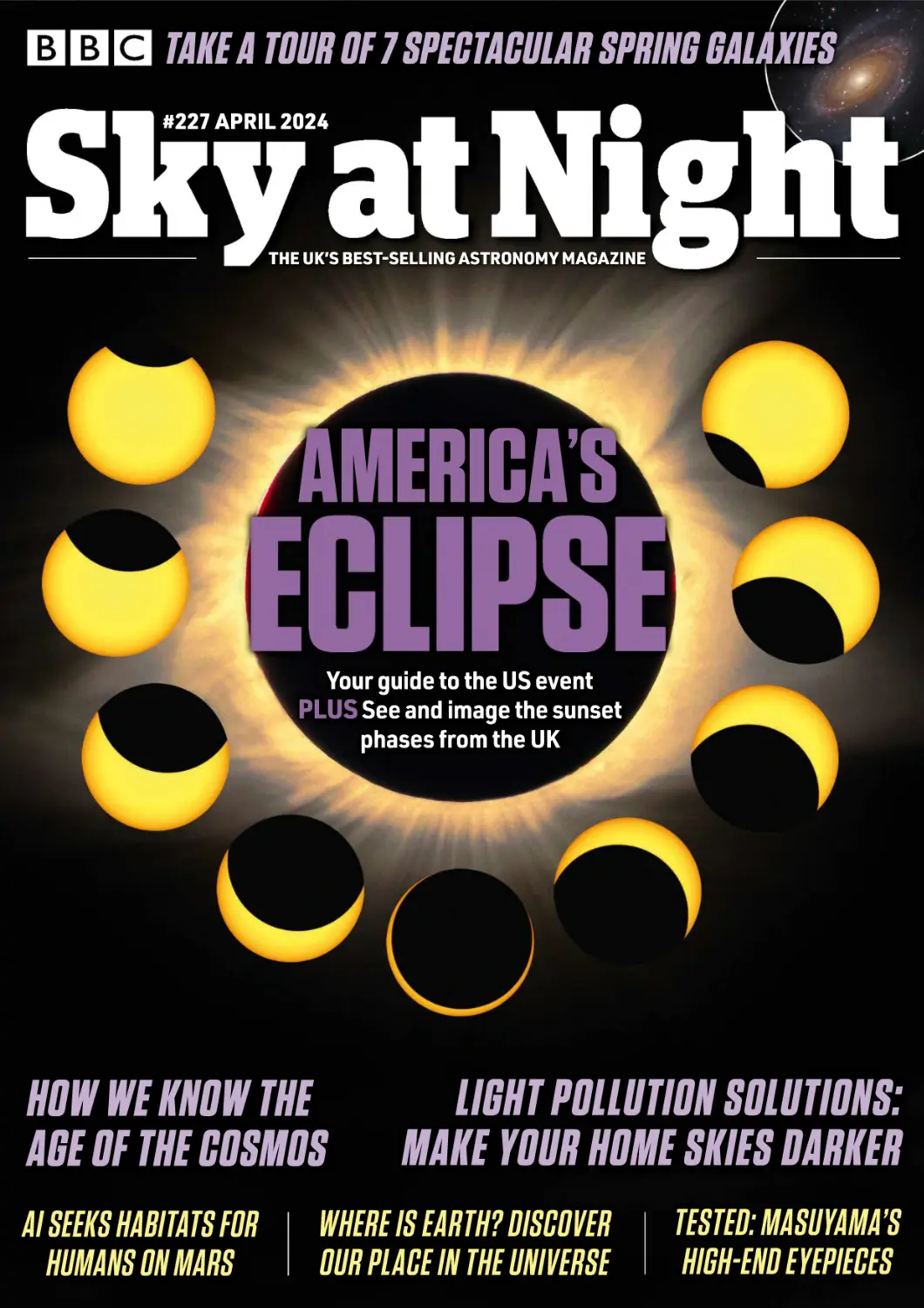
TAKE A TOUR OF 7 SPECTACULAR SPRING GALAXIES
#227 APRIL 2024
THE UK’S BEST-SELLING ASTRONOMY MAGAZINE
’
AMERICA S
Your guide to the US event
PLUS See and image the sunset
phases from the UK
HOW WE KNOW THE
AGE OF THE COSMOS
AI SEEKS HABITATS FOR
HUMANS ON MARS
LIGHT POLLUTION SOLUTIONS:
MAKE YOUR HOME SKIES DARKER
WHERE IS EARTH? DISCOVER
OUR PLACE IN THE UNIVERSE
TESTED: MASUYAMA’S
HIGH-END EYEPIECES
Feel in awe.
Every time you look up.
Don’t just visit Norway. Live it.
North Cape
71°N
BARENTS
SEA
Honningsvåg
Sail The Coastal Express during winter to discover 34 classic
ports, sleeping mountains, and islands under blankets of snow.
The sky becomes the backdrop for the Northern Lights to twist
and weave their magic through the sky. The inspiration of our
legends and of our Northern Lights Promise.
Kirkenes
Tromsø
Svolvær
Bodø
66°33
C
'N AR
TIC
CIRC
LE
12-DAY
CLASSIC ROUND VOYAGE
Departures: October 2024 – March 2025
Bergen – Kirkenes – Bergen
Includes our Northern Lights Promise*
Book Now
NORWEGIAN
SEA
Ålesund
Bergen
Trondheim
NORWAY
Scan the
QR code to
learn more
Call 0203 553 9879 | Visit Hurtigruten.co.uk | Contact your preferred travel agent
Live the legend of Norway.
Terms and conditions: Please see website for full details of sailings. *Northern Lights Promise - If the Northern Lights do not occur within sight of your ship during your 12-day or
11-day voyage, Hurtigruten will give you a free 6-day southbound or 7-day northbound voyage the following winter season. See www.hurtigruten.co.uk/coastal-offers/nlp for full T&Cs.
Image: © Shutterstock.
V7545
Welcome
HOW TO CONTACT US
Subscriptions, binders and back issues
03330 162119*
Mon–Fri 9am–5pm
Get ready for showtime as
a total eclipse sweeps the USA
On 8 April, a total eclipse will sweep a spectacular shadow across
Central and North America. The path of totality makes landfall
RQWKH3DFLƅFFRDVWRI0H[LFRLQ6LQDORDEHIRUHPRYLQJLQWRWKH
86LQ7H[DVFURVVLQJLQWRHDVWHUQ&DQDGDDQGOHDYLQJODQGIRUWKH
Atlantic Ocean from Newfoundland. In the US alone, an amazing
PLOOLRQSHRSOHOLYHLQVLGHWKHSDWKRIWRWDOLW\DQGVRPHHVWLPDWHV
put totality within 400 kilometres (250 miles) of more than half the
country’s entire population!
5HPDUNDEO\WKHƅQDOVWDJHVRIWKLVHFOLSVHZLOODOVREHYLVLEOH
IURPZHVWHUQSDUWVRIWKH8.ZLWKDSDUWLDOHFOLSVHYLVLEOHDWVXQVHW
7KLVLVRQHHYHQW\RXZLOOZDQWWRFDSWXUHIRUSRVWHULW\VRGRQŝW
miss experienced eclipse photographer Pete Lawrence’s guide to
taking great eclipse shots from the US on page 38 and from the
UK on page 76.
:KHQHFOLSVHIHYHUKDVVXEVLGHGWKHQLJKWVN\DWWKLVWLPHRI\HDU
holds a special treat for those in the Northern Hemisphere – it’s
JDOD[\VHDVRQ)URPWKLVKDOIRI(DUWKRXUYLHZRIVSDFHLQ
VSULQJWLPHLVQŝWREVFXUHGE\HYHU\WKLQJLQWKHFHQWUHRIWKH0LON\
:D\DQGZHŝUHJLYHQDVWXQQLQJYLVWDRXWRIWKH*DOD[\DFURVVYDVW
GLVWDQFHVWRWKHLVODQGXQLYHUVHVEH\RQG2Qpage 285RG0ROOLVH
WRXUVVHYHQJDODFWLFJHPVDURXQG&DQHV9HQDWLFLDQG8UVD0DMRU
<RXŝOOƅQGPRUHRQpage 56WRRZKHUHWKH6N\*XLGHWDNHVLQVL[
spectacular spirals in Coma Berenices and Boötes.
(QMR\WKHLVVXH
Chris Bramley, Editor
*Calls from landlines will cost up to 9p per minute. Call
charges from mobile phones will cost between 3p and
55p per minute but are included in free call packages.
If calling from overseas, please dial +44 (0)1604 973727
Editorial enquiries +44 (0)117 300 8754
9:30am–5:30pm, Mon–Fri
Advertising enquiries +44 (0)117 300 8803
subscription enquiries
Print
www.ourmediashop.com/contactus
Digital subscription enquiries
www.ourmediashop.com/contactus
Editorial enquiries
contactus@skyatnightmagazine.com
Subscription enquiries
UK enquiries: FREEPOST OURMEDIA
(please write in capitals)
Overseas enquiries: PO Box 3320,
3 Queensbridge, Northampton, NN4 7BF, UK
Editorial enquiries
Please write to the Editor, BBC Sky at Night
Magazine, Our Media, Eagle House,
Bristol, BS1 4ST
Become an Insider
7KHPRUHZHNQRZDERXWZKDW
\RXOLNHWKHEHWWHUSODFHGZHDUH
WREULQJ\RXWKHEHVWPDJD]LQHSRVVLEOH6RZHŝGOLNH
WRLQYLWH\RXWRMRLQRXUH[FOXVLYHRQOLQHFRPPXQLW\
7RJHWVWDUWHGYLVLWourinsiders.comWRƅOORXWWKH
VKRUWUHJLVWUDWLRQVXUYH\DQGZHŝOOEHLQWRXFKIURP
time to time to ask for your opinions on the magazine
DQGRWKHUUHOHYDQWLVVXHV
PS Our next issue goes on sale on Thursday 18 April.
Sky at Night – lots of ways to enjoy the night sky…
Television
Online
Social media Podcasts
Tablet/phone eNewsletter
Find out what The
Sky at Night team
have been exploring
in recent and past
episodes on page 18
Visit our website
for competitions,
astrophoto
galleries, observing
guides and more
Follow us on X
(formerly Twitter),
Facebook and
Instagram for the
latest astro news
Get each month’s
issue on your Apple
or Android device,
now with bonus
image galleries
Discover the best
things to see in the
night sky every week
by listening to our
Star Diary podcast
The best targets to
observe each week,
delivered to your
inbox. Visit bit.ly/
skynewsletter
Find out more at: www.skyatnightmagazine.com
April 2024 BBC Sky at Night Magazine 3
38
COVER IMAGE: BLEWULIS/ISTOCK/GETTY IMAGES, ALAMEEN R/ISTOCK/GETTY IMAGES. THIS PAGE: JOHN FINNEY
PHOTOGRAPHY/ISTOCK/GETTY IMAGES, ALVARO MEDINA JURADOI/ISTOCK/GETTY IMAGES, JOSÉ CHAMBO, STOCKTREK
IMAGES/ISTOCK/GETTY IMAGES, JOHANNES SCHEDLER/CCDGUIDE.COM, @THESHED_PHOTOSTUDIO, STUART GENNERY,
AARON FOSTER/ISTOCK/GETTY IMAGES, GRAEME LORIMER
CONTENTS
C = on the cover
Regulars
6 Eye on the sky
10 Bulletin
C One night, seven delectable
spring galaxies: join our observing 16 Cutting edge C
tour around Ursa Major
18 Inside The Sky at Night
20 Interactive
34 Light pollution solutions
23 What’s on
C Positive steps we can all take
at home to save our dark skies
25 Field of view
26 Subscribe to BBC Sky
60 Comet Pons–Brooks
at Night Magazine
We follow the unpredictable
38 Explainer EXTRA C
and brightening evening comet
74 Skills for stargazers
98 Q&A: an exoplanet
66 Where is Earth?
examiner
C Where the speck we call home
sits in the vastness of space
Astrophotography
76 Capture
68 How old is space?
78 Processing
C From stars to planets, how we
80 Gallery
date everything in the cosmos
Features
28 Into the Bear’s den
4 BBC Sky at Night Magazine April 2024
Reviews
86 Masuyama 1.25-inch 53°
eyepieces C
90 Altair Astro Hypercam 585C
colour camera
95 Gear
96 Books
16-PAGE
CENTRE
The Sky Guide
PULLOUT
44 Highlights
46 The big three
48 The planets
50 April’s all-sky chart
52 Moonwatch
53 Comets and asteroids
53 Star of the month
54 Binocular tour
55 The Sky Guide challenge
56 Deep-sky tour
58 April at a glance
New to astronomy?
To get started, check out our guides and glossary at
www.skyatnightmagazine.com/astronomy-for-beginners
28
FREE BONUS
CONTENT
Find it at www.skyatnightmagazine.
com/bonus-content
APRIL
HIGHLIGHTS
Video: Why do people believe in UFOs?
Psychologist Chris French on belief in the paranormal
and why people think they’ve seen alien spacecraft.
34
60
68
86
This month’s contributors
Download and print
observing forms
More amazing images
of the Universe
Keep track of your
observations of the Sun
and the planets through
the eyepiece with our
printable forms.
View our galleries of the
latest images captured
by astrophotographers
and professional
observatories alike.
Rod Mollise
Dani Robertson
Pete Lawrence
Amateur astronomer
Dark skies expert
Astrophotographer
The Virtual Planetarium
“For amateur
astronomers,
springtime is
galaxy time,
the season when you
and your telescope
can wander countless
lovely island universes.
But you have to know
how to see them.”
Rod explains the ‘how’
on page 28
“Light
pollution
impacts
more than
you think, from seeing
stars to human health
and wildlife – but each
of us can be the
solution to light
pollution.” Follow Dani’s
advice to reclaim your
dark skies on page 34
“A total
eclipse of
the Sun is a
breathtaking
spectacle and one of
the most moving
astronomical events
that can be witnessed
and photographed
from Earth.” Don’t miss
Pete’s top eclipse tips
on page 38
Pete Lawrence and Paul Abel guide us through
the best sights to see in the night sky this month.
April 2024 BBC Sky at Night Magazine 5
6 BBC Sky at Night Magazine April 2024
EYE ON THE SKY
These two interacting galaxies are awash
with bright young stars
he two blue beauties seen in this picture are
NGC 5410 and UGC 8932, a pair of interacting
galaxies that can be found some 180 million
lightyears from Earth in the constellation of
Canes Venatici.
NGC 5410, the larger of the two, is a barred spiral galaxy that
ZDVƅUVWREVHUYHGE\:LOOLDP+HUVFKHOLQ,WPHDVXUHV
lightyears across and, like its smaller companion, has a distinctly
blue colour. That’s because both galaxies are rich in young, hot
stars. Blue stars are hotter than red stars such as our own Sun,
DQGEHFDXVHWKH\HPLWPRUHHQHUJ\WHQGWREHVKRUWHUOLYHG
7KHXQXVXDOVKDSHRI8*&
LVEHOLHYHGWREHGXHWR
WKHJUDYLWDWLRQDOSXOORILWVODUJHUFRPSDQLRQ
FREE BONUS CONTENT
Explore a gallery of these and more
stunning space images
www.skyatnightmagazine.com/bonus-content
April 2024 BBC Sky at Night Magazine 7
NASA/ESA/D. BOWEN/PROCESSING: GLADYS KOBER
HUBBLE SPACE TELESCOPE, 26 JANUARY 2024
INTERNATIONAL GEMINI OBSERVATORY/NOIRLAB/NSF/AURA/IMAGE PROCESSING: J. MILLER (INTERNATIONAL GEMINI OBSERVATORY/NSF’S NOIRLAB)/M. RODRIGUEZ
(INTERNATIONAL GEMINI OBSERVATORY/NSF’S NOIRLAB)/M. ZAMANI (NSF’S NOIRLAB), XRAY: NASA/CXC/MIT/M/CALZADILLA EL AL./OPTICAL: NASA/ESA/STSCI/IMAGE
PROCESSING: NASA/CXC/SAO/N. WOLK & J. MAJOR, XRAY: NASA/CXC/SAO/OPTICAL: NASA/ESA/STSCI/IR: NASA/ESA/CSA/STSCI/MILISAVLJEVIC ET AL/NASA/JPL/CALTECH/
IMAGE PROCESSING: NASA/CXC/SAO/J. SCHMIDT AND K. ARCAND, NASA/ESA/G. PIOTTO AND A. SARAJEDINI/ PROCESSING: GLADYS KOBER
SPT-CLJO310-4647
SPT-CLJ0615-5746
U Life in the dust lane
GEMINI SOUTH TELESCOPE,
25 JANUARY 2024
This image of NGC 4753, a lenticular galaxy
60 million lightyears away in the Virgo
constellation, reveals the twisting dust
lanes that are the most distinctive feature
of its structure. These are believed to have
originated from a collision with a companion
dwarf galaxy around 1.3 billion years ago.
SPT-CLJ0106-5943
SPT-CLJ0307-6225
Y Starbirth through
the ages
CHANDRA X-RAY OBSERVATORY,
11 JANUARY 2024
These four pictures of distant galaxy
clusters are taken from a large-scale survey
conducted using the Chandra X-Ray
Observatory and no fewer than seven radio
and optical telescopes. By studying such
clusters, astronomers hoped to learn more
about how the conditions required for star
formation have changed as the Universe
evolved; instead they discovered that the
necessary conditions were much the same
10 billion years ago as they are now.
8 BBC Sky at Night Magazine April 2024
U Blast from the past
CHANDRA X-RAY OBSERVATORY,
JAMES WEBB SPACE TELESCOPE,
HUBBLE SPACE TELESCOPE, SPITZER
SPACE TELESCOPE, 8 JANUARY 2024
This image of Cassiopeia A, created by
combining X-ray, optical and infrared data,
has shed new light on the explosion that
formed it. Scientists now believe the
so-called ‘Green Monster’ at its heart is a
result of the interaction between the initial
blast wave and surrounding material.
Y A jewel box in the sky
HUBBLE SPACE TELESCOPE,
14 FEBRUARY 2024
This densely star-packed region is NGC
2298, a globular cluster 35,000 lightyears
from Earth on the outskirts of the Milky
Way, in the constellation of Puppis. Some
astronomers believe NGC 2298 may have
been captured by the Milky Way from the
Canis Major dwarf galaxy – though others
doubt that such a galaxy exists at all.
April 2024 BBC Sky at Night Magazine 9
The latest astronomy and space news, written by Ezzy Pearson
BULLETIN
Comment
by Chris Lintott
Youthful JWST 7329 is
far more massive and
mature than current
models say is possible
‘Impossible’ galaxy found in early Universe
JAMES WEBB SPACE TELESCOPE, REINHOLD WITTICH/ALAMY STOCK PHOTO, ESO/M. KORNMESSER,
NASA’S GODDARD SPACE FLIGHT CENTER
It has more stars than such a young galaxy should be able to grow
A galaxy that shouldn’t exist is challenging
astronomers’ understanding of how these enormous
stellar structures grow in the early Universe.
Despite its relative youth, recent observations of
galaxy JWST 7329 have shown it has far more stars
WKDQLWVKRXOGKDYHKDGWLPHWRJURZ,WZDVƅUVW
spotted in 2010 in an infrared sky survey and
immediately struck astronomers as being something
special. Ground-based follow-up observations proved
inadequate, however, and astronomers had to wait
until the James Webb Space Telescope (JWST) came
online to take a spectrum of it.
The galaxy is so far away that we are seeing it as
it was 11.5 billion years ago, just two billion years after
the Big Bang. Even at this tender age, the galaxy
already has a stellar population that’s around 1.5
billion years old and has four times as many stars by
mass as the Milky Way does today. On top of this,
the galaxy appears to have been quenched
– meaning it has lost its cold gas, supressing star
formation – for at least a billion years.
6HYHUDOVLPLODUVWDUƅOOHG\RXQJVWHUVKDYHEHHQ
discovered in recent years, though JWST 7329 is the
10 BBC Sky at Night Magazine April 2024
most extreme example uncovered so far. Their
existence is causing issues for cosmologists, as
galaxies are thought to grow from structures
known as dark matter haloes. According to current
theories, these structures shouldn’t have had
enough time to grow to the size needed to create
such massive galaxies so early in the Universe.
“Having these extremely massive galaxies so
HDUO\LQWKH8QLYHUVHLVSRVLQJVLJQLƅFDQW
challenges to our standard model of cosmology,”
says Claudia Lagos from the University of Western
Australia, who helped with the study. “More
observations are needed to understand how
common these galaxies may be and to help us
understand how truly massive these galaxies are.”
ş-:67KDVEHHQƅQGLQJLQFUHDVLQJHYLGHQFHIRU
massive galaxies forming early in time,” says Karl
Glazebrook from Swinburne University, who led the
study. “This result sets a new record for this
phenomenon. Although it is very striking, it is only
RQHREMHFW%XWZHKRSHWRƅQGPRUH
DQGLIZHGR
this will really upset our ideas of galaxy formation.”
www.swinburne.edu.au
When it was
revealed in 1997, the
Hubble Deep Field
instantly became
an iconic image,
transforming an
apparently empty
patch of sky to one
alive with galaxies.
Yet it nearly didn’t
happen. Having
assumed that early
galaxies would look
and behave like
those in the present
day, astronomers
predicted it would
be a waste of time.
Now, discoveries
like this one are
teaching us the
same lesson again.
The very early
Universe is different
from what we
expected. Maybe
there’s something
fundamentally
wrong with our
cosmology. Maybe
these galaxies are
living their lives in
an unexpected way.
Perhaps they’re
forming different
kinds of stars. We’ll
ƅQGRXWPRUHVRRQ
Doesn’t everyone
love to be surprised?
Chris Lintott
co-presents
The Sky at Night
NEWS IN
ILLUSTRATION
BRIEF
Thereby hangs a tail:
researchers want to study
the solar wind from pictures
of S3 PanSTARRS’s tail
Comet investigation calls for your help
Astronomers need your comet images to study the solar wind
This spring, comet C/2021 S3 PanSTARRS
has been passing by Earth, and now space
scientists need your images of it.
“We need lots of timed photos of the comet
to build up a picture of its journey through our
Solar System,” says Sarah Watson, a PhD
researcher from the University of Reading
who is leading the project.
Watson’s team will use the images to study
the behaviour of the comet’s tail throughout its
journey. The tail is created by the Sun’s heat
melting the ice that the comet is made of,
which is then swept away from the Sun by
the solar wind. As such, comet tails act as
cosmic windsocks, showing the direction and
strength of the solar wind in the region around
the comet.
“This is a fantastic opportunity for amateur
astronomers to get out their telescopes,
capture a truly spectacular cosmic moment
and make a big contribution to some important
science,” says Watson.
You can submit your images to the study by
emailing them to s.r.watson@pgr.reading.
ac.uk, along with the time and location they
were taken. www.reading.ac.uk
Black hole is brightest object ever seen
Lake Jezero confirmed
The record-breaker
glows 500 trillion
times brighter
than the Sun
worth of material every day,
making it the fastest-growing
black hole found to date. It is
so far away that its light has
taken 12 billion years to reach
us. This cosmic feast causes
its accretion disc to glow 500
trillion times brighter than
the Sun.
Radar measurements
gathered by NASA’s Mars
Perseverance rover during its
journey across Jezero crater
KDYHFRQƅUPHGWKHUHJLRQ
really was once the site of a
lake. The RIMFAX instrument
probed 20 metres below the
surface to reveal layers of
sediment deposits laid down
ZKHQWKHFUDWHUZDVƅOOHG
ZLWKZDWHUƅQDOO\SURYLQJ
the region’s wet past.
Slow stars live on edge
ILLUSTRATION
A hugely bright object
known as a quasar has now
EHHQFRQƅUPHGDVQRWMXVW
the brightest known example
of its kind, but also the most
luminous object ever observed.
A quasar forms when the
accretion disc of gas and dust
around a supermassive black
hole at the heart of a galaxy
becomes so hot it begins to
glow brightly. To us here on
Earth, the result closely
resembles a star. This
particular quasar, J0529-4351,
was actually spotted in
images as far back as 1980,
EXWLWZDVPLVLGHQWLƅHGIRU
decades. It was only when
astronomers re-examined it
with observatories such as the
Very Large Telescope that
they realised how luminous it
truly was.
The record-breaking galaxy
weighs in at 17 billion solar
masses. It devours a Sun’s
TESS finds cool worlds
A batch of 85 possible
exoplanets have been found
that are all within their stars’
habitable zone, where liquid
water could potentially
persist. A new analysis
technique on data taken by
NASA’s Transiting Exoplanet
Survey Satellite (TESS) helped
DVWURQRPHUVƅQGSODQHWVLQ
more distant, cooler orbits,
with orbital periods as long
as 20 to 700 days.
“All this light comes from
a hot accretion disc that
measures seven lightyears in
diameter – this must be the
largest accretion disc in the
Universe,” says Samuel Lai,
from the Australia National
University, who took part in
the study. www.eso.org
Stars on the outer edge of
the Milky Way may be
travelling slowly compared
to those closer to the
galactic centre, according to
a study using data taken by
(6$ŝV*DLDVDWHOOLWH7KHƅQG
could mean our Galaxy’s
gravitational core contains
less dark matter than
previously thought.
April 2024 BBC Sky at Night Magazine 11
BULLETIN
Odysseus, seen
here in orbit, tipped
over shortly after as
its leg broke upon
landing (inset)
Odysseus makes historic landing on the Moon
© 2024 INTUITIVE MACHINES/LLC X 2, NASA/ESA/CSA/STSCI/JANICE
LEE (STSCI) THOMAS WILLIAMS (OXFORD) PHANGS TEAM
The spacecraft came down on its side, but is still operating well
,QWKHƅUVWUS venture to the lunar
surface since the Apollo 17 landing in
1972, the Odysseus lunar lander touched
down on the Moon at 23:23 UTC on 22
February. The lander appears to have
tipped over during the landing, but is
operating well regardless.
Odysseus was built and is operated by
86SULYDWHVSDFHƆLJKWFRPSDQ\,QWXLWLYH
0DFKLQHVDVSDUWRIWKH,0OXQDU
PLVVLRQPDNLQJWKLVWKHƅUVWHYHUVRIW
landing on the Moon by a private
VSDFHFUDIW7KHPLVVLRQODXQFKHGIURP
the Kennedy Space Center at 06:05 UTC
on 15 February, on board a SpaceX Falcon
URFNHWZLWKDWDUJHWODQGLQJVLWHRI
FUDWHU0DODSHUW$ORFDWHGDURXQGNP
IURPWKHOXQDUVRXWKSROH
Unfortunately, the landing was far
IURPVWUDLJKWIRUZDUG3UREOHPVZLWKWKH
SULPDU\QDYLJDWLRQHTXLSPHQWIRUFHG
Odysseus to switch to using a NASA
12 BBC Sky at Night Magazine April 2024
/LGDUH[SHULPHQWWKDWZDVLQLWLDOO\MXVW
LQWHQGHGDVDWHFKQRORJ\GHPRQVWUDWLRQ
Then, after the craft touched down,
PLVVLRQFRQWUROFRQGXFWHGVHYHUDOKRXUV
of troubleshooting before successfully
HVWDEOLVKLQJFRPPXQLFDWLRQVXVLQJWKH
EDFNXSPXFKVORZHUORZJDLQDQWHQQD
ş,NQRZWKLVZDVDQDLOELWHUEXWZHDUH
RQWKHVXUIDFHDQGWUDQVPLWWLQJŠVDLG
6WHSKHQ$OWHPXVSUHVLGHQWRI,QWXLWLYH
0DFKLQHVş:HOFRPHWRWKH0RRQŠ
$IHZGD\VODWHU,QWXLWLYH0DFKLQHV
announced the spacecraft had tipped on
LWVVLGHGXHWRDEURNHQOHJVWUXW
Fortunately, the solar panels were still
able to charge the lander for several days
DQGWKHRQO\SD\ORDGRQWKHJURXQG
IDFLQJVLGHLVDQDUWSURMHFWVR2G\VVHXV
FRXOGVWLOOFRQGXFWLWVVFLHQWLƅFREMHFWLYHV
ş:HKDYHTXLWHDELWRIRSHUDWLRQDO
capability even though we’re tipped over.
And so that’s really exciting for us, and we
are continuing the surface operations
PLVVLRQDVDUHVXOWRILWŠVDLG$OWHPXV
7KHPLVVLRQLVSDUWRI1$6$ŝV
&RPPHUFLDO/XQDU3D\ORDG6HUYLFH
&/36 SURJUDPPHZKLFKFRPPLVVLRQV
SULYDWHFRPSDQLHVWRWUDQVSRUWKDUGZDUH
to the surface of the Moon to support its
XSFRPLQJ$UWHPLVKXPDQOXQDUPLVVLRQV
7KHVHPLVVLRQVZLOODOVREHKHDGLQJWR
the Moon’s south pole, where signs of
water have been detected. February’s
Odysseus landing carried six NASA
H[SHULPHQWVLQFOXGLQJDUDGLR
REVHUYDWRU\WRPHDVXUHKRZVSDFH
weather interacts with Moon dust.
7KHVXFFHVVFRPHVDVDUHOLHIIRUOXQDU
explorers, after two previous spacecraft
Ś-DSDQŝV6/,0DQGIHOORZ&/36PLVVLRQ
3HUHJULQHIURP$VWURERWLFŚERWKIDLOHG
WKHLURZQODQGLQJDWWHPSWVMXVWDPRQWK
earlier in January.
www.intuitivemachines.com
The photos offer the
sharpest-ever view of
galaxies at near- and midinfrared wavelengths
Stunning spirals
JWST releases incredibly high-resolution images of galaxies in infrared
A stunning batch of images featuring
19 spiral galaxies, taken by the James
Webb Space Telescope (JWST), has just
been released to the public. The images
are at unprecedentedly high resolution,
allowing astronomers to investigate how
the small-scale structure of galaxies
LQƆXHQFHVWKHLUODUJHVFDOHGHYHORSPHQW
The blue regions show the location of
millions of sparkling stars, while the red
regions show warmly glowing gas.
They were processed as part of the
Physics at High Angular Resolution in
Nearby Galaxies (PHANGS) programme,
which uses the world’s best observatories
to image nearby galaxies across a range
of wavelengths.
“This programme has a huge volume
of data, and JWST is an extremely
complex observatory,” says Thomas
Williams from the University of Oxford
and part of the PHANGS team. “It means
ZHPD\EHDEOHWRƅOOLQPRUHRIWKHJDSV
in our knowledge about the structure and
evolution of galaxies, star formation, the
life cycle of stars and so much more.”
www.ox.ac.uk
April 2024 BBC Sky at Night Magazine 13
NEWS IN
BRIEF
ILLUSTRATION
BULLETIN
Mars helicopter makes final flight
Ingenuity mission lasted more than 30 times longer than planned
Communication
was lost at the end
RIƆLJKWRQ
18 January
Perseverance’s
SuperCam revealed
the craft’s missing
and damaged
rotor blades
Green light for LISA
ESAC.CARREAU, NASA/JPLCALTECH/ASU/MSSS, NASA/JPLCALTECH/LANL/CNES/
IRAP/SIMEON SCHMAUSS, NASA/CXC/M. WEISS
Young Sun seen flaring
7KH6XEPLOOLPHWHU$UUD\LQ
+DZDLLKDVREVHUYHGDƆDUH
IURPD\RXQJ6XQOLNHVWDU
WKDWEULJKWHQHGE\RYHU
times within just a few
KRXUV+'LV
times the mass of the Sun
DQGRQO\WKUHHPLOOLRQ\HDUV
old, offering a window into
WKHLQIDQF\RISODQHWDU\
V\VWHPVOLNHRXURZQ
Moonquakes shake
south pole
0RRQTXDNHVFRXOGVKDNH
the potential landing sites
for NASA’s Artemis III human
landing mission. New
DQDO\VLVRILPDJHVIURPWKH
Lunar Reconnaissance
Orbiter (LRO) found faults
throughout the lunar south
SROHFUHDWHGE\FRROLQJDQG
VKULQNLQJ7KHIDXOWVFRXOG
DIIHFWORQJWHUPVWUXFWXUHV
built in the region.
After almost 1,0000DUWLDQGD\VDQGƆLJKWV
1$6$ŝV,QJHQXLW\KHOLFRSWHUKDVRIƅFLDOO\
reached the end of its mission.
,QJHQXLW\ŝVƅQDOH[SHGLWLRQRQ-DQXDU\ZDV
PHDQWWREHDVKRUWƆLJKWWRUHHVWDEOLVKLWV
SRVLWLRQDIWHUDSUHYLRXVHPHUJHQF\ODQGLQJ
However, it rose just one metre before
communications failed. Ground control then
discovered the rotor blades were damaged,
SHUPDQHQWO\JURXQGLQJWKHFUDIW
,QJHQXLW\WUDYHOOHGWR0DUVZLWKWKH
3HUVHYHUDQFHURYHUDQGƅUVWƆHZRQ
$SULO
7KHFUDIWZDVGHVLJQHGIRUMXVWƅYHƆLJKWV
WRWHVWWKHIHDVLELOLW\RIXVLQJURWRFUDIWLQWKH
thin Martian atmosphere. These were so
successful that the mission was extended for
DQRWKHUWKUHH\HDUVGXULQJZKLFKWLPHLW
survived dust storms and the Martian winter.
ş+LVWRU\ŝVƅUVW0DUVKHOLFRSWHUZLOOOHDYH
EHKLQGDQLQGHOLEOHPDUNRQWKHIXWXUHRIVSDFH
H[SORUDWLRQDQGZLOOLQVSLUHƆHHWVRIDLUFUDIWRQ
Mars – and other worlds – for decades to come,”
VD\V7HGG\7]DQHWRV,QJHQXLW\ŝVSURMHFW
PDQDJHUIURP-3/mars.nasa.gov
Milky Way has a rapidly spinning black hole
The black hole DWWKHFHQWUHRIRXU0LON\:D\
Sagittarius A* (Sgr A*) is spinning so fast that it’s
pulling spacetime around it into the shape of a
UXJE\EDOODQHZVWXG\KDVIRXQG
%ODFNKROHVDUHJRYHUQHGE\WZR
fundamental properties: mass and spin. Using
UDGLRDQG;UD\REVHUYDWLRQVRIWKHUHJLRQ
around Sgr A*, astronomers have found that
WKHEODFNKROHDSSHDUVWREHVSLQQLQJDW
per cent the maximum possible value. The
rapid spin pulls on the surrounding spacetime,
PHDQLQJLWZRXOGUHVHPEOHDUXJE\EDOOYLHZHG
from the side.
,IWKHUHLVJDVVXUURXQGLQJDEODFNKROHD
UDSLGVSLQFDQƅUHWKLVPDWHULDORXWLQDSRZHUIXO
MHW7KHODFNRIJDVVXUURXQGLQJ6JU$ PHDQV
WKDWLWLVFXUUHQWO\TXLHWWKRXJKDQLQƆX[RI
material could change that.
ş:HKDYHDVSHFLDOYLHZRI6JU$ EHFDXVH
LWLVWKHQHDUHVWVXSHUPDVVLYHEODFNKROHWR
XVŠVD\V$QDQ/XIURP0F*LOO8QLYHUVLW\LQ
0RQWUHDOZKRWRRNSDUWLQWKHVWXG\
14 BBC Sky at Night Magazine April 2024
ILLUSTRATION
ESA’s Laser Interferometer
Space Antenna (LISA)
mission has passed a
thorough review to ensure
the project is viable, allowing
it to move forward into full
development. The mission
will hunt gravitational waves
XVLQJWKUHHVSDFHFUDIWƆ\LQJ
in formation, and will be
ESAs most expensive and
complex mission to date.
Our black hole’s spin
is warping spacetime into
a rugby ball shape
ş$OWKRXJKLWŝVTXLHWULJKWQRZRXUZRUNVKRZV
WKDWLQWKHIXWXUHLWZLOOJLYHDQLQFUHGLEO\
SRZHUIXONLFNWRVXUURXQGLQJPDWWHU7KDWPLJKW
KDSSHQLQDWKRXVDQGRUDPLOOLRQ\HDUVRULW
could happen in our lifetimes.”
chandra.si.edu
Our experts examine the hottest new research
CUTTING EDGE
CaveFinder was trained
to spot cave entrances in
Mars orbiter images
spotting them in satellite imagery relatively easy.
7UDGLWLRQDOO\WKRXJKLGHQWLI\LQJ3&(VRQ0DUV
– and indeed any other surface feature – has been
very slow and laborious, with researchers having to
eyeball thousands of images. Thomas Watson and
James Baldini, both in the Department of Earth
Sciences at Durham University, have been working
on automating this process using machine learning.
Tunnel vision
They developed a computer system known as an
DUWLƅFLDOQHXWUDOQHWZRUNVLPXODWLQJDVWUXFWXUH
loosely based on mammalian brains. They then
trained this system to recognise lava tube openings
E\VKRZLQJLWORWVRIH[DPSOHVRIDOUHDG\LGHQWLƅHG
PCEs, and then used it to process other images of
the martian surface. They focused on regions that
have had lots of volcanic activity in the past,
including along the line of three giant volcanoes in
the Tharsis bulge that straddles the equator.
CaveFinder, as they dubbed the system, detected
61 previously unknown PCEs – adding to the existing
catalogue of over 1,000. The largest of these new
3&(VŚLQIRUPDOO\QDPHG0DUYLQE\WKH
researchers – is over 700 metres in
diameter, making it a nice big
“CaveFinder
target to aim for with a
Machine learning is uncovering the
detected
61
robotic lander mission.
entrances to underground caves on Mars
Another, Emily, is located
previously unknown
lanetary scientists get particularly
within the Elysium volcanic
potential cave
H[FLWHGDERXWƅQGLQJFDYHVRQ0DUV
province in the northern
entrances…
Such subterranean structures offer very
hemisphere at a low
the largest is over
promising locations for establishing
altitude. This is particularly
human habitats – their rock ceilings
VLJQLƅFDQWEHFDXVHWKH
700 metres in
would provide protection from dust storms and
thicker atmosphere makes for
diameter”
micrometeoroid impacts, as well as shielding from
much easier mission landings by
cosmic radiation. They also represent enticing targets
parachute, or exploring the lava
for searching for signs of simple martian life, as caves
tubes by robotic drones.
on Earth often sustain abundant microbial growth.
The authors do stress that their automated search
/DYDWXEHVDUHRQHSURPLVLQJVRXUFHRI0DUWLDQ
method is still far from perfect. After human
caves. These tubes form when a stream of volcanic
inspection of the images, many of the locations
lava develops a hardened crust on top, but continues
WKDW&DYH)LQGHULGHQWLƅHGZHUHLQIDFWIRXQGQRW
WRƆRZZLWKLQWKHQHPSWLHVWROHDYHEHKLQGDKROORZ
to contain a potential cave entrance, and the system
tunnel beneath the surface. On Earth, they range
also missed known cave openings. Nonetheless, this
Prof Lewis Dartnell
from just a few metres long to the enormous
represents a promising approach in the use of
is an astrobiologist
at the University
65km-long Kazumura Cave in Hawaii, and they can
machine learning for sifting through vast datasets
of Westminster
be up to 30 metres in diameter.
of imagery to spot new sites of interest.
7KHPDLQZD\WKDWODYDWXEHVDUHLGHQWLƅHGDQG
which also provides access down into them, is when a
Lewis Dartnell was reading… Martian Cave Detection via Machine
portion of the ceiling collapses to create a skylight.
Learning Coupled with Visible Light Imagery by Thomas H Watson and
'XHWRWKHZHDNHUJUDYLW\RQ0DUVWKHVHSRWHQWLDO
James U L Baldini Read it online at: www.sciencedirect.com/science/
FDYHHQWUDQFHV 3&(V FDQEHVLJQLƅFDQWO\ODUJHUWKDQ
article/pii/S0019103524000101
on Earth, and the lack of covering vegetation makes
Tracking down potential
havens for Martian life
NASA/JPLCALTECH/ASU/USGS, CALTECH/IPAC/R. HURT
P
16 BBC Sky at Night Magazine April 2024
CUTTING EDGE
This means these two stars have an exciting future
ahead. As they orbit each other, the fact that they’re
moving fast means they make space ripple, emitting
gravitational waves. The resulting loss of energy will
make them spiral together, colliding in something like
three million years’ time, producing what seems likely
to be an explosion known as a Type Ia supernova.
Prof Chris Lintott
Type Ias are critical in modern cosmology, as those
is an astrophysicist
seen in distant galaxies allow us to measure the rate
and co-presenter
of expansion of the Universe. The chance to study
on The Sky at Night
the progenitor of such a key tool in our journey to
understanding our Universe will be invaluable.
We might soon see systems like J0526+5934 more
“This double
directly. ESA recently approved the construction
of the LISA gravitational wave observatory.
is actually a pair
:KLOHH[LVWLQJH[SHULPHQWVOLNH/,*2ƅQG
of the dense stellar
ripples from massive objects like colliding
remnants in orbit
EODFNKROHV/,6$ŝVWKUHHVSDFHFUDIWƆ\LQJLQ
around each other…
formation, will detect gravitational waves
only the fifth pair
from systems just like this. We’ll be hearing
much more about double white dwarfs in the
known in such
next few decades.
Peculiar dwarf duo
offers expansion clue
An unusual binary could be the
‘before’ shot of a supernova
R
egular readers of this column will
be in no doubt that I love a weird
object. Unusual versions of common
astronomical objects are even
better, presenting both a
puzzle and a chance to learn more about
astrophysics. In the strange binary star
discussed in this month’s paper, that’s
exactly what we’re dealing with.
J0526+5934 is a binary star, with two
objects that orbit each other in just over 20
minutes, a period that means they must be very
FORVHWRHDFKRWKHULQGHHG,WZDVƅUVWVSRWWHGLQ
data from ESA’s Gaia satellite, whose mapping of the
Galaxy is now producing oodles of interesting objects.
But what is it? Based on its colour and brightness,
its discoverers thought the system must have a
primary which is a sub-dwarf star, a little hotter and
more massive than the Sun, orbited by a white dwarf.
The authors of this paper, though, beg to differ,
drawing on new observations with the massive
Grand Telescopio Canarias (GTC) in the Canaries,
along with robotic telescopes elsewhere in Spain and
Thailand which they used to monitor the brightness
of the system over time.
a tight orbit”
The rare ultra-fast-orbiting pair
could have an explosive future
as a Type Ia supernova
Surprisingly small star
The new data allowed the team to measure how fast
the objects are moving as they swing round each
other. Considering these measurements, plus a new
spectrum of the object and the results of long-term
monitoring, they can make the crucial determination
of the mass of the brighter of the two stars – and it is
not as massive as the discoverers thought.
In fact, at less than a third of the mass of the Sun,
it’s not nearly massive enough to be a sub-dwarf.
Such stars don’t come in lightweight versions.
Instead, the authors suggest it must be an extremely
low-mass white dwarf. The second star is clearly a
white dwarf, so this double is actually a pair of the
dense stellar remnants in orbit around each other.
Such systems are not entirely unknown, but this is
RQO\WKHƅIWKSDLUNQRZQLQVXFKDWLJKWRUELW
Chris Lintott was reading… J0526+5934: A Peculiar Ultra-short Period
Double White Dwarf by Alberto Rebassa-Mansergas et al.
Read it online at: arxiv.org/abs/2402.04443
April 2024 BBC Sky at Night Magazine 17
The Sky at Night TV show, past, present and future
INSIDE THE SKY AT NIGHT
Textile engineer Kate
Winning works on one of
Oxford Space Systems’
new folding antennas
OXFORD SPACE CENTRE, ESA/DAVE HARDY, KEEGAN BARBER/NASA
In 2021, Sean Sutcliffe from Oxford Space
Systems spoke to The Sky at Night about
the UK spaceflight industry. Three years later,
he looks at how far the technology, and the
space sector, has come since then
B
ack in June 2021, our space equipment
company Oxford Space Systems was
honoured to feature in the ‘Space Boom
Britain’ episode of The Sky at Night and
then in BBC Sky at Night Magazine.
We had a tremendous reaction from viewers and
readers who were fascinated to learn about our
business of designing and manufacturing deployable
DQWHQQDVIRUVSDFH7KHVHFDQƅWLQWRDVVPDOOD
space as a 10cm cube for launch, then unfurl into
full-sized antennas. They allow satellite mission
designers to obtain better performance across radio
frequencies, while keeping down the mass and
18 BBC Sky at Night Magazine April 2024
volume at launch. So how have
things progressed in the last
three years?
First of all, we’ve seen success
with our antennas, which we’ve
now shipped and deployed.
These are now helping connect
everything from trucks to cows!
In 2021, we were also
developing our wrapped rib
antenna, which unfurls from a
750mm diameter out to three
metres or more across. This
work has continued with a
battery of tests to ensure it will
survive launch and work in the
harsh environment of space.
The work has included vibration
testing – up to 16G – to
simulate launch conditions,
as well as deployment testing
in a vacuum across a wide
temperature range. We test at
both a specialist indoor test
range in Germany and using a
novel drone setup, measuring
performance from 500 metres
XS:HŝUHQRZEXLOGLQJWKHƆLJKW
version, with a launch booked
towards the end of the year.
Off-Earth power stations
Alongside our main deployable antenna activities,
we have also undertaken preliminary work to look at
the feasibility of space-based solar power stations to
provide energy here on Earth. The structures required
would be huge, around two kilometres across and
weighing around 2,000 tonnes, while delivering two
gigawatts of power back to Earth via a non-harmful
microwave link. While this may seem in the realms of
VFLHQFHƅFWLRQWKHUHGXFWLRQLQODXQFKFRVWVDQG
advancements in technologies now make solar power
stations in space a potentially cost-effective, reliable,
low-carbon solution for the medium term. There are a
lot of questions and uncertainties, but now is the time
to begin answering them.
Some of the things we saw driving rapid growth in
the space sector three years ago remain the same. In
particular, the reduction in launch costs and the
technology advances are allowing more to be done
from space cost-effectively. A couple of things have
happened which are going to have quite an impact
INSIDE THE SKY AT NIGHT
on the future direction of the space sector too. First,
the war in Ukraine has shown both the strength
and vulnerability of space-based systems. In a
world of increased geopolitical turbulence, there is
going to be increased scrutiny on what capabilities
nations have. Second, the astonishingly fast growth
of AI tools is ensuring the vast quantities of data
provided can be usefully interpreted, whether from
LQWKHƅHOGFRPPXQLFDWLRQVRU(DUWKREVHUYDWLRQ
How it’s used to further humanity is another matter,
which relies on increasing global cooperation.
However, one of the things that always captures
people’s imagination are the stories of the people
Sean Sutcliffe is
the chief executive
of Oxford Space
Systems and chair
of the charity
Launchpad
making our exploits in space happen. In the 2021 Sky
at Night episode, I spoke about a knitting specialist
who was knitting satellite mesh. One of our latest
recruits is Kate Winning. Her degree was in textile
design at Central St Martins, where she developed an
interest in technical textiles that then evolved into a
passion for engineering materials. She now works on
creating our gold knitted-metal mesh, which creates
a foldable surface for our antennas. In the picture to
the left she’s working on a hinged rib design that will
provide high-speed, real-time connectivity from low
(DUWKRUELWVDWHOOLWHV:HŝUHORRNLQJWRPDNHRXUƅUVW
ƆLJKWZLWKWKLVDQWHQQDLQVRZDWFKWKLVVSDFH
Looking back:
The Sky at Night
APRIL
7 April 2008
The Sky at Night returns
ILLUSTRATION
On the 7 April 2008
Jupiter in 1992,
episode of The Sky
which propelled
at Night, Patrick
Ulysses into an orbit
Moore took a look
LQFOLQHGDW
Ō
at the European
The probe made
Space Agency’s
LWVƅUVWƆ\E\RIWKH
Ulysses mission,
southern solar pole
which had spent
in 1994, before
almost two decades
swinging around to
studying the Sun.
the northern side a
S Ulysses needed a boost from
Unlike solar
year later. Between
Jupiter to reach the Sun’s poles
observation missions
these, it made its
that had come before it, Ulysses didn’t
closest approach to the Sun: 1.35 times
Ɔ\DURXQGWKHHTXDWRURIWKH6XQ
the Earth–Sun distance away. It
,QVWHDGLWƆHZRYHUWKHVRODUSROHVŚDQ FRQGXFWHGWZRPRUHƆ\E\VLQ
important area for anyone studying the
2000/2001 and 2007/2008 before the
6XQŝVPDJQHWLFƅHOG
PLVVLRQƅQDOO\HQGHGLQ
The mission launched on 6 October
The long period between passes
1990 on board Space Shuttle Discovery.
meant Ulysses saw the Sun at different
A Shuttle launch meant the probe itself
times during its 11-year solar cycle. The
FRXOGFDUU\PRUHIXHOIRULWVƆLJKW
ƅUVWDQGODVWZHUHGXULQJVRODU
beyond Earth orbit. If it was to get up
minimum, while the middle occurred
over the poles, the spacecraft had to
near the highly active solar maximum.
leave the plane of the ecliptic, requiring
Ulysses was able to provide direct
a huge amount of energy. It was only
HYLGHQFHWKDWWKHPDJQHWLFƅHOGRIWKH
possible with a gravitational assist from
Sun reversed between each minimum.
The Sky at Night is back this month for
DQRWKHUVHDVRQDQGWKHƅUVWHSLVRGHRI
2024 is all about asteroids. Presenters
Chris and Maggie explore the OSIRIS-REx
mission, which last year returned a sample
of asteroid Bennu to Earth. They meet the
UK scientists getting their hands on a
SRUWLRQRIWKHVDPSOHDQGƅQGRXWZKDW
they’re hoping to discover.
be on
Four, 8 April, SP ƅUVWUHSHDWZLOO
Four, 11 April at 7pm)
Check www.bbc.co.uk/skyatnight
for more up-to-date information
S Scientists recovered OSIRIS-REx’s
returned asteroid sample from the Utah
desert in September 2023
April 2024 BBC Sky at Night Magazine 19
Emails – Letters – Tweets – Instagram – Kit questions
Email us at inbox@skyatnightmagazine.com
This month’s top prize:
two Philip’s titles
The ‘Message
of the Month’
writer will
receive a bundle
of two top titles courtesy
of astronomy publisher
Philip’s: Nigel Henbest’s
Stargazing 2024 and Robin
Scagell’s Guide to the
Northern Constellations
Winner’s details will be passed on to
Octopus Publishing to fulfil the prize
MESSAGE
OF THE
MONTH
Scope and glory
I’m a total newbie to astrophotography
and got a Dwarf II smart telescope in October
last year. After reading your review of it (First
Light, January 2024), I thought I’d show you
what I’ve been able to capture. The Dwarf II
is limited to deep space and not so good for
SODQHWVEXWWKHUHFHQWDSSDQGƅUPZDUH
updates have improved the targets available
and image quality, and I’ve really enjoyed
using it. It’s a great scope and a fantastic
intro to astrophotography.
Here (right, bottom) is my best image so far,
of NGC 7000, the North America Nebula, put
together from 3,000 sub-frames taken over
several weeks. These were captured in my back
garden, in Shoreham-by-Sea, West Sussex, with
a Bortle 6–7 sky. Naturally, capturing the target
is just the start of the job and the processing is
where the time and effort is spent. For this
I used Siril, GIMP and Photoshop Express on
my phone. Thanks for a great magazine!
Adrian Bealing, via email
Adrian (top)
was delighted
with his North
America Nebula
Thanks for sharing your image, Adrian. It’s
fantastic to hear that your journey into deep-sky
imaging has been so rewarding! – Ed.
Final chorus
Tweet
Sam Binding
@sambinding • 26 January
The full Moon this morning
over Clifton Suspension Bridge. It was
almost too light by the time the Moon
dipped down far enough, and despite a
sneaky bank of cloud on the horizon it
was just about visible. @skyatnightmag
Top gun
Tracie got
this shot on
KHUƅUVWWU\
Blazing a trail
Being an absolute beginner to astronomy,
,ZDVVRSOHDVHGZLWKP\ƅUVWXVHRIWKH
VRODUƅOWHURQP\6HHVWDU6WKDW,
wanted to share the image with you. It
was taken on 15 January at 12:30pm in
Ravenshead, Nottingham. I must have
been in the right place at the right time!
Tracie Noad, via email
20 BBC Sky at Night Magazine April 2024
I don’t think any article about music
sent into space (Field of View, February
2024) would be complete without a
reference to Runrig. The last track on their
ƅQDODOEXPŜ6RPHZKHUHŝIHDWXUHV,66
astronaut Laurel Clark chatting to Mission
Control about her choice of wake-up call,
5XQULJŝVŜ5XQQLQJWRWKH/LJKWŝVKRUWO\
before she and the crew died in the
Columbia Space Shuttle disaster. Her
Runrig CD was discovered amongst the
wreckage of the crash and later presented
to the band by her family.
Andrew Chappell, via email
Sun worshipper
Let’s hope that estimates are correct and
the best of this 25th solar cycle is still to
come. Here (right, top) is the great solar
landscape as it looks from Texas, taken
with a Lunt 60mm H-alpha solar
SCOPE DOCTOR
Our equipment specialist cures your
optical ailments and technical maladies
With Steve Richards
Email your queries to
scopedoctor@skyatnightmagazine.com
I use binoculars, but I only have good vision in
one eye. Can you make any suggestions for an
alternative to binoculars?
PAUL SHUFFLEBOTHAM
S Dedicated solar imager Arturo sent us these shots and is looking
forward to things hotting up even more as we near solar maximum
telescope. No photograph of
the Sun will ever be the same
as another! That is the magic
of directing our cameras
towards the Sun.
Arturo Buenrostro, via email
Dim sun?
I am 70 years old and have
been observing the night sky
since I was a boy, my interest
being fostered by one of
Patrick Moore’s children’s
books. Hence I am modestly
SURƅFLHQWDWXVLQJWKH3ORXJK
to navigate and identify the
stars and constellations. To my
mind and memory (though it
may be my failing eyesight!),
in recent years the star Megrez
has all but disappeared from
the Plough. Indeed, this
evening it was invisible to my
eye on a cold, clear night. An
internet search shows I’m not
alone in this observation.
Various opinions cite nonsense,
referencing unchanging
illumination charts; others
discuss orbiting dust clouds as
the cause. Nevertheless, from
what I gather, others have
noticed that Megrez is fading.
It seems to me an interesting
and informative topic for your
talented and professional
team to address.
Kevin Lafferty, via email
There certainly are a lot of
astronomers reporting that
Megrez appears dimmer, Kevin,
likely because, as the faintest
star in the Plough, it’s most
affected by bad seeing and light
pollution. While brightness
measurements say it’s pretty
steady, records from 1,000
years ago say it was as bright as
all the other stars, which might
indicate a long-term dimming.
For more on Megrez, turn to
page 53. – Ed.
Code red
Has anybody else witnessed
DUHGƆDVKLQJOLJKWWKDWORRNV
like it’s one of Jupiter’s moons? X
Binoculars are a great
way to observe the night
sky, but they don’t suit
everyone, as you’ve
discovered. You need to
concentrate on making the
most of your good eye and
S Go halves:
there are several ways that
try a monocular like
you can go about it.
Celestron’s Outland 10x50s
Wearing an eye patch over
your poor eye is a relaxing method of excluding any vision
through that eye, without having to use your muscles to keep
it closed. This would allow you to continue to use your existing
ELQRFXODUVLQUHODWLYHFRPIRUW+RZHYHU\RXPD\ƅQGD
monocular, which is a compact telescope that can be held in
one hand like a pair of binoculars, a good option. Models like
the Celestron 10x50mm Outland or the Opticron Explorer WA
('5[PRQRFXODUVZRXOGEHEHQHƅFLDODQGWKHVHKDYHWKH
added advantage of being lighter than many binoculars.
Finally, perhaps now is the time to consider getting a small
ŜJUDEDQGJRŝWHOHVFRSHZKLFKZRXOGQRWRQO\VROYHWKHLVVXH
with your eyes but, with greater light grasp and a choice of
PDJQLƅFDWLRQVZRXOGRSHQXSWKHQLJKWVN\WRHYHQPRUH
observing opportunities.
Steve’s top tip
Do I need planetary filters to observe visually?
<RXGRQŝWQHHGWRXVHƅOWHUVIRUSODQHWDU\REVHUYLQJEXWWKH\
will certainly improve the view. Filters work by passing only a
small part of the light spectrum through to your eye, thus
increasing the contrast between the regions you want to see
and the background. Dimming is a side effect, but as most
planets are bright this isn’t normally an issue, Uranus and
Neptune being exceptions. Filters work especially well for Mars,
ZKHUHDQRUDQJHƅOWHUZLOOUHDOO\LQFUHDVHWKHFRQWUDVWEHWZHHQ
the albedo features and bright desert regions. Green and blue
ƅOWHUVZRUNSDUWLFXODUO\ZHOORQ6DWXUQDQG-XSLWHUŝVEDQGLQJ
Steve Richards is a keen astro imager and an
astronomy equipment expert
April 2024 BBC Sky at Night Magazine 21
INTERACTIVE
BBC Sky at Night Magazine is published by Our Media Ltd
under licence from BBC Studios, which helps fund new
BBC programmes.
EDITORIAL
Editor Chris Bramley
Content Editor Iain Todd
Features Editor Ezzy Pearson
Art Editor Steve Marsh
Production Editor Jess Wilder
Reviews Editor Charlotte Daniels
CONTRIBUTORS
Stuart Atkinson, Ethan Chappel, Lewis Dartnell,
Glenn Dawes, Russell Deeks, Mark Garlick, Pippa
Goldschmidt, Tim Jardine, Shaun Keaveny, Pete
Lawrence, Chris Lintott, Rod Mollise, Chris North,
Steve Richards, Dani Robertson, Govert Schilling, Sean
Sutcliffe, Steve Tonkin, Emily Winterburn
ADVERTISING SALES
Advertising Executive Andy Williams
+44 (0)117 300 8803, Andy.Williams@ourmedia.co.uk
Inserts Laurence Robertson +353 (0)87 690 2208
PRODUCTION
Production Director Sarah Powell
Production Coordinator Hannah Gazzard
Ad Services Manager Paul Thornton
Ad Coordinator Charles Thurlow
Ad Designer Parvin Sepehr
Reprographics Tony Hunt, Chris Sutch
LICENSING
Director of International and Licensing Tim Hudson
Head of Licensing Tom Shaw
Head of Syndication Richard Bentley
MARKETING
Head of Marketing Jacky Perales-Morris
Marketing Executive Kellie Lane
Press and PR Manager Emma Cooney
PUBLISHING & MANAGEMENT
Brand Lead Rob Brock
Managing Director Andrew Davies
CEO Andy Marshall
X
,WƆDVKHVEORRGUHGDQGLVTXLWH
QRWLFHDEO\EULJKW,WŝVOLNHDVLJQDOƆDVKLQJ
intermittently. I have enjoyed watching
Jupiter for years, but I’ve never seen
anything like it and I’m bemused. Could
it be one of Jupiter’s many moons? But
why red and why with such regularity?
Stewart MacPherson, via email
Without knowing where the light you saw
was in relation to Jupiter, the most likely
explanation would be the mag. +6.9 star
HIP 10784, which is reddish in colour. A less
than stable atmosphere would cause its
light to scintillate significantly, which
might cause the pulsing you saw. – Ed.
Instagram
overthemountains
underthestars • 12 February
Happy Wales Dark Skies Week!
Penmon lighthouse, Anglesey – single
shot – ISO 4000 f/2.2, 13 secs, 20mm
focal length, Sony A7 III
@bbcskyatnightmag #visitnorthwales
#visitcymru #walesdarkskyweek
#darkskies #aurora
Flat or fat?
One question: in Alastair Gunn’s online
article answering eight of the biggest
questions about the Universe, the
8QLYHUVHLVGHVFULEHGDVŜƆDWŝDQG
compared to a sheet of paper. If that is
an accepted view, how does it square
with his statement that the “observable
Universe lies about 46 billion lightyears
away in every direction”?
George Rubesha, via email
Good question, George! What is being
described as ‘flat’ is a different thing to the
observable Universe. Because we can see
equally far in all directions, the observable
Universe is a sphere, centred on Earth,
which represents the farthest distance
from which light has been able to reach us
since the beginning of time. The ‘flat’
Universe that Alastair Gunn is describing
is the whole Universe, which we will never
see the entire shape of, and can only
theorise a flat shape for. – Ed.
BBC STUDIOS, UK PUBLISHING
Chair, Editorial Review Boards Nicholas Brett
Managing Director, Consumer Products
and Licensing Stephen Davies
Global Director, Magazines Mandy Thwaites
Compliance Manager Cameron McEwan
UK.Publishing@bbc.com; www.bbcstudios.com
EDITORIAL REVIEW BOARD
Andrew Cohen, Head, BBC Studios Science Unit;
Martin Smith, Executive Editor, BBC Radio Science Unit;
Steve Crabtree, Executive Producer, BBC Studios;
Dr Erica McAlister
SUBSCRIPTION RATES
Annual subscription rates (inc. P&P): UK cheque/credit card £62.40; Europe & Eire
Airmail £75; rest of world airmail £85. To order, call 03330 162119 (UK); overseas
+44 (0)1604 973727
We abide by IPSO’s rules and regulations. To give feedback
about our magazines, please visit ourmedia.co.uk,
email editorialcomplaints@ourmedia.co.uk or write
to Legal, Our Media Ltd, Eagle House, Bristol, BS1 4ST.
Audit Bureau of Circulations
31,289 (combined, Jan–Dec 2023)
© Our Media Ltd 2024
ISSN 1745-9869
All rights reserved. No part of BBC Sky at Night Magazine may be reproduced in any form
or by means either wholly or in part, without prior written permission of the publisher.
Not to be re-sold, lent or hired out or otherwise disposed of by way of trade at more than
the recommended retail price (subject to VAT in the Republic of Ireland) or in mutilated
condition. Our Media Company is working to ensure that all of its paper comes from wellPDQDJHG)6&nFHUWLƅHGIRUHVWVDQGRWKHUFRQWUROOHGVRXUFHV7KLVPDJD]LQHLVSULQWHGRQ
)RUHVW6WHZDUGVKLS&RXQFLOn )6&n FHUWLƅHGSDSHU7KLVPDJD]LQHFDQEHUHF\FOHGIRUXVH
in newspapers and packaging. Please remove any gifts, samples or wrapping and dispose of
them at your local collection point.
The publisher, editor and authors accept no responsibility in respect of any products,
goods or services that may be advertised or referred to in this issue for any errors,
omissions, mis-statements or mistakes in any such advertisements or references.
22 BBC Sky at Night Magazine April 2024
SOCIETY IN FOCUS
Reeth Informal Astronomy Group is
unusual – we don’t have a constitution,
committee, bank account or formal
membership. Instead, we are a group of
friends who arrange astronomy meetings
and events in and around the northern
Yorkshire Dales. One of us runs the
website, one books the venues and sends
out emails, another provides our audio
visual equipment, and so on. If we need to
raise money – for hall hire, for example
– we put out a bucket and usually have a
bit left over to give to charity afterwards.
The meeting organiser makes sure that
either they or the host venue has
appropriate insurance, and that is that.
We have a regular monthly meeting on
the second Thursday of each month,
except in June and July, and in recent
years have started meeting by Zoom in
midwinter (December to February). We
usually provide the speaker and/or set up
some telescopes for one or more National
Park Dark Skies events in February each
year. Last February, the group put on a
S Despite being clouded out and moving
indoors, the group’s ‘Cafe Under the Stars’
event proved a big hit last year
‘Cafe Under the Stars’ event at the Dales
Bike Centre in Swaledale, as part of the
National Park’s annual Dark Skies Festival.
It was cloudy, but everyone had a good
time anyway, with excellent food and
talks on the night sky and telescopes.
If anyone is in or around the northern
Dales, they would be very welcome to join
us at any of our regular meetings, which
are free.
Mike Evershed, Reeth Informal
Astronomy Group
X www.reethastro.org.uk
We pick the best live and virtual astronomy events and resources this month
,
PICK OF THE MONTH
Deciphering a Darkening
Universe
Royal College Building, University of
Strathclyde, Glasgow, 18 April, 7:30pm
The Astronomical Society of Glasgow
presents a talk by Dr Benjamin Bose,
a cosmologist from the University of
Edinburgh whose research interests
LQFOXGHGDUNPDWWHUDQGPRGLƅHGWKHRULHV
of gravity. Free for everyone.
www.theasg.org.uk
Spring Astronomers Week
Haw Wood Farm, Hinton, Suffolk,
5–10 April
(QMR\ƅYHQLJKWVRIVWDUJD]LQJLQWKH
company of fellow enthusiasts at an
accredited Dark Sky Discovery Site. There
are separate areas for visual astronomers
and astro imagers, and grass camping
pitches start at £31.50 per night, with
fully-serviced hard standings from £42.
www.hawwoodfarm.co.uk/events/
spring-astronomers-week
S Emily Winterburn (bottom left) and Richard Ellis (top right) are among the speakers
SHA Spring Conference
Birmingham & Midland Institute, Birmingham, 20 April
Learn about the life, work and legacy
of great astronomers of the past at the
Society for the History of Astronomy’s
annual spring conference. It takes place
in the 890-capacity Lyttelton Lecture
Theatre of the Birmingham & Midland
Institute in Birmingham’s city centre
and will include talks on Sir William
Christie, Sir Harold Spencer Jones, Ralph
Copeland, Arnold Wolfendale and
James Bradley. Speakers include Dr
Emily Winterburn, Dr Lee MacDonald, Dr
Peredur Williams, Prof Richard Ellis and
Dr John Fisher. Doors open at 9:30am
and tickets cost £15 for SHA members
and £20 for non-members. For more
details, visit the society’s website at
societyforthehistoryofastronomy.com
SOCIETY FOR THE HISTORY OF ASTRONOMY X 4, BENJAMIN BOSE
AstroCamp Spring 2024
Cwmdu Campsite, Cwmdu, Crickhowell,
Powys, 6–9 April
A three-night camping event aimed at
observers and imagers of all levels of
expertise. Event tickets cost £25; camping
is extra and starts at £29.25 per adult (£21
for children), with ‘glamping’ options (pods
and huts) from £220.
astrocamp.awesomeastronomy.com
Our Island Universe
Nazarene Theological College,
West Didsbury, Manchester, 8 April, 7pm
West Didsbury Astronomical Society
welcomes Prof Ian Morison, FRAS,
a former president of the Society for
Popular Astronomy, for his talk subtitled
‘The Milky Way Galaxy and its Place
in Time and Space’. Free for members,
YLVLWRUVZHOFRPH ƅUVWWZRYLVLWVIUHH
wp2019.wdas2.com/wp2019
Shakespeare’s Astronomy
Rolle Building, University of Plymouth,
12 April, 7:30pm
Sheila Evans presents a talk on the many
astronomical references in Shakespeare’s
plays and poetry, and discusses the
(OL]DEHWKDQYLHZRIWKHFRVPRV)UHH
for Plymouth Astronomical Society
members, visitors £2.
plymouthastro.co.uk
Shooting for the Stars
Bredhurst Village Hall, Bredhurst,
Kent, 12 April, 8pm
Astrophotographer Jeremy Phillips, FRAS,
presents a selection of his best astro
images and shares tips on how to combat
light pollution, with a particular focus on
photographing the Milky Way. Free for
Mid-Kent Astronomical Society members,
visitors £3. www.midkentastro.org.uk
April 2024 BBC Sky at Night Magazine 23
The amateur astronomer’s forum
Taking out the bins
Cheap binoculars rekindled Shaun Keaveny’s love of space. So did a wheelie bin…
VINETTE ROBINSON, JOE MAGOWAN
I
’m a broadcaster, so I like
to make sense of the world
through words. I’m terrible
with maths. Maths has
the equivalent effect on
my brain of trying to drive around
Tokyo in an articulated lorry
whilst high on peyote. Despite this
arithmetic antipathy, I’ve always
been fascinated with physics
and astronomy.
In such situations, it is good to
have friends in high places. Or
rather, friends who know about
high places. So it was that, around
,ƅUVWPDGHWHQWDWLYHIRRWIDOO
on the planet Brian Cox. We
started having weekly science
chats on my BBC Radio 6 Music
show. I’d ask him utterly thick
questions like “why can’t I see
torchlight during the day?”. But
somewhere among the playful
idiocy, there would be shards of
genuine insight and understanding
WKDWLQƆDWHGP\VHQVHRIZRQGHU
All this wonder led to me to
reading Carl Sagan’s Cosmos,
which further elevated my
curiosity and ability to imagine
the far reaches of the everexpanding Universe of which we
are a vanishingly minuscule part.
I acquired a big telescope, and
another great physics mind, the
dapper Dr Paul Abel [longtime BBC
Sky at Night Magazine contributor
and co-presenter of our monthly
Virtual Planetarium], offered to pop round
and set it up for me. Within an hour, I
was surveying the majestic tapestry of
the skies, and watching the pinpricks of
her moons glitter across Jupiter’s face
(don’t mention her big red spot or she’ll
get embarrassed). I was drunk on the
But then one day last November,
I was sitting out front with a tinkling
gin, enjoying a rare moment of
solitude, and I looked up. I saw it
was a very bright night, shining in
GHƅDQFHRI/RQGRQŝVOLJKWSROOXWLRQ
The Moon was big and bulbous, and
what was that? Jupiter? I nipped
inside to get my little binoculars,
but I couldn’t get my hands to stay
still (might’ve been the gin). So I did
what Copernicus or Messier might
have done centuries before. I moved
the wheelie bin into position, rested
my instrument atop the blue lid,
found my target, and… Wow.
There was Jupiter! In a neat
little line beyond were three tiny
pinpricks, moving in Newtonian
clockwork perfection around their
gravitational captor. It was so
beautiful, I couldn’t stop looking.
The wonder had returned. To be
able to participate in and witness
the dance of the heavens with a
40 quid pair of binoculars, that is
a transcendent experience. One
we can all enjoy. As a words guy,
of course I had to write a poem
about it:
Gibbous, full, waxing, waning
The callow student starts
his training
With binoculars and gin
He deploys the wheelie bin.
unfolding secrets of the velvety night sky!
But then what? Life, kids, work, hard
times, fun times… they all got in the way,
like they do. The telescope was packed
away. Still it collects dust, some of it
inevitably star-derived. My curiosity was
packed away with it for a while.
Catch Shaun
Keaveny’s BBC
podcast, Your Place
or Mine, including
an episode with
Major Tim Peake,
on BBC Sounds
April 2024 BBC Sky at Night Magazine 25
MAGAZINE
SAVE WHEN YOU SUBSCRIBE
TO THE DIGITAL EDITION
Available from
The perfect addition to your stargazing, BBC Sky at Night
Magazine is your practical guide to astronomy, helping you
to discover the night skies, understand the Universe around
us and learn exciting techniques for using your telescope.
Enjoy our Premium App experience now available from
SkyMAGAZINE
at Night
)ROORZRXUWLSVWRƅQGRXW
how to really see glorious
JDOD[LHVOLNH0%RGHŝV
*DOD[\LQWKLVVSULQJŝVVNLHV
28 BBC Sky at Night Magazine April 2024
DRACO
M82
Giausar
Muscida
M81
M101
Mizar
Dubhe
Plough
Merak
Alkaid
BOÖTES
URSA
MAJOR
M106
M51
LYNX
M63
Chara
Cor Caroli
CANES
VENATICI
COMA
BERENICES
LEO
MINOR
Sickle
M64
Diadem
LEO
Zosma
S :DLWLQJIRU\RXRQDFOHDUVSULQJHYHQLQJRXUVHYHQQRWWREHPLVVHGJDOD[LHVRIWKHVHDVRQ
Rod Mollise invites you on a tour of seven spectacular
spring galaxies around Ursa Major and shares his tips
and tricks on how to see them
S
pring has come to the Northern
Hemisphere. The great globe of the
heavens has rolled on and the brilliant star
clusters and nebulae of winter are sinking in
the west. It’s now that deep-sky observers
turn their attention to the subtler marvels on the
rise – the galaxies. In the north, the Great Bear, Ursa
Major, and its neighbouring constellations, Canes
Venatici and Coma Berenices, are riding high. The
area is home to countless island universes, some
of which will be our destinations tonight.
No object in the sky is more harmed by light
SROOXWLRQWKDQJDOD[LHV7KHƅUVWWKLQJ\RXOHDUQ
about galaxy observing is: the darker the sky, the
better. Many can be seen in suburban skies, but to
see details, to observe anything in most galaxies
other than their bright central regions, you’ll need to
get to the darkest location you can access. X
April 2024 BBC Sky at Night Magazine 29
RUSTERHOLZ MARTINCCDGUIDE.COM, CHART BY PETE LAWRENCE
Into the
Bear’s den
URSA
MAJOR
d
21
Alkaid
24
UGC 8632
NGC 5195
M51
NGC 5198
NGC 5301
NGC 5173
Cut out all ambient
light to get the best
view of M51 and its
hanger-on, NGC 5195
UGC 8320
CANES
VENATICI
X
Whether your skies are bright or dark, however,
there are tips that can help you. Being able to not
just see galaxies, but see them well, requires learning
a few tricks of the trade to deal with the challenges
they present. We’ll use these tips and tricks tonight as
we wander from galaxy to galaxy.
S Start at the end
of the Plough’s
handle to find
M51, the Whirlpool
Galaxy, just over
the border into
Canes Venatici
CHARTS BY PETE LAWRENCE, @THESHED/PHOTOSTUDIO
JOHANNES SCHEDLER/CCDGUIDE.COM X 2, CHRISTOPH KALTSEIS/CCDGUIDE.COM,
Dive into the Whirlpool
2XUƅUVWJDOD[\M51, the Whirlpool Galaxy, is not
technically in Ursa Major, but is close to it, in the small
constellation Canes Venatici, the Hunting Dogs. The
galaxy lies only 3.6° southwest of Alkaid, the star at
WKHHQGRIWKH3ORXJKŝVKDQGOH7KLVLVQRWDGLIƅFXOW
REMHFWWRƅQGHYHQZLWKRXWWKHDLGRIFRPSXWHULVHG
Go-To telescope pointing.
The Whirlpool Galaxy is a face-on spiral galaxy,
and that causes problems for the visual observer – its
OLJKWLVVSUHDGRXWDFURVVWKHH\HSLHFHƅHOGPDNLQJLW
GLIƅFXOWWRVHHQRPDWWHULWVPDJQLWXGH/XFNLO\WKH
Whirlpool is small enough at 9.8 x 7.8 arcminutes that
its mag. +8.7 light is still fairly concentrated.
:KDWZLOO\RXVHH":LWKDLQFKUHƆHFWRUIURP
light-polluted suburban skies, I see two blobs, a
big one and a small one, the small one being the
irregular galaxy NGC 5195 that is interacting with
the Whirlpool. As aperture goes up and the skies get
darker, however, this galaxy begins to look like its
SKRWRV:LWKDLQFKUHƆHFWRUIURPDVRXWKZHVWHUQ
US desert, I can see abundant spiral structure, dark
patches and a lane of pulled-off material, the ‘bridge’
connecting the Whirlpool and NGC 5195.
A tip to enhance the M51 experience to is protect
your scope and eyes from ambient light. The light
of nearby sources, like porch lights, does as much to
harm your eyes’ dark adaptation and spoil the view
as the sky’s overall light pollution.
W Even small scopes
detect flower-like
features in M63, the
Sunflower Galaxy
NGC 5448
URSA
MAJOR
h
NGC 5377
Alkaid
d
CANES
VENATICI
NGC 5195
NGC 4220
M106
NGC 4346
M51
NGC 4242
BOÖTES
La Superba
Y
NGC 4449
NGC 5383
M63
NGC 5371
NGC 4490
NGC 4618 `
Chara
NGC 5350
NGC 5353
M94
_
NGC 5395
NGC 5005
Cor Caroli
NGC 5033
Pick a Sunflower
Next, we’re going to move 5.7° south-southwest
to 0WKH6XQƆRZHU*DOD[\. Once the scope is
WUDLQHGRQWKHSURSHUƅHOG\RXVKRXOGQŝWKDYHWR
VWUDLQWRVHHWKH6XQƆRZHU,WŝVVPDOOHQRXJKDW
12.0 x 7.2 arcminutes that the light of this mag.
+9.3 intermediate-inclination (half-way between
edge-on and face-on to us) galaxy’s light is
concentrated. The question is, can you see the
VXQƆRZHU")URPGDUNVLWHVHYHQZLWKVPDOOHU
30 BBC Sky at Night Magazine April 2024
instruments, M63’s dusty, patchy spiral arms make
LWORRNDOLWWOHOLNHDJKRVWO\ƆRZHU
:KDWFDQPDNHLWGLIƅFXOWWRVHH0ŝVDUPV"
Something I’ve often observed is that most amateur
DVWURQRPHUVXVHWRROLWWOHPDJQLƅFDWLRQUDWKHUWKDQ
too much. Don’t be afraid to pump up the power to
150–200x. Doing so spreads out the background light
SROOXWLRQLQWKHƅHOGLQFUHDVHVFRQWUDVWDQGPD\EH
brings hints of the arms, even in compromised skies.
S You can pick
out the Sunflower
two-thirds of the
way between Alkaid
and Cor Caroli
NGC 4026
NGC 4088
5
NGC 4100
NGC 3893
NGC 3949
CANES
VENATICI
M106
r
NGC 4096
NGC 3877
NGC 3726
URSA
MAJOR
NGC 4242
La Superba
NGC 4051
Y
NGC 3938
NGC 4449
NGC 4111
NGC 4143
NGC 4618
NGC 4490
Chara
It may sound odd, but try
jiggling your scope to bring
M106’s star lanes into view
`
M94
S Find big, bright
M106 near the red
carbon star La
Superba (Y Canum
Venaticorum)
,KDYHEHHQDEOHWRVHHWKHDUPVRIWKH6XQƆRZHU
without much trouble in the suburbs, using a 10-inch
instrument at higher powers.
A starry spiral and a Black Eye
)URPWKH6XQƆRZHUVWLOOUHPDLQLQJLQ&DQHV9HQDWLFL
we make another leap in the dark, 11.4° northwest
to M106. It’s a galaxy that looks great in almost any
scope in any skies. At mag. +9.1, the light of this 16.6
x 6.3-arcminute galaxy is more spread out than M63,
thanks to its closer-to-face-on orientation, but it is
still bright as galaxies go. Seeing it is not the problem.
The challenge is seeing dark detail in its nebulous
disc and the star lanes near its nucleus.
How do you get a better view of this one? Human
eyesight evolved to make moving objects easier to
see than stationary ones: tap the tube of the scope
XQWLOLWMLJJOHVDOLWWOHDQG\RXPD\ƅQGPRUHGHWDLOV
popping into view. This is one time when a rock-solid
mounting isn’t a good thing.
We’ll take one last glimpse of this big galaxy and
then leave M106 and Canes Venatici, the Hunting
Dogs, behind and move a full 26.8° southeast to
the neighbouring constellation Coma Berenices
and M64, the Black Eye Galaxy. You’ll know you
are in the proper spot when you see a dimly
glowing (mag. +9.3), intermediate-inclination,
10.0 x 5.0-arcminute oval of light. If that were all
there were to see, it would be quickly checked off
the observing list and we’d be on our way. But it’s
not; there’s something remarkable here.
This object is called the Black Eye because of
an enormous spot of dark dust lying just outside
its nucleus, a patch about 3 arcminutes across.
While not easy in heavy light pollution, the spot
is detectable with an 8- to 10-inch telescope in
suburban skies – if you know how to see it.
The ‘how’ is averted vision. The human eye has
two types of sensors, the colour-sensitive cones
near the centre of the retina and the dim-lightsensitive rods at its periphery. To see the faintest
details, don’t look straight at M64, look off to its side.
With averted vision, the Black Eye and its spot may
be easy as well as impressive. X
Choosing a telescope
for galaxy viewing
Small scopes are a start, but with bigger optics
you’ll see galaxies in far greater detail
Larger-aperture
Dobsonian
scopes can be
ideal for seeing
dim galaxies
Any telescope design can work
well for observing galaxies, but the
larger the lens or mirror, the better.
Galaxies are the dimmest objects
we view, and maximum lightgathering power is needed. You
can see many galaxies in 3-inch
telescopes, and I’ve had some
terrific views with 6- to 8-inch
instruments. If you want to see
detail in them, however, not just
tick galaxies off an observing list,
aperture is the key. In my
experience, a 10-inch telescope is
the place to start and 12 inches of
aperture is better. Of course, you
shouldn’t buy one so large you’ll be
reluctant to use it frequently.
How about the mount? Unless you
plan to do astrophotography,
there’s no need to invest in an
expensive and heavy equatorial
mount. A simple unpowered
Dobsonian altazimuth mount works
fine. No, it won’t track the stars, but
it can be used to easily track by
hand. Also, today some inexpensive
Dobsonian telescopes do feature
tracking and even computerised
Go-To pointing.
April 2024 BBC Sky at Night Magazine 31
`
41
COMA
BERENICES
NGC 4274
NGC 4278
a
NGC 4559
NGC 4565
12
NGC 4725
Melotte 111
NGC 4494
7
23
M64
35
NGC 2393
NGC 4147
M53
Try averted vision to see
the dark dust lanes that
make M64’s ‘black eye’
Tricky arms and a cigar
X
The hours are passing and the Bear is climbing
higher. And that is where we are going, to Ursa Major
itself, for M81, Bode’s Galaxy and M82, the Cigar
Galaxy. This is our longest star-hop of the evening,
DIXOOŌWRWKHQRUWKQRUWKZHVWWRWKHVHOGRPYLVLWHG
northwestern area of the Bear. Well, it would be
seldom visited if not for the presence of two of the
most spectacular galaxies in the northern sky.
0LVRXUƅUVWVWRS)URPDGDUNVLWHZKDWLVYLVLEOH
of this mag. +7.1 spiral is a bright core wrapped in a
large 21.9 x 5.8-arcminute envelope of nebulosity.
This is often all that can be seen, even in large
LQVWUXPHQWV)URPSULVWLQHVLWHVKRZHYHULQFKDQG
larger scopes reveal two delicate spiral arms. Maybe
you’ve heard the phrase ‘baby’s breath on a mirror’
used when describing faint nebulosity. It is certainly
apt when talking about M81’s arms.
$PHUHŌQRUWKRI0LVDJDOD[\WKDW,FRQVLGHU
even more spectacular: M82. It’s a near-edge-on
irregular galaxy that looks as if something bad has
MICHAEL DEGER/CCDGUIDE.COM, JOHANNES SCHEDLER/CCDGUIDE.COM, THOMAS HENNE/
CCDGUIDE.COM, CAVAN IMAGES/ISTOCK/GETTY IMAGES, CHARTS BY PETE LAWRENCE
Our own Galaxy blocks
out distant objects until we
face away from it in spring
24
Diadem
_
NGC 5053
M85
11
NGC 4450
NGC 4651
happened to it. The 9.3 x 4.4-arcminute mag. +9.0
disc is crisscrossed by dark and bright lanes, giving it
a disrupted appearance. It is believed this was caused
by a close encounter with M81 in the distant past.
When she was young, my daughter called M82 ‘the
Exploding Cigar Galaxy’, and it certainly looks it.
Observing tips for the pair? Use a wide range
RIPDJQLƅFDWLRQV,HQMR\XVLQJDQXOWUDZLGHƅHOG
eyepiece that delivers enough power to show details
LQERWKDQGDƅHOGZLGHHQRXJKWRFRQWDLQWKHWZR
A favourite with my old 12-inch Dobsonian was a
PPŌDSSDUHQWƅHOGH\HSLHFH6HHLQJ0DQG
0LQRQHƅHOGIURPDGDUNVLWHZDVEUHDWKWDNLQJ
M100
S Pop over to
neighbouring
Coma Berenices
for M64, two-thirds
of the way between
Gamma (γ) Comae
Berenices and
Diadem
A spin on the Pinwheel
Let’s end the night on a distinct challenge: M101,
the Pinwheel Galaxy. There is no question that
this enormous face-on spiral is one of the most
beautiful northern galaxies. Unfortunately, along with
autumn’s Phantom Galaxy, M101 is also one of the
most challenging. But we’ve got our bag of deep-sky
Why do we see so many
galaxies in spring?
Consider the wider view for the reason galaxies
are on the menu this season
Why is spring ‘galaxy season’ in the
Northern Hemisphere? There are
two reasons. The first is to do with
Earth’s orbit of the Sun over the
course of the year. In spring, it’s at a
position in its orbit where the night
side is pointing away from the
centre of our Galaxy, which lies in
the summer constellation
Sagittarius. Secondly, the tilt of
Earth’s axis also positions the night
side pointing away from the
Galactic centre and Sagittarius.
This nebula- and cluster-filled
region obscures galaxies beyond
32 BBC Sky at Night Magazine April 2024
the Milky Way. Indeed, astronomers
call the disc of our Galaxy, a strip
across the sky extending from
Sagittarius, ‘the zone of avoidance’.
In spring, the night side of Earth
is facing away from the Milky Way.
The same is true in autumn, of
course, when many galaxies are
also visible. The reason there are so
many more galaxies in the spring
sky is we are then looking toward
the Coma–Virgo Cluster, the great
mass of galaxies that stretches all
the way from northernmost Coma
Berenices to southernmost Virgo.
2
UGC 4035
NGC 2985
DRACO
Giausar
h
M82
M81
IC 2574
NGC 3077
NGC 2976
23
NGC 3359
Muscida k
Dubhe _
NGC 2768
URSA
MAJOR
p
S Look above
the Bear’s head
for spectacular
galactic duo M81
and M82
It’s hard to beat the
sight of the Cigar and
Bode’s Galaxies in the
VDPHƅHOGRIYLHZ
X Throw all our tips
and tricks at the
stunning Pinwheel,
and make sure it’s
a dry night too
NGC 5678
NGC 5585
BOÖTES
83
80 c
Mizar
Alcor
M101
NGC 5474
URSA
MAJOR
Asellus Primus
e
f
NGC 5676
d
S +HDGŌHDVW
of M82 for M101,
the apex of an
equilaterial triangle
with Alcor and
Alkaid as its base
Alkaid
24
observing tricks; let’s try them on this marvel.
7KH3LQZKHHOLVŌHDVWRI0DQGLVHDV\WR
ƅQGZLWKRXWDFRPSXWHULVHGPRXQWVLQFHLWIRUPVDQ
equilateral triangle with the Plough’s two bright stars,
Alkaid and Alcor. Or it would be easy if it weren’t
so dim. As with all face-ons, it’s tough. This 22.0 x
DUFPLQXWHVSLUDOJDOD[\QHDUO\ƅOOVWKHƅHOGRI
a lower-power eyepiece and its bright integrated
magnitude of +8.1 doesn’t mean it is easy for the
visual observer.
I have seen the galaxy as a faint brightening in the
ƅHOGRIDQLQFKWHOHVFRSHIURPEDGO\OLJKWSROOXWHG
VXEXUEDQVNLHV)URPDGDUNVLWHRQDQHVSHFLDOO\
good evening, I’ve observed the spiral arms without
GLIƅFXOW\ZLWKDQLQFK2QDWUXO\VXSHULRUQLJKW
in the mountains of West Virginia, I’ve glimpsed the
Pinwheel’s arms with 10x50 binoculars. M101 isn’t
impossible, if you know how to observe it.
You should use all the tricks we’ve mentioned,
EXWWZRRWKHUVUHDOO\KHOS)LUVWLVSXWWLQJHPSW\
VSDFHDURXQGWKHJDOD[\8VHDZLGHƅHOGH\HSLHFH
to frame this big galaxy with dark sky and provide
VRPHFRQWUDVW7KHRWKHUVHFUHW")RUWKH3LQZKHHO
like other face-on galaxies, a good night means a dry
as well as a dark one. Any moisture in the air makes
0GLIƅFXOWRUHYHQLPSRVVLEOHWRREVHUYH
,WŝVGHƅQLWHO\QRWGU\ZKHUH,DPWKLVHYHQLQJ'HZ
is falling and it’s chilly and damp, and thoughts turn
to a warm den and something hot to drink. Tonight,
we only scratched the surface of the spring galaxies
available to visual deep-sky observers. Leo and,
PRVWRIDOO9LUJRZLWKKHUJUHDWJDOD[\ƅHOGVEHFNRQ
But they will be there another night, and so will we,
standing on the shore of a great, dark ocean, hunting
bright treasures.
Rod Mollise is an American
amateur astronomer and writer
who lives near Mobile, Alabama.
He is the author of Choosing
and Using a New CAT
April 2024 BBC Sky at Night Magazine 33
Dani Robertson explains how simple changes at home
can beat the scourge of light pollution in your area
KPNO/NOIRLAB/NSF/AURA/B. TAFRESHI, SERHII LYSENKO/ISTOCK/GETTY IMAGES
T
hey say that home is where the
revealing themselves, destroying your night vision
heart is, but is your home where
and wrecking your stargazing plans.
the lights shine? Electric lighting has
changed the way we live, and lighting
When it comes to light pollution, every bulb
technology has advanced to the point
counts. We all know how frustrating an ill-placed
where we can now hold the power of thousands of
streetlight can be when it comes to our own personal
FDQGOHVLQWKHSDOPRIRXUKDQGV$UWLƅFLDOOLJKWDW
experiences of trying to stargaze from home.
night (dubbed ‘ALAN’) has created its own
Light pollution from those individual
empire in little over a century, and very
bulbs accumulates, creating a
few places are left on the globe
much bigger issue that impacts
that have escaped its growing,
us all. This dome of light
glowing campaign.
covers our towns and cities
Between 2012 and 2022,
as the wasted light from
light pollution increased
millions of unshielded bulbs
globally at a rate of 7–10
shines upwards.
per cent each year. The
It’s bad news for
situation is so dire that
astronomers, both
many places are now
amateur and professional.
working to protect their
A Royal Astronomical
night skies, such as the
Society study recently
newly appointed Dark Sky
found that two-thirds of the
Community of Presteigne and
world’s largest professional
Norton in Wales, conquering
observatories are impacted by
light pollution in an incredible show
light pollution and no longer have
of community spirit.
natural
levels of darkness. If we can’t
Due to the low cost of LEDs, lights
S Light-flooded
protect
the workplaces of our professional
have crept into places once safe in the
urban areas are rife,
shadows. Daffodil bulbs are being replaced but you can make a astronomers, what hope have us amateurs
positive difference in our back gardens and urban parks got?
by the glowing LED bulbs of decorative
It’s not only astronomers affected.
OLJKWVLQRXUƆRZHUEHGVIURPZKLFKRQO\
Light pollution is increasingly recognised as a major
light blooms upwards. From rooftops and rafters
impactor on human health. As a disruptor to our
KDQJOXPHQƆRRGOLJKWVWKHVLOHQWHQHP\
circadian rhythm, it has been linked to increases in
of backyard astronomers. They wait until you’ve
insomnia, diabetes and cancers. Medical studies
assembled your telescope and tripod with frozen
have found those of us living in more light-polluted X
ƅQJHUVDQGEDWWOHGWRDOLJQZLWK\RXUWDUJHWEHIRUH
34 BBC Sky at Night Magazine April 2024
Light’s dark side
Take some practical
steps today and begin
to reclaim your view
of the stars
April 2024 BBC Sky at Night Magazine 35
Overbearing lighting
blurs night and day,
disorientating nightmigrating species
exhausted, leaving them vulnerable to predators,
H[KDXVWLRQDQGƆ\LQJLQWREULJKWO\OLWEXLOGLQJV
We have lost 60 per cent of our winged insects in
the UK in the last 20 years, and light pollution is
understood to be a major driver of this loss. We are
only beginning to uncover the true impacts on our
ecosystems of our addiction to light.
Let’s talk solutions
It may look pretty, but
wildlife will thank you for
switching off unnecessary
garden lighting
Replace glaring units with
warm, downward-facing
low-energy bulbs – install
a motion sensor too
X
areas are more at risk of developing mental health
issues, and it’s even been shown to impact fertility
levels. It all links back to how our brains are hardwired to respond to natural light cycles.
From the ‘birds and the bees’ to the literal birds and
bees, light pollution spells disaster for wildlife. Light
pollution is responsible for the death of between 300
million and one billion birds in the US every single
year. We know that lots of bird species migrate at
QLJKWXVLQJQDWXUDOFXHVLQWKHQLJKWVN\WRƅQGWKHLU
way. But human-created ALAN is drawing them
off course. They become lost, disorientated and
36 BBC Sky at Night Magazine April 2024
But we do have the solution to light pollution. It’s
you. Every single one of us could have an immensely
positive impact on light pollution by giving more
consideration to how we light our homes. The golden
rule of dark-sky-friendly lighting is to only light what
you need to, when you need to. Does the driveway
need to be lit all night? Is your shop’s advertising sign
visible without being lit up? Can you make do without
the fairy lights in the garden? Every bulb must have
a purpose – and a pretty aesthetic is not a purpose,
unless you count being pretty deadly to wildlife. If
\RXGRQŝWQHHGWKHOLJKWRQVZLWFKLWRII2QHƆLFN
of a switch and the problem is solved.
When lighting is essential, it needs to be fully
shielded on the top and sides to prevent light
from leaking out into the environment. It should
also be directed straight down. It doesn’t matter
KRZHQHUJ\HIƅFLHQWDEXOELVLILWŝVVHQGLQJOLJKW
needlessly upwards. Thinking more carefully about
OLJKWLQJFDQDOVRPDNHLWIXOƅOLWVSXUSRVHEHWWHU
Overpowered lights shining into your eyes often make
LWPRUHGLIƅFXOWWRVHH%ULJKWOLJKWVFUHDWHGDUNQHVV
around them. The glare dazzles you, making it harder
to see into the shadows. Reducing powerful lighting
creates more subtlety of shadow, making hazards
clearer and so reduces accidents.
Timing really is everything. Banish the dusk-tildawn sensors from your lawns and install motion
sensors or timers)RUH[DPSOHƅWDPRWLRQVHQVRU
at the bottom of your driveway so your lights are
triggered as you pull up to your home, but then turn
off when you’re safely inside. Motion sensors are
also great for security, alerting you to the fact that
someone is around your property.
There are many options for timers now, from
traditional clock timers to cutting-edge smart light
technology which you can control from an app on
your phone. These are a great option as they can
be preprogrammed to illuminate at a time of your
choosing, or you can turn them on and off at will.
Reducing the amount of time your lights are on also
helps reduce the amount of electricity you’re using,
keeping down both carbon emissions and your energy
bill. It’s better to have more OLJKWƅWWLQJVDWDORZHU
intensity of brightness than one powerfully bright
How to stargaze in
light-polluted areas
If you can’t completely eliminate the problem, you
can still make the most of the darkness you have
Light pollution has made amateur
astronomy and casual stargazing
a challenge. If you aren’t lucky
enough to live in an area with dark
skies or can’t travel to one, there
are some things you can do to
improve your viewing experience.
Find your nearest area of
relative darkness – this could be
in a suburban park, sports field or
even churchyard. These tend not
to have their own lighting, so are
relatively darker than the
surrounding streets.
View as late into the evening as
possible, as many councils dim
streetlights from 11pm. Most
residents will have gone to bed
then, hopefully switching lights off
behind them. There will be fewer
car headlights on the road too.
Light-pollution filters can be
fitted to your telescope’s eyepiece,
which filter out specific
wavelengths of light. However, if
you live on an LED-lit street, LEDs
are notoriously difficult to filter
out as they cover a broad spectrum
of wavelengths. Some lightpollution filters are now available
specifically for filtering out LED
lamps, like the IDAS LPS-D3, which
could help improve your views.
X The IDAS LPS-D3 filters out the
heavy light pollution from street lights
Encourage your council to
use shielded lighting that
lights the way, not the sky
ƆRRGOLJKWWU\LQJWRZDVKRYHUHYHU\WKLQJ7KLVZD\
you can have more control over what is lit and when.
Crucially, warmer colour temperatures are key
when it comes to dark-sky lighting. Harsh, cool-white
lights, which emit a lot of blue light, are damaging to
human health, our wildlife and our night sky. When
it comes to colour temperature, stick to warmercoloured bulbs. The best temperature is 2,700 Kelvin
or lower, which glows towards the redder end of the
spectrum. The warmer the colour temperature, the
better it is for humans and wildlife. It also gives a
more aesthetically pleasing, cosy glow, instead of
that of a dentist’s waiting room.
,I\RXUHDOO\ZDQWWRƅJKWOLJKWSROOXWLRQinvolve
the rest of your community. Most people are
unaware of light pollution. Having a friendly
conversation with a neighbour or writing to your
local councillor or MPDERXWWKHEHQHƅWVDQG
savings can be the catalyst for major changes locally.
Sometimes it’s as simple as setting up a telescope
in a local park to show your community a view of the
Moon like never before, so they can better appreciate
what it is they’re losing. You can also help monitor the
impact of light pollution on our night skies via citizen
science campaigns, such as the CPRE’s annual star
count or the Globe at Night project.
Dark-sky-friendly lighting saves you money, the
climate from crisis, our ecosystems from collapse,
your neighbours from health issues, and the starry
sky all at once. Not bad for a night’s work, eh?
Dani Robertson is the Dark
6NLHV2IƅFHUIRU(U\L1DWLRQDO
3DUNDQG$21%DQGDXWKRURI
All Through the Night: Why Our
Lives Depend on Dark Skies
April 2024 BBC Sky at Night Magazine 37
SETH GOLDFARB/ISTOCK/GETTY IMAGES, WELCOMIA/ISTOCK/GETTY IMAGES, ALAN POWDRILL/ISTOCK/GETTY
IMAGES, ALVARO MEDINA JURADO/ISTOCK/GETTY IMAGES, QIN NINGZHEN/ISTOCK/GETTY IMAGES
Smart lighting systems
managed from your tablet
or phone put you even
more in control
CAUTION
The fundamentals of astronomy for beginners
Never observe or
image the Sun with
the naked eye or any
XQƅOWHUHGRSWLFDO
instrument
E XTRA
Capturing totality
As a total eclipse crosses the US on 8 April, Pete Lawrence explains
how to photograph the event from within the path of totality
GETTY X 4, PETE LAWRENCE X 2
P
hotographing a total eclipse of the
Sun is exciting. To make the most of it,
though, requires some pre-planning.
,QWKLVDUWLFOHZHŝOOVXJJHVWZD\VWRPDNH
it as enjoyable and stress-free as possible.
,I\RXŝYHQHYHUSKRWRJUDSKHGDWRWDOVRODUHFOLSVH
before, trying to catch everything that happens may
EHRYHUDPELWLRXV,QVWHDGRQO\WDFNOHZKDW\RXŝUH
comfortable with and do plenty of rehearsals, as
then you’ll be able to fully enjoy the day.
)LUVWOHWŝVWKLQNDERXWNLW0DQ\GLIIHUHQWLPDJLQJ
devices can record an eclipse, but the demands of
WUDYHOOLQJWRDVSHFLƅFORFDWLRQW\SLFDOO\PHDQ
38 BBC Sky at Night Magazine April 2024
S Don’t be in
the dark when
totality arrives!
Follow our guide to
capturing one of
the astronomical
spectacles of
the decade
WKDWVHOIFRQWDLQHGXQLWVVXFKDV'6/5VDUHSRSXODU
3OHQW\RIFKDUJHGEDWWHULHVDQG6'PHPRU\FDUGV
are a must, as well as a reliable remote shutterrelease cable to avoid shaking the camera. A
back-up camera body is also handy if you have
one, just in case!
The big kit decisions are usually which lenses to
XVHDQGKRZWRPRXQWWKHFDPHUD/HQVIRFDOOHQJWK
dictates image scale: a long focal length gets you
close in on the eclipse, but it means you’ll have to
NHHSHYHU\WKLQJFHQWUHG,WDOVRUHVWULFWVFRYHUDJHRI
peripheral sky targets such as stars, planets and the
solar corona. A short-focal-length, wide-angle lens
First contact
0DNHVXUH\RXUVRODUƅOWHULV
ƅWWHG LWFDQRQO\FRPHRIIIRU
totality) and your exposure set
correctly as the show begins
Partial phase
A good time for shots
of the crescent cast
through a pinhole,
eg a colander
Second contact
Baily’s beads,
diamond ring
effect and the
chromosphere
First diamond ring
allows you to capture the bigger picture, but if it’s too
wide it will produce a rather tiny eclipsed Sun.
Your choice of mount is usually dictated by travel
restrictions, a simple tripod being easier to carry than
a heavy equatorial mount. Both work for an eclipse,
but a tripod will require constant adjustment to keep
the target centred. The most important thing here
is to choose a stable and easily adjustable
mounting solution.
One essential piece of equipment is
DVRODUVDIHW\ƅOWHU7KLVFDQEHD',<
YDULHW\PDGHIURPFHUWLƅHGVRODU
VDIHO\ƅOPRULWFDQEH
pre-bought. Bear in mind that
WKHƅOWHUKDVWREHERWKVHFXUHO\
ƅWWHGDQGTXLFNWRUHPRYH
during totality. Before using
DQ\VRODUƅOWHULWŝVLPSRUWDQW
to check that there are no
pinpricks letting through
light; it’s a good idea to have a
backup in case of damage. You
PXVWDOVRRIFRXUVHZHDUFHUWLƅHG
eclipse glasses to protect your eyes.
There are three distinct stages to
a total solar eclipse: the initial partial
phase; totality; and the second partial
SKDVH7KHVRODUƅOWHUPXVWEHƅWWHGGXULQJERWK
partial phases and so must be replaced after totality
– it’s very easy to forget after the excitement! The
stages are, in theory at least, determined by eclipse
FRQWDFWV7KHLQLWLDOSDUWLDOSKDVHUXQVIURPƅUVWWR
second contact; totality from second to third; and
the last partial from third to fourth contact as the
eclipse ends. The reality is slightly fuzzier.
Totality
The corona,
prominences,
stars and even
planets appear
Totality
S Best of three:
with so much
happening, it may
pay to focus on
the key moments
around totality
Third contact
A second chance
to get Baily’s
beads and a
diamond ring
Partial phase
An opportunity to
attempt shadow
bands and to capture
the scene around you
Fourth contact
After the Moon’s last
moment of contact with the
Sun, full daylight returns.
The show is over
Second diamond ring
The partial phases are mirrors of one another, both
UHTXLULQJDVRODUƅOWHUWREHXVHG)RFXVDFFXUDWHO\
using any visible sunspots or else the Sun’s edge.
8VHDORZLVK,62DQGLIXVLQJDOHQVDVRSSRVHGWR
a telescope, set its f/number to around 8–11. Adjust
the exposure to deliver a bright but not over-exposed
Sun, using the camera’s histogram or overexposure meter to check this. Take shots at
SUHGHƅQHGLQWHUYDOVEXWGRQŝWVHWWKH
interval so short that you’ll be tied to
\RXUFDPHUD'RQŝWIRUJHWWKDW\RX
want to enjoy the experience too!
The zone of panic!
Full-format
35mm APS-C
S Decisions,
decisions: how the
eclipse will appear
depending on the
focal length of the
lens you choose
The ‘zone of panic’ describes
the central portion of the
eclipse, from just before to
just after totality. This period
contrasts dramatically with the
relative calmness of the partial
phases. With lots of phenomena
happening in quick succession,
you’ll need mental focus and
dexterity to see and capture them.
A popular image to capture during
the latter stages of the initial partial
phase (or during the second partial phase,
LI\RXPLVVLWWKHƅUVWWLPH LQYROYHVDSLHFHRI
card or an object with one or more 1–2mm holes
in it. This is used to cast a shadow onto a piece of
white card, each hole producing a tiny eclipsed Sun
image. Colanders and tea strainers are ideal for this.
Another to try is as the Sun’s crescent becomes
thin; it then acts as a curved slit of light, causing
shadows to appear sharp in one direction and fuzzy X
April 2024 BBC Sky at Night Magazine 39
Snap the scene:
don’t forget to look
around and capture
the day itself too
X
at right angles to that direction. Both are easy to
photograph simply using a smartphone.
A large white sheet laid on the ground
or mounted on a sunlit wall improves
chances of seeing shadow bands
– subtle, rippling waves caused by
the light of the almost-totallyeclipsed Sun passing through
Earth’s atmosphere.
A smartphone in video
mode should catch them,
although they can be
very subtle. Remember
too that a smartphone
is great for the scene
around you, including your
fellow eclipse chasers, and
is something that will really
help capture the experience.
A lowish ISO is important to do the intense
colours of totality justice. As the Moon
totally hides the Sun’s photosphere,
prominences may be seen projecting
off the edge of the Sun. These
have an exquisite deep redpink colour that may be
seen visually as well – don’t
forget to look! After the
ƅUVWŜGLDPRQGULQJŝIDGHV
also look out for the arc
of red-pink light from the
solar chromosphere. This
doesn’t last long, but it
can also be caught at
the end of totality. During
totality, no part of the
Sun’s surface is visible and
this is when the corona can
be seen and photographed.
PETE LAWRENCE X 5, GLOBE: PAUL WOOTON
Beads to diamonds
As we approach totality, the
cusps of the Sun’s crescent close
strikingly fast. As they do, tiny starlike points called Baily’s beads appear
where the Moon’s rough edge allows sunlight
to pass. As totality approaches (or ends), it may also
be possible to see the approaching and receding
shadow in the clouds and on the ground, especially
if you’re viewing from an elevated position. This is
subtle, but can be photographed by capturing a large
swathe of the sky. As the beads
disappear, the largest produces
an intense light, the ‘diamond’
in the famous ‘diamond ring’
HIIHFW7KHVRODUƅOWHUQHHGV
to come off from just before
WKHDSSHDUDQFHRIWKHƅUVW
diamond ring; remember to
replace it just after the second,
at the end of totality.
Holey effective:
cast a crescent with
a pin-holed sheet or
a kitchen colander
Cue the corona
S Seconds count:
the spectacular
diamond ring effect
lasts mere seconds,
so be ready!
The Sun’s corona can extend from
the Sun for many solar radii. A shorter
focal length, offering mid- or wide-angle
photographic coverage, is recommended to
capture it. As the 8 April 2024 total solar eclipse
occurs near solar maximum, when solar activity
is heightened, expect the corona to surround the
HFOLSVHG6XQOLNHWKHSHWDOVRIDƆRZHU1HDUVRODU
minimum it has a more linear appearance. Bracketed
exposures, where you take
a range of exposures in
succession, are recommended
for capturing the corona. Use
shorter exposures for the inner
corona and longer ones of
up to several seconds for the
long outer streamers. Longer
exposures should also pick
up sky objects such as stars,
“During totality,
no part of the Sun’s surface
is visible and this is when
the corona can be seen
and photographed”
40 BBC Sky at Night Magazine April 2024
SETTING SUGGESTIONS ISO 100 at f/8, 200 at f/11 and 400 at f/16
Partial
(using solar
ƅOWHU1'
V
Baily’s
beads
Chromosphere
1/2,000s
Inner corona
7RVRODUUDGLLV
7RVRODUUDGLLV
7RVRODUUDGLLV
7RVRODUUDGLLV
1/4,000s
W Our exposure and timing
suggestions for each of the
day’s rare eclipse phenomena
Prominences
1/1,000s
Mid to outer corona
7RVRODUUDGLLV
7RVRODUUDGLLV
7RVRODUUDGLLV
For exposure times for different ISO and f/numbers
visit www.mreclipse.com/SEphoto/SEphoto.html
$OOYDOXHVDUHIRUJHQHUDOJXLGDQFH/RFDOVN\FRQGLWLRQVPD\DIIHFWH[SRVXUHWLPHV
With some planning and
practice, you can nail
an incredible shot when
the moment arrives
planets and possibly even comet 12P/Pons–Brooks
during the 2024 event. A longer exposure may reveal
detail on the Moon’s disc due to ‘earthshine’, when the
Moon’s night side is illuminated by the light of Earth.
By using high-dynamic-range composition
techniques, for example layer masking, you could
merge the bright inner corona with fainter outer
streamers. This involves opening the different corona
exposures as separate layers in a layer-based editor
such as Photoshop, with the shortest exposures at
the bottom. Align all images, hiding all but the lower
two layers. Create a blurred layer mask in the upper
visible layer to reveal correctly exposed detail from
the lower layer. Once done, make the next layer up in
the stack visible and repeat.
However you observe and record the 8 April 2024
eclipse, make sure you relax and enjoy the experience.
Such events are precious and last in your memories
for a very long time.
Pete Lawrence is a skilled
astro imager and a
co-presenter of The Sky
at Night on BBC Four
The path of the eclipse
Over 5,500km of the path of totality crosses North America
Piedras Negras in Mexico. It arcs gently
Most of North America will be able to
northeast, passing through 13 states
see partial phases of the 8 April solar
(14 if you count a tiny bit of northwest
eclipse (much of Alaska being the
Tennessee) up through Maine
exception). However, only those in the
before clipping the extreme
narrow ‘path of totality’ get to see
eastern corner of Canada.
all the wonderful phenomena
The best weather is
associated with a total solar
North America
predicted for Mexico, with
eclipse. Getting close to
Texas having the best
this path will increase the
Point of
Atlantic Ocean
projected weather in
percentage of eclipse you’ll
greatest eclipse
Nazas
the US. Warm ocean
see, but this is nothing like
Mexico
temperatures in the
the majesty of a full total.
h
at
HTXDWRULDO3DFLƅF (O
The path of totality has
p
se
Niño) are expected to
an average width of 185km
lip
\
W
c
L
O
E
WD
further improve Texan
and is around 16,000km
WR
weather. The worst
long, though only 5,500km
South America
weather is expected in
of that passes over land
the northern states
across North America. The
3DFLƅF2FHDQ
and Canada.
total eclipse starts over the
A sunset partial eclipse
3DFLƅFWKH0RRQŝVVKDGRZ
requiring the use of a solar
racing northeast to make
ƅOWHUFDQEHVHHQIURPZHVWHUQ
landfall just south of Mazatlán
locations in the UK. Getting a
in Mexico at 11:07 MST (18:07 UTC).
clear view of the low-altitude Sun near
From there it tracks northeast to the
the horizon can be challenging, so keep
point of greatest eclipse near the
an eye on the weather and be prepared
town of Nazas, where four minutes
S The total eclipse makes landfall on
to travel. Find more about the UK’s
and 28.13 seconds of totality can be
Mexico’s west coast, travels across 14 US
view of the eclipse on page 46.
seen. It passes into the US just north of
states and leaves from eastern Canada
April 2024 BBC Sky at Night Magazine 41
The British Astronomical Association
One Day Meeting - Saturday 11th May 2024, 10:00am—5.30pm
tHE MUSIC OF SPACE
The Beacon Arts Centre, Custom House Quay, Greenock, PA15 1HJ
SPEAKERS
DAME JOCELYN BELL-BURNELL
PROFESSOR MARTIN HENDRY
CLARA BRASSEUR
DR ALEXANDER MACKINNON
NICK JAMES
SPECIAL MUSICAL PERFORMANCE
For more details and to book your tickets visit:
https://britastro.org/event/spring2024
Thanks to Inverclyde
Skywatchers Astronomy Group
who are hosting this meeting
The
Possibilities
are
Endless
Recycle your magazine and seven days
later it could come back as your newspaper
www.recyclenow.com
16-PAGE
CENTRE
PULLOUT
APRIL 2024
PETE LAWRENCE
The west of the UK
experiences a small
partial eclipse at
sunset on 8 April
CATCH
THE COMET
CROWN
JEWELS
Six binocular targets to find
12P/Pons–Brooks predicted
to be at naked-eye visibility
About the writers
Astronomy
expert Pete
Lawrence is a
skilled astro
imager and a
presenter on The Sky at
Night monthly on BBC Four
Steve
Tonkin is
a binocular
observer.
Find his tour
of the best sights for
both eyes on page 54
around Corona Borealis
Also on view
this month…
✦ Jupiter finally catches
Uranus
✦ Waxing crescent Moon
skirts the Pleiades
✦ Mars and Saturn’s
twilight dance
Red light friendly
To preserve your night
vision, this Sky Guide
can be read using a red
light under dark skies
Get the Sky
Guide weekly
For weekly updates on
what to look out for in
the night sky and more,
sign up to our newsletter
at www.skyat
nightmagazine.com
April 2024 BBC Sky at Night Magazine 43
APRIL HIGHLIGHTS
Your guide to the
night sky this month
Monday
1
Tuesday
2
Possibly
naked-eye
comet 12P/Pons–
Brooks will be visible
in the evening twilight this
month. The best time to
spot it will be at the start
of April. Turn to page 53
for more details.
The first half of April
provides good,
Moon-free opportunities
to attempt this month’s
Deep-Sky Tour on page 56.
This month we’re looking at
objects close to the border of
Boötes and Coma Berenices.
Saturday
6
A 9%-lit
waning
crescent Moon is near
Mars and Saturn as
they rise above the eastsoutheastern horizon in
the dawn twilight.
Wednesday
Thursday
This
evening’s
5%-lit waxing
crescent Moon sits
3.2 ° north of mag. –1.9 Jupiter
as they approach setting at the
west-northwestern horizon as
darkness falls. Uranus is 1.8°
northeast of Jupiter today.
Mars and
Saturn are
half a degree apart this
morning, but tricky to
see well in the dawn twilight.
10
W Friday
11
12
See
the
wonderful Vallis
Rheita tonight, the
lunar feature highlighted in
this month’s Moonwatch (see
page 52), near the Moon’s
southeast limb. It’s also
visible later in the month
on 25 and 26 April.
At 22:00 BST (21:00
UT), the 12%-lit
waxing crescent Moon sits 3.7°
from the Pleiades open cluster.
W Thursday
18
Monday X
22
PETE LAWRENCE X 7
Peak of the
annual Lyrid
meteor shower. A
bright Moon makes
this year’s peak unfavourable.
44 BBC Sky at Night Magazine April 2024
Saturday
20
The easyto-see
Jewelled Handle
clair-obscur effect is
visible this evening. This occurs
when the curved Montes Jura
mountain range catches the
light of the lunar dawn.
Jupiter
and
Uranus reach
conjunction,
separated by just 0.5°.
Evening twilight will
compromise the view of
mag. +5.8 Uranus, but
mag. –1.9 Jupiter should
be easy to spot.
Wednesday
Friday
The less
common
lunar clair-obscur
effect known as the
Zeno Steps is visible this
evening around 23:00 BST
(22:00 UT). An arrangement of
linear highlights near the crater
Zeno gives the appearance of
a set of steps.
The
red
supergiant star
Antares (Alpha
(α) Scorpii) lies 2.1° to the
west of the 90%-lit waning
gibbous Moon as they rise
this evening.
24
26
NEED TO
KNOW
The terms and symbols
used in The Sky Guide
Thursday X
4
The galaxyheavy region
of sky known as the
Realm of Galaxies is
well placed in moonless skies
currently. Multitudes of galactic
smudges can be found in the
region within and north of the
Bowl of Virgo asterism.
M87
Universal Time (UT)
and British Summer
Time (BST)
NGC 4486A
NGC 4476
NGC 4478
Universal Time (UT) is
the standard time used
by astronomers around
the world. British
Summer Time (BST) is
one hour ahead of UT
RA (Right ascension)
and dec. (declination)
W Monday
Sunday
7
8
The 1%-lit
waning
crescent Moon
approaches Venus
as they set around 18:20 BST
(17:20 UT). An occultation
does occur, but sadly after
both have set from the UK.
A total solar eclipse
crosses Mexico,
the US and Canada
today. While we won’t
experience totality in the UK,
it may be possible to glimpse
a slim partial eclipse from
more westerly regions right
before sunset. See page 46
for more details.
W Tuesday
16
This
evening’s
60%-lit waxing
gibbous Moon sits
3.3 ° northeast of M44, the
Beehive Cluster.
Various clair-obscur
effects are visible
today. See page 47 for timings.
Sunday
21
29
Mars
and
Neptune are
very close this
morning, separated by just
2.1 arcminutes. The dawn
twilight will make them
difficult to see, especially
dim Neptune.
Family friendly
Objects marked
with this icon are perfect
for showing to children
Naked eye
Allow 20 minutes
for your eyes to become
dark-adapted
Photo opp
Use a CCD, planetary
camera or standard DSLR
Binoculars
10x50 recommended
Small/
medium scope
Reflector/SCT under 6 inches,
refractor under 4 inches
Large scope
Potential
naked-eye
comet 12P/Pons–
Brooks reaches
perihelion; unless it experiences
an outburst and brightens, it
will be a challenging object to
view in the evening twilight.
Monday
These coordinates are the
night sky’s equivalent of
longitude and latitude,
describing where an object
is on the celestial ‘globe’
Reflector/SCT over 6
inches, refractor over 4 inches
Family stargazing
GETTING STARTED
April is a great month for youngsters to get acquainted
with our nearest neighbour in space, the Moon. From its
crescent phase on 10 April (incidentally when it sits very
near to bright Jupiter) through to full Moon on 24 April, there are
chances to view the Moon either with eyes, binoculars or a
telescope each evening. A view through a telescope can be
particularly inspiring, as many craters, mountains and valleys
can be seen thanks to the shadows they cast. There are lots of
interesting Moon-related events to look out for in this month’s
Sky Guide too. www.bbc.co.uk/cbeebies/shows/stargazing
IN ASTRONOMY
If you’re new to
astronomy, you’ll find
two essential reads on our
website. Visit bit.ly/10_
easylessons for our
10-step guide to getting
started and bit.ly/buy_
scope for advice on
choosing a scope
April 2024 BBC Sky at Night Magazine 45
THE BIG THREE
DON’T MISS
A sunset
eclipse
The top sights to observe or image this month
PB = partial begins
ME = maximum eclipse
SS = sunset
CAUTION
Never observe or
image the Sun with
the naked eye or any
XQƅOWHUHGRSWLFDO
instrument
All times shown are BST (UT +1hr)
Times will vary slightly with location
ALL PICTURES: PETE LAWRENCE
BEST TIME TO SEE: 8 April from 1 hour
prior to local sunset
There’s no hiding from the fact that
there will be a total solar eclipse
happening across the Atlantic on 8 April.
Having already experienced one back in
2017, the US will be ready for 2024’s total.
Unfortunately, here in the UK we don’t get
to experience a total solar eclipse;
however, some of us can still join in with
the event. Even if you aren’t in a good
location but have the means to move,
you might still get to see something.
Totality refers to the view that you get
when the Moon completely covers the
Sun’s disc. As the Moon trundles east in
the sky relative to the Sun’s position, the
Moon’s shadow moves west–east over
Earth’s surface, more often than not at
an inclined north or south angle. It’s the
Moon’s umbral shadow that gives rise to
totality, while the surrounding weaker
penumbral shadow marks the area where
a partial solar eclipse is experienced.
As the Moon’s shadow crosses Earth,
its umbral shadow creates ‘the path of
totality’, a corridor that varies between
140km and 200km wide during the 2024
eclipse. In order to experience totality,
you’d need to be somewhere along this
path, preferably close to its centreline.
The path of the penumbral shadow is
much wider, and as it crosses Earth’s
globe it can become quite elongated
in shape.
On 8 April, the penumbral shadow
crosses western parts of the UK, giving
these areas a chance to see something
of the eclipse event. As Earth is a globe,
from the UK’s perspective the Sun will be
setting, giving rise to the prospect of a
sunset partial solar eclipse. Given clear
skies, this could be quite stunning to see.
As ever, it’s imperative that the event is
only viewed through eclipse glasses or
WKURXJKDWHOHVFRSHRUHTXLYDOHQWƅWWHG
46 BBC Sky at Night Magazine April 2024
PB 19:55
ME 20:13
SS 20:22
PB 19:55
ME 20:24
SS 20:28
PB 19:55
ME 20:08
SS 20:12
PB 19:55
ME 19:57
SS 20:00
PB 19:55
ME 20:13
SS 20:18
No eclipse
visible
S Those in the west, or able to travel there, could see a partial solar eclipse on 8 April
ZLWKDFHUWLƅHGVRODUƅOWHU$ORZ6XQPD\
look docile, but it’s unwise to treat it any
differently to a higher, bright Sun. Another
safe option would be to view the eclipse
WKURXJKDQDUURZEDQGƅOWHUVXFKDV
hydrogen-alpha or calcium-K.
The further west you get, the
greater the starting altitude of the
eclipse and the more of the eclipsed
Sun you’ll see. The weather will play
a critical role too; any thin or patchy
cloud at low altitude could cover
WKRVHƅQDOPRPHQWVEHIRUHVXQVHW
when the eclipse is nearing its maximum
coverage. Being a sunset event, this will
be perfect for photography, again with
the usual safety caveats.
S A partial solar eclipse photographed
through a hydrogen-alpha filter
X For advice on how to photograph
the event, see page 76
Tricky
conjunctions
BEST TIME TO SEE: As stated
The planets are not good for
observing at present, all being
located too close to the Sun to be seen
well. This is an unusual situation, as they
more commonly appear spread out across
WKHVN\7KHƆLSVLGHWRSRRUVSULQJ
planets is that after the summer solstice
on 20 June they will rapidly regain
position and become something of a
spectacle later in the year.
Although you won’t currently be able to
see them satisfactorily with a telescope,
there are a number of interesting
conjunctions occurring during April and
these may be seen either with the naked
eye or using binoculars.
On the morning of 6 April, a 9%-lit
waning crescent Moon sits near Mars and
Saturn, a tricky view best seen 30 minutes
before sunrise. On 7 April, the now rather
slender Moon makes a close approach to
the planet Venus just as they approach
S Jupiter finally catches up with Uranus this month, but the conjunction isn’t easy to spot
setting. This would be an occultation
were it not for the fact that they both
VHWƅUVWDVVHHQIURPWKH8.
On the morning of 10 April, Mars
and Saturn are just 0.6° apart shortly
after rising. Later that evening, a 5%-lit
waxing crescent Moon sits 3.2° to the
north of Jupiter as both objects approach
their setting point. Dim Uranus will be
1.8° northeast of Jupiter on this evening
too. On the morning of 11 April, Mars
and Saturn are 0.5° apart, but they
are very tricky to locate in the bright
dawn twilight.
7KHQRQ$SULO-XSLWHUƅQDOO\FDWFKHV
up with Uranus, both planets separated
by 30 arcminutes in the evening sky. Mag.
–1.9 Jupiter should be relatively easy to
see, but mag. +5.8 Uranus will take some
ƅQGLQJ,I\RXIDQF\DUHDOFKDOOHQJH0DUV
and Neptune will be just 2.5 arcminutes
apart on the morning of 29 April.
April clair-obscur effects
BEST TIME TO SEE: As stated
There are numerous lunar clair-obscur (shadow and light)
effects visible this month. On the morning of 16 April, as
the Moon approaches setting, the Lunar X and Lunar V effects
should be visible. Later that evening, the Stars or Aristillus can be
seen at 17:54 BST (16:54 UT), the illuminated peaks of the central
mountain complex within the crater Aristillus appearing like a
small open cluster of stars.
On 18 April, the large, easy-to-see Jewelled Handle will be
visible. Try to locate the 77%-lit waxing gibbous Moon during
daylight around 19:00 BST (18:00 UT) and you should be able to
see the illuminated arc of the Jura Mountains, which border the
semi-circular bay known as Sinus Iridum, stretching into the lunar
night. The effect is visible through binoculars or a small telescope;
with keen unaided eyesight it’s often possible to detect that there
is a small ‘blip’ along the northern part of the Moon’s terminator.
On 24 April, approaching 23:00 BST (22:00 UT), using a
telescope look near the crater Zeno near to the Moon’s northeast
limb, where you should be able to see a small region of parallel,
illuminated lines which resemble a set of steps. These form the
clair-obscur effect known as the Zeno Steps.
S The Stars of Aristillus, looking like a tiny star cluster inside 55km
Aristillus, is one of several clair-obscur effects visible this month
April 2024 BBC Sky at Night Magazine 47
THE PLANETS
Our celestial neighbourhood in April
Jupiter represents the
best of a poor planetary
performance this month.
A 5%-lit waxing crescent
Moon sits very close by
on the evening of 10 April
at 21:20 BST (20:20 UT)
PICK OF THE
MONTH
Jupiter
PETE LAWRENCE X 2
Best time to see: 1 April, from 19:20 UT
Altitude: 23°
Location: Aries
Direction: West
Features: Complex markings,
Galilean moons
Recommended equipment: 100mm
scope or larger
None of the planets are particularly wellplaced this month, all lying very close to
the Sun. Those that do re-emerge into
the dawn twilight do so at a low altitude.
Jupiter and Uranus remain in the evening
sky, but not for much longer.
Jupiter is best seen at the start of
April, when it appears above the western
horizon as the sky darkens after sunset.
It’s losing altitude now, a little over 20°
up when it starts to become visible after
sunset at the start of April. By the end of
WKHPRQWK\RXŝOOEHKDUGSUHVVHGWRƅQGLW
at all, so take advantage of any clear skies
that occur at the start of the month.
There’s a lovely meeting between
Jupiter and a slender 5%-lit waxing
crescent Moon on 10 April, the beautiful
lunar crescent appearing 3.2° to the north
of the planet on this occasion.
The planets in April
Venus
15 Apr
The reduction in the visibility of
Jupiter towards the end of the month
is a little ironic. The planet has been
located very near Uranus for many
weeks now, the apparent separation
between both worlds slowly reducing.
Minimum separation occurs on 20 and
21 April, when Jupiter and Uranus will
appear 0.5° apart.
The bright twilight sky in which this
occurs should allow Jupiter to be seen
fairly easily, but Uranus will be a real
struggle. If there’s any chance of seeing
Uranus, the best strategy will be to
use binoculars to locate Jupiter. If Jupiter
DSSHDUVLQWKHFHQWUHRI\RXUƅHOGRIYLHZ
Uranus should be visible too, slightly up
An image from
when Jupiter and
Uranus were last
together in 2010
Uranus
Jupiter
and over towards the right. Jupiter will be
brightly shining at mag. –1.9, but Uranus
will be a lot dimmer at mag. +5.8 – right
on the threshold of naked-eye visibility
in a dark sky.
The phase and relative sizes of the planets this month. Each planet is
shown with south at the top, to show its orientation through a telescope
Mars
15 Apr
Jupiter
15 Apr
Saturn
15 Apr
Uranus
15 Apr
Neptune
15 Apr
Mercury
1 Apr
Mercury
15 Apr
Mercury
30 Apr
0
48 BBC Sky at Night Magazine April 2024
10
20
30
40
ARCSECONDS
50
60
Mercury
Best time to see: 1 April,
40 minutes after sunset
Altitude: 8°
Location: Pisces
Direction: West
Mercury is an evening planet
at the start of April, shining at
mag. +1.8 on 1 April and setting
100 minutes after the Sun. It
thereafter rapidly dashes
towards inferior conjunction,
which occurs on 11 April. This
PHDQVLWVYLVLELOLW\IRUWKHƅUVW
part of April is generally poor.
Mercury passes 1.7° north of
mag. –3.8 Venus on 19 April,
but only rises 20 minutes
before the Sun, making the
conjunction virtually
impossible to see, especially
with Mercury now at mag. +3.2.
Things improve towards the
end of April, but only slightly,
mag. +1.3 Mercury rising 30
minutes before the Sun.
Venus
Venus is approaching the Sun
in the morning sky and not
well-placed, rising just 16
minutes before sunrise on
1 April. Towards the end of the
month, Venus gets too close to
the Sun’s position to be seen
safely, rising just 8 minutes
before sunrise on 30 April.
Mars
Best time to see: 30 April,
40 minutes before sunrise
Altitude: 2° (very low)
Location: Pisces
Direction: East
Mars is currently a morning
planet, but – as is the way with
the major planets this month
– is not well-placed. On the
morning of 6 April, mag. +1.2
Mars sits 3.1° west of mag. +0.8
Saturn, both planets
accompanied by a 9%-lit,
waning crescent Moon 2.7°
further to the south. Mars and
Saturn converge over the next
few mornings to reach a
minimum separation (as seen
from the UK) of 30 arcminutes
on the morning of 11 April. On
29 April, mag. +1.1 Mars passes
mag. +7.9 Neptune by just 2.1
arcminutes, although this is
unlikely to be visible due to the
bright dawn twilight.
Saturn
Best time to see: 30 April,
04:00 UT
Altitude: 5° (low)
Location: Aquarius
Direction: East-southeast
Saturn is a morning object but
not well-placed, appearing
very low in the dawn twilight.
A 9%-lit waning crescent
Moon sits 3.7° southwest of
the mag. +0.8 planet on the
morning of 6 April. By the end
of the month, Saturn only
manages a paltry altitude of
around 5° before being lost
to the dawn twilight.
JUPITER’S MOONS: APRIL
Using a small scope you can spot Jupiter’s biggest moons. Their
positions change dramatically over the month, as shown on the
diagram. The line by each date represents 01:00 BST (00:00 UT).
DATE
WEST
EAST
1
2
3
4
5
6
7
8
9
10
11
12
Uranus
13
Best time to see: 1 April,
20:40 UT
Altitude: 14°
Location: Aries
Direction: West
An evening planet, now on
its last legs as it slips slowly
but surely into the evening
twilight. Uranus is in
conjunction with bright
Jupiter on 20 and 21 April,
but the evening twilight will
make this a very hard
conjunction to see properly.
14
15
16
17
18
19
20
21
22
23
Neptune
24
Not visible this month.
25
26
FREE BONUS
CONTENT
27
28
29
30
1
Print planet observing forms
www.skyatnightmagazine
.com/bonus-content
8
7
6
5
4
3
2
1
0
2
1
3
4
5
6
7
8
arcminutes
Jupiter
Io
Europa
Ganymede
Callisto
April 2024 BBC Sky at Night Magazine 49
THE NIGHT SKY – APRIL
KEY TO
STAR CHARTS
Arcturus
PERSEUS
STAR NAME
CONSTELLATION
NAME
GALAXY
OPEN CLUSTER
GLOBULAR
CLUSTER
PLANETARY
NEBULA
DIFFUSE
NEBULOSITY
DOUBLE STAR
VARIABLE STAR
THE MOON,
SHOWING PHASE
When to use this chart
1 April at 01:00 BST
15 April at 00:00 BST
30 April at 23:00 BST
On other dates, stars will be in slightly different positions
because of Earth’s orbital motion. Stars that cross the
sky will set in the west four minutes earlier each night.
How to use this chart
1. Hold the chart
so the direction
you’re facing is
at the bottom.
2. The lower half
of the chart
shows the sky
ahead of you.
3. The centre of
the chart is the
point directly
over your head.
COMET TRACK
Sunset
06:42 BST
19:46 BST
11 Apr 2024
06:18 BST
20:04 BST
21 Apr 2024
05:55 BST
20:22 BST
1 May 2024
05:34 BST
20:40 BST
Moonrise in April*
Ci
rcl
et
METEOR
RADIANT
Sunrise
1 Apr 2024
`
STAR-HOPPING
PATH
Date
E A ST
Sunrise/sunset in April*
ASTEROID
TRACK
Moonrise times
ASTERISM
1 Apr 2024, 03:36 BST
PLANET
17 Apr 2024, 12:51 BST
5 Apr 2024, 05:49 BST
21 Apr 2024, 17:46 BST
9 Apr 2024, 06:34 BST
25 Apr 2024, 22:54 BST
13 Apr 2024, 08:11 BST
29 Apr 2024, 02:27 BST
QUASAR
*Times correct for the centre of the UK
STAR BRIGHTNESS:
MAG. 0
& BRIGHTER
MAG. +1
Lunar phases in April
Monday
Tuesday
Wednesday
Thursday
Friday
Saturday
Sunday
1
2
3
4
5
6
7
8
9
10
11
12
13
14
15
16
17
18
19
20
21
22
23
24
25
26
27
28
29
30
MAG. +2
MAG. +3
MAG. +4
& FAINTER
5º
N
W COMPASS AND
FIELD OF VIEW
E
CHART: PETE LAWRENCE
NEW MOON
S
MILKY WAY
FULL MOON
50 BBC Sky at Night Magazine April 2024
MOONWATCH
April’s top lunar feature to observe
N
Vallis Rheita
Type: Crater chain valley
Size: 580km
Longitude/latitude: 51.7 ° E, 42.5° S
Age: Older than 3.9 billion years
Best time to see: Four days after new
Moon (11–13 April) or three days after full
Moon (25–27 April)
Minimum equipment: 50mm refractor
Vallis Rheita is a linear valley to the
south-southeast of Mare Nectaris, not far
from the Moon’s southeast limb. Its valley
form is the result of multiple impacts
assumed to be associated with the
formation of Mare Nectaris, with which it’s
UDGLDOO\DOLJQHG7KHOHVVZHOOGHƅQHG
Vallis Snellius, a similarly sized crater
chain valley to the northeast, shows a
similar alignment. It seems the impact that formed
Mare Nectaris threw out objects that landed in such
a way that they created the two linear valleys.
Vallis Rheita is named after the 70km crater Rheita
near its northern extremity. Rheita appears to
interrupt Vallis Rheita, indicating it’s younger than the
crater chain. The other side of the valley is marked by
88km Metius, both Rheita and Metius appearing like
gateway guardians to the valley. Metius is interesting
under low-light conditions. A series of hills appear
DOLJQHGVRXWKHDVWŚQRUWKZHVWRQLWVƆRRU:KHQWKH
lighting is just right, the hill peaks create the
impression of a set of stairs, similar to the Zeno Steps
clair-obscur effect that occur near the 65km crater
Zeno, close to the Moon’s northeast limb.
Vallis Rheita appears to continue north of the
Rheita–Metius line, but its form becomes
hard to discern as it heads towards 50km
Neander. In the opposite direction,
heading southeast, you can see
impressions of the different impacts that
form the chain. An impressive interaction
can be seen with 73km Young, 160km
southeast of Rheita. Young is an ancient
crater that appears overlaid by Vallis
Rheita. It’s almost as if something has applied
SUHVVXUHRQWKHVRXWKZHVWHUQWZRƅIWKVRI<RXQJ
and it has simply dropped in altitude as a result.
Immediately south of Young lies the younger form
of 45km Young D. Unlike Young, Young D stamps its
mark on Vallis Rheita, completely overlapping the
crater chain and appearing to terminate its progress.
However, look carefully and you’ll see evidence for a
narrower, more furrowed gouge in the lunar surface
starting at the southeastern rim edge of 34km Mallet
C. Its track takes it over the more ancient and heavily
worn form of 58km Mallet, which has a large portion
RILWVƆRRUWDNHQXSZLWKNPMallet A. The 41km
crater Mallet D interrupts Vallis
Rheita adjacent to Mallet, the
valley reappearing to the south of
this crater’s rim where it interrupts
Rheita
42km Mallet K, continuing south to
terminate at 29km Reimarus A.
The scalloped impacts that form
Vallis Rheita make superb targets
for observation when the
terminator is nearby, the low Sun
really exaggerating the individual
impact sites. Being relatively close
Young
to the southeastern limb, lunar
libration also has an effect on the
crater chain. The early-phase view
on the evenings of 11–13 April sees
the terminator crossing the feature,
Mallet C
with Vallis Rheita appearing fully lit
Mallet
on 13 April, under favourable
libration. A view after full Moon on
the mornings of 25–27 April will
Mallet D
show the valley under unfavourable
libration; it will be interesting to
Reimarus
compare the two views.
The scalloped
impacts make
superb targets
for observation
Vallis Rheita seems
to have been
gouged out by
debris thrown from
Mare Nectaris
Vallis Snellius
Vallis
Rheita
Vallis Rheita
Metius
Young C
Young D
Mallet A
Mallet K
Reimarus A
52 BBC Sky at Night Magazine April 2024
COMETS AND ASTEROIDS
Grab an early-April view of brightening
comet 12P/Pons–Brooks
Comet 12P/Pons–Brooks is currently in the evening sky. Its
brightness is expected to increase slightly throughout April, but
the rapid expansion of evening twilight means your best chance
of spotting it will be at the start of the month. As its name
suggests, it was the 12th comet to have the periodic nature of its
orbit calculated. Its orbital period is 71 years. Its next perihelion
occurs this month on 21 April, making 2024 a particularly good
\HDUWRWU\WRƅQGLW
12P/Pons–Brooks’s orbit is highly inclined at 74.2°. At aphelion,
it moves to a position 33.6 AU from the Sun, which is just further
out than the orbit of Neptune. At perihelion, it moves to a
position slightly further out than the orbit of Venus, at 0.8 AU.
The comet was heavily observed in 2023 and was seen to
undergo an outburst on 20 July of that year, brightening by 100
times to 12th magnitude. It showed an interesting change in
DSSHDUDQFHDWWKLVWLPHWRR
DGHƅQLWHKRUVHVKRHVKDSHGFRPD
that some likened to the shape of the Millennium Falcon from
Star Wars. Another outburst occurred on 5 October 2023 and
then again in late November.
12P/Pons–Brooks is predicted to be in naked-eye territory this
month: mag. +4.8 on 1 April and around +4.1 at the time of
perihelion on 21 April. Interestingly, on 8 April the comet lies 25°
from the Sun, offering an opportunity to observe or image it from
¡
_
d
Aldebaran
Pleiades
Hyades
a
41
+
h
47
b
31
j
24 Apr
k
14 Apr
19 Apr
CETUS
10
¡
Jupiter
(15 Apr)
5
i
29 Apr
TRIANGULUM
TAURUS
30
5 May
ARIES
4 Apr
9 Apr
14
30 Mar
Hamal
g _
`
12P/Pons–Brooks
h
a
+
PISCES
Menkar
_
j
j
S Comet 12P/Pons–Brooks should now be in naked-eye territory
locations that experience the total solar eclipse on that day. The
comet lies very close to the star Hamal (Alpha (α) Arietis) on 31
March and 1 April, passing the star at 12:00 BST (11:00 UT) on 31
March by 6.5 arcseconds. On 1 April, the comet is around 10° up
above the west-northwest horizon as true darkness falls. Its
monthly track takes it close to Jupiter mid-month, although
evening twilight will make this encounter harder to see.
Megrez, the faintest of the Plough stars
Normally in this section we
discuss stars that make our
Sun look rather puny, but not
so Megrez. It’s only 1.4 times
larger, 1.6 times more massive
and has a luminosity 14 times
higher than the Sun. Its
VSHFWUDOFODVVLƅFDWLRQLV$9
which means it’s a hot main
sequence star, a dwarf like the
Sun. It’s estimated to be
around 50 million years old, so
roughly half-way through its
hydrogen-fusing process.
It’s relatively close to us too,
with a distance estimated at
80.5 lightyears. It’s also part of
the Ursa Major moving group,
a family of stars moving
through space together in the
same direction and at the
Dim or not, Megrez is an easy
spot in arguably the most
famous asterism of them all
VDPHVSHHG7KHLQQHUƅYH
stars of the Saucepan all
belong to this group. Analysis
of the light received from
Megrez shows an infrared
_
h 25 Mar
STAR OF THE MONTH
Megrez (Delta (δ) Ursae
Majoris) is one of the easiest
stars in the night sky to locate.
It’s the one that joins the
handle of the Plough asterism
to its blade. For those who
don’t know what an oldfashioned plough looks like,
the pattern is also known as
the Saucepan, Megrez joining
the handle to the pan. Even if
you forget its position, it’s easy
to identify as it’s the faintest
of the seven Saucepan stars,
shining at mag. +3.3. In the
bigger picture, Megrez also
marks the point where the
Great Bear’s tail joins its body.
This is emphasised by Megrez’s
Arabic translation: the base [of
the bear’s tail].
`
a
excess – a good indication
that there’s a circumstellar disc
of material in orbit around the
star. Measurements show this
orbits 16 AU from Megrez.
April 2024 BBC Sky at Night Magazine 53
d
BINOCULAR TOUR
With Steve Tonkin
An erratic sooty star and a comet imposter are among this month’s targets
Seginus
N
Kite
W
5º
a
Nekkar
`
RV
E
S
BOÖTES
l
6
d
m
p
+
o
5
q
Izar
Arcturus
¡
b
_
c
3
m
g
d
e
Nusakan
/
o
`
M92
d
/
i
c
a
f
Keystone
l
Gemma
R
i
1
_
4
2
M13
¡
b
CORONA
BOREALIS
c
f
HERCULES
g
¡
`
PETE LAWRENCE X 2
` Kornephoros
a
1. M13, the Great Cluster in Hercules
10x As we approach the season for trying
50 a Messier marathon, M13 reminds us
why Charles Messier created his famous
catalogue of objects not to be mistaken
for comets. The great Hercules globular
cluster lies one-third of the way down the
western side of the Keystone asterism. In
binoculars, it looks just like a comet,
brightening towards the core. You might
even be able to see it with your naked eye
in very transparent skies. SEEN IT
3. Tau Coronae Borealis group
10x Navigate 4° northwest from Nu (ν)
50 Coronae Borealis to find mag. +4.7
Tau (o) Coronae Borealis, the brightest
star in a very pretty, straight chain of five
stars running east–west for 2.6°. All but
the central star, a mag. +7.4 triple star
resolvable in binoculars, shine brighter
than magnitude +6, and binoculars reveal
their colours. Notice that the mag. +5.6
stars at the ends of the chain are a deeper
yellow than the others. SEEN IT
2. Nu Coronae Borealis
10x Nu (ν) Coronae Borealis appears as
50 a double to your naked eye and is
therefore easily split in small binoculars.
The stars of this optical double (a chance
line-of-sight pairing of stars that are not
gravitationally bound) are both giants of
about 2.5 solar masses. Although the
brighter star, mag. +5.2 Nu1 (ν1), is more
distant, it’s at a later stage of evolution
and therefore more luminous than mag.
+5.4 Nu2 (ν2). SEEN IT
4. R Coronae Borealis
10x Lying in the middle of the Northern
50 Crown, R Coronae Borealis usually
shines at mag. +5.9, but the brightness
of this enigmatic variable star randomly
plummets as low as mag. +15, like a
reverse nova. It does this very quickly,
so it’s worth observing the star on every
clear night. R Coronae Borealis periodically
puffs out jets of carbon which, if they are
in line of sight with us, obscure this ‘sooty’
carbon star. SEEN IT
54 BBC Sky at Night Magazine April 2024
SERPENS
CAPUT
b
5. Delta Boötis
10x Mag. +3.5 Delta (b) Boötis is a very
50 easy double. The primary is a
deep-yellow giant nearly 60 times more
luminous than the Sun. Its mag. +7.8
companion, 105 arcseconds to the east, is
slightly paler. At 117 lightyears distance
from us, that 105 arcseconds translates to
an enormous 0.6 lightyears apart. At that
separation, the orbital period of this binary
system is about 120,000 years. SEEN IT
6. RV Boötis
15x The reddish variable (mag. +7.2 to
70 +8.7) star RV Boötis is a little more
than 2.5° northeast of mag. +3.6 Rho (l)
Boötis, in between two mag +6.3 stars, the
brightest in the field of view. RV Boötis is a
semi-regular variable with a period of 288
days. The Sun will eventually become like
RV Boötis, with an inert core surrounded
by helium- and hydrogen-burning shells
within a hydrogen envelope. SEEN IT
Tick the box when you’ve seen each one
THE SKY GUIDE CHALLENGE
Can you beat the tough sky conditions to spot any of April’s tricky conjunctions?
One of several rather
challenging conjunctions
on offer this month.
Turn to page 47 for more
information on the
dates and timings
View on 6 April,
20 minutes before sunrise
It’s impossible to sugar-coat the fact that
the main planets are poorly positioned at
present, a situation that will persist until
the start of the second half of 2024.
However, it’s still possible to get your
SODQHWDU\ƅ[E\KXQWLQJGRZQWKH
conjunctions on view this month (see
page 47 for the full details). Looking at
how these are located against mostly
bright skies, you might be forgiven for
thinking it’s a bit of a lost cause, but a bit
of effort and luck with the weather can
reap rewards.
There are tricks that can help you
succeed. One is to use a planetarium app
WRGHWHUPLQHH[DFWO\ZKHUHDFRQMXQFWLRQ
ZLOOEHUHODWLYHWR\RXUKRUL]RQ7U\WRƅQG
it at the last minute and the lack of sky
navigational points may cause problems.
Wind your app’s time to when the
conjunction is visible. Make sure you’re not
locked on an object and wind the
time back, keeping the app’s horizon
representation static. Note when a
recognisable star is at a similar height to
one of the planets in the same general
direction, and note the date and time. Go
out at the recorded date and time and try
to see the star. If you succeed, you stand
a chance of seeing the conjunction.
For morning conjunctions, you can use
the dark period before dawn to establish
the conjunction’s position relative to the
horizon. Although it seems obvious, this
technique allows you to check if there’s
going to be something blocking your view,
such as a tree or building.
Establishing the scale of the sky is
important too. Use a planetarium
program to help identify the altitude of a
conjunction event. Find something in the
sky of similar size, such as a star pattern,
and compare it to the size of your
outstretched hand at arm’s length. This
gives you an apparent sky ruler, which will
come in handy when the sky is too bright
to see background stars.
Pre-focus your scope or binoculars on
a star or planet when it’s dark; you’ll need
them as accurately focused as possible
during your hunt. Lose any preconceptions
about how bright a planet will appear in
bright twilight, as this may make it appear
fainter. If the weather doesn’t work out,
don’t forget that most planets move
relatively slowly in the sky. There will be a
IHZGD\VWRWU\WRƅQGWKHPWRJHWKHU
before their meet-up is over. If you want to
HOHYDWHWKHH[SHULHQFHWRDQRWKHUOHYHO
how about trying to photograph the
FRQMXQFWLRQV"+HUHVKRUWH[SRVXUHVRQ
low ISO are the key, making sure you don’t
RYHUH[SRVHWKHVN\WRZKLWH
April 2024 BBC Sky at Night Magazine 55
DEEP-SKY TOUR
A hunt for globulars and spirals close to the
border between Boötes and Coma Berenices
as a faint smudge approximately 5 arcminutes
across. A 250mm scope shows a few distinct
stars, a 300mm scope resolving perhaps
three dozen members. SEEN IT
1 NGC 5466
We start with globular cluster
NGC 5466. Listed at mag. +9.2,
the core of this 9-arcminute-across
globular isn’t as bright as it could
be and its overall appearance is
of an object with a low surface
brightness. It’s relatively easy
to spot with small
instruments, but that weak
core means any light
pollution in your sky will have
DVLJQLƅFDQWGHWULPHQWDO
effect. You’ll need a 200mm
or larger scope to resolve any
VWDUVDPDJQLƅFDWLRQRYHU
100x being recommended for
the best views. NGC 5466 lies 9.6°
north and 1° west of Arcturus
(Alpha (α) Boötis). SEEN IT
4 M53
THOMAS HENNE/CCDGUIDE.COM, CHART BY PETE LAWRENCE
2 M3
In stark contrast to NGC 5466, M3
is a big, bright and rather spectacular
globular cluster. It lies 5.1° west of NGC 5466 or close
to the mid-point between Arcturus and Cor Caroli
(Alpha (α) Canum Venaticorum). It has a listed
magnitude of +6.4 and twice NGC 5466’s diameter at
18 arcminutes. With an age estimated at 11.4 billion
years and located 32,600 lightyears from the Sun, it’s
an ancient and distant globular. Through a small
scope it appears as a smudge with a brighter core,
but careful examination should show individual stars
on the periphery. A 200mm scope resolves stars
across the face of the cluster, more appearing with
increased aperture. M3 has a slightly elongated
appearance with many star strings visible. SEEN IT
3 NGC 5053
Our next two targets are globulars too,
ORFDWHGQHDURQHDQRWKHU7RƅQGWKH
dimmer one, NGC 5053, head 12.2° south-southwest
from M3. Alternatively, locate the star Diadem (Alpha
(α) Comae Berenices) and NGC 5053 lies 1.5° to the
east. Shining at mag. +9.0, NGC 5053 is similar in
DSSHDUDQFHWRRXUƅUVWWDUJHWLQWKDWLWVFRUHLVQŝW
very concentrated. In fact, the whole globular is quite
loose, more resembling a compact open cluster. It’s
VLPLODULQVL]HWRRXUƅUVWWDUJHWWRRZLWKDQDSSDUHQW
diameter of 10 arcminutes. A 150mm scope reveals it
This Deep-Sky Tour has been automated
ASCOM-enabled Go-To mounts can take
you to this month’s targets at the touch of
DEXWWRQ)LQGWKH'HHS6N\7RXUƅOHLQ
our free Bonus Content online.
56 BBC Sky at Night Magazine April 2024
S With averted
vision and high
PDJQLƅFDWLRQ
you’ll see the dark
dust lanes that
earned M64 its
QLFNQDPHWKH
%ODFN(\H*DOD[\
FREE
BONUS
CONTENT
Print this chart
and take the
Go-To tour.
www.skyatnight
magazine.com/
bonus-content
M53 is a short, easy
hop from NGC 5053,
just 1° to the northwest. This
is a brighter prospect
altogether. Listed at mag.
+7.5 and with an apparent
diameter of 13 arcminutes,
a 150mm scope shows it as
a 3-arcminute glow with a
broad core and a mottled,
grainy texture. If you have
steady conditions, using 200x
power you might start to get some
star resolution. A 250mm scope
shows over 100 resolved members in a
circular area 4 arcminutes across. A
300mm scope expands the observed apparent
size to around 6 arcminutes, with plenty of resolved
PHPEHUVXQGHUKLJKPDJQLƅFDWLRQ,QWHUHVWLQJO\
M53’s distance of 60,000 lightyears is further away
than NGC 5053 at 57,000 lightyears. SEEN IT
5 M64
Next, a different class of object: spiral
galaxy M64. It lies 5.2° northwest of M53
and shines with an integrated magnitude of +9.3.
Through a 150mm scope it’s an obvious oval with a
ZHOOGHƅQHGFRUH+HUHXVLQJDYHUWHGYLVLRQŚWKH
technique of looking slightly to the side of an object
to place delicate details on a more sensitive part of
\RXUUHWLQDŚUHYHDOVDGDUNHORQJDWHGSDWFKDORQJ
the north-northeastern side of the core. This is most
DSSDUHQWZLWKPDJQLƅFDWLRQVRYHU[$PP
scope shows the patch clearly with direct vision. Try
higher powers to get the best view. The dark patch
beside one edge of the core has led to this object
becoming known as the Black Eye Galaxy. SEEN IT
6 NGC 4725
Located 4° north-northwest of M64, NGC
4725 is an intermediate barred spiral that
has a prominent ring structure in long-exposure
photographs. Visually, through a 150mm instrument
the mag. +9.2 galaxy appears 7 x 5 arcminutes in size,
with a small, concentrated core. Through a 250mm
scope it’s fairly bright and easy to see. The increased
light grasp of a 300mm scope shows a prominent
oval core with two brighter arcs either side of the
oval’s extremities. Use a power of 100x or more to
bring out the detail here. NGC 4725 lies at a distance
of 40 million lightyears from Earth. SEEN IT
Arcturus
_
+20°
12
NGC 5466
1
d
10
E
9
2º
6
S
N
p
o
Muphrid
5º
14h00m
BOÖTES
+30°
2
M3
2
W
3
NGC 5053
M53
COMA
BERENICES `
4
39
Diadem
_
40
41
37
13h00m
36
M64
5
31
35
6
NGC 4654
27
26
NGC 4565
16
14
18
25
14h00m
M90
+20°
NGC 4438
NGC 4459
NGC 4473
M100
M86
M84
M85
M88
12
NGC 4293
20
NGC 4450
24
23
21
NGC 4494
13
a
+30°
NGC 4414
NGC 4278
17
M91
Melotte 111
NGC 4559
NGC 4631
NGC 4725
NGC 4656
13h00m
AT A GLANCE
1
M
2
T
3
W
4
T
5
F
6
S
7
S
8
M
9
T
How the Sky Guide events will appear in April
10
W
11
T
12
F
13 14 15 16 17 18 19 20 21 22 23 24 25 26 27 28 29 30 1
S S M T W T F S S M T W T F S S M T W
The Moon
Mercury
IC
Venus
Mars
Jupiter
Saturn
Uranus
Neptune
6 Apr: 9%-lit waning crescent Moon near Mars and Saturn
Lyrids (ZHR 18)
7 Apr: 1%-lit waning
crescent Moon near Venus
10 Apr: 5%-lit waxing crescent Moon near Jupiter and Uranus
Calendar
highlights
11 Apr: 12%-lit waxing crescent Moon near the Pleiades
26 Apr: 90%-lit
waning crescent
Moon near Antares
Moonwatch
Deep-Sky Tour
A sunset eclipse (page 46)
The Big Three
Tricky conjunctions (page 47)
April clair-obscur effects (page 47)
KEY
1
M
2
T
3
W
4
T
5
F
6
S
7
S
8
M
9
T
10
W
11
T
12
F
13 14 15 16 17 18 19 20 21 22 23 24 25 26 27 28 29 30 1
S S M T W T F S S M T W T F S S M T W
CHART BY PETE LAWRENCE
Observability
IC
Optimal
Poor
Morning
twilight
Daytime
SC Superior conjunction
Best viewed
Sky brightness
during lunar phases
Inferior conjunction
(Mercury & Venus only)
Evening
twilight
Night
OP Planet at opposition
Meteor radiant peak
Full Moon
First
quarter
Last
quarter
New Moon
'DUN ƅUVW Light (full
quarter)
Moon)
58 BBC Sky at Night Magazine April 2024
Dark (last
quarter)
Total darkness
(new Moon)
Planets in conjunction
BEST OF EUROPE
DISCOVER
THE VERY
ON A FULLY ESCORTED COACH HOLIDAY
Everything is taken care of when you choose a holiday with Leger, with 100s of tours to choose from
and prices from only £399pp.
EXPERIENCED
LUXURY COACH
EXPERTLY PLANNED
KNOWLEDGEABLE
It starts with a local
pick-up – there are hundreds
of points across the UK.
Your experienced driver takes
it from there and will be with
you every step of the way.
Sharing tips and advice, there’s
always someone on hand!
You’re never alone on a
Leger holiday...
Travel by luxury coach with
state-of-the-art Luxuria.
Exclusive to Leger Holidays and
the business class of coaches,
sink into your deluxe, armchairstyle seat, unwind with a vast
choice of entertainment on your
personal touch-screen TV, and
enjoy more space around you
with only 31 seats.
We’ll cross the best Europe
has to offer, so don’t forget the
cameras! Travelling by coach
means you’ll take in sights
along the way that you wouldn’t
otherwise see… the rolling
countryside, the spectacular
landscapes, the traditional
towns along the way – this is
what the others miss!
From start to finish, we’ve got
you covered… food, drinks,
hotels, itineraries: sorted.
Once there, our specially
selected, knowledgeable
guides ensure you won’t miss
a thing! Every trip, every
historic detail… and by the end
of your holiday, you’ll be an
expert too.
DRIVERS
TRAVEL
ITINERARIES
THE GOOD
GUIDES
“ A combination of a first-rate tour guide, well organised coach crew, very full and informative itinerary,
and great company made this tour one to remember.” – Geoff Mould
COMPANY
Travelling in the comfort
of a group of like-minded
people, you’re in good
company with Leger.
Soak up the relaxing,
sociable atmopshere, enjoy
new experiences, share
stories, create unforgettable
memories, and you may even
make friends for life!
Rated ‘Excellent’
COMBINING STATE-OF-THE-ART COACH TRAVEL WITH SOME OF EUROPE’S MOST FASCINATINGLY
UNIQUE HOTELS, THESE HOLIDAYS OFFER A TRULY SPECTACULAR EXPERIENCE.
MULTI-AWARD WINNING
T I-A WA R
UL
D
EUROPE
& WORLDWIDE
FULLY ESCORTED HOLIDAYS
FEB
NG C O MP
A
SCAN ME
018093
Y
CURRENT
N
NI
I
N
T&Cs apply.
NOV
2024 2025
2023
W
01709 914 880
leger.co.uk/signature
M
EXCELLENT
drops in on Jupiter
and the total eclipse
Stuart Atkinson
assesses the chances
of seeing a comet
with a history of
sudden brightenings
Showstopper or just so-so?
12P/Pons–Brooks, pictured here
passing 72 Cygni in February,
could be one to watch this month
60 BBC Sky at Night Magazine April 2024
The path of brightening
evening comet 12P/Pons–
Brooks this month
T
KLVWRU\EXWZKLFKXOWLPDWHO\ƅ]]OHGWRQRXJKW
comet C/2023 A3 (Tsuchinshan–ATLAS) might even
become as bright as the famous Hale–Bopp was
back in 1997. We’ll just have to wait and see. In the
meantime, a comet will be on view this month
that, while it has no chance of becoming
as bright as A3, could become visible
to the naked eye.
Flying visit
S It won’t match
1997’s super-bright
Hale–Bopp, but
Pons–Brooks could
still bring surprises
Comet 12P/Pons–Brooks
was discovered in July 1812
by French astronomer JeanLouis Pons. It was recovered in
1883 by astronomer William
%URRNVZKRLGHQWLƅHGLWDV
the same comet seen in 1812,
which is why it bears both
astronomers’ names.
Pons–Brooks is a classic
Halley-type periodic comet,
which means it has an orbit around
the Sun that takes between 20 and
200 years. Pons–Brooks’s orbit takes 71
years – just a few years less than that of
Halley’s Comet itself – and it last visited our
skies in 1953. It was recovered again on 10 June 2020
when it was 11.9 AU (1.78 billion kilometres) away, still
beyond Saturn. It was shining, if that’s the right word,
at mag. +23.
This occasional visitor is one of the brightest
known periodic comets, regularly reaching nakedeye brightness when it appears in our sky. This is X
April 2024 BBC Sky at Night Magazine 61
JOSÉ CHAMBO, CHART BY PETE LAWRENCE, YENDIS/ALAMY STOCK PHOTO
here are many popular misconceptions
in astronomy. For example, that Polaris,
the Pole Star, is the brightest star in the
sky (it’s actually only the 48th-brightest),
that the Plough is a constellation
(it’s an asterism – a small, eye-catching
pattern of stars within a constellation)
or that during a meteor shower
you’ll see dozens of shooting stars
at the same time (in reality you
might see one skip across the
sky on its own every couple of
minutes or so).
One of the most popular
misconceptions is that
comets are rare visitors to our
skies. Comets bright enough
to be seen with the naked eye
are rare, but on any night of
the year you’ll be able to see
perhaps a dozen faint comets up
there, if you know where to point
your binoculars or telescope. You can
see this for yourself using your favourite
astronomy app. Set it to display all the
comets currently in the sky and your screen
ZLOOƅOOZLWKVRPDQ\GRWVDQGQDPHV\RXZRQŝWEH
able to see the stars for them.
Later this year there might be a comet in our
sky bright enough to be seen with the naked eye.
If it behaves itself and doesn’t “do an ISON” (the
much-anticipated 2013 comet heralded at the time
as likely to be one of the greatest comets in human
Pons–Brooks
begins the
month near
Hamal (Alpha
Arietis) at around
mag. +4.8
X partly because of its size; Pons–Brooks’s nucleus
is much larger than the average comet’s, with a
diameter of 30km or so. In comparison, Halley’s
nucleus has a diameter of around only 15km;
the nuclei of both comet Encke and 2020’s
beautiful comet C/2020 F3 (NEOWISE)
are just under 5km wide; while comet 67P/
Churyumov–Gerasimenko, studied by the
ESA Rosetta mission in 2014, has a diameter
of only 4km. In contrast, beloved Hale–Bopp
is twice the size of Pons–Brooks, a whopping
60km in diameter.
Fit to burst?
CHARTS BY PETE LAWRENCE, FILIPP ROMANOV, NEOWISE: STUART ATKINSON,
ABRIENDOMUNDOISTOCK/GETTY IMAGES
Astronomers have been looking forward to the
return of Pons–Brooks for many years because it
has repeatedly experienced ‘outbursts’ that have
On the path of totality, the
comet and several planets will
pop into view during the total
solar eclipse on 8 April
62 BBC Sky at Night Magazine April 2024
S Devil’s horns or
Millennium Falcon?
Explosions have
reshaped the comet
dramatically increased its brightness for brief
periods. On 20 July 2023, the comet brightened a
hundredfold, from mag. +16 to mag. +11, after an
explosive event on the surface of its nucleus
sent 10 billion kilograms of material blasting
off it into space. When this happened, the
comet was utterly transformed visually,
changing almost overnight from a mere
faint, circular smudge in telescope eyepieces
to a much brighter anvil with a horn curving
away on either side – a change that saw it
christened the Devil Comet on social media and
in the press. Several other large outbursts have been
observed in the months since.
Will such a dramatic event happen again this
month? Like comet-watchers everywhere, we hope so,
but there is no way of knowing in advance – which for
High hopes for A3
Pons–Brooks may be the warm-up act for the big performer later in 2024…
Comet observers are all hoping
for big things from comet C/2023
A3 (Tsuchinshan–ATLAS) this
autumn. When it was discovered,
it was hailed as a potential
‘comet of the century’ and
calculations suggested it might
become as bright as mag. -4! It’s
now thought that at best A3 will
reach mag. +0.4, a lot fainter but
still much brighter than the last
really bright comet, C/2020 F3
(NEOWISE), which delighted
sky-watchers in summer 2020.
At the moment, A3 is a
13th-magnitude speck in Libra,
visible only through large
telescopes and on longexposure images. By the end of
September, it will be a morning
object, perhaps shining as
brightly as mag. +0.6, but rising
just before the Sun.
Our best views of A3 will
come when it moves up into the
evening sky around 10 October.
By then it will have faded
slightly, but is predicted to still
be as bright as mag. +0.8, low in
the west after sunset. Hopefully
by then it will have grown a tail,
but we can’t count on that. By
mid-October the comet will still
be a first-magnitude object,
setting almost three hours after
the Sun, and should be a lovely
sight to the naked eye and in
binoculars and telescopes too.
A3 (Tsuchinshan–
ATLAS) could wow
sky-watchers like
NEOWISE did in 2020
By the evening of
9 April, the comet will
sit just 5° from Jupiter
some is part of the appeal! If it does undergo another
outburst, it could go from a modest, naked-eye
smudge to something much brighter and
more impressive – but we can’t count on that
happening. So, putting hope and hype aside,
what can we expect to see this month?
As April begins, Pons–Brooks is expected
to have reached mag. +5.0, which will
technically make it visible to the naked
eye. However, it will be low in the darkening
twilight sky, so you’ll probably need
binoculars or a small telescope to see it.
And what will you see? Well, photos taken of
the comet in mid-February showed it was already
“During April, it will
appear to pass
beneath one of the
brightest planets in
the sky, Jupiter”
VSRUWLQJDŌORQJWDLOVRWKHFKDQFHVDUHWKDWWKLV
feature will have grown longer and brighter. Cross
\RXUƅQJHUVIRUDIX]]\JUH\JUHHQVPXGJHZLWKD
misty tail stretching away from it!
During April, it will appear to approach and then
pass beneath one of the brightest planets in the sky,
-XSLWHU2Q$SULOWKHWZRZLOOEHMXVWXQGHUŌDSDUW
low in the northwest after sunset. They might be
GLIƅFXOWWRVHHXQWLOWKHVN\KDVGDUNHQHGDVE\WKDW
time they will be low, but still well worth looking for.
As the evenings pass, Pons–Brooks is expected
to steadily brighten as it draws closer to Jupiter. If
this close encounter were high in a dark sky we
would be in for a real treat. But as both will be
low in the northwest, aim to observe from an
elevated or coastal location with an open
horizon clear of hills, trees or buildings
on the skyline, which will hide the planet
and its cometary visitor from view. The
brightness of the sky will be an additional
challenge to seeing the comet, although if X
W If you have a view northwest that’s clear
of obstructions, you could try to track Pons–
Brooks’s passage under the gas giant Jupiter
April 2024 BBC Sky at Night Magazine 63
ILLUSTRATION
Icy travellers that slingshot into
our cosmic neighbourhood, comets
shed tails of gas and dust when
they hit the heat of our Sun
The science of celestial visitors
What are comets, why are they bright and why do some visit us more regularly than others?
Comets are essentially icy leftovers from
the birth of the Solar System, around
ƅYHELOOLRQ\HDUVDJR7KH\RUELWWKH6XQ
like the planets do, held captive by its
JUDYLW\+RZHYHUXQOLNHSODQHWDU\RUELWV
ZKLFKDUHURXJKO\FLUFXODUFRPHWRUELWV
are much more eccentric, long loops
UDWKHUWKDQFLUFOHV7KLVPHDQVFRPHWV
VSHQGPRVWRIWKHLUWLPHIDUIDUDZD\
from the Sun, out in the dark depths
of space, and are only illuminated and
ZDUPHGE\WKH6XQIRUEULHISHULRGVZKHQ
WKH\YHQWXUHFORVHDQGVZLQJDURXQGLW
EHIRUHUHWXUQLQJWRWKHGDUNQHVV6RPH
FRPHWVNQRZQDVVKRUWSHULRGFRPHWV
have orbits that carry them around
WKH6XQHYHU\IHZ\HDUVZKLOHRWKHUV
NQRZQDVORQJSHULRGFRPHWVWDNHPDQ\
WKRXVDQGVRI\HDUVWRJRDURXQGLWRQFH
$VDFRPHWQHDUVWKH6XQLWŜZDNHVXSŝ
releasing gas and dust from beneath its
LF\FUXVW7KLVPDWHULDOIRUPVDPLVW\
FORXGRUŜFRPDŝDURXQGWKHQXFOHXV6RPH
– but not all – comets then go on to form
JORZLQJWDLOVDVJDVDQGGXVWLVSXVKHG
DZD\IURPWKHPWUDLOLQJEHKLQG+RZ
bright and impressive a comet becomes
LQRXUVN\GHSHQGVRQKRZFORVHLWJHWVWR
WKH6XQDQGWR(DUWKKRZPXFKPDWHULDO
LVUHOHDVHGIURPLWKRZORQJDWDLOLWJURZV
DQGWKHDQJOHZHVHHWKDWWDLOIURP(DFK
FRPHWLVGLIIHUHQWDQGWKDWŝVZKDWPDNHV
WKHPVRIDVFLQDWLQJ
Incoming! Pons–Brooks drops by on
its 71-year orbit from way out 33.6 AU
(5.03 billion kilometres) from the Sun
PLANETS NOT TO SCALE
Pons–Brooks orbit
Mars
Earth
Jupiter
Saturn
Uranus
Neptune
NAZARII NESHCHERENSKYI/ISTOCK/GETTY IMAGES,
CHARTS BY PETE LAWRENCE
X
it has another outburst it could be much brighter.
If the comet develops a tail of any decent length, we
might see that poking up from behind the horizon
DIWHULWVKHDGKDVVHW&URVVLQJ\RXUƅQJHUVZRXOGEH
a good idea.
On 8 April, observers in the US watching the total
solar eclipse might be in for a very rare treat indeed.
$VWKH0RRQWRWDOO\FRYHUVWKH6XQDQGGD\EULHƆ\
becomes night, several planets will pop into view. To
the lower right of the eclipsed Sun, Venus will be a
mag. –3.9 lantern, and to its lower right, closer to the
VRXWKZHVWKRUL]RQ6DWXUQDQG0DUVZLOOERWKEHƅUVW
64 BBC Sky at Night Magazine April 2024
magnitude, shining close together like a bright double
star. Meanwhile, to the upper left, Jupiter will be
shining at mag. –2, and close by will be Pons–Brooks.
,ILWKDVUHDFKHGƅIWKPDJQLWXGHE\WKDWGD\
the comet could be visible to the naked eye as a
misty smudge to the upper left of the eclipsed Sun.
Observers on the line of totality will have almost 4.5
minutes to look for it before the Moon moves away
DQGGD\OLJKWƆRRGVWKHVN\
By the evening of 9 April, the comet and Jupiter
will be just 5° apart. Look out for a very thin crescent
Moon forming a triangle with the comet and the gas
A thin crescent Moon forms
a triangle with the comet and
Jupiter low in the sky on 10 April
giant low in the sky on 10 April. By the evening of 13
April, the comet and Jupiter will be just 3° apart and
VKRXOGERWKƅWLQWKHVDPHELQRFXODUƅHOGRIYLHZ
However, the pair will be very low in the sky after
sunset and, depending on how bright it is at this time,
the comet could be drowned out by the twilight.
By 20 April, Pons–Brooks will have reached its peak
magnitude, around mag. +4.4, but it will be setting
just an hour after the Sun. Again we’ll cross our
ƅQJHUVIRUDQRXWEXUVWWKDWEULJKWHQVLWHQRXJK
WRƅJKWWKURXJKWKHWZLOLJKW
Stuart Atkinson
is a committed
comet chaser,
cometographer and
astronomy author
Will comet Pons–Brooks live up to expectations?
We just don’t know. It’s never a good idea to trust
comets – they almost seem to delight in
disappointing us. As ever, we’ll just have to wait to
ƅQGRXWťKRSLQJWKDWWKHFRPHWH[SHULHQFHVDQRWKHU
explosive brightening event like the ones we’ve seen
over the past few months, and ready to observe if
dreams become reality.
X Turn to page 53 to read more about comet
12P/Pons–Brooks’s movements this month
If you like a challenge, look for
the comet just 3Ō from Jupiter
on the horizon on 13 April
April 2024 BBC Sky at Night Magazine 65
EARTH
Where is
Far from being at the centre of the
Universe, Earth is located in the spiral
arm of a fairly small galaxy
WORDS: RUSSELL DEEKS AND EZZY PEARSON
SOLAR SYSTEM
Measuring the Milky Way
ANDREW Z. COLVIN X 2, MILKY WAY: ARVITALYA/ISTOCK/GETTY IMAGES
Finding our place in the Galaxy has been no easy feat
Mapping the Milky Way from inside
it is like trying to draw a plan of
your home town using only the view
from the window. But it can be done.
All you need is to measure the
position of as many stars as you
can, then combine them all together
to create your cosmic atlas.
Measuring a star’s position on
the night sky is easy, but to make
the map 3D requires knowing how
far away it is too. Astronomers do
this using something called
parallax. Precisely measure the
position of a star twice, with a
six-month interval, and you should
notice its apparent position shifts a
tiny amount. This is because Earth
has moved from one side of its orbit
to the other, so is now placed 300
million kilometres to one side
relative to the star. Measure the
angle of the change and you can
66 BBC Sky at Night Magazine April 2024
then use trigonometry to calculate
the star’s distance.
The fullest view of our home
Galaxy comes courtesy of ESA’s
Gaia spacecraft, which has been
measuring the parallax angle of
over two billion stars since 2013.
Gaia has an accuracy of 24 microarcseconds, precise enough to
measure stars right up to the
galactic centre 30,000 lightyears
away. To see what’s happening on
the other side of our Galaxy,
though, you need radio telescopes
that cut through the thick dust of
the galactic disc. They also use
interferometry to measure down to
miniscule angle sizes. This isn’t
much good for individual stars, but
can be used to trace radio-bright
star-forming regions, hinting at our
Galaxy’s other spiral arms
wrapping behind its back.
We can triangulate
the precise position
of nearby stars – but
stars beyond our
Galaxy’s centre are
another matter
Star
Earth on
one side
of the Sun
Earth’s orbit
300 million kilometres
Earth on the
opposite side
of the Sun
L
ong ago, people thought that
Earth was at the centre of
the Universe. This ‘geocentric’
view was challenged as early
as the third century by those
who suggested that Earth and the other
planets actually orbited the Sun. This
new ‘heliocentric’ idea didn’t really catch
on until after Copernicus published
WKHƅUVWPDWKHPDWLFDOPRGHORID
KHOLRFHQWULFPRGHOLQDQG*DOLOHR
later expanded on his ideas.
/DWHUDVWURQRPHUVZRXOGFRPHWR
UHDOLVHƅUVWWKDWWKH6XQZDVPHUHO\RQH
VWDULQWKH0LON\:D\*DOD[\DQGWKHQ
that the Milky Way itself was just one
JDOD[\RXWRIPLOOLRQVPDNLQJ(DUWKDQG
LWVLQKDELWDQWVIHHOHYHQOHVVLPSRUWDQWLQ
WKHJUDQGVFKHPHRIWKLQJV
The really bad news for geocentrists,
WKHQLVWKDWRXU6RODU6\VWHPGRHVQŝW
even lie at the heart of the Milky Way.
In fact, we can be found on one of the
*DOD[\ŝVRXWO\LQJVSLUDODUPVŚWKH
2ULRQŚ&\JQXVDUPWREHSUHFLVHŚDQG
we’re sitting at a point roughly half-way
IURPWKHJDODFWLFFHQWUHWRLWVRXWHU
ULP7RUHDFKHLWKHU\RXŝGKDYHWRWUDYHO
DERXWOLJKW\HDUV
We should add a caveat at this point.
,WŝVKDUGWRVD\PXFKDERXWWKH0LON\
:D\ŝVVWUXFWXUHZLWKDQ\FHUWDLQW\VLPSO\
because we’re a part of it. Unlike other
galaxies we can see through telescopes,
we can’t look at the Milky Way face-on.
,QVWHDGLWVVKDSHPXVWEHGHWHUPLQHG
E\H[WUDSRODWLQJIURPRXUYLHZZLWKLQLW
2XUFXUUHQWXQGHUVWDQGLQJPD\QRWEH
entirely accurate, but ‘about half-way
RXWRQWKH2ULRQŚ&\JQXVDUPŝJLYHV\RX
DURXJKLGHDRIZKHUHWRƅQGXV
7RPDNHPDWWHUVZRUVHWKH0LON\:D\
isn’t even a particularly large galaxy:
LWVQHDUHVWQHLJKERXU$QGURPHGDLV
roughly twice the size. On the plus side,
WKHWZRJDOD[LHVSXWWRJHWKHU SOXVVRPH
VPDOOHUQHLJKERXUV PDNHXSWKH/RFDO
*URXSRIJDOD[LHVZKLFKLVSDUWRIWKH
Virgo Supercluster, which in turn is part
of the Laniakea Supercluster, which is
SDUWRIWKH3LVFHVŚ&HWXV6XSHUFOXVWHU
&RPSOH[ZKLFKLVRQHRIWKHODUJHVW
structures in the observable Universe.
,QRWKHUZRUGVIDUIURPEHLQJ
the centre of the Universe, Earth is
DFWXDOO\DVPDOOLQVLJQLƅFDQWSODQHW
LQDVPDOOLQVLJQLƅFDQWJDOD[\ťDWLQ\
SDUWRIVRPHWKLQJWKDWŝVDEVROXWHO\
PLQGEORZLQJO\HQRUPRXV<HWRQ
this grain of sand, a species evolved
the understanding to be able to
FRPSUHKHQGWKLVHQRUPLW\3HUKDSV
there are, or were once, others out
WKHUHZHZLOOKHDUIURPRQHGD\
m
s
nu
ar
yg
C
n–
Our Solar
System
rio
O
MILKY WAY
Local galaxy
group
VIRGO
SUPERCLUSTER
April 2024 BBC Sky at Night Magazine 67
ILLUSTRATION: NASA’S GODDARD SPACE FLIGHT CENTER/CI LAB
From nearby planets
to distant stars and
even the very fabric
of the Universe, Ezzy
Pearson looks at
how we’re able to
measure the age
of everything in
the cosmos
C
ompared to the history of
the cosmos, the span of
humanity’s existence has
been little more than the tick
of a clock. And yet that hasn’t
stopped astronomers from looking up at
the stars and trying to fathom how long
they have shone in the skies above us.
Measuring the age of something that
was around millions, if not billions, of
years before our earliest ancestors walked
the Earth is far from straightforward,
however. Here, we take a look at how
astronomers have managed to measure
the age of the cosmos, from our own
planet, to our neighbouring stars, and
even the Universe itself. X
68 BBC Sky at Night Magazine April 2024
Boundless lightyears and
mind-boggling timescales
GRQŝWVWRSXVSXWWLQJDƅJXUH
on the age of space
April 2024 BBC Sky at Night Magazine 69
The Solar
System
ILLUSTRATION
Our cosmic neighbourhood all
started at the same time
Age: 4.57 billion years
From looking at infant planets in other
systems, we know that worlds form at
the same time as their stars. Both the
Sun and all of the planets of our Solar
System originated in clouds of gas and
dust known as stellar nurseries. Hydrogen
comes together, forming a star and
setting the dust spinning until it forms
a disc. This ‘protoplanetary disc’ is where
the planets form.
7RƅQGWKHDJHRIWKH6RODU6\VWHPZH
QHHGWRƅQGWKHDJHRIWKHROGHVWWKLQJV
LQLWŚVSHFLƅFDOO\WKHROGHVWURFNV7KHVH
contain a tiny amount of radioactive
material which decays over time to a
S Lucky leftovers: Earth and the other planets in the Solar System formed in a spinning disc
of matter around the early Sun – but it’s meteorites that tell us how long ago it happened
daughter element. Geologists use this to
do radiometric testing, where they look
at the relative amount of the original
element to its daughter, to determine
a rock’s age. For measuring the ages of
planets, geologists use uranium, which
decays to lead. Certain uranium isotopes
have a half-life of around 4.5 billion years,
the same order of magnitude as the
planet’s age, making it ideal for the job.
The surface of Earth and that of most
of the other planets have either been
refreshed by volcanic activity or eroded
by weather, meaning their surface rocks
GRQŝWQHFHVVDULO\UHƆHFWWKHWUXHDJHRI
the planet. Fortunately, in its multitude
of asteroids the Solar System has a vast
collection of rocks that were never part
of a planet, and these are conveniently
delivered to Earth as chondrite meteorites.
Most of these space rocks appear to
be around 4.57 billion years old, giving
a good indication of when the Solar
6\VWHPƅUVWIRUPHG
ILLUSTRATION
The Moon
The Apollo missions are our key to unlocking
the age of our lunar companion
Age: 4.46 billion years
Although Earth formed at the same time as the other Solar
System planets, it wasn’t initially accompanied by a moon.
Instead, the Moon is thought to have been created later, in
the aftermath of a collision between young Earth and another
infant planet the size of Mars, called Theia. The impact created
a plume of debris that eventually coalesced to form the Moon.
To discover when this happened, geologists need Moon
rocks, which we luckily have in abundance thanks
to the Apollo missions. These were taken
from a variety of locations across the lunar
surface and so give a variety of different
ages. For many years, the oldest rock
was thought to come from samples
collected by the Apollo 14 mission.
However, to commemorate the 50th
DQQLYHUVDU\RIWKHƅUVWOXQDUODQGLQJ
several Moon rocks were unsealed for
testing using the advanced methods
available today. Radiometric tests on the
Apollo 17 samples revealed a rock that was
4.46 billion years old, 40 million years more
than the previous lunar record holder.
70 BBC Sky at Night Magazine April 2024
The Moon’s origins and
age are still disputed, but
recently reopened Apollo
samples (inset) have added
millions of years to the clock
The surfaces of planets
The pockmarked surface of
a world can reveal how
quickly it refreshes itself
Age: Up to 4 billion years
Space rocks collected on Earth reveal
how old our planet is, but the scars they
leave behind upon impact also show the
age of the planet’s surface. Space rocks
are constantly crashing into each other
throughout the Solar System, creating
craters. On a dead world, like the Moon or
Mercury, these craters steadily accumulate
over time. On active planets such as Earth,
where volcanoes and weather constantly
refresh the surface, these craters are
erased over time. On icy moons, such as
Europa, icy water acting like lava does the
S Europa is likely as old as Jupiter, but its
S Like the Moon, Mercury is scarred by
fissured surface is billions of years younger
impact craters from a lifetime of collisions
same. The older a planet’s surface is, the
more craters it accumulates. After around
four billion years, the surface is completely
covered. Up to this age, however, it’s
possible to count the number of craters
to reveal how old the surface is.
The stars
It’s only in their dying days that stars reveal their true age
death throes. Once a dying star is
found, we can use its stellar mass to
work out at what age it would enter
the giant phase, thus telling us how old
the star is now. Because stars form in
clusters, this gives the age of not just
the star itself, but potentially dozens of
stars that formed alongside it. X
X A star’s mass, colour and
brightness are all pointers
to its lifespan
Red dwarf
Main sequence
Blue giant
April 2024 BBC Sky at Night Magazine 71
PITRIS/ISTOCK/GETTY IMAGES, STOCKTREK IMAGES/ISTOCK/GETTY IMAGES, ASSOCIATED PRESS/ALAMY
STOCK PHOTO, EARTH: NASA/JPLCALTECH, EUROPA: NASA/JPLCALTECH/SETI INSTITUTE, MERCURY: NASA/
JOHNS HOPKINS UNIVERSITY APPLIED PHYSICS LABORATORY/CARNEGIE INSTITUTION OF WASHINGTON
Strangely, it’s far easier to predict how
long a star is going to live than measure
how long it has already existed. Most
stars spend the vast majority of their
lives in what’s known as the main
sequence phase. Main sequence stars
have reached maturity and are steadily
burning through the hydrogen within
their cores. This era can last for billions
of years, during which time they show
little outward change. Our Sun, for
instance, looks pretty much as it did
a billion years ago. Stars only really
change when they’re very young or
when they’re approaching the end of
their lives – which is why astronomers
look towards dying stars when trying
to measure stellar ages.
How long a star lives depends on
its mass. Bigger stars have more fuel,
but gravity also pulls their gas together
far more strongly, creating intense
pressure in their cores. While on the
main sequence, they devour their fuel
far faster than small stars and so have
shorter lives. It also means larger stars
burn brighter and hotter, therefore bluer.
Small stars, meanwhile, appear
cool, dim and red.
For most of a star’s life, its brightness
and its colour are tightly linked. This
begins to change when the fuel in its core
runs out, causing it to swell in size.
Its size means it still appears
bright, but the expansion
cools its outer layers. By
looking for stars that
are brighter than
their colour suggests
they should be,
astronomers can
identify stars
approaching their
ILLUSTRATION
Age: Up to 13.8 billion years
The Milky Way
Our Galaxy was born out of collisions – each part has its own history
Before we can answer how old our
*DOD[\ŚWKH0LON\:D\ŚLVZHƅUVW
have to decide when it began. Like most
other large galaxies, the Milky Way grew
from several smaller galaxies merging
together, meaning that different parts
of it have different ages.
It has several main components.
There is a densely packed region, called
the central bulge, that spans 10,000
OLJKW\HDUVDQGLVƅOOHGZLWKVWDUV7KLVLV
home to our Galaxy’s central black hole,
Sagittarius A*. Extending from this are
several spiral arms, curving through a disc
of stars. There is a 1,000-lightyear-deep
‘thin disc’ of young stars, surrounded by
DQOLJKW\HDUGHHSŜWKLFNGLVFŝƅOOHG
with older stars. Surrounding all of this is
a halo with a sparse scattering of stars
and globular clusters.
A thick disc of old stars and
younger stars from a smash-up
with another galaxy add to our
Galaxy’s patchwork of ages
72 BBC Sky at Night Magazine April 2024
Globular clusters are known to contain
some of the oldest stars in the Universe.
Those surrounding our Milky Way appear
WRKDYHIRUPHGZKHQWKHƅUVWVWDUV
were beginning to shine in the Universe,
around 300 million years after the Big
%DQJ7KLVLVZKHQWKHƅUVWSLHFHVRIWKH
Milky Way began to appear.
Measuring the ages of stars in the disc
LVWULFNLHUDVDVWURQRPHUVQHHGWRƅQG
suitable stellar targets right across the
disc. One team did this in 2022 by looking
for sub-giant stars – those just on the
cusp of becoming red giants. This era of a
star’s life only lasts a short time, making
it a very accurate measure of their age. It
also means they are rare, as there’s only
a short timeframe you can catch them.
Fortunately, the Gaia spacecraft has
spent more than a decade measuring
over a billion stars in the Milky Way;
scouring this huge catalogue, the
S Old timers: the Milky Way is circled by
globular clusters, balls of old stars from
the earliest epochs of the Universe
team were able to track down 250,000
sub-giant stars and discover their ages.
These reveal that the thick disc formed
at around the same time as the halo. The
thin disc, meanwhile, has a more complex
history. Though there is a scattering
of stars from those early days, most
appear to be at least two billion years
\RXQJHU7KHVHFUHWEHKLQGWKLVƆXVKRI
new growth could lie with several of the
stars that appear to have a different
composition to most of the stars in the
Milky Way. These are thought to have
been born in a different galaxy, called
Gaia-Enceladus, which collided with our
own, leading to the Milky Way as we
NQRZLWQRZ7KHLQƆX[RIJDVVSDUNHG
a furious burst of star formation, which
lasted until about six billion years ago.
ILLUSTRATION
Age: 13.6 billion years
The age of the cosmos is one of the biggest controversies in astronomy today
Age: 13.8 billion years
The Universe began with the Big Bang,
sending all the matter and energy of
the Universe rushing outwards. It’s been
expanding ever since. If we could measure
how fast this expansion is happening, in
theory it should be possible to backtrack
and work out how old the Universe is.
Cosmologists think they know the rules
of how this rate of expansion has changed
over time, but to use these to work out
the Universe’s age, they need the rate of
expansion in today’s Universe, called the
Hubble constant. Unfortunately, the exact
value of the Hubble constant is one of the
biggest controversies in cosmology today.
The issue is there are two methods of
measuring the expansion and they don’t
TXLWHDJUHH7KHƅUVWLVWKHŜODWH8QLYHUVHŝ
PHWKRGZKLFKORRNVIRUŜVWDQGDUG
candles’ – stellar objects for which we
can work out an intrinsic brightness.
By comparing that to how bright they
appear, we can tell how far away they
are. Closest to Earth, astronomers look
at Cepheid variable stars, the brightness
of which rises and falls every few days
in a very predictable way that’s closely
linked to their true luminosity. For galaxies
slightly further away, astronomers use
Type Ia supernovae, created when a
white dwarf steals stellar material from a
companion star. These always have the
same mass when they explode, so are
all the same brightness. In both cases,
astronomers measure how fast these
objects are moving away from us by their
redshift, where their light is stretched out
to longer wavelengths. The faster they
are moving, the more the light is shifted.
Using both pieces of information together,
astronomers have measured the Hubble
constant to be around 73km per second
per megaparsec, giving the Universe an
age of around 12.8 billion years.
S Expansion gap: the cosmic microwave background – ‘fossil’ radiation from the Big Bang
– points to 13.8 billion years, but other measures of expansion say our Universe is younger
7KHŜHDUO\8QLYHUVHŝPHWKRGPHDQZKLOH
looks at the cosmic microwave
background (CMB). This is the echo
of the Big Bang, laid down when the
Universe was just 380,000 years old.
How the CMB appears today depends
on many factors, including the Hubble
constant. By comparing how the CMB
looks with various computer simulations,
astronomers are able to hone in on the
value of the Hubble constant. The most
detailed maps of the CMB were created
by ESA’s Planck satellite, which launched
in 2009. Using these, cosmologists came
up with a Hubble constant of around
68km per second per megaparsec, giving
an age of 13.8 billion years. As this is the
only measurement that measures the
Hubble constant directly, this is the age
most astronomers use.
Exactly what’s causing the difference
is unknown. Perhaps Type Ia supernovae
don’t work as we think they do, or there’s
some currently unknown factor affecting
the CMB, or maybe our assumptions
about how the Universe works aren’t
completely correct. To make matters
worse, there have been stars in globular
clusters that appear to be 14 or even 15
billion years old – older than either age
ascribed to the Universe. There’s still lots
of work to do before we can say for sure
how long our Universe has been around.
Ezzy Pearson is
BBC Sky at Night
Magazine’s features
editor. Her book
Robots in Space is
available through
History Press
April 2024 BBC Sky at Night Magazine 73
MARK GARLICK/SCIENCE PHOTO LIBRARY/ALAMY STOCK PHOTO X 2,
MICHAEL DEGER/CCDGUIDE.COM, ESA/PLANCK COLLABORATION
The Universe
ILLUSTRATION
Supernova brightness is
one measure of galactic
distance, providing a big
clue to the Universe’s age
Practical astronomy know-how for every level of expertise
SKILLS FOR STARGAZERS
Clear moisture from your sensor
How to recharge the sealed sensor chamber inside your astro camera
ALL PICTURES: STEVE RICHARDS
M
odern astrophotography cameras
are technical marvels that produce
exquisitely detailed and colourful
images. However, they remain at the
mercy of Mother Nature. Cameras
designed for deep-sky imaging need to capture long
exposures, and to help combat the thermal noise
generated during this process they are equipped with
Peltier cooling modules that cool the sensor down to
20°C or more below the ambient temperature.
However, if moisture is present, ice crystals can
form on the sensor’s surface. These appear as
irregular black dots or as condensation on the
protective glass in front of the sensor. Both will ruin
image quality, but worse, the moisture threatens to
damage the pin connections on the sensor.
To combat these issues, many sensors are installed
in a sealed chamber, with moisture kept at bay with
either a desiccant tablet or micro-sieve desiccant
plug. Some cameras also have their sensor chamber
purged with either nitrogen or argon gas to further
exclude moisture and oxygen, argon being the better
choice as it’s denser. An argon-purged chamber can
remain moisture-free for years, but eventually the
gas leaks out and the desiccant tablet or micro-sieve
plug reaches its absorption capacity and needs to be
replaced or recharged.
Here we will tell you how to recharge the more
FRPSOH[PLFURVLHYHSOXJDQGKRZWRUHƅOO\RXU
sensor chamber with argon gas. We carried out the
procedure with our QSI CCD camera, but the process
is similar with other brands.
74 BBC Sky at Night Magazine April 2024
S Left: an image
ruined by moisture
on the sensor. Right:
after recharging the
sensor chamber
Steve Richards is
the author of
Making Every
Photon Count:
A Beginner’s Guide
to Deep Sky
Astrophotography
It makes sense to carry out both operations
concurrently, so that the recharged plug can be
inserted back into the camera to complete the
VHDOLQJRIWKHUHƅOOHGFKDPEHUDVVRRQDVSRVVLEOH
It is also important that the plug doesn’t start
absorbing moisture from the atmosphere, thus
reducing its moisture-extraction capacity.
%HIRUHEDNLQJWKHPLFURVLHYHSOXJƅUVWSUHKHDW
your oven to the temperature recommended by the
camera manufacturer for about an hour, to burn off
any grease and oils in the oven. Make sure to abort
the mission if the oven is smoking after this period,
or you’ll risk damaging the plug.
Unless you have access to a TIG or MIG welder
that uses argon gas as a shield, the easiest way to
source argon at a reasonable cost is wine preserver.
However, it is very important to only use a preserver
that consists of pure argon.
What you’ll need
X A camera that uses a micro-sieve desiccant plug with an argon-purged
sensor chamber
X A clean oven that can reach 260°C
X A clean, dry baking dish
X Canister of pure argon gas (with no other gases included), such as
that used for preserving wine
X Small screwdriver or Allen keys to remove the desiccant port
X Tweezers and needles to remove the ‘O’ rings and filter
X Lint-free lens cleaning cloth
Step by step
Step 1
Step 2
With the camera body suitably supported, unbolt the cover from
the desiccant port on top of the camera using an Allen key or
screwdriver as appropriate for your camera. Carefully remove
the cover and place it on a clean, dry surface for safe storage.
Remove the micro-sieve plug and carefully detach its ‘O’ ring, as
under no circumstances should the ‘O’ ring go in the oven. Cover
the camera’s exposed port with a clean lens cloth. With a clean,
dry cloth, remove any contamination from the surface of the plug.
Step 3
Step 4
Preheat the oven, then place the plug on a clean baking tray and
put it on a high shelf. Bake for the time and at the temperature
recommended by the manufacturer (260°C for four hours in our
case), then remove the plug and allow it to cool.
Modify the outlet of the argon gas canister by attaching a short
piece of drinking straw to the nozzle with electricians’ tape. It
helps to make two 10mm cuts down the end of the straw to push
the straw onto the nozzle before applying the securing tape.
Step 5
Step 6
Using a needle to dislodge them, carefully remove the sensor
chamber’s ‘O’ ring, followed by the micro dust filter from the
inside of the port, and temporarily place the lens cloth over the
port. Place the filter in a sealed plastic bag to keep dust at bay.
Ensuring that the port is facing upwards (so the heavier argon
sinks to the bottom), release argon into the sensor chamber for at
least 40 seconds to replace air with argon. Immediately reinstall
the filter, micro-sieve plug, two ‘O’ rings and cover.
April 2024 BBC Sky at Night Magazine 75
Take the perfect astrophoto with our step-by-step guide
ASTROPHOTOGRAPHY
CAUTION
Never observe or
image the Sun with
the naked eye or any
XQƅOWHUHGRSWLFDO
instrument
A partial solar eclipse at sunset
UK viewers won’t see the total eclipse, but photographing a partial is possible for some
ALL PICTURES: PETE LAWRENCE
A
s you’ll see elsewhere this issue, there’s
a total solar eclipse visible across North
America this month. The USA’s second
LQƅYH\HDUVZLOOPHDQWKH\DUHUHDG\WR
max out on this one. And why not?
A total eclipse of the Sun is an amazing, spectacular
event. In the UK, we’re too far away from totality to
be able to see anything close to a total, but if you live
in the western part of the country, you do stand
a chance of seeing a partial solar eclipse at sunset.
As this event will be a partial solar eclipse with
plenty of the photosphere visible, a protective solar
VDIHW\ƅOWHUQHHGVWREHXVHGERWKIRU\RXUH\HVDQG
for your equipment. As the Sun gets low in the sky, its
light is attenuated (dimmed) by a thicker layer of
atmosphere. This can lull you into a false sense of
security. A low Sun can still cause eye and equipment
damage, so it pays to be vigilant.
The dimmer light of the Sun at low altitude may
WHPSW\RXWRULVNDFDSWXUHZLWKRXWƅOWHUV:HGRQŝW
advise this; however, there are things you can do to
76 BBC Sky at Night Magazine April 2024
S The small
partial eclipse
visible from the
western UK on
8 April will make an
irresistible target
mitigate the risk of damage to equipment and
eyesight. Don’t allow your kit to be exposed to the
6XQŝVOLJKWFRQWLQXRXVO\DQGGHƅQLWHO\GRQRWYLHZ
the Sun with unprotected eyes or equipment. In this
way, if you misjudge things, it’s just your equipment
WKDWJHWVGDPDJHG5HPHPEHUDOVRDUWLƅFLDOO\KLJK
horizons, caused by viewing the event from buildings
or elevated terrain, mean the Sun’s light won’t be
dimmed by as much as it would be if you were
looking at a zero-degree horizon, say, over the sea.
:LWKDVRODUVDIHW\ƅOWHUƅWWHGWKH6XQŝVOLJKWLV
dimmed to such a degree that you can safely take
shots of the eclipse without damaging equipment.
7KHƅOWHUQHHGVWRFRYHUWKHIXOORSHQDSHUWXUHRI
your lens or telescope. If using the latter, remember
WRUHPRYHFDSRUƅOWHUDQ\DWWDFKHGƅQGHUVWRR
2QFHWKHƅOWHULVƅWWHGLPDJLQJLVH[DFWO\WKHVDPH
as how you would attempt, say, the Moon. However,
EHDZDUHWKDWDODUJHLPDJHVFDOHWKDWƅOOVWKHVHQVRU
of a DSLR (or equivalent) is likely to produce a less
than sharp image, due to the increased atmospheric
seeing at low altitude and atmospheric dispersion,
which subtly spreads the Sun’s colour.
There are alternative methods of photographing
an eclipse, of course, some of which are very lowtech. The popular pinhole projection method works
very well. At the other end of the spectrum, high-end
ƅOWHUVVXFKDVWKRVHXVHGWRFDSWXUHWKH6XQLQ
hydrogen-alpha or calcium-K light can be used to
record the partial in an interesting manner. An
advantage of H-alpha captures is that being a longer
wavelength, seeing has less of a detrimental effect.
Also, essentially being monochrome, H-alpha light
doesn’t suffer from atmospheric dispersion.
Equipment: 6RODUƅOWHU'6/5 RUHTXLYDOHQW ZLWK
a 200mm or longer focal length lens or telescope,
tripod or tracking mount
Pete Lawrence is an
expert astro-imager
and a presenter on
The Sky at Night
Send your images to:
gallery@skyatnightmagazine.com
Step by step
STEP 1
To observe and
image the sunset
eclipse on 8 April,
you’ll need to be
towards the west
of the UK – the
further west the
better (see page 46
for details). As the
event occurs at
sunset, a low
western horizon is
recommended too,
preferably one over
the sea if possible.
Choose a lens or
telescope with a
focal length of at
least 200mm to
show the eclipse.
Partial
eclipse visible
at sunset
No eclipse
visible
B
W B
W
B
STEP 2
A solar safety filter should be fitted over the front of your lens or
telescope, taking note to remove, cap or filter any finders fitted
to a telescope. Once fitted and before the start of the eclipse,
point the setup at the Sun and focus as accurately as possible on
either the edge of the Sun or, preferably, on any sunspots.
W
B = black point W = white point
STEP 3
STEP 4
A low to mid ISO can be used for this image. If using a lens, we’d
recommend stopping the aperture to around f/11–f/16. Adjust the
exposure so the centre of the Sun’s disc is not over-exposed to
white. Check your histogram display to make sure the ‘mountain
peak’ graph is between the black and white points of the display.
If you know what you’re doing and the Sun is really low, at your
own risk it may be possible to grab a shot of the eclipse and any
foreground scenery without a filter attached. Don’t view through
the viewfinder; use live view. We do not recommend pointing
equipment at an unfiltered Sun for any length of time.
STEP 5
STEP 6
A safe way to grab
a view of the
eclipse is to create
a 1–2mm hole in
card and project
the Sun’s image
onto a white sheet
of paper. This
creates a small
pinhole image of
the eclipse that can
be imaged using a
smartphone. The
use of some form of
stand or a second
pair of hands is
recommended to
keep everything
in position.
There are many
ways to capture the
event. Using
narrowband
hydrogen-alpha or
calcium-K filters
will produce
interesting images.
For this, you’ll need
a monochrome
high-frame-rate
imaging setup.
Alternatively, if
you have a smart
telescope with a
solar filter, this can
take a lot of the
hassle out of
tracking the Sun,
providing a way to
image the event
and maybe capture
a timelapse too.
April 2024 BBC Sky at Night Magazine 77
Expert processing tips to enhance your astrophotos
ASTROPHOTOGRAPHY
Lunar occultations
Essential tips for creating richly detailed images
of the Moon occulting a planet
$GYLFHIURPWKHZLQQHU
LQWKHŜ2XU0RRQŝFDWHJRU\
S Ethan’s raw, stacked video file that he
gathered in multiple 15-second exposures
ZLQGRZWRDGLVWLQFWIHDWXUHRQWKH0RRQ
VXFKDVDFUDWHURUPRXQWDLQUDQJH0DNH
VXUHLWGRHVQŝWFRQWDLQWKHEDFNJURXQG
SODQHWRUOLPERIWKH0RRQWRSUHYHQW
DOLJQPHQWLVVXHV
S Ethan’s winning entry, Mars-set, an extraordinary close-up of Mars being occulted by the
Moon in late 2022, captured with a ZWO ASI462MC camera and 14-inch Celestron EdgeHD
ALL PICTURES: ETHAN CHAPPEL
L
XQDURFFXOWDWLRQVRIWKH
SODQHWVDUHUDUHDQGH[FLWLQJ
HYHQWVWRSKRWRJUDSK7KHLU
UHODWLYHO\TXLFNSURJUHVVLRQ
SUHVHQWVDVWURSKRWRJUDSKHUV
ZLWKXQLTXHFKDOOHQJHVEH\RQGW\SLFDO
OXQDUDQGSODQHWDU\LPDJLQJ,QP\
SKRWRJUDSKŜ0DUVVHWŝZDVFKRVHQDVWKH
RYHUDOOZLQQHURIWKHŜ2XU0RRQŝFDWHJRU\
RIWKH$VWURQRP\3KRWRJUDSKHURIWKH
<HDUFRPSHWLWLRQ+HUH,ŝPJRLQJWRZDON
WKURXJKWKHEDVLFVWHSVRIUHFRUGLQJDQG
SURFHVVLQJDOXQDURFFXOWDWLRQRIDSODQHW
Ś0DUVLQWKLVVSHFLƅFFDVH
,QDQXWVKHOO\RXŝOOQHHGWRUHFRUGD
UDZYLGHRRIWKHRFFXOWDWLRQDQGVWDFN
DVPDOOVQLSSHWRIŚIUDPHV
&DUHIXOO\VKDUSHQWKHVWDFNZLWKZDYHOHWV
78 BBC Sky at Night Magazine April 2024
DSSO\GHQRLVHDQGFRORXUEDODQFHLW,I
PD[LPXPGHWDLORQWKHSODQHWLVGHVLUHG
ZHFDQXVHDQRWKHUVWDFNRIIUDPHVRIWKH
SODQHWFDSWXUHGEHIRUHRUDIWHUWKHHYHQW
WRPDVNRYHUWKHRULJLQDOSODQHW/LNHDQ\
JRRGOXQDURUSODQHWDU\LPDJHUHFRUGLQJ
KLJKTXDOLW\GDWDLVHVVHQWLDO&KHFNWKH
KLVWRJUDPEHIRUHWKHRFFXOWDWLRQVWDUWV
WRHQVXUHQRSL[HOVDUHVDWXUDWHG,IVR
ORZHUWKHFDPHUDŝVH[SRVXUHRUJDLQ
5HFRUGYLGHRVRIVKRUWH[SRVXUHIUDPHV
IRUWKHGXUDWLRQRIWKHHYHQWWKHQUHFRUG
WKHSODQHWZLWKRXWWKH0RRQEHIRUHRU
DIWHUWKHRFFXOWDWLRQ
:HVWDUWE\RSHQLQJWKHUDZYLGHR
ƅOHVLQ$XWR6WDNNHUWDQGVHWWLQJŜ,PDJH
6WDELOL]DWLRQŝPRGHWRŜ6XUIDFHŝ0RYHWKH
LPDJHVWDELOLVDWLRQDQFKRULQWKHIUDPH
Move fast
/XQDURFFXOWDWLRQVDUHUHODWLYHO\IDVW
PRYLQJHYHQWVOLPLWLQJXVWRVWDFNLQJQR
PRUHWKDQDFRXSOHRIVHFRQGVRIYLGHRWR
DYRLGEOXUULQJGHWDLOVRQWKHSODQHW8VH
WKHVOLGHURQWRSRIWKHIUDPHZLQGRZWR
PDQXDOO\VHDUFKWKURXJKWKHYLGHRIRUD
PRPHQWRIVWHDG\VHHLQJ1RWHWKHIUDPH
QXPEHUDQGFOLFNŜ/LPLWŝQH[WWRWKHŜ2SHQŝ
EXWWRQWRUHYHDOWKHŜ/LPLW)UDPHVŝER[
(QWHUWKHFXUUHQWIUDPHQXPEHUDVWKH
PLQLPXPDGGDURXQGŚIRUWKH
PD[LPXPWKHQFOLFNŜ$SSO\ŝ
&OLFNŜ$QDO\VHŝDQG$XWR6WDNNHUWZLOO
VRUWWKHIUDPHVIURPVKDUSHVWWREOXUULHVW
,WWKHQDOORZV\RXWRSODFHDOLJQPHQW
SRLQWV&OLFNWKHIUDPHWRSODFHWKHP
PDQXDOO\RUOHW$XWR6WDNNHUWSODFHWKHP
E\FOLFNLQJŜ3ODFH$3JULGŝRQWKHIUDPH
2QFHUHDG\FOLFNŜ6WDFNŝDQGWKHSURJUDP
ZLOOVWDFN\RXUYLGHRLQWRDQLPDJH
S In AutoStakkert! set ‘Image Stabilization’ mode to ‘Surface’. Move the image stabilisation anchor to a distinct feature on the Moon's
surface such as a prominent crater
1H[WWDNH\RXUVWDFNHGLPDJHLQWR
$VWUR6XUIDFHWRVKDUSHQLWZLWKZDYHOHWV
7KHUHGŜ:DYHOHWVŝEXWWRQRSHQVDQ
RSWLRQVER[ZLWKQXPHURXVSDUDPHWHUV
WRDGMXVW&OLFNWKHŜ2SHQ)LOHŝEXWWRQ
DQGORFDWH\RXULPDJHVWDFNWKHQDGMXVW
Ŝ:DYHOHWV+)ŝ KLJKIUHTXHQF\ VL]HDQG
VWUHQJWKVOLGHUVDQG:DYHOHWV/) ORZ
IUHTXHQF\ LI+)DORQHLVQRWVWURQJ
HQRXJK8VHWKHŜ1RLVH3UHƅOWHUŝVOLGHUWR
GHQRLVHWKHLPDJH7KHUHLVDOVRDQŜ5*%
DGMXVWPHQWVŝWDELI\RXQHHGWRDGMXVW
FRORXUEDODQFHRURWKHUVHWWLQJVUHODWHG
WR5*%FKDQQHOV2QFH\RXKDYHƅQLVKHG
ZLWKWKHDGMXVWPHQWVFOLFNŜ6DYH$VŝDQG
FKRRVHZKHUHWRSXWWKHQHZLPDJH
$WWKLVSRLQW\RXPD\DOUHDG\EH
VDWLVƅHGZLWKWKHLPDJH,QP\FDVHZKLOH
WKH0RRQZDVEULJKWO\OLWWKHSDUWLDOO\
RFFXOWHG0DUVZDVQRWLFHDEO\GLPPHU
GXHWRLWVIXUWKHUGLVWDQFHIURPWKH6XQ
+RZHYHUWKHGLPQHVVDQGORZIUDPH
FRXQWRIWKHVWDFNOLPLWHGWKHSRWHQWLDO
IRUƅQHGHWDLOVWRSRSRQWKH5HG3ODQHW
7RVLGHVWHSWKLVOLPLWDWLRQ\RXFDQUHFRUG
DYLGHRRI0DUVZLWKRXWWKH0RRQVKRUWO\
EHIRUHRUDIWHUWKHRFFXOWDWLRQSURFHVVLW
OLNHDW\SLFDOSODQHWDU\LPDJHDQGPDVNLW
RYHUWKHRULJLQDO0DUV
$Q\DGYDQFHGSKRWRHGLWLQJVRIWZDUH
WKDWVXSSRUWVPDVNLQJLVVXLWDEOHIRUWKLV
WDVN,XVHG$IƅQLW\3KRWREXWSURJUDPV
3 QUICK TIPS
1. &DSWXULQJƆDWIUDPHVFDQKHOSƅ[
GXVWPRWHVLQIURQWRIWKHFDPHUD
VHQVRU$XWR6WDNNHUWKDVWRROVIRU
ƆDWVLQWKHŜ,PDJH&DOLEUDWLRQŝPHQX
2. $OWHUQDWLYHVRIWZDUHWR
$VWUR6XUIDFHIRUVKDUSHQLQJLQFOXGHV
5HJL6WD[ZDYH6KDUSDQG3L[,QVLJKW
3.,I\RXKDYHQRVHSDUDWHUHFRUGLQJ
RIWKHSODQHWWU\DSURJUDPOLNH3,33
WRH[WUDFWLWZLWKIUDPHVWDELOLVDWLRQ
S Having narrowed your selection down to the best frames and restacked, open the
image in AstroSurface and sharpen it via the wavelet settings
W Using
Affinity Photo,
you can add in
a separately
gathered
image of Mars
alone, captured
shortly before
or after the
occultation
OLNH3KRWRVKRSDOVRZRUN3DVWHWKH
SODQHWRQO\LPDJHDQGPRYHLWWRPDWFK
WKHSODQHWŝVSRVLWLRQLQWKHRULJLQDOLPDJH
$GGDQHPSW\ EODFN PDVNWRWKHSODQHW
OD\HUDQGXVHWKHSDLQWEUXVKWRROWRSDLQW
LWZKLWHWRVKRZWKHVKDUS0DUVLPDJH
RYHUWKHEOXUU\RQH
%HFDUHIXOZLWKWKHERXQGDU\EHWZHHQ
WKHOXQDUOLPEDQG0DUVŝVVXUIDFH7KH\
PXVWQRWRYHUODSZLWKWKH0RRQQRU
OHDYHWRRODUJHRIDJDSEHWZHHQWKHWZR
REMHFWV([SHULPHQWLQJZLWKWKHEUXVKŝV
KDUGQHVVLVFULWLFDOWRDFKLHYLQJWKHULJKW
EOHQGEHWZHHQERWKREMHFWV'RQŝWEH
VXUSULVHGLIWKLVVWHSWDNHVWKHORQJHVWEXW
NQRZWKHUHVXOWZLOOEHZRUWKWKHWLPH
Ethan Chappel is an
astrophotographer
who primarily does
planetary imaging
from his backyard
in Texas
April 2024 BBC Sky at Night Magazine 79
Your best photos submitted to the magazine this month
ASTROPHOTOGRAPHY
FREE
BONUS
CONTENT
Find our extended
Gallery at
www.skyatnight
magazine.com/
bonus-content
U The Heart Nebula
Graham Prescott, St Albans, Hertfordshire, December 2023–January 2024
Graham says: “I wanted to
capture the entire nebula, but
it was much larger than my
ƅHOGRIYLHZ,ŝYHQHYHUWULHGD
PRVDLFEHIRUHEXWWKRXJKW,ŝG
JLYHLWDJRWKRXJKVWRUP\ZHDWKHUPHDQWLW
WRRNWZRPRQWKVWRFRPSOHWH6WLWFKLQJWKH
processed stacks to ensure consistency was
challenging, as was getting the colour
80 BBC Sky at Night Magazine April 2024
balance, but the end result was beyond what
,WKRXJKWSRVVLEOHZLWKP\FXUUHQWVHWXSŠ
Equipment:=:2$6,
0&FDPHUD
6N\:DWFKHU([SORUHU3'6UHƆHFWRU
6N\:DWFKHU(43URPRXQW
Exposure:KRIŠVXEV[SDQHOV
Software: 'HHS6N\6WDFNHU6LULO6WDU1HW
,PDJH&RPSRVLWH(GLWRU*,03
PHOTO
OF THE
MONTH
Graham’s top tips: ş6WDUWZLWKDUREXVW
EDVLFVHWXSDQGJURZZLWKLW,WŝVEHVWQRWWR
RYHUFRPSOLFDWHWKLQJVZKHQƅUVWVWDUWLQJ
out; it makes it quicker to set up and get
capturing, with less to go wrong! I always
NHHSWKHPRXQWDQGWULSRGUHDG\WRJR
I mark where the tripod will be set down,
and the scope and weight positions, which
VDYHVYDOXDEOHWLPHOHYHOOLQJDQGEDODQFLQJŠ
Y The Moon
over Bath
Alex Bell, Bath, Somerset,
18 January 2024
Alex says:
ş,XVHG3KRWR3LOOV
to estimate when
WKH0RRQDQG
Jupiter would be
DERYHWKHVSLUHRI6W-RKQWKH
(YDQJHOLVWŝV&KXUFKLQ%DWK
DQGWRRNDVHULHVRISDQRUDPDV
to capture the scene, with the
FLW\ŝVWDOOHVWVSLUHSRLQWLQJRXW
WKHFRQMXQFWLRQŠ
Equipment:&DQRQ(26'
FDPHUD6LJPDPPI'*
+60$UWOHQV
Exposure: Three panes
IRUHJURXQGFLW\DQGVN\
[ŝSHUSDQH
Software: 6HTXDWRU3KRWRVKRS
Jupiter, Io
and Europa Z
John Chumack, Dayton, Ohio,
USA, 3 October 2023
John says: ş,I\RX
VHHƅQHGHWDLOVLQ
-XSLWHUŝVFORXG
WRSVHYHQLILW
comes and goes,
\RXVKRXOGGHƅQLWHO\JLYHLWDJRŠ
Equipment:4+<&&'4+<
,,,&FDPHUD&HOHVWURQ&
6FKPLGW&DVVHJUDLQ6RIWZDUH
%LVTXH3DUDPRXQW0\7PRXQW
Exposure:%HVWRI
IUDPHVISVSoftware:
$XWR6WDNNHUW5HJL6WD[
Y The Leo Triplet
Prabhakaran (Prabhu), Emirates
Astronomical Observatory, Razeen Desert,
Abu Dhabi, 15–21 February 2023
Prabhu says: ş,ŝYHZDQWHGWR
FDSWXUHWKHORQJIDLQWWLGDOWDLO
DURXQGWKH/HR7ULSOHWIRUD
ORQJWLPH$IWHUPRYLQJP\
VHWXSWRDUHPRWHREVHUYDWRU\
I was able to get a long integration and
PDQDJHGWRJHWZKDW,ZDQWHGŠ
Equipment:=:2$6,
003URFDPHUD
6N\:DWFKHU(VSULW('UHIUDFWRU6N\
:DWFKHU$=(4*7PRXQW
Exposure:5[Š*
[Š%[Š
/[Š
KWRWDO
Software: 3L[,QVLJKW
April 2024 BBC Sky at Night Magazine 81
Y The north celestial pole
Marcella Pace, Modica, Sicily, Italy,
13–14 December 2023
Marcella says: “To capture
the north celestial pole and
the North Star, I used a
600mm telephoto lens,
VKRRWLQJHYHU\ƅYHPLQXWHV
for 24 hours. During post-processing,
I extracted one shot per hour and created
a sequence of shots in a montage. The
image has an educational purpose, showing
the apparent rotation of the North Star
relative to the north celestial pole.”
Equipment: Nikon D750 camera,
600mm telephoto lens
Exposure: Compiled from 40 frames,
varying exposures, ISO 100 f/6.3
Software: Photoshop
U The Soul Nebula
Chris Gale, Letterston, Pembrokeshire, September 2023–January 2024
Chris says: “With a large
amount of hydrogen-alpha in
this nebula, this image revealed
a lot of intricate detail. I had to
82 BBC Sky at Night Magazine April 2024
endure terrible weather which meant it took
a long time, but I’m glad I persisted.”
Equipment: ZWO ASI1600MM Pro camera,
Sky-Watcher Esprit 80ED refractor, Sky-
Watcher EQ6 Pro mount Exposure: R 20x 60”,
G 20x 60”, B 20x 20”, Ha 272x 300”, OIII 187x
300”, SII 108x 300” Software:
DeepSkyStacker, PixInsight, Photoshop
The Spaghetti Nebula Z
Jonathon Elliott, Gloucester,
16 and 18 January 2024
Jonathon says: “This is a tough, faint
target the size of six full Moons in our night
sky. In fact, it’s so faint that only lots of
exposures, and careful processing and
stretching, helped me to reveal its secrets.”
Equipment: ZWO ASI6200MC camera, William Optics
RedCat 71 refractor, ZWO AM5 mount
Exposure: 120x 10’
Software: PixInsight, Lightroom
V The Sun
Anton Matthews, Bristol, 16 January 2024
Anton says: “The Sun was low and heading
towards a group of trees, and it was cloudy
too. It shows how active the Sun is at the
moment that one can see this amount of
detail, despite the challenging winter skies.”
Equipment: ZWO ASI178MM camera, Coronado SolarMax
II 60 solar telescope, Sky-Watcher AZ-GTiX mount
Exposure: 1,000 frames, 18fps
Software: ImPPG, GIMP
U The Orion Nebula
Sonia Turkington, North Reddish,
Stockport, 14 January 2024
Sonia says: “Astrophotography
KDVDOZD\VEHHQDELWGLIƅFXOW
with a 10-inch Dobsonian.
After seeing images taken
with the SeeStar, I thought
I’d give it a try. I can capture so much of the
Universe now in far more detail!”
Equipment: SeeStar S50 integrated camera,
telescope and mount Exposure: 210x 10”
Software: Google Photos
ENTER YOUR IMAGE
Whether you’re a seasoned astrophotographer or a beginner just starting out, we’d love to see your images.
Send them to us at www.skyatnightmagazine.com/send-us-your-astrophotos
April 2024 BBC Sky at Night Magazine 83
ON A PREMIUM V
THE BEST V
LUE CRUISE
LU E AT S E A
S A Y H E L L O AT
ambassadorcruiseline.com
Call 0808 102 8320
Discover our
ȋóķơľŃƖ
Ambience
4.7/5
Service Rating 1,846 Reviews
Best Value for
Money (Ocean)
Best UK Mid-Size
Cruises Overall
The best in equipment, accessories and books each month
SUBSCRIBE
Discover the best
new kit every mon
th
SEE PAGE 26
Find out more about how we test equipment at
www.skyatnightmagazine.com/scoring-categories
86
We test Masuyama’s
HLJKWQHZŌH\HSLHFHV
Do the views justify the
hefty outlay?
@THESHED/PHOTOSTUDIO
HOW WE RATE
(DFKSURGXFWZHUHYLHZLVUDWHGIRUSHUIRUPDQFHLQƅYHFDWHJRULHV
+HUHŝVZKDWWKHUDWLQJVPHDQ
PLUS: new book reviews, including Chris
Lintott’s latest, and a roundup of must-have
astronomy gear and gadgets
+++++ Outstanding +++++Very good
+++++Good +++++Average +++++Poor/avoid
April 2024 BBC Sky at Night Magazine 85
Our experts review the latest kit
FIRST LIGHT
Masuyama
1.25-inch 53eyepieces
Eight high-end eyepieces that open up heavenly views – for a premium price tag
WORDS: CHARLOTTE DANIELS
ALL PHOTOS: @THESHED/PHOTOSTUDIO
VITAL STATS
• Price £185 each
(for sizes 5mm
–20mm), £195
each (for 25mm
and 30mm)
• Focal lengths
5mm, 7.5mm,
10mm, 12.5mm,
15mm, 20mm,
25mm, 30mm
• Lens design
Ortho Plössl
• $SSDUHQWƅHOG
of view 53°
• Eye relief
4mm, 5mm,
7mm, 8mm,
9mm, 13mm,
16mm, 19mm
• Optical
elements 5
• Extras Dust
caps, filter
thread
• Weight 60g,
70g, 80g, 90g,
100g, 120g,
115g, 140g
• Supplier
First Light
Optics
• Email
questions@
firstlightoptics.
com
• www.
firstlightoptics.
com
E
yepieces are something of a personal
choice. Differences in eyesight and even
variations in pupil diameter mean that
what works for one person might not work
for another. Every astronomer, however,
should have a selection of low- and higher-powered
eyepieces in their arsenal. Masuyama’s offering of 53°
eyepieces covers an excellent range, from a longfocal-length 30mm down to a punchy 5mm.
:LWKDQDSSDUHQWƅHOGRIYLHZRIpƅUVW
impressions were that these should work for a wide
range of objects and eyes, but we were curious about
ƅHOGLOOXPLQDWLRQDQGH\HUHOLHIYHUVXVQDUURZHU
variants. There isn’t an option to purchase all eight
eyepieces as a set in an eyepieces case. Instead, we
received them within a single parcel, each individually
packaged in smart boxes. A clear and moonless night
presented itself and so, armed with our 81mm
refractor, we headed out. We started with the lowest
86 BBC Sky at Night Magazine April 2024
power, inserting the 30mm for star alignment.
3RSSLQJRYHUWR9HJDZHKDGRXUƅUVWORRNDQG
ZHUHJUHHWHGE\DVXSHUEƅHOGRIYLHZWKDWZDV
well illuminated from edge to edge.
Love at first sight
Alignment completed, we slewed to Albireo with
the 25mm and enjoyed exquisite colour contrasts
between the gold and blue stars. This was repeated
DWPPDQGPPWKHRSWLFVSURYLQJƆDZOHVV1H[W
VHOHFWLQJWKH2ULRQ1HEXOD0WKHPPH\HSLHFH
SURYLGHGDUHDVRQDEOH[PDJQLƅFDWLRQDQGZH
resolved some lovely detail among the mist
surrounding the Trapezium. Eye relief continued to be
excellent through the 12.5mm and 10mm sizes as we
ƅQDOO\KHDGHGWRWKH'RXEOH&OXVWHULQ3HUVHXV7KH
ƅHOGRIYLHZUHPDLQHGEHDXWLIXOO\ƆDWIURPHGJHWR
edge, with no distortions, allowing us to enjoy a
pleasingly immersive view for 53°. X
Filter screw
threads
SCALE
On the underside of every
eyepiece is a screw thread for
LQFKƅOWHUVVXFKDVFRORXURU
high-contrast varieties. Such
ƅOWHUVFDQEHXVHGWRHOHYDWHDQ
DVWURQRP\VHVVLRQE\ERRVWLQJ
FRQWUDVWVDQGHQKDQFLQJGHWDLOV
RUUHGXFLQJDEHUUDWLRQVLIYLHZLQJ
REMHFWVFORVHWRWKHKRUL]RQ
Lightweight design
:HOOGHVLJQHGH\HSLHFHVDUHQRWMXVWJUHDWWRORRNWKURXJKEXWHDV\WR
KDQGOHZLWKJORYHGKDQGVRULQORZOLJKW:LWKZHLJKWVWKDWUDQJHIURPRQO\
JWRJDFURVVWKHVHWWKHULVNRIGURSSLQJWKHPLVUHGXFHGZKLOHHDFK
KDVDULGJHWKDWWROGXVZKHQWKHH\HSLHFHKDGIXOO\VORWWHGLQWRRXUGLDJRQDO
1.25-inch barrels
(DFKH\HSLHFHKDVDLQFKFKURPHFRDWHGVWDLQOHVVVWHHO
EDUUHOWKDWLVIDPLOLDUWRDOONHHQYLVXDODVWURQRPHUV7KH
VPRRWKGHVLJQDOORZVIRUHDV\WUDQVLWLRQLQWRDQGRXWRID
LQFKGLDJRQDOPDNLQJWKHVHH\HSLHFHVHDV\WRVZDSRXW
LQGDUNFRQGLWLRQVZKLOHHQVXULQJWKH\DUHZHOOVHFXUHG
April 2024 BBC Sky at Night Magazine 87
FIRST LIGHT
Ortho Plössl
lens design
Each Masuyama 1.25-inch 53° eyepiece
combines the best of popular Plössl and
classic orthoscopic eyepieces to produce
a unique hybrid design. While standard
versions of those types typically consist
of four elements across two lens groups,
the Masuyama Ortho Plössl (MOP)
comprises five multi-coated lens
elements across three groups, rendering
these ‘super ortho Plössls’ for maximum
control over aberrations, optimal colour
correction and sharp views.
Each eyepiece provides a supremely
flat field of view from edge to edge with
minimal light scatter, making them
suitable for a range of different
astronomical objects, including the
Moon, planets, deep-sky objects and the
Sun (only with an appropriate solar
filter). The hybrid design also allows a
wider apparent field of view than
standard orthoscopic eyepieces, which
at 53° strikes an ideal balance between
narrow and widefield alternatives.
Dust caps
Keeping eyepieces dust-free is essential to maintaining
performance and ensuring you make the most of each
observing session. These dust caps are a beautifully simple
but effective addition that, provided you replace each cap as
your night progresses, allows you to easily swap eyepieces
knowing that each one will be free of dust.
88 BBC Sky at Night Magazine April 2024
Rubber eye-cups
(DFKH\HSLHFHFRPHVƅWWHGZLWKDVRIW
rubber eye-cup for maximum viewing
comfort. These guide observers to the
best resting position, providing an
optimised viewing experience.
Meanwhile, for the high-powered
versions, the cups can be folded down
to allow spectacle wearers eye relief.
As we stepped up the power, we were impressed
to discover that the eyepieces appeared to be at
least close to parfocal, barely requiring refocus. Eye
relief was less forgiving at 7.5mm, which could be
challenging for glasses wearers. However, we didn’t
note any aberrations.
The next clear sky was a couple of weeks later,
when we brought out our long refractor for another
session, this time at a 1,100mm focal length. The
30mm, 25mm and 20mm eyepieces (now providing
[[DQG[PDJQLƅFDWLRQ SURYHGDJDLQWREH
excellent for star alignment. We now had the Moon
and nearby Jupiter to play with, so popped the
15mm in and started some lunar observing.
Majestic Moon views
This is where the Masuyama 53° set really came
into its own – the view was exceptional and eye
relief was perfect. We couldn’t resist grabbing our
smartphone for a quick picture. Even at 7.5mm, we
were impressed with the lunar details and our view
UHPDLQHGVKDUSHYHQDW[PDJQLƅFDWLRQDOWKRXJK
the seeing was undeniably brilliant. We couldn’t
take our eyes off Jupiter as we studied its bands
and zones.
Next, we popped the 5mm in. With an aperture
of 101mm, the theoretical limit of useful
PDJQLƅFDWLRQIRUWKLVIRFDOOHQJWKLVDERXW[
whereas the 5mm ortho Plössl pushes beyond this
DW[PDJQLƅFDWLRQ1HYHUWKHOHVVZHZHUHFXULRXV
given the excellent seeing conditions of the night.
Heading back to the Moon, we weren’t surprised to
see our view start to blur, in addition to a minor
UHƆHFWLRQLQRXURSWLFDOWUDLQ\HWZHZHUHVWLOO
relatively pleased with the results.
Overall, these Masuyama eyepieces did more than
impress us. Even for a seasoned astronomer, it almost
IHOWDVLIZHZHUHYLHZLQJHDFKREMHFWIRUWKHƅUVW
time. We found ourselves lost in the moment as we
homed in on the Moon and admired its terminator
features, including the Apennine mountains and even
shadows strewn across crater Ptolemaeus as we
progressed to higher powers.
With minimal distortions up to 7.5mm, we knew
that this was a set that we would use again and
again. Bearing their cost in mind, these are eyepieces
to cherish and not relegate to a forgotten kitbag.
Perfect for outreach events, at-home observation
and as a grab-and-go option, these are to be used
and enjoyed often.
VERDICT
Build & design
Ease of use
Extras
Eye relief
Optics
OVERALL
+++++
+++++
+++++
+++++
+++++
+++++
KIT TO ADD
1. Masuyama
1.25-inch 1.5x
Barlow lenses
2. StellaMira
1.25-inch 90° dielectric diagonal
3. Astro
Essentials
variable
polarising
0RRQƅOWHU
April 2024 BBC Sky at Night Magazine 89
ALL PHOTOS: @THESHED/PHOTOSTUDIO
X
Our experts review the latest kit
FIRST LIGHT
Altair Astro
Hypercam 585C colour camera
From nebulae to the Moon, this jack-of-all-trades does it all for under £500
WORDS: TIM JARDINE
ALL PHOTOS: @THESHED/PHOTOSTUDIO
VITAL STATS
• Price £499
• Sensor IMX585
STARVIS 2 BSI
• Resolution
8.3MP, 3,840
x 2,160 pixels
• Exposure range
0.1ms–1,000
seconds
• Frame rate Full
resolution
47fps at 8 bit,
23.4fps at 12 bit
• Connectivity
USB 3.0, USB
2.0 compatible,
ST4
• Size 80mm
x 65mm
• Weight 295g
• Extras USB
cable, ST4
guide cable,
2-inch OD
nosepiece,
CS-mount
insert, dust
cap, software
• Supplier
Altair Astro
• Email info@
altairastro.com
• www.
altairastro.com
W
hen you look at Altair Astro’s
impressive range of astronomy
cameras, it might not be
immediately obvious where the
+\SHUFDP&ƅWVLQJLYHQWKDW
there’s a divide between cameras for deep-sky
images and smaller variants suited to Solar System
and auto-guiding applications. In fact, the 585C sits
neatly in the middle of both applications and may
well be the answer to a question many astronomers
ask, namely: “What single camera can photograph
nebulae, galaxies, planets and the Moon?”.
We were keen to take pictures of all these targets,
and while the ideal telescope for the deep-sky side of
things would be a short-focal-length refractor, time
and weather constraints meant we opted for a larger
refractor to which we could add a Barlow for lunar and
planetary imaging, while accepting the compromise
on image scale for the deep-sky images.
90 BBC Sky at Night Magazine April 2024
The camera couldn’t have been easier to set up.
After installing the software and plugging it in, the
Hypercam 585C was ready to use. Given that there is
no need for a separate power supply other than the
USB 3.0 cable, it struck us that it would make a very
desirable travelling or portable astronomy camera,
especially when combined with a short refractor and
a lightweight mount… assuming that the capture
quality was good enough, which we were about to
put to the test.
Testing times
Naturally, with the Orion Nebula so well placed we
started with that, as not only does it offer a
challenging range of brightness to deal with, the
more subtle and fainter areas of nebulosity can reveal
much about the camera’s sensitivity on the red end
of the spectrum. Even with the lowest gain setting,
the Hypercam 585C was really responsive, so we X
512MB DDR memory
SCALE
Fast frame rates and data transfer are
facilitated by the 512MB DDR onboard
buffer memory, which ensures there are
no bottlenecks when capturing
large amounts of frames and
writing the data to your PC,
while the good-quality
1.5-metre USB 3.0 cable
transfers the image
information without
introducing loss or
unwanted noise.
USB-powered fan
and the thermal energy can
introduce noise to your images. A
USB-powered fan pulls cooler air over
a heat sink and out through a vent,
to remove as much heat as possible
without requiring a full-on thermoelectric cooling setup.
The rear of the camera has an
ST4 port, and a cable is included
for auto-guiding purposes. The
Hypercam 585C is more than
sensitive enough to be a guide
camera and it’s compatible with
mounts from the major
manufacturers; this could negate
the need for separate guiding and
Solar System cameras.
April 2024 BBC Sky at Night Magazine 91
FIRST LIGHT
STARVIS 2 sensor
As CMOS imaging technology
keeps improving, the benefits
filter into our hobby. The business
end of this Hypercam 585C holds
a Sony IMX585 colour CMOS
sensor. There is no amp glow and
our pictures were taken without
the use of additional dark frames,
although if we had wanted to use
them, the built-in temperature
sensor makes it easier to match
them to the light frames.
It has back-side illumination
(BSI) for greater photo-reactivity
and the STARVIS 2 design makes
it more sensitive to near-infrared
80mm
@THESHED/PHOTOSTUDIO X 3, TIM JARDINE X 5
Light, compact design
The 585C has the now-familiar barrel design in Altair’s
trademark purple livery. It is just 80mm long and 65mm in
diameter, weighing in at a pocket-sized 295g. Fitting neatly
in the hand and requiring only a USB cable and perhaps a
nosepiece, it is a portable, lightweight and practical camera.
Software
Each Hypercam comes with a 12-month license for the
excellent SharpCap Pro, the capture software of choice for
many. Altair also provides its own application, AltairCapture,
which we used to great effect. Its simple interface makes it
easy to operate even in the wee hours when tiredness sets in.
92 BBC Sky at Night Magazine April 2024
65mm
light, which is invisible to our eyes
but makes up large parts of
deep-sky nebulae. In fact, the
quantum efficiency (QE) of this
camera is given at an impressive
91 per cent.
The sensor itself measures 11.14
x 6.26mm, giving it a diagonal of
12.8mm. The 2.9+m square pixels
add up to produce an 8.3MP
image. With eight binning modes
to choose from, the ability to
capture faint details can be
enhanced even further, but we
found the camera to be perfectly
capable in 1 x 1 mode.
It was simple to capture
Io’s transit of Jupiter with
short, fast exposures
The 585C excelled with
light and shade, as our
Moon shot shows
Deftly handling the subtle
charms of the Orion
Nebula: best of 60x 30”
exposures, 25’ total
X
took half an hour’s worth of 30-second exposures
to retain detail around the Trapezium area. The
resulting stacked image was really pleasing, with
lots of detail in the faint areas. We couldn’t wait to
get the next target in the bag, M82, the Cigar Galaxy.
For this dimmer target we chose three-minute
exposures. Once again, the detail in the dusty lanes
and the red hydrogen jet areas of the galaxy were
most impressive.
With its deep-sky capability amply demonstrated,
we wanted to go from longer exposures to very short
and fast ones, using the Moon and Jupiter as our
targets. By selecting a smaller region of interest than
the full 3,840 x 2,160 pixels available, we found the
Hypercam 585C was bringing home over 65 frames
per second (fps), capturing Jupiter’s moon Io just
grazing the edge of the planet’s disc in a very short
time. With a one-shot-colour camera like the 585C,
all the data is gathered at once; there’s no need for
VHSDUDWH5*%ƅOWHUV,QIDFWFDSWXULQJWKHLPDJH
we wanted couldn’t have been simpler. This is an
easy camera to use.
For our lunar image, we chose an interesting
quarter of the Moon, with nicely lit craters and good
variance between the lightest and darkest areas,
using the whole of the CMOS chip for the capture.
Our mid-range laptop was averaging 22fps in
full-resolution 16-bit mode. Despite the wobbly
seeing doing its best to ruin the picture, the quick
response of the Hypercam 585C enabled us to take
thousands of frames and skim off the blurry ones,
leaving a sharp, high-contrast image with good
resolution. And so we had the results we were looking
for: nice clean pictures from long exposures and, by
increasing the gain setting a little, fast and highresolution short exposures.
In an ideal world, we would have a different
telescope and camera combination to perfectly
match each type of target we wanted to capture.
In the real world, however, the attractively priced
Hypercam 585C offers great results across the whole
range of deep-sky and Solar System objects.
VERDICT
Build & design
Connectivity
Ease of use
Features
Imaging quality
OVERALL
+++++
+++++
+++++
+++++
+++++
+++++
S The dimmer,
far-distant Cigar
Galaxy – not bad for
just 30 three-minute
exposures
KIT TO ADD
1. Altair Astro
Premium 2-inch
&/6&&'ƅOWHU
with UV/IR
blocking
2. Altair Astro
Hypercam spare
clear AR-coated
or UV/IR-coated
optical windows
3. Altair Astro
GPCAM 2-inch
nosepiece with
dual 1.25-inch
DQGLQFKƅOWHU
mounting
April 2024 BBC Sky at Night Magazine 93
FROM THE
MAKERS OF
The Astronomer’s
Yearbook 2024
Discover your ultimate guide
to stargazing and the night
sky in 2024. With 12 months
of detailed star charts and
expert tips on the best events
to add to your observing diary,
The Astronomer’s Yearbook
2024 has everything you need
to make the year truly
astronomical!
ONLY
£12.
INCLUD 99
ING F
DELIVE REE
RY !
Chris Bramley
Editor, BBC Sky at Night Magazine
Our month-by-month guide and detailed star
charts reveal what to look for and when, from
stars and planets to Moon phases and more.
Get to know the stand-out constellations of
each season, as we highlight their brightest
targets and how to best observe them.
Develop your skills with our Challenge
Yourself projects, whether it’s observing lunar
mountain ranges or classifying galaxies.
ORDER ONLINE
www.ourmediashop.com/AstronomersYearbook24
†
Or call 03330 162138 and quote ‘ASTRONOMER’S YEARBOOK 2024 PRINT 1’
† UK calls will cost the same as other standard fixed line numbers (starting 01 or 02) and are included as part of any inclusive or free minutes allowances (if offered by your phone tariff).
Outside of free call packages, call charges from mobile phones will cost between 3p and 55p per minute. Lines are open Mon to Fri 9am–5pm. Overseas please call +44 (0)1604 973746.
£12.99 price applies to UK orders only. UK residents receive FREE UK DELIVERY. EUR price £14.99, ROW price £15.99. All orders are subject to availability. Please allow up to 28 days for delivery.
Charlotte Daniels rounds up the latest astronomical accessories
GEAR
1 Vixen polar meter QPL compass
1
2
Price £46 • Supplier Bresser UK
www.bresseruk.com
Accurate polar alignment is vital for sharp stars. This
lightweight compass contains a handy spirit level and
DOWLWXGHVFDOHWRKHOS\RXƅQGWKH3ROH6WDUZLWKHDVH
6XLWDEOHIRU9L[HQ3RODULH$36;3DQG$;-PRXQWV
it can also attach to a camera accessory shoe.
2 Celestron vibration supression pads
Price £79 • Supplier Wex Photo Video
www.wexphotovideo.com
$QXQVWHDG\WHOHVFRSHGXHWRZLQGJURXQG
FRQGLWLRQVRUHYHQQHDUE\WUDIƅFFDQVLJQLƅFDQWO\
LPSDFW\RXUREVHUYLQJRULPDJLQJVHVVLRQV7KHVH
SDGVJRXQGHU\RXUWULSRGŝVIHHWWRUHGXFHYLEUDWLRQE\
XSWRSHUFHQWDQGFDQEHXVHGRQDQ\VXUIDFH
3
3 Altair imaging ready 2-inch solar
Herschel wedge V2
Price £289 • Supplier Altair Astro
www.altairastro.com
:KHQLPDJLQJRUYLHZLQJWKH6XQVRODUƅOPRUƅOWHUV
are essential to protect eyesight and equipment.
'HVLJQHGHVSHFLDOO\IRUVRODULPDJLQJZLWKUHIUDFWRUV
Altair’s wedge replaces a traditional diagonal to
SURYLGHVKDUSKLJKFRQWUDVWLPDJHV
4
4 Pegasus Uranus Meteo sensor
Price £399 • Supplier The Widescreen Centre
www.widescreen-centre.co.uk
:KLOHRXUZHDWKHUPD\EH
ADVANCED XQSUHGLFWDEOH\RXFDQVWD\DKHDG
RIWKHFXUYHZLWKWKLVSRFNHWVL]HGZHDWKHUPRQLWRU
(TXLSSHGZLWKDYDULHW\RIVHQVRUVLWJLYHVSUHFLVH
UHSRUWVRQDPELHQWWHPSHUDWXUHKXPLGLW\FORXG
FRYHUDJHDQGRWKHUQLJKWVN\FRQGLWLRQV
5
6
5 Constellation hoodie
Price £40• Supplier The Wildlife Trusts
www.thewildlifetrustsshop.com
(PEUDFHWKHDQFLHQWORUHRIWKHFRQVWHOODWLRQVZLWK
this 100 per cent organic cotton hoodie. It includes a
useful front pocket and is perfect for keeping warm
XQGHUWKHVWDUV$YDLODEOHLQEOXHRUEODFN
6 NASA lava lamp
Price £40 • Supplier Science Museum
https://shop.sciencemuseum.org.uk
%ULQJDJDODFWLFIHHOWR\RXUKRPHZLWKWKLVVSDFH
WKHPHGODYDODPS6WDQGLQJDWFPKLJKWKLVUHWUR
rocket will add a splash of colour to any room. One for
DOOVSDFHHQWKXVLDVWV\RXQJDQGROGDOLNH
April 2024 BBC Sky at Night Magazine 95
New astronomy and space titles reviewed
BOOKS
mysterious asteroid-like object
‘Oumuamua was discovered, and later
found to have come from deep space. No
one was searching for the afterglow of the
Big Bang when the cosmic microwave
background was detected. And no one
was prepared for the avalanche of remote
galaxies when the Hubble Space
Telescope was pointed at an ‘empty’
patch of sky for more than 100 hours.
But Our Accidental Universe can also
be read as a book about the accidental
emergence of life and intelligence in a
cold, dark and inhospitable Universe. The
majority of the nine chapters deal with
ideas about extraterrestrial life, one way
or the other. UFOs, SETI, aliens,
biomarkers, habitable worlds – Lintott
evidently loves the topic. Even in chapters
on cosmology and radio astronomy, he
works in links to life.
The conversational style of the book
Chris Lintott
makes it accessible to a broad audience.
Torva
However, readers without some
£22 z HB
background in astronomy may get a bit
If you like Chris Lintott as co-host of the
confused every now and then by the
BBC’s The Sky at Night, you’re guaranteed seemingly haphazard change of subjects
to also like him as a writer. In
in some chapters, where the
this, his second book, he
author’s associative mind
eloquently guides us
can take you from, for
through a wide range
example, pulsars to
of fascinating
gravitational waves
astronomical
or exoplanets in just
topics, presenting
a couple of pages.
his favourite
Dense with
examples of
information, Our
“the times when
Accidental
astronomers have
Universe is also
stumbled on new
light-hearted and
truths about the
funny, thanks to
cosmos, either through
Lintott’s nerdy humour,
unexpected discoveries or
especially in the many
E\VXGGHQO\ƅQGLQJQHZ
footnotes. But most
Tales of the unexpected: Lintott
ways to explore”.
of all, his boundless
explores astronomy’s surprise finds,
0DQ\VFLHQWLƅF
enthusiasm for
like Hubble’s astonishing Deep Fields
breakthroughs are
everything cosmic
accidental. Isaac Asimov once wrote: “The makes it hard to put this book away
most exciting phrase to hear in science,
once you start reading. ★★★★★
the one that heralds new discoveries, is
Govert Schilling is an astronomy
not ‘Eureka!’ but ‘That’s funny…’.”
writer and author of The Elephant in
As Lintott recounts, no one was looking
the Universe
for interstellar visitors when the
NASA/ESA, G. ILLINGWORTH (UCO/LICK OBSERVATORY AND THE UNIVERSITY OF CALIFORNIA/SANTA CRUZ)
R. BOUWENS (UCO/LICK OBSERVATORY AND LEIDEN UNIVERSITY) AND THE HUDF09 TEAM
Our Accidental
Universe
96 BBC Sky at Night Magazine April 2024
Interview with
the author
Chris Lintott
Isn’t science all about
accuracy, not
accidents?
Of course!
Everything we
know about, for
example, ‘Oumuamua
– the interstellar object that flew
through the Solar System a few years
back – comes from very precise
measurements made with large
telescopes. But no one expected
‘Oumuamua to show up, and plans
and theories were made up on the fly.
We often talk about science as a
careful process of testing theories
and hypotheses; actually it’s often
about scrambling to understand
things we didn’t expect. Luckily,
that’s a lot of fun.
What are your favourite examples
of astronomical accidents?
There are so many! I’ll never forget
the first sight of the bruises left by
comet Shoemaker–Levy 9’s impact
with Jupiter through my small back
garden telescope, when no one had
expected even large telescopes to
see much. And I’m fascinated by how
early radio astronomy, carried out
by a set of outsider engineers,
blindsided the astronomical
establishment of the day. The
discovery of the radio sky, from black
holes to pulsars, was full of surprises.
What role can citizen science play
in happy accidents?
From galaxies shaped like penguins
to the mysterious ‘green peas’ which
turned out to be the most efficient
factories of stars in the local
Universe, volunteers have pointed us
to all sorts of surprises. Crowds of
volunteers turn out to be very good
at being surprised and distracted
by the unusual.
Chris Lintott is a professor of
astrophysics and citizen science
lead at the University of Oxford
What’s Hidden Inside Planets?
Sabine Stanley with John Wenz
Johns Hopkins
£14 z PB
Earthquakes might
be a terrifying
experience for most
people, but they are
a very useful tool for
planetary scientists.
In this engrossing
and lively study,
Sabine Stanley draws
on her professional research to set out
how seismology, together with other
methods of investigating what goes on
beneath our feet, can explain why
Earth is habitable: its iron core generates
the magnetic field that protects our
atmosphere from being stripped away
by the solar wind.
The interdisciplinary nature of this
research deepens our understanding of
chemistry itself; exotic substances such
as ‘helium rain’ have been hypothesised
to form within the depths of gas giant
planets, explaining the relative depletion
of helium on Saturn’s surface. The book
also discusses new discoveries of
exoplanets and how they pose a
challenge to the long-held assumption
that only small and rocky planets could
form near stars, because gas and ice
giants would evaporate. Exoplanets such
as the Jupiter-like 51 Pegasi b, orbiting
eight times closer to its star than Mercury
orbits the Sun, helped give rise to the new
theory of ‘planetary migration’, in which
planets can drift a long way from where
they first formed.
The book finishes with an argument
that we should not consider the proposed
commercial mining of asteroids or allow
planetary exploration to lead to
colonisation, given the damage that we
have already caused to our own planet.
All in all, this is a great introduction to the
subject, with enough up-to-date detail to
ensure that even readers with some
background in the subject will find
something new. ★★★★★
Pippa Goldschmidt is an astronomy
and science writer
Space Oddities
Harry Cliff
Picador
£18.99 z HB
The title may
imply that particle
physicist Harry Cliff’s
latest book will be
about oddities seen
in, well, space, but
Space Oddities
explores far more
fundamental
conundrums than
misbehaving stars or planets.
The introductory ‘cosmic story’ is told
from a perspective befitting the author’s
day job, and it’s soon clear that the focus
is not so much on vast expanses of space,
but the tiniest subatomic particles and
their behaviour. Most of the book covers
our understanding of the ‘standard model’
of particle physics; it’s only at the end that
we get to cosmology and a brief look at
some astronomical conundrums.
For those not familiar with the standard
model or statistical analysis, the
explanations are clear, but it helps to have
heard of quarks and neutrinos before.
Many of the stories of confusing results
– whether that’s neutrinos apparently
appearing from nowhere or seemingly
misbehaving quarks – are accompanied
by accounts from those hunting for
answers. These highlight what making
scientific discoveries involves, particularly
those that demand incredibly precise
measurements. There are examples of
where our understanding has been
revolutionised by a discovery, detections
that have ‘gone away’ with more data, and
intriguing results that still defy theories.
If you’re interested in learning about
unexpected radio signals, planets
spinning backwards or galaxies that
shouldn’t exist, this isn’t the book for you.
But if you want to understand how some
of the most precise measurements ever
have been made, and how they’ve
changed our understanding of the
Universe at a fundamental level, then
this is a page-turner. ★★★★★
Chris North is head of public
engagement at Cardiff University
School of Physics and Astronomy
The Astronomers’
Library
Karen Masters
Quarto
£28 z HB
ASTRO
HISTORY
This book is both
beautiful and
quirky. It sets
out to describe,
book by book,
a fantasy
astronomical
library. It’s not
based on any one
real library, although the author Karen
Masters does cite various well-known
astronomical libraries that helped inspire
the book. Rather, this is an imagined
collection, if money, availability and prior
ownership were no object.
The book is filled with detailed
photographs of magnificently illustrated
astronomical works from across the world
and throughout time. It is broken up into
type, in an almost chronological fashion,
starting with star atlases, moving on to
popular astronomy and finally ending with
modern astronomical books. It is by no
means exhaustive (how could it be?), but
The Astronomers’ Library contains enough
that is well known to make it feel
thorough, while at the same time
introducing almost every reader to some
new astronomical gem. Flamsteed’s
Catalogue, Ptolemy’s Almagest and
Stephen Hawking’s A Brief History of Time
are all included, but so too are Telescope
Teachings by Mary Ward, Urania’s Mirror,
a boxed set of engraved constellation
cards, and the Tantrasamgraha by
Nilakantha Somayaji. For those who
love both books and astronomy, it is
a joy and a gift.
Any good anthology will provoke
thoughtful debate on its choice of
inclusions and omissions. As a community,
for example, we still don’t know enough
about non-European historical
astronomers and their books, and
inevitably this is reflected here. What
the book does do, however, is include as
diverse a range of books as is currently
known. This makes it not only beautiful,
but also a book worthy of inclusion in its
own fantasy library. ★★★★★
Emily Winterburn is an astronomy
historian and science writer
April 2024 BBC Sky at Night Magazine 97
Ezzy Pearson interviews Professor Jayne Birkby
Q&A WITH AN EXOPLANET EXAMINER
We know that life on Earth creates waste gases that unbalance our atmosphere.
Now astronomers are seeking similarly off-kilter worlds in the hunt for alien life
NAZARII NESHCHERENSKYI/ISTOCK/HETTY IMAGES
What molecules are you looking for?
There are four main molecules that we focus on
when talking about Earth-like life: oxygen, water,
carbon dioxide and methane. There are other less
abundant things out there that might signal life as
well, molecules that can only be made by life. But
the former are the easiest things for us to look for.
It’s the abundance that matters – on Earth, we have
21 per cent oxygen. The molecule itself also makes
it easier to observe, as it has a strong absorption line
in its spectrum [which makes it easier to detect].
S High levels of
oxygen, water,
carbon dioxide or
methane around
rocky exoplanets
could indicate that
life exists below
How do you observe planetary atmospheres?
As a planet orbits, it causes its star to wobble back
and forth because of the gravitational pull of that
star. The star is wobbling at a few centimetres or
metres per second. Meanwhile, the planet is whizzing
around at kilometres per second. That means if you
were to observe the spectra of the planet you would
see it Doppler-shifting back and forth, while the star
by comparison would look almost stationary. Remove
everything that isn’t moving in wavelength over time
and what you’re left with – buried in a lot of noise – is
a spectrum. If we do this at a high resolution, there
are many lines, so it’s a very robust detection.
What kind of planets do you observe using
this technique?
The important thing about this technique is that
it works on non-transiting exoplanets. That means
it makes the nearest planets accessible. With our
98 BBC Sky at Night Magazine April 2024
current facilities, telescopes
in the eight-to-10-metre
class, we’re looking in detail
at hot Jupiters. We’re
starting to push towards the
mini-Neptunes – we really
don’t know much about
these planets at all. About
75 planets have been
observed at high spectral
UHVROXWLRQƅQGLQJmolecules
and atomic species in the
atmospheres. For the very
VSHFLƅFPHWKRGRIKLJK
resolution with cross
correlation that I do, the
number is more like 50–60 planets.
ILLUSTRATION
How are you using
exoplanet atmospheres
to look for life?
Life impacts our atmosphere
on Earth. The amount of
oxygen in our atmosphere is
in a disequilibrium state;
there’s something
constantly replenishing it in
our atmosphere – and that’s
life. If all life on Earth was to
suddenly disappear, the
oxygen in our atmosphere
would disappear. The idea is
that if we can see the same
signature of disequilibrium
elsewhere, that starts to become
a signature that maybe life is causing that.
Jayne Birkby is an
associate professor
of exoplanetary
science at the
University of Oxford
+RZFRPPRQLVLWWRƅQGWKHPROHFXOHVWKDW
you’re looking for?
:HVHHZDWHUSUHWW\PXFKHYHU\ZKHUH:HƅQG
carbon monoxide in a lot of hot Jupiters too. This is all
expected from standard equilibrium chemistry.
&DUERQGLR[LGHKDVRQO\EHHQFRQƅGHQWO\VHHQZLWK
low-resolution spectra from space. Methane is
tentatively seen using the high-resolution method in
hot Jupiters, but has been seen at lower resolution
with the James Webb Space Telescope for a subNeptune planet. Oxygen has not been detected.
None of these suggest any evidence of life. That
would be more for the rocky planets, which we
haven’t looked at yet at high resolution.
How could you examine rocky worlds?
We need the Extremely Large Telescope, due to
start operations in 2028. It will have a 39-metrediameter mirror – we need that big ‘light bucket’.
The goal is to make a census of rocky planets and
see how many of them are like Earth. Maybe they’re
all like Venus – really hot, with a sulphuric
atmosphere that’s inhospitable to life. Or maybe
they’re like Mars, just arid deserts.
Water and methane, in particular, have quite
complex spectra that make them harder to
distinguish, so tKHIDFWWKDWZHFDQƅQGPROHFXOHV
in hot gas giant planets is good news for searching for
biosignatures on rocky worlds. It means when we look
DWURFN\SODQHWVZKHUHZHPLJKWKRSHWRƅQGOLIHDQG
where these molecules could be biosignatures, we
know that our methods will work.
THE SOUTHERN HEMISPHERE
With Glenn Dawes
A fabulous month for spotting planetary conjunctions
and all the iconic constellations of the seasons
HE
AS
T
When to use this chart
1 Apr at 00:00 AEDT (31 Mar, 13:00 UT) The chart accurately matches the sky on the
dates and times shown for Sydney, Australia.
15 Apr at 23:00 AEST (13:00 UT)
The sky is different at other times as the stars
30 Apr at 22:00 AEST (12:00 UT)
crossing it set four minutes earlier each night.
_
`
a
M16
b
a
SC
M
17
UM
UT
25
M
the brilliant ‘Morning Star’ rising around
dawn. April begins with Neptune close to
Venus. This ice giant then rises quickly in
the predawn, passing Mars as April closes.
Mercury returns to the morning mid-month
and is best visible at month’s end.
_
As Jupiter and Neptune drop into the
western twilight sky in early April,
planet observing switches to the morning.
Mars and Saturn are rising around 03:30
(mid-month) and travel together for most
of April, less than 10° apart. Venus remains
_
THE PLANETS
OPH
I
What a great time to spot bright
constellations that are iconic to the
seasons. There’s no better symbol for
autumn than the Southern Cross and
pointers rising in the southern evening sky.
Before Crux crosses the meridian, catch
the summer signpost of Orion, now on its
side, setting in the west. Winter’s representatives must be Scorpius rising in the
east, followed by Sagittarius’s Teapot. All
are visible under light-polluted skies and
ideal for beginners learning the heavens.
UCH
US
STARS AND CONSTELLATIONS
Morning skies in April deliver some
impressive conjunctions. Mars has
two interesting meetings. From 9 to 13
April, it sits within 1.5° of Saturn, being side
by side on the 11th, only 0.4° apart. It then
encounters Neptune from 28 April to 1 May,
the planets fitting in a 1° circle, closing to
just 0.3° on the 29th! The next two meetings
involve Venus and are low in the dawn sky.
The most challenging finds Venus 0.5°
from faint Neptune on 4 April. Then on 20
April, Venus sits 1.8° from Mercury.
E A ST
APRIL HIGHLIGHTS
DEEP–SKY OBJECTS
This month, a sip from Crater the
Cup. Found west of Corvus, this faint
constellation’s main stars are around
fourth magnitude, one being Gamma (a)
Crateris (RA 11h 24.9m, dec. –17° 41’). This
double star consists of a white mag. +4.1
primary and a fainter mag. +9.5 blue
companion, a snug 5.2 arcseconds apart.
Chart key
CHART: PETE LAWRENCE
GALAXY
ASTEROID
TRACK
DOUBLE STAR
METEOR
RADIANT
VARIABLE STAR
QUASAR
MAG. +3
COMET TRACK
PLANET
MAG. +4
& FAINTER
OPEN CLUSTER
GLOBULAR
CLUSTER
PLANETARY
NEBULA
STAR
BRIGHTNESS:
DIFFUSE
NEBULOSITY
April 2024 BBC Sky at Night Magazine
MAG. 0
& BRIGHTER
MAG. +1
MAG. +2
SO
Find mag. +4.4 Beta (`) Crateris. Only
2° westward lies the galaxy NGC 3511
(RA 11h 03.4m, dec. –23° 05’). This 11thmagnitude spiral has a faint, elongated
halo (4 x 1 arcminutes) that brightens
slightly towards its centre, showing a hint
of a small, oval core. Only 0.2° south is
another spiral galaxy, NGC 3513. In
contrast, this appears almost circular
(approx. 1.5 arcminutes across). It
brightens towards its centre, but with no
obvious core. The pair make an attractive
sight through widefield eyepieces.