

Author: Kramer W.
Tags: guitar album reviews ock bands rock legends 70s rock 80s rock rock history rock icons classic rock magazine
Year: 2024
8 The Dirt
AC/DC announce European dates, including two at Wembley
Stadium; Joni Mitchell wows the Grammys; Metallica,
Paramore and Larkin Poe among other winners… Welcome
back Medicine Head and Modern English… Say hello to The
Gems and Taylor McCall… Say goodbye to Wayne Kramer,
Annie Nightingale, James Kottak, Melanie…
APRIL 2024 ISSUE 325
22 The Stories Behind
The Songs
Led Zeppelin
24 Q&A
Scott Stapp
Cover Feature
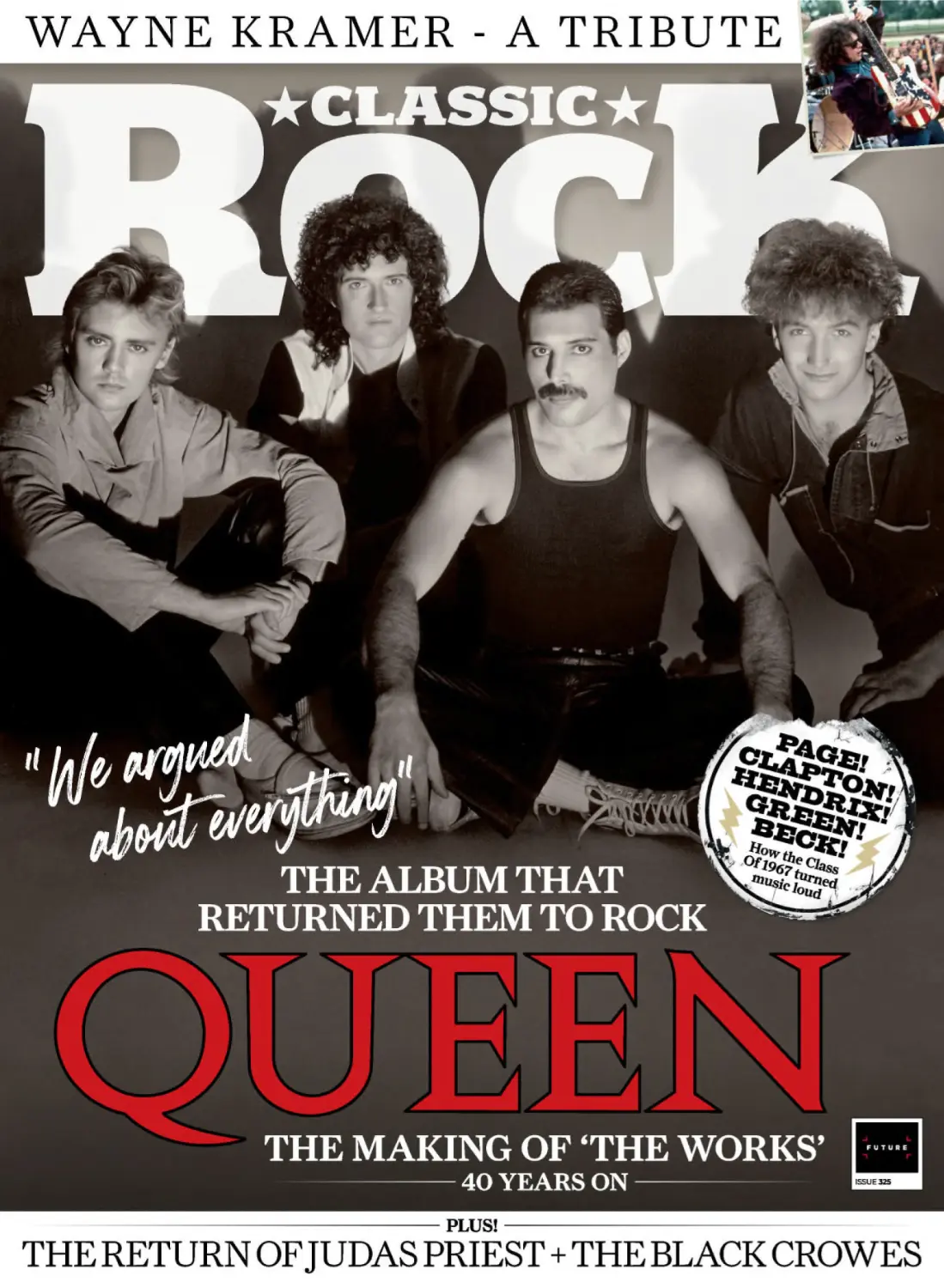
26 Queen
Banned from MTV. Band members buggering off… After
a stylistic detour with previous album Hot Space, with The
Works Queen got back to basics, and returned to their rock
roots and to the ‘real Queen’ sound.
The Classic Rock
Interview
34 The Black Crowes
Chris and Rich Robinson talk about growing up, breaking out,
breaking up, making up, love, hate, the pros and cons of
success, dizzying highs (both kinds), heartbreaking lows, lost
friends, recriminations, reunions… music and much more.
44 The Pineapple Thief
They almost called it a day in 2016, but these days they’re
feeling rejuvenated and regenerated.
48 Judas Priest
With the new Invincible Shield, their late-career purple patch
continues. Rob Halford and Richie Faulkner tell us all about it.
54 The Birth Of
Heavy Blues
When Jimi Hendrix arrived in London in 1966, he blew the
minds of the British rock elite including Eric Clapton, Jimmy
Page and Jeff Beck. Soon they would follow his lead and
develop an explosive new form of electric blues.
66 Ever Meet Lemmy?
Bush
70 The Hot List
We look at some of the essential new tracks you need to hear
and the artists to have on your radar. This month they include
Royal Republic, Moon City Masters, Troy Redfern, Sierra
Ferrell, Tuk Smith & The Restless Hearts and more…
75 Reviews
New albums from The Black Crowes, Judas Priest, Mick Bruce
Dickinson, Thunder, Mick Mars, Ministry, Steve Hackett, Von
Hertzen Brothers, Ace Frehley, Scott Stapp, The Pineapple
Thief… Reissues from Paul McCartney & Wings, Hellacopters,
Evanescence, Can, Mama’s Boys, Colosseum, Omen, The
Waterboys… DVDs, films and books on Queen, The Who,
Screaming Trees, Jah Wobble, Sniffin’ Glue… Live reviews of
Luke Morley, British Lion, The Skids, Depeche Mode…
95 Lives
We preview tours by Buzzcocks, Feeder and BulletBoys.
Plus gig listings – who’s playing where and when.
NIGEL WRIGHT/GETTY
26
Queen
“Oh, we argued about everything.
But it was usually for the good of the music.”
92 Buyer’s Guide
Green Day
106 The Soundtrack
Of My Life
Jean-Jacques Burnel
SUBSCRIBE
AND GET A
FREE GIFT
!
p84
CLASSICROCKMAGAZINE.COM 3
WELCOME
“
et’s give ’em the works!” That was
the rallying cry when Queen
returned to the studio in 1983.
And that’s exactly what they did.
After a couple of years indulging
some pop and disco whims, they
decided that what they really
needed to do was to return to rock.
But it wasn’t all plain sailing. As The Works celebrates
its 40th birthday, we take a look back at how Queen
got back to basics and delivered a bit of a belter…
This issue we also subject The Black Crowes’
Robinson brothers Chris and Rich to the Classic
Rock Interview as the band return with their first
album of new material in 15 years (p34), catch up
with Judas Priest as they release a new album and
prepare to hit the road with Saxon and Uriah Heep
(p48), explore the genesis of heavy blues and rock
with a cast of thousands (p54), and much more.
In what is becoming something of a horribly
heartbreaking tradition, shortly before we were due
to go to press with this issue we heard the very sad
news of the passing of the MC5’s Wayne Kramer. We
look back at his life and music and pay tribute (p8).
Until next month…
Subscribe!
Siân Llewellyn, Editor
THE COVER:
GEORGE HURRELL.
© QUEEN PRODUCTIONS LTD
SCAN TO GET
OUR WEEKLY
NEWSLETTER
Save money, get your issues early and
get exclusive subscriber benefits.
Visit www.myfavouritemagazines.co.uk
for our latest subscription offers.
This month’s contributors
GARY GRAFF
The Motor City’s Gary Graff has
been conversing with and writing
about Wayne Kramer for decades,
and we tapped him to kick out
a jam in Brother Wayne’s
memory this month (p8). Gary
recently published Alice Cooper
@ 75 (Motorbooks), about
another Detroit favourite, and
he’s wrapping up editing The 501
Essential Albums Of The 90s, the
beginning of a new series, which
is due out this autumn.
EMMA JOHNSTON
Emma spoke to The Pineapple
Thief’s Bruce Soord and
Gavin Harrison for this
month’s issue (page 44). She
has been writing about rock
music in all its ridiculous
glory for more than 25 years,
having strayed from the path
of getting a real job when she
had her head turned by the
mighty Manic Street
Preachers some time in
the early 1990s.
PAUL REES
Paul has interviewed everyone
from AC/DC to Adele, Metallica to
Madonna. He also stood behind
Steve Gorman’s drum kit on the
Pyramid Stage when The Black
Crowes headlined Glastonbury in
1993, so it only seems appropriate
that he collared the brothers
Robinson for a chat (p34). Author
of nine books, his next, Raised
On Radio: The AOR Glory Years
1976-1986 is due next year
through Constable/Little, Brown.
CLASSICROCKMAGAZINE.COM 5
LC 2112
Established 1998
Editor
Art Editor
Deputy Editor
Siân Llewellyn
Darrell Mayhew
Polly Glass
Now playing: The Black Crowes, Happiness Bastards
Ihsahn, Ihsahn
Gary Clark Jr, JPEG RAW
Paul Henderson
Production Editor
Ian Fortnam
Reviews Editor
Fraser Lewry
Online Editor
News/Lives Editor
Can, Live In Paris 1973
Liam Gallagher John Squire, Liam Gallagher John Squire
Lindy-Fay Hella & Dei Farne, Islet
Big Big Train, The Likes Of Us
Contributing writers
John Aizlewood, Merlin Alderslade, Marcel Anders, Stuart Bailie, Geoff Barton, Tim Batcup, Mark Blake, Mark
Beaumont, Max Bell, Essi Berelian, Paul Brannigan, Alex Burrows, Pat Carty, Rich Chamberlain, Stephen
Dalton, Bill DeMain, Niall Doherty, Lee Dorrian, Mark Ellen, Claudia Elliott, Paul Elliott, Dave Everley, Jerry
Ewing, Hugh Fielder, Eleanor Goodman, Gary Graff, Nick Hasted, Rich Hobson, Barney Hoskyns, Jon Hotten,
Rob Hughes, Neil Jeffries, Emma Johnston, Damian Jones, Jo Kendall, Hannah May Kilroy, Dom Lawson,
Dannii Leivers, Chris Lord, Ken McIntyre, Lee Marlow, Julian Marszalek, Alexander Milas, Paul Moody, Grant
Moon, Kris Needs, Paul Rees, Chris Roberts, David Quantick, Will Simpson, Johnny Sharp, David Sinclair,
Sleazegrinder, David Stubbs, Everett True, Jaan Uhelszki, Mick Wall, Philip Wilding, Henry Yates
Dave Ling
Contributing photographers
Brian Aris, Dick Barnatt, Ami Barwell, Rob Blackham, Adrian Boot, Justin Borucki, Dave Brolan, Alison
Clarke, Zach Cordner, Fin Costello, Henry Diltz, Kevin Estrada, James Fortune, Jill Furmanovsky, Herb
Jȸƺƺȇƺً ȒƫJȸɖƺȇًxǣƬǝƏƺǼRƏǼɀƫƏȇƳً«ȒɀɀژRƏǼˡȇً¨ƏɖǼRƏȸȸǣƺɀًxǣƬǸRɖɎɀȒȇًáǣǼǼXȸƺǼƏȇƳً«ȒƫƺȸɎkȇǣǕǝɎً
xƏȸǣƺkȒȸȇƺȸً ƏȸȸɵnƺɮǣȇƺًhǣȅxƏȸɀǝƏǼǼًhȒǝȇxƬxɖȸɎȸǣƺًJƺȸƺƳژxƏȇǸȒɯǣɎɿً(ƏɮǣƳxȒȇɎǕȒȅƺȸɵًkƺɮǣȇ
Nixon, Denis O’Regan, Katja Ogrin, Barry Plummer, Ron Pownall, Neal Preston, Michael Putland, Mick
Rock, James Sharrock, Pennie Smith, Stephen Stickler, Leigh A van der Byl, Chris Walter, Mark Weiss,
ƏȸȸǣƺáƺȇɎɿƺǼǼً ƏȸȒȇáȒǼȅƏȇًxǣƬǝƏƺǼژñƏǕƏȸǣɀًzƺǣǼñǼȒɿȒɯƺȸ
All copyrights and trademarks are recognised and respected
ABC January-December 2021: 35,211
Thanks this issue to: Eva Garis (layouts), Steve Mitchell (typography),
Steve Bright, Chris Saggers (image manipulation), Phil Symes & Jan Page (Queen)
Future PLC Quay House, The Ambury, Bath BA1 1UA
Editorial
Editor Siân Llewellyn
Art Editor Darrell Mayhew
Deputy Editor Polly Glass
Production Editor Paul Henderson
Reviews Editor Ian Fortnam
News/Lives Editor Dave Ling
Online Editor Fraser Lewry
Content Director (Music) Scott Rowley
Head Of Design (Music) Brad Merrett
Advertising
Media packs are available on request
Commercial Director Clare Dove
clare.dove@futurenet.com
Advertising Sales Director (Music Portfolio) Lara Jaggon
lara.jaggon@futurenet.com
Account Director Kyle Phillips
kyle.phillips@futurenet.com
Account Director Steven Pyatt
steven.pyatt@futurenet.com
Account Manager Lawrence Cooke
lawrence.cooke@futurenet.com
Cover photo: George Hurrell © Queen Productions Ltd
International licensing and syndication Classic Rock is available for licensing and
ɀɵȇƳǣƬƏɎǣȒȇِÁȒˡȇƳȒɖɎȅȒȸƺƬȒȇɎƏƬɎɖɀƏɎǼǣƬƺȇɀǣȇǕ۬ǔɖɎɖȸƺȇƺɎِƬȒȅȒȸɮǣƺɯȒɖȸ
available content at www.futurecontenthub.com.
Head of Print Licensing Rachel Shaw
Digital
Editor In Chief, Louder Briony Edwards
Executive Editor, Louder Merlin Aldersdale
Staff Writer, Louder Lizzie Capewell
Subscriptions
New orders: www.magazinesdirect.com / 0330 333 1113 /
email help@magazinesdirect.com
Renewals: www.mymagazine.co.uk / customer service: 0330 333 4333 /
email queries: help@mymagazine.co.uk
Acquisitions Director Sharon Todd
Circulation
Head of Newstrade Tim Mathers
Production
Head of Production Mark Constance
Production Project Manager Clare Scott
Senior Ad Production Manager Joanne Crosby
Digital Editions Controller Jason Hudson
Production Manager Keely Miller
Management
Managing Director, Music Stuart Williams
NEXT ISSU
E
ON SALE
MARCH 28
Classic Rock, Future, 121-141 Westbourne Terrace, London W2 6JR, UK
classicrockmagazine.com
Subscription queries: 0330 333 1113 (from the UK) or +44 330 333 1113 (from overseas)
How to order and access back issues: if an active subscriber, you have digital entitlement to access back issues through your IOS or android device/s. Your digital magazine entitlement is
available at no additional cost and no further action is required. PocketMags library may not have access to the full archive of digital back issues. You will only be able to access the digital back
issues as long as you are an active subscriber. To purchase single back issues (print format only) visit: magazinesdirect.com (click on ‘Single Issues’ tab) Or email: help@magazinesdirect.com
For further help call: +44(0)330 333 1113 Lines are open Mon- Fri 8.30am-7pm and Sat 10am-3pm UK time.
Printed by William Gibbons & Sons Ltd on behalf of Future.
Distributed by Marketforce, 2nd Floor, 5 Churchill Place, Canary Wharf, London E14 5HU.
For enquiries please email mfcommunications@futurenet.com ISSN 1464783
áƺƏȸƺƬȒȅȅǣɎɎƺƳɎȒȒȇǼɵɖɀǣȇǕȅƏǕƏɿǣȇƺȵƏȵƺȸɯǝǣƬǝǣɀƳƺȸǣɮƺƳǔȸȒȅȸƺɀȵȒȇɀǣƫǼɵȅƏȇƏǕƺƳًƬƺȸɎǣˡƺƳǔȒȸƺɀɎȸɵƏȇƳƬǝǼȒȸǣȇƺٮǔȸƺƺȅƏȇɖǔƏƬɎɖȸƺِ
The paper in this magazine was sourced and produced from sustainable managed forests, conforming to strict environmental and socioeconomic standards.
All contents © 2024 Future Publishing Limited or published under licence. All rights reserved. No part of this magazine may be used, stored, transmitted or reproduced in any way without the prior written permission of the publisher. Future Publishing
nǣȅǣɎƺƳ٢ƬȒȅȵƏȇɵȇɖȅƫƺȸדזזזא٣ǣɀȸƺǕǣɀɎƺȸƺƳǣȇ0ȇǕǼƏȇƳƏȇƳáƏǼƺɀِ«ƺǕǣɀɎƺȸƺƳȒǔˡƬƺيªɖƏɵRȒɖɀƺًÁǝƺȅƫɖȸɵً ƏɎǝ ÈِǼǼǣȇǔȒȸȅƏɎǣȒȇƬȒȇɎƏǣȇƺƳǣȇɎǝǣɀȵɖƫǼǣƬƏɎǣȒȇǣɀǔȒȸǣȇǔȒȸȅƏɎǣȒȇȒȇǼɵƏȇƳǣɀًƏɀǔƏȸƏɀɯƺƏȸƺƏɯƏȸƺًƬȒȸȸƺƬɎƏɎɎǝƺɎǣȅƺȒǔ
going to press. Future cannot accept any responsibility for errors or inaccuracies in such information. You are advised to contact manufacturers and retailers directly with regard to the price of products/services referred to in this publication. Apps and
ɯƺƫɀǣɎƺɀȅƺȇɎǣȒȇƺƳǣȇɎǝǣɀȵɖƫǼǣƬƏɎǣȒȇƏȸƺȇȒɎɖȇƳƺȸȒɖȸƬȒȇɎȸȒǼِáƺƏȸƺȇȒɎȸƺɀȵȒȇɀǣƫǼƺǔȒȸɎǝƺǣȸƬȒȇɎƺȇɎɀȒȸƏȇɵȒɎǝƺȸƬǝƏȇǕƺɀȒȸɖȵƳƏɎƺɀɎȒɎǝƺȅِÁǝǣɀȅƏǕƏɿǣȇƺǣɀǔɖǼǼɵǣȇƳƺȵƺȇƳƺȇɎƏȇƳȇȒɎƏǔˡǼǣƏɎƺƳǣȇƏȇɵɯƏɵɯǣɎǝɎǝƺƬȒȅȵƏȇǣƺɀȅƺȇɎǣȒȇƺƳǝƺȸƺǣȇِ
If you submit material to us, you warrant that you own the material and/or have the necessary rights/permissions to supply the material and you automatically grant Future and its licensees a licence to publish your submission in whole or in part in any/all
issues and/or editions of publications, in any format published worldwide and on associated websites, social media channels and associated products. Any material you submit is sent at your own risk and, although every care is taken, neither Future nor its
employees, agents, subcontractors or licensees shall be liable for loss or damage. We assume all unsolicited material is for publication unless otherwise stated, and reserve the right to edit, amend, adapt all submissions.
Future plc is a public
company quoted on the
London Stock Exchange
(symbol: FUTR)
www.futureplc.com
!ǝǣƺǔ0ɴƺƬɖɎǣɮƺ ǔˡƬƺȸ Jon Steinberg
Non-Executive Chairman Richard Huntingford
!ǝǣƺǔIǣȇƏȇƬǣƏǼƏȇƳ³ɎȸƏɎƺǕɵ ǔˡƬƺȸ Penny Ladkin-Brand
Tel +44 (0)1225 442 244
8 CLASSICROCKMAGAZINE.COM
FOR
MO
RE
M
CO
E.
IN
SS
W.CLA ICROCK
W
MA
W
S:
GA
Z
EW
N
E
INSIDE TH
CK
WORLD OF RO
cat no:#325
cat no:#325
4
COPYRIGHT FUTURE 202
April 30, 1948 – February 2, 2024
We look back at the life and times of a guitarist who, during his years with the
legendary MC5 and beyond, kicked out the jams more than most.
Words: Gary Graff Photo: Mike Barich
I
ggy Pop remembers a night more than 55 years
partly from shock; he’d fought off salivary gland cancer
ago when he and the other Stooges stood on
a few years before, and few knew of his latest condition.
a street in downtown Detroit listening to Wayne
But it also spoke to the regard in which ‘Brother Wayne’
Kramer and the MC5 rehearse Kick Out The Jams,
was held. Not just for his ferocious musicianship, but also
“which was coming right through a huge,
for his consciousness as a social and political activist –
reinforced warehouse door”.
particularly as the American
“It was very, very powerful and
ambassador of Billy Bragg’s Jail
sonic,” Pop says of the future classic
Guitar Doors initiative, bringing
from his Michigan rock brethren.
music into prisons – and as
“We had come for a visit, and had to
a recovered, once-incarcerated
wait for them to break so they could
addict who was a shining example
hear us knocking.”
of what genuine redemption and
Few, and perhaps nobody, kicked
a truly extraordinary second
Wayne Kramer
out the jams like the 5, and certainly
chapter could look like.
nobody continued to wave that flag
“He was just dedicated to being
with the unapologetic, relentless passion of Kramer – who
a better person at all times, and at all costs,” says John
passed away on February 2 at the age of 75 in Los Angeles,
Sinclair, the Detroit writer and activist who managed the
shortly after being diagnosed with pancreatic cancer.
MC5 for a time and had Kramer guest on some of his
The profound mourning and heartfelt tributes from
albums. Fellow Detroit rocker Mitch Ryder adds that
peers and fans that came in the wake of his death was
Kramer was “driven to be a part of history, and I think ➤
“My attitude is live
strong and live wise
and stay creative.”
CLASSICROCKMAGAZINE.COM 9
The MC5 kicking out the jams in Mount
Clemens, Michigan in 1969: (l-) Dennis
‘Machine Gun’ Thompson, Wayne Kramer,
Fred ‘Sonic’ Smith, Rob Tyner.
“Wayne was a force of nature. A soul man
in a rock’n’roll body, lean and slinky.”
Producer Bob Ezrin
Passion laid bare:
B
orn Wayne Stanley Kambes,
Kramer (he took the surname
as a teenager) was raised in
Lincoln Park, a blue-collar suburb
south of Detroit, where he started out
playing drums but then switched to
guitar when he was 10 years old. His
was a classic story: “I learned the folk
songs and the standards, but I really
just wanted to play rock’n’roll.” He
gravitated towards Chuck Berry,
Duane Eddy and The Ventures, but
10 CLASSICROCKMAGAZINE.COM
Kramer (second right)
eventually expanded his
with the MC5 in 1967.
vocabulary to include jazz cats
such as Kenny Burrell, Barney
Kessell, Mundell Lowe and others.
versatile for a couple of thugs from Lincoln Park.
After playing in their own bands, Kramer and
They had a special thing I never saw anybody else
friend Fred ‘Sonic’ Smith (later to marry Patti
have, not even the Rolling Stones. They had their
Smith) formed the MC5 with frontman Rob
minds on big things. The wanted to be great… and
Tyner, bassist Michael Davis and drummer Dennis
they were willing to put in the work to do that.”
‘Machine Gun’ Thompson (now the only living
Pop – who was once brought in to play drums
member of the line-up), taking on a wide spectrum
for the MC5, according to Kramer – adds that
from rockabilly to the British Invasion and R&B
“Wayne, and the band as a whole, had one foot in
– particularly what was coming out of Motown’s
cool black music and the other foot in boisterous
Hitsville USA to the north.
kid rock. I would say that band was the world for
“He was a great guitar player, even then, him
him, and he was its spark plug. I think Fred was
and Fred Smith,” says Sinclair, who Kramer and
the backbone, but Wayne was relentless and
the others credited with introducing them to free
ambitious in a good way. They wanted to be
jazz artists such as Sun Ra. “They were very
great, and they were.”
Along with Pop and the Stooges,
the MC5’s challenging and complex
Kramer with MC5/MC50
music across their three albums –
at Alcatraz in Milan,
ranging from the metallic (Kick Out
November 2018.
The Jams) to the poppy (Shakin’ Street,
High School) to very experimental
(Starship) – was often credited as one
of the foundations for punk rock. It
certainly spoke to generations of
musicians who followed that
limitless ambition.
“I would consider them to be my
favourite band,” Thayil says. “It had
that more aggressive – and when
I say ‘more aggressive’ I don’t mean
knuckle-dragging meathead stuff. It
was stuff that addressed things that
were important to teenagers, things
MAIN + INSET: LENI SINCLAIR/MICHAEL OCHS ARCHIVE/GETTY; BOTTOM: SERGIONE INFUSO/GETTY
he’s already part of the history. But he [had]
a bigger frame in mind for himself”.
Kim Thayil, the Soundgarden guitarist who was
part of Kramer’s MC50 collective during 2018-19
to celebrate the band’s 50th anniversary, was
a huge MC5 fan who was pleased to find that the
then 70-year-old Kramer was “so bright and
focused intellectually on ideas of justice, of
fairness, of equality. This guy… didn’t just get his
shit together so he could walk a straight line. He
got his shit together so he could guide other
people to walk that straight line… and stand up
when he saw things that were wrong and try to do
something about it”.
A few years back Kramer explained his outlook
thus: “My attitude is live strong and live wise and
stay creative. Those are the only things that will get
us out. I say: ‘Am I doing anything?’
And, well, yeah, I am. I’m doing a few
things, and a lot of it holds up pretty
well. I don’t feel like I get a failing
mark in life.”
LOOKING
AT
YOU
Stars pay tribute.
MAIN: JASON DECROW / ALAMY; TOP RIGHT: MICHAEL OCHS ARCHIVES/GETTY
Wayne Kramer and Iggy
Pop performing at the Road
Recovery benefit concert in
New York in 2009.
like anger and frustration and conflict over
fraternity and love and friendship, which were
addressed as well. It’s voiced by the passionate
vocals – the screaming, as my dad would’ve called
it – the distorted, fuzzy guitars sounding like
they’re about to break up. You hear this kind of
music and think: ‘Wow, why isn’t there more of
this on the radio?’”
Equally impressed was Bob Ezrin, who met
Kramer and the MC5 while he was in Detroit
working with Alice Cooper on their Love It To
Death and Killer albums. “Here was a punk rock
band that understood groove – that was Detroit,”
says Ezrin, who produced a new MC5 album, the
first since 1971, that’s expected out later this year.
“Wayne was a force of nature. A soul man in
a rock’n’roll body, lean and slinky – a dancing,
whirling profusion of hair and hipness who also
happened to be one of the best
guitar players any of us had ever
heard. I wanted to be on the same
bus he was on.”
Under the tutelage and direction
of manager Sinclair, meanwhile,
the MC5 – still not in the Rock
And Roll Hall Of Fame after six
nominations – also aligned
themselves with the counterculture and political left of the
time. Forwarding a credo of
‘rock’n’roll, dope and fucking
in the streets’, it was the
‘cultural wing’ of the White
Panther party, and the only
major band to play during
demonstrations at the 1968
Democratic National Convention in
Chicago. Kick Out The Jams – the debut
album, recorded live at Detroit’s famed
Grande Ballroom, where the MC5 were
the house band – was banned at the
city’s Hudson’s department stores due
to the 17-letter profanity in the title track. The
music itself was not dominated by politics, but the
group seldom shied away from protesting against
the Vietnam War or championing populist causes
– an ideology Kramer remained proud of
throughout his life.
“I think the band represented a sense of
unlimited possibilities that there could be
a new kind of music and a new kind of politics,
that there could be a new kind of lifestyle,”
Kramer, who painted the American stars-andstripes on his Fender Stratocaster as a sign of
patriotism, said during the MC50 tour. “Like
many of my generation, we saw a seismic shift
in the way we approached life than that of our
parents’ generation. In retrospect, I don’t think
that shift was as great as we thought it was.
Those shifts don’t happen by generations; they
happen by millennia. But back
then I thought we were making
an evolutionary break from our
parents, and I think that spirit
that anything is possible holds
up pretty well. That’s not subject
to decay.”
“They’re a very important
band – more important than
popular, really,” says Grammy
Award-winning producer Don
Was, a fan while growing up in
Detroit who became a friend after
inviting Kramer to play on Was (Not
Was)’s self-titled debut album in 1981.
“The politics were important,
but what that band did
musically is really underappreciated. They didn’t sell
a lot of records, but a lot of
the people who bought
them went on to play music
and start bands that were
influenced by the MC5.” ➤
“I’ve known Wayne since 1968, and we’ve
worked together often and as late as last
year. He had a big life, and I always respected
how passionate he was about his charity
Jail Guitar Doors which helped give
prisoners access to music, guitars and
often hope for their future.”
Alice Cooper
“My life was forever changed for the better
when I met this man and I’m going to miss
him immeasurably. He was the embodiment
of all things rock’n’roll and a really fucking
great human being.”
Slash
“Brother Wayne was the greatest man I’ve
ever known. He possessed a one-of-a-kind
mixture of deep wisdom and profound
compassion, beautiful empathy and
tenacious conviction. His band the MC5
basically invented punk rock music.”
Tom Morello
“We’ll miss you Brother Wayne, thank you
for your friendship over the years.”
Cheap Trick
“I saw the MC5 in 1969 at a festival outside
of Worthing UK. I saw the future of rock’n’roll
right then, and Wayne was definitely a big
part of that.”
Billy Idol
“Brother Wayne Kramer and his band
MC5 were a vital part of the true
rock‘n’roll revolution.”
Michael Monroe
“Just a supremely sweet man, and one hell
of a rock’n’roll fire starter.”
Duff McKagan
“I’m sure he’s kicking out the jams in
another dimension right now.”
Billy Duffy, The Cult
“The first guitar solo I ever sat down and
learned was Wayne’s from the MC5 song
Looking At You. He changed rock’n’roll and
broke the ground wide open for the rest of us.”
Jack White
CLASSICROCKMAGAZINE.COM 11
WAYNE KRAMER
Billy Bragg, Wayne Kramer and
Tom Morello with inmates at the
Travis County Correctional Center
in Austin, Texas, as part of the Jail
Guitar Doors program, 2010.
“He [Kramer] possessed a one-of-a-kind mixture
of deep wisdom and profound compassion.”
Tom Morello
T
12 CLASSICROCKMAGAZINE.COM
together the short-lived Gang War with the New
York Dolls’ Johnny Thunders. Kramer also
produced bands and worked as a carpenter in
New York, and lived in Nashville and Florida. He
also mended fences with most of his MC5 mates
when they reunited to play at a tribute concert for
Rob Tyner following his death in 1991.
Kramer began his solo career in earnest during
1995, signing with Bad Religion guitarist Brett
Gurewitz’s Epitaph Records and joined by
members of Rancid, The Melvins, Circle Jerks,
The Vandals and Suicidal Tendencies on that
year’s The Hard Stuff. “I think I’ve been embraced,
kind of like a venerated elder statesman,” Kramer
cracked at the time.
He continued to make his own albums as well
as guesting on recordings by Bad Religion, Pere
Ubu, Marshall Crenshaw and Mudhoney, among
others. “I just want to work now,” he explained.
“I think work defines us. It’s a reason to exist. You
combine work with love, and that equals living.”
And Kramer lived well. He wrote and recorded
scores for film and TV shows such as The Narcotic
Farm, The Russian Five, Eastbound & Down
and Coldwater Kitchen, among others. He
started a record label, MuscleTone, with
his wife Margaret Saadi Kramer. In 2004
he, Davis and Thompson toured as
DKT/MC5, using a variety of guest
musicians to fill out the line-up, which
existed on and off until Davis’s
death in 2012.
During 2009, meanwhile,
Kramer and his wife (they have
a son, Francis) began the USA
wing of Jail Guitar Doors,
which Billy Bragg started in the
UK and named after the Clash
GARY MILLER/GETTY
he MC5’s sad demise left Kramer at a loose
end, a 24-year-old “trying to kill the pain
and not dealing with the tremendous loss
of the MC5. I lost my brothers. We went our
separate ways, like it never happened, denial on
a large scale.” To find comfort, he lapsed into “that
rock’n’roll myth of party hearty, live fast, die
young, leave a good-looking corpse”. He played
music with Detroit soul man Melvin Davis in the
band Radiation, but also used and dealt drugs,
misadventures that landed him in the FMC
Lexington prison in Kentucky during 1975.
Kramer nevertheless viewed his jail stint
as blessing that took him away from a dark
underworld where all the company was bad and
“someone probably would’ve done me in, or
I might have overdosed”. The best part of his time
in jail was meeting jazz trumpeter Red Rodney,
who’d played with jazz great Charlie Parker, and
after some initial resistance became a mentor who
Kramer called “my musical father”. “Yeah, he was
a little distant at first,” Kramer recalled with
a laugh. “We were those rock guys.”
One day Rodney presented
Kramer with some sheet
music, and the guitarist played
bebop chords while he soloed.
“He said: ‘Yeah, okay, you can
play good,’ so I guess I passed
the audition.”
The two men formed
a prison band called Street
Sounds, and Rodney gave
Kramer “a Berklee School Of
Music course in writing and
arranging”. He emerged ready to make
music, and formed his own bands. He
played with Was (Not Was), and put
song, which name-checked Kramer (‘Let me tell you
’bout Wayne and his deals of cocaine’). The non-profit
Jail Guitar Doors takes guitars into prisons, and
there Kramer and his selected surrogates work
with inmates to learn to play and write songs to
counter the dark aspects of their incarceration.
“Arts is a powerful tool for positive change,”
Kramer explained. “I’m an archetypal drug-war
prisoner, and after I was released in the late
seventies I watched as more and more people just
like me were going to prison for longer and longer
sentences in worse and worse conditions. The
basis of our corrections system had become
retributions, and not rehabilitation. I’ve never been
one to look the other way when things aren’t
going well. I couldn’t bear it any longer, and I felt
I had to take some action.”
Brad Tolinski, who grew up not far from the
MC5’s Lincoln Park and co-wrote MC5: An Oral
Biography Of Rock’s Most Revolutionary Band, due in
October, finds Jail Guitar Doors a particularly
appropriate direction for Kramer’s activism.
“He was a restless, rapid-fire intellect [who] was
very positive,” Tolinski notes. “He could’ve been
crushed by the [prison] experience, but Wayne
used the time to study music theory and improve
himself. He had that kind of indomitable spirit.”
MC50 came in conjunction with Kramer’s
award-winning 2018 memoir The Hard Stuff, with
the guitarist joined by Thayil and his Soundgarden
bandmate drummer Matt Cameron, Fugazi
drummer Brendan Canty, Faith No More’s Billy
Gould on bass, and singer Marcus Durant of Zen
Guerilla in Tyner’s spot. “It was [an anniversary]
I thought should be celebrated,” Kramer explained
at the time. “I just want to see how the music, how
my playing, how the band has evolved, what
happens over fifty years. The idea of it, I thought,
was intriguing.” The group recorded a concert,
including the entire Kick Out The Jams album, at
Third Man Records’ Detroit location but it has so
far gone unreleased.
Kramer came back in 2022 with another line-up
under the MC5 name and the motto ‘We Are All
MC5’, as well as new material. An album, Heavy
Lifting, features contributions from Rage Against
The Machine’s Tom Morello, Slash, Vernon Reid of
Living Colour, William DuVall of Alice In Chains
and others. It was mostly finished at the time of
Kramer’s death and is expected out later this year.
“We poured our hearts into this project,” says
producer Bob Ezrin, who describes the album as
“very heavy… just a wall of guitars most of the
time,” blending political messages with “a good
sense of humour. It’s a snapshot of a guitar man at
the height of his powers. And now, with Wayne’s
passing, I know we all feel a responsibility to make
sure that his work is heard and he is celebrated.”
Kramer quipped: “Some bands take two years
between albums. Some bands take five years
between albums. We take fifty.”
But as something that will stand as Kramer’s
final work, there was serious business afoot, too.
“This was the time to reignite the MC5 to carry
the necessary message for today,” he explained.
“We are in such a dangerous time for our country
that I’m gonna have to pull out all the stops and
use the most powerful tools that I have at my
disposal, which are my guitar and the songs and
the music. The MC5 has always represented
action and commitment and principle. I still
stand for that.”
Manny Martinez
Died December 2023
Thank you…
and good night.
Mary Weiss
December 28, 1948 – January 19, 2024
Drummer Manny
Martinez played
a pivotal role in the
birth of The Misfits,
and played on the US
punk band’s first
single, Cough/Cool,
in 1977. He was 69
years old.
John ‘Rambo’
Stevens
New Yorker Mary Weiss found fame in
the 1960s as the lead singer with the
vocal group the Shangri-Las, whose
single The Leader Of The Pack topped the
US chart. It was later covered by Twisted
Sister. After decades away from music,
Weiss released a solo album, Dangerous
Game, in 2007. She was 75 years old.
Died December 22, 2023
Frank Farian
Yusuke Chiba
July 18, 1941 – January 23, 2024
Best remembered as the guiding light of
the huge-selling disco-pop group Boney
M, also the infamous Milli Vanilli, Frank
Farian also founded Far Corporation,
whose remake of Stairway To Heaven
was a Top 10 hit in 1985, and produced
Meat Loaf. Farian was 82 years old.
Cause of death has not been announced.
Essra Mohawk
John Lydon’s best
friend, minder and
long-term manager
has passed away at
the age of 64 after
suffering an aortic
heart dissection.
Died November 26, 2023
Yusuke Chiba,
a former vocalist with
Japanese garagerockers Thee Michelle
Gun Elephant, has
died of cancer at the
age of 55. The news
of his passing was
broken by Chiba’s
current group
The Birthday.
April 23, 1948 – December 11, 2023
Born in Philadelphia, Essra Mohawk
was a singer with Zappa connections.
Under her maiden name Sandy Hurvitz
she wrote and arranged songs, and
performed briefly with the Mothers
Of Invention, after which Frank partproduced her debut record, Sandy’s
Album Is Here At Last, for his record label
Bizarre. She died of cancer at her home
in Nashville, aged 75.
Ronnie Caryl
February 10, 1953 – December 18, 2023
Mike Maxfield
Died December 2023
Mancunian Mike Maxfield became the
lead guitarist with British Invasion band
The Dakotas, who were a backing group
for Billy J Kramer. Maxfield joined them
in February 1962 and wrote their Top 20
instrumental hit The Cruel Sea, which
was produced by George Martin. It was
later covered by The Ventures. In the US
the song was retitled The Cruel Surf.
Maxfield quit the group in 1965 to
become a songwriter. The 79-year-old
died of undisclosed cause.
14 CLASSICROCKMAGAZINE.COM
April 1, 1940 – January 11, 2024
TRIBUTES HAVE BEEN paid to the
trailblazing BBC DJ and broadcaster
after her death at the age of 83. Annie
Nightingale was Radio 1’s first female
presenter, joining in 1970 and remaining
until her final show on December 19 last
year. During that time she became the
BBC’s longest- serving face and voice.
She was also a presenter on BBC TV
music show The Old Grey Whistle Test.
According to a statement from her
family, she passed away at her home in
London after a short illness.
Anne Avril Nightingale was born in
Middlesex. Her TV career began on Ready
Steady Go! A broad taste in music and
a dedicated work ethic made her a force of
nature, and over the years she became as
famous as the stars she interviewed. In
2002 she received an OBE for her services
to broadcasting, later an MBE and a CBE.
Current Radio 1 DJ Jo Whiley wrote:
“Annie blazed a trail for us all [as female
broadcasters] and never compromised.
Her passion for music never diminished.”
Paul McCartney called her “a special
woman, full of knowledge about the
music scene, with a great spirit and
a fabulous sense of humour,” adding:
“I was always pleased to meet up with
her for an interview or a cup of tea. The
music world is poorer without her.” DL
Melanie
February 3, 1947 – January 23, 2024
Dean Brown
August 19, 1955 –
January 26, 2024
Jazz-fusion guitarist
and session player
Dean Brown (pictured)
worked with Eric
Clapton, David
Sanborn, Billy Cobham,
George Duke and
more, and appeared
on more than 100
albums. He also
played with several of
his own groups. Brown
was 68 when he died
of cancer.
Michael ‘Gibbs’
Gibbons
Died December 27, 2023
New York hardcorecrossover-thrashers
Leeway’s former
guitarist Michael
‘Gibbs’ Gibbons has
died of an unspecified
illness. ‘Gibbs’ was
a member of the
influential group from
1987 to 1992, and
appeared on their
first two albums,
Born To Expire and
Desperate Measures.
SINGER-SONGWRITER MELANIE, one of
the stars of the Woodstock Festival in 1969,
has passed away peacefully at the age of 76.
Born Melanie Safka in Queens, New
York, she grew up in a musical household
– her father was a jazz guitarist – and
developed an early interest in folk music
amid the burgeoning counterculture scene
of New York City. Melanie later claimed to
have had an out-of-body experience at
Woodstock (“I watched myself sit down,
and it wasn’t until I sang the first note that
I was back. I believe all 500,000 people got
to witness this without knowing what had
happened”), and went on to write the song
Lay Down (Candles In The Rain).
In 1971, Melanie achieved international
success with the release of her single Brand
New Key, which topped the charts in the
United States, Canada and Australia, and
reached the Top 5 in the UK. The song
was later parodied by British comedy folk
act The Wurzels.
Although Melanie’s popularity declined
over time, she continued to release albums
and tour. Her final album, Ever Since You
Never Heard Of Me, was released in 2010,
and her last live shows were in 2022. FL
James Kottak
December 26, 1962 – January 9, 2024
THE SCORPIONS ARE mourning the loss
of their former drummer, who has died at
the age of 61. Kottak joined the German
band in 1996, and played on all their
albums from 1999’s Eye II Eye to 2016’s
Return Forever. He was also a co-founder of
another German band, Kingdom Come.
“James was a wonderful human being,
a great musician and a loving family man,”
said a Scorpions statement. “Our ‘brother
from another mother’ will be truly missed.”
Louisville, Kentucky-born Kottak also
played with Montrose, Warrant, Dio, the
McAuley Schenker Group, Buster Brown,
Black Sheep and the US group Wild Horses.
After Kottack joined the Scorpions,
replacing Herman Rarebell, his playing
prompted guitarist Matthias Jabs to tell
Classic Rock: “I don’t know how we made it
this far without being rhythmic.”
Kottak was known to have had issues
related to alcohol. In 2014, while on tour
with the Scorpions in the UAE, he was
arrested and charged with drinking without
a licence, cursing Muslims, making indecent
gestures and removing his pants. He was
jailed for a month and fined around £320.
Kingdom Come frontman Keith St John
revealed that prior to his death, Kottak had
completed a 48-day rehab programme. FL/DL
ANNIE NIGHTINGALE: SYDNEY O’MEARA/GETTY; DEAN BROWN: KAZIMIERZ JUREWICZ/ALAMY
Friends in their teenage years, Ronnie
Caryl and Phil Collins formed the group
Flaming Youth in 1969. The following
year they both auditioned for Genesis.
Collins got the gig, while guitarist Ronnie
went on to play with Eric Clapton, Lulu,
Gary Brooker, Maggie Bell, Stephen
Bishop, David Hentchell and John
Otway, before becoming the regular
rhythm guitarist and backing singer in
Collins’s solo band. Caryl also released
two solo albums. He was 70 years old.
Annie Nightingale
AC/DC
Announce Tour
Dates include Dublin and
two at Wembley Stadium.
AS THIS ISSUE went to press, AC/DC
confirmed a European tour. The band will
play 21 dates in 10 cities, kicking off in
Germany on May 17, taking in two UK
shows at London’s Wembley Stadium on
July 3 and 7, and ending at Croke Park in
Dublin, Ireland, on August 17.
Joining mainstays Brian Johnson (vocals),
Angus Young (guitar) and Stevie Young
(rhythm guitar) will be drummer Matt
Laug, who deputised for Phil Rudd at the
PowerTrip Festival last year, and former
Jane’s Addiction bassist Chris Chaney,
a deputy for Cliff Williams, who returned
to his retirement after PowerTrip.
AC/DC had teased the big reveal of the
tour with a mysterious video posted on
their social media channels, the words ‘are
you ready’ accompanied by a clock that
ticked down towards the announcement.
In related news, Back In Black, the title track
of the 1980 album that was their first with
Johnson, has become their second track to
pass one billion views on YouTube, and is
second to Thunderstruck, which with
a mammoth 1.6 billion views. DL
Brian Johnson and
Angus Young: AC/DC
shows coming soon.
Joni Mitchell
Wows Grammys
Singer-songwriter, 80, leads
the cast at the 2024 Awards.
16 CLASSICROCKMAGAZINE.COM
The Wildhearts have
announced their latest
line-up, which sees
Ginger Wildheart
accompanied by
returning bassist
Jon Poole, plus new
members Ben
Marsden (ex-Grand
Theft Audio) on guitar
and former Bonafide
drummer Pontus
Snibb. The band play
Shepherd’s Bush
Empire in London
on June 6.
Mötley Crüe have
launched a new online
museum that they are
calling – obviously
– The Crüseum.
Celebrating the
group’s “past, present,
and future”, it
promises to provide
access to all sorts of
previously unseen
Mötley Mëmorabilia.
A ‘new’ studio album
from Blue Öyster Cult
is released on April 12
via Frontiers Records.
Titled Ghost Stories,
it's a collection of
reimagined and newly
completed tracks from
1978 to 1983, except
for 2016’s If I Fell.
A biopic about Red
Hot Chili Peppers
frontman Anthony
Kiedis (pictured) is
in the early stages of
development. The
group’s manager,
Guy Oseary, will
co-produce what is
being billed as
“a shockingly candid
portrait of an artist,
addict, and ringleader”.
Modern English
They didn't set out to write commercial songs, but they
were happy when they found out their earning power.
AFTER FORMING IN Colchester in 1979
from the remnants of The Lepers, Modern
English’s effects-pedalled post-punk
futurism soon brought them to the
attention of label 4AD. Originally selfidentifying as serious artists, the quintet
discovered a talent for creating succinct
pop, and in ’82 I Melt With You, the
second single from their album After
The Snow, charted in the US and latterly
proved to have significant legs (featuring
in Valley Girl, Grand Theft Auto, Glee,
Stranger Things et al). To mark the
release of the band’s
ninth album, 1 2 3 4,
we caught up with
vocalist Robbie
Grey at his home
in Thailand.
MS-10 and MS-20 analog synths – it’s
classic Modern English.
The title and sentiment of Not My
Leader speak volumes. Have you
ever felt more disillusioned and
unrepresented by the political class
we’ve got today?
No, never. When I first went to America,
we had Margaret Thatcher and they had
Ronald Reagan. Then around about the
time that I wrote Not My Leader’s lyrics we
had Boris Johnson and they had Donald
Trump, and I was
thinking to myself
nothing’s changed.
If anything it’s got
even worse.
“The Burger King
advert earned
ninety thousand
US dollars.”
Nine albums in, most
bands would deem it
time to stretch out,
go a bit proggy, but
1 2 3 4 is packed with short, sharp,
snappy bangers.
When I wrote Long In The Tooth, the first
song on the album, I was trying to say
everything I needed to say in two and
a half minutes. Something in the spirit
of The Cure’s Boys Don’t Cry, Buzzcocks’ Ever
Fallen In Love (With Someone You Shouldn’t’ve).
Trying to get back to our roots, I suppose.
Long In The Tooth, Robbie? Surely
not an admission of, God forbid,
getting older?
Yeah, getting older and getting bolder.
I wanted to make it full of life rather than
a down-tempo thing, so it’s really fast,
with lots of basic chords and things
changing quickly. Very 1982. But the
album’s not all like that. Voices, the last
track, is psychedelic and trippy. Mick
[Conroy, bass] and I had a lot to do with
this album, but Gary’s [McDowell]
guitar’s still incredibly distinctive –
you’re always going to hear his flanger
and phaser flying around. And with
Steve’s [Walker] old keyboards – Korg
Did you recognise
the crossover hit
potential of I Melt
With You? Because
it wasn’t even the
first single from After The Snow.
No. We weren’t sure about that song at all,
we thought it was too commercial. Hugh
Jones, the producer, said: “Don't be silly,
this is a really good song.” And we were
like: “But we don’t normally write songs
like this. It sounds a bit commercial.” But it
pays all the bills, it’s paid for everything
we’ve ever done since, so I’m glad we
listened to him.
Did its inclusion in Grand Theft Auto
buy you a house, or doesn’t it work
like that?
It’s been in so many things. The biggest
earner was that Burger King advert. That
was ninety thousand US dollars – and
that was in the early nineties. The funniest
thing then was that Steve was a vegetarian,
but when I told him how much money
he’d be making he didn't seem to mind
after that. IF
1 2 3 4 is out now via Inkind Music.
Modern English play London Camden
Dingwalls on April 27.
AC/DC: CHRISTIE GOODWIN/PRESS; MODERN ENGLISH: SHEVA KAFAI/PRESS; ANTHONY KIEDIS: CLARA BALZARY/PRESS
LAST MONTH, JONI Mitchell brought the
Grammys to its feet with a show-stopping
rendition of her 1966 hit Both Sides, Now at
a celebrity-studded ceremony in Los
Angeles. The veteran Canadian singersongwriter had to learn how to walk, talk
and sing again after suffering a brain
aneurysm in 2015. Earlier in the evening
she collected a tenth Grammy award for
Best Folk Album for her live record Joni
Mitchell At Newport.
Other winners included Metallica, for
Best Metal Performance for their album
72 Seasons, Paramore, for Best Rock Album
and Alternative Music Performance for This
Is Why, Larkin Poe (Contemporary Blues
Album), Bobby Rush (Traditional Blues
Album) and Jason Isbell And The 400 Unit
(Americana Album and American Roots
Song). Director Brett Morgen won the
Music Film award for his David Bowie
documentary Moonage Daydream. Em
Cooper’s animated film for The Beatles’
58-year-old I’m Only Sleeping won the Music
Video prize. DL/FL
An auction of a huge
collection of 122
guitars owned by
Mark Knopfler has
raised £8,840,160.
Twenty-five per cent
of the proceeds are
being divided equally
and donated to
charities supported by
the former Dire Straits
leader, including the
British Red Cross, Tusk
and Brave Hearts Of
The North-East.
The Gems
“It’s our mission to keep the
rock alive. It’s important to
keep the torch burning.”
MIKAEL HALTÉN/PRESS
They hope that leaving “toxic” Thundermother
will turn out to be a blessing in disguise.
This strong feeling of having each others’ back provides the foundation
of songs like barnstorming single P.S.Y.C.H.O, along with a sheer joy in
performing them. “Our shows are a good time, with fun, positive energy,”
says Mancini. “It is a high-energy rock show. We have a lot of fun on stage.”
UNTIL LAST SPRING, trio The Gems – vocalist Guernica Mancini,
A recent cruise with Sabaton saw them reconnecting with old fans and
drummer Emlee Johansson and bassist Mona Lindgren – were close to
building a new fan base, something they’re set to build on this summer.
a breakthrough with Swedish classic rockers Thundermother, having
“People have been super-happy and supportive,” Mancini says of their
toured with Scorpions and Whitesnake and built up a solid fan base. But
rise from the ashes. “People seeing us not giving up, it seems like a very
in an act of extraordinary solidarity, when Mancini was fired,
powerful message and something very beautiful.”
FOR FANS OF...
Johansson and Lindgren followed her out of the door. Now the
Classic rock is audibly close to their hearts, but they say they’re
three of them are back as The Gems, brandishing their debut
not content with covering old ground – they’re looking to move
album Phoenix, a defiant, riff-stuffed stomper that acknowledges
it on. “It’s our mission to keep the rock alive,” says Lindgren. “It’s
the hard times and celebrates true friendship and determination.
important to keep the torch burning.”
“Filippa [Nässil, Thundermother guitarist and founder
“Classic rock has been very stagnant, everyone just keeps
member] decided that she wanted to fire me, from out of the
repeating what everyone has already done,” Mancini adds. “It
blue,” Mancini explains. “We’ve had issues for many, many years.
gets so old. So part of keeping that legacy alive is also refreshing
“Van Halen has been
It’s been tough when it felt like we were this close to really doing
it and daring to mix it up, like all our favourite artists did. We
a very big influence for
big things with the band. I’m forever grateful that Mona and
did a show this weekend and there were a lot of females in the
us all,” says Mancini.
Emlee decided to leave that amazing career opportunity and take “But the interlude on
audience, which we really appreciate. Mixing it up the way we’re
a chance on us doing something that we feel good about. I would the album is inspired
doing, I think it’s more approachable for a lot of women. We
by Be My Husband by
have never taken myself out of the situation – and it was never
want to get more women into rock, we want to get a younger
Nina Simone. And the
a good one, it was always toxic. But now we’re in something
audience. Maybe through us they could find all these legends
spoken-word part in
where we’re finding happiness in music again, and we have a true Queens is inspired by
that we all love.” EJ
the spoken-word bit
friendship, loyalty and a sisterhood that only a traumatising
in Vogue by Madonna,
experience like this can give you. We’ll have that bond for ever.”
Phoenix is out now via Napalm Records.
where she just kept
name-dropping badass
people. We wanted that
vibe for Queens.”
CLASSICROCKMAGAZINE.COM 17
While Ozzy Osbourne
officially announced
his retirement from
touring last year, his
wife and manager
Sharon says plans are
being made for a pair
of farewell shows in
Birmingham at some
point in the future,
probably in the
summer of 2025.
Riches from the
rock underground
Music Emporium. Sentinel Records,
USA, 1969. £4,000.
Psychedelic rock album Music Emporium
has been bootlegged
countless times over
the years and also
legitimately reissued,
but nothing can truly
compare to the
original pressing. It
is without doubt one
of the most soughtafter US records
from the psychedelic era, and with good
reason. However, the sleevenotes
claiming that “Music Emporium,
collectively, comprise the freshest,
musically provocative and inventive new
sounds to hit the pop music scene since
The Beatles” might be an exaggeration.
All of the musicians are of a high
calibre; leader Casey Cosby (organ and
vocals) won the Frank Sinatra award
competition at UCLA in 1967, and other
members were either studying for or had
already attained Masters degrees in
music. The rhythm section of drummer
Dora Wahl and bassist Carolyn Lee was
nothing less than unique. On opening
track Nam Myo Renge Kyo, the musicians
introduce themselves one by one; eerie
organ sounds are followed by fuzz guitar,
Twenty years after
his last live full
appearance with Yes,
Jon Anderson says he
is open to the idea of
playing with Steve
Howe and Rick
Wakeman again,
stating: “When I’m out
there singing on my
own I still think I’m
part of Yes. They still
feel like my songs.”
However, Howe is
unlikely to want such
a reunion, having told
Classic Rock: “It’s
something I’m
absolutely resistant to,
because I remember
the fiasco of
the Union tour.”
Classic Rock sends its
condolences to former
Deep Purple guitarist
Steve Morse and the
Beach Boys’ Brian
Wilson following the
death of their
respective wives.
In an amazing burst of
latter-day creativity,
Hawkwind release
their thirty-sixth
studio album, Stories
From Time And
Space, via Cherry Red
Records on April 5.
‘One of the most soughtafter US records from
the psychedelic era.’
18 CLASSICROCKMAGAZINE.COM
Former Slayer guitarist
Kerry King (pictured)
has announced the
members of his solo
group as ex-Slayer
colleague Paul
Bostaph on drums,
Death Angel frontman
Mark Osegueda,
ex-Machine Head
guitarist Phil Demmel
on guitar and Hellyeah
bassist Kyle Sanders.
An album, From Hell
I Rise, is released on
May 17.
A duo back in the 60s, MH is now effectively just
John Fiddler, whose new album is filled with love.
JOHN FIDDLER FORMED the duo
Medicine Head with Peter Hope-Evans in
1968. Thanks to tireless guerrilla gigging
plus mentorship from DJ John Peel (who
signed the skeletal blues-rock duo to his
Dandelion label at John Lennon’s behest)
they were embraced as doyens of the
underground. Having broken overground
in ’73 – enjoying hits with One And One Is
One, Rising Sun and Slip And Slide – they
shunned the mainstream and split.
Alongside stints with the bands British
Lions and Yardbirds spin-off Box Of
Frogs, vocalist,
guitarist, pianist and
drummer Fiddler
has occasionally
recorded and gigged
under the Medicine
Head name, and has
just returned to the
fray with the twelfth
album, Heartwork.
There’s a lot of love on the album.
I know. The funny thing is that almost
every track had ‘love’ in its title. But as my
old pal Nick Lowe used to say: “What’s so
funny about love and understanding?”
I eternally believe in peace and love, but
there is a lot of love on there, so I changed
some of the titles. Gotta Hold On To Love
became Gotta Hold On.
Love Is Not A Dream finds you
immersed in country, with lashings
of sweet slide guitar.
It was a dream,
I actually dreamt it.
I woke up singing this
song about being in jail
waiting for the electric
chair. A really weird
dream. It just came out
like it came out,
including the threefour feel – if it is threefour. I don’t know,
I can’t count… You know, One And One Is
how many?
“I haven’t quite
got Mick Jagger’s
stamina at
the moment.”
Who is in today’s Medicine Head
line-up?
Well it’s me, basically, but David ‘Dzal’
Martin, who was in a band called No Dice,
plays a fair amount of guitar on Heartwork,
along with another dear friend, Dave
‘Bucket’ Colwell who plays on Making Up
For Lost Love.
The track Get Your Hands In The Air
retains a classic Medicine Head feel;
with brooding restraint and warm,
understated harmonica it’s an
incarnation of the blues that never
gets old.
It doesn’t. And that’s exactly the feel we
were going for. Get Your Hands In The Air
also features Belinda Campbell. She and
I record the backing vocals together, and
she’s got a phenomenal voice. I got the idea
for that song walking in the rain reaching
up to the sky.
It’s got a distinctly supernatural feel.
There’s a kind of darkness to it.
You can feel the sky come tumbling down.
Are there any plans to take Heartwork
on the road?
I want to go out on the road, but I’ve got
to find out how to do it, but I’ll err on the
positive side and say yes. I’ll be too old,
otherwise. I haven’t quite got Mick Jagger’s
stamina at the moment. I’ve gone from
covid to bronchitis, so it’s not so much No
Sleep Till Brooklyn as no sleep till bronchitis.
Are you and Peter Hope-Evans still in
touch? Might we ever see you together
on stage again?
Put it like this, I am available. Peter often
says “I am not available”, so that’s why I’m
saying I am available. He did express some
interest a few years ago in playing some
gigs, but only if we played the first album
and nothing else. Those were his words,
and… I don’t know. It’s been a long time,
as they say. IF
Heartwork is out now via Living Room.
This month The Dirt was compiled by Lee Dorrian, Ian Fortnam, Gary Graff, Rob Hughes,
Emma Johnston, Dave Ling, Mick Wall, Henry Yates
KERRY KING: ANDREW STUART PHOTOGRAPHY/PRESS
which is followed by booming bass, then
pounding drums. The strange narration
style of Cosby’s lead vocal works well, and
when combined with Lee’s melodic input
the hypnotic Nichiren Buddhist chorus
chant of the song’s title is mesmerising.
Prelude follows a similar path, with
Cosby’s keyboard wizardry colliding with
droning guitar chords and the almost
tribal attack of Wahl’s drums, and
occasional mellow refrains contrasting
with the bombast. Times Like This is a little
more upbeat musically, with a slight
country feel, and bears a similarity to The
Doors. The downer vibes and slow tempo
of Cage is pretty epic in its moroseness,
sounding like an end-time anthem
performed by a doomsday cult. LD
Medicine Head
“I’d say I’m a mixture of
Johnny Cash and Jimi Hendrix.”
Taylor McCall
OLIVIA WOLF/PRESS
If acoustic hymns, weird gospel and “some real
ripping guitar” floats your boat, climb aboard.
2022. The sleeve depicts McCall’s late grandfather on army duty in Vietnam,
and opening gospel track Sinking Sand samples his voice. Indeed, the
entire album serves as a homage. “Both my dad and my grandfather were
good, hard-working country men who also played this beautiful music
HAD THINGS GONE to plan, Taylor McCall wouldn’t be a musician at
that wasn’t for anybody else besides themselves or their church, because
all. The South Carolinian was intent on a career in the great outdoors,
they were missionaries,” says McCall. “The album could be conceived as
studying fisheries and wildlife management at Montana State University.
Vietnam love letters to home that I imagined my grandfather might’ve sent.”
But then he hit a crisis point. “I was in a state of depression, a very dark
Prior to immersing himself in songwriting, McCall saw music as just
spot,” he explains. “And there wasn’t much to do in the middle
a hobby. He got his first guitar aged seven, on the same day,
FOR FANS OF...
of a Montana winter. So I picked up my guitar and just started
tragically, that his family home burnt down. Southern country
letting some emotions out. I’d gotten to such a place in my life
and folk music was everywhere, although initially he gravitated
where I had nothing to lose.”
towards hard rock. “I mainly listened to Ozzy Osbourne, because
He began writing songs in earnest, self-financing his 2017
my dad was a big Randy Rhoads guy. There was some country
debut Southern Heat, and tried his luck in Nashville. By September
too, but I was more of a blues-spirited kid. I’d say I’m a mixture
the following year, McCall was gigging steadily and had a major
of Johnny Cash and Jimi Hendrix.”
publishing deal. “I feel like something higher has been pushing
Nashville seems to be the 26-year-old’s spiritual home. “My
“From the moment
me along this journey, because of the way I’ve changed my life
early gigs were a hot mess,” says McCall, who opens for Robert
I first heard Villanova
around,” he says.
Plant in the UK this March. “It was a lot to process for a shy young
Junction and his
The most recent stage in that journey is his latest album
country kid coming to town. But eventually I found my tribe and
Woodstock set, it’s
been Jimi Hendrix for
Mellow War, a masterful exploration of folk-blues Americana
met some beautiful people who helped me grow as a songwriter.
me,” Taylor McCall says Nashville’s got all the glitz, but a little outside of town is where the
whose rich intensity is mirrored in the deep grain of McCall’s
of his chief inspiration.
voice. You’ll find existential acoustic hymns, weird gospel, string
“But I feel like [Mellow real cats live. That’s where everybody sharpens their iron. And I
War co-producer]
arrangements and, as McCall puts it, “some real ripping guitar”.
feel like things are shifting in a great direction right now.” RH
Sean McConnell
It’s also a deeply personal record. Rest On Easy is a moving
and I on the same
tribute to one of his best friends, Fritz, who died suddenly in
wavelength – spiritually, Mellow War is out now via Black Powder Soul/Thirty Tigers.
mentally and musically.
Secondhand Smoke is
a magical record.”
CLASSICROCKMAGAZINE.COM 21
THE
STO
RIES
BEH
IND
THE
SON
GS
Led Zeppelin
Moby Dick
It may have begun its life as a modest instrumental showcase for drummer John Bonham
on Led Zep II, but when he played it live the song took on an epic life of its own.
Words: Mick Wall
SWISS CHEESE
22 CLASSICROCKMAGAZINE.COM
He also became afraid. Home was
where John Bonham, proud husband and
father, could drive his big red tractor on
poplar-lined Old Hyde Farm, his private
estate in Worcestershire. Away from the
farm, out there zapping around the
world’s brightest hotspots, force-feeding
his increasingly erratic behaviour into
Moby Dick every night, out there on the
American road was where he turned into
Bonzo. An outraged French label exec
dubbed him ‘La Bête’ (The Beast), and his
Moby Dick showcase just grew into an
even longer psychodrama.
Bombastic drum solos were now de
riguer at all meaningful heavy rock
concerts. Cream started it, The Who made
a meal of it, then everyone else felt obliged
to show-off “the guy at the back that keeps
it all together”.
The fully realised Moby Dick was only
the second time a drum solo had been
featured as a track in its own right on
apparently,” recalls his old pal Bev Bevan,
formerly drummer of The Move, now
with ELO. “But he paid the bill the next
day, then told ’em: ‘Oh, and keep the bike.’
Unbelievable, but that was John.”
Inevitably, Moby Dick was the
soundtrack to Bonham’s ‘fantasy
sequence’ in the 1976 Zep film The Song
Remains The Same. His metamorphosis
from his mammoth Madison Square
Garden drum solo into cloth-capped
farmer and family man (Pat and six-yearold son Jason glimpsed tenderly), followed
by drag-racing daredevil.
The epic saga of Moby Dick reached
a bloated and unwieldy conclusion on
what would be Zep’s very last US tour in
1977. Some nights, Bonzo’s retitled Moby
Dick/Over The Top solo lasted almost 40
minutes. Coming straight after equally
lengthy epics like John Paul Jones’s No
Quarter, which now stretched to a quasiclassical 30 minutes, for the first time ever
at a Zeppelin show there was
fidgeting in the audience. Some
fans regarded these indulgences
as unofficial toilet breaks, or
wandered out to the concession
stands, waiting for the ‘real’
show to resume.
Nobody left their seats when
Moby Dick roared into life though. On their
third night of six at the LA Forum in June,
Keith Moon cheerfully wandered on during
Moby Dick and proceeded to join in, grabbing
Bonzo’s extra sticks and settling down for
a genuinely exhilarating drum solo. It was
practically the last time Bonzo ever played it.
By the time Zeppelin next ventured out,
on their Tour Over Europe 1980, Moby
Dick was no longer in the set. Informally
dubbed the ‘Cut The Waffle’ tour, gone
were the lasers, video screens, smoke
bombs and lights. In their place a stark
black backdrop, a greatly reduced PA, and
the decision to drop old warhorses like
Dazed And Confused, No Quarter, and, most
significantly, it was felt, Moby Dick. Postpunk, drum solos were strictly forbidden.
As were long hair and flared trousers.
Bonzo died three months later. They
said it was booze. Others believe Bonzo
died with Moby Dick.
‘Live on stage, Moby Dick had
become emblematic of Bonham’s
thrillingly belligerent spirt.’
a rock album (Cream beat them to it by
three years with Ginger Baker’s Toad.)
Bonzo. The Beast. John Bonham
embraced those roles in Zeppelin. But
when it came to Moby Dick each night, the
masks came off and Bonham made his
own strange connection to the universe.
When their LA Forum show on May 31,
1973 coincided with Bonzo’s twenty-fifth
birthday, the 18,000-strong audience
forced him to pause his 20-minute Moby
Dick while they and the whole band and
crew sang him Happy Birthday. “Twentyone today,” Robert Plant announced from
the stage, “and a bastard all his life.” Then it
was back to invoking angels and demons
for the finale of Moby Dick.
His birthday present from the band was
a new top-of-the range Harley-Davidson
motorcycle. John didn’t wait to get it home
to England. “He just tore up the hotel
corridors and made an incredible mess,
RICHARD E. AARON/GETTY
There was another
instrumental John
Bonham drum track
recorded by Zeppelin,
but it wasn’t released
until after his death:
Bonzo’s Montreux.
Put together in the
control room by
Jimmy Page during
sessions at Mountain
Studios in Montreux,
Switzerland in
September 1976,
Bonzo’s Montreux was
never performed live,
although parts of it
were incorporated into
Moby Dick on their
aborted 1977 US tour.
Why Page felt it
necessary to record
a second – and, frankly,
inferior – Bonham
drum showcase
remains unknown.
Perhaps Page, the
“weaver of sonic
tapestries” simply
wanted to play around
with the then-new
Eventied Harmonizer,
which he used on the
track to create a steel
drum sound ,and the
final “gliss-phrases”
were developed
during mixing with
the Harmonizer’s
keyboard controller.
Bonzo’s Montreux
finally saw the light of
day on Led Zeppelin’s
posthumous Coda
album in 1982.
V
iewing again close-up footage
of 21-year-old John Bonham
performing Moby Dick at Led
Zeppelin’s now legendary
January 1970 show at London’s Royal
Albert Hall is as astonishing now as it was
when it first appeared in 2003 on the
glorious live DVD collection. Powerful,
brutal, pagan. When he gently lays down
the sticks a few minutes in and begins
playing the drums with his bare hands, it
becomes shamanistic. Not just pitterpatter tom-toms, but snapping at the
snare, beating the big bass drum, the skins,
the rims, the cymbals… Bonzo, as he was
known with great affection and fear,
performing his showcase live was never
just about music.
Moby Dick may have begun as
a relatively modest instrumental filler
tucked away near the end of Led Zeppelin II,
but live on stage it had already become
emblematic of Bonham’s thrillingly
belligerent spirt. No vocals, no
cheap talk, this was all action,
all the time.
Whenever Moby Dick was
performed live in the 70s, it
grew like magic beans from the
four-minute album track to the
15-minute showcase of 1970;
to over 20-minutes by 1972; tipping over
30 minutes some nights by the time
Zeppelin were lurching through their final
catastrophic US tour in 1977, depending
on how much cocaine Bonzo had snuffled.
Before playing Moby Dick he would reach
down and grab handfuls of coke from
a bag at his feet and rub it all over his nose
and mouth.
You could also – if you listened very
hard – detect a certain sensitivity in
Bonham’s otherwise brutal assault.
Something hauntingly tender that spoke
to the deep well of emotion lurking at the
heart of his personal drum-orchestra, his
personal madness.
Moby Dick had begun as Pat’s Delight,
named after John’s beloved wife Pat. He
loved playing the drums in Zeppelin, but
he hated touring. He suffered from chronic
homesickness, which he dealt with by
wrecking everybody else’s life on the road.
THE FACTS
RELEASE DATE
October 22, 1969
HIGHEST
CHART
POSITION
Album track on
Led Zeppelin II
PERSONNEL
John Bonham
Drums
Jimmy Page
Guitars
John Paul Jones
Bass
WRITTEN BY
Bonham/
Page/Jones
PRODUCED BY
Jimmy Page
LABEL
Atlantic
CLASSICROCKMAGAZINE.COM 23
Scott Stapp
Returning with a new solo album, the Creed frontman reflects
on his darkest times, and why music keeps pulling him through.
Interview: Henry Yates
ack in the late 90s, as partner to guitarist Mark Tremonti in
post-grunge behemoth Creed, Florida-born singer Scott
Stapp enjoyed the best things that fate can throw at a rock
star. But across the millennial boundary line, the headlines
grew darker: public intoxication, prescription drugs, sex
tapes, hallucinations, homelessness. Now, having stared into
the abyss and retreated, Stapp, who returns with the alt.rock
anthemics of new solo album Higher Power, is a generous interviewee.
You must be pleased with your new album.
Very much. It was probably one of the most difficult album
processes of my career, in terms of everything that life was throwing
at me. I think ‘life-saving’ would be too melodramatic, but you know
how music can be there during difficult times. This album provided
me with an outlet to plug in and gain strength through the storm.
Should we interpret these songs as being about your past
drug problems?
No, it’s not about those hardships. My last big public slip [with
drugs] was over a decade ago. This was more about navigating
through life. I’m dealing with betrayal, with realising that not
everyone has your best interests at heart. It’s about the pain of the
glass breaking and that childhood innocence – that Peter Pan
[mind-set] – finally coming off your eyes. It’s about realising that
the world we live in is not all unicorns and rainbows.
You’ve also said that Higher Power is about redemption.
I started the album with the title track, Higher Power, as me trying to
live a life in sobriety and recovery, having battled those demons for
years. But then I’m going through a transformative process as the
album unfolds, rediscovering who I was at my core through the
adversity. Then I tied it up with Weight Of The World. So I start and end
the album with God, because that’s the redemptive process for me.
I can only be redeemed through the grace of God.
What are your memories of the album sessions?
It was kind of stream-of-consciousness, like: “Keep playing that, I’m
gonna jump on the mic.” I enjoy creating that way, because you get
so in-the-moment and it just flows through you. It was a journey
figuring out who was gonna do the duet on If These Walls Could Talk.
But when I watched [hard-rock queen] Dorothy live, I knew it in my
gut. She laid down her vocal, and I’ll never forget getting the track
back. When her voice came in I got goosebumps all over my body
– and a tear.
It seemed like Creed were on top of the world in the late
nineties. Why do you think things started going wrong for
you personally?
When you have everything thrown at you, you can take some
wrong paths, and those things can latch on to your soul and take
you out. That’s one thing I can look back on and own. When I was
young, and I had good intentions and a good heart, I made some
poor choices. I became addicted, began to abuse alcohol and drugs,
24 CLASSICROCKMAGAZINE.COM
and it had devastating consequences to my relationships in the
band, with friends.
How did your relationship with alcohol and drugs begin?
Looking back on my life, even in college I was a blackout drinker.
The first time I ever had a drink in my life, I blacked out after three
drinks, and had an allergic reaction; my skin puffed up and turned
red. So I obviously had an allergy to alcohol. Once I was introduced
to prescription medications, y’know, through a major car accident
prior to the One Last Breath video [2002], I thought that was a better
option than alcohol, because I didn’t black out. So it was a straight
one-for-the-other.
But that was an issue that ended in, like, 2005. So it’s been nineteen
years since I’ve had any issues with any kind of prescription abuse.
And I never want to go back there. I don’t know if you ever saw the
Ray Charles movie, where he was going through withdrawals and he
was just in turmoil, and the walls were spinning and he’s sweating
and freaking, for months. You never want to go through that again.
What would it have been like to interview you back then?
I don’t think I did many interviews during that really dark period. If
I did any during The Great Divide record [2005] I was probably out of
it, maybe even slightly egotistical because of what was in my body.
Your voice sounds powerful on this new album . What do you
put that down to?
I think sobriety is a big factor. Y’know, my voice continuing to
improve, because I’m not putting things in my body that jeopardise
my instrument. My voice has definitely evolved over the years.
How do you keep yourself on the straight and narrow now?
It’s still a journey I fight every day. I’ll still make mistakes, but one
thing that’s different now is that I pick myself back up immediately
and get right back on track, whereas twenty years ago it would go
on for months and create complete devastation. Relapse is not a part
of everybody’s story in recovery, but it is a part of mine. I’ve tried to
look at every experience as an opportunity to seal up those chinks in
the armour. A friend said to me the other day: “We’re not defined by
the five worst days in our lives.” In life, we have to continue to move
forward and try to use every experience we have. What I feel I’ve
been called to do is take those experiences and put it into music.
I think that’s been my calling since day one.
There’s going to be a Creed reunion this year. Do you still
identify with those songs?
I do, every time I perform them. And every time there’s a new reason
in my life, they have a deeper meaning that they did when they were
written. Sometimes I look at them and I’m like: “Man, a lot of those
songs were written by a guy in his early-to-late twenties, that were
so much deeper than I even understood at the time.” They still have
a way of creeping into whatever I’m going through at the time.
Higher Power is released on March 15 via Napalm Records.
SEBASTIAN SMITH/PRESS
“When I was
intentions an young, I had good
I made some d a good heart,
poor choices.”
Banned from MTV. Drunken shenanigans. USA-upsetting videos. Band members buggering
off…After a stylistic detour with previous album Hot Space, with The Works Queen got
back to basics, and returned to their rock roots and to the ‘real Queen’ sound.
Words: Mark Blake
H
“
ere’s one for all you heavy metal fans to
summer of 1985, Queen were in disarray. “By the end of
have a good jerk-off to,” Freddie Mercury
The Works we all needed a break,” May admitted.
said to the audience gathered inside
Drummer Roger Taylor insisted: “We hadn’t broken up,
Auckland’s Mount Smart Stadium.
but we didn’t know what was coming next.”
On cue, Brian May struck up the riff to
ercury’s remark about “heavy metal fans”
Hammer To Fall – and hoped the singer would remember
was a glimpse into his present mind-set. He
the words to it.
was about to release his debut solo album,
It was April 13, 1985, during the final leg of Queen’s The
Mr Bad Guy, which was filled with the sort of dance music
Works tour, and Mercury was, in his own words, “fucking
he heard in the clubs around his adopted home cities of
pissed”. Pop dandies Spandau Ballet were having a day off
New York and Munich.
on their New Zealand tour, and earlier in the day vocalist
Mercury was no longer swanning around in a satin
Tony Hadley had gatecrashed Queen’s sound-check.
jumpsuit, singing about ‘the mighty
Mercury spirited him away for “a little
titan and his troubadours’. Now sporting
drinkie”. One bottle of Stolichnaya
the short hair and thick moustache
vodka and another of vintage port
on trend in the gay community, he
later, and it was show time.
was also smuggling his nouveau
Just before going on stage, Mercury
influences into Queen.
was so inebriated he had to lie on the
The group’s 1980 album The Game
dressing-room sofa while a couple of
had dialled down on their usual
aides laced up his boxing boots.
grandiloquent hard rock, while 1982’s
When he staggered to his feet, he
Hot Space was such a departure that it
realised they’d put his tights on
confused their fan base – and some of
back-to-front. “Oh you stupid c**ts,”
Brian May
the band. Brian May struggled to have
he hissed, as Queen’s intro music
his guitar heard on the R&B tracks
began playing over the PA. The
Body Language and Staying Power. And his reduced role in
minions frantically removed his footwear and leggings,
the Queen/David Bowie love-in Under Pressure has niggled
and Mercury bounded on stage just in time.
him for decades. “One of these days I would like to remix
Performing drunk was a rare lapse of judgement. Either
it,” May has said, repeatedly.
that, or a cathartic release at the end of a challenging tour.
However, Hot Space’s modest chart placing and the
Queen’s eleventh album, The Works, had been a UK No.2
subsequent tour’s weaker ticket sales had knocked
hit, but had flatlined in America; their videos weren’t
Queen’s confidence. “Hot Space got us out of our comfort
being shown on MTV; the group had been blacklisted
zone but was probably a step too far,” admitted May,
for performing in apartheid South Africa, and were
who took himself off to Los Angeles to make Star Fleet
booed in Rio de Janeiro.
Project, a mini-album, with fellow guitar hero Eddie Van
The Works delivered four solid gold hits: Radio Ga Ga,
Halen and heavy friends.
I Want To Break Free, It’s A Hard Life and Hammer To Fall. But
“Hot Space wasn’t really us, was it?” ventured Taylor, ➤
before their show-stopping appearance at Live Aid in the
M
GEORGE HURRELL © QUEEN PRODUCTIONS LTD.
“Oh, we argued
about everything.
But it was usually
for the good of
the music.”
CLASSICROCKMAGAZINE.COM 27
One of rock’s great singer/
guitarist combos: Freddie
Mercury and Brian May on
Queen’s 1984 European tour.
“By the end of
The Works we all
needed a break.”
28 CLASSICROCKMAGAZINE.COM
his many nights out in West Hollywood, Mercury
met a biker known as ‘Vince The Barman’, and
moved him into the property. Vince became the
object of Mercury’s affections and the recipient of
many lavish gifts.
“The accountant was on the phone every day,”
recalled Mack. “He’d never seen people burn
through as much money as we did. Soon after we
arrived in LA he was asking questions like: ‘Why
do you have nineteen rental cars when there are
only eight of you?’”
For the first time, Queen also invited an outsider
into the sessions: Fred Mandel, a Canadian
musician who’d previously played keyboards on
the US leg of the Hot Space tour. “I was making
a record with Alice Cooper [Flush The Fashion],”
recalled Mandel. “[Queen’s old producer] Roy
Thomas Baker was producing, and recommended
me to Queen.”
However, Queen’s working methods had
changed since Baker’s day. “You’d have two of
them in one studio and two in another working
on different songs,” explained Mack. “The last
time the four of them were all in the studio at
the same time was The Game. Now everyone was
on different schedules.”
Accommodating four writers became a greater
challenge with each album. Queen brought around
20 songs to the sessions, and the editing process
was brutal. Several of Taylor’s songs were
rejected. However, the rejection helped Taylor
raise his game. Queen had abandoned their
HULTON-DEUTSCH COLLECTION/GETTY
who was soon busy with his second solo album,
Queen’s business manager, Jim Beach, paid to
Strange Frontier.
release Queen from Elektra before signing them to
Then Queen received a proposal. Director Tony
Capitol in the US. It was enough to persuade
Richardson was making a film of John Irving’s
Mercury back into the studio. Tasked with
novel The Hotel New Hampshire, a tale of
recording a soundtrack and a new album, Queen
a dysfunctional family blighted by suicide and
hoped that recording in Los Angeles rather than
incest. Would Queen score the soundtrack?
Munich’s Musicland Studios (where they’d made
In July 1983, Mercury and
The Game and Hot Space) would
bass guitarist John Deacon met
focus their minds.
Richardson in Los Angeles, and
“We’d all become
booked the Record Plant studio
emotionally disconnected
for a month’s time. The rest
in Munich,” May explained;
of Queen and producer
a discreet way of saying the
Reinhold Mack (known
nightlife had impacted on
simply as ‘Mack’) joined
their work, their marriages and
Brian May
them soon after. The decision
even their sanity.
to go back to work couldn’t
However, before long,
have come quick enough for Deacon, the
Rod Stewart and Jeff Beck were dropping by the
only Queen member who didn’t have a solo
Record Plant for an all-night jam, while the nearby
record deal. “I went spare, because we were
Coronet Pub and Osko’s, a disco famed for its
doing so little,” he admitted. “I got bored and
female mud-wrestling nights, exerted a magnetic
quite depressed.”
pull on band and crew
There were business factors
members alike.
involved too. Mercury refused
Soon, most of the retinue
to record for Queen’s US label,
were tooling around town
Elektra, whom he blamed for
in rented sports cars.
Hot Space’s commercial failure.
Mercury moved into
“Freddie was so depressed
Elizabeth Taylor’s old
about the situation, it was
residence, a dazzling pink
doubtful he would have agreed
villa in Bel Air, which he filled
to make a new Queen album,”
with hundreds of dollars’
said May.
worth of flowers. On one of
F
Queen on the video
shoots for It’s A Hard Life
(this pic and right) and
(above) Radio Ga Ga.
“The last time the four of them were
all in the studio at the same
time was The Game.”
MAIN: MARK MAWSON/SHUTTERSTOCK; INSET: MIKE MALONEY/GETTY; TOP: PICTORIAL PRESS/ALAMY
Producer Mack
previous ‘No Synthesisers’ policy. Taylor was
using both a synth and a drum machine on a new
piece of music with May. The guitarist kept his
part for another song, Machines (Or Back To
Humans), and Taylor used his for what became
Radio Ga Ga. But it was a happy accident:
“I couldn’t have written the song on a guitar.
I don’t want to know about anything technical
– like what the chords are called.”
It was Mercury who spotted the song’s
potential. Before Taylor left for a skiing holiday,
he gave Mercury his blessing to do as he wished
with Radio Ga Ga. “I felt there were some
construction elements that were wrong,” said
Mercury, “so I took the song over”.
The song’s title was inspired by Taylor and
his French partner Dominique Beyrand’s
toddler son Felix, who murmured “ca ca”
(Taylor: “French for something that comes out
of your bottom”) while hearing an unnamed
song on the radio. Mercury changed the words to
‘ga ga’, on a song mourning a lost, bygone age of
radio. When Capitol Records president Jim Mazza
heard it, he sent a telex to Queen’s management,
worried that the lyrics would alienate the radio
networks. Mazza asked if they could be tweaked
to become “a supportive endorsement of radio’s
future rather than a prediction of its demise”.
Queen never divulged whether they changed
the words. But it was an early indication of the
group’s difficult relationship with Capitol, and
America as a whole. It would only get worse.
reddie Mercury famously described
Queen as “four cocks fighting”. When the
conflict became too much, Mack sought
refuge in a bar across the road from the Record
Plant: “It was somewhere for me and John Deacon
to get some peace and quiet.”
The producer’s Zen-like calm defused
some of the tension, and Fred Mandel
maintained a Swiss-style neutrality during band
arguments. “Queen were rational, intelligent
guys,” the keyboard player explained. “When
they came together they were like the four
musketeers, but there were disagreements. I’m
not saying they weren’t rock’n’roll, but they
weren’t Guns N’Roses, arguing
about downing a fifth of Jack.
They were more likely to be
arguing about the wingspan
of a butterfly.”
“Oh, we argued about
everything,” May concurred.
“But it was usually for the
good of the music. We all
believed passionately in what
we were doing.”
Unfortunately for May, this
meant being sidelined on one
of The Works’ biggest hits. Mack
nicknamed John Deacon ‘The
Ostrich’, because of his ability
to remain silent for long periods
of time before “laying the
perfect egg”.
By 1983, Deacon had laid two
with the UK and US hits You’re
My Best Friend and Another One Bites The Dust
and was about to deliver another, I Want To
Break Free. However, Deacon, rather than
May, played acoustic guitar on the song,
and Mandel played the solo on his Roland
Jupiter-8 synthesiser.
“John didn’t want a guitar solo on the song,”
Taylor explained. “So he got Fred [Mandel] to
improvise something around the main tune.”
“This was controversial,” Mandel admitted, “as
apparently no one did solos apart from Brian. But
I didn’t think anything of it, as I’d done the same
on Alice Cooper records. It was no big deal, but
people thought it was a big deal.”
Tellingly, May’s guitar was added to the intro
in the single mix.
➤
CLASSICROCKMAGAZINE.COM 29
Brian May on the set of the
shoot for the I Want To
Break Free video in 1984.
turned listeners into gormless drones. But
some critics compared the scene to a Nazi
party rally. “People thought we were really
he world received its first taste of The
trying to be dictators,” May grumbled. None
Works when Radio Ga Ga was released as
of this mattered when Radio Ga Ga became
a single in January 1984. The song was
a UK No.2 hit.
credited solely to Taylor, giving him his first UK
But the single tanked in America. At the time,
top-five hit since I’m In Love With My Car, the B-side
many record labels used independent pluggers to
to Bohemian Rhapsody in 1975.
secure radio airplay with clandestine payments.
In typically contrary style, Queen had hired
Now an industry-wide investigation was under
David Mallet to direct a video (which eventually
way, and the labels panicked.
cost £110,000) promoting a song moaning about
“So Capitol got rid of all their independent
the dominance of video. But Queen were nothing
guys,” May explained, “and the reprisal from
if not pragmatic.
the networks was aimed at the artists who had
records out. Radio Ga Ga was rising, but the
week after that it disappeared.”
However, Queen’s dealings with
American radio had become problematic
around the time of Hot Space. For years,
May refused to name Mercury’s personal
manager, Paul Prenter, in interviews, referring
to him only as “the guy who looked after
Brian May
Fred”. This was no longer possible after the
Bohemian Rhapsody movie. Here, Prenter
Mercury and producer Giorgio Moroder were
(played by actor Allen Leach) was reborn as
dabbling with the soundtrack for a new version
a classic movie villain who drove a wedge
of Fritz Lang’s 1927 sci-fi movie Metropolis. Lang’s
between Mercury and Queen.
footage of industrial cogs and smoke-belching
“It wasn’t far off the truth,” said May. “He
chimneys was stripped into Mallet’s film, which
was very dismissive with the radio stations.
showed Queen zooming around in a flying car,
“I discovered later that he went around saying:
and conducting 500 extras in a synchronised
‘No, Freddie doesn’t want to talk to you.’”
handclap. This part was supposed to illustrate
“Prenter was always whispering in Freddie’s
how modern radio’s meaningless ‘ga ga’ had
ear,” confirmed Mack. “They were both into
R&B and disco, so you had Prenter telling
Freddie that Queen were old-fashioned and
he didn’t need guitars.”
However, The Works (named after another
of Mercury’s favourite clubs and his pre-tour
rallying cry: “Give ’em the fucking works!”)
was unlike Hot Space. Released in February
1984, it was a belting rock album cunningly
spliced with pop songs and ballads.
Mercury’s compositions ranged from
the inspired to the throwaway. His courtly
ballad It’s A Hard Life lived up to May’s
praise, while Man On The Prowl was
rockabilly-by-numbers redeemed
Rhythm ’n’ booze:
by Fred Mandel’s honky-tonk piano. Keep
Roger Taylor and John
Passing The Open Windows
➤
Deacon, April 1984.
Freddie Mercury in full
flow with Queen in 1984.
30 CLASSICROCKMAGAZINE.COM
T
“We were okay about Deaky
going to Bali, because we
were all going mad as well.”
FREDDIE: DENIS O’REGAN/GETTY; BRIAN: SIMON FOWLER/AVALON; BOTTOM: JOANNA BAILEY/GETTY
After two months in LA, film director Tony
Richardson announced that his budget couldn’t
stretch to Queen, and he’d have to use existing
music instead. The band repurposed some of their
The Hotel New Hampshire material for The Works, but
decided it would be more cost effective to finish
the album in Munich.
Not everyone would be joining them, though.
Vince The Barman turned down Mercury’s offer
to leave LA, bringing their relationship to
a sudden end. Mercury drifted into the Record
Plant looking downcast. After sitting quietly
for a time, he suddenly exploded. “It’s okay for
all of you!” he shouted at anyone in earshot.
“You all have your wives and families. I can
never be happy.”
Mercury would explore these emotions in
another new song, It’s A Hard Life. “It’s one of
the most beautiful songs Freddie ever wrote,”
suggested May, “and he really opened up
during the creation of it.”
In Munich, though, everybody returned to
their old haunts and habits. The proprietor of
the Sugar Shack discotheque (immortalised
in the Queen song Dragon Attack) welcomed
them back with a bottle of their usual tipple,
Moskovskaya vodka, and Mercury wrecked
the ligaments in his knee during drunken high
jinks in the city’s New York bar. One day, after
a bad bout of musical differences, May left
Queen and spent a few hours pondering his
future in a park in central Munich before
deciding to carry on.
The feeling was contagious. John Deacon
quit for an impromptu holiday in Bali, but
told only his bass tech that he was going.
When Mercury heard the news, he jumped
on a studio table and began crooning Bali Ha’i
from the musical South Pacific.
When Deacon returned, the sessions
continued as before. The only difference was
the bass player’s sunburnt skin flaking off
over the mixing desk, prompting Mercury to
nickname him ‘Snakeman’. “We were okay
about Deaky going to Bali,” recalled May,
“because we were all going mad as well.”
SIMON FOWLER / AVALON
“We were taking the mickey out of ourselves. But in America
they said: ‘What are our idols doing dressing up in frocks?’”
Freddie Mercury on the I Want To Break Free video
CLASSICROCKMAGAZINE.COM 31
“Looking for a good
time?” Queen at
Wembley Arena
on Freddie Mercury’s
38th birthday,
September 5, 1984.
(titled after the family’s catchphrase in The Hotel
New Hampshire) had a maddening chorus, and
lyrics straight out of Mercury’s self-empowerment
handbook (‘You just gotta be strong and believe in
yourself…’). Is This The World We Created…? was
written at the last minute to provide a Love Of My
Life-type ballad.
May and Taylor shared the credits on
Machines (Or Back To Humans), a mash-up of
synthesiser, Vocoder and howling guitar,
with now dated lyrics about ‘bytes and
megachips’, and May scored with two
blood-and-guts rockers: Tear It Up and
Hammer To Fall, the latter using the catchiest
of hooks to warn listeners that we were all
doomed if Reagan or Chernenko started
World War III.
The Works reached No.2 in the UK and
No.23 in the States. The numbers would
have been better had Queen toured
America. “But Freddie didn’t want to go
back and play smaller venues,” said May. “He was
like: ‘Let’s just wait and then soon we’ll go out and
do stadiums as well.’”
However, Queen were about to scupper their
chances further. A second single, I Want To Break
Free, became a UK No.3 hit, accompanied by an
hilarious but problematic video. A pastiche of
the British soap opera Coronation Street was always
going to be a bit parochial, but Queen appearing
in drag was too much for MTV.
Two decades later, Dave Grohl
dressed as several women in
the promo for the Foo Fighters’
Learn To Fly. But when Queen did
it 40 years ago, MTV refused to
use their video.
“For the first time in our lives
we were taking the mickey out
of ourselves,” Mercury protested.
“But in America they said: ‘What
are our idols doing dressing up
in frocks?’”
“MTV hated it,” said May.
“They could not accept a rock
group dressing as women, and in
America Queen were still seen as
a rock group.”
dressed as a giant prawn in the video. I was
terribly disappointed.”
Mercury, in his prawn-like ensemble, roamed
a Bacchanalian wonderland populated by
cross-dressing ballerinas and extras in ball gowns
and insect heads. Partway through, Taylor and
Deacon sloped into view wearing tights and
Elizabethan ruffs (with the drummer’s late
20th-century baseball boots visible in one shot).
It’s A Hard Life was another UK Top 10 hit, while
the next single, Hammer To Fall, reached No.13.
Both cued up Queen’s world tour, albeit minus
America. “There were always other places for us
to go where we were selling well,” suggested May.
Regrettably, these included South Africa, where
I Want To Break Free had gone to No.1.
In October, Queen defied the United Nations’
anti-apartheid boycott to play Sun City, a hotel/
casino complex in Bophuthatswana. They’d been
informed that racial segregation didn’t apply
there. Which was nonsense. With tickets costing
the equivalent of more than £50 each in South
African rand, Queen performed to a sea of white
faces in a wealthy white person’s playground.
Then again, it was difficult to imagine Eddie
The band received a Musicians Union fine and
Van Halen modelling May’s pink nightdress and
were placed on the United Nations blacklist.
hair curlers, nor even Dave Lee Roth wearing fake
“Queen are jerks,” declared Daryl Hall, of
breasts and pushing a vacuum cleaner, à la
soft-rock duo Hall And Oates, and one of the
Freddie. So convincing was Roger Taylor’s
Artists United Against Apartheid collective.
schoolgirl that David Mallet’s fiancée spotted him
“We thought we could build bridges,” May
and Taylor in a huddle and thought they were
said. “We are totally and fundamentally opposed
having an affair.
to apartheid.”
“I’m Canadian, so I got it,” recalled Fred Mandel.
“On balance, going there was a mistake,”
“I mean, come on, it’s just Benny Hill, typical
conceded Taylor.
British humour. I also liked seeing Roger doing the
Mercury, who was born in Zanzibar, in the
Indian Ocean off the coast of East Africa,
never ventured an opinion.
A month after their ill-fated trip to
South Africa, Queen released a nonalbum single, Thank God It’s Christmas.
The title sounded like a collective sigh
of relief. But it was eclipsed by Band Aid’s
Do They Know It’s Christmas?, a charity
Brian May on doing Live Aid
single from which Queen were noticeably
absent. “I don’t know if they would have
dishes and Freddie doing housework.”
had me on the record,” suggested Mercury. “I’m
Capitol pleaded with Queen to make an
a bit old.”
alternative performance video for MTV, but
In the pre-internet world, it took longer for
Mercury refused. There was no persuading
bands to discover where and why their records
him, something May found frustrating while
were selling. I Want To Break Free had been a hit
shooting a promotional clip for the next
in South Africa because it resonated with
single, It’s A Hard Life. May applauded
supporters of the anti-apartheid African National
Mercury’s willingness to address his emotional
Congress movement, whose future president,
turmoil in the song: “And then he went and
Nelson Mandela, had already spent more than
20 years in prison.
By January 1985, the song
had been adopted as a protest
anthem in Brazil. After two
decades of military dictatorship,
the country was about to hold
its first democratic election
since 1964. Mercury’s
impassioned ‘God knows I want
to break free!’ spoke to the
country’s oppressed, meaning
that this most apolitical of rock
groups had accidentally
become political.
That month, Queen arrived in
Queen press conference
Brazil to play the opening and
in Sydney, Australia,
closing nights of the 10-day Rock
April 15, 1985 during The
In Rio festival at the Barra Da
Works world tour.
“We definitely hesitated to say
yes. We had to consider whether
we were in good enough shape.”
TOP: NIGEL WRIGHT/GETTY; BOTTOM: GILL ALLEN/SHUTTERSTOCK
32 CLASSICROCKMAGAZINE.COM
MAIN: POPPERFOTO/GETTY; INSTET: NORBERT FÖRSTERLING / DPA PICTURE ALLIANCE / AVALON
They were the champions: Queen
stole the show at the Wembley
Stadium leg of Live Aid, July 13, 1985.
Tijuca stadium in Rio de Janeiro, the biggest rock
festival ever held, with a reported attendance of
1.5 million. By now Queen were at the peak of
their live powers, and Mercury saw no reason to
adapt their show.
After a victory lap of Crazy Little Thing Called Love,
Bohemian Rhapsody and Radio Ga Ga, Queen
returned to encore with I Want To Break Free.
Mercury strode in from the wings sporting a wig,
and a tight sweater under which he’d jammed
a pair of torpedo-shaped plastic breasts. This
was his second pair, as previously European
audiences had complained that the first ones
weren’t visible from the cheap seats: “So I had to
get some bigger tits.”
However, the costume upset the Brazilians,
none of whom had seen Queen’s video and
couldn’t understand why Mercury would
undermine the song’s heartfelt message. Contrary
to press reports, they didn’t bombard the stage
with bottles, but they booed and jeered, until
Mercury removed the offending accessories.
“There was no place Freddie wouldn’t go,” May
marvelled, years later. “Even singing with false
breasts in South America.”
The Works, its singles and videos summated
Queen’s unique place in 80s rock, but also the
inner conflict that defined it. “We always wanted
to change,” Taylor explained, “and we never
regarded ourselves as a singles band. But I’ve
come to realise that a lot of people do think of
Queen as just that. Or they think that all we did
was flounce around in dresses.”
By the time Mercury performed drunk at their
show in Auckland, Queen had agreed to take
a year off after the tour. “I think that we probably
all hated each other for a while,” said May.
I
n April 1985, Freddie Mercury released his
first solo single, the dance track I Was Born To
Love You, followed by the album, Mr Bad Guy.
The rest of Queen wondered if they’d lost him for
good. “Freddie had stepped so far away,” said May.
“I thought we might not get him back.”
Then came the request that changed all their
lives. Boomtown Rats vocalist Bob Geldof, the
brains behind Band Aid, was planning Live Aid,
a fundraising concert for famine-stricken Africa.
Geldof wanted Queen to play, and wouldn’t take
no for an answer.
“We definitely hesitated to say yes,” recalled
May. “We had to consider whether we were in
good enough shape. The chances of making fools
of ourselves were so big.”
They needn’t have worried. During the early
evening of July 13, Queen arrived to find 72,000
people inside London’s Wembley Stadium and
cameras waiting to broadcast their performance
around the world. Mercury trotted on stage like
an eager show pony, flashing a knowing grin, like
he was about to deliver the punchline to the
world’s funniest joke. As he hammered out the
opening notes to Bohemian Rhapsody on a grand
piano, Queen’s doubts and fears evaporated. For
the next 20 minutes they gave the audience ‘the
works’ and more. The four musketeers had
returned to fight another day.
Magnifico! The A To Z Of Queen by Mark
Blake is published by Nine Eight books.
CLASSICROCKMAGAZINE.COM 33
CHRIS
ROBINSON
RICH
ROBINSON
THE
The siblings talk about growing up, breaking out, breaking up, making up, love, hate, the
pros and cons of success, Snakes, Money Makers and Harmony, dizzying highs (both
kinds), heartbreaking lows, lost friends, recriminations, reunions… music and much more.
Interview: Paul Rees Portrait: Ross Halfin
T
his week in late January 2024,
brothers Chris and Rich Robinson
are as far apart as they ever were.
Geographically speaking at least
– 2,000 miles to be precise. Chris,
the elder Robinson, sits in the winter sun-dappled
backyard of his home in Laurel Canyon, Los
Angeles, Rich in the music room of his place in
Nashville, Tennessee. Their most obvious
common bond just now is intermittent dog
trouble. Chris bolts from his seat at one point to
stop his dog, Benny, from escaping through his
garden gate and onto the road. Rich begs pause to
scurry away his seven-month-old puppy.
Differences between the two brothers are as
immediately apparent as they have been since they
first stepped out at the forefront of The Black
Crowes. Chris has his Zoom camera turned on.
His sharp-angled face looms in and out of the
frame with all his fidgeting. He’s baggier under the
34 CLASSICROCKMAGAZINE.COM
eyes and with pepper-flecked hair these days. Rich
keeps his camera off. Both are good talkers, but
Rich remains on point while Chris more often
than not gets to it eventually but with sundry
twists, turns and abrupt diversions en route.
Much ballyhooed, their divisions should never
actually have surprised. As most anyone with
a brother will know all too well, there is no one
quite so familiar and yet so alien as a sibling.
“That’s the truth of the matter,” Chris
acknowledges. “Rich and I can agree on a lot of
stuff, but we are completely different – and I mean
in every way.”
Back together again as The Black Crowes for
more than four years now, the Robinsons are here
to talk up Happiness Bast
Bastards
ards,, the band’s first album
of original material in 15 years. Begun during the
covid pandemic and recorded over two weeks last
year in Nashville with garlanded country music
producer Jay Joyce, it’s at once familiar ➤
CLASSICROCKMAGAZINE.COM 35
THE BLACK CROWES
Marc Ford and Johnny Colt
with The Black Crowes on
US TV’s The Tonight Show
With Jay Leno, May 1995
five million copies. Its 1992 follow-up, The Southern
Harmony And Musical Companion, entered the US
Billboard chart at No.1. At the grunge-fixated time,
its melange of classic rock, country-blues, funk
and blue-eyed soul sounded like nothing else.
Today that album endures as a crusading high
point of the era.
Shaking their Money Maker:
Chris (left) and Rich Robinson
with The Black Crowes circa 1990.
“No one’s going to tell a twenty-year-old anything.
There was no hesitation or forethought, we just did.”
Rich Robinson
T
his year marks the 40th anniversary of the
Robinson brothers starting to make music
together. Chris and Rich were born 57 and
55 years ago respectively, in the Atlanta, Georgia
suburb of Marietta. Both of their parents, dad Stan
36 CLASSICROCKMAGAZINE.COM
and mum Nancy, sang and played music. Stan
professionally as a folk musician in the 1950s,
when he scored a minor hit with a novelty tune,
Boom A Dip-Dip (No.83 on the Billboard
Hot 100 in 1959). The brothers’ first
try-out was as a basement punk rock
band, Goo Goo Mucks, named after
a Cramps song, was when Chris was
a mouthy 17-year-old and Rich a shyly
sensitive 14.
Within six years, and via the
more Byrds-meets-R.E.M.shaded Mr Crowe’s Garden,
they were signed to Rick
Rubin’s Def American label as
The Black Crowes. The band’s
1990 debut album, Shake Your
Money Maker, went on to sell
Were your parents
encouraging of your musical
aspirations?
Chris: No. And I can’t blame
them. My dad truly thought
I could not sing. But also, Rich
and I were listening to The
Gun Club and X, and Michael
Stipe and Paul Westerberg.
I don’t think my dad ever understood
the fact singers didn’t have to be what
he thought a singer was any more. Dad
was a very good singer, but he wasn’t
MAIN: ACEY HARPER/GETTY; INSET: CHRIS HASTON/NBCUNIVERSAL/GETTY
sounding (there’s Stonesy stomping aplenty) and
different again (the funky syncopations of, say,
Cross Your Fingers, or the thin, wild mercury groove
of Bleed it Dry). Mostly it sounds unburdened and
as best emphasised by its hard-driving second
track Rats And Clowns.
“There’s a lot of AC/DC in that song,” says Chris.
“How much fun Rich and I had doing it. As Rich
was playing his solo, very inspired by Angus
Young, we were both of us laughing. It was like we
were back at mum and dad’s house listening to Let
There Be Rock. That’s what you hear on this record.”
What’s your first vivid memory from
childhood?
Chris Robinson: Dad playing guitar and music.
That would be the one thing different from having
breakfast or playing in the yard. Music made the
space around me different. My dad travelled for
a living. He’d given up his folk career by then, so
when he came home at weekends he’d play
records. Saturday morning would start off with
folk records and move into Crosby, Stills And
Nash and Joe Cocker’s Mad Dogs And Englishmen.
Then Sly And The Family Stone and dancing
around. That was like heaven.
Rich Robinson: Dad had one of those console
stereos in our living room. It was wooden and you
opened it up. The turntable was in there, and
built-in speakers. He loved Carry On from Déjà Vu
by Crosby, Stills, Nash & Young. Even back then,
that sound hit me. The resonance and the
vibration of the harmony. The beauty of it. We
moved around. We went to live up in Charlotte,
North Carolina for a while. Those kinds of things
were a little traumatic. Dad’s guitar was in the
living room the whole time. Whenever people
came over, he would play, and he and mum would
sing. It was a thing.
Early flight: The Black
Crowes in 1990.
“We would be the last generation to understand the f★★king beauty of being
bored and of the wandering mind just falling into something.”
NEIL ZLOZOWER/ATLASICONS.COM
Chris Robinson
a writer. He wasn’t driven to the strange or bizarre.
Whereas as a teenager I was interested in Rimbaud
and Baudelaire and listening to Thelonious Monk
and Ornette Coleman records. That part of me
was, I think, always annoying to my parents. I had
severe dyslexia, but I could suffer the slings and
arrows of teachers thinking I was dim because
I had this whole other active world in my mind.
Rich: Trying to get information out of dad about
his past and his family was difficult. He lived in
the now. I think he’d had some sort of shady
dealings where he hadn’t been paid royalties.
There was something that bothered him about
his time in the business. I think he wanted to
shield us from that. He was definitely supportive.
If our band had a gig, he’d give us the keys to his
van and his credit card. But I think he wanted
something else for us as well. He basically said
to me: “Here’s three chords, now you figure out
the rest.”
When you started making music with each
other, what were you seeking?
Rich: I don’t know. We just got some instruments
and began playing. We instantly started to write
songs. We weren’t very good, and we didn’t know
how to play. I started late. A lot of guitar players
start much earlier, at five or six. Chris was more of
an expeditionary. He’d go out and find and bring
music home, whereas I’d pick what I liked and then
obsess over those things. I remember we used to
make fun of rednecks in our first songs. Punk rock
wasn’t big among the redneck population.
Chris: I wanted to take the pressure off in my
psyche. I needed to identify with something, and
the hero was important to somebody like me. It’s
like Jack Kerouac wrote in On The Road; I wanted
to be with the mad ones. I knew I wasn’t alone,
and isn’t that the point of so much rock’n’roll?
When I first heard Big Star it hit me like a ton of
bricks. Alex Chilton, Gram Parsons and Syd
Barrett all came into my life at the same time.
Personally, I wanted to tap into that creative feeling.
We would be the last generation to understand the
fucking beauty of being bored and of the
wandering mind just falling into something.
What was the first thing to strike you about
your brother as a performer?
Chris: Our first little band, there was a kid down
the street who had a bass, so he was in. My cousin
was playing drums. Then there was a kid with
a guitar at my junior high who had Byrds records.
We were going to learn some stuff from the first
couple of Byrds albums. Rich is my little brother,
and he also has a guitar, so he came down to the
basement and said: “Well, I’m playing along too.”
We rehearsed once or twice, and the next time the
guy from my school didn’t show and it was just
Rich. It wasn’t great, but it was something. We
realised we didn’t need the other guy. ➤
CLASSICROCKMAGAZINE.COM 37
THE BLACK CROWES
Early birds: The Black Crowes
(with Chuck Leavell on organ)
on US TV show Saturday
Night Live, March 1991.
“Hey, this band is something I really love,
but it’s also broken my heart.”
Chris Robinson
Yet by the time you
released your first
album, Shake Your
Money Maker, you
each came across
as being so
absolutely selfassured and
certain of what
you stood for?
Rich: It was our
shield. We felt
like it was our
superpower, in
a sense. That music
38 CLASSICROCKMAGAZINE.COM
meant so much to us, we were
Keeping it in the family: Chris and
like: “This is the best shit on the
Rich backstage with their dad,
planet right now.” It was sacred.
former folk singer Stan Robinson.
It was powerful because of our
reverence for it, and we
unabashedly played it and lived it.
Rich: An opportunity came along, we jumped on
Chris: Part of that was just a survival and safety
it, and we fucking held on for dear life. We didn’t
thing. Anything else would’ve been a crack in
question it. We didn’t stop to reflect. I was twenty
the hull and we’d have had to deal with taking
years old when the record was taking off. No one’s
on water.
going to tell a twenty-year-old anything. There
was no hesitation or forethought, we just did.
How did you balance the good and
bad aspects of that first flush of
On any of the eight days you were recording
great success?
The Southern Harmony, what was going down?
Chris: The first decade of The Black
Rich: We came off Shake Your Money Maker after
Crowes is maybe the last rock’n’roll
three hundred and fifty shows and eighteen
decade and where it has a certain
months of solid touring. I mean, we were
cultural importance. We were
constantly playing. What that does to a person, I’d
just gonna take this ride for all
grown as a guitar player and as an artist. Everyone
the juice we
in the band grew. Chris and I had been writing the
could squeeze
whole time. We were on fire as a band.
out of it. I think
Chris: Those were the true golden days. We had
we also had
these new tools, and we weren’t under the scrutiny
a bit of the old
of not knowing. Shake Your Money Maker – that’s the
punk-rock attitude, in the
first time I’m singing on a microphone in the
tradition of we were anti-authority,
studio. The Southern Harmony is only the second
we’re creative, we had a lot of
time. Our thing was to be excited. Like: “Why can’t
middle-class suburban anger for
rock’n’roll be what we want it to be?” We were
whatever reason. As naïve as it sounds,
very confident. We knew these were fucking good
we wanted to make a statement of the
songs. We knew nothing really sounded, or
fact we didn’t have to play the game.
looked, like we did at the time. The other part is,
MAIN: ALAN SINGER/NBCUNIVERSAL/GETTY; RICH ROBINSON: ROSS HALFIN/PRESS; INSET: ACEY HARPER/GETTY
Rich: Chris was always kind of the mouthpiece.
He had the gift of the gab, as they say. He always
had friends, and he could maintain and entertain
a group of people. I always found it much harder
to do that because of who I am as a person.
Translate that from a social
setting and put yourself on
stage, and it was amazing to
me how he would be able to
even speak to an audience.
I was always really shy and
crushingly sensitive. He
was just naturally good
at communicating with
an audience.
we were always trying to be in the moment. A lot
of bands are cleverer about looking down the
road. We’re outsider people. Depression is a real
thing for us. We were self-medicating. You just
have to fucking stay on the ride. You couldn’t ever
stop, because if you did it would all go away.
At the time, you seemed to often be affronted
whenever other bands didn’t share your
puritanical streak. Who was the biggest
let-down?
Rich: Ultimately, I think Chris got most
disappointed by some of his heroes, and seeing the
smoke and mirrors sometimes used. It hurt his
feelings, in a sense. I was a little more disconnected
from the people. I could still look at the product of
their creativity, at their music, and appreciate it for
what it was, separate from the human beings.
Chris was more like: “What the fuck are these
people doing?” Then again, there were times we
weren’t let down. Touring with AC/DC, man,
there’s not any backing tracks and those guys were
fucking killing it every night. Touring with the
Stones. Fuck, to see that band on fire, that was one
of the best things ever. Those things made up for
the disappointments in spades.
Chris: Authenticity is, to me, the difference
between what I feel is real and can get behind,
and what’s pretentious. I still feel that. At
the time, I chalk it up to passion. No one
could take away our passion.
We were on Saturday Night Live two
times. The second time was during The
Southern Harmony. You get to play two
songs. Sometimes Salvation was the single,
and they also wanted us to do Remedy.
We’d just written a song, Nonfiction, for the
next record, and we wanted to play it
instead. The guy from SNL was like: “No.” And
I said to him: “You know what, man, what do you
give a fuck about what we do? You’ll have another
band on next week, and one the week after.” He
told me we were making a big mistake. I said: “All
I’m saying is it’s our mistake to make.” Someone
told me recently the guy has a podcast now about
his days on the show, and he said we were the
Rich and Chris on the
Southern Harmony
tour, circa ’92.
worst people he ever had to deal with. Cool. Good.
At that time in my life it was us versus them at
every moment. You know what? He was right. If
we’d have played Remedy it would have turned out
different. But we didn’t, and everybody’s still here.
Having set the band to such high ideals, did
you ever disappoint yourself?
A
fter the ‘golden days’ of the early 90s, the
Robinsons’ course has never again been
smooth, or so straightforward-seeming.
Neither of the two Black Crowes albums
immediately following The Southern Harmony –
Amorica in 1994 and Three Snakes And One Charm
two years later – sold nearly so well. Combinations
of heavy drugs, unchecked egos, and their sibling
rivalry toxified matters.
In 2002, sick of and exhausted by each
other, the Crowes crumbled into a threeyear-long hiatus. Reactivated in 2005, they
would lurch on together for a further eight
years, various line-ups coming and going,
and before the ghost was given up once
more in 2013 the principals as riven as
ever. Chris Robinson initiated what
appeared likely to be their final break-up,
demanding a bigger slice of the band’s monies
than his brother. In his telling, he didn’t ever expect
to get it, but it was the only way he could think up
of derailing them for good.
For both brothers, in the interims there have
been an abundance of solo records, other bands
and different collaborations. Nothing, though, has
resonated nearly so much as their work ➤
ROSS HALFIN x2
“Chris will walk into a war. He’ll
jump straight in. And I’ve always
appreciated that about him.”
Rich Robinson
Rich: No. We made a lot of decisions that shot us
in the foot commercially, because our principles
went against it. Now, it’s changed. People don’t
give a shit any more. They’ll license or sell
anything. There’s something gross about the
encroachment of the corporate world. Isn’t there
enough of that shit in our lives? Shouldn’t music
be an oasis?
CLASSICROCKMAGAZINE.COM 39
THE BLACK CROWES
The Black Crowes
supporting Metallica
in Belgium in ’93.
together, and no matter how racked their
relationship at any given time. For all the strife
attending their making, both Amorica and Three
Snakes have grown in stature. Each one haunted
and spooked, but thrilling in their abandon and
sheer wilfulness. All the way up to 2009’s Before The
Frost… Until The Freeze (ostensibly cut live in the
Woodstock barn of the late, great Levon Helm of
The Band), the last all-new Crowes album prior to
Happiness Bastards, the Robinsons have sparked off
no one so much as off each other.
money, they’re going to want you to keep doing it.
With Amorica, people didn’t like the title, they
didn’t like the album cover. They started to come
around to the studio. I can’t speak for Chris, but it
wasn’t a positive experience for me. There was
a lot of depression for me. I wrote a bunch of
heavy songs. Beautiful, but heavy fucking songs.
They were representative of how I felt.
What was your artistic high point of that first
era of the band?
Rich: One of my favourite
In retrospect, was the
records is Three Snakes. It’s
period covering Amorica
raw emotion. Amorica was
and Three Snakes an
intense and dark also, but
especially creative one?
Three Snakes was almost too
Chris: Incredibly creative.
intense and sad for me.
Rich and I wrote a lot of
Chris: For Three Snakes it was
songs at that time, enough
a heavy drug period. We
for three records around
built a studio in this house in
Amorica. It was a dark time.
Atlanta, and half of us were
Rich Robinson
Kurt Cobain had blown his
living there – the bad half of
head off and everyone was on heroin. Rich and
the band. We made the record there, and we felt it
I are both cerebral people, but when it comes to
was done. Then the management and the record
music it’s always related to how we’re feeling
label came along and said no it isn’t. So we ended
when we’re making it. There was no self-editing
up moving out to LA and doing a month of
in a lot of those songs. I think Amorica sounds
overdubs. It’s always been a disappointment to
incredible. That record starts with the song
me. Maybe they were trying to sonically erase the
Gone. That was the real manifesto as to where
desperation, but that’s what’s beautiful about
I was personally, and where I thought we were.
those songs. I’d love to find some of the original
Half of the band was living a certain way, and
mixes. A song like Nebakanezer is pretty
then Rich and Steve Gorman [drums] didn’t do
autobiographical [sample lyric: ‘Nebakanezer…
drugs. They were married and already
left his needle outside in the rain…
like soccer dads. Johnny [Colt, bass]
Spent most of his time making holes
was kind of off on his own. Then there
and licking his wounds’]. It was
was Marc [Ford, guitar], Ed [Harsch,
early days still, but it was the
keyboards], and me, and the whole
first time I realised: “Hey, this
surrounding cast.
band is something I really love,
Rich: The musical climate was shifting,
but it’s also broken my heart.”
and so were we. Chris and my
That record has a lot of
relationship started to change.
heartbreak on it. Not romantic
It was a downer period. There
heartbreak, but philosophical,
was a lot of weird shit going
metaphysical heartbreak.
on. Amorica was almost an
anti-commercial record. We’d
The low point being?
made Rick Rubin a shit-ton of
Rich: I don’t think there was
money. And we always said if
a creative low point. Look, we did
you make someone a bunch of
what we wanted to do. I thought
“Isn’t there enough
shit in our lives?
Shouldn’t music
be an oasis?”
What, if anything, had changed between the
two of you when you got the band back
together in 2005?
Rich: Not a lot. That was kind of the problem.
INSET: ROSS HALFIN
40 CLASSICROCKMAGAZINE.COM
those first four records were brilliant. I couldn’t
have been happier with them.
Chris: You know, I laugh when people talk
about Jim Morrison being such a dick. He
wasn’t a dick. He was twenty-seven years old.
Fuck, isn’t that what your twenties are for?
You’re talking about crazy people. Rock’n’roll
used to be full of fucking maniacs. There
wasn’t an old rock’n’roller you’d listen to that
hadn’t been arrested for something. In the
2000s it started to be different. But when I look
back at the 1990s with us, it’s like: “Of course.”
It makes perfect sense to me.
The Black Crowes in 1992: (l-r)
Marc Ford, Rich Robinson,
Eddie Harsch, Chris Robinson,
Steve Gorman, Johnny Colt.
There wasn’t a reckoning. It was almost like we’d
simply had a time out. I had my own experiences.
I put together a band and it fell apart. I scored
a movie [2002 crime drama Highway, starring Jake
Gyllenhall], put out a solo record, and did a lot of
painting and art shows. So from my
perspective that was cool. But I was
getting back together with the band as
my first marriage was falling apart, and
so that was fucking shitty to say the
least. Then I realised the band hadn’t
changed, and all of the same bullshit
was still there. All of the same people
were causing the same shit. Chris and I were not
in a good place. It was just negative and abusive.
Inevitably, it fell apart again because we’d never
dealt with the core issues.
Chris: There was a lot of lip service about it being
different, I think. A lot of it has to do also with the
people around you. I’m not angry or resentful
about anything that’s ever happened, because
that’s the way it’s supposed to be. That’s how shit
is laid out.
songs Rich and I have ever written. It was such
a fucking cool idea. I always wanted to make a live
record of new songs, but I didn’t know how to do
it until I went to a ‘Midnight Ramble’ at Levon’s
place. When Rich and I started to write the songs,
it was fantastic. What we did is write
and record studio versions in the week,
and on the weekend we had the gigs at
Levon’s. The gigs were great. But then
we went from a really good place of
writing and being cordial, to within
a few days it being like a big ‘Fuck you’,
and fighting. Typical of the way Rich
and I worked together. The writing was always
very easy.
Rich: For that record, we started writing songs for
the first time on our own as well. It didn’t feel as
collaborative. It was a lot more separate. ➤
MAIN: NEIL ZLOZOWER/ATLASICONS.COM
“I know I’m a mental case. It’s very
charming that Rich thinks he’s not.”
Chris Robinson
In spite of all the rancour, the two of you
were still able to gather yourselves to make
something as vaulting, and undimmed, as
Before The Frost.
Chris: That record has some of my favourite
CLASSICROCKMAGAZINE.COM 41
THE BLACK CROWES
songs, I just subconsciously write for his voice.
Writing a song and having it come to fruition has
always been my favourite thing. The challenging
part is trying to make it work, but I’ve always had
a conviction that it will. We just have to find the
right spices. There’s a musical gift Chris has of
being able to write off my rhythm and understand
it innately. That’s always a cool thing.
The Before The Frost (2009) line-up:
(l-r) Steve Gorman, Luther Dickinson,
Adam MacDougall, Chris Robinson,
Sven Pipien, Rich Robinson.
A
ltogether, six long years elapsed without
a single word passing between the
Robinsons. When they did finally agree
to meet up again, at first tentatively and over
breakfast at the Chateau Marmont hotel in Los
Angeles, they’d each had children who’d grown
up never having laid eyes on their respective
uncles or cousins. Their Hollywood breakfast
occasioned a full-scale reunion of The Black
Crowes, albeit with the two of them as the only
original members left standing.
In 2020 they embarked on a 46-date tour to
mark the 30th anniversary of Shake Your Money
Maker. Bitter experience may have forewarned
them to expect the unexpected, but not
to have their comeback interrupted by
a global pandemic.
Emerging out of it, Happiness Bastards is
ushering in another tour. Opening at the
storied Grand Ol’ Opry in Nashville on
April 2 and (extreme events
notwithstanding) set to visit 35 cities
in North America and Europe.
“We have actual business meetings
now,” remarks Chris, saucer-eyed.
“I mean, it’s great, and amazing.”
42 CLASSICROCKMAGAZINE.COM
What’s been missing whenever
you’ve worked with someone other
than your brother?
Chris: It’s been the same thing right up
to this last record. Rich will play me
something and it’ll prick up my
ears. It inspires me to do
what I do, which is pick up
a piece of paper and start
finding an image and the
right melody for the song.
I’ve done that with other
people as well, but never
in the way Rich and
I can suddenly start
doing it. It must be
because we were in the
same house.
Rich: Whenever I write
And what do you now love your brother for
the most?
Rich: That’s an interesting question. I guess this is
more of a youthful thing, but it’s more the times
when he recognises the brother in me. Not a little
brother, but a brother, and the fact we’re in this
together and we’ve done this together. Also his
ability to just be him. Chris will walk into war.
He’ll jump straight in, and I’ve always appreciated
that about him.
Chris: I love that he doesn’t realise how crazy he
is, too. I know I’m a mental case. It’s very
charming that Rich thinks he’s not. I love my
brother because he’s incredibly sweet and very
sincere. He’s a very special musician. I love his
sensitivity. Show biz wants to take that away from
you at all costs, and Rich has never let it happen.
I think that’s really wonderful.
From the forty-year journey of the band,
which former member do you miss the most?
Rich: There’s a ton of people I miss. That was
always hard for me. You get used to people. I did
like Johnny Colt. Johnny handled himself well
when he left. He didn’t rag on us. But the biggest
one now is Eddie Harsch [Harsch died on
November 4, 2016, aged 59]. Everyone in the
band always had reverence for his abilities. The
“Depression is a real thing for us.
We were self-medicating. You just
have to stay on the f★★king ride.”
Chris Robinson
CHRIS ROBINSON: ROSS HALFIN/PRESS
Have you learnt anything
new about each other these
past four years?
Chris: I’m in a different place
of trying to have more
empathy and be more
understanding of my brother.
When I was younger, I didn’t
realise the severity of Rich’s social
anxiety. I didn’t have the time or
perspective to think about it, or to
give a fuck. I was just like: “What’s
wrong with him?” We would
build up resentments about that,
because in a sense we were
adolescents still. On top of it, we’re
almost English in terms of dealing
with our emotions, because we’re
from Georgia, and Atlanta especially.
Mick Jagger said Atlanta was the
most English place he’d ever been
outside of England in terms of attitudes.
Rich: As you grow older, you change with how
you see the world in general. And we’ve been on
a pretty long journey. Forty years since I got my
guitar, and we started playing in our basement,
seems crazy to me. To think of the arc and the
scope of the thing is pretty far out, but it’s really all
I know. Chris sings like Chris. He doesn’t sound
like anyone else. I play like me, and I don’t sound
like anyone else. We’re both of us still curious
and in love with music.
The six years you didn’t talk to each other.
What do you regret the most?
Rich: I don’t really have any regrets. We needed
that time to get to this place. Sometimes you need
silence to be able to stop and truly see something
clearly. What it did for me, it also gave me my own
experiences through which to really figure out my
part in all of it. I broke away for a long time, so
I was able to come back into The Black Crowes as
more of a confident and whole person.
Chris: It is what it is, and it had to be the way it
was to get us to where we are. I’m a firm believer
in that. But there were a few
personal things… a medical
thing I didn’t know about.
Rich had his own family and
everything, but I’m sure he was
scared, and I was his brother, and
I wasn’t there for him. That hurt.
But I’m an adult, and I can live
with it, and make up for it. It
won’t happen again. We’re there
for each other. We hardly ever
talk on the phone, but I love to cook, and he calls
if ever he wants a recipe.
Chris Robinson and (top to
bottom) Johnny Colt, Chris
Robinson, Eddie Harsch.
“I love my brother because he’s incredibly sweet
and very sincere. He’s a very special musician.”
MAIN: NIELS VAN IPEREN/GETTY; CENTRE: MICHEL LINSSEN/GETTY; NEIL ZLOZOWER/ATLASICONS.COM x2
Chris Robinson
other day, Chris and I were in Georgia, in the
studio, and listening to old tracks from Southern
Harmony. Man, to solo Eddie’s tracks… That guy
was such a deep player. He was a funny, kind
person. I always stayed in touch with him after he
left the band.
If you were able to go back and impart one
piece of advice to the teenage you, what
would it be?
Rich: I’m not sure my fourteen-year-old self
would listen, but I would encourage myself to
enjoy it more. To take time and really appreciate
it, instead of putting your head down and
ploughing through.
Chris: I wouldn’t fix anything. Everyone’s trying
to go tell it to the mountain, but we all take
a different route to get there. I was in New York
the day before yesterday, and I took a long walk.
I walked past apartments where friends who are
no longer with us lived. All sorts of weird things
came flooding back. But you can’t escape
adversity. You have to make mistakes. It’s all
a learning process.
Did the teenage you get everything he wanted?
Rich: I don’t know. I think in a sense he did, but
sometimes when you get what you want, maybe
it’s also not what you thought it would be. So yes
and no. When you’re a teenager your aspiration is:
“I wish I could play stadiums for the rest of my
life.” In my opinion now, there’s a richer life
experience to be had. Our path has been very
mountainous, with a lot of highs and lows. You
can’t see how high you were until you can look up,
and vice versa.
Chris: I’m prone to decadence and drawn to the
shadows, but overall it’s a wonderful life. A few
years ago I lost a dear friend, a musician. My
daughter was very young at the time, and she saw
me crying. She asked me why I was crying. I said
to her: “Because my friend is gone, and I loved
him. But I’m also crying with joy, because don’t
ever forget, your dad’s a musician and my friend
was a musician, and nobody gets to laugh like we
have laughed, and have that vibration.” The grand
adventure rock’n’roll has given me is the other
reason I was crying. The characters I’ve met. The
bipolar fucking weirdos, addicted, beautiful souls,
the madness, and the sadness. It’s just too much.
Like Steve Marriott said: ‘It’s all too beautiful.’ That’s
a fucking fact. As for the teenager in the basement
getting what he wanted, I’m gonna paraphrase
Muddy Waters – I can never be satisfied!
Happiness Bastards is released on March 15
via Silver Arrow Records.
CLASSICROCKMAGAZINE.COM 43
They almost called it a day back in 2016, but with founder Bruce Soord bringing in creative
partner Gavin Harrison The Pineapple Thief are still feeling rejuvenated and regenerated.
Words: Emma Johnston
T
he vast majority of people would do
anything for an easy life. Bruce
Soord, frontman and founder of
progressive rock powerhouse The
Pineapple Thief, is not one of them.
The band recently completed their fourteenth
studio album, It Leads To This, a wonderfully
complex, thought-provoking and atmospheric
work. And while drummer Gavin Harrison’s
response to finishing it is to be simply “relieved”,
it’s dawning on Soord that he now needs to learn
how to play these intricate songs live for The
Pineapple Thief’s upcoming shows.
“I’m normally the least rehearsed one and I get
into a lot of trouble,” he says. “Especially with the
guitars, because I tune them into weird tunings,
and I play them once. Then a year or two years
later I’m like: ‘How did I do that?’ Then it’s like
learning it from scratch again.”
It’s little wonder that it’s such
a big task. It Leads To This had a long
gestation period, the lockdown of
2020 providing the luxury of time
in which to write, with no other
work commitments. By the time
life started to resemble normality
again, Soord and Harrison – who,
because they live so far apart (Soord in Somerset,
Harrison in London) usually work alone in their
home studios, and send song sketches to each
other remotely – decided to get together in person
to bounce ideas off one another in real time.
“It’s quite easy to record your guitars and vocals
in your own little room,” adds Soord. “So you end
up doing quite a lot remotely. But this was really
back to old school, sat in the same room. It
definitely was very different. Some of the best
songs came out from those sessions. Travelling all
the way to Gav’s house, and then knowing that we
had four or five days, you kind of felt like you had
to make it work. It really focused the mind.”
“It was a very intense, very productive way of
writing,” adds Harrison. “When you write with
someone, you get pushed into doing things that
are outside of your comfort zone. If you just stay
in your comfort zone all the time, you keep
writing the same type of songs over and over
again. So it’s great to have a writing partner that
will push you into somewhere you wouldn’t
normally go. I think with any artist, you love it
when it doesn’t sound like typically you. I love it.
The songs on this record are quite new for us, they
were pushed into a different corner than the things
that we explored in the previous two albums. This
is a different record for us.”
It’s certainly the heaviest TPT have ever gone
musically. It’s also, thematically, the result of some
deep thought on Soord’s part. Influenced by
literature, history, current events and more, he’s
taken big themes and big ideas and turned them
inward, relating them to everyday life.
“I think the title really sums it up, that it leads to
this,” says Soord. “And it’s quite open-ended.
I think the last couple of Pineapple Thief records
have all been fairly bleak in their outlook. It started
Soord, “and I thought it’s so relevant to today. You
know, the selfish man that went and just crossed
the Rubicon and ruined the Roman Republic, all
that kind of stuff. I look at what’s happening now
in the world, and it just felt really relevant.”
S
trictly speaking, It Leads To This is The
Pineapple Thief’s fourteenth album, but
Soord sees it as their fourth. Before Harrison
joined in 2016, the band had been a hair’s breadth
from calling it a day. It seemed that their well of
ideas had run dry, and there was a risk of repeating
themselves. Better to bow out with a flawless
record than risk sullying it.
But, like a regeneration in Doctor Who, Harrison
popped up at just the right moment, and rebooted
the band (currently completed by bassist Jon Sykes
and keyboard player Steve Kitch) in the process,
bringing in fresh ideas and giving them the kick
they needed to come back from
the cliff edge. The spark was back.
“It was funny, because we didn’t
have a drummer when we were
making Your Wilderness [2016],”
says Soord. “And I said to Jon
[Sykes]: ‘This is the last Pineapple
Thief record. We’ve had a good
run, let’s just do one more record.’ Then we
contracted Gavin to play drums on it, and he
obviously connected with it, and that was it. It
brought us back from the brink of disintegrating.
And all of a sudden, when Your Wilderness came out
we had a big surge of popularity, and we were able
to tour and play to big crowds and things like that.
It was almost overnight, that’s what it felt like. So
yeah, ‘a reboot’ is probably the way to describe it.”
“I think you recognise creative people, and the
way they work and the way they think,” Harrison
says of the immediate connection he made with
the band. “You see something of yourself in them,
in the way that you can manipulate an idea, grow
a seed. You’re always looking for a new seed, the
rest of it is kind of mental tech: you’ve got a new
idea, how can we turn this very simple drum
rhythm into Rubicon?
“We’re quite different characters, me and
➤
“We’re quite different characters. Bruce
is more chaotic, I’m more organised.”
44 CLASSICROCKMAGAZINE.COM
Gavin Harrison
in 2016, when we had the Brexit vote, and then we
had the polarisation of politics and distortion of
truth and misinformation. I always thought, well,
surely it’s gonna get better soon, the world is going
to sort itself out. Then you can see it just getting
more and more crazy. But even though it sounds
really bleak, it’s not. There’s always a light, because
fundamentally I’m an optimist; I think that ninetynine per cent of humankind are good people, it’s
just the one per cent of loudmouths that ruin it for
everybody. Where we’ve got to now, the
polarisation, this whole post-MeTo thing, climate
change, you kind of feel we’re all part of that
problem, and does it really have to lead to this?”
One immediate standout on the record is
Rubicon, crammed with mad, militaristic rhythms
conjured by Harrison that stretched Soord to
match them on the guitar.
“I was reading about Roman history,” says
TINA KORHONEN/PRESS
CLASSICROCKMAGAZINE.COM 45
PINEAPPLE THIEF
Slices of Pineapple: (from
top) Jon Sykes, Gavin
Harrison, Bruce Soord.
Bruce Soord: one half
of Porcupine tree’s
creative hub.
“I’m an optimist.
I think ninetynine per cent of
humankind are
good people.”
46 CLASSICROCKMAGAZINE.COM
the fact that it will surprise you, and will have
challenged the band to stretch themselves to the
limit. Having stared their own demise in the face
before, there’s a keen awareness that coasting can
sound the death knell, and exploring brand new
musical routes is the only way to keep the thing
on the road.
“There’s no point in just keeping making the
same record,” says Harrison. “And I think you’ll
get a diminishing fan base of people who are
really expecting that, and they love that. With
every new record, some people love it, some
people hate it. It’s just a matter of life, isn’t it? And
you make new fans and you lose some old fans.
But hopefully you gain more new fans as you go
along. In this genre, people expect you to do
something new each time.”
It Leads To This is out now via Kscope.
DIANA SEIFERT/PRESS
Bruce. Bruce is more chaotic, and I’m more
Hippodrome now. From the late fifties until 1982
organised. And that’s a good thing. You don’t want
it was this Las Vegas-style nightclub, where they
two people who are trying to do the same thing all
had a cabaret act on for a month: Diana Ross,
the time. So we do very different things, and
Stevie Wonder, Mel Tormé, Judy Garland. And
there’s a level of trust. You send off an idea, and I’ve
some of these artists used to bring their own
got very high expectations that Bruce is going to
musicians. Like Stevie Wonder brought his own
do something that I like. Ninety-nine per cent of
drummer and bass player, or there was a jazz
the time, he does, and if there’s something I don’t
singer called Pearl Bailey, and she was married to
like I can normally identify what it is. I think you
a very famous drummer called Louis Bellson. So
recognise people that have got a similar creative
my dad would take me to the rehearsal – and I’d be
thought process.”
like twelve years old – and I would sit and watch
Not only are the two men very different
these people play. I’d literally sit next to the
characters, they also come from
drummer, or stand in the wings
vastly different musical
and watch these musicians
backgrounds. Soord founded
work. They would quite often
TPT in 1999, and has focused
get me on their drums or give
his creative energy on the band
me a pair of drum sticks. It was
and his solo work ever since.
an incredible childhood of
Harrison is prog-rock royalty,
having an education like that,
having begun his career in 1979
from a proper musician father.”
as a session musician, working
Soord comes from a more
with everyone from Iggy Pop to
pedestrian starting point, one
Level 42, then spent time in
that will be familiar to millions.
Bruce Soord
King Crimson and TPT. He
“Mine’s almost like the
grew up immersed in music,
opposite to Gavin,” he says.
thanks to his jazz-musician father, a professional
“My youth was musically a very barren landscape,
trumpet player. Not only would he spend his
and I only really got into music quite late when
formative years listening to his dad’s records
I was at school, because all my mates were playing
(although he also fell in love with New Boots And
instruments. So I bought a guitar, and I remember
Panties!! by Ian Dury, an album he discovered for
my dad saying: ‘Why have you wasted your
himself), he was also able to study his craft from
money on that guitar?’ But actually that just made
a vantage point few would have the privilege of.
me go: ‘No, I’m going to show you, I’m gonna
“Sometimes he would play in a pub with some
learn how to play it.’ So I did.”
friends, and they would have me sit in on drums,”
That sense of determination has held firm
Harrison says of his dad. “He would take me to
throughout the existence of The Pineapple Thief,
sessions, and to the nightclub that he worked at,
both MkI and MkII. You never quite know what to
which was called the Talk Of The Town – it’s the
expect from one of their new records, apart from
As with many bands of their vintage, plenty believed that Judas Priest would be
gone before the 21st century arrived. But with the new Invincible Shield, their third
genuinely great album in a row, their late-career purple patch continues.
Words: Dave Everley
GARY MILLER/GETTY
A
few days ago, Rob Halford was lying in
bed when he had an idea.
“It was four o’clock in the morning
and I couldn’t sleep because of my
insomnia,” he says. “I thought:
‘Maybe I should tell people that I’m going to start an
OnlyFans.’ I’d borrow a cat and hold it against my
nether regions: ‘You thought you were going to get
cock but you got pussy.’”
He lets out a cackle that’s more Carry On film than
budding internet porn baron.
It’s mid-afternoon on a Friday in Phoenix,
Arizona, the place Halford has called home for the
past 38 years, and the Judas Priest singer is in an
ebullient mood. As he should be: his band are about
to release their nineteenth album, Invincible Shield,
a slice of razor-sharp heavy metal that cuts like
a bandsaw and keeps up the late-career hot streak
that began with 2014’s Redeemer Of Souls and
continued with the armour-piercing barrage of
2018’s Firepower.
We’ll get to Invincible Shield shortly, but first back to
cats. It’s no coincidence that Halford brought felines
into his 4am waking dream of starting an OnlyFans
page. His Instagram feed is roughly 65 per cent catrelated: photos of cats doing stupid shit, videos of
random cats doing stupid shit, photos of the singer
in an assortment of comedy cat-related T-shirts.
“Cats are beautiful,” he says. “They look so cute
and cuddly, yet they’re so incredibly fierce and
independent: ‘I’ve just took a shit, clean this up.’” He
doesn’t own any at the moment, much as he’d love
to. “I got so engrossed with my previous cat that
48 CLASSICROCKMAGAZINE.COM
I never wanted to leave the house without him,” he
says. “You can’t take a cat on the tour bus. They’d just
wreak havoc.”
The other 35 per cent of his Instagram is a splurge
of joy, whether it’s the numerous photos of Halford
posing next to the cactus in his back garden that
looks like it’s throwing the horns, or saucy images of
the singer “standing there like an idiot in my heavymetal bondage gear.” What unites it all is a sense of
joyousness. In a dark world, Rob Halford’s Instagram
is a small beacon of light.
The same can be said of Invincible Shield. For all its
steely, state-of-the-art sound and none-more-Priest
song titles – Panic Attack, The Serpent And The King,
Gates Of Hell, Sons Of Thunder – it’s fuelled by
a sense of positivity that flies in the face
of prevailing 2024 trends. ‘Invincible,
our masses are united,’ Halford sings
on the title track. ‘Invincible, can
never be divided and nothing can stand
in our way.’
“I’ve always been a proponent of
walking towards the light,” he says.
“Another Thing Coming, The Sentinel,
Painkiller, all these characters that
we create come out on top. I think
everybody’s got an invincible
shield. When you bang up
against something, whether it’s
a personal issue or a financial
issue or a health issue,
you have this personal
power you can release.” ➤
CLASSICROCKMAGAZINE.COM 49
“I was thinking about Ukraine, about standing
up for yourself in the face of something
horrible,” he says. “And it made me think about
what’s going on with those poor souls, and the
Russians who have been dragged into it. But the
lyric ‘A call out to the world tonight, raise your horns
up high’, that’s about collective unity. That’s the
metal community as well. We’re all in it together.
We’re all in it to win it.”
He says he was worried about being too selfreflective this time around. “I said to the guys: ‘Am
I being too ‘me, me, me’? And they said: ‘No, we all
feel that way.’ I think everyone can relate to that
feeling, just being on this personal journey that’s
your own.”
T
Judas Priest attend (and perform at,
with KK Downing, below) the Rock
And Roll Hall Of Fame Induction
Ceremony in 2022: (l-r) Richie
Faulkner, Ian Hill, Glenn Tipton,
Rob Halford, Scott Travis.
S
ix years between albums is
a long time. Admittedly the
gap between Invincible Shield
and Firepower isn’t quite as long as
that which separated 1990’s Painkiller
and 1997’s Jugulator, but they did
have Halford’s departure to contend
with back then.
Richie Faulkner is aware that
people might wonder why bands
take so long to make albums these
days. When Priest started work on
the follow-up to Firepower in early
2020, the guitarist assumed it would
be out in 2022 at the latest.
“Then we had the pandemic,” he
says. “Then there are the tour dates
that got knocked back. You do think: ‘Will this
thing ever get finished?’ But there should be
a challenge. It’s like the shark in Jaws: when it didn’t
work, they found ways to get around it, and it
made for a better movie.”
Faulkner is at home at his house in Nashville,
where he’s lived for the past few years. The
Londoner has been a member of Priest since 2011,
when he replaced original guitarist KK Downing.
“I’ll always be the new boy,” he says self-effacingly.
That may be true chronologically,
but Faulkner’s time in the band has
coincided with a purple patch that
shows no sign of ending. Invincible
Shield (reviewed on p76) is their third
genuinely great album in a row, a feat
few bands of their vintage can pull off.
“The challenge each time is to do
something that’s better,” says the
guitarist. “Better sounding, better performed,
better produced.”
It’s the kind of thing every musician says about
their new record, but in this case it’s true. Invincible
Shield does push Priest forward. It’s never going to
have the same impact as the albums they released
in the late 70s and early 80s, but that’s a matter of
timing rather than quality. It’s certainly the equal
of 1990’s Painkiller, a record that reset the band’s
career after a late-80s wobble.
As with all Priest albums, there’s more going on
than appears at first glance. The band remain the
ultimate heavy metal ambassadors, embodying
the genre’s utter sincerity and its ability to wink at
itself at the same time. But Halford’s lyrics run
deeper than his ability to come up with a thousand
different descriptions for ‘metal’ (interesting fact:
he’s been using the same thesaurus since the days
of Sin After Sin). The album’s opening track and
first single, Panic Attack, is a screaming dive-bomb
of an anthem, but it was inspired by what Halford
he closing track on Invincible Shield is titled
Giants In The Sky. It’s a triumphant hymn to
the music Rob Halford has listened to and
loved over the years, and the men and women
who made it. “Listening to music makes me think
about all these beautiful people we’ve lost in
rock’n’roll, from Janis Joplin to
Ronnie Dio to Lemmy,” he says,
“but also about the fact that
music lives for ever.”
Halford’s Instagram page
features a lot of photos of the
musicians he’s known over the
years, many of them no longer
with us, and Ronnie Dio and
Lemmy both feature heavily.
“Ronnie was an
extraordinary man,” he says, “he
was very friendly, very affable,
he liked to laugh, he didn’t put
anyone down. But he was very
serious about his music. When
we did the Hear N’ Aid thing
[the all-star heavy metal charity
single released in 1985], all
those people in that room
looked up to Ronnie. Whatever he suggested,
everybody listened.”
“And I have fond memories of sitting on
Lemmy’s lap after he’d just come off stage, with
his hair in a white towel turban. I’m giving him
a hug, and he’s sweating all over the place. But
I always felt a little bit intimidated in Ronnie’s
presence and in Lemmy’s presence. Just because
of the strength of their personality and their
character. I felt I was a step back from them. They
were giants, I was just an admirer.”
A lot of people would take issue
with that, the organisers of the Rock
And Roll Hall Of Fame among them.
In 2022, Priest were inducted into the
Hall Of Fame, a mere 23 years after
they first became eligible. When
Classic Rock spoke to Halford in 2021,
he insisted that he didn’t care about
being in the Hall Of Fame. “It doesn’t make any
difference,” he said at the time.
“Yeah, I was probably fibbing,” he admits now.
“Because on the night it was magic. Ken
[ex-guitarist KK Downing] was there, Les [Binks,
former drummer] was there. You look at all these
people who are giving you the horns, from
Eminem to Lionel Ritchie, and you think: ‘Is this
really happening?’ And what you don’t expect is
Pink coming up to you and giving you a hug and
saying: ‘I used to write your name on my school ➤
“I have fond memories of sitting on
Lemmy’s lap after he’d come off stage,
his hair in a white towel turban.”
sees as the darker, more pernicious influence of
the internet.
“The internet is brilliant, but it has created
some terrible things,” he says. “The way that
language is used online to be destructive and
corruptive and conspiracy-laden, the whole
bullying thing, it’s horrible.”
He’s in full-on reflective mode on Crown Of Horns,
a slow-burning not-quite-ballad about bearing
your own pain. ‘I learned the hard way that what you
dreamed for comes from the pain you hold inside,’ he sings.
TOP LEFT: JEFF KRAVITZ; CENTRE: KEVIN MAZUR/GETTY
50 CLASSICROCKMAGAZINE.COM
Rob Halford
JUDAS PRIEST
TRAVIS SHINN
Still sticking it to ’em:
Rob Halford in 2024.
CLASSICROCKMAGAZINE.COM 51
JUDAS PRIEST
Richie Faulkner (left) and Glenn
Tipton with Judas Priest at the
Horseshoe Casino in Hammond,
Indiana, November 12, 2011.
books.’ Or Sheryl Crow going: ‘I’ve loved your
voice ever since Living After Midnight.’ That’s the
loveliness of it all.”
He says he thought about it a lot in the run up
to the HOF ceremony in November 2022, and
he’s thought about it a lot since. “Take away the
institutionalisation of it all, and you’re left with
a bunch of musicians who have all been on the
same journey. It doesn’t matter if you’re Lionel
Ritchie or Dolly Parton or Judas Priest, there’s the
connection. It’s like winning a Grammy: ‘I don’t
want a fucking Grammy.’ Well, yes you do. It’s an
affirmation of all the hard slog that you’ve done.
It’s this beautiful moment where they’re
going: ‘Well done, mate. Have a gong.’”
I
E
verything passes, for sure.
But that day is still a while
off for Judas Priest, if
Invincible Shield is anything to go by.
The world tour in support of the album begins
this month in Glasgow, with fellow lifers Saxon
and Uriah Heep in support. Faulkner teases that
some deeper cuts might be dropped into the setlist, among them Fever (from 1982’s Screaming For
Vengeance), Reckless (from 1986’s Turbo) and
Saints In Hell (from 1978’s Stained Class). “Not
straight away,” he says. “Maybe as the tour
progresses. Let’s see.”
Beyond that? Faulkner jokingly says he’d
“love to try and make five albums in five
years”. Halford is sure that there will be
a follow-up at some point.
“This is the nineteenth studio album,” says
the singer. “I don’t like odd numbers. Even if
I’m turning the volume up on the telly, it can’t be
13 – it has to be 12 or 14. Even numbers are
balance and harmony.”
Does that mean we can expect a new Priest
album sometime in the next six years?
“We’re already thinking about what we’re going
to do next,” says Halford. “That’s the joy of music,
it never stops.”
That’s Judas Priest in a nutshell. Unbreakable.
Unyielding. Invincible.
“Glenn’s like an older brother.
When I joined, he took me
under his wing.”
Richie Faulkner
songwriting team,” says Faulkner. “Rob, Glenn
and me, we go into a room with ideas and throw
them around. Whatever challenge Glenn has got,
that’s what he deals with. If he could play, he
would play. If he couldn’t, then I’d take it on. We
helped each other out like that.
“Glenn’s like an older brother,” he continues.
“When I joined he took me under his wing as the
other guitar player. When we were on the road
we’d go out together. So when he pulled back from
touring, I did feel like my brother wasn’t there. But
I know what it’s like to have something threaten
your future career or your ability to play guitar.”
Invincible Shield is available now via
Columbia Records.
PAUL NATKIN/GETTY
n October 2023, Priest played the
inaugural Power Trip festival in California
as a replacement for Ozzy Osbourne,
who had to pull out due to ongoing health
issues. Amusingly, during Priest’s set,
Metallica’s James Hetfield and Kirk Hammett
were spotted in the pit, air-guitaring along to
Priest’s 1980 proto-thrash classic Rapid Fire. “You
could see them down there,” Faulkner says now.
“It’s like: ‘Oh shit, we’d better be on our game.’”
Priest’s set was memorable for more than just
the sight of celebrities fanboying out in the front
row. During the encore the band were joined for
three songs by guitarist Glenn Tipton. It wasn’t the
first time Tipton had joined his bandmates on
stage since announcing in 2018 that he was
stepping back from touring after being diagnosed
with Parkinson’s disease, but it was certainly the
most high-profile appearance.
“It was very, very difficult for me when we went
52 CLASSICROCKMAGAZINE.COM
out for the first time without
Glenn,” says Halford. “God bless
[replacement live guitarist/Priest
producer] Andy Sneap, he’s done
a brilliant job and no disrespect to
him, but I do miss Glenn terribly
when we play live. So when he does
come out to have a bang, it’s like:
‘My God!’ It feels so great.”
Tipton’s condition may have taken him off the
road, but both Halford and Faulkner say he was as
involved as ever in the making of Invincible Shield.
“It’s absolutely vital that Glenn is part of the
Halford and Faulkner have each had their own
serious medical issues in recent years. In 2020,
Halford was diagnosed with prostate cancer.
After having his prostate removed and
undergoing two months of radiation treatment,
he was given the all-clear.
“It’s one thing living one day at a time with
sobriety, when you’re thinking about
sob
having a nice cold beer – well, a warm beer
hav
in America,”
A
he says. “But when I had the
cancer ne
news it really shook me up. I went into
self-pitying mode. But then I saw these little kids
with cancer on the telly, with tubes sticking out of
them. I thought: ‘You’re seventy-something,
they’re just little kids.’ It puts it into perspective.”
Faulkner’s issue was arguably even more severe.
In September 2021 he underwent emergency
heart surgery after suffering an acute aortic
aneurysm during Priest’s set at the Louder Than
Life festival. If he hadn’t been immediately rushed
to a nearby hospital, it’s unlikely he’d be here
today to talk about it.
“Something like that makes you
realise we’re not here for ever,” he says
now. “Obviously, we know that no one
gets out of this alive, but it brings it home
to you that you don’t know what’s
around the corner. So I always
think that if you’ve got
something you want to
accomplish, you’ve got to do it.”
Those experiences, and their
respective recoveries, tie into
the concept of the Invincible
Shield. “It’s a very British thing:
just get on with it, take one step
at a time, one step forward,”
says Halford. “Everything
passes, one way or another.”
VISIT: BIT.LY/CROCKTEES
EXCLUSIVE, QUALITY MERCH. ORIGINAL AND OFFICIAL.
54 CLASSICROCKMAGAZINE.COM
CLASSICROCKMAGAZINE.COM 55
56 CLASSICROCKMAGAZINE.COM
1966, NOVEMBER 25
Having created a buzz with a handful of
small-venue appearances, including the
now legendary jam with Cream at Regent
Street Polytechnic that had left Eric
Clapton gobsmacked at his prowess, Jimi
Hendrix was officially unveiled with
a showcase gig in the Bag O’Nails, a tiny
but influential music-biz Mecca in
London’s Soho. As well as key journalists
invited by Hendrix’s manager Chas
Chandler, a Bag O’Nails appearance
ensured that the fledgeling Jimi Hendrix
Experience would be seen by the venue’s
regular clientele, which included Paul
McCartney, The Who, Eric Burdon and
other stars.
JOHN MAYALL (The Bluesbreakers):
When Jimi first came to England, Chas Chandler
had put the word out that he’d found this
phenomenal guitar player in New York, and he
could play the guitar behind his head and with
his teeth and everything. The buzz was out before
Jimi had even been seen here, so people were
anticipating his performance. And he more than
lived up to what we were expecting.
TERRY REID (vocalist): We were all hanging
out at the Bag O’Nails – Keith, Mick Jagger. Brian
[Jones] comes skipping through, like all happy
about something. Paul McCartney walks in.
Jeff Beck walks in. Jimmy Page. [Ed’s note: Page
denies having been there.] I thought: “What’s this?
A bloody convention or something?”
Here comes Jim, in one of his military jackets,
hair all over the place, pulls out this left-handed
Stratocaster, beat to hell, looks like he’s been
chopping wood with it. And he gets up, all
soft-spoken, and all of a sudden, ‘WHOOORRRAAAWWRR!’ and he breaks into Wild Thing,
and it was all over. There were guitar players
weeping. They had to mop the floor up. He was
piling it on, solo after solo. I could see everyone’s
fillings falling out. When he finished, it was
silence. Nobody knew what to do. Everybody was
dumbstruck, completely in shock.
KEITH ALTHAM (journalist, NME): Jimi
was almost too much, to be absolutely honest. He
was overwhelming in that small space. You knew
GETTYY x22,, SHUTT
GET
GETT
SHUTT
UTTTERST
RST
S OCK x2
ike all the great overnight
sensations, Jimi Hendrix
took years to get off the
ground. His was a long
road to fame: from the little
boy who in 1958 used his
beat-up guitar to imitate TV
cartoon sound effects, to the
1964 guitar slinger who hired out his talents to
Little Richard, the Isley Brothers and others, to the
outlandish psychedelic six-string shaman who
flew into London in late 1966.
However, within weeks of Hendrix being
unveiled to London’s goggle-eyed media at the
Bag O’Nails club on Friday November 25, 1966,
virtually every major British blues guitarist
found himself rethinking his musical direction.
Inevitably, the purists would continue to recycle
the past, and the unimaginative would slavishly
emulate Hendrix. But a handful of inspired
innovators would choose to instead fashion their
own unique styles, and eventually out of that
seething maelstrom of creativity, heavy blues
would be born.
HEAVY BLUES
Hear my train a-comin’:
the power trio of Hendrix,
a Strat and a Marshall stack.
an explosive package. Me, Eric and Jimmy, we
were cursed because we were from Surrey; we
all looked like we’d walked out of a Burton’s
shop window. He hit me like an earthquake
when he arrived. I had to think long and hard
about what I did next.
MICK JAGGER: I loved Jimi Hendrix from
the beginning. The moment I saw him, I thought
he was fantastic. I was an instant convert. Mister
Jimi Hendrix is the best thing I’ve ever seen. It was
exciting, sexy, interesting. He didn’t have a very
good voice, but made up for it with his guitar.
Unsung Sixstring Heroes
Six overlooked pioneers of
blues-rock guitar.
F
He breaks into
Wild Thing
and it was all
over. Guitar
players were
weeping. They
had to mop
the floor up.
something special was going on, you knew the
guy was obviously a brilliant guitarist, but it was
very difficult to take in as a journalist.
JEFF BECK: The thing I noticed was not only
his amazing blues, but his physical assault on
the guitar. His actions were all of one accord,
or almost half a decade, Hendrix had
criss-crossed America, honing his
talents as a sideman and studio guitarist,
racking up credits with Little Richard,
the Isley Brothers, Sam Cooke and many others.
His was an impressive résumé, but fame and
fortune hardly seemed any closer to him in 1966
than they did at the start of the decade.
In the autumn of 1966, Chas Chandler,
previously best known as the bassist with The
Animals, had ‘discovered’ Hendrix playing in
a Greenwich Village club during a night out in
New York, and immediately decided to bring him
to the UK. Chandler’s instincts were absolutely
right. Not only would Hendrix’s musicianship
and image make him stand out from London’s
guitarist elite, but had he remained in America,
it’s very likely that he would never have got his
head above water.
JOHN LEE HOOKER: Eric Clapton, John
Mayall and all those other people over in England
made the blues a big thing. In the States, people
didn’t want to know.
TONY GARLAND (assistant to Chas
Chandler): White America was listening to
Doris Day. Black American music got nowhere
near white AM radio. Jimi was too white for black
radio. Here [the UK], there were a lot of white
guys listening to blues from America and wanting
to sound like their heroes.
STEPHEN DALE PETIT (contemporary
blues guitarist/genre expert): The British
contribution to the blues is equal, in my eyes, to
what Robert Johnson or Blind Lemon Jefferson
did – all of those guys through to Muddy Waters.
I think it’s a certainty that without the British
blues boom the music would not have anything
remotely like the profile it does. Remember too
that when Chas invited Jimi to London, Jimi did
not ask about money or contracts, he asked if
Chas would introduce him to Beck and Clapton.
LES PAUL
The man born Lester William Polsfuss was
a genius. This is the guy who developed multi-track
recording (from seized Nazi technology, no less),
inspired the construction of the solid-body Gibson
guitar that carries his name, and built the first guitar
effects units. He was a huge star in the 1940s and
50s, releasing layered-guitar classics like How High
The Moon with his then wife Mary Ford. The heavy
blues explosion wouldn’t have happened without
his hard graft.
SISTER ROSETTA THARPE
Sister Rosetta was the first rock guitar hero. Chuck
Berry, Elvis sideman Scotty Moore and Hank Marvin of
The Shadows might get the props as pioneers, but she
was cuttin’ heads before any of them. She was playing
rock’n’roll in the 40s, and she played electric guitar on
stage – not hidden in some orchestra pit. Listen to her
rapid-fire licks on her 1945 hit Strange Things
Happening Every Day and say you don’t hear her
influence on Led Zeppelin’s first album.
U
sing his extensive network of
contacts, Chandler had engineered
a huge profile for Hendrix since the
day he arrived in London, but from
November 1966 he shifted into overdrive. In the
next two months, Jimi would play at the Marquee,
the Cromwellian, Blaises, the Speakeasy and
elsewhere, with London’s rock elite regularly
turning out to hear him. Any musician who
hadn’t heard of Hendrix after that launch at the
Bag O’Nails would know him now, and already
his influence was being seen as well as heard;
two weeks after the Bag O’Nails gig, when Cream
played at the Marquee club, Clapton was sporting
a frizzy perm, and he left his guitar leaning
against his speaker cabinet, feeding back just as
he’d seen Jimi do. ➤
LINK WRAY
Amplifier distortion was regarded as a fault before this
one-lunged half-Shawnee Native American proto-punk
deliberately poked holes in his speakers to get a filthy
guitar sound. He used it to spectacular effect on his
1958 single Rumble, the heavy blues almost 10 years
ahead of the curve, which was banned on some radio
stations for ‘potentially’ inspiring teen violence. Rumble
gave us the power chord, fired up Pete Townshend, and
is valued by Jimmy Page as a life-changing 45. ➤
CLASSICROCKMAGAZINE.COM 57
Overlooked pioneers of
blues-rock guitar (continued).
1966, LATE NOVEMBER
Hendrix jams with organist Brian Auger
at the Cromwellian. This is reputedly the
first gig at which Jimi played through
Marshall equipment.
ANDY SUMMERS (guitarist with Zoot
Money and The Police): He had a white Strat,
and as I walked in he had it in his mouth. He had
a huge Afro, and he had on a sort of buckskin
jacket with fringes that were to the floor. Yeah,
it was intense and it was really great. It kind of
turned all the guitarists in London upside-down.
DICK DALE
1966, DECEMBER 13
The Jimi Hendrix Experience tape Hey
Joe for popular TV show Ready Steady Go!
Watching is effects wizard Roger Mayer,
who’d already built custom fuzz boxes for
Jimmy Page and Jeff Beck, and would soon
give Hendrix the Octavia octave-doubling
device heard at the end of Purple Haze.
ROGER MAYER: I said: “Damn, this guy
is incredible.” He was the epitome of what any
rock guitarist should be – we had no one of
that calibre.
Unsung Sixstring Heroes
Everyone knows Dick Dale’s pulverising 1962 beast
Miserlou, featuring his staccato picking technique that
became a staple of every rock guitarist’s trick bag after
the single’s release. Dale was seeking the kind of stage
volume that could weld eyeballs to the back of teenage
skulls, and he pushed Fender to make more powerful
amps. The whole ‘arsenal of loud amps driven by
a Fender Stratocaster’ thing would be adopted by a kid
named Jimi just a few years later...
LONNIE DONEGAN
Buddy Holly, Chuck Berry, Elvis and others might have
sent a shiver of excitement through the bored kids
of 50s Britain, but it was the King Of Skiffle, Lonnie
Donegan, who inspired them to form bands. He made
skiffle look easy, and pretty much all the British kids
who would go on to deliver heavy blues cited Donegan
as a catalyst. While he never received the riches he felt
he deserved, he shaped the future of rock music more
than any other British artist before The Beatles.
CLIFF GALLUP
If Jeff Beck’s back catalogue were a crime scene, then
legendary Gene Vincent & His Blue Caps guitarist
Cliff Gallup’s finger prints would be all over it. You can
hear Gallup’s jazz-inflected rockabilly licks in Beck’s
work with The Yardbirds and beyond. Gallup was an
exceptional lead guitarist, as proved on Gretsch Duo
Jet-fuelled tracks like Race With The Devil and Be-BopA-Lula, but he was modest and shunned the spotlight.
He never knew the influence he had on the class of ’67.
58 CLASSICROCKMAGAZINE.COM
1966, DECEMBER 16
Hey Joe is released. It will peak at No.6
during its 11 weeks on the singles chart.
Stephen Dale Petit makes the valid
observation that, for a black man steeped
in blues tradition, the marketing of Jimi’s
launch in the UK was as revolutionary
as his music. “The idea that Hendrix was
a psychedelic guitarist more than a blues
guitarist was partly down to how he was
packaged,” reasons Petit.
DAVE GREGORY (guitarist, XTC): I was
fourteen. I’d been playing guitar for about three
months when I heard Hey Joe. I thought it was
a dirge – a soul singer with a doom-laden backing
chorus. When I finally got hold of the forty-five
some months later, I turned the disc over and
found Stone Free on the B-side, which was another
thing entirely – the wildest guitar playing I’d
ever heard. I was so dazzled by his brilliance that
I didn’t immediately identify his playing as blues.
STEPHEN DALE PETIT: Psychedelia was
the burgeoning trend, and Hendrix, in those
flamboyant clothes, was a ready fit for it, so
it’s not surprising lots of fans didn’t see him as
a bluesman. But guys like Clapton and Beck
would have known exactly where Hendrix was
coming from. They realised Hendrix personified
everything that every English blues musician
aspired to. He was also their worst fear, because
he wasn’t sixty years old and from the plantation,
he was the same age as them. But what they’d
learned second-hand, he had learned on the
circuit, playing with the originals.
JIMI HENDRIX: Blues, man. Blues. For me
that’s the only music there is. Hey Joe is the blues
version of a one-hundred-year-old cowboy song.
Strictly speaking it isn’t such a commercial song,
and I was amazed the number ended up so high
in the charts.
MIKE VERNON (British blues record
producer): At the time, I never really thought of
him as being a blues guitarist. The blues hardly
needed a reboot, as it was already on its way
with the help of Clapton, Peter Green etcetera.
He was undeniably a refreshing change from
all that had gone before him, although to some
degree his antics were only extensions of early
performers like Gatemouth Brown. But a blues
guitarist? Mmm… Well, he certainly could play
and sing the blues when he chose to, but really
he was an innovator in what was to become the
rock marketplace. To my way of thinking, more
guitarists were influenced by Eric Clapton and
Peter Green, and then Stevie Ray Vaughan, than
by Jimi Hendrix.
MARK KNOPFLER: The first time I heard
Hey Joe on the radio, I completely freaked and
immediately ran out and bought the record.
I didn’t even have a record player.
1966, DECEMBER 16
On the same day Hey Joe hits the shops,
Hendrix plays at Chiselhurst Caves,
London, where he first meets Roger Mayer,
destined to play a major role in developing
Jimi’s array of guitar effects units.
ROGER MAYER: I went there and brought
some of my devices, such as the Octavia. I’d
shown it to Jimmy Page, but he thought it was too
far out. Jimi said, the moment we met: “Yeah, I’d
like to try that stuff.”
1966, DECEMBER 21
The Jimi Hendrix Experience play at
Blaises Club, London.
CHRIS WELCH (reviewer, Melody Maker):
Jimi Hendrix, a fantastic American guitarist, blew
the minds of the star-packed crowd who… heard
Jimi’s trio blast through some beautiful sounds
like Rock Me Baby, Third Stone From The Sun, Hey
Joe and even an unusual version of The Troggs’
Wild Thing. Jimi has great stage presence, and
an exceptional guitar technique which involved
playing with his teeth on occasions and no hands
at all on others! Jimi looks like becoming one of
the big club names of ’67.
1967, JANUARY 24
On their first appearance at the Marquee,
London, the Jimi Hendrix Experience
break the house record. Support band
The Syn will later evolve into Yes.
PETER BANKS (guitarist, The Syn/Yes):
It was a very peculiar gig. All the Beatles were
there, and the Rolling Stones. Clapton and Beck
and every other guitar player in town came along
and we had to play to all these people. They were
waiting for Jimi Hendrix, but we had to play,
come off and then play another set. So people
were going: “Well, thank God they’ve gone.” Then
we came back on again.
ERIC CLAPTON: He definitely pulled the rug
out from under Cream. I told people like Pete
Townshend about him, and we’d go and see him.
PETE TOWNSHEND: The thing that really
stunned Eric and me was the way he took what
we did and made it better. And I really started to
try to play. I thought I’d never, ever be as great
as he is, but there’s certainly no reason now
why I shouldn’t try. In fact I remember saying
to Eric: “I’m going to play him off the stage one
day.” But what Eric did was even more peculiar.
He said: “Well, I’m going to pretend that I am
Jimi Hendrix!”
1967, JANUARY 29
The Who headline a gig at the Saville
HEAVY BLUES
GETT
GE
ETTY x33, SHUTT
HUTTERST
ERST
RSTOCK
TOCK
OCK
Led Zeppelin: fellow architects
of the heavy-blues sound.
Theatre, London, supported by the
Jimi Hendrix Experience, Koobas and
Thoughts. In the audience are Eric Clapton
and Jack Bruce of Cream, plus Brian May.
BRIAN MAY (guitarist, Queen): I’d heard
the solo on Stone Free, and refused to believe
that someone could actually play this. It had
to be some kind of studio trickery, the way he
talks to the guitar and the guitar talks back to
him. I was already playing in a band called
Smile, and I thought I was a reasonably good
guitarist, so I knew it wasn’t possible. So
I went to the Saville, determined to be
a disbeliever. But I was swept off my feet.
I thought: “This guy is the most astounding
thing I’ve ever seen.” And he did the Stone
Free solo live, absolutely perfectly. It was back
to the drawing board for me.
ERIC CLAPTON: I don’t think Jack [Bruce]
had really taken him in before… and when Jack
did see it that night, after the gig he went home
and came up with the riff [for Sunshine Of Your
Love]. It was strictly a dedication to Jimi. And then
we wrote a song on top of it.
Blues, man.
Blues. For me,
that’s the only
music there is.
Hey Joe is the
blues version
of a 100-yearold song.
1967, FEBRUARY 3
At Olympic Studios in London, with Eddie
Kramer engineering, Hendrix completes
the recording of Purple Haze, which
includes his first use of Roger Mayer’s
Octavia effects pedal.
EDDIE KRAMER (engineer): At the end
of the song, the high-speed guitar you hear was
actually an Octavia guitar overdub we recorded
first at a slower speed, then played back on
a higher speed. The panning at the end was done
to accentuate the effect.
ROGER MAYER: The basis was the blues,
but the framework of the blues was too tight.
We’d talk first about what he wanted the emotion
of the song to be. What’s the vision? He would
talk in colours, and my job was to give him the
electronic palette which would engineer those
colours so he could paint the canvas.
1967, MARCH 8
Hendrix plays at the Speakeasy, London.
JEFF BECK: For me, the first shockwave
was Jimi Hendrix. That was the major thing
that shook everybody up. Even though we’d all
established ourselves as fairly safe in the guitar
field, he came along and reset all of the rules
in one evening. Next thing you know, Eric was
moving ahead with Cream, and it was kicking off
in big chunks. ➤
CLASSICROCKMAGAZINE.COM 59
Marshall
Law
How Hendrix turned
an amp/speaker
combo into a bluesrock icon.
THE BIRTH OF THE 100W STACK
It was The Who’s Pete Townshend and John
Entwistle who initiated the use of the 100-watt
Marshall stack. Sick of failing to drown out their
noisy mod audiences and be heard over the manic
drumming of Keith Moon, they approached Jim
Marshall, drum teacher and boss man at J&T
Marshall Musical Instruments in Uxbridge Road,
Hanwell, West London, and his engineers Ken Bran
and Dudley Craven. At that point, Marshall sold
the JTM45, a 50-watt job based around the classic
Fender Bassman.
By late ’65, Townshend and Entwistle were
using the first four pre-production Marshall JTM45
100 heads, the first draft of the now iconic model
1959 JTM100 Super Lead. Entwistle was the first
to connect his new amp to a 4x12 cabinet, but it
was Townshend who first put one 4x12 on top of
another to create a ‘stack’. “I could never work out
why most people played with them on the floor,” he
said. “I wanted them belting in my earhole.”
Despite all their great work, The Who soon
switched allegiance to other amp brands such as
Vox, Sound City and Hi-Watt. It was left to Jimi
Hendrix to smash, beat and dry hump the 100-watt
Marshall stack into rock iconography.
Jimi, bassist Noel Redding and drummer Mitch
Mitchell of the Experience first visited Marshall HQ
on October 8, 1966.
“I met Jimi through having taught Mitch Mitchell
to play drums,” Jim Marshall, recalled “and Mitch
brought this guy along to the factory one day. This
character said to me: ‘I’m going to be the greatest.’
And I thought: ‘Oh no, not another American
wanting something for nothing.’ But his next words
were: ‘I don’t want you to give them to me. I will pay
the full price. I just want to know that wherever I am
in the world, I won’t be let down.’ And Jimi, without
doubt, became our greatest ambassador.”
Hendrix now had the right backline to amplify
his Fender Stratocasters, and he soon set about
establishing himself as the guitarist to fear and
admire. “I can still remember him scaring the living
daylights out of all the big English guitarists when
he first came over here,” said Marshall. “They’d
never heard or seen anything like Jimi. No one had.
His talent was extraordinary.”
Thanks to British acts breaking ground in the US,
American guitarists began picking up the scent of
Marshall. “Murray The K had a live show with Mitch
Ryder, Otis Redding, Cream and The Who [1967, in
Manhattan], and I was in The Vagrants, who also
played on some of those shows,” Mountain guitarist
Leslie West told The Blues. “I remember seeing The
Who come out with these huge Marshall cabinets
and make a fantastic noise. Those Marshalls had
a lot to do with their sound. I knew right away I
had to get some of them, and eventually Manny’s,
a great music store in New York City, started
bringing them in. I think I must have been the
first guy in line to get them.”
60 CLASSICROCKMAGAZINE.COM
1967, MARCH 23
As Purple Haze enters the UK chart,
Hendrix visits the Selmer music shop in
Central London, where Paul Kossoff, later
the guitarist with Free, is working as
a sales assistant.
PAUL KOSSOFF: He had an odd look about
him and smelled strange. He started playing some
chord stuff, like in Little Wing, and the salesman
looked at him and couldn’t believe it. Just seeing
him really freaked me out. I just loved him to
death. He was my hero.
Free agent: Paul Kossoff
helped write the book on
heavy-blues guitar.
1967, MAY 11
Eric Clapton buys his first wah-wah pedal,
at Manny’s guitar shop in New York City.
ERIC CLAPTON (guitarist, Cream): They
said that Jimi had one, and so that was enough for
me. I had to have one too.
W
ith the release of Hendrix’s
debut album Are You Experienced,
repeated plays made it possible
for critics and fellow musicians
to examine Hendrix’s oeuvre in greater depth.
Now, aspects of his playing which had first
seemed totally revolutionary could clearly be seen
to have roots not just in traditional blues, but in
British blues.
1967, MAY 12
Are You Experienced is released in the UK.
The album includes Foxy Lady, which
includes a Jimmy Page riff lifted from the
October 1966 single Happenings Ten Years
Time Ago by The Yardbirds.
STEPHEN DALE PETIT: Love Or Confusion
takes a couple of British things, elements of The
Beatles’ Tomorrow Never Knows and The Yardbirds’
Shapes Of Things, both of which use a home key,
go down a step and then return to the home key.
Using Marshall amplification, sonically and
texturally Hendrix could sound very different
than his influences and heroes, but the last
three licks of the solo in Hey Joe clearly display
the feel and the phrasing of Albert King.
Stone Free exhibits the approach, attitude and
composition – including melodic content and
vibrato – of Hubert Sumlin.
Generally, I hear Hubert Sumlin and Willie
Johnson all through Hendrix’s playing – a clear
line can be drawn from Willie Johnson, through
Hendrix, to white blues-based hard rock and
heavy metal.
JOE SATRIANI: Red House was a nod to his
blues roots. I think the most underrated part of
his playing is his sense of melody in everything
he played, his way-in-the-pocket rhythm playing,
and his combining of both into memorable parts
that defined each song as a unique piece of music.
JOHN LEE HOOKER: I’ve always loved
that song [Red House]. I loved the way Jimi did
it. I never did see him play. I know he was seen
as somebody in the rock side of things, but
underneath he was a bluesman. He played
a mean blues guitar.
LESLIE WEST (guitarist, Mountain):
I heard Hendrix playing Are You Experienced and
I said: “What the fuck is this?” It blew my mind!
The way he used that whammy bar? He’d knock
those strings out of tune and then he’d stretch
them right back into tune. The guy was unreal.
W
hen Hendrix returned to the
US, on June 18, 1967, to play
at the Monterey festival, a new
crop of American guitarists was
exposed to the phenomenon for the first time.
Mike Bloomfield, Johnny Winter, Stephen Stills
and Billy Gibbons are just a few who subsequently
acknowledged Hendrix’s powerful impact
on them. Having achieved massive success at
Monterey, Hendrix next began touring America.
1967, JUNE 18
The Jimi Hendrix Experience play at the
Monterey International Pop Festival,
Monterey, California.
STEVE MILLER (guitarist/bandleader):
I was immediately amazed when he opened
with Killing Floor. I had heard Wolf and Hubert
play it so many times in Chicago. When I saw
what Jimi did to it, it was as if what I had been
trying to do for years suddenly became perfectly
clear. I immediately understood what I had been
longing and searching for.
HEAVY BLUES
The Essentials
Our pick of the 20 heavy-blues
albums you need to own.
THE JIMI HENDRIX
EXPERIENCE
Are You Experienced (1967)
Jimi’s debut album screamed
his appreciation of the blues
heavyweights, while announcing that
he wasn’t afraid to torch their set
texts. Thrilling if you were a listener,
terrifying if you were a guitarist.
THE JIMI HENDRIX EXPERIENCE
Axis: Bold As Love (1967)
The gonzoid intergalactic revue sketches might be your
abiding memory of Axis, but Jimi’s rush-recorded second
album was home to some stingers. “There’s such a fierceness
to his playing,” says Philip Sayce. “But he was completely
connected to the source.”
THE JIMI HENDRIX EXPERIENCE
Electric Ladyland (1968)
It had more colours than a detonated Dulux factory, but Jimi’s
third album still referenced his chitlin’-circuit roots, from the
kazoo-powered R&B bounce of Crosstown Traffic to the
power-blues jam Voodoo Chile. Electric Ladyland remains his
sky-kissing peak.
CREAM Fresh Cream (1966)
If Eric Clapton’s move to quit John Mayall’s Bluesbreakers
smacked of callow career suicide, it was vindicated by his
power trio’s 1966 debut. Clapton’s solos ensured that Fresh
Cream kept one foot in the blues.
FREE Tons Of Sobs (1968)
Four oiks with an £800 recording budget didn’t seem much
to conjure with, but Free’s debut was an absolute belter. It
might not have charted, but the cultural ripples it sent out
were undeniable.
LED ZEPPELIN Led Zeppelin (1969)
Granted, Zeppelin were light-fingered operators on their
debut, plundering the back pages of Willie Dixon, JB Lenoir
et al, but their genius lay in hitting the throttle and minting
that sound.
LED ZEPPELIN Led Zeppelin II (1969)
GETT
GE
ETTY
Hendrix
was seen as
someone on
the rock side
of things, but
underneath
he was a
blues man.
1967, AUGUST 9
The Jimi Hendrix Experience play at the
Ambassador Theatre, Washington DC. In
the audience is Nils Lofgren.
NILS LOFGREN: When I saw Jimi Hendrix,
I just was possessed. I realised: “Oh my god, this is
what I want to do. It’s going to be my career.” And
there was no turning back.
1967, OCTOBER 17
Jimi Hendrix jams with John Mayall’s
Bluesbreakers, standing in briefly for Mick
Taylor, at Klooks Kleek, London.
JOHN MAYALL: When he sat in with you,
he would just fall right into whatever you were
doing. He was just a natural musician, and I don’t
think upstaging was any part of his persona.
He loved to play, he dug music and he loved the
attention he was getting.
MICK TAYLOR: I thought he was amazing. For
a guitarist to have that energy in his playing, and
also the control and the rhythm. You know, for
most guitarists it’s incredibly difficult to play like
that, or to even play anywhere near that standard
in a three-piece group. I mean, Eric Clapton did it
with Cream. And Hendrix was great the way he
switched from rhythm to leads. His guitar and his
voice were almost like the same thing. ➤
The official line is that this album marks the gearshift from
blues to rock, but Jimmy Page’s first love is undeniably still
present in the scuttling mania of The Lemon Song and the
route-one Heartbreaker.
TEN YEARS AFTER Ten Years After (1967)
While Alvin Lee had yet to find his voice as a songwriter,
the band’s white-knuckle way with a cover saw them prise
apart the fingers of Willie Dixon et al to claim standards like
Spoonful as their own.
FLEETWOOD MAC Then Play On (1969)
The Mac were shortly to morph beyond recognition, but
Peter Green’s final album at the helm was a blues treasure
trove, taking in Rattlesnake Shake’s slithering funk, the
out-there improv of Searching For Madge and, for American
punters, the deathless clatter of Oh Well.
JEFF BECK GROUP Truth (1968)
Beck’s high-water mark was so ferocious that it often
nu
nudged beyond heavy blues into
pr
proto-metal. The tough covers
o You Shook Me and I Ain’t
of
took Truth to No.15
Superstitious
S
in the US. “We didn’t know at
the
t time how important this
aalbum would become,” noted
JBG singer Rod Stewart.
CLASSICROCKMAGAZINE.COM 61
The Essentials
Kindred spirits: Jimi
Hendrix and Eric
Clapton in 1967.
The top 20 heavy blues albums
you need to own (continued).
ROBIN TROWER
Bridge Of Sighs (1974)
Trower had always favoured the
American originators over the
British boomers, but he walked
the tightrope on this career
peak. “It’s a very powerful piece
of work,” he said.
JEFF BECK GROUP
Beck-Ola (1969)
Beck-Ola arrived with a sleeve disclaimer, admitting that as
it was “almost impossible” to write new songs, the band had
focused instead on “heavy music”. Maybe so, but when Beck
and singer Rod Stewart butted heads on highlights like All
Shook Up, the derivative sounded just dandy.
TASTE Taste (1969)
The debut album by 20-year-old Irish guitarist/singer Rory
Gallagher and his power trio can still scorch your eyebrows.
Blister On The Moon sets a roaring pace that is somehow
maintained throughout.
LESLIE WEST Mountain (1969)
The New Yorker cited Cream as his starting pistol. “The
British imitated our black blues players,” West told The Blues.
“We imitated the British imitating black guys. The more
things change, the more they stay the same.”
BLUE CHEER Vincebus Eruptum (1968)
The West Coast trio’s debut piled everything in, turned it up,
and oiled the wheels with lashings of LSD. Not even The Who
could match their Summertime Blues. It’s one part music, two
parts assault and battery.
RORY GALLAGHER Deuce (1971)
Gallagher’s second album was bent on capturing the crush of
the front row. Often tracking immediately after gigs in order
to hold the momentum, Deuce exploded out of the speakers
and rarely let go of your lapels.
AC/DC T.N.T. (1975)
This second Australia-only AC/DC album marked the
moment when they became the fist-tight, crunch-blues
miscreants of legend. Tracks like The Jack and High Voltage
were smash-and-grab belters.
WHITESNAKE Ready An’ Willing (1980)
A solid-gold line-up – Micky Moody, Bernie Marsden,
Jon Lord, Ian Paice – ensured that even the filler here was
thumping, while hooky standouts like Fool For Your Loving
helped the album slither to No.6 in the UK.
GARY MOORE Still Got The Blues (1990)
The success of Moore’s stopgap blues project was the
happiest of accidents. “That whole album was killer,” noted
Danny Bryant. “He was a rock artist, he’d been in Thin Lizzy,
and had solo hits, and he just did a blues album in three
weeks. He was worried the fans wouldn’t accept it, but it
became his biggest seller.”
RIVAL SONS
62 CLASSICROCKMAGAZINE.COM
1967, NOVEMBER 3
Cream release Disraeli Gears.
ERIC CLAPTON: We went off to America
to record Disraeli Gears, which I thought was an
incredibly good album. And when we got back,
no one was interested because Are You Experienced
had come out and wiped everybody else out,
including us. Jimi had it sewn up. He’d taken the
blues and made it incredibly cutting-edge. I was
in awe of him.
1967, DECEMBER 15
The Who release The Who Sell Out.
STEPHEN DALE PETIT: I think it was Jimi’s
arrival that made a lead guitar player out of Pete
Townshend, because when he got into his boilersuit era he was suddenly soloing, really flying,
playing some amazing shit as a soloist, which he
never did before.
1968, FEBRUARY 10
The Jimi Hendrix Experience headline
at the Shrine Auditorium, Los Angeles.
Support band the Electric Flag feature
guitarist Mike Bloomfield.
MIKE BLOOMFIELD: For years, all the
[black guys] who’d make it into the white market
made it through servility, like Fats Domino
– a lovable, jolly, fat image – or they had been
picked up by the white market. Now here’s this
cat, you know: “I am, like, black and tough.”
1968, MAY 10
Supported by Sly & The Family Stone and
the Joshua Light Show, the Jimi Hendrix
Experience play two shows at the Fillmore
East, New York City.
PAUL STANLEY (guitarist, Kiss): I grew
up going to Fillmore East, seeing Jimi Hendrix,
Led Zeppelin, Humble Pie. Hendrix was like
somebody from another planet. God bless
Stevie Ray Vaughan, but there wouldn’t be
an SRV without a Hendrix.
1968, JULY
Deep Purple release their debut album,
Shades Of Deep Purple, which includes
a cover of Hey Joe in the style of Hendrix. ➤
SHUT
HUTTERS
TER TOCK x2
TERS
Head Down (2012)
“The next album is gonna sound like a hammer and
a buzzsaw getting in a fight,” Jay
Buchanan
B
threatened back in
2011.
2 True enough, the LA band’s
bbreakthrough third entered the
rring with the pugnacious Keep On
, and rained endless bluesSwinging
S
rock anvils. Finally, after a good
pummelling, they kissed it better
with the gorgeous Zep-folk of True.
I
f Hendrix was the trigger, one of the early
heavy-blues bullets out of the gun was
Cream’s second album, Disraeli Gears.
A psychedelic quantum leap ahead of
their debut, sonically much heavier but still
dominated by Clapton’s blues guitar solos, it
delivered their US breakthrough, reaching No.4
on the Billboard chart.
HEAVY BLUES
Clapton with Cream in ‘67,
wearing his Hendrix influence
on his sleeve – and head.
CLASSICROCKMAGAZINE.COM 63
The Real Me
Jimi Hendrix by those who knew
him best. AS TOLD TO DAVID SINCLAIR
“Hendrix has since been made into something he never
thought he would be, I’m sure of that. I got a letter
inviting me to go to a ceremony in LA where they put
a star for him in Hollywood Boulevard. That would have
been about the biggest insult imaginable in the sixties,
to suggest to him that one day: ‘Jimi, you will be such
a part of the establishment they will put a star for you
on Hollywood Boulevard.’ It was as if everything he
had stood against and played against was being forced
upon him after he’d died. He might have seen the funny
side of it, but I certainly didn’t go to the ceremony.”
Gerry Stickells (roadie/road manager)
“After he died, it seemed as
if everyone knew Hendrix.
But he didn’t make friends
easily, certainly not in public,
because he was basically very
shy. When I first met him he
was very quiet and polite.
It was only when we were
working that he used to do
the wildman bit. He was quite
disorganised. He would lose things and he used to
have an untidy room. He wouldn’t know how to check
in at an airport. I had to check in for the group.”
Noel Redding (bassist, the Experience)
“He wasn’t an extrovert at all. He was a very reserved
but happy character. I shared two flats with him and
he was a perfectly straight dude. He’d do much the
same as anyone else, except he’d have a guitar on
when he was doing it. He’d fry his breakfast in the
morning with a guitar round his neck. We played board
games, like Risk, a lot.
“He was very easy to work with in the studio; we
only ever had one ruck, the first time we went in to
record. We got into quite a heated row over the sheer
volume of the guitar. At one point he said: ‘This is
useless, I’ll never be able to make a record here.’ As
it happened, I’d just come from the visa office and
I had his passport and a return ticket to America in
my pocket. So I handed them to him and I said: ‘Go
on then. Fuck off back to America.’ And he just burst
out laughing. That was the end of that and we never
argued again.”
Chas Chandler (first manager and producer)
“Jimi was too easy to get along with. He just had
a real gentleness and a kindness about him – and in my
opinion it got him in a lot of trouble. Not everyone took
advantage of him, but then again I saw a lot of people
who did”.
Buddy Miles (drummer, Band Of Gypsys)
64 CLASSICROCKMAGAZINE.COM
1968, AUGUST
The Jeff Beck Group release their debut
album, Truth. Along with Cream and
Led Zeppelin, they would prove pivotal
in taking rock into heavier territory and
paving the way for heavy metal.
AL KOOPER (songwriter, record
producer and musician, and co-founder
of Blood, Sweat & Tears): Rock My Plimsoul
uses a quarter-note triplet turnaround which is
very effective and the track bounces around. Beck
sounds a lot like Hendrix on this.
A
s the 60s entered its final year,
Hendrix was losing focus, but
stunning debut albums by Led
Zeppelin, Free, Taste and others
confirmed that heavy blues was fast becoming
the name of the game. This innovative form
of blues eschewed authenticity, did not try to
remain true to Mississippi or Chicago, and was
more excited by the possibilities of creating
a contemporary music that reflected the passions
and interests of the rising generation.
1969, JANUARY 12
Led Zeppelin release their self-titled
debut album, which spends 73 weeks
on the US Billboard chart and 79 in the
UK. Its most obviously blues-oriented
tracks are You Shook Me, I Can’t Quit
You Baby and How Many More Times, but
these were interwoven with intimations
of what would become heavy metal
and shades of art-rock, dragging the
blues superstructure into pastures
new. All of this was rendered aurally
fresh by Page’s innovation of placing
an extra microphone 20 feet away
from the band to gather their ambient
sound. Contemporary critics hated it,
but time has proven this to have been
a groundbreaking leap forward.
JIMMY PAGE: There were a lot of
improvisations on the first album, but generally
we were keeping everything cut and dried.
Consequently, by the time we’d finished the first
tour, the riffs which were coming out of these
spaces, we were able to use for the immediate
recording of the second album.
JOHN MAYALL: People like Jimmy Page,
Gary Moore, Jeff Beck and several others, you
could tell they were incorporating things that
Jimi was doing into their music. His influence
was very strong in that heavy-blues direction.
1969, MARCH 14
Free release their debut album, Tons Of
Sobs. More minimal and less eclectic than
Zeppelin’s debut, it was nevertheless
another radical fusion of blues structures
with hard-rock attitudes, delivering
a vibrant attack to the band’s distinctively
melodic songs.
PAUL RODGERS (vocalist, Free): The songs
I had written up to that point were blues songs.
I looked around and I saw that everybody – the
bands that had real credibility and meaning,
somebody like Jimi Hendrix and Cream – was
taking the blues to a different place. They were
making it their own. I suppose Hendrix was
almost like a psychedelic blues and Cream.
Well, that’s what it was in a way – psychedelic
blues. And I said to Paul [Kossoff, Free guitarist]:
“That’s what we have to do – take what we have
now and write our own songs and find our
own identity, basically.” So it grew right out
of the blues.
1969, APRIL 1
Taste, led by guitarist Rory Gallagher,
release their self-titled debut album.
Arguably the most traditionally bluesoriented album of this burgeoning new
generation, Taste was nevertheless
infused with the restless energy that was
supercharging blues as the decade closed.
Hendrix himself was evidently impressed,
because when asked how it felt to be the
greatest guitarist in the world, he’s said
to have replied: “I don’t know, go ask
Rory Gallagher.”
RORY GALLAGHER : Before Hendrix,
Jeff Beck had distorted his guitar and so had
Keith Richards, and there was distortion on the
early-fifties blues records. They didn’t use it as
a technique, but they had small amplifiers that
were turned up very loud, and it became part
and parcel of the Chicago blues sound. Hendrix
trimmed it and made it into an art form.
1969, JULY
Leslie West releases his debut album,
Mountain, a decidedly heavy-blues
offering, clearly inspired by the Cream/
Hendrix power-trio format, and produced
by Cream collaborator Felix Pappalardi,
who also played bass.
LESLIE WEST: Led Zeppelin, Cream and
Hendrix were huge at that time. Being from
New York, I was never into the San Francisco
sound – the Dead, the Airplane and all that.
But when these guys started coming over
from England, a different world opened up.
I mean, the Stones had great blues riffs in the
mid-sixties, like Satisfaction, The Last Time. But
when Cream and Hendrix came along, I knew
it was time for me to start practising. Cream
was probably the most influential on me. It was
weird, because the British guys were imitating
black American blues guys, and then we were
imitating the British guys.
1969, AUGUST
Humble Pie release their debut album,
As Safe As Yesterday Is.
PETER FRAMPTON (guitarist, Humble
Pie): Clapton’s blues style was very sophisticated
and charming. Very ‘on the money’. Hendrix
comes over. [His playing] wasn’t ugly, but it
was more ballsy. A little out of tune, but it was
full of passion. I think it’s his passion that I love
most of all.
1969, NOVEMBER 7
Hendrix is at the Record Plant studios
in New York City, working on the tracks
Izabella and Room Full Of Mirrors.
GE Y, PHOTO
GETT
PHOTO
H SHOT x2
HOT
“Jimi could be as moody as hell, but I always found him
funny. The band never split up for me. Jimi and I always
played together, and it was fun. Even while the Band Of
Gy was going on, we carried
Gypsys
o working in the studio together.
on
H put up with a lot of bullshit,
He
b the music was the most
but
i
important
thing. And if that ain’t
r forget it.”
right,
M Mitchell (drummer,
Mitch
the Experience)
RITCHIE BLACKMORE (guitarist, Deep
Purple): I was impressed by Hendrix. Not so
much by his playing, as his attitude. He wasn’t
a great player, but everything else about him was
brilliant. Even the way he walked was amazing.
HEAVY BLUES
LESLIE WEST (guitarist, Mountain):
When we were recording Mountain Climbing in the
Record Plant, Jimi was recording Band Of Gypsys in
the next-door studio. So he came in and listened
to Never In My Life, and he looked at me and said:
“Nice riff, man.” He gave me a compliment. That
was all I needed to hear.
JOHN MCLAUGHLIN: By the end of the
1960s, Jimi Hendrix and Eric Clapton had turned
the rock’n’roll generation on its collective head.
Of course, that would not have been possible
without the music created by the great black
blues players such as Robert Johnson, Muddy
Waters, Fred McDowell, Buddy Guy and the
great BB King.
J
imi Hendrix died just months later, on
September 18, 1970, but the heavyblues boom he initiated lived on and
thrived. ZZ Top would release their
first album in January 1971, the same year in
which the Stones got noticeably heavier with
Sticky Fingers. Kiss would unleash their debut
The attraction
with Jimi was
just that he
had this
uninhibited,
fluid style that
basically
screamed.
in February 1974, and proof of the lasting
appeal of heavy-blues music came with
the emergence of Stevie Ray Vaughan in
1983 and Joe Bonamassa at the beginning
of the new millennium.
JOE BONAMASSA: I don’t think there’s
any music that you hear on the radio today that
would be possible without Jimi Hendrix.
JOE SATRIANI: He was the deepest
blues player. He played the saddest stuff and
he played the funniest. He played the most
outside stuff, but it was really from the gut.
He strayed from the traditional blues playing,
yet he always seemed to incorporate the
moans and the cries into a phrasing that was
completely blues.
SLASH: I think the attraction with Jimi was just
that he had this uninhibited, fluid guitar style
that basically screamed. It had this over-the-top
sound to it that just kind of drew me in.
STEVIE RAY VAUGHAN: I loved Jimi a lot.
He was so much more than just a blues guitarist.
He could do anything.
JIMI HENDRIX: I’ve been imitated so well
I’ve heard people copy my mistakes.
For more information on Jimi Hendrix, see the official
website jimihendrix.com
SOURCES
SOUR
ES : THE
THE INTERV
INTERV
TERVIEWS
IEWS WIT
WITH
H JJOH
HN MAYAL
AY L, LESLI
LESLI
ESLIEE WEST,
T, DAVE GRE
GREGORY
EGORY
G
GO
AND STE
ST PHEN
HEN
N DAL
DALEE PE
PETIT
TIT IN
N TTHIS
HISS FEAT
FEA URE
RE AREE ALL
A BY
B JOHNN
OH Y BL
BLACK.
ACK.
CK
ALL OTHE
OTHERR QUOTES
QUOTES
TES COM
COMEE FROM
FROM
M ARCHI
RC VE INTER
INTER
TE VIEW
VIEWSS IN GUI
GUITAR
T PLAY
TAR
PLAYER,
EER,
ER
R GUIT
GUITAR WORLD
WORLD
R , RO
R CKK AND FOLK,
OL ROLLLING
ING
N STO
ONE,
E, UNCU
UNCUTT AND TTHE Q
QUIETU
ETUSS
Slash: heavy-blues fan
and Hendrix disciple.
CLASSICROCKMAGAZINE.COM 65
He’s been bitten by Shirley Manson, sung on stage
with Alice In Chains, played Bush records to Bono,
spent 15 hours a day for months with Tom Jones,
lunched with Mr & Mrs David Bowie, is pals with
Robert Downey Jr, Carlos Santana said he reminded
him of Jim Morrison… He’s Gavin Rossdale, Bush
frontman and more, and these are some of his stories.
Interview: Niall Doherty
DAVID BOWIE
David was effortlessly brilliant and really funny. I first met him
properly in South America when we toured with him, and we
managed to stay friends with him through the years. He was
everything you’d want. You don’t think of him as funny, but he had
a good sense of humour, and a high level of art and music and
context and inspiration. Our friendship began with a lunch in
Argentina. He invited me for lunch with [Bowie’s wife] Iman, [thenguitarist and now Cure man] Reeves Gabrels and [Bowie’s long-time
pianist] Mike Garson. I became pretty much lifelong friends with
Mike Garson. It was outdoor, a lovely table, loads of people. It was
a bit of a pinch-yourself moment, like: “I’m really sat at lunch with
Bowie.” That’s where it began. I think that when you have
conversations, you transcend the reality of who they are. Sitting
having a lunch or dinner, breaking bread, having a laugh, you break
all the barriers down. Although whenever I got an email from him it
was still an email from David Bowie.
SHIRLEY MANSON
I was just thinking about Shirley yesterday, because I’m in Madison,
Wisconsin. Back in the day, [Garbage drummer/producer] Butch
Vig had heard a demo of Bush, and I think he was interested in me
for Garbage before Shirley, because he liked my voice more than
I think he liked the material. He had asked me to come to Madison
and meet, but it never came about because I was like: “Well, I’m in
this band…” I was just about to sign a deal, so I was already on my
way. I’m not saying I was asked to join Garbage. He was interested in
some capacity… maybe as a guitar tech, I don’t know.
66 CLASSICROCKMAGAZINE.COM
I first met Shirley when I did the Details magazine cover with her
and she walked in and bit my face for the picture. She’s great, Scottish,
smart, no-nonsense, hard-core, funny as fuck, super-opinionated,
really talented, gorgeous, she ticks every box. I probably lost her
during the divorce fire [Rossdale and No Doubt singer Gwen Stafani
split in 2015]. That’s how that goes. I haven’t spoken to her in a long
time, but I thought about writing to her yesterday because I’m in
Madison, where she must have been many times. She may even be
here now, writing a new Garbage record.
TOM JONES
I first met Tom Jones when I did The Voice with him. When we stayed
at a hotel in Manchester, he invited me for dinner and I sat next to
him. We ate the same, we had the steak cooked the same, he was
drinking his Bollinger, I had a bit of red wine. Then there was the
subsequent five months, fifteen hours a day. I’ve got some great
stories about Tom, some really fun things that being around him led
to some brilliant behaviour, but I’ll have to wait until I get permission
from Tom. He’s still very much in demand.
Talking with Tom, it’s about listening to him, because he’s on this
road in this life and is that much further along than you and wildly
more successful, with wildly bigger stories, sitting and talking about
Elvis, or just anyone – that guy has met everyone. He was really fun
and like a father figure. I’d ask him every question under the sun
about music, about other people. Fifteen hours a day for many
months gives you a lot of time. I’d give him a cup of tea and go:
“Go on, then, what about Chuck Berry? What was he really like?”
JERRY CANTRELL
I’ve known Jerry a long time. Back in the day, he was really friendly
from the get-go. He was extremely friendly. It was when Layne
[Stayley] was alive, and we’d see them out and about. But it’s weird at
the beginning, you have to work so hard, you’re always away, always
on tour, so the only bands you get to know and get friends with are
the ones you tour with. Jerry really tried to meet up and be friends,
but we just never found the time. Then when we went on tour with
Alice In Chains last summer it was so much fun, and it was obvious
that we should have been friends.
I’ve been to his house a few times because of our mutual friend
Tyler Bates. When I went into his house it was really fun because it
was a long-overdue hang. We had a good time and stayed friends,
then going out on tour together, seeing him every day. I’d go out and
sing Man In The Box with Alice In Chains, so that was brilliant.
➤
SHERVIN LAINEZ/PRESS
ush frontman Gavin Rossdale has always been of the
opinion that ‘best of’ compilations are the death knell for
a band. But, checking in with Classic Rock midway
through a run of US dates to support Bush’s Loaded: The
Greatest Hits 1994-2023 album, he says he has revised his
opinion. “I didn’t expect it, I thought ‘greatest hits’ were
like, sayonara, swan-song records,” he says, “but it’s been really
powerful. It’s been a celebration.”
Over the course of a career spanning three decades, Londoner
Rossdale has rubbed shoulders with some of the world’s biggest
stars. But the one tale missing from his collection is an encounter
with Lemmy. “I never did meet Lemmy,” he sighs. “Maybe in
passing, in a hallway? Does that count? Not really.” No matter,
Rossdale has plenty of other proper encounters to tell us about.
“Shirley Manson is smart, no-nonsense, hard-core,
funny as f★★k, super-opinionated, really talented,
gorgeous, she ticks every box.”
CLASSICROCKMAGAZINE.COM 67
EVER MEET LEMMY?
Sometimes I’d be backstage talking to someone and I’d say: “I’ve
gotta go, I’m in Alice In Chains. I’ll be back.” But playing with them
is a bit of a buzz. They get a sound so heavy when they play, it’s
really strong, so it’s fun to sing with them.
BONO
I’m friends with Bono, but I think everyone is friends with Bono.
He knows everyone in music. I’ve had some really fun times with
him and his wife, Ali. We went through a spell where we would
share records. I’d send him records or play him Bush records, and
he’d send his appraisal of the records and what he thought, so we
had what was like a cultural exchange. I’d always felt reticent to say
too much about U2, because it’s U2. I asked him where he was on
the last thing he did – that album of very soft musings, reworked
U2 [2023’s Songs Of Surrender]. It was done! It’s a very, gentle
vulnerable record. I think the main advice you get from someone
like Bono is seeing the incredible set-up they have created with the
friendship of U2, the talent and the friendship. They know how to
live, and the way they set their lives up is inspiration.
TUPAC SHAKUR
Sometimes it’s about transcending those meetings where it’s just
at an awards show. I met Tupac, and I was upset I didn’t force him
to take my number and be friends. This is when hip-hop was
really happening and really breaking and starting to take over
from rock music. Who wouldn’t want to hang out with him? You
have relationships where you see people in that sort of celebrity
club, or musician to musician. I’m always really friendly. I love
saying hello to people and seeing what they’re like.
AMY LEE
I met Amy a number of years ago. We toured with Evanescence
many years ago in Southeast Asia and we’ve been friends ever
since. I think she’s one of the greatest singers, one of my favourite
top-ten vocalists of anyone making music, a spectacular singer
and piano player. I asked her to sing a song with me at the Ryman
Auditorium in Nashville. I sent her the song, and she sent me
a recording of her voice on it and I was blown away. I said: “Can we
have this as a record?” That’s how the version of 1000 Years with
her came about. She’s a great contemporary and I wish I toured
with her more.
KEANU REEVES
68 CLASSICROCKMAGAZINE.COM
CARLOS SANTANA
Clockwise from
top left:
Rossdale and
Carlos Santana at
the 2010 American
Music Awards in
Los Angeles.
Shirley Manson
and Rossdale at
a Hollywood party
in 2009.
Rossdale and
Keanu Reeves at
the John Wick:
Chapter 3 –
Parabellum film
premiere afterparty in New York,
May 9, 2019.
Rossdale with
David Bowie and
his wife Iman at
a NetAid concert at
Wembley Stadium,
October 9, 1999.
Me and Carlos were meant to do a band together, and he’s let me
down! His idea was to do a band called Mud, with me, him and his
wife, and it was a Delta blues band. I was like: “I am up for it!” He
told me I was like a shaman on stage and that I reminded him of
Jim Morrison, and he wanted to do a band with me. He’s amazing.
He’s super-sixties, he really is the real deal, going: “Uhhhh, your
aura is beautiful, man.” He really is that guy. We did a show
together and me and him did Get It On, and he was like: “Hey, man,
us cats like to jam.” And I said: “Cool. What do you like your singers
to do?” He said: “Just feel it, man.” I went for it, leaning on him,
falling over him. That’s why he enjoys being on stage with me.
MARK E SMITH
He’s my total hero. I met him for a joint interview we did, and he
tortured the journalist. He was fucking brilliant, mean and
acerbic: “Go on, ask a question… What a stupid question!” But
I lost contact with him. I saw him a few times and he was great.
I love The Fall, love everything about him. I always felt that kinship
that he drove The Fall in the way that I drive Bush. I have full-time
band members, but I drive it like he drove The Fall… although
I didn’t have as many members. I’ve always felt a great connection
to him. I could have done with more cool like he had.
The Bush compilation Loaded: The Greatest Hits 1994-2023
is out now via Round Hill Records.
x4
I did a song for John Wick: Chapter 3, so I was reunited with him
[Rossdale appeared with Reeves in the 2005 film Constantine].
They’re doing a new Constantine, so I’m hoping to be in that. He’s
lovely. Some people you meet and they stay contained within their
island, or they invite you in and say let’s hang out. I’m friends with
Robert Downey Jr. – I’ve been on to his island! I get on great with
Keanu and know him, and I’ve worked with him and sat with him
at lunches and in trailers, but never extended the friendship
beyond working together and being super-friendly when we see
each other. But Keanu is great, I have a lot of respect for him.
“David was effortlessly brilliant and really
funny. It was a pinch-yourself moment,
like: ‘I’m really sat at lunch with Bowie.’”
JONATAN RENNEMARK/PRESS
I
t’s easy to think we’ve heard
it all – to think that every last
stone in rock’n’roll has been
turned, and turned again. In
one sense that’s sort of true.
But then… well, then you find Day-Glo
pop-rockers with a funk-’n’-soul horn
section, a bunch of dudes in pearls
and leather jackets doing disco-Van
Halen, and a cloaked seven-piece from
Australia mixing old-school metal with
trippy psych and calling themselves
Battlesnake, and suddenly all isn’t
70 CLASSICROCKMAGAZINE.COM
quite as it seems. The vocabulary may
be familiar, but the combinations, the
fusions etc continue to reaffirm rock’s
capacity for surprise. Not to mention
fresh riffs on old formulas. With such
easy, constant access to every musical
style imaginable, is it any wonder that
the world of new and upcoming bands
is so fertile?
We hope you enjoy this
month’s selection, and for more
newness like this each week visit
classicrockmagazine.com
Royal Republic Love Cop
The title track from the Swedes’ next album – their first since
2019’s Club Majesty – is a floor filler with more spring in its step
than 40 kangaroos on a bouncy castle. It also finds them in
heavier territory, but without sacrificing the catchiness and
laser-vision songcraft that’s served them so well previously. It’s
Van Halen hitting the disco. Autograph’s Turn Up The Radio with
Queen on vocal harmonies. Leather under neon lights. Cake
and martinis for breakfast. It’s wrong. It’s right. No, wait… it
is wrong. But you know what? Life is short. Choose the things
that make you happy – and this has made us very happy.
royalrepublic.net
Moon City
Masters
Stuck On You
Brooklyn twins Jordan and Talor
Steinberg are back with a new
sunburst rush of beachside
harmonies, clever rhythmic
moments and funky licks that fall
somewhere between Vulfpeck
and Grand Funk Railroad, fleshed
out with horns from funk-soul
powerhouse Cool Cool Cool. Still, as
always with MCM, it’s the tune that
drives the frills (not the other way
round), and this one’s a goodie.
“The music came together while
we were on our first European tour,”
they explain, “the lyrics poke fun at
something we’ve all been through –
a break up. The song was designed to
make people dance and sing along,
all while throwing in little hints of
progressive rock.”
mooncitymasters.com
The Karma Effect Livin’ It Up
Troy Redfern The Strange
Coming over like a millennial Black Crowes with a pumped up 80s sheen,
new Earache signees The Karma Effect make a strong opening case for their
second album (Promised Land, which is coming out in May) with Livin’ It Up.
With their unabashedly retro threads and tight, energised fusion of classic
sounds, are they Britain’s answer to Dirty Honey? Based on this track they
certainly have that sort of vibe, which we can definitely get on board with. A
strong opening case for the full LP.
thekarmaeffect.co.uk
Rising blues rocker/slide-guitar star Troy Redfern comes across like a much
heavier, filthier Marc Bolan – or a pirate raising hell in a really good rock
boozer, all sleazy swagger and Jack Sparrow wardrobe. Big, glam-stomping
bass lines (played by Ash Dawn Clarke, who’s also the fire breather in the
accompanying music video) give Redfern’s raw, louche yet super-hooky
chops an extra shot of blood, peaking in a weapons-grade chorus. More to
come on his next studio album, Invocation, due out in May.
troyredfern.com
➤
CLASSICROCKMAGAZINE.COM 71
Sierra Ferrell
Dollar Bill Bar
West Virginia-born troubadour
Sierra Ferrell has a worldly sweetness
to her voice that lands near the 60s
timbre of Dolly Parton and Emmylou
Harris, but with a modern Americana
slant. Which means Dollar Bill Bar
does that lovely thing of feeling oldtimey while also speaking to presentday listeners and present-day feelings.
Ferrell cut her teeth out on the road,
train-hopping and busking her way
through cities across America, and
you get an evocative sense of that
journey just by listening to this.
There’s more on her album, Trail Of
Flowers, which is out this month.
sierraferrellmusic.com
Silveroller Black Crow
This one’s a bit different. Imagine a madcap cheese-dream involving Judas
Priest, Royal Republic, Ghost, and a spliff the size of an arm, all galloping
pomp and theatre, with enough propulsive NWOBHM riffs to feed a pitful
of hungry velociraptors. That’s what this Australian seven-piece have done
with Motorsteeple. It sounds stupid. It is stupid. Yet it’s also kind of awesome
– high-voltage rock’n’roll with a generous freaknik side. Plus they’re called
‘Battlesnake’. Battle. Snake. With a name like that you probably have to be
geniuses or utterly dreadful, but if this track is anything to go by then they
might just be the former.
battlesnake.com.au
“The future is bright and it’s patchouli-scented” isn’t necessarily what you want
to hear from a rock band in their twenties. That said, if you’re going to have
such a retro mission statement, then you’d do well to fulfil it as convincingly
as Aaron Keylock’s new group, Silveroller. When they say it’s music “for fans
of The Black Crowes, Bad Company, The Faces and the Stones”, they’re not
kidding. Singer Jonnie Hodson makes like a young Paul Rodgers. Keylock’s
guitar lines groove like something Charlie Starr and Rich Robinson cooked
up, alongside whirling Hammond licks. Rootsy, rollicking, real. Catch them
on tour across the UK, opening for DeWolff, through March.
facebook.com/SilverollerBand
72 CLASSICROCKMAGAZINE.COM
SIERRRA FERRELL: BOBBI RICH/PRESS; BATTLESNAKE: TOM WILKINSON/PRESS
Battlesnake Motorsteeple
These Wicked Rivers
The Riverboat Man
LUKE OF ULYSSES: TOM SMITH/PRESS; THESE WICKED RIVERS: ROB BLACKHAM/PRESS
With a real riverboat man in their line-up – guitarist Arran Day lives on
a boat named, adorably, ‘Bilbo’ – These Wicked Rivers (the first signees
of new label Fat Earth Records) sing from a place of legitimacy on this
swaggering marriage of swampy heat and low-slung grunge grit. Vocalist/
guitarist John Hartwell says: “On the surface it’s a story, but, as always, it goes
much deeper than that. Rich in metaphor, it explores the darkness and light
within us all. It’s a blast to play live and it’s been great to see such positive
audience reactions to it at our recent shows.” Find more like this on their new
album, Force Of Nature, and catch them on tour across the UK in May.
thesewickedrivers.com
And keep an ear out for…
Luke Of Ulysses
Tuk Smith & The Restless Hearts
Take The Long Way
Few musicians could write a song called Take The Long Way from such a real
place. Former Biters frontman Tuk Smith has been low, high, low again, on the
verge of stadium tours and record deals, and back out on his own again, as the
ripples of the pandemic turned into waves. Somehow he finds the physical,
emotional and creative reserves to keep writing songs – and, as this glittery,
warm-hearted new earworm affirms, sounding all the better for it. There’s
a new single, Glorybound, this month and a full album coming later this year.
tuksmithandtherestlesshearts.com
We were sorry to learn that Bath’s glam/pop-rockers Ulysses had called
it a day in 2020. So when band mastermind Luke announced that he
had solo material in the works we were all ears.
Fresh from collaborating with producer Tom Dalgety (Ghost,
Rammstein, Royal Blood etc), he’s just released Car Trouble, and it’s
a cracker – all gauzy ELO textures with a tight 80s sheen and a singalong
chorus. “It was basically two friends just playing and having fun,” Luke
says of working with Dalgety. “My mojo is now fully restored and I’m
excited for making new music and the future in general.”
You heard the man. Keep your eyes peeled…
facebook.com/lukeofulysses
CLASSICROCKMAGAZINE.COM 73
For the stories behind the best albums and
the bands that produced them…
has it covered.
W
O
N
E
L
A
S
N
O
E
U
S
S
I
LATEST
Follow us at www.progmagazine.com.
Order your copy at www.magazinesdirect.com/prg
CLASSIC ROCK RATINGS
■■■■■■■■■■
■■■■■■■■■■
■■■■■■■■■■
■■■■■■■■■■
■■■■■■■■■■
■■■■■■■■■■
■■■■■■■■■■
■■■■■■■■■■
■■■■■■■■■■
■■■■■■■■■■
INGREDIENTS:
76 ALBUMS
86 REISSUES
90 MULTIMEDIA
92 BUYER’S GUIDE
A Classic
Excellent
Very Good
Good
Above Average
Average
Below Par
A Disappointment
Pants
Pish
P
P
P
P
16 PAGES
EDITED BY IAN FORTNAM
100% ROCK
ian.fortnam@futurenet.com
P
78
Thunder
KEVIN NIXON
Captured in impressive flight in
London and Leeds in 2006 and 2015.
CLASSICROCKMAGAZINE.COM 75
S
M
U
B
L
A
The Jesus
& Mary Chain
Judas Priest
Invincible Shield COLUMBIA
Band’s late-career renaissance continues
apace with thundering new album.
I
76 CLASSICROCKMAGAZINE.COM
There’s no denying the dynamism that
Downing clone guitarist Richie Faulkner
has brought to the band, not least live, and
the news that Tipton is still very much
involved in the songwriting is very
welcome, but it’s Halford, looking like
Santa Claus in fetish gear, who domineers
here. His vocal is still the unrelenting, glassbreaking scream of a man 50 years younger.
How he still does it remains a mystery. And
it’s not studio trickery, either, as those who
saw Priest live at Bloodstock (where his
vocals on Painkiller set off car alarms three
fields away) will attest.
Judas Priest have retained their magical
allure of mixing blistering rock and
strangely hummable tunes, and as fullbore as this album might be, it’s always
the songs that carry it. Admittedly every
time Scott Travis hits the bass drum your
teeth judder, but as you’re resetting your
jaw you won’t be able to resist singing
along to the dense melody of songs like
the roaring Gates Of Hell or the relatively
sublime Crown Of Horns. Better still is the
absolutely unremitting title track, which
is the aural equivalent of being thrown
off a bucking bronco and into a wall.
“Blimey,” you’ll think as you dust yourself
off, “let me have a go at that again.” It’s
that sort of album.
■■■■■■■■■■
Philip Wilding
Alkaline Trio
The Telescopes
Growing Eyes
Becoming String FUZZ CLUB
Shoegaze veterans’ gloomy
reveries recovered.
While they
have explored
different
influences at
times across
15 previous albums since their
emergence on the late-80s
shoegazing scene, it’s hard to
imagine a more archetypal
album from Stephen Lawrie’s
mob than Growing Eyes
Becoming String (although their
titles improve with age).
As it turns out, it’s a set of
songs recovered from sessions
in 2013, but its colours could
hardly be more firmly nailed to
the traditional psych-rock mast;
the sleeve even has the thirdeye pyramid symbol beloved of
the 13th Floor Elevators and all
who have travelled with them.
Nonetheless, as comfort food
for the winklepicker-wearing
classes, it does a tidy job. Dead
Head Lights is Spacemen 3 on
a hospital drip at 4am. (In The)
Hidden Fields is the Jesus And
Mary Chain on Mogadon. What
You Love is Lee Hazelwood
sleepwalking through a guest
spot with The Cure circa Faith.
What’s not to like?
■■■■■■■■■■
Johnny Sharp
RISE
Frank Carter &
The Rattlesnakes
Long-running American trio
push the punk envelope.
Chicago’s punk
scene may not
be feted with
the same
acclaim as
hotspots like London and New
York, but it has yielded an
embarrassment of riches since
the late 70s. Like Windy City
forbears Naked Raygun and
Pegboy, Alkaline Trio temper
napalm guitars with a keen
sense of melody, placed front
and centre on Blood, Hair, And
Eyeballs by Hot For Preacher’s
Dark Rainbow DEATH CULT/AWAL
The Rattlesnakes shed another
skin to show their most
sensitive side on album five.
Frank Carter
is certainly in
a reflective
frame of mind
on this, the
Rattlesnakes’ fifth album. On
lead single Man Of The Hour,
the person once named by
NME as the coolest man in rock
questions the whole notion of
stardom, of putting human
beings on a pedestal, all set to
swooning, theatrical power-pop
Blood, Hair, And Eyeballs
JAMES HODGES/PRESS
t was a big year for the UK, 1951.
Winston Churchill was ushered in as
PM at the eyebrow-raising age of 77;
the UK got its first National Park, the Peak
District; Russian spy Guy Burgess
hotfooted it to Moscow after being
rumbled by British intelligence. This,
however, would all pale into insignificance
come August of that year, when Mrs
Halford delivered a son, one Robert John
Arthur, who, we must assume, came
screaming (for vengeance) into the world.
Some 72 years later (read that and shake
your head ruefully as you remember
watching the video for Breaking The Law on
Top Of The Pops), Halford and the latest
incarnation of Judas Priest are still rattling
rafters with this new album of pristine and
dauntingly powerful heavy metal. So pure
and full of purpose you’ll be reaching for
your air guitar before the second track,
the excellent The Serpent And The King,
has come crashing to an end and really
messed with your neighbours’ plans for
a quiet night in. Elsewhere the dirty churn
of Devil In Disguise, with its raised-leatherclad-fist chorus, makes you yearn for the
days when you only had to switch on
MTV and there were Halford and
guitarists KK Downing and Glenn Tipton
in headbanging unison, the singer with
a thatch of dirty-blond hair, probably
heading out to the highway somewhere.
Glasgow Eyes FUZZ CLUB
Legendary Scottish noiseniks
prove they’re not done
roughing up rock’n’roll yet.
Almost 40
years on from
Psychocandy,
and seven since
their revitalising
last album Damage And Joy, the
Mary Chain remain one of few
genuinely subversive forces in
alternative rock.
Leaning hard into their Suicide
and Velvets roots, this eighth
album sees Jim Reid bring his
withering scowl to bear on
further catalogues of loves
(rebel rock’n’roll from the
Stones to the Pistols, classic
American culture, Churchill)
and hates (drugs, club music,
poverty, political elites).
Meanwhile, between moments
of melodic art-rock serenity or
tension, brother William
conjures some of his most
abrasive and corroded sonics,
often through radioactive
guitars or screaming electronic
wires. Chemical Animal is not so
much a wall as an electrified
fence of sound, Pure Poor is pure
degenerate dirge, and the
pounding, metallic Venal Joy
Fast is the perfect motorik
soundtrack to Jim’s images of
fucking on tables, crawling
through glass and pissing on fire.
Their evocations of religious and
rock’n’roll mythologies have
begun to include the self –
JAMCOD relives their nearmurderous 1998 split in the
language of a drug overdose, and
the record ends with a burst of
Velvets fuzz-rock titled Hey Lou
Reid – but it’s only fitting on
a record that burnishes their
legend with such sizzling acid.
■■■■■■■■■■
Mark Beaumont
dark, dramatic opening flourish,
and continued with impressive
consistency throughout its 11
tracks. Vocal interplay between
Matt Skiba (guitar) and Dan
Andriano (bass) centres the
post-punk atmospherics of Meet
Me and the thrusting title track
with equal efficiency, and sparks
fly frequently as the band drive
their sound forward with artful,
idiosyncratic arrangements.
■■■■■■■■■■
Rich Davenport
that sits a million miles away
from his days with punk
firebrands Gallows.
They’ve been dabbling with
crooning over screaming for
some time now, and here the
dusky but polished alt.rock
comes fully to the fore, the likes
of Can I Take You Home having
much in common with Arctic
Monkeys at their horniest, with
a little QOTSA swagger thrown
in for good measure. There’s
a charming vulnerability to it all,
and although they still amp up
the rock when necessary – a riff
at the heart of Brambles is
fittingly prickly – Dark Rainbow
is a brooding, subtle, balladstuffed record from a band who
refuse to be hemmed in by their
own history.
■■■■■■■■■■
Emma Johnston
Moon Safari catalogue, your
correspondent won’t resort to
such laziness, although had they
been released earlier these nine
tracks might have put in a strong
challenge for my favourite
album of 2023.
You worship progressive rock
and AOR? Well, awash with
stirring, pastel melodies and
advanced by grandiose
arrangements, here’s the record
for you. Three tracks last for
approximately 10 minutes, and
Teen Angel Meets The Apocalypse
clocks in at double that, but the
band operate far more concisely
on Heaven Hill, Beyond The Blue
and Emma, Come On. Short or
long, it matters little. Moon
Safari weave magic.
■■■■■■■■■■
Dave Ling
Moon Safari
The Circus And The
Nightwhale INSIDEOUT MUSIC
Prog maestro extends solo
catalogue.
In between
tours revisiting
his seven years
with Genesis,
guitarist Steve
Hackett has made time to
complete his first solo release
since 2021.
The Circus And The Nightwhale
is a quasi-autobiographical tale,
on which Hackett also sings
most of the lead vocals. His
thirtieth studio album outside of
Genesis, it’s as wide-ranging as
Himlabacken Vol 2 BLOMLJUD
From Scandinavia, a veritable
pomp-rock-meets-melodic
master class.
Missing
presumed
deceased
after almost
a decade
without a new record, Swedish
sextet Moon Safari finally
release a follow-up to their
fourth album. Amid such
circumstances it’s traditional for
writers to reheat the well-worn
cliché, ‘it’s been worth the wait.’
Regrettably unfamiliar with the
Steve Hackett
the catalogue that precedes it.
It’s short on tunes to whistle,
but generous in genres. Those
expecting Genesis-like prog will
delight in Ghost Moon And Living
Lover and Into The Nightwhale,
and perhaps the flute-adorned
Enter The Ring.
But there’s so much more.
Opener People Of The Smoke
mixes show tuneage with
heavy-metal interludes; Get Me
Out delivers blues with a swing;
Circo Inferno features Arabic
instruments; Breakout
(dominated by Hackett’s guitar
and Hugo Degenhardt’s
drumming) goes for the rock
jugular; closer White Dove is
a fantastic neo-classical solo
played on acoustic guitar.
Many ports of call, then, and
an entertaining voyage.
■■■■■■■■■■
Neil Jeffries
New Model
Army
Unbroken EARMUSIC
Album number 16 from the
enduring British punk/folk/
rock mainstays.
Is there any
other British
80s rock band
as dependable
as New Model
Army? Formed in 1980 by
vocalist/guitarist/songwriter
and sole continuous member
Justin Sullivan, for over 40 years
they’ve been ploughing their
own distinctive furrow of punk/
folk/rock, far outliving the shortlived 80s genres into which they
were often inappropriately
categorised.
Album opener and lead-off
single First Summer After is
classic NMA: a mesmerising
bass riff and powerful tribal
drumming buttressing intricate
and delicate guitar melodies.
Sullivan’s ireful yet poetic
lyricism tells a story with the
timeless vernacular of a homily
or fable but without the
dogmatic preaching of NMA’s
significant diversity (Unbroken
was delayed by last year’s
Sinfonia – stunning ‘classical’
arrangements of back-catalogue
tracks performed live), while the
acoustic lament of Cold Wind,
the heavy rock of Coming Or
Going, the synth-laden If I Am
Still Me that harks back to
Vengeance and the poignant
choral Idumea all help explain
the band’s longevity. Unbroken:
New Model Army in one word.
■■■■■■■■■■
Alex Burrows
Black Grape
Orange Head DGAFF
The party presses on, but the
Grape sound blacker than ever.
As with all
spangled
24-hour fancydress funk
raves, things
have taken a turn for the dark
and introverted almost 30 years
on since Reverend Black Grape
ROUND-UP: SLEAZE ROCK
By Sleazegrinder
Professor Damage
And The Whim
Whams
Imagine the greatest
New Jersey bar band
you’ve ever seen,
robbing you at knifepoint. That’s these
guys. Scuzzy garage rock, and a singer
who sounds like he’s bleeding heavily
from the forehead. All Fucked Up On
Rock And Roll is the anthem of the year.
■■■■■■■■■■
The Sleevens
NightFreak
The Sleevens DIRTNAP
The Sleevens are
almost a supergroup,
if you count a Stiff
Little Fingers roadie
and members of
Cheap Time and Sweet Knives as ‘super’.
I’m gonna. My guess is they’re influenced
by 70s pub rockers like Eddie And The
Hot Rods and maybe Rockpile, but
they’re tougher and punkier. The hooks
are big, the lyrics are sharp. This would
make NME’s Top 10 in ’79 for sure.
■■■■■■■■■■
NightFreak BIG NECK
Holy smokes, I love
bands that sound like
they’re destroying the
entire studio while
making their record.
Back in the 90s there was a whole
cottage industry of rock’n’roll outfits
made up of dangerous lunatics, and
these Chicago lip splitters follow in
that ignoble tradition. Sounds like the
Dwarves right after you injected them all
in the neck with adrenaline shots.
■■■■■■■■■■
SELF-RELEASED
Suicide Bombers:
a cocktail of Finnish glam
and American sleaze.
All For The Candy SELF-RELEASED
A guy I know sings for
a local speed-metal
band. He recently got
called out in front of
everybody at a show
by a black metal band for looking like
a “Skid Row roadie”. He didn’t care.
A friend of mine invited him for a hike
once. He showed up in leather pants,
cowboy boots and a headband. Barely
survived it. Some people think he’s some
kinda 80s cocaine casualty. Truth is he’s
a rock’n’roll hero. Last of the last. A true
Suicide Bomber. These indefatigable
Norwegian glam-slammers play music
for dudes just like him. All For The Candy
is a shimmering, hot-pink cocktail of
Finnish glam, American sleaze, bright
lights and endless nights. Five albums
in and they still conjure riffs that could
make a 17-year-old girl weep in ecstasy.
■■■■■■■■■■
Illegal Leather
Mutilator NO FRONT TEETH
If you think King
Gizzard make
a dizzying number
of records, then you
should try to follow
the sonic exploits of UK sleazepunks The
Gaggers. Not only are they firing off
singles willy-nilly, they also form
countless offshoots, like this killer
combo. Illegal Leather are all murder,
menace, spit, sweat and semen. A real
jukebox from hell.
■■■■■■■■■■
Do The Whim Wham Twist
Suicide Bombers
declared Black Grape the
wildest party band of the 90s.
Despite wryly aping Gorillaz
on Losers, the beats on this
fourth album – the first since
2017’s comeback Pop Voodoo –
largely play on 90s rave-pop
nostalgia, unafraid of sounding
dated, though the themes have
matured since Tramazi Parti. The
genuinely moving In The Ground,
laced with surf-noir guitar,
Morricone choirs and compulsive
click-beats, finds Kermit and
Shaun Ryder lamenting loved
ones lost and the loneliness left
in their wake (‘Why won’t anyone
love me when I am so sad?’). Milk
dissects a desperate,
disintegrating psyche right up to
the point of rapping heart-attack
symptoms, and the ambient Part
Of Everything is a cosmic spiritual
awakening for indie’s one-time
pill poppers extraordinaire: ‘I am
part of everything, the rock, the air,
the tree,’ Kermit sings.
There’s still a fair bit of
rambunctious rave-up, mind, in
the rhumba pop Button Eyes,
blaxploitation celebration Pimp
Wars, and Panda, about visitors
from ‘a parallel universe’ where,
from the sound of it, S’Express
wrote Groove Is In The Heart.
And a sober Ryder sounds as
sharp and surreal as ever –
sample yells: ‘Bad driver! Muff
diver!’, ‘Smothered in trifle, reading
your Bible!’, ‘We’re growing old
like the Rolling Stones!’.
■■■■■■■■■■
Mark Beaumont
CLASSICROCKMAGAZINE.COM 77
ALBUMS
Thunder
The Black Crowes
Happiness Bastards SILVER ARROW
Still shaking.
W
78 CLASSICROCKMAGAZINE.COM
Cross Your Fingers seances the late guitarist
Paul Kossoff back for a few minutes,
Wilted Rose is a gorgeous country-soul
ballad helped in no small part by Lainey
Wilson’s vocals, and Dirty Cold Sun gets
down like none of their rivals or
descendants ever could. Bleed It Dry does
a wailing harmonica bluesy stomp, Flesh
Wound is, surprisingly, close to 80s indie
pop although it still remembers to rock,
and Kindred Friend, the closing ode to
rekindled relations, could melt your ex’s
cold heart.
Best of all, right now, is Follow The Moon:
Rich returns from another successful
foray into the dimension where the
rockin’ riffs roam free with a fresh prize,
and builds on it with a harmony line from
the heavens, while Chris calls out to ‘holy
rollers’ and ‘wild-eyed servants’ promising
‘nothing synthetic, only pure’, and the whole
thing swings like a battleship balancing on
a pin head.
You get the idea, there’s no reinventing
the wheel going on, but who needs that
class of tiresome messing when they can
have a rock’n’roll record that’s funkier
than a tramp’s kacks, more soulful than
a gospel convention, warmer than
a mother’s love and groovier than the
Grand Canyon?
■■■■■■■■■■
Pat Carty
Gen And The
Degenerates
Anti-Fun Propaganda
MARSHALL
Punky British indie gets
exactly the shot in the arm it
needs in 2024.
Now here’s
something
that’s been
notably absent
from British
indie rock over the past few
years: a sheer, unadulterated
sense of being out for a great
time, all the time. The title,
obviously, is a hit back at the
po-faced social agenda, and this
spiky, punky firework of a record
is a pro-fun manifesto written in
massive neon letters.
That’s not to call it mindless;
Gen And The Degenerates
smartly take on gender politics,
grief and the vicious piousness
of the internet, but vocalist
Genevieve Glynn-Reeves has
such a sardonic, no-nonsense,
eye-rolling way with words
(‘You’re a dickhead, you’re
a dickhead, you’re a dickhead too,’
she drawls, quite excellently, on
That’s Enough Internet For Today)
that it’s impossible not to want
to go for a pint with her.
They cite American bands
such as Sonic Youth and LCD
Soundsystem as influences, but
this is the most honest kind of
down-the-pub, British, kitchensink sarcasm you’ll find, and it’s
totally danceable, incredibly
likeable, and a massive breath
of fresh air.
■■■■■■■■■■
Emma Johnston
Ace Frehley
10,000 Volts MNRK MUSIC GROUP
Shocking.
Ace Frehley
claims 10,000
Volts channels
the hypercommercial
hard-rock spirit of his former
band Kiss’s 1976 album Rock
And Roll Over. Truth is, it’s a lowwattage washout.
The guitarist co-wrote most
of the tracks with Steve Brown
from Trixter, which is likely
where the problem lies. (We
ain’t exactly talkin’ Desmond
Child here.) Frehley’s goofiness
is muted and past glories merely
hinted at. Tracks such as
Walkin’ On The Moon and Fightin’
For Life should be jaunty and
incisive, but end up flat and
uninspiring, as if they’ve been
recorded by an Ace imposter.
The bubblegummy Cherry
Medicine includes a notable
lyrical retread: ‘You make me feel
better when you’re in your black
leather.’ There’s an almost
identical passage in Shock Me,
from Kiss’s ’77 album Love Gun,
renowned for being Frehley’s
first stab at lead vocals.
Sparks fly belatedly on the
final couple of tracks. Up In The
Sky has that klutzy, half-crazed
vibe that Ace aficionados
demand: ‘It boggles the mind,’ the
Spaceman gasps, as he ponders
the existence of UFOs. The
instrumental Stratosphere
provides an appropriately
otherworldly closure.
■■■■■■■■■■
Geoff Barton
Ministry
Hopium For The Masses
NUCLEAR BLAST
The triumphant return of
metal machine music.
Maybe it’s
because we no
longer live in
a world where
everybody from
Danzig to Limp Bizkit is actively
ripping off Ministry’s signature
clang, but this record sounds
fresh and invigorating, like
thrash-metal riffs and chopped
political samples are some wild
new thing.
ROSS HALFIN/PRESS
hen The Black Crowes called
it a day there should have
been weeping in the streets.
The news that the Robinson brothers at
the heart of this monumentally great
rock’n’roll band, who never made a bad
record and crafted at least one masterpiece
with 1992’s The Southern Harmony And
Musical Companion, had decided to bury the
hatchet in the ground rather than in each
other was cause for hats in the air and
doubles all around.
The dynamite reunion shows promised
much, and single Wanting And Waiting
delivered: the big Rich Robinson riff, the
Hammond swell, the hand claps, the
backing singers’ ‘ooh’, and Chris Robinson
with his ‘blood on fire’ almost audibly
twirling the mic and throwing shapes. It
shares DNA with 1991’s Jealous Again, but
so what? It’s their thing, and it’s what we
want anyway.
It’s not even the best track on this
marvellous album, which leaps out of the
traps like a greyhound on shore leave with
Bedside Manners, all slide, pounding drums
and tinkling piano. Chris warns some
young one not to ‘shake his tree’, before
grunting and yelping through the
breakdown, and joining the crew for the
‘long time gone’ refrain. Then on Rats And
Clowns Rich is Angus Young-ing for all he’s
worth. ‘It ain’t killed me yet,’ hollers Chris.
Live At Islington Academy
/ Live At Leeds EARMUSIC
A couple of storming live sets.
Witnessing
top-notch
entertainers in
their element
is a joy. And
judging by the gigs captured
on this brace of live beauties,
there’s nothing Thunder enjoy
more than getting elemental.
Live At Islington Academy,
a concise 10 tracks from a 2006
Christmas gig in London, finds
the band in fine fettle promoting
their Robert Johnson’s Tombstone
album, the title track and The
Devil Made Me Do It rubbing
shoulders with inevitable fan
favourites such as Backstreet
Symphony and Dirty Love.
Live At Leeds is far more
expansive, its 16 tracks recorded
in 2015 as the band basked in
the glow of having delivered
a bit of a corker in Wonder Days,
and The Thing I Want and
Resurrection Day are among the
highlights. There’s a bit of song
duplication across the two
albums, but when they’re as
good as Love Walked In and Low
Life In High Places that’s not really
an issue.
Both ■■■■■■■■■■
Essi Berelian
Hopium is an almost surgicalprecision suture of Psalm 9’s
power-saw dynamics and
Twitch’s electro-groove. There
are even a few pleasant B-side
curve balls, like the Thrill Kill
Kult-ish disco-sleaze of Cult Of
Suffering or the synth-pop
flashback of Ricky’s Hand. I don’t
know how a goddamn senior
citizen who opened his auto-bio
with a story about shitting
a gallon of blood into an old army
helmet is even alive, never mind
capable of making a record with
this kind of kinetic teenage
energy, but that’s the magic of
rock’n’roll, man. This is Ministry’s
best record since we were all
young and good-looking.
■■■■■■■■■■
Sleazegrinder
hipster foursome that Gen-Z
kids won’t like. Immediately
drop-kicking your gran’s ashes
into oblivion with Killing All The
Wrong People, they perform
Poison Idea-meets-MDC
psychotic psych punk with
a wry, knowing humour.
Helicopter Parent is redolent of
battling that irritating nag-bot
of an ex who is literally
incapable of self-awareness
– in the sense that it has a beat
that sounds like a person
methodically banging their
head against a wall.
An iron-clad structural
damage-inducing delight from
start to finish. Early contender
for punk album of the year.
■■■■■■■■■■
Alex Burrows
Pissed Jeans
The Blinders
Half Divorced SUB POP
Commercially reticent
transgressive hardcore punks’
sixth album.
Let’s check in
on punk in
2024. Has it
actually moved
on despite
Green Day delivering the same
album for the past 30 years?
Yes. Yes, it has. Now in their
tenth year of actively avoiding
airplay or record sales, the
hardcore punks who toyed with
the idea of originally naming
their band Unrequited Hard-On
(which arguably makes things
slightly better) are an anti-
Beholder FUNHOUSE/EMI
Manchester’s most promising
band come of age on their
primal, adventurous third.
This writer
once witnessed
Nick Cave and
Arctic Monkeys’
Alex Turner
sharing cigarettes outside
a Poland hotel. If one could distil
the smoke from that encounter
into music, it would sound like
Beholder, the third album from
Manchester’s Blinders.
From coarse, guttural garage
beginnings, via a recent line-up
expansion, they’ve grown into
a sophisticated beast of a band
whose amalgam of Monkeys,
Bad Seeds and Bunnymen has
evolved magnificently on this
compulsive diary of teenage
angst gradually giving way to
self-assured adulthood. Amid
the record’s lashings of primal
psych-rock menace, Always and
While I’m Still Young (‘Do I wanna
die while I’m still young? Uh-huh’)
take on a dank, Cult-like
enormity, the latter including an
interlude resembling a Morricone
theme if the cowboys had
flamethrowers. Otherworldly
waltz Iggy Got Camaro sounds
like The Stranglers’ Golden
Brown if it had actually been
a hymn to ketamine. Exotic
murder drama Waterfalls Of
Venice, by turns elegant and
brutal, bristles with intrigue,
subterfuge and assassination.
Bold, brash and brilliant, this is
2024’s first blinding rock record.
■■■■■■■■■■
Mark Beaumont
The Libertines
All Quiet On The
Eastern Esplanade VIRGIN/EMI
Former brink dwellers caper
on its apex.
Run Run Run,
the opening
track of this
long-awaited
fourth album
(it’s been nine years since their
Anthems For Doomed Youth
resurrection) from Carl Barât
and Pete Doherty’s notoriously
unstable Libertines – was a band
ever better or more appropriately
named? – is exactly the sort of
timeless, joyous pop-rock
ejaculation that in previous
decades would have set the
entire nation’s toes a-tapping.
In the latter part of the last
century they’d have owned Top
Of The Pops for weeks, and even
had the word ‘mania’ appended
to their name. But in these
EDM-encumbered borin’
twenties? Probably not.
Anyway, Run Run Run’s got
to be a fluke, surely? Unless
sobriety is actually a help to
a songwriter rather than
a hindrance. Well, Mustang
Keefs along agreeably with its
lilting hooks and pin-sharp
observations, Have A Friend is
vintage up-tempo-dizzy
Libertines, and Merry Old
England everything you’d hope
of an in-form 21st centuryatuned Carl and Pete.
Man With The Melody finds
Doherty tapping into late-Beatles
Lennon, while Night Of The
Hunter is a cry from the gutter,
soaring for the stars. Steadily
onwards through a flawless
second side’s worth of classic,
never-more-accessible Libertines
in excelsis, before Songs They
Never Play On The Radio casually
encapsulates everything The
Libertines were and, thankfully,
still very much are: the last great
self-mythologising rock’n’roll
gang in town.
■■■■■■■■■■
Ian Fortnam
ROUND-UP: MELODIC ROCK
The Grace Of A Dragonfly
METALVILLE
That Lionheart have
spent almost twice as
long ‘on ice’ as an
active band underlines
a determination to do
things right or not do them at all. Drawn
together in 1980, the pedigrees of the
original members included Iron Maiden,
Tygers Of Pan Tang, Def Leppard and Liar,
although Lionheart’s true love was North
American radio-rock.
Since reuniting in 2016 after three
decades of silence, the new-look
Lionheart, fronted by the estimable Lee
Small, have quadrupled the band’s
original album tally of one. Melody still
abounds, but on this album the band
head down the conceptual route to focus
on World War II, with tales of Spitfires,
Charcoal Grace
INSIDE OUT MUSIC
Aussie alt.progsters’ lockdown
diary reveals hidden depths.
Charcoal Grace
is a heavy
record in every
sense of the
word. Musically,
the progressive metallers
haven’t so much thrown in
everything but the kitchen sink
as strapped it to a trebuchet and
catapulted it into space, causing
as much collateral damage on
the way down as possible. From
pummelling poly-rhythms and
serrated guitars to moments of
Muse-like hysteria, via episodes
of pretty, gentle grace and oldschool, fingers-on-fire riffs, to
tough alt.rock melodies, each
long, meandering track and
suite on the album is an exercise
in inner-space exploration.
Thematically, too, it’s on the
weighty side, a direct product
of the pandemic and the
uncertainty and panic of the
time, particularly in the
stuttering Golem, in which the
light struggles to break through
the queasy sense of musical
foreboding. Elsewhere they deal
with family strife and abuse,
loss, the world at a standstill
and, eventually, an uneasy
optimism. Intricate and refined,
it’s probably their most
accomplished record to date.
■■■■■■■■■■
Emma Johnston
By Dave Ling
Lionheart: striking
songs and A+
musicianship.
Lionheart
Caligula’s Horse
small boats and mystery twists providing
rousing subject matter.
Stylistically the album offers all we’ve
come to expect from this tragically
underrated group: striking songs
enhanced by A+ musicianship, pitchperfect lead vocals and tight-knit backing
harmonies, produced to gleaming
perfection by guitarist Steve Mann (also
of Michael Schenker Group fame).
■■■■■■■■■■
Revolution Saints
Robert Hart
Against The Winds FRONTIERS
The impeccable voice
of Deen Castronovo
is a lone thread of
consistency between
the definitive first
incarnation of Revolution Saints and the
current line-up, and returns have
diminished since their self-titled debut
almost a decade ago. Album number five
contains a clutch of wonderful songs,
although those peaks are submerged
within a whole lot of filler.
■■■■■■■■■■
Circus Life ESCAPE MUSIC
For this latest solo
album former Bad
Company frontman
Hart has assembled
a crack team of
collaborators, including FM’s Steve
Overland and Heartland’s Steve Morris
as writers, co-producers and backing
singers, and the Thunder-ous rhythm
section of bassist Chris Childs and
drummer Harry James. Predictably, the
results do not suck.
■■■■■■■■■■
Smoking Snakes
Nubian Rose
Danger Zone FRONTIERS
Describing their style
as a “distinctive blend
of powerful old-school
rock with a modern
edge”, Stockholm
quartet Smoking Snakes raise the rafters
with this debut album, saluting Dokken,
Kiss and, at their heaviest, classic-era
W.A.S.P., and you can hear some Ratt in
Run For Your Life. Tune out the familiarity
factor and you’ll most likely find
something to enjoy here.
■■■■■■■■■■
Amen LIVEWIRE/CARGO
After a decade away,
Swedish husband-andwife team Nubian
Rose spread their
wings to embrace
darker and heavier elements. Sofia
Åkerlund’s vocals are a focal point, and
she proves her versatility on the almost
10-minute prog wig-out Lost In The Mist.
Mixed by Pedro Ferreira of The Darkness
fame, the album is by no means instant,
although one suspects it’s a grower.
■■■■■■■■■■
CLASSICROCKMAGAZINE.COM 79
ALBUMS
Today Was
Yesterday
Today Was Yesterday
MUSIC THEORY
Mick Mars
The Other Side Of Mars 1313 LLC
Is there life on Mars? Not half.
E
x-Mötley Crüe guitarist Mick Mars
says the title of his album refers to
the two sides of his playing style:
the Mötley side and the Mars side. Which
begs the question: why have we waited so
damn long to hear the Mars side?
Unencumbered by the Crüe’s kooky
cabaret, the man born Robert Alan Deal
has magicked up a full-scale solo stormer:
a 90s grunge record made by a marauding
horde of evil mutants.
One suspected Mick was up to
something special when he released
a teaser, Loyal To The Lie, on Halloween
last year. It sounded vicious, vituperative,
vengeful. The accompanying video
resembled a Hammer Horror film directed
by a serial killer, Mick lunging out scarily
from the screen: be-cloaked, cadaverous,
white-faced, skin like parchment.
A YouTube comment hit the nail squarely
on the head: “Mars just beat the Crüe’s
output over the last several decades with
one song.”
So to the album proper. Ten
supercharged tracks, each – apart from
makeweight instrumental LA Noir –
a classic in the making. Highlights are Right
Side Of Wrong, a venomous headbanger full
of brooding menace, and bolstered by
a sneering-but-melodious chorus à la
Alice In Chains. Ain’t Going Back Again,
80 CLASSICROCKMAGAZINE.COM
with its clanking, industrial vibe and
creepy robotic vocals. Memories, a bleak,
piano-led ballad. The senses-shattering
Broken On The Inside, a powerful and
poignant reminder of the guitarist’s
spine-fusing bone disease ankylosing
spondylitis. More poignancy in the lyrics
of the apocalyptic Ready To Roll: ‘Time is
running out… Hey, yeah, I can feel it.’ (The
72-year-old Mars has admitted he spends
a lot of time thinking about his own
death.) The emotion-charged Alone,
a bittersweet reflection on an enforced
departure from the Crüe: ‘Never thought that
things would ever be this way, but it’s all over now.’
Michael Wagener’s production boggles
the mind as well as the ears. We’ve come
full circle here, as the sonic Kaiser mixed
the Crüe’s debut album Too Fast For Love.
The vocals, mostly by relative unknown
Jacob Bunton (he also sang in former
GN’R drummer Steven Adler’s band), are
full of tortured passion. And of course
Mars’s riffage is as dangerous as a black
mamba in your boxer shorts. What’s not
to love?
To end on a parental advisory note (and
to paraphrase Sir Elton of John): The Other
Side Of Mars ain’t the kind of album to play
to your kids. In fact it’s cold as hell.
■■■■■■■■■■
Geoff Barton
Timeless-sounding,
pigeonhole-defying debut.
Being top-flight
sidemen has
its advantages.
For singer
and multiinstrumentalist Angelo Barbera
and drummer Ty Dennis, one of
those would be snagging some
very special guests for this
debut – namely guitarists Robby
Krieger and Alex Lifeson, the
latter contributing to six of the
10 tracks.
Largely defying genres,
Barbera and Dennis give their
muse free rein, the tracks built
upon intricate layers of sound,
bringing to mind artists as
diverse as Led Zep on opener
Grace, and (somewhat bizarrely)
Wang Chung on the
rhythmically propulsive I Take
All, which feels like a distant
cousin of WC’s Dance Hall Days.
Elsewhere Rukus and My Dog
Is My God showcase the riffier
side of Barbera’s songwriting,
while Faceless Faraway Song and
If I Fall (Silly Games) – featuring
a slide solo from Krieger – rely
more on Talk Talk-like art-rock
atmospherics and slinky, relaxed
grooves. Adventurous and
impressive throughout.
■■■■■■■■■■
Essi Berelian
Modern English
1 2 3 4 INKIND
Eight years after the seventh
album comes the eighth.
Modern
English never
quite broke
through,
although the
Americans seemed set to
succumb in the 80s. Since then
they’ve split and re-formed
every few years, and these days,
while they have the look of
defrocked university lecturers,
musically there’s an
unmistakable spring in their
step. They’ve shed their mildly
goth aura in favour of something
altogether more urgent and
rather more lavishly layered.
There are hints of former
contemporaries from Kissing
The Pink to The Fixx, and Plastic
nods extremely vigorously to Is
Vic There? Yet the production is
undeniably 21st-century, even
on the Bunnymen-esque Out
To Lunch. Robbie Grey declares
‘I still don’t know what time it is,
I still don’t know what day it is’ on
the impossibly catchy standout
Crazy Lovers, while opener Long
In The Tooth rattles along with
vim and vigour, and the
lugubrious Voices closes
proceedings rather beautifully.
This is fine work indeed.
■■■■■■■■■■
John Aizlewood
The Pineapple
Thief
It Leads To This KSCOPE
Prog-leaning art-rockers selfedit in style on punchy return.
While they’re
often
considered to
be cardcarrying
members of the UK prog
fraternity, Bruce Soord’s quartet
have always cherry-picked styles
from that genre while also
drawing on grunge (particularly
in their early, turn-of-themillennium output), metal,
electronica and Radiohead-esque
angst-rock. Their penchant for
a multi-segment meander
through a 20-minute song cycle
has been a recurring feature up
until now, though, and while the
addition of King Crimson and
Porcupine Tree percussion
virtuoso Gavin Harrison has
seemed to boost their creative
juices in recent years, this
album is a pronounced turn
towards more tightly
constructed, concise songs –
said to be the result of Soord
and Harrison writing together in
the same room. The results rock
with dynamic, dramatic vigour
on Put It Right and Rubicon,
while Soord’s ability to tug
melodically at heart strings
remains in emotive evidence
when the storm clouds part on
Now It’s Yours and To Forget.
■■■■■■■■■■
Johnny Sharp
Medicine Head
Heartwork
LIVING ROOM/TALKING ELEPHANT
Blues-rock based return from
unlikely 70s pop combo.
The duo
Medicine Head
– John Fiddler
and Peter
Hope-Evans –
registered a welcome but
improbable hit in the midst of
the glam 70s with One And One
Is One, and followed up with the
similarly idiosyncratic Rising Sun,
dissimilar from any of their pop
peers in their concentrated,
minimal strain of blues/rock.
Today Medicine Head
comprise, with Hope-Evans’s
blessing, Fiddler only. Heartwork
makes no secret of the human
organ around which it is based
thematically, with song titles
such as Love Is Not A Dream,
Makin’ Up For Lost Love and, for
those not paying attention, It’s
All About The Love. One could
be forgiven for having low
expectations of a Medicine
Head album in 2024, but this
one is actually quite lovely,
thoughtfully wrought, tender and
accomplished blues rock, bearing
hallmarks of a long journey
across the musical plains.
■■■■■■■■■■
David Stubbs
Walter Trout
Broken
MASCOT LABEL GROUP/PROVOGUE
Welcome to Walter’s world of
damaged goods.
Known primarily as a blues-rock
shredder, Walter Trout is also
a prolific songwriter, with an eye
for lyrical detail, and his Broken
album embraces an impressive
sprawl of Americana and
melodic-rock genres. He sings
and blows a pretty cool
harmonica too.
With tracks ranging from the
fire-and-brimstone narrative of
Heaven Or Hell to the gentle
romantic ballad I Wanna Stay,
co-written with his wife Marie,
Trout testifies about the life and
times of a 72-year-old rock’n’roll
delinquent with a righteous
touch. ‘I’ve been sanctified and
terrified, I’ve been denied and
thrown aside,’ he yells (along with
Dee Snider) on I’ve Had Enough.
Best of all is the title track, a
heroic, punch-the-air powerduet with Beth Hart – another of
rock’s messed-up-soul survivors
– who joins him on his journey
from social disintegration to
spiritual redemption: ‘These
pieces break away, and all that
I have left is out here on display.’
Heavy and heartfelt.
■■■■■■■■■■
David Sinclair
Headswim
Flood Live TRAPPED ANIMAL
Marauding live recording of
the Essex noiseniks’
comeback gig.
On October
7, 2022,
Headswim
came back
from the dead
for a one-off performance to
celebrate the reissue of their
debut album Flood. Blessed with
a sound so crystal-clear the
listener could be halfway back
in the audience at the London’s
Underworld, pint in hand, and
packaged with equal
magnificence – the doublegatefold red vinyl edition is
a thing of joy – this live album
captures the excitement of the
night beautifully.
So strong are the individual
performances, nobody would
guess that the Essex psychrockers had been apart for
more than two decades. Gone
To Pot begins with a taut,
energised bolt of lightning,
while Crawl starts out plaintively
before bubbling over into
a Soundgarden-esque roar. Later
on, the hit Tourniquet drips some
commerciality into the darkness.
Talking to Classic Rock before
the gig, bassist Clovis Taylor
hinted that the Headswim story
is not necessarily over. Flood Live
makes a case for it being
imperative that they continue.
■■■■■■■■■■
Dave Ling
John ‘Rhino’
Edwards
Just Sayin’ MOLANO MUSIC
Status Quo bassist takes
another solo ride.
John ‘Rhino’ Edwards has
struggled to take time out from
cutting his much-loved figure in
the Status Quo line-up to follow
2000’s debut for his solo
vehicle and 2015’s Rhino’s
Revenge II. But Just Sayin’ will
surely be warmly received by
Quo loyalists, not least because
there’s a comfortingly familiar
Quo-esque chug underpinning
the infectious Taking Care Of
Mary and My Side Of The Road.
Never Too Old’s bar-room blues
rock even sounds just about fit
to get arena audiences punching
the air. The more pastoral, folkrock approach of Good Evening
Primrose and Caravan Man is less
arresting, though, and on
PC World he just sounds like
a grumpy old man: ‘You can
silence anyone, just call them
a phobe or an ‘ist’, he sings, after
observing sneeringly: ‘Boys are
girls and girls are boys’ – pretty
much what parents once said
when spotting his day-job band
of longhairs on Top Of The Pops
50 years ago.
■■■■■■■■■■
Johnny Sharp
Rick Wakeman
Live At The London
Palladium 2023
FRAGILE/ESOTERIC
Four CDs revisiting classic
concept and Yes work.
When agreeing
to perform his
best-loved
solo albums
(released 197375) once more, Rick Wakeman
insisted on rearranging and
updating them – again. That he
did so for intended one-off
performances was a colossal
undertaking. No orchestras, but
a choir when needed, and he’s
backed by his latest English
Rock Ensemble, including
stalwarts Dave Colquhoun
(guitar) and Lee Pomeroy
(bass), with lead vocals by
Hayley Sanderson.
Disc one features Six Wives Of
Henry VIII, ending with an urgent
Catherine Parr rocked up by new
drummer Adam Falkner, and
Sanderson dazzles on disc two’s
The Myths And Legends Of King
Arthur And The Knights Of The
Round Table and also on Journey
To The Centre Of The Earth
(alongside Peter Egan’s 2012
ROUND-UP: BLUES
Philip Sayce:
invention and real
crossover potential.
The Wolves Are Coming
MATT BARNES/PRESS
ATOMIC GEMINI/FORTY BELOW
With every bluesrock guitarist since
1969 squeezing the
same 12 musical
notes for juice, it’s
undeniably harder to mint an original
riff now than when Jimmy Page wrote
Whole Lotta Love.
Somehow, on his ninth album Philip
Sayce finds the spaces between the
clichés: jackhammer standouts like Oh!
That Bitches Brew (inspired by a drinkspiking incident at an LA party), Babylon
Is Burning and Black Moon are hardly
rocket science, but hit the ear afresh,
helped by the guitarist’s signature
trick of doubling his licks with his faintly
Kravitzian vocals.
Backstabber is the best of this
Von Hertzen
Brothers
Live At Tavastia ADA
Sublime and spectacular
Helsinki club show.
It seems absurd
that the Von
Hertzen
Brothers are
playing just
clubs anywhere in the world –
this tour took in a pulsing and
packed Underworld when it
stopped off in London – but,
given that Helsinki is where
they call home, the legendary
and long-standing venue
Tavastia was likely more choice
than necessity.
While the band were
exemplary at the Underworld,
they’re spitting fire here. Very
live, raw but real, precise but
passionate, it’s a near-perfect
set-list, including Peace Patrol,
You Don’t Know My Name, and
a version of Sunday Child that
elicits goosebumps from the
opening note and typifies the
Von Hertzens’ intense yet
nuanced performance.
■■■■■■■■■■
Philip Wilding
By Henry Yates
Dan Patlansky
Philip Sayce
narration), but on disc three’s
Yes set purists might miss Jon
Anderson. Get over it! Instead
salute Wakeman’s genius-level
playing and careful modernising
that have given the music
legitimate new life.
■■■■■■■■■■
Neil Jeffries
predominantly heavy collection – it’s rare
to hear such a rocking track with so
much roll – but even when Sayce slows
things down you hear invention and real
crossover potential. The teasing prechorus of Lady Love Divine is instantly
under your skin, while It’s Over Now and
Blackbirds Fly Alone don’t resort to the
easy melodic choices. It should keep the
wolf from the door, and then some.
■■■■■■■■■■
Jon Slidewell And
The Reedcutters
Movin’ On VIRGIN MUSIC LABEL & A
Perhaps Patlansky will
get his wish that these
songs are what he’s
remembered for.
With Red Velvet Suit
tearing out of the traps like a scalded
Stray Cats, Humbled ’s spacey fuzz and
the mostly instrumental Baby’s Packing
Heat showing what a Stratocaster is
really capable of, it’s another studio peak
for a bandleader who – much like Philip
Sayce – should be filling arenas.
■■■■■■■■■■
Someone New SELF-RELEASED
Previously trading as
the well-respected JP
& The Razors (until
issues in the US forced
a name change), this
Stockport outfit have returned rebranded
and revitalised with a fistful of cracking
new material. Slidewell has a headturning vocal twang, and the group’s
brand of brittle, barbed wire blues makes
you long for a barroom to hear them in.
■■■■■■■■■■
Bex Marshall
Dion
Fortuna DIXIEFROG
Singer-songwriter
Bex Marshall has
a scorched-earth yowl
and deft touch on a
resonator guitar that
would command attention under any
circumstances, but the clincher is her
songcraft. Allergic to hack work, even her
approach to old topics feels fresh – try
recent single 5AM, which must be one of
the genre’s greatest evocations of licking
your wounds in the small hours.
■■■■■■■■■■
Girl Friends KTBA
If you thought Dion’s
(male) guitar-hero
collaborators were
impressive on 2020’s
Blues With Friends,
you should see his little black book. For
Girl Friends, he enlists a pan-generational
wish list and lets them shine – you’ve
probably never heard Susan Tedeschi
shred like she does on Soul Force, and on
Just Like That he backs off to let Joanne
Shaw Taylor spray molten licks.
■■■■■■■■■■
CLASSICROCKMAGAZINE.COM 81
ALBUMS
Elbow
Bruce Dickinson
The Mandrake Project BMG
Bold return for Iron Maiden frontman.
W
82 CLASSICROCKMAGAZINE.COM
riffs before giving way to an infectious
Sabbath-like chorus, which finds the
singer at his operatic best. Many Doors To
Hell, meanwhile, which tells the tale of
a lonely female vampire who longs for
death, is drenched with rousing guitars
and a thumping drum beat that drives this
tragic story brilliantly. Mistress Of Mercy is
far heavier than anything you’ll find on
a Maiden album, throbbing with hefty
guitars as Dickinson yet again delivers
another huge chorus. The closest thing
you’ll find to anything by Maiden here is
a reworking of 2015’s If Eternity Should Fail.
Retitled Eternity Has Failed, this new twist
on the track sees Dickinson opting for
more soothing woodwind instruments as
he strips out some of the original synth
production, allowing his vocals to breathe
more powerfully in the process. Towards
the end of the record, Dickinson veers
into more ballad-driven territory, the
pick of which is the piano-flecked Face In
The Mirror.
It may have been a long wait, but The
Mandrake Project is easily one of Bruce
Dickinson’s boldest projects, and it goes to
show there is almost nothing that this
band frontman/fencer/pilot/author can’t
turn his hand to.
■■■■■■■■■■
Damian Jones
Scott Stapp
Higher Power NAPALM
On-off Creed singer offers big
tunes and vulnerability on
fourth solo album.
Scott Stapp
embodied all
that was wrong
with late-90s
American rock
music: a singer whose preening
self-importance was in direct
proportion to the massive
success of his band Creed.
But the passage of time and
diminishing commercial returns
have seemingly bought both
wisdom and humility.
His fourth solo album shoots
big musically. The title track is
a churning arena-metal anthem,
while Deadman’s Trigger is
armed with a classic 90s-style
chorus and some meaty wahwah guitar. Elsewhere he’s in
reflective mood. ‘They’ve seen me
crawl, seen me fall, seen me stand,’
he sings on the pared-back If
These Walls Could Talk, a duet
with powerhouse vocalist
Dorothy. It’s a moment of stark
self-awareness from a man who
has not always possessed that
character trait.
Like many modern rock
albums, Higher Power
sometimes labours under an
overly processed production.
And Stapp’s earnest yowling
isn’t going to change the minds
of the haters. But it’s impressive
and emotionally open enough to
banish memories of the man he
once was.
■■■■■■■■■■
Dave Everley
Russell-Guns
Medusa FRONTIERS MUSIC
L.A. Guns and Great White
mainstays join forces.
You’d think Tracii Guns would
have enough to occupy himself
with the line-up merry-goround, legal kerfuffles and name
changes that have characterised
the various incarnations of L.A.
Guns since the early 90s. Yet
the guitarist continues to pursue
sidelines aplenty, and now he
hooks up with fellow Sunset
Strip survivor Jack Russell, of the
lesser-spotted Great White, for
this comfortingly familiarsounding collection of hard-rock
crowd pleasers.
The first invitation to shout
along pops up on the instantly
infectious chorus of opener Next
In Line, and Coming Down brings
similarly sharp hooks, carried in
on Russell’s reliably ageless
vocal delivery.
The prairie-echoing guitar that
introduces the stirring power
balladry of Living A Lie is a rare
unorthodox moment on
a straight-ahead hard rock
record where invention isn’t
a major priority, and even if not
all these tracks make such an
impression, this collaboration
has made a worthwhile mark.
■■■■■■■■■■
Johnny Sharp
Florence Black
Bed Of Nails FLORENCE BLACK
Raucous yet soulful second
album makes good on band’s
promising debut.
Nothing tells
you that an
artist is on the
up more than
them suddenly
writing a song about having to
pay tax. Which is not to say that
Florence Black have changed tax
brackets and are looking at Bon
Jovi-like ticket sales, or that they
won’t – Bed Of Nails is filled with
great songs that could easily
make any arena rock – but they
have written a tune called
Taxman, which puts them up
there with The Beatles, sort of.
That musical tirade aside, and
the band’s second album is very
good indeed. Think Alter Bridge
cMURTRIE/PRESS
hen Bruce Dickinson quit
Iron Maiden in 1993 to
pursue a full-time solo career,
it was a catastrophe for the fans. As the
charismatic frontman was comically
wrestled into an Iron Maiden and killed off
theatrically at the end of his final concert
with the band on the BBC that year, it felt
like the death of Maiden‘s golden years as
we knew it.
In hindsight, exiting off the back of the
success of the Fear Of The Dark album
wasn’t a bad way to go. More importantly,
it enabled Dickinson to maximise his
solo potential as he hammered out four
impressive records in the space of as many
years, while also managing to sneak into
an under-siege Sarajevo to perform a now
legendary concert.
Following his return to Maiden in 1999,
Dickinson squeezed in one more solo
record with 2005’s Tyranny Of Souls.
Unfortunately his throat cancer diagnosis
in 2014 and lockdown hampered plans for
any further records.
Now, nearly 20 years on, album number
seven, The Mandrake Project, finally sees the
light of day, and with it comes a whole
comic collection created by the Maiden
man. Epic opener Afterglow Of Ragnarok
sets out Dickinson’s grandiose vision from
the outset, swelling with Roy Z’s gnarly
Audio Vertigo POLYDOR
Ten albums in, Elbow continue
to surprise.
In contrast to
the gentle neoprog of 2021’s
Flying Dream 1,
Elbow’s return
to action is wild, sweaty fun,
like Tigger on a trampoline. It’s
grating that some label them an
ersatz Coldplay, as their music
over a quarter of a century has
always dug deeper and wider.
This album, with influences
from Marc Bolan to Tom Waits
worn lightly, squeezes their
reanimated pleasure zones.
Lovers Leap builds from
a marriage of War’s Low Rider
with Bowie’s Look Back In Anger,
while the boisterous Balu has
Guy Garvey’s typically astute
lyrics floating over heavy,
hungry swirls of rhythm. Knife
Fight is a tasty slice of swagger.
The energy and buoyancy
never sacrifice Elbow’s innate
knack for emotional impact,
as Garvey sings with poetic
accuracy of the abyss, various
hallelujahs and the meaning of
love. At the end of the sawtoothed rock of Good Blood
Mexico City, he lets rip with an
involuntary “Woo!” It’s justified.
■■■■■■■■■■
Chris Roberts
with a grudge; dense, layered,
pulsing with melody, but quite
likely to crack you in the face if
you say the wrong thing. And
that edge, with their bright
melodies – the country ring of
Back To The End, the building roar
that is Warning Sign, the rattling
The Way Home – makes for
a remarkable record. Hopefully
they keep their receipts.
■■■■■■■■■■
Philip Wilding
Neal Morse
The Restoration:
Joseph Part Two FRONTIERS
Technicolor extravaganza.
Neal Morse is
no stranger to
the Bible, and
this record is
the conclusion
to last year’s first part of the
story of Joseph (he of the multicoloured coat), which was itself
a follow-up to 2019’s Jesus Christ
The Exorcist.
The less than devout might
raise a cynical eyebrow at this
Biblical onslaught, but they will
be swept aside by Morse’s
fervour, musical passion, multiinstrumental skills, compositional
ability, mastery of moods and
time signatures, hooks and
melodies, all presented with
a theatricality that builds to
a shuddering climax.
He’s brought in most of
Spock’s Beard, the band he
co-founded, to help out with
the gymnastic vocal harmonies.
And nobody can say they
weren’t warned. Morse has
been a committed Christian
prog rocker for more than 20
years, and it seems like it was
all leading to this moment.
If you can’t stand the Bible, get
away from the altar.
■■■■■■■■■■
Hugh Fielder
Per Wiberg
The Serpent’s Here
DESPOTZ
Honeymoon
Suite
Alive FRONTIERS
The Canadian melodic rockers
are back after 16 years.
Don’t be fooled
by the title,
Alive is a new
studio album
from enduring
Niagara Falls-based melodic
rockers Honeymoon Suite, the
group’s first new full-length
record since Clifton Hill in 2008.
It includes two very fine singles
– Tell Me What You Want and
Find What You’re Looking For –
that were released domestically
over the past few years.
Honeymoon Suite were
among Canada’s prime exports
during the 80s, and with three
of the line-up responsible for the
Bruce Fairbairn-helmed The Big
Prize remaining on board they
still pack plenty of clout. Having
worked with chart-friendly
artists such as Steven Tyler,
Theory Of A Dead Man and
Meghan Trainor, new producer
Mike Krompass has the clever
tricks and flicks to introduce
a more modern sound. That’s
something that older fans might
well baulk at, although as a longterm fan of the band’s music
Krompass knows instinctively
where to draw the line.
■■■■■■■■■■
Dave Ling
Cast
Love Is The Call CAST/ABSOLUTE
Merseypop diehards rock
hard enough to pick up the
melodic slack.
Cast’s John
Power, more
than most, has
the weight of
history upon
him. Alumnus of the majestic
La’s and crafter of some of the
90s’ most freewheeling guitar
pop anthems in Finetime and
Alright, he has become the
prime torch bearer for guitarbased retro Mersey pop.
This seventh album, and third
since their 2010 reunion, also
exposes his long-standing flaws:
lyrics with the depth and insight
of an astrology column, and
songwriting that flashes on
brilliance – here, the stirring
Tomorrow Calls My Name, the
catchy title track and the
Lennon-esque twist to Time Is
Like A River – but regularly feels
more Marsden than McCartney.
Such tracks (Forever And A Day,
I Have Been Waiting, Starry Eyes)
are redeemed, though, by some
spectacularly meaty riffing from
guitarist Liam Tyson, who has
clearly been visited by the
ancient Roman gods of Who
heft, Stones skiffle-rock and
Hendrix fire since his stint in
Robert Plant’s Sensational
Space Shifters. Spare materials,
made mighty.
■■■■■■■■■■
Mark Beaumont
Big Big Train
The Likes Of Us INSIDE OUT
An Anglo-Italian job.
It was always
going to be
impossible to
listen to Big Big
Train’s first
album with new singer Alberto
Bravin (from Italian prog
stalwarts PFM) without looking
for clues as to how the sudden
and traumatic death of previous
vocalist David Longdon has
affected them.
The immediate impression is
that Bravin is a very good fit for
the band. He has the same
thoughtful approach, and makes
his mark as a team player. But
there are occasional moments
when you can detect that
a more individual approach will
emerge in due course.
The music remains the same
beguiling mixture of 70s
Genesis and English classical
music, spiced up with some Van
Der Graaf Generator, but the
lyrics have taken on a more
personal touch, best exemplified
by the alienation expressed on
Oblivion, which has a superb
dreamy middle section with
heavy guitar, book-ended by
some sprightly beats. The
outstanding track is another of
their epic tales, welcoming
Bravin to the fold with Miramare,
the name of a castle near Trieste
where he currently lives.
■■■■■■■■■■
Hugh Fielder
BEST OF THE REST
Other new releases out this month.
KillerStar
KillerStar HIGHWIRE
Featuring a veritable glut of Bowie alumni (Slick, Dorsey, Garson,
McCaslin), Rob Fleming and James Sedge have produced a record so
purposefully reminiscent of post-RCA Dave as to be entirely bereft of
personality. A clever AI-esque pastiche yes, but… Move on. 5/10
Lesbian Bed Death
Midnight Lust WORMHOLEDEATH
Occupying the time-honoured female-fronted arena where the fine
line between ‘sexy’ and ‘sexist’ never seems to matter, trad/gothmetalling, Runaways-echoing LBD sound exactly as you’d expect.
That name? Well, it’s hardly going to hurt, is it? Not yet, at least. 7/10
The Blamers
Class Living AGITATED
‘Fuck you, Adam, the Devil’s alright,’ sneers Isobella Grist, munching her
way through The Apple, opening blurt of Sydney’s Blamers’ primal
Class Living debut. Well, if you’re gonna sin, at least make it original.
Unvarnished, unapologetic stuff. Fundamentally awesome. 8/10
Meatbodies
Flora Ocean Tiger Bloom IN THE RED
Riffing blissfully, like a relentless shoegazing Gish-era Pumpkins on
mushrooms, this fourth symphony-in-psych from LA’s Meatbodies
mesmerises with tales of sobriety and redemption (it says here) that
sound more unapologetically stoned and out there than ever. 7/10
Andy Blade + Buddies
Being Alive Is Fun HOLY DOTAGE
Recently mis-sold by NME as ‘the English Lou Reed’, ex-Eater vocalist
Blade’s latest chaotically produced glam-punk confection features
ex-Gen X Derwood and an unusually restrained Rat Scabies. It’s all
a bit Peter Perrett-goes-Denim, but nowhere near enough. 6/10
Goat Major
Ritual RIPPLE MUSIC
Eight noxious slabs of fuzz-toned Celtic doom, this unyeilding debut
assault from Welsh trio Goat Major briefly threatens to up its tempo
for Power That Be, but rapidly lapses back to a grinding, defining,
manic depressive stoner’s pace. Generic to a fault. 6/10
Pet Needs
Intermittent Fast Living XTRA MILE
Boasting a similar post-millennial self-awareness to Art Brut, brotherscentred punk-paced Essex four-piece Pet Needs blend sharp humour
with understated intelligence, hi-octane popcore ear worms with
flawless chainsaw riff-storms and a timeless, ageless relevance. 7/10
Matt Owens & The Delusional
Vanity Project
Way Out West URBY
Seamlessly coalescing spectacularly dynamic Craig Finn Americana
with the guitar-virtuoso aplomb of Altered Beast Matthew Sweet,
ex-Noah And The Whale stalwart Matt Owens hits something of
a career zenith with his self-deprecating seven-piece DVP. 8/10
Shadow Show
Fantasy Now! STOLEN BODY
It’s said, in all the places it should, that Detroit all-woman trio Shadow
Show are flawlessly combining 60s psych and 21st-century alt.pop to
excellent effect. And while they sort of are, I dunno, they’re not that
great. They harmonise, just. They wah-wah, a bit. Meh? Yeh. 6/10
Andy Jackson
AI AJ ESOTERIC ANTENNA
While this fourth from the Pink Floyd producer might be technically
flawless, an admirable exemplar of state-of-the-art sonic clarity, its
core material tends to fall somewhat short. It’s nice enough – soporific
neo-prog, thoughtful wallpaper – but ultimately that’s all. 5/10
Jane Getter Premonition
Division World ESOTERIC ANTENNA
Occupying an imagination-piquing sweet-spot between Porcupine
Tree prog-metal, technically dazzling fusion and the open emoting of
the no-holds-barred solo artiste, Getter boasts a truly impressive
Premonition of Steven Wilson, Miles Davis, Testament alumni. 7/10
BEST OF THE REST REVIEWS BY IAN FORTNAM
Swedish multi-instrumentalist
luxuriates in a sea of fuzz.
Like a night
drive through
a psychedeliaflecked desert,
Per Wiberg’s
second solo record offers
starkness and beauty, an
odyssey with no fixed end.
The journey begins with the
driving Dead Sky Lullaby, its
steady rhythm giving way to
a Sabbath-like roaring mono-riff
on the title track, while
Blackguards Stand Silent starts
out like Dave Wyndorf
channelling Jim Morrison, only
to bring in gorgeous, twinkling
melodies that undercut the
darkness. This House Is Someone
Else’s Now evokes Opeth at their
most melancholic, a reminder
of Wiberg’s impressive CV
and his capacity for luscious,
layered compositions.
Where 2019’s Head Without
Eyes felt like Wiberg was
teetering on a prog precipice
with a sense of dawning dread,
The Serpent’s Here takes those
prog tones and applies them to
90s Palm Desert stoner, building
to a void of fuzz ’n’ feedback on
Follow The Unknown that is allconsuming but oh so satisfying
and comforting for it.
■■■■■■■■■■
Rich Hobson
CLASSICROCKMAGAZINE.COM 83
SUBSCRIBE TO
AND GET A FREE T-SHIRT, BAG AND PIN †
H
T
R
O
W 5!
£2
• Classic Rock-branded
d T-shirt, up to size 2XL
kk-branded gym bag
• Black Classic Rock-branded
• Black Classic Rock-branded badge
Order online at
www.magazinesdirect.com/crkmar
Choose your package...
PRINT MAGAZINE
ONLY + FREE GIFT
ONLY £25.99 EVERY 6 MONTHS
BY DIRECT DEBIT
• SAVE on shop price
• FREE DELIVERY direct to your door
SAVE
36%
DIGITAL MAGAZINE ONLY
ONLY £20.99 EVERY 6 MONTHS
BY DIRECT DEBIT
• SAVE on shop price
• FREE DELIVERY direct to your door
• INSTANT ACCESS ANY TIME, anywhere,
on iPad, iPhone and Android devices
SAVE
35%
Order online at
www.magazinesdirect.com/crkmar
or call 0330 3331113 and quote code crkmar
and size: C75Z (M) C76J (L) C76K (XL) C76L (2XL) C76M (3XL)
Lines are open Monday-Friday 8.30am to 7pm, Saturday 10am to 3pm (UK time)
TERMS & CONDITIONS: Offer closes March 28, 2024. Direct Debit offer is open to new UK subscribers only. The subscription rate of £25.99 (print magazine) and £20.99 (digital magazine) is payable by
six-monthly Direct Debit/credit card payments. This price is guaranteed for the first 12 months and we will notify you in advance of any price changes. Please allow up to six weeks for delivery of your first
subscription issue. The full subscription rate is for 12 months (13 issues) and includes postage and packaging. †Your gift will be delivered separately within 60 days after your first payment has cleared.
Gifts available only to subscribers on the UK mainland. Gifts not available with a digital subscription. In the unlikely event that we run out of this gift, we promise to offer you an alternative gift of the same
value. Payment is non-refundable after the 14-day cancellation period, unless exceptional circumstances apply. For full terms and conditions visit www.magazinesdirect.com/terms. For enquiries please call
+44 (0) 330 333 1113 – lines are open Monday-Friday 8:30am-7pm, Saturday 10am-3pm UK time (excluding Bank Holidays) – or email help@magazinesdirect.com. Calls to 0330 numbers will be charged at no
more than a national landline call, and may be included in your phone provider’s call bundle.
S
E
U
S
S
I
E
R
Alan Hull
Paul McCartney & Wings
Band On The Run
(50th Anniversary Edition) CAPITOL
Macca’s mega-selling third post-Beatles album
gets throroughly de-belled and de-whistled.
R
86 CLASSICROCKMAGAZINE.COM
Band On The Run is often touted as Macca’s
best solo record, because it is tuneful,
confident and coherent, something his
previous 1970s releases had often failed to
be. That title is always up for debate (aka
Memory Almost Full is the best one), but
Band On The Run is an album full of high
points, including the beautifully
assembled title track, the incredible glam
rush of Jet, and the fantastic it’s-aboutJohn-or-is-it Lennonesque screamer Let Me
Roll It. The rest is mostly quite nice, but
McCartney’s ‘quite nice’ is most people’s
‘completely astonishing’.
Add to all that the back story – half the
band leaving; a trip to Lagos; mugging;
Nigerian musician and political activist
Fela Kuti ranting; victory in the face of
adversity – and you have a classic album,
with all that entails. Fifty years later, mix it
nicely, do a few different formats, and take
the orchestra off all the tracks, and you
have a Special Edition. Is it essential? No.
Would it be better with some proper
rarities and surprises? Yes. Are EMI going
to do this with every McCartney album?
Hopefully not. Is it a good package? Yes.
■■■■■■■■■■
David Quantick
Various
All Systems Go – The Neat
Singles Vol. 1 HNE RECORDINGS
Neat, Neat, Neat.
Singles, not
albums, defined
the New Wave
Of British
Heavy Metal.
Working on music weekly
Sounds at the NWOBHM’s
pinnacle, we even created
a special reviews column (notso-subtly titled ‘Wooargh!’) to
cope with the influx of 45s by
the UK’s noize-crazed upstarts.
The seven-inchers released
via Neat Records were a nearfailsafe guarantee of excellence.
Based in Wallsend, Tyne and
Wear, the label had its finger on
the NWOBHM’s pounding pulse
– and then some. Pristine
original copies of the most
sought-after singles in this set
can now sell for £100s, so this
four-CD, 82-track caboodle is
a steal at £28.99.
The focal tracks come from
Neat’s ‘big names’: Tygers Of
Pan Tang’s unflinching Don’t
Touch Me There, Venom’s blackmetal-defining In League With
Satan, Raven’s hell-for-leather
Don’t Need Your Money. But the
real gold is in the lesser-lauded
tracks, notably Fist’s erudite
Name Rank And Serial Number
(proving that NWOBHM had
brains as well as bludgeon),
Jaguar’s certifiably insane Axe
Crazy and White Spirit’s Purpletinged Back To The Grind.
However, the quality
diminishes as the CDs grind on.
There are too many dodgy
tracks from Jess Cox (original
Tygers singer), and this writer
never saw the point of
Crucifixion – but neither did that
guy with the initials JC.
■■■■■■■■■■
Geoff Barton
High Tide
Sea Shanties ESOTERIC
Tide rises again on wax.
Geordie
guitarist Tony
Hill had come
from playing
with fabled
Californian psych band The
Misunderstood on their ill-fated
UK sojourn when he hooked up
with electric violinist Simon
House, bassist Peter Pavli and
drummer Roger Hadden to form
High Tide, who joined the
underground Clearwater agency
and signed a publishing deal
with Apple.
Bludgeoning dynamics and
screaming guitar-violin
dogfights rinsed in gothic folk
made them most genuinely
heavy band on the late-60s gig
circuit, if too brutal for prog and
too complex for metal.
As often happens, High
Tide’s two albums became cult
classics. Following 2023’s The
Complete Liberty Recordings box
set, their Sea Shanties debut is
reissued in the format it was
born in after being recorded at
CLIVE ARROWSMITH/PRESS
eissued on vinyl and in Dolby
Atmos, with the usual
interference from Giles Martin,
the most famous Wings album is also
available unharmed for the cognoscenti,
and for the curious with an ‘underdubbed’
disc. “This is Band On The Run in a way
you’ve never heard before,” McCartney
says, accurately. And it’s true that nobody
at the time thought: “You know what
would be good? We should take all those
extra bits and those orchestral overdubs
off this album we’ve spent months
making, so it sounds like a load of demos,
and we should put it out like that.”
But these are the end times when even
records with all the Beatles on can be
fiddled about and tinkered with until the
wheels come off, and even though there’s
a ton of stuff in the vaults that would be
welcomed by billions of fans we get just
tentative shavings off of things we already
own. Although the instrumental version
(i.e. backing track) of 1985 is nice.
Not that this is a disaster, particularly.
This is a Paul McCartney (& Wings) album,
one of his best, and the 10 songs here are
always worth hearing, even if they were
wearing eye patches and a trouser suit.
Singing A Song In The
Morning Light CHERRY RED
Four-CD compilation of the
Geordie Lennon’s collected
pre-fame demos.
Lindisfarne
may have been
the hottest
new(ish) band
of 1972, but
their success was at least partly
due to the stash of recordings
made by main man Alan Hull
between 1967 and 1970 at
Impulse Sound in Wallsend,
mostly when he was working as
a trainee psychiatric nurse at the
local St. Nicholas’s hospital.
This 90-track compilation,
which includes 77 previously
unreleased, finally lifts the lid
on this sonic treasure trove.
While prototype versions of
Lindisfarne classics Lady Eleanor
(recorded with Brethren in
1970), Winter Song and Clear
White Light (Part 2) feel like the
obvious place to start, this
collection of aural sketches,
works in progress and lost
gems is a fascinating listen
from beginning to end. Hull’s
development as a songwriter
is evident as he moves from
pitch-perfect Kinks pastiches
(Arthur McLean Morrison Jones)
and Byrds-style psychedelia
(Overstrung At 3 A.M.) to
oddball observational pop
(Conversation With A Chinese
Cat) as the years pass.
However, while the occasional
track – notably effects-laden
psychedelic freakout Schizoid
Revolution, recorded with Skip
Bifferty – has the feel of
a museum piece, Hull’s abilities
as a master songwriter shine
through; he’s equally adept at
Nick Drake-style ditties (Do Not
Be Afraid) and tub-thumping
singalongs (Bang It On The Big
Bass Drum). Best of all is
scorching Lennon-style polemic
Doctor Of Love, with lyrics such
as ‘There’s too many plastic
television propaganda songs/Not
enough rights and too many
wrongs’ as relevant today as
they were 50 years ago.
■■■■■■■■■■
Paul Moody
Olympic studios in London.
While unsurprisingly short of
catching their seismic live
onslaught, Futilist’s Lament,
Nowhere and Walking Down
Their Outlook build intense
screaming skyscrapers,
interspersed with Hill intoning
lyrics of a bleak nature on six
lengthy tracks.
High Tide split after 1970’s
self-titled second album, when
mental problems forced
Hadden’s departure. Hill later
revived the name, and House
proceeded to the Third Ear Band
and Bowie. It’s maybe not for
the fainthearted, but they left
this era classic.
■■■■■■■■■■
Kris Needs
Various
I See You Live On Love
Street: Music From
Laurel Canyon 1967-1975
GRAPEFRUIT
Rise and fall of rock’s golden
neighbourhood.
The bohemian
enclave of
Laurel Canyon,
up above
Hollywood, is
the stuff of musical legend as
home to the likes of The Byrds,
The Doors, Love, the Mamas
And The Papas and assorted
offspring groups. From these
hills came a wave of psychedelic
pop, folk and country rock,
followed by singer-songwriters,
presented in chronological
order in this three-CD set.
Selections from Buffalo
Springfield, Captain Beefheart
and Frank Zappa’s Peaches En
Regalia evoke visions of Neil
Young zooming up Sunset Strip
in his Pontiac hearse.
Along the boulevard, petty
jealousies lurk beneath the
Nudie suits in the Flying Burrito
Brothers’ put-down ditty Devil In
Disguise/Christine’s Song, about
a Byrds super-groupie, which the
band later regretted after the
young lady in question was killed
in a car accident in 1969.
Ladies of the Canyon are
better represented by Linda
Ronstadt, Rita Coolidge and
Judee Sill’s haunting Crayon
Angels. No tracks by Joni
Mitchell are permitted, but this
is a minor disappointment
compared with discovering that
the Holy Mackerel are nothing
to do with Batman and Robin.
For a better example of the
Canyon’s magic, look to Hello
Hooray, a crash-pad
composition by Canadian
guitarist Rolf Kempf, recorded
by folk doyenne Judy Collins in
1968, five years before Alice
Cooper conjured it into the
majestic hard-rock anthem for
the ages.
■■■■■■■■■■
Claudia Elliott
Evanescence
Fallen (20th Anniversary
Edition) CRAFT/CONCORD
Twenty years on, Deluxe and
Super Deluxe editions flesh
out the picture.
From the
beginning,
Evanescence
were too
canny to allow
themselves to be defined by
debut single Bring Me To Life. Its
parent album spawned other
hits and, more crucially in the
long term, other styles, such as
the piano ballad My Immortal.
Longevity followed.
Two decades on, Fallen is
dated by its Linkin Park-esque
production, but the songs still
stand tall and two new editions
flesh out the picture. The Deluxe
set adds a smattering of B-sides,
live versions and demos, most
notably a stripped-down (to
piano and vocals) Bring Me To
Life for Australian radio.
Meanwhile, the limited-edition
Super Deluxe Box Set adds an
additional cassette (of all
things) of demos, featuring all
the Fallen tracks bar Hello, but
including both Anywhere But
Home’s Missing and singer Amy
Lee’s illuminating voice notes.
There’s also assorted ephemera,
from a book and some prints to
a turntable slipmat and a badge.
■■■■■■■■■■
John Aizlewood
Colosseum
Elegy – The Recordings
1968-1971 ESOTERIC
Jazz-rock gladiators shine
again.
Brandishing
fearsome
chops forged
on UK jazz and
blues circuits,
Colosseum arrived in early 1969,
led by dazzling drummer Jon
Hiseman, fresh from playing
with Graham Bond and John
Mayall, alongside co-founding
sax titan Dick Heckstall-Smith,
plus organist Dave Greenslade
from Chris Farlowe’s
Thunderbirds, bassist Tony
Reeves and singer/guitarist
James Litherland.
Hiseman declared Colosseum
“probably the first jazz-rock
band in Europe”. That claim was
affirmed potently by landmark
debut album Those Who Are
About To Die Salute You, its
blistering entrance with Bond’s
Walking In The Park unleashing
skin-tight arrangements driven
by Hiseman’s supercharged
polyrhythms, Greenslade’s
classical-infused Hammond
predicting prog, and HeckstallSmith’s cool jazz alchemy.
Follow-up Valentyne Suite,
their first album on Vertigo,
consolidated Colosseum’s
multi-tiered extrapolations
with its epic title track peak,
Pete Brown’s lyrics gracing The
Machine Demands A Sacrifice.
The US-only The Grass Is
Greener revisited the set with
different tracks, after Dave
‘Clem’ Clempson replaced
Litherland. By that September’s
Daughter Of Time Chris
Farlowe had joined on vocals
(sometimes Colosseum’s only
weakness, further evidenced
by 1971’s career-straddling
Colosseum Live), before the
band split after Clempson
went to Humble Pie.
With the addition of a CD of
live out-takes, this most
trailblazing band finally have
their glorious monument.
■■■■■■■■■■
Kris Needs
Can
Live In Paris 1973 MUTE/SPOON
Latest in live series, first with frontman
Damo Suzuki.
SPOON RECORDS
J
ust occasionally, there is the sense that Can
are a little over-dominated, flooded by the
at times orthodox noodlings of guitarist
Michael Karoli. No such problems on this
album, however.
Recording in May 1973 at L’Olympia in Paris,
this gig captures Can at their airborne finest,
with the group’s elders Jaki Liebezeit on drums,
Holger Czukay on bass and keyboard player
Irmin Schmidt not so much jamming as
creating a space, a context for the younger band
members to flow, for frontman Damo Suzuki
to flutter like a butterfly buffeted by the North,
South and East winds of sound.
The lengthy Eins, which feels like a warm up
for the forthcoming recording of Future Days, is
a case in point – commencing from nothing,
from nowhere, with a looming bass, short,
clipped guitar phrases, with Liebezeit’s looping
percussion achieving a sort of ascension as the
band take to the air, helicopter-like, with
Schmidt tracing out delineations on organ. It’s
a classic example of how Can departed from
the conventional rock line-up with the vocalist
as frontman, guitarist and
hero, and the rest of the
musicians/instruments playing
supplementary roles. With Can
there was no hierarchy, just
a free play of mutual equality.
Zwei follows, One More Night
from Ege Bamyasi, featuring
glistening droplets of
keyboard and thickets of
cyclical percussion. Then
Spoon, a hit for them owing
to its use as a TV theme, its
terse, filtered riff the sort of
music that can attain popular appeal in the
visual context of opening credits. Here it’s
a jumping-off point for further exploration
of inner space, the original riff caught up in
a cumulative maelstrom of keyboards, guitar,
drums and bass, to which Suzuki is subject to,
rather than vocally subjugates.
Funf, or Vitamin C, negotiates, slaloms round
Liebezeit’s drums, minimal, narrow-ranging
and yet complex, with the collective, as if
triggered by a percussive signal, taking flight
once more.
Live In Paris 1973 represents a volatile mix of
players. Later that year, like vocalist Malcolm
Mooney before him, Suzuki would depart the
band, as if overwhelmed by the sheer ambient
force they represented. Here, however, Can are
levitating on all cylinders.
■■■■■■■■■■
David Stubbs
CLASSICROCKMAGAZINE.COM 87
REISSUES
Mama’s Boys
Hellacopters
Grande Rock Revisited NUCLEAR BLAST
Scandinavian sleaze rockers’ 1999
album gets touched up.
W
88 CLASSICROCKMAGAZINE.COM
“We all love loud guitars,” singer/
lead guitarist Nicke Andersson has
explained, “but not at the expense of
drums and bass.”
He has a point – tracks such as Already
Now are snarling, trebly affairs on the
original, which in several cases benefit
from a beefed up bottom end on the
‘revisited’ readings, not to mention
a generally superior mastering. The
addition of lost Hellacopter Dregen’s new
contributions to the new versions adds
further punch too.
To some ears, though, there will be
a charm to the original recordings that
is slightly neutered by the additional
elements. Welcome To Hell has a certain
ragged, desperate feel to the vocal before
it cranks up with Stonesy ‘woo woo’
backing vocals and histrionic fretstrangling backing. On the revisited
version the guitar is cleaner and the vocal
becomes a joint, chanted enterprise –
a rabble-rousing treatment they repeat
on several tracks, to questionable effect.
Nonetheless, this release makes Grande
Rock available affordably on vinyl for the
first time in years, and it’s up to you to
decide if you prefer the remake or the
warts-and-all but exhilarating original.
■■■■■■■■■■
Johnny Sharp
The Dream
Academy
Religion, Revolution
& Railways CHERRY RED
Large ballads, sugar
and strings.
For a short
time, The
Dream
Academy
seemed like
a swooning rival to Prefab
Sprout, Roddy Frame or even
Tears For Fears. Their choruses
were sweet and precious, and
there was no scrimping on the
studio budget. On their 1985 hit
Life In A Northern Town they paid
homage to Nick Drake and his
pastoral vision. They were Top
10 in the US, and a feature on
John Hughes soundtracks. Pink
Floyd’s David Gilmour was
helping out, and the three-way
aesthetic between the band’s
Nick Laird-Clowes, Kate St. John
and Gilbert Gabriel was an
appealing one, especially Kate’s
cor anglais and string scores.
Their first, self-titled album was
fine, the second (Remembrance
Days) sagged, and on album
three (A Different Kind Of
Weather) the euphoria of rave
culture was a timely asset.
All of the above feature in
this seven-CD set that adds
a multitude of remixes, rare
parts and demos. It’s a budgetpriced offer that will please fans
who want the complete works.
Casual listeners can cherry-pick
the cover versions (including
The Smiths, The Beatles and
The Korgis), the evocations of
Burt Bacharach, or the rare
moments when the persistent
synth clouds clear and a more
fragile character emerges.
■■■■■■■■■■
Stuart Bailie
John Mayall
Live In France 1967-73
REPERTOIRE
Monsieur Mayall sur la TV.
The seven
French TV
appearances by
John Mayall
collected on
this two-CD/DVD set include
almost as many different lineups as he relocated to California
during the period covered.
Guitarist Mick Taylor is on
the first two sessions alongside
Keef Hartley on drums – the
second of which is at London’s
Marquee, rather than France,
in early ’69 – but Taylor is
somewhat subdued at the latter,
and there are few clues as to
why the Rolling Stones would
come calling a few months later.
Mayall, meanwhile, is in full-on
blues-wailin’ harp mode.
The next two shows, in 1970,
feature Mayall’s drummer-less
quartet with no lead guitar
either, although Jon Mark plays
fine acoustic. One-man band
Duster Bennet makes a guest
appearance playing a couple of
Willie Dixon classics, and this
highlights a problem with the
album, because Mayall is
playing all his own songs, which
are frankly not that memorable.
The playing remains strong,
though, particularly the two
1971 sets at Paris Olympia
DIRK BEHLAU/PRESS
henever you hear of an artist
going back to re-record their
best-loved albums from back
in the day, there’s a strong temptation to
doubt the wisdom behind it. Sure,
sometimes there’s a laudable motivation
to ‘improve’ on the original, iron out all
those glitches and creases that have been
bugging them for decades. Sometimes
there’s an unspoken but even more
pressing spur at work: to release a version
of the record to which they will own the
rights and don’t have to share the royalties
with that label/management they got tied
into a dodgy deal with back when they
were too young, too naive and too poor to
hire a decent lawyer.
In the case of leading lovable Swedish
scuzz-rock rogues The Hellacopters, one
suspects it was the former factor that
drove their decision to reissue 1999’s
Grande Rock as a double set, with a new
remix of the songs with new elements
added. At the time, they’d just lost the
services of guitarist Andreas ‘Dregen’
Svensson (who’d joined the band while
his alma mater and fellow travellers the
Backyard Babies were on hiatus, then
went back to them). Keyboard player
Anders Lindstrom deputised ably on
rhythm guitar, but in the band’s view they
actually overdid it on the six-string front.
Runaway Dreams
1980-1992 HNE
Northern Ireland’s band
of brothers.
For a few years
in the 80s, it
seemed that
Mama’s Boys
had it made.
The McManus brothers – Pat on
guitar, John on bass and vocals,
Tommy on drums – were as
tight as a power trio could be,
having honed their hard rock
sound as kids in rural County
Fermanagh. And as a powerful
live act they held their own on
the big stages, opening for Thin
Lizzy, Scorpions, Bon Jovi and
Iron Maiden.
What these boys never had
was that one great album or hit
single that could lift them into
rock’s upper tier. But as this fiveCD box set illustrates, there was
genuine potential in the music
they made early on. From 1980,
their independently released
debut Official Album, aka Official
Bootleg, has the unmistakable
flavour of the NWOBHM, plus
shades of Thin Lizzy and Rory
Gallagher. On 1982’s Plug It In,
their first album for Jive Records,
they forged a more distinctive
style with the punchy Straight
Forward and the slinky Needle In
The Groove. And while 1984’s
logically titled Turn It Up was
more polished, standout track
Gentleman Rogues demonstrated
why a Sounds reviewer hailed
Pat McManus as a new guitar
hero to give Michael Schenker
sleepless nights.
Also included in this package,
along with a disc of rarities, is
1992’s Relativity, the last album
the brothers made together
before Tommy McManus died
from leukaemia, aged just 28. It
was a different, more grown-up
Mama’s Boys record, and for
Tommy a fitting epitaph.
■■■■■■■■■■
Paul Elliott
featuring Harvey Mandel on
guitar and Don ‘Sugarcane’
Harris on violin. The 1973 shows
feature a brass trio, with Hartley
back on the drum stool. The
overall sound is passable but
less than hi-fi.
■■■■■■■■■■
Hugh Fielder
The Waterboys
1985 CHRYSALIS
Astonishing archives that
birthed the third album.
The Whole Of
The Moon was
such a visionary
moment from
1985, touched
by the rapture of Prince and the
studio fever of The Beatles circa
1967. The comet explosion that
hurtles into a trumpet solo is
a sequence that causes delight,
always. Directed by founder
Mike Scott, The Waterboys
were taking chances and inviting
surprise. Their 1985 album
This Is The Sea was a perfect
realisation of scale, heart and
ambition, from the petulance of
Be My Enemy to the minimalist
call of Trumpets and the summitcresting title track.
Now there’s a six-CD set that
follows the album’s transcendent
curve, starting with a radio
session and home-studio
whimsy, leading to that vast
reveal at the end of the year. Riffs
and themes are coaxed into their
best shape, Tom Verlaine plays
guitar on a rocked-up version of
This Is The Sea, while the sad
rebuke of Old England cuts
through even in demo form.
Scott’s wingmen are the multiinstrumentalists Anto
Thistlethwaite and Karl Wallinger.
The latter would soon form
World Party, but as the sessions
taper off, Irish fiddle player Steve
Wickham arrives with fresh
wonder, prepping the way for
roots adventures, post 1985.
Scott complements this
transitional audio with a 220page book, vibrant with notes,
illuminations and rightful pride.
■■■■■■■■■■
Stuart Bailie
Omen
Frank Black And
The Catholics
Frank Black And The
Catholics / True Blue DEMON
First time on vinyl for selftitled debut and 2002
collection of demos.
Long regarded
as some kind of
idiot siblings
compared with
the majesty of
Pixies, Frank Black And The
Catholics are worthy of
re-appraisal. Granted, they may
not have scaled the heights of
Frank Black’s predecessors, but
evaluating the two bands
together is as fruitful as
contrasting the careers of say,
Gary Lineker the player against
his later tenure as Match Of The
Day’s long-term anchor.
Although Frank Black And The
Catholics lacked the unsettling
weirdness of Pixies, they sure
knew how to kick up a storm.
Recording live direct to twotrack tape, with no overdubs or
editing, the rawness of their
sound was palpable from the off.
Indeed, it was precisely this
stance that saw the band butt
heads with their original label
American Recordings and
producer Rick Rubin, which
delayed their self-titled debut by
almost two years.
Time has been kind. I Need
Peace and Back To Rome fizz with
urgency. And, as evidenced by
True Blue – a collection of demos
for 2002’s Black Letter Day –
Black’s instinct for first-take
immediacy proved correct.
California Bound’s earthiness
trumps the official version,
while Chop Away Boy rollicks
unrestrainedly. Occasionally
erratic, these are albums
deserving a second look.
■■■■■■■■■■
Julian Marszalek
Fucked Up
The Chemistry Of
Common Life 15th
Anniversary Edition MATADOR
Orange vinyl reissue of 00s
existential psych/prog
hardcore punk classic.
Following their
2006 debut
Hidden World,
Fucked Up
dismissed the
curse of the second album on
The Chemistry Of Common Life
by evolving their experimental
hardcore. Abandoning standard
punk-rock time signatures, the
Toronto six-piece might have
featured in Prog magazine if they
had a more polite band name.
From the flute intro to the Enoesque instrumentals Looking For
God and Golden Seal (with its
Kraftwerkian synth wash), the
French horn of Royal Swan and
guest vocals of classically
trained soprano Katie Stelmanis,
to the exhilarating, Leatherfaceinspired melody of Black Albino
Bones, TCOCL pushed the
envelope of conceptual punk.
Its ambitious genre-defying
sensibility made it a Zen Arcade
for the 00s, the influence of
both prog and psych absorbed
into their punk-rock template.
Those diverse influences were
as crucial to Fucked Up as they
were to Hüsker Dü. It’s
a wonderful marriage of
darkness and light rooted in
counterculture, as the sleeve
photo’s phenomenon of
Manhattanhenge and the album
title – taken from a book about
natural hallucinogens – both
demonstrate. Anarcho-hippie
ethics and values married to
a furious soundtrack have of
course been a mainstay of punk
since the Pistols got their P45s,
and with TCOCL Fucked Up
beat Crass and Conflict at their
own game.
■■■■■■■■■■
Alex Burrows
BEST OF THE REST
Other new reissues out this month.
Lou Reed
Hudson River Meditation LITA
Those unimpressed by Lou Reed having been introduced to his work
by Lulu should probably steer clear of this droning ambient (new to
vinyl) ’07 swansong. It may offer inoffensive accompaniment to clips
of crashing waves, but it’s no Metal Machine Music. 4/10
Various
You Can Walk Across It On The Grass GRAPEFRUIT
Subtitled The Boutique Sounds Of Swinging London, here’s another
beautifully curated compendium of 60s-based yesterpop from the
tireless Cherry Red stable. Three ace CDs of the kitsch, klassic and
Kinks, it perfectly captures its era and more than does its job. 8/10
Various
Strength Thru Oi! CAPTAIN OI
The second collection showcasing the emerging Sounds-encouraged
working-class street punk movement of ’81 was the most controversial.
Its provocative cover, offensive title and inclusion of 4-Skins were all
asking for trouble but poetry? Back again on coloured vinyl. 6/10
Suburban Studs
Slam CAPTAIN OI
Of course, not every major could sign the Clash. Which is why WEA
ended up with Birmingham’s SS: particularly unimaginative, derivative
three-chord spear carriers; a poor man’s Eater. Extra-ed demos for
debut Slam’s follow-up indicate why it never materialised. 4/10
Various
Patterns On The Window: The British Progressive Pop
Sounds Of 1974 GRAPEFRUIT
Grapefruit’s triple, year-focused ‘Brit-prog-pop’ sets are steadily
progressing through the 70s, and while far from definitive are prime
examples of scattershot, memory-jerking fun. Roxy, Ronno, Rod, Fox,
Feelgoods… 67 tracks, united only by their brilliance. A joy. 8/10
Kim Wilde
Love Blonde: The RAK Years CHERRY POP
She never looked like a blonde who was having much fun. USP?
Pouting glumly while counting the hours until she could get back to
the shed. Four CDs of nasal 80s belters, Kids, a lipsticky lyric book
and, gulp, remixes. Chequered Love? Chequered past, more like. 6/10
Procol Harum
Shine On Brightly ESOTERIC
At prog’s genesis, its pioneers ventured down some curious paths,
and while much of the Harum’s cross-pollination of Sarfend R&B with
poetic neo-classical pomp works well on this re-vinyled ’68 second,
cockles and cravats aren’t always the easiest of bedfellows. 6/10
Tim Blake
Crystal Presence CHERRY RED
A box of curios for Gong/Hawkwind completists, or a triptych of
crucial missing links in the evolution of ambient electronica. However
you carve it, these ’77 to ‘91 works from synth experimentalist Blake
presaged EDM’s decidedly chilled-out near future. 7/10
Steamhammer
Live REPERTOIRE
Two things to consider when faced with this four-CD (with excellent
additional TV clips-tastic DVD) set: first, the sound quality across the
live audio (’69-’72), though remastered, is still ‘archival’ at best; second,
the Worthing-born heavy psych boogie is amply woogied. 6/10
Various
New Guitars In Town (Power Pop ’78-’82) CHERRY RED
Alongside all the usual punk/new wave/PP suspects: Boomtown
Rats, Jam, Buzzcocks, Undertones (75 bands over three CDs), there’s
a whole heap of stuff you’ve not already got. Why? Because it’s not
terribly good. It’s not rubbish, but it won’t change your life. Next. 6/10
Neil Young With Crazy Horse
Dume REPRISE
1975: purged of Tonight’s The Night, holed-up with producer David
Briggs and an in-form Crazy Horse, Young’s on fire. Classics abound,
too many for Zuma. This 16-track double vinyl all-analogue snapshot
(previously CD-ed in Archives II) encapsulates a zenith. 9/10
BEST OF THE REST REVIEWS BY IAN FORTNAM
Escape To Nowhere
(35th Anniversary) METAL BLADE
Power-metal pioneers ditch
the power.
Is Escape To
Nowhere
Omen’s Cold
Lake? It
certainly
seemed that way in 1988. Along
with bands like Manowar,
Savage Grace and Jag Panzer,
Omen essentially put American
power metal on the map. While
most of LA’s guitar army stuffed
themselves into zebra-skin
spandex and wrote mawkish
power ballads, Omen released
their 1984 debut Battle Cry,
a pulverising epic of thrown
horns and banged heads.
They spent the next few years
developing a solid fan base of
true metal warriors, but in ’88
they acquired a new singer
(future Annhilator Coburn
Pharr) and took a decidedly
sideways turn into a more
melodic, radio-ready sound. You
can see teenagers in 1988 really
hating it, right?
Now that we’re all adults with
nuanced tastes, we can revisit
the album on Omen’s own
terms with this remastered,
be-bonused 35th-anniversary
reissue. So what’s the verdict?
Well, the cover of Radar Love is
still criminally lame, as is the
puffball title track (including the
bonus remake). But the bulk of
Escape is a solid rocker in a mid80s Scorps or Keel sorta way,
with arena-aspirational riffs, and
raspy vocals from Pharr that
drip with backstage sleaze.
A bumpy but rewarding redux.
I’m still glad they went back to
tearing off heads, though.
■■■■■■■■■■
Sleazegrinder
CLASSICROCKMAGAZINE.COM 89
STUFF
Mark P (Mark Perry),
creator of Sniffin’ Glue and
member
m
ember of
o Alternative TV.
EDIA
MULTIM
Sniffin’ Glue And Other
Rock’N’Roll Habits
Mark Perry OMNIBUS
UK punk’s DIY parish magazine gets anthologised.
B
90 CLASSICROCKMAGAZINE.COM
mouth, Sniffin’ Glue was everywhere.
Ubiquitous. Essential. If there’s one story
that completely defines exactly what punk
was, that’s it.
The 25p Glue was a victim of its own
success (by issue 3 there were photos, by
issue 7 record company-sponsored ads).
Newer writers and photographers (Danny
Baker, Jill Furmanovsky) upped the quality,
but Mark P (no longer banking, but fronting
his own band Alternative TV and, thanks to
Miles Copeland, his own Step Forward
record label) decided to call it a day. Bowing
out with August 77’s issue 12, which
sported Step Forward’s Sham 69 on its
cover, a free Alternative TV flexi, and a fullpage ad for Polygram’s punk cash-in
sampler New Wave.
This complete-ish anthology captures
the breathtaking forward momentum of
punk’s first year. There are revealing early
interviews with Clash, Damned, Clash, Jam,
Buzzcocks and even, briefly, Pistols (“I think
that was a stupid question and you were
stupid to ask it.” Who else but John Lydon?),
lashings of heartfelt, if naive, idealism and
gloriously unfiltered gloves-off opinions.
An aggrieved Paul Weller burned a copy of
Sniffin’ Glue on stage at the Marquee.
Like its subtitle says: essential.
■■■■■■■■■■
Ian Fortnam
Queen Rock Montreal
MERCURY STUDIOS
Triumphant 1981 performance
gets a massive IMAX glow-up.
Originally
released on VHS
in 1982 as We
Will Rock You, this
concert film,
recorded over two
nights at the 18,000-capacity
Montreal Forum in November
1981, has long been a flawed
document of the Queen live
experience, not least due to
some poorly synced sound
and visuals.
This extensive IMAX
restoration turns it into
something else. The syncing
issues, once glaring, have been
fixed. Visually, too, it’s beyond
impressive: colours pop and the
details are incredible, from the
beads of sweat forming on
Freddie Mercury’s brow as he
plays Somebody To Love, to the
period-piece clothing and facial
hair in the audience shots.
Queen were well into their
second act by this point, and the
set-list reflects it. Ornate staples
Bohemian Rhapsody and Killer
Queen are counter-balanced by
the lusty funk of Dragon Attack
and Another Ones Bites The Dust,
while Mercury busts out some
perilously tight white shorts for
We Will Rock You/We Are The
Champions, all in three-storeyhigh definition. Essential.
■■■■■■■■■■
Dave Everley
Teenage
Wasteland:
The Who At
Winterland
Edoardo Genzolini SCHIFFER
Won’t get fooled.
This attempt
to draw
a connection
between the two
occasions that
The Who played
San Francisco’s Winterland, in
February 1968 and March 1976,
fails because there isn’t one. But
that doesn’t stop Edoardo
Genzolini from trying desperately
to prove otherwise. At one point
he even claims that the two
shows “represent the alpha and
omega of The Who”, which is
palpably untrue.
Early on there are red flags
alerting you that the author
may be prone to flights of fancy.
In the preface he finds it
“particularly meaningful and
symbolic… that the passing of
Keith Moon, on September 7,
1978 and the closing of
Winterland, on December 31,
1978 are just a little more than
three months apart”. Really?
He has amassed heaps of
information about the shows,
and reproduced every photo he
could find – regardless of quality
– but they remain just two
shows out of many that The
Who played in the city.
■■■■■■■■■■
Hugh Fielder
Estrus:
Shoveling The
Shit Since 87
Chris Alpert Coyle and
Scott Sugiuchi KORERO PRESS
Big-budget book about lowbudget rock’n’roll.
Estrus is/was
a one-man
record label out
of Bellingham,
Washington
formed by Dave
Crider in the late 80s. Its heyday
was the 90s when it
spearheaded the American
garage-rock revival, releasing
seminal singles and albums
by certified legends like The
Mummies, The Makers, Satan’s
Pilgrims, Mono Men and many
other bands you are intimately
familiar with if you were young
and drunk in 1993.
This is the whole sordid story,
laid out in a presentation that is
gorgeous and glossy. Shoveling is
a five-pound brick that looks like
a million bucks and costs about
half of that. Which is kind of
a riot when we’re dealing with
a label and a scene that prided
themselves on living the low
life. It’s a coffee-table book for
people who shouldn’t even
own coffee tables. And it’s very
nearly the greatest thing I’ve
ever read.
■■■■■■■■■■
Sleazegrinder
The Greatest
Band That
Ever Wasn’t
Barrett Martin SUNYATA BOOKS
Drummer with the Seattle
grunge geniuses looks back
on their highs and lows.
Belly laughs
certainly aren’t
the first thing that
spring to mind
when you think of
Screaming Trees,
particularly for anyone who has
read late frontman Mark
Lanegan’s extraordinary memoir
Sing Backwards And Weep, with
its horrifying but compelling
portrait of addiction and selfdestruction. And yet, here,
Trees drummer Barrett Martin
ERICA ECHENBERG/GETTY
ored 19-year-old Lewisham bank
clerk and music fan Mark Perry,
weaned on glam and currently
favouring Zappa and the Blue Öyster Cult,
voraciously consumed the ‘big four’ music
papers in 1976. Alerted to the existence of
a nascent scene revolving around NYC
clubs CBGB and Max’s by NME, he found
himself in thrall of the Ramones. Catching
the band at London’s Roundhouse, he
hooked up with like-minded fans Shane
MacGowan and Brian James, who told him
about his own band, The Damned.
There was clearly something happening,
and happening fast. As a veritable plague of
new bands, all as urgent and undeniable as
the Ramones, spread across grass-roots
venues, the established, hippie-heavy music
press couldn’t keep up.
Visiting Soho’s Rock On record stall,
Perry asked if there were any magazines
specifically covering this new music. No,
they said, why don’t you start your own?
So he did. Using a toy typewriter, and
black felt pen for headlines, he hammered
out the first issue of Sniffin’ Glue (featuring
dog-rough, enthusiasm-driven reviews of
Ramones, BÖC, Stranglers, Television and
101ers) in his parents’ council flat.
The following week Rock On bought his
whole first run, supplied an advance to
print more, and pretty soon, by word of
Queen
Icons Of Rock:
In Their
Own Words
Jenny Boyd JOHN BLAKE
Psyching up the stars.
Jenny Boyd’s
gentle quest
into the rock
musician’s mind
includes two
Beatles and Eric
Clapton (via sister Pattie),
Fleetwood Mac (via twicehusband Mick) and others of
similar pedigree, but not
Donovan, who wrote Jennifer
Juniper about her.
This book was first published
in 1992 with the title Musicians
In Tune, and inevitably a number
of the interviewees have since
passed away, including George
Harrison, David Crosby and
Christine McVie. This edition
includes the original interviews,
with the addition of a few more
current names. Female artists
are well represented by Heart’s
Nancy Wilson and Joni Mitchell,
among others. On the blues side
we have Willie Dixon, Buddy
Guy and a snippet of John Lee
Hooker. Her subjects answer
roughly the same questions
about the creative process of
playing live and writing songs.
:e[nf h_ Ma^ Fhgma !Kh\d AZk]
?kZg\^" =^\^f[^k +)+, !1%.(*)"
:g ^g^k`^mb\ aZk] kh\d maZm fZd^l
rhn pZgm mh inm ma^ k^\hk] [Z\d hg
bff^]bZm^er% mahl^ +1 fbgnm^l p^gm
[r lh _Zlm''' <hg\^kml Zg] Z ohenf^
mph% ie^Zl^
Ma^k^ bl Zg ^g^k`r Zg] \a^fblmkr
\hfbg` makhn`a% Zg] pa^g maZm
aZii^gl rhn dghp rhn Zk^ ]^Zebg`
pbma Z Z[ Zg] maZm bl ma^ k^Ze ]^Ze'
Ab`aer K^\hffZg]^]'
!Ihp^kieZr FZ`Zsbg^"
Eagles’ Don Henley is open and
enlightening, as is Graham
Nash, while John Mayall’s
approach is more nuts-andbolts. Elsewhere, heavier
themes of drugs and excess are
tackled with honesty. On that
note, Keith Richards is most
clear headed: “The idea that
I created this piece of music is
kind of pompous and the wrong
end of the stick to me. Music is
everywhere; all you’ve got to
do is pick it up. It’s just like being
a receiver.”
■■■■■■■■■■
Claudia Elliott
=Zfg Lm^^e IZgma^k' Pa^g _Z\^]
pbma Z [Zg] Zl ^gmbk^er [Zg`&hg
<eZllb\ Kh\d [kZg] Zl mabl bg\k^Z&
lbg`er aZk] mh m^ee \a^^d&mhg`n^]
iZkh]r _khf \enflr Znma^gmb\bmr'
PaZm^o^k ma^bk bgm^gmbhgl% F^e&
[hnkg^ll <ZlZghoZl ]h db\d Zg
Zp_ne ehm h_ Zll !<eZllb\ Kh\d"
Dark Luminosity:
Memoirs Of
A Geezer
(Expanded)
Jah Wobble FABER
Updated memoir of former PiL
bassist turned global
underground star.
With the
exception of
a couple of brief
post-PiL stints
working for
a haulage
company and London
Underground, Jah Wobble and
his booming, elastic bass have
been a musical constant since
1978 and PiL’s debut single
Public Image, an inaugural
moment for post-punk.
Wobble’s story is a turbulent
one. Raised in London’s old East
End, he recognised that he was
of the last generation whose life
was not blighted by Thatcherism
and its attendant policies. He
didn’t appear to have been
victim of any major childhood
trauma, yet he developed
a loathing of all forms of
authority, be they institutional or
religious, and invited and meted
out violence. He fell in with both
good and bad crowds, from
sublime musicians to football
hooligans, before successfully
kicking the recreational habits,
including a fearsome capacity
for alcohol, that laid friends
of his low.
Wobble’s story is one of
transcendence through a strong
autodidactic instinct, deep and
understanding love of all musics,
as manifested through his solo
career, following his early,
acrimonious departure from PiL.
He identified with, and paid
homage to, William Blake,
a Londoner after his own heart.
He is reformed, a wiser man, but
has never lost his rough edges,
which shine, diamond-like,
throughout this account.
■■■■■■■■■■
David Stubbs
Ma^ Ikh]b`Ze lhg h_ C^__ IZkbl bg
Z +- iZ`^l [hhde^m k^blln^
>q\enlbo^ ib\l
G^p fZlm^kbg`'
- [hgnl mkZ\dl' : fnlm aZo^
Ebmme^ <Z^lZkl [e^ll^] fnlb\Ze
lbfieb\bmr kbl^l _khf ma^ a^Zkm
Zg] lhne h_ kh\dgkhee'
- [hgnl mkZ\dl' Bgm^glbo^ [hhde^m
pbma erkb\l' G^p fZlm^kbg`'
Dbll h_ Ma^ @rilr fZ]^ ma^bk
fZkd bg kh\d Zg] khee ablmhkr
+<=l k^e^Zl^' G^p fZlm^kbg`'
Bgm^glbo^ [hhde^m pbma ib\l Zg]
erkb\l' / [hgnl mkZ\dl
?bklm Ze[nf [r ma^ Ghkp^`bZg(
Lp^]bla [Zg]
Ikh]n\^] [r D^obg >elhg !Chnkg^r%
Fk ;b`% >nkhi^"' Hg^ [hgnl
mkZ\d ngin[ebla^] hg <=' Bgm^glbo^
[hhde^m pbma erkb\l G^p fZlm^kbg`'
:ELH :O:BE:;E>
>&lahi%
<=%
Obgrel
ppp'[Z]k^inmZmbhg'_k
EHK= MK:<R% LMKBD> ?HK<>
%&4*(/ #: '"# 5307"50
subtitles his own look back at
the band’s rise and fall
a “comedy/tragedy in three
acts”, highlighting some of the
their more ridiculous times.
It’s a very drummerish
approach to try to find the levity
in a situation, and you can
imagine some of the tales here
going down a treat at
a barbecue – particularly one
in which an intra-band brawl
backstage ended up with the
burly drummer trapped under
a fridge – if not quite hitting the
LOL spot from the page. And
gosh, they did love a punch-up,
hurling beer bottles at one
another’s heads, turning up on
national TV sporting shiners, or
cracking the jaws of disgruntled
locals on tour. But that level of
violence and antagonism tips us
right into the tragedy side of the
equation, with addiction,
bitterness towards record labels
and in general, dangerous
instability coming together to
paint a pretty ugly picture.
Lanegan’s book is the
definitive account of the
Screaming Trees, but Barrett’s
is a likeable, lighter-hearted
attempt to illustrate the
madness of life on the road with
this most volatile of bands.
■■■■■■■■■■
Emma Johnston
S
’
R
E
Y
U
B GUIDE
Green Day: the world’s
premier punk-rock band
with a pop slant.
Green Day
Essential Classics
The American pop-punks might irk ‘real punks’, but their catalogue
has generated sales that spell ‘huge success’.
J
92 CLASSICROCKMAGAZINE.COM
Musically, Green Day encompass the
obvious transatlantic punk influences
from the first wave (Ramones, The Clash,
the Sex Pistols et al), combined with
a smattering of grandeur reminiscent
of The Who, U2 and Queen. With
Armstrong’s soaring guitar riffs, Dirnt’s
dexterous bass lines and Cool’s hyperactive
drumming, they are the very definition of
a ‘power trio’.
At the turn of the 21st century, the likes
of Blink-182, The Offspring and Good
Charlotte had started to steal Green Day’s
spotlight (nu metal didn’t help either), but
they reinvented themselves in stunning
fashion with American Idiot – their first
Billboard No.1 album – and for a couple of
years were arguably the biggest band on
the planet; in the noughties you couldn’t
move for the black-shirt-red-tie combo.
Even Green Day’s occasional missteps
have warranted some merit. Their 2012
trio of hit of albums ¡Uno!, ¡Dos! and ¡Tré!
represented a commitment to new music,
and the worst album here was an attempt
at walking a road less travelled. But at their
best there’s no one better at what they do:
life-affirming punk-rock anthems with piss,
vinegar, heart and soul in equal measure.
Chris Lord
Dookie
American Idiot
REPRISE, 1994
REPRISE, 2004
Indisputably the most successful
album in history with a title that
means faeces. Not that there’s
even the faintest whiff of a turd
here. Dookie, the band’s majorlabel debut, is stacked with
generational pop-punk diamonds
from start to finish. Its influence
on the genre to this day is
unmatched. From restless
opener Burnout – in which
Armstrong’s first vocals are
’I declare I don’t care no more!’
– to Basket Case’s anthemic
reflections on anxiety (and their
most famous song), Green Day
tapped into the apathy and
disenfranchisement of a postgrunge landscape so
convincingly that it made punk
mainstream again. History made.
Their creative zenith, and one of
the most influential rock records
this century. Yet it might never
have been, had the master tapes
for Cigarettes And Valentines, the
initial body of work, not been lost
in 2003. Fate intervened, and
instead the trio produced
a sprawling punk-rock opera for
the ages. A politically charged
concept album, it had plenty to
go at with the 9/11 attacks and
America’s invasion of Iraq. Its
standouts were the scathing
Holiday and Jesus Of Suburbia,
a nine-minute, chaptered epic
that somehow penetrated radio
A-lists. If Dookie propelled Green
Day to fame, then American Idiot
cemented their legacy in jawdropping style.
NIGEL CRANE/GETTY
ames Hetfield once said that “the world
needs Green Day”. It was 2012, and
Metallica had stepped in to fill
the band’s headline slot at New Orleans’
Voodoo Festival. He was right.
Seldom will you see Green Day
mentioned in the same breath as Led
Zeppelin, AC/DC, Queen or Metallica, but
the punk-rock trio have become a heritage
act in their own right. Classic because
of their catalogue (it now spans four
decades), rock because of their influence
on the genre at large – not to mention the
commercial metrics. How many celebrated
contemporary rock artists will have picked
up a guitar or a pair of drum sticks because
they heard Green Day on the radio? They
remain the world’s premier punk-rock
band with a pop slant, and that’s been the
case for most of the time they have existed.
Forming the band in California in 1987,
frontman Billie Joe Armstrong and bassist
Mike Dirnt have been constants in Green
Day (initially called Sweet Children) since
the beginning. They cut their teeth in the
San Francisco Bay Area punk scene, and
eventually brought in the livewire Tré
Cool to replace drummer John Kiffmeyer.
Thirteen studio albums followed, with ’94’s
Dookie alone selling 20 million copies.
Superior Reputation cementing
Essential
Playlist
Welcome To
Paradise
Kerplunk
Longview
Dookie
Basket Case
Insomniac
Nimrod
‘Saviors’
Warning
REPRISE, 1995
REPRISE, 1997
REPRISE, 2024
REPRISE, 2000
Effectively Green Day’s third
must-have album, Insomniac
presented the band with an
entirely different proposition.
They now had millions of new
fans, mass appeal and an army
of detractors. Their response
was to bang out the angriest
album of their career. Producer
Rob Cavallo once revealed that
Tré Cool’s hands were a blistered,
bloody mess after recording
Panic Song’s drum parts. Geek
Stink Breath paints a grim picture
of methamphetamine use, with
Armstrong’s lip-curling whine.
Urgent and sonically abrasive,
Insomniac is the sound of Green
Day defying their placement in
rock’s zeitgeist.
If albums three and four made
Green Day massive, then album
five made them even bigger.
Mostly thanks to Good Riddance
(Time Of Your Life), the
omnipresent acoustic ballad that
gatecrashed singles charts and
prom parties the world over. It’s
one of several intriguing left turns
here. Last Ride In is a serene surfrock instrumental. King For
A Day marries brass and ska
influences with Cool’s steamtrain shuffle. But breakneck punkrock is still their forté: take
Platypus (I Hate You) and
Haushinka. Nimrod captures
a band at ease in mainstream
climes, keen to flex their muscles
as accomplished songsmiths.
What is it with Green Day and
years ending in 4? Recently
released, ‘Saviors’ is easily their
best album in 15 years. They’ve
been in the news of late simply
for changing American Idiot’s
verse lyric to ’I’m not a part of
a MAGA agenda!’, showing both
the trio’s enduring relevance and
their continued ability to cheese
people off.
Giving off Insomniac vibes,
Dilemma is a stocky, bottomheavy banger with one of
Armstrong’s most infectious
riffs in ages. Living In The ‘20s is
a cracker, and The American
Dream Is Killing Me is hook-heavy,
Green Day-style election-year
commentary. Roll on 2034…
Encouraged by the positive
response to Nimrod’s cocktail of
styles, Warning went even
further. A greater emphasis on
stripped-back compositions – no
doubt influenced by Armstrong’s
love of Bob Dylan – delivered an
album of mature, folk-flavoured
songs that impressively eschewed
the band’s punk-rock trademark.
Warning’s acoustic-heavy title
track drives forward with a
slaloming bass riff. Church On
Sunday radiates breezy powerpop energy. Still a fan favourite,
Minority champions the underdog.
This was where the snot-nosed
punks grew up, laying the diverse
songwriting foundations for what
came next.
Avoid
Good Worth exploring
Dookie
When I Come
Around
Dookie
Stuck With Me
Insomniac
Geek Stink
Breath
Insomniac
Brain Stew/
Jaded
Insomniac
Nice Guys
Finish Last
Nimrod
Hitchin’ A Ride
Nimrod
Waiting
Warning
Minority
Warning
Jesus Of
Suburbia
American Idiot
Kerplunk
LOOKOUT, 1991
Some of the band’s punkierthan-thou objectors would have
you think that Green Day’s
career ended here – given the
perceived sacrilege of signing to
a major label – but Kerplunk
shone with an abundance of
punk-rock promise.
The original version of Welcome
To Paradise (re-recorded for
Dookie) is superior – this was Tré
Cool’s first album with the band,
and those frenzied drum fills are
all the more satisfying given the
record’s lo-fi charm. Bursting
with personality from the off,
Armstrong’s nasal whine is in full
effect on Christie Road.
Raw, juvenile and full of pep,
Kerplunk paved the way for much
greater heights.
21st Century
Breakdown
Revolution Radio
REPRISE, 2009
After 2012’s bloated trilogy of
¡Uno!, ¡Dos! and ¡Tré! – releasing
37 new tracks in just 10 weeks
– the power trio got back on
track with the self-produced
Revolution Radio.
Armstrong admitted that it
was a deliberate attempt to go
back to basics, but even 30 years
into their career they didn’t shy
away from the big issues. Bang
Bang (by name and nature)
explores the infamy of mass
shootings, and Armstrong
demands political revolution on
the Who-tinged Forever Now
– Donald Trump was about to
win the United States presidency.
An ideal time for Green Day to
rediscover some of their fullthrottle 90s prime.
Squint long enough and its cover
might even read ‘21st Century
American Breakdown’. American
Idiot’s follow-up is an excessive,
almost like-for-like copy – split
into three acts over 69 minutes –
but the band make a strong case
for staying the rock-opera course.
Know Your Enemy is baby’s first
protest song, but its merry,
ready-made rebellion has kept it
in the set ever since. East Jesus
Nowhere takes aim at religious
dogma with caustic precision
and a compelling Armstrong
performance. Murder City is
quintessential Green Day.
Remove the gristle, and this
album is a worthy companion
piece to its predecessor.
REPRISE, 2016
Father Of All
Motherfuckers
REPRISE, 2020
You know an album has shit
the bed when, rather than
comprehend and admit how
bad it is, a portion of fans confer
rumours that it’s in fact a defiant
and deliberately dismal recordlabel obligation.
Regardless, Father Of All
Motherfuckers finds three middleaged musicians attempting to
de-age their band by about 25
years. The result is a shoddy
garage-rock record bursting with
crap lyrics and feeble guitars that
make Razorlight sound edgy,
Meet Me On The Roof being by
far the worst offender
A bewildering low point for the
trio, it clocks in at a mercifully
short 26 minutes.
Holiday
American Idiot
Homecoming
American Idiot
East Jesus
Nowhere
21st Century Breakdown
Bang Bang
Revolution Radio
Revolution
Radio
Revolution Radio
Dilemma
‘Saviors’
CLASSICROCKMAGAZINE.COM 93
THE HIGH-VOLTAGE
WHAT’S ON GUIDE
EDITED BY IAN FORTNAM (REVIEWS) AND DAVE LING (TOURS)
P
105
Depeche Mode
Synth-rock pioneers stage
breathtaking show.
96 INTERVIEWS
99 TOUR DATES
104 LIVE REVIEWS
KATJA OGRIN/GETTY
P
P
P
LIVE!
w
is no s
t
e
s
r
e
“Th quarte t
e
e
thr ongs tha e
the s e. And th
d
ot
I wr s Pete an er,
one togeth d
an
ote
I wr ast Cars e
F
er
like mises, w .”
Pro lly mine
usua
Buzzcocks
Now fronted by Steve Diggle, the band play UK shows spread out between March and August.
Six years into what we must term the postShelley era of Buzzcocks, what would a school
report say of the band’s progress?
That it’s going incredibly well. The band has a new
spirit. It’s the right thing for these times and every gig
has been incredible. You have to move on, and that’s
That album, Sonics In The Soul, received some
good reviews.
We did, yeah. There must have been a bad one
somewhere, but I didn’t see it. When we play those
songs live, a lot of young kids come to see us now and
those are the ones they jump up and down to. That
blows me away. It has changed the dynamic, I would
say for the better.
96 CLASSICROCKMAGAZINE.COM
Are there still people who believe the band
shouldn’t continue without Pete Shelley?
No. The doubters have all gone now. That’s why the
set is now three quarters the songs that I wrote. And
the ones Pete and I wrote together, things like Fast Cars
and Promises, were usually mine anyway. Obviously
Falling In Love and a few others are in there, but I don’t
do many of Pete’s songs any more.
Why did you feel it was important for
Buzzcocks to not simply fold?
Well, of course I was heartbroken and for a while
there things were in disarray, but we did the Royal
MARK WILKINSON/PRESS
F
what we’ve done. I don’t know whether people realise
that we have introduced some more of my songs [to
the live shows], and we also had an album out a year
ago, so that moves us away from being a heritage act.
ormed in Manchester in 1976, Buzzcocks
notched an impressive run of his singles and
albums, and even had their name used for the
title of a TV quiz show. The passing of singer, guitarist
and writer Pete Shelley in 2018 threatened to end it
all, but co-guitarist Steve Diggle had other ideas.
INTERVIEWS
Albert Hall gig to do a memorial gig for Pete, and we
made a single, Gotta Get Better, and it felt like we had
a whole new lease of life.
Did losing your bandmate of forty-three years
make you to consider your own mortality?
Absolutely. When you spend that amount of time
together it’s devastating. I didn’t realise how ill Pete
was. We’d just finished a tour when he said he was
thinking of leaving the band – retiring. He said: “You
carry on without me.” He went home [to Tallinn,
Estonia] at Christmas, and I was shocked to receive
a call saying he’d gone. It hasn’t been easy, but you
pick yourself up and carry on.
How have you found the challenge of taking
on lead vocals?
Well, I used to semi-front the band anyway.
Sometimes I fronted it even more than Pete did,
chucking my guitar about and communicating
with the audience.
But doing it alone at the mic brings added
responsibility. Does it require a different
mind-set?
Not really. After so many years of touring, all I’ve
done is move to the middle [laughs]. The only real
difference is that singing for so long, I kinda need
a break. It was easier when there were two of us.
You have a bunch dates in the UK and Europe
coming up, the first one being on March 22 at
Koko in London.
At Koko we are going to be doffing our cap at the
Singles Going Steady album [a compilation from 1979].
We’re doing that once and once only. But we’ll be
doing new stuff as well. We’re also going to America,
including the Riot Fest in Las Vegas. In fact we’re
going to America twice.
Talking of the United States, you’ve been
dismissive of that nation’s so-called punk bands,
such as Green Day?
Um, yeah. It’s a different mentality, isn’t it. That’s the
difference. I call it ‘plastic punk’, because there’s no
resonance. I’ve probably been a bit unkind. It’s punk
in its own way, I suppose. It’s not like the Buzzcocks;
those bands do things their own way, a lighter way.
They make a ton of money, too.
Yeah, but that’s always the way, isn’t it [laughs]. It
took Iggy Pop a long time to get recognised for what
he did with those Stooges albums. But fair play to
those bands, they’ve just got a different type of
density. I still love the Ramones. They came to see us
the first time we played in New York. They told us:
“We’re kind of linear but you guys take things off
into all these weird angles.” We were big fans of
theirs, too.
SCOTT DUDELSON/GETTY
Any news you can give us about releasing a new
album any time soon?
I’ve just written the songs for a new album.
How far into that process are you?
I’ve got more or less got enough – around ten songs.
Now it’s a case of getting into the studio. Maybe we
can get the album done before March and release it
as soon as possible. I hope so.DL
Buzzcocks play U K shows between March and
August. See Tour Dates (p99), for details.
BulletBoys
After a long time away, the rockers return for UK dates in March.
F
rontman Marq Torien, the lone ever-present
member of the Californian hard rock
quartet, previews a rare 11-date UK visit.
Amazingly, it’s been nine years since BulletBoys
last spoke to Classic Rock. A lot has happened in
that time.
[Laughing and nodding] Our world turned upsidedown with covid, and it’s been maybe six years
since we last came over the pond. We feel very
blessed to be returning.
The original line-up of BulletBoys reunited for
live shows in 2019, although drummer Jimmy
D’Anda and guitarist Mick Sweda both quit citing
“toxicity”, followed by bassist Lonnie Vencent.
Although I took the brunt of that situation, I wish
the rest of the guys luck in their endeavours. I’m
not trying to put anybody down, but Jimmy and
Mick no longer seemed to have the same [musical]
skills. We had new music which they didn’t want to
work on. It broke my heart that things didn’t work
out, also that I was fingered all for the damage.
A revised incarnation has existed since 2022.
I’m extremely excited to have reinvented the band
with Ira Black [guitar, ex-Lizzy Borden, Dokken],
Brad Lang [bass, ex-Y&T] and Fred Aching
[drums]. These guys have the essence of the
BulletBoys from back when we started. There’s
camaraderie and we laugh a lot.
I want to keep doing this at the best level I can.
My pipes are still in great shape and I’ve looked
after myself; I’m a hundred and forty-four pounds
[a little over ten stone], ripped and ready to rock.
The most recent BulletBoys album, 2018’s From
Out Of The Skies, was made at Dave Grohl’s
Studio 606 and received some comparisons to
the Foo Fighters. It’s a long way from the party
rock of the first three records.
I’ve got some good news. The record we are
making now is a throwback-forward album, in that
we are moving back – and forward! – to the original
sound of the BulletBoys. We have over fifty songs.
We wanted to do a triple album, but it will probably
be a double, or maybe two single albums.
And is it more in the vein of Van Halen?
Yeah, because there is no Van Halen any more.
The album sheds light and love, and not darkness.
It’s uplifting. We’re singing about hot girls and
cool stuff. It’s what people in our own country and
abroad really need right now.
The album title, Jesus, Fireworks And Porn, is
interesting. What does it mean?
It’s a little trippy, isn’t it? Here in the States,
when you drive down the freeway the main giant
billboards that you’ll see are for churches, stores
selling fireworks, and adult bookstores. They’re
everywhere – Jesus, fireworks and porn.
You’ll have to explain that in every interview
you do.
[Laughs]. I won’t mind. We just think it’s bad-ass.
Listen, rock’n’roll is meant to be a little dangerous.
Right now it’s all just a little too safe.
What else can you tell us about the album?
I’m thrilled to be working with Kerry Ashby
Gordy, the son of Berry, whose father signed me
to Motown Records when I was very, very young.
Kerry is our executive producer, and the album
will be released by his new label in the summer
time. I’m so excited about putting out new music.
If BulletBoys and other bands like us don’t continue
to do that, the genre dies.
Will the upcoming shows preview any new songs?
Oh, absolutely. I promise there will be plenty of
surprises in the set. DL
The tour runs from March 6 to March 17.
CLASSICROCKMAGAZINE.COM 97
LIVE!
“We c
a
with Q n tour
u
The St eens Of
o
or U2. ne Age
W
a real e’ve got
b
[of sou readth
n
dynam d] and
someh ic, and
ow
away w we get
ith it.”
Feeder
Having released a new record that completes a trilogy, the band are currently on tour.
S
inger, guitarist, songwriter and co-founding
member Grant Nicholas previews an 18-date
British tour by the enduring, hard-topigeonhole Welsh rock band.
Black/Red, Feeder’s twelfth album, is a double
that completes a trilogy begun back in 2022
with Torpedo.
I’m influenced by all sorts of things, from prog rock
to classic rock to pop and punk. I’d always wanted to
make a double album, and it feels like the time in our
career has finally arrived. We’re probably at the point
that we can get away with it.
Its eighteen tracks are connected more by
a unity of sound than by a discernible concept?
I do have definite themes in my writing, such as
relationship stuff and what’s going on in the world, so
there are certain commonalities in the songs. I like to
tell stories. I especially wanted this one to take the
listener on a bit of a journey.
There’s certainly a sweeping flow throughout,
despite things being broken into two halves.
Thanks. We had considered making the last one
a double, and at the last minute I got cold feet; was it
too much? Albums don’t hang around the way they
used to. So this time I decided to be brave. Plus it was
a way of ending the trilogy.
98 CLASSICROCKMAGAZINE.COM
Did anyone in Feeder’s organisation or record
label try to dissuade you from that and push for
a single album ?
[Laughing] Not really. With doubles you always get
the classic line: “Wouldn’t it be better to lose the filler
and make a classic single album?” That’s something
I was completely aware of. It was in the back of my
mind all along. Besides the obviously commercial
songs, I think Black/Red has important album tracks,
even if you won’t hear them on daytime radio. Some
heaviness is a big part of our DNA, but also I’m a song
guy. There are melodic moments too, because that’s
what Feeder is.
It’s the ‘woo-oooh’ harmony in the ch
chorus.
That little falsetto thing goes all the way back to
Polythene [Feeder’s debut, 1997]. It’s something I’ve
always done. But we’ve toured with Coldplay. We’re
a band that can tour with Queens Of The Stone Age
or U2. We’ve got a real breadth [of sound] and
dynamic, and somehow we get away with it.
Introduced by the words: ‘Let’s grow old, stay
young at heart’, the wistful yet euphoric Lost In
The Wilderness is a song that could resonate
with many Classic Rock readers. Many of us are
reaching an odd time in our life.
That’s so true. That song really sums up the way I feel.
It’s almost like a follow-up to Just The Way I’m Feeling,
which was quite a big hit for us [in 2002]. Both of
those songs have a real simplicity that connects
with people. Lost In The Wilderness is going to be the
next single.
Will you do what some prog-rock bands do and
play the whole of Black/Red live?
I would really love that, and it’s something we may do
down the line. You’d maybe have to do a special
[standalone] show; maybe two nights at Shepherd’s
Bush, and record them?
Would you be miffed if I said the track ELF has
a ring of Coldplay to it?
Not at all. I hadn’t really thought of that.
Now that the trilogy is complete, what’s next?
There’s another album on hold; some leftovers that
are quite different – a bit catchier and bouncier. Half
is mixed already. But this a big statement for us.
I really hope it connects with people.
2024 marks Feeder’s thirtieth anniversary. Do
you have any plans to celebrate that?
We will do something, whether it’s going back and
playing a particular record in its entirety, which we’ve
never done before, or maybe recording our first live
album. But right now, who knows? DL
The tour ends in London on March 28.
Tour Dates
10CC
Bristol
Birmingham
Gateshead
York
Liverpool
Carlisle
Perth
Glasgow
Sheffield
Nottingham
Manchester
Reading
Bournemouth
Oxford
Swansea
London
Southend-on-Sea
Cardiff
Beacon
Symphony Hall
The Sage
Barbican
Philharmonic Hall
Sands Centre
Concert Hall
Royal Concert Hall
City Hall
Royal Concert Hall
Bridgewater Hall
Hexagon
Pavilion
New Theatre
Arena
Royal Albert Hall
Cliffs Pavilion
St David’s Hall
Mar 7
Mar 8
Mar 9
Mar 10
Mar 12
Mar 13
Mar 14
Mar 15
Mar 16
Mar 18
Mar 19
Mar 20
Mar 21
Mar 22
Mar 23
Mar 25
Mar 26
Mar 27
BRYAN ADAMS
London
Coventry
Sheffield
Cardiff
Dublin
Belfast
Royal Albert Hall
Building Society Arena
Utilita Arena
Utilita Arena
3 Arena
SSE Arena
May 13-15
May 17
May 18
May 19
May 21
May 22
THE ALMIGHTY
Cambridge
Wolverhampton
Glasgow
Corn Exchange
KK’s Steelmill
Barrowland Ballroom
Nov 28
Nov 29
Nov 30
ANTHRAX, KREATOR, TESTAMENT
Manchester
Wolverhampton
London
Dublin
Glasgow
Apollo
Civic
Hammersmith Apollo
3 Arena
Hydro
Robin Park
Jul 20
BAD TOUCH, THE KARMA EFFECT
Tunbridge Wells
Manchester
Liverpool
Sheffield
Chester
Bradford
Newcastle
Glasgow
Cambridge
Cardiff
Norwich
Nottingham
London
Brighton
Forum
Academy 3
The Loft
Corporation
Live Rooms
Nightrain
Northumbria University
King Tut’s Wah Wah Hut
Junction 2
Clwb Ifor Bach
Waterfront
Rescue Rooms
Islington Academy 2
Patterns
Mar 1
Mar 8
Mar 9
Mar 10
Mar 15
Mar 16
Mar 22
Mar 23
Mar 29
Mar 30
Apr 5
Apr 6
Apr 7
Apr 13
Recommended
KRIS BARRAS BAND
Torquay
Southampton
Wolverhampton
Manchester
Glasgow
Newcastle
Nottingham
London
The Foundry
Engine Rooms
KK’s Steel Mill
Academy 2
Garage
Boilershop
Rock City
Islington Assembly Hall
BEAUX GRIS GRIS
& THE APOCALYPSE
JAMIE MCCARTHY/GETTY
Cardiff
Chislehurst
Leicester
Edinburgh
Kinross
New Marske
London
Ramsgate
Leamington Spa
Aldershot
Hampshire
Stockton-On-Tees
Barnoldswick
Stowmarket
Hastings
Acapella Studios
Beaverwood Club
The Musician
Bannerman’s Bar
Green Hotel
Institute Club
Soho Pizza Express
Red Arrow Club
Temperance
West End Centre
Forest Arts Centre
Blues At The Bay
Music & Arts Centre
John Peel Centre
The Carlisle
Apr 6
Apr 12
Apr 13
Apr 14
Apr 17
Apr 18
Apr 19
Apr 20
Apr 5
Apr 16
Apr 17
Apr 18
Apr 19
Apr 20
Apr 21
Apr 23
Apr 24
Apr 25
Apr 26
Apr 27
Apr 29
May 1
May 2
BIG COUNTRY, THE ICICLE WORKS
Northampton
Leeds
Ipswich
Cambridge
Leamington Spa
Roadmender
Beckett University
Corn Exchange
Junction
Assembly
Boiler Shop
Hangar 34
The Ritz
KK’s Steel Mill
1865
Fire Station
King George’s Hall
IndigO2
Academy
Forum
Mar 1
Mar 2
Mar 7
Mar 8
Mar 9
NDS
HEART
Mar 14
Mar 15
Mar 16
Mar 21
Mar 22
Mar 29
Mar 30
Apr 20
Apr 26
Apr 27
BLACKBERRY SMOKE,
THE STEEL WOODS
Glasgow
Edinburgh
Manchester
Birmingham
London
Academy
Academy
Apollo
Academy
Hammersmith Apollo
Sep 9
Sep 10
Sep 12
Sep 13
Sep 14
THE BLACK CROWES
Manchester
London
Newcastle
Wolverhampton
Apollo
Hammersmith Apollo
City Hall
Civic
May 14
May 15
May 17
May 18
The Wilson sisters have reactivated Heart and return to
the UK for the first time since 2016. With Squeeze in tow.
BLIND GUARDIAN
Dublin
Academy
Glasgow
SWG 3
Manchester
Academy
London
Kentish Town Forum
Michael Bolton, Bonnie Tyler
London
Royal Albert Hall
Apr 10
Apr 12
Apr 13
Apr 14
Jul 25
JOE BONAMASSA
Nov 21
Nov 22
Nov 23
Nov 25
Nov 27
RICHARD ASHCROFT
Wigan
Newcastle
Liverpool
Manchester
Wolverhampton
Southampton
Sunderland
Blackburn
London
Leicester
Bath
RECO
MME
…
London
Royal Albert Hall
Apr 4, 5
BRAVE RIVAL
Great Yarmouth
Poynton
Leighton Buzzard
Leamington Spa
London
Tring
Wolverhampton
Tring
Cranleigh
Birmingham
Fareham
Legends Of Rock
Mar 1
Club 42
Mar 31
Library Theatre
Apr 26
Temperence
Apr 27, 28
Putney Half Moon
May 4
David Evans Court Theatre
May 6
Giffard Arms
May 10
David Evans Court Theatre May 16
Arts Centre
May 17
Jo Jo Jims
May 18
Ashcroft Arts Theatre
Jun 15
THE BREEDERS
Leeds
London
Manchester
Nottingham
Bristol
Academy
Limehouse Troxy
Albert Hall
Rock City
Sounds Festival
OLI BROWN & THE
DEAD COLLECTIVE
Leeds
Manchester
Norwich
Milton Keynes
Southampton
London
Nottingham
Wolverhampton
Crumlin
Bristol
Key Club
Retro
Waterfront Studio
Craufurd Arms
1865
Camden Assembly
Bodega
KK’s Steel Mill
The Patriot
The Louisiana
Jun 24
Jun 25
Jun 26
Jun 28
Jun 20
Camden Underworld
Ghost
Hard Rock Hell
Queens Hall
The Patriot
Eleven
Nightrain
Trillians
Bannerman’s Bar
Audio
Deer’s Head
Apr 5
Apr 6
Apr 11
Apr 13
Apr 17
Apr 19
Apr 21
Apr 25
Apr 26
Apr 28
Mar 6
Mar 7
Mar 8
Mar 9
Mar 10
Mar 12
Mar 13
Mar 14
Mar 15
Mar 16
Mar 17
BUZZCOCKS
London
Bedford
Portsmouth
Tunbridge Wells
Castleton
Camden Koko
Esquires
Wedgewood Rooms
Forum
Paek Cavern
Mar 22
Mar 29
May 17
May 24
May 25
THE CADILLAC THREE
Dublin
Belfast
Glasgow
Newcastle
Manchester
Leeds
Nottingham
Cardiff
London
Academy
Limelight
Academy
NX
Academy
Academy
Rock City
Tramshed
Royal Albert Hall
CALIGULA’S HORSE
Nottingham
Bristol
Manchester
London
Rescue Rooms
Thekla
Gorilla
Islington Academy
PHIL CAMPBELL & THE
BASTARD SONS
Buckley
Narberth
Newport
Tivoli
Queens Hall
Corn Exchange
FRANCK CARDUCCI & THE
FANTASTIC SQUAD
Port Talbot
Stourport
Southampton
Leicester
Liverpool
Glasgow
Newcastle
Oundle
Seaside
Fusion
1865
The Musician
Cavern Club
Ivory Blacks
Innisfree
Queen Victoria
May 29
May 30
May 31
Jun 1
Mar 1
Mar 2
Mar 3
Mar 6
Mar 7
Mar 8
Mar 9
Mar 10
CATS IN SPACE
Stockport
Bathgate
Forum Theatre
Regal
May 4
May 5
May 8
May 9
May 11
May 12
May 14
May 16
May 17
Newcastle
Liverpool
Birmingham
Dublin
London
Utilita Arena
M&S Bank Arena
Resorts World Arena
3 Arena
Royal Albert Hall
THE CRAZY WORLD OF
ARTHUR BROWN
Huddersfield
Mar 1
Mar 2
Apr 24
Rebellion
Sin City
Asylum
Waterfront
The Arch
1865
Foundry
Marble Factory
Tufnell Park Dome
Forum
Craufurd Arms
Mar 1
Mar 2
Mar 3
Mar 4
Mar 5
Mar 6
Mar 7
Mar 8
Mar 9
Mar 10
Mar 11
Concorde 2
Rescue Rooms
Deaf Institute
King Tut’s Wah Wah Hut
Dalston EartH
Thekla
Jun 3
Jun 4
Jun 5
Jun 6
Jun 8
Jun 9
DEWOLFF
Newcastle
Edinburgh
Aberdeen
Glasgow
Cluny
Voodoo Rooms
Tunnels
Hug & Pint
May 16
May 18
May 19
May 21
May 23
May 24
THE DIRTY NIL, MICROWAVE
Nottingham
Manchester
Glasgow
Sheffield
Guildford
Bristol
Brighton
London
Rescue Rooms
Gorilla
Oran Mor
Leadmill
Boileroom
The Fleece
Patterns
King’s Cross Scala
Apr 15
Apr 16
Apr 17
Apr 19
Apr 20
Apr 22
Apr 23
Apr 24
DRAGONFORCE, AMARANTHE,
Bristol
Manchester
London
Academy
Academy
Chalk Farm Roundhouse
Mar 22
Mar 23
Mar 24
EAGLES, STEELY DAN
Co-Op Live
May 31, Jun 1, 4, 7, 8
Norwich
Brighton
Bournemouth
Bristol
London
Cardiff
Nottingham
Birmingham
Manchester
Sheffield
Glasgow
Leeds
Newcastle
Liverpool
UEA
Dome
Academy
Beacon
Chalk Farm Roundhouse
University Great Hall
Rock City
Academy
Albert Hall
City Hall
Barrowland
Academy
City Hall
Empire
Mar 2
Mar 3
Mar 5
Mar 6
Mar 8
Mar 10
Mar 12
Mar 13
Mar 16
Mar 19
Mar 20
Mar 22
Mar 23
Mar 25
ENSLAVED, SVALBARD, WAYFARER
Jun 15
Jun 16
Jun 19
Jun 20
DEAP VALLEY
Brighton
Nottingham
Manchester
Glasgow
London
Bristol
The Halls
Barrowland
Academy
Arena
Rock City
Kentish Town Forum
ECHO AND THE BUNNYMEN
Parish
Castle
Blenheim Palace
Piece Hall
Castle
Mar 17
Mar 19
Mar 20
Mar 21
Mar 22
Mar 23
BLACK SMOKE TRIGGER
Wolverhampton
Glasgow
Manchester
Swansea
Nottingham
London
Manchester
CROWDED HOUSE
Lincoln
Oxford
Halifax
Cardiff
Night & Day Café
Louisiana
Bullingdon
Bodega
The Carlisle
London Bridge Omera
INFECTED RAIN
May 9
May 11
May 13
May 16
May 20, 21
CROWBAR
Manchester
Swansea
Birmingham
Norwich
Brighton
Southampton
Torquay
Bristol
London
Tunbridge Wells
Milton Keynes
Manchester
Bristol
Oxford
Nottingham
Hastings
London
BRUCE DICKINSON,
May 9
May 10
May 11
ERIC CLAPTON
BULLETBOYS, GARDEN OF EDEN
London
Nottingham
Gt Yarmouth
Nuneaton
Crumlin
Stoke-on-Trent
Bradford
Newcastle
Edinburgh
Glasgow
Belfast
See next page for dates. Currently July 1 to July 9.
Mar 13
Mar 14
Mar 15
Mar 16
London
Leeds
Manchester
Glasgow
Dublin
Islington Assembly Hall
Brudenell Social Club
Club Academy
Slay
Opium
Mar 6
Mar 7
Mar 8
Mar 9
Mar 10
Junction
De La Warr Pavilion
Guildhall
The Foundry
Academy
Great Hall
Academy
Epic Studios
Engine Shed
Institute
Academy
Mar 2
Mar 3
Mar 5
Mar 6
Mar 8
Mar 9
Mar 11
Mar 13
Mar 14
Mar 16
Mar 17
FEEDER
Cambridge
Bexhill-on-Sea
Portsmouth
Torquay
Bristol
Cardiff
Oxford
Norwich
Lincoln
Birmingham
Liverpool
CLASSICROCKMAGAZINE.COM 99
LIVE!
York
Manchester
Newcastle
Glasgow
Nottingham
Sheffield
London
Barbican
Albert Hall
Boiler Shop
Barrowland
Rock City
Leadmill
Chalk Farm Roundhouse
Mar 19
Mar 20
Mar 22
Mar 23
Mar 25
Mar 26
Mar 28
THE FIERCE AND THE DEAD
Nottingham
Manchester
Bristol
Ramsgate
JT Soar
Gullivers
The Gryphon
Music Hall
Apr 26
Apr 27
May 3
May 4
FIGHTSTAR, TWIN ATLANTIC, LOATHE
London
Wembley Arena
Mar 22
Gorilla
Classic Grand
Academy
Islington Academy
Mar 12
Mar 13
Mar 15
Mar 16
FILTER
Manchester
Glasgow
Birmingham
London
FIREWIND, FURY
London
Camden Underworld
Mar 30
FIVE FINGER DEATH PUNCH
London
Wembley Arena
Mar 23
Civic Hall
Concorde
The Stables
Rescue Rooms
The Sage
Brudenell Social Club
Apex
Asylum
Tramshed
Arlington Arts Centre
Phoenix Arts Centre
1865
Camden Dingwalls
Limelight 2
Oran Mor
Lemon Tree
Mar 30
Apr 5
Apr 6
May 3
May 4
May 5
May 10
May 11
May 17
May 18
May 19
May 24
May 25
May 30
May 31
Jun 1
Tivoli Theatre
Earl Haig Club
Princess Pavilion
Con Club
Robin 2
Apex
Fire Station
Picturedrome
Live Rooms
The Stables
Apr 25
Apr 26
Apr 27
Apr 28
Apr 30
May 1
May 2
May 3
May 4
May 5
FM
Nantwich
Brighton
Wavendon
Nottingham
Gateshead
Leeds
Bury St Edmunds
Birmingham
Cardiff
Newbury
Exeter
Southampton
London
Belfast
Glasgow
Aberdeen
FOCUS
Wimborne
Cardiff
Falmouth
Lewes
Bilston
Bury St Edmunds
Sunderland
Holmfirth
Chester
Wavendon
FOO FIGHTERS
Manchester
Glasgow
London
Cardiff
Birmingham
Old Trafford
Hampden Park
Stadium
Principality Stadium
Villa Park
Jun 13, 15
Jun 17
Jun 20, 21
Jun 25
Jun 27
LIAM GALLAGHER
Sheffield
Cardiff
London
Manchester
Glasgow
Dublin
Utilita Arena
Utilita Arena
O2 Arena
Co-op Live
The Hydro
3 Arena
Jun 2
Jun 3
Jun 6, 7, 10, 11
Jun 15, 16, 27, 28
Jun 19, 20
Jun 23, 24
LIAM GALLAGHER AND
JOHN SQUIRE
Glasgow
Wolverhampton
Dublin
Newcastle
Manchester
Leeds
London
London
Barrowland
Civic Hall
Olympia
City Hall
Apollo
Academy
Kentish Town Forum
Limehouse Troxy
Mar 13
Mar 14
Mar 16
Mar 18
Mar 20, 21
Mar 23
Mar 25
Mar 26
THE GASLIGHT ANTHEM
Glasgow
Sheffield
Manchester
Wolverhampton
London
Dublin
Nottingham
Cheltenham
Academy
Academy
Apollo
Civic Hall
Chalk Farm Roundhouse
3 Olympia
Rock City
2000 Trees Festival
Jun 18
Jun 21
Jun 22
Jun 23
Jun 25, 26
Jun 29
Jul 10
Jul 11
Dublin
London
Colchester
Liverpool
Belfast
Limerick
Dublin
Leeds
Apr 30
May 15
May 16
May 17
May 18
May 19
The Patriot
Town Hall
St Luke’s
PJ Malloys
Mar 29
Apr 25
Apr 26
Apr 27
Gunnersbury Park
Aug 18
JUSTIN HAYWARD
Swansea
Weymouth
Truro
Reading
Birmingham
Northampton
Bury St Edmunds
Basingstoke
London
Llandudno
New Brighton
Darlington
Grand Theatre
Pavilion
Hall For Cornwall
Hexagon
Town Hall
Derngate
Apex Theatre
The Anvil
Cadogan Hall
Venue Cymru
Floral Pavilion
Hippodrome
Mar 12
Mar 13
Mar 14
Mar 16
Mar 17
Mar 18
Mar 19
Mar 21
Mar 22
Mar 24
Mar 25
Mar 26
JUSTIN HAWKINS
Norwich
Bristol
Sheffield
Glasgow
Gateshead
London
Hayes
Birmingham
Salford
Liverpool
Leeds
UEA
St George’s Hall
City Hall
Glee Club
Sage Two
Bloomsbury Theatre
Beck Theatre
Glee Club
The Lowry
St George’s Hall
City Varieties
Mar 18
Mar 19
Mar 20
Mar 21
Mar 22
Mar 24
Mar 25
Mar 27
Mar 29
Mar 30
Mar 31
HAWKWIND
Manchester
Newcastle
Edinburgh
Glasgow
Academy
City Hall
Academy
Academy
Apr 4
Apr 5
Apr 6
Apr 7
HEART, SQUEEZE
London
Birmingham
Nottingham
Manchester
Leeds
Glasgow
O2 Arena
Utilita Arena
Motorpoint Arena
AO Arena
First Direct Arena
The Hydro
Jul 1
Jul 3
Jul 5
Jul 6
Jul 8
Jul 9
HIGH ON FIRE
London
Manchester
Glasgow
Leeds
Bristol
Islington Assembly Hall
Rebellion
Slay
Brudenell Social Club
Thekla
Jun 14
Jun 15
Jun 16
Jun 17
Jun 18
Recommended
THE HIVES
Leeds
Newcastle
Nottingham
Wolverhampton
Glasgow
Bristol
Brighton
Cardiff
Manchester
Dublin
Norwich
Academy
City Hall
Rock City
Civic Hall
Barrowland
Academy
Dome
Great Hall
Academy
Olympia
UEA
Mar 27
Mar 28
Mar 29
Mar 30
Apr 1
Apr 2
Apr 3
Apr 5
Apr 6
Apr 8
Apr 10
Sittingbourne
St Austell
Bosworth
Edinburgh
Grimsby
100 CLASSICROCKMAGAZINE.COM
Jun 21
Jun 23
Jun 25
London
Glasgow
Manchester
Cambridge
Cherry Hinton Hall
THE JESUS AND MARY CHAIN
Manchester
Dublin
Belfast
Edinburgh
London
Albert Hall
Mar 22, 23
Olympia
Mar 25
Limelight
Mar 26
Usher Hall
Mar 27
Chalk Farm Roundhouse Mar 29, 30
JETHRO TULL
Bournemouth
Birmingham
London
Cambridge
Aberdeen
Glasgow
Gateshead
Sheffield
Salford
Liverpool
Pavilion
Symphony Hall
Palladium
Corn Exchange
Music Hall
Royal Concert Hall
The Sage
City Hall
The Lowry
Philharmonic Hall
Old Brewery Store
Arts Centre
Beaverwood Club
Marine Theatre
Citadel
Rock And Blues Club
HRH Blues Festival
Arts Centre
Old Fire Station
Mar 2
Mar 22
Mar 27
Mar 28
Apr 12
Apr 13
Apr 14
Apr 20
May 29
JUDAS PRIEST, SAXON, URIAH HEEP
Glasgow
Leeds
Dublin
Bournemouth
Birmingham
London
The Hydro
First Direct Arena
3 Arena
International Centre
Resorts World Arena
Wembley Arena
Mar 11
Mar 13
Mar 15
Mar 17
Mar 19
Mar 21
KID KAPICHI
Brighton
Bristol
Oxford
Norwich
Newcastle
Glasgow
Manchester
Leeds
Sheffield
Birmingham
London
Concorde 2
SWX
Academy
Waterfront
University
Garage
New Century Hall
Metropolitan University
Foundry
Academy
Kentish Town Forum
Mar 23
Apr 24
Apr 28
May 1
May 2
Hard Rock Café
Green Hotel
Bannerman’s Bar
Temperance
Gt Portland St 229 Club
Mar 15
Mar 16
Mar 17
Mar 18
Mar 19
Chalk Farm Roundhouse May 27, 28
Barrowland
May 31
Apollo
May 3
Leeds
Manchester
Glasgow
Newcastle
Nottingham
Southampton
Wolverhampton
Norwich
Bristol
Newbury
London
Stoke-on-Trent
Brudenell Social Club
A3
Oran Mor
Anarchy Brew Co
Rescue Rooms
1865
KK’s Steel Mill
Waterfront
Lost Horizon
Arlington Arts Centre
Camden Underworld
Underground
Rugby Club
Music & Arts Centre
Live Arts
Con Club
Apr 26
Apr 27
Jun 1
Jun 6
Oct 3
Oct 5
London
Gunnersbury Park
Aug 11
ERJA LYYTINEN
Faversham
Newcastle
Edinburgh
York
Southampton
London
Blackpool
Melton Mowbray
Sheffield
Dudley
Old Brewery Store
The Cluny
Voodoo Rooms
Crescent Community Centre
1865
Putney Half Moon
Waterloo Music Bar
Eastwell Village Hall
Academy
Lamp Tavern
Apr 4
Apr 5
Apr 6
Apr 7
Apr 9
Apr 10
Apr 11
Apr 12
Apr 13
Apr 14
MANIC STREET PREACHERS,
SUEDE
Llangollen International Musical Eisteddfod
Dublin
Trinity College
Cardiff
Castle
Edinburgh
Castle
Manchester
Castlefield Bowl
Leeds
Millennium Square
London
Alexandra Palace Park
Jun 28
Jul 2
Jul 5
Jul 10
Jul 12
Jul 13
Jul 18
RICHARD MARX
London
Royal Albert Hall
May 22
MASSIVE WAGONS
Warrington
Parr Hall
Mar 9
DAVE MATTHEWS BAND
Mar 28, 29
Mar 30
Apr 1
Apr 2
Apr 4
Apr 5
Apr 6
Apr 8
Apr 9
Apr 10
Apr 12
London
Dublin
Manchester
Royal Albert Hall
3 Arena
Apollo
Apr 24, 25
Apr 27
Apr 29
CHANTEL MCGREGOR
Howden
Sheffield
Leamington Spa
Hastings
Shire Hall
The Greystones
Temperance
The Carlisle
Mar 9
Mar 23
Mar 24
Jul 5
CHANTEL MCGREGOR, THE CINELLI
BROTHERS
Manchester
Apr 25
Apr 26
Apr 27
Apr 28
May 2
May 3
May 4
May 5
May 8
May 9
May 10
May 11
THE KORGIS
Bridgwater
Barnoldswick
Howdenshire
Lewes
Mash House
Hug & Pint
The Palace
Acapela Studio
Town Hall
Green Hotel
KORN, DENZEL CURRY, SPIRITBOX
Apr 19
Apr 20
Apr 22
Apr 23
Apr 29
Apr 30
May 2
May 3
May 5
May 6
LAURENCE JONES
Faversham
Pontardawe
Chislehurst
Lyme Regis
St Helens
Sedgefield
Sheffield
Cranleigh
Carlisle
Edinburgh
Glasgow
Ibstock
Cardiff
Selby
Kinross
Jul 25-28
Mar 9
Mar 22
Mar 23
Apr 5
Academy 3
Mar 2
MIDNITE CITY, CONTINENTAL LOVERS
Grimsby
Newcastle
Edinburgh
Stoke-on-Trent
Blackpool
Birmingham
Nottingham
Bradford
London
Yardbirds Club
Trillians
Bannerman’s Bar
Eleven
Waterloo Music Bar
Billesley Rock Club
Old Cold Store
Nightrain
Tufnell Park Dome
Apr 5
Apr 12
Apr 13
Apr 26
Apr 27
May 3
May 4
May 10
May 11
Rock City
The Ritz
KK’s Steel Mill
Shepherd’s Bush Empire
Maid Of Stone Festival
Mar 19
Mar 20
Mar 22
Mar 23
Jul 21
MR. BIG
Nottingham
Manchester
Wolverhampton
London
Maidstone
AMY HARRIS / ALAMY
Rockin’ The Blues
Band Club
Blues Festival
Bannerman’s Bar
Yardbirds Club
JANE’S ADDICTION
Old Trafford
Festival
Bellahouston Park
Fantastic Negrito (pictured), Robert Plant & Saving Grace and
Transatlantic Sessions are on a very tasty bill at this year’s ‘do’.
KIRA MAC, JAYLER
JACK J HUTCHINSON
IVY GOLD
GREEN DAY
CAMBRIDGE FOLK FESTIVAL
PJ HARVEY, BIG THIEF, TIRZAH,
SHIDA SHAHABI
London
Glasgow
Kinross
Edinburgh
Leamington Spa
London
Manchester
Isle Of Wight
Glasgow
Arts Centre
Arts Club
Limelight 2
Dolan’s Warehouse
Grand Social
Brudenell Social Club
NDS
GUN
Crumlin
Montrose
Glasgow
Dunfermline
GINGER PLAYS THE WILDHEARTS
Mar 16
Mar 17
Mar 29
Mar 30
Mar 31
Jun 27
Jun 29
GREEN LUNG
Narberth
Newport
Doncaster
Leicester
Preston
Queens Hall
The Patriot
Wroot Rocks
The Musician
Vinyl Tap
Marlay Park
Wembley Stadium
RECO
MME
Leeds
Liverpool
Ebbw Vale
Academy
Academy
Steelhouse Festival
Jul 22
Jul 27
Jul 28
Birmingham
Bexhill-on-Sea
London
Jun 12
Jun 13
Jun 14
Barnoldswick
Kentish Town Forum
The Ritz
Download Festival
MOTHER MOTHER
Nottingham
Cardiff
Brighton
Birmingham
Rock City
Great Hall
Dome
Institute
Mar 3
Mar 4
Mar 5
Mar 7
NEW MODEL ARMY
Dublin
Belfast
Glasgow
Newcastle
Cambridge
Southampton
Bristol
Wolverhampton
Leeds
London
Opium
Mandela Hall
Garage
Boiler Shop
Junction
1865
Marble Factory
Wulfrun Hall
Academy
Chalk Farm Roundhouse
Apr 18
Apr 19
Apr 20
Apr 21
Apr 23
Apr 24
Apr 25
Apr 26
Apr 27
May 11
NICKELBACK
Glasgow
Manchester
London
Birmingham
Hydro
AO Arena
O2 Arena
Utilita Arena
May 16
May 20
May 21
May 23
Music & Arts Centre
Jazz, Blues & Music Festival
Merlin Theatre
Phoenix Arts Centre
Storey’s Field Centre
Social
Mar 31
Apr 1
Apr 6
Apr 7
May 4
Jul 28
Shepherd’s Bush Empire
Mar 16
PIXIES
Dublin
Manchester
London
Olympia 3
Albert Hall
Kentish Town Forum
Mar 8-10
Mar 12-14
Mar 16-18
Recommended
ROBERT PLANT PRESENTS
SAVING GRACE FEATURING
SUZI DIAN, TAYLOR MCCALL
Bristol
Ipswich
London
Tunbridge Wells
Peterborough
Nottingham
Hastings
Liverpool
Sheffield
Blackburn
Harrogate
Stockton-on-Tees
Warwick
Southend-on-Sea
Woking
Beacon
Regent
Palladium
Assembly Hall
New Theatre
Royal Concert Hall
White Rock Theatre
Philharmonic Hall
City Hall
King George’s Hall
Royal Hall
Globe
Arts Centre
Cliffs Pavilion
New Victoria Theatre
Mar 13
Mar 14
Mar 17
Mar 18
Mar 20
Mar 21
Mar 23
Mar 26
Mar 27
Mar 29
Apr 30
May 1
May 3
Jul 23
Jul 24
New Theatre
Beacon
Royal Concert Hall
Symphony Hall
Islington Academy
The Treehouse
Retro
Hard Rock Café
Bannerman’s Bar
Live Rooms
Asylum 2
Boilerroom
Junction
Joiners Arms
New Cross Inn
Forum
Jun 17
Jun 18
Jun 19
Jun 20
Jun 21
Jun 22
Jun 23
Jun 24
Jun 25
Jun 26
Jun 27
ETHAN MILLER/GETTY
AN EVENING WITH DAN REED
Newcastle
Glasgow
Leeds
Nottingham
The Cluny
Hard Rock Café
Guiseley Theatre
Old Cold Store
Mar 20
Mar 21
Mar 22
Mar 23
THE RESIDENTS
Glasgow
Manchester
City Hall
Albert Hall
Apollo
City Hall
Academy
Beacon
Hammersmith Apollo
Academy
Academy
Olympia Theatre
Waterfront Hall
Apr 27
Apr 28
Apr 30
May 1
May 3
May 5
May 6
May 9
May 11
SARI SCHORR, MATT PEARCE
& THE MUTINY
York
Glasgow
Newcastle
Barnsley
Leek
Grimsby
Birmingham
Gloucester
London
Newbury
The Crescent
Oran Mor
Anarchy Brew Co
Birdwell Venue
Foxlowe Arts Centre
Docks
Castle & Falcon
Guildhall
Highbury Garage
Arlington Arts Centre
Apr 17
Apr 18
Apr 19
Apr 20
Apr 21
Apr 24
Apr 25
Apr 26
Apr 27
Apr 28
SCORPIONS, EXTREME
Wembley Arena
Wolverhampton
Kinross
Edinburgh
Doncaster
Bradford
Staines
Basingstoke
Luton
Teignmouth
Glasgow
Manchester
Giffard Arms
Green Hotel
Blues Club
Leopard
Tapestry Arts
Thameside Brewery
Blues Club
Bear Club
Jazz And Blues
Blues, Rhythm & Rock Fest
Mar 3
Mar 6
Mar 7
Mar 8
Mar 9
Mar 10
Mar 16
Apr 4
Apr 18
Apr 24
SEPULTURA, JINJER, OBITUARY,
Dublin
Belfast
Glasgow
Manchester
Birmingham
London
Academy
Olympia Theatre
Telegraph Building
Barrowland Ballroom
Hammersmith Apollo
Nov 8
Nov 9
Nov 10
Nov 11
Nov 12
Manchester
London
Birmingham
Mar 20
Mar 21
Mar 23
Mar 24
Mar 25
Mar 27
First Direct Arena
AO Arena
3 Arena
SSE Arena
O2 Arena
Utilita Arena
Motorpoint Arena
International Centre
Utilita Arena
The Hydro
Mar 15
Mar 16
Mar 18
Mar 19
Mar 21
Mar 23
Mar 24
Mar 26
Mar 27
Mar 29
Academy
Wembley Arena
Academy
Mar 14
Mar 15
Mar 16
SLASH FEAT MYLES KENNEDY
& THE CONSPIRATORS,
Apr 2
Apr 3
Dublin
Birmingham
Newcastle
Manchester
Glasgow
London
3 Arena
Resorts World Arena
City Hall
AO Arena
The Hydro
Wembley Arena
Mar 28
Mar 30
Mar 31
Apr 2
Apr 3
Apr 5
SLIPKNOT, BLEED FROM WITHIN
Leeds
Glasgow
Manchester
Birmingham
London
First Direct Arena
The Hydro
Co-op Live Arena
Utilita Arena
O2 Arena
Dec 14
Dec 15
Dec 17
Dec 18
Dec 20, 21
SMASHING PUMPKINS, WEEZER
Birmingham
London
Dublin
Glasgow
Manchester
Cardiff
Utilita Arena
O2 Arena
3 Arena
The Hydro
Co-op Live
Castle
Jun 7
Jun 8
Jun 10
Jun 12
Jun 13
Jun 14
PATTI SMITH QUARTET
Brighton
Dome
SONS OF LIBERTY, MIKE ROSS
Crumlin
St Austell
Bristol
Hastings
London
Birmingham
Bradford
Newcastle
Buckley
The Patriot
Band Club
Thekla
The Carlisle
Gt Portland St 229 Club
Asylum
Nighttrain
Trillians
Tivoli
Mar 1
Mar 2
Mar 3
Mar 7
Mar 8
Mar 9
Mar 10
Mar 21
Mar 22
Dundee
Glasgow
Preston
Beat Generator
Hard Rock Café
Vinyl Tap
Mar 21
Mar 22
Mar 23
SPIKE’S QUIREBOYS,
WILLIE DOWLING
Academy
Limelight 2
QMU
Academy 2
Academy 2
Camden Electric Ballroom
SIMPLE MINDS, DEL AMITRI
Leeds
Manchester
Dublin
Belfast
London
Birmingham
Nottingham
Bournemouth
Cardiff
Glasgow
Co-Op Live
AN EVENING WITH SPIKE
JESUS PIECE
Manchester
Dublin
Belfast
Glasgow
London
They checked in decades ago, and it seems they can never
leave. But it may be your last chance to check in with them…
Jun 8
MAMMOTH WVH
Mar 10
TROY REDFERN
Frome
Manchester
Glasgow
Edinburgh
Chester
Birmingham
Guildford
Cambridge
Southampton
London
Tunbridge Wells
Manchester
Newcastle
Birmingham
Bristol
London
Leeds
Glasgow
Dublin
Belfast
SKINDRED
Mar 2
Mar 3
Mar 5
Mar 6
QUIET RIOT, TIGERTAILZ
London
EAGLES
May 22
CHRIS SHIFLETT, WILLY COBB
THE PRETENDERS
Oxford
Bristol
Nottingham
Birmingham
Music & Arts Centre
CONNOR SELBY
THE PINEAPPLE THIEF
London
NDS
…xx
DARIUS RUCKER
London
JOHN OTWAY
& WILD WILLY BARRETT
Barnsoldswick
Nantwich
Frome
Exeter
Cambridge
Hull
Apr 5
Apr 6
Apr 8
ROMEO’S DAUGHTER (UNPLUGGED)
MR BUNGLE
London
Manchester
Donington Park
Town Hall
De La Warr Pavilion
Barbican Centre
RECO
MME
Jun 25
Sheffield
Newcastle
Wolverhampton
Swansea
Corporation
Riverside
KK’s Steelmill
Patti Pavilion
BRUCE SPRINGSTEEN
& THE E STREET BAND
Cardiff
Belfast
Kilkenny
Cork
Dublin
Sunderland
London
Principality Stadium
Boucher Road
Nowlan Park
Páirc Uí Chaoimh
Croke Park
Stadium Of Light
Wembley Stadium
May 9
May 10
May 11
May 12
May 5
May 9
May 12
May 16
May 19
May 22
Jul 25, 27
STATUS QUO
Belfast
Scarborough
Swansea
Wolverhampton
Halifax
Margate
Botanic Gardens
Open Air Theatre
Arena
The Halls
Piece Hall
Dreamland
May 28
Jun 2
Jun 4
Jun 5
Aug 13
Aug 15
STIFF LITTLE FINGERS, GLEN MATLOCK
Nottingham
Birmingham
Bristol
Newcastle
Glasgow
Leeds
Manchester
London
Rock City
Academy
Academy
City Hall
Barrowland
Academy
Academy
Chalk Farm Roundhouse
Mar 11
Mar 12
Mar 13
Mar 15
Mar 16, 17
Mar 21
Mar 22
Mar 23
THE STRANGLERS
Glasgow
Edinburgh
Belfast
Dublin
Newcastle
Manchester
Wolverhampton
Nottingham
Cambridge
Sheffield
Portsmouth
Bristol
London
Clyde Auditorium
Usher Hall
Ulster Hall
Olympia
City Hall
Apollo
Civic Hall
Royal Concert Hall
Corn Exchange
City Hall
Guildhall
Beacon
Royal Albert Hall
Mar 8
Mar 9
Mar 11
Mar 12
Mar 14
Mar 15
Mar 16
Mar 19
Mar 20
Mar 21
Mar 23
Mar 25
Mar 26
National Concert Hall
SWG3
Boiler Shop
Mar 25
Mar 26
Mar 27
SUNN O)))
Dublin
Glasgow
Newcastle
May 31, Jun 1, 4, 7, 8
Manchester
Bexhill-on-Sea
Bristol
London
Coventry
New Century Hall
De La Warr Pavilion
Marble Factory
Barbican Centre
Empire
Mar 28
Mar 30
Mar 31
Apr 1
Apr 2
GEOFF TATE, KIM JENNETT
Limerick
Londonderry
Galway
London
Swansea
Buckley
Birmingham
Manchester
Sheffield
Newcastle
Edinburgh
Dundee
Glasgow
Dolans
Nerve Centre
Róisín Dubh
Islington Academy
Patti Pavilion
Tivoli
Institute
Academy 3
Corporation
Riverside
Liquid Rooms
Beat Generator
Cathouse
Sep 27
Sep 28
Sep 29
Oct 3
Oct 4
Oct 5
Oct 6
Oct 9
Oct 10
Oct 11
Oct 12
Oct 15
Oct 18
Waterloo Music Bar
Bannerman’s Bar
Eleven
Academy
Portland Arms
Birdwell Venue
Yardbirds Club
Queens Hall
Mar 9
Jun 8
Jun 30
Jul 13
Jul 20
Jul 27
Aug 17
Sep 7
TEN
Blackpool
Edinburgh
Stoke-on-Trent
Manchester
Cambridge
Barnsley
Grimsby
Nuneaton
TENACIOUS D
Birmingham
Manchester
Glasgow
Leeds
Nottingham
Resorts World Arena
AO Arena
The Hydro
First Direct Arena
Motorpoint Arena
May 7
May 8
May 9
May 11
May 12
THIRTY SECONDS TO MARS
Glasgow
Nottingham
Manchester
Birmingham
Cardiff
London
The Hydro
Motorpoint Arena
AO Arena
Utilita Arena
Utilita Arena
O2 Arena
Apr 16
Apr 17
Apr 19
Apr 20
Apr 22
Apr 23
RICHARD THOMPSON
Cambridge
Bristol
York
Glasgow
Gateshead
Manchester
Hanley
Birmingham
Cardiff
Portsmouth
Brighton
London
Corn Exchange
Beacon
Barbican
Royal Concert Hall
Glasshouse
Aviva Studios
Victoria Hall
Symphony Hall
New Theatre
Guildhall
Dome
Royal Albert Hall
May 25
May 26
May 27
May 29
May 30
May 31
Jun 1
Jun 3
Jun 4
Jun 5
Jun 6
Jun 8
TIGERTAILZ
Southampton
Bradford
Great Yarmouth
Birmingham
London
Buckey
Edinburgh
Blackpool
Cardiff
1865
Nightrain
Hard Rock Hell AOR Fest
Asylum 2
Islington Academy
Tivoli
Bannerman’s Bar
Waterloo Music Bar
Tramshed
Mar 5
Mar 6
Mar 7
Mar 8
Mar 10
Jul 19
Jul 20
Jul 21
Aug 10
CLASSICROCKMAGAZINE.COM 101
LIVE!
TOOL
Birmingham
Manchester
London
Resorts World Arena
AO Arena
O2 Arena
May 30
Jun 1
Jun 3
Recommended
The Groove
Band On The Wall
Rescue Rooms
Putney Half Moon
The Brook
Carnglave Caverns
Thekla
Mar 16
Mar 22
Mar 23
Mar 28
Mar 29
Mar 30
Mar 31
Bridgewater Hall
Royal Concert Hall
Philharmonic Hall
Barbican
Cliffs Pavilion
Beacon
Symphony Hall
The Sage
Royal Albert Hall
May 23
May 24
May 26
May 28
May 29
May 31
Jun 1
Jun 2
Jun 4
NDS
MADE OF STONE FESTIVAL
YES
WALTER TROUT, LAURA EVANS
Buxton
Edinburgh
Gateshead
Holmfirth
Bury St Edmunds
Frome
Birmingham
London
Newcastle
Manchester
Nottingham
London
Southampton
Liskeard
Bristol
RECO
MME
…xx
Opera House
Queen’s Hall
Glasshouse
Picturedrome
Apex
Cheese & Grain
Town Hall
Islington Assembly Hall
Oct 16
Oct 17
Oct 18
Oct 19
Oct 22
Oct 23
Oct 24
Oct 25
Manchester
Glasgow
Liverpool
York
Southend-on-Sea
Bristol
Birmingham
Gateshead
London
THE ZOMBIES
ROBIN TROWER
Southampton
London
Gateshead
Holmfirth
The Brook
Islington Assembly Hall
Glasshouse
Picturedrome
MARTIN TURNER
EX-WISHBONE ASH
Kinross
Hull
Twickenham
Hockley
Colchester
Portsmouth
Cardiff
Frome
Maidenhead
Lewes
Norwich
Lowdham
Sheffield
Bilston
Bath
Southampton
Hastings
Aylesbury
Deal
Sudbury
Knaresborough
Barnoldswick
Carlisle
Newcastle
Chislehurst
London
Chelmsford
Green Hotel
Wrecking Ball
Eel Pie Club
The Soundry
Arts Centre
Guildhall
Globe
Tree House
Norden Farm Arts Centre
Con Club
Maddermarket Theatre
Village Hall
Greystones
Robin 2
Chapel Arts Centre
1865
Black Box
Waterside Theatre
Astor Theatre
Quay Theatre
Frazer Theatre
Music & Arts Centre
Old Fire Station
The Cluny
Beaverwood Club
Camden The Forge
Social Club
May 27
May 28
May 30
May 31
Mar 1, 2
Mar 3
Mar 7
Mar 8
Mar 9
Mar 10
Apr 18
Apr 19
Apr 20
Apr 21
Apr 25
May 17
May 18
May 19
Sep 4
Sep 5
Sep 6
Sep 7
Sep 12
Sep 13
Sep 14
Sep 19
Sep 20
Sep 21
Sep 26
Oct 3
Oct 4
Academy
May 23
The Continental
May 2
Tufnell Park Boston Music RoomMay 3
The Crown
May 4
Eleven Club
May 5
VILLE VALO
London
May 10
The Brook
Thekla
Gorilla
St Luke’s
Brudenell Social Club
Epic Studios
Rescue Rooms
Highbury Garage
Apr 27
Apr 28
May 2
May 3
May 4
May 9
May 10
May 11
HANNAH WICKLUND
Chester
Sheffield
Cardiff
Dublin
Belfast
Glasgow
Newcastle
Leeds
Bristol
Live Rooms
Corporation
Globe
Grand Social
Ulster Sports Club
G2
Anarchy Brew Co
Headrow House
Strange Brew
Waterloo Music Bar
Bannerman’s Bar
KK’s Steelmill
Forum
Joiners Arms
Tivoli
Craufurd Arms
THE GASLIGHT ANTHEM, MORE
Shepherd’s Bush Empire
Jun 6
102 CLASSICROCKMAGAZINE.COM
Jul 10-13
ARCTANGGENT FESTIVAL
MOGWAI, IHSAHN, MESHUGGAH, MORE
Fernhill Farm
Aug 14-17
BEARDED THEORY
JANE’S ADDICTION, DINOSAUR JR,
NEW MODEL ARMY, MORE
Derbyshire
Catton Hall
RICHARD ASHCROFT, TOYAH & ROBERT
FRIPP, LEVELLERS, MORE
Escot Park
Aug 16-18
BLOODSTOCK
Aug 8-11
May 4
CALL OF THE WILD
TYKETTO, BAD TOUCH, SOUTH OF SALEM,
MORE
May 24-26
CAMBRIDGE FOLK FESTIVAL
ROBERT PLANT & SAVING GRACE,
TRANSATLANTIC SESSIONS, FANTASTIC
NEGRITO, MORE
Jul 25-28
THE CINELLI BROTHERS, BRAVE RIVAL,
REBECCA DOWNES, MORE
Carlisle
Crown & Mitre Hotel
Oct 11-13
Oct 4-6
CROPREDY
Oxfordshire
Cropredy
Aug 8-10
DESERTFEST
Camden [various venues] May 17-19
Donington Park
Mar 14
Mar 15
Mar 7-10
Vauxhall Holiday Park
Jun 14-16
Nov 14-17
Victoria Warehouse
Academy
Whittles
Key Theatre
Sep 6-8
Hafod-y-Dafal Farm
STONEDEAD
London
Newark
THE DARKNESS, GREEN DAY, THE PRODIGY,
MORE
Jun 20-23
KENDAL BLUES RHYTHM
AND ROCK FESTIVAL
Showground
CREEPER, TERRORVISION, DINOSAUR
PILE-UP, MORE
Portsmouth
Guildhall
UGLY KID JOE, PHIL CAMPBELL,
VIRGINMARYS, MORE
Wolverhampton
Brewery Arts Centre
Apr 13
LATITUDE
Jul 25-28
MARTIN TURNER, XANDER & THE PEACE
PIRATES, NEONFLY, MORE
Rural Life Museum
Aug 18-24
FM, JACK J HUTCHINSON, THE HOT DAMN!,
MORE
May 12
THE LONG ROAD
Aug 23-25
LOVE ROCKS
Whitby
Pavilion
Nov 8
WHITBY BLUES RHYTHM
AND ROCK FESTIVAL
BLUE NATION, CONNOR SELBY, MORE
Whitby
Pavilion
Nov 9, 10
WIDE AWAKE
THE ANSWER, THE TREATMENT,
SCARLET REBELS, MORE
KING GIZZARD AND THE LIZARD WIZARD,
MORE
Jun 20-22
MADE OF STONE
Manchester
Maidstone
Mote Park
Mar 9
WHITBY ROCKS
THE ANIMALS, CHANTEL MCGREGOR,
BRAVE RIVAL, MORE
St Leonards Fam
KK’s Steelmill
WEYFEST
Tilford
LINCOLN BLUES, RHYTHM
& ROCK FESTIVAL
Dorset
Apr 13, 14
UGLYFEST
ALICE ARMSTRONG, BLUE NATION, MORE
Stanford Hall
Aug 24
TAKEDOWN
Kendal
Drill Hall
Jul 26-28
KK’S PRIEST, DORO, ECLIPSE, MORE
May 17, 18
ISLE OF WIGHT
Lincoln
Jun 1, 2
THE ALMIGHTY, MR BIG, SKINDRED, MORE
THE CADILLAC THREE, BRETT YOUNG,
SHANE SMITH & THE SAINTS, MORE
Henham Park
Jul 5-7
SOLSTICE, THE EMERALD DAWN,
JOHN HACKETT, MORE
Ebbw Vale
Seaclose Park
Jul 26-26
S.O.S.
STEELHOUSE
MR. BIG, WOLFMOTHER, LIVING COLOUR,
MORE
Oct 11-13
DIRTY LOOPS, PLINI, VOLA, MORE
Manchester
Peterborough
HIGHWAYS
Newport
Jun 14-16
SOUNDLE WEEKEND
TOUCH, OVERLAND, CONEY HATCH, MORE
Academy
Thornley Hall Farm
RADAR
Oldham
HARD ROCK HELL SLEAZE
Royal Albert Hall
Aug 16-18
THE HOT DAMN!, FURY, DAN BYRNE, MORE
HARD ROCK HELL PROG
Leicestershire
DOWNLOAD
Leicestershire
QUIET RIOT, BULLETBOYS, AUTOGRAPH,
MORE
Vauxhall Holiday Park
Mount Ephraim Gardens
NORTHERN KIN
Durham
Nov 7-10
HARD ROCK HELL AOR
Great Yarmouth
Apr 6
HAWKWIND, CRAZY WORLD OF ARTHUR
BROWN, WATERBOYS, MORE
BLACKBERRY SMOKE, THE SHEEPDOGS,
MORE
MASTERS OF REALITY, GODFLESH,
BRANT BJORK TRIO, MORE
London
Apr 28
HARD ROCK HELL
Suffolk
DARE, BRAVE RIVAL, COLLATERAL, MORE
Tencreek Holiday Park
Faversham
Oran Mor
Vauxhall Holiday Park
KK’s Steelmill
HAWKWIND, TANGERINE DREAM, GONG,
FOCUS, MORE
DURAN DURAN, KASABIAN, KEANE, MORE
CORNWALL ROCKS
Looe
Glasgow
Wolverhampton
A NEW DAY FESTIVAL
CARDINAL BLACK, ELLES BAILEY,
CONNOR SELBY, MORE
Sheffield
Nightrain
Cherry Hinton Hall
Aug 9-11
HOUSE OF LORDS, SANTA CRUZ,
SPACE AGE PLAYBOYS, MORE
SOUTH OF SALEM, CJ WILDHEART,
EMPYRE, MORE
Cambridge
Whitebottom Farm
GLASGOW BLUES RHYTHM
AND ROCK FESTIVAL
Great Yarmouth
Catton Park
Showground
Stockport
TERRORVISION, THE HOT DAMN!,
SHE BURNS RED, MORE
PENDRAGON, ARTHUR BROWN,
COLOSSEUM, MORE
BRADSTOCK
Lincolnshire
MAYORS FEST
VANDENBERG, GUN, STONE BROKEN,
MORE
Great Yarmouth
May 23-26
BEAUTIFUL DAYS
Derbyshire
FIREVOLT
NASHVILLE PUSSY, LIZZY BORDEN,
WEDNESDAY 13, MORE
FIREFEST
WILLIE & THE BANDITS
Hare & Hounds
Voodoo Rooms
Upcote Farm
QUEENS OF THE STONE AGE, AVENGED
SEVENFOLD, PANTERA, MORE
ASOMVEL
Birmingham
Edinburgh
2000 TREES
Bristol
Jul 19-21
Jul 19-21
London
Brockwell Park
May 25
Y NOT FESTIVAL
ROYAL BLOOD, PAUL WELLER, KASBIAN,
MORE
Derbyshire
Pikehall
Aug 2-4
DAVID WOLFF-PATRICK/GETTY
THE WILDHEARTS, LADYHAWKE,
London
Festivals
Cheltenham
Mote Park
Jul 11s
RICK WAKEMAN, BIG BIG TRAIN, FOCUS,
MORE
Apr 18
Apr 19
Apr 20
Apr 24
Apr 25
Apr 26
Apr 28
Mr. Big (pictured), Wolfmother, Living Colour and Gun
are already lined up for this year’s frolic in Maidstone.
Maidstone
Wembley Arena
CARLISLE BLUES ROCK FESTIVAL
May 24
May 25
May 26
May 28
May 29
May 31
Jun 1
Jun 2
Jun 4
CJ WILDHEART
Blackpool
Edinburgh
Wolverhampton
Tunbridge Wells
Southampton
Buckley
Milton Keynes
DAMN CROWS
London
Bradford
Royal Albert Hall
WHEN RIVERS MEET
Southampton
Bristol
Manchester
Glasgow
Leeds
Norwich
Nottingham
London
May 21
May 22
May 24
May 26
May 27
May 28
May 30
Jun 1
Jun 4
Jun 7
Jun 14
OPETH, AMON AMARTH, CLUTCH,
FLOGGING MOLLY, MORE
TYGERS OF PAN TANG
Preston
London
Merthyr Tydfill
Stoke-on-Trent
Lighthouse
Corn Exchange
Opera House
RNCM
City Varieties
Town Hall
Bay Playhouse
Queen’s Hall
St George’s Hall
Barbican Centre
Brewery Arts Centre
ZZ TOP, RIVAL SONS, THOSE
Devon
TWIN ATLANTIC
Glasgow
Poole
Exeter
Buxton
Manchester
Leeds
Birmingham
Whitley
Edinburgh
Bristol
London
Kendal
LIVE!
The Skids’ Richard
Jobson: pouring out
on-stage vitriol.
‘The Skids
leave track
s of
burning ru
bber across
the Centre
Stage.’
Hugh Cornwell:
a set short on bite.
The Cribs: closing
out the weekend
in typically
ramshackle style.
Rockaway Beach
Butlins Bognor Regis
The Skids, Sleaford Mods, The Cribs and more come together for
this year’s rabble-rousing annual alt.rock festival by the seaside.
Sayer,” he fumes. “I blame him for everything, the
war in Ukraine, Brexit…”
If only Hugh Cornwell’s set had half the bite.
Suffering from technical issues – he has to sing the
solo from Strange Little Girl when his guitar dies – and
a wispish vocal with touches of Fozzie Bear in the
lower end, he spreads a selection of refined but
marginal Stranglers songs (Skin Deep, Strange, Always
The Sun, but no Peaches, No More Heroes or Duchess)
thinly across 90 minutes of surf-flavoured solo
suaveness and the very Velvets Lou Reed tribute Mr
Leather. Even the formative indie-pop of Kurt Cobain
favourites The Vaselines feels edgier, particularly
when Frances McKee asks sweetly if anyone in the
audience might lend them a small cup of crystal meth.
Modern-indie figureheads The Cribs close out the
weekend in typically ramshackle style, twin singers
Ryan and Gary Jarman ripping fresh holes in the knees
of Men’s Needs, Cheat On Me and Moving Pictures, and
drumming brother Ross managing to play his kit
while, half the time, standing on it. And with that a fire
is lit under 2024, Mr Tumble left with an impossible
act to follow, and Leo Sayer warned resoundingly. Oh
we do love the scree beside the seaside…
Mark Beaumont
SKIDS + HUGH CORNWELL + SLEAFORD MODS: TONY JUPP; THE CRIBS: STEVE COLLI
OL NSS
“Seagulls trying to eat my chips, the set of
scene shows signs of being the new
c**ts!” barks Jason Williamson of Sleaford
Seattle. “My parents met in this very
Mods midway through Big Pharma, batting his ears
room,” declares Snayx singer Charlie
and making bird-like squawks as if having a PTSD
Herridge, child of tombola and yob-punk
flashback to Southend 1985. Proof right there that,
rabble-rouser extraordinaire, while local
somewhere in their laptop punk barrage of surrealist
lads Traams deliver some magnificently
absurdism and foul-mouthed social satire, they have
motoric noise rock.
a lyric for all occasions. This one is headlining
Anchoring the weekend, though, are
Saturday night at Rockaway Beach, the annual alt.rock
heritage names that might have been left behind in
takeover of Bognor Regis Butlins in the first weekend
an amphetamine daze from a previous retro-punk
of January, intending to smack the indie punk nation
weekender, but here take on an air of revered elders.
out of its Hogmanay coma in an orgy of next-gen
The Selecter headline Friday, and on Saturday,
guitar thrills, competitive air hockey and vodka-laced
Sleaford Mods have to follow The Skids, who leave
Slush Puppies.
tracks of burning rubber across the Centre Stage with
It’s an aficionado’s affair, where music quizzes,
death-or-glory biker punk anthems Masquerade and
band Q&As and record fairs in the main pavilion fill
Into The Valley, and repurpose TV Stars (the selfthe daytime gaps between
proclaimed “worst song in the
opportunities to check out the
history of punk”) to include Liz
coming year’s rising alternative
Truss and Boris Johnson in its
big shots. London guitar-andcatalogue of Z-list wannabes.
shouty-drummer duo John
Singer Richard Jobson also
– a two-man Idles - attempt to
teaches the Mods a thing or
rip a hole to Hades with febrile
seven about on-stage vitriol,
rant punk songs about mental
detailing his marriage-shattering
health and post-apocalyptic
frustrations with the success of
literature. Joyeria arrive from the
former bandmate Stuart
parallel dimension where Nick
Adamson and his post-Skids
Cave went grunge, and, later and
band Big Country, and firing
longer-in-tooth, Dream Wife
savage blind sides at the artist
charge with celebratory “bad
who kept their 2018 album
bitch” ferocity through their riot
Burning Cities off the indie chart
glam blueprint for The Last
No.1 spot. “If you pulled off
Dinner Party. The local Bognor
Putin’s mask, it’s Leo fucking
Sleaford Mods: a lyric
for all occasions.
104 CLASSICROCKMAGAZINE.COM
REVIEWS
‘Depeche M
ode’s show
tonight is ri
ght up ther
e
with their b
est.’
Depeche Mode
London The O2
Synth-rock pioneers stage
breathtaking show for the ages.
It’s been nearly two years since the sad loss
of Depeche Mode keyboard mastermind
Andrew ‘Fletch’ Fletcher, and even now, as his boyish
face fills the screen tonight during a poignant rendition
of World In My Eyes, his shock passing still feels
painfully raw.
Tonight’s show is a befitting tribute to the late
keyboard-punching professor, as surviving Mode
members Dave Gahan and Martin Gore put on
a performance that is both moody and magnificent
in equal parts. From the swirling emotive synth
chimes of Ghosts Again to the monolithic sound of
Black Celebration, the Basildon band serve up tune
after tune with outstanding aplomb. As Gahan spins
and writhes across the stage like a gothic ballerina,
Gore’s ‘angelic’ backing vocals and twanging guitar
riffs complement the brooding frontman perfectly
on the likes of Policy Of Truth, Enjoy The Silence and
Personal Jesus. When the pair combine for a stripped
back version of Condemnation, it’s a powerful and
understated performance which eloquently tees up
one of the concert’s quieter spells. And Gahan’s armwaving conducting of the audience during Never Let
Me Down Again is a moment that still never ceases to
take your breath away.
Depeche Mode have put on some incredible shows
during their 40-plus years as a band, and tonight’s is
right up there with the best of them.
Dave Gahan putting
on a moody and
magnificent performance.
JIM DYSON/GETTY
Damian Jones
British Lion
Luke Morley / Hillbilly Vegas
Michael Rother
Hastings Blackbox
London Islington Academy
London The Barbican
Maiden bassist goes tight-fit clubbing.
Steve Harris reckons he tours with British Lion
because “it’s fantastic to see the whites of
people’s eyes”. He certainly looks to be enjoying the
experience as he moves to take station stage right,
necessitating a mirrored reshuffle for guitarist
Grahame Leslie, because the Blackbox stage is so
narrow that any movement of personnel requires
reorganisation as in one of those tile-square puzzles.
It’s all a far cry from bassist Harris rockin’ stadiums
with Iron Maiden. So good on British Lion – an oddball
bunch comprising Harris, singer Richard Taylor,
Leslie’s fellow guitarist David Hawkins and drummer
Simon Dawson – who are clearly undertaking this
18-date club tour just for the hell of it. The band have
made two albums in 12 years and have nothing new
to promote here.
So they play all but half a dozen of their 21 originals,
and not one crowd-pleasing cover. Fair play to them
for that. The audience looks and sounds pleased
enough with material that tries hard to be melodic,
and does so best on Legend, Land Of The Perfect
People and last song Eyes Of The Young. On stage, of
course, they rock hard, and some subtleties are lost
among fast Maidenesque interludes (and the many
“hands in the air”/’woah-oh-oh’ singalongs). Still,
there’s the occasional hint of Muse, and Spit Fire
nicely upcycles UFO’s Let It Roll riff. Uncool, cultish
and proper rock.
A high-quality evening with the
Thunder tunesmith.
Neu! architect gets the motorik
massive moving.
Traversing the UK for the first time, and during
the winter, it was inevitable that Oklahomabased southern rockers Hillbilly Vegas would
succumb to the good old British lurgy. With songs
full of power and melody, delivered by a thoroughly
magnetic frontman in Steve Harris (not him), frankly,
if the Hillbillies are this darned enjoyable with two
members sufficiently hindered for the following day’s
show to be cancelled, it’s almost scary to think how
satisfying the band should be on their own headline
dates and with everyone in full health.
Backed by an accomplished group that includes
Thunder bandmate Chris Childs on bass, and with
former T’Pau and current Cats In Space man Dean
Howard doing much of the heavy lifting on lead guitar,
Luke Morley trawls through the best bits of last year’s
critically praised second solo album Songs From The
Blue Room, plus a handful sourced from its 2001
predecessor El Gringo Loco. Having spent decades in
the considerable shadow of vocalist of Danny Bowes,
Morley proves a very capable singer, especially while
interpreting material written specifically for his own
voice. His comical between-song patter is first-rate,
too. For good measure, Thunder’s A Better Man and
The Kinks’ Lola are also included during a welldeserved encore.
A good song, well sung: it’ll never go out of fashion.
Once the yin to Klaus Dinger’s yang in 1970s
experimental German duo Neu!, nowadays
Michael Rother is afforded the respect denied him in
the group’s turbulent, commercially unsuccessful
heyday. But tonight is about more than mere
attentiveness to a Krautrock master repolishing the
silverware of his back catalogue. There’s a dynamism,
a crackle in the room, from the players – including
Rother, sometime Neu! collaborator Hans Lampe and
Vittoria Maccabruni – and also the audience.
Following an excellent, appetite-whetting electronic
set from James Holden, Rother revisits solo works, old
Neu! material such as Isi and Hallogallo, and also
works from his period with Harmonia, in which he
teamed up with Dieter Moebius and Hans-Joachim
Roedelius. They maintain a motorik velocity
throughout, the sound of travelling hopefully along
freeways through an unending, dream-like West
German landscape, a chorus-less infinity. There’s also
a strong element of mutation of these pieces, rather
than mere faithful replication of the originals; you have
to strain to recognise their version of Harmonia’s Holta
Polta, a radical instrumental radically re-worked
almost 50 years on. By the time of the encore, E-Musik,
bristling with futuristic hope for what lies over the
horizon, the desire to dance is overwhelming.
Neu! laid the tarmac for new musics still unfolding.
Neil Jeffries
Dave Ling
David Stubbs
CLASSICROCKMAGAZINE.COM 105
J
ean-Jacques Burnel has been The Stranglers’
bass guitarist for almost half a century. Formed
in 1974, the band found themselves at the
forefront of the UK punk explosion, enjoying
a brace of top-five albums in 1977 alone (a year that
also saw Shidokan Karate Black Belt JJ narrowly sidestep conscription into the French army and appear as
a nude centrefold in the Christmas NME). “It’s cruel,”
he says of his Soundtrack experience “It’s like asking:
‘Who’s your favourite child?’”
THE FIRST MUSIC I REMEMBER
HEARING
The
Soundtrack
Of My Life
Stranglers
bassist/vocalist
Jean-Jacques
Burnel on the
records, artists
and gigs that are of
lasting significance
to him.
Interview: Ian Fortnam
The first record I ever bought was My
Boy Lollipop by Millie, but my parents
also had a tape recorder and I managed
to record The Yardbirds’ Heart Full Of
Soul off the radio. Now, I live in France,
about fifteen minutes from Jim McCarty,
the Yardbirds’ drummer, and we’ve got
a blues band. We play John Mayall and
Muddy Waters stuff in little pubs and
bars for the sheer joy. He’s eighty years
old and still plays like a god.
THE FIRST SONG
I PERFORMED LIVE
Go Buddy Go. It’s a mix of the Beach
Boys and Hey Joe by the Jimi Hendrix
Experience. It’s the same chord sequence:
C-G-D-A-E. It’s the first thing I wrote, so
obviously I was quite happy to play it to
anyone who’d listen to a fifteen-year old
with an acoustic guitar.
THE GREATEST ALBUM
OF ALL TIME
The album that marked me most – so
much that I bought five copies to give
to friends – was L.A. Woman by The
Doors. A blues album, basically. My
parents had a French restaurant in
Godalming, and on Sunday night the
local pub became the Gin Mill Blues
Club. So I saw Peter Green’s Fleetwood
Mac in front of about fifty people, Free
when they were still called Black Cat
Bones, Duster Bennett, and it’s stayed
with me ever since.
THE SONGWRITER
THE GUITAR HERO
Jeff Beck has got to be the greatest guitarist in rock.
John McLaughlin is incredible, but for me Jeff Beck’s
the most innovative. Maybe his music doesn’t touch
me so much, but I’m in awe of his playing. When I was
taking my O Levels we were listening to Truth, the Jeff
Beck Group with Rod Stewart.
“Jeff Beck has got to be the greatest
guitarist in rock. He’s the most innovative.”
106 CLASSICROCKMAGAZINE.COM
It’s got to be Jim Morrison, hasn’t it? Morrison’s an
amazing frontman, but there’s an amazing keyboard
player and guitarist as well. The Doors were a band
who could evoke something quite magical.
THE BEST COVER VERSION
Well, the only one I can think of is The Stranglers’ Walk
On By. I was amazed that it did as well as it did, because
we’d already given a free copy of it away with the first
75,000 copies of Black And White. Then we decided
to release it as a single, and it still managed a bit of
commercial success.
THE BEST RECORD I MADE
There are two records that I’m
exceptionally proud of. One of which
you will probably find unlistenable, but
for various reasons I consider it genius.
It’s called The Gospel According To The
Meninblack. Most people probably won’t
be able to listen to it these days, because
you need the kind of attention span that
no longer exists, but if you can last forty
minutes… And Dark Matters. The stars
aligned for that one. I’m sure you haven’t
heard it, but it’s definitely worth a listen.
THE WORST RECORD I MADE
I think it’s called… [long pause]. I can’t
even fucking remember, I’ve erased it
from my mind. It was in the nineties.
MY GUILTY PLEASURE
The concept of a guilty pleasure
probably comes from the Calvinistic
beating-up of oneself for getting excited
by something you feel you shouldn’t, but
I don’t have any of that. I don’t feel guilty
about any of my pleasures at all.
THE MOST UNDERRATED
BAND EVER
The Hollies. They taught The Byrds
how to do harmonies: Crosby, Stills and
Young, all that lot. If you listen to the
Hollies’ hits they’re all just incredible.
THE BEST LIVE ALBUM
Lou Reed Live. I can’t remember any of the
other stuff on it, but I was really impressed by Aynsley
Dunbar’s drum intro to Oh Jim.
MY SATURDAY NIGHT/PARTY SONG
I don’t party, but I do love listening to John Field,
Chopin and Debussy. There was an all-synthesiser
album in the early seventies called Snowflakes Are
Dancing by a Japanese guy called Tomita. It’s actually
reinterpreted works by Debussy. So I discovered
Debussy’s music through electronica, which was
perfectly suited to his composition.
THE SONG I WANT PLAYED AT MY
FUNERAL
Oh Well (Pt. 2) by Peter Green’s Fleetwood Mac. He
was quite troubled at the time. Or The Raven by The
Stranglers. It’s often been used for funerals, actually,
because a lot of people relate to its opening line: ‘Fly
straight with perfection’.
The Stranglers’ 50th-anniversary tour commences on
March 25 at Bristol Beacon.
BECK: MICHAEL PUTLAND/GETTY; JJBURNEL: JOSEPH BRANSTON/FUTURE PUBLISHING PLC
Brian Wilson has got to be a contender. Mind you,
Jeff Lynne’s also a genius, possibly as much as Brian
Wilson. But I keep coming back to Good Vibrations.
A masterpiece in three minutes. I wish I could do
that. I tried on our last Stranglers album, Dark Matters.
There’s a song on that, White Stallions: the closest the
Stranglers have got to genius.
THE SINGER
9000
9021