/


Author: Katchanovski I.
Tags: international relations history of ukraine politics of ukraine modern and contemporary history
ISBN: 978-3-031-67120-3
Year: 2024
Text
                    RETHINKING POLITICAL VIOLENCE

The Maidan Massacre
in Ukraine
The Mass Killing that Changed the World

Ivan Katchanovski

Rethinking Political Violence

Series Editor
Roger Mac Ginty, School of Government and International Affairs,
Durham University, Durham, UK

This series provides a new space in which to interrogate and challenge
much of the conventional wisdom of political violence. International
and multidisciplinary in scope, this series explores the causes, types and
effects of contemporary violence connecting key debates on terrorism,
insurgency, civil war and peace-making. The timely Rethinking Political Violence offers a sustained and refreshing analysis reappraising some
of the fundamental questions facing societies in conflict today and
understanding attempts to ameliorate the effects of political violence.
This series is indexed by Scopus.

Ivan Katchanovski

The Maidan Massacre
in Ukraine
The Mass Killing that Changed the World

Ivan Katchanovski
School of Political Studies & Conflict
Studies and Human Rights Program
University of Ottawa
Ottawa, ON, Canada

ISSN 2752-8588
ISSN 2752-8596 (electronic)
Rethinking Political Violence
ISBN 978-3-031-67120-3
ISBN 978-3-031-67121-0 (eBook)
https://doi.org/10.1007/978-3-031-67121-0
© The Editor(s) (if applicable) and The Author(s) 2024. This book is an open access
publication.
Open Access This book is licensed under the terms of the Creative Commons Attribution
4.0 International License (http://creativecommons.org/licenses/by/4.0/), which permits
use, sharing, adaptation, distribution and reproduction in any medium or format, as long
as you give appropriate credit to the original author(s) and the source, provide a link to
the Creative Commons license and indicate if changes were made.
The images or other third party material in this book are included in the book’s Creative
Commons license, unless indicated otherwise in a credit line to the material. If material
is not included in the book’s Creative Commons license and your intended use is not
permitted by statutory regulation or exceeds the permitted use, you will need to obtain
permission directly from the copyright holder.
The use of general descriptive names, registered names, trademarks, service marks, etc.
in this publication does not imply, even in the absence of a specific statement, that such
names are exempt from the relevant protective laws and regulations and therefore free for
general use.
The publisher, the authors and the editors are safe to assume that the advice and information in this book are believed to be true and accurate at the date of publication. Neither
the publisher nor the authors or the editors give a warranty, expressed or implied, with
respect to the material contained herein or for any errors or omissions that may have been
made. The publisher remains neutral with regard to jurisdictional claims in published maps
and institutional affiliations.
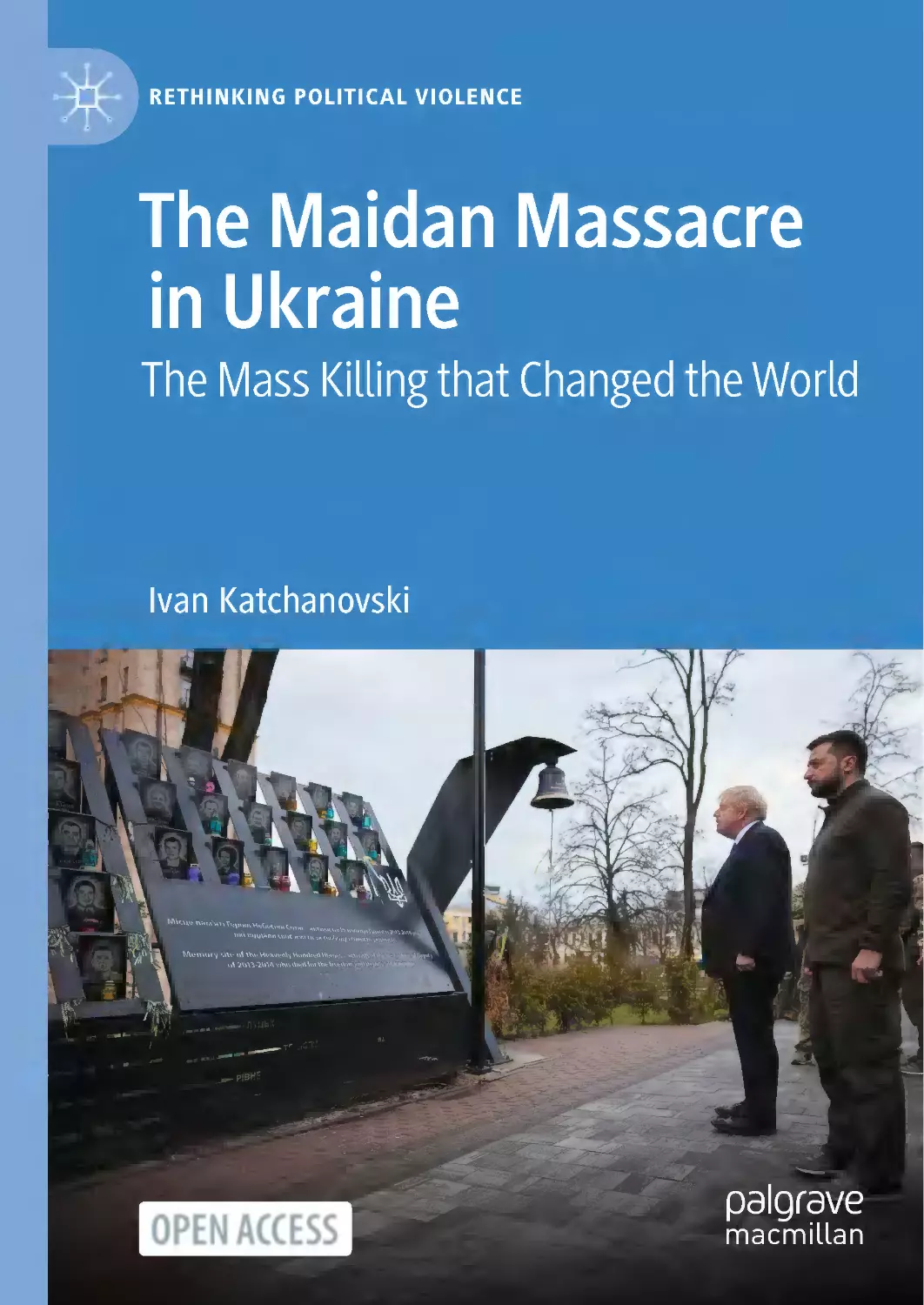
Cover illustration: President of Ukraine Volodymyr Zelenskyy and Prime Minister of the
United Kingdom Boris Johnson at the Maidan Massacre site. Source: President of Ukraine
(2022, April 9), Flickr
This Palgrave Macmillan imprint is published by the registered company Springer Nature
Switzerland AG
The registered company address is: Gewerbestrasse 11, 6330 Cham, Switzerland
If disposing of this product, please recycle the paper.

“Il est défendu de tuer; tout meurtrier est puni, à moins qu’il n’ait tué en
grande compagnie, et au son des trompettes; c’est la règle.”[It is forbidden
to kill; therefore all murderers are punished unless they kill in large
numbers and to the sound of trumpets; it is the rule].1
Voltaire
Facts are stubborn things; and whatever may be our wishes, our
inclinations, or the dictates of our passion, they cannot alter the state of
facts and evidence.’ 2
John Adams at the Boston massacre trial

1 Voltaire. (1817). Complete works of Voltaire: Philosophical Dictionary. Chez Th.
Desoer, 788. There was a Maidan activist playing his trumpet during the Maidan massacre.
He came under live ammunition fire from the snipers in Maidan-controlled Hotel Ukraina.
(See Video A).
2 Diggins, J. P. (Ed.). (2004). The Portable John Adams. Penguin Books, 255.

To my mother

Preface

This book analyzes the Maidan massacre of the protesters and the police
during the “Euromaidan” mass protests in Kyiv in Ukraine on February
20, 2014. This massacre is crucial case of political violence in Ukraine and
the world because it led to the overthrow of the Ukrainian government
and ultimately to the start of the civil war in Donbas, Russian military
interventions in Crimea and Donbas, the Russian annexation of Crimea,
and conflicts of Russia with Ukraine and the West which Russia escalated
dramatically by launching the illegal invasion and war with Ukraine in
2022.
This is the first scholarly book which analyzes comprehensively the
Maidan massacre in Ukraine. It is based on more than 10 years of my
research of this massacre and trials and investigations of this mass killing.
I am a Ukrainian and Canadian political scientist. I teach at the School
of Political Studies at the University of Ottawa. Previously, I was Visiting
Scholar at the Davis Center for Russian and Eurasian Studies at Harvard
University, Visiting Assistant Professor in the Department of Politics at
the State University of New York at Potsdam, Post-Doctoral Fellow in the
Department of Political Science at the University of Toronto, and Kluge
Post-Doctoral Fellow at the Kluge Center at the Library of Congress. I
received my Ph.D. from the Schar School of Policy and Government at
George Mason University under the direction of Seymour Martin Lipset,
one of the greatest political scientists and political sociologists.

ix

x

PREFACE

My academic publications include 4 books, 12 book chapters, and 20
articles in peer-reviewed journals, as well as this book and two forthcoming books concerning the Russia-Ukraine war and its origins and
modern Ukraine that will be published by major American and British
academic presses. I am one of the most cited political scientists who
specialize primarily in politics and conflicts in Ukraine. My research-based
publications, interviews, and comments appeared in more than 3,000
media reports in over 80 countries.
I am a life-long supporter of liberal democracy, human rights, and
peace in Ukraine and was one of the first to publicly call for the European
Union accession of Ukraine. I attended in 1988 the first small opposition
rally in Kyiv in some 80 years since Ukraine became Soviet. I was born
in Western Ukraine and educated in the Kyiv National Economic University, Central European University, and George Mason University. I faced
expulsion from the university in Kyiv in 1990 and was prevented from
pursuing graduate education in the Soviet Union because my undergraduate thesis, which was in Ukrainian, was based on theories of Max Weber
and Western economists and concluded that the Soviet system was bound
to collapse.
I presented my studies of the Maidan massacre at the following
academic conferences: The Annual Meeting of American Political Science
Association in San Francisco, September 3–6, 2015, the 22nd Annual
World Convention of the Association for the Study of Nationalities in
Columbia University, New York, May 4–6, 2017, the Annual Meeting
of the American Political Science Association in Boston, August 29–
September 2, 2018, the Regimes and Societies in Conflict: Eastern
Europe and Russia since 1956 conference by the Institute for Russian
and Eurasian Studies at Uppsala University and the British Association
for Slavonic and East European Studies in Uppsala, Sweden, September
13–14, 2018, the Virtual 52nd Annual Convention of the Association for
Slavic, East European, and Eurasian Studies, November 5–8 and 14–15,
2020, and the virtual 10th World Congress of the International Council
for Central and East European Studies, August 3–8, 2021.
Parts of my open-access articles in Russian Politics, Cogent Social
Sciences, and Journal of Labor and Society peer-reviewed journals, a
forthcoming open-access Routledge book, and, with publisher’s permission, my article in Canadian Dimension are republished in this book with
updated, revised, and greatly expanded content. Most of the book content
was previously not published. I received no outside financing for my

PREFACE

xi

research of the Maidan massacre, with the exception of small travel and
publication grants and crowdfunding making my articles open access. I
am grateful to all those who supported my academic study of this crucial
massacre that changed Ukraine and the world.
Ottawa, ON, Canada

Ivan Katchanovski

Contents

1

2

3

Introduction: The Massacre That Changed Ukraine
and the World
1.1 The Maidan Massacre and Its Impact
1.2 Data and Methodology
1.3 Theoretical Framework
Conflicting Narratives of the Maidan Massacre in Ukraine
2.1 Conflicting Government Narratives of the Maidan
Massacre
2.2 The Media Coverage of the Maidan Massacre
2.3 Misrepresentation of the Maidan Massacre by Wikipedia
2.4 Previous Academic Studies of the Maidan Massacre
Video Reconstruction and Content Analysis
of the Maidan Massacre on February 20, 2014
3.1 The Reconstruction of the Snipers’ Massacre
of the Police and the Protesters on the Maidan
in Ukraine
3.2 Shooting at Western, Polish, and Russian Journalists
During the Maidan Massacre
3.3 Overthrow of the Yanukovych Government

1
2
6
8
21
21
28
32
34
49

50
82
83

xiii

xiv

4

5

6
7

8

CONTENTS

Testimonies of Several Hundred Witnesses and 14
Self-Admitted Maidan Snipers
4.1 Testimonies by Over 300 Witnesses Concerning Maidan
Snipers
4.2 Confessions by 14 Self-Admitted Members of Maidan
Sniper Groups
Trial and Investigation Testimonies of Wounded
Maidan Activists and Witnesses
5.1 Testimonies of Wounded Maidan Activists Concerning
Snipers in Maidan-Controlled Locations
5.1.1 Hotel Ukraina Snipers
5.1.2 Zhovtnevyi Palace Snipers
5.1.3 Bank Arkada Snipers
5.1.4 Muzeinyi Lane, Music Conservatory,
and Other Maidan-Controlled Locations Snipers
5.1.5 Staged Wounding of a Female Maidan Medic
5.1.6 Government Forces-Controlled Buildings
and Areas Snipers
5.2 Testimonies by Prosecution Witnesses and Relatives
of Killed Maidan Activists Concerning Snipers
in Maidan-Controlled Locations
5.3 Testimonies of Defense Witnesses Concerning Maidan
Snipers

91
92
121
145
146
146
154
155
156
158
159

161
168

Forensic Ballistic and Medical Examinations
by Ukrainian Government Experts

177

The Maidan Massacre on February 18–19, 2014,
and Related Cases of Violence During the EuroMaidan
in Ukraine
7.1 The Maidan Massacre on February 18–19, 2014
7.2 Other Related Cases of Violence During the EuroMaidan

195
196
203

The Maidan Massacre Trial Verdict, and Cover-up,
Stonewalling, and Evidence Tampering
8.1 The Maidan Massacre Trial Verdict
8.2 Coverup, Stonewalling, and Evidence Tampering

211
212
224

CONTENTS

9

Conclusion and Implications for the Russia-Ukraine
War and Other Conflicts in Ukraine

Index

xv

249
259

List of Figures

Fig. 3.1

Fig. 3.2
Fig. 3.3
Fig. 3.4

Fig. 3.5
Fig. 3.6
Fig. 3.7
Fig. 3.8
Fig. 4.1
Fig. 5.1
Fig. 6.1

Fig. 6.2

Music Conservatory and the Main Post Office
on the Maidan (Independence Square) (Photo
by the author)
Hotel Ukraina (Photo by the author)
Zhovtnevyi Palace (Photo by the author)
Gunshot impact marks from the directions
of Maidan-controlled Hotel Ukraina, Zhovtnevyi Palace/
Kinopalats and Muzeinyi Lane on the tree (Photo
by the author)
Bank Arkada (Photo by the author)
Hotel Kozatsky (on the right) (Photo by the author)
Main Maidan massacre epicenter in front of Hotel
Ukraina (Photo by the author)
Makeshift memorial to Serhiy Melnychuk on the site
of his killing (Photo by the author)
Hotel Ukraina (Photo by the author)
Hotel Ukraina (Photo by the author)
The visual reconstruction of shooting at Maidan
protesters and Western, Polish, and Russian journalists
during the Maidan massacre in Ukraine and locations
of snipers in Hotel Ukraina: a view from a Berkut
barricade (based on Google Street Map)
Bullet holes in the electric pole from the government forces
direction and one exit hole from the Maidan-controlled
Hotel Ukraina direction (Photo by the author)

52
53
57

66
69
75
76
79
101
147

185

186

xvii

xviii

LIST OF FIGURES

Fig. 7.1

Map 3.1

Burned Trade Union Building covered
with the OUN-UPA “Glory to Ukraine. Glory
to Heroes” greeting (Photo by the author)
Maidan massacre map (Based on Google Satellite Map)

201
51

List of Tables

Table 3.1
Table 4.1
Table 5.1
Table 6.1
Table 7.1

Table 8.1

Summary of the video reconstruction and content
analysis of the Maidan massacre on February 20, 2014
Summary of witness testimonies concerning Maidan
snipers
Summary of trial and investigation testimonies
of wounded Maidan activists and witnesses
Summary of main findings of forensic examinations
of the Maidan massacre
Summary of the Maidan massacre on February
18–19, 2014, and other related cases of violence
during the EuroMaidan
Summary of the Maidan massacre trial verdict,
and cover-up, stonewalling, and evidence tampering

85
130
172
188

207
241

xix

CHAPTER 1

Introduction: The Massacre That Changed
Ukraine and the World

The chapter describes importance of the Maidan massacre of the police
and the Maidan protesters in Kyiv in Ukraine on February 18–20, 2014,
and its role in the overthrow of the Ukrainian government and ultimately
in the start of the war in Donbas, the Russian annexation of Crimea,
and conflicts of Russia with Ukraine and the West that Russia escalated dramatically by launching the illegal war with Ukraine on February
24, 2022. The question is whether the Yanukovych government, the
Maidan opposition, in particular, the far-right, or any “third force,”
such as Russia, was involved in the mass killing of protesters and the
police. Methodology and data combine content analysis of thousands
of videos, photos, and audio recordings of the massacre in Ukrainian,
Russian, English, and Polish with analysis of several hundred testimonies
of witnesses and wounded Maidan activists and results of forensic ballistic
and medical examinations by Ukrainian government experts. The analysis
of the primary data includes about 1,000 hours of video recordings of
the Maidan massacre trial, nearly 1,000,000-word trial verdict, and over
2,500 other court decisions. This chapter describes the theoretical framework of rational choice and the Weberian theory of rational action and
develops the moral hazard theory of the state repression backfire.

© The Author(s) 2024
I. Katchanovski, The Maidan Massacre in Ukraine, Rethinking Political
Violence, https://doi.org/10.1007/978-3-031-67121-0_1

1

2

I. KATCHANOVSKI

1.1

The Maidan Massacre and Its Impact

The mass killing of 74 Maidan protesters and 17 police and Internal
Troops members in Ukraine during the mass “Euromaidan” protests on
February 18–20, 2014, and wounding of respectively over 300 activists
and about 200 police and Internal Troops members is a crucial case of
political violence. This mass killing of the protesters and the police led
to the overthrow of the democratically elected and pro-Russian government of Viktor Yanukovych and gave the start of a civil war in Donbas,
Russia’s military intervention in Crimea and Donbas, the Russian annexation of Crimea, and an interstate conflict between the West and Russia and
between Ukraine and Russia. Russia drastically escalated these conflicts
by launching its illegal invasion of Ukraine on February 24, 2022. The
Russia-Ukraine war also escalated into a proxy war between the West and
Russia (see Black & Johns, 2015; Katchanovski, 2015, 2016a, 2016b,
2017, 2022a, 2023a, 2023b, Forthcoming; Kudelia, 2016; Hahn, 2018;
Sakwa, 2015).
This book uses the theory of rational choice, a Weberian theory of
instrumental rationality, and state repression backfire theories and analyses
a variety of evidence to determine whether the Yanukovych government,
the Maidan opposition, or any “third force” was involved in the mass
killing of protesters and the police. The research question is which party
or parties of the conflict massacred Maidan protesters and the police.
The Maidan massacre was immediately attributed to government
snipers and the Berkut police by the Maidan opposition, Western leaders,
and the media in Ukraine and the West. The far-right commander of the
same special Maidan company of snipers called from the Maidan stage on
the evening of February 21, 2014, to reject a signed agreement, which
was mediated by foreign ministers of France, Germany, and Poland and
a representative of the Russian president. He issued a public ultimatum
for President Viktor Yanukovych to resign by 10:00am the next day, justified it by blaming Yanukovych and his forces for the massacre, stated that
his Maidan company was responsible for the turning point of the Euromaidan, and threatened an armed assault if Yanukovych would not resign
(Yakshho, 2014). The commander of the Maidan Self-Defense said that
this ultimatum was a decision by “institutional bodies of the Maidan”
and that it was adopted by a military council set up by the Maidan
Self-Defense and the Right Sector on February 21, 2014 (Kalnysh, 2015).

1

INTRODUCTION: THE MASSACRE THAT CHANGED …

3

The Maidan massacre undermined the legitimacy of Yanukovych as
president of Ukraine and the legitimacy of the incumbent government,
police, and security forces and their monopoly on the use of force. The
massacre prompted a part of the Party of Regions deputies to leave their
faction and support the Maidan opposition and the parliament vote on
February 20 to withdraw government forces from downtown Kyiv and
subsequent votes to dismiss then President Yanukovych and his government, even though this was unconstitutional. Many deputies were forced
to vote or their cards were used to vote for them. For instance, the
commander of the far-right-linked group of the Maidan snipers admitted
that his group forced certain members of the parliament to participate
in the votes to dismiss Yanukovych and his government and to elect the
Maidan leaders in their place (Katchanovski, Forthcoming; Kovalenko,
2014).
An agreement signed on February 21, 2014, by Yanukovych, the
Maidan opposition leaders, and representatives of France, Germany, and
Poland stipulated withdrawal of the government forces from downtown
Kyiv, disarmament of the Maidan activists, early presidential elections, and
the investigation of the Maidan massacre with involvement of the Council
of Europe. But this agreement was violated by the Maidan opposition,
which seized control over the presidential administration, the Cabinet of
Ministers, the parliament, and other government buildings following the
withdrawal of the government forces.
Then US Vice President Joe Biden revealed in his memoirs that during
the Maidan massacre he called Yanukovych and told him that “it was
over; time for him to call off his gunmen and walk away” and “he
shouldn’t expect his Russian friends to rescue him from this disaster,” that
“Yanukovych had lost the confidence of the Ukrainian people,” and that
“he was going to be judged harshly by history if he kept killing them.”
Biden wrote that “the disgraced president fled Ukraine the next day —
owing to the courage and determination of the demonstrators — and
control of the government ended up temporarily in the hands of a young
patriot named Arseniy Yatsenyuk” (Biden 2017).
US President Barack Obama stated that “we had brokered a deal to
transition power in Ukraine” after the massacre and before Yanukovych
fled, but the US president or other American government officials did
not release any specific information about the nature of this involvement
(PRES, 2015).

4

I. KATCHANOVSKI

Russian President Vladimir Putin and other Russian leaders as well as
the Russian media called the overthrow of Yanukovych as a fascist or Nazi
coup. They justified support of separatism and annexation of Crimea by
protection of ethnic Russians from the Ukrainian ‘fascists’ or ‘Nazis’ and
by the Russian national security interests to prevent it from losing control
of the main Black Sea naval base and its falling under control of NATO.
Not only Russian President Vladimir Putin but also then US President
Barak Obama stated that the Russian annexation of Crimea was a reaction to the violent overthrow of the Yanukovych government with the
US involvement. Obama said that “Mr. Putin made this decision around
Crimea and Ukraine, not because of some grand strategy, but essentially
because he was caught off balance by the protests in the Maidan, and
Yanukovych then fleeing after we’d brokered a deal to transition power
in Ukraine” (PRES, 2015). After initially denying the Russian military
intervention, Putin admitted in his 2015 documentary interview that he
proposed his plan to “return” Crimea and authorized the covert Russian
military intervention on February 23, 2014, following the overthrow of
Yanukovych (see Katchanovski, Forthcoming).
The violent overthrow of the pro-Russian Yanukovych government
gave a significant boost to separatism in Crimea. The Russian government
used this overthrow to reverse its previous policy and start backing both
pro-Russian separatists and the annexation of Crimea. Yanukovych fled
from Eastern Ukraine to Russia and then to Crimea on February 22,
2014, and the Russian military there on instructions from the Russian
government helped him to escape again to Russia (Katchanovski, 2015,
Forthcoming).
Previous studies show that conflicts between Russia and Ukraine and
Russia and the West started with the violent overthrow of the relatively
pro-Russian government in Ukraine by means of the Maidan massacre and
assassination attempts against then President Viktor Yanukovych (see
Bandeira, 2019; Black & Johns, 2015; Katchanovski, 2016a, 2016b,
2020, 2023a, 2023b, Forthcoming; Hahn, 2018; Mandel, 2016; Lane,
2016; Sakwa, 2015). The violent overthrow of the Yanukovych government escalated into the civil war in Donbas with pro-Russian separatists
and an international conflict between Russia and Ukraine and the West
and Russia. Russia escalated the conflict by conducting military interventions in Crimea and Donbas and annexing in the violation of the
international law Crimea, which was populated primarily by ethnic
Russians, and by launching the illegal invasion and the war in Ukraine (see

1

INTRODUCTION: THE MASSACRE THAT CHANGED …

5

Katchanovski, 2015, 2016a, 2022a, Forthcoming; Kudelia, 2016; Hahn,
2018; Sakwa, 2015).
The violent overthrow of the relatively pro-Russian government was a
tipping point in the conflicts in Ukraine and between the West and Russia
over Ukraine. President Putin used this overthrow and its backing by the
governments of the US and EU countries to radically change his policy
towards Ukraine. The Russian government started to pursue annexation
of Crimea with the help of direct military intervention since the end of
February 2014 and then annexed Crimea in March 2014 in a violation of
international law (see Katchanovski, 2015).
The Maidan massacre that resulted in the overthrow of the Yanukovych
government also spiraled into the separatist rebellion in Donbas in Eastern
Ukraine. The overthrow of the government led to a power vacuum in
the Donetsk and Luhansk Regions, which were until then strongholds of
Yanukovych and his Party of Regions.
The Russian invasion of Ukraine on February 24, 2022, was illegal
and extreme escalation of conflicts of Russia with Ukraine and the West
and the civil war in Donbas that followed the Western-backed violent
and illegal overthrow with involvement of the oligarchic and far-right
elements of the Maidan opposition of the pro-Russian government in
Ukraine by means of the Maidan massacre and assassination attempts
against Viktor Yanukovych. The Russia-Ukraine war also escalated into
the proxy war between the West and Russia in Ukraine (see Katchanovski,
2022a, Forthcoming).
Ursula von der Leyen, the EU Commission President, stated in 2023
that “Today, war is back in Europe. But for many Ukrainians, this conflict
began already ten years ago. It began when peaceful protesters, just
waving the European flags in Maidan Square, were shot dead by snipers”
(Keynote, 2023). Putin, for instance, in his Tucker Carlson interview in
2024, made similar statements linking the Russian invasion of Ukraine to
the Maidan massacre (Carlson, 2024).
The identification and prosecution of those who perpetrated and organized the Maidan massacre could have helped to prevent or resolve peacefully the subsequent conflicts that it triggered, including the violent overthrow of the Yanukovych government, the Russian annexation of Crimea,
the war in Donbas, and the Russia-Ukraine war (see Katchanovski, 2015,
2022a, 2022b, 2023a).

6

I. KATCHANOVSKI

1.2

Data and Methodology

This book combines different social science research methods and analysis of vast amount of various type of data. It uses content analysis of
all publicly available videos, photos, and audio recordings of the Maidan
massacre on February 18–20 in English, Ukrainian, Russian, Polish,
and other languages with an analysis of several hundred testimonies
concerning this massacre based on qualitative interview methodology.
The manifest and latent content analysis covers over 2,000 videos and
recordings of live Internet and TV broadcasts of the massacre in nearly
50 countries, news reports, and social media posts by over 120 journalists
covering the massacre from Kyiv, more than 6,000 photos, and close to 30
gigabytes of publicly available radio intercepts of snipers and commanders
of the Security Service of Ukraine and Internal Troops.
The analysis is also based on nearly 1,000 hours of official video recordings of the Maidan massacre trial and the Yanukovych treason trial, the
nearly 1,000,000-word text of the Maidan massacre trial verdict in the
official online Ukrainian court decisions database. The data includes information concerning GPU investigations of this massacre of the protesters
and the police in over 2,500 court decisions. These court decisions are
publicly available in the official online Ukrainian court decisions database.
The names of people being investigated are omitted in these decisions.
Media interviews of prosecutors, Maidan victims’ lawyers and Berkut
lawyers, and various media reports about the Maidan massacre trials and
investigations are also examined.
This study analyzed interviews and statements by several hundred
witnesses in media and social media. Most of these testimonies are by
eyewitnesses, mostly Maidan protesters, and Western and Ukrainian journalists. Testimonies of indirect witnesses concerning Maidan snipers are
primarily Maidan protesters, politicians, and pro-Maidan journalists. Such
“statements against interest” relayed by indirect witnesses are accepted in
criminal law and trials in the US, Canada, and other Western countries
(see Martin, 1994). Since it would be in rational self-interest for Berkut
officers and the Yanukovych government officials, who are charged with
the Maidan massacre, to deny their responsibility whether they are guilty
or not, the analysis does not rely on their testimonies.
The analysis also employs field research and photos by the author at
the site of the Maidan massacre in downtown Kyiv in July 2014, and
numerous visits before the massacre to the Maidan and most surrounding

1

INTRODUCTION: THE MASSACRE THAT CHANGED …

7

buildings, such as Hotel Ukraina, the Main Post Office, Zhovtnevyi
Palace, Dnipro Hotel, and Kozatsky Hotel. A multimethod methodology
combining content analysis of videos, audio recordings, and photos of
the massacre with analysis of qualitative interviews with witnesses makes
the case study and its findings much more reliable than typical scholarly studies. Specific testimonies concerning specific events, in particular,
killings and wounding of specific protesters and locations of the shooters,
were corroborated by other evidence, such as other testimonies, video
and audio recordings of these events, and results of forensic medical
and ballistic examinations by government experts of the same specific
events. The same concerns other types of evidence such as videos. In addition, the evidence is evaluated using other standard criteria in scholarly
methodology, such as validity, specifically, face validity and replication.
This study also introduced a digital event reconstruction methodology
for scholarly research on political violence. Digital event reconstruction
methodology, in particular, of mass killings and other cases of political
violence, is used in international criminal justice and by non-academic
researchers such as Bellingcat (see Zarmsky, 2021). It is revealing that
Bellingcat did not present an analysis of this massacre despite stating in
February 2015 that they were working on such investigation (Bellingcat
2015). The failure by Bellingcat to examine the Maidan massacre was
another dog that did not bark.
Seven online video appendixes include brief relevant compilations of
segments of videos of the February 20 massacre and the Maidan massacre
trial (see Video 2023a, 2023b, 2023c, 2023d, 2023e, 2023f, 2023g).
They are available on the author’s YouTube channel. Numerous videos of
the massacre were synchronized based on the matching visual and audio
content of videos, in particular, speeches from the Maidan stage, and
on time-stamped video recordings, such as recordings of live TV broadcasts, Internet streaming, and security cameras. These video appendixes
also contain maps that show the locations of the government forces and
buildings with snipers, locations, and times of killing and wounding of
specific Maidan protesters and policemen. The locations and positions of
the snipers are determined based on their videos, photos, and testimonies
of wounded protesters and witnesses.
The timing and video synchronization in these video compilations,
including the times and locations of killings and wounding of the specific
Maidan protesters, have some minor exceptions consistent with the timestamped compilations of videos of the massacre by the SITU architectural

8

I. KATCHANOVSKI

company and Talionis group, which are based on their computer synchronizations. The Talionis video compilation of the Maidan massacre was
presented as evidence by the prosecution and Maidan lawyers during the
trial (see Vysota, 2017a, 2017b). This compilation was produced by an
anonymous group with funding from the Prosecutor’s General Office
(Katchanovski, 2019). However, both SITU and Talionis omitted the
initial part of the massacre on February 20, in particular, the killing and
wounding of the police, and many videos regarding Maidan snipers that
were included in the present study.
The multimethod research and analysis of all publicly available data
sources enhance reliability and validity of the analysis and data. Only findings that are corroborated by at the very least two independent sources,
excluding those with vested interest, are used. Typically, findings rely on
much greater number of such independent sources.

1.3

Theoretical Framework

This study relies on the rational choice theoretical framework and the
Weberian theory of rational action and state repression backfire theories.
The rational choice theory views people as acting in a calculated and selfinterested manner, and this theory was applied for various specific political
events (see, for example, Bates et al., 1998). However, rational choice
assumes that people have perfect information to make such decisions and
that all of their actions are rational. In contrast, the Weberian theory of
social action regards instrumentally rational type of action as one ideal
type of action alongside value-rational, traditional, and affectual types
of action, and that such actions can be interpreted and understood by
scholars. The instrumentally rational type of action involves “the attainment of the actor’s own rationally pursued and calculated ends” (Weber,
1978, 24–25).
While rational choice treats all actions as rational and calculated, Weber
recognized other types of actions, such as affective or emotional (Weber,
1978, 25). Irrational actions, particularly emotions and mistakes, can also
occur during violent conflicts and revolutionary events (see Beissinger,
2022). For example, an examination of the Maidan massacre by a proMaidan journalist emphasized feelings of hate between protesters and the
police (Koshkina, 2015).
The Ukrainian and Western media and governments-promoted narrative of the Maidan massacre appears irrational from both rational choice

1

INTRODUCTION: THE MASSACRE THAT CHANGED …

9

and Weberian instrumentally rational action perspectives. Yanukovych and
his associates lost all of their power and much of their wealth, and
fled from Ukraine as a result of this mass killing, since this massacre of
protesters undermined his and his government’s legitimacy, even among
the many deputies of his Party of Regions who joined the opposition and
voted to remove him from the presidency. The same problem concerns
the irrational retreat of the police from their position at Maidan and the
mass killing of the protesters by the police, since Berkut and the internal
troop units had nonlethal weapons to stop unarmed protesters and it
was more rational to use live ammunition or snipers to deliver warning
shots or target armed protesters and the Maidan leaders, rather than to
kill advancing protesters. Similarly, the repeated attempts by protesters to
advance on the very small and relatively unimportant part of Instytutska
Street also seem irrational and hard to explain from these theoretical
perspectives, because a large number of people going under constant fire
would amount to a collective mass suicidal action. While some of the
government leaders, policemen, and protesters might have been driven
by value-rational actions, such as being motivated by ideology; affectual actions, based on emotions; or miscalculations in their instrumentally
rational actions, it would be anomalous for all different actors to do this
at the same time.
The dominant narrative promoted by the Ukrainian and Western
governments and, with some exceptions, the Ukrainian and Western
media concerning the Maidan massacre is consistent with state repression backfire theories. State repression backfire means that attempts to use
violence to suppress protests instead produce a backlash against the state
in response to such violence. This means defeating vastly superior state
forces by peaceful protesters in an asymmetric conflict (see, for example,
Anisin, 2014, 2019; Chenoweth & Stephan, 2011; Hess & Martin, 2006;
Martin, 2007; Sharp, 1973).
The backfire requires that state repression be perceived as completely
unjustifiable, excessive, or disproportional, and that information about
state repression be communicated to the public and other actors,
such as foreign governments (see Martin, 2007). Examples of such
state repression backfires include the Bloody Sunday massacre of antigovernment protesters by the police, which spurred the Russian Revolution in 1905, and the Jallianwala Bagh (Amritsar) massacre of proindependence protesters by the British Indian Army, which spurred the

10

I. KATCHANOVSKI

pro-independence movement in India led by Mahatma Gandhi (see
Anisin, 2014, 2019).
State repression backfire theories suggest that the Maidan massacre of
unarmed anti-government protesters in Ukraine was an extreme form
of state repression by the Yanukovych government and its forces and
was aimed at suppressing anti-government mass protests on the Maidan.
However, the state repression of peaceful Maidan protesters by means of
their unprovoked massacre supposedly backfired after it was highly publicized by media and social media in Ukraine and the West. The mass killing
of the protesters ostensibly produced a massive public outrage and a backlash against the incumbent government, delegitimizing its use of force
and leading to Yanukovych and his government leaders, who were blamed
for the massacre of protesters, fleeing from Ukraine to avoid prosecution
or other retaliation to order this mass killing.
State repression backfire also implies that the incumbent government
has rational incentives to cover up state violence and those responsible
for such violence to prevent or minimize the backfire. If the Yanukovych
government, its police and security forces, or any pro-Yanukovych “third
force” did perpetrate this mass killing one would expect cover-up by
them and speedy and effective investigations and the prosecutions by
Maidan governments. It was in the rational self-interest of the Maidan
governments, whose legitimacy was ultimately based on this massacre, to
conduct effective and speedy investigations and prosecutions of this one
of the most documented cases of mass killings in the history of the world.
However, previous studies have failed to consider that there is a moral
hazard in such mechanisms of state repression backfire. The mechanisms of the repression backfire can be exploited by opposition or proopposition actors in their own self-interest based on rational calculations
of expected costs and benefits. The provocation of government violence
against protesters or the covert staging of such violence and attributing
it to state repression can be rational from the perspective of theories
of rational choice or Weberian instrumentally rational actions for actors
driven by self-interest and not concerned with ethical considerations.
The moral hazard contains an incentive for the opposition to produce a
transformative event that could not only create significant media coverage
and public outcry against the incumbent government inside and outside
of the country, but also dramatically increase popular mobilization and
domestic and international support, eventually resulting in concessions or
regime transition. Provoked or staged violence by pro-opposition actors

1

INTRODUCTION: THE MASSACRE THAT CHANGED …

11

has the power to backfire to a government by undermining its legitimacy
and its use of security, police, and military forces, thus defeating them
in an asymmetric conflict. This greatly increases the chances that government police, security, and military forces and high-ranking commanders,
officials, and politicians will defect from the incumbent government. Such
provocation of state violence or staging of false-flag violence means a very
high-stake and high-risk game. The incentive to minimize risk in case of
failure and detection of exposure implies that the use of provocation and
staged false-flag violence would be exceptional and rare, and would be
done covertly and with subsequent cover-up.
The moral hazard of the state repression backfire in the case of the
Maidan massacre would mean that certain elements of the oligarchic and
far-right Maidan opposition provoked the mass killing of the protesters,
for instance by killing and wounding the police, or covertly staged the
mass killing of the protesters themselves in order to blame the violence
on the incumbent government leaders and their security or police forces
and seize power in Ukraine as a result of this transformative event. This
would also mean very strong incentives for the Maidan governments to
cover such provocation or staged violence and stone wall investigations of
mass killing on the Maidan.
There is evidence of such precedent of provoked and staged violence in
Romania during the anti-communist “revolution” in 1989, which became
a transformative event in Romanian history. The former Romanian president, prime minister, and a number of other leaders of the “revolution”
were charged by Romanian prosecutors in 2018 and 2019 with crimes
against humanity for using deliberate disinformation and diversion right
after they seized power in 1989 to provoke false-flag mass killings that
resulted in 863 deaths. The prosecution charges state that they used such
orchestrated killings and other violence to legitimize their power and
execute the Romanian communist government and party leader Ceausescu for these mass killings in a mock trial that they helped to stage.
These and other leaders of the new Romanian government and military
commanders reportedly provoked and staged the killings of supporters
of the new government by other supporters of the new government,
including in the military, by literally using false flags, deliberate diversions,
and misinformation that Ceausescu snipers from the security services and
his other loyalists, called “terrorists,” were killing supporters of the new
government (Romanian, 2018).

12

I. KATCHANOVSKI

A similar state repression backfire can involve executions, assassinations, poisoning, arrests, beatings, or torture by opposition leaders,
activists, and protesters. However, such repression also involves moral
hazard. For instance, videos and testimonies of various Maidan activists
and eyewitnesses show that violent dispersal of Maidan protesters on
November 30, 2013, was deliberately provoked by Maidan opposition
leaders, the far-right Right Sector, and the head of the Yanukovych
administration. His TV channel filmed and publicized it along with other
Ukrainian and foreign TV and other media as unprovoked police violence
against students on the Yanukovych order. Orchestrated police violence
was used to trigger mass Maidan protests against Yanukovych and his
government (see Katchanovski, 2020).
The moral hazard theory of state repression backfire, rational choice,
and Weberian rationality-based analysis can be applied not only to the
analysis of the Maidan massacre in Ukraine. Such a theoretical framework
can also be used to conduct theory-based and evidence-based scholarly
analyses of possible cases of false-flag violence in Ukraine and other countries. There is a similar moral hazard in interstate violence and conflict
backfires. Similarly, there is a moral hazard in humanitarian intervention
that involves perverse incentives for political actors to engage in risky and
fraudulent actions against their own state to elicit violent state repression
and humanitarian intervention by foreign states in response (Kuperman,
2008).
Cases of false-flag violence included violent attacks staged by Nazi
Germany and disguised as Polish attacks in the German territory, for
instance, in Gleiwitz. They were used by Nazi Germany as a pretext to
invade Poland and start World War II and for propaganda purposes to
justify this invasion (see, for instance, Davies, 2006, 152). A false-flag
shelling with reported casualties by Soviet border guards near the village
of Mainila was used by the Soviet Union as a casus belli for a war with
Finland in 1939. This shelling was staged by Soviet forces on orders of
Soviet leadership and was falsely blamed on shelling by Finland to create
a pretext for the war (Spencer, 2018).
There is a documented history of such false-flag operations in politics and conflicts in Ukraine and other countries, specifically during

1

INTRODUCTION: THE MASSACRE THAT CHANGED …

13

World War II, the Cold War, and since the Cold War.1 For instance, the
Ukrainian Insurgent Army units often used disguises of Soviet partisans
or Soviet military and security forces to carry their killings of Polish and
Ukrainian civilians in order to hide the UPA responsibility and impute
these killings on their adversaries. The Soviet secret police created many
fake UPA units to locate and neutralize actual UPA units and their sympathizers among the local population in Western Ukraine after the Soviet
Union regained its control of this region at the end of World War II (see
Statiev, 2010).
The Soviet KGB created fake underground organizations in Ukraine
as a part of its tactic against different factions of the OUN and the US
and British intelligence services that used the OUN during the Cold
War. Various academic studies and documents of the Central Intelligence
Agency (CIA) show that the US government was involved during the
Cold War in 1953 in organizing false-flag violent attacks in Iran as a
part of the US-led overthrow of a democratically elected government and
turning this country into a US client state run by an authoritarian government (see Abrahamian, 2013; Gasiorowski, 1991). Some researchers and
journalists argue that clandestine networks, which were organized during
the Cold War by the governments in West European countries to form
underground resistance during their potential occupation by the Soviet
Union and which included many far-right elements, were involved in
various false-flag attacks (Ganser, 2005).
The dioxin poisoning of Viktor Yushchenko helped to mobilize
popular support for the “Orange Revolution” and win him the 2004
presidential elections, whose results were initially falsified in favor of
Yanukovych. While the opposition and the media initially presented
this as an assassination attempt by the Yanukovych side or the Russian
government, the case has not been solved. After becoming president,
Yushchenko indicated that politicians or oligarchs with whom he was
previously allied might have been involved (Katchanovski, 2008).
Some scholars and journalists presented the Moscow apartment bombings in 1999 as a false-flag operation carried out by the Russian domestic
security agency in order to create a pretext for the second Russian war
in then de facto independent Chechnya and increase popular support
1 In various cases, especially relatively recent, it is difficult to come to definite conclusions if certain events constituted false flag operations or not, because of lack of publicly
available data to answer research questions or test various research hypotheses.

14

I. KATCHANOVSKI

for Vladimir Putin before the presidential elections (see, for example,
Dunlop, 2012). While such hypothesis cannot be excluded, the second
war in Chechnya then already started with invasion or radical Islamist
militias in Chechnya of the Dagestan region of Russia and the Islamic
terrorists carried out several similar large-scale attacks during the first and
second Chechen wars in Budenovsk, Makhachkala, Moscow, and Beslan
and later claimed responsibility for the Moscow apartment bombings (see
Sakwa, 2005).
Similarly, while Western governments and international organizations
concluded that a chemical attack near Damascus in Syria in 2013 was
most likely perpetrated by the Syrian government, there were claims that
this was a false-flag attack by Islamic rebels in order to draw a direct
US military intervention in the Syrian civil war. Some journalists argued
based on various evidence that the massacres of opposition protesters in
Venezuela and in Vilnius in Soviet Lithuania were falsely attributed to the
government forces but were perpetrated by snipers from the opposition
forces in order to frame the governments and to overthrow them (see
Jones, 2009; Sapozhnikova, 2018).
Since the collapse of the Soviet Union, various government and opposition parties and leaders in Ukraine often used political technologies
against their political opponents, including false-flag political parties,
newspapers, and advertisements, specifically during election campaigns
(see Wilson, 2005). Ukrainian politics has been a high-stakes game
because the power it gives allows rent seeking for politicians and oligarchs
via the enrichment of themselves and their personal and political networks
via corruption, insider dealings and advantages over political and business
rivals. Power also grants de facto immunity from prosecution.
There are numerous “conspiracy theories” of false-flag operations which are generally promoted by political activists and amateur
researchers. For example, they dismiss the overwhelming evidence that 9/
11 attacks in the US were organized and carried out by Islamic terrorists
and claim without sufficient evidence that these attacks were a false-flag
operation.
Similarly, the Ukrainian government and media claimed that separatists
in Donbas have routinely used false-flag attacks by shelling cities and
towns under their control. Similar allegations about false-flag attacks by
Ukrainian forces were often advanced by separatist and Russian media
concerning shelling of cities and other areas controlled by the central
government. However, studies and OSCE mission reports indicate that

1

INTRODUCTION: THE MASSACRE THAT CHANGED …

15

such claims generally either lacked evidence or relied on fake evidence
(see Katchanovski, 2016a).
Various separatist and Russian politicians and media claimed that a
downing of a Malaysian MH17 passenger plane in Donbas in 2014 was a
false-flag attack. However, publicly available evidence, which was reported
in the media, the social media, and a trial in the Netherlands, indicates
that the plane was shot down with a missile by separatists from a Russiansupplied Buk because it was mistaken for a Ukrainian military plane. Such
evidence includes photos and videos of a Buk with antiaircraft missiles
near the time and estimated place of its missile launch and the location
of the Buk and launch spot in the separatist-controlled areas, SBU intercepts of phone calls of separatist commanders concerning the Buk and the
shot-down plane (see Katchanovski, 2016a; Forthcoming).
There were also numerous claims of false-flag attacks during the
Russia-Ukraine war. However, contrary to claims by the Russian Defense
Ministry and Donbas separatists, there is no confirmed evidence of falseflag bombings of the Mariupol maternity hospital and the Mariupol
theater by the Azov Regiment or other Ukrainian forces. The same
concerns claims by the Ukrainian government that the shelling of Donetsk
and the Zaporizhzhia nuclear plant were false flags by the Russian forces.
There is no corroborated evidence of systematic false-flag shelling or
bombing of civilians by the Russian, separatist, and Ukrainian forces.
Similarly, contrary to the Russian government claims of staged killings in
Bucha, analysis of UN and Amnesty International reports, forensic expert
reports, videos, satellite images, eyewitness reports, media investigative
reports, and other sources shows that at least dozen civilians and territorial defense members were summarily executed or shot indiscriminately
by individual Russian soldiers or Russian units during the Russian occupation of Bucha and suggests that at least many of several dozen other
shot civilians and territorial defense members in Bucha were also victims
of such Russian war crimes, while most of about 400 victims were killed
by shelling (see Katchanovski, 2022a; Forthcoming).

References
Abrahamian, E. (2013). The Coup: 1953, The CIA, and The Roots of Modern
U.S.-Iranian Relations. New Press.

16

I. KATCHANOVSKI

Anisin, A. (2014). The Russian Bloody Sunday Massacre of 1905: A Discursive
Account of Nonviolent Transformation. Politics, Groups, and Identities, 2(4),
643–660.
Anisin, A. (2019). Comparing Protest Massacres. Journal of Historical Sociology,
32(2), 258–274.
Bandeira, L. (2019). The World Disorder: US Hegemony, Proxy Wars, Terrorism
and Humanitarian Catastrophes. Springer.
Bates, R., Greif, A., Levi, M., Rosenthal, J.-L., & Weingast, B. (1998). Analytic
Narratives. Princeton University Press.
Beissinger, M. R. (2022). The Revolutionary City: Urbanization and the Global
Transformation of Rebellion. Princeton University Press.
Bellingcat. (2015, February 15). [Tweet]. Twitter. https://twitter.com/bellin
gcat/status/566942944285175808?s=20
Biden, J. (2017). Promise Me, Dad. Flatiron Book.
Black, J. L., & Johns, M. (Eds.). (2015). The Return of the Cold War: Ukraine,
the West and Russia. Routledge.
Carlson, T. (2024). Exclusive: Tucker Carlson interviews Vladimir Putin. [Video].
YouTube. https://www.youtube.com/watch?v=fOCWBhuDdDo
Chenoweth, E., & Stephan, M. J. (2011). Why Civil Resistance Works: The
Strategic Logic of Nonviolent Conflict. Columbia University Press.
Davies, N. (2006). No Simple Victory: World War II in Europe, 1939–1945.
New York: Viking.
Dunlop, J. B. (2012). The Moscow Bombings of September 1999: Examinations of
Russian Terrorist Attacks at the Onset of Vladimir Putin’s Rule. Ibidem.
Ganser, D. (2005). NATO’s Secret Armies: Operation GLADIO and Terrorism in
Western Europe. Frank Caas.
Gasiorowski, M. J. (1991). U.S. Foreign Policy and the Shah: Building a Client
State in Iran. Cornell University Press.
Hahn, G. M. (2018). Ukraine Over the Edge: Russia, the West and the “New
Cold War.” McFarland Books.
Hess, D., & Martin, B. (2006). Repression, Backfire and the Theory of
Transformative Events. Mobilization, 11, 249–267.
Jones, B. (2009). Hugo! The Hugo Chavez Story from Mud Hut to Perpetual
Revolution. Steerforth Press.
Kalnysh, V. (2015, February 2). Andrey Parubiy: Na Majdane i po nam, i po
“Berkutu” “rabotal” rossijskij specnaz. RBK—Ukraina. http://www.rbc.ua/
rus/interview/andrey-parubiy-na-maydane-i-po-nam-i-po-berkutu-rabotal-17022015132900
Katchanovski, I. (2008). The Orange Evolution? The “Orange Revolution” and
Political Changes in Ukraine. Post-Soviet Affairs, 24(4), 351–382. https://
doi.org/10.2747/1060-586X.24.4.351

1

INTRODUCTION: THE MASSACRE THAT CHANGED …

17

Katchanovski, I. (2015). Crimea: People and Territory Before and After Annexation. In A. Pikulicka-Wilczewska & R. Sakwa (Eds.), Ukraine and Russia:
People, Politics, Propaganda and Perspectives (pp. 80–89). E-International
Relations.
Katchanovski, I. (2016a). The Separatist War in Donbas: A Violent Break-up of
Ukraine? European Politics and Society, 17 (4), 473–489.
Katchanovski, I. (2016b). The Maidan Massacre in Ukraine: A Summary of Analysis, Evidence, and Findings. In J. L. Black & M. Johns (Eds.), The Return
of the Cold War: Ukraine, the West and Russia (pp. 220–224). Routledge.
Katchanovski, I. (2017). The “Euromaidan”, Democracy, and Political Values in
Ukraine. In B. Axford, D. Buhari-Gulmez, & S. B. Gulmez (Eds.), Bridging
Divides: Rethinking Ideology in the Age of Global Discontent (pp. 122–142).
Routledge.
Katchanovski, I. (2019, April 22). The Buried Maidan Massacre and Its Misrepresentation by the West. Consortium News. https://consortiumnews.com/
2019/04/22/the-buried-maidan-massacre-and-its-misrepresentation-by-thewest/
Katchanovski, I. (2020). The far right, Euromaidan, and the Maidan massacre in
Ukraine. Journal of Labor and Society, 23(1), 5–29.
Katchanovski, I. (2022a). The Russia-Ukraine War and the Maidan in Ukraine.
Annual Meeting of the American Political Science Association, Montreal,
September 15–18.
Katchanovski, I. (2022b). The Hidden Origin of the Escalating UkraineRussia Conflict. Canadian Dimension. https://canadiandimension.com/art
icles/view/the-hidden-origin-of-the-escalating-ukraine-russia-conflict
Katchanovski, I. (2023a). The Maidan Massacre Trial and Investigation Revelations and Their Implications for the Ukraine-Russia War and Relations.
Russian Politics, 8(2), 181–205.
Katchanovski, I. (2023b). The “Snipers’ Massacre” on the Maidan in Ukraine.
Cogent Social Sciences, 9(2).
Katchanovski, I. (Forthcoming). From the Maidan to the Russia-Ukraine War.
Routledge.
Keynote speech by President von der Leyen at the opening session of the Council
of Europe Summit ‘United around our Values.’ (2023, May 16). European Commission. https://ec.europa.eu/commission/presscorner/detail/en/
speech_23_2786
Koshkina, S. (2015). Maidan. Bright Books.
Kovalenko, O. (2014, February 24). Sotnyk, yakyj perelomyv khid istoriyi:
Treba bulo dotyskaty. Ukrainska Pravda. http://www.pravda.com.ua/art
icles/2014/02/24/7016048
Kuperman, A. J. (2008). The Moral Hazard of Humanitarian Intervention:
Lessons from the Balkans. International Studies Quarterly, 52(1), 49–80.

18

I. KATCHANOVSKI

Kudelia, S. (2016). The Donbas Rift. Russian Politics & Law, 54(1), 5–27.
Lane, D. (2016). The International Context: Russia, Ukraine and the Drift to
East-West Confrontation. International Critical Thought, 6(4), 623–644.
Mandel, D. (2016). The Conflict in Ukraine. Journal of Contemporary Central
and Eastern Europe, 24(1), 83–88.
Martin, B. (2007). Justice Ignited: The Dynamics of Backfire. Rowman &
Littlefield.
Martin, M. M. (1994). Supreme Court Rules on Statements against Interest.
Touro Law Review, 11, 179–183.
PRES OBAMA on Fareed Zakaria GPS. (2015, February 1). CNN . http://cnn
pressroom.blogs.cnn.com/2015/02/01/pres-obama-on-fareed-zakaria-gpscnn-exclusive/
Romanian Ex-President Iliescu Indicted for ‘Crimes Against Humanity.’ (2018,
December 21). RFE/RL. https://www.rferl.org/a/romanian-ex-president-ili
escu-indicted-for-crimes-against-humanity-/29669414.html
Sakwa, R. (Ed.). (2005). Chechnya: From Past to Future. Anthem Press.
Sakwa, R. (2015). Frontline Ukraine: Crisis in the Borderlands. I.B. Tauris.
Sapozhnikova, G. (2018). The Lithuanian Conspiracy and the Soviet Collapse:
Investigation into a Political Demolition. Clarity Press.
Sharp, G. (1973). The Politics of Nonviolent Action: Part Two, the Methods of
Nonviolent Action. Porter Sargent.
Spencer, M. L. G. (2018). Stalinism and the Soviet-Finnish War, 1939–40.
Palgrave.
Statiev, A. (2010). The Soviet Counterinsurgency in the Western Borderlands.
Cambridge University Press.
Video. (2023a, October 13). [Video]. YouTube. https://www.youtube.com/
watch?v=1RNCNQpeTqI
Video. (2023b, October 18). [Video]. YouTube. https://www.youtube.com/
watch?v=PA3UCJ_5e90
Video. (2023c, October 18). [Video]. YouTube. https://www.youtube.com/
watch?v=epCZkgUIZ2A
Video. (2023d, October 13). [Video]. YouTube. https://www.youtube.com/
watch?v=GSlFBOpJAos
Video. (2023e, October 13). [Video]. YouTube. https://www.youtube.com/
watch?v=zfSETdAA8No
Video. (2023f, October 13). [Video]. YouTube. https://www.youtube.com/
watch?v=StVvfxxcUPg
Video. (2023g, October 18). [Video]. YouTube. https://www.youtube.com/
watch?v=Nh-J50hJXV8
Vysota ”Zhovtnevyi” (2-e vydannia). Chastyna 2: 08:53-11:00 (20.02.2014).
(2017a). [Video]. YouTube. https://www.youtube.com/channel/UC4-22B
1vGRQC4tjI-9Z-aLA

1

INTRODUCTION: THE MASSACRE THAT CHANGED …

19

Vysota “Zhovtnevyi” (2-e vydannia). Chastyna 3: 10:58-17:31 (20.02.2014).
(2017b). [Video]. YouTube. https://www.youtube.com/watch?v=hve1CH
cGq9c
Weber, M. (1978). Economy and Society (Vol 1). University of California Press.
Wilson, A. (2005). Virtual Politics Faking Democracy in the Post-Soviet World.
Yale University Press.
Yakshho ne bude vymohy vidstavky, my pidem na shturm—sotnyk. (2014).
[Video]. YouTube. https://youtu.be/4ys0FDfXQak
Zarmsky, S. (2021). Why Seeing Should Not Always Be Believing: Considerations
Regarding the Use of Digital Reconstruction Technology in International
Law. Journal of International Criminal Justice, 19(1), 213–225.

Open Access This chapter is licensed under the terms of the Creative Commons
Attribution 4.0 International License (http://creativecommons.org/licenses/
by/4.0/), which permits use, sharing, adaptation, distribution and reproduction
in any medium or format, as long as you give appropriate credit to the original
author(s) and the source, provide a link to the Creative Commons license and
indicate if changes were made.
The images or other third party material in this chapter are included in the
chapter’s Creative Commons license, unless indicated otherwise in a credit line
to the material. If material is not included in the chapter’s Creative Commons
license and your intended use is not permitted by statutory regulation or exceeds
the permitted use, you will need to obtain permission directly from the copyright
holder.

CHAPTER 2

Conflicting Narratives of the Maidan
Massacre in Ukraine

This chapter examines different narratives concerning the Maidan
massacre of the Maidan activists and the police on February 18–20, 2014,
and previous scholarly studies of this massacre. The dominant narrative
promoted by the Ukrainian and Western governments and with some
exceptions the media attributed the Maidan massacre of the protesters to
the Yanukovych government and his security forces and Berkut anti-riot
police. It was uncritically accepted by some scholars. In contrast, most
previous scholarly studies, which analyzed it specifically, found that this
was a false-flag operation with involvement of elements of the Maidan
oligarchic and far-right opposition.

2.1 Conflicting Government
Narratives of the Maidan Massacre
The dominant narrative promoted by the governments in Ukraine and
the West attributed the Maidan massacre of the protesters on February
18–20, 2014, to the Yanukovych government and his security and police
forces and generally disregarded killings of the police on the same day and
in the same place. The official investigation by the Prosecutor General
Office of Ukraine (GPU) charged the special Berkut police company with
the massacre of the Maidan protesters on February 20 on the orders
of President Viktor Yanukovych and his heads of the Security Service

© The Author(s) 2024
I. Katchanovski, The Maidan Massacre in Ukraine, Rethinking Political
Violence, https://doi.org/10.1007/978-3-031-67121-0_2

21

22

I. KATCHANOVSKI

of Ukraine and the Ministry of Internal Affairs. The GPU arrested and
charged two Berkut commanders and three members of this police unit
with terrorism and the murder of 48 out of 49 killed Maidan protesters
and attempted murder of 80 out of 172 wounded protesters on February
20, 2014, on Yanukovych’s orders. Shortly before the 10th anniversary
of the massacre, Yanukovych, his heads and other senior officials and
commanders of the Security Service of Ukraine (SBU), the Ministry of
Internal Affairs, and Berkut anti-riot police were charged in absentia for
the massacre of the Maidan protesters on February 18–20, 2014. The
head of SBU in the Kyiv Region, the head of the Ministry of Internal
Affairs, and commanders and members of Berkut units from Kharkiv and
Lviv were arrested and charged with the massacre of the Maidan activists
on February 18, 2014. However, the Maidan massacre trial verdict by a
Kyiv district court verdict in 2023 stated that there was no evidence of
any order by Yanukovych and his government ministers to kill the Maidan
activists on February 18–20 (Katchanovski, 2024).
Then President of Ukraine Petro Poroshenko, the head of the National
Security and Defense Council Oleksandr Turchynov, and the head of
the SBU Valentyn Nalyvaichenko alleged in February 2015 that Vladislav
Surkov, an aide of Russian President Vladimir Putin, was personally coordinating foreign “snipers” on the Maidan but presented no supporting
evidence. However, Serhii Leshchenko, a member of the Poroshenko’s
faction in the parliament, revealed that Surkov arrived in Kyiv by plane
after the massacre was already over. The Prosecutor General of Ukraine
and the head of its department in charge of the Maidan massacre investigation stated later that they did not have evidence about such Surkov’s
and Russian snipers’ involvement in the massacre (SBU, 2015; Shershen,
2015).
Similarly, Andrii Parubii, who became after the overthrow of
Yanukovych the head of the National Security and Defense Council and
then the speaker of the Ukrainian parliament, claimed that Russian and
Belarusian snipers massacred the protesters and that they were located on
the roofs of the presidential administration and the National Bank, but
he was not certain if they were in Hotel Ukraina (Kalnysh, 2015). The
government investigation and the Maidan massacre trial verdict in 2023
determined that there was no participation of Russian snipers or agents
in this massacre (Katchanovski, 2024).
The Western governments and organizations, such as the European
Union (EU), either explicitly or implicitly, by threatening sanctions,

2

CONFLICTING NARRATIVES OF THE MAIDAN MASSACRE …

23

blamed the Yanukovych government and the government forces for the
massacre of the Maidan protesters when and after it happened and before
any investigation was conducted. For instance, Joe Biden, then US vice
president, spoke to Yanukovych on February 20, 2014, right after the
massacre and demanded a withdrawal of the security forces, specifically
snipers and paramilitary units which he said were most responsible for the
violence and told Yanukovych to leave presidency and Ukraine (Biden,
2017).
However, Biden stated in his official address to the Ukrainian parliament that “snipers on the roofs” massacred the protesters (The Obama,
2015). The US ambassador to Ukraine told Biden during their visit to
the massacre site in 2015 that “snipers” were on surrounding buildings
(Baker, 2015). US Secretary of State Antony Blinken also stated that the
Maidan protesters were massacred by snipers from the buildings: “but
actually being there on the ground and sort of putting yourself where
these people had been, and looking up at the buildings where the snipers
had been shooting down at them gives you a pretty palpable feel for what
people had done to stand up for their own democratic right to choose
the future of their country” (Secretary, 2023). Biden, Blinken, and the
US ambassador to Ukraine blamed the Yanukovych government forces
for the massacre. But their statements that the Maidan activists were shot
by snipers located in surrounding buildings contradicted the GPU investigation that protesters were massacred by the Berkut police on the ground
and not by any snipers in surrounding buildings.
The Prosecutor General of Ukraine stated in June 2014 that he gave
videos of the Maidan massacre to the FBI to enhance their quality
(Report, 2015a). However, the US and other Western governments
did not release their intelligence assessments and other information
concerning this massacre, and results of such reported involvement of
the FBI in the Maidan massacre investigation also were not revealed.
The Prosecutor General of Ukraine investigators, the Maidan victims
lawyers, and with some exceptions, the Ukrainian and Western media
denied that Maidan snipers massacred Maidan activists. On November
19, 2014, the Prosecutor General Office claimed during its press conference that their extensive investigation produced no evidence of “snipers”
at Hotel Ukraina, Zhovtnevyi Palace and other locations controlled by
the Maidan protesters.
However, in a leaked intercepted telephone call with the EU foreign
affairs head, the Estonian Minister of Foreign Affairs referred to one

24

I. KATCHANOVSKI

of the Maidan doctors, in particular, Olha Bohomolets, pointing to the
similarity of the wounds among the protesters and police, which served
as an indication that the massacre was organized by some elements
of the Maidan opposition (Bergman, 2014). Lawyers representing two
Berkut policemen stated in court on August 3, 2015, that the prosecution case was falsified and that relatives of victims should ask Andriy
Parubii and Petro Poroshenko about those who gave an order to massacre
protesters. Parubii was the leader of neo-Nazi Patriot of Ukraine in
the 1990s and the head of the Maidan Self-Defense during the “Euromaidan,” and he became the head of the National Security and Defense
Council of Ukraine and the speaker of the Ukrainian parliament after
the Maidan. Poroshenko, an oligarch and one of “Euromaidan” leaders,
became president of Ukraine in May 2014.
The Western governments and organizations generally ignored the
Maidan massacre trials and investigations even though this mass killing
was one of the most serious human rights violations in contemporary Ukraine and Europe overall and it had crucial political significance
beyond Ukraine. Many top Western officials paid tribute to the killed
protesters on the site of the massacre during their visits to Ukraine. Such
Western governments’ stance concerning the Maidan massacre investigations and trials contrasts with their various public statements and
other forms of involvement concerning other politically important criminal cases and trials, such as the Yuliya Tymoshenko trial during the
Yanukovych presidency, cases of corruption in the Ukrainian government
after the “Euromaidan,” and the successful US administration pressure to
remove Viktor Shokin as the GPU head.
Similarly, the EU did not show interest in investigations of this mass
killing even though in a leaked intercepted telephone call with the EU
foreign affairs chief, the Estonian minister of foreign affairs referred to
Olha Bohomolets, the head of the Maidan doctors team, pointing out
similarity of the wounds among the protesters and policemen, and indicating that some Maidan leaders hired “snipers” and stonewalled the
investigation. The European parliament rejected 17 requests by one of
its members to include investigations of the Maidan and Odesa massacres
on its agenda (Evroparlament, 2017).
Videos of killings and woundings of many Maidan protesters and
shooting by the Berkut special company, along with videos and photos of
Omega unit snipers of the Internal Troops and audio recordings of Alfa
unit snipers of the Security Service of Ukraine (SBU), were presented

2

CONFLICTING NARRATIVES OF THE MAIDAN MASSACRE …

25

by the government and the media in Ukraine and the West as definite
evidence that the police massacred the protesters. Statements, media interviews, and reports by numerous Maidan protesters and Ukrainian and
Western journalists have attributed the massacre to government snipers
on the ground and in various surrounding buildings. Similarly, numerous
bullet holes in trees, electric poles, and Hotel Ukraina walls from the side
of the Berkut and government snipers were presented by the prosecution
and the media as clear evidence that they shot protesters.
Conversely, ex-president Yanukovych and former top officials of his
government, who fled to Russia following the massacre, as well as the
Russian government and media, stated that the Maidan massacre was a
part of a coup d’état or a fascist coup by some of the Maidan leaders,
radical elements of the Maidan opposition, and the US government.
Yanukovych, his ministers, and Berkut commanders denied that they
had ordered the massacre and stated that the protesters and the police
were shot by Maidan snipers. However, they did not produce specific
evidence in support of their claims. Yanukovych along with his heads of
the Ministry of Internal Affairs, Internal Troops, and the Security Service
of Ukraine, and Berkut commanders were then charged in absentia for
ordering the Maidan massacre of the protesters. However, as noted
no such orders were revealed, and the Maidan massacre trial verdict
stated that there was no evidence of such orders (Katchanovski, 2023a,
2023b, 2024).
For instance, Yanukovych made such claims in 2017 in his letters to
the US President Donald Trump, leaders of Germany, France, Poland
and Russia, and the Council of Europe and the European parliament.
In these letters, he named such People’s Front leaders as Oleksandr
Turchynov (the acting president after the Yanukovych overthrow and then
the head of the National Security and Defense Council), Andriy Parubii
(the head of the Maidan Self-Defense and then the head of the Ukrainian
parliament), Serhii Pashynsky (the head of the presidential administration
under Turchynov and then the head of the National Defense and Security committee of the Ukrainian parliament), and Arsen Avakov (then
the Minister of Internal Affairs) as organizers of the Maidan massacre.
Yanukovych stated in his interviews, in his Ukrainian and Russian court
testimonies, and in his letter to Trump and other foreign leaders that
he had documents and witnesses in support of his claims. But he did not
make such evidence public citing potential threats to witnesses in Ukraine.

26

I. KATCHANOVSKI

He called for international investigation of this mass killing and stated that
he would then provide such evidence (Pismo, 2017).
An edited version of a BBC interview with Yanukovych was misrepresented by BBC and the Ukrainian media as an admission of his and
his police forces responsibility for carrying out the Maidan massacre.
However, the transcript of the full Yanukovych interview published on
the BBC Russian website shows that he did not admit his and his police
forces responsibility for carrying the Maidan massacre and repeated his
previous statements about a “coup” by “radicals” but regretted his failure
to prevent the massacre (Viktor, 2015; Yanukovych, 2015).
Oleksandr Yakymenko, the SBU head under Yanukovych, testified in
a Russian court concerning the “Maidan coup,” that the SBU identified
by name several Maidan snipers who massacred the police and protesters,
and that they included some Georgians and a former SBU Alfa officer,
who then reportedly worked in the Fatherland Party security. He also
named Volodymyr Parasiuk, who headed the special Maidan company,
established in the Music Conservatory with help of the Right Sector,
and his father as Maidan “snipers.” The ex-SBU head stated that during
the Maidan massacre on February 20 the SBU located 10 snipers in the
Music Conservatory, obtained their photos, and then tracked five of them
entering Hotel Ukraina but lost track of other five snipers (Pokazaniya,
2016).
Andriy Klyuyev, the former head of the Yanukovych administration,
stated in the end of 2016 that one of the Maidan leaders hired snipers
from Georgia and the Baltic States. He identified Pashynsky as this
leader and one of the Georgian snipers identified in a protocol of his
interrogation by senior Right Sector activists. Reported position of this
“sniper” matches a sole uninhibited Maidan area building, which is
located near Dnipro Hotel and was identified in Katchanovski (2015a,
18–19). Klyuyev also stated that Turchynov, Parubii, and Pashynsky organized the massacre of the police and the protesters and used the Right
Sector and leaders of Maidan parties, including far-right Svoboda, in the
dark (Eks-glava, 2016). However, he did not provide specific evidence in
support of his statements.
The Russian government made similar claims based primarily on
statements of Yanukovych, his government ministers, and self-admitted
Georgian snipers. It did not produce specific evidence in support of their
claims. For example, Putin stated that “the neo-Nazi regime” “had taken

2

CONFLICTING NARRATIVES OF THE MAIDAN MASSACRE …

27

hold in Ukraine after the 2014 coup,” “that was a bloody, anti-state and
unconstitutional coup” (Presidential, 2023).
Some international organizations examined the Maidan massacre trial
and investigations in their reports, but they did not conduct their own
investigations of this mass killing and ignored academic studies of the
massacre. They did not question the official investigation conclusions
that the government forces on the orders of the Yanukovych government were responsible for the massacre of the protesters and relied on
the investigation findings.
An International Advisory Panel of the Council of Europe report in
2015 found that the investigation was stalled, in particular by the Ministry
of Internal Affairs and the GPU. The report revealed that contrary to the
public statements, the official investigation had evidence of “shooters”
killing at least three protesters from Hotel Ukraina or the Music Conservatory and that at least 10 protesters were killed by unidentified “snipers”
from rooftops of buildings. The initial prosecution charges against the
Berkut policemen for killing 39 protesters simply omitted the killings of
the other 10 protesters, even though at least 8 of them were shot dead at
the same time and place. However, the Council of Europe commission,
which did not conduct its own investigation, repeated the official investigation conclusions that Berkut policemen were responsible for killings of
the absolute majority of the protesters (Report, 2015a).
Interpol rejected GPU requests to put ex-president Yanukovych, a
number of his ministers, and the commander and members of the Berkut
special company on its wanted list on murder-related charges for the
Maidan massacre because this international police organization deemed
that these charges constituted political persecution (Tucker, 2015). The
Ukrainian parliament asked the International Criminal Court (ICC)
immediately after the overthrow of Yanukovych to investigate this and
other cases of political violence during the “Euromaidan.” However,
the GPU reportedly informed the court representatives in the fall of
2014 that the Ukrainian law enforcement agencies were not interested
in assisting such an ICC investigation (see Katchanovski, 2015a, 8). The
ICC did not pursue the Maidan massacre case and other cases of political
violence during the “Euromaidan.”
In spite of accusations of their involvement in the Maidan mass killings
to seize power in Ukraine, oligarchic and far-right Maidan leaders and
organizations were hailed by Western and Ukrainian politicians and the

28

I. KATCHANOVSKI

media as heroes and defenders of democracy. They were invited for
government visits and talks at universities in the West.
The Nobel Peace Prize was awarded in 2022 to the Center for Civil
Liberties. This Ukrainian NGO, which is funded by the Western governments and foundations, run the Euromaidan SOS during the Maidan and
after the Maidan. It attributed the Maidan violence, including the Maidan
massacre, to the government forces and advocated for the prosecution of
the Berkut policemen for the Maidan massacre in Ukraine. A report by
Euromaidan SOS, other Maidan organizations, and lawyers of the killed
protesters in June 2015 concluded that the government investigation was
ineffective and was stonewalled.
The Maidan-led government used the Maidan massacre as a source
of its legitimacy and widely commemorated this mass killing and its
victims among the protesters. The killed protesters were posthumously
awarded Hero of Ukraine titles by President Petro Poroshenko, and his
government established February 20 as a day in their honor.

2.2

The Media Coverage of the Maidan Massacre

The Ukrainian and Western mainstream media, with some notable exceptions, explicitly or implicitly attributed the Maidan massacre to the
Berkut police or government “snipers,” dismissed the false-flag massacre
as a conspiracy theory, and generally repeated the Ukrainian government statements and prosecution charges at face value (Schwartz, 2018).
For example, the New York Times stated for the 10th anniversary
of the massacre in 2024 that “in the uprising’s violent, final days
police killed more than 100 protesters” (Kramer, 2024). However, the
mainstream Western media often follows their reporting concerning
conflicts in foreign countries, in particular, Ukraine, based on uncritical
indexing of the narratives of their own governments or political elites
and the reporting is biased by political factors, such as relationship of
foreign countries with the Western countries (see Boyd-Barrett, 2016;
Katchanovski & Morley, 2012).
Several dozen journalists from more than dozen countries reported in
the media or the social media about witnessing snipers in Hotel Ukraina
and other Maidan-controlled buildings and areas, including shooting of
Maidan protesters by these snipers, cited eyewitnesses among Maidan
protesters about such snipers, or based their reports on such testimonies.
For example, journalists from such major Western and Ukrainian media

2

CONFLICTING NARRATIVES OF THE MAIDAN MASSACRE …

29

as ABC, CNN, New York Times, BBC, Guardian, ARD, Bild, Spiegel,
La7, TT News Agency, TVP, 1+1, 5 Kanal, ICTV, Novyi Kanal, 24
Kanal, and Kyiv Post reported about witnessing snipers in Hotel Ukraina,
cited Maidan protesters about snipers there, or based their reports on
such testimonies. Journalists from ITV, TVP, Spiegel, 1+1, ICTV, and
other Western and Ukrainian media similarly reported witnessing themselves or cited Maidan protesters about witnessing snipers in other
Maidan-controlled buildings and areas, such as Bank Arkada, Zhovtnevyi
Palace, the Main Post Office, and Muzeinyi Lane and Horodetsky Street
buildings (see Chapters 3 and 5).
With just some exceptions, these reports without any evidence
presented these snipers in the Maidan-controlled buildings or areas as
Ukrainian government snipers or implied that they were the government snipers. But soon after the massacre, with some partial exceptions,
these and other major media outlets referred to snipers in these Maidancontrolled locations as “a conspiracy theory,” denied their existence, or
omitted this and other evidence of such snipers.
The New York Times concluded that the police forces and Yanukovych
himself fled because of their fear that protesters could use weapons that
were seized during the attacks on the police and SBU headquarters in
several regions of Western Ukraine but did not report evidence of the
Maidan snipers and assassination attempts agents Yanukovych (Higgins &
Kramer, 2015). Similarly, the Daily Beast reported that presented videos
and photos of the armed SBU Alfa unit are proof that the Alfa snipers
killed the protesters, even though the photos and videos were made at
the SBU headquarters after the massacre had already unfolded and the
Maidan government investigation found that Alfa snipers did not fire a
single shot during the massacre (Dettmer, 2014).
The Western mainstream media with some exceptions, primarily
involving a testimony by Yanukovych, did not cover the Maidan massacre
trials and investigations. Google news searchers produced no reports
of major revelations from these trials and investigations or evidence of
the massacre of the protesters by “snipers” from the Maidan-controlled
buildings and the massacre of the police by the far-right organizations.
Ukrainian media reports generally, with some notable exceptions,
presented the Maidan government and GPU prosecution version of the
massacre. This coverage, with some exceptions, omitted major evidence
revealed by these trials and investigations that suggested the massacre
of the protesters by shooters in the Maidan-controlled buildings and

30

I. KATCHANOVSKI

the massacre of the police by the far-right. While the Ukrainian media
reports during and soon after the massacre contained various evidence
of “snipers” in Hotel Ukraina and other Maidan-controlled locations,
such reports have since became very rare even though the February 20th
massacre trial revealed much more such evidence. A book by a proMaidan Ukrainian journalist concluded that the Maidan massacre was
organized by Yanukovych aides and carried out by the government units,
but it mostly relied on results of government investigation and interviews
with Maidan politicians (see Koshkina, 2015).
The Ukrainian media and with a few exceptions Western media
presented at face value the Maidan massacre trial verdict in October
2023 and the conviction in absentia of three Berkut policemen for the
killing of 35 out of 49 of the Maidan protesters as a definite proof that
they massacred all protesters. Many media misrepresented the Maidan
massacre verdict as a definite proof that there were no Maidan snipers
and did not report testimonies by the absolute majority of wounded
Maidan protesters, videos, and forensic ballistic examinations at the
Maidan massacre trial in Ukraine concerning the snipers in the Maidancontrolled buildings. Similarly, they did not report parts of this trial
verdict concerning the shooting of many protesters and Western journalists by snipers in the Maidan-controlled buildings and areas and the
lack of evidence of the massacre order by the Yanukovych government
and Russian involvement.
There has been a virtual blackout of the Maidan massacre trial verdict’s
parts concerning snipers in the Maidan activists-controlled Hotel Ukraina
in the Ukrainian media and, with a few notable exceptions, the Western
mainstream media. All Ukrainian media reports omitted the verdict’s parts
concerning such snipers and many media outlets even claimed that the
verdict disproved existence of such snipers in Hotel Ukraina and other
Maidan-controlled locations.
The Western media, with a few notable exceptions, also omitted
this crucial information. Moreover, Cathy Young in her opinion piece
in a partisan neoconservative site Bulwark misrepresented the Maidan
massacre trial verdict, branding the revelations about Maidan snipers
operating in Hotel Ukraina a “conspiracy theory” and claiming, falsely,
that the verdict did not indicate that Maidan protesters were shot
from the hotel or other Maidan-controlled locations, and that it did
not disprove involvement by Russian snipers. Young has further falsely
claimed, contrary to the verdict, that Hotel Ukraina was not controlled

2

CONFLICTING NARRATIVES OF THE MAIDAN MASSACRE …

31

by the Maidan activists and has propagated instead an actual conspiracy
theory that police in the hotel could have shot the protesters. Her claims
in these regards are contrary not only to the verdict but also to a statement from the far-right Svoboda Party about taking control of the hotel
prior to the massacre, to videos of Maidan snipers shooting at protesters
and a BBC crew from the hotel, to testimonies both by hotel staff
and by the Maidan unit commander in charge of guarding the hotel,
and to other evidence presented in scholarly publications. Young even
denied that verdict references to shooting from Hotel Ukraina direction
meant shooting from this hotel. She also falsely claimed that the Berkut
policemen were convicted for the murder of 40 out of 48 Maidan activists.
There were a few major exceptions in the Western media reporting
of the Maidan massacre. In contrast to the dominant narrative, Monitor,
a German TV program, presented evidence of its investigation, showing
that snipers were based in Hotel Ukraina and that the Ukrainian government investigation was manipulated (Monitor, 2014). The BBC investigation produced similar findings. Investigative reports by the BBC
and Frankfurter Allgemeine Zeitung almost a year after the massacre
confirmed the presence of armed protesters at the Music Conservatory
and their shooting of the police at Maidan (Gatehouse, 2015; Schuller,
2015). The BBC report also reported a statement of a unidentified
GPU prosecutor that he examined a version that both police and the
protesters were killed by the same shooters. A Reuters investigation in
2014 reported that the prosecution case against Berkut members was
problematic because it relied primarily on videos and photos and misrepresented or ignored some key pieces of such evidence (Stecklow &
Akymenko, 2014).
Italian, Israeli, and US TV documentaries and Macedonian TV showed
in 2018–2020 testimonies of seven former members of the Georgian military. They stated that they were members of the Maidan snipers groups,
which included snipers from Georgia, the Baltic States, and Parasiuk-led
group in Hotel Ukraina and the Music Conservatory, and that they were
ordered by Maidan leaders and ex-Georgian leaders to massacre both the
police and the protesters and assassinate then President Yanukovych and
that they witnessed such massacre by the Maidan snipers or were involved
themselves (InsideOver, 2017a, 2017b; MichaelRCaputo, 2022; Stephan,
2018).

32

I. KATCHANOVSKI

In contrast, the Russian media coverage was dominated by the falseflag theory of the massacre. But the media in Russia, with some exceptions, also did not report the revelations from the Maidan massacre trial
and investigations. The Russian media often relayed statements about
this massacre by Yanukovych and his former government members, who
found refuge in Russia, and by self-reported Georgian snipers. However,
the Russian media with some exceptions followed the government narratives and was under various forms of direct or indirect government
control.
The Western and Ukrainian media with some exceptions also reported
at face value claims by the Maidan activists and Maidan opposition leaders
that a female Maidan medic was wounded during the massacre, that
Tetaiana Chornovol was beaten in retaliation for her participation in
Euromaidan protests, that Dmytro Bulatov was kidnapped and crucified,
that Yanukovych ordered the violent dispersal of Maidan protesters on
November 30, 2013, and that the first three Maidan activists were killed
by the government forces in January 2014. The media attributed these
cases of political violence to the Yanukovych government, his forces, or
pro-Yanukovych “titushki” and omitted evidence that they were staged.

2.3 Misrepresentation
of the Maidan Massacre by Wikipedia
The dominant representation of the Maidan massacre in Englishlanguage, Russian-language, and Ukrainian-language Wikipedia is generally based on the dominant narrative by the Western and Ukrainian media
and the Ukrainian government investigation that the Berkut police and
government snipers massacred the Maidan protesters on the Yanukovych
government orders. They generally excluded academic studies of the
Maidan massacre and labeled them “conspiracy theories” (Euromaidan,
2024; Maidan, 2024). It is revealing that there are no specific articles
concerning the Maidan massacre in English-language, Russian-language,
and Ukrainian-language Wikipedia. It is noteworthy that Wikipedia
omitted findings of academic studies and the Maidan massacre trial verdict
that Ihor Kostenko, a Maidan activist and a Wikipedia editor, was killed
by sniper fire from the Maidan-controlled area (Katchanovski, 2024).
The same Wikipedia editors, who misrepresented the Maidan massacre
and whitewashed the evidence of involvement of the far-right in this

2

CONFLICTING NARRATIVES OF THE MAIDAN MASSACRE …

33

massacre, also smeared scholars who researched this massacre and whitewashed in various Wikipedia articles the contemporary and historical
far-right in Ukraine, including the Organization of Ukrainian Nationalists and the Ukrainian Insurgent Army, their collaboration with Nazi
Germany, their ideology and leaders, their “Glory to Ukraine. Glory
to the Heroes” greeting, and their involvement in the mass murder of
Jews, Poles, and Ukrainians. The same concerns the ideology, symbols,
and involvement in violence by such neo-Nazi organizations, as Azov
movement and the far-right Right Sector (Katchanovski, Forthcoming).
Such Wikipedia editors, who misrepresented the Maidan massacre
and whitewashed the contemporary and historical far-right in Ukraine,
in particular, Nazi collaborators, included Nangaf, Wise2 (Prohoshka,
Slav70), Bobfrombrockley, Lute88, My Very Best Wishes, and Volunteer
Marek. The last five were identified in various publications and online
sources, respectively, as far-right Svoboda-linked activist Svyatoslav Gut,
Ben Gidley, Tsetsilia Cecilia Tsypina, Andrei Lomize, and Radek Szulga.
The last two were also identified as involved in the Wikipedia’s intentional
distortion of the Holocaust in Poland (see Grabowski & Klein, 2023).
The Wikipedia editor Wise2, who also edited under names of Prohoshka
and Slav70, propagated “scientific anti-Semitism” and whitewashed the
involvement of the Organization of Ukrainian Nationalists (OUN) in the
1941 Lviv pogroms during the Nazi occupation of Ukraine, justifying it
on the basis of “Jewish collaboration.”
The Maidan massacre was also deliberately misrepresented by several
dozen identical or nearly identical English-language websites on all
major social media (Facebook, Twitter, Instagram, VKontakte, YouTube,
Redditt, etc.) and various forums, such as Ukrainska Pravda forum. Such
use of multiple fake accounts and pages to mislead people is unauthentic
compared to typical social media users and suggests that this was an organized disinformation campaign with likely involvement of Svoboda. These
websites were created with involvement of the same Svyatoslav Gut, a
far-right immigrant activist linked to Svoboda (see Katchanovski, 2021a).
Another such Wikipedia editor, who uses the handle My Very Best
Wishes, whitewashed the fact that monuments in Canada to the Galicia
Division and Roman Shukhevych are in fact commemorating a division of
the Waffen-SS and a Nazi collaborator. This editor also falsely claimed on
Wikipedia’s biographical page on Elon Musk that he was involved in the
Russian invasion of Ukraine.

34

I. KATCHANOVSKI

2.4

Previous Academic Studies
of the Maidan Massacre

Despite its intrinsic significance to the politics and conflicts in Ukraine
and between Russia and Ukraine and the West, the Maidan massacre
has been the central subject of only a few academic studies. Most of
them found that the far-right and oligarchic elements of the Maidan
opposition, in particular Fatherland, the Right Sector and Svoboda, were
involved in the false-flag Maidan massacre of the protesters and the
police (see Katchanovski, 2015a, 2016a, 2016b, 2020, 2023a, 2023b,
Forthcoming).
The first academic study of the Maidan massacre concluded that it was
not a failed attempt by the government to suppress the “Euromaidan”
protests but a successful false-flag operation, which was organized and
covertly conducted with involvement of elements of the Maidan oligarchic
and far-right opposition and concealed groups of “snipers” in order
to win the asymmetric conflict during the “Euromaidan” and seize
power in Ukraine (Katchanovski, 2014a, 2015a). Its updated and revised
version, which analyzed even greater volume of various kinds of data and
was published in a peer-reviewed journal, produced similar conclusions
(Katchanovski, 2023b).
Another peer-reviewed article presented more evidence of far-right
involvement in the Maidan massacre, in particular public admissions by
some members of the far-right organizations in killing and wounding
the police and court decisions revealing GPU investigations of such
involvement (Katchanovski, 2020). Another study in a peer-reviewed
journal examined the Maidan massacre trial and investigations and their
implications for the Russia-Ukraine war and relations. It found that
“the absolute majority of wounded Maidan protesters, nearly 100 prosecution and defense witnesses, synchronized videos, and medical and
ballistic examinations by government experts pointed unequivocally to
the fact that the Maidan protesters were massacred by snipers located in
Maidan-controlled buildings” (see Katchanovski, 2023a).
Katchanovski (2015a) study was used by the GPU in their investigation of the Maidan massacre. An earlier version of the video appendix
of the author with over 80 witness testimonies concerning snipers in
Maidan-controlled buildings and areas was admitted as evidence and
presented during the Maidan massacre trial in Ukraine (Katchanovski,
2019a; Sudova, 2021, 24:29).

2

CONFLICTING NARRATIVES OF THE MAIDAN MASSACRE …

35

There is not a single scholarly study of the Maidan massacre that was
based on the analysis of primary sources and disproved major findings
of scholarly studies by the author. Major findings of original studies by
Katchanovski (2014a, 2015a, 2016a) were replicated by Hahn (2018).
He stated that “independent investigations by numerous organizations
and a plethora of video and audio evidence support Katchanovski’s findings: Germany’s Frankfurter Allgemeine Zeitung, a BBC documentary
film, a documentary film by Beck-Hoffman, among several others” and
“moreover, the trial’s revelations, Maidan regime General Prosecutor
Office (GPO) court appeals, and resulting court decisions began to undermine the Maidan myth and support Katchanovski’s version of events…”
(see Hahn, 2018).
Many other academic studies also stated or regarded as plausible, in
particular based on studies by the author and other sources, that the
Maidan massacre was perpetrated with the involvement of the Maidan
opposition, in particular the far-right (see, for example, Bandeira, 2019,
206–207; Cohen, 2018a; Hahn, 2018; Lane, 2016; Mandel, 2016;
Sakwa, 2015, 90–92).
The author’s previous academic studies of the Maidan massacre were
cited overwhelmingly favorably by over 100 other scholars and experts
(Google Scholar, 2024). They include the following noted scholars
and experts who accepted the findings of these studies or wrote positively about them in their academic and media publications: David
Lane (Cambridge University), Jeffrey Sachs (Columbia University), Jack
Matlock (Duke University and the former US Ambassador to the Soviet
Union), Richard Sakwa (University of Kent), Stephen F. Cohen (New
York University), Anatol Lieven (Quincy Institute), Volodymyr Ishchenko
(Free University of Berlin), Nicolai Petro (University of Rhode Island),
Ray Taras (Tulane University), Suzanne Loftus (Quincy Institute), Oliver
Boyd-Barrett (Bowling Green State University), Gordon Hahn (Center
for Terrorism and Intelligence Studies), Glenn Diesen (University of
South-Eastern Norway), Luiz Alberto Moniz Bandeira (University of
Brasília), David Mandel (UQAM), Michael Dunford (University of
Sussex), Dieter Segert (University of Vienna), Greg Simons (Uppsala
University), Mikhail Molchanov (University of Victoria), J. L. Black
(Carleton University), Illia Kononov (Carleton University), Asier Blas
Mendoza (University of the Basque Country), Jacques Sapir (École
des Hautes Études en Sciences Sociales), W. Julian Korab-Karpowicz
(Hebrew University of Jerusalem), Kees van der Pijl (University of

36

I. KATCHANOVSKI

Sussex), John Ryan (University of Winnipeg), Samir Saul (University
of Montreal), Michel Seymour (University of Montreal), John Foster
(former Canadian diplomat and World Bank official), and Alfred de Zayas
(former UN Independent Expert) (Favorable, 2023).
For example, Jeffrey Sachs, University Professor at Columbia University and the former adviser to three UN Secretaries-General, wrote that
“Professor Ivan Katchanovski of the University of Ottawa has written
powerful academic studies, reviewing the evidence of the Maidan Uprising
and finding that most of the violence and killing originated not from
Yanukovych’s security detail, but from coup leaders themselves, who
fired into the crowds, killing both policemen and demonstrators” (Sachs,
2023). David Lane, Professor at Cambridge University, noted that “not
only the 2014 audiotape of the Estonian foreign minister who opined
that this was the work of groups within the Maidan, but also the detailed
research of Ivan Katchanovski shows quite convincingly that the deaths
were the work of right wing agitators” (Lane, 2016).
Similarly, Stephen F. Cohen, Professor at New York University, stated
that “it was long said that the snipers had been sent by Yanukovych,
but it has now been virtually proven that the shooters were instead
from the neofascist group Right Sector among the protesters on the
square (see, for example, the reports of the scholar Ivan Katchanovski)”
(Cohen, 2018b). Alexander R. Sich, Professor at Franciscan University
of Steubenville, wrote that “moreover, a report by the International
Advisory Panel, set up by the Council of Europe, presented evidence
corroborating the conclusions of Katchanovski’s study—including accusations that the Ukrainian investigation of the “snipers’ massacre” on the
Maidan was deliberately and systematically falsified and stonewalled at the
highest level in Ukraine, in particular by the Ministry of Internal Affairs
and the Prosecutor General office, as a part of the cover-up” (Sich, 2015).
Jack Matlock, Visiting Scholar at Duke University and the former US
Ambassador to the Soviet Union, wrote that “in fact, most of the sniper
fire came from buildings controlled by the demonstrators” citing “Ivan
Katchanovski, “The Maidan Massacre in Ukraine: Revelations from Trials
and Investigations,” NYU Jordan Center News” (Katchanovski, 2021b;
Matlock, 2021).
The number of such scholars and experts who accepted the findings
of the Katchanovski’s original studies of the massacre or wrote positively
about them in their publications exceeded dozens of times a few negative
ones, which were largely politically motivated and ad hominem by those

2

CONFLICTING NARRATIVES OF THE MAIDAN MASSACRE …

37

who openly supported Maidan, including the illegal overthrow of the
Ukrainian government, and accepted at face value claims by the Maidan
leaders and the media.
As Sich (2015) noted, “unfortunately, apart from Marples, most
responses have indeed been ad hominem attacks directed against
Katchanovski.”
For instance, Taras Kuzio relied on such false claims and ad hominem
attacks, which he also directed at many other scholars (see Carl, 2022;
Marples, 2020). His Twitter page profile included a Ukrainian Insurgent
Army (UPA) member with the red and black flag (Twitter, 2022). The
Ukrainian Insurgent Army was organized by the far-right Organization
of Ukrainian Nationalists (Bandera faction) (OUN-B), and a large part
of their leaders and members collaborated with Nazi Germany and were
involved in the mass murder of Jews, Poles, and Ukrainians (see Himka,
2021; Katchanovski, 2015b, 2019b; Rudling, 2011). The far-right Right
Sector regarded itself as a successor of the UPA and the OUN-B and used
their red and black as its official symbol.
Kuzio, David Marples, and William Risch published their criticism
in non-academic and non-peer-reviewed online publications. Marples,
history professor, changed his original views since his blog post in
October 2014 concerning the first draft of the Maidan massacre paper,
which was presented by the author at the Ukrainian Studies seminar at
the University of Ottawa. He wrote subsequently that “responsibility for
the 100 murders in Maidan” remained unclear and attributed the killings
mostly to “snipers firing from the rooftops of nearby buildings” (Marples,
2020).
The claims by the critics that the academic studies by the author were
politically motivated, that there were no Maidan snipers, that this was “a
conspiracy theory,” that Hotel Ukraina was not controlled by the Maidan
opposition, that only forensic ballistic experts can determine which party
of the conflict shot the Maidan activists, that the investigation by the Prosecutor General Office was taking long time because resource constraints
and the large number of victims are shown to be false in this book, in
previous peer-reviewed journal articles, and in various other publications
by the author.
The author is a Ukrainian and Canadian political scientist originally from Western Ukraine and attended the first Ukrainian opposition
demonstrations and rallies in Kyiv in 1988–1991. The author faced
expulsion from the Kyiv National Economic University in 1990 and

38

I. KATCHANOVSKI

was prevented from pursuing graduate education in the Soviet Union
for writing the final undergraduate thesis (in Ukrainian) because it was
based on theories of Max Weber and Western economists and concluded
that the Soviet system was bound to collapse. The author is a life-long
supporter of liberal democracy, human rights, the rule of law, and peace
in Ukraine and publicly called before, during, and after the Euromaidan
for the European Union accession of Ukraine, and opposed the illegal
Russian invasion of Ukraine in 2022 (Dyer, 2022; Katchanovski, 2007,
2014b, 2018). However, it is professional and ethical duty of scholars to
rely on evidence and not on political views or other considerations.
Similarly, the absolute majority of wounded Maidan protesters, several
hundred witnesses, videos, government ballistic forensic experts, and the
Maidan massacre trial verdict confirmed that many Maidan activists were
shot from Hotel Ukraina and that this hotel was controlled by the Maidan
forces, in particular, the far-right Svoboda Party, which also stated before
the massacre that it took this hotel under its “guard” and “control” (see
Katchanovski, 2023a, 2023b, Chapter 3, 4, 5, 6). The entire department
of the Prosecutor General Office in Ukraine was created to investigate
violence during the Maidan, in particular, the Maidan massacre. This
was one of the most documented cases of mass killing in history with
thousands of eyewitnesses, primarily Maidan activists and Ukrainian and
foreign journalists and video recordings of the massacre.
Another study corroborated the findings of the far-right involvement
in the massacre of the police and argued that the violence was initiated by the Maidan protesters, who killed and wounded many policemen,
and maintained, based on secondary sources, that the Berkut police then
in response massacred the protesters (Kudelia, 2018). Ishchenko (2016,
2020), based on an analysis of a database of major protest events during
“Euromaidan,” found significant involvement of the far-right in violence
but did not specifically examine the Maidan massacre.
In contrast, some other studies of the “Euromaidan” attributed the
massacre of the protesters to the Berkut anti-riot police or snipers from
the Security Service of Ukraine and Internal Troops (see, for example,
Marples & Mills, 2015; Wilson, 2014). However, they were not based
on a comprehensive analysis of this crucial case of political violence and
uncritically accepted claims by the Maidan politicians and the Ukrainian
and Western media concerning the massacre perpetrators and organizers.
The Maidan opposition leaders during and immediately after the massacre
publicly accused the government snipers from SBU Alfa and Internal

2

CONFLICTING NARRATIVES OF THE MAIDAN MASSACRE …

39

Troops Omega units and the special Berkut company of perpetrating the
massacre of the protesters on the Yanukovych orders.
Wilson (2014) stated citing Maidan activists and Ukrainian media
reports that government snipers, led by Internal Troops and SBU Alfa
commanders, massacred Maidan protesters from the government buildings and Hotel Ukraina and Kozatsky Hotel and one of the snipers was
killed in Hotel Ukraina. However, the Internal Troops and SBU Alfa
commanders, named as being in charge of the massacre, were not charged
by the prosecution in Ukraine and some of them continued to serve
in commanding positions after the Maidan. The evidence, such as statements of Svoboda leaders before the massacre about taking Hotel Ukraina
under their control, videos, and testimonies of Maidan protesters and the
hotel staff, showed that Hotel Ukraina and Kozatsky Hotel were under
the Maidan control during the massacre (see Katchanovski, 2015a, 2020,
2023a, 2023b).
Some other studies, which briefly examined the Maidan massacre,
relied on a model of killing of three Maidan protesters. The SITU
model was produced by a New York architecture company for Maidan
lawyers, but the Maidan massacre trial refused to admit it as evidence.
This model misrepresented the directions of the gunshots by misrepresenting the locations of wounds of these three protesters compared
to their wound locations in forensic medical examinations by Ukrainian
government experts for the Maidan massacre investigation and the trial
(see Katchanovski, 2023a).
Similarly, many previous studies, which uncritically relied on narratives
of the Ukrainian and Western governments and the media and ignored
primary sources, represented the Euromaidan as a popular movement,
which turned into a revolution, and which was a political protest against
the authoritarian government, especially its reliance on violence, and by
support of integration of Ukraine into the European Union. They also
attributed violent attacks of the presidential administration and the parliament as response to the government violence and political repressions or
as provocations by the Yanukovych government or Russia. They regarded
the role of the far-right organizations during the Maidan as insignificant
or marginal (see, for example, Marples & Mills, 2015; Wilson, 2014).
Killings of Armenian, Georgian, Jewish, and Polish protesters and the
presence of the Right Sector during funeral of Oleksander Shcherbaniuk, a Jewish protester, were mentioned in about dozen stories in major
US, Israeli, and Scandinavian media as evidence of the diversity of the

40

I. KATCHANOVSKI

protesters, their massacre by the government snipers, and tolerant or
moderate nature of Right Sector, an alliance of radical nationalist and
neo-Nazi organizations (Elgot, 2014; Snyder, 2014).
However, the previous studies did not examine in depth and in detail
all publicly available evidence revealed during more than 10 years after this
massacre by Maidan massacre trials and investigation, and in the media,
and social media. The nearly 1,000,000,000-word Maidan massacre trial
verdict issued in October 2023 is not examined by previous studies. There
is not a single previous book-length study of the crucial massacre in
Ukraine. Since this crucial case of political violence is highly politicized,
academic analysis of the revelations from the trials and investigations
could help to determine which party of the “Euromaidan” conflict was
involved in this mass killing. This book fills this gap and analyzes in depth
systematically and comprehensively all publicly available evidence of this
crucial massacre in Ukraine.
Over 100 Western media outlets, including popular American, Danish,
Dutch, German, Spanish, and Swiss, reported or cited the Maidan
massacre studies by the author, overwhelmingly favorably. Their number
is dozens of times higher than the few Western and Ukrainian media,
which reported negatively concerning these Maidan massacre studies,
such as above-mentioned misrepresentation by Cathy Young in Bulwark.
They include the following popular American, Austrian, Canadian,
Danish, Dutch, German, Greek, Italian, New Zealand, Norwegian,
Spanish, and Swiss media outlets, which reported positively concerning
these studies by the author: The Nation, Huffington Post, Courthouse
News, Jacobin, Consortium News, Counterpunch, Grayzone, Truthout,
Canadian Dimension, Il Fatto Quotidiano, Limes, Panorama, Wired
Italy, CTXT, Diario16plus, El National, Der Standard, Ekathimerini,
Jyllands-Posten, La Razon, Ny Tid, SCOOP, and Weltwoche.
For example, Lev Golinkin (2016) wrote in The Nation magazine:
The darkest evidence of the far right’s involvement comes from Ivan
Katchanovski, a professor at the University of Ottawa, who researched the
events of February 20, 2014, “Maidan snipers massacre” when mysterious
gunmen killed over 50 people. In addition to being the crucial turning
point that led to Yanukovych’s abdication, the massacre is the climax of
Winter on Fire. Katchanovski argues, with considerable forensic and other
evidence, that far-right groups not only provoked fighting by shooting
at the police but also carried out the murder of Maidan protesters in a
false-flag operation. The Kiev government has been unable to provide a
definitive explanation to what happened that day.

2

CONFLICTING NARRATIVES OF THE MAIDAN MASSACRE …

41

Wired Italia magazine noted that “although the direct responsibility
for the massacre has never been fully ascertained, Ivan Katchanovski, a
Ukrainian-Canadian political scientist at the University of Ottawa, has for
years collected overwhelming evidence showing that the snipers were not
affiliated with Yanukovych’s government, but far-right agents” (Mossetti,
2023). A Spanish CTXT article referred to “The most convincing
academic study of that massacre, by Professor Ivan Katchanovski of the
School of Political Studies at the University of Ottawa” (Poch, 2022). A
publication in El National (Spain) stated “all the available information,
gathered over the years by the political scientist, Dr. Ivan Katchanovski,
is what has been presented at the trial and considered as valid evidence
by the court. The result of their investigation has been confirmed by the
sentence, noting that the policemen killed and wounded, like the vast
majority of protesters (both dead and wounded), were attacked by snipers
in buildings and areas controlled by Maidan activists” (Talegón, 2023).
Similarly, more than 50 Ukrainian media reported concerning these
Maidan massacre studies by the author, overwhelmingly favorably. Such
popular media of differing political orientation that reported positively
included the following: Apostroph, Avers TV, Kommentarii, Kontrakty,
112, NewsOne, RBK Ukraine, Strana, and Ukraina Moloda (see, for
example, Ivan Katchanovski, 2016; TRK, 2019). However, the Ukrainian
and Western media overwhelmingly propagated the narratives that the
massacre was perpetrated by the Berkut police or government snipers and
often omitted author’s previous scholarly studies of the Maidan massacre
(Baldwin, 2023).

References
Baker, P. (2015, December 7). Joe Biden Says U.S. Is Still Backing Ukraine.
The New York Times. http://www.nytimes.com/2015/12/08/world/eur
ope/joe-biden-says-us-is-still-backing-ukraine.html
Baldwin, N. (2023, October 20). The Maidan Massacre, Censorship & Ukraine.
Consortium News. https://consortiumnews.com/2023/10/20/the-maidanmassacre-censorship-ukraine/
Bandeira, L. A. M. (2019). The World Disorder: US Hegemony, Proxy Wars,
Terrorism and Humanitarian Catastrophes. Springer.
Bergman, M. (2014, March 5). Breaking: Estonian Foreign Minister Urmas Paet
and Catherine Ashton Discuss Ukraine over the Phone [Video]. YouTube.
https://www.youtube.com/watch?v=ZEgJ0oo3OA8
Biden, J. (2017). Promise Me, Dad. Flatiron Book.

42

I. KATCHANOVSKI

Boyd-Barrett, O. (2016). Western Mainstream Media and the Ukraine Crisis: A
Study in Conflict Propaganda. Routledge.
Carl, N. (2022, August 12). Ivan Katchanovski Responds to Ian Rons.
Daily Sceptic. https://dailysceptic.org/2022/08/12/ivan-katchanovski-res
ponds-to-ian-rons/
Cohen, S. F. (2018a). War with Russia: From Putin & Ukraine to Trump &
Russiagate. Hot Books.
Cohen, S. F. (2018b, September 21). Four Years of Ukraine and the Myths of
Maidan. The Nation. https://www.thenation.com/article/archive/four-yearsof-ukraine-and-the-myths-of-maidan/
Dettmer, J. (2014, March 30). Photographs Expose Russian-Trained Killers in
Kiev. Daily Beast. http://www.thedailybeast.com/articles/2014/03/30/exc
lusive-photographs-expose-russian-trained-killers-in-kiev.html
Dyer, E. (2022, March 26). How NATO—And Canada—Could Do a Lot More
to Defend Ukraine. CBC. https://www.cbc.ca/news/politics/ukraine-russiacanada-sanctions-1.6397638
Eks-glava administratsii Yanukovicha: “maydan” organizovali Turchinov, Parubiy
i Pashinskiy. (2016, December 16). TASS. http://tass.ru/mezhdunarodnayapanorama/3879804
Elgot, J. (2014, March 18). Ukraine’s ‘Neo-Nazis’ Pay Respects at Funeral of
Jewish Maidan Activist. Huffington Post UK. http://www.huffingtonpost.co.
uk/2014/03/18/ukraines-neonazis-jewish_n_4986582.html
Euromaidan. (2024, May 17). Wikipedia. https://en.wikipedia.org/wiki/Eur
omaidan
Evroparlament Otkazyvaetsya Rassmatrivat Rezolyutsiyu po Rassledovaniyu
Ubiystv Na Maidane i v Odesse 2 Maya). (2017, March 2). News Front.
https://news-front.info/2017/03/02/evroparlament-otkazyvaetsya-rassma
trivat-rezolyutsiyu-po-rassledovaniyu-ubijstv-na-majdane-i-v-odesse-2-maya
Favorable Quotes/Citations by Over 50 Scholars and Other Experts Concerning
Ivan Katchanovski’s Maidan Massacre Studies. (2023). ResearchGate. https://
www.researchgate.net/publication/376798573_Favorable_QuotesCitations_
by_Over_50_Scholars_and_Other_Experts_Concerning_Ivan_Katchanovski’s_
Maidan_Massacre_Studies
Gatehouse, G. (2015, February 11). The Untold Story of the Maidan Massacre.
BBC News. http://www.bbc.com/news/magazine-3135902
Golinkin, L. (2016, February 18). The Heartbreaking Irony of ‘Winter
on Fire.’ Nation. https://www.thenation.com/article/archive/the-heartbrea
king-irony-of-winter-on-fire/
Google Scholar. (2024, May 19). Ivan Katchanovski. https://scholar.google.
com/citations?user=PtRnfFQAAAAJ&hl=en

2

CONFLICTING NARRATIVES OF THE MAIDAN MASSACRE …

43

GPU peredala FBR video s mest rasstrelov na Maidane. (2014, June 13). LB.
http://lb.ua/news/2014/06/13/269720_gpu_peredala_fbr_video_mest.
html
Grabowski, J., & Klein, S. (2023). Wikipedia’s Intentional Distortion of the
History of the Holocaust. Journal of Holocaust Research, 37 (2), 133–190.
Hahn, G. M. (2018). Ukraine Over the Edge: Russia, the West and the “New
Cold War.” McFarland Books.
Higgins, A., & Kramer, A. E. (2015, January 3). Ukraine Leader Was Defeated
Even Before He Was Ousted. New York Times. http://www.nytimes.com/
2015/01/04/world/europe/ukraine-leader-was-defeated-even-before-hewas-ousted.html
Himka, J.-P. (2021). Ukrainian Nationalists and the Holocaust: OUN and UPA’s
Participation in the Destruction of Ukrainian Jewry, 1941–1944. Ibidem
Verlag.
InsideOver. (2017a, November 19). The Hidden Truth About Ukraine—Part 1
[Video]. YouTube. https://www.youtube.com/watch?v=wR1NFI6TBH0
InsideOver. (2017b, November 19). The Hidden Truth About Ukraine—Part 2
[Video]. YouTube. https://www.youtube.com/watch?v=V0rR2Fh1zWI
Ishchenko, V. (2016). Far Right Participation in the Ukrainian Maidan Protests:
An Attempt of Systematic Estimation. European Politics and Society, 17 (4),
453–472.
Ishchenko, V. (2020). Insufficiently Diverse: The Problem of Nonviolent
Leverage and Radicalization of Ukraine’s Maidan Uprising, 2013–2014.
Journal of Eurasian Studies, 11(2), 201–215.
Ivan Katchanovski: Toy, khto strilyav na Maidani, sprovokuvav viynu na Donbasi.
(2016, December 4). Apostrof . https://apostrophe.ua/ua/article/politics/
government/2016-12-04/ivan-kachanovskiy-tot-kto-strelyal-na-maydane-spr
ovotsiroval-voynu-na-donbasse/8637
Kalnysh, V. (2015, February 2). Andrey Parubiy: Na Majdane i po nam, i po
“Berkutu” “rabotal” rossijskij specnaz. RBK—Ukraina. http://www.rbc.ua/
rus/interview/andrey-parubiy-na-maydane-i-po-nam-i-po-berkutu-rabotal-17022015132900
Katchanovski, I. (2007, March 21). EU Integration Needed, Not Secession. Kyiv Post. https://archive.kyivpost.com/article/opinion/op-ed/eu-int
egration-needed-not-secession-26335.html
Katchanovski, I. (2014a). The “Snipers’ Massacre” on the Maidan in Ukraine.
ResearchGate. https://www.researchgate.net/publication/325007236_The_
Snipers’_Massacre_on_the_Maidan_in_Ukraine
Katchanovski, I. (2014b, January 15). The EuroMaidan, the European Union
and the Future of Ukraine. Kyiv Post. https://archive.kyivpost.com/article/
opinion/op-ed/ivan-katchanovski-the-euromaidan-the-european-union-andthe-future-of-ukraine-334981.html

44

I. KATCHANOVSKI

Katchanovski, I. (2015a). The “Snipers’ Massacre” on the Maidan in Ukraine.
Annual Meeting of the American Political Science Association, San Francisco,
September 3–6.
Katchanovski, I. (2015b). Terrorists or National Heroes? Politics and Perceptions of the OUN and the UPA in Ukraine. Communist and Post-Communist
Studies, 48(2–3), 217–228.
Katchanovski, I. (2016a). The Maidan Massacre in Ukraine: A Summary of Analysis, Evidence, and Findings. In J. L. Black & M. Johns (Eds.), The Return
of the Cold War: Ukraine, the West and Russia (pp. 220–224). Routledge.
Katchanovski, I. (2016b). The Far Right in Ukraine During the “Euromaidan”
and the War in Donbas. Annual Meeting of the American Political Science
Association, Philadelphia, September 1–4. https://papers.ssrn.com/sol3/pap
ers.cfm?abstract_id=2832203
Katchanovski, I. (2018). Krigen i Ostukraine er en borgekrig. In M. Krarup
(Ed.), Ny kold krig. Hovedland.
Katchanovski I. (2019a, December 5). Over 80 Witness Testimonies Concerning
Snipers in Maidan-Controlled Buildings and Areas (2019) [Video].
YouTube. https://www.youtube.com/watch?v=gMyWOaNhIbM
Katchanovski, I. (2019b). The OUN, the UPA, and the Nazi Genocide in
Ukraine. In P. Black, B. Rásky, & M. Windsperger (Eds.), Mittäterschaft in
Osteuropa im Zweiten Weltkrieg und im Holocaust/Collaboration in Eastern
Europe During World War II and the Holocaust (pp. 67–93). New Academic
Press.
Katchanovski, I. (2020). The Far Right, the Euromaidan, and the Maidan
Massacre in Ukraine. Journal of Labor and Society, 23(1), 5–29.
Katchanovski, I. (2021a). The Maidan Massacre in Ukraine: Revelations from
Trials and Investigation. Social Science Research Network. https://doi.org/
10.2139/ssrn.4048494
Katchanovski, I. (2021b, December 8). The Maidan Massacre in Ukraine:
Revelations from Trials and Investigations. NYU Jordan Center News.
https://jordanrussiacenter.org/news/the-maidan-massacre-in-ukraine-revela
tions-from-trials-and-investigation/
Katchanovski, I. (2023a). The Maidan Massacre Trial and Investigation Revelations and Their Implications for the Ukraine-Russia War and Relations.
Russian Politics, 8(2), 181–205.
Katchanovski, I. (2023b). The “Snipers’ Massacre” on the Maidan in Ukraine.
Cogent Social Sciences, 9(2).
Katchanovski, I. (2024, February 20). Buried Trial Verdict Confirms False-Flag
Maidan Massacre in Ukraine. Canadian Dimension. https://canadiandime
nsion.com/articles/view/buried-trial-verdict-confirms-false-flag-maidan-mas
sacre-in-ukraine-2024

2

CONFLICTING NARRATIVES OF THE MAIDAN MASSACRE …

45

Katchanovski, I. (Forthcoming). From the Maidan to the Russia-Ukraine War.
Routledge.
Katchanovski, I., & Morley, A. R. (2012). The Politics of U.S. Television
Coverage of Post-Communist Countries. Problems of Post-Communism, 59(1),
15–30.
Koshkina, S. (2015). Maidan. Neraskazannaia istoriia. Bright Books.
Kramer, A. E. (2024, February 23). For Many Ukrainians, It’s Been a 10-Year
War, Not a 2-Year One. New York Times. https://www.nytimes.com/2024/
02/23/world/europe/ukraine-russia-war-maidan-square.html
Kudelia, S. (2018). When Numbers Are Not Enough: The Strategic Use
of Violence in Ukraine’s 2014 Revolution. Comparative Politics, 50(4),
501–521.
Lane, D. (2016). The International Context: Russia, Ukraine and the Drift to
East-West Confrontation. International Critical Thought, 6(4), 623–644.
Maidan Casualties. (2024, May 17). Wikipedia. https://en.wikipedia.org/wiki/
Maidan_casualties
Mandel, D. (2016). The Conflict in Ukraine. Journal of Contemporary Central
and Eastern Europe, 24(1), 83–88.
Marples, D. R. (2020). Understanding Ukraine and Belarus: A Memoir. EInternational Relations.
Marples, D. R., & Mills, F. V. (Eds.). (2015). Ukraine’s Euromaidan: Analyses
of a Civil Revolution. Ibidem.
Matlock, J. (2021, December). Ukraine: Tragedy of a Nation Divided.
Krasno Analysis. https://www.krasnoevents.com/uploads/1/1/6/6/116
679777/krasno_analysis_-_matlock_ukraine_-_dec._2021.pdf
MichaelRCaputo. (2022, July 30). The Ukraine Hoax [Video]. Rumble. https://
rumble.com/v1e6fr9-the-ukraine-hoax.html
Monitor. (2014, April 10). ARD, No 660. https://www.youtube.com/watch?v=
xriJ3x4IeD0
Mossetti, P. (2023, December 4). Ucraina: 10 anni fa, la rivoluzione che ha
cambiato il Paese. Wired Italia. https://www.wired.it/article/ucraina-rivolu
zione-euromaidan-russia/
P’yata richnytsya rozstriliv na Maidani: khto dav nakaz vbyvaty? Hist studiyi - Ivan
Katchanovskii. (2019, February 14). TRK Avers [Video]. YouTube. https://
www.youtube.com/watch?v=iuCUvTg7SX4
Pismo Yanukovicha Trampu. (2017, February 22). RT a Russkom. https://rus
sian.rt.com/ussr/article/361577-pismo-yanukovicha-tramp
Poch, R. (2022, February 2). Reventando el polvorín ucraniano. CTXT.
https://ctxt.es/es/20220201/Firmas/38649/Europa-rusia-ucrania-guerraeeuu-OTAN-Maidan-rafael-poch.htm
Pokazaniya A. Yakimenko v Dorogomilovskom sude 16.12.16. (2016, December
20). [Video]. YouTube. https://www.youtube.com/watch?v=nwZxK3ec

46

I. KATCHANOVSKI

Presidential Address to Federal Assembly. (2023, February 21). President of
Russia. http://en.kremlin.ru/events/president/news/70565
Report of the International Advisory Panel on Its Review of the Maidan
Investigations. (2015a). International Advisory Panel. https://rm.coe.int/
CoERMPublicCommonSearchServices/DisplayDCTMContent?documentId=
09000016802f038b
Report on Preliminary Examination Activities. (2015). ICC. https://www.icccpi.int/iccdocs/otp/OTP-PE-rep-2015-Eng.pdf
Rudling, P. A. (2011). The OUN, the UPA and the Holocaust: A Study in the
Manufacturing of Historical Myths. The Carl Beck Papers in Russian and
East European Studies, 2107. http://carlbeckpapers.pitt.edu/ojs/index.php/
cbp/article/view/164/160
Sachs, J. (2023, March 8). Year Nine in the Ukraine War. Ekathimerini. https://
www.ekathimerini.com/opinion/1206116/year-nine-in-the-ukraine-war/
Sakwa, R. (2015). Frontline Ukraine: Crisis in the Borderlands. I.B.Tauris.
SBU ne peredala GPU dokazatelstva uchastiya Surkova v rasstrele Evromaidana,
- Shokin. (2015, May 27). 112 Ukraina. http://112.ua/politika/sbu-ne-per
edala-gpu-dokazatelstva-uchastiya-surkova-v-rasstrele-evromaydana--shokin232196.html
Schuller, K. (2015, February 8). Wie kam es zum Blutbad auf dem Majdan?
Frankfurter Allgemeine Zeitung. http://www.faz.net/aktuell/politik/aus
land/europa/ukraine-die-hundertschaften-und-die-dritte-kraft-13414018.
html
Schwartz, M. (2018, May 30). Who Killed the Kiev Protesters? A 3-D Model
Holds the Clues. New York Times. http://www.nytimes.com/2018/05/30/
magazine/ukraine-protest-video.html
Secretary Antony J. Blinken with Tommy Vietor and Ben Rhodes of Pod
Save the World—Agenparl. (2023). https://agenparl.eu/secretary-antony-jblinken-with-tommy-vietor-and-ben-rhodes-of-pod-save-the-world/
Shershen, A. (2015, May 19). Glavny sledovatel po delu Maidana: Udivlyayus,
kak oni ostayutsya na dolzhnostyakh. Ukrinform. http://www.ukrinform.
ua/rus/news/glavniy_sledovatel_po_delu_maydana_ya_udivlyayus_kak_oni_
mogut_rabotat_na_svoih__dolgnostyah_1746015
Sich, A. R. (2015, August 2). Ukraine Between the Maidan and Western Europe
(Catholic World Report). https://www.catholicworldreport.com/2015/08/
02/ukraine-between-the-maidan-and-western-europe/
Snyder, T. (2014, March 1). Ukraine: The Haze of Propaganda. New York
Review of Books. http://www.nybooks.com/blogs/nyrblog/2014/mar/01/
ukraine-haze-propaganda

2

CONFLICTING NARRATIVES OF THE MAIDAN MASSACRE …

47

Stecklow, S., & Akymenko, O. (2014, October 10). Special Report: Flaws Found
in Ukraine’s Probe of Maidan Massacre. Reuters. http://www.reuters.com/
article/2014/10/10/us-ukraine-killings-probe-special-report-idUSKCN0H
Z0UH20141010
Stephan, A. (2018, May 4). Ploshhad Razbityh Nadezhd (polnaja versija) [Video].
YouTube. https://www.youtube.com/watch?v=C-7xjDxFSQc
Sudova vlada Ukrainy. (2021, October 5). Zasidannya vid 5.10.2021 u spravi
pro “Vbyvstva lyudey 20.02.2014 pid chas Yevromaydanu” [Video]. YouTube.
https://www.youtube.com/watch?v=mmXrx2SKBWw
Talegón, B. (2023, November 26). Diez años del Euromaidán. El
Nacional. https://www.elnacional.cat/es/opinion/diez-anos-euromaidan-bea
triz-talegon_1127953_102.html
The Obama White House. (2015, December 17). 36 Hours in Ukraine with Vice
President Biden [Video]. YouTube. https://www.youtube.com/watch?v=PpIgPhc538
Tucker, M. (2015, January 12). Interpol Rejects Ukrainian Murder Charges
Against Ex-officials. Kyiv Post. http://www.kyivpost.com/content/kyiv-postplus/interpol-rejects-ukrainian-murder-charges-against-ex-officials-377233.
html
Twitter. (2022, August 17). Taras Kuzio. https://web.archive.org/web/202208
30213614/https://twitter.com/TarasKuzio
Viktor Yanukovych meets Gabriel Gatehouse—Newsnight. (2015, June 22). BBC
Newsnight. [Video]. https://www.youtube.com/watch?v=kNT_p_XEea0
Wilson, A. (2014). Ukraine Crisis: What It Means for the West. Yale University
Press.
Yanukovych: esli by ya ne uekhal, voyna shla by po vsey Ukraine. (2015, June
22). BBC Russian. http://www.bbc.com/russian/international/2015/06/
150622_yanukovich_interview_full_version

48

I. KATCHANOVSKI

Open Access This chapter is licensed under the terms of the Creative Commons
Attribution 4.0 International License (http://creativecommons.org/licenses/
by/4.0/), which permits use, sharing, adaptation, distribution and reproduction
in any medium or format, as long as you give appropriate credit to the original
author(s) and the source, provide a link to the Creative Commons license and
indicate if changes were made.
The images or other third party material in this chapter are included in the
chapter’s Creative Commons license, unless indicated otherwise in a credit line
to the material. If material is not included in the chapter’s Creative Commons
license and your intended use is not permitted by statutory regulation or exceeds
the permitted use, you will need to obtain permission directly from the copyright
holder.

CHAPTER 3

Video Reconstruction and Content Analysis
of the Maidan Massacre on February 20,
2014

This chapter presents video reconstruction and the content analysis of the
Maidan massacre in Ukraine using over 2,000 videos and recordings of
live Internet and TV broadcasts of the massacre in nearly 50 countries,
news reports and social media posts by some 120 journalists covering
the massacre from Kyiv, over 6,000 photos, and nearly 30 gigabytes of
publicly available radio intercepts of snipers and commanders of the Security Service of Ukraine and Internal Troops. Synchronized videos show
that specific times and directions of shooting by the Berkut policemen
did not coincide with specific times and directions of killings of specific
protesters. Snipers in the Maidan-controlled buildings aiming or shooting
at the Maidan protesters are filmed in at least 14 videos, including 10
videos in which these snipers were identified as Maidan opposition snipers,
in particular far-right linked. At least 26 videos show groups of Maidan
snipers and spotters, in particular, from the far-right special armed Maidan
company, moving into, looking for, changing, or leaving shooting positions in the Maidan-controlled buildings and areas. Positions of activists
and locations and directions of the wounds in forensic medical examinations match directions from Maidan-controlled buildings and areas. There
are over 100 testimonies and reports by Maidan activists, journalists, and
policemen during the massacre itself about Maidan snipers or snipers in
the Maidan-controlled buildings.

© The Author(s) 2024
I. Katchanovski, The Maidan Massacre in Ukraine, Rethinking Political
Violence, https://doi.org/10.1007/978-3-031-67121-0_3

49

50

I. KATCHANOVSKI

3.1 The Reconstruction of the Snipers’
Massacre of the Police and the Protesters
on the Maidan in Ukraine
The content analysis of synchronized videos, photos, audio recordings,
and media and social media reports shows that the cease-fire agreement,
which was signed by then President Viktor Yanukovych and leaders of
the Maidan opposition parties around midnight on February 20, 2014,
was broken early in the morning on that day. The Berkut and Internal
Troops units were then in standoff with the protesters on the Maidan
(the Independence Square) in downtown Kyiv (see Video, 2023a and
Map 3.1).
Shortly after midnight on February 20, Dmytro Yarosh, the leader
of the far-right Right Sector, announced that his organization did not
accept a truce agreement with Yanukovych and would undertake decisive
actions against the government forces by force (Ukrainska, 2014). The
Right Sector alliance, which was organized at the start of the Euromaidan,
included then radical nationalist Tryzub named after Bandera and UNAUNSO and neo-Nazi Social National Assembly (SNA) and its paramilitary
branch Patriot of Ukraine, the neo-Nazi White Hammer, and neo-Nazi
football ultras groups, such as White Boys Club. Neo-Nazi SNA, Patriot
of Ukraine, and football ultras organized the Azov battalion after the
Odesa massacre on May 2, 2014 (see Katchanovski, 2016, 2020).
STB and 112 Ukraina TV videos show snipers covertly shooting from
the Music Conservatory shortly before 8:00 am. A BBC investigation
included photos by a Ukrainian photographer showing several Maidan
snipers armed with hunting rifles and either a Kalashnikov assault rifle
or its hunting version inside the Music Conservatory shortly after 8:00
am. A recording of a live 112 Ukraina TV broadcast at 8:00 am referred
to shooters at the conservatory. Another live report at 8:37 am states
that shooters from the conservatory wounded at least five policemen on
the Maidan. A video shows a Berkut policeman facing the conservatory
and shouting about pellets hitting the Berkut police on the Maidan, and
that the deadly gunfire is from above. In their radio communications,
the Internal Troops units, stationed at Maidan, made urgent requests for
ambulances at 8:08 am (Katchanovski, 2015; Video, 2023a) (Fig. 3.1).
A speaker on the Maidan stage announced circa 8:20 am that Maidan
activists had just caught a sniper, and that this sniper was taken to the
Maidan headquarters. A statement from the Fatherland Party on February

Map 3.1

Maidan massacre map (based on Google Satellite Map)

3
VIDEO RECONSTRUCTION AND CONTENT ANALYSIS …

51

52

I. KATCHANOVSKI

Fig. 3.1 Music Conservatory and the Main Post Office on the Maidan
(Independence Square) (Photo by the author)

20, 2014, also said that the Maidan protesters were shot from the roof
of the Music Conservatory by government forces and that the shooting
stopped after the Maidan activists climbed to the roof (Batkivshhyna,
2014).
Videos also show that the Music Conservatory was located in Maidancontrolled territory, with many protesters filmed near its entrance and
the Maidan-facing parts of the building. A Maidan stage speaker asked
at about 8:00 am “dear friends” in the Music Conservatory to suppress
the fire on its balcony. A special Maidan company commander and three
of its members admitted in their Ukrainian media and BBC interviews
and during interrogation that their unit was based on the conservatory
building at the time of the massacre and shot at the police (Chapter 4;
Gatehouse, 2015; Gordon, 2020; Ivan, 2016).
A GPU investigation and the Maidan massacre trial verdict confirmed
these public admissions (Maidan, 2023; Vyrok, 2023). The commander
and many of its members, whose list was leaked from the investigation,
were members or had other links to far-right organizations, such as the

3

VIDEO RECONSTRUCTION AND CONTENT ANALYSIS …

53

Congress of Ukrainian Nationalists, the Right Sector, and Svoboda, and
were primarily from Galicia in Western Ukraine (Kto, 2020).
A not-broadcast CNN video footage shows approximately 8:20 am,
the commander and members of the special armed Maidan company
moving with their firearms to the Maidan barricade, taking positions
behind the Maidan barricade facing the police and the Internal Troops
on the Maidan while using unarmed Maidan protesters as human shields.
Their appearance was followed by sounds of many gunshots. At the same
exact place and around the same time, members of the special armed
Maidan company were filmed, in particular shooting from hunting rifles
in the direction of the Berkut police and Internal Troops facing them on
the Maidan. A recording of a live broadcast also showed one member of
the special armed Maidan company giving then to another on the same
barricade a Kalashnikov-type firearm (Video, 2023a, 05:03).
Similarly, 24 TV channel reported shortly before 8:00 am that there
was shooting from Hotel Ukraina, that there were shots by pellets and
snipers, and that three shot protesters had been evacuated. A video by
a Maidan protester shows one of the casualties among protesters being

Fig. 3.2 Hotel Ukraina (Photo by the author)

54

I. KATCHANOVSKI

evacuated from the Maidan, and this is followed by a warning from
the Maidan stage about a sniper in Hotel Ukraina. At a similar time, a
speaker on the Maidan stage said that someone was shooting from this
hotel. He asked “our guys, who had been in the hotel until recently,” to
check this (Video, 2023a, 00:01:19). These videos provide evidence that
snipers in Hotel Ukraina shot the Maidan protesters, and that the Maidan
forces controlled the inside of this hotel and had the ability to report or
neutralize any snipers there if they were from government forces or any
third force. (Fig 3.2).
The synchronized videos show how Internal Troops and the Berkut
were shot, fell to the ground, and evacuated in the same area of the
Independence Square (Maidan) around the same time. In their radio
communications, the internal troop units on the Maidan made urgent
requests for a life support vehicle at 8:21 am, an ambulance at 8:29
am, two ambulances at 8:39 am, and five ambulances at 8:46 am (see
Katchanovski, 2015; Video, 2023a). This timing is consistent with the
casualties of police and Internal Troops. Various media reports, for
instance, by correspondents of several TV channels in the Maidan area
and a statement by the Internal Affairs Ministry on the morning of
February 20 stated that the police units on the Maidan were shot with
live ammunition from the Music Conservatory.
The Berkut anti-riot police and internal troop units, which were
besieging, storming, and blocking the Maidan for almost three months,
hastily abandoned their positions on the Maidan and fled between 8:50
am and 9:00 am. Videos and radio communications by the internal
troop units contain urgent retreat orders at 8:49 am and 8:50 am. Large
numbers of Berkut and Internal Troops servicemen were fleeing the
Maidan area at haste minutes before and after 9:00 am. A Berkut officer
stated during this retreat that the police came under live ammunition fire
from Maidan “snipers” and that then “snipers” appeared on the third
floor from the top of Hotel Ukraina. Several other fleeing Berkut and
Internal Troop members and TV correspondents on the ground made
similar statements (Video, 2023a).
The content analysis suggests that both the police and the Maidan
protesters on the Maidan were shot in the early morning by snipers in
the Maidan-controlled buildings and areas, such as Hotel Ukraina and
the Music Conservatory, and that the police and Internal Troops then
retreated and fled from the Maidan as a result of the casualties among
their units. These findings are corroborated by numerous testimonies

3

VIDEO RECONSTRUCTION AND CONTENT ANALYSIS …

55

of wounded Maidan protesters and Berkut policemen, commanders of
government sniper units, eyewitnesses among the Maidan protesters and
journalists, government investigations, forensic examinations by government experts, and the Maidan massacre trial verdict.
The Prosecutor General Office of Ukraine investigation determined
that one Berkut officer was killed on the Maidan from a Music Conservatory direction and two from Maidan barricades direction between
8:00 am and 9:10 am, two of whom were shot from a Kalashnikovbased Saiga hunting carbine by a member of a special Maidan company.
He earlier admitted in Ukrainian media interviews shooting the police
from the Music Conservatory and Maidan barricades and killing two
policemen from such a firearm (Ivan, 2016). In addition, the government investigation determined that 39 policemen were wounded by
firearms on the Maidan from 5:30 am until the police retreat, and that
10 Maidan protesters were wounded on the Maidan by live ammunition
in the morning of February 20 before 9:00 am from sectors other than
government-controlled, but nobody was charged for their wounding.
The synchronized video compilation shows that, following the retreat
of the police unit crowds of protesters, the absolute majority of whom
were unarmed started around 8:50 a.m. to advance from their positions
on the Maidan up Instytutska and Hrushevsky streets. Their advancement was guided by commands announced from the Maidan stage
over loudspeakers. They relayed orders by Maidan leaders and company
commanders of Maidan Self-Defense. Specifically, a Maidan announcer
relayed orders for protesters to advance to Zhovtnevyi Palace heights
and stay at these positions. This order for protesters was issued from
the Maidan stage, even when the Berkut police briefly advanced to the
Zhovtnevyi Palace area and started shooting (see Video, 2023a).
The synchronized and time-stamped videos show that three protesters
were killed before about two dozen police officers from the special Berkut
company first appeared from a bus and started shooting with Kalashnikovs and pump rifles a few minutes after 9:00 am. This means that the
special Berkut company policemen, who were charged with killing these
three protesters, could not physically shoot them and that they were killed
by someone else. The Maidan massacre trial verdict confirmed this (see
Chapter 8).
For example, French BFMTV TV shows killing of Bohdan Vaida at
9:00 am. Both Berkut lawyers and the Maidan massacre trial verdict
suggested that he was shot from a Maidan-controlled area via a ricochet

56

I. KATCHANOVSKI

from a police water cannon truck based on deformed pellets that hit an
obstacle and back to front, left to right, and somewhat top to bottom
direction of pellets in left side area of his head (Video, 2023a, 12:25).
Similarly, the videos suggest that Maidan snipers were shooting
protesters there at around the same time. A Polish TVP TV correspondent reported at 9:01 am right after these three protesters were killed near
him that a sniper shooting both the police and protesters appeared. He
pointed to the Maidan in the Music Conservatory direction. A warning
was made from the Maidan stage at 9:04 am for protesters not to shoot
other protesters in the back, several minutes after these three protesters
were killed (see Video, 2023a, 13:05).
The content analysis of synchronized videos shows that about 20
members of the special Berkut company appeared on Instytutska Street
near Maidan from a bus at 9:02 am and started shooting with pump rifles
and AKMS (modified Kalashnikov assault rifles). The videos show that
many Maidan protesters fall to the ground with bullet wounds in the same
area within the same general timeframe. These videos were presented by
the media, the prosecution, and the Maidan lawyers as definite proof
that these Berkut policemen massacred Maidan protesters. These Berkut
policemen were filmed in numerous videos and National Bank security
cameras for nearly the entire period from their deployment to the end of
the massacre.
However, the content analysis shows that the purpose of the Berkut
company’s brief advance was to enable a retreat of internal troop soldiers
remaining in Zhovtnevyi Palace, whose main entrance was seized by the
protesters a few minutes after 9:00 am. This finding was confirmed by
the Maidan massacre trial verdict (Chapter 8). The limited advance of
two dozen members of the Berkut special company to Zhovtnevyi Palace
and their swift retreat along with a large number of policemen can be
seen in various videos. Synchronized videos show that Berkut gunshots
from Kalashnikovs and their direction coincide with visible impacts on
the ground and pavement before the protesters. There is no evidence
that Berkut actions in this case were affective or emotional (see Video,
2023a) (Fig. 3.3).
Unbroadcast Polish TV video shows that the killing of Bohdan
Solchanyk at 9:08 am coincides with a gunshot by a Berkut policeman
in the ground direction several meters in front of this protester, but
it also coincides with another quieter gunshot. While his killing by a
ricochet by this Berkut policemen cannot be excluded, a steep wound

3

VIDEO RECONSTRUCTION AND CONTENT ANALYSIS …

57

Fig. 3.3 Zhovtnevyi Palace (Photo by the author)

direction in the forensic medical examination and various evidence that
snipers in the Maidan-controlled Hotel Ukraina and Zhovtnevyi Palace
were shooting and killing protesters near Solchanyk around the same
time, such as Saienko, suggest that he could have been shot by such a
sniper (Video, 2023a, 15:52). The Maidan massacre trial verdict stated
that he was shot by the Berkut policeman unintentionally via a ricochet
and did not convict this Berkut member for his killing.
The government investigation did not use forensic ballistic experts to
determine directions from which Solchanyk and the absolute majority of
other Maidan activists were shot from, even after being ordered to do
so by the trial. This was a rational choice to cover up snipers in the
Maidan-controlled locations since one need not to be a forensic expert
to determine that activists could not be shot from Berkut barricade direction on the ground if their wound locations and directions, specified
by government forensic medical experts, are from steep and opposite or
sideways directions (see Chapter 6).
A Radio Svoboda video from Hotel Ukraina shows Andrii Saienko
killing at 9:08 am. His position in the video with Hotel Ukraina on his

58

I. KATCHANOVSKI

right and the Berkut in front along with forensic medical examination
determined a steep right to left wound direction in upper front chest on
the right and a steep top to bottom wound channel to the backbone.
This points towards the top of Hotel Ukraina (Video, 2023a, 16:33).
Volodymyr Kotsiuba was killed at 9:10 am. His position in the video and
a forensic medical examination found that he was shot in the right front
of his head at a steep angle from top to bottom and right to left point, to
a gunshot from a Maidan-controlled building, such as Right Sector headquarters or the Music Conservatory, which were located in that direction.
The defense lawyers and the Maidan massacre trial verdict also suggested
that he was shot not by Berkut but from the Music Conservatory. The
Berkut police members were filmed not shooting at the specific time of
his killing (Video, 2023a, 16:44).
Oleksii Bratusko was then killed near Kotsiuba. His position with the
Maidan-controlled area on his right and the location and steep direction
of a wound on the right side of the neck, which is 9.5 cm higher than on
the left shoulder blade, suggest a gunshot from a building in the Maidan
area and do not match Berkut positions on the same ground level (Video,
2023a). Bohdan Ilkiv is killed nearby at 9:11 am. Forensic medical and
original ballistic examinations determined that he was shot at a steep
direction from the same weapon as Saienko and at least 9 other protesters,
including Mykola Shymko who was shot near Solchanyk (Sudova, 2016a).
His position in the video and the wounds location and direction are
consistent with shooting of Ilkiv from Hotel Ukraina. Maidan protesters
testified at the Maidan massacre trial and investigation that they were shot
and saw snipers in this hotel and in Zhovtnevyi Palace (see Chapter 5).
Specific times and directions of Berkut shooting do not coincide with
killings of Ilkiv and other protesters in this area.
At 9:10–9:11 am, within minutes of the killing of several protesters, an
announcer on the Maidan stage publicly warned the protesters about two
to three snipers on the pendulum floor of Hotel Ukraina. This matches
the 11th floor facing the massacre area shortly before, during, and after
that time. A video operator from the 5 Kanal was filmed within minutes
telling the journalist from this channel that there is sniper in a Hotel
Ukraina window. This video was not broadcast but was shown at the
Maidan massacre trial. A Berkut officer stated during this retreat that the
police came under live ammunition fire from Maidan “snipers” and that
then “snipers” appeared on the third floor from the top of Hotel Ukraina,
e.g., 11th or 9th floor (Video, 2023a).

3

VIDEO RECONSTRUCTION AND CONTENT ANALYSIS …

59

At the time of the killings of these activists, the commander and a
member of the special armed Maidan company walk with a Kalashnikovtype weapon in front of the Maidan stage from Trade Union building
direction in the Music Conservatory direction without any apparent
concern for the snipers in Hotel Ukraina and Zhovtnevyi and for the
advancing and firing Berkut.
Similar warnings concerning snipers in this hotel, in particular that they
kill protesters, were relayed from the Maidan stage several times during
the massacre. Such warnings were also made about snipers in Zhovtnevyi
Palace when it was under the control of Maidan protesters.
The content analysis shows that specific times and directions of
shooting by members of a Berkut unit of about 20 policemen, who
are charged with their killings and attempted killing, and specific times
of killings and wounding of specific Maidan protesters did not coincide
in the videos, which filmed both simultaneously, for example, in a long
German ARD TV video and in synchronized videos (Nove, 2017). This
crucial long ARD video, which like synchronized videos demonstrates
visually that the Berkut policemen did not shoot at least the absolute
majority of killed and wounded protesters, was not shown by this German
public TV broadcaster. The Berkut policemen at the exact times of the
killings and wounding of the absolute majority of these protesters are
filmed standing, moving, taking cover behind barricades, not aiming their
AKMs towards these protesters, and there is no visible gunshot smoke
or recoil of their firearms. It was physically impossible to shoot them
without aiming at their Kalashnikovs in the specific protesters and making
gunshots at the same time when the protesters were seen falling to the
ground when there were sounds of specific gunshots (see Video, 2023g).
In contrast, Berkut lawyers and the government investigation determined that the time and direction of killing of Mykola Symysiuk, a Berkut
special company member, at 9:16 am match shooting by a Maidan activist
from a hunting rifle in photos and in a video that shows him running away
to cover behind the protesters (Video, 2023a, 18:27). This investigation found that this Berkut policeman was killed by pellets from a similar
Maidan direction and that another Berkut policeman, who was wounded
around the same time, was the last police casualty of the massacre.
Vasyl Aksenyn was mortally wounded at 9:17 am when he faced
Berkut, but the wound was steep and from the right to left direction.
His wife testified that he apparently said that he was shot from Hotel
Ukraina. His son stated in a Ukrainian media interview that his father was

60

I. KATCHANOVSKI

shot from this hotel, based on the wounds locations and directions (see
Chapter 4). Ivan Tarasiuk, Vasyl Moisei, and Ihor Pekhenko were then
killed in the same area near Zhovtnevyi. Forensic medical examinations
determined that based on their wounds they were shot from steep directions from significant height, which matched the eyewitness reports about
snipers in Maidan-controlled buildings. Videos show Berkut members
were then on the same ground level as these shot activists (see Video,
2023a). The Maidan massacre trial verdict also suggested that based on
steep directions and locations of his wounds and his reported position
Pekhenko was shot from the upper part of Hotel Ukraina (see Chapter 8).
Bullet holes from the side of this hotel appeared then in the same area
on Zhovtnevyi Palace columns. A number of Maidan protesters testified
that they witnessed there snipers in Hotel Ukraina or were shot there
from the hotel (Chapter 5).
A BBC video shows killing of Ihor Dmytriv at 9:21 am. Another video
shows killing of Andrii Dyhdalovych near him. The content analysis of
synchronized videos of killings of Dmytriv and Dyhdalovych visually illustrates that the specific times of their shooting did not match the specific
times of Berkut shooting in the same and/or other synchronized videos.
The synchronized videos in both this study and the SITU model show no
policemen or their firearms visible from behind the Berkut-manned barricade at the time of killing Dmytriv. They also show the same concerning
the Berkut police and no signs of a gunshot, such as flash and recoil,
of an Omega sniper behind the same barricade at the time of killing
Dyhdalovych (see Video, 2023g).
Forensic medical examinations found that Dmytriv was shot in his right
side from right to left very steep direction when he faced Berkut in front
of him. An appearance and the location of a bullet hole on the right
edge of his shield point to Bank Arkada. Similarly, a steep front to back
wound direction from his chest to the back in forensic reports and appearance of a bullet hole in another shield suggest that Dyhdalovych was shot
not from the ground level but from Bank Arkada. Ivan Kulish, who was
filmed then approaching Dyhdalovych, said that he saw a sniper on the
roof of Bank Arkada and that Dyhdalovych was killed by a sniper from
this building. Synchronized videos show that the Berkut policemen and
an Omega sniper at the specific time of the killing of these two Maidan
activists were not even shooting (see Video, 2023g).
A synchronized and time-stamped videos also showed that Berkut
policemen behind a Berkut barricade were not shooting at all during

3

VIDEO RECONSTRUCTION AND CONTENT ANALYSIS …

61

the wounding of Sviatoslav Kolesnikov on a pedestrian bridge. He and
a forensic government expert, based on the steep bullet direction in the
activist’s shoulder and in a chair that he used to cover himself from this
hotel, stated that Kolesnikov was shot from the upper part of Hotel
Ukraina. At the time of his wounding, Maidan activists were filmed hiding
under the same bridge along with other protesters and pointing out that
snipers in Hotel Ukraina were shooting in their direction (Video, 2023g).
Oleh Sukhinsky, who was in a lilac cover and was filmed being
wounded nearby at 9:24 am, said in his Ukrainian media interview
shortly after the massacre that he saw that he was shot from Hotel
Ukraina (Video, 2023a; Chapter 4). Another activist in blue clothing was
wounded in the same area and the same time as this and many as many
other protesters. The government investigation determined based on their
testimonies and investigative experiments that he along with about half of
other Maidan activists was wounded from other sectors than Berkut and
did not charge anyone (Video, 2023a; Chapter 8).
Oleksandr Huch, the Volhynian company of the Maidan Self-Defense
commander, stated that he thought based on his position that he was
shot from the Cabinet of Ministers building. However, his position in a
Norwegian NRK TV video, which was not shown at the trial, the ricochet
impact seen in this video, and his wound location and its steep direction suggest that he was shot from a Muzeinyi Lane building on the left
and somewhat in front of him. An on-site investigative experiment by
the government forensic experts, including a ballistic expert, determined
that Huch was shot from a sector of fire which included Muzeinyi Lane
buildings (Video, 2023a, 24:40).
Serhii Kemsky was filmed in the Belgian VTM TV video advancing
towards the Berkut in front of him and then falling to the ground after
being shot. The right to left and steep top to bottom directions of his one
wound and another wound in his back, as specified in forensic medical
reports, show that he was shot from a Maidan-controlled area, such as
Hotel Ukraina. According to defense lawyer statement during the trial,
a Maidan eyewitness testified for the investigation that he saw a sniper
shooting from the second floor of Hotel Ukraina and killing Kemsky a
few meters away from himself (Video, 2023b). But the prosecution and
the verdict claimed that Kemsky was killed by Berkut even though this
was physically impossible.

62

I. KATCHANOVSKI

Mykola Dziavulsky was killed near Kemsky from a steep left to right
and front to back direction, as specified in the forensic medical examination, while he also faced Berkut. This points to his killing from a Muzeinyi
Lane building, which was located on his left somewhat ahead. Wounded
protesters in this group also testified about snipers in Muzeinyi Lane area
(see Video, 2023d, Chapter 5). Valeriy Opanasiuk in the same group and
place with his back to the Berkut barricade was killed soon afterwards
in front heart area from a steep front to back and left to right direction, which matches Hotel Ukraina. And Anatolii Korneev was killed in
the same spot when he faced Berkut with Hotel Ukraina on his right.
His position in the Belgian VTM video and his steep right to left wound
direction in the forensic medical examination point to the gunshot from
Hotel Ukraina from which this video was filmed. Oleksandr Shcherbaniuk
in the same group was killed in his left chest area with bullet exiting in the
left back side area in a steep angle. This is consistent with a sniper shot
from the green Bank Arkada building and not from the Berkut barricade
in front of him. Other four protesters were killed and many wounded
there within five minutes (see Video, 2023a; Map 3.1).
Total 10 protesters were killed there shortly before 9:30 am (see Map
3.1). His position in the video and the wound direction in a forensic
medical report made public during the trial indicate that Serhii Baidovsky
was killed at 9:24 am from Hotel Ukraina. He was wounded in his left
chest side from a top to bottom direction and slightly from a back, while
seconds before and after he was gravely wounded, he was filmed from
Hotel Ukraina with this hotel on his left side (Jus, 2015; Sudova, 2015).
A wounded activist, who was filmed with a flag near these killed
activists, testified that he was shot in the same spot and time from Hotel
Ukraina. Another Maidan activist eyewitness testified about a sniper on
its 2d floor. Kovalchuk also testified that he was wounded there from
this hotel. Maidan activists during this killing spree were wondering if the
shots were from this hotel. Windows were open on the 6th, 9th, and 11th
floors of the hotel, and one wounded protester testified during the trial
that a sniper on the 6th floor of Hotel Ukraina shot a couple of protesters.
At the end of this killing spree, one protester said that it was necessary to
go with a Kalashnikov assault rifle to check the hotel (see Video, 2023a,
26:10; Chapter 5; Video, 2023g).
Ihor Kostenko was killed there behind a tree at 9:29 am when he and
other activists near him were looking to Hotel Ukraina. He was filmed
shortly before and after with his right shoulder towards Maidan. This

3

VIDEO RECONSTRUCTION AND CONTENT ANALYSIS …

63

position and a forensic medical examination conclusion that he was shot in
right shoulder with bullet exiting in the left shoulder point to a shot from
a Maidan-controlled area direction. The Maidan massacre trial confirmed
this (see Chapter 8). Serhii Bondarchuk was killed there at 9:29 am while
carrying away another protester. A forensic medical examination found
that his wound location and its steep direction suggest that he was shot
not by Berkut on the ground but from a Maidan-controlled building, in
particular, Hotel Ukraina (Video, 2023a).
The Berkut policemen, who were charged with the killing all these
protesters, were behind a barricade in front of the protesters and on
similar ground level with them, and therefore could not have physically
shot these activists. These policemen were filmed running away amid
bullets impacting their barricades. This means that they were also under
fire from the Maidan snipers in the Maidan-controlled buildings. The
Spilno TV streamer specifically stated that the Berkut policemen were
shooting and were themselves under fire and then retreated to the truck
barricade (see Video, 2023a).
Unbroadcast segments of the most famous video of the Maidan
massacre, which was filmed by the Belgian VRT News TV and revealed
at the Maidan massacre trial, show two Maidan protesters luring a group
of other protesters to advance towards Berkut shortly before they would
be massacred there. One of them in a gas mask was filmed in about 40
minutes entering Hotel Ukraina along with the far-right-linked group of
snipers (see Video, 2023a, 2023c).
There was no other rational reason to lead protesters there after dozen
protesters were killed and many more were wounded in the same area
on the other side of Instytutska Street minutes before. A protester is
heard shouting to the other activists in this group not to go ahead
because snipers from the hotel were shooting [taking down] all protesters
together, and that there were gunshots visible from the hotel. This video
then shows a bullet hitting a tree in the direction of this group of Maidan
protesters at 9:38. They looked back towards Hotel Ukraina after this
shot. One of them pointed his hand towards the hotel and shouted about
gunshots from the hotel, and that they shot to take down the protesters
and asked the shooters there not to shoot at them. This suggests that
they knew that snipers in the hotel were from the Maidan opposition.
The Maidan massacre trial verdict confirmed that this gunshot was from
Hotel Ukraina (Chapter 8).

64

I. KATCHANOVSKI

Almost all of the dozen protesters in this group, including Oleh
Ushnevych, were killed or wounded several minutes later (see Video,
2023c). Six wounded protesters from this group testified at the Maidan
massacre trial and the investigation that they were shot from Hotel
Ukraina and buildings on Horodetsky Street and Muzeinyi Lane,
witnessed snipers in this hotel, or were told by other protesters about
snipers there (see Chapter 8).
The video shows that Eduard Hrynevych was killed in the head at
9:41 am seconds after these warnings concerning Hotel Ukraina snipers.
A Volyn TV documentary, his apparent position with his back towards
the Berkut barricade and his face and his shield towards the hotel, and a
testimony that bullet entered the left temple area of his head above an eye
and exited in the back of the head point towards Hotel Ukraina as most
likely covert location of the shooter that killed him. Anatolii Zhalovaha
was killed near him two minutes later. The forensic reports by government
experts for the investigation found that the entry wound was in the back
right area of his head and the exit wound in his forehead when he was
filmed facing the Berkut barricade with his back to the Maidan-controlled
area, including Hotel Ukraina somewhat to the left and back (Sudova,
2016b). This is consistent with Hotel Ukraina shooter (Video, 2023a).
Synchronized videos show that specific times of gunshots by the
Berkut policemen and their aiming direction in synchronized videos do
not coincide with specific times and locations of killing of at least 39
out of 49 protesters. There is lack of video data in 10 other cases of
the killed protesters. In several cases when such times coincide, there
are gunshots of different sounds, while Berkut Kalashnikovs did not
aim at the specific activists who were shot. Synchronized videos show
several hundred different sounding gunshots when Berkut was filmed not
shooting and before the arrival of government snipers. This means that
while unintentional shooting of some protesters by the Berkut police from
ricochets cannot be completely excluded based only on videos, there is
also evidence of their shooting by snipers from other locations.
The content analysis shows that Berkut physically could not shot
protesters from behind a truck barricade because they were in blind spots
below the Berkut line of fire from over the top of the truck body. Because
the height and width of the MAZ truck were approximately three meters,
it was physically impossible for Berkut policemen, who were entirely
behind this truck or standing on the concrete pieces with only their heads
and hands visible from the behind the truck barricade to shoot protesters

3

VIDEO RECONSTRUCTION AND CONTENT ANALYSIS …

65

below in front of this truck. The latter could only shoot parallel to the
top of the truck or above (see Video, 2023a, 2023g). This is consistent
with bullet hole locations on the second floor of the hotel and above and
their absence on the first (ground) floor.
The group of the Maidan activists tried to take cover at 9:43 am
behind a concrete wall. This wall shielded them from the Berkut barricade in front of them. The videos and on-site examination by the author
show that it was physically impossible to kill Oleh Ushnevych from the
Berkut barricade because of the concrete wall that shielded from the
Berkut barricade (Video, 2023a, 33:06). And forensic examinations for
the government investigation and the Maidan massacre trial verdict determined that Ushnevych was killed from Hotel Ukraina by a bullet from a
handgun (Chapter 8).
Roman Tityk testified at the investigation that he was wounded near
him from this hotel based on his wound location. This is consistent with
his position in the video of his shooting and wound locations in forensic
medical examination. Volodymyr Venchak testified at the trial that this
group, including himself, was shot there in the back from Hotel Ukraina.
Serhii Trapezun, who was wounded carrying Ushnevych, also said in
his interviews and investigation testimony that he and group were shot
from the back and sides, i.e., Hotel Ukraina and Horodetsky Street and
Muzeinyi Lane, and that he saw snipers on the 2nd floor and the roof of
Hotel Ukraina when he was wounded (Chapter 4 and 5).
Volodymyr Zherebnyi was killed near them at 9:44 am with his left
side turned towards the hotel. A French photographer’s photo of chips in
bullet holes in his wooden shield point to gunshots from the back, i.e.,
the hotel. The forensic examinations determined that his entry wound in
his left jaw with exit wound in right side of the neck was at a very steep
angle and that he was shot from the upper floors of Hotel Ukraina. The
verdict confirmed such shooting direction (Video, 2023a; Chapter 8).
Trapezun pointed out that Roman Varenytsia in front of him was also
killed from the back, i.e., from Hotel Ukraina. Their visible trajectories
in the video and forensic medical reports show that two bullets hit him
at steep angles which point to the gunshots from Hotel Ukraina at 9:46
am. A bullet impacted a tree near Varenytsia from the Maidan-controlled
area direction, most likely from Zhovtnevyi Palace, since the visual examination of this tree and its photos and videos does not show any entry or
exit hole on the opposite side that matches this bullet’s impact and the
location of this bullet hole. A Maidan stage speaker warned at that very

66

I. KATCHANOVSKI

time that there is a sniper shooting on Zhovtnevyi Palace (Video, 2023a)
(Fig. 3.4).
Content analysis of videos frame by frame reveals an apparent bullet
trace from a steep back direction, which matches Hotel Ukraina, and
apparent bullets hitting the same tree from Muzeinyi Lane or Kinopalace
direction and then wood chips flying from the opposite side of the tree
(see Video, 2023c). The visual examination of this tree and its photos
and videos shows small size bullet holes from Muzeinyi Lane/Kinopalats
direction and larger bullet holes on the opposite side of the tree, which
matches the video content analysis and typical pattern of exit holes larger
than entry holes. The same content analysis and on-site visual examination by the author show bullet impacts on the same tree from the Hotel
Ukraina direction, which match the visible steep bullet impacts during
the killing of Varenytsia. The failure of the government investigation to
determine directions of these bullet holes by forensic ballistic experts also
suggests that the gunshots were from the Maidan-controlled buildings.

Fig. 3.4 Gunshot impact marks from the directions of Maidan-controlled Hotel
Ukraina, Zhovtnevyi Palace/Kinopalats and Muzeinyi Lane on the tree (Photo
by the author)

3

VIDEO RECONSTRUCTION AND CONTENT ANALYSIS …

67

There are also a couple of bullet holes on the Berkut barricade side of
this tree (see Video, 2023c; Chapter 6).
Roman Tochyn was killed there at 9:47 am while his right side of the
head was turned towards the Berkut barricade. A forensic report stated
that he was shot in the right side of his head with the bullet exiting lower
in the left side of the head, but it revealed that the wound on the right
was much larger than on the left, in contrast to a typical pattern. A deadly
gunshot from the Berkut barricade, Muzeinyi Lane, Bank Arkada, or via
a ricochet from Hotel Ukraina cannot be excluded in this case since the
evidence is contradictory. Exact locations of his killer could have been
easily established based on the bullet hole locations in his helmet and his
shield, but both of them “disappeared.”
A French TF1 TV shows a protester shouting circa 9:46–9:50 am
about snipers in the top part of Hotel Ukraina to a Svoboda deputy
near Hotel Ukraina entrance. A Belgian TV shows another protester circa
9:47–9:49 am shouting about snipers in the hotel in this hotel lobby. The
seemingly irrational absence of any reaction concerning the snipers in the
hotel by the Svoboda deputy and the Maidan commander, who guarded
the hotel, becomes rational if they knew that the snipers were from the
Maidan opposition. The choice of this hotel by Svoboda deputies to treat
the wounded Maidan activists in spite of the snipers in the hotel shooting
the activists suggests the same (Video, 2023a).
Yuri Parashchuk was killed in the same area at 9:48 am. His position
in the video facing the Berkut barricade, the wound location in the back
of his head and its top to bottom direction in the forensic medical examination, and the single bullet hole in the top back area of his helmet in
videos of his killing and afterwards suggest that he was shot from the
top of Bank Arkada in front and to the right of him. A Berkut lawyer at
the Maidan massacre trial stated that the on-site investigative experiment,
which was conducted by government forensic experts with the participation of a Maidan victims’ lawyer, determined that the gunshot direction
was from Bank Arkada. He said that Parashchuk was in a blind zone of
the Berkut barricade (Video, 2023g).
The SITU model of shooting of Dmytriv, Dyhdalovych, and
Parashchuk claimed that they were shot from the Berkut barricade shifted
the wound locations from sides and back to front and made their
steep directions practically horizontal, contrary to the exact locations
of the wounds in the forensic medical examinations and videos. The
Maidan victims’ lawyer commissioned the SITU architectural company

68

I. KATCHANOVSKI

model with the fabricated results (Video, 2023g, 05:09). Similarly, the
SITU model, like the government investigation, failed to show that the
specific times and directions of Berkut shooting coincided with the times
of killings and wounding of specific Maidan protesters. Although the
SITU model site contains precisely synchronized videos using computer
software, these videos are shown separately (Euromaidan, 2018). Since
omitting such clear proof of the massacre of specific protesters by Berkut
would have been irrational, the failure to show such evidence confirms
that it does not exist.
Roman Huryk was killed near that wall at 9:56 am. His position and
steep right to left direction bullet holes in his white helmet in a video
shown at the trial indicate that he was killed from Bank Arkada because
it was located in that very direction. The prosecution did not present his
helmet as evidence. Wounds on sides of the neck and their steep direction
suggest that Evhen Kotliar was killed from the same building, while an
on-site investigative experiment for the prosecution found that he was
shot from Hotel Ukraina. He was shot within 2 seconds after Huryk was
killed a couple of meters away.
A female Maidan medic in a BBC video and a protester in a French
photographer video pointed out the roof of Bank Arkada as the location
of snipers within minutes of killing of these three activists (Video, 2023a)
(Fig. 3.5).
His position in the video, an on-site investigative experiment, and
his wound locations and directions in the forensic medical examination
and the bullet hole in his blue helmet suggest that Ustym Holodniuk
was killed in the same area at 9:54 am in a right back side of his blue
helmet with the exit wound in front area of the head from Muzeinyi Lane
direction.
Berkut policemen were taking cover from the live ammunition fire
from the direction of the Maidan-controlled areas at the time when
Holodniuk and Huryk were killed, in addition to several other casualties
among the protesters there (see Video, 2023a).
Volodymyr Movchan was filmed being dragged away after his
wounding in the head there. Volodymyr Honcharovsky, who was
wounded in his back at the same spot at 9:50 am, said that the protesters
were shot from behind. The government investigation determined, based
on testimonies and investigative experiments, that these two protesters
were among about half of Maidan activists, who were wounded from

3

VIDEO RECONSTRUCTION AND CONTENT ANALYSIS …

69

Fig. 3.5 Bank Arkada (Photo by the author)

other sectors than ones occupied by the Berkut police area and did not
charge anyone (Video, 2023a; Chapter 6 and 8).
A forensic medical report, which identified Yuri Kravchuk’s entry
wound in his left knee and exit wound in left thigh, and his position in
the video suggest that he was shot at 9:56 am from this hotel. He testified
and a forensic expert determined that he was wounded twice from Bank
Arkada (Chapter 5).
At the time of the massacre of these activists, Maidan speakers from
the Maidan stage relayed warning by protesters about a snipers coordinator on nearby Trade Union building and asked to check if he was from
the Maidan or not. A Maidan stage speaker also said that “our guys”
captured one of female snipers. A protester pointed in the direction of
that Horodetsky Street building and said that activists were shot from its
roof window.
Warnings were also relayed from the Maidan stage at 10:01 am about
“three snipers” visible on the roof of Zhovtnevyi Palace. An ICTV
reporter on the ground referred to these “snipers” shooting from Zhovtnevyi Palace. A Polish TV video showed within minutes a Maidan activist

70

I. KATCHANOVSKI

near a roof window of Zhovtnevyi Palace. Protesters reported that this
was one of locations of “snipers” who massacred the protesters. A Polish
reporter was filmed on the top floor of Zhovtnevyi Palace at 10:16 am,
and on its roof with a group of apparent Maidan spotters several minutes
later. He said that this building was occupied by the Maidan for a few
dozen minutes. He proceeded to its library, which was also occupied by
protesters. A caption of a photo taken by a photographer in the Zhovtnevyi Palace library soon afterwards stated that protesters told him that it
was used by a “sniper” to shoot at the Maidan protesters (Video, 2023a).
There were no Berkut policemen shooting or any signs of a gunshot
visible from the truck barricade at the time of the wounding of Roman
Kotliarevsky, a Maidan medic, in a German ARD TV video at 10:16
am. A National Bank security camera video, which is precisely synchronized with the German and CNN videos of his wounding based on the
matching content and timestamps of the security camera video, shows
that the Berkut police were hiding at that time behind the truck barricade and did not aim their Kalashnikovs in the direction of Kotliarevsky.
The prosecution and Maidan victims lawyers claimed during the trial that
this Maidan medic was wounded by a Berkut policeman from this barricade. Kotliarevsky testified during an investigative experiment that he was
wounded from Bank Arkada because of the top to bottom direction of
his wound and its location on the back of his right thigh. A wound Xray showed that the bullet was at a steep angle. A government ballistic
expert also determined that the fire sector was from Hotel Ukraina to
Bank Arkada (see Video, 2023g).
In essence, the content analysis reveals that prosecution, like numerous
media reports, claimed that invisible police shot these protesters from
invisible weapons. The lack of such literally smoking gun of the Berkut
policemen visible at the time, place, and direction of killings and
wounding of the absolute majority of the Maidan protesters is “the dog
that did not bark.” Such an absence of a reaction that was supposed to
happen but did not occur represents revelatory evidence.
The bullet holes identified in government forensic expert reports,
videos, and photos from the directions of Hotel Ukraina and other
Maidan-controlled buildings are in the areas, heights, and directions
that match the shooting of the protesters. Visual reconstruction based
on similar data shows that the Berkut police and Omega were generally shooting above protesters on the second and higher floors of Hotel
Ukraina and in electric poles, and trees. It also shows that they did

3

VIDEO RECONSTRUCTION AND CONTENT ANALYSIS …

71

not target Maidan protesters because of the lack of bullet holes on the
first floor of Hotel Ukraina, which was located behind several dozen
protesters who were killed and wounded in that area. Forensic examinations by government investigators did not report a single bullet hole
on the hotel’s first (ground) floor that was located at the height of the
protesters (Chapter 6).
The video shows the wounding of Ivan Halamai (Video, 2023a). The
forensic medical examination found that he was shot in his right buttock
area from back to front direction with the bullet ending in his right leg
significantly lower. The locations and the steep direction of the bullet
wounds, his position in the video at the time of his shooting, and the
steep slope of the bullet in an X-ray in the upper left leg pointed to a
gunshot from the top of Bank Arkada and not from the Berkut barricade.
A forensic medical examination revealed that Volodymyr Chaplynsky
was shot dead from a steep angle in his left neck with bullet exiting much
lower in right shoulder. Zelenyi Front video showed that his left side was
towards Bank Arkada when he started to run at 10:26 am. The same video
and the ABC News video showed that his left side was towards Hotel
Ukraina when he fell to the ground when there was another gunshot.
A French photographer filmed killing of Viktor Chmilenko in the same
area at 10:28 am. His wound locations and their steep angle point to the
gunshot from the hotel. A forensic report revealed that he was shot by
“Springfield” bullet that did not match caliber of weapons used by Berkut
but is used in hunting (Video, 2023a; Chapter 6).
A Maidan activist said after carrying his body that Leonid Poliansky
was killed from Hotel Ukraina when he stood near him. The victim was
an ethnic Pole. He was killed on the Maidan-facing side of the hotel at
10:31 am (Video, 2023a).
At least 10 videos and photos showed Maidan snipers and spotters
in Hotel Ukraina and Zhovtnevyi Palace during the massacre of the
protesters. There were more than 100 testimonies and reports in the
media and the social media about such snipers during the massacre itself.
They also showed that these buildings were controlled by Maidan forces
at that time. There were protesters, including armed ones from the farright-linked special Maidan company, inside and outside of these buildings
within or around the same time, and on the same floors and the roof that
snipers were filmed or reported by several hundreds of protesters and
journalists during and after the massacre (see Video, 2023a; Chapter 4
and 5).

72

I. KATCHANOVSKI

For instance, a Ukrainian ICTV video showed at 10:25 am a sniper
hiding behind the curtains of a window on the 11th floor of Hotel
Ukraina and firing in the direction of Maidan protesters. An ICTV
reporter stated in this video that snipers from Hotel Ukraina were
shooting the advancing protesters in the back. A BBC video showed a
sniper firing at 10:28 am in the direction of the BBC television crew and
the protesters there from an open window on the same 11th floor of the
hotel, and the protesters running for cover and shouting “snipers” while
pointing towards the hotel. The BBC correspondent in his news report
and in his tweet identified the shooter as having a green helmet worn
by Maidan protesters. The government investigation revealed that one of
the far-right Svoboda leaders lived in this hotel room at the time of the
massacre (see Video, 2023c, 06:23). A Maidan protester from this BBC
video testified at the trial that he was told by other protesters that this
was “our sniper.” He said that he saw a sniper in another Hotel Ukraina
room window, giving visual signs to the protesters to avoid revealing these
snipers (Video, 2023c; Chapter 5).
Just a few minutes before this, CNN and Spilno TV videos recorded
on the same 11th floor voices of a group of Maidan protesters talking
about searching for positions to shoot (see Video, 2023a, 52:14). The
Spilno TV reporter said in his online stream that these were armed
Maidan protesters, in particular, with “AKM” Kalashnikovs, hunting
weapons, and Mosin rifles. He testified at the trial that the same armed
Maidan group was entering the same hotel room on the same 11th floor
around the time when he streamed from this room around 9:35 am
(see Chapter 5). This is evidence that the Maidan group members either
included snipers who shot the Maidan protesters, or that they regarded
snipers who shot the protesters, specifically during the same time and
from the same Hotel Ukraina floor, as not hostile and therefore did not
stop them from massacring the protesters.
Videos show that the Maidan forces not only controlled the entrances
and exits to Hotel Ukraina before, during, and after the massacre of the
protesters, but also that armed Maidan groups were on the same floors
that protesters and journalists identified as locations of snipers around the
same time. In particular, they were filmed by BBC, CNN, and Spilno TV
on the 11th floor, particularly in the room of one of the Svoboda Party
leaders. Snipers were reported in the room of another Svoboda leader,
Iryna Farion, and in another room on the same hotel floor. Many other
Svoboda deputies lived on this floor, and videos showed that they stayed

3

VIDEO RECONSTRUCTION AND CONTENT ANALYSIS …

73

in the hotel during the massacre. The far-right Svoboda Party, a Maidan
Self-Defense commander in the hotel, and the hotel staff stated that Hotel
Ukraina was seized and guarded by the Maidan forces since the end of
January 2014 (Video, 2023b).
In its official statement, the far-right Svoboda Party stated that its
activists took Hotel Ukraina under their control and guard on January
25, 2014. A similar statement was made by the Svoboda leader on the
Maidan stage (Maidan, 2014; VO, 2014). A Svoboda deputy stated that
all (38) Svoboda parliament members, most of whom lived in the hotel,
were in this hotel when the massacre started (Braty, 2017, 217).
A BBC video showed one of Svoboda leaders along with a few Maidan
protesters guarding the entrance to the stairways and elevators in the hotel
shortly after 9:51 am (Video, 2023a, 36:50). Armed Svoboda activists
were filmed in this hotel by BBC. Guardian journalists reported that
armed Svoboda activists told them that there were snipers in the hotel
and showed them empty Kalashnikov bullet boxes in Hotel Ukraina
(Traynor & Salem, 2014).
A group of Maidan protesters with at least one handgun, an axe, and
a long tennis bag, which is a convenient way to hide and carry weapons,
broke into a hotel room on the 14th floor of the hotel around 10:12
am. French Itele, AFP, and Ukraina TV videos showed the commander
and members of the far-right-linked special Maidan company, who were
armed with a Kalashnikov-type firearm and hunting rifles, running into
the hotel at 10:18 am and then taking an elevator to the 10th floor.
Among them, running was the same protester in a gas mask, who shortly
before was filmed luring the group of protesters, and then returning to
the hotel unharmed after they were massacred (Video, 2023a, 37:52,
44:27).
The commander and a few members of this group were filmed in
Ruptly and German TV videos when one of them was shooting from
a hunting rifle from the 14th floor of Hotel Ukraina at 10:20–10:22
am. Ruptly and ZDF videos showed the commander and members of
the special Maidan company accompanied by one of the Svoboda leaders
when at least one of them was shooting in the direction of the protesters
from the same 14th floor of Hotel Ukraina and then moved to a lower
floor because of the presence of journalists (Video, 2023a, 45:33). A
time-stamped Facebook post by a Spilno TV reporter at 12:40 pm stated
that there were snipers on the 14th floor who were shooting protesters

74

I. KATCHANOVSKI

on the Maidan. Protesters also testified that there were “snipers” on the
14th floor of the hotel (Spilnobachennia, 2014).
A Ruptly reporter showed that he was grazed by a bullet, while armed
Maidan activists were at that time filmed on the same 14th floor of Hotel
Ukraina. The holes in the hotel window from a bullet that hit the Ruptly
reporter point to an apparent gunshot from a Berkut position. The investigation found at least 12 bullets on the walls of such top floors and on the
roof of Hotel Ukraina. This is consistent with the Berkut police shooting
at snipers or suspected snipers in this Maidan-controlled hotel (Video,
2023a).
Video (2023a), media and witness reports, and statements from the
Maidan stage show that there were several searches for snipers in Hotel
Ukraina by groups of Maidan protesters during the massacre from
around noon until the evening of February 20. They reported that no
snipers were found, but the positions of snipers were found, and witness
reports about snipers in the hotel continued despite these comprehensive
searches. Synchronized videos show only members of the armed group
of snipers from the special armed Maidan company not only entering the
hotel at 10:16 am, but also exiting it without any interference at around
11:00 am and in the late afternoon. It was rational for Maidan activists
who searched the hotel to assume that snipers were not from the Maidan
units and only search for government snipers. There were a few warnings
made from the Maidan stage in the afternoon and evening on February
20 about snipers in Hotel Ukraina after the repeated searches did not
identify any snipers there (Video, 2023a).
Similarly, videos and photos showed Maidan protesters inside, near
entrances, on the roof, and in the roof window of Zhovtnevyi Palace
during the same time as announcers on the Maidan stage relayed warnings
about snipers there, particularly massacring protesters. A Maidan activist
said that snipers were shooting from Zhovtnevyi Palace and buildings
behind it.
A Polish journalist video showed snipers on the roofs of the Main
Post Office, which was then the Right Sector Headquarters, and the
directly adjacent Finbank building shortly after Smolensky was killed,
and a female Maidan medic was photographed and filmed as wounded
in the same area of the Maidan. A protester stated that he witnessed
both of them being shot from the Main Post Office building (see Video,
2023a, 01:11:16). Videos, testimonies reported by a Ukrainian journalist, her medical records, and her own de facto admission indicated that

3

VIDEO RECONSTRUCTION AND CONTENT ANALYSIS …

75

her wounding was staged with involvement of the Maidan Self-Defense
leadership, and her neck wound was in fact a result of a prior surgery
(Chapter 4 and 5).
Similarly, the Kozatsky Hotel was the headquarters of the Neo-Nazi
Patriot of Ukraine, which joined the Right Sector during the Maidan.
The Patriot of Ukraine organized and led the Azov battalion during the
war in Donbas. Maidan protesters reported that there were snipers in this
hotel, which was located on the Maidan, for almost the entire duration of
the massacre (Fig 3.6). Videos and photos show Maidan protesters inside
the hotel searching for snipers (see Video, 2023a).
Videos and photos also showed that Maidan protesters were near Bank
Arkada, Horodetsky Street, and Muzeinyi Lane buildings when protesters
pointed to the snipers there (see Video, 2023a). This means that it was
possible for protesters, in particular armed ones, to enter these buildings
and neutralize these snipers, and that it was not possible for snipers to
exit the buildings without being noticed by the protesters.
There are more than 80 videos or testimonies during the massacre
itself, primarily by the Maidan protesters and journalists from Ukraine and

Fig. 3.6 Hotel Kozatsky (on the right) (Photo by the author)

76

I. KATCHANOVSKI

many other countries, about snipers in the Maidan-controlled buildings
and areas. For instance, Oleksii Butorin said in a 1+1 interview during the
massacre that eight protesters were killed from Hotel Ukraina in half an
hour. He witnessed one shot from the hotel. Another protester said that
he witnessed a protester next to him being killed at 10:31 am from Hotel
Ukraina. Protesters at 10:25 a.m. pointed to shooting by snipers from
the pendulum floor of Hotel Ukraina. This indicates either the 11th floor
in the hotel wings or the 13th floor in its central part (Video, 2023a)
(Fig. 3.7).
Protesters including a teenage protester were filmed running away
at 10:30 am after a warning by other activists that they [snipers] were
behind, i.e., the Maidan-controlled area, in particular, Hotel Ukraina.
This teenage protester stated in his media interview that they came
under live ammunition fire from Hotel Ukraina and in his Maidan
massacre trial testimony that protesters were referring to Maidan snipers
shooting Maidan activists. This information was not included in the

Fig. 3.7 Main Maidan massacre epicenter in front of Hotel Ukraina (Photo by
the author)

3

VIDEO RECONSTRUCTION AND CONTENT ANALYSIS …

77

Oscar-nominated documentary Winter on Fire, which featured the video
of this teenage activist (Video, 2023a; Chapter 5).
A protester at 10:30 a.m. pointed to a “sniper” shooting from the
9th floor of the hotel. A different Maidan activist said that another
protester was killed from Hotel Ukraina when he stood near him. Two
protesters stated that “snipers” on Hotel Ukraina shot protesters in the
back and also pointed out snipers in the buildings on Horodetsky Street
or Bank Arkada. The news report of the 1+1 TV channel stated that
Maidan Self-Defense reported that snipers from Hotel Ukraina roof were
shooting protesters. The 24 Kanal reported that snipers Hotel Ukraina
were shooting protesters. An announcement from the Maidan stage
reported “confirmed information” from the Maidan Self-Defense about
three snipers on Bank Arkada (see Video, 2023a).
Maidan protesters in an NBC video warned about snipers on the roof
of Hotel Ukraina, but the NBC did not report this. The ABC News journalists falsely reported during the massacre that government snipers took
positions on the upper floors of Hotel Ukraina where these American and
many other journalists were staying. But the ABC News report showed
the far-right-linked company of Maidan snipers arriving in the hotel.
A Maidan protester said in a Finish TV interview in the hotel lobby
that snipers on Hotel Ukraina roof were shooting protesters. A female
Maidan medic pointed in a British Channel 4 video that there were three
snipers on the right in the area of Bank Arkada and Hotel Ukraina and
two snipers on the left in the area of Muzeinyi Lane and Zhovtnevyi
Palace. But the report included an incorrect translation of her. Another
video shows protesters during the massacre pointing out “snipers” positions in Bank Arkada, Zhovtnevyi Palace, and Muzeinyi Lane buildings.
Another protester said that a steep direction and wound locations of a
shot protester pointed to Hotel Ukraina (Video, 2023a).
A French TV journalist and the Spilno TV streamer on the 11th floor
pointed in the recording of the online stream shooting by snipers in Hotel
Ukraina. The Spilno TV streamer was told in 10:55 am in presence of a
French TV crew that the Maidan Self-Defense with Kalashnikovs carried
away one or two snipers from the 11th or the 10th floor of the hotel.
The Spilno TV streamer in Hotel Ukraina said that there were shots from
open windows in another wing of the hotel during the day, and said that
he saw them closing after the gunshots. He said that he saw shooting
from one of the side hotel rooms, specifically a toilet on the 9th or 10th
floor, and reported that there was a search for this sniper in the evening

78

I. KATCHANOVSKI

in the hotel. A Maidan stage speaker relayed at 10:59 am a warning from
protesters about three snipers shooting protesters from Hotel Ukraina
(Video, 2023a).
Two armed protesters tried to search for “snipers” on the upper floors
and on the roof of Hotel Ukraina, but they were refused entrance by
the hotel security and the Maidan guards. Some armed special Maidan
company members left the hotel in presence of Svoboda deputies and
journalists, while an unidentified person was interrogated on his knees.
His black clothes and balaklava matched some descriptions of Hotel
Ukraina snipers in testimonies of wounded Maidan protesters. The CNN
and Vice News videos show armed members of the special Maidan
company near Hotel Ukraina circa 11:00 am. They said that there was
a sniper in Hotel Ukraina who shot at the Maidan protesters (Video,
2023a).
When Serhiy Melnychuk was killed at 4:51 pm, several protesters
and a Bild journalist near him all stated that he was shot from Hotel
Ukraina. A female Maidan medic on the Maidan and Spilno TV journalists inside the hotel stated the same (Video, 2023a, 01:16:55). His
wife, who was near Melnychuk during his death, testified at the trial and
BBC and Hromadkse TV interviews that the gunshot was from this hotel.
A forensic expert, based on the position of Melnychuk and his wound
locations and directions in forensic medical examinations, made the same
determination (Chapters 4 and 5) (Fig. 3.8).
In their intercepted radio communications, the SBU Alfa commanders reported that hostile snipers were moving to Hotel Ukraina (Video,
2023a, 46:24). Their intercepted radio communications show that SBU
Alfa snipers were deployed in the Cabmin building only after 10:30
am, attempted to locate snipers in Hotel Ukraina and other Maidancontrolled buildings, and did not massacre the protesters. SBU Alfa
snipers radio communications reported suspected snipers or spotters on
the roofs of Kinopalats and Horodetsky Street buildings.
A government sniper was only filmed on the Cabmin building around
noon after all but one protester were already killed. The synchronized
videos show that the Omega unit of snipers arrived at the Berkut barricade
area and received permission to use live ammunition against snipers in
Maidan-controlled buildings circa 10:37 am after all but three protesters
were already killed. Omega snipers then aimed their rifles not at the
protesters, but at Hotel Ukraina windows far above the protesters (Video,
2023a, 58:56).

3

VIDEO RECONSTRUCTION AND CONTENT ANALYSIS …

79

Fig. 3.8 Makeshift
memorial to Serhiy
Melnychuk on the site
of his killing (Photo by
the author)

The killings and wounding of protesters in the Instytutska Street area
facing the Berkut, Alfa, and Omega positions practically stopped after
the arrival of government snipers. The only exception was the killing of
Oleksandr Khrapachenko at 11:27 am (see Video, 2023a, 01:08:17). The
prosecution initially found that he was killed from Hotel Ukraina, but
then charged special Berkut company members on their barricade and,
in 2020, an Omega sniper in the Cabmin Club with his killing. Video
(2023a) shows that it was physically impossible because forensic medical
and ballistic examinations revealed that he was shot by a rusted expanding
hunting bullet in the back at a steep top to bottom direction when he
faced Berkut and Omega in front of him. Black smoke covered him from
the Cabmin Club and Berkut barricade. Two protesters testified that he
was shot from Hotel Ukraina and other Maidan-controlled buildings. For
example, Pastushok testified that Khrapachenko was shot from the left

80

I. KATCHANOVSKI

wing of Hotel Ukraina and that the protesters were shot at from Hotel
Ukraina when he carried Khrapachenko (Chapter 5).
A salvo of gunshots at 11:32–11:33 am matched sounds of coordinated
shooting by a group of snipers in their intercepted radio communication
that was recorded by a Maidan protester on the Maidan. One of these
snipers talked about an apparent Transcaucasian accent, which is consistent with media interviews by several Georgian snipers (Video, 2023a,
01:09:19). Their open communication about shooting, in contrast to
the use of code terms by the SBU Alfa snipers in their radio communication, and the Maidan Self-Defense and GPU refusals to locate and
identify these snipers suggest that they were from the Maidan opposition
side. A Maidan activist said that he gave this intercepted communication
recording to a Maidan Self-Defense company commander, but he ignored
it, and communications of this group of “snipers” continued until the
next day.
The Radical Party leader stated from the Maidan stage after this salvo
that snipers were walking and shooting behind the Monument of Independence column which is located on the Maidan Square between the
stage and Hotel Ukraina. A group of unidentified men were filmed
on Zhovtnevyi Palace roof a couple of minutes after this salvo (Video,
2023a).
Videos show that during the massacre, several Maidan leaders, particularly leaders of the Fatherland and Svoboda parties, spoke from the
Maidan stage, which faced Hotel Ukraina and other buildings from which
snipers shot Maidan protesters, in particular, killing two protesters within
dozens of meters from the stage before and after speeches by the Maidan
leaders from the stage (see Video, 2023a; Vysota, 2017b). Similarly, many
members of parliament from Svoboda were inside and near the hotel
during the entire massacre. In particular, a video by a Maidan activist
and their own statements revealed that the Svoboda deputies were on the
11th floor, including in their own rooms at the very time when snipers
were located on this floor, including in the room of one of the Svoboda
deputies, and shot Maidan protesters (Kogda, 2014). For example, the
GPU investigation revealed in 2015 that two Svoboda deputies lived in
hotel rooms located next to another Svoboda deputy room, from which,
as the BBC and ICTV videos and testimonies of the BBC journalist and
Maidan protesters show, snipers shot at the BBC television crew and
Maidan protesters. One of the Svoboda leaders admitted in 2015 that

3

VIDEO RECONSTRUCTION AND CONTENT ANALYSIS …

81

he was filming the massacre from a room located next to the Svoboda
deputy room with the snipers (Svobodivtsi, 2015).
Svoboda deputies did not warn Maidan protesters and foreign journalists, in particular, those who were shot by snipers located in this hotel,
including on their floor and their neighboring rooms, or were in the
lobby of the hotel at that time. Such actions by these Maidan leaders
and Svoboda deputies suggest that they did not fear snipers and that they
knew that these snipers were not from a government or any other hostile
force but from the Maidan or other friendly covert force and would not
shoot the Maidan leaders on the stage and Svoboda deputies in or near
Hotel Ukraina.
Videos and statements by some Maidan activists in the social media
show that Maidan leaders, in particular, oligarchic and far-right, evacuated around the midnight captured snipers along with captured Internal
Troops members despite attempts by Maidan protesters to block the bus
with them (Video, 2023a).
Two Maidan leaders admitted during the massacre that snipers located
in Hotel Ukraina were killing Maidan activists. But they claimed that
these were Yanukovych government snipers, contrary to the evidence.
Arsenii Yatseniuk, who became the prime minister of Ukraine after
Maidan, stated during the massacre that snipers shot protesters from
Hotel Ukraina (Yatseniuk, 2014). Petro Poroshenko, who became a president of Ukraine, also stated in the Ukrainian parliament speech on the
day of the massacre that snipers in Hotel Ukraina were killing “innocent
boys and girls” (Ofitsiinyi, 2014a).
Several dozen journalists from a dozen countries reported in the media
or the social media during the massacre about witnessing snipers in
Hotel Ukraina and other Maidan-controlled buildings and areas, in particular, shooting of Maidan protesters by these snipers, cited eyewitnesses
among Maidan activists about such snipers, or based their reports on
such testimonies. In addition to cited reports from ABC, CNN, BBC,
the Guardian, ITV, Bild, TVP, 1+1, 5 Kanal, 24 Kanal, 112, ICTV, RT,
and Spilne TV, they included TT News Agency, Novyi Kanal, and Kyiv
Post. But they, with couple of exceptions, stated or implied that these
were government snipers, contrary to all the evidence.

82

I. KATCHANOVSKI

3.2

Shooting at Western, Polish, and Russian
Journalists During the Maidan Massacre

The analysis of videos, photos, forensic examinations by government
investigators, and reports by journalists in the media and social media
concerning the locations of these Hotel Ukraina rooms and timing of
the shooting at journalists from ABC News (US), ABC (Australia), ARD
(Germany) twice, the Associated Press (US), BBC (UK) twice, TVP
(Poland), RT (Russia), and Sky News (UK) shows that they were also
shot at by snipers from Maidan-controlled buildings and areas, in particular, the Right Sector headquarters, the Music Conservatory, and Bank
Arkada. This is consistent with a reported testimony of self-admitted
Maidan snipers from Georgia that the former leader of Georgia ordered
to kill a foreign journalist during the massacre (General, 2021).
As noted, BBC TV journalists filmed and reported that sniper in a
Maidan-style helmet shot at them from the 11th floor of Hotel Ukraina.
The government investigation revealed that a deputy from the far-right
Svoboda Party then occupied this hotel room. The verdict confirmed
that the BBC TV crew was shot at from this “activist-controlled” hotel
(Chapter 8).
A Ukrainian TV video showed a bullet hole and its impact in room
925 of Hotel Ukraina and that this bullet narrowly missed the German
ARD TV female producer. The Maidan massacre trial verdict and the
visual examinations of these bullet holes and their impact points by the
government investigators confirmed that this German ARD TV room
was shot at from the direction of the Main Post Office, which was the
Right Sector headquarters. The verdict and a forensic examination by
government experts established that a likely bullet trajectory in room 825
pointed to the roof of the Music Conservatory building, which was headquarters of the far-right-linked company of snipers. But the government
investigation and the trial did not reveal that these rooms were occupied
by the German TV journalists (Video, 2023f).
A RT journalist reported during the massacre that a bullet narrowly
missed him when he was in Hotel Ukraina room for the live broadcast.
He showed that the bullet trajectory pointed to a gunshot from the Music
Conservatory. A Fox News reporter went to room 628 to film the bullet
holes for his report about the Maidan massacre, but he was told that
government experts did not go there to examine the bullet holes. No Fox
News report about this can be found. A broadcast by the Australian ABC

3

VIDEO RECONSTRUCTION AND CONTENT ANALYSIS …

83

News journalist revealed that he was shot at in his Hotel Ukraina room
facing the Maidan. The timing of the gunshot after the police retreat and
its steep upward trajectory suggest that it came from a Maidan-controlled
area. Videos show that the police did not shoot at the hotel direction
during its brief advance.
A Sky News journalist reported that a bullet flew in their Hotel Ukraina
room. The time of her tweet and her photo taken a day before suggest
that it was likely shot at from the Maidan-controlled area. A statement by
a BBC producer to ABC News and his photo two days before suggest that
the BBC room was also likely shot at from the Maidan-controlled area.
The information about his room facing Maidan (Independence Square)
and the apparent timing of the shooting in the AP report indicate that
the journalist from this leading US news agency was shot at in his Hotel
Ukraina room from a Maidan-controlled area.
The bullet hole and impact locations in the American ABC News Hotel
Ukraina room 926 indicate that the gunshot that missed the American
journalist was from Bank Arkada. The Maidan massacre trial judge and a
Berkut lawyer stated that it could not be physically shot from the ground
level of the Berkut barricade because the entry hole and bullet impacts in
the wall were at similar heights. The forensic ballistic examination made
public at the trial revealed that the bullet was a Winchester caliber hunting
soft point, which did not fit calibers of Berkut firearms. A Polish TVP TV
journalist said that he saw “a sniper” on Bank Arkada roof and that a
TVP producer was shot in his Hotel Ukraina room from there, judging
by the direction of bullet holes. In contrast, such evidence suggests that
a ricochet that hit a Ruptly reporter on the top floor of Hotel Ukraina
was from Berkut police shooting which targeted snipers there. There is
contradictory evidence or lack of evidence in case of shooting at other
Russian journalists (see Video, 2023f).

3.3

Overthrow of the Yanukovych Government

The deputy head of the Ukrainian parliament from the far-right Svoboda
Party convened in the late afternoon on February 20, 2014, an emergency parliament session. As noted, this Svoboda leader was filmed with
a handgun accompanying the far-right-linked group of snipers in Hotel
Ukraina during the massacre. He along with other Maidan opposition
leaders and deputies falsely blamed Yanukovych and his forces for this
massacre. The parliament voted by a slim majority to withdraw the

84

I. KATCHANOVSKI

government forces from downtown Kyiv. However, this deputy head
of the Ukrainian parliament admitted that he opened the parliament
session without quorum and in violation of the parliament regulations.
A Svoboda deputy stated that they voted for the absent deputies (Braty,
2017).
Far-right commander of far-right-linked company of Maidan snipers
issued on February 21 from the Maidan stage an ultimatum to
Yanukovych with threats to use weapons if he won’t resign and falsely
blaming him for the Maidan massacre of activists, in which his far-right
group of snipers was involved. The Maidan Self-Defense head, who was
then a deputy from the Fatherland Party, admitted approving this ultimatum in advance. Dmytro Yarosh, the Right Sector leader, issued a
similar ultimatum to Yanukovych from the Maidan stage (see Chapter 1).
The deputy parliament head from Svoboda also opened a parliament
session on February 22 to remove Yanukovych from presidency. The
parliament vote to oust Yanukovych for “abandoning presidency” was
unconstitutional, lacked required 338 vote majority, and was done under
duress, and its 328 “yes” vote was fabricated. According to official record,
248 deputies out of 450 were registered at the opening (Ofitsiinyi,
2024b). Many Yanukovych Party deputies switched loyalty, but many
others voted under threat of violence by the far-right group of Maidan
snipers, the Maidan Self-Defense, and a mob which surrounded the parliament. The commander of the far-right-linked Maidan company of snipers
admitted that his group brought by force deputies from the Yanukovych
Party of Regions to vote for his removal. The number of present deputies
in various videos of this vote was about 262 (see, for example, Al Jazeera,
2014). A member of Maidan leadership, who headed then a parliamentary committee, stated that Maidan opposition leaders seized duplicate
cards of absent deputies and used them to fraudulently inflate this vote
and other votes which put leaders of Fatherland and Svoboda, which were
involved in the false-flag Maidan massacre, in top government positions.
Yanukovych fled from Kyiv and then Ukraine because of assassination
attempts against him, in particular with involvement of the far-right Right
Sector and Svoboda (see Chapter 1; Katchanovski, forthcoming).
Main findings of the video reconstruction and content analysis of the
massacre on February 20 are summarized in Table 3.1.

3

VIDEO RECONSTRUCTION AND CONTENT ANALYSIS …

85

Table 3.1 Summary of the video reconstruction and content analysis of the
Maidan massacre on February 20, 2014
Summary of evidence

Source

At least 8 videos show snipers in the
Maidan-controlled buildings and areas,
including 6 videos of snipers identified as
Maidan snipers, aiming or shooting at the
Berkut police during the Maidan massacre.
Excludes 13 videos and photos of individual
protesters on the ground openly aiming or
shooting at the police or filmed with
firearms during the massacre
At least 14 videos show snipers in the
Maidan-controlled buildings, including 10
videos of them identified as Maidan snipers,
aiming, or shooting at the Maidan
protesters. At least 26 videos of groups of
armed Maidan snipers and spotters moving
into, looking for, changing, or leaving
shooting positions in the Maidan-controlled
buildings and areas. At least 8 photos of
groups Maidan snipers and spotters in the
Maidan-controlled buildings and areas
A radio communication recording of a group
of apparent Maidan snipers shooting, and 4
radio communications recordings of
government forces concerning snipers in the
Maidan-controlled buildings
Over 100 testimonies by Maidan activists,
journalists, and policemen during the Maidan
massacre about Maidan snipers/snipers in
the Maidan-controlled buildings
Synchronized videos show that specific times
of gunshots by the Berkut policemen and
their aiming direction in synchronized videos
do not coincide with specific times and
locations of killing of at least 39 out of 49
protesters. There is lack of video data in 10
other cases of the killed protesters
Synchronized videos show 3 protesters were
killed and 10 wounded before the Berkut
special company started shooting. And 45
protesters were killed before Omega, SBU,
and other government sniper units were
deployed

Video (2023a, 2023c, 2023g); media &
social media

Video (2023a, 2023c, 2023g); media &
social media

Video (2023a); online files

Video (2023a, 2023c, 2023e, 2023g)

Video (2023a); Maidan massacre trial &
investigation, Vysota (2017a, 2017b);
SITU

Video (2023a) and Vysota (2017a);
Maidan massacre verdict; SITU

(continued)

86

I. KATCHANOVSKI

Table 3.1 (continued)
Summary of evidence

Source

Synchronized videos show several hundred
different sounding gunshots when Berkut
was filmed not shooting and before the
arrival of government snipers
Videos, photos, testimonies, and on-site
examinations by government forensic experts
show snipers and spotters, including from the
special armed Maidan company, in at least 20
Maidan-controlled buildings, such as far-right
Svoboda-controlled Hotel Ukraina, the
Music Conservatory (far-right-linked special
armed Maidan company headquarters), the
Main Post Office (the far-right Right Sector
headquarters), Kozatsky Hotel (neo-Nazi
Patriot of Ukraine headquarters), Zhovtnevyi
Palace, and Bank Arkada
Videos, photos, and testimonies show
control of these 20 buildings and areas of
their location by the Maidan forces,
including the special armed Maidan
company, at the time of the massacre of the
Maidan protesters and the police by snipers
from these buildings and areas
Positions of shot Maidan activists and
locations and directions of their wounds in
forensic medical examinations match
Maidan-controlled buildings and areas.
Videos, photos, and on-site visual
examination visually show bullet traces and
impacts from the Maidan-controlled locations
Several dozen journalists from more than
dozen countries, including from ABC, CNN,
BBC, Guardian, ITV, Bild, TT News
Agency, TVP, 1+1, 5 Kanal, ICTV, Novyi
Kanal, and Kyiv Post, reported in the media
or the social media during the massacre
about witnessing snipers in Hotel Ukraina
and other Maidan-controlled buildings and
areas, including shooting of Maidan
protesters by these snipers, cited eyewitnesses
among Maidan protesters about such snipers,
or based their reports on such testimonies

Video (2023a, 2023c, 2023g) and
Vysota (2017a, 2017b)

Video (2023a, 2023c)

Video (2023a, 2023c, 2023g)

Video (2023a, 2023c, 2023g); Maidan
massacre trial & investigation

Video (2023a, 2023b, 2023c, 2023e,
2023f); media; social media

(continued)

3

VIDEO RECONSTRUCTION AND CONTENT ANALYSIS …

87

Table 3.1 (continued)
Summary of evidence

Source

Videos, photos, forensic examinations by
government investigators, and reports by
journalists show that journalists from ABC
News (US), ABC (Australia), ARD TV
(Germany) twice, the Associated Press (US),
BBC (UK) twice, TVP (Poland), RT
(Russia), and Sky News (UK) were shot at
by snipers from Maidan-controlled buildings
and areas
Far-right-linked group of Maidan snipers,
and leaders of far-right Svoboda
and oligarchic Fatherland, all of which were
involved in the false-flag massacre, were also
involved in unconstitutional removal of
Yanukovych

Video (2023f); Maidan massacre trial
and verdict; media; social media

Braty (2017) and Katchanovski
(forthcoming)

References
Al Jazeera English. (2014, February 22). Ukraine President Yanukovich
impeached [Video]. YouTube. https://www.youtube.com/watch?v=Ndf_LOwpi4
Batkivshhyna: snajpery obstrilyuyut mitynhuvalnykiv z dakhiv Zhovtnevoho
palacu i konsevatorii. (2014, February 20). Ukrainski novyny. https://ukr
anews.com/ua/news/232789-batkivshhyna-snaypery-obstrilyuyut-mitynguva
lnykiv-z-dakhiv-zhovtnevogo-palacu-y-konsevatorii
Braty Kapranovy. (2017). Maidan. Taiemni faily. Nora-Druk.
Euromaidan Event Reconstruction. (2018). SITU Research. https://situ.nyc/res
earch/projects/euromaidan-event-reconstruction
Gatehouse, G. (2015, February 11). The Untold Story of the Maidan Massacre.
BBC News. http://www.bbc.com/news/magazine-31359021
General rasskazal o perebroske gruzinskikh snayperov na maydan v 2014 godu.
(2021, November 17). Izvestia. https://iz.ru/1251388/2021-11-17/gen
eral-rasskazal-o-perebroske-gruzinskikh-snaiperov-na-maidan-v-2014-godu
Gordon, D. (2020, April 12). Parasyuk. Sensatsionnaya pravda o rasstrelakh
na Maidane, Kolomoyskiy, Portnov, Lukash. “GORDON” [Video]. YouTube.
https://www.youtube.com/watch?v=2Z5NoQsdvo4
Ivan Bubenchik: «Ya ubil ih v zatylok, eto pravda» (2016, February 19). Bird
In Flight. https://birdinflight.com/ru/mir/ivan-bubenchik-ya-ubil-ih-v-zat
ylok-eto-pravda.html

88

I. KATCHANOVSKI

Jus Talionis Reconstruction Lab. (2015, August 20). 47 / 20.02.2014 [Video].
https://web.archive.org/web/20151201000000*/https://www.youtube.
com/watch?v=y7TZMjrkAB4
Katchanovski, I. (2015). The “Snipers’ Massacre” on the Maidan in Ukraine.
Annual Meeting of the American Political Science Association, San Francisco,
September 3–6.
Katchanovski, I. (2016). The Far Right in Ukraine During the “Euromaidan”
and the War in Donbas. Annual Meeting of the American Political Science
Association, Philadelphia, US, September 1–4.
Katchanovski, I. (2020). The Far Right, the Euromaidan, and the Maidan
Massacre in Ukraine. Journal of Labor and Society, 23(1), 5–29.
Katchanovski, I. (Forthcoming). From the Maidan to the Russia-Ukraine War.
Routledge.
Kogda ubivali liudei svobodovtsy priatalis v nomerakh gotelia Ukraina. (2014).
[Video]. YouTube. https://youtu.be/lSoGsR304rk
Kto nachal boiniu na Majdane. (2020, February 18). Strana. https://strana.
today/news/250376-kto-ubival-ljudej-na-majdane-20-fevralja-2014-hodadokumenty-sledstvija.html
Maidan 25 sichnya / Oleh Tyahnybok: Borot’ba tryvaye! (2014). [Video].
YouTube. https://www.youtube.com/watch?v=JUwoaANSX5Y
Maidan Massacre Trial Verdict Selected Excerpts Confirming False-Flag Massacre
(English Google Translation). (2023). Academia. https://www.academia.
edu/109357708/Maidan_Massacre_Trial_Verdict_Selected_Excerpts_Conf
irming_False_Flag_Massacre_English_Google_Translation_
Nove video rozstriliv na Maidani. (2017). TyzhdenUA. https://www.youtube.
com/watch?v=gquj-Gf7cVQ
Ofitsiinyi portal Verkhovnoi Rady Ukrainy. (2014a, February 20). https://www.
rada.gov.ua/meeting/stenogr/show/5164.html
Ofitsiinyi portal Verkhovnoi Rady Ukrainy. (2014b, February 22). https://www.
rada.gov.ua/meeting/stenogr/show/5168.html
Spilnobachennia, - spilno.tv. (2014, February 20). Facebook. https://www.fac
ebook.com/spilno.tv/posts/502902093152183
Sudova vlada Ukrainy. (2015, December 8). Zasidannya vid 08.12.2015 u
spravi pro «Vbyvstva 39 lyudey 20.02.2014 pid chas Yevromaydanu» [Video].
YouTube. https://www.youtube.com/watch?v=EOKamN5Uvvk
Sudova vlada Ukrainy. (2016a, June 30). Zasidannya vid 30.06.2016 u spravi pro
«Vbyvstva 39 lyudey 20.02.2014 pid chas Yevromaydanu» [Video]. YouTube.
https://www.youtube.com/watch?v=1iFGip3tB3k
Sudova vlada Ukrainy. (2016b, September 13). Zasidannya vid 13.09.2016 u
spravi pro «Vbyvstva 39 lyudey 20.02.2014 pid chas Yevromaydanu» [Video].
YouTube. https://www.youtube.com/watch?v=4n0BFF8ZLxg

3

VIDEO RECONSTRUCTION AND CONTENT ANALYSIS …

89

Svobodivtsi zvynuvatyly vladu u politychnykh represiiakh (video). (2015,
October 12). Daily Lviv. https://dailylviv.com/news/polityka/svobodivtsizvynuvatyly-vladu-u-politychnykh-represiyakh-video-24018
Traynor, I., & Salem, H. (2014, February 20). Snipers Stalk Protesters in
Ukraine as Kiev Hotel Becomes Makeshift Morgue. Guardian. https://www.
theguardian.com/world/2014/feb/20/ukraine-snipers-kiev-hotel-makeshiftmorgue
Ukrainska pravda. (2014, February 20). “Pravyi sektor” vidpoviv SBU: Oholosyv
“aktsiiu prymusu do myru.” Ukrainska pravda. http://www.pravda.com.ua/
ukr/news/2014/02/20/7014989
Video. (2023a, October 13). [Video]. YouTube. https://www.youtube.com/
watch?v=1RNCNQpeTqI
Video. (2023b, October 18). [Video]. YouTube. https://www.youtube.com/
watch?v=PA3UCJ_5e90
Video. (2023c, October 18). [Video]. YouTube. https://www.youtube.com/
watch?v=epCZkgUIZ2A
Video. (2023d, October 13). [Video]. YouTube. https://www.youtube.com/
watch?v=GSlFBOpJAos
Video. (2023e, October 13). [Video]. YouTube. https://www.youtube.com/
watch?v=zfSETdAA8No
Video. (2023f, October 13). [Video]. YouTube. https://www.youtube.com/
watch?v=StVvfxxcUPg
Video. (2023g, October 18). [Video]. YouTube. https://www.youtube.com/
watch?v=Nh-J50hJXV8
VO “Svoboda” uzyala pid kontrol “Ukrayinu”. (2014, January 25). VO
Svoboda. https://web.archive.org/web/20140128082552/http://www.svo
boda.org.ua/diyalnist/novyny/046864/
Vyrok. (2023, October 18). Yedynyi reyestr sudovykh rishen. https://reyestr.court.
gov.ua/Review/114304164
Vysota ”Zhovtnevyi” (2-e vydannia). Chastyna 2: 08:53–11:00 (20.02.2014).
(2017a). [Video]. YouTube. https://www.youtube.com/channel/UC4-22B
1vGRQC4tjI-9Z-aLA
Vysota “Zhovtnevyi” (2-e vydannia). Chastyna 3: 10:58–17:31 (20.02.2014).
(2017b). [Video]. YouTube. https://www.youtube.com/watch?v=hve1CH
cGq9c
Yatseniuk vymahaye vid Yanukovycha prybraty snajperiv z hoteliu «Ukrayina».
(2014, February 20). Fakty. https://fakty.com.ua/ua/ukraine/polituka/201
40220-1504792/

90

I. KATCHANOVSKI

Open Access This chapter is licensed under the terms of the Creative Commons
Attribution 4.0 International License (http://creativecommons.org/licenses/
by/4.0/), which permits use, sharing, adaptation, distribution and reproduction
in any medium or format, as long as you give appropriate credit to the original
author(s) and the source, provide a link to the Creative Commons license and
indicate if changes were made.
The images or other third party material in this chapter are included in the
chapter’s Creative Commons license, unless indicated otherwise in a credit line
to the material. If material is not included in the chapter’s Creative Commons
license and your intended use is not permitted by statutory regulation or exceeds
the permitted use, you will need to obtain permission directly from the copyright
holder.

CHAPTER 4

Testimonies of Several Hundred Witnesses
and 14 Self-Admitted Maidan Snipers

This chapter analyzes interviews and statements in the Ukrainian and
other media and social media after the Maidan massacre of the Maidan
protesters and the police by several hundred witnesses, primarily eyewitnesses among Maidan activists and journalists, concerning Maidan snipers,
snipers in the Maidan-controlled buildings, and other evidence of the
false-flag massacre in downtown Kyiv in Ukraine on February 18–20,
2014. It also examines interviews and statements by 14 self-admitted
members of Maidan sniper groups, in particular, about shooting the
police and the protesters in various media and the social media. Many
Maidan activists and self-admitted snipers publicly stated that they
witnessed involvement of specific top Maidan leaders from the oligarchic
parties and far-right organizations in the massacre. There are no such
specific public testimonies or admissions by Yanukovych government
leaders and commanders and members of the Berkut police, the Security Service of Ukraine, and the Internal Troops concerning involvement of the government forces and officials in the massacre. There are
also no corroborated witness testimonies about specific involvement of
then Ukrainian President Viktor Yanukovych, his government ministers,
commanders, in the massacre of the Maidan activists, including massacre
orders.

© The Author(s) 2024
I. Katchanovski, The Maidan Massacre in Ukraine, Rethinking Political
Violence, https://doi.org/10.1007/978-3-031-67121-0_4

91

92

I. KATCHANOVSKI

4.1 Testimonies by Over 300
Witnesses Concerning Maidan Snipers
Over 300 other witnesses testified after the Maidan massacre in the
various Ukrainian and other media and social media about Maidan snipers
and snipers in the Maidan-controlled locations or about involvement of
the specific leaders of the Maidan oligarchic and far-right opposition.
They include over 100 video testimonies about such snipers in numerous
TV reports and social media, such as YouTube (see Video, 2023b).
The government investigation in Ukraine denied that there were any
snipers, who were located in Hotel Ukraina and other Maidan-controlled
locations and who massacred the Maidan activists,
The witness testimonies examined in this chapter do not include
over 100 other witness interviews and statements, which were made in
the media and the social media during the massacre itself, concerning
snipers in the Maidan-controlled buildings and areas (see Chapter 3).
They also do not include Maidan massacre trial and investigation testimonies concerning snipers in the Maidan-controlled buildings and areas
by the absolute majority of 172 Maidan protesters, who were wounded on
February 20, 2014, and close to 100 of such testimonies by the prosecution, defense, and Maidan victims’ witnesses at this trial and investigation
in Ukraine (see Chapter 5).
Two leaders of the far-right Svoboda Party stated in their separate
interviews that a Western government representative told them and other
Maidan leaders a few weeks before the massacre that Western governments would turn on the Yanukovych government after casualties among
protesters would reach 100. Oleh Tiahnybok, who headed this far-right
party and was one of the leaders of the Maidan, said that when he asked
that “we have four victims, why is there no reaction?” the Western representative responded that “this is not enough” and that “we will be able
to react when there are 100 victims” (Braty, 2017, 94).
Ruslan Koshulynsky, deputy leader of the Svoboda Party and the
deputy head of the Ukrainian parliament, made similar statement
concerning the discussion of this issue:
They talked about the first deaths - well, 5, 20... 100? When will the
authorities be guilty? In the end, they reached the figure of one hundred.
There was no pressure. There were no sanctions. They waited until a mass
murder. And if there is a mass murder in the country - the authorities are

4

TESTIMONIES OF SEVERAL HUNDRED WITNESSES AND 14 …

93

to blame, because they crossed the line, the authorities cannot allow mass
murders. (Braty, 2017, 94)

Such specific conditionality created rational incentives to “sacrifice”
100 protesters and attributed their killing to the government forces. The
killed protesters were called Heavenly Hundred immediately after the
massacre. Protesters and people who were not even on the Maidan or died
from illnesses, suicide, and other causes were included in the Heavenly
Hundred to bring the number of victims to 100.
The Western governments almost immediately after the Maidan
massacre blamed the Yanukovych government and his forces for this mass
killing and recognized the new Maidan government. Biden (2017) in his
memoir described making a call to Yanukovych “when his snipers were
assassinating Ukrainian citizens by the dozens” to tell him to “call off his
gunmen and walk away” and that “the disgraced president fled Ukraine
the next day.” Yanukovych signed a deal with the Maidan opposition
leaders and representatives of France, Germany, and Poland on February
21. The deal would have kept him in office with significantly reduced
power before the early presidential election. It also specified to conduct
an investigation of the Maidan massacre with international involvement.
However, the deal was immediately violated by the Maidan opposition,
which seized the central government offices in Kyiv, and by France,
Germany, and Poland, which recognized the new Maidan government.
The majority of a few hundred testimonies after the Maidan massacre
by witnesses, primarily Maidan protesters, in the media, social media,
concerning snipers in Maidan-controlled buildings and areas during the
Maidan massacre, are by direct eyewitnesses and by Maidan activists and
Western and Ukrainian journalists. Many of them also stated that Maidan
leaders knew in advance about the massacre and that snipers were located
in the Music Conservatory, Hotel Ukraina, and at least 18 other buildings
in the Maidan-controlled areas and shot protesters and police from there.
Several Maidan protesters testified that some of the snipers were captured
by Maidan protesters but were then released by Maidan leaders (Video,
2023b).
At least 10 Maidan politicians and activists publicly testified that they
witnessed the involvement of specific top Maidan leaders from oligarchic
parties and far-right organizations in the massacre, such as their advance
knowledge of the massacre, deployment of snipers, evacuation of snipers
who were captured by Maidan protesters, and cover-up of such snipers.

94

I. KATCHANOVSKI

They include members of the Maidan and Right Sector leadership,
the Maidan Self-Defense commanders, Right Sector activists, and other
Maidan activists.
For example, David Zhvania, who headed a parliamentary committee
at the time of the massacre and was a member of the Maidan leadership,
stated that the Maidan leaders, whom he named in his videos, “arranged”
the Maidan massacre, that they wanted to seize power in Ukraine. He said
that the Maidan opposition leaders knew in advance about the Maidan
massacre and called their members of the parliament before the massacre
not to go to the Maidan so that they would not be killed. David Zhvania
stated that he along with Maidan leaders were members of “the organized
criminal group” which used the Maidan to seize power in Ukraine for
personal enrichment. He said that they financed the Maidan, used media
to escalate the Maidan protests, broke attempts of peaceful resolution of
the conflict by the incumbent government, and conducted negotiations
with foreign embassies (see Pravda, 2020a; Video 2023b, 01:07).
Zhvania stated that he along with Poroshenko, Turchynov, Yatseniuk,
and Klitschko used the Maidan protesters as “extras” to seize power
in Ukraine and called this “a coup” (Pravda, 2020b). He said that the
Maidan leaders decided in January 2014 to seize power in Ukraine and
that he was personally involved in forcing then Prime Minister Mykola
Azarov to resign to clear them a path to power after their intended
removal of Yanukovych. Zhvania also said that the parliament’s vote to
remove Yanukovych was manipulated because Maidan leaders obtained
from the secretariat duplicate cards of absent deputies and cast their votes.
He was a close associate of Poroshenko and one of the leaders of his
election team during the 2014 parliamentary elections.
David Zhvania stated in his letter to the State Bureau of Investigations
of Ukraine that Maidan leaders were organizers of the Maidan massacre.
He said that one of the Maidan leaders started to kill people on the
Maidan and that money and weapons for the Maidan “coup” were channeled through the Lithuanian Embassy and Diamantbank, which Zhvania
owned. He said that he had documents supporting his statements and was
ready to testify to the Ukrainian prosecutors concerning these statements
(Pravda, 2020c).
Nadia Savchenko, a member of the parliament from the Fatherland
Party, stated that she witnessed in the morning of February 20 an arrival
of a group of Maidan protesters armed with hunting rifles near the

4

TESTIMONIES OF SEVERAL HUNDRED WITNESSES AND 14 …

95

Maidan stage and that they became members of the Ukrainian parliament after the Maidan. She said that she later witnessed armed Maidan
activists entering a Hotel Ukraina elevator. Savchenko also said that she
witnessed as one of the Maidan leaders brought the snipers to Hotel
Ukraina and that she saw gunshots from Hotel Ukraina (see Ukrayina,
2018; Telekanal, 2017; Video, 2023b, 11:04).
Andrii Artemenko, a Right Sector sponsor during the Maidan
massacre, stated that he and other Right Sector activists found and
photographed three positions of snipers and their exit routes, and that
the Maidan leadership released one of these snipers, who was found there.
He said that these positions were located in a building in the rear of the
Music Conservatory, on the sixth floor in an abandoned building between
the Dnipro Hotel and Ukrkoopspilka building, and on the roof of the
Ukrainian House. The first two positions of Maidan snipers were also
identified in various publicly available sources. The location of the sniper
position on the roof of the Ukrainian House was previously mentioned in
media interviews and social media by an ex-leader of the neo-Nazi White
Hammer, which was a part of the Right Sector during the massacre. Artemenko offered an independent confirmation of this testimony. Artemenko
said that he has photos of these sniper positions, bullet casings found
there, that his testimony can be confirmed by other witnesses that he can
name, and that other Maidan protesters witnessed snipers leaving their
positions (see Telekanal, 2018; Video, 2023b, 48:09).
This ex-Right Sector sponsor and an ex-member of the Ukrainian
parliament suggested that the Maidan opposition leadership brought
“snipers” because Maidan leaders benefited from the massacre by
obtaining power in Ukraine. Artemenko also stated that Andrii Parubii,
the head of the Maidan Self-Defense, planned to seize the Ukrainian
parliament and the Cabinet of Ministers headquarters during the
“Peaceful March” on February 18, 2014, and that Serhiy Pashynsky,
another Maidan leader from then Fatherland Party, planned a seizure of
a police weapons depot in Kyiv to get arms. He said that he met with
both of them then. Artemenko also said that the Right Sector leader
also discussed then how to get weapons and that the Right Sector was
involved in appointment of the Maidan government after the massacre.
This Maidan politician said that he got information about formations
of sniper groups by specific Maidan leaders, one of whom became the
head of the parliament during the Poroshenko presidency, from meetings
with them during the Maidan massacre (see Video, 2023b). Artemenko

96

I. KATCHANOVSKI

is a dual Ukrainian and Canadian citizen, and he lived in an exile in
Washington DC after he was stripped of his Ukrainian citizenship and
membership in the parliament. Neither the US nor Canadian media
reported any of his statements concerning the Maidan massacre and the
violent overthrow of the Ukrainian government.
A Maidan protester stated that he, along with other protesters,
captured five snipers in room 211 on the second floor of Hotel Ukraina.
He said that they were paid money, ordered to kill protesters, and shot
from that room. He noted that these snipers surrendered and laid their
weapons when his group of Maidan activists came and that they were
transferred to a Maidan leader, but since then, the Maidan leaders, who
became senior officials, have refused to disclose any information about
them (Serhiy, 2014).
A Maidan Self-Defense commander stated that 15 “snipers” were
captured on the roofs of buildings by the Maidan Self-Defense and
Maidan activists. He said that one of them fell from a bank building after
he was wounded by a veteran of the Soviet war in Afghanistan. He stated
that this wounded and injured sniper was captured there along with two
other snipers, who were on the roof of Bank. This activist said that he
helped to carry him to the Trade Union building for medical help but
that he died in a few hours (News-Front, 2015; Video, 2023b).
In a leaked intercepted telephone call with the EU foreign affairs head,
the Estonian minister of foreign affairs referred to Olha Bohomolets, one
of the Maidan doctors, pointing during his visit to Ukraine to similarity of
the wounds among the protesters and policemen, which served as an indication that the massacre was organized by some elements of the Maidan
opposition (Michael, 2014). Because their wounds had the same distinctive features, this meant that both the police and the protesters were
shot by the same “snipers.” The Estonian Foreign Minister confirmed
the authenticity of this call.
While Bohomolets, who was a coordinator of the Maidan medics
during the massacre, publicly denied saying this, she confirmed meeting
the Estonian Foreign Minister. Her public denial of her private admission of the involvement of the Maidan elements in the massacre would
be in her political and rational self-interest. Oleh Musiy, who headed the
Maidan medics during the massacre and became the health minister after
the Maidan, confirmed in his Associated Press interview that similarity of
bullet wounds of Maidan activists and police, whom he treated (Danilova,
2014). And Bohomolets stated that a group of protesters came around

4

TESTIMONIES OF SEVERAL HUNDRED WITNESSES AND 14 …

97

1:00 pm to Hotel Ukraina and told her that a sniper was shooting from
the hotel. They threatened to burn the hotel to prevent the sniper from
shooting and found a sniper position in the hotel (Newsone, 2018; Video
2023b, 47:13–48:09).
In addition, a Maidan protester from the Volyn Region said in his
interview to a local news site that Maidan snipers were given automatic
assault rifles and sniper rifles and shot Maidan activists in the back. He
also said that people close to the Maidan opposition reported that snipers
of two Maidan leaders (Poroshenko and Parubii) were shooting from the
Trade Union building. He stated that he was wounded during the Maidan
massacre on Instytutska Street and that there were snipers shooting at
both the police and the protesters (Volynianyn, 2017).
The commander of the 26th company of the Maidan Self-Defense,
who was in March–August 2014 an adviser to the Maidan head of the
National Security and Defense Council of Ukraine (Andrii Parubii), said
that he had access after the Maidan in 2014 to the materials of the
government investigations of the Maidan massacre and conducted his own
investigation. He stated that the materials of the government investigation and his own investigation showed that there were “third forces,”
which shot both Maidan protesters and the police, and that different firing
positions of these forces included Hotel Ukraina and Horodetsky Street.
He suggested that the third forces are linked to the Maidan leadership.
The senior Maidan Self-Defense commander specifically stated that these
snipers shot both the protesters and the police, massacred a significant
part of the Maidan activists, and were linked to the Maidan opposition.
He said that the Maidan opposition needed such “sacred victims” in
order to gain power (SVII, 2019, 1:37:45; 2023). Such statements are
against his political self-interest since he was a senior Maidan Self-Defense
commander from the Lviv Region, continues to support the Maidan, and
expresses radical nationalist views.
Several Maidan activists, including from the far-right, stated that the
Maidan opposition leaders, including the neo-Nazi C14 and the Right
Sector leaders, knew in advance about this mass killing. Such advanced
knowledge implies that the massacre was planned by the elements of the
Maidan opposition, including the far-right.
Zhvania said that the Maidan leaders knew in advance about the
Maidan massacre. He said that they warned in phone calls to their
members of the parliament in advance of the massacre not to go to the

98

I. KATCHANOVSKI

Maidan so that they would not be killed and continue voting in the
parliament (see Video, 2023b).
Mustafa Nayem, who with his Facebook post formally initiated the
EuroMaidan mass protests against the suspension of the EU association
and free trade agreement by Yanukovych in November 2013 and became
a member of the parliament from the Poroshenko Bloc after the Maidan,
wrote that there were people on the Maidan who knew about the Maidan
massacre in advance. Nayem also revealed that an organizer and leader of a
group of “titushki,” who are charged with beating and killing a Vesti journalist near Maidan on February 18, 2014, in fact worked in the security
company which guarded a bank of one of Fatherland Party and Maidan
leaders and was a friend of a former member of the Poroshenko faction
in the parliament (Nayem, 2018). This member of the Fatherland Party
leadership during the Maidan became the Prosecutor General of Ukraine,
and he changed charges against this “titushki” leader from murder to
hooliganism, and the court in this case gave him a suspended sentence
in December 2017. Mustafa Nayem stated in parliament that both this
“titushki” organizer and his friend knew in advance about the Maidan
massacre. This “friend” at that time headed a bank, which was Bank
of this Fatherland Party leading member. He became a member of the
Poroshenko faction in the parliament and the governor of the Mykolaiv
Region after the Maidan. In his 24 TV channel interview, Nayem revealed
that this “titushki” group organizer testified during investigation that he
was in fact not on the Yanukovych side but on the Maidan side and that
this was his job (24TV, 2018). This is consistent with various evidence
that the Maidan massacre was a false-flag mass killing with involvement
of the elements of the Maidan leadership, in particular, from then the
Fatherland Party.
A Maidan protester said that he learned that the Right Sector members
were absent during the massacre, because they received advance warning
from their leadership (Novyk, 2014). The former leader of the Right
Sector in the Sviatoshyn District in Kyiv also suggested that there was
such a Right Sector order (RPS, 2015). The Right Sector leader stated
that he ordered unarmed Right Sector members to avoid the Maidan
after the massacre started because the shooting from the Music Conservatory targeted the Maidan activists. However, he claimed, contrary to
the definite evidence, that the Music Conservatory was in a grey zone
even though he admitted that he went himself to the Conservatory at

4

TESTIMONIES OF SEVERAL HUNDRED WITNESSES AND 14 …

99

that time from a new Right Sector headquarters in the KyivStar building
nearby (Braty, 2017, 203).
A leading member of C14, a Neo-Nazi affiliate of Svoboda Party,
stated that the C14 leader told his C14-based company that he received
information about the impending Maidan massacre and therefore he and
his company took a refuge at the Canadian Embassy near the Maidan on
February 18, 2014, and stayed there during the Maidan massacre (Lidera,
2017). The leader of the Svoboda-affiliated C14 admitted that his C14based Maidan Self-Defense company took refuge in the Canadian embassy
in Kyiv on February 18 and stayed there during the Maidan massacre
(Sich, 2014). These statements are corroborated by the disappearance of
the Right Sector and C14 activists from the Maidan shortly before the
massacre and no single member of these far-right organizations and their
Maidan companies was killed or wounded during the massacre.
The far-right Svoboda Party, a Maidan Self-Defense commander in
the hotel, and the hotel staff stated that Hotel Ukraina was seized and
guarded by the Maidan forces since the end of January 2014 or during
the massacre (Video, 2023b). In its official statement, Svoboda stated
that its activists took Hotel Ukraina under their control and guard on
January 25, 2014: “Activists of the All-Ukrainian association “Svoboda”
took the hotel “Ukraine” under the guard. At the moment, the hotel
has been taken under the control of “Svoboda” activists, and it is operating as usual” (VO “Svoboda”, 2014). A similar statement was made
by the Svoboda leader on the Maidan stage (VO «Svoboda», 2014). A
BBC video showed a leading Svoboda activist along with a few Maidan
protesters guarding the entrance to the stairways and elevators in the hotel
shortly after 9:51 am (Video, 2023a, 36:50).
Mykola Romaniuk, a Maidan Self-Defense unit commander, said that
he and more than dozen members of his unit guarded Hotel Ukraina
entrance and checked bags of people entering the hotel since January
26, 2014. This matches the Svoboda statement. He said that he personally along with his unit guarded the hotel entrance and checked bags of
people entering the hotel before, during, and after the Maidan massacre
(Billy, 2014a; Video, 2023b). This Maidan activist was filmed during
the massacre near the hotel entrance in BBC, Belgian RTBF, and other
videos. However, he denied that any shooters were in the hotel. Such
denial would be rational if the snipers in the hotel were from the Maidan
forces.

100

I. KATCHANOVSKI

Similarly, a senior Hotel Ukraina staff member stated that the Maidan
protesters controlled this hotel before and during the massacre and that
no police entered the hotel. This Hotel Ukraina manager said that during
the massacre the hotel staff, Maidan protesters, and the Maidan SelfDefense checked all rooms but did not find any snipers there. She also
stated that the Maidan Self-Defense was in the hotel since December
2013. She also denied that any snipers were there but said that there
are bullet holes in windows in some 20 hotel rooms (Billy, 2014b).
This is another indication that the Berkut and Omega targeted Maidan
shooters at this hotel and that these shooters and their spotters and security were able to move freely to different floors and rooms (see Video,
2023b, 46:24). Another Hotel Ukraina staff member stated in his 1+1
TV interview that he witnessed three “snipers” with music instruments
type weapon cases entering the hotel late on February 17 or early on
February 18 when this hotel was in the area controlled by the Maidan
Self-Defense (TSN, 2014a) (Fig. 4.1).
A few hundred witnesses stated after the massacre in media interviews
and on the social media that they witnessed snipers in about 20 Maidancontrolled buildings and areas. Such locations included Hotel Ukraina,
the Music Conservatory, Bank Arkada, Muzeinyi Lane 8 and 12 building,
Horodetsky Street buildings between Hotel Ukraina and Bank Arkada,
Hotel Kozatsky, Trade Union building, Zhovtnevyi Palace, and other
locations.
Testimonies and analysis of various sources of evidence indicate that the
cease-fire agreement was broken by the Maidan side in the early morning
of February 20, when small groups of armed protesters started to shoot
from the Music Conservatory building with live ammunition at the
Berkut units besieging the protesters at Maidan. For example, a Maidan
protester witnessed Maidan shooters entering the Music Conservatory on
February 20. Police officers said that they noticed protesters with the
Right Sector insignia in the Music Conservatory building on February 19
and that armed protesters took positions there (Beck-Hofmann, 2015).
A policeman stated that the Right Sector occupied the second and third
floors of the Music Conservatory in the evening of February 19 and that
there was shooting at the police from there in the morning of February
20. A police officer said that three persons with weapons appeared on the
second floor and the roof of the Music Conservatory (see Video, 2023b).
A senior Internal Troops officer stated that they had information that
five “snipers” moved to the Music Conservatory from the Trade Union

4

TESTIMONIES OF SEVERAL HUNDRED WITNESSES AND 14 …

101

Fig. 4.1 Hotel
Ukraina (Photo by the
author)

building after it was burned down by the protesters during Alfa’s attempt
to seize it after 11:00 pm on February 18 (Fakty, 2014a, 2014b). He
also confirmed that the shooters killed and wounded many policemen
from the Trade Union building and Maidan tents when this building was
occupied and used as the headquarters of the Maidan Self-Defense and
the Right Sector (5 Kanal, 2014a). This senior police commander said
that shooters were shooting from the Trade Union building, killing two
Internal Troops members, and then moved to the Music Conservatory
(Video, 2023b).
Two police officers stated that they came under gunfire from the
Music Conservatory building (5 Kanal, 2014a). In a US-made documentary investigating the Maidan massacre, a Berkut member said that the
shooting from the Music Conservatory building at their anti-riot police
units began at 5:30 am on February 20 (Beck-Hofmann, 2015). A Berkut
policeman stated that a few Berkut policemen were wounded on the

102

I. KATCHANOVSKI

Maidan after 3:30 am on February 20 and that the Berkut then found that
the shooting was from the Music Conservatory from automatic firearms
and that the shooters were from the Maidan side (Sharij, 2021). The
Berkut policeman said that his unit was under gunfire by Maidan snipers
from several positions for 40 minutes before Berkut retreated (NTS,
2014).
The Right Sector, an alliance of radical nationalist and neo-Nazi organizations and football ultras groups, took active part in the violent attacks
on the presidential administration on December 1, 2013, and on the
parliament in the end of January and on February 18, 2014. Shortly after
midnight on February 20, Dmytro Yarosh, the leader of the Right Sector,
announced that his organization did not accept a truce agreement with
Yanukovych and would undertake decisive actions against the government
forces (Pravyi, 2014). One of leaders of UNA-UNSO, which was a part
of the Right Sector, admitted that he saw some 50 armed protesters in
the underground area of Maidan in the morning of February 20 and also
saw protesters shooting then in the police on the Maidan (Shvets, 2014).
Eyewitnesses among the Maidan protesters said that organized groups
from the Lviv and Ivano-Frankivsk regions in Western Ukraine arrived
at Maidan and moved to the Music Conservatory several hours after
midnight on February 20, and that some of them were armed with rifles
(UKRLIFE.TV, 2014). For example, one protester confirmed that the
armed Maidan activists shot at the police from the Conservatory building
(5 Kanal, 2014b). A Ukrainian journalist working for the German ARD
TV reported on his Facebook page that a hotel room of a German ARD
journalist in Hotel Ukraina was shot at from the direction of the Main
Post Office, i.e., the Right Sector headquarters (Oleksiy, 2014).
Andrii Shevchenko, a parliament member from the Fatherland Party—
one of the opposition “Euromaidan” parties—stated that he received
a phone call from a Berkut commander shorty after 7:00 am that
11 members of his police unit were wounded by shooters from the
Music Conservatory building (Koshkina, 2014). This Berkut commander
soon again informed him that, within half an hour, his unit’s casualties
increased to 21 wounded and three killed. This member of the parliament
from the pro-Maidan Fatherland Party became the Ukrainian ambassador
to Canada after the Maidan.
Evgeniy Maloletka, a Ukrainian photographer who became an Associated Press journalist and a winner of Oscar for the best documentary,
stated in his BBC interview in 2015 that he saw armed men with guns,

4

TESTIMONIES OF SEVERAL HUNDRED WITNESSES AND 14 …

103

including a Kalashnikov assault rifle and a hunting rifle, in the Music
Conservatory, just after 8:00 am on February 20. He photographed
them and their firearms (Gatehouse, 2015; Video 2023b, 06:40). A TV
reporter said that on the morning of the massacre he saw two snipers on
the roof of the Music Conservatory firing in an Instytutska Street direction. Another journalist confirmed that journalist saw from his balcony a
sniper on the roof of the Music Conservatory before the massacre and that
this sniper made a warning gesture to leave the balcony (Video, 2023b).
These interviews are consistent with admissions in a BBC program
and in Ukrainian media by three members of the far-right-linked special
armed Maidan company that they shot at the police from the Music
Conservatory. They are also consistent with prosecution charges of one
of them with killing and wounding the police and with leaked interrogation of a Maidan activist who provided a hunting version of Kalashnikov
to one of the Maidan snipers in the Music Conservatory. Similarly,
photos and videos of Maidan snipers shooting the Berkut police from this
Maidan-controlled building also corroborate these interviews (see Video,
2023a).
A Maidan stage announcer said that the commander of one of Maidan
Self-Defense companies warned him on the stage about sniper gunfire
from the roof of the Music Conservatory and Hotel Ukraina direction
(Apostrof, 2021). Yevhen Chervonenko, a Ukrainian politician, said that
the shooting started from Hotel Ukraina and the Kozatsky Hotel and
that he saw that his and two other Maidan politicians’ bodyguard was shot
from there based on the muzzle flash and the bullet. Mykola Katerynchuk,
one of these two Maidan politicians, independently confirmed that he
witnessed on February 18 that Maidan protesters were shot from Hotel
Ukraina and the Kozatsky Hotel and people falling on the Maidan
near him with gunshot wounds (Newsone, 2017; Shuster, 2015; Video
2023b).
In his interview, Anatolii Strelchenko, the commander of the Omega
unit of the Internal Troops, stated that they knew on February 18, 2014,
before the attempted attack of the parliament, that Maidan activists had
firearms and that the Maidan shooters started to use live ammunition on
that day. Specifically, he said that a member of his unit was wounded
from a Makarov handgun, three Internal Troops soldiers were wounded
by pellets from a hunting rifle shot, and there was a seriously wounded
a Berkut officer by a gunshot (Khripun, 2015). The owner of a hunting
rifle said in his interview that he participate in the violent clashes with

104

I. KATCHANOVSKI

police in that area on February 18, 2014, and was wounded there, and
that he arrived on the Maidan with other hunters after hunting with his
group of a few dozen “hunters” in Western Ukraine (Koshkina & Bazar,
2015).
In his speech on the third anniversary of the Maidan massacre, Petro
Poroshenko, one of the Maidan leaders, admitted after he became president of Ukraine that Maidan protesters were shot from Hotel Ukraina,
the Music Conservatory, and a building nearby (Ofіtzіine, 2017). Then a
member of the Ukrainian parliament from the Maidan UDAR Party said
that he lived in this hotel during the massacre and saw himself snipers
shooting from the 12th floor of Hotel Ukraina when he was in his 9th
floor hotel room (NASH, 2021).
Le Monde stated that there was no doubt for the Maidan protesters
that “sniper fire was coming from the top of the hotel.” "For us, the
building had become an adversary.” It quoted a pro-Maidan journalist
Vitaly Portnikov, who “was in the crowd at the time” and admitted more
than 10 years after the massacre that “this hotel scared us,” “it was like
the eye of Sauron in Lord of the Rings” (Chemin, 2024).
Olena Bilozerska, a far-right blogger said that a sniper shot in a Zhovtnevyi Palace column just above her and a female medic but did not aim
to kill them because the distance was short (Apostrof, 2021). In her blog
post on the day of the massacre, she wrote that she saw snipers shooting
from open windows of Hotel Ukraina and posted her photo of such open
windows from the hotel side facing the Maidan and Zhovtnevyi Palace.1
One of the leaders of the neo-Nazi White Hammer during the Maidan
stated that he knows about three groups of Maidan snipers organized by
Maidan leaders and the West. The White Hammer was one of the far-right
organizations in the Right Sector during the Euromaidan.
He stated that he took part in seizure of the Ukrainian House in order
to enable establishing there sniper positions for them and that such groups
of Maidan snipers in the Kozatsky Hotel and the Ukrainian House shot
at the police (NTV, 2016).
An SBU Alfa commander said in his Ukrainian media interview that
when Alfa snipers located snipers preparing their position on a roof and
reported this in their radio communication, these snipers moved away

1 Her original blog entry is no longer available on her blog, Livejournal. https://bil
ozerska.livejournal.com.

4

TESTIMONIES OF SEVERAL HUNDRED WITNESSES AND 14 …

105

because they intercepted Alfa radio communication about their identification (Mihayluk, 2014). This matches testimonies of SBU Alfa snipers
at the Maidan massacre trial about a sniper on the roof of the Ukrainian
House.
A prominent Ukrainian journalist referred to testimonies about
shooting from the Kozatsky Hotel on the Maidan. A Maidan Self-Defense
member also said that there were snipers on Kozatsky Hotel and the Trade
Union building (Hromadske, 2016). A Maidan protester stated that there
were two positions of “snipers” in the Trade Union building and that they
shot protesters in the back in the morning of February 20 (Ustym, 2014).
A member of the Ukrainian parliament stated in her speech in the
parliament that there was a video of a shooter with a Kalashnikov shooting
both protesters and the police from a roof of a building (Podrobnosti,
2014). A German blogger, who interviewed her, said that she referred to
the Ukrkoopspilka building on the Maidan.
A Maidan activist stated that other protesters told him during the
massacre that a sniper in Hotel Ukraina was shooting at both protesters
and the Berkut police (Vladimir, 2014). Andrii Parubii, the commander of
the Maidan Self-Defense during the Maidan, also admitted this. He said
in his BBC interview that they found sniper positions and bullet casings
in Hotel Ukraina. But like Musiy, he claimed that Russian snipers perpetrated the massacre (Video, 2023b, 49:55). This study has not found any
evidence of Russian snipers on the Maidan during the massacre. The official investigation and the Maidan massacre trial verdict stated that the
investigation determined that Russian agents were not involved in the
massacre (see Chapter 8).
There are such eyewitness testimonies about Hotel Ukraina snipers by
various foreign journalists. A Belgian VRT TV reporter stated that a bullet
striking a tree near protesters in his widely broadcast video, which was
filmed from Hotel Ukraina, was fired from behind the protesters (VRT
2015). An Italian photographer said that he witnessed shooting from the
5th or 6th floor of the Maidan-controlled Hotel Ukraina and that he
filmed a Maidan protester who realized that the shooting was from the
back (Maydan, 2018; Video, 2023b).
Similarly, a New York Times journalist tweeted on March 6, 2014:
“Breakfast on the Maidan. In background is the Hotel Ukraine, from
where snipers fired on opposition…” (C.J. Chivers, 2014). A CNN
reporter said that the Maidan protesters were killed by snipers on Hotel
Ukraina roof (CNN, 2014). This journalist suggested that they were

106

I. KATCHANOVSKI

government snipers, contrary to all the evidence. The official investigation, the Maidan massacre trial verdict, and this study did not reveal any
evidence of government snipers in this hotel.
An ICTV journalist said that his Ukrainian TV channel filmed the video
showing a sniper shooting from Hotel Ukraina window. He stated that
at least one of the snipers was shooting from the top floors of this hotel
(Fakty, 2021).
Another Belgian TV journalist says that there were armed people in
Hotel Ukraina shortly after the shooting started in the morning. One
person with an automatic assault rifle and in a helmet came to his hotel
room saying “snipers.” A Polish TV journalist also stated that an armed
person in a helmet came to his Hotel Ukraina room and asked who
was there. He also said that his hotel room was thoroughly searched in
the evening. Both journalists do not mention any uniforms or government forces affiliation of these armed people in the hotel (Maydan, 2019;
Video, 2023b).
The ZDF correspondent Britta Hilpert said that the protesters broke
into their Hotel Ukraina room and then were shooting. The ZDF correspondent said that the armed Maidan activists stopped their shooting
from the ZDF hotel room when their commander came, and that he was
angry and commanded the shooters to stop and move because “the press
should not be drawn into it” (ZDF, 2014). She referred to the ZDF video
which shows Volodymyr Parasiuk retrieving his armed company members
from the room of Hotel Ukraina at 10:22 am.
Several wounded Maidan protesters also stated in the media and social
media that snipers in Hotel Ukraina and other Maidan-controlled locations were shooting them and other Maidan protesters or that they
witnessed snipers there. Since the absolute majority of the wounded
Maidan activists testified the same at the Maidan massacre trial and the
investigation, this suggests that many wounded protesters and the media
simply did not report publicly such evidence of the false-flag Maidan
massacre.
For example, Serhiy Trapezun stated in his Ukrainian TV interview
that he and other Maidan protesters in the same group did not expect
that they would be shot in the back (TSN, 2014b). In his another interview, he showed a bullet impact mark in the spot that Ushnevych was
killed when their group took cover behind the wall, which shielded them
from Berkut in front (Fakty, 2016). Trapezun also said that there was a
talk that Ushnevych was shot from a handgun from bushes near Arkada

4

TESTIMONIES OF SEVERAL HUNDRED WITNESSES AND 14 …

107

and that he himself was wounded not by Berkut but by a “sniper” from
Hotel Ukraina or a building nearby (Oleksandr, 2016). He pointed out
that the snipers, who shot him and other protesters, were located in a
sector ranging from Hotel Ukraina to Bank Arkada, and included also
Horodetsky Street buildings in between them. Trapezun said that he
saw flashes in a hotel window on the fourth floor when he fell on the
ground, and he pointed towards a Hotel Ukraina room as a location of
the shooter (Fakty, 2016). He gave a similar testimony for the official
investigation. In his Israeli media interview during his medical treatment
there, Trapezun said that he saw snipers shooting at the Maidan activists
from Hotel Ukraina roof and from a hotel room (Slutskaya, 2014). In his
ICTV interview, he indicated that Roman Varenytsia was shot dead from
a similar direction (Fakty, 2016).
Volodymyr Honcharovsky, who was wounded in his back when he was
filmed in Zelenyi Front video at 9:50 am, stated in his interview from a
German hospital that the protesters there were shot from behind and that
he himself was wounded in the back, i.e., from Maidan-controlled areas,
such as Hotel Ukraina and Zhovtnevyi Palace. Nobody was charged with
his attempted murder (Art, 2014).
Roman Tityk who was in that group that was massacred there said in
his interview that some suspicious people among the protesters, specifically the person in black, tried to lure them to the place where they were
killed and wounded (Pol’sha, 2014). The same protestor in black and with
the gas mask was seen in 10:18–10:19 am while running with members
of the far-right-linked group of snipers into Hotel Ukraina (AFP, 2014;
Video, 2023a). In a documentary and his interview, a Maidan activist
from the Lviv Region identified himself as that person. But he claimed
that he went first ahead because he wanted to see positions from which
the fire was coming after many protesters were massacred in the same area
and on the opposite side of the street, and he denied that there were any
shooters at the hotel in spite that many protesters in that group stated the
opposite (UKRLIFE.TV, 2014). The insider knowledge of actual snipers
and the knowledge of snipers in the Maidan positions about this luring
make this seemingly irrational behavior rational.
Anton Lubianytsky, who was filmed in the same video being shot when
he was running to the wall at 9:50 am, said in his Ukrainian 1+1 TV
channel interview that one of the shots that wounded him there came
from Hotel Ukraina, while another was from the opposite direction, such
as Bank Arkada (TSN, 2014c). Oleh Sukhinsky, who was also filmed by

108

I. KATCHANOVSKI

BBC and in other videos right before and right after his wounding, said
that he saw that he was shot from Hotel Ukraina (Stulen’ et al., 2014).
Yuri Kravchuk showed in his Ukrainian TV interview that he was
wounded in his right hand when his hand was behind a tree and that this
made it physically impossible to make such a shot from Berkut positions
in front. He said that the gunshot came from a Bank Arkada direction
because of the wound location and pieces of his jacket that he then saw
flying in front of his eyes (Fakty, 2016; Video, 2023b, 34:48–35:11).
Roman Kotliarevsky, the wounded Maidan medic, said that his position
at the moment of his shooting and a steep wound in the side back area
of his right thigh indicated that he was shot from Bank Arkada or a roof
of one of the buildings there, i.e., on Horodetsky Street (Vagner, 2015).
He also stated that he was wounded with 7.62 mm bullet and that the
investigation in his shooting was dragged out and that no specific suspects
were identified.
Similarly, several relatives of the killed Maidan protesters testified about
Hotel Ukraina snipers. The head of the organization of families of the
Maidan victims of this massacre stated that Vasyl Aksenin, his father, was
killed from Hotel Ukraina and showed that his father was shot there in
the right side at a steep direction from this hotel. Mother of Eduard
Hrynevych said that snipers were shooting from above when he went
to attack the Berkut police. A Volyn TV documentary that included her
interview stated, presumably based on information provided by Maidan
protesters, that he was killed by a sniper from Hotel Ukraina (Suspil' ne,
2016).
Wife of Volodymyr Melnychuk said in her BBC and Ukrainian TV
interviews that she witnessed his killing. She said that he was shot from
Hotel Ukraina based on the source of the gunshot sound. A sister of
Leonid Poliansky, a killed Maidan protester, said that the trial documents
show that he was killed from the 6th floor of Hotel Ukraina (Suspil' ne,
2021).
His son stated based on evidence that he collected that his father, Serhii
Bondarchuk, might have been killed in the back from Hotel Ukraina,
and that the investigation, which concluded that he was shot with a
7.62 mm caliber bullet, did not want to consider this location of the
shooters (Chimiris, 2014a). His story was featured in the Reuters report
concerning the government investigation of the massacre, but the location of the shooters in the hotel was not mentioned in the Reuters story
(Stecklow & Akymenko, 2014).

4

TESTIMONIES OF SEVERAL HUNDRED WITNESSES AND 14 …

109

Father of Ustym Holodniuk, a former policeman, initially stated that
his investigation based on measurements of shooting and position of the
body and wounds pointed towards a gunshot from Zhovtnevyi Palace. He
also concluded that the protesters were lured to the spot of their execution and that this was a professionally organized operation but blamed
the former government for the massacre (Nebesna, 2015a).
Similarly, some of the protestors, who witnessed the killings and
brought their killed and wounded counterparts to the hotel, publicly
stated that they knew about snipers in Hotel Ukraina at the time of
the massacre. For example, Andrii Ostrozhny said that the snipers from
this hotel were shooting to prevent them from evacuating protesters who
were shot. He was filmed in various videos and photos carrying the shot
protesters to the hotel from at least 9:55 am till most of the killings were
over. Ostrozhny also confirmed that snipers were killing the protesters
from Zhovtnevyi Palace and the top of the Arkada building (Mityasova
et al., 2014).
Oleh Tomashschuk said that he witnessed snipers shooting from Hotel
Ukraina when he helped to carry a wounded protestor. This was at 10:13
am based on the content of the Zelenyi Front video which shows him in
a blue helmet doing this. In a German ARD Monitor interview, Mykola
Tokar said that the protesters near the Berkut barricade came under fire
from eight or nine floor of Hotel Ukraina (Todesschüsse, 2014). He was
filmed in that area of the killings in the Zelenyi Front video before and
after 10:20 am (see Video, 2023a).
A Maidan nurse said that a Maidan activist warned her about a sniper in
a window of Hotel Ukraina. He told her that he saw this sniper shooting.
She said that he helped her to cross the Instytutska Street and away from
the area of shooting by the snipers, and that this activist was Vitalii Markiv
(Hromadske, 2020). He was later sentenced in Italy for killing an Italian
journalist in the war in Donbas but released on appeal and returned to
Ukraine following a public campaign led by the Ukrainian government.
Volodymyr Pastushok, a fellow member of the Volhynian company of
the Maidan Self-Defense, said that Oleksandr Khrapachenko was killed by
a sniper from Hotel Ukraina with a rifle bullet (UKRLIFE.TV, 2014). He
was photographed next to Khrapachenko at the moment of his killing and
testified at the Maidan massacre trial. Pastushok stated that investigators
said that they lost his initial testimony and tried him to change it and to
say that Khrapachenko was shot not from Hotel Ukraina but he refused
(Nataliya, 2014a).

110

I. KATCHANOVSKI

A Maidan medic stated in a 5 Kanal TV documentary that several
snipers on the roof of Hotel Ukraina shot at the protesters in front of
Zhovtnevyi Palace (5 Kanal, 2014a). This medic was filmed in that area
during the massacre. He also stated that the protesters were shot by
expanding bullets. Another Maidan protester said in an STB TV interview
that snipers shot from Hotel Ukraina (see Video, 2023b).
A testimony by a member of the Volhynian Company of the Maidan
Self-Defense reported direction of wounds, and time-stamped photos
show that Oleksandr Khrapachenko from this unit was killed and another
person wounded at 11:27 am near the Berkut barricade on Instytutska Street by shots fired from Hotel Ukraina. The report by Maidan
NGOs and lawyers stated that the government investigation named Khrapachenko as one of at least three protesters killed from this hotel. Mother
of Viktor Smolensky said that, based on information that she received, he
was also killed from Hotel Ukraina (Hromads’ke, 2015).
Another Ukrainian Maidan supporter showed in his YouTube video
that the shooting was from Hotel Ukraina (Hrazhdanin, 2015). Maidan
protesters, who were near Maksym Shymko during his killing near Hotel
Ukraina, said that he was shot by a sniper from a roof (TK, 2020). A
female Ukrainian journalist showed in her Argentinian TV interview that
there were snipers on the roof of Hotel Ukraina (Televisión, 2015). A
female Maidan activist in her Bild interview also noted that snipers shot
from the roof of Hotel Ukraina. A Maidan protester said that Maidan
activists were constantly looking for snipers on this hotel during the
massacre and noticed movement there (see Video, 2023b).
A Maidan protester showed a bullet hole in a shield of another
protester and stated that this activist was shot from a top and a side direction from Hotel Ukraina (Ivanna, 2014a). A description by an eyewitness
about a protester killed in his head from Hotel Ukraina matches the place,
the time, and circumstances of the Nazar Voitovych killing. The same
eyewitness, who was filmed in various videos during the massacre in those
areas with a candle in his hand, said that he saw four protesters killed
in that area of Instytutska Street and two others killed near a stairway
leading to Zhovtnevyi Palace. In another interview, he stated that the
protesters were mostly shot from high positions, such as Hotel Ukraina
(Fakty ICTV, 2014a).
Another Maidan activist eyewitness testified that he saw a few
protesters shot by “a sniper” from a Hotel Ukraina window. He said that
he saw muzzle flashes and window curtains moving in this window during

4

TESTIMONIES OF SEVERAL HUNDRED WITNESSES AND 14 …

111

the gunshots. He pointed to a window in the same hotel room, which
was identified by the government investigation as being occupied by a
Svoboda deputy and from which ICTV and BBC showed snipers shooting
the Maidan activists. The location of snipers there is also independently
confirmed by yet another Maidan activist (Ivanna, 2014b; Video, 2023b,
27:26).
There are similar interviews by Maidan activists, including wounded,
and by journalists about snipers in Bank Arkada, Zhovtnevyi Palace, and
other Maidan-controlled locations. A member of the Maidan Self-Defense
showed that the shooting was from Hotel Ukraina, Zhovtnevyi Palace,
a Hrushevsky/Muzeiny streets buildings direction, and from a direction
that matches Bank Arkada (Ukrinform, 2014). A Maidan protester, an
Afghanistan war veteran, pointed out in his Spiegel interview locations of
snipers in Hotel Ukraina, the Music Conservatory, and Zhovtnevyi Palace.
He noted that the gunshots had “whipping” sound which did not match
Kalashnikov shots but rifle shots (Spiegel, 2014).
A protester suggested that he was wounded from a Bank Arkada
direction and from Hotel Ukraina. Another protester pointed out in
a German documentary that there were “snipers” on Hotel Ukraina
(Nebesna, 2015b). Volodymyr Shulhan testified that he and other Maidan
activists realized during their advance that “a sniper” was shooting at
them from the top of Hotel Ukraina after a protester next to him was
killed and another wounded. He said that this protester was killed in the
head near stairs to Zhovtnevyi Palace, and another was wounded in the
right shoulder before Ihor Dmytriv was killed (Kalus’ke, 2014). Mykhailo
Khomik, who is seen in the videos at the place and time of the killing
of Ihor Dmytriv, stated that Dmytriv was shot from this hotel (Maydan,
2014).
Maksym Hoshovsky, a Maidan activist, who was filmed in many videos
of the massacre with a Ukrainian flag on his shoulders, stated that one of
the “snipers” was at the top of Bank Arkada building, which also includes
an entrance to the subway. He stated that he saw one sniper shooting at
the protestors from Arkada (Svobodacom, 2015). A Maidan Self-Defense
member interviewed by an Irish TV correspondent in Hotel Ukraina said
that he saw three protesters killed from the roof of a metro station, which
is located in the same building as Arkada bank (Snipers, 2014).
As other testimonies of the Maidan activists and videos show, the
Maidan Self-Defense specifically checked Zhovtnevyi Palace for any
snipers after the Berkut company’s retreat shortly before and minutes

112

I. KATCHANOVSKI

after these “snipers” appeared there but reported that there were none.
For instance, this was stated by Hoshovsky, who was filmed in various
videos in that area in the beginning of the massacre, and by a Polish
reporter who filmed inside this building and on the roof and interviewed Maidan protesters within minutes after the snipers or spotters were
located there and protesters were killed from Zhovtnevyi (Hoshovskyy,
2016). Many eyewitnesses among the Maidan protesters reported presence of at least three snipers on Zhovtnevyi Palace roof and its upper
floor (UKRLIFE.TV, 2014).
A Maidan activist stated in his Radio Svoboda interview that the first
Maidan protesters were massacred by snipers in Bank Arkada and that
protesters were also shot in the back from Hotel Ukraina (Radio, 2014a).
Another Maidan activist showed that protesters hiding behind a wall near
Bank Arkada were shot from the back. He pointed out that shooters from
Zhovtnevyi Palace were killing wounded protesters during their evacuation. He showed also locations of snipers at the top of Bank Arkada
and Hotel Ukraina (Wounded, 2014a). Another Maidan protester stated
that there were “snipers” in both Zhovtnevyi Palace and Hotel Ukraina.
He said that they were shooting from a hotel room and changing their
positions in the hotel (Video, 2023b, 34:15).
There were several other Maidan protesters publicly reporting snipers
shooting protesters from Bank Arkada building in their media interviews
or on social media. For instance, Mark Paslawsky, a Ukrainian diaspora
graduate of the US Military Academy at West Point, in his twitter posts
during the massacre mentioned witnessing snipers at both Bank Arkada
and Hotel Ukraina shooting many protesters (Paslawsky, 2014a, 2014b).
A lawyer for the killed protesters confirmed that there was evidence of
the shooting from Bank Arkada, but the government investigation denied
that there were any snipers there (Utro, 2014).
Similarly, a Polish TVP journalist based in Hotel Ukraina during the
massacre stated that he saw one of the “snipers” on the roof of Arkada and
that their producer was shot from this building’s roof in his Hotel Ukraina
room, judging by the direction of a bullet strike. The TVP journalist said
that snipers in Bank Arkada were shooting the protesters and that he saw
many protesters shot there (Po, 2014). Two Maidan protesters pointed
out locations of snipers on the roof of Horodetsky Street buildings.
Another Maidan protester from the Volyn Region referred to a sniper in
a building under construction in the Hrushevsky Street (Muzeinyi Lane)
area (Nataliya, 2014b; Video, 2023b).

4

TESTIMONIES OF SEVERAL HUNDRED WITNESSES AND 14 …

113

Olesya Zhukovska, a female Maidan medic, showed her entry wound
location and her position during her reported wounding on the Maidan.
The locations of entry and exit wounds and her location and the position
that she showed in her NTV and other TV interviews indicate that she was
shot from the Main Post Office, which was the Right Sector headquarters (Sukhanov, 2015). However, a Ukrainian journalist stated that the
wounding was staged. This Ukrainian journalist reported that a Maidan
activist informed him that her wounding was staged by the Maidan SelfDefense leadership. Zhukovska de facto admitted in a prank phone call by
this journalist, who told her that he was calling on behalf of the former
Maidan Self-Defense head Parubii, that she was not wounded and that
her surgery was misrepresented as her wound (TK Media, 2020). The
prosecution did not charge anyone for wounding this female medic, and
the Maidan massacre trial refused to classify her as a victim (see Video,
2023b and this chapter).
This is consistent with her tweet before the Maidan massacre that she
was hospitalized, and her statements that she did not notice that she was
shot through her neck and not falling from the supposed bullet impact
and tweeting right after this. This is also consistent with her wound size
and shape which looked in TV reports and photos like surgical and not
a large exit bullet wound and with her tweeting and giving numerous
interviews within a day of the massacre.
This famous Maidan female medic was turned into the Maidan “icon”
by the Ukrainian and Western media and politicians. Her wounding was
publicized by numerous Ukrainian and Western media and attributed to
the government snipers or the Berkut police. She tweeted that she was
dying two minutes after her staged wounding. This tweet was retweeted
almost 5 thousand times and was reported at face value by the major
media in many countries (Zhukovskaya, 2014).
A Maidan protester stated in his Radio Svoboda interview that he and
other protesters came under fire from Hotel Ukraina when they were
evacuating wounded protesters. He was filmed in several videos doing
such an evacuation during the Maidan massacre. He showed that the
snipers shot at them from a top left part of this hotel. He pointed out
that they came under crossfire from Bank Arkada, Hotel Ukraina, and
the Cabmin Club (Lashchenko, 2014; Video, 2023b, 38:38). Yet another
Maidan activist, who filmed the start of the massacre, showed locations
of snipers in Bank Arkada, Hotel Ukraina, and Muzeinyi Lane buildings
(Video, 2014, 2023a).

114

I. KATCHANOVSKI

Oleksandr Tonsky also showed that he was wounded from a building
on Muzeinyi Lane, 12 (Okhrimenko, 2014). A video operator stated
that gunshots were reported from the same Muzeinyi Lane building
(Nikita, 2014). Serhiy Asavalyuk, a senior police commander, stated
that their snipers were deployed on the Instytutska Street after appearance of unidentified persons with weapons. He is not charged with any
involvement in the Maidan massacre.
A Ukraina TV journalist, who filmed the Berkut special company
members and members of other government forces units there, said in
his media interview that they reported of being under fire from Hotel
Ukraina and that government snipers arrived after their request for help
(Telekanal, 2015). Anatoliy Strelchenko, the Omega special Internal
Troops unit commander, stated that his unit of government snipers
arrived to check for snipers in Hotel Ukraina and to neutralize them.
The Omega commander pointed out that the Cabmin Club next to the
Berkut barricade also came under fire, most likely from Zhovtnevyi Palace
but also possibly from Hotel Ukraina. He is also not charged with the
Maidan massacre. But the Ukraina TV video, which was filmed by this
journalist and showed the Omega commander and the Omega unit of
snipers, was posted on this journalist’s YouTube channel with the title
“Death Squad” (Roman, 2014).
In his Ukrainian media interview, this commander of Omega unit of
the Internal Troops confirmed that they had information and observed
themselves that on February 20 both Maidan protesters and the police
were killed and wounded from Hotel Ukraina. He also confirmed that
the shooters and spotters were also stationed in the Music Conservatory,
Zhovtnevyi Palace, Kinopalats, Muzeinyi Lane, and other nearby buildings controlled by the Maidan. He stated that his Omega unit observed
Maidan activists armed with hunting rifles and Kalashnikovs in these areas,
and it came under live ammunition fire. The Omega commander also
confirmed that groups of the Maidan protesters started first using live
ammunition during the “peaceful march” on February 18 and that the
fire in the Trade Union building on the Maidan started on the floors
controlled by the Right Sector (Khripun, 2015).
The Omega commander and an Internal Troops commander in charge
of such special units stated that they received orders to target snipers at
Hotel Ukraina and other locations and had permission to shoot at armed
protesters (Fakty ICTV, 2014c, 2014d). A former Berkut officer said that

4

TESTIMONIES OF SEVERAL HUNDRED WITNESSES AND 14 …

115

a sniper that accompanied the Berkut special company had a task to look
for a Right Sector sniper in Hotel Ukraina (Sergienko, 2014).
A senior Berkut commander stated that hired shooters shot from Hotel
Ukraina and the Music Conservatory and that he himself was wounded
(24 Kanal, 2014). He is not charged with involvement in the massacre.
Similarly, commander of the Alfa snipers unit of the Security Service of
Ukraine said that they observed people on the roofs of Hotel Ukraina and
Zhovtnevyi Palace during the massacre. They also observed and reported
people, who apparently covertly carried weapons in various places. He said
that his Alfa unit of snipers noticed gunshot impacts on the roofs, probably warning shots by other government units, when people were moving
there. This commander of the Alfa snipers identified Hotel Ukraina as
the most likely location of the shooters (Tvi, 2014). The government
investigation determined that this unit did not massacre the Maidan
protesters.
Similarly, then the head of the Donetsk SBU Alfa during the Maidan
said that during the massacre they received information that snipers in
buildings surrounding the Maidan and Maidan barricades were shooting
Maidan protesters. He stated that afterwards they received information
that the head of the Maidan Self-Defense and a future member of the
Ukrainian parliament led some persons into the buildings to take positions
on the roofs and then evacuated them. He also confirmed that the SBU
Alfa snipers were deployed to locate the snipers in these buildings but
when the SBU snipers arrived the snipers in the buildings were already
gone. He said that the SBU snipers found bullet casings and other signs
of presence of these non-government snipers there (Video, 2023b; Yuri,
2017).
An edited version of the SBU Alfa sniper team’s radio communications intercept was posted on YouTube on the day of the massacre
with its content and added photos of the massacre misrepresented to
claim that these were the killers (Dmitriy, 2014). It was swiftly used by
Ukrainian politicians, including the head of the parliamentary commission, and the media as key evidence that these SBU snipers killed the
protesters. “Miron” stated that this highly publicized version was also cut
and did not include their reports of civilians carrying weapons in bags
in the European Square (Shevchenko, 2014). The time-stamped version
includes such cut-out parts in the beginning and the end, but some key
time periods during the massacre are missing there also.

116

I. KATCHANOVSKI

A Maidan activist stated that his friend intercepted and recorded on
Maidan a radio-exchange of a group of snipers. A Maidan Self-Defense
company commander was informed about this recording, but he disregarded this information which could have enabled to locate the shooters.
The radio communication by this group of shooters was detected until
the following day (Guerra, 2014). The content of this radio communication shows that they were not government snipers and were shooting at
the Maidan activists on a command. The government investigation simply
ignored this audio recording.
A Maidan activist said in a YouTube video that he shot the Berkut
police from a Kalashnikov assault rifle on the Independence Square
(Maidan) and captured a sniper on the 5th floor of the Ukrainian
House (ProPolitiku, 2014). A Life TV journalist noted that he saw
some Maidan protesters with Saiga version of Kalashnikov assault rifles
during the massacre (Maydan, 2016). A Lviv protester stated that he
saw on Hrushevsky Street after the massacre a group of Right Sector
members armed with rifles wrapped in cloth and with Kalashnikov assault
rifles hidden under their jackets (RTVE, 2014). Mykola Tokar, a Maidan
protestor, said that holes in shields of protestors were from pellets, Kalashnikov assault rifles, and larger size caliber. These types and calibers of
the ammunition are consistent with hunting rifles and hunting versions
of Kalashnikov assault rifles used by the concealed armed groups of the
Maidan snipers (Aleksandr, 2014).
A Ukrainian journalist noted that she heard a gunshot one or two
floors above her in Hotel Ukraina on February 20 and that the Maidan
Self-Defense was searching for a “shooter” there all day (Ukraine, 2016).
Another Maidan protester said in his Radio Svoboda interview that there
were snipers in Hotel Ukraina and that Maidan protesters asked the hotel
administration to provide information concerning guests and checked the
hotel (Radio, 2014b).
In addition to several mentioned above, many other Maidan activists
stated in the media and social media that snipers in Hotel Ukraina were
captured by the Maidan forces. Andrii Ostrozhny, a Maidan activist, said
that a sniper in Zhovtnevyi Palace disappeared, while a sniper on the 10th
floor of Hotel Ukraina was apprehended. According to an eyewitness
account by another Maidan activist, he saw near this hotel that a person
in black was carried out, and he was told that this person was captured in
the hotel in one of the rooms booked by foreigners and was beaten. He
implied that this was a sniper (Video, 2023b).

4

TESTIMONIES OF SEVERAL HUNDRED WITNESSES AND 14 …

117

A Maidan eyewitness testified that a “sniper” on the 8th floor of Hotel
Ukraina was probably “pulled apart” and that a “sniper” on the 2nd
floor was escorted from the hotel under a blanket, put into a car, and
his whereabouts are unknown. Another Maidan protester also said in his
Ukrainian media interview that a sniper in Hotel Ukraina was captured
but refused to reveal more detailed information about this sniper (see
Video, 2023b, 51:55). A different Maidan protester suggested that two
snipers in Hotel Ukraina and Zhovtnevyi Palace were captured (Oleksandr, 2014). A Maidan protester and Afghanistan war veteran noted that
one sniper was captured in Hotel Ukraina but another continued to shoot
afterwards. He also said that another sniper was captured in Zhovtnevyi
Palace along with his rifle and ammunition (Wounded, 2014b). Another
person from the Maidan said that there was a talk that a sniper was caught
in the Trade Union building (Video, 2023b).
A Maidan medic, who treated wounded Maidan activists on the
Maidan, said that he had information from Afghanistan war veterans that
two snipers, who were shooting the Maidan activists from the Finbank
and Kyivmiskbud buildings, were neutralized. He also received information about a sniper in Hotel Ukraina and another sniper, who was
shooting from the roof of Zhovtnevyi Palace. A Maidan activist stated
that there were most snipers in Hotel Ukraina and three snipers on the
roof of Zhovtnevyi Palace, and that they killed two of these snipers, while
another sniper disappeared (see Video, 2023b, 53:08). A leader of Spilna
Sprava, a Maidan organization, said that one of the snipers was killed in
Hotel Ukraina (Wilson, 2014, 88–90).
Orest Karakevych, a Maidan protester, said that he was informed that
the Right Sector members were absent during the massacre, because they
received advance warning from their leadership (Novyk, 2014). A Maidan
activist said that the Right Sector had its own armed group among several
Maidan groups of the armed protesters, primarily with hunting rifles. On
February 18–20, 2014, one of these groups shot 8 Berkut and Internal
Troops members, and another 12, in particular, from the Trade Union
building and then from the conservatory (Guerra, 2014).
A Kyiv leader of the Patriot of Ukraine, a paramilitary wing of the
Social National Assembly, stated on Facebook that he had a firsthand
knowledge that the Maidan Self-Defense members stormed a suspected
sniper’s room in Hotel Ukraina. He said that the hotel staff told him
that Svoboda deputies reserved hotel rooms on the upper floors of the
hotel during the massacre and that this sniper was shooting from one of

118

I. KATCHANOVSKI

such rooms. He also alleged that Petro Poroshenko, one of the leaders
of the Maidan opposition who became the president of Ukraine, helped
to whisk away this sniper, who used a name common in the Caucasus
region (see Katchanovski, 2015). The BBC investigation report stated
that courts blocked requests by lawyers of the Maidan massacre victims
to obtain lists of people who booked these hotel rooms used by snipers
(Gatehouse, 2015).
The former Maidan Self-Defense commander said that he learned that
the snipers, who were captured by him and other Maidan activists, would
be removed along with captured Internal Troops members by Maidan
leaders and that he along with other protesters blocked a bus with them
but they were released and escorted by foot by Maidan leaders. The
former district leader of the Right Sector in Kyiv suggested that the
leadership of this far-right organization and one of its paramilitary units
helped to remove snipers along with captured Internal Troops members
from the Maidan in a bus. Their testimonies were corroborated by videos
that showed such events (Video, 2023a, 01:22:38; 2023b, 1:00:27).
The former Georgian military commander stated that Georgian snipers
were involved in the Maidan massacre. He said that he had their names
and their other data (PROTV, 2014; Video, 2023b, 55:13). Mykola
Azarov, the former prime minister of Ukraine during the Maidan, stated
that his exile organization in Russia knew names of two Lithuanian snipers
who were on the Maidan (Nikolay, 2017). A Berkut officer said that he
had information that three snipers from the Baltic States were detained
by the government forces (Video, 2023b).
Oleh Tsariov, the ex-member of the Ukrainian parliament from the
Party of Regions, testified during the special meeting of the UN Security Council concerning the Maidan that he received information from
the Security Service of Ukraine during the Maidan that Georgian snipers
participated in the massacre. A Polish member of the European parliament stated that he had information about the involvement inter alia of
Poles during the Maidan massacre. But he did not know whether they
themselves or snipers hired by them shot (Video, 2023b, 57:26).
Each of these testimonies concerning the Maidan snipers is corroborated by at least one other independent source, and typically multiple
independent sources, including over 100 witness interviews, statements,
and reports during the massacre itself concerning snipers in the Maidancontrolled buildings and areas, trial and investigation testimonies of the
absolute majority of wounded Maidan protesters, synchronized videos,

4

TESTIMONIES OF SEVERAL HUNDRED WITNESSES AND 14 …

119

and forensic medical and ballistic examinations. Most of these testimonies
are by Maidan activists and Western and Ukrainian pro-Maidan journalists
who have no rational incentive to lie about this because such information implicates the Maidan forces in the massacre of their own Maidan
protesters (see Chapter 3 and 5, Video, 2023a, 2023b, 2023c, 2023d,
2023e, 2023f).
There were also hundreds of interviews and reports by eyewitnesses in
the media and social media that there were snipers in buildings without
identifying specific buildings and that they shot the Maidan activists.
Therefore, the Maidan massacre became almost synonymous with the
massacre perpetrated by snipers. The Berkut police on the ground with
Kalashnikov assault rifles and in the open do not fit any definition of
snipers, i.e., professional snipers or shooters shooting precisely from
hidden positions. However, the government investigation and Maidan
victims’ lawyers denied at the Maidan massacre trial and numerous media
interviews that there were such snipers.
The witness testimonies about killings of Maidan protesters by snipers
in government-controlled buildings are not specific and not corroborated
by videos, forensic medical examinations, and other primary evidence.
The same concerns the massacre by the Berkut police with some exceptions that are due to lack of evidence or contradictory evidence. Nearly
all such witness testimonies are by Maidan activists and pro-Maidan journalists who all have rational political interest to implicate the government
forces in the massacre of the Maidan protesters.
There are no corroborated specific testimonies of massacre orders by
Yanukovych, his government ministers and commanders of Berkut, the
Security Service of Ukraine, and the Internal Troops, the Ministry of
Internal Affairs in the media, and the social media. Numerous claims of
such orders in the media and social media are allegations or speculations
which were not based on any specific information and made by people
who were not eyewitnesses.
For example, this concerns numerous claims that Yanukovych fled
his residency in Mezhyhirria near Kyiv on February 19 and then Kyiv
and Ukraine after the massacre because he ordered the massacre of the
Maidan activists. The Yanukovych trial in absentia on state treason charges
revealed various witness testimonies that he evacuated from his residence
in Mezhyhirria on February 19 because there was an information about
plan by the Right Sector and other Maidan activists to seize it. Various
witness testimonies and other evidence revealed at the Yanukovych

120

I. KATCHANOVSKI

treason trial show that he fled from Kyiv on February 21 and then from
Ukraine not because of his responsibility for the Maidan massacre but
because of a number of assassinations attempts by the Maidan forces, in
particular the far-right, and after their attempts to capture him and his
residence near Kyiv and likely execute him (Katchanovski, 2020, 2023a,
2023b).
Witnesses testified at this trial that right after the Maidan massacre
the presidential motorcade was shot at a checkpoint, which was manned
by activists with Right Sector and Svoboda flags and that the bullets hit
one of the cars and a gun of one of the Yanukovych bodyguards. Helicopter pilots, who flew Yanukovych in Ukraine after the massacre, testified
that the air traffic controllers relayed them an order from Maidan leaders
to land the helicopter with Yanukovych under threat of its shot-down
by military planes. The witness testimonies also referred to information
received by his security personnel about a plan involving Svoboda activists
to assassinate him during a congress in Kharkiv where he flew after the
Maidan massacre, and then on the road near Melitopol (see Katchanovski,
2020, 2023a, 2023b; Roschenko, 2018).
Leonid Kravchuk, the first president of Ukraine, revealed that he
received information about a plot to assassinate Yanukovych around the
time of the Maidan massacre. He stated that this plan was called “Ceausescu” after the last name of the last communist leader of Romania,
who was assassinated by soldiers soon after snipers massacred the antigovernment protesters in a false-flag operation (U Kravchuka, 2018).
The former Romanian president, prime minister, and a number of other
leaders of the “Romanian revolution” were charged by the Romanian
prosecutors in 2018 and 2019 with crimes against humanity for using
deliberate disinformation and diversion right after they seized power in
1989 to provoke false-flag mass killings (RFE/RL, 2018).
The Ukrainian parliament voted to remove Yanukovych from the position of the president of Ukraine under the false pretext that he abandoned
his presidential duties and fled Ukraine because of his responsibility
for the massacre. But the decision violated the Ukrainian Constitution and the vote lacked constitutional majority, while many deputies
from the Yanukovych Party of Regions and the Communist Party voted
under threat of violence, in particular, by the far-right. For example, the
commander of the far-right-linked group of the Maidan snipers admitted
that his group forced certain members of the parliament to participate
in the votes to dismiss Yanukovych and his government and to elect the

4

TESTIMONIES OF SEVERAL HUNDRED WITNESSES AND 14 …

121

Maidan leaders in their place (Chapter 3; Katchanovski, Forthcoming;
Kovalenko, 2014).

4.2 Confessions by 14 Self-Admitted
Members of Maidan Sniper Groups
Moreover, 14 self-admitted members of Maidan sniper groups testified in the media and social media that the massacre of the police or
protesters was perpetrated by the Maidan snipers. They include testimonies by several far-right activists and members of the far-right-linked
special Maidan company of snipers in the Ukrainian media, a BBC
program, the social media, and the Prosecutor General Office of Ukraine
investigation and testimonies by seven self-admitted Georgian members
of Maidan sniper groups for the Maidan massacre trial and investigation,
and their interviews in American, Italian, and Israeli TV documentaries
and Macedonian and Russian media.
Volodymyr Parasiuk, a special Maidan company commander,
confirmed that his unit—which included armed protesters with experience fighting in armed conflicts—was based in the Music Conservatory
building at the time of the massacre (Kovalenko, 2014). He de facto
admitted in his various that his unit shot at the police (Schuller, 2015).
Parasiuk denied any political or organizational affiliation by himself or his
unit but said that he was a member of the far-right Congress of Ukrainian
Nationalists in the past, a successor party of the Stepan Bandera faction
of the Organization of Ukrainian Nationalists. He said that he trained
to shoot in its camps in the past. However, the presence of such a large
armed unit at the Maidan could not be possible without its subordination
to the Maidan Self-Defense or one of the political organizations of the
Maidan opposition, and there is varied evidence of such links. Parasiuk
admitted that his company was formed following negotiations with the
Right Sector and that he later talked with representatives of Klitschko’s
UDAR Party.
On February 21, 2014, Parasiuk in a speech from the Maidan stage
in presence of the Maidan leaders blamed Yanukovych for the Maidan
massacre and gave him an ultimatum to resign by next morning and
threatened the use of force if he would not resign. Parubii said this ultimatum was a decision made by “the institutional bodies of the Maidan”
and it was adopted by a military council set up by the Maidan Self-Defense
and the Right Sector on February 21 (Kalnysh, 2015). After playing a

122

I. KATCHANOVSKI

key role in the violent overthrow of the Yanukovych government, Parasiuk served as a company commander in the Dnipro battalion, which was
organized with the direct involvement of the Right Sector.
In a Lviv TV interview in 2014, Ivan Bubenchyk admitted that he
was given a Kalashnikov assault rifle and shot at the police, first from
behind the shields of the protesters during the police attack and then
shortly before the police started to flee (Bubenchik, 2014; Katchanovski,
2015). In his other Ukrainian media interviews in 2016, he stated that
he killed two policemen with his AK assault rifle from the Music Conservatory (Siiak, 2016). His shooting from this building and his joint
photos and interviews with Volodymyr Parasiuk in the Music Conservatory building suggest that Bubenchyk was a member of the Parasiuk-led
special company based there.
The name of Bubenchyk is included in the list of members of this farright-linked company. This list was compiled by this Maidan company,
obtained by the Prosecutor General Office investigation, and made public
by a popular Ukrainian blogger and the Ukrainian media (Kto, 2020).
The names and places of residence of two members of this sniper group
matched the names and places of residence of two far-right Svoboda
activists, who were from Galicia in Western Ukraine and participated in
the Maidan.
Another link of this company to the far-right is Bubenchyk’s statement
that the Right Sector promised him more ammunition during the Maidan
massacre of the protesters after he spent his ammunition shooting into
the police from the Conservatory building. He also said that Yanukovych
was supposed to be killed on February 20 (#BABYLON’13, 2016). The
GPU charged him with felony of killings two police officers but then after
intervention of the Prosecutor General of Ukraine, who was one of the
Maidan leaders, his charges were changed to a lesser crime, and he was
released. The new charges were covered by a law that gave amnesty to
the Maidan protesters.
This Maidan sniper joined the Dnipro battalion and became the
commander of Zakhid-2 battalion, which was formed by a part of the
Right Sector activists and Voluntary Ukrainian Corps (DUK) commanders during a split in these far-right organization and its paramilitary
wing in fall 2016. Bubenchyk became one of the leaders of Radical Right
Forces, the UPA, formed in February 2016 by a part of the Right Sector
activists and DUK commanders, attempting to launch a new Maidan
protest (Viktoriya, 2016).

4

TESTIMONIES OF SEVERAL HUNDRED WITNESSES AND 14 …

123

In an interview with a Ukrainian Vesti newspaper, one of the Maidan
self-admitted Maidan snipers said that he started firing on police from the
Music Conservatory building around 6:00 am and saw about 10 other
Maidan shooters shooting at the police from this building in the morning
of February 20. This Maidan sniper said that he was among a group of
about 20 protesters who were asked at around 6:00 pm on February 19
to come forward if they had shooting skills. He said that he used Saiga,
a hunting version of Kalashnikov assault rifle. He stated that their guns
were hidden at the Main Post Office (Chimiris, 2014b). This building was
located directly across the street from the Music Conservatory, and it was
occupied by the Right Sector at the time of the February 20 shootings.
His reported service in the summer of 2014 in a volunteer battalion in a
town near a sea most likely refers to the neo-Nazi-led Azov special police
battalion, which was then based in Mariupol. This unit was organized and
led in May 2014 by the neo-Nazi Social National Assembly (SNA) and
Patriot of Ukraine, its paramilitary branch, which were a part of the Right
Sector during Maidan.
In a BBC interview, one of the Maidan snipers based in the Music
Conservatory said that he was recruited for such a mission at the end of
January 2014. This sniper said that he was among a group of Maidan
activists who were asked by “the Maidan security people” on February
19 to come forward if they had shooting skills and then given a choice of
weapons, which included shotguns and Saiga rifles—which is based on the
Kalashnikov assault rifle—before being told to take convenient positions
in the Music Conservatory. He said that he was shooting at the police
(Gatehouse, 2015).
Another Maidan activist confessed in a leaked video of his interrogation at the Prosecutor General Office of Ukraine of providing his Saiga, a
hunting version of a Kalashnikov assault rifle, to members of the far-rightlinked Maidan company of snipers in the Music Conservatory to shoot the
police. He also testified that he witnessed such shooting and that snipers
in Hotel Ukraina shot the Maidan activists (Sharij, 2019; Video, 2023b).
Another Maidan sniper admitted in his Ukrainian media interview that
he shot at the police with live ammunition on the Maidan. He was reportedly a KGB-trained sniper and an officer in the Alfa unit of the Security
Service of Ukraine before the Euromaidan and one of top people in the
security of the oligarchic Fatherland Party during the Euromaidan. He
said that he shot and hit a person who was “titushka” and shot and hit a
police water cannon on February 18, 2014. The self-admitted sniper did
not mention any investigation about his shooting and his whereabouts
during the February 20 massacre, but he served as an expert on Ukrainian

124

I. KATCHANOVSKI

television about the Maidan massacre. He became a deputy head of the
SBU Alfa after the Maidan with a calling sign based on the Right Sector
name.
He was one of the commanders of the special Alfa group which was
tasked with attacking first separatists in Luhansk and then Strelkov-led
armed Russian nationalist group in Sloviansk. He was wounded and
another Alfa officer killed by separatists on April 13, 2014, near Sloviansk
after they discovered his advancing group. This was the first deadly
firefight during the “Anti-Terrorist Operation” in Donbas. This admission provides another indication of the involvement of Fatherland in the
Maidan massacre of the protesters and the police and a reason for its failed
investigations (Butusov, 2016).
A member of the “Vikings” neo-Nazi group in the Right Sector
during the Euromaidan admitted on the Ukrainska pravda forum and on
his VK page that he killed two policemen on February 18, 2014, and
that his associate, who was deputy leader of the “Vikings,” also killed
two policemen on the same day from a revolver. They both served in
the Ukrainian Voluntary Corps of the Right Sector during the war in
Donbas (Olexiyovich, 2015). After this admission, this deputy Vikings
commander was posthumously awarded Hero of Ukraine title by President Poroshenko for his service in a Right Sector paramilitary unit during
the war in Donbas.
Several Georgians stated that they, along with others from Georgia, the
Baltic States, and Ukraine, were members of the Maidan sniper groups.
Six Georgians testified in American, Italian, Israeli, Macedonian, and the
Russian media and for the Maidan massacre trial and investigation in
Ukraine that they witnessed shooting by snipers from the far-right-linked
Maidan company and by Georgian and Baltic snipers at police and the
protesters from the Music Conservatory and Hotel Ukraina.
They testified that specific Maidan leaders, in particular, from the
Fatherland Party and the Maidan Self-Defense, and former Georgian
government leaders and commanders gave them orders and firearms to
massacre both protesters and the police to stop a peace deal agreed upon
by Yanukovych and the Maidan leaders. They said that they then saw
on February 20, 2024, Maidan snipers from Georgia, the Baltic States,
and the far-right Right Sector-linked Ukrainian group shooting from
the Music Conservatory and Hotel Ukraina. One of them stated in a

4

TESTIMONIES OF SEVERAL HUNDRED WITNESSES AND 14 …

125

US documentary that he shot protesters from Hotel Ukraina (Goroshinskij, 2019; InsideOver, 2017a, 2017b; MichaelRCaputo, 2022; Stephan,
2018).
The specific information given by them was generally consistent with
various publicly available evidence concerning the Maidan massacre. This
includes locations of many of the snipers in Hotel Ukraina and the Music
Conservatory, exact calibers of firearms used to massacre protesters, the
involvement of the far-right-linked special Maidan armed company under
Parasiuk’s command, and a well-known video of a Maidan leader who was
filmed on February 18 evacuating a Maidan protester with a rifle.
One of the Georgians reported in the media that 50 Georgians were
brought to Maidan and were in covert Maidan sniper units and that many
of them later joined the Georgian legion and far-right-led formations,
such as Azov and Aidar battalions. The same two Georgians, who said
in the Italian TV documentary that they received orders and weapons to
massacre both police and Maidan protesters, in long live interviews to
one of the most popular Macedonian TV channels provided many more
details about their background, their arrival and departure from Ukraine,
and the Maidan massacre as a false-flag operation.
In particular, they said that they saw many top Maidan leaders and
Saakashvili in Hotel Ukraina before February 18 and that they were
taken by Parubii, the current head of the Ukrainian parliament, from the
Boryspil airport to an Ushynsky Street apartment in Kyiv bypassing the
border control. One of them said that he and other members of his group
refused an order to shoot but that he witnessed shooting from the Music
Conservatory and then Hotel Ukraina on February 20. Another Georgian said that there was shooting from the conservatory and his Hotel
Ukraina room and that he saw Lithuanians shooting from a Hotel Ukraina
window. They said that they and some other Georgians from one group
left the hotel because it was dangerous to remain there and went to the
Boryspil airport and flew to Tbilisi right after the massacre was over.
Alexander Revazishvilli, one of these Georgians, who stated in an
Italian TV documentary that they were in the groups of Maidan snipers,
said in his Macedonian TV interview that an adviser of then Georgian
president selected him because he was a military sniper, gathered their
group in the beginning of 2013, i.e., a year before the Maidan massacre,
informed them that there would be a “coup” in Ukraine and that they
traveled in March and September 2013 to the Independence Square
(Maidan) in Kyiv to survey best positions for snipers and identified Hotel

126

I. KATCHANOVSKI

Ukraina, the Music Conservatory, and Zhovtnevyi Palace as such. He
stated that they again flew to Ukraine during the “Euromaidan” mass
protesters in the end of January 2014 with a task of provoking the Berkut
anti-riot police to use force against the Maidan protesters and spill blood
of the protesters.
This Georgian said that in the morning of February 19 their group was
ordered by one of the Maidan leaders from the Fatherland Party to move
from the Georgian tent on the Maidan to the Music Conservatory and
given SKS carbines and bullets. He also stated that he saw there a group of
about 10 people, who included the Maidan special company commander
and his father armed with Kalashnikov-based Saiga hunting carbine and
with SKS carbine, and another group of Georgians who were accompanied by a former top Georgian military commander. The interviewee
stated that all these groups and the said Maidan leader shot for about
10–15 minutes circa 7:30 am–8:00 am on February 20 from the Conservatory at both the Berkut police and the Maidan protesters following a
command to do so by this Maidan leader.
This Georgian said that he then abandoned the Maidan and flew back
to Georgia. He named several Georgian officials in the Saakashvili government, the said Maidan leader and several people whom he referred to as
other snipers. He also described a former far-right American US Army
sniper who called himself in a Ukrainian TV program a Right Sector
adviser and an Azov battalion instructor. The Georgian stated that he
and other two Georgians decided to go public and give interviews to the
Italian and Macedonian television programs because they felt danger to
their lives after several Georgians, whom he said were Maidan snipers or
participated in these Maidan events, were killed in strange circumstances
in Ukraine. He specifically named a Georgia-based Chechen killed by a car
bomb in Kyiv, three Georgians who served in the neo-Nazi-led Azov regiment and were killed during the Donbas war, and two Georgians killed
during the Maidan massacre.
The last name of the Georgian killed during the Maidan massacre in
strange circumstances matches David Kipiani, whose body was reportedly found close to midnight on February 20 in a Maidan-controlled
area far from the shooting. He was a member of the Georgian Party led
by Mikheil Saakashvili, the former president of Georgia who became the
governor of the Odesa Region in Ukraine in 2015. Killing of this Georgian protester on February 20 was not included in the charges against the
Berkut, and circumstances of his killings have not been officially disclosed.

4

TESTIMONIES OF SEVERAL HUNDRED WITNESSES AND 14 …

127

The same two Georgians in another media interview and in testimony
to defense lawyers in the Maidan massacre trial stated that they were in
groups of Georgian, Baltic, and Ukrainian snipers who shot both police
and protesters from Hotel Ukraina and Music Conservatory on orders of
a Maidan leader, whom they named. They confirmed their previous testimony and also said that there were other named commanders of Georgian
sniper groups. They reportedly also produced copies of plane tickets as
proof of their presence on the Maidan. In testimony to a Berkut lawyer
for the Maidan massacre trial, one of these Georgians stated that a group
of snipers in the Music Conservatory was headed by Pashynsky and that it
included Ukrainians, Lithuanians, Georgians, and Poles (Veselov, 2018a,
2018b).
Since the Georgian interviewed by the Macedonian TV gave not only
his name but also specific information about himself, said that he crossed
the Ukrainian border at Kyiv airports in spring and fall 2013 using his
real passport, and showed passport stamps, it would be easy for investigators, government officials, and journalists to verify his identity and his
bombshell statements. This study cannot verify information concerning
specific individuals named in these interviews because this academic study
of the Maidan massacre analyzed this massacre from a political science
perspective and not analyzes involvement of specific snipers and massacre
organizers. But information, which is given by him about the specific
locations of snipers, types, and calibers of firearms from which Maidan
protesters and the police were shot, shooting of both police and the
protesters from the Music Conservatory and Hotel Ukraina, involvement
of the Right Sector-linked Maidan special company and elements of the
Fatherland Party, and the Maidan massacre as a false-flag operation, is
generally consistent with numerous publicly available evidence analyzed
in this book.
Various self-styled “fact-checking” websites, the Prosecutor General
Office of Ukraine, Maidan victim lawyers, and with some exceptions,
the Ukrainian media claimed that these Georgians were fake or actors.
They did not produce any evidence in support of such claims, apart
from the absence of Ukrainian border-crossing records by these Georgians during the Maidan, or certain inconsistencies, such as a spelling
error in a document.
German ARD TV “factcheck” program propagated fake news that
Alexander Revazishvilli was in prison in Georgia during the Maidan
massacre (Stöber, 2021). BBC Monitoring suggested that the Georgian
snipers are fake because Revazishvilli mistakenly identified another Georgian as himself wearing a cap in a Life TV report in a Georgian tent on

128

I. KATCHANOVSKI

the Maidan. However, this video shows also another Georgian wearing a
cap that hid his face (Pegov, 2016).
Moreover, the Maidan massacre trial in November 2021 admitted and
examined a video of testimony by Alexander Revazishvilli, who confessed
being a member of the Georgian group of Maidan snipers (Sudova,
2021). The Ukrainian border guard documents presented at the trial by
the prosecution confirmed his identity and that he crossed the border into
Ukraine in a Kyiv airport and back to Georgia in spring and fall 2013
shortly before the start of the Maidan.
Most of these Georgians provided their names, passport numbers,
Ukrainian border stamps, copies of their plane tickets to Ukraine, their
photos in Ukraine or the Georgian military, and other specific evidence
in support of their testimonies. They said that they had entered Ukraine
before the massacre with forged passports using false names and without
border control. The head of the Georgian Legion admitted that the Georgian, with a spelling error in his Ministry of Defense, served as an adviser
in this ministry (Myth, 2018).
Specific information that the self-admitted members of the Maidan
sniper groups stated in their media interviews and testimonies for the
Maidan massacre trial and investigation in Ukraine could have been investigated and easily verified or shown to be false by the official investigation,
government officials, and journalists in Ukraine. The fact that this is not
done is another dog that did not bark. This indirectly corroborates their
statements.
The lack of government investigation in Ukraine of the statements by
five Georgians, blocking of their testimony in a Maidan massacre trial by
the Ukrainian government, and a campaign to denounce them as fakes
or actors also suggest that they and their testimonies are real. There is
another confirmation from Saakashvili military adviser that one of them
served in the Georgian Defense Ministry’s Council of Advisors and was
known to this adviser. English-language errors in his ID were used to
declare him fake, even though he stated that this ID was not from
the official agency but from a covert “zonderkomanda” of Saakashvili
which included ex-military and criminals. The commander of the Georgian Legion in Ukraine stated that Koba Nergadze “started to work at
the Defense Ministry’s Council of Advisors in 2012 through an interview
process” (Myth, 2018).
In addition, the Israeli TV documentary showed that one of these
Georgians was filmed on May 2, 2014, during the Odesa massacre in

4

TESTIMONIES OF SEVERAL HUNDRED WITNESSES AND 14 …

129

the Trade Union building, along with far-right-led pro-Maidan activists
(Stephan, 2018). The ex-commander of the special armed Maidan SelfDefense Company, who was named along with his father as snipers by
these Georgian ex-military, and two members of his company admitted in
Ukrainian media interviews, and one in a BBC interview that they shot
the police from the Music Conservatory and the Maidan barricades on
the morning of February 20.
Another Georgian confessed in a protocol of his interrogation by
some of the Right Sector leaders that he was hired and deployed in
an abandoned building near Maidan to shoot during the massacre. He
was captured after the massacre, interrogated by the Right Sector, and
released by one of the Maidan leaders (Zavorotnyi, 2016). This is consistent with testimonies by several Maidan activists that some snipers were
captured during and immediately after the massacre, particularly in Hotel
Ukraina, but then released by Maidan leaders (see Video, 2023b).
In contrast, there were no such admissions of the involvement in the
Maidan massacre in the media or social media by the Berkut policemen,
ex-police and SBU commanders and members, and ex-Yanukovych
government ministers and other officials admitting their own involvement
or other government forces involvement in the massacre of the protesters,
witnessing such involvement, or getting such specific information from
other witnesses. This includes both those charged with the massacre in
Ukraine or in absentia and those who were not charged, in particular,
those who continued to serve under the new Maidan governments. The
same concerns involvement of any third force snipers in the massacre.
The Maidan massacre trial verdict confirmed that there was no massacre
order by Yanukovych and his government ministers and other government
officials (see Chapter 8; Katchanovski, 2024).
Testimonies by hundreds of witnesses are summarized in Table 4.1.

130

I. KATCHANOVSKI

Table 4.1 Summary of witness testimonies concerning Maidan snipers
Interviews and statements after the Maidan
massacre by over 300 witnesses, including over
100 TV and other video testimonies,
concerning Maidan snipers/snipers in the
Maidan-controlled buildings, primarily Hotel
Ukraina, and other evidence of the false-flag
massacre
Over dozen witness interviews and statements
about control and guard of Hotel Ukraina
before, during, and after the massacre by the
far-right Svoboda Party and other Maidan
activists and about presence of the Maidan
snipers in this hotel during the massacre
Five Maidan leaders and activists testified about
advance knowledge of the Maidan massacre by
specific leaders of Maidan oligarchic parties &
far-right organizations
Seven Maidan politicians and activists testified
concerning specific involvement of specific
Maidan leaders in the massacre of the police
and the Maidan activists
14 self-admitted members of Maidan sniper
groups testified in the media and social media
and for the Maidan massacre trial and
investigation in Ukraine about specific
involvement of themselves and/or other
Maidan snipers and leaders in the massacre of
the police and/or Maidan activists, including
about such massacre orders
Two leaders of the far-right Svoboda Party
stated in their interviews that a Western
government representative told them and other
Maidan leaders a few weeks before the
massacre that the Western governments would
turn on the Yanukovych government after
casualties among protesters would reach 100

Video (2023b); Ukrainian and other
media; social media

Video (2023b); Ukrainian and other
media; social media

Video (2023b); Ukrainian media;
social media

Video (2023b); Ukrainian media;
social media

American, Italian, Israeli, Macedonian,
Russian, and Ukrainian media; social
media

Braty (2017, 94)

(continued)

4

TESTIMONIES OF SEVERAL HUNDRED WITNESSES AND 14 …

131

Table 4.1 (continued)
Maidan opposition and then Maidan
government leaders, such as Poroshenko and
Parubii, publicly admitted that snipers from
Hotel Ukraina and the Music Conservatory
massacred the Maidan protesters. In an
intercepted telephone call with the EU foreign
affairs head, the Estonian minister of foreign
affairs referred to a testimony by the head of
the Maidan doctors that elements of the
Maidan opposition perpetrated the massacre
Several dozen journalists and media reports
from the media in more than dozen countries,
including from CNN, New York Times, BBC,
ARD, Bild, Spiegel, Radio Svoboda, TVP,
1+1, ICTV, and STB, reported after the
massacre about witnessing snipers in Hotel
Ukraina and other Maidan-controlled buildings
and areas, including shooting of Maidan
protesters by these snipers, cited eyewitnesses
among Maidan activists about such snipers, or
based their reports on such testimonies
Testimonies about killings of Maidan protesters
by Ukrainian government, Russian or other
third force snipers and, with a few exceptions
because of lack of evidence or contradictory
evidence, by the Berkut police, are either not
by eyewitnesses or not corroborated by
synchronized videos, forensic medical and
ballistic examinations, and other primary
evidence
No testimonies in the media and social media
by the Berkut policemen, ex-police and SBU
commanders, and ex-Yanukovych government
officials admitting involvement in the massacre
of the Maidan protesters, witnessing such
involvement, or getting such specific
information from others
No corroborated testimonies about advanced
knowledge of the Maidan massacre by
Yanukovych, his government ministers, and
commanders
No witness testimonies about specific
involvement of Yanukovych, his government
ministers, commanders, in the massacre of the
protesters, including massacre orders

Video (2023b)

Video (2023b); media; social media

Media; social media;

Media; social media

Media; social media

Media; social media

132

I. KATCHANOVSKI

References
AFP News Agency. (2014, February 20). Ukraine Death Toll Rises as Violence
Rocks Kiev [Video]. YouTube. https://www.youtube.com/watch?v=5k4esX
j2rho
Aleksandr SB. (2014, March 12). Nebesnaya Sotnya Rasstrel [Video]. YouTube.
https://www.youtube.com/watch?v=0D_dwbz4pKY
Apostrof TV. (2021, February 19). Zhurnalisty na Maydane. Komu Revolyutsiya
Dostoinstva otkryla dveri v politiku [Video]. YouTube. https://youtu.be/s4v
0Zb-8Mp4
Art press event. (2014, May 1). Wladimir Gontscharowski, Shot Down in Kyiv,
Institutskaya, Speaks for the First Time to the Public [Video]. YouTube.
https://www.youtube.com/watch?v=2DA8lST4K1s
#BABYLON’13. (2016, May 14). Brantsі Veb Serіal, chetverta chastyna/
CAPTIVES Web Series Part Four [Video]. YouTube. https://www.youtube.
com/watch?v=9b6BiN7Eo3s
Beck-Hofmann, J. (2015, February 14). Maidan Massacre [Video]. YouTube.
https://www.youtube.com/watch?v=Ary_l4vn5ZA
Biden, J. (2017). Promise Me, Dad. Flatiron Book.
Billy Six. (2014a, August 28). Das Gruselmärchen vom Ukraina-Hotel - Frontmann Mikola R. (dt. Untertitel unten rechts einblendbar) [Video]. YouTube.
https://www.youtube.com/watch?v=yHv-IpBRb8k
Billy Six. (2014b, August 28). Das Gruselmärchen vom Ukraina-Hotel - Elena K.,
stellv. Vertriebschefin [Video]. YouTube. https://www.youtube.com/watch?v=
XU6pRq5U3sI
Braty Kapranovy. 2017. Maidan. Taiemni faily. Nora-Druk.
Bubenchik, I. (2014, November 24). Na maydani strilyav til’ki odin avtomat
AK-74 [Video]. YouTube. https://www.youtube.com/watch?v=cZz_VOa
9REA
Butusov, Y. (2016, April 13). Istoriya pervogo boya ATO 13 aprelya 2014-go pod
Slavyanskom glazami podpolkovnika “Alfy” Andreya Dubovika. Censor.NET.
http://censor.net.ua/resonance/384081/istoriya_pervogo_boya_ato_13_
aprelya_2014go_pod_slavyanskom_glazami_podpolkovnika_alfy_andreya_dub
ovika
C.J. Chivers [@cjchivers]. (2014, March 6). [Tweet]. Twitter/X. https://twitter.
com/cjchivers/status/441534777305600000
Chemin, A. (2024, May 28). For Sale: Kyiv’s Hotel Ukraine, a e23.5 Million
Property That Could Help Fund the War Effort. Le Monde. https://www.
lemonde.fr/en/m-le-mag/article/2024/05/28/for-sale-kyiv-s-hotel-ukr
aine-a-23-5-million-property-that-could-help-fund-the-war-effort_6672863_
117.html

4

TESTIMONIES OF SEVERAL HUNDRED WITNESSES AND 14 …

133

Chimiris, M. (2014a, November 21). Nenakazannoe zlo. Mozhet li Ukraina
nayti vsekh vinovnykh v rasstrele Nebesnoy sotni. Vesti Reporter. https://
web.archive.org/web/20150801012715/http://reporter.vesti-ukr.com/
art/y2014/n41/11130-nenakazannoe-zlo.html
Chimiris, M. (2014b, November 20). Kto i kak skryvaet pravdu o rasstrelakh
na Maydane. Vesti. http://vesti-ukr.com/strana/78265-kto-i-kak-skryvaetpravdu-o-rasstrelah-na-majdane
CNN. (2014, March 4). Kerry Tours Kiev’s Independence Square [Video].
YouTube. https://www.youtube.com/watch?v=i0U761UbZjk
Danilova, M. (2014, April 3). Ukraine: Yanukovych Ordered Snipers to Shoot.
AP News. https://apnews.com/general-news-f5855b135cc741c68bcd7235
7c9e7833
Dmitriy K. (2014). Radioperexvat snayperov na kryshakh nad Maydanom [Video].
YouTube. https://www.youtube.com/watch?v=2IcMmpXhRIw
Fakty ICTV. (2014a, February 24). Kem byli snaypery na Maydane? - Fakty
tizhnya 23.02.2014 [Video]. YouTube. https://youtu.be/vRC2WcT9U9E?t=
3m39s
Fakty ICTV. (2014b, February 25). Kto strelyal: sredi snayperov nashli sportsmenov, okhotnikov i Fsbshnikov [Video]. YouTube. https://www.youtube.
com/watch?v=oU4CwFwiMng
Fakty ICTV. (2014c, February 25). Spetsnazovets Asavelyuk rasskazal, kak
ego rasstrelivali maydanchiki [Video]. YouTube. https://www.youtube.com/
watch?v=FlhoUCQVODQ
Fakty ICTV. (2014d, February 25). Komandir Omega: My nikogo ne ubivali na
Institutskoy [Video]. YouTube. https://www.youtube.com/watch?v=ZLoRaI
5knLI
Fakty ICTV. (2016, February 21). Dva goda posle rasstrelv na Maydane: kak
vse bylo. Fakty nedeli [Video]. YouTube. https://www.youtube.com/watch?
v=6YG4kDwPtgo
Fakty ICTV. (2021, February 23). Shestaya godovshchina rasstrelv na Maydane.
Fakty tizhnya [Video]. YouTube. https://youtu.be/fo92KZlgnJA
Gatehouse, G. (2015, February 11). The Untold Story of the Maidan Massacre.
BBC News. https://web.archive.org/web/20150212071828/http://www.
bbc.com/news/magazine-31359021
Goroshinskij, A. (2019, October 31). Advokat berkutovcev Aleksandr Goroshinskiy: Esli by “gruzinskie snaypery” byli feykom, sud uzhe davno by ikh razvenchal,
provyedya ikh dopros. Ukrainski Novyny. https://ukranews.com/interview/
2245-aleksandr-goroshinskij-esli-by-gruzinskie-snajpery-byli-fejkom-suduzhe-davno-by-ih-razvenchal
Guerra, V. (2014, March 8). Ostanniy smertniy biy. LB. http://society.lb.ua/pos
ition/2014/03/08/258619_ostanniy_smertniy_biy.html

134

I. KATCHANOVSKI

Hoshovskyy, M. (2016, February 7). Hoshovs' kyy Maksym, ustnyye istoryyi
Maydana chast' pervaya [Video]. YouTube. https://www.youtube.com/
watch?v=bNBD7_1b_lw
Hrazhdanin Svobodnoy Strany. (2015, January 12). Kyiv siohodni 2 [Video].
YouTube. https://www.youtube.com/watch?v=fv_kc3cVFs8
Hromads’ke Telebachennya: Cherkasy. (2015, Feruary 19). Nebesna Sotnya.
Vitaliy Smolens’kiy (Nebesna sotnia. Vitaliy Smolenskyi) [Video]. YouTube.
https://www.youtube.com/watch?v=TFy7peqzyQ4
Hromadske. (2016, February 18). “Slidamy revolyutsiyi”| 20 lyutogo. Zlam –
prem'' yera na Hromadskomu [Video]. YouTube. https://www.youtube.com/
watch?v=5MzW88iiNIw
Hromadske. (2020, February 20). Medsystra, yaku na Maydani vryatuvav Vitaliy
Markiv. 2020 [Video]. YouTube. https://www.youtube.com/watch?v=-hX9
HtlqnbM
InsideOver. (2017a, November 19). The Hidden Truth About Ukraine—Part 1
[Video]. YouTube. https://www.youtube.com/watch?v=wR1NFI6TBH0
InsideOver. (2017b, November 19). The Hidden Truth About Ukraine—Part 2
[Video]. YouTube. https://www.youtube.com/watch?v=V0rR2Fh1zWI
Ivanna Ryzhan. (2014a, February 27). Maydan—svidchennya 10 [Video].
YouTube. https://www.youtube.com/watch?v=lMJcGip5yio
Ivanna Ryzhan. (2014b, February 24). Maydan—svidchennya 3. https://www.
youtube.com/watch?v=415_OvCHczE
Kalnysh, V. (2015, February 18). Andrei Parubiy: Na Maydane i po nam, i po
“Byerkutu” “rabotal” rossiyskiy spetsnaz. RBK-Ukraina. http://www.rbc.ua/
rus/interview/andrey-parubiy-na-maydane-i-po-nam-i-po-berkutu-rabotal-17022015132900
Kalus’ke mis’ke telebachennya. (2014, April 1). Film “Pamyati Igorya Dmitriva”.
KMT 2014 [Video]. YouTube. https://www.youtube.com/watch?v=jH32EN
3YnYI
5 Kanal. (2014a, December 3). Maydan svobody. Heroyam slava! [Video].
YouTube. https://www.youtube.com/watch?v=ghZm7ggI1Ko
5 Kanal. (2014b, February 20). Svidok: Yevromaydanivtsi strilyali z
vognepal’noyi zbroji [Video]. YouTube. https://www.youtube.com/watch?v=
C_JRc3-N7SU
24 Kanal. (2014, May 6). Khto strilyav na Maydani? [Video]. YouTube. https://
www.youtube.com/watch?v=rOPZnpBDvqA
Katchanovski, I. (2015). The “Snipers’ Massacre” on the Maidan in Ukraine.
Annual Meeting of the American Political Science Association, San Francisco, September 3–6, https://papers.ssrn.com/sol3/papers.cfm?abstract_id=
2658245
Katchanovski, I. (2020). The Far Right, the Euromaidan, and the Maidan
Massacre in Ukraine. Journal of Labor and Society, 23(1), 5–29.

4

TESTIMONIES OF SEVERAL HUNDRED WITNESSES AND 14 …

135

Katchanovski, I. (2023a). The Maidan Massacre Trial and Investigation Revelations and Their Implications for the Ukraine-Russia War and Relations.
Russian Politics, 8(2), 181–205.
Katchanovski, I. (2023b). The “Snipers’ Massacre” on the Maidan in Ukraine.
Cogent Social Sciences, 9(2).
Katchanovski, I. (2024, February 20). Buried Trial Verdict Confirms False-Flag
Maidan Massacre in Ukraine. Canadian Dimension. https://canadiandime
nsion.com/articles/view/buried-trial-verdict-confirms-false-flag-maidan-mas
sacre-in-ukraine-2024
Katchanovski, I. (Forthcoming). From the Maidan to the Russia-Ukraine War.
Routledge.
Khripun, V. (2015, February 20). «Obshchee mnenie boytsov bylo takim, chto
nas prosto predali». Apostrophe. http://apostrophe.com.ua/article/society/
2015-02-20/obschee-mnenie-boytsov-byilo-takim-chto-nas-prosto-predali/
1284
Koshkina, S. (2014, February 22). Vozrozhdeniye Rady. LB. http://lb.ua/news/
2014/02/22/256600_vozrozhdenie_radi.html
Koshkina, S., & Bazar, O. (2015, April 15). “Snayper” Pashinskogo: dostat’ oruzhie
na Maydane oznachalo podpisat’ sebe smertnyy prigovor. LB. http://lb.ua/
news/2015/04/15/301965_snayper_pashinskogo_dostat.html
Kovalenko, O. (2014, February 24). Sotnyk, yakyj perelomyv khid istoriyi:
Treba bulo dotyskaty. Ukrainska Pravda. http://www.pravda.com.ua/art
icles/2014/02/24/7016048
Kto ubival lyudey na Maydane 20 fevralya 2014 goda: hoda i dokumenty sledstviya. (2020, February 18). Strana. https://strana.today/news/250376-ktoubival-ljudej-na-majdane-20-fevralja-2014-hoda-dokumenty-sledstvija.html
Lashchenko, O. (2014, March 1). Kuli snaypera, stogin poranenykh, prosto peklo –
podiyi na Instytutskiy ochyma uchasnykiv. Radio Svoboda. https://www.radios
voboda.org/a/25281098.html
Lidera radikal’nykh natsionalistov iz C14 obvinili v sotrudnichestve s SBU.
(2017, November 2). Strana.ua. https://img.strana.best/news/102502-lid
era-s14-obvinili-v-sotrudnichestve-s-sbu.html
Maydan 18-20 liutoho. Yak use bulo. (2014, October 20). Facebook. https://www.facebook.com/maydan18february/photos/a.609871522
427014.1073741828.607486945998805/730305700383595/
Maydan proshyol, voprosy ostalis’. Pochemu Kiev molchit o zhertvakh sredi
naseleniya? (2016, November 26). Life.ru. https://life.ru/p/937524
Maydan. Revolyutsiya bez dostoinstv. (2019). Rossiya 24. [Video]. YouTube.
https://www.youtube.com/watch?v=5rqpFtS2ij0
Maydan. Tekhnolohiya perevorota. (2018). Rossiya 24. [Video]. YouTube.
https://www.youtube.com/watch?v=YUVdd2pXs_A

136

I. KATCHANOVSKI

Michael Bergman. (2014, March 5). Breaking: Estonian Foreign Minister Urmas
Paet and Catherine Ashton discuss Ukraine over the Phone [Video]. YouTube.
https://www.youtube.com/watch?v=ZEgJ0oo3OA8
MichaelRCaputo. (2022, July 30). The Ukraine Hoax [Video]. Rumble. https://
rumble.com/v1e6fr9-the-ukraine-hoax.html;
Mihayluk, A. (2014). Biitsi ukrayinskoyi Al' fy v Okremiy dumts [Video].
YouTube. https://www.youtube.com/watch?v=vSof0GxMl-4
Mityasova, O., Stambulya, G., & Koval, S. (2014, February 26).
Eksperty vyjasnyayut, kto rasstrelival lyudey na Instytuts' koy. Podrobnosti. http://podrobnosti.ua/961171-eksperty-vyjasnjajut-kto-rasstrelival-lju
dej-na-institutskoj.html
Myth Detector. (2018, February 22). Four Inaccuracies in Disinformation about
Georgian Snipers Allegedly Opening Fire on Protesters Rallying on Maidan.
Myth Detector. https://mythdetector.ge/en/four-inaccuracies-in-disinform
ation-about-georgian-snipers-allegedly-opening-fire-on-protesters-rallying-onmaidan/
NASH. (2021). Emotsiyna promova Pobera: Khto sprovokuvav Yanukovycha
rozhanyaty studentiv [Video]. YouTube. https://youtu.be/xp9oelUkZx4
Nataliya Nedbaylo m.Kyiv. (2014a, November 22). Miy Maydan. Volodymyr
Pastushok [Video]. YouTube. https://www.youtube.com/watch?v=Cj1QsR
tiFms
Nataliya Nedbaylo m.Kyiv. (2014b, August 20). Miy Maydan. Rozpovidaye Serhiy
Merchuk. Ch. 2. [Video]. YouTube. https://www.youtube.com/watch?v=jgG
ME3VbbDQ
Nayem, M. (2018, February 9). Ubiytsa Veremiya znal o rasstrelakh na Maidane
i okhranyal bank Genprokurora Yaremy i gubernatora Savchenko. Ukrainian
Pravda. https://blogs.pravda.com.ua/authors/nayem/5a7db9f06bb7d
Nebesna Sotnya. (2015a, January 26). Bat’ko Ustima Golodnyuka. Interv’yu na
Gromads’komu [Video]. YouTube. https://www.youtube.com/watch?v=KKI
BHMfaEZw
Nebesna Sotnja Film. (2015b, December 25). NEBESNA SOTNJA Heavenly
Hundred engl subt. Maidan-Docu by Christian Seidel [Video]. YouTube.
https://www.youtube.com/watch?v=10eCDFlmnGw
News-Front. (2015). Eksklyuziv. Maydanovets: Poroshenko vyvozil teh, kto rastrelival Maydan [Video]. YouTube. https://www.youtube.com/watch?v=ilR
A375uUf0
Newsone. (2017). Chervonenko_ vynovnykh v hybeli lyudey na Maydane rano ili
pozdno osudit Haahskyy t.17 [Video]. YouTube. https://www.youtube.com/
watch?v=EXKqeCCzh_E;
Newsone. (2018). Bogomollets: mne skazali, chto otel' “Ukraina” budut
podzhigat' , chtoby vykurit' snaypera 21.02.18 [Video]. YouTube. https://www.
youtube.com/watch?v=g1gOSDnwLDk

4

TESTIMONIES OF SEVERAL HUNDRED WITNESSES AND 14 …

137

Nikita Kabanow. (2014). Rezul' taty roboty “Berkuta” na ul. Instytuts' koy [Video].
YouTube. https://www.youtube.com/watch?v=1bzp79WosFw
Nikolay Azarov. (2017). Azarov rasskazal, kto stoit za rasstrelami na Maydane
v 2014 g. [Video]. YouTube. https://www.youtube.com/watch?v=weOIfA
iIYpk
Novyk, A. (2014, April 17). Іstorіia luchnyka, iakyi riatuvav liudei na Іnstytuts’kіi. Galinfo. http://galinfo.com.ua/news/160224.html
NTS Sevastopol' . (2014, March 2). 02.03.2014 Sobyytya na maydane glazami
Berkuta. [Video]. YouTube. https://youtu.be/pQnWWds6Cac.
NTV. (2016). “Mesto vstrechi”. 28 noyabrya 2016 goda. Sud istorii?! [Video].
YouTube. https://www.youtube.com/watch?v=CHJ-IlpvLpc
Ofіtzіine іntyernyet-pryedstavnitztvo. (2017). Vystup Prezydenta Petra
Poroshenka na tseremoniyi vshanuvannya pamyati Heroyiv Nebesnoyi sotni.
http://www.president.gov.ua/news/vistup-prezidentapresident.gov.ua.
petra-poroshenka-na-ceremoniyi-vshanuvannya-40034
Okhrimenko, D. (2014). Interv' yu vyzhivsheho vo vremya rasstrela na intstutskoy
[Video]. YouTube. https://www.youtube.com/watch?v=T-7TaCiPtIc
Oleksandr Pravylo. (2014, February 22). Myr ta sontse u Kyyevi. The truce in
Kiev. 21/02/2014 [Video]. YouTube. https://www.youtube.com/watch?v=
8r7I6NP9tQ4
Oleksandr Shakhetyrskyy. (2016, September 27). Svidcheniya poranenoho na
Instytutskiy [Video]. YouTube. https://www.youtube.com/watch?v=5BTObS
4r4QY
Oleksiy Stepura. (2014, March 31). Kyiv Before 20.02.2014. Snipers Targeted
ARD Room Hotel Ukraine [Video]. YouTube. https://www.youtube.com/
watch?v=cWK5yJN96dE
Olexiyovich, O. (2015, May 7). Zіznannya Tak tse ya vbyvav berkut 18 lyutoho
2014 na perekhryestі Shovkovichnoyi і Іnstytutskoyi, tam ya kinoov blizko 50
koktyeylіv. VKontakte. https://vk.com/wall123991463_5484
Paslawsky, M. [@BSpringnote]. (2014a, February 20). Twitter/X . https://twi
tter.com/bspringnote/status/436436285033816064?s=52&t=momXFDKiX
n8f6WIO9n8naA;
Paslawsky, M. [@BSpringnote]. (2014b, February 20). [Tweet]. Twitter/X.
https://twitter.com/bspringnote/status/436524137092481024?s=52&t=
momXFDKiXn8f6WIO9n8naA
Pegov, S. (2016, December 1). Kiev izbavlyaetsya ot gruzinskih nayomnikov.
Life.ru. https://life.ru/t/новости/940276/kiiev_izbavliaietsia_ot_ghruzinsk
ikh_naiomnikov
Po men’shey mere chetvero snayperov rasstrelyvali lyudey na Maydane 20
fevralya - pol’skiy zhurnalist. (2014, February 24). UNIAN . http://www.
unian.net/politics/889175-po-menshey-mere-chetvero-snayperov-rasstreli
vali-lyudey-na-maydane-20-fevralya-polskiy-jurnalist.html

138

I. KATCHANOVSKI

Podrobnosti. (2014, February 21). Neizvestnyy snayper strel' al v obe storony
barrikad [Video]. YouTube. https://www.youtube.com/watch?v=vzVBOq
sXQsc
Pol’sha likuye poranenykh Maydanu. (2014, March 1). NTN . http://ntn.ua/
uk/video/news/2014/03/01/13755
Pravda Davida Zhvanii. (2020a, August 11). Chto proiskhodilo 20 fevralya
2014 goda [Video]. YouTube. https://www.youtube.com/watch?v=UG66cK
u309o
Pravda Davida Zhvanii. (2020b, July 24). David Zhvaniya: my ispol’zovali lyudey
na Maydane kak massovku dlya zakhvata vlasti [Video]. YouTube. https://
www.youtube.com/watch?v=THiHQrDmkkU
Pravda Davida Zhvanii. (2020c, July 30). Kak finansirovalsya gosperevorot
v Ukraine [Video]. YouTube. https://www.youtube.com/watch?v=TF_-nrS
jFNk
“Pravyi sektor” vidpoviv SBU: ogolosyv “aktsiyu prymusu do myru.” (2014,
February 20). Ukrainska Pravda. http://www.pravda.com.ua/ukr/news/
2014/02/20/7014989
ProPolitiku. (2014, April 5). Smotret' Vsem! ‘Maydanovets’ ya stryelay v ‘Berkut’
[Video]. YouTube. https://www.youtube.com/watch?v=k9vplhgC3N8
PROTV. (2014, April 10). Saakashvili popytayetsya ustroit' v Gruzii svoy
yevromaydan [Video]. YouTube. https://www.youtube.com/watch?v=9lZ
ZOIvrNys
Radio Svoboda Ukrayina. (2014a, February 25). Rozpovit' uchasnyka boyu na
vulyci Instytuts' ka [Video]. YouTube. https://www.youtube.com/watch?v=
SyP8vAKQ3NY
Radio Svoboda Ukrayina. (2014b, February 23). Cholovik rozpovidaye pro biy na
Instytutskiy [Video]. YouTube. https://www.youtube.com/watch?v=ZQIQFzVD-c
Rena Nazarova. (2014, February 22). Heroyam Slava!! [Video]. YouTube.
https://www.youtube.com/watch?v=72ioB1sBG10
RFE/RL. (2018, December 21). Romanian Ex-President Iliescu Indicted for
‘Crimes Against Humanity’. RadioFreeEurope RadioLiberty. https://www.
rferl.org/a/romanian-ex-president-iliescu-indicted-for-crimes-against-hum
anity-/29669414.html
Roman Sukhan. (2014, February 23). Eskadron smerti/Death Squads Massacre
[Video]. YouTube. https://www.youtube.com/watch?v=B4OgynH-7Is
Roschenko, O. (2018, May 4). Eks-okhoronets’ Yanukovycha: Pershyi napad
buv 19 liutoho 2014 roku. Ukrainska Pravda. https://www.pravda.com.ua/
news/2018/05/4/7179458
RPS RAI PISLIA SMERTI. (2015, November 13). Yarosh, Allo! eto Kiy [Video].
YouTube. https://www.youtube.com/watch?v=9lxz9_Mh4V8

4

TESTIMONIES OF SEVERAL HUNDRED WITNESSES AND 14 …

139

RTVE. (2014, February 20). Caos y violencia en Kiev [Video]. RTVE
Play. http://www.rtve.es/alacarta/videos/telediario/kiev-se-sume-violenciacaos-tras-fin-tregua/2408029
Schuller, K. (2015, February 8). Wie kam es zum Blutbad auf dem Majdan?
Frankfurter Allgemeine Zeitung. http://www.faz.net/aktuell/politik/aus
land/europa/ukraine-die-hundertschaften-und-die-dritte-kraft-13414018.
html
Sergienko, V. (2014, April 11). «Osnovnaja rabota u nas vperedi». VestiReporter. https://web.archive.org/web/20151002122722/http://reporter.
vesti-ukr.com/art/y2014/n13/8864-osnovnaja-rabota-u-nas-vperedi.html
Serhiy Vladimirovych. (2014, October 5). Maydan segodnya ili to, o chem ne
skazhut politiki [Video]. YouTube. https://www.youtube.com/watch?v=1lz
bLk4s8_0
Sharij, A. (2019, December 11). Sektery genprokuratury. Dopros kotoryi ot
vas spriatali [Video]. YouTube. https://www.youtube.com/watch?v=fVoK1S
X49p0
Sharij, A. (2021, February 27). Berkut. Vspominaya cherez 7 let [Video].
YouTube. https://youtu.be/ZA0ylRAvqZ8
Shevchenko, A. (2014, February 26). “Myron”, komandir grupy snayperiv TSO
“A” SBU || Artem Shevchenko [Video]. YouTube. http://www.youtube.com/
watch?v=lnY2T9mAyto
Shuster Online. (2015, February 23). Shuster LIVE 20.02.2015 [Video].
YouTube. https://www.youtube.com/watch?v=DDn7Zq6J9B4
Shvets, Y. (2014, April 4). Ihor Mazur: Ya namahavsya ne dopustyty, shchob
hromadyany odniyeyi derzhavy vbyvaly odyn odnoho. LB. https://lb.ua/news/
2014/04/04/261907_igor_mazur_bilogo_odnoznachno.html
Sich Ukraine. (2014, March 10). Vse tіl’ky pochynaet’sia [Video]. YouTube.
https://www.youtube.com/watch?v=L8WHzVEYpxs
Siiak, I. (2016, February 19). Maidan Activist Ivan Bubenchyk: It’s True I Shot
Them in the Back of the Head. Bird in Flight. https://birdinflight.com/
world/maidan-activist-ivan-bubenchyk-it-s-true-i-shot-them-in-the-back-ofthe-head.html
Slutskaya, I. (2014). “«YA videl svet v glazakh lyudey…»” MyZdes! Newswe.
http://newswe.com/index.php?go=Pages&in=view&id=6955
Snipers sow death and fear in Kiev. (2014, February 21). RTÉ News. http://
www.rte.ie/news/special-reports/2014/0221/505934-kiev-ukraine-snipers
Spiegel. (2014, March 3). Gestorben für die Revolution - Die toten Helden vom
Maidan [Video]. Spiegel. http://www.spiegel.de/video/gestorben-fuer-dierevolution-die-toten-helden-vom-maidan-video-1331634.html
Stecklow, S., & Akymenko, O. (2014, October 10). Special Report: Flaws Found
in Ukraine’s Probe of Maidan massacre. Reuters. http://www.reuters.com/
article/2014/10/10/us-ukraine-killings-probe-special-report-idUSKCN0H
Z0UH20141010

140

I. KATCHANOVSKI

Stephan, A. (2018, May 4). Ploshhad Razbityh Nadezhd (polnaja versija) [Video].
YouTube. https://www.youtube.com/watch?v=C-7xjDxFSQc
Stöber, S. (2021, January 21). Georgische Sniper auf dem Maidan? Tagesschau.
https://www.tagesschau.de/faktenfinder/proteste-maidan-101.html
Stulen’, Y., Yevseyeva, B., & Sibirtsev, A. (2014, April 4). Maidan ob otchete
silovikov: “Oni skazali ne vse”. Vesti. https://web.archive.org/web/202112
14224040/https://vesti.ua/kiev/45850-majdan-ob-otchete-silovikov-oniskazali-ne-vse
Sudova vlada Ukrainy. (2021, December 14). Zasidannia vid 14.12.2021 u spravi
pro «Vbyvstva lyudei 20.02.2014 pid chas Evromaidanu» [Video]. YouTube.
https://youtu.be/iwaXGtd1Pe8?t=6026
Sukhanov, A. (2015, November 17). Rasstrel na Maydane: slidy palachey prively
k natsionalistam «Svobody» [Video]. NTV. http://www.ntv.ru/novosti/155
1018/
Suspil' ne Lutsk. (2016, March 24). HEROYI NEBESNOYI SOTNI Eduard
Hrynevych [Video]. YouTube. https://www.youtube.com/watch?v=92JY7q
LEQlc
Suspil' ne Vinnytsya. (2021, February 18). Rokovyny rozstryliv na Yevromaydani — istoriyi tryokh vinnychan [Video]. YouTube. https://youtu.be/zki
SioJSH0c
SVII DO SVOHO PO SVOIE. (2019, February 17). Prykhovana Pravda
Maidanu [Video]. YouTube. https://www.youtube.com/watch?v=GGUEVK
r_Xcg
SVII DO SVOHO PO SVOIE. (2023, October 18). Rozstrily na Maidani: vyrok
sudu ye nespravedlyvyy ta prykhovuye pravdu @mukhachow [Video]. YouTube.
https://www.youtube.com/watch?v=XydcMU6IleM
Svobodacom. (2015, May 7). Interv’yu s uchastnikom shturma na maydane 20
fevralya 2014 chast’ 1 [Video]. Vimeo. https://vimeo.com/94390709
Telekanal ICTV. (2015, February 18). “Chernyye teni Maydana” - fil' mrassledovaniye kanala ICTV rasstrela Nebesnoy Sotni [Video]. YouTube.
https://www.youtube.com/watch?v=jgm-9u11wjE
Telekanal ZIK. (2017). Narod proty. Chotyry roky Maydanu: Chy gotovi my
do pravdy? [Video]. YouTube. https://www.youtube.com/watch?v=tZu0oP
VHBfc
Telekanal ZIK. (2018). Andriy Artemenko, narodnyy deputat (2014–2017rr), u
programi HARD z Vlashchenko [Video]. YouTube. https://www.youtube.
com/watch?v=qzuNkP1TwmA
Televisión Pública. (2015, August 9). Cronicas de un mundo en conflicto:
Ukraina (1 de 3) [Video]. YouTube. https://www.youtube.com/watch?v=
bMoQnkhaaUA
TK “Pryluky”. (2020, February 20). Povernennya na Maydan... [Video].
YouTube. https://www.youtube.com/watch?v=lEx9aO5H_jk

4

TESTIMONIES OF SEVERAL HUNDRED WITNESSES AND 14 …

141

TK Media. (2020, February 3). Zhurnalist Krutchak razoblachil devushku,
«ranennuyu v sheyu» vo vremya razgona Maydana [Video]. YouTube. https://
www.youtube.com/watch?v=kP-8NTKZaUc
Todesschüsse in Kiew (WDR Monitor Beitrag vom 10.04.2014). (2014, April 11).
[Video]. YouTube. https://www.youtube.com/watch?v=xriJ3x4IeD0
TSN. (2014a, April 8). Sekretni materiali- rekonstruktsiya vbivstv na Maydani,
yaki zminyly krainu [Video]. TSN. https://tsn.ua/video/video-novini/sek
retni-materiali-rekonstrukciya-vbivstv-na-maydani-yaki-zminili-krayinu.html
TSN. (2014b, February 28). Blyz' ki heroyiv “Nebesnoyi sotni” namahayut' sya
samotuzhky znaity vynnykh [Video]. TSN. https://tsn.ua/video/video-nov
ini/blizki-geroyiv-nebesnoyi-sotni-namagayutsya-samotuzhki-nayti-vinnih.
html
TSN. (2014c, November 21). Anton Lubyanyts' kyy pryyikhav na Maydan
zhadaty, yak yoho poranyly 20 lyutoho [Video]. TSN. https://tsn.ua/video/
video-novini/anton-lubyanickiy-priyihav-na-maydan-zgadati-yak-yogo-por
anili-20-lyutogo.html
TVi. (2014, February 26). Snayper “Myron” - pro rasstrel na vulyci [Video].
YouTube. https://www.youtube.com/watch?v=vsZgBierjp4
24TV.ua. (2018, February 9). Vypusk novostey za 20:00: Rezonansnoe zayavleniye
Nayema obstrely v Donetskoj oblasti [Video]. 24TV.ua. https://24tv.ua/ru/
vypusk_novostej_za_2000_rezonansnoe_zajavlenie_najema_obstrely_v_done
ckoj_oblasti_n924571
U Kravchuka byla informaciija ob ubiistve Yanukovicha – advokat. (2018,
August 3). Vesti. https://web.archive.org/web/20181213123010/https://
vesti-ukr.com/politika/297639-u-kravchuka-byla-informatsija-ob-ubijstve-jan
ukovicha-advokat
Ukraine Crisis Media Center. (2016, February 24). Slydamy Revolyutsiyi”. Fil' m
pershyy «20 lyutoho. ZLAM» UKMTs-24-02-16 [Video]. YouTube. https://
www.youtube.com/watch?v=41xKKRdLLrY
Ukrayina. (2018). Bryfing Nadezhdy Savchenko pered doprosom v SBU, 15.03.2018
[Video]. YouTube. https://www.youtube.com/watch?v=zC270Hveyaw
Ukrinform. (2014, August 13). Maydan. 13.08.14 Na barikadakh
vybukhotekhnyky ta kryminalisty shukayut' dokazy [Video]. YouTube. https://
www.youtube.com/watch?v=KEDp2cGbS14
UKRLIFE.TV. (2014, May 27). 20. Dvadtsyat’ svidchen’ pro perelamnyy den’
protystoyan’ na Maydani [English Subtitles] [Video]. YouTube. http://www.
youtube.com/watch?v=vs_4skLIqns
Ustym Khust. (2014, April 2). DSC 5199 [Video]. YouTube. https://www.you
tube.com/watch?v=trvlLYjKyQc
Utro vykhodnogo dnya, 12 oktyabrya. (2014, October 12). Radio Vesti.
https://web.archive.org/web/20170907141233/http://radio.vesti-ukr.
com/etherethemes/8226-utro-vykhodnoho-dnja-12-oktjabrja.html

142

I. KATCHANOVSKI

Vagner, A. (2015, February 18). Dlya menya vse eto bylo diko. Radio Svoboda.
http://www.svoboda.org/content/article/26856034.html
Veselov, A. (2018a, February 14). EXCLUSIVE: ‘Shoot at All Targets on
Maidan’: New Evidence of Georgian Snipers. Sputnik News. https://spu
tniknews.com/europe/201802141061632008-ukraine-maidan-georgian-sni
pers-evidence/
Veselov, A. (2018b, February 14). Strelyat' po vsem na Maydane. RIA Novosti.
https://ria.ru/world/20180214/1514476355.htm
Video. (2023a, October 13). [Video]. YouTube. https://www.youtube.com/
watch?v=1RNCNQpeTqI
Video. (2023b, October 18). [Video]. YouTube. https://www.youtube.com/
watch?v=PA3UCJ_5e90
Video Liudmyla Bessmil' na. (2014, March 23). Maydan zseredyny ochyma
Romentsya v pamyat' nebesnoyi sotni [Video]. OK.ru. https://ok.ru/video/
9806481948
Viktoriya Viktory. (2016, February 15). 14.02.16. Konferentsіia PS - DUK PSRPS po vіdrodzhenniu UPA. [Video]. YouTube. https://www.youtube.com/
watch?v=Pjl5xpv-R0M
Vladimir Bogun. (2014, March 4). Kto nachal boynyu na Instytutskoy? [Video].
YouTube. https://www.youtube.com/watch?v=l0kEGdgz7XY
VO “Svoboda” uzyala pid kontrol “Ukrayinu”. (2014, January 25). VO
Svoboda. https://web.archive.org/web/20140128082552/http://www.svo
boda.org.ua/diyalnist/novyny/046864/
VO «Svoboda». (2014, January 25). Maidan 25 sichnya/Oleh Tyahnybok:
Borot"ba tryvaye!—Promoav na Narodnomu vichi/Revolyuciya hidnosti
[Video]. YouTube. https://www.youtube.com/watch?v=JUwoaANSX5Y
Volynianyn pro Maidan: velykyi «kesh», snaipery opozytsii i novyi rezhym.
(2017, February 22). Volynnews. http://www.volynnews.com/news/author
ity/volynianyn-rozpoviv-pro-smerti-na-maydani-velykyy-kesh-i-snayperiv-o/
VRT. (2015). VRT-ploeg in Kiev legt werk sluipschutters vast [Video]. VRT
Nieuws. http://deredactie.be/cm/vrtnieuws/videozone/Gezienoptv/1.189
2259
Wilson, A. (2014). Ukraine Crisis: What It Means for the West. Yale University
Press.
Wounded Warrior Ukraine—Humanitarian Journalism. (2014a, May 1). Glazami
ochevydtsa. Rasstrelna Instytuts' koy [Video]. YouTube. https://www.youtube.
com/watch?v=IXeL--UT3E8
Wounded Warrior Ukraine—Humanitarian Journalism. (2014b, March 18).
Veteran Afgana o sobytiyakh 18-20 fevralya 2014 goda [Video]. YouTube.
https://www.youtube.com/watch?v=Y0bEQI3Ve7c
Yuri Kotenok. (2017). Kak upustili snayperov maydana [Video]. YouTube.
https://www.youtube.com/watch?v=AtzxnsP3YHc

4

TESTIMONIES OF SEVERAL HUNDRED WITNESSES AND 14 …

143

Zavorotnyi, S. (2016, November 30). Razrushat li pokazanija Janukovicha
mifologiju maidana? Antifashist. https://antifashist.com/item/razrushat-lipokazaniya-yanukovicha-mifologiyu-majdana.html
ZDF. (2014). Startseite - ZDF Mediathek [Video]. ZDF. http://www.zdf.de/
ZDFmediathek#/beitrag/video/2105278/Maidan:-R%C3%A4tselraten-umt%C3%B6dliche-Sch%C3%BCsse
Zhukovskaya, O. (2014, February 20). [Tweet]. Twitter/X. https://twitter.
com/OlesyaZhukovska/status/436436294483591168

Open Access This chapter is licensed under the terms of the Creative Commons
Attribution 4.0 International License (http://creativecommons.org/licenses/
by/4.0/), which permits use, sharing, adaptation, distribution and reproduction
in any medium or format, as long as you give appropriate credit to the original
author(s) and the source, provide a link to the Creative Commons license and
indicate if changes were made.
The images or other third party material in this chapter are included in the
chapter’s Creative Commons license, unless indicated otherwise in a credit line
to the material. If material is not included in the chapter’s Creative Commons
license and your intended use is not permitted by statutory regulation or exceeds
the permitted use, you will need to obtain permission directly from the copyright
holder.

CHAPTER 5

Trial and Investigation Testimonies
of Wounded Maidan Activists and Witnesses

This chapter analyzes testimonies concerning snipers by wounded Maidan
activists and prosecution, defense, and Maidan witnesses at the Maidan
massacre trial and the investigation in Ukraine. It also includes trial testimonies of relatives of killed Maidan protesters, Ukrainian journalists,
and snipers and commanders from government units, and the Berkut
police. It shows that the absolute majority of wounded protesters and
about 100 prosecution and defense witnesses and relatives of the killed
Maidan activists testified about witnessing snipers in the Hotel Ukraina
and other Maidan-controlled buildings and areas and their shooting of
the protesters and the police. Testimonies attributing the massacre to the
Berkut police or government snipers were contradicted by synchronized
videos and forensic ballistic and medical examinations by government
experts. There were no confessions or witness testimonies about orders
or specific involvement of President Viktor Yanukovych, his government ministers, Berkut and police commanders, in the massacre of the
protesters, including their advance knowledge and any massacre orders.

© The Author(s) 2024
I. Katchanovski, The Maidan Massacre in Ukraine, Rethinking Political
Violence, https://doi.org/10.1007/978-3-031-67121-0_5

145

146

I. KATCHANOVSKI

5.1 Testimonies of Wounded
Maidan Activists Concerning Snipers
in Maidan-Controlled Locations
Although the official investigation denied existence of snipers in these
Maidan-controlled buildings and areas, the absolute majority, 52 out of
74 wounded Maidan protesters, with whose shooting on February 20
Berkut policemen, were charged and whose testimonies were revealed at
the trial, testified at the trial and/or the investigation that they were
shot by snipers from Maidan-controlled buildings or areas, witnessed
themselves snipers there, and/or were told by other Maidan protesters
during the massacre about such snipers. At least 31 wounded protesters
testified at the trial and/or the investigation that they were shot from
Hotel Ukraina, Bank Arkada, and Zhovtnevyi Palace, Muzeinyi Lane and
Horodetsky Street buildings, and other Maidan-controlled buildings or
areas. At least 35 wounded Maidan protesters testified that they witnessed
snipers there and/or were told about snipers in these Maidan-controlled
locations by other protesters (see Video, 2023d; Map 3.1).
Videos, photos, and testimonies of Maidan activists show that Hotel
Ukraina, Zhovtnevyi Palace, the Main Post Office, and the Music Conservatory were controlled by the far-right and other Maidan forces and Bank
Arkada, Horodetsky 11, Muzeinyi Lane 8, 10, and 12 buildings were
in the Maidan-controlled areas when Maidan activists, journalists, and
other witnesses filmed or reported snipers there (see Chapter 3; Map
3.1; Katchanovski, 2023a; Video, 2023a). The government investigation
denied that there were any Maidan snipers, who shot Maidan activists
from these Maidan-controlled buildings and areas. A Berkut lawyer said
that wounded protesters identified sectors of fire from Hotel Ukraina,
Bank Arkada, Zhovtnevyi Palace, Horodetsky 11, Muzeinyi Lane 8, 10,
and 12, the Main Post Office, the Music Conservatory, Instytutska 7 and
8, and Cabmin (Video, 2023d, 58:02).
5.1.1

Hotel Ukraina Snipers

The absolute majority of the wounded protesters testified about Hotel
Ukraina snipers. At least 17 wounded Maidan activists, with whose
attempted murder Berkut members were charged, stated at the trial and
the investigation that they were shot from Hotel Ukraina. At least 28
wounded protesters testified that they witnessed themselves snipers in

5

TRIAL AND INVESTIGATION TESTIMONIES OF WOUNDED …

147

this hotel or were told by other protesters during the massacre about
snipers there. (see Video, 2023d). Videos, the official statement by the
far-right Svoboda Party, the Maidan massacre trial verdict, and interviews
by hotel staff and the head of the Maidan group that guarded this hotel
show Hotel Ukraina was controlled and guarded by the Maidan forces,
in particular, far-right Svoboda activists, before, during, and after the
massacre (see Chapters 3, 8; Katchanovski, 2023b) (Fig. 5.1).
For instance, Borys Kharchuk testified during the trial that he was
wounded by a sniper from a Hotel Ukraina window. He said that he was
shot immediately after he saw two persons in black clothes and black balaclavas in a Hotel Ukraina window between the fourth and the sixth floors,
and one of them was aiming a rifle. When Kharchuk shouted “snipers,”
he noticed that another protester near him was shot in the back and he
himself was wounded in his arm when he turned to look at this protester.
Kharchuk demonstrated his own position in the moment of his shooting
and locations of his entry and exit wounds at a significant vertical angle.
They all point to a gunshot from the direction and the height of the hotel
and not from the Berkut police on the ground (Video, 2023d, 4:50).

Fig. 5.1 Hotel Ukraina (Photo by the author)

148

I. KATCHANOVSKI

Similarly, Sviatoslav Kolesnikov testified during two investigative experiments and his first interrogation in 2014 that he was wounded from
upper floors of Hotel Ukraina. His wounding from Hotel Ukraina is
consistent with his description of his position at the moment of the
shooting that he demonstrated during both investigative experiments, his
wound in the right shoulder, and its steep direction. A video showed
Maidan protesters taking cover under this bridge and pointing towards
shooting from the upper floors of this hotel at the direction of the
bridge at the same time as Kolesnikov was wounded on the bridge. A
government forensic expert during an on-site investigative experiment
determined that the bullet impacted his chair, which he shielded himself
from Hotel Ukraina, at a 35 degrees angle and that this pointed to a
gunshot from an upper floor of this hotel (see Video, 2023d, 45:20;
2023g).
Volodymyr Venchak testified that he was wounded in the back from
Hotel Ukraina. When he was in a group of Maidan protesters on Instytutska Street, Venchak saw TV operators and other persons in open
windows of the hotel. He said that these Maidan activists felt that there
was shooting in the back from this hotel and that they saw later in videos
gunshot impacts that only could come from this direction (Video, 2023d,
0:15). Forensic examinations of his wounds and clothing also determined
that Venchak was shot in the back from a steep direction. The Maidan
massacre trial verdict stated that he was wounded from Hotel Ukraina
(see Chapter 8).
Andrii Khalak said in the investigative experiment video that he was
shot from Hotel Ukraina based on his position and his wounds locations
(Video, 2023d, 7:37). Ivan Plish stated that he was wounded near Zhovtnevyi Palace in the back of his head from Hotel Ukraina. He said that
there was then shooting from the back, from Hotel Ukraina and that
he saw 3 to 5 people with weapons, including with an apparent assault
rifle, on the roof of Hotel Ukraina. Plish stated that he and other Maidan
protesters were shot from this hotel (Video, 2023d, 16:00). A government forensic examination confirmed the entrance bullet hole in the back
of his helmet and exit holes in the front area of the helmet and in the
glasses and their steep direction.
Mykola Rudyk testified that his group of protesters feared shots from
the back from Hotel Ukraina. He feared danger from this hotel and
from Zhovtnevyi Palace. Rudyk stated that he heard about a sniper in
the hotel before he was wounded. He identified himself looking back

5

TRIAL AND INVESTIGATION TESTIMONIES OF WOUNDED …

149

towards the hotel shortly before the bullet hit a tree behind their group
of the protesters because they said that there was a sniper in the upper
part of the hotel (Video, 2023d, 19:23). His testimony is corroborated by
the Belgian VRT video and the Maidan massacre trial verdict (Chapter 8;
Video, 2023c).
Borys Aseev testified that the protesters in the same group talked about
possible shooting from the hotel when they turned their heads towards
Hotel Ukraina after a shot in that tree (Video, 2023d, 20:00). While he
denied that he did this, the Belgian VRT video showed him pointing and
shouting to Hotel Ukraina snipers after the bullet hit a tree near this
group and narrowly missed them (see Video, 2023a, 2023c).
Roman Kachan testified that other protesters in the same group were
shouting about a sniper firing from Hotel Ukraina and that there was a
sniper on this hotel. He showed during an investigative experiment his
entry wound on the right side and stated that he was wounded from
Hotel Ukraina, which was on the right from him (Video, 2023d, 23:46).
Roman Tityk, who was in the same group, testified at the trial that
other protesters wanted to go to Hotel Ukraina after they heard a
rumor that somebody was shooting from this hotel. He states that
Volodymyr Zherebnyi told him that he saw a gunshot flash in a hotel
window in the middle or top area of the hotel. When Tityk looked at that
part of the hotel, he saw an open window there (Video, 2023d, 52:13).
He said in his Ukrainian media interview that some suspicious people
among the Maidan activists, specifically a person in black, tried to lure
them to the place where they were killed and wounded (NTN, 2014).
Serhii Trapezun, who was also in this group of the Maidan protesters,
showed during an on-site investigative experiment a bullet impact trace in
the wall from Hotel Ukraina side and suggested that the bullet might be
linked to killing of Ushnevych when he was protected by this wall from
Berkut. Trapezun said during this investigative experiment that he saw an
open window in Hotel Ukraina corner part on the 3d or 4th floor, and
that he thought that he might have been shot from there (Video, 2023d,
20:49). This is consistent with his position in videos, a somewhat top to
bottom wounds direction, and identification of the entry wound in his left
thigh and the exit wound in his right thigh by a hospital (Video, 2023a).
Trapezun stated in his Ukrainian media interview that shots that killed
and wounded most members of his group came from the sides and from
the back (24 Kanal, 2014). He also said that he was wounded from
Hotel Ukraina or possibly two-story building on the left (Horodetsky

150

I. KATCHANOVSKI

Street) (Video, 2023b). In his interview during medical treatment in
Israel, Trapezun said that he saw snipers shooting at the protesters from
the hotel roof and from a hotel room (Chapter 4; Slutskaia, 2014).
Yuri Andrushko testified that he saw a protester near him being shot,
and he believes that this protester was shot from Hotel Ukraina. He also
stated in his investigation testimony that he saw a bullet trajectory from
this hotel (Video, 2023d, 26:27).
Vitali Karpyn stated at the trial and at the investigative experiment that
he clearly saw gunshots from Hotel Ukraina, in particular gun flashes. He
says that the gunshots were from Zhovtnevyi Palace side of the hotel. He
saw these flashes when he was climbing to Zhovtnevyi. Karpyn saw many
protesters shot near Zhovtnevyi Palace from Hotel Ukraina when he and
others were climbing to Zhovtnevyi. He heard gunshots again from Hotel
Ukraina when he was near the snow barricade, and he was wounded from
a top direction (Video, 2023d, 8:05).
Pavlo Onufriiv testified during the investigation that there were one or
two snipers in black uniforms on the roof of this hotel. Onufriiv identified
during the investigation Hotel Ukraina and Zhovtnevyi Palace along with
Bank Arkada on the map of 6 buildings that he saw snipers on with his
binoculars. The locations of three other buildings were not made public
at the trial. He testified during the investigation that there were one or
two snipers in black uniforms on the roofs of Hotel Ukraina and Zhovtnevyi Palace and that he was shot by a sniper that might have been located
on the hotel roof. Onufriiv pointed the exact location of a sniper on the
roof of this hotel during the investigative experiment. But like many other
protesters at the trial, he changed or dismissed as unimportant his testimonies during the investigation about snipers in these Maidan-controlled
locations (Video, 2023d, 48:04).
Petro Ladym also testified during the investigation that there was
shooting from Hotel Ukraina. Oleksandr Yashchuk stated that he feared
danger from Hotel Ukraina above and put his shield to protect from there
(see Video, 2023d, 15:14, 17:55).
Vadym Lapko testified that when he with his Maidan company started
to move to Zhovtnevyi Palace some protesters were saying that there were
gunshots from Hotel Ukraina.
In his investigation testimony, Lapko said that when they climbed to
Zhovtnevyi and were crossing the area near its columns some protesters
were warning about snipers in Hotel Ukraina. He testified that there were

5

TRIAL AND INVESTIGATION TESTIMONIES OF WOUNDED …

151

gunshots from Hotel Ukraina direction based on their trajectory when his
company was approaching Zhovtnevyi Palace (Video, 2023d, 38:16).
Yuri Slyvka testified at the trial and the investigation that he saw three
snipers who shot Maidan protesters from the roof and a window of Hotel
Ukraina. Two of these snipers were on the hotel roof and one was on the
top floor in a hotel room facing Zhovtnevyi Palace. Slyvka testified that
he saw one sniper shooting from a Hotel Ukraina window. He also saw a
sniper on the roof near Hotel Ukraina sign and another sniper on the roof
of this hotel on Zhovtnevyi Palace side. These snipers were in balaclavas.
He also witnessed protesters shouting about the snipers on Hotel Ukraina
roof after a female medic was wounded. Slyvka said that some twenty
protesters went to the hotel because of the sniper shooting from one of
the window after a male protester was wounded (Video, 2023d, 02:07).
Similarly, Bohdan Datsyshyn testified that when he was near Zhovtnevyi Palace other protesters told him that a sniper was shooting from the
6th floor of Hotel Ukraina and killed or wounded a couple of protesters.
He stated during the trial that he himself saw for 10–15 minutes opening
and closing of curtains in a partially opened window on the 6th floor
of the hotel, and he showed its location. This is consistent with modus
operandi of snipers there in videos and testimonies. Datsyshyn said that
there was a motorbike helmet near Zhovtnevyi with a bullet hole on the
right, i.e., hotel, side. It matches the killing of Kotsuba, since he wore
such a helmet and was shot in the head near Zhovtnevyi (Video, 2023d,
9:52).
Petro Kovalchuk testified that he was wounded in the back and that
after he was carried to Zhovtnevyi he waited there during shooting, which
came from Hotel Ukraina. He stated during the investigation that he was
shot either from this hotel or Zhovtnevyi Palace. Kovalchuk also heard
shots from Hotel Ukraina direction circa 6:00am when he was on the
Maidan.
A steep direction of his wounds, the location of the entry wound in the
back, and his position described by him are consistent with him wounded
a “sniper” there (Video, 2023d, 13:50).
Andrii Navaliany testified that he was shot from a Hotel Ukraina direction. He said that after he was wounded on the Maidan and brought
for treatment he heard about shooting from Hotel Ukraina and that
many protesters were killed there (Video, 2023d, 14:38). Kushnir testified during the investigation that he was wounded from the same hotel in
the area of the pedestrian bridge during the advance of Maidan protesters.

152

I. KATCHANOVSKI

He stated during the trial that he was shot from a Hotel Ukraina direction
(Video, 2023d).
Vasyl Symchyn testified that lots of people were saying during the
massacre that there was a sniper in Hotel Ukraina, in particular, on the
7th floor (Video, 2023d, 29:00). Vitalii Gukov stated at the trial that
some protesters were saying about gunshots from Hotel Ukraina. He said
during an on-site investigative experiment that he was wounded in the
right side of his right thigh and stated that then Hotel Ukraina was on
his right (Video, 2023d, 32:00).
Yuri Ksenchuk testified during the investigation that he saw a sniper in
a black uniform with a rifle on a Hotel Ukraina balcony. However, at the
trial he omitted this testimony and then claimed that his testimony was
incorrectly recorded by the investigation. Investigation documents signed
by him and his testimony in the investigative experiment video, which was
shown at the trial, confirmed that Ksenchuk testified during the investigation that he saw a sniper in a black uniform with a rifle on a balcony
in the middle part of Hotel Ukraina. He identified a sector from which
he was wounded that included Zhovtnevyi Palace and Hotel Ukraina.
He showed during an investigative experiment the location of the sniper
in this hotel. A Berkut lawyer noted at the trial that another wounded
protester showed a sniper location in the same hotel area (Video, 2023d,
33:58).
Oleksandr Huch stated during the trial that his fellow Maidan protester
told him that he along with other Maidan activists captured in Hotel
Ukraina a man with a Kalashnikov assault rifle and with one full and one
empty magazine. They transferred him to the Maidan stage to Parubii,
the Maidan Self-Defense commander, because they assumed that this was
a police sniper. But they heard no information about this captured sniper
afterward (Video, 2023d). A rational explanation is that this was a coverup of a Maidan sniper by the Maidan leadership.
Mykhailo Medvedetsky testified at the trial that he heard from the
other protesters during the Maidan massacre about shooting from Hotel
Ukraina. Yaroslav Hrabovetsky stated during the investigative experiment
that there were also shooters at the top and pointed to a top in a Hotel
Ukraina direction. Ihor Vikuliov testified during the investigative experiment that he might have been shot from Hotel Ukraina or Zhovtnevyi
Palace (see Video, 2023d, 51:28).
In his testimony at the trial and the investigation, Volodymyr
Buchenko stated that he was shot from a Hotel Ukraina direction. He

5

TRIAL AND INVESTIGATION TESTIMONIES OF WOUNDED …

153

said during an investigative experiment that protesters behind him feared
danger from Hotel Ukraina and tried to hide behind shields from that
direction (Video, 2023d, 52:48).
Anton Lubianetsky testified during the investigation that he was shot
from a Hotel Ukraina direction. Andrii Frantsuz during an investigative experiment showed his position near Zhovtnevyi Palace entrance,
his entry and exit wounds locations, and their steep top to bottom and
right to left direction. The investigative experiment video showed Hotel
Ukraina in that direction. A Berkut lawyer said that Frantsuz testified
in the investigative experiment video that protesters were hiding behind
Zhovtnevyi Palace entrance columns from a Hotel Ukraina sniper and
that he did the same (Video, 2023d, 53:42, 55:30).
Anatolii Adamovsky stated that protesters told him that they saw and
heard shooting from Hotel Ukraina and that one sniper position was in
a hotel room, which had constantly filming video camera on the balcony
(Video, 2023d, 56:20). This matches either the 9th floor room, from
which a long video of the massacre was filmed by Svoboda activists, or
the German ZDF TV room on the 14th floor, from which a long ARD
video of the massacre was filmed and in which the far-right-linked group
of Maidan snipers was filmed shooting (see Video, 2023a).
Oleh Sukhinsky during the investigative experiment pointed towards
Hotel Ukraina as the direction of the gunshot that wounded him. He
said in his Ukrainian media interview that he saw that he was shot from
Hotel Ukraina (Omelianchuk et al., 2014). A Berkut lawyer stated in
his closing arguments during the trial that Droziuk saw snipers in the
Maidan-controlled Hotel Ukraina and that Soloviov and Amelchenko
testified that they could have been wounded from this hotel (Video,
2023d, 58:48).).
The Maidan massacre trial verdict noted that another wounded Maidan
activist possessed information about snipers in Hotel Ukraina windows.
His description matches Petro Lukashevych from the Volyn Region in
Western Ukraine. The verdict noted that he initially was avoiding the
investigation and refused to testify at the trial: “As can be seen from
the written statements of PERSON_1483 dated May 11 and 17, 2014
(vol. 166 a. 34, 44, 57), the latter initially asked not to open criminal proceedings due to the fact of his injury, stated his lack of desire
to support private prosecution and claims against anyone because of his
injury” (Vyrok, 2023).

154

I. KATCHANOVSKI

5.1.2

Zhovtnevyi Palace Snipers

At least 7 wounded Maidan activists, with whose attempted murder
Berkut members were charged, testified at the trial and the investigation that they were shot from Zhovtnevyi Palace. At least five wounded
protesters testified that they witnessed themselves snipers in this building
or were told by other protesters during the massacre about snipers
there (see Video 2023d). Videos, photos, and testimonies of Maidan
activists show that Zhovtnevyi Palace was controlled by the Maidan forces
when Maidan activists, journalists, and other witnesses filmed or reported
snipers there (see Chapter 3; Video, 2023d).
For example, Ivan Filipovych suggested at the on-site investigative
experiment that he was wounded from Zhovtnevyi Palace based on his
position and locations and a steep direction of his entry and exit wounds,
respectively, below his left eye and the right side of his neck (Video,
2023d, 11:22). Another protester, who witnessed his shooting, also stated
in his interview that Filipovych was shot from Zhovtnevyi Palace (Vikna,
2014).
Bohdan Datsyshyn testified and showed in the on-site investigative
experiment video recording that he was shot from Zhovtnevyi Palace,
specifically from its roof, because of his position turning towards it, locations of entry and exit wounds, and their top to bottom direction. A
forensic medical examination confirmed such locations and directions of
his wounds (Video, 2023d, 9:52). Maidan protesters were filmed inside
Zhovtnevyi Palace and on its roof facing his wounding spot around the
time of his wounding circa 10:30 am (see Video, 2023d).
Symchyn stated during an investigative experiment that he was
wounded from the 2d floor of Zhovtnevyi Palace. He testified at the
trial that he did not see Berkut or any other government forces there
at that time but saw protesters near Zhovtnevyi around that time. Andrii
Marchak stated that he feared danger from direction of Zhovtnevyi Palace
and a part of Instytutska Street where Hotel Ukraina located, because
there were constant gunshots from there. Roman Kotliarevsky, a wounded
Maidan medic, testified that he heard a gunshot from Zhovtnevyi Palace
roof. Petro Ladym testified during the investigation that he saw snipers
in windows of Zhovtnevyi Palace shooting people (see Video, 2023d).
Pavlo Onufriiv identified during the investigation Zhovtnevyi Palace
on the map of 6 buildings that he saw snipers on with his binoculars. A
Berkut lawyer stated that Onufriiv’s mother testified in an investigation

5

TRIAL AND INVESTIGATION TESTIMONIES OF WOUNDED …

155

protocol that he told her when she visited him in a Polish hospital that he
was shot from the roof of Zhovtnevyi Palace. He denied this at the trial
testimony. Oleksandr Gornytskyi testified during the investigation that he
saw a person with a firearm on Zhovtnevyi Palace balcony. Vitalii Karpyn
testified that he and other protesters checked Zhovtnevyi Palace during
the massacre (see Video, 2023d).
5.1.3

Bank Arkada Snipers

At least five wounded Maidan activists, whose attempted murder Berkut
members were charged with, testified at the trial and the investigation
that they were shot by snipers from Bank Arkada. In addition, at least
one wounded Maidan protester stated that he witnessed snipers there.
In the investigative experiment video, Oleksandr Yashchuk identified
a top part of Bank Arkada as the location of his shooter and showed
that he took cover from Berkut behind a tree. The same location of the
shooter was determined by a ballistic expert during the on-site investigative experiment. Similarly, the court verdict stated that Viacheslav
Khoroshavin testified during the investigation that he was shot from the
upper floors of Bank Arkada (Chapter 8). As noted, Onufriiv testified
during the investigation that he saw with his binoculars snipers on Bank
Arkada.
Yuri Kravchuk testified at the trial that he was wounded first two times
from a sideway direction from Bank Arkada and not from the Berkut
barricade in front of him. He determined this because he was taking cover
behind a tree from the Berkut, because the bullet did not go through a
tree, and because he saw down flying in front of his face from a bullet
hole in his jacket. A ballistic expert during an investigative experiment also
determined that Kravchuk was wounded there not from a Berkut barricade, as the prosecution charged, but from Bank Arkada or the attached
metro entrance (Video, 2023d, 41:40).
Similarly, Roman Kotliarevsky stated during the investigation experiment that he was most likely shot from Bank Arkada based on the steep
direction of his wound channel. A government ballistic expert during
an on-site investigative experiment concluded that this wounded Maidan
medic was shot from a sector ranging from Hotel Ukraina to Bank
Arkada. A forensic medical report made public during the trial confirmed
that Kotliarevsky was shot in the top back part of his right thigh at a
steep angle from a top to bottom direction. The moment of his wounding

156

I. KATCHANOVSKI

was filmed by CNN from Hotel Ukraina and used by the media in the
West and in Ukraine as evidence that the government forces deliberately targeted even medics (see Video, 2023d, 30:58; 2023g). A forensic
ballistic report, which was made public during the trial, found that this
medic was shot from the same 7.62 × 39 caliber weapon, which was used
to kill Mykola-Oleh Pankiv.
5.1.4

Muzeinyi Lane, Music Conservatory, and Other
Maidan-Controlled Locations Snipers

At least 3 wounded Maidan activists, with whose attempted murder
Berkut members were charged, suggested at the trial and the investigation that they were shot by snipers from Muzeinyi Lane buildings (see
Video, 2023d). For example, Oleksandr Tonsky testified during investigation that he was shot from a building opposite of the subway entrance,
i.e., a Muzeinyi Lane building. He said that he was wounded in his right
shoulder when he was standing behind a tree and facing Maidan. This
position and a forensic medical examination finding of a right to left direction of the bullet are consistent with a Muzeinyi Lane building (Video,
2023d, 22:30).
Anatoli Panchuk stated during an investigative experiment that it was
impossible for the gunshot that wounded him to be from the front direction, i.e., the Berkut barricade. He said that the sector of fire was from
National Bank corner to Zhovtnevyi Palace. A ballistic expert identified in
the investigative experiment reconstruction of the Panchuk wounding the
sector of fire, which ranged from Zhovtnevyi Palace corner to Cabmin
Club corner and excluded the Berkut barricade. This sector includes
Muzeinyi Lane buildings in both cases (Video, 2023d, 43:45).
Mykola Shevchenko testified during the investigation that he was shot
from tall buildings on the left when he was facing the Berkut barricade on
Instytutska Street. He showed his position and his wounds direction. This
matches Muzeinyi Lane buildings. Shevchenko said that he was wounded
into his left thigh from a left to right perpendicular direction. A forensic
medical examination found that he was wounded from a left to right and
steep top to bottom direction (Video, 2023d, 57:26).
Vadym Lapko testified that during the massacre another Maidan activist
shouted that a sniper was on the left when Kemsky, Opanasiuk, and
Dziavulsky were killed. Muzeinyi Lane buildings are located in that
direction.

5

TRIAL AND INVESTIGATION TESTIMONIES OF WOUNDED …

157

Several wounded protesters also testified about witnessing snipers in
the Maidan-controlled Music Conservatory and the Maidan barricades
near the Maidan stage in the early morning of February 20. Volodymyr
Venchak testified at the trial that he saw two or three persons with
weapons on the Music Conservatory roof circa 7:30–8:00 am and that
a politician on the Maidan stage warned protesters about snipers there.
Andrushko saw one protester on the Maidan shooting at Berkut from a
hunting rifle and another protester there with a Kalashnikov assault rifle
or its hunting version. They were often changing positions between the
Maidan and the Music Conservatory (see Video, 2023d).
Andrii Navaliany saw a person with a rifle shooting from the third floor
of the Music Conservatory circa 10:00 pm–2:00 am the night before.
Borys Kharchuk said that he saw several Maidan protesters with hunting
rifles on February 19 during the day and heard that Maidan protesters
shot from the Music Conservatory on that day. Mykhailo Medvedetsky
testifies at the trial that he heard from the other protesters during the
Maidan massacre about shooting from the roof of the Music Conservatory. Anton Lubianetsky said that he saw near the Music Conservatory a
Maidan activist, who made two shots from a hunting rifle on the morning
of February 20 (see Video, 2023d).
Ruslan Figol testified during the investigation that he was shot in
the back near Zhovtnevyi from buildings behind the Maidan stage
(Video, 2023d, 12:12). Such buildings include Kozatsky Hotel, which
was reported by many Maidan activists as one of the locations of snipers
(see Video, 2023d). A Berkut lawyer said that this Maidan activist testified that he was shot from the Music Conservatory. A Berkut lawyer stated
during the trial that wounded Maidan activists also identified sectors of
fire from the Main Post Office (Right Sector headquarters), Horodetsky
11 building, and the Music Conservatory (Map 3.1; Video, 2023d).
The testimonies of the wounded Maidan protesters concerning snipers
in the Maidan-controlled buildings shooting them and other protesters
are generally consistent with videos of snipers in these buildings and testimonies and reports by over 100 witnesses during the massacre about such
snipers, testimonies at the trial, the media, and the social media about
such snipers by over 300 other witnesses, with results of initial forensic
medical and ballistic examinations by government experts, and with positions of these wounded protesters at the time of their shooting in videos
(see Video, 2023a, 2023b, 2023e, 2023g).

158

I. KATCHANOVSKI

In addition, the GPU investigation determined based on their testimonies and investigative experiments that about half of the Maidan
protesters were wounded on February 20 from other sectors than the
Berkut police and did not charge Berkut with their shooting. The trial
and investigation found no evidence of Russian or any other third force
snipers. The trial and investigation testimonies of commanders of government sniper and counter-sniper units and other evidence, such as videos,
revealed that government snipers arrived in their positions when almost
all protesters were already killed and wounded, and therefore could not
massacre the absolute majority of these Maidan protesters (Chapter 8;
Video, 2023e). This suggests that these activists were wounded from the
Maidan-controlled buildings or areas and that the absolute majority of
them also testified concerning snipers in the Maidan-controlled locations.
Their testimonies were not made public at the trial. However,
Volodymyr Honcharovsky stated in his interview from a German hospital
that the protesters there were shot from behind and that he himself was
wounded in the back, i.e., from Maidan-controlled areas, such as Hotel
Ukraina and Zhovtnevyi Palace. He said that when he was wounded, he
heard a gunshot behind and that shots came not from the front but
from the back, i.e., from the Maidan-controlled area (Art Press Event,
2014; Video, 2023b, 33:29). Another Maidan protester from Lviv stated
during the Maidan massacre trial that he was wounded by a sniper from
Zhovtnevyi Palace and that he saw this sniper aiming at him. However,
the judge stopped his testimony because nobody was charged with his
wounding (Video, 2023d, 59:11).
5.1.5

Staged Wounding of a Female Maidan Medic

The Prosecution and in 2021 the Maidan massacre trial refused to classify Olesia Zhukovska, a Maidan female medic, as a victim in a trial of
Berkut policemen who are charged with this massacre. She was turned
into a Maidan “icon” after tweeting that she was dying shortly after
she was filmed on the Maidan running to an ambulance with blood
on her clothes. Numerous Ukrainian and Western media reported that
she was wounded by the Berkut police or government snipers (CNN,
2014; Beaumont, 2014). This Maidan medic testified as a witness in the
Maidan massacre trial in 2021 that she was wounded from direction of
the Maidan-controlled Hotel Ukraina based on her reported entry and
exit wounds locations in the neck (Sudova, 2021a).

5

TRIAL AND INVESTIGATION TESTIMONIES OF WOUNDED …

159

However, she admitted in an interview with a Ukrainian journalist that
she was not wounded. This Ukrainian journalist reported that a Maidan
activist revealed that the wounding of this Maidan medic was staged
by the Maidan Self-Defense leadership and that her surgery conducted
shortly before the massacre was misrepresented as her exit wound. This
Maidan activist reportedly revealed that there was an intention to stage
a false-flag killing of a female protester in order to galvanize public
support for the Maidan and blame the government forces. But because
there was reluctance to kill a woman, the leadership of the Maidan SelfDefense decided to stage a fake wounding of the female Maidan medic
by misrepresenting her neck surgery as her wounding (see Chapter 4).
However, a Maidan activist standing near her was killed in the same
Maidan spot right after she was filmed running to the ambulance with
blood on her clothes. Two protesters said that they saw that he was shot
from the Main Post Office building, which was the Right Sector headquarters. A Polish reporter video showed a few apparent “snipers” on the
roofs of Finbank and the adjacent Main Post Office, and a Maidan stage
speaker and protesters then warned about “snipers” there (see Video,
2023a, 1:11:16).
5.1.6

Government Forces-Controlled Buildings and Areas Snipers

In contrast, the absolute majority of testimonies of wounded Maidan
protesters about being shot by the Berkut police or snipers in
government-controlled buildings or about snipers in these buildings are
not corroborated by videos, forensic medical examinations, and other
evidence (see Chapters 3, 4, 6, Video, 2023a). In the small minority
of remaining cases, such evidence is either absent or contradictory. For
instance, Kolesnikov reversed his testimony about being shot from the
upper part of Hotel Ukraina and backed in his trial testimony prosecution charges that he was wounded by a Berkut policeman on the
ground behind a Berkut barricade, in spite of the evidence described
above. Moreover, a time-stamped video, which was used by the prosecution as evidence that Kolesnikov and other Maidan protesters were
wounded and killed by one of the Berkut policemen being tried, showed
that this policeman behind a Berkut barricade was not shooting at all
at the time and around the time of the Kolesnikov’s wounding (Video,
2023g).

160

I. KATCHANOVSKI

Many protesters, such as Yuri Kravchuk, who testified during the trial
about being wounded from such Maidan-controlled locations, as Bank
Arkada or Hotel Ukraina, still accused the Berkut police in shooting them.
However, the government investigation, videos, eyewitness testimonies,
and cell phone tracking showed that all Berkut policemen charged with
the massacre of these protesters and other government units and snipers
were in other locations during the massacre and not in these Maidancontrolled buildings.
Some wounded protesters testified that they were shot by snipers in
the Cabinet of Ministers building, the Cabmin Club buildings, or the
National Bank. However, the government investigation, synchronized
videos of the massacre, security camera recordings, and testimonies of
the commanders and snipers of Security Service of Ukraine (SBU), Alfa,
Internal Troops Omega, and UDO snipers units as prosecution witnesses
showed that there were no government snipers during the massacre in the
National Bank building and that SBU Alfa and Internal Troops Omega
sniper units were deployed in these buildings around 11:00 after the
overwhelming majority of Maidan protesters were killed and wounded.
For instance, Oleksandr Huch, the Volhynian company of the Maidan
Self-Defense commander, stated that he thought based on his position
that he was shot from the Cabinet of Ministers building. However, his
position in a Norwegian TV video, which was not shown at the trial,
the ricochet impact seen in this video, and his wound location and steep
direction suggest that he was shot from a Muzeinyi Lane building on the
left and somewhat in front of him. An on-site investigative experiment by
the government forensic experts, including a ballistic expert, determined
that Huch was shot from a sector of fire which included Muzeinyi Lane
buildings (see Video, 2023a, 24:40).
Similarly, Ivan Halamai claimed at the trial that he was wounded from
a Berkut barricade. However, the locations and the direction of the bullet
wounds, his position in the video at the time of his shooting, and the steep
slope of the bullet in his x-ray in the upper left leg point to a gunshot
from the top of Bank Arkada and not from the Berkut barricade on the
similar ground level. The forensic medical examination found that he was
shot in his right buttock area from back to front direction with the bullet
ending in his right leg significantly lower, while the videos show that he
was turned by his right side towards the Berkut barricade and by his back
towards Bank Arkada (see Video, 2023a, 00:48:50).

5

TRIAL AND INVESTIGATION TESTIMONIES OF WOUNDED …

161

5.2 Testimonies by Prosecution
Witnesses and Relatives of Killed
Maidan Activists Concerning Snipers
in Maidan-Controlled Locations
The testimonies of the absolute majority of wounded Maidan protesters
concerning snipers in Maidan-controlled locations were consistent with
testimonies of several dozens of prosecution witnesses, relatives of killed
Maidan protesters, and witnesses called by Maidan lawyers at the Maidan
massacre trial and the investigation. These prosecution witnesses were
supposed to provide testimonies supporting the prosecution charges that
the Berkut policemen massacred the Maidan protesters and the denial of
the existence of any snipers in the Maidan-controlled buildings and areas.
However, they testified concerning snipers in the Maidan-controlled
locations massacring the protesters and the police.
For example, Dmytro Holubnychyi testified at the trial that other
Maidan protesters wondered during the massacre whether “ours [shoot]
at ours” and told him that there were shooters on Hotel Ukraina (Video,
2023e, 01:42). He was filmed as a teenage protester in one of the most
widely publicized videos of the Maidan massacre and in “Winter on Fire”
Netflix documentary, which omitted evidence of Maidan snipers.
Volodymyr Pastushok testified that he and other three protesters from
the Volhynian company were filmed by the BBC running away along with
other protesters and the BBC TV crew after shouts about “a sniper”
in Hotel Ukraina. Another protester told him then that this was “our
sniper.” Pastushok saw someone opening a window in Hotel Ukraina
on the 7–9 floor and waving at them not to shout about this sniper,
aimed his rifle, raised it, and waved his hands giving a similar sign. He
testified to the government investigation that Oleksandr Khrapachenko,
who was then next to him, was shot from across the Instytutska Street,
in particular, the left wing of Hotel Ukraina. Pastushok also stated that
the protesters were shot at from Hotel Ukraina when they carried Khrapachenko. Another protester, who was next to Khrapachenko during his
killing, testifies that he heard gunshots that came mostly from Instytutska
Street, Hotel Ukraina, and Bank Arkada (Video, 2023e, 02:29, 08:32).
A Spilno TV reporter testified during the trial that when he streamed
the massacre from a Hotel Ukraina room, armed Maidan activists entered
that room, but the people who lived in this room told them and him
to leave. This matches the Spilno TV video recording circa 9:35 am (see

162

I. KATCHANOVSKI

Video, 2023a). He stated that he saw these armed people twice, first in
the hotel room that he was streaming from and then in a hotel corridor
when they appeared via stairs. A Berkut lawyer said that in the Spilno TV
video recordings, the Spilno reporter streamed that the two groups of the
protesters from the Maidan Self-Defense were looking for shooting positions in Hotel Ukraina corridor on the 11th floor. The Spilno streamer
testified at the trial that they were the same armed people whom he saw
in the hotel room (Video, 2023e, 05:04).
His testimony confirms both that the hotel was controlled by the
Maidan forces and that there were Maidan snipers in the hotel during
the massacre. He streamed later that two snipers were captured in Hotel
Ukraina. The Spilno streamer said that this armed group moved to
another hotel wing and that they later told him about the capture of
the two snipers. The timing and the location matches snipers, who were
filmed by ICTV and BBC shooting at the protesters from Hotel Ukraina
room few minutes after this armed group of the protesters moved to that
wing of the hotel on the same floor. They also match the location of
snipers who were reported by a Maidan stage speaker shooting at the
protesters from the same floor about 25 minutes earlier (see Video 2023a)
The government investigation revealed that this hotel room was occupied
by a member of the parliament from the far-right Svoboda Party. The
BBC journalist and the Maidan massacre trial verdict stated that this was
a Maidan activist shooting at BBC journalists from this hotel room (see
Chapters 3 and 8).
Another Maidan activist testified at the investigation that the gunshot
that killed Poliansky was from Hotel Ukraina and that protesters shielded
them from Hotel Ukraina when he and other protesters carried him.
His wife testified at the trial that Vasyl Aksenyn before he passed away
told another Maidan protester that he most likely was shot from Hotel
Ukraina. Another Maidan protester testified as a prosecution witness that
he heard gunshots mostly from Hotel Ukraina side when he was on the
left side of Instytutska Street (see Video, 2023e).
Brother of Kotsiuba testified that circa 8:00 am he saw snipers on the
5th or 6th floor of Hotel Ukraina shooting at Maidan protesters, that
he heard gunshots circa 8:00 am, and that protesters said that this was
a sniper from Hotel Ukraina. The Maidan activists also warned that a
sniper was on Hotel Ukraina and Zhovtnevyi Palace. They said that there
were snipers in Hotel Ukraina on the 5th or 6th floor. Kotsiuba brother
testified that he heard a gunshot and saw a person there when and a

5

TRIAL AND INVESTIGATION TESTIMONIES OF WOUNDED …

163

protester said that a sniper in Hotel Ukraina on these floors started to
shoot at a protester. Then he saw a sniper on the balcony of Zhovtnevyi
Palace shooting from a rifle into Maidan protesters direction, but he did
not specify specific time (Video, 2023e, 16:43).
A Kalush TV reporter stated that a man asked her to zoom into Hotel
Ukraina. After she zoomed, another man told her not to do that because a
sniper can shoot her, and she stopped looking in this hotel. Her TV crew
member gave a similar testimony that she was asked to zoom into Hotel
Ukraina windows to see if there were snipers (Video, 2023e, 27:14).
Another Maidan protester testified that he saw a sniper shooting from
the Main Post Office roof and killing a person behind the Maidan stage.
This matches killing of Viktor Smolensky, who was shot there along with
a female medic. This building was then the headquarters of the Right
Sector. Berkut lawyers referred to testimonies of protesters to the investigation about armed people in this Right Sector headquarters building
during the Maidan massacre (Video, 2023e, 16:00).
Oleh Ushnevych brother stated that eyewitnesses among the protesters
told him that there was gunfire from the Berkut barricade and from a
building on the left after Zhovtnevyi Palace (Video, 2023e, 20:27). This
matches a Muzeinyi Lane building. A Maidan activist testified that he
found a bullet behind the concrete wall near Bank Arkada and that this
gunshot was not from the government forces positions in front of their
group of Maidan protesters behind a wall but from the right or from the
back (Video, 2023e, 19:57). This Maidan activist identified himself in the
VRT TV video at the same place behind the wall and the same time of the
killing of Ushnevych behind this wall. The Maidan massacre verdict stated
that Ushnevych was killed from Hotel Ukraina direction (see Chapter 8).
Serhiy Asavalyuk, who was the coordinator of the special forces of
the Internal Troops during the Maidan massacre, testified at the Maidan
massacre trial that Maidan snipers started shooting first and that they
massacred the Berkut police and Internal Troops on February 20 not on
their own as a group but in a planned action by the Maidan leadership.
Such his testimony for the investigation was omitted from protocols of
his interrogations as a witness. He testified as a witness at the Maidan
massacre trial on request of the Maidan lawyers. Asavalyuk was not
charged with the Maidan massacre. But he and his special forces were
falsely blamed by numerous Ukrainian media reports for killing the
Maidan protesters (Video, 2023e, 28:14).

164

I. KATCHANOVSKI

He testified at the trial that both Security Service of Ukraine and
the Internal Troops intelligence on the Maidan reported that two vans
with about 20 armed men in military-style fatigues arrived to the Music
Conservatory right before shooting at the police started from there.
The Internal Troops intelligence also reported that Maidan protesters
guarding a barricade near the Conservatory were told to leave shortly
before the massacre and that smoke from burning tires was used to
cover snipers. He also testified about reports of the Maidan snipers in
the Trade Union building, Hotel Ukraina, and Muzeinyi Lane building.
He confirmed that during his joint press conference with the Omega
commander at the end of February 2014 he reported that there were
sniper groups in Hotel Ukraina. His special forces unit came under fire
by snipers from the tall building under reconstruction in the Hrushevsky
Street area [Muzeinyi Lane 2A] and later found evidence of sniper positions there. He stated that he along with the Crimean special forces unit
and the Omega unit arrived to the presidential administration area with
an order from the Internal Troops commander to neutralize the Maidan
snipers in the Music Conservatory (Video, 2023e).
Anatolii Strelchenko, the commander of the special forces Omega
unit of the Internal Troops, testified at the trial that his unit of snipers
was in its base near Kyiv when circa 9:30 am he received an order to
deploy because the Maidan side used weapons on the Maidan and there
were killed policemen and protesters. When the Omega snipers opened
windows on the third floor of Cabmin Club, they were shot at, and bullet
hit a window frame and walls. The Omega commander said that based on
the bullet holes in Cabmin Club the shooting at the Omega snipers was
likely from the 5 to 7th floors of Hotel Ukraina. He stated that there
were 5 or 6 gunshots at the Omega snipers during the Maidan massacre
on February 20. They hit walls near the windows in Cabmin Club (Video,
2023e, 35:07).
The Omega commander also testified that the Omega snipers saw
gunshot flashes from the 5–7th floors of Hotel Ukraina. They reported
gunfire from the 5–7th floors of the hotel and the attic windows of Zhovtnevyi Palace after it was occupied by Maidan protesters. The shooting was
done professionally from the inside of the buildings. He said that in the
Ukraina TV video an Omega sniper was filmed taking his position near a
street corner and this sniper reported that he saw a broken window on a
Hotel Ukraina balcony from which shooting was probably carried out.

5

TRIAL AND INVESTIGATION TESTIMONIES OF WOUNDED …

165

Strelchenko said that locations of the shooters at the police included
the Music Conservatory, Hotel Ukraina, and attic windows of Zhovtnevyi
Palace after it was occupied by Maidan protesters. He was told by other
law enforcement participants that government units retreated from the
Maidan area because of shooting at them from the Music Conservatory.
The Omega commander also stated that snipers of his unit reported
about movement in a construction zone near the Dnipro Hotel and
a building there with construction nets, and that there was possible
shooting from there. The Alfa unit of the Security Service of Ukraine
and his Omega unit of the Internal Troops were ready to neutralize
the shooters but the Maidan leadership refused to allow their passage to
the Conservatory and another building. This seemingly irrational refusal
by the Maidan leadership makes rational sense if the snipers in these
Maidan-controlled buildings were from the Maidan forces (Video, 2023e,
38:38).
An Omega sniper testified at the trial that there was shooting from
Hotel Ukraina direction when he was observing this hotel. Based on
his experience of participation in the war in Donbas on the Maidan-led
government forces side, he said many opened windows that he observed
in Hotel Ukraina suggested that there could had been snipers there and
that the shooters there were professionals because this made it difficult
to detect specific shooters who shot from inside of the rooms. It was
possible for snipers in Hotel Ukraina to shoot undetected from behind
curtains (Video, 2023e, 42:14).
The Omega machine-gunner testified at the trial that after he retreated
from Zhovtnevyi Palace to the Berkut barricade, there were two gunshots
at them. The sound was of a rifle, and the gunshot trajectory was from
Hotel Ukraina (Video, 2023e, 43:49).
The commander of the SBU Alfa snipers testified that his unit was
deployed from an SBU base circa 10:00 am because of information that
sniper weapons were used on the Maidan and that there were both police
and protesters killed. He and other members of his unit stated at the
trial that their order was to act as counter-snipers and that they observed
Hotel Ukraina and roofs of buildings. They testified that during their
deployment to the Cabinet of Ministers around 10:30 am–11:00 am they
came under fire from a Maidan direction (Video, 2023e, 52:45).
A sniper from the Alfa unit of the Security Service of Ukraine stated at
the trial that he was ordered by his commander circa 9:00 am to deploy
with his unit because of information about law enforcement victims and

166

I. KATCHANOVSKI

to locate who shot them. He testified that the Alfa snipers unit took positions in Cabmin circa 10:45–11:15 am, and that there was gunfire in their
direction during their deployment. He saw a person with a firearms case
on the Ukrainian House roof (Video, 2023e, 44:33). This sniper, like
many others, continued to serve in the Alfa unit after the Maidan. He
was killed in the war in Donbas and was given the Hero of Ukraine title
by President Zelensky.
Another SBU Alfa sniper testified at the trial that they observed Hotel
Ukraina and roofs of buildings to locate probable snipers there from circa
10:30 am till 1:00 pm and that their snipers unit came under fire from a
Maidan direction. (47:20).
Similarly, a deputy commander of the SBU Alfa sniper unit testified
that when they moved to Cabmin, there was gunfire, apparently in their
direction. He also confirmed that they had an order to locate snipers
on the roofs and upper floors of buildings. This sniper said that he saw
persons with apparent weapons covers to the right of Hotel Ukraina in the
European Square area and reported this by radio. He stated that another
Alfa sniper saw a sniper on the roof of the Ukrainian House on the European Square. But after this was reported in a radio communication of the
Alfa snipers, that sniper moved away right away. He said that in the intercepted Alfa snipers radio communication, he reported people on the roof
of a building to the left of Hotel Ukraina. This matches the location of
Maidan snipers on a Horodetsky Street building (Video, 2023e, 47:44).
Similarly, several UDO snipers testified at the trial that they received an
order circa 10:00 am to locate a sniper in Hotel Ukraina because there was
information that a sniper in the hotel was shooting at the police and that
they were deployed to Cabinet of Ministers building around noon. The
commander of the UDO counter-sniper unit testifies that he was told by
his commander that there was shooting from Hotel Ukraina and received
his order to take three snipers, go to Cabmin, and determine from which
hotel window there was shooting. His understanding was that someone
was shooting at both sides, i.e., the government forces and the Maidan
protesters (see Video 2023e).
His commander told him to determine from which window there
was shooting from Hotel Ukraina and that this information would be
reported to the SBU leadership, which would use its Alfa special unit to
neutralize the shooter. Another UDO counter-sniper stated that he was
ordered by his commander to check along with four other UDO countersnipers and Omega who was shooting from Hotel Ukraina (Video,

5

TRIAL AND INVESTIGATION TESTIMONIES OF WOUNDED …

167

2023e). This is corroborated by the Omega snipers commander, who
testified that the Alfa unit of the Security Service of Ukraine and his
Omega unit of the Internal Troops were ready to “clear out” the shooters
but their passage to the Music Conservatory and another building was
refused by the Maidan leadership.
Another UDO counter-sniper testified that circa 9:30 am he was
summoned by his commander and was told that a person with a firearm
on the Maidan was shooting the police.
He received an order to deploy to Cabmin and to locate the shooters.
He stated during his interrogation in March 2014 that his commander
informed him about a report by the Minister of Internal Affairs about
a sniper shooting at the police from Hotel Ukraina (Video, 2023e,
58:28).
The head of Cabinet of Ministers UDO guards testified at the Maidan
massacre trial that in the evening of February 20, 2014, or possibly
February 21 he saw a truck arriving to Cabmin with about 15 people
armed with Kalashnikov-type weapons. One of these people took such
firearm with an optic scope and pointed at him and demanded to enter
the Cabinet of Ministers building (Cabmin). They were Maidan activists.
(Video, 2023e, 1:01:09).
A police commander suggested that the policemen were shot probably
from the Trade Union and Music Conservatory buildings or the Main
Post Office area buildings.
A guard of the National Bank of Ukraine, which was located near the
Berkut truck barricade, testified to the investigation that another guard
on the Instytutska Street was told by a policeman that they were being
fired upon (Video, 2023e, 59:55, 01:00:42).
An Ukraina TV correspondent testified that one of policemen behind
a truck Berkut barricade said that there was shooting at them. Policemen
there said that they noticed shooting from Hotel Ukraina to the police
[Berkut] barricade direction. He testified that [Omega] snipers later
arrived in a bus to check whether there was shooting from this hotel.
They started to check the hotel windows via the scope.This journalist
heard an apparent sound of bullet hitting a green electric pole near a
press kiosk and then an apparent sound of bullet hitting pavement (see
Video, 2023e, 21:25).
His video operator testified at the trial that he filmed a government
[Omega] sniper targeting a window in Hotel Ukraina on the 6th or
7th floor. This video operator also testified during the interrogation that

168

I. KATCHANOVSKI

the police warned them about shooting from Hotel Ukraina. (Video,
2023e) Their Ukraina TV video, which was posted on YouTube, misrepresented these Omega snipers as a “death squad” which killed the Maidan
protesters, and it was broadcast by many TV channels in Ukraine and
other countries as evidence that they massacred the protesters (see Video
2023a).
A Maidan activist stated that he saw another Maidan activist with a
Kalashnikov assault rifle on Independence Square (Maidan). He identified
him in a video of a protester giving another protester an AK-type weapon.
He testified that this protester with a Kalashnikov was walking from the
Music Conservatory direction to the Founders of Kyiv monument (Video,
2023e, 26:08). His testimony matches the CNN and Ukrainian TV videos
of members of the far-linked group of Maidan snipers (see Video, 2023a).
The testimonies of the commanders and snipers of Alfa, Omega, and
UDO sniper units and other prosecution witnesses show that snipers in
Hotel Ukraina and other Maidan-controlled buildings shot not only at
the protesters but also at the police and government snipers, that the
government units of snipers were deployed to their positions only after
the massacre was long underway, that they had orders to locate snipers
who shot the police and the protesters, and that snipers were located
in the Maidan-controlled buildings, such as Hotel Ukraina, the Music
Conservatory, and Zhovtnevyi Palace.

5.3 Testimonies of Defense
Witnesses Concerning Maidan Snipers
Stanyslav Shuliak, the commander of the Internal Troops during the
Maidan, in his video-link testimony at the Maidan massacre trial said that
his observers reported that snipers were shooting at the protesters and the
police, including the Internal Troops, from top floors of Hotel Ukraina
and other Maidan-controlled locations, such as the Music Conservatory.
He also stated that the SBU Alfa negotiated with Andrii Parubii, then
the head of the Maidan Self-Defense, to search for these snipers at Hotel
Ukraina but that Parubii refused to allow this (Sudova, 2016a).
Ex-president Viktor Yanukovych during his video-link testimony as a
witness in the Maidan massacre trial also stated that he received reports
about snipers shooting from the top floors of buildings whose entrances
were guarded by the Maidan forces (Sudova, 2016b). Many Berkut

5

TRIAL AND INVESTIGATION TESTIMONIES OF WOUNDED …

169

policemen testified at the trial that they or other Berkut servicemen were
shot from the Music Conservatory in the early morning of February 20.
Three of self-admitted Maidan snipers from Georgia testified before the
Russian invasion of Ukraine at the Prosecutor General Office of Belarus
on a request of the Prosecutor General Office of Ukraine following an
appeal of Berkut lawyers in the case of the killings and wounding of
the police during the Maidan massacre. The Maidan massacre trial in
November 2021 admitted and showed as evidence a testimony of one
of these Georgians who confessed of being a member of a group of
Maidan snipers (Sudova, 2021b). The Ukrainian border guards confirmed
his identity and that he visited Kyiv shortly before the start of the
Euromaidan. Three self-admitted Georgian snipers also gave written
depositions for the trial and offered to testify via a video link. Armenian,
Belarusian, and, as noted, Ukrainian authorities all confirmed the identities of these Georgians. Two provided notarized letters to the Ukrainian
courts and offered to testify via a video link from Belarus.
In interviews for the American, Italian, Israeli, Macedonian, and
Russian media, seven Georgian self-admitted members of Maidan sniper
groups testified that they and other sniper groups from Georgia and the
Baltic States and the far-right-linked sniper group from Ukraine received
orders, weapons, and payments from specific members of the Maidan
leadership and former Georgian government leaders to shoot at both
protesters and police in order to prevent a peace agreement from being
signed by Yanukovych and Maidan leaders. They stated that the Maidan
snipers shot the police and protesters from the Music Conservatory and
Hotel Ukraina. They stated that they also received shooting instructions from a far-right-linked ex-US Army sniper. These ex-Georgian
military members testified that they saw Georgian, Baltic States, and
specific far-right Right Sector-linked Ukrainian snipers shooting from the
Music Conservatory and Hotel Ukraina, in particular, before 8:00 am on
February 20 (see Chapter 4).
They said that there were four groups of Georgian snipers on the
Maidan with total of 40 members, including themselves. One of them
stated without revealing his identity in a US documentary that he shot
the protesters from Hotel Ukraina. Another said that the plan involved
assassination of Viktor Yanukovych. Most of these Georgians revealed
their names, passport numbers and border stamps, copies of plane tickets,
videos and photos in Ukraine or Georgian military, and other evidence in
support of their testimonies (see Chapter 4).

170

I. KATCHANOVSKI

The Prosecutor General Office of Ukraine, Maidan victims’ lawyers,
self-styled “fact-checking” websites, and, with rare exceptions, the
Ukrainian media claimed that the self-admitted Georgian snipers were
fakes or actors (Myth, 2018). They based such claims on a spelling error
in English-language text of an ID of one these Georgians, the mistaken
identification of himself in a video by another Georgian, and report that
he was in prison in Georgia during the Maidan massacre.
The Georgian Legion commander in Ukraine and an ex-associate of
Saakashvili stated at the Maidan massacre trial that Georgian snipers are
“actors,” have no military experience, did not live in Georgia and he did
not know them. He claimed that Italian, Israeli and US documentaries
were filmed on orders of Russian FSB which is the same as the Georgian
government. But in earlier media interview, he confirmed that one of the
self-admitted Georgian snipers worked at Georgian Defense Ministry’s
Council of Advisors. Prosecution, media and factcheckers used spelling
mistake in English-language text of his Defense Ministry ID to claim that
he and his id were fake (Myth, 2018).
To corroborate their testimonies, most of these Georgians provided
their names, passport numbers and border stamps, copies of plane tickets,
photos from the Georgian military, and a video of one of them in the
Trade Union building during the Odesa massacre. They stated that they
had entered Ukraine during the “Euromaidan” with forged passports,
using false names and were not stopped at the border.
The ex-commander of the special armed Maidan Self-Defense
Company, who was named along with his father as snipers by these Georgian ex-military, and two members of his company admitted in Ukrainian
media interviews and one in a BBC interview that they shot the police
from the Music Conservatory and the Maidan barricades in the morning
of February 20 (Gordon, 2020). The GPU investigation confirmed these
public admissions. One of the members of the special armed Maidan SelfDefense Company, who stated in a Ukrainian media interview that he
killed two policemen on the Maidan, was afterward charged with murders
of two policemen (see Chapter 4).
Another member of this Maidan company confessed in a leaked video
of his interrogation of providing a hunting version of a Kalashnikov assault
rifle to members of this company to massacre the police and witnessing
such shooting. He also testified that snipers in Hotel Ukraina massacred
the Maidan protesters (Sharij, 2019). A Pechersk District court decision,
which approved in 2020 his arrest in absentia on charges of killings and

5

TRIAL AND INVESTIGATION TESTIMONIES OF WOUNDED …

171

attempted killings of policemen during the Maidan massacre, cited the
official investigation findings that the Maidan massacre on February 20
was started with killings and wounding of policemen by Maidan snipers
in the Music Conservatory (Ukhvala, 2020).
Kyiv’s Pechersk district court decisions revealed that the Prosecutor
General Office of Ukraine investigated leaders and members of the
far-right Right Sector, neo-Nazi “Warriors of Narnia,” Sokil, a youth
affiliate of far-right Svoboda Party, far-right Bratstvo, and other unidentified Maidan activists for their suspected involvement in the killing and
wounding of the Interior Troops servicemen and the Berkut police on
February 18–20, 2020 (see Katchanovski, 2020; Ukhvala, 2016). The
Prosecutor General Office investigation revealed in October 2016 that
one of the leaders of far-right Svoboda and its member of the parliament
occupied a Hotel Ukraina room from which a sniper in reported Maidanstyle green helmet was filmed shooting by BBC in the direction of the
Maidan protesters and the BBC journalists (see Video, 2023c, 2023f).
The testimonies of the absolute majority of the wounded Maidan
protesters, several dozen of the prosecution witnesses, and dozens of
defense witnesses concerning snipers in the Maidan-controlled buildings
and areas are consistent with synchronized videos of the massacre (Video,
2023a, 2023c, 2023g). The wounded Maidan activists, who provided
such testimonies, have no rational incentive to lie about witnessing snipers
in the Maidan-controlled locations or being shot by such snipers since
such testimonies imply the false-flag massacre by the Maidan opposition.
In contrast, there were no such testimonies admitting involvement in
the massacre of the Maidan protesters, witnessing such involvement, or
getting such specific information from others by the Berkut policemen,
ex-police and SBU commanders, and ex-Yanukovych government officials. This includes both those charged with the massacre in Ukraine
or in absentia and those who were not charged and continued to serve
under the new Maidan governments. All Berkut policemen, two Omega
servicemen, and Kyiv SBU head, who were arrested and charged with the
massacre, denied that they massacred the Maidan protesters.
Nor did the government investigations and subsequent trials reveal
any testimonies or other evidence of an order to shoot at the Maidan
protesters by then President Yanukovych, his ministers, or the commanders of Internal Affairs troops, police, or the Security Service of Ukraine.
The same concerns “titushki” hired by the Yanukovych government
or any “third force.” The Prosecutor General of Ukraine stated that

172

I. KATCHANOVSKI

their investigation determined that there was no participation of Russian
snipers in the Maidan massacre (Verbianyi, 2024). This was also confirmed
by the Maidan massacre trial verdict (see Chapter 8; Maidan, 2023;
Vyrok, 2023).
The Maidan massacre trial and investigation testimonies of wounded
Maidan activists and witnesses are summarized in Table 5.1.
Table 5.1 Summary of trial and investigation testimonies of wounded Maidan
activists and witnesses
At least 52 out of 74 wounded Maidan
protesters, with whose shooting Berkut
policemen are charged and whose testimonies
were revealed at the trial, testified at the trial
and the investigation that they were shot by
snipers from Maidan-controlled buildings or
areas (31), witnessed themselves snipers there,
and/or were told by other Maidan protesters
during the massacre about such snipers (35)
Testimonies of several dozen prosecution and
defense witnesses and relatives of killed
protesters at the Maidan massacre trial and the
investigation concerning snipers in the
Maidan-controlled buildings and areas
Testimonies by dozens of defense witnesses
concerning Maidan snipers/snipers in the
Maidan-controlled buildings and areas
Testimonies attributing the massacre to the
Berkut police or governments snipers were
contradicted by synchronized videos and
forensic original ballistic and medical
examinations by government experts
No testimonies by the Berkut policemen,
ex-police and SBU commanders, and
ex-Yanukovych government officials admitting
involvement in the massacre of the Maidan
protesters, witnessing such involvement, or
getting such specific information from others
No witness testimonies about specific
involvement of Yanukovych, his government
ministers, commanders, or Russian snipers or
officials in the massacre of the protesters,
including their advance knowledge and
massacre orders

Maidan massacre trial; Video (2023d)

Maidan massacre trial; Video (2023e)

Maidan massacre trial

Maidan massacre trial & investigation;
Video (2023a, 2023c, 2023g)

Maidan massacre trial & investigation;
media; social media

Maidan massacre trial & investigation;
media

5

TRIAL AND INVESTIGATION TESTIMONIES OF WOUNDED …

173

References
Kanal. (2014, February 26). Vochakh liudei ya ne bachyv strakhu—vony znaly na
shcho idut,—heroi Maidanu. http://24tv.ua/news/showNews.do?v_ochah_
lyudey_ya_ne_bachiv_strahu__voni_znali_na_shho_ydut__geroy_maydanu&
objectId=414185&tag=aktualne_intervyu
Art Press Event. (2014, May 1). Wladimir Gontscharowski, Shot Down in Kyiv,
Institutskaya, Speaks for the First Time to the Public [Video]. YouTube.
https://www.youtube.com/watch?v=2DA8lST4K1s#t=78
Beaumont, P. (2014, February 20). “I Am Dying,” Young Volunteer Medic
Tweets After Being Shot in Kiev. Guardian. https://www.theguardian.com/
world/2014/feb/20/i-am-dying-volunteer-tweet-shot-kiev-ukraine
CNN. (2014, February 22). Young Medic Shot Through Neck in Kiev [Video].
YouTube. https://www.youtube.com/watch?v=As3nA4r-hA0
Gordon, D. (2020c, April 12). Parasyuk. Sensatsionnaia pravda o rasstrelakh
na Maidane, Kolomoiskii, Portnov, Lukash. “GORDON” [Video]. YouTube.
https://www.youtube.com/watch?v=2Z5NoQsdvo4
Katchanovski, I. (2020). The Far Right, Euromaidan, and the Maidan Massacre
in Ukraine. Journal of Labor and Society, 23(1), 5–29.
Katchanovski, I. (2023a). The “Snipers’ Massacre” on the Maidan in Ukraine.
Cogent Social Sciences, 9(2).
Katchanovski, I. (2023b). The Maidan Massacre Trial and Investigation Revelations and Their Implications for the Ukraine-Russia War and Relations.
Russian Politics, 8(2), 181–205.
Maidan Massacre Trial Verdict Selected Excerpts Confirming False-Flag Massacre
(English Google Translation) (2023). Academia. https://www.academia.
edu/109357708/Maidan_Massacre_Trial_Verdict_Selected_Excerpts_Conf
irming_False_Flag_Massacre_English_Google_Translation_
Myth Detector. (2018, February 22). Four Inaccuracies in Disinformation about
Georgian Snipers Allegedly Opening Fire on Protesters Rallying on Maidan.
https://mythdetector.ge/en/four-inaccuracies-in-disinformation-about-geo
rgian-snipers-allegedly-opening-fire-on-protesters-rallying-on-maidan/
NTN. (2014, March 1). Pol’shcha likue poranenykh Maidanu. http://ntn.ua/
uk/video/news/2014/03/01/13755
Omelianchuk, O., Stulen, E., Yevseeva, B., & Sibircev, O. (2014, April 3).
Maidan ob otchete silovikov: “Oni skazali ne vse”. Vesti. http://vesti-ukr.
com/kiev/45850-majdan-ob-otchete-silovikov-oni-skazali-ne-vse
Sharii, A. (2019, December 11). Sekrety Genprokuratury. Dopros, kotoryi ot
vas spriatali [Video]. YouTube. https://www.youtube.com/watch?v=fVoK1S
X49p0
Slutskaia, I. (2014). «Ya videl svet v glazakh liudei…». MyZdes! Newswe. http://
newswe.com/index.php?go=Pages&in=view&id=6955

174

I. KATCHANOVSKI

Sudova vlada Ukrainy. (2016a, December 2). Zasidannia vid 02.12.2016 u spravi
pro «Vbyvstva liudei 20.02.2014 pid chas Yevromaidanu» [Video]. YouTube.
https://www.youtube.com/watch?v=-cv1Hff5ByY
Sudova vlada Ukrainy. (2016b, November 28). Zasidannia vid 28.11.2016 u
spravi pro «Vbyvstva liudei 20.02.2014 pid chas Yevromaidanu» [Video].
YouTube. https://www.youtube.com/watch?v=py24i4dzXOM
Sudova vlada Ukrainy. (2021a, September 1). Zasidannia vid 1.09.2021 u spravi
pro «Vbyvstva liudei 20.02.2014 pid chas Yevromaidanu» [Video]. YouTube.
https://www.youtube.com/watch?v=kDxth8g-ksk
Sudova vlada Ukrainy. (2021b, December 14). Zasidannia vid 14.12.2021 u
spravi pro «Vbyvstva liudei 20.02.2014 pid chas Yevromaidanu» [Video].
YouTube. https://www.youtube.com/watch?v=iwaXGtd1Pe8
Ukhvala. (2016, December 16). Pechersk District Court of Kyiv. http://www.rey
estr.court.gov.ua/Review/63490793
Ukhvala. (2020, March 31). Pechersk District Court of Kyiv. http://reyestr.court.
gov.ua/Review/88591059
Verbianyi, V. (2024, February 19). Ukraine Says Local Law-Enforcers Behind
Maidan Protester Deaths. Bloomberg. https://www.bloomberg.com/news/
articles/2024-02-19/ukraine-says-local-law-enforcers-behind-maidan-protes
ter-deaths
Video. (2023a, October 13). [Video]. YouTube. https://www.youtube.com/
watch?v=1RNCNQpeTqI
Video. (2023b, October 18). [Video]. YouTube. https://www.youtube.com/
watch?v=PA3UCJ_5e90
Video. (2023c, October 18). [Video]. YouTube. https://www.youtube.com/
watch?v=epCZkgUIZ2A
Video. (2023d, October 13). [Video]. YouTube. https://www.youtube.com/
watch?v=GSlFBOpJAos
Video. (2023e, October 13). [Video]. YouTube. https://www.youtube.com/
watch?v=zfSETdAA8No
Video. (2023f, October 13). [Video]. YouTube. https://www.youtube.com/
watch?v=StVvfxxcUPg
Video. (2023g, October 18). [Video]. YouTube. https://www.youtube.com/
watch?v=Nh-J50hJXV8
Vikna. (2014, February 28). Ivan Filipovych cherez maidan pokynuv
vysokooplachuvanu robotu. http://vikna.if.ua/news/category/articles/2014/
02/28/16713/view
Vyrok. (2023, October 18). Yedynyi reyestr sudovykh rishen. https://reyestr.court.
gov.ua/Review/114304164

5

TRIAL AND INVESTIGATION TESTIMONIES OF WOUNDED …

175

Open Access This chapter is licensed under the terms of the Creative Commons
Attribution 4.0 International License (http://creativecommons.org/licenses/
by/4.0/), which permits use, sharing, adaptation, distribution and reproduction
in any medium or format, as long as you give appropriate credit to the original
author(s) and the source, provide a link to the Creative Commons license and
indicate if changes were made.
The images or other third party material in this chapter are included in the
chapter’s Creative Commons license, unless indicated otherwise in a credit line
to the material. If material is not included in the chapter’s Creative Commons
license and your intended use is not permitted by statutory regulation or exceeds
the permitted use, you will need to obtain permission directly from the copyright
holder.

CHAPTER 6

Forensic Ballistic and Medical Examinations
by Ukrainian Government Experts

This chapter analyzes results of forensic ballistic and medical examinations
and investigative experiments by government experts for the Ukrainian
government investigation and the Maidan massacre trial. Forensic medical
examinations show that nearly all protesters while facing Berkut police
on the ground were shot from steep directions from sides or the back
that match the Maidan-controlled buildings. Government ballistic experts
determined that many protesters were killed or wounded from the
Maidan-controlled buildings. A forensic ballistic examination conducted
by government institute experts with use of an automatic computer-based
IBIS-TAIS system found that bullets extracted from killed protesters did
not match police database of bullet samples from Kalashnikov assault
rifles of members of the Kyiv Berkut regiment, including the special
Berkut company that is charged with the massacre of the protesters.
Forensic examinations of the bullet holes by the government experts
along with videos and photos showed that Berkut policemen were
shooting above and in front of Maidan protesters, in particular, into the
far-right Svoboda-controlled Hotel Ukraina, which was the main location
of the Maidan snipers, and in trees, poles, walls, and the ground.
The investigation by the Prosecutor General Office of Ukraine (GPU)
determined based on their testimonies, investigative experiments, and
forensic examinations that about half of the Maidan protesters were
wounded on February 20, 2014 from sectors where no Berkut police

© The Author(s) 2024
I. Katchanovski, The Maidan Massacre in Ukraine, Rethinking Political
Violence, https://doi.org/10.1007/978-3-031-67121-0_6

177

178

I. KATCHANOVSKI

were located, and did not charge anyone with these shooting (GPU,
2016). Since the trial and investigation testimonies of commanders of
government sniper and counter-sniper units and other evidence, such
as videos, revealed that government snipers arrived in their positions
when almost all protesters were already killed and wounded, and therefore could not massacre these Maidan protesters, this suggests that they
were wounded from the Maidan-controlled buildings or areas and that
absolute majority of them also testified concerning snipers in the Maidancontrolled locations. One such protester said that when he was wounded,
he heard a gunshot behind and that shots came not from the front but
from the back, i.e., from the Maidan-controlled area (Video, 2023b,
33:29). Another stated in court that he was shot from Zhovtnevyi Palace
and saw a sniper there (Video, 2023d).
The Maidan massacre trial revealed that government ballistic experts
found that at least six Maidan protesters had been killed, and at least
ten were wounded from Hotel Ukraina and other Maidan-controlled
buildings or areas (see Chapter 8). The prosecution did not use forensic
ballistic experts during the investigation to determine trajectories of
bullets and locations of shooters of the absolute majority of the Maidan
protesters, and failed to conduct them even after the Maidan massacre
trial ordered them to conduct such examinations, specifically to determine
if these bullet trajectories were from the Maidan-controlled buildings. A
Berkut lawyer stated during the trial that the prosecution stopped these
court-ordered investigative experiments after government forensic experts
determined that the first few Maidan protesters were shot from the
Maidan-controlled Hotel Ukraina and Music Conservatory (Zasidannia,
2022, 5:46).
A ballistic expert in an on-site investigative experiment identified
Zhovtnevyi Palace and not the ground level in front of it as the most
likely location of the shooter in the Yuri Ksenchuk case because of steep
angle of his wound. The Berkut was filmed in front of this building
shooting around that time, while Ksenchuk was among other protesters
below them on the hill. A forensic ballistic report determined that the
7.62 × 39 caliber bullet which wounded Ksenchuk was industrially made
but not from live ammunition. This suggests a nonstandard bullet, such
as a training bullet, which was modified and put into a bullet casing with
gunpowder, and indicates that he was shot not by the Berkut special
company or any other government law enforcement unit. The GPU investigation, this protester, and Berkut did not identify him in any of the

6

FORENSIC BALLISTIC AND MEDICAL EXAMINATIONS …

179

videos. But information about his location in the investigative experiment video and other evidence presented during the trial, such as location
and direction of wounds, points to simultaneous wounding of another
protester near him from similar vertical and horizontal angles and matches
a simultaneous wounding of him and another protester (Ihor Vikuliov) in
Zelenyi Front video at 9:14 am (Zasidannia, 2016a, 2016b). Videos show
that Maidan protesters entered Zhovtnevyi Palace by that time (see Video,
2023a; Chapter 3).
Ballistic experts during investigative experiments conducted for the
GPU investigation determined that Yuri Kravchuk was wounded not
from the Berkut barricade, as the prosecution claimed, but from Bank
Arkada or the attached metro entrance. A video showing his position
behind a tree just prior to almost simultaneous first two woundings and
his reported wound locations and steep directions of these wounds are
consistent with Bank Arkada (16 minuten, 2014; Zasidannia, 2016d).
However, a Belgian VRT video shows that his position at the moment
of the last wounding was different than he described during the trial
and the investigative experiment. This position facing Hotel Ukraina and
forensic medical reports conclusions that the entry wound was located
in the left knee area and the exit wound in his left thigh area point to
a gunshot from the Maidan-controlled Hotel Ukraina (Het, 2014; Zasidannia, 2016d). The crucial fragment of this VRT video showing the
moment of the wounding of Kravchuk was not mentioned during the
trial or in investigation documents (see Video, 2023a).
A ballistic expert found during an on-site GPU investigative experiment that Anatolii Panchuk was wounded in his left back area from
a sector, which excludes the Berkut barricade but includes Zhovtnevyi
Palace corner, Kinopalats and Muzeinyi Lane areas (Zasidannia, 2016c).
Findings of forensic medical examinations, which were done by
government experts for the prosecution and were made public during
the Maidan massacre trial, revealed that the absolute majority of Maidan
activists were shot on February 20, 2014, from side and back directions
and from top to bottom directions. Since videos and photos showed
that the absolute majority of the killed and wounded protesters faced the
Berkut police in front of them on the same or similar ground level and
that Maidan-controlled buildings were generally behind them and on the
left and right side, this forensic evidence means that they could not have
been shot by Berkut but were shot by snipers in the Maidan-controlled
buildings. One does not need to be a forensic expert to understand this

180

I. KATCHANOVSKI

since bullets do not fly like guided missiles in order to hit the protesters
from the directions and height that do not match the locations of the
Berkut police.
These forensic medical examinations indicated that 40 out of 48
protesters, with whose murder Berkut policemen were charged, were
shot dead from significant vertical angles based on the directions of their
wounds specified by the forensic medical examinations. At least 36 of
these protesters were killed when the Berkut policemen were filmed on
the same or similar level on the ground. Just one killed protester, Ihor
Kostenko, had nearly horizontal entry and exit wounds, but he was shot
sideways. The video of his killing and the direction of his wounds pointed
to the gunshot from a Maidan-controlled location. The Maidan massacre
trial verdict also suggested the same (see Chapters 3, 8).
Similarly, 48 out of 51 wounded protesters, whose wound directions
were revealed at the trial and with whose shooting on February 20 Berkut
policemen were charged, had wounds at significant vertical angles. The
significant vertical angles of wounds are consistent with snipers in Maidancontrolled buildings or on the roofs of these buildings and not with their
shooting by the Berkut police on the ground.
Three Maidan activists were shot by hunting pellets before the Berkut
special company even was deployed in that area. The Maidan massacre
trial verdict stated that the Berkut did not kill them because of the timing
and because there was no forensic evidence of use of hunting ammunition
by the Berkut. This is the evidence that they were killed by the Maidan
opposition shooters from hunting weapons.
Forensic examinations by government experts determined that Viktor
Chmilenko and Oleksandr Khrapachenko were killed by expanding
hunting bullets. Their caliber did not match calibers of weapons used
by the special Berkut company, whose members were charged with killing
them. A forensic ballistic examination of a bullet fragment found that
Viktor Chmilenko was shot dead by a 30-06 caliber “Springfield” bullet
(Zasidannia, 2016f, 3:25:57). This is an old US military caliber bullet that
is now used for hunting and sport shooting. This bullet caliber does not
match calibers of weapons with which Berkut and other government units
in Ukraine were armed at the time of the massacre. His killing was filmed
by a French photographer in a widely publicized video (Sous, 2014).
Forensic medical examination, which was presented by the GPU
during the trial, revealed that Chmilenko was shot at a steep vertical
angle with bullet holes in his neck and left shoulder. His position at the

6

FORENSIC BALLISTIC AND MEDICAL EXAMINATIONS …

181

moment of his shooting in this video and a significant angle of his wound
indicate that Viktor Chmilenko was shot from Hotel Ukraina. The prosecution charged that the Berkut policemen, who were located at that time
on a barricade on the opposite side at practically horizontal level with
Chmilenko, shot him (Video, 2023a).
The forensic examination determined that Oleksandr Khrapachenko
was killed by a corroded 0.308 Winchester caliber expanding hunting
bullet. This NATO bullet caliber does not match the caliber of AKMS
used by members of the special Berkut company, who are charged with his
killing (Zasidannia, 2016f, 3:08:35). This forensic expert-level evidence
corroborates other evidence, such as eyewitness testimony of another
member of the Volhynian company of the Maidan Self-Defence, which
suggested that Khrapachenko was shot not by Berkut but by a “sniper”
from Hotel Ukraina (Video, 2023a, 2023e). An Omega sniper was also
charged in 2019 with his killing. But he was released by a court because
of lack of evidence.
The government forensic experts determined that Oleh Ushnevych
was killed with 9-mm-caliber handgun from Hotel Ukraina. The videos
show that he along with several other protesters was hiding behind a
wall, which completely shielded them from the Berkut positions, at the
moment of his killing. It was physically impossible to shoot him from
the Berkut positions. Testimonies of eyewitnesses at the Maidan massacre
trial, the Maidan massacre trial verdict, and even the initial determination by the government investigation stated that he was killed from the
Maidan-controlled Hotel Ukraina (see Chapters 3, 5, 8).
One killed protester (Ivan Panteleev) and one wounded protester were
shot with 7.62 × 54 caliber bullets. The prosecution stated that since
the caliber matches Dragunov sniper rifles, this shows that they were
shot by unidentified government snipers. But these bullets were not of
a special sniper type but of LPS type developed in 1908 for Mosin rifles.
Government units were not equipped with long obsolete Mosin rifles.
However, a deputy commander of Berkut regiment stated during the
trial that a Mosin rifle was later found in Dnipro Hotel and that the
investigation did not test if it matched these bullets. This hotel was then
used as a Right Sector base, and Andrii Parubii, who was the Maidan
Self-Defense Commander and became the head of the National Security
and Defense Council afterward, helped the Right Sector activists in this
hotel a few weeks after the massacre to evacuate their weapons in music
cases without confiscating or checking whether they were used during

182

I. KATCHANOVSKI

the Maidan massacre. A Spilne TV live video stream referred to protesters
who were in Hotel Ukraina at the time of the massacre and were armed
not only with hunting rifles and AKMS but also with Mosin rifles (Video,
2023a).
A forensic examination, which was conducted by Ukrainian government institute experts on the prosecution request with use of an automatic computer-based IBIS-TAIS system in January 2015, determined
that bullets extracted from killed protesters, trees, and Hotel Ukraina
rooms did not match bullet samples from any 7.62 × 39 caliber Kalashnikov assault rifles of members of the entire Kyiv Berkut regiment,
including the special Berkut company (Zasidannia, 2016e, 2:39:23).
Senior Ukrainian government officials falsely claimed that it was not
possible to conduct such matching because both the weapons used by
the Berkut special company during the Maidan massacre and the Berkut
bullet samples database were stolen by Berkut commanders and members
who escaped with them to Crimea in order to remove such crucial
evidence. However, the SBU and the GPU revealed in 2016 that the
Berkut weapons cut into pieces were found in August 2015 buried in a
shallow pit and in a nearby pond in a Kyiv City park. The GPU announced
later that a leader and a member of a pro-Maidan organization of veteran
paratroopers removed, cut into pieces, and buried the Berkut weapons.
A forensic examination, which reversed in 2019 results of this and
some other 40 previous forensic bullets examinations and matched bullets
from the killed and wounded Maidan activists to Berkut Kalashnikovs,
also contradicted synchronized videos, which show that times and directions of gunshots by Berkut did not coincide with times and directions
of killings of Maidan activists and on-site investigative experiments by
government ballistic experts pointing to bullet trajectories from Maidancontrolled locations, and locations and directions of wounds in forensic
medical examinations. It also contradicted testimonies of the absolute
majority of wounded Maidan activists and several hundreds of prosecution and defense witnesses and other witnesses about snipers in Hotel
Ukraina and other Maidan-controlled locations (see Chapters 3, 4, 5).
The 2014 forensic ballistic examinations presented by the prosecution at the Maidan massacre trial found that 19 protesters were killed
on February 20 by 7.62 × 39 mm caliber bullets which match calibers
not only of AKM Kalashnikov assault rifles, but also hunting versions of
Kalashnikovs, or other weapons of this caliber, such as Simonov carbine
(SKS). They indicated that Ivan Bliok was killed from Vepr carbine, a

6

FORENSIC BALLISTIC AND MEDICAL EXAMINATIONS …

183

hunting version of Kalashnikov machine gun. Three other protesters were
killed by pellets used in hunting. Two protesters were killed by expanding
hunting bullets, whose calibers did not match calibers of weapons used
by the special Berkut company, whose members were charged with
killing these protesters (Zasidannia, 2016f). Videos showed protesters
with hunting rifles in Hotel Ukraina during the massacre (see Chapter 3
and Video, 2023a).
Results of forensic ballistic expert analyses, which were conducted for
the GPU investigation in spring and summer of 2014 but made public for
the first time during the trial on November 12, 2015, and on June 30,
2016, revealed that at least 10 protesters (Baidovsky, Kemsky, Korneev,
Saienko, Zhalovaha, Shymko, Dmytriv, Ilkiv, Poliansky, and Smolensky)
were killed from the same single 7.62 × 39 caliber weapon, and that this
weapon could have been a Kalashnikov assault rifle, a hunting carbine, or
other firearms of this caliber (Zasidannia, 2015). These forensic ballistic
reports along with other evidence, which was revealed during the trial,
indicate that these protesters were killed from the same weapon from
Hotel Ukraina and Bank Arkada. This suggests that the snipers in Bank
Arkada were the Maidan snipers from the same group as in Hotel Ukraina.
Bullets went through bodies of more than half of the killed Maidan
protesters.
The prosecution revealed that only 24 out of about 100 bullets
extracted from the bodies of Maidan protesters, who were killed and
wounded on February 20, were identified by forensic examinations, but
the caliber and other information concerning the unidentified bullets was
not publicly revealed (see Chapter 8).
The government investigation determined that most of protesters
killed on February 18–19, 2014, were shot with hunting pellets and
smoothbore rifles used in hunting. It revealed that the absolute majority
of 11 policemen killed on February 18–19, and all 4 policemen killed on
February 20 were shot from similar types and calibers of hunting pellets
and bullets, handgun bullets, and 7.62 × 39 bullets as the protesters.
The Kyiv court decisions revealed that the weapons used by the
wounded checkpoint attackers in Sloviansk on April 20, 2014, were the
same weapons from which two Internal Troops servicemen were killed,
and three other policemen wounded on the Maidan on February 18. The
court rulings specifically referred to two Right Sector activists, who were
wounded during a Right Sector attack of the separatist checkpoint and

184

I. KATCHANOVSKI

many other Right Sector members as suspects in GPU investigation in
killings and wounding the police on the Maidan (Ukhvala, 2016).
Visual examinations of the bullet holes and their impact points in a
Hotel Ukraina room, which was occupied by a German ARD TV female
journalist, by the government investigators confirmed that it was shot
at from the direction of the Main Post Office, which was the Right
Sector headquarters. A forensic examination by government experts also
established that a likely bullet trajectory in the room 825 of Hotel
Ukraina points to the roof of Music Conservatory, which was at the time
of the Maidan massacre the headquarters of the far-right-linked special
Maidan Self-Defense company of snipers. The hotel room was occupied
by an ARD journalist. The Maidan massacre trial verdict made the same
determination (see Chapters 3, 8, Video, 2023f).
The visual reconstruction based on government forensic expert reports
concerning locations and directions of bullet holes on the massacre site
in trees, flower box, and in Hotel Ukraina, as well as videos and photos
of locations and directions of these bullet holes, shows that the Berkut
police and Omega were generally shooting above protesters at the second
and higher floors of Hotel Ukraina and in electric poles, a flower box,
and trees. It also shows that they did not target the Maidan protesters
because of lack of bullet holes on the first floor of Hotel Ukraina, which
was located behind several dozen protesters who were killed and wounded
in that area (see Fig. 6.1).
The bullet holes identified in the government’s forensic reports showed
that the Berkut police generally shot above protesters, at the second floor
and above of Hotel Ukraina, into electric poles, and trees. Forensic examinations by government investigators did not report a single bullet hole in
the hotel’s ground floor, which is located at the height of the protesters
(Fig. 6.2).
Forensic examinations by investigation experts also confirmed bullet
holes from directions of Maidan-controlled buildings, in particular, in
a flower box, an electric pole, a tree in the area of the massacre of
Maidan protesters and also in one of Hotel Ukraina windows and
Cabmin Club. The German ARD and US documentaries concerning the
Maidan massacre showed that lasers from bullet holes in trees pointed to
bullet trajectories from windows located on two different floors of Hotel
Ukraina. The author’s photos of bullet holes in another tree indicated
that the shots were from Muzeinyi Lane and Zhovtnevyi Palace directions
(Chapter 3; Video, 2023c).

Fig. 6.1 The visual reconstruction of shooting at Maidan protesters and Western, Polish, and Russian journalists during
the Maidan massacre in Ukraine and locations of snipers in Hotel Ukraina: a view from a Berkut barricade (based on
Google Street Map)

6
FORENSIC BALLISTIC AND MEDICAL EXAMINATIONS …

185

186

I. KATCHANOVSKI

Fig. 6.2 Bullet holes
in the electric pole from
the government forces
direction and one exit
hole from the
Maidan-controlled
Hotel Ukraina direction
(Photo by the author)

However, the government forensic experts reports omitted bullet holes
in a wall near Bank Arkada and in at least three trees that pointed, based
on laser beams in German and US documentaries and in videos and
photos, to gunshots from directions of Hotel Ukraina and other Maidancontrolled buildings. The comparison of various videos and photos made
during and after the massacre, including photos by the author, along with
an admission by the prosecution show that at least three of these trees
were cut.
A New York architecture company working with a team of Ukrainian
“volunteers” did a 3D model reconstruction of the killings of three
Maidan protesters on an order of Maidan victims’ lawyers for the Maidan
massacre trial (Euromaidan, 2018). This SITU model was cited by these
lawyers and the Prosecutor General of Ukraine under Poroshenko as definite evidence that the Maidan protesters were massacred by the Berkut
police and that snipers did not massacre the protesters.

6

FORENSIC BALLISTIC AND MEDICAL EXAMINATIONS …

187

However, the wound locations of the three killed Maidan protesters in
the 3D model do not match the wound locations in the forensic medical
examinations of the bodies and clothes and locations of appearing bullet
holes in shields and a helmet of these protesters right after they were shot.
For instance, according to forensic medical examination, Ihor Dmytriv
was shot in the “right side surface” and the “left side surface” of the
torso “from the right to the left, from the top to the bottom, and a little
from the front to the back” with the entry wound 20.5cm higher than
the exit wound. A Maidan victims’ lawyer visually demonstrated at the
trial that these wounds locations were in the right and left sides. In the
video of their examination of Dmytriv right after his shooting, Maidan
medics also show such locations of his wounds with no wounds visible in
the front area, contrary to the 3D model. However, in the 3D model, his
wounds were moved to the front and the back and made nearly horizontal
in order to fit them to the Berkut positions on the ground (Katchanovski,
2019; Video, 2023g).
The locations and directions of the wounds of these three protesters in
forensic medical examinations and matching bullet holes that appeared in
the shields of two of them and a helmet another along with their positions
at the times of their killings point to their shooting from the top part of
Bank Arkada in the Maidan-controlled area. Several Maidan protesters
and medics pointed to snipers there shortly before and after these three
protesters were killed (Video, 2023g).
The prosecution, with some exceptions, used “complex forensic examinations” by medical experts, instead of ballistic experts, to determine
locations of the shooters without on-site visits and any measurements and
explanations provided. The prosecution presented these examinations as a
definite proof that Berkut massacre the Maidan activists. However, various
evidence, such as on-site investigative experiments by ballistic experts,
locations and directions of bullet wounds specified in forensic medical
examinations of the killed and wounded protesters, testimonies of the
absolute majority of wounded Maidan activists, and synchronized videos,
shows that the Berkut sector of fire in these “complex forensic examinations” by medical experts was fabricated. As Berkut lawyers and forensic
medical experts stated, ballistic experts were supposed to conduct such
examinations to determine the bullet trajectories and locations of the
shooters. The judges and the jury in the Maidan massacre trial verdict
agreed and excluded such examinations from the evidence.

188

I. KATCHANOVSKI

The GPU investigation determined that two Berkut officers (Zubok
and Spichak) were killed on February 20, 2014, by 7.62 mm caliber
bullets from either a Kalashnikov assault rifle or Saiga on the Maidan
between 8:00 and 8:20 am and that the direction of fire pointed to the
Music Conservatory or nearby barricade. It also found that two other
policemen (Mykhailovych and Symysiuk) were killed from the angles
pointing to barricade near the Trade Union building with large caliber
hunting pellets (Slidamy, 2016). The investigation later determined that
the police were shot from a “Saiga,” a hunting version of Kalashnikov.
The owner of Saiga confessed in a leaked video of his interrogation by the
prosecution that he provided his weapon to the far-right-linked company
of Maidan snipers in the Music Conservatory and that they shot the
police. However, he was not detained and escaped to Spain.
Main findings of forensic examinations are summarized in Table 6.1.
Table 6.1 Summary of main findings of forensic examinations of the Maidan
massacre
On-site investigative
experiments with government
forensic ballistic experts
determined that at least 16
specific Maidan protesters were
killed or wounded from
Maidan-controlled buildings or
areas

Maidan massacre trial & investigation

(continued)

6

FORENSIC BALLISTIC AND MEDICAL EXAMINATIONS …

189

Table 6.1 (continued)
Government forensic experts
determined that Hotel Ukraina
rooms of two German ARD
TV journalists were shot at
from the Right Sector
headquarters and the
far-right-linked special armed
Maidan company headquarters
in the Music Conservatory
Prosecutor General Office of
Ukraine investigation
determined based on on-site
investigative experiments and
their testimonies that about half
of protesters were wounded
from other sectors than those
occupied by the Berkut police
and did not charge anyone with
their shooting
A forensic ballistic examination
conducted by government
institute experts on the
prosecution request with use of
an automatic computer-based
IBIS-TAIS system in 2015
found that bullets extracted
from killed protesters, trees,
and Hotel Ukraina rooms did
not match police database of
bullet samples from any 7.62 ×
39 caliber Kalashnikov assault
rifles of members of the entire
Kyiv Berkut regiment, including
the special Berkut company
charged with the massacre of
the protesters

Maidan massacre trial & investigation; Video (2023f)

GPU (2016)

Maidan massacre trial & investigation

(continued)

190

I. KATCHANOVSKI

Table 6.1 (continued)
A forensic examination, which
reversed in 2019 results of this
and some other 40 previous
forensic bullets examinations
and matched bullets to Berkut
Kalashnikovs, also contradicted
synchronized videos, which
show that times and directions
of gunshots by Berkut did not
coincide with times and
directions of killings of Maidan
activists, wounds locations and
directions in forensic medical
examinations, on-site
investigative experiments by
government ballistic experts
pointing to bullet trajectories
from Maidan-controlled
locations, and testimonies of
the absolute majority of
wounded Maidan activists and
several hundreds of prosecution
and defense witnesses and other
witnesses about snipers in the
Maidan-controlled locations
Forensic medical examinations
by government experts showed
that nearly all protesters were
shot from the top, the back, or
from the side while facing the
Berkut police on similar ground
level

Maidan massacre trial & investigation; Video (2023a,
2023b, 2023c, 2023d, 2023e, 2023g)

Maidan massacre trial & investigation

(continued)

6

FORENSIC BALLISTIC AND MEDICAL EXAMINATIONS …

191

Table 6.1 (continued)
Bullet holes identified in
government forensic expert
reports, videos, and photos
from directions of Hotel
Ukraina and other
Maidan-controlled buildings are
in the areas, heights, and
directions that match the
shooting of the protesters.
Bullet holes identified in
government forensic expert
reports, videos, and photos
from Berkut and government
snipers directions are located
above protesters in Hotel
Ukraina and in electric poles,
and trees
Forensic ballistic examinations
determined that one protester
was killed from a hunting
version of Kalashnikov machine
gun, 4 by pellets, and two by
expanding hunting bullets,
while 19 protesters were killed
by 7.62 × 39 mm caliber
bullets which match calibers of
hunting versions of
Kalashnikovs, Simonov carbine,
or AKMS Kalashnikov assault
rifles
But only 24 bullets out of
about 100 were identified by
forensic examinations

Figure 6.1; Maidan massacre trial & investigation

Maidan massacre trial & investigation

References
16 minuten waanzin in Kiev. (2014, February 24). VTM NIEUWS. [Video].
http://nieuws.vtm.be/video?page=1298&aid=81088
Euromaidan Event Reconstruction. (2018). SITU Research. https://situ.nyc/res
earch/projects/euromaidan-event-reconstruction
GPU: Slidstvom identyfikovano 24 kuli, vylucheni z til poranennykh i zahyblykh
na Maidani. (2016). [Video]. YouTube. https://www.youtube.com/watch?
v=PCxT2q2dnyc; https://web.archive.org/web/20210721163224/https://
www.youtube.com/watch?v=PCxT2q2dn

192

I. KATCHANOVSKI

Het Journaal 1—20/02/14. (2014, February 20). VRT Nieuws [Video].
http://deredactie.be/permalink/2.32091?video=1.1884419
Katchanovski, I. (2019, April 22). The Buried Maidan Massacre and Its Misrepresentation by the West. Consortium News. https://consortiumnews.com/
2019/04/22/the-buried-maidan-massacre-and-its-misrepresentation-by-thewest/
Slidamy Revoliutsii. (2016, February 24). Ukraine Crisis Media Center. [Video].
YouTube. https://www.youtube.com/watch?v=41xKKRdLLrY
Sous les balles des snipers à Kiev (Jérôme Sessini, agence Magnum). (2014,
February 21). Telerama Doc. http://www.dailymotion.com/video/x1cwnox_
sous-les-balles-des-snipers-a-kiev-jerome-sessini-agence-magnum_news
Ukhvala. (2016, February 12). Pecherskyi raionnyi sud mista Kyieva. http://rey
estr.court.gov.ua/Review/55966993
Video. (2023a, October 13). [Video]. YouTube. https://www.youtube.com/
watch?v=1RNCNQpeTqI
Video. (2023b, October 18). [Video]. YouTube. https://www.youtube.com/
watch?v=PA3UCJ_5e90
Video. (2023c, October 18). [Video]. YouTube. https://www.youtube.com/
watch?v=epCZkgUIZ2A
Video. (2023d, October 13). [Video]. YouTube. https://www.youtube.com/
watch?v=GSlFBOpJAos
Video. (2023e, October 13). [Video]. YouTube. https://www.youtube.com/
watch?v=zfSETdAA8No
Video. (2023f, October 13). [Video]. YouTube. https://www.youtube.com/
watch?v=StVvfxxcUPg
Video. (2023g, October 18). [Video]. YouTube. https://www.youtube.com/
watch?v=Nh-J50hJXV8
Zasidannia vid 12.11.2015 u spravi pro “Vbyvstva liudei 20.02.2014 pid chas
Yevromaidanu”. (2015, November 12). Sudova vlada Ukrainy. [Video].
YouTube. https://www.youtube.com/watch?v=HIISM02GruI
Zasidannia vid 20.10.2016 u spravi pro “Vbyvstva liudei 20.02.2014 pid chas
Yevromaidanu”. (2016a, October 20). Sudova vlada Ukrainy. YouTube.
https://www.youtube.com/watch?v=Bp02nPdAdpM
Zasidannia vid 27.12.2016 u spravi pro “Vbyvstva liudei 20.02.2014 pid chas
Yevromaidanu”. (2016b, December 27). Sudova vlada Ukrainy. [Video].
YouTube. https://www.youtube.com/watch?v=A51_lgrLr3Q
Zasidannia vid 01.11.2016 u spravi pro “Vbyvstva 39 liudei 20.02.2014 pid
chas Yevromaidanu”. (2016c, November 1). Sudova vlada Ukrainy. [Video].
YouTube. https://youtu.be/GeuvRDSN__0?t=2h8m1s
Zasidannia vid 27.10.2016 u spravi pro “Vbyvstva liudei 20.02.2014 pid chas
Yevromaidanu”. (2016d, October 27). Sudova vlada Ukrainy. [Video].
YouTube. https://www.youtube.com/watch?v=ojeJwOF-oFs

6

FORENSIC BALLISTIC AND MEDICAL EXAMINATIONS …

193

Zasidannia vid 21.06.2016 u spravi pro “Vbyvstva 39 liudei 20.02.2014 pid chas
Yevromaidanu”. (2016e). Sudova vlada Ukrainy. [Video]. YouTube. https://
www.youtube.com/watch?v=KfHQLOp5PlE
Zasidannia vid 30.06.2016 u spravi pro "Vbyvstva liudei 20.02.2014 pid chas
Yevromaidanu". (2016f, June 30). Sudova vlada Ukrainy. [Video]. YouTube.
https://www.youtube.com/watch?v=1iFGip3tB3k
Zasidannia vid 18.10.2022. (2022, October 18). [Video]. YouTube. https://
www.youtube.com/watch?v=csHxh6BYqzg

Open Access This chapter is licensed under the terms of the Creative Commons
Attribution 4.0 International License (http://creativecommons.org/licenses/
by/4.0/), which permits use, sharing, adaptation, distribution and reproduction
in any medium or format, as long as you give appropriate credit to the original
author(s) and the source, provide a link to the Creative Commons license and
indicate if changes were made.
The images or other third party material in this chapter are included in the
chapter’s Creative Commons license, unless indicated otherwise in a credit line
to the material. If material is not included in the chapter’s Creative Commons
license and your intended use is not permitted by statutory regulation or exceeds
the permitted use, you will need to obtain permission directly from the copyright
holder.

CHAPTER 7

The Maidan Massacre on February 18–19,
2014, and Related Cases of Violence During
the EuroMaidan in Ukraine

This chapter analyzes the Maidan massacre in Kyiv on February 18–19,
2014 and other related cases of violence in Ukraine during the EuroMaidan. Various evidence, such as videos, live streams, SBU and police
radio communications recordings, and witness testimonies, shows that
the violent attack of the Ukrainian parliament and the Party of Regions
headquarters was initiated on February 18 by the Maidan leadership and
Maidan Self-Defense, including the far-right Svoboda and Right Sector,
and that the Security Service of Ukraine and police launched an attempt
to clear the Maidan by force in response. Such evidence and the lack
of convictions for such mass killings suggest the false-flag massacre of
both Maidan activists and police and Internal Troops members by Maidan
snipers and involvement of some of the Maidan leaders. Such evidence
and in part Ukrainian government investigations and forensic examinations by government experts suggest a false-flag massacre of three Maidan
protesters in January 2014 and in Khmelnytskyi on February 19 and
that kidnapping, torture, and crucifixion of Dmytro Bulatov, beating of
Tetiana Chornovol, and partly violent dispersal of Maidan protesters on
November 30, 2013, were staged with Maidan opposition involvement in
order to galvanize dwindling anti-Yanukovych government protests.

© The Author(s) 2024
I. Katchanovski, The Maidan Massacre in Ukraine, Rethinking Political
Violence, https://doi.org/10.1007/978-3-031-67121-0_7

195

196

7.1

I. KATCHANOVSKI

The Maidan Massacre on February 18–19, 2014

The violent clashes of protesters with the police and “titushki” and the
mass killing started when the protesters tried to break police barricade
and tried to attack the parliament on February 18, 2014. These clashes
and mass killing happened during a “peaceful march,” organized by the
Maidan opposition leaders, specifically Oleksandr Turchynov, a leader
of the Fatherland Party Andrii Parubii, the commander of the Maidan
Self-Defense, and Dmytro Yarosh, the leader of the Right Sector. They
called it a “peaceful march,” but the paramilitary Maidan Self-Defense
companies, including the Right Sector Company, led the Maidan activists
towards the parliament.1 At the Maidan massacre investigation, some
Maidan Self-Defense company commanders testified that Parubii had
ordered to start “a bloodshed” during this “peaceful march” towards the
parliament around noon on February 18, 2014 (Dopros, 2018).
The live streams recordings of the rally showed that the Maidan
activists led by Svoboda deputies tried to break through and attacked
police barricades near the parliament. Footage disclosed that another
group of the Maidan protesters attacked and set the Party of Regions
headquarters on fire nearby (Shturm, 2014). The head of the Kyiv branch
of the SNA later stated that they burned this building (Chimiris &
Bratkova, 2014). Footage from the scene also revealed that Tetiana
Chornovol, a former activist of the far-right UNA-UNSO, was among
the attackers. During this attack and during the burning of the headquarters of the Party of Regions, a Party of Regions computer specialist
was killed, becoming the first casualty of the Maidan massacre. The
Maidan government investigation accused the Yanukovych government
agents provocateurs for the attack and burning of the Yanukovych Party
headquarters without any evidence and included the computer specialist
among the killed Maidan protesters. After Zelensky was elected the president of Ukraine, the State Bureau of Investigations of Ukraine in 2020
charged Tetiana Chornovol with the deadly arson of the Party of Regions
office and the murder of a computer admin there during the Maidan
massacre on February 18, 2014, but there has been no trial (Tatiane,
2020).

1 Personal observation of live streams of the march and the clashes on February 18,
2014.

7

THE MAIDAN MASSACRE ON FEBRUARY 18–19, 2014 …

197

The court decisions and the investigation also revealed that several
protesters were misrepresented in the media for a long time as victims
of the lethal police violence. The GPU investigation, court decisions and
a verdict, and a long-withheld video revealed that a Svoboda company
commander was driven over by another protestor after this protester
seized a truck and tried to slam it into the police. This was the only
case with a verdict in the Maidan massacre case, but the protester was
not charged with killing but with traffic violations and was granted an
amnesty under the amnesty law for Maidan participants. Unreported
court decisions revealed that one of the protesters was killed on the
Maidan by slushing his throat, and that the GPU investigated UNAUNSO commanders and members for this killing (Ukhvala, 2014). These
two protesters along with a number of other protesters, who according
to the GPU investigation died in other locations and not as result the
violence during the Euromaidan are presented as victims of the police
violence by the government officials and the media, and they were
awarded Hero of Ukraine titles by President Poroshenko as victims of
the government violence during the Euromaidan.
A member of the Maidan leadership from the Fatherland Party was
filmed on February 18 evacuating a car with a hunting rifle, equipped
with a silencer and optics, of a Maidan activist, who was stopped by
other Maidan activists. Such evacuation of the masked activist and his
rifle with scopes during the deadly clashes might also indicate certain kind
of involvement and knowledge concerning the Maidan snipers. A person
who helped in the evacuation became an aide to one of leading members
of Fatherland, who became the Minister of Internal Affairs after the Euromaidan, and whose ministry was involved in investigations of killings of
the protestors and the police on the Maidan (Zubritsky, 2015).
There are statements by some protesters that the owner of this rifle was
identified as on the “snipers” and seized by a group of the protesters from
a roof of a building on Instytutska Street (De snajper, 2014). It would
be irrational for a leading member of this main Maidan Party to evacuate
without checking an armed masked person, who was reportedly identified
as a “sniper” by Maidan protesters and was then stopped by them in area
of deadly clashes. The owner of this hunting rifle said in his interview that
he participated in the violent clashes with police in that area on February
18, 2014, was wounded there, and that he arrived on the Maidan with
other hunters after hunting with his group of a few dozen “hunters” in
Western Ukraine (Koshkina & Bazar, 2015). The GPU stated that he

198

I. KATCHANOVSKI

was not involved in the massacre simply because his hunting rifle did not
fire then. There were no reports in the media or in the official court
decisions database about investigation of these “hunters” even though all
three protesters were killed and up to 33 wounded with hunting pellets
in the same area around the same time.
The official investigation determined that out of five protesters killed
in the same area near the parliament and near Kriposnyi Lane three were
shot with pellets, one driven over by a car by a Maidan activist, and
another was severely beaten or died as a result of a heart attack (Cholovik,
2015). Moreover, one of these killed protesters reportedly was shot from
roof of a building in the back of his head and not from the ground-level
positions of the Berkut. This incident took place near intersections of
Kriposnyi Lane and Instytutska Street after a deadly attack and burning
by a large group of the Maidan activists, in particular, the far-right, of
a nearby Party of Regions headquarters, which resulted in killing of a
computer specialist in this office. (See Try, 2017).
Anatolii Strelchenko, the commander of the Omega unit of the
Internal Troops, stated in his Ukrainian media interview that they knew
on February 18 before the attack of the parliament that Maidan activists
had weapons. He said that the Maidan shooters started to use live ammunition on that day and that a member of his Omega unit was wounded
from a Makarov handgun, three Internal Troops soldiers were wounded
by pellets, and a Berkut officer was wounded by a gunshot around the
time and place of the incident involving the evacuation of the suspected
Maidan sniper by a member of the Maidan leadership (Chapter 4; Hripun,
2015).
Investigations and trials of the massacre of the Maidan protesters on
February 18–19, 2014, were even much less effective and more delayed
than those involving the massacre on February 20, 2014. One Kharkiv
Berkut member was arrested in June 2016 and charged with killings of
the first three protesters on February 18, 2014. Another Kharkiv Berkut
officer was arrested at the same time and charged with wounding of 33
protesters on the same day. They, like their accused counterparts in the
February 20th massacre case, continued to serve in the police at the
times of their arrests. This would be irrational if they committed such
high-profile crimes. Their cases went to trials only in around the third
anniversary of this massacre in 2017 and the actual trials have not started.
However, both these Berkut policemen were released from the detention by Kyiv courts in spite of such serious charges. One of them, who was

7

THE MAIDAN MASSACRE ON FEBRUARY 18–19, 2014 …

199

charged with attempts to kill 33 Maidan protesters, fled along with three
other Berkut members to Russia soon after being released from arrest
by the Kyiv Appeals Court in March 2017. Since such a court-ordered
release is unlikely without a directive from the top, this decision suggests
that some government leaders wanted to hinder the trial of the Berkut
officers charged with killings of the Maidan protesters on February 18
(Avakov, 2017).
The investigation reported that four protesters died from head trauma
and related injuries during the counterattack by titushki and the police.
However, no one was identified and charged for their killings, and
evidence concerning specific circumstances of their killings has not been
made public, even though videos show many protesters gravely beaten by
titushki and the police around the same time and place. Similarly, the
investigation did not identify any suspects in killings of 12 protesters
during a storming of the Maidan by the police in the evening of
February 18 and around the midnight. The GPU, the special parliamentary commission, a media report based on the GPU investigation, and
other evidence reported that about half of them were killed by pellets or
hunting bullets (Rassledovanie, 2016).
There is no information about any investigations of involvements of
groups of concealed Maidan shooters in Hotel Ukraina and the Trade
Union building and other nearby buildings in killings of these protesters
in spite of various such evidence and in spite of similar killings of the
police around the same time and place, in particular, by hunting pellets
and bullets. For instance, a Hotel Ukraina employee said that he witnessed
a group of snipers in Maidan-style uniforms and with weapons in cases
entering the hotel shortly before the massacre started on February 18
(Sekretni, 2014). A Fatherland deputy said that he witnessed protesters
killed near him on the Maidan by shooters from Hotel Ukraina and
Kozatsky Hotel on the same day (Shuster, 2015).
The GPU attributed killings of a Vesti newspaper journalist and a
Maidan protester on Volodymyrska Street to “titushki.” However, a
named suspect in the journalist killing was himself killed in the separatistcontrolled Donbas. A Maidan lawyer stated that the evidence against this
suspect was problematic (NSZhU, 2017). No specific suspect was identified in the killing of a protester nearby, even though the moment of his
shooting was captured on video. No specific evidence was released by the
investigation in both these cases with the exception of information that
the protester was shot by a small caliber bullet.

200

I. KATCHANOVSKI

The Maidan massacre trial verdict and GPU stated that nine policemen
and Internal Troops servicemen were killed on February 18–19 during
the attempts to disperse the Maidan (Vyrok, 2023). The failure to identify
suspects or their affiliation in these killings is clearly not due to lack of
evidence but is a part of cover-up.
Kyiv court rulings specifically refer to two Right Sector activists, who
were wounded during a Right Sector attack of a separatist checkpoint
in Sloviansk on April 20, 2014, and many other Right Sector members
as suspects in GPU investigation in killings and wounding the police
on the Maidan. The court decisions stated that the weapons used by
the wounded checkpoint attackers were the same weapons from which
two Internal Troops servicemen were killed and three other policemen
wounded on the Maidan on February 18 (Ukhvala, 2016).
There is also evidence that there were armed Maidan shooters linked
to the oligarchic Fatherland Party. A top person in the security of the
Fatherland Party admitted in the Ukrainian media shooting the police
on the Maidan (see Chapter 4). The Ukrainian media reported five years
afterward that Kyiv prosecutors found that killers of two traffic policemen
in Kyiv on February 19 were among Maidan snipers. These killers received
phone calls from prominent female and male parliament deputies from
one of the oligarchic Maidan parties after killing these policemen during
a traffic stop. The investigation after these findings was transferred to the
police and completely stalled (Rasstrely, 2019). This description matches
the member of the Maidan leadership and a female activist, who were
then deputies from the Fatherland Party and were involved in other cases
of violence on the Maidan on February 18. The two killed policemen
were included in the “Heavenly Hundred” of killed Maidan protesters,
and their killing was publicly attributed to pro-Yanukovych government
“titushki.”
A video showed Maidan activists with a Kalashnikov-type weapon
behind a barricade on the Maidan during a standoff with the police. A
little-know photo by an Italian journalist showed a protester using a cover
from shields of other protesters and targeting advancing police on Maidan
with an AK-74 type Kalashnikov assault rifle in the evening of February
18 (Rocchelli, 2014).
The radio intercepts of Internal Troops units and SBU Alfa commanders and snipers confirm that their attempts to seize the Maidan and
the Trade Union building on February 18 were stopped by the burning
of this building by its defenders and by use of live ammunition by the

7

THE MAIDAN MASSACRE ON FEBRUARY 18–19, 2014 …

201

Maidan Self-Defense and the Right Sector (see Katchanovski, 2015).
These seizures of the Maidan and its headquarters were authorized by
the Yanukovych government as a part of the “Boomerang” and “Khvylia”
plans (Moskal, 2014). These plans were put in force after an attempt by
the opposition led by the Maidan Self-Defense and the Right Sector to
storm the parliament and their burning of the Party of Regions headquarters resulting in a death of an employee working there in the morning of
the same day. An Alfa officer, who led one of the SBU groups during
storming of the Trade Union Building, stated that their task was to seize
the 5th floor, which contained a lot of weapons (Okrema, 2014). The
Right Sector occupied the entire floor which served as both its headquarters and a base of the Right Sector company of the Maidan Self-Defense
(Fig. 7.1).2

Fig. 7.1 Burned Trade Union Building covered with the OUN-UPA “Glory
to Ukraine. Glory to Heroes” greeting (Photo by the author)

2 The Maidan-led government and the parliamentary commission claimed without
providing any evidence that SBU Alfa burned the Trade Union building.

202

I. KATCHANOVSKI

A radio intercept of Alfa commanders contains their report about
deploying SBU snipers after two “snipers” or spotters from the Maidan
side were noticed on a Maidan-controlled building, their preparation to
storm this building, and an order from their superior to Alfa jointly
with the Internal Troops to start this attack (see Katchanovski, 2015).
This would be consistent with the announcement of the “anti-terrorist”
operation by the head of SBU on February 19, 2014. While this order
was canceled on the same day following the Yanukovych decision, such
plans by him and his government to use force to disperse and arrest
the Maidan leaders and activists, and specifically armed protesters, created
another incentive to the massacre organizers and armed protesters to use
live ammunition against the police and their fellow protesters in a highstakes game in order also to avoid their planned arrest by the Yanukovych
government.
There is no evidence of any order by Yanukovych or his police and SBU
commanders to massacre the Maidan activists on February 18 or 19. The
Maidan massacre trial verdict in 2023 confirmed this (see Chapter 8).
The SBU Kyiv Region head was charged with responsibility for killings
of 10 protesters during this “anti-terrorist operation” by the Berkut
police, the Internal Troops, and the SBU Alfa, which attempted to seize
the Trade Union building that served as the headquarters of the Maidan,
including the Right Sector. The specific names of the victims in this case
have not been made public. But the GPU stated that the head of the
Kyiv Region SBU was responsible for death of two protesters, one of
whom was reportedly a neo-Nazi, in a fire in the Trade Union building
even though the investigation de facto admitted that the fire was started
by the protesters during an attempt by the SBU Alfa to seize this building.
A UN report stated that a court returned charges against him to the GPU
because they were not specific. He was tried but there is no verdict in his
case.
The GPU reported that 19 Maidan activists were killed on the Maidan
on February 18, including 12 by firearms, and 120 were wounded on that
day. Six activists were killed on February 19 on the Maidan, including 3
from firearms, and 20 were wounded. Eight police and Internal Troops
members were killed and 113 wounded on February 18 on the Maidan,
and respectively, one killed and 14 wounded on February 19 on the
Maidan (Vyrok, 2023). Two Maidan protesters were also shot dead on
February 19 during storming of the SBU headquarters in Khmelnytskyi. As noted, two traffic policemen were killed elsewhere in Kyiv on

7

THE MAIDAN MASSACRE ON FEBRUARY 18–19, 2014 …

203

February 19, reportedly by Maidan snipers. In addition, two Berkut
members were killed in Lviv on February 20 during storming of the
Berkut base by Maidan activists. Nobody has been convicted for killings
and wounding these Maidan activists and law enforcement members. A
rational explanation for such failure to identify and convict the mass
murderers for more than 10 years suggests cover-up of involvement of
Maidan snipers and clearly not lack of evidence (see Chapter 8).

7.2 Other Related Cases
of Violence During the EuroMaidan
The Ukrainian government investigations in two related cases of political
violence during the Maidan found that they were staged or false flag.
An investigation by the Military Prosecutor Office in Lviv found that
an elderly female Maidan protester was killed and several other Maidan
protesters were wounded in Khmelnytskyi on February 19, 2014, by
another Maidan activist from the SBU porch that was then occupied
by Maidan protesters. Forensic ballistic examinations showed such bullet
trajectories. However, the GPU reversed this investigation as politically
inappropriate and charged an SBU Alfa officer for shooting the protesters
from the second floor inside of the SBU building. But the Security Service
of Ukraine publicly stated that the GPU investigation was falsified. This is
consistent with the content analysis showing that the protesters were shot
from the SBU porch and not from the second floor (see Video, 2023).
The Ukrainian police closed on March 27, 2020, its investigation
of kidnapping, torture, and crucifixion of Dmytro Bulatov during the
Maidan because the investigation determined that the crime “was absent”
and could have been “staged.” The documents from his investigative
criminal case show that associates of Bulatov in the Automaidan testified
in 2014 after the Maidan and in 2019 that he staged his own abduction, torture, and crucifixion. One of them testified that Bulatov told him
shortly before his disappearance that he planned to stage his own abduction. Another testified that she heard from Bulatov and other Maidan
activists about need for some “fiery information” in order to regain popularity of the Automaidan, and that his staged abduction accomplished
this.
Other Automaidan leaders testified that there was no rationale for
Bulatov’s kidnapping and torture because he was removed from the
Automaidan leadership a couple of days prior, and they regarded his

204

I. KATCHANOVSKI

staging his own kidnapping as a real possibility. Two of them also testified
that the light wounds and his appearance did not match his statements
about being kidnapped and tortured for a week without food. A government forensic expert determined in his expert report for the investigation
after the Maidan that Bulatov’s wounds, including a cut of a piece of
his ear, could have been inflicted by himself or by someone else with his
agreement using sterile materials and disinfecting wounds, because they
did not have any signs of infection. The government forensic expert also
determined that there was no damage on his hands that would be consistent with Bulatov being handcuffed (Sharij, 2020). This is consistent with
a testimony by David Zhvania, a former associate of Poroshenko and the
head of the parliamentary committee during and after the Maidan. He
stated that Maidan leaders, whom he names, staged the abduction and
crucifixion of Bulatov and most other high-profile cases of violence, such
as the Maidan massacre (Pravda, 2020).
The killings of the first three protesters at the end of January 2014
were attributed by the Maidan opposition and the media in Ukraine and
the West to the government forces, despite the evidence that these were
false-flag killings. These killings greatly escalated the conflict by turning
it into conflict with fatalities.
However, unreported Pechersk court decisions suggested that the
Prosecutor General Office investigated members and leaders of UNAUNSO, one of the founding organizations in the Right Sector, for
shooting these protesters (Ukhvala, 2015). The official investigation
determined that these three protesters were killed from a few meter
distances in the Maidan-controlled areas, while the police lines were
several dozen meters away from the Maidan positions.
A Kyiv prosecutor said in 2019 that he spoke with the forensic expert
who examined the body of Sergey Nigoyan, the Armenian protester, and
that “there everything is unambiguous,” “the shot was from behind at a
maximum distance of three-five meters and gun wads were found,” and
“that is it definitely was not policemen who killed him” (Gubin, 2019). A
popular Ukrainian blogger reported that the Security Service of Ukraine
knows who in fact shot dead this Armenian protester on the Maidan in
January 2014 because it has a video recording of a group of people in the
Maidan-controlled Trade Union building hiding a firearm and discussing
his killing right after it happened. The Trade Union building was the
headquarters of the Maidan leadership and the Right Sector during the
Maidan. He revealed a Security Service of Ukraine report concerning its

7

THE MAIDAN MASSACRE ON FEBRUARY 18–19, 2014 …

205

covert video surveillance of a Right Sector chemical explosions lab in the
Trade Union building during the Maidan (Sharij, 2019).
Another evidence that these were false-flag killings is the absence of
the moments and exact locations of killings of two of these protesters in
livestreams, videos, photos, and confirmed eyewitnesses of these killings in
the heavily covered area of a violent confrontation between the protesters
and the police. A video published by a Ukrainian media outlet five
years after these killings also provided evidence that a Belarusian far-right
protester was killed from a Maidan-controlled area and not by the Berkut
police. The video shows that he was shot while he was behind a barricade from burned buses that covered him from the Berkut police (Gubin,
2019).
The investigation confirmed that the Armenian protester was shot by
pellets used in hunting. The killed Belarusian protester was a member of
the UNA-UNSO. The ethnicities of these killed protesters also suggest
that they were not random victims but were selected in order to propagate Euromaidan as ethnically inclusive and diverse and to garner support
for Euromaidan among people from Armenia and Belarus. A Ukrainian
reporter wrote on her Facebook page that a leader of the neo-Nazi White
Hammer told her off the record that these two protesters were killed by
their own and that this one of the reasons for the subsequent split of the
White Hammer from the Right Sector (Melnikova, 2015).
Like in the case of the Maidan massacre, the prosecution stated that
forensic examinations four years after the massacre reversed the previous
examination findings without any explanation and claimed that these
three protesters were killed from a distance between 7 to 21 meters. But
the same investigation stated before that the police was then further from
the protesters (4 goda, 2018). Various live streams and videos, which were
viewed by the author, showed the same.
Nobody is charged with the killings of these Armenian, Belarusian, and
Western Ukrainian protesters for more than 10 years since their murders,
which were used by the Maidan leaders and the far-right to mobilize
mass protests and justify their violence. The evidence suggests that they
were killed in a false-flag operation with possible involvement of the farright and that the investigation of their killings after the Maidan was
stonewalled and fabricated for this reason and the actual killers were the
covered-up. The Ukrainian and Western media with a few notable exceptions did not report such evidence and continued to propagate fake news

206

I. KATCHANOVSKI

about killings of these and other Maidan protesters by the Berkut police
or government snipers.
The Ukrainian trial sentence of the men for beating Tetiana
Chornovol, a prominent female Maidan activist from the Fatherland Party
and a former far-right UNA-UNSO activist, at the end of December
2013 stated that this was a traffic-related conflict. Various Ukrainian
media reported during the Euromaidan that the same attackers, which
were identified by the investigation when Yanukovych was still president,
were linked to the Maidan opposition leaders. Davyd Zhvania, a former
member of the Maidan leadership, stated several years afterward that her
beating was staged by the Maidan leaders, similarly to the abduction of
Bulatov. A similar statement was made by the former commander of the
Maidan Self-Defense company. This is consistent with the disappearance
of the crucial part of her dash camera recording of this incident and
speedy disappearance of most of her head injuries. Zhvania also stated
that the abduction of two other protesters, one of whom perished, was
also staged by the Maidan leaders (Pravda, 2020).
The tipping point of the Euromaidan violence and mass protests was a
highly publicized violent dispersal of a few hundred protesters by the antiriot Berkut special police force on the Maidan on November 30, 2013.
Videos, photos, and later admissions and testimonies by Right Sector
and Maidan opposition leaders, and Maidan activists showed that it was
orchestrated by oligarchic politicians from the Yanukovych government
and by the oligarchic Maidan opposition with involvement of the farright Right Sector. Such evidence revealed that the Maidan opposition
leaders knew in advance about the police dispersal, that the head of the
Yanukovych presidential administration from a rival oligarchic clan was
involved in orchestrating the dispersal by the Berkut police and its filming
and misrepresentation by his Inter TV channel, and that the Right Sector
activists attacked the Berkut police during this dispersal (Katchanovski,
2020, 2020, Forthcoming).
The various evidence suggests that these highly publicized cases of
violence against Maidan activists were rationally organized and staged
with involvement of elements of the Maidan leadership and in part of the
cases the far-right in order to reignite the anti-government Euromaidan
protests by using the mechanism of state repression backfire.
Table 7.1 summarizes the key evidence of the Maidan massacre on
February 18–19, 2014, and other related cases of violence during the
Maidan.

7

THE MAIDAN MASSACRE ON FEBRUARY 18–19, 2014 …

207

Table 7.1 Summary of the Maidan massacre on February 18–19, 2014, and
other related cases of violence during the EuroMaidan
Summary
Various evidence shows that violent attack of the
Ukrainian parliament and the Party of Regions
headquarters was initiated on February 18 by
Maidan leadership and Maidan Self-Defense,
including far-right Svoboda and Right Sector,
and that the Security Service of Ukraine and
police launched an attempt to clear the Maidan
in response
Various evidence suggests massacre of both
Maidan activists and police and Internal Troops
members by Maidan snipers with involvement of
Maidan leaders
No convictions for killings of 25 and wounding
140 Maidan activists and killing 9 and
wounding 127 police and Internal Troops
members on February 18–19, 2014 on the
Maidan, and killings of two Maidan protesters in
Khmelnytskyi and two traffic policemen in Kyiv
on February 19 and killings of two Berkut
members in Lviv on February 20
Kyiv prosecutor office investigation found that
killers of two traffic policemen in Kyiv on
February 19 were among Maidan snipers and
were linked to deputies of Ukrainian parliament
from an oligarchic Maidan Party
Various evidence suggests false-flag killing of an
elderly female Maidan protester and wounding
of several other Maidan protesters in
Khmelnytskyi on February 19, 2014
Various evidence suggests that kidnapping,
torture, and crucifixion of Dmytro Bulatov were
staged
Various evidence of false-flag killings of three
Armenian, Belarusian, and Western Ukrainian
Maidan activists in January 2014
Various evidence suggesting that beating of
Tetiana Chornovol in December 2013 was
staged
The various evidence shows that the violent
dispersal of Maidan protesters by the Berkut
police on November 30, 2013, was orchestrated
by oligarchic politicians from the Yanukovych
government and by the Maidan opposition with
involvement of the far-right Right Sector, which
attacked the police during this dispersal

Source
Videos; live streams; radio
communications recordings; witness
testimonies

Videos; live streams; radio
communications recordings; witness
testimonies; forensic examinations by
government experts; use of hunting
ammunition
Prosecutor General of Ukraine
investigation; Ukrainian court
decisions

Leaked Kyiv prosecutor office
investigation in Ukrainian media

Videos; investigation by the Military
Prosecutor Office in Lviv; forensic
ballistic examinations by government
experts; Security Service of Ukraine
Videos; Ukrainian police
investigation; testimonies; forensic
examinations by government experts
Videos; admissions; forensic
examinations by government experts;
partly government investigation
Videos, testimonies by members of
Maidan leadership; partly Ukrainian
trial sentence
Videos; witness testimonies;
admissions by the Right Sector
organizations and leaders; Ukrainian
media; social media

208

I. KATCHANOVSKI

References
4 goda bez Nigoiana i Zhiznevskogo. (2018, January 23). Hromadske. https://
ru.hromadske.ua/posts/4-hoda-bez-nyhoiana-y-zhyznevskoho-chto-yzv
estno-o-pervykh-ubyistva-na-maidane
Avakov ne dast mozhlyvosti prytiahaty «berkutivtsiv» do vidpovidalnosti,—
advokat. (2017, April 20). Hromadske Radio. https://hromadskeradio.org/
en/programs/hromadska-hvylya/povedinka-avakova-vkazuye-shcho-vin-nebude-davaty-mozhlyvosti-prytyagaty-do-vidpovidalnosti-berkutivciv-advokat.
Chimiris, M., & Bratkova, A. (2014, April 4). Kto shagaet s pravoj.
Vesti-Reporter, 12. http://reporter.vesti-ukr.com/art/y2014/n12/8845-ktoshagaet-s-pravoj.html
Cholovik z rushnytseiu, abo schcho trapylosia na Maidani. (2015, February
19). BBC Ukrainian. https://www.bbc.com/ukrainian/politics/2015/02/
150219_maidan_investigation_yg
De snajper, kotorogo stashhili s kryshi i kotorogo zabral Pashinskij. (2014,
October 7). FUP. http://forum.pravda.com.ua/index.php?topic=792313.0
Dopros Parubiia po delu o gosizmene Yanukovicha. (2018, January 24). 112
Ukraina. https://www.youtube.com/watch?v=aKGhWnKLMok (1h33m).
Gubin, V. (2019). Mertvaia zona. “Strana” vpervye publikuet video momenta
ubijstva na Grushevskogo v ianvare 2014 goda. (2019, January 19).
Strana.ua https://strana.news/articles/analysis/181933-mertvaja-zona-str
ana-vpervye-publikuet-video-momenta-ubijstva-na-hrushevskoho-v-janvare2014-hoda.html
Hripun, V. (2015, February 20). «Obshhee mnenie bojcov bylo takim, chto nas
prosto predali». Apostrophe. http://apostrophe.com.ua/article/society/201502-20/obschee-mnenie-boytsov-byilo-takim-chto-nas-prosto-predali/1284
Katchanovski, I. (2015, September 3–6). The “Snipers’ Massacre” on the Maidan
in Ukraine. Annual Meeting of the American Political Science Association, San
Francisco.
Katchanovski, I. (2020). The Far Right, the Euromaidan, and the Maidan
Massacre in Ukraine. Journal of Labor and Society, 23(1), 5–29.
Katchanovski, I. (Forthcoming). From the Maidan to the Russia-Ukraine War.
Routledge.
Koshkina, S., & Bazar, O. (2015, April 15). “Snajper” Pashinskogo: dostat
oruzhie na Majdane oznachalo podpisat sebe smertnyj prigovor. LB. http://
lb.ua/news/2015/04/15/301965_snayper_pashinskogo_dostat.html
Melnikova, L. (2015, November 18). Facebook. https://www.facebook.com/
mlnkv?fref=ts
Moskal, H. (2014, February 22). U spravi pro kryvavi podii na maidani pochynaiutsia nezrozumili ihryshcha y namanannia vyhorodyty okremykh zlochyntsiv.
http://moskal.in.ua/?categoty=news&news_id=997.

7

THE MAIDAN MASSACRE ON FEBRUARY 18–19, 2014 …

209

NSZhU povidomliaie pro zatiahuvannia spravy ubytoho try roky tomu zhurnalista Veremiia. (2017, February 7). Detektor media. http://detector.media/
community/article/122912/2017-02-07-nszhu-povidomlyae-pro-zatyaguva
nnya-spravi-ubitogo-tri-roki-tomu-zhurnalista-veremiya/.
Ocherk: Personal observation of live streams of the march and the clashes on
February 18, 2014.
Okrema dumka. (2014, February 25). TVI . http://tvi.ua/program/2014/02/
25/pavlo_osychanskyy_i_andriy_suprun_u_okremiy_dumci
Pravda Davida Zhvanii. (2020, August 21). Otkrytoe obrashchenie k prezidentu
Ukrainy Vladimiru Zelenskomu [Video]. YouTube. https://www.youtube.
com/watch?v=l2UhRc_uoUI
Rassledovanie sobytij vo vremja Revoliucii Dostoinstva. Brifing GPU. (2016,
February 17). 112 Ukraine. https://www.youtube.com/watch?v=zjor0o
6imEw
Rasstrely na Majdane—kak ubijstvo gaishnikov svjazano s nardepami Narodnogo
fronta. (2019, February 7). Vesti. https://vesti.ua/strana/324126-kak-ubi
jstva-vo-vremena-majdana-svjazany-s-nardepami.
Rocchelli, A. (2014). http://www.cesura.it/projectGallery.php?pagineCod=220
5416
Sekretni materialy: rekonstrukciia vbyvstv na maidani, yaki zminyly krayinu.
(2014, April 8). TSN . http://tsn.ua/video/video-novini/sekretni-materialirekonstrukciya-vbivstv-na-maydani-yaki-zminili-krayinu.html
Sharij, A. (2019, December 10). Kak priatali pravdu o mirnom proteste [Video].
YouTube. https://www.youtube.com/watch?v=P8ySM3aJ0Yo
Sharij, A. (2020, April 11). Skrepy Maidana. Raspiatyi malchik [Video].
YouTube. https://youtu.be/02ML-MzAy0M
Shturm ofisa partii regionov v Kieve Evromaidan. (2014, February 23). https://
www.youtube.com/watch?v=MkRftMqFhvg
Shuster LIVE. (2015, February 20). SavikShusterStudio. https://www.youtube.
com/watch?v=DDn7Zq6J9B4 (21:34).
Tatiane Chernovol vruchili podozrenie v ubijstve cheloveka. (2020, April
10). Strana.ua. https://strana.news/news/260498-chernovol-vruchili-pod
ozrenie-v-ubijstve-cheloveka.html
Try dni pered vesnoiu (2017). Texty. http://texty.org.ua/d/maidan_maps
Ukhvala. (2014, December 12). Pechersky raionnyi sud mista Kyieva. http://
www.reyestr.court.gov.ua/Review/54850889.
Ukhvala. (2016, February 12). Pechersky raionnyi sud mista Kyieva. http://rey
estr.court.gov.ua/Review/55966993.
Ukhvala. Sprava № 757/37002/15-k. (2015). Pechersk District Court. http://
reyestr.court.gov.ua/Review/52580748
Video. (2023, October 18). [Video]. YouTube. https://www.youtube.com/
watch?v=epCZkgUIZ2A

210

I. KATCHANOVSKI

Vyrok. (2023, October 18). Yedynyi reyestr sudovykh rishen. https://reyestr.court.
gov.ua/Review/114304164
Zubritsky, V. (2015, January 27). Taina so snajperskoj vintovkoj Sergeja Pashinskogo uhodit kornjami k Arsenu Avakovu [Video]. YouTube. https://www.
youtube.com/watch?v=Wd3YXGD57Yw

Open Access This chapter is licensed under the terms of the Creative Commons
Attribution 4.0 International License (http://creativecommons.org/licenses/
by/4.0/), which permits use, sharing, adaptation, distribution and reproduction
in any medium or format, as long as you give appropriate credit to the original
author(s) and the source, provide a link to the Creative Commons license and
indicate if changes were made.
The images or other third party material in this chapter are included in the
chapter’s Creative Commons license, unless indicated otherwise in a credit line
to the material. If material is not included in the chapter’s Creative Commons
license and your intended use is not permitted by statutory regulation or exceeds
the permitted use, you will need to obtain permission directly from the copyright
holder.

CHAPTER 8

The Maidan Massacre Trial Verdict,
and Cover-up, Stonewalling, and Evidence
Tampering

The Maidan massacre trial verdict in Ukraine in October 2023 confirmed
that many Maidan activists were killed and wounded and BBC and
ARD TV journalists were shot at on February 20, 2014, not by Berkut
or other law enforcement but by snipers in Hotel Ukraina and other
Maidan-controlled locations, that this hotel was controlled by Maidan
activists, including a far-right-linked Maidan company of snipers, that
Russian agents were not involved in the massacre, that there were no
massacre orders by President Yanukovych and his police and security
chiefs, and that the EuroMaidan then was an armed rebellion, which
involved the massacre of the Berkut and Internal Troops. The conviction of three Berkut officers in absentia for killings of 35 out of 49 and
wounding of 52 out of 172 Maidan activists on February 20 was based a
fraudulent forensic examination, which reversed some 40 forensic bullets
examinations and contradicted synchronized videos, testimonies of most
wounded protesters, and medical and ballistic examinations. The prosecution denied that snipers in the Maidan-controlled buildings massacred
activists, despite de facto acknowledgment by the investigation and the
trial and that most Maidan activists were shot on February 20 from the
Maidan-controlled locations. It did not use ballistic experts to determine locations of shooters of most protesters even after court order.

© The Author(s) 2024
I. Katchanovski, The Maidan Massacre in Ukraine, Rethinking Political
Violence, https://doi.org/10.1007/978-3-031-67121-0_8

211

212

I. KATCHANOVSKI

Key evidence disappeared. Nobody has been convicted with real prison
sentence for killing of all 74 and wounding all 312 Maidan activists on
February 18–20, 2014, and nobody is convicted for killing of all 13 and
wounding of all 190 police and Internal Troops members on the Maidan.

8.1

The Maidan Massacre Trial Verdict1

The content of the nearly 1,000,000-word Maidan massacre trial verdict,
which was issued in October 2023 by the Ukrainian Sviatoshyn District
Court in Kyiv, confirmed that many Maidan activists were killed and
wounded and BBC and ARD TV journalists were shot at not by
Berkut or other law enforcement but by snipers in Hotel Ukraina and
other Maidan-controlled locations. It also confirmed that this hotel was
“activists-controlled” and that there was a far-right-linked special armed
Maidan company in this hotel and the Music Conservatory. The verdict
stated there were no Russian snipers involved in the massacre and that
there were no massacre orders by then President Yanukovych or his
minister of Internal Affairs. The trial verdict stated that Maidan then
was not a peaceful protest but “a rebellion” which involved the massacre
of the Berkut and other police members (Katchanovski, 2024; Maidan,
2023; Vyrok, 2023).
The verdict stated that “based, even only on the testimony of the
victims themselves, there was enough data to make a categorical conclusion that on the morning of February 20, 2014, persons with weapons,
from which the shots were fired, were in the premises of Hotel Ukraina.”
The trial decision specified that 9 Maidan protesters were killed and
23 wounded by “unknown persons,” who were not “law enforcement
officers” or that there is lack of evidence of the involvement of the
Berkut police, whose five members were charged for their massacre, in
their killing or wounding. It noted that they were baselessly charged
with killing 13 and wounding 29 Maidan activists. (Katchanovski, 2024;
Maidan, 2023; Vyrok, 2023).
The trial decision stated that at least six specific protesters were killed
and others wounded not by Berkut or other government forces but
by shooters from Hotel Ukraina, the Music Conservatory, and other
Maidan-controlled locations or from directions of these buildings and that
1 A part of the content of this section is republished with permission from Canadian
Dimension (Katchanovski, 2024).

8

THE MAIDAN MASSACRE TRIAL VERDICT, AND COVER-UP …

213

this was “the territory that was not controlled by law enforcement agencies at that time.” The verdict references to shooting of these protesters
from direction of these building also in essence mean that they were
shot by the snipers shooting from these Maidan-controlled buildings
since there were no snipers located in between these buildings and the
protesters, who were shot.
The judges and the jury explicitly stated in the trial verdict that during
the massacre of the protesters the building of Hotel Ukraina was “controlled by the activists,” that these Maidan activists in the hotel were
armed with hunting rifles and a Kalashnikov-like assault rifle, and that the
Maidan activists shot from the hotel in targeted shooting, in particular, at
the BBC TV crew, and that at least 3 Maidan activists were deliberately
killed from Hotel Ukraina (Maidan, 2023; Vyrok, 2023).
The verdict confirms that a former member of the Ukrainian parliament and far-right activist was filmed by a French TV in Hotel Ukraina
as he “provides passage for activists” who are holding firearms that look
like “a Kalashnikov assault rifle and a hunting rifle.”
The verdict stated that a BBC video “captures the shelling from the
side of the Ukraina Hotel building of the camera crew of BBC journalists
(a single shot is heard)… and in the premises of the Ukraina Hotel, an
activist is recorded with an apparent “pistol-type firearm.” The decision
by the judges and the jury evaluated this BBC video “as documented
data from the activist-controlled building of the Ukraina Hotel in Kyiv
about the targeted use by the activists of objects that, by their external
features, are clearly similar to firearms, weapons of the type of hunting
weapons” (Maidan, 2023; Vyrok, 2023). As noted, the Ukrainian government investigation revealed that a deputy of the far-right Svoboda lived
in a Hotel Ukraina room, from which the BBC crew was shot at and in
which ICTV filmed snipers shooting the Maidan protesters in the back. A
Maidan activist testified at the trial that after this shooting protesters told
him that these were “our snipers” (Chapter 5).
The trial verdict confirmed the analysis of the author that a gunshot
from this hotel hit a tree behind a group of Maidan activists and that
two of them were killed and one wounded from Hotel Ukraina (see
Katchanovski, 2023a). An edited Belgian VRT TV video of their massacre
and luring by two Maidan activists to the site where they would be massacred was presented by major TV networks in the Western countries and
Ukraine as their massacre by the government snipers or the Berkut police
(see Katchanovski, 2023b; Video, 2023c).

214

I. KATCHANOVSKI

The verdict also stated that the victim, “who was also in the mentioned
group of activists” “was wounded in the back from the hotel,” as he
testified himself, and that another victim from the same group was fatally
wounded “from the upper floors of the “Ukraine” hotel.” It specified that
“within the scope of this court proceeding, data on the involvement of
law enforcement officers in such an injury to the victim, and even more so
the accused, have not been established” and that “the gunshot wound was
inflicted on PERSON_1852 [Volodymyr Zherebnyi] from the direction
of the “Ukraine” hotel, that is, from the territory that was not controlled
by law enforcement agencies at that time.” It stated that “this shot was
aimed at a crowd of people.” The verdict also said that “fatal gunshot
wounds to the body (chest and abdomen) were received by PERSON_
1770 [Oleh Ushnevych] from the side of the hotel INFORMATION_
161 “[Hotel Ukraina] and the area in front of it, which were not under
the control of law enforcement agencies, and hence the involvement of
the accused and RSP [Berkut company] fighters in them, and as a result,
the victim’s death, is excluded” (Maidan, 2023; Vyrok, 2023).
In the case of one of the wounded activists, the Maidan massacre trial
verdict also ruled that “the person who fired a shot into the victim’s
right thigh was on the right side of the victim, i.e., from the side of the
Ukraina Hotel, as established not only by the victim’s testimony in court,
but also by the forensic medical examination of his clothes No. 258-МК
dated October 15, 2015, according to which one bullet entrance bullet
damage was found on the back surface of the right leg of the pants that
PERSON_930 was wearing at the time of the wounding, as well as the
data obtained during the investigative experiment involving the victim…”
(Maidan, 2023; Vyrok, 2023).
Similarly, the verdict stated that another wounded activist testified
that “shots were fired at him from the range: st. Instytutska - Hotel
Ukraina…” and that a witness of his wounding (PERSON_1594) testified
that “during their movement to Zhovtnevyi Palace, they felt danger from
Hotel Ukraina,” and that data on the involvement of the Berkut special
company members or other law enforcement officers in this wounding
were not obtained in this court proceeding (Vyrok, 2023).
The trial decision specified that there is evidence of killing of at least
three other Maidan activists from the Maidan-controlled locations, while
the involvement of Berkut and other law enforcement is excluded or has
not been proven. It cited evidence of killing of one activist from the
Music Conservatory, which was the headquarters of the far-right Right

8

THE MAIDAN MASSACRE TRIAL VERDICT, AND COVER-UP …

215

Sector-linked Maidan group of snipers, who included Svoboda activists.
The trial decision confirmed that the Music Conservatory was then occupied by Maidan “activists” led by the far-right commander of this group
who became the member of the Ukrainian parliament after the Maidan.
The verdict also stated that two rooms in Hotel Ukraina were shot
at from “the territory controlled by “Maidan,” specifically, the Music
Conservatory and the neighboring Main Post Office. But it omitted that
these rooms were occupied by German ARD TV journalists and that
the Main Post Office was then the headquarters of the Right Sector
(see Maidan, 2023; Video, 2023f).
The trial decision also specified evidence that Ihor Kostenko was killed
not by Berkut or other law enforcement but from a Maidan-controlled
location. It noted that he “a few seconds before his fatal wound, together
with other bystanders, watched the windows of Hotel Ukraina.., and this
attention, united by joint observation of the source of possible danger, did
not stop on the part of all observers even after the injury of PERSON_
1708, when he was already lying on the asphalt.” (Katchanovsji, 2024;
Maidan, 2023; Vyrok, 2023). The verdict stated, based on a forensic
examination, that direction of his entry and exit wounds was the opposite from the one claimed by the prosecution and that there were different
types of gunshots sound recorded in the video of his shooting.
The verdict confirmed the findings of the studies by the author that the
first three activists were shot by pellets used in hunting before the Berkut
company, whose 5 members were falsely charged with their killings, was
even deployed there (see Katchanovski, 2023a). It explicitly stated that
at least one of these activists was shot from the Maidan-controlled area
by one of the Maidan shooters from a hunting rifle. The court decision
specified that there was no evidence that the Berkut special company used
hunting ammunition instead of rubber bullets in their rifles.
The trial verdict also confirmed that there was no order by Yanukovych
or his government to massacre the Maidan protesters. It noted that existence of any “personal commands by of the President of Ukraine, the
Minister of Internal Affairs, other officials or influential public figures” to
the Berkut police regiment and the special Berkut company concerning
their actions during the Maidan has not found “documentary confirmation” and that none of “the persons questioned by the court” revealed
such commands or orders. The court also found that there was no proof
that the Berkut received on February 18–20, 2014, orders “from the

216

I. KATCHANOVSKI

leadership of the Ministry of Internal Affairs to prepare for the commission of a terrorist attack and mass intentional murders” (Maidan, 2023;
Vyrok, 2023). This is crucial official acknowledgment since Yanukovych
and his government were overthrown based on false blame for ordering
the massacre.
In another confirmation of trumped-up and politically motivated
charges against the Berkut, the decision by the judges and the jury
acquitted two Berkut policemen for killing and wounding the Maidan
activists. It specified that there was no evidence that they killed or
wounded any activists. These two Berkut policemen returned to face the
trial after their exchange to Donbas separatists. The verdict also stated
that all five accused Berkut members were baselessly blamed for killing 13
and wounding 29 Maidan protesters.
This verdict along with the findings of the investigation by the Prosecutor General’s Office (GPU), comprise a de facto official admission by
the Ukraine’s justice system that on February 20, 2014, at least 10 of the
49 killed Maidan activists and 115 of the 172 wounded were shot not
by Berkut or other law enforcement personnel firing from governmentcontrolled areas but by snipers shooting from Maidan-controlled locations, in particular, Hotel Ukraina. The verdict stated, based on the
report by GPU, that 49 Maidan activists perished and 172 were wounded
with firearms on February 20, 2014. In addition to verdict’s determination that 9 Maidan activists were killed and 23 wounded by “unknown
persons,” who were not “law enforcement officers” or that there is
lack of evidence of the involvement of the Berkut police and other law
enforcement, in their killing or wounding, the government investigation
admitted that one other protester and more than half of all wounded
Maidan activists were not shot from Berkut-controlled sectors, and therefore did not charge anyone for their attempted murder (GPU, 2016;
Maidan, 2023; Vyrok, 2023).
Such de facto official admission that the absolute majority of Maidan
activists were shot not by the government forces is another evidence
suggesting that at least the absolute majority of the protesters were also
killed by Maidan snipers since they were shot at the same time and place.
But it is easier to falsely blame the Berkut for their killings because
murdered people cannot testify, in contrast to the wounded, the overwhelming majority of whom testified about being shot by snipers in the
Maidan-controlled buildings and areas and about witnessing snipers there.

8

THE MAIDAN MASSACRE TRIAL VERDICT, AND COVER-UP …

217

The verdict specified that Russian agents “did not have any participation” in the Maidan massacre:
The “Russian trace” was not confirmed after examining the relevant documents. In particular, all cases of crossing the border zone by FSB officers
into Ukraine, their movement around Kyiv and the region, the time and
place of their stay, as well as the dates and ways they left the territory of
Ukraine were investigated. This group of persons was constantly monitored
and their locations were under control. Accordingly, they did not have any
participation in the events on the Instytutska Street. (Maidan 2023; Vyrok,
2023)

The trial decision also confirmed the findings of the studies of the
author that the Maidan massacre on February 20 started from the killing
of three and wounding 39 Berkut and Internal Troops officers, who were
not armed, and that the police swiftly retreated from the Maidan because
of this but was then followed and attacked by the Maidan activists. The
judges and the jury noted that the presence of the armed Maidan activists
and the killings of the police represented evidence of the armed rebellion.
The verdict also revealed that the Maidan lawyers did not present
the SITU 3D model during the trial after, as it noted, wasting court
and jury time by introducing it. This is another confirmation that this
model misrepresented wound locations, which match gunshot directions
from Maidan-controlled buildings, to fit them to Berkut positions on the
ground. This model, which was produced by a New York architecture
company on the Maidan lawyers order for the trial for nearly $100,000
dollars, was used instead to propagate disinformation in the New York
Times and other Western and Ukrainian media. This model, like Maidan
lawyers’ salaries and even prosecutors’ visits, was paid for by the Soros
foundation in Ukraine.
The decision by the judges and jury also showed cover-up of the
snipers in Hotel Ukraina and other Maidan-controlled locations by the
Ukrainian government investigation. The verdict stated that “when the
victim indicated a sense of danger from other sources, for example, the
Hotel “Ukraine” (injury episodes PERSON_1387, PERSON_921, etc.),
the prosecutor categorically considered this a mistake in the assessment
of events.” But “the lack of evidence on the part of the prosecution
of the presence of armed persons in various potentially possible places
for firing weapons, which was often referred to as a basis for refuting

218

I. KATCHANOVSKI

the statements of the victims in this regard, does not at all mean the
absence of such persons in reality, especially when doubts on this occasion, dispelled during the trial by objective data, and not only by the
testimony of individual victims” (Vyrok, 2023; Maidan, 2023).
The verdict noted that a wounded Maidan activist from the Volyn
Region “associated himself as the bearer of information about the snipers
in the windows of Hotel Ukraina, but the court is deprived of the opportunity to verify this data, and therefore use it in any way during the
adoption of this verdict.” Having information about Maidan snipers in
this hotel would be a rational reason as to why “according to search documents, the victim systematically avoided appearing before the investigator,
his location and means of communication changed (vol. 166 a. 72–90),
and he did not want to come to court” and “initially asked not to open
criminal proceedings due to the fact of his injury, stated his lack of desire
to support private prosecution and claims against anyone because of his
injury” (Vyrok, 2023).
The verdict revealed that the prosecution did not provide any forensic
expert examination of a bullet hole in a tree which was filmed by Belgian
VRT TV being hit by a gunshot and narrowly missing a group of Maidan
activists. This study, activists in this group in the video, and the verdict
identified Hotel Ukraina as the source of this gunshot (see Video, 2023c).
This is a clear case of cover-up by the official investigation of snipers in
the Maidan-controlled Hotel Ukraina.
Concerning another instance of such cover-up, the verdict also stated
that the government investigation failed to conduct very simple onsite determinations by forensic ballistic experts of the bullet trajectories
and locations of the shooters in the cases of many killed and wounded
protesters and did not conduct such examinations even after the Maidan
massacre trial ordered it to conduct such examinations, specifically to
determine if these trajectories were from the Maidan-controlled buildings.
As the verdict noted, “the location of the victim’s injury, the position of
his body in space at the time of injury, and forensic medical data on the
nature and localization of the gunshot wound” were established by the
investigation:
However, during the pre-trial investigation, this information remained
unexamined by specialists in the field of ballistics in order to make incredibly simple conclusions on the ground based on such initial data regarding
the specific sector of the shooting at the victim. A long (more than a year)

8

THE MAIDAN MASSACRE TRIAL VERDICT, AND COVER-UP …

219

procedural opportunity in the form of a direct court mandate to conduct
an investigative experiment remained unimplemented by the prosecution
and was created for this purpose by the court during the trial. (Maidan,
2023; Vyrok, 2023)

However, the judges and the jury convicted in absentia three Berkut
officers, who were exchanged by Zelensky to Donbas separatists in
2019, for killing of 35 Maidan protesters out of 48 and attempted
murder of 44 out of 80 protesters, with whose killing and wounding the
Berkut members were charged. However, the analysis of the verdict and
evidence shows that this part of the decision was based on tampered and
misrepresented evidence and was politically motivated.
The Ukrainian courts lack independence, especially in high-profile and
highly politicized cases, and often issue their decisions in such cases on
directives from the presidential administration. For example, Zelensky
disbanded the Constitutional Court of Ukraine because he did not like
decisions that they were considering. Impartiality was especially difficult
for the three Berkut policemen, who were convicted in absentia for the
Maidan massacre, because they were in Russian-annexed Donbas during
the Russia-Ukraine war. In addition, the trial was repeatedly attacked and
threatened by far-right activists, while the trial judge was beaten by a proMaidan activist and perpetrators were not prosecuted in these cases of
violence and intimidation. A decision by the Kyiv Court of Appeal in the
appeals case of the verdict is also likely to be politically-motivated.
The verdict decision that these three Berkut officers were responsible
for murder of 31 Maidan protesters and attempted murder of 44 out
of 80 protesters and that the deputy Berkut regiment commander was
also responsible for manslaughter of 4 protesters and wounding 8 others
rested on a single forensic examination, which provided the basis of the
evidence of their responsibility for the Maidan massacre in the verdict.
This forensic examination of bullets 5 years after the massacre reversed
results of some 40 previous forensic bullets examinations, including a
computer-based examination which showed that bullets of Berkut Kalashnikovs did not match bullets from bodies of killed Maidan protesters.
The verdict dismissed a single bullet match of the convicted Berkut to
the killed protester in this forensic examination because it was based on
a bullet piece that appeared without any trace in place of another bullet
piece in a sign of evidence tampering. But it nevertheless based its decision
to convict Berkut on such forensic examination.

220

I. KATCHANOVSKI

This forensic bullet examination also contradicted synchronized videos
showing that Berkut members were not shooting at specific times when
almost all Maidan activists were killed and on-site investigative experiments by government ballistic experts pointing to bullet trajectories
from Maidan-controlled areas. It contradicts results of forensic medical
examinations showing wounds directions from top, back and side, and
testimonies of the absolute majority of wounded Maidan protesters and
several hundreds of prosecution and defense witnesses and other witnesses
concerning snipers in Hotel Ukraina and other Maidan-controlled locations (see Video 2023b, 2023d, 2023e, 2023g). This demonstrates that
the Berkut policemen could not physically shoot these protesters. These
Berkut policemen were filmed not shooting at the specific times and at the
specific directions that these protesters were killed (see Chapter 3). Bullet
hole locations and wound directions show that protesters were shot not
from the front and ground directions of the Berkut barricade positions in
front of them but from steep directions from sides or the back that match
Maidan-controlled buildings or buildings in Maidan-controlled areas.
Synchronized videos show that single match in this forensic examination of a bullet of a wounded Maidan activist to a Kalashnikov of
a convicted Berkut member is clearly fabricated since this policeman,
who was identified by the prosecution as Pavlo Abroskin, was filmed not
shooting during wounding of this protester (Kolesnikov), who testified
himself that he was shot from Hotel Ukraina. A government ballistic
expert determined that this protester was shot from the top of this hotel
based on bullet holes in the chair that this protester was shielding with
from Hotel Ukraina snipers and his steep wound direction. Synchronized
video shows that at the very time of his wounding on bridge, protesters
hiding beneath the bridge pointed to snipers in Hotel Ukraina shooting
protesters on this bridge (see Video, 2023g, 7:55).
On the basis of the same fabricated 2019 forensic ballistic examination and contrary to all other evidence, a deputy commander of the
Berkut regiment was also convicted for giving a supposed order to fire
indiscriminately during the evacuation of Internal Troops by the Berkut
company and its subsequent retreat after one Berkut was killed and
another wounded during this evacuation at 9:16am. The court deduced
that such order was given because the bullets of the killed protesters
in their forensic examination in 2019 matched the bullet samples from
Kalashnikov assault rifles of other members of Berkut special company
and because the Berkut commander was filmed coordinating the Berkut

8

THE MAIDAN MASSACRE TRIAL VERDICT, AND COVER-UP …

221

via hand gestures. There was no direct evidence of such an order in testimonies of witnesses, accused members of the Berkut company, any written
documents, recordings of the Berkut radio communications, or any other
sources presented at the trial (Katchanovski, 2024; Maidan, 2023; Vyrok,
2023).
The three Berkut policemen were also convicted based on collective
responsibility for murder of 31 and attempted murder of 44 protesters
since there were no matches of bullets of killed and, with the one
exception, wounded Maidan activists to Kalashnikovs of these 3 Berkut
policemen, videos, or other specific evidence showing that they killed and
wounded these activists. The decision attributed killing and wounding of
these protesters, even in cases without any matching bullets, to Berkut or
unidentified police members simply because these protesters were killed in
the group in about the same time and place. This was done even though
the trial verdict admitted that protesters in the same groups were killed
and wounded at about the same time and place not by law enforcement
but by “unknown persons,” who were located in Hotel Ukraina and other
Maidan-controlled buildings and areas (Maidan, 2023; Vyrok, 2023).
For example, the verdict stated that Roman Kotliarevsky, a Maidan
medic, was killed by a Berkut officer from the Berkut barricade because
the bullet from his Kalashnikov matched in the 2019 forensic examination
the bullet that wounded this Maidan activist. This contradicted his testimony during the investigation that he was shot from Bank Arkada and
finding of a ballistic forensic expert during an investigative experiment
that this medic was shot from the sector ranging from Bank Arkada to
Hotel Ukraina. It also contradicted the forensic medical examinations of
the top to bottom direction of the bullet, such steep angle of the bullet in
an X-ray, and his position in the ARD and CNN videos of his shooting.
Moreover, the German ARD video and synchronized videos show that
Berkut policemen at the time of his sounding were completely behind
the truck and concrete barricade and were not shooting or even aiming at
his direction. All this means that contrary to the verdict, it was physically
impossible that he was killed by the Berkut police and that the matching
of bullets in the forensic examination, which also reversed earlier forensic
bullet examinations, was false (see Video, 2023g).
The verdict used such false determination of shooting of this Maidan
medic by a Berkut policeman as evidence that other activists, who were
shot in the same area and around the same time, were killed and wounded

222

I. KATCHANOVSKI

by the Berkut contrary to other evidence. For example, this court decision stated that another Maidan activist “according to the protocol of
the investigative experiment dated October 20, 2015, and its appendices”
“believes that he was shot from the upper floors of the far corner of Bank
Arkada bank building.” It noted that “the prosecution failed to prove
beyond a reasonable doubt that the law enforcement officers, including
the police officers and the accused, were involved in such wounding
of the victim.” Moreover, “during a detailed examination by the court
of the video recording “Kiev-20-02-14” at the time of the injury of
PERSON_2015, no indisputable signs of a shot by persons who were
behind the concrete barricade at that time were found” and “the prosecutor, analyzing the evidence for this episode, did not insist that the shot
at PERSON_2015 was fired from the concrete barricade.” But the verdict
ruled that he was wounded by the Berkut police simply because “the
episode of wounding of the victim PERSON_2015 in this case is closely
connected with the episode of the death of the victim PERSON_472 and
the episodes of injuries of the victims PERSON_982, PERSON_886 and
PERSON_2016” (Maidan, 2023; Vyrok, 2023). In fact, the wounding of
this activist in a blue raincoat was recorded in a video and it happened in
the same place and around the same time as killing and wounding of Yuri
Parashchuk, Kotliarevsky, and other activists by snipers in Bank Arkada in
the Maidan-controlled area. (See Video, 2023a).
For example, the judges and the jury stated in the verdict that Yuri
Parashchuk was killed from the Berkut barricade via a ricochet from a
concrete flower box because a German ARD video with removed soundtrack showed a bullet impacting this box in front of him at about the time
of his killing and a gun discharge from a Berkut Kalashnikov 3 seconds
afterward. However, synchronized videos showed sounds of different
gunshots at both these times, meaning that there were other shooters and
the Berkut gunshot did not kill him because the time of the discharge did
not match the exact time of the killing. Moreover, the forensic medical
examination determined that this Maidan activist had a bullet wound only
in the back of his head and from top to bottom direction, and photos
and videos of his helmet showed only a bullet hole in the top back part of
the helmet. Such evidence and the on-site investigative experiment show
that he was killed from Bank Arkada. All this means that contrary to the
verdict, it was physically impossible that he was killed via a ricochet near
the ground from the Berkut barricade direction because Parashchuk was

8

THE MAIDAN MASSACRE TRIAL VERDICT, AND COVER-UP …

223

filmed facing the Berkut barricade on the similar level and the flower box
below him at the time of his killing (see Video, 2023g).
The decision by the judges and the jury that the Berkut company shot
the Maidan activists was reached by the majority vote without forensic
ballistic examinations and contrary to wound locations in forensic medical
examinations, most ballistic forensic examinations, synchronized videos,
and testimonies of most wounded Maidan activists who testified during
the investigation and the trial that they were shot by snipers in Hotel
Ukraina and other Maidan-controlled locations or witnessed snipers there.
The verdict dismissed testimonies of most wounded Maidan activists
during the investigation that they were shot by snipers in Hotel Ukraina
and other Maidan-controlled locations or witnessed snipers there because
many of these activists changed their testimonies during the trial. The
judge and the jury admitted on the defense lawyers’ request and showed
during the trial as the evidence publicly available video compilation by
the author of over 80 witness testimonies concerning snipers in the
Maidan-controlled buildings and areas (Katchanovski, 2019). However,
these testimonies were also excluded as evidence from the verdict because
this video compilation of testimonies, which were collected from publicly
available TV reports, documentaries, and social media videos for academic
studies of the author, was classified in the verdict as “a film.” Similarly,
it dismissed most findings by government forensic experts during the
on-site investigative experiments that the Maidan activists were killed or
wounded from Hotel Ukraina and other Maidan-controlled buildings and
areas (Vyrok, 2023).
The decision also dismissed existence of Georgian snipers based on
the absence of Ukrainian border stamps confirming presence in Ukraine
during the Maidan of one of self-admitted Georgian snipers, whose
recorded video testimony was admitted by the trial, even though these
Georgians stated in their Italian, Israeli, and Macedonian media interviews and written depositions for the Berkut lawyers that they traveled to Ukraine during the Maidan with fake names and crossed the
Ukrainian border in Kyiv without passing passport control. The verdict
also dismissed the video admission by this Georgian because he described
entering the Music Conservatory at the start of the massacre and exiting
from Hotel Ukraina near the end of the massacre. The judges and the jury
claimed that this showed that he was not present on the Maidan because
of his lack of knowledge that these were separate locations. However,
testimonies and media interviews of this and other self-admitted Georgian

224

I. KATCHANOVSKI

snipers showed detailed and specific knowledge about these locations and
about not then yet publicly known information about presence of father
of the commander of the far-right-linked company of Maidan snipers in
the Music Conservatory, their shooting from Saiga hunting version of
Kalashnikov, and shooting by snipers in Hotel Ukraina before 8:00 am
(see also Chapter 4).
The verdict’s citations of lack of evidence to determine who killed and
wounded many specific Maidan protesters in most cases were not due
to the absence of such evidence but to the failure of the prosecution to
provide such evidence and to the failure by the court to request from
the prosecution or obtain on its own such evidence. For example, like
in the case of the killing of Ihor Kostenko, the verdict noted that videos
showed several Maidan activists standing near him at the time of his killing
and wondering if the activists are shot from Hotel Ukraina. However,
testimonies of these eyewitnesses of his killing and shooting from this
hotel were not presented by the prosecution and not requested by the
court. The same concerns lack of testimonies of eyewitnesses of killings
and wounding of most Maidan activists even though such eyewitnesses
were filmed in various videos and their names were identified in the media
and social media. This was also the case with the failure to examine many
videos, shields, helmets, and other crucial evidence, and lack of forensic
ballistic and medical examinations. This is consistent with other evidence
of cover-up by the official investigation of Maidan snipers and evidence
implicating them.

8.2 Coverup, Stonewalling,
and Evidence Tampering
It is striking that, more than ten years after one of the best documented
cases of the mass murder in history, there is not a single person serving
a real prison sentence for the mass killing of the protesters and the
police on February 18–20, 2014. The prosecution for 10 years after the
massacre did not charge anyone for wounding of more than half of the
total wounded Maidan activists on February 20 after the investigation
determined that they had not been shot from Berkut positions but from
elsewhere, which implied the Maidan-controlled locations. Their testimonies were not made public at the trial. The Hromadske TV video with
such admission by the prosecutor was not reported by other media and
the original video disappeared from the site of Hromadske TV and was

8

THE MAIDAN MASSACRE TRIAL VERDICT, AND COVER-UP …

225

made private on YouTube. But its archived version is still available (GPU,
2016).
The Maidan massacre trial revealed that the prosecution determined
that 172 activists were wounded on February 20. Since the prosecution
charged the 5 Berkut members with killing of 48 out of 49 and wounding
of 80 out of 172 activists on February 20, and the verdict ruled that 9 of
them were killed and 23 wounded not by Berkut or other law enforcement agencies, this means that the prosecution and the court de facto
admitted that most Maidan activists were shot on February 20 not by
Berkut but by snipers in the Maidan-controlled locations.
Nobody was charged with killing of a Georgian activist from the party
of the former Georgian president Mikheil Saakashvili on February 20,
2014. Circumstances of his death were not publicly revealed. His body
was reportedly found in the Maidan-controlled area shortly after the
massacre. The Ukrainian media claimed that he died because of health
reasons. However, both the Maidan massacre trial verdict and a prosecutor who was representing the investigation by GPU specifically stated
that he was not shot but that he “perished,” which suggests that he
was killed. The self-admitted Maidan snipers from Georgia stated in their
media interviews that the Maidan sniper from Georgia with the same last
name was found beaten to death after the massacre. But they called him
by a different first name, and it is not clear if these were different persons
or the same persons if they referred to him using alias.
Similarly, over 10 years since the massacre, based on the official data
from the prosecution nobody is convicted or under arrest for killing of
19 Maidan protesters, including 12 by firearms, and wounding of 120
Maidan activists on February 18 and killing 6 activists, including 3 from
firearms, and wounding 20 on February 19, 2014 on the Maidan. Similarly, nobody is convicted or under arrest for killing of 4 and wounding
of 63 police and Internal Troops members on February 20. Nobody was
charged with killing of 8 and wounding of 113 police and Internal Troops
members on February 18 on the Maidan and, respectively, killing one and
wounding 14 on February 19, 2014 on the Maidan (Vyrok, 2023).
The State Bureau of Investigations of Ukraine charged Tetiana
Chornovol, a prominent Maidan activist, with the deadly arson of the
Party of Regions office and killing of a computer admin there during the
Maidan massacre on February 18, 2014. Videos and their own admissions
showed the involvement of Chornovol and far-right Maidan activists in

226

I. KATCHANOVSKI

this arson attack (see Chapter 7). But until February 2020, the Prosecutor General Office of Ukraine investigated his death as a result of a fire
and not an arson attack (Tatyane, 2020).
The Prosecutor General Office since the Maidan massacre has been
headed by either politicians from the Svoboda and Peoples Front parties,
or close allies of presidents Poroshenko and Zelensky. The fact that
leading members of Svoboda and Peoples Front parties were selected
to head the Prosecutor General Office, even though these parties were
accused by other Maidan activists and self-admitted Georgian members of
the Maidan sniper groups of having been directly involved in the massacre
suggests a cover-up and stonewalling.
Maidan victims’ lawyers, who were themselves Maidan activists and
were paid by the Soros foundation in Ukraine, supported the government investigation and the prosecution after initial criticism. They denied
during the trial and in media interviews that there were any snipers,
in particular the Maidan snipers, in Hotel Ukraina and other Maidancontrolled buildings.
One Ukrainian journalist, who headed the civic council of the Prosecutor General Office of Ukraine after the Maidan, stated that the heads
of the GPU investigation of the Maidan massacre had been selected by
one of the Maidan leaders (Horbatyuk, 2020). Self-admitted Georgian
snipers, as well as members of the Yanukovych government, alleged that
this member of the Maidan leadership was one of the organizers of the
Maidan massacre. He was filmed by a Ukrainian TV evacuating a Maidan
protester with a rifle and a scope on February 18, when mass shooting
of the police and the protesters started. The person who helped him
became an aide to the Minister of Internal Affairs very soon after the
“Euromaidan” (Tajna, 2015).
Similarly, the main pro-Maidan parties blocked creation of a parliamentary commission concerning the Maidan massacre during Petro
Poroshenko’s presidency. Deputy head of the Ukrainian parliament
suggested that the top Poroshenko government officials were involved in
the Maidan “events,” i.e., the Maidan massacre, because of their failure
to investigate them (Syroid, 2017).
An amnesty law, adopted by the Ukrainian parliament on February
21, 2014, granted blanket immunity from prosecution for Maidan participants for a variety of serious crimes, including murder, terrorism, and
seizure of power. The law also prohibited the investigation of any Maidan

8

THE MAIDAN MASSACRE TRIAL VERDICT, AND COVER-UP …

227

participant for such crimes, and specified that any evidence that had
already been collected had to be destroyed.
The release from a prison to house arrest and escape from Ukraine
of the Berkut company commander charged with the massacre is consistent with the cover-up. A Ukrainian journalist, who headed in 2014 the
Civic Council of the GPU, stated that the Minister of Internal Affairs
of Ukraine was involved in transferring this Berkut special company
commander from Ukraine to Russia (Vilna, 2020). The same concerns
the release by the courts to house arrest and subsequent escape from
Ukraine of the Berkut policemen, who were charged with wounding of
33 protesters on February 18–19.
By order of President Zelensky, all five Berkut policemen, who were
tried for the Maidan massacre, were released in exchange for Donbas
separatists within months of the expected verdict in 2019. This decision
stopped the Maidan massacre trial, which resumed only after two of these
Berkut members returned voluntarily from separatist-controlled Donbas
in order to prove their innocence. As noted, the Ukrainian courts lack
independence, especially in high-profile and highly politicized cases, and
often issue their decisions in such cases on directives from the presidential
administration.
The prosecution simply denied apriori that there were any snipers in
Hotel Ukraina and other Maidan-controlled locations and did not investigate them. Likewise, public statements by at least 12 different Maidan
politicians and activists and several self-admitted Georgian snipers about
involvement of Maidan snipers and Maidan leaders in the massacre were
never investigated. Statements by two Svoboda members that a Western
government representative had told them before the massacre that the
Western governments would turn on Yanukovych if casualties among the
protesters reached 100 were also not investigated, although the victims
were quickly dubbed the “Heavenly hundred” (see Braty, 2017, 94).
The GPU initially stated, in March 2014, that it had identified the
snipers, their locations, and even seized their weapons (Siloviki, 2014).
In April 2014 the GPU issued a statement saying that the protesters had
been shot with a Simonov “sniper rifle” from Hotel Ukraina (Prikaz,
2014).2 Very soon afterward, however, the heads of the Prosecutor
2 The Simonov rifle is not a sniper rifle but a semi-automatic carbine of the same caliber
bullets as the AKM; the Simonov was generally removed from military and police service
in Ukraine and was available as a hunting rifle.

228

I. KATCHANOVSKI

General Office, the Security Service of Ukraine, and the Ministry of
Internal Affairs all reversed their finding about Hotel Ukraina, and
instead insisted that a special Berkut company had massacred the Maidan
protesters.
An International Advisory Panel of the Council of Europe reported
in 2015 that, contrary to public statements, the official investigation
in Ukraine had evidence of the killing at least three Maidan protesters
from Hotel Ukraina or the Music Conservatory, and that at least 10
other protesters had been killed by snipers from nearby rooftops. The
report also asserted that the investigation was being stalled, in particular, by the Ministry of Internal Affairs and the GPU (Report, 2015).
The Prosecutor General Office reversed without any explanations their
own previous investigation findings that at least three protesters were
killed from Hotel Ukraina and 10 others were also killed from significant heights and charged the Berkut policemen with killings of all these
protesters. The GPU did not initially charge the Berkut police company
members with killings of 10 of the protesters.
While publicly denying the existence of snipers in Hotel Ukraina and
other Maidan-controlled locations, a prosecution official and a Security
Service official anonymously stated in their Financial Times interviews
that “a “third force” was also firing from rooftops and from the Ukraina
hotel,” and that “this group, whose identities are unknown, is alleged
to have sparked the gunfire that led to the deaths — firing at both
protesters and police.” But “without providing evidence, they suggest the
group was “organized by Russian special forces” (No justice, 2015). The
BBC journalist said that a senior investigator from the Prosecutor General
Office told him that shooting from Hotel Ukraina was targeting both the
police and the protesters and that the courts were constantly blocking his
investigation (Video, 2023b).
As noted, the government investigation also failed to conduct a ballistic
determination of the bullet trajectories by forensic ballistic experts, even
after the Maidan massacre trial judge ordered such examinations, specifically to determine if these trajectories were from the Maidan-controlled
buildings. A Berkut lawyer stated that the prosecution stopped these
trial-ordered investigative experiments after government forensic experts
determined that the first few Maidan protesters were shot from the
Maidan-controlled Hotel Ukraina and Music Conservatory (Sudova,
2022a).

8

THE MAIDAN MASSACRE TRIAL VERDICT, AND COVER-UP …

229

A government forensic expert revealed at this trial that he witnessed
investigators using lasers to determine locations of shooters, but the
prosecution omitted this crucial evidence. The investigation, with some
exceptions, instead of ballistic experts used “complex” forensic examinations by medical experts to determine sectors of fire without on-site
visits and any measurements and explanations provided. Forensic medical
experts testified that, for the first time in their experience, they and
not ballistic experts had been asked to conduct such examinations to
determine the locations of the shooters. The judge even questioned the
findings of their reports, in particular, their reversals of their own forensic
medical examinations and of the testimonies of wounded protesters that
shots had been fired from Maidan-controlled buildings and areas (Sudova,
2022b). The judges and the jury in the Maidan massacre trial verdict
decision agreed with the Berkut lawyers and excluded such “complex”
examinations from the evidence.
The SITU 3D model reconstruction of the killings of three Maidan
protesters that was produced by a New York architecture company for
the Maidan victims’ lawyers was cited by these lawyers, the Prosecutor
General of Ukraine, and the media, in particular, the New York Times,
as definite evidence that the Maidan protesters were massacred by the
Berkut police (Euromaidan, 2018; Schwartz, 2018). In this 3D model,
however, the wound locations of three protesters killed Maidan do not
match the entry and exit wound locations indicated in the government
forensic medical examinations of their bodies and clothes. This model
changed the steep angle wounds, whose exact locations, heights, and
directions were specified in forensic medical examinations, to be nearly
horizontal, and moved them from the sides or back of the bodies towards
the front in order to match the location of the Berkut police barricades in
front of these three killed protesters. As noted, the SITU model was not
presented by Maidan victims’ lawyers at the Maidan massacre trial.
The many unexplained reversals of testimonies by wounded protesters
at the trial, compared to their statements during the investigation, also
suggest either a cover-up or evidence tempering. The same concerns the
unexplained reversal of the forensic examinations of bullets just a few
weeks before the prosecution submitted its case to court and then again in
2019. These new findings, that bullets fired from Berkut Kalashnikovs had
killed the protesters, reversed, without explanation, the findings of nearly
40 previous forensic ballistic examinations, including those conducted by
the same experts using the same methods and conducted by the automatic
computer-based IBIS-TAIS system.

230

I. KATCHANOVSKI

A forensic ballistic examination conducted by government institute
experts on the prosecution request with use of an automatic computerbased IBIS-TAIS system in January 2015 found that bullets extracted
from killed protesters, trees, and Hotel Ukraina rooms did not match
police database of bullet samples from any 7.62 × 39 caliber Kalashnikov
assault rifles of members of the entire Kyiv Berkut regiment, including
the special Berkut company charged with the massacre of the protesters
(Sudova, 2016a).
Senior Ukrainian government officials claimed that it was not possible
to conduct such matching because both the weapons used by the Berkut
special company during the Maidan massacre and the Berkut bullet
samples database were stolen by Berkut commanders and members who
escaped with them to Crimea in order to remove such crucial evidence.
However, the SBU and the GPU revealed in 2016 that the Berkut
weapons cut into pieces were found in August 2015 buried in a shallow
pit and in a nearby pond in a Kyiv City park. The GPU announced later
that a leader and a member of a pro-Maidan organization of veteran
paratroopers removed, cut into pieces, and buried the Berkut weapons.
Synchronized content analysis of the videos of the Berkut police and
several such killed and wounded protesters along with locations and
directions of wounds in forensic medical examination, testimonies of
eyewitnesses among Maidan protesters, and on-site investigative experiments by government ballistic experts show that Maidan protesters
were shot from Maidan-controlled buildings and could not have been
physically shot from the Berkut positions contrary to findings of new
examinations of bullets. This, in particular, concerns the Berkut policemen
who were charged with the massacre.
A lengthy video by German state television (ARD) was introduced at
the trial by the Maidan victims’ lawyers, but it had no soundtrack during
the most important part of the massacre (Nove, 2017). A Ukrainian journalist, writing on social media, said that he had filmed this video for
ARD, and that the video shown at the trial had been cut. The video
content and his statements both indicate that the video was filmed from
the same Hotel Ukraina room rented by German television channel ZDF,
and in which snipers from the far-right-linked Maidan company were
filmed shooting at the Maidan protesters. Since this video simultaneously
captured the killing and wounding of the protesters and the position of
the Berkut police had the missing audio of the gunshots been available, it
could have demonstrated that the specific times of the shooting of specific

8

THE MAIDAN MASSACRE TRIAL VERDICT, AND COVER-UP …

231

protesters coincided with loud sound of gunshots from this Maidancontrolled hotel and not with more distant sound of Berkut gunshots
from their barricade.
The Maidan massacre trial was restarted in 2016, then suspended for
one year after the exchange of the five Berkut policemen to separatists
by President Zelensky. Several attacks by the neo-Nazi C14 and other
far-right groups disrupted and threatened the trial.
There is no such evidence of systematic cover-up by the Viktor
Yanukovych government leaders and Berkut members. The Yanukovych
treason trial revealed various evidence that he fled Kyiv and then Ukraine
not because of his ordering the massacre but because of several assassination attempts by Maidan forces, including the far-right (Eks-okhoronets’,
2014; Katchanovski, 2020). He and his Internal Troops commander
volunteered to testify via video links about the massacre at the trial. Two
of the Berkuts, who were exchanged to separatists, voluntarily returned
from the separatist-controlled Donbas in order to continue to participate in their trial. Like Berkut policemen openly staying in Ukraine and
not hiding or leaving Ukraine after the Maidan massacre until they were
arrested and charged with the mass murder, these actions do not suggest
cover-up or stonewalling of the investigation on their part.
A Ukrainian court denied requests by former Ukrainian President
Yanukovych to testify via a video link in a court hearing concerning a
prosecution request to arrest him for the Maidan massacre. His testimony
via video link as a defense witness in the Maidan massacre trial in Ukraine
in 2015 was postponed because the trial deliberations were blocked by
far-right activists. Such testimonies would not be consistent with coverup by Yanukovych, but their blocking and stonewalling provides another
evidence of cover-up by the far-right.
Similarly, the Berkut special company’s commander and 4 other Berkut
officers were arrested well after the massacre and charged with this mass
killing. It would be irrational that they would remain in Ukraine and
not hide from the prosecution if they were the killers. Similarly, it would
be irrational for the two of them to return to Kyiv and face trial after
they were exchanged to Donbas separatists by Zelensky, if they were the
killers. It would be rational for the other members of the special Berkut
company to flee from Ukraine after they learned that their fellow Berkut
members were arrested, charged, and tried with the murder that they did
not commit in order to avoid the persecution. It was similarly rational
that the Berkut special company commander escaped from Ukraine after

232

I. KATCHANOVSKI

he was released from the detention. The same concerns members of the
Yanukovych government and his police and Security Service of Ukraine
chiefs and commanders.
Key pieces of evidence of the massacre on February 20, 2014, have
simply disappeared while they were under the Maidan opposition or
Maidan government control or in the possession of the GPU. This
includes almost all shields and helmets of killed and wounded protesters
(bullet holes in them could have clearly pointed to the locations of
shooters), many bullets extracted from the bodies of protesters and police,
from the trees, soil, and flower box and at the Maidan buildings have
disappeared. Some trees with bullets and/or bullet holes in the area
were cut down, including at the request of the prosecution. The prosecution only in 2018 requested a private contractor to collect bullets
from the walls of Hotel Ukraina (Korrespondent, 2018). They were
not included in the 2019 forensic examinations, which was cited by the
Maidan massacre trial verdict as the evidence to convict in absentia the
three Berkut members for killing and wounding the Maidan activists.
Maidan activists were filmed collecting bullets from the ground and the
flower box, and these bullets were missing from forensic examinations
of the bullets. For example, a Maidan activist stated that he collected
the bullets on the site of the massacre (UKRLIFE.TV, 2014). He was
filmed in a gas mask calling the Maidan protesters to go to the site where
they would be massacred and then he was filmed going to Hotel Ukraina
along with the far-right-linked group of snipers (see Video, 2023c). The
prosecution and a Maidan victims’ lawyer claimed that they were not able
to identify him even though he gave in the documentary his full name
and the name of a village in the Lviv Region that he came from.
The Maidan massacre trial also revealed examples of evidence
tampering. Bullets, allegedly of those killed and wounded protesters,
appeared without any chain of custody documentation, or disappeared,
changed size, shape, and packaging. For example, the Maxym Shymko
autopsy report listed three gray and one yellow bullet fragment, but in
the forensic ballistic examinations, a new yellow bullet piece of much
larger size replaced one of gray pieces. This new bullet piece was then
matched to a Berkut Kalashnikov, reversing multiple previous forensic
examinations, without any explanation. This newfound bullet was the
only piece of evidence linking a Berkut policeman, who was exchanged
to Donbas separatists and has been tried in absentia, to the shootings
(Sudova, 2022c). The forensic medical examination, meanwhile, showed
that the protester involved had been shot from a steep angle.

8

THE MAIDAN MASSACRE TRIAL VERDICT, AND COVER-UP …

233

A prosecutor said that there were about 100 bullets extracted from
bodies of killed and wounded Maidan protesters. But only these 24 bullets
were identified during the investigation in forensic ballistic examinations
(GPU, 2016). Information about most of the unidentified bullets was not
revealed publicly suggesting a cover-up.
Ihor Zastavny and another Maidan activist stated that the prosecution informed them that they lost bullets extracted from their bodies
(Slidchi, 2015). The Maidan massacre trial verdict noted that the bullet
that wounded Zastavny was a hunting bullet, and based on this evidence
ruled that he was not wounded by the Berkut police, whose members
were charged with his attempted murder (Vyrok, 2023). This means that
five Berkut members were falsely charged and tried for his wounding. This
shows trumped-up charges and a cover-up by the investigation of shooters
with hunting weapons, which match videos and photos of Maidan activists
with such firearms.
Similarly, the trials and testimonies revealed that a handgun bullet
that killed Oleh Ushnevych disappeared and reappeared during the investigation, and its shape and its gunshot marks were different during
different forensic examinations by ballistic experts (Sudova, 2016b). Since
such changes are physically impossible on their own, they suggest a
cover-up and evidence tampering. The State Bureau of Investigation of
Ukraine charged in 2020 an Omega machine-gunner with killing from his
handgun a Maidan protester and wounding another during the Maidan
massacre. This was a clear case of trumped-up charges and cover-up since
the charges disregard basic physics, common sense, and testimonies of
Maidan eyewitnesses and the wounded protester. The charges mean that
Ushnevych was shot in his abdomen by a bullet, which had to go, contrary
to basic physics and common sense, through a thick concrete wall without
leaving any signs in the wall because videos show that he was shot while
he was shielded behind this wall from the Omega and Berkut positions
on the ground in front of him (Video, 2023a). The Omega member
was released by the court. As noted, the prosecution also charged Berkut
members with killing of Ushnevych. But the Maidan massacre trial verdict
also stated about physical impossibility of his killing from the government
forces positions and both a government forensic expert during the onsite investigative experiment and the verdict determined that he was killed
from a handgun from the Maidan-controlled Hotel Ukraina. This means
that the charges against the Berkut and Omega officers for his murder
were trumped up.

234

I. KATCHANOVSKI

Volodymyr Pastushok stated at the Maidan massacre trial that when
he testified about witnessing the Maidan snipers in Hotel Ukraina to the
investigators from the Prosecutor General Office of Ukraine in 2014, they
laughed at him and his testimony “disappeared” from the investigation
files (see Video, 2023e).
The failure by the prosecution to investigate, identify, and prosecute
snipers, whose coordinated shooting on command was recorded in intercepted radio communication, is also consistent with the cover-up of
Maidan snipers (see Video, 2023a).
With the partial exception of a blue helmet of Holodniuk, the investigation and the trial did not present any expert examinations of bullet
holes in helmets and shields of the killed and wounded protesters. A
Berkut lawyer stated during the trial that no forensic ballistic expertise of
the Holodniuk’s helmet was conducted. A video showing the bullet holes
in the white helmet of Roman Huryk was made public for the first time
during the trial. Pro-Maidan veterans of law enforcement, who filmed
his helmet on the killing site on February 21, 2014, pointed locations
of these bullet holes and identified the entry and exit holes. The video
showing these bullet holes was shown during the Maidan trial (Sudova,
2016c). Locations of two bullet holes in his helmet and his position at
the moment of the killing in Zelenyi Front video point to a shooter in
the green Arkada Bank building and not to the Berkut barricade. These
bullet holes are located at a steep vertical angle from Bank Arkada direction (see Video, 2023a). A Berkut lawyer during the examination of the
Huryk case on July 21, 2016, also pointed these locations of the bullet
holes and their direction pointing towards Bank Arkada (Sudova, 2016d).
This crucial evidence was not made public until the trial.
The evidence of sniper positions, as reported by the head of the Maidan
Self-Defense Andrii Parubii, found in Hotel Ukraina are also missing, as
are the Kalashnikov bullet boxes, shown by Svoboda activists to Guardian
journalists during their investigation of Hotel Ukraina (Traynor & Salem,
2014).
Many online streams and web camera recordings of the Maidan from
the early morning of February 20 also disappeared immediately after the
massacre, along with security camera recordings from Hotel Ukraina,
Bank Arkada, and other Maidan-controlled buildings.
The head of the GPU special department in charge of the Maidan
massacre investigation stated that a security camera from Bank Arkada
automatically stopped recording just before the start of the mass killing

8

THE MAIDAN MASSACRE TRIAL VERDICT, AND COVER-UP …

235

in front of this building and resumed recording immediately after
because there was no movement there (Telekanal, 2016). This explanation lacks face validity. A Maidan victims’ lawyer stated instead that
Bank Arkada security camera recording was destroyed after it was viewed
(Hromadske, 2017). Savchenko stated that she learned during her testimony concerning the Maidan massacre that other such video recordings
of this massacre disappeared.
The first Prosecutor General of Ukraine appointed by President
Zelensky, Ruslan Ryaboshapka, admitted that the investigation of the
Maidan massacre and other Maidan crimes had been sabotaged, and that a
significant part of the evidence had disappeared during prior investigations
(Chastyna, 2020). Similarly, Zelensky soon after his election as president
in 2019 stated that the Maidan massacre case was the most complex in
Ukraine with “lost evidence and documents,” no witnesses, and that the
massacre sites were cleaned (Chyzhyk, 2020).
Investigations of the massacres of the police and the protesters were
separated even though they happened on the same days and in the same
places. The investigation also ignored similarities of killings of protesters
with killings of policemen on the Maidan on February 18–20, in particular, by pellets and other hunting ammunition and the same caliber
7.62 × 39 bullets. The government investigation did not even officially
consider a version of the killing of both police and protesters by Maidan
shooters, specifically far-right-linked shooters. There were no forensic
examinations with comparisons of bullets extracted from bodies of the
police and the protesters in spite of various evidence that they were shot
by same groups of snipers.
Nobody is convicted or arrested for killing and wounding the
police despite confessions in the media and social media by several
Maidan snipers and forensic ballistic examinations confirming them. Kyiv
court decisions revealed that the Prosecutor General Office of Ukraine
investigated the leader and members of the Right Sector and “Warriors
of Narnia,” a neo-Nazi unit, for their suspected killing and wounding
of the Interior Troops servicemen and the police during the Maidan
massacre. They were also investigated for suspected involvement in seizure
of weapons in the police headquarters in Lviv Region and their delivery
and use against the police during the Maidan massacre. Other court decisions revealed a similar investigation of a leader and members of Sokil,
a youth affiliate of far-right Svoboda Party, Bratstvo far-right party, and
other unidentified Maidan activists for their suspected involvement in the
killing and wounding of the Interior Troops servicemen and the Berkut
police during the Maidan massacre (see, e.g., Ukhvala, 2016).

236

I. KATCHANOVSKI

The commander of the far-right-linked Maidan company, who along
with several members of his company, publicly admitted in the media
interviews shooting the police from the Music Conservatory and was
filmed along with snipers from his company in Hotel Ukraina during
the massacre of the protesters, was not even interrogated by the GPU.
He threatened from the Maidan stage to use weapons to overthrow
Yanukovych by blaming him for the Maidan massacre and also admitted
that his company forced members of the Ukrainian parliament to participate in the votes to dismiss Yanukovych and his government from power
and to elect the Maidan opposition leaders in their place (Kovalenko,
2014). The GPU also did not interrogate members of his far-right Maidan
company, with few exceptions, even though it obtained a list of their
names and places of residence.
There was an open cover-up of this group of Maidan snipers by Yuri
Lutsenko, a member of the Maidan leadership, who was appointed the
Prosecutor General of Ukraine with then US Vice President Joe Biden
approval. He personally interfered in 2018 in the court hearing and
changed the prosecution charges of premeditated murder of two Berkut
police offers against Ivan Bubenchyk into attempted murder charges even
though this sniper publicly admitted in the Ukrainian media interviews
killing two Berkut officers. Bubenchyk was not detained by the court and
escaped from Ukraine with similar help. The commander of this far-rightlinked group of Maidan snipers admitted in his Ukrainian media interview
in 2020 that Lutsenko also personally interfered in the investigation of
his involvement in the massacre of the police and Internal Troops and
ordered the prosecutor to hide the investigative case and not charge him
(Gordon, 2020). Lutsenko stated from the Maidan stage on February
19, 2014, that Maidan opposition would bring and use against the
government forces weapons, which were seized by the Maidan activists
in Western Ukraine after storming and seizing headquarters and bases
of the police and the Security Service of Ukraine (Espreso.TV 2014).
There were no investigations or charges against both of them during the
presidency of Volodymyr Zelensky.
Berkut lawyers throughout this trial and in closing arguments also
stated that there is no evidence that the Berkut policemen, who are
charged with the massacre, massacred any specific Maidan protesters.
They stated based on testimonies of dozens of wounded Maidan
protesters, defense and prosecution witnesses, videos, on-site investigative
experiments, and medical and ballistic forensic examinations, that snipers

8

THE MAIDAN MASSACRE TRIAL VERDICT, AND COVER-UP …

237

in Hotel Ukraina and other Maidan-controlled buildings and areas shot
both the police and the protesters. The Berkut lawyers suggested that key
evidence, such as bullets and the last few forensic ballistic examinations,
which reversed results of some 40 previous forensic ballistic examinations,
was tampered with (Sudova, 2022c, 2022d).
The former commander of the 26th company of the Maidan SelfDefense, who was in March-August 2014 an adviser to the Maidan head
of the National Security and Defense Council of Ukraine (Andrii Parubii),
stated that the Ukrainian government investigation covered up the firing
positions of snipers in Hotel Ukraina, Horodetsky Street, and other locations and that trees with bullet holes, which could have showed these
positions, were cut. This former senior Maidan Self-Defense commander
said that the investigation of the Maidan massacre was disrupted at the
level of the leadership of the Prosecutor General Office, in particular,
Oleh Makhnytsky, the Prosecutor General from Svoboda party, and Yuri
Lutsenko, the Prosecutor General from the Poroshenko party, who also
were members of the Maidan leadership.
He said that the government investigation failed to identify those
who ordered and organized the Maidan massacre and that the publicly
announced part of the trial verdict, which convicted three Berkut
policemen in absentia for the massacre of the Maidan protesters and did
not mention snipers in the Maidan-controlled locations, was “unjust,”
“lying,” and “covered up the truth.” The former Maidan company
commander and adviser to the head of the National Security and Defense
Council of Ukraine after the Maidan stated that those who ordered and
organized the Maidan massacre use the Berkut policemen, who were
investigated and convicted for the massacre, as a shield to cover up their
own involvement in the massacre. He said that Berkut policemen during
their brief deployment near Zhovtnevyi Palace until their own member
was killed there, were shooting in front of the Maidan protesters, while
the Maidan stage was ordering the Maidan protesters to advance there for
no apparent rational reason. He stated that there have been such coverup and fabrication because the snipers, who massacred the police and a
significant part of the Maidan activists, were linked to the Maidan opposition, which needed such “sacred victims” in order to gain power (SVII,
2019, 1:37:45; 2023).
Asavalyuk, the ex-coordinator of the special forces of the Internal
Troops testified at the Maidan massacre trial that his testimony for the
investigation that Maidan snipers started shooting first and that they

238

I. KATCHANOVSKI

massacred Berkut and Internal Troops on February 20 not on their own
as a group but as a planned action by the Maidan leadership was omitted
from protocols of his interrogations as a witness (Sudova, 2021).
A Yanukovych lawyer said that the judge in the Yanukovych treason
trial refused to hear a testimony and other evidence from Andrii Artemenko, an ex-member of the Ukrainian parliament from the pro-Maidan
Radical Party that specific Maidan leaders organized groups of snipers to
shoot both the police and Maidan protesters during the Maidan massacre
and that a sniper was captured by Maidan protesters but was released
by Maidan leaders. This former member of the Ukrainian parliament
and senior Maidan activist stated that the Prosecutor General Office
of Ukraine has refused to hear his testimony about snipers in Maidancontrolled locations and did not interrogate the Right Sector leadership
about the massacre and that the Prosecutor General refused to investigate his evidence of the Maidan massacre (Chapter 4; Video, 2023b).
The Prosecutor General Office and a Maidan victims’ lawyer asked the
Maidan massacre trial not to allow his testimony via a video link from the
US. This deputy (Artemenko) was one of Yulia Tymoshenko Bloc leaders
in Kyiv before the Maidan and a Right Sector sponsor in Spring 2014. He
lives in the US and reportedly testified about involvement of the current
Ukrainian government leaders in the Maidan massacre to the US grand
jury in the Russiagate case.
Similarly, Davyd Zhvania, a member of the Maidan leadership and the
head of a committee of the Ukrainian parliament during the massacre
and the former associate of Poroshenko after the Maidan, stated that his
requests to the State Bureau of Investigations of Ukraine and the Prosecutor General Office of Ukraine to launch an investigation based on
his statements about involvement of the Maidan leaders in the Maidan
massacre and also their and his own involvement in other serious crimes
during the Maidan and to interrogate him were stonewalled for a long
time. The Prosecutor General Office of Ukraine during the Volodymyr
Zelensky presidency refused in 2020 a request by a member of the parliament from the Zelensky’s Party to open a criminal investigation case
against Maidan leaders in order to investigate statements by Zhvania
concerning their involvement in the Maidan massacre and other false-flag
cases of violence during the Maidan (Pravda, 2020).
Zhvania stated before the Russian invasion in 2022 that he returned
to Ukraine and gave his testimony and other evidence to the Prosecutor
General Office of Ukraine. He said that he was concerned for his safety in

8

THE MAIDAN MASSACRE TRIAL VERDICT, AND COVER-UP …

239

Ukraine because Maidan leaders can order his assassination. He was killed
in mysterious circumstances in Ukraine in the frontline area during the
Russia-Ukraine war (Gerashchenko, 2022).
The prosecution and Maidan lawyers claimed that the Georgian snipers
are fake and are hired actors because there are no records of them crossing
the Ukraine border during the Maidan. The lack of government investigation in Ukraine of the statements by five Georgians, blocking of their
testimony in a Maidan massacre trial by the Ukrainian government, lack
of mainstream media reporting about their bombshell testimonies, and a
campaign to denounce them as fakes all suggest the cover-up.
A synchronized video compilation, which was produced anonymously
by the Jus Talionis group in collaboration with Censor.net, a People’s
Front Party outlet, with covert funding from the Prosecutor General
Office, was presented at the Maidan massacre trial by the prosecution
as key evidence that the Berkut massacred the protesters. In 2017,
the Prosecutor General of Ukraine admitted in his Facebook comment
that his government agency funded the work of a group of anonymous “volunteers,” mostly a Ukrainian graduate student, in compiling
and synchronizing various videos of the Maidan massacre. Some of the
People’s Front Party leaders were accused by various Ukrainian politicians
and Maidan activists, such as Nadia Savchenko of direct involvement in
this massacre. This video compilation was heavily cited in the verdict as
such key evidence without revealing who made it and who sponsored and
supported it.
Because this synchronized video compilation shows simultaneously on
the same screen 16 small videos, this made it difficult to discern crucial
details (Jus, 2017). Such video compilation obscured that specific times
and directions of Berkut shooting and specific times of killings of Maidan
protesters did not coincide in the synchronized videos. This means that it
was physically impossible for the Berkut policemen to shoot the absolute
majority of the protesters.
Security cameras footage from Zhovtnevyi Palace, Hotel Ukraina, and
Bank Arkada was not included in this compilation and not made public in
spite of its importance since it showed the massacre site at the time of the
massacre and because various evidence of “snipers” in these buildings.
The failure to investigate the Maidan massacre cannot be attributed
to the lack of evidence or to the lack of the GPU resources. This mass
killing was one of the most documented massacres in history by thousands
of eyewitnesses, over one hundred of foreign and Ukrainian journalists,

240

I. KATCHANOVSKI

thousands of videos and photos, live online streams, and radio communications. The entire department of the Prosecutor General Office was
created in 2014 to investigate this massacre.
Similarly to the Maidan massacre, the Ukrainian government investigations in related cases during the “Euromaidan” found evidence that they
were staged false-flag operations but covered-up these findings and failed
to prosecute those responsible. The Ukrainian police closed in 2020 its
investigation of kidnapping, torture, and crucifixion of Dmytro Bulatov,
one of Automaidan leaders during the “Euromaidan,” because the investigation determined based on testimonies of other Automaidan leaders
and forensic examinations that the crime “was absent” and could have
been “staged” (Chapter 7; Sharij, 2020).
The Military Prosecutor Office in Lviv found based on forensic ballistic
examinations of bullet trajectories that an elderly female protester was
killed and several protesters wounded in Khmelnytskyi by another Maidan
protester from the regional headquarters of the Security Service of
Ukraine porch which was then occupied by Maidan protesters. However,
the bullets extracted from bodies of the victims disappeared during the
investigation. The Prosecutor General Office reversed this investigation
as politically inappropriate and charged SBU Alfa officers for shooting
the protesters.
The government investigation also determined based on forensic examinations that the first three Maidan protesters were killed in January 2014
from a few meter distances in the Maidan-controlled areas, while the
police lines were several dozen meters away from the Maidan positions.
The results of these forensic examinations were also reversed without any
explanations, and nobody is charged with their killings (Katchanovski,
2020).
The Maidan massacre memorial proposed by the Ukrainian government would completely change the landscape and the street on the site
of the Maidan massacre. The site of the massacre is to become a park
with a new Maidan massacre museum. The construction of this memorial will erase any remaining evidence and make it physically impossible to
conduct any more on-site investigative experiments to determine bullet
trajectories (Arkhitekturnyi ND).
Table 8.1 summarizes the Maidan massacre trial verdict, and cover-up,
stonewalling and evidence tampering.

Maidan massacre trial verdict

Maidan massacre trial verdict

Maidan massacre trial verdict

Maidan massacre trial verdict

Maidan massacre trial verdict

(continued)

Maidan massacre trial verdict (Maidan, 2023; Vyrok,
2023 )

Summary of the Maidan massacre trial verdict, and cover-up, stonewalling, and evidence tampering

The Maidan massacre trial verdict confirmed that many Maidan activists
were killed and wounded and BBC and ARD TV journalists were shot at
not by Berkut or other law enforcement but by snipers in Hotel Ukraina
and other Maidan-controlled locations
The verdict confirmed that Hotel Ukraina was “activists-controlled” and
that there was a far-right-linked special armed Maidan company in the
hotel and the Music Conservatory
The Maidan massacre trial verdict confirmed that there were no massacre
orders by Yanukovych or his Ministry of Internal Affairs
The Maidan massacre trial verdict confirmed that there were no Russian
snipers or Russian agents involved in the massacre
The Maidan massacre trial verdict stated that Maidan on February 18–20,
2024, was not a peaceful protest but “a rebellion” which involved killings
of 4 and wounding 63 Berkut and the Internal Troops members
The verdict stated that all 5 accused Berkut members were baselessly
blamed for killing 13 and wounding 29 Maidan activists. It acquitted 2
Berkut members for killing and wounding Maidan activists

Table 8.1

8
THE MAIDAN MASSACRE TRIAL VERDICT, AND COVER-UP …

241

(continued)

The conviction of three Berkut officers in absentia for murder of 31 of 48
Maidan protesters and attempted murder of 44 out of 80 Maidan activists
and the deputy Berkut regiment commander also for manslaughter of 4
activists and wounding 8 others was based on collective responsibility and a
single forensic examination, which was conducted 5 years after the
massacre, reversed results of some 40 previous forensic bullets
examinations, including a computer-based examination which showed that
bullets of Berkut Kalashnikovs did not match bullets from bodies of killed
Maidan protesters. This 2019 forensic bullet examination contradicted
synchronized videos, which show that times and directions of gunshots by
Berkut members did not coincide with times and directions of killings of
Maidan activists, wounds locations and directions in forensic medical
examinations, on-site investigative experiments by government ballistic
experts pointing to bullet trajectories from Maidan-controlled areas, and
testimonies of the absolute majority of wounded Maidan activists and
several hundreds of prosecution and defense witnesses and other witnesses
concerning snipers in Hotel Ukraina and other Maidan-controlled locations
Disappearance of almost all shields and helmets of killed and wounded
protesters, many bullets extracted from bodies or objects, several trees with
bullets and/or bullet holes, recordings of live online streams, web cameras,
and security cameras showing the massacre and the Maidan-controlled
buildings and areas
Cover-up and tampering with evidence such as unexplained reversals of
testimonies of many wounded protesters concerning snipers in the
Maidan-controlled buildings and reversals of some 40 previous forensic
examinations of bullets. Bullets of many killed and wounded Maidan
protesters without any documentation or other chain of custody appeared,
disappeared, changed size, shape and packages, or were not sealed

Table 8.1

Maidan massacre trial & investigation

Maidan massacre trial & investigation; media

Maidan massacre trial verdict

242
I. KATCHANOVSKI

Two out of five Berkut policemen charged with the Maidan massacre were
released by the trial judges because of the lack of evidence. All 5 Berkut
policemen were exchanged to Donbas separatists on President Zelensky
order. Two of them returned to face the trial in Kyiv
For over 10 years after the massacre, nobody has been convicted with real
prison sentence for killing of all 74 and wounding all 312 Maidan activists
on February 18–20, 2014 on the Maidan. Nobody is convicted for killing
all 13 and wounding of all 190 police and Internal Troops members and
murder of a computer specialist at the Party of Regions headquarters on
February 18–20 on the Maidan. Nobody is convicted for murders of 4
other police members in Kyiv and Lviv and 2 Maidan protesters in
Khmelnytskyi
Far-right activists attacked and threatened the Maidan massacre trial several
times
Maidan massacre trial; media

Maidan massacre trial & investigation; media

Maidan massacre trial; media

8
THE MAIDAN MASSACRE TRIAL VERDICT, AND COVER-UP …

243

244

I. KATCHANOVSKI

References
Arkhitekturnyi proyekt Natsional’noho memorialu Heroyiv Nebesnoyi Sotni.
(n.d.). National Memorial to the Heavenly Hundred Heroes and Revolution
of Dignity Museum. https://www.maidanmuseum.org/uk/node/1291
Braty Kapranovy. (2017). Maidan. Taiemni faily. Nora-Druk.
Chastyna materialiv znykla, ne xotily vyjty na zamovnykiv,—Ryaboshapka pro
spravy Maidanu. (2020, January 30). 24 kanal. https://24tv.ua/chastina_
materialiv_znikla_ne_hotili_viyti_na_zamovnikiv__ryaboshapka_pro_spravi_
maydanu_n1272252
Chyzhyk, E. (2020, April 25). Zelenskyi nazval dela Maidanu samymi slozhnymi
v strane. Dzerkalo Tyzhnia. https://zn.ua/POLITICS/zelenskiy-nazval-delamaydana-samymi-slozhnymi-v-strane-344683_.html
Eks-okhoronets’ Yanukovycha: Pershyi napad buv 19 liutoho 2014 roku. (2018,
May 4). Ukrainska Pravda. https://www.pravda.com.ua/news/2018/05/4/
7179458
Espreso.TV. (2014, February 19). Lutsenko: Nasha zbroya—v sertsakh ta holovi
[Video]. YouTube. https://www.youtube.com/watch?v=iSK7Uf75gp
Euromaidan Event Reconstruction. (2018). SITU . http://maidan.situplatform.
com/
Gerashchenko soobshchil o gibeli byvshego nardepa Davida Zhvanii. (2022,
May 9). Strana.ua. https://strana.news/news/390193-smert-davida-zhvaniiherashchenko-soobshchil-o-hibeli-byvsheho-nardepa.html
Gordon, D. (2020, April 12). Parasyuk. Sensatsionnaya pravda o rasstrelakh
na Maidane, Kolomoyskiy, Portnov, Lukash. GORDON. [Video]. YouTube.
https://www.youtube.com/watch?v=2Z5NoQsdvo4
GPU: Slidstvom identyfikovano 24 kuli, vylucheni z til poranennykh i zahyblykh
na Maidani. (2016). [Video]. YouTube. https://www.youtube.com/watch?
v=PCxT2q2dnyc; https://web.archive.org/web/20210721163224/https://
www.youtube.com/watch?v=PCxT2q2dn
Hromadske. (2017, February 20). Try roky rozsliduvannia [Spravy Maidanu].
[Video]. YouTube. https://www.youtube.com/watch?v=ugu03Rf7br4
Jus Talionis Reconstruction Lab. (2017, February 20). Vysota “Zhovtnevyi”
2-e vydannia. Chastyna 2: 08:53–11:00 (20.02.2014) [Video]. YouTube.
https://www.youtube.com/watch?v=-cRx_fjfB9w
Katchanovski, I. (2019, December 5). Over 80 Witness Testimonies Concerning
Snipers in Maidan-Controlled Buildings and Areas [Video]. YouTube.
https://www.youtube.com/watch?v=gMyWOaNhIbM
Katchanovski, I. (2020). The Far Right, Euromaidan, and the Maidan Massacre
in Ukraine. Journal of Labor and Society, 23(1), 5–29.
Katchanovski, I. (2023a). The “Snipers’ Massacre” on the Maidan in Ukraine.
Cogent Social Sciences 9(2).

8

THE MAIDAN MASSACRE TRIAL VERDICT, AND COVER-UP …

245

Katchanovski, I. (2023b). The Maidan Massacre Trial and Investigation Revelations and Their Implications for the Ukraine-Russia War and Relations.
Russian Politics, 8(2), 181–205.
Katchanovski, I. (2024, February 20). Buried Trial Verdict Confirms False-Flag
Maidan Massacre in Ukraine. Canadian Dimension. https://canadiandime
nsion.com/articles/view/buried-trial-verdict-confirms-false-flag-maidan-mas
sacre-in-ukraine-2024
Korrespondent.net. (2018, February 20). Sprava Maidanu: z budivli hoteliu
Ukraina pochaly vytyahuvaty kuli. Korrespondent.Net. https://ua.korrespon
dent.net/ukraine/3942894-sprava-maidanu-z-budivli-hotelui-ukraina-poc
haly-vytiahuvaty-kuli
Kovalenko, O. (2014, February 24). Sotnyk, yakyj perelomyv khid istoriyi:
Treba bulo dotyskaty. Ukrainska pravda. https://www.pravda.com.ua/art
icles/2014/02/24/7016048
Maidan Massacre Trial Verdict Selected Excerpts Confirming False-Flag Massacre
(English Google Translation) (2023). Academia. https://www.academia.
edu/109357708/Maidan_Massacre_Trial_Verdict_Selected_Excerpts_Conf
irming_False_Flag_Massacre_English_Google_Translation_
No justice one year on for those killed in Kiev’s Maidan Square. (2015, February
20). Financial Times. https://www.ft.com/content/fbc442ec-b844-11e486bb-00144feab7de
Nove video rozstriliv na Maidani. (2017, February 15). TyzhdenUA. [Video].
YouTube. https://www.youtube.com/watch?v=gquj-Gf7cVQ
Pravda Kachury. (2020, September 3). Telegram. https://t.me/kachuratut/1130
Prikaz rasstrelivat’ mitinguiushhih otdaval Yanukovich—GPU. (2014, April 2).
UNIAN . https://www.unian.net/politics/903462-prikaz-rasstrelivat-miting
uyuschih-otdaval-yanukovich-gpu.html
Report of the International Advisory Panel on its Review of the Maidan Investigations. (2015, March 31). https://rm.coe.int/CoERMPublicCommonSear
chServices/DisplayDCTMContent?documentId=09000016802f038b
Schwartz, M. (2018, May 30). Who Killed the Kiev Protesters? A 3-D Model
Holds the Clues. New York Times. https://www.nytimes.com/2018/05/30/
magazine/ukraine-protest-video.html
Sharij, A. (2020, April 11). Skrepy Maidana. Raspiatyi malchik [Video].
YouTube. https://youtu.be/02ML-MzAy0M
Siloviki ustanovili lichnosti snajperov, kotorye rasstrelivali ljudej na Maidane.
(2014, March 18). Glavred. http://glavred.info/politika/siloviki-ustanovililichnosti-snayperov-kotorye-rasstrelivali-lyudey-na-maydane-274477.html
Slidchi prokuraturi zagubili kulyu, yaka proshila mene na Maidani,—Igor
Zastavniy. (2015, February 20). Hromadske Radio. http://hromadskeradio.
org/2015/02/20/slidchi-prokuraturi-zagubili-kulyu-yaka-proshila-mene-namaydani-igor-zastavniy

246

I. KATCHANOVSKI

Sudova vlada Ukrainy. (2016a, June 21). Zasidannia vid 21.06.2016 u spravi pro
«Vbyvstva 39 liudei 20.02.2014 pid chas Yevromaidanu». [Video]. YouTube.
https://www.youtube.com/watch?v=KfHQLOp5PlE
Sudova vlada Ukrainy. (2016b, June 30). Zasidannia vid 30.06.2016 u spravi pro
«Vbyvstva 39 liudei 20.02.2014 pid chas Yevromaidanu» [Video]. YouTube.
https://www.youtube.com/watch?v=1iFGip3tB3k
Sudova vlada Ukrainy. (2016c, July 7). Zasidannia vid 07.07.2016 u spravi pro
«Vbyvstva 39 liudei 20.02.2014 pid chas Yevromaidanu» [Video]. YouTube.
https://www.youtube.com/watch?v=yqT9qzJor-s
Sudova vlada Ukrainy. (2016d, July 21). Zasidannia vid 21.07.2016 u spravi pro
«Vbyvstva 39 liudei 20.02.2014 pid chas Yevromaidanu» [Video]. YouTube.
https://www.youtube.com/watch?v=n28i-GXsd9g
Sudova vlada Ukrainy. (2021, July 7). Zasidannia vid 7.07.2021 u spravi pro
«Vbyvstva liudei 20.02.2014 pid chas Yevromaidanu» [Video]. YouTube.
https://www.youtube.com/watch?v=j2k-ih06weI
Sudova vlada Ukrainy. (2022a, October 18). Zasidannia vid 18.10.2022 u spravi
pro «Vbyvstva liudei 20.02.2014 pid chas Yevromaidanu» [Video]. YouTube.
https://www.youtube.com/watch?v=csHxh6BYqzg
Sudova vlada Ukrainy. (2022b, January 19). Zasidannia vid 19.01.2022 u spravi
pro «Vbyvstva liudei 20.02.2014 pid chas Yevromaidanu» [Video]. YouTube.
https://www.youtube.com/watch?v=DlmLEwkYcuI
Sudova vlada Ukrainy. (2022c, October 26). Zasidannia vid 26.10.2022 u spravi
pro «Vbyvstva liudei 20.02.2014 pid chas Yevromaidanu» [Video]. YouTube.
https://www.youtube.com/watch?v=nRZMn1eO_pM
Sudova vlada Ukrainy. (2022d, November 14). Zasidannia vid 14.11.2022 u
spravi pro «Vbyvstva liudei 20.02.2014 pid chas Yevromaidanu» [Video].
YouTube. https://www.youtube.com/watch?v=gX3bGBx0o9c
SVII DO SVOHO PO SVOIE. (2019, February 17). Prykhovana Pravda
Maidanu (1:37:45) [Video]. YouTube. https://www.youtube.com/watch?v=
GGUEVKr_Xcg
SVII DO SVOHO PO SVOIE. (2023, October 18). Rozstrily na Maidani:
vyrok sudu ye nespravedlyvyy ta prykhovuye pravdu @mukhachow [Video].
YouTube. https://www.youtube.com/watch?v=XydcMU6IleM
Syroid dopuskaet prichastnost’ predstavitelej segodnjashnej vlasti k sobytijam,
proishodivshim na Evromaidane. (2017, February 18). 112 Ukraina. http://
112.ua/politika/syroid-dopuskaet-prichastnost-predstaviteley-segodnyashneyvlasti-k-sobytiyam-proishodivshim-na-evromaydane-372879.html
Tajna so snajperskoj vintovkoi Sergeia Pashinskogo uhodit korniami k Arsenu
Avakovu. (2015). YouTube. https://www.youtube.com/watch?v=Wd3YXG
D57Yw

8

THE MAIDAN MASSACRE TRIAL VERDICT, AND COVER-UP …

247

Tatyane Chernovol vruchili podozrenie v ubijstve cheloveka. (2020, April
19). Strana.ua. https://strana.today/news/260498-chernovol-vruchili-pod
ozrenie-v-ubijstve-cheloveka.html
Telekanal 2+2. (2016, February 19). Sekretni materialy. Sprava pro Maidan
[Video]. YouTube. https://www.youtube.com/watch?v=gzToB08YhXs
Traynor, I., & Salem, H. (2014, February 20). Snipers Stalk Protesters in
Ukraine as Kiev Hotel Becomes Makeshift Morgue. Guardian. https://www.
theguardian.com/world/2014/feb/20/ukraine-snipers-kiev-hotel-makeshiftmorgue
Ukhvala. (2016, December 16). Pechersk District Court of Kyiv. https://reyestr.
court.gov.ua/Review/63606738
UKRLIFE.TV. (2014, May 27). 20. Dvadtsiat’ svidchen’ pro perelamnyi den’
protystan’ na Maidani [English Subtitles] [Video]. YouTube. https://www.
youtube.com/watch?v=vs_4skLIqns
Video. (2023a, October 13). [Video]. YouTube. https://www.youtube.com/
watch?v=1RNCNQpeTqI
Video. (2023b, October 18). [Video]. YouTube. https://www.youtube.com/
watch?v=PA3UCJ_5e90
Video. (2023c, October 18). [Video]. YouTube. https://www.youtube.com/
watch?v=epCZkgUIZ2A
Video. (2023d, October 13). [Video]. YouTube. https://www.youtube.com/
watch?v=GSlFBOpJAos
Video. (2023e, October 13). [Video]. YouTube. https://www.youtube.com/
watch?v=zfSETdAA8No
Video. (2023f, October 13). [Video]. YouTube. https://www.youtube.com/
watch?v=StVvfxxcUPg
Video. (2023g, October 18). [Video]. YouTube. https://www.youtube.com/
watch?v=Nh-J50hJXV8
Vilna terytoriia. Shist’ rokiv trahichnykh podii na Maidani. (2020, February 21).
YouTube. https://www.youtube.com/watch?v=NBLawMNBuD0
Vyrok. (2023, October 18). Yedynyi reyestr sudovykh rishen. https://reyestr.court.
gov.ua/Review/114304164
Yak Horbatyuk pleminnyka na robotu v DBR vlashtovuvav. (2020, January
4). Naspravdi.Today. https://naspravdi.today/uk/2020/01/04/yak-horbat
iuk-pleminnyka-na-robotu-v-dbr-vlashtovuvav

248

I. KATCHANOVSKI

Open Access This chapter is licensed under the terms of the Creative Commons
Attribution 4.0 International License (http://creativecommons.org/licenses/
by/4.0/), which permits use, sharing, adaptation, distribution and reproduction
in any medium or format, as long as you give appropriate credit to the original
author(s) and the source, provide a link to the Creative Commons license and
indicate if changes were made.
The images or other third party material in this chapter are included in the
chapter’s Creative Commons license, unless indicated otherwise in a credit line
to the material. If material is not included in the chapter’s Creative Commons
license and your intended use is not permitted by statutory regulation or exceeds
the permitted use, you will need to obtain permission directly from the copyright
holder.

CHAPTER 9

Conclusion and Implications
for the Russia-Ukraine War and Other
Conflicts in Ukraine

The final chapter summarizes the main findings of the comprehensive
evidence-based and theoretically-based analysis of the Maidan massacre
in Ukraine. The analysis of various evidence, such as synchronized
videos, audio recordings, testimonies of the absolute majority of wounded
Maidan protesters, and some 500 other witnesses, shows beyond any
reasonable doubt that the Maidan protesters and the police were massacred by Maidan snipers located in Maidan-controlled buildings in a rationally organized operation with involvement of far-right and oligarchic
elements of the Maidan opposition. This mass killing led to the overthrow
of the Yanukovych government and ultimately to the Russian annexation
of Crimea, the civil war and Russian military interventions in Donbas,
and the Ukraine-Russia and West-Russia conflicts which Russia escalated
by illegally invading Ukraine in 2022.
The systematic analysis of various evidence found that the Maidan
massacre of the protestors and the police on February 18–20, 2014,
was a successful false-flag operation that was rationally organized and
conducted by elements of the Maidan leadership and concealed groups of
Maidan snipers in Maidan-controlled buildings in order to win the asymmetric conflict during the “Euromaidan” and seize power in Ukraine.
This massacre was a key element in the violent overthrow of the semidemocratic government of Viktor Yanukovych in Ukraine.

© The Author(s) 2024
I. Katchanovski, The Maidan Massacre in Ukraine, Rethinking Political
Violence, https://doi.org/10.1007/978-3-031-67121-0_9

249

250

I. KATCHANOVSKI

The various types of evidence analyzed indicate that elements of farright organizations, such as the Right Sector and Svoboda, and oligarchic
Maidan parties, such as Fatherland, were directly or indirectly involved in
various capacities in this massacre of the protesters and the police. Such a
false-flag massacre by its nature could have been covertly organized and
successfully carried out by only a small number of Maidan leaders and
snipers.
The study shows that concealed armed groups of Maidan snipers, based
in particular, in the Music Conservatory and Hotel Ukraina, started the
most deadly massacre in the early morning on February 20 by targeting
Berkut and Internal Troops units on the Maidan with live ammunition
fire, inflicting their mass casualties, and forcing them to retreat. The
armed Maidan groups of snipers, in particular the same ones, then massacred the unsuspecting Maidan protesters from concealed positions in
more than 20 Maidan-controlled buildings and areas, in particular Hotel
Ukraina, Zhovtnevyi Palace, and Bank Arkada.
Content analysis of synchronized videos, audio recordings, and photos,
and analysis of various publicly available evidence showed that killed
and wounded policemen and at least the absolute majority of 49 killed
and 172 wounded Maidan protesters were massacred on February 20
by snipers in Maidan-controlled buildings and areas. The content analysis shows that at least eight videos filmed snipers in Maidan-controlled
buildings and areas aiming or shooting at the Berkut police during the
Maidan massacre. Their and other Maidan snipers’ admissions, witness
testimonies, and content analysis revealed that six of these videos show
Maidan snipers, in particular, from the far-right-linked special armed
Maidan company. Snipers in Maidan-controlled buildings aiming at or
shooting Maidan protesters are filmed in at least 14 videos. They included
10 videos in which these snipers were identified as Maidan snipers by
Maidan protesters, journalists, content analysis, and other evidence. At
least 26 videos show groups of armed Maidan snipers and spotters moving
into, looking for, changing, or leaving shooting positions in Maidancontrolled buildings and areas. There were also more than 100 videos
and reports of protesters, journalists, and policemen during the Maidan
massacre itself pointing to or testifying about Maidan snipers or snipers
in the Maidan-controlled buildings. This is consistent with the audio
recordings of a group of such snipers shooting on commands.
The statement by the far-right Svoboda Party, videos, and testimonies
by the Maidan self-defense commander, Maidan protesters, Ukrainian

9

CONCLUSION AND IMPLICATIONS …

251

journalists, and Hotel Ukraina staff show that this hotel was guarded and
controlled by the Maidan opposition, specifically Svoboda, before, during,
and immediately after the massacre of the protesters and the police by
snipers located in this hotel. Similar evidence shows control by the Maidan
opposition of other buildings and areas from which snipers shot protesters
and police.
Several hundred witnesses also reported in the media and social media
snipers in Hotel Ukraina and other Maidan-controlled buildings during
the massacre. A dozen of Maidan politicians and activists publicly stated
that they witnessed the involvement of specific top Maidan leaders from
oligarchic parties and far-right organizations in the massacre, such as
their advance knowledge about the massacre, deployment of snipers, and
evacuation of snipers who were captured by Maidan protesters. This is
consistent with other evidence, such as testimonies by 14 self-admitted
members of Maidan sniper groups, particularly from a far-right-linked
Maidan company and Georgia.
Synchronized videos show that specific times and directions of
shooting by the Berkut policemen did not coincide with the specific times
and directions of shooting of specific protesters on February 20. A long
German ARD TV video, which simultaneously captured the killings and
wounding of protesters and the positions of the Berkut Police, also shows
this. This visual evidence alone shows that the Berkut policemen, who
were charged with the massacre of the protesters, did not massacre at
least the absolute majority of killed and wounded Maidan protesters.
Various videos reveal snipers in the Maidan-controlled buildings and
show that Maidan protesters were lured and then massacred by snipers
from such Maidan-controlled buildings as Hotel Ukraina.
There is no specific evidence that Yanukovych or his ministers and
commanders ordered or were involved in other ways in the massacre of
Maidan protesters. Bullet hole locations showed that Berkut policemen
were mostly shooting above and in front of the Maidan protesters, particularly above the protesters on the second and higher floors of Hotel
Ukraina, which was the main location of the snipers, and in trees, poles,
walls, and the ground. Evidence, such as videos and testimonies, also
shows that American, British, German, Polish, and Russian journalists
were shot at by snipers located in Maidan-controlled buildings.
There was no evidence of any “third-force” snipers, in particular
Russian ones. Several Georgian self-admitted members of sniper groups
testified in the media and for the Ukrainian trial and investigation that

252

I. KATCHANOVSKI

they and other Georgian and foreign snipers received orders from the
Maidan opposition and ex-Georgian leaders.
The findings are corroborated by evidence from the Maidan massacre
trial and investigation in Ukraine. Such evidence includes testimonies of
the absolute majority of wounded Maidan protesters that they and other
protesters were shot on February 20 by snipers in Hotel Ukraina and
other Maidan-controlled buildings, and testimonies by nearly 100 prosecution and defense witnesses concerning such snipers. The evidence also
includes videos presented at the trial, findings of forensic medical examinations that almost all the protesters were shot from steep directions
from the sides or the back, determinations by government ballistic experts
that many protesters were shot from Hotel Ukraina and other Maidancontrolled buildings, and initial ballistic examinations that did not match
bullets extracted from the bodies of killed protesters to the Berkut Kalashnikovs. The cover-up of the snipers and the key evidence and stonewalling
of the investigations and trials by the Maidan governments and the farright, the denial by the prosecution and Maidan victims’ lawyers that there
were any snipers in the Maidan-controlled buildings, the failure to convict
anyone for the massacre of the police, and the striking fact that nobody
has been serving prison sentence for the massacre of activists for more
than 10 years after one of the most documented mass killings in history
also corroborate this study.
Careful analysis of publicly available evidence, revealed during the
Maidan massacre trials and investigations, shows beyond reasonable doubt
that the four killed and several dozen wounded policemen, and nearly all
of the 49 killed and 172 wounded Maidan protesters, on February 20,
were shot by snipers in Maidan-controlled buildings and areas. Even the
Ukrainian Prosecutor General Office investigation determined that about
half of Maidan protesters were wounded from locations other than the
Berkut police positions and did not charge anyone with their attempted
murder. The GPU investigation also initially found that the snipers in the
Hotel Ukraina massacred the protesters but cover-up this.
The absolute majority of wounded Maidan protesters, with whose
shooting Berkut policemen are charged and whose testimonies were
revealed at the trial, testified at the trial and the investigation that
they were shot on February 20 by snipers from Hotel Ukraina and
other Maidan-controlled buildings or witnessed snipers there. Nearly

9

CONCLUSION AND IMPLICATIONS …

253

100 witnesses, including dozens of the prosecution witnesses, also testified about snipers in these Maidan-controlled locations, in particular,
massacring the police and the protesters.
Synchronized videos presented at the trial show that the times and
directions of the shots by the Berkut policemen did not coincide with the
times and directions at which specific protesters were killed. Other videos
showed Maidan protesters being lured into positions that were exposed
to snipers from such Maidan-controlled buildings as the Hotel Ukraina.
Forensic medical examinations by government experts determined that
the majority of the protesters were shot on February 20 from a steep
angle from either the side or back. This is consistent with locations of the
Maidan-controlled buildings, and inconsistent with the locations of the
Berkut police on the ground. Also, the initial ballistic examinations did
not match the bullets extracted from the bodies of killed and wounded
to the Kalashnikov rifles used by Berkut.
Nor did the trials and investigations reveal any evidence that President
Yanukovych or his law enforcement ministers and commanders ordered
the massacre. Forensic examinations of the bullet holes by the government experts and the videos they presented showed that the Berkut
policemen were mostly shooting above the Maidan protesters, and in
particular, into the Hotel Ukraina, which was the main location of the
snipers.
The accidental killing and wounding of a small number of protesters
by the Berkut police by ricochet bullets, or in a crossfire with snipers in
the Maidan-controlled buildings, cannot be completely excluded because
of the lack of publicly available data or because of contradictory data. But
their killing and wounding together with other protesters suggests that
they were also likely shot by the Maidan snipers.
There are various indications of stonewalling and cover-up of key
evidence. It is noteworthy that the government investigation and Maidan
victims’ lawyers denied presence of any snipers in the Maidan-controlled
buildings, in spite of its own initial findings that no fewer than 13
protesters were killed, and at least 77 wounded, from shots fired from the
Maidan-controlled buildings and areas. When bullet trajectories, as determined by government ballistic experts and lasers in on-site-investigative
experiments, showed that many Maidan protesters had been shot at from
Hotel Ukraina and other Maidan-controlled buildings, this result was
covered-up and ballistic experts were no longer used. The GPU did not
use ballistic experts to determine the bullet trajectories and locations of

254

I. KATCHANOVSKI

shooters in the overwhelming majority of cases even after being ordered
to do so by the judge and the jury.
Unexplained reversals of results of some 40 forensic ballistic examinations, including computer-based examination which showed that bullets
of Berkut Kalashnikovs did not match bullets from bodies of killed
Maidan protesters, also suggest a cover-up and evidence tampering.
Synchronized content analysis of the videos of the Berkut police and killed
and wounded protesters along with locations and directions of wounds in
forensic medical examination, testimonies of eyewitnesses among Maidan
protesters, and on-site investigative experiments by government ballistic
experts show that Maidan protesters could not had been physically shot
from the Berkut positions.
The Maidan massacre trial verdict, which was issued by a Kyiv court
in October 2023 shortly before the 10th anniversary of the Euromaidan, confirmed that many Maidan protesters were killed and wounded
and BBC and ARD TV journalists were shot at not by Berkut or
other law enforcement officers but by snipers in Hotel Ukraina and
other Maidan locations and that this hotel and these locations were
not controlled by the government forces but were Maidan “activistscontrolled.” The verdict also confirmed that there were no Russian snipers
involved in the massacre and that there were no massacre orders from
Yanukovych or his ministers.
The verdict decision to convict in absentia the Berkut policemen,
who were exchanged by Zelensky to Donbas separatists, for the murder
of 35 protesters was politically motivated. It was based on a single
forensic examination of bullets, which in 2019 reversed results of some 40
previous forensic examinations of bullets. This forensic examination also
contradicted synchronized videos, forensic medical and ballistic examinations by government experts, and testimonies of the absolute majority of
wounded Maidan protesters and several hundred witnesses. The Maidan
massacre trial verdict along with the findings of the investigation by the
Prosecutor General Office comprise a de facto official admission by the
Ukrainian justice system that at least 10 of the 49 killed Maidan activists
and 115 of the 172 wounded activists were shot on February 20, 2014,
not by Berkut or other law enforcement members from governmentcontrolled areas but by snipers from Maidan-controlled locations, in
particular, Hotel Ukraina. Such de facto official admission that the absolute majority of Maidan protesters were wounded not by the government
forces by from Maidan-controlled locations is another evidence that at

9

CONCLUSION AND IMPLICATIONS …

255

least the absolute majority of the protesters were also killed by Maidan
snipers since they were shot at the same time and place. Nobody has been
convicted with real prison sentence for killing of 76 and wounding over
300 Maidan activists in Ukraine on February 18–20, 2014, more than 10
years after one of the most documented cases of political mass killing in
history. Nobody is convicted for killing of all 17 and wounding about all
200 police and Internal Troops servicemen on February 18–20, 2014, on
the Maidan and other locations in Ukraine.
This book also shows visually, based on synchronized videos, bullet
hole locations in shields and helmets, wound locations and directions
in forensic medical examinations, an on-site investigative experiment by
government experts, and testimonies of eyewitnesses among Maidan
protesters, that the SITU architecture model produced for the Maidan
victims’ lawyers misrepresented locations of the wounds and directions of
the gunshots that killed three protesters.
The evidence also suggests that there were armed Maidan shooters
linked to the far-right and to the oligarchic Fatherland Party and that
they killed and wounded both the police and the protesters on February
18 and 19, 2014. The Maidan leaders initiated the violent storming
of the parliament on February 18. The first casualty was the computer
technician in the Party of Regions office, who was killed during the
arson of the building by Maidan activists, including the far-right. The
Trade Union building on the Maidan was set on fire by the far-right
activists during the attempt by the Security Service of Ukraine Alfa unit
to storm this building. The evidence shows that such other major cases
of violence during the Euromaidan, as killings of the first three protesters
in January 2014, violent dispersal of the Maidan protesters on November
30, 2013, beating of a female Maidan activist, and kidnapping and crucifixion of another prominent activist were also staged in order to galvanize
anti-government protests.
Consistent with the proposed moral hazard theory of state repression backfire, this false-flag mass killing on February 18–20, 2014,
produced public backlash against the incumbent Yanukovych government
and its forces, which were immediately blamed by the Maidan opposition, Western governments, a part of the ruling party, and Ukrainian and
Western media for ordering and perpetrating this massacre. The condition reported by Maidan leaders, including the far-right Svoboda Party
leaders, from a Western government representative before the massacre

256

I. KATCHANOVSKI

that the Western governments would turn on the Yanukovych government after casualties among protesters would reach 100, created rational
incentives to the Maidan leaders to “sacrifice” 100 Maidan protesters and
attribute their killing to the government forces. The killed protesters were
called Heavenly Hundred immediately after the massacre, and protesters
who died from illnesses and people who were not on the Maidan were
included to bring the number of victims to 100.
Such information on Western involvement and the de facto backing
of the violent undemocratic overthrow of the Ukrainian government by
means of the Maidan massacre and the misrepresentation of this massacre
by the Western governments, despite the evidence, including in the phone
call between the Estonian foreign minister and the EU foreign affairs
chief, that this mass killing was perpetrated with the involvement of
the elements of the oligarchic and far-right Maidan opposition, requires
further research and analysis of evidence which is not made public by these
governments. But this and the overwhelming publicly available evidence
concerning involvement of the oligarchic and far-right elements of the
Maidan leadership and Maidan snipers suggests that the US and other
Western governments at least knew about the actual perpetrators of this
false-flag massacre.
The denial of the false-flag Maidan massacre in spite of such overwhelming evidence is politically motivated. The book shows that the
Maidan massacre narrative that was propagated by the governments and
the mainstream media in the West and Ukraine, as well as Wikipedia
was false. They called the Maidan a peaceful protest and presented the
massacre of the Maidan protesters as perpetrated by the government
snipers on the orders of Yanukovych and his government. The prosecution, Maidan victims’ lawyers, and the mainstream media with some
notable exceptions denied presence of snipers in Hotel Ukraina and other
Maidan-controlled buildings, their shooting of the Maidan protesters, and
the far-right involvement in this mass killing and claimed that this was “a
conspiracy theory” and “propaganda.” Similarly, the Russian government
claims that this was a fascist or Nazi coup are also false.
This false-flag killing of the protesters and police, along with several
assassination attempts that followed, led to Yanukovych fleeing Kyiv and
then Ukraine and to the violent overthrow of the Ukrainian government.
The false-flag massacre was a key part of the violent undemocratic overthrow of the government in Ukraine and a major human rights violation
and crime.

9

CONCLUSION AND IMPLICATIONS …

257

The massacre of Maidan protesters and the police was a trigger or a
tipping point in the conflict that spiraled into other major conflicts in
Ukraine and conflicts between Ukraine and Russia and between the West
and Russia, in particular, the Russian annexation of Crimea, the war in
Donbas, the illegal and devastating Russian invasion and the war with
Ukraine, which also became a dangerous proxy war between the West and
Russia. The Maidan massacre does not justify the illegal Russian invasion
of Ukraine. Conversely, the Russian invasion does not justify the Maidan
massacre of the police and the protesters.
Therefore, the Maidan massacre and the failure to ensure justice ultimately have significant indirect global consequences, which can further
increase in unlikely but not excluded case of a direct war between
NATO and Russia with a danger of a nuclear war over Ukraine. The
different narratives of the Maidan massacre and regime change in Ukraine
have complicated peaceful resolutions of the conflicts in Crimea and
Donbas and Russia-Ukraine and the West-Russia conflicts, which escalated, respectively, to the largest war in Europe since World War II and a
proxy war between largest nuclear powers. Bringing the actual perpetrators and organizers of the Maidan massacre in Ukraine to justice can help
resolving these dangerous conflicts.

Open Access This chapter is licensed under the terms of the Creative Commons
Attribution 4.0 International License (http://creativecommons.org/licenses/
by/4.0/), which permits use, sharing, adaptation, distribution and reproduction
in any medium or format, as long as you give appropriate credit to the original
author(s) and the source, provide a link to the Creative Commons license and
indicate if changes were made.
The images or other third party material in this chapter are included in the
chapter’s Creative Commons license, unless indicated otherwise in a credit line
to the material. If material is not included in the chapter’s Creative Commons
license and your intended use is not permitted by statutory regulation or exceeds
the permitted use, you will need to obtain permission directly from the copyright
holder.

Index

0–9
1+1, 29, 76, 77, 81, 86, 100, 107,
131
112 Ukraina TV, 50
24 Kanal, 29, 77, 81, 115, 149
5 Kanal, 29, 58, 81, 86, 101, 102,
110

A
ABC News (Australia), 82, 83, 87
ABC News (US), 82, 83, 87
AFP, 73, 107
Alfa unit, 24, 29, 115, 123, 165–167,
255
ARD, 29, 59, 70, 82, 87, 102, 109,
127, 131, 153, 184, 189, 211,
212, 215, 221, 222, 230, 241,
251, 254
Armenia, 205
Assassination attempts, 4, 5, 29, 84,
231, 256
Associated Press, 82, 87, 96, 102
Azov Battalion, 50, 75, 126

B
Ballistic examination, 7, 30, 34, 58,
79, 83, 119, 131, 157, 180, 182,
189, 191, 203, 207, 211, 220,
223, 229, 230, 232, 233, 235,
237, 240, 252–254
Baltic States, 26, 31, 118, 124, 169
Barricade, 53, 55, 57, 59, 60, 62–65,
67, 70, 71, 78, 79, 83, 109, 110,
114, 115, 129, 150, 155–157,
159, 160, 163–165, 167, 170,
179, 181, 185, 188, 196, 200,
205, 220–223, 229, 231, 234
BBC, 26, 29, 31, 35, 50, 52, 60, 68,
72, 73, 78, 80–83, 86, 87, 99,
102, 103, 105, 108, 111, 118,
121, 123, 127, 129, 131, 161,
162, 170, 171, 211–213, 228,
241, 254
Belgium, 61–63, 67, 99, 105, 106,
149, 179, 213, 218
Bellingcat, 7
Berkut, 2, 6, 9, 22, 24, 27, 28, 32,
41, 50, 54–60, 62–65, 67, 69,
70, 74, 79, 83, 85, 100, 102,

© The Editor(s) (if applicable) and The Author(s) 2024
I. Katchanovski, The Maidan Massacre in Ukraine, Rethinking Political
Violence, https://doi.org/10.1007/978-3-031-67121-0

259

260

INDEX

106–108, 110, 114, 115, 117,
119, 127, 131, 145, 146, 152,
154–160, 162, 163, 168, 172,
177–182, 187, 189, 190, 198,
202, 206, 211, 212, 214–216,
219–223, 225, 227–234, 236,
237, 239, 241, 242, 251, 252,
254. See also Police
BFMTV, 55
Biden, Joe, 3, 23, 93, 236
Bild, 29, 78, 81, 86, 110, 131
Bulatov, Dmytro, 32, 195, 203, 204,
206, 207, 240
Bullet, 56, 61–67, 70, 71, 73, 74, 79,
82, 83, 86, 95, 96, 103, 105,
106, 108–110, 112, 113, 115,
120, 126, 148–150, 155, 156,
160, 163, 164, 167, 177, 178,
180–184, 187–191, 199, 203,
211, 214, 215, 218–222,
228–230, 232–235, 237, 240,
242, 252–254. See also Pellets
Bullet hole, 25, 60, 65–68, 70, 71,
82, 83, 100, 110, 148, 151, 155,
164, 177, 180, 184, 186, 187,
191, 218, 220, 222, 232, 234,
237, 242, 251, 253, 255
C
C14, 97, 99, 231
Canada, 6, 33, 102
Ceausescu, Nicolae, 11, 120
Central Intelligence Agency (CIA), 13
Channel 4, 77
Chornovol, Tetaiana, 32, 195, 196,
206, 207, 225
Civil war, 2, 4, 5, 14, 249
CNN, 29, 53, 70, 72, 78, 81, 86,
105, 131, 156, 158, 168, 221
Commander, 2, 3, 6, 11, 15, 22, 25,
27, 31, 39, 49, 52, 53, 55, 59,
61, 67, 73, 78, 80, 84, 91, 94,

96, 97, 99, 101–106, 114–116,
118–122, 124, 126–129, 131,
145, 152, 158, 160, 164–168,
170–172, 178, 181, 182,
196–198, 200, 202, 206, 215,
219, 220, 224, 227, 230–232,
236, 237, 242, 250, 251, 253
Communist Party of Ukraine, 120
Congress of Ukrainian Nationalists,
53, 121
Council of Europe, 3, 25, 27, 36, 228
Court decision, 1, 6, 34, 35, 170,
171, 183, 197, 198, 200, 204,
207, 215, 222, 235
Crimea, 1, 2, 4, 5, 182, 230, 249,
257

D
Dnipro Battalion, 122
Doctor, 24, 96, 131
Documentary, 4, 35, 64, 77, 101,
102, 107, 108, 110, 111, 125,
128, 161, 169, 215
Donbas, 1, 2, 4, 5, 14, 15, 75, 109,
124, 126, 165, 166, 199, 216,
219, 227, 231, 232, 243, 249,
254, 257
Donetsk, 5, 15, 115

E
Estonia, 23, 24, 36, 96, 131, 256
European Union (EU), 22, 38, 39
Evidence, 2, 7, 14, 15, 25, 29, 31,
35, 40, 57, 83, 98, 108, 119,
127, 131, 159, 164, 179, 195,
199, 201, 204, 207, 211, 216,
219, 223, 224, 231, 234, 238,
241, 251, 253, 256

INDEX

F
Facebook, 33, 73, 98, 102, 117, 205,
239
False Flag, 11–15, 28, 32, 34, 98,
120, 125, 127, 159, 203, 205,
238, 249, 250, 255, 256
Far Right, 13, 26, 30, 35, 38, 40, 81,
91, 120, 122, 126, 169, 171,
205, 206, 225, 231, 235, 252,
255
Fatherland, 26, 50, 80, 84, 87, 94,
95, 98, 102, 124, 126, 196, 197,
200, 250, 255
Finland, 12
Football ultras, 50, 102
Forensic examination, 55, 65, 71, 82,
87, 148, 177, 180, 182–184,
187, 190, 191, 195, 205, 207,
211, 219, 221, 223, 229, 232,
233, 236, 240, 242, 253, 254
Forensic expert, 15, 38, 57, 61, 67,
69, 78, 148, 178, 179, 181, 184,
189, 191, 204, 221, 228, 233
France, 2, 3, 25, 93
Frankfurter Allgemeine Zeitung, 31,
35
FSB, 170, 217
G
Galicia, 33, 53, 122
Georgia, 26, 31, 82, 124, 126, 127,
169, 170, 225
Germany, 2, 3, 12, 33, 37, 87, 93
Government, 1–5, 7–11, 13–15,
21–25, 27–30, 32, 38, 39, 41,
55, 57, 61, 66, 70, 74, 81, 82,
84–86, 91–94, 97, 106, 109,
110, 113–116, 118–120, 124,
128–131, 145, 146, 155, 158,
160, 163, 166, 168, 169, 171,
172, 177, 178, 180–184, 186,
189–191, 195–197, 200, 202,

261

204, 206, 207, 213, 216, 220,
226, 227, 229, 230, 233, 236,
237, 239, 249, 253–256
Guardian, 29, 73, 81, 86, 234

H
Heavenly Hundred, 93, 200, 227,
256
Helmet, 67, 68, 82, 106, 148, 151,
171, 187, 224, 234, 242, 255

I
ICTV, 29, 69, 72, 81, 86, 106, 111,
131, 162, 213
Instytutska Street, 9, 56, 63, 79, 97,
103, 109, 110, 114, 148, 154,
156, 161, 162, 197, 217
Internal Troops, 2, 9, 25, 39, 50, 53,
54, 81, 100, 103, 114, 118, 119,
160, 163–165, 168, 195, 200,
202, 207, 212, 225, 236, 241,
250. See also Omega unit
International Criminal Court (ICC),
27
Investigative experiment, 61, 68, 70,
148–150, 152, 153, 155, 156,
178, 179, 188, 190, 219, 221,
222, 228, 233, 240, 253, 255
Iran, 13
Israel, 150
Italy, 40, 109
Itele, 73
ITV, 29, 81, 86

J
Journalist, 6, 13, 14, 28–30, 49, 55,
72–74, 77, 78, 81–83, 86, 87,
98, 102, 103, 105, 106, 109,
111, 113, 114, 116, 127, 145,
159, 162, 167, 171, 184, 199,

262

INDEX

200, 213, 226, 228, 239, 250,
251, 254
Judge, 83, 158, 223, 228, 229, 238,
254
Jury, 187, 213, 216, 217, 219, 223,
238, 254

K
Kalashnikov assault rifle, 50, 56, 62,
103, 116, 123, 168, 177, 182,
188, 191, 220, 230
KGB, 13, 123
Kharkiv, 22, 120, 198
Khmelnytskyi, 195, 203, 207, 240
Killed, 22, 24, 27–29, 32, 38, 40, 55,
56, 58–60, 62–65, 67, 68, 71,
76, 78, 85, 98, 105, 108, 110,
112, 122, 124, 126, 149, 151,
159, 160, 162, 164, 168, 177,
178, 180–184, 187, 188, 191,
196, 198–200, 202, 204, 205,
212, 215, 216, 220–222, 225,
229, 230, 233, 237, 240, 242,
250–256
Klitschko, Vitali, 94
Koshulynsky, Ruslan, 92
Kravchuk, Leonid, 120
Kyiv Post, 29, 81, 86

L
La7, 29
Lawyer, 6, 24, 39, 56, 59, 67, 110,
118, 127, 152, 153, 161–163,
170, 186, 199, 223, 229, 232,
235, 238, 239, 255, 256
Life TV, 116, 127
Lithuania, 14
Lviv, 22, 33, 97, 102, 107, 116, 122,
158, 207, 235, 240

M
Macedonia (North Macedonia), 31,
121, 124–127, 130, 169, 223
Maidan activist (protester), 1, 3,
21–23, 31, 32, 37, 41, 50, 57,
61, 62, 68, 74, 77, 81, 85, 91,
95–97, 103, 106, 107, 110, 111,
114, 116, 117, 119, 129, 130,
145, 146, 148, 154, 156, 157,
159, 161, 162, 168, 179, 182,
190, 196, 198, 200, 203, 206,
207, 211–213, 216, 220, 222,
224–226, 232, 237, 241, 243,
255
Maidan company, 2, 26, 49, 52, 53,
55, 73, 78, 84, 86, 121, 122,
150, 211, 236, 241, 251
Maidan leader, 3, 9, 24, 25, 27, 37,
80, 81, 91, 93–95, 97, 104, 118,
120, 121, 124–126, 129, 130,
169, 195, 202, 205, 238, 239,
250, 256
Maidan medic, 32, 68, 70, 74, 78,
96, 110, 117, 155, 158, 187,
221
Maidan opposition, 1–3, 11, 24, 34,
38, 63, 83, 94, 96, 97, 118, 171,
204, 206, 236, 251, 256
Maidan Self-Defense, 2, 24, 25, 61,
77, 84, 95, 97, 99–101, 105,
111, 113, 116, 121, 124, 159,
162, 170, 196, 206, 237, 250
Maidan sniper, 3, 6, 23, 26, 30, 31,
40, 56, 77, 84, 85, 87, 91, 95,
103, 104, 116, 120, 121,
123–126, 128, 130, 146, 161,
164, 169, 171, 188, 207, 218,
225, 236, 249, 250, 256
Maidan stage, 2, 7, 52, 55, 58, 65,
73, 74, 80, 84, 103, 157, 159,
236, 237
Mariupol, 15, 123

INDEX

Media, 2, 6, 10, 14, 25, 28–30, 32,
35, 39, 41, 52, 71, 81, 85, 92,
95, 104, 113, 114, 117, 119,
124, 129, 131, 149, 170, 197,
204, 223, 225, 239, 256
Medical examination, 1, 39, 49, 57,
58, 60, 62, 63, 65, 67, 71, 86,
145, 156, 159, 172, 177, 179,
180, 187, 190, 220, 223, 229,
232, 252, 254, 255
Memorial, 79, 240
MH17, 15
Minister of Internal Affairs, 25, 167,
197, 212, 215, 226, 227
N
National Bank, 22, 56, 156, 160, 167
NATO, 4, 181
NBC, 77
Neo-Nazi, 24, 26, 33, 40, 50, 75, 86,
97, 102, 123, 171, 231, 235
New York Times, 28, 29, 131, 217
Nigoyan, Sergey, 204
Novyi Kanal, 29, 81, 86
O
Obama, Barak, 3, 4, 23
Odesa massacre, 24, 50, 128, 170
Oligarch, 13, 14, 24
Omega unit, 24, 39, 78, 103, 114,
164, 165, 167, 198
Opposition. See Maidan opposition
Order, 10–14, 21, 22, 24, 25, 27, 30,
32, 34, 39, 54, 55, 91, 97, 104,
114, 119, 120, 124, 125, 127,
129–131, 145, 159, 164–172,
180, 182, 186, 187, 195, 202,
205, 206, 211, 212, 215, 218,
228, 220, 221, 223, 227,
229–231, 237–239, 241, 243,
249, 252, 254–256

263

Organization of Ukrainian
Nationalists (OUN), 13, 33, 121
Oscar, 77, 102
P
Parliament (Rada), 3, 22, 24, 25, 39,
80, 81, 83, 84, 92, 94–98, 102,
103, 105, 118, 120, 162, 196,
198, 200, 207, 213, 226, 238,
255
Party of Regions, 3, 5, 9, 84, 118,
120, 195, 196, 201, 207, 225,
243, 255
Parubii, Andriy, 22, 24–26, 97, 113,
131, 168, 196, 234, 237
Pashynsky, Serhii, 25, 26, 95, 127
Patriot of Ukraine, 24, 50, 75, 86,
117, 123
Pellets, 50, 53, 56, 59, 116, 183,
188, 191, 198, 199, 205, 235
Photo, 1, 6, 7, 15, 26, 29, 50, 57,
65, 66, 69, 70, 74, 75, 79, 83,
85–87, 95, 109, 110, 115, 128,
146, 154, 170, 186, 191, 205,
233, 250
Poland, 2, 3, 12, 25, 33, 82, 87, 93
Police, 1, 2, 9, 11, 12, 21, 22, 25,
26, 28, 29, 31, 32, 34, 38, 41,
50, 53–56, 59, 69, 70, 83, 85,
91, 95, 100–103, 105, 116,
121–124, 127, 130, 147, 158,
163, 165, 167–170, 177, 179,
184, 188, 190, 195–200, 202,
203, 206, 207, 211, 212, 216,
221, 222, 225, 227, 228, 230,
232, 235–237, 240, 249, 253,
255, 257. See also Berkut
Poroshenko, Petro, 22, 24, 81, 94,
97, 98, 104, 124, 131, 197, 226,
238
Prosecutor General Office of Ukraine
(GPU, prosecution, prosecutor,

264

INDEX

investigation), 21, 55, 121, 123,
127, 169–171, 177, 189, 226,
234, 235, 238
Prosecutor General of Ukraine, 22,
23, 98, 122, 171, 186, 207, 229,
235, 236, 239
Protester. See Maidan activist
Putin, Vladimir, 4, 5, 14, 22, 26
R
Radio (communication, intercept), 6,
49, 50, 54, 78, 80, 85, 116, 195,
207, 234, 240
Radio Svoboda, 57, 112, 113, 116,
131
Reuters, 31, 108
Rifle, 50, 53, 56, 72, 73, 78, 94, 97,
103, 111, 114, 116, 122, 152,
157, 181, 197, 213, 226
Right Sector, 2, 12, 26, 33, 34, 36,
37, 39, 40, 50, 53, 74, 82, 84,
86, 95, 97–100, 102, 114, 117,
119, 122–124, 129, 163, 183,
184, 196, 200, 201, 204, 206,
207, 235, 238, 250
Romania, 11
RT, 81, 82, 87
RTBF, 99
Ruptly, 73, 74, 83
Russia, 1, 2, 4, 5, 34, 118, 249, 257
Russia-Ukraine war (Russian invasion),
2, 5, 15, 34, 38, 219, 238, 257
S
Saakashvili, Mikheil, 125, 126, 128,
170, 225
Security Service of Ukraine (SBU), 6,
22, 24, 25, 38, 91, 118, 123,
164, 165, 171, 203, 204, 207,
232, 240, 255. See also Alfa unit
Shield, 53, 60, 64, 65, 110, 237

SITU, 7, 8, 39, 60, 67, 68, 85, 186,
229, 255
Sky News, 82, 83, 87
Sniper, 32, 50, 56, 60–62, 72, 78,
82, 95, 97, 103, 105, 110, 116,
117, 126, 149, 151, 152, 160,
164, 166, 178, 227, 234, 251
Sniper locations
Bank Arkada, 29, 60, 69, 77, 107,
111, 112, 155, 183, 222
Cabinet of Ministers, 95, 160, 165,
167
Cabmin Club, 79, 114, 164
Finbank building, 74
Horodetsky Street, 29, 65, 77, 97,
150, 237
Hotel Dnipro, 26, 165
Hotel Ukraina, 22, 23, 26, 28, 30,
39, 54, 58–61, 64, 77, 78, 81,
103, 105, 106, 109, 114, 116,
117, 123, 145, 153, 162, 166,
168, 184, 217, 228, 252, 256
Kinopalats, 78
Kozatsky Hotel, 39, 86, 104, 157
Kyivmiskbud building, 117
Main Post Office (Right Sector
Headquarters), 29, 74, 146
McDonalds building, 51
Music Conservatory, 26, 31, 50,
52, 55, 82, 98, 100, 103, 115,
123, 127, 157, 164, 171, 188,
215, 224, 250
Muzeinyi Lane, 29, 64, 65, 77,
113, 156, 164
Trade Union Building, 59, 69, 96,
97, 100, 101, 105, 117, 188
Ukrainian House, 95, 104, 116,
166
Ukrkoopspilka, 95, 105
Zhovtnevyi Palace (October Palace),
23, 29, 58, 60, 66, 69, 77,

INDEX

107, 111, 117, 150, 151, 154,
158, 178, 250
Social National Assembly (SNA), 50,
117, 123
Spiegel, 29, 111, 131
Spilno TV, 63, 72, 77, 78, 161
STB, 50, 110, 131
Surkov, Vladislav, 22
Svoboda, 26, 31, 33, 39, 67, 72, 73,
80, 82, 99, 120, 147, 197, 234,
255

T
Tiahnybok, Oleh, 92
Titushki, 32, 98, 171, 199, 200
Trial, 6, 15, 27, 30, 34, 41, 56, 62,
67, 82, 87, 105, 118, 124, 129,
145, 146, 149, 152, 155, 157,
158, 161, 163, 165, 168, 172,
178, 181, 189, 202, 212, 215,
219, 229, 232, 237, 241, 242,
254
Trump, Donald, 25
Tryzub named after Bandera, 50
TT News Agency, 29, 81, 86
Turchynov, Oleksandr, 22, 25, 26, 94,
196
TVP, 29, 56, 81–83, 86, 112, 131
TV (television), 6, 7, 12, 49, 54, 56,
59, 63, 67, 77, 78, 82, 92, 103,
106, 108, 110, 113, 121, 125,
126, 148, 161, 163, 168, 211,
213, 223, 241, 254
Twitter, 33, 37, 112
Tymoshenko, Yuliya, 24, 238

U
UDAR, 104, 121
UDO, 160, 166–168
Ukraina TV, 73, 114, 164, 167, 168

265

Ukrainian Insurgent Army (UPA), 13,
33, 37
UNA-UNSO, 50, 102, 196, 197,
204, 205
United Kingdom (UK), 82, 87
United Nations (UN), 15, 36, 202
United States (US), 3, 5, 13, 14, 23,
24, 35, 83, 125, 170, 236, 256

V
Venezuela, 14
Verdict, 1, 6, 22, 30, 31, 40, 52, 55,
60, 65, 82, 87, 105, 149, 155,
162, 172, 180, 187, 202,
212–218, 221–223, 225, 233,
239, 241, 254
Video, 1, 6–8, 35, 38, 49, 50, 56–58,
60, 62, 63, 65–68, 71–73, 77,
82, 95, 99, 100, 105, 107, 109,
112, 115, 117, 123, 129, 149,
153, 154, 156, 157, 160–162,
166, 168, 170, 172, 179, 181,
187, 190, 205, 213, 220–224,
230, 231, 234, 239
Volyn Region, 97, 112, 153, 218
VRT, 63, 105, 149, 213, 218
VTM, 61, 62

W
Weapon (Firearm), 9, 29, 58, 59, 71,
73, 94, 95, 100, 114, 115, 148,
155, 164, 166, 167, 169, 180,
182, 183, 188, 200, 204, 213,
227, 230, 236
West, 1, 2, 4, 5, 13, 21, 25, 112,
156, 256, 257
Western Ukraine, 13, 29, 37, 53,
102, 104, 122, 153, 197, 236
White Hammer, 50, 95, 104, 205
Wikipedia, 32, 33, 256

266

INDEX

Witness, 34, 74, 92, 118–120, 145,
163, 195, 207, 214, 231, 250
Wound, 39, 56, 58, 60, 61, 63, 65,
67, 69, 71, 108, 113, 149, 179,
187, 217, 229, 255
Wounded, 1, 22, 32, 38, 50, 59, 61,
62, 65, 68, 70, 85, 97, 102, 103,
106–108, 111, 112, 114, 117,
124, 146–159, 161, 172, 178,
179, 181, 183, 189, 198, 202,
211, 214, 216, 218, 221, 223,
225, 232, 233, 242, 250,
252–255

Y
Yanukovych, Viktor, 1–6, 10, 12,
21–23, 25–27, 29, 30, 32, 36,
40, 50, 81, 84, 91, 93, 94, 102,
119, 120, 122, 130, 131, 168,
169, 171, 196, 201, 202, 206,
212, 226, 231, 236, 241, 249,
254, 256
Yatseniuk, Arsenii, 81, 94
YouTube, 7, 33, 92, 110, 114–116
Z
Zelensky, Volodymyr, 166, 196, 219,
226, 227, 231, 235, 236, 238,
243, 254