/


Author: Paré B.
Tags: cultural studies local history history of ukraine geography of ukraine
ISBN: 978-2-959-860119
Year: 2025

Text
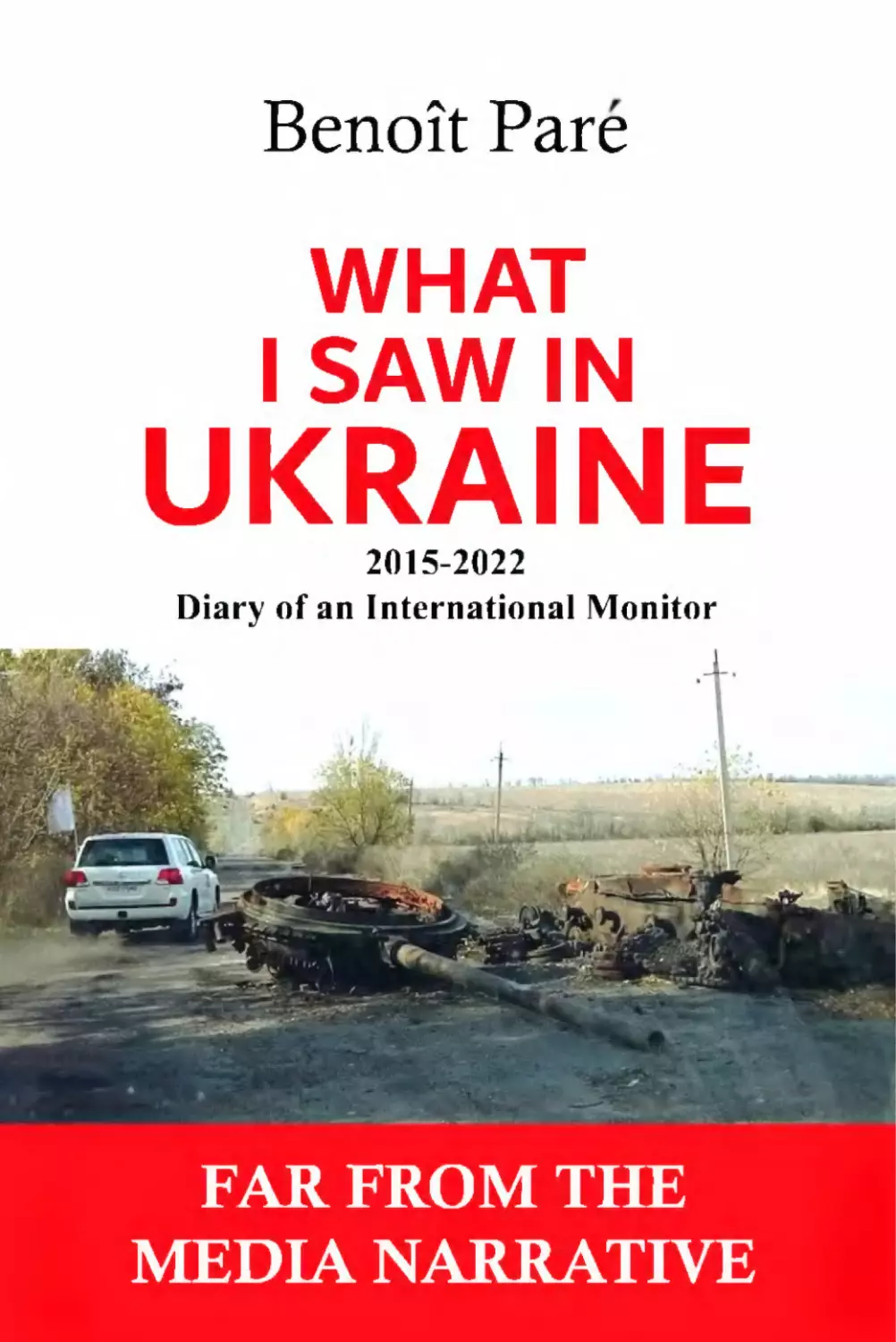
Benoit Pare
WHAT
I SAW IN
UKRAINE
2015-2022
Diary of an International Monitor
FAR FROM THE
MEDIA NARRATIVE
Chapters and chronology
Foreword
Prologue
Chapter 1: The beginnings of the conflict
Before my departure for Ukraine (2014-2015)................................ page 3
Chapter 2: Discovery of the Mission
Kiev (July 2015)................................... . .................. . ...................... page 23
Chapter 3: In besieged territory
The Donetsk People’s Republic (August 2015)............. ............... page 28
Chapter 4: The war, and human rights violations
Kramatorsk (August 2015 to August 2016)........................ ........ page 44
Chapter 5: The daily front line
Mariupol (August 2016 to May 2017).......................................... page 174
Chapter 6: Immersion in the repression of the Ukrainian state
Return to the Human Dimension (05-2017 to 12-2018)............. page 216
Chapter 7: Long-term stay with the separatists.
The Lugansk People’s Republic (12-2018 to 03-2020)............. page 416
Chapter 8: At the heart of Ukrainian nationalism
Election observation mission in Lviv and Lutsk (09 to 11-2020)
.......................................... .......................... .............................. . ........ page 513
Chapter 9: Why Russia attacked Ukraine
Odessa, a Russian city in Ukraine (12-2021 to 02-2022) - Waitingfor
the invasion............................................................ page 543
Chapter 10: First feedback on invaded Ukraine
Short exile in Moldova & end of Mission (02 to 05-2022)....... page 593
Epilogues
Appendices
Note:
All chapters are divided into subchapters.
When a subchapter title is underlined, the following subchapters with
bulleted titles are part of that subchapter.
Returning to a subchapter title without underlined or bulleted text
means that the previous underlined subchapter is complete.
FOREWORD
I wrote this book first and foremost for what I consider to be the general
interest. First, so that as many people as possible could have access to
elements of understanding Ukrainian society that are too little, if ever,
mentioned in the mainstream media.
I also wanted to reveal how an international organization works in a
country at war, with its few successes, but also its internal conflicts and
contradictions that have prevented the full implementation of its
mandate, to the misfortune of the Ukrainian people... and even to the
misfortune of the world, since the Donbass problem has degenerated into
a much larger conflict.
I had the opportunity to interview hundreds of people in Ukraine, from
all walks of life, all professions, from all comers of Donbass to the Lviv
region, ending with Odessa. I thus frequented the opposing camps of an
extremely polarized country.
My testimony will certainly not be exhaustive; and there are as many
different experiences and opinions as there are individuals.
But it seems to me that, due to my particular functions and my different
assignments, few people, even among Ukrainians, have been able to leam
as much as I have about the grey areas of Ukraine. Because I have had
access to many confidential files, many of my former colleagues have no
idea of many of the revelations that I can deliver here, revelations that I
believe in my soul and conscience must be made for the common good.
I am convinced that it is because certain realities have been hidden for
too long that the conflict has been able to become a more global war
involving today, directly or indirectly, a quarter of the countries on the
planet, often with the support of the people.
If modem wars are so often fueled by lies, or even simply lies by
omissions, peace, just peace cannot be established without the truth. This
truth is my only compass. And I have tried in my testimony to respect it
as much as possible. I am aware that by making this choice, barring a
miracle, I would probably never again be able to work in my original
professional environment. But since the Russian military intervention in
Ukraine and NATO’s unconditional support for the Kiev government, I
have considered that the fate of the world was at stake, and that my little
person no longer weighed much in the face of such challenges.
At the time of the proofreading of the book, after President Trump's
announcement dated February 14,2025, of his discussions with Vladimir
Putin, it would seem that we may finally be moving towards the end of
the conflict. However, it still seems appropriate to look back on these 8
years of the Donbass war, if only for the sake of history, but also to
question the relevance of the West's choices in this confrontation, this
war which did not begin in February 2022, but much earlier, in 2014, on
Maidan Square.
PROLOGUE
On February 24,2022, at 6:30 a.m., the ringing of my phone has just woken me.
from my sleep. My still-cloudy eyes see that the call is coming from Oleg, my
Russian-speaking Latvian colleague. I pick up and hear these words:
"Benoit, it has started."
And then, I understand instantly. The "it" can only be the Russian invasion of
Ukraine. We had been wondering for weeks whether they were going to do it
or not. And the moment of truth has arrived. We have not seen an event of this
magnitude in Europe since the Second World War.
While I barely had a chance to mumble a word, Oleg continued:
- "At 5 o'clock this morning, Russian troops crossed the border in several places,
to the north, south and east, and shelling hit several major cities, including
Odessa. Didn't you hear the explosion this morning?"
- No, I said, I didn't hear anything.
- Your colleagues and I were woken up by a huge explosion, in the direction of
the airport. Now get ready, take just one bag, and come to the office by 8
o'clock. We will evaluate the situation. Be ready to be evacuated."
Just in time for me to nod, Oleg hangs up. I turn on the light and get up, both
stunned and alert. I think to myself: "Not only has it started, but it’s the
maximum version!" » My first instinct is to look out the window to see if there
are any suspicious signs, if Russian or Ukrainian troops are already combing
the city. But I notice deserted streets. As I do not usually get up this early, I am
not sure whether this is unusual or not.
Many questions assail me about what is going to happen, both in terms of
history with a capital H, and my little existence. Is this my last time waking up
in my large two-room apartment, in this charming old building with a beautiful
facade, typical of Odessa’s historic city center, near the port? In passing, I think
to myself that if I did not hear the explosion, it is because my colleagues live
further west, therefore closer to the airport. I look around me, as if to get a good
feel for my surroundings, and to think about what I need to take with me first.
This is my first evacuation. In my field of business, I have had some colleagues
in Bosnia or Kosovo who had to drop everything in a matter of minutes. I am
1
luckier. I have a little over an hour ahead of me, and I have time to select what
I save, and what I may never see again.
I work for the OSCE, the Organization for Security and Cooperation in Europe,
and more specifically for the Special Monitoring Mission to Ukraine (SMMU
or SMM). As an observer in Odessa for less than three months, I am responsible
for the Political Affairs portfolio that interested me so much. All in all, I have
spent 5 very busy years in this country, especially in the Donbass. I do not know
it yet. But I am actually experiencing my penultimate day in Ukraine.
CHAPTER 1
The Beginning of the Conflict
Before I Left for Ukraine
My story with Ukraine began in 2014, simply by following the news around the
Maidan events. I was then living in France. Without a mission at that time, I
had plenty of time to read and obtain information online, to then debate on the
sites of the major newspapers, but also with my former colleagues from the
OSCE Mission in Bosnia-Herzegovina.
Previously, I modestly admitted that I knew almost nothing about Ukraine. I
just remembered the Orange Revolution, the strange poisoning of the proWestem candidate in the presidential election, the gas price negotiations with
Russia, the arrest of Prime Minister Yulia Tymoshenko, accused of corruption,
and those few surreal fight scenes between deputies in the Kiev Parliament.
The Maidan Massacre and Its Consequences
First, there were the never-ending demonstrations in Maidan Square. The
demonstrators were said to be protesting against the refusal of President
Yanukovych, reputed to be pro-Russian, to sign an association agreement with
the European Union, which provided for a kind of free trade. The reasons for
this about-face remained unclear to me at the time. I guess the mainstream
media did not dwell on it much. All I could understand was that Russia was
more or less being accused of having disrupted a predetermined plan.
It was not until I saw Igor Lopatonok and Oliver Stone's film “Revealing
Ukraine”, several years later, that I finally understood why the Ukrainian
president had refused the agreement. President Putin had simply told him that,
if Ukraine signed the agreement, as the Russian and Ukrainian markets were
open to each other, Russia feared it would be flooded with European products.
To protect its market, it was therefore preparing to break off the free-trade
agreement with Ukraine. So, Yanukovych had to choose between the European
and Russian markets. But Ukraine’s economy was already so closely tied to
Russia’s that it seemed worth thinking twice about it. In this case, both Putin
and Yanukovych seemed to have acted in their countries' respective interests.
But that is not how it was presented to the West, or to the Maidan demonstrators.
On February 18, 19 and 20, 2014, events accelerated dramatically. Around a
hundred demonstrators and fifteen police officers were killed in the vicinity of
Maidan Square. President Yanukovych's police were immediately blamed. The
3
outrage to this massacre was worldwide. As soon as February 21, three
European ministers, representing France, Germany and Poland, came to Kiev
to negotiate a way out of the crisis. An agreement promising early presidential
elections within six months was signed. But that same evening, the agreement
was denounced by the leader of the violent far-right group Pravyi Sektor. That
night, Yanukovych feared for his life and fled the capital for Kharkov1. The
following day, February 22, the Parliament, known as the Verkhorvna Rada, or
Rada for short, declared a power vacuum. The President was officially removed
from office by a vote of the deputies present, a vote which did not meet the
requirements of the Constitution, since the minimum number of votes required
had not been reached (by 6 votes) and the Constitutional Court had not been
consulted. Furthermore, careful observers like Ivan Katchanovski (more on him
later) counted fewer deputies in the chamber than declared votes, and there was
also talk of threats against certain deputies. But none of this mattered to the
United States, which immediately approved the change, and Europe followed
suit.. The agreement negotiated for hours by the Europeans proved totally
useless. And Yanukovych’s protests resounded in a vacuum.
On February 23, in what appeared to be a provocative act led by the most radical
of Ukrainian nationalists, the Rada voted to repeal the 2012 law giving official
status to regional languages, mainly Russian.
Rada chairman Oleksandr Turchinov, who had just been elected acting
president of the country, decided to suspend the repeal, referring it to the
Constitutional Court for consideration (which eventually ruled in favor of the
repeal four years later). Turchynov probably feared the damaging impact this
vote would have on the East and South of the country, where Russian is the
main language. In any case, the damage had been done. The mere fact that the
assembly voted against the Russian language in one of its first decisions
following Yanukovych's removal from office demonstrated the power acquired
by the most, extreme fringe of Ukrainian nationalists. The civil war, first of all
linguistic and cultural, had been launched.
I can still hear all those apologists for the new Ukrainian government defending
the idea that this linguistic affair was manipulated and exaggerated by the
Russians. But it was the obvious starting point for an intention to “derussify”
Ukraine, which could only be felt as an aggression by many native speakers of
Russian. Once the repeal of the law had been approved by the Constitutional
1 The choice was made for this book to favor the spelling of places according to the
language most spoken locally.
4
Court, laws restricting the use of Russian in all areas, including education and
the media, followed unchecked.
The anti-Maidan
Back in 2014, the controversial dismissal of the president; for whom Russian
speakers had voted overwhelmingly, and the explicit threat to the Russian
language, prompted protests in the major cities of eastern and southern Ukraine
as early as February 232.
On February 27, Arseni Yatseniouk was appointed Prime Minister. He was the
man chosen by the Americans, as revealed in the recording of a conversation
between Victoria Nuland, who managed the Ukrainian dossier for the State
Department, and the American ambassador in Kiev3. The new government
included four ministers from the ultranationalist neo-Nazi Svoboda party. This
did nothing to calm the demonstrators in the main Russian-speaking regions.
Two days later, on March 1, the anti-Maidan demonstrators in Donetsk
appointed by a show of hands their first “People’s Governor”, Donbass-born
Pavel Goubarev, a former local Councilor in.a Donetsk city district representing
the Progressive Socialist Party of Ukraine.4 A video, allegedly from that day,
shows thousands of demonstrators in front of the Regional administration
building, waiving Russian flags5. Goubarev had first publicly appeared at a
demonstration on 27 February. But he said he had been considering since 25
February to take a leading role6.
Also on 1 March, in Lugansk, some 10,000 anti-Maidan demonstrators gathered
in front of the regional administration building, and managed to raise the
Russian flag. The oblast's Regional Councilor, Arsen Klinchaev, was among
the ringleaders7.
The following day, March 2, Acting President Turchinov responded to the
protesters' affront by appointing a new governor of the oblast.
2 https://fr.wikipedia.org/wiki/Manifestations_anti-Ma%C3 %AFdan
3 https://www.thenation.com/article/archive/not-so-secret-ukraine-phone-cali/
4 https://fr.wikipedia. org/wiki/Pavel_Goubarev
5 https ://x.com/Pasca!_Laurent_/status/1895829947278872961
6https://archive.kyivpost.com/article/content/war-agamst-ukraine/donetsks-selfproclaimed-separatist-go vemor-talks-to-joumalists-ge ts-arrested-338638.html
7https.7/web.archive.org/web/20140330210457/http://ua.korrespondent.net/ukraine/pol
itics/3313464-u-luhansku-bilia-budivli-oda-pidnialy-rosiiskyi-prapor
On March 3, in Donetsk, the demonstrators seized the building of tire regional
administration and the oblast council, which had just passed a motion of support
for the latter. But the demonstrators wanted to go faster and further. Goubarev
declared that he recognized neither the new government in Kiev, nor the new
regional governor appointed by it. And.he was already calling for a referendum
on the status of the Donetsk region.
The remarkable scale of the protests in Donetsk was notably due to the fact that
the deposed president was the region's former governor, a local man for whom
the local population had voted massively in the presidential elections.
In Lugansk, on March 5, following Goubarev's example, Aleksandr Kharitonov,
also a member of the Progressive Socialist Party of Ukraine, had himself elected
“people's governor” by a few thousand supporters. The latter formed the
“Lugansk Guard”, created as an anti-Maidan movement.
On March 6, the government counter-attacked in Donetsk, dislodging
Goubarev's supporters from the regional administration building. The same day,
Goubarev himself was arrested by the SBU, Ukraine's omnipotent security
service, a sort of heir to the KGB. The short-lived People's Governor was
prosecuted for separatism, as it is forbidden in Ukraine to make public calls for
the modification of the country's borders.
This arrest did not discourage Kharitonov, who on March 9 seized the
headquarters of the Lugansk regional administration with his supporters,
forcing the new governor to sign a letter of resignation and forcing him to flee.
Thousands of demonstrators were unopposed by the police. The Russian flag
was hoisted on the building and the Russian anthem sung by the demonstrators.
In a speech, Kharitonov announced that he had collected 15,000 signatures to
organize a referendum on the federalization of Ukraine, scheduled for March
30. He called on Vladimir Putin to support them.
In addition to Klinchaev, Oleksandr Yefremov, former governor of the region
and deputy of the Party of Regions, and other local politicians were said to be
quietly supporting the movement.8
On March 10, the mass demonstrations continued. The headquarters of the
regional television station IRTA were occupied.
8Accused of undermining Ukraine's territorial integrity for his alleged role in the March
2014 events in Lugansk, Yefremov will serve three years in pre-trial detention, between
2016 and 2019, without being sentenced.
6
Repression was not long in coming. Klinchaev was arrested by the SBU on the
night of March 9-10, or March 11, depending on the version9, accused of
preparing to occupy the offices of the SBU, the Ministry of the Interior and the
Lugansk Treasury with 500 demonstrators.
On March 13, it was Kharinotov's turn to be arrested10. He was sentenced to 5
years’ imprisonment, two of which were suspended.
With the arrest of these first ringleaders, forgotten by the Western world, the
interim government bought itself some time. But this was not going to stop the
groundswell.
This pattern of crowds seizing public buildings, reclaiming them by the
authorities and then taking them back by the demonstrators was repeated in
several cities. This phenomenon also seems to demonstrate the unorganized,
spontaneous nature of these initial actions.
The Language Issue in Ukraine
In the course of my research, I came across a number of maps that were essential
for understanding the crisis in Ukraine. Firstly, there was the language map
from the 2001 census, and the various voting maps for all the presidential
elections. These maps sum up the main points.
9 https://uk.wikipedia.org/KjiiHHaeB_ApceH_CTenaHOBnH#cite_note-l 1
1 °https://web.archive. org/web/20140315020701/https ://www, sbu.gov.ua/sbu/control/u
k/publish/article?art_id=122702&cat_id=39574
The map from the 2001 language census11 made it immediately clear that
Crimea was a separate entity, and even seemed to have no place in Ukraine.
Let's not forget that it was Soviet leader Khrushchev, former First Secretary of
the Ukrainian Communist Party, who decided in 195412 to Appendix the then
Russian Crimea to the Ukrainian Soviet Socialist Republic, essentially to
facilitate the construction of the canal supplying the peninsula with water,
according to his son13. But no one had asked the Crimeans for their opinion, and
at the time, it all remained the same country, the USSR. The idea that the
Russians would have needed to rig the Crimean referendum of March 16,2014,
asking for its attachment to Russia, has very little credibility in view of this
map. Incidentally, I discovered much later that the Crimean Parliament had
already declared its independence from Ukraine as early as 1992. But the
referendum that was to follow to confirm the decision was cancelled on the
orders of Kiev, which had threatened to use force. Those events have almost
been erased from the records.
11 https://commons.wikimedia.Org/wiki/File:UkraineNativeLanguagesCensus2001 detai
led-en.png (Authors : Toyei, Spesh531)
12https://www.lemonde.fr/europe/article/20 14/03/15/d-un-simple-decretkhrouchtchev-fit-don-de-la-crimee-a-l-ukraine_4383398_3214.html
13https://ru.wikipedia.org/wiki/nepe/jaHa_I<pEiMCKOH_o6jiacTii_ii3_cocTaBa_PC’OCP_
B_C0CT3B_yCCP
8
So, knowing the? fate of Crimea, as early as March, this map suggested that the
next area that would make headlines was the Donbass.
It should also be pointed out that this census map is misleading in favor of the
Ukrainian language. In fact, many Ukrainians speak neither Ukrainian nor
Russian, but Surjyk, a dialect that mixes the two, spoken mainly in rural areas.
The further east you go, the more this dialect leans towards the Russian
language. But, as an English colleague who had done a thesis on the subject
later told me, the authorities in charge of the referendum decided to classify the
“Surjyk” response with Ukrainian, in order to reinforce the nascent Ukrainian
identity.
The true linguistic map of Ukraine looks rather like below14:
It is worth noting that, according to the 2001 census, 75% of people in Donetsk
Oblast and 69% in Lugansk oblast claimed Russian as their main language.
Furthermore, 38% and 39% respectively claimed to be Russians, the highest
percentages in Ukraine after Crimea. In Crimea, 77% of the population spoke
Russian as their first language, and 60% claimed to be Russian.*
14 A slightly revised version is available here :
https.7/www.axl.cefan.ulaval .ca/europe/ukraine-1 demo.htm
9
The map of the presidential election looks like this15, and those of the 2004 and
1999 elections follow the same pattern.
In fact, Yanukovych scored higher in his fiefdom of Donbass than in Crimea.
Ukraine was thus deeply divided between a pro-Western, Ukrainian-speaking
West and a Russian-speaking, more Russian-oriented Southeast. If one side
tried to impose its point of view on the other, as happened with Maidan, it was
bound to get out of hand.
I was to discover later that, in his famous book “The Clash of Civilizations”,
published in 1996, Samuel Huntington had already predicted what we're seeing
today, namely that if Ukraine sought to join NATO, it would risk triggering a
civil war with Russian intervention, ending in partition. Huntington concluded
this before anyone in the West had ever heard of Vladimir Putin.
When we look at a series of polls conducted in February , and April 2014,
compiled on a Wikipedia page16, we see that at the time, only a. minority of
citizens in the east and south wanted a united Ukraine without constitutional
change (19%). 74% considered the interim president illegitimate. But those in
15 https://commons.wikimedia.org/wiki/File: ,IIpyrwi_Typ_2010_no_OKpyrax-en.png
(Auteur VasyT Babych)
16 https://fr.wikipedia.org/wiki/Manifestations_anti-Ma%C3%AFdan,
10
favor of a union with Russia also remained in the minority in a poll carried out
before the Maidan massacre (33% in the Donetsk region). In April, 70% wanted
greater decentralization and federalization of Ukraine, in a poll that did not
include the option of independence or joining Russia. But for the ruling
Ukrainian nationalists and their Western backers, no concessions were
desirable. In their view, this would have played into Moscow's hands. If you
concede nothing, you can end up losing everything. With the violence that was
to follow, it's not hard to imagine that these percentages would evolve. Years
later, after a war that seemed to have no end in sight, many Donbass inhabitants
living on the separatist side considered that too much blood had been spilled to
want to return to Kiev's rule, even with an autonomous status.
On Self-determination Referendums
A former colleague of mine from the OSCE Mission to Bosnia-Herzegovina,
who like others was opposed to the idea of settling problems through
referendums, shared with me a long article on the question of self-determination
of peoples. The author tried to justify the cases where this would be acceptable,
and those where it would not.
Among other arguments, the author argued that there had to be a long-term
histoiy of claims for a referendum on self-determination to be considered. This
argument seemed arbitrary to me. Who is to decide what such a track record is?
It was implied that such a history did not exist in Donbass, and that, therefore,
the latter did not meet the conditions.
However, in 2023,1 discovered that the project to create a “Federal Republic of
Donetsk” was actually bom in 2005l7, after the annulment of Yanukovych's
election and the victory of his rival Yushchenko. Already back then, there was
a movement to collect signatures calling for a referendum. And the flag of this
republic was the same as that of the DPR18.
As for Crimea, its history was cleverly hidden in the West, and even in Ukraine.
Through my own research19, I discovered long after 2014 that this region's
repeated attempts to become independent between 1992 and 1995 had been
17https ://en.wikipedia. org/wiki/Capture_of_Donetsk_(20 14)
18https://web.archive.org/web/20161006103518/http://bratyaslaviane.narod.ru/2006/4/
i4-06-5-r.html
19https://webarchive.archive.unhcr.org/20230521204858/https://www.refworld.org/do
cid/469f38ec2.html
11
repressed by Kiev and buried, in some way, with the Budapest Memorandum
of December 1994.
So, there was already a history of demands for independence in these territories.
In fact, having already been confronted with similar issues in the former
Yugoslavia, I soon realized that, for Western elites, when it comes to weakening
the Russians or the Serbs, referendums are acceptable, hence the support for
Kosovo's independence. But when these same referendums could benefit
Orthodox Christians, as in the case of the Bosnian Serbs or the pro-Russians in
Ukraine, it is no longer acceptable. Everything else is just packaging and
pretexts.
These same people, a little embarrassed, then retort that Kosovo is different,
since the Kosovars were oppressed by Serbia, which is said to have started
massacring them. The reality is less Manichean than that. There are many
indications that the famous Racak massacre, which sealed Serbia's fate in 1999,
was a set-up. A close colleague of mine in Ukraine, who was in Kosovo at the
time, confirmed this to me.
And it's reminiscent of the Maidan massacre 15 years later, a false-banner
operation dissected by Ivan Katchanovski (see chapter 4). In short, these
massacres, which are the pretexts for radical decisions, are often organized by
the very people who use them as a pretext to intervene or demand outside
intervention in a conflict. That is how the world goes.
To return to Ukraine in 2014, it was above all with the attachment of Crimea to
Russia, made official by the disputed referendum of March 16, 2014, that the
problem of Ukraine became an international issue. I immediately thought that
the ideal organization to be deployed on the ground to try to manage tire tensions
was the OSCE. And diplomats quickly came to the same conclusion. On March
21, 2014, the Special Monitoring Mission to Ukraine (SMMU) was created. I
immediately applied via the French Foreign Ministry's delegation for
international civil servants, as this is the procedure for being recruited by this
intergovernmental organization. However, I had no news of my application for
months.
The Insurrection in Donbass
Meanwhile, the situation in Ukraine had rapidly degenerated with the Donbass
insurrection starting in April.
All this took place against a backdrop of presidential elections scheduled for
May 25 throughout Ukraine. A French colleague who had been sent to Donetsk
12
in April told me about the chaos that reigned there. During a telephone
conversation with an official based in Kiev, he told him he could hear the
separatists shouting, “Rossia, Rossia!” outside, interspersed with bursts of
Kalashnikov fire in the air.
A journalist from the Kiev-controlled Donbass region, who was at the time a
member of the Donetsk Oblast assembly, later told me how the separatist
takeover had gone. The regional administration building where the elected
representatives sat was surrounded, as if under siege, by thousands of pro
Russian demonstrators. The elected representatives could hear the cries of the
crowd and no longer dared to leave. The demonstrators even managed to occupy
the second floor of the building. The oblast police chief entered the room. The
councilors thought he had come to protect them. But in fact, the police chief
had come to introduce them to a ‘‘people's governor”, perhaps appointed by the
demonstrators themselves. He gave them an ultimatum: either the elected
representatives voted for the region's independence, or they would be deposed.
I understand that the councilors refused, and the session ended. The events are
confirmed on Wikipedia as having taken place on April 6,20142021
.
22
The following day, April 7, the insurgents proclaimed the birth of the Donetsk
People's Republic (DPR). The leader who stood out at that time was - already Denis Pushilin, a native of the oblast, who became the first head of the DPR
government2122. In a speech on April 5, he introduced himself as the deputy of
Pavel Goubarev (the arrested People’s Governor), calling for an independence
referendum as in Crimea.
According to our interviewee, of the 180' regional councilors, only around 30
remained in the oblast on the Ukrainian side. Some joined the DPR, others
moved to Kiev, others abroad. Nine months later, the Kiev government set up a
civil-military administration to replace the defunct regional council, as in the
Lugansk oblast.
This, testimony by the local elected journalist highlighted the key role of the
police. A year later, I learned from Ukrainian sources that 8,000 Ukrainian
police and military personnel had defected to the separatist side in the Donbass,
some with arms and baggage. And 1,300 SBU agents in Crimea had joined the
Russian administration.
2°https://en.wikipedia.org/wiki/War_in_Donbas_(2014%E2%80%932022)#cite_note36
21 https://en.wikipedia.org/wiki/Donetsk_People%27s_Republic
22 Pushilin has been Head of the DPR since 2018.
13
Also on April 6, 2014, in Lugansk, a crowd of 5,000 stormed not the regional
administration building, but that of the SBU's regional branch, demanding the
release of some 15 pro-independence activists who had been arrested earlier.
The group was led by 43 men claiming to be former Berkuts23 from the elite
Alpha Group, but also included Cossacks, Afghanistan war veterans and
women. A large quantity of weapons was seized by the insurgents. The thin
police cordon quickly evacuated the scene, leaving 120 SBU agents to face the
crowd.
It should be noted that the current head of the LPR, Leonid Passechnik, came
from the region’s SBU, where he held the rank of colonel. Before the
insurrection, he commanded the SBU office in the town of Stakhanov.
Also on April 6, insurgents occupied the Kharkov regional parliament building.
Unlike in Donetsk and Lugansk, this occupation was quickly and bloodily put
down. It would seem that the absence of a popular movement on the scale of
that in Donbass also worked against this local insurgency.
As early as April 7, Ukraine’s acting president, Oleksandr Turchinov,
announced the stall of an “anti-terrorist operation”, having received the support
of his Western allies.
After these initial takeovers of administrative buildings, between April 12 and
14, a series of towns in the Donetsk region fell like dominoes into the hands of
small groups of insurgents. In Slovyansk, the first town taken on April 12, the
leader of the hooded commando who stormed the public buildings was a
Russian citizen, Igor Girkin, known as Strelkov, who some said was a former
member of the FSB, Russia's successor to the KGB, while others described him
as a former colonel in the GRU, the Russian army’s intelligence service. His
team of armed men, he claimed, included two thirds of Ukrainians. A local
journalist would later tell me that he could not understand how a 15-strong
commando could have taken control of Kramatorsk despite the presence of 600
police officers in the town and a military detachment at the airport. A similar
question arose a few weeks later in Mariupol (we will come back to this in
Chapter 6).
23The berkuts were a riot police unit, similar to mobile gendarmes. Immediately blamed
for the Maidan massacre, they were disbanded on February 25, 2014 by the new
authorities.
14
The Beginning of the War
The war began in earnest on April 13, 2014, with the first clashes around
Slovyansk between insurgents and the Ukrainian army. However, the latter’s
initial attempt to regain control of the situation failed. A siege of the city began.
Kiev and the West were already accusing Russia of secretly fuelling these
separatist uprisings. And the fact is that, for a popular movement to become
sufficiently organized and structured not only to take power, but to keep it, it
sometimes requires outside help, notably with means of persuasion, financial or
otherwise. But isn’t that what the Americans did in Kiev with the Maidan
movement?
It has to be said that it did not take much to ignite an inferno in the Donbass,
where a large part of the population wanted either autonomy from Kiev or
attachment to Russia, as in Crimea.
In Gorlovka, for example, "poorly armed" demonstrators seized the police
station on April 14, without a shadow of the “little green men” in sight"24 ,
according to a journalist from The Guardian.25
On April 27, the Lugansk People's Republic (LPR) was created. The declaration
was read by several women taking turns in front of the. SBU building taken over
by pro-Russians26. The speakers called on Russia to send "peacekeepers" to the
LPR in the event of aggressive action by the Kiev government, to the cheers of
the crowd of around 500 people.
There was no clear leader at the time. Wikipedia extends the imprisoned
Kharitonov’s term as People’s Governor to May 13.
On May 2, following clashes between nationalist and pro-Russian activists,
around forty of the latter died in an arson attack and ambush organized by the
former in the building of the Odessa Trade Union. It was the first massacre since
Maidan.
On May 9, deadly fighting also broke out in downtown Mariupol (details in
Chapter 6).
24 Reference to the soldiers without insignia who had taken control of many strategic
locations in Crimea.
25
https://www.theguardian.com/world/2014/apr/l 6/crisis-east-ukraine-city-by-cityguide-map
26https://www.rferl.org/a/separatists-declare-luhansk-peoples-republic/25364894.html
15
As early as May 11, separatists in the Donetsk and Lugansk regions organized
their self-determination referendums. These referendums were considered not
only illegal, but also illegitimate by Kiev and the entire West, for whom there
was no point in discussing the matter. President Francois Hollande and Prime
Minister Manuel Valls both declared that the results of referendums not
organized by Kiev could not be recognized. Recognizing a regional referendum
against the internationally recognized trusteeship capital, however, is what we
did with Kosovo in 2008, by recognizing as legitimate a referendum that was
not approved by Belgrade, the capital of Serbia to which Kosovo still belongs
according to Serbians.
Following their referendums, the self-proclaimed republics reorganized, setting
up new institutions. On May 14 and 15, the DPR Supreme Council, which acted
as a legislative assembly, adopted a constitution. They appointed a newcomer,
the Russian Alexandr Borodai, as Prime Minister. On the same day, vigor
Strelkov was appointed Minister of Defense, replacing the previous minister, a
man from the Donbass region, who had been arrested by Kiev (a little-known
affair addressed in Chapter 6). The Supreme Council changed its name to the
People's Council of the Donetsk People's Republic. Pushilin became its head,
and, according to the constitution of the time, this made him the head of state.27
On May 16, a certain Vostok Battalion28 carried out its first feat of arms by
seizing the Ukrainian National Guard base in Donetsk. Similar to what we saw
in Lugansk on April 6, the battalion included former Berkuts as well as
members of the SBU's Alpha Group. They reportedly had decided to fight for
the DPR following the violence in Odessa and Mariupol, vowing to protect the
population from the abuse of nationalists. Their leader, an SBU defector and
Donetsk native, was Vladimir Khodakovski.
Then, there were the kidnappings of OSCE observers in the Donbass region
from April 25 until the end of June, which led to a months-long freeze of the
organization's recruitment process for its mission in Ukraine.
The LPR was also about to reorganize, but with a slight delay due to unforeseen
circumstances.
On May 18, after a brief interlude of a few days by a certain Gennadiy
Tsypkalov, the LPR acquired a new "leader", Valery Bolotov29, who was one
27 https://en.wikipedia.org/wiki/Denis_Pushilin
28https://fr.wikipedia.org/wiki/114e_brigade_de_fusiliers_motoris%C3%A9s_de_la_G
aide
29 https://eh.wikipedia.Org/wiki/Valery_Bolotov
16
of the leaders of the insurrection and had even previously appointed himself
People’s Governor. Living in the Lugansk oblast since the age of 4, he was said
to be a close associate of deputy Yefremov. In fact, he was already introducing
himself as People’s Governor oh May 10.1 have not been able to find out when
he took power.
But things were not easy for Bolotov, as he had been wounded in an attack on
May 13, treated, in Russia, then arrested on his return to Ukraine on May 17,
before being freed by 200 of his supporters (Gennadiy Tsypkalov, previously
his deputy, officially became Prime Minister of the LPR on August 26).
On May 25, Petro Poroshenko was elected President of Ukraine. He officially
took office on June 7. He was the only oligarch to publicly declare his support
for the Maidan movement. Like Zelensky, 5 years later, he promised that his
priority was to "put an end to the war", while saying that he wished to suspend
negotiations with the separatists until they laid down their arms.30
But he was invited to the commemoration of the Normandy landings on June 6,
1944, where Francois Hollande and Angela Merkel organized a meeting with
Vladimir Putin. The Normandy format, bringing together Ukrainians, Russians,
French and Germans', was thus created. This meeting gave rise to the Trilateral
Contact Group, a forum for consultations between Ukraine, the Russian
Federation and the OSCE, with the aim of resolving the conflict in the Donbass.
In the summer, I applied for another assignment, this time in Afghanistan, on
behalf of the European Union. The aim. was to observe the audit of the
presidential election. It was an exciting mission, which only lasted about forty
days. As luck would have it, I shared a room with a retired Dutch ambassador.
The man had previously been the NATO ambassador to Afghanistan. We had
several discussions on the subject of Ukraine, and I could see that he considered
the separatist leaders to be mere bandits with whom no negotiation was
possible, as in his view they had no legitimacy. Strangely enough, this was the
only subject that brought him out of his calm and good temper. For him, the
independence referendums of May 11 were illegitimate, null and void. At the
time, I had no argument to make against his. But I was struck by his apparent
total lack of empathy for the people of Donbass, like a deliberate attempt not to
understand.
30 https://www.robert-schuman.eu/observatoire/1524-petro-porochenko-triomphe-desle-1 er-tour-l-election-presidentielle-en-ukraine
17
While I was in Afghanistan, the war in Donbass had taken a new turn. In June
and July, the separatists were forced to withdraw from many of the towns they
controlled under growing pressure from the Ukrainian military. First it was
Mariupol on June 13, the first victory for pro-Kiev forces. Then came the turn
of Slovyansk, Kramatorsk, Droujkivka, Konstantinovka, Siversk, Bakhmut31
(then called Artiomovsk, or Artemivsk in Ukrainian), all abandoned on the
same day, July 5, by Strelkov. The latter regrouped his troops, evacuated from
the north of the region, in Gorlovka. Before his retreat, Strelkov had made a
public appeal for military aid from Russia, arguing that his troops could not
hold out much longer. After this mass withdrawal, Pushilin lamented the lack
of help from Moscow: "We were given hope and abandoned. They were
beautiful, Putin’s words about defending the Russian people, the New Russia.
But they were just words."32
Russia's Likely First Military Intervention and Minsk-1
It seems that these serious setbacks for the fledgling DPR convinced Moscow
to step up a gear. On July 11, a Ukrainian column was pulverized by a salvo of
rockets 15 km from the border. Some blamed the Russians.33
Later that month, after Strelkov and Borodai, a third Russian, Vladimir
Antioufeev, joined the DPR government, becoming a short-lived Deputy Prime
Minister and Minister of Internal Security. The .latter had succeeded Vladimir
Khodakovsky, who had risen in rank but fallen from grace following setbacks
on the military front. Although officially these three men had no connection
with the Russian state, their mere appointment would fuel suspicions of
Moscow's involvement at this stage. It was said that Vladislav Sourkov,
President Putin’s adviser on Ukrainian affairs, was pulling the strings. What
seems certain is that Borodai and Strelkov were apparently old acquaintances,
both linked to Konstantin Malofeev, a Russian pro-monarchist businessman.
But it is also worth noting that no Russian ever appeared in the LPR's political
organization chart.
Beyond these three emblematic posts in just one of the two republics, it is
striking for me to note that Russian aid up to that point, particularly at the
31 The city changed its name in February 2016 as part of a "decommunization" law. All
streets and towns in Ukraine with names linked to the Soviet period were renamed
between 2015 and 2016.
32https://www.france24.com/fr/20140707-ukraine-separatistes-donetsk-kramatorskSlovyansk-russie-combats
33 https://foreignpolicy.com/2014/07/17/russia-is-firing-missiles-at-ukraine/
18
military level, seemed almost non-existent. In June, Mariupol was only
controlled by around 80 separatist soldiers, equipped with just 3 BTRs (armored
personnel carriers) taken from a barracks, according to a local journalist I was
to meet much later. They were left to their own devices and were no match for
the pro-Ukrainian Azov Battalion offensive. In Slovyansk, Strelkov seemed
isolated and under-resourced.
In August, the leaders of the two pro-Russian republics were to change . On
August 7, Borodai handed over his premiership to Donetsk-born Alexander
Zakharchenko, who would remain the DPR's strongman until his assassination
4 years later. On August 14, Strelkov also stepped down from his post, handing
it over to an early volunteer fighter from Donbass. On the same day, in
Lugansk, Bolotov handed over to Igor Plotnisky, who was to remain leader of
the LPR for 3 years. Moscow's hand seemed to be behind these simultaneous
changes.
Borodai, while saying that Zakharchenko was his choice to succeed him,
explained34 that putting people from Donbass in power was an effort to show
the West that the insurrection was, a popular movement. The same Borodai,
however, took over the position of Deputy Prime Minister for a time, as if to
support his protege. He told a press conference that he saw himself as a crisis
manager, and that he had helped the DPR to become a state.
On the military front, a miraculous turnaround occurred in August with the
Battle of Ilovaisk, east of Donetsk. Although this was not recognized by Russia,
many observers claim that the Russian army intervened directly with regular
troops to help the faltering separatists.
Following the rout at Ilovaisk and other defeats in the Lugansk region, on
September 5, the Ukrainians signed the Minsk 1 agreements with the Russians
and separatists, under French and German sponsorship and within the
framework of the Trilateral Contact Group.
Minsk 1 is, in fact, two texts. The first is the 12-point Minsk Protocol, signed
on September 5. The main points are a ceasefire, a call for the creation of an
autonomous status for part of the Donbass region - followed by local elections
- and'the monitoring of the border by the OSCE.
Next came the Minsk Memorandum, signed on September 19, which clarified
and reinforced the protocol. It included a ban on offensive military action, and,
above all, limits on the deployment of all heavy armaments then known to be
34 https://en.wikipedia.org/wiki/Alexander_Zakharchenko
19
deployed in the theatre of operations, classified by category. The role of the
OSCE, as the organization responsible for ensuring compliance with the
security aspects of the agreements, was also clarified.
With the signing of the first Minsk Agreement on September 7, the DPR was
restructured once again. The post of Head of the DPR, the new Head of State,
was. created. Zakharchenko was appointed to this post. Pushilin took his place
as Prime Minister. Borodai left the government on October 24. Elections,
which no foreign country recognized, validated these changes in November,
ensuring a degree of stability for the regime.
On my return from Afghanistan, I learned that the SMM recruitment process
had resumed. I applied again.
Further Deterioration of the Situation
But the ceasefire following the Minsk-1 agreements did not last long. Fighting
around Donetsk airport resumed on September 25. According to some sources,
the Ukrainian army occupying the airport was sporadically firing or shelling the
city, prompting the DPR to intervene to drive their enemy out of this strategic
point so close, too close, to their capital.35
Soon, the whole of Donbass was ablaze again. And there was talk of the Russian
army stepping in again to lend a hand. In November, the separatists gained
ground south of Donetsk. During the fighting, Donetsk came under heavy
bombardment, as a future colleague would tell me a year later, recounting the
nights spent in the hotel basement, wearing helmets and bullet-proof vests,
waiting for the bombardments they heard outside to end.
Donetsk airport, totally destroyed by 4 months of fierce fighting, was taken by
the separatists on January 21. A few days later, the Ukrainian-held town of
Mariupol was hit by a wave of deadly rockets, an event that was widely covered
by Western media.
My Job Interview
I was interviewed to join the SMM on January 30, 2015. I remember being
asked seven questions, three of which revolved around the same theme. "Have
you ever worked in a country at war? Are you reluctant to work in a war zone
again? Have you fully understood that, if we recruit you, we are going to send
you to a war zone, because that is where we send all new observers?"
35 https://en.wikipedia.org/wiki/SecondBattle_of_Donetsk_Airport
20
Having done four tours in Afghanistan between 2006 and 2010 as a reserve
officer, I was mentally prepared to return to a war zone. In fact, I was
considering it far less dangerous to be deployed with a civilian mission in the
war-tom Donbass than with the French army in Kapisa province or Kabul. In
Afghanistan, we were targets. We were the designated enemy. But that was not
the case with the OSCE in Ukraine.
At the same time, I tried to keep a close eye on the situation on the ground. A
few days before my job interview, the battle for Debaltsevo had begun. It was
about the control of the central road and rail hub of the Donbass region, the
strategic junction between the two small self-proclaimed republics. The only
highway linking Lugansk to the Donetsk region passes through Debaltsevo. It
was clear from the map that control, of this salient, then occupied by the
Ukrainian army, was vital to the viability of the separatist project, hence the
fierce fighting.
Meanwhile, on February 10, 2015, a salvo of Smerch rockets struck
Kramatorsk. While 14 rockets hit the airport occupied by the Ukrainian army,
18 others crashed into the town, officially killing 17 people. The operation was
a public relations disaster for the separatists. To the best of my knowledge, it
was the last time they used this type of devastatingly inaccurate weaponry.
The Minsk-2 Agreement
Negotiations on a new Minsk-2 agreement were underway in parallel with the
battle of Debaltsevo. The idea was to have an agreement updated to reflect the
new reality on the ground, and at the same time a more precise one, both in the
fields of security and political aspects. The result was what came to be known
as the ’’Package of Measures for the Implementation of the Minsk Agreements"
(see Appendix 2), which became something of a bible for the SMM. It insisted
on a new ceasefire, but also on the withdrawal of heavy armaments. Control of
the border by the Ukrainian authorities was explicitly provided for AFTER the
status of the Donbass had been settled and new elections organized.
Finally, when Minsk-2 was signed on February 12, 2015, there was a delay of
several days before an effective ceasefire.. The deadline was February 15. But
once the deadline had passed, the fighting continued around Debaltsevo, for the
simple reason that the Russian-backed separatists had still not conquered the
town and still not fulfilled this strategic objective before laying down their arms.
This was only achieved on February 18, when the remaining Ukrainian forces
in the city retreated towards Artemivsk (Bakhmut).
21
I discovered much later that the Ukrainian army, notably the Azov battalion,
had also failed to halt their assault on the village of Shyrokyne, east of Mariupol,
after February 15, but this was much less noticed. The ceasefire was thus
violated by both sides from the outset.
Thereafter, as far as I know, the separatists did not attempt any offensive,
merely resisting sporadic pressure from Ukrainian forces... until February 24,
2022.
The delay in my deployment to Ukraine
I learned of my selection by the OSCE for the SMM only a few days after my
recruitment interview. But my deployment was delayed due to budgetary
problems with the French government. My deployment date was finally set for
July 12,2015.
22
CHAPTER 2
Discovering the Mission
Kiev
WhenJ arrived in Ukraine, the excitement of starting a new period in my life
dominated more than any other feeling.
In Kiev, I soon discovered that I was part of a group of just five new arrivals.
There was Vitalie, an ex-colonel in the Moldovan army, who established
himself as the leader of the little group with his good humor, his practicality,
and his suitcase full of homemade wine from his estate, which brightened up
our first evenings. He and I were from the same year, 1970. Then there was a
Romanian gendarme, Vlad, who, through linguistic affinity, became
inseparable from Vitalie. Finally, there was a former Czech policeman,
Frantisek, and an American policeman, Jeff. The latter two were quite discreet.
The world of international missions being a small one, I was also to discover
that the person in charge ,of our training was a Northern Macedonian, Zora
(name changed), whom I’d already met in Kabul the previous year. In all, this
OSCE mission would see me reunite with a dozen or so people I had met in
Kabul in 2014, most of them in the dusty hangars of the Afghan Electoral
Commission. This Macedonian worked for the United Nations at the time. I had
spent an epic evening with her, along with all the expats from the former
Yugoslavia, in an evening of gentle drinking and Yugoslav songs. As we were
not allowed to leave the UN camp in Kabul (our European mission was housed
there as a courtesy), it was one of the rare moments ofrelaxation on this mission.
Between each song, Zora kindly explained to me the origin and meaning of the
previous one. We were two special French guests at this Yugo-nostalgia party.
He and I had worked for years in the former Yugoslavia, and we were always
happy to rediscover the human warmth of the ex-Yugoslavs. By the way, it is
striking to see the complicity of these people abroad when you know that their
respective countries were tom apart in sometimes terrible civil wars and wars
of independence. There was something intimately pleasing and reassuring about
human nature in seeing them reconcile around what they had in common with
no other nation, those popular songs they all knew from the days of Yugoslav
splendor. Seeing Zora again reminded me of all that. So, I was delighted to be
reunited with this "old" acquaintance. It was a good start.
23
The HEAT Course
Our first week of training began with a HEAT (Hostile Environment Awareness
Training) course, organized by former British military personnel. This four-day
course was supposed to simulate the tense scenes we might face in the field,
once deployed in the Donbass. For this .training, we were mixed with Ukrainian
personnel who had also just been recruited.
On the last day, there was a vehicle patrol, with various workshops simulating
different surprise situations.
I was appointed by the organizers to lead one of the three patrols. As I did not
have a heavy goods vehicle license (the C license) required to drive the
mission’s 4x4 armored vehicles - which weighed 5.5 tons - it was certain that I
was not going to be able to drive these vehicles in the Donbass, and that I was
therefore going to be assigned to the patrols, either as leader or deputy.
At the end of the route, we were called to intervene following a distress call
(obviously fictitious) from another patrol. When we arrived at the scene, we
discovered two vehicles stopped on the side of the road, doors open, with crew
members all pretending to be injured and seemingly unconscious. No sooner
had we stopped than several members of my team, even before I got out of the
vehicle, had rushed to assist the wounded. Their actions seemed to clearly call
on what we had learned in first-aid class. So, I left them to it.
Then, all of a sudden, an instructor watching us simulated a burst of gunfire in
our direction. Everyone crouched down and hid behind the vehicles. With the
wounded more or less all in our vehicles, I shouted my only order of the
sequence: ’’Everyone in the cars, we’re leaving.” There was some haste to load
the last wounded man, at the risk of aggravating his case, but in war as in war.
The priority was to get away as quickly as it could be, if possible, with all the
wounded. I even remember getting into the back of the vehicle, as all the seats
were taken. And we were out of there, I think, in less than 10 seconds.
At the debriefing, we learned that we were the only patrol of the day to have
passed this test. The others had not given the order to clear because they had
not loaded the wounded, and did not know what to do under fire. We will see
in Chapter 4 how important this scene was.
Heavy Weapons Identification Course
Once this course was over, we followed.it up with another 5-day training course
on military vehicles and heavy weapon identification. We were then mixed with
a group of new observers who had arrived before us on July 5.
24
Since'the Minsk-2 agreement, the OSCE had inherited the task of monitoring
any violations of the principle of withdrawing tanks and heavy weapons from
the area close to the Line of Contact, as well as ceasefire violations. Everyone.
had to be able to tell the difference between a T-64 and a BMP-1. We had to
learn to identify the characteristics of each vehicle used by the belligerents. It
reminded me of my classes at ORSEM, the reserve officers' staff school in
France. But the process was taken a step further. We learned, for example, the
three distinguishing marks between a T-72 and a T-64. For Vitalie, who had
worked with the same equipment during this entire career, this was child's play.
The course was delivered by the German army, which seemed appropriate given
tliat Germany was a co-signatory to the Minsk Agreements.
At the time, we were only the second contingent to benefit from this training
course. I remember asking the German soldiers a double question that intrigued
me a lot at the time: how to differentiate between the different types of weapons
when they fire according to their noise, and, above all, how to differentiate
between an outgoing explosion and an incoming one (impact). The instructors
tried to explain the differences to us, using videos in particular. But the sound
of an explosion heard through a TV set has little to do with the sound on the
ground. Basically, I had learned that the outgoing was a slightly shorter, higherpitched sound, and the impact a duller, lower-pitched one. But experience
would later show me that differentiating the two with sufficient certainty is not
always straightforward. This is because the nature of the ground at impact plays
a role, as does the distance from the explosion, and even the position of the
observer in relation to the direction of fire of the weapon system.
Operational and Administrative Training
In the third week, we had the whole administrative and theoretical part of the
mission. This time we were mixed with another group, which had arrived on
July 19. During this period, there was a new arrival of observers every week.
On the very first day of the course, July 27, we were put in the mood, as one of
our interlocutors, from memory, the Deputy Head of Operations, was informed
while briefing us that the SMM had just had its first casualty, in the village of
Shyrokyne, near Mariupol. Our speaker at the time complained that the
information had taken over four hours to reach him. As a result, the briefing
was cut short. I did not know it back then, but I was to speak to the victim
several times in the years that followed.
We also had a presentation by the Mission's spokesperson, a Canadian man who
was obviously very enthusiastic about his job, and who was proud to tell us how
many Ukrainian and international media followed the Mission's press
25
conferences in Kiev, or picked up on press releases or radio news spots. I then
asked what the Mission was doing to reach journalists or the public living in
areas not controlled by the government. The spokesman's reaction struck me as
curious. First, his. broad smile vanished, replaced by an expression of marked
annoyance, if not stress. My question seemed to make him very uncomfortable,
or seemed particularly incongruous to his ears. He replied in substance that there
was no point in holding press conferences in Donetsk because there were "no
real journalists there", only Russian propagandists who would simply distort'
whatever they were told. This attitude of not even attempting anything to get a
message across to the other side astounded me. Were we not supposed to be
neutral in this conflict? Clearly, for some people, neutrality meant nothing. I
was later to realise that the authorities, military and civilians living on the other
side often viewed us with suspicion, even hostility, which was not surprising
when we did nothing to explain to them who we were and what we were doing.
I still-remember the lecture given by Lothar (name changed), the Austrian head
of the SMM's political affairs office, who opportunely insisted on the distinction
between verified facts and allegations, a distinction fundamental to our future
duties as observers.
He used the example of a report in the Ukrainian media that two active Russian
soldiers hadbeen captured by the Ukrainian armed forces in the Donbass, which
was supposed to demonstrate Moscow's direct involvement36. Lothar then
referred to people, unnamed, who asked why the SMM did not write that the
Russian army was directly involved in Donbass. Lothar replied that what he
could confirm was that the Ukrainian media claimed that two individuals
presented as Russian soldiers had been arrested in the Donbass. Period. But, as
we had not had access to the two individuals to verify these allegations, we
could not, on this basis alone, confirm the presence of Russian soldiers in the
Donbass.
In the last few days, we learned of our respective assignments. I was leaving for
the Donetsk team with the American and the Czech cops. Vitalie and his
Romanian friend were heading to the Lugansk region. The observers who
arrived on July 19 were leaving for Donbass at the same time as us.
Our ever-resourceful Moldovan comrade had found a roll of khaki Chatterton
somewhere, instructing us to use it to stick large labels with our names and
respective hotels on our suitcases. I still have that suitcase, and I still have that
36 The arrest took place in Lugansk Oblast in May 2015. Those involved were called
Yerofeyev and Aleksandrov, https://www.bbc.com/news/world-europe-34388864
26
label from the Hotel Saphir in Kramatorsk stuck on it. I have never taken it off.
Too many memories are attached to it. Vitalie's Chatterton has held on all these
years.
One of the reasons I have never dared peel off this label is that Vitalie died in
Ukraine, in a stupid road accident at a crossroads in the city of Kramatorsk. He
was on his way back from vacation and was a passenger in a cab, sitting in the
front seat, when a truck that had failed to stop due to icy conditions hit them
from the right. He died instantly. Rumor has it that OSCE's insurance did not
come into: play to compensate his family, as Vitalie was still technically on
leave.
At the end of 2018,1 was assigned to the OSCE base in Lugansk to discover a
plaque in his name in the main hall. Next to it, another plaque commemorated
an American paramedic, who was the only member of the mission to die on
patrol when his vehicle ran over an anti-tank mine in 2017.
27
CHAPTERS
Under Siege
The Donetsk People’s Republic
Stopover in Kramatorsk and Journey to Donetsk
Before transferring to Donetsk, we had to make a stopover in Kramatorsk, at
the famous Hotel Saphir, located on the outskirts of the city. We were a group
of 9, including 6 observers who had arrived on July 19. On the evening of July
31, we were greeted by an American, Michael, who was our mission's hub
manager in Kramatorsk. I remembefa pleasant conversation in the hotel garden.
Michael was very friendly and approachable.
The next morning, a Donetsk patrol picked us up from the hotel. We had a long
way to go to the separatist capital, as the direct route, the H20 highway, was cut
off. We had to make a detour to the west, passing through Pokrovsk, Kurahovo
and then Marinka. The patrol leader was an Englishman in his sixties, formerly
head of the Donetsk Hub, who explained that he had asked to be relieved of his
leadership responsibilities, as he wanted to return to the field.
By the way, the Donetsk Hub should not be confused with the regional base,
called the Donetsk Monitoring Team (DMT), which covered the three local
hubs of Kramatorsk, Donetsk and Mariupol. We were, in fact, all part of that
Donetsk Team, but Donetsk as an oblast, the "region" in Russian and Ukrainian.
The Donetsk "Team Leader" was therefore a regional leader, who was above
the Hub Leaders. The Lugansk Team Leader covered the two hubs in the
Lugansk region. These distinctions are important to understand for what
follows. Below is a map of the Donetsk Oblast, with the different hubs. The
Lugansk Oblast is also shown.
28
’TfeoroS’'
R’ity'a*’
/ylepsauaScwikl
'■’CMtwse'
-^i-Sta.T.kisk
' C?apo6hbsa,K
!
,-Bfcvodsfc
i6inoBca.cwi
S^hOO-.-Sten-^riS
— *LdC
‘ •‘Caxkmu»»U <
^MafJ
Rxi»Zhnec
everodanetsk.
QTeairi’Base 8063
3®
esepofloneftbic'
V
s'
ilpyyansk^
’CnaB*RMCfa
CM. j
„4rJ
pHuki____ _
^rap«
Hub AoR limits-
|
LZ,Pav|ofirad( Aflaanctpaa
L ">(py««1^s
onetsk^nik-j^^th'yddsWp
4^t!oqx>B«tAe
r
S
y«i»
amensk
auenc>J-
t t>D { ■CoDO“'w
riOKpCSCbK
^Vasyfthta 1
' Bawm^SsKSf•
K
!
rTn
1-WIW< .,.„
-P^rpaa^
In**
|
■
.GfcbcM.
rayftxtf
raHCbK
-fAnvescbK
dphSPPR’
DPH
»-°Xa
roawoit'
Gukort' 1.
Rm»eo
R<woly
>
FoseihiiH
EH
i
ySufcn’
acn»iA.
O.t^Waaa
Shakhty
"UjaXTb!
HoeouJaxTifwus
'^Muiyatpcfc rj:
•* TynsAnose 5y_
Matvei
.Kursaq
‘ftaweeo
Kypraa
Lpg^=
_ Per*!
itolGepc ^anspoot^
- Svnikw
mp«»P<
'B7&av$lne
■JJcxoWMpa;
MPH
mon»cM
.ijov'
•-A»tr
iynpn
1
'lOcwieKKp
, , ........... -V"
<L§o34./ feSxj"!
„V’*pivS-
/Sarn«s*cye
|C3Ma^oe*
>
{
;
o Befhyaris'R:'
BepBJIHCbK
. w-'.
.-^taodjtaeionooooia
japan
Tgwa
prlw*
Said hafciiFwdt'
Additional glossary:
•
•
•
•
•
DMT - Donetsk Monitoring Team
o KPH - Kramatorsk Patrol Hub
o DPH - Donetsk Patrol Hub
o MPH - Mariupol Patrol Hub
LMT - Lugansk Monitoring Team
o LPH - Lugansk Patrol Hub
o SPH - Severodonetsk Patrol Hub
o AoR- Area of Responsibility
LoC - Line of Contact
DPR - Donetsk People's Republic
LPR - Lugansk People’s Republic
On the way, we stopped off at a supermarket in Kurahovo. There, I was to
witness my first conversation with an inhabitant of the Donbass, in this case a
local woman in her fifties. In front of the supermarket, she was talking
passionately, her eyes bulging, to Marija, one of the Croatian members of the
Donetsk patrol who was accompanying us. Marija just listened politely,
29
nodding regularly, without taking her eyes off her interlocutor, as if to say: "I
hear you and I understand what you're telling me." Once this unexpected
conversation was over, I asked my new colleague what the woman wanted.
Marija calmly replied, with a jaded look on her face, that the woman simply
wanted us to impose a total embargo on those people in Donetsk, so that they
would all starve to death. Let us weigh up these words. This anecdote was
revealing for several reasons. Firstly, it revealed, the level of absolute, hysterical
hatred that this conflict was capable of engendering. Secondly, it showed that
this was indeed a civil war. It was not the "Russian invaders", but the inhabitants
of Donetsk that- this woman wanted to slowly genocide, Warsaw ghetto-style.
Then,, this short conversation showed me how an experienced observer, with a
pronounced sense of empathy, could take in and listen to these horrors, showing
no emotion other than sustained attention. Marija was excellent in this role. That
said, this intelligent and sensitive woman would later leave the Donbass,
confessing that she could no longer bear the level of hatred and pain she
encountered.
In Kurahovo, we also had to wear helmets and flak jackets before crossing the
Line of Contact at the Marinka crossing point. I asked the patrol leader when
the helmet should or should not be wom. He replied that he himself never wore
one, and that it was his personal choice. I was surprised by his audacity, but not
shocked. In fact, from the town of Marinka, we saw almost nothing, as the road
passed further south. The only stigmata of war I saw were the broken pylons of
high-voltage power lines.
Donetsk
All the international OSCE members deployed in the-city were staying at the
Park Inn Hotel, which was modem and comfortable. As soon as we arrived, we
learned that a party was being organized in the hotel's restaurant on the first
floor. August 1’2015, was a Saturday evening.
When we arrived at the appointed time and place, we realized that the party had
already begun. People were dancing and drinking, and nobody cared about us.
Then I recognized a Polish woman I had met in the Kabul hangars the previous
year. She was friendly to me, but already quite tipsy. When she recognized me,
she came up to me and invited me to drink and dance, because this was our
night! But none of us, at least the three new arrivals on July 12, were in the
mood for a night of drinking and dancing on the evening of our arrival. Were
we not we in a war zone? The context was surreal. We had expected a much
more formal welcome than this, a little speech from some authority, and perhaps
a short presentation of each of us to the community, but no! At the bar, we
30
recognized the Englishman who had picked us up in Kramatorsk. He was deep
in conversation with a mustachioed American. Both were obviously almost
drunk already, half slumped on the bar. One of us introduced ourselves to this
American, as he was the closest to the entrance and closest to us. The latter told
us that he was in charge of welfare - in fact, all the leisure activities organized
for the people on the base - and that he would be briefing us during the week.
He kindly invited us in for a drink, asked us no questions, and returned to iris
passionate discussion with his drinking buddy. Tom was stunned. A quiet, softspoken man who spent his time texting his family on his phone, he was
particularly shocked by this welcome. He confessed that he was ashamed of Iris
fellow countryman and had no desire to communicate with him. After a quick
drink, he was the first to go back up to his room. We soon followed. In the
distance, before we left, I could see our Polish colleague dancing like there was
no tomorrow. This evening, supposedly in our honor, had nothing to do with us.
Our arrival was just another excuse to get drunk. There was something
reminiscent of MASH about the atmosphere, for those who remember that
quirky '70s film about the dissolute life of an American, military hospital in
Korea. I later came to understand that these moments when people let loose
were also used to compensate for stressful moments experienced during the day,
patrolling a war zone.
The next morning, Sunday, was a day of rest for us. Classes for newcomers
started on Monday. We could have breakfast on the hotel terrace at any time we
liked. The other members of my little group were not there. Soon enough, I
heard the sound of shelling in the distance, coming from the. north. Looking
back, I would say it was the impact of a salvo of BM-21-GRAD rockets. It was
like a kind of dull hum lasting 4 to 5 seconds, with multiple peaks, like a series
of explosions so close together that they merged into a kind of continuous
hubbub. Distance, between 5 and 10 kilometers. To my amazement, none of
my colleagues on the hotel terrace paid any attention to this clear violation of
the ceasefire. It was just routine. In fact, there was always someone on duty at
the office, and at least half the staff worked every weekend. Someone would
probably report this.
Otherwise, we had been briefed that there was a narrow perimeter around the
hotel in which we could come and go as We pleased, provided there were at least
two of us, with at least one person who spoke Russian. In fact, the southern limit
was the small park in front of the hotel, which was only 200 meters long. The
eastern and western boundaries were the adjacent streets, and the northern
boundary went as far as the corner of Lenin Square, 500 meters away, where a
31
huge statue of Lenin still stood.37 Everywhere else in the Kiev-controlled
territory of Ukraine, these statues had been toppled between 2014 and 2015.
To the east of our hotel, a street perpendicular to the park was blocked to traffic,
as DPR officials either lived there or had their offices there. We were kept in
the dark about details. We were just told not to go there.
In fact, we were only allowed access to this one street running north-east from
tlie hotel, as there were a few restaurants at the end of it. However, as the
Mission imposed an 8:00 p.m, curfew on us at the time, this left very little time
for dining in town.38
As I walked along this wide avenue, I noticed two spots bearing the scars of
artillery shells. The facades of the surrounding walls had been riddled with
shrapnel. They were between 200 and 500 meters from our hotel, from memory.
Colleagues at the time must have heard the explosions. But apart from that, the
buildings were in good condition and the streets impeccably clean.
A little further on, there was a cafe in the middle of the median strip. I entered
out of curiosity. Having seen the war references decorating the walls, I decided
not to stay. Three years later, it was in this cafe that the Head of the DPR,
Alexander Zakharchenko, would be assassinated in a bomb attack. I then
discovered that the place was called "Separ", as in separatist. As the cafe was
only U0 metefs from our hotel, the explosion would necessarily have been
heard there.
Back to 2015, on Monday, we went to the office for the first time, which was a
few kilometers from the hotel. It was a 40-minute walk. As the OSCE did not
allow us to use cabs or public transport (mainly minibuses called machutka),
we depended’on transport organized by the mission.
Once in the office, we had to attend a series of briefings, some of which were
redundant with what we had seen in Kiev, such as first aid.
In the office building, the first floor was reserved for the hub, essentially the
patrol teams. Upstairs were the offices of those working at Team level.
370ver time, the security perimeter around the hotel was gradually extended. When I
returned to Donetsk in 2016, the park to the west of the hotel, could be accessed past
the pond. By 2018, the perimeter had been extended to 5 kilometers around the hotel.
38 In subsequent years in Donetsk, the SMM curfew was extended to 9:00 pm, then I
think 10:00 pm. For the city's population, it was 10:00 or 11:00 p.m. by 2015.
32
When the moment came for the welfare course, we expected to see the
mustachioed American we had met on the first evening. But no one showed up.
We learned that the Welfare Officer had been summoned to Kiev to explain
himself, following the fact that, on the Sunday morning after the drinking*, at
05:00, someone saw him enter the hotel from outside, suggesting that he had
violated the curfew by going somewhere in town at night. He was never seen
again. It was rumored that he threatened to make embarrassing revelations about
the Mission if his contract was broken, but this was never heard of again. In
such cases, people were put on administrative leave until the end of their
contract (a maximum of one year), and then the contract was simply not
renewed. This was more expensive, but avoided the legal hassles that the OS GE
and member country delegations preferred to avoid. In any case, it showed us
that the Mission took the curfew seriously, and that we could be denounced by
anyone internally. How nice!
Otherwise, we were also taught how to change a wheel on the Mission's big
armored 4x4s, which was not all that easy. I also remember a course that barely
touched on the political structure of the DPR, which was a mystery to me.
Strangely enough, no one seemed to find it useful to brief us on this. Since our
organization did not recognize these structures, we pretended they did not exist.
Only management apparently needed to know about them. Moreover, in our
patrol reports and official Mission reports, we had a very specific terminology
to use when referring to separatists. All the men in uniform, whether military or
police, were "armed men", as if they were mere brigands. Many in the Mission,
especially in Kiev, saw them as such. If we quoted "DPR", we had to do so in
quotation marks, at the risk of being accused of recognizing an entity considered
terrorist by Kiev. Writing DPR was therefore considered a violation of the
principle of neutrality, as if we were taking sides with the separatists by giving
them official status. These considerations are not insignificant, as I will explain
later how these questions of principle considerably complicated the
implementation of our mandate.
We were also interviewed by Karel, a young Czech observer, who was
responsible for making recommendations for each of us to the Donetsk Team
Leader about our future assigned hub. The Team Leaders were like regional
directors for the Mission. According to our initial mandate, as agreed by the 57
OSCE member states, including Ukraine and Russia, there were 10 teams
spread across the country. Initially, each team had 10 international members,
plus local administrative staff and interpreters. However, with the outbreak of
the conflict in the Donbass, the two teams in Donetsk and Lugansk had become
so large that they had to be reorganized in several locations. These two teams
33
had far more staff than all the others combined, including the Mission's
headquarters in Kiev.
In Donetsk, the Team Leader was Olya (name changed), a Moldovan woman
and former lieutenant colonel in her country's army. She had a pretty face, with
beautiful blue eyes and short hair. She had only been in place a short time when
I arrived. Her predecessors in this hypersensitive position had not lasted very
long. Locally, there were only two people dealing with the unrecognized local
authorities: the Team Leader and the Regional Security Officer. Other security
officers, all from Eastern Europe, usually Russian-speaking Bulgarians and
Moldovans, were in contact with lower-level authorities.
During my interview, Karel told me that my profile would be well suited to a
position in the specialized teams of what was known as the Human Dimension.
This was a bit of a catch-all. term, encompassing anything that was not purely
military, humanitarian issues, human rights violations and the economy. The
political issues I was interested in remained a black hole that nobody dealt with:
too sensitive.
It was Karel who told me about those nights spent in the hotel basement in
December and January, waiting for the bombing to end. With his light blue eyes
and blond locks, and his constant smile, even when talking about the bombings,
Karel had a false air of Brad Pitt in his most eccentric roles.
’
My First Patrol, Gorlovka
Then came the time for our first operational patrols. I learned that I was going
to-spend the day with a Turkish patrol leader named Mustafa. Our destination
was Gorlovka, the northernmost town controlled by the DPR, with a pre-war
population of 250,000 inhabitants.
However, the evening before, we were all called in for a special meeting. We
learned that our security officers had been informed that there was to be a
demonstration against the OSCE in front of the hotel the following morning,
and that there was a risk that we would not be able to get out. To counter this
potential threat, the departure time for all patrols was brought forward to 0'6:30
(or 06:00, I'm not sure).
The next day, we set off at first light.
Our main task on that patrol was to spend the entire day at a DPR army position.
The aim was to observe any ceasefire violations that might take place around a
site where infrastructure repairs were planned. The site in question was located
in the grey zone (the area no side controlled between the front lines held by the
34
belligerents), north-west of Gorlovka and south of Mayorsk, a village controlled
by the Ukrainian Armed Forces (UAF).
All along what was known as the Line of Contact (in plain English, the front
line), power lines, water and gas pipes were regularly damaged by shelling.
When this happened, the companies in charge of these networks contacted a
special organization called the JCCC (Joint Command and Coordination
Center). This was a small headquarters where an unarmed delegation from the
Russian army sat alongside a delegation from the Ukrainian army. They were
based in Soledar, north of Bakhmut. As the Ukrainian authorities refused any
direct contact with the representatives of the DPR and LPR, the Russians agreed
to act as intermediaries for the separatists at this forum to help resolve the
problems affecting the civilian population.
The companies in charge of the damaged networks therefore wrote letters to the
JCCC asking them to negotiate so-called "windows of silence", days or time
slots during which both parties agreed in writing not to shell or shoot in
predefined areas. According to the procedure, the companies also had to send a
copy of the letters to the SMM. And when both parties agreed, the JCCC asked
the SMM to send patrols near the repair sites at the time of the work, in order
to monitor the effective application of the ceasefire locally. This was also
supposed to reassure the workers who would be carrying out the work. In fact,
the general ceasefire of the Minsk Agreements was violated almost daily, to
varying degrees, necessitating the negotiation of ceasefires localized in time and
space for these works.
Once the JCCC and SMM had reached agreement, the message was passed on
to the company in charge of the work, which sometimes came from one side,
sometimes from the other, depending on the means at their disposal and the
precise location of the damage. Repairs could then begin. That day, for example,
repairs had to be carried out along the huge water pipes south of Mayorsk. These
were a series of huge pipes, well over 2 meters in diameter, through which all
the water supplying the southern Donetsk region - where millions of people live
- passed. At this location, these pipes were in the open air, and therefore highly
vulnerable. One of the peculiarities of the problem was that the companies in
charge of supplying water and electricity, VodaDonbass and DTEK, were both
owned by Ukraine's richest man, Rinat Akhmetov, and at that time, these
companies were still represented on both sides of the Contact Line.
That, said, even when all conditions were met, this did not necessarily prevent
incidents. But the presence of OSCE mirror patrols on both sides of the Line of
Contact theoretically enabled rapid assessment of the situation and immediate
35
de-escalation measures via cross-communication at several levels, both locally
between opposing patrols and at headquarters via the chain of command.
The JCCC also carried out systematic impact studies whenever there was
damage to civilian infrastructure due to bombardment, and when the security
situation allowed. We often found ourselves on site at the same time to carry
out these studies, benefiting from the same ceasefire guarantees. We could
observe each other's techniques. They actually followed the same techniques as
ours, on both sides.
A somewhat unusual selfie taken on my very first patrol, on August 6, 2015, with my
bulletproof vest, identification badge and portable radio, standard equipment for all
patrols near the Line of Contact.
Returning to our first patrol, we arrived at this DPR army position, curiously
named ’’Shanghai checkpoint,*’ for reasons I was not curious enough to ask. The
position, held by a dozen men, was located along the pipelines, where a small
brick building provided shelter. Just a few meters away was the charred carcass
of an armored, vehicle, a BMP-1. We were supposed to spend the whole day
there, 8 hours in the sun, wearing helmets and body armor. Mustafa took offhis
helmet and advised me to do the same, while keeping it close at hand, attached
to the vest or the belt. Once the radio and telephone reports had been made, a
few workers went out into no-man’s-land to repair the pipes. They were
nowhere to be seen. During these long hours of waiting, Mustafa spoke at length
via our interpreter with the group leader of the DPR soldiers. The latter told us
some veiy interesting anecdotes. He told us that his team was regularly shot at
with an AGS-30, a small 30 mm grenade gun. In fact, multiple hits from these
36
grenades could be seen all around the position. The DPR soldiers retaliated with
a 14.5 mm heavy machine gun on a tripod, which they had hidden under a
tarpaulin in the building before our arrival. But there were holsters all over the
ground. With astonishing frankness, the group leader also confessed that, during
a period when the ceasefire had already lasted 5 days, his own men, who were
bored and had had a bit too much to drink, started firing at enemy positions,
obviously triggering a riposte.
There was another anecdote told that day by the sergeant. After that, I heard
several stories of the same kind. The stories were about people from the same
family fighting on opposite sides of the front line, and in the same area. In one
case, it was two brothers. In another, it was a father and son, and in a third, two
cousins. As we heard so often in the villages, especially from elderly women
who had known the USSR most of their lives, this war in the Donbass was a
war between brothers, probably like no other conflict. In each of these family
anecdotes, contact was not broken. In one case, from memory, that of the
brothers, one even called the other to tell him to take cover, as his side was
about to fire. But in another case, from memory, father and son, they only called
one another to argue loudly.
At one point, a 20-year-old soldier wearing glasses spoke to me in broken
English. He explained that he had been a student before the war and had joined
the DPR ’’militia" to defend his land. When I asked him where he was from, he
pointed to the tall buildings in the distance. "From over there", he said. That
place was just a few kilometers away, the city of Gorlovka.
I then thought of all those who claimed that this war in the Donbass was simply
Russian aggression and had nothing to do with a civil war. I would say it was a
hybrid conflict, since Russia’s involvement in one way or another left little room
for doubt. But I believe, from my own experience, which began that day, that it
was above all a civil war.
During the day, two or three shots were fired from the grey zone. Everyone was
on the alert. We put our helmets back on. Mustafa communicated by radio with
the patrol leader (PL) on the other side, who had come from the Kramatorsk
base. We confirmed to him that the firings had not come from our side. The
other PL confirmed the same on his side, and they concluded that perhaps a
soldier had taken advantage of the truce to go rabbit hunting in the grey zone.
Once the day’s work at the site was over, Mustafa received a call. Our colleagues
in. the Donetsk office had informed us that a woman had been killed earlier in
the day in shelling elsewhere around the city, and that, her body was in the
Gorlovka morgue. Despite the late hour, Mustafa decided on his own to make.
37
the detour on the way back to check the information. So off we went to the
morgue. On the way, I remained silent. The idea of going to the morgue to see
a corpse on my first patrol really did not appeal to me.
To my relief, when we got there, Mustafa gave me the choice of whether or not
to accompany him inside. He just asked me if I had any perfume or alcohol onme. I told him I did not. When I asked what for, he replied that it was to soak
his handkerchief, because of the smell at the morgue. He reminded me that I
had heard before that corpses have a strong, unpleasant smell. Finally, he found
something in the car that did the trick - windshield washer fluid, probably. When
he returned about 10 minutes later, handkerchief still in hand, Mustafa’s
expression was grave and mournful. He confirmed that the unfortunate woman’s
multiple wounds were consistent with shrapnel injuries. First patrol, first fatal
casualty due to shelling!
By the time we returned to base, 13 hours after leaving, it was almost dark.
Normally, it was forbidden to return after sunset. For a first patrol, it was a
particularly long and busy one.
We then learned that, in our absence, a demonstration against the OSCE had
indeed taken place in front of the hotel. Olya received a delegation to discuss
the matter with them. Mariya was allowed to film the sequence and showed me
extracts from her film. She had dreamed of making a documentary at the time,
but was refused.
However, other demonstrators had attacked the vehicles parked outside the
hotel, throwing jed paint at them - red like the blood of the victims of the
Donbass, whom the demonstrators felt our organization was ignoring.
However, these vehicles did not belong to the OSCE but to the ICRC, the
International Committee of the Red Cross, which also had its international
members in the same hotel. The latter were therefore collateral victims. Shortly
afterwards, the ICRC, ever mindful of its neutral image, decided to change
hotels.
When I put together this protest against our organization for not doing its job,
and our visit to the morgue, the reader might logically think that there is
something of a hiatus. The reality was more complicated than that. Firstly, in
2015, it was not our task to systematically verify the reality of allegations of
civilian casualties in the conflict. In the field, this was left to the initiative of the
most motivated observers, like Mustafa, who was, for me, a kind of role model,
also a-workhorse. This systematic verification work would only be'carried out
from July 2016, with a posteriori verifications going back to January 1st of that
same year. So, in 2015, the protesters were somewhat right. Cartoons about the
38
organization flourished in separatist media and on social networks showing
OSCE observers as blind men with white canes and dark glasses.
We were also generally criticized for not stopping the bombing. But we did not
have that power. And that was not always easy to get people to admit.
Other colleagues pointed out that there was nothing spontaneous about these
demonstrations (of which there were others), and that they were undoubtedly
sponsored by the local' authorities. Perhaps they were. But in a post-Soviet
society like Ukraine, there is not the same notion of individual responsibility as
in the West. If an authority does not organize things, nobody moves.
Without American efforts to organize, train and fund the NGOs that launched
the Maidan protests, nothing would have happened, or the momentum would
have been lost. An American colleague of mine, who used to work as a
journalist in Kiev, once told me that the Americans had been trying to get
Ukrainians to protest for years, and when it finally happened with the Maidan
movement, they were ecstatic.
My Second Patrol, Donetsk Railway Station
The following day, I went on my second patrol, spending half a day on the roof
of the Donetsk railway station, which had been transformed into an observation
point for the front line to the north of the city. The station was obviously closed,
as no train could run so close to the front in these wartime conditions. The
station had not been spared by the bombardments.
As it was a semi-permanent observation point dur ing the long summer days, the
Mission organized a rotation of two patrols. I joined the afternoon patrol, from
memory, which relieved the morning patrol. To the north of the city, there was
a sporadic exchange of shelling between the UAF-controlled village of Pisky,
on our left, the airport area and the village of Spartak, controlled by DPR, on
our right. The town of Avdiivka, a known hot spot held by the UAF, was further
north.
It was a good opportunity for me to start practicing recognizing the different
types of explosions. I realized that my patrol leader for the day was only slightly
more experienced than I was.
At one point, we heard an explosion on the left, and a few seconds later, another
on the right. My patrol leader began to write in his notes "2 outgoing
explosions". But if it was two shots, we should have heard two impacts, unless
the two shells had not exploded, which seemed rather unlikely. So, I suggested
that it was more likely an outgoing from the left with an impact on the right.
39
The patrol leader thought this was a very good idea, and hastened to correct his
notes. This anecdote from my first day at an observation post showed that there
was a certain subjectivity in the reports that observers could make in the field.
From a distance, it is hard to tell the difference between artillery or mortar fire
and an impact, unless you have a visual. And at this distance from the front,
with the belligerents' lines close and parallel, we could hardly tell who was
shooting at whom. While we could easily estimate the direction of an explosion,
its distance was always tricky to assess if we could not see the impact. So, we
could only give a fairly wide range. If we consider that-the larger the caliber,
the louder the sound, an 82 mm mortar shell fired 5 kilometers away could
sound like a 122 mm artillery shell fired 8 or 10 kilometers away.
In the event of a visible impact, such as a sudden burst of smoke with the sound
of an explosion delayed by a few seconds, we could use the map to estimate the
distances of what we heard. And just then, we saw one or two impacts, to the
right. Someone mentioned that it was Spartak which had been hit, about 4
kilometers from our position.
The Assignment
And then came the moment when I learned of my assignment. I was being sent
to the Kramatorsk Patrol Hub (KPH), and my two colleagues from the early
days, Frantisek and Tom, were staying in Donetsk. I was a little disappointed,
as I could have seen myself staying in Donetsk. But that was the way things
were, for better or for worse. Myself and another observer were supposed to be
transferred to Kramatorsk on Sunday August 9. But something happened that
changed the timetable a little.
The Park Inn Parking Incident
At the hotel, I occupied a room on the sixth floor, the top one, on the southwest
side. In the middle of the night, the alarm siren sounded. I got up and looked
out the window to see if I could see anything in particular. Nothing on the
horizon! No noise in the corridor. I concluded that it was a false alarm and went
back to bed. A few minutes later, my phone rang. It was Armin, one of the new
arrivals on July 19, an ex-military man from Macedonia:
"Benoit, where are you?" he asked.
"In my bed, or course. Why ?
Didn't you hear the explosion?
What explosion 1?
What about the alarm?! Didn't you hear the alarm?
Yes, a few minutes ago, but I thought it was a false alarm.
40
Look, we’re all in the bunker, in the basement. Get dressed quickly and meet
us there.”
Quite stunned by this news, I quickly got dressed and headed down the stairs.
When I got near the entrance, one of the security officers asked me what I was
doing there and yelled at me for not having my PPE (Personal Protective
Equipment - i.e. bulletproof vest and helmet). I have never really understood
the point of wearing such equipment in a bunkered basement, but hey! Instead
of making me go back up to my room to get those, he urged me to go down
directly to the basement.
When I got there, I discovered that all. the mission personnel present in the hotel
were there (except for management and security), i.e. around a hundred people.
I found my comrades sitting in a comer. They informed me that they had been
there for an hour. Tom told me that his window on the 2nd floor overlooked the
parking lot behind the building, on the north-east side, i.e. exactly opposite to
where I was sleeping. He was awakened by a terrible explosion coming from
the parking lot. He then realized that an OSCE vehicle had just exploded, and
others were in flames. Without asking anyone, he dressed himself in his PPE
and rushed to the basement, where he was one of the first to arrive. I was told
that an alarm then sounded throughout the hotel, except on two floors, including
the sixth, where the system had not worked. Realizing that not everyone was
present in the bunker, the security team had sounded the alarm a second time,
and that was the one I had heard.
Although I had only been there for five minutes, we were allowed back into our
rooms. If my thoughtful colleague Armin had not noticed my absence, I would
have slept like a log until the next day without noticing anything, and nobody
would have noticed. There was a certain irony in the situation.
Before leaving the bunker, a member of management had informed us that all
patrols for the following day were cancelled, and that priority'would be given
to investigating what had happened. So, that was how my transfer was delayed.
The following evening, we were all called in for a debriefing. We learned that
an unknown person had set fire to some vehicles in the parking lot during the
night, and that the flames had reached the fuel tank of one of them, causing the
explosion. The security guards had not seen a thing. The guy behind the
surveillance screens had apparently fallen asleep. Furthermore, the local cops
doing the rounds around the building were smoking on the other side of the
building and had no visual on the part where the arsonist had struck. The
question of possible local police complicity was raised, but never resolved. We
41
never found out what had happened. Mv departure for Kramatorsk was
confirmed on the following day.
My Little Scare
Earlier in the afternoon, wanting to make the most of what was perhaps my last
day in Donetsk, I wanted to take a walk around the authorized perimeter, back
near Lenin Square. I asked, all my colleagues if they would accompany me, but
none was interested. So, I decided to defy the ban and go out into the street on
my own. What could happen to me in broad daylight?
When I got close to the square, I spotted a McDonald's on the other side, the
side forbidden to us by our own Mission. It did not look open, but it seemed to
be in perfect condition. I was very curious to see it. The square was deserted..
There were just two idle local policemen in the center. "To go or not to go,” I
thought. This might be the only chance of my life to go and see what a
McDonald’s looked like in Donetsk, that closed city, and maybe the last day of
my life in Donetsk. It would also allow me to see the statue of Lenin, that
strange thing for a Westerner, from another angle. And as for the police, the
restrictions that the OSCE imposes on its staff are not their problem, I thought.
I decided to go for it, but not by crossing the square under the noses of the
police. So, I decided to go around the square to the south. On the way, I watched
the policemen out of the comer of my eye. They also seemed to be following
me in the same way, but without leaving the center of the square. As I made my
way back north, but on the east side of the square, I saw the policemen coming
towards me. I felt an uneasiness welling up inside me. Like a good hypocrite, I
looked ostentatiously towards the McDonald’s to show that it was my focus and
that I pretended not to care about the policemen coming towards me. When !
reached the closed door of the McDonald's, there was no escape. The two
policemen were already two meters away from me, and only interested in me.
Then one of them said in an authoritative voice, "Dokumenty!” (Your papers!)
My anxiety was at its peak. My heart was pounding. Would they take me to the
station? Put me in a cell, in the basement? Beat me up? We had been so
frightened by the kidnapping stories from the year before, with these.restrictions
in every direction. And why were they asking for my papers? Was it so obvious
that I was not local? Even if they just took me to the. station for verification, if
I had to call OSCE security to get out of there, that was the end of my mission.
I would be sent home immediately, like the American guy from Welfare.
Mission terminated before it even began. What a waste! All that to go and see
a closed McDonald's! Wliat a stupid thing to do!
Back then, we had a little red booklet as an identity document, with "OSCE"
written in big letters. The moment of truth had arrived. End of mission or not?
As I took my little red booklet out of my pocket,, like the average Maoist, the
policeman who had spoken to me so firmly changed his tone completely.” All
OBCE! Net nikakikh problem! Izvinitel—Pajalouista"39. At the time, I could
only understand three words of Russian, but they were enough that day. The
poor policeman looked more frightened than I was and seemed to be
confoundedly apologetic. He did not even look at my red booklet beyond the
cover, even though die photo and name were inside. He did not even take the
object in his hands. He gestured that I could go wherever I wished and returned
to the center of the square with his colleague.
Clearly, the policeman himself was worried that I might complain about being
stopped in the street. I realized that day that there was nothing to fear from them,
and that they clearly had instructions not to bother us international civil
servants.
39 Oh, OSCE! No problem ! Sorry ! Please, go on.
43
CHAPTER 4
War and Human Rights Violations
Kramatorsk
To Vladimir Azaryants and his family
My year in Kramatorsk was extremely eventful, and would deserve a book
of its own. I learned an enormous amount about Ukraine, but also about
human nature and about myself. However, in order to lighten the book,
dozens of pages on the SMM’s mind-boggling internal problems have been
cut,
In Kramatorsk, after two weeks sharing a flat with Gustave (name changed), a
French-speaking Belgian colleague who was kind enough to take me in, I found
accommodation in a studio in town. In the government-controlled zones,
observers were allowed to live in private apartments.
When I arrived, there were around sixty international observers in the city base,
and between 15 and 20 Ukrainians, half of whom were interpreters and other
logisticians or administrative staff. A year later, the base had grown to around
a hundred internationals.
Management
I met up again with Michael, the base leader I had spotted before arriving in
Donetsk. He was part of the first group of observers deployed to Kramatorsk in
September or October 2014. From memory, there were five of them at the time.
As the mission had not appointed a leader among them, according to Michael,
it was the other observers who appointed him as the Hub leader. Because he
was an American, and they thought it would be better to have an American as a
leader. Michael, a lawyer by training, had only reluctantly accepted the role of
Hub leader, because he did not want the responsibility. Besides, he had not
anticipated that the base would grow so much.
Shortly after my arrival, Michael went on leave for 4 months for health reasons.
In his absence, he was replaced by his deputy, Kent, a former Canadian army
colonel in his sixties. Kent had an undeniable charisma: slender, straightbacked, without a hair of fat. He looked a bit like the colonel in Avatar, only
less muscular and with hypermetropic glasses. As a senior officer in command,
44
he also knew how to speak in public, exuding confidence. The only thing
missing was the riding crop under his arm.
Patrol Planning and Composition
At the Hub, there were 4 Patrol Teams: Alpha, Bravo, Charlie and Delta, each
comprising between 10 and 12 observers. Later, this number would exceed 15
observers.
When I arrived with Karel’s recommendation to be assigned to the team
specializing in the human dimension, which was the Bravo team, I was
immediately told that it was not Donetsk that decided on the internal assignment
of observers in Kramatorsk. I thus understood that there were territorial
conflicts within the Mission itself, both figuratively and literally, as we will see
later. At Kramatorsk, the principle was that newcomers like me would initially
go out into the field with each of the 4 teams, on a rotation basis, and after two
weeks, management would decide which team to assign these observers to,
according to the wishes of the team leaders.
Each team had its own designated patrol zone. Alpha, Charlie and Delta shared
the zones along the Line of Contact, from west to east. Bravo was in charge of
the rear, in addition to its specialization in the human dimension. Because of
its specificity, Bravo tended to recruit purely civilian profiles. The other teams
favored ex-military and police profiles. Generally speaking, pure civilians were
in the minority, as were women - around 20% in both cases. Many of the women
came from the police, particularly those sent by northern European countries
(Sweden, Norway, the Netherlands), but also from eastern Europe (Romania,
Bulgaria in particular). The SMM was constantly trying to promote the
recruitment of women, but member countries had difficulty finding female
candidates for this type of mission. At first, France only sent civilians. As for
me, I was a hybrid, or an all-rounder: a civilian, but with 5 years' experience in
the army, combining my extended military service with all my reserve missions,
including 8 overseas operations. So, on paper, I was likely to be of interest to
any team. All that remained was to prove myself in the field.
Each day, observers could be assigned to different roles within the patrols:
patrol leader, deputy or driver. As I did not have a C license, I was restricted to
the roles of deputy, then patrol leader, as planned, and that suited me just fine.
Morning Briefings and Typical Patrols.
At the office, as at all Donbass bases, each working day began with a 30-minute
briefing for the day's patrols. This began with a more or less brief update on the
security problems of the last 24 hours, focusing on, areas where shelling had
45
been reported by the JCCC. Rare were the days when there was, nothing to
report. The Operations office would then present the patrol plan after ensuring
that every patrol was present in full. In Kramatorsk, there was a specificity to
these morning briefings that I did not see anywhere else in the Donbass. The
head of the Reporting office, the people who summarized the patrol reports, was
there every day at the morning briefing. And he would, give specific instructions
to almost every patrol, saying, "I need such and such information", etc., while
hammering home the point that we should always seek to "triangulate"
information and not be satisfied with a single source. It was Rasmus (name
changed), a Finn, who was preparing a doctoral thesis.
Among the five Donbass hubs, Kramatorsk was the furthest from the front line,
at around 60 kilometers. This meant long daily journeys for the Contact Line
patrols, which, made the actual time for listening to CFVs (ceasefire violations)
relatively short, four to five hours a day.
When the Area of Responsibility Impacts the Perception of the Conflict
First of all, it should be remembered that our mandate required us to be neutral
(see Appendix 1).
In 2015, the area of responsibility of the Kramatorsk Hub covered,only areas
controlled by the Ukrainian military, all north of the Donetsk region, as far as
Pisky, which bordered the northwest of the city of Donetsk.
This resulted in a skewed perception of the conflict by the majority of observers,
who could only see the results of the separatist bombardments, but not what was
happening on the other side. At the morning briefing, we were only given
information from the Ukrainian side of the JCCC. We had a liaison officer with
them. If you listened to them, the Ukrainian army never violated the ceasefire.
It was always the enemy's doing. It was rare for them to admit, for example,
that they had fired back. Like us, the JCCC officers had observation posts spread
out along the Line of Contact. We sometimes came across them, as in Avdiivka,
where we had the same observation post, on the terrace of a tower in the
southeast corner of the urban district. The area was very "kinetic", as we used
to say. I remember the report of one of my English colleagues, who was
observing the same firefights as the JCCC officer, and’who noticed that the
latter had counted 100% of the violations as being the work of the enemy,
whereas the Englishman considered it to be 50/50.
On the other side, it was the Russian army who played the same role at the
JCCC, and we could suspect them of the same bias. To get a more objective
idea of reality, it was therefore necessary to cross-reference information.
46
In Mariupol, where I was later posted, we received information from both sides
every morning. In Kramatorsk, I do not remember that being the case, at least
not at first. It should also be pointed out that the Mariupol base sent out patrols
on both sides of the Line of Contact, which was not the case in Kramatorsk, In
any case, we had little or no information in the oral briefings on the impacts and
casualties on the DPR side.
At one of the first weekly briefings, where the Reporting office presented us
with the week’s statistics, Rasmus, the office's big shot, had said, "We don’t
know who’s bombing the DPR." I was stunned to hear this. How could anyone
act in such bad faith? And what did it mean? As I was still a rookie, I did not
dare speak up in front of everyone.
In the days that followed, I had the opportunity to discuss this with Rasmus
face-to-face, at Pizza Ria, a pizzeria where most of the observers gathered at
weekends. He explained that there had been reports in the past - two or three,
he said - of separatist artillery shelling their own side. My first response was a
question. How does one go about verifying such information? While he was
always telling us, quite rightly, that we should always triangulate as much as
possible, i.e. gather three different sources that could confirm a piece of
information, he seemed to take two or three reports spread over several months
at face value.
And afterwards, assuming the possibility that this could be true, given the
considerable mass of bombardments the DPR was taking - of which I was aware
after my short stay in Donetsk as well as my first patrol in Kramatorsk (see
below) - to consider that all this was caused exclusively by the separatists
themselves was more than improbable. It was absurd! Rasmus did not reply to
this. He just stared at me. I did not know what he was thinking at the time. The
conversation on the subject went no further. Had I provoked him to start
questioning his beliefs? Or was he unsuccessfully looking for a. counter
argument to defend the thesis he seemed to favor that the Ukrainians could not
bomb because they were on the side of Good?
Much later, when I was in Lugansk, so on the separatist side, a man approached
me to try and convince me that at the very start of the conflict, in 2014, the
separatist-held city of Lugansk was once shelled, not by the Ukrainian army,
but by a separatist unit; He explained to me that he knew that such-and-such
LPR unit was in such-and-such village and that the shelling was coming from
that village, to the north-west of the city. According to him, this was a way of
scaring the population and radicalizing them. I remained skeptical about this
accusation. Firstly, even if the man was sincere, he could be wrong. Secondly,
there was footage of Ukrainian fighter jets flying over Lugansk on June 2,2014,
and the city was shelled that day, including in front of the regional parliament,
resulting in several deaths. In any case, this was the only time I was told a story
of this kind involving the separatists.
On the other hand, similar stories accusing the Ukrainian army of bombing
areas under their control were more numerous. But these were censored as
unreliable. So, in one sense, these stories were given credence, but'not in the
other.
At the same time, still at the weekly briefing in Kramatorsk, the acting base
chief took the liberty of calling the separatists "bastards” in front of the entire
base.
In Kramatorsk, it was fashionable to openly take sides in favor of Kiev. It was
considered normal, even though our mandate required us to be neutral.
And there was also tolerance for the expression of pro-Ukrainian sentiment on
the part of several interpreters. One of them insisted on translating our weekly
reports for transmission to the Ukrainian governor ofthe region; but fortunately,
the management resisted these compromising requests. But how do we know
this wasn't being done underhand by someone? There was no shortage of pro
Ukrainian people on the local staff. As fluency in English was a prerequisite for
working with us, we inevitably attracted Ukrainians with more Western than
Russian leanings.
My First Patrol in Kramatorsk
My patrol leader that day was a Bulgarian policeman. We were to patrol the
area near the front line where the village of Kurdiumivka was located.
When we arrived in tlie village, we noticed a strong Ukrainian army presence
at the kindergarten. We could see armored vehicles, BMPs, and dozens of
soldiers all around. It was August, so there were no classes yet. But no sooner
had we parked than we were met by a dozen villagers, mostly women. A female
lieutenant from the UAF who had introduced herself to us stayed nearby and
listened in on the conversations. The angry villagers did not care. Their message
was simple. They wanted the Ukrainian army to leave the school and their
village, because they feared DPR bombings as a result of their presence. I seem
to remember that the lieutenant’s response was that the army would stay in the
■school until the start of the new school year on September 1st, and would try to
find another solution by then. But that was not enough for the villagers, who
feared a bombardment any day. Their village was located 8 kilometers from the
Line of Contact, well within the range of 122 mm howitzers. A woman took me
48
aside and told me she knew the dynamics of the conflict. She said that her sister
lived on the other side of the front line (the conflict had de facto separated many
families). When explosions sounded in the area, they would call one another to
brief each other. The women’s conclusion was that the separatists were
specifically targeting Ukrainian army positions, but that the Ukrainian army
was bombing separatist-held villages at random. True or false? That was their
conclusion.
When we got back to base, my patrol leader, who was theoretically in charge of
writing our report, confided in me that he was very uncomfortable with the idea
of writing down what we had heard. He told me ah anecdote from his days as a
policeman, when he got into serious trouble with his superiors because he had
once expressed an embarrassing truth. Rightly or wrongly, he expected, the same
thing in the SMM. According to him - and in hindsight, I saw that he was right.
- the information we had heard would not please the hierarchy, and in particular
the head of Reporting, Rasmus. Moreover, he claimed not to have a good level
of English. I offered to write the report, which he immediately accepted. He sat
next to me as I wrote. In fact, by mutual agreement, we partially censored
ourselves. While we did report the villagers' complaints about the occupation
of the school, we did not mention the woman's aside about the dynamics of the
bombings. At the time, we told ourselves that it was only one testimony, and
that therefore, because it was not "triangulated" and would not please higher up,
it would be ignored by Reporting anyway. Looking back, I have absolutely no
doubt about that.
However, the experience of several years in the Donbass, looking at the major
trends, led me to believe that this woman I met so early in my mission had, on
the whole, been right. We will come back to this later, as, in 2020, we were
asked to produce some statistics on the shelling.
A Complaint About a Kidnapping
In the same period, on August 20,1 was patrolling with a Polish leader in the
southwest, of our area of responsibility. As we drove through a village relatively
far from the front, an old woman with a kerchief on her head signaled the patrol
to stop. She spoke for a-good 5 minutes with the patrol leader, who had opened
his door (you could not roll down the windows on armored vehicles). I was in
the second car, so I could not hear the conversation.
Back at base, I asked him what the woman wanted. He told me that her son had
been kidnapped by hooded men and taken away in a van to an unknown
destination. The poor mother asked the OSCE for help in finding him. She had
left her name and a telephone number. I advised my colleague to pass the
49
number on to the Bravo Human Dimensionteam, as this seemed to require some
follow-up on their part. He said, "yes, yes”, but I sensed that he was' not
motivated to do so. Several times over the next few days, I asked him if he had
passed on the number, and he replied, "not yet, but I will". It was very strange.
All he had to do was walk not even 10 meters in the vast open space that served
as our office to find someone from the Bravo team, but he always seemed to
have better tilings to do.
I have no vivid memories of my other patrols during this period, apart from a
short anecdote that spoke volumes. Between Konstantinovka and Artemivsk,
there was a Ukrainian checkpoint armed by the Dnipro 1 Battalion, an ex
volunteer battalion that has since been integrated into the Ukrainian National
Guard. At the checkpoint, the guard opened the driver’s door and chatted for
quite a long time, longer than necessary. Normally, guards would just ask for
the destination, when they asked for something, and that was the end of it. As
I was still in the second vehicle as deputy, I did not hear the conversation yet
again. On arrival at Artemivsk, I asked the patrol leader what the guard wanted:
he just wanted to get the message across that Poroshenko, the Ukrainian
president, "should not negotiate with .the Russians." Just "kill the enemies and
nothing else." That was my first introduction to the subtle thinking of Ukrainian
nationalists, especially those who made up these battalions. It was this
fanaticism, unwilling to concede anything, that sadly led Ukraine to
catastrophe.
My Internal Assignment
And then the moment came when a choice was made for my assignment.
Unsurprisingly, as Karel had suggested, I was assigned to Bravo team, the
Human Dimension team. We used to say "HD" (for Human Dimension).
Having said that, my new boss confided in me that it was not that simple,
because another patrol team leader, Lorenzo, an Italian, also wanted to recruit
me for his Alpha team, the one that patrolled the most kinetic part of the front,
between Pisky and Avdiivka. I had a great deal of sympathy for Lorenzo, who
looked a bit like Bud Spencer, only not so tall, but with his black beard,
overweight and big mouth. Lorenzo spoke loudly, with his Italian accent, and
did not mince his words. He was not afraid to shake up management for what
he thought was right, and I liked that kind of personality. As I resembled him
in this respect, even if I remained discreet at the beginning of my mission, it
was not surprising that he wanted to recruit me. I remember one instance when
I thought it was odd that my patrol leader of the day, a guy in his team, had
refused a task for reasons that escaped me, and I reported it to Lorenzo to find
50
out if this was normal. The latter replied it was not. He was even angry with.the
patrol leader, and thanked me for warning him. With hindsight, that is probably
where I scored points with him, because we both had a certain level of demand
for a job well done that was not necessarily shared by everyone.
As for my new boss, Bjorn (name changed), he is one of the most exceptional
people I have come across in my life. I owe him a lot. Bjorn knew how to always
put his trust in-me. Rarely have I felt so supported .by a direct boss. Bjorn was
a Swedish civilian. He was cool as a cucumber in all circumstances and
possessed a very fine intelligence. He had a shaved head and was studying to
become a Buddhist monk. One day, he explained to me that he used to be very
nervous, too nervous, capable of glaring at people. Then one day, he decided he
had to change. He made a retreat in a Buddhist monastery, then another, and
finally converted. This had obviously brought him a great deal of self-mastery.
He meditated every day. He also had a sense of humor and self-mockery, a sign
of great intelligence and self-confidence. He drank, only carrot juice, was a
vegetarian and slender as a monk. His only flaw, as I perceived it (may he
forgive me), was that he had trouble resolving interpersonal.conflicts, which are
inevitable in a team. When a discussion became tense, he would get out his box
of chocolates and offer some to everyone. It made people smile and lightened
the mood, but did not necessarily solve the underlying problem. But I was also
sometimes short-tempered and demanding in those days, once I had settled in,
which led. to friction with some colleagues. I think Bjorn sometimes saw me as
the man he had been before becoming a Buddhist.
Our Interpreters
In the Bravo team, we had three female interpreters. A fourth interpreter, a
young man from Chernigov, would join them later. All three were excellent in
their specialities. They were absolutely essential for a non-Russian speaker like
me. I could not have done anything without them, so they each deserve a
paragraph. All three also had strong characters, to varying degrees.
The first interpreter I worked with was .Teresa (name changed). She became the
one I had to get along with best. In fact, I only had one disagreement with her,
towards the beginning. Teresa had graduated from a renowned translation
school in the Donbass region and was excellent, as were all the graduates of that
school. In my experience in many countries, the best interpreters are women.
Teresa had previously lived in Donetsk and still had family in Lugansk. What
was extraordinary was that she had previously worked as an assistant to two of
the country’s most influential figures. Following the political upheavals of 2014,
she had found herself without an employer and liad finally joined the I OSCE.
51
Yulia (name changed), the youngest, was married to an SBU agent who
apparently worked at the Kramatorsk court. And nobody seemed to mind. Bjorn
did not see it as a problem because she was a good, interpreter and he trusted
her, and, according to him, the Hub management also knew about it and did not
see it as a problem either. This amazed me. But to be honest, when you know
the persons, and find them charming, it is harder to force yourself to fire them.
Once, we organized a dinner with the whole Bravo team, and her-husband was
there. He did not speak a word of English and seemed to have eyes only for his
wife. I had the feeling that this marriage sometimes weighed on Yulia. It was
obvious to me that her husband, or his hierarchy, would inevitably pressure her
for confidential information about our organization or the cases we were dealing
with. Our management was either extremely naive or complacent.
Another day, as Yulia and I sat on a bench in the corridors of the Kramatorsk
Courthouse, awaiting a hearing for a trial involving a pseudo-separatist, we
were facing the family of the accused sitting on the bench on the other side of
the corridor. We were both wearing our OSCE badges around our necks, so we
were clearly identifiable. Suddenly, Yulia’s husband appeared across the
corridor in his camouflaged fatigues. He recognized us immediately. Yulia, in
a spontaneous burst of affection and without question, started to get up to
embrace him. I immediately caught her by the sleeve and pulled her back
towards the bench. Her husband's eyes widened when he saw his wife coming
towards him, but he did not change his stride. He acted as if he did not know
us. He was as aware as I was that showing the defendant’s family that the OSCE
interpreter, who was supposed to be neutral, was in love with a SBU agent
working at the court could have created a scandal. Within seconds, Yulia
thanked me for having caught her up, without me having to explain anything.
The third inteipreter was lryna (name changed). She was from Kramatorsk, and
was the oldest of our three interpreters, I think she was 38 at the time. Before
the conflict, she was an English teacher.
She was intelligent and eager to do well. In particular, she was responsible for
updating the contact database for the whole base. It was a tedious job, but one
she carried out with great rigor.
Iryna was finally the most openly pro-Ukrainian of all our interpreters, the one
who wanted to translate some of our reports for the Ukrainian authorities. On
our first patrol together, when we were just the two of us in the car, she was
very relaxed, pleasant and open with me. But she immediately criticized the
Russians, as if.it were completely normal and taken for granted, and this
bothered me right away, even though I did not say anything about it. She was
52
trying to deconstruct their psychology and showed a certain taste for analyzis
and reflection, which in itself was not to my displeasure. But I could not agree
with her bias. It contradicted the letter and spirit of our work.
According to one of my colleagues, at the start of the conflict, her husband had
joined the ranks of the DPR, which explained the real rage Iryna felt against the
separatists.. At the same time as they had, from her point of view, tom apart her
native Donbass, they had also destroyed her marriage. With humor, Bjorn
nicknamed her “the Amazone.”
I could understand-the logic of the pro-Ukrainians. But for me, the logic of the
pro-Russians was no less legitimate, regardless of the legal issues involved.
Law is most often subjective. It changes according to the times and the interests
of those adopting it.
ti
Following the Kidnapping in the Village
Back to the beginning. One of my first actions as a member of the Bravo team
was to go and find this Polish colleague and demand from him the telephone
number he had still not given for 10 days, that of the woman whose son had
been kidnapped. I was determined to threaten to report him to the hierarchy for
obstruction if need be. I must have looked determined, because he gave me the
number within five seconds, with an apologetic look on his face. This character
was a mystery to me. Was he trying to hide information embarrassing to
Ukrainian Power? We did not even know who was behind the kidnapping. How
could anyone have so little professional conscience? So little empathy? It was
beyond me. Or was he just profoundly stupid?
The very same day, through an interpreter, I called the poor mother, who had
been in an uproar 10 days earlier. She explained that her son had returned the
day before, or the day before that. She explained that he had been arrested by
the SBU following a slanderous denunciation, probably from a jealous neighbor
with whom he had quarreled shortly before. The neighbor had apparently
claimed that the individual was one of the DPR’s armed men during their brief
presence in the area. If took the SBU more than 8 days of investigation to
conclude that the accused was innocent and released him. He claimed to have
been well treated. Curious to know what his detention and interrogation
conditions had been like, and knowing that he probably would not dare say
anything on the phone, I asked if he would like to meet us to tell us more. But
he did not want to hear any more about it. The offer was declined, but we were
thanked for asking.
53
Internal Report on Abductions and Illegal Arrests
When I reported the case to Bjorn, he told me that abductions of this kind were
commonplace in 2014. As soon as the OSCE office opened its doors in
September, two or three times a week, the first SMM monitors were discovering
new cases on an ad hoc basis. The modus operand! was always the same.
Hooded individuals would grab the suspect anywhere, put a bag over his head,
flex cuffs on his wrists tied behind his back, and load him into a van that sped
off at full speed.
The Kramatorsk Human Dimension office drafted a 10-page report on the
subject, dated January 29,2015, which I was able to read.
Of the hundred or so cases brought to the attention of the office, with varying
degrees of detail, 26 investigations were carried out by colleagues, who
concluded that in all but one of these cases, the culprits were either the SBU or
the Ukrainian volunteer battalions.
In some cases, the victims were allegedly beaten or tortured between the time
of their abduction and the time when an official authority declared them to be
detained. In one case, the family presented the OSCE with photos of the victim
and a medical certificate, which seemed to confirm the torture. I was to discover
a similar case a little later (see "The Sidorov trial" below). Some were even
arrested more than once by different units.
»
At least one of the abductees was a policeman himself, which demonstrated that
police officers could also be suspected of duplicity by the SBU. Another
abducted suspect was 17 years old. At least one journalist was also abducted in
November and found in Poltava. Most of the abductees were apparently being
held in an SBU detention center in Kramatorsk.
The report stressed that these procedures violated the rights of those arrested in
many ways. In addition to the few cases of alleged torture, those who arrested
suspects did not turn up, some were not allowed to arrest anyone (volunteer
battalions), relatives were not notified, time limits for access to a lawyer were
not respected, time limits for bringing suspects before a judge were not
respected, and the preparation of indictment files dragged on. From a legal point
of view, Ukraine, having introduced neither a state of emergency nor martial
law, had no right to violate defendants' rights in this way. The document drafted
by legal experts cited the international conventions violated by Ukraine, as
defined by the European Court of Human Rights, the Council of Europe, the
United Nations Human Rights Committee and even the International
Convention on the Rights of the Child.
j4
The report went on to say that some of the abductees disappeared without trace,
probably dying while in detention. The families left in terrible uncertainty and
anguish were collateral victims.
Some police officials were content to comment that it was wartime; suggesting
that disrespect for fundamental rights was permissible or tolerable in these1
troubled times. Some were of the opinion that the law had to be changed to
make illegal practices legal. The cruelty of secret arrests therefore seemed.
justified to them. On .the other hand, other police officers and prosecutors
denounced the phenomenon.
The report found that those acting outside the law clearly did not trust local
authorities, particularly the police, due to their actions or inaction during the
separatist takeover.
In some cases, families were offered money in exchange for the release of their
loved ones.
The report also referred to a prisoner exchange that took place at the end of
December 2014. Some of those arrested but not yet tried were exchanged with
the DPR, along the lines of what would be repeated in December 2017. If those
exchanged returned, the proceedings against them could resume. They were
thus condemned to exile. The authors of the report thus suspected that the
arrests might have been motivated by the desire to have people to exchange for
Ukrainian prisoners of war held by the separatists.
The report further recalled that the Minsk Protocol, the first of the Minsk
Agreements signed on September 5, 2014, provided in point number 5 for the
’’release of all hostages and illegally detained persons”. It therefore appeared
that Ukraine was violating this point of the agreement by continuing to arrest
and detain people outside the Law. Point 6 of the same Protocol also provided'
for an amnesty. Here again, the Ukrainian government's’actions ran counter to
this, as they continued to arrest and charge people for acts related to the conflict.
The report concluded that the actions of the Ukrainian authorities were
incompatible with their expressed desire to embrace "European values”, and
went on to point out that many arrests and exchanges of civilian prisoners
appeared to be organized to get rid of opponents or elements undesirable to the
authorities and against whom there were insufficient or no charges to convict
them.
Finally, the report stated that the effect of these abductions and secret detentions
was to create a climate of terror, or at least to suppress any dissent in the
55
’’liberated" areas of Donetsk and Lugansk oblasts-. And the authors raised the
possibility that this might have been the main aim.
The authors of the report cited the SMM's mandate to justify their actions in
every respect. In fact, their work was an excellent, unimpeachable and impartial
textbook example of what the SMM should have done systematically. They
knew how to distinguish observed facts from their possible or probable
interpretation. And their level of eloquence and command of the English
language made this the best-written report I can remember reading in the SMM.
In short, it was a job done by pros.
However, as l understood it, the brilliant people behind this report did not stay
with the Mission for long. I wish I had.known them. They were already gone
when I arrived in August 2015. They were probably quickly disappointed by
the lack of feedback from the hierarchy, indicative of embarrassment,
unwillingness to act, even culpable negligence and dereliction of duty on the
part of those who were supposed to lead us.
Despite this lack of feedback, Bjorn, optimistic and well meaning by nature,
wanted to convince himself that this report might have served to ensure that the
Ukrainian authorities would follow a more legal and less brutal course later on.
But years later,, a colleague who had worked at the Head Office and who was
aware of this report told me that nothing had been done with it. According to
him, it was not given to anyone outside and was not even discussed internally,
which underlines the betrayal of the mandate by those at the top of the hierarchy.
What was the SMM for?
It is because of feedback like this that I decided to write this-book. I consider
that evoking this forgotten, not to say buried, report is an act of public -utility,,
in the interest of all reasonable people attached to justice and the rule of law,
whatever their nationality.
And I was exposed to so many absurdities and betrayals of the principles the
OSCE claimed to defend that it prompted me to reflect on the reasons for such
a systemic failure, which unfortunately, I have not had the space to develop in
this book.
The Arrest of a Colleague
On the arrest front, we even had one of our OSCE colleagues, an Estonian,
briefly arrested by the SBU in the usual manner. In fact, on the train between
Kiev and Kramatorsk, he was talking on the phone in Russian about a problem
in the Donbass. A passenger wondering who this suspicious individual was,
56
who- seemed to know too much, alerted the SBU by telephone. The latter
surprised our colleague on his arrival at the station. I had the opportunity to
speak with him, and he confirmed everything I had been told: bag over head,
handcuffs, express boarding in a van. All in all, it took a good 15 minutes before
the SBU released him. But it was a very emotional ride.
Also, as the SBU HQ. was located right in the center of the city, at the
Kramatorsk Hotel, on the same street as the Pizza Ria, from time to time we
would see these black, vans driving much faster than the other vehicles,
disappearing towards the hotel. We would say to ourselves: "Look, another
arrest!”
August 31,2015: The Failure of the Minsk Agreements
August 31,2015, was the date when it became clear that the Minsk Agreements
were failing. Under the terms of the Agreement, Ukraine was supposed to grant
autonomous status to the Donbass. It was a compromise that seemed reasonable
between the status quo and independence, or even Annexation by‘Russia.
On September 1, Olya sent to all observers in the Donetsk region a two-page
message containing an analysis of events by a Ukrainian political analyst from
the Mission. The message was crystal-clear and weighed in the balance. And
here, in a nutshell, is what it contained:
On August 31, the Ukrainian Parliament was due to adopt two pieces of
legislation that were key to the implementation ofthe Minsk Agreements: a first
text creating the status of autonomy for the Donbass (with details to be defined
later), and a second one changing the Constitution to enable implementation of
the first. The problem was that, while adoption of the first text only required a
50% majority, the second required a two-thirds majority. That day, a crowd of
tens of thousands of nationalists gathered in front of the Rada to protest against
what they saw as a betrayal. On hearing the news that the first text had been
adopted, one of the demonstrators threw a grenade at the police that was
forming a security cordon around the parliament building. Four people died,
including three police officers, and dozens were injured. The Rada interrupted
its session following these dramatic events, and three parties, including Yulia
Timoshenko’s, announced that they would never vote to change the constitution.
This news made it mathematically impossible to amend the latter, and thus to
implement the political part of the Minsk Agreements.
I then understood that these Agreements were dead, or frozen at least until the
next legislature in 2019. Anyone who thought that the Minsk Agreements
consisted essentially of a withdrawal of heavy armaments and an effective
57
ceasefire was mistaken. These measures, necessary- but insufficient, were
meaningless unless the political problem of the status of the Donbass was
resolved. And it was not. about to be. If you do not resolve the dispute at the root
of a conflict, you cannot hope to resolve the conflict itself. At best, it can only
be frozen.
By the way, when I did. some research to find the exact date of this turning point
in the process; I discovered that the Wikipedia, pages devoted to the Minsk
Agreements do not even mention the failure of this vote, neither in the English
version40, nor in the French version,41 which seems to me quite incredible, even
scandalous. It is as if they wanted to erase from history Ukraine’s responsibility
for the failure of the Minsk Agreements. But fortunately, Wikipedia is not the
only source of information.
The events of August 31 also demonstrated that the Ukrainian nationalists,
despite being in the minority in terms of votes, were capable of imposing their
views on Parliament, and therefore on the entire nation. And this phenomenon,
which had begun with the Maidan coup, was only set to become more
pronounced.
Interview with the Team Leader
While I had been in Kramatorsk for perhaps a month, Olya, the Donetsk Team
Leader, decided to have a one-on-one meeting with each of the international
observers present in the oblast. On paper, she was the direct supervisor of us
all. The SMM's administrative structure had not evolved as quickly as the
Mission had grown in Donbass. Instead of the 10 people originally planned,
Olya now had almost 250 international staff under her responsibility, with new
ones arriving almost every week. Administratively, the de facto positions
created in the field, such as Hub Leader or Patrol Team Leader, did not exist.
We were all observers of the same rank. Olya had imposed on herself a schedule
spread over several weeks so as to be able to meet everyone individually. This
considerable effort was to her credit.
At the beginning of my conversation with her, I was cautious. But then I
gradually realized that I could open up. When she asked me how I perceived
the general working atmosphere in KPH, the Kramatorsk Patrol Hub, I ventured
to confess that I felt there was a general pro-Ukrainian bias. To my relief, she
replied that she shared my impression. She then explained her plan to remedy
40https://en.m.wikipedia.org/wikiZMinsk_agreements#Minsk_II,_February_2015
41 https://fr. wikipedia.org/wiki/Minsk_II
58
the situation, which, was to partially swap areas of responsibility between the
Donetsk and Kramatorsk hubs, so that everyone in the three hubs in the region
would have experience of the conflict on both sides of the Contact Line, and
thus have a more balanced view. At the same time, she admitted to me that she
knew there would be misgivings, but she was determined to see it through. I
thought it was an excellent idea. When I left the inteiyiew, I was in awe of Olya,
who had made an excellent impression on me. Moreover, her beautiful blue
eyes and charm added to her charisma. But her plan to transfer the zones took
time, months, in fact. For KPH management, as she had foreseen, was putting
the brakes on and looking for every possible excuse to delay the deadline.
My First Human Rights Interview
On September 1, Bjorn had entrusted me with a delicate case, an interview with
a journalist who wanted to testify to threats he had received. Bjorn asked me to
read a leaflet on sensitive interviews, particularly with trauma victims, which I
found very useful.
The interview lasted about 11130, from memory. Teresa was my interpreter. The
journalist arrived and we went into a secluded office with another colleague. In
the journalist’s account, we found the same elements as in the January 29 report.
Without giving any details, the man had been abducted in 2014 by a battalion
of Ukrainian volunteers who blamed him for what he wrote as a journalist. Held
in a cellar for three days, tied to a chair with a bag over his head and dressed
only in a T-shirt, the man claimed to have been tortured, but refused to describe
in detail the torments he had endured. Given that he had been stripped naked,
one suspects that the torments were of a sexual nature, designed to humiliate.
Before he was released, his jailers made him put his hand on the butt of a gun,
telling him that if he criticized Ukraine again, they would accuse him of
'’terrorism” using the weapon with his fingerprints on it. He thought that if he
had been allowed to live, it was because his wife had seen those who had
kidnapped him. At the time, he did not dare complain to anyone, not even the
police, whom he did not trust. Time passed. And then he started receiving
threats and insults again. He showed a text message he had received on his
phone to prove his point. Not being able to read Russian, I showed Teresa the
phone, but she said the message was too rude for her to translate. I saw in her
face an expression of shock, but controlled, the serious face of someone who is
outraged, but taking it all in. There was not much we could do for people like
this journalist, except to pass on this type of information to the United Nations
High Commission for Human Rights, which had a more powerful mandate than
we did, in that its staff could advocate for the authorities and could also put
59
questions in writing when they were concerned about a particular person. This
was potentially a form of pressure on the authorities, letting them know that
they were aware of certain things.
At the end of the interview, the journalist advised us to look into the case of the
mayor of a small town, wrongly arrested, according to him, as part of a personal
vendetta. His trial had just begun. And this story follows.
The Donbass Trials (Part 1 - Kramatorsk, Slovyansk and Bakhmut)42
•
The Azaryants Trial
The first trial I attended was that of Vladimir Azaryants, the mayor of tire small
town of Krasnotorka, on the outskirts of Kramatorsk. This was one of the few
cases in which I was able to attend almost all the hearings, including the appeal.
I am going to attempt a summary of this complicated case, as the hearings, but
also meetings with the defense lawyer and the father of the accused, helped me
to understand it. The case was so revealing and shocking that I have kept all my
notes.
The Krasnotorka Town Council, which covered 4 villages and around 7,500
inhabitants, was a semi-independent entity of Kramatorsk Municipality. When
the area came under DPR control in April 2014, there was a period of
uncertainty. Many local authorities and civil servants decided to flee. But
Azaryants decided to stay, to continue looking after his constituents, not to
abandon them, he said.
Soon enough, according to Azaryants, two or three individuals decided to take
advantage of the virtual absence of authority to monopolise the assets of an
agricultural enterprise linked to the commune. Azaryants stood up to them,
reminding them that he was still mayor and would not let anyone plunder the
community's assets. According to him, the individuals threatened, him with
death. Faced with this situation, seeking protection, Azaryants turned.to the only
authority in place, a kind of ad hoc council, the anti-crisis committee, which
had been formed to replace the municipality of Kramatorsk. Azaryants drafted
a letter asking for their help against the threats he was facing.
42 For further details on the hearings, see the appendix to the electronic version of the
book, to be published at a later date
60
As a result, the two individuals were arrested by the DPR, beaten up for two
days and released. Azaryants was not bothered again.
However, the DPR administration in Kramatorsk did not last long, not even 3
months.
Once the Kiev authorities regained control of the whole northern part of the
Donetsk’ Oblast, after Strelkov's retreat, a purge began. The journalist
mentioned above was one of the victims.
But the search for "collaborators" took time. There were a lot of cases to deal
with. A colleague told me that, in Slovyansk alone, 5,000 people were arrested
and interrogated, but most were released. The mayor of the city, Nelya Shtepa,
on the other hand, remained in prison and her interminable trial took place in
Kharkov (I was to meet much later the young woman from the SMM who
followed this case passionately and who complained to me about the censorship
of her reports by the SMM).
Tire, mayor of Krasnotorka was not bothered until the spring of 2015. One thing
that did not work in his favor for the new nationalist power in Kiev was that
Azaryants, bom in 1984, had been in charge of the youth section of President
Yanukovych’s Party of Regions for the municipality of Kramatorsk; Azaryants
would later say that, prior to his arrest, he had been investigating corruption
cases involving the non-payment of taxes by large companies owned by
members of the Ukrainian Parliament.
First, he received threatening messages on his phone. He was asked to make a
payment if he did not want to get into trouble. He asked an acquaintance in the
police for advice on identifying the phone number. He was told it was a number
used by the SBU. They were not even trying to hide. As a matter of principle,
Azaryants decided to ignore the threat, although he received several messages.
Less than two weeks after the last text message, he was arrested under article
258.3 of the Criminal Code of Ukraine concerning '’terrorism".
As article 258 became systematically used against people accused of
separatism, it is important to know what it says:
" 1. An act Of terrorism, i.e. the use of weapons, explosions, fires or any
other action which exposed human life or health to danger or caused
significant material damage or any other serious consequence, when
such actions were intended to undermine public safety, intimidate the
population, provoke armed conflict or international tension, or to exert
influence on decisions taken or actions taken or not taken by
government agencies or local
__governments, authorities, officials and
agents of such bodies, citizens' associations, legal entities, or to draw
public attention to certain political, religious or other beliefs of the
culprit (terrorist), as well as a threat to commit such acts for the same
purposes, - will be punishable by imprisonment for five to ten years.
(■••)
3. Any action, as provided for in-paragraph 1 or 2 of this article,-when
it has caused the death of persons, - shall be punishable by ten to fifteen
years' imprisonment or life imprisonment.''
The definition of terrorism is so broad that you can put anything you like into
it. There is no need to have held a weapon of any kind; "any other action which
exposed (...) human health to danger". If you leave the window open and your
children or grandmother catches a cold, you potentially fall within the definition
of terrorism under the Ukrainian Criminal Code. And what is a "serious
consequence"? What is "exerting influence"? You name it.
Moreover, since Ukraine had sent its armed forces to put down the Donbass
uprising by force, there were deaths, and so anyone suspected of supporting the
self-proclaimed republics was considered by association to be responsible for
those deaths. And. so, the alleged separatists, most of whom had held no
weapons, were charged under article 258.3. It should be remembered that the
French Resistance fighters of .the Second World War were also officially
"terrorists” in the eyes of the occupying power.
At the first two hearings, which we did not attend, the two individuals who had
allegedly been beaten up by the DPR accused Azaryants of being responsible
for their arrest. However, according to the accused's father, no evidence was
provided that the accusers had been arrested and beaten. The prosecution
produced as only evidence the handwritten letter Azaryants had written to the.
anti-crisis committee requesting protection against the individuals in question.
For the prosecutor, this document in itself attested to the recognition of an entity
that was not only illegitimate, but considered to be a terrorist entity. This was
the evidence that would lead to Azaryants’ conviction. A debate ensued as to
whether this anti-crisis committee was indeed a structure linked to the DPR, a
debate where only the accusation’s perspective could prevail.
In short, this is the prosecution's thesis: writing a letter to an entity means
recognizing it, and therefore cooperating with it. And since the anti-crisis
committee « DPR = terrorism, Azaryants was guilty of cooperating with a
terrorist entity.
62
In his defense, Azaryants stated that he had indeed written the letter, but that he
had never sent it, since it was neither stamped nor registered, and he had left it
in a drawer in his desk43. As for the simple fact of having written it, he explained
his perspective, as I summarized it above, and asked the judges what else he
could have done to protect himself in the context in which he found himself.
He also got the mayor of another town, never controlled by the DPR, a friend
from their days as political science students, to certify that he was sharing
information with him about what was happening in the town under
"occupation", so that the Kiev authorities could be informed.
Azaryants also claimed that he had been framed, as one of his accusers had
always wanted to become mayor in his place. And the timing of the arrest, even
if he was cleared, prevented Azaryants from standing for another term as mayor,
with local elections due in October 2015.
The accused mentioned the threats received by phone during May 2015, and
specified that he had saved these text messages on his laptop. He asked the court.
to examine these messages. However, the data contained on the disk, purporting
to be a copy of the computer’s contents, apparently only started from July 2015.
The prosecutor asserted that the earlier archives had been destroyed and lost,
and had therefore not been examined. The absence of data on the incriminating
period could clearly suggest their deletion by SBU investigators. And Azaryants
could do nothing about it.
When the verdict was delivered, Azaryants’ entire family was present in the
courtroom, along with several of liis constituents. The place was packed. There
were even several cameras representing the local media. When the verdict came
down, "guilty and sentenced to 8 years in prison according to the law", the room
erupted into a frenzy. People screamed, protesting against what they saw as a
denial ofjustice and a conspiracy. Women were in tears, including Azaryants*
mother. It was a shocking scene, for I for one believed in the sincerity of the
accused, something I could not say in reports where I had to remain neutral and
purely factual. If he had indeed been threatened in 2014, for me, his explanation
that he had no choice but to write to whatever authority was in place to save his
life was perfectly excusable... in a just world. But the Ukrainian authorities have
43 As a matter of fact, writing letters that I do not send is sometimes for me a way to put
my thoughts in order when some complex issue is bothering me. Just to put things down
on in writing has a calming effect. Then you assess the pros and cons of sending the
letter.
63
always been intractable and ruthless when it comes to any issue having to do
with separatists, as I was to discover'later.
When the elections took place, from what I was told, it was not the accuser
against Azaryants who stood, but his wife. The accuser had apparently not dared
to run himself after Azaryants’ public accusations against him. But his wife was
not elected. At least there was justice in that.
Azaryants appealed his conviction and the appeal trial took place in April 2016,
in Bakhmut.
Once again, the first hearing was deeply moving. Standing in his cage as a
defendant, Azaryants read out a text, on the verge of tears, hands trembling,
stumbling over the words several times. In this statement, he wanted to
denounce the inhuman conditions in which he said he was being held, 10 to a
cell, with no heating, and just a 6-litre bottle of hot water that the inmates passed
among themselves. They only had one toilet bucket for every 10, which the
guards did not change for several days. And one day, when one of the inmates
spilled the bucket, the guards literally left them in their shit for hours. Moreover,
Azaryants mentioned that the guards were laughing at the situation, adding
insult to injury. I could hardly believe my ears.
The other hearings were calmer. Apparently, improvements had been made to
prison conditions. Azaryants* accusers did not even show up for the appeal.
Before one of these appeal hearings, as we waited in the corridors of the
courthouse, I spotted Azaryants’ wife talking in a comer with... the prosecutor.
She was sexily dressed that day. Mini-skirt, high heels. In her early thirties, like
her husband, she was a charming woman. The scene made me think that perhaps
she was going all out, trying to seduce the prosecutor in order to obtain a favor
for her husband. What else could she hope for from this unusual conversation?
The scene made my heart ache.
When it came to the SMS case, Azaryants repeated his request to examine his
computer for the famous SMS messages. The judge turned to the prosecutor and
asked if he had any objection to searching the computer content, which was
available in the courtroom. The prosecutor said he opposed the request. But, to
my surprise, the judge overruled him and decided to have the contents of the
computer examined. In the original trial, the disk sent to the judge by the
prosecutor was undoubtedly a redacted copy. However, on appeal, the judge
personally took back all the items in the file, which were under seal, and it seems
that it was the original CD-ROM that was then examined. The investigators, not
64
to say the SBU forgers, had apparently neglected to erase the data on the original
CD-ROM, either through negligence or overconfidence.
The contents appeared on a video screen in the courtroom. Azaryants was able
to guide one of the clerks to the file containing the famous SMS’. The judge
then read them aloud. Everything Azaryants had said about them turned out to
be true. I was sitting with Iryna at the back of the room at the time. She stopped
the pure translation for a moment to say, ’’They can’t condemn him after that."
Coming from her, the most pro-Ukrainian of all our interpreters, that meant
something.
Thejudge asked the prosecutor if he had seen the messages. The prosecutor said
he had not, but that, in any case, he saw no connection with the prosecution’s
case. Therefore, he declared there was no reason to look for the number behind
the threats. The prosecutor seemed calm and detached, even nonchalant, as if
he did not think these SMSs changed anything. I even wrote in my report that
this attitude suggested that the prosecutor was convinced the accused would be
convicted again no matter what. Incidentally, it was the SBU that investigated
and built up the prosecution files in these conflict-related cases. So, they
certainly were not going to investigate themselves. They could get away with
anything.
And the verdict was in. The lower court's verdict was upheld in every respect.
The judges only specified that each day spent by the accused in pre-trial
detention would count as two, in accordance with the Savtchenko law44, which
had not yet been applied at the time of the first instance trial. The result was a
real'sentence reduced by a few months.
I was both stunned and not suiprised, because by then, in April 2016,1 had
understood the logic of the Ukrainian judicial system.
On the way back, we rode for a while behind the prosecutor’s car. There was a
drawing of a Kalashnikov on the back. Did the magistrate believe in the nobility
ofjustice, or in brute force?
44 In November 2015, the so-called Savchenko Law was passed, which decreed that
every day spent in pre-trial detention was equivalent to two days in prison. Nadia
Savchenko, the law's author, was this former Ukrainian military pilot, who had joined
the controversial Aidar battalion, and who was captured by separatists in June 2014,
before being transferred to Russia. Now a national symbol, she was elected in absentia
to the Rada in October of the same year. Living through an interminable trial in Russia
(she was only sentenced in March 2016), she had wanted her experience and status .as a
deputy to serve a purpose.
65
Getting, back to Azaryants, after his conviction, Yulia, one of. our interpreters,
showed me a Facebook post about his wife. It showed her in sexy clothes, gogo
dancing in a Kramatorsk bar I had never heard of. The comment was that this
woman, who was already the wife of a ’’collaborator” and who worked during
the day as a kindergarten assistant in a school, was not fit to work with children
and should be fired on the spot.
Yulia, who knew the case well having accompanied me to several hearings,seemed overwhelmed. If you thought for a second, you would realise that this
woman had not only seen her husband unjustly sentenced to 8 years in prison,
but had also lost his salary. Her own income as a childminder must have been
quite insufficient to maintain her lifestyle and, in particular, to bring up her 2year-old daughter, whom we had already seen at the hearings. It was later
confirmed to me that Azaryants' wife had indeed been fired, as had Azaryants’
mother. The whole family was punished.
As for Azaryants' father, who often came to see us in the office, he was
devastated, with tears in his eyes, disgusted. His wife, the accused's mother, no
longer came to the hearings, as it was too hard for her. The. father confided in
me that he had initially had high hopes for his son’s success, saying he was one
of the best of his generation at university. And now, those dreams were
shattered. Most ironically, he showed me photos of Azaryants' accusers posing
on a stage with others, in front of a DPR flag. But this did not seem to interest
the judges.
I suffered for this family, shattered by the injustice of a country where
exacerbated nationalism and corruption were building a society that could turn
out to be a nightmare. Telling their story was one of my main motivations for
writing this book.
The affair will have a sequel, much later.
•
The Sidorov Trial (name changed)
Sidorov was a man in his thirties whose trial we followed. He was accused of
sending information about the UAF by e-mail to a contact in the DPR. His story
was both tragic and incredible. In addition to the hearings, the story of his case
is also based on discussions with his parents and his lawyer.
In fact, our base was informed of this case right from the start, even before I
arrived, on the day of his abduction on March 28, 2015. Sidorov was initially
kidnapped, not arrested. It was the parents who had alerted our base. According
to them, the hooded kidnappers had seized computers, cell phones, but also
66
$10,000 in cash.and the family jewels, which would never appear on the seizure
documents.
A few days later, the parents informed our hub that their son had been found
and officially arrested.
During the summer, the father of the accused told our base that, when he was
delivering parcels for his son at the detention center, a guard had told him that
ifhe sold his country house inSvyatogorsk (in the north of the oblast) and gave
them the money, his son would be released. When I met the father myself a little
later, he confirmed the same tiling.
The parents only saw their son at the hearings, with no opportunity to talk to
him. This kind of situation was therefore also a real psychological torture for
the families.
In court, Sidorov confirmed that he had been abducted from his home by hooded
men who took him away in a van. This was confirmed by his neighbors.
He was then held in an unknown place, tied up and beaten up regularly. After
three days, he was ordered to sign blank sheets of paper if he wanted to live. He
was then released into the wild, only to be officially arrested an hour later by
the SBU on April 2. It was the same scenario my colleagues had encountered.
so often in 2014 and 2015.
At first, Sidorov did not dare to talk about the torture he had suffered, for fear
of reprisals. But his lawyer persuaded him to talk about it before the judge,
which he did. Sidorov told of having been examined by a doctor on arrival at
the detention center. His lawyer demanded to receive a copy of the medical
expertise report that was supposed to exist. A few months later, in January 2016,
he -sent us a copy of this medical certificate, which’ confirmed that Sidorov’s
body was covered in bruises, particularly around the wrists, signs that he had
been handcuffed while being beaten. The evidence that he had been tortured
before his official arrest was therefore irrefutable.
The Sidorov parents stated that there was no heating in the Artemovsk detention
center where their son was being held, confirming Azaryants' allegations (and
it is very cold in winter in the Donbass. I have experienced -23 degrees Celsius,
i.e. - 9.4 F, in Kramatorsk). They added that-he was still suffering from broken
ribs, the result of torture committed against him at the end of March.
Sidorov also stated that he did not know the person or the e-mail address to
which he was accused of passing on information.
67
On the day the exhibits seized from Sidorov's home were.discussed, the defense
lawyer did a remarkable job of systematically dismantling them. For example,
he spotted, that the serial number of the computer seized from Sidorov’s home the one containing allegedly incriminating emails - and the serial number of the
computer that had been examined did not match. The judge asked the prosecutor
how he could explain this difference in serial numbers. But the latter had no
explanation to offer. The alleged sound recordings of .Sidorov's conversations,
which the accused denied in their entirety, were even rejected by the judges as
containing no relevant information. The prosecutor had not even been able to
say to whom the numbers allegedly called by the accused belonged.
The outcome of the hearing seemed catastrophic for the prosecution. Highly
dubious signed confessions. No prosecution witnesses, empty recordings,
mismatched computer serial numbers, no proof that the phones and SIM cards
belonged to the accused and no proof that the incriminated numbers belonged
to contacts in DPR.
I am not a lawyer by training. But it seemed to me that, logically, in the face of
such inconsistencies, the prosecution’s case could never be held against the
accused, at least in a state where a rule of law worthy of the name applies.
Everything suggested that the evidence had been fabricated by amateurs, or by
people who did not care about being rigorous, so convinced of their power,
people who knew that, in any case, any charge would necessarily lead to a
conviction.
The defense lawyer pointed out that it had taken the prosecution over 7 months
to produce the indictments before the court, which he explained by the time it
had taken to manufacture them.
In the end, for the judges, these inconsistencies made little difference, and
Sidorov was sentenced in June 2016 to 4 years in prison. A conviction was
needed for the system to save face.
One day, I met Sidorov's parents, frightened but dignified people, who told us
they were followed all the time and had received threats, including a bullet fired
through the father's office window. In the end, only the father came to the
hearings, which took place in front of an empty hall. This gave the impression
of a solitary family struggle against the omnipotence of a semi-mafia- state.
Without our presence, the atmosphere would have been extremely oppressive
for the family.
Under the Savchenko law, Sidorov was released a priori in January 2018.
68
•
The Karachuk Trial (name changed)
Another trial we were following in Slovyansk was that of a 22-year-oId, arrested
for communicating by telephone with a friend living in what had become the
DPR, and for sharing with him information on Ukrainian army positions in or
around his village. His village was located on the outskirts of Slovyansk, 60
kilometers from the front line, out of range of DPR artillery. These confessions
therefore had very little impact, even if they had been passed on to the DPR,
which there was no evidence to support. He was charged under article 258.3 of
the Criminal Code.
The young man acknowledged the calls, but made it clear that he was not
sharing this information so that his friend could pass it on to the DPR, but that
simply everyone was talking about the war at the time and he just wanted to
say, for example, that in his village, the army had taken over such and such
place.
In addition, the family had stated that, when they spoke to the Slovyansk,judge,
the latter said that it was the prosecutor who decided the length of the
sentence...
According to the mother, people offered to free her son for $10,000 (the same
price as for Sidorov). Alternatively, one of the guards at the Artemovsk
detention center also asked her for 700 grivnas (Ukrainian currency), or around
$25, to be able to see her son in the penitentiary center without a glass partition.
Everything was a pretext for making money in Ukraine, including shamelessly
exploiting people’s distress.
During a hearing, Karachuk complained that he' had been tortured during
interrogation, hit on the head with a 5-litre (about 1 galon) of water - because it
did not leave any marks, according to his hooded torturers’ - and subjected to
electric shocks. When the judges asked the detainee why he raised the issue of
torture only at this stage, the defendant replied that the SBU would have
threatened to cause problems for his family if he spoke out about it.
The accused was frail, chestnut-brown hair with the face of an angel, like a
young Alain Delon with blue eyes. He looked about 16.1 remember a beautiful
blonde girl in the room, who seemed totally infatuated with the young man in
the box. But she also had an expression of constant pain on her face. I realized
she was his girlfriend.
A colleague of mine who spoke to her later explained that the-young woman,
barely out of her teens, had been pressured by the SBU to. testify against her
lover, at the risk of being arrested herself if she refused. Other people close to
69
the accused had also been subjected to similar pressure. My colleague did not
write a report on this conversation, out of concern to protect the victims of such
blackmail. But such legitimate concern also prevented us from testifying of the
dark nature of the Ukrainian authorities' repression. Such caution was why so
much sensitive information was never made public, certainly not by the OSCE.
I suspected that the fact that we had to respect the “do-no-harm” principle might
be quite convenient for some people.
With another colleague, before I knew about the pressure on the girlfriend, I
happened to interview the mother at her home, who showed us her son’s room.
She described his arrest, and there were more tears. Entire families were
shattered by these arrests, and torrents of pain ensued. The SBU apparently
wanted to leave no stone unturned and set an example. Innocent people who
had not anticipated the logic of war were paying the price.
Karachuk was sentenced to 5 years in prison.
•
The Trial under Article 110 of the Criminal Code of Ukraine
In Slovyansk, we followed the case of two 20-year-olds imprisoned for posting
slogans in support of the DPR on VK, the Russian Facebook then widely used
in Ukraine.
Obviously, they did not know that there was an article in the Criminal Code
stipulating that public messages in support of changing Ukraine’s borders are
punishable by 3 years’ imprisonment. This is article 110, paragraph 1 of the
Criminal Code.
We need to stop and think about this to fully understand what it means.
If such an article existed in France, pro-independence political movements in
Corsica, the French overseas departments and territories, the Basque Country
or Brittany would simply be banned. And all those who publicly support such
movements would have to be imprisoned. This is the conception of democracy
and free speech in Ukraine, and it preceded the conflict, since the Ukrainian
Criminal Code was approved in 2001.
In France, however, openly pro-independence movements participate in public
life, as in Corsica, Polynesia and New Caledonia. And they even have elected
representatives, some of them even in the French National Assembly.
But this kind of freedom, this kind of debate, was frightening in Ukraine, a very
recent country whose borders had been established by the Bolsheviks, and a
country that was aware of its fragility, with very disparate populations between
70
the east and west. Crimea’s desire for independence in the 90s also worried the
elite in Kiev. Those who designed the Criminal Code therefore wanted to
prohibit any public debate on any border change, believing that this would
protect the country’s unity.
But this authoritarian, undemocratic approach is, on the contrary, what will lead
Ukraine into the abyss. If people who want to separate from a country cannot
discuss it democratically, how can we be surprised if it degenerates into
violence?
Even a federal model was considered unacceptable by the nationalists and their
Western supporters, who believed that such a system would strengthen Russian
influence. Today, we can see the disaster this refusal to compromise has led to.
In the case of these two young people, in order to increase the sentence against
them, they were also charged under article 258.3 with participation in a terrorist
enterprise, punishable by 8 to 15 years’ imprisonment, all for expressing their
political opinions online. When I left Kramatorsk, the verdict was still pending,
after 16 months of pre-trial detention. But there was little doubt about the
outcome.
•
Slovyansk Poster
One day in December 2015,1 came across this poster posted at the entrance of
the Slovyansk City Hall. It was later translated by our Mission.
The poster detailed the Ukrainian state’s repressive judicial arsenal for dealing
with separatism. As Slovyansk is a city with a strong separatist histoiy, the
population had to be warned to behave themselves.
71
Penalty for Separatism
Definitions
Indidual with weapons/'who takes,control of
buildings and takes hostages - TERRORIST'
Same individual,but a citizen
of a foreign country - SABOTEUR
Treason, sabotage and espionage - 10-15ycars
in prison (Art. Ill, 113,114 CD of Ukraine)
Willful acts aimed at boundary changes of
Ukrainian territory and public calls or distribution
of content calling for such actions 3-10 years in prison (Art. 110 of CD of Ukraine)
Actions mentioned above, which caused death or
other drastic consequences - from 10-15 years in
prison up to life sentence (Art. 110 of CD of Ukraine).
0-800-501-482 —.hot line of Ukraine's Security Service on. *
especially dangerous crimes against the state
>8-800-507-309 — state hot line
(044) 258-11-10 - Interior Ministry of Ukraine office
Military of.another country, who is present on
a territory of another country - OCCUPIER
Protester participating in a rally under a flag
of another country and calling for separation SEPARATIST
Ukrainian citizen, who
assists by any means terrorists, saboteurs,
occuppiers and separatists SOTPORTEROF OCCUPIERS or
COLLABORATOR
Forcible transition of one's stale territory
by another state - ANNEXATION
That said, the articles of the Criminal Code most likely to be used against
separatists would be those dealing with banditry (260) and then terrorism (258).
•
First Conclusions on Trials
At the Kramatorsk hub, we were only following four trials, but that did not mean
that there were only four conflict-related trials on site. Our aim was not to be
exhaustive, but to gain significant insight into the processes involved. It was
better to follow four trials rigorously than ten episodically. We were made
aware of these trials by chance, as we met them, or via families who came to
see us directly. For example, we were informed that a trial related to article 258
of the Criminal Code was underway in Krasnoarmisk/Pokrovsk, or Dimitrov, a
nearby town. But that was a bit far for us. After the creation of the small
Forward Operational Base (FOB) in Pokrovsk, which depended on the Donetsk
Hub, someone else had to follow the case.
In three of the four trials we followed in Kramatorsk and Slovyansk, there were
also problems with the court-appointed lawyers, who turned down the job, did
not show up for the hearings, were not motivated. Some were replaced by others
who were just as unmotivated. Through several conversations, we understood
that these lawyers were afraid to defend people accused of separatism, when
they were not directly threatened. This left the families distraught.
At the time, by law, defendants could not be held in pre-trial detention without
conviction for more than 6 months. But this rule was never respected. Many
trials dragged on.
The Savchenko law, which was to compensate for excessive pre-trial
detentions, was eventually repealed in 2017,45 due to a growing number of
opponents of this lenient approach.
The families had high expectations of us, at least in the beginning, before
realizing that we were of little use, just changing the tone in certain hearings,
we were told. And it was very frustrating for us, at least for me, to have to
disappoint them. With time, judges and prosecutors could see that we were
harmless. Our reports were not published by headquarters, so no one held the
judges to account, at least not the OSCE. Internally, our reports on the hearings
were completely censored every other time from our Donetsk office, the
intermediate level between Kiev and us. I had even done some statistical
research on the subject. Talking to some of the observers in charge of Reporting,
I realized that half of them thought that following trials was not part of our
mandate. They thought that only what was linked to the Minsk Agreements
should be covered. They forgot that our mandate stated: "Monitor and support.
respect for human rights and fundamental freedoms" (see appendix 1). And that
included the right to a fair trial and freedom from torture.
That said, our observation of these trials was not entirely in vain, as our Mission
began to regularly exchange information on them with the Human Rights
Monitoring Mission of the Office of the High Commissioner for Human Rights
(OHCHR), which allowed itself more freedom in its reports. This UN Mission
was interested in these issues, but lacked the staff to follow the healings.
In conclusion, when we attended these trials, and spoke with the families, we
had the impression of facing a totalitarian state, without moral principles,
without pity, without humanity, which terrorized its own citizens, hunting down
wrong thinkers and monitoring all communications. No one was safe. The
system only maintained the appearance of legal proceedings, and eventhen. It'
could turn into a tasteless farce, like the Azaryants and Karachuk trials. In fact,
there was no justice, only a parody of justice. Every trial was like a play, with
the end, whatever the twists and turns, already written.
45 https://uk.wikipedia.org/wiki/3aKOH_CaBHeHKO
73
But if Ukraine had applied the amnesty component of the Minsk Agreements.
instead of choosing the military path of repression, there would have been no
reason for all these trials to occur.46
One of the keys to understanding the masquerade that is the Ukrainian judicial
system lies in this anecdote told by one of my colleagues on the Bravo team, in
this case a real lawyer. One day, during an .interview with a Ukrainian judge
from the Donbass region, he asked him: "Well, I'm putting down my pen. I am
not taking any more notes. Now, can you tell me how the Ukrainian legal system
really works?”
And the judge candidly replied, "Well, it’s simple: the prosecutor asks, and we
execute.” That confirmed what the Karachuk parents told us and was consistent
with our own observations.
In those days, judges were appointed for 5 years, and had to be approved by the
Executive power to be reappointed. In other words, judicial power was heavily
subjected to the authority of the Executive power.
In 2018, a reform of the justice system pushed by the West would attempt to
correct this system, but it would be judged insufficient, at least by some
observers.
•
Internal Tensions Linked to Trial Monitoring
By October, two new members of the Bravo team had joined us, both lawyers,
an Italian and a Bulgarian, to reinforce Gustave, the French-speaking Belgian
who was a court lawyer by profession. All three began to try to convince Bjorn.
that only lawyers should be entrusted with monitoring the trials, because only
they were capable of understanding the procedures and comparing them with
international standards.-
While I felt that the contribution ofjurists was, of course, an asset, I was totally
against the idea of being excluded from observing these trials. In my opinion,
justice should not just be a matter for specialists. It has to be understandable to
everyone.
Furthermore, I had already noticed a difference in approach between us. As far
as I was concerned, the jurists tended to want to see only the technical aspects
of the trials, as requested of us by the headquarters, without focusing on the
46 From what I could read in February 2023, the head of the SBU was urging judges to
put all pro-Russians behind bars. I have little doubt that legal repression must have
increased considerably since the Russian tanks entered Ukraine.
74
very political background. I remember the visit of an American lawyer from
Kiev to our office in February 2016, who insisted heavily on this aspect (I was
present at the meeting with him at the time as Human Dimension Coordinator
in the KPH, a position I would later take over). According to the man we spoke
to, we were not supposed to try and assess whether the accused were guilty or
innocent, as we did not have access to all the elements of the case. We were
neither investigators nor judges. This argument was admissible. He went on to
say that we were then only supposed to focus on formal aspects, such as whether
the defendants had a lawyer, whether they could express themselves, etc. My
jurist colleague from KPH seemed very satisfied with this approach. But for my
part, I was much more reserved. Because the particularity of the trials I attended
was that they generally respected the forms. So, if appearances were all that
mattered, everything was fine, or almost.
But it was the substance that was flawed. Sure, the defendant and the defense
lawyer could say whatever they wanted. But it did not matter. It just served to
mislead observers who judged only on form, refusing to express an opinion on
substance. You could foolishly say, "The rights of the defense are preserved."
But that was not the problem.
So, we also had to get into the substance, try to understand as many things as
possible,.to realise that there were serious, recurring problems.
And these trials were eminently interesting for their political dimension and for
what they revealed about the ongoing repression in the Donbass.
But the lawyers did not seem interested in this aspect, or else it scared them,
because it gave a bad image of Ukraine. And everyone was already well aware
that, in order to be seen in a positive light internally and move up the hierarchy,
it was important not to overemphasize the problems caused by the Ukrainian
authorities. This desire not to see what might upset, not to harm Ukraine, was
quite omnipresent in the biased approach of the Mission and of the headquarters
in general. Whenever my colleagues referred to something as "sensitive", it
usually meant that it was potentially embarrassing for the host country, and.
therefore should not be mentioned in reports, or that they should be very careful
in the way they presented things.
But I had to bend to the majority. And I was not included in the new judicial
affairs unit, which only brought together our 3 lawyers. And given the choice,
I preferred to keep my hand on political affairs.
I managed, however, to convince my colleagues to let me observe Azaryants’
appeal trial when it began, arguing that this trial, that of a mayor, was essentially
a political affair.
First patrol with a Russian Colleague
On one of my first patrols with Team Bravo, I was sent to Seversk with Ivan
(name changed), a Russian monitor. He was both an' ex-military man and a
retired policeman in his late fifties. He wore a rather short blond beard a la
Michel Strogoff; the Jules Vernes character. He could also have been compared
to a blond Captain Haddock, from the Tintin comics.
When he was in the army, he was assigned as an officer to a missile launch site
somewhere in Siberia during the Cold War. He joked with me about it, saying
with a wry smile: "Don’t worry, our missiles weren’t aimed at France.
It was not Ivan's first visit to Seversk. We met the mayor.. Ivan, who was very
sensitive and emotional, seemed very affected by the fact that this mayor had
broken off all contact with his sister because they did not share the same
perception of the events in Maidan. The mayor had gone to Maidan to
demonstrate, and his sister had not forgiven him for that. Ivan kept saying that
the mayor could not break with his family over politics. He seemed to have
made it his mission to try and reconcile the civil servant with his sister, but to
no avail. This story was just one more example of the dramatic splits that the
events of Maidan and the war in the Donbass have caused within Ukrainian
families.
During our interview with the mayor, we learned that, of the 15 policemen
initially present in the local police station, only 5 remained. All the others had
left to join the DPR or resigned before the Ukrainian army regained control of
the area in July 2014. Most municipal councilors had also fled, rendering the
town council unable to function for lack of a quorum.
During that first journey together, at one point, Ivan also got upset with me,
asking me how it was possible that France did not recognize Russian
sovereignty over Crimea, when we had fought those same Russians on that
territory 160 years earlier, and had finally recognized the land as Russian at the
time.47
47 The Treaty of Paris, signed on March 30, 1856, returned to Russia all Crimean ports
and towns occupied by Franco-British forces, thus recognizing Russian sovereignty
over these lands.
76
Security Meetings in Slovyansk
One of the regular venues the Team Bravo kept going to was the weekly
meeting of representatives of all the Ukrainian security services present in
Slovyansk. The latter was a city of around 100,000 inhabitants, which - let’s
remember - was the first to fall under Strelkov's control, on April 12, 2014. In
2015, before the local election in November, security meetings were held at the
town hall under the authority of the deputy mayor.
It should be remembered that the town's mayor, Nelya Shtepa, had been arrested
in 2014 for cooperation with the DPR. She was only released in 2017, after three
years in pre-trial detention. The woman's story is a tragic one, as she had
previously been imprisoned by the local DPR leader for refusing to resign and
give up her position.
In both cases, she was equally defeated, according to my sources. Like the
mayor of Krasnotorka, she symbolized the tragedy of the Donbass region, and
the difficulties faced by local elected officials in managing the situation. Those
who had not clearly chosen sides found themselves enemies of both. There was
no room for nuance.
A first, deputy mayor - who was to testify on Shtepa's behalf at her Ukrainian
trial - was found dead after being kidnapped in January 2015. His successor, if
he did not want to end up like Shtepa and his colleague, therefore had every
interest in. showing allegiance to Power, and promoting Ukraine's security
services.
For tire members of the SMM, one of the conditions for being allowed to attend
this security meeting was not to be a Russian national or from a country close
to Russia. The meeting was attended by all the regal services: the army, the
national guard, the police, the SBU, the prosecutor's office and the army
recruitment service. I was quite amazed that we were allowed to attend these
meetings. The transparency of the Ukrainian authorities towards us was
sometimes quite surprising, and contrasted with the mistrust and lack of
openness of the separatists. At the same time, it showed that Ukraine did not
perceive us as a danger, unlike the separatists who generally tended to see us as
ill-intentioned spies in the pay of the Americans.
Every week, we were hearing more or less the same tales of alcoholism or petty
crime on the part of military personnel, caught taking out grenades or
ammunition for resale. Stores were forbidden to sell alcohol to servicemen, and
possible sanctions for non-compliance were discussed. The representative of
the recruiting office once admitted that the recruitment targets for the army in
the district and commune were only 10% met. He explained that men of draft
age were disappearing into thin air, usually abroad, in Europe or Russia.
Grievance Meetings in Artemivsk
Another weekly meeting we attended most often was organized by the
Artemivsk District Council. The mayors of the villages in the district were
invited to this meeting. At least one representative of the Ukrainian military was
invited. He was from the CIMIC branch (Civil-Military Cooperation), which
acted as an interface between the army and the civilian population.
During these meetings,, the same themes recurred regularly. The villagers, via
their elected representatives,- complained of bullying or insults at UAF
checkpoints, or even demands for bribes. There were also complaints about the
soldiers' alcoholism. The most spectacular case was that of two drunk soldiers
who went for a joyride in a BMP, running over a civilian vehicle whose driver
miraculously escaped alive. The entire right-hand side of the car had been
crushed by the armored vehicle's caterpillar track. I still remember the photo,and even the name of the village where the incident took place, Kodema.
Another testimony referred to another BMP, whose driver had, according to
some villagers, deliberately maneuvered into private gardens, destroying the
flowerbeds. People also complained about the damage done to cultivated fields
by the military, through the movement of their tanks or the digging of trenches
and bunkers. The army representative would take note, and then, the following
week, the same complaints would be repeated. This litany of little anecdotes
gave the impression of an occupied country. Occupied and bullied by its own
army.
Here again, I was quite amazed at the transparency of the authorities. But then
again, it was harmless for them. Our reports on these more or less minor and
generally unproven incidents never appeared in our public reports, since we bad
not observed the facts ourselves (except for the vehicle in Kodema
photographed by one of our patrols). Allegations were disregarded as early as
the hub report. They were ignored on principle, which was the gaping blind
spot in our system. As a result, from Kiev's point of view, there was a whole
tangible reality on the ground that went unnoticed. Since Bravo team reports
were only seen by the Bravo team, even within the Kramatorsk hub, our
colleagues were,unaware of the information collected in Artemivsk.
The 2015 Local Elections
A look back. At the beginning of September, I knew that local elections would
be held in October and November, over 2 rounds. I managed to convince Bjorn,
78
who managed to convince Kent, the acting Hub Leader, that it was in our
interest to take an interest and anticipate. I drew on my experience as an
observer in this field, as well as my focus on political affairs, and local
governance while working for the OSCE in the former Yugoslavia, and was
soon appointed Election Focal Point for KPH.
One of my first initiatives was to meet the main political party leaders in
Kramatorsk. Two meetings in particular stood out.
The first meeting was with the representative of the Opposition Bloc, the main
party to emerge from former president Yanukovych's late Party of.Regions. This
distinguished woman, who was approaching sixty, explained to me that she was
initially due to stand for election as the city’s mayor. However, a few days after
announcing her decision, her credit card was blocked. The bank said there was
nothing they could do. She was then told that her card would be unblocked if
she abandoned the idea of running. So, she made a public announcement
declaring that she was giving up the idea of running for mayor, and everything
was back to normal. But no one in the party dared to run for mayor, even though
the Opposition Bloc seemed to have a very good chance of winning. Moreover,
as the party presented a list for the municipal council, a separate election, they
had been advised by the police not to hold any election rallies... for security
reasons. Understanding the thinly veiled threat, they obeyed. Ukrainian
democracy at work!
Then, the former candidate explained her vision of the conflict in Ukraine. She
told me that there was a gulf between those in the Donbass and the Ukrainians
in the west: they had "not the same language, not the same history, not the same
religion, not the same economic configuration and not the same aspirations”.
"What do we have in common with them?” she concluded. ’’And why are they
trying to impose their choices on us? Are we trying to impose on them how they
should live in the West?”
The other interesting meeting was with the Poroshenko Bloc representative. He
was a modest entrepreneur in his forties. He explained to me the economic
problems of the Donbass. The region used to specialize in mining and
metallurgy, with strong ties to the Russian market. However, after Maidan and
the signing of the EU-Ukraine Association Treaty in March 2014, the closure
of the Russian market was a catastrophe for-the region, as what it produced, in
terms of mining machinery, was of no interest to the West. In nearby Slovyansk,
4 out of 6 factories had closed. Moreover, access to the European market for
Ukrainian products was complicated by the numerous European standards that
had to be met. And certification of every single product was costly. So, the
79
European market was not the Eldorado they had hoped for. To deal with these
problems, the candidate advocated the widespread promotion of
entrepreneurship.
Shortly afterwards, our colleagues in Donetsk had the idea of creating a focal
point to coordinate election-related tasks in the three liubs. In Donetsk, a
Bosnian woman inherited the position of coordinator.
One of these election-related tasks was to interview ordinary citizens, as well
as politicians, on their perception of the decision by Ukraine’s Central Electoral
Commission not to hold elections in the zone up to 30 kilometers from the Line
of Contact, officially for security reasons. I was totally in tune with the tasking,
which I considered highly relevant.
I then organized two patrols to gather the necessary information. 90% of the
people we interviewed felt that the restriction on their right to vote was
unjustified. Some pointed out that, a year earlier, when the security situation
was worse, they had been able to .vote in the Parliamentary elections without
incident. Others bluntly stated that, as far as they were concerned, the restriction
had no other purpose than to prevent them from voting, as the authorities knew
that they would not vote for the ruling parties.
I met the mayor ofArtemovsk on this occasion. As the city of70,000 inhabitants
was located 25 kilometers from the front line, it was affected by the voting ban.
A jovial and apparently popular man, re-elected several times, the mayor saw
no justification for restricting the vote. Apart from that, he was proud of the
work he had been able to carry out in the city, notably the embellishment of the
banks of the local river.48
The only elected official who supported the measure among those I interviewed
was the mayor of a village less than 5 kilometers from the Line of Contact. For
them, so close to the fighting, the measure could make sense. In all, in our region
of Donetsk, almost 300,000 people were excluded from voting. The situation
even led to democratic aberrations, since some District councils (equivalent to
small French departments) were to be elected, but only by part of the electorate,
48 For the record, the meeting took place in. the city hall building, which was razed to
the ground on April 2, 2023. According to Wagner, Ukrainian troops destroyed the
building with explosives before retreating. I could not help but feel saddened as I
watched the images of the total devastation of a place I had walked through, and which,
for its doom, had become too symbolic.
80
or even a minority, when the prerogatives of these councils concerned all
citizens, including those who would not be able to express their right to vote.
However, our commitment to the elections was halted by our headquarters in
Kiev when another OSCE mission was deployed specifically to observe the
elections. This was the Election Observation Mission (EOM) of the OSCE’s
Office for Democratic Institutions and Human Rights (ODIHR).
When an Interpreter Announced that the General Prosecutor of Ukraine
would be Dismissed
On September 25,2015, an interview with an entrepreneur in Kramatorsk lasted
a good two hours. Teresa was the interpreter. This interview was a mine of
information for me about the way the municipality of Kramatorsk functioned,
but also about the considerable influence on elections of the city’s biggest
companies, via control of their employees’ vote, with carrots and threats of using
sticks. Thus, the two main candidates in the forthcoming election for new mayor
each had the backing of a different company.
And then, one day, after a patrol we had carried out together, during which we
had gathered sensitive and detailed information critical of Ukraine, I asked
Teresa to proofread the report before sending it off. I always tried to have the
interpreter double-check my reports. After reading, Teresa congratulated me on
the accuracy of the report and my attention to detail (as another Odessa
interpreter would later do). After this sign of confidence, we talked a little more
outside the strictly professional sphere.
Some time later, perhaps ten days before the event, Teresa informed me that
President Poroshenko was going to appoint a new Prosecutor General of
Ukraine who was a .friend of his, who did not have a law degree, but that it did
not matter because he was going to pass a special law to allow a candidate
without a law degree to be appointed to the post. Teresa was outraged by this.
And what she said happened exactly as she said it would, on May 12,2016.
Just when I thought Ukraine was becoming a banana republic, I was astonished
to read a dispatch, in which Vice President Biden welcomed the appointment of
the new General Prosecutor (or Attorney General). We later learned how Biden
himself had demanded the departure of the previous man who held the position.
He had bragged about it to the Council ofForeign Relations, in 2018, in a filmed
sequence. It also became known that the .fired Attorney General was
investigating Burisma, the Ukrainian company that Hunter Biden, Joe’s son, had
integrated in 2014.
81
Meetings With the French Embassy
Around October, if not November, the French Embassy organized the first
seminar for French SMM observers. This was, of course, organized in
agreement with the OSCE. This first meeting, chaired by Ambassador Isabelle
Dumont, who had taken up her post in 2015, was held in a hotel in Kharkov.
I remember that the ambassador opened the debates with a speech that seemed
rather conventional, reiterating the official language of the West. I remember a
phrase like: "We all agree that this conflict consists of Russian aggression
against a sovereign state, Ukraine." At the time, I was the first to risk
contradicting this point of view. I remember using this expression: "Seen from
Kramatorsk, that’s not really the vision I have." And I elaborated a little, talking
about the people of the Donbass who were hostile to the Ukrainian army, and
who sometimes gave the impression that, for them, the invading force was the
Ukrainian army. I then saw the ambassador turn to her neighbor, the Team
Leader from Kharkov, and thought I heard the words: "Ah yes, you were right,
it's an interesting meeting!” This seemed to illustrate the fact that there is a
difference between die official discourse expected of an ambassador and the
reality of the thinking of the human being who takes on this representative role.
The tone was set, and my words freed up those of other French comrades, giving
an overall picture of the conflict that was less Manichean than the official
caricature. There was a certain freedom of tone, all in a respectful atmosphere,
and exchanges were often fruitful.
For us observers, these meetings were an opportunity to put across messages
that were not conveyed in official OSCE reports through the hierarchy.
We were also pleased, over time, to hear the ambassador’s explanations of
France's official position in the conflict, which was important given that our
country was one of the guarantors of the Minsk Agreements. As 2015 drew to
a close, all the focus was on these agreements, and the fact that the deadline for
their implementation remained December 31, 2015. After the failure of the
Ukrainian Parliament to change the Constitution in line with the commitments
made in Minsk, there was little time left to meet the timetable,* and the situation
looked complicated. But the ambassador seemed confident that the agreements
would be implemented, even if no practical details were known.
Ukraine was granted an official one-year extension in 2016 to implement the
political part of the agreement, and then, in the absence of any. progress, the
subject slipped slowly into oblivion, until nobody talked about it anymore. And
the message that was spread in the Western and Ukrainian media was that, if
82
the Minsk Agreements were not moving, forward, it was the Russians' fault.
What a fantastic reversal ofblame!
During our discussions a few months later, I remember the remark made by one
of the French observers, a member of the head office, who said quite simply
that he found it incredible that Ukraine had signed these agreements,
considering them unacceptable in his eyes. I was quite flabbergasted to hear
such criticism, in front of the ambassador, of agreements that France itself had
negotiated, knowing that it was rumored that the ambassador herself, then a
mere diplomat, had herself contributed to these negotiations. No one dared 'to
react.
That said, our diplomatic colleagues were very curious to know what life was
like on the other side of the‘Line of Contact, since they did not have access to
it. They told us that, according to their Ukrainian contacts, life there was a living
hell controlled by lawless brigands. No Western diplomat ever went to
territories declared by Ukraine to be "occupied", as this implied recognition of
the local separatist authorities.
There were not many French people in the Mission, rarely more than 15 at a
time, which was far fewer than the British or even the Germans.
The French delegation to the OSCE in Vienna also sent at least one
representative to virtually every meeting. The ambassador heading this
delegation also .came several times.
These meetings were held every 4 months in the first year, then every six
months thereafter. After the first two meetings, in Kharkov and Dnipro, all other
meetings took place in Kiev, following an unchanging ritual. On Thursday
evening, we had a relaxed welcome dinner in a French restaurant in Kiev. The
ambassador did not come. Friday was the day of the seminar proper,, with
discussion topics chosen in advance. We could also propose our own and make
presentations, which I did at least once with a presentation on the statistics of
civilian victims of the conflict (see chapter 6). In the evening, we were invited
to dine at the ambassador's residence, where she sometimes organized small
classical concerts to round offthe evening, demonstrating her talents as a cellist
herself.
I must confess to a certain nostalgia for these meetings, which were undeniably
among the best moments I experienced in Ukraine, and which represented the
best that France could.offer its citizens. I would like to take this opportunity to
thank all the organizers who will recognize themselves. I have not forgotten any
of them.
83
France, which had led the way, was emulated, with almost every country
subsequently organizing similar meetings. In Kramatorsk, one of my
colleagues, the very charming Lidia from Poland, asked for my advice so that
she could propose organizing a similar event for the Poles in the Mission. And
so, it was.
The Creation of a Political Affairs Unit on My Initiative
After the elections, once the EOM had left, I started on my own initiative - but
with the agreement of Bjorn and Kent - a series of interviews with the newly
elected officials. I was still the Election Focal Point for the Kramatorsk base.
Within the Bravo team, we had organized meetings to restructure ourselves into
cells, according to each person’s affinities. These included the humanitarian
affairs cell, the legal affairs/liuman rights cell, the economic affairs cell and the
political affairs cell, of which I was the leader, although I was also a member of
other cells without being a leader. There was also the dialogue facilitation unit
and the contact line villages unit.
In each of the seven districts of our zone, I tried to meet both the Head of the
State Administration, a sort of prefect appointed by the President of Ukraine,
and the Head of the District Council (the equivalent of a big county), elected by
the district councilors, themselves elected by universal suffrage. Both
authorities sat in the same building. In the Donbass, there was often a gulf
between these people, whose political opinions were diametrically opposed.
I had decided to meet the mayors ofthe major cities close to the Line of Contact
who had not been able to vote.
On December 4, I requested a meeting with the mayor of Avdiivka. But a
Ukrainian army colonel invited himself to the meeting. I then realized that the
Ukrainian government had appointed a civilian-military administration to run
the town, while the mayor elected in 2010 was still in place with his
administration. This showed that the central government had no confidence in
the local authorities. When I asked my two interlocutors who was running the
town, the mayor.remained silent, staring at the colonel. The colonel then smiled
and said that he and the mayor ran the town together. But the impression I got
from this strange meeting was that the colonel had the last word. One could
argue that, in wartime, it would be acceptable for military power to impose itself
on civilian power in a town so close, to the front line. But it could also be argued
that, in a way, the Ukrainian army was behaving like a de facto army of
occupation.
84
That same month, I met the mayor of Djerjinsk (later Toretsk). As we waited in
the anteroom before the interview, I could see that the mayor had surrounded
himself well. There were only young, pretty secretaries around. One of them
made a particularly strong impression on me, a perfect beauty, elegant and sexy,
and at the same time discreet and humble in her attitude. I never saw a more
attractive woman in Ukraine.
When the interview began, I was surprised by the mayor's frankness, even
brutality. It was only a few weeks after the Bataclan massacre in Paris.. And the
mayor, having learned of my nationality, immediately began to tell me that my
country was on the brink of civil war, and that this was not likely to improve
with the large Muslim majority in France, predicting a bleak future for the
nation. I preferred not to engage in this debate. Obviously, I did not mention
this part of the conversation in my report.
Then, after some customary generalities, the mayor complained about the
corruption of the Ukrainian state. He first cited the case of a Dutch bank offering
loans at 2% in Ukraine, before the Central Bank of Ukraine added-an additional
rate of 9%, along with demands for bribes. He then cited the case of a project
he had initiated in his municipality with funding from the Japanese embassy 6
years earlier. But as the money had passed through the state, then the region, it
vanished en route before reaching the city. The mayor decided to lodge a
complaint with the Public Prosecutor’s Office to recover the money. After three
and a half years, some of the funds were found and the project finally got
underway. But when war broke out, the project fell through', as some of the
equipment purchased had ended up in the DPR. In conclusion, the mayor
wanted to get across the message that, to avoid corruption, foreign investors
should not invest at state level in Ukraine, but directly on the ground, at the
municipal level.
When I asked him what his solution was for resolving the conflict in Donbass,
he replied that the first thing needed was an honest and'transparent government,
implying that Poroshenko’s was not. He also added that the Ukrainian
government needed to ask for the people’s forgiveness for the conflict and for
the suffering endured, which spoke volumes about which party he blamed most
for the war. He also supported the idea of federalizing Ukraine, which he saw
as the condition for maintaining its unity.
For the central government, all these ideas were close to subversion. The
Ukrainian nationalists in power rejected any idea of federalization.
85
Two years later, on December 27, 2017, when there was a major prisoner
exchange between Ukraine and the Donbass republics (306 for 74)49,1 learned
that the-mayor of Toretsk had been sent to the DPR as part of the exchange.
Being assigned to another hub at the time, I did not even know he had been
arrested. But given what he had said to me, I was not surprised. Except that,
unlike his fellow prisoners, once he had landed at the Line of Contact, the ex
mayor walked back to his home in Toretsk. This seemed to demonstrate his
strength of character. I do not know what happened to him after that, as the
exchange did not mean amnesty.
The Analytical Report on Election Results
At the beginning of December, the Mission's political affairs office, in Kiev,
under Lothar's orders, obtained a tasking from the Mission for all bases in the
country to analyze the results of the local elections in their area. And we had
until the end of January to finish the job. Kent, who knew that I had already
largely started the latter, announced that KPH could hand in its report within a
week. I told him I needed more than that to formalize something comprehensive
and well documented.
At the same time, in an e-mail signed by Olya and addressed to the base
managers - which was not addressed to me, but which Kent forwarded to me I read a cryptic sentence that worried me a little. In essence, Olya said that this
tasking could be the starting point for the launch of "PRIM teams". "What are
these PRIM teams?" I asked Kent. He told me not to worry about it and to focus
on the report.
So, for the next three weeks, I had to spend 100% of my time completing this
work. I made the appointments I was still missing, and then I started writing. I
compiled the results of the various elections in the area into an Excel table and
made statistics. I also made PowerPoint maps to present the results by city and
district. I even included the results for the Mariupol area, which, did not depend
on us but on the Mariupol hub, because I was interested in having a global view
of the whole oblast. I went so far as to compare the election results with the
language census map of 2001, and found that the Opposition Bloc had a large
majority in all cities, with very few exceptions, and that these same cities were
also the areas with the most Russian speakers. In the countryside, on the other
hand, the same party lost its absolute majority. And in those rural areas, the
49
https://www.theguardian.com/worid/2017/dec/27/ukraine-and-separatists-beginlargest-prisoner-exchange-of-conflict
86
main language spoken according to the census was “Ukrainian.” So, there was
a clear correspondence between language and voting.
But in fact, hardly anyone in the Donbass spoke native Ukrainian. They spoke
a Suqyk close to Russian. Those who speak Ukrainian today are those who have
learned it at school since Ukraine's independence. But their native language is
still Russian, or Sourjyik.
;i
A summary of the results showed that the Opposition Bloc had won 50.9% of
the vote in the Donetsk region (72.8% in Mariupol). Another party that emerged
from Yanukovych’s Party of Regions, Nash Krai, with its ambiguous, less pro
Russian stance, won 15.3% of the vote. A smaller party was also created from
the Party or Regions and won one municipality. So more than two thirds of
people voted for parties that were emanations of the ousted President’s party.
President Poroshenko's party only got 7%, with the remainder divided between
other parties. According to a representative of the state administration for the
region, whom I met later in Mariupol, the authorities knew that, if people living
within the 30-kilometer zone of the Line of Contact had been allowed to vote,
the results would have been even worse for the Kiev authorities. And I was
firmly convinced of this myself.
After working until midnight on the last 3 evenings, I handed in my report and
appendices to Kent on the evening of December 31st, the deadline I had set
myself.
At the weekly hub meeting that followed, Kent congratulated me in front of
everyone on the "excellent’’ work accomplished... "which would provide the
best possible starting point for the PRIM team that was about to take over".
"The PRIM team", which I was not to worry about... I cannot remember what
that acronym exactly stood for, "Politically Related Information for the
Management", or something like that. In fact, at that point, it was not really a
surprise. It had been rumored. But maybe I was hoping that, with my report,
management might think that I could not be taken off the political affairs
portfolio. But no, it would not make any difference.
Team Bravo's political affairs unit therefore had to be disbanded. I have
simplified this dysfunctional sequence considerably for this book.
A Turning Point: My Appointment as HD Coordinator
As a consolation prize, I was given two more portfolios. First, Bjorn offered me
the chance to become his deputy at the head of the Bravo team. I was also
87
offered, a newly created position as Human Dimension Coordinator for the
whole hub.
In Donetsk, the HD chief for the region was Mustafa, the famous Mustafa with
whom I had done my first patrol. He was known as a workaholic, a real
Stakhanovist. And his deputy, Goran, a Northern Macedonian who was also
Zora's boyfriend (who had welcomed me to Kiev), was also on the same line.
They never stopped, even at weekends, because, as Goran used to say, conflict
never stops. They became my regular contacts.
And then, there was the HD office in Kiev, which could call me directly. As the
people at HD were almost all pure civilians, they were less concerned about the
chain of command.
The Creation of FOBs and Zone Transfers
From December 2015 and early 2016, Forward Operational Bases (FOBs) were
created (see map).
T^Caarose'
I a Ssfchlwli^KtW’0
A—iLdC
• ”«•
-Sik?hn£sC
From 2016;- twoya-.
[ElTjelaZBase0300’
jiBarrinko?®.
-rSapatHK9&f
ElHfite____ _
j-,Hub AoR limit*
~
^PaviofiradV *
S
4<nuanorpa«
i>
'
'
”
CSL !
^.-wiKramatorslf
^-4SKpaMaT‘"
£" I Mirooiijya
t
istiaee
, >Wv.Xons'l7
/ClTOB'flHCbK
Sta
ituMf
yraHcbK V
X
Moejwnt-w XsvJtlodarsk!
czj
MMCBCbK
fJtpUTOTpafeeH^PC.
tlkfovsko*
Xpy'Cra/Tb^iAM
)onetsk
^floneubk
’ Navosfflca
.a
niikovo. i'
f foseMi*
f
'’Wtrk<5»?|
vS-An
.^OjenWra
Ofie.HiBxa^,
HOTOshakhitnak^
HoMwaknixcK
.iuya$ia
WHutya>?it
T'rjlRwnope s
t
:
. Shakhty,
J “Lllaxibt I
/
Matveev
^.Kurgan
-Ma-reeea
_ P««iaiw?si>.
"tiepcicattsscteft
'
,'Potawlw.
Fldcpcsesoc
'AW.
J «
ffSuruutko}*'
jjHnehjp'-
BetiySn^fej.4. /
••
<
'
Semikat
CaMrapt
• Rostov’dn-Dbn “■
(Po'CTCB-Ha-noHy -i
?Taganrog
■^TaraBppr.
^%9'e
£33
__ f_w..
:CaMapcK<jew
'X
j.
I
.. . !
t7«nogg
BaatatgiJK*r Tct ' mvary?.SendFrodurttna-
In the Donetsk region, this was an opportunity for Olya to push for a partial
transfer of areas of responsibility between the Kramatorsk and Donetsk hubs.
88
DPH inherited the area around Pokrovsk, on the government-controlled side,
and set up a FOB there, while KPH inherited the Gorlovka area in the DPR,
where I had carried out my first patrol. In the KPH area of responsibility,
another FOB was set up in Svitlodarsk, north-east of Gorlovka.
When the news of the Gorlovka FOB’s creation was made official, there was a
rebellion on the part of the KPH interpreters who refiised to go to the DPR.
They had written an official collective letter to the Head Office in Kiev in
protest, arguing that nothing obliged them to go and work there. Kent informed
us of this and organized a meeting with all the interpreters.
One interpreter confided in me that she had not signed the letter and had no
problem going to work in Gorlovka. She pointed out that, although the letter
was supposed to have been written by the 9 interpreters working at the hub at
the time (all women), 4 of them had not been made aware of the initiative. She
did not give me the name of the person who had initiated the movement, nor of
those who had been kept on the sidelines, and this- discretion was quite
respectable. All I knew was that, among the 4, there was an interpreter who had
her family on the other side. But this division, 5 against 4, seemed to illustrate
the fracture of Ukrainian society itself. It is also worth noting that not all these
interpreters were from the Donbass. At least two came from elsewhere, notably
Kiev.
Kent had told them all that their contract stipulated that their work area was
Ukrainian territory, and legally, the DPR remained Ukrainian territory. So,
either they accepted the rotations in Gorlovka, or they had to resign. None
resigned. The pay was too good. Later, an interpreter was recruited specifically
for Gorlovka.
In January, Kent had to leave us suddenly due to a serious health problem. I
never had a chance to say goodbye, and to thank him for supporting me as much
as he could. He was a good manager.
f
First Rotations in FOBs - Incident from Day 1
The first weekly FOB rotation took place from memory towards the end of
January 2016. Alpha Team was the first to be deployed to DPR-controlIed
Gorlovka.
Except that, on the very first day, as I recall before they had even checked into
their hotel rooms, the operations office expressly asked them to make a detour
into Gorlovka in search of prohibited armaments. Except they ran into DPR
soldiers who were not expecting to see them there. And the whole patrol ended
89
up lying face down in the snow with their hands on their heads and AK-47s
pointed at them.
It took some time for the soldiers to report back and for everything to be sorted
out.
I sought confirmation of what I had heard from a member of the patrol, a sturdy
Danish policeman, who confirmed the facts, but downplayed them without
going into detail.
I imagine that, when the patrol leader said they were from Kramatorsk, the
soldiers must have thought they were dealing with spies sent by Ukraine. After
all, only patrols from Donetsk had come to Gorlovka so far, with the exception
of a few logistical patrols.
Apparently, no one had seen fit to warn the local authorities - since they were
not recognized - that a new base in Gorlovka was going to be occupied 7 days
a week by patrols from Kramatorsk.
After this disastrous introduction, it was decided that each new rotation, before
going anywhere to snoop, would report to all the offices that mattered in
Gorlovka, starting with the JCCC (which liaised with the local military), then
the city hall. This was seen as a safety issue for the patrols.
As far as this entry is concerned, I do not know where the order came from to
go snooping around Gorlovka as soon as we arrived. I had never seen such an
interest on the part of the Kramatorsk base in spotting forbidden armaments on
the other side. It smacked of a willingness to go toe-to-toe with those separatist
’’bastards” at the first opportunity.
The second team sent out was Charlie's, under the command of a fairly young
but intelligent German who didn’t mince his words. On passing the checkpoint
to enter the DPR, the DPR border guards demanded to see the passports of all
passengers in the 4 vehicles. The patrol leader reported up the chain of
command, but in the absence of clear instructions, after an hour of fruitless
waiting, he decided to comply, and the personnel in his team showed their
passports. Alpha was waiting to be relieved, so returning to Kramatorsk did not
seem a desirable solution. This was not the first time, nor the last, that patrol
leaders in the field had to make delicate decisions on their own, for want of
leaders in the hierarchy who would assume their responsibilities. In a
diplomatically sensitive context, they were all, for the most part, seeking to
hedge their bets, with the higher echelon.
90
During the week, the HD office in Kiev sent out a request to investigate a
message that had appeared on the Ukrainian Ministry of Defense website. The
message referred to a major incident in Horlivka (the Ukrainian name for
Gorlovka). According to them, Russian soldiers guilty of raping a woman had
been chased by a mob of angry locals and forced to take refuge in a police
station. At first sight, the case seemed highly improbable, since, for a start, no
one in the Mission had ever identified the presence of regular Russian soldiers
with any certainty. We had been told this during the framing course in Kiev in
2015. And we had never heard of such incredible stories. As HD Coordinator,
I sent the request to the team on site. The patrol leader’s response was scathing.
He simply refused to investigate this improbable case, arguing that he had other
things to think about and that the safety of his patrol was his priority. Besides,
a request that did not go through operations was unofficial. I sent the reply back
to HD HQ in Kiev,.secretly,admiring the aplomb of my German colleague. He
had the makings of a leader.
My First Trip to the Gorlovka FOB
Below, I describe an anecdote that I remember vividly, but for which I have not
found any notes. So, I found it difficult to place it exactly in time. But by
deduction, I placed it before my first real rotation in Gorlovka, probably during
a logistics patrol to bring equipment to the new FOB between Kramatorsk and
Gorlovka, and just after Charlie’s first rotation. That day, I was appointed patrol
leader. And I remember a convoy of 4 vehicles.
We encountered a problem at the first separatist checkpoint. As with Charlie a
few days earlier, the DPR border guards demanded to see .all passports and
inspect our vehicles. Vehicle inspection was out of the question, as we were a
diplomatic mission. A look through the windows was all that could betolerated.
But they insisted on seeing passports, otherwise we would not get into the DPR
and would have to turn back. I reported back by radio, waiting for instructions.
Knowing that Charlie had encountered the same problem, I recall putting the
question to the operations office before leaving, and the answer had been to
report back and wait for instructions (we did not say orders, because that
sounded too military). Although the problem had already arisen the week
before, no one in high places seemed to have tried to resolve it. No one seemed
to have anticipated that a problem that had arisen once could occur again and
again for want ofclear procedures. With the previous patrol leader having given
in, a thorn in the side of the hierarchy had been momentarily removed. But the
problem remained of how to deal with the unrecognized separatist authorities.
And the separatists were trying, by this kind of approach, to impose their
91
sovereignty and force us to deal with them, and to know- who was coming to
them.
After 45 minutes, with still no response from the hierarchy, I decided to show
the passports, following the example of my German colleague from the previous
team. We were not going to spend the night. My reasoning was as follows: after
all, to enter Ukraine, we all had to show our passports. So we all had to be on
file somewhere with one or more Ukrainian administrations. If we respected, a
principle of neutrality and fairness, it did not seem outrageous to me that we
should do the same with the DPR.
The only downside to this reasoning, as a colleague later pointed out to me, was
the local staff, who might possibly fear reprisals. But I did not really see why
or how the DPR could'worry them, back home, on the side controlled by the
Ukrainian government. In any case, a decision had to be made. And nobody
complained to me.
As this was the second time in a row that the problem had arisen, the issue was
finally settled by the Mission’s management, who expressly informed the DPR
that the latter had no right to ask for OSCE members’ passports and had to make
do with the Mission’s badges. With our names, they could already have an idea
of the people they were dealing with. The message, with clear instructions at
last, was passed on internally.
Weekly Report
In February,- Leonarda (name changed), a Swiss national, came to visit us from
the HD Unit (HDU), the HD team at the Head Office. She introduced us to the
new HD weekly report format. As HD Coordinator, I was in charge of it for
KPH, with input from colleagues.
We were actually sending two versions of the report, a long one directly to
HDU, and a shorter one to our local Reporting office. This became the norm at
all the Donbass bases I went to work at.
That said, the system put in place by Rasmus persisted: none of the 4 patrol
teams saw each other’s reports. Aside from our Bravo reports, we had to do our
weekly HD report from the daily summary reports filtered by our KPH
Reporting desk.
With hindsight, I,realize that this opened, the door to possible manipulation. And
I had the-opportunity to verify this one day.
92
Discovery of a Falsified Report
Around spring, early summer 2016, as I was writing the weekly HD report based
on the daily summaries from the Reporting desk, I came across a paragraph that
did not make sense. On one side was an interview with the mayor of a village
in the Ukrainian government-controlled zone (from memory Luhanske) who,
following a bombing raid, declared that there was no damage in the village. The
next paragraph was a series of ’’crater analyzes" describing shelling damage to
five different houses in the same village.
I then asked Jim, a kind and discreet retired American diplomat and the new
head of Reporting, if I could have a look at the patrol report, as the summary
report contradicted itself. I had to stand next to him while he searched for the
original patrol report on his computer. We found the report that talked about the
interview with the mayor, by the team that had patrolled the area concerned, but
no information on the impact assessments. We searched the previous day’s and
the following day’s files for the report, in case it had been misfiled, but still no
impact study. We then searched all the patrol reports from that day. And then,
bingo! We found the report on the five damaged houses, in a report from one of
the Gorlovka FOB patrols. So, it was not a separatist bombardment >of a
Ukrainian-controlled village, but the opposite. It was houses in Gorlovka that
had been shelled.
We then looked to see who had written the falsified summary, as half a dozen
observers worked in this Reporting cell and took turns. And we discovered that
the author of the fraudulent report was another American, who had joined the
office relatively recently. The man said he had previously worked for years in
Ukraine with the NED (National Endowment for Democracy), an American
NGO already rumored to be a CIA front.50
When confronted with his report the following Monday, the culprit pleaded
human error. Coincidentally, the one guy who made such an incredible
"mistake", resulting in an accusatory reversal on the most important subject of
the day, had a highly suspect profile.
Incidentally, I find it astonishing that this blatant contradiction in the report was
not pointed out by the hierarchy, especially as these impact studies were part of
the information that the mission published in its public report. I imagine that the
50 See Joe Rogan’s interview with Mike Benz, a connoisseur of the inner workings of
American power, to understand how the NED, defined as "the most pernicious
organization", was created in the 80s to take over a whole range of CIA activities.
https://www.youtube.com/watch?v=rrJhQpvlkLA&t=6332s - December 2024
93
person from Donetsk Reporting who received the report could simply have
deleted the part interviewing the mayor, so there would have been no
contradiction. Or he could have rejected the whole thing, which would have
meant, at the very least, that a report on Ukrainian army bombardment of a
civilian area would have been overlooked. So, there was at least one person in
the chain who was complicit in the falsification, either through affinity,
negligence, or sheer laziness in trying to resolve a contradiction. It must also be
said that the entire Reporting chain was under time pressure, as the report had
to be made public the very next day, after all the filters.
I never tried to find out how it came out in the Mission report. I used to write
the “Weekly” on Saturdays. But the report on this bombing was from the middle
of the week. So, the public daily report was already out. The damage had already
been done. And I could hardly imagine the SMM correcting itself later for
something so huge that could ruin its credibility. If I had insisted on this, I
thought I might have made enemies all the way up to the highest level, and they
might have looked for pretexts not to renew my contract.
But the question that arises, when we see that such an enormity was able to pass,
is how many other falsified reports were so easily validated.;
A Report Forger in a Relationship with an SBU Colonel
My friend Rodolphe, who was an observer in Lugansk at the time, presented us
a hilarious PowerPoint presentation at a meeting of French observers. With a
talent for elocution all his own, he described all the internal aberrations of the
SMM that he had witnessed. Among them was the fact that a rather young
American woman had an SBU Colonel for a companion. Just that1 He knew this
from two American sources. As this young woman was among other tilings
notoriously ill-tempered (I could testify to this having met her once), one
wonders what motivated the soldier to have this affair. But no one in.the Mission
could find anything wrong with it. Can you imagine anyone tolerating an affair
with a separatist soldier? Worse still, this woman, after exasperating her
colleagues in the JCCC liaison team, was promoted to the Reporting office in
Kiev. From there, she was accused on at. least two occasions of falsifying reports
- and we are‘talking final, public reports, in a sense that, of course, suited her
lover’s country. Rodolphe knew one case and I knew another. But she was still
in place. It was already almost impossible to fire a woman from the Mission.
But an American woman, the most influential country in Ukraine, was mission
impossible.. It was the SMM! You could be fired for being pro-separatist, which
happened to a few Russians who got trapped, but noboay was fired for being
openly pro-Ukrainian, since it was taken for granted by the majority of people
94
at headquarters. And I know of only one case where a woman was fired from
the Mission, and she was suspected of being close to the separatists-and having
a problem with alcohol.
The fact remains that of the few confirmed cases of report falsification of which
I am aware, two Americans were involved.
The Yasynuvata District affair: a Victory for Cowardice!
As part of my tour of meetings with local authorities, in January 2016,1 was to
meet the Head of the Yasynuvata District Council, on the. government side, not
to be confused with the State administration. This district covered all the
villages north of the city of Donetsk. But its capital, the town of Yasynuvata,
was on the DPR side. The head, elected before the war, had chosen allegiance
to Ukraine and not to the DPR. She had therefore moved to a new administration
based in the village of Ocheretyne.
She was a woman in her sixties. She was energetic and spoke fast and loud, with
aplomb. On the day we met, I was assigned another Alpha Team interpreter
with whom I had never worked before. Her name was Karina (name changed).
She proved to be exceptional. As the president would not stop to allow
consecutive translation, Karina gave me a simultaneous translation throughout,
which was crystal-clear. I never lost track of what was said. We were fortunate
to have top-quality interpreters in KPH.
I was only confused at one point in the whole interview, but it was not the
interpreter’s fault. Asked whether all the utilities like gas, water and electricity
were working, the District Council chairwoman replied: "It’s like communism”,
with a satisfied smile. For a Western European like me, who was taught at
school that Soviet communism was a catastrophe, I was not sure I had
understood correctly. So, I asked her to clarify her statement. She replied that
this meant that everything was going well, that everything was working, just
like in the days of communism!
It was a chance for me to put into perspective everything we had been taught in
the West. Before its final collapse, communism seemed to work in its own way.
Access to housing, education, health services, heating, electricity and gas was
all free or cheap. This made many who lived through the period nostalgic.
Admittedly, political rights did not follow. But people had what they needed to
live with a minimum of dignity. Whereas, for Westerners, "human rights” were
above all political, for the Soviets, human rights were above all the right to
health, housing, education and so on.
95
It is easy to understand the trauma of the sudden transition to liberalism in the
90s, when everything that was taken for granted was no longer so.
Then the head made us a request. The district administrative services were
unable to calculate the pensions of the people who came to them, as they did
not have access to the Department of Labor’s archives for the district, which had
remained in the town of Yasynuvata. Our interlocutor then asked us if we could
ask the de facto authorities in the town to send them copies of the archives so
that the people under Ocheretyne’s authority could receive their pensions.
I was very much in favor of the idea, which I promptly passed on to my HD
colleagues in Donetsk. For me, it was an opportunity to facilitate dialogue
between the parties, with our organization as intermediaries, exactly as our
mandate asked us to do ("facilitate dialogue on the ground" - see Appendix 1),
for the benefit of the people, in this case those living on the government side. It
was a concrete action that did not seem complicated to me, and even quite
feasible. All we had to do was go to the Yasynuvata administration on the DPR
side and explain the idea. If they had refused, we would at least have tried.
But nothing happened. I contacted my colleague in Donetsk to find out what
was going on, and he just told me that, as the matter was "sensitive", he had
taken rib initiative at his level and had sent the request to the HDU for advice.
Time passed, and there was no response from Kiev, and no follow-up from
Donetsk, or from me, to be honest. I was disappointed by my colleagues'
reaction and lack of enthusiasm to seize a concrete opportunity. Why was it
"sensitive"? As I said, as soon as that term was uttered, it meant that nothing
was going to be done. And my colleagues in Donetsk, at the time, were very
reluctant to meet with local authorities, whom we did not recognize. The
Yasynuvata affair was the victory of small-mindedness and cowardice, and the
defeat of common sense, a modicum of courage and humanism. The hierarchy
demonstrated, in this case, that it could not care less about improving the daily
lives of the population. The Mission was betraying its own mandate. And the
fact that I seemed to be the only one to realize this astounded me.
Coal Trains
Over time, I discovered that the PRIM team reported only to the Team Leader:
"information for management", as its name suggested. In an observation
mission that was supposed to be transparent and whose job was to inform the
public and member states, this seemed a curious concept. From what I could
gather, this team was meeting local authorities and had sought to take an interest
in economic issues too.
96
I remember they went to Krasny Liman (later Liman) to discuss some'
"sensitive" issues with a Ukrainian railway official, but I do not know what they
were. Tn the end, we heard the railway official they met got fired. The gossipers
blamed the PRIM team leader in KPH for this.
I suppose that the subject of coal-laden trains from the separatist zones crossing
the Contact Line had probably been raised, because I cannot imagine what else
could have been considered so sensitive. At the same time, I was sent to the
Mayorsk railway station to check for coal-laden trains. And I saw one with my
own eyes. The train had stopped. Mayorsk was the first Ukrainian-controlled
station, right on the edge of the Contact Line. The separatist republics had got
their hands on the vast majority of coal mines in the Donbass, especially those
producing the best quality coal, anthracite. Ukraine was in dire need of this coal.
We therefore concluded, back in 2016, that Ukraine was buying this coal from
the separatists, one way or another. Ukraine had no reason to send a train full
of coal across the Line of Contact. So, far more likely, the train came from the
DPR. We will come back to this in Chapter 6, as there would many
developments.
First Visit to Jovanka: A Hostile Crowd
Jovanka (Zhovanka in Russian) is a village of a bigger locality called Zaitseve,
located to the east and northeast of Mayorsk. The village was cut in two by the
front line, and fighting was becoming increasingly intense. Until the summer of
2015, there were no Ukrainian soldiers in it. Then, as they did in a dozen
different places after the Minsk Agreements all along the Contact Line, the UAF
had advanced into the grey zone, until it found itself in direct confrontation with
the separatists. The respective lines were now only about 50 meters apart. With
the help of patrol reports and interviews with local residents, I tried to trace the
positions of both sides on a map in order to understand what was happening.
But I could not find the street names mentioned in the reports on the Internet.
In order to better understand the situation, I proposed to take advantage of a.
humanitarian aid delivery, on the government side, to converse with the
villagers. That February 12,2016, was, I believe, the first time people from the
Bravo team had come so close to the front line.
The idea was accepted by management on the condition that we were supervised
by an ex-military man. A former member of the Estonian Special Forces was
appointed patrol leader. And since he thought he was talking to simpletons
unaccustomed to potentially dangerous situations, he gave us an hour-long
briefing using little toy cars before departing, trying to simulate every
conceivable problem.
97
I was accompanied that day by a colleague who had long experience with the
ICRC or the UN in Africa, Tony (name changed), with Iryna as the interpreter.
Ukrainian soldiers were on hand to protect the distribution of humanitarian aid.
There were even two journalists, including one from Radio France
International.
When we arrived, around 200 villagers, both men and women, had gathered and
humanitarian distribution was underway. The average age was high. As
elsewhere, there were no young men. While our patrol leader had decided to
stay at a distance of about 50 meters with the two vehicles, together with the
"African" colleague and the interpreter, I approached the group of villagers.
When they saw us, they began to gather around us and shout at us. I instinctively
understood that they needed to express their suffering and frustration, and that
we were the opportunity to do so. Iryna tried to translate as much as she could.
I noticed that Tony distanced himself almost immediately, stepping back
several meters. As for me, I stayed put. I had already attended humanitarian aid
distributions in Bosnia and Afghanistan, but the recipients were not hostile. On
the other hand, I had already encountered a hostile crowd in Kosovo.
Exasperated Ashkali Kosovars threatened to hold me hostage, but did not touch
me because French soldiers were nearby. It was much the same situation at the
time. Ukrainian armed soldiers were about ten meters away. If things had got
out of hand, I was sure they would have intervened, as we were under their
protection, so to speak. And a small crowd of men and women over 50 did not
pose much of a threat to me. So, I decided to put up with the surrounding
aggression, before trying to calm things down in the hope of starting a dialogue.
Generally, we were criticized for not stopping the shelling, for not stopping the
war, for being useless. We had to explain that, unfortunately, we had no power
to impose anything on the belligerents and that our aim was to find out about
the situation on the ground in order to draw up reports that would go up to the
57 member states, who could eventually do something, about it. I expected that
this would be what people would say, and what the response would be.
At one point, Iryna took the initiative of addressing the villagers directly, in an
attempt to calm them down. I had experienced a similar situation in Kosovo,
where the interpreter had reacted in exactly the same way. In Kosovo, my
interpreter of the day was 39 years old. In Ukraine, she was 38. Adults in their
prime are undoubtedly better able to assert themselves in this kind of tense
situation. The vigor of Iryna's reaction seemed to calm people down. I do not
know what she told them, but it was effective.
98
In fact, once things had calmed down a little, the villagers explained that their
situation had begun to deteriorate since the Ukrainian army had moved in. Many
of them complained about the Ukrainian soldiers, who were accused of raiding
people’s homes or looting them. We received confirmation that the village
center was not-occupied by anyone until November 2015, when the Ukrainian
army decided to move in gradually, month after month, street by street. People
stayed in the village because they were convinced that if they left their homes,
the latter would be occupied by the UAF, looted and destroyed.
A woman pointed to a house further down the main street where we were
standing, showing Ukrainian soldiers moving in and out. She told us that the
house was hers and that the soldiers, had driven her. out. According to her, the
soldiers had bombed her roof themselves, only to come and tell her that she
could no longer live there. And then, once she had left, the soldiers moved in.
I pulled out a paper map of the village that I had printed out beforehand, and
asked a few of the locals if they would be willing to help me fill in the street
names. We promised to follow their situation as closely as possible. We even
took the telephone numbers of some of the residents, encouraging them to keep
us directly informed of the situation in the future. We recovered perhaps half a
dozen or more.
Initially tense, the dialogue with the residents proved highly fruitful. But it was
necessary to go out and meet them, and to be able to withstand the initial shock
of anger.
Before leaving, my colleague and I had noted that Iryna had become embroiled
in discussions with some of the villagers and looked like she was lecturing them,
but with an expression of heightened tension on her face. From the outside, it
did not seem appropriate. She almost seemed to be yelling at them. We feared
she had gone off on a pro-Ukrainian political rant.
Once back at base, I made a series of PowerPoint maps showing the evolution
of the front line in the village. My "African” colleague thought I had been
reckless in throwing myself, as it were, towards the gathered people. He
confided that he had witnessed violent riots in Africa, which had instilled in him
an instinctive distrust of crowds. I respected his experience and his feelings. But
I did not regret my attitude. As far as I was concerned, there was no real danger.
Nobody had touched us. And the Donbass is not Africa.
After the meeting with the villagers, the Ukrainian JCCC officer told us about
two houses, that had been damaged by shelling. He offered to guide us there.
After driving part of the way, we had to walk a few dozen meters along a dirt
99
track. I went alone with Iryna and the JCCC officer who led the way. When I
got there, I saw the extensive damage to the two houses, which had probably
been devastated by 120 mm mortar shells. But the house next door was occupied
by soldiers, as the JCCC officer acknowledged. The occupation of houses by
soldiers naturally attracted enemy fire. The JCCC officer also pointed to a line
of houses about 200 meters away, saying that this was where the DPR lines
began. Then he said, we should not stay there too long, because there might be
snipers.
We returned to the vehicles. Before I sat in the front car, I noticed that Iryna
was showing an angry face when she sat down in the second vehicle with Tony.
He later confided that as soon as she was seated, Iryna declared, "Benoit has put
my life in danger. He exposed me to DPR sniper fire." I sensed that Tony
empathized with her, since he had preferred to stay in the vehicle. For my part,
I did not think I had taken any undue risks. We had followed the Ukrainian
JCCC officer, who knew the area better than we did. Furthermore, Iryna and I
were easily identifiable in our blue coats and PPE’s with the OSCE logo. I felt
that the DPR people had no reason to shoot at us. We were not in Afghanistan.
And to my knowledge, no JCCC officer had. ever been shot at. If anyone had
put us in danger, it would have been the JCCC officer, but I do not think that
was the case.
And as I was to find out later, the ones to fear in the area were mainly the
Ukrainian army, if you titillated them a little.
In the months that followed, we received numerous calls from residents on both
sides of the village, frightened by the bombardments, or fed up with the
restrictions on movement imposed by the Ukrainian army.
My First Crater Analysis, in Jovanka
On February 17, I had to return to Jovanka to do what we called "crater
analysis". I remember Iryna laughing at us: "Since when has Bravo been doing
crater analyzes?" She thought it was ridiculous. In any case, operations had
agreed to send us, but without an interpreter. It was my Polish diplomat
colleague who was going to translate.
Later, in July, we were to receive training on the subject from a former U.S.
Marine colonel. Unfortunately, I have forgotten his name. Let's call him John.
He was well into his fifties and one of the most competent, yet humane, people
I. have met in the SMM. He was originally the Mariupol Hub Leader, before
being wounded by a grenade in the village of Shyrokyne, which was one of the
hot spots on the front. Remember, it was July 27,2015 (see Chapter 2). After a
100
period of convalescence, he was reintegrated into the mission as a weapons
expert based at headquarters, responsible for training us in crater analysis. This
ex-colonel told us that with the .training he was giving us, we would, become
world experts in the field.
But in February 2016, we were still fairly amateurish. We had all had a onehour theory course on the subject in Donetsk when we arrived, but it was still
relatively superficial. Over time, the Mission improved. In Jovahka, we came
across the regional governor,-who had decided to show up, as the bombing in
the village was quite an event. He listened to the complaints of some of the
inhabitants, but ignored us completely. We found several craters and observed
damage to several houses. There had been no casualties. But we also observed
the presence of two military vehicles in the gardens. It was no coincidence that
the area had been bombed.
On March 31, the leader of the Ukrainian battalion deployed in the village was
killed by a mortar shell on the house he occupied. Once again, this was probably
no accident. His position could have been given by some villager.
Public Meeting Rebellion in Tonenke
On February 24, 2016, we went to a public meeting between the inhabitants of
the village'of Tonenke, located to the west of Avdiivka, and the deputy head of
the Yasynuvata District State Administration, somewhat the equivalent of a
sub-prefect, accompanied by'the local mayor, who was based in the neighboring
village of Orlivka.
The meeting took place outside, in front of the village administration building,
which was probably too small to accommodate everyone. There must have been
around fifty villagers gathered, most of them women. These villagers had a
major message: they demanded that Ukrainian troops leave the village. No
matter how much the state representative explained-that the army was there for
their safety, the message was inaudible. In fact, people felt that the presence of
the military actually put them in danger, potentially attracting fire from the
separatists. One woman even claimed that she had seen the Ukrainian National
Guard deploy further south and then shell the village. The mayor claimed that
no one could know who was shelling whom. But this made the woman furious.
She became hysterical, screaming, crying, unable to bear anyone questioning
her words, calling the Ukrainian army "Banderists", ’’Fascists” and "Nazis",
with the approval of several villagers. The deputy head of the State
Administration called on the villagers to watch their language in public, adding
that they should not be surprised to be considered separatists with such
statements. Several other villagers also denounced the occupation and looting
101
of houses by the UAF, as well as the rupturing of water and gas pipes by digging
trenches, and threats from a soldier who pointed his gun at the school bus driver.
The deputy head of the District Administration replied that, in the neighboring
village of Opytne, a soldier who had beaten up a villager had been punished,
encouraging villagers to report problems to the brass. At the same time, the
authorities acknowledged certain abuses by Ukrainian soldiers.
In fact, the villagers blamed the UAF for all their problems, including the lack
of stores in the village. Overall, the crowd was clearly hostile to authority, and
also complained about not having been able to vote the previous autumn to
remove the local mayor.
At the end of the meeting with the authorities, the villagers turned to me to
continue complaining. I was almost besieged by a dozen women between 40
and 50, wrapped up in their thick coats, who wanted to give me examples of
what they were complaining about. In such and such a street, the military had
taken over such and such a house; elsewhere, they had damaged such and such
a road, such and such an infrastructure, and so on. At one point, a frail man in
his fifties tried to talk to me. He was literally pushed aside by some women,
who told me he was drunk and should not be listened to.'The man let them do
it without even reacting. It was clearly the women who dominated the village,
as I was to find in many villages near the Line of Contact where the men had
either left with the DPR or gone abroad to avoid being recruited into the
Ukrainian army, and those who remained seemed to spend most of their time
drinking away their misery. There did not seem to be any men under 50 left in
these areas.
At the end of the meeting, the Alpha Team interpreter who usually patrolled the
area, a very calm, mature woman in her thirties, asked me how things had gone.
When I described what we had witnessed, she replied that it was nothing out of
the ordinary.-According to her, all the inhabitants of this area north of Donetsk
were hostile to the presence of the UAF and pro-DPR, even if they generally
refrained from saying so openly. I was also going to check that, according to
the 2001 census, this rural district controlled by Ukraine was heavily Russianspeaking. For me, that day was one of the most informative on the reality of
the Donbass. It only confirmed the similar complaints against the Ukrainian
army heard in Kurdiumivka, Jovanka, Bakhmut, in fact, all along the Contact
Line. For all these people, the occupier was not the one designated by the
Ukrainian and Western media. It was not the Russian army, but the Ukrainian
army, which was literally hated.
102
The SMM doctrine of eliminating all comments and opinions from public
reports was a handy way of masking the reality on the ground.
In March 2024, at the time of rereading, the village was razed to the ground by
fighting between Russian and Ukrainian troops, as has Orlivka, further north,
where I remember visiting the medical center. One of the things I learned there
was that two tuberculosis patients had died for lack of treatment during the
heaviest fighting in 2014 and 2015. High blood pressure, linked to stress, was
widespread among the population.51
The Trial of Ukrainian Soldiers in Bakhmut
In early March, Michael invited me into his office. He wanted to entrust me
with a sensitive matter. He explained that the neighboring Lugansk Monitoring
Team (LMT) was aware of a trial involving military personnel in a murky affair
involving smuggling and the murder of investigators. However, it had been
decided to relocate the trial to the neighboring oblast (and the appeal was being
held in Bakhmut). LMT asked us, if possible, to attend this trial.
So, I was sent to the scene. I was glad to be able to monitor a trial again, and I
was also flattered by Michael's confidence. The fact that he had preferred to call
on me and not the small judicial affairs unit was also no doubt because he and
I saw a lot more of each other, given my duties as HD coordinator.
In the courtroom, 5 soldiers in fatigues, medals on their chests, had come to
support the defendant, who was an intelligence non-commissioned officer from
the 92nd brigade of the UAF. The prosecutor was also dressed in fatigues. He
was a young officer. There was also a Verkhovna Rada deputy who came to
support the accused. Several camera crews were present.
The prosecutor began to read the indictment. The facts were scarcely believable.
Here again, the transparency of the Ukrainians was astonishing. In other
countries, it is easy to imagine that such a trial involving military personnel in
wartime would have taken place behind doors.
According to the prosecutor, the brigade deployed on the front line in the
Lugansk region was strongly suspected of having developed smuggling with
the LPR. When army investigators arrived in the region to investigate, their
vehicle was destroyed on the road by an IED (improvised explosive device),
51 I cannot help but feel a deep sadness at the thought that all those villages whose
inhabitants I came across are now razed to the ground. I can only hope that those who
are still alive have a better life today, wherever they may be.
103
killing both occupants. Subsequently, intelligence services had intercepted a
telephone conversation between the Brigade Commander and a separatist armed
forces leader. The former offered the latter money to take responsibility for the
attack that had killed the Ukrainian army investigators. But the separatist leader
refused.
The investigation concluded that the accused NCO had planted the IED. He
denied any responsibility, but was convicted.
During a break, I had the opportunity to chat with the Rada deputy. He was
rather young, around 35, with a short, well-trimmed beard. He told me that he
belonged to the Samopomich Party (a nationalist party with 33 deputies in the
Ukrainian Parliament at the time) and was present at this trial because the
accused belonged to a unit based in his constituency, in the Kharkov oblast. In
his view, the non-commissioned officer was merely a scapegoat. The real
culprits were not in the defendants’ glass cage. Moreover, given the indictment,
it was surprising not to see the brigade commander also on the bench. Either he
had been the subject of separate proceedings, or had escaped prosecution for
unknown reasons.
The deputy went on to say that he was worried about the non-commissioned
officer, who was, so to speak, condemned in advance, because the conviction
rate in criminal cases in Ukraine was 99.8%. However, according to him, the
same rate in Western countries oscillated between 80 and 85%, including
France, he told me (he had asked beforehand where I was from). He therefore
concluded that there was a serious problem with the reliability of the Ukrainian
judicial system, and that this was nothing new, hoping that one day, Ukraine
would be able to remedy this and get closer to the conviction rates of democratic
countries.
This, last part of the conversation was essential for me to understand the
implacable,, even totalitarian nature of the Ukrainian judicial system, which had
little in common with that of a democracy.
Meetings with HQ in Kiev
Around the same time, Michael invited me into his office for a teleconference
meeting with Kiev management. The subject of discussion was a new initiative
to clear mines from the vicinity of EECPs (Entry-Exit Control Points), the
official crossing points of the Contact Line. There were 4 of these in the Donetsk
region. The northernmost, linking Mayorsk (controlled by Ukraine) to Gorlovka
(controlled by the DPR), was located in .the area of responsibility of' the
Kramatorsk Hub.
104
Near the Marinka EECP, a minivan loaded with civilians had exploded on an
anti-tank mine placed on the side of the road, killing several people, so it seemed
appropriate to clear these crossing points of mines. It seemed the obvious thing
to do, and a sign of humanity. The DPR had already officially accepted the
proposal and was ready to start as soon as possible. Ukraine, however, had not
yet agreed. The head of Kiev Reporting, a German at the time, a rather young
woman who seemed very self-confident, asked that: the Mission not
communicate publicly that the DPR was ready to clear mines straight away, as
it was necessary to remain "balanced’’ and give Ukraine more time to give its
answer. It was interesting for me to get a glimpse of how the people at
headquarters worked. If the situation had been reversed, would they have asked
not to communicate pending a response from the DPR? I wondered.
Furthermore, this question of mine clearance around the EECPs lingered on
when I was deployed to Mariupol, months later.
My First Rotation in Gorlovka
From March 13 to 20, the Bravo team formed the core of the rotation on the
Gorlovka FOB. Bjorn was the leader of the rotation, and I was his deputy.
During these 8-day rotations (Sunday to Sunday), we had 4 vehicles, enabling
us to carry out two patrols. We also had around ten people, including a
paramedic and at least one local interpreter. The only interpreter we had
available for this rotation was Iryna. Bjorn and I were well aware that this posed
a problem, given the fierce hatred - the expression was not too strong - that
Iryna felt for the separatists. She herself did everything in her power not to go
to Gorlovka. But the management - scalded by the affair of the collective letter
to Kiev - insisted that there should be no exceptions. If they had granted a single
dispensation, 4 other interpreters would have stepped into the breach and the
hub would ho longer have been able to ensure the requested rotations. With no
way out, Iryna told us one day that she was going to bring her own food for the
next 8 days, as there was no way she was going to give the separatists any
grivna. The idea of doing our first rotation in unfamiliar territory with such an
ill-disposed interpreter was not a pleasant one.
Bjorn’s plan was to leave Iryna at the office, in the hotel, and use the Russian
member of our team, Ivan, as an interpreter. I agreed to this plan, the only one
that seemed reasonable under the circumstances.
So off we went to Gorlovka.
Once there, we had to take possession ofthe premises and witness the handover
brief of the previous team, always in a hurry to get back. We occupied a floor
105
in a small, modest hotel, itself located in a large, three quarters-abandoned
building. There was nothing glamorous about the place. A three-room suite
served as an office. We also used the roof of the building as an observation post.
Downstairs, there, was a small restaurant where we were the only customers. As
the cook didnot work after 5.30 p.m., we only had two meals a day:, breakfast
and dinner at 5 p.m. If we got the munchies at lunchtime, there were the cereal
bars. By our own'.internal SMM rules, we were forbidden to go out in the city
for any reason other than patrolling, and forbidden to go to restaurants at
lunchtime.
On the first day, Monday, March 14, we made an appointment with the mayor,
and another with the local JCCC office, armed by a small team of unarmed
Russian army observers.
But there is an important anecdote about Ivan that needs to be explained to
understand what happened next.
I have already said that Ivan was an endearing and very emotional character. He
lost his temper easily. He also suffered, I believe, from a form of post-traumatic
stress disorder. Almost every time he met someone new, it would not be 10
minutes before he started talking about how Iryna had saved his life one day at
a Ukrainian checkpoint.
At the checkpoint, Ivan, trying to do the right thing, said hello in Ukrainian. As
a reminder, since we could not roll down the windows on our armored vehicles,
we had to open at least one door to be able to communicate at the checkpoints.
However, his accent, or a mispronunciation, had given Ivan away, and the
Ukrainian soldier immediately knew he was dealing with a Russian. He called
out to one of his colleagues, shouting something like: ’’Come and see the
Muscovite we've got here.” The other soldier approached and, visibly drunk,
immediately aimed his Kalashnikov at Ivan, who thought his last hour had
come. Iryna stepped in to save the day. In a nutshell, she assured the soldier of
her loyalty to Ukraine, and explained that she understood his hatred of Russians,
but that this Russian was a good Russian, and should not be killed and let go.
After this incident, Ivan had boundless admiration for Iryna, the woman who
had "saved his life”.
Another anecdote Ivan recounted was that, one day, while sitting behind the
wheel of his vehicle near the Line of Contact, a separatist shell exploded so
close that the 5.5-ton vehicle leapt 30 centimeters into the air. Ivan was not
overly fond of the pro-Russian separatists after this incident.
106
So, as soon as we arrived in Gorlovka, in line with our earlier discussion with
Bjorn, we asked. Ivan to interpret for us at the meeting with the mayor that was
to open the week. We had already used him in this capacity on rare occasions,
as we had no other choice. He was not as good as our regular interpreters in this
role, as it is a real job, but he managed quite decently.
Ivan then burst into a sort of rage, saying, in essence, that Iryna should not be
deprived of this honor, the opportunity to finally confront those "separatist
bastards", which, according to him, she had been waiting nearly two years for.
For him, it was out of the question to replace Iryna, to whom he owed
everything, including his life.
Iryna was present during this discussion. Sitting at the desk, she did not say a
word, merely staring at her papers to give herself composure, as if the
conversation had nothing to do with her. As I remember it, it was just the 4 of
us in the room. Bjorn and 1 looked at each other, stunned by Ivan's reaction,
which we had.not anticipated. I had expected Bjorn to try and convince Ivan
that it would.be better for him to’translate at the meeting. But he gave up, and
so did I. Trying to reason with Ivan at that moment seemed a high-flying, outof-reach task. And perhaps liyna's silence proved Ivan at least partially right.
But it was not reassuring either.
At the end of this sequence, Bjorn and I had a one-on-one chat. The next day,
he was to be the patrol leader for the meeting with the mayor. He agreed that
the situation of having to go to this crucial meeting with Iryna was far from
ideal, but that we had no other choice. We had to deal with it.
•
Chronicle of a Disaster Foretold
The next day, we turned up as scheduled. The mayor greeted us in military
fatigues. He was tall and Asian-looking, proof of the ethnic richness of post
communist society. He was not an elected mayor, but one appointed by the DPR
authorities. We were seated at an oval table. The mayor at one end, and Iryna at
the other - quite a symbol. To the mayor's left sat another man in fatigues, his
advisor, who said he came from the village of Pisky, the village near Donetsk
airport controlled by the Ukrainian army and which was almost, totally
destroyed. According to our information, there were 7 inhabitants left, old
people who had refused to leave. To the left of the advisor sat Bjorn, then Ivan.
I was seated opposite them, with, from memory, another person on my left,
whom I forgot about.
No sooner had I sat down than I noticed Iryna's body language, which was very
disturbing. She was staring at the table in front of her, head half-lowered, arms
107
at her sides, hands under the table, face completely closed. You could almost
see the muscles of her clenched jaw trembling in her cheeks. It occurred to me
that, if our hosts were paying any attention to her, this might not go down well.
Bjorn started to introduce us, and then the mayor interrupted, explaining that
we were the third OSCE team he had seen. The first time he was curious and
polite, the second a little less so, and now he was really wondering what we
were doing there. On several occasions, he asked us three simple questions:
"Are you able to stop the Ukrainian army bombing? Do you have any
humanitarian aid for me? Do you have anything concrete to bring me?" He also
accused the Ukrainian army of constantly gaining ground in the grey zone, from
Avdivka to Zaitseve, which we had been able to see for ourselves, at least in
part.
When Bjorn pointed out that our mission was offering its presence to support
demining operations, the mayor replied scathingly that demining was useless as
long as the armed conflict lasted. After repeating his three questions one last
time, he continued: "No?! Then you are wasting my time, gentlemen!”
With that, he stood up and ostentatiously went to look at a whiteboard behind
him bearing various markings in felt-tip pen, turning his back to us and visibly
resuming a task he had started before receiving us. It was like a cold shower for
us! Even humiliating! At the same time, I could not help thinking that the mayor
was right. We had nothing to offer him. All his arguments were implacably
logical, pointing to the virtual uselessness of our presence. Bjorn and I looked
at each other, realizing that there, was nothing left .to do but get up and leave.
It was then that the mayor’s advisor addressed Iryna directly, asking her what
her problem was, since it was obvious she had one. At last, Iryna raised her nose
and looked at the mayor's advisor straight in the eye, defiantly. Her eyes sent
out lightning bolts, her mouth seemed to send out arrows. The tone was rising.
Bjorn motioned for us to accelerate out of the mayor’s office. I asked Ivan,
"What are they saying to each other?" He replied: "Don’t say anything. Let's not
interfere and leave." He seemed very embarrassed. No doubt he had realized
that it had not been a good idea to have refused to take Iryna's place. On the
grand staircase that took us down from the 2nd floor to the 1st floor, Iryna and
the advisor continued their tense discussion. I was devastated by this disaster
and wondered how we could make up for it.
When we reached the stoop of the town hall, Iryna and the advisor were still
deep in conversation, as tense as ever. I asked Ivan to stay close to me, as I
wanted to talk to the advisor before leaving. Bjorn had already gone back to the
cars. Once Iryna had finally broken off the altercation and gone back to the
108
vehicles, I addressed the advisor through Ivan. I apologized for our interpreter’s
attitude, but told him that, if the mayor did not want to see us, it was important
to be able to maintain contact with his advisor if necessary.
The latter confided that the DPR leadership in Gorlovka was strained, as their
troops were suffering losses and losing ground. Due to the recent advance of
Ukrainian troops near Yasynuvata, the highway linking Gorlovka to Donetsk
was no longer usable, further isolating the already half-encircled northern city
(every time they advanced violently somewhere, the Ukrainians claimed to have
responded to a DPR provocation, which was, of course, unverifiable). I replied
that it was not in the interests of the management of the municipality to isolate
themselves, and that it was important for us to know their opinions and
problems so that we could better inform OSCE member states of the reality on
the ground.
The advisor seemed to relax. Knowing I was French, he told me about the great
days of the Normandie-Niemen squadron and the historic friendship between
France and. Russia. He even offered to hire me at the city hall, smiling. I smiled
back, thanking him but pointing out that I already had a job. And with that, we
parted. But we never saw each other again.
After this disaster, it became clear to everyone that Iryna was not to be taken to
external meetings in Gorlovka, at least not with representatives of the DPR.
Basically, I thought she had crossed the yellow line and no longer fulfilled the
conditions for working for the OSCE. But Bjom wanted to preserve her.
For the rest of the week, it was agreed that Iryna would stay in the office,
searching the internet for activities and appointments she could suggest, and
that we would use two Russian-speaking observers as interpreters, including
Ivan.
•
JCCC Local Branches
In Gorlovka, there was a local branch of the JCCC. This small team consisted
of half a dozen Russian officers and, from memory, two Ukrainian officers who
never left the office.
On the Ukrainian-controlled side, in the area of responsibility of the Kramatorsk
hub, there were also two or three JCCC offices, with the composition reversed,
at least for the Aviidvka office. I have a vague memory of a JCCC office in
Svitlodarsk. There was another in Djeijinsk (Torestk), and it was this office that
sent staff to Mayorsk or Jovanka.
109
These local branches of the JCCC had two. main tasks. Firstly, every day they
drew up their own lists of ceasefire violations. Secondly, whenever repair work
was undertaken along the Line of Contact, they would send an officer to monitor
the situation and report back to his superiors if any problems arose. The SMM
had developed a system whereby it almost systematically requested the
presence of a JCCC officer co-located with our patrols when we had to monitor
a ceasefire slot for work. This could also apply to certain extended patrols near
the Line of Contact, depending on the assessment of the hub security officer.
In Gorlovka, each day, one of our patrolshad to go to the local JCCC office to
collect information on ceasefire violations, discuss the security situation and, if
necessary, coordinate with them if we had to go to the same place the next day
to observe the situation.
Whenever I had the responsibility of conducting these contacts, particularly at
Avdiivka, I would ask the national minority officer present if he approved of
the list of ceasefire violations from the previous day, and the answer would be
positive. But I sensed, that the minority officers were not necessarily
comfortable, not daring to oppose the majority group. As they never left the
office, they seemed more to act like foils than anything else. Officially, relations
between them were fine. But I was only half convinced.
On one occasion, I was assigned to escort the Russian general commanding the
Russian section of the JCCC. We had to accompany him from the JCCC
headquarters in Soledar to the DPR checkpoint in Gorlovka. We had no contact
with him. We simply followed his vehicle. In the grey zone, the general changed
cars, getting out of one Ukrainian army vehicle and into another DPR one.
•
Back to Shanghai Checkpoint
March 15 saw me return to Shanghai Check-point, once again to monitor the
effectiveness of a truce aimed at repairing the same regularly damaged pipes.
This time, we could see the water escaping from the pipes from where we were,
confirming that the fire, a priori from 12.7 mm bullets, was coming from the
direction of the Ukrainian positions towards the village of Shumy, to the west
north-west. A Russian JCCC officer was also present at the position. He told
us an anecdote that had taken place three weeks earlier. According to him, DPR
soldiers had spotted a UAF sniper who had advanced into the grey area, and
climbed a tree wearing special camouflage gear. According to our interlocutor,
the DPR soldiers got the better of the sniper and even went to recover his body.
They discovered that it was neither a man or a Ukrainian, but a Canadian
woman, identified by her passport. Furthermore, she was equipped with a
brand-new American sniper rifle, dating from 2014.1 think I remember having
110
been shown pictures of it. Looking through binoculars, they had.even spotted a
Canadian flag towards Shumy. There is a very strong Ukrainian community in
Canada, and obviously some of them were coming to fight in Ukraine.
•
"Here is not Ukraine" - Meeting with the Deputy Mayor
After a disastrous start, this stay was finally marked by a meeting with a woman
in her early thirties, elegant and intelligent, deputy mayor of the city, in charge
of Education, Health and Humanitarian Affairs. I do not recall how we managed
to obtain this meeting. The mayor’s advisor might have arranged it for us. This
time, Ivan was in charge of translation. I was accompanied by Tony, while
Bjorn was leading another patrol.
The first contact, on March 16, was initially very cold, as the DPR official was
suspicious of us. When Tony started to explain our mandate in Ukraine, she
immediately took him back and told him .firmly: “Here is not Ukraine !”
She informed us that her own brother had been killed in 2014 fighting for the
DPR. She had tried to dissuade him from taking up arms, reminding him that
he was a husband and father, to no avail. This confession chilled us all. And
we could only offer our condolences. We could feel the civil war dimension of
the Donbass conflict, and what could motivate these DPR "officials".
Then, in the middle of a sentence, the deputy mayor uttered the word "Homo
sapiens", which I understood before the translation. She meant from memory
that Ukrainians and DPR citizens alike were all ’Homo sapiens, and that she
hoped one day for a better future in which everyone respected each other, but
each in his or her own home. So, she was not an extremist. Part of her believed
in humanity. We also learned that she had an 8-year-old daughter, and
apparently no husband, which was quite common in the country.
Our host agreed to show us around several schools and hospitals damaged by
shelling, after we explained that, if we could not repair anything ourselves, we
could pass on information on the needs to humanitarian organizations, such as
the UN Office for the Coordination of Humanitarian Affairs (OCHA) or the
ICRC, or even directly to NGOs.
We began by visiting several schools. According to our interlocutors, between
January 15 and February 21,2015, there was a veritable bombing campaign by
the UAF, specifically targeting schools, as well as health institutions. According
to them, a total of 16 local children were killed. Trying to make sense of it, the
people we spoke to thought that the aim of the bombardments was probably to
drive the population out of the town so that an assault could be launched.
Ill
We did not know whether this damage had ever been examined by other SMM
members. But given that the incidents reported were more than a year old, it is
unlikely that the information gathered that day was included in the public report
in Kiev.
During a visit to a damaged school, I had unintentionally brushed against a dirty
wall while faking pliotos. The deputy mayor herself intervened to dust off my
blue OSCE anorak, which amused my colleagues.
After the visit, we were to collect a complete, detailed list of public institutions
in need of repair? and forward it to humanitarian organizations. The file
included 23 schools of various types and 13 health institutions, which seemed
to demonstrate the systematic targeting of the latter in the martyred city of
Gorlovka.
That said, we never found out whether any of the organizations to whom we
had passed on this information had done anything with it, much to the dismay
of Tony, who was following the case.
•
An Interview with a Wounded Woman
March 17 was my birthday. But I did not tell anyone. For one thing, I did not
like being the center of attention. Furthermore, our stay in Gorlovka did not
give me much reason to celebrate.
That day, in the north-west of the city, I was to meet a woman in her forties who
had been seriously wounded by Ukrainian shelling. She had spent 8 months in
hospital and could only get around in a wheelchair. The disability pension she
received from the DPR authorities was only 1980 rubles a month (around $35
at the time), a derisory sum that made her dependent on humanitarian aid for
survival. She confirmed that she received Russian humanitarian aid, which was
delivered by convoy every 35 days and was. well organized, according to her.
She also.received aid from the ICRC. However, she had to share her wheelchair
with her disabled son, as no one had a second wheelchair to offer them.
Before she was wounded, the woman worked in one of the city’s largest
industrial bakeries. During the worst period of the bombardments, when the
employees finished their shift, they went out to distribute bread free of charge
to the starving city, which was half under siege to the north and west by the
UAF. One day, she recounted, she gave bread to a woman she met on the street,
who broke down in tears. The woman had not eaten for three days. Our
interlocutor herself began to cry as she recounted this anecdote.
112
Her brother 'was also present during the interview. In the end, they both
commented that this war was "a war between brothers". "And for what?" they
concluded, leaving the question unanswered in the face of the absurdity of fate.
This family still lived close to the front, and lived in fear every evening as the
shelling resumed towards the nearby town of Zaitseve. Two houses down the
street, a house that had been shelled a few months earlier had burned to the
ground. The absence of hatred in this battered family was remarkable. The day
before, on March 16, we had met with a local NGO, Gorlovchonka, which
looked after the city's disabled, particularly those with spinal problems. It was
they who had given us the woman's contact details.
•
"Why didn't you recognize our referendum?"
With the deputy mayor and her deputy for health, we had met again on March
18, this time, to focus on the damaged hospitals. We took the opportunity to
report on the problems we had learned about via Gorlonchovka, also passing on
information about the needs of a wheelchair for this poor woman we met, one
of too few occasions when we had the chance to do something useful for
someone in need.
During our visits, we notably saw traces of a direct impact on an ambulance
garage, with the carcass of a burned-out ambulance still visible. Three other
vehicles were still being repaired. In other places, the impact marks were very
close together, sometimes to within a few. meters, destroying all the windows in
the buildings visited. The deputy mayor was accompanied by the head of the
Health Department, a former city councilor.
After visiting 3 health institutions damaged by shelling, we invited the two
officials to continue the conversation at our hotel, in a small dedicated room.
The exchange then became more open. In particular, our two interlocutors asked
us why we foreigners, we, the rest of the world, had not recognized their selfdetermination referendum of May 11, 2014. According to the former city
councilor, 95% of the people had voted on that occasion. The deputy mayor
added that she was one of the assessors at the vote and had seen with her own
eyes that people were queuing up even before the polling stations opened. Toni
and I could only respond with embarrassed silence. We did not know what or
how to answer. I think both he and I were inclined to feel compassion for our
hosts. But we knew very little about our colleague who was translating for us
that day. We were representing an international organization. We could not
express our personal opinion on such a sensitive subject, as this could put us at
odds with our employer. The observer translating for us could have reported us.
So, we said nothing of note, despite the insistence of our interlocutors. This
113
impossibility of really talking to each other, of getting to the bottom of things,
of admitting that I basically agreed with them, frustrated me deeply. Basically,
these separatists - the word is not an insult to me - were victims of circumstances
and of the West's geopolitical objectives, which were not in phase with their
aspirations.
This discussion reminded me of what Bjorn had told me. During his first months
in the Mission, before I joined, he liked to ask the same questions in the villages
he visited: did people vote for the referendum? If so, why? And he concluded
that the turnout for the referendum was probably high. He even told me an
anecdote in which an old man was in tears, shouting: "We wanted to join Russia,
like Crimea. But why couldn't we? Why did we have war instead?" Bjorn was
certainly not pro-Russian. Swedes have a historic distrust of their big neighbor.
But he is one of those people who is genuinely interested in what others think
and feel. He has real empathy, as well as a great finesse of mind. People like
him were unfortunately all too rare in the Mission.
•
The OSCE Accused of Complicity in Bombings
Another aspect of our exchanges with local officials concerned the widespread
feeling among the DPR population that every .time the SMM visited a place
close to the Line of Contact, it was immediately bombed by Ukrainian forces.
People were convinced that we were complicit in these bombardments. We
repeatedly received such allegations, even when I later visited Mariupol. Some
even thought we were leaving beacons behind to make it easier for Ukrainian
forces to target their bombings. Of course, I was convinced that these
accusations against us were groundless.
But our modus operand! for our own safety created a de facto, opportunity for
this kind of unfortunate misunderstanding. Indeed, when we visited an area
close to the Line of Contact, we would notify both parties via the JCCC channel
so that they would not fire into the area where we were. As soon as we left, we
announced our departure by radio, and the JCCC offices did the same. This
meant that the opposing forces - usually the UAF - could resume bombing at
will immediately after we left, which could create this unfortunate coincidence
effect that backfired'on us.
•
Observations on the Roof
In the evenings, we would go up to the roof of the building in teams of two,
equipped with binoculars, to detect ceasefire violations. Mark, an Englishman
and former soldier who worked in operations and with whom I got on quite
well, was one of the most motivated to do this. I spent two evenings with him
114
observing. We could see that the Zaitseve area, about 10 kilometers northwest
of our position, was very kinetic, almost every evening. But we could also see
the exchange of fire to the northeast, towards Svitlodarsk, which was also a hot
spot.
For the anecdote, I remember that at one point, just after the sun had disappeared
behind the horizon, in this fading light between day and night, Marc had spotted
a flight of wild geese. He told me: ’‘I’ve just spotted something far more
interesting than ceasefire violations". Then he went on to talk about migratory
birds, of which he was apparently a specialist. It was a pleasant surprise for me
to discover that such a rigorous man, who only talked about our work and how
we could collectively improve, could also be passionately interested in wild
birds. It was good, from time to time, to be reminded that there was more to life
than the war in Donbass. But soon afterwards, the explosions resumed in the
distance, like a sound and light show that had nothing to do with fireworks, but
which brought destruction and death.
•
Zaitseve, Martyr Village!
On March 19, we went to Zaitseve, on the DPR side, to take stock of the
situation, after the bombardments seen from the roof of our hotel. We were
informed by local residents of the increasingly dramatic situation. Families
living closest to the Line of Contact had been evacuated. One grandmother
reported that her daughter's house had burned down after a bombardment. Her
own house was only half standing. .She said she had allowed DPR soldiers to
occupy what was left of the modest building. Another grandmother pointed out
that shrapnel was burning on impact, indicating the use of phosphorus
ammunition, incendiary ammunition. We could see for .ourselves .fields that had
burned, confirming people's statements. We were told that two people had been
wounded on the night of March 17-18, and that another person, a social worker
caring for the elderly, who had been wounded on March 8, had finally died.
Approaching the only place where we could see Ukrainian positions without
too much danger, 450 meters away, we spotted the red and black flag of the
UPA, the Ukrainian Insurgent Army, which was created in 1942 as the armed
wing of the OUN-B, the Organization of Ukrainian Nationalists - Bandera,
named after Stepan Bandera. The UPA, which fought for a "pure" Ukraine,
massacred up to 100,000 Polish civilians and thousands of Jews during the
115
Second World War, according to historians52. So, seeing this flag was a-sign
that we were dealing with the most, nationalistic and warmongering of
Ukrainians. This flag was not on site during a previous visit on January 27. All
the locals we spoke to pointed out that the deterioration in security had begun
about a month earlier. As far as we knew, Ukrainian units rotated every 4
months. And we had to note that, when a unit flew the UPA flag (I later
discovered the same dynamic in Mariupol), it did not come to make up the
numbers. They came to fight. It seemed, therefore, that it was the arrival of a
more radical battalion or brigade on the Ukrainian side, probably from the west
of the country, that accounted for this outbreak of violence.
In our end>of-rotation report, we recommended that the priority for the next
rotation should be to verify information on the victims of the bombing with the
local hospital, but we were unable to do this for lack of time. On March 20, we
headed back to Kramatorsk.
HD Seminar in Donetsk
Between March 22 and 24,2016, HDU decided to organize a two-day seminar
in Donetsk with HD representatives from the region’s three hubs, plus the
regional coordinator and his deputy. Themes for reflection were selected in
advance. The process was interactive. Florian Ratzenberger, a brilliant
Austrian, was HDU’s head at the time. All our exchanges were interesting and
I spent a very pleasant time in good company; The only thing I took away from
it was that Florian emphasized that our mandate not only required us to “monitor
respect for human rights”, but also to “support” them. From this, he concluded
that we had the right to advocate to the authorities. He therefore wanted to steer
the SMM in this direction.
However, as far as I could see, due to the reluctance of our supreme hierarchy,
or the influence of certain delegations in Vienna, our Mission never embarked
on this desirable path.
Unfortunately for us, and I imagine, fortunately for him, Florian left the Mission
a few months later to join the UN Office of the High Commissioner for Human
Rights.
52 They also fought the Soviets, even after the war. Bandera had initially sworn
allegiance to the Third Reich in 1940, before being arrested in the summer of 1941 for
declaring Ukraine’s independence without authorization. For a time, the UPA was
opposed to the Nazis, who would not hear of Ukrainian independence, but then agreed
to form an alliance with them from 1944 onwards to fight the Soviets (see chapter 8 for
more details).
116
The Infernal Problem of Retirement Pensions
This problem, which was mentioned in the Minsk Accords but which nobody
talks about anymore, has poisoned the lives of over a million Donbass
pensioners who, to their misfortune, lived on the wrong side of the Contact Line.
The armed conflict in Donbass in 2014 and 2015 had totally disrupted Ukrainian
state services at all levels. Very quickly, banking and administrative links with
Ukraine were completely severed in separatist-controlled areas, with no new
administration yet in place.
When relative calm returned after the Minsk agreements, pensioners from the
separatist zones were obliged to register as displaced persons in the
government-controlled areas in order to receive their pensions. They had to
cross the Contact Line regularly, first to register as displaced persons, then to
collect their pensions. Some made the trip every month. Others preferred to
space out their trips to reduce costs and hassle, as queues were huge. The fact
is, this system artificially increased the number of internally displaced persons
(IDPs’). Many were, in fact, fake IDPs, as they were still living in separatistcontrolled territories. But it was the system put in place by the Ukrainian
government that forced them to lie about their place of residence.
The authorities could have done otherwise, since I later learned from a wellplaced source that the ICRC had made a mediation proposal, offering to handle
the payment of Ukrainian retirement pensions in non-govemment-controlled
areas. But this proposal was rejected by the Ukrainian authorities. And that did
not surprise me. The nationalists simply did not want to pay for the pensions of
people living in the separatist zones, people they considered traitors.
In addition, displaced people of all ages were entitled to a specific allowance,
the amount of which varied according to various criteria. I remember that the
minimum amount was something like 400 grivnas (about $15). There were also
pensions at 800 grivnas ($30) and the maximum was over 1000 grivnas. In
short, a pittance!
I do not remember whether it was possible to combine a retirement pension with
a displaced person's allowance. The minimum retirement pension, like a
minimum old-age pension, was around 2300 grivnas (about $90). And this
derisory amount was the lot of many pensioners.
It should also be pointed out that the overwhelming majority of pensioners
owned their own homes. By the end of the USSR, all inhabitants had been able
to regain ownership of the homes they occupied. This meant one less item of
expenditure. Coal was also subsidized. The cost of living was very low
117
compared to Western Europe. But the fact remained that people on the
minimum retirement pension were very poor.
As a real-life example, in the supermarket where I was usually doing my
shopping’in Kramatorsk, I remember one day being approached by a. thin man
of about 70 with a scarred face. In one hand, he was holding a loaf of the most
basic bread, which must, have cost 3 grivnas. In the other hand, he was holding
two shabby 1-grivna bills. Looking embarrassed and with sad eyes, he asked
me if I could give him one grivna to buy his bread. I gave him 10.1 saw his eyes
light up as if he had seen Christ. I had never seen such a reaction. He could not
stop thanking me. He was ready to kiss my hand. 10 grivnas was a lot for him.
But to me, it was nothing. It was 35 cents. If I could find satisfaction in being
able to help someone in need for so little, this anecdote made my heart ache. It
brought home to me the extreme poverty of some pensioners in Ukraine, which
was already in shocking contrast to the nouveau riche in Kiev who were buying
themselves brand-new luxury 4x4s.
In March 2016, officially to save money for the state budget, the Ukrainian
government decided to make a clean sweep among pensioners registered as
displaced, in. order to separate the real IDPs from the fake ones, those still living
in the territories managed by the self-proclaimed republics. The fake IDPs
would no longer receive their pensions.
However, this initiative by the Ukrainian government was in flagrant
contradiction with the Minsk Agreements, more specifically with the letter and
spirit of paragraph 8 of the Package of measures for implementing these
agreements (see appendix 2), which called for a "full resumption of socio
economic links, including social transfers such as (retirement) pensions."
When the decision was announced, I remember that our most openly nationalist
interpreter welcomed her Prime Minister Yatseniuk’s decision. Some
foreigners, including a member of my own family, also found this normal. This
person close to me said, "These people want to join Russia? Well, in that case,
it's only normal that Ukraine shouldn't give them any more money."
No, it was not right. Because, apart from the fact that it was a violation of the
Minsk Agreements, pension rights accumulated over a lifetime of hard work are
due. They are inalienable, and completely disconnected from political opinions,
but also from places of residence and even nationality. My mother had gone to
live out her retirement in Senegal, and, of course, she was still drawing her
pension there. It was therefore totally unjustifiable not to pay the pensions of
the inhabitants of the DPR and the LPR.
118
Those in favor of cutting these people off argued that they were receiving a
"double pension”. In fact, in view of the disconnections in the payment systems,
Russia had set up a humanitarian compensation scheme of around 2,000 rubles
a month (around $40 at the time) for pensioners in these territories to prevent
them from starving. It was not much, but it was better than nothing. However,
it was not a pension in the strict sense of the word.
This was no less fuel for the Ukrainian radicals who wanted to put an- end to
this system that favored "traitors".
But to begin the systematic verification of pensions, the government started by
suspending pension payments to all pensioners registered as displaced in the
Donbass, and asked everyone to re-register in person with the dedicated
administrations to assert their rights.
This announcement provoked a strong reaction from the humanitarian
organizations still active in Ukraine. UN agencies were at the forefront of the
reaction. At that time, in 2016, the official position of the international
community, including that of the French embassy, was that anything that
favored the eventual reintegration of the separated territories was a step in the
right direction, and anything that tended towards rupture was a step in the wrong
direction. And here, the Ukrainian government was clearly leaning towards a
break-up with, and a punitive attitude towards those it continued to regard as its
citizens, while at the same time cutting them off. The message was: "Give up
everything, including the house you've always lived in, and come and live in an
IDP center in Ukraine, because your meagre pension won’t provide you with
housing. Or stay in your house and starve." Was this how the Ukrainian state
hoped to win the hearts and minds of the people of Donbass? Was this the best
way to convince them to join the motherland?
In Kramatorsk, I attended several inter-agency meetings concerning this
controversial pension payment reform. I vividly remember one of them, with
all the UN agencies, international NGOs and the head of social affairs for the
Donetsk Oblast, appointed by Poroshenko’s civil-military administration. The
civil servant was thoroughly interrogated. The suspension of pension payments
had begun, and this offended our colleagues from humanitarian organizations.
Most of them were rather young, competent women. The questions were
precise, sometimes incisive, and the official's answers scandalously vague and
casual. She was unable to give a precise figure for the number of pensioners
involved, nor precise dates for when the problems would be resolved or the
process completed.
119
Eventually, we learned that more than 700,000 pensioners in the Donetsk region
had their pensions suspended until further notice, and that the process would
last at least several months. I would later discover that some people had not
received their pensions for over a year. When you consider how poor some
people are, this was a human tragedy.
In terms of the process, each displaced pensioner had to declare a home address,
and government services would check door-to-door whether the person was
living at the address indicated. If not, a document was placed in the mailbox. If
no reply was received within a certain time, the pension was officially
suspended.
To get it back after that, you had to go before a judge, and that took months. I
remember that questions were asked as to which civil servants, were going to be
involved in the home visits. And die answers were vague, which did not fail to
worry us. Some were already making quick calculations, and realized that the
whole verification process would take a long time.
To' complicate matters, border guards assigned to EECPs were instructed to
report anyone staying more than 60 days in a row in these territories. This also
meant the automatic suspension of pension payments for at least 6 months, and
again a court order was required to recover them.
The Charms and Dangers of Kramatorsk
Outside the Pizza Ria establishment in Kramatorsk, there was a pleasant terrace,
which could be covered by a tent in winter. And in the basement was the
discotheque. The staff did not speak a word of English. No foreigners visited
this city before the war in Donbass. Since then, it has been the'place to be for
all the humanitarian actors.
The SMM men liked to frequent the discotheque on Saturday nights, because
that's where the city’s most beautiful young women came. They were very
feminine, with their light short dresses and high heels. Ukrainian women know
how to dress very well. They knew how to take care of themselves and assert
their femininity.
One evening, faced with a young woman who was a pure beauty, who had
everything going for her, I decided to take the plunge and try my luck. I naively
thought that my status as a Westerner could work in my favor. Speaking no
more than three words of Russian, I approached her and asked, "Do you speak
English?" She hardly reacted at all. I was sure she had heard me, for she leaned
towards me. Staring off into the distance, never meeting my gaze, she gave a
barely perceptible nod of the head that meant no, her face serious . And then she
120
went back to her seat, ignoring me, almost scowling, as if I had ruined her
evening by daring to speak to her. I stood there motionless, stunned by the
reaction I had provoked, asking myself questions. Then a man came up to me,
a local. He said something in my ear in Russian that! did not understand a word
of. Explaining that I did not speak Russian with the proper phrase, he made me
understand that this girl, pointing discreetly at her, was not to be spoken to, and
he smiled. I did the same, thanking him and returning to my seat after my fiasco.
And then, ten minutes later, I saw a man enter the discotheque, about 35 years
old, who was going'to sit next to the girl in question. And then everything
became clear. The guy had the confidence of a local mob boss. Just in his
attitude, the way he moved and looked at everything, you could sense the man
of power who had the means and who was not to be messed with. We expected
him to have a pistol hidden behind his back, under his jacket. The woman who
was clearly his girlfriend. A man was standing next to them and looking every
inch the bodyguard. Clearly, he was not here to have fun, but was watching in
the distance without breaking a smile, crossing his muscular, tattooed arms as
if to better impress.
In retrospect, I think that I had a close call by 10 minutes...
I did not think I was so right, since, a few months .later, two of my colleagues
were beaten up in a bar-restaurant. At the time, I knew nothing of what had
happened. The following Monday, one had a black eye, and the other looked
normal, except that after a few hours in the office, he collapsed on the floor,
unconscious. Rushed to hospital, he was diagnosed from memory with broken
ribs and internal bleeding. According to the official version, he claimed to have
fallen in his bathroom...
But I learned much later that, in fact, the two men, who were well into their
fifties, had paid for a bottle of local champagne for two pretty young women
sitting in the same bar-restaurant, hoping to curry their favor. And then, a few
minutes later, two men came in. And they were obviously the husbands, or the
partners, of these young ladies. The latter pointed out my colleagues to their
men, who then decided to make their point with their fists. And, as these
colleagues of mine were Anglo-Saxons who did not.speak a word of Russian,
there was no room for dialogue.
Another evening, in the Pizza Ria discotheque, as I stood at the edge of the
dance floor, a slender man of about 25 with short hair came up to me. He
obviously wanted to know who I was and,what I was doing there. Trying my
hand at a few words of Russian, I tried to answer him. He was then offended
that I spoke to him in Russian. He replied with slight aggression that I should
121
not speak Russian, but Ukrainian. I then realized that I was dealing with a
Ukrainian soldier and not a local. No "Donbassian” would ask us to speak
Ukrainian. I replied in English, apologizing for not knowing Ukrainian, trying
to defuse as much as possible the tension that had arisen. We had been briefed
to avoid saying that we worked for the OSCE. In this casej I really had the
feeling that if I told him who I was working for, he would not have liked it,
because the Ukrainian nationalists thought we were too close to the separatists
(and vice versa). So, I quickly left the dance floor and went home.
After these two warnings, I decided not to go to the discotheque anymore,
except with a group of 4 or 5 colleagues. I only went back there once or twice.53
The Arrival of a New Hub Leader
During March 2016, changes took place within the SMM in the Donbass with
the start of the recruitment of real middle managers, and not Monitors acting as.
The mission recruited real Hub Leaders and their deputies. But for reasons that
escaped me, and not only me, they started with the deputies, and the chiefs were
appointed much later. In Kramatorsk, Bertha (name changed), a Western
European woman, totally new to the Mission and with no experience of
Ukraine, was appointed Deputy Hub Leader, and was therefore acting Hub
Leader to begin with, which she would remain for about 6 months. No sooner
had she arrived than Bjorn and I had to leave for another rotation.
My Rotation in Sviflodarsk
So, off we went for a week to this small town at the far end of the Donetsk
Oblast, near Lugansk* oblast. Rotations to Svitlodarsk were more limited in
numbers than those to Gorlovka. The Ukrainian-controlled area was much less
populated, and management decided that one patrol was enough. So, 6 of us set
off with two vehicles. Logically, Bjorn was the leader and I the deputy. Two
other observers were drivers. And we also had a male interpreter and a
paramedic.
One of the drivers, a former Bulgarian policeman, was the one with whom I had
done my first patrol in Kurdiumivka. The other driver was Luis, a former office
of the Spanish army, a bon vivant with whom I got on very'well. The paramedic
was an Englishman in his fifties, who spoke veiy little.
53 In 2023, the restaurant was destroyed by a Russian strike. According to reports on
social networks, on that fateful day, the restaurant was the scene of a meeting of foreign
military personnel or mercenaries. But there were also civilians, unfortunately. Another
place I had once known became shattered.
122
Svitlodarsk was a curious, densely populated town with tall buildings, bom in
the middle of fields. Before the war, it had over 10,000 inhabitants. According
to the Soviet model of urban development, where there were mines, factories or
power plants, as in Svitlodarsk, collective housing for employees was built on
site, in the immediate vicinity of the workplace. And everything was built at the
same time, or almost. The town, completed in the 1970s, had a certain charm,
situated on a lake, and was in good condition, for a Soviet town. Everything had
been provided on site for the staff, including a school, medical center, sports
complex, auditorium and restaurants. In the lobby of one of the city’s public
buildings, you could see the initial model of the city, as seen by its designers.
Everything was there. I was impressed by the planning and implementation
capabilities of the USSR, which were thought to be so inefficient in the West.
I remember that the first time we went near the lake, even though its southern
shore was occupied by the DPR, less than 3 kilometers away, a few dozen
people were sunbathing on the beach in their bathing suits. Arriving there with
our bullet-proof vests on our backs, we felt somewhat out of place, not to say
ridiculous.
Our accommodation and office were on the second floor of a former sanatorium
at the southern end of town, facing the front line. The latter was therefore
directly to the south of the town, but also to the east. Gorlovka was further to
the southwest, and Debaltsevo further to the south-east.
In the evenings, as in Gorlovka, we kept watch on the roof to count ceasefire
violations. Except we soon realized that it was much noisier, as the Ukrainian
positions were much closer to us. In the bedrooms, it was not unusual for the
windows to shake when the Ukrainians fired howitzers. On the first night, I had
chosen a room on the south side, but soon changed my mind and took a room
on the north side. The noise of the explosions and the shaking windows were
far too disturbing. But even on the other side, I was sometimes disconcerted, as
the surrounding buildings echoed with the sound of detonations, and it sounded
as if they were coming from the north too. I had to open the window in the semi
darkness only shed by moonlight to check that nothing was happening to the
north. It was just the echo.
When we climbed to the roof, we could see a festival of tracer bullet bursts in
the distance, from left to right, and right to left, sometimes in several places at
once, over an angle of view that was well over 130 degrees from southwest to
east. It was becoming difficult to count them all. Obviously, 14.5 mm heavy
machine guns were in action, but not only that. Anything that could fire was
firing in this sector. So, we also had loud explosions from time to time. At one
123
point, I saw some kind of fireworks. About 500 meters from me, an anti-aircraft
gun, probably a ZU-23, had fired a burst vertically into the sky, and the shells
exploded in the air all at once. They must have spotted a drone. I was glued to
my seat at the sight, the detonations loudly resounding in the dark night. Further
to my right, in the semi-darkness, there was a howitzer firing from time to time,
which I could only hear. In this environment to our south, there were only fields
and a few trees, but also a few houses scattered near the town. If you look at the
area on Google Earth today, you can see trenches starting 2.2 kilometers from
our FOB, as well as thousands of shell craters between 2 and 13 kilometers
away. But there are no craters near the town, proving that all the explosions we
heard so loudly were indeed Ukrainian army fire, and not impacts. The
separatists deliberately avoided hitting the town and its immediate
surroundings, even though the Ukrainians did not hesitate to bomb from there,
and even though these same separatists were crushed under their fire.
•
The Encounter with a British Soldier in Ukrainian Uniform
On one of our first patrols, we decided to see if we could visit a tiny village
north of Zaitseve, the famous hot spot. An unpaved road led to it.
However, when we reached an intersection, a soldier in Ukrainian uniform
blocked our path to the village. Bjorn and I went out with the interpreter to try
and negotiate access. As Bjorn was usually my boss and patrol leader of the
day, I let him do the talking. We soon realized that we did not need an
interpreter, as the soldier spoke the language of Shakespeare perfectly, with a
rather popular English accent. With his usual talent for human relations, Bjorn
tried to make a connection with him by asking where- he was from.
"Manchester’’ was the reply. Bjorn then asked him the key question, that every
educated person should ask a resident of this English city: “What’s his favorite
soccer club? City or United?” “United" was the answer. "Wonderful’’,
exclaimed Bjorn, "it’s-my favorite club too". As a matter of fact, I knew he was
not bluffing. There followed a short discussion about the club’s prospects. From
memory, the man explained that he was a voluntary member. Leaving a
foreigner alone to block a road seemed a strange thing to do for the UAF. One
wondered whether there was not a small English detachment visiting the front
incognito. When we asked again, the answer as to whether we could get through
was a resounding "no".
Technically, we were faced with a violation of the SMM’s freedom of
movement. We. then followed the procedure: report the violation to our contact
and ask him to report it to our hierarchy; report the violation- ourselves to our
hierarchy and wait 15 minutes on site. If after 15 minutes there was still no
124
authorization, we reported'back to our base before leaving the premises, and a
violation of SMM’s freedom of movement was then officially recorded for the
day’s.report. That said, we stayed on site for 40 minutes before we were finally
allowed through. Sometimes, the base would ask us to wait longer because they
could not reach someone or were still waiting for an answer. Or the armed forces
we were not. supposed to meet would take the time to clear off before we were
given, the green light. A 40-minute wait was. still a "limited violation of our
freedom of movement".
Once through, we arrived in the hamlet and met a lady in her sixties who
explained that three quarters of the houses in the village were occupied by
military personnel. She pointed out that some owners had given them
permission, but most of the others had refused. In any case, it did not make any
difference, as the military ended up occupying every available house. First you
ask politely as a formality, then you help yourself anyway. The owners of the
empty houses had left the village because of the conflict, and it was our
interlocutor who acted as an intermediary with the military.
And then, in the middle of the week, Bjorn had to .return, for some reason.
Perhaps he was going on leave. He left me in charge of the team, and the
Bulgarian policeman became my deputy. The team of 5'was not ideal, but it was
still manageable. As a result, the paramedic had to take"on the role of radio
communicator for the second vehicle, whereas he usually sat in the back without
any responsibility.
•
Bakhmutka Patrol
On April 8, we were to be deployed to the north of the municipality of Zaitseve,
in a village called Bakhmutka, to monitor the ceasefire while a high-voltage line
was being repaired. First, a team of deminers had to clear the surrounding area.
No sooner had we arrived at the rendezvous point, via the southwest road, than
we heard a heavy machine-gun fire less than a kilometer to the south. Given the
proximity of the burst, it sounded like it was coming from the Ukrainian lines.
The Ukrainian JCCG officer tried to convince me that it was of no consequence,
thus implicitly confirming that the violation had come from his side. I expressed
my dissatisfaction. The officer made a phone call and the machine-gun fire
stopped, as if by magic. In the village, we could see Ukrainian soldiers
everywhere, including three armored vehicles near the houses. At least three of
them were clearly occupied by the army. Despite this presence, there was no
sign of shelling anywhere in the neighborhood.
125
The operation to clear the unexploded ordnance came to a halt due to a lack of
security guarantees from the DPR beyond a certain point. The separatists had
no interest in the work, as it involved a power line linking two Ukrainiancontrolled areas. In Soledar, where the JCCC had -its HQ, Russians and
Ukrainians were supposed to be able to negotiate deals, exchanges, like "we’ll
give security guarantees to repair such and such an infrastructure,, if you give
your security guarantees for such and such another". But in the whole area, from
Mayorsk to Svitlodarsk, everything was blocked. The Ukrainian advance and
push into the Zaitseve sector had clearly made the separatists wary. They feared
that the Ukrainian army would take advantage of the work to advance even
further.
I took advantage of our presence in Bakhmutka to visit the local grocery store.
Shop assistants were often a good source of information about what was going
on in a village. They knew everyone. Here, the shop assistant was in her early
thirties, and, .at first, she refused to talk to me, scowling. Not expecting such a
rebuff, I left the store.
But after a moment’s reflection, I decided to return, just, to try and find out why
the woman refused to talk to us. She replied that her father had been killed by a
booby-trap two or three months earlier, as he tried to cross the grey zone on foot
to his family home on the DPR-controlled side of the village. I offered my
condolences and said I was sorry. The woman went on to say that she then saw
a report on a Ukrainian TV channel where the journalist stated that "according
to the OSCE", the victim was a Russian mercenary and that the trap had been
set by DPR forces. She even pointed out that her father’s name was mentioned
in .the report.
This journalistic account had all the makings of a complete fabrication, and for
several reasons. Firstly, how could anyone know who had set a trap in the grey
zone? Both sides could have had an equal interest in doing so. Secondly, how
could the SMM have determined that the victim had been a Russian mercenary?
Here again, it-was totally implausible, and not at all in the SMM’s standards,
which remained very cautious with this kind of case and purely factual. Here,
the OSCE seemed shamefully used as a guarantee for a complete fabrication. I
tried to explain it all'in less direct, terms to the poor saleswoman, who calmed
down, o
She added that the DPR had accused the UAF of setting the trap. She also
explained that a neighbor tried to save the most precious belongings from her
family house, but that he had had to flee down the street, towards the DPR, due
to growing insecurity.
126
Since the incident, the Ukrainian army had forbidden direct passage to the part
of the village they did not control. But even if the woman took a long detour
through Mayorsk, passing all the official checkpoints to get back to her house,
she no longer had any papers to prove that her family owned it. This story was
just one of the thousands of tragedies affecting the people of Donbass. In
passing, it demonstrated the level of propaganda of which the Ukrainian media
were capable.
Further on, I met another villager who explained that there was shelling in the
village every day, but that it was mainly the UAF who fired, while the DPR
only retaliated from time to time. This confirmed my general impressions.
No sooner had we left our position in the village than the bombardment
resumed, confirming the rumor heard everywhere that.as soon as the OSCE left
an area, the firing would start. On the way, about a kilometer or two from
Bakhmutka, we stopped at a slightly elevated point that had been identified by
the operations as a possible observation point. But the sounds of the explosions
were far too close, between 1 and 2 kilometers, fri this case, it was difficult to
tell who was bombing whom. At the time, my ears were not expert enough to
tell the difference between outgoing and incoming explosions. But as we were
not often called in by the Ukrainian side to carry out crater analyzes, we could
conclude that the bombardments concerned the front line itself, or that they were
mainly the work of the Ukrainian side.
•
Three Bullets and one Explosion
On April 9, 2016, we were due to visit the village of Jovanka, which was then
part of the FOB patrol zone. We were to observe the situation that day, with, on
the other side of Zaitseve, a patrol from Gorlovka in DPR doing the same,
according to the principle ofmirror patrols, one on each side of the Contact Line
in the same sector. We communicated with each other by radio. There were
radios in the cars, but also individual Motorola portable radios that we took with
us when we got out of the vehicle.
We were accompanied that day by a senior Ukrainian officer from the JCCC.
In general, they were lieutenant colonels, sometimes with UN mission
experience. We set up our observation or listening post near the village grocery
store, to the east of the main street (OP1 - Observation Point 1 - on the map54).
An earth mound and the grocery store itself protected us from the kinetic
54 I created this map on March 8, just one month before the incident, based on
conversations with villagers. Ofnote, in those days, we wrongly called every UPA flag
a Pravyi Setktor flag, when they lightly differ.
127
southern direction. The DPR-held houses to the East could not be seen due to
the elevation of the ground in the field.
We regularly heard individual .gunshots, first spaced out, then closer together,
at least 500 meters to the south. Two more gunshots rang out, more distant,
about I kilometer away, which could have been the response from the other
side. The JCCC officer was standing nearby. I also spotted a Ukrainian soldier,
bareheaded, blond, quite young, around 35, carrying his Kalashnikov in front
of him on top of his bullet-proof vest, hovering around us. I thought he was
there for our safety.
OP2 - 9 April incident
OP1
At one point Ivan, who was with the mirror patrol, called me on the radio to tell
me that the shots they were also hearing were coming from the Ukrainian side,
and that an old woman from Zaitseve could not go home because of the firing.
A sniper was apparently firing harassing shots. Ivan asked me to check with
the Ukrainian side to see if they could stop the shooting so that the babushka
could go home. It was typical Ivan, compassionate and direct.
Ivan’s estimate of where the shooting was coming from did not surprise me, as
I knew everyone's positions in the village well, having mapped them myself.
And I knew that the DPR positions to the south were about 1 km away. But the
incessant firing we were hearing was closer than that.
Without much hope, but with no hesitation, I passed on the message to the JCCC
officer, whose role was, among other things, to liaise with the UAF on our
behalf if necessary. He had been very passive so far. When I asked him to pass
128
on a message to the Ukrainian battalion commander, he pointed with his chin
to the soldier who had been hovering around us for 30 minutes and said, ’’You
can do it yourself, he’s right in front of you.” I was stunned to see that the latter
had not even introduced himself to us, and that the JCCC officer had not
bothered to introduce him either. Was he spying on us? The battalion
commander did not seem to understand English, but he could understand our
interpreter. When I repeated Ivan's message to him, he simply shrugged his
shoulders, as if disclaiming any responsibility, and turned on his heels,
continuing to walk slowly up and down in silence. "Talk to my hand" was the
translation.
I reported the situation to the Operations-room in KPH- by telephone, and was
instructed by the security officer to move to another observation point if the
shooting resumed. A few minutes later, after the shooting had accelerated, I
decided to move away.
So, we moved 450 meters further west (OP2 on the map), much to the relief of
my colleagues, who were nervous about the proximity of regular gunfire. The
JCCC officer followed with his Soviet-era UAC-469 and driver. Once
repositioned and settled, the 5 of us gathered for a chat. The mood was one of
relief after the tense hour spent further east. Luis and the paramedic had
remained in the vehicles at the other observation post, and the repositioning
allowed them to stretch their legs. The JCCC vehicle had parked 20 meters
further west.
Then,, suddenly, an explosion sounded, about 150 meters from us, .in the south
east direction (red star on the map). At the same time, we saw a sheaf of earth
one to two meters wide rise up into the air to a height of well over 3 meters,
forming a sort of giant, ephemeral mushroom, before falling back down again.
It almost seemed to be happening in slow motion. For a moment, we were
fascinated by this spectacle, which I do not think any of us had ever seen before.
We were witnessing first-hand what an explosion in soft ground can do.
Within two seconds, all five of us felt the fast movement of three small
projectiles piercing the air just above our heads, coming from the south. As if
on cue, we all crouched down under the protection of the vehicle separating us
from the dangerous direction. As Tducked, Ihearda series ofunidentified noises
coming very close together, like "crack, crack, crack"! No sooner had I
129
crouched down than a single thought occurred to me: "This is just like during
the HEAT Course!"55
Then, as I stood up, I shouted, "Everybody in the cars. We're leaving."
At this point, everyone got back into their vehicles as quickly as possible.
As soon as I was. seated in the vehicle, my first instinct was to radio our mirror
patrol that we were getting out of the way. This was part of the instructions. If
one team had to evacuate urgently for safety reasons, they were to inform the
other as soon as possible. Indeed, if shots were fired from one side, there was a
theoretical chance of a reply. It was our female Bulgarian colleague on the other
side who answered. She asked me if the explosion was close to us, which
informed us that they had heard it, and I answered in the affirmative.
On the way, I reported back to the base on the incident and the fact that we were
moving towards Mayorsk, the first village two kilometers west of Zovanka.
Once we had arrived, and checked everyone was okay, we had a quick debrief
with the JCCC team. The driver was wearing the white and blue striped polo of
the paratroopers. He was well into his 45s and 50s, and had certainly made his
mark, as they say. According to him, the weapon system that caused the
explosion was an SPG, which fires 73 mm rockets, and this was followed by a
burst from an AK-47 Kalashnikov-type automatic rifle. I reconciled this with
the noise I had heard (in fact, two out of five of us had heard it), but could not
explain why what my colleague and I had heard had not sounded like gunfire.
Moreover, the two JCCC members told us that, as soon as we had left our spot,
two more SPG rockets had crashed where we had been just a few seconds
before. We had not heard these from inside our armored vehicles, but the JCCC
team was riding in’a sort of windowless Jeep, so they were in a much better
position to hear than we were.
I called the base again. The head of the Operations office, Oleg, a Moldovan
who was very good,.rigorous, calm and precise, took over from our duty officer.
With the information given, the Mission was to make a preliminary report to
the chain of command back to Kiev.
We were then allowed to drive back to the FOB, about 45 minutes away, from
memory. Once there, I had to draw up an accurate incident report with the
cooperation and approval of all the members of the patrol. We spent a good
two hours on the document before sending it off. Then I was bombarded with
55 See chapter 2
130
phone calls, including from an American woman working for operations in
Kiev, then by a member of the Kiev-Reporting office who had to draw up what
was called a Spot Report (which I found)56, given to the delegations and the
press. Every word was carefully chosen.
Finally, once the long formalities of debriefing were over, after 9.00 pm, we
decided to go out for a drink and dinner in town. There was only one place we
could go, 200 meters away; a bar-with loud music. As it was Saturday night, it
was crowded. There were even people dancing. We ordered pizzas and beers.
The bar had a terrace, under a tent, and thatwas where, we sat. We laughed at
nothing.
The euphoric atmosphere reminded me of the day after the 6.8 earthquake I had
experienced in Los Angeles on January 17, 1994. My three American
roommates and I had organized a lunchtime get-together, something we had
never done before, to celebrate the simple fact that we were alive. And we were
just as euphoric. So, I knew that what we were experiencing that evening in
Svitlodarsk was a perfectly normal phenomenon of decompression after
surviving a potentially«mortal danger.
»
What made our meal in Svitlodarsk so surreal was that we could hear loud
explosions all evening, shaking the canvas walls of our tent, or maybe it was
just the wind. We were not sure. But the mere fact that there was ambiguity
about it was enough to create a somewhat unsettling atmosphere. Despite this,
none of us commented on the continuous detonations that no one could ignore.
It was as if we had all accepted that there was no point in talking about it. It was
there, period. And we had to deal with it, like everyone else.
People, men and women alike, continued to dance around us, as if nothing had
happened, as if it were all perfectly normal, as if the explosions every 20
seconds were part of the party. After all, it was Saturday night, ”a Saturday night
on Earth”, as in a famous French song. And like everywhere else, people wanted
to go out and have fun, to forget their worries. Except that elsewhere, they did
not have the sound of explosions to punctuate their evening. And the more you
heard those explosions, the more you wanted to drink, to try and enjoy it, as if
to challenge fate, a challenge to death itself.
That evening, we shared the daily lives of these people who lived just a few
hundred meters from the Line of Contact, where statistically there were the most
ceasefire violations in the whole of the Donbass. And these people were dancing
56 https://www.osce.org/ukraine-smm/232326
131
i
and drinking as if there was no tomorrow, when they could just as easily have
gone mad. In fact, they were far more accustomed than we were to the ambient
madness that had become, their daily routine. The abnormal had become their
normality. It is when you experience moments like-that that you realize that
human resilience is an extraordinary thing.
It must also be said that the few traces of shell impacts that could be seen in the
town, dated back to February 2015, i.e. before the Minsk-2 agreement, at -the
time of the battle of Debaltsevo, a town only a few kilometers away. Since then,
from my knowledge, the separatists had never shelled the town, which seemed
to demonstrate that the DPR had no intention of taking the risk of causing
civilian casualties in Svitlodarsk (the inhabitants seemed to have taken this on
board, more or less consciously), whereas the Ukrainian army was not above
firing from the edges of the inhabited area. Looking back, I realized that what
we heard all evening was Ukrainian artillery fire, between 500 meters and a
kilometer away from where we were. The explosions were of the same type all
evening.
On one occasion, a rotation witnessed a Ukrainian 2Shself-propelled howitzer
fire right next to our base, to within a hundred meters, as I understood it,
endangering our patrol in the event of counterfire. Either the crew of this
howitzer were unaware of our location (which would have been astonishing),
or they were cynically hiding behind us. This was treated as an'incident, but
also as something ’’sensitive", not to be talked about, even, internally. The patrol
leader who had witnessed the event would not even give me any details.
Criticism of Ukraine was always to be avoided.
But normally, if the observers had actually seen the vehicle, this should have
been reported as a double violation of the Minsk Agreements, not only of the
ceasefire, but also of the withdrawal of heavy armaments. On the other hand,
hearing the explosions without seeing the equipment firing should not trigger a
weapons withdrawal violation report, just a ceasefire violation report, as there
could still be some doubt as to whether it was outgoing or incoming.57
57 In the spring of2023, when I saw that the FAU had withdrawn from the town without
a fight for fear of being surrounded, I was relieved. "There will be at least one town in
the Donbass that I've known that will be spared from destruction", I thought. On the
other hand, the power station next door, where the FAU took refuge, was badly
damaged, according to the images I saw.
132
&
•
The Rest of the Incident
Back at the sanatorium, we discovered that our superiors in Kramatorsk had
asked us to return to Jovanka the very next day. We could not believe our eyes
when we read the message. Sunday was to be the end of the rotation. We were
expecting to return quietly. And we were being asked to go back to where we
had been shot at. I called the operations office to make it clear that we
unanimously refused to return to Jovanka. In fact, the hierarchy wanted us to be
in the area to provide a presence for the rotation patrols going to and from the
Gorlovka FOB. They all passed through the Mayorsk EECP, located,right next
to Jovanka.
In the end, we agreed to stay in Mayorsk until our colleagues' rotations could
be assured. On the spot, we could hear explosions coming from the JovankaZaitseve sector, while at the same time thousands of people were crossing the
EECP less than a kilometer from the combat zone. That was surreal!
Back at base on Monday, we had individual and group debriefings with
management and security. This went on for hours..One of the unpleasant aspects
of the questions was that they tried to find out if we had made any mistakes. As
the patrol leader, I was particularly under the spotlight. After the interrogations,
Luis told me that both he and the Bulgarian policeman had declared that ! had
reacted well and played my part well. I was relieved.
An observer trained as a psychologist suggested an emotional debriefing. The
paramedic and interpreter refused, from recollection. None of us, I believe, was
traumatised by the incident. I, for one, had already been literally under fire in
Afghanistan, except that over there it were rockets that passed over our heads.
What bothered us most were the inquisitive interrogations, looking for flaws.
I had also decided, on my own initiative, to write a more thorough analytical
report on the incident, in which I sought to determine who had shot at us. My
colleagues refused to take part, as they did not want to get into trouble. I had
made my case to them, but they did not want to be part of a process that pointed
the finger at the Ukrainian side, to say how conditioned we all were to the fact
that speaking ill of Ukraine was not good for one’s career. I expected and
understood this reaction from them and I did not blame them.
I still have this 3-page report. And when I reread it, for the purposes of this
book, it occurred to me that it was a real demonstration that it was highly
improbable that it was the DPR forces that had fired at us, in the first place
because their lines were a kilometer away from where we were and had no
visual of us due to the multitude of trees and houses that separated us.
133
Furthermore, a burst shot just over our heads jwith an automatic rifle meant
being close enough, at less than 200 meters (anyone who has learned to shoot
an automatic rifle knows that you cannot aim properly beyond 300 meters).
Likewise, the SPG firing exactly where we were just after we left implied that
those firing at us knew full well where we were. I interpreted the whole
sequence as an attempt by the UAF to intimidate us, but not as an intention to
kill. The shot fired at our position just after we left was a message: "We could
have hit the bull's-eye if we had wanted to. Leave us fight our war."
Further along the road, just a few kilometers' to the west, a UPA flag had
appeared, showing that the unit in charge of the area was indeed a radical unit.
The same flag was seen on the east side of the village on March 19.
Finally, the whole sequence that had preceded, with the strange behaviour of
the Ukrainian battalion commander in the face of our demands for a ceasefire,
made it coherent to think that it was he who had ordered the intimidating action
to get rid of us.
I still remember a colleague mentioning the ridiculous hypothesis that a DPR
commando could have crossed the Ukrainian lines in broad daylight, despite all
the booby traps and mines covering the grey zone, without being spotted by’the
Ukrainian soldiers, just to fire-at us with two1 different types of weapon without
even touching us, and could have set off again in the other direction, still
undetected. And for what? The desperate will to find a reason not to blame the
UAF could reach absurd levels.
I gave this detailed report to Bertha, the acting Hub Leader, who assured me
that she would forward it to the right people. I never heard back from anyone.
I got wind of a press release from the American embassy blaming the Russians
for the incident, as with every similar incident. Facts did not matter to these
people. Any incident-had to serve their narrative.
This reminded me of something Bjorn had told me. Before I was deployed to
Kramatorsk, the American ambassador came to visit the base. Over a meal, he
had asked for information on human rights violations. When Bjorn gave him
examples of such violations, but by the Ukrainian side, the ambassador showed
total disinterest and changed the subject, addressing someone else...
A few years later, someone was to teach me that, when you are in the line of
sight of a small arm firing, you hear a "crack", which does not sound like a
gunshot. This finally made sense of the mysterious noise we had heard. It was
indeed a burst of three bullets.
134
For the purposes of this book, before retrieving my own files created at the time,
I recreated a map of the area with information on the positions of the parties
dating from October 2018.1 could then verify that, in two and a half years, the
UAF had conquered three more streets to the south. Had anyone but me noticed?
It seemed to me I was the only one interested in this subject in 2016 in
Kramatorsk.
The Humanitarian Situation in the Kramatorsk Area as of April 15,2016
On April 15,1 gave a presentation on the humanitarian situation for Bertha, the
PowerPoint file of which I have found.
In particular, I explained that a new ceasefire agreement since September I*
2015,58 had stabilized most of the front, allowing humanitarian actors to deploy
almost everywhere. However, the situation had begun to deteriorate again from
February 2016, mainly in three ’’hot spots": Avdiivka, Zaitseve, and Svitlodarsk.
I described the specific difficulty of delivering humanitarian aid in the DPR,
due to the fact that the local authorities had embarked on a very restrictive
58 Technically, it was a declaration by the parties reaffirming their commitment to the
Minsk Agreement ceasefire. It was referred to as a "re-commitment to the ceasefire".
Contacts in Minsk were regular after the agreements of the same name. In subsequent
years, ceasefire agreements were reached during the summer, specifically for the
harvest. The idea was to allow farmers to harvest their crops. These ceasefires within
ceasefires, as they were ironically called, lasted about two months, before the violations
started up again. So, when they wanted to stop shooting, they could. The main crops in
the Donbass were sunflowers and wheat.
135
accreditation process for international NGOs, often considered, rightly or
wrongly, as nests of spies.
Four villages remained without electricity (Pisky, Vodyane and Optyne, north
of Donetsk airport, and several districts of Zaitseve, mainly on the DPR side).
Collective housing centers for displaced persons, mainly in the town of
Sviatogorskin the north of the oblast, had experienced heating problems, as no
institution had been identified to pay the bills.
I also ventured to draft a whole section on the tensions between the UAF and
the populations living along the Line of Contact. Otherwise, 1 cited villages
where we knew of houses occupied by the UAF without the owners' consent
(Tonenke, Mikolaivka Druga, Zaitseve).
In addition to Bakhmut, I pointed out that meetings between local elected
representatives and the army were also held in the town of Dzerzdjinsk, now
Toretsk. I also pointed out that we had no information on complaints against
DPR troops in the Gorlovka sector. This was no doubt due to the fact that.most
of the soldiers deployed in Gorlovka were from the town itself. By contrast,
almost all the Ukrainian soldiers present in the Donetsk region came from other
parts of Ukraine.
Emerging Tensions with the New Hub Management.
For reasons too long to detail, my relationship with Bertha was to deteriorate
rapidly. In short, from my perspective, she was giving priority to administrative
issues over operational ones, and she did not seem to understand the human
dimension nor our reason for being in the country. And i suffered a lot from it.
Among other embarrassing anecdotes, here is one told to me by one of my legal
colleagues. It so happened that the UN High Commissioner for Human Rights,
a very important person indeed, was visiting Kramatorsk. The organization's
local office had invited our two lawyers, with whom they were in regular
contact, as well as the acting Hub Leader, to dinner. When the High
Commissioner asked what the SMM was doing in terms of human rights
monitoring, Bertha proudly replied that the Mission was doing its utmost to
document ceasefire violations. The witness who told me about this scene was
appalled. Bertha's answer was beside the point, without even deigning to give
the floor to our specializts, who could have given a much better answer, for
example, by citing our monitoring of trials linked to the conflict, or our
interviews with-victims of all kinds, and our sharing of all this information with
the OHCHR.
136
The Hardship of Crossing the EECPs along the Contact Line
Within the Mission’s HD branch, we had created a working theme entitled
’’Freedom of Movement”, in this case the freedom of movement of Ukrainian
civilians, not to be confused with our mission's freedom of movement, which
was another theme followed by Operations and Security;
I was in charge of.this Freedom ofMovement portfolio for the Kramatorsk base.
So, I was very familiar with this issue.
The main subtheme included in this notion of freedom of movement for
civilians was the problem of crossing the Line of Contact. The separation of the
self-proclaimed Donbass republics had created extreme legal complicationsTor
the populations.
But the main category of people who heeded to cross this Line of Contact were
pensioners living in areas not controlled by the government. I have already
mentioned this problem above. To receive their pensions, pensioners had to
cross the Contact Line. But as this could take a whole day, it was a real ordeal
for them. It was not uncommon for pensioners to die of exhaustion while
waiting in line, particularly in the depths of winter and summer.
Over time, crossing the Line of Contact became both more‘complex and
simpler. Complexity was caused by the multiplication of checkpoints to be
crossed (see map, which will be useful to the reader later, notably when I
describe the events in Gorlovka in July).
137
Between Gorlovka and Mayorsk, there were six checkpoints, three on each side.
We gave them names to help us find our way around, and I initiated this naming
process in Kramatorsk.
Having discovered that the Ukrainian checkpoint closest to the grey zone was
called CP 0 by the UAF, I proposed that the opposite DPR CP be named the
same. And the following CPs were called CP 1, and the last checkpoint PCP,
for ’’Passport Control Point”, as this was where the bulk of the administrative
formalities were carried out. It should be noted that, until July 2016, the
Ukrainian PCP was located some fifteen kilometers further north, towards
Bakhmut It was then co-located with CP 1. As for the DPR PCP, when I passed
through the area again in 2019, I could see that it had been advanced
northwards, near the small blue and white square on the map.
CPOs and CPIs focused solely on security. CPOs did not exist in the first place.
The UAF first created their own in the grey zone, just to gain a little ground,
before being imitated by the DPR on the other side. A little over a kilometer
separated the two most advanced positions. As the road was straight, the border
guards could watch each other through binoculars.
On the Ukrainian side, there were three different administrations represented at
their checkpoints. There were the border guards, customs and the dreaded SBU.
It was the same set-up as for an international border, ironically prompting some
DPR officials to say that Ukraine was thus de facto recognizing the Donbass
republics as independent states.
Ukraine was constantly inventing rules to complicate the crossing of this Line
of Contact. Any vehicle with more than 9 seats was not allowed to pass through
the Ukrainian crossing points. This involved a complex system of swarms of
buses and minibuses. Hundreds of people bought 9-seater vehicles to become
specialized transit drivers. They could charge 500 grivnas per passenger per
trip. Those who could not afford to pay such a sum took buses from the DPR,
which all stopped in front of the Ukrainian CPO. On the spot, it was sometimes
a real mess. The road between Gorlovka and Mayorsk has only two lanes, one
in each direction. So, there was no parking either. In addition to the queue of
individual vehicles and 9-seater minivans, there was also an army of buses, with
52 or 25 seats, which came to unload their passengers, then waited to load other
passengers to return to where they had come from. I once counted over 20 buses
and minibuses parked on the side of the road. Once loaded, the buses had to turn
around to go back the other way, even though there was not enough space for
this. This regularly created tensions, with people trying to move the vehicles
that were inevitably in the way.
138
The unloaded passengers then had to walk with their luggage, come rain, snow
or shine, to CPI, a kilometer away. That is no mean feat for healthy people. But
for pensioners suffering from osteoarthritis or anything else, it could prove
trying, even insurmountable. And they were not at the end of their troubles.
Until the summer of 2016, after a security check, they had to board another bus
to travel 16 kilometers to the PCP south of Bakhmut. There, they would go
through customs checks, and several hours of waiting could still lie ahead.
Ukrainian customs had created a list of authorized products that passengers
could take with them. Foodstuffs were limited in quantity. Anything not on the
list was prohibited (e.g. musical instruments - a real case in point). Checks were
carried out in both directions. But it was mainly on the way back from the
Ukrainian government-controlled areas that people were loaded down with
goods. As the separatist territories were under embargo (no country, not even
Russia, officially recognized them), certain staples were scarce and expensive.
Ukrainian controls were draconian, and every suitcase and bag was opened and
inspected, often in full view of all those queuing behind.
All these, controls gave rise to just as many reasons for corruption. We regularly
receive testimonies on this subject. People often complained that customs
officers or border guards would stop working for no reason for an hour, or even
hours, without citizens understanding why. Some thought guards were just
enjoying being a nuisance. Others thought it was a way’to drive up the price of
bribes, as people were fed up and ready to pay more.
A trusted Ukrainian source once told me that a friend of theirs had been hired
by the border guards and had had to pay a large sum for it, as the job was
considered very -lucrative. The officials would then make a return on their
investment by extorting money from the population, relatively modest, sums of
100, 200 grivnas per head, but which could make a lot of money at the end of
the day.59
This friend of my source, who had become a border guard, worked at the EECP
in Mayorsk/Zaitseve. He explained that the border guards did not like it when
the OSCE patrols stayed too long, as this prevented them from racketeering the
population at will. As they knew that the slightest gunshot too close to us would
59.It reminded me of the system in Afghanistan, as a French gendarmerie colonel had
explained it to me. You had to pay a certain amount of money to get a place in the police
force. The higher up the hierarchy you went,-the more expensive the position. It was the
person at the top of the pyramid who pocketed the most. And the rank-and-file cops
were encouraged to extort money from the population to pay off their debt, and then
this became a source of additional income.
139
result in our having to clear out, the official confessed that the border guards
themselves managed to create such incidents.
To illustrate this statement, I noticed only a few weeks later that the UAF had
fired mortars just 50 or 100 meters from CPI in Mayorsk, apparently to get rid.
of our patrol that was there. As they had fired at the opposite side, they were hit
by a counterfire within minutes, but we did not know this until the following
day. I was able to reconstruct the sequence by cross-referencing two different
reports when I wrote the HD Weekly.
It was not uncommon to hear reports of Ukrainian civil servants making
vexatious comments about anyone they considered a separatist, i.e. an enemy.
And there were occasional cases of sexual harassment, but fortunately, these
remained the exception. According to specialized police investigators in
Mariupol, stories of human trafficking mainly concerned bogus job offers
abroad, but not in Ukraine itself.
It was not uncommon that people got stuck at closing time when they had not
started the transit procedures. They had to sleep in their cars, or go the other
way and come back the next day.
In the beginning, all the control systems put in place by Ukraine only lengthened
waiting times and frustrated people. But international organizations and NGOs
offered concrete help. The UNHCR (United Nations High Commissioner for.
Refugees) provided wooden shelters and benches for people who were queuing
for hours-, and installed heated tents for those who had to stay overnight or just
needed a rest, while the ICRC provided field toilets, medical care and also
shelter. Without this international aid, things would have been worse for the
poor people in transit.
Towards the summer, under pressure from international organizations, the
border guards modified their system. The PCP, which was 16 kilometers from
CPI, was moved to CPI. Hard infrastructure was'built. At the same time, the
number of computers available to register people crossing the Line of Contact
was multiplied. From 4 to 8, then to 16. So, when officials were willing, or when
our patrols were on site, things moved along more quickly.
On the DPR side, initially there were far fewer checks and controls, so fewer
queues. Then, around March 2016, we started to see a change. The queues were
getting longer in DPR too. The latter had wanted to imitate the Ukrainian side
by installing an electronic passport control system, except that they did not have
the same resources. At the entrance to Gorlovka, they only had 4 computers,
and those did not always work. And as no .one recognized them, it was out of
140
the question for them to receive donations from international organizations to
improve their system. On the DPR side, only the ICRC and the Czech NGO
PIN offered some resources, but only benches, shelters and toilets. As a result,
we began to receive reports of bribes being paid on the DPR side too, albeit in
smaller numbers. As the vast majority of people crossing came from the DPR
or the neighboring LPR (there were no EECPs for vehicles in the LPR),. we
received no complaints of insults or ill-treatment, or of unexplained voluntary
work stoppages in the DPR. In any case, I never heard anything about .it, and I
was supposed to be the best informed about it in= Kramatorsk, as head of the
portfolio and haying personally conducted dozens of interviews.
HQ liked to suggest in its summary reports that there were the same problems
on both sides, because it was unthinkable to present criticizm of Ukraine
without having the same one against the separatists, in order to appear balanced.
But, from my experience in the field, the issues and attitudes were not the same.
There were thousands of crossings a day at each of these EECPs. We obtained
daily entry and exit figures from the Ukrainian border guards for statistical
purposes. We also counted the queues of vehicles at each crossing, at each CP,
in both directions, and even noted the time of the count. I entered all this
information into an Excel spreadsheet, which was. then sent to Donetsk, then
Kiev, on a monthly basis.
On the Ukrainian side, it was quite common for people to try and stop our
patrols to complain about the long queues and the attitude of the Ukrainian
officials. We were all apprehensive, myself included, every time we crossed
this EECP. The worst place was just beyond the Ukrainian CPO, on the grey
zone side, because it was generally chaos, as explained above, with traffic jams
guaranteed, with nobody to regulate anything, and potentially a hostile crowd
against us. Frustrated and suffering people were annoyed that, thanks to our
diplomatic privileges, we were allowed to overtake queues and were barely
checked, at least on the Ukrainian side. On the DPR side, things were a little
less smooth for us.
Druzhkivka’s Secret Meeting
Towards* the end of April, we were invited to a secret meeting by a village
mayor to discuss a sensitive matter. He told us he could not talk about it on the
phone, nor even, tell us who we were going to meet. All we knew was that the
meeting place was in Druzhkivka, a city of around 70,000 inhabitants just south
of Kramatorsk.
141
Arriving on site, we were greeted by a. team of 7 journalistsj working for the
local gazette, which was owned by the municipality. The editor-in-chief
informed us that the paper was under SBU investigation for collaboration with
the DPR, from the time the latter controlled the area in spring 2014. He told us
that he himself had been detained by the DPR for 4 days in June 2014 for
refusing to register the newspaper with their administration. At the time, the
OSCE Representative on Freedom of the Media had, made a public statement
calling for his release. The journalists, now at risk of arrest by Ukraine, were
once again hoping for OSCE support. This case was reminiscent of what had
happened to the mayor of Slovyansk.
The editor-in-chief then took us to see the mayor of Druzhkivka. The latter
explained that, in 2014, everyone had to come to terms with the new reality.
The newspaper was occupied and guarded by armed men, and he and his
journalists had tried to resist DPR pressure to publish what they wanted, to
publish. But despite their efforts, some of the DPR's messages found their way
into the paper. The mayor thought that he was being targeted by opponents who
wanted his job and had set up this affair, which this time was reminiscent of the
case of the mayor of Krasnotorka.
Everyone we spoke to seemed genuinely frightened. They knew that, once you
have been charged by the SBU, you are already- 99.9% guilty and sentenced.
So, they had to avoid going that far and try to deal with the problem upstream.
I recommended in my report that their message be shared with the OSCE
Representative on Freedom of the Media, Harlem Desir at the time. However, I
received no feedback from my superiors. Ido not even know if the message got
through. Perhaps the matter was dealt with on the sly, in a non-public way. After
all, no one.had been arrested at that stage, so the case did not yet merit a public
statement expressing the Media Representative's concern for press freedom.
The Observation Point in Avdiivka
From time to time, I was requisitioned to take part in patrols to the Avdiivka
observation point. During the long days of spring and summer, the hub would
send out two patrols, taking turns at around 2:00 pm. Before heading out, the
afternoon patrol would pay a visit to the Ukrainian JCCC office, located in an
administrative building of the coke plant, near the town hospital. They were
gathering information on ceasefire violations in the town. The Avdiivka coke
plant was said to be the largest of its kind in Europe, a veritable monster of steel
and brick in the Soviet style, a sinister, dark, hideous, gigantic conglomerate
several kilometers long, topped by immense chimneys. The factory's smoke
could be seen for dozens of kilometers around.
142
One day, as we parked outside the building and chatted, the wind blew the
factory fumes back towards us. We were enveloped in, black smoke, much
thicker than fog. You could not see .beyond 5 meters (15 feet), and above all,
you could not breathe. It was frightening. I took refuge in the vehicle. I saw that
my colleagues had stayed outside and had donned cartridge respirators, just like
real gas masks, except that their eyes were not covered. The people who were
regulars on the patrol were equipped with these masks, but no one had thought
to ask if I had one.
The observation point itself, already mentioned earlier, was located on the. roof
of one of the towers to the south of the city. Few people still lived in this
neighborhood so badly damaged.
A buildingfacade in Avdiivka, near our observation point, April 2016
One day, an observer felt a projectile pass over the roof. It was then decided to
stop using this place as an observation point. Instead, we were to position
ourselves behind the building. And from an observation point, we switched to
a listening point, much less reliable, because, from behind the building, it was
harder to estimate the direction of the shots. In particular, there was the echoing
from the surrounding buildings.
The Shelling of the Donetsk Filtering Station
Further, to the southeast of Avdiivka, there was a water filtering station, located
in the grey zone- and supplying 400,000 inhabitants, mainly from the city of
Donetsk. It was regularly shelled. But the DPR had no interest in bombing this
strategic site on which it depended. In fact, all the heroic workers who came to
143
work there came from the DPR. The minibus that brought them there was
sometimes targeted. People were injured. As a. result, the SMM set up special
patrols to be on hand whenever the work crews were relieved. This was one of
the Mission's few good initiatives. But some observers refused'to take part in
this patrol, considered the most dangerous of all.
The Ukrainians regularly shelled this site to disrupt Donetsk’s water supply.
This continued when I was in Mariupol, then Lugansk, throughout my stay in
the Donbass. In the official reports I received from the SMM and the UN
(WASH Reports), everyone denounced the bombardments, but never named the
guilty party60. This hypocrisy on the part of the international community, this
inability to publicly blame Ukraine for anything was unbearable and was even
some encouragement to continue.
As an example, we can cite this SMM incident report made public61 on May 27,
2016. "An SMM foot patrol was shot at with small arms in the AvdiivkaYasynuvata area." For those who know the terrain, this corresponds exactly to
the area of the Donetsk Filtration Station (DFS), Avdiivka being to the west
controlled by the UAF and Yasynuvata to the east controlled by the DPR. Note
that the direction of fire is not mentioned. Now, when you are shot at with a
small arm, you know where it is coming from. But giving the direction in this
case would have pointed to the culprit.62
A year or two later, when I was in Mariupol, during a visit by the foreign
minister of a Western European country, a DTL (Deputy Team Leader) from
Donetsk told the audience that he regularly asked the patrols that went to the
filtering station area who initiated the firefights. And most patrols replied that
it was the Ukrainian side. In an authoritarian tone, the DTL expressly warned
the few foreign journalists in the room not to repeat this information. This firm
warning was addressed as much to the press as to the SMM members present,
each of whom understood his or her interest and the implicit threats. As'for the
Minister, who was theoretically the most senior person in the room, it-seemed
to go without saying that they would not say anything publicly. This was a
60 This is reminiscent of the all-too-vague official statements made by the IAEA after
the multiple bombings of the Energodar nuclear power plant in 2022. This lack of
precision allowed many propaganda media to try to convince us that it was the Russians
themselves who were bombing the plant they controlled.
61 https://www.osce.org/ukraine-smm/243336
62 I was surprised to find that, before Russian forces took over Avdiivka in February
2024, the DFS had passed entirely under the control of the Ukrainian military.
According to the DAN-news website, the UAF bombed their favorite target in 2022,
visibly in order to seize it immediately and finally block its operation completely.
144
textbook case of how lying by omission' operates systemically in circles of
power.
But with hindsight, while the DTL forbade journalists to quote him, he
nevertheless seemed interested in knowing the truth on the ground and sharing
what he had learned. Perhaps his internal confession about the information he
had gathered was a way of relieving his conscience of the burden of lying by
omission with which we were all unwillingly becoming associated. Perhaps he
hoped, without being able to say it, that one day someone would dare to speak
out the truth...
My Second Rotation in Gorlovka
Between May 1 and May 8,1 left again for Gorlovka with Bjorn. But this time,
he offered me the job of rotation leader. He assured me that he would be my
deputy and would be there to support and advise me if necessary. For the rest
of the week, Bjorn and I each led a patrol, with one exception.- In addition, Iryna
returned with us. But we could also count on a new interpreter specially
recruited for Gorlovka. During the week, Bjorn did all his patrolling with Iryna,
taking care to avoid appointments with the authorities.
A few weeks before leaving for Gorlovka, during a briefing, we learned that the
deputy mayor had complimented our Mission. In a local media report, she
particularly thanked three people: a French-speaking Swiss, Gustave and
myself. Gustave, in the wake of our first talks, was part of another rotation and
also visited public buildings damaged by the Ukrainian bombings of 2015 in
the company of the deputy mayor. I saw photos of liis visits, and you could read
genuine compassion, humanity and interest on his face. 'Terry, our English
teammate, remarked with a slight smirk: "It’s curious, the deputy mayor only
congratulates French speakers..." Perhaps it was no coincidence. At that time,
French speakers were not as susceptible to Russophobia as Anglo-Saxons.
•
The Theft of an OSCE Flag
•
On May 4, as the patrol leader, I decided to visit a few markets in Gorlovka to
meet people. We discovered that one of the city’s main markets had been hit by
a Smerch rocket, which had devastated a whole series of stores. The incident
was old, dating back to February 1’2015, according to people. But I was not
sure if it had ever been covered by one of our teams. At that time, just before
the Minsk-2 Accords, it was shelling from all sides, every day, and we had no
FOB in Gorlovka. Part of the impressive rocket was still stuck in the ground,
like the tail of a mortar shell, indicating the direction of fire. The crater around
it had been filled in with rubble.
145
During my visit to the market, I met a woman who told me that,, a few days
earlier, at the Mayorsk EECP, one ofher friends had been held up together with
hundreds of other people by Ukrainian border guards. The people were
disembarked from the buses and ordered to walk back in the dark, through the
grey zone, to the DPR checkpoint one kilometer away. We collected other
similar comments at the time, of people being forced to sleep in their cars,
because the border guards were not being overzealous. Generally speaking, the
Ukrainian border guards seemed to have no regard for the DPR population,
whom they continued to abuse, racketeer and humiliate on a fairly regular basis,
according to the testimonies we collected here and there.
And then I was called on the radio by one of the two drivers who had stayed
with the vehicles. He had just had an altercation with an angry man in his forties
wearing a T-shirt honoring the USSR. The man was keen to pick a fight with
the SMM. The driver tried to calm him down, but to no avail. Before leaving,
the angry man grabbed an OSCE flag that we had on each vehicle. He even
broke the flagstaff. As the patrol leader, I had to make a special report about the
incident.
•
Police Chiefs and Other Appointments
The incident with the vehicle gave me a reason to meet with the chief of the
military police and the deputy chiefof the city police in Gorlovka. The reception
was polite, but the culprit was never found.
I took the-opportunity to bring up the rape rumor of a few months ago, without
telling the whole story. Unsurprisingly, the people I spoke to replied that there
had not been any such thing. And even if there had been, would they have told
us?
I also made a detour via the Gorlovka crossing point to Mayorsk to confirm'the
allegations made by the woman at the market. Not only did the DPR border
guards confirm, but they added that these incidents had occurred several times
during the week and that they had adjusted their closing time accordingly, i.e.
an hour earlier than in Mayorsk.
Another day, the manager of another market, closer to the front, told me that
relations with the DPR soldiers were good, since most of them were from
Gorlovka. Strange invaders!
•
“Reclaim Lost Territories."
For his part, Bjorn had attended a ceremony in a school, where the children
were singing a hymn to the glory of the DPR, which read: "and we promise to
146
return to Kramatorsk, Slovyansk and Mariupol". So, they did consider these
cities to be theirs, and they were keen to take them back (but the price would be
very high). Bjorn was also gathering information on the fact that many people
had returned to live in the city, even if not as many aS'before the conflict.
Special Patrol in Gorlovka
On May 18,1 was to lead a special patrol to Gorlovka to meet the deputy mayor,
accompanied by Galaktion, an excellent Georgian Monitor, who had just been
appointed focal point for conflict-related civilian casualties (CIVCAS). The
purpose of the visit was to introduce Galaktion to the deputy mayor, who was
our point of entry for the city administration, and in particular to obtain
information on the CIVCAS. According to our methodology, we had to
corroborate any allegation of a civilian casualty with three sources, one official,
one medical, and one from the victim himself or a close relative (family or
neighbor).
Arriving at CP 1 in Gorlovka, Galaktion asked to step out of the vehicle for a
minute to chat with the DPR soldier who had consulted our OSCE badges.
When he returned, he said that the guard in question was from Abkhazia.
Galaktion recognized him by his accent. Abkhazia was another secessionist
territory, but from Georgia, and recognized by no country except the Russian
Federation. Having a status close to that of the Donbass republics, there was
mutual recognition and collaboration between them. Later, I decided to ask the
same question to a DPR soldier who was checking us at the same checkpoint to
find out where he was from. And he said he was from Donetsk Oblast, but on
the Ukrainian-controlled side.
When we met the deputy mayor, she informed us that she was no longer in a
position to give us information on the CIVCAS, which was bad news for us. It
was also absurd from the point of view of the DPR itself. She informed us that
only Eduard Basurin, the Deputy Chief of Staff of the DPR Army, was in a
position to provide such information. She suggested we approach the Ministry
of Health in Donetsk or the MGB, the equivalent of the SBU, to suggest a less
strict approach.
The logic of the DPR rulers was sometimes really hard to follow. Their hyper
centralized system seemed counter-productive. If they were making it harder
for us to check the CIVCAS, it did not seem in their interest at all. I noticed that
day that the deputy mayor was very afraid of making the slightest mistake and
losing her job. I also knew that my colleagues in Donetsk would probably never
make an appointment with the institutions mentioned because the SMM did not
recognize them. We had to "facilitate dialogue on the ground" and "reduce
147
tensions", as our mandate stipulated (see Appendix 1), while forbidding
ourselves to talk to one of the parties to the conflict, except for 2 or 3
interlocutors. Not being seen to recognize the separatist republics seemed to be
the top priority for our hierarchy. Here we were at the heart of the SMM’s key
contradictions, which would lead me, among other reasons, to resign a few
years later.
When the SMM Managed to Stop an Exchange of Fire
It must have been May or June. One Sunday evening, around 10.00 pm, I was
called by Iiyna. Again, it was about those poor people in Jovanka and Zaitseve
who were holed up in their cellars under the bombardments. Once again, they
were begging us to do something. But what could we do?
Iryna then suggested calling the JCCC.
After a few seconds thought, I replied that I could talk it over with Mustafa, the
famous Mustafa from Donetsk, who had joined the SMM liaison team with the
JCCC, then deployed in Kramatorsk. It was later to move to Bakhmut.
When I called Mustafa to explain the situation, he agreed to call the JCCC,
without guaranteeing me anything. He called me back shortly afterwards to tell
me that the message had got through and that the JCCC would try to contact the
parties to try and calm things down. I called Iryna back to inform her of the
feedback I had received. She, in turn, called her contacts to inform them about
these actions.
About 30 minutes later, I was contacted by Iryna. People were confirming that
the bombing had stopped and were overjoyed. It was around 11.00 pm.
Not wanting to disturb. Mustafa again at this late hour, I think I just sent him an
SMS to inform him and thank him, suggesting that perhaps we had just opened
a new era and that maybe we could subsequently institute a new reaction
mechanism on the model we had just experimented with, which might finally
make a difference.
Iryna was very relieved, and so was I, that we finally seemed to have a bit of a
grip on events,,and all the credit was hers for coming up with the idea.
The Failure to Set up an Emergency Number
The next day, Mustafa expressed his satisfaction with the previous day’s events.
On the basis of what we had experienced, we discussed what could be done to
set up a fast, and efficient communication system that could hopefully stop the
bombing. I proposed that people in the field could call someone in Mustafa’s
148
team directly. The people on his team could have a watch number they could
pass on to each other. Mustafa discussed this with his colleagues, who were
unfortunately not enthusiastic. A French colleague on the team told me that they
were reluctant to spend their evenings on the phone. After all, if we could do
this for Zaitseve, why not elsewhere? The JCCC liaison team covered the whole
front line, not just Kramatorsk. And at the time, there were only half a dozen of
them. So, the idea remained a dead letter, at least in Kramatorsk. In fact, I
thought it 'would have been feasible, as there were not that many hot spots along
the front line, and with a rotation system, it did not seem such a big deal.
That said, when I was later deployed to Mariupol, I could see that they had set
up there an emergency number that villagers in a few hot spots could call. All
the international Russian speakers on the hub (50% of the staff) passed this
emergency phone around every 24 hours. Where there is a will, there is a way.
The Mayorsk Border Guard Corruption Scandal
In June, we were informed that a restaurant on the. road between Bakhmut and
Mayorsk had suffered a broken window. I went there to find out what it was
about. I met the owner of the restaurant. He explained that the window had been
broken by the-head of intelligence for the Mayorsk border guards, because the
restaurant owner had refused to pay the officer a bribe. The shopkeeper then
accused the official of running a smuggling and racketeering ring at the
Mayorsk EECP. According to him, cigarettes were being smuggled by
truckloads in both directions, and the border guards had orders to look the other
way. News of the arrest of 17 Mayorsk border guards for corruption had made
the headlines on June .5. This was confirmed to us by several sources. Five
guards were caught red-handed collecting bribes from people passing through
CP 0.
However, according to the restaurateur, the coordinator of this traffic, the man
who had tried to extort him, had not been arrested and had been transferred to
Kharkov. Our interlocutor believed that the official had amassed enough money
to corrupt the justice system. Those conducting the investigation had offered
the restaurant owner the chance to testify at the border guards’ trial. But he. was
reluctant to help convict the little hands, while the boss, who had broken his
window, was left untroubled.
This interview was treated as confidential. I did not put it in my patrol report.
At the time, we had a different reporting system for sensitive cases, which was
internal to HD, But since then, the area has come under Russian control, and
the restaurant is probably and unfortunately a ruin after the fighting. So there
no longer seems to be any reason not to talk about this case.
149
In fact, we were suiprised when the scandal broke. The Ukrainian government,
under international pressure to take action against corruption, probably needed
to make an example of itself to show that it was doing something.
But afterwards, we continued to receive reports of border guard corruption. The
scandal had hardly changed anything. The whole system made it possible: the
culture of the country, and those thousands of people in need of getting goods
through or just being able to get through faster, and those hundreds of officials
who despised them and had to make their investment pay off when they got
their jobs.
My Patrol Blocked in Mayorsk
On July 13, one of the dreaded scenarios occurred when passing the Mayorsk
EECP. Coming from Bakhmut, just after passing CP 0, the patrol of which I
was the leader was to find itself blocked by angry people standing in front of
the vehicle, some of them slapping the hood with the flat of their hands. We
were in the worst place for this kind, of problem, , as we were in the grey zone.
Rather than call the base and be stuck there for hours, after a quick consultation
with my interpreter, who that day was Youlia, I decided to get out of die cocoon
of the armored vehicle and try to parley. Two women were particularly vocal.
Calmly, I asked them to stop blocking the vehicle and to move to the side,
promising to listen to them. The tension eased after a minute, once the women
could see that they were being listened to. Other people surrounded us, but
remained calm.
We learned that most of the complainants had already attempted to cross CP 0
the day before, but to no avail, and were now stuck in the same spot for the 2nd
day in a row. It was past 11:00 at this point. One of the complainants was a
pregnant woman who was screaming that she had been trying to get through for
48 hours. The interlocutors said that the border guards only let one vehicle
through every 15 minutes. While I was listening to people’s complaints, 30
meters behind, at. CP 0, a Ukrainian JCCC officer was watching me. And then,
as if by a miracle, the border guards began to let one vehicle through every
minute. Our complainants gradually returned to their vehicles.
We then left the area and moved on to DPR CP 0 where, by contrast, there was
never a queue (this checkpoint was just an observation point for the DPR).
This swift resolution of the incident at Ukrainian CP 0 was proofthat there was
no need to be afraid of opening a dialogue in a somewhat tense situation such
as the one we had encountered. Quite the contrary, in fact.
150
The incident, which was not the first of its kind, also showed that .the situation
at this EECP was deteriorating. And events that potentially involved our
freedom of movement, or even the safely of our patrols, were the most likely to
get management moving. Unbeknownst to me, after this minor incident, the
hierarchy was about to take an initiative as rare as it was commendable. But I
was not to find out until ten days later.
Below is an unfortunately blurred shot, taken on the fly in September 2019, of
this CP 0 in Mayorsk: It shows a Ukrainian soldier asking a woman heading
towards the DPR to open the trunk of her car (even though she must have
already been checked at the previous UAF CP). Behind, a few incoming
vehicles can be seen waiting for the signal to move forward. Immediately
behind, a yellow bus can be seen, parked on half of Hie side of the road, loading
passengers for the DPR. The Ukrainian flag can also be seen in the center of the
photo, as well as the UPA flag just below it. Over time, this nationalist flag
became more and more common, a sign of the progression and promotion of
extremists in the ranks of the UAF.
Ambassador Frisch’s Visits
On July 14,1 was in charge of organizing the visit of an ambassador from the
Contact Group in the KPH area of observation.
*
As a reminder, the Trilateral Contact Group was created in June 2014. It brought
together Ukraine, the Russian Federation and the OSCE, but also, as of the
Minsk-1 agreements, representatives of the self-proclaimed republics.
As the Ukrainians refused to negotiate with the separatist leaders - whom they
saw as puppets of Moscow - the OSCE, or the Russians, acted as intermediaries.
The last article of the "Package of measures for the implementation ofthe Minsk
Agreements", otherwise known as Minsk-2, provided for the creation of
thematic working groups, bringing together the signatory parties to clarify and
151
support the process. These working groups were defined and set up in the
following mouths.
Ambassador Kossuth (name changed), an Austrian, coordinated the process.
Under his supervision, four groups were set up, each chaired by an ambassador.
One group dealt with security issues, basically all the military aspects of the
Minsk Agreements, and was chaired by the SMM Head of Mission. The group
dealing with political affairs was chaired by a French ambassador. A third group
dealt with economic affairs. Within the SMM, on the ground, we knew little
about what was going on in these two latter groups. But we had regular reports
from the deputy head of the SMM, Otto Keller (name changed), on the state of
negotiations in the security group. Finally, the fourth group dealt with
humanitarian affairs and human rights, and was chaired by a Swiss ambassador,
Toni Frisch. Frisch was to make numerous field visits.
Somewhat by chance, I came to meet three of these five ambassadors. But
Ambassador Frisch was the one I spent the most time with. When he was
visiting the field, the HD branch was usually entrusted with the organization of
his visit, as his portfolio was very much in line with human dimension issues.
The first time I had the opportunity to meet him was in December 2015. The
visit was organized by Bjorn. I was invited to dinner with the ambassador we
had picked up at his hotel in Slovyansk. The man was very approachable and
spoke grammatically perfect French, with a very slight accent. So did the
advisor who accompanied him. This facilitated contact with me. I did not take
part in his activities the following day, but I do remember that he visited areas
close to the front line.
Ambassador Frisch’s next visit took place between July 14 and 18, 2016. He
was to visit all the bases in the Donbass. Bjorn decided to entrust me with the
organization of the part concerning Kramatorsk. He was still on leave. Having
been HD Coordinator for over 6 months at the time, I knew all the ins and outs.
I coordinated the program for the ambassador’s, visit directly with my HDU
colleagues in Kiev.
Prior to his visit, the ambassador had expressed the wish to visit detention
centers and to meet detainees linked to the conflict. This provoked resistance
from all sides. The SMM replied that it was not authorized to visit these centers,
and the Ukrainian government was not in favor. At that time, only the ICRC
and the UN OHCHR had authorization from the Ukrainian authorities to access
the detention centers. Moreover, when they were consulted, these two
organizations, as L understood it, were not very much in favor of the OSCE also
gaining access to detention centers, arguing that this would duplicate their
152
mandates. But Ambassador Frisch insisted. In the end, the compromise was that
only Ambassador Frisch would be authorized to visit the detention centers. No
member of the SMM, apart, from an interpreter, was to accompany him.
Once we knew the ambassador’s wishes, we had to organize his appointments
in liaison with headquarters and with Iryna’s.assistance. When the ambassador
arrived, as I was responsible for his logistics as-patrol leader, I had the privilege
of attending all his meetings. Thus, we met the Poroshenko-appointed governor
of the Donetsk region, as well as the SBU general commanding the ATO, the
Anti-Terrorist Operation, which was the official name of the Ukrainian state's
military and police operation in the Donbass. I could never have met people of
this level on my own. When we met the SBU general on the terrace of his
Kramatorsk HQ, I was not even aware at the time that he was also somehow the
head of all the military deployed in the Donbass.
My impression of the governor was that of someone who was particularly
nationalistic, repeating with zeal and conviction the caricatured talking points
of Poroshenko's government. Besides, he was from western Ukraine.
The head of the ATO looked more subtle. Almost shaven-headed, flanked by
two of his deputies, he looked at the ambassador with piercing blue eyes and an
intriguing smile. Although not tall, he exuded self-assurance, self-confidence
and a slightly cunning side that made him a bit intimidating. He seemed almost
amused at the prospect of what questions the ambassador might ask him,
without seeming in the least afraid of this innocuous-looking interlocutor who
resembled a generous grandpa. He and his assistants wore camouflaged
fatigues. As for me, I was not allowed the slightest glance. I was part of the
furniture. Or rather, I was like a mouse sitting there, seeing and hearing
everything, but that no one seemed to notice.
During both meetings, I admired the ambassador’s great diplomatic skills: he
knew how to flatter just enough to put his interlocutors at ease without
compromising his neutrality, while at the same time knowing how to present
some of the opposing party’s arguments without distorting them or offending
anyone. A work of art! To be shown in diplomacy schools. I felt truly privileged
to be able to witness these exchanges.
Then we were to meet Olya’s new deputy, Deputy Team Leader, in town. He
was a Swiss-German, close to 55 years old, who also spoke perfect French. He
had a great deal of experience with the ICRC and had been given the portfolio
of the human dimension. I thought highly of him. We were to leave Kramatorsk
together for the Bakhmut detention center, which would be an hour and a halfs
drive away.
153
Before boarding, this new DTL demanded that we put on our flak jackets. I
pointed out that we never wore flak jackets from Kramatorsk onwards, as it had
been a long time (18 months in fact) since there had been any shelling so-far
from the Line of Contact. But the DTL explained to me that a memo from 2014
he had found stipulated that we had to wear our body armor everywhere in the
Donbass, so we had to comply without questioning.
On the way, when we arrived at the checkpoint armed by the Dnipro 1 battalion,
halfway between Slovyansk andBakhmut, the soldiers who was. used to seeing
our patrols pass by every day without bulletproof vests immediately noticed that
we were wearing them. He was panic-stricken. He asked each of the three cars
why we were wearing our vests. Did we have any information about an
upcoming Russian-offensive?
Arriving in Bakhmut in front of the detention center, while the ambassador was
visiting it with Iryna, I had to tell the DTL about the soldier’s panic at the
checkpoint. He had heard the soldier’s question and began to understand that
this 2014 rule was no longer appropriate, and undertook to have it changed.
We then had to drive to Pokrovsk, much further west, to transfer the ambassador
and his deputy to our colleagues from the Donetsk hub. The ambassador, who
looked robust but probably beyond 60, and who had made the whole journey
with his armored vest on his back, in the middle of July, was drenched in sweat.
I apologized to him for having to force him to wear the vest the whole way,
even though we had stayed away from the Line of Contact. But he did not
complain, commenting that rules were rules. I was not to see him again after
that.
When we had a moment, I asked Iryna, who had accompanied the ambassador
to the detention center, what her impressions were. She replied that it was
depressing. They had been able to talk to two or three inmates. Coming from a
pro-Ukrainian like her, who might have thought that these separatist detainees
only got what they deserved, that meant something.
A bit sooner, the ambassador had explained to me that the reason he had insisted
on visiting Ukrainian detention centers was to have more arguments with the
separatists about visiting their own prisons, which was no easy task, as they
were always suspicious of internationals for almost everything. Over the course
of several trips, the ambassador managed to visit detention centers all over the
Donbass, on both sides of the contact line, in the DPR and the LPR.
In fact, when I was later assigned to Mariupol, I had the opportunity to talk to
another interpreter, also pro-Ukrainian, who had previously accompanied the
154
ambassador to the Mariupol detention center. She had the same thoughts and
the same dejected, look as Iryna. This visit was depressing for her tdo.
Of these two accounts of visits, which I tend to confuse over time, at least one
woman had been met. One of the inmates was a soldier from DPR,, muscular
and full of tattoos. But even he looked mentally broken.
Once he had seen everything he wanted to see, the Ambassador made a public
statemenfin which he claimed that conditions in detention centers were equally
deplorable on both sides of the Line of Contact. I think I was in Lugansk at the
time, so it must have been 2019. This statement, which was certainly true,
outraged the Ukrainian delegation in Minsk, who decided to boycott several
meetings with Ambassador Frisch.
I remember that one of my OSCE colleagues thought that the ambassador
should never have said that. I completely disagreed with him. For me, those
who put political correctness before truth were betraying our mandate and did
not deserve to be observers. Ever since I joined the Mission, the OSCE and the
West in general had been going easy on Ukraine, except on one occasion,
systematically withholding the truths that might cause offence. I never heard
the slightest public criticism of Ukraine from a Western government during the
five years I spent there, and it was not for lack of arguments. For once, a highranking official dared to speak the truth publicly. But even ifthe critics were on
an equal footing with the separatists, it was already too much and unbearable
for Kiev. For me', the reaction of the Ukrainian leaders was that of children
spoiled by the West, sacralized in the role of eternal victims, unable to bear the
slightest criticism63.
I therefore have the deepest respect for Ambassador Frisch for die courage and
integrity he has shown. Hats off to you, Mr. Ambassador!
The Crucial New Tasking on CIVCAS
In July 2016, a few days before my last rotation in Gorlovka, I learned from a
colleague that the HDU had sent an essential tasking on CIVCAS to Bertha, the
Hub Leader.. The aim was to verify all CIVCAS allegations since January L
2016, not just the ones we had checked by expediency. The bulk of the missing
information came from DPR. There was a list of around twenty unverified
victims for Gorlovka since the beginning of the year. The only problem was
that Bertha, through incompetence, had not passed on the tasking before I left
63 This kind of attitude was also consistent with their near inability to agree to any
concessions - hence the rejection of the Minsk Agreements - unless forced to do so.
155
for Gorlovka. But, as I had obtained the list to be checked through another
unofficial channel, I decided to do what I could to move the dossier forward.
My Third Rotation in Gorlovka
Between July 24 and 31,2016, for what was to be my last rotation in Gorlovka
- something I did not yet know -1 was once again appointed FOB leader. In
fact, with a few exceptions, this function always fell to a patrol team leader or
deputy. We were a rotation of 11 people, including two interpreters. Bjorn was
on leave.
Before my departure, I had been briefed by George (name changed), our retired
Irish policeman, who was Bertha's acting deputy. He had informed me of a
specific and sensitive new task. For once, he had taken an initiative that I
thought was excellent. So few people dared to take the initiative in this Mission,
where the prevailing attitude was one of wait-and-see and purring, either for
fear of punishment or lack of interest in changing anything.
In fact, George had negotiated with the border guard office in Kramatorsk to
stop leaving vehicles stranded overnight in the grey zone at the Mayorsk EECP.
We were the first rotation to go and check whether the Ukrainians were going
to respect their commitment or not.
•
The First Evening Patrol
So, in the late afternoon of July 24, in accordance with our verbal instructions,
we went to the EECP for the first time to observe how it was closing down. My
patrol included a Dane, Anders, who had previously been one of the security
officers in Donetsk.
At around 6.30 pm, at CPI in Gorlovka, dozens of vehicles were still queuing
up to go to Mayorsk. The CP chief held them back, complaining that the
Ukrainian side was too slow to pass the vehicles still queuing further into the
grey zone, accusing them of using civilian vehicles as shields to maneuver their
troops into the area.
Arriving near Mayorsk CP 0 at around 6.45 pm, 15 minutes before closing time,
we could see that there was still a queue of several dozen vehicles. I had to
speak to the head of the CP and a Ukrainian JCCC officer who was on site.
Neither of them seemed happy to see us. They obviously had not expected such
a late visit. When I asked what was going to happen after 7.00 pm, the officer
told me that all vehicles queuing would, be allowed in, but that those arriving
later would be turned away. He suggested I stay and see. So, we stayed in the
armored vehicles to wait, next to CP 0, but technically in the grey zone. Daylight
156
was fading. Soon.it would be dark. All the vehicles already had their headlights
on. We were tense m our vehicles. No one said a word. We were all aware that
we were about to achieve a first. We were already forbidden to patrol at night.
But to find ourselves in the grey zone at dusk, in one of the most kinetic areas
of the front, which usually began to stir at nightfall, reassured no one. And
certainly not me, who, as the patrol leader, had the responsibility to make
decisions in case of trouble. At the same time, I completely understood and
agreed with the spirit of the day's mission: to check that the Ukrainians were
respecting their commitment not to keep vehicles waiting in the grey zone after
closing time. This mission was intended to help these poor people who were at
the mercy of the Ukrainian border guards’ whims, bullying and demands for
bribes.
From 6.56 pm onwards, they let all the vehicles in the queue through unchecked,
all the way to CPI. We were relieved. We had not come this far for nothing.
But then more vehicles arrived, which annoyed the Ukrainians, who asked me
to pass on the message to the DPR CPs not to send any vehicles into the grey
zone after 6.00 pm.
On the way back, I passed on the message to all the checkpoint commanders on
the DPR side. For perhaps the first time, I felt I was really doing what our
mandate asked us to do: facilitate dialogue on the ground.
At CP 0 in Gorlovka, the chief complained that, in the hour before our patrol
arrived, the Ukrainians had allowed virtually no vehicles through. At CP 1, the
chief thanked us for allowing some fifty vehicles through in just a few minutes.
He asked for more patrols from us in this time slot, and even earlier. And the
PCP (Passport Control Point) chief made the same request.
The latter pointed out that their services were available from 05:00 to 23:00, but
that they had to adapt to the schedules of the Ukrainian side, which only opened
during daylight hours (so, in winter, they closed everything at 17:00). At the
PCP, there were still around thirty vehicles queuing up for Mayorsk. But the
chief announced that he was going to ask everyone to return to Gorlovka, as the
area had been severely shelled on the night of July 9-10. In fact, we could see
traces of various impacts on the ground. There were always vehicles waiting
there at night, often people who had queued during the day without being able
to get through, and who preferred to stay overnight to be among the first to get
through the next day. And this happened every night. Getting through this
crossing point was an ordeal for people from the Donbass. Many, perhaps a
third, came from the neighboring region, of Lugansk, where there was no
crossing point for vehicles. For these people, the journey was a veritable
157
expedition. Some drivers queued, up at. night just to sell their place in the
morning. The Ukrainian army, which had decided to bomb this area, could not
have been unaware that there were still civilian vehicles waiting there. They
were obviously gathering intelligence from people coming and going, and they
had drones.
The very next day, management decided that we would continue to observe the
EECP closure, but that the task would be shared with the patrol from the
Svitlodarsk FOB. The latter would watch the Ukrainian side and we would
watch the DPR side. I therefore added an evening patrol to the schedule every
day, after our 4.30 pm dinner.
On July 29, I returned to hear more complaints about the Ukrainian border
guards: one woman explained that it had taken them 1 hour 40 minutes to
examine her passport, and the queue for Mayorsk was moving at a snail’s pace.
CP 1 in Mayorsk was sometimes closed for several hours for works. I was told
that things were better when the OSCE was on site,, and worse when we left.
•
Change of Governance in Gorlovka.
On the day of our arrival, when we called the deputy mayor, we discovered that
she had been fired the day before by a new mayor, who had arrived from
Donetsk with his own team. The woman with whom we had begun to build up
a relationship of trust sounded very distressed. This position seemed to mean a
lot to her. I suggested that she visit us at our hotel to find out more. She agreed
on the spot, but never came. So, our stay began with bad news.
And then she stopped answering the phone... much to my disappointment. I had
compassion for these people from the Donbass who had chosen the side of
rupture, because nobody or almost nobody around me seemed to have any for
them. Or maybe they were hiding it well. The separatists were on the side of
Evil: the side of the Russians! And this.preference was their unforgivable sin.
No one in the SMM could publicly show compassion for them.
It-was never clear what prompted this sudden change in Gorlovka's governance.
There was talk of power struggles between several clans in Donetsk. If was also
said that the mayor had been sanctioned because of a demonstration by local
entrepreneurs, following the announced nationalization of markets. It was also
said that the mayor had been imprudent enough to interfere in the lucrative
metal recycling business, which would have been a private preserve. The deputy
mayor in charge of social affairs and the first deputy mayor would have been
collateral victims, the new mayor having only accepted'the position if he could
bring his own team with him. But all this was mostly speculation.
158
As for the young deputy mayor, by ousting her, the RPD was depriving itself of
a quality person, compassionate, intelligent, hard-working and attached to her
new homeland. I found it absurd that she should be ousted.
As for the deposed mayor, when we had researched him online, we found a
video of him being interviewed in Maidan, during the 2013*:2014 protests, as a
representative of Afghanistan war veterans, from memory. How does one go
from being a protester in Maidan, to a mayor in fatigues in DPR-administered
Gorlovka? It was a mystery,
I then tried to arrange a meeting with the new administration, but only
succeeded at the end of the week. Unsurprisingly, they had other priorities than
meeting the OSCE.
•
’’Ukraine has done absolutely nothing for us”
On July 25,1 had a long chat with the manager of our hotel, a well-educated
man of around 55, with an appreciable finesse of vision.
Seeing that a climate of trust had been established, I took the opportunity to ask
him about the rumor of rape by Russian soldiers that had been going around for
several months. According to him, if there were any Russian soldiers in
Gorlovka, they would be technical advisors and would remain discreet. “You
would never find them," he insisted.
He also confirmed that most of the DPR soldiers present in Gorlovka were
themselves from the city. He cited the example of his village, Ozeryariivka,
which was attached to the municipality. Since July 2014, a checkpoint had been
set up at the entrance. He pointed out that all the soldiers stationed there, and
regularly relieved, were themselves from the village. Once again, strange
invaders!
My interlocutor only confirmed my strong intuition that this rumor of the rape
of a local woman by Russian soldiers, which did not seem to be based on any
evidence, was most likely a pure fabrication, an influence operation by the
Ukrainian Ministry of Defense intended to feed the narrative of a resisting
159
Donbass population only waiting for liberation from the horrible Russian yoke
by the glorious Ukrainian armed forces.64
The hotel manager also told me that, as far as he could see from the Donbass,
there had not been any good president in Ukraine. When I asked him why, he
replied: "Look around-you. Everything here dates back to the days of the USSR:
the buildings, the factories, the infrastructure. Ukraine has done absolutely
nothing for us."
And this evidence that we had before our eyes, but could not see, suddenly
appeared to me. And all the cities, towns and villages I knew at.that time in the
Donbass- seemed to have been frozen in 1991,. with the notable exception of
Donetsk, and a north-south highway running from Konstantinovka.
In Mariupol, which I was to visit later, apart from a few hotels and a shopping
mall, there was nothing newly built. The only modem residential buildings, in
the eastern part of the city, had not even been finished. The work had been
stopped midway in 2013, and the company responsible had vanished into thin
air. That was Ukraine.
Commenting on President Poroshenko's demands at the time to reverse the
order of the measures laid down in the Minsk Agreements, so that Ukraine
would regain full control of the border with Russia before any concessions were
made, the manager declared that such demands were totally unrealistic and
could only lead to a stalemate. This was obvious to me too. But I had never
heard a single analyst say it. In axontext of lack of mutual trust, border control
was for the separatists controlling the escape route. If the border was ever cut
before they had achieved what was envisaged in the Agreements, the Ukrainian
authorities would certainly have arrested all the separatist leaders and started a
general purge. And it was to guarantee the separatists against such a scenario
that the Agreements stipulated that control of the border would take place
AFTER the Ukrainian government had made concessions on the status of
Donbass and after the elections and even after a law of amnesty . Asking for this
timetable to be reversed was therefore a pure delaying tactic designed to
64 In fact, this rumor of rape of a local woman by Russian soldiers was not unlike the
accusations of mass rape by the hundreds against Russian soldiers in 2022, when only
two or three cases were documented. But in this case, the unverifiable allegations were
so enormous that the Ukrainian Parliament ended up dismissing the Human Rights
Ombudsperson, Lyudmyla Denisova, who had peddled this false information with her
daughter, so that Western countries would agree to arm Ukraine, according to her own
admission
(https://www.francesoir.fr/politique-monde/retour-sur-les-anegations-decrimes-de-guerre-russes-en-ukraine-56-viols-massifs-de-l-armee-russe).
160
disguise the lack of will to implement the Agreements. Moreover, Poroshenko
and Zelensky admitted much later that they had no intention of implementing
them.
In conclusion, the hotel manager said that his main wish was to see an end .to
the conflict, but as he was intelligent and lucid, he was not optimistic.
Unfortunately, the facts proved him right.
•
The Suffering of the Population
During the week, I also met with various village chiefs and local residents. They
complained about the continuing corruption of the Mayorsk border guards,
confirming that the June arrests had changed nothing. A frequent crosser
commented that corruption was systematic.
The issue of the Ukrainian government’s suspension of pension payments since
March was also regularly raised.
One man testified that he was in regular telephone contact.with family members
living on the other side, until they received a visit from the SBU, and since then
they had not spoken to each other. This reminded me of the trials I had attended.
The man accused the Ukrainian security service of breaking up families.
The Mayor of Zaitseve, on the DPR side, reported that the north of the village
had been without electricity since February. 800 to 900 people were still living
there. Over the past month, 40 houses had been damaged or destroyed. There
seemed to be no end to the village’s ordeal.
During a meeting with the local representative of DTEK, the electricity
company, he told me that all ceasefire requests adressed to the JCCC to carry
out the repairs needed to restore electricity to Zaitseve had been rejected,
presumably by the Ukrainian army. When. I pointed out that the Ukrainian part
of the village had no electricity either, the Mayor replied that the UAF saw no
point in restoring it, as they preferred people to leave so that they could occupy
their homes. This opinion was consistent with my own knowledge of the village
since February 12.
The female mayor of the large village of Kondratievka, which depends on
Gorlovka, asked like so many people when the shelling would finally stop. In
2015, the. local school, the medical center and the mine that employed most of
the people were shelled by the UAF. People were convinced that these
infrastructures crucial to village life had been deliberately targeted, as
elsewhere in Gorlovka. When I asked her whether she thought the DPR and
LPR would ever return to Ukraine, she replied that she and the people of her
161
village never wanted to return to the country that had bombed them and called
them ’'terrorists”.
By chance, I discovered another school, number 14, 350 meters from our base,
which had never been visited by one of our patrols, even though it had been
damaged by several bombings: in July 2015 (the. night watchwoman was killed),then on June 16,2016, in the middle of the night. I learned all this1 on the spot.
This lack of SMM visits, especially in June 2016, seemed to demonstrate the
lack of curiosity and passivity of certain patrols. An explosion 350 meters away
could not go unnoticed.
I met yet another DTEK department, responsible for high-voltage lines. The
manager informed me that, since March 3, he had sent out 26 ceasefire requests
for repair work along the Contact Line. None had been approved. He had
received either negative replies or no reply at all. The armed forces on both
sides suspected each other of taking advantage of these ceasefires to strengthen
their positions. He asked for more involvement from the OSCE. I do not know
whether my colleagues in'the liaison team were involved in trying to negotiate
deals or not. I was just taking note.
•
AICM Dialysis Machines
When I met the head of the municipality's health department, it was also an
opportunity to take stock of the delivery of dialysis machines for the local
hospital. These machines were delivered in January by a small French NGO
called AICM (Association Internationale de Cooperation Medicale). The
initiative was facilitated by Florian, the head of HDU, who at the time
negotiated with the 'Ukrainian authorities in Kiev for the delivery of the
humanitarian cargo ship. This kind of initiative could be considered as
facilitating dialogue, and thus covered by our mandate. In any case, it was a
good thing. Unfortunately, no further action of this kind was undertaken by the
Mission.
But once the machines were delivered, they had to be made to work, and that
was another challenge. The goodwill of a few was not enough. No one in the
DPR knew how to operate the equipment supplied, which was of a different
technology from the machines people were used to. In March, AICM had to
send a specialized engineer to Gorlovka to get the equipment running. At the
time, I had been in contact with the director of the NGO, who was asking
questions about safety conditions in the city. I was in regular contact with him
from then on. After the engineer's intervention, only 30% of the equipment was
operational. The head of the health department complained that the equipment
was old and had been out in the open air for two years before being'delivered.
162
But the main difficulty for them was the cost and availability of the liquids and
disposables needed to operate the machines.
On July 29, our contact told us that he only had enough to operate the equipment
for another 4 days. 58 dialysis patients were concerned. He had informed the
ICRC, who still had no solution.
Later that day, I called the director of AICM who informed me that one of the
problems they were encountering was obtaining the necessary authorizations
from the Ukrainian authorities to deliver the materials and transit them to the
"DPR". He said this was becoming even more difficult, as the conflict had
hardened over the previous months. Even international companies were
refusing to sell them equipment, proving that the Russophobia that has been
unleashed since 2022 is nothing new. The director of AICM was accused of
"helping the separatists" because he delivered diapers to the DPR!
It is important to understand what is being said here. Both the Ukrainian
authorities and even foreign companies were reluctant to help dialysis patients
because they were on the wrong side of the Line of Contact. Basic humanitarian
principles were thus flouted, as was Article 7 of the Package of Measures to
Implement the Minsk Agreements (see Appendix 2).
Afterwards, if the machines could no longer function, the dialysis patients could
go to Donetsk to survive. But this made their lives particularly complicated, as
the direct highway to Donetsk was cut off. I had an uncle who was a dialysis
patient, so I know the enormous constraints these people have to endure.
The attitude of the Ukrainian authorities prompted people in the DPR to look
for solutions on the Russian side, but the DPR lacked the financial resources to
buy the equipment. In Donetsk, the machines were more modern, using a
different technology and, above all, disposable materials that the ICRC could
supply.
•
Meeting With the New Gorlovka Authorities
On Friday July 29,1 was finally able to meet the city's new authorities, starting
with the 1st deputy mayor and the new deputy in charge of social affairs. I
learned that the new mayor had been in charge of a Donetsk district before being
sent to Gorlovka. The contact was positive, but I realized that my interlocutors,
all from Donetsk, were still unfamiliar with the affairs of their new
municipality. It was I who briefed them on the situation of the electrical
infrastructure in Zaitseve, thanks to my appointments during the week.
163
When I raised the crucial issue of CIVCAS verification with them, asking for
their authorization to obtain information from, the local hospital, they were
surprised to leam that this information had not previously been provided to us.
As far as they were concerned, they had no business giving such authorization,
and they encouraged me to return to the hospital.
I immediately visited the hospital, but the staff there refused to give any
information without the authorization of the head of the Health Department of
the municipality. I was furious at this hew setback, as I had bumped into him
just an hour earlier at the city hall. I had the interpreter call his secretary, but no
one answered. Then I remembered that the civil servant had said he was off that
day and had just come to the city hall to meet the new mayor. Given that it was
already Friday afternoon, I realized that I would no longer have the opportunity
to advance the CIVCAS dossier during this rotation. I was very frustrated by
this, as I wanted to be able to deal personally with this file, which I felt was so
important to bear witness to the suffering of this city and its people.
On the one hand, it was the sometimes absurd administrative restrictions of the
DPR that exasperated me. The over-centralization of such matters was against
their own interests.
On the other hand, I had limited confidence in my colleagues in other rotations
to prioritize this task. The non-Bravo people often had little interest in anything
HD-related. They were doing the minimum. And even within Bravo, not
everyone shared the same level of motivation to bring out inconvenient truths,
primarily careerists.
My disappointment was compounded by the fact that the tasking was still
unofficial, due to Bertha's culpable negligence and inability to understand
where priorities lay. Under these conditions, who else but me would have the
courage and the will to take this matter forward after my departure? But, hey, I
could not do any more and had no choice but to accept it.
For the anecdote, the mayor entered the office where I was chatting with his
deputies to take them somewhere. He took the opportunity to take a swipe at
the SMM,. mocking the fact that we were running away as soon as there was
shelling, while he himself, in Donetsk, was staying, under fire to check on
civilian casualties. But he agreed to meet the SMM the following week., I was
disappointed that it could not be with me. But that was the way it was.
Otherwise, in contrast to the previous team, the new mayor and his deputies
were pure civilians. They were also dynamic.
164
•
A Casualty Almost Live Before our Eyes.
On the evening of Saturday, July 30, my patrol was once again tasked with
monitoring the closure of the crossing point between Mayorsk and Gorlovka,
on the Gorlovka side. After passing through Gorlovka CP 0, where we could
see that no vehicles were queuing, we headed back towards CP 1. On the way,
however, an oncoming black 4x4 stopped in front of us. A man in uniform got
out and walked towards us. He was a lieutenant colonel of the DPR army and
looked angry. But he was not angry with us, as I had initially feared. In fact, he
wanted to complain about the fact that the UAF had started shelling, from
Jovanka towards Zaitseve. While we were talking, we.heard an explosion in the
direction of CP 1.
We re-embarked and headed in that direction, as it was a necessary passage for
us on our way home. One hundred meters from CP 1, two DPR soldiers emerged
from the roadside where they had been stationed to warn us that CP 1 was being
shelled, thus explaining the explosion we had heard a minute earlier. I should
point out that, inside the armored vehicles, sounds from outside were almost
inaudible, so we could only hear the explosions if we stopped and opened at
least one door. I decided to pass CPI without stopping (fortunately, no civilian
vehicles were queuing up) and head straight for the PCP, about a kilometer
further on. I also informed the mirror patrol in Mayorsk of the situation on our
side.
Arriving at the PCP, after a short conversation with the watch commander, we
stayed there to monitor the situation. We counted a dozen ceasefire violations
in the Zaitseve-Jovanka area, small arms fire, bursts of 30 mm grenade
launchers and several explosions, between 1.5 and 3 kilometers from our
position. At 6.45 pm, we heard two more explosions, assessed as 30mm
grenades. Then, suddenly, a blast much louder than the others sounded. I looked
behind me, as I could not tell where it was coming from, and this was the first
time it had happened to me. It was as ifthe sound was coming from everywhere
at once. And then I saw a small black cloud, about 100 meters above the ground,
above the DPR-controlled part of Zaitseve. It was obviously what was known
as an "air burst”, a mortar shell that exploded in the air, spreading its shrapnel
over a wider area. In all likelihood, it was the Ukrainians who. had .fired, it. We
were close to the danger zone. I consulted my team. Normally, if a person felt
insecure, we had to get out of the way. Overlooking this as a patrol leader could
result in a formal complaint being filed against you. We were all outside at the
time, or with our doors open. And some of us reacted like "no fear", "I’ve seen
it all before", "it’s just routine". Nobody seemed to want to be the one to initiate
the withdrawal of the patrol. I did not think that was healthy. I was not one to
165
back down easily. But the explosion in the air had really scared me, and not just
because of the noise. Those damn air bursts had a much wider lethal radius than
a conventional shell, since the shrapnel had no obstacle and fell in a star pattern.
I wrote in my report that the black cloud was about a kilometer away, but it
could have been closer, at 700 or 800 meters. Normally, if an explosion was
less than 600 meters away, we were supposed to be in the danger zone. I looked
at my watch and saw that it was 6.47 pm, whereas our mirror patrol had
announced its departure at 6.45 pm. So, I had a perfect excuse to leave the PCP,
and I was relieved. And I think I was not the only one.
2.5 kilometers further on, we saw an ambulance parked at a crossroads. I
decided to go and see why they were there. Just then, from the direction of the
PCP, a civilian van arrived, driven by a young soldier. It was carrying a
wounded civilian who was transferred directly to the ambulance. The victim
was conscious. The 58-year-old man, as we would later learn, received first aid
directly on the spot, sitting in the ambulance with a nurse treating his wounds.
He had been wounded by three pieces of 30 mm grenade shrapnel in his garden
in the southern part of Jovanka, which corroborated our sound observations. He
was wounded in the shoulder, thigh and calf. Each wound was bleeding, but not
too much. The man was very angry and swore at the Ukrainian army that had
wounded him. While he was still being treated, I ventured to ask some questions
as politely as possible. He agreed to answer, as did the nurse. We needed to
document his name, date of birth and address to corroborate his case. The DPR
soldier who had brought him stood by, looking worried, seemingly genuinely
concerned about the civilian.
As we set off, it was almost dark, and we passed another ambulance and several
military vehicles that were heading for the front.
It was another Saturday night on Earth. Everywhere else, young people were
out dancing, flirting and having fun. But in Zaitseve, on the Donbass front, it
was yet another evening of shelling. For the West, this war was supposed to be
a Russian aggression. What we witnessed that evening had all'the hallmarks of
aggression, but on the part of the Ukrainian military. And what I am saying
here, I could never have written so directly in an OSCE report. Another reason
why I had to write this book.
The Limits of our Reports
Most verbal testimonials were ignored by the Reporting chain, which wanted
hard facts and direct observations. The rest was '’hearsay", as they called it. At
best, the testimonies we gathered could only be used to feed the HD week
reports, which remained, for the most part, internal to the Mission.
166
From time to time, HDU compiled thematic reports on this or that issue. But
before publication, these reports, intended only for the delegations in Vienna,
were constantly corrected, to limit anything that might be embarrassing for
Ukraine, from what I gathered. It was important not to give the impression that
the Ukrainian authorities could create more problems than the separatists. The
summaries had to be ’’balanced”, even if it meant exaggerating the allegations
against the separatists and minimizing those against the Ukrainian authorities.
Otherwise, the report risked being invalidated. Already, putting the Ukrainian
authorities and the separatists on the same level was intolerable for many, as we
saw with the example of Ambassador Frisch. At least one thematic report was
never circulated, as it could not be made "balanced”.
By way of example, I well remember the first report on the freedom of
movement of civilians at crossing points along the Line of Contact. I wrote the
report on this subject for the Kramatorsk hub. I had received many more
complaints against the Ukrainian border guards, suggesting that corruption on
their part was systematic. But in the summary report to Kiev, the phrasing
suggested that both sides practiced corruption at the same level. Until the
summer of 2016,1 only had experience of one in five EECPs in the Donbass,
so I could not claim to have an exhaustive view.65
Interim Assessment
After spending exactly one year in the Donetsk region, including a month in the
DPR, I had already come to the conclusion that the "separatists" f met were
human beings like any others, which was no surprise, and that their fate and
opinions were very much neglected by the West. For the Western media, even
then, the war in the Donbass was the result of Russian aggression against its
Ukrainian neighbor. It was David versus Goliath, with the latter being the
Russian ogre and David the valiant Ukrainian soldier.
Except that in what I saw on the ground, the Goliath was rather the Ukrainian
army, better and better equipped* thanks to NATO, and the David was the
separatist soldier defending his land under embargo with limited means and just
enough help from Russia to survive.
65 But once in Mariupol, I discovered two new EECPs, PyshchevyUOktyabr and
Novotroitske/Olenivka, and I read almost all the patrol reports. Later, in Lugansk, I
was to follow the Stanytsya Luganska EECP. I got much less feedback on corruption at
these other crossing points, either because there was less of it, or because people had
got used to it. But I do not recall any complaints back then about bribes requested by
DPR border guards.
167
About Dialogue Facilitation
During my year in Kramatorsk, I had the opportunity to attend two training
courses in Kiev in what was known as dialogue facilitation. ’’Facilitating
dialogue on the ground" was an explicit objective of our mandate. So it seemed
that, with this training, we were right at the heart of the matter.
The instructor was a Dane in his thirties, very good at his job, who seemed to
be motivated by real compassion and a desire to resolve differences between
people. During these courses, we must have been around twenty learners, mixed
between Ukrainians and internationals, men and women, all volunteers. There
were theoretical parts and exercises in small groups. It was all very exciting.
But some of the exercise themes were too close to the conflict in the Donbass
for some Ukrainians. Three of them refused to take part in one of the exercises.
They had been offered tlie option of not taking part. I do not judge their attitude,
and I respect it. But it also shows that you cannot have an honest, constructive
dialogue with people who are not emotionally ready for it. This is one of the
major problems in the difficulty of resolving conflicts. It is all the more so when
propaganda does its utmost to shock people, provoking repeated emotional
traumas to demonize the enemy as much as possible, and make any effort to
understand the other impossible.
Coming back to the course, we had to learn how to implement a whole
methodology that took a long time to develop. The instructor often told us about
his experimentation with this technique with Berkuts, the policemen accused obviously wrongly66 - of having caused the Maidan demonstrations to
degenerate, and with the demonstrators themselves. Initially, the Dane brought
together two different groups, each comprising half a dozen people (from
memory): demonstrators on one side, police officers on the other. The different
groups did not cross. Each group was asked to choose, from a series of words
on pieces of paper, the concepts with which they most identified. They were
asked to define the values for which they had chosen their profession, or made
the choices they had.
A second series of meetings was then held to compare each group's findings
with those of the other. As the concepts chosen by the two groups were very
similar, demonstrating the universality of Man, this was to make each group
reflect not on what separated them from the others, but on the human and
universal values that brought them together.
66 See next sub-chapter
168
Then, among these groups, the matchmaker would offer volunteers to meet
volunteers from the other group. And as I recall, there were not many, but there
were some.
The idea was then for us to try and apply this methodology to the Donbass.
The project never got off the ground. To my knowledge, the SMM never
organized a single meeting between people from both sides, not even by
videoconference.
And I do not even think any meetings were organized on the separatist side.
There was at least one attempt, in Gorlovka, initiated by a Swiss colleague. It
was thanks to our good relationship with the deputy mayor that we were able to
get permission to organize a meeting with high school and university students.
And it seemed quite miraculous at the time, given the initial level of mistrust
towards us. The college had prepared a PowerPoint presentation describing our
mission, which had been validated by Otto Keller, the Mission's number 2, in
person.
Unfortunately, an evacuation exercise was organized on the day the meeting in
Gorlovka was scheduled. My Swiss colleague scrambled to obtain an
exemption, but Bertha, unsurprisingly, refused. For her, having 100%
participation in an evacuation exercise in a context where nobody was
threatening us was more important than starting a dialogue for peace in the
Donbass. She really did not understand any of our reasons for being there, or
our mandate. The SMM had lost credibility with these young people, the school
management and the city administration, but no one seemed to care in the SMM
hierarchy.
The dialogue session with the students was never rescheduled and never took
place. The SMM lost its credibility with these young people, the school
management, and the city hall. But no one in the SMM hierarchy seemed to
care.
Another Swiss woman from Kramatorsk continued to persevere in "dialogue
facilitation". To my knowledge, she was the only one in the Mission. But all she
did was organize long monologues with people more or less traumatized, as part
of a project entitled "narratives in conflict". Her work resembled that of a
psychologist who makes people talk so that they can exorcise their demons.
This was undoubtedly useful for them. But I do not know if these testimonies
served any other purpose. And when you saw the time and energy expended for
just one person, you had to wonder if it was all worth it. -
169
At headquarters, there was a person in charge of dialogue facilitation. I never
understood what this person did. My Swiss colleague must have been her only
contact in the Donbass. When I was posted to Mariupol, then to Lugansk and
Severodonetsk, I never heard of this office, which seemed to be an empty shell.
Apparently, facilitating dialogue was not the Mission’s priority, or not in this
form. As one colleague mockingly put it, dialogue facilitation had become
monologue facilitation. The mandate was no longer there.
Coming back to the methodology we had been taught, although it seemed
attractive at first glance, it was so time-consuming to implement just to hope to
reach a few individuals, that, on the scale of a country of 40 million inhabitants
like Ukraine, it was comparable to the idea of emptying the Sahara with a
shovel, or even a spoon. I understood this quite quickly.
Moreover, in the example of the initial conflict on Maidan Square, which was
not only bur reference case, but also the starting point for the hybrid war that
was to follow (hybrid, because it was a mixture of civil war and external
intervention), there was one major fact that was ignored: the violence was
initiated by a false-flag attack that distorted everything (cf. Ivan Katchanovski,
below).
Secondly, what often separates people is not an adherence to values. Everyone
loves their family and their children. But it is rather a belief in different stories
and realities, not to say alternative ones, most often nourished by narratives, not
to say propaganda, which are completely opposed. And if people cannot reach
the same vision on a given event, they cannot agree and understand each other.
Each one is convinced he or she is right and that the other is wrong. We see this
phenomenon, for example, with religions. In more extreme cases, such as war,
each sees oneself as the victim of the other, and each, is the demon of the ,other.
Bandera is a hero to some, a war criminal to others. Putin spoke of denazifying
Ukraine, while the West compared him to the new Hitler. How can we reconcile
these extremes?
That is why my priority is not to try and convince people who do not share my
vision of reality. For that is futile. My priority is to seek the truth, whatever it
may be, as I have experienced it, and then to share this vision, to make it
accessible.-
Maidan: The Revelation
One: of the advantages of the SMM was that we had access to daily press
summaries that included not only Ukrainian media, but also Russian media and
even those from Donetsk and Lugansk. As our mission's mandate required us
170
to be neutral, we had the advantage of being able to consult points of view from
both sides. I also received the press summary from the French embassy, which
only included Ukrainian newspapers, and I could see the gulf between the two.
It was impossible to have a balanced view of the conflict if we focused solely
on the Ukrainian newspapers, which excessively caricatured the situation in the
Donbass.
In the autumn of 2015, in one of those SMM press summaries, I came across an
article from Sputnik, one of the Russian media outlets now banned in the
European Union. The article was a summary of a thesis on the Maidan massacre
of February 201467 by Professor Ivan Katchanovski, from the University of
Ottawa. Let’s not forget that it was this dramatic event that justified the ousting
of President Yanukovych in the eyes of the world. Katchanovski’s thesis was
revolutionary, since his study concluded that most of the victims of this
massacre had not been killed by berkuts, but by snipers hidden in’some
opposition-controlled buildings. This implied that the event was a set-up, a
false-banner attack, and that completely undermined the romantic narrative of
the "Revolution of Dignity", as these events were dubbed in Ukraine and the
West.
As the article came from Sputnik, a Russian newspaper, and since we were
conditioned in the West to believe that the Russian media were necessarily
propaganda, I went to the source. It was not very difficult to find. I downloaded
the somewhat intimidating 72-page document, and first read the introduction
and conclusion to get an idea. The first thing I noticed was that the Sputnik
article had not exaggerated anything. It was faithful to the thesis.
I shared the article with a few people around me, but no one seemed interested
in knowing more.
Some time later, through a colleague, I met a French journalist who regularly
covered Ukraine for a major French media outlet. I was interviewed
anonymously. Our conversation took place in Kramatorsk, in a secluded spot,
and lasted a good hour and a half. The journalist then wrote an article
summarizing his visit, and I recognized two sentences in it that were mine. At
least, he had transcribed them faithfully.
At the end of our conversation, I decided to tell him about this, study by
Katchanovski. After presenting the thesis to him, and confessing that I had only
read part of it, I asked him if he would not be interested in digging into the
67 https://uottawa.academia.edu/IvanKatchanovski
171
matter. I was stunned by his answer. With little or no hesitation, he replied: "No.
I don't think so. It would change too many things".
So, this journalist, who played a major role in shaping opinion in France, wasn't
interested in finding out the truth; at least not if it fundamentally challenged the
Western narrative of the conflict in Ukraine that he himself had helped to
convey.
Realizing that I could not rely on anyone but myself to analyze this thesis, 1
resolved to read it in its entirety. I took advantage of my long train, journeys
between Kiev and Kramatorsk to do so, as I had no internet, on my phone and
therefore nothing to do but read during these journeys. Then I discovered that
Katchanovski had put all the main videos he had analyzed online and translated
them into English. There were over two hours' worth of footage.
The whole thing was a demonstration, a real slap in the face that left you
dumbfounded.
Having visited the scene, I was able to verify for myself a bullet track along a
tree, on the boulevard where the demonstrators had been shot from the Ukraina
hotel. The bullet's trajectory, indicated by the trace, corroborated
Katchanovski's thesis. Given the angle, it could only have been fired from the
hotel run by Svoboda, Ukraine's ultra-right-wing party.
Years later, I had the opportunity to discuss this thesis with one of my former
colleagues’at the SMM, himself in the process of preparing a doctoral thesis and
a former police officer in his own country. He is the only person I know
personally who has read the entire thesis as I have. He told me that the work
was beyond reproach from an academic point of view, and at the same time
constituted a genuine police investigation.
You cannot claim to know anything about Ukraine if you do not know about
Katchanovski's work.
The importance of this event must be fully appreciated. Without the Maidan
massacre, Yanukovych would probably not have been overthrown. There would
have been no anti-Maidan movement in the Russian-speaking areas of Ukraine.
Russia would not have felt the need to Appendix Crimea to protect its naval
base at Sevastopol. There would have been no uprisings in the Donbass, no anti
terrorist operation by the Ukrainian army, and therefore no special Russian
military operation in 2022. It is all linked, and it all starts with the false-banner
massacre on Maidan Square, which set Ukraine on fire, sending it into a
downward spiral of death.
172
In a way, all those who could have, contributed to revealing the truth about this
massacre and did nothing about it share responsibility for the hundreds of
thousands of deaths that followed. This journalist carries this on his conscience,
as do other accomplices in this global lie.
But to be honest, even if he had dared to read Katchanovski's work, would his
editors have allowed him to write about it? Would a major newspaper have
dared to attack such a totem? What happened in Maidan served American
interests too well. To question the official narrative would be to attack US
interests head-on. It would be a real Watergate. But there are times when you
must have the courage to dare. Otherwise, the world will never change. And
manipulation will win out.
Oliver Stone and Ukrainian director Igor Lopatonok dared to interview
Katchanovski and other major players, such as Putin, Yanukovych and
Medvechuk. They dared to defy the doxa, to present the point of view of the
other side in their superb films "Ukraine on Fire" and "Revealing Ukraine", at
the risk of being ostracized from good society. Nor can one claim to know what
really happened in Ukraine in 2014 without having seen these films.
173
CHAPTERS
Every Day on the Contact Line
Mariupol
After a serious conflict with Bertha, I decided to leave the Kramatorsk hub
and transfer to Mariupol. It was the right decision in many respects, not
least because I was going to learn a lot more about the war in Donbass.
Frank, the American
Although that first patrol in Mariupol was nothing out of the ordinary, I still
remember it. The patrol leader who was to show me the various front line
observation posts was Frank, a former American policeman. With him, I did the
typical route of the so-called Alpha patrols, which covered the southern,
Ukrainian-controlled side of the Line of Contact.
And yes, HD was over for me. I was back to being a simple monitor, mainly
responsible for observing compliance - or rather non-compliance - with the
military aspects of the Minsk Agreements.
Frank was a real movie character. In his sixties, with greying, almost white,
medium-length hair, a moustache and goatee of the same color, and a steelyblue gaze behind thick glasses, Frank had a physique that did not go unnoticed.
Furthermore, he spoke loudly and clearly, like someone who is both thoughtfol
and self-assured. His broken voice and commitment in the conversation made
him intimidating at times. It was clear that he was used to command. He had a
high-ranking position in his police unit, somewhere in this America that always
appears in red on electoral maps, in plain English, that deep America that votes
Republican. Was he from Wyoming? I do not know, and I am sorry I do not
remember. In any case, he embodied the independent-minded pioneering spirit
of the conquerors of the American West.
Andrei, the Russian
I was soon assigned to a patrol group, number 4, or PG4 for short (Patrol Group
4). My leader was Andrei, a Russian, a former Air Force officer. We were the
same age, give or take a year. Sometimes, in life, you fall out badly with your
superiors. That meant the end of my career in the army's operational reserve.
But with Andrei, it was a relationship without the slightest incongruity, without
174
the slightest tension, even over the smallest detail. There are people like that
who are calm and benevolent in all circumstances and with everyone. Andrei
was one of them. And moreover, he was profoundly humble. In many ways, he
reminded me of Bjorn. He was one of those people who, if they were in the
majority on the planet, would guarantee us eternal peace.
Andrei often took me out on patrol with him. At first, he was the leader and I
was the deputy. He would show me around the area. But as time went by, we
reversed roles about every other day. In fact, we really worked as a team. On
many of the patrols we did together, I could not tell who was the leader and who
was the deputy, because we relied so heavily on each other. As I typed a little
faster than him, many times when he was the patrol leader, he would dictate the
report to me, as he had it in mind, walking back and forth, trying out different
formulations. In fact, as Bjorn did with me, Andrei appointed me deputy patrol
group leader, even though, like Bjorn, he already had a deputy, in this case Jim
(name changed), an American. As a result, when Andrei went on vacation, I
was able to replace him at the hub’s management meeting, and I had to take
care of the group’s weekly patrol schedule, a task I had also sometimes
performed in Kramatorsk.
Obviously, on the terrain, his command of Russian gave him an advantage I did
not have. But I admired his way of doing things. At the checkpoint in Oktyabr,
the village through which we entered the DPR, it always took a while before we
were allowed in. It was sometimes tense, as ceasefire violations were quite
common in the area, and the DPR soldiers did not appreciate us much. To them,
we were mainly spies. They did not necessarily consider the Russians from the
OSCE to be their friends. Rather, they tended to distrust them. What were these
Russians doing on a mission with Westerners? Were they traitors? And so,
Andrei took advantage of these waiting moments to get out of the vehicle, and
chat, with the guard, on duty, systematically offering a cigarette. These were
times when being a smoker had its advantages, as an excuse to break the ice. In
this way, Andrei sometimes gleaned interesting details, while at the same time
trying to establish a modicum of rapport and lower tensions. In short, he was
right on target in terms of respect for the mandate.
One day, when we were to visit a Ukrainian army heavy weapons storage site,
I was the-leader and Andrei the deputy. In this kind of patrol, it was better that
way than the other way around, except that the senior Ukrainian .officer who
initially greeted us wanted to see the badges of every member of the patrol
before letting us in. When he came across Andrei's badge and saw his name, he
asked for his nationality. According to our rules, we were not supposed to give
out this kind of information. So, Andrei replied that his nationality was "OSCE".
175
But the officer thought Andrei was making fun of him. So, he insisted. The
situation was becoming tense. I intervened to make it clear’that we were not
representing our home countries, -but the OSCE. And that we should not split
up the patrol. Either everybody went in, or nobody. I also calmly explained that,
if the head of the site refused to let us in, there was a procedure called a
"freedom of movement violation", which would be reported in the Mission's
public report. Usually, this argument worked, but. not always. But on this day,
it worked.
Ceasefire Violations (CFVs)
Alpha patrols were the ones reporting the most CFVs. It was very rare for
nothing to happen during the day. On average, there were dozens of CFVs a
day. My record was 400 CFVs, almost exclusively explosions, in 6 hours on
patrol. Basically, when we heard an explosion coming from the west, it was
Ukrainian artillery firing. When we heard explosions close to the east, it was
either Ukrainian mortars firing, or the impact of DPR fire (mortars and
artillery).
While I was the deputy on one of these patrols, I saw that one of my colleagues,
an experienced Austrian soldier, was bringing his laptop into the field, open on
Google Earth. I thought it was a great idea. In real time, he was able to define
exactly where the explosions were coming from (on open ground, the direction
of sound is very easy to determine) and to estimate their distance according to
the environment. So, I decided to do the same for my future patrols.
Over time, for explosions up to five kilometers away, it became fairly easy to
distinguish between an outgoing shelling (a dry, relatively high-pitched sound)
and an impact (a slightly longer, duller sound - particularly in soft ground).
When we heard a CFV, we got into the habit of immediately stretching out our
arm in the direction of the sound, and we noticed by looking at the other
members of the patrol that we were almost always within 10 degrees of each
other. From time to time, we could see the smoke from the spray of impacts.
I remember an impact (either a 120 mm mortar shell or a 122 mm artillery shell)
that I was able to measure exactly two kilometers away, thanks to Google Earth
and the landmarks of the terrain, notably the hedges of trees that surround the
fields in Ukraine and in which the military took shelter. An explosion of this
caliber in open terrain two kilometers away can be heard loud and clear. It was
quite impressive'to have both sound and image. Since it was getting closer to
us, I decided to leave our position.
176
Another day, I noticed that outgoing explosions could be heard about three
kilometers away, die same sound, always in the same direction, in the area under
Ukrainian control, but very close to the front. According to Google Earth, there
was a slight'talweg (like a tiny valley), an ideal place for mortars. In order to
pinpoint the exact location of the: firing position, I decided to circle around at a
respectable distance. As they kept firing, we could plot a precise azimuth each
time with the compass. After 'three observation points, one to tlie south-west,
one to the west and one to the north-west, my three azimuths crossed at the same
point in the talweg. Once back at base, I drew a diagram on a map (see below).
That said, I collected more details than I needed for reporting. To do it right, we
would have had to send a drone to go and see and formalize a "Minsk Violation"
with a picture of the mortars. But I do not know if this was ever done. Someone
would have had to instruct our drone team to do that, and I did not have that
authority. But in any case, as the Moldovan head of the Mariupol drone team
told me, in this sector we often had problems with jamming for our drones,
especially on the Ukrainian side. I-once learned which Western country had
supplied the jamming systems to the Ukrainian army that prevented us from
seeing what they were doing...
Another day, Andrei and I were sent to the DPR to monitor a window of silence
for the umpteenth repair of the power lines supplying S’akhanka, a village near
the Line of Contact. Once again, I could not tell whether he or I was in charge.
We were in the fields to the east of the village that day. The front line was 800
meters west of the village. The repairmen were close by.
177
Then, all at once, behind a tree line, we heard a loud explosion. It was an
artillery piece firing, some 500 meters away. Andrei started to run back to the
vehicle. I decided not to hurry, as I could see the workers still at. work. Andrei
asked me: "Why don't you run? We're liable to get the UAF counterfire in our
wake." I said something to the effect that I did not want to give the workers the
impression that we were more afraid than they were. And that I did not think
the reply would come within seconds. So, Andrei stopped running. We returned
to the vehicles and drove to the main road, where we had to stop and watch from
a distance for 10 minutes. Seeing that nothing was .happening, we-returned to
the site to monitor the work. The workers had hardly stopped working, despite
our departure.
I was very angry with the DPR soldiers who had fired that day, taking the risk
of putting an end to the repairs when the whole village, their village of
Sakhanka, depended on it. If the firing battery did not know that repairs were
underway, then the DPR was poorly organized. If they did know, the incident
was incomprehensible. But this incident showed that anything could happen,
even when every precaution was taken in advance.
Another day, one of our patrols managed to take a photo of Ukrainian howitzers
firing, south-west of Pyshchevyk. Over time, we came to know the main
positions of the UAF fire. Ukrainian heavy artillery most often shelled from
the north of Sartana, some fifteen kilometers from our office. This was about
the maximum distance at which the explosions could be heard.
But they usually waited until late afternoon or early evening to start shelling.
The firing was intense at these times, as the Ukrainian military knew full well
that we were no longer on the ground. So, they could do as they pleased, with
impunity. I remember the beach full of people on August evenings, with the
muffled sound of heavy detonations in the distance, towards the east, to which
nobody seemed to pay any more attention. The war seemed so close and yet so
far away, at least far enough away. It was surreal.
Quite often I was the last one in the office, working on reports, and I took
responsibility for telephoning the duty officer to report on the explosions heard:
how many detonations, at what time, direction and estimated distance. I also
made several reports from home. As the next day, the Ukrainian JCCC did not
call us to do impact site assessments (with rare exceptions), we knew that no
civilian infrastructure had been hit, and that the most likely thing was that the
explosions we heard from downtown were just UAF fire.
In fact, most of the shooting was concentrated in the Pikuzy-SakhankaChirokyne-Vodyane quadrilateral. See map above. This area was highly
178
contested. The highest point was held by the DPR, and this seemed unbearable
to the Ukrainians, who were determined to take it away from them. One day,
one of our drones managed to take pictures of this location, and it was the first
place in. Ukraine that reminded me of the desolate landscapes of the First World
War; with just a few scraps of tree trunks no taller than a meter (3 feet) where
there had once been trees, and all around a landscape disfigured by shell holes
and trenches.
Finally, I remember one day when I was patrol leader at the Hnutove
observation post, in government-controlled area, 20 kilometers northeast of
Mariupol, we reported on the radio , a series of explosions, all identical, about
three kilometers to our southeast. All four of us on the patrol thought they were
outgoing, hot impacts. Our account infuriated the retired British officer in
charge of CF V reporting for the hub, who called me to dispute our radio report.
According to him, we did not know what we were talking about. I think he even
decided on authority to put ’’undetermined'’ in the hub report. On the map, our
patrol report implied it was the Ukrainian army that was firing, close to the front
line. But at this distance, the use of 82 mm mortars or BMP-1 s with 73 mm
cannons was not absurd? We also knew that tanks were sometimes used in this
sector. I had a strong suspicion that this likeable former officer was proUkrainian. It remains true that distinguishing by ear alone between outgoing
and incoming explosions is not an exact science. Nor was it absurd for him to
doubt us.
Visits to Weapons Storage Sites.
The list of sites, their location and what they contained was tire most sensitive
information the Mission had to manage. It was a task that had been devolved to
us directly after the Minsk Accords. A special officemanaged the database over
a special encrypted network. When we were assigned to go and inspect one of
these camps, we did noteven see the destination on the patrol plan. All you got
was a code name. The list of weapons to be checked was given to the patrol
leader. Only he knew where .the site was, at least at first. Once there, we had to
check that the equipment serial numbers matched the list.
I remember visiting the tank storage site, just north of Mariupol, hidden in the
woods. Visiting these sites after heavy rain was epic, as the tanks formed deep
ruts all over the place that-filled with stagnant water. The holes in which some
of the T-64s were placed also filled with water. You had to climb the machines
to see their serial numbers. And we would get mud all over ourselves.
I understood the Ukrainian officer quoted above. The idea that a Russian could
visit a supposedly secret Ukrainian army site was enough to make one
179
suspicious. Moreover, at Kramatorsk, the management had decided that the 4
or 5 Russians we had there should be exempt from inspections of heavy
weapons storage sites. It should also be pointed out that, in Kramatorsk, we only
visited UAF sites. But in Mariupol, it was decided that the Russians were
observers like everyone else, and that everyone visited everything. After all, the
Americans, British and Poles did visit DPR sites. If certain nationalities were
banned on one side and not on the other, this would have posed an ethical
problem.
However, there can be little doubt that some of the interpreters had to pass on
information to their respective countries, information which could then be
passed on to Ukraine or the separatists. Having said that, OSCE interpreters
could also very well provide .information directly to Ukraine on DPR sites.
There was no guarantee against this. This was the Mission’s big security blind
spot.
In Mariupol, it was the same former officer of Her Majesty’s Army who
managed the CFVs ahd the list of weapons storage sites. I remember that once,
on my way back from a visit to a heavy weapons storage site in the DPR, I gave
him a list completed with the original serial numbers observed directly on the
chassis. From memory, these were BM-21 Grad multiple rocket launchers. My
colleague was excited because, until then, we only had serial numbers for this
equipment which were clearly not the production numbers. But when I visited
the site, I was allowed to look at everything, and I knew from experience where
to look for the right numbers. According to my British colleague, these numbers
could prove whether the equipment came from the Ukrainian army’s original
stocks, or from those of the Russian army. I never heard back.
After eight months, i.e. 4 rotations of patrol groups that rotated and took turns
over the whole area, almost all the observers and interpreters had visited all the
sites at least once68. As far as I was concerned, there was only one tank storage
site in the DPR that I had not visited. All the secrecy surrounding the location
of these sites, and the materials they contained, had therefore become an open
secret. That said, I am not aware of any of these sites having been bombed.
In fact, the problem lay- elsewhere. We soon realized that the Ukrainian army
was emptying its sites, deserting them completely as it went along. For months,
we continued to send patrols to sites where there was* absolutely nothing left to
observe. After 6 months of visiting an empty site, we would stop sending patrols
there. Of the 9 Ukrainian army artillery storage sites that I knew of in the
68 The system was different from the one at the Kramatorsk Hub
180
Mariupol area, only one had any armaments left - Rapira anti-tank guns, from
memory. And even then, only 6 guns out of 18 remained. Of the 4 UAF tank
storage sites, only one was active. In the Kramatorsk area, at the time of my
departure, a member of the unit monitoring the situation had told me, more than
half of the 43 Ukrainian army sites had been deserted. This was sometimes very
unsettling for us, as there was often absolutely nothing and nobody left. I
remember we once went round in circles in a forest, thinking we must have
taken the wrong road, before we realized that the camp had completely
disappeared.
The whole affair had become a farce. The Ukrainian army was openly defying
the OSCE and blatantly disregarding the Minsk Agreements. But there were no
consequences. And I do not recall this issue ever appearing in the media.
On the DPR side, at least in the area covered by the Mariupol hub, the stoppage
came a little later. At first, we saw the number of weapons diminish, notably at
one 120 mm mortar storage site, which I remember precisely. But they still kept
most of the storage sites.
Faced with this situation, the base began to search more actively for clandestine
weapon storage sites, particularly in the exclusion zone (15 km from the Line
of Contact for tanks, 25 km for artillery and 35 km for Grad MLRS, and even
70 km for the,biggest MLRS, like the Smerch, which had caused major damage
in early 2015). In theory, we had freedom of movement everywhere, and
therefore the right to visit all military establishments, official or unofficial.
With Andrei, this became our favorite game of cat-and-mouse, or treasure hunt.
We would look for caterpillar tracks on the asphalt or in the mud to see where
they led. Sometimes it was the mere presence of a guard in an unusual place
that pointed us in the right direction. And nearly half a dozen times, we
discovered heavy armaments stored in bams or farm sheds; or we would come
across an encampment in the middle of the woods, with tanks or 2Sls that had
no business being there. In such cases, we would report "Minsk Violations",
and this would appear in the mission’s public report. But most of the time, these
were not violations. The new sites were just outside the exclusion zone.
In theory, we were supposed to keep an eye on all heavy weapons, wherever
they were. So, if we found any in an undeclared location, we would come back
a few weeks later to find out if the heavy weapons were still there. But the
Ukrainians emptied the place as soon as it was discovered. If we did not see
them in camps, we could fear that the weapons had been deployed for use at the
front. This was regularly confirmed by the bombing raids.
181
One of Andrei's-most famous cases when he demonstrated his talent was when
we decided to explore a small countryside road leading to a grove. There, we
found some Ukrainian guards. With his flair for socializing, Andrei managed to
get us invited for a cup of tea by the fire. As is often the case, where there were
soldiers, there were also cats and-dogs attracted by the company of humans. In
this camp; there was a cat. My Russian colleague spotted that the Ukrainian
military had named the cat "Pion”. His intuition told him that there was
something to be found there. He asked to visit the woods. As there were no
fences, the military could not stop us. After 200 or 300 meters, we found this
huge self-propelled gun, 2S7, whose nickname in Russian is "Pion". Andrei told
me that the cat's name had put him on the right track. Andrei had won the catand-mouse game.
At the time, there were no reports that the Ukrainians had deployed this type of
weapon in the Donbass. The range of the 2S7 was such (over 40 km) that it
could bombard the DPR in depth without even violating the rules of the 25 km
exclusion zones of the Line of Contact for artillery. Furthermore, its 203 mm
caliber guaranteed significant damage. In the weeks that followed, in the DPR,
we found a crater 10 meters wide. And we could only see the 2S7 causing it.
There was clearly a hole in the package of measures for implementing the Minsk
Agreements: the 2S7 had not been foreseen.
Another type of weaponry we found that caused a stir was batteries of Buk
Missiles, the same missiles one of which is said to have shot down flight MH 1.7
in July 2014. The West accuses the Russians of having supplied a battery of
these missiles to the separatist forces with which the plane was allegedly shot
down. But the Russians are denouncing a frame-up.69
One day, one of our patrols spotted one of these batteries on the Ukrainian side.
This appeared, in our public report. This angered the UAF, who decided
overnight to block us at checkpoints. I myselfgot blocked near Lebedinske, east
of Mariupol. And I could not understand why. When we got back to the office,
the hub leader explained what was behind it. Writing that we had seen a battery
of Ukrainian Buks might have left some doubt as to the origin of the shot that
had brought down the MH 17. It should be pointed out, however, that the
location of these Anti-Aircraft missile launchers was not a violation of the
Minsk Agreements.
69 This is one of the few cases I have not taken the time to look into in detail to make
up my own mind.
182
One day, I went out on patrol with a Croatian colleague who knew how to be
very persistent, and who was in charge that day. Having spotted a. hangar
guarded by soldiers, we wanted to visit it. It took an hour before we were
allowed in. There were phone calls in every direction.-Holding us back for more
than 15 minutes was already considered a violation of our freedom of
movement. I almost gave up that day, but my colleague insisted. When we were
finally allowed in, we discovered a 9K37 Buk vehicle equipped with 4 missiles
in very good condition. Not expecting answers, I asked a few questions, and to
my amazement, the officer gave us even more information. He told us that the
Ukrainian army had a total of 8 Buk launchers around Mariupol.
Back at base, we had a discussion with management about how to report on this
visit, knowing the problems the previous report on the Buks had caused. The
boss told us to do a separate report on theJBuks, which did not fit into the official
reporting chain. This gave the Ukrainians-the means to intimidate us.
On at least one occasion, the Mission had given the precise geographical
coordinates of heavy weapons (from memory, a 2S1 howitzer) in violation of
the Minsk deployment rules. In this case, the weapon in question belonged to
LPR. Our report triggered destructive strikes by the Ukrainian army the very
next day on the site we had mentioned. So, there was a debate afterwards as to
whether the coordinates of this kind of Minsk violation should be made public.
Some thought that it was legitimate for one side to bombard heavy armaments
in breach of the rules, even though it was still a violation of the ceasefire. In
theory, bombing was only acceptable in self-defense, but this was difficult to
prove. On the basis of the latest SMM reports from 2022, we can conclude that
the decision not to publish the coordinates of weapons in violation was
implemented.
On die DPR side, in the area we covered from Mariupol, there was less depth
of territory to hide equipment, as the Russian border was very close. On that
side, it was mainly our American colleague from PG4, Jim, who was the leader
in tracking down hidden armaments. It was a fine balance. Once, when I was
his deputy, we came across a tense situation. In the same village, we first spotted
a large hangar guarded by military personnel. They were well-dressed and
looked professional. The officer guarding the site politely refused to let us in.
This prompted a report of a violation of our freedom of movement, but it did
nothing to change his attitude.
My colleague then set his sights on another site in the same village. We split up
to look for the entrance to a large hangar. Then he loudly called me. I came
running, but I was not the only one. Two or three ragged DPR soldiers, holding
183
Kalashnikovs in one hand, charged at us. When I arrived, one was in the process
of closing the hangar. So, I could not see what was inside. Jim assured me he
had seen, eight or nine 2Sls, from memory. And where we were, that was within
a few kilometers of a Minsk violation. The soldiers were.really upset at us, and
especially at Jim, who had apparently seen what we were not supposed to see.
They had been caught, out: The situation was very tense. The soldiers were
screaming. So, we did not insist and left. Not wanting to upset.Jim, I did not
object to declaring a Minsk violation^ even though I had not seen it myself. The
attitude of the soldiers seemed enough to prove that there was indeed something
they were hiding.
What also surprised us was the difference in discipline between two different
sites in the same village. Some thought that the most orderly could be Russian
soldiers, and the others, DPR soldiers. But we had no proof. We were left to
speculate. These differences, could also be explained by the personalities of the
different officers commanding their troops.
Photo taken during one of the countless patrols near the Line of Contact, -where we
werejust listening on the side ofa deserted roadfor ceasefire violations.
184
The Prichib Incident and its Consequences
A dramatic incident put an end to this game of hide-and-seek. In April 2017, an
SMM vehicle exploded on an anti-tank mine in the LPR, near the village of
Prichib, close to the Line of Contact. There was one fatality: the American
paramedic on the patrol.
Following tills fatal incident, the SMM decreed an absolute ban on driving on
non-asphalted roads throughout the Donbass, even 60 kilometers from the front
line. As a result, from one day to the next, many weapon storage sites accessible
only via forest tracks became inaccessible to us, such as the Ukrainian tank
storage site closest to Mariupol, or the DPR tank storage site in the middle of
the forest, the only one I had never visited. The accessible sites where there was
still something to observe dwindled to nothing. However, when I was later
transferred to Lugansk, the DPR still had sites that were regularly visited by our
patrols or flown over by our drones. From what I could see, however, the same
activity was more limited on the Ukrainian side.
As a further consequence, the Mission became particularly strict about patrol
routes. We were no longer allowed to improvise, to deviate from the planned
route.
Impact Site Assessments
Originally, we had what we called "crater analysis”, as it was taught to me a
little in Donetsk, and especially in Kramatorsk with John, the ex-Marine
colonel. After being wounded in July 2015 in Shyrokyne, John was not allowed
to return full-time to the Donbass, which he greatly regretted. Management had
visibly deemed him too reckless. However, from Kiev, he was subsequently
given the task of developing “impact site assessment” training for all observers.
And from time to time, he made trips to the Donbass bases to give training
sessions or updates, with a mix of theory and practice. It was also an opportunity
to chat with him. I really enjoyed talking to John, whose competence was
obvious. But I also sensed in him a deep honesty and empathy for people, and
a constant desire to do the best he could. He was clearly not a careerist.
In Kramatorsk, in July 2016, John had taught us to literally dig down to the
bottom of shell craters to find the piece called "the fuse", the tip of the shell
found at the very bottom. This piece helped us determine the type of shell used,
as did the shrapnel found in profusion in and around the crater. The thicker and
wider the shrapnel, the larger the caliber. We also learned to recognize the
caliber used in relation to the width of the crater in soft ground. Thus, between
three and five meters in diameter, 152 mm was used; two meters wide, 122 or
185
120 nun; one meter wide, 82 mm. If the crater was well rounded, this indicated
a mortar shell rather than an artillery shell, as mortar shells have a sinusoidal
trajectory, whereas artillery shells strike more obliquely.
And then, one day, some bureaucrats coming from Vienna to make a safety
assessment of the Mission asked John, if he could guarantee that when we dug
into a shell crater, we would not run into an unexploded shell. Even if the
probability was infinitesimal, he could not guarantee it. The fact that there was
a crater indicated that the shell had exploded. But you could imagine a second
shell falling into the same crater without exploding. So, from one day to the
next, we were no longer allowed to carry out crater analyzes.
So, we moved on to what we used to call "Impact Site Assessments". Here are
a few of the most striking examples I did.
Vinogradne, a very Suspicious Bombing.
On November 2, 2016, the UAF-controlled village of Vinogradne, just east of
Mariupol, was bombed. A .first patrol, led by my French colleague Bernard
(name changed), made an initial assessment. He examined 6 impacts and
concluded that all 6 were mortar shell impacts from the north-northeast.
But he learned that there were more hits, so a second patrol was sent out the
next day, with Andrei and myself.
There was one light casualty in the village: a man hit by shrapnel in his kitchen.
I even, had to meet him, visit his house and see that a piece of shrapnel had
pierced the wall.
By talking to many villagers, we were able to reconstruct the events. The first
shells fell on-the village in the evening, at a rate of one per minute. Then they
fell into a pond to the south of the village, before aiming south of the pond at a
small vacation camp made up of wooden chalets on the water's edge. And that
was where most of the shells were to land next, confirming that this was the
intended target.
We learned that, 10 days earlier, the camp was still occupied by a Ukrainian
army unit, which seemed to confirm why it had been the target. The sequence
of events strongly seemed to demonstrate a gradual adjustment of fire. So,
whoever was shooting had a visual on the target.
So, either they had someone on the spot - the plateau just north of the village
would have been an ideal vantage point for this - or they had a drone. But, at
the time, the use of drones by the forces involved was still limited. In addition
186
to jamming problems, there was also the problem of range between the drone
and the operator. We had physically seen that both sides were using the same
types of drones at the time as we were, small quadcopters purchased from
civilian manufacturers. But we knew that their range was limited to a few
kilometers.
However, the village was quite far from the DPR lines. Their first positions
were 12 kilometers to the east and 13 kilometers to the northeast, not only out1
of range of small drones, but out of range of Soviet-designed mortars, such as
the 2B11, whose maximum range is 7180 meters70. So, if mortars had shelled
the site - as was the conclusion of the first patrol - it could not have been the
work of the DPR.
Besides, if the shooters had a visual on the target, how could they not have seen
that the site was empty?
Two men we met in the village told us the shots were coming from the north
northeast, and pointed in the right direction.
However, if the direction offire was indeed north-northeast, it would take 20
kilometers to find an advanced DPR position in the same direction.
In addition, many of the witnesses we met said that before each impact, they
heard the start of an outgoing explosion about 3 seconds before impact. This
could mean that the shooters were close. Others did not even want to answer
the question, as if they were afraid to say what they thought. Most of the
villagers looked very suspicious of these facts, which seemed to point the finger
not at the separatists, but at the Ukrainian army. To the northeast of the village,
in the area controlled by the Ukrainian government, there were fields and
several sheltered places where you could install a mortar in complete discretion.
We found a few shell impacts in the village, one of which was an almost perfect
round, a sign that mortar shells had been used. If an artillery piece such as a 2S1
had fired from DPR territory, due to the distance and the inclination of the gun,
the impacts could not have been so round.
In short, all these factors combined to make this bombing extremely suspicious.
It had all the hallmarks of a false-banner UAF bombing.
Once at the hub, I designed the map below. The black circles represented
permanent UAF positions. From the northernmost position on the heights, it
would have been perfect to help guide the shots fired along the yellow line. The
70 https://weaponsystems.net/system/l 140-120mm+2Bl 1+Sani
187
small concrete rectangle to the right of the start of the oblique yellow line was
that old Azov right-of-way with a swastika at the entrance (see below). It was .a
perfect location to place a mortar battery with complete discretion.
A few days later, a DPR soldier working at the Oktyabr checkpoint told us that
villagers from Vinogradne who passed by had told him that the village had been
shelled by the UAF. When the villagers confronted Ukrainian soldiers about
this, asking why they had shelled them, the answer was reportedly ’’because you
are-separatists".
One more incriminating clue in this case.
Two months after this suspicious bombing, Austrian Foreign Minister Sebastian
Kurz, who was also the OSCE Chairman in Office for 201771 (the organization’s
supreme political leader), visited Mariupol.
The Ukrainians, who wanted to present proof of the continuation of’’Russian
aggression" and had nothing else to show, had insisted that we go to
Vinogradne. From the point of view of a false-banner bombing, this was the
motive for the crime. They had nothing else to show in the same vein, unless
they got too close to the front.
,
71 A bit like the principle of the rotating EU presidency, each year a different nation
takes on the leadership ofthe OSCE, in liaison with the Secretariat General, a permanent
body that would be like the counterpart of the European Commission.
188
When a French minister came to Mariupol a few weeks after the Austrians, on
February 1,2017, being involved in the organization of the visit, I had declined
the Ukrainians' proposal to visit this site, because, for me, we were in a
propaganda operation. But they took us there anyway.
As for those who doubt that the Ukrainian army would risk bombing its own
population for a communications operation, it should be pointed out that, in the
same village, there was a Ukrainian army checkpoint, which was a regular
source of tension between the army and the inhabitants (see the southernmost
black circle on the map). All the people living to the east of the checkpoint
regularly complained, among other things, of being called "separatists" by the
soldiers, and of being searched every time they passed, including the children
on the school bus that took them to school in Vinogradne. This came back to us
in many reports. As in the Kramatorsk region, the Ukrainian military regarded
the inhabitants of this area as potential traitors, and relations were strained.
The Incident of November 9,2016
On November 9, one of the SMM's worst incidents occurred. While we had two
patrols, i.e. 4 vehicles, lined up atthe main checkpoint of the DPR-held Oktyabr
EECP, a bombardment began at the site. I was not on patrol that day, but the
incident was recounted to me by two different witnesses, and the whole base
was talking about it. The official report can be found here72. Curiously, there is
no mention of which direction the sounds of gunfire heard by the patrols came
from. Either the members of the patrols could not say for sure, being in the
vehicles, or it was decided not to mention it so as not to have to implicitly blame
the Ukrainian army, once again.
In any case, the colleagues saw multiple impacts around them, between 25 and
100 meters away. The DPR EECP was being shelled, in all probability by the
UAF. There were a lot of civilians around at the time, and people were running
in all directions for cover. A DPR border guard signaled for vehicles to pass
unchecked into DPR territory, and our firstpatrol took the opportunity to leave.
But as the second patrol approached, it was stopped for a moment by the border
guard. However, another impact came within 25 meters of the patrol, who then
decided to force their way through to safety. Under normal circumstances, they
might have been shot for doing so. But, given the circumstances, the DPR
border guards, seeking shelter themselves^ let it happen. That said, the impacts
even continued along the road and even caught up with the patrols in the next
72 https://www.osce.org/ukraine-smni/280761
189
village, Klireshchatytske, which I learned from reading the report at the time of
writing.
At one point, one of our interpreters had a panic attack. She was traumatized by
the event. Months later, while I was on patrol with her, we heard bombing, but
much more distant than what she had experienced that day. Stressed, in the back
of the vehicle, she repeated in English: ”1 don’t want to die”. I tried to play
down the situation.
What the Ukrainians did that day, bombing the EECP in broad daylight with all
the civilians crossing, and continuing to bomb the road beyond was an
unspeakable and inadmissible provocation. I do not recall any civilian
casualties, which was a miracle. But of course, as far as I know, there was not
a single word of public condemnation of the Ukrainian army from the West.
And we were not even sure if there had been any in private.
Worse still. One of my American colleagues who went through this ordeal in
one of the vehicles later complained that his embassy had blamed the Russians
for the bombing. He was disgusted. A few months later, the same colleague told
me that if he ever watched RT, it would be like-losing his soul. For him, RT was
Russian propaganda, even though he had never watched it, and even-though he
was aware of his own government’s capacity for shameless lies. The power of
people's cultural conditioning can sometimes be astonishing.
Pikuzy/Kominternovo, the Martyr Village!
Called Komintemove (Ukrainian) or Komintemovo (Russian) before the war,
then renamed Pikuzy by the Ukrainians as part of the decommunization law,
this village, to its misfortune, was located on the front line, east of Mariupol.
DPR troops occupied a few houses on the edge of the village. The first front
line trenches were only 100 meters to the west. Originally, Pikuzy had up to
494 inhabitants. In 2016, around 150 remained.
In 2015, the village was part of the grey zone, along with others a few kilometers
further north, Pyschevyk and Pavlopil. Towards the end of the year, Ukrainian
forces moved into Pyschevyk and Pavlopil. As if by reaction, DPR forces, who
had already lost Shyrokyne to the south in July, took control of Pikuzy on
December 22, 2015. This was, to my knowledge, the only village in the grey
zone taken by the separatists after the Minsk Agreements and the- capture of
Debaltseve. The village then became a fixation point, constantly under
Ukrainian shelling and fire.
Pikuzy was by far the most heavily bombed village in our zone, with Sakhanka
in second place. Between 20.16 and 2018, there were three deaths, including two
190
children, and around thirty injuries among the village's civilians. Almost every
time we visited, we had new reports of bombing damage to report.
Before we got there, we always had to stop a few kilometers away, at a wind
farm, to listen out for any bombing raids in the direction of the village.
Sometimes we had to turn back.
If there was no noise, we could set off down the road, slaloming between old
abandoned checkpoints and the charred carcasses of Ukrainian-tanks that had
been there since late summer 2014 (see photo below).
One day, in a hedge of trees a few kilometers east of the village, we saw 2S1
howitzers. This was a violation of the Minsk rules. They were probably the same
ones Jim would later find hidden in a hangar further east.
Stores Bombed
In one of the main streets was the first store we visited almost every day; This
store's roof was damaged on several occasions by small-caliber projectiles, no
bigger than 73 millimeters. Every time we visited, we bought something to
drink or nibble on, not least to help keep the little store going. On one occasion,
while we were shopping inside, through the open door, we saw bullets
ricocheting down the street from the front line. A member of our team who was
outside quickly took refuge in the store. After waiting for a few minutes, we
returned to our vehicles to leave the premises.
Further on, about 200 meters to the east, there was another store we went to less
often. There were more soldiers who frequented it, and it was probably for this
reason that we were more reluctant to go there. However, I had to go on the spot
the day we were informed that an artillery shell had devastated one of the rooms
in the back store. I could see the extensive damage. The room was no longer
191
usable. Half the roof was gone, as was almost an entire wall. The female owner
was very angry. In this store, there was a table where men could drink.
Less than a year later, another direct hit on the still-intact part of the store
seemed to confirm that it had indeed been targeted. The roof was completely
destroyed. That was the end of it. We thought it was a Ukrainian tactic to scare
off the last remaining inhabitants of the village.
The Mariupol Separatist Soldier
Another day, in November 2016, a young DPR officer came up to me outside
this store. He was wearing a balaclava, those hoods that only let you see the
eyes and mouth. He was angry at the Ukrainian army for its constant
bombardment of the village, causing suffering to the inhabitants, while we
drove around "in expensive vehicles", lived in "comfortable hotels", and did
nothing to improve the situation, according to him. I gave him the usual reply
that we did not have the means to stop the shelling and that our role was just to
observe and report. But this did not calm the-young officer’s anger. He added:
"Do we have to bum everything jdown to Mariupol to finally stop the bombing?"
Then, as if in defiance, he added that, if the OSCE were not there, they would
"liberate Mariupol in 2 days”, j
i
He then explained that he originally belonged to the Ukrainian army, but had
decided to join the DPR. He added that he had lived in Mariupol before the war,
and that all his family - his wife; children and parents - were still there, and that
this was why he did not show* us his face. He must have imagined that our
interpreter might have recognized him. With that, he said, "That’s all I wanted
to say." And he turned on his heels.
I wrote all this in my patrol report. But, of course, this kind of conversation did
not even reach Donetsk, as it] was considered non-factual. And yet, these
testimonies cumulated could give an understanding of the conflict completely
different from the Kiev-Western narrative of Russian aggression.
I often thought of this young officer when I saw the camage of the battle of
Mariupol in 2022. In 2016, I- had already understood this man’s terrible
dilemma: how much he had to fear for his family in the event of an offensive,
while at the same time hoping tor what was for him the liberation of the city so
that he could find them. This man, tormented between contradictory goals, may
well have died during the assault, like many of the DPR soldiers on the front
line in 2022.
i
i
j
192
Tears and Cries
On November 17, 2016,1 had to visit the village again for some impact-site
assessments on several houses. We were guided by the Russian JCCC. My
patrol leader was a Briton. The two Brits I had in my patrol group were both
atypical. One was Welsh, and proudly displayed his working-class origins,
remaining more discreet about his Master’s degree. And the other was Scottish
and half-Portuguese, having grown up in Africa. I liked them both, for different
reasons. I never heard them criticize the Russians or the separatists, or defend
them. They seemed neutral. And both, rightly or wrongly, felt despised by the
English, who were former officers in. Her Gracious Majesty’s army and spoke
with the accents of the privileged classes. And these two returned the contempt
they felt. I learned a lot about the tensions within British-society from them.- So,
that day; my patrol leader was one of these two Brits, neither of whom was
English.
As we approached the first house in the northern part of the village, we
discovered a gaping hole in the kitchen wall, over a meter wide and extending
from floor to ceiling. This was obviously a directhit to the house, probably from
a 120 mm mortar. The kitchen was devastated. .In die living room next door, the
windows had been blown out, everything was covered in dust and rubble, the
roof was also damaged and a whole section of the house between the kitchen
and the living room, looked like it was about to collapse. Volunteers had come
to board up the opening, but the house was clearly no longer habitable. Only the
bedroom had been preserved. A couple in their sixties were sleeping there at
the time of the attack. When we arrived, the woman turned on us and screamed
her hatred. There was nothing but screaming and tears for what seemed like an
eternity. My colleague and I were extremely uncomfortable, at a loss for words.
It was without a doubt one of the most painful moments of my life. The woman
was screaming, "What's going to become of us? What's going to become of us?
We've lost everything. Where are we going to go? It's all your fault. You're
doing nothing for us. You’re doing nothing to stop the bombing, nothing to stop
the war.” Even our interpreter seemed affected.
As for the husband, he did not say a. word. Jaw clenched, his face seemingly on
the verge oftears, he contented himself with picking up rubble here and there,
salvaging what could be salvaged, and loading the car. They were going to live
somewhere else, I do not know where, either with family or in a center for
displaced persons. But they were leaving the village for sure.
1 then saw my colleague negotiating discreetly in a comer with the woman. I
saw that he was giving her money, and he insisted on it. He had not invited me
193
to the conversation. Understanding what was being negotiated, I decided not to
move any closer so as not to disturb him. He and I both knew that what he was
doing was forbidden, or strongly discouraged, in our organization. We were not
a humanitarian organization. And if some of us started giving indiscriminately,
word would get out and expectations would be raised. Not everyone in the
Mission was ready to give, far from it.
Normally, after a bombardment affecting civilians in the DPR, we were
supposed to give the contact details of those in need, to the ICRC and the UN
Office' for the Coordination of Humanitarian Affairs, via our colleagues in
Donetsk. But the DPR authorities identified all needs centrally, through a
committee, which then allocated resources centrally too. Our humanitarian
referrals system essentially served only to ease our conscience, as humanitarian
organizations would go through the committee, which normally received
information on needs from the DPR structures themselves. So, we were
duplicating efforts. But the ICRC told us that the fact that we were confirming
the damage enabled them to verify the state of needs.
At first, many Westerners in the Mission did not trust the separatists to look
properly after civilians. In particular, we feared that there might be some
favoritism in their centralized system that was opaque to us. But I never had any
proof of this (except later in Lugansk, in a small village where a woman felt
wronged by the village chief). The means were limited, but the minimum
response, like these wooden panel, was immediate. Next came transparent
plastic sheeting to cover the windows.
r
A little further on, we visited another house that was still habitable, despite its
pierced roof and broken windows. It was afready covered with plastic, sheeting
when we arrived. A garden shed had been blown up by another shell. A woman
of around 70 lived alone in the house. She was not in tears like the other woman,
but looked weary and resigned. Taking a cue from my colleague, I decided to
give her the money I had in my pocket, minus what I kept to buy lunch for
myself. I gave her maybe 2000 rubles. That was not much for us. About 30
euros. But it was a lot of money for them, knowing that the basic pension in
Ukraine was just over 2,000 grivnas, or 4,000 rubles a month. I explained to her
that I was not supposed to do this, detailing the reasons, and asked her not to
publicize the donation. At first, she refused my offer. Then it was the
interpreter’s turn to convince her, without my having to add anything. She
already knew the whole argument from the previous session. And I really got
the impression that it was just as important for her own conscience that the
woman agreed. We felt so useless and collectively powerless in the face of these
people's misfortune, and it was so unbearable.
194
After that, I do not think we ever talked about it, either with the interpreter or
with my colleague. It was a secret between the three of us. And at the same
time, there was nothing to be proud of. We felt we had just done the minimum.
That was still something. And I still thank my British colleague for showing the
way. But it was still a drop of water in a desert of misery and suffering.
We-went to see the damage to two other garden sheds, badly damaged in other
houses. One resident showed us the remains of a tank shell recovered from his
garden, complete with 6 deployable fins, confirming tanks were firing in the
village. Not every night was like this in Pikuzy, but this kind of scene occurred
regularly, well once or twice a week, to varying degrees. It was a miracle that
more people were not injured.
Sartana’s Impact Site Assessments
One of the few times, along with Vinogradne, that I was brought to do impact
site analysis on the Ukrainian-controlled side was in the village of Sartana,
northeast of Mariupol, on February 4, 2017. Unlike Pikuzy and Sakhanka,
which were forgotten by the world, I was followed that day by several Ukrainian
national TV camera crews. I was even interviewed while digging in a crater.
Colleagues recognized me on TV. My interpreter that day was a young man
who was determined to avoid being filmed. So, he stood with his back to the
journalists, wearing a hood over his head. I did not answer any specific
questions, as instructed by our Mission’s guidelines, but simply referred the
journalists to our official report, which would be published the following day.
Several houses on the northern edge of the village, near the cemetery, had been
hit the previous evening by Grad rockets, fortunately without casualties. Only
one house was seriously damaged. But many rockets landed in the cemetery
nearby.
Wondering why the DPR had shelled a cemetery, which seemed absurd, once I
had got rid of the journalists, I went round the village to ask people whether,
before the shelling, which had taken place, around 11.30 pm or midnight, there
had been any Ukrainian army shelling in the area.
One of the people I bumped into was the village mayor. He seemed nervous
when I asked him the question. After a 2-second pause, he denied that anything
had happened before and moved on, claiming to be in a hurry.
A woman I met further on gave an incoherent answer, completely unusable, as
if she did not understand the question. I had already experienced such a reaction
with another woman in Toretsk, during my last patrol in Kramatorsk. She
would .mix up bombings from 6 months earlier with those from the day before,
195
and when I asked her to specify just what had happened the day before., she
would go back to the memory of 6 months ago. .Emotionally, it was as if all the
events were mixed together, making a precise account impossible.
Finally, I consecutively met two women here and there, as well as a man further
on, all three of whom told me the same story, separately, so with no possibility
of influencing each other. The day before, around .11.00 pm, a few minutes
before the village was shelled, they had heard outgoing artillery fire just to the
north, pointing the direction with the arm, and all indicating that it was near as
rarely before. The Grad salvo therefore appeared to be a retaliation to this firing
on the part of the DPR. Given that at least three different witnesses had said the
same thing, I had fulfilled the conditions of information triangulation cherished
by Rasmus of Kramatorsk, and so this could not be dismissed as a “hearsay”.
In addition, other men met further away confirmed that outgoing fire had been
fired not only a few minutes before the aftershock, but also two hours before.
And two other women and a man, seen further on, criticized the OSCE for never
being there in the evening when the UAF were firing from close to the village,
again pointing north, adding that we should not be surprised if the DPR
eventually reacted. For me, this near-unanimity of the inhabitants - with the
exception of the mayor - was worthy of publication. So, I was pretty proud of
myself on this one. How many other observers would have researched and
collected so much information to contextualize a shelling?
In addition, two babushkas seen elsewhere in the village and another man
blamed Ukrainian President Poroshenko for the situation. In tlie neighboring
village of Talakivka-, where’ people heard the bombardments close by every
night or so, another woman declared that she felt like buying a rifle and going
to Kiev to kill all the politicians in order to end the war. This, I suspected, would
never be published. But they were important elements in assessing how the
population felt.
Finally, I also visited the small border guard base just to the north-northwest of
Sartana, 400 meters away from the cemetery, to see-if they had been hit by the
bombardment. But the nearest rockets had fallen 200 meters away. When I tried
my luck asking the detachment'commander if there had been any shelling by
Ukrainian units just before the DPR bombardment, the officer looked
preoccupied and said nothing, looking away in the distance. There are silences
that speak louder than words. It was as close to an admission as he could make.
At least he had not lied to me. like the mayor, and for that I was grateful.
And then, after I had handed in my report, the Reporting officer who, had
handled it, Frenchman Bernard, told me that he had not included the villagers'
196
testimonies in the hub’s daily summary report because people were, in his own
words, ’’brainwashed by propaganda". I was stunned, speechless in the face of
such denial and even absurdity. Who had brainwashed these people? In Sartana,
we only received Ukrainian media, until proven otherwise. The pro-Ukrainians
told us that people in the DPR were brainwashed by Russian propaganda/but
here we were on the Ukrainian side. And the testimonies were precise: time,
distance, direction, everything matched.
But I said nothing, because it was a losing battle. And the report was already
gone.
The system had put Bernard in a position of power 'and there was nothing I
could do about it. I knew I would never be able to convince him. I was already
familiar with my colleague and his unyielding self-righteousness. And in his
blindness, he had a form of sincerity. He was not a cynic who knowingly said
the opposite of what he thought. Of course, he certainly did not want to believe
that Ukraine had provoked the bombing of Sartana. And he did not like it so
much that I really think he could not believe the evidence. Because he was the
type of person who favored ideology over reality. The fact remains that what he
did that day was to withhold important information, and, in my opinion, it was
professional misconduct, a lie by omission. I was less angry with my colleagues
in Kiev, who were not exposed to what we were hearing, than with those in the
Donbass who censored information they did not like.
Returning, to Sartana, I had a conversation with John on this subject during one
of his field visits. He explained that it was not the first time the DPR had shelled
this area, particularly with GRAD rocket launchers. And he knew that the UAF
set up their howitzers less than a kilometer away (one can even still see traces
of their firing positions on Google Earth), but that the area was out of range for
the DPR's. Grads, which fell too short and were too inaccurate. At the time, the
DPR did not appear to have any artillery assets in the area to rival those of the
UAF. As for the border guards, they were a militarized unit, part of the so-called
Ukrainian Armed Forces, and therefore a legitimate target for them. And the
howitzers fired from the field just behind the border guard base. In short, the
DPR was not bombing this area without military reason.
But the effectiveness of DPR bombing in this area, improved in 2018. This was
seen with very precise bombardments on the border guard base at Sartana,
which they finally managed to reach, then on the kindergarten at Pavlopil,
occupied by the same border guards, or on a group of houses occupied by
Ukrainian military personnel in the village of Berdyanske, just west of
Shyrokyne.
197
I remember reading earlier that the DPR had sent personnel to. some artillery
school in Russia for training. Clearly, this had had tangible effects on the
ground. At the.same time, NATO was training the UAF.
And no matter which side of the Contact Line you were on in this region, it was
Ukraine that people blamed for the bombardments, even when they were
victims of DPR bombardments. This demonstrated the artificiality of the
Contact Line in the Donbass. It did not separate people who thought differently.
It separated the same people.
Pavlopil, just north of Pyschevik, was full of Ukrainian servicemen. Yet this
village was only shelled once, without doing any damage other than to the
target. The village of Chermalyk, further northj was also hit by stray bullets,
once by a rocket. And the village on the opposite side, Naberejne in the DPR,
was hit even harder. But the situation got worse in this area after I left Mariupol.
The Shevchenko Bombardment
On April 7, 2016, in this DPR-controlled village 40 kilometers northeast of
Mariupol, we were sent with Andrei to verify an alleged civilian victim of the
conflict. On the spot, we found that half the roof of the house of the victim had
vanished as a result of direct impact. See below:
On the basis of the evidence recovered on site, we concluded that the house had
been destroyed by a 122 mm artillery shell. In all, we could see around ten
impacts in the immediate vicinity. The windows of another house had been
shattered, but there were no casualties.
198
The bombing had taken place in the middle of the night. A young woman was
living inside the house with her husband and two small children. Lying in bed,
and alert after the first impacts around them, the mother held her one-year-old
child in her arms for protection. Mother and child miraculously escaped death,
for when the shell landed above them, a 6 cm-wide piece of shrapnel struck the
mother on the hip, shattering her pelvis. In doing so, the mother’s body protected
the child.
When we inspected the house from the outside, we could see a small white
wooden cot, covered in rubble and dust. We shuddered to think that the toddler
might have been under it.
The head of the Telmanovo district administration covering the area was on site
at the time of our visit. You can see him in the photo, leaning on the fence,
looking pensive. He refused to see us at the time. And he ignored'us that day,
showing his disdain for our Mission's inability to stop the bombing.
We then went to Telmanovo to visit the town’s JCCC office (from memory, they
only had two or three Russian officers). There, The officers showed us the
bloodstained shrapnel that had been extracted a few hours earlier from the
victim's body. It was a piece of what we called the "fuse", the part just below
the tip of the shell. A morbid sight! But it was the reality of a largely forgotten
war (see photo below).
We then went to the hospital to check on the mother, and to get the confirmation
from a medical source essential to validate the reality of the case.. The doctor
told us that he had never extracted such a large shell fragment from someone's
body. He reassured us that, fortunately, no vital organs had been affected. But
he had had to extract a piece of broken bone from the woman's per’is.
199
Andrei, and I explored the village, which was only five kilometers from the Line
of Contact, to find out why it had been targeted. We then saw three military
trucks under a small shed, 200 meters from the victim’s house. But the presence
of mere trucks was not a violation of the Minsk Agreements. And anyway, there
was a ceasefire that was supposed to be permanent, and offensive actions were
forbidden.
Donetsk People’s Republic Soldier Profiles
During my patrols in the DPR, in addition to this officer from Mariupol whom
I met in Pikuzy, I had the opportunity to meet several other soldiers with
singular destinies.
One day, as Andrei and I stopped in a DPR village near a grocery store, a man
of about 35 approached us. His face was worn, his teeth in bad shape. He looked
slightly drunk, his eyes reddened and wet, but he had a smile that made him
rather comely. He was dressed in rather rudimentary clothes, bordering on
tramp. He began to tell us his life story, without us-asking him anything. The
man said he was front Kramatorsk and had joined the DPR forces right from the
start, in the spring of 2014. When the troops under Strelkov’s command left the
area for Gorlovka, he followed suit, leaving behind his wife and children, like
the officer seen in Pikuzy. He had.not heard from them since. He did not want
to call them, so as not to put them in danger. After a year, he had left the DPR
army, because he had a conflict with the hierarchy. As a result, he no longer had
a job and could not return to Kramatorsk, as he was certain he would be arrested
and put in prison for at least 8 years. So, he wandered around the village like a
lost soul, aimless, living from day to day. This man was what I called one of the
lost soldiers of the Donbass, who had left everything for an ideal, only to have
his life shattered. What became of him? Was he remobilized in 2022? Was lie
even still alive?
In another village, a little further north, in the middle of nowhere, we met a man
with a Viking physique, medium-length blond hair with a broad moustache,
around 35 years old, a rare charisma. He walked barefoot in the grass, like a
hippie, and held a small child in his arms. He looked much healthier than the
previous ex-soldier. He had a similar story. He had signed up back in 2014 as a
DPR soldier, to ’’defend his land". And then he had also quit after one or two
years. The reason? He pointed with his chin to the two-year-old toddler in his
arms, and added: ’’I've got four of them. At some point, I told myselfI couldn’t
risk my life without thinking about them." He, at least, still had his home and
his wife, and therefore his children. They all lived in this village. This man
seemed to have almost everything to be happy. Even his village seemed greener
200
than those we usually visited. If only it had not been for the war... But then
again, what has become of him today?
At one of the mortar storage sites, I was also able to chat with two young
soldiers, barely 20, who seemed intimidated by my questions. They wore on
their shoulders the crest of the Slavianskaia Brigade, named after the town of
Slovyansk, with a roaring bear as its emblem. One was from Donetsk and the
other from a town further east, Shakhtar, from memory.
In Pikuzy, I also met a Moldovan who had joined the DPR and lost an arm in
the fighting. Despite this, he was still in uniform and had stayed in the village
because he did not know where else to go. He helped out as best he could with
his one good hand. He spoke loudly and seemed outgoing. A colleague told me
later that this lost soldier ended up dying in a bombing raid.
Another day, still in Pikuzy, we saw a soldier drive up in a Russian-registered
car and stop in front of us. My interpreter for the day, who had come from Kiev,
was excited, thinking he had finally found a Russian soldier. We approached
the soldier to ask him what he was doing there. He calmly explained that he was
Ukrainian, but had been working in Russia for years, hence the car with Russian
plates. He added that he had come to fight to defend his homeland against the
‘'fascists” in Kiev. My interpreter seemed disappointed by the answer. He did
not stay long in Mariupol. The reality of the terrain must not have suited him.
Even further north, at a DPR checkpoint just east of the village of Granitne,
which Andrei and I were visiting, one of the soldiers discreetly asked Andrei
where I was from. When the soldier learned that I was French, he was quick to
tell us that, had we come 15 days earlier, we might have met a French volunteer
with the code name “Mistral''. One day I heard that there were 12 Frenchmen in
the DPR forces. One of them was Erwan Castel, who still runs a Telegram
channel.
Another soldier we met at a checkpoint south of Sakhanka was from the
Zaporozhe region. He explained that one day in 2014, he saw one of these
volunteer battalions of sinister reputation arriving in his village on its way to
the Donbass. There was no way he was going to live in the same country as
these “Nazis”, so he decided to join the DPR army.
In Sakhanka, I was once approached from a distance by a soldier in his fifties
who was limping. At first, the man seemed hostile. But when he came closer, I
decided to ask him some personal questions. He told me he was a member of
the Odessa Communist Party. He added that he had decided to join the DPR
after the May 2, 2014 massacre in his hometown, where nearly fifty pro
201
Russians had died burned alive, asphyxiated, or beaten up by nationalists. One
needs to see Paul Moreira’s film “The Masks ofthe Revolution" to get the details
of this tragedy.
In doing so, T had to realize with this kind of testimony that the DPR and LPR
functioned a bit like an alternative Ukraine,, like a refuge and combat zone for
Russian-speaking Ukrainians wanting, to defend their identity on Ukrainian
territory. In their army, there were people from the DPR-controlled Donbass,
the Ukrainian-controlled Donbass, other Russian-speaking regions of Ukraine,
and even from abroad. I once read that 70% of the soldiers in the Slavyanskaia
brigade came from Donbass. From memory, this was an interview with the
Brigade’s commanding officer. Someone from the French Embassy in Kiev
gave me another figure of 75% for the whole of the DPR, although I am not
sure whether this included all Ukrainians or only Donbassians.
On June 29, 2018, while visiting the Novoazovsk district administration, I saw
this recruitment poster for the Donetsk Republic army on a door. The slogan
reads: "I am in my own land." One cannot understand anything about the
Donbass conflict if one does not understand that.
202
On the streets of Telmanovo and Novoazovsk, there was also a poster
advertising the chance to become a tank driver in the Slavyanskaia Brigade.
The slogan suggested, not without humor, “free courses to drive a T-72 tank”,
which also reminded me that another local soldier had once proudly told me
that he had learned on the job to drive a 2S1 back in 2014.
Another poster seen in the same Novoazovsk building showed the charismatic
DPR leader-Zakhartchenko, holding an old woman in his arms with the slogan,
”We are together and we will protect Donbass”. Two months later, on August
31, 2018, Zakhartchenko was assassinated, in Donetsk in a bomb attack. At the
time, no one had claimed responsibility for the attack. All kinds of rumors
circulated, but the Western press, which never blamed Kiev for anything,
favored an internal settling of scores, or a coup by the Russians.
And then, in September 2023, the first post-Maidan SBU chief, Valentin
Nalyvaichenko, declared in The Economist that his former organization’s 5(th)
counter-intelligence department was the cell responsible for the physical
elimination of separatist leaders, including Zakharchenko. Curiously, this
information is not reproduced on Wikipedia, neither on the page of the person
concerned, nor on that of Zakhartchenko.
203
In a different style, this kind of poster could also be seen in Novoazovsk,
wishing the inhabitants a "Happy Holiday from the Donetsk People’s Republic",
with the addition of the words "Peace, Good, Love, Wellbeing". Strange
propaganda for people labelled as "terrorists" by Kiev !
204
Volnovakha Rotations
Every 4 or 5 months, I had to return to the Volnovakha FOB, the only FOB in
the Mariupol hub’s area of responsibility, for 5-day rotations.
Once, in the local restaurant where we used to eat, Borys (name changed), a
Polish colleague, lectured the owner because her daughter had gone to study in
Donetsk. How could she send her daughter to the separatists, and not to Kiev?
Her diploma would not be recognized anywhere else in Ukraine, and she would
miss her life. That is what he was telling her. The woman said nothing. But I
could see that she did not like the sermon, except that she did not dare to
antagonize regular, high-paying customers like us.
I decided to intervene and cut off this inappropriate conversation by explaining
to Borys that we had no business interfering in people’s private lives. I
apologized to the lady and gently pushed Borys out the door. Borys was deeply
pro-Ukrainiah. and anti-Russian. He could not understand the family’s choice.
But the principle of neutrality in our Mission also eluded him.
On another occasion, when I was patrol leader, we had to inspect a freight
station at Khlibodarivka, south of Volnovakha, to see if the UAF were
unloading military equipment. At 35 km from the Line of Contact, this was not
in itself a violation of Minsk as far as distances were concerned. But any heavy
armaments were supposed to be parked in reserved camps. Moreover, any
movement of heavy equipment could be an indication of an offensive in the
making. And at one point, we had so many signs of massive equipment arrivals
that we really feared this scenario.
At an ad hoc checkpoint, the UAF had denied us access to the freight station.
As the patrol leader, I decided to go to the passenger station, a few hundred
meters further north, to see what we could see from there. Further south, a train
could be seen at a standstill. There was definitely an operation in progress,
loading or unloading equipment. With my deputy and the inteipreter, I decided
to approach on foot. Then Borys, who was a driver in one of the vehicles, started
honking his horn, as if to alert the Ukrainian guards. His intention was to
sabotage; the patrol. I was angry with him that day. When I confronted him to
complain about his attitude, he replied that the Ukrainian army was ’’the army
of a free and democratic country” and that we had no business interfering in
what they were doing. Borys had a very personal interpretation of the Minsk
agreements. In his mind, it was natural for the OSCE to be on Ukraine’s side.
205
Disengagement Area N°3
One of the peculiarities of our rotations in this Volnovakha FOB was that we
were soon assigned to a. specific task, which was to spend the whole day.
watching a field. This was known as DA3 (Disengagement Area 3). In Minsk,
in addition to the agreements already signed, there was a new agreement which
was seen, as a test for the disengagement of forces along the front line. I
remember that our Deputy'Head of Mission, Otto Keller, considered that the
main reason for creating the CFVs was that the troops on each side were too
close to each other. The idea was that, by moving them further apart, this would
automatically reduce clashes. I was not convinced by this theory. With
hindsight, I can see that it was the Ukrainians who were behind most of the
firefights, as many of them only dreamed of retaking the field by force. And
provoking their opponents to retaliate enabled them to justify counter-attacks,
but also to blame the other side for not respecting the Minsk agreements. This
kind of maneuver allowed them to make people forget that Kiev was doing
nothing to implement the political aspects of these agreements, which were the
most important, since they were about the fundamental problems.
So, at the OSCE's insistence, the parties agreed to create three test
disengagement zones. Two were, in the Lugansk region, and the third in the
Donetsk region, between the villages of Bogdanivka on the Ukrainian side, and
Petrivske on the DPR side. There was nothing particularly at stake in this DA3,
and we thought that was why the parties had agreed to disengage there. In a
quadrilateral one to two kilometers wide and around 4 kilometers deep, no
troops were to be found. So, we had to go and check that there were no more
troops and no CFV.
Near the DA3, the village of Bogdanivka was filled with Ukrainian soldiers.
The few inhabitants who had not fled complained of looting by the soldiers in
the village homes. They confided in some of us in confidence, frightened by the
Ukrainian soldiers who thought they were the enemy. A week after one of the
villagers complained to the local leader of the Ukrainian unit about tire behavior
of his men, the latter was killed under murky circumstances. Died in combat,
according to the, Ukrainians. But dead for opposing smuggling,'according to
DPR sources. In this case, we had good reason to believe that it was the DPR
that was right about this.
I remember once seeing in the village the flag of the Georgian Volunteer
Legion, which was a mix between the Ukrainian and Georgian flags, separated
by a diagonal line.
206
In the end, DA3, like the other DAs, was a failure. The Ukrainian army was the
first to reoccupy the quadrilateral. The DPR followed. In 2019, there will be a
final attempt to resuscitate this moribund process (see chapter 7).
The Battle of Shyrokyne
After the Azov Battalion drove DPR soldiers out of Mariupol in June 2014, the
survivors took refuge further east, in the village of Shyrokyne, located on the
shores of the Sea of Azov. On February 10, 2015, as fighting raged across the
Donbass, Ukrainian troops led by the Azov Battalion launched an assault on the
village. Despite the Minsk. 2 agreement signed on February 12, fighting
continued locally until July of the same year.
In addition to a piece of the south-western part of the village, Azov controlled
the vacation resorts on the heights to the west and therefore had a clear
advantage. The DPR, in a disadvantageous position below, decided on its own
in early July to leave the village, most of which then became a no-man's-land
where only the SMM came to patrol. It was on July 27, 2015 that John, then
Mariupol Hub Leader, was wounded by a grenade, although it is not known
who threw it, according to his own account. I found the incident report73. John
.had partially lost his hearing and still had micro-shrapnel in his body, from
memory, which the report does not mention. Subsequently, the OSCE brokered
an agreement between the parties to demilitarize the village. But in February
2016, the Ukrainian side broke the agreement by occupying the village and
placing its first line just to the east.
In Shyrokyne, the population was completely evacuated by the UAF, although
I do not know exactly when. Another part had taken refuge on the DPR side.
Representatives of the displaced people on the Ukrainian side kept asking to
return home, if only to pick up their belongings, but the FAU were firmly
opposed. They said the area was too dangerous, with houses possibly boobytrapped. Civilians regularly complained to us about the military’s intransigence,
accusing them of looting their homes. My HD colleagues, who had been there
from the start, regularly met these displaced people, for whom they had real
empathy, but also a feeling of cruel helplessness. These displaced people also
had numerous administrative problems.. When the system for paying pensions
and allowances to the displaced was reformed, between 2016 and 2017, many
of them saw their pensions suspended for months. And it was an obstacle course
to get their entitlements back.
73 https://www.0sce.0rg/ukraine-smm/l 74716
207
Later, the buildings on the western heights, previously occupied by Azov,
became a regular observation point for us, the SMM. This was the area of the
former vacation centers. There were shell casings everywhere, including
hundreds of 73 mm shell casings for BMP-1 s and rocket launchers of the same
type as those that had targeted us at Jovanka (see photo).
It should be pointed out that the Minsk Agreements did not initially provide for
the positioning of weapons under 100 mm to be regulated. As a result, they were
still widely used. That said, an addendum was later added to restrict the use of
these calibers too.
There was also an old mortar and heavy machine-gun position. From time to
time, Ukrainian soldiers would still pass by when we were there ourselves. They
certainly still came at night.
One of the most interesting things was the Nazi graffiti left in one of the
buildings occupied by Azov, with no less than 4 swastikas and a sketch
depicting Adolf Hitler.
In the first, photo, on the left, you can see "Kharviv"; which is the Ukrainian
name for the hometown of Andrei Biletski, the first commander of the Azov
Battalion, who probably occupied the building himself during the Battle of
Shyrokyne. The ”M”, just to the right inside a. kind of cogwheel, is the symbol
of the Metalist football club from the same city of Kharkov. Many far-right
Ukrainian nationalists were simple hooligans before Maidan.
208
Below, one of various swastikas
209
The following photo speaks for itself
The photo below shows ’’Gorlovka Skins", which suggests that one or more
ultra-right-wing people from Gorlovka were there.
The next photo shows the acronym UPA, the acronym of Stepan Bandera's
Ukrainian Insurgent Army, a reference point for all Ukrainian nationalists.
210
This last photo below was taken in November 2016. at a site further west, 3
kilometers northeast of Vinogradne. When we passed by, a man who was
salvaging what he could from the site and introduced himself as the owner
confirmed that the place had been occupied by the Azov battalion before being
abandoned.
Despite these obvious signs, and without even mentioning the dozens of photos
already available on the Internet, one of my American colleagues in Mariupol,.
himself married to a Ukrainian woman, maintained that there were no neo-Nazis
in Ukraine.
211
Visiting the Border
Under the Minsk Agreements, the OSCE was tasked with monitoring the
Russian-Ukrainian border.
A separate OSCE Mission, based in Russia, was set up specifically to monitor
two of the main border crossings between the separatist-controlled Donbass
region and Russia. This Mission was totally independent of the SMM. Modest
in size, it was headed by a Frenchman, with whom I had worked when I was in
Afghanistan in 2006, and of whom I had a very good opinion. In Ukraine, I was
able to talk to him by phone one day. We received their reports, but they were
of little interest. To my knowledge, they never reported anything suspicious.
They could only confirm the number of humanitarian trucks passing through.
That said, it does not seem to me that they had the power to control the cargo.
The other crossing points were to be watched by the SMM. In the Mariupol
base's area of responsibility, there was only one border post, on the M14
highway linking Novoazovsk to Russia (see photo below). We went there from
time to time to observe what was going on. But we never saw anything
suspicious. Civilian vehicles came and went in both directions, most of them
with Ukrainian plates, but we could also see Georgian ones. Of course, we could
not see what was going on at night.
Moreover, back in the days when we still had full freedom of movement and
could take dirt roads, I had gone to examine all the places east ofNovoazovsk
that I had previously identified on Google Maps where there were dirt roads or
other roads that seemed to cross the border. But every time, there was a chainlocked gate with a padlock. Who had the key? A mystery. In any case, we saw
no traces on the ground to suggest that vehicles had passed through in recent
months, let alone heavy ones. And a two-meter-high fence ran the length of the
border. If there had been any clandestine passage of military vehicles, it was
certainly not in this sector.
212
We also had a team of long-range drones, reporting directly to headquarters,
based in Konstantinovka, near Kramatorsk, whose mission was to monitor the
whole of the Donbass,, including at night. That said, I remember a 10-kilometer
exclusion zone along the border for their flights, but this would need to be
verified.
Then, there were the Westerners’ satellites. The OSCE could order images from
them. But in the field, we had no access to them.
Ministerial Visits
From time to time, we had visits from Western foreign ministers to the Donbass.
The first such visit was to Kramatorsk and Slovyansk on September 15, 2016,
shortly after I left the north of the oblast. It was a joint visit between the French
and German ministers, at the time Jean-Marc Ayrault and Frank-Walter
Steinmeier. I heard from colleagues that it was badly organized.
The next ministerial visit took place on January 4,2017. The OSCE offered the
Mariupol base to take care of it. It was the visit of Austrian Foreign Minister
Sebastian Kurz, already mentioned above. As Austria has taken over the
rotating annual chairmanship of the OSCE for 2017, the visit was important for
us. There was also a visit from the German Foreign Minister, his Norwegian
counterparts, and then the Italian minister, who was due to take over the rotating
OSCE chairmanship in 2018.
The Visit of a French Delegation
On February ler, 2017, it was the visit of Matthias Fekl, billed as the French
Deputy Minister of Foreign Affairs, but who was, in fact, Secretary of State for
Foreign Trade, Tourism Promotion and French Nationals Abroad. He was
accompanied by Isabelle Dumont, the French ambassador, and several other
diplomats, including the Defense Attache, a very fine, bon vivant and very
pleasant man, who had come for the occasion in fatigues. As this was a French
delegation, and I had been involved in coordinating the previous ministerial
visit, I was entrusted with preparing the visit, and was appointed deputy patrol
leader on the day.
The ambassador explained to me that the purpose of the visit was to put France
back in the spotlight in Ukraine and Ukraine back in the spotlight in France.
But the French journalists present complained that they had not seen anything
new or interesting.
Such visits would always end by escorting the guests to the Mariupol aiiport,
from where they would fly away in helicopters provided by the UAF.
213
A Ukrainian military Mi-8 takes offfrom Mariupol airport with dignitaries on
board.
Tracks on the Ground
Tracks oftracked vehicles east ofMariupol
It was Andrei who first taught me how to read the tracks left by the various
military vehicles on the ground. But I was able to add to my knowledge thanks
to a useful little guide designed by my comrade Rodolphe, who sent it to me by
email. I described above how it could help us find undeclared storage sites.
These tracks showed us the movements of all these vehicles, which took place
mainly at night, when our patrols were no longer in the field.
214
z y compiling data from several of my patrols, I had reconstructed the route of
the Ukrainian T-64s that regularly, usually in groups of 2, left their camp at
night for the front line near Mariupol. The testimonies of residents made it
possible to determine how many tanks passed by and at what time. I put all this
on a map for the base management. But it did not appear in our public reports.
Managing Fear
Fear is very difficult to control. Looking back, I even have compassion for the
people who suffered from it more than I did. In all, I have known three cases
where the fear of one or more members of my patrol forced us to return
prematurely to base.74
Once the rule of no longer using unpaved roads was imposed on us after the
Prishib incident, the most fearful seized the chance at the first opportunity to do
as little as possible, and force the patrol to turn, around without fulfilling its
tasks, for a few unpaved meters. Otherwise, if everyone in the patrol agreed to
allow ourselves a small violation of the rule based on common sense, we could
complete the patrols, especially to assess impacts on houses. Unfortunately, I
most often experienced strict compliance with the rules, generally imposed by
a single person. In the end, with this radical ban, the number of times,
throughout Donbass, where we were unable to verify the damage from the
bombings became considerable.
741 originally narrated these anecdotes in detail before cutting them to shorten the book.
However, I hope to be able to share them later by publishing a second book more
focused on the internal problems of the SMM.
215
CHAPTER 6
Immersion in the Repression of the Ukrainian State
Back to the Human Dimension
In early 2017, the SMM had decided to restructure the Donbass teams. For my
part, I had applied to become HD Coordinator for Mariupol, or deputy. I was
first temporarily recruited in May as "Temporary HD Officer".
Media Influence in DPR
Back in December 2016, I had been commissioned by Kanegan (name
changed), a very knowledgeable Irish member of the local HD cell, to do some
interesting "tasking” on media access in DPR. I had interviewed people in
several towns and villages to find out which media they followed and what they
thought of them. From memory, they all had access to Ukrainian television, via
the powerful Mariupol transmitter perched on a tall tower. But they generally
trusted the Russian media more, as they could see that the Ukrainian media were
totally ignoring the bombing of the DPR. This" went against the received
wisdom of do-gooders like Bernard, that the reason people in the Donbass were
pro-Russian was because they were brainwashed by "Russian propaganda” and
not exposed to the Ukrainian government's good words.
Apart from the proximity of the Line of Contact, it was in fact clear that very
few people in Ukraine were aware of the reality of the conflict in the Donbass
and the regular bombardments by the Ukrainian army, because the vast majority
of the population was only exposed to one version of the conflict in which they
were led to believe that only the "Russians" were bombing.
The Visit to Bezimenne.
May 9 is the day on which the former Soviets celebrate the end of the Second
World War in Europe. As part of the memory wars, the Ukrainian state decided
not to celebrate May 9, but to align itself with the West by celebrating May 8.
That said, I have never seen a ceremony on May 8th either. Celebrating victory
over Nazi Germany was visibly no longer fashionable in post-Maidan Ukraine.
Bezimenne was a small town on the DPR side of the Sea of Azov, only about 8
kilometers from the Line of Contact. Back then, we had received a report from
the JCCC stating that a gathering on May 9, 2017, around the Bezimenne war
memorial, had been shelled. It said that people had fled in panic when the shells
216
started falling, and, miraculously, there were no casualties. So, we had to verify
this story.
Arriving.in Bezimenne, we first met the female town’s mayor, who received us
very politely. In passing, we were able to check that the small townhall building
was full of boxes of United Nations humanitarian aid ready for distribution in
and around the village. The mayor explained that she had received them from
the humanitarian aid centralization committee in Donetsk, and that she and her
staffwould be distributing them to pre-identified beneficiaries within the week.
The DPR’s highly centralized system, which was a mystery to us, seemed to be
working well.
Then we. went to the war memorial, but saw no one. The shells had landed on
the grass and towards the beach. There was an army barracks, 100 or 200 meters
from the monument, that had been hit. There appeared to be damage from the
outside. But we could not get to it. Targeting the barracks on May 9th was a
cynical way for the UAF to wish their enemies a happy holiday. Was it the
barracks or the rally that was targeted, or both? The concomitance of the
bombing with the ceremony suggests that the timing was not random, and that
the UAF had indeed wanted to seriously disrupt the ceremony.
We had received information from the townhall about a house damaged by the
May 9 bombing, near the beach, behind the barracks. We went there. I could
see the damage in the courtyard ofthe house, with broken windows and shrapnel
traces on the walls.
Contact With a Ukrainian Ultranationalist
One of the first activities I was able to take part in as a new HD member was a
meeting with a Ukrainian activist called Galina. She had come to visit us at the
office, and my two Bulgarian colleagues in the cell had invited me to join in the
discussion.
This ultranationalist was a fury. Originally from Mariupol, a city that had voted
65% for the Opposition Bloc (deemed pro-Russian) in 2015, she seemed to
compensate for her frustration at being in the minority in her home city with
over-the-top activism that flirted with illegality and harassment of anyone who
did not think like her. I remember a meeting some time later at which senior
Ukrainian officers were present. She literally screamed at them like one
possessed, threatening to write to the President of Ukraine, because they were
reluctant to accede to her demands to visit the Ukrainian front lines to collect
soldiers’ waste.
217
At the beginning of May 2017, she came to proudly share her latest exploits
with us, showing us her contribution to the new Ukraine with the help of videos
filmed by members of her group. The latter all appeared to be former ATO
(Anti-Terrorist Operation of the Ukrainian State) soldiers, given their physique
and their variegated fatigues. Our Pasionaria was clearly their ideological leader
and spokesperson.
A few days earlier, on May 9, the day when victory over Nazism was celebrated
with great pomp throughout Russia, a group of a few dozen pensioners from
Mariupol had come to lay wreaths near the eternal flame in memory of the
victims of fascism. The monument was located 500 meters from our office.
Galina’s group had bravely come to monitor this suspicious event, like a self
proclaimed political police force. And they were right, as the participants of the
ceremony had dared to come with blue,, white and red inflatable balloons, the
colors of the Russian, flag I Galina and her militiamen filmed themselves seizing
and exploding all these balloons to stopthe horrible provocation. The scenes of
the big guys forcibly grabbing the balloons from the hands of the pensioners
were reminiscent of a playground scene, except that the participants were well
past their prime. The scene was pathetic!
In addition, Galina pointed out the ugly St. George's ribbons on the wreaths,
another unbearable provocation from these dangerous pensioners.
The St. George's ribbon is an orange-and-black-striped ribbon associated with
the USSR's victory in the Second World War, which the Russians call the
"Great Patriotic War". The armies 'of former Soviet countries, which suffered
millions of casualties during this war, have .generally kept up the tradition of
wearing this ribbon every May 9.75
With the. start of the war in the Donbass, the separatists put forward these
ribbons to claim their filiation with their glorious elders who had' defeated
Nazism. As they claimed to be fighting the resurgence of this ideology in Kiev,
this filiation made double sense to the separatists. However, the St. George's
ribbon were changing its status as a symbol for Ukraine. It gradually became a
sign associated with the USSR, and with the separatists, while remaining
associated with the May 9th celebrations.
So, Galina seized1 the infamous St. George’s ribbons and burned them in the
monument's eternal flame, in front of the appalled pensioners. Using one
75 When we visited a Gorlovka veterans' association in May 2016, the members were
happy to give us St. George ribbons and a medal, which I still have.
218
symbol to destroy another was like offending the dead and all their families, a
real sacrilege for the pensioners, who looked as shocked as they were helpless.
At the same time, Galina was giving them a sermon, surrounded by her guards.
I could not understand what she was saying, but the hard expression on her face
and the martial tone of her voice were enough. Hatred filled her whole being.
Although I was shocked by these images of the degradation of a peaceful
ceremony and the harassment of these poor pensioners, I tried not to show
anything. We were supposed to remain neutral. I was also amazed that the
person showing us these images seemed so proud of her work, as if she expected
us ’to approve. I just asked Galina if wearing St. George’s ribbons was now
forbidden in Ukraine. She seemed taken aback for a moment by the question.
Then she pulled herself together. She admitted that it was not. But then she
added that it had to be, and that she was going to write to the authorities to that
effect.
The law was changed. Wearing the ribbon became forbidden, except on May'9,
under certain strictly defined conditions. But in any case, as said above,
Ukraine, gradually began to celebrate May 8.
The Decommunization and Denazification Law
On the subject of memorial laws, a word can be said here about Ukraine's
"decommunization" law, which was passed on April 9,2015. It also added that
signs of Nazism would be banned, together with those of Communism, which
were far more numerous. We can imagine that this was done under pressure
from Western governments, as the swastikas displayed by Azov members
risked confusing the general public in the West, who were already being asked
to support the new "democratic" Ukraine.
It is worth noting that, from 2022 onwards, Ukrainian uniforms featured a whole
host of symbols associated with Nazism, but far less well known than swastikas.
In addition to Azov's imitation of the Wolfsangel of the SS Das Reich Division,
there was also the Black Sun, or the Totenkopf of the 3rd SS Panzer Division. In
a decree signed by President Zelensky on February 14,2023, the 10th Mountain
Brigade of the Ukrainian Army was even named "Edelweiss" after the 1st
German Mountain Division of the Second World War, which was involved in
war crimes.
These symbols were legal, roundabout ways of showing sympathy for Nazism.
And of course, the Western mainstream media looked the other way. To say
there were Nazis in Ukraine was just Russian propaganda. Wehrmacht double
crosses also began to be regularly painted on Ukrainian military vehicles.
219
Another aspect ofthe 2015 law was to officially rehabilitate the UPA and OUN,
the armed and political arms of Banderism. Article 2538-1 even made it illegal
to criticize 20th-century Ukrainian independence fighters76. Banderism, which
could be likened to a form ofUkrainian Nazism, was thus officially rehabilitated
and even made untouchable.
It was on the basis of this same ’’decommunization” law that statues of Lenin
were systematically removed and destroyed (despite 48% of Ukrainians-being
opposed to this), and a considerable number of towns, villages and streets were
renamed, confusing matters for a while. In Mariupol, the main thoroughfare,
formerly called Lenina, as in many towns, was renamed Peace boulevard (Mira
prospect)..
In Hungary, the authorities had also removed the statues of Lenin. But they had
the good sense to reunite them in an open-air museum, for the sake of history.
The Donbass Blockade Organized by ATO Veterans
Another video Galina came to showms concerned the upheavals that preceded
the official blockade of the Donbass. But the commentary requires a step back.
Readers will recall the coal-laden trains I mentioned earlier in Mayorsk.
Starting in January 2017, former ATO fighters, mainly veterans of volunteer
battalions who had not been admitted to the National Guard, began blocking
railroads and roads leading to the DPR. They had finally caught wind of the
coal trade between Ukraine and the separatists. They decided that this was
immoral, that it was financing -the separatists, and that it had to stop
immediately. They- called it terrorist funding. Some opposition political parties
supported them.
At first, Poroshenko’s government was reluctant to give in, as Ukraine had a
pressing need for this coal, especially anthracite, the high-yield coal that
powered many of the country’s thermal power plants.
One of the filtering points set up by these nationalists was located along the H20
freeway, just before the Novotroitske checkpoint, from which traffic to and
from the DPR was regulated. The H20 connects Mariupol to Donetsk city. This
was the route used by trucks carrying humanitarian aid to the separatist
territories. The nationalists thus arrogated to themselves the right to stop and
inspect these trucks. This was reminiscent of the blockade that Pravyi Sektor
76 https://en.wikipedia.Org/wiki/Ukrainian_decommunization_laws#References
220
militants had imposed on Crimea, as seen in Paul Moreira’s film "Masks of
Revolution".
For about two months, our base regularly sent out our Volnovakha patrols to
see what was going on and talk to the nationalists. Over time, however, the
nationalists grew weary. They realized that nothing illegal was passing in the
trucks.
Tilings were more tense to the north, in the Kramatorsk area, where coal trains
normally passed.
At the beginning of March, the 'separatists, who were losing patience and
money, decided to nationalize all the factories and coal mines owned by
Ukrainian oligarchs on their territory77. This was how Rinat Ahmetov lost
enormously. But the billionaire remained Ukraine's richest man. Officially in
retaliation for these nationalizations; President Poroshenko declared the
blockade of the Donbass separatists official as of March 15.
But Galina made us understand that there were probably other reasons for this
blockade, which objectively ran counter to Ukraine’s economic interests. She
showed us a video she had shot herself at a Ukrainian police checkpoint just
west of Konstantinovka, on the T0504 road between Bakhmut and Pokrovsk.
She began by explaining the context.
The scene took place just 2 days before the blockade was made official. Rumor
had it that Ukrainian forces were going to attack one of the blockade points,
somewhere west of Konstantinovka. This attracted nationalists from other
places to help their comrades. Thus, those blocking the most strategic railroad
line south of Bakhmut (the one leading to Mayorsk, where the coal trains
passed) decided to break camp to meet the emergency and help their comrades
further west. In the end, nothing significant happened at the point where the
alert had been declared, and the nationalists apparently made their way on foot
back to their blocking point south of Bakhmut.
But that was without counting the reaction of the police. The policemen at the
checkpoint had been ordered not to let the nationalists pass again in the other
direction. Clearly, the government did not want to see the main.railroad line that
allowed them to buy coal blocked again. The intimidation maneuver further
west seemed to be a diversion to attract the nationalists, unless the authorities
wanted to take advantage of the windfall of some unexpected movement of the
77
https://www.dw.com/en/separatist-rebels-seize-factories-and-niines-in-eastemukraine/a-37773197
221
latter. In any case, with the unblocking of the main rail link to the DPR,
Poroshenko was probably hoping to turn the situation around and reopen
negotiations with the separatists.
The rest we saw on Galina's video. The nationalists, dressed in fatigues but with
no apparent weapons, challenged the police to stop them by force. Forming a
human chain, holding each other by the elbows, arm in arm, they marched
through the checkpoint, singing the Ukrainian national anthem at the top of their
lungs. The front of their chests was a good 1 O 'meters wide, while others stood
just behind. There must have been a hundred of them in all. Facing them, only
a handful of policemen could be seen. The head of the checkpoint drew his
pistol, shouted warnings, then fired into the air, all the while walking
backwards. This only increased the volume of the chant from the young veterans
who continued to advance. A policeman to the side armed with a Kalashnikov
fired bursts into the air, with the same result. The distraught policemen realized
that there was nothing they could do. The Nationalist steamroller was
unstoppable unless they fired into the crowd, which would have led to a
massacre. However, half a dozen nationalists, standing to the sides, were
filming the scene with their telephones. One can only imagine the scandal that
would have ensued throughout Ukraine if images had been broadcast showing
President Poroshenko's police firing on the nation's unarmed heroes-. This could
have created a new front. Another civil war within a civil war.
If Poroshenko saw these images, he may have considered that the situation had
become unmanageable. For a politician in charge, when it is not possible to
control a given situation, it is sometimes better to go along with the flow to give
the impression of being in control. In the end, Poroshenko preferred to side with
those he opposed, by making the blockade official.
Galina’s aim in showing us this video of the checkpoint was to denounce the
role of the police. She said she was very scared when they started shooting in
the air. As far as Lam concerned, the ones who scared me on the video were not
the police, but the nationalists. For me, this video revealed the disproportionate
power that a few hundred determined people ready to do anything can have over
the politics of a country of 40 million inhabitants, even if it means pushing it
down a suicidal slope to ruin.
The consequences of the blockade were manifold. Apart from making it even
more difficult for individuals to make purchases, the cost of coal in Ukraine was
set to soar, as all alternatives to coal from the Donbass were ruinous for Ukraine.
Winter 2017-2018 was shaping up to be difficult, as were the following winters.
To confirm this hypothesis, and to see how the authorities were coping with it,
I later made an appointment with the man in charge of coal subsidies at the
Mariupol city hall. The man confirmed the increases, which were only partially
offset by the rise in state subsidies. In the end, the cost of coal was roughly
doubled, even for the most subsidized households. NGOs, and in particular the
ICRC, were aware of this situation and tried to remedy it by providing free coal
to the most destitute, or by developing access to wood-fired boilers. But many
households were not covered, as many people in the villages used to heat their
homes with charcoal.
Later, Ukraine had no choice but to buy coal from Russia, as other options via
the USA or South Africa were far too complicated and expensive. But it was
rumored that it was the same Donbass coal that Ukraine was buying from the
Russians, at twice the price. In fact, the separatist republics sold their coal to
South Ossetia, the only entity with Abkhazia that recognized them, and then
South Ossetia sold the coal to Russia, which sold'it to Ukraine.
The Coal Problem in Hranitne/Granitne
Hranite in Ukrainian, or Granitne in Russian, was a large village located right
on the Contact Line, on the Ukrainian side, 45 kilometers north-northeast of
Mariupol. Like Chermalyk, further south, Granitne was separated from the DPR
by the Kalmius River. On the other side was a smaller village called
Staromarivka. De facto, the latter village was in the grey zone, as DPR troops
had been ordered to withdraw from it due to its proximity to Ukrainian troops
deployed in Granitne. DPR soldiers had set up a checkpoint a few kilometers
further east.
A bridge linking the two villages had been destroyed by retreating Ukrainian
forces in 2014.
However, a footbridge had survived further north. We had discovered that the
Ukrainian border guards had a guard post nearby. Tor a time, there was some
tolerance for the inhabitants of Staromarivka and some of Granitne to cross the
small bridge in both directions. The border guards had a nominative list. This
was a unique case on the Line of Contact.
In the process, a coal trade developed at the bridge. Some Staromarivka
residents were buying coal three times cheaper in Telmanove (renamed
Boikivske by the Ukrainians), the neighboring town in the DPR, and selling it
to Granitne residents who were picking up their order at the footbridge: We saw
for ourselves the coal pile on the DPR side, with people coming from Granitne
to collect the coal with wheelbarrows. There was something for everyone.
223
Furthermore, the river was quite bucolic there. It was like a bubble of gentle
trade, exchange and peace in the middle of a zone of war and tension.
But everything changed with the embargo law imposed by Poroshenko in
March 2017. The new head of the Volnovakha district state administration,
which covered the area, made a point of stopping coal trading in Granitne as
early as the summer.
The comings and goings of residents were also drastically restricted, with the
crossing point authorized only for Staromarivka residents. At the time, around
twenty Granitne residents were still working in Telmanove, notably at the local
hospital, and carpooled daily with people from Staromavivka. The prefect
declared that people only had to, use the official crossing points, which was
totally unrealistic given the distance and time involved. A round trip via the
EECPs could take the whole day, whereas the distance via the footbridge was
only 12 kilometers, and with no queue. So, either people had to lose their jobs,
knowing that, in a war-tom region, it would be very difficult to find work again,
or they had to move to the DPR, with all the complications that entailed. By and
large, only the children of Staromarivka could continue to cross the footbridge
to go to school in Granitne.
All these restrictions decided by the district head created a very tense conflict
with the mayor, who had been elected before the war, especially the coal
problem, which had an impact on the very functioning of the commune. The
mayor pointed out that everything in the town ran on coal, especially anthracite:
central heating for schools, the town hall and buildings. The boilers were
designed specifically to run on this type of coal, which has become a rare
commodity in Ukraine.
Together with my HD colleague Radoslav (name changed), we tried to mediate
between the mayor's office, the “prefect”, and the head of the district council.
The head of the latter, as an elected official, was more conciliatory. NGOs also
got involved. But the prefect was a hardliner, like all those appointed by
President Poroshenko in. the Donbass. The important thing for him was that no
grivna should go to the DPR. The situation was never resolved in favor of the
villagers. And from the prefect's point of view, it was better to freeze to death
than to trade with the separatists.
The Injured Woman in Chermalyk
Chermalyk is a large village on the western side of the Kalmius River,
controlled at that time by Ukraine. At this point, the river itself constituted the
Contact Line. As there was a dam downstream at Pavlopil, the river in the area
224
was. wide, between 300 and 1000 meters. In the village, several houses were
occupied by Ukrainian soldiers.
On May 12, 2017, a woman working in her garden had her leg shattered by a
bullet.
After an initial patrol had gathered information from the Mariupol hospital
without being able to meet the victim, I was sent to the village a few days later
to gather more information. I had two very capable colleagues who took part
in the interviews that day: Arvid (name changed), a Norwegian who was my
deputy for the day but also a transferred monitor from our Donetsk hub, and
Theo, a Greek, who was a former police, general. Although Theo was only a
driver that day, he took an active part in our investigations on his own initiative.
His police instincts were stirred. He was part of that minority of observers who
were not satisfied with the minimum and who were genuinely interested in our
work. I was delighted to have such a high-ranking policeman involved in the
"investigation".
Arriving at the victim's house, we met the husband who had witnessed the
tragedy. He explained that’ everything had been calm before- his wife was
wounded. According to him, the shot probably came from a red-brick house 150
meters east of their garden, which was occasionally occupied, by Ukrainian
soldiers. You could sense the man's restrained anger. The mere fact that he
suspected the Ukrainian army of shooting his wife for no apparent reason spoke
volumes about the state of mind, of some villagers towards the military who are
supposed to protect them, but-were perceived more as an army of occupation
than anything else. To protect him, I had not indicated in the patrol report that
he was the husband.
We then visited the suspicious house, which was situated on a slightly elevated
point in the village. It looked as if it had never been finished, and had no
windows but openings instead. Nonetheless, it seemed an ideal vantage point
from which to observe the river. Inside, vulgar graffiti hostile to President Putin
could be seen, along with Azov logos. There were also earth bags by the
window frames of the 2nd floor. There was no doubt that the premises had been
used by the Ukrainian military. A small window also faced west, towards the
victim's house.
Nearby, we met a man who was working in his workshop on the, day of the
incident. Although he could not be sure of the time, he explained that there had
been gunfire in the village that day. He did not rule'out the possibility that it
could have come from the red house, although he was not sure. As the DPR
positions were 1.5 km to the east, automatic weapons fire from that direction
225
could not have been aimed at anything and would necessarily have appeared
distant. He could not have mistaken this for the origin of the fire at less than 50
meters, which was the distance to the red house.
We then visited the local nursery school.
The employeestold us that bullets were flying around the village on the day the
woman was wounded, but they could not or would not say where they were
coming from. This happened almost every day during this period. We were told
that there were exchanges of fire witlrthe opposite camp, butthat the shots were
also coming from inside the village. The woman who told me this; did not want
to say any more, and shut up when I asked her for more details. A typical
reaction from someone- who is. afraid of getting into trouble if she talks too
much.
Then, having noticed the presence of Ukrainian soldiers in the village center, I
decided to try and gather some information from them. This surprised Arvid,
who explained that in the Donetsk hub, they were instructed to avoid contact
with the military. I explained to, Arvid that, in Mariupol as in Kramatorsk, we
were not. forbidden to talk to anyone. Our concept of the work was that there
were no taboos or preferences. We talked to everyone. I was actually amazed to
learn that Donetsk had a much more restrictive view of things. This even
seemed to me to contradict our mandate, which explicitly stated that we were
to establish dialogue on the ground and.gather information on incidents. But in
Donetsk, the military being the separatists, it was clear that the Mission's
executives were establishing a de facto rule of defiance towar ds them. For me,
this was* a violation of our mandate.
That said, Arvid seemed happy with the more open approach we had in
Mariupol.
The officer we contacted acknowledged that there were several groups of
Ukrainian soldiers in the village belonging to various units. He explained that a
heavy machine gun on the DPR side of the river was regularly firing in the
direction of the village. However, he admitted that the firing position, to the
southeast, was too far away for the gunner to aim precisely at anything in the
village. He suggested that the woman might have been wounded by a stray
bullet that had ricocheted. I did not find this hypothesis credible, as the machine
gun was 2 kilometers away, located slightly below the village,, and with no view
of the garden where the woman was wounded. With hindsight, I do not.
remember that we knew the caliber of the bullet that wounded the woman. This
information could have given us an indication of which side was more likely to
226
have wounded her. But could a bullet that fell back over the houses, having lost
its velocity, break a leg?
In any case, this case demonstrated that a casualty on one side of the Line of
Contact was not necessarily the fault of the opposite camp.
Death Threats Against Pensioners
A month after the May 9 affair, while I was on HD duty at the office one
Sunday, we received a visit from 5 or 6 panicked pensioners who had come to
complain of having been threatened by an almost 2-meter-taIl man they accused
of being a member of the National Corps. The latter was the political movement
linked to the Azov Regiment and created by Andreiy Biletsky, the first
commander of what was then just the Azov "Battalion".
The plaintiffs explained that, every day, in remembrance of the time when the
city's population occupied the town hall between March and May- 2014 to
protest against the Maidan coup, they gathered in the afternoon in the square in
front of the historic city hall building. This building had burned down one day
in May under murky circumstances. Of the thousands of people who had
originally gathered, and who could be seen on a few online videos, only a few
dozen remained who dared to defy the new regime, simply by gathering
peacefully. Not all of them came every day. And the last, handful of diehards
were all retired men and women. They would, spend several hours commenting
on current events among like-minded people.
And then this man arrived. They knew him, because this was not the first time
he had verbally attacked them. But this time, he had gone so far as to make
physical threats, pretending to come and .hit them, pushing them, and even
trying to kick one of the pensioners off his crutches to knock him down. In the
end,- he told them that if he ever saw them in the square again, he would take
them by truck to the front line and they would all end up "with Ukrainian dirt
in their mouths".
The assailant even called the police on the phone to come and chase away the
pensioners, bravely threatening otherwise to deal with these old people with his
friends by taking them away. As the police saw no reason to intervene, this
infuriated the man. Then one of the women said they were going to complain
to the OSCE, which seemed to deter the man from becoming more violent for
a while. When one of the women began calling a member of the SMM on the
phone, whose business card she had, the man threatened them with death, either
at his hands or those of his friends. He particularly targeted the man on crutches,
giving him "3 days to live at most".
227
The pensioners fled as quickly as they could, and sought international support
from the OSCE, arguing that they had no confidence in the Ukrainian police,
whose supervisory minister, Interior Minister Arsen Avakov, was seen as the
patron and protector of Azov and its political wing. They believed that the
police were either afraid of the National Corps militants, or were in league with
them. They were not reassured by the fact that the threatening man had
demonstrated that he was not in the least afraid of the police.
One of the women claimed that, in June 2014, Azov soldiers had kidnapped her
neighbors and "burned'' them, without the police doing anything afterwards.
On receiving these complainants, I had to admit the limits of our mandate and
the fact that we had no power to order the local authorities to do anything. But
if the police knew that we were aware of the threats in question, they might be
prompted to be more vigilant.
In any case, these testimonies showed that certain radical people who felt
invulnerable were creating a climate of terror in the city against anyone they
suspected had pro-DPR or pro-Russian sympathies. You had to work at HD to
be aware of this. My other colleagues were generally not exposed to these
complaints and had no idea about them.
Later, one of my Bulgarian colleagues, who had good relations with the local
police, was to discuss the case with them. The police admitted to knowing the
individual responsible for the threats, but said they had no motive for arresting
him. Threatening people with death did not seem to be a motive for arresting
someone! H From memory, they only committed to patrolling the area.
Three days later, I had the opportunity to pass in front of the old city hall to find
a group of about ten people, mostly women, including two who had come to
complain to us. They had gathered twice after our meeting, without being
bothered. That said, on June 13, the anniversary of Azov's "liberation" of
Mariupol, they had not dared to gather for fear that it would be seen as a
provocation. One person said that the official ceremony on this occasion was
attended by no more than 100 people. We had only counted around fifty
ourselves when we had visited, proof of Mariupolites’ lack of enthusiasm for
this kind of patriotic event.
That was the last we heard of it. We were soon preoccupied with other matters.
Below, in this photo from August 2016, you can see the facade of the former
city hall, covered by a huge tarpaulin with pro-Ukrainian slogans in 4 languages
(Russian, Ukrainian, Greek and English), to mark the central state's victory over
228
the separatists who had dared to defy it. The presence of Greek is due to the fact
that a strong Greek community has lived in the region since the 18th century.
Below, we see the rear of the building, the south side, with a few traces of the
fire that rendered it unusable. The north side was, in fact, much more degraded
behind the tarpaulin, as can be seen in images from 2021 on Google Earth Street
View, which would suggest that the fire started on the north side.
The tower behind, topped by a flag, still housed administrative services. The
pensioners who used to gather in front of the old city hall told me that the
building was burned down on the same day as the central police station, May 9,
2014.
229
It should also be noted that the stalker was, according to the plaintiffs, from
Mariupol and his nickname was "Diploma”. Like Galina, the most vehement
nationalists sometimes came from Russian-speaking areas, where, having
always been a local minority, they seemed all the more hysterical and violent
against the majority in their regions, from the moment the central government
in Kiev supported them. It was as if they wanted to quench their thirst for
revenge. In the same spirit, the leading members of the sinister Tornado
battalion, psychopaths who committed the worst war crimes in the name of
Ukraine, came from the Lugansk region.
Oppression of the Opposition Bloc.
In the same vein of intimidation, while I was in Mariupol, we learned that two
attempts by the Opposition Bloc to engage in political activities on the public
square were quickly put down with violence by masked men.
One day, it was a leaflet distribution to complain about government measures
restricting the use of the Russian language. Another day, it was a public petition
under a tent on a similar subject, linked to the Education Act. In both cases, in
March and again in October 2017, violence put an instant end to the activity.
In March, the only suspect identified was said to have been convicted of murder
prior to the conflict. Some 15 men had followed the fleeing Opposition Bloc’s
supporters. In October, the latter were severely beaten. For the rest, everyone
suspected National Corps henchmen. But, of course, no one was ever arrested
for this political violence. The police even let it happen. The leader of the
Opposition Bloc group on the city council even told us that he had seen a
YouTube video of the city's police chief saying that his department had to
prevent his party from holding meetings. The Bloc drew the necessary
conclusions and ceased all activities on the public square. This was reminiscent
of the same party's setbacks in Kramatorsk, which I have already'mentioned.
Ukrainian democracy again!
To illustrate the absolutely noxious atmosphere against the people of Donbass
in Ukraine, a leader of the opposition bloc in Mariupol quoted the Minister of
Culture as saying that the people of Donbass had bad genes. The Speaker of
Parliament claimed that the same people were all ex-convicts, while the former
MP for Svoboda, Iryna Farion, declared that Russian speakers in Ukraine
should not have access to university or even medical care. Our interviewee
rightly pointed out that such statements have contributed to the deterioration of
Ukrainian society since Maidan.
230
Meeting With an Opposition Bloc MP
Against this backdrop, in May 2018,1 was able to discuss these and other issues
with a deputy from the opposition bloc, Oleksii Bilyi, initially elected from the
city of Mariupol. He was already an MP before the war, then a member of
former president Yanukovych's Party of Regions. He was re-elected in 2014 as
number 5 on the Opposition Bloc's national list.
I discovered a remarkable man, humble in demeanour and bearing, who exuded
an overall impression of moderation and fine intelligence. He gave me a very
interesting presentation of the country's linguistic problems. He confessed that
he had been one of the drafters of the famous law on regional languages, passed
in 2012 by a House in favor of Yanukovych. According to him, there were two
tendencies within the Party of Regions at the time. One advocated giving the
Russian language official status alongside Ukrainian throughout Ukraine. But
deputies of the other persuasion feared this would trigger hostility from western
Ukrainians. They therefore proposed that local administrations, from cities to
regions, should be free to choose their own working language.
Bilyi defended this point of view, which prevailed. The eastern and southern
regions of Ukraine thus chose Russian, while the Magyar speakers in the
extreme south-west chose Hungarian, and a few localities in the south-west
chose Romanian. In practice, as the Secretary of the Mariupol City Council
(who was a bit like the municipality's number 2) had to explain, the city hall
used Russian, including in debates within the council and in its relations with
constituents.
But when they addressed the central state, they used the country's official
language, Ukrainian.
State administration offices in these Russian-speaking regions worked in
Ukrainian. In all the courts of justice in the Ukrainian-controlled Donbass,
judges and prosecutors spoke Ukrainian.78
These measures seem balanced and the most democratic for a moderate person,
concerned with freedom of choice without constraints in a de facto multilingual
country.
78 This sometimes created problems with the. Donbass defendants I witnessed, some of
whom did not speak Ukrainian well enough to understand the questions. But they were
allowed to express themselves in Russian. In some courts, there were even interpreters
to translate for the defendants. Most of the time, magistrates refrained from using
Russian. I have only seen one judge translate his own question in Russian to a defendant.
231
Unfortunately, these same provisions were unbearable for western Ukrainian
nationalists. So, as we have already seen, on February 23,2014, they rushed to
have the law on regional languages abolished. A vote that was finally validated
by the Constitutional Court in April 2018, despite an article of the Constitution
that expressly calls for the protection of the Russian language in Ukraine.
In a famous article published in the Washington Post on March 5, 2014, Henri
Kissinger denounced the tendency of both pro-Russians and pro-Westemers to
try to impose their views on the other half of the country with every change of
government. But if we take the language issue into account, the pro-Russian
camp certainly did not try to impose the use of the Russian language on western
Ukrainians. Yet the latter clearly intended to impose Ukrainian on all Russian
speakers.
The Olhynka Bombardment
The most spectacular case of collective accusations against the UAF that I came
across was in the area north of Volnovakha.
A bombardment had hit the village of Olhynka between June 11 and 13, 2017.
Intrigued by the initial reports of the first two patrols led by Arvid, the
Norwegian, whose intelligence I respected, I had the opportunity a few days
later to visit the sites in question, including the site of a small business that was
occupied by a Ukrainian army unit and which had been shelled. As a result, the
unit in question had abandoned the site. At least one nearby house was also hit.
The shots came from the north-east, according to our estimates, i.e. from the
direction of the front line. This was consistent with the idea of a separatist
bombardment.
Except that in three different villages, residents told us that the shooting was
coming fromNovotroitske, a town controlled bythe UAF in the same direction,
just before the front line. Arvid had collected similar and concordant
testimonies before me, just after the events. In Novotroiske itself, a resident told
me that her son was working as a night watchman in a quarry near the town,
and that he had seen with his own eyes a convoy of 2Sls, those 122 mm
howitzers on tracks, enter the quarry, fire first towards Dokuchaevsk, the nearby
separatist-held town to the east-north-east, and then turn around and fire in the
direction of Olhynka, to the south-west.
Cross-referencing sources led to the story of a conflict between two military
units over unclear issues. One of these units was Azov. Azov would have sent
2Sls from Mariupol to punish this rival unit and leave. We also had a
concordant observation report of a convoy of 2 S Is on the H20 freeway south of
232
Volnovakha, heading south, shortly after the bombing. From memory, we had
about fifteen individuals in three different villages who gave concordant
information, which was corroborated by one of our visual reports on the 2S1
convoy. I therefore concluded that there was enough corroborating information
to draw up a specific report on the matter, addressed to the Mariupol hub
management.
However, the hub management refused to pass on the report to the hierarchy.
The leader at the time simply could not believe it, and I think he meant it. He
conceded that, in 2014, when volunteer battalions like Azov had not yet been
integrated into official structures, it would have been conceivable. I myself
collected at least one story of strong rivalry between volunteer battalions from
that period. But in 2017, despite all the concordant testimonies from people who
could not be suspected of having coordinated with each1 other, the hub leader
refused to admit that these people could be telling the truth. The information
was therefore never communicated, either to Donetsk or to Kiev. An attempt
could have been made to check with our colleagues of the Donetsk hub whether
Dokuchaevsk had indeed been bombed the same night and at what time. But
that was too much to ask. The matter was simply buried.
People who lived close to the Line ofContact and heard explosions on a regular
basis eventually developed a certain sense of what was going on. And they
would communicate with each other and with neighboring villages,
triangulating information in their own way, as I had seen in Kurdiumivka.
But there could also be,rumors that people wanted to believe. I must also admit
that, in those areas close to the Line of Contact, on the side controlled by the
Ukrainian government, pro-Russian and anti-Ukrainian army sentiment was
dominant, and many inhabitants seemed reluctant to admit the very idea that
separatists might bomb their towns or villages. And I confirmed this by
watching several videos of the new phase of the conflict, in 2022. Residents of
Mariupol, Volnovakha, Svyatogorsk and Severodonetsk accused the Ukrainian
army of deliberately bombing their towns before withdrawing, as if in revenge.
But, of course, the Russians also shelled, if only to dislodge or neutralize
Ukrainian soldiers stationed in buildings who were firing at them. Urban
fighting is inevitably devastating. It is not easy to sort out the true from the false
in retrospect.
However, in the light ofthe cases I have personally investigated, in Vinogradne
and Olhynka, I am convinced that there is some truth in these accounts of
Ukrainian bombings under a false banner, or simply in vengeance against the
233
population, as still happened on a fairly massive scale from 2022 onwards
according to countless testimonies.79
After I had left the Mission, one of my former colleagues told me that he had
once had the opportunity to ask the Mission's new number 2, an Englishman,
what he thought of the stories of Donbass people living on the Ukrainiancontrolled side who were accusing the UAF of bombing them. The answer was
that these people were simply lying, and that there was no point in collecting
their testimonies. That was the mindset of the people who ran us. So, no effort
was made to investigate these allegations, or to take them even remotely
seriously. But if, for Ukrainian nationalists, bombing civilians on the separatist
side was not a problem, as they often considered those on the Ukrainiancontrolled side to be the same, the idea that they might also be tempted to attack
the latter is not absurd. And they could then accuse the separatists.
By contrast, as I had found with the head of Kramatorsk Reporting, the same
executives took far more notice of a couple of similar reports in reverse
situations if they could lay blame on the separatists. SMM's permanent double
standards!
The Problem of Gas Supply Interruption in Pikuzy
On June 9, 2017, the gas supply to this village was abruptly cut off by the
company that owned the network. We were quickly informed by the villagers.
As a result, they had neither heating nor a working stove.
The particularity of this DPR-controlled village was that the small gas pipeline
supplying them came from Mariupol, as did the company managing this
network. The pipeline was buried along the road that crossed the Contact Line,
and appeared above ground just at the western entrance to the village, which
was literally the front line. The houses were then connected to the gas network
by overhead pipes, which were extremely vulnerable to the bombardments that
occurred almost daily in this village. The inhabitants used to repair the pipes
themselves. A special team of villagers worked on this, as most of the time no
outside help came to the village to repair these pipes.
79 As I reread these lines, I must refer to the case of Selidove, where numerous witnesses
have, reported dozens of summary executions against civilians by Ukrainian soldiers
before retreating on October 22, 2024. A war crime worthy of the banditry of 1943,
totally ignored by the West.
234
Initially, there was some confusion as to the reasons for the cut. Our HD cell
tried to get a meeting with the company, but the latter initially refused any
contact, which seemed suspicious to us.
Some villagers suspected that the fact that the gas had been cut off was part of
a strategy to drive villagers out of the village in order to facilitate its takeover
bytheUAF.
For months, this issue has been a priority for us at the HD unit in Mariupol. We
were increasing our contacts at all levels, with all government departments and
humanitarian organizations, such as the ICRC (International Committee of the
Red Cross), to try and make progress on this issue or find relief solutions so that
people could eat- warm and, above all, keep warm when winter sets in.
When I met the Donetsk regional governor’s representative for the Mariupol
sector (the governor had most of his administration in Kramatorsk, a 5-hour
drive away), he explained that the gas cut-off was the decision of the company
responsible for the network and that they had nothing to do with it. However,
the official eventually confessed that the question of the Pikuzy inhabitants'
loyalty to Ukraine was clearly a factor in the regional administration's decision
whether or not to intervene in the case.
Some time later,! learned that the Governor had told a high-level contact of our
Mission that he did not care about gas supply "to the separatists", which was
not a surprise, but a confirmation. These people did not care about the fate of
those who were legally their'citizens, while they still claimed to control their
lives or their land.
Despite this, we continued our efforts to meet with the company responsible for
the gas network, and finally succeeded. The boss alleged that the reason for the
cut was the non-payment of bills since 2014 by the villagers, a debt of around
900,000 UAH (around 32,000 dollars at the time).
Paying this debt was well beyond the means of most of the villagers, most of
whom lived on miserable pensions and their gardens. Furthermore, many could
see no reason why they should have to pay for the regular leakage of pipes due
to shelling.
The manager mentioned three conditions for reopening the valves: the
possibility for company workers to come and take individual meter readings,
and an inspection of the network, which implied safety guarantees on the part
of the parties, the whole to be completed with the introduction of a new payment
system.
235
We agreed to act as intermediaries, at least initially. We informed a certain
Sergei, a local resident and former village councilor, who agreed to look after
the community on a voluntary basis. He quickly provided us with a list of all
active accounts, which we handed over to the gas company. As some of the
residents were regular visitors to Mariupol, it was not difficult to find someone
among them who could bring the payments to the company every month.
All that remained was to find an agreement to bring the company’s workers to
the village, which was no mean feat, as it involved security guarantees on both
sides, with a fear of espionage on the part of the DPR, and a total lack of interest
in resolving the problem on the part of the Ukrainian authorities.
That said, one day in 2018 (in June, it was still intact on the .Google Earth
satellite photo), we were informed that the small building housing the gas inlet
at the western end of the village had been destroyed by a bombardment. We
were able to verify this with images from our drones. This was the end of the
gas supply story for the martyred village of Pikuzy.
Sergei
Sergei, our main point of contact, is one of those anonymous heroes of the
Donbass who deserves a paragraph of his own. He lived in a house at the north
western end of the village, one of the most exposed. .On several occasions, he
had to restore its damaged roof or extinguish a fire following Ukrainian
shelling. Despite the constant danger he and his wife faced, the couple stayed
put, refusing to leave their home.
Furthermore, Sergei had agreed to take charge of the destiny of the rest of the
villagers, after a village chief appointed by'the inhabitants, also named Sergei,
had preferred to throw in the towel. In the absence of candidates, Sergei had
filled the void. He was one of those who regularly called our ’’hotline" when
there was shelling in the village, usually in the evening when our patrols had
returned (as in Zaitseve/Zhovanka, in the Kramatorsk area). Over time, we had
been able to verify Sergei’s information many times over, so we considered him
reliable. I think I can say that the entire HD team had a great deal of respect and
affection for him.
As said above, he had agreed to act as an intermediaiy between the villagers
and us in the matter of supplying gas to the village. I personally met Sergei on
two or three occasions. Despite the heavy trials he had to face, he was always
calm, humble and thoughtful, as are great sages. It is in the face of extraordinary
adversity that true heroes reveal themselves.
236
I remember a rather long conversation we had one day in the village, after yet
another Ukrainian bombardment. Sergei was complaining, as were others, that
the bombing of Pikuzy was never mentioned on Ukrainian TV. When I told him
that we were reporting on it in our public reports, with supporting evidence (I
had printed out some of these public reports to show him), Sergei replied that
he knew about our site. But Ukrainian journalists either did not know about it,
or only picked up what they could blame on the separatists, like most of the
Western press.
To ensure that information was not filtered by the media according to their
interests, Sergei proposed that the SMM organize weekly press conferences,
which TV channels could broadcast live, and during which the SMM could give
summaries of the week’s bombings, citing just the villages and the destruction
or casualties observed. This alone, Sergei felt, could open the eyes of the
Ukrainian people to what was happening.
Without promising anything about the outcome, I promised Sergei that I would
pass on the message.
So, I drew up a detailed report on Sergei's proposal, with the key phrases
highlighted in yellow.
Of course, as I had expected, there was no reaction from the hierarchy to this
message. The SMM remained unchanged, demonstrating its contempt for the
suffering of people on the wrong side of the fence.
One person with whom I had discussed the subject replied that the SMM's role
was to make its findings accessible to the media. What the media decided to do
with them or not was not the OSCE's problem.
But the crux of the problem, which can be seen on so many issues, was that the
West did not want to promote anything that was embarrassing for Ukraine.
The village chief, who had preceded the hero Sergei for a time, had nothing to
reproach himself for. I remember visiting the village with Otto Keller. It was
good that the latter showed interest in the village. His visits always brought a
whole team with him, and sometimes a few journalists. During this visit, in
which I took part as the HD representative, the SMM's number 2 had an
exchange with the village chief. When the latter complained about the incessant
Ukrainian bombardments, Keller, who knew he was being filmed, saw fit to
reply, "We know who started this conflict", implying that it was not the
Ukrainian forces, thus venturing into sensitive political territory. Was this a
sincere reaction or a calculation? The idea that he could not let someone accuse
the UAF without reacting for fear of being blamed? In any case, the village
237
chiefs reaction was one of immediate defiance, “What do you know? Where
have you been? How can. you claim to know hetter than us?” The discussion
had become somewhat tense, and Keller had no choice but to end it quickly.
This kind of reaction from senior staff undermined the credibility of our Mission
locally, demonstrating that we were not neutral and that the separatists were
considered responsible for their misfortunes at the highest level. With reactions
like this, some of our interlocutors no longer wanted to talk to us. The village
chief resigned shortly afterwards, probably out of weariness, discouragement
and a sense of powerlessness.
False Information About Pikuzy Peddled by the SMM
On October 1st, 2017, following a.misunderstanding and a colleague's haste, the
SMM peddled false information. This person was on patrol and had collected
from a resident of Pikuzy a copy of a collective letter that the village's residents
had sent to the administration of the Novoazovsk District, run by the DPR and
which oversaw Pikuzy.
This Western observer had returned to the office claiming loud and clear that
the inhabitants of Pikuzy had written a letter complaining about the presence of
DPR soldiers in the village and asking for their departure. She promptly wrote
a patrol report to this effect, without even waiting for the letter to be translated,
and without even asking her interpreter to read it to confirm its contents. This
person had a smile on her face and looked delighted. Was it just the joy of a
scoop? Or that of finally having a complaint against the despised DPR soldiers?
Having been given the letter, I asked for itito be translated as soon as possible,
as I was very skeptical about the idea of the inhabitants complaining collectively
to their supervisory administration about the DPR soldiers, let alone in writing,
not least because this would have exposed them to potential reprisals. On the
other hand, I had never perceived any hostility in the village against the DPR
soldiers.
The Reporting chain, from Mariupol to Kiev via Donetsk, too happy to have
such information to discredit the DPR, asked for no verification of the letter and
the news was published the next day in the official SMM public report. As the
interpreters did not work in the evening, we did not receive a translation of the
letter until the following day. I was the first to read it and discover that nowhere
was the presence of DPR soldiers mentioned. From memory, the inhabitants
were complaining about their living conditions, the bombardments and the fact
that they had run out of gas, asking the district authorities for help. I reported
238
up the chain of command on the discrepancy between the letter and what had
been published.
At headquarters, the Mission's number 2, Otto Keller, is said to have expressed
his anger at this false information published without verification.
As I confronted, her with this awkward new reality, my colleague, sounding
irritated, had to express regret at having rushed into it. There had been a
misunderstanding during the oral translation.
One day, after a disagreement we had, she accused me of being biased in favor
of the separatists’. She.was the only person in 5 years to make such an accusation
directly against me.
I later tried to find out from the interpreter who had worked on the patrol exactly
what had been said. But the interpreter, on the defensive, remained deliberately
vague.
To my knowledge, the SMM never published any information to contradict its
own report. We would have preferred to let the matter slide rather than ruin the
Mission's reputation by acknowledging an error concerning an easily verifiable
fact.
A few days later, I discovered that there was an English Wikipedia entry on
Pikuzy.80 There was a reference to the SMM report on the letter, but no
information about a denial. The Ukrainian press had therefore jumped on the
opportunity of our erroneous report to run an article entitled: "Pikuzy residents
demand Russian mercenaries leave the village."81
I then wrote directly to the Head of Mission and Otto Keller to point out this
Wikipedia article and suggest that the Mission make a correction.
Of course, unsurprisingly, I got no response from the hierarchy, and the problem
was never addressed until today, as evidenced by the article still online in
February 2025.
I weigh my words. In this episode, the SMM, from the lowest to the highest
level, was lamentable.
If a similar report had accused the Ukrainian forces, I am sure it would not have
been treated with such haste and amateurism. It would have been checked and
80https://en.wikipedia.org/wiki/Pikuzy#cite_note-3
81https.7/www.unian. info/war/2167289-piku2y-residents-demand-that-russianmercenaries--leave-village.html
239
double-checked at every level, and I am not at all sure that anyone would have
dared to publish the information even if it had been confirmed.
Publication of the First OSCE Report on Civilian Victims of the Conflict
In September 2017, the SMM's first annual report on civilian victims of the
conflict was finally published. It focused on 2016 data, to which I had
personally contributed in Kramatorsk, as in Mariupol. It was the priority
document for Leonarda (who had become the acting head of HDU after
Florian’s departure). I am grateful to her for that at least.
Within the HD cell, we were informed of this publication by videoconference
with our HD colleagues from headquarters.
I remember a rather disappointed Leonarda admitting that 9 months to validate
internally a report of this type was very long, too long. It was exhausting for all
concerned. Several requests for rewrites were sent to the unit. Clearly, the report
was embarrassing at the highest level.
And then, finally, when the report was published with the requested
amendments, it showed, on page 7 or 8, that there were 63% of civilian victims
on the separatist side, for around 35% on the side controlled by the Ukrainian
government, with between 1% and 2% of those killed or wounded in the grey
zone. So, you had to read the whole report to find the information that was
undoubtedly the most important. This figure took into account all categories of
casualties (mines, unexploded ordnance and shelling). There were therefore
almost twice as many victims on the separatist side, all causes taken into
account.
This report provoked an outciy from the Ukrainian authorities, who claimed
that the data must be false, based on the manipulative work of Russian
observers.
At tire time, there were very few Russian observers working for HD. As far as
I know, there were only two in Kramatorsk as part of a team of 14. And again,
I do not know if they were reappointed when HD restructured in 2017.
Elsewhere, the Russians had no strategic positions anywhere, apart from patrol
group leaders (one in Mariupol, one in Lugansk), who were first-level
operational coordination functions and nothing more.
And I have never seen a single lie or manipulation from a Russian in the SMM.
On the other hand, on the part of Westerners, especially the Anglo-Saxons, I
have seen several.
240
But the Head of Mission, faced with this Ukrainian protest, decided that this
would be the first and last time the SMM would publish detailed statistics by
side in the conflict. Henceforth, the SMM would only publish global statistics,
congratulating itself if the overall number of victims fell, or worrying itself if it
rose, refusing to address the considerable differences between the territories.
The SMM decided not to tell the inconvenient truths about a central issue. For
me, this is a fundamental betrayal of the duty of truth, and the essential reason
why I decided to testify.
Leonarda was to resign shortly afterwards. In fact, the entire international team
around her also resigned within a few months. It was disenchantment at the
HDU.
The Infernal Problem of Retirement Pensions (continued)
With regard to this issue, which had already been presented in Kramatorsk, the
operation to verify pensioners’ domiciliation continued to develop slowly
throughout the Donbass. I remember visiting offices in Mariupol, Volnovakha
and Nikolske, which were responsible for managing pensioners’ files. There we
learned more about the procedures in place. In the first two places, when we
visited, it was a real shambles, with hundreds of people queuing up, crowding
into the corridors, right up to the outside of the building. People were fed up.
To get to the manager’s office, you almost had to elbow your way through. I felt
a little ashamed to be passing all these people and wasting aTittle more of their
time, because we had questions to ask the head of the department. We were
trying to keep up with the numbers of registered retirees and displaced persons
removed. from .the lists.
One day when I was visiting Novoazovsk, probably in 2018,1 was able to meet
the town’s mayor. I decided to ask him what proportion of DPR pensioners were
still drawing their Ukrainian pensions. According to him, the proportion was
around 50%. He then commented that many people were discouraged by the
interminable procedures, arbitrary interruptions, but also the fatigue, stress and
cost of travel to get through the Contact Line. Many were simply in no condition
to make the journey under the constraints that existed, with endless hours of
waiting at checkpoints. I then read an internationalNGO’s estimate that 60% of
pensioners living in the DPR and LPR no longer received their pensions.
All the time I spent in the Donbass, this problem of pension payments was a
veritable sea serpent. Pensioners made up the bulk of the battalions that crossed
the Line of Contact, and there were always recurring problems, suspensions for
no apparent reason, or for trivial pretexts, such as a misspelled name (written in
241
Russian instead of the Ukrainian spelling). I was confronted with this problem
on all three of my assignments, in Kramatorsk, Mariupol and Lugansk.
Surveillance Cameras.
During 2015-2016, the SMM began installing surveillance cameras all along
the Line of Contact. They were useful, especially when patrols were not
deployed in the field, particularly at night.
In a first wave, a camera was installed on the heights west of Shyrokyne. All
these cameras were initially monitored directly from the Donbass hubs by
dedicated teams. Later, however, all monitoring was transferred to Kiev, where
a central monitoring unit was set up for all cameras.
One camera was installed in Avdiivka, on the roof of the building we used as
an observation post. Another was located on the DPR side in the village of
Petrivske, to observe the DA3, and I believe there was another camera on the
roof of the Donetsk railway station. The list goes on.
I was once sent on patrol to Avdiivka to, among other things, confirm that the
camera was stuck for no apparent reason, facing west, where there was nothing
to observe. As the Ukrainian soldiers had free access to the building, they had
probably deliberately jammed our camera. Unless it was due to a technical
problem. The camera being located on a mast, a technical patrol had to be sent
to put it back in the right direction.
Shyrokyne’s camera was the most useful in the Mariupol sector, as it covered
the least quiet part ofthe front. We could see the village of Sakhanka quite well,
and even Pikuzy in the background. In the office, I remember seeing a Sakhanka
dacha burning on the screen. On another occasion, the camera had filmed
Ukrainian soldiers calmly leaving a burning house in the village of Berdyanske
with weapons and luggage. It became clear that the soldiers were occupying a
group of rather luxurious seaside mansions. The DPR had hit the nail on the
head with this.bombardment. I had the opportunity to visit the site on October
7, 2018 to see the damage. The houses showed signs of military occupation,
including dozens of empty cans. The premises had been looted, right down to
the electrical wires ripped from the walls. I later met one of the owners, who
explained that he had allowed the soldiers to live in .his house, before adding
that he felt he had no choice anyway... As his home had been destroyed, he was
planning to lodge a complaint against the Russian and Ukrainian governments,
which he felt were responsible.
Shyrokyne’s camera, which was proving so useful, was also breaking down
regularly. Every month or so, special patrols with dedicated technicians took
242
care of camera maintenance. On several occasions, they found the Shyrokyne
camera unplugged, bearing in mind that here again, apart from us, only
Ukrainian soldiers had access to the area.
The Frontline Village of Pavlopil
Pavlopil was a fairly large village in government-controlled areas, located just
before the grey zone, two kilometers north of the Pyshchevyk crossing point.
Our HD team had established a relationship of trust with its mayor, one of the
few men capable of maintaining contact with both sides. While Pikuzy received
its gas from Mariupol, Pavlopil secretly received its gas from the DPR.
The mayor had to deal with the UAF, which kept asking him for empty houses
and premises in his village to house soldiers. I had personally spotted five or six
FAU-occupied premises in the village. The battalion commander had even
taken over a pavilion there.
Despite this strong military presence and its immediate proximity to the Line of
Contact, at least until my departure in. December 2018, Pavlopil was only
shelled once by the DPR, via surgical strikes on the kindergarten, which was on
the eastern edge of the village and occupied by a militarised border guard unit.
Of course, there had been no children inside for a long time. I did an impact
assessment from the outside.
That said, before I was deployed to Mariupol, there was only one civilian
casualty recorded in Pavlopil, a man shot near the river. But even the origin of
the shot was unclear. The DPR positions were quite far to the north. It is
therefore more likely that the shot came from Ukrainian positions. The UAF
systematically shot at fishermen as far north as Chermalyk, as fishing along the
Line of Contact had become forbidden. But some locals were desperate for
cheap food and were willing to defy the ban. '
Moreover, in August 2017, civilians complained to our patrols on two occasions
that they had been shot at from Ukrainian positions on the east bank of the river.
The UAF were apparently trying to intimidate and drive out the inhabitants of
an area of dachas to the west of the river to take over their properties'. At the
same time, they organized a raid to take the identities of all the inhabitants, as
well as their IMEI telephone numbers, in order to trace them.
The Problem of Water Supply in the Southern Oblast
This was one of the main recurring problems facing the entire southern half of
the oblast, on both sides of the Contact Line, even though the DPR was by far
the most affected.
243
To understand the problem, we need to explain that’the region’s-entire water
supply network starts from the lakes to the east of Slovyansk, north of the oblast.
A system of canals and giant pipes carried this water southwards, first via the
Seversky Donets Donbass canal, passing west of Bakhmut, to Mayorsk via
Chasov Yar, an area where fighting raged between 2023 and 2024.
From Mayorsk onwards, transfers were made solely via giant pipelines, usually
above ground. This is where I carried out my first patrol, on the DPR side, in
August 2015.
The pipes passed through Gorlovka on the DPR side, before crossing back over
to the other side of the Contact Line between Aviidvka and Yasynuvata, at the
aforementioned Donetsk water filtration station (DFS).
South of the DFS, the pipelines were mainly buried, but they ran dangerously
close to what had become the Contact Line south of Avdiivka, before crossing
Donetsk. They reappeared further into the Ukrainian-controlled zone, north of
Volnovakha, before descending to the city of Mariupol and its 500,000
inhabitants.
This long water circuit, part of which was buried and part above ground, crossed
the Contact Line four times, giving the entire population of the southern oblast
the opportunity to suffer the damage.
One of the peculiarities of this enormous structure was that it was always
managed by the-same company, Voda Donbassa, on both sides of the Contact
Line. This company was part of oligarch Rinat Akhmetov's Metinvest group,
which controlled all the major companies in the region.
One day in 2017 or 2018, when! was working for HD, a bombardment created
considerable damage in the sewers south of Avdiivka. As usual, from the reports
I saw, it was unclear who was responsible.
The fact remains that, on this occasion, the damage was such that the crisis was
even greater than usual. The area around Volnovakha was particularly hard hit,
as it had only two to three days’ supply of its own water. Water trucking services
had to be dispatched urgently to supply water to tens of thousands of
inhabitants. NGOs were called in, as was the ICRC. The DPR was, of course,
also affected, but this part was followed by the Donetsk hub.
The SMM did not have the mandate to act directly on this kind of situation, but
we fried to stay informed as much as possible.
244
Mariupol, with its large, water reservoir to the northwest, was not directly
affected by these upstream problems. But it could eventually be. Hence the
importance of upgrading the filtering station that supplied the city from its own
reservoir, a project in which the ICRC and’France were involved.
The Problems of Education in the New Ukraine, as Seen by a Man from
Dnipro.
As Mariupol-airport was closed, to leave the country from this city, you either
had to take the night train to Kiev, a journey that took 18 hours, or take a shuttle
from' the office to Zaporozhe, a journey that took around 5 hours. We passed
through Melitopol.
Once in Zaporozhe, you could, either take the train to Kiev, or continue by car
for another hour to catch the plane to Dnipro. The journey between Zaporozhe
and Dnipro was operated by SMM drivers from the. Dnipro office.
I only flew twice from Dnipro. On one of these trips, I vividly remember the
conversation I had with the driver. He was a native of Dnipro and complained
to me that he could no longer find a single high school in that big city that taught
in the'Russian language. It must have been 2017. He was particularly angiy,
telling me that if he could not find such a school for his daughter, he would
leave this “damn country”, not recognizing himself in a state that prevented him
from educating his daughter in his native language.
For me, his testimony was proof that the problem of the programmed erasure of
the Russian language in post-Maidan Ukraine affected not only the people of
Donbass, but also others living in historically Russian-speaking regions.
I mentioned this to a few Western colleagues, and was struck by their
indifference or embarrassed silence.in the face of such reactions.
One day, an interpreter from Mariupol, whose father was Russian from the
Donbass, told me that she had a grudge against Putin, because, according to her,
because of him, Ukraine was attacking Russian literature, literature she adored.
I found it curious to exonerate Ukraine of its responsibility. I later discovered
that this young woman was close to the Ukrainian nationalists. In fact, she was
full of contradictions, like many young Russian-speaking, English-speaking
Ukrainians, who had only known independent Ukraine. Another interpreter,
much later, confessed to me that she actually felt schizophrenic between her
Ukrainian identity and her native Russian language.
245
Problems that were Smoothed Over in our Thematic Reports.
Each time a new law was passed restricting the use of the Russian language or
affecting the populations of the Donbass, our HD office in Kiev had the merit
of proposing surveys of the local populations and authorities to measure the
impact of these new measures. These surveys took place over several weeks, or
even months.
HD personnel in the field were responsible for gathering information in their
respective areas and synthesizing it. Over time, this process was integrated into
the chain of operations so that all observers, not just specialized personnel,
could be involved.
But from the feedback I got, it seems that the summary reports systematically
downplayed the problems, always for the same reason: to minimize the risk of
offending the Ukrainian authorities.
Ukrainization of Schools and Administrations
The first law required all schools to teach in Ukrainian. In Mariupol, out of more
than 60 schools, only 5 taught in Ukrainian before the law. Although the
transition was to take place gradually over several years, the maneuver was a
real challenge for the Russian-speaking regions. In the first place, there were
not enough teachers competent in Ukrainian. So, teachers had to be. trained first.
Officially, few people complained about this forced transition, as it was
frowned upon.
But having spoken to local councilors and a few citizens myself, particularly in
the village of Urzuf, the law made people cringe. Many of the villages around
Mariupol, including Urzuf, had been inhabited by Greeks for two centuries.
They had kept their language to communicate with each other. And some
schools taught in Greek. There was also a Greek Consulate in Mariupol.
Elsewhere in the region, there were other minorities, including Roma and
German speakers. As the small group of men in the small townhall in Urzuf
explained to me, Russian served as a lingua franca for these different minorities.
None of the over-50s could speak Ukrainian. They spoke only Greek and
Russian. A man in his sixties told me an anecdote in which, when he began to
speak to a 7 or 8-year-old child in Russian, the latter replied in Ukrainian. The
man explained that this broke his heart, as if the link between generations had
been severed. The transmission of culture and identity was no longer done by
the family, but by the state, via the school.
*
When another law concerning local government and local elected
representatives was passed, again we had to gather reactions. I went to the town
246
of Mangush, the prefecture of the district of the same name, which included
Urzuf. This district to the west of Mariupol was undoubtedly the one with the
most Greeks. I first met the head of the state administration, who unsurprisingly
told me that the law was a good thing, as the state needed a single language.
The Belgian, Swiss and Canadian examples of how to have a prosperous- and
efficient state with different official languages did not seem to exist for them.
And then I was able to talk to the head of the District Council. Here, as always
between these two functions, the tone was very different. While the man
cautiously began his remarks with the usual concessions and official talking
points, dissatisfaction soon set in. The man confessed to me that he was very
worried about this law, which would oblige all local elected officials to pass
exams in Ukrainian if they wanted to be elected. He himself, a Greek by birth
who was over 50, was not fluent in Ukrainian and could not imagine learning a
new language at his age. He was therefore very worried about his future. At the
same time, he felt that the new language regulations were discriminatory and
did not allow all citizens to apply.
And then, there was a law on the media that imposed Ukrainian everywhere,
starting with the audiovisual media, reducing Russian to almost nothing.
Another law required all print media to have a Ukrainian-language version.
In short, these laws were changing the culture of Russian-speaking regions.
Ultimately, the intention seemed to eradicate the Russian language, and
therefore Russian culture. This desire, perceptible as early as February 23,2014,
was already clear in 2017 and 2018. In other words, what was being planned
and implemented was cultural genocide.
The pro-Ukrainians, including some of our interpreters, said that nobody
prevented them from speaking Russian among themselves. They played it
down. But there would come a time when speaking Russian in shops would be
punishable by a fine, and worse.
The ’’Reintegration of Temporarily Occupied Territories" Act
Between the end of 2017 and the beginning of 2018, Poroshenko's government
was to prepare a law to plan the reintegration of the so-called "temporarily
occupied" areas of the Donbass.
With one of my American colleagues, recently appointed to be in charge of
political affairs, we decided to take a close look at the text. We had to download
an English translation. The text was, of course, a political affair. But it also
touched on human rights, the human dimension, and that was why we could
both justify taking an interest.
247
Thus, the text provided for prosecution and prison sentences for all those who
had taken part .in the ’’occupation governments", potentially all those who had
been paid by the so-called occupation administration. This was in direct
contradiction with. Article 5 of the Package of Measures for the Implementation
of the Minsk Agreements, which provided for a general amnesty. There were
also other provisions of the Minsk agreements that were simply ignored in the
same text, such as the creation of local police units. In short, this did not augur
well.
This kind of bill seemed to demonstrate that the Ukrainian authorities had no
intention of respecting the Minsk Agreements.
The challenge was so blatant that Western chancelleries felt obliged to call for
amendments to the text. A new version was therefore published without this
controversial article, with a reference to amnesty in its place.
However, in June 2018, MP Bilyi of the Opposition Bloc informed me that, in
the final text, the paragraph on amnesty had disappeared and there was no
longer any mention of the people of the Donbass. The text focused solely on the
territory. For him, this sent out the message that Ukraine could potentially
consider all inhabitants as separatists, and this worried him.
Given the intentions clearly expressed in the first version of the bill, and given
what was already happening in the courts (as we will see below), there was no
reason to be optimistic. As a humanist, I am one of the few Westerners who
think it would be better if the nationalist Ukrainian authorities never regained
control of these territories, for the sake of the people who live there. And this
had nothing to do with being pro-Russian or not. My position is simply based
on the knowledge of facts unknown to the public.
Merkel’s and Hollande's confessions at the end of 2022 that they had no
intention of enforcing the Minsk Agreements make me understand things
differently today as regards Western attitudes. The Ukrainians pretty much did
as they pleased, because we let them. It was just a matter of keeping up
appearances and continuing to "buy time", as Merkel said.
At the time, I told myself that these reintegration laws were not meant to be
enforced anyway, that they were just the result of the Ukrainian ruling class's
fantasies. But repression continued in the territories recaptured in 2014.
And then, in March 2021, Zelensky signed a decree announcing several
measures on the reintegration of Crimea, ifnecessary, by force. The decree was
reminiscent of the first version of the 2017 bill on "occupied territories". The
uncompromising radicalism of the Ukrainian nationalists remained the same.
248
The Problem of Minors Crossing the Contact Line
One of the most sensitive aspects of the Contact Line crossing issue, in addition
to that of pensioners, was the problem of minors travelling. Refusal of passage
for minors accompanied by a single parent, always towards the DPR and never
in the opposite direction, occurred almost every day, at least once, at every
crossing point. The Ukrainian border guards even had statistics on the subject,
which they shared with us. At least they were transparent, knowing they had
nothing to fear from us.
For divorced families, this was very difficult to manage. In theory, both parents
had to give their permission to leave Ukrainian-controlled territory. Mothers (9
times out of 10, they had custody of the children) had to prove that they could
no longer contact the father, in order to obtain a written waiver from a judge.
And the document was only valid for 6 months, with a few exceptions.
One day, while on patrol, I discovered a crying woman sitting on the side of the
road with two small children, a stone’s throw from the Pyshchevyk crossing. I
decided to stop and find out what her problem was. The woman had just been
turned- back by the Ukrainian border guards, as she did not have written
permission from the children's father to leave Ukrainian-controlled territory.
Officials were, in fact, enforcing the law for minors attempting to leave Ukraine
for a foreign country. The Ukrainian authorities were de facto treating the DPR
and LPRas foreign countries, contradicting all the official rhetoric, even though
these territories were still de jure Ukrainian, including for the Russians. And
this was confirmed by the Minsk Agreements.
The woman explained that, for the vacations, she wanted her children to finally
see their grandmother, her mother, who lived in DPR. They had not seen each
other in years. She blamed herself for not having consulted the border guards’
website beforehand to make sure she had all the necessary papers. All she had
to do now was go home. And from memory, she lived hundreds of miles away.
She had come all this way with, her children for nothing. And it cost. The Line
of Contact separated hundreds of’thousands of families, and these obstacles
created a great deal of suffering.
Another case involving a minor particularly struck me. I was on patrol on the
DPR side, and as I struck up a conversation with a man in his forties in a village,
he spontaneously began talking about his latest trip across the Line of Contact.
His daughter had turned 16, the legal age for having her own passport, and he
had decided to take her to Mariupol to complete the necessary formalities (at
that time, the Russians did not yet distribute passports to the people of Donbass).
249
When he passed through the Ukrainian checkpoint into the Ukrainiancontrolled zone, everything went smoothly.
However, once in Mariupol, despite visits to several administrations, he was
unable to get the wanted passport, as he lacked, from memory, proof of address.
It should also be pointed out that a document- issued by an administration or
public company linked to the DPR could not be recognized, since Ukraine did
not.recognize this entity or its derivatives. The administrative problems for the
people concerned were endless. All the man had to do was return home to the
DPR.
The problem was that,, when he arrived with his daughter at the Ukrainian EECP
checkpoint, the border guards told him that the teenager was not allowed to
leave Ukrainian-controlled territory, because she did not have a passport.
However, the lack of a passport had not been a problem to get in. The teenager
could cross the line in one direction, but not the other.
As the father desperately tried to negotiate tlieir way home, all the while
complaining, he was sent to the local SBU office, where he was subjected to a
thorough interrogation to find out why he had not left the DPR in 2014, what
he was doing there, and so on. At the slightest suspicion, they were able to arrest
him on the spot. Father and daughter were held for 8 hours at the checkpoint.
Finally, an official took pity on them and decided to let them through.
But the man told me that the SBU interrogation had frightened him so much
that he never wanted to return to the Ukrainian-controlled areas. And you can
imagine the trauma for his daughter, who could believe that her father had
risked being arrested because of her! Too bad, she would not have a Ukrainian
passport. All she had to do was to get a DPR passport, which was better than
nothing, at least recognized on their small territory. This was how Ukraine was
able to alienate those in the DPR and LPR who wanted to keep a link with it.
I also personally dealt with a case of harassment of a motorist at a joint police
and National Guard checkpoint near Volnovakha. This case was a typical
example of how armed men with some kind of authority decide to abuse it out
of sheer sadism, with any complaint leading to further harassment by the
officials, determined to prove that they were the strongest.
250
The Donbass Trials (Part 2 - Mariupol)
Several of these lengthy trials concerned the events of 2014 in the city,
essentially those of the spring, when local power was contested in a counter
revolutionary, chaotic and confused atmosphere.
Two of these trials stood out in particular, as they were a mine of information
for understanding the history of the conflict in the city. I therefore decided to
attend as many hearings as possible in person, and always wrote detailed reports
at the end. The hearings were public.
But before addressing these trials, in order to contextualize them, it’s worth
attempting a short historical account of the important events of winter and
spring 2014 in Mariupol.
•
Post-Maidan Political and Security Events in Mariupol in 2014
In addition to the bits and pieces I have been able to glean from meetings and
court cases, there is a Wikipedia page in Russian soberly entitled "Confrontation
in Mariupol (2014)82" that is not bad for providing a time frame on the
beginnings of the partial insurrection in Mariupol, even if events have often
been open to interpretation. Reading the related articles has largely inspired the
following account.
And so, as in so many other Ukrainian cities, it all began with anti-Maidan
demonstrations, against what many already perceived as a coup d'etat.
On March 16, the day of the referendum on self-determination in Crimea, a pro
Russian demonstration gathered around 300 people near the city hall. On the
same day, a unit of militarized border guards was blocked in the city by around
50 people, and a wild checkpoint was set up at the entrance to the city by
demonstrators, which was quickly dismantled by the police.
On March 18, a pro-Russian rally was again held in front of the city hall. The
demonstrators forced their way into a session of the city council. They
demanded a referendum. The council played for time, postponing a decision on
the matter until March 25.
The following day, anti-Maidan demonstrators once again blocked the border
guards. Some were arrested by the police, then released the same day.
82 https://ru.wikipedia.org/wikiZnpOTHBocToaHue_B_Mapnynojie_(20 14)
251
On March 20, the city's police chief was dismissed, presumably for having
released the previous day's demonstrators.
On March 21, the deputy chief of police, a certain Gosturovich, announced the
prosecution of 6 participants in pro-Russian rallies. It smacked of an attempt
by the central state to take control.
On March 22, another demonstration near the city hall brought together around
1,000 people. They demanded the return of President Yanukovych, whom they
considered the legitimate president of Ukraine. This time, there were no
Russian flags.
The demonstrators returned, the next day and set up a tent camp near the city
hall, Maidan-style, except that it was against Maidan. They were also protesting
against the prosecution of some of them. On March 23, in defiance of the
mayoral authorities, the demonstrators voted unanimously to elect a "people's
mayor", Dmitri Kuzmenko. They also demanded the reinstatement of the
dismissed police chief. It was already apparent that the anti-Maidan
demonstrators felt closer to their city's police force.
On March 24, a new police chief, Sergei Gorulko, was appointed. He had
previously worked in another city in the oblast. So, in the end, his appointment
did not cause a scandal.
At the same time, a round-table discussion was organized by Andrei Fedai, the
Secretary of the City Council, a sort of number two in the administration of the
municipality83. The meeting, which showed a welcome willingness to engage
in dialogue, brought together political parties and the general public. Fedai had
the intelligence to invite Kuzmenko, demonstrating a certain open-mindedness
or connivance. In fact, they were not so far apart. It was an opportunity for the
Party of the Regions, Yanukovych's party, which controlled the city, to reiterate
its demands: decentralization, the creation of a municipal police force, and the
status of the Russian language as a state language (besides Ukrainian),
repression of "fascist" demonstrations, and their approval of all candidates for
state-appointed leadership positions on their territory, including in the police
force. In short, they demanded veto power over appointments. In essence, these
were concerns that would be retained in the Minsk Agreements (see
Appendixes). It is important to note that, while some wanted to see the region
attached to Russia, the official discourse of the demonstrators' leader,
831 would meet Fedai later, in 2018, when he was the leader of the Opposition Bloc
caucus on the city council.
252
Kuzmenko, did not go that far. According to the sources consulted, he was
calling for a referendum on the federalization of Ukraine for the benefit of the
Donetsk region, not a change of borders.
On March 25, the city council meeting was postponed. The city hall was still
protected by three rows of police. The demonstrators pledged, via their leader
Kuzmenko, to return every day.
The city council finally met on March 28. Kuzmenko attended as a "public
representative”. The council approved a formal motion, like a declaration of
their wishes, to be sent to the Verkhovna Rada, the Ukrainian Parliament. The
council called for Russian to be made the second state language, for a law to be
passed allowing the creation of municipal police forces, and for the
decentralization of power and the budget.
Kuzmenko certainly did not disagree with these demands. But they did not go
far enough for him. In addition to reiterating his aforementioned demands, he
added that he did not trust the Kiev government, and called for the disarmament
of the Ukrainian armed forces to avoid a war with Russia. The events in Crimea
were still fresh in people's minds. If he did not say so, Kuzmenko was probably
already afraid not of war with Russia, but that the Ukrainian government would
use the army against the people of Donbass, which would happen just a few
weeks later... Kuzmenko also declared that there would be no takeover of the
city hall by the demonstrators camped outside.
On March 31, demonstrators again blocked the border guard site for several
hours, after the latter had received reinforcements from Zaporojie.
Then, on the night of April 5, Kuzmenko was arrested by the SBU, along with
a member of the Communist Party. This aroused the anger of numerous
demonstrators, who headed for the SBU's offices in the city, then those of the
public prosecutor’s office next door. Breaking windows, they stormed into the
latter "building in search of a prosecutor. They were finally chased away by the
police.
The crowd rushed to express their anger at the city hall, ripping out doors and
windows and creating a confrontation* with the police. As a result, several
protesters were prosecuted.
Kuzmenko was already long gone. He had been taken directly to Kiev, accused
of undermining the territorial integrity of Ukraine and the inviolability of its
borders. This sounds very much like the famous Article 110.2 of the Criminal
Code, which will be used so often, against separatists and federalists alike. As
we saw in Chapter 1, Kuzmenko was not the first, and certainly not the last, to
253
be arrested under this iniquitous article. Yet, based on what we can find on
Wikipedia, it is hard to see how he would have violated this article. He was not
calling for independence or the separation of the Donetsk region, but for its
autonomy within the framework of decentralization, a principle which will be
approved by the Minsk Agreements. His arrest therefore seems abusive in terms
of the Ukrainian law itself. But it did speak volumes about the closedmindedness of the radical nationalists who had seized power in Kiev.
On April 7, the ^Donetsk People’s Republic was proclaimed, although many
public buildings were still outside its control.
In the tent village of Mariupol, the news was greeted with enthusiasm. Hundreds
of volunteers, energized by the arrest of their local leader, decided to take part
in this popular takeover of the regional capital, which was becoming the capital
of a small state that would have to fight to emerge and survive. The spontaneous
and popular nature of the revolt at the time seems undeniable in view of the
course of events. If the Russians were behind the scenes, there was absolutely
no sign of it in Mariupol. As for Donetsk, it did not take much for the embers
to ignite. The Ukrainian government itself, with its arrests instead of dialogue,
blew on these embers, stirring up more and more revolt.
On April 7, Ukraine’s acting president, Turchinov, responded to the DPR's
proclamation by announcing an ”anti-terrorist operation", even though no one
had been killed up to that point.
«
The cycle of violence seemed to have begun, as on the night of April 9, an
attempt was made to set fire to the tented camp in front of the Mariupol city hall
using Molotov cocktails. Naturally, one suspects that the attack was carried out
by supporters of Ukraine.
On the same day, the first-pro-Ukrainian demonstration took place in town. The
photos show around 70 to 80 people, mostly young people who have only
known Ukraine, and who were probably educated in the town’s few Ukrainian
speaking schools.
On April 12, near the city hall, for the first time, demonstrators appeared
hooded, carrying flags of the fledgling DPR. Since the leaders were being
arrested, the presence of balaclavas is understandable. Thousands of
demonstrators followed them to visit the local media in the hope of pleading
their case, and to search for Pravyi Sektor activists, without success in either
case.
As a. reminder, April 12 is also the day when Igor Strelkov, a former Russian
officer, appeared -in Ukraine with a small group of fighters from several
254
countries, including Ukrainians, .to take, control of the city of Slovyansk, then
of the neighboring city of Kramatorsk, virtually unopposed. On April 13,
Slovyansk became the epicenter of tensions in the region, with the start of aimed
confrontation with the UAF and the first deadly casualties of the Donbass war.
On April 13, in Mariupol, a new gathering of supporters of federalism or
independence took place in front of the city hall, following which they occupied
the building. According to a journalist I spoke to later, many of the
demonstrators wore uniforms worn by workers from the city’s metallurgical
factories. The cordon of unarmed police standing arm in arm could not
withstand the physical pressure of a thousand demonstrators.
Following this takeover, tire Ukrainian flags were removed and replaced by
flags of the Donetsk region, the red flag of the Communists and the flag of the
DPR. But no Russian flag! High barricades surrounded by barbed wire were
erected in front of the building's entrance. A "DonetskPeople's Republic " poster
was displayed on the pediment of the city hall. The city, council was announced
as dissolved. Thus, the demonstrators declared the city to be DPR territory.
After an initial phase of interposition, the police, who were on the scene, let it
happen.
Later in the day, having caught wind of a pro-Ukrainian demonstration near the
police station, pro-DPR demonstrators armed with truncheons went to disperse
them violently, a foolish act which demonstrated that tensions had reached a
new level. Once again, the police do not appear to have intervened.
In the evening, the demonstrators announced that they had appointed a new 75member city council. Dmitri Kuzmenko's brother, Denis, took over
responsibility for contact with the police. A new interim people's mayor was
also elected. But he would be completely eclipsed by Denis Kuzmenko. The
tent village, having outlived its usefulness, was dismantled.
On the same day, the city halls of Yenakievo and Makeievka, two other oblast
cities, were similarly occupied. The next day, four other cities were occupied,
including Gorlovka. Such a series seems to demonstrate coordination.
The elected mayor of Mariupol, Kholutbei, announced his support for the
police, who refused to use force to prevent a bloodbath. Kholutbei negotiated a
partial return of municipal employees to their offices.
From April 16 onwards, Russian flags appeared on the city hall. Some
demonstrators said they hoped for help from the Russian Federation.
255
With the UAF having begun its “anti-terrorist operation” in the north of the
oblast at Slovyansk and Kramatorsk, the DPR militants in Mariupol, who had
only shotguns, were looking to acquire weapons in the then certain prospect of
the coming confrontation. They knew that the Ukrainian government would
not do them any favors. The new Prime Minister Yatsenyuk, the Americans'
man, had made this clear.
■*
On the evening of the 16th, militants attempted to take control of the barracks
of unit 30-57 of the interior troops, the equivalent, of the mobile gendarmes. The
operation, which alternated between attempted negotiations and a show of
force, ended in failure, with three dead, 13 wounded and 77 arrested. These
were the first deaths in the city due to the conflict, and they all belonged to the
pro-DPR demonstrators' camp.
Special forces were deployed at the same time, and roadblocks were set up at
all entrances to the city - roadblocks that were still in place between 2016 and
20,18 when I was posted to Mariupol - and which were armed by theNational
Guard.
On April 21, during a pro-Ukrainian demonstration, it was declared that a
popular squad of 120 activists was ready to defend pro-Ukrainians, since the
police were not.
Two days later, another pro-Ukrainian rally took place in front of the theatre, in
the presence of the mayor, the police and the new People's Squad. There were
almost 1,000 participants, according to the organizers, which seems credible
from the photos. But some activists from Kiev had come to swell the ranks. A
handful of them ventured into a tense exchange with anti-Maidan residents. It
was at least an attempt at dialogue.
Unfortunately, violence soon took over again. On the night of April 24, some
30 masked pro-Ukrainian militants armed with baseball bats attempted to take
control of the administrative buildings in the city occupied by the pro-DPR,
injuring 5 people. After the police intervened, the assailants fled. It is interesting
to note that, at the time, the police allowed both sides to express themselves,
and only intervened in cases of violence. They were truly the people's police,
impartial in a state that was tearing itself apart. But this neutral attitude
displeased Kiev.
On April 28, representatives of the Mariupol DPR held their first press
conference to promote the upcoming May 11 referendum, while expressing
concern about the presence of the UAF around the city. Denis Kuzmenko
256
asserted himself as the new DPR leader in the city. For his part, Kholutbei called
for a peaceful solution to the conflict.
On April 30, DPR flags appeared on the city’s 4 district administration
buildings, a crucial step towards the May 11 referendum. No one seems to have
objected.
On May 1, a big day for demonstrations in the countries of the former USSR, a
march took place under the banners of the DPR and the Communist Party of
Ukraine. Between 3,000 and 5,000 people reportedly chanted "Referendum”
and "Russia". During a speech on Freedom Square, Communist Party
representatives reportedly demanded that the oligarchs be deprived of power
over the companies that created the city. This certainly did not please Rinat
Akhmetov, Ukraine’s richest man, who owned the city’s two biggest factories,
including Azovstal.
In addition, it was announced over the microphone that the Kiev government
had once again dismissed Mariupol's police chief, Gorulko, after only 37 days
on the job.. His announced replacement was Colonel Valeryi Andrushuk.. And
he did not come from the Donbass, but from Cherkassy, in the center of the
country. The crowd was in an uproar. The decision was taken to move towards
the police station immediately. It is worth noting that, under Ukrainian
administrative rules, the chief of police in a city is also the head of the state
administration in the same city, as a prefect. The position is therefore doubly
strategic.
♦
Once there, in front of the police station, the threatening crowd demanded the
newcomer's resignation. The new man gave an interview84 five years later, in
which he criticized his police officers for not blocking access to the central
police station, but for opening a corridor to the demonstrators, who thus found
themselves under his windows. Underpressure to get rid of the crowd, the chief
signed a letter of resignation as soon as he arrived. The news was announced to
the crowd. But this was purely tactical, a lie told under duress. With this gesture,
Andrushuk thought he had already prevented the capture of the police station
that day.
On the strength of what they thought was a victory, the demonstrators put up
DPR flags on the police station, then on the SBU building and the prosecutor’s
office a block away.
84
https://www.0629.com.ua/news/645029/valerij-andrusuk-esli-by-my-ne-otstoaliuvd-u-nas-byl-by-vtoroj -slavansk
257
On May 3, pro-DPR residents took weapons by deception. In the village of
Ribatskoe, on the south-western outskirts of Mariupol, they offered food, to
soldiers stationed at a checkpoint. However, they had laced the food with
sleeping pills. The locals seized the weapons, taking five prisoners. The
disarmed soldiers were taken to the city hall. Their release was negotiated by
the police. But the militants refused to surrender their weapons. It was then
reported that hooded individuals dressed in black with no distinguishing, marks
had attempted to storm the city hall. These were the "black men", a group led
by journalist and ultranationalist activist Igor Moseichuk. The situation
degenerated into an exchange of gunfire. Miraculously, no one was injured.
On May 4, the Azov Battalion was created by agreement between Mariupol
nationalists, militants from ultra-right groups close to Nazism, Igor Moseichuk
and Radical Party MP Oleg Lyashko. They took advantage of the new
legislation introduced by Interior Minister Avakov on April 13 to create
battalions of armed volunteers. They were joined by hooligans and former
convicts.
On the same day, Mariupol separatists filmed themselves with their newly
acquired weapons, declaring that they were going to help their colleagues in the
fighting in Slovyansk. Leaflets were also massively distributed in the city,
calling for participation in the May 11 referendum.
On May 6, skirmishes began near the airport. This was, in fact, the Azov
Battalion's official entry into the conflict. Skirmishes continued throughout the
night. There is also talk of the involvement of Pravyi Sektor, many of whose
members joined the Azov Battalion.
On the morning of May 7, Ukrainian forces, including the Azov battalion then
under the command of Oleh Lyasko, seized the city hall, using tear gas to
remove the occupants, arresting a dozen, of them in the process.
That said, the UAF left the same day for their base at the aiiport. According to
the people I spoke to later, the pro-DPR side took over the city hall once more
the very next day. So much for that! The operation had been nothing more than
a publicity stunt, demonstrating a lack of continuity and a certain amateurism
on the part of the fledgling Azov Battalion.
•
The Attack on the Police Station
And then, on May 9, came the attack on the police station, the bloodiest event
of the period in the city, but also one of the most confusing.
258
According to Fedai, the Secretary ofthe City Council at the time, citing medical
sources, 6 members of the security forces died that day, along with a dozen
civilians, and 27 people were injured. Wikipedia mentions 13 dead in all,
including two policemen, two soldiers from the 20th Territorial Defense
Battalion, a National Guard soldier and an Azov member. The number of
assailants remains unclear. According to the “0629” newspaper, which is not
always reliable, at least three of the seven civilian victims identified were
attackers, based on an analysis of photos on social networks. The leader of the
commando group that attempted to seize the building and disappeared into thin
air was codenamed ’’Mongoose”, hence the name of the trial to be held later.
According to the official version, close to what I understood at the trial, at
around 10:00 a.m., a commando of some twenty armed men led by Mongoose
broke into the police station by deception, posing as Ukrainian troops on their
way to deliver a prisoner. Once inside, they quickly took over the first two
levels.
However, on the third level (2nd floor in the UK), there was a coordination
meeting between Andrushuk, the new police chief, and the commanders of
various Ukrainian forces units, including a recently deployed battalion, the 20th
Territorial Defense Battalion of the Dnepropetrovsk region.
Did the attackers know? Had they chosen this moment to trap the leaders of the
enemy units, while seizing weapons? It is not out of the question that they may
have obtained information from some of their police accomplices. In fact, it is
more likely than not. The deputy head of the Azov Battalion, Vladislav
Gonchar, declared85 that the building bore no signs of forced entry when his
fighters first arrived on the scene, which led them to suspect complicity on the
part of members of the police who had let the separatists in, and he said he had
unverified information pointing in this direction. Could the story of the police
breaking into the building by deception have been invented by the police to
protect themselves?
In any case, the leaders trapped on the 3rd floor managed to barricade themselves
in, and called all the units around Mariupol to the rescue.
The first to arrive on the scene were the Azov fighters, who seized the first level,
but halted their advance to await reinforcements. Their small group of a dozen
85
https://www.segodnya.ua/regions/donetsk/batalon-azov-obvinil-mariupolskihmilicionerov-v-gibeli-silovikov-9-maya-522103.html
259
fighters had one killed and several wounded. There was talk of a sniper on the
roof of the hospital opposite the police station.
It was only when the armored vehicles of the 72nd brigade of the UAF arrived
that a massive assault was launched against the second level. Supposedly, the
law enforcement chiefs trapped on the top floor asked the soldiers to fire on the
two floors below. It is clear from the photo below that the 1st floor was the
target of most of the fire. National Guard riot unit 3057 was also on the scene.
As the leaders were all inside, these different units were not coordinated with
each other.
And all this took place under the gaze of hundreds of onlookers, civilians,
mostly men, who had just taken part in the celebrations of victory over Nazism,
which was also a celebration of the forthcoming referendum on selfdetermination. Available video footage shows the crowd's obvious hostility
towards the military. Rumors had spread that the army had come to attack the
police, who were considered too close to the people.
According to Gonchar, the famous Mongoose, leader of the commando, was
recognized and arrested, then handed over to employees of the "internal troops".
However, he was subsequently released86, suggesting collusion between certain
law enforcement agencies and the alleged assailants.
While the fighting was still going on, the main police station building caught
fire.
In the general confusion, just after escaping from the building through a
window, the police chief, Andrushuk, was beaten and captured by unknown
assailants. Reported dead the following day, he was, in fact, released on May
12. Weakened physically, psychologically and symbolically, he never regained
his command. We still do not know who had been holding him.
Below, a photo of the main police station building, east side, taken in 2017,
from Arkhip Kuindji Street, formerly known as Artema.
86
https://vesti.ua/donbassZ51336-zamkomandira-batalona~azov-raskritikovalorganizaciju-ato-na-donbasse
260
Images from multiple sources, gathered, on a Russian-language YouTube
channel called "MapnynoJib 9’MAK 2014, OoeBBie ^eiicTBiiH87 ”, opened by a
certain Andrei Nergodov, give a glimpse of scenes of chaos on that fateful day.
37 videos of varying length and quality are listed, with no chronological of
thematic classification. However, a detailed analysis of these videos allows us
to better understand the confusing events of that day.88
87https://www.youtube.com/playlist?list=PLSQL4GP9XHUklf9u-hWTdrDyClW“
xm6xl
88The detailed analysis will be available in electronic form,, and will be published at a
later date than the paperback.
261
I also cross-checked my own analysis of these videos with that made by a
certain Pieter van Huis, for the British website Bellingcat.com89, in January
2015. The latter article has the advantage of giving the times that correspond to
these videos, although 1 do not know how he obtained this information. Many
of the video links in his article are no longer available. But I am familiar with
these videos, which I had already viewed in 2017.
A detailed analysis of these videos, which shed light on the confused events of
the day, will be available in the appendix (electronic version only).90
Here are a few highlights:
Video number 1, entitled ”3axBaT BMH b Mapnynone (npyron paicypc) 11:42
9 Man 2014”, is where we see the most powerful symbol of this day. On what
was still Lenin Avenue, in front of the city hall (having known the area well
allows me to quickly get my bearings on the images), a man can be seen single
handedly blocking the progress of a BMP-2, just by standing with determination
and courage across its path. The vehicle, bearing the number 205, was coming
from the direction of the airport and heading for the police station.
The image inevitably recalled that of Tian'anmen Square in 1989, during the
short-lived Chinese student movement, when a single man blocked an entire
column of tanks. For the West, this symbolized the resistance of an oppressed
and disarmed people against the oppression of the totalitarian Communist state.
But this student rebellion was put down in blood.
Unlike the Chinese case, the same images from a Donbass city did not make
history. They did not make the front page of Western newspapers, because they
did not serve the pro-Ukrainian, anti-Russian narrative. The West’s permanent
double standards!
In the video, the resistance fighter was soon joined by a dozen locals trying in
vain by sheer force of arms to prevent the armored vehicle from advancing.
Some of them, including a babushka, placed tires under the wheels of the
caterpillar, a derisory effort with the means at hand to try to hold it back. In the
end, the bare-handed civilians were defeated by mechanical force and armor.
Miraculously, no one was crushed in this sequence.
89
https://www.bellingcat.com/news/uk-and-europe/2015/0 1/28/a-reconstruction-ofclashes-in-mariupol-ukraine-9-inay-20147
90 This document will be published later than the paper book.
262
An hour and a half later, a barricade was erected there. The demonstrators had
therefore anticipated the return of the convoy, or wanted to prevent others from
arriving. (...)
In all, surveillance cameras show that at least 9 BMPs and one BTR were
involved in the May 9 operation - the strength of a company - and that they
arrived in two separate convoys.
500 meters to the east and a few minutes later, the first civilian casualty was a
man crossing the street as the convoy passed, who was shot by a soldier on the
side of the road (...).
Hundreds of civilians, all men, can then be seen occupying the entire width of
Lenin Boulevard, marching-towards the group of soldiers a few dozen meters
away. The latter seem to be taking fright, and are probably firing into the air,
but also into the crowd. Two demonstrators were hit and collapsed (...)
In the third video, filmed at the same time from a different angle, a third civilian
is found dead, shot through the head.
But we'can also see that, after three civilians had already been shot, a man in
the crowd pulls out a small P38 pistol and fires in the direction of the soldiers.
But none of them seemed to be hit. In any case, the soldiers returned fire with a
vengeance. (...)
In all, Bellingcat counted 6 civilian casualties at this location, one dead and five
wounded.
Note that Bellingcat found photos on social networks ofmen dressed in civilian
clothes who were apparently prowling around the police station. Three of them
were carrying weapons. They appeared to be rather elderly. They were
presented as having taken part in the assault. One of them resembles the prisoner
seen on video number 6. It is curious that no one has found them, even though
some were identified as Mariupol residents. Did they then move to the DPR?
None of the people photographed resemble the suspects who will .eventually
stand trial.
This brings us to the famous video - not included in Nergodov’s list - of BMP2 number 200 speeding across the barricade on Lenin Boulevard, in front of the
city hall, towards the airport, where BMP-2 205 had been briefly delayed an
hour earlier. The BMP-2 200 literally took off over the obstacle, in front of
stunned residents who were no doubt disgusted to see that the barricade they
had patiently built was useless in the face of a tracked armored vehicle hurtling
along at full speed.
263
Just before the BMP stunt, one of the civilians behind the barricade threw two
stones at the tank .as it rushed towards him, a derisory gesture of defiance and
anger for which he has risked his life.
The video is available on. the YouTube channel of the Ukrainian Ministry of
Defense91. The latter seem to take pleasure in showing how the mechanical
power of an army can so easily defeat unarmed civilians, who at this location
had only stones and tires to oppose their oppressors. From my humanist point
of view, it is a disastrous image for Ukraine. But the Ukrainian Ministry of
Defense is proud of it. Because they are proud to crush the insubordinate
elements of their people by force, people for whom they show no compassion.
To crush the insurgency, the dissonance, the difference, without conceding
anything, was their greatest fantasy in this war, from the very first days (and it
still is in 2025).
The message below the video reads:
"A year ago, the terrorists were expelled from Mariupol. It was, without
exaggeration, a turning point in the anti-terrorist operation. Fighters
from the 7th Company of the 72nd Mechanized Brigade were the. first
to enter Mariupol. It was they who successfully launched the Ukrainian
security forces' offensive against Russian terrorist forces in Ukraine."
To illustrate the "Russian terrorist forces", they show civilians from Mariupol.
A summary of Ukrainian war propaganda from the very beginning. They do not
see these people as their own citizens, but as enemies from the outside,
systematically labelled "Russian terrorists".
In short, the overall impression from watching these videos is-that of an army
theoretically at home, which is greeted like an occupying army .by a hostile
population, and the dispute is settled violently.
Finally, on May 9, three of the city’s gun shops were robbed, according to
Wikipedia. One of my journalist contacts witnessed one of these robberies at
Lenin boulevard, but he said it took place after the attack on the police station.
Clearly, some people in Mariupol had taken the view that war had officially
been declared and that any means were good enough to arm and defend
themselves.
During the night, newspaper 0629 announced that the city hall was on fire92.
91 https://www.youtube.com/watch?v=3q4mze7oD4A
92 https://www.pravda.com.ua/news/2014/05/10/7024889/
264
•
The Day After the Attack
On May 10, a broken-down BMP-2 recovered the day before by demonstrators
was set on fire by unknown assailants, along with the ammunition it contained,
resulting in injuries. Apparently sabotaged so as not to leave weapons for the
separatists, this seemed to be proof that nationalists could infiltrate the city as
they pleased. All they had to do was dress in civilian clothes. The same people
may have set fire to the city hall.
However, on the same day, it was announced that Unit 3057 had left its barracks
on Nakhimova Street in a hurry the day before, leaving behind several vehicles,
including three trucks, two BTRs and a van,93 which, according to a journalist I
met, will be recovered by the DPR. Were those in charge of Unit 3057 afraid
of being attacked, like the police station? Had they been traumatized by the
hostility of the population towards them on May 9? There also seemed to be a
reluctance on the part of some to fight civilians.
On the evening of May 10, the deserted barracks on Nakhimoma Street were
set on fire. Separatistrevenge? Or sabotage by,nationalists to prevent separatists
from occupying the premises? Later, there were also reports of a fire at the
public prosecutor's office.94
On the same day, a new police chief, Oleg Morgun, was appointed. He was
immediately criticized.by nationalists such as Oleg Lyashko, who commented,95
"According to my information, Morgun is not a patriot and will not fight the
separatists. Just like Pozhidayev, the head of the Donetsk regional police, who
appointed Morgun, and who is not fighting". He concludes by asserting that the
Donetsk Oblast law-enforcement agencies had "handed the whole region over
to the terrorists".
In passing, this reference to the regional police chief may seem strange, since,
according to a report from the TASS agency96, he had resigned on April 12 to
avoid responsibility for a bloodbath in Donetsk. He had only been appointed to
his post on March 3. So, of course, this native of Donetsk had chosen not to
fight against his own people. But how could he appoint Morgun on May 10 if
93https://web.archive.org/web/20140706105215/http://www.mariupolnews.com.ua/des
cr/45178
94
https://www.0629.com.ua/news/531958/v-mariupole-gorit-voinskaa-cast-na-prnahimova-i-gorodskaa-prokuratura-fotovideo
95 https://24tv.ua/u_mariupoli_noviy_nachalnik_militsiyi_n441446
96https://tass.com/world/727573
265
he had resigned a month before? Was he still in office, awaiting the appointment
of a successor?
An article on opendemocracy.net97 states that Konstantin Pozhidayev was still
the head of the Donetsk regional police, and. was even still in the city of Donetsk
until July T 2014, still paid by the Ukrainian state, which seems quite
extraordinary. According to the article, his unit had declared its neutrality in the
conflict and '’disarmed" itself, limiting itself to fighting crime, rather like the
Mariupol police, in fact. It was only when a separatist leader wanted to dismiss
him that Pozhidayev and his staff moved from Donetsk to Mariupol.
When I was in Mariupol, this headquarters was still there, to the south-west of
the city center. The regional administration had been relocated between
Kramatorsk, where the governor appointed by the president was based, and
Mariupol, where the regional branches of the security services (police, SBU,
prosecutor's office) had been moved. Pozhidayev was finally dismissed on
November 9, 2014, as part of the brand-new so-called "lustration" law, a
synonym for "purge", which dismissed all senior civil servants who had worked
under President Yanukovych's orders, or had been deemed too close to the
separatists.
•
Regarding the Independence Referendum
May 11, 2014, the day of the referendum, passed without, incident. The fire at
the city hall inevitably disrupted preparations, but the vote went ahead anyway,
despite the fact that the mayor, who retained a certain level of control, had
suspended urban transport, especially on polling day.
DPR leader Denis Pushilin said the ballots were printed in Russian and
Ukrainian and asked the question, "Do you support the Donetsk People's
Republic's declaration of independence?" The Russian word used,
"caMdCTdarejibHOCTb, (samostoyatel’nost') can be translated as independence or
broad autonomy, which gave rise to different interpretations by different people.
Some claimed that the question had nothingto do with separatism.
Voting took place in the 4 district town halls, both inside the buildings and
outside where tables had been set up. A journalist told me that voting also took
place in some schools, which he had the opportunity to visit that day. But he did
not know how many schools were involved. A Wikipedia article mentions 8
different voting sites. Apparently, there were no voting booths, but voters'
97https://www.opendemocracy.net/en/odr/donetsk-separatists-in-disputekhodakovskyvs-strelkov/
266
identities were verified. Images from 0629.com.ua confirm that queues were
considerable, with thousands ofpeople at each polling place.98 According to the
pensioners who- gathered outside the burnt-out city hall, people had been
queuing for hours to vote. Voting closed at 10.00 pm.
According to a representative of the DPR, Natalya Grujdenko, whom we will
talk about below, 130,000 people took part in the ballot in Mariupol, with 99.6%
in favor.
The turnout figure was disputed by some. One of the Mariupol interpreters, who
made no secret of the fact that he was pro-Ukrainian, quoted a rumor of 30,000
voters.
Someone told me that there were around ten polling stations in each polling
place. That would give us 'a total of 80 polling stations, or 3,750 voters per
polling site on the low hypothesis, with 375 voters per polling station, which
would not be many and would certainly not justify queuing for several hours.
If we take the figure of 130,000 into account, this would give 16250 voters per
location or 1625 per polling station. If we consider a 14-hour voting day (08:00
to 22:00), that's 840 minutes, or 50400 seconds. That would mean a vote every
30 seconds. This would be an intense pace, but feasible. It all depends on the
number of staff assigned to the office. Grujdenko spoke of 5,000 active DPR
supporters in the city. That seems sufficient to organize a ballot.
By way of comparison, there were 114,519 votes cast in Mariupol in the 2015
municipal election under Ukrainian law, for a population estimated at 458,000
in 2014. In January 2022, the population was estimated at 425,000.
•
Continuation of Events
May 11 was also the date when Rinat Akhmetov, owner of Metinvest, the
conglomerate that controlled virtually everything in the Donetsk region, and
particularly in Mariupol (factories, mines, water and electricity supply,
agriculture), decided to involve his employees from the metallurgical plants in
joint patrols with the local police to maintain order. At the same time, he asked
the Ukrainian government not to send troops to the city and to negotiate with
the insurgents, while speaking out against the region's independence or its
attachment to Russia. The billionaire had a lot to lose if this were not the case.
https://www.0629.com.ua/news/532002/v-mariupole-startoval-referendumvystroilis-oceredi-fotoobnovlaetsa
207
I remember that, when we were briefed in Kiev in July 2015 on'the political
situation, we were told with a smile that Akhmetov had "saved” Mariupol, just
as the mayor of Kharkov had ’’saved'1 his city too, because they had both
opposed the separatists. For the otherwise sympathetic French, briefer, the
commitment to Ukrainian unity was self-evident. He did not seem to realize that
this was tantamount to taking sides in the conflict we were observing, and thus
violating the principle of neutrality enshrined in our mandate. This confusion
between legality, as recognized by the member states, including the Russian
Federation, and support for Ukraine’s unity in its conflict with the separatists
was permanent among the SMM's leadership.
According to the well-informed journalist who briefed me on events, DPR
gunmen only appeared in the city after the May 11 referendum. Prior to that,
local DPR civilian leaders occupied a small building at 32 Italiaska Street. The
new police chief, Mprgun, negotiated the relocation of the DPR people to two
small buildings on either side of Georgiievska Street, at the junction with
Gretska Street, 330 meters from the ruins of the police station (where the final
fighting for the city’s ’’liberation’’ would take place on June 13). One building
was reserved for the civilian branch, and another for the military. They set up
two checkpoints at their offices.
According to the journalist, on the day the new premises were inaugurated, the
separatists summoned two of their supporters from the Primorsky District, a
man and a woman, to question them about the disappearance of fluids
earmarked for the referendum in that district. According to the journalist, they
were tortured. As the man quoting this information to me was himselfsuspected
of being pro-DPR, he had no reason to lie about it. So, yes, the separatists were
capable of torturing people, even their supporters. This propensity for violence
unfortunately seems to be a Ukrainian evil, on both sides of the Line of Contact,
as denounced by the UN.99
By the way, with this offer of premises to the DPR, we can see that the Mariupol
police did indeed seem very tolerant of them.
The Metinvest-police agreement mentioned above was actually signed on May
15.100 The directors of the Ilicth and Azovstal metallurgical plants signed for
Metinvest, and Oleg Morgun signed on behalf of the police. The city's mayor,
99 As for Russia, I do not talk about it, because I have never visited that country and I
have no first-hand information about what is going on there. And I certainly would not
take the Western media at face value on what is going on there.
,(Whttps://web.archive.org/web/20140517151339/littp://www.metinvestholding.com/ru
/press/news/show/2923
268
Hotlubey, and the leader of Mariupol's DPR supporters, Denis Kuzmenko, also
signed theagreement,. as did various associations, including the'factory unions.
It was a rare attempt at compromise in these troubled times.
Article 1 of the agreement stated that the armed confrontation, as expressed on
May 9, was a political deadlock and. should not be repeated. Article 2 affirmed
that "the withdrawal of troops from Mariupol" had "given birth to the peace
process", and placed its trust in the city's police force. Article 3 called for the
total renunciation of violence and the disarmament of all armed groups. Article
4 called for, the dismantling of army checkpoints around the city, and their
transfer to the city police and the new "people's squads" formed by factory
workers.
On May 16, public buildings occupied by DPR supporters were evacuated,
much to the dismay of some.101 But rallies of separatists in front of the city hall
resumed the same day.
On May 18, a joint conference was held between new police chief Oleg Morgun,
the brother of the people’s mayor, Denis Kuzmenko, and a newcomer, the DPR
militia commander for the city, Andrei Bofissov, aka "Chechen". He is.said to
have chosen this nickname in reference to his involvement in the Chechen war,
which some dispute. The man also sported a short beard, without a moustache.
His profile on the Mirotvorets website, that lists Ukraine’s “enemies” confirms
that he was originally a resident of Mariupol, who attended school number 51.
On May 19, a CNN article102 asked the question: "Who's in charge here?" and
the answer was unclear. Borissov called for more men of military age to join
him. Kuzmenko said he would oppose the organization of the May 25
presidential election. This was perhaps his political death warrant.’..
Lyashko accused Morgun of high treason for taking part in the May 18 press
conference. On May 21, Gonchar of the Azov Battalion declared that there was
"clear evidence of cooperation between separatist police and criminal
groups.103" But, as we were reminded at several trials, there would never have
been an official decision in Ukraine labelling the DPR and LPR as terrorist
organizations.
101 https://www.businessinsider.com/a-key-group-of-ukraine-workers-pushed-rebelsaway-in-the-east-2014-57IR-T
102
https://edition.cim.com/2014/05/18/world/europe/mariupol-urkraine-leadershipvacuum/
103https://web.archive.org/web/20140529000045/http://www.ukrinform.ua/rus/news/d
obrovoltsi_nadegda_ukraini_i_armii_misli_pro_azov_l 635465
269
I would like to digress for a moment about Morgun. Two ofmy.HD colleagues
in Mariupol, who had joined the SMM among the first, had met him when he
was chief of police. From what I understood, they had good contact with him.
And then, our Mission office was evacuated after the OSCE observer
abductions. When my colleagues returned, Morgun was no longer in Mariupol,
but in Novoazovsk, where, he was serving as district head for the DPR. They
continued to maintain good relations with him in his new role, and discussed
his background. I gathered that Morgun feared he would soon be arrested for
being too conciliatory with the separatists. He explained that he was just trying
to establish a dialogue in order to resolve the problems peacefully, but this kind
of moderate attitude was not understood in Kiev, nor by the Azov radicals. In
fact, according to an article in the Ukrainian press,104 in the summer of 2014,
Morgun had been arrested outright by Lyashko precisely for his participation in
the DPR press conference, accusing him of links with them. But the prosecutor’s
office released Morgun for lack of evidence. The latter, having sensed the wind
of the bullet passing close by, quickly retired from the police force, then
defected to the DPR in Novoazovsk. Quite an extraordinary journey!
Having heard about him from my colleagues, I would have been very curious
to meet him. But I never got the chance, because, shortly before my arrival in
Mariupol, he was transferred to Yasynuvata, a frontline town north of Donetsk,
to serve as mayor. He later returned to Novoazovsk in January 2019, only a
month after my departure from Mariupol. And in the supreme irony of history,
I was to discover that, in January 2023105, he returned to Mariupol as the new
mayor appointed by Denis Pushilin. A truly extraordinary career! It should be
noted that, for his defection in 2014, Morgun was sentenced to 11 years’
imprisonment in absentia, by a Zaporozhe court for "participation in a terrorist
enterprise". Since August 2023, he has faced a further 10 years in prison for
"collaboration"106, under a new law passed under Zelensky.
Returning in 2014, on May 24, in an interview with Reuters107, Borissov said
he had no objection to people voting in the Ukrainian presidential election
taking place the following day. "It's everyone’s right to vote, and we’re hereto
104
https://suspilne.media/365312-so-vidomo-pro-novogo-mera-okupovanogomariupola-olega-Morgouna-i-naviso-jogo-priznacili/
105
https://dan-news.ru/politics/oleg-Morgoun-smenil-konstantina-ivaschenko-napostu-mera-mariupolja/
106
https://dbr.gov.ua/news/dbr-zavershilo-rozsliduvannya-shhodo-priznachenogookupantami-mera-mariupolya-jogo-sprava-peredana-do-sudu
107https://www.reuters.com/article/uk-ukraine-crisis-mariupolidUKKBN0E40KM20140524/
270
fight for the rights of the people", he declared, before adding that the May 11
referendum organized by the separatists had "shown how many people support
us". So, there were two parallel and competing legitimacies in the city. A
strange situation! Commenting on the presence of Ukrainian troops at the city
gates, Borissov said: "I don't want bloodshed, I just want them to leave. We did
not bring the war to them; they are the ones who came to kill us." Are these the
words of an extremist?
On May 25, Moseichuk proudly announced the capture of Denis Kuzmenko, in
a shoot-out in which the latter was wounded and his bodyguard killed.
Kuzmenko was transferred to Kiev to stand trial. I never read or heard from him
or his brother after their arrests.
On May 26, there were reports of an Azov Battalion assault on the DPR HQ not
far east of the police station. But this seemed to be of no consequence.
On May 28, Borissov publicly requested a meeting with Mayor Holoutbey. But
Holoutbey called in sick and was hospitalized the next day, handing over what
remained of his power to his deputy.
On June 1, DPR supporters gathered outside the city hall to discuss the election
of a new people's mayor. Oleksandr Fomenko, a local .entrepreneur, was
announced as elected.108 As we shall see, things were not quite so clear. Among
other things, we will be following this man’s trial.
On June 12109, Fomenko was stopped at the wheel of his car in the middle df
the street in Mariupol by 4 masked men. His two passengers were arrested at
the same time, including Dmitry (name changed), a journalist who had been
presented for a time as the "head of the DPR committee!’. I met him later, as he
was released.
And on June 13, the UAF, including the Azov Battalion led by Andrei Biletski,
launched the decisive assault on DPR forces in Mariupol, marking the city’s
official "liberation" day and the end of the occupation of public buildings. The
DPR forces’ headquarters on the comer of Georgiievska and Grechka streets
were seized. 5 DPR fighters were killed, and several dozen arrested.
However, the very next day, the DPR retaliated by setting up an ambush on a
bridge in the city, against a convoy of border guards en route to the east. Six
108
https://kp.ua/politics/455381 -narodnym-merom-maryupolia-yzbraly-aleksandrafomenko
109 https://lb.ua/news/2014/06/12/269554_mariupole_pohitiIi_narodnogo.html
271
people were killed, including five, civil servants and a civilian, who happened
to be in the wrong place at the wrong time. Despite a few lulls, the fighting on
the eastern outskirts of the city never ceased, until the city was completely taken
over by pro-Russian forces in the spring of2022.
•
The Fomenko/Grujdenko Trial
It was one of the first trials I immersed myself in, back in June 2017, and one
that literally enthralled me. I was often even moved, caught in the gut, by the
ordeal experienced by the defendants, and by the fundamental injustice caused
to them, in my opinion. For this trial was eminently political.
I should point out that it was impossible for us to speak directly to the
defendants. We only communicated with their lawyers or families, whenever
possible.
But who were these people and what were they accused of?
In chronological order, the first of the two to be arrested was Oleksandr
Fomenko. He was a man in his sixties, a former Mariupol city councilor
representing the Communist Party, which was legal in Ukraine until 2015.
He was arrested with brute force on June 12,2014, as mentioned above. As for
Dmitry, who was arrested at the same time, his denomination as "head of the
DPR committee", as seen in a press article I discovered in 2023, was totally
unknown to me, and I do not know what it is worth. I could not find any trace
of public discourse on his part. On the face of it, this journalist was content to
film whatever he could, like a documentarian of his city's political history.
According to Dmitry and Fomenko, the three passengers in the vehicle were
taken to an enclosed area and tortured, before being flown by helicopter to
Zaporozhe, where the SBU and. the judicial authorities dealing with the ATO
were stationed at the time.
Once’the city of Mariupol had been reconquered by the UAF, Fomenko was
transferred to the SIZO (pre-trial detention center) in Mariupol, where many
detainees were awaiting trial. He was accused of illegally holding the office of
mayor of the city on behalf of the DPR, with the title of "people's mayor".
The second defendant was a woman named Natalya Grujdenko. Aged around
50, she was considered a representative of the DPR in Mariupol, accused of
helping to organize the May 11, 2014 referendum for DPR independence. She
was arrested on June 18,2014.
272
Thus, these two people would have represented the political face of the DPR in
Mariupol, at least after May 25. And they were both charged under Article 110.2
of the Criminal Code, which punished people advocating the modification of
Ukraine's borders - in short, separatism.
During the hearings, videos filmed by journalist Dmitry were widely used as
evidence. Dmitry had recorded numerous public meetings of the separatists.
Arrested at the same time as Fomenko, he was forced to share his videos with
the prosecution in exchange for his non-indictment and release. He was merely
considered a witness.
These fascinating videos gave an insider's view of what had happened in
Mariupol, on the separatist side, from the end of May onwards. Initially, the
fact that Dmitry was able to film everything was an incredible effort for
transparency in an unstable and troubled period, and a mine of information for
history. One suspects that the reason Dmitry was allowed to film all this was
because he was perceived as sympathetic to the cause. Moreover, what was he
doing in Fomenko's car at the time of their arrest?
The videos systematically showed Grujdenko leading the debates in the Youth
Palace, which resembled a theatre where 50 to 200 people gathered daily to
discuss the situation and the measures to be taken. It seemed from the images
that anyone could enter and. leave as they pleased. Several meetings were
shown. People asked all sorts.of questions, and Grujdenko tried to answer them.
It was like an exercise in direct democracy that seemed to be improvised every
day. According to the prosecutor, the videos presented were taken after May 25.
In one of these videos, Grujdenko introduced to the assembly a.man in uniform,
armed with a Kalashnikov, and presented as the leader of the DPR troops on
Mariupol, the famous Andrei Borissov introduced above. He was applauded.
He spoke in particular about the various checkpoints in the city delimiting their
zone of control.
We also learned from the videos that the Ukrainian presidential election of May
25, which saw Poroshenko’s victory, had taken place somewhere in town with
only 7,000 voters. A woman also complained that DPR checkpoints were not
letting people through, with unclear criteria. Grujdenko announced that women
who so wished could be evacuated to Russia or Crimea, but not men of fighting
age.110
110 As Ukraine forbade the same category of citizens to leave the country after February
24, 2022.
273
She claimed to have taken possession of several city administrations. She also
recommended not paying any more taxes to the Ukrainian state. Someone
asked where and how to pay taxes to the .DPR, but the answer was unclear.
Grujdenko pointed out that the DPR was a very young state and that everything
would be clarified and organized in time. There was something fascinating
about seeing the birth of a mini-state where everything had to be reinvented,
amidst an abundance of practical questions.
In another video, participants complained that, after the strong popular
enthusiasm surrounding the May 11 referendum and the subsequent appearance
of barricades in the city, the movement had fallen into a kind of apathy. Some
blamed Akhmetov and the steelworks unions, and the fact that people were
more concerned about their wages and pensions than anything else.
This was certainly a key point. It was said that the* wages of Akhmetov’s factory
workers were high for Ukraine. You do not make a counter-revolution when
you are afraid of losing a good situation.
Questions were asked about banks. What about accounts in banks that were not
accredited by the DPR? Generally speaking, no Ukrainian or international bank
agreed to register with the DPR. This was a major difficulty for the.young state,
which had to create everything. One woman said she was suspending all
payments until creditors were approved bythe DPR. A man introduced as the
finance manager replied that she was quite right, to much applause.
Several people asked if Russia would come and help. Grujdenko replied that
Russia would provide ’’brooms”, but that the clean-up work would have to be
done by people from the DPR., In other words, Russia was prepared to provide
logistical help, but.no more.
People criticized the lack of information available on the DPR, apart from the
NovoRussia newspaper and flyers here and there. Some called for a visible DPR
TV channel in. Mariupol. Grujdenko replied that they were working on a
newspaper in ’the next few days and that an economic program would be
published. A website had just been created. A man representing the postal
service explained the protocols for distributing newspapers.
The education system also raised questions. One woman complained that the
Ukrainian anthem was still sung in the city’s schools, and that the staff and
curriculum were still pro-Ukrainian. Grujdenko replied that she preferred the
Soviet anthem, to much applause. She then explained that, in 1991, she was
based in Kiev and had voted for Ukrainian independence, believing at the time
in the possibility of creating a strong Ukraine. But since then, the Ukrainian
274
anthem had become for her a symbol of dreams that had. not materialized. She
replied that "in 4 days", her representatives would be visiting schools. She also
complained that the incumbent mayor still refused to meet with them. During
the hearings, she argued that her movement was a kind of association.
In other videos, which we imagine a little later, several participants openly
worried that the town would eventually be destroyed by the Ukrainian armes
forces, which one person called "the junta", adding that he did not'want Bandera
to become a hero. Another said that the UAF had brought Grads and other
artillery systems around the city, ready to bomb. Another added that the city
was surrounded, under blockade, with hidden policemen and men in black
looting. Another said there were 1,000 pro-Ukrainian mercenaries marauding
in the city. The description of the men in black as "pro-Ukrainian mercenaries"
seems to match the members of the Azov Battalion, who were dressed all in
black back then.
An elderly woman emotionally lamented the closure of Azovmash, one of the
city’s three major factories, but also the fact that the Kiev authorities were not
listening to them. Worse, instead of being heard, people like her were
considered terrorists, adding to all this the fear of being "crushed". Another
woman commented, that, while the referendum on DPR independence had
resulted in ”89%111 " approval, the Ukrainian president's response had been to
create the Anti-Terrorist Operation (ATO).
Grujdenko commented, "Do I look like a terrorist?"
The woman, who would herself be arrested a few days later, then referred to the
violent arrest of Dennis Kuzmenko on May 25, and the fact that his bodyguard,
killed during the operation, had been buried on the sly.
She estimated that there were around 5,000 active supporters of the DPR in
Mariupol, adding that more people were needed to "save" the city. She
explained to her supporters that, in order to win, they absolutely had to get the
support of the workers' unions at the city’s three huge metallurgical plants,
which employed half the population. A debate ensued as to how to go about
this.
At the time, many people were in a state ofuncertainty, not knowing which way
the scales, would'tip.
r<
111 Throughout the territory controlled by the DPR
275
Grujdenko explained that an appointment had been made with union
representatives by a small delegation she was to lead. She pointed out that the
unions had considerable financial resources and a well-oiled hierarchical
organization. They were notably financing a local television channel. The TV
channels present in the city were guarded (although I do not understand by
whom)
Grujdenko added that, if this attempt at conciliation did not work, their
movement was doomed. Ifthe people did not rise up, Pravyi Sektor would come
to the city and they would all be killed or enslaved.
Borissov, the military chief, reappeared at another meeting, where he appealed
for volunteers to join, the DPR forces in Mariupol. He explained that 80% of the
recruits so far had no military experience and had to be taught everything.
One woman mentioned the need to appeal to hunters to join their movement or
give them their weapons, while adding,that a DPR military leader had proposed
the creation of a women's battalion, which raised enthusiasm in the mostly
female audience, with cries like "girls to the barricades!"
These historical debates show that the Mariupol separatists were on their own,
with no outside support. It seems that those Russian "brooms", those means
promised by Grujdenko, never arrived in Mariupol. According to Dmitry, the
DPR troops in the city numbered no more than 80 soldiers and three BTRs
(probably those of unit 3057, abandoned on May 10). These meagre resources,
and the videos whose veracity was recognized by a Ukrainian court, seemed to
be proof that the Russians had never actively supported the insurrection in
Mariupol.
In a later sequence, Grujdenko was talking to journalists on the street in front
of the Youth Palace. She alluded to the fact that her movement had obtained the
mayor’s written consent for a two-room premises. In another extract, she
introduced herselfas a "deputy of the DPR Supreme Council", blaming the city
council for refusing to meet with her since January 2014, accusing them of
wanting a "bloodbath". A member of her movement stated that the workers of
Metinvest, Akhmetov’s conglomerate, did not want to participate in anti-DPR
protests, but had been pressured by their management.
We have known ever since that it was Rinat Akhmetov who tipped the balance
in Mariupol in 2014. From the moment he instructed his employees in Mariupol
to stay on the side of the Ukrainian state, it was all over, as Grujdenko well
understood.
276
We know that the participants' fears were confirmed when the Azov battalion
launched its assault on the city on June 13. And the leaders, including
journalists, were brutally arrested. The militants' dreams of independence were
over (at least, until 2022, but at the cost of appalling damage to the city and an
unknown number of civilian casualties).112
In another video, dated June 1, we saw our defendant leading the debates in
front of the old city hall, where our pensioners still liked to gather in 2017, as if
to keep alive the flame of a popular revolt that had been snuffed out. By then,
the mayor and his team hadafled to who knows where. The post seemed vacant
and basic services were no longer guaranteed. Insecurity and anarchy were
growing in the city. In the absence of the arrested Kuzmenko brothers, it seems
that Grujdenko was trying to fill the void. At that time, only the city center and
district town halls were controlled by DPR supporters. The outlying districts
were a kind of grey zone.
Grujdenko then tried to convince the crowd of her supporters (between 200 and
300 people) that anew "people's mayor" should be appointed. She.said-she had
received a list of potential candidates from the DPR in Donetsk. Borissov was
on it. But she proposed Fomenko for the role.
Fomenko took the microphone, saying he had not expected the appointment. He
called for the legalization of the DPR and pledged to devote himself to it and to
the "consolidation of society” in Mariupol. Part, of the crowd applauded him.
But a woman in the audience spoke out against his appointment, followed by
another. Two other women began to shout at each other. In the face of this
public disapproval, Fomenko took the microphone again to announce that he
was finally giving up his bid to be the people's mayor.
In passing, it is worth noting that the article naming Fomenko as People's Mayor
seemed to repeat the same talking points I was to hear in this video, plus a few
others that my interpreter had not recounted in detail. But the article completely
omitted the part where Fomenko said he had eventually given up. Did Fomenko
flip-flop again afterwards? There was nothing to suggest this in the videos. So,
in the end, the video exonerated Fomenko more than it indicted him for his
alleged role as the people's mayor.
P2 While his troops allowed themselves to be surrounded, Zelensky chose to fight a
desperate battle for every building in the city. Who was most at fault in the city’s
destruction? Those who wanted to conquer it, or those who waged a futile and pointless
battle, except for the fact that it killed many of the attackers, particularly those from the
DPR battalions?
The defense lawyers commented that all we saw on the screen were- part of
democratic debates to appoint the people’s mayor. Khomenko himself
commented that debating the appointment of a mayor was not related to article
110.2 of the Criminal Code on border changes, for which he was being
prosecuted. He claimed that the Constitution of Ukraine guaranteed the right to
assembly as well as the right to elect and be elected. The prosecutor replied that
what we had seen on the screen did not comply with the law, and that Fomenko
had made a public call for the legalization of the DPR, which seemed to fall
under the law, as formulated in Article 110.2 (public call for changing the
borders of Ukraine) - unless we consider that the DPR could be an entity still
part of Ukraine, like the Autonomous Republic of Crimea until 2014, and as the
Minsk Agreements proposed.
But this was the only video of Fomenko speaking in public. It looked rather
thin.
Throughout the trial, Fomenko vehemently denied having assumed the office
of mayor. He fought like a lion to the end, often brilliantly defending himself,
with his lawyers taking a back seat.
After the presentation of the videos, spread out over several hearings, which
constituted the most interesting aspect of the trial, the debates bogged down
around the prosecutor's various requests for technical expertise of these videos,
for which one wondered what he could expect, or on the summoning of
witnesses who had either joined the DPR, and therefore would certainly not
return to testify at a hearing, or were members ofthe Ukrainian National Guard
who had not been authorized to travel for the hearings. Both defendants were
losing their cool, accusing the prosecutor of dragging out the trial to keep them
in detention indefinitely. One of the defense lawyers argued that, with the
Savchenko law, the defendants had already exceeded the maximum 5-year
sentence they faced under article 110.2, and that it was an aberration to further
extend their pre-trial detention.
Fomenko called the trial a play whose end was already known in advance^ and
asked for it to be over.
Lawyers and defendants also complained that the arrests had been made without
a warrant.
One day, we learned from Grujdenko, who kept a notebook, that tills was the
85th hearing in a trial that had started from scratch 4 times due to a change of
judges. She added that 25 of these hearings had had to be postponed because
278
witnesses called by the prosecution had failed to appear. No one disputed these
figures.
We received confirmation after the hearing from one of the lawyers that this
was indeed the fifth trial for the same indictment. Each time, the judge was
dismissed or reassigned, without any clear explanation as to why. And then the
trial had to start all over again. The Fomenko case was not the only trial that
had to start all over again. We did not know whether these changes of judge
were a reflection of the disorganization of the Donbass courts, faced with too
many conflict-related trials, or whether it was a tactic to break the defendants.
As a clue, Dmitry once told me that, during the first Fomenko trial, he stated on
the stand that he and Fomenko had been tortured on the day of their arrest.
However, when the trial resumed, the new judges' questions did not touch on
this subject, and he himself did not dare to bring it up spontaneously. Dmitry
lived in constant fear of going from witness to defendant, so he kept a low
profile. As the trial had started all over again, I asked him if his initial testimony
had disappeared from the file. He did not know. It was conceivable that this
restart of the trial could also be a tactic to get rid of embarrassing testimonies.
In any case, whenever there were allegations of torture on the part of the accused
on the stand - which happened in half the trials we attended - the internal
investigations carried out,by the judges turned up nothing. Clearly, the system
was protecting itself.
One day, Fomenko recounted his arrest. On June 12 in Mariupol, when he was
forced out of his car, a bag was put over his head, his hands were handcuffed
behind his back, and he was loaded onto the floor of a vehicle with soldiers
holding him down with their feet and the butt of a rifle.
He said he was then placed, still handcuffed and hooded, in an area where the
seat and floor were damp. When his hood was removed and his hands freed, he
saw that they were covered in blood.
He claimed to have been taken to hospital by the SBU and, within 10 to 15
minutes, obtained a document stating that he had not been beaten.
At the hearing, it was not clear to our interpreter whether Fomenko had indeed
been beaten. Was the blood on his hands his own blood, or was it the blood of
someone else still in the chair and tortured just before? As we could not ask
questions during the hearings, as this would have interfered with the process,
we later took the opportunity to put the question to his lawyer. The latter
confirmed that his client had indeed been tortured, and that he had even lodged
a complaint in Zaporojie against the investigators. Dmitry also confirmed this
279
version, giving more details (see below). The military prosecutor, responsible
for supervising the investigators, refused to open an inquiry and was followed
by the court. The lawyer appealed.
The Court of Appeal, for its part, authorized the opening of an investigation.
Except that, after two weeks, nothing had been done.
At a hearing, one of the prosecution's witnesses took the stand to state that he
had been forced to sign documents under torture after his arrest in 20.14 by the
SBU. One of the documents he signed was later used as evidence against
Fomenko. Another witness theoretically for the prosecution stated that he had
never seen the defendants. Surreal!
The defendants denounced this interminable farce as a violation of their rights
and a system of psychological torture to drive them mad and make them plead
guilty at last.
During the trial, Grujdenko played down his role: But the videos destroyed her
line of defense. Nevertheless, she continued -to deny the evidence of her
involvement. In fact, she summed up her actions in these words: at the time, she
was convinced she was doing the right thing. She said she had done her best to
avoid chaos, and that her actions had subsequently become illegal.
This brings us back to the questions of legality, legitimacy and morality. The
question of legality is always relative. What is illegal here and now maybe legal
later, and vice versa, depending on shifts in power and changes in the law.
Fomenko also once declared that he had never supported the DPR. But the June
1 -video contradicted him on this point.
The perversity of a political trial - and all the trials under article 110.2 belonged
to this category - is that the defendants, if they want to avoid a heavy sentence
of years in prison, which they find fundamentally unjust, have every interest in
lying not only about their commitment, but also simply about their political
opinions.
I remember one day when Fomenko, at the- end of his tether, on the verge of
tears, screamed his hatred and despair at being locked up "for nothing" for so
long, "without any evidence against him". He said he knew that the OSCE could
.not intervene in the process, but he hoped that the notes taken, whoever they
were given to, could show how his rights had been violated, having spent over
3 years in prison without a single valid testimony against him and,no proof that
he was ever the "people's mayor of Mariupol".
280
I was deeply moved by this .statement, which went straight to my heart. I
suddenly felt a special responsibility.
Unfortunately, the notes I took did not go beyond the small Legal Affairs cell
of the HD Unit in Kiev, which included one or two internationals and two
patriotic young Ukrainians. Afterwards, we also exchanged notes with our
colleagues from the Human Rights Observation Mission of the Office of the
UN High Commissioner for Human Rights. They wrote summary reports every
three months. But who read them? The few journalists who followed them
tended to retain only the incriminating elements against the separatists.
Writing this book was therefore a moral duty for me, for all the abuses of the
Ukrainian state that I witnessed and that almost nobody knows about. This
testimony is simply a duty of memory and truth.
The matter of the expert examination of the videos dragged on for a good 6
months. Although one of the defense lawyers had duly pointed out that the
experts could not analyze a copy, but that they needed the originals, the
prosecutor nevertheless sent the copies for expertise. Three months later, the
lab’s response, as expected, was that they needed the originals. In this battle of
attrition designed to drive people mad, the defendants continued to denounce
deliberate tactics on the part of the prosecutor to drag out the trial again and
again.
And then, in November 2017, this tactic got tire better of Grujdenko. Nervously
exhausted, she could not ignore that the videos were damning for her. So she
wrote a letter of confession, pleading guilty. Her lawyer informed us that she
had made a deal with the prosecutor to get it over with and finally get out of
prison, and out of the nightmare her idealistic commitment to a shattered
political dream had led her to. She was released'on December 22, 2017, after
three and a half years in prison, her 5-year sentence reduced thanks to the
Savchenko law.
*
Fomenko, for his part, refused to plead guilty to anything, insisting that he had
only taken part in public meetings, and had done nothing illegal. And so, the
trial continued, with only one defendant left.
And then, finally, the day arrived when Fomenko could read his last statements
before the verdict.
He began by placing the whole affair in the political context of the time.
According to him, from the end of 2013, illegal armed groups had seized power
in Ukraine. In fact, the coup d’etat took place in February 2014, but its
281
preparation began as early as 2013. The "corrupt president" fled, people had
died in Maidan and there was no investigation, and all the clues were "lost" or
compromised. And then he ruled that there were human rights violations in
Ukraine, and that the country was no longer independent. Given its enormous
debt, the State was obliged to follow the conditions imposed by its creditors.
Fomenko judged that the Ukrainian government had been following a fascist
and Nazi ideology ever since, while so-called patriots were interfering with the
work of the courts and beating up deputies, and the whole system was tetanized
by these individuals. For me, this lucid observation was remarkably close to
reality.
He then focused on his own situation, pointing out that he had been illegally
detained for three and a half years. And that, as a result, Ukraine was
demonstrating that it was neither a democratic country, nor one where the law
applied. He denounced the procedural violations at every level of his arrest:
there was no arrest warrant, and the armed men who arrested him belonged to
a battalion that had no legal existence. His vehicle and watch were "stolen", but
there was no report of the seizure. Despite this, one of the pieces of evidence
against him, an unstamped list of district mayors he had allegedly appointed,
was officially seized from his vehicle, although there was no report of the
seizure of the said vehicle, which was later seen in an SBU parking lot,
according to Fomenko.
He described the specific situation in Mariupol at the time as chaotic, with
demonstrations, violent incidents, police and emergency services no longer
fulfilling their public service missions, a deteriorating social and political
situation and municipal authorities who had "flirted" with the DPR for a time.
For a time, he said, people believed that the mayor’s office was cooperating with
the new entity bom in Donetsk. And some thought they were already living in
DPR-administered territory. Once again, there was .something fascinating about
this period of instability, uncertainty and changeover, which was probably very
confusing for the people who lived through it.
Regarding his personal role, he described the scene where he was offered the
position of "people's mayor" as comparable to the creation of a local
community, "hromada", in Ukrainian, which was permitted by law. In fact, the
whole country was under the effect of this recent law, which added a new layer
to local governance, based on local initiatives. But he added that he had changed
his mind, arguing that, as a former city councilor, and, incidentally, former 1st
Secretary of the city's Communist Party, he knew that the procedure followed
was wrong. But he was also dissuaded by some people's opposition to him. In
any case, if the opposition of two women was enough to make him change his
282
mind, it showed foremost that he was sensitive to the feelings, of others, and did
not appear to be power-hungry..
He repeated that he had never assumed any responsibility for the DPR and that
the prosecution had never been able to prove the contrary. There was only
supposition.
Unsurprisingly, Fomenko was convicted. His official sentence was 6 years and
9 months. With the Savchenko Law remissions, he was due to be released in
March 2018.
But Fomenko, believing himself innocent, refused the verdict and appealed.
From then on, more than a month after the official end of his sentence, Fomenko
was still imprisoned, but it was no longer clear on what legal basis. We were
given to understand that it was because he had appealed the verdict. In what
seemed to be the logic of the Ukrainian judicial system, the detention of the
accused, who had long since exceeded the legal time limit for pre-trial
detention, had to continue, since he had appealed against the judgement that
allowed him to regain his freedom, and the prosecutor had asked for 8 years’
imprisonment.
It was only on the day his appeal was heard, April 12, 2018, that the accused
was finally released, just after the hearing. In upholding the first-instance
conviction (as they always did in these political trials), the judges could only
note that Fomenko's incarceration had exceeded the sentence handed down.
Earlier, Fomenko, still in the defendant’s cage, had expressed his anger at still
being imprisoned, protesting once again his innocence. He claimed that one of
the few witnesses who had intervened against him had himself been sentenced
to 5 years in prison under article .110.2, and that his wife had been kidnapped
just before the hearing to pressure him into testifying against Fomenko. He
ended by saying that he wanted to be able to see his old parents again before
they left this world.
When the judges ordered the opening of his cage, Fomenko was finally able to
take his wife in his arms.
The two local ’’politicians" were therefore ultimately convicted. Basically, their
only crime was that by June 2014, they had lost the battle against the repression
of the Ukrainian state, due to a lack of human, financial and military resources.
A few days after his release, I managed to meet Fomenko in his modest office.
He seemed at last more serene, now that he was free. I seem to remember that,
283
commenting on Grujdenko's confession, he did not hold it against her that she
had made a deal with the prosecutor to get it over with. He explained that those
three and a half years had been very painful for her, as well as for him. The
woman looked shattered by the experience.
Talking about his case, Fomenko assumed that the Appeal Court judges had
taken pity on him, and upheld the verdict so that he could finally get out. But
he was determined to appeal to the Court of Cassation, as he still rejected the
guilty verdict. Fomenko was determined to go all the way to the ECHR, the
European Court of Human Rights. He declared that the little material evidence
gathered against him, which had not even been discussed during the hearings,
but which was mentioned in the verdict, was a fabrication. And given my
experience of Kramatorsk, I knew this was possible. In order to survive, he was
thinking of opening a business.
A. colleague of mine saw him again 6 months later. Fomenko confirmed that he
had lodged an appeal with the Court of Cassation in Kiev, but the Mariupol
court had still not forwarded the file... Moreover, he said that his former
business partners no longer wanted to work with him because of his conviction,
which was a problem for him. Fomenko was doubly punished.
What has become of him since? Did he survive the Battle of Mariupol in 2022?
And Grujderiko? I would like to know.
•
The Trial of the Mongoose Group.
This trial was an opportunity to revisit the events of May 9, 2014, in particular
the attack on the town's main police station, which had many grey areas. To
complicate matters, the prosecution had added to the indictment the murder and
robbery of a local businessman in August 2014.
There were four defendants in the dock, four men, three of them under the age
of 30. They had not been arrested on May 9, but on September 21. Two or three
others had been arrested in the same case before being exchanged with the DPR.
Due to the seriousness of the indictments, in which they were prosecuted for
terrorism (258.3) and murder (115.2), a jury of 7 in addition to the 3 judges was
required to decide the case. Jury selection took up several hearings, with many
withdrawing or being absent. This left the impression that ordinary citizens
preferred not to get involved in the case, no doubt for fear of being pressured
into reaching the desired, verdict.
According to the immutable rituals of all these trials, pre-trial detention had to
be extended by a decision of the judges every 60 days. Some hearings were
284
devoted exclusively to this. The judge would ask the prosecutor, for his opinion.
The latter would systematically ask for the detention to be extended. The
defense lawyers would systematically argue against, and the judge or judges,
after a break ofa few minutes, would return to the room to confirm the extension
of the detention. Sometimes the defense lawyers would leave the room
beforehand, so convinced were they of the decision that was always the same.
Moreover, for all those accused under article 258.3 of the Penal Code
(terrorism), the article most frequently used against separatists, whatever they
had done (most had never held a weapon), there were, according to ..the texts, no
other preventive measures legally possible, other than detention. All these
debates and procedures therefore seemed like an absurd theater play.
Lawyers’ only chance of arguing for house arrest or judicial review was either
to demand a change in the indictment, which was a losing proposition, or to
plead a medical emergency requiring the client’s release. They regularly played
this card, accusing the prison medical service of inadequately monitoring
inmates or not being sufficiently equipped. Everyone suspected that there were
likely to be exaggerations of inmates' health problems, but the problem was that
genuine concerns could also be overlooked.
At one of the first hearings in the Mongoose trial, the same issues were at play.
Three of the defendants claimed to have been tortured into signing confessions,
and claimed to be suffering-from after-effects.
As editorial choices had to be made to reduce the length of this book, readers
interested in the substance of the debates can consult the dedicated appendix in
the electronic version. Here are the main facts.
A police officer testified on the stand that he had recognized the notorious
Nedavnyi, alias Mongoose, from a video posted on the Internet, who was
strolling past the police station after the attack, along with hundreds of
onlookers. To my knowledge, this was the only "proof1 of his involvement
presented during the trial.
None of the police officers called to the stand was able to explain who had
entered the police station and started shooting. They had seen nothing. They
just heard the shots.
The four defendants, who were arrested, months after the-event, reaffirmed that
their written, confessions had been extracted by torture, first by the Azov
Battalion, then by the SBU. One of them claimed that X-rays showed that his
arm had been broken. The defendants filed a complaint for torture and asked
285
that their confessions not be used as evidence in the case. The judge rejected
this request, and even refused to put the refusal in writing...
At one hearing I attended, several menacing-looking nationalist activists had
come to put on a show for the journalists and put pressure on everyone, as was
common practice in Ukraine at this type of media trial. Before the judges
entered the courtroom, Galina, the hysterical nationalist activist well known to
our office, filmed herself in front of the defendants’ cage, screaming as usual,
calling them "terrorists*1 who should be punished and above all not exchanged.
One of the defendants asked her if she had been at the police station on May 9,
and therefore how she could be sure they were guilty. As she shouted in reply,
a national guard, obviously the head of the guards, took the liberty of pointing
out to the activist that it. was forbidden to talk to the defendants. Galina then
directed all her hatred and .anger at the defense lawyer, who appeared by
videoconference. She called him "the devil’s lawyer", who made regular trips to
Donetsk and therefore could not be trusted. This man we had met separately
was, in fact, also a lawyer in DPR, defending people there accused of crimes by
the DPR authorities. Galina undertook in front of the entire room to write to the
SBU to ensure that this defense lawyer would no longer be allowed to practice
in Ukraine.
The lawyer, in turn, defended himself forcefully. But Galina, mad with rage,
began to shout louder than ever, covering the lawyer’s voice, which became
inaudible. It was a deplorable sight for Ukraine. The national guard tried again
to reason with the Galina tornado. When he was audible again, the lawyer asked
Galina how she could know about the case, given that she was attending the
hearing for the first time. Without answering the question, the activist repeated
to the lawyer that it was necessary for him to be banned because of his activities
in the DPR. Then turning to her supporters, all men with menacing looks, she
ordered them to return and do everything possible to ensure that the defendants
got. "the sentence they deserve".
The judges then entered the room, and Galina stopped making a spectacle of
herself. Leaving the room before the end of the hearing, demonstrating that she
was in fact not interested in the proceedings, Galina turned to me and asked me
to let her know when the next hearings would be, because it was important to
"control" this trial. I replied something vague, without committing myself. But
I -basically thought that it was not up to us, the OSCE, to inform activists, or
anyone else, of the schedule of hearings, especially when these people were
trying to influence the proceedings. Worst of all, she was certainly convinced
she was doing the right thing.
286
At another hearing, we discovered that certain items of evidence, such as
"photos and videos", had been deliberately destroyed by the investigators, "to
prevent their misuse in the context of an unstable political situation". An
astonishing confession!. What had they been trying to hide, not just from the
public, but also from the judges? That the attack could have been carried out
with the complicity of police officers at the station, or even by them alone? This
made the whole affair extremely suspicious.113
When an SBU officer was questioned about this, he said he could not remember
who had taken the decision to destroy the evidence, , or even if there had been
an official order. He was also unable to name his supervisor at the time, or to
whom he had submitted his findings... It was all just a load of rubbish!
The judge once asked why it was the Zaporozhe SBU that had carried out the
bulk of the investigation and not the Mariupol SBU. He was told it was because
the authorities did not trust the Mariupol SBU at the time.
Indeed, it was not just police officers who felt close to the separatists, but also
members of the SBU, such as Vasily Prozorov, who defected in 2018, to
become a pro-Russian communicator with his Telegram channel UKR-Leaks.
Remember that in Crimea, according to Ukrainian figures released in 2015,
1,300 SBU agents had chosen to stay on to serve Russia. And that the leader of
the LPR is also a former member of the SBU, and many others.
It should be noted that the defendants had an interpreter at their disposal, as they
did not have a sufficient command of Ukrainian, the language of the judges. On
the day when the interpreter refused to come because of a delay in payment of
her salary, the defendants asked.for the hearing to be adjourned.
When I left Mariupol in December 2018, the trial was still not over.
During my online research in 2023,1 came across an article from December 26,
2019 about this interminable trial.114 It listed the names of the defendants. It also
stated that they were all from Mariupol, which I did not know.
On the sinister website Myrotvorets115 - which obsessively lists Ukraine's
enemies so that none escape - there is a photo of 10 alleged members of the
113 And in passing, we could also conclude that it was also the investigators who had
most likely destroyed the surveillance camera recordings.
114https://24tv.ua/ru/chlenov_bandy_mangusta__prichastnyh_k_zahvatu_mariupolja_v_
2014_m_otpustjat_v_ramkah_obmena_nl255001
115 https://myrotvorets.center/criminal/druzhmin-evgenij-Goranevich/
287
group accused of trying to take over the police station. In addition to the
mysterious leader, about whom nothing was known, three of the defendants on
trial can be identified. Only one of the four defendants in the box is missing.
Two other suspects are listed as arrested, but I have never heard of them. They
must have been part of the exchange before the trial began, condemned in any
case never to be able to return home, unless the DPR came to Mariupol... For,
all these "Russian terrorists" were from Mariupol, according to Myrotvorets
itself, which reveals for each of them their known address in 2014. One suspect
is declared to have joined the Vostok Battalion and another declared to have
been "killed in August 2014".
How could all these suspects have been identified? A mystery that the trial, or
at least what we had seen of it until December 2018, did not resolve. Two of
them were identified as having participated in the "capture of unit 30-57"
(probably an allusion to the failed. April 16 attack).
The essential message of the 24tv.ua article quoted above was that the 4
detainees were about to be exchanged with the DPR and that, as a result, the
court had changed the preventive detention measure to personal bail, but that
legal release was only to be effective after the exchange.
But the fact that this case has still not gone to trial after two and a half years
shows that the prosecution case was very weak, and that these trials were
apparently dragged out to justify keeping undesirable people in custody, people
against whom they had nothing, apart from the fact that they were holding
weapons when they were arrested.
Presumably, the Ukrainians had captured these four DPR fighters from
Mariupol and decided to blame them for the attack on the police station, because
they had to find someone to blame.
As in Kramatorsk and Slovyansk, these trials against the separatists were
therefore more often than not plays, even farces, theatrical productions whose
aim was neitherjustice, nor the revelation of the truth. They were screens to keep
the lies alive as much as possible, to feed names to those thirsting for vengeance,
and to try to dissuade citizens from supporting the separatist cause.
•
Andrushuk’s Testimony
288
In September 2014, in a. very interesting interview116, Andrushuk, the former
police chief, gave his version of events117.
His statements confirm the deep division that existed within the Mariupol police
force and the high tensions caused by Andrushuk himself, a character with an
uncompromising attitude. He also denounced the ambiguity of the local
authorities at the time.
In addition, Vasily Prozorov118 stated that "Mariupol police were ordered to
prevent voting by blocking polling stations and arresting members of the
electoral commission. However, the majority refused to obey, as they wanted to
avoid conflicts with their compatriots, including their relatives."
This is not explicitly stated by Andrushuk, but seems very likely given his
psychology and his declared intention to regain control of the city, which would
therefore normally have prevented the May 11 referendum.
The timing of the attack on the police station^, and of the coordination meeting
organized by Andrushuk, was no coincidence. The separatists wanted to prevent
Andrushuk from organizing to regain control of the city and disrupt the
referendum. And the testimony of Andrushuk himself - who would normally
have testified at the trial - suggests that-many police officers, including senior
officers, wanted to get rid of him.
•
An Opposition Bloc Leader's Account of the Events of May 9,2014.
I met this official in 2018. At the time, he was working for the City Hall. He
knew one of the victims, the head of the traffic police.
When I told him that some of the people I spoke to claimed that the Mariupol
police force was pro-Russian at the time, the man in charge wanted to qualify
the statement, replying that it was not so simple, given that there were a total of
1,200 police officers in the city. While some were pro-Russian, others were
rather disturbed by the events of Maidan. Mariupol's riot control unit, 30-57,
had been deployed there in 2013 and 2014. In Maidan, these units were
equipped only with shields and batons. But they were attacked with chains,
Molotov cocktails and other improvised explosives containing nails. Many were
I16https://www.0629.com.ua/news/645029/valerij-andrusuk-esli-by-my-ne-otstoaliuvd-u-nas-byl-by-vtoroj-slavansk
117 For those interested, an analysis of this interview will be available as an annex to
this book in electronic version.
118
https://sputnikglobe.com/20220522/the-azov-battalion-laboratory-of-nazism1095700345.html
289
injured. To this was added the humiliation of images of their colleagues arrested
by nationalists in western Ukraine, disarmed, insulted, brutalized and forced to
kneel before crowds and cameras, all justified by patriotic slogans.
When they returned to Mariupol, these young men wondered how they would
react if they had to face the same attacks and humiliations. They feared for their
lives and their future. Having seen the Ukrainian state tip over, unable to support
them, they were demoralized. The monopoly of violence no longer belonged to
the state, their employer. Militias and armed groups competed with them. The
Maidan demonstrators had shown that anyone could use violence to achieve
their ends. In 2018, my interlocutor was following the Maidan trial in Kiev,
which revealed step by step the many grey areas of these events. The trial, which
was dragging on, did not reach a partial and controversial verdict until 2024.
In short, for these Mariupol policemen, the question of the legitimacy of the
new power was at stake. That is why they were not overzealous, preferring to
stay in their barracks. Remember that the police had turned Donetsk over to the
DPR a month earlier.
Noting this lack of enthusiasm on the part of the police in Donbass's thirdlargest city, the new authorities in Kiev decided to replace Mariupol’s police
chief by Vaselyi Andrushuk.
According to the man I spoke to, it was the heavy fire from the UAF that started
the blaze that consumed the building from the inside, which seems logical. The
Azov deputy commander, Gonchar, came to the same .conclusion, as did
Andrushuk. And yet, at the trial, attempts were made to shift the blame for the
fire onto the defendants.
In conclusion, we can conclude that it was indeed a commando of Mariupol
residents who tried to take control of the police station, possibly with the
complicity of some police officers who were known to be in open conflict with
their new chief. The assailants may have been hoping for a successful
conclusion to the operation, as in other Ukrainian cities. The operation was cut
short by the determination of some of the leaders to defend themselves, and the
arrival of much better-armed reinforcements from outside, against whom the
attackers were no match.
However, it seems that this assault, by neutralizing Andrushuk, and
momentarily disorganizing the Ukrainian state security services in the -city,
allowed the May 11 referendum to proceed unhindered in Mariupol. At least
they won that, even if nobody outside the Donbass recognized the vote.
290
•
The Kucherenko Trial
The 60-year-old man was accused of passing information to the DPR on UAF
equipment and movements in the Novotroitske area. The trial, which had
initially started in Volnovakha, was restarted in Mariupol after a judge retired.
The defense lawyer also abandoned the case without explanation.
At the first hearing I attended, in June 2017, the defendant described the
circumstances of his. 2015 arrest. He was at home with his wife when the SBU
burst in. The officers allegedly began beating his wife, before attacking
Kucherenko himself. The beating was so severe that Kucherenko claims to have
lost consciousness several times. He was then tortured with electricity,
drowning attempts and mock executions. Finally, exhausted and 'broken,
Kucherenko was filmed confessing and signing a prepared confession. An SBU
agent who tried to protect the accused during the torture sessions was later killed
by his own side.
The defendant was then transferred to Mariupol in a pitiful state and first taken
to hospital, before being locked up in the detention center. Kucherenko claimed
to have lost sight in one eye afer the beating. The judge ordered a medical
examination.
The defendant also accused the SBU of looting his home and confiscating
documents at the same time, reminiscent of the Sidorov case in Kramatorsk.
According to him, the phone allegedly used for incriminating phone calls was
stolen from him in May 2014. The transcripts were read out in the courtroom,
but they were notwoice recordings. So, the SBU had to be trusted as to their
authenticity.
The defendant filed a complaint against the SBU, contesting the legality of their
actions against him before and during his arrest. However, as usual with these
complaints against the SBU and the investigators, there was no result other than
the delay of a verdict for this trial.
As of December 2017, the defendant’s eyesight had still not been examined by
a doctor. Kucherenko claimed he was unable to read court documents to prepare
his defense.
With the help of an NGO, he had been able to dictate a letter in which he asked
for the return of all administrative documents, which he claimed had been
confiscated by the SBU, enabling him to claim his pension rights. However,
these documents were not included in the list of seized objects and documents.
291
Finally, at the request of the prosecutor, Kucherenko was exchanged with the
DPR before the end of his trial, in a vast exchange of detainees organized at the
end of December 2017. According to the lawyer, after her husband's traumatic
arrest, Kucherenko's wife had fled to Donetsk as soon as 2015, probably also
fearing for herself.
•
The Babchenko Trial, Former Police Executive.
This case was reminiscent of the Kucherenko trial. The defendant, bom in 1976,
was from Volnovakha. He was also, according to him, severely beaten during
his arrest in an all-foo-familiar scenario, subsequently suffering from an
inflamed pancreas. Here again, he was accused of passing on information about
the UAF to the DPR. Babchenko's particularity is that he was previously the
head of the Volnovakha Traffic Police, so he was pretty important.
At the first instance trial, he was sentenced to 4 and a half years in prison, but
the prosecutor's office appealed to increase the sentence. They asked for 10
years. In fact, we discovered that several people who had been tried and
sentenced in 2016 had been convicted under Article 256 (assisting a criminal
organization), which carries a maximum prison sentence of 5 years. The
prosecutor's office then systematically sought to change the article of indictment
to article 258.3, which allowed for heavier sentences of up to 15 years'
imprisonment.
The Savchenko law, which de facto reduced prison sentences, undoubtedly
convinced the public prosecutor's office to change tactics.
That said, I never saw anyone sentenced to 15 years in prison. In all the trials
we attended, with the exception of the police station case and the bridge
sabotage case (see below), the charges were minor: telephone calls describing
the movements of military vehicles. In the trials ! attended, no prosecutor was
ever able to link these telephone calls to any DPR' action resulting in the death
or injury of soldiers. The maximum sentences therefore seemed unjustifiable.
•
The Lunina Trial
This woman, bom in 1965 and arrested in 2015, was also accused of passing on
information about the UAF to a contact in the DPR. After an initial trial in
Volnovakha during which she was convicted in Volnovakha under article 256
of the Criminal Code (Assistance to members of criminal organizations), the
prosecutor appealed to have her tried under article 258,3 on terrorism, so that
the sentence incurred would be heavier. The lower court’s decision was
overturned on appeal, and the trial resumed in Mariupol.
292
During this second trial, one of our team, members had the opportunity to
witness a negotiation during a break between the accused, her lawyer and the
new prosecutor. The latter insisted that the defendant admit her guilt in
exchange for a reduced sentence. If she agreed, she could be released within
two months. Otherwise, she risked an 8-year prison sentence.
The defendant's reaction was one of distrust, feeling that she could not trust the
prosecutor, and then added that she did not see why she had to confess guilt,
when the information she had spoken about on the phone was, in her opinion,
public and published in the media.
Her lawyer replied that, although unfair, it was the best solution for her if she
wanted to regain her freedom sooner. Finally, the accused acquiesced.
Another member of our team attended the hearing where Lunina admitted her
guilt, not without shedding a few tears along the way. Were her tears to move
the.judges, or to express her frustration at a judicial marathon and a form of
blackmail imposed on her? Or both? The prosecutor officially requested the
maximum sentence of 8 years.
After her confession, Lunina was finally sentenced to 5 years and 4 months in
prison, suggesting an agreement between the prosecutor and the judges. Under
the Savchenko law, Lunina was immediately eligible for release. This case was
a good example of how to secure a conviction in a flawed case on the basis of
blackmail to reduce the sentence.
•
The Trial of an Attack Near a Bridge
Three people were on trial,, two middle-aged men and a 25-year-old woman.
They were accused of taking part in organizing the destruction of a bridge near
Mariupol, which resulted in the death of one person, a collateral victim.
One of the defendants, Ivanov, a university professor, claimed to have been
tortured with electricity to extract a confession. Another, Boudarine, claimed
that pressure had been brought to bear on his family. His wife had been
kidnapped, according to one source (a case reminiscent of that of a witness in
the Fomenko trial). And the defense lawyer had had his vehicle torched and
received an anonymous letter asking him to drop the case.
Ivanov was considered responsible for the mechanism that triggered the
explosion. He claimed that the mechanism he had created could be used for
civilian purposes. Several hearings were cancelled due to his state of health.
His lawyer requested that he be allowed to be examined by a specialist, but the
request was repeatedly refused.
293
•
The Trial of the Kirovske Group
This was another case in which the defendants were accused of transmitting
information on UAF movements by telephone and e-mail to contacts in the
DPR. There were 6 people in the dock, including two Russians. Otherwise, in
all the trials of this kind that we attended, the defendants were citizens of the
Donbass.
The two Russians were a couple, living in Ukraine before the war in a house
they owned in the village of Kirovske (renamed Dianivka), halfway between
Volnovakha and Mariupol. The woman, Kovalis, considered to be the leader of
the group, declared during a hearing that her husband had been tortured before
her eyes to force her to sign a confession concerning violations of the law, which
she claimed she had not committed. According to her, SBU agents had severely
beaten her husband and even threatened to kill him.119
As with other trials, the prisoner exchange organized on December 27; 2017,
was to cause confusion, as legal proceedings continued despite the exchange.
Of the six defendants, three asked to be exchanged, the two Russians and a
certain Redko.
However, to enable this exchange to take place, the six detainees had been
released a few days earlier, as the indictment was collective.
At the last moment, Ukraine refused to exchange the Russians. Only Redko was
finally exchanged with the DPR.
At the hearing that followed, the three Ukrainian citizens who had been
released, but didnot want to be exchanged, appeared free at the hearing, anxious
not to give the court any pretext for ordering their rearrest. One of them had
even got his job back, proudly wearing his company’s anorak. For the first time,
I was able to talk directly to the defendants in the corridor. However, one of
them, a certain Tartan, showed me a letter he had just received .from the
prosecutor asking the judge once again to remand the defendants into custody.
The atmosphere was therefore tense and the situation quite surreal.
119 In March 2022, a video was circulating on social networks showing a particularly
brutal and bloody street arrest in Dnipro by SBU agents. I am therefore convinced that
all the complaints of this kind that were raised in the hearings we attended were very
probably based on fact.
294
The Russians’ lawyer declared, that, according to his information, his clients
were being held for a possible future exchange with the Russian Federation. But
he did not know where they were.
And then, just before the start of the hearing, the first after the exchange, the
two Russians appeared in the room, unescorted, and sat down, not in the
defendant's box, but in the audience area. The wife nervously asked her husband
if any international observers were present. Her husband pointed in our
direction. As usual, we were seated at the back of the room. The wife seemed
relieved. When I reread my notes on this anecdote, I was overcome with
emotion, remembering that these people in a situation of permanent stress
finally attached great importance to our presence, even if it was silent, and even
if we could not communicate directly in the vast majority of cases. And at the
same time, I knew all too well that our presence had so little influence on the
course of events.
During the ensuing debates, the defense lawyers pointed out that the trial could
not resume with one of the defendants absent, in this case Redko. Neither the
prosecutor, the judge nor his lawyer, who had.not appeared at the hearing, knew
where he was or how to contact him. The prosecutor mentioned the possibility
of issuing a new warrant for Redko’s arrest, just after having released and
exchanged him... It was surreal. The judges retired to confer.
During the break, the two Russians came up to us and asked if we could pass
on a message to the Russian Consulate. They explained that they had made this
request since their arrest in 2015, but had never heard back, not even knowing
if the message had been passed on. All they heard was that, the Russian
Consulate in Kharkov was following up their cases We replied that we had heard
that the Consulate staff were afraid to come to the Donbass, an area
administered by the ATO (Anti-Terrorist Organization), and notably Mariupol.
The two Russians seemed disappointed by the answer, but said they understood
it. I told them I would ’pass on their request to our superiors. But this did not
seem to reassure the two Russians, who looked depressed. They told us that
they had discovered that they would not be exchanged again until the morning
of December 27. They were finally told that Ukraine wanted to exchange them
with Ukrainians detained in Crimea, and that the decision had been taken at the
highest level. They informed us that all the future exchanges had been detained
in two separate buildings, apparently in Svyatogorsk, a town in the north of the
oblast. Russian citizens detained in Odessa had experienced the same cold
shower of being told on the very day of the exchange that they were not being
released.
295
And then, without returning to the detention center, they had been placed under
constant surveillance by armed men since their aborted exchange.
When the hearing resumed, the judges announced that Redko's case would be
dealt with separately. In the end, the prosecutor decided to let the judges decide
whether to release the three .Ukrainians still present - which in the Ukrainian
legal system was tantamount to authorizing the judges to release the defendants.
But he insisted on re-arresting the Russians.
When it was the defendants’ turn to speak, Kovalis heaved a sigh, as if unable
to express herself, overwhelmed by the prospect of returning to prison for an
unknown length of time when they had seen themselves free two days before.
Suddenly, Chemiksh, her companion, rose to speak on their behalf, emotionally
pleading with the court to let them go free. He added that, when he learned they
would not be exchanged, he had fainted. As he spoke, his wife put her hand on
his back to show her support and affection. When he sat down again, his wife
found the strength to speak in her turn to express the same distress, before sitting
down again and breaking down in tears, hiding behind her husband’s back.
I have tears in my eyes as I recall this scene, one of the most poignant I have
ever witnessed.
The judges retired to deliberate. Chechniksh turned to me to say that they had
no illusions. They were going back to the detention center.
The judges deliberated for over 2h30. Kovalis informed me that, according to
the court interpreter, at the same time, in another court in Mariupol (there were
four courts of first instance, plus the court of appeal), another Russian citizen
in the same situation had just been sent back to the detention center. We did not
know about this other case.
When the judges returned, they explained that they were not asking for the three
Ukrainians to be detained, as they had returned to court-of their own accord.
However, they were asking for the arrest of the two .Russians.
Cherhiksh then applauded the announcement of their renewed incarceration, as
if to underline the absurdity of the surrealist play in which he and his wife were
unwilling actors.
And then, still seated on the bench, enjoying the few seconds of freedom they
had left before being separated again, the two lovers embraced, hiding their
faces on each other’s shoulder, the companion in misfortune they had become
for each other, actors in a nightmare that had lasted since April 2015, and was
starting again so cruelly at square one. So, they stood still, as if they were a
296
tragic statue of ancient Greece. And I tried to hide my emotion. With our
interpreter and my colleague accompanying me, we left the room without a
word, leaving the cursed couple to their last moments of intimacy before the
police came to handcuff them.
In the corridor, we passed Tartan, who seemed particularly relieved not to be
returning to prison. The sight of this joy contrasted sharply with the distress of
the two Russians.
Outside, the cell van awaited its prey. One of the guards wore a gaunt skull
mask with enlarged teeth, and another sported the same sign on his bag. This
nasty-looking skull was a symbol that SBU agents often liked to wear, to
intimidate people and shape their legend, the image of cruel beings with no
humanity towards their designated enemies. This monstrous mask had become
the face of Ukrainian power.
I wrote a long report on this poignant hearing. A report for nothing, read by two
or three people who would do nothing with it,,at least within the OSCE.
In all the trials we followed, the fact that dozens of defendants had been
exchanged did not put an end to the proceedings against them. As far as the
courts were concerned, they were all expected to return for their hearings. But
they were also all liable to be arrested again if they returned. It was therefore
extremely unlikely that they would return.
In any case, according to one lawyer, the DPR and LPR authorities forbade
these exchanges to return to the Ukrainian-controlled zone, no doubt for fear
that they would be arrested again and considered as bargaining chips.
In the end, the Russian couple were sentenced to 10 years* imprisonment and
forfeiture of all their property, including their house in Kirovske, although they
had always denied the charges. As for the three 'Ukrainians, they admitted
having collected information on the UAF. The prosecutor asked for 8 years'
imprisonment, but I am not sure what sentence they received, as I was not
present at the verdict. According to. my colleagues, two representatives of the
Russian Consulate in Kharkov were present in the room.
I remember that in 2019, while I was in Lugansk, I read an article in a local
newspaper about an exchange between Kiev and Moscow, and I learned that
the two cursed spouses from Kirovske had been released. After checking, the
exchange took place on September 7, 2019. 35 prisoners exchanged on each
side. After a scan of the articles on the subject, I realize that the Western press
unsurprisingly focused mainly on the Ukrainian prisoners, and much less on the
Russians, with two exceptions, including one person linked to the MH17 affair.
297
Among the Ukrainian prisoners released by the Russians was filmmaker Oleg
Sentsov, who had been held in Crimea. He was the best known. A campaign to
raise awareness of his case toured the Western world.
•
Political Trials
Mrs Chaplygina had been sentenced to 4 years and 2 months under article 256.
We knew nothing about the case, which had been reported to us by the OHCHR.
It was another of those cases where the public prosecutor had appealed against
the verdict in order to be able to re-characterize the incriminating facts under
article 258.3 and increase the sentence. Just before the hearing, I had the
opportunity to speak with the defendant’s lawyer. She had followed several
trials under article 258.3 and considered them all political.
That said, the lawyer felt it was pointless to exchange information with the
OSCE, as she knew we had no influence on the proceedings. Even when I told
her that we were exchanging information with the OHCHR, which had a
broader mandate than we did, she did not seem interested in saying more.
Finally, we saw Chaplygina’s name in the list of people exchanged with the
DPR on December 27, 2017.
Another woman in the same situation was called Yakusheva. Also accused of
passing on information about UAF movements, she was sentenced to 5 years’
imprisonment under article 256, but the public prosecutor's office appealed to
increase the sentence.
•
The Miroshnychenko Trial
Another similar case involving charges of passing on information about the
UAF. Once again,, the defendant complained on the stand that he. had been
assaulted by SBU agents immediately after his arrest. But the military
prosecutor in charge of investigating the investigators, as always, dismissed the
complaint for lack, of evidence.
•
Other Anecdotes arid Trials Under Article 258.3
One day, as reported to me by a colleague, a defendant took the stand and told
the prosecutor that the recordings played during the hearing had nothing to do
with him. When the judge asked why listen to the recording, the prosecutor
replied that he wanted to provide an idea of the type of report the defendant was
making, except that he had no recording of the defendant to present. Another
surreal moment! In any case, it all ended in a conviction. One could get the
298
impression that, for the prosecutors, all they had to do was build a semblance
of a case to justify their salary.
Other trials which I had not had the opportunity to attend personally involved
cases of information being passed on to the DPR. All these trials showed that,
potentially, the SBU could listen in on all the inhabitants of the Donbass.
Lawyers could argue that they had no warrant to listen in on their clients, but
this changed nothing. Bor the SBU, anything went. And many would say that
the war, or, according to the Ukrainian authorities, a large-scale "anti-terrorist
operation", justified the means. Sometimes we heard recordings during the
hearings. Sometimes we were treated to mere readings of supposed transcripts.
Rarely did ! hear debates on voice recognition.
There was also the case of Nikifirova, a 74-year-old woman, beaten up during
interrogation according to our information, and whose son worked for the SBU.
Both had been'exchanged with the DPR in 2016 after spending a year in prison.
There was the case of Lyakh, a man with diabetes and blindness in one eye,
who was beaten during interrogation to force him to sign- a confession. The man
lost his disability pension while in detention. He was sentenced .to 8 years in the
first instance court. The sentence was reduced on appeal, a rare occurrence. As
a result, the prosecutor’s office appealed to the Court of Cassation, as a reduced
sentence was unbearable for them.
There was also the Butrimenko case, also allegedly beaten on the day of his
arrest. The lawyer claimed to have observed his client's injuries. For once, the
prosecution linked the information he passed on to a concrete attack on a
Ukrainian army position in June 2014. But at the hearing, attended by
colleagues, the defense argued that there was no proof of the defendant's guilt.
•
The Only Acquittal
In all these conflict-related cases, of which we knew only part, we heard ofjust
one acquittal involving "separatists", for a woman named Novikova. She was
acquitted after 22-months in pre-trial detention. But, of course, the prosecutor's
office made a point of appealing. And I do not know what happened to that
appeal, or whether the defendant was released at the end of the first-instance
trial.
•
The Cases we were Losing Track of.
Sometimes we would lose track of the cases, because the lawyers no longer
dealt with them for various reasons (intimidation, lack of payment) and we
could not find any trace of the trial. At one point, I tried to tidy things up,
299
creating an Excel table to keep track of all the cases, but I seemed, to be the only
one in my office who attached any importance to it. And colleagues who were
there before me sometimes had a rather possessive and personal approach to
useful contacts. It took patience and persuasion, which did not always pay off,
to obtain certain contacts or information.
•
The Third Trial of Azaryants
In September 2017, we were notified that a new trial in the Azaryants case was
about to start in Mariupol. As a reminder, Azaryants was the mayor of
Krasnatorka, sentenced to 8 years in prison by the courts of Kramatorsk and
Bakhmut. Beforehand, I called the father of the accused, whose contact details
I still had, to find out how the case was progressing.
I learned that one of the three courts of cassation in Kiev had overturned the
previous ruling, and that a new trial was to start in another court of appeal, in
this case in Mariupol. The reasons for the overturning of the judgment were
initially unclear to me. But as Azaryants was an intelligent man with a degree
in political science and a determination to assert his rights against all odds, he
had obviously found the right angle of attack.
I am not aware of any other cases in the Donbass political trials where
judgments were overturned in cassation.
I had also called the new defense lawyer, but he was unable to say more, having
just discovered the case. He just complained that, as he was based in
Kramatorsk, it took him 10 hours to drive to Mariupol and back. Furthermore,
the first hearing, scheduled for September 6, had been postponed at the last
minute because one of the. three judges was still on vacation. Either it was sheer
amateurism on the part of the court to schedule hearings without ensuring the
presence of the judges, or it was yet another diversionary tactic to exhaust the
defense.
At the first hearing in Mariupol, on October 24,1 noted the presence of a
representative from the office of the Ombudsperson, which reports to the
Ukrainian Parliament. She told me that it was the defendant who had asked her
to follow his retrial. Azaryants knew how to use the system to the best of his
ability. There was also a local TV station.
When the hearing started, after a two-hour delay, the press team had just left the
court, apparently tired of waiting for nothing. There was something suspicious
about the fact that the hearing startedjust after they had left. I then realized that
the defense lawyer was on videoconference from Kramatorsk. Although we
could hear him in the room, lie could not hear his client very well. He asked for
300
the microphone to be brought closer to his client, but the cable was too short.
He then asked for his client to be removed from his glass -cage and brought
closer to the microphone, but this was refused by the judges.
Furthermore, the prosecutor was absent and no one could say where he was.
The defense lawyer and Azaryants decided that, under these conditions,, the
hearing could not go ahead. Just as everyone was beginning to leave the room
and the defense lawyer had cut his connection, the prosecutor appeared as ifby
magic and sat in his place as if nothing had happened, without even apologizing
for his lateness. Clearly, these people could get away with anything without
being accountable to anyone, not even the judges.
Although the defense lawyer was no longer present, Azaryants agreed to at least
a partial hearing, as he wanted his case to move forward.
He informed the court that, two weeks before his conviction was upheld by the
Court of Appeal, he had lodged,a complaint against the Bakhmut prosecutor for
failing to include an important document in the indictment file. I did not
understand what it was at the time. But I could imagine that it had something to
do with the fact that the blackmail attempt Azaryants had been subjected to
before his arrest had not been investigated.
This complaint was rejected more than a year later, officially because it had not
been filed on time. Azaryants then took offence at not having been warned that
there were deadlines to be met., He therefore appealed against the decision to
reject his complaint and asked the court to rule on the case within the case. After
10 minutes of deliberation, the court rejected Azaryants’ appeal.
For'an ordinary litigant, winning a case against the Ukrainian justice system.
was mission impossible, so much so thatjudges and prosecutors seemed to form
a team working in tandem, never to be caught out’. All the formal artifices and
arbitrary decisions were used.
The question of the very short and not necessarily clear deadlines for lodging
complaints against the system in legal cases is a crucial'issue, but not only in
Ukraine.
When you look at the Trump team's complaints concerning the 2020
presidential election - which I have done in depth, even considering writing a
book on the subject - you realize that many complaints were rejected not on the
merits, but simply because they were submitted beyond short deadlines. And
when one sees that some first or second-instance judges delayed their decisions
until the very last moment, one can assume that this was precisely to prevent
301
complainants from appealing in time with regard to the strictly defined
timetable for validating the election results.
*
The judicial system thus allows embarrassing complaints to be dismissed
without ever being,judged on their merits.
At the subsequent hearing on November 6, the defense lawyer, again by
videoconference, made a lengthy statement, which was a full-scale attack on
the seniorjudge of the Mariupol Court of Appeal in charge of the case. First of
all, he criticized the magistrate for not having informed him of the date of the
first hearing on September 6, having discovered the information by consulting
the website. He then criticized the magistrate for cancelling the hearing at the
very last minute, officially because he was still on vacation. The lawyer cited
several articles on the code of conduct and ethics of judges that had been
violated in this way, concluding that the judge’s attitude demonstrated a lack of
respect for the participants in the trial and a lack of fairness and impartiality.
The lawyer concluded that, as a result, he would file a motion to have the judge
withdrawn from the case.
Then it was-the turn of the defendant, who read a long letter, as was his wont,
in which he summarized his argument. I did. not understand all the rather
technical details of his speech, which referred to previous court rulings of which
I was unaware. Although our interpreters were generally very good, showing
themselves capable of simultaneous translation, there was bound to be a bit of
loss on the line too. Azaryants complained that, following the Court of
Cassation’s decision, he had not received the letter inviting him to file new
evidence. He also claimed that the court had "annulled the definition of the
indictment". And that, despite this, he remained detained, which was a violation
of his rights. Finally, he asserted that two of the judges who. had rejected his
appeal against the investigating judge's work were again members of the panel
of judges in the same case, and that therefore they could not be impartial, as
they would have to judge their own previous judgment.
He also complained about the last-minute cancellation of the September 6
hearing, when the. press was present, and the considerable delay of the
subsequent October 24 hearing, as mentioned above. According to him, the
journalists had been informed that the accused was not present in court, which
had motivated their departure, while Azaryants waited in the basement of the
building. The prisoner accused the judges of not being impartial and of
deliberately creating all these problems. Admittedly, it would have taken quite
a dose of bad faith to challenge this analyzis.
302
Azaryants then quoted a letter from the Chief Judge of the Donetsk Regional
Court of Appeal, the region's highest magistrate, stating that judges who had
taken part in previous trials in the same case could withdraw in order to respect
the principle of impartiality. Azaryants concluded that he did not understand
why the judges in question had not withdrawn themselves. And the defense
lawyer echoed the same theme.
The prosecutor, who was new to the case, indicated that she had no complaints
about the composition of the panel ofjudges. No surprise there.
The judges retired to deliberate, to decide whether or not to withdraw. As the
attack against them was irrefutable, especially in the presence of an
international organization I represented, they made the only decision they could.
An automatic system would then appoint new judges.
The defense lawyer and Azaryants were also keen for the trial to be relocated
to Bakhmut, for practical reasons, as well as to be closer to their families.
The hearing that followed, on December 27, was to rule on the legality of
Azaryants' continued detention, even .though his conviction had been
overturned. This was a different procedure from the appeal. It took place in a
different court in Mariupol. Azaryants himself was not present, officially
because the SIZO (pre-trial detention center) had not responded to the court's
requests to bring the defendant. From the discussions between the judge and the
prosecutor, we understood that only the Court of Appeal, in charge of the main
case, had the power to request an escort convoy to bring a detainee to court. The
intricacies of the Ukrainian judicial system remained impenetrable. The result
was another adjourned hearing and lost time for all concerned. And meanwhile,
Azaryants was still languishing in detention, without trial.
Faced with so much adversity and the absurdity of the system, it took a mind of
steel to resist and not sink into depression or madness.
On January 5, 2018, a hearing finally took place to rule on the legality or
otherwise of Azaryants' continued detention. Once again, the ombudsperson's
representative was present, as were two local journalists who filmed the
proceedings.
The defense lawyer, still videoconferencing from Kramatorsk, declared that,
since the Court of Cassation had overturned the judgment against his client on
March 23, 2017, the latter's detention had become illegal, listing all the laws
thus violated, including the European Convention on Human Rights. He then
read out statistics on illegal detentions in Ukraine;
303
According to him, on July 1,2014, there were in Ukrainian pre-trial detention
centers 1403 detainees who had been held for at least 6 months without
conviction, including 808 detainees who had been held for over a year, and 658
detainees who had been held for over 2 years. As of September 1, 2016, there
were .1708 detainees (held a priori for at least 6 months) whose trial had not yet
begun, and 7493 whose trial had started, but who had not yet been convicted.
The lawyer concluded that Ukraine should respect its own laws and
international standards, calling for his client's immediate release.
As a reminder, under Ukrainian law, no one was supposed to be held in pre-trial
detention formore than 6 months without conviction. But Ukraine was regularly
criticized by the ECHR (European Court of Human Rights) for repeated
violations of its own law, without any consequences. To my knowledge, no
sanctions have ever been applied against Ukraine by the West.
Azaryants pointed out that, almost 10 months after the Court of Cassation’s
decision, no new trial had begun. There were thus three violations of the law
against him: his non-release after the cassation of his conviction, his continued
detention without a court decision ordering a new pre-trial detention, and the
fact that he had .still been detained without trial for (way) more than 6 months.
He no longer considered himself a prisoner, but a hostage. He added that he was
exhausted after two and a half years in detention, shunted from one court to
another, from one detention center to another, and wondered where he could
find justice.
The prosecutor considered that the detention was legal, and did not seem to
recognize the decision of the Court of Cassation.
The judge then read the decisions of various courts in the case and concluded
that the Court of Cassation had only partially accepted that a new trial should
take place. For the spectator that I was, it was difficult to understand what that
meant. How could a trial only be partially restarted?
We then learned that, following the withdrawal of the judges from the Mariupol
Court of Appeal, the trial had been redirected to the Baklimut Court of Appeal,
without a date for a hearing having yet been set.
After a short deliberation, the judge courageously decided to make no decision,
stating that only the Bakhmut Court of Appeal had the power to rule on the pre
trial detention order against Azaryants.
Thus concluded the last hearing which I had the opportunity to attend of this
interminable trial, the whole thing being a true demonstration of the bankruptcy
304
of a judicial system at .the orders of the executive. The Donbass trials were
nothing more than a tool of arbitrary judicial repression.
•
The Aftermath
In June 2018,1 was informed by MP Bilyi, from the Opposition Bloc, about the
aftermath of the case.
Abandoning his usual calm, the parliamentarian told me that he was very
familiar with the Azaryants case. He began by telling me that he did not think
it was fair that so many people in the Donbass were sentenced to years in prison
for "terrorism” when they had shown nd criminal intent: as such, and had never
even held a gun. He saw this as a worrying example of what would happen in
the territories of the self-proclaimed Donbass republics if Ukraine were to
regain control of these territories. Neutrality obliged, I could not express my
opinion, but I was totally in phase with this analysis.120
Regarding Azaryants, Bilyi told me that the latter had been offered a guilty plea
in exchange for a sentence reduced by half to 4 years in prison, and then an
exchange with the DPR. But Azaryants refused. Bilyi quite rightly pointed out
that, if Azaryants had preferred the DPR to Ukraine, he would have left with
them in July 2014, and not stayed in Krasnotorka. Moreover, the young mayor
had always maintained that if he had remained in office at the time of the DPR
takeover, as after their departure, it was because he considered it his duty always
to help his constituents who had elected him, whatever the circumstances.
Azaryants seemed to me to have all the makings of a righteous man, and this
was rare enough to warrant mention. But in a world dominated by corruption
and amorality, if not immorality, the righteous becomes a target.
And then, Bilyi informed me that Azaryants had finally been released a few
months earlier (in fact on March 16, 2018), after two years and nine months in
detention, but with no possibility of leaving the city, as the trial was continuing
(in fact, it had to start all over again). Considering himself innocent of any
crime, Azaryants wanted to fight until the end to have his innocence recognized,
even if it meant risking imprisonment again in the event of a new conviction.
Although this case was scandalous from start, to finish, and I produced various
detailed reports, all that came out in the SMM's daily reports were the court
rulings, i.e. the convictions, with no context. I had long since given up fighting
120 And that is why, unlike .the many who do not know the reality, I was worried about
the local population when Ukraine regained control of the areas deserted by the Russian
army in the Kharkov and Kherson oblasts in autumn 2022.
305
on this. The decisions taken by the Reporting chain were totally beyond my
control. As I said back in Kramatorsk, half the people in charge of reporting in
Donetsk considered that legal affairs were not part of our mandate, which was,
of course, false. But I suspected that this was just a pretext. I remember a
Western woman who was part of this team and had served,as a political advisor
in KFOR, the NATO force deployed in Kosovo. With great confidence, she
openly scorned the separatists in our conversations, as if it were self-evident.
Since all the reports on the trials did not give Ukraine a very good image, it
suited her to say that it was not part of our mandate.
Having said that, once, at the very beginning, one ofmy reports on the testimony
of a tortured journalist, the one from Kramatorsk, had broken through at least
in the Donetsk report that had arrived in Kiev. I then received a phone call from
a member of the Kiev Reporting team, telling me that this kind of case was very
interesting, encouraging me to continue in this vein. Unfortunately, I think he
was a one-off.
We did have a parallel reporting system with the small legal affairs office in
Kiev. This small unit was part of the Human Dimension office. But nothing
came out of it, at least nothing that I was aware of, other than a scandalous
report on ’’access to justice" that I will mention later.
So, I kept my notes on the Azaryants affair, hoping perhaps one day to be able
to do something with them. And now I have!
•
Contact With the Azaryants Family in 2024
In March 2024,1 was surprised to be contacted by Vladimir Azaryants' father.
He explained that he was a refugee in France with his wife and son, and that all
three had applied for political asylum. He asked me ifI could assist them. I did
so with a sense of duty and from the bottom of my soul, hoping that the French
administration, which has become pro-Ukrainian to the extreme, at least at the
top, would hear this call for help.121
During my subsequent discussions with Vladimir Azaryants, I confided in him
that I had started writing this book. I sent him all the extracts that concerned
him so that he could clarify or dispute any details. I also explained that my book
was a personal testimony. He would only recommend to change one detail
concerning the number of his constituents as mayor. For the rest, he was content
121 The parents were refused political asylum, and were granted only what is known as
subsidiary-protection. As I write these lines, we are still waiting for a reply concerning
the son.
306
to give me more details on certain major facts of his ordeal, of which I had no
knowledge.
As I felt that he told it all well, and that these details gave a better overall
understanding of the case, I decided to include in this book parts of his
testimony as they were. Giving the ex-accused a platform in my book was also
a 'way of allowing him to set out his version of events in a case where he had
been widely defamed. It was a way of doing him justice.
I have listed Azaryants’ additions here in chronological order, having corrected
only formal details due to translation approximations.
"Details of the arrest.
The arrest itself took place according to a pre-established scenario, the
key word being "scenario”! Everything was ostentatious and smacked
of shoddy populism, which the SBU tried to fan into a great flame!
That day, at 2 p.m., a session of the Krasnotorka Village Council was
to be held. All interested parties, and, of course, the SBU, knew about
it. Ten minutes before the session was due to start, just as I was leaving
the office for the council chamber, several people in military uniforms
with a video camera filming the process appeared in front ofme. They
stopped me, told me they were from the SBU and asked me to come
with them to my office. I replied that it was the village council session
and that I had to be in the room to solve the community’s problems, but
they told me that the village councilors had already started to be evicted
from the building. Within minutes, all the councilors and staff were
escorted out of the administration building, which was locked from the
inside!
Then the theatrics continued. They took my phone and emptied my
pockets. I realized that resisting would only aggravate the situation, as
I could see that the SBU had taken some important men with them for
this purpose. I tried to ask questions politely, but they only looked at
me menacingly and said nothing. After a cursory search, one ofthe SBU
officers finally came forward and started accusing me in strong phrases.
I realized he was playing for the camera and I started to shame them. I
did it very skillfully and after a few outbursts, they realized the scenario
had gone wrong and had to turn the camera off, the video of the arrest
never appearing anywhere afterwards. They then switched the camera
to still mode.
307
After a few minutes, I adjusted a little and started asking for my lawyer.
They told me they had called a state lawyer and that he was on his way.
I said I wanted to call my lawyer, to which they replied in the negative.
I then asked them to call my wife and tell her that I had been arrested.
They agreed. But instead of dialing my wife’s number, I called one of
my acquaintances and, so as not to arouse suspicion, I said, ’’Darling,
I'm in the Krasnotorska Council building, I’ve been arrested by the
SBU.’’ The person on the other end of the line was my comrade, who
immediately understood what had to be done. He took my lawyer to the
building and my lawyer started knocking on the door and demanded to
be let in. Although the lawyer presented his ID card, he was refused
access to my office. I also saw my lawyer through the office window
and asked to see him. They told me that ’’my lawyer” would be here
soon, that they did not know who the man behind the window was and
that they were not interested in his identity!
The theatre was gaining momentum. After 30 or 40 minutes, a defense
lawyer, summoned by the SBU, was allowed into the building.
Naturally, I did not trust him. Only then was I finally given a written
indictment to familiarize myself with. When I read it, I could not
believe my eyes. I was stunned and smiling. I asked the SBU officers
who had invented this fairy tale, who among them was delusional, how
it was possible to invent such a thing? It was madness! How did they
manage to make heroes and patriots out of bandits, thieves, looters and
swindlers? And victims at my hands! I paused several times in my
reading and asked them these questions, showing my indignation! In
response, they only asked me to finish reading the indictment and sign
that I had read it.
My so-called defense lawyer then, asked the SBU officers to leave us
alone for a chat, which they agreed to. He started asking me questions
about the case. I told him that what was written there was absurd. He
urged me to tell him everything I thought and how I intended to defend
myself. As I did not trust him, I did not say anything. He told me that,
in my case, it would be better to confess everything at once and that this
would minimize things. I replied that I did not understand what minima
we were talking about, and that I was not interested in confessing to the
fabrications of which I was accused. In general, the defense lawyer’s
task was clear. Later, I started calling these defense attorneys assistant
prosecutors.
308
After that, my office was searched, my phone and computer were
sealed. And the poor SBU employees complained that I had no air
conditioning in my office and that it was unbearably hot. I replied that
I was not rich, that I drove my own car and only had a fan.
The fact is that, from the outset, I put work and my residents above all
else, made a living from it and. devoted myself entirely to it. I also
intended to run for mayor of Kramatorsk in the next election, and I had
assessed my chances very well. Few people knew this at the time. Later,
I learned from my acquaintances that this project was also one of the
keys to my arrest, namely to put myself out of the running for the post
of mayor of Kramatorsk. But I cannot confirm this yet. One thing was
clear: the SBU falsified the case against me, using its direct witnesses,
compromised in cases of theft, looting and so on. But arresting these
bastards would have done them no good, whereas demonstratively
arresting me was a resounding case for them and a priority for all
parties.
Indeed, even before they had time to suspect me, they rushed, through
their press services, to publish information about my arrest in all kinds
of media, and they did not hesitate to use terms that violated the
presumption of innocence. In other words, in direct reference to the
SBU press services and the prosecutor's office, all kinds of media
printed that an accomplice of terrorists who had committed a crime had
been arrested. In other words, I was not a suspect, but a perpetrator!
Public opinion against me as an enemy of the people had already been
created in advance!
At the end of the search, I was handed a court order forcing me into the
courtroom. I tried to say it was not necessary, but I was handcuffed.
When they took me out of the building, my mother was waiting for me.
I will never forget that moment. Now that I remember it, I still feel bad.
It was the most horrible moment of my life, to realize that your mother
is watching her son being led out in handcuffs like a criminal. It was
horrible. I wanted to die at that moment!!!"
Azaryants’ account of his arrest is interesting for several reasons, not least the
underhand role of state-appointed lawyers. Not allowing the accused to have his
own lawyer was already a violation of his rights. The state-appointed lawyer
was just there to give a veneer of apparent legality to the proceedings, when he
was obviously in cahoots with the SBU.
309
On the.other hand, as unfair as these proceedings may have been, they seemed
far more civilized than the. violent kidnappings to which so many of the
defendants whose trials I followed suffered. Azaryants' elected status seems to
have protected him from the worst treatment.
His arguments that the affair could have been set up to prevent him from
running not for mayor of Krasnatorka, but for Kramatorsk, the level, above, are
not uninteresting, especially when we. recall the testimony of the head of the
Opposition Bloc, for the city, who had been subjected to radical financial
pressure not.torun.
Regarding his 2015 trial, Azaryants also remarked to me:
’’When my lawyer and I, at the yery first trial in 2015, made- a motion
to call witnesses:
This request by the defense counsel and the accused is mandatory and
cannot be ignored by the court!!!! But the judges refused to call any
witnesses!!!! In other words, there were witnesses who could have
proved my innocence, but the judges unilaterally refused to call and
hear them!!!! It was a barbaric trial!”
I had.,understood at the time (hearing of November 15, 2015) that these were
prosecution witnesses who had not been summoned. So, it did not seem
important to me. No doubt one of the limitations of having to go through
translation in real time. However, according to Azaryants, these were defense
witnesses, which demonstrated a violation of the rights of the defense that we
had missed.
Before his appeal, Azaryants was to experience another serious disillusionment
of which I was unaware until 2024. Here is what he told me about it:
”1 continued to fight wherever I could. Seeing the desperation of my
first lawyer, I looked for a new lawyer who had positive experience in
’ political affairs. I turned to my colleagues in the Party (the Opposition
Bloc) who, incidentally, had been intimidated and pressured from the
start of my case, and many of them had long been afraid to admit it.
As well as working on the judges, the SBU worked on all my friends
and acquaintances, many of whom were summoned by the SBU and
asked why they supported Vladimir Azaryants, why they were going to
attend my court hearings, why they were collecting petitions in my
favor, and so on. And of course, at the end of the conversations, it all
310
boiled down to this kind of phrase: "You don’t need to do this, you don't
need to look for trouble for yourself!”
This behind-the-scenes struggle remained invisible to almost everyone.
I tried to find support among my friends and acquaintances, while the
SBU intimidated them!
In such a struggle, I still managed to persuade the party leadership to
find me a good lawyer specializing in political affairs, who was to be
Yuri Grabovsky.
My first and only telephone conversation with Grabovsky took place
shortly before the Court of Appeal’s decision. He told me that he had
already had time to familiarize himself with my case, and he had given
us hope in the Court of Cassation, should the case fail on appeal. He
had given me little chance before the Donetsk Regional Court of
Appeal, because he said that the SBU’s influence on judges was
prohibitive in this oblast (i.e. the SBU controlled the courts).
After our conversation with Grabovsky, some time passed, I do not
remember exactly. Then one day, my father called to tell me that my
lawyer, Yuri Grabovsky, had been kidnapped. And after a while, I
learned that he had been killed!122
I was in shock, because my appeal was due to take place some twenty
days later. What about after the trial? What ifthe Court of Appeal made
the wrong decision?
I realized that the Party leaders had paid this lawyer a considerable sum
of money and I was not sure what was going on. Their phones were
going dead. Things were looking bad, very bad."
So, Ukraine was the country where lawyers could be murdered with impunity.
The SBU was the prime suspect, but nobody would investigate the SBU. And
at the time, Russia and Ukraine were not officially at war. The lawyer’s murder
had little impact, as did anything that was not favorable to Ukraine. I had only
the vaguest recollection of it when Azaryants reminded me of the case. But I
did recall that the SBU had been visiting Azaryant’s supporters and that they
had also been filming spectators in the courtroom.
122 Yuri Grabovsky was the lawyer of the Russians presented by Ukraine as belonging
to die GRU, Yerofeev and Aleksandrov, mentioned in Chapter 2. And his death was in
all likelihood linked to this case. The lawyer was found dead on March 26,2016.
311
In November 2016, Azaryants, this martyr of Ukrainian justice, was sent to a
high-security prison in Rivne Oblast, in the west of the country, far from his
family. To read his account of the experience, one can think of the Gulag. As
soon as he arrived, Azaryants was placed directly in a disciplinary cell.
“Separatists" were not liked at all in western Ukraine. And that was the image
that had been pinned on Azaryants. In protest, out of defiance and desperation,
he went on hunger strike.
He recounted his ordeal to a Kramatorsk journalist in 2018.123
"No water, no plugs, no walks, no food, no heating, no medical care, no
phone calls, no book (even the Code of Criminal Procedure was taken
away, they said it wasn't a code, it was a book), and there was a lot more
missing. What was wrong? It was damp, there were rats (lots of them),
it was cold. In general, I felt like I was living in a cemetery in winter
(...) if it hadn't been for the local gang who defended me, I would have
perished under those tortures in a few months."
In March 2024, Azaryants gave me a more detailed account:
"When I was taken to the Rivne penal colony, I was greeted by people
holding machine guns. I was on my own. I found it very strange. There
was nobody else there. I was afraid I would be shot, and no one would
know, so I did not make any sudden moves.
They then took me for a search. I had never been searched like that
before. They searched every little thing, very long and very carefully,
whereas during my journey to Rivne, I had already undergone about
nine searches! I was searched for about an hour. They did not find
much. Mostly, they examined my documents, read the pieces of my file,
my notes and my personal correspondence. Even though the law does
not give them the right to do so. They did not react to my remarks.
The search was over and they left me alone. Then they came to tell me
that they had found a prohibited object, namely a 100 grivna bill (worth
$3). They said that, for this offence, they would put‘me in a punishment
cell. I had no prohibited objects; I had been searched 9 times on the way
to Rivne and nothing had been found. The 100 grivnas were placed on
me (later, I tried to appeal this decision before the Rivne court, but the
trial never took place).
123 https://vorchalka.wordpress.com/2018/03/06/nHCbMO-apecTaHTa/
312
I realized that everything was going very badly for me, so as soon as
they took me to the punishment cell, I wrote a letter in which I declared
a dry hunger strike (without food or water).
When they put me in that cell, they took all my belongings. When the
deputy head of the colony came to see me during rounds, I told him that
the punishment cell was not heated and that it was very cold (it felt a
little below zero). The man replied that he could certainly say it was 17
degrees in the cell. I realized he was joking! After that, I started calling
this deputy chief, nicknamed Konev, "the man with the thermometer"!
The next day, representatives of the local "bratva" ("brotherhood",
authoritative prisoners) came to my cell. They asked me to tell them
everything in detail. They listened to me and told me that the
administration of the prison was very angry with me because my article
of conviction was about separatism! They advised me to stop my
hunger strike, as it would not help.
I stopped my hunger strike. But the jail administration continued to
mock me. They would not give me my food and I spent another day
starving, but not of my own free will. After that, the local fraternity
started giving me food.
As it was very cold in the cell, I started to get sick. It was hard to
breathe. I asked the brotherhood for a doctor. A doctor came to see me
and told me I had suspected pneumonia.124 After 4 days, thanks to the
local brotherhood who came to my defense, I was taken out of the
punishment cell. The new cell was warmer. I rested there and somehow
recovered after a week. My cellmates gave me some medicine."
Azaryants was initially extricated from his ordeal thanks to this brotherhood of
prisoners. But later he gave me even more intimate details of this pivotal period
in his ordeal:
124 When I read this story, I cannot help but think of the ordeal of Chilean-American
vlogger Gonzalo Lira, who died of poorly treated pneumonia in Ukrainian jails in
January 2024. And it occurs to me that this kind of cold torture, coupled with a lack of
care, looks like a deliberate tactic to make political prisoners croak. Azaryants was
lucky enough to be saved by his fellow prisoners. According to the Ukrainian MP
Dubinsky, Lira’s pneumonia was caused by a broken rib after he was beaten up in
detention.
https://x.com/TorstenProchnow/status/l 898890005520793741
313
"How I Met God.
After serving my sentence in the punishment cell, I was finally assigned
to a cell where there were two other prisoners next to me, I felt very bad
at the time and could hardly stand up. For several days, I hardly left my
bed. Slowly, I recovered, and learned that my cellmates were in charge
of the prison prayer room:.
One day, they suggested I go there to relax. I agreed to go once. It was
there, in this room, that prayer services were held. Representatives of
different religious denominations would come to see the prisoners,
communicate and pray. I was there as a- free listener.
One day, my cellmate who had the keys fell ill and had to go to a
medical center in another prison. As the other cellmate did not like
going to the prayer room very much, I was left with the keys. I had to
open the room when the clerics came. I opened the room and stayed
there as long as the service was going on. In fact, nobody bothered me
in that room, and I began to be alone there a lot. There I would write
my appeal and prepare arguments for the court.
One day, some believers asked me how I came to be in prison. I told
them my story. They had seen a lot, but they were surprised. They
prayed for me and told me to pray for myself too, because what had
happened to me was not for nothing, but that it was by God's will that I
had had this trial.
I told myself that there was nothing worse and that I could not pass this
test. I no longer had a lawyer, everyone had turned their backs on me
and I did not know what awaited me at the Court of Cassation.
I could not find room in the cell, and every day I would ask to be taken
to the prayer room, where I would spend the whole day opening my
appeal and reading it over and over again. I would sit there and try to
gather my thoughts. But everything told me that I had to spend all my
time in that prison, at least six more years.
I do not know when it happened; I plunged into my deepest thoughts
and started saying the prayers I knew and invoking God, because there
was no one else to invoke.
And then it was as if a voice inside me told me not to be afraid and not
to panic. I do not know where this confidence came from. Confidence
that everything would be all right, that I was not alone, that I was with
314
the Lord, and that He was giving me confidence in that. I had the feeling
that I would pass this test, that I would not be abandoned.
From that moment on, my whole life took on a new meaning. I was no
longer afraid. I knew that I would overcome everything, that everything
was going according to plan and that it was for my own good. I had to
become stronger and learn from my past life.
I do not know how to describe all this; it is not the same. It is as if a
new spirit had entered me. I began to look at life and all the
circumstances that had occurred in a completely different way.
A day or two later, I received a phone call from an assistant at the
NKMZ plant125 who told me that the plant manager had allocated me
money for a new lawyer!
1
I had to find one myself. I started calling lawyers who were involved in
political matters at the time and were not afraid of persecution.
After Yuri Grabovsky’s death, many were shocked by such a brazen
murder of a lawyer, and many said it was an order from the Ukrainian
security services. One of the most ardent defenders at the time was also
Oksana Sokolovskaya, whose surname was known to all and who did
not hesitate to comment on the murder of Yuri Grabovsky. I called her
and told her that Yuri was supposed to defend me and that he. was full
of optimism about, my case, and I asked her to be my lawyer. She replied
that she was good friends with Yuri and that she would take care of my
case.
Further on, in principle, you know how the Cour of cassation ended and
what happened next.
But the main thing is that, during this period, I found something
priceless and incomparable: I found God. I took up the fight again, and
I knew it was not in vain!”126
I summarize another letter from Azaryants below. So in March 2017, the Court
of Cassation in Kiev issued a decision that ’’partially satisfied" his complaint,
namely that it overturned the decision of the Donetsk Regional Court of Appeal
125 Main factory in Kramatorsk, considered close to the Opposition Bloc
1261 found this anecdote so powerful that I felt it was my moral, even spiritual, duty to
share it, in the hope that it might give hope to all those in distress in these deeply
troubled times we are collectively living through.
315
and sent the case back for a retrial in court, on the grounds that the Court of
Appeal had ’’completely ignored" all the arguments and evidence set out by
Azaryants in the appeal, adding, "it was necessary to verify whether there was
a body of crime" in the acts alleged against the accused. So, there were still
snippets of the judicial system that seemed to function as justice worthy of the
name.
With the Court of Cassation having overturned the judgment, and having made
no decision on preventive measures, there was no longer any legal justification
for keeping Azaryants in detention, as we have seen. And yet, Azaryants was
sent back to prison, to a correctional facility for convicts serving their sentences.
Absurdity of the Ukrainian judicial and prison system? Or a desire to persecute
as much as possible the designated enemies of the power in place?
Thanks to the help of his parents, Azaryants was finally sent back to the
Bakhmut pre-trial detention center in June 20,17. But as.the Bakhmut court did
not have enough judges for a retrial due to vacations - this was the official
reason given - Azaryants was therefore sent to be tried in Mariupol. The Court
of Appeal of the Donetsk Oblast, in fact, had two sites located at opposite ends
of the territory of the Ukrainian-controlled oblast (Bakhmut and Mariupol).
This decision did not please Azaryants and his family at all, given the distance
involved. Azaryants saw it as a ploy to cut him offfrom his supporters, dissuade
witnesses from coming, and even complicate his lawyer's work - in short, a way
of not guaranteeing him a fair trial. He even threatened suicide and went on
hunger strike again for 8 days. And then he founds legal way to force the court
to send him back to Bakhmut, by forcing all the judges on the Mariupol Court
of Appeal to withdraw.
Thanks to liis 'intelligence and strength of character, Azaryants finally
succeeded, step by step, in overcoming the system that oppressed him.
Unfortunately, Vladimir Azaryants’s marriage could not withstand the ordeal
imposed on it-by the Ukrainian state. He and his wife ended up divorced. For a
beautiful young woman and mother of a young child, it also took a moral of
steel to withstand this trauma and the uncertainty that went with it.
The suffering caused by the cold had so scarred Azaryants’ body that he was
officially granted disabled status on his release from prison. This status would
be of crucial importance four years later.
Azaryants told me that after his release ordered by the Bakhmut Court of Appeal
(a hearing which no one from the OSCE attended), his case was sent back to the
Kramatorsk court for a retrial. But the latter was unable to conclude a new trial,
316
repeatedly cancelling hearings, thus avoiding having to contradict itself. Was
this the Ukrainian justice system that was supposed to reflect "European
values"?
Here is Azaryants' own account of the period from his liberation to his exile:
"After my case was brought before the Kramatorsk City Court again,
its consideration began to be delayed. The judges began, to recuse
themselves. The fact is that by this time it was clear to absolutely
everyone in the city who understood at least something about judicial
matters that my whole case was a complete falsification.
The judges realized that they would probably have to acquit. But they
were also under pressure from the Public Prosecutor's Office, the SBU,
and also from the fact that their cowardly and unscrupulous fellow
judges had already reached a decision in my case, sentencing me to 8
years in prison. They could not frame their fellow judges and damage
their reputations. Consequently, they delayed the trial, while
simultaneously looking for an opportunity to solve their problems and
find another opportunity to convict me.
The judges hoped that, in time, the excitement surrounding my case
would subside, that the attention of international observers and the
media would diminish, that I myselfwould tire of wasting time in court,
and that I would come to "an agreement with my conscience". For more
than 4 years, the judges of the Kramatorsk Municipal Court have been
"marking time", 4 years of protracted trials, and here it would not be
out of place to remind you that in just 3 months their fellow judges had
convicted me. These delays are another striking fact about this case, its
artificial nature and the illegality of everything connected with it!
For 4 years, nothing happened in court, we did not advance in the
examination of the case even one meter over a distance of 10 km. For 4
years, the judges only managed to study one of the seven volumes of
the case. Previously (at the first trial), they had to question over 20
witnesses, study the remaining volumes, hear motions and much more.
The judges waited for the country's political situation to deteriorate.
And, unfortunately, they were waiting for this. War has begun in
Ukraine.
Because war, in addition to the casualties, destruction and many other
negative factors, also involves a fairly serious restriction of citizens'
317
rights and a tightening up of laws and regulations, which entails serious
risks and threats in relations with law enforcement agencies.
Because, during the war, the forces of law and order were granted
additional rights and powers, while ordinary citizens, on the contrary,
were considerably deprived of them.
The inevitable abuses of this new power begin, and naturally there is no
protection.
At the time of the outbreak of war (2022), I had already been a journalist
for ’several years with the "Legal Control" newspaper and, on
assignment from the editorial staff, I carried out journalistic activities
aimed at monitoring the protection of human rights ‘in the Donetsk
region during the conflict. Within the Donetsk region, I had two other
colleagues in the cities of Bakhmut and Konstantinovka. As soon as the
war started, we began to monitor what was going on. However, the
security forces interfered with the activities of independent journalists
and began kidnapping my colleagues directly from their homes and
putting pressure on them.
The danger to me increased every day, my worries for my life and that
of my family and friends increased considerably, because, in addition
to the war, there was a real threat ofkidnapping and elimination ofthose
people who interfered in any way with the corrupt forces of law and
order in their activities.
The final straw, the final argument for me, was the kidnapping of my
colleague, my close friend, a journalist from the city of Bakhmut Gorani Sidorenko!!!! He was kidnapped by unknown people in military
uniforms, directly at his work in March 2022, taken in an unknown
direction, and nothing is known about Gorani to this day!!!! Nobody
knows where he is, not the police, not the SBU, or maybe they just do
not want to admit it! Just before Gorani’s kidnapping, he and I had been
working closely together, making joint trips.
I took advantage of the mass evacuation of people and, with my parents,
I left Kramatorsk and went to the border to try to cross it, because... It
was dangerous for me to stay anywhere in Ukraine, whether in
Kramatorsk or any other town."
What Azaiyants describes here about the- disappearance of his journalist
colleague only confirms the fears I had, fears that were largely based on what
had already happened in 2014 and 2015. The tragedy is that this kind of event
318
was completely ignored by the mainstream Western press, which.had by then
entered maximum war propaganda mode on Ukraine's side.127
Between April 4 and April 8, 2022, when the Ukrainian government decreed
the evacuation of Kramatorsk, Azaryants decided to leave the country. His
disabled status allowed him to cross the border legally. Otherwise, no man
between the ages of 18 and 60 could leave Ukraine under the martial law
imposed by Zelensky on February 24. After brief stays in Poland and Germany,
Azaryants went to France, where "an inner voice" told him that this was the
place for him to stay.
At first, his parents stayed in Ukraine, in the Zhitomir region. Then, with
Russian missiles falling in the area, they decided to join their son in France. But
the authorities placed them in another town, hundreds of kilometers from their
son. Having helped a former Afghan interpreter and his family to obtain
political asylum, I know that the French administration decides for the refugees
where to send them.
Azaryants' mother's sister was waiting at the Kramatorsk train station to be
evacuated on April 8,2022. Unfortunately, this was the day a Toshka U missile
hit the station. Sadly, she was among those who did not survive.
This attack was presented worldwide as a Russian aggression. But independent
American ballistics experts confirmed the DPR's accusations that the missile
had been fired from Ukrainian-controlled territory.128 This dramatic aggression
occurred on the day of Boris Johnson's visit, which we now know was a turning
point in the war. The tragedy, with the maximum media exploitation of the often
suspicious Bucha killings,129 served to portray the Russians as barbarians with
whom it was impossible to negotiate, and put an end to the peace talks in Turkey
in favor of a purely military option - to the last Ukrainian. Sadly, when huge
events lie that occur, so few people ask themselves this essential question, "Who
benefits from the crime?" Articles below in footnotes go deep into investigating
these events.
127 This article describes other cases of disappearances and summary executions in
Ukraine after the start of the Russian military intervention :
https://www.francesoir.fr/opinions-politique-societe/la-derive-violente-et-dictatorialede-l-ukraine
128 https://www.francesoir.fr/politique-mondeZretour-sur-les-anegations-de-crimes-deguerre-russes-en-ukraine-gare-de-Kramatorsk
129 https://www.francesoir.fr/retour-sur-les-allegations-de-crimes-de-guerre-russes-enukraine-3eme-partie-boutcha + the Filip Siman trial.
319
Trials Involving Members of the Ukrainian Armed Forces
•
3 UAF Soldiers Accused of a Murdering for Money
One of the three accused was a Belarusian citizen named Igor Klevko, a member
of the Donbas Battalion130 (one of the volunteer battalions created in spring
2014 to help the Ukrainian authorities regain control of the Donbass). They had
been arrested in early 2017 as part of an investigation into the November 2014
murder of a Mariupol entrepreneur. The first hearings concerned pre-trial
detention measures, which were to be renewed every two months. As the
defendants were arrested separately, their somewhat technical hearings were
separate.
The case had been brought to our attention by the Ukrainian nationalist fury
called Galina. 1 was present at the first hearing. Galina also was there, along
with a score of men, some of whom were wrapped up in the Ukrainian flag,
which was a way of putting pressure on the judges. A way of saying: ’’You're
judging a Ukrainian hero. If you judge wrongly, you’ll have to reckon with us.”
Once again, I was stunned by Galina's verbal violence.
Before the hearing, Galina introduced me to the defense lawyer, who described
the case from her point of view. According to her, the man who had been killed
was a "rapist, and drug dealer", seeming to imply that it was normal to kill him,
or that it was not that serious. But at the hearing that followed, we spoke with
the victim's sister, who seemed a calm, dignified and measured person, far from
the idea one might have of a family of criminals.
For some unknown reason, the defendant was not present at the hearing.
Ostentatiously filmed by a companion, Galina then started screaming, as usual,
but this time at the judges, demanding to know why the defendant was not
present, arguing that he was on hunger strike and perhaps already dead. She
added that she could bring more people to the hearing.if it would "speed things
up”. That is how it was in Ukraine. The nationalists put pressure on the courts
as soon as their own were brought to trial.
At the hearing that followed, which I also attended, in addition to the armed
police, a dozen Kalashnikov-armed national guards were present, spread out
outside and inside the courtroom. Clearly, the judicial authorities were taking
the nationalists' threats seriously and had demanded resources. I had already
heard of these activists who thought they could do anything, using force in
certain courts. During the hearing, a court employee seemed to be present
130 In Ukrainian, Donbass has only one "s".
320
specifically to discipline the audience, which was made up of around twenty
men, some in fatigues showing their "ATO veteran" status, but they were
unarmed.
The prosecution case was read. The defendants were accused of murdering the
businessman in exchange for payment. In this case, there was a civilian sponsor
and three military personnel, an organizer/recruiter and two executors. The
latter included a captain, initially presented as belonging to die Ukrainian
special forces, and two soldiers from the Donbas Battalion, who would have
been the henchmen. After kidnapping the victim, they executed him in a field,
sheltered by a hedge of trees, before burying the body. The prosecution’s case
was supported by the confession of the alleged accomplice. But the defendant’s
lawyer countered that, in her opinion, the accomplice’s confession had been
extracted under "pressure" and that he had since recanted. The prosecutor
dismissed these arguments, pointing out that the accomplice had himself led the
investigators to the scene of the crime, where the body had been discovered. It
remained to be seen which of the two had fired the fatal shots.
The accused wore a rather long blond beard and a hood that gave him a
mysterious, gloomy air. Appearing nervous, he spent the entire hearing
standing. He did not look like someone on a hunger strike. At times, he shouted
at his own lawyer, who did not even dare to look at him, and who was clearly
nervous and uncomfortable. It really felt like we were dealing with a dangerous
psychopath, in front of whom even his lawyer seemed terrified.
The accused complained that he had been arrested on his hospital bed after
being wounded in battle. He was no doubt trying fo remind people of his status
as one of Ukraine’s heroes. By the way, this was proofthat the fighting was still
going on in 2017. There was a.major Ukrainian offensive on the Avdiivka side
at the end of January131 (the UAF justified themselves by saying they had only
retaliated to a DPR attack, but it was they who gained ground).
After the prosecutor's final intervention, which included a report that the
accused had threatened to kill one of the witnesses, Klevko made a disparaging
remark about homosexuals, which seemed to be directed at the prosecutor. Farright sympathizers in Ukraine were known to be fiercely homophobic.
We then attended further hearings concerning the other defendants. Each of
them separately contested the measures restricting their freedom, before a full
131 There is even a Wikipedia page on the battle:
https://en. wikipedia.org/wiki/Battle_o f_Avdiivka_(2017)
321
trial on the merits of the case could begin. But already, in these preliminary
hearings, it was possible to reconstruct the puzzle of the case.
The mastermind was a businessman accused of trying to take over a
competitor's business. He then asked the captain to organize the murder. I
remember that the sum charged by the henchmen to kill a.man seemed derisory
(from memory, about 3000 dollars divided by two). Aman’s life in the war-tom
Donbass really was not worth much. Among the justifications for the murder
put forward, we heard, that the victim was a separatist sympathizer. In other
words, it was justified and perfectly normal to kill him.
The defendant, named Alchiev, the mastermind, was said to be ill. He had been
placed under house arrest at the hospital, and so did not attend the hearings.
A third defendant, Victor Kaminsky, who was presumably the coordinator,
seemed to attract a lot more attention, although I never saw him. During the
hearings concerning him, my colleagues reported that there were plenty of
supporters, including members of parliament. The political pressure was
apparently effective, as Kaminsky was released and placed under house arrest
pending trial. Among the politicians who pleaded Kaminsky's case was the
frightening Radical Party deputy Moseichuk, co-founder ofthe Azov Battalion.
Kaminsky was then introduced to us by a journalist as more important than we
had thought. He would have been a former commander in Azov.
Before the hearing, two women introducing themselves as relatives of the
accused told me that the authorities had turned against those who defended
Ukraine. They added that Ukrainian judges should all be replaced by hundreds
of international judges from Europe. Curiously, no one on either side seemed to
trust the judges in Ukraine.
When I left Mariupol in December 2018, the trial on the merits of the case had
still not begun. Two of the defendants were in pre-trial detention (a priori the
alleged murderers), and the other two, the sponsor and the coordinator, were
under house arrest. I remember that we had heard that Klevko had been
transferred to a psychiatric hospital in the Zaporojie region, which did not
surprise me after seeing the individual. And it made you wonder whether he
was going to stand trial or not.
This seemingly well-supported case seemed to demonstrate that the police were
capable of doing their job. But it also showed a link between dirty crime and
hardline nationalism.
322
As for the outcome of the trial, there was some cause for concern, given the
ease with which the nationalists were able to activate lheir political support to
sway the judges in their favor, if only for the preventive measures.
Another case seemed to illustrate this, again involving soldiers from the Donbas
Battalion.
•
The Vinogradski Trial, Former Head of the Donbas Battalion
It was the trial of Anatolyi Vinogradsky, the second commander of the Donbas
battalion, accused of robbery with violence in a group against a farmer -in a
village in the Kirovograd region(a long way from the front, in central Ukraine).
The facts dated back to July 27, 2017, and were reported in the press.132
Vinogradsky allegedly led his unit to the individual's farm to rob him of his
belongings after beating him«up.
I did not attend the trial, but as I had set up a trial tracking table in my capacity
as Deputy Coordinator of the HD unit, I kept abreast of what was going on, in
particular the trials attended by the other members of the office, so as not to
miss any important hearings in the planning. I also kept track of the underlying
trends. I also took care of the weekly planning for the office members when the
head of the cell, Juergen, a German with whom I got on very well, was away.
We shared the task of following up the various hearings. There were usually
several hearings every week.
Vinogradsky was arrested and remanded in custody. He had appealed, not on
the merits of the case; which had not yet been judged, but on the decision to
remand her in custody. For reasons that remain unclear, the trial was transferred
to Mariupol, a long way from where the crimes were committed.
At the first hearing, on November 27, 2017, the prosecutor had stated that the
victim and witnesses felt threatened and requested that the trial be held behind
closed doors. The request was not granted. Vinogradsky accused the victim of
being a Iqoter himself. At the end. of the hearing, the judges decided to remand
the suspect in custody for 60 days.
The suspect then appealed against the decision and, a week later, the issue was
debated by the Mariupol Court of Appeal. Several prominent figures attended
the hearing, including four members of parliament and former Battalion
soldiers. Nearly a hundred people attended the hearing, as if to put pressure on
132
https://www.0629.com.ua/news/1874141/v-mariupole-sudat-eks-kombata ’
donbassa-gala-fotovideo
323
the judges. Vinogradsky also had no fewer than four lawyers to defend him.
The man still had a long arm. The police had also deployed an impressive
security detail. My colleagues counted up to 60 armed men to secure the
hearing.
At the end of the day's proceedings, Vinogradsky was released to house arrest,
which involved wearing an electronic bracelet.
•
The Novikov Trial
This was yet another trial of an ex-member of the Donbas Battalion, who was,
of course, considered a war hero simply for being a member of the Battalion. In
addition to the farm robbery case in which he was accused along with
Vinogradsky, he was also accused of kidnapping, confining and torturing a
member of the same battalion suspected of treason. In the first instance court,
the judges had upheld the defendant’s detention. The hearing my colleague
attended was at appeal court level, with the accused again challenging his pre
trial detention. The hearing caused quite a stir in Mariupol. I did not attend, but
one of my colleagues still reported an impressive security presence, with some
fifty armed men. Several former members of the* battalion were present at the
first hearing to confirm or reject the provisional detention order. Here again,
no fewer than four deputies, including Semen Semenchenko, the first
commander of the Donbas Battalion, and Yehor Soboliev, a nationalist, came
to vouch for the fact that the accused would not seek to evade justice if released.
Initially, the judges seemed to resist the pressure and confirmed the detention.
But a decision to release Novikov and place him under house arrest was finallyhanded down three weeks later. A separatist will never have the same favor with
judges.
•
The Litvinenko Trial - "Born to Kill for Ukraine”
This was yet another soldier from the Donbas Battalion accused in the ’same
case as Vinogradski and Novikov. His specific case had been presented to us
by three people from an association in the town of Poltava, in central Ukraine.
They had been following Litvinenko's case because he had taken refuge in
Poltava before joining the Donbas Battalion, having originally come from the
LPR-held part of the Luhansk region.
Nationalist activists believed that the case had been transferred to the Donetsk
region because, in their view, judges in Mariupol systematically violated the
rights of Ukrainian citizens. One of them declared that, for them, the Mariupol
region was like Chechnya, which seemed to imply a foreign lawless zone.
324
That day, they informed us that the Donbas Battalion seemed to be the object
of a particular vendetta, since a few weeks earlier, in November 2017, 8
Georgian members of this Battalion had been arrested in Kiev, in traditional
Ukrainian fashion with bags over their heads, transported by helicopter to
Odessa, and then deported to Georgia by boat, with no further details. The
Battalion leaders were arrested in the same month.
At the hearing I was to attend, a man dressed in fatigues who was filming the
proceedings said he belonged to a veterans' association. On one of his shoulders,
he had a patch with a skull and crossbones and the slogan "bom to kill for
Ukraine", the kind of slogan that showed that some of these fighters appeared
to be dangerous psychopaths, whose raison d'etre from birth had been to kill
Ukraine's designated enemies. It was as if they had been waiting for the
opportunity all their lives. What would people think in America if someone
went around with such a slogan as "bom to kill for the USA"? Whatever the
reason or cause. Is saying you were "bom to kill" a sign of good mental health?
What about all those who do not see the problem?
The defense put forward the accused’s poor health, as is often the case, as the
reason for his request for probation, and argued that Vinogradsky, in the same
case, had been released. The prosecution pointed out that Litvinenko was also
accused in another case, without specifying which, and mentioned the risk of
pressure and threats upon the victim and witnesses.
That day, the judge decided to extend the remand period, pending a new medical
report.
With at least two of the three defendants released, we then, alas, lost track of
the trial.
•
The Trial of 2 Azov Soldiers, Petro Gorbatenko and Artem Motika, a
Real Nazi!
In May 2017, the body of a young man from Mariupol was found in a ditch,
bearing signs of torture. The local press reported on the case. Two Azov soldiers
were quickly accused of the murder.133 They were, in fact, denounced by one of
the participants in the operation, named Ostrovsky, who accused them of having
been too heavy-handed with the young men they had kidnapped. According to
133
https://racurs.ua/ua/1569-ozu-za-shynnou-azova-abo-hto-vbyv-studenta-vmariupoli.html
325
the press, Ostrovsky himself was shot after the murder during an altercation
with his torturer colleagues.
After the suspects were arrested, the trial began at the end of the year and
continued into 2018. My colleagues attended. Both defendants, were charged
with kidnapping (Article 146 p.3 of the Penal Code), and intentional grievous
bodily harm and torture resulting in death (Article 121 p.2). But only Motika
was charged with murder (Article 115 p.l) and "hooliganism" with firearms
(Article 296 p.4), probably because it was he who was accused of having fatally
shot the kidnapped victim, before attacking Ostrovsky.
According to the indictment, the two soldiers kidnapped two young men on
suspicion of drug trafficking. They tortured them in an attempt to extract
confessions and denunciations of their accomplices: simulated drowning,
cigarette bums, beatings with sticks and rifle butts and, according to the press,
knife cuts to the private parts. One of the victims was even shot in the foot and
died as a result of his ordeal. The other suffered multiple fractures and had his
spleen, removed.
This kind of street "justice” work was typical of violent right-wing activists in
Ukraine. At the trial, we learned that there had been other victims at the hands
of these self-proclaimed "vigilantes", but most of the plaintiffs did not dare
come forward to testify. One of them had fled abroad.
Around thirty men, apparently former Azov members, attended the hearings,
but no incidents were reported. I do not know what happened at the end of the
trial.
In 2023, a Russian-controlled Mariupol gazette published134 a well-known
photo that was widely circulated on social networks from 2022 onwards,
depicting a group of a,dozen Azov soldiers posing proudly around a portrait of
Adolf Hitler. A certain Artem Konstantinovich Motika, presented as a
dismissed Azov sergeant, was identified in the photo. This is the same person!!!
Doing some research online in 2023,1 learned that the unit-Mdtika belonged to
was called "The SS Bears".- In another photo, members of the group were
wearing SS symbols. According to the website wartears.org135, the unit* was
based in the small village of Berdyanske, east of Mariupbl. At OSCE, we knew
this village very well, as we visited it regularly. There was a grocery store there,
the closest to the front line, and I had co-organized a meeting nearby for the
134 https://mariupol-news.ru/society/2023/05/08/40309.html
135 https://wartears.org/record/247331
326
German foreign minister, who had come to attend a distribution of humanitarian
aid to the few remaining villagers.
Towards the end of my stay in Mariupol, I had the opportunity to visit a. hamlet
in the east of the village that had previously been occupied by Ukrainian
soldiers. I mentioned earlier that our nearby surveillance camera on the
Shyrokyne heights had filmed a group of Ukrainian soldiers evacuating the
homes, one of which was on fire after a surgical strike by the DPR. So, I
probably visited the group of houses that the torturing neo-Nazis of the.Motika
group were squatting in.
As for Gorbatenko, he was not any ordinary member of Azov since, according
to a local journalist, in 2017 he was commander of the 3 rd company of the 1st
Battalion of what had become a regiment.
What a surprise it was to discover in 2023 that the same Petro Gorbatenko,
nicknamed ’’Rollo” (no doubt in reference to the Viking chieftain who was the
first Duke ofNormandy), was being interviewed likea star on October 28,2023,
by Natalia Moseichuk, one of the most prominent journalists on Ukrainian
television. At the time, he .had become head of the 1st Battalion of what became
the 3rd Separated Assault Brigade from the Offensive Guard,136 in short, the
Azov Brigade. Azov, a mythical unit that just kept getting bigger!
Gorbatenko even has a Wikipedia page137 to his name, which curiously makes
no mention of his indictment in 2017. It states that "Rollo” contributed to the
defense of Kiev in March 2022 and helped create a .new Azov battalion, which
was thus unaffected by the encirclement in the city of Mariupol. How and when
did Gorbatenko got out of prison? This remains a mystery. In the process, we
see how the darkest pages of a man’s life can disappear from the public eye. The
criminal torturer has become a Ukrainian hero.
However, the case can be found on a specialized website138 which lists court
rulings and to which you need to subscribe for details. On Gorbatenko’s page,
we discover that he was also charged in another case with "malicious
disobedience to law enforcement and petty hooliganism".139
By the way, while researching this case in 2023, in the racurs.ua article, I
discovered that a former Azov soldier, a certain Artem Merkolov, had been
136 https://www.youtube.com/watch?vt=cw70uwIDauk
137 https://uk.wikipedia.org/wiki/Top6aTeHKo_neTpo_OjieKcaHzipoBMu
138 https://dolg.xyz/ukr/motyka_artem_kostiantynovych
139 https://dolg.xyz/ukr/horbatenko_petro_oleksandrovych
327
found dead in Berdyanske in July 2015, his face so - swollen it was
unrecognizable. He had apparently already fallen victim to the savagery of his
comrades after criticizing the group's expedient methods. The culprits have
apparently never been punished, and are perhaps the same ones who have been
cracking down on petty drug dealers.
>•
Azov’s Shakila Trial
In 2018, another Azov soldier, Shakila, was put on trial for murder. In
November 2016, while leaving a discotheque, he and other members of the
Battalion had quarrelled with displaced persons from the village of Chirdkyne
over who was responsible for the destruction of the village where Azov fought
in 2015. The defendant bravely attacked two ofthe Chirokyne displaced persons
in the back with a knife. One of them died of his wounds. My colleagues, who
were in regular contact with the displaced people of Shyrokyne, received
several accounts of the events from thevictims' relatives, in particular from'the
wife of the dead man, and from the other victim. The displaced persons testified
to the fact that Azov soldiers moved around armed in bars, restaurants and
discotheques, and that security guards did not dare to intervene against them.
The second victim claimed not to remember anything. At the trial, no one dared
to testify against the Azov members'. Out of 14 witnesses, 4 were Azov members
who accused the victims of attacking. The other 8 claimed to have seen
nothing...
In the end, in the absence of witnesses willing to take the risk of testifying in
court, the dead man's wife agreed to a financial settlement with the accused by
way of resolution of the trial, which was completed in a single hearing. The
mother and widow accepted $10,000 compensation each, believing they could
expect no better, and the accused was to get off with the minimum sentence,
two years' imprisonment suspended. The defense lawyer had successfully
pleaded for his client not to be sentenced to prison, in view of his "services to
the state". It should be noted, that the accused was a combat medic and knew
where to stick his knife to kill. Furthermore, the accused apparently got away
with paying only half the amount owed to the victims' relatives.
In 2016, Andrei Biletski, Azov's historic leader, spoke of a few "black sheep"
in his unit.
•
A Soldier of the Aidair Battalion Charged with Murder
This Shakila case was eerily reminiscent of another very similar murder case,
which took place in the town of Vugledar. There, a certain Gnatyuk, a soldier
in the notorious Aidar Battalion - which, according to public rumor, included
328
many ex-convicts140 - also struck a local resident with a knife in a local bar in
August 2016. The victim bled to death. The murderer spent just a few days in
police custody, then was released on bail.
I was sent out to Vugledar to try and gather information on the case. I visited
the local police station for this purpose. No one was able to. explain where the
suspect was or when the trial would take place.
A territorial quarrel with our colleagues in Donetsk, who felt that Vugledar was
part of their area of responsibility, caused us to lose contact with the case.
•
Trial, of Another Soldier Accused of Murder
The accused, named Sergiy Kuprianchuk, was a soldier accused of killing a
civilian to steal his car. At the trial, the accused partially admitted the facts, but
defended himself by claiming that the. victim was a drug addict. In the minds of
these people, it is normal to kill drug addicts. Unfortunately, we lost the follow
up to this trial.
Apart from the extremely lenient verdict against Shakila, I have not seen any of
these trials involving Ukrainian soldiers come to a conclusion.
The List of Ukrainian Soldiers Detained for Serious Crimes
Towards the end of 2017,1 was able to consult a completely official document
thanks to a source who had asked me not to be named and to remain discreet. It
was a list of all the members of the Ukrainian armed forces detained at the
SIZO, the temporary detention center, in Mariupol. There were 25 of them. For
each of them, there were the articles of the Criminal Code for which they were
being prosecuted. 13 of them were charged with murder. Others were charged
with kidnapping, violence and torture. This' was not petty crime. We knew
about some of these cases, mentioned above, but most were totally unknown to
us. The local press had not mentioned them, and no one had contacted us about
them. The reality of the abuses committed by Ukrainian soldiers therefore
exceeded what we knew. And there were other detention centers in the Donbass
and elsewhere where military personnel were no doubt also being held. Another
interesting piece of information was that 22 of the 25 defendants had been
arrested in 2017.
140 One day, a colleague of mine told me that he had come across a group of soldiers
fromthe Aidar Battalion in the Volnovakha region and that a cadre had shouted at them:
"If you don’t behave, I'll send you all back to prison”.
329
The reassuring thing was that the justice system was arresting these people. But
what were the. convictions? And how many other uniformed criminals were
escaping justice? Statistically, it was not possible for all-deviants to be arrested.
It should be noted that Shakila was not on the list of servicemen on remand.
And since he had only been given a two-year suspended sentence, there is every
reason to believe that he had never been placed in pre-trial detention, like
Gnatyuk; not to mention those who only made very limited visits to the SIZO,
as we have seen. So, this list of detainees was far from exhaustive of the reality
of the Ukrainian soldiers' exactions.
In this register of war crimes, we can mention the extreme case of the Tornado
battalion, which I had not heard of in the course of my duties, which indicates
that the media remained discreet about this horrible affair.1411 discovered these
facts much later. This battalion was mainly active in the Zaporozhe region in
2014, then Lugansk in 2015. They went so far in their violence that they were
arrested by the Ukrainian state, tried and convicted in April 2017 for
kidnapping, racketeering, theft, torture and rape. The worst charges (murder)
could not be proven, as the bodies of the missing persons have not been found.
Former battalion member Daniil Liachuk, a supporter of the Islamic State who
called himself Moujahidin and wore a swastika tattooed on his arm, was
released, in 2021, and would even have been trained by British troops before
going to fight the Russian enemy, according to "Declassified. UK". He finally
died at the beginning of May .2023, in Bakhmut. Sometimes, there is justice...
Fight in Urzuf Between an Azov Soldier and Civilians
In this coastal village west of Mariupol, which was also a seaside resort, the
Azov regiment had set up its main base, its. largest camp, in what was once a
vacation resort.
One day, we learned that, near the beach, an Azov soldier had fought with one
or more local citizens. I went to the Urzuf town hall to find out more. The
.commune's representatives acknowledged the incident, but tried to play down
its significance, arguing that they had spoken with the Azov command and
expected there to be no more incidents of this kind. In any case, this violent
altercation was yet another example of how cohabitation between these
ultranationalists and the locals could not be taken for granted.
I41htfps://en.wikipedia.org/wiki/Crimes_of_the_Tomado_battalion_case#cite_note-:79
330
The Programmed
Ultranationalists
Colonization
of the
Donbass
by
Ukrainian
Among the measures that Mariupol's local authorities had. been forced by law
to concede, one particularly shocked me. Themunicipality was required to cede
plots of building land free of charge to ATO veterans, almost all of whom hated
the people of Donbass and some of whom had probably committed war crimes.
Officially, this measure was supposed to show the "united" nation's gratitude to
its fighters.
But the aim seemed quite different. It was necessary to install these new citizens
of the Donbass in these territories tempted by separatism .in order to better
monitor and intimidate the. local population. This was part of the logic of
derussification, a kind of colonization by the most nationalistic and violent
elements of society. I understood the measure in this sense, but I did not .say
anything about it to my colleagues.
We had been following developments in the local press, including interviews
with the Secretary of the city council. This assembly, largely dominated by the
Opposition Bloc, was accused of dragging its feet in selecting'the lots and their
beneficiaries. Some veterans were coming to council sessions to put pressure
on elected officials, in the same way they put pressure on the courts. But the
municipality unsurprisingly denied any ill will. They knew they could not afford
to oppose this top-down measure head-on, so all they could do was drag tilings
out with procedural questions. We were told that the authorities were trying to
avoid duplication, since veterans could apply in any commune in the Donbass.
Once the plot were allocated, some complained that they could not afford to
build. From memory, there were over 150 applications to process in Mariupol
alone.
A Scarcely Believable Accusation of Corruption of the Judicial System.
In January 2018, we received a visit from a city contractor who showed up with
a 5 cm thick folder under his arm that represented the history of his outsized
legal battle for over 17 years.
The man, an architect by training, owned a small commercial building opposite
one of Mariupol's five courts. In 2000, according to our interlocutor, a
prosecutor from the said court, whose name he gave us, demanded that the
entrepreneur hand over his building free of charge. It started off very strongly.
I asked him to repeat it, to make sure I had understood correctly.
When the contractor refused, he was threatened. He was then physically
attacked and beaten by henchmen, who broke his legs. When he still would not
331
give in, they also physically assaulted his wife, leaving her disabled. They even
attacked his son. But still, the man refused to give in to the blackmail.
Intimidation by violence did not work, so the prosecutor started proceedings
against the entrepreneur, listing up to 5 charges, which amounted to a veritable
legal war. The entrepreneur won all the cases, but wasted a great deal of time
and energy defending himself, with the last case only concluded in 2017.
Meanwhile, one day, armed men came to take over the building by force,
ordering the employees present to leave. Hie entrepreneur was forced to close
his company.
According to our interlocutor, the armed men organized drug trafficking and a
clandestine vodka-making workshop in the building. But he was still paying for
the electricity.
In the meantime, the rogue prosecutor had been promoted to the regional level,
thanks to the support of a well-known oligarch, again according to our
complainant. And at the time of the interview, he was still in this position, one
of the deputy prosecutors of the Donetsk region, whose offices had been in
Mariupol since the secession of almost half the oblast.
In 2017, with the end of the last trial, the mobsters finally left the building. But
they looted everything they could on the way out, right down to the windows
and doors. The entrepreneur then decided to lodge a complaint with the Kiev
Economic Court, demanding payment for the illegal use of his property, theft
and damage, as well as the electricity bills. However, on the day of the hearing,
the Kiev judges rejected the complaint after just 15 minutes. According to the
plaintiff,.the judge decided to close the session after seeing the name of the
prosecutor accused in the case.
The story does not end there: according to our complainant, a judge at the
prosecutor’s court supported him in all his actions. This crooked judge was even
involved: in a pedophilia scandal in. 2009 involving girls aged 7 to 12. This
allegedly took place in the neighboring oblast of Zaporozhe. The Mariupol
police chief was also allegedly involved in the scandal. Thejudge handling the
case is said to have tried to keep it confidential, with the complicity of the then
mayor of Mariupol. In short, according to our interviewee, everyone who
mattered in Mariupol was either directly involved in the scandal, or tried to
cover it up. The pedophile judge disappeared into thin air, escaping prison.
332
According to the latest rumors, he hid for a time in the DPR before returning to
the side controlled by the Ukrainian government142
Returning to our complainant’s case, he wanted to appeal against the dismissal
of his complaint to the Court of Cassation in Kiev. But he said he had lost
confidence in the Ukrainian legal system - and how could he not? He therefore
preferred to rely on international help, and asked if our Mission would be
willing to act as a civil party in his case. I knew without consulting the hierarchy
that this was not possible. First of all, his case, sordid as it. was, had nothing to
do with the current conflict, and our mandate was supposed to focus on anything
to do with the conflict. And we were already busy at HD. He was willing to let
us study his entire file. But I had to decline his request. And even if we could
have done it, we would have had to translate the whole file. Who had the time
for that?
The architect then said he wanted to take his case to the European Court of
Human Rights (ECHR). But I also knew that, in order to do so, he would first
have to exhaust the remedies available in the judicial system ofhis own country.
To make sure he did not go home empty-handed, we gave him the contact
details of a local NGO called Free Legal Aid, to which we referred all people
with legal problems. Our interlocutor had no lawyer. He defended himself
alone.
It has to be said that we only heard one side of the story. But throughout the
interview, . despite the enormity of the allegations he made, the man struck me
as sane, calm and credible. The only thing that surprised me was that he did not
turn off the electricity to his building when it was occupied. Perhaps he was still
hoping to get it back soon...
I was impressed by our interlocutor's apparent uprightness and his refusal to
give in to blackmail despite the enormous pressure. His testimony, which I
could not question a priori, said a great deal about the profound corruption and
perversion of the Ukrainian system of governance, with judges and prosecutors
acting as accomplices to the. worst criminals or being the- worst criminals
142 I must confess that I had totally forgotten, about the pedophilia aspect of this
interview. I only rediscovered these details when I read my notes. I have the names of
all the people mentioned. For a long time, my mind was closed to this kind of story,
which was probably too disturbing. And I am certainly not the only one. I only began
to open up to this kind of reality with the otherwise very well-done promotional
campaign for the film "Sound of Freedom". There is undoubtedly a lot to be dug up and
a lot to be said about pedophile networks in Ukraine and elsewhere. But that is not what
this book is about.
333
themselves, with, behind it all, at. the .top of the pyramid, the richest people in
the country who have the means to buy whoever they want. I urge the reader to
be cautious in the face of such assertions. But neither can I dismiss them out of
hand. A police colonel would tell me much later that all conflicts in Ukraine
arose from rivalries between oligarchs. This was undoubtedly true for a time,
until the Americans threw their weight behind it, first with the election of
Yushchenko in 2005, then with the Maidan coup.
Meeting With the Donetsk Regional Prosecutor’s Office
By the end of 2018, our Mission decided to work on a national report called
"Access to Justice", which would enable us to assess the state of the justice
system throughout Ukraine. So, we made appointments with all the players in
the sector, judges, prosecutors, lawyers and users.
In this context, I had asked to meet the Donetsk regional prosecutor, of whom
Radoslav, my legal colleague in Mariupol, was a regular contact. I had to settle
fonan appointment with the First Deputy Prosecutor.
Incidentally, I remember checking that our contact was not 'the crooked
magistrate with whom the architect had to deal. There were three or four
deputies to the oblast prosecutor.
In fact, for this appointment, I had an idea, in the back of my mind. I wanted to
use the opportunity provided by our major survey on access to justice to ask
how many people had been prosecuted in connection, with the Donbass conflict
since 2014. Certainly, some people were prosecuted in Lugansk oblast, others
had been prosecuted in Donbass's neighboring oblasts at the start of the conflict,
Zaporozhe, Kharkov, maybe Dnipro too, although I do not know of any cases
in that region. With the information on Donetsk Oblast, we probably had the
majority of cases.
So, on the day of the interview, in October 2018,1 asked the question. And
while we' were talking about other matters, the magistrate had asked his
department to compile the requested information.
For the historical anecdote, the prosecutor described that in 2014, a crowd of
3,000 people invaded the regional prosecutor’s office in Donetsk, led by
pensioners and babushkas who threw stones and scared away the 200 Berkuts
protecting the building. It is hard to oppose babushkas in Ukraine. They are
highly respected.
334
And then the figures came in. The office had opened a total of almost 40,000
investigations. But only 5 to 7% were related to the conflict, according to him,
which represented around 2,400 cases.
In detail, there were 81 investigations/trials under article 110 (public call for,
separatism), 442 under article 258.3 (terrorism), and 821 trials under article 260
(participation in illegal armed formations), i.e. 1373 cases. I made a mistake
that day, forgetting to include article 256 (assistance to criminal organizations)
in my question.
In addition, some trials were collective. The Mongoose trial was a case with 4
defendants. The Kirovske group trial was a case with 6 defendants, and so on.
Unfortunately, I failed to ask whether the figures given were for individuals or
for proceedings. But my understanding of the system suggests that it was the
number of proceedings.
In addition, investigations were systematically launched under article 258.3 for
each bombing that caused damage, but these did not lead to trials, as there was
no clearly identified culprit.
When I asked how many trials had ended in acquittals, the answer was "one or
two", which meant that we had a conviction rate of around 99.9%. So, what the
MP I had met in a courtroom in Bakhmut had told me was true. These, figures
confirmed that there was indeed a major problem with the justice system in
Ukraine, particularly in its handling of the Donbass conflict.
One of my colleagues also met a military prosecutor who acknowledged that
there was pressure on judges, particularly from activists from patriotic groups
(it should be noted that almost all these activists were veterans of the volunteer
battalions, probably deemed too extremist to be hired permanently once these
battalions had been formally integrated). For example, a’judge simply placed a
soldier accused of a quadruple murder under house arrest.
My colleague mentioned the case of a resident of Vodyane, a small village
opposite Pikuzy, who was killed because he did not want his house to be used
by Ukrainian soldiers. But there was no resolution to the case.
Discussions with a Lawyer Working on Both Sides of the Contact Line
We knew two or three lawyers who were in this particular situation, handling
cases on both sides, particularly in DPR. We had the opportunity to have long
discussions with one of them about the judicial system in the DPR. He was
based on the Ukrainian-controlled side of the oblast, towards Volnovakha, but
regularly travelled to Donetsk for hearings.
335
According to him, the codex used by the DPR was a mixture of the USSR's
Penal Code of the 1960s and the Ukrainian Penal Code of 2004, which he
considered to be more repressive than in Ukraine. The fledgling state probably
felt that deterrent penalties were needed to protect itself from its many actual
and potential enemies. If a citizen came under pressure from the SBU to spy in
the DPR or commit terrorist attacks, the penalties incurred in the DPR had to
be more severe than those incurred in Ukraine in order to act as a deterrent.
Our interlocutor also felt that in the DPR, as in Ukraine, there was the same
unfortunate habit of beating up suspects to obtain confessions. Dogs do not
make cats, as they say. Several people who formed the security services in the
DPR and the LPR were themselves former police officers or members of the
Ukrainian SBU. I seem to remember that the DPR Deputy Minister of the
Interior was a former member of the SBU.
The lawyer was following two cases of people accused of espionage in the DPR
for taking photos of sensitive buildings. The verdict was still pending at the
time.
I do remember another case, covered by DPR television, involving a woman in
her fifties arrested at a crossing point with explosives in a package. We also had
a chat with the woman's lawyer. According to him, this naive woman had been
fooled by a probable Ukrainian agent who had given her the package for
delivery to Donetsk, claiming it contained medicines. The fact is, there were
numerous bomb attacks in both Donetsk and Lugansk, killing military and
political leaders,.including the head of the DPR, Alexander Zakharchenko. The
separatists were therefore under constant pressure.
By the way, the
conversation with this lawyer had confirmed that the Donetsk TV report was
factual. Tire poor woman was sentenced to several years in prison, 5 years
minimum, from memory.
By using poor people, Donbass citizens who needed regular commuting, SBU
agents were showing their cynicism. I learned more about this when I was
deployed to Lugansk.
Our lawyer specified that he was not officially registered with the Donetsk bar
association, run by the DPR, because otherwise he expected to be "invited by
the SBU for a long chat". This expression made an impression on me. But he
was still able to work as a lawyer there. It was this lawyer that the activist Galina
wanted to denounce to the authorities during the Mongoose trial.
For the record, I was on patrol in the DPR just two or three days after
Zakharchenko's assassination. One of my Russian colleagues wanted to drop
336
into the local post office, from memory around Telmanove, to buy stamps.
Russians are very fond of them, apparently. And DPR stamps were certainly
worth more than face value on the collectors' market. On the spot, we
discovered that a stamp bearing the effigy of Zakharchenko was already in
preparation. It was available in postcard format, with other effigies of all the
murdered DPR military leaders, including Arsen Pavlov, aka “Motorola”. There
was quite a collection.
A Meeting on Justice Reform
At the end of summer 2018, we followed a meeting with judges, police officers
and journalists on the topic of Justice reform that had begun. These reforms
were generally largely suggested by the West, which wanted a more legally
secure environment for investors. Among other decisions commented on,
judges’ salaries were to be increased to make corruption less tempting, and
judges’ contracts were no longer limited:to 5 years. Under the old system, as
judges were appointed by the political authorities, it was in their interest not to
displease the latter if they wanted to see their contracts renewed.
The participants mentioned that, due to the large number of conflict-related
criminal cases and insufficient staffing levels, misdemeanors were being
overlooked. Many drivers arrested for drunk driving were no longer brought to
trial.
At the end of the meeting, the representative of an NGO came to see us to tell
us that, in his opinion, this reform would not change anything, particularly with
regard to corruption, if we did not change mentalities in depth. And that was
another challenge altogether.
Access to Justice in the Self-Proclaimed Republics - the SMM's Shameful
Refusal to Assume its Mandate
So, we knew that the DPR, like the LPR, had a judicial system, which they were
working hard to develop. A few judges and clerks from the old system had
remained. The "Access to Justice" project gave us the pretext to try and find out
more. So, I personally visited the two district capitals in the DPR territory
covered by our Mariupol base, namely Novoazovsk and Telmanove. However,
in both cases, the local judge informed us that he could only accept an
appointment with us if the DPR Supreme Court judge authorized him to do so.
They would then invite us to address the latter. Here, we were faced with the
dual phenomenon of mistrust and strong centralization in the DPR.
Furthermore, as I have already said, the position of our SMM managers in
Donetsk and Kiev was to do as little as possible with the institutions of the self
337
proclaimed republics, to avoid at all -costs being accused of recognizing
structures considered illegal by Ukraine and the vast majority of OSCE
countries. So, we were stuck with this kind of request from judges to address
their hierarchy. Our HD colleagues in Donetsk faced the same frustration.
In October 2018, a man. from a village in southern DPR near the front
approached one of our patrols to report that his son had been killed by a DPR
soldier during an altercation. He had lodged a complaint against the soldier,
whose trial was due to take place in Starobesheve, and he asked us to attend the
trial to ensure that justice was done.
I seized the opportunity to write directly to our HD hierarchy in Kiev, pointing
out that this was a textbookcase. We had the opportunity to document.how the
local court would deal with what looked like a serious violation of human rights.
It was.therefore completely within our remit to attend this trial, and completely
within the scope of our evaluation of access to-justice. I put forward theddea
that attending the.trial was not necessarily equivalent to recognizing the courts.
We had to evaluate the role of people "pretending to be judges". This could very
well be presented in such a way as not to formally recognize the process.
But the hierarchy refused to let us get involved. Alas,,.no surprise. We were
going to disappoint, even betray, the hopes of this grieving father.
However, one day, our new HD coordinator in Donetsk, Alexandra (name
changed), called me, as she had been on the phone to our direct boss in Kiev.
Thanks to her perseverance, she had obtained permission from him to arrange
a meeting with the head of the DPR Supreme Court to finally unblock our
investigations into access to justice. For us, this was unhoped-for. She
immediately sent for the judge, who agreed to meet us the same day. She then
called our boss back to tell him the good news.
However, the latter did not react at all enthusiastically. He said he did not think
it would happen so quickly, and deep down, he probably did not believe the
judge would agree. He then.told Alexandra, from memory, to wait and that he
would call her back. Teh minutes later, no doubt after consulting one of the
Mission’s top chiefs, he called Alexandra back and told her to cancel the
appointment. Alexandra cbuld not believe her ears. She replied that the Mission
was going to make a fool of itself by making an appointment to cancel within
the hour, and that this would inevitably damage relations with the judge. Our
boss replied that it did not matter, since she would never see him again...
Alexandra was stunned when she told me all this on the phone. So was 1.1 knew
from a drink with him in Kiev that our leader despised the separatists as bandits
338
with no legitimacy whatsoever. That was how Western elites thought, like the
former NATO ambassador to Afghanistan, whose room I shared in the summer
of 2014, when we were, for a time, EU observers in Kabul.
Yet these people were not without qualities. Our boss in Kiev was a good public
speaker. He was skillfill, even affable. I even found him sympathetic. But in the
end, this Westerner was not interested in giving the separatists an opportunity
to show that they could be something other than the bandits he denounced. This
was a particularly perverse element in the psychology of these managers.
And if it was not that, their priority was to avoid upsetting the upper echelon in
order to make a career. These people were in place above all thanks to their
obedience, which. stemmed from their instinct for self-preservation. If the upper
echelon told them not to do anything, they would do nothing to convince them
otherwise.
Despite our limitations, we wrote a few paragraphs on the judicial system in the
DPR with the little we had gleaned here and there, notably from a few lawyers
who remained the best sources, but who did not have the whole picture. From
memory, there was at least one judge in each district, and they recruited
magistrates from law students or lawyers.
But when the Mission's report on Access to Justice came out, it included just
two lines on the "occupied territories". In short, the textsaid, "Since there is no
legitimate authority in the occupied territories, there is no access to justice."
Period.
For anyone who knew nothing about the issue - that is, everyone except us .(at
most a few dozen people from the OSCE and the UN) - this gave the impression
that these territories were pure jungle, a zone of absolute lawlessness, where
only armed gangs reigned their arbitrary terror. This was exactly what Kiev was
saying. Our hierarchy had shamefully decided that we must not attempt to
qualify this Ukrainian state propaganda with facts. Above all, we must not give
the impression that the DPR and LPR were trying, with their means, to found
mini-states, with judicial systems that were certainly imperfect and certainly
open to criticism, but which had the merit of existing with the ambition of
dispensing justice.
I remember that my ambitious young colleague at headquarters, who had been
involved in the decision to say nothing about the territories not controlled by
Kiev, seemed unaffected by this betrayal of his mandate to report the facts. He
even seemed relieved. It saved them a lot of trouble. He explained, that it had
been decided not to say anything because it was "sensitive", as usual. By
339
adopting a purely -legalistic artifice, they had simplified their lives. The fact
remains that we fed a narrative of deception by omission. "Facts matter” was
our official slogan! But in fact, it all depended...
A Citizen very Angry about Corruption
In January 2018, we received another complainant, a lawyer and a member of
an unsubsidized NGO fighting corruption in Ukraine. He had come to ask us
for a kind of sponsorship, the protection of an international organization, so that
he could take action against the powerful. The problem was that our Mission
had no mandate to-deal with corruption. But the issue was not clear to me at the
time. So, I listened carefully to the lawyer.
I was quite taken aback by his pent-up anger and determination. He explained
that he had been on the barricades in Maidan because he wanted to put an end
to the country's corruption. But 4 years later, he could not see any change. And
that made him angry. In his view, all members of parliament and government
ministers had to be shot ifthere was to be any hope of solving the problem. His
radical proposal was reminiscent of that of Nadiya Savchenko, the former pilot,
member of parliament, then fallen heroine who was accused of planning a mass
attack on Parliament. For the angry lawyer, only a "Napoleon" could change the
situation.
The radical nature of his approach made partnership difficult. Nevertheless, he
had a few arguments that did not leave anyone indifferent. According to him;
the culture of corruption in Ukraine could be explained by the Bolshevik
revolution, which had methodically eliminated the country’s best people. He did
not see how Ukraine could face this challenge alone. He advocated the creation
of an anti-corruption agency run by foreigners. An anti-corruption agency,
NABU, was created, but it was run by Ukrainians. It was able to conclude some
investigations, notably against people close to President Poroshenko in 2019,
but the agency came under a lot of pressure.
About the United Nations Human Rights Monitoring Mission.
Every 3 months, the OHCHR Mission published a summary report covering
both sides. I went through some of these reports, but not all of them. Reading
them depressed me. They tried to do something balanced. The most
embarrassing elements for Ukraine were published by this Mission, and
certainly not by the OSCE, which refused to do so. As the OHCHR had what
was said to be a broader mandate, they could eventually take action by putting
written questions to the authorities. However, much information was withheld
to avoid endangering victims and witnesses.
340
Until 2018, OHCHR had.no office in Mariupol. The area was covered by their
Donetsk office. They relied on us to inform them of what was happening in the
oblast's second city. Most of the trials’ we followed in Mariupol were at the
request of the OHCHR. We then shared the information with them at regular
meetings, or sometimes by e-mail.
In 2017, we had two contacts with the OHCHR, a Swiss woman and a Kyrgyz
man. The latter was called Oktam. I give his real name, because I remember it
(I have unfortunately forgotten the Swiss woman's), and then I have nothing but
good things to say about him. They were supported by a local lawyer. We met
once in Donetsk. The other times, they came to Mariupol. We had to meet
maybe once a month, not counting other telephone or e-mail exchanges. We
were not allowed to give them our reports, but there'was a very simple way of
getting round,-this, by copying the text they were interested in into a document
without a header. As the trials were public, there was mo problem sharing
descriptive elements by e-mail. But the most sensitive aspects could only be
shared verbally.
For me, these meetings were among the best moments in Mariupol. By passing
oh as much sensitive information as possible to OHCHR I finally felt I was
doing something potentially useful. We also had a very good personal
relationship. At every meeting, all the members of my office who were present
and who wished to do so could take part in the exchange, as we were all
monitoring trials. There were usually at'least three of us from our office at each
meeting.
And then, in 2018; rather towards the end of the year, the OHCHR opened an
office in Mariupol. Oktam was appointed to head it, supported by a newly
recruited Ukrainian lawyer. In the SMM, we had no Ukrainian lawyers in the
field, but there were two in Kiev, two young women with whom I had a good
relationship. One of them, Natalia, came to visit us in Mariupol. It was with her
that we met the oblast's 1st deputy prosecutor. But all reports remained the
responsibility of the internationals, as there was an obvious risk of bias among
Ukrainian personnel, or simply that they could be intimidated or pressured by
their authorities.
•
As part of these good relations with the OHCHR, we once had the opportunity
to have a long lunch with our Donetsk contacts and a small delegation from
their organization, who had come from Geneva, their headquarters, on an
inspection mission. The restaurant, located along the beach, was one of the most
pleasant in Mariupol, built entirely of wood. Once again, relations were
excellent, as we could talk about things that 90% of my colleagues at the SMM
341
had no idea about, or no particular interest in. We were people of mutual trust
and esteem. Incidentally, I never noticed the slightest bias on the part of my UN
contacts in Donetsk, first and foremost Oktam, with whom we had by far the
most contact.
At the time, I remembered the words of a Westerner who was based in Geneva,
and who told me about the pressure he was under .from the authorities in his
own country to steer reports on Ukraine in a certain direction... But apparently,
he resisted. Having said that, all pressure, and I know something about it myself,
has results, because we can tend to censor ourselves on certain details, more or
less consciously.
Discussion with a French Ambassador about Human Rights Violations
On the subject of the OHCHR, I should mention’an anecdote that took'place
during our first meeting between French people in Kharkov in autumn 2015,
with the two French ambassadors, the one representing France in Kiev, and the
one representing France at the OSCE headquarters in Vienna. Just before
dinner, one of the ambassadors asked us a few questions, including one about a
discussion she had had with the OHCHR Head of Mission in Ukraine. The latter
had confided in her that her teams were collecting as .many testimonies of
human rights violations on the Ukrainian side as on the separatist side. The
ambassador expressed her astonishment, since this was not reflected in OSCE
reports or other sources. So, she asked us what we thought. With what I had
seen in less than two months in Kramatorsk and Slovyansk, I could already
confirm that we had reports of human rights violations by the Ukrainians. But I
did not, because just before I could say anything, protocol ordered us to move
to the table, and I was too far away from the ambassador to answer her question.
Nor did I dare interrupt the discussions at the table for my first meeting at this
level.
I had to wait until the next meeting, in 2016, to answer her question as an aside.
The ambassador expressed surprise. Later, around 2018,1 remember pointing
out to everyone that, in half of the Ukrainian trials we were following, between
Kramatorsk and Mariupol, half of the defendants complained on the stand that
they had been tortured during interrogation. I can still see the surprised
expressions of some of them...
Quite quickly, our diplomats came to understand through our meetings that a
great deal of information did not pass through official reports, and this is why
they valued our exchanges. The fact that the SMM tolerated all these meetings,
the principle of which was gradually adopted by all the countries that counted,
following the French, showed that everyone was aware of the limits of official
342
reporting and that these meetings enabled messages to be passed on without
certain partisan delegations, in particular the Ukrainian delegation, being able
to interfere.
But all these testimonies obviously did not change anything about France's
policy in Paris.
How a Request from the DPR Ombudsperson Came to me
During my last months in Mariupol, I once received a long exchange of
messages in my e-mail inbox, all the way back to the then number 2 in the
Mission,, the Swiss Otto Keller.
Apart from the messages he sent to the whole Mission, in particular to update
us on the regular discussions he had with the contact group in Minsk, I never
received a message from him or anyone else athis level. As I traced the thread
back to its source, I saw that it all started with a letter from the DPR
Ombudsperson, Daria Morozova, who wanted to alert the SMM to the fate of a
woman who had been arrested by the SBU and whose life she feared for.
What stunned me at first was the recommendation of the person who had first
received the letter, the number 2 in Operations, an Englishman. Indeed, he had
accompanied the transmission of the letter to Otto Keller with these simple
words: "We do not answer, I presume.” I was stunned to see that such a lifeand-death issue could be treated so casually in high places when it involved
separatist civilians. What contempt for these people! What contempt for the
mandate! With the deputy team leader in Donetsk (see below), this made the
second high-ranking Englishman who was obviously trying to sabotage the
Mission from the inside.
Fortunately, and to his credit, Otto Keller did not let himself be swayed and
decided to find out what it was all about, announcing that he had every intention
of answering. And so, the message came down the chain of command to me.
From memory, the woman was from Mariupol or the surrounding area. And that
was why it ended up being sent to me.
The fact was, at that point, I had never heard of her. I urgently contacted Oktam
to see if he had any information. He confirmed that he did. The OHCHR was
following this case closely and had some "concerns" -1 believe that was the
diplomatic word used - about the treatment of this person, whose trial was, from
memory, to be held behind closed doors, which was exceptional.
I therefore replied to the message addressed to me with these elements, which
were confirmed by contact with the headquarters of the OHCHR Mission in
343
Kiev. From memory, the language Keller had planned to address to Daria
Morozova was that OHCHR was monitoring the situation and he was inviting
Mrs Morozova to get in touch with them. Keller was not perfect. He had his
biases, like eveiyone in high places. But he understood our mandate and had, I
believe, the desire to do the right thing. I am grateful to him for his often healthy
reactions.
In my opinion, the Mission did not improve after his departure...
Threats and Torture Against Journalists
When I joined the HD team in Mariupol, there was a portfolio that nobody was
really looking after, due to a lack of time and also a lack of interest on the part
of our hierarchy in Kiev. It was about freedom of expression.
I had already identified this as a key theme in what was already largely a
propaganda war. So I seized on the subject.
First, I initiated an interview with the editor-in-chief of one of Mariupol’s
leading newspapers. It was a fascinating interview, as the man had experience
and great finesse.
When I asked him whether he felt able to report objectively on the Donbass
conflict in his newspaper, he replied with an anecdote about a Kiev media outlet
that had been attacked in broad daylight several times in 2016 by Pravyi Sektor
supporters, with an office set on fire, without the police moving a finger.
In fact, he was referring to the Inter TV channel, deemed pro-Russian by the
nationalists, whose premises were attacked with bricks in January 2016. The
following month, its access had been blocked by militants from the Azov
battalion. And in September, hooded men came and set fire to the premises in
broad daylight, in front of police officers who reportedly let it happen. The
Guardian143 reported on September 5 that 6 suspects had been arrested. But on
September 12, the Kiev Post144 reported that no suspects had been detained in
this case, and that the police had not announced that they had identified any
suspects.
My interlocutor said that all journalists in Ukraine had understood the message.
Coverage of the conflict in the Donbass in a direction other than that of the
143
https://www.tlieguardian.com/world/2016/sep/05/pro-russia-tv-inter-kievevacuated-fire-ukraine
>144 https://archive.kyivpost.com/ukraine-politics/investigation-attack-ukraines-inter-tvchannel-underway.html
344
government would not be tolerated, in a provocative tone, he added, "try going
out in the street with a Russian flag and see what happens", with a smirk that
meant there was no need to reply, as it was so obvious.
So, as he saw it, there were only two approaches: either relay Kiev’s
propaganda, or ignore the subject. So, he preferred to ignore the subject. The
few times the conflict was mentioned in his paper were limited to a few lines,
as factual as possible, without any comment or analysis. And that was the only
way he could keep the peace. And even then, the lack of enthusiastic relaying
of state propaganda could look suspicious.
He also had this slightly more surprising comment in which he basically said
that "Russian propaganda" was "more effective than Ukrainian", because it was,
in his opinion, finer. He admitted that he found Kiev’s propaganda too crude to
be convincing, at least in the Donbass.
By way of example, I remember a colleague in Mariupol who was shocked by
an article from the Ukrainian Ministry of Defense alleging that DPR soldiers
were using children as human shields to get their ammunition to the front. As
"proof’, they had published a photo showing a DPR soldier posing with a tenyear-old child, both smiling for the camera. What amazed me was that my
colleague seemed to take this article on children as human shields seriously:
that is how gullible some educated people can be.
For my part, 1 did not believe for a second that this accusation was even
remotely true. It reminded me of the allegations of rape in Gorlovka from the
same source, which were unsubstantiated, but even cruder. It was the same level
of ridiculousness as the statement by the head of the SBU after the Brussels
attacks in March 2016, who claimed to see Moscow’s hand in it. Yet these
attacks, which killed 32 people, had been claimed by the Islamic State. But for
the Ukrainian state, anything was good enough to try to convince Europeans
and their own population that the Russians were Evil Incarnate, that they wanted
to harm the whole Earth, and that Ukraine therefore had to be helped. But the
worst thing is that it works, with some people.
And then I met journalists who were victims of torture and persecution.
•
Journalist Kidnapped and Tortured in Spring 2014
My series of encounters with persecuted journalists began by chance, one day
in December 2017, while attending a hearing in one of the many trials.
During a break, a man sitting in the row just in front of me.tumed around and
struck up a conversation, introducing himself as a journalist.
345
This journalist (let us call him Andrii) had problems-with a certain battalion of
Ukrainian volunteers, but asked me at the time not to make his story public,
despite it being one of the most detailed and incriminating I have ever heard of.
He claimed to have been tortured at the time, and would not reveal any details.
One suspects that he was sexually abused, as is usually the case when men do
not want to give details (cf. the Kramatorsk journalist quoted above). He feared
reprisals. It was thanks to the terror they were able to inspire in their victims
that the torturers were able to prevent many sordid stories from ever coming to
light. And in this case, if a complaint was lodged, it never came to fruition.
When I asked him if he felt free to report on whatever he wanted, the journalist
replied that after what had happened to him, he knew he had to think hard about
what he could or could not show.
However, the journalist pointed out that he knew of four other Mariupol
journalists who had experienced similar stories, one of whom was still missing.
He agreed to say more in a later interview. Thus began my series of interviews
with journalists who had been mistreated of intimidated.
•
Death Threats
A journalist who preferred to remain anonymous told me an anecdote, giving
me the place, date and name of the Ukrainian volunteer battalion that threatened
him with death at the scene of an incident, preventing him from doing his job. I
was later able to, verify the information about the incident that had attracted the
journalist.
In another anecdote, the journalist showed me a video filmed on his phone at a
checkpoint manned by a volunteer battalion. It showed a soldier firing a burst
of Kalashnikovs at the journalist’s feet for no apparent reason, ordering him not
to move. This burst of violence was strange, as the journalist was behaving
normally, remaining calm and polite.
•
Journalists Harassed, one Robbed, Threatened with Death and
Compelled to Resign
On August 28, .2014, during a rock concert in Mariupol whose security was
provided by Azov, an individual named Anatolyi (name changed), defined as
an active nationalist and originally an Azov member who was later expelled came up to a journalist with a gun and aggressively took away his journalist's
ID card. SBU officers nearby then intervened to separate them. One witness
said that Anatolyi was known to harass police officers on the street in Mariupol,
criticizing them and telling them what to do. He showed me a photo of Anatolyi
on the Internet.
346
A few'days later, another journalist named Vadim (name, changed) showed me
a photo of Anatolyi, allegedly taken on the.same day, dressed in a camouflage
uniform with an Azov patch on his shoulder and- an AK47 under his arm.
According to him, if the SBU officer had riot intervened, the first journalist
would probably have been arrested by Azov members.
On the same day, armed men from the Azov battalion posing as policemen
demanded to enter Vadim’s apartment, where only his ailing 70-year-oldmother
was present. Vadim called Azov an ’’illegal military formation" (note that Azov
was only integrated into the National Guard in November 2014). It was already
the third attempt for them to enter his apartment, but before that, no one was
inside. The mother opened the door because she was afraid. According to
Vadim, two men threatened her with their AK47s and pushed her onto the sofa.
They then searched the whole apartment, turning it upside down, trying to find
incriminating evidence against Vadim, such’ as signs of involvement in
separatist activities. The leader of these men was Anatolyi.
Vadim believed that, had he been present in his apartment when Anatolyi and
his men showed up, he would Have been arrested by them and taken away. He
declared that nothing of value had been stolen from his apartment, but his
computer memory cards had been dismantled and written notes had been taken
away. Vadim asserted that he had never been involved in the activities of
separatist, structures.
As to why he was targeted, Vadim said he was no longer a blogger, nor did he
even work as a journalist. However, because'he was interested in politics and
military affairs, he used social media (including Facebook with 1500 "friends")
to express his opinions, adding that he had always known what it meant to
respect the law.
He claimed to have been targeted by his opponents because of statements about
the Maidan events he had posted on Facebook in February 2014. When the
volunteer battalions took control of Mariupol from June to July 2014, they
found, an opportunity to "take revenge" on him. A few weeks before his
apartment was searched, Vadim had noticed that his FB page had been visited
by those who would harass him. They were putting comments on their own
pages saying things like, "separatist Vadim is still free", "we have to arrest him".
The day after his apartment was searched, Vadim posted a statement about it on
his Facebook page. He then received a private message from Anatolyi asking
him to remove the comment, otherwise he would "drown him in the Sea of
Azov", an expression these people seemed to love. Vadim went to the police to
complain. A criminal investigation was launched.
347
A year later, Vadim received a phone, call, from a policewoman asking if he had
recovered his missing equipment (one wonders how). Vadim replied that he had
not. The policewoman told him that no progress had been made on. their side,
and that was the last Vadim heard of his complaint.
He believed Anatolyi must have had high-level support to get away with
everything he had done; According to Vadim, his stalker had even once stolen
a police car. But it seems no one could stop him. Vadim added that, back then,
these armed groups did whatever they wanted.
At least Anatolyi did not follow up on his threats, which Vadim believes was
due to the fact that he himself had filed a complaint and made his case public
on Facebook. Thanks to his contacts on this site, he had also shared his story
with a BBC journalist, who wrote an article about it. Another journalist also
wrote an article in English, which, according to Vadim, also helped him.
Shortly after the incident, Vadim's mother died. But Vadim made it clear that
he did not want to blame Anatolyi for his mother's death, as the old woman was
very ill anyway. But the whole affair made her even more anxious about her
final days. It was a very dark time for both of them.
To make matters worse, shortly after the incident, Vadim resigned from his job,
under the pretext of looking after his mother. -But the main reason was fear and
stress. He even went into hiding for the next six months, living with a friend
and not answering the phone. Furthermore, the atmosphere at his workplace had
become tense. Management had been changed under various pretexts, and staff
were divided into two groups: those who approved of the militants' repressive
activities and those who supported "more peaceful" options.
At the time of the interview, in 2018, Vadim was living on his savings and a
few short-term projects that he managed to obtain from certain contacts in other
parts of Ukraine.
When I asked him where Anatolyi was, he said that the latter had become an
accredited journalist with the Verkhovna Rada, Ukraine's parliament,
publishing videos and stories about the institution for over a year. In a way,
Anatolyi had risen through the ranks. He was obviously still supported by
powerful people, led by Interior Minister Avakov, known from the start as
Azov's protector. Vadim added that Anatolyi was also known to have
confronted many people more important than himself, including politicians and
businessmen, and that nothing had happened to him. Before being accredited to
Parliament, Anatolyi worked as a journalist of sorts, but Vadim clarified that
his feeling was that he was simply linked to criminal organizations.
348
Vadim concluded that he had never had any problems with Ukrainian state
institutions, but only with specific armed individuals who did not seem to fear
anyone and were never prosecuted for anything despite breaking the law.
Vadim was willing to share his stories with international organizations on
condition that his name not be revealed, because he believed that Ukraine
needed outside help to put an end to the deplorable situation in which it found
itself, a situation which, inhis>view, was partly due to the ’’natural character of
the country", a phrase that resonated with me.
I think Vadim had put his finger on something profound and important about
Ukraine, which Ltried to describe at the very end of the book.
•
Sergei Dolgov’s Disappearance
The next case was passed on to me by Andrii. But I was to discover that my
colleagues who were in Mariupol since 2014 were aware of this case, which
had also attracted the attention of the major Western NGOs at the time, but
obviously not of our press.
Sergei Dolgov was the editor-in-chief of the Mariupol-based magazine "I want
the USSR" (translated from Russian). On June 18, 2014, five days after the
separatists had been driven out of the city, hooded men burst into his office,
beat him up, tied his hands and took him away. At this time, volunteer
battalions were making all-out arrests to "cleanse" the city of its rebel elements.
June 18 was also the, day Gnijdenko was arrested.
Three to five days later, depending on the version, the head of the SBU in
Mariupol announced that Dolgov had been arrested by the National Guard (to
which certain volunteer battalions, such as the "Donbas Battalion", already
belonged), that he was being held in Zaporozhe and. that he was doing well. He
added that further information could be obtained from the center of the ATO,
the Anti-Terrorist Operation run by the SBU.
Amnesty International and Reporters Without Borders followed the case and
called for Dolgov’s release, to no avail.
My colleagues, who were in Mariupol in 2014, had a meeting with Morgoun,
the chief of police, who knew no more than the head of the city’s SBU.
On November 7, Olya Dolgova, the journalist’s wife, announced that she had
received testimony from a man who had been detained with her. husband at a
military base in Zaporozhe until October, reporting that the 60-year-old was
very weak and regularly lost consciousness.
349
On December 19, the SBU closed the case by coldly-and cynically declaring
that it had no traces of Dolgov.
*
.t
By all accounts, Dolgov most likely died in custody.
•
Arrested 3 Times, Tortured, Threatened and Ruined
The first time I heard of Dmitry was during the long trial of Oleksandar
Fomenko and Natalya Grujdenko. As we have seen, Dmitry had filmed the proDPR public gatherings and handed his films over to the court so as not to be
accused himself.
I then had the opportunity to ask him about his experience of the conflict.
He said he was arrested three times. The first time was on June 12, 2014, the
day before Azov "liberated" the city, when he was being driven around the city
with Fomenko and one other person.
*
Dmitry confirmed Fomenko's allegations about their joint arrest. In the purest
style of arrests linked to the conflict in Ukraine, armed men put bags over the
heads of the three suspects and tied their hands very tightly. The journey was
not very long, and Dmitry thought they had been taken to the airport. He was of
the opinion that those who had arrested them were the men of the Azov
Battalion.
Once at the airport, the three men were tortured. According to Dmitry, his two
companions in misfortune were beaten so severely with their tied wrists that
blood flowed from the ties. Dmitry could hear them screaming in pain. He
himself was not hit as hard, perhaps because of his status as a journalist, he
thought. But a guard was having fim frightening him with a knife.
Then they were hooded again and taken by helicopter to Zaporojie. Once there,
the bags over their heads were removed. Dmitry was not brutalized any more.
After a few days, he was released. Dmitry, who feared for himself and his wife,
had agreed to cooperate with the SBU by giving them all the videos of the
meetings of DPR sympathizers in Mariupol, as we have seen.
A month or two later, having resumed his journalistic activities with a private
Russian channel, Dmitry was arrested by the SBU. They demanded that he stop
working for a foreign media outlet, or face being sent to prison for eight years
for espionage. The SBU's threats were not to be taken lightly, as we have seen
that they pretty much always get what they want from the courts. They even
made Dmitry sign a document in which he pledged not to work as a journalist
at all, exposing himself to arrest if he did.
350
Dmitry was arrested a third time on November'28, 2014, by three men who
forced him into a vehicle, heading for the Interior Ministry’s HQ in Mariupol.
A man in uniform questioned him intimidatingly, threatening that he had the
means to make Dmitry disappear if he saw fit. He wanted to know what Dmitry
knew about a company’s links with the DPR, and if he had any footage of the
May 9 events in Mariupol. Dmitry replied that he had already given everything
to the SBU. After 2 hours; Dmitry was released. But the man told him to come
back the next day with the videos.
Dmitry immediately contacted the SBU to report the case, and was told by his
interlocutor that he did not have to give anything away.
Dmitry then wrote a letter to the OSCE, the UN- and the ICRC asking for
protection. But the OSCE never replied. By chance, however, I found a copy of
the letter in our archives. The OSCE seemed once more to have distinguished
itself by its inaction and uselessness, unless we had simply passed "the baby"
to the OHCHR.
Dmitry later complained that he only survived on his wife's small pension. His
freedom of expression, and his livelihood, had been taken away. He always
seemed to be wearing the same somewhat worn-out suit that looked out of date.
He was convinced that if he complained publicly, he would disappear like
Dolkov. Just one example was enough for the SBU to neutralize all the nonaligned journalists in the city.
Dmitry often came to our office to complain about various things, to feel
protected, but also in the vain hope that we would be able to hire him. He
regularly went to court hearings related to the conflict in the city to film the
proceedings. He then uploaded the films onto the Internet, all free of charge, via
a local NGO, He asked us if we could pay him to film the hearings we could
not follow. But this seemed too complicated for an organization like ours.
Furthermore, the time spent watching videos was almost the same as attending
the hearings, with a more restricted view. The interest for us was not obvious.
Since he could no longer express himself, making these films available to the
public without comment was his only contribution to public life, the only
remnant of his activities as a journalist, the only means he still had at his
disposal to denounce the judicial repression underway in the Donbass.
We would have liked to have been able to help him, but apart from politely
listening to his complaints, or arranging for him to meet the OHCHR, which we
did one day, we did not see what else we could do.
351
•
Banned from Working and Fearing for his Life
Leonid (name changed) was a retired Ukrainian journalist with strong pro
Russian views. When he was active, Leonid worked with Sergei Dolgov’s
newspaper ”1 want the USSR”, which he said had a circulation of 36,000 and
was distributed throughout Ukraine.
When the time came to sign the association agreement between the EU and
Ukraine, in 2013, he had written two long open letters in the .aforementioned
newspaper, one addressed to President Yanukovych and the other to EU leaders,
denouncing the agreement, arguing that it would act to the detriment of the
Ukrainian economy. During our interview, he pointed to the example of the
closure of AzovMash (one of Mariupol’s three major metallurgical plants),
which later occurred, as evidence of his point of view.
He also asserted that Ukrainians and Russians were one people and should not
be separated. He denied being a separatist because he wanted a better, united
Ukraine, allied with Russia, while also wanting a united Eurasia. 'He, also
denounced the trade blockade against the DPR and LPR, because it ran counter
to the principle of a united Ukraine. He accused the blockade’s supporters of
being the separatists themselves.
As for Sergei Dolgov, he believed that he had been arrested by Azov, under the
orders of Oleg Lyashko, and had probably died of cardiac arrest during
interrogation. Therefore, like his former colleague Dolgov, Leonid feared he
might one day be killed for his pro-Russian political views.
He then said he had been questioned twice by the SBU, first in 2015, then in
2016. He admitted to having been involved in the organization of the May 11,
2014, ’’referendum” in Mariupol, which would normally earn him a prison
sentence of several years. He was spared this, perhaps because of his advanced
age, over 70.
He said that the SBU had asked him to stop his journalistic activities,
threatening to arrest him and charge him under various articles ifhe did not (like
Dmitry, in fact). When I asked him ifhe had also been questioned by the police,
he replied that in Mariupol, they were mostly pro-Russian, at least at the start
of the conflict, and did not care about him.
Reading the Mariupol newspaper Priazosky Raboty in 2016, he discovered that
he had been expelled from the Union of Ukrainian Journalists, the journalists'
union, not least for having signed the preface to a book "The Russian World in
Danger", written by a deceased author. He showed me a copy of the article, in
which he was criticized for “justifying the Annexation of Crimea” and the
352
formation of the Donbass republics, which’ was. equated with "incitement to
national hatred".
He requested a meeting with the board of the Donetsk Oblast branch of the trade.
union to explain and defend himself, denying that he had ever supported the
annexation of Crimea, among other things. He was told that the SBU had written
a letter to the union requesting his expulsion. From that point on, the case, was
closed.
In 2018, Dmitry proposed an article for publication addressed to, another
Mariupol-based newspaper. He received no response from the editor-in-chief
despite multiple attempts to get feedback. The article was simply a historical
piece about the creation of the city of Mariupol. Dmitry’s aim was to mention
that, contrary to popular belief, the city of Mariupol had not been founded by
Greeks, but by Russian Cossacks. The Greeks arrived two years later, he said.
He had even written a book on the subject (self-published), a copy of which he
gave me. He thought his article had not been accepted because it stated that the
town had been founded by a Russian, Chermkov, which was not politically
correct in post-Maidan Ukraine.
At the end of the meeting, Dmitry said he hoped what he had said would not
cause him any problems. I promised to keep the matter confidential...
At the time, Dmitry had been writing a book about the events in Mariupol since
2014 and hoped to finish it during the summer, if he was "not killed", he added.
Given his profile and opinions, it is hard to believe that, if he is still alive,
Dmitry would have fled from Russian-controlled Mariupol to Kiev-controlled
Ukraine. That is why I decided to publish this summary, because I think it is
important for the world to know about the crackdown on free speech that
Ukraine has imposed since 2014.
•
Conclusion on Freedom of Expression in Mariupol
Of the five journalists we'met, three were no .longer working because of the
threats they.had received, while the other two had realized that they had to report
on the conflict as little as possible in order to. survive. And a sixth had probably
died of ill-treatment in detention. Has the West defended democracy and
"European values" by taking up the cause of post-Maidan Ukraine? Or these
“values” no longer have anything to do with the idea we had of them just 20
years ago.
353
Other Allegations of Violence and Torture
•
The Little-Known Case of the First DPR Defense Minister
When I was working in Mariupol, one of my contacts had mentioned the case
of a certain Igor Khakimzyanov, or "Kakidzyanov" according to sources145,
arrested on May 7, 2014, following an ambush gone wrong on the western
outskirts of Mariupol, near Mangush..
It was, in fact, the DPR Defense Minister, the .first to be appointed, before
Strelkov! And, apparently, the minister had gone to the front146, which may
seem surprising. The head of the detachment of the fledgling Azov Battalion
that arrested him, Igor Moseichuk, even boasted that he had personally
questioned Kakidziyanov147. A photo of the minister stripped naked and
handcuffed, as if to humiliate him, was published on May 7. 148
Moseichuk announced that a video would be released shortly. According to my
contact, the video filmed during the night showed the prisoner being tortured
and forced to apologize to Ukraine. This kind of mock confession under duress
and/or torture is not only immoral but utterly ridiculous. However, these
practices seem to be common in Ukraine, as a cultural legacy of the Stalinist
trials.
For further information, see Paul Moreira’s documentary ’’The Masks of
Revolution", which includes a portrait of Moseichuk, an authoritarian figure
who is well known in Ukraine but not in the West. In November 2014,
Moseichuk became a member of parliament for the Radical Party of another
Azov leader, Oleg Lyashko.
My contact declared that another video, also dated May 7, showed Lyashko
"welcoming” the aforementioned prisoner at Mariupol airport, blood dripping
from his shoulder, proof of his mistreatment. Out of bravado, the radical
Lyashko proposed on social networks to exchange his prisoner.for Yanukovych.
Amnesty International149 reacted by declaring that the actions of Oleg Lyachko
and. his armed supporters, including the abduction and mistreatment of people,
constituted a flagrant violation of international law, which clearly stipulates that
145 https://sh.wikipedia.org/wiki/Igor_Kakidzjanov
146 https://ru.wikipedia.org/wiki/XaKHM3MHOB,_Hropi»_EBreHbeBHH
147 https://www.hiw.org/ni/news/2014/05/08/258503
148https://ua-ru.info/news/l 4571-vchera-byl-zaderzhan-samoprovozglashennyymmistr-oborony-don.eckoy-narodnoy-respubliki-igor-hakimzyanov.html
149 https://web.archive.Org/web/20140809000922/http://amnesty.org.ru/node/3028
354
only authorized authorities may arrest and detain people. The organization'also
noted that the Ukrainian authorities were failing to properly investigate human
rights violations and bring offenders to justice. According to the organization,
given the extraordinary circumstances facing Ukraine, the fact that those
responsible continued to enjoy impunity further undermined the principle of the
rule of law.
Human Rights Watch also reacted strongly, denouncing Kiev's silence in the
face of these demonstrations of force and mistreatment of prisoners by people
pretending to represented the state.150 "The Ukrainian authorities, a country
seeking closer ties with the European Union and proclaiming its commitment
to democratic values and the protection of human rights, arrested one man. The
next day, photographs of the man, naked, with his hands tied and wounds on his
body, appear on the Facebook and Twitter pages of tire leader of a radical
Ukrainian party."
In addition to Kiev's silence, there was also that of the West. I had never heard
of this case before talking to that source I. met in Mariupol. And I only found
reactions from human rights organizations in 2023, when I did some research.
The Western press seems to have ignored all of this.
Vesti.ru confirms that the ex-minister was exchanged on September 14, 2014,
as part of a group exchange. He then visibly sank into oblivion.
•
A Man Savagely Tortured by Dnipro 1, his Son Traumatized
In 2017, while visiting a village in southern DPR, I met the headmistress of the
local elementary school. I am not naming the village, as I do not have the
woman's permission to reveal her identity and the story, to my knowledge, has
not been made public. Spontaneously, she confided in me that, in the summer
of 2014, when the front lines were not defined, a unit of the Dnipro 1 Battalion
in search of separatist fighters decided to settle in the village. They settled in an
annex of the school.
The headmistress’ husband then came to tell them they could not stay there, as
the new school year was .due to start soon. The Nationalist .soldiers responded
by beating him repeatedly, breaking his ribs, arms and legs. At one point, the
beleaguered man begged them not to hit him in the stomach, as he had a hernia.
He should have never mentioned it. When you are dealing with sadists, the last
150 https://www.hrw.org/ru/news/2014/05/08/258503
355
thing you want is to give them the opportunity to ieam how to hurt even more.
Of course, the bullies started hitting him exactly there.
»
Three years after the event, the wife said that her husband still felt pain in his
ribs. But she added that their son, who was 7 or 8 at the time, was still
traumatized and could not sleep properly. He had witnessed the scene and had
since shut himself up,
T
The woman added that, at the time, the Dnipro 1 and Azov battalions were rivals
and sometimes fought each other.
•
Rumors of a Mass Grave Near the Airport
One day, while I was working for HD, one of my former Russian colleagues
from patrol group number 4 came to see me to share some sensitive information.
He told me that, according to people he had spoken to in Mariupol, there was a
mass grave near the city's airport, where so many people had been taken after
their arrest. Bodies would have been buried in trenches and covered with lime
or acid to make traces disappear. This college was very discreet, like most of
the Russians in the Mission, who never talked politics.
I then decided to share this confidence with an international who worked for the
ICRC to see if they had heard of it. My interlocutor replied, "Ofcourse we heard
about it." I was surprised by the assurance of the reply. And-then this person
added, "But the political situation is not ripe for us to dig into the matter."
That is the reality. Rumors of mass crimes committed by the Ukrainian regime
could not be investigated for political reasons. Organizations like the ICRC
have access to almost every prisoner of war in the world, because they have a
strict confidentiality policy. As a result, they know many things that are not
publicly known.
Have the Russians not found traces of this since-2022?
In May 2022, on Telegram151, two men claimed that a mass grave had been
discovered near Mariupol, where theUAF had dumped bodies: In June, more
precise information was released by RT152, the Russian news channel banned in
Europe. They showed the exhumation of civilian bodies by a specialized team.
But this kind ofinfonnation does not seem to be worthy of interest for the
mainstream Western media.
151 https ://t.me/Slavyangrad/l 131
152 https://t.me/ukr_leaks_eng/3638
356
The Departure of the Russians from the JCCC
In December 2017, the Russians decided to leave the JCCC. Officially, they
denounced "Kiev's obstruction". In fact, they seemed tired of playing the role
of intermediary, legitimizing the Ukrainian discourse on separatists as mere
puppets of Moscow. By leaving the JCCC, they probably intended to force the
Ukrainians and the OSCE to turn directly to the separatists for all problems to
be resolved on the ground.
Except that Kiev did not change its habits. Contact with the separatists remained
forbidden.
The Soledar staff was no more than a UAF department that ended up with the
SMM as its sole interlocutor. In fact, we had a dedicated team, based in
Baklimut, just to liaise with the JCCC.
As far as the SMM was concerned, we were so used to working with the JCCC
that this announced departure raised a lot of questions. In the end, for us,
virtually nothing changed, as the separatists took over tire roles formerly played
by Russian officers in the field, even donning the same blue armbands while
continuing to use the same acronym. For the SMM, this was a relief. We
accepted this state of affairs, which enabled us to keep almost the same
procedures. It was impossible for us not to talk to the separatists to obtain
guarantees of localized ceasefires as we needed those for our own safety to start
with. The SMM was therefore perfectly within its mandate to facilitate dialogue
by accepting direct contact with the new local JCCC officers.
The JCCC offices on either side of the Line of Contact remained, but no longer
had anything "Joint" about them. But, as this joint side was mainly for display
purposes, we did not see any noticeable difference.153
Grenade Release by Drones
Speaking of bombing victims in the Donbass, at the end of September 2018, our
base discovered that the Ukrainian army had developed a new bombing tactic
with 30mm grenade drops from drones, and that they were targeting civilians,
both in Sakhanka and Pikuzy.
153 In 2024, the DPR JCCC office still exists. It still.conducts systematic impact studies.
It even has a Telegram account: https://t.me/DNR_SCKK
357
In Sakhanka, testimonies from residents corroborated the impact studies.carried
out in the village. A drone had dropped at least one grenade in the village. Two
people were injured.
Three days later, a similar attack in Pikuzy left three people injured. In the latter
case, our patrol,, commanded by a young Englishman who was very good at his
job, had taken a photo of the impact on the asphalt of the grenade that had
wounded three members of the same family, including two women. The marks
clearly showed a perfectly vertical impact on the pavement, with the shrapnel
leaving in the shape of equidistant sunbeams all around. The only hypothesis
that could explain such an impact was that the grenade had been dropped by a
drone. That very day, in the. same time slot as the attack, Sergei, our famous
point of contact who lived further west on a parallel street, had spotted a drone
flying back and forth between the village and tiie Ukrainian lines.
In doing so, the drone operator, who was following the scene on the control
panel screen, had in all likelihood deliberately targeted the silhouettes on the
ground. Did he know, they were civilians? We cannot say for sure. But the
situation in the village was calm at the time. And the operator could not have
been unaware that the chances of the silhouettes being civilians were high.
Normally, in, a democratic army that respects humanly decent rules of
engagement, ifthere is any doubt as to the identity of the targets and there is.no
immediate danger, no shot should be fired.154 At the very least, the operator was
not. concerned about, causing civilian casualties. And we can also assume that
he was prepared to kill or injure anyone, civilian or military, perhaps simply to
test their new system.155
In fact, we discovered this drone attack on Pikuzy by chance. One of our patrols,
stationed in the village to the east of the Oktyabr checkpoint in the DPR,chad
been approached by a couple whose man had been wounded in the abdomen by
shrapnel from a grenade. The woman was also wounded, but more lightly. The
patrol leader was my former Welsh colleague from PG4, a guy with a good
154 These were the rules by which the French military operated in Afghanistan. I know,
having worked for a time at the French Ministry of Defense’s Planning, Control and
Operations Center, and having been there as a soldier.
155 At the time, we were just discovering the beginnings of this technique. With open
warfare starting in 2022, the Ukrainians and Russians were to perfect it and even move
on to larger calibers. Videos of grenades being dropped into trenches, or even into the
open .hatches of armored vehicles, would multiply. And the Ukrainians would continue
to target civilians with this technique, notably in Donetsk, as revealed by several videos
that appeared on social networks, videos that were of course ignored in the West. Later,
the kamikaze drones appeared.
358
heart. The Mariupol couple had just visited the wounded man's mother in
Pikuzy and had been attacked as they were leaving. When our patrol met them,
the couple were returning from the Oktyabr checkpoint. Initially, they had
wanted to cross the grey zone to the Mariupol hospital. But the DPR staff
dissuaded them, not least because they could not guarantee that the Ukrainians
would grant the unfortunate couple privileged passage in the queue. Depending
on traffic levels and the goodwill of the Ukrainian border guards, this could take
hours. But the man risked peritonitis if he was not treated quickly. The DPR
border guards therefore advised the couple to go to the hospital in Novoazovsk,
DPR, and called an ambulance to pick them up in the village further east, where
our patrol was based.
Our patrols in the DPR were systematically equipped with a paramedic. This
patrol’s medic cleaned and examined the wound. Our patrol stayed with the
wounded until the ambulance arrived.
After reading the report, I thought to myself that, as our patrol had examined
the casualties itself, our Reporting colleagues in Kiev would not be able to find
excuses not to talk about them. There had already been several problems with
the non-inclusion of reports on civilian casualties, because our colleagues at
headquarters considered that these cases were not sufficiently substantiated to
be published. But I always suspected that they were, in fact, looking for pretexts
to protect Ukraine.
That said, there was sometimes legitimate confusion on this subject, because,
according to HD’s own criteria, three sources were needed to corroborate the
fact that we were dealing with a civilian victim of the conflict: the victim
himself or a relative, a medical source, and an official source. But we almost
never had all the confirmations on the same day. That did not mean we could
not report first-hand observations, in my opinion, even if we had to update them
later. In this case, we only had the victim and his wife, but our own paramedic
had examined the wound, which could almost pass for a medical source.
The next day, this case was missing from the SMM's daily public report. I
decided to immediately call the HD coordinator in Donetsk to investigate with
headquarters why they had not reported this case, which was direct information
from our patrol. Our Reporting colleagues considered that the case had not been
sufficiently established as to the circumstances of the explosion, particularly as
to its location, which the patrol had not observed.
In fact, it was only when another patrol arrived at the scene, with the
aforementioned English colleague, that all the circumstances of the incident
were clarified. At the same time, it was discovered that the mother had also been
359
slightly injured, but that, in the confusion, the. three people had focused on the
more severely injured son. We had to keep up the pressure on Reporting so they
would not be tempted to censor the major facts. But I did not have the courage
to check every time. I was afraid of wasting too much energy in unequal battles,
and of making myself look bad.
In October 2016,1 also took part in a patrol where our American paramedic had
changed the bandages on a nasty ankle wound of a village resident who said he
had been injured by shrapnel. The wound was becoming infected and the
paramedic had advised the man to go to hospital for a check-up. See photo
below. This kind of intervention was one of the all-too-rare things we were able
to do for people.
Town Hall’s Rebuffs
As a reminder, Sakhanka was a village a few kilometers south of Pikuzy, which,
to its misfortune, was .also close to the front line, but 800 meters from the first
trenches, as opposed to Pikuzy's 100 meters.
On June 18,2018,1 had to visit the village administration to request information
about casualties. The mayor was not available and two employees, a woman in
her thirties and another in her forties, refused to give us any information. One
told us that she had lost her father in a bombing a year earlier and that nothing
had changed since then. The other explained that her house had been bombed
four times. The first time, the SMM came and made a full report, including the
name and address of the owner. She felt that it was because of this that her home
was constantly targeted by the UAF, because she had dared to let the SMM
360
make a public report.. I have to admit that I was initially rather sceptical that the
UAF could be perverse enough to target a house that had already been shelled
just because we had published the details. But, after 4 years and 8 months in the
Donbass, and having read and seen everything that has happened since February
24, 2022,1 am no longer surprised at all, so convinced am I of the absolute
hatred many Ukrainian nationalists have for the people of the Donbass.
Regarding the release of the addresses of destroyed houses, this was a request
from our Reporting office in Kiev to be unassailable, as Ukrainians were quick
to accuse the organization of relaying, "lies" peddled by Russians in the Mission.
The compromise reached over time was to disclose street names, but not house
numbers.
No matter how hard I tried to convince the women of Sakhanka to let us testify
about the ordeal in the village, promising not to reveal the names of the victims
or their addresses, the two women remained completely closed-minded, staring
at their computers, referring us to the district administration in Novoazovsk,
whom we had difficulty meeting at the time. It was a very frustrating moment
for me. I felt all the more powerless, as I could understand the anger of these
women. They found us not only useless, but harmful. Our actions had ho
positive consequences. At best, it had no effect. At worst, we were putting them
at greater risk of being bombed. Outside the building, my deputy for the day, a
Russian named Victor who had just witnessed the scene, confided that he would
not like doing my job as an HD specializt. For the Russians,- I think that,
psychologically, this kind of reality, the injustice of which they could see
clearly, was even more difficult to bear, because these people suffering in the
indifference of the West were almost compatriots for them.
Visits to Novoazovsk Hospital
When we needed to verify information on civilian victims of the conflict, we
went to the hospitals where they were being treated. All the wounded from the
villages of Pikuzy and Sakhanka were treated at the Novoazovsk hospital. We
sent numerous patrols there to gather information about them. I myself visited
the hospital on more than one occasion. Once there, we had no. trouble retrieving
the information we needed. The staff were used to seeing us, alas.
One day, a nurse gave me the names of all the wounded the hospital had
received in the previous two days. I then realized that there were some names
about which I had no prior information. After checking, it turned out that they
were military personnel. But we were not supposed to collect this kind of
information. Our mission did not want us to, and neither did the parties. So, I
didn't include it in my report.
361
Unlike this nurse, the hospital doctors were well, aware that they were not
supposed to give us any information about wounded soldiers. They also had
their own. instructions. They also refused to give out information over the phone,
as this was considered too sensitive. We had to go there.
That said, I knew from our colleagues in Donetsk that there was a hospital in
the DPR capital where it was very difficult to get any information. The number
of actual casualties was therefore slightly higher than the number of verified
casualties, especially after the rule preventing us to use unpaved roads and the
regular restrictions imposed by our own security unit.
When the DPR authorities began to restrict our access to Novoazovsk (see
below), we could no longer access the hospital, which was absurd from the
DPR’s point of view, as it meant we could no longer check on their civilian
casualties.
However, after a bombardment that left several civilians wounded, Olya
contacted our office to tell us that Pushilin himself (who had succeeded
Zakhartchenko, who died on August 31,2018), had called to inform her that he
had given instructions to allow us access to the Novoazovsk hospital, but only
to the hospital, so that we could check on these victims. This was an opportunity
to verify other cases still pending.
I remember another morbid anecdote linked to this subject of medical checks.
One day in June 2017, a 19-year-old woman was killed by shrapnel in the head
while making a phone call in her garden in Pikuzy. Her body was taken to a
morgue in another locality, Starobecheve. Andrei, my former head of Patrol
Group 4, had been sent there to verify the information. He confirmed that he
had seen the body in the morgue, and confessed his sadness. This confirmed all
the information we already had. Frankly, it was the kind of task I personally had
absolutely.no desire to complete. Images like that must haunt you for the rest of
your life.
The Mayor of Primorske, a DPR Village, Arrested by Ukraine
In the series of court cases whose trial was due to start after my departure from
Mariupol, there was that of the mayor of Primorske, a DPR village 40
kilometers northeast of Mariupol.
With the first version of the draft law on the reintegration of the "temporarily
occupied" territories, a text finally passed in 2018 (see above), the Ukrainian
authorities had shown their intention to arrest and prosecute anyone who had
been "part of the occupying governments" ~ i.e. the Donetsk and Lugansk
People’s Republics - and to charge them with supporting "separatism" or
362
’‘terrorism’'. There was an ambiguity in the text that left the door open to a very
broad interpretation. This meant that tens of thousands of people employed by
these structures could fall within the scope of the law, from political leaders to
school cleaners and village councilors.
When the first draft of this law was circulated, the DPR strongly advised its
civil servants against crossing the Line of Contact for any reason whatsoever,
especially mayors of small communes and school principals. In the SMM, we
were instructed to assess how this warning was perceived in areas controlled by
the DPR.
As part of this request, I met Svetlana Marcenko, a woman in her fifties, head
of the village of Primorske. She had been elected before 2014, and had stayed
on when the DPR was established. Back then, to do some shopping, she went
about once a month to the Ukrainian government-controlled side. She told me
she had no fear of being arrested. "Who could suspect a woman like me of
anything reprehensible?" she said with a smile. She had no intention of
changing her habits.
She had told me earlier that she cared only for her constituents, and preferred to
keep the military at a distance, whatever side they were on. This woman
dedicated to her village, both charming and naive, clearly did not realise the
context in which she was evolving.
A few months later, in November 2018, she was arrested by Ukrainian law
enforcement agencies, charged with, among other tilings; helping to organize
the May 11, 2014, DPR self-determination referendum in her village. She was
liable to five years' imprisonment for this. A colleague from the United Nations
was able to meet her in the Mariupol detention center. She was still incredulous.
She remained convinced that it was a misunderstanding and that she could be
released in a few weeks at the latest.
However, in April 2019,1 received confirmation that she was still languishing
in her cell, awaiting trial, where her guilty verdict was beyond doubt. Another
colleague who had visited her at the SIZO told me that this time she had seen a
broken woman. The once naive and jovial mayor had finally understood what
an inhuman world she was living in.
I am personally haunted by the memory of this woman, as I am by the faces of
dozens of others who, like her, were crushed by the Ukrainian machine of
judicial repression, sometimes for a simple phone call. There was nothing we
could do for these people, victims of the tragedy of a country being tom apart;
363
except, perhaps one day, to tell.their stories, to share them with those who would
have compassion in their souls, and not hatred or a desire for revenge.
DPR Limitations to the SMM’s Freedom of Movement
At some point, the DPR military started, asking us where we were going every
time we tried to cross the first checkpoint into their territory, at the village of
Oktyabr, renamed Khrestchtytske by the Ukrainians - a name impossible to
remember, not only because it was complicated, but also because the inhabitants
still called it Oktyabr. But as we only recognized Ukraine, and not the self
proclaimed republics, we had to use the official names approved by Ukraine in
our. reports, even for communes that Ukraine did not control.
As one of the main areas of focus of our hub was to find armaments where they
did not belong,, and as we were doing this on both sides, the DPR became
increasingly suspicious of us. And the south of,their territory was the most
sensitive area, as they did not have the strategic depth to store materials and
rotate them across several locations, as the Ukrainians did.
Our various patrol leaders adopted .more or less conciliatory or intransigent
attitudes to these new questions about entering the DPR. One day, a patrol lied
about its destination, and the DPR took notice, making them even more
suspicious. Some patrols were refused passage, which was obviously a problem
for us. We discussed the matter among ourselves back at base to try and reach
a common position with all the patrols. Some were ofthe opinion that we should
not give out any information, as our freedom of movement was guaranteed by
the Minsk Agreements. They were therefore against making any concessions,
as a matter of principle, but also to maintain the element of surprise should the
need arise.- Except that this intransigent attitude usually meant that the patrol
was not allowed to pass. Beautiful principles on paper clashed with the principle
of reality. The separatists were in control of the terrain, and we were not.
Our patrols began to be blocked more and more often. For my part, when I went
on HD missions, to meet with local authorities, to carry out impact, assessments,
or to corroborate CIVCAS, I had no interest in withholding information. But
there were cases where they prevented us from verifying allegations of bombing
against their villages, which even seemed absurd from their point of view. That
said, they generally had fewer problems with patrols that went close to the Line
of Contact, because they understood that this was part of our job and that they
had an interest in it. They had more problems with patrols further behind the
front line.
364
At some point in the summer of 2018, we heard, of a bomb attack on the coast
of the Sea of Azov, in a village east of Novoazovsk. This was -the only area
where people from the DPR could enjoy the seaside. As far as I remember, the
attack took place when a delegation of high-ranking DPR dignitaries was
vacationing there. We had no information on civilian casualties, but military
personnel were reportedly targeted.
From then on, the DPR became paranoid about us, and strictly prevented us
from ever returning to the area. They had set up a new checkpoint. As the person
in charge of freedom of movement, I had to go there maybe twice to observe
what was going on, whether there were long queues dr not, whether people were
being turned back and why. In the summer of 2018, there were queues every
day at this checkpoint, as people went to the seaside, which must have been
crowded. And on one of the two occasions I was there, the guards assigned to
the checkpoint vehemently asked us to move away. We; really were not
welcome.
With the assassination of DPR leader Alexander Zakharchenko on August 31,
2018, in a bomb attack 200 meters from the OSCE base in Donetsk, the DPR
authorities became even more suspicious. And it was not the first time such an
attack had taken place. In October 2016, Arsen Pavlov, aka Motorola, a DPR
military leader, died in a similar attack, to name but one example. This was
around the lime when the DPR began to prohibit us from even going to
Novoazovsk. This posed a big problem for our HD missions, as all the
authorities were in the town, as was the hospital where we used to go to-check
the CIVCAS. There was one exception, to which I referred earlier, thanks to
Pushilin, but things remained more complicated. I remember once trying to
arrange a meeting with, an authority at the entrance to the city. The man was
able to come and see us briefly, but explained that he had no authority to
regulate these checkpoints.
At that time, our base, gave daily tasks to patrols going into the DPR, with the
words "test freedom of movement". Patrols were systematically sent to break
their noses at these new checkpoints, as if to harass those in charge. One of our
managers in Mariupol once said to I do not remember who, "if you want to
increase the statistics on violations of our freedom of movement, I can create
several for you every day". In fact, our base was exploding the statistics on the
subject. This gave Western embassies an excuse to criticize the DPR and
Russia. As for the DPR, this policy of stigmatisation did not change their
attitude one iota. The perception of their own security was more important than
pleasing the West.
365
Limited Relations with
Telmanove/Boikivske
DPR
Authorities
in
Novoazovsk
and
As soon as I joined the Mariupol HD team, and even more so when I was
appointed its deputy coordinator, I was interested in the idea of meeting local
authorities in the two districts covered by our base in the south of the DPR,
Novoazovsk and Telmanove/Boikivske.
Unfortunately, I only got to meet the Novozavovsk district chief once, as we
were denied access to the city after that. As for the Telmanove district chief, he
stood us up at the last minute at least twice. I never met him. He seemed to want
to avoid us. I did, however, meet his deputy once. I also managed to meet the
mayor of Novoazovsk once. On each occasion, when they took place, the
contacts were rather cordial.
The Impossible Visit to DPR Schools
Among the tasks we had to cany out as part of major surveys, there was the
annual request to take stock of schools at the start of the new school year in
September. Among other things, we had to count the number of schools
occupied by the armed forces and, for the rest, assess the difficulties
encountered by the schools still in operation closest to the front line. We had no
access problems in the areas controlled by the Ukrainian government. But the
DPR authorities did not allow us to visit schools under their authority. They did
not trust us and probably feared we would contaminate their children with
Western propaganda. Or maybe it was just a way of forcing us to request
authorization from their Ministry of Education, which we did not recognize. In
any case, our hierarchy asked us to break our noses in front of the schools just
so we could say we tried and they would not give us access.
At the end of August 2018, my new Finnish colleague from the HD cell had
written to the person temporarily in charge of HD in Donetsk to suggest that we
ask permission from the DPR ’’Ministry of Education" to visit tlieir schools, as
otherwise she already knew that we would be mounting the patrols for nothing.
The person in charge curtly replied: "Please stop calling these people 'Ministry
of Education', as the SMM does not recognize these structures." The rest could
be summarized as such: "That's just the way it is.”
When I learned of the exchange, after a short conversation with Juergen, I
decided to send a reply copying quite many people. At the time, we were facing
unprecedented traffic restrictions on the ground in the DPR. And our hierarchy
continued to send our patrols to break their teeth on checkpoints to show the
world how the DPR was preventing us from fulfilling our mandate. But no effort
366
at dialogue seemed to be forthcoming. The stubborn immobility of our Mission
was beyond me. At that point, the SMM seemed to be at an impasse, in a serious
state of failure. It seemed to me that we had to get to the bottom of things and
put everything on the table:
"(...) The more time passes, the more access restrictions we have.
Patrols in the DPR are becoming less and less fruitful. I myself have
spent the last-two days patrolling for practically nothing'of substance.
Those who hold de facto power (in the DPR) have decided to show us
that they have more power than we do.- Intimidating them will not
change anything. Nor will ignoring them! Unless we change something
in our approach, this could go on for decades. "Economic sanctions
against the Russian Federation have not -proved very effective so far,
and I doubt that the latter will collapse economically in the near future,
as many seem to hope, as'the only horizon for resolving the conflict.
So, I'm not counting on it.156
I am aware of the reasons put forward by senior management for taking
measures to avoid the possibility of giving the impression that we
would recognize these unrecognized structures.
But how does this help us to resolve the conflict, when the Ukrainian
authorities themselves refuse any direct contact with representatives of
these structures? If the OSCE prevents itself from meeting de facto
representatives of these structures (apart from one or two people), who
will? Have any conflicts in the world been resolved without dialogue?
(...)157
When I was working in Horlivka,158 in 2016, after a very cold start, I
noticed that the locally appointed ’’officials" had a great desire for
recognition. They genuinely asked why we did not recognize their
"referendum", which I avoided answering. We, mainly 3 observers
from the HD team, eventually managed to establish good relations with
the deputy mayor, which opened doors for us. We visited schools and
hospitals with her, then gained access to district and village
administrations on our own. Without ever stating that we recognized
them, by listening to them and not lecturing them, by being attentive to
156 Besides, I have never believed in these sanctions.
157 The only alternative is total military victory. But how likely was it to happen?
158 Ukrainian name for Gorlovka. It was our rule to use the Ukrainian names of towns
in all our reports. And so we got used to these names.
367
.the suffering of the population, by sharing information on needs, we
managed to win their respect. (...)
1
Let me put it bluntly. We know that our mandate is to "facilitate
dialogue and foster peace”, in a spirit of impartiality. How is our
refusal to engage in dialogue with the structures calling themselves
’’ministries’’ within the territories not controlled, by the Ukrainian
government helpful in implementing-the essence of our mandate? How
does this help to resolve the conflict? How impartial is it to restrict
contact with one .side of a conflict? Are we not we simply aligning
ourselves with the other side, adopting its point of view? Does this not
send out the message that »we. regard these ’’structure’s" people as
illegitimate, and therefore as the bad guys? Is it any wonder, then, that
the "structures" see us as biased and partial, do not trust us and continue
to restrict our freedom of movement? Are we really sure that one day
these structures will not be recognized? Their recognition or non
recognition, partial or total, lies at the heart of this conflict. Although
no OSCE member state recognizes them, if we as a mission are to be
impartial, it is not up to us to decide, to lean one way or the other. That
is my understanding of the mandate.
After 4 years of conflict, this extremely cautious approach may have
helped prevent the conflict from escalating, but it has hardly resolved
anything of substance durably, and the bombardments continue despite
repeated ceasefire agreements, with populations continuing to suffer
and die. Perhaps it is time to think about changing one or two things in
the way we manage this conflict, if we want to contribute to resolving
it rather than satisfy ourselves with just vaguely and eternally
describing its sad symptoms over and over again. (...)
So, by engaging in dialogue with them, we may not make a difference,
but at least we would have tried.
If we do not even try, why are we here?
(...) The fact is, I felt like expanding a bit from the topic to include
broader, almost philosophical and ethical considerations. Because
things are getting worse on several fronts, and we need to dare to tackle
the fundamental problems."
On Juergen's wise advice, I copied the deputy head of the Donetsk team, an
experienced Swiss with a good understanding of humanitarian issues, who
oversaw the HD dimension for the whole .oblast. If he wished, he had the power
368
to forward this message to the Mission’s headquarters in Kiev. Unfortunately,
like most competent people, he did not stay long in the Mission.
And, of course, my message changed nothing. I had no power to change
anything. At least I tried.
About the Elections
Deputy Bilyi, who was in charge of the Opposition Bloc for the Donetsk region,
complained that the Donetsk and Lugansk regional councils had not been
reinstated. As a result, the civil-military administrations that had been put in
place were, operating without any checks or balances on the part of the people.
For Bilyi, this opened the door to more corruption. More than half of the two
oblasts were under Ukrainian state control. This meant that smaller assemblies,
with a number of seats proportional to the territories controlled, could have been
envisaged.
But the Ukrainian state did not want to have democratically elected assemblies
dominated by a majority of-people likely to distrust the central power in Kiev.
Referring to the ban on voting for municipal and district councils within the 30kilometer zone of the Line of Contact, Bilyi found it absurd to prohibit voting
in medium-sized cities such as Bakhmut or Konstantinovka. He was concerned
that, for 2019, the Central Electoral Commission had left the decision on
whether or not to hold elections in these areas to the regional civil-military
administrations alone. Bilyi had an unstoppable argument. If there were
functioning public services in these areas, such as schools, local
administrations, post offices and stores, why shouldn’t elections be held there?
If there was a danger, then all these administrations had to be evacuated. He
concluded by asserting that his party would fight to ensure that voting could
take place in the widest possible areas.
Ambassador KossuthTs Visit
On June 24,2018, we were visited in Mariupol by Ambassador Kossuth (name
changed), an Austrian, the great coordinator of the Minsk-based working group
responsible for implementing the Minsk Agreements. He was, in a way, the
superior of the head of the SMM and of Ambassador Frisch. So, the hub
organized a small committee meeting to brief him. There must have been eight
of us in the room. As Juergen was not there, it fell to me to represent the HD
cell. I had to present my part, with the usual PowerPoint document. I could say
whatever I wanted. The meeting lasted over two hours. The ambassador was
interested in everything, including my presentation. He was very involved and
asked a lot of questions, which was great to see. He was also very approachable.
369
I had taken the opportunity to present for the first time to an authority my
statistics on civilian victims of the conflict on the scale of the Donetsk Oblast,
including the DPR, showing the growing imbalance between the parties. Since
June' 2017,1 had access to the database of civilian casualties not only from the
Mariupol hub, but from the whole of Donetsk Oblast, with data from the
Kramatorsk and Donetsk bases. And our oblast as a whole had many more
casualties than Lugansk. So, on that basis alone, we could get a good idea of the
overall trends in Donbass. I had already presented these statistics to the
Mariupol base during one of our weekly briefings.
To my surprise, the ambassador said he was aware of these trends. But he asked
why the SMM did not communicate about it. Here, too, I was surprised. I told
him what I knew at the time that, it was a decision by Ambassador Erbolan
(name changed), the head of the SMM, not to offend the Ukrainian government.
That evening, a dinner party was organized at a restaurant in town. By some
fluke, I found myself seated on the ambassador's right. So, we chatted at some
length, just him and me. He saw me not only as a member of the SMM, butalso
as a Frenchman, someone who somehow represented one of the two sponsoring
governments of the Minsk Accords. So, my nationality seemed to offer him a
rather special status.
Over dinner, he told me he was tired of his responsibilities and of seeing so little
progress in the negotiations,. He told me he was tempted to throw in the. towel
and hand over the reins. I was quite astonished by this confidence, and. felt a
little flattered that he should open up on this point with me, who was only a
manager at the lowest level in the SMM.
And then he pulled himself together, telling me that, for him, the most important
thing was that international law should prevail over the balance of power. He
added that Russia’s ’’coup de force” must not pay off, because if it did, the whole
system of international law would collapse. He- seemed to have a Western
reading of the war.
Cautiously, without wishing to go into the sensitive area of the initial
responsibilities for the conflict, I went on to bring him back to the Minsk
Accords, making it clear to him what I was thinking: that these Accords were a
compromise, and that I did not see any other options on, the table. Otherwise,
open war would ensue (which, unfortunately, it eventually did). The
ambassador agreed with me. So, despite the doubts and moments of
discouragement, we had to carry on with what we had.
>
370
I was reassured to .see that, in the end, despite a few differences, we managed
to agree on what was most important. That said, was he really telling me what
he thought? Did he not feel somewhat obliged, speaking with a Frenchman, to
declare his continued support for the agreements officially sponsored by
France?
In any case, I did not get the impression that, like Merkel and Hollande’s
declarations at the end of 2022, he was aware that he was taking part in a
charade assumed at the highest level. But perhaps he was wondering...
A Linguistic and Physical Brawl in a Mariupol Bar
At the end of June 2018, we were alerted by a press article mentioning a brawl
in a local bar, the Red-Cup cafe, between private security guards and Ukrainian
border guards. According to- the press, the officials had been beaten up for
asking to see the menu in Ukrainian. Having never heard of such allegations,
which seemed dubious to say the least, I decided to visit the scene with my new
Finnish colleague, a policewoman in her own country.
On the spot, we met the bar's manager, who gave us her version of events, quite
different from that of the border guards, as reported in the press. The bar was
large and modem, at the entrance to Port City, Mariupol's newest shopping
center, on the north-western edge of the city.159 That evening, a group of 6 or 7
border guards in civilian clothes arrived at the bar. They consumed a lot of
alcohol. As the bar was due to close, they were asked to move to the lounge,
another part of the establishment. To gain access to the lounge, they had to pass
a compulsory security search. It was at this point that the officials began to get
annoyed that such a procedure had been imposed on, them. The manager
intervened to calm things down, but to no avail. Suddenly, one of the border
guards demanded to see the menu, in Ukrainian, and demanded to be spoken to
in Ukrainian, even though they had all been speaking Russian up to that point.
One of the guards continued to speak in Russian. The manager apologized,
explaining that the Ukrainian menu was being printed and that she could
verbally translate it for them. The officials, who usually came from other parts
of Ukraine, continued to protest vehemently. The bar's two security guards got
involved. A border guard began hitting a security guard, accusing him of being
a separatist (a classic insult used by nationalists against people from the
Donbass who did not bend to their will). The manager decided to call the police.
But once the first blow was struck, all hell broke loose. Apparently, the security
I591 later saw on Google Earth that the then brand-new shopping center where the cafe
was located had been badly damaged by the 2022 battle.
371
guard fractured the jaw of one of the border guards - the most vehement of them
all, according to the manager - and this was the main stoiy the press ran with,
along with the far-fetched theory that the border guards had been beaten for
asking for a menu in Ukrainian.
The cafe staff only discovered that the agitators were border guards when the
police arrived. The officials had concealed their profession until then, as
otherwise, the bar would not have been able to serve them alcohol under the
laws in force in the city at the time (prohibition of serving alcohol to members
of the UAF). Discovering whom the provocateurs really were, the security
guard accused of the most hurtfill blow disappeared into thin air, planning to
leave the country as soon as possible, according to the manager. The press later
reported that he had escaped to Crimea. He was undoubtedly aware that, against
UAF officials, he would probably never win his case, and that the threat of
imprisonment for several years hung over him, if not worse.
The manager also, confided in us that, since the affair, in addition to the. border
guards on the day itself, who had threatened to return with guns to shoot the
staff, she had received four seriously intimidating phone calls. She let us listen
to one of them, which she had recorded.
On the way home, my Finnish colleague remarked that she did not understand
why we were following this case, not seeing what it had to do with the conflict.
I was flabbergasted by this remark. Our interpreter, a young man from Mariupol
who spoke English with a perfect American accent, could not bold back his
laughter, so out of step with events was my colleague’s comment. He
commented that he could see how it was completely linked to the conflict. I
added that with this affair, we were, in fact, at the heart of the subject, that of
the linguistic quarrel, between a state wanting to impose the language of the
West against its citizens of the East who wanted to be able to continue speaking
their native language. How could anyone working in the Donbass not know
this? What kind of information or training did they get about the Donbass
conflict in Finland? But apart from that, this policewoman was a lovely, wellmeaning person.
Discovering Ukrainian Radical Groups
In late spring, or. early summer, a small far-right group appeared in broad
daylight in a western Ukrainian city, I think in Ivano-Frankivsk, a stronghold
of Ukrainian nationalism controlled by the neo-Nazi Svoboda party. Nearly 200
men dressed in black shirts and balaclavas stood in a square in close order. If
the expression had not become hackneyed, one might have said it was
reminiscent of the ’’darkest hours of our history”. The media coverage of this
372
scene moved some diplomats at OSCE headquarters dn Vienna, who were.
astonished that the SMM had neverpublished any information on these groups.
We were therefore asked, via the HD channel, to take an interest in these
Ukrainian radical groups. We were briefed on the subject at an HD meeting in
Kiev.
Tour of Azov Bases
Back in Mariupol, as part of this new line of work, I decided to try and visit the
Azov bases. At first, I was to try unsuccessfully to be received at the bases we
knew at Urzuf and Yurivka, to the west of Mariupol.
The brand-new opaque fences around Urzufs compound made it impossible to
see what was inside. They also gave the impression that the unit, originally
subsidized by Ukrainian billionaire Kolomoysky, still had money (see below).
On their recruitment leaflets, you could see that Azov had grown from a
battalion to a de facto regiment into a brigade of several thousand men, with its
own. artillery and tanks, like a small autonomous army a la Wagner. From time
to time, we would see them speeding through Mariupol, tuneted gunners behind
their machine guns, in brand-new Kozak armored vehicles that seemed to be
the most modem means of transport in the Ukrainian armed forces at the time.
In a video posted online at the time, a handful of Azov activists were cheering
one of their own who was waving a huge Nazi flag from a balcony with his
muscular arms. I clearly recognized the site of Yurivka, as seen from the road.
373
Azov’s command was located on Nakhimova Street, Mariupol, at the Ukrainian
National Guard base, not far from the SMM offices at the time. Azov had been
part of the National Guard since November 2014, so their command and that of
the: Guard were co-located.
In 2017, Juergen visited a school on Mariupol's left bank, whose headmistress
told us that Azov had become their new neighbor since 2014, since the unit had
decided to move into the school right next door. This made it the closest active
Azov base to the front at that time.
The two schools, located side by side, followed different curricula; one taught
in Russian, while the other was one of the few schools in the city to deliver all
its classes in Ukrainian. In July 2014, Azov decided to move into the school
that taught in Russian. Pupils had to transfer to the Ukrainian-speaking school
next door, which was‘not without problems.
One teacher had. reported that the atmosphere during the first three Azov
rotations (around 4 months each) was very distressing. As the schools were not
separated at the time, the soldiers strolled past the children in the courtyard with
their weapons. They usually came from western Ukraine, shouting that they
were "bloodthirsty" and beating people up in the street in front of the school.
She even said that a parent and a friend of his were kidnapped in front of the
school and taken to the nearby Azov base. There, only the friend survived and
told how his fellow captive had been tortured to death, with soldiers playing
darts on him. Some of them were English-speaking, according to the survivor.
We had no further information on this relatively old case.
Things improved later, even though the school had lost half its. students.
Nearly a year after this first contact with this school, at the beginning of summer
2018,1 then decided to try my luck at visiting this famous base located right
next door.
When I arrived at the entrance, I was-surprised to discover that we were let in
quite quickly. The base’s security officer had decided to make this unexpected
effort at transparency, but confessed to having requested by telephone
authorization from Nakhimova Street. The rather burly 35-year-old greeted me
with a smile. He showed me around the base.
He explained that he knew people had a lot of ideas about Azov. Unsurprisingly;
he denied that Azov practiced torture. He even went on to say, ’'You’re probably
interested in knowing if we still have Nazis here. Yes, we still do. But we have
got rid of the craziest ones. As for tire others, we have asked them to be more
discreet." I was impressed by this confidence.
374
We visited the first floor of the main building. The classrooms, once used by
Russian-speaking pupils, were now being used by young nationalist soldiers in
training. Some classrooms had been converted into dormitories. The corridors
were decorated with portraits of Ukrainian nationalist "heroes" of the 20th
century, such as -Konovalets (founder of the OUN, the Organization of
Ukrainian Nationalists). The site was considered a training center for Azov. But
the officer pointed out that soldiers from the base were ready to go and help on
the front line if needed.
Pointing out that one of our tasks when visiting military compounds was to
check that there were no heavy weapons prohibited by the Minsk Agreements,
I asked for access to the garage and parking lot, which was granted. There was
nothing forbidden. Judging by the number of armored vehicles, mainly BTRs,
there was the strength of a company.
In the courtyard, the officer pointed out a strange site. There was a wooden
totem pole planted on a small patch of lawn, on which was carved something
like the face of a bearded pagan god, and around which were arranged spaced
stones that formed a circle 7 or 8 meters wide. My host told me that this was a
pagan religious site, but that, in fact, it was ecumenical, as believers of any
religion could worship there. He himself told me that he was an Orthodox
Christian.
We then visited the gymnasium, where I was impressed to see two huge
portraits, several meters high, on either side of the building, facing each other.
On one side was Odin, and on the other Thor, the Viking gods. Azov was a
curious mix of references to Viking and pagan gods. You need to have seen the
excellent "Vikings" series to better understand these references. It was easy to
understand why some Azov soldiers had Valhalla tattooed on their bodies, in
reference to the paradise of Viking warriors who, if they die fighting, will have
the honor in the. afterlife of feasting at Odin’s table. Followers of the Viking
religion thus share with jihadists the belief that they will reach their paradise if
they die fighting for their cause.
In the center of the gymnasium, between the Viking gods that framed it, there
was also a huge fresco supposedly depicting Ukrainian soldiers from different
eras, seven of them from memory, always with the most modem soldier in the
center, framed by all his glorious ancestors, from the OUN/UPA soldier, to the
Viking, via the Cossacks. See the end of this chapter for a reduced 5-character
version of this fresco.
We finally visited the refectory at lunchtime, and the officer suggested we stay
for lunch. This was an opportunity to see the Azov fauna, many bearded and
375
tattooed men, others with Cossack looks (long moustaches, long lock of hair on
top of the head, shaved temples). On one of the walls of the refectory, I
recognized<the same fresco seen in the .gymnasium, with the addition of modem
combat scenes, and 'even in one comer the Arc de Triomphe of Paris... Were
they dreaming of an army as powerful as Napoleon's, which had succeeded in
conquering Moscow, before the city was reduced to ashes?
Regarding the occupation of the school, my host for the day admitted that it
took more than a year before Azov obtained official permission to move in. But
this showed the power of force and fait accompli. They did what they wanted.
When I returned to the base, our Moldovan security officer, a calm and
measured man, was surprised that I had been admitted to an Azov base. He even
asked me for the Azov officer's contact number, thanking me, as neither of us
had ever visited an Azov base in such depth.
I also researched Azov’s origins online and discovered that its first commander,
Andrei Biletsky, was a follower of a pagan religious movement called
Rodnoveria, or Rodism, which means "original faith". This religious movement
was part of a Slavic ethnic dimension that promoted racial purity, making it a
kind ofpro-Slavic Nazism. On Wikipedia’s page on this movement, you can see
a few photos of totem poles very similar to the one I saw in the base. We also
learn that this movement is widespread elsewhere in Russia and Belarus.
So, in all likelihood, Biletsky left Azov a legacy of his own religious beliefs.
But Rodism seems to be, opposed to Christianity. The tolerant view given to me
by the officer I met was apparently a little embellished. Or perhaps the followers
of this movement, knowing they were few in number, preferred to be tolerant,
as long as they were not in the majority (a bit like the Mohammed of the Meccan
period).
The Attack on an NGO Defending the Homosexual Community
On August 19, 2018, an NGO defending gay rights was attacked in Mariupol.
At the time, it was not yet called "LGBT+", and the Ukrainian army did not yet
have an English-speaking transgender spokesperson.
The facts were as follows. While the NGO staff were setting up a hall for a
concert and charity activities, some 30 hooded, young, male, military-type
individuals burst in and started smashing everything, including the faces of
those who dared to try to intervene. Four people were injured, the most serious
of whom suffered a broken bone from memory.
376
Radoslav and I had a meeting with the police investigators in charge of the case,
who seemed quite embarrassed. Two ofthe suspects were wearing T-shirts from
the National Corps, Biletskyi’s party. Deception or provocation? No one could
say for sure. But these were the kinds of acts that National Corps sympathizers
seemed quite likely to carry out. Ukraine was a country where the ’’pride
marches" of previous yeai-s had given rise to violence with real far-right
militants the likes of which are unheard of in the rest of Europe. We had
interviewed a police officer who told us that they had managed to identify some
of the participants in the. assault thanks to their surveillance network, but that
details would be revealed in the press when the time came.
Of course, until I left Mariupol four months later, nothing was revealed, as is
tradition. My colleague met a high-ranking representative of the local police
who told him off the record: "If it’s the National Corps, we can’t do anything."
As the political offshoot of Azov, the unofficial armed wing of the powerful
Interior Minister Avakov, they were allowed to do whatever they pleased, as
long as they did not act openly.
Incidentally, I noticed that this attack had taken place just before the leader of
the National Corps was due to make a speech in Mariupol, give-or take a few
days. Could it be that his supporters wanted to stage a coup.de force to honor
their leader?
Andriy Biletsky’s Speech in Mariupol
377
Poster seen in Mariupol in June 2018, celebrating the 4th anniversary of its
“liberation ” by the Azov Battalion then commanded by Andrei Biletsky.
On August 25, 2018, Azov's first commander and leader of its political wing,
the National Corps, came to make a speech in Mariupol. This was part of the
party's campaign for the upcoming presidential and parliamentary elections in
2019. As part of my observation of radical groups, I decided to attend the event.
I was joined by the new deputy head of the Reporting office, a Norwegian
policewoman in her thirties, because, with the restructuring of the Mission,
Reporting and Political Affairs had been merged. This branch was now called
the Reporting and Political Unit (RPU).
Whether one agrees or disagrees with his speech, the event was particularly
interesting to gain a better understanding of Biletsky’s character and his
ideology.
At the entrance to the hall, a leaflet was handed out summarizing some key
points of the party’s program. The main point was the stated aim of withdrawing
from the Minsk Agreements, considered a betrayal, to prepare instead for a
military victory in the Donbass, according to the Croatian scenario of 1995160
that nationalists fantasized about.
The second important point to take away from the prospectus was that the
National Corps promised to punish separatists and strip them of Ukrainian
citizenship. This would solve the problem of the forthcoming elections...
The hall was full, with just over 300 participants. But for a city of 450,000
inhabitants visited by the man who was supposed to be its "liberator”, and
whose arrival was advertised around town on giant posters, that was not much
- not even one person in 1,000. Many of those present were young tattooed men,
with the same profile as those who had attacked the pro-LGBT NGO six days
earlier. There were also many references to Viking culture or drawings of
Kalashnikovs on T-shirts. Apart from the party emblems, a single, huge banner
hung in the hall, with the words "Peace - After Victory": a slogan that would
become that of all official Ukraine, a few years later. In fact, an Orwellian
slogan meaning "war to the last Ukrainian".
160 Operation Hurricane recovered the Serbian Krajina’s in a matter of days, with ethnic
cleansing in the process, which the Western media never commented on, already
demonstrating the double standards typical of our part of the world,
378
Before the party leader's speech, two films promoting the movement were
shown.
The .first traced the history of Azov since 2014, those little men in black,
supposedly responding to the little men in green who helped separate Crimea
from Ukraine. Then there were images showing the war machine that Azov had
become, with its guns and tanks in action, its torchlight marches reminiscent of
those of a certain Third Reich, its acronym so close to the Wolfsangel of the SS
Das Reich Division. Certainly not by chance, since this Division, before
becoming famous for the massacre at Oradour-sur-Glane in France, had taken
part in the battle ofKharvov against the Soviets in 1943. And Biletsky was from
Kharkov.
Biletsky himself has a degree in history, having written his thesis on the UPA,
the Ukrainian insurgent army of the 1940s. World War II in Ukraine, so he
knows the subject inside out. And for him, history was repeating itself. It should
also be pointed out that the same symbol was already used by the "Patriots of
Ukraine" organization (the paramilitaiy wing of the PNSU - National Social
Party of Ukraine), of which Biletsky had been a member since, 2002 and of
which he was the last leader before its merger into Azov in 2014. The semantic
proximity between the PNSU and a certain German National Socialist Party is
no coincidence either.
In 2004, the PNSU changed its name to Svoboda, and its leader, Oleh
Tyahnyhok, a key figure in the Maidan coup d'etat, posing with Joe Biden and
Victoria Nuland, once gave Nazi salutes during his speeches. The Internet has
not forgotten.
You can still refer to my own photos above. From the outset, Azov had a
claimed ideological closeness to Nazism, a closeness it had to mute, as it created
problems with Western supporters. Before they became the "Azovstal heroes"
praised by French Jewish intellectuals such as Bernard-Henri Levy, Azov had
for a time been banned from receiving American funds by the US Congress.
But all that was quickly forgotten by February 2022. The neo-Nazis became the
fighters for freedom and democracy overnight. And recalling their recent past
was pro-Putin propaganda.
Returning to the conference film, one sentence asserted that the current struggle
was merely the continuation of a 1,000-year war against the "East". The film
then went on to list, with supporting images, the movement’s five main lines of
effort, through its various specialized branches, showing that the Azov-National
Corps as a whole had developed a global concept that was both military and
societal. There were paramilitary brigades in charge of defending national
379
sovereignty and combating drug trafficking, alcoholism and even illegal
hunting and fishing. The Sports branch focused on the development of extreme
combat sports, such as kickboxing, Full Martial Arts and Ultimate Fighting.
The Family branch celebrated ’’traditional values”, where it was understood that
promoting the LGBT agenda was probably not one of them, but that they could
no longer say so openly, except to shock the progressive West... There was also
an Education branch, with visits to schools, supposed to develop a sense of
patriotism, and a certain vision of history, not to mention its own summer
camps. We were discovering that there was also a History and Archaeology
branch, initially created to glorify Ukrainian heroes, but also to redefine
Ukrainian history through excavations on medieval sites. One sentence even
spoke of’’recreating the country", which seemed to come close to inventing new
founding myths, French Third Republic-style, to build a new nation.
A second film focused on the above-mentioned summer camps, open to 11-14
year-olds, which are veritable military training camps. One of these camps was
at Urzuf: wearing camouflaged fatigues like the grown-ups, close' order with
(wooden) weapons, martial slogans, military discipline, combat training,
assembly/disassembly of the AK-47, and even combat exercises.
As we could see from videos online -at the time, Svoboda was developing the
same paramilitary camp concept back in 2015. They went so far as to teach even
younger children slogans calling for killing Russians, to "bum Moscow". The
exercises were so real, with practice grenades in the middle of the night waking
up the children that some of them, exhausted, would cry. These camps were
literally hate-education camps, designed to train a youth for open war with the
hated Russia, a war these radicals really wanted. I had sent links to these videos
to my colleagues in Kiev, but there was .no reaction.
And then, back at that conference on August 25,2018, came the moment of the
party strongman's speech, the literal and figurative strongman, a tight longsleeved' polo shirt showing off his musculature bom of hundreds of hours of
effort in the gym.
The man spoke for an hour, without notes or prompters, without artifice, never
letting go of his lectern. He had everything in his head, and he spoke without
hesitation, in perfect Ukrainian that few people mastered, according to our
interpreter. We could at least concede that, unlike the usual politicians, he was
a man of deep convictions, admittedly radical, but with intellectual coherence
and a certain charisma.
380
He got straight to the heart of the matter, commenting that Mariupol was on the
razor's edge of all the problems facing Ukrainian society, which he felt was on
the brink of a real national catastrophe.
He began by referring to the "war with Russia". Once again, those who believe
that the war between Ukraine and Russia started on a certain February 24,2022,
know nothing about the subject. Biletsky blamed the Russian seizure of Crimea
on Ukraine’s catastrophic economic situation and political instability. This was
a way of acknowledging that Ukraine itself was divided In 2014. He claimed
that Russia did not want a peacefol end to this war, but he himself rejected the
only diplomatic agreement that had been signed.
For him, Ukraine's second problem was depopulation, recalling that the country
had 52 million inhabitants at independence in 1991, but only an'estimated 37
million in 2018, due to lost territories and massive economic emigration.
His third problem was corruption. He recognized that the coal purchased by
Ukraine was still Donbass coal, despite the embargo, except that- there were
more middlemen lining their pockets. He also considered that the army
procurement system was corrupt. A few months later, a scandal broke out on
this subject, tarnishing the last months of the Poroshenko presidency (and these
systemic and cultural problems are still very much present in Ukraine to this
day, as other corruption scandals of the same type will make the headlines after
2022).
Biletsky went on to claim that Ukrainian cities were unsafe because of drug
trafficking and alcoholism. He Fad a hard time convincing me of this, as some
large Western cities and their suburbs, particularly in France, seemed to me
much worse. And in Mariupol, we saw what fighting drug trafficking Azovstyle meant: the disproportionate violence of out-of-control psychopaths like
Motika.
Finally, he pointed to the country’s "demoralization" as a problem. The lack of
faith and confidence in the country's institutions was what was driving young.
people to emigrate, he argued. He claimed that it was the Ukrainian oligarchs
who were plundering the country and selling it to foreigners, adding that Putin
was not responsible for all of Ukraine’s problems.
To remedy all these problems, he advocated the militarization of the country's
economy, based on the Israeli model.
I have to admit that this damning assessment of the state of Ukraine was
somewhat surprising to me, coming from a radical nationalist, and that I could
agree with him on several points, not least the danger of depopulation, largely
381
due to widespread corruption and demoralization linked to the treachery of
oligarchs who pursue only their own particular interests. Our interpreter let
herself applaud several times with conviction.
In this context, it is even understandable that the establishment of a military
regime might appear to be a solution.
However, tensions with Russia seemed to be exploited here as a pretext to
justify the establishment of such a regime. From this point of view, solutions
aimed at a negotiated peace with the Russians, such as the Minsk Accords, did
a disservice to the project of a militarized state.
This militarized state finally came into being with martial law decreed on day 1
of Russia’s special military operation. The media are under tutelage, parties
deemed pro-Russian are banned, and the entire country is. under surveillance.
People are no longer allowed to leave the country. But this does not seem to
have solved any <of Ukraine's problems. The exodus is even more massive, and
more territory has been lost. Corruption remains endemic, as the scandals that
regularly come to light prove. And foreigners are even more influential than
before. Blackrock is in charge of Ukraine’s reconstruction, and the country lives
under Western perfusion at every level. Ukraine’s sovereignty, if the country
survives the war, will be subject to its gigantic debt for decades to come. De
facto, Ukraine has become a Western colony.
And then there was tlie question-and-answer session.
Biletsky took advantage of the questions to clarify some of his proposals, or to
explore others. For example, he supported the renuclearization of Ukraine at the
military level, or the right of citizens to arm themselves, as in the United States.
Two people turned out to be displaced persons from Shyrokyne, the village
where Biletsky and Azov had made their name in 2015, a village forcibly
evacuated by the Ukrainian authorities and whose inhabitants were desperate
just to be able to visit their homes. The inhabitants asked Biletsky what he could
do to help them. Biletsky recognized that the problem was a delicate one, and
did not deny the accusations of looting by Ukrainian soldiers, acknowledging,
on the contrary, that this had been a painful problem since thebeginning of the
conflict. "Not everyone who took up arms is a hero,” he admitted. His honesty
on the subject was commendable. He concluded that, as a member of
parliament (he had been elected in autumn 2014 like other warlords), he would
try to influence an end to the looting of Shyrokyne.
And then, one question in particular caught my attention. One person; a leader
of a patriotic youth movement - in my memory, a very vehement woman - was
382
outraged by the separatist bombardments of Ukrainian soldiers, and proposed
an “Israeli-style solution'1: for every Israeli soldier killed, she said, the territories
of Gaza and the Palestinian West Bank would be sealed off for a whole day,
just to make the Palestinians as a whole, think twice. She then advocated the
same kind of collective punishment for the inhabitants of the self-proclaimed
Donbass republics, recommending the closure of all EECPs for a whole day.
She commented: “Let’s leave them without shopping, without their pensions
and without Ukrainian'salo (pork fat prized'in the region) and they’ll stop killing
our guys.”
Biletsky replied that he found the idea interesting and would probably add it to
his proposals.
And then there was a question about how Biletsky saw the end of the “Donbass
conflict”.
There was a murmur in the room, because, for the nationalists, this was not an
internal Ukrainian conflict, but a "Russian aggression”. The man did not use the
approved vocabulary. Moreover, the West supported this terminology. But in
the OSCE, we had to use the more neutral term “conflict”. And the reality of the
situation, was that we were dealing with a hybrid conflict, an internal conflict in
Ukraine, but one in which one side was supported by Russia, at least in
humanitarian terms,, but- probably also through the provision of weapons,
equipment and military experts. Ukraine, as we know, received more or less
discreet support from NATO, at least in terms of intelligence and training. So,
it was not just Russia that intervened.
Biletsky’s response was that recovering the lost territories would not be easy.
According to him, it was first necessary to “strengthen Ukraine", to bring back
the millions of emigrants and reinforce its professional military. Then, it was
necessary to wait for the right window of opportunity, when Russia itself would
face internal destabilization due to its own intrinsic tensions and weaknesses. I
have always found this unverified argument that Russia would collapse on its
own curious. To me, this was wishful thinking. Biletsky went on to say that it
would probably take a long time, but that the time would come when Ukraine
could take back both the Donbass and Crimea in a blitzkrieg, as the Croats did
in 1995, with some discreet US support. Again, wishful thinking, in my opinion.
He concluded that Russia should not be allowed to create enclaves in Ukraine,
as this would be like “gangrene". In this, he was expressing the -fundamental
fear of Ukrainian nationalists, ever since independence, of the dislocation of
their disparate country, which they knew to be fragile. They were aware that
Ukraine was an aggregate of unrelated areas, with oblasts that had belonged to
383
Poland, the Austro-Hungarian Empire and Romania in the west, predominantly
Russian-speaking areas in the east and south, and Ukrainians in the middle.
These people have always been against the slightest idea of federalizing
Ukraine, fearing that this would trigger a logic of separation, along the lines of
Crimea in the early 90s.
It is worth noting that at no time did people like Biletsky envisage the slightest
negotiated solution with the Russians or the Donbass republics. Unfortunately,
we now know that this was also the state of mind at the highest level in Germany
and France, the sponsors of the Minsk Agreements, except that our leaders, like
Poroshenko, were hypocrites who just wanted to buy Ukraine more time. A
terrible betrayal of their word!
When it comes to the "national catastrophe" threatening Ukraine, some might
be tempted to believe that Biletsky was a visionary, and that events have proved
him right. But it could be argued that it is because of radicals of his kind, who
regard any concession to Russian speakers or Russia as an unbearable betrayal,
that Ukraine has plunged headlong into this national catastrophe from which
Biletsky said he wanted to protect it: a human, demographic and economic
catastrophe, A historical disaster! It was their intransigence and absolute refusal
to compromise that led to a war far more devastating than that in the Donbass.
A question was also asked about the lack of unity of the historic Nationalist
Battalions of 2014, and the "illegal" detention of some of their members by
Ukrainian justice. This includes the Donbas Battalion, which was specifically
targeted at one point.
Biletsky claimed that there was solidarity between all these fighters or ex
combatants, and that there was even a local NGO that had been set up to help
those who were detained. But he added that all the cases were individual,
arguing that many were detained illegally, conceding, however, that some
"good guys" had slipped up, before concluding that others were just perverts
and criminals deserving no support, like the members of the Tornado Battalion
that Biletsky claimed to have seen at work in Marinka.
But, in his opinion, the government sought to sully the people of the volunteer
battalions, and all offences committed by their members were made public
immediately, while those committed by regular soldiers were not.
With this kind of comment, Biletsky gave the impression of a certain integrity.
But could he have been unaware that some of his lieutenants engaged in torture,
at least in May and June 2014 in Mariupol, according to testimonies that I
personally collected? The chief is legally responsible for the behavior of his
384
men. We would still have to check which day he officially became commander
of the Azov Battalion, because, in the early days, it seems that Lyashko assumed
this role.
In 2019, the coalition of radical parties (Svoboda, National Corps, Pravyi
Sektor) failed to reach the 5% threshold for elected representatives in
Parliament. No doubt the media coverage of some of these people had an effect.
This led commentators to believe that radical ideology was losing ground in
Ukraine. But, in fact, their intransigent political ideology, resistant to ..the
slightest concession, was already in place in all the inner workings of the State,
like a steamroller.
The Fundamental Issue of the SMM’s Concealment of Major Facts
Why was I struck by this intervention by the woman who wanted to close the
crossing points in retaliation? Because I saw in it a blatant demonstration of the
ravages on people’s minds of Ukrainian war propaganda, which spoke only of
the separatists’ bombardments, without ever mentioning the Ukrainian
bombardments that provoked them. This woman seemed truly sincere in her
anger.
However, we at the SMM knew that the separatists were under almost daily
bombardment in certain sectors, such as Pikuzy and Sakhanka, which resulted
not only in military casualties, but also in far greater civilian losses than on the
other side, at least in terms of shooting and bombing victims.
People, both in Ukraine and throughout the Western world, were kept in the
dark about major facts that could completely change their understanding of the
dynamics of the conflict. They could therefore end up wanting to punish those
on the other side even more, without even knowing that the latter were already
suffering more than they were.
If we can consider that Ukraine was playing the game of war propaganda,
seeking by all means to, win the favor of its population, masking its own erring
ways, we, the OSCE, had the power - and, in my opinion, the duty - to set the
record straight, and not contribute to spreading hatred through willful
omissions. But we chose not to. I have already explained why.
Realizing the concrete consequences of our policy of omission, I felt at the time
that it was my duty to try and change the hierarchy's mind.
385
My Internal Battle to Make the Full Truth of Statistics Known
I knew from the start that I had very little hope of success. But I had to do it; I
had to give it a try, if only not to feel complicit, if only to tell myself that at least
I had tried.
Alas, it was a failure, despite months of relentless effort.
So, taking advantage of a visit to Kiev, I asked for a meeting with the Head of
Mission, Ambassador Erbolan, who had already told us when he visited us in
the field that his door was always open to us. So, he was kind enough to receive
me. I gave him all my arguments, as set out above, in an attempt to convince
him that it was necessary to communicate the figures for civilian victims of the
conflict by zone of control, in particular for the victims of the continuation of
the conflict (bombing and shooting). He listened politely and affably. He said
he found the idea interesting, but recommended that I write to the. Mission’s
number 2, and to the. Head of Reporting, who was German at the time,, to inform
them of my idea so that, he could discuss it with them. I feared this was a
diplomat’s evasive tactic to avoid saying ‘no’ directly. If the ambassador was
really convinced, did he really need the opinion of his subordinates? Who was
in charge of the Mission? A trio based on a consensus?
But before, doing so, I had to discover and deal with other, even more pressing
problems.
Mapping the Destruction of Pikuzy
During the summer of 2018, wanting to document the progress of the
destruction of the village of Pikuzy, I used my good relations with the medium
range drone cell at our Mariupol base to schedule regular flights over the
village, at the rate of one flight every 8 or 15 days. I defined a color code for
each house, with small dots that I superimposed on a global photo of the village
seen from above.
I then sent this work to my HD colleagues in Kiev, who liked the idea, and I
was soon emulated. I was asked to cover other villages in this way, and I began
the same work on Vodyane, the village opposite, made up of dachas, or second
homes, where there were only 7 inhabitants left, before moving on to Sakhanka
and Shyrokyne. So,1 to balance things out, at least in appearance, the same work
was done on 2 villages controlled by the DPR and two controlled by the UAF,
except that for the latter, there were no inhabitants left, apart from the 7 from
Vodyane.
386
The most destroyed village remained Pikouzy, with only 69 out of 326
structures (21%) showing no visible signs of destruction from the air. This can
be seen in this photo below from colleagues’ update of my work, 8 months after
I left Mariupol. The trenches can be seen to the west of the village. Sergei's
house is the westernmost.
My colleagues in Kiev then made a 3D simulation of Pikuzy with a virtual
camera moving around'the village. The effect was quite spectacular.
But what irritated me was the final comment. They ended the video by saying,
"This is what happens when troops are stationed in villages." In other words, if
the village was destroyed, it was not the Ukrainian military’s fault for shelling
it, but that of the DPR troops stationed there in places. Indeed, some claimed,
without proof, that if the UAF fired on the village, it must have been because
the DPR soldiers were firing at them from the village.
In fact], in the interests of .balance, we could have blamed both the troops
stationed in the village and those firing on them. But my colleagues chose to
implicitly blame only the DPR. Incidentally, the same people who blamed the
separatists for the destruction of Pikuzy are probably the same ones who will
blame only the Russian Military for the destruction of Mariupol, Bakhmut or
other towns in 2022 and 2023.
It should be remembered that, until February 2022, we were not in a period of
open war, but in a period of official ceasefire under the Minsk Agreements. The
387
mere presence of soldiers somewhere was therefore not a legitimate reason for
bombing.
My Contact with Mariupol’s Nationalist Groups
At the same time, in the summer of 2018,1 had initiated contact with Ukrainian
Banderist paramilitary groupings as part of the study on radical groups. Thanks
to the intermediary of a local journalist, I had invited Pravyi Sektor and DIYA
(the larosh Initiative - a group founded by Dmytro larosh, the creator of Pravyi
Sektor), to come and see me at our office to discuss their projects. I was
intrigued by the latter group, as I had noticed their office on the way from my
home to our OSCE base. One morning, I had spotted around thirty men in
fatigues gathered in front of the office in question. The head of the office also
had a strange civilian vehicle dating from the Soviet period, repainted in khaki
with military camouflage patterns.
At this meeting, two men over 40 introduced themselves, one representing
UNA-UNSO, an ultranationalist group founded in the 90s that I was just
discovering, and another from the larosh Initiative, To my astonishment, they
were very open with me and seemed flattered by our interest in them. I asked
them about their ideals, values and activities. They declared that they were
almost all former soldiers or volunteers who had served in 2014, and that they
had military branches that functioned as UAF auxiliaries. Both admitted that
their respective groups regularly sent fighters to the front. The political branches
were made up of ex-combatants who could also get involved militarily. The
official armed branches of both formations were part of the Territorial Defense,
which, in fact, ‘at that time included the most extreme of all Ukrainian fighters.
On the day of the interview, the larosh representative explained that the head of
the local branch, who regularly came to support accused combatants in trials,
had left to fight ,at the front. Officially, members of the former volunteer
battalions were no longer supposed to be. at the front. But in practice, the most
motivated had returned to service more or less clandestinely. A German
colleague who had worked at the Donetsk hub told me that, during a meeting
with a Ukrainian military commander, the latter confided that he liked to use
volunteers from radical groups, because they accepted the riskiest missions.
These units were used in small groups of 10 or 15 ’to supplement the regular
army.
The day's two interlocutors unsurprisingly spoke out against the Minsk
Agreements and in support of the'Croatian-style scenario of reconquering the
Donbass by force.
388
At the end of the meeting, we agreed to meet again with the leaders of both
groups, as well.as with Pravyi Sektor.
Contacted by telephone, Pravyi Sektor’s local representative told us he wanted
nothing to do with us.
And then, the day before the second scheduled meeting with the larosh Initiative
and UNO-UNSA, the representatives withdrew by saying they were "too busy
at the front”. Their transparence surprised me, knowing that, officially, these
controversial volunteer battalions were no longer supposed to be on the Line of
Contact. At the same time, there was a dramatic upsurge in ceasefire violations
near Pikuzy.
The Ukrainian Breakthrough to Pikuzy
At the same time, while examining the photos of Pikuzy and the surrounding
area that I had ordered from our drone team to assess the progress of the damage
to the houses in the village, I noticed that the UAF were expressly digging an
offensive trench, running directly from their positions towards the village. They
were only 150 meters from the first DPR trenches. We wondered why there had
been an upsurge in firefighting in the area for weeks. Four civilians had been
wounded in Pikuzy in four separate incidents in August. That was the
explanation. It was easy to connect the dots.
In this case, we had tangible evidence that the UAF were blatantly violating the
letter and spirit of the Minsk Agreements by advancing towards Pikuzy, within
rifle range, provoking DPR forces and causing civilian casualties. The UAF
were carrying out an offensive on Pikuzy, and we had clear indications that
these radical groups were very likely to be involved in it.
I then created .a PowerPoint presentation for management to highlight the
express digging of this offensive trench. I was impressed to see how quickly the
Ukrainians had dug it. With the dates of the various flights, spaced 8 to 15 days
apart, we could measure the progress. It was a real scoop! Indisputable proof
that the Ukrainians were on the offensive in the area. When I arrived in
Mariupol in August 2016, the first Ukrainian positions along the TO519 .road
linking Mariupol to Pikuzy were 1.25 kilometers from the DPR positions on the
outskirts of the village. Two years later, while the DPR had not moved, the
progress of the trenches showed that the UAF had jumped more than a
kilometer.
This can be seen on Google Earth Pro.
389
In the photo below from September 2016 (roughly when I arrived in Mariupol),
you can see the T0519 road leading to Pikuzy in the top right-hand comer. Back
then, we could still go to the yellow circles on either side of the Line of Contact
and assess the situation. Before I arrived, patrols could still cross No Man’s
Land, but this was no longer possible in 2016. Between the UAF positions, on
the left, and those ,of the DPR, on the right, there was a large empty space.
But in September 2018, here is what we were seeing in our drone photos:
390
Today, anyone can see this progress on the Pro version of Google Earth, which
lists satellite images by date. But publication is usually more than a year behind
reality on the ground. So, this tool did not allow us to monitor the situation as
closely as possible at the time.
If I had not commissioned these drone photos on my own initiative and studied
them in detail,, beyond simply observing the houses, we would never have
realized anything.
So, once the results were in, I would first talk to Juergen, who had recently
returned, to convince him that we needed to alert management at the highest
level. I was convinced that this would interest Otto Keller and that he would
do something about it, like talking to the Ukrainian army command and telling
them that we were aware of their progress and that they had to stop.161 Juergen
was soon convinced. We then presented the case to the hub leader, who thought
the matter was serious enough to pass it on through the chain of command, but
preferred it to go through the HD channel. So, in mid-September,' Juergen
161 Shortly before, I had spoken in Kiev to one of the SMM’s political advisors, close to
Keller, who explained to me that when they learned something compromising about the
Ukraine, they would discreetly pass on the message in meetings with government
representatives, threatening to make the incriminating facts public if the Ukrainian
authorities did not put an end to these compromising activities. I understood how the
system worked. Reliable information still had to reach Keller's office.
391
passed the file on to our Donetsk-based Austrian colleague Alexandra, our
regional HD coordinator. She was one of the too few people in the Mission in
whom I had complete confidence. She then passed the file on to John (name
changed), the Englishman, who was at that time the acting head of the Donetsk
regional team.
I bumped into my hub leader in the corridor the next, day, who confirmed that
the Donetsk chief had received the file and that they had discussed it together
on the phone. So, John had found the information groundbreaking in three areas:
the indisputable confirmation of the advance of the UAF, the evidence of the
involvement in the fighting of radical groups confirmed by themselves, and I
believe the usefulness of cross-referencing drone images to understand
developments on the ground.
But there was no further reaction from the hierarchy for over 10 days.
My Personal Memos Sent to the Hierarchy
In mid-September, while still waiting for a reaction to my memo on Pikuzy, I
finally complied with Ambassador Erbolan's request on CIVCAS by drafting
two documents. One was a summary of the figures I had compiled, the other an
explanatory memo.
Below is the latest document that I sent to the top of the hierarchy in September
2018:
"The case for publishing full statistics on civilian casualties
As the conflict in the Donbass has entered its fifth year, sporadic
shelling continues along the Line of Contact, with its steady stream of
casualties, both combatants and civilians, with no significant evolution
on the frontline, while the political settlement of the conflict remains at
a standstill and while some prominent Ukrainian leaders openly
promote the use of force to'resolve the conflict.
Civilian casualties are the most serious and unacceptable consequence
of the conflict, and as such deserve priority attention.
Since 2016, the SMM has thoroughly verified all claims of civilian
casualties, and when it confirms a victim, this is reliable information
that the Mission’s senior management can trust. In many cases, the
victims themselves are interviewed.
392
Ideally, parties should be constantly reminded that they must minimise
civilian casualties to the best of their ability and in accordance with
international law.
The SMM's CIVCAS report for 2016 was a crucial piece of work of
which the SMM should be proud. However, it was criticized by the
Ukrainian authorities for highlighting, on page 7, the fact that there
were more civilian casualties on the side not controlled by the
government. This trend has not changed in 2017. Preliminary analysis
of the data for Donetsk Oblast in 2018 tends to-show that the imbalance
has even increased (see attachment).
The SMM has so far not compiled details of the CIVCAS figures for
2017 and has apparently not publicised its own findings from the 2016
report.
Meanwhile, Ukrainian authorities and media make unchallenged
statements suggesting that all casualties in the conflict are caused by
the Russians, or implicitly blaming the other side for its own shelling,
(...)
Published August 24,2017, in the Kiev Post:
"More than 10,000 Ukrainians have died as a result of the military
aggression in Donbass," Ukrainian President Petro Poroshenko has
said.
"All in all, more than 10,000 Ukrainian lives are on the conscience of
the aggressor. We will neverforget and we neverforgive," the President
said speaking at the military parade in Kiev on the occasion of
Ukraine's Independence Day.
https://www-.kyivpost.com/ukraine-politics/poroshenko-says-10000ukrainians-killed-military-aggression-donbas.html
On August 25, 2018, in Mariupol, a female citizen proposed at a
National Corps conference that, for every victim of the Ukrainian
military, the EECPs should be closed for one day in order to punish the
other side, drawing inspiration from the Israeli attitude. Andrei Biletsky
said he would include the proposal in his program. If this person from
Mariupol had known that the other side had more civilian casualties,
would she have made such a proposal aiming ay punishing'them even
more?
393
On the other side, in villages such as Pikuzy/Komintemove and
Sakhanka, regularly shelled by Ukrainian forces,, regularly claiming
civilian casualties, exasperation is growing against the Ukrainian media
for failing to mention their plight, but also against the SMM for not
doing enough to publicise their situation. A prominent contact in Pikuzy
requested the SMM to publish disaggregated CIVCAS figures,
indicating the number of victims on each side of the Line of Contact,
and to organize press briefings rather than simply publishing data on
the Internet, that only a few people see. Employees of the Sakhanka
’ village administration refused to share information with the SMM
unless they see concrete changes on the ground or in communication
about the situation.
When Ambassador Kossuth visited Mariupol on June .24, 2018, the
disaggregated figures on CIVCAS in the Donetsk Oblast in. 2018 were
presented to him. He said he was aware of the trends, but asked why
SMM was not communicating about them.
*
The following day, as some observers shared their frustrations at an "All
Hands Meeting162" because it seemed to them that the Ukrainian side
was given "carte blanche" to do as it pleased, and continue bombing
villages like Pikuzy without anyone asking them for restraint,
Ambassador Kossuth’s political advisor suggested that perhaps it was
time to dare to do some "naming and shaming" to try and influence the
situation on the ground.
The SMM takes pride of its slogan "facts matter". But on the CIVCAS
issue, which is of the utmost importance, by not communicating on
some key facts it knows, the SMM is somehow allowing propaganda
and misinformation to prevail, fuelling misguided hatred on one side,
and frustration and a sense of injustice on the other, in other words,
more division among the Ukrainian people. Ironically, this goes against
the SMM's own mandate, which is to foster peace, while I have no
doubt that this is, of course, not our intention.
Member States are not the only ones entitled to know the facts. The
Ukrainian people also have this right. Only a well-informed citizenry
can make the right decisions for its own future, and vote for the parties
and candidates that address its concerns.
162 Weekly meeting where the entire base was invited
394
With less than a year to go before the next elections, if peace is what
the SMM and its member states really want for Ukraine, if we really
mean to try to alleviate the suffering of the people, an effort to
■communicate the true reality on the ground, through a detailed report
on the CIVCAS starting with the one for'2017, can be-made.
:
Therefore, the author of this memo strongly recommends that the SMM
publishes its full findings on CIVCAS. This is a question,,of morality,
of ethics, but also of effectiveness in view of the potential impact this
could have on reducing the suffering of the Donbass populations and
fostering peace.”
I published my analysis of CIVCAS in the Donetsk Oblast since 20.16 as an
appendix to the letter, a piece of work that I kept refining over time (See
Appendix 3).
The main findings were/that, in the Donetsk Oblast as a whole, there was a
striking trend towards more CIVCAS on the separatist-controlled side (69%).
Another conclusion drawn from the data was that, if we focused solely on
victims of kinetic activities (bombing and shooting), the trend was even stronger
(75%).
Thirdly, the same trend was overwhelming in 2018 (87%), after 8 months.
However, in an overall context of decreases in CIVCAS, this trend was mainly
explained by an impressive drop in casualties on the government-controlled side
(hence a decrease in bombings by separatists).
Unsurprisingly, I never got a reply, and the SMM did not change its
communication doctrine.
Letter to the OSCE Chairman-in-Ofiice
On September 19, after consultation with a trusted Italian colleague, I took the
initiative of writing to the OSCE's highest authority in Vienna to share my ideas
for achieving peace in the Donbass.163 This authority changed every year. It was
a rotating presidency, and that year, Italy was in charge, in this case its Minister
of Foreign Affairs. Having seen Western ministers up close on numerous visits
to Mariupol, I knew that they were not the best informed people. There were
395
too many filters between them and the field.
communication a try.
So, I wanted to give direct
In 1999, when I was working for the OSCE in Bosnia-Herzegovina, I initiated
a letter, co-written with 5 other French colleagues, addressed to all the French
authorities concerned (including President Chirac and Foreign Minister Hubert
Vedrine). We received written replies and, above all, won our case on the
merits. Nothing ventured, nothing gained.
My experienced and well-connected Italian colleague assured me that he had
the means to ensure that the mail reached its destination. We both agreed on the
background analysis, which is why he committed to supporting my approach.
What did we have to lose?
During that month of September 2018,1 was seething, fighting for the truth
against my own hierarchy. I was not afraid of anything, so convinced was I that
I was in the right. At the same .time, I was delivering information about the
Ukrainian "baby steps" tactic that was so meaningful.
Here is the most pertinent paragraph of the letter164:
"While the West keeps blaming Russia for the lack of progress on the
ground, maintaining sanctions every 6 months, no one seems to openly
call out the Ukrainian authorities for failing to meet their political
commitments under the Minsk Agreements, starting with the adoption
of changes to the Constitution, which never happened, for lack of a
majority of support in Parliament. At this stage of the conflict, many
objective and impartial observers on the ground see no real commitment
on the part of the Ukrainian authorities to stick to the Minsk
Agreements. Some parties, such as the National Corps, openly reject
Minsk. The Minister of the Interior himself, according to Unian
(Ukrainian media), advocates the "tactic of small steps", which consists
in taking by force parts of the territory controlled by the separatists, bit
by bit. Reality on the ground tends to demonstrate that this is exactly
what is happening, far from what the Minsk Agreements stipulate. In
2018, die figures and location of civilian casualties correspond to the
stated objectives described by Arsen Avakov (Minister ofInterior), take
back Horlivka and the Novoazovsk district."
Indeed, our statistics on the high number of civilian casualties in Gorlovka, but
also in Zaitseve, north-west of Gorlovka, as well as in Pikuzy and Sakhanka,
164 Which will fully available in the appendix of the electronic version.
396
west of the Novoazovsk District, clearly showed that these areas were two major
focus points for the UAF. See further below the table of statistics by town and
village, in the presentation for the French Embassy.
I then proposed a series of measures to better fulfil our mandate, headed by the
publication of full desegregated statistics on civilian casualties, support for the
right to vote of the 525,000 Donbass voters who had been denied it in 2015,
cooperation between the SMM and the ODIHR (Office for Democratic
Institutions and Human Rights), and encouragement to have more contact with
separatist representatives.
People might think I was being naive. But I wanted to. do everything I could to
avoid any regrets and at least be at peace with my conscience.
But of course, once again, there was no reaction.
My Report on Pikuzy Censored, then Truncated
In the meantime, as I still had not heard back from headquarters about my memo
on Pikuzy, I contacted a Frenchman who was Otto Keller's personal assistant
and asked him if they had received my file. He confirmed that they had not. I
then turned to Alexandra, who went to see the acting Donetsk Team Leader.
She told me all about the exchange. After several unanswered written
reminders, she managed to meet John in a corridor. When she asked him if he
had forwarded the file, he initially pretended not to know what she was talking
about. When she insisted, he pretended to vaguely remember something and
slipped out that there was nothing new in the'memo and therefore nothing of
interest for headquarters. Alexandra was stunned by this reply, in which John
said the exact opposite of what he had told the hub leader in Mariupol
I reported this conversation to the latter, who seemed legitimately surprised. He
confirmed that this return was not what John had told him.
I contacted Keller’s assistant again to inform him of the blockage. After
consultation with his boss, he called me back to propose a new tactic. Keller
was going to ask for a precise update on the situation in Pikuzy, which would
be an opportunity to escalate the report, as it would respond to the request.
Except that the request in question went through the Reporting channel only.
When I found out, I rushed to my Norwegian colleague, who was the new acting
head of that cell in Mariupol at the time, to give her my file and explain the
whole situation, making it clear that I was at her disposal if she had any further
questions.
397
And then, I discovered later that she had sent up a particularly watered-down
version of my file, without copying me, removing photos and placing
conditionals all over the place. From something that was solid.and'precise, we
had gone to something vague and hypothetical. I was so angry. When I
confronted her about it, she defended herself by claiming that we could not be
sure, that we had to remain cautious, and so on. At the time, I took her reaction
as over-cautiousness, a lack of confidence in herself, in me, or a lack of
competence.
But when I see that she still had a Ukrainian flag on her Facebook page in 2024,
I say to myself that she probably knew very well what she was doing. She was
protecting Ukraine by deliberately diluting compromising information. I had
never suspected this rather discreet woman of being biased until then. She had
hidden her game well. I was very disappointed.
Between the Englishman and the Norwegian, this affair demonstrated once
again that the SMM was riddled with disinformation agents in key positions,
who took care to control the narrative as much as possible, to do "damage
control", either because they obeyed their government, or because, deep down,
despite the Minsk Accords, they considered that Ukraine had the right to take
back its territories by force, as one of the Mission's executives admitted to me
much later. Or maybe it was simply a matter ofwell-understood careerism. And
for them, the opinion and fate of the populations directly concerned was the
least of their concerns.
Sad and Tragic Epilogue for Pikuzy
In September 2023,1 discovered a video165 purporting to depict the massive
bombardment of Pikuzy/Komintemove with multiple rocket launchers on
February 25, 2022, at around 6:00 pm, even before the. Russian and Separatist
forces launched an assault in the sector. The man filming, presented as a
Ukrainian Azov soldier, was delighted166 at the spectacle. They could finally let
loose and punish without restraint the village that had resisted them for so many
years. I thought of Sergei and his wife. Did they survive the deluge of fire? It
pains me not to know the answer, not to know whether they were finally able to
return to the peaceful life they so richly deserved after so many years of anguish
and suffering. Unfortunately, satellite photos now available on Google Maps
show that more than half the roof of Sergei's house is gone.
165 https://t.me/vicktop55/848
166 https://t.me/vicktop55/847
398
My Study on Civilian Victims Presented to the French Embassy
At the end of November 2018, after unsuccessfully trying to mobilize the OSCE
on the issue of truth about the CIVCAS, I tried my luck with the French embassy
at the SMM French meeting.
I presented my findings at the forum, in PowerPoint format and in French, with
the latest updated figures for Donetsk Oblast, which accounted for 80% of the
victims. Here are the main slides I presented:
On the bottom slide, the left columns are GCA (Government-controlled Area),
and the right columns are NGCA (Non-Government-controlled Area). The
“Government” is the one of Ukraine.
t
Donetsk Patrol Hub
1
f
‘
*
Year
OVCAS Total
GCA
NGCA
&GCA
%NGCA
CIVCAS due to
shelllng/shoollng
GCA
NGCA
%GCA
% NGCA
2016
2017
2018
Totals
193
281
100
574
36
73
12
121
143
205
81
434
18,7
26,0
12.021,1
- ----- -
76,7
73,0
81,0
75,6
148
228
64
440
29
62
4
95,
118
165
57
340
19,6
27,2
6,3
21.6
79.7
72,4
89,1-77.3
______ C__ ____ ____
-- k —
_
'
1 —
--- --------,----------
.
Kramatorsk.Patrol Hub
Year
QVCASXotal
GCA
NGCA
54GCA
.2016
.2017
2018
Totals.-
131
59
67
257
45
34.
-19
38
77
'21
44
142
34,4
57,6'
28.4.
3811
----- .
-
Mariupol •atrolHub
--*
Year
CIVCASTotal
GCA
NGCA
%GCA
2015
2017
2018
Totals
33
45
25
.104
12
12
5
29
20
30
20
70
36,4
26,1
20,0
27,9
-
*
Donetsk MonttorlngTeam
Year
CIVCASTotal
GCA
NGCA
% GCA-
2015
2017
2018
Totals
357
386
192
93S
93
119
36
248
245
256
145
646
26.1
30,8’
18,8
26.5
%NGCA
58,8
35,6.
•65,7
55,3
______
-%NGCA
60,6 ■
65,7
80,0 ■
67,3.
CIVCAS due to
shelling/shootlng
93
38
41
172
_’(.
J
.
i
.
---->----- _
.
GCA
NGCA-
32
21
11
-64
60
16
30
106
34,4
55;3'
26,8
37,2
GCA
■NGCA,
9$ GCA
% NGCA
6
3
2
11
17
19
18
54
26,1
13.6
10.0
16,9
73,9
86,4
90,0
-83,1
56 GCA 55 NGCA
_____
CIVCAS due to
shelling/shootlng
23
22
20
65
I
— —
%‘NGCA
’68,6
66,3
‘ 75,5
«y,i.
399
■- 64,5
42,1
73.2
61.6
CIVCAS due to
shefling/shooting
264
283
125
677
GCA
NGCA
67
86
17
170
195'
2C0
105
500.
%GCA
. 25,4
29,9
13,8
25,1
98, NGCA
73,9
69,4
84,0
73i9
Total # of CIVCAS
...due to shelling/shooting {
"W
CIVCAS
HOT-SPOTS
UAF
Addition 2025:
The localities listed
on. the right are
In descending order
of casualties.
The underlined names
were controlled by
the UAF, the rest by
the DPR.
,jp ■
rr
RUSSIA
Per year:
2016-17-18
Donetsk: 246
75-127-44
Horlivka
35-15-34
Avdiivka
28-36-0
Marinka
24 - 29 -4
Zaitseve
44-7-6
Dokuchaievsk
13-16-22
Pikuzy
11-11-9
Krasnohorivka
7-10-3 (mines)
Olenivka
11-1-4
Sakhanka
4-2-7
Mumpal
I was listened to with interest. I was even complimented, not least on the fact
that I had dismantled an argument that had been the easy (but false) answer until
400
then in diplomatic circles that, if there were more casualties on the separatist
side, it was just because their area was more urbanized.
But the statistics contradicted this argument. Just look at the towns of
Dokuchaevsk. and Novotroitske facing each other, with 51 casualties in the
former- and none in the latter, even though we know there were 'Ukrainian
soldiers in Novotroitske'..Zaitseve was another example. And then there was the
case of the martyred villages ;ofPikuzy and Sakhanka, with 44 casualties, while
there were virtually none in various Ukrainian-controlled settlements closest to
the Line of Contact (Pavlopil, Chermalyk, Bogdanivka), despite the presence of
the UAF. And, as a representative of the DPR JCCC based near Bezimenne
confirmed to me, the separatists’ restraint was deliberate. He himself told me
that the DPR refused to bomb populated areas. He also told me that the only
village they allowed themselves to bomb in the area was Vodyane, because they
knew it was uninhabited except by the UAG (actually, there were 7 inhabitants
according to our information, one of whom was wounded during the period).
I also mentioned the new phenomenon of drone grenade attacks on the
inhabitants of Pikuzy and Sakhanka. But our headquarters was reluctant to
report this. They had so muddled the issue in their public report on the
September 26 attack in Sakhanka, that it had allowed the Ukrainian.side to claim
that the SMM had demonstrated that the separatists were bombing their own
population.
Moral Shipwreck of some French Diplomats
But all my educational work made no difference.
On the same day, I had the opportunity to raise the matter of my blocked report
on the UAF’s advance in Pikuzy by the English Team Leader of Donetsk.. At
the veiy moment of my intervention on this subject, Ambassador Isabelle
Dumont was absent. She sometimes missed the afternoon session because of
her commitments. On this day, another high-level diplomat was leading the
meeting. When I had finished recounting the blocking maneuver by my
perfidious English regional head, to my amazement, the diplomat reacted with
an air of annoyance with the words: "Well yes, that’s normal, he’s defending his
country’s interests." In other words, it is not the truth that matters, but obeying
one’s national hierarchy, even if this means betraying the truth, the mandate and
the neutrality of the international organization for which one works. I did not
expect such cynicism and alignment with the. Anglo-Saxons from a highranking French diplomat. Furthermore, the annoyance in the reaction also sent
401
me a message: "Don't be naive; and stay in your place". As a result, I was left
speechless, thinking that, if I insisted, my contract might not be renewed.167
«
I, the naive romantic, was discovering that diplomacy was not the defense of
truth, let alone honor. It is no longer even the defense of national interests per
se. It has become obedience to an agenda, whatever it may be, decided at the
political level. If the political level is faulty and amoral, the rest of the pyramid
will follow suit, out of careerism or adherence. This is the tragic reality. If the
agenda is to follow the Anglo-Saxons in everything and harm the very interests
of France, it will be carried out. That is what I was beginning to understand.
Those who disagreed, but were not prepared to lose their jobs, just had to keep
a low profile.
At the same time, I was reading in the French press168 that, since the Sarkozy
presidency, French diplomats aligned with American neo-conservatives
occupied key positions at the Ministry of Foreign Affairs.169
My Last Attempt
As my presentation on CIVCAS to the French embassy did not change anything
either, I decided to try my luck with, a Paris-based diplomat during one of my
trips to France. But when I brought up the idea of communicating the real
CIVCAS figures, my interlocutor curtly and immediately replied something
like, "No, we should not do that, as it could encourage the separatists to make
even more demands."
I did not want to risk my position in Ukraine, as French support was essential
for me to continue working, so I did not insist. I was also surprised by this
argument, which I found somewhat strange and which I did not share. It was
some logic I found hard to understand. But the result was that I had taken my
message to every institutional door I knew, and no one seemed to care.
167 But we now know, from Francois Hollande's own admissions on the Minsk
Agreements in an interview with the Kiyv Independent in December 2022, that this
cynicism was shared right up to the highest level of the state (that said, in 2018, the
president was Emmanuel Macron).
168 https://www.marianne.net/politique/enquete-la-secte-des-neocons-squatte-le-quaid-orsay
169- And since February 24, 2022, France's complete alignment with Anglo-Saxon
positions has become obvious. In April 2022, Macron even decided to dissolve the
diplomatic corps. Gaullo-Mitterrand’s policy of independence had come to an end.
France is a shadow of its former self.
402
I already knew from my interview in Kramatorskwith a journalist from a major
French newspaper that there was nothing to expect from the mainstream press
either. And in any case, I was not yet ready to bum myself out with public jobs
for the rest of my life, because that was the big risk that hung over me in the
event of a revelation to the press. Even if I had tried to remain anonymous, all
insider’s eyes would turn towards me as the person who had made the statistics
and who had campaigned so hard for them to be published. It was the knowledge
of this very real risk that held me back for along time.
Visit From a Humanist Ukrainian Officer
One day, a senior Ukrainian officer came to see us at the office. From memory,
he was a lieutenant colonel, or major, from the Russian-speaking region of
Zaporozhe. In his view, the Ukrainian army, and in particular its CIMIC (CivilMilitary Cooperation) branch, was not doing enough to help the people of
Donbass. He wanted the OSCE to put pressure on the UAF to become more
involved in distributing humanitarian aid.
While I could be gratefill to this officer for his compassion towards those who
remained his fellow citizens, I had to admit to him that we did not have the
means, or even the mandate, to tell the Ukrainian military what to do in this
area. The man replied that he felt powerless internally, hence his idea of talking
to us internationals.
This example at least proved that not all Ukrainian servicemen were
bloodthirsty radicals, and that was reassuring.
It reminded me of a conversation I had one winter’s day, in the middle of the
countryside, with two Ukrainian soldiers who were freezing cold and admitted
they could not wait for the war to end so they could return home.
Unfortunately, the humanists were not successful, either in the military or in the
political system.
About our Interpreters at the Mariupol base
Our interpreters were under a great deal of stress, as it was their country, and
for many their native region, that was under fire.
Most of them in Mariupol had at least one parent who was a Russian from
Ukraine.
Barbara (name changed), an interpreter with whom I had many more exchanges
than with the others, described how she had forbidden political discussions in
her family, including with her own husband. The fact that he was exiled to
403
Dnipro for professional reasons seemed to suit her, given the context. I did not
dare ask her who thought what at the time. All I knew was that her father was
Russian from Ukraine, and her mother Greek, from Mariupol. And her husband
was the opposite. She did not see her father anymore, who had gone to Russia.
Her parents having divorced long ago.
On paper, they were all supposed to be fluent in Russian and Ukrainian. But,
from what I gathered, they spoke Russian to each other.
Many of these interpreters seemed to have no strong views on the conflict. None
appeared pro-Russian. But for some, especially the men, it was clear that they
were pro-Ukrainian.
One of them whom ! already mentioned was a young man from Kiev, who was
excited when he saw a vehicle with Russian plates in Pikuzy.
Two other male interpreters made no secret of their pro-Ukrainian leanings.
Both were in their forties. That said, I could not help feeling sympathy for them.
One was almost always in a jovial mood, red-faced and a bit overweight W.e
had hit it off to the point of playing tennis together near the office.
The other, let us call him Oskar, was a bit the opposite, always looking sad, his
shifty eyes'hidden behind thick glasses. With this attribute and his balding head,
he had the .air of a depressed intellectual. He was the one who disputed the
turnout figures for the May 11th referendum, without showing any certainty
either. On one occasion, as we were discussing the conflict, he told me that he
saw no way out, as the points of view of the opposing parties were
irreconcilable. Unfortunately, he was* right, which is why he was'so depressed.
And our day-to-day work did nothing to cheer him up.
It was with him that Kanegan sent me to Novoazovsk for this tasking on media
access. We had gone to the local market to meet as many people as possible.
The interpreter was very uncomfortable. At one point, after one-or two refusals
from the people we asked if they had a minute to answer a few questions, Oskar
turned to me and said: "These people don't want to talk to us. We’d better leave."
But I insisted on fulfilling the day’s mission, trying to show a little enthusiasm,
and going myself to question people. He could only follow. In the end, we
completed the task. But I was aware that it had taken a great deal of effort on
the part of my interpreter. I did not blame him for being so uncomfortable with
separatists. I understood that it was difficult for him to ignore his own opinions
and his own feelings.
Despite this, I never had evidence that interpreters could have manipulated
questions and answers. Since most of the time there1 were-two of us talking to
404
people, usually a leader, the patrol leader, and a deputy who just listened, there
was a good chance that at least one of us was a Russian speaker, or at least had
a basic knowledge of Russian.
There were five other male interpreters in the office, one of whom was limited
in skills. The other four were much more competent, and I never detected the
slightest sign that they were leaning one way or the other. I once went into the
interpreters’ office to ask for a translation of a very anti-Russian message from
Iryna Farion, a former Svoboda MP whom I did not know at the time. The. three
or four interpreters present were unanimous in telling me that what this woman
was saying should not be considered representative of the Ukrainian people.
They all seemed shocked by the sentence I was showing them.
I have the feeling that, among themselves, the interpreters avoided talking
politics. The only bias tolerated was the Ukrainian one, but only a minority let
it show.
Among the female performers, two of them seemed to me a little pro-Russian,
or at least pro-Russian language, but I will not say which ones so as not to get
them into trouble.
The other women showed no sign of preference. But after leaving Mariupol, I
had to realise, that two of my favorite performers were,, in fact, very pro
Ukrainian.
As forme, I was ready to talk to everyone, to hear everyone, from Pravyi Sektor
and Azov to the pro-Russian separatists. I wanted everyone to be heard, so that
we could understand this conflict before judging anyone.
Ukraine, a Baby Factory
I travelled a lot by train in Ukraine. Probably my most memorable trip was spent
with a young, woman who must have been.27 or 28. This was in the summer of
2017. She was cute and spoke very good English. But she was,married... We
talked for hours about many things, including spirituality.
In fact, she was working in a profession that is almost unique to Ukraine, and
which I found very intriguing. She worked in a private clinic specializing in
surrogate motherhood. Ukraine is known worldwide for this, especially in the
West.
When I asked her about the workings of these baby factories, she explained that
the women who turned up to carry other people's children were generally poor.
You would think. In one of the poorest countries in Europe, which is also one
405
of the most corrupt both financially and morally, and which is moreover a
country of many pretty blue-eyed women, the child trade is a juicy business.
Female candidates had to undergo extensive medical examinations before being
deemed suitable. They also had to sign strict contracts, agreeing not to smoke
or drink, and, above all, never to seek to see the child after delivery or get to
know the adoptive parents. My interlocutor seemed to have no qualms about
this profession. Maybe-that bothered me.
Unlike my professional appointments, I did not take notes or write a report
following this discussion. But I do seem to remember that there were different
services offered for clients, with a financial scale,. but I cannot remember the
details. I do remember, however, that one option included the mother staying at
the clinic throughout the pregnancy to be monitored, so that clients could be
assured that the surrogate would not be using illegal substances. For the
surrogate, it was like spending 9 months in a hotel, all expenses paid. But it was
also 9 months of deprivation of liberty.
Sea of Azov Disputes Between Ukraine and Russia
In 2018, there were a few high-profile cases on this subject.
It all began -on March 25, 2018, when Ukrainian coastguards decided to
apprehend a Russian fishing vessel in the. Sea of Azov. Under a treaty then in
force since 2003, the entirety of this small, virtually enclosed sea was
considered navigable by the two bordering countries, Ukraine and Russia. The
reasons .given by the Ukrainian state for apprehending the sailors were linked
to the status of Crimea, where the vessel originated. As Ukraine does not
recognize Crimea as Russian territory, but as Ukrainian territory, they
considered the sailors to be in breach of the law. They were charged, with
"violation of the rules of entry into and exit from the territory of Ukraine", and
violation of 'the ban on visiting the "occupied" territory of Crimea170
(incidentally, any citizen of the world is threatened with sanctions by Ukraine
for visiting Crimea).
In short, the imbroglio was unravelable, the views of the two countries being
radically opposed and irreconcilable.
As it happens, the captain and crew were incarcerated and tried separately. The
captain was tried in Kherson and faced three to five years in prison, while the
nine crew members were to be tried in Mariupol, but faced much lighter
170
https://maritime-executive.com/article/ ukraine-and-russia-face-off-over-fishingboat
406
sentences. As this case was creating heated diplomatic tension between the two
countries involved, we were asked directly from Kiev to follow the sailors’
hearings in Mariupol. I remember that Otto Keller was very much involved in
the case. We shared the work with a colleague of mine who went to the hearing,
which took place a dozen days after the arrest of the sailors. There was
something tragi-comical about the trial. The Ukrainian state did not recognize
any of the documents issued by the Crimean authorities. So, what was perfectly
legal for the Russians, such as fishing permits and ship registration, not to
mention Russian passports, was null and void for the Ukrainians. Moreover, as
far as Ukraine was concerned, these sailors were still Ukrainians, so there was
nothing to negotiate with the Russians. Law is always relative and variable
geometry.
According to one of the detainees with whom my colleague had the opportunity
to speak at the end of the hearing, the .sailors’ conditions of detention were
particularly harsh, with 4 people in 4 square meters, no shower and barely any
food. Ukraine did not joke about infractions, even minor ones, against its
sovereignty.
The fishermen were fined the equivalent, of one month's wages in Ukraine, and
were released at the end of the hearing, but without their Russian passports,
which Ukraine had deemed illegal. They were 'therefore left to fend for
themselves in Ukraine, without identity papers and far from home. They were
due to appeal.
I seem to remember that they tried to reach Crimea- clandestinely, but were
discovered, and their ordeal dragged on and on.
The fate of these people did not seem to matter in the face of Ukrainian law,
supported by the West. Both the Crimeans and the Donbassians were crushed
by Ukraine's administrative and judicial state machinery. They did not count.
They had no right to decide for themselves. It was the Ukrainian state against
its people in the rebellious regions.
I have a vague recollection that, months later, these poor wandering sailors were
able to return home thanks to the mediation of the OHCHR or the ICRC. But I
could not find any information on the Internet about this.
When the Crimean Bridge was opened to traffic in May 2018, our base focused
on the economic consequences for Ukraine of its commissioning. The Russians,
fearing acts of sabotage, had introduced a regime for visiting all ships wishing
to pass under the bridge. This meant longer passage times, and for shipowners,
time is money. As a result, the ports of Mariupol and Berdyansk lost part of
407
their trade. A Swiss woman from the Reporting office in Mariupol was in charge
of this matter.
As tensions mounted, we joked among ourselves that perhaps the SMM should
buy some small motorboats so that we could establish maritime patrols from
Mariupol. At this time, we also discussed the idea of seconding OSCE personnel
to accompany ship visits by the Russian authorities. According to my sources,
the proposal was indeed studied at the highest level, but was considered too
complicated to implement, not least because of Crimea’s disputed status. And
in this case, everything depended on the goodwill of the Russians, who had all
the means of de facto control. But the Ukrainians also, demanded that anything
done on Crimean territory, such as accommodating potential international
observers or even a simple stopover, could only be done with their
authorization, as they retained de jure control, from their point of view and that
of all Western countries. It looked unfixable.
A few months later, in September 2018, the Russians accepted the passage of
two small Ukrainian warships from Odessa to Mariupol, keeping a very close
eye on them. One of the two ships was towing the other, so their posture was
not aggressive; The,Ukrainians had announced themselves by radio, but had not
formally requested permission to pass under the bridge, allowing each side to
save face. Some observers felt that the Russians had been taken by surprise and
had not dared to oppose the maneuver head-on.
Two months later, on November 25, 2018, the Ukrainians attempted a similar
operation, but this time with three fully functional ships with all their weaponry.
This was the Kerch Strait incident.171 As soon as the ships entered Crimean
territorial waters, the Russian authorities asked them to leave. But the
Ukrainians refused. This time, the Russians had decided not to let them get away
with it. The Russian navy tried to intercept the “intruders”, but failed a first
time against the more maneuverable Ukrainian vessels.
The Russians then blocked the passage under the bridge. This was a way of
asserting their own sovereignty, but also of preventing any attempt to destroy
the bridge, which had already been announced as a priority objective by many
in Ukraine.
The Ukrainian ships could no longer get through, so they took up waiting
positions not far from the bridge. After eight hours of stalemate, they began to
turn back. This time, however, they were boarded for good by the Russian ships,
171 https://fr.wikipedia.org/wiki/Incident_du_d%C3%A9troit_de_Kertch
408
who did not hesitate to make contact. In the end, all the Ukrainian sailors and
SBU members on board were arrested and the ships seized.
The Ukrainians, not recognizing Russian sovereignty over Crimea or its
territorial waters, felt Russia had no right to request permission to sail in what
they considered their own territorial waters. Once again, we were faced with a
typical opposition between two irreconcilable points of view, with each side
believing itself to be within its- rights.
In any case, faced with all these problems in the Black Sea around Crimea, one
of my French colleagues, Leon (name changed), who at the time was acting
team leader of the SMM in Odessa, came up with the idea of developing a joint
initiative between France and the OSCE to try and find non-confrontational
solutions to the transit of ships under the Crimean bridge or in the vicinity of
Crimea. He called me and Rodolphe, another Frenchman then present at the
SMM base in Kherson, to inform us of this initiative. He wanted the French to
act as relays in each of the three SMM bases along the Black Sea. At the time,
I believe he was in contact with the Ukrainian naval headquarters in Odessa.
When I decided to transfer to Lugansk, Leon tried to dissuade me, arguing that
the future lay in this Black Sea initiative in which he wanted to believe in. But
while I found the idea appealing, I did not believe in it. And even if it had gone
ahead, my Swiss colleague had taken over everything to do with the dossier in
Mariupol.
This initiative never saw the light of day. The Ukrainian authorities, and no
doubt their American masters, were not at all interested in a practical solution.
In rhy opinion, Poroshenko’s coup de force was not about solving a problem,
but about provoking an incident, so as to create a media scandal that would
enable the Russians to be blamed and Ukraine to be talked about again in the
world’s media. Moreover, Ukrainians and Americans were dead set against any
form of compromise or ambiguity regarding the status of Crimea. It was in the
interests of the American Deep State to keep tensions high in order to separate
Europe from Russia. I felt it even then, and understood it even better later. So,
there was nothing to negotiate with the American-influenced Ukrainian
government, other than prisoner exchanges.
It was only 10 months after the Kerch incident that the Ukrainian sailors and
SBU members were released, in exchange for the Russian couple mentioned at
length above.
409
Businessman Previously Detained in DPR
At the end of October 2018, we were contacted by a Novoazovsk businessman
who told us he had been arrested in August 2015 by the DPR MGB (equivalent
to the SBU) on suspicion of espionage. During his detention, the deputy head
of the. MGB-allegedly visited him twice. On the second visit, he even promised
to return his vehicle, apologizing for the inconvenience, given that the
investigation and interrogations had yielded nothing. The prosecutor also
visited him just before he was released. And so, after several months of
detention under trying conditions, the suspect was released.
By the way, I am.not aware of any similar case in Ukraine, in the light of what
I have*seen there, where a suspect in a similar situation has been released
without conviction.
That said, in a justice system worthy of the name, it should be possible to be
compensated for having spent months in prison for nothing.
But instead of compensation, in the wake of his release in February 2016, the
man was taken to a crossing point with Ukrainian-controlled territory and
ordered at gunpoint to cross to the other side. Without being formally convicted,
he apparently remained a suspect in the eyes of some. But the businessman
suspected that the" people responsible for his arrest were actually trying to get
their hands on his property.
He then contacted a lawyer in Donetsk to try to recover them and obtain a
document absolving him of any crime, so that he could resume his former life
in Novoazovsk. He lodged a formal complaint against the MGB with the DPR
prosecutor's office, which accepted the complaint. For a territory judged to have
no recourse to any form of justice by our organization, this was a rather
surprising, if not promising, start. However, the DPR public prosecutor’s office
told the complainant that all the men in charge of his arrest had since become
ordinary civilians. They then passed the complaint onto the Novoazovsk police.
However, the lawyer insisted that, in order to be defended, the businessman had
to come to Donetsk in person to officially register as a victim. However, before
travelling to the DPR, the man wanted written guarantees that he would not be
arrested.
That is why he ended up contacting us. From memory, he wrote directly to our
Mission, and Otto Keller agreed to meet him to discuss his case. We set up the
meeting in our Mariupol office during one of Keller’s visits. Olya, the Donetsk
Team Leader, was also present at Keller's request. Once the meeting was over,
I stayed on with the complainant to gather more information and clarify exactly
410
what he wanted from us, as the case seemed complex. It was agreed at the end
of the meeting that I would write up a summary of the case for Olya, who would
then contact Pushilin to see if there was anything he could do to best resolve the
issue.
Olya replied to my message in her usual professional manner.
At the end of December, after I had left Mariupol, I received a copy of a message
from Olya to Juergen, informing us of the outcome of the case. She assured us
that, before leaving the Mission, Otto Keller had met Pushilin face-to-face and
passed on to him. the information concerning the Novoazovsk plaintiff.
However, the newly elected head of the DPR had so far failed to respond. Olya
was waiting for the next meeting with him to raise the issue again. As I was no
longer in Mariupol, I was not informed of what happened next.
By the way, I liked'the fact that Keller was able to follow individual requests. I
think he was really capable of compassion.
The Fresco of Ukrainian Fighters
For a time, I lived to the east of the famous Mariupol theatre, which was sadly
destroyed in March 2022. When I walked to work, I passed it every day. On a
small street adjacent to the theatre square, I found the fresco below- (see the
following pages).
According to the signature on the upper left of the wall, the work was painted
between 2016 and 2017. It was similar to the one on display at the Azov
Regiment compound in Mariupol-East, which I have already mentioned. It
depicted different generations of Ukrainian warriors, from the Viking to the
Cossack, from the Tatar to the UPA fighter, and finally, at its center, the modem
soldier. Biletsky, Azov’s first leader, was ahistory buff who wanted to rewrite
Ukraine’s history, creating a new founding myth, as he explained at the
conference I attended. This fresco was the illustration.
However, as I walked past every day, I noticed the deterioration of the wall
supporting the fresco. A crack had appeared and was growing daily. It could not
have been placed more inappropriately, as it gave the impression that the
modem soldier had a gaping wound in the middle of his body, as if he’d been
ripped open. Furthermore, the red color of the uncovered plaster layer gave the
impression of a bloody wound. What a symbol, I thought! Does this augur well
for the future of Ukrainian nationalist fighters? Is it their destiny to all end up
like this? Covered in blood? Disemboweled? Pulverized?
411
The first photo below was taken on October 10,2017.
The second photo was taken on December 10, 2017, two months later.
412
The third photo was taken on March 27,2018.
The 4th photo dates from October 4,2018, almost a year after the first.
At the time, I did not consciously foresee what would happen next. But I had
an instinctive feeling that this decaying fresco was a bad omen for the Ukrainian
armes forces, especially in Mariupol.
The rest is history...
413
My Recruitment in Lugansk
Towards the end of November, I saw an advertisement for a new HD Officer
position at the Lugansk hub. I decided to apply. I always have this tendency to
want to see if the grass is greener elsewhere. I was also very curious to see what
it was like over there. I was aware that this was an opportunity that might not
come along again. No diplomat in Kiev had the chance to see for himself what
life was like in these separatist republics.
At the same time, I also felt I had seen everything there was to see and
understand in Mariupol. I was quickly recruited after an interview.
My Farewell Message to Mariupol Patrol Hub and Donetsk HD from
December 16,2018
“Dear all,
After 2 year and 4 months in Mariupol, I decided to seize an opportunity
to see what it was like in a different oblast, a different team, and on the
other side of the Line of Contact.
I was not unhappy in Mariupol but just felt like seeing something
different before I leave the country. I’d like to thank everyone for their
having coped with me during my time here, particularly the Las
(Language Assistants). There is a good team of LAs here, and people
like me would not be worth much, in anything, without them.
Before leaving, I wanted to share with you an anecdote which I found
revealing about why we are here.
In one of my Volnovakha rotations, one evening, we had dinner
together with the team. At the dinner, one of us opened toasts by saying
“to peace”, the next one toasted “to understanding”; one was from
Ukraine, the other one was a Russian monitor. As my turn came just
after them, I raised my glass “to peace and understanding”, as I just
realized one cannot come without the other. Indeed, how can there be
peace without mutual understanding?
But in order to have a chance for mutual understanding, there is a need
for agreeing on the facts about the conflict. And this is where the role
of the SMM is crucial, at least on paper. We are here to assess the reality
on the ground in an impartial manner, which is a necessary condition
for a possible common agreement on facts, which should lead to mutual
understanding, which is conducive to peace.
414
This said, we all know that this mission of ours to assess facts, and
communicate about them, is not that easy, for various reasons, some
external, others internal. But this remains our job and why we are here.
>
We also know there are interests high above our heads that fuel this
conflict and that revealing the facts as we see them may not suffice; but
if insufficient, it remains necessary.
Like most, if not all of you, I would probably not be here if I did hot
receive a decent salary. But I came here also with the will to contribute
to peace, at my own level. And we all do. It is a challenge, but one that
is worth it.
Best wishes to all!
Benoit”
Speaking of this anecdote dear to my heart during that meal in dur little hotel in
Volnovakha, I realized while writing this book that, the Russian was called
Vladimir, and the Ukrainian Volodymyr, like their respective presidents since
2019, which gives this scene an even greater symbolic force.
415
CHAPTER 7
Long-Term Stay with the Separatists
Lugansk People's Republic.
Pervomaiske, a Battered Town!
When the Lugansk patrol' came to pick me up in Kramatorsk on December 18,
2018, we set off in the direction of Bakhmut. And then we turned east, along
the road that would take us to Popasna, the first town in Lugansk Oblast, which
was under Ukrainian control.
The first thing that surprised me was the obvious difference in road quality as
soon as you left Donetsk Oblast. From the dividing sign onwards, the decent
road suddenly became a field of bumps and holes. Clearly, there was even less
money in the Lugansk region than in Donetsk.
That' said, the road became less arduous after a few kilometers. We did not enter
Popasna, 'as the road skirted the town to the south. We arrived at the UAF
checkpoint southeast of Popasna, which marked the entrance to the grey zone
(see photos below).
Normally, we were not supposed to take photos, but I cautiously took the risk
anyway, trying not to stand out. No one saw these photos until this publication.
At the entrance to the grey zone, the UAF had set up a dummy, as sides often
did at checkpoints. To get through, you also had to zigzag between concrete
blocks and dragon's teeth, concrete tripods designed to slow down any enemy
raid.
416
Once past the Ukrainian checkpoint, we took a stretch of road that only the
SMM was authorized to use. The parties had been, unable to agree on any road
crossing points for civilians in this oblast. But for its logistical needs, the SMM
had obtained this concession. This route was almost our lifeline. Otherwise, we
would have had to go through Gorlovka, which would have taken much longer.
One thing that was striking about this stretch of road in the grey zone was that
nature had reclaimed its rights. On both sides of this two-lane road, grass had
reclaimed the asphalt, and after only four years could grow to a meter in height.
The only space where grass did not grow was as wide as our vehicles, right in
the middle of this road where no one ever passed each other. Our logistics patrol
made the trip every day, to Kramatorsk in the morning arid to Lugansk in the
afternoon. And all the observers from the Lugansk base rotated to ensure the
minimum number of drivers and radio communicators needed in this special
patrol called PCCL (Patrol Crossing the Line of Contact).
Once past this strange No Man's Land and the LPR checkpoint, we entered the
town of Pervomaisk. And here, I remember a depressing impression.
Everywhere, you could see the scars of the bombardments. Only a few of the
windows on the building facades were still intact. They were either a succession
of wooden panels, sheets of plastic or some other object covering the windows,
or brand-new white PVC windows that contrasted with the damaged and faded
facades, a sign that: there had been recent repair work and that there were still
people living there. Quite often, the facades were riddled with shrapnel. Very
few buildings were left untouched.
Below, a building facade in Pervomaisk.
417
Afterwards, as we continued down the road, the billboards were selfexplanatory:
Poster about the November 11, 2018 elections in the LPR, with the slogan
"Forever with Russia."
418
Arrival in Lugansk
Once there, I can only remember the hotel I was assigned. It was the
Slayyanskaya Hotel, where the team management was staying. I had only been
put up there for 3 weeks, as someone else had gone on vacation. In this way,
the SMM made the most of its budget by asking people who were away for
more than a week or two to empty their rooms.
All the internationals on site in Lugansk - there must have been 120 of us - were
staying in 5 different hotels around the city. The Lugansk team, the LMT
(Luhansk Monitoring Team), covered the entire Lugansk Oblast, on both sides
of the Line of Contact. It comprised around 250 international staff and a smaller
number of local personnel.
All these employees were essentially spread, oyer two main bases, in Lugansk,
where the team management was located, and in Severodonetsk, on the other
side of the Line of Contact, where there were around a hundred internationals.
There were also four forward bases (FOBs), but only one on the LPR side, in
the town of Stakhanov (renamed Kadivka by the .Ukrainians). The latter had a
permanent team of around 25 observers.
On.the Ukrainian-controlled side, there were three FOBs: Popasna, Novoaidar
and Stanytsia Lulianska, from east to west. But personnel rotated between these
bases, as they did at Gorlovka and Volnovakha.
In Lugansk, we had complete freedom of movement, as long as we stayed
within the city limits and respected the 11 pm curfew. Occasionally, but very
rarely, I came across men in fatigues, but never men with weapons. And the
presence of the local,police seemed very limited. This was a far cry from the
Ukrainian propaganda that presented separatist cities as cut-throat areas where
armed men sowed terror.
We even had a very good restaurant discotheque where we liked to meet up: the
Tchaihana. The local bourgeoisie used to come here, and the women were
always dressed to the nines. This was one of the reasons for the place’s charm.
There were many other fine restaurants in town.
At the Slavyanskaya Hotel, I quickly ran into Pekka (name changed), the head
of the Lugansk team, a Finn, and his deputy, a retired Norwegian general. Both
seemed approachable and human. But the chief soon made it clear that, since he
had been threatened one day by people in the LPR, and the SMM had done
nothing to help him, he was content with the minimum.
419
This Slavyanskaya hotel dated back to the Soviet period and looked as if it had
not changed at all, so much so that the dimly lit staircases and corridors featured
portraits of Soviet Marshals from the Second World War and even Stalin’s (in
uniform). It was the only one I saw in the 14 months I spent in Lugansk. It was
not the communist dictator who was being honored, but the commander of the
army that had won the "Great Patriotic War" of 1941-1945. For the peoples of
the former USSR, this was an existential war that traumatized an entire country,
with a death toll unprecedented in human history of almost 21 million. The
USSR devoted a veritable cult to this victory, adorning all the major cities of
the former USSR with monuments to the glory of the Red Army, often featuring
vehicles or armaments from the heyday, or the first Soviet jet planes. In
Ukraine, these same monuments could be found' in Kramatorsk, Lugansk,
Mariupol, Pavlograd and Dnipro. In the port city of Mariupol, they had even
managed to place a 30-meter-long patrol boat in a park. In the eastern regions
of post-Maidan Ukraine, while the statues of Lenin had been removed, the
monuments to the glory of the Red Army remained untouched, as all families
carried in their hearts the memory of missing relatives, a memory revisited
every May 9, with commemorative parades where people go out and parade
with the portrait of their grandfather who died in the war.
A few months later, I went to see how fervently the city of Lugansk celebrated
May 9. Soviet soldiers1 caps emblazoned with the Red Star were on sale in
supermarkets, and families flocked to the military parade. And in the evening,
there was a huge fireworks display.
With the kinds of posters published below, whose slogans were "Thank you for
life", then "Generation memory", the transmission of the cult of the heroes of
the Great Patriotic War to new generations, particularly women, was very much
in evidence.
420
This cult was all the more emphasized by the authorities, as the new generation
was expected to face the same challenges as the old, with soldiers from western
Ukraine having replaced the Germans. The Nazi symbols displayed by Azov
could only fuel this vision of the conflict and the parallel in history.
In the LPR, as in the DPR, the statues of Lenin had not been removed either.
For me, a Westerner and child of the Cold War, there was something fascinating
about these statues: the hallmarks of a personality cult, the vertigo of a
dictatorship that so frightened the West and was now over. I never saw the
slightest celebration of these statues. They just seemed to belong to history, to
the common heritage, as if to something with which people had a mixed feeling
between nostalgia for the power of a society that functioned less badly than we
say in the West (free education, healthcare and standardized housing), and the
awareness that this world also had its darker side. They did not dare remove or
celebrate them, except for a few rare communists I never met. I counted three
statues of Lenin in the city.
Lugansk had a pre-war population of600,000, and about half that since. But the
population was growing, according to interpreters. There was even congestion
on the main roads at rush hour. People who had not found work elsewhere had
returned. That said, while the city center was fairly lively, some outlying
districts looked empty, particularly in the northern part, closest to the front line.
Life in Hotels
The manager ofmy next hotel, the Star Hotel, spoke English. She was a woman
of about 45, absolutely adorable. She had decided to give all the guests a mug
on our birthday, compliments of the hotel. When I think of this admirable
421
woman and all those who only dreamed of starving these infamous separatists...
Nothing is worse than hatred combined with ignorance.
My Assignment to the HD Team
I was placed in the HD unit at the Lugansk base, where there were only 4
international staff (3 after one month), plus an interpreter. There was a lot of
internal tension, mainly due to the toxic influence of one of the Lugansk
managers. But I have decided not to go into that in this already lengthy book.
Otherwise, the Lugansk base was organized into 4 patrol groups, as in
Kramatorsk and Mariupol, but they called them Core Teams (CT), and they had
numbers from 1 to 4. Furthermore, these teams had permanent patrol zones.
There were no rotations like, in Mariupol. CT1 was assigned to the Stakhanov
FOB. CT2 covered the rest of the Line of Contact, and CT3 and CT4 covered
the hinterland.
Relations With Other International Organizations in Lugansk
In fact, since the DPR and LPR had cleaned house in 2015, forcing all
humanitarian organizations to register or leave, there were few international
players left on site. We were the biggest international organization present, by
far.
The United Nations did have an office, but it was minimal. There was only one
international, Baslan (name changed), a Kyrgyz, who was head of the local
branch of the OHCHR, but also the local representative for the UN; overseeing
the -other agencies (UNHCR, WHO, WFP and UNICEF), which had only
Ukrainians or "Luganskians” on staff.
There was the ICRC, which had a rather large office, at least 5 internationals,
and, from memory, over a hundred local employees. While the local manager
was willing to talk to us, the ICRC was still an organization that made discretion
and impartiality a trademark. They could not tell us everything, especially as
we were generally frowned upon in the self-proclaimed republics.
In terms of international NGOs, the only ones represented were ’’People in
Need" (PIN), a Czech NGO, which had a team of around 15 people, all local;
and Medecins du Monde, which had just one local representative.
Every month, there was an information and coordination.meeting between all
of us. And that is how we kept abreast of the situation. All these organizations
were delivering humanitarian aid on a fairly massive scale to the LPR, including
422
coal and hygiene kits for the-most vulnerable families, except that volumes were
falling.
They also delivered repair materials for the thousands of homes affected by the
bombing. The LPR had a multi-year plan for reconstruction. There were still
many homes that had been destroyed or damaged at the start of the conflict in
2014 and 2015 that still had not been rebuilt. And this affected virtually all
areas, east, west and south of Lugansk, to varying degrees.
As in the DPR, the work of all these humanitarian actors was coordinated by an
LPR committee under the operational command of the LPR Rights
Ombudswoman. Everything was planned well in advance. Each organization
had its own quota, its own sector, and operating permits granted every 6 months.
I remember that, in the early months of 2019, the organizations were worried
about the delay by the Humanitarian Committee in issuing the necessary
authorizations for importing foodstuffs and 'materials. The long-awaited
distribution of coal, for example, was in danger of arriving too late.
Collaboration with OHCHR
When we were faced with sensitive human rights issues, we contacted Baslan.
In particular, there was this exceptional law in the LPR which allowed them to
put anyone in preventive- detention for 30 days, renewable once, so up to 60
days. This law was supposed to last as long as the "aggression of the Ukrainian
state” against them.
We also knew that the OHCHR, unlike us, took the liberty of writing letters to
the separatist authorities; and that this, moreover, could prove effective.
For example, when people contacted the OHCHR to inform them that their
relatives had been arrested by agents, whether identified or not, and that they
had no news of them, Beslan could write to the MGB, either to ask them if they
knew where the people were, whether they had arrested them or not, or to
remind them of their obligations to inform the families. And in many cases,
people would then receive letters giving them news of their loved ones,
informing them that they had the right to pass through the detention center and
that they had the right to provide them with clothing or food.
As a matter of form, all the UN had to do was put the names of the people in
charge on their letters, without the titles, and that was it. In this way, they could
argue that they did not formally recognize any structure of the separatists. They
were simply addressing individuals who had de facto power.
423
This pragmatic approach could and should also have been taken by the OSCE.
But no one in the SMM wanted to hear about it. At what level had it been
decided that we could not do what the United Nations did? Was it in Vienna
that certain delegations were opposed to this? The Americans?3 All the
Westerners together? Did the Ukrainian delegation alone have the power to
block’this method of communication?
Humanitarian Referrals
Over time, as in*the Donetsk region, a system called "humanitarian referrals"
developed.
Whenever our patrols came across people with a particular humanitarian need most often after a bombing, but it could also be a medical need ~ we offered to
take their details before checking whether we could identify a humanitarian
actor who could meet those needs.
The information came up in patrol reports. At the HD unit; we then had to
identify it, extract it, put it in a database and contact the organizations likely to
help.
Next, we had to ask for a follow-up from the said organizations to find out
whether'or not they had been able to meet the needs. This was. often the hardest
part, as our contacts often had other things to do than make phone calls to check
or rummage through their archives to get back to us.
Furthermore, as we were often overworked, we often did not spot requests until
the end of the week, when one of us was obliged to read all the reports in order
to write the weekly HD. summary.
As' the PIN representative explained to me one day, while, initially, they
replaced broken windows, they had to change their policy with all the villages
along the Line of .Contact, as regular bombardments shattered the replaced
windows again. So, instead, they preferred to put'up wooden panels or plastic
sheeting, until peace could.one day be restored.’PIN was well established in the
west of the LPR. They had people all over the place, including in villages we
could not reach ourselves because of the lack of paved roads. I was later to meet
the organization’s local boss on a regular basis to gather information on
bombings or CIVCAS. In empathy with the local population, she was kind
enough to render us services, whereas we had little to offer her, apart from
information on bombings that our patrols collected. She could not act directly
until she received an official request from the LPR, but our information could
help her to anticipate needs. That said, as many of her personnel lived in these
villages they were often aware of what was happening there before we were.
424
Below is an example of makeshift repairs to broken windows in the Stakhanov
area (January 2019).
»
All in all, it is sad to say, but our referral’ system, while giving us a good image
in official presentations, was proving very ineffective in the field.
As in the DPR, the LPR was so centralized that humanitarian actors could not
act without the approval of its authorities. It would have been more efficient to
notify the LPR's humanitarian committee ourselves directly. But, as we did not
recognize them - since, as far as Ukraine was concerned, they were all terrorists
- we never communicated with them.
On the other hand, shortly after my arrival, the local head ofthe ICRC explained
that he no longer wanted to be contacted by us for humanitarian requests, but
instead asked us to distribute small business cards with their office details to
people in need, which we did as best we could. The ICRC wanted people, to
contact them directly. However, .this new system prevented us. from knowing
what happened next. But that was hot the ICRCs problem, of course. And we
cannot blame them. They were already doing a lot.
Almost Total Lack of Contact with Local Authorities
Another aspect I was very curious about on arrival was relations with the local
authorities in general. And I was quickly disillusioned, as these were reduced
to nothing. A month before my arrival, the LPR leadership had sent a letter to
our Mission explicitly requesting that our patrols refrain from any contact with
town halls, schools, hospitals, all LPR institutions. Relations were at an all-time
low, I had no clear explanation as to why, but it proved that there was a total
lack of trust. Things eased a little with time. But in practice, we limited
ourselves to contact with hospitals and nothing else. A terrible failure for a
425
Mission whose mandate was to "facilitate dialogue on the ground" with the aim
of "reducing tensions and promoting normalisation" (see appendix 1).
Even more than in the DPR, if we wanted to meet them, the LPR authorities
would ask us to write them letters requesting meetings. But, as the SMM
refused to write any letters at all - at least as far as I knew at the time - we could
not meet anyone. As axesult, unannounced visits by our patrols to schools and
local government offices did not go down well with the LPR's central
authorities. At least, that is how I understood it.
Initially, I saw these requests to send them letters as a way of forcing us to
recognize them.
But as I was to find out on two occasions, when we asked for an appointment
with a Ukrainian institution we were not used to meeting, the latter might also
ask us to send an official letter beforehand, in which we were to express the
subjects we wished to discuss. This happened to me when I wanted to meet the
customs department in Mariupol. And it would happen to me later when I asked
for an appointment with the Ukrainian Prosecutor General of the Luhansk
oblast,, whose office was in Severodonetsk. So, it seems that this kind of
procedure was already established in Ukrainian culture.
Contact with an LPR Soldier
When I arrived in Lugansk, I met up with an ex-colleague from Mariupol, who
was the only familiar face.
Among the things he told me about, he stressed that, as I was about to find out,
the LPR forces were not interested in checking us at every checkpoint, as was
the case in the DPR. They gave us almost total freedom ofmovement, which he
could not explain. On reflection, as this was the area where the arrests of the
first OSCE observers took place in 2014, it is possible that they were rapped on
the knuckles after that, particularly by the Russians, and requested to no longer
bother the OSCE.
The only checkpoints where we were checked were very close to the Line of
Contact, but this was also a way for us to make sure there was no bombing going
on. In general, we would arrive, declare our intention to go to such-and-such a
place, and the guard would radio his chief for authorization to let us through.
This was done in 10 seconds, or two minutes depending on the circumstances.
Sometimes, the chiefhad to contact his front-line soldiers to assess the situation.
So, communication had to go down and then up again.
426
On one of my first patrols in the CT2 sector, while waiting at a large deserted
roundabout for authorization to pass, I decided to tty a conversation with the
nearest man in arms. He was about 45 years old, slightly overweight, with a
greying beard on his face. He was particularly smiling for a soldier. Sensing
that he might be open to dialogue, I quickly asked him where he was from. So,
he explained his background. Before the war, he had lived in Lissichansk, one
ofthe largest cities in the Ukrainian-controlled part of the oblast. He had quickly
joined the LPR militia to defend his land, as he put it. But the young LPR militia
had to retreat before the UAF sent to regain control. He had preferred to leave
his wife and five children than to lay down his arms. He hoped to return one
day. And then, when he discovered that his children would no longer learn
Russian in the new Ukraine, he decided to repatriate his entire family. It was
not easy, but he managed. He was happy to be reunited with them after years of
separation. And that was probably part of the reason why he was smiling. And
he continued to wear his uniform, because peace had not yet come.
I did not have time to discuss with him any longer, as we were told we could
continue on to our destination.
This kind of testimony, as I already said, was ignored by the Reporting chain.
It was invisible. Considered non-factual, or irrelevant. You had to go out into
the field and talk to people to understand the situation.172
In other anecdotes, my colleague also told me that one of his reports from the
front had been altered without his consent by an American Reporting Officer in
Kiev, the one rumored to be in a relationship with a Ukrainian soldier (see
above). He had written that he had heard gunfire, without defining the direction,
being unsure, and it had become gunfire ’’coming from the direction of DPR
positions”. He was very angry about this. And the report, once published, had
not been retracted, despite his protests.
172 When I saw that the joint armies of Russia and the LPR had taken control of
Lissichansk in 2022,1 thought back of that soldier. I wondered if he had been able to
return to his former home, if it was still livable. But I also simply wondered if he was
still alive. Unfortunately, the casualty rates in the DPR and LPR armies in 2022 were
such that there was a high risk that he would not have survived, and that his five children
would be orphans. This is the sad result, which can be multiplied by tens of thousands
of cases, of the non-application of the Minsk Agreements. And France bears a heavy
responsibility for this failure.
427
Regarding the Statnytsia Luhanska
Humanitarian Scandal.
crossing point (EECP):
A
Shortly after my arrival, I asked to take part in patrols in the four zones covered
by the base to familiarize myself with the territory we were covering.
In the zones of CT3 and CT4, far from the front, few men were present in the
villages. For the most part, they had left to work in Russia, legally or otherwise,
where wages were higher and the economy in better shape. This phenomenon
had begun before the war, but became more widespread afterwards. Often, the
men only returned every three months, when their tourist visas expired, and then
left again.
But my most memorable patrol was at the Stanytsia Luhanska crossing, also
known as EECP (Entry Exit Control Point) or DAI (Disengagement Area 1).
See map:
This was the only Contact Line crossing in the Lugansk region, and only
pedestrians could use it. As a reminder, there were four road crossing points in
the Donetsk regio the Mayorsk/Gorlovka crossing point being the one used by
LPR motorists. The two bridges shown on the right of the map were both
destroyed.
In the Lugansk Oblast, the parties were unable to agree on a road crossing point.
The Ukrainians proposed the road from Zolote to Pervomaiske in the west. But
428
the LPR preferred the road between Lugansk and. Schastia, further east. The
reason given by the LPR was that this crossing point was more useful for them,
as it was closer to the main city, Lugansk. But the Ukrainian side was reluctant
to open this route, officially for fear of an attack on the Schastia thermal power
plant.
Astute observers pointed out that, if the LPR had wanted to destroy the plant,
they would have done so long ago, since it was located along the river that
marked the Line of Contact, the Siverskyi Donetsk, and was literally within rifle
range, making it particularly vulnerable to even mortar bombardment. The
reason put forward by the Ukrainians sounded, therefore, like a pretext. Was it
their proximity to Russia that was bothering them? Fear of a tank invasion?
So, negotiations were at a standstill, with each side blaming the other for
obstructing its proposals.
But the LPR needed a crossing point far more than the Ukrainians did, as it was
mainly the LPR's inhabitants who crossed the Line of Contact to deal with
administrative formalities, notably pensions, or to shop for foodstuffs
unobtainable in the LPR, or simply cheaper. On the other side, the only people
who crossed wanted to visit their families or inspect their properties.
In Schastia, the only crossings that were allowed were prisoner exchanges and
money transfers. There were transports of Ukrainian funds to buy coal, but also
payments from the LPR for other commodities, such as electricity (from the
Schastia plant they had no interest in destroying). These transactions were
discreet, but took place with the presence of the OSCE, as I learned. The bridge
across the river was covered with clearly visible anti-tank mines, and each
crossing had to be organized according to a precise protocol.
This left only the Stanytsia Luhanska crossing point open to local residents.
The bridge had been partially destroyed by the Ukrainian side in 2014, when
the UAF were on the run everywhere. As a result, the bridge was no longer
passable by vehicle.
The site of the bridge damage was on the mainland, on the north side of the
river. An entire ten-meter-long section of asphalt had fallen several meters. But
makeshift wooden staircases had been built on either side by the ICRC to allow
people to cross. The person in charge explained’that they had offered to build a
sturdier metal staircase, but that this had been refused. The problem was that
the wooden staircases wore out very quickly with the thousands of crossings a
day and the bad weather. Repairs had to be carried out regularly to prevent
elderly people falling and injuring themselves. Even so, falls were not
429
uncommon. This was confirmed to me at the ICRC premises near the bridge.
Sometimes there were broken bones.
I obtained all this information about the bridge from various sources, initially
from my colleagues. But I realized that there was a lot they did not know. We
were kept out of the quasi-secret negotiations taking place in Minsk. That said,
in an attempt to gain a better understanding of what was goingon, and who was
responsible for the stalemate over meaningful reparations, I organized a meal
with representatives of the ICRC, who were very familiar with the various plans
and proposals. I supplemented this information later during .a visit by
Ambassador Kossuth, who was directly involved in these negotiations. Over
time, I have lost track of who said what, but here is what I remember.
From the outset, at. least since 2016, the LPR had been in favor of a total
reconstruction of the bridge in its current state. Ukraine was opposed because it
feared the bridge could be used for an invasion. That said, there was a whole
area in the west of the LPR where there was no river to cross to the other side
(cf. the Popasna and Zolote roads). The proposed compromise was that the
bridge should not allow a tank to pass. But the LPR said it would be a good idea
to allow'ambulances through. In the end, discussions stalled over a width of 5
centimeters, the width the LPR felt was necessary for an ambulance to pass, but
a width opposed, by Ukraine, which did. not seem to be in favor of allowing
vehicles of any kind to pass. It seemed .strange to be so close to an agreement
and then fail. But that was the situation at the end of tlie Poroshenko presidency.
Frankly, the ones who seemed to be acting in bad faith in this affair were the
Ukrainians. How could anyone object to an ambulance passing through?
It was fashionable to say or imply that it was the separatists who were blocking
negotiations for the sake of bullying their own citizens, when in fact it was quite
the opposite, according to the information I was to obtain from well-placed
people. And it seems to me that this is why these negotiations were so shrouded
in mystery.
Guided Tour of the Bridge, December 21,2018
As you approached the Stanytsia Luhanska Bridge, you could see the so-called
Prince.-Igor monument on a hill.173 Above this monument were two flags, one
bearing the face of Christ in the Orthodox tradition, the other a skull and
crossbones. The mixture of genres was curious, to say the least. My colleagues
173 Prince Igor was the second ruler of the Kievan Rus, reigning from 912 to 945. The
Kievan Rus is.regarded by both Ukrainians and Russians as the origin oftheir respective
states.
430
explained that these were the emblems of the Cossack unit guarding the area. I
was to learn more about the culture of these long-established military units, who
saw themselves, rather like the Templars, as warriors of the faith.
Further down, even before the bridge, the huge queues began, mainly made up
of pensioners. Come rain, snow, shine or sweltering heat, they always queued
for hours on end, because their lives depended on it. Sometimes, however, they
lost it on the spot, exhausted by fatigue, stress and the weather. Many people in
the Donbass suffered from stress-related hypertension. On August 5, 2019,1
wrote that, since November 2018,13 people had died along or near the crossing
point, including 12 pensioners (5 on the LPR side and 8 on the Ukrainian side).
13 deaths in 9 months, that is one death every 3 weeks. This slight imbalance
between the parties in this macabre tally also seemed to give an idea of the
length of the queues and the associated stress.
In the background, in the photo below, you can see a shelter built by the ICRC
to accommodate people queuing, but it was far from adequate.
431
Further on, once past the LPR checkpoints, you had to walk several hundred
meters to reach the bridge. People passed in both directions.
Finally, we reached the destroyed part of the bridge. On the right stood a LPR
border guard, posted at the far end of the territory they controlled. From the
wooden stairs upwards, it was a grey area.
Below, a view of the same area, seen from the other side of the broken section
of the bridge. The emblems of the Cossack unit are clearly visible.
Hearing about it was one thing, but seeing the incessant movement of users up
and down these fragile stairs made you realize what an ordeal it was for the
elderly. To put them through such a journey was cruel. Anyone with any sense
of humanity could not but feel the urgent need to repair this ’’damn" bridge,
432
which had been in such a state for 3 or 4 years. 1 seem to remember that it was
destroyed in two steps.
And after passing this tricky part, it was another kilometer to the Ukrainian
checkpoints, where you still had to queue for hours.
The trickiest part for ,LPR people was the return journey, as all their shopping
bags were inspected without exception. On another patrol, I had the opportunity
to witness the search sessions. Everything was opened, palpated, inspected,
without any privacy, in front of dozens of people waiting impatiently and
nervously for their turn. And the Ukrainian customs officers seemed in no hurry.
A man in front of me was questioned at length for having obviously bought too
many sausages, which were packed in opaque plastic bags. The man was very
nervous, afraid of having his goods seized or worse. The list of permitted foods
and quantities was very strict. It was deeply humiliating for these people to have
all their personal belongings unpacked for all to see, and to be publicly
interrogated about trivial matters. I felt uneasy about this scene. This was
supposed to be the same country. And these people who were just trying to
improve their modest daily lives were being controlled like smugglers by those
who were supposed to be their civil servants.
When the Donbass War Became a Religious War
In autumn 2018, with a view to severing all 'ties between Ukraine and Russia,
President Poroshenko initiated the creation of a new autocephalous branch of
the Ukrainian Orthodox Church, totally independent of Moscow. This involved
the unification of two dissident Ukrainian Orthodox churches, which were in
the minority in Ukraine and especially in the Donbass, into a single church
endorsed by the state, and above all recognized by the Orthodox Patriarchate of
Constantinople, on. January 6, 2019. However, the Moscow Patriarchate,
including its Ukrainian branch - the Ukrainian Orthodox Church - Moscow
Patriarchate (UOC-MP), which had depended on Moscow since 1686- did not
recognize the new church. This disagreement led to a historic schism between
the Patriarchates of Moscow and Constantinople.174
Although all Ukrainian Orthodox clergy were strongly encouraged to join this
new patriotic church, very few took the plunge (two bishops out of 90). From
then on, recalcitrant members and their flocks began to be regarded as traitors
to the cause of Ukrainian independence’ According to the nationalists, the
174 According to American lawyer Bob Amsterdam, the whole operation had been
conceived long ago by Victoria Nuland, and implemented by Mike Pompeo.
https://www.youtube.com/watch?v=T0DE7JWI5hA&t=2568s
433
members of the UOC-MP were nothing more than Kremlin powerbrokers who
had to be got rid of.
With the creation of the autocephalous Ukrainian Orthodox Church,
Poroshenko had created enormous'tensions in the religious community.
At the same time, the LPR and DPR had initiated a process of compulsory
administrative registration of all the different religions, no doubt as a way of
controlling them and preventing them from being relays of foreign influence.
But this created many problems, as many of these religious communities had
interests and representatives on both sides of the Line of Contact; Registering
with the separatists therefore meant recognizing their authority and exposing
oneself to.,heavy sanctions, even a ban on practice, from Kiev.
Our Mission then devised a specific Request For Information (RFI) on religious
freedom in Ukraine. For Lugansk, my colleague Nigora (name changed), a
Tajik woman who had recruited me, was in charge of this dossier. But we were
all called upon to contribute.
In the LPR, the religious communities most hampered by requests for
registration were Catholics and Protestants. We will come back'to Catholics
later.
i*
As for Protestants, they were perceived by separatists as potential agents of
foreign influence, as this religion is in the majority in Anglo-Saxon and Nordic
countries, perceived as the most hostile to Russia. In Lugansk, one pastor in
particular resisted the LPR’s demands. If churches refused to register, they were
fined, If representatives refused to pay, the police raided their homes and seized
their property. This is what happened to this pastor. But this combative man,
assured of the support of the entire West, posted his testimony on Facebook
about this seizure by the LPR at his home. I lost track of this sensitive issue, as
I was not responsible for it. But as I never heard anything more about it, I
imagine that some kind of agreement had been reached discreetly so that
everyone could, save face.
As .part of this RFI, as early as December 28, 2018,1 met an orthodox bishop
from the Lugansk region responsible for some twenty churches. Two of them
were on the government-controlled side. When I asked him what he thought of
the LPR’s new "law on freedom of conscience and religious associations", he
replied that it posed a problem for his eparchy (diocese among the Orthodox)
because, in addition to their two churches located on the side controlled by the
UAF, they also had an office in Kiev in charge of international relations. So,
they did not want to compromise this part of their activities.
434
This testimony showed that this LPR law was far from easy to comply with,
even for part of the Orthodox Church attached to the Moscow Patriarchate.
When I asked him if he feared that his two churches on the other side would be
absorbed by the new Ukrainian Autocephalous Church, he replied that he was
confident this would not happen, not least because the faithful, whom defined
themselves as Cossacks, remained attached to their traditions and to the
Moscow Patriarchate.
I remember reading in one of our patrol reports that, in each parish, the faithful
were invited to vote for or against the integration of the new Church. I also
remember a report in which Ukrainian nationalists came to try to convince
parishioners at the time of the vote that, ’’for their own good”, it was better for
them to choose the new Church. In this case, the faithful were not intimidated
and chose to remain attached to the Moscow Patriarchate. But the pressure on
them was constant.175
Interview with a Terrified Priest
When I met the bishop of the Lugansk region, he told me that one of his two
priests who officiated on the other side, was experiencing a very unpleasant
situation. Every time the Ukrainian military rotated, soldiers came to inspect his
church and left with whatever they wanted. They also looted the priest’s house.
On one occasion, they took his car. The priest then complained directly to the
military command, who ultimately tried to arrange things. Some time later, the
thieves returned the car. But then the same thing happened again. And from
then on, the nationalists came in masks. The priest complained again to the
military authorities. But they said they did not know who the masked men were,
so there was little they could do for him.
The bishop said he was worried about his colleague and did not dare to call him,
knowing that the lines were being tapped. He even refused to give us his identity
at first.
Two weeks later, a resident of a village in the Kiev-controlled zone reported to
one of our patrols that an Orthodox priest had been arrested at a checkpoint in
175 These religious tensions increased tenfold after the start of Russia's "special military
operation” in Ukraine. In May 2022, the UOC-MP officially broke with Moscow. But
this did not prevent them from being raided by the SBU and having their property seized
at the end of that year. In October 2023, the Ukrainian Parliament voted outright to ban
the majority church, a ban which was implemented from August 2024.
435
the western oblast town of Kreminna, where he was interrogated for 5 hours
without the presence of a lawyer, before being released.
A few weeks later, we identified who this priest was. A priori, he was the one
the bishop had mentioned. When he returned to the.LPR-controIled side, I had
the opportunity to interview .him in a church annex. The clergyman explained
that he was, in factj responsible for two churches, one in the LPR and the other
on the Kiev-controlled side, and that he used to switch between the two. Except
that it had become much more complicated with the conflict.
He confirmed his arrest at the checkpoint and confided that it had awakened
traumatic memories in him, dating back to 2014-2015.1 had never interviewed
anyone who showed such signs of terror and unease in his eyes, even though he
was in control of himself. There was something unsettling and painful about
seeing a man of the cloth appear so vulnerable when recalling his-memories, all
the more so, as these are people who are supposed to inspire trust, to whom the
faithful are supposed to go for advice and comfort. Attacking people’s beliefs,
via the men of the Church, is therefore not a trivial matter. The priest said that,
at the time, men from the Aidar battalion had come to terrorize the northernmost
village where he officiated. The priest said he had seen these men execute entire
families, accused of being separatists. He too thought he was going to die. But
he survived. At. the first opportunity, he fled the village to take refuge in the
LPR. He waited over a year before returning to his parish in the north, once the
situation seemed more stable.
Naturally, the fact that this priest belonged to an eparchy based in the LPR made
him suspect in the eyes of the Ukrainian authorities, all the more so given the
resurgence of religious tensions. But he denied any political discourse.
So, when he was stopped at the checkpoint, the priest imagined that he would
end up in prison, or worse. The most terrifying images haunted his mind. When
I met this priest, he did not seem at all ready to return to the territories under
Kievan control.
The case was sensitive. And as the priest had insisted that we should not
publicize his case, this testimony was not even published in our weekly internal
report, but was only archived on a protected server, which we called the "P:
drive". Only 3 of us had access to it in Lugansk, and 2 or 3 in Kiev.
436
That said, since 2022, his entire parish has been part of the LPR, so the problem
of being harassed no longer arises for this priest.176
A Visit to a Cossack Church
During a stay in the Stakhanov FOB, as part of the RFI on religious freedom, I
had the opportunity to visit a few churches in the town of Alchevsk.
After chatting with the priest of the church pictured above, I spotted a man in
his sixties wearing a Cossack uniform, with that distinctive toque adorned with
a red top marked with a cross (you can even see him in the photo). As the man
circled us and seemed interested in us, I decided to strike up a conversation with
him. He seemed delighted by the opportunity. He explained that he had been a
member of a Cossack unit affiliated to this church since 2000. He even pointed
out that his family had been loyal to this church since the 18th century.
According to him, each Cossack regiment had its own church. And the unit had
to look after it and maintain it, under the authority of the priest. So, the man
said he often came to lend a hand and watch over the place. He explained that,
for the Cossacks, there were only two authorities: God, and their regimental
commander. Thus, the country they were in was secondary to them. The man
insisted that he had never sworn allegiance to Ukraine. And, as their church was
affiliated with the Moscow Patriarchate, he felt closer to Russia.
176 However, for those who worked on the Ukrainian side for the now-banned UOCMP, the consequences are quite dramatic, according to Bob Amsterdam.
437
I found this interview a fascinating insight into the workings of these mysterious
Cossacks. So, I better understood the Christ flag at the Stanytsia Luhanska
EECP, which was supposed to represent their affiliated church.
By the way, I also understood why the Cossack regiments did as they pleased
at the start of the war in 2014. In fact, they considered themselves independent,
under God, and accepted no other authority, be it Ukrainian, Russian or LPR.
As a reminder, it was Cossacks who had arrested the OSCE observers.
Eventually, some of the Cossack leaders were mysteriously liquidated, and the
rest fell into line. When you understood how they worked, it seemed logical to
target either their commander or their priest, to win their favor or obedience.
On the face of it, as long as they were guaranteed the smooth running of their
church, they seemed to have no reason to oppose the tutelary state.
Also, the targeting of the UOC - PM by Ukrainian nationalists from the very
start of the conflict must have angered these believers, who probably quickly
realized that it was in their interest to unite to defend themselves.
As far as the Cossacks are concerned, I also remember a festive open day
organized near one of Lugansk’s main churches, where Cossacks manned
various stands. There was even an introductory sword-fighting workshop, with
youngsters of around 18, dressed in 19th-century Cossack garb, practicing. It
was quite a scene! Proud of their ancestral traditions, they were obviously
looking to seduce and recruit.
Stay in Stakhanov
A statue of the famous Alexei Stakhanov, the model miner of the USSR, in the
town that bears his name.
438
So, in January 2019,I had the opportunity to spend a short week at our FOB in
Stakhanov.
During the day, patrols from the small base concentrated on the Line of Contact,
especially on the side ofZolote 5 and the villages further east, where there were
often incidents. I had the opportunity to spend several hours in Zolote 5, first to
gather information on cases of CIVCAS, but also to document cases of "stray"
bullets from the front, which had hit a store here, an apartment there. I remember
how terrified the manager of the little store that had been hit by a bullet was.
But above all, there were bullets hitting the windows of the school, where
around 130 children, from memory, were still enrolled. We saw 3 different
windows with bullet holes from the previous days. A.rocket had also exploded
30 meters from the school. The classrooms, facing the dangerous direction had
been sealed off. The headmistress showed us a. dozen bullets that had hit the
school in recent months, which she kept in a drawer. She gave me the
impression of a woman of remarkable courage and sense of responsibility. A
month later, with, incidents multiplying, the school was about to be closed. We
suspected a deliberate harassment tactic on the part of the UAF.
The Opening of Civil Courts in the LPR
Shortly after my arrival in Lugansk, I was asked to follow up a case for the legal
affairs unit at HDU in Kiev. It concerned the opening of civil courts in the LPR.
This’ task came just a few weeks after the same cell had considered that there
was no access to justice in the LPR...
Nigora suggested I read a 12-page memo compiled by a young Italian jurist who
had worked full-time for almost 6'months on the subject of "access to justice"
in the LPR, without anything, absolutely nothing, of what he had done being
published anywhere. I talked to him. With the cruel disillusionment he had
suffered, he never wanted to work for HD again.
He had been able to determine the number of courts in operation, the number of
judges, the offices of the Public Prosecutor, the profile required to fill the posts.
These were criminal courts to deal with felonies. I remember that, for lack of
sufficient staff, there was no court of appeal, but that the Supreme Court of the
LPR fulfilled this role. Most of the magistrates, being good legalists, had fled
to UAF-controlled Severodonetsk.
Since contact with judges and prosecutors was prohibited by the required
written requests we could no submit, I tried to find out about the system from
lawyers. Advertisements were starting to appear in town for lawyers’ offices
439
offering their services to the public. Going door-to-door and'being turned down
a few times, I met with three different law firms who explained what cases they
were defending, in which courts, and at what rates. The civil courts were mainly
used to settle divorce and inheritance disputes. Neighborhood’disputes came
third. For 4 years, people had been waiting for the courts to sort out their
problems. As the plaintiffs were not wealthy, the lawyers could not afford to be
greedy.
When it came to recruiting magistrates, the lawyers themselves, right down to
the law students, were offered the chance to become prosecutors or judges. They
had to recreate a system.
Some people had tried to obtain court rulings in their favor from Lugansk courts
loyal to the Ukrainian state and exiled to Severodonetsk. But the decisions ;of
these courts were notrecognized in the LPR (and vice versa). Only court rulings
issued prior to the creation of the LPR were recognized by LPR courts. The only
exceptions were birth and death certificates, according to the principle of
"Namibian exceptions" described by Azaryants in one of the letters he sent me.
I also remember the case of a woman who came to us because her apartment in
Lugansk had been sold by a crooked real estate agency to a family of Georgians
or Armenians around 2013. The woman caring for her ailing mother had
previously had to leave her apartment for months, which had attracted
profiteers. She had lodged a complaint with the Lugansk civil court before the
war, but had not yet been able to win her case when the conflict broke out in
2014.
With the opening of the LPR civil courts, she hoped to finally settle her case.
But the LPR court informed her that, having already begun legal proceedings
with the Ukrainian court in Lugansk, the LPR court could not accept her
complaint because of the legal principle that the same facts cannot be judged
twice. He was therefore advised to pursue her case with the court now based in
Severodonetsk. Except that the latter's decisions would not be recognized in the
LPR and'would therefore have no effect. The legal imbroglio seemed infernal.
Meanwhile, the plaintiff lived in a-village near the front line with her mother.
Their house was, destroyed by a bombing raid, and the two poor women had
since been living in the bam-with their goats, which were their only source of
income.
The LPR authorities had distributed materials to rebuild the.house, but the two
women could not find anyone to help them rebuild. The complainant claimed
that the village, head, through whom all requests for help were channeled, had
440
hated her mother for decades, and that this was her opportunity for revenge. I
referred the poor woman to the ICRC to see if they could find her some hands
to rebuild her mother's house. But in the weeks that-followed, the ICRC could
not find the time to stop by. Eventually, I found the husband of a local SMM
employee who himself worked for the ICRC, who kindly offered to go and see
the woman. After that, I lost track.
These are some of the most incredible problems to be found in the war-tom
Donbass.
No Political Briefing
In Lugansk, as in Donetsk, when new arrivals were briefed, there was no
information on the history of the region since the start of the conflict. No
information on local institutions. Since we did not recognize them, we
pretended they did not exist. And then we blamed them for not appreciating us.
When I was working simultaneously for both NATO and the OSCE in BosniaHerzegovina in 1998,1 took great interest in introducing French and American
generals to the complex institutions of the Bosnian state. For me, understanding
the workings of local institutions became the basis for understanding all the
countries where I was later deployed. So, I was frustrated that nobody was doing
the same job in the self-proclaimed Donbass republics, and that nobody was
asking for it. But we knew why.
That said, I managed to get a briefing from the team’s political officer, a French
Canadian who had studied at ENA, a prestigious political school in France. I
learned that there had been a coup d'etat of sorts in the LPR in November 2017,
and that the leader in place since 2014, Igor Plotnitski, had been replaced by
Leonid Passechnik, ex-colonel of the SBU and ex-LPR Minister of National
Security since 2014. On the face of it, these were internal rivalries between
clans within the LPR, and the ins and outs were quite opaque to us, since we
had little contact with local representatives who were wary of us. But we
suspected that a change in governance would be difficult to achieve without
Moscow’s approval. Passechnik was then formally elected head of the LPR in
November 2018, the kind of election we did not recognize, since it was done
without Kiev’s endorsement.
The SMM’s management’s most regular contact with the LPR leadership was
with Vladislav Deinego, the self-proclaimed republic's foreign minister and
official representative at the Minsk negotiations.
441
I saw him once in the lobby of our building, waiting to meet our managers. Our
eyesmet for a. few seconds. I was frustrated at not being able to attend these
meetings, where little or nothing filtered through.
Political Messages Seen in the Streets
In the absence of apolitical briefing, I was able to find out as I went along what
messages the LPR wanted to get across.
"For international recognition of the Donbass. "
In the photo above, we can see a poster showing Leonid Passechnik, the leader
of the LPR, highlighting a key point in his program. In the same photo, you can
see that traffic on the streets of Lugansk could be quite heavy. On the left, you
can see one of those famous yellow machutkas that were everywhere and that I
myself used to take to go to the office.
"We love sincerely, like children. So, what is more mysterious in the world than
our Russian soul."
442
This poster above appealed to me: the purity of childhood in a world at warl I
found it touching. And at the same time, I did not.quite understand what it was
trying to say about the Russian soul, a recurring theme. In any case, I understood
that the idea of being Russian was not just a question of passport.
"February 23 - Happy Fatherland Defenders Day!"
Passechnik would put on a uniform to wish the armed forces a happy holiday. I
was to discover that Ukrainians and Russians have many specific days during
the year dedicated to one group or another, such as Miners' Day, Paratroopers’
Day, Independence Day and so on. When these festivities involved activities
linked to the armed forces, bur security advised us to be cautious when going
out. But incidents were exceptional.
In this photo taken on the road between Stakhanov and Lugansk, in addition to
the devastated service station, we can see slag heaps in the distance, typical
landscapes of the Donbass mining basin.
"With Russia at its heart!"
Huge banner on the city's largest square, seen on April 3,2019.
This kind of reference to Russia might seem contradictory to the Minsk
Agreements. But the idea ofjoining Russia was never explicitly stated. For the
443
separatists, Minsk was a .compromise. No doubt some saw it as a first step
towards reunification, with Russia one day.
The May 9 celebrations remain a major event in the Russian world, and perhaps
more particularly in the self-proclaimed republics that have been in a state of
war since their creation. In this photo above, taken in a town in western LPR,
we can see not only a poster celebrating May 9, but also behind a Soviet-era
mural, like many seen in the Donbass, complete with preserved sickle and
hammer.
Above, a poster celebrating "Republic Day", May 12, with a photo of an iconic
Lugansk monument dedicated to the defenders of the LPR (see below).
444
The Separatist Program of Medical and Social Aid for the whole of
Donbass
"Humanitarian program
For the reunion ofthe Donbass Peo~
The "Lugansk (oblast) inhabitants" are one people!
Healthcare - Education - S<~... . we are - Ecological security - Culture"
This poster above reminded me of this program, which was also active in the
DPR and which I think I started hearing about in 2018. It was about offering
free services, including healthcare, to all Donbass citizens living outside the
DPR and LPR borders. On the one hand, Ukraine seemed to be doing everything
it could to alienate the populations living in the territories it no longer
controlled, and, on the other, the self-proclaimed Republics were doing the
opposite: they were seeking to seduce the Donbass populations in the areas
retaken by the enemy or even those they had never controlled.
In the SMM, it had been decided to pretend that this program did not exist, since
we could not recognize anything from entities whose existence we did not
recognize. The best information I could find on this project was in an Englishlanguage article in the Ukrainian press. Of course, the journalist referred to this
humanitarian program as a work of’’propaganda", but he was to discover that
there, was indeed a reality behind it, by interviewing an elderly man who had
gone to Donetsk for free surgery before returning. As it was necessary to
denigrate, the journalist pointed out that the patient had complained about the
quality of the meals at the hospital... But the main thing for the patient was to
445
have been operated on. Before the war, Donetsk- was renowned for the quality
of its hospitals, the best and most well equipped in the Donbass. In fact,, as we
had a local doctor in every hub in Donbass. The doctor who was assigned to the
Mariupol hub had her husband still working in Donetsk as a surgeon. She
returned about once a month to see him. The well-to-do couple had 5 apartments
in Donetsk, whose value had plummeted with the conflict. As a result, they
preferred not to sell them, and it was in their interest to let one of them keep an
eye on their properties, especially as a law had been passed in the DPR
stipulating that any uninhabited property whose owner did not come forward
within 6 months could be nationalized.
I also remembered that, in 2016, people living north of Donetsk regretted that
they no longer had access to hospitals in the regional capital, according to a
nurse at the medical center in the town of Orlovka.
446
The 2014 Bombing Raids on the City
Tag on a building destroyed by a bombing raid. Everything inside had burned.
Only the fagade remained.
Walking through some of Lugansk’s semi-deserted neighborhoods, you could
find the still-present stigmata of the 2014 bombardments.
447
Above, the shrapnel-riddled entrance to the stadium, next to our office.
Above, one of the city's most beautiful buildings, severely damaged, with the
roofcompletely gone.
The Bombing of June 2,2014
In front of the building of the former regional administration, now the
presidency of the LPR mini-state, you could see two monuments, one
celebrating the first victims of the war who "died on their native land" (bottom
right of the picture) and another monument with a bell and shrapnel, on the left,
commemorating the bombing of the town by Ukrainian aircraft on June 2,2014.
448
A bomb exploded at the very site of the monument, just in front of the
administration building, which was undoubtedly the target, killing 8 people,
according to CNN.177 And there are indeed 8 names on the monument. In its
article on the event, the channel quotes the SMM, which confirms that "based
on SMM's limited observations, the attacks were the result of rockets fired from
an aircraft". Images of a Ukrainian Sukoi flying over the city at the same time
were also broadcast at the time.178 But Ukraine denied any involvement. A
Bulgarian security officer from the SMM' (a very sympathetic man,
incidentally), who was on the scene at the time, confirmed to me that, in his
opinion, there was no doubt that the Ukrainian air force was responsible. These
were the first civilian casualties of the Donbass war in the Lugansk region,
according to CNN.
The monument on the right featured 130 faces of local citizens killed between
2014 and 2015. Five women appear on this macabre tableau, all of whom died
on June 2,2014. Most of the men pose in uniform, appearing to have been killed
in action against Ukrainian forces. The photo below shows only half of the
victims.
https://edition.cnn.eom/2014/06/03/world/europe/ukraine-luhansk-buildingattack/index.html
178 https://x.com/ivan__8848/status/l 857847557407289374
449
Monuments to the Defenders of the LPR
It was fashionable in the SMM to regard these works as mere propaganda, or
simply to ignore them.
'
In one of the Lugansk’s parks, there was this monument thanking the "Russian
volunteers" who had come to fight in the Donbass (photo below).
In another park, there was the aforementioned monument to all the fighters of
the LPR, including the Cossacks, with the inscription "If you have a homeland
450
in your soul, it is an honor to defend it". We used to call this work the "Cossack
monument" (photo below).
Behind the same monument, the following inscription could be read
approximately:
"Eternal memory and glory to those who stood up for the homeland,
protecting the Lugansk region from fascist nationalism. May you rest
in peace. Lord, welcome the souls of the warriors who diedfor their
country, and ofall the victims ofthe civil war.179 Forgive their sins, and
open to them the kingdom ofHeaven."
This is the separatists’ view of the conflict.
In the case of these monuments, one shows a child, the other a woman, both in
need of male protection. An iconography of traditional male and female roles
that Western elites have come to reject, even detest. But in the Russian world,
this conservative vision remains widely accepted.
Moreover, when you notice that around the second monument, at the time I took
the photo, there were children playing under the benevolent gaze of middle
179 The translator mentions "internal war’’. I cannot guarantee the accuracy of the
translation.
45.1
aged women, you can tell yourself that these monuments made sense. They
covered a reality that contrasted with the speech of a Poroshenko, on October
23,2014, who openly and contemptuously mocked the children of Donbass who
lived in cellars.180181
Why live in cellars, if not to protect themselves from the
bombardments of their own state, Ukraine? Here’s the quote:
'We [in Ukraine] will have work; they [in Donbass] won't. We'll have
pensions - they won't. We'll take care of our children andpensioners they won't. Our children will go .to school, to kindergartens - their
children will be sitting in cellars. They don't know how to organize or
do anything. In the end, that’s how we'll win this war. "I8!
Was this the speech of a president who wanted peace and reconciliation?
In the Donbass, children were respected. In Kramatorsk, Mariupol, or below in
Lugansk, I was touched by the kind of playground I saw everywhere, between
the blocks of flats in neighborhoods built during the Soviet era. There were lots
of old, recycled tires. And it reminded me that, as a child raised in the Paris
region, we did not find the same playgrounds for children in our housing estates,
just concrete.
180https://newcoldwar.org/poroshenko-donbas-children-wiH-sit-cellars-will-go-school/
181 https://x.com/valentinpetz/status/175520103062561 1'970
452
A Battle Memorial
30 kilometers northwest of Lugansk, near the Contact Line, was this other
monument, consisting of a tank and a list of names, with an Orthodox icon of
Mary and the Christ Child. It was in this area that the Line of Contact crossed
the Siverskyi Donetsk River, so the fighting must have been fierce.
Below: "Those who die for freedom do not die... And their memory lives
forever... Eternal glory to the heroes who defended life on Earth..."
The names of 108 people follow.
453
The tank below is an early model of the T-64, recognizable by its tracks. The
inscription reads:
"To the Defenders ofSlavyanoserbsk, who have entered immortality in the name
offreedom.
A Harsh Winter - Three Months of Snow
This photo of a disused mine taken through the vehicle window looks like an
impressionist painting. It is also, typical of the landscapes we pass through
during the long winter months, three months of snow that never completely
melts, temperatures that can reach -20 degrees, all in a largely disused industrial
region from another age.
454
Below, a view of downtown Lugansk under the snow.
Walk-in Complaints and Requests for Help
At the office, there was a phenomenon we called "walk-ins”, where people, the
locals, would walk up to the door and want to come in to report some kind of
problem.
t
After a very brief interrogation at the gate by the security people, they would
then call the HD office to let us know that a visitor wanted to speak to us. Then,
if we were free, we went down-to the lobby. After a very short conversation to
make sure that people had a problem related to our mandate, we would invite
them to follow us to a secluded area, when we had that available, so that people
could talk freely.
There were basically two types of problems: people who came to complain that
they were no longer receiving their pension from the Ukrainian state, and people
who came to tell us that one of theirrelatives had been arrested.
Regarding the first type of case, I remember receiving a delegation of former
civil servants, including ex-police and ex-military personnel, who were living
in the LPR but no longer receiving their pensions. But I had to tell them that we
had no power to force the Ukrainian authorities to do anything. I remember a
meeting that began in a tense atmosphere, as these people were very upset with
our organization. But then, because I tried to be a good listener and was well
aware of our weaknesses, I gradually managed to calm them down. I even
suggested that they think about arranging a future meeting between the head of
their organization and bur Mission. I thought this might work, as they were not
an official LPR organization. The main representative of their association, who
wore a white moustache and glasses, seemed attracted by the proposal and told
me he would refer the matter to their
I leader. But I never heard.back.
455
Then there were the disappearances/arrests.
In particular, there was this woman, whose husband had been LPR Minister of
Social Affairs, or something like that, in the administration of Plonitsky, the
deposed LPR leader in 2017. Her husband had been arrested shortly afterwards,
officially on suspicion of corruption, and she could no longer get access to him.
This seemed to us like a possible political settling of scores, a purge against
those close to Plotnisky. We dealt with this case in conjunction with Baslan of
the OHCHR. It was one of the most sensitive cases we were confronted with.
In such cases, we only exchanged information via WhatsApp.
And then, one day, as if by magic, the husband reappeared and took up an
administrative post again. The wife did not want to give any explanations and
did not want to talk about the affair any more. They were too happy to go back
to their old lives, as if nothing had happened.
Then there was the case of a woman who had come to complain that her
husband, a DPR soldier in his fifties, had been put in solitary confinement by
his chief for what she considered a spurious reason. She thought her husband
was being punished for complaining about his boss. In any case, she was very
worried about him, claiming that he was kept in in undignified conditions and
malnourished. She had contacted the DPR military prosecutor to raise her
husband's case, and had written letters to the command. At the OSCE, we could
not do anything about such cases, except write confidential internal reports .that
did not leave the Mission. So, I liaised again with Baslan, who had the power
to write letters inquiring about people's fate.
After a month's internal detention, the man was released, but dismissed from
the LPR army. To my surprise, the couple's priority was for the husband to be
reinstated to the same army that had just discharged him. When I asked the wife
why, she replied that the salary was too good (from memory, 14,000 rubles a
month, or 235 euros). But, of course, we could not help them in the slightest.
As a reminder, Russian-fiinded humanitarian pensions were around 2,000
rubles a month.
I still remember the case of a woman whose son lived on the other side of the
Contact Line and was arrested at the EECP in Stanytsia Luhanska, on the LPR
side. As he was of military age, the MGB found him suspicious and arrested
him to investigate. Young men rarely crossed the EECP, as they could be sure
of lengthy interrogations on both sides. Via Baslan, it was confirmed that the
man was being held by the MGB, who had the power to detain him for up to 60
days without charge under the aforementioned law of exception. This was
obviously stressful for families. But in this case, after Baslan's intervention, the
456
mother was notified by mail of her son’s detention for investigation, without the
reason being specified, according to the law. She was invited to bring him food
and clothing.
There was also a rumor that there were secret prisons in the LPR. But Baslan
had no idea. That may have been the case at the very beginning of the conflict.
But in 2019, we had nothing concrete about this. Once, one of our observers,
who did not lack cheek, had spotted a detention center outside Lugansk and
asked on the spot to visit it. To everyone's surprise, she was not turned away.
Instead, the warden seemed flattered by her interest and invited her into his
office to describe the prison’s activities. But he had not gone so far as to take
her on a cell tour. When the observer returned to base, it was explained that,
although she had been well received, only the ICRC and the HCDR, or
Ambassador Frisch, could visit the detention centers.
A Different Structure for Reporting
In the LMT, all the HD officers assigned to the two hubs in Lugansk and
Severodonetsk took turns writing the weekly HD reports for the whole oblast.
In fact, we followed the organization of the Reporting office, whose staff
worked in both zones.
Overall, these reports were more damning for the Ukrainian side than for the
separatists, and not just on the issues of CIVCAS and impact assessments.
In fact, if we wanted to, we could completely omit certain aspects that we did
not like. We could literally decide what to put in the report and what not. As far
as HD was concerned, no one was going to check in detail whether we had
"forgotten" anything. We just had to trust each other...
Reporting did not include much information in the daily summary reports. In
the HD section of these reports, only confirmed information on CIVCAS and
impact assessments were included. Everything else was left out - between 70
and 90% of the information, depending on the day. As a result, everything that
was skipped over during the week was picked up in the weekly HD reports,
which remained - it should be stressed - internal reports. Only the daily
summaries were made public.
My Summary of Donbass-wide CIVCAS
As soon as I arrived in Lugansk, I was able to consult the regional CIVCAS
database, to which only HD members had access. It was on a dedicated server,
as was all the information on the victims, which was considered sensitive.
457
Access to the server was controlled by the IT office in Kiev, which was staffed
by Ukrainians,
Thus, I realized that, apart from three people in Kiev, I was the only SMM
member to have, had access to the CIVCAS databases of the DMT and LMT, in
short, of the entire Donbass. As I had retrieved the DMT's updated data on my
way out, by the end of 2018 I therefore had an exhaustive overview of all
civilian victims of the conflict since 2016, since the SMM had begun
systematically checking them.
Aware of this exceptional opportunity on a subject that was as essential as it
was taboo in the Donbass war, I set about studying these databases in detail and
quickly produced a summary presentation that I proposed to the base
management. Selim (name changed), the acting hub leader, was sufficiently
impressed to suggest that I give this presentation to the whole LMT, including
Severodonetsk, by videoconference, which I did on December 28.
Later, I also sent this following presentation, to the Trench embassy.
CIVCAS in Donbass
2016-2018
neftg. K
tK* •
W’
ill
t»
I
SI*
» ■
w
..
x»
-K? -
J!W
JtB
M
' MSA.
*WC
*W
M*
su
i
4
i
Of
SM
<
o»..
a»
. w.
_______ ci
ni
K*
«B
s*»
14
W
M
>
J
nr
*x*
enn
•tt
rr> i »€
»» I ail
HI 1 tU
* 7W
us
»
>T.
• »
V
4
1
•
V'.
__ t .
.... r...
m
numerous on the separatist side. The trends observed in Donetsk Oblast were
confirmed in Lugansk oblast, which did not have the same urban concentration.
Across the whole of Donbass, over the period 2016-2018, 72.2% of civilian
458
casualties from acts of continued fighting were on the separatist side, compared
with 26% on the Ukrainian-controlled side and 2% in the grey zone. In short,
the ratio was almost three to one.
I received a few complimentary comments from some colleagues, including
Julius, a Pole, who told me that my work was worthy of a doctorate. He assumed
that I had a doctorate in my pocket. But J had to disappoint him on this point.
Some colleagues asked.me to send them my presentation, which I did, because
I felt it should be circulated as widely as possible. I saw no reason not to
circulate such an important synthesis. But, of course, it was never made public.
Ambassador Kossuth’s New Visit
On February 16,2019, Ambassador Kossuth returned to the Donbass. I then had
the opportunity to brief him for the second time, but in a different area. This
was a special feature that I am probably the only one to have been able to
implement among the personnel deployed in the field, as very few of us changed
teams in Donbass. An HD representative was needed for the briefing. As I was
introducing the HD section to new arrivals at the time, I just had to make a few
adjustments to present a summary to tire ambassador. Kasimir (name changed),
a Bosnian-Serb, the brand-new HD Coordinator for LMT, was relieved that
someone else was making the presentation to an authority. And for my part, I
was quite pleased with the opportunity.
Laura, the British Deputy Team Leader, chaired the meeting for LMT.
When the ambassador saw me, he recognized me immediately. He had a funny,
joking comment to make, along the lines of "the French, really know how to
place their staff'. As if France had had anything to do with my transfer and the
fact that I was once again being asked to brief the head of the Minsk Process
ambassadors.
t
In my presentation, I particularly emphasized my summary of the CIVCAS. In
Mariupol, all I had to offer the ambassador were .the DMT figures. Here, I had
the whole of the Donbass.
Once I had made my presentation, insisting on the imbalance of civilian
casualties to the detriment of the separatists,-in both the Donetsk and Lugansk
regions, I looked at the ambassador. He stared at me blankly for two seconds,
his gaze dark and liis jaw clenched. It really looked like he had not liked my
implacable demonstration.
459
All of a sudden, he stood up without saying a word and left the room. There was
a moment of general unease and incomprehension. Laura looked embarrassed,
and offered to move on without saying a word or looking at me. It was assumed
that the ambassador had gone to the bathroom.
But, given the brutality with which he liad left the room, I felt it was a violent
message of:disapproval. Were there any truths that should not be told?
A minute later, the ambassador returned and we moved on to the briefing that
followed. He made no comment and asked no questions about my presentation.
Afterwards, I remember just two details that interested him. First, there was the
problem of restarting the biggest plant in the LPR, a chemical plant near the
town of Alchevsk, whose name I forget. According to him, Russian financiers
wanted to buy it, of were already in the process of doing so. If this was the case,
the prospect of reintegrating the LPR into Ukraine seemed to be receding. But
there was also a great deal at stake in terms of jobs and economic recovery. We
knew little about this. The ambassador seemed to know more than we did. I
think only the political officer followed economic issues in Lugansk. But all he
had to go on was the Internet, and he was not a Russian speaker. As for the other
staff at the Reporting and Political Unit, they seemed completely uninterested
in these aspects.
Another subject of interest to the ambassador was the issue of the Catholic
Church's registration with the LPR and the DPR. This was not so much a
problem for Catholics as for the Vatican State. And the latter could hardly
assume that it was the first state in the world to recognize the LPR and the DPR.
Our Mission had been following the matter for some time and we knew it was
problematic. In conclusion, the ambassador told us that he was himself in
discussion with the Vatican about this hypersensitive issue. In the end, I think
a discreet solution was found that suited everyone and allowed everyone to save
face, but I do not know the details.
Finally, we were able to ask. questions about the state of the interminable
discussions concerning the long-awaited reconstruction of the Stanytsia
Luhanska bridge. I believe I mentioned on this occasion that the HD section,
which seemed to be the most concerned by the affair, seemed the least informed.
The ambassador was kind enough to tell us where we stood as he saw it.
After the meeting, there was no dinner in town to which I was invited. This
second meeting with the ambassador was far less cordial than the first.
460
But I remember that in the evening, the Ambassador was to meet Mr. Deinego,
or even Mr. Passechnik, in town at a well-chosen restaurant. Exceptionally,
Mission observers were chosen to escort him to the meeting place and wait for
him.
After that, I was never asked to brief an ambassador again.
When Ambassador Frisch came to the region a few months later, Laura seemed
to take particular care to avoid any contact with me. It would have been a
pleasure for me to see Ambassador Frisch again, and I dare to believe it would
have been a pleasure for him to see a familiar face.
Aborted Verification of Two CIVCAS
We had gone to a remote village, not close to the Line of Contact, to try to meet
a man and his son who had reportedly been injured by an unexploded device
while burning dead leaves collected from their garden. There had been fighting
in the area in 2014, when the front line had not stabilized. We were not far from
what was then the south of the Debaltsevo salient, controlled until February
2015 by the UAF.
When we reached the entrance to the village, we realized that the main road
through the village was unpaved.
However, there were signs that the road in question was assiduously frequented.
We had a discussion about what to do. We estimated that we were only 200 or
300 meters from the ex-injured people's house. The matter was already old.
We were not allowed to drive on the road in question. But the patrol leader, like
his driver and myself, felt it was perfectly safe to walk along the road to the
house. But the deputy patrol leader, an Englishwoman well into her fifties,
declared that patrolling on foot was forbidden. As the idea of having come all
this way for nothing annoyed me, I decided to call one of the Bulgarian security
officers to settle the matter.
However, even though there was no danger or risk of us being bombed so far
from the Line of Contact, he preferrednot to give us permission. Sb, we returned
to base empty-handed. Another patrol for nothing!
I
A meeting initiated by me, with Security and Operations, to. try and ease the
draconian security constraints on our patrols was. subsequently cancelled by
management. The sometimes absurd internal tensions that weighed on the
application ofthe mandate deserve a book of their own.
461
Drone Videos from the Ukrainian K2 Unit: When Ukraine was not Even
Hiding from Violently Bombing LPR Positions
On March 26,2019, a Ukrainian army video was published online.182 Our press
officer in Lugansk, a local who used to work for some Lugansk TV station, had
sent us the link (that said, patrol observers did not receive this kind of
information, only management, operations, Reporting and HD staff were on the
recipient list). This was a video filmed by the K2 unit of the Ukrainian army’s
54th brigade. It showed drone footage of the bombardment ofa hamlet occupied
by LPR forces. In all, there were 19 hits from what looked like 120 mm mortar
shells. It was the first time we had seen a video of this kind, which showed how
useful drones could be for fine-tuning fire and monitoring results in real time.
This was modem warfare. The Ukrainian army proudly counted 6 killed and 4
wounded among enemy soldiers in this attack. The victims had no chance of
escape, as they were chased from house to house by an all-powerful eye in the
sky that they did not even know existed. There was something terrifying about
this video. At times, bodies were literally thrown into the air.
This kind of video became almost sadly commonplace when war broke out
openly with the Russian intervention in February 2022. But in 2019, we were
still under the Minsk Agreements. In other words, there was still an official
ceasefire. And the Ukrainian army had not only violated it with impunity, but
had also publicly claimed responsibility, admitting that it had been planning the
operation for a long time, waiting until as many enemy soldiers as possible were
in place.
An American Operations Officer working at regional level, seemed outraged.
For my part, I realized that the bombed area corresponded to a village that had
been photographed by our drone team just 6 days before the video was
published, the hamlet of Volnyi Khutor. The hamlet was located between Zolote
4 and Zolote 5, in the middle of what was the most disputed area in the entire
Lugansk region.
Without being asked, I quickly put together an 8-slide PowerPoint document to
analyze the situation. Until then, we had thought that the hamlet was in the grey
zone, controlled by nobody, but LPR soldiers were there. I insisted in the
comments on the occupation of the houses by soldiers, which allowed me to
raise this subject as HD staff. But what I also wanted to draw attention to,
without appearing to do so, was the.blatant and assumed violation of the
182
https://www.unian.net/war/10492962-sokrushitelnyy-udar-vsu-v-luganskoyoblasti-popal-na-video-okkupanty-ponesli-masshtabnye-poteri.htnil
462
ceasefire by Ukrainian forces. But I did not comment on this last point because
I did not want to overdo it.
A few weeks and months earlier, the same unit had published at least two similar
videos of bombardments of LPR positions. On the previous occasion, the area
concerned was on the edge of DA2, disengagement zone number 2, located
south-west of Zolote 5 and south of Zolote 4. Bombing in this sector was
therefore even more daring. But this last video from Volnyi Kutor was the
longest and the «goriest». And already they had the odd habit of playing
(presumably patriotic) songs in the background, which gave the neutral
observer a feeling of dislocation and unease. This was no video game. These
were men dying on screen. The dehumanization of these soldiers was shocking.
At the time, only the Ukrainians made a show of killing, without any remorse.
If this was not flattering for the Ukrainian army, it was even worrying about the
vision of humanity of some of them. Killing the enemy is a necessity in war,
but to make a spectacle of it...
I shared the video of the K2 unit with the French embassy, to show them that
Ukraine was taking responsibility for violating the Minsk Agreements. But I
never heard the slightest condemnation from France.
The Language Law: Poroshenko’s Latest Power Grab Against the Russian
Language
By the end of 2018, a new piece of legislation was submitted to the Ukrainian
Parliament. This was the "Law on the Protection of the Ukrainian Language as
an Official State Language". The aim was to gradually impose the Ukrainian
language throughout the country.
So, after the repeal ofthe law on regional languages passed as early as February
2014, a first language law was passed in 2016 targeting the media. A quota of
songs in Ukrainian was imposed on radio stations, first 25, then 35%. This
enabled nationalist rock bands like Ocean’s Elsa to expand their audience, to the
point where the band’s leader considered running for president in 2019.
But above all, the same law imposed a 60% quota of Ukrainian-language
broadcasts on all radio stations in the country. In 2017, Parliament decided to
extend this same law by introducing a 75% quota of Ukrainian-language
programming on all TV channels.
In the same year, as we saw in the chapter on Mariupol, a new education law
was passed requiring the Ukrainian language to be taught in schools from* the
fifth grade onwards.
463
After the Constitutional Court validated the repeal of the law on regional
languages in April 2018, Poroshenko's administration planned a new bill, by far
the most ambitious of all, covering all areas: administration, education, media,
science, economics, sports and health. Everything was to be done in Ukrainian.
To appease the West, official languages spoken in the EU were exempted,
including Hungarian, Romanian, Bulgarian and Greek. But by far the country's
largest minority language, Russian, was not entitled to any exemption, despite
an article in the Constitution specifically protecting its status. The controversial
law passed its first reading on October 4,2018.
At the start of 2019, Poroshenko's popularity was in free fall. His entourage was
embroiled in corruption scandals linked to army procurement. Furthermore, the
majority of people were fed up with the war in the Donbass, which Poroshenko
had been unable or unwilling to stop (he has since confessed that he never had
any intention of implementing the Minsk Agreements).
Porochencko decided to speed up the nationalist agenda. "One army, one
language, one faith” was the president’s slogan during the presidential
campaign! Claiming to unite the country, this approach only served to divide it
further, alienating Russian speakers and followers of the historic Orthodox
Church.
In February 2019, before the second reading of the language law, Poroshenko
had the obligation for all Ukrainian governments to seek EU and NATO
membership enshrined in the constitution. Any law seeking to go against these
objectives would thus be declared unconstitutional. The oligarch president (or
his US Deep State handlers) who already knew that his re-election was
particularly compromised, wanted to tie the hands of his successors.
In March, as the subject was divisive and numerous amendments were
proposed, the Council of Europe183 asked the Ukrainian authorities to wait until
the end of the electoral process (the presidential election in April 2019, and even
the parliamentary elections expected to follow) before adopting this language
law. The argument used was that it was better to take the time to consult the
country's minorities in a less polarized context. It could also be argued that
adopting a law that would further divide the country and alienate the citizens of
Donbass and beyond was certainly not in line with the implementation of the
Minsk Agreements.
183
https://www.ukrinform.net/rubric-elections/2657965-counciI-of~europe-urgesukraine-to-adopt-language-bill-after-elections.html
464
However, Poroshenko and his supporters did their utmost to ensure that the text
was definitely adopted before the change of majority, even though Poroshenko
already knew he had lost the election. Thus, the text was adopted on the second
reading on April 25, 2018, four days after Poroshenko’s heavy defeat in the
second round of the presidential election (only 25% of the vote). The so-called
pro-Russian opposition parties tried to oppose the implementation of the law
through parliamentary maneuvers. But the Speaker of Parliament, Andriy
Paroubiy - one of the founders of the National Social Party of Ukraine, who had
played a key role at the time ofMaidan, but also just before the Odessa massacre
- signed the text of the law on May 14. The next day, Poroshenko, who was
living his last days as president, countersigned the text to validate it, calling it a
historic day (which was no exaggeration), and saying that the text could not
have been adopted without Paroubiy. Incidentally, the presence of the Patriarch
of the new Ukrainian Orthodox Church, at the signing ceremony showed that
religion, language and politics were intimately intertwined.
Poroshenko thus completed several months of legislative push that would
change the nature of Ukraine.
Admittedly, the process was legal. But its legitimacy appeared questionable.
The newly elected president, Zelensky, who was Russian-speaking, did not
seem to favor the law. All observers expected him to dissolve Parliament as
soon as he took office, so as to have an assembly under his control. This
happened a few months later.
Zelensky’s Election: A New Hope...
On April 21, Zelensky was elected President of Ukraine in the. second round of
voting by a landslide victory with 73% of the vote.
It was not until May 20 that he was sworn in, a month after his election, whereas
Poroshenko took office just 2 weeks after his election in 2014. One wonders
whether the outgoing president and his supporters had not already anticipated
the fast-track parliamentary passage of the language law, and therefore needed
sufficient time to sign this landmark text. In any case, the one-month deadline
before the transition was quite convenient...
I remember being thrilled by Zelensky's inaugural speech. His impressive
victory in the election finally opened up the possibility of a change in the
dynamics of the conflict. For those who, like me, had not forgotten the crucial
issue of the two-thirds majority needed to change the Constitution and finally
adopt the political component of the Minsk Agreements, there was hope of an
end to the war in the Donbass.
465
In fact, during his speech, the new president promised to do everything in his
power to end the war in Donbass, even if it meant taking difficult decisions that
couldjeopardize his re-election. This seemed to imply that he was serious about
implementing the Minsk Agreements, whatever the* cost. Furthermore,- he
seemed sincere and emotionally committed.
I used to say to people around me that, what professional politicians had proved
incapable of doing, a comedian might be better at doing.
Zelensky's career had exploded in Ukraine thanks to the TV series "Servant of
the People", in which he played the role of a man of the people rising to power,
cleansing the country of its corruption. It was said to be very funny.
And fiction seemed to become reality.
Zelensky dissolved Parliament so as to have an assembly in his hands without
wasting any more time, and parliamentary elections were held on July 21,
giving his "Servant of the People" party, named after the series that made him
famous, an absolute majority (254 seats out of 450). With pro-Minsk parties,
such as the Opposition Bloc - Platform for Life, which had come out on top in
the entire Donbass region that had voted, plus southern Odessa oblast, the new
president had-a two-thirds majority-to change the constitution. All it took was
the will to do so. The nationalist parties were wiped out. Poroshenko's party had
collapsed, losing 126 seats. A new era seemed to be dawning.
The First Warnings
In fact, as early as May 23, 2019, the "Ukraine Crisis Media Center", an
organizationfunded by the US State Department, USAID, the NED, and NATO
(in short, the whole lot), had published a radical public letter, signed by over 70
NGOs, in which "red lines" were set for the new president Zelensky in all areas
(security, political, diplomatic, economic, cultural...)184 . Among other things,
the text forbade the president to attempt to modify all the nationalist laws passed
under President Poroshenko’s mandate, including law.s on language, education,
the media and the creation of the new Orthodox Church, on pain of "political
instability" and "deterioration in international relations."
At the time, I did not really take this letter seriously, taking it as the expression
of radicals who were not necessarily representative. But I did not try to find out
who was funding this "Ukraine Crisis Media Center".
184 https://uacrisis.org/en/71966-joiiit-appeal-of-civil-society-representatives
466
In December 2024, in Joe Rogan's show, Mike Benz, commented on this letter,
whose existence I had even forgotten, and which he called the "Red Lines
Memo", clearly describing it as a direct warning from the US State Department
to Zelensky.185 Getting the message across publicly via a consortium of NGOs
was a way, as in 2013-2014 with, the Maidan protests, of giving an appearance
of Ukrainian popular legitimacy to an operation teleguided by Washington. In
this way, the message was that Zelensky was not immune from another coup
d’etat if he dared to deviate from the priorities drawn up by his country's true
masters. With hindsight, it is enough to reread the text today to be convinced
that it was an almost exhaustive summary of all the objectives of American
policy in Ukraine. That is why Zelensky has changed little or nothing from his
predecessor's policy.
As a result, the new majority never went back on the language law, and even
seemed to apply it without a second thought. It was as if the accelerated deRussification of the country - since everyone could understand that this was
what was at stake - was unstoppable.
The so-called pro-Russian parties applied to the Constitutional Court to have
the law annulled, arguing in particular that it contradicted Article 10 of the
Constitution, which stipulates that "the use, free development and protection of
the Russian language and other languages of national minorities are guaranteed
in Ukraine". But the court validated the text two years later, in July 2021. Some
would argue that the Russian language is not banned in Ukraine. But de facto,
it was eliminated from the public sphere and the education system, confined to
the private sphere, and thus doomed to disappear over time, erasing centuries
of history in the process.186 Zbigniew Brzezinski's goal of definitively cutting
Ukraine off from Russia was nearing completion.
The Attack on Channel 112-Ukrai’na, because of Oliver Stone's Latest
Documentary Film on Ukraine: The Shameful Silence of the West
In July 2019, "Revealing Ukraine", the documentary film by Ukrainian director
Igor Lopatonok and producer Oliver Stone, already mentioned at the end of
chapter 4, received the Grand Prix at the Taormina Film Festival in Sicily. I was
aware of this information at the time.
185 https://podcastnotes.org/joe-rogan~experience/mike-benz-intemet-censorship~u-sforeign-policy-elon-musks-x-takeover-and-the-fight-for-free-speech-joe-roganexperience-2237/
186 See also the Odessa chapter.below.
467
But when you do an online search on this in 2024, you cannot find any
confirmation of this prize, either in English or in French. I could find a trace of
it only on a Russian website. Even the Festival’s website does not seem to
mention the film, and they have not responded to my request for confirmation.
One suspects that they have been pressured, even threatened, to eradicate any
reference to this politically incorrect prize. The documentary in which
Metvechuk, Putin and Katchanovski are interviewed does not even have a
Wikipedia page, neither in English nor in French, that is how invisible it has
been made. This is what usually happens when you cannot counter a piece of
information with either argument or a court ruling.
A few days after the film’s award, TV channel 122 Ukraina announced its
intention to broadcast the film. Channel 112 was owned by Taras Kozak, an
Opposition Bloc MP close to Metvechuk.
But on July ll187, Ukraine's Prosecutor General, on his Facebook page, told
directly Metvechuk, the channel and ’’anyone involved" that any past or future
attempt to broadcast this "Russian propaganda film" would be liable to
prosecution under articles 111 ("High treason") and 258 ("Support for
terrorism”) of the Ukrainian Criminal Code.
Of course, it could be argued that showing, the film just a few days before the
July 21 parliamentary elections could be embarrassing for the authorities, and
could favor Metvechuk’s party. But was it not part of the simple democratic
game in a media environment that remained plural at the time? That said, the
threats made no mention of the proximity of the elections. The film was never
to be shown in Ukraine. Period.
On July 12, the channel received a "direct threat of physical attack" from
ultranationalist organizations. And Pravyi Sektor was one of them. But the
channel still refused to give in.
And then, on July 13, in the middle of the afternoon, while the journalists were
in the office, the TV station’s building was attacked with a rocket launcher. The
facade was hit, fortunately without any casualties. Officially, it was not known
who had carried out the attack. But Dmitry Yaroch, founder of Pravyi Sektor,
publicly welcomed the attack, even threatening to kill journalists who failed to
heed the warnings.188
187 https://lenta.ru/news/2019/07/11/luts/
188 https://www.gazeta.ru/culture/2019/07/14/a 12499597.shtml?updated
468
Faced with these unprecedented threats, both physical and legal, the channel
abandoned plans to broadcast the film. The media's journalists wrote a
collective letter to international organizations and Western embassies protesting
this clear attack on press freedom and freedom of expression. I read the entire
text at the time.
Ofcourse, there was the condemnation of the attack by Harlem Desir, the OSCE
Representative for Freedom of the Media189, which seemed the minimum. But
who really cared? And then, there was not a word in his message about the legal
threats, which could not have been heavier. High treason "provides for 12 to 15
years* imprisonment".
For the rest, there was no reaction from Western embassies. Yet I watched for
any statements in the days that followed. Nor did I see anything in the press. As
the saying goes, "silence is consent". I was flabbergasted at the time when I read
all those dispatches in our press summaries and the absence of any reaction. I
was ashamed of the West!
The Problem of the Georgian Mafioso
One of the most extraordinary cases I dealt with involved a Georgian citizen,
belonging to a community known in English as "thieves in law", about whom I
knew absolutely nothing.
One day, Zourab (name changed), a 30-year resident of Lugansk and originally
from Georgia, came to our office for help. He had had to take in one of his
fellow countrymen under his roof, who had a story that could scarcely be
believed. Let's call him Georgi. He was a "thief in law", a community that could
be described as mafia-like, and which had developed underground in the days
of the USSR in what are now Georgia, Ukraine and Russia. This community
of thieves had a specific code of honor that forbade them to lie, and obliged its
members to assist each other.
The man in question had a long history of run-ins with the law, both in Russia
and Ukraine. Zurab wanted our help to get Georgi to the Georgian embassy in
Kiev so he could obtain a pass that would allow him to return to Georgia. At
least, that was my understanding.
I then asked two Georgian colleagues what these “thieves in law” were. In
addition to what is written about them above, they explained that this
community was very well established in Georgia after independence, and that
189 https://www.osce.org/representative-on-freedom-of-media/425618
469
when Saakashvili'became president, he literally decided to wage war on them,
hunting them all down, which led many of them to flee to Ukraine or .Russia.
So, my Georgian colleagues were astonished that their Consulate should grant
this man a pass, as they thought he was very likely to be arrested if he returned
to his country.
I agreed to a second meeting with Zurab and Georgi to find out more. I
completed my information with the Ukrainian lawyer who was following the
case. The thiefwas in his fifties and had an incredible history: He had just served
several years in prison in Ukraine. Except that, instead of being picked up as
planned by his lawyer on leaving the prison, he was forcibly taken away, a bag
on his head, by what he imagined to be police officers. They set off in an
unknown direction. After many hours on the road, they stopped at a house for
the night. The man still did not know where he was. The next day, he was taken,
still with his bag over his head and his hands tied, to another unknown location.
There, as he got out of the vehicle, his ties were cut and he was told to walk
straight ahead for 100 meters before removing the bag from his head. He was
ordered to obey, or they would shoot him. Georgi complied cautiously. But
when he removed the bag, he realized he was in No Man's Land, at a border
post between Ukraine and Russia, in Milove, in the Ukrainian-controlled
northeast of Lugansk Oblast.
Georgi then went back and begged the Ukrainian border guards to let him return
to Ukraine, claiming that if he entered Russia, he might be killed - although I
did riot really understand exactly by whom or why. The border guards then
made some phone calls. A few hours later, the same people who had dropped
off the Georgian returned to pick him up. And once again, they handcuffed him,
put a bag over his head and took him to an unknown destination.
Georgi was taken to -a river and put in a boat. When he reached the other side,
his bonds and hood were removed, and he was told to disembark and never go
back. The boat set offagain. Georgi had no idea where he was. Joining a nearby
road, he walked to the small town of Slavyandserbsk, which lies along the
Siversky Donets River, some 30 km northwest of Lugansk. It was there that he
realized he was in the LPR.
He then found a way to contact someone he trusted, who directed him to the
man who had come to see us. Since then, the man had offered him room and
board, and even lent him his clothes.
We knew there were rumors of smuggling along the river, to which both sides
turned a blind eye. It was not unlike the trial I had followed in Bakhmut in 2016
against Ukrainian soldiers. Armed conflicts have their well-kept secrets.
470
Moreover, in order to verify the story I was being told, I found a statement on
Facebook by the deputy head of the Ukrainian national police, Vyacheslav
Abroskin, who boasted that he had got rid of the Georgian criminal by sending
him to the LPR. He joked with a phrase like, "a criminal with other .criminals1’.
Ukraine had found a way to get rid of this thief in the law, but it had not been
done according to the rule of law.
When I contacted the Georgian Consulate in Kiev, I received confirmation that
they had a consular pass for their citizen. All he had to do was pick it up in
person. But as Georgi was undocumented and persona non grata in Ukraine,
this seemed impossible.
In an attempt to find a solution to this unusual case, I organized a meeting with
the two Georgians and my UN contacts, one from the UNHCR, a young
Ukrainian woman, and the other from the OHCHR, Baslan. I had previously
received confirmation that UNHCR could issue travel documents in certain
cases.
Georgi then explained his situation once again to the UN staff. I remember he
spoke rather slowly. Talking at length made him tired. He said he suffered from
concentration problems after all the beatings he had endured, from prison to
prison. Before being arrested in Ukraine, he said he had already been arrested
in Russia, and confirmed that the last thing he wanted to do was go back there.
Another difficulty was that the LPR authorities did not even know that this
Georgian was on the territory they controlled.
Perhaps two days later, the young woman from the UNHCR informed me of the
negative response from her hierarchy concerning the request for a UN travel
document. I do not remember what the reasons were.
We then considered a solution whereby an OSCE member could collect the
Georgian pass in Kiev and deliver it to the person concerned in the LPR. The
Georgian Consulate told me that this was conceivable, provided it was
formalized. But when I raised the matter with my HDU colleagues in Kiev,
unsurprisingly, they were not in favor: "It’s not in our mandate”, I was told.
After studying all the legal options, I had to explain to our original applicant
that we were unfortunately unable to help his compatriot leave the LPR. Zourab
looked desperate, almost on the verge of tears. He confided in me that he could
not stand having this man in his home for months, eating at his table, with his
wife and children, and having to lug him around, responding to his every wish
to which he could not say no. He wanted to be able to reclaim his life as a family
man. He wanted his old life back. I felt sympathy and compassion for Zourab.
471
He seemed to me a good man, a victim of circumstances. And I even found him
interesting, for our discussions had sometimes drifted onto other subjects
inherent in the conflict or economic life in Lugansk. He had even once told me
that, when the problem was settled, he would be happy to take me out to dinner.
But I was once again frustrated by my inability to help anyone in need, despite
my best efforts and good will.
Then Zourab left with his unresolved burden, and I thought I would never hear
from him again.
Then, a few weeks later, he called me back. He. and the lawyer had managed to
find a way to get the Georgian pass through to Georgi. But Zurab did not
elaborate on the details, nor did I, suspecting that things might not have been
done according to rules... The lawyer was to pick up his client at the EECP exit
and take him to Kiev airport.
Except that things did not go as planned. When Georgi tried to pass through the
LPR checkpoint, given that the border guards had no record of him entering the
territory and that his story was bizarre, he was arrested and detained to clear up
the matter.
After 6'days, the LPR, having found no crime against Georgi, decided to release
him.
Zurab contacted me again, asking if one of our daily patrols at the EECP could
monitor the Ukrainian checkpoint when Georgi would go through, as he feared
trouble. I had to disappoint him again, as my colleagues categorically refused
to respond to my unofficial request.
The good news was that Georgi still managed to get through.
In the end, we had done nothing to help solve the problem. International
organizations such as the OSCE and the UN had proved totally impotent and
useless in the matter. And it was the locals who settled it, in their own way...
A few weeks later, I learned that Georgi had not, in fact, returned to Georgia,
but had arrived in France, where he had applied for political asylum. I really
had nothing to do with it I hesitated to contact the. French embassy to inform
them about who we might grant asylum to.
And then I did not. Was it the right thing to do to try to oppose France's taking
in this type of criminal? Had he not already paid dearly for his membership of
this organization, from which you only emerge feet first? Had he not already
472
served, his sentence in Ukraine? Did he not have the right to a second chance?
It was up to French authorities to do their job. It was no longer my problem.
The Cleaning Lady Threatened by the SBU
In the course of our discussions, Zourab.-shared with me an anecdote that was
tormenting him. One day, he saw that one of the part-time cleaners he employed
was- crying and looking very distressed. He asked her what was tormenting her,
but she did not want to talk about it. Seeing that the situation was not improving,
he insisted. And the woman finally confessed that she was being blackmailed
by the SBU into spying for them when she was cleaning up in an LPR
administration. I cannot remember exactly what the SBU was blackmailing her
about-, but it seemed unstoppable. From memory, it had to do with her-son, who
had been arrested by the SBU. The woman had been stopped at the Ukrainian
EECP checkpoint in Stanytsia Luhanska, probably because of her name and
address, and the SBU had found an angle of attack and what they could get out
of it. Zourab wanted to show me how this war could crush the little people.
Daria and Anti-Donbassian Racism
Daria (name changed) was a 27-year-old inhabitant of Lugansk, whom I had
met one evening with Kasimir at the Chaihana restaurant discotheque. She
spoke a little English. It was rare that young women of her age were not’already
married in Ukraine. It was proof that there was something special about her.
She did not fit into the mould of society. On the way out, she took each.of us
by the arm and loudly congratulated herself on finally meeting some
Westerners, adding that the other girls her age in town had no ambition, or
something like that. She seemed to see us as a way out of this great open-air
prison that was the LPR, under embargo from almost the whole world.
Basically, she was languishing in Lugansk and dreaming of distant horizons,
but not of Russia. She thought the idea that Ukrainian aircraft had bombed
Lugansk on June 2,2014, was a fabrication. Which is to say, she really was not
pro-separatist.
She was trying to survive as best she could, and came up with the idea of buying
clothes in the Kiev-controlled part of Ukraine and selling them on the market
in Lugansk. She even asked me for advice. I told her that everything was very
closely monitored and that there were quotas on what she could bring through
the EECP in Stanytsia Luhanska. She even asked me if I could smuggle some
items for her in my luggage, but I refused to go down that road. I did not want
to risk compromising myself.
473
Since she did not seem to be afraid of anything, she found a way to smuggle in
a few dozen chictops to sell at the market.
And then I lost sight of her for a few months.
One day, Daria called me again and we met in town. She told me that she and
another young woman from Lugansk had found work as school assistants in a
private kindergarten in Kiev, where only children from well-off families
attended. Then, after two. months, influential parents discovered that the two
young women were from the Donbass. They demanded that they be expelled
immediately, as it was out of the question for these impure women to approach
their offspring. So, the two women returned to Lugansk, piteously, realising that
there was no possible future for them in Ukraine. So, because of their origin,
they were sent back. In what kind of country is this kind of discrimination
tolerated?
Last Conversation with the Head of the SMM
In May 2019, during Ambassador Erbolan’s farewell visit to Lugansk, I took
advantage of the cocktail party that followed to get closer to him with a few
other observers. In the course of the conversation, I asked him again to clarify
why he. had forbidden the publication of precise figures on the CIVCAS. He
confirmed that when the first report on the subject came out in 2017, the
Ukrainian Ministry of Foreign Affairs was very unhappy, judging that the
figures had been invented by Russian observers and that the Mission had been
manipulated. I was well placed to know that this assessment had nothing to do
with reality. But the ambassador, who was less familiar with the process, may
not have, been able to react with the conviction needed .to counter this
defamatory attack.
He went on to say that he had been on a knife edge in Kiev, threatened by the
Ukrainian government with expulsion ifhe ever met the separatists. And that is
why only his number 2 met with them, without publicity.
This last conversation was useful for me to get an idea of the balance of power
in Kiev. It appeared that the Westerners were absent from this scheme, leaving
Kiev to dictate its terms to the SMM. Once again, silence means consent. As a
Westerner stationed in Kiev once told me,, you cannot sanction a country that
has been "attacked", "you have to understand them”, "it’s normal that they want
to take back their territory", and so on.
But the UN did not let itself be dictated to so easily.
474
Severodonetsk: Meeting with the Regional Prosecutor of Lugansk Oblast.
From May 19 to 22,2019, 1 had the opportunity to visit the Severodonetsk.hub
for the first time. The main reason for my visit was the meeting I had arranged
with the Ukrainian Prosecutor General for the region.
For some reason that was not clear to me, the HD cell in Severodonetsk did not
follow any trials. The idea even seemed preposterous to the cell's elders when I
asked them about it. They felt that they were short-staffed, which was indeed
glaringly obvious in relation to DMT, when they already had so much to do.
But I also perceived a lack of interest. I also found it curious that there was a
lack of direction from HD in Kiev on this -subject. So, there was a big blind spot
in the Lugansk oblast regarding trials linked to the conflict. We knew nothing,
and nobody seemed to mind. I suspect they had done a modicum of work in
2018, as part of the RFI on Access to Justice, but I do not recall anyone directing
me to such a report for the oblast. I had only been given the internal report on
access to justice in the LPR.
So, when I took the initiative of meeting the Ukrainian Prosecutor General of
the Lugansk oblast, it was a great novelty. At least no one tried to dissuade me.
The appointment took place on May 20, 2019. It had been prepared with the
help of the HD interpreter from Severodonetsk, who had done a good job. My
idea was to retrieve from the Prosecutor the same information I had retrieved in
Mariupol about the Donetsk Oblast. As I had sent my questions in advance, via
an official letter, all the information I had requested, and even more, had been
prepared for the interview. In fact, the Prosecutor had invited virtually his entire
team to the meeting, turning it into something of a solemn occasion. Alongside
him were one of his deputies, the head of the department in charge of liaison
with the SBU (a key function), the criminal case coordinator and the person in
charge of external relations. The Prosecutor's secretary also took photos.
I learned in detail that, with regard to article 110.2 dealing with separatism, 335
investigations had been launched, 216 of which ended up in court. 69 trials
ended in convictions, 105 were still in progress and 42 trials had been suspended
for lack of suspects. The defendants had probably been exchanged.
With regard to article 258 (acts of terrorism in general), only 9 cases were
brought to trial. 4 trials ended in conviction, 2 were suspended due to the
absence of the defendants, and the remaining 3. trials were still in progress. The
reason given for the low number of trials under this article was that they had
been unable to arrest the suspects. It was also admitted that, of the 1989
investigations opened for "acts of terrorism”, most concerned bombings for
which there were no specific human’or material damage. So, for them, a shell
crater in a wasteland was a "terrorist act". And for them, all DPR and LPR
fighters were, in fact, terrorists, and had been since the creation of the ATO
(Anti-Terrorist Operation) in 2014.
By the date of our meeting, concerning Article 258.3 (terrorism causing death),
of the 518 investigations initiated, 337 went to trial, 66 of which ended in
conviction, while 80 trials were suspended due to the absence of the accused.
The remaining 191 trials were still in progress.
Concerning Article 258.5 (financing of terrorism - such as paying taxes in the
LPR), out of 55 investigations opened, 12 resulted in a trial, including 4
convictions, 2 suspensions due to the absence of suspects, and the remainder, 6
trials were still ongoing. That said, only entrepreneurs seemed to be targeted
by this article.
With regard to Article 260 (Creation of illegal armed or paramilitary groups),
242 of the 1,009 investigations led to trials, 183 of which resulted in
convictions, with the remainder still pending.
Of all the cases that had been tried, all articles combined, only six ended in
acquittal in the first instance. But five of these cases ended in convictions on
appeal, as did the rest. The-only case that escaped conviction on appeal was still
pending before the Supreme Court. The Public Prosecutor explained that these
few cases, which did not result in an immediate conviction, had been poorly
prepared by the prosecutors in charge, but that the shortcomings had
subsequently been duly corrected..
As in Donetsk, the prosecutors seemed to consider it a professional obligation
to aim for a 100% conviction rate. From their point ofview, suspects sent before
a judge were thus inevitably guilty. In other words, they considered that they
had already judged the case themselves. This was their proud conception of
their profession. The courts were only supposed to validate their own
investigations and judgements, and nothing else. All these trials, as in the
Donetsk region, were therefore theatre where the accused had virtually no
chance of escaping - in fact, perhaps one chance in 326, according to their
statistics, a Stalinist conviction rate of 99.7%.
As regards the trend in the number of cases, the head of the SBU Liaison
Department stated that the number of cases had increased between 2014 and
2016, stabilized in 2017 and then declined slightly in 2018.
They also gave us statistics we had not asked for. Thus, since the start of the
conflict in 2014, the prosecutor's office had counted 1989 military casualties.
476
including 1,570 wounded and 429 killed, and 521 civilian casualties, including
325 wounded and 196 killed.
At the time, I did not know the terrifying story of the Tornado Battalion, on trial
in Ukraine for heinous crimes in the Lugansk region between 2014 and 2015.
Nor did I know the extent of the murders committed by the Aidar Battalion.
Otherwise, I could have asked whether the victims of Ukrainian reprisal
battalions were counted in their figures. And from a legal point of view, I do
not see how they could not count them.
They also counted 721 public and private infrastructures damaged by the
fighting. Most of these were single-family homes.
The prosecutor then explained that there were no military courts, as such, but a
military- prosecutor’s office based in Kramatorsk, responsible for the three
oblasts of Lugansk, Kharkov and Donetsk.
He also said that 300 ofhis office's staff previously based in the LPR-controlled
territories, the most populous in the region, had switched to the governmentcontrolled side, and that some had had investigations opened against them in
the LPR.
When I asked him how many of his staff had remained in LPR, he did not give
a precise answer, but said he was short of personnel.
He then asked me a question in turn, trying to find out how things were going
in the courts over there in Lugansk. He seemed genuinely curious to know what
some of his former colleagues were doing, and his deputies also seemed very
interested in the answer, stepping forward in their seats, looking particularly
attentive. I replied that we did not know, because our Mission, not recognizing
the LPR, did not recognize its courts either, and so was not interested. The
Prosecutor replied something like, "yes, of course", with a slightly forced smile,
somewhere between disappointed curiosity and satisfaction that the OSCE was
on the right side, Ukraine's side.
When we parted, the Prosecutor asked us to pose for a photo with his team. Our
interpreter refused, but my international colleague for the day and I agreed. The
Prosecutor seemed really pleased with the meeting, no doubt proud of having
given statistics highlighting what he thought was the good work of his teams. I
must admit I was pleasantly surprised by the accuracy of the figures, which
exceeded my expectations. The meeting had been prepared as well as possible
on their side.
47'
The Ukrainian authorities were sometimes remarkably, transparent, and I am
thinking in particular of the statistics we also collected every month from the
border guard office on the number of daily crossings at the ECCPs with the LPR
and DPR.
X
Once again, they trusted us all the more because they knew we would never say
anything negative, or very little, about them.
Once the photo had been taken, the secretary explained that they would publish
it on the Prosecutor's Office’s Facebook page, along with a short text. Out of
caution, I asked the secretary to send us the text for validation before
publication.
Once back at the office in Severodonetsk, the text we had just received via the
interpreter was somewhat problematic, as it said, in summary, that the Oblast
Prosecutor General and the OSCE Mission had discussed the consequences of
"Russian aggression" in the Donbass.
I felt that we could not validate this text with this expression, which we never
used, and which :could call into question our duty of impartiality.
I then pointed out the problem in my patrol report, and at the same time
contacted the office of our team's press-officer in Lugansk. My request was dealt
with by the local person in the office, who also considered that the text was
undoubtedly problematic and immediately informed the Mission spokesman's
office in Kiev.
The reply was that the-Mission objected to the use of this expression, a message
we passed on to the prosecutor’s secretary, and the expression was deleted.
On this occasion, the Mission had acted in accordance with its principles. I
would have been remiss if I had not had the presence of mind to ask for the text
to be validated by us beforehand. As soon as we touched on issues of public
communication, things could easily become sensitive for a diplomatic mission
like ours.
Thus concluded my interactions with the Ukrainian judicial system, this
condemning machine, whose philosophy should be profoundly revised.190
190 But in 2024, with open warfare with Russia, from the little information I have been
able to glean, the Ukrainian judicial system has apparently taken a great leap backwards,
with no one left to monitor them or advise them. The laws are no longer even respected,
notably the ones concerning mobilization.
478
On iny way home, on May 22,1 took this shot just after passing the Ukrainian
checkpoint at Popasna. You could see the grass eating the asphalt in the No
Man's Land. Nature always reclaims its rights.
A little further on, this road we were the only ones to use in the grey zone looked
like this below:
My Failed Attempt to Meet with the LPR Ombudsperson
At the beginning of May, I was surprised to discover in a telephone conversation
with Alexandra that she and her HD colleagues in Donetsk were able to meet at
any time with Darya Morozova, the DPR's ombudsperson. ‘She also represented
the DPR on the Humanitarian Affairs Working Group in Minsk, making her
Ambassador Frisch’s direct interlocutor. In 2024, she still held this position.
In doing so, I logically concluded that there was no objective reason why we
could not do the same in Lugansk with the LPR’s ombudswoman.
479
As I was still looking for ways to complete the audit of the fifteen or so CIVCAS
still outstanding, I thought this might be the ideal contact to unblock these files.
In conversation with Maria (name changed), our interpreter, I discovered that
she had the telephone number of this mediator in LPR, whose name was Olga
Kobseva.
On Friday May 10,1 organized this phone call with Maria's help. The contact
was positive. I was surprised myself at how quickly Mrs Kobseva accepted the
idea of a meeting. She proposed to meet us on the following Monday May 13,
asking only that we call her back in the morning around 09:00 to confirm the
appointment.
However, knowing how cautious management was about any contact with
representatives of separatist entities, before agreeing to such an interview, I
sought formal authorization.
Kasimir had no reason to object, as long as the management above him
approved. Laura, who was always getting in my way191, was on leave at the
time, so there was an opportunity to exploit.
I. discussed this with Pekka, the Team Leader, who concluded that, if his direct
supervisor, the Mission's Head of Operations, gave the go-ahead, he had no
problem with the meeting taking place. In fact, all these executives did not care
about the substance, but they wanted to be covered.
But if HDU knew that our colleagues in Donetsk were meeting regularly with
the DPR mediator, why had they never suggested that we establish similar links
in the LPR? I am afraid the truth was that nobody in high places wanted, or
dared, to give the separatists' perspective a higher profile. It would not advance
anyone's career; if anything, the opposite was true.
On Saturday May 11, things seemed to be going well for once, so I took
advantage of the visit to Lugansk of the Mission's Head of Operations to put the
question directly to him. I clearly remember that we discussed this in the
stairways. As I passed him, I simply called out to him. He was. a Swede, tall,
handsome, smiling and dynamic, who had arrived in the Mission relatively
recently. He confirmed that he approved my request to contact Mrs. Kobseva.
The unstoppable argument was that there was no reason, not to apply the same
thing in. Lugansk as in Donetsk.
191 Dozens of pages ofbackground information on Laura’s toxic and negative influence
on LMT had to be removed to shorten an already lengthy book.
480
For once, I was filled with joy and hope. At last, we were going to be able to
cross a threshold and put an end to the sterile and absurd isolation, contrary to
the mandate, in which we were in Lugansk.
But that would have been too simple. When we called back as scheduled on
Monday morning, Mrs. Kobseva told us that, to validate* the appointment, we
had to make a formal request via Mr. Deinego, who was her line.manager for
the Minsk process. She specified that we should write him a letter explaining
what we wanted to discuss. I replied that we were riot allowed to write letters to
LPR institutions. To my surprise, she replied that we did so regularly, via a
specific channel. I had no idea what she was talking about. I said we would look
into it.
As I discussed the matter around me, I found out that LMT's head of operations,
Brendan (name changed), was aware of this channel, the existence ofwhich was
known only to those who needed to know about it, i.e. him, Security and
management. So, the OSCE, which prided itselfon being a transparent mission,
had secret channels ofcommunication. I was probably naive to imagine that this
was not the case. We had to keep up appearances, and not give the Ukrainian
government the impression that we could recognize these entities.
The secret channel was an anonymized e-mail address, which the Mission used
to send the requested letters. I see no reason to continue hiding this today, since
the SMMhas long since been disbanded, and communicating with these entities
was essential to any implementation of our mandate.
Having learned about this procedure, I sent Brendan my proposed letter to Mr.
Deinego on May 13, so as not to waste any time.
But the letter was never sent. After several days, Brendan explained to me that
an internal SMM authority authorized to use this address had to sign the letter.
And we could not find anyone to do this, even with the agreement of the Chief
of Operations. I did not know where the sticking point was. Perhaps it was the
Mission's number 2, who had the power to contradict the Chief of Operations.
Naturally, I was kept in the dark. I raised the issue with Brendan several times,
without success.
On May 23, after discussing the matter with Pekka, I sent him my message to
Mr. Deneigo, copying the entire base management, including Laura, who was
still absent.
And nothing happened.
481
And then, on June 7, J learned that Selim, the acting Hub Leader, was due to
meet Mr. Deinego that very day.
After visiting him in his office, I wrote him a message - at his request - asking
him to pass on my request for a meeting with. Mrs Morozova, with a copy to all
LMT and LPH management. Selim was not against the idea, but he wanted to
cover his tracks.
In the message, I recalled all the authorizations I had received beforehand for
this interview request, including that of Lothar, who had become the new head
ofHDU.
And only 8 minutes later, I received a scathing reply from Laura, without my
knowing where she was:
"Dear Benoit,
Firstly, rany meeting taking place with the sides must go through the
chain ofcommand.
As Acting Team Leader, that means me in-Jukka's absence.
Anyfuture requests will come to me.
You are, not entitled to raise questions for the OSCE SMM without my
knowledge or approval. ■
I hope this is clearly understood.
"DTLX
I was shocked. Disappointed once again! As I had feared, Laura's return meant
the end of my hopes of changing anything in Lugansk. On the basis of what had
gone before, it was obvious that, in principle, because she would not accept
anything from below, let alone from me, no request from my modest self would
ever be approved by such a control freak. Going through her was therefore
totally pointless, a waste of time and energy.
But, obviously, Laura.had not bothered to think about the fact that my request
had already been approved on its merits above her. And that her crisis of
authority was an affront to those senior Mission managers I had mentioned.
Without even commenting, I immediately sent this reply to Lothar, in which
Laura disowned him in writing.
Lothar’s response, for once, was beyond my expectations. Attaching the
conversation, to his message, he promptly wrote an e-mail to the head of
operations, the same one who was disowned by Laura in the same message, to
tell him that enough was enough, that Laura's tone was unacceptable, that she
had once again demonstrated her lack of professionalism and that it was time to
remove her from her post so that she would stop harming the Mission. I say all
482
this from memory, but I do not think I’m wrong. And I do not think Laura was
copied on the message.
But again, nothing happened after that. And an opportunity to give Mr. Deinego
the message I wanted was lost. Selim would not dare to stand up to Laura.
And after that, no one brought up the idea of writing the famous letter.
I felt I had shaken up the hierarchy enough in this case. But Laura remained in
place. And as long as she remained in place, as long as the hierarchy did nothing
against her, through lack of courage, or calculation, or because of her nationality
and the unrivalled power of the British lobby within the Mission, I had no hope
of changing anything in Lugansk, and no hope of personal fulfilment. If some
in the hierarchy still found excuses to do nothing, that was beyond my power.
If even the HDU chiefs crystal-clear position could not change anything, what
more could I do myself? I had tried. And failed. I was powerless. I could not
change anything from within. From that moment on, I began to think about
leaving LMT.
Huge Event in Lugansk
On June 12, 2019, a free concert was organized on Lugansk’s largest square, I
do not remember for what occasion. Several artists were scheduled to perform.
I had never seen such a crowd in the city, probably close to 20-30,000 people.
It was nice to see people gathered as a family, in a peaceful atmosphere. For
once, we felt far from conflict. There was not a gunman in sight, not even a
policeman.
This contrasts with the widely held view in Ukraine that the "occupied” areas
were lawless zones where men-at-arms ruled through terror.
483
Around the same time, I had bought a car in Kiev. When I explained to the
woman working for the insurance company that I was based in Lugansk, she
reacted with horror, as if I were living in hell. She asked me how I managed to
live there, and did not seem to believe me when I told her that ! had an almost
normal life there, except for the curfew. Ukraine, and the Western world as a
whole, were in the grip of such propaganda that, when confronted with
testimony to the contrary, the greatest skepticism was the order of the day for
people who believed the official story.
Russian Passports
In June 2019, the Russian government decided to allocate Russian passports to
all Donbass residents who applied for them. This scandalised Kiev and the
West. Hungary had done the same with the Hungarian minority, creating
tensions with Kiev. In Western Europe, however, there are millions of dual
nationals, and this does not bother the authorities in the slightest. Our Mission
decided to follow this "passportisation" operation.
i
So, the SMM tried to find out how many people were interested, what the
procedure was and so on. The first beneficiaries were to be civil servants and
military personnel from the LPR and DPR. This number was an 'estimated
200,000 people and their families. As they were all liable to heavy prison
sentences if Ukraine took back control, these Russian passports were like a
lifeline for them. A guarantee that they could find refiige in Russia and start a
new life there if need be.
But the EU decided not to recognize these passports, and to ban entry into its
territory to any inhabitant of the Donbass who presented a Russian passport.
Clearly, these people's individual choice of nationality meant absolutely
nothing to our ruling elites. Was this a sign that we were more respectful of
democracy and individual freedoms than the Russians?
Once these people had been served, the rest of the population could also apply
for a passport. The process tookseveral months. Lines of several dozen people
could be seen forming in front of the passport offices. There were, of course,
documents to be supplied, and a cost associated with them - albeit relatively
modest, but not insignificant, for pensioners, for example.
When we asked LPR residents what they thought of this operation, many took
a pragmatic approach. They were trying to see what would be in it for them in
terms of social rights. Some, not very confident about the future, feared trouble
with the Ukrainian administration. Pensioners who received their pensions in
Ukraine were particularly worried about losing their pensions if Ukraine
484
discovered that they had a Russian passport. Kiev did not recognize bi
nationality.
So, a significant number of Donbass citizens did not take the plunge, not
knowing what tomorrow would bring. The Russian government had merely
offered them one more option.
Internally Forbidden Thoughts
I remember a telling anecdote one day during a videoconference with HD
Donetsk and HDU in Kiev. I remember there was this Spaniard in Kiev who
later took over the position of HD Coordinator for LMT. There was also
Alexandra in Donetsk, and a few others, mostly women. We were discussing I
do not remember what problem, but, once again, it was something negative for
which the Ukrainian side was responsible. My colleagues all looked both
embarrassed and distressed. To put what was being described into perspective,
I told them that if it were the separatists who were responsible for the same
thing, there would be a scandal m the press and everyone would be talking about
it. And then I saw all the faces in front of me light up with almost ashamed
smiles and sideways glances, as if to reassure or reframe themselves in case of
someone’s disapproval. Then I realized that everyone seemed to share my
thought, but no one dared to express it. I was the one who had dared to say out
loud what everyone else was thinking.
Back to Stanytsia Luhanska
On July 29,1 returned to the ECCP.
First, I spotted anew banner marking the territory of the LPR, with on the side
again Orthodox icons ofMary with the Infant Jesus, and on top a red flag, which
was not a Communist flag, as some might believe, but what the Russians call
the "Victory Banner", in fact, the emblem of the 150th Rifle Division of the
Soviet Army that conquered the Reichstag in 1945.
In short, for the people of the LPR engaged in a new war against what they saw
as a new fascism, the presence of the flag seemed to signify that they intended
to end it victorious in the image of their glorious forebears, whatever the
sacrifices. To be able to wave this banner at the entrance to their mini-state was
a victory in itself.
At the time, I did not pay much attention to the red flag. I only saw the icons. It
was not until 2022, when the "special military operation" was launched, that I
began to spot this symbol in videos on Telegram. On a regular basis, in addition
to the Russian and DPR or LPR flags, Russian or separatist soldiers would hoist
485
this banner on the administrative buildings of conquered villages. It. was only
then that I learned what it was all about. An acquaintance who saw the same
flag when Russian troops were marching on May 9, 2022, told me: "Look,
they’re flying the Soviet flag! This is proof that Putin is a Bolshevik who wants
to recreate the USSR."
Our ignorance of the culture of this part of the world is such that we
misunderstand it. If there is a sickle and hammer on this flag, it is because they
were the symbols of the state in 1945. A. Russian will not confuse the flag of
the USSR with the Victory Banner, which has many more inscriptions. It is
true that some banned Communists in Ukraine have taken refuge, in the
separatist enclaves. But they remained a very small minority.192 It is neither
communism nor the USSR that this flag celebrates. .It is victory over Nazism,
in a struggle for a nation’s survival against the most terrible enemy it has ever
faced, sacrificing more lives in the process than any other country in the history
of the world.
On the way home, I took a photo of the same flags with the icons, but from the
other side. This time, the icons showed only the adult Jesus. The Victory Banner
was also more clearly visible. By inverting the photo, we can identify the flag
without a shadow of a doubt.
392 In the 2023 elections to the People's Council of the Donetsk People’s Republic, the
Russian Communist Party won only 6 ofthe 90 seats.
https://fr.wikipedia.org/wiki/Conseil_populaire__de_la_r%C3%A9publique_populaire
_de_Donetsk
486
There was also an explanatory panel about the Cossack Battalion that held this
bridge.
On the banner, in the lower left-hand comer with the figure of Christ, it is
written: ”God is with us”, then "For faith, the Don, and the fatherland". The
colors of the flag are those of the Don Cossacks193. The Don is the river that
flows a little further east, in Russia, and empties into the Sea of Azov. The Don
Cossacks even had their own administrative region, the Don Army oblast,194
from 1786 until 1918. This oblast had as its western boundary the Kalmius
River, which flows from Donetsk to Mariupol, then the area covered the south
of what became the LPR. The boundary of the territory then went northwards
until it crossed the Siversky Donets River, including a piece of what was in
2019 the Ukrainian-controlled part of Lugansk oblast, from the town’ of
Stanytsia Luhanska to the village of Nyjnoteple. The rest covered the Don
Basin, which had been Russian territory for centuries. Thus, the historic
territory of these Don Cossacks was, in fact, just across the bridge.
The text traces the origins of the Don Cossacks back to 1380, then praises their
involvement in the Great Patriotic War (hence the Victory Banner).
193 https://fr.wikipedia.org/wiki/Cosaques_du_Don
194 https://fr.wikipedia.org/wiki/Oblast de l%27arm%C3%A9e du Don
487
The regiment is named after Yakov Petrovich Baklanov,195 a great Cossack
general of the 19th century. His personal emblem was the famous black flag
with a skull and crossbones, which was supposed to frighten his enemies, the
same flag found one kilometer further south on the Prince Igor monument.
At the time, hardly anyone in the SMM paid any attention to these symbols.
Even I took some photos, but it was not until I was writing this book that I
became more interested.
That afternoon, in the July heat, the EECP was noticeably less crowded than in
the morning, when everyone was rushing to get through as soon as possible.
Once past the river, if you turned around, you could see the flags described
above in the background. And already there were elderly people sitting on
benches. It was only 250 meters to the checkpoint, but they needed to sit down.
The metal structure of the bridge still bore the scars of the fighting at the start
of the conflict.
At the break, a group of people could be seen getting off.the newly assigned
shuttle bus (orange bus in the background). This was one of the small
improvements to the system usually pushed through and funded by
humanitarian organizations such as . the UNHCR, or the ICRC. It. meant that
people did not have to walk an extra kilometer to the Ukrainian checkpoint. In
the background, you can see a mast with a camera on it. I cannot remember if it
belonged to us or to the UAF.
195https://en.topwar.ru/160226-ego-imenem-pugali-vragov-podvigi-generala-jakovabaklanova.html
488
Once the bus passengers had left, I took this shot of the collapsed part of the
bridge, showing how fragile and wobbly the wooden walkways looked.
Sometimes you could see nails breaking and planks starting to come loose. I
worried about this regularly, sending messages to the ICRC who were in charge.
I did not know it yet, but these precarious footbridges, which had seen millions
of crossings, were living their last months. They were about to become part of
history.
Further on, as we walked towards Stanytsia Luhanska, we passed by UAF
pillboxes. The road the bus was taking, half in the dirt, was already broken up.
489
Before arriving at the checkpoint, there was an ICRC aid post, as on the other
side. Every day, on both sides, they received exhausted old people. They gave
them fresh water in summer and hot tea in winter. But here, the ICRC had
actually installed taps.
The Visit of the Head of the UN OHCHR Mission
One day, we were visited by the head of the Human Rights Observation Mission
of the UN Office of the High Commissioner for Human Rights. She was
English. Baslan suggested that we meet on our premises,
To my relief, the OHCHR head of Mission did not seem interested in meeting
our management, who in any case knew nothing about human rights issues and
had little interest in them. Our distinguished guest apparently did not want to
waste her time on empty protocol speeches, and that suited me just fine. The
attentive reader will remember Bertha's memorable performance in
Kramatorsk. The OHCHR had probably understood that any meeting with
490
SMM people outside the HD channel was a waste of time, except perhaps with
the top chiefs in Kiev. And even then.
So, we were among people who shared common concerns and pretty much
knew what they were talking about, even if we were aware that there was a lot
more we did not know.
Baslan wanted to emphasize the good collaboration that existed between our
organizations, in fact between him and us.
I did not dare to open up too much during the conversation, as I did not know
Vesna (name changed), a newcomer to our team, very well, and I expected her
to adhere to the caricatured thinking that everything the LPR did was wrong and
that Ukraine was the camp of the Good.
Our first priority was to discuss the problems encountered in the LPR by force
of circumstance, in particular that exceptional law, which allowed them to
remand anyone in custody for 60 days.
On that occasion, I think I mentioned the unbelievable case of the Georgian
mafioso, but also Zourab's testimony about the cleaning lady who had been
blackmailed by the SBU.
It was no doubt to build on this that Vesna mentioned the case, which had
appeared in the local press, of cab drivers who had allegedly been blackmailed
by the SBU into spying for them in the LPR. She asked our interlocutors what
they thought of these allegations. Vesna took me by surprise. She was showing
that she could also be interested in human rights violations committed by the
Ukrainian state.
To my surprise, the head of the UN Mission had never heard of the cab drivers'
case. Baslan looked.embarrassed, as he had obviously not dug into the matter
or raised it with his superiors.. We did not insist, so as not to embarrass him
further. After all, he was virtually alone, supported only by one or two local
lawyers. And he had a lot on his plate. But this proved that there were also holes
in the UN's racket, and, as luck would have it, concerning Ukrainian authorities.
Focusing on the Zolote Hot Spot
After our HD office .in Mariupol decided to do what we called a "Hot Spot
Report" on Pikuzy, to which I had contributed at the time, our headquarters
liked the idea and even wanted to generalize it. But in true SMM fashion, we
had to try and balance the reports, so we had as many on each side, even if the
incidents were not necessarily evenly distributed.
491
We were supposed to choose two hot spots in the LMT area, and the choice fell
quite naturally on Zolote, firstly because the Zolote 5 district in LPR was at the
top of the list of impact studies and CIVCAS, but also because we had several
districts on the other side where there were also incidents; In this way, we could
attempt to produce a balanced report that killed two birds with one stone, two
reports in one.
Within HD, I had volunteered to report on both sides, arid in any case, no one
else seemed interested.
In doing so, I had managed to get across the idea that it would be appropriate to
send me to Severodonetsk for two weeks to patrol the Zolote neighborhoods on
the Ukrainian side, to feed into the report. I was to spend two weeks there at the
beginning of September 2019.
See the map below which describes the area:
Zolote 1 and 2, behind the front line and off the map (to the north), were largely
unscathed.
I visited Zolote 3, a district of Zolote full of Ukrainian soldiers, then Zolote 4,
on the edge of DA2 (Disengagement Zone 2), which was still full of soldiers
from both sides. I even went to visit the empty facilities that the Ukrainian state
492
had built to house services dedicated to a hypothetical ECCP, the day DA2
became a crossing point for civilians, which never happened. They wanted to
show their good will. But the LPR, as I said earlier, wanted to open up the
Schastia road instead. The photo clearly shows the north-south road, which,
crossing the DA2 in its center, was supposed to be used for EECP traffic. The
LPR control post,was supposed to be located to the south. 196
I also liaised with the drone team at the Severodonetsk hub to get pictures from
both sides of Zolote to assess the damage in those dangerous areas where we’
did not go. But cooperation with them, was not as smooth as it had been in
Mariupol. I had to get permission from the management to have them grant me
access to the photos in order to evaluate damages.
It is worth noting that it was in this grey area, in the hamlet of Volniy Hutor (or
Kotor, depending on the version), located between Zolote 4 and Zolote 5, that
one of the worst incidents I ever knew of happened. On October 18, 2018, a
couple still living in their house had lost electricity following a bombardment
in the neighborhood. The couple had gone first to see if the neighborhood
electrical relay was still working or if the problem lay elsewhere.. Apparently
suspecting a cut cable, they ventured out into the tall grass to identify where the
problem lay. Except that, at some point, a mine or booby trap exploded.
Wounded and unable to walk, they began to scream. The dying couple, a few
meters apart, were crying out for help, bleeding to death.
Ukrainian soldiers were stationed nearby, but did not dare venture into a
minefield. A passing SMM patrol deployed a mini-drone to locate the wounded.
They were quickly located, but no one dared to come to the aid of the wounded,
for fear of being wounded themselves. The authorities were alerted, but
everyone concluded that demining experts were needed to clear the way.
Unfortunately, the couple were already dead before anyone could intervene.
I had heard about this case before coming to Lugansk. The members of the
patrol who had heard the couple's cries for help, and in particular the observer
196 That said, a Google Map of satellite images from September 2021 shows brand-new
ECCP facilities south of DA2. But no vehicles can be seen, as if all the facilities were
ready, but the road was not yet open. The photo does, however, show what looks like
an SMM convoy crossing the road. Thanks to Google Earth Pro, we can see that work
had begun in September 2020. It was confirmed to ine by a former colleague that,
despite this infrastructure, the EECP never opened. Similarly, the LPR built facilities
for an EECP in Schastia between 2020 and 2021, which also never opened. But that
meant they were ready for all options.
493
who had flown the drone over the couple, were marked, I was told. Who would
not be? But they were still doing their job.
As the incident had officially taken place in the grey zone, it was not known
which side had set the traps.
The map shows the supposed positions of the opposing forces at the end of
2019. But they were not necessarily the same in October 2018 in Volniy Hutor
when the incident took place.
In the report, I also focused on the Zolote 5 school, which was the most affected
by incident's in the whole of the Donbass region. In 2019, pupils were mostly in
distance learning. The school was located around 1.5 km from the front line of
the UAF, but was clearly visible from two large UAF-occupied buildings along
the railroad line, just northeast of DA 2.
Across the entire zone, between 2016 and- September 2019, there were 16
CIVCAS in Zolote 5 (LPR), including 4 fatalities, compared with 6 in the rest
of UAF-controlled Zolote (including 1 fatality), and 5 victims in the grey zone
(including 4 fatalities), so 27 victims in all, in a single town. 3 cases were
unsubstantiated, all in the grey zone. But the village next door, Holubivske
(LPR), had 9 victims in 2018.
3 out of 6 victims on the Ukrainian side had been killed by the continuation of
the conflict, compared with 9 out of 16 on the LPR side, a 25/75 ratio that was
to be found throughout the Donbass over this period.
When we looked at the breakdown by date, we saw that all the victims on the
Ukrainian-controlled side of Zolote were from 2016, except one, from March
2017. All those on the LPR side began in May 2017 (4 in the year) and stretched
into 2019. There was therefore a clear inversion in the distribution of victims
over the course of 2017. This imbalance of victims between the two sides
became extreme from 2018 onwards, with 100% of victims on the LPR side (12
cases). On the Zolote municipality, it seemed clear from the statistics that the
UAF had gone on the offensive from 2017 onwards. The impact on the school
also began in 2018. And the videos of the K2 unit's bombardments concerned
this sector.
Recall that in the same year 2018, across Donbass,, the UAF had almost halved
the number of CIVCAS caused by shooting and shelling compared with 2017
(.124 ys. 225). But on the side of CIVCAS caused by separatist combat actions,
the already lower ratio initially was divided by four (23 versus 97). In
494
percentage terms, this gave 15% compared with 82%197, an imbalance that had
become considerable.
This spectacular reduction in CIVCAS on the UAH-controlled side, found all
along the Line of Contact, could not be due to chance. The explanations can
only be a desire for restraint on the part of the separatists to reduce civilian
casualties, combined with greater professionalization and precision in their
firing, which I had observed in the Mariupol area in 2018.
On the Zolote municipality, I had also counted the number of impacts verified,
and, once again, we were roughly on a 25% / 75% ratio, the most impacted side
being Zolote 5. But there were a lot of impacts near the front on both sides that
were too dangerous to check; The ratio between the Kiev-controlled side and
the DPR-controlled side, for both CIVCAS and verified fire damage, was thus
virtually the same, which was a mark of the overall consistency of these
statistics. They really said something about this conflict. And that is why almost
nobody was talking about it.
The DPR Soldier who Wounded a Teenager.
At the end of September, wp learned that, in the village of Zolote 5, a DPR
soldier had had an altercation with a teenage boy (16 y.o. from memory) and
wounded him with a gunshot.
I then asked the hierarchy to pass on a message to Filipomenko, the head of the
LPR’s JCCC, expressing our wish that a proper investigation be carried out and
sanctions imposed commensurate with the facts if they were proven, arguing
that it was in the interest of the LPR not to let black sheep damage its image. I
am paraphrasing.
I did not get a clear answer to this request. But I intended to show that, while I
was capable of annoying everyone with my demands to document all the
bombings and CIVCAS, that mainly affected the DPR, I was also intending to
intransigent about serious abuses of this kind in the ranks of the separatists.
Reconstruction of the Stanytsia Luhanska Bridge
One of the first positive consequences of Zelensky's election - and unfortunately
just about the only one - was the focus on the evacuation of the three
disengagement zones (DA), the project launched in 2016 that had proved a
197 The remainder (3%) was located in the gray zone.
495
failure to date. Two of these zones were located in the LMT’s area of
responsibility.
In DAI, the Stanistya Luhanska bridge area, everything went very quickly,
proving that all it took was a change in Kiev for everything to unblock. Both
sides agreed to leave and dismantle the checkpoints in the area occupied by their
soldiers. Above all, the reconstruction of the bridge was finally agreed. In late
summer, we watched the whole process unfold, step by step. Work began in
early September and was completed around November 20.1 think I visited the
site myself at least twice during the work.
After dismantling the military posts, the. north bank was cleared of mines and
vegetation, before a bypass bridge was built - a very important first step, since
there were no more steps - and the collapsed section of the bridge was repaired.
Except that the new section was only around 2 meters wide, as requested by the
Ukrainians. This hardly seemed wide enough for a light vehicle just in case. I
was not sure how much weight the bridge could bear, and I do not think a single
vehicle crossed it.
For users, the situation improved as soon as construction of the bypass bridge
was completed. We were all full of joy at HD to finally see this scandal come
to an end. Opportunities to rejoice in this war were so rare.
One day, while our management was accompanying Deinego, the LPR Minister
of Foreign. Affairs, to the footbridge, the delegation met by chance Ukrainian
officials who were also visiting the site. From memory, this included the First
Deputy Governor of the Lugansk region, on the Ukrainian side. Extraordinarily
for us, he and Deneigo began a dialogue on the temporary footbridge that had
just been completed. Admittedly, from what I was told, the dialogue remained
confrontational, but it was an exchange that was generally courteous and
unimaginable in Poroshenko’s time. Something really seemed to have changed.
*
Evacuation of the Zolote Disengagement Zone
Once the DAI project had been successfully completed, there remained the
DA2 project (see map of Zolote above), the road between Pervomaiske and
Zolote. But here, things were more complicated. Each side had to give up its
positions in the area.
While the LPR was ready to respect its commitments, the Ukrainian
nationalists, led by Biletsky, had publicly declared that a withdrawal from even
the smallest square meter of Ukrainian territory was a betrayal. They therefore
called on all ATO veterans to occupy the area. Dozens, if not hundreds, of
determined volunteers, many wearing fatigues, landed at Zolote 4, on the edge
496
of DA2. They declared their intention, to. replace the Ukrainian soldiers as soon
as the latter were ordered to evacuate their positions.
One of my colleagues at the regional operations office told me that our patrols
had spotted these volunteers carrying weapons, cleverly hidden.
In the face of this publicized resistance, Zelensky, whose power seemed thus
challenged, made the trip to the scene. On October 26, 2019, he was filmed
confronting some of these nationalists, repeating to them that he was the elected
President of Ukraine, that he had given an order and that these nationalists, by
opposing him, were opposing the will of the Ukrainian people. In the face of
the nationalists’ resistance, a press release announced that more time should be
given to consultations. A compromise was even envisaged, stipulating that the
army would leave the DA2 and be replaced by joint patrols between the
National Guard and National Corps volunteers. In other words, armed men
would be replaced by armed men, backed up by uncompromising nationalists.
In short, it was all smoke and mirrors. The announcement of this decision
simply meant that the disengagement process had failed. If Ukraine could not
evacuate a 4 km2 area, it did not- bode well for the future. So, I was very
pessimistic.
And then, as if by magic, at the very end of October, DA2 was evacuated,
followed by DA3 in the Donetsk region.198
In fact, the evacuation of these Disengagement Zones had been set as a
condition for the resumption of Nonnandy“format talks at the level of Heads of
State and Government, in this case in Paris in early December 2019.
The Zelensky Disappointment
However, apart from an exchange of prisoners, these talks were to be a failure,
as Zelensky demanded, like Poroshenko before him, that the timetable of the
Minsk Agreements be reversed, requiring that regaining control of the border
be a prerequisite for any political concessions on the part of Ukraine. This
demand, which was probably imposed on him by the nationalists (or the
Americans), was the certainty that the Minsk Agreements would never be
198 However, DA2 was to be occupied again from spring 2021, against a backdrop of
heightened tensions coinciding with Joe Biden's inauguration in the USA. In October
2021, a member of the LPR JCCC was even abducted by the Ukrainian side within
DA2. The provocation seemed so great that one ofmy eminent colleagues-at the SMM,
who knew the local situation very well and called the DA2 a "seismograph", concluded
that the situation was heading for war. This event motivated him to look for work in
another country.
497
implemented. The separatists would never trust Ukraine, which was already
refusing amnesty and pension payments, and preferred to maintain military
pressure.
And without Ukraine yet having control of the border, we. could very well have
organized the planned elections under OSCE or UN supervision to reassure the
parties. Both organizations have the know-how to do this. The OSCE took full
charge of the electoral process after the civil war in Bosnia-Herzegovina. I know
this only too well, having been involved between 1996 and 2001. Where there
is a will, there is always a way. But I do not even know whether, in the case of
the Donbass, this type of action was ever discussed, since nothing filtered out
of the meetings of the working group on political affairs in Minsk, which were
held tinder the direction of a French ambassador. Why this leaden blanket over
the most important aspects of the Agreements?
In 2022, I discovered that, in an interview dated February 18, 2019199200 ,
Oleksiy Arestovytch, a future advisor to President Zelensky, announced that
their goal was to join NATO,, and that to achieve this, they needed to start a war
with Russia between 2020 and 2022, a war they imagined they would win.
I could not believe my eyes or my ears. Now that was calling a lot of things into
question. Was Zelensky, the professional actor, putting on an act? Or was he
manipulated? Threatened?
As mentioned above, the “Red Line Memo'* was a good indicator of the pressure
on Zelensky. Furthermore, as early as the end of May 2019, Pravyi Sektor
founder Dmitry Yaroch claimed in an interview199
201 :
200
"Zelensky, in his inaugural speech, said he was willing to lose points in
the polls, popularity and even his job. No, he’ll lose his life. He will
hang from a tree on Khreshchatyk Boulevard202 if he betrays Ukraine
and the people who died during the revolution and the war."
I remember that a French diplomat thought he would end up like Yitzhak
Rabin203 if he implemented the Minsk Agreements. And I shared that view.
199 https://twitter.com/amirnourdine/status/1582381428184322050
200 https://www.youtube.com/watch? v=l xNHmHpERH8
201https://en.topwar.ru/15 8354-jarosh-prigrozil-novomu-prezidentu-ukrainyzelenskomu.html
202. Kiev’s main artery
203 Israeli Prime Minister who signed the Oslo Accords to end the Israeli-Palestinian
conflict and was assassinated by a Jewish extremist in 1995.
498
Visit to Lugansk Hospital and LPR Ministry of Health
On October 13, 2019, we learned that a new civilian victim of the conflict had
just been rushed to hospital in Lugansk after stepping on a mine.
The next morning, I went to the hospital to check the facts. There, I met the
doctor who had operated on the injured man, who showed me a video filmed on
his tablet of the poor fellow’s shattered leg. I was astounded by the, doctor's
apparent lack of sensitivity, showing me these horrific images without even
alerting me to their bloody nature. What was left of the foot was only attached
to the leg by a flap of flesh. After 4 years of war, the man seemed oblivious to
the shocking nature of such images to a neophyte. Nor had I ever met a doctor
so open about a patient's condition. The lower leg, for example, was completely
shattered into 20-centimeter-long shreds of flesh, the bones tom to shreds, gone.
The origin of the wound, an explosion from below, seemed beyond doubt. Only
a mine could have done such damage, as if the explosion had pulverized the leg
from below and the inside out. The doctor even explained that he had tried to
keep a stump below the knee so that the man could walk without too much
difficulty with a prosthesis. But he admitted that, if the wound became infected,
he would have to amputate higher up. The injured man would therefore have to
remain under observation for a few days.
When I asked if it would be possible to see him later, I was referred to the
hospital administration. There, the deputy director told me that she could not
authorize us to see the patient without the agreement of the LPR Ministry of
Health.
Once again, we were faced with the centralized bureaucracy of the self
proclaimed republics. As I had had enough of all these obstacles.and blockages,
I decided to go straight to the aforementioned ministry to try and obtain verbal
authorization to be able to do my work. I also knew that if they asked us to put
our request in writing, our hierarchy refusing to do so in order not to be accused
of recognizing these entities, it would go nowhere. But I wanted to see what it
would be like to make a verbal request, just to say that I had tried everything.
At the Ministry, to my surprise, I was allowed to see the minister, even though
we did not have an appointment. The minister, a certain Mrs Pashchenko,
received me politely. She told me that, after checking, the injured man was not
yet fit to receive visitors. She nevertheless recommended calling her secretary
the next morning to find out whether or not the visit could take place. I took the
opportunity to ask if we could have information on other, older cases. But,
unsurprisingly, the Minister replied that we would need to make a written
499
request. This confirmed that we would never have this missing information due
to the blockages already described above.
The following day, on October 15, having received the green light, from the
Minister's secretary, I returned to the hospital to meet the injured man. There, I
was greeted by a hospital communications officer who was accompanied by a
local TV crew. She asked if they could film. The minister had no doubt given
instructions for the crew to be there. Taken by surprise, after a brief moment’s
reflection, I told them that I did not mind, but that I would have to ask
permission from everyone concerned, including my interpreter for the day.
I did not want to risk cancelling the mission just because a TV crew was there.
Nor did! want to offend these people and show them contempt once again. On
the contrary, I thought it was a very good opportunity for them to see what we
were doing to check on the victims ofthe conflict, and that it could only be good
for our image with the local population, as long as there were no trick questions.
I should probably have called the press officer, who came from a country in the
former Yugoslavia, to report and ask for advice, if only to respect form. But,
knowing how reluctant press officers were when it came to dealing with
separatists, I was very much afraid that she would simply tell me to refuse to be
filmed. Besides, I did not have a good relationship with her. She never said hello
to me. She ignored me royally .in the office,; maybe because her level of
interaction was with headquarters and management, not with the underlings in
the field.
In the end, I felt the sequence went off without a hitch. The journalists had
explained to me that they would not be recording the sound, but just the images,
with voice-over commentary. So, they filmed me in the wounded man’s room,
asking him the usual questions as he sat up in bed; I also expressed my regrets
and wished him a speedy recovery. He was a simple man in his forties, but
looked older than his years to me. He expressed no negative feelings. On the
contrary, he smiled and seemed surprised that anyone was interested in him.
I even found the journalists respectfill of the context (you do not film just
anyone in a hospital) and the hospital manager who had invited them had been
very kind. Iliad no more reason to refuse to be filmed there than I had to refuse
to be photographed in Severodonetsk with the Ukrainian Prosecutor General; I
did not see why we could be transparent with some and not with others.
In short, the sequence went as well as it could for me. I was able to talk to the
victim to close the case, and we also had a filmed sequence that showed one of
the most rewarding aspects of our Mission for the public, even if it was an
500
audience of separatists. And, of course, I included the media presence in my
report.
But two days later, the press officer took the liberty of saying at the morning
briefing that the affair had been badly handled. In fact, what she was certainly
reproaching me for was not .having warned her and not having asked her
opinion, as a matter of principle. I can understand that. She might also have
feared that others would do the same later on in similar situations. And
communicators in this kind of context always want to keep control.
That said, I think most observers would have refused to be filmed, or would
have called to ask what to do. I was one of the very few people who thought
they could handle this kind of situation on their own.
So, when circumstances allowed me to do things my own way, beyond the bare
minimum, I wanted to take advantage of it, not to put myself forward, but for
the common good.
In 2025,1 discovered that one of my HD colleagues at the time had reproached
me for having taken the initiative of going to the local Ministry of Health,
accusing me of "recognizing the LPR" which, in her opinion, did not "deserve
it". I replied that, since our mandate required us to be neutral, it was not up to
us to decide whether or not self-proclaimed republics "deserved" recognition,
pointing out that the UN treated the question of contact with separatist entities
far less restrictively than the OSCE. Her comment demonstrated to me that, if
anyone was biased between the two of us, it was not me. I must say that I was
not surprised by this attack coming from this person, who was very close to the
press officer.
Demonstration Ignored in Front of Our Office
On Friday, October 18, 2019, a small demonstration of around fifteen young
people took place in front of our premises. As my desk was positioned near the
window above the building entrance, I had a front-row seat to see what was
going on. There were also two or three journalists, including a man with a
microphone, a camera operator and a photographer (see photo below).
501
From left to right, the signs read:
”No freedom and democracy in Europe”
"Listen to the voice of Donbass
"No to discrimination in the 21st century
"Human rights in the EU are just on paper"
"Democracy in the EU is a fiction"
"No... freedom of movement"
"Democracy without double standards!"
"Freedom of movement - No, we do not have
"We want freedom of movement
So, we had a mixture of denunciations and demands, essentially revolving
around the idea that there was no freedom of movement for the inhabitants of
the self-proclaimed Donbass republics, especially the young. And that they felt
they were hot being listened to by the West, primarily the EU.
These young people wanted us to come out and talk to them. The man with the
microphone must have wanted to interview one of us.
On this day, I was soon on my way to the hub leader’s office. As was often the
case, with neither the team leader nor his British deputy present, the
responsibility for action fell on the shoulders of the hub leader. The latter had
only been in place for a month or two, with no experience of the Mission, and
now he had to make decisions at the regional level.
502
In any case, the chief told' me that he .had reported tb Kiev about the
demonstration and was awaiting instructions. I told him that, on at least three
occasions,, during similar demonstrations, in .Donetsk and Mariupol, the people
in charge locally took the decision to welcome a delegation of demonstrators to
talk to them, assuring them that their message would be passed bn to the
hierarchy, which was in no way binding on the substance. I insisted that it was
just a matter of fulfilling our mandate, which explicitly specified that we were
to "facilitate dialogue in the field with a view to reducing'tensions". I suggested
that the boss remind his superiors of the previous examples I had cited.
But nothing worked. I hit a brick wall. The answer was still "I'm waiting for
instructions from Kiev". So,. I even put my arguments; in writing in an email,
with the same result.
Waiting for instructions from our headquarters in Kiev in such matters was a
guarantee that nothing would happen. It was obvious that the hub leader’s
priority was not to risk angering anyone in the hierarchy. I sensed, that he was
not at all comfortable with the idea of talking to these young people.
J
Finally, the latter gave up and left. That day, I was still deeply ashamed to be
part of the OSCE, of this Mission that had betrayed its mandate once again,
through cowardice or incompetence. We had done nothing to encourage
dialogue, nor to reduce tensions. We had betrayed our mandate.
Later that day, our local press officer (the ex-Yugoslav's assistant) published a
statement from the local channel Lugansk 24, which read as follows
"Demonstration at the OSCE SMM office in Luhansk204
Presenter: Activists from the "Patriotic Association of Donbass"
demonstrated in front of the OSCE headquarters. The youth
representatives wanted to draw the observers’ attention to the violation
of human right's by EU states. The reason for the protest was the EU's
position that it will not issue visas to citizens of the Russian Federation
living on the territory of the Republic (of Lugansk). This is a violation
of the Universal Declaration of Human'Rights of December 10, 1948.
The OSCE observers did not go to see the young people, preferring
to hide inside the building.
204 Ukrainian name of Lougansk. In the SMM, we had the obligation, in all our
correspondence, whether external or internal, to use the Ukrainian names of localities.
503
Activist: We were standing in front of the OSCE office in Luhansk,
calling for dialogue and handing over petitions signed by LPR
residents. But the OSCE employees didn’t deem it necessary to
speak with us, which is why we’re leaving our posters and petition with
signatures here."
There was also a video on YouTube, which, of course, no longer exists, the
account having been deleted.
Despite this, on October 21, management congratulated itself on having
"managed” the situation well. I was appalled.
Somehow, by publishing the photo above, I am offering these demonstrators a
chance to be heard at last. Europe’s doors were closed to them. Sadly, they are
even more so today. And their slogans make more sense than ever.
A New Civilian Injured, a New Controversy
On the same October 23, we learned of yet another wounded civilian, in a
wooded area near the Siverskyi Donets River, which in this sector marked the
Line of Contact. While cutting wood with a chainsaw, the man had been
wounded in the back by a piece of shrapnel.
The patrol sent out the next day to verify the information was under the
command of Victor, an ex-Russian diplomat. In his report; he mentioned the
explosion of a 40 mm VOG (rifle grenade) fired from across the river. The
information came from the LPR’s JCCC. The Ukrainian soldiers would have
been able to detect the sound of the chainsaw and adjust their fire accordingly.
I ran into Victor later, who was furious, as Reporting refused to accept the
conclusion of his report and insisted that the explosion could also have been
caused by a mine denotated by a nearby LPR soldier, who would have also been
injured. The hypothesis was that the soldier might have stepped on the mine,
which would then have wounded the woodcutter. However, we never reported
on military casualties, and the parties involved did not share this information
with us (except for the Lugansk Prosecutor General, as I had discovered). So,
we knew nothing about the nature of the soldier's injuries. But, as far as I knew,
to imagine that he could have injured the woodcutter by stepping on a mine
seemed pure speculation. Furthermore, when an anti-personnel mine explodes,
in my experience of Bosnia and Ukraine, it explodes upwards, and does not
send shrapnel sideways, except in the case of bouncing mines. With hindsight,
I think Victor's nationality may have worked against him, as Reporting might
have suspected him of being biased in its analysis. In any case, his passport was
not in his favor with the SMM.
504
As the victim could not be interviewed, the next day, October 25,1 prepared to
go to the hospital myself.
Except that the Hub Leader decided to impose himself on my patrol and even
become its leader, without explanation or discussion. I took this as a disavowal
and lack of confidence on his part. I had been doing this type of work for 4
years, and now he, with his two months’ experience, wanted to teach me how to
do it? The controversy surrounding my failure to inform the press officer of the
presence of the media during my previous visit to the hospital, plus another
matter concerning my leave205, could explain this mistrust. So, although I was
very upset, I kept quiet.
Once we arrived at the hospital, where my boss wanted to manage everything,
we were shuffled from one department to another before finally being able to
speak to the doctor who had operated on the victim. He seemed to be running
around, so our window of opportunity was short.
I then wanted to ask a question about the nature of the shrapnel found in the
victim’s body, because that could have given an indication of the weapon
incriminated (mine or grenade), and therefore could perhaps have made it
possible to know which side was responsible for the incident. But the Hub
Leader, who seemed irritated by too much waiting, curtly interrupted me and
de facto prevented me from asking the question. Inwardly, I was furious. But !
did not want to get into an argument with my boss in front of the doctor.
As for the victim, his brief testimony did not shed any light on the case. He
merely said that the explosion had come from behind him, and that he did not
know what had caused it. With the noise of the chainsaw, if there had been a
shot, he certainly would not have heard it.
In the end, however, the origin of the explosion was classified as undetermined,
so the case was not classified as a shelling victim.
In my experience, when managers get involved in subjects they do not master,
it is never for the best.
205 This complex issue, which mattered a lot to me at the time, had prevented my muchawaited transfer to Donetsk. But these multiple internal tensions would be the topic of
another book.
505
My Brief Return to the Mission in 2020 after 2 Months Off
As I was tired of LMT, and had not managed to get myself transferred anywhere
else, I had planned 4 months' leave starting on October 31, 2019.. Basically,. I
had4wo months of regular leave *and, two months of unpaid leave, until the end
of my contract, which I did not expect to renew.
Having been informed’ that the main person responsible for my torment in
Lugansk, the British DTL, was no longer in place, I decided to cancel my unpaid
leave and return, to the Mission in January. But I was still planning to resign in
mid-March. In the meantime, I had applied for the position of HD Team
Coordinator, in Lugansk or Donetsk, knowing that the recruitment process
would take months. I was only prepared to-stay longer in the Mission, beyond
March, if I obtained one of these-two positions.
My Unfortunate Incident with the Local Police
One day, I was involved in a murky affair in which I was accused of damaging
a civilian vehicle, even though it was the local OSCE driver who was
responsible. Without my even knowing it, the latter had accused me to the LPR
police, who had come to make a report. As I'm not a Russian speaker, I was told
that the LPR police officer had refused to hear my version of events because
there was no sworn interpreter. The LPR police seemed to follow strict rules.
Although I was subsequently cleared internally by the OSCE, the local police
were apparently never informed.
At the time, I thought the incident would stop there and that I would never hear
again about it. But I was wrong.
Another Incident with the Local Police
Another incident involving several members of oiir Mission took place some
ten days later, with far greater repercussions.
One evening, a young French observer, who had only been in the Mission for
about a year, decided to organize a farewell meal with the close circle of her
favorite colleagues in a restaurant far from the center.
Unfortunately, at the end of a drunken meal, the group of internationals, who
had been joined by a young local interpreter and his wife, got into a fight with
some local young men. Tensions were said to have arisen over a rivalry to take
cabs before curfew.
506
When the Mission learned of the incident, it refused to respond to summonses
from the LPR police to give its version. There was just one phone call, which
was confirmed to me by one of our security officers.
An LPR Media Outlet’s All-out Attack on our Mission
Only 48 hours later, the whole affair was leaked to the local Lugansk press, via
an anonymous Telegram account, with extensive details, including the names
of all the SMM members involved. The message also said that one of the young
men in the other group had suffered a broken jaw.
And that is when my name was also thrown around,-accused, as I was, of having
defaced a civilian vehicle without even taking responsibility, the message
concerning me explaining that the owner of the vehicle had still not been
compensated 10 days after the event.
The entire OSCE Mission was thus denounced and accused of provoking a
series of incidents, while refusing to respond to requests from the LPR police.
As far as I was concerned, everything they said about me corresponded to the
facts known to the LPR police following our driver’s false testimony. They had
not made anything up.
After checking, I was to discover that the owner of the vehicle damaged by my
driver had still not been compensated, even though she had sent the invoice for
the repairs to the Mission within 48 hours. I was told that, as the garage was not
registered in Ukraine, and no international bank operated in the LPR, this posed
a.problem for our insurer in reimbursing the sum. But as I was determined to
stick to the case, I was later assured that the money had finally been paid, in
cash, I imagine.
The LPR authorities, fed up with our Mission's contempt, had decided to go
public. As far as the restaurant brawl was concerned, with only the other group's
version on the record, they could hardly be accused of lying.
Honestly, I do not think the Mission cared much about the LPR's reaction,
unless it had security implications.
The fact remains that there was an internal investigation into the brawl. All the
observers involved were summoned for separate questioning in Kiev. My
Italian colleague told me he was disgusted by the Mission’s reaction, which had
treated them more like suspects than victims. He even wanted to resign.
Having said that, I had to admit that, even if I mostly trusted my colleagues,
from the outside, there was nothing obvious about this affair.
507
But there was another troubling detail in all this. How could the LPRjournalists
have had all the'names of the colleagues involved, in the brawl, when the latter
had never spoken to the local police? Barring some unlikely internal complicity
in our Mission, this implied that the people behind the information had the
means to intercept our internal communications... We suspected it well. But this
was a quasi-confirmation.
By revealing the affair, they were pointing out how vulnerable we were to
interception. This had far more implications than die brawl, and justified some
of our precautions, particularly in HD, to protect certain sources. And what the
separatists could do, no doubt the Ukrainians, could do too.
Statistics about Impact Site Assessments
One of my last major tasks in the Mission was to complete an RFI for the whole
Lugansk region concerning the infrastructure damage verified by the Mission.
To measure this, we had a document in Excel called "Damage Matrix", into
which I had carefully entered all the information concerning our impact site
assessment since I had been .in Lugansk. Whenever we were unsure, I would
ask either the Reporting office or the heads of the patrol groups concerned to
see any patrol reports that we might have missed or been unclear about. I did
this throughout the year. As HD officer, I regularly reminded my colleagues
that every allegation of damage had to be investigated and verified as far as
possible. And-most of the reports concerned Stakhanov's Core Team 1, which
was doing an extremely important job of documenting the martyrdom of their
area. I think my colleagues sometimes got fed up with me. But we had to bear
witness to the world to what was happening at the front. Even if the world did
not care, we had to do our part.
In particular, I had gone through all the daily LMT reports during my twomonth absence at the end of 2019, because every impact study had to be there.
And the result was that, out of hundreds of impact site assessment carried, out
during the year, broadly speaking, 75% were on the LPR side, and 25% on the
Ukrainian-controlled side (as in Zolote), although this work was not exhaustive,
since the patrols did not go into areas considered too exposed or inaccessible by
paved roads. As a result, this percentage was very close to that of civilian
victims of the continuation of hostilities (bombing and shooting), which was
not a surprise, but was, on the contrary, consistent. That said, over the last year,
the figure for civilian casualties on the LPR side was closer to 90%.
And, unlike the Donetsk region - where some wanted to believe that the shift in
casualties was due to the predominance of urban, and therefore more populated,
508
areas on the DPR side - in the LMT area of responsibility, we did not have this
kind of imbalance between urban and rural areas along.,the Contact Line.
I was somehow satisfied to end my time, in the Mission on this task. In spite of
everything, it gave meaning to my presence and my work, and a sort of feeling
of at least, partial accomplishment, but also of finitude. I had covered the issue
the best I could at my level.
This damage matrix project was originally initiated by Goran, my Macedonian
colleague from Donetsk, who had ended up in HD at headquarters and who had
succeeded, in imposing this matrix in both DMT and LMT. But, to my
knowledge, this was the first time we had synthesized it.
It remains to be seen what the people at headquarters did with these statistics...
In any case, I must, pay tribute to Goran for this initiative. He is one of the
observers who has had a big positive impact on the Mission. And if it was not
him who initiated this, but his alter ego Mustafa in 2015, his regular insistence
that we collectively acquit ourselves of checking all the CIVCAS and impact
studies was a credit to him.
I did not hesitate to'highlight all the SMM’s mistakes in this book. But I must
also pay tribute to all those anonymous observers who carried out their work
conscientiously. Over time," I saw* an improvement’ in the quality of patrol
reports, particularly regarding impact site assessments. Many observers had
become capable of producing very precise reports, supported by photos with
indications, to document the damage. The FOB in Stakhanov had become very
good at this. There was a kind of competition between each other to improve
quality. The more precise the reports were, the more it avoided the Reporting
people or myself having to call to ask for clarification. That said, the photos
were not included in the regional summary reports, let alone in our public
reports.
Latest Summary on CIVCAS
Before leaving the Mission, I made a final summary of civilian casualties in the
Lugansk region, based on the data I had available. Note the very poor start in
2020 in LPR (NGCA), 5 casualties in two months (even 6 weeks), which gave
us a potential amount of 60 for the whole year, which would have been 3 times
509
worse than the previous two years. Fortunately, that trend was not confirmed
by data published later by the UN.206
The lack of verification of data concerning 5 victims in LPR from 2019 also
distorted the statistics. We went down from 20 known casualties to only 15 folly
verified. If these unverified cases were taken into account, the number of
victims in the separatist camp caused by the continuation of hostilities remained
more or less constant in the LPR,. at between 20 and 25 per year. But what was
remarkable was once again the steady decline in casualties on the Ukrainiancontrolled side, suggesting that, while the UAF did riot seem to change their
modus operandi, causing ari almost constant number of civilian casualties each
year, the separatists were continuing to gain precision and make a special effort
to spare civilians they considered their own people.
CIVCAS in Luhansk Region - 2016 to 02/2020
Year
2016
2017
2018
2019
2020
Totals
inc.
CIVCASdueto
GCA Shell/sh NGCA %GCA &NGCA
shelllng/shooting
inGZ
44
17
S
22
38.6 .50.6
37
11
1
25
67.6
29.7
29
6
2
21
72.4
20.7
17
2 '
0
15
11.8
88.2
5
S
0.0
100.0
132
36
8
88
27.3 ' 66.7
Shelling
and
Shooting
206 In mid-2020, there was a new ceasefire re-engagement agreement that was
apparently effective until early 2021.
510
CIVCAS in Luhansk Region - 2016 to 02/2020
Year
2016
2017
2018
2019
2020
Totals
inc.
CIVCAS due to
GCA. Shell/sh NGCA %.GCA &NGCA
shelllng/shooting
In GZ
44
17
S
22
38.6
50.0
37
1
25
29.7
67.6
11
29
G
2
21
20.7
72.4
22
2
0
20
9.1
90.9
5
5
0.0
100.0
36
8
93
137
26.3
67.9
Unverified cases
For the OSCE, these cases, corroborated by only two out of three sources, did
not exist. And that made me angry. I provide details below to demonstrate how
and why the SMM was unable to validate some very real cases.
Among these unverified cases was that of a man aged around 45 injured on
February 20, 2019, by an explosion at Zolote 5. We had his name and address
from hospital records. Neighbors confirmed that they had seen him wounded,
but rumor had it that the man had joined the LPR armed forces immediately
after recovering from his injury (incidentally, this example helped us
understand how the separatists had been able to recruit from the very start of
the conflict). A long time later, I managed to convince our liaison officer with
the LPR JCCC to ask them if they could locate the individual and, subsequently,
persuade him to talk to us. The head of the LPR JCCC, Filipomenkp, told our
liaison officer that he would try and find out. I had written, this note on October
18, 2019. But I had to go on vacation for 9 weeks afterwards. On my return, I
had not had the motivation to revive this case that no one seemed to care about,
except Goran in Kiev and myself.
Another case was a 52-year-old man wounded on May 10,2019, by shrapnel in
the village of Kalynove. Again, we. had his name and address, but not his
telephone number. We had confirmation from the hospital of his injuries, but,
511
as he lived in an .area where there were no paved roads, we were never able to
get to his home to take his testimony.
The third case concerned a 56-year-old man injured on May 17, 2019, by a
bombing raid on the town of Pervomaiske. In this case, the man categorically
refused to talk to us, even though we had foil details of his injuries and
confirmation of his identity from the JCCC.
The fourth case was that of a 64-year-old woman, wounded again by shelling
in the village of Donetsky on June 1, 2019. Here again, she refused to talk to
us, even though we had all the information about her injuries. According to the
doctor at the hospital where she was treated, she had just recovered her
Ukrainian retirement pension and feared losing it if she spoke to us. This kind
of reaction reminded me of those I had met in Sakhanka, near Mariupol. These
people had no confidence in the Ukrainian army or authorities, and feared
revenge if we publicized the injuries they had sustained. It was one of the sad
realities of the war in Donbass that nobody talked about.
I had made a list of all these unresolved cases and handed it in to my colleagues
before I left in October. But, yet again, nothing had moved forward in my
absence.
So, these cases were not part bf dur statistics. But we had every reason to believe
they were real, because they were all confirmed by medical sources, and even
in detail. It was the extreme rigor of our procedures that made them invisible.
First End of Mission with the SMM
I finally resigned on March 12,2020.
I was leaving Lugansk and the SMM with relief and no regrets. Right up to the
end, I had tried to rise to the task, despite the frustrations, the internal conflicts
and even personal attacks. I might have expected to return a few months later,
but I was also open to the idea that this might not happen.
In the end, the job I was after was given to a Spanish woman working at HDU
in Kiev. She had no field experience, but she was certainly a lot smoother than
me.
But I already had my eye on the local elections taking place at the end of the
year. After several similar missions between 2000 and 2013, the idea ofworking
again as an election observer appealed to me greatly, especially after all the
frustrations I accumulated for not being able to follow the elections in 2015, let'
alone 2019..
512
CHAPTER 8
At the Heart of Ukrainian Nationalism
The Election Observation Mission in Lviv and Lutsk
At the end of September 2020, 1 joined the Election Observation Mission in
Ukraine of the ODIHR (Office for Democratic Institutions and Human Rights),
that separate branch of the OSCE. After my frustrations within the SMM, I was
happy to be able to renew my interest without restrictions in this type of mission
as a Long-Term Observer, according to the official terminology. "Long-term"
for this type of Mission generally meant between 6 and 8 weeks. Short-term
observers only came for a week at most, just to observe the ballot and the count.
The 1st round of local elections took place on October 25, with the second round
scheduled for November 15 or 22.
Local elections in Ukraine is holding regional, raion and municipal elections at
the same time. They elected mayors and municipal councils in the cities, ’’raion*'
councils (the equivalent of county councils), and oblast councils (the equivalent
of regional councils). It. was a complex election. All these elections were held
in a single round of proportional representation, except for mayoral elections,
which were held in two rounds if no candidate obtained.an absolute majority in
the first.
According to the rules in force for this type of mission, observers, whether long
or short-term, work in pairs. And the entire mission is managed from the capital
of the host country by a small staff of ten or so internationals-known, as a "Core
Team".
For this assignment in Ukraine, my partner was a 62-year-old Canadian woman,
who had just retired as Clerk of the Canadian Parliament in Ottawa. Although
English-speaking by birth, she was perfectly bilingual in French. A perfect
Canadian!
Our initial deployment zone was supposed to be the Temopil oblast in western
Ukraine. However, this was changed at the last minute due to the high rate of
Covid cases in the region. We were still officially in a pandemic period. In fact,
we were the first EOM (Electoral Observation Mission) to be deployed since
the start of the crisis in March 2020. In a way, we were a test mission.
513
So, my partner and I were finally sent to the Lviv Oblast, in the very west of
Ukraine. There was already a team there, including another Frenchman, but as
it was a large oblast in terms of population, it was decided to split it between
two teams.
So, the first team would take care of the city of Lviv and the four northern
raions, while we took responsibility for the 4 southern raions. For practical
reasons, we all stayed in downtown Lviv.
In our small team of two, we also had an interpreter and two drivers. Because
of COVID, each observer was assigned a vehicle.
My driver’s name was Svatoslav (name changed). He was very friendly to me
and always looking cheerful. From time to time, when it was time to collect his
weekly pay*at the weekend, he would bring his 8-year-old son. He seemed like
the perfect family man, loving and considerate. And I was to discover that he
was a great admirer of Bandera.
The interpreter, Karina, was an old acquaintance of mine, having been a
member of Kramatorsk's Alpha team. I still remembered her excellent
performance at my meeting with the head of the Yassinovata Raion Council.
So, having known the Donbass, I found myself at its complete opposite, both
geographically and politically. I found it very interesting to be able to compare
these extremes, and even lucky.
Lviv is a pretty city with a troubled history. It has belonged to many different
powers over the course of its histoiy,- undergoing no fewer .than 12 changes of
suzerainty since its foundation in the Middle Ages. It was bom under the rule
of the Mongol Empire, before belonging to the principality of Galicia-Volhynia
for a century and a half, then to Poland for 4 centuries, and finally to the AustroHungarian Empire for a century and a half.
Then came the chaos of the First World War: a Russian occupation,, an AustroHungarian takeover, a short-lived Western Ukrainian People's Republic, and
once again the tutelage of a resurrected Poland.
514
History of Ukrainian Nationalism from 1920 to 1991207
But as soon as the First World War ended, a violent Ukrainian nationalist
movement was- bom around Lviv, the Ukrainian Military Organization208
(UMO), led by Yevhen Konovalets209 and Andriy Melnyk, Their aim was to
"protect the Ukrainian minority” and "prevent any form of cooperation, with the
new Polish state", hence a policy of targeted assassinations aimed at Polish
politicians, but also at Ukrainian personalities considered to be collaborators,
which in turn triggered Polish repression.
In 1928, Stepan Bandera joined the organization to handle propaganda.
In 1929, the UMO merged with the OUN, the Organization of Ukrainian
Nationalists210, whose aim was to "maintain the strength of the Ukrainian nation
through dictatorship". The OUN would continue the same policy of
assassination as the UMO. Ironically, the nationalists of western Ukraine were
themselves separatists, wishing to break away from Poland and create their own
nation. Those who claim their heritage have been fighting other separatists since
2014.
As soon as Hitler was elected in April 1933, the OUN. began talks with the
Gestapo with a view to collaboration. Under the leadership of Bandera, who
had risen through the ranks of the OUN, politicalassassinations accelerated. A
representative of the Soviet Consulate and the Polish Minister of the Interior
were executed in 1933 and 1934. In all, 60 personalities were assassinated by
the OUN, including a Ukrainian school principal in Lviv, accused of preventing
his pupils from distributing nationalist leaflets.
Bandera and a certain Mykola Lebed were arrested and sentenced to death .in
1936 by the Polish authorities, notably for the assassination of their.Minister of
the Interior. Both men shouted, "Slava Ukraini!" (Long live Ukraine!) as they
were sentenced. Their sentence was eventually commuted to life imprisonment.
207 The following sub-chapter is largely inspired by Wikipedia, notoriously not an
impeccable reference. However, by consulting different pages and even different
language versions of the same pages, it is possible to cross-reference a certain amount
ofinformation, while eliminating shortcuts or inaccuracies. More than once, I consulted
the Russian and Ukrainian pages to cross-reference what was written in French or
English. I did not find a single contradiction, just more or less detail.
208 https://en.wikipedia.org/wiki/Ukrainian_Military_Organization
209 ...whose portrait hung in the Azov baserin Mariupol-east (see Chapter 6)
210 https://ff.wikipedia.org/wiki/Organisation_des_nationalistes_ukrainiens
515
In 1938, Konovalets was assassinated by an NKVD agent. Melnyk assumed
command of the OUN.
With the German-Soviet Pact of 1939, Hitler and Stalin decided to carve up
Poland. At the same time, a first battalion of OUN soldiers was created,
participating in the Nazi invasion of western Poland. On the other side, Lviv
and the surrounding area were conquered by the Soviets.
Stepan Bandera, who was released by the Germans in September, found himself
recruited as an agent by the Abwehr, the Reich's military intelligence service.
His mission was to infiltrate the'USSR, in fact, to prepare for its invasion,
starting with Galicia. The Nazis had long-term plans...
Between November 1939 and March 1940, Mykola Lebed, released like
Bandera thanks to the German invasion, was appointed by the Abwehr to run a
school of espionage and sabotage.
In February 1940, Bandera caused the OUN to split into two movements: OUNM, under the aegis of Melnyk, and OUN-B, under the command of Bandera,
who advocated a more radical policy. The "Banderists" were bom. In April,
OUN-B swore allegiance to the Third Reich.
In February 1941, Bandera received funding from the Germans for the
Ukrainian Legion211, with the aim of fighting the Soviets on Hitler’s behalf.
These men were to wear Wehrmacht uniforms.
In April 1941, the OUN-B resolved to fight the Jews, who were considered to
be sympathetic to the Soviets.
On June 30, once Lviv had been conquered by Nazi Germany, Bandera declared
Ukrainian independence and appointed his deputy at OUN-B, Yaroslav Stetsko,
as Prime Minister.
On the same day, the pogrom against the city's Jews began, and lasted for over
a month. The OUN-B, via the Nachtigall Battalion of the Ukrainian Legion,
was one of the main participants. The men of the battalion rounded up half a
thousand Jews they had arrested and subjected them to the ordeal of the “pike
race”. The victims were beaten to death between two tows of Ukrainian
bayonets.212
211 https://fr.wikipedia.org/wiki/L%C3%A9gion_ukrainienne
2,2 https://fr.wikipedia.org/wiki/Nachtigall
516
Just before Operation Barbarossa, Stepan Bandera, Stetsko and a certain Roman
Shukhevich had drawn up a list of Jewish and Polish intellectuals who were to
be murdered during the massacres. The names of the Jewish professors at Lviv
Polytechnic, where Stepan Bandera had studied, figured on these lists.213
The Nachtigall Battalion, under the command of Shukhevich, began a series of
arrests of academics in collaboration with the Gestapo. On the night of July 3
to 4, some 38 teachers and their families were arrested and shot. One survivor
declared that Ukrainian nationalists executed people with barbarity.
In all, between 4,000 and 6,000 Jews from Lviv were executed in one month.
However, on July 5, Bandera was ’’administratively arrested" and transported
to Berlin by the German authorities. The reason was that Hitler had not
approved Ukraine’s declaration of independence, even though- the latter
stipulated that ’’the newly formed Ukrainian state will work in close
collaboration with the National Socialism of Greater Germany, under the
leadership of its leader, Adolf Hitler214.'1
Stetsko was, in turn, summoned 7 days later, but released on the condition that
he remained in Berlin. Negotiations continued throughout the summer, as
German services sought to redefine an area of collaboration with these
nationalists that would satisfy their needs.
But the murder of two OUN-M members, attributed to OUN-B, prompted the
Nazis to break off negotiations, and the two nationalist leaders were imprisoned.
The German authorities were nonetheless lenient with their agent Bandera, who
received preferential treatment in captivity and was still able to communicate
with his organization. On the outside, OUN-B came under the command of
Mykola Lebed.215
In the meantime, the Nachtigall Battalion had been disbanded. But on August
15, 1941, its members and other OUN-B volunteers joined the 201st
Schutzmannschaft Battalion, a 650-strong Ukrainian militia under the
command of the Waffen-SS. Shukhevich took command of one of the four
companies and was also the battalion's second-in-command.
213 https ://fr.wikipedia.org/wiki/Massacre_desprofesseursdeLw%C3%B3 w
214 https://fr.wikipedia.org/wiki/Iaroslav_Stetsko
215 https://en.wikipedia.org/wiki/Mykola_Lebed
517
Between 1941 and 1942, massacres of Jews continued in the region. Here are
some of the accounts, which can be found on multiple pages of Wikipedia,
which is usually favorable to Ukraine216:
"Ukrainian militias trained by the OUN with the blessings of the SS
have spread terror in dozens of localities in southeastern Poland”, i.e.
western Ukraine today.
’’Nearly 2,000 Jews were killed (some beheaded)" in Temopil, "by
Ukrainian militia". This was one of the areas where the 201st
Schutzmannschaft Battalion was deployed.
*
"The third company (of the same 201st battalion) mentioned in its report
that it had exterminated all the Jews in three villages around Vinnytsia
"with fire and strychnine”. Strychnine'is a poison that causes muscle
spasms, severe pain, convulsions, cardiac arrest or death by
asphyxiation217. So, it’s a weapon for psychopathic sadists. Vasyl Sydor,
the commander of this company, became second-in-command, of the
UPA.218
"At Babi Yar (the largest'massacre of Jews in Ukraine, on September
29 and'30, 1941219), Ukrainians from the Schutzmannschaft, to which
Roman Shukhevich belonged, were in charge of the,massacre of women
and children in order to spare the German soldiers this task and thus
preserve their morale.220 "
"Einsatzkommando 4 (of Einsatzgruppe C) then decided to shoot only
the adults, with the Ukrainians taking care of the children. At times, the
ferocity of the local collaborators frightened even the German cadres of
the Eihsatzgruppen. This was particularly true of members of
Einsatzkommando 6 of Einsatzgruppe C, who were "literally appalled
by the bloodlust" shown by a group of Ukrainians". 221
"In Ivano-Frankivsk, on October 12,1941,12,000 Jews were murdered
by members of the German police and the Ukrainian auxiliary police."
216 https://fr.wikipedia.org/wiki/Shoah_en_Pologne
217 https://fr.wikipedia.org/wiki/Strychnine
218 https://en.wikipedia.org/wiki/Vasyl_Sydor
2,9 https://fr.wikipedia.org/wiki/Massacre_de_Bab i_Yar
220 https://ff.wikipedia.org/wiki/Roman_Choukhevytch
221 https://ff.wikipedia.org/wiki/Schutzmannschaft_Bataillon_201
518
"Thousands of Jews hiding in the forests trying to escape deportation
were hunted down and then murdered by the "Banderists".
"Mykola Lebed personally supervised the torture and execution of Jews
to harden his men222."
"In mid-March 1942, the 201st Schutzmannschaft Battalion was
transferred to Belarus,, where it was renamed the "201st Police Division
Subdivision"; this 201st Division served under the command of SS
General Erich von der Bach-Zelewski. German historian Frank
Golczewski states that the battalion's main activities were fighting
partisans and exterminating Jews. According to the.OUN, over two
thousand Soviet partisans were killed by the battalion during the ninemonth campaign in Belarus.
During this campaign, the .motto was: "Where the partisan is, there is
the Jew, and where the-Jew is, there is the partisan."223
October 14,1942, is considered to be the day Lebed created the UPA (Ukrainian
Insurgent Army)', except that at the time it was called OUN-SD and had very
limited manpower. The officers who would later reinforce it were then with the
201st SS police division in Byelorussia, doing dirty work.
OUN-B's strategy was to count on the mutual exhaustion of the Germans and
Soviets before launching their own guerrilla actions against everyone, and
above all against the Poles, the easiest target, in order to create a dictatorial
Ukrainian state on land that Poland could no longer claim.
It seems that the UPA's first feat of arms was to murder 50 Poles in a village
near Lutsk, on November 13, 1942.
In January 1943, Shukhevich joined the OUN-SD. Other officers of the ex201th Schutzmannschaft Battalion would join him and gained prominent
positions in the movement.
The OUN-SD's first attack on the Germans was a night attack on a police station
in February 1943. The German defeat at Stalingrad on February 2 seems to have
been the triggering event.
At-its congress that same month, the OUN-B officially defined its enemies: the
Germans, the Soviets and the Polish partisans. But the Germans were
222 https://fr.wikipedia.org/wiki/Mykola_Lebed
223 https://fr.wikipedia.org/wiki/Roman_Clioukhevytch
519
considered temporary occupiers, and therefore not a priority target. They were
primarily a target for arms recovery. The Poles and Soviets were considered
more dangerous, as they had long-term territorial claims to the same territory
targeted by the OUN.
On March 20, Bandera, who was initially skeptical about the chances of success
of an underground army, ended up supporting the project arid launched an
appeal to all Ukrainians working in police forces under German occupation to
join his movement with their weapons.
In April, the OUN-SD renamed itselfthe UPA. and its first, leader was appointed:
Dmytro Klyachkivsky. He was succeeded by Shukhevich in August.
The colors of the newly formed UPA's red and black flag symbolize ’'Ukrainian
red blood shed on Ukrainian black soil”. The use of the flag is also a "sign of
the stubborn endurance of the Ukrainian national idea^ even under the darkest
conditions". In short, a very gloomy iconography; and a definition, that some
might compare to a form of violent fanaticism.
From then until 1944, the UP A-violently attacked Polish civilians in Volhynia
and Eastern Galicia, exterminating between 100,000 and 500,000 224, in a
veritable policy of terror and ethnic cleansing. In March-April. 1943, Lebed had
proposed, "cleansing the entire revolutionary territory of the Polish
population225." Another quotation specifies that Lebed was referring tb "all the
territory east ofthe Bug River", which today delimits part of the border between
Poland and Ukraine before extending to the northeast of the Lviv Oblast.
In June 1943, Klyachkivsky ordered "the general physical liquidation of the
entire Polish population".226
Historians' accounts of these mass massacres are appalling, and undoubtedly
rank among the worst abuses of the Second World War.
To take just one example, historian Norman Davies wrote in his book "No
Simple Victory": "The Jews of the region had disappeared (...) (between 1941
and 1942), (...) in 1943-44 the hatred of the UPA fell on the defenseless Poles
(...). Villages were burned. Catholic priests hacked to pieces or crucified.
Churches burned down, along with all the faithful who had taken refuge in them.
Isolated farms were attacked by bands of men armed with pitchforks and
224https://fr. wikipedia.org/wiki/Massacres_des_Polonais_en_Volhynie
225 https://en.wikipedia.org/wiki/Mykola_Lebed
226https://en.wikipedia.org/wiki/Massacres_of_PoIes_in_Volhynia_and_Eastem_Galic
ia
520
kitchen knives. Victims had their throats slit, pregnant women bayoneted,
children sliced in two (...)? The perpetrators could not determine the future of
the province, but they could foresee that its future would be without the Poles.”
Meanwhile, in April 1943, the Nazis had created the SS Galicia Division227, a
division almost entirely made up of western Ukrainians, with the exception of
the commanding officers.^ Its ranks included former members of the
Einsatzgruppen, the units responsible for exterminating Jews.
From March 1944 onwards, "The UP A began to fight the Nazi, occupation
outright”. Understandably, with no easy targets left, such as Jewish and Polish
civilians, the Germans were the only ones left to fight.
In April 1944, Stepan Bandera and Stetsko were approached by Otto Skorzeny,
the Fuhrer's agent for sensitive missions, to discuss sabotage plans against the
Red Army.
In May 1944, the OUN issued an instruction to "switch completely from
fighting the Germans to fighting the-USSR”. As we can see, the struggle against
the former Nazi ally and master did not last very long.
In September 1944, the embattled Germans freed several Ukrainian nationalist
leaders, including Bandera, and offered to help in the fight against the
advancing Soviet troops. Stepan Bandera incited the Ukrainian population to
take up arms against the Red Army, and sent his OUN-B and UPA troops to
fight them, using the means of transport and armaments provided by the Nazis
until early 1945. Bandera then moved to Berlin.
But in December 1944, sensing that the end was inevitable, Bandera fled to
Switzerland.
Stetsko, on the other hand, continued to fight in the field on the side of the
Reich, and was even seriously wounded during an Allies’ attack on German
military vehicles in April 1945.
With Germany defeated, Bandera placed himself under the. protection of the
Allies in Munich. They found him useful in the fight against the USSR, the new
enemy. He continued to lead the OUN-B, renamed OUN-R for Revolution,
supporting all UPA actions in the field.
227 https://fr.wikipedia.org/wiki/14e_division_SS_(galicienne_no_l)s
521
The latter continued a merciless clandestine war against the USSR in the
western partof the Ukrainian Soviet Socialist Republic until 1956, with AngloSaxon support. Bandera was finally assassinated in 1959.
Meanwhile, the CIA had early on recruited Lebed, who-was easier to control
than Bandera, to draw up long-term plans for the destabilization of Soviet
Ukraine. Lebed was thus tasked with developing Ukrainian nationalist
propaganda, skillfully embellished and cleansed of its crimes, to. spread in the
diaspora, but also in Ukraine itself, in semi-clandestinity. This was achieved
through a program called ’'Aerodynamics ”, which was linked to the Gelilen
Organization, headed by General Gelhen, former head of Wermarcht
intelligence on the Eastern Front. This latter organization was to become the
BND, West Germany’s foreign intelligence service, which remained closely
linked to the CIA.
Lebed was described in American archives declassified in 1998 as "a wellknown sadist and collaborator with the Germans”. As Cynthia Chung wrote in
Strategic-culture.org, "One of the most horrible butchers of the OUN/UPA was
responsible for shaping the hearts and minds of the Ukrainian people around
their nationalist identity.”
And the vision that Lebed propagated emphasised a racial conception of
Ukrainian identity, presenting Ukrainians as the only worthy heirs to the
mythical Kiev Rus, with Belarussians and Russians considered impostors
unable to claim the same heritage.
Having learned to hide his anti-Semitism and crimes, Lebed received American
citizenship in 1957. Even after the final defeat of the UPA, he continued to
spearhead the CIA’s program to spread the ideology of radical Ukrainian
nationalism, defined as ”a Cold War weapon”. The cover for this activity was
an NGO called Prolog Research and Publishing Association. Lebed published
several books in praise of the UPA.
Lebed retired in 1975, but continued to advise Prolog until 1986. In the 1980s,
Aerodynamics became QRdynamics. The program officially ended in 1991
with the implosion of the USSR, when Ukraine became an independent country.
Lebed was the only one of OUN-B’s historic leaders to see their dream come
true. He died in 1998, aged 89.
522
"Thanks to his collaboration with the CIA and their active protection, Lebed
was. never tried for the war crimes he and his-men had committed against Poles
and Jews during World War JJ228?'
So much for history.
The radical nature of Ukrainian nationalism and the cult of Bandera's
personality, as well as the organized ignorance of the atrocious mass crimes
committed by his movement, are now better understood. This history was
rewritten and embellished by Lebed, with the consent of the CIA, whose priority
was to bring down the USSR - before weakening Russia itself.
Rehabilitation of War Criminals
These Banderist war criminals began to be officially rehabilitated under
President Yushchenko (2005-2010). And they were even more so under
President Poroshenko (2014-2019). Let us recall the law of April 9, 2015 (see
chapter 6), which made the memory of the Banderists untouchable.
I remember a conversation I had in Kiev, with one French colleague who
worked at the SMM headquarters, about these highly controversial models
Ukraine had chosen for itself. He said to me: "Yes, but you understand, every
nation needsheroes and a founding myth, all the more so when it's under attack.
But Ukraine is a young country with very little history, so they take what they
can get.” So, this is how those in the know accommodate with the rehabilitation
of major war criminals. It does not matter, because it is for a "good cause". The
moral confusion of our elites runs deep.
Many say today that Bandera was not responsible for the crimes of the UPA,
since he was in prison during the worst of the massacres. But he was present in
Lviv during the pogrom. And did he ever condemn the crimes of the UPA?
In 2008, an SBU historian,229 then under the orders of nationalist President
Yushchenko, claimed that the OUN had refused to commit a massacre of Jews
in Lviv at the request of the Gestapo. Except that the argument is inconsistent,
since the SBU representative claims the Gestapo arrived in the city between
July 4 and 7. However, all historians seem to agree that the main massacres in
Lviv took place between June 30 and July 3. The SBU historian did not seem
to know his subject very well.-..
228https://en.wikipedia.org/wiki/Mykola_Lebed
229https://www.unian.info/society/94483-sbU’declassifies--documents-proving-ounupa-not-connected-witli-anti-jewish-actions.html
523
Another argument put forward was that none of the Soviet charges against
OUN-UPA members involved civilian massacres. Was the SBU trying to make
us believe that Stalin’s USSR really cared about civilians? It is: quite ironic.
Readers can make up their own minds about the credibility of the SBU's
claims...
To illustrate the war of memories, here is the example of the village of Janowa
Dolina (today Bazal'fove),230 starting' with what might be called a Polish
version:
"On the night of April 22 to 23,1943 (Good Friday), Ukrainians from
the Ukrainian Insurgent Army, together with local peasants, attacked
Janowa Dolina. Some 600 people, including children and the elderly,
were brutally murdered. Most of the houses were burned down, and the
village deserted. The perpetrators (...) showed rare cruelty. The Poles,
unprepared and taken by surprise,* were killed with,axes, burned alive
and impaled (including children). The murderers spared no one,
regardless of age or sex. The German garrison, made up of around 100
soldiers, did not react and remained in their barracks. After the first
wave of killings, Ukrainian nationalists began searching the hospital.
They took the Ukrainian patients out of the building, while the Polish
patients were burned alive. Dr Aleksander Bakinowski and his assistant
Jan Borysowicz were stabbed to death in the square in front of the
hospital. In several cases, Ukrainians were murdered for trying to hide
their Polish neighbors.”
And now, the Ukrainian version:
“On the.site where the buildings once stood stands a monument founded
by Polish.survivors. Its inauguration in April 18, 1998 was marked by
a demonstration by Ukrainian nationalists, and the original inscription
was subsequently changed. The date "April 23, 1943" was removed,
and the inscription now reads only, "In Memory of the Poles of Janowa
Dolina", without giving any further information about their fate.
.Today, a monument to the actions, of the Ukrainian Insurgent Army
(UPA) stands in the village. The inscription in Ukrainian states .that on
April 21 and 22, 1943, "the base of the German-Polish occupiers of
Volhyn" was liquidated here. And the message on the plaque concludes,
230 https://eh.wikipedia.org/wiki/Janowa_Dolina_massacre
524
"Slava Ukraini! Geroyam Slava!" (Glory to Ukraine! Glory to the
heroes!).”
For further information, there is this sentence. "Petro Mirchuk, a Ukrainian
historian, counted several hundred Poles massacred, with only eight UPA
members killed." So, it would seem that the Poles put up a bit of a fight, which
could lend credence to the idea that there were indeed Polish partisans in the
village. But if the Germans were driven out, that would imply that they would
certainly have fought beforehand too. So, you always have to try to get all points
of view.
However, the case against the UPA remains overwhelming.
It is worth noting that on October 14, 2014, Poroshenko declared the
anniversary of the UPA’s creation "Ukraine’s Defender's Day".
The Wikipedia page about the Babi Yar massacre231 sums up the motivations
for rewriting history quite well:
"Successive Ukrainian governments have been reluctant to maintain the
memory of the massacre, choosing instead, out of anti-communism or
Russophobia, to glorify the OUN and UPA, described as freedom fighters and
nationalists despite their participation in the Holocaust. In 2015, in a memorial
law, members of the OUN-UPA were described as "fighters for the Ukrainian
state", while former Ukrainian officers who took part in the Babi Yar massacre
were celebrated in 2021 with the unveiling of commemorative plaques. The
director of the Ukrainian Jewish Committee, Eduard Dolinksi, points out that
the Ukrainian authorities wish to celebrate "a struggle that finds an echo in the
current confrontation with Russia. But what is not mentioned is the xenophobic
and anti-Semitic ideology of the OUN, which described Jews as a 'majority
hostile body within our national organism', or that the OUN-UPA militia
collaborated and also massacred 100,000 Polish, Jewish, Russian citizens... in
the name of an ethnically pure Ukraine."
The Omnipresent Traces of Banderism
No sooner had I arrived in downtown Lviv in the year 2020, than I noticed a
rather unusual exhibition on the war in the Donbass... in a church. There were
hundreds of names listed on various panels, victims belonging to all the
Ukrainian armed forces, including the SBU, unit flags, shell debris, explanatory
panels, surrounded by icons.
231 https://fr.wikipedia.org/wiki/Massacre_de_Babi_Yar
525
In the region, wherever we went, especially in the administrations, it was as if
there were two official flags, that of Ukraine, and that of the UPA, one not going
without the other.
In front of the administrative building of the Drohobytch Raion (below), the
UPA flag had the same rank as those of Ukraine and the EU.
526
Below, the administrative building of the Raion of Sampir
In every village, Soviet memorials to the dead of the Great Patriotic War
competed with those of nationalist causes, from the Holodomor (the great
organized famine of 1932-33), to the UPA, to the war in the Donbass, via the
100 celestials of the Maidan, those almost beatified victims, murdered in
February 2014 for the cause. The monument below, in the village of Jydatchiv,
brought all these causes together in one place.
527
Here, another monument (with no religious reference) consecrated the celestial
100 and the dead of the Donbass, with the two slogans dear to Ukrainian
nationalists since Bandera: "Slava Ukraihi! Geroyam Slava!’’, and "Heroes
never die".
I was impressed by the number of photos or names of victims and the cult of
the dead for the cause. And I wondered, "But what drove these men to go and
die 1500 km from home to prevent people they did not know from wanting to
choose their own language and destiny?"
I thought back to my conversation with the head of the Kramatorsk Opposition
Bloc, to all those who said to me: "We’re not going to Western Ukraine to
prevent Western Ukrainians from living as they see fit. So why do they come
to us to impose their way of seeing tilings?"
Then some will reply that it was not about that, but just responding to "Russian
aggression against Ukraine’s territorial sovereignty."
My journey of 4 years and 8 months in the Donbass described in this book has
given me a point of view that is not quite the same.
528
All over this Lviv Oblast, Praviy Sektor people could be seen campaigning for
the elections, collecting for the front, or trying to recruit.
In Striy, I had started a dialogue with this movement’s activists almost camped
in front of the raion administration building. In the photo below, the slogan on
the banner above the garbage reads, "Let’s clean up the power of garbage".
In passing, I spotted some curious tattoos on the neck of one of the militants. I
was later to check on the internet that the tattoo corresponded to one of the
movement’s historic paramilitary units, engaged in the war in the Donbass. I
always wondered what could drive these people to devote their whole being,
body and soul, to an extremist paramilitary movement.
As for my main interlocutor that day, he complained about the corruption of the
authorities and the weakness of the means of his movement, which was not sure
of getting elected representatives.
529
In Lviv, right in the city center, his co-religionists displayed photos of the
destruction of the Donbass to move passers-by.
But in the photo below, still in downtown Lviv, there was an exhibition of
photographs ofthe UPA and, more specifically here, of Stepan Bandera himself.
The political movement organizing, this was the Congress of Ukrainian
Nationalists, another far-right ultranationalist movement.
When I had first visited Lviv in late April 2017, right in the city center, members
of the Biletsky National Corps were blockading a branch of the Russian bank
Sberbank. It was reminiscent of the Donbass blockade. On the previous .March
15, Poroshenko had imposed sanctions against all Russian public and semi
public banks operating in Ukraine. It was the same day he had declared the
embargo on the Donbass. But obviously, this, was not enough to calm the.
nationalists, who seemed to want these banks to be closed down for good.232
There were also some examples of the cult of the dead in Donbass, with below
a 3 x 4-meter poster of a certain ''Godzilla”, "dead for our eternal freedom".
The separatists also said they were dying for their freedom. Is it not strange all
these people killing each other for their “freedom”?
232 They just had to have to wait until February 25,2022.
530
More recently, Ukrainian academic Marta Havryshko has summed up pretty
well the OUN ideology found among contemporary Ukrainian
ultranationalists233: “the interests of the nation are always above those of the
individual (used to justify human rights violations and crimes against humanity
in the name of the nation); the total self-sacrifice to the nation — of property,
rights, and life ; a cult of strength, war, and death (which works well for
fostering fanaticism, extremism, and militarism). ” She also denounced the
profusion of references to Nazism in the UAF234.
But while these extremist movements had a strong foothold in the oblast, their
visibility was not, or no longer, reflected in the ballot box.
Back in 2020, still in downtown Lviv, there were re-enactments of the
’’glorious" Ukrainian insurgent army, the UPA. Streets were blocked off to let
through a convoy of military vehicles from another age, with dozens of extras
in period uniforms (see photos.below).
233 https://x.com/HavryshkoMarta/status/1908508572490543432
234 https://x.com/HavryshkoMarta/status/1909196874587787601
531
ZES
And it reminded me of the May 9th festivities in the separatist Donbass in mirror
effect: to the east, the uniforms of the Red Army, to the west, those of the UP A,
knowing that the two armies were enemies. In this way, the almost obsessive
maintenance of the memory of the Second World War fed the .conflict in
Donbass.
In the course of our wanderings, on at least two occasions, we came across
statues of Bandera, if not his portrait235. There is a Bandera monument in Lviv,
on the street that bears his name. I used to ask Svatoslav, my driver, to. stop for
a few seconds to take photos, so much so that he thought I was a Bandera
admirer like him. Always mindful of my duty to remain neutral, I never
revealed my opinions. I just told him I was interested in history. Svatoslav
would say, "Bandera, good!” I just smiled.
One day, I ventured to ask him whether Bandera had killed civilians or had them
killed. Then Svatoslav looked a little embarrassed, and replied that he had not.
According to him, Bandera only had Polish policemen killed before the war.
Apparently, that is how history is taught in western Ukraine, I thought. I went
no further.
In the town of Stryi, we discovered that there was a Bandera museum. One day,
when we had a bit of time on our hands, I managed to convince my partner to
take a detour.
It was a modest house, in fact the home of Bandera’s parents. At the entrance, a
woman in her thirties told us that visitors could pay whatever they wanted to
visit. My partner refused to give money for Bandera. I could not blame her. So,
I gave 10 grivnas for both of us, so as not to appear boorish or show, passive
hostility. We were the only visitors. The only thing I remembered from the
museum was a poster showing two soldiers in Nazi uniforms and the name
Bandera. So, they were not exactly hiding the primary connection of the man
who had sworn allegiance to Hitler.
The Old.Jewish Village
My Canadian partner knew an elderly member of-her husband's family who was
originally from Ukraine, and even from a village in the area we were covering,
which was quite an extraordinary coincidence. The village in question is called
Jidatchiv, belonging to the Raion of Stryi and located 50 km south of Lviv.
This village had the distinction of being populated by Jews before WWII.
235 Unfortunately, I lost these photos, taken on another phone.
533
The old woman's story was dramatic. She had fled the village at the age of 5
with a 17-year-old aunt, who took her into the forest to escape soldiers who had
come to kill all the Jews in the village. After many journeys, the two survivors
arrived one day in Canada. Because they had fled in such haste, the woman had
no idea who the soldiers were who had taken over the village.
My partner had insisted on visiting the village. We went to the town hall to ask
about the preparations for the local elections, which gave us a professional
excuse to explore the place. We also discovered that there was a Jewish
cemetery on site, and even a synagogue, at least what was left of it. The latter
had been burnt down during the Second World War. A woman confirmed to us,
looking a little embarrassed, that the village had indeed been inhabited by Jews
before, but that not a single one remained. I do not remember if we dared ask
who was responsible for the exactions. In any case, no one said clearly.
But, as I was explaining to my colleague, when you know the history of the
region and of Banderism, you could of course suspect the Nazis, but also the
Banderists themselves, or else cooperation between them. It was the locals who
knew who was Jewish and who was not, not foreign troops. And historical
accounts show, with photos to back them up, that the local population, often
actively participated in the pogroms, particularly in Lviv itself.
We then went to see the synagogue. It was a three-floor stone building. Part, of
the first floor had been converted into a store, but the rest was derelict. Only the
walls remained.. When you looked inside, on the blackened walls, we could still
distinguish a star of David.
The NATO Base
The town and raion of Yavoriv, along the Polish border, were in our zone of
action. Along the way, we passed the military base where NATO trained the
UAF. My partner had visited it on more than one occasion when she worked for
the Canadian Parliament, accompanying parliamentarians who came to visit the
Canadian troops deployed there as trainers for several years already. The
program expanded after the outbreak of armed conflict in the Donbass.
In fact,, as early as 1995, the Yavoriv training center welcomed American
instructors, who were laterjoined by British instructors, and even Poles in 1999.
It was then called the "Ukrainian PfP Training Center", PfP standing for
"Partner for Peace", a NATO cooperation program. The adjacent exercise area
was almost 400 square kilometers in size.
534
In 2007, the camp became "The International Peacekeeping and Security Center
(IPSC)". It was hit by a.Russian missile salvo on March 13,2022.236
Canada has arguably the largest Ukrainian diaspora in the Western world, most
of whom are descendants of Ukrainian nationalist fighters (some even nazis)
who fled their country after the Second World War. As a result, the Canadian
government looks after this community of voters and is heavily involved in
supporting Ukraine. In previous years, they even sent all-Canadian election
observation missions to Ukraine.
Before being deployed to the West, I had even had the opportunity to speak in
Kiev with a young Ukrainian-Canadian woman in her thirties who was also an
observer. I discovered that she was very radical in her views on Ukraine,
confirming the adage that diasporas from countries in conflict are often more
radical than the inhabitants of the country in question.237
City Councilor Under Threat
During a meeting with the spokeswoman of one of the candidates for mayor of
one of the towns in our zone, we learned that she had a troubled past. In fact,
she had previously been a councilor for a prominent party in a large city in
central Ukraine. Young, dynamic and intelligent, she claimed to be motivated
to fight corruption in the country, but first in her municipality. Although close
to local power, she had decided to change parties before the elections to
challenge the mayor. From memory, she was to be number 2 on an opposition
list. Then she started receiving threats and being followed. Her entourage
received messages from unknown numbers encouraging them to convince her
not to run. She was even threatened with rape in a parking lot. False information
about her began to circulate on the internet. A case was brought against her,
with the local press accusing her of having an affair with the number 1 of her
new party, a married man, for which she received hate mail from his wife.
The affair took on such proportions that her party boss, who wanted to reconcile
with his wife, ultimately decided hot to put the promising young woman on his
list
The rejected candidate tried to plead her case and her good faith, but.to.no avail.
She said that, according to her investigation, she thought it was the local SBU
236 https://uk.wikipedia.org/wiki/RBopiBCbKMH_BiHCBKOBMif_nojiiroH
237 Since then, in September 2023, we have seen the scandal of the Canadian
Parliament’s tribute to a "Ukrainian hero” of the Second World War, who turned out to
be a pure Nazi.
535
who had sent the threatening messages, then set up -the affair. Disgusted and
without prospects, feeling let down by everyone, she had accepted a proposal
from one of her few remaining friends to come and work for a candidate on the
other side of the country. She had thus changed town and region to start a new
life elsewhere, no longer as a candidate, because that was too exposed, but by
putting her know-how to work for another candidate.
She told us that, her friend, who worked for the same candidate, could confirm
the facts, since he was among those who received the strange SMS’, except that
he had found the opportunity to leave a little earlier. So, we made an
appointment with him. He confirmed point by point everything his colleague
and friend had said. We had no reason tb believe that the two of them had got
together to sell us a story, because they had nothing to gain from it. They were
not going back there. They had changed their lives. And they knew that the
system was stronger than they were. They agreed to share this story with us, so
that we would know what was happening in Ukraine, but they did not want their
names to appear.
So, I wrote up what we called a Spot Report on the case for our Core Team,
noting that the team of LTOs who were placed in the city in question might find
it of interest. But I also knew that this kind of sensitive story was not one that
the Mission, would publish in a public report, except in exceptional cases or if
it was identified as an underlying trend, corroborated by other .similar, multi
sourced examples.
In any case, it spoke volumes about Ukraine’s corruption, and the sometimes
murky links between local barons and local SBU branches.
The Local Political Scene in 2020
For me, who had taken a close interest in the local elections in the Donbass in
2015,1 had to realise that the political scene was very different 5 years later in
Galicia. There, were almost no common parties. I had to learn who the new main
parties were.
The only two major parties that were common to both regions and both eras
were ex-President Poroshenko's party, but it had changed its name to "European
Solidarity", and Batkivshchyna (Fatherland), the party of Yulia Tymoshenko,
the former Prime Minister imprisoned for corruption under Yanukovych.
The rest were a myriad of nationalist or regional parties.
And all these parties had one enemy in common, "Servant of the People",
Zelensky's party, which had won a landslide victory in the parliamentary
536
elections a year earlier. Some local politicians had rallied, but on the whole, in
western Ukraine, Zelensky was then perceived as too conciliatory with the
Russians. His party, which had no local base, was therefore not the favorite in
Galicia.
Metvechuk's “Opposition Bloc - Platform for Life”, by far the largest party in
the Donbass and with a strong presence in the south of the country, did not even
present a list in western Ukraine.
It was clear that the debates were very poor, because, in fact, all these parties
agreed on the essentials: European integration and integration into NATO.
Only one candidate in our four cities seemed to have a discourse and a profile
that stood out from the crowd. He was a local entrepreneur who wanted to focus
on economic development.
In the end, Poroshenko's party came first in the oblast, as well as in the
neighboring Temopil Oblast, while Svoboda, the ultra-right party, came first in
its fiefdom of Ivano-Frankivsk. Poroshenko appeared to be the most nationalist
of the ’’classic” candidates.
Cancellation of the Visit of the Short Term Observers
As the situation in Ukraine was not improving with Covid, our Mission decided
not to send short-term observers to the elections. From an EOM (Election
Observation Mission), we became a Limited Election Observation Mission. So,
on election day, we had to fill the role of an STO team ourselves.
Suspicions of Fraud
Just after the elections, we learned that incidents had occurred on election day
in one of the towns in our area. A minor candidate for mayor, had asked to see
us. According to her, the outgoing mayor had brought over a thousand fake
voters into the municipality, who had been registered on the electoral roll in the
weeks leading up to the election. As this was one of the indicators we were
monitoring, we could confirm that there seemed to be an anomaly in this
commune, a sudden spike in registration that we were not seeing elsewhere.
Moreover, according to the candidate, these fake voters did not live in the
commune and had come to vote by private bus, which seemed to demonstrate
coordination. Furthermore, in one polling station, local observers representing
several candidates had caught a case of flagrant violation involving a voter
taking a photo in the voting booth. He was betrayed by the flash of his
telephone. As this was a breach of electoral rules, they filed an incident report
537
and even reported the offender to the police,, who were outside the building.
Complaints were filed.
We were already aware of the problem of photos of ballot papers taken in the
polling booth, which was a way of proving to someone who was paying that
you had voted for the right candidate. In countries where the voting system
consists of ticking a box on a ballot paper, this has been a common risk since
the invention of cell phones.
Only the police had the means to demand access to the individual's phone to
confirm the offence, and to see whose name was on the ballot. Clearly, this was
a very sensitive case because, with this clue, we knew which candidate was a
suspect, and so a proper investigation became easier.
As far as the candidate was concerned, there was no doubt that only the outgoing
mayor had the financial means to pay people, as the employees in charge of
voter registration were also, to the best of my recollection, municipal
employees.
The candidate did not trust the police to carry out a proper investigation,
believing the system to be corrupt. So, she turned to us internationals, who had
no personal interest in such matters.
The candidate told us that there were two other small candidates like her, who
were ready to confirm her claims. We got confirmation of the photo incident.
The next day or two, we scheduled a meeting with one of these other candidates
to confirm the facts, or even learn more.
Unfortunately, this meeting never took place, as our interpreter resigned after
we were nearly involved in a potentially fatal road accident. We had been able
to avoid danger in the Donbass, but it was in an area considered safe that we
saw death staring at us for a moment.
Transfer to Lutsk
My Canadian partner was nearing the end of her contract and had declined the
offer of an extension after the first round. So, I was transferred to the
neighboring Volyn Oblast to the northeast, which shared a border with Belarus
and Poland. The capital of this oblast was the city of Lutsk. My new partner
was another Canadian, originally from Central America. He too had lost his
partner after the first round, so things worked out well for both of us. He was a
pleasure to be with, being so calm all the time.
538
Other Election Observation Missions
The first people I met in Lutsk to enquire about the situation were members of
two other EOMs.
First there was this other international mission called ENEMO, which was a
consortium of NGOs from Eastern Europe and Central Asia.
And then we met a young Ukrainian woman who worked for a local observer
organization, the country’s largest, which received substantial funding from
USAID, the American government agency in charge of international
development. USAID was a behemoth, a major tool of influence for the
American government, present in virtually every country in the world.
We had already spoken to representatives of this organization in the Lviv
Oblast. They had atf least one long-term observer in each raion, and being
Ukrainians, they had a lot of contacts and knew a lot. Thanks to their big
American donor, it was not so easy to intimidate them.
Here, our contact was her organization’s oblast coordinator. She spoke excellent
English.
4
Proven Cheating in a Mayor’s Race
In the two meetings we. had with these two organizations, the same problem
stood out: that of apparent cheating in the election of the mayor of a major oblast
municipality.
There were major discrepancies between the reports of the results of the count,
as seen by observers in certain polling stations, and those published centrally
by the municipality. This seemed to be the hallmark of gross fraud that even
reversed the election result. As there was no one from the OSCE on site, the
main candidate who felt aggrieved sought advice from local observers, who
explained the procedure ‘for lodging a complaint with the oblast electoral
commission or the court. The local observers confirmed the discrepancies
between the protocols that they had observed themselves. For them, there wasno doubt about the fraud.
However, when the candidate finally submitted his complaint, it was declared
inadmissible, as it was delivered after the deadline. There were only 48 hours
between the announcement of the provisional results and their validation in the
absence of a complaint. Knowing that people often work through the night to
compile the results, this is very tiring for those concerned. Noticing the
problem, asking for advice, gathering evidence, individual polling station
539
protocols, then writing the letter and delivering it to the oblast capital - all this
takes time. It is a race against time.
So, while there could be cheating that was beyond doubt in an election, the mere
fact that the complaint was not lodged in time still validated the election. It was
as if the cheating had not existed. It was a big lesson for me. I did hot think this
kind of scenario was possible. But that is how the law works.
By way of comparison, the following year, I was deployed to Georgia for the
same type of EOM. And there, the deadline for lodging a complaint after the
provisional proclamation of the results was 96 hours, which seemed much more
reasonable to me. So, if I had been a member of the Core Team in Ukraine, I
would have recommended extending the deadline for lodging complaints in
Ukraine to 96 hours. But these elections in 2020 were the last to date in Ukraine,
the elections scheduled for 2024 having been postponed due to martial law.
Meeting with a Humanist Police Officer
Among the people my partner gave me the chance to meet was this police
officer who spoke perfect English, with a slight accent, and who, in a way,
looked after our safety. I saw that I was dealing with someone who had depth
of vision, a pronounced taste for analysis, a. precise knowledge of his
environment - in short, a mine of information to better understand Ukraine. And
he did not seem at all biased, which surprised me coming from an official from
western Ukraine. Soon, as I had this long experience of the Donbass behind me,
our conversation turned into a rambling dialogue that went way beyond Lutsk,
and my Canadian colleague could no longer keep up.
So, we decided to cut the interview short out of respect for my colleague, but,
at the same time, planned to meet up later for dinner and further conversation.
So, I had to see him again, and in all, I think we talked for 6 or 7 hours.
The policeman had an interesting family history, claiming Russian, and Polish
blood. This family background prevented him from being biased, he said.
According to him, Ukraine’s problems were mainly due to the rivalry between
the oligarchs over the past 20 years. He said that two groups of oligarchs had
emerged after the sale of USSR assets, those of Dnipro, and those of the
Donbass, since it was in these regions that all Ukraine’s heavy industry and most
of its GDP were to be found.
He knew people all over Ukraine and had knowledge of sensitive files
concerning serious crimes. So, I listened carefully to what he had to say. He
taught me many things, which I cannot publish.
540
In any case, I told myselfthat if all Ukrainians were like him, there would never
have been an armed conflict in this country, nor a war with Russia. And Ukraine
could have becomes prosperous country.
The Premature End of the Mission
Unfortunately, our mission was ordered to evacuate the country eight days
before the second round because of Covid. I was very frustrated. So, we hurried
back to Kiev.
I was concerned that our partial observations on the problems encountered
would not appear in the final report, but I was somewhat reassured when I
discovered the report published on January 29,2021.238
"Mechanisms for resolving electoral disputes are in place, but lack of
transparency, public distrust of the judicial system and inconsistent
application of the law have reduced their effectiveness. Courts and
electoral commissions generally observed accelerated deadlines for the
resolution of electoral disputes; however, strict conditions for the
admissibility of complaints resulted in the rejection of a large number
of complaints, limiting the effectiveness of legal remedies. The police
initiated a number of criminal cases concerning allegations of vote
buying, candidate corruption and obstruction of the right to vote, the
majority of which did not reach the courts during the electoral process."
But who reads these reports, published two months after the elections? A few
diplomats, a handful of politicians, members of NGOs and a few local
journalists, and that is about it.
Voting Rights Violations in Ukraine-Controlled Donbass
As in 2015, officially for "security" reasons, the Ukrainian authorities found a
way to ban nearly half a million Donbass people from voting, a priori in the
same localities as in 2015, given that the 2020 EOM report239 mentions "around
500,000 voters", compared to 525,000 in 2015.
"The Central Electoral Commission decided not to hold elections in 18
territorial communities in Donetsk and Luhansk oblasts. This decision
effectively disenfranchised some 500,000 voters and was criticized by
ODIHR interlocutors for its lack of transparency, which undermined
238 https://www.osce.Org/files/f/documents/3/e/476974_l.pdf, page 3
239 https://www.osce.Org/files/f/documents/3/e/476974_l.pdf, page 6 and 7
541
public confidence in the process, particularly with regard to the decision
not to hold elections in some communities where the 2019 elections had
taken place. As a result, the framework, and its implementation did not
offer sufficient guarantees for the right to vote, and constitutional
limitations on exemptions (to the right to vote) were nof respected,
raising public concerns about the legitimacy of the decisions.”
So, in 2019, as in October 2014, it was possible to vote in these areas for the
national elections, but not for the local elections of 2015 and 2020. Where is the
logic in that?
The EOM report criticized the lack of transparency in the "safety” criteria used
to justify what was banned in 2020, but authorized in 2019.
However, cooperation with the SMM could have proved very useful in
assessing the validity -or otherwise of this Ukrainian decision, notably by
sharing information on ceasefire violation statistics and civilian casualties.
In fact, there had been no deterioration in the security situation in Ukrainecontrolled territories in .2020 compared with 2019. According to-UN statistics,
there was even a halving of civilian casualties in 2020 due to hostilities.240
Basically, in all likelihood, the Ukrainian government did not want local
authorities who could make it more difficult for them to deploy their troops near
the Line of Contact. This is the only logic that can be found for the human rights
violations they imposed on 500,000 voters, depriving them once again of their
fundamental right to elect their local representatives. At the same time, the
government increased the number of civil-military administrations. In short,
Ukraine continued to impose occupying authorities and the end of democracy
in these regions. But has a single journalist in the West paid any attention?
24°https://ukraine.un.org/sites/default/files/2022-02/Conflictrelated%20civilian%20casualties%20as%20of%203 1 %20December%202021 %20%2
8rev%2027%20January%202022%29%20corr%20EN_0.pdf
542
CHAPTER 9
Why Russia attacked Ukraine
Odessa, Russian city in Ukraine
Waitingfor the invasion.
As I was bored at home, I reapplied for the SMM in 2021. My new contract
started on December 5th.
The New Induction Course in Kiev.
On the penultimate day, we learned of our assignments. And then, surprise! Just
as I was expecting to return to the Donbass, I discovered that I was going to
Odessa! I took this as a bit of a gift from heaven! I had visited the city for a
weekend, in July 2017, and had really enjoyed it, so much so that I had told
myself that working there would be a joy. But I never thought it could happen.
It was the destination outside Donbass that I would have’picked up if given, the
choice.
At one point, I made a brief visit to the HD office at headquarters. There I. ran
into Yulia, the former interpreter from Kramatorsk. She had come a long way,
having become an HD officer in charge of a sensitive issue. This reminded me
of how I had previously heard some young internationals working at HDU
declare that reserving certain positions for internationals was ’’discrimination.'’
This seemed to me a rather naive approach. But I could see that they had
achieved their goals. Yulia, however, had divorced her SBU husband to marry
a Western observer, with whom I got along well, incidentally. So, all was well...
Perhaps her personal experience motivated her even more to want to protect
Ukrainians from the clutches of her ex-husband’s employer.
My Assignment to Odessa
In Odessa, we were a small team with just 11 internationals (plus 4 vacancies)
and 7 local staff.
On my first day, my new American boss, Steve (name changed), handed me a
document listing the vacant positions. He pointed out that, having read, my CV,
he thought I could fill any of those, so he let me choose. This new assignment
was off to an auspicious start for me. I chose the Political Affairs portfolio.
543
Steve told me that certain contacts were reserved for him, such as the Governor
of the Region (a position held a few years earlier by the former President of
Georgia, Mikhail Saakashvili) and the Mayor of the City. He also reserved for
himself contacts with the Russian Consulate, which was quite substantial in
Odessa. For the rest, I could meet whoever I wanted.
I then decided to meet all the party leaders represented on the Regional Council,
and then in the City Council, to get an overview of the main political players
and local issues. My aim was to discuss national and international issues with
them, as well as regional ones. The idea was to see what was specific to Odessa
and the positioning of each party.
Media Issues
One of the first things I did at the office was to go through the press summaries
compiled by our organization to get back into the swing of things. Since my
return from Lutsk, I had been out of touch with Ukrainian news for over a year.
And it was not in the French or foreign press that you could really keep up to
date.
I soon came across an article that caught my eye, as it explained that the
Ukrainian authorities had just decided to close two local TV channels, a
decision that followed the closure of 3 national channels ordered on February
2, 2021, for broadcasting "Russian disinformation"241. And a sixth, a local
channel, was in the crosshairs, facing closure in January 2022.1 recognized that
one of the closed channels was the famous channel 112 Ukraiha, which had
been attacked in 2019 for daring to consider broadcasting the documentary
"Revealing Ukraine".
I then turned to Andrew (name changed), my British colleague who was
following the issue of press freedom. All he said about local channels was that
they did not broadcast in .our area, so we should not care about them. I did not
share this lack of interest and curiosity. And regarding the national channels
banned earlier, he told me, "yes, but they're linked to a man whose daughter
Putin is godfather to..." He was talking about Metvechuk, the leader of the
Opposition Bloc - Platform for Life party. He left the sentence hanging, looking
me straight in the eye, as if he expected me to reply, "All, so it’s normal and
justified". In any case, in his mind, it seemed enough reason to ban these
Ukrainian media. So, based on this presupposition, there were no problems with
press freedom in Ukraine.
241 The decision was approved by the American embassy on February 3.
544
I remembered that the person he reported to in Kiev was Ukrainian. And I
imagined-she was on the same line. In 2021 Ukraine, wishing that the country
could have good relations with Russia was considered treason.
The Judicial Hunt for Opposition Leaders
As for Metvechuk, with 46 seats, his: party was the most represented in
Parliament after Zelensky’s, making the businessman the leader of the first
opposition party. I remember a poll that credited him with 20% of voting
intentions in the event of a presidential election. Banning these channels, which
were owned by a member of his party, Taras Kozak, therefore amounted to
muzzling the country's leading opposition party.
As early as February 19, 2021, the National Defense and Security Council of
Ukraine, a body under Zelensky's leadership, decided to place Metvechuk
himself and his wife under sanctions for "high treason", a decision which was
immediately approved by the American Embassy in Kiev242243
. Biden had just
24
244
been inaugurated as President on January 20. Around the 25th, he was quoted
as saying that Ukraine needed to tackle the "oligarchs". The entire press at the
time highlighted the American influence on the process 243/244/245. And the first
target was Metvechuk.
In fact, Metvechuk and Kozak were accused of "high treason" for the role they
had played in the purchase of coal from separatist-controlled territories for the
benefit of Ukraine, the famous system that Poroshenko was forced to put an end
to in March 2017. At the time, Metvechuk was also involved in prisoner
exchange negotiations. So, for having contributed to an arrangement that
enabled Ukrainians to continue to be able to heat their homes at a reasonable
price, Metvechuk and Kozak found themselves accused of "supporting
terrorism", since paying money to separatists for whatever reason had become
equated with that.
Poroshenko himself, in December 2021, found himself caught up in the affair,
which could not have been concluded without his agreement. He was indicted
242https://www.rferi.org/a/zelenskiy-medvedchuk-ukraine-sanctionsmedia/31133538.html
243https://dif.org.ua/en/article/zelensky-takes-on-ukraines-oligarchs-in-bid-to-courtbiden
244https://www.rferl.org/aAis-calls-on-ukraine-to-crack-down-onoligarchs/31194077.html
24Shttps:7/www.washingtonpost.com/world/europe/ukraine-biden-corruptionoligarchs/2021/03/28/e6e05bbO-8d7f-11 eb-a3 3 e-da28941 cb9ac_story.html
545
in. his turn, banned from leaving Ukrainian territory, and had to appear in court
in Kiev on several occasions. We were following this in the media at the time.
Poroshenko denounced a political cabal. After Metvechuk, this was the second
ofZelensky’s main opponents to find himself on trial. And all for a case in which
one could just as easily consider that both had put aside their differences to seek
the best interests of the Ukrainian people.
To top it all off, in May 2021, Metvechuk and Kozak were charged in another
case of “illegal exploitation ofresources in Crimea". As it was illegal in Ukraine
to do any business with "occupied" Crimea, any such case could justify a new
indictment. This new charge, combined with the previous one, led to Metvechuk
being placed under house arrest as early as May 14.
Although the law stated that such measures to prevent freedom could not be
renewed beyond 6 months, at the time of the Russian intervention in February
2022, Metvechuk was still under house arrest with his electronic bracelet246, and
Poroshenko was still not allowed to leave Ukraine. These trials, like other
political trials of the same kind, were clearly going nowhere, due to the lack’ of
a solid prosecution case.
The March towards Confrontation
When we look in detail at what happened in 2021, we see that it was in the wake
of the Democrats taking office in the United States, on January 20, that there
was a major acceleration in the radicalization of Ukraine.
In addition to the closure of opposition channels just 13 days after Biden’s
inauguration and the persecution of Metvechuk and Kozak 17 days after, on
March 24, 2021, Zelensky signed Decree 117/2021,247 which ruled on the
measures Ukraine would take in Crimea, once the territory would been retaken,
in one way or another, including by force. The reading of this Decree was
reminiscent of the famous 2018 law on the reintegration of the Donbass.
A few months later, on August 31, 2021, the USA and Ukraine signed a
“Strategic Defense Framework"248, in which the USA pledged to "work together
to advance Ukraine’s military capabilities”, including its “interoperability with
246 https://en.wikipedia.org/wiki/Viktor_Medvedchuk
247
https://theowp.org/ukraine-declares-all-options-possible-even-war-to-retakecrimea-from-russia/
248
https://media.defense.gov/202 l/Aug/31/2002844632/-1/- 1/0/US-UKRAINESTRATEGIC-DEFENSE-FRAMEWORK.PDF
546
NATO". The White House published a joint declaration249 with Ukraine, aimed
at relaunching the strategic partnership between the two countries, emphasizing
security and defense issues, in particular resistance to "Russian aggression” in
the Donbass and Crimea. The text renewed the United States’ support for
Ukraine's aspirations to join NATO, already expressed at the organization's
summit in June of the same year.
On November 10, 2021, a new Ukrainian-American 250 charter was adopted,
using the same language as the September declaration, but with even greater
emphasis on "Russian aggression” and cooperation in all areas, first and
foremost security.
In fact, throughout the year, the United States talked incessantly about Ukraine's
integration into NATO. But the NATOization of Ukraine, while not formal, was
already well underway. And so had its Americanization. When the Russians
read the agreements signed between the two countries, they could guess that the
next step could be the deployment of American missiles in Ukraine, Moscow’s
absolute fear.
At the same time, the Minsk Agreements were at a complete standstill, due to a
lack of Ukrainian and Western determination to see them implemented.
On October 13, 2021251, an LPR JCCC observer was kidnapped by Ukrainian
forces insid&Zolote DA2 during clearing operations previously approved by the
parties. Kiev did not recognize the LPR JCCC as legitimate interlocutors, and
officially considered the observer a spy. This kind of action was a first and
appeared to be a worrying provocation for the future.
In November, the Russians published exchanges of diplomatic telegrams with
the French and Germans, in which Moscow asked the sponsors of the Minsk
Agreements to try to convince Kiev to finally negotiate directly with the
separatists. But Berlin and Paris replied that they could not force the Ukrainians'
249https://www. whitehouse.gov/briefing-room/statements-releases/2021/09/01/jointstatement-on-the-u-s-ukraine-strategic-partnership/
250
https://www.atlanticcouncil.org/blogs/ukramealert/new-us-ukraine-charterunderlines-american-commitment-to-ukrainian-security/
251https://lug-info.ru/english/lpr-demands-that-kiev-immediately-liberates-kidnappedjccc-officer/ The man was released from captivity only on March 5,2022, after the town
where he was being held came under the control of Russian-Separatist forces.
https://en.topwar.ru/193116-pohischennyj-ukrainskoj-drg-oficer-sckk-lnr-andrejkosjak-osvobozhden-v-starobelske.html
547
hand. The publication of these exchanges seemed to be a message to the world
that the Minsk Agreements were dead.
At the same time, Ukraine's most nationalist movements were honored and
promoted.
On November 3, Dmytro Yaroch, ex-founder of Pravyi Sektor, was appointed
Advisor to the Ukrainian Armed Forces Chief of Staff252. On April 6, 2015,
while still commanding the Pravyi Sektor militia, he had already been appointed
Advisor to the General Staff. His latest appointment sounded like a promotion.
Already in 2015, Yaroch was claiming that war with Russia was "inevitable'1.253
On December 1, 2021, Dmytro "Da Vinci” Kotsiubailo, the new head of the
battalion formed by Pravyi Sektor militants, received Ukraine’s highest
decoration from Zelensky at a ceremony in Parliament.254
These two examples showed that, despite their pitiful electoral results, the
ideology of the ultranationalist parties had established itself at the top of the
state, despite the change of majority.
To complete the picture, we can also-mention that the eradication of the Russian
language and culture in Ukraine was going crescendo and seemed irreversible,
with the entry into force of several measures decided in the 2019 laws.
Finally, on December 15, Russia proposed to the United States and NATO'a
treaty to put an end to the enlargement of NATO towards the countries of the
former USSR, which so worried Russia.255 But the response was negative.256
You would think that if the US and Ukraine had made a list of everything they
could do to provoke Russia, they had ticked all the boxes.
»
So, from Russia's point of view, all the political, diplomatic, cultural and
military indicators had turned red by 2021. Nothing seemed able to reverse
Ukraine’s march towards confrontation.
252https://uawire.org/former-leader-of-right-sector-becomes-advisor-to-conimander-inchief-of-ukrainian-armed-forces
253 https://www.rferl.Org/a/ukraine-yarosh-muilitary-adviser/26941352.html
254 https://twitter.com/MaxBlumenthal/status/1500193237029502979
255 https://mid.ru/en/foreign_policy/news/1790809/
256https://en.wikipedia.org/wiki/December_2021_Russian_ultimatum_to_NATO#:~:te
xt=The%20proposals%20included%20a%20ban,in%20Central%20and%20Eastem%2
OEurope.
548
It is hard not to think back to Arestovich's statements in 2019 calling for a major
war with Russia by 2022. From their point of view, it could even be considered
ideal to push Russia to attack first, which would then give Ukraine the status of
innocent victim of Russian aggression, allowing it to enjoy at least the moral
support of the entire world.
I should point out that I was not aware at the time of many of the essential
information I have concatenated in this subchapter. And who is aware of it
today?257
COVID Patient
On December 27,. I fell ill with COVID. I had to stay in quarantine at home for
almost three weeks, due to a mild case of pneumonia. My variant was not
identified, although the laboratory normally undertook to do so. The doctor said
to me, ”Oh, you know, here we have all kinds- of variants.” He later told me that
ivermectin was banned in Ukraine. It is worth noting that all the members of
our office/without exception, caught COVID at one time or another, vaccinated
or not.
Media Law
As part of the vast law on the Ukrainian language that had been pushed through
by Poroshenko in 2019, there was a media component that was only beginning
to be put in place, as deadlines had been set to allow the various broadcasters to
adapt. Andrew, who was following the dossier, had told me that a specific RFI
of our mission required us to gather the opinions of our interlocutors on this
subject. So, he briefed me on the broad outlines of the law and asked me to ask
all my contacts about it. Politicians were a naturally important category in this
study.
All print media had to make available a version entirely in Ukrainian. All
television and radio media had to broadcast at least 90% of their programs in
Ukrainian, which was an increase compared to the previous law dating only
from 2017. If we followed the logic, the use of Russian would be complete!)
banned within a few years.
257 In January 2025, Anthony Blinken, Biden's Secretary of State, confessed that the
U.S. had "quietly" supplied arms to Ukraine, in September and. December 2021, in the
wake of strategic agreements with that country. He justified this by saying that they
"saw Russian aggression coming". In fact, it could be argued that they were deliberately
provoking it.
https://x.com/ivan_8848/status/1875937592648380766
549
The Odessa Regional Council Session of January 25,2022
It was the first and last session I was able to attend, in a tense context.
The assembly comprised 84 seats. Metvechuk’s "Opposition Bloc - Platform for
Life" (OB-PL) was the leading party in terms of number of seats (24), but four
parties joined forces to secure a narrow majority. These included the parties of
Zelensky, Poroshenko, Timoshenko and Odessa, mayor Gennadiy Trukhanov.
The latter had previously been considered pro-Russian. So, his rallying to the
new majority seemed rather opportunistic. If you want to stay out of trouble, it
is better to ally yourself with.the party in power in Kiev than with a party that
has become a pariah, like the OB-PL, with no chance of gaining central power.
I do not know whether the mayor's voters approved ofthis choice. The president
of the assembly came from Servant of the People, Zelensky's party.
A sixth, party;, "For the Future", seemed rather unclassifiable, occasionally
voting with the majority without actually being part of it.
Finally, there was the smallest party, Sharya, which had 6 elected members, but
was the most active opposition party. This party was founded by Anatoly
Shariy258, a journalist and blogger who is highly critical of corruption and
power, regardless of party affiliation. The man had been .in exile in Lithuania
since 2012, claiming he was being prosecuted by the Ukrainian police for his
258 https://fr.wikipedia.org/wiki/Anatoli_Chari
550
investigative work. As he criticized the Euromaidan and the governments that
followed, he was classified as pro-Russian. According to Wikipedia, for the
2020 elections, his party distributed leaflets showing the map of Ukraine
without Crimea, which caused a scandal. He regarded the conflict in the
Donbass as a civil war, even if he did not deny Russian involvement. But even
saying this publicly in Ukraine was seen as denying "Russian aggression", and
was already bordering on high treason. In May 2021, the notoriously
Russophobic Lithuania had declared Shariy persona non grata. He went into
exile in Spain.
For me, there were two things to remember from this session.
First, there was a motion proposed by an elected member of Zelensky’s party,
calling on .the President of Ukraine, the SBU, the Prosecutor’s Office and the
Ministry of the Interior to "step up the fight against traitors". In its preamble, it
made the following points:
"The professional level of our military personnel has risen considerably
in recent years. In particular, we would like to mention the "Sea Breeze2021" international military exercises that took place in our region.
These were the largest maneuvers of their kind, involving
representatives from over 30 countries. We are convinced that, even
today, the international community will support our state and will not
allow anti-Ukrainian scenarios to be implemented.”
He was referring to this major exercise in the summer of 2021, which had taken
place off Odessa, with many American sailors. This was one of the signs that
were not to reassure the Russians'. He also acknowledged the growing strength
of the Ukrainiamarmy. And he was right to anticipate NATO support. But for
him-, it was necessary to go further and repress internally.
It should be noted that the leader of the Sharya Party faction, a certain Yana
Freiman, commented that, before securing Ukraine's borders, the ruling party
would do better to "secure itself', since some of Servant of the People’s elected
representatives had in the past displayed anti-Maidan or pro-Russian leanings.
The motion to hunt down traitors was passed with 46 votes in favor out of 57
voting. With one or two exceptions, the elected representatives of the OB-PL whose president, it should be remembered, was under house arrest with a double
charge of high treason - all voted in favor of the motion, which seemed to be
aimed at them, as ifto show a clean conscience and demonstrate that they were
good patriots. The faction leader even made a speech in support of the motion.
How could we not believe that their vote was motivated by fear? In fact,
551
throughout the session, these supposed opposition members seemed to hiding
in the shadows. The largest group never took the floor to criticize anything, and
voted for all the majority’s proposals.
The second event that caught my attention,was another motion, a surprising one,
coming from the representative of the Sharya Party. Her proposal addressed to
tlie President, Government and Parliament of Ukraine was essentially aimed at
calling for changes to the so-called lustration law adopted in 2014 under
Poroshenko. This law provided for the dismissal of all state representatives
deemed too lenient towards the separatists. But elected officials were excluded.
Ms. Freiman therefore proposed an amendment so that all elected officials, at
whatever level, could also be dismissed.
She had previously distributed a leaflet to all the elected representatives, but
also to all the journalists and observers present (including us), attacking two
elected representatives of the regional assembly, and not the least, since the first
of them was the faction leader of Poroshenko’s Party on the Regional Council.
Freiman pointed out that he used to belong to the Party of Regions, and that he
was once in favor of compromises in favor of the use of the Russian language.
Also on the leaflet was a montage of images from the VK page (the Russian
Facebook) of one of Servant of the People’s regional councilors, images
purporting to show that she had joined anti-Maidan groups in 2014 and had
even published a ’’manifesto of Ukrainian citizens calling for peace with
Russia”, dated March 28,2014259. An OB-PL councilor was accused for similar
deeds.
The young woman thus took the liberty of attacking the three most prominent
parties in the assembly, highlighting the opportunistic U-turns of some of their
members. What was ironic about her approach was that she seemed to be posing
as a Ukrainian patriot denouncing anti-Maidan stances, when in fact she was
expected to agree in substance with what she seemed to be denouncing. It was
as if she wanted to take on those individual opportunists who had joined major
parties and betrayed the causes they believed in, and in which she, Freiman,
certainly believed too. But these were causes that it was almost impossible to
defend publicly in January 2022 in Ukraine, except by pretending to criticize
them with double-dealing maneuvers.
Freiman’s motion received only 1’7 votes in favor and was therefore defeated.
259 Less than a year later, Zelensky issued a decree on October 4 making it impossible
to negotiate peace with Russia as long as Putin was in power.
552
Having said that, after the young woman’s last intervention, an elected member
of the Fatherland Party with a frankly menacing look turned to her, and said
loudly that they were going to ’’keep a close eye on her". The man had a brute's
physique, both fat and body-built, with a broad neck and thick, black eyebrows.
He had the look of a gangster. As a result, his sentence sounded almost like a.
threat. Freiman even looked disconcerted for a couple of seconds. She had
seemed fearless up to this point, a petite, good-natured woman of one meter 60
(5,3 feet), who .seemed driven by boundless energy, but she had begun to lose
her self-confidence. Like me, my interpreter had also perceived the phrase as a
threat, a threat all the more worrying in that it came from a man who was a
former policeman and head of a security company, and who therefore knew a
thing or two about surveillance. He was also involved in a number of cases
where violence was blamed on him, as we could verify in the local press. But
he seemed to escape prosecution.
After the session, I tried to get an interview with Freiman, because she had
impressed me with her commitment. But also because I was worried about her.
New to politics, was she aware of the risks she was taking?
We.had a very short conversation. But then she was called away by someone.
We decided to call each other back to arrange a meeting. But the appointment
never took place.
It should be noted that Oleksiy Goncharenko, Poroshenko’s deputy from the
north of the Odessa region, was also present at this session. He was seen
chatting with his colleagues in the room during the breaks. He clearly seemed
influential. The latter, who has repeatedly appeared on French television since
2022 because he speaks French, used to belong to deposed President
Yanukovych’s Party of Regions. He was therefore a fine example of
opportunism according to some, and must not have appreciated the motion of
the Sharya representative.
At the end of this session, I had the impression of a political class preparing for
a state of war, where a single way of thinking had been imposed, a country that
no longer had more than the vaguest semblance of democracy and where
political speech was muzzled, to the point where even parties reputed to be pro
Russian came to criticize pro-Russian positions, as ifto better underline through
absurdity the spirit of intolerance and which hunting that reigned.
Meetings with Regional Council Group Leaders
In the wake of this rather scathing introduction, I scheduled meetings with all
the faction leaders on the regional council. I met with all but two of them,
553
Sharya (despite my reminders) and the mayor's party, with whom we did not
find a slot in common, unless it was an excuse not to meet. ’
Among my interlocutors, one was, in fact, the head of the council (Servant of
the People), and the other his deputy (Fatherland).
I tried to ask them all the same questions, the first being whether they believed
in the Russian invasion. Most did not, though they did not rule it out completely.
The Fatherland representative had the most reasoned answer. This former MP
and current first vice-president of the regional council claimed to be close .to
Tymoshenko. He seemed accustomed to thinking on a national and international
scale. He had a depth of analysis above the'rest. In his view, a country as large
as Ukraine could not be invaded, let alone held, with just 100,000 men. So, he
saw the troops amassed on the borders as just a means of pressure. He believed
that the Russians’ main goal was to push Ukraine to get rid of Zelensky. He
noted in passing that, ifthe Minsk Agreements were approved, this would bring
3 million pro-Russian voters back to Ukraine, who could overturn the majority
and thus oust Zelensky. Incidentally, I had heard this type of argument before,
as basically justifying a desire not to reintegrate these territories, and therefore
not to apply the Agreements. The other danger to Zelensky was that, if he
implemented the Agreements, the nationalists would want to get rid of him. In
short, the politician explained to me that Zelensky had no interest in
implementing the Minsk Agreements for at least twojeasons.
The Fatherland representative also felt that the coalition that had come to power
in the Oblast Council should set an example for other regions and the country
as a whole. In his opinion, in these tense times, maximum unity was needed,
not reliance on a single party.
As for the law on the Ukrainianization of the media, the only person who
supported it unreservedly, saying that people had already got used to it, was the
chairman of the regional council, representing the ruling party. But he was also
the only one not from the Odessa region.
But all the others criticized the law. I was impressed by this near-unanimity
because, in the public arena, no one was allowed to express reservations on a
subject concerning the new national identity that, was being imposed by force.
Without revealing who was saying what, here is a compilation of the arguments
I heard.
One told me that, although his party supported the law, he thought that imposing
Ukrainian in the media was a big mistake, as it would push the region's Russian
speakers towards Russian media, or Russian-language media emanating from
554
neighboring Mbldova. Another pointed put that the law was leading the 70% of
Oblast residents who spoke Russian to oppose the government. He pointed out
that people should be able to express themselves in the language oftheir choice,
adding that schools were already teaching in Ukrainian, so the Ukrainization of
new generations was inevitable. He saw no need to accelerate the process
artificially. The third simply said he did not support the idea of imposing
Ukrainian on the region's media, since the majority spoke Russian.
The fourth elected official went into greater detail on the subject, highlighting
the particularity of his native region, Bessarabia - basically the entire southern
half of the oblast - which was a veritable mosaic of communities (Moldovans,
Gagauz, Albanians, Bulgarians) speaking their own language, Russian having
historically been the vernacular for them. As the. product of a mixed marriage,
he explained to me that he himself was in this situation. For him, as for all those
belonging to minorities, Ukrainian was a third language, and it was difficult for
many, especially the elderly, to master it. Some simply do not understand
Ukrainian. He himself, although an elected official, understood the language,
but said that he spoke it poorly. He concluded that people do not like to have
things imposed on them. While they understood the need for an official
language, they wished to continue speaking their own, and to use Russian as
well. He concluded by saying that people in his minority saw this law as a
source of conflict.
The OB-PL representative pointed out that the Russian language was not
protected by this new law,, unlike the EU languages (which are much less widely
spoken). The fact that he did not go so far as to say that he regretted this fact
was, for me, a sign of the self-censorship reflex on the subject on the part of this
party constantly in the crosshairs. On the same theme, another interlocutor
concluded that it was not "quite right" that Russian was not considered a
minority language in the law. Again, in liis choice of words, he did not seem-to
folly embrace his own view that the country's main minority language had no
status in the new law.
Regarding the aspect of the law on print media, one of the interlocutors said that
it was not that important, since fewer and fewer people were reading them. But
on this aspect, Andrew explained that, for many local gazettes, translating all
their content into Ukrainian was prohibitively expensive, and many would be
forced to close down. Indeed, it would mean hiring translators, who are
expensive. So, this measure was far from insignificant, since it de facto reduced
the available media supply.
555
Finally, one: faction leader was far more critical of Ukraine than any of the
others. For him, the main problem in the country was incompetence at all levels
of power,, which led to corruption and all the other problems, adding that the
situation in 2022 was even worse than before. Many business leaders from all
over Ukraine testified to him that it had become increasingly difficult to do
business, especially over the'previous three years. He added that other faction
leaders would agree with him, but dared not speak out on these issues for
reasons of personal safety. He then added that the exodus of Ukrainian citizens
(12 million in total since 1991, including 680,000 in 2021), showed the essence
of the processes underway in the country. In this, his diagnosis reminded me of
Biletsky's in 2018. Had the situation in Ukraine worsened in the meantime?
Pushkin and Derussification
A local woman, who spoke very good English, wanted to share with me an
anecdote that scandalized her. Her son was a high-school student and had told
her that in literature class, they studied Pushkin, not in his original language,
Russian, but translated into Ukrainian.
Pushkin, who spent part of his youth in Odessa, had his statue erected
prominently in the port city, just opposite the city hall. He is thus regarded as
something of a local celebrity, but above all as the inventor of modem Russian
literature, having anchored the language in a new era260, from which all
subsequent great Russian authors drew their inspiration.
So, studying a translated version of Pushkin in a Russian-speaking city seemed
an absurdity, a crime against culture and intelligence.
Then the high school literature teacher, defying the prohibitions of modem
Ukraine, would lock the classroom door to avoid unpleasant surprises, and take
the same Pushkin book, but in Russian, out of a locked drawer to read to her
pupils so that they could hear the poet’s true musicality and measure his true
talent.
The mother, a lover of Russian literature, was shocked by this anecdote. She
used .to love going to these poetry recitation clubs, where people would literally
weep as they listened to poems recited in Russian, the language of Pushkin, as
they call English the language of Shakespeare. This kind of club atmosphere
was confirmed to me by colleagues.
260 https://ff.wikipedia.org/wiki/Alexandre_Pouchkine
556
So, the woman asked to see the .teacher to thank her for having the courage to
defy the prohibitions. But the fact is that the 2017 education law imposed
Ukrainian as the sole language of education from middle school onwards. And
with the next law of 2019, imposed by Poroshenko, the entire education system
from kindergarten onwards was to eradicate the Russian language.
This anecdote, about Odessa reminded me of another lament from a Mariupol
interpreter who was deeply saddened that the Russian literature, that she adored,
was no longer taught in schools.
This scene of the resistant teacher in the classroom reminded me of the stories
we were told about dictatorships when I was a schoolboy myself. Isn’t
dictatorship when they ban books, all those great works? Or when they are
burned, as in Fahrenheit 451?
So, in 2021, in a city created by Catherine II of Russia in 1794, which was fully
Russian until 1918, and which still spoke Russian, you had to go into hiding to
read Pushkin in Russian to native Russian speakers. How can anyone find this
normal?
A language is also access to a culture, a history. With this anecdote about
Pushkin, the idea came to me that what was happening in Ukraine was, in fact,
akin to a cultural genocide. One day, we might come to believe that Pushkin
was Ukrainian and that he wrote in Ukrainian. Or his statue would be taken
down.261 This is exactly what happened to the statue of Catherine the Great in
Odessa, which was taken down in December 2022, officially to protect it after
two acts of vandalism.
Further Considerations bn the Russian Language
In addition, in 2021, the 2019 law also began to apply to commercial
advertising, which had to be in Ukrainian. In places that received the public
(administrations, stores, restaurants), the law stipulated that people had to be
greeted in Ukrainian, on pain of a fine. Communication in Russian was only
allowed ifrequested by the customer. This law reminded me of the law in force
in Quebec, except that in the latter province, French speakers are in the majority.
261 This was actually decided in September 2024 by the civil-military administration of
the Odessa region, https://nikvesti.com/en/news/politics/294981-monument-pushkindemolished-odessa-2024 In fact, this ’'depouchkinization” movement began en masse
throughout Ukraine as early as. 2022.
https://en.wikipedia.org/wiki/Demolition_of_monuments_.to_Alexander_Pushkin_in_
Ukraine
557
Here, people in a region where the national language is largely in the minority
were being asked to adopt it on a daily basis by default. It was like forcing
Quebec stores to greet their customers not in French, but in English. So, for
Russian-speaking regions, the Ukrainian law is actually the opposite of the
Quebec law.
I remember reading about a restaurant owner in Odessa who was tricked by a
customer who did not like the fact that she was not greeted in Ukrainian. The
restaurant owner had to pay the fine. The aim of the law was to forcefully re
educate the 30% of the country's population who still claimed to be Russianspeaking.
Between the media law, the education law and the services law, it was clear that
the authorities were determined to eradicate the Russian language. A small
space was left for it, so that we could say that it was not completely banned, or
not yet...262
Many Russian speakers, especially young people, seemed to think it was normal
for Ukraine to have only one. official language. They were not even aware that
prosperous, developed countries like Canada, Belgium, Luxembourg and
Switzerland operated with several official languages. This was a total discovery
for some of them, who took refuge in Western Europe, as I was about to
discover, to my surprise. Which just goes to show how little debate there is on
this subject in Ukraine.
A Show of Force by a Nationalist Paramilitary Group
On January 31, our interpreters spotted a video posted on Facebook by a certain
Demian Ganul263, leader of a nationalist NGO called Street Front. To our
knowledge, this was the first time a paramilitary group had publicly posed with
firearms in the Odessa region. At least 20 rifles appeared in the video, most of
them pump-action shotguns, but at least two automatic assault rifles could be
seen. More than 65 men, some hiding their faces, posed around their leader,
who declared himself "ready to face the Russian invasion". Some Odessa
citizens drew the police's attention to the video.
262By September 2024, pupils would be put in the comer during recess for uttering a
word in Russian. https://t.me/prozorov_fr/3324 And Europe, which is constantly
defending regional languages elsewhere, does not seem to have anything to say about
it
263 He was also accused of having organized the May 2, 2014, massacre. This
controversial character will end up executed with a bullet in the head in March 2025.
See Military Summary https://www.youtube.com/watch?v=7L8b8rk3dI8
558
The Bar Brawl
One evening when I was out at a bar, I struck up a conversation at the counter
with a seated woman to my right who spoke a little English. Her name was
Anna. At one point, she explained to me that she was, in fact, from the Donbass,
from the Lugansk oblast. She even told me which town she was from, a town
controlled by the UAF. She explained that she had left the area because there
were too many soldiers. She gestured with her hands to represent a machine
gun.
I hesitated for a second before telling her who I was'working for, remembering
that we were advised in the Donbass to be discreet about it to.avoid trouble.
Then I said to myself, ’’But come on, I’m in Odessa, far from the front line. And
I'm not risking anything with this young woman.” So, I told her what
organization I worked for.
And then a man to my left, whom I had not been paying any attention to,
inteqected himself into the conversation. He had just heard ”OSCE”, and was
desperate to talk to me. The man was stout, well 1.85m tall, around 35 years
old. In very broken English, he explained that he had worked in the Ukrainian
special forces from 20.14 to 2021, in the Donbass. And that people like him
hated the OSCE because they thought we were biased in favor of the separatists.
In fact, he was getting help from the bartender to translate his thoughts. If the
comment seemed unfriendly, he tried to keep a smile on his face.
I also replied with a smile that the separatists found us biased dn favor of the
UAF, so the situation was ironic and not easy for us. In doing so, the ex-soldier
was determined to continue talking to me, while I tried to return to my
conversation with the pretty young woman at the earliest opportunity.. He was
trying in vain to express what he wanted to say. He obviously had a lot of
memories, anecdotes and opinions he wanted to share. But I could see him
growing increasingly frustrated at not being able to find the right words.
The bartender had distanced himself, seemingly busy elsewhere, or sensing a
trap. So, the man asked Anna to translate for him. She agreed, once, twice, and
then, on the third time, she told him curtly that she had had enough and wanted
to enjoy her evening. So, they began to shout at each other and I found myself
caught between them, wondering how I could defuse the situation. And at one
point I heard the man call her a “Donbass whore”, or something to that effect. I
thought he had guessed her origin by her accent. Anna flew into a rage, insulting
him in return. Behind the pretty young woman, I discovered a real fighter who
did not let herself be pushed around. Then, all of a sudden, the ex-soldier started
hitting the counter with his fist and throwing all the glasses on the floor with a
559
big swing of his arm, and then he put his hands over his face, while standing
up, as if he was sick. He groaned in pain. Anna and I had moved away from the
bar, getting closer to the exit. Everyone in the room had risen from their seats,
ready to leave, standing in a daze. All eyes were on the brute who had exploded.
The bartender had immediately gone over to the man, trying to calm or console
him. But all of a sudden, just as we were getting ready to leave, the ex-soldier
leapt three meters to throw a violent punch in Anna’s face. As there were people
between him and her, he had not been able to hit her as hard as he would have
liked. The blow was at the end of the line. But violent enough to shock. By
reflex, I immediately stepped in, pushing him away as best I could with my
body, helped by the bartender, to ward offthe danger.. AndJ repeated in. English,
’’She’s a woman, she's a woman, you don’t hit women.” With both of us standing,
body to body, I was all the more aware of our difference in size and build. If he
had wanted to fight me, I did not stand a chance. But the man had put his hands
over his face again, as if he was overwhelmed by sorrow or shame. The brute
who had appeared a moment earlier had returned to the doghouse. It had been
obvious to me, since he had exploded, that he was suffering from post-traumatic
stress disorder. And as I write these words, two years after the facts, I feel even
more compassion for him than I did at the time. Perhaps I should have explained
to him at some point that I was willing to see him again later, to give him my
phone number, to arrange areal meeting at the office. But the fact is, at the time,
I really preferred never to see him again.
In any case, the bartender took the man to a small adjoining room to calm him
down. This employee was exemplary. Meanwhile, Anna, myself and all the
customers had gone outside. The police arrived and went straight down to the
bar, which was in a basement. We stayed outside for-a few minutes, but they
did not’seem interested iii’us. So, we went elsewhere, to another bar 500 meters
away, to try and recover from our emotions. I had to keep in touch with Anna,
who found refuge in Western Europe a few weeks later.
The moral of the story is that, wherever you are in the Ukraine, you could be
caught up with the Donbass conflict. And on reflection, it was not an
appointment with the OSCE that the man needed; it was professional care. How
many cases like' him were there- in Ukraine? What psychological care was
available for these men traumatised by war or consumed by hatred and
resentment? And imagine today.
>
*’
*
The Press Conference Between Macron and Putin: A Revelation
On the evening of February 7, from home, I decided to watch the live press
conference following the meeting between the French and Russian
560
presidents264. Given my duties at the office, I considered it was my duty to keep
abreast of this event.
The first question put to President Putin by a French journalist may have seemed
provocative, but it had the merit of getting straight to the point, and allowing
the Russian president to express the essence of his thinking: "Do you intend to
invade Ukraine, and if so, in what form?"
Then Putin replied, in these words:
"We are categorically’ opposed to the enlargement of NATO with new
members to the east (...) Threat of the continued enlargement of NATO
on our borders. It is not we who are approaching the NATO states, it is
the NATO states that are approaching our borders.
Why is Ukraine's accession such a threat to us? France believes- that
Crimea is part of Ukraine. We believe it is part’ of the Russian
Federation. If there are attempts to change this situation militarily - and
Ukraine’s doctrinal documents state that Crimea is Ukrainian territory imagine that Ukraine is a member of NATO (...), then there could be a
military confrontation between NATO and Russia. Does NATO want
to wage war against Russia? Do you want France to be at war with
Russia? That is how we can see things in the future.
As far as the Donbass is concerned, the Ukrainian leaders say once that
they are going to respect the Minsk Agreements, and then they throw
them in the garbage can, saying that this will destroy the Ukrainian
state. (...) There is talk of security guarantees on our part. But who is
going to give us security guarantees? We have already tried twice to
find a military solution, and then we signed the Minsk Agreements,
which were, approved by the UN Security Council. Are they going to
apply them or not? Where are the guarantees that they will not try
(again) to resolve this issue militarily in the future?
We are also against the deployment of combat systems on our borders.
If everyone wants trust, what is wrong with not installing such systems
on our borders?"
At the time, listening to Putin’s arguments on Crimea, I suddenly understood
Russian logic. If Ukraine became a member of NATO,’ and decided to take
Crimea back by force of arms, this could automatically trigger a war between
264 https://www.youtube.com/watch?v=QHDAYz7g4u4
561
Russia and NATO. And for the Russians, this was the worst-case scenario. So,
according to their logic, to avoid this risk, it was better not only to attack first
as a preventive measure, but to do so as soon as possible. For they were perfectly
aware that, as time went by, Ukraine was building up its military potential, even
though it was not a member of NATO265. Realizing this implacable logic
frightened me. So, afterwards, I tried to suppress this idea deep inside me, which
I did not want to believe in.
Listening to the interview again in 2024, I see that he also mentioned the
Donbass question, which was an aggravating factor in the tension over Crimea.
In the interview, Putin also mentions Article 5 of the North Atlantic Treaty,
which stipulates that in the event of aggression by one of the member countries,
all the others must provide assistance. But it seems that the translator misses
something at this point, saying that it "is not mentioned", without us
understanding the meaning of the sentence. If Ukraine, a NATO member, were
to attack Crimea, this .could be interpreted by NATO as a legitimate right on the
part of a,member state to regain its territorial integrity266. On the other hand, if
Russia were to attack Ukrainian territory in retaliation, then Russia could be
considered the aggressor, and the whole of NATO could justify, going to war.
It. is all a question of interpretation.
The Penultimate Meeting of the Odessa City Council before the War
On February 9, with an interpreter, I had to watch the Odessa city council
meeting online for hours. I have not found my notes on this, but I remember ••
three things.
One of the decisions announced by the mayor that day to prepare the city for a
possible attack was to- step up patriotic education in schools. And I had been
hearing this kind of talk for years since. Maidan, which led me to believe that
Ukrainian schoolchildren must: already be the most patriotic in the world.
Malicious minds might have called it nationalist brainwashing. But with people
like Trukahnov, you had to wonder how much of it was posturing and how
much was conviction. Perhaps this was also what the Shaiya Party was
denouncing.
Finally, an important topic discussed during this city council session was the
rise of what was called Territorial Defense. For several weeks, in the context of
265 As a reminder, by autumn 2021, Ukraine and the United States had signed two
strategic cooperation agreements focusing primarily on "defense" issues.
266 This is the interpretation that prevailed within NATO after the Russian intervention.
562
growing tensions with Russia, the Ukrainian media had been reporting on the
development of this concept. An army colonel had. come to present to the
elected officials the expansion plans of this branch of the UAF concerning the
city of Odessa, specifying that a recruitment office had been opened in each
district of the city, and that the headquarters occupied another office. But not
everything was clear to us.
Meeting With Representatives of the Territorial Defense
Realizing that no one in our team followed: military issues, I suggested to Steve
that, given my experience in the Donbass, I should take them on. and invite
representatives of this new Territorial Defense unit to our office to find out
more. We organized this meeting on Februaiy 14 with this army colonel and his
female press officer, in Steve's presence.
The colonel told us that he was second-iri-command of the Southern Group of
Territorial Defense, which covered 5 oblasts, from Odessa'to Zaporozhe, via
Nikolaev and Kherson (oblasts that would become war zones only 10 days
later). So, the man was more important than we.thought.
He explained the internal organization and the size of the forces they intended
to raise. They had already recruited 70% of staff, including career military
personnel, and planned to complete this stage by the end of the month. They
then planned to start'recruiting volunteers from March 1- Volunteers were to
receive 120 hours of training. The concept was inspired by the American
National Guard, or Operational Reserve. The colonel said that, -so far, they had
no problems with quality or quantity. He assured us that they had sufficient
materials in terms of weapons, ammunition, personal protective equipment and
uniforms. The only challenge they identified was lack of time...
When I asked him what he thought of Demian Ganul's show of force, he replied
that it was good to see that people were patriotic. But he added that any military
style training had to be carried out under professional supervision. As for the
possibility of recruiting members of these self-defense groups, both
interlocutors indicated that each candidate would undergo a criminal record
check267.
The Russian attack on February 24, however, turned this timetable on its head.
At the time, particularly in the Kiev region, numerous videos- had appeared
267 It could also be argued that Ganul and his group violated Article 260 of the Criminal
Code (Creation of unlawfull paramilitary or armed formations), but we see that in the
Ukrainian context, everything depends on the cause one claims to defend.
563
showing the emergency distribution of weapons to the population, obviously
without any verification or training.268
Our Remote Retreat
From February 15 to 17, we set off in two vehicles for a inn that was in the
middle of nowhere, some 200 kilometers from Odessa on the northern edge of
the oblast. This field patrol to visit the area outside the city was primarily
designed as a test of a withdrawal option in the event of a Russian invasion,
without evacuating the country. At the time, the Americans had announced that
the Russians would invade Ukraine on February 16. So, the date of our escapade
was not chosen at random.
During this interlude in the countryside, we observed two border posts with
Moldova, or rather Transnistria269. All was quiet, except for the fact that the
Ukrainian border guards had beefed up their numbers. Our security officer
estimated that there were 3,000 Russian soldiers on the other side, and in the
event of an attack on Ukraine, action on their part could not be ruled out.
On February 15, another session of the Odessa City Council took place, an
extract of which we saw online. The Sharya Party, in percentage terms, had
slightly more elected members in this assembly than in the regional council.
Curiously, the leader of the party’s group on the city council, a man in his
thirties, was none other than Illia Freiman, the husband of the leader of the same
party’s group on the regional council. The couple thus appeared to lead the party
in the oblast. But on paper, the person in charge of the party in the oblast was a
third, older person, whom we never saw.
At the start of the session, while a member of the city hall staff was placing
small Ukrainian flags on all the elected representatives' desks, the leader of
Sharya's faction was seen picking up all the flags placed on the desks of his
party’s members and lay them flat further away. He clearly did not want them.
It seemed like an unheard-of provocation in the circumstances. Like his wife,
he seemed fearless. If he had said he was waiting for the Russian invasion, it
268 However, these territorial defence units were still formed, generally to hold
defensive positions.
269 Transnistria is a separatist region of Moldova, with a predominantly Russianspeaking population, which has applied to join Russia. Under international law, it is still
part of Moldova, but the Moldovan government does not have effective control over it.
A Russian armed force, already present under the USSR, has been present in the
territory since its secession in 1991.
564
would have had almost the same effect270. But perhaps he was also irritated by
the outbursts of patriotism that the city hall seemed intent on displaying. At the
time, a series of large Ukrainian flags were displayed in front of die city hall.
I took advantage of our trip to arrange a meeting with the first deputy head of
the Podilsk Raion State Administration, a woman in her forties. With the latest
territorial reform, the raion covered roughly a third of the northern half of the
Odessa oblast. I'gathered from this interview that the western part of the district
was influenced by Russia via the Russian-language radio stations broadcasting
from Transnistria, but that the eastern part was not. And so, perceptions between
the two parts of the raion were divided essentially according to this factor. So,
those in the west did not believe in the Russian invasion, and those in the east
fearedit, since the Ukrainian media kept talking about it..The official added that
many homes were also equipped with satellite dishes to receive Russian
channels.
I, who was used to the stereotypical nationalistic language of Poroshenko's state
representatives in the Donbass, was surprised by this woman's apparent
moderation. She was describing an objective situation, without taking sides. She
never seemed to express a personal opinion, even one expected of a state
representative. The rest of her discourse- on the pros and cons of local
governance reform in, Ukraine struck me as entirely reasonable and devoid of
any ideological approach. Honest, competent civil servants seemed to exist. But
she complained that the new territorial entities that had been created over the
last few years, the ',hromadas,’J a sort of ad hoc grouping of villages, were doing
what they wanted without supervision. There were accusations of corruption.
Normally, it was the raions who were supposed to control them. But the bill
giving them this authority had been languishing in parliament for two years.
And the official suspected the heads of the hromadas of colluding with the to
prevent the bill from being passed. This testimony seemed to explain the
deterioration in the business climate highlighted by the aforementioned faction
leader of the regional council.
On a positive note, the road between Odessa and Podilsk had been completely
renovated, which impressed our interpreter. Our interlocutor explained that the
2701 only discovered in 2025 that, the following day, the activist Ganul had put the video
online on Telegram and announced that Freimanwas suspected.of violating Article 338,
p.l of the penal code for “Outrage against the symbols of the State”. In addition, he
made thinly veiled threats, promising a further response from the “patriotic community
of Odessa” https://t.me/Ganul2024/322
565
financing of these new roads was a project launched by-Zclensky, in conjunction
with the regions.
Scrhiy Khodiyak and Political Violence.
Serhiy Khodiyak is a nationalist leader officially accused of murder during the
events of May 2, 2014 in Odessa, but never imprisoned or tried. He has only
had 6 months of house arrest. My colleagues in the office had explained to me
that, during one of his trial hearings, his nationalist friends had picked, him up
and left with him without the judges or police reacting. Since then, the trial had
never resumed.
f
On the other hand, 10 people accused of less serious acts in connection with the
May 2 violence, but on the pro-Ru'ssian side, had been remanded in custody,
including beyond the legal 6-month period271, as was the case in the Donbass.
I had shown Paul Moreira's film "The Masks of the Revolution" to one of my
interpreters, who was very familiar with the events of May 2nd. She told me it
was the best account of the events she had ever seen in the press. The reader is
therefore well advised to refer to it.
Below is a montage of photos taken at the scene of the massacre in July 201.7.
The union building, which was set on fire with pro-Russians inside, was still
surrounded by a long palisade to bar access. You could see a-list of the victims
271
https://ukrainesolidaritycampaign.org/2015/03/14/edessa-may-2-triaI-turns-intofarce-as-russia-continues-massacre-propaganda/
566
stuck to the metal, which some people had tried to scratch off, as if to erase the
memory of the victims, as if to kill them a second time. These people, the
youngest of whom was 17 (see photo of him posing with his cat), were never
entitled to the honors of the country or the city, let alone the national cult of the
100 celestials of Maidan. A paper list, half-scratched off by hateful fingers, was
all that was allowed as a monument to their memory.
Since then, Khodiyak had been known as the deputy director of an NGO whose
name can be translated as ’’Dignity of the Ukrainian Nation”, a name that had
something Orwellian about it given the character.
Our interpreters, who followed the local press on a daily basis and provided us
with summaries, had spotted that Khodijak had posted a video on his Facebook
page on February 16, still available at the time of writing in 2024272 (but no
longer on 2025).
The video begins in the street with a tense dialogue between Khodiyak, wearing
a mask, and Ilia Freiman of the Sharya party. The latter’s wife is also present.
Ilia Freiman tells Khodiyak that he is "the death of Ukraine", and even calls him
a "separatist", a term which may seem ironic, but which in the mind of the
person saying it means that it was the intransigent nationalists who caused
Ukraine to split. Then, a man who looks like a Khodiyak supporter bursts in
from the side to hit Ilia Freiman. Yana Freiman screams. Several police officers
intervene. A minute later, as Ilia Freiman is talking to journalists, another
masked man comes within provoking another confrontation with him. The
police intervene a second time.
And then, off-camera to the left, we hear a thud, then a scream. A journalist,
who a few seconds earlier had handed Freiman his microphone, has just been
struck on the back of the neck, without seeing his assailant. A man can be seen
on the left, walking casually with what appears to be a metal object in his hand.
Interviewed later, the journalist says that the blow was violent and that he was
still in pain.
An opposition politician and a journalist struck in the same sequence. And
police officers who merely stepped in to limit the damage without seeking to
arrest anyone. A tense atmosphere on February 16, 2022, with a gang of
nationalists with a sulphureous past ready to fight' with impunity. And
Khodiyak, who posts the video himself, demonstrates his appreciation of this
show of force. It is a warning!
272 https://www.facebook.coni/hodiyak/videos/915019045881355
567
After seeing this video, I was frankly worried about the Freiman couple. I again
asked my interpreter to contact Yana. But the latter stopped answering. I
suggested texting her, but she did not respond either. We did. not manage to
contact anyone from her party. For reasons unknown to me, they did not seem
to want any contact with us. Lack of trust? Threats? I never knew.273
At the time, on January 25,2022, another politician had made headlines. Artem
Dmytruk, a deputy of the Verkhovna Rada, elected from Odessa initially on the
“Servant of the People” list before being excluded from it, had tried to impose
himself by force at a commission meeting of the Odessa city council. A video
was filmed and the deputy, a former weightlifter, was accused of injuring three
members of the security forces who were trying to restrain him. Dmytruk
reappeared in 2025 on-X. Taking refuge in the United Kingdom, he recounted
in a video274 how the SBU had arrested and tortured him as early as March 4,
2022, using a method that was so reminiscent of the accounts I had collected in
the Donbass. Dmiyruk also recalls the execution by the SBU at the same time
of Denis Kireyev, who was a Ukrainian negotiator with Russia. Clearly, by
attacking prominent figures, the SBU was getting unrestrained, and it is feared
that many other undesirable politicians, such as the Freiman couple, may have
suffered the same fate.
Announcement of Anglo-Saxon Withdrawal from the SMM
On Friday February 18, back at the office, we were all hoping to get back to our
normal lives.
273 On March 20, 2022, 11 political parties deemed pro-Russian were suspended in
Ukraine, including OB-PL and Partya Sharya. In June, they were banned outright. On
the Odessa City Hall website, Freiman's name no longer appears among the elected
representatives. And there is no longer any mention of the banned parties, as if they had
never received any votes or been elected. As in “1984”, history has been rewritten, and
disgraced figures eliminated from the archives, if not eliminated altogether. All we see
is a list of councilors who have become independent, but their number is smaller than
that of the elected members of the banned parties. While Yana could have been allowed
to leave Ukraine, her husband could not. https://deputat.odessa.ua/fractions/
In May 2022, Anatoly Shariy was arrested in Spain at the request of the SBU, but was
later released by the judge. In March 2024, Shariy declared that he had been the object
of an assassination attempt by the SBU.
This article by Shary lists all the accounts of crimes against opponents deemed to be
pro-Russian from March 2022 onwards, in the midst of general indifference.
https://twitter.eom/anatoliisharii/status/l 579892136883154945
274 https://x.com/Dmytruk_Artem/status/l903144486085300375
568
Then, at around 5:30 p.m., I discovered this message from Steve: "Urgent online
conference at 6:00 p.m.” It was Friday evening. Steve had left for the airport to
spend the weekend in Germany; Why a meeting at this time? I realized then that
it must be really important.
At the meeting, Steve told us that the American government, along with the
British government and a handful of other Western countries, had decided to
withdraw all their nationals from Ukraine by February 22 at the latest. So, Steve
was not coming home, and neither were the other two Americans still on leave.
Of those present in Odessa, only Andrew was affected by his government’s
decision. From memory, he left us on the following Monday 21st.
Steve then asked everyone to decide for themselves in consultation with their
embassies, since the OSCE had not taken any evacuation decisions. I
immediately phoned my contact at the French embassy. He confirmed that
France had made no decision to evacuate its citizens. At the‘time, we did not
take .the Americans at their word.
A young Serbian woman had already left. She preferred not to be in Ukraine for
the announced date of February 16. And a Croatian was on leave. So, we were
down to four internationals who would remain in Odessa until the end. Steve
remained skeptical about the chances of a Russian invasion. But he had no
choice. In any case, history showed that Americans seemed well informed.
The Sudden Deterioration of the Situation in Donbass
From February 16 onwards, the SMM noted a sharp increase in Ceasefire
Violations (CFVs) on the Donbass front, a development which would-only
become more marked until the Russian intervention 8 days later.
So, it all began on February 16275, with almost 600 CFVs (including 316
explosions) recorded, roughly 5 times more than the average for the previous
30 days. This rise in tension, was particularly noticeable in the Lugansk oblast
(402 CFVs, including 188 explosions), and more specifically in tlie Popasna
sector. In this area alone, my colleagues counted 265 CFVs, including 110
explosions - more than a third of the explosions in the whole of Donbass. This
kind of ratio for a single town was quite rare.
When you read in detail the public report published on February 17 concerning
the 16th, it is almost impossible to know who was shooting at whom, so wide
is the range of estimated distances that can apply on either side of the Line of
275 https://www.osce.Org/special-monitoring~mission-to-ukraine/512506
569
Contact. Furthermore, the word "explosion" can refer to either fire or an impact,
which totally alters the perception one might have. As usual, in our reports, we
mainly had information on the volume of the VCFs, without being able to
determine who the aggressor was. Furthermore, any aggression generally calls
for a riposte, so things escalate very quickly.
Almost everyone in the SMM had long been aware of the weaknesses of our
statistics. Many of us knew that, if the Mission had been equipped with
appropriate radars, such as military counter-battery radars, we would have been
able to define precisely where the shelling were coming from. But this solution
never saw the light of day, despite the definite deterrent effect, it could have
provided. Was it a question of cost? An unwillingness to share sensitive
technologies? Or was it because, deep down, we preferred not to know? I never
did find out.
That said, during this tense period, one of us knew a new observer who was
deployed in the Popasna FOB and who told him, "The Ukrainians are firing a
lot in Popasna". But this assessment was not explicit in our reports.
Furthermore, I was to learn much later from a well-informed person working in
Severodonetsk that the Ukrainians had organized a provocation in Popasna
which explained this burst of violence.
The Strange Attack on a Kindergarten
Then, the next morning, at 09:00, a kindergarten in government-controlled
Stanytsia Luhanska was bombed while children were present. That made
headlines around the world. The same day, Ukrainian Deputy Prime Minister
Iryna Vereschuk went to the site to pass on the message to the press: "It is very
important that everyone understands that it is the Russian Federation that is
behind all this"276. The Ukrainian army press service published277: "With
exceptional cynicism, the Russian occupation forces shelled the village of
Stanytsia Luhanska, in the Luhansk region. Following the terrorists' use of
heavy artillery, shells hit a kindergarten."
The U.S. embassy followed suit in particularly virulent terms278: "This attack,
like so many others, is a heinous violation of the Minsk agreements by Russia
276 https://www.theguardian.com/world/2022/feb/19/god-forbid-the-cossacks-comefears-of-war-rise-in-ukraines-frontline-towns
277
https://www.ukrinform.net/rubric-defense/3405966-occupiers-shell-stanytsialuhanska-damaging-kindergarten-two-civilians-injured.html
278
https://ukranews.com/en/news/834906-u-s-considers-kindergarten-shelling-instanytsia-luhanska-minsk-agreements-violation-by-russia
570
and demonstrates once again Russia’s.contempt for Ukrainian civilians on both
sides of the Line of Contact . The Russian bombardment of Stanytsia Luhanska,
in Ukrainian government-controlled territory in the Donbass, hit a.kindergarten,
wounded two teachers and cut off electricity to the village. The aggressor in the
Donbass is clear - Russia."
The separatists, for their part, blamed Ukraine279 for the bombing, but few
Western newspapers quoted them.
To add even more suspicion to this event, British Prime Minister Boris Johnson
made an extraordinary statement280, declaring that it was a "false flag attack",
but on the part of the Russians to blame the Ukrainians. Clearly, he had
understood that the kindergarten bombed was in the zone controlled by the
separatists. Lending the enemy the cynical tricks you yourself apply is a classic
form of war propaganda. But if you manipulate too much, you can end up
tangling your own brushes.
Remember that February 16 was the date announced by the Americans as the
day on which the Russian invasion would begin. The context was therefore
extremely tense, with high media expectations. And on that day or the next, the
separatists would have decided to bomb a nursery school in the middle of the
day, with pupils inside, when, , as far as I knew, they had never provoked an
event of this kind, at least since the signing of the Minsk 2 Agreements in 2015.
Who benefits from the crime? Which side massively benefited media-wise from
the event?
So, I was very cautious about this case. I also had experience of the more than
suspicious bombing of Vinpgradne in 2016 and Olhynka in 2017. And the idea
that the Ukrainians could have organized this attack, which served their
victimization interests at a crucial moment, was very present in my mind. As
soon as the SMM report on the case came out the next day, I pounced on it.281
And then I noticed a major inconsistency. Our report said that there was a onemeter-wide hole in the building’s northeast facade. However, the LPR lines
were completely opposite to the south-west. Unless you could invent a shell that
turned around in the air at the last moment, it was physically impossible for the
279 https://www.reuters.com/world/europe/ukraine-rebels-accuse-govt-forces-mortarshelling-report-2022-02-17/
280
https://www.theguardian.com/world/2022/feb/17/boris~johnson-ukrainekindergarten-shelling-is-false-flag-operation
281 https://www.osce.Org/special-monitormg-mission-to-ukraine/512506
571
shell to come from the LPR lines282.1 quickly grabbed my phone and called my
Georgian colleague who worked at HD in Severodonetsk to find out if this was
what the patrol report said. He confirmed that this was what, it said.
But there was another troubling element. The same public report from our
Mission mentioned the fact that our patrol had not been allowed to approach
within 50 meters of the breached, facade, on the pretext that an investigation was
underway. In my five years in the SMM, I had never heard of such restrictions
being imposed on our teams by either the UAF or the separatists. On both sides
of the Line of Contact, there had been several occasions when I had arrived at
the scene of a bombing raid and had to make our assessments at the same time
as JCCC personnel. Usually, the bombed party wanted us to have access to the
site so as to have independent confirmation of their allegations. And here, not
being able to get closer, we were unable to find out what had caused the hole in
the'facade.
All the patrol could see was a crater in the garden 20 meters from the building,
"on the south-west side", but they could not estimate the direction of the shot,
nor the nature of the weaponry used, as again the patrol was not allowed to
approach. It was unprecedented.
According to Wikipedia283, three people were injured in the incident.- However,
an official from the municipality’s Education Department.told our patrol that no
one had been injured. And none of our subsequent reports up to February 24
mentioned any injuries. Wikipedia's erroneous account is essentially based on
an ambiguously worded Human Rights Watch article,284 which, in fact,
mentions four wounded people on the whole frontline, but not specifically in
Stanytsia Luhanska. Another Amnesty International article285, published 10
days later, mentions 3 wounded without citing sources. Other articles mention
two wounded, but with mild concussion, meaning that they were "stunned". For
us at the OSCE, this did not count as an injury because it leaves no trace. There
is no fracture. It is just a. feeling. I remember we discussed this very early on,
and it was decided not to include these cases in our statistics of casualties.
282 To the best of my knowledge, there was no information at the time on the use of
kamikaze drones.
283https://fr.wikipedia.org/wiki/Bombardementde_l%27%C3%A9cole_matemeIle_de
Stanytsia_Louhanska
284
https://www.hrw.org/news/2022/02718/ukraine-sheriing-residential-areas-puts-
civilians-risk
285
https://www.amnesty.org/en/latest/news/2022/02/ukraine-cluster-munitions-kinchild-and-two-other-civilians-taking-shelter-at-a-preschool/
Newspapers reporting on the event all published, the same photo, of the impacted
wall, stating that the photo had been provided by the Ukrainian army press
service. A video was also available.
Clearly, a whole raft of clues suggested that this high-profile case involving
children was a set-up by the Ukrainians to blame the other side at a particularly
sensitive time. But clearly, no media outlet allowed itself to make such an
assumption, and Wikipedia asserts without proof, on the basis of appearances
alone, that the separatists were responsible.
These two incidents combined, the Ukrainian provocation in Popasna and the
extremely suspicious incident in Stanytsia Luhanska, on the day and the day
after the Russians were supposed to attack, according to the Americans,
convinced one of my eminent colleagues in Severodonetsk' that the end was
nigh. He likened it to the kidnapping of the LPR JCCC observer in DA2 in
October 2021. And in February 2022, this prisoner was still not free, despite
protests from the LPR.
In the light of these events, we could assume that either the Ukrainian side was
genuinely seeking to provoke a Russian intervention, or that it was seeking to
dramatize the situation in order to attract Western support ahead of a Russian
intervention they were expecting anyway.
It is worth noting that, at the time, the EU’s reaction28^ to the kindergarten
bombing seemed far more measured, since Josep Borell, the head of European
diplomacy, was careful not to accuse anyone by name. He had apparently
waited until February 18 before expressing an opinion, no doubt knowing that
the OSCE's daily reports were published with a 24-hour delay, as that was how
long it took the Reporting chain to process the information. On the other hand,
he reaffirmed the EU's support for the OSCE's unrestricted freedom of
movement, which to the few who had read our report seemed an allusion to the
fact that the SMM had been prevented by the Ukrainian.authorities from doing
its job.
On February 19, at the Munich International Security Conference286
287, President
Zelensky opened his speech with the Stanytsia Luhanska incident. In short, the
media sequence was exploited to the full to demonize the adversary. But in his
speech, it was clear that he was aware that the incident had raised doubts: "Even
286
https://www.aa.com.tr/en/europe/eu-strongly-condemns-kindergarten-attack-ineastem-ukraine/2505929.
287https://kyivindependent.com/zelenskys-full-speech-at-munich-security-conference/
573
children understand how absurd are the statements that the bombing was carried
out by-Ukraine."
Months after the events, when I wanted to refer to this bombing in an
anonymous interview, I did some research online. It was then that I realized
that, from the photos available in the press, it could be deduced with certainty
that the OSCE report on this affair was wrong in one-most important respect: it
was not the north-east facade that had been hit, but the south-east facade. See
photo below that I created from Google Earth.
In its assessments, the patrol had misjudged'its orientation by 90 degrees. And,
obviously, no one in the SMM had realized it. Another example of collective
incompetence288. Reporting people, always under the pressure of time, did not
check such things. And yet, common sense should have been an immediate
alarm if you thought for two seconds with the map in mind.
288 Having said that, I have other examples in mind where Reporting officers did a
verification job by calling the authors of patrol reports directly when they did not
understand something. There were a few missteps. But I think what was published was
generally reliable.
574
On the Google Earth map below (still facing, north), I have plotted a
hypothetical trajectory of mortar fire from LPR positions that could have struck
the nursery school facade, from the angle at which the wall appears to have been
hit. A shot from the LPR lines was no longer inconceivable.
However, this in no way constitutes proof, as the motive is seriously 'lacking,
except to consider that the separatists were targeting children because they were
very bad. Especially as the separatists near DAI were Don Cossacks who
considered Stanytsia Luhanska to be their historic homeland, and the civilians
still living there to be their people. By 2022, the opposing forces had become
expert marksmen and were able to aim precisely at a target. The idea that the
separatists or the Russians took advantage of a period of maximum media
attention to offer Kiev the opportunity to victimize itself, and for themselves to
be seen as a barbarians, is not one that can convince anyone with a shred of
objectivity.289
289 Moreover, the bombing of the Chernobyl nuclear power plant on February 14,2025,
the day after the announcement of talks between Donald Trump and Vladimir Putin and
on the eve of the new Munich conference, seems to fit into the same pattern of a falseflag attack to victimize itself at a key moment, and attempt to turn the whole world
against Russia. Any remotely objective observer can see that there was indeed no point
in Moscow carrying out such a bombing.
575
Aggravation of the Situation
On February 17290, there were 519 explosions in Lugansk oblast (almost 3 times
as many as the previous day), compared with just 122 in Donetsk Oblast. These
figures, published on February 18, counted violations over a 24-hour period up
to 7.30 pm on February 17. The only data on who was bombing whom was’
provided by the Shyrokyne camera. In fact, at night, the forces involved used
many tracer projectiles to adjust their shots. But, as the SMM only gave
directions and never mentioned a camp, it was necessary to analyze and
understand this data by plotting it on a map. But it also required good knowledge
of the sides’ positions on the ground.
Thus, at 01:20, the first 4 projectiles observed at night came from west to east,
which, given the tactical situation, meant that they came from Ukrainian
positions (see maps in chapters 5 and 6). This triggered a graduated riposte,
followed by further exchanges.
By February 18291, the number of CFVs recorded by the SMM had risen again:
860 explosions in Lugansk oblast, compared with 553 in Donetsk Oblast. The
SMM even issued a statement292 expressing concern at the worsening situation,
the worst since a July 2020 agreement to strengthen the ceasefire. The Mission
called on the parties to show restraint and give the Mission full access to verify
the allegations.
On the same day, the DPR and LPR ordered the evacuation of localities close
to the293 Contact Line. In fact, our patrols learned that these evacuations mainly
concerned women and children, with men aged between 18 and 55 apparently
unaffected.
The report that followed condensed 48 hours (Saturday, February 19 and
Sunday, February 20)294 as the SMM only issued one report for the weekend. In
This incident in 2025, with its very similar modus operandi, lends further credibility to
the hypothesis of a similar provocation orchestrated by the Ukrainian side in 2022, and
not just in Stanytsia Luhanska. These suspicious incidents, benefiting Ukrainian
propaganda, were to multiply thereafter (Mariupol theatre, Kramatorsk railway station,
Bucha, Energodar power plant...) Cf. series of articles "Retour sur les allegations de
crimes de guerre russes" on France-soir.fr
290 https://www.osce.Org/special-monitoring-mission-to-ukraine/512605
291 https://www.osce.org/special-monitoring-mission-to-ukraine/512629
292 https://www.osce.Org/special-monitoring-mission-to-ukraine/512596
293
https://meduza.io/news/2022/02/18/glava-dnr-ob-yavil-ob-evakuatsii-zhiteley-vrossiyu
294 https://www.osce.org/special-monitoring-mission-to-ukraine/512683
576
Donetsk Oblast, 2,158 CFVs were recorded for 1,100 explosions, with 521 and
579 explosions respectively on February 19 and 20. In Lugansk oblast, there
were 1073 CFVs for 975 explosions, 640 on February 19 and 333 on February
20. Although there was a relative de-escalation in Lugansk, levels remained
very high. We also rioted that small anus fire was much more frequent in
Donetsk Oblast, which meant that infantry, and not just’artillery, were engaged.
The Mission's weekly report for the period February 14-20, released on 23
February, stated that, since the start of 2022, the Mission had ’’confirmed
damage to 14 civilian properties, six in government-controlled areas of the
Donetsk region and eight in the Luhansk region (two in government-controlled
areas and six in non-govemment-controlled areas)”. The report went on to say
that the Mission was "continuing to follow up 42 allegations of damage to
civilian property in the Donetsk and Luhansk regions".
The glaring imbalance in the Donetsk region was probably due to access
problems and restrictions on our security, which was classic for this team. 42
as yet unverified allegations were a considerable number, demonstrating that
the team, or what was left of it, was overwhelmed.
As the report does not say on which side the non-verifications were carried out,
it is to be feared that they were on the DPR side.
In fact, I learned that staffing levels in Donetsk and Lugansk had been
drastically reduced in anticipation of the Russian intervention. In addition to
those who had evacuated on the orders of their respective countries, many other
personnel had gone on leave, or had simply been temporarily transferred to
areas controlled by the Ukrainian government. Under these conditions, those
who had stayed behind had some merit, but HD verification tasks inevitably
suffered.
Further on, the report said that, on February 19, a representative of the Voda
Donbassa company had informed the SMM about damage to two power supply
transformers of the first lift water pumping station, near non-govemment
controlled Vasylivka, Donetsk region, claiming that without'repairs, over one
million civilians on both sides of the contact line (actually many more in the
DPR) would experience disruption to their water supply.
This testimony was proofthat there were indeed bombings in strategic areas for
the DPR that had not (yet) been verified by the SMM. What was verified, in a
highly degraded security context and with significant understaffing, was the tip
of the iceberg.
Moreover, in Lugansk oblast, according to the SMM, the only two civilian
objects shelled in the government zone were, strangely enough, schools - -the
one in Stanytsia Luhanska, but also a school in the village of Vrubivka, located
north of Popasna, 13 kilometers from, the LPR lines, with no casualties. It was
very odd for the LPR to decide to bomb two schools, and that day in particular.
Once again, who benefited from the crime?
Ukrainian Nationalists Demonstrate in Odessa
On Sunday February 20,2022,1 took the initiative of going with an interpreter
to observe the "Unity March" organized by nationalist movements in the
historic center of Odessa.
Around-90 young police cadets and a dozen naval officer cadets joined the
demonstration in an orderly fashion, certainly not spontaneously, demonstrating
the official approval of the demonstration by the security forces. At least half a
dozen veterans of the Donbass war, wearing camouflage uniforms and medals,
were also present.
For the security of the demonstration, there were also a dozen police officers
and half a dozen "dialogue police", who had no work to do, since there were no
counter-demonstrators.
At one point, I set up a counting point to count the marchers in packs of ten. I
counted around 1,500, including the 100 cadets. For a city of a million
inhabitants, this represented 0.15% of the population.
The march was led by two nationalist leaders who shared the sloganeering, one
using a microphone with loudspeakers and the other a megaphone. They
included the head of the regional branch of the National Corps, Biletsky's party,
and Demian Ganul, from the NGO "Street Front".
The slogans began with "Ukraine, above all else", a reworking of the slogan
"Germany above all else" (Deutschland uber alles), which opened the German
anthem under the Nazi regime.
We then heard "Glory to the heroes of May 2nd", "Glory to the heavenly 100",
"Putin is a dildo", "United Ukraine", "Odessa is Ukraine", "Glory to the ATO
veterans", "Glory to the UAF", "Remember, foreigner, the master here is
Ukrainian", "Glory to the Nation, catastrophe for the Russian Federation".
578
The demonstration ended at the statue of the Duke of Richelieu295, at the top of
the famous Potemkin staircase. At the foot of the monument, a few individuals
addressed the crowd with brief speeches and the Ukrainian anthem was sung.
Among those who spoke were MP Oleksii Goncherenko, a representative of the
ATO veterans, and a Maidan activist. In short, the speakers asserted that the
people of Odessa were ready to resist and defend the city against invasion. Some
called for a remembrance of the Heavenly Hundred, which was inescapable in
all the speeches. All the speakers spoke in Ukrainian. In the crowd, my
interpreter noted the presence of a few regional and municipal elected
representatives, most of them from European Solidarity and Servant of the
People, the parties of Poroshenko and Zelensky.
The demonstration ended with the unfurling of a 100-meter-long Ukrainian flag
on the Potemkin staircase (see panoramic photo).
In addition to the many Ukrainian flags, I counted a dozen UPA flags, Georgian
flags, Belarusian opposition flags (white and red) and a US flag.
I did not know it yet, but that day I had written my last report for the SMM. And
it was going to be 3 lines in the Mission's public report published on February
22.
295 I did not know this Richelieu before, visiting Odessa. Having fled revolutionary
France, this aristocrat joined the army of Catherine II of Russia and took part in the
conquest of Izmail, in southern Bessarabia, against the Ottoman Empire. In 1803, to
thank him for his services, Tsar Alexander I appointed the Duke of Richelieu Mayor of
Odessa (then Governor of "New Russia", whose territory extended as far as Donetsk).
It was under the Frenchman's authority that the city flourished. For Ukrainian
nationalists, paying tribute to this Western European helps to forget the fact that the city
was founded by Russians. Moreover, the demonstration carefully avoided passing in
front of the statue of Catherine II, only 200 meters away.
579
Accelerating History
For February 21, the SMM296 counted 703 CFVs in Donetsk Oblast, including
332 explosions. In the Lugansk region, the situation was at its worst, with 1,224
CFVs and 1,149 explosions.
The only data available to assess who was shooting at whom was, once again,
from the cameras at night.
Between 01:06 and 01:42, the Shyrokyne camera recorded 18 projectiles on a
west-to-easttrajectory, i.e. from Ukrainian positions to those of the DPR, before
the DPR responded.
The Hnutove camera, located 20 kilometers northeast of Mariupol, counted
between 03:30 and 04:20 no fewer than 45 projectiles fired from Ukrainian
positions towards those of the DPR (from northwest to southeast).
Further north, the Avdiivka camera counted 65 projectiles in the space of a few
minutes, following a trajectory from north-west to south-east, i.e. from the lines
of the UAF to those of the DPR.
In the same time slot (between 5.30 pm and 6.30 pm), the camera positioned a
few kilometers further east, at the filtration station, spotted 6 projectiles,
including three airbursts, exploding in the area controlled by the DPR.
Between 5.30 pm and 6.06 pm, the camera at the Oktyabr mine, north-west of
Donetsk, recorded 24 projectiles, including two airbursts, coming from
Ukrainian lines towards the DPR line at the airport.
In other words, in these two sectors (east of Mariupol and north of Donetsk),
for anyone analyzing this data with knowledge of the geography and positions
of the two sides, it was clearly the UAF who were on the offensive. But this
kind of analyzis was a job for experts, and certainly not for the average person.
On that same February 21, the Russian president officially recognized the self
proclaimed Donbass republics, putting a de facto end to the Minsk Agreements.
Hejustified his decision in a nearly hour-long speech297 that I followed, a speech
that almost everyone has forgotten, often deliberately. In it, he referred to the
historical, cultural, spiritual and family ties with Ukraine, stressing that this
neighbor was not just another country for Russia.
296 https://wwwi0sce.0rg/special-m0nit0ring-missi0n-to-ukrame/512842
297 http://en.kremlin.ru/events/president/news/67828
580
"With regard to the situation in the Donbass, we note that the ruling
elites in Kiev are constantly publicly demonstrating their refusal to
comply with the Minsk Package of measures aimed at resolving the
conflict and are not interested in a peaceful settlement. On the contrary,
they are trying to orchestrate a blitzkrieg in the Donbass, as was the
case in 2014 and 2015
"Not a day goes by without communities in the Donbass being bombed.
The large military force recently formed uses attack drones, heavy
equipment, missiles, artillery and multiple rocket launchers. The
massacres of civilians, the blockade and the mistreatment of people,
especially children, women and the elderly, continue unabated. As we
say, there is no end in sight to this."
"Meanwhile, the so-called, civilized world, of which our Western
colleagues claim to be the sole representatives, prefers not to see this,
as if this horror and genocide faced by nearly 4 million people didn't
exist. But they do exist, and only because these people disagreed with
the Western-backed coup d’etat in Ukraine in 2014 and opposed the
transition to Neanderthal man as well as the aggressive nationalism and
neo-Nazism that have been elevated in Ukraine to the status of national
policy. They are fighting for their basic right to live on their own land,
speak their own language and preserve their culture and traditions."
Readers will find in Putin's speech several facts discussed at length in this hook.
I must say, however, that I found the use of the word "genocide" excessive. The
relatively small number of victims in this conflict did not strike me as genocide.
On the other hand, one could fear the suppression of the cultural, linguistic, and
even religious identity ofdhe. Russian population of the Donbass, which could
be likened to a form of cultural genocide. The speech continued:
"How long can this tragedy go on? How much longer can we put up
with this? Russia has done everything to preserve Ukraine's territorial
integrity. All these years, it has persistently and patiently insisted on the
implementation of UN Security Council Resolution 2202 of February
17, 2015, which consolidated the Minsk package of February 12,2015
to resolve the situation in the Donbass."
"It was all in vain. Rada presidents and deputies come and go, but deep
down, the aggressive, nationalist regime that took power in Kiev
remains unchanged. It’s entirely the product of the 2014 coup d'etat, and
those who. subsequently embarked on the path of violence, bloodshed
581
and anarchy recognized then and recognize now no solution to the
Donbass problem other than a military one.”
The Russian president concluded his speech by announcing the imminent
signing of a "Treaty of Friendship and Mutual Assistance" with Donetsk and
Lugansk, before warning:
"We want those who have seized and continue to hold power in Kiev to
cease hostilities immediately. Otherwise, the responsibility for any
further bloodshed will rest entirely on the conscience of the Ukrainian
regime in power."
The threat was clear. But it did not calm the situation on the Donbass front.
On February 22, the SMM counted 528 CFVs including 345 explosions in the
Donetsk region, while Lugansk remained by far the most tense region with 1182
CFVs including 1075 explosions, virtually unchanged'from the previous day,
which was already the record for the year.
On the evening of the 21 st, until 01:00, the Chermalyk camera had counted over
70 projectiles fired from Ukrainian lines towards those of the DPR, from west
to east.
All day long on the 22nd, artillery exchanges raged between the Popasna area,
on the one hand, and the west'and north-west of Stakhanov on the other.
Cameras at Chermalyk and Hnutove continued to count projectiles from west
to east, at around 18.00 from Ukrainian lines to those of the DPR, but much less
than the previous day.
The SMM learned that the Donetsk filtration plant, which was wedged between
the lines, was no longer operational, as the power lines feeding it had been
damaged by the shelling. Much later, I was to discover that the UAF had taken
control of it.
February 23
On that day, representatives of the DPR and LPR wrote to298 ask for Russia's
help in defending themselves against "Ukrainian aggression", arguing that "the
actions of the Kiev regime were evidence of a refusal to end the war in the
Donbass."
https://www.dw.com/en/russia-says-donbas-separatists-ask-putin-for-militarysupport/a-60893224
582
The data collected by SMM on the same day, and which should have been
published on February 24, seem to have been lost with the Russian offensive
launched in the morning. The data for February 22 are therefore the latest
available.299
Given the known concentrations of Russian forces at the time, we knew that if
there was an attack, it could come from the north, south or east. But I hoped it
would only be in the Donbass.
February 24: the Start of the Russian Federation’ "Special Military
Operation".
As I recounted on prologue of this book, I was awakened by Oleg...
Once I had arrived at the office, I chatted to everyone and checked my inbox
for news. Faces were serious. I was the only one who had not heard the airport
bombing. We were waiting for an evacuation order at any moment. But nothing
was certain.
I was discovering at least excerpts from Putin’s300 speech justifying his action:
’’...in accordance with Article 51 (Chapter VII) of the Charter of the
United Nations (...) in implementation of the friendship and mutual
assistance treaties with the Donetsk People's Republic and the Lugansk
People's Republic, ratified by the Federal Assembly on February 22,1
have taken the decision to conduct a special military operation”.
Some analyzts have since noted that the sequence of February 21 and 23, with
the recognition of the Donbass republics and their appeal for help, subsequently
enabled Russia to give a legal appearance - others would say a legal veneer - to
the military .intervention that was to follow. Article 51 of the United Nations
Charter, to which Putin referred in his speech, states:
"Nothing in the present Charter shall impair the inherent right of
individual or collective self-defense if an armed attack occurs against a
Member of the United Nations" (...). Measures taken by Members in
the exercise of this right of self-defense shall be immediately reported
to the Security Council."
299 The Line of Contact camera system set up by the SMM was officially disconnected
on the morning of February 26. But nothing prevented the belligerents from recovering
the cameras for their own use if need be.
300 http://en.kremlin.ru/events/president/news/67843
583
Obviously, even if the DPR and LPR were recognized by Moscow as states in
a situation of self-defense, these entities were not recognized by the United
Nations. Consequently, from a strictly legal point of view, the article could
hardly be applied, since it refers to "Members of the United Nations". But
Moscow considered the spirit rather than the letter of the article to justify itself.
On the other hand, the same article seems to correspond much more closely to
the situation in Ukraine, if we follow a purely legalistic approach. But law is a
relative and imperfect notion.
Putin continued:
"The aim of this operation is to protect people who, for eight years, have
suffered humiliation and genocide perpetrated by the Kiev regime. To
this end, we will seek to demilitarize and denazify Ukraine, as well as
bring to justice those who have perpetrated numerous bloody crimes
against civilians, including citizens of the Russian Federation."
When I read that last sentence, I could not help thinking of Khodiyak, whom I
had come across a few days earlier. Unlike in the West, the Russians have been
following this case very closely.
"We,have no intention of occupying Ukrainian territory.301 (...)
"The consequences of the Second World War and the sacrifices our
people had to make to defeat Nazism are sacred. This does not
contradict the high values of human rights and freedoms that have
emerged in the post-war decades. It does not mean that nations cannot
enjoy the right to self-determination, enshrined in Article 1 of the
United Nations Charter."
"Let me remind you that the inhabitants of the territories that are now
part of Ukraine were not asked how they wanted to build their lives
when the USSR was created, or after the Second World War. Our policy
is guided by freedom, the freedom to choose our future and that of our
children independently. We believe that all peoples living in today's
301 Very few took this claim seridusly at the time. But tlie return to the borders on
February 23, 2022 was one of the commitments made by the Russians as part of the
Istanbul negotiations in March 2022, a fact confirmed by both Arestovich and Davyd
Arakhamia, the head of the People's Servant Group in the Ukrainian Parliament.
https://www.intellinews.com/top-ukrainian-politician-oleksiy-arestovych-givesseventh-confirmation-of-russia-ukraine-peace-deal-agreed-in-march-2022-302876/
584
Ukraine, all those who wish to do so, must be able to enjoy this right to
make a free choice.”
Remember that any idea of a local referendum in the countries of the former
USSR, including Ukraine, was rejected by both Ukraine and the West.
"In this context, I would like to address the citizens of Ukraine. In 2014,
Russia was obliged to protect the people of Crimea and Sevastopol from
those you yourself call "nats" (nationalists). The people of Crimea and
Sevastopol, chose to stay with their historic homeland, Russia, and we
t supported their choice. As I said, we couldn't do otherwise."
Here, Putin makes it clear that it was the Crimeans who chose Russia, which
seemed to imply that Crimea’s status was non-negotiable for Russia.
"The current events have nothing to do with a desire to harm the
interests of Ukraine and the Ukrainian people. They are linked to
Russia's defense against those who have taken Ukraine hostage and are
trying to use it against our country and our people."
Here, Putin is most probably referring to the American stranglehold on Ukraine
and to their banderist allies. He is also explaining the character of a pre-emptive
attack against a danger represented by Kiev from the Russian point of view, in
the same way as the Anglo-Saxons justified the invasion of Iraq in 2003. But
did Iraq, which had been under sanctions for 13 years and had no weapons of
mass destruction, represent a threat to the United States greater than or equal to
the threat Ukraine represented to the Russians? I have never read any attempt
at analysis based on this comparison.
"I repeat: we are acting to defend ourselves against the threats created
for us and against a peril worse than the one we are currently facing. I
ask you, difficult as it may be, to understand this and to work together
with us to turn this tragic page as quickly as possible and move forward
together, without allowing anyone to interfere in our affairs and
relations, but developing them independently, to create favorable
conditions to overcome all these problems and to strengthen us from
within as a whole, despite the existence of state borders. I believe in
this, in our common, future."
This paragraph shows that Putin was hoping for cooperation from some
Ukrainians and a short operation, without outside intervention...
When we had our first videoconference meeting with Steve, as the monitor in
charge of political and military issues for the Odessa team, I had made it my
585
duty to try and analyze tilings coldly and objectively, and to share these
elements with my colleagues. Furthermore, some of them seemed overwhelmed
by events and overcome by emotion. All military action has objectives. So, it
did not seem, out of place to start by knowing the stated objectives of whoever
was carrying out the'action. Whether we believe them or not is another matter.
But we must first know the reasons officially put forward before we can pretend
to analyze such a situation in any serious way.
I simply repeated the four objectives that the media had picked up from Putin's
speech: recognition by Ukraine that Crimea was Russian, recognition of the
independence of the Donbass republics, demilitarization and denazification of
Ukraine.
Steve replied that denazification was pure propaganda and that it did not mean
anything, since the president of Ukraine was Jewish, an argument that would
later be taken up by many to decree that the whole speech was baseless and just
a window dressing to invade-a sovereign country. I think all I said at the time
was that I had only read the summary.of the speech. But I knew that there was
some truth to the Russians’ accusation302. Readers will have seen the graffiti in
Mariupol as I did. But Ukraine's real problem was not necessarily called
Nazism, but Banderism, which can be seen as a Ukrainian form of Nazi
ideology, motivated by the relentless defense of a territory cleansed of
undesirable minorities, whether ethnic or political, using violence as a means.
Admittedly,'this violence in the-21st century was fortunately not on a par with
the abominable massacres of the Second World War. But the essence of
Banderist’ideology remained of the same radical and intolerant nature, hostile
to all concessions and compromises. One of my Ukrainian contacts thought that
this intolerance in Ukraine was the fruit of Bolshevism, which undoubtedly did
not help matters. But a study of the history of Ukrainian nationalism has
convinced me that this intolerance has more to do with Nazi Germany, which
some people see as a model.
At around 11.10 am while we were still in our meeting, a loud explosion shook
the windows. Some of us rushed to the windows, as we had no idea where it
302 On the substance of this objection, in a video that has disappeared from YouTube,
Dmytro Korchinsky, one of Ukraine's nationalist leaders, said he was against the idea
of having a Jewish president on principle. But he added that it was actually better,
because it made it difficult to talk about Nazism in Ukraine. Zelensky was therefore a
perfect alibi for the neo-Nazi nationalists, enabling them to pursue their agenda
unnoticed, and to deceive the masses who have only a superficial knowledge of the
Ukraine' https://www.ftancesoir.fr/epuration-en-cours-dans-les-zones-anciennementcontrolees-par-les-russes
586
was coming from, This is where being high up in the middle of the city, with
windows looking out in .all directions,, came in handy. Finally, I spotted the
smoke to the west (see photo below).
Igor, our security officer of Ukrainian nationality,? ran over, had a look around,
then rushed into his office to make a phone call. He then quickly informed us
that his contacts in the ^city's security services had confirmed that it was a
National Guard barracks-that had just been hit. Knowing it was a military target
reassured me.
After the explosion, Igor reminded us that there was a fully equipped bunker in
the basement and that anyone who wanted to go down there could do so. He
organized a visit for us. But I volunteered to stay upstairs, reporting and
observing in case of trouble.
We briefly resumed the online conference with Steve. He was in favor of
evacuating as soon as possible, and complained that the Mission was taking too
long to decide.
We then went on to eat lunch in different rotations.
At one point, as we were all thinking aloud about what was going to happen,
someone said that the people who lived in the south of the oblast, all the
minorities, should rejoice at the prospect of the possible advent of pro-Russian
power in Ukraine. But our interpreter from Lutsk, who seemed to be the most.
morally affected, reacted by saying: “Normally, they would! But not like that!
Not with the bombing!” I was. aware of the importance of this, argument. And
experience would seem to show that she was right. Even pro-Russian speakers
587
like Chary condemned the Russian intervention. Would Putin's decision prove
counterproductive, even from a Russian point of view?
After the bombing of the National Guard base, our young Norwegian colleague
looked anxious. We were both standing by the window, scanning the historic
old city at our feet. I tried to reassure him by saying that I did not believe for a
second that the Russians would cover a city created by Catherine II with a carpet
of bombs. I explained that they would just be focusing on military targets, as
the first bombings of the day had shown, in Odessa and elsewhere. Then my
colleague pointed to the SBU offices, which were only 500 meters away, right
in the heart of the city's historic old quarter. "Isn't that a military target?” he
asked. I was forced to admit that it could be. In fact, earlier I had spotted a
column of white smoke coming from their building, as if they were burning
papers, which seemed highly likely to me (no one was ruling out a Russian
landing at that point). But I replied that this would surprise me, because the
building was located in the historic center. Besides, the SBU was not necessarily
a military target at that stage. But my colleague was not entirely convinced. And
I have to admit, I was not much more convinced than he was...
Around 4:00 pm, we attended a videoconference with our senior management
in Kiev, where the ambassador was flanked by his two deputies. They were
carrying heavy responsibilities on their shoulders at the- time. They had. to
decide what to do, in liaison with the OSCE headquarters in Vienna and all the
national delegations, which made the decision-making process complicated.
Evacuate? Stay? But what for? Was it worth the risk?
Personally, I was ready to stay. After all, I had been through the Donbass war.
I thought we could be useful in monitoring what was going to happen,, in
providing some sort of deterrent presence so that the Russians would respect
human rights if they invaded, or so that the Ukrainian authorities themselves
would not overstep acceptable limits in hunting down "traitors''. But I could
also understand the decision to evacuate. Moreover, what was going to be the
attitude of the Russians themselves, who were members of the OSCE, towards
our Mission?
As I sensed that I was probably spending my last moments in this place, I took
photos of the office that I found so pleasant, to remember this place, this city
which I liked so much.
Finally, it was announced in the evening that the decision had been taken to
evacuate, but that it was too late to do so today, as night was falling. The
evacuation would therefore begin the following day.
588
So, we had the opportunity to return home one last time, for one last night. It
was also an unhoped-for opportunity to pick up the things I had left at the
apartment, since the morning's strict instructions had been to take only one
suitcase or large bag. But I had two.
My Suitcase Left in Odessa.
On the morning of February 25, I went back to the office to sort out my
belongings between my two pieces of luggage. It was-still time to decide what
to keep and what to leave behind, and what to give to those left behind. I had
been testing the waters with Greta (name changed), my German colleague, to
see if we could try to take more than one bag with us. After all, there were only
five of us in two vehicles. The answer was brutal and without appeal. Greta
could be lovely. But our German friends never question the rules.
I decided to leave this suitcase behind, as I could fit more things into the other
bag, which also had the advantage of being flexible.
Until now, I had always kept this cheap suitcase I had boughtjust before leaving
for Ukraine, in 2015. It had a wheel in poor condition, but I had a sentimental
attachment to it. I had always kept the label I had written on’it in Kiev, six years
and seven months earlier, before I left for the first time in my life for
Kramatorsk in the Donbass. I> remember that, when I was writing Hotel
Saphir303, it was as if my eyes were already twinkling at the idea of a new human
adventure, after Bosnia-Herzegovina, Northern Macedonia, Kosovo,
Afghanistan, Lebanon, Pakistan, all the zones of war and conflict that I had
crossed. The taste of the unknown, of adventure, has excited mankind since the
dawn of time. This label reminded me of the excitement I felt in anticipation of
discovery, of novelty, without yet suspecting how hard it was going to be at
times. But l also have many pleasant memories with my colleagues, and I have
met so many people who have enriched my life, discovering new variations' of
the diversity of human nature, as well as its universality. My vision of the world
and of humanity had changed between the moment I stuck that label on, and the
moment I said to myself that I might be looking at. it for the last time. The
suitcase reminded me of how far I had come, both physically and in human
terms.
303 As for the baroque Hotel Saphir (actually Safir), it was destroyed by a Russian strike
in August 2024. It was said to have housed foreign mercenaries. The destruction of
places
I
have
frequented
is
always
sad
news
for
me.
https://t .me/putingers_catchat/367002
589
As already mentioned in Chapter 2, the big khaki tape holding, the label had
been bought by Vitalie, my colleague who died in Kramatorsk.. It was the only
physical reminder I had of him, so I did not want to get rid of it. People who are
always in a good mood are so rare. I appreciate them all the more because I am
not one of them. This piece of tape, somehow derisory, always conjured up in
my mind the image of a smiling face, that of a man who did not mind and. who
knew how to live. When you go into a zone of war and misfortune, people like
that are so precious.
So that rickety suitcase was worth a lot more to me than it looked to an outsider.
I took this photo to make sure I would always remember Vitalie, even if I did
not come back.
The Farewell
At around 11:00 am, we were given the go-ahead to .evacuate the city to
Moldova. We were all ready. The vehicles were loaded.
590
Only 5 of us set off. Oleg and the Norwegian in the lead vehicle, myself, Greta,
and an interpreter in the second one that I was driving. We left behind 4 local
staff: the security officer, the vehicle manager and two interpreters. Steve, to
his credit, had decided to-override the headquarters’ instructions not to evacuate
the local staffand had proposed to all our Ukrainian colleagues to evacuate with
us. Only one of the three, interpreters accepted. She wanted to go to Romania.
The second was planning to return to her native Volyn, but Igor and Magda
(name changed) had no desire to leave. Igor, a former soldier, felt he had a
mission to hold the fort. As for Maria, leaving her hometown was out of the
question. Finally, Grichka, the man in charge of the vehicles, had considered
coming with us. But Zelensky’s announcement that Ukrainian men between the
ages of 18 and 60 were not allowed to leave the country due to the martial law
had dissuaded him from, trying.
So, we parted, with the vague hope that maybe we would come back one day,
Magda seemed to want to believe it. But perhaps it was more a posture not to
dramatize. There were no tears.
The Somewhat Epic Evacuation to Moldova
The start of the journey was uneventful. We had decided to head for the nearest
border crossing with Moldova, at Palanca, 50 kilometers from our office.
We passed the last Ukrainian town before the border, Mayaki. Just outside,
there was a bridge over the Dnister River. We could see Ukrainian soldiers
equipped with helmets and bullet-proof vests on both sides of the bridge, with
fully equipped firing posts protected by earth bags. They looked ready for an
assault. Then I remembered that Igor had told us that the bridge was mined just
in case. I had no doubt about that. The bridge was of vital importance to the
region, linking Odessa to Moldova, but also to the entire southern half of the
oblast.
And then, once over the bridge, we were stuck in monstrous traffic jams before
the border crossing. It took us around 5 hours to cover the last 6 kilometers.
Tens of thousands of people had decided to leave the country at the same time
as us. The road had only one lane in each direction. But very quickly, there were
two lines of cars going in the same direction, then three. The vehicles coming
from the other direction no longer had room to pass. It was a real chaos. People
were getting out of cars to try to create order, essentially to allow vehicles
coming from the opposite direction to pass. It was slow-motion maneuvers
where we passed within a few centimeters of each.other. At one point, I noticed
that Greta was as if holding her breath, on the verge of fainting at the thought.
that we could hit another vehicle. I remembered then that she had experienced
591
the trauma of the Prichib accident, as a passenger of the OSCE vehicle that had
hit a mine. So, I tried to reassure her. Among the vehicles coming back in the
other direction, we even saw an S-300 truck with its four missile launchers. This
mobile air defense system was clearly coming up from the south of the Odessa
region to protect the city. The road leading to the Moldovan border also
connected the south of the region to the north. Later, Oleg would confirm the
use of S~300s in Odessa.
Oleg, in the lead vehicle, was in contact with the OSCE Mission to Moldova,
which was responsible for facilitating our evacuation. They had contacted the
Moldovan border guards to inform them of our coming. As we could not get out
of the traffic jam, a Moldovan border guard set out on foot to meet us, pushing
up the line of vehicles to try to clear a path for us.-I must admit I was relieved
to see her arrive. Physically, she reminded me of Olya, the Team Leader from
Donetsk. Thanks to her uniform, she had the authority to move several vehicles
to clear our path. She then climbed into the lead vehicle with us for the last
kilometer, getting out to clear any vehicles that might be in the way if necessary.
I felt a little ashamed to overtake all those people still queuing in front of us.
But we were not out of the woods yet, as the Ukrainian border guards would
not let us leave the country. In fact, they had no record of any of our vehicles
ever having entered Ukraine. Oleg called Mission headquarters to try and sort
it out, but it was another two hours before the problem was resolved.
I took advantage of our waiting time to chat with UNHCR representatives based
in Moldova who had come to see how the border crossing was going. It was
obviously an unprecedented crisis situation for both Ukraine and Moldova.
There was a Frenchman among them. He explained that Ukraine did not allow
men to leave the country, and that they had seen several of them turned back.
For those travelling with their families, this was very complicated to manage.
So Grichka was right not to come.
Once we had finally crossed the border, we saw that the UNHCR had already
started to set up a large tented camp for the refugees in a field near the first
village. It was already beginning to fill up. I remember at dusk a mother with
her young children walking through the camp towards a tent. I could not believe
how quickly the UN had been able to set this up. In fact, they had anticipated it,
as the Frenchman I had spoken to said. He had been recruited a week before.
At the, same place, we met people from the OSCE Mission to Moldova who
came to guide us to port, and then it was another long journey to Chisinau, the
Moldovan capital, on small roads at night.
592
We finally arrived at the hotel in Chisinau around 9pm, I think, after a rather
epic 10-hour journey, tired but relieved. That said, our colleagues from the
Donbass were in for much worse.
593
CHAPTER 10
First Feedback from Invaded Ukraine
The Short Exile in Moldova and the End of the SMM
Reunions with Old Colleagues
The day after our arrival in Chisinau, we saw all the people from Severodonetsk
arrive at our hotel. In the evening, we were joined by people from Mariupol,
Kramatorsk and Dnipro, spread out over different hotels in the city. And finally,
there were the people from the Kiev headquarters, from memory the next day.
When the teams from Donbass and Dnipro arrived, it was an opportunity to
learn details of the epic journey they had to make by road, between 35 and 50
hours' travel, depending on the convoy, stopping for just an hour or two to sleep.
They had left at the same time as us on February 25, but had gone due west as
far as Vitnitsa, before turning south to enter Moldova from the north. Civilian
vehicles joined the convoy, as some international members had their own cars.
But some local staff had also asked to follow the convoy in their own vehicles.
Arriving at the Ukrainian-Moldovan border in the 'middle of the night, the
colleagues had to wait some ten hours before being allowed to leave Ukrainian
territory. From the accounts I received, the Ukrainian border guards were
difficult, blaming the OSCE for abandoning Ukraine, demanding that they open
the trunks of vehicles, and trying to seize bullet-proof vests and helmets,
arguing that the SMM would no longer need them. Some members of the
Mission reportedly gave in to the pressure. In the end, the former would arrive
exhausted in Chisinau on the afternoon of February 26, the latter on tire 27th.
But despite the exhaustion, after a journey of over 1,000 kilometers through a
country that was in the process of being invaded, no one in these convoys was
injured.
Among the many familiar faces was a Frenchwoman I had met at the HEAT
course, who came from the small team based in Bakhmut. She confirmed the
rumor that armed and aggressive Ukrainians had stopped them on their way to
Kramatorsk, in an attempt to recover their equipment.
I also met up with Andrei and another Russian from Mariupol, who had been
put up in another hotel. As the international sanctions against Russia had been
in force since February 24, which suggested that everything had been prepared
in advance, they could no longer use their credit cards, so they could neither
594
pay for the hotel nor eat. outside. No one accepted Ukrainian money in the city,
as the grivna had collapsed and no one was optimistic about Ukraine’s future at
the time. My Russian colleagues had asked the SMM for urgent help to receive
their last salaries in cash, arguing that they were going to stay in the hotel and
wait until it was sorted out.
All die SMM members I came across had the cheerful faces of those who had
pulled themselves out of a tense situation. The only exceptions to this general
impression were the Russians and Ukrainians. The Russians were in the very
uncomfortable'material situation I have described, as well as having become the
pariahs ofthe West. As for the interpreter who had accompanied us, she seemed
to be in a permanently morose mood, which was understandable.
On February 27, less than two days after my arrival at the hotel, I received a
direct call on my mobile from the former French ambassador to Ukraine, who
had left her post in 2019. She wanted confirmation that I had indeed been
evacuated and to know iff could confirm the status of the other French nationals
in the SMM. I provided her with the information I had at my disposal at the
time. Thanks to Oleg, who had a direct link with the head office in Kiev, and
thanks to the OSCE messaging system, I was able to keep abreast of the broad
outlines of what was happening. The ambassador also told me that she had
become the Elysee's adviser on Ukraine... In any case, I was touched that she
took the trouble to call me directly to check up on me.
SMM Teams Still Trapped in Ukraine
As I understood it, the three teams from western Ukraine (Lviv, IvanoFrankivsk and Chemivtsy) had been evacuated to nearby northern Romania. In
any case, they did not come to Moldova.
That left those who had been unable or unwilling to leave on February 25.
First there were the Donetsk and Lugansk bases. For the teams concerned,
crossing the Line of Contact was out of the question. Far too dangerous! The
only option left was to leave via Russia. But the situation was dragging on for
unclear reasons. It took several days before they finally moved in a convoy to
Rostov. They left their bases for Russia on March 1I later learned from an ex-colleague that, in Donetsk, it was a grassroots
observer who had taken charge. Management had left earlier. And those who
had stayed behind to lead operations were apparently completely overwhelmed.
But this observer was not the first person to come along; he was the former head
of security for the whole oblast, a Moldovan whom I had met in 2015 and who
595
had made a very good impression on me, someone al once competent, humble
and human. It is in crisis situations that you recognize truly efficient people.
After arriving in Rostov, people flew to Turkey, and then returned home or
elsewhere for the few Ukrainians among them.
At the same time, there was the problem of the Kherson and Kharkov teams.
The advance of Russian troops from the north and south had brought the
fighting very close to their respective cities. I heard that the decision to evacuate
these teams took too long. Unfortunately, on March 1, an interpreter from the
Kharkov team, Maryna Fenina, was. killed in a bombing raid on her way .to do
some shopping. She was the only fatal casualty among SMM personnel. Shortly
afterwards, the Kharkov team attempted an escape, which was a success. I knew
one of the team, members, an Austrian, with, whom I was friends on Facebook.
He seemed very affected by the death of his colleague, and began to display a
Ukrainian flag on his profile, which he still has in 2024.
1
In Kherson, the team found themselves trapped for even longer. Russian troops
took the city on March 1 without too much fighting. To leave the region, our
local team had to negotiate with them, as with the Ukrainians, in a context of
open warfare.
On March 3, all those in Chisinau who had not already left on their own took
overnight buses to Lasi, Romania, where they boarded a charter plane at dawn
for Vienna. From there, everyone went home to await further instructions.
Some staff had stayed behind to welcome team members from Kharkiv and
Kherson. By the time we left, the people from Kharkov were on their way, but
those from Kherson were still trapped. From memory, it took them 9 days after
the start of the Russian intervention to evacuate.
Quite soon, and particularly from the beginning of March, we began to worry
aboutmur local colleagues who had remained in Mariupol, as the city soon
found itself surrounded. Russians and Ukrainians were blaming each other for
the lack of humanitarian corridors to evacuate the civilian population. The
bombardments were closing in on our offices. The staff and their families had
taken refuge there, as the premises had a shelter and supplies of food and water.
The staff of the Greek Consulate had also taken refuge there. We learned that
members of Azov had come to seize vehicles and other equipment. The SMM
staff had just managed to keep what they needed to evacuate.
Finally, on March 15, a convoy of local-members of the OSCE and the Greek
Consulate managed to leave the city, after the corridors had finally been opened.
Sergei, one of my favorite interpreters, an extraordinarily nice guy, had taken
596
on the role of convoy leader. I followed his messages regularly on Facebook,
when he had a network. But I had not heard from him for several days. I was
extremely relieved to hear that he was safe and sound.
Online Meetings with Steve and the Odessa Team
In Moldova, as later in our respective countries, we continued to have weekly
videoconference meetings with Steve and the local staff who had remained in
Odessa. But I think we had several meetings in the 6 days we spent in Chisinau.
My impression of these meetings was that Steve had begun to take on board,
without hindsight, all the arguments put forward by the American authorities
and the Western press. He had seemed to maintain a critical distance before, but
now seemed to have lost it in the wake of what looked like a Russian invasion.
He seemed convinced that Moscow would run out of missiles in a matter of
weeks at most, and that international economic sanctions (in fact, only Western
ones) would bring the Russian economy to its knees, citing in particularRussia's
disconnection from the SWIFT system as a fatal weapon that would prevent the
Russians from trading with the rest of the world. He also believed that the threat
of Ukraine joining NATO was a pretext put forward by the Russians to invade
Ukraine.304 Steve had probably never read "The Clash of Civilizations" (see
Chapter 1) or heard of the 2008 memo by William Bums305, then the U.S.
ambassador to Moscow, in which he described the same prospects as
Huntington for Ukraine joining NATO, adding that it was "emotional and
sensitive" for the Russians as much as it was strategic. And I, for one, had
known since 1999, having discussed it with a Russian diplomat when I was in
Bosnia, that the Russians were paranoid about NATO.
Let. us recall that all these lands in eastern and southern Ukraine were Russian
until Lenin decided to create Ukraine within the USSR, a tactic visibly aimed
at weakening the Russian nationalist movement. Ultimately, by supporting
304 These arguments willbe swept aside when the preliminary' results of the March
negotiations in Istanbul were revealed. As a sign of goodwill, Putin ordered the
withdrawal, of Russian forces from all of northern Ukraine on March 29. Even the status
of Crimea seemed open to discussion. According to the document, Ukraine was ready
to renounce joining NATO. The last unresolved details concerned the size of the
Ukrainian military. The Western press was very discreet about all these details, which
destroyed the narrative of a purely imperialist invasion. It was Foreign Affairs magazine
that first revealed the details of these negotiations, which Boris Johnson put a definitive
end to with his visit to Kiev on April 9. It was only after this that Russia decided to
exploit its military advantage and harden its position by annexing (or reintegrating), 4
oblasts.
305 https://wikileaks.org/plusd/cables/08MOSCOW265_a.html
597
Ukraine's growing separation from Russia, the West pursued the same goal.
This was explicitly stated by Zbigniew Brzezinski, as early as 1997 in "The
Grand Chessboard."
At the meeting, I mentioned this Russian announcement about a network of
American laboratories in Ukraine working on biological weapons, noting that
Odessa was mentioned. Steve was quick to reply that this was baseless
propaganda.
But, to my surprise, Igor contradicted him, claiming that there was indeed an
American-funded research laboratory in Odessa. He had even asked about it,
but the answer he had been given was that the situation was "under control",
and that there was no danger to the population. To his credit, Igor had done all
the checking and risk assessments his job required.
A few days later, on March 8306, US Senator Marco Rubio put the following
question directly to Victoria Nuland: "Does Ukraine have chemical and
biological weapons? Nuland, who knew that perjury before Congress is
punishable by 5 years' imprisonment, did not answer in the negative. Choosing
her words carefully, she declared that Ukraine did indeed have "biological
research laboratories", adding that she feared the Russians would get hold of
them - without specifying why. She concluded by saying that the US
government was working with the Ukrainian authorities to prevent this from
happening. If these labs were not working on potentially dangerous projects,
why was there any need to worry about Russian forces getting hold of them?
As it turned out, the American program in question was called the "Biological
Threat Reduction Program"307, set up by the US Department of Defense in 2005
under the pro-American presidency of Yushchenko308. Moreover, Hunter
Biden, the President’s son, and Christopher Heinz, the son-in-law of John Kerry,
Obama’s former Secretary of State, were both involved in this program via the
company Metabiota in which they had invested. It should be noted that, in
January 2020, the company claimed to be working in collaboration with the
Department of Defense and the CIA on topics related to the coronavirus309*
.
306https://www.c-spaH.org/video/?c5005520/senator-rubio-questions-undersecretarynuland-biolabs-ukraine
307https://ua.usembassy.gov/embassy/kyiv/sections-offices/defense-threat-reducfionoffice/biological-threat-reduction-program/
308https://global.chinadaily.com.cn/a/202204/03/WS6249b2bba310fd2b29e54f3a.html
309htfps://www.vox.com/recode/2020/l/28/21110902/artificial-intelligence-aicoronavirus-wuhan
598
Officially, Metabiota was working on mathematical models predicting the
spread of the SARS-COV 2 virus.310
At one of these meetings, Igor recounted how he had been able to speak on the
phone with an acquaintance of his who worked in Kherson, and who told him
how the Russians had treated the local policemen after taking over the city. In
Is
the police headquarters, the Russian soldiers had disarmed the policemen,
ripped off their Ukrainian police patches, and simply asked them to go home,
adding that those who wanted to serve under Russia could return.
An Interpreter Confesses her Admiration for Azov
A few weeks or months after our evacuation, I discovered that an interpreter
from Mariupol was expressing her admiration for Azov on Facebook, which,
apart from being a personal disappointment, made me wonder about the
possible complicity of some of our staff with the Ukrainian authorities or
services.
Arrest of Local SMM Staff
In April, the LPR MGB arrested two local staff of the Lugansk SMM for "high
treason”311. .Both were accused ofpassing on confidential information to foreign
services, without further explanation. One of them worked at the Stakhanov
FOB as a security assistant, and I did not know him. But the second one,
Maksim Petrov, worked at the Lugansk base. I had been on patrol with him
twice. He was a man in his forties, very discreet, even shy. I was -shocked to
hear this news.
Previously, in July 2016, another base interpreter I had not known had been
arrested in Russia. The espionage charges against him were specific312 and I
only discovered the details when researching for this book. Unfortunately, this
kind of scenario of SBU-recruited personnel seems very plausible to me. As far
as I know, the SMM made no effort to monitor and prevent this kind of thing
(see the case of Yulia in Kramatorsk). Internally, at the time, I heard that this
interpreter who had been arrested made no secret of his pro-Kiev leanings in
Lugansk. If he was guilty ofwhat the Russians were accusing him of, he seemed
to have been particularly imprudent in going to Russia. Perhaps he was
overconfident, and thought that his status as an OSCE employee made him
3)0 https://en.wikipedia.org/wiki/Metabiota
https://lug-info.com/news/sotrudnik-obse-priznalsya-v-peredache-zakrytyhsvedenij-inostrannym-specsluzhbam-mgb-lnr
312 https://tass.com/world/889005
599
untouchable. In any case, as he had not sinned against Russia, and no one
recognized the LPR, the interpreter was sent back to Ukraine. At the very least,
Russia had sent a warning to all local SMM employees. One can also imagine
that there had been some behind-the-scenes dealings. The SMM issued a press
release313 in which it stated that it had no evidence to support the accusations
against its employee. I do not know what became of this interpreter. I heard that
there were plans to keep him on, but only in Severodonetsk.
Coming back to the 2022 arrests, I had no indication that Maksim could have
been a spy. But it is the nature of good spies not to arouse suspicion. But why
would the separatists and the Russians have pursued these people if they had
nothing to blame them for? What did they have to gain? These affairs only
aggravated tensions. Personally, without knowing the details, I could not judge
one way or the other. I remember reading that Maksim had been recruited by an
American Mission executive-working in Lugansk to spy for him. But I did not
know this person. In any case, the whole affair was saddening, whichever way
you looked at it.
The SMM rejected all accusations out of hand and responded by demanding the
immediate release of its employees. Technically, they were still under contract
with the OSCE. In July 2022, the LPR Rights Ombudsman had visited Maksim
in detention, with photos314. When the two OSCE members were sentenced to
13 years’ imprisonment in September 2022, the OSCE reacted very strongly.315
In July 2024316, when a third former OSCE employee, himself working in
Donetsk, was, in turn, found guilty of ’’high treason”, the OSCE declared that,
"People working under international mandates, such as OSCE officials, should
never be arrested, harassed or detained for fulfilling their responsibilities.”
While I hear this kind of argument, the fact that no comment was made on the
substance of the accusations bothered me. If Russia was taking the gloves off
and breaking immunity rules, it was also far too easy for the SBU to recruit
agents from within the SMM. The latter had failed to set up a screening system
for the recruitment of its local staff. But this would have required a reliable,
non-partisan internal security service. In an international mission, this is quite
a challenge.
313 https://tass.com/world/889133
314
https://lug-info.ru/english/lpr-ombudswoman-visits-former-osce-lugansk-teamemployee-accused-of-high-treason/
315 https://www.osce.org/chairpersonship/526251
316
https://www.aljazeera.com/news/2024/7/12/osce-official-jailed-for~spying-inrussian-held-ukraine
600
The End of the SMM
I
’
The mandates of the OSCE Missions were to be renewed annually by a
unanimous vote of the Permanent Council in Vienna, which comprised all 57
member states. The SMM's mandate expired every year on March 31. However,
the Russian Federation had expressed its refusal tb renew this mandate beyond
March 31,2022, which came as no surprise to many in the Mission. According
to the statutes, the Mission could remain in existence for a few months after the
expiry of its mandate, in order to organize its dissolution in stages. Thus, the
contracts of the observers were all terminated on May 31,2022, with the official
dissolution of the Mission scheduled for October. This short delay was intended
to compensate somewhat for the absence of unemployment benefits for this type
of employment contract.
i
The SMM lived for 8 years. It was the largest Mission ever set up by the OSCE.
i
j,
My Meeting with a Former Ukrainian Colleague from the SMM
•![
?
In the spring, I was to meet an interpreter from the SMM whom I had never met
before. She had gone to Western Europe and was naturally wondering about her
future. Her husband, an ethnic Russian, had remained in Ukraine, but she never
spoke of him. I found her charming, and she seemed to enjoy my company.
<
She still had all her family in Kherson: her grandmother, who was unable to
travel, her parents and her sister. She told me she could only hope that Ukraine
would regain control of the city, even if she was aware of the risks. She
reminded me of the young DPR officer I met in Pikuzy, whose family had
stayed in Mariupol and who fantasied about taking the city by force. Both were
in the same situation, but on opposite sides. For me, they both symbolized the
tragedy of Ukraine.
j
In the course of our conversations, I discovered that this journalist by training
defended a very pro-Ukrainian and very anti-Russian point of view, that of all
our media. I tried to make her understand that, having worked in the Donbass,
one could have a more nuanced view of the overall situation. She then told me
that I was not the first person from the SMM who had worked in the Donbass
to give her this kind of talk. Instead of thinking that perhaps she had something
to learn, she decided to conclude that those who had worked in the Donbass
were suffering from Stockholm syndrome.
This conclusion left me speechless. What could I say? She, who had never set
foot in the Donbass, knew better.- Faced with so many certainties, what could
you do?
601
How can you change your mind if you refuse to admit the simple possibility
that you might not know everything, if you refuse to be exposed to arguments
that do not support your emotional inclinations?
I wanted to end this book with this anecdote to make it clear thatJ am aware of
the limitations of writing this book. It will never convince people who do not
want to be convinced. And there are many, including in my own family, who
will probably never make the effort to read such a book, which goes against
certainties already deeply rooted in emotion.
But hey, I would have done my bit. After an effort of 2 years, I expressed what
I saw in Ukraine, and that so few were able to see. And now, it is up to each
reader to make of it what he or she sees fit.
I would like to thank everyone who bought this book and followed me to the
end.
There can be no just or lasting peace without truth!
602
EPILOGUE
UN Figures on Victims of the Donbass Conflict
According to the UN OHCHR317, between 2014 and 2021, the Donbass conflict
killed between 14200 and 14400 people, including 3404 civilians, 4400
members of the UAF and around 6500 separatist fighters. The latter therefore
would have suffered 50% more casualties, which is yet another statistic that
tends to demonstrate that it was indeed Ukraine that was most on the offensive
in this war.
As regards civilian casualties caused by the continuation of hostilities, the UN
figures are very close to those of our mission, which I compiled for 2018. The
UN counts 4 more victims on each side, and 3 more in the grey zone. That said,
my figures for the Donetsk region stopped on December 17, when I left the area.
There were probably a few more victims towards the end of the year. I had also
counted 7 casualties due to "other causes", which the UN was able to count
among the victims of the "continuation of hostilities", a3 category I had named
"shelling and shooting". I therefore consider that the UN figures for 2018
validate the figures I compiled.
Civilian casualties caused by active hostilities in 2018-2021, per territory
......aiHiJ'------- ±
■■■
"1.
85
J
"j&ET ' ’y" 61 "
m_■* . 4 " 3*6 - .*
W.
Ts
9
*._«
IX ~3iQ"Xx
* 1
__
____ 7 ......
'
.5 ’’ _
a*-’,—
.
105
3*5.1.
'}
■"!' ~ Q "
-70;- X 2 33X’U~- 1
2X7'0 XL .44 :;■/'*
"X'
« .Xr ..A
.X 3®i-
'
A
81.4_____ _16.3_.__________ ...... LLipO.O- ... X_______ __________ 1
Once again, these figures are in the public interest and should never have been
suppressed in the interests of a political agenda.
317https://ukraine.un.org/sites/default/files/2022-02/Conflictrelated%20civilian%20casualties%20as%20of%2031%20December%202021%20%2
8rev%2027%20January%202022%29%20corr%20EN_0.pdf
603
Why Texts in Epilogue ?
The two texts that follow contain elements that were originally part of the main
body of the book. Back in the days when I was involved with a rather
mainstream publisher, he asked me to express my opinions as little as possible
in my own book. As an attempt at compromise, I extracted the elements below
and appended them.
Furthermore, limited by the book’s length, I had to cut a lot of content
concerning the multiple internal and personality conflicts within the SMM,
which nevertheless speak volumes about the dysfunctions of our Western
society. With these elements, there is enough material for another book.
Despite these cuts, this first book remained too long for the publisher.
Ultimately, following my refusal to make further cuts and certain other
disagreements between us, the publisher terminated our contract. However, I
retained the idea of putting some of my opinions at the very end of the book.
Some Thoughts on the Russian-Ukrainian War
..
Many people speculate as to when President Putin made the decision to
massively commit Russian troops to Ukraine. Perhaps historians will find out
one day.
In any case, I have tried to analyze the reasons for it, without judging the merits
or otherwise of this action, which, however you look at it, has had tragic
consequences.
Thus, it seems to me that, in the light of the elements compiled in this book, it
is reasonable to think that it was during the year 2021 that the hypothesis of an
armed intervention could have germinated in the mind of the Russian president
or his entourage. It is in this period of the Biden presidency that we find the
deep motivations for this.
But before deciding to intervene, Putin may have been hoping that the
concentration of Russian forces on Ukraine’s borders could influence the
situation somewhat, and spare him the need to order to intervene. It is
conceivable that he was keeping the option of whether or not to launch the
operation open until the very last moment.
It remains to be seen why the Americans took the risk of announcing an invasion
date of February 16. Did this announcement dissuade the Russians from
attacking on that day?
604
As fofthe rest, if the .Americans were convinced that the Russian attack was
imminent, how certain were they? Had the Russian, decision really been taken?
Originally, I suspected that the Russians had provoked the rise in tension on. the
front from February 16 onwards to justify recognizing the Donbass republics,
and then responding to their call for help. The evacuation of civilians along the
Line of Contact by the separatists on February 18 seemed to be part of a
prepared plan. The fact that the men were not involved seemed to mark a desire
to keep open the possibility of mobilizing them.
However, as I would later discover, the incidents at Popasna and the school in
Stanytsia Luhanska seem to indicate, on the contrary, a Ukrainian provocation.
And the only analyzable objective data on the bombardments, from the cameras
at night, seem to indicate that it was the Ukrainians who were on the offensive
during these days. Were they attacking because they were convinced of the
coming Russian offensive anyway? In' any case, it helped fuel the Russian
narrative, even if the West did not pay attention to it.. If the Russians had indeed
decided to attack, it cannot be said that Ukraine sought de-escalation. Quite the
contrary, in fact
Furthermore, it may be recalled that it was revealed in February 2024 by the
New York Times that, as early as 2016, the CIA had set up no fewer than 12
secret bases in Ukraine along tlie border with Russia "from which agents based
there are coordinated"318. In addition, the Russians, but also Robert F. Kennedy
Jr, accused American, the mysterious laboratories in Ukraine of working on
biological weapons targeting Russians319. Moscow thus seemed to have more
reasons to consider the American-Ukrainian alliance as an existential threat...
On several occasions, Trump blamed Zelensky for having the triggered open
war with Russia, also accusing Biden of not having been able to prevent it. The
fact-checkers of the mainstream press were ofcourse quick to assert that Trump
was reversing responsibilities. However, the events from February 16 to 23,
2022, tend to demonstrate a continuous Ukrainian-American provocation. It is
not ridiculous to imagine that if the Biden administration had initially
announced that the, Russian attack would take place on February 16, it was
because they knew that this was the day of the scheduled start of Ukrainian
actions, in a context where they also knew that the Russians, having ran out
patience, were on the verge of launching an intervention. This date would not
have been chosen at random, since it was just before the Munich conference
https://www.marianne.net/monde/geopolitique/guerre-en-ukraine-le-new-yorktimes-revele-que-la-cia-a-finance-l 2-bases-dans-le-pays-depuis-2016
319 https://t.me/bioclandestine/3073
605
which would serve to rally the entire West behind the aggressed Ukraine.
Except that the (probable) staging of the kindergarten shelling was a .bit
overblown, and the Russians did not immediately launch the assault. When the
Anglo-Saxons announced on February 18 the withdrawal of their nationals by
the 21st, they knew then that the Ukrainian provocation had begun and that the
Russian response was more than likely. With the CIA bases along the border,
they could know enough to anticipate Russian movements.
It is also worth noting that, according to Belarusian President Lukashenko320,
Putin did not expect the special military operation he had launched to cause so
many deaths in the first few days. He thus sought to negotiate as quickly as
possible, even ifit meant making major concessions. This seems consistent with
his speech of February 24, in which he seemed to expect less resistance and
more collaboration from certain elements of Ukrainian society.
Finally, the amazing interview with Olexandr Dubinski321, the Ukrainian MP
imprisoned by Zelenski- since 2023, is one more sad example of what is
described in this book, in terms of judicial manipulation for political ends and
the use of torture.
About Self-Determination Referendums
As far back as March 2014,1 believed that, in order to resolve the problems of
Crimea and Donbass in a fair and peaceful manner, local referendums on selfdetermination should be authorized.
I am always amazed at the extent to which this simple idea, which seems so
obvious to me, the most peaceful and democratic of all, causes tension among
many of the upper classes in the West. To cite one of the most extreme cases,
in 2023, a prominent journalist advocated on LCI322 (French news channel) the
outright deportation of Russians from Crimea rather than accept their right to
decide for themselves under the authority of which country they wished to live.
When you show such contempt for the people who are the first to be affected,
can you claim to be a democrat?
In March 2014, one of my former American bosses from when I worked in
Bosnia, and with whom I debated Ukraine, was vehemently opposed to this
referendum idea. He asked me if I was prepared to accept a referendum on self-
320https ://x. com/MarioNawfal/status/l897083147088744807?t=9dFZeSdulXnF9RVs6
hZyjw&s=19
321https://x.com/TorstenProchnow/status/1898890005520793741
322 https://t.me/ErwanKastel/4174
606
determination in Corsica, as if to pin me down, expecting a negative answer.
But my answer was, and remains,.yes. Even though I would prefer the Corsicans
to remain French, I do not feel morally entitled to deny them the right to selfdetermination should they ask for it. I am consistent with myself. President
Sarkozy settled the problem in 2008 by organizing a referendum for greater
autonomy, which resulted in a massive "no". Problem solved for a long time!
With experience, I have come to understand that Western elites are, in fact,
masking a background of Russophobia (and "Serbophobia"), as well as
contempt for common people, deemed too stupid to decide for themselves on
such important issues which, supposedly, are beyond them. This argument has
been put to me on several occasions by highly educated people, including a
Frenchman and a Canadian.
I should point out that I was in favor of Kosovo’s independence, believing that
things had become unmanageable for Belgrade, while recognizing that this
posed quite a problem for the Serbian minority. With the benefit of hindsight, I
wonder, given that Kosovo appears to be a failed state, despite international
support.
The 2014 self-determination referendums in Crimea and the Donbass were
certainly illegal under Ukrainian law. But they were certainly not illegitimate
or immoral in principle. Basically, the separatists.had as much legitimacy as
the defenders of a united Ukraine. It was one opinion against another, and one
was no more moral or legitimate than the other. It was just, in my view, a simple
difference of point of view and aspiration.
The modus operand! is another question, separate from the question of
principle. Who can say whether the May 9, 2014 referendums were reliable or
not?
Nevertheless, the Ukrainian state could be seen as legitimate in its crackdown
on those who tried to seize power through referendums organized against
central institutions.
Except that the new Kievan nationalist regime was bom of a bloody and
particularly perverse coup de force, as demonstrated by Katchanovski and
Lopatonok. Once you know this, you do not analyze things in the same way. It
is the fundamental game changer. And that is why these events are always
covered up by a leaden blanket in the mainstream media.
From then on, it could be argued that the separatists were legitimate,
considering that they were simply working within the framework of resistance
in the face of oppression, oppression emanating from a power that, for them,
607
had lost its legitimacy. If Maidan was a revolution, they were counter
revolutionaries. If Maidan was a coup d’etat against a legitimately elected
president, as many already believed, they had entered the resistance. In this
spirit, we might recall Article 35 of the short-lived French Constitution of June
1793: ’’When the government violates the rights of the people, insurrection is,
for the people and for each portion of the people, the most sacred of rights and
the most indispensable of duties.”
Ultimately, the main criticism of the governments in Kiev and the West is that
they never considered the local referendum as a democratic and peaceful
solution to the dispute. For me, this is the fundamental moral fault of the
Ukrainian regime and its Western backers. And both the OSCE and the UN
could have observed, supervised and even organized the process if there had
only been the political will to resolve the problem in the fairest possible way.
But for the intransigent defenders of the unity of the Ukrainian state, this
discourse seems inaudible. Most Ukrainians I have met are unaware that, in
many democracies^ we can freely discuss the independence of a particular
territory. It is part of the democratic debate. In France, Spain, Canada or the
UK, speeches in favor of independence for Corsica, Catalonia, Quebec or
Scotland are allowed.
In Ukraine, it was impossible. And here, I think, we come back to what the
journalist Vadim was alluding to (see chapter 6). I think what he meantwas that
a deep form of intolerance persists in the minds of many Ukrainians. This can
be understood by the fact that the spirit of the Enlightenment, and in particular
the principle of freedom of opinion, has never really taken root in this land.
After respectively 72 or 48 years of Bolshevism, depending on the region, and
extreme nationalist thinking originating in the West, which became the ideology
of the state, Ukraine unfortunately has a failing political and democratic culture.
In both cases (Bolshevism and Banderism), the idea was to get rid of all those
perceived as the enemy, including enemies from within, through the use ofbrute
force. And this led to their dehumanization.
So, without Russian suppoit from the summer of 2014, the separatists would
undoubtedly have been swept away in a relentless whirlwind of repression and
bloodshed.
i
Furthermore, although most Ukrainians are good people, a certain sense of
morality seems to be generally lacking in the country, especially when you see
the abysmal level of corruption that persists. Among other things, an interpreter
once explained to me that, in order to pass your university exams, you had to
608
pay the teacher, regardless of your results. And Arestovich, Zelensky's former
adviser, claimed that Ukraine's "number one problem" is "not Russia," but "the
desire of most of us to immediately engage in corruption at the first
opportunity."323
The West may have tried for a time to limit the extent of corruption in Ukraine,
but overall, they have not pushed the country towards moral improvement, but
have instead encouraged it towards its worst tendencies, for geopolitical
reasons. Zelensky's country, officially "attacked for no reason", gave itself
every right with the unconditional support of the West: torture, war crimes,
arbitrary imprisonment, the end of media freedom and religious freedom, and
persecution of all kinds against political opponents and Russian speakers... This
trend has become extreme since 2022, even leading to assassinations of
journalists... All in the name of defending democracy !
With Ukraine having come under de facto US control as of 2014, as was well
summarized in the article "Comment 1'Ukraine est devenue un pion
americain"324 (How Ukraine Became an American Pawn), published on
Francesoir.fr, Ukrainian power has been instrumentalized and encouraged in its
Russophobic intolerance by a West that has abandoned the spirit of the
Enlightenment in favor of the geostrategic interests of the United. States, one of
whose basic principles, since its domination became absolute, is to preserve its
hegemony, which implies always harming the Russian rival. Since 1945, the
development of radical Ukrainian nationalism has been nurtured in order to
combat and weaken the USSR, and then Russia, Washington's strategic enemy.
This action is somehow reminiscent of what was done in Afghanistan in the
80s, with American support for Islamist fighters against the USSR, which gave
birth to the Talibans.
And Europe, as servile as ever, has done nothing but follow its master, even if
it means playing against its own interests by cutting itself off from cheap
Russian energy, even accepting without protest the sabotage of the Nord-Stream
gas pipeline. Europe has hit rock bottom in the Baltic Sea.
With the election of Donald Trump, it actually appears that it may not be the
United States of America as such that control Ukraine, but. some Western
globalist Deep State that still dominates part of the American establishment, as
well as pretty much the whole of NATO countries.
323 https://t.me/Eiiropean_dissident/67725
324https://www.francesoir.fr/opmions-tribunes/coniinent-i-ukraine-est-devenue-unpion-americain
609
Today, Ukraine is devastated. There are countless human tragedies. If one does
not want to concede, anything, one can end up losing everything. What will be
left of this country?
610
APPENDICES
1- SMM mandate (March 2014)
2- Package
of measures
to
implement
the
Minsk
Agreements (February 2015)
3- Appendix to my plea for the publication of full statistics
figures on civilian victims of the conflict (September
2018)
APPENDIX 1
Mandate of the OSCE Special Monitoring Mission to
Ukraine
OSCE
PC.DEC/1117
Organization for Security and Co-operation in
21 March 2014
Permanent Council
Original: ENGLISH
991st Plenary Meeting
PC Journal No. 991, Agenda item 1
DECISION No. 1117
DEPLOYMENT OF AN OSCE SPECIAL MONITORING MISSION TO
UKRAINE
The Permanent Council,
Committed to upholding the principles as enshrined in the United
Nations Charter and in the Helsinki Final Act,
Decides:
1.
To deploy a special OSCE monitoring mission of international
observers to Ukraine;
2.
That the aim of the said mission will be to contribute, throughout the
country and in co-operation with the concerned OSCE executive structures and
relevant actors of the international community (such as the United Nations and
the Council of Europe), to reducing tensions and fostering peace, stability and
security; and to monitoring and supporting the implementation of all OSCE
principles and commitments;
3.
To task the Special Monitoring Mission, operating under the
principles of impartiality and transparency, to:
Gather information and report on the security situation in the area of
operation;
Establish and report facts in response to specific incidents and reports
of incidents, including those concerning alleged violations of fundamental
OSCE principles and commitments;
Monitor and support respect for human rights and fundamental
freedoms, including the rights of persons belonging to national minorities;
In order to fulfil its tasks, to establish contact with local, regional and
national authorities, civil society, ethnic and religious groups, and members
of the local population;
Facilitate the dialogue on the ground in order to reduce tensions and
promote normalization of the situation;
Report on any restrictions of the monitoring mission’s freedom of
movement or other impediments to fulfilment of its mandate;
Co-ordinate with and support the work of the OSCE executive
structures, including the High Commissioner on National Minorities, the OSCE
Office for Democratic Institutions and Human Rights and the OSCE
Representative on Freedom of the Media, in full respect of their mandates, as
well as co-operate with the United Nations, the Council of Europe and other
actors of the international community;
4.
The Special Monitoring Mission will be headed by a Chief-Monitor
appointed by the Chairperson-in-Office in accordance with the provisions of the
OSCE Staff Rules and Regulations for appointment of the Head of Mission;
5.
The Special Monitoring Mission will be deployed for a period of six
months. The mandate of the mission can be renewed for further six month
periods by decision of the Permanent Council if requested by Ukraine;
6.
The Special Monitoring Mission will consist initially of 100 civilian
monitors operating as necessary 24/7 in teams. The Chief Monitor will notify
the Chairmanship, the Permanent Council, and the host country of the concrete
modalities, based on the needs on the ground. As necessary and according to
the situation, the mission may expand by a total of up to 400 additional
monitors. Monitors will initially be deployed to Kherson, Odessa, Lviv, IvanoFrankivsk, Kharkiv, Donetsk, Dnepropetrovsk, Chemivtsi, Luhansk. The head
office willbeinKyiv. Any change in deployment shall be subject to a.decision
of the Permanent Council;
7.
The Special Monitoring Mission members will have safe and secure.
access throughout Ukraine to fulfil their mandate;
8.
The Chief Monitor will regularly report through the Chairmanship to
the Permanent Council on the implementation of this decision;
9.
(...)
10.
To task the Secretary General to deploy advance teams within 24 hours
of the adoption of this decision.
APPENDIX!
Package of measures to implement the Minsk Agreements
(Minsk 2)
Package of measures for the Implementation of the Minsk agreements
1. Immediate‘and comprehensive ceasefire in certain areas of the Donetsk and
Lugansk regions of Ukraine and its strict implementation starting from' 00.00
AM (Kiev time) on the 15th of Febniary, 2015.
2. Withdrawal of heavy weapons by both sides on equal distances in order to
create a security zone at least 50 km wide from each other for the artillery
systems with caliber greater than 100mm and more, a security zone of 70 km
wide for MLRS and 140 km wide forMLRS “Tomado-C”, “Uragan”, “Smerch”
and Tactical missile systems “Tochka” (“Tochka U”):
- for tire Ukrainian troops: from the defacto line of contact;
- for the armed formations from certain areas of the Donetsk and Lugansk oblast
of Ukraine from the line of contact according to the Minsk memorandum of
September 19, 2014.
The withdrawal of the heavy weapons as specified above is to start on day 2 of
the ceasefire at the latest and to be completed within 14 days.
The process shall be facilitated by the OSCE and supported by the Trilateral
Contact Group.
3. Ensure effective monitoring and verification of the ceasefire regime and the
withdrawal of heavy weapons by the OSCE from the day 1 of the withdrawal,
using all technical equipment necessary, including satellites, drones, radar
equipment, etc.
4. Launch a dialogue, on day 1 of the withdrawal on modalities of local elections
in accordance with Ukrainian legislation and the Law of Ukraine “On interim
local self-government order in certain areas of the Donetsk and Lugansk
regions” as well as on the future regime of these areas based on this Law.
Adopt promptly, by no later than 30 days after the date of signing of the
document a resolution of the Parliament of Ukraine specifying the area enjoying
the special regime, under the Law of Ukraine On interim local self-government
order in certain areas of the Donetsk and Lugansk regions”, based on the line of
the Minsk Memorandum of September 19,2014.
5. Ensure pardon and amnesty by enacting the ;aw prohibiting the prosecution
and punishment of persons in connection with the events that took place in
certain areas of the Donetsk and Lugansk regions of Ukraine.
6. Ensure release and exchange of all hostages'and unlawfully detained persons,
based on the principle “all for all”. This process is to be finished on the day 5
after the withdrawal at the latest.
7. Ensure safe access, delivery, storage, and distribution of humanitarian
assistance to those in need, on the basis of an international mechanism.
8. Definition of modalities of full resumption of socio-economic ties, including
social transfers, such as pension, payments and other payments (incomes and
revenues, timely payments of all utility bills, reinstating taxation within the
legal framework of Ukraine).
To this end, Ukraine shall reinstate control of the segment of its banking system
in the.' conflict-affected areas and possibly an international mechanism to
facilitate such, transfers shall be established.
9. Reinstatement of full control of the state border by the government of Ukraine
throughout the conflict area, starting on day 1 after the local elections and
ending after the comprehensive political settlement (local elections in certain
areas of the Donetsk and Lugansk regions on the basis of the Law of Ukraine
and constitutional reform) to be finalized by the end of 2015, provided that
paragraph. 11 has been implemented in consultation with and upon agreement
by representatives of certain areas of the Donetsk and Lugansk regions in the
framework of the Trilateral Contact Group.
10. Withdrawal of all foreign armed formations, military equipment, as well as
mercenaries from the territory of Ukraine under monitoring of the OSCE.
Disarmament of all illegal groups.
11.. Carrying out constitutional reform in Ukraine with a new Constitution
entering into force by the end of 2015, providing for decentralization as a key
element (including a reference to the specificities of certain areas in the Donetsk
and Lugansk regions, agreed with the representatives of these areas), as well as
adopting permanent legislation on the special status of certain areas of the
Donetsk and Lugansk regions in line with measures as set out in the footnote
until the end of 2015325.
325 Such measures are,- according to the Law on the special order for local selfgovernment in certain areas of the Donetsk and Lugansk regions:
Exemption from punishment, prosecution tand discrimination for
persons involved in the events that have taken place in certain areas of
the Donetsk and Lugansk regions;
Right to linguistic self-determination;
Participation of organs of local self-government in the appointment of
heads of public prosecution offices and courts in certain areas pf the
Donetsk and Lugansk regions;
12. Based on the Law of Ukraine “On interim local self-government order in
certain areas of the Donetsk and Lugansk regions”, questions related to local
elections will be discussed and agreed upon with representatives of certain areas
of the Donetsk and Lugansk regions in the framework of the Trilateral Contact
Group. Elections will be held in accordance with relevant OSCE standards and
monitored by OSCE/ODIHR.
13. Intensify the work of the Trilateral Contact Group including through the
establishment of working groups on the implementation of relevant aspects of
the Minsk agreements. They will reflect the composition of the Trilateral
Contact Group.
Participants of the Trilateral Contact Group:
Ambassador Heidi Tagliavini
Second President of Ukraine, L.D. Kuchma
Ambassador of the Russian Federation
to Ukraine, M.Y. Zurabov
_____ _____
Possibility for certain governmental authorities to initiate agreements
with organs of local self-government regarding the economic, social
and cultural development of certain areas of the Donetsk and Lugansk
regions;
State supports the social and economic development of certain areas of
the Donetsk and Lugansk regions;
Support by central government authorities of cross-border cooperation
in certain areas of Donetsk and Lugansk regions with districts of the
Russian Federation;
Creation of the people’s police units by decision of local councils for
the maintenance of public order in certain areas of the Donetsk and
Lugansk regions;
The powers of deputies of local councils and officials, elected at early elections,
appointed by the Verkhovna Rada of Ukraine by the law, cannot be early
terminated.
APPENDIX 3
Appendix to my letter to SMM management
"Analyzis of CIVCAS trends in the DMT zone since 2016” (translation)
-----
— -“-J
Donetsk Patrot Hub
(
CNCAS due to
CIVCAS Total
GCA
NGCA
%GCA %NGCA
Year
shelling/shooting
196
77.0
149
151
20.9
2016
. 41
69.4
232
297
86
206
29.0
2017
10
79
10.9
85.9
58
2018
92
23.4
436
74.5
439
Totals
585
137
„ __ .... r
____
_____ —. -------__ ----------1----------Kramatorsk Patrol Hub
CIVCAS due to
GCA
Year
CIVCAS Total
NGCA
%GCA KNGCA
shelling/shooting
78
37.9
59.1
90
2016
132
50
35
62
38
21
613
33.9
2017
37
41
31.1
67.2
2018
61
19
255
107
140
420
54.9
162
Totals
:_____ __________ ___
Mariupol Patrol Hub
—
-—■ —
-------—
Year
CIVCAS Total
GCA
NGCA
56GCA
%NGCA
2016
2017
2018
Totals
32
42
18
92
12
11
5
28
20
31
13
64
37.5
26.2
27.8
30.4
62.5
73.8
72.2
69.6
Donetsk Monitoring Team
GCA
NGCA
%GCA
%NGCA
30
66
2
98
118
165
S3
335
20.1
28.4
3.4
22.3
79.2
71.1
91.4
76.5
%NGCA
------- —
GCA
NGCA
%GCA
21
20
7
48
62
15
30
107
23.3
57.1
18.9
29.6
— --------- -A —
CIVCAS due to
shelling/shooting
22
22
14
58
t
GCA
NGCA
%GCA
%NGCA
S
3
2
10
17
19
.12
48
22.7
13.6
14.3
17.2
77.3
86.4
85.7
82.8
_______ _______
z_-
—
68.9
42.9
81.1
66.0
___
' -------
-
Year
CIVCAS Total
GCA
NGCA
%GCA
%NGCA
CIVCAS due to
shelling/shooting
GCA
NGCA
%GCA
%NGCA
2016
2017
2018
Totals
360
401
171
932
103
135
34
272
249
258
133
640
28.6
33.7
19.9
29.2
69.2
64.3
77.8
68.7
261
289
109
659
56
89
11
156
197
199
95
491
21.5
30.8
10.1
23.7
75.5
68.9
87.2
74.5
(...)
“Over 3 years, at all three hubs, the trend reversed only once, at KPH in 2017.
A closer look at this year’s data shows that there were 8 casualties in a single
event at Novoluhanske on December 18, shortly after the UAF moved in.
Comments:
There could be many reasons why this global trend exists, and some of them
could be the subject of speculation. But it is so striking that, rather than being
carefully avoided (not least for political reasons), it should be known, debated,
and efforts made to understand it. Publicizing this trend may also encourage the
UAF to exercise greater restraint, thus perhaps helping to alleviate the suffering
of populations rather than merely denouncing it. This would seem to be in line
with the SMM’s mandate to ’’promote peace". (...)”
Commentfrom 2025:
The tables required a lot ofattention because the raw databases in Excel were
complex to use. [corrected minor discrepanciesfor this book in Chapter 6 with
data ending by December 16, 2018.
The data in this version are slightly different from, those in the table published
in Chapter 6 because 2018 was less advanced. In addition, Ilater recategorized
some cases based on the description ofthe causes ofthe injuries. Furthermore,
one category does not appear explicitly in this table, that comprising the victims
in the grey zone. But these are silently included in the totals on the left.
Thanks to Christophe, Rodolphe, Katya, Veronique and Chris for their
assistance, and especially to Jerome for his late but crucial contribution
to perfecting this book.
Thanks also to my one-time editor, who at least gave me a boost to
complete this project.
2025, Benoit Pare
ISBN 978-2-959-860119
Reproduction in whole or in part prohibited
Printed in May 2025
Legal deposit: May 2025
Printed by Amazon Kindle Direct Publishing
9 782959
860119
Copyrighted Material
Ukraine 2015-2022
A unique account of its kind, fact-driven and non-partisan, both
precise and sensitive, from the inside of an international mission at
the heart of the Donbass war.
The mere reality on the ground, seen by a first-hand witness on the
frontline.
Shocking revelations, notably concerning civilian casualties, human
rights violations, repression of political opponents, violent crackdown
on freedom of speech, iniquitous conflict-related trials and the
manipulation of facts.
And then, how the US-sponsored Ukrainian ultranationalist project
provoked Moscow's reaction.
This book is primarily intended for those who genuinely want to
understand how the deadliest conflict in Europe since World War II
came about.
About the Author
An expert with significant field experience, Benoit Pare has been
working in international organizations, but also as a civilian analyst at
the French Ministry of Defense, and as an Army reserve officer
deployed 8 times on NATO and UN operations. He has spent many
years in some of the main international crisis areas of the last three
decades (former Yugoslavia, Afghanistan, Lebanon, Pakistan, and
Ukraine).
Copyrighted Material