/


Author: Blocksidge D.
Tags: geography asia local history history of singapore culture of asia
ISBN: 978-0-8048-4712-4
Year: 2000




Text
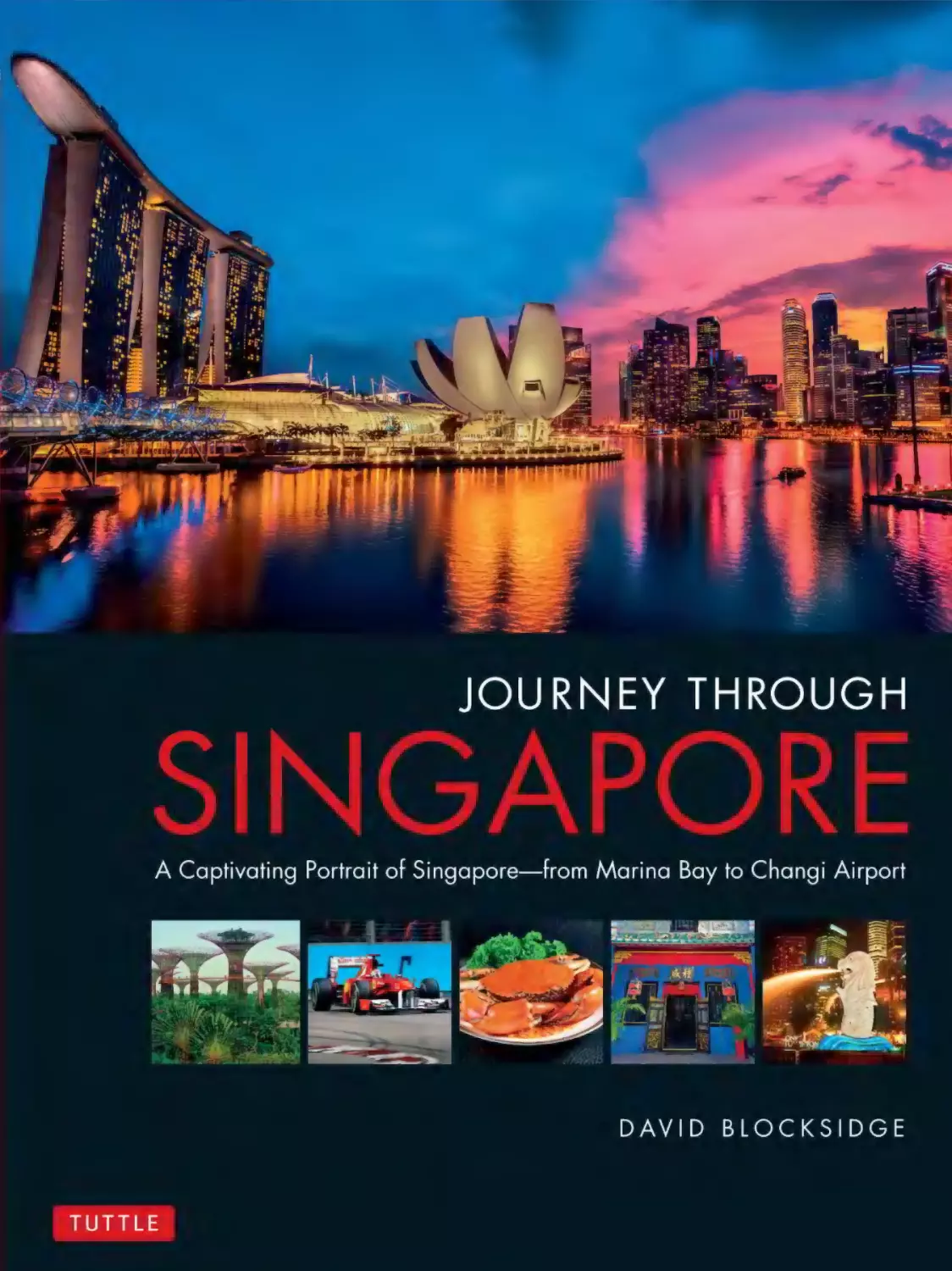
Jou r ney t hrough
Singapore
A Captivating Portrait of Singapore—from Marina Bay to Changi Airport
Welcome to the dynamic island nation where East
meets West and the past meets the future
T utt l e Publishing
Tokyo Rutland, Vermont Singapore
10
4
55
The Jurong Lake Gardens
56
Changi Airport—Best in the World
58
Singapore Food—A Gourmand’s Delight
62
Singapore Swings!
The Jurong Bird Park
54
The Singapore Zoo, River Safari and Night Safari
50
Sentosa Island—A Tropical Playground
46
Singapore’s Famous Botanic Gardens
42
Kampong Glam and Arab Street
38
Little India—Singapore’s Most Colourful District
36
Orchard Road—A Shoppers’ Paradise
32
The Traditional Charms of Chinatown
Exploring the Singapore River
28
24
Marina Bay and the Financial District
18
Singapore’s Rich Colonial Heritage
14
Contents
The Dynamic Melting Pot of Asia
wealthy little country with a big reputation.
10
modern Singapore: safe, clean and successful—a
Welcome to the City of the Future!
merge with Malaysia failed due to tensions in the
4
transformed Singapore. In 1959, the British granted
Page
migrations from the region and elsewhere further
dent nation. Strong leadership led to a new and
thriving trading port between East and West. Mass
alliance, thus in 1965 Singapore became an indepen-
nineteenth century. He turned the island into a
Singapore self-governance. An attempt in 1963 to
a nation at a crossroads, as Stamford Raffles realized
when he ‘leased’ the island for the British in the
will find a fascinating blend of Asian cultures. It is
the West. But beneath this veneer you
O
n the surface, Singapore appears to be
a brash, modern city just like many in
Singapore
Jou r n ey t hrough
62
58
18
56
42
36
28
24
14
54
50
46
Welcome to the City of the Future!
Singapore is hot, not just because it is n
early on the equator but because of all that
is happening here. This proud nation continues to stride confidently forward in the
twenty-first century.
Above: Restaurants and
bars line the waterfront of
Singapore, making it a scenic
place to chill out after work.
Opposite: A fantastic fireworks display at the world’s
largest floating stage—the
F
or a country that gained full independence
as recently as 1965, Singapore has come a
long way. Legend has it that the island once
known as Temasek was settled back in the mists of
time by Sri Tri Buana, who established Singapura—
Float@Marina Bay—to cele-
the Lion City—after he sighted a leonine beast in
brate the country’s independ-
the area. His descendants ruled for five generations
ence day on 9 August.
Opposite top left: The
until the last ruler, Parameswara, was forced to flee
half-fish, half-lion Merlion is
when the Javanese attacked. The first documentary
Singapore’s official mascot.
evidence for Singapore dates from the thirteenth
Opposite top centre: The
world’s first Formula One
century, when it was a flourishing centre for trade.
night race has been held in
A slow decline followed, with jungle reclaiming the
Singapore since 2008.
island. By the nineteenth century, seafarers who
Opposite top right: Over
90 per cent of Singaporeans
roamed the region had created a few settlements on
live in high-rise apartments
the island and some enterprising Chinese migrants
and own their own homes.
had established plantations of gambier and pepper.
But the arrival of one man would change everything.
4 journey through singapore
Welcome to the city of the future! 5
Opposite: Singapore is the
region’s leading banking and
commercial hub.
Left: The infinity pool on the
57th floor at Marina Bay Sands
is the highest and largest infinity pool in the world.
Centre left: The Singapore
Lions playing against the
Indonesia Garudas at Jalan
Besar Stadium during the
28th SEA Games.
Below: Chingay is an annual
multicultural street parade to
celebrate the Chinese New
Year and includes performances
by local and regional talents.
Bottom left: Buskers in
Singapore showcase their
skills outside shopping malls,
MRT stations and in underground walkways. Some of the
more popular buskers have a
following on social media.
To counter Dutch trading monopolies in the East, Thomas Stamford
Raffles signed an agreement with the younger brother of the Sultan of
Johor allowing the British to establish a trading post on Singapore and
leasing the island in perpetuity for an annual payment of 4,000 silver dollars. Thus began Singapore’s modern era. Within three years of Raffles’
landing in 1819, the population numbered more than 10,000, of which
60 per cent were Malays. By 1860, at the first census, the population
exceeded 80,000 and was mostly Chinese. Other migrants seeking success included Tamils, Ceylonese, Bengalis, Gujuratis, Punjabis, Javanese,
Bugis, Balinese and Sumatrans, as well as Europeans. The foundations
were laid early on for Singapore’s remarkable growth.
Welcome to the city of the future! 7
After Raffles, Singapore prospered for many
years under the British. In 1929, however, tin and
rubber prices collapsed and thousands lost their
jobs in the Great Depression. Although considered
impregnable by the British, during World War II
Singapore was quickly overrun by the Japanese.
After peace came in 1945, Singaporeans began
planning for independence. Under a new constitution, David Marshall was elected first chief minister
in 1955 and he lobbied Britain unsuccessfully for
full independence. Meanwhile, a young Straitsborn Cambridge graduate led a group of lawyers,
teachers and journalists in forming a left-wing
political party whose rallying cry was ‘Merdeka!’
(Freedom). In the 1959 elections, Lee Kuan Yew
and his People’s Action Party swept to power.
After failing to become part of Malaysia in 1963,
Singapore became fully independent in 1965.
Lee became the first prime minister and stayed in
that position for 31 years, stepping aside in 1990 to
allow a younger generation to take the political reins.
His vision, intellect and integrity have earned
him a place in history. With his passing in 2015,
Singapore entered a new era.
8 journey through singapore
Top: The Marina Bay area
comprises not only the financial district but also dining and
shopping options, hotels and
attractions like the Singapore
Flyer and Gardens By the Bay.
Above: Former Red Bull driver
David Coulthard displays his
driving prowess in an hour-long
stunt showcase at Orchard
Road to generate interest in
the Formula 1 Grand Prix.
Right: Music festivals such as
St Jerome’s Laneway have
been held in Singapore, featuring international and local
music acts like Enterprise
(pictured).
Far left: Siloso Beach on
Sentosa Island is a popular
weekend getaway.
Left: Orchard Road has more
than 5,000 dining and shopping outlets.
Below: The newly refurbished
Victoria Theatre and Concert Hall
has been gazetted as a National
Monument and is home to the
Singapore Symphony Orchestra.
Bottom: Singapore’s tallest
skyscrapers are capped at 280
metres because of their proximity to Paya Lebar Airbase.
Post-colonial Singapore is an astonishing success
story. The People’s Action Party, in power to this
day, began alleviating poverty early. Infrastructure has
always been a high priority. Low-cost, high-rise housing replaced overcrowded downtown areas, and most
Singaporeans now own their homes. The container
port is one of the world’s busiest and most efficient.
The Mass Rapid Transit system is the envy of other
nations. Business travellers consistently rate Changi
Airport the best in the world. Manufacturing industries fuelled much of the initial growth for many
years, aided by the famous Singaporean work ethic.
Tourism, too, has been encouraged and is a thriving
industry, as has the banking and financial sector.
Welcome to the city of the future! 9
10
exciting singapore
The Dynamic Melting Pot of Asia
Since the 1970s, Singapore has been a peaceful, multicultural society
composed of ethnic Chinese, Malays, Indians, Eurasians and others.
Left: The costumes of
Singapore’s multicultural
population include sarongs and
shoulder cloths, bright colours
and intricate beadwork. Many
borrow elements from each
other’s costumes.
W
ho are the Singaporeans?
Early in the nineteenth
century, Malays formed
the majority of Singapore’s population. Now the balance has shifted
Right: Participants at the River
and Singaporean Chinese are in the
Hongbao celebration at The
majority. They form 78 per cent of
Float@Marina Bay usher in the
Lunar New Year.
the population, followed by Malays
Below left: The crew working
(15 per cent) and Indians (7 per cent),
at the St Jerome’s Laneway
with Eurasians, Westerners and others
Festival in Singapore.
Below right: Once a mainstay
making up the balance. You can hear
of public transport, trishaws
people speaking Hokkien, Mandarin,
are now largely popular with
Cantonese, Teochew, Malay (still the
tourists. Trishaw tours around
Singapore can be arranged
from Trishaw Uncle.
official national tongue and the language
of the national anthem), Tamil, Hindi,
Portuguese and English—not to mention Singlish, the local dialect, a mix of
all the above languages. Some Singlish
words have recently been added to the
Oxford English Dictionary. Such diversity
makes for a fascinating blend of cultures.
The Dynamic Melting Pot of Asia 11
Left: Near Serangoon Road,
Chinese chess players battle
it out on a five-foot way, as
the covered sidewalks are still
generally called in Singapore.
Below: The ambition of these
Muslim boys will be to earn the
right to wear the white headwear as adults that indicates
they are Haji, men who have
undertaken the all-important
pilgrimage to Mecca.
Below left: These Peranakan
women are wearing the traditional sarung kebaya (Malay
for sarong and embroidered
blouse). The Peranakan are
ethnic Chinese whose culture
and language are influenced
by the Malays.
Bottom: Family is everything
in Singapore, where ties
between members are still
exceptionally strong.
12 journey through singapore
Above: A free night-time
outdoor concert at Esplanade–
Theatres on the Bay, where
performances range from classical music to rock concerts.
Right: Happy participants in
the annual Chingay parade,
which takes place during
Chinese New Year.
Far right: Performers from
the group Pastel Lite at the St
Jerome Laneway Festival. The
festival now travels to seven
different cities.
Below: Hindus give thanks for
prayers answered during the
Thaipusam festival. They live
cleanly and pierce their cheeks
and other parts of the body
with iron needles. This is followed by a pilgrimage to the
temple while carrying kavadi,
heavy structures whose weight
is transferred to the carrier
by steel skewers piercing the
penitent’s flesh.
The Dynamic Melting Pot of Asia 13
Singapore’s Rich Colonial Heritage
Singapore has preserved many iconic buildings from its colonial past.
Left: A bust of Sir Thomas Stamford Raffles, the founder of
Opposite above: The Asian Civilisations Museum, established in
Singapore. Many reminders of him can be found around the island,
1997, faces the Singapore River and houses exhibitions featuring the
visible in images and in the use of his name.
material history of Singapore and ancestral homes from around Asia.
Below: Raffles Hotel was previously a boarding house for Raffles
Opposite below: Previously the Convent of the Holy Infant Jesus,
Institution, an old and prestigious secondary school. It is also the
now known as CHIJMES, the buildings around the chapel have
birthplace of a famous local cocktail, the Singapore Sling.
been transformed into restaurants and shops. The church is used
Bottom left: The National Gallery’s special exhibition, ‘After the
for weddings and other private events.
Rain’, is a collection of works by artist Chua Ek Kay.
Bottom right: Raffles Hotel, with its gleaming marble colonnades,
is one of the finest examples of colonial architecture. Pictured here
in the hotel’s lobby.
14 journey through singapore
T
he colonial history of Singapore began in 1819 when
Raffles landed. Many early buildings were designed
by the Irish architect George Coleman, who consulted
with Raffles on the Town Plan of 1822–3. Several of his buildings remain, including the charming Armenian Church. Another
great architect of the colonial period was the Englishman Alfred
John Bidwell, whose work included the original main wing of the
Raffles Hotel, the Goodwood Hotel, Stamford House, Singapore
Cricket Club and Victoria Theatre. Between them, these two men
created the finest colonial architecture in the region. The Padang,
or town square, is the centre for several fine buildings, including the Cricket Club, Supreme Court, City Hall, old Parliament
House (now the newly renovated and reopened National Gallery)
and Victoria Theatre. Many historic buildings were lost, however,
in the race for economic prosperity after independence.
Welcome to the new asia! 15
Whole neighbourhoods were destroyed, although
critics should recall that many of the buildings torn
down were cramped and waterlogged. Conservation
efforts began in 1970 with the passing of the
Preservation of Monuments Act, followed in 1973
by the Urban Redevelopment Act. While Bugis
Street (which was moved 300 metres!) and Little
India have been criticized, preservation work at
Boat Quay, the former St Joseph’s Institution (now
the Singapore Art Museum), Empress Place and
elsewhere has been highly praised.
Right: The ‘Living World’ by Taiwanese sculptor Ju Ming is a permanent exhibit outside the National Museum of Singapore.
Below: The Old Hill Street Police Station was built in 1934 in the
Neoclassical style. It now houses several government ministries,
including the Ministry of Communications and Information and the
Ministry of Culture, Community and Youth.
Opposite top left: A 6-metre cast-iron fountain is the focal point
of the Palm Garden in front of the Raffles Hotel.
16 journey through singapore
Above: Students cluster
around the white polymarble
statue of Sir Stamford Raffles
at the Raffles Landing Site.
The original statue, nicknamed
‘Iron Man’, was cast in bronze
and is now in front of the
Victoria Concert Hall.
Left: The Singapore Art
Museum, rehoused in the
restored nineteenth-century
St Joseph’s Institution, opened
its doors in 1996.
Below left: The Sikh doorman
at the Raffles Hotel is one of
the most photographed people in Singapore.
Below: One of the windows of the Tan Teng Niah
Residence, an eight-room
multicoloured villa that mixes
Peranakan and European
influences in its design.
singapore’s rich colonial heritage 17
Marina Bay and the Financial District
Towering over a landscape studded with skyscrapers, the financial heart of
Singapore also has pockets of greenery and many outstanding attractions.
Right: The southern part of the Downtown Core, which includes
the commercial buildings at Shenton Way and Raffles Place, covers an area of about 266 hectares. It is one of the most densely
populated areas in Singapore. All the buildings sit upon man-made
landfill which, over the past century, has increased Singapore’s
total land area by close to 25 per cent.
Below: Much of this skyline has been added in recent years, first
the Esplanade (far left), nicknamed the ‘Durian’ by locals, followed
by the Singapore Flyer and the Marina Bay Sands (right side).
B
usiness makes Singapore tick. Much of it
was originally carried out by foreign multinational companies. Many are American,
but others come from Great Britain, Germany,
France, Australia, Japan, South Korea and other
countries. Overseas companies have brought in
skilled foreign workers. Many Singaporean families
employ foreign maids, since both parents work, and
construction workers from overseas are contracted to
maintain the roads and the infrastructure.
About 780,300 foreign workers (excluding
construction and domestic workers) have been
added to Singapore’s population of about 5.6
million, another marker of this tiny country’s
prosperity. Initially, the main industry was
manufacturing, followed by the electronics sector. Singaporeans today tend to be well educated, with many gaining degrees overseas and
returning home to good jobs. Information technology, biotechnology, finance and other service
industries like advertising have become important sectors as well. The statistics are impressive. Singapore has a per capita annual income
in excess of US$38,000 (as of 2014), one of the
world’s highest. It has no foreign debt; indeed,
it has reserves of about US$163 billion from
Temasek Holdings and about US$247 billion
in foreign reserves (as of 2015). This is an
impressive achievement for a small island with
no natural resources!
18 journey through singapore
marina bay and the financial district 19
There is generally a low unemployment rate. Most working citizens must contribute, along with their employer, towards their own
retirement fund, called the Central Provident Fund. The CPF is
also used to make mortgage payments, pay for hospitalization and
cover certain other important expenses, such as further education.
Much of the banking and finance companies can be found in the
downtown area spanning Newton, Orchard, Outram, Rochor to the
main area of Tanjong Pagar to Raffles Place and now the Marina Bay
area—known commonly as the Central Business District (or colloquially, the CBD; Singaporeans do love their abbreviations).
Above: Another great location to enjoy a free concert
is inside the concourse of the
Esplanade, where local and foreign performers take the stage.
Top right: Several running
events take place annually
in Singapore, one of them
the Colour Run, possibly the
most fun. Runners get sprayed
with coloured powder as they
make their way along the
5-kilometre route.
Above right and right: Gaily
attired sales girls pass out
leaflets in Raffles Place. With
its high volume of office
workers, it is often the location for sales promotions.
20 journey through singapore
Left: The Esplanade Outdoor
Theatre can seat up to 450
people and usually hosts performances during the weekends.
Below: Located at Marina Bay
Sands, the Louis Vuitton Island
Maison designer clothing store
is a nautical-inspired standalone glass and steel pavilion.
Opened in 2011, it is the
first Maison concept store in
Southeast Asia and the twelfth
in the world.
marina bay AND the financial district 21
Above: Eighteen imposing
50-metre artificial, solarpowered Supertrees tower
over the Gardens by the Bay,
twelve of them in Supertree
Grove. For the best views of
the garden and the Marina
Bay Financial District, stroll
along the 128-metre OCBC
Skyway, suspended 22 metres
above the ground.
Right: The walkway down from
the Cloud Forest to the Flower
Dome has been featured in
the film Hitman: Agent 47. The
Cloud Forest showcases plants
that live in climates up to
2,000 metres above sea level,
while the 35-metre mountain
boasts the world’s tallest
indoor waterfall.
Below: The World of Plants
comprises six different gardens examining the different
parts of the plant.
The district, marked by gleaming skyscrapers, includes the three tallest buildings in the
city—the United Overseas Bank Plaza One, the
Republic Plaza and the Overseas Union Bank
Centre. Since 2000, more skyscrapers have been
added, such as the Marina Bay Financial Centre
and the Ocean Financial Centre.
Occupying 101 hectares of prime land in
Marina Bay, the latest green addition to the
country is the Gardens by the Bay, featuring the
Flower Dome and Cloud Forest cooled conservatories, eighteen Supertrees—one of the most
photographed sights of the gardens—and the
Heritage Gardens. It has welcomed more than
20 million visitors since its opening in 2012.
22 journey through singapore
Above: The 1.2-hectare Flower
Dome features ever-changing
exhibits, such as this
Netherlands-inspired tulip
garden in April and May.
Other floral displays include
cherry blossoms in March and
lilies in June and July.
Right: The Venus flytraps
and Rafflesia pictured here in
the 0.8-hectare Cloud Forest
are completely made out of
LEGO® bricks. The Gardens
also has more than 40 sculptures from around the world,
such as the Floral Clock and
the Giant Snail, which sits
in the Secret Garden of the
Cloud Forest.
marina bay and the financial district 23
Exploring the Singapore River
The Singapore River has witnessed many important events in the countryÕs history.
It is a fascinating starting point for your exploration of the city.
D
ecaying human skulls, apparently left by
roving Malay pirates, littered the banks
of the Singapore River when Raffles and
company stepped ashore on 29 January 1819. Later, the
river saw wave after wave of immigrant labourers arrive
from China, India, Europe and elsewhere. For many
years, the river was the main gateway into the city for
goods and people who arrived by sea. Merchants became
wealthy and built business premises with homes above
them, called shophouses, along its banks.
The river went into decline after a deepwater port
was developed elsewhere, with only small craft, such as
Opposite: Singapore’s earliest
settlements were in this area,
on the banks of the Singapore
River. Today, skyscrapers
dominate the city, while the
preserved heritage buildings
have been repurposed as
museums or dining and entertainment venues.
Above: The shophouses
around Boat Quay have been
carefully preserved and are
now home to restaurants, bars
and pubs. The tenants also
include a budget hotel and a
cat cafe.
Left: Aside from taking a
leisurely bumboat cruise down
the Singapore River, tourists
can also try extreme rides like
the G-Max Reverse Bungy and
the GX-5 Extreme Swing,
which falls from 50 metres at a
speed of 120 kilometres per
hour.
exploring the singapore river 25
twakow, or bumboats, in use until 1983. Now, over
160 years after Raffles left Singapore (he died of a
brain tumour three years later in London at the age
of 44), the river has been totally transformed and
the shophouses converted to bars, restaurants and
shops. Boat Quay was the first area to undergo a
major renovation, and neighbouring Clarke Quay
and Robertson Quay soon followed suit. For visitors and locals alike, the river is now the hub of a
vibrant social scene. On Singapore’s balmy tropical
evenings, nothing is more pleasant than wining and
dining with friends beside the river.
Above and left: A multitude of dining and nightlife
options can be found along
Boat Quay, Clarke Quay and
Robertson Quay, with bars,
pubs and restaurants aplenty.
Below left: The ‘First
Generation’ sculpture by
Chong Fah Cheong at
Cavenagh Bridge depicts
scenes from yesteryear, where
children would jump naked
into the river for a swim.
Below: The bumboats that
have plied the Singapore River
for more than a century now
ferry tourists on electricity
rather than diesel.
Right: The polymarble statue
of Sir Stamford Raffles marks
the place where he first
landed on Singapore’s shores
in 1819 to found a small trading post.
26 journey through singapore
exploring the singapore river 27
Left: The elegant old shophouses
of Chinatown include local design
elements—Malay timber fretwork,
Chinese porcelain chip friezes
and bold paintwork.
Right: Trengganu Street becomes
a pedestrian shopping street and
night market after dark.
Below left: Shops in Chinatown
are a great place to pick up
affordable souvenirs, toys and
collectibles.
Below right: An elderly man
plays the erhu while dressed in
a samfu and a hat with pigtails.
This style of dress originated
during the Qing Dynasty and was
popular in Singapore in the nineteenth century.
The Traditional Charms of Chinatown
Chinatown was established by early immigrants who came ashore from cramped
junks after a long, hard journey from China, with only the shirts on their backs.
T
oday, these early Chinese immigrants
would recognize almost nothing of the
Chinatown that greeted them in the
nineteenth century. Stepping ashore after sailing in
junks from China, they settled in a couple of square
kilometres just south of the river. They worked as
indentured labourers in harbourside warehouses or
on rubber plantations until they paid off the cost
of their passage. Some later became hawkers, tailors
or jewellery makers, industries that still survive in
Chinatown. At Thian Hock Keng temple, the Temple
of Heavenly Happiness, the Hokkien immigrants
gave thanks for a safe journey. The present temple
was built on the site of the original one in 1840,
the traditional charms of chinatown 29
and is itself being extensively renovated. That’s the story of
Chinatown, where entire streets are now restored or rebuilt.
Miraculously, the area still has an old world atmosphere
worth savouring and enough historical buildings to make it
fascinating. Unless a sign says Fixed Price, you can bargain for
the price of goods on sale in the crowded, noisy streets. You
can also see fortune tellers, medicine men, calligraphers and
temple mediums, and peek into a Chinese medicine hall or a
shop selling paper money, cars and houses that are burned to
send off to deceased relatives. Many curious aromas waft along
the sidewalks. In the midst of all this, as if to flout the spirit of
Raffles, who in his City Plan divided the city’s quarters along
ethnic lines, are mosques and Hindu temples, including the
Sri Mariamman Temple on South Bridge Road where a firewalking ceremony called Thimithi takes place each year.
Top left: People flock to
Top right: Enjoy some local
Chinatown to buy goodies and
Chinese dishes and a Tiger
decorations in preparation for
beer at the Chinatown
the 15-day Chinese New Year
Seafood Restaurant on
celebrations, usually held in
Trengganu Street.
January or February each year.
Above: Elderly Singaporeans
The actual dates follow the
play a game of Chinese chess
Lunar calendar.
on tables set outside.
Right: Praying in a Chinese
temple dedicated to the deity
Tua Pek Gong.
30 journey through singapore
Left: Trishaw Uncle is a tour
Below: NUS Baba House is a
company whose drivers take
pre-war terrace house once
travellers around Singapore
owned by a nineteenth-century
via trishaw. These trishaws are
shipping tycoon. Now con-
outfitted with radios under
verted into a museum, it gives
the seats.
visitors a glimpse of the lavish
Below left: The famed Buddha
homes and lifestyles of the
Tooth Relic temple (the relic
Peranakan in the 1920s.
is located on the fourth floor)
Bottom: A Chinese calligra-
encased in a stupa made of
pher at work.
320 kg of pure gold.
the traditional charms of chinatown 31
Orchard Road—A Shoppers’ Paradise
Once a quiet country lane with nutmeg and pepper orchards,
this is now one of Asia’s most famous shopping boulevards.
Left: The menswear section of Takashimaya department store.
Right: Wheelock Place was designed by Kisho Kurokawa and was
completed in 1994. Apart from shops and restaurants, it has a number of medical clinics.
Below right: The award-winning ION Orchard mall has an observation deck on its 55th and 56th floors, providing panoramic views of
Orchard Road.
Above: These colourful
aluminium sculptures were
designed by Swiss sculptor
Kurt Laurenz Metzler.
Right: The five-storey
Gucci flagship store in
Paragon Shopping Centre
in Orchard Road. Other
designer brands with sidewalk storefronts include
Miu Miu, Prada, Tod’s and
Salvatore Ferragamo.
32 journey through singapore
orchard road—A shoppers’ paradise 33
Right: The largest H&M store
in Southeast Asia, spanning
about four floors.
Below right: Sidewalk cafes
are quite popular, found
outside Emerald Hill, 313@
Somerset and around the
Scotts Road intersection.
Bottom left and right:
Tourists and locals mingle on
the broad sidewalks outside
Ngee Ann City, fondly known
as ‘Taka’ for its iconic department store, Takashimaya.
T
oday, everyone associates Orchard Road with shopping, but within living memory it was little more
than a quiet country lane, complete with tigers. Big
changes began in 1958 when Tang Choon Keng moved his
C. K. Tang store here from River Valley Road. Now, just as
on New York’s Fifth Avenue and London’s Bond Street, you
can see the world’s top brand names in shopping centres like
ION Orchard, 313@Somerset, Mandarin Gallery, Wisma
Atria, The Heeren and Ngee Ann City. Orchard Road is now
one of Asia’s top addresses for shopping and people watching.
34 journey through singapore
Left: Pedestrians strolling
down Orchard Road are
likely to encounter buskers and
musical performances, such as
this one outside ION Orchard.
Below: Mandarin Gallery,
which is attached to the
Mandarin Orchard Hotel,
boasts luxury designer brands
like Paul Smith, Mulberry and
Bell & Ross.
orchard road—A shoppers’ paradise 35
Little India—Singapore’s
Most Colourful District
Plunge into a world of colourful sights and scents in Little IndiaÕs Serangoon Road.
Top left: A quintessential Indian dish is
roti prata, a flat bread paired with curry.
Modern versions have all sorts of fillings,
and ingenious names like Prata Bomb or
Tissue Prata.
Top right: Have your fortune told at this
table, where a parakeet will pick a card on
your behalf and the fortune teller will interpret it for you.
Left: Little India is always festively decorated for Deepavali. The festivities pictured
coincided with the nation’s year-long
golden jubilee celebrations.
Below: A South Indian-style wedding taking
place at the Sri Sreenivasa Hindu temple.
Right: Sri Sreenivasa Hindu temple on
Serangoon Road is dedicated to the god
Vishnu. Its Gopuram roof shows the god’s
various incarnations.
S
erangoon Road is a madly pulsating artery that runs
through the heart of Little India, probably Singapore’s
most colourful neighbourhood. Indian workers first
settled in the area when the British brought them here to
construct famous landmarks like St Andrew’s Cathedral, City
Hall and the Istana (now the president’s official residence).
Indians grazed cattle here, too, for the feed was good. Street
names evoke this history: Buffalo and Kerbau (Malay for
buffalo), Hindoo, Veerasamy, Klang (its variant, kling, is a
sometimes derogatory term for South Indians), together with
the names of prominent persons like butcher Desker, Clive,
Campbell and Kitchener, w ho all played greater roles in India
than in Singapore.
36 journey through singapore
A walk through Little India today can be an
assault on the senses—all of them at once! The
area is always crowded, especially on Sundays when
the foreign workers have their only day off. They
gather here in huge numbers and you are jostled for
space on the sidewalks. There is much to see, from
sari-clad or Punjabi-suited women to ornate Hindu
temples. The aromas on every corner are those of
India—spices, fruit and incense. Restaurants serving
all sorts of dishes from various parts of India line
the side streets. It’s a noisy place, full of life. The
best time to visit Little India is during Deepavali,
the Festival of Lights, when Serangoon Road is
awash in colourful lights and cheerful people.
Top: Regarded as one of the
top sights in Little India, this
colourful Chinese villa once
belonged to Tan Teng Niah,
who built it for his wife.
Above: A local vendor displays a picture of Sathya Sai
Baba as well as Buddha and
Ganesh, the elephant god.
Right: In Hindu and Sikh
cultures, temporary henna
‘tattoos’ are applied for marriage ceremonies and are now
popular with tourists also.
38 journey through singapore
Far left: A devotee carries a kavadi
after being pierced with vel skewers
during the festival of Thaipusam.
Left: A woman raises her hands,
palms together, in the traditional
namaste greeting.
Below left: A dry goods shop in
Little India. Be sure to step inside
to check out the fragrant spices.
Below right: Floral garlands are
commonly worn during ceremonies worshipping Hindu deities,
such as Kali and Durga.
Bottom right: A tailor sits along
the five-foot way of Little India
repairing a pair of trousers.
Travellers can also have suits or
saris made here.
little india—singapore’s most colourful district 39
Kampong Glam and Arab Street
This traditional cultural enclave has blossomed into a trendy hotspot
with cafes and boutiques frequented by locals and tourists alike.
Left and right: Shophouses
along Arab Street now house
trendy cafes like the Piedra
Negra shown in both pictures.
Below: The Sultan Mosque
was completed in 1826 and
has a prayer hall that can seat
up to 5,000 people.
O
nce the enclave of the Malay aristocracy, Kampong Glam, which today
sits between Kallang and Rochor, was
reserved in the 1822 Raffles Plan for Sultan Hussein
Shah of Johor, his household and the Malay and
Arab communities. The population, which later
comprised not just Malays and Arabs but also
Chinese and Indians, soon outgrew Kampong
Glam and spread to other areas, such as Joo Chiat,
Tanglin, Geylang Serai and Kampong Eunos.
The major landmark here is the Masjid Sultan,
or Sultan Mosque, originally commissioned by
Sultan Hussein and granted national monument
status in 1975. Today, Kampong Glam retains its
historical façades, restored shophouses and commercial spirit. Modern multi-label stores and boutiques, bars and cafes mix with traditional shops
selling Persian carpets, batik, hand-woven textiles,
hand-made perfumes and sarung kebaya (blouse
and sarong combinations). Large crowds gather
during the Holy month of Ramadan to break fast
and buy festive items for the Hari Raya Aidilfitri
celebrations that follow. Mingle with the locals
during this festive season in the Ramadan Bazaar,
which has over 1,500 stalls selling Malay cakes,
curries and snacks.
40 journey through singapore
Below: Arab Street, offering an eclectic selection of modern and
traditional items, is a popular haunt for shoppers.
Below centre: During the month of Ramadan, food stalls line
Bussorah Street next to the mosque. These serve Arabic, Egyptian,
Indonesian and Malay dishes, popular not only with Muslims but
with people of all ethnicities.
Bottom: Colourful murals adorn the sides of the shophouses in
Arab Street, lending colour to the neighbourhood all year round.
kampong glam AND arab street 41
Singapore’s Famous Botanic Gardens
Surprisingly for one of the worldÕs mostly densely populated
countries, more than 30 per cent of Singapore is green space. It
all started with the Botanic Gardens, which have recently been
declared a UNESCO World Heritage Site.
Top: A purple water lily in bloom.
Above: The gardens around Symphony
Lake are great for families and picnics,
and there are free concerts on weekends.
Right: People practising Tai Chi. The
gardens are also popular for yoga and
jogging.
Far right: The National Orchid Garden
has many locally bred hybrids.
Opposite above: The new entrance to
the Botanic Gardens facing Napier Road.
Opposite below: A vestige of the
equatorial rainforest which once covered all of Singapore.
42 journey through singapore
S
ingapore is one of the world’s most densely
populated nations, averaging over 5,000 residents per square kilometre. Yet green spaces
are found throughout the island. The 50-hectare
Botanic Gardens, recently declared a UNESCO
World Heritage Site, is one of the largest and most
important of these. The gardens are bounded by
Holland Road, Tyersall Avenue, Bukit Timah Road
and Cluny Road.
The gardens were created in 1859 by colonial figures such as Laurence Niven, the owner of a nearby
nutmeg plantation. He supervised the gardens’ layout
and the clearing of the jungle where tigers still roamed.
One of the most interesting characters associated with
the Botanic Gardens was Sir Henry Ridley, the director from 1888 to 1912, who developed a new way to
singapore’s famous botanic gardens 43
tap latex from the trees that did not kill them. Within two
decades, the Malay Peninsula became the world’s leading
source for rubber, supplying half the world’s latex.
Among the gardens’ attractions are the National Orchid
Garden, which houses the national flower, Vanda Miss
Joaquim, orchid hybrids named for state visitors and VIPs,
and a six-hectare primary rainforest comprising 314 different species of plants. A new Heritage Garden was opened in
2016, featuring more than 80 species of plants, such as bougainvilleas and yellow cow wood trees. Future developments
include an expansion of the children’s teaching garden (the
Jacob Ballas Children’s Garden) and The Learning Forest
to be completed in 2018. Also found here are a Visitor’s
Centre with shops and restaurants, and the Shaw Foundation
Symphony Stage at Symphony Lake, where free open-air concerts are given on weekends, weather permitting.
Top: The clock tower designed
by Eng Siak Loy displays the time
in Japan, Canada, the UK and
Singapore on different sides.
Above: A relaxing stroll in the
Botanic Gardens, open from 5 am
to 12 midnight every day, is a must
for visitors to Singapore.
Left: Singapore’s national flower,
the Vanda Miss Joaquim.
Right: Crane sculptures, a congratulatory gift from Lady YuenPeng McNeice, who also donated
the clock tower.
44 journey through singapore
Left: The Bandstand, where
performances have been held,
dating as far back as 1861.
Below: The National Orchid
Garden, which houses 60,000
orchids, including Singapore’s
national flower, the Vanda
Miss Joaquim, is the only part
of the Botanic Gardens where
an admission fee is charged.
Singapore’s famous botanic gardens 45
Sentosa Island—A Tropical Playground
Singapore is constantly reinventing itself. The sleepy isle of Pulau
Belakang Mati has been transformed into a tropical playground with
sandy man-made beaches and a multi-billion-dollar casino complex
with a Universal Studios theme park featuring duelling roller coasters.
S
entosa was not always the carefree resort
island it is today. In the 1880s, the British
built Fort Siloso on the western tip of
the island, known then as Pulau Belakang Mati
(‘The Island Where Death Lurks’). The fort,
intended to protect the entrance to Singapore
harbour, was strategically unimportant until
World War II, the island’s darkest hour. However, the Japanese attack came not from the sea
as expected but from the Malayan peninsula to
the north.
46 journey through singapore
Top: Spend a day lounging on
one of Sentosa’s three beaches.
Above: A rope bridge leads
from Palawan Beach to a small
man-made island in a lagoon.
Left: A photo opportunity
with Frankenstein’s monster in
Universal Studios Singapore.
Right: The 11-storey Merlion on
Sentosa has an elevator so visitors can take in the views from
its mouth and head. At night,
fibre optic and laser lights
change its colour.
Sentosa island—A tropical playground 47
Singapore was taken by the Japanese and Fort Siloso
became a prisoner-of-war camp. The island, appropriately
renamed Sentosa (‘Peace’ in Malay), was relaunched in
the 1980s as a major tourist attraction. Fort Siloso is now
a World War II museum.
Attractions abound on Sentosa, including the Universal
Studios theme park, the S.E.A. Aquarium, the Trick
Eye Museum, Madame Tussauds Wax Museum and the
Adventure Cove Waterpark. Thrill seekers can zipline
above the trees at MegaZip Adventure Park, go ‘skydiving’ at iFly or swing like an acrobat at the Flying Trapeze.
You can get around the island by the Sentosa Express
monorail, tram or bus, although you can also hire a bike
or walk. Sentosa is a great place to escape from the hustle
and bustle of the city.
Above: The Sentosa Express monorail brings
visitors from VivoCity on the mainland to points
around the island.
Right: The most thrilling ride at Universal
Studios is Battlestar Galactica. This twin duelling
roller coaster pits the Human track, pictured
here, against the Cylon track.
48 journey through singapore
Left: Enjoy a game of volleyball
on Siloso Beach, one of three
man-made beaches on Sentosa.
Opposite centre: Be mesmerized
by fish in the S.E.A. Aquarium.
The marine life on display
includes leopard sharks and
manta rays.
Right: Universal Studios Singapore
is the first Universal Studios theme
park in Southeast Asia.
Below: A view of Sentosa from
the mainland at VivoCity. Visitors
can walk to the island for free via
the Sentosa Boardwalk or take the
Sentosa Express monorail.
Sentosa island—A tropical playground 49
The Singapore Zoo, River Safari
and Night Safari
The Singapore Zoo, one of the worldÕs finest, is home to rare and endangered tropical species
who are free to roam in open pen areas. More recent activities include the Night Safari, a separate attraction open in the evening, and the River Safari, featuring a river boat jungle cruise.
T
he Singapore Zoo opened in 1973. Now
ranked among the best in the world, it
had its origins in the 1960s when the
families of British military forces pulled out after
independence, leaving many animals behind. About
Above: The entrance to the
Opposite top right: The
Singapore Zoo, which is visited
Thumbuakar warriors display
by 1.7 million people annually.
their flame throwing skills and
fied as threatened. These are among the zoo’s 2,800
Above right: The Komodo
an array of amazing stunts
animals. The Singapore Zoo joins international
dragon is a rare species
hourly from 7 pm onwards at
of monitor lizard found on
the Night Safari.
breeding programmes for rare animals. A success-
only a few islands in eastern
Opposite below: A number
ful example was the surprise birth of a polar bear,
Indonesia. These carnivores
of free shows are presented
Inuka. The zoo’s 100 hectares allow many of the
grow up to 3.5 metres long,
at the Singapore Zoo, includ-
weigh as much as 130 kilo-
ing the Elephants at Work and
animals to be kept in open enclosures bounded
grams and use their poisonous
Play show, where elephants lift
by natural rock walls and moats rather than in
saliva to help overcome large
giant logs and playfully spray
barred cages. Regular feeding times are scheduled
prey such as deer.
water at the audience.
throughout the day for various groups of animals.
Opposite top left: Many peo-
26 per cent of the more than 300 species are classi-
ple mourned the loss of the
Attractions such as Children’s World and play-
zoo’s animal ambassador Ah
grounds cater especially to the interests of younger
Meng. Her granddaughter Ishta
visitors. The most recent additions were four ador-
took over this role in 2016, and
she can be seen four times a
able koala bears on a six-month loan from Australia
week at the Jungle Breakfast
to celebrate the strong international ties between
with Wildlife experience.
the two countries.
50 journey through singapore
the singapore zoo, river safari and night safari 51
Above: The largest living reptile, the crocodile, is housed in
a plate glass sheltered viewing pool for visitors to safely
follow its movements underwater. There is also a feeding
show for crocodiles at 4.45
pm on Sundays.
Top right: Inuka, the first polar
bear born in the tropics, keeps
cool in a Frozen Tundra refrigerated pool, specially built to
mimic his Arctic habitat.
Right: The Amazonian Flooded
Forest in the River Safari is the
largest freshwater aquarium in
the world, and features piranhas
and the araipama.
Below left: Guests can get
up close to the Aldabra giant
tortoise in the Reptile Garden.
Tortoises can live to be 152
years old.
Below right: A meerkat peers
out from its hiding place in the
Wild Africa zone in the zoo.
52 journey through singapore
Right: On loan from China for
ten years is a pair of giant pandas, Kai Kai and Jia Jia, part of
the River Safari.
Below: Leopards are generally
more active at night and are
best seen on the Leopard Trail
at the Night Safari.
Below right: There are several
animal performances at the
zoo, including the Rainforest
Fights Back show where animals display their amazing skills.
Bottom: The Night Safari
welcomes about 1.1 million
visitors annually, who come to
see more than 2,500 animals in
their nocturnal habitats.
the singapore zoo, river safari and night safari 53
The Jurong Bird Park
This sprawling 20-hectare park, served by a tram, has
more than 400 bird species from all over the world.
T
he award-winning Jurong Bird Park is an extraordinary 20-hectare
home for more than 5,000 birds from 400 different species, many
flying free in a 2-hectare walk-in aviary featuring a 30-metre man-
made waterfall. Various shows are scheduled, or you can simply stroll through
the gardens and keep your eyes open. Feeding times are great for kids to have
a closer encounter with the birds, including ostriches, penguins, lories and
flamingos. If you become tired, hop aboard a guided tram around the park,
complete with informative commentary. The park will be relocated to the
Mandai nature precinct by 2020.
Top left: A friendly parrot perching on a visitor’s shoulder at the Lunch
with Parrots.
Top right: The Jurong Bird Park is Asia’s largest bird park with the
world’s largest lory flight aviary.
Centre: The much-photographed Flamingo Lake is home to greater and
lesser flamingos.
Far left: A large hornbill demonstrating its talents at the High Flyers show.
The park has been successful in conserving and breeding this rare species.
Left: The park’s expert falconer performing at the King of the Skies
show, which features the white-tailed sea eagle, the hooded vulture and
the Harris hawk.
54 journey through singapore
The Jurong Lake Gardens
The Chinese and Japanese gardens provide havens of tranquility on two huge
islands in Jurong Lake at the western end of Singapore. Plans are afoot to
develop the 90-hectare Jurong Lake Gardens into SingaporeÕs central park.
L
inked by the Bridge of Double Beauty, these two gardens are peaceful
havens for city dwellers. The Chinese Garden features several pagodas, including one styled after the Beijing Summer Palace. The Herb
Garden and the Garden of Fragrance are delightful. Also called ‘The Garden
of Tranquility’, the Japanese Garden has stone lanterns, trimmed shrubs and a
miniature waterfall. Its classical features also include summer houses and Zen
rock gardens. When the new Jurong Lake Gardens is completed in 2018, these
two gardens will form the central core, flanked by Jurong Lake Park and the
grounds of the new Science Centre.
Top: Double Beauty Bridge follows the style of the
Seventeen Arch Bridge in the Summer Palace in
Peking, and was the finish line of Amazing Race Asia 2.
Above: One of the most distinctive sights in the
Chinese Garden is the Twin Pagodas. A third pagoda
lies on a small hill and resembles Nanjing’s Ling Ku
Temple Pagoda.
Right: The Main Arch Building features two courtyards and a fish pond, and is an example of a traditional Chinese arch gateway.
Changi Airport—Best in the World
SingaporeÕs highly acclaimed airport is constantly reinventing itself.
Among forthcoming developments are the Jewel Changi Airport complex, two massive new terminals and a new runway.
S
ingaporeans really like visiting their airport, even when they’re not
travelling. It has recently won its 500th Best Airport award. The
airport currently has three terminals, with another two in the devel-
opment stages. It also has many unusual amenities, such as the country’s
tallest slide and a butterfly garden. Currently, Terminal 1 has 56 shops and
24 cafes, restaurants and bars. When ready in 2019, the new Jewel Changi
Airport complex at Terminal 1 will be a lifestyle destination in its own
right, with 22,000 square metres of space housing one of the largest collections of indoor plants at the five-storey Forest Valley as well as four different Gateway Gardens. One of its main attractions will be the 40-metre-high
Rain Vortex, the world’s tallest indoor waterfall, complete with its own
light and sound show. Jewel Changi will also have walking trails, dining
outlets, playgrounds, shops, an integrated multi-modal transport lounge and
a transit hotel.
56 journey through singapore
Opposite: Over 100 international airlines serve
Changi Airport, including, of course, home-grown
Singapore Airlines.
Left: The Enchanted Garden in Terminal 2 comes
to life with the sounds of nature and blooming
flowers. Optic fibre and LED lights form a sparkling pathway at night.
Top: The airport’s Butterfly
Above centre: Singapore
Garden houses more than
Girls—the flight crew of
1,000 butterflies and a
Singapore Airlines—in their
6-metre grotto waterfall.
batik sarung kebaya designed
Left: The new Jewel Changi
by Pierre Balmain in 1968 are
terminal will connect Terminals
a common sight at Changi.
1, 2 and 3 and feature a
Above: The airport has hun-
40-metre-high waterfall.
dreds of shops, cafes and restaurants, which are required
by law to charge the same
prices as in the city.
changi airport—best in the world 57
Singapore Food—A Gourmand’s Delight
Many people, locals and visitors alike, say the food in
Singapore is among the finest in the world. WhoÕs arguing?
Left: Yusheng, a dish served only during the Chinese New Year
holiday, was created by the Four Heavenly Culinary Kings of
Singapore in 1964. Its 27 ingredients are tossed by family members, colleagues or friends to bring luck for the coming year.
Below: Stacks of steamer baskets hold dim sum dishes at the food
court at Marina Bay Sands. These contain bite-sized portions of
shrimp dumplings, carrot cake, pork buns and xiao long bao—
dumplings filled with meat and broth.
S
ingaporeans, it is said, do not eat to live, they
live to eat. That’s a good policy in a nation
with arguably the finest food in the world.
You also get excellent value for money as it is still
possible to eat well at hawker centres for a few dollars. At the other end of the scale are top restaurants
helmed by famous names like Gordon Ramsay, Joel
Robuchon and Tetsuya Wakuda at $300 a head. No
single dish defines Singaporean food since the country’s cuisine has been drawn from many lands—
China, India, Indonesia, Malaysia and the best of
the West. Famous dishes to try include nasi lemak
58 journey through singapore
Above left: Chilli crab, a
favourite local dish, is smothered in a sweet spicy tomato
sauce. It is usually served
with crusty French bread or
steamed or fried buns (mantou) for dipping into the sauce.
Other famous crab dishes
include black pepper crabs,
salted egg yolk crabs and
steamed crabs. These can be
found in seafood restaurants
all over the island.
Top: Another local favourite
is satay—seasoned chicken
and beef on skewers grilled
over a fire—paired with onion,
cucumber and pressed rice
cubes all dipped in a spicy
sweet peanut sauce.
Left: A banquet at Li Bai
Cantonese Restaurant at
Sheraton Towers Hotel on
Scotts Road. Chinese cuisine
in Singapore consists of a mixture of Cantonese, Teochew,
Hainanese and Hokkien dishes.
Opposite bottom: A roasted
meat stall, commonly found
in food courts, coffee shops
and hawker centres across
the country. Favourite dishes
are char siew rice, roast pork,
duck rice and, of course,
Singapore’s iconic chicken rice.
singapore food—A gourmand’s delight 59
Right: Laksa is a local dish of rice noo-
Bottom: Locals having dinner at a zi
dles in a rich coconut broth, usually
char food stall in Chinatown, where
paired with chicken, fish or prawns.
they order several dishes to share.
Below: A plate of chicken rice,
Opposite top left: The famous Lim
Singapore’s national dish. Its con-
Chee Guan bak kwa (barbecued pork
diments include garlic chilli, fresh
sheets) is especially popular during
ginger and black soya sauce.
Chinese New Year, where the wait
Below right: Economy rice stalls typ-
may be a few hours.
ically sell various vegetable, chicken,
pork and fish dishes. Simply point
at what you want and it is scooped
over a plate of rice. It all costs just a
few dollars.
60 journey through singapore
(a staple Malay breakfast), fish head curry, Hainanese
chicken rice, chilli crab, satay, roti prata (Indian
bread with curry, a great way to start the day), and
Hokkien fried noodles. Of course, you must also
sample the tropical fruits, such as rambutans, mangoes and mangosteens. Or try a famous local dessert. Many have shaved ice as their base. Ice kacang
(ice mountain) includes red beans and sweet syrup
among its colourful ingredients. Chendol contains red
beans, coconut milk and brown sugar. Bubur chacha
and bubur hitam both feature sweet potato, yam and
coconut milk. Barley-rich chng tng is delicious hot
or cold. Food is preferably eaten in the company
of friends, family or colleagues, because eating in
Singapore is an important social activity.
Top right: Indonesian nasi padang originated from west Sumatra
and features fiery hot precooked vegetable, meat and fish dishes.
Above: The spicy mee goreng or fried egg noodles with chicken,
onions, beansprouts and grilled beancurd. Variations of this dish
include ikan bilis mee goreng and Maggi mee goreng (where
instant noodles are used).
Left: An Indian hawker making thosai (a pancake made from
fermented bean and rice flour), which is served with chutney.
singapore food—A gourmand’s delight 61
Singapore Swings!
The Lion City is not exactly known for its nightlife,
but when the sun goes down Singapore transforms
into Swingapore.
Above: Popular spots for
Below: Meadow at Gardens by
clubbing can be found in the
the Bay hosted the St Jerome’s
Mohammad Sultan area, Clarke
Laneway Music Festival featur-
Quay and Tanjong Pagar.
ing electronic band Cvrches
Below left: Beyoncé performs
and local bands Riot! and
at F1 Rocks during the Formula
Cashew Chemists.
One weekend. This event
has attracted headliners like
Maroon 5, Bon Jovi, Pharrell
Williams and BIGBANG.
S
ingapore is becoming funkier by the day,
it seems. This little island nation offers
bars and dining by the river as well as
big clubs such as Zouk, Attica, Trace Lounge,
Pangaea, Kyo and Altimate. Between them, they
appeal to all tastes, with customers ranging from
young teenagers wearing the latest designer label
clothing to middle-aged men and women. Many
of the clubs run special themed parties when
people really get into the spirit of things. Besides
Orchard Road, there are pubs and clubs in the
restored shophouses of Tanjong Pagar, in a relocated and cleaned-up Bugis Street, in trendy
Holland Village and in Mohammad Sultan
Road. The zoo, however, offers Singapore’s wildest nightspot—the Night Safari.
62 journey through singapore
Left: A local band performs at
Home Club (now Canvas) at
Clarke Quay. Resident DJs at
Canvas include Ben Nicky, Matt
Smallwood and SOUL:UTION.
Below: ZoukOut, one of
Asia’s biggest outdoor beach
parties, is usually held on the
first weekend of December.
Big names like Paul van
Dyk and David Guetta have
graced the occasion.
Bottom: The New Asia Bar on
the 71st floor of Swissotel The
Stamford has been voted one
of the top 50 bars in the world.
singapore swings! 63
Published in 2016 by Tuttle Publishing, an imprint of Periplus Editions (HK) Ltd.
About Tuttle
“Books to Span the East and West”
www.tuttlepublishing.com
Copyright © 2000 Periplus Editions (HK) Ltd, published as Exciting Singapore
Second Edition © 2016 Periplus Editions (HK) Ltd.
All rights reserved. No part of this publication may be reproduced or transmitted in
any form or by any means, electronic or mechanical, including photocopy, recording
or any information storage and retrieval system, without prior written permission from
the publisher.
Library of Congress Control Number: 2016944503
ISBN 978-0-8048-4712-4
(This title was previously published with the ISBN 962-593-207-0)
ISBN 978-1-4629-1885-0 (ebook)
Distributed by
Our core mission at Tuttle Publishing is to create books
which bring people together one page at a time. Tuttle
was founded in 1832 in the small New England town of
Rutland, Vermont (USA). Our fundamental values remain as
strong today as they were then to publish best-in-class books
informing the English-speaking world about the countries
and peoples of Asia. The world has become a smaller place
today and Asia’s economic, cultural and political influence
has expanded, yet the need for meaningful dialogue and
information about this diverse region has never been greater.
Since 1948, Tuttle has been a leader in publishing books on
Asia Pacific
Berkeley Books Pte. Ltd.
61 Tai Seng Avenue #02-12, Singapore 534167
Tel: (65) 6280-1330; Fax: (65) 6280-6290
inquiries@periplus.com.sg; www.periplus.com
the cultures, arts, cuisines, languages and literatures of Asia.
North America, Latin America & Europe
Tuttle Publishing
364 Innovation Drive
North Clarendon, VT 05759-9436 U.S.A.
Tel: 1 (802) 773-8930; Fax: 1 (802) 773-6993
info@tuttlepublishing.com; www.tuttlepublishing.com
www.tuttlepublishing.com.
19 18 17 16
6 5 4 3 2 1
1607RR
Printed in China
TUTTLE PUBLISHING® is a registered trademark of Tuttle Publishing,
a division of Periplus Editions (HK) Ltd.
Front endpaper: The façade of the Marina Bay Sands and the Gardens by the Bay conservatories.
The integrated resort includes a large casino, seven restaurants helmed by celebrity chefs, shops,
a skating rink and two theatres.
Back endpaper: The Supertrees at the Gardens by the Bay measure between 25 and 50 metres.
At night they come alive with a dazzling light and sound display.
64 journey through singapore
Our authors and photographers have won numerous awards
and Tuttle has published thousands of books on subjects
ranging from martial arts to paper crafts. We welcome you
to explore the wealth of information available on Asia at
Photographic Credits
Front Cover: Main Image ID 48014695 © Anekoho | Dreamstime.com; Cover, Column 1 (from
left): ID 144157141 © reezuan | Shutterstock.com; Cover, Column 2: ID 21444008 ©
Yummyyui | Dreamstime.com; Cover, Column 3: ID 35556524 © Hin255 | Dreamstime.com;
Cover, Column 4: NUS Baba House, Photo courtesy of the Singapore Tourism Board; Cover,
Column 5: ID 50350572 © Joyfull | Dreamstime.com; Front Flap: ID 6658163068108800 ©
Sam Song | Pixoto.com; Back Cover Main Image: ID51046389 © Vince Chong | Pixoto.com;
Back Cover, Column 1, Row 1: ID 9195946 © Lawrence Wee | Shutterstock.com; Back Cover,
Column 2, Row 1: ID 60561832 © Saiko3p | Dreamstime.com; Back Cover, Column 3, Row 1:
ID 59054157 © Tang90246 | Dreamstime.com; Back Cover, Column 4, Row 1: ID 41981368 ©
Jpldesigns | Dreamstime.com; Back Cover, Column 5, Row 1: ID 72255951 © Imre Cikajlo |
iStockphoto.com; Back Cover, Column 1, Row 2: ID 22507067 © catchlights_sg | Shutterstock.
com; Back Cover, Column 2, Row 2: ID 163044812 © Luciano Mortula | Shutterstock.com; Back
Cover, Column 3, Row 2: ID 56891199 © Stanislav Komogorov | Dreamstime.com; Back Cover,
Column 4, Row 2: ID 60549095 © Saiko3p | Dreamstime.com; Back Cover, Column 5, Row 2:
ID 48920309 © Goinyk | Dreamstime.com; Back Cover, Column 1, Row 3: ID 23918673 ©
Salvador Manaois Iii | Dreamstime.com; Back Cover, Column 2, Row 3: ID 234512233 © Komar |
Shutterstock.com; Back Cover, Column 3, Row 3: ID 373869436 © Sorbis | Shutterstock.com;
Back Cover, Column 4, Row 3: ID 248969917 © norikko | Shutterstock.com; Back Cover,
Column 5, Row 3: The crowd at ZoukOut, photo courtesy of Zouk Singapore | Colossal Photos;
Front Endpaper: ID 57306065 © Boule13 | Dreamstime.com; Back Endpaper: ID 44190139 ©
Platongkoh | Dreamstime.com; Title Page: ID 23173210 © Ruslan Kerimov | Dreamstime.com; 2
top left: ID 382043566 © yutthanaSing | Shutterstock.com; 2 top middle: ID 211347190 ©
Noppasin | Shutterstock.com; 2 top right: Multi-racial children, photo courtesy of Ingo Jezierski; 2
bottom left: Electrico at Home Club © blackbass | Flickr.com; 2 bottom right: ID 52141389 ©
Piyato | Dreamstime.com; 3 (column 1, row 1): Victoria Concert and Theatre; 3 (column 2, row
1): ID 131519528 © joyfull | Shutterstock.com; 3 (column 3, row 1): ID 20930274 © fotoVoyager | iStockphoto.com; 3 (column 4, row 1): ID 50752295 © Lembi Buchanan | Dreamstime.
com; 3 (column 4, row 2): Sri Sreenivasa Hindu temple, photo courtesy of Ingo Jezierski; 3 (column 4, row 3): ID 55239463 © Elnur | Dreamstime.com; 3 (column 4, row 4): The Merlion at
Sentosa at night, photo courtesy of Ingo Jezierski; 3 (column 1, row 4): ID 75109545 ©
Flightlevel80 |iStockphoto.com; 3 (column 2, row 4): Flamingoes at Jurong Bird Park, photo
courtesy of Ingo Jezierski; 3 (column 3, row 4): ID 360854141 © Trong Nguyen | Shutterstock.
com; 4 left: ID 26999055 © Su Gin Quah | 123rf.com; 4 right: ID 20594784 © Jordan Tan |
Dreamstime.com; 5 top left: ID 92747842 © urf | depositphotos.com; 5 top middle: ID
59694345 © Chung Jin Mac | Dreamstime.com; 5 top right: ID 4842446 © Koh Sze Kiat |
Dreamstime.com; 6: ID 32817031 © Binkski | Shutterstock.com; 7 top: ID 46310239 ©
Micho2002 | Dreamstime.com; 7 middle left: ID 293980391 © feelphoto | Shutterstock.com; 7
middle right: ID 197258120 © Philip Bird LRPS CPAGB | Shutterstock.com; 7 bottom: ID
33791664 © Naruto4836 | Dreamstime.com; 8 top : ID 30735451 © Luciano Mortula |
Dreamstime.com; 8 middle: ID 19514041 © Jordan Tan | Dreamstime.com; 8 bottom:
Enterprise, photo courtesy of Lionel Boon | Laneway Festival Singapore; 9 top left: Siloso Beach,
photo courtesy of Ingo Jezierski; 9 top right: ID 66109677 © davidf | iStockphoto.com; 9 middle:
ID 60493677 © Saiko3p | Dreamstime.com; 9 bottom: Elgin Bridge, facing the Central Business
District, photo courtesy of Ingo Jezierski; 10: ID 27813577 © Ravindran John Smith |
Dreamstime.com; 11 top: ID 9195946 © Lawrence Wee | Shutterstock.com; 11 bottom left:
Photo courtesy of Laneway Festival Singapore; 11 bottom right: ID 166184447 © CristinaMuraca
|Shutterstock.com;12 top: Men playing Chinese chess, photo courtesy of Ingo Jezierski; 12 below
left: Peranakan women, photo courtesy of Wendy Chan; 12 middle right: Muslim boys, photo
courtesy of Wendy Chan; 12 bottom right: Father and son, photo courtesy of Ingo Jezierski; 13
top : ID 65832767 © Sabine Hortebusch | iStockphoto.com; 13 middle left: Chingay participants,
photo courtesy of Ingo Jezierski; 13 middle right: Pastel Lite, photo courtesy of Lionel Boon |
Laneway Festival Singapor; 13 bottom: ID 54898515 © Delstudio | Dreamstime.com; 14 top left:
Bust of Sir Stamford Raffles, photo courtesy of Ingo Jezierski; 14 bottom : ID 113933650 © Chris
Howey | Shutterstock.com; 15 top: ID 60561832 © Saiko3p | Dreamstime.com; 15 bottom: ID
262999118 © Iryna Rasko | Shutterstock.com; 16 top: Sculptures, photo courtesy of Ingo
Jezierski; 16 bottom: ID 262999166 © Iryna Rasko |Shutterstock.com; 17 top left: Fountain at
Raffles Hotel, photo courtesy of Ingo Jezierski; 17 top right: ID 28722692 © Urs FLUEELER |
123rf.com; 17 middle: Singapore Art Museum, photo courtesy of Wendy Chan; 17 bottom left:
Sikh doorman at Raffles Hotel, photo courtesy of Jill Gocher; 17 bottom right: ID 120831181 ©
lucarista | Shutterstock.com;18 and 19: ID 57657226 © Boule13 | Dreamstime.com; 19 top: ID
57670088 © Boule13 | Dreamstime.com; 20 top right: ID 308749874 © superjoseph | Shutterstock.
com; 20 middle left: ID 58043162 © Naruto4836 | Dreamstime.com; 20 middle right: Sales promoters dressed colourfully, photo courtesy of Ingo Jezierski; 20 bottom: ID 131519528 © joyfull |
Shutterstock.com; 21 top: ID 50874860 © Naruto4836 | Dreamstime.com; 21 bottom: ID
399254932 © Netfalls - Remy Musser | Shutterstock.com; 22 top: ID 339941558 © Wojtek
Chmielewski | Shutterstock.com; 22 middle: ID 36675359 © Verdelho | Dreamstime.com; 22
bottom: The World of Plants, photo courtesy of Gardens by the Bay; 23 top: ID 39959886 ©
Kuan Leong Yong | Dreamstime.com; 23 bottom: ID 59054157 © Tang90246 | Dreamstime.
com; 24: ID 20406144 © TommL | iStockphoto.com; 5 top: ID 20930274 © fotoVoyager |
iStockphoto.com; 25 bottom: ID 286085309 © ibreakstock | Shutterstock.com; 26 top: ID
46191374 © designcabinet | iStockphoto.com; 26 middle: ID 41981368 © Jpldesigns |
Dreamstime.com; 26 bottom left: ID 26116353 © Suttipon Thanarakpong |123rf.com; 26 bottom right: ID 18486075 © Siang Boon Woo | Dreamstime.com; 27: Sir Stamford Raffles statue,
photo courtesy of Ingo Jezierski; 28: Chinatown shophouses and the Central Business District,
photo courtesy of Wendy Chan; 29 top: ID 17865065 © Toonman | Dreamstime.com; 29 left:
ID 214682851 © vichie81g | Shutterstock.com; 29 middle: ID 50752295 © Lembi Buchanan |
Dreamstime.com; 30 top left: Chinatown during Chinese New Year, photo courtesy of Wendy
Chan; 30 middle right: ID 61668108 © Jorg Hackemann | Dreamstime.com; 30 bottom left: ID
18486075 © BDphoto | iStockphoto.com; 30 bottom right: Praying in a Chinese temple, photo
courtesy of Ingo Jezierski; 31 top: ID 72255951 © Imre Cikajlo | iStockphoto.com; 31 middle
left: ID 37993187 © Roland Nagy | Dreamstime.com; 31 middle right: NUS Baba House, photo
courtesy of the Singapore Tourism Board; 31 bottom: Chinese calligrapher, photo courtesy of Ingo
Jezierski; 32 top: Display at menswear department, photo courtesy of Ingo Jezierski; 32 middle :
ID 57087714 © Stanislav Komogorov | Dreamstime.com; 32 bottom: ID 57368097 ©
Naruto4836 | Dreamstime.com; 33 top left: ID 306413276 © Korkusung | Shutterstock.com; 33
top right: ID 202415566 © Everything| Shutterstock.com; 33 bottom: ID 14637673 © Tdmartin
| Dreamstime.com; 34 top: ID 51237223 © Iryna Rasko | Dreamstime.com; 34 left: ID
199860431 © deeepblue | Shutterstock.com; 34 middle right : Sidewalk café, photo courtesy of
Wendy Chan; 34 below right: ID 26116353 © Suttipon Thanarakpong |Shutterstock.com; 35
top: ID 22507067 © catchlights_sg | Shutterstock.com; 35 bottom: ID 56066868 © Naruto4836
| Dreamstime.com; 36 top left: ID 42673606 © Zkruger | Dreamstime.com; 36 top right: Indian
fortune teller, photo courtesy of Ingo Jezierski; 36 middle: ID 325740014 © tristan tan |
Shutterstock.com; 36 bottom: South Indian-style wedding, photo courtesy of Ingo Jezierski; 37:
Sri Sreenivasa Hindu temple, photo courtesy of Ingo Jezierski; 38 top: ID 163044812 © Luciano
Mortula | Shutterstock.com; 38 middle: Vendor in Little India, photo courtesy of Ingo Jezierski;
38 bottom: ID 34409512 © Naruto4836 | Dreamstime.com; 39 top left: ID 24542065 © Wisnu
Haryo Yudhanto | Dreamstime.com; 39 top right: Woman with hands in Namaste greeting, photo
courtesy of Wendy Chan; 39 below left: Dry goods shop, photo courtesy of Wendy Chan; 39
middle right: ID 283575599 © Delpixel | Shutterstock.com; 39 bottom right: ID 331739957 ©
Trong Ngyuen | Shutterstock.com; 40 top: ID 56891199 © Stanislav Komogorov | Dreamstime.
com; 40 bottom: ID 16118381 © Salvador Manaois Iii | Dreamstime.com; 41 top left: ID
57222816 © Naruto4836 | Dreamstime.com; 41 top right: ID 55624005 © Francis Castro |
Dreamstime.com; 41 middle right: ID 56814834 © Naruto4836 | Dreamstime.com; 41 bottom
right: ID 59555944 © Naruto4836 | Dreamstime.com; 42 top: Purple water lily, photo courtesy
of Ingo Jezierski; 42 center: Singapore Botanic Gardens Palm Valley © Calvin teo | Wikimedia
Commons; 42 bottom left: ID 31512039 © Imran Ahmed | Dreamstime.com; 42 bottom right:
ID 332060672 © Lodimup | Shutterstock.com; 43 top: Botanic Gardens © Wong Kin Leong,
www.wahliao.com for Singapore; 43 bottom: Rainforest in the Botanic Gardens, photo courtesy of
Ingo Jezierski; 44 top: ID 60559626 © Saiko3p | Dreamstime.com; 44 middle left: ID 25162526
© Michael Luhrenberg | iStockphoto.com; 44 bottom left: ID 310949264 © JohannesS |
Shutterstock.com; 44 below right: ID 60549095 © Saiko3p | Dreamstime.com; 45 top left: ID
49829180 © Tang90246 | Dreamstime.com; 45 bottom right: ID 55239463 © Elnur |
Dreamstime.com; 46 top : ID 977412 © Palangsi | Dreamstime.com; 46 middle: ID 29170184 ©
Kjorgen | Dreamstime.com; 46 bottom: ID 272374301 © mastapiece | Shutterstock.com; 47 :
The Merlion at Sentosa at night, photo courtesy of Ingo Jezierski; 48 top : Beach volleyball at
Siloso Beach, photo courtesy of Ingo Jezierski; 48 middle: ID 48920309 © Goinyk | Dreamstime.
com; 48 bottom left: ID 40158399 © Stanislav Komogorov | Dreamstime.com; 48 bottom right:
ID 318625817 © Zanariah Salam | Shutterstock.com; 49 top: ID 51993796 © Ratchada
Siwalaikul | Dreamstime.com; 49 bottom: Sentosa from VivoCity, photo courtesy of Anthoney
Chua; 50 left: ID 360854141 © Trong Nguyen | Shutterstock.com; 50 right: Komodo dragon,
photo courtesy of Jill Gocher; 51 top left: ID 58585671 © Boule13 | Dreamstime.com; 51 top
right: ID 4542165751431168 © Arish Zishan | Pixoto.com; 51 bottom: Elephant at the animal
show in the Singapore Zoo, photo courtesy of Ingo Jezierski; 52 top left: ID 61702678 ©
Willcao911 | Dreamstime.com; 52 top right: ID 38928801 © Sorayuth Reakruethai |
Dreamstime.com; 52 middle: ID 58705118 © Haslinda | Dreamstime.com; 52 bottom left: ID
60559242 © Saiko3p | Dreamstime.com; 52 bottom right: ID 33206433 © Joshelerry |
Dreamstime.com; 53 top: c 53 middle left: ID 51188598 © Liudmila Laurova | Dreamstime.com;
53 middle right: ID 29666189 © Giorgos Karagiannis | 123rf.com; 53 bottom: Night Safari
entrance, photo courtesy of Wendy Chan; 54 top: Parrot perched on woman’s arm, photo courtesy
of Jean Kugler | Photobank; 54 top right: ID 279109607 © Elnur | Shutterstock.com; 54 middle:
Flamingoes at Jurong Bird Park, photo courtesy of Ingo Jezierski; 54 bottom left: ID 36945998 ©
Vincentstthomas | Dreamstime.com; 54 bottom right: ID 247971394 © TPm13thx | Shutterstock.
com; 55 top: ID 16687789 © Salvador Manaois Iii | Dreamstime.com; 55 middle: ID 23918673 ©
Salvador Manaois Iii | Dreamstime.com; 55 bottom: ID 16459733 © Petegar | iStockphoto.com;
56 top left: ID 75109545 © Flightlevel80 |iStockphoto.com; 56 top right: ID 373869436 ©
Sorbis | Shutterstock.com; 56 bottom left: ID 338939702 © Sorbis | Shutterstock.com; 56 below
right: Jewel Changi Airport renderings, photo courtesy of Jewel Changi Airport Devt.; 57 top left:
ID 30207504 © Apolobay | Dreamstime.com; 57 top right: ID 372548155 © Sorbis |
Shutterstock.com; 57 middle : ID 27671866 © Kokkai Ng | iStockphoto.com; 57 bottom: ID
53702299 © Tang90246 | Dreamstime.com; 58 top: ID 255331453 © ThamKC | Shutterstock.
com; 58 middle: ID 346562744 © Sorbis | Shutterstock.com; 58 bottom: ID 171494138 © joyfull | Shutterstock.com; 59 top left: ID 323327855 © bonchan | Shutterstock.com; 59 top right:
Satay, photo courtesy of Ingo Jezierski; 59 bottom: Chef at Cantonese Restaurant at Sheraton
Towers Hotel, photo courtesy of Luca Invernizzi Tettoni | Photobank; 60 top: ID 248969917 ©
norikko | Shutterstock.com; 60 middle left: ID 52141389 © Piyato | Dreamstime.com; 60 middle
right: ID 346562714 © Sorbis | Shutterstock.com; 60 bottom: ID 19460987 © fotoVoyager |
iStockphoto.com; 61 top left: ID 16961172 © catchlights_sg | iStockphoto.com; 61 top right: ID
346562723 © Sorbis | Shutterstock.com; 61 below left: Indian chef making Thosai, photo courtesy of Wendy Chan; 61 middle right: ID 368941829 © abamjiwa al-hadi | Shutterstock.com; 62
top : ID 6173801022750720 © Zack Dilaroca | Pixoto.com; 62 below: ID 16856892 © EdStock
| iStockphoto.com; 62 below right: The crowd at the Meadows at Gardens by the Bay, photo
courtesy of Aloysius Lim | Laneway Festival Singapore; 63 top: Electrico at Home Club © blackbass | Flickr.com; 63 middle: The crowd at ZoukOut, photo courtesy of Zouk Singapore |
Colossal Photos; 63 bottom right: ID 5592802423472128 © William Cho | Pixoto.com